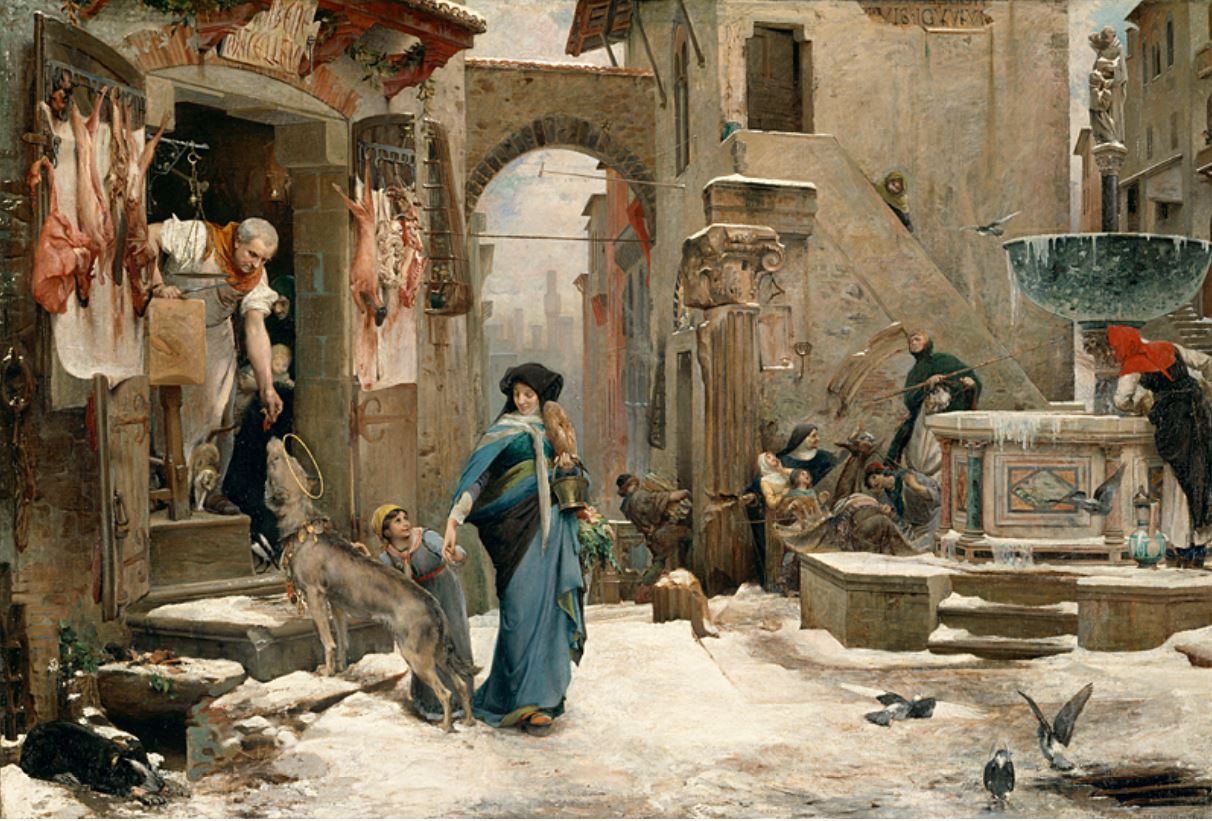
Love Among the Haystacks by D.H. Lawrence (1930)

Six short stories by D.H. Lawrence, published in the UK after his death, in 1930.

  1. Love Among the Haystacks (1930)
  2. The Lovely Lady (1933)
  3. Rawdon’s Roof (1928)
  4. The Rocking-Horse Winner (1926)
  5. The Man Who Loved Islands (1929)
  6. The Man Who Died (1929)

1. Love Among the Haystacks (40 pages)

Part 1

It all takes place during one long, hot day harvesting hay and building massive ricks in the Nottinghamshire countryside.

The story of two young brothers who work on the family farm, countrymen who speak in broad dialect, Geoffrey, 22, and Maurice, 21. I think the family name is Wookey. They’ve been raised by their mother, an outsider who speaks proper English and considers herself above the locals, and so consider themselves above the local girls. The result is they are in the prime of their youth, know no women and are deeply frustrated.

There’s an attractive German-speaking governess at the Vicarage and, after they were both involved in a minor accident (with a rake) she agreed to meet Maurice and, the night before the story opens, sat with him and let him kiss her. As the story opens Maurice is reliving the scene in order to taunt his heavier, surly, jealous brother.

It is harvest time, a boiling hot day. The brothers are atop a high haystack and work as a trio with their father tossing hay up from a cart and Geoffrey tossing it onto Maurice. When they’ve finished Maurice goes round testing the corners but their verbal sparring reaches such a peak that the red mist comes down over Geoffrey’s eyes and he forces his brother over the edge of the stack, falling quite a way to the ground.

Their elder brother, Henry, other farm workers and the German woman from the Vicarage who saw it happen, all come running. For a tantalising moment Geoffrey thinks he’s killed Maurice and will at last be free of the poisoned curdling of his soul within itself, the permanent self poisoning which makes him so surly and angry. But then his brother starts coming round and Geoffrey feels trapped again.

On the last pages the governess comes to the fore. We learn she is Polish, named Paula Jablonowsky, just 20 years old, swift and light as a wild cat and, in Lawrence’s characteristic way, the phrase wild cat is repeated again and again.

Now she tends Maurice as he comes round and staggers to his feet, assuring everyone he is fine, especially as he is so publicly receiving the wild Polish girl’s caresses as she ‘gives him lordship over her’.

Squeezed in at the end of this section is the vicar confiding in Maurice’s father that she, the Polish girl, is for the chop. He obviously dislikes her wild impulsive character. She’ll be leaving in three weeks. Immediately the reader sees the problem: Maurice is falling in love with a woman who’ll be gone in weeks.

Part 2

Maurice thinks he loves Paula. He wants to marry her. Following immediately on from the preceding scene, the Wookey men and other labourers lay out a large picnic supplied by their mother. In the middle of the feast Paula walks over the fields from the vicarage with cold chicken for Maurice. The other men josh both Maurice and the girl for being so obviously in love.

Paula tells her more about her life, she hails from Hanover but ran away from home (wild cat!). She tells then she hates the vicarage, no life! She says she’ll move on, maybe go to Paris, maybe get married!

While this is ramifying, a seedy tramp comes up, ‘a mean crawl of a man.’ He asks if there’s any work. The father replies no, they’ve nearly finished. He explains he was a jockey, pulled a race for his manager, was found out and fired. He begs some of the pie, then bread and cheese, then a wedge of tobacco.

While he’s smoking his pipe with the rest of the men, his woman appears through the gap in the hedge and joins them. She’s tough, hard-bitten but only young. She ignores all the others and asks the man if he’s got any work and is angry when he says no. In that queer perceptive way of his, Lawrence points out how there’s a secret sympathy between angry Geoffrey and this embittered young woman, ‘There was a sort of kinship between them. Both were at odds with the world’ (p.25)

Part 3

The men carry on with the haymaking all afternoon but the break in work for Maurice’s accident means they won’t finish today. Somebody needs to sleep the night in the field to protect the tools and Maurice volunteers, because as Henry waspishly points out, he wants to continue his courting of the Polish girl.

Night falls at the end of the long hot day. There’s a brilliant moment:

Maurice wondered what to do. He wandered round the deserted stacks restlessly. Heat came in wafts, in thick strands. The evening was a long time cooling.

That phrase, ‘Heat came in wafts, in thick strands’ suddenly took me back to evenings in the country. Lawrence gives hauntingly beautiful descriptions of the flowers – meadowsweet, ragged robin and bell flowers – while Maurice decides to strip off and wash all over ahead of his rendezvous with Paula at 9.

She is late, it took a while getting the vicar’s baby off to sleep. Now they walk through the grass till she suggests a mad dash through the hay. They hear horses approaching and she asks to ride one. Maurice gentles one of the horses, a mare, and attaches a bridle, then helps the girl onto the horse’s back, swinging up in front of her.

They ride gently to the top of the hill and Lawrence gives a beautiful description of the vista with lights of collieries and the town in the distance. Then she wants excitement and asks him to make the mare gallop down hill, which he does, thrillingly. They dismount breathless and excited and Maurice takes her in his arms and kisses her. They stroll on with arms round each others’ waists.

Maurice feels a spot of rain and tells Paula he needs to cover the stacks with a rain cloth, goes fetches one from the shed, places the ricketty ladder against the stack and clambers up it holding the leading edge of the cloth. She helps.

Part 4

Geoffrey comes to help with the cloth. He’s cycled up with a bike light on. He can’t see the others and doesn’t call out. Suddenly he hears a slithering against the stack. It’s the ladder the couple climbed up slowly falling over. Geoffrey hears Maurice realise this and explain it to Paula. They’re stuck up there for the time being. Oh well, they can shelter from the rain under the cloth.

During none of this does Geoffrey reveal his presence. Instead he slinks back to the shed where the farm equipment is and feels sorry for himself. He spends a page fantasising about what it would be like to have Paula love him. He is far deeper and darker than Maurice; it would be a deep passionate love. He is entranced by her foreignness (reminding me of how Tom Brangwen is hypnotised by Lydia Lensky’s foreignness in ‘The Rainbow’. Lydia, also, is Polish).

At that moment, almost as if summoned by his unconscious, a figure slips into the shed. Big strong Geoffrey reaches out and grabs it and the helpless female voice reveals it’s the young woman in a sailor hat attached to the tramp who had cadged food off them that afternoon.

She is antagonistic but also soaked through by the rain. He tells her to take her wet things off otherwise she’ll catch her death etc, and gets a big old rug to cover her. She’s also famished so he opens the chest where the remains of the afternoon’s bread and cheese and butter is kept, although she doesn’t eat that much.

He bumps into the chest and knocks the lamp over, spilling its oil. From now on they chat by the light of a few matches until he stops striking them and they talk in the increasingly mystical dark, he shy, she angry and snappish. She confirms she’s been married to the jockey-cum-tramp for four years and hates him. He’s workshy and useless. They had a baby which died at ten months. Often she’s wished she would catch her death and die but it ain’t to be. Instead she is vindictively determined to track him down and dog him.

Long pause then he hears her shivering and offers to warm her feet. Reluctantly she acquiesces. They’re like ice. He kneads them and blows on them. Then he realises she’s crying. She leans forward and strokes his hair. When he moves his head to look at her, her hands stray over his face. He strokes her hair with one hand. Then she clasps him to her breast and cries and cries. Then he takes her into his big strong arms and warms her against his big body. Then he mumbles his lips down over her forehead and she turns hear face up and he experiences his first love kiss.

I thought this was extremely beautiful and touching.

Part 5

Next morning dawns with her still in his arms. She tells him her name is Lydia (Lawrence’s mother’s name, the name he gives the Polish woman in ‘The Rainbow’). But she won’t marry him. So what if they run off to Canada together? She says she has a sister married to a farm hand. She could go and stay with them; he’ll contact her in the spring and they’ll go together to Canada. She agrees with all this but he doesn’t believe her.

When he mentions about the cloth and the rain and his brother she immediately insists he goes and puts the ladder back up, so he leaves her to get fully dressed.

Geoffrey moves the ladder back up against the stack but doesn’t hail his brother, instead collects sticks for a fire. Maurice finds the ladder and is amazed, he was sure it had fallen down. When he tells the Polish girl she is livid, furious, calls him a liar and mean. From this maybe we are meant to deduce that she thinks it was all a ploy to keep her there under the cloth all night and that therefore… something happened! They had sex?

Geoffrey listens to all this with amusement and watches his brother navigate climbing down the dangerous ladder and Paula refusing to follow. Maurice walks round the stack and bumps into Geoffrey who tells him it was he who restored the ladder. if I was Maurice, I’d have run back up the ladder to tell Paula but, oddly, he doesn’t.

Instead he listens while Geoffrey blurts out his news, how he spent the night in the shed cuddling the wife of the tramp. Both brothers are shyly proud and discomfited. Geoffrey takes Maurice to the shed where Lydia is washed and dressed and has let her hair down and looks pretty. He makes a fire while she gets coffee out of the provisions box.

Paula joins them, surprised to see the girl. Geoffrey explains it was him who set the ladder back up against the haystack so she owes Maurice a big apology but when he returns with more kindling for the fire they’re too embarrassed to look at each other.

Coda

In a paragraph, Lawrence tells us that within a week she was engaged to Maurice, and when she was released from the vicarage went to live at the Wookey’s farm. And in a final cryptic sentence:

Geoffrey and Lydia kept faith one with the other. (p.47)

Three things: Pairs, couples, as in ‘Women in Love’. A foreign woman, as in ‘The Rainbow’. And it turning out not at all the soppy Mills and Boon romance you might have expected from the title (cf ‘The Virgin and The Gypsy’, also a completely unexpected narrative).

2. The Lovely Lady (20 pages)

A strange tale, a kind of faux ghost story, set in a strange middle-class household. Pauline Attenborough is the matriarch, 72 but marvellously well preserved. With her fine bone structure, in some lights she could pass for 30. She is strong willed and made her own money. She inherited her father’s fine collection of Oriental curiosities and art, and his expertise, so she was able to expand his collection and his sales activities. The house is full of luxury goods and Pauline takes care to be seen in the best light against fine backdrops.

She was married by one day just left her weak husband to live independently. They had an elder son, Henry, who sickened and died when he was 24. There was a second son, Robert, now 32, a stout barrister, plain and almost speechless, deeply repressed and dominated by his mother. He has a secret hobby which is collecting old Mexican legal documents.

Third member of this oppressed and heavy household is her plain, dim niece, Cicely (Ciss), also very dominated. She has a job, 2 hours a morning teaching the grand-daughter of nearby Sir Wilfred Knipe.

Old Mrs Attenborough often doesn’t get up till late. One of her favourite activities, if the sun’s shining, is to take a ‘sun-and-air bath’ (presumably the word ‘sunbathing’ hadn’t been coined yet – according to the Etymological dictionary the first recorded use is from 1935). There’s a square behind the stables which is a nice suntrap and she lies here, in the sun, with a book.

The story proper gets going when timid Ciss decides to have a sun bath, too. She’s always lived in the rooms above the old stables. One of the windows opens onto the stables flat roof, just adjacent to the little suntrap where Mrs Attenborough takes the sun. One afternoon, very quietly, Ciss steals out onto the sunroof, strips off (oh, I say!) and lies down in the lovely warm sun.

After a while, feeling slightly dazed, she has an extraordinary experience: she hears voices. She hears what seem to be disembodied voices talking about Henry, Mrs Attenborough’s dead son, recriminations and blame about his death. Bewildered, for several pages Ciss thinks she’s hearing voices from the beyond, and the surprised reader thinks Lawrence has written a ghost story! (Although I now realise these aren’t are rare in his oeuvre as I thought: witness the four ghost and horror stories in The Woman Who Rode Away and Other Stories.)

But no. After some time she realises that Aunt Pauline, half stunned by the sun, talks in a wandering disconnected way, and her voice comes up the gutter downpipe which runs from Ciss’s flat roof, down the side of the stables, to a drain in the little courtyard, not far from Aunt Pauline’s lying and quietly babbling to herself.

This discovery gives Ciss an idea, two ideas. That evening, after dinner and after Aunt Pauline has retired to bed, she confronts Robert, in a timid sort of way. She steers the conversation round to the idea that they’re both sad, frustrated people whose lives are slipping away. Bold, she asks if he will kiss her, and clasps his hand to her bosom. Robert acquiesces but is useless, has no passion, For several nights Ciss fruitlessly waits for him to come to her bedroom, but he doesn’t.

A day or two later she bumps into him in the garden and takes him to the paddock, the sit on hay, he says he can’t marry her because he hasn’t got any money, she asks if she can touch him, and strokes his hair, but he doesn’t try to kiss her or put his arm round her. Instead he feebly says: ‘I suppose I shall rebel one day.’ What a disappointment.

So a few days later Ciss is lying in the stable roof again, out of sight of Pauline sun bathing below, and she does a funny thing. She puts her mouth to the top of the gutter pipe and talks down it. She puts on a deep bass voice and pretends to be Henry’s ghost.

Aunt Pauline is as bewildered as Ciss was on first hearing a voice, but slowly Ciss coaxes her into believing she is Henry’s ghost. She starts off by accusing Aunt P of murdering him, which she fiercely denies. But her main message is Let Robert go, let him marry, let him be free. Aunt P rouses herself and leaves, Ciss waits before quietly climbing back through her window.

And that evening there is a Great Transformation in the household – Aunt Pauline looks haggard and old. It is as if all the age and exasperation pent up in her for decades has broken through. She looks old and her skin is wizened and wrinkled. The biggest impact is on Robert. Somehow it is liberating for him to realise what a shrivelled old lady his mother is.

Not only her appearance but her behaviour. She yaps her food like a dog, then walks into the living room in a crazy crab-like way, then angrily refuses coffee and says she’s going to bed. Suddenly she has aged 40 years.

But then she suddenly reappears, dressed in a wrap and recklessly announces that Robert and Ciss ought to marry. When Robert says he thought she objected to cousins marrying, Pauline reveals that Robert is not her husband’s son but the result of an affair she had with an Italian Jesuit priest. As she tells it she tries to look flirtatious but only looks grotesque. Her effortless manner has completely broken. It doesn’t return. Ciss thinks this is what she was like all along.

The two young people don’t exactly leap into each other’s arms, they aren’t like that. But the scales have fallen from Robert’s eyes. He pronounces his analysis of the situation, explaining to Ciss that his mother wanted power:

‘Power to feed on other lives,’ he said bitterly. ‘She was beautiful and she fed on life. She has fed on me as she fed on Henry. She put a sucker into one’s soul and sucked up one’s essential life.’ (p.68)

A few days later Pauline dies in her bed of an overdose of veronal. She leaves Robert £1,000, Ciss £100 and the rest of her large fortune to set up the Pauline Attenborough Museum.

That information is the information conveyed in the dry and droll last sentence so that we never find out whether the timid youngsters marry. It’s left to the reader’s imagination to decide whether they’ll overcome a lifetime of inhibitions. Do you think they did?

Thoughts

A fairy story. We seem to have come a long way from Lawrence’s early stories. The setting amid luxury pieces, the talk of fortunes, the terrifying old lady, the hag-ridden younger generation, the country manor, all of it reminded me of Agatha Christie more than early Lawrence.

3. Rawdon’s Roof (10 pages)

A first-person narrator which allows the tone of voice to be more informal and chatty with many a ‘by Jove!’ and ‘Bless me!’, creating the voice of a bluff Edwardian chap. To my limited mind the narrator suggested the bluff obtuseness of Dr Watson, a similarity which grows as the story unfolds and the narrator spots ‘clues’ which the main protagonist doesn’t see.

The narrator is called Joe Bradley. He knows this fellow Rawdon who’s always boasting that ‘No woman shall sleep again under my roof!’ This is despite the fact that he has a wife (who he communicates with by letter and occasional half hour interview) and a mistress. But none of them are allowed to sleep ‘under his roof’.

The mistress is Janet who lives five minutes away and whose husband is in the diplomatic service. The narrator sees him paying visits to this Janet almost daily, but always during the day, never at night. Lonely woman.

The narrator finds it a great mystery and puzzle that neither Rawdon nor Janet ever come out and confess anything. He guesses the husband, Alec Drummond, knows about the affair, all of which makes Rawdon’s stupid boast that no woman will sleep under his roof sound all the sillier.

As to the wife, neither of them want a divorce, and she is practical and witty about the situation:

She said: ‘I don’t mind in the least if he loves Janet Drummond, poor thing. It would be a change for him, from loving himself. And a change for her, if somebody loved her –’

All of this is background to the actual story which kicks off one evening in November after he’s been to dinner at Rawdon’s and has stayed on while Rawdon talked interminably about one of his favourite subjects, 14th century music, for Rawdon is a fine amateur musician, even giving music lessons to Janet Drummond’s three children.

We learn that it’s set after the war for Rawdon fought in it as a major and brought back a man, Hawken, to be his butler or servant. Now this servant enters to announce that Mrs Drummond has called by. Rawdon is astonished and asks her to be shown into his room where he and the narrator are having brandy and cigars etc. When the narrator offers to go he begs him to stay.

Long story short, Janet confesses that Drummond’s just come home, more broke and chaotic than usual and insists on making love to her. She doesn’t like him and now confesses, in front of the narrator, that she loves Rawdon and wants to be with him. Rawdon agrees but says he’ll sleep at a hotel, given his famous vow. He’ll leave her in the capable hands of his man, Hawken.

Now let’s just pause and consider this man Hawken. He showed Janet in and then retired. When Rawdon mentioned him a few times, each time Janet made sarcastic remarks about him ‘busy man, that Hawken’. When Rawdon says she can stay here the night under Hawken’s care, she says not likely. When he suggests Hawken drive her home, she says no. This is enough to create a strong mystery around the servant.

But when they go to seek him out in the servants quarters, he is not there, all there is is an empty bottle of beer and two glasses on the table. Suddenly he appears down the stairs with his arms full of bed linen. He claims he’s been airing it in the drawing room which had a fire in it. But he looks flustered and this adds to the air of mystery. I began to wonder whether Hawken and Janet were having some kind of secret affair?

In the event, Hawken and Rawdon set off with a flashlight to accompany Janet across the fields back to her house and the narrator goes up to the spare room because Rawdon has asked him to stay the night. To his surprise the bed in the spare room has been freshly slept in, the pillow crushed and the sheets still warm. He hears a soft voice call ‘Joe’ and steps across the hall and through the padded door into the servants’ quarters and to what he assumes is Hawken’s bedroom. And here the whole mystery is solved because he sees ‘a pretty white leg and a pretty feminine posterior very thinly dimmed in a rather short night-dress’ quickly disappearing under the bedsheets. He beats a hasty retreat back to the spare bedroom and goes to bed.

Next morning Hawken comes to attend on him and the narrator tells him his secret is out. At which Hawken comes clean with surprising candour, telling the narrator that this bed, the spare bed, is the most comfortable in the house, as if he’s tried them all.

This explains the sarcastic remarks Janet made about Hawken. Quite clearly she knows all about his shenanigans. And this makes a mockery of Rawdon’s bombastic boast that no woman would ever sleep under his roof again. Seems that at least one and quite possibly more than one have been sleeping under his roof for years, without him ever knowing.

Thoughts

Did Lawrence write this for money, as a pastiche of a bluff 1920s story for chaps? The most notable element for me, once again, is the poshness of the characters: Rawdon isn’t some bloke down the pub, he owns a house with a drive down to metal gates which can be locked, and with paths off over the fields. And his mistress is the wife of a chap in the Diplomatic Corps. Why did this son of a miner write so often about the posh upper middle-classes?

4. The Rocking-Horse Winner (16 pages)

A sort of ghost story. A boy is brought up, along with two younger sisters, in a posh Edwardian household which is struggling for money. Although the father is an Old Etonian he never manages to succeed at anything and the family gets deeper into debt. The bitter, hard mother can’t conceal her disappointment from her children, especially the sensitive son, Paul.

She has a fateful conversation with him on the issue of luck, pointing out that she and her husband have little of it. It’s better to be born lucky than born rich. You can lose wealth but, with luck, can be confident of regaining it.

The children think they hear ghostly whispers in the house, the house talking, saying ‘there must be more money, there must be more money’. The boy becomes obsessed with riding his rocking horse, thrashing it with the whip his uncle Oscar gave him and obsessively chanting ‘Now take me to where there is luck! Now take me!’. The childrens’ nurse, the two sisters and his mother all demand he stop riding it in such a frenzy.

When Uncle Oscar calls by one day he asks the boys the horse’s name and Paul gives the name of a recent winner at the Ascot races. When Oscar asks Paul how he knows the name, sister Joan snitches that he’s always talking to Bassett the gardener about horse races. (Bassett has his current post with Paul’s family because he was Uncle Oscar’s batman during the war, in which he was wounded.)

When questioned, Bassett reveals that he and Paul have been betting on horseraces. To be precise, Paul gets the names of winners and Bassett places the bets. Paul makes his uncle swear ‘honour bright’ that he won’t tell anyone, least of all his mother.

Long story short: Uncle Oscar thinks this is childish fantasy but decides to take the boy to Lincoln races. Here Paul successfully predicts the winner, a rank outsider, so that he, Bassett and Oscar all make money. Slowly Oscar gets sucked in and comes to believe in Paul’s powers. Both Bassett and Paul tell him it was his gift of ten shillings which set off Paul’s winning spree. Slowly Oscar comes to realise that Paul really has made the astonishing sum of 1,500.

Oscar joins the syndicate and so realises it’s true when Paul’s bet at the Leger wins £10,000. All the time Paul is explaining that he is obsessive about winning in order to stop the whispering, stop the house whispering, stop the incessant whispering ‘There must be more money, there must be more money’ and help his mother who endlessly complains about their poverty.

Uncle Oscar has promised secrecy but once he realises the boy’s motivation, he comes up with a plan. He’ll take £5,000 of Paul’s money, give it to the family solicitor, give a false story about some distant relative dying and wanting a thousand a year handed over to Paul’s mum every year on her birthday (in November).

The only problem is that as soon as the mother hears the plan, she wants all the money at once. The household is deeply in debt and needs the full £5,00 just to pay off the debts. To Paul’s dismay, the voices he hears, the house’s voices, simply intensify.

Summer comes and Paul makes some losses. He only wins when he’s certain’, when he’s unsure, the syndicate generally loses. Having realised the depth of debt and the need for money, Paul becomes more and more desperate. ‘I’ve got to know for the Derby! I’ve got to know for the Derby!’ the child reiterated, his big blue eyes blazing with a sort of madness.

His mother notices how overwrought he is and tells him he must go away, have a holiday, go to the seaside, but the boy feverishly insists he can’t go till after the Derby. He is equally as insistent that, although he’s now outgrown it, the old rocking horse is moved up to his room.

The climax of the story comes when the husband and wife are at a big party in town when she has a rush of anxiety about the boy. She knows she must be at home. She telephones home and the nanny says everything is OK but still she insists they leave the party early and drive home.

She creeps up to his room, hears a strange noise as she stands at the door, goes in and turns on the light – to find her son riding riding riding the rocking horse with demented energy, crying out manically ‘Malabar! Malabar! Tell Bassett! Tell Bassett!’

She takes him off the horse and puts him to bed, later asking her brother Oscar what ‘Malabar’ means. It’s a horse running in the Derby. Oscar puts a thousand pounds on it at 14 to 1. The boy continues feverish, unwell and bed-ridden for days. On the third day Bassett asks the mother if he can see the boy, gains admission to the bedroom, tells the feverish boy that Malabar won, netting him over £70,000 so he now has over £80,000 in his fund.

The mother hears all this as the boy feverishly and disconnectedly explains about the luck and the gambling and the horses, and tells her he’s lucky, he’s lucky. And that night, with the fatality of a fairy story or folk tale, he dies, and the reader is shaken by the secret, subterranean power of this intense, strange and compelling story.

5. The Man Who Loved Islands (28 pages)

The First Island

The narrative starts off sounding like a children’s story, addressing the reader straight out.

An island, if it is big enough, is no better than a continent. It has to be really quite small, before it feels like an island; and this story will show how tiny it has to be, before you can presume to fill it with your own personality.

And:

It seems that even islands like to keep each other company.

But then it becomes strange. The text is divided into three parts as the mysterious protagonist lives on three successive islands, each successively smaller and more isolated. The first one is quite large with a farm and three cottages each with inhabitants who contribute to the island economy. The owner, in this section, is called ‘the Master’. While they labour, the Master spends his time in a library compiling a reference book of flowers mentioned in Greek and Latin literature. But he is losing money badly. Long discussions with the bailiff and more bank loans to help the second year.

Bad luck: cows fall off cliffs, a man breaks a leg, the pigs get a disease, a storm drives his fancy yacht onto the rocks. At the end of the second year staff start leaving. In the third year he makes cut backs and sacks staff. He starts to feel it is doomed. The second half of the fourth year he spends on the mainland, eventually selling it at a loss to a company who want to build a hotel and golf course.

The Second Island

He moves to island number two, much smaller but still in sight of the first one. He still has people with him, though far fewer: the faithful old carpenter and his wife, a widow and daughter and a young orphan. He moves into the much smaller house, the other live in two joined cottages. They no longer call him ‘the Master’ but by his name, Mr Cathcart.

The place is dominated by the numerous different sounds of the sea. The place is a kind of refuge for all of them. Occasionally he goes to the mainland, to the city, but with a faraway look. He has dropped out of the rat race. Slowly he gives up on the big reference book he was going to read. He falls in love with the widow’s daughter, Flora but he doesn’t want sex. With Lawrentian mysticism, he wants to move beyond sex to a place of desirelessness.

In fact he becomes so disillusioned with the merely mechanical acts of sex and loving that he leaves the island altogether and wanders the continent looking for freedom. Flora writes to say she is pregnant with his child. He takes her to the mainland and they’re married and return to the second island and he hates it. It’s become suburban, being a nice happily married young couple. ‘They might have been a young couple in Golders Green.’

He scours newspapers for islands coming up for sale and finds a tiny one off the north coast. The baby is born to Flora’s delight but Cathcart feels depressed and trapped. he gives Flora money and a cheque book and departs.

The third island

On the tiny island he has men build him a hut with a corrugate irons roof, a simple room with a bed, table and chairs. Coal, paraffin, book. He’s forgotten about the book. He spends his time sitting and watching the sea. He becomes obsessed by the seabirds, which Lawrence describes in loving detail. But one day they all depart.

When the boat arrives to bring provisions, he can barely stand the two humans who accompany it. The days shorten and the world grows eerie. He is clearly declining. He has the sheep removed because they are too much company. He doesn’t bother reading the letters the provision boat brings. He loses track of time. He becomes unhinged, tearing the labels off the stove and other bits of equipment because he doesn’t want to see letters any more.

He prowls the island in an oilskin coat in all weathers. He falls ill. In his fever day and night merge into Time. It gets colder and colder and one night it snows and again the next day. Vaguely he feels he has to get away and spends hours trying to unmoor his boat. There is a storm and more snow, deep drifts. The island disappears under snow. When he makes it through the drifts to the boat it is swamped with snow. With the classic symptoms of the cold and snowbound, he just wants to lie down and go to sleep.

In fact he doesn’t actually die, the ending is more mysterious than that. I give this extended quote to give you a sense of the gently lulling rhythms of the prose which convey the way the man has been worn down to mute acceptance.

The wind dropped. Was it night again? In the silence, it seemed he could hear the panther-like dropping of infinite snow. Thunder rumbled nearer, crackled quick after the bleared reddened lightning. He lay in bed in a kind of stupor. The elements! The elements! His mind repeated the word dumbly. You can’t win against the elements.

How long it went on, he never knew. Once, like a wraith, he got out, and climbed to the top of a white hill on his unrecognizable island. The sun was hot. ‘It is summer’, he said to himself, ‘and the time of leaves.’ He looked stupidly over the whiteness of his foreign island, over the waste of the lifeless sea. He pretended to imagine he saw the wink of a sail. Because he knew too well there would never again be a sail on that stark sea.

As he looked, the sky mysteriously darkened and chilled. From far off came the mutter of the unsatisfied thunder, and he knew it was the signal of the snow rolling over the sea. He turned, and felt its breath on him. (p.124)

6. The Man Who Died (48 pages)

To be back! To be back again, after all that! (p.128)

An extraordinarily brilliant imagining of being Jesus, waking suddenly, with a start, in the tomb, coming back to life with infinite pain and resentment. As you might expect from Lawrence, there is no God. No God speaks to Jesus. Jesus has no sense of his divinity. He is just a man who’s been tortured to death, thought he had done with the whole squalid thing, and now finds himself dragged back into the wretched world.

Chapter 1

A poor peasant near Jerusalem buys a cock which grows into a fine vaunting specimen. One morning it leaps to the top of the wall of its compound and leaps free. At the same time the unnamed man is awaking in his tomb, slowly coming back to life, feeling again all the pain from his wounds. He stumbles out into the daylight and finds a man chasing a runaway chicken towards him. He spreads his linen shroud enough to startle the runaway cock and the peasant catches it. Then, awed at the sight of the resurrected man, invites him to come and hide out at his humble cottage made of clay.

Lawrence was fascinated by death as a realm of knowledge or completion beyond the world. See Birkin’s meditations on death and dying throughout ‘Women in Love’. The figure of Jesus gives him a spectacular opportunity to imagine how it must have felt to die.

Desire was dead in him, even for food and drink. He had risen without desire, without even the desire to live, empty save for the all-overwhelming disillusion that lay like nausea where his life had been.

He likes to lie in the morning sun feeling the surge of new life. He is amused by the jaunty cockerel, now tied by string in the peasant’s yard, who still struts and vaunts and, when a hen comes within reach, jumps and mounts her. The man thinks it is life which cannot be quenched.

And the man who had died watched the unsteady, rocking vibration of the bent bird, and it was not the bird he saw, but one wave-tip of life overlapping for a minute another, in the tide of the swaying ocean of life. And the destiny of life seemed more fierce and compulsive to him even than the destiny of death. The doom of death was a shadow compared to the raging destiny of life, the determined surge of life.

‘The doom of death was a shadow compared to the raging destiny of life, the determined surge of life.’ Incidentally, many of the paragraphs start with ‘And’ or ‘For’, copying the style of the Bible, and the man is never named, nor the peasant, giving them the primal simplicity of Bible or fable, deliberately.

After a few days he goes back to the tomb and finds Mary Magdelene there, weeping, only here she is called Madeleine. He presents himself to her but here the story really starts diverging from the Bible account. For this resurrected man has finished with preaching and teaching. His death marked the end of that entire mode.

‘What is finished is finished, and for me the end is past,’ he said. ‘The stream will run till no more rains fill it, then it will dry up. For me, that life is over… I have outlived my mission and know no more of it… The teacher and the saviour are dead in me; now I can go about my business, into my own single life.

‘I don’t know what I shall do,’ he said. ‘When I am healed, I shall know better. But my mission is over, and my teaching is finished, and death has saved me from my own salvation. Oh, Madeleine, I want to take my single way in life, which is my portion. My public life is over, the life of my self-importance. Now I can wait on life, and say nothing, and have no one betray me…’

He sees that she still wants to give. She has exchanged the life where she took (money, as a prostitute) for the opposite extreme, where she is now addicted to giving and sacrifice. Both nauseate the man. And when she looks at him:

She looked at him again, and she saw that it was not the Messiah. The Messiah had not risen. The enthusiasm and the burning purity were gone, and the rapt youth. His youth was dead. This man was middle-aged and disillusioned, with a certain terrible indifference, and a resoluteness which love would never conquer. This was not the Master she had so adored, the young, flamy, unphysical exalter of her soul. This was nearer to the lovers she had known of old, but with a greater indifference to the personal issue, and a lesser susceptibility.

I find this magnificent, completely, totally believable, and conveying a strange and obscure but important meaning about life, the nature of experience.

So intense is Madeleine’s need for a saviour, that she twists what he said into his opposite, convinces herself that the preacher and saviour has returned, which is exactly what he doesn’t want.

He takes some money from Madeleine and returns to the peasant’s cottage, giving it to the woman. He is aware of the woman’s young body serving him simple food and becomes aware of his virginity and his body’s limitations. Virginity is a kind of selfishness. The body is designed to give and take. But he doesn’t want narrow sex, certainly not with the peasant’s wife, with her small greedy soul.

He admires the cock for its natural life. On the third day he returns to the tomb and sees Madeleine, his mother and a third woman. He refuses to go over to his mother but speaks to Madeleine, telling her he must go to his Father. He knows this is the kind of language she wants to hear.

Back at the peasant’s house his wounds heal and his soul heals. He realises he was addicted to giving (advice and compassion). Now that is finished. He is detached. He decides to become a physician, cuts his hair and beard, and buys the right clothes and shoes with the money Madeleine gave him. And asks the peasant for the lively cock. With him in his arm he goes into the town. Behold the seething life. He will leave the lusty cock in some yard full of hens to fornicate. Will any woman tempt him out of his loneliness into physical union.

On the road he meets two men who realises were his disciples but he conceals his identity. He asks about himself and they tell him with shining eyes that their saviour is risen from the dead and will soon return to his father in heaven in glory. Then he reveals himself to them and they are amazed, and while they’re still stunned he runs off under the walls of the town.

He lets his cock get into a fight with the rooster of an inn. His cock wins and he gives it to the innkeeper. As he wanders through the chaotic world, he is revolted by his former self and his efforts to compel men to love and forgiveness. After death, he has risen without any desire or intention of any kind. He now sees his attempts at compulsion as like everybody else’s need to compel their neighbour to their beliefs, everyone imposing on everyone else in a vast net of egos. From all this, he wishes to escape.

Chapter 2

Part two shifts scene completely to a little promontory sticking out into the warm sea under the Mediterranean sun in January. Two young servants are preparing pigeons for sacrifice. The girl slips and lets a pigeon escape at which the boy beats her, then turns her over and quickly rapes her. Guiltily he looks up and sees he is watched by two figures. Down by the sea is a man, dressed in a simple cloak with a hat and dark beard. Further up the hill, towards the temple of Isis, is the slaves’ owner, 27, a virgin, the priestess of Isis.

She’s the daughter of a powerful man who knew Mark Antony, in fact Antony spent many a half hour talking to the beautiful virginal girl. She was propositioned by other men, often, who wanted to open her bud, but she consulted a philosopher who told her she should ‘wait for the reborn’. Well, the male figure she saw down by the shore, obviously that was the man who died. The reader has a strong suspicion of what is going to happen.

Her father died, Antony was overthrown, and her mother brought her to an estate in Judaea near the coast. And here she herself paid for and supervised the erection of this small temple to Isis Bereaved, Isis in Search of her beloved brother Osiris.

Then he is in front of her asking for shelter. She orders her slave to take the man to a cave in a nearby gully. Here he beds down for the night. Next morning the slave comes tells the priestess the man is a criminal. He takes her to the cave where she sees for herself the marks of the cross on his feet and hands. But she dismisses it, and the slave. Watching the thin, haggard man sleeping, for the first time she is touched by desire, more precisely, by ‘the flame-tip of life’.

The sun rises. The day begins. The slave fetches the man. At the temple she asks him about his marks. He simply asks to be allowed to go on his way. She invites him into the temple, into the inner sanctum where he bows to the statue of the goddess. And suddenly the priestess realises that he is Osiris reborn, sister of the goddess. Out in the daylight she asks him to stay, and he feels his loins twitching. Why.

He goes down to the promontory and wonders whether he should give himself to the touch of the priestess:

Like the first pale crocus of the spring. How could I have been blind to the healing and the bliss in the crocus-like body of a tender woman! Ah, tenderness! More terrible and lovely than the death I died. (p.158)

While she sits in the dark of the temple all day, staring at the statue of the goddess, wondering whether she should give herself to the wanderer-brother. At the end of the day she begs him to stay another night.

Outside in the evening, Lawrence devotes a page to describing the day to day life of the peasants on the estate. I haven’t made it clear that the temple sits in the (dry, rocky) grounds of a villa, which belongs to the priestess’s mother. For this mother work a number of slaves and the man who died sits watching them work, an old man scraping scales off fish by the shore, some other guys carrying nets, two maidens, and the steward of the estate who dresses like a Roman.

So the man and the priestess don’t exist in an empty allegory, but are embedded in broader society. Although you and I might refer to this as the ‘wider’ world, the man thinks of it as the narrow world. The wider world is the world of his reborn soul.

And he senses the mother’s opposition to him. Very slowly the sun sets and the day dies and the man goes to the cave and discovers it has been swept and cleaned and a nice bed made for him at the priestess’s command.

When night falls he goes to the temple, she takes him inside and locks the door. She tells him to strip naked and starts to oil his wounds. This brings back the terrible pain of his killing and he is afraid. But he has a revelation that all his teaching was around death and led up to death and all he had to offer his followers was his corpse. Whereas here, now, beside this beautiful woman, he feels the amazing power of life.

Suddenly it dawned on him: I asked them all to serve me with the corpse of their love. And in the end I offered them only the corpse of my love. This is my body – take and eat – my corpse – A vivid shame went through him. ‘I wanted them to love with dead bodies. If I had kissed Judas with live love, perhaps he would never have kissed me with death. Perhaps he loved me in the flesh, and I willed that he should love me bodilessly, with the corpse of love – ‘

There dawned on him the reality of the soft, warm love which is in touch, and which is full of delight. ‘And I told them, blessed are they that mourn,’ he said to himself. ‘Alas, if I mourned even this woman here, now I am in death, I should have to remain dead, and I want so much to live. Life has brought me to this woman with warm hands. And her touch is more to me now than all my words. For I want to live –’

She oils him and he feels himself healing. She embraces him and he feels the sun rising in him, becoming something new. Then she turns to worship her goddess and he stands beside her and feels himself rising.

He crouched to her, and he felt the blaze of his manhood and his power rise up in his loins, magnificent. ‘I am risen!’

And he loosens her tunic which falls, leaving her naked, and touches her breasts, and feels that electric shock of desire at the touch of a naked woman.

He untied the string on the linen tunic and slipped the garment down, till he saw the white glow of her white-gold breasts. And he touched them, and he felt his life go molten. ‘Father!’ he said, ‘why did you hide this from me?’ And he touched her with the poignancy of wonder, and the marvellous piercing transcendence of desire. ‘Lo!’ he said, ‘this is beyond prayer.’ It was the deep, interfolded warmth, warmth living and penetrable, the woman, the heart of the rose! My mansion is the intricate warm rose, my joy is this blossom!

You can see why orthodox Christians would have gone nuts. Now, 100 years later, though it’s easy to mock, I still find Lawrence’s descriptions of sex wonderful and life affirming.

They are one. Afterwards, towards dawn, she returns to her mother’s villa, full of the god Osiris while he looks at the sky full of stars and feels one with the great rose of space. It starts to rain and he spends the day in his cave looking out at the rainy world and one narcissus bent over. At the end of the day she comes to the cave and they are one, again. And so days and nights pass as they perfect their touch.

When she meets him on a hot day when he can smell the pine needles, he sees a change in her and knows she is pregnant. It is time to move on. He confirms that her mother is not happy. The small world of property and jealousy is reasserting itself. To be safe he moves to a cave closer to the sea. They meet and she begs him to stay but he says he must leave very soon.

One night he hears voices and knows the slaves have arrived at the tip of the promontory in a boat. They disembark and he hears the steward give orders for his capture. Never again. never again will he be caught and handed over to Roman justice.

I was worried that Lawrence would have him caught and killed again. Using death to end stories is such a bore. But fortunately Lawrence has other plans. The man dodges the little crew coming for him and casts his voice out of the rocks to terrify the one slave left in the boat, who leaps out and flees.

And the man who died carefully steps into the boat, takes the oars and rows out to where the current will take him far, far down the coast. Good.

The man who had died rowed slowly on, with the current, and laughed to himself: ‘I have sowed the seed of my life and my resurrection, and put my touch forever upon the choice woman of this day, and I carry her perfume in my flesh like essence of roses. She is dear to me in the middle of my being. But the gold and flowing serpent is coiling up again, to sleep at the root of my tree.

‘So let the boat carry me. Tomorrow is another day.’ (p.173)

Excellent. The triumph of life.

Three thoughts

1. So the pagan worship of this life, of the body, the flesh and its pleasures and its innocence, triumph over the stale, dead teachings of the Christ which the man himself has rejected.

2. Is it any surprise so much of Lawrence’s work was banned by the Christian authorities?

3. The character of Rupert Birkin in ‘Women in Love’ is widely thought to be a self portrait by Lawrence. The other characters routinely comment on his love of preaching and, on at least one occasion, compare him to Jesus in his self righteousness. Well, in this story, all those criticisms of Lawrence, in fiction and in life, come to a kind of climax. You can imagine the same friends and critics falling round laughing, saying ‘He’s finally done it! He’s finally turned himself into Jesus!’ Yes, from one point of view it is ludicrously conceited and self-important to dare to describe the thoughts and desires and then the sexual activity of Jesus Christ! Maybe it should, under the blasphemy laws, have been banned. But what a stunningly vivid narrative, what uncanny but convincing descriptions!


Credit

‘Love Among the Haystacks and Other Stories’ by D.H. Lawrence was first published in 1930. References are to the 1984 Penguin paperback edition.

Related reviews

The Ballad of Reading Gaol by Oscar Wilde

Prisons

On 25 May 1895 Oscar Wilde was sentenced to two years hard labour for ‘gross indecency’. He was processed at Newgate Prison before being moved on to Pentonville Prison, where he began to experience the ‘hard labour’ he’d been sentenced to, namely many hours of walking a treadmill or separating the fibres in scraps of old navy ropes. A few months later he was moved to Wandsworth Prison where the regime was so harsh that in November he collapsed, banging his ear on the way down, which led to later infections and ailments. After spending two months in the infirmary, he was transferred to his final prison, Reading Gaol.

Freedom

Two years after his conviction, on 19 May 1897, Wilde was taken by train from Reading Gaol to Pentonville preparatory for his release. The next day he was actually set free and sailed the same evening for Dieppe, France. He never returned to England. He was to live on for three miserable, poverty-stricken years in Paris before dying of meningitis on 30 November 1900, aged 46.

A few months after his release, Wilde began writing ‘The Ballad of Reading Gaol’ while staying with his former lover and loyal friend, Robert Ross near Dieppe on the Normandy coast. It was assembled from aspects of his experience of imprisonment but came to focus on one particular character and event, the hanging of one Charles Thomas Wooldridge, a former trooper in the Royal Horse Guards.

Charles Thomas Wooldridge

On 7 July 1896 i.e. a year into Wilde’s imprisonment, Wooldridge was hanged at Reading Gaol. He had been convicted of cutting the throat of his wife, Laura Ellen, earlier that year at Clewer, near Windsor. He was 30 years old. Wooldridge’s case and punishment provide the focus of Wilde’s poem. In Wilde’s hands Wooldridge is transformed from a prisoner into a symbol round which descriptions of prison life, the misery and harshness of incarceration, and the awe and horror at the prospect of judicial murder all crystallise.

The ballad form

Wilde added and added to the poem until eventually it consisted of 109 stanzas. Wilde’s pre-incarceration poems had been written in the style of late-Victorian Romanticism, with lush metaphors and sophisticated literary allusions to Greek mythology etc. By stark contrast, the Ballad is, as the name suggests, written in the simpler ballad form, long associated with folk, peasant and working class culture, and stripped of fancy literary references.

One of the reasons for choosing this form is that Wilde intended it, along with its message of prison reform and moral injustice, to reach as wide an audience as possible. He wrote to a friend suggesting that it be published in Reynolds’ Magazine, ‘because it circulates widely among the criminal classes – to which I now belong. For once I will be read by my peers – a new experience for me.’

The simplest ballads usually consist of four-line stanzas. Probably the most famous ballad in the English language is The Rime of the Ancient Mariner by Samuel Taylor Coleridge, published precisely 100 years before Wilde’s ballad, in 1798. The most famous stanza goes:

Water, water, every where,
And all the boards did shrink;
Water, water, every where,
Nor any drop to drink.

In the technical language of poetry a ‘iamb’ is a metrical foot made up of one unstressed syllable followed by one stressed syllable (ti-tum). In the Ballad Wilde uses the traditional structure of iambic tetrameters (four metrical feet per line) alternating with iambic trimeters (three metrical feet per line) so the effect is:

ti-tum ti-tum ti-tum ti-tum (4 beats)
ti-tum ti-tum ti-tum (3 beats)

So it’s the identical rhythm to the stanza I just quoted from the Rime. Where Wilde is a little unusual is that the 109 stanzas of his Ballad have six lines rather than four.

Yet each man kills the thing he loves,
By each let this be heard,
Some do it with a bitter look,
Some with a flattering word,
The coward does it with a kiss,
The brave man with a sword!

The longer, 6-line form has at least two results. One is that each stanza has 50% longer to develop its thought or idea. This gives individual verses, and the poem as a whole, more weight (maybe).

The second consequence is that he could make the rhyme scheme more complicated. The rhyme scheme in the Coleridge is almost as simple as could be, ABAB i.e. where, shrink, where, drink.

Wilde’s rhyme scheme is that bit more complicated, at ABCBDB: first come three freestanding words – loves, heard, look; then a word rhyming with the end of line B (heard); then a freestanding word D (kiss), before another B word (sword). You can see how the D word doesn’t rhyme with anything else. The effect is to break up the seesaw monotony of ABAB with a wild card. It is regular enough to feel song-like but irregular enough not to be boring.

One last point: Wilde also mixes it up by quite regularly including internal rhymes within the same line, as in lines 1 and 5 here:

So with curious eyes and sick surmise
We watched him day by day,
And wondered if each one of us
Would end the self-same way,
For none can tell to what red Hell
His sightless soul may stray.

Sing-song isn’t quite the right word but this excess of rhymes, and especially the internal rhymes in one line, emphasise the ‘popular’ ballad vibe which in turn give the whole thing a kind of thumping obviousness; or maybe a kind of inevitability. Instead of the subtle floating of modernist verse it has a kind of thumping, marching quality, a doom-laden inevitability.

One last point: again, unlike the one-off lines and perceptions of more sophisticated poetry, the ballad revels in repetition. The multitude of rhymes are a sort of repetition on a small scale while certain words and phrases, descriptions (of the condemned man’s plight, of the grave) and indeed entire stanzas (namely the ‘Each man kills the thing he loves’ stanza), are repeated throughout the poem. This quality of wholesale repetition – repetition at the micro and the macro level – also contributes to the oppressive, doom-laden feeling.

Six sections

The ballad is arranged in six parts.

Part 1 (16 stanzas)

Part 1 paints the background: in the prison exercise yard the prisoners are walking in silent circles, looking up at the little patch of blue the prisoners call the sky, when the narrator notices a man with a cricket cap on his head who is looking up at the clouds with a particularly ‘wistful’ expression. One of Wilde’s neighbours whispers that the man is ‘going to swing’ i.e. be hanged. Why? For murdering his wife in her bed. This introduces the central premise of the poem, the rather sweeping generalisation that:

each man kills the thing he loves,
By each let this be heard,
Some do it with a bitter look,
Some with a flattering word,
The coward does it with a kiss,
The brave man with a sword!

Some kill their love when they are young,
And some when they are old;
Some strangle with the hands of Lust,
Some with the hands of Gold:
The kindest use a knife, because
The dead so soon grow cold.

And these generalisations move onto the idea that, although most men kill the thing they love, most are never caught or punished or condemned to hang, whereas this man, Wooldridge has been caught, convicted and sentence. Which allows the poem to move onto a vivid series of scenes describing what it’s like to be a man condemned to death, how:

  • he is watched by wardens day and night to make sure he doesn’t kill himself and deprive the system of its justice
  • on the fatal morning he wakes at dawn to see his cell filled by the chaplain, sheriff and governor
  • he hurries to put on his convict uniform while a doctor checks his pulse
  • he feels the hangman tie the leather nooses (three, apparently) round his throat
  • he walks past his own coffin
  • he listens to the Burial Office being read
  • he looks up into the miserable skylight overhead in his last moments

Part 2 (13 stanzas)

Back in the exercise yard the narrator comments on how the man he now knows is condemned to death, oddly, strikingly, doesn’t give way to despair but drinks the air with simple pleasure. The narrator describes the black fate of the tree whose trunk is turned into a gallows. Then reflects how his own life has crossed with the condemned man’s like two ships passing in a storm, how they are both outcasts.

Like two doomed ships that pass in storm
We had crossed each other’s way:
But we made no sign, we said no word,
We had no word to say;
For we did not meet in the holy night,
But in the shameful day.

Part 3 (37 stanzas)

The narrator (again) describes life for the condemned man, the behaviour of the governor, doctor and chaplain who ‘leaves a little tract’. And life for the prisoners with vivid details of the ‘hard labour’ Wilde was condemned to:

We tore the tarry rope to shreds
With blunt and bleeding nails;
We rubbed the doors, and scrubbed the floors,
And cleaned the shining rails:
And, rank by rank, we soaped the plank,
And clattered with the pails.

We sewed the sacks, we broke the stones,
We turned the dusty drill:
We banged the tins, and bawled the hymns,
And sweated on the mill…

But the description is background all the more to foreground the specific horror of Wooldridge’s fate. This description leads up to the prisoners returning from work past an open grave and knowing who it had been dug for.

And Wilde marvels that, while the condemned man slept like a baby, it was the others, his comrades, who were kept awake at night in terror at his fate. He claims the wardens were amazed to find, on their rounds, men praying (for the condemned man or for themselves) in the depths of the night. This seems doubtful a bit doubtful although we accept it as poetic licence and as part of the ballad form’s traditional spooky, supernatural vibe. It also happens to provide a handy example of how effective the poem is when it sticks close to actual description:

The warders with their shoes of felt
Crept by each padlocked door,
And peeped and saw, with eyes of awe,
Grey figures on the floor,
And wondered why men knelt to pray
Who never prayed before.

But just as quickly loses it, that closeness of observation I admire, when Wilde gives way to melodrama:

All through the night we knelt and prayed,
Mad mourners of a corse!
The troubled plumes of midnight were
The plumes upon a hearse:
And bitter wine upon a sponge
Was the savour of Remorse.

I don’t think the prisoners are actually ‘mad’, what does ‘the troubled plumes of midnight’ mean?, the hearse is conventional melodrama because, of course, there is no hearse for this dead man; the bitter wine on the sponge is of course a reference to Christ being offered the same during his crucifixion; and the capitalisation of Remorse takes us back to the heavy-handedness of medievalising allegory.

This histrionic tone continues into some stanzas which go way over the top. Wilde has the prison invaded by ‘crooked shapes of Terror’, by ‘phantoms’, a ‘ghostly rout’, who proceed to dance a grisly masque’ and even sing a phantom song whose lyrics are quoted. This has lifted off from the real to become a visionary fantasia which reminded me not only of the most hallucinatory parts of Coleridge’s poem but also the visionary processions you find in Shelley’s poetry. The ghostly rout’s song goes:

Oho!‘ they cried, ‘the world is wide,
But fettered limbs go lame!
And once, or twice, to throw the dice
Is a gentlemanly game,
But he does not win who plays with Sin
In the Secret House of Shame.

(Does this refer to Wilde himself? We know that between his trials his boyfriend Lord Alfred Douglas persuaded him to go abroad to, of all places, Monte Carlo, where he lost large sums gambling (a vice which never appealed to Wilde). Is he comparing the way Douglas rolled the dice but escaped conviction partly because he was a gentleman, whereas he, Wilde, was convicted because he indulged a bigger game, ‘playing with Sin’? Does ‘the Secret House of Shame’ refer to the entire lifestyle of gay orgies and rent boys which he indulged in and created in the years leading up to his arrest?)

The visionary dance scene ends as a more realistic dawn arrives. The prisoners are woken at 6am to clean their cells and by 7 are standing to. The narrator describes the horrible hopelessness the men felt at the absolute inflexibility of human justice which, for once, justifies the capital letter:

For Man’s grim Justice goes its way,
And will not swerve aside:
It slays the weak, it slays the strong,
It has a deadly stride…

And at 8am prompt a great wail goes up from the cells because every one of the prisoners knew that was the hour when Wooldridge was hanged. Again I’d contrast overdoing it (the madman on a drum):

We had no other thing to do,
Save to wait for the sign to come:
So, like things of stone in a valley lone,
Quiet we sat and dumb:
But each man’s heart beat thick and quick,
Like a madman on a drum!

With description which is more realistic and therefore more impactful:

With sudden shock the prison-clock
Smote on the shivering air,
And from all the gaol rose up a wail
Of impotent despair…

OK, I don’t like the archaic phraseology (‘smote’) or the schoolboy angst (‘despair’) but I can well imagine a kind of collective groan did go up all round the prison at the hour of Wooldridge’s execution, and that is a haunting image.

Part 4 (23 stanzas)

No chapel service is held on the day they hang a man; the chaplain feels too sick. The prisoners were finally released from their cells at noon to take exercise in the yard. And so the men traipse round and round in the usual silent circles in their shabby prison outfits with the ‘crooked arrows’ on them. The wardens mind them in the usual way but the prisoners note the traces of lime on their boots and the newly filled-in grave by the prison walls. And Wilde is haunted by the image of the freshly dead man’s corpse wrapped in a shroud of quicklime designed to eat into his body like acid.

And all the while the burning lime
Eats flesh and bone away,
It eats the brittle bone by night,
And the soft flesh by day…

The authorities don’t sow anything on a hanged man’s plot of earth for fear the product will be tainted, but Wilde suggests the opposite: that God’s earth is kindlier than men know, that beautiful roses would blossom out of the curse man’s soil.

Wilde bitterly criticises the shabby underhand way Wooldridge was killed, a passage all the more effective for the relatively restrained diction, no capitalised allegories, no Despair etc, just the facts:

They hanged him as a beast is hanged:
They did not even toll
A requiem that might have brought
Rest to his startled soul,
But hurriedly they took him out,
And hid him in a hole.

They stripped him of his canvas clothes,
And gave him to the flies:
They mocked the swollen purple throat,
And the stark and staring eyes:

The chaplain didn’t kneel to pray at the grave and yet Wilde insists it was precisely for sinners that Christ died, that God’s Son died for all men.

Part 5 (17 stanzas)

Only now does Wilde get round to telling us what it is like to be in prison. Having told us about this one condemned man, part 5 now widens the perspective out to consider prison and prisoners in the wider perspective of society and contains Wilde’s bitter criticism of the prison system: all it does is breed more vice and crime.

The vilest deeds like poison weeds,
Bloom well in prison-air;
It is only what is good in Man
That wastes and withers there…

Although he spoils this stanza, as so much else, with what I regard as heavy-handed use of capitalised allegorical abstract nouns:

Pale Anguish keeps the heavy gate,
And the Warder is Despair.

‘Despair’ is a word I associate with immature poems by fifth formers in the school magazine. It’s such a lazy word, so easy to throw around in any situation, it lacks specificity and precision. It’s also so over-used simply because it is such a handy rhyme word – air, there, care, loads of rhyme words can set it up, it’s too easy, too available. In many ways Wilde’s diction, here and in all his poems, is an object lesson in how not to write a poem.

It was only around now that I realised there’s a recurring pattern in Wilde’s stanzas. Remember my comments on the 6-line stanza, how the extra 2 lines allow the thought to be extended? Well, I realised there’s a tendency for the first four lines to be good, sticking close to description of actual sights or events, but for Wilde to repeatedly spoil the effect by using those final two lines for over-the-top, allegorising histrionics. So:

At six o’clock we cleaned our cells,
At seven all was still,
But the sough and swing of a mighty wing
The prison seemed to fill,
For the Lord of Death with icy breath
Had entered in to kill.

Or:

The brackish water that we drink
Creeps with a loathsome slime,
And the bitter bread they weigh in scales
Is full of chalk and lime,
And Sleep will not lie down, but walks
Wild-eyed, and cries to Time.

To paraphrase George Orwell in Animal Farm, four lines good, six lines bad.

And yet, despite his style, the horror of prison life comes over well enough, the enforced silence and the loneliness. The first of these stanzas is a bit rank but the second one really conveys it:

With midnight always in one’s heart,
And twilight in one’s cell,
We turn the crank, or tear the rope,
Each in his separate Hell,
And the silence is more awful far
Than the sound of a brazen bell.

And never a human voice comes near
To speak a gentle word:
And the eye that watches through the door
Is pitiless and hard:
And by all forgot, we rot and rot,
With soul and body marred.

But precise and upsetting, or over-the-top and Gothic, all these descriptions are designed to lead the poem up to its heart which is a vision of Christian redemption. For it is the very intensity of their suffering which, in Wilde’s view, leads men’s hearts to break but not into hopeless despair – instead, in the optimistic climax of the poem, this breaking allows Christ’s love to enter in and redeem them. I’ll quote the three relevant stanzas in full to give a sense of the flow of the argument:

And thus we rust Life’s iron chain
Degraded and alone:
And some men curse, and some men weep,
And some men make no moan:
But God’s eternal Laws are kind
And break the heart of stone.

And every human heart that breaks,
In prison-cell or yard,
Is as that broken box that gave
Its treasure to the Lord,
And filled the unclean leper’s house
With the scent of costliest nard.

Ah! happy they whose hearts can break
And peace of pardon win!
How else may man make straight his plan
And cleanse his soul from Sin?
How else but through a broken heart
May Lord Christ enter in?

This immediately reminds you of the passages in De Profundis where Wilde repeats that the only way to stay sane in prison was through acceptance – accepting his fate, accepting his destiny, accepting that it couldn’t have happened any other way, accepting every step that led to the miserable depths of wretchedness, and then accepting his condition in its entirety. Repining and objecting – if only I’d done this and if only I hadn’t done that – can only drive you mad with regret. The wretchedness of the conditions cause many a man’s heart to break but this is good. Only by breaking hardened hearts can the sweetness of God’s forgiveness be experienced.

Wilde is giving a straightforwardly, unironically Christian message of salvation. Jesus Christ moved among sinners, moneylenders and prostitutes, not among the upstanding rule-abiding members of the community, precisely because it is the sinners who need saving (and who, incidentally, in their own way, often embodied the true Christian virtues of charity and forgiveness, as demonstrated in his fairy stories). And so it’s in this spirit of Christian redemption that the poem rises to its pious climax:

Ah! happy they whose hearts can break
And peace of pardon win!
How else may man make straight his plan
And cleanse his soul from Sin?
How else but through a broken heart
May Lord Christ enter in?

And he of the swollen purple throat,
And the stark and staring eyes,
Waits for the holy hands that took
The Thief to Paradise;
And a broken and a contrite heart
The Lord will not despise.

It’s a moving climax within the rhythm of this very rhythmic poem but also because of what we know about Wilde’s biography: it is moving that the lifelong cynic, dandy and provocateur has been so broken down, so stripped of poses and smart one-liners, that his Christian conversion appears utterly genuine.

Part 6 (3 stanzas)

Having reached the climax of this Christian vision the poem tastefully, tactfully, ends with three short stanzas which recap and summarise the entire work with the laconic simplicity of the true ballad:

In Reading gaol by Reading town
There is a pit of shame,
And in it lies a wretched man
Eaten by teeth of flame,
In a burning winding-sheet he lies,
And his grave has got no name.

To be honest, Wilde could have ended there and done his job. I think he weakens the effect by going on and making the final stanza a repetition of the idea which dominated the opening, the notion that ‘each man kills the thing he loves’, repeating word for word the related verse in Part 1.

And all men kill the thing they love,
By all let this be heard,
Some do it with a bitter look,
Some with a flattering word,
The coward does it with a kiss,
The brave man with a sword!

It has a purely rhetorical, incantatory effectiveness but I don’t like it as an ending because I just don’t believe it.

Sales

The finished poem was published by Leonard Smithers on 13 February 1898 with the author’s name given as C.3.3. This number was how Wilde was referred to in prison, standing for cell block C, landing 3, cell 3. The aim was to avoid having Wilde’s name – by then notorious – appear on the poem’s front cover.

The poem was a surprising success, with Smithers reprinting it in February, a signed edition and a fourth mass edition in March, a fifth edition later the same month and a sixth edition in May. The seventh edition, in June 1899, finally revealed the author’s identity, putting the name Oscar Wilde in square brackets below the C.3.3.

The Ballad brought Wilde a small income for the rest of his life but it wasn’t enough to live on. The Ballad was the last thing he wrote.

Thoughts

You can see the effort that’s gone into the poem. You can appreciate the careful structuring of the material which delays a description of prison life till part 5 so that all the horror and negativity of prison life doesn’t sit hopeless and heavy but leads directly into the message of Christian redemption at what I take to be the climax of the poem. It is well and cleverly done. But still, in my view, it is marred by all kinds of faults.

Melodrama

The leading one is the sometimes ridiculous melodrama, the Victorian Gothic exaggeration. Coleridge’s poem is intended to be a high Gothic melodrama and works partly because it brings a sort of realistic description to an over-wrought subject. Wilde’s poem is not as good because it brings a consistent tone of overwrought melodrama to a subject which, arguably, would have been better treated with understatement. Thus in the opening stanzas one of the other prisoners tells him Wooldridge is going to swing and rather than accept the news as one more horrible thing about prison life, Wilde goes bananas:

Dear Christ! the very prison walls
Suddenly seemed to reel,
And the sky above my head became
Like a casque of scorching steel…

Similarly, describing Wooldridge’s manner he writes:

He did not wring his hands, as do
Those witless men who dare
To try to rear the changeling Hope
In the cave of black Despair…

This kind of melodrama is too simplistic; it’s a child’s version of psychology. The Cave of Despair reminds me of the widespread allegorisation in the Elizabethan poet Edmund Spenser’s huge allegorical epic,  the Faerie Queene.

I take the point that the ballad, as a form, is often melodramatic and involves elements of the supernatural (loads of gruesome murders and midnight ghosts). But Wilde’s penchant for capitalised abstract nouns (Justie, Despair) felt to me like a giving-in to late-Romantic clichés and that these clichés do what all clichés do, which is close off the possibility of genuine observation, of subtle psychology and insight, in favour of cheap special effects.

Late-Romantic diction

Secondly, Wilde’s style brings together all the faults of late-Romanticism, its archaic vocabulary and lush tone, without a hint of the new, stripped-down modernism which was going to appear in English poetry in just ten years’ time. It is the last gasp of a dying tradition. So (in my opinion) the first four lines of this stanza are good(ish):

I never saw a man who looked
With such a wistful eye
Upon that little tent of blue
Which prisoners call the sky…

But are marred by the ‘poeticism’ of silver in the final couplet:

…And at every drifting cloud that went
With sails of silver by.

Wilde is more successful when he avoids big words like Despair and poeticisms about silver and ivory, and instead describes the observable facts, as he does in this grim stanza about what a hanging actually looks like:

It is sweet to dance to violins
When Love and Life are fair:
To dance to flutes, to dance to lutes
Is delicate and rare:
But it is not sweet with nimble feet
To dance upon the air!

OK the exclamation mark is childish but the image of the feet of the hanged man ‘dancing’ in a spastic frenzy for a few last seconds is vivid, realistic and horrible.

The central premise

I just couldn’t relate to the central theme or premise, the phrase Wilde repeats again and again and chooses to end the entire poem with – the notion that ‘each man kills the thing he loves’.

Yet each man kills the thing he loves,
By each let this be heard,
Some do it with a bitter look,
Some with a flattering word,
The coward does it with a kiss,
The brave man with a sword!

I think the emotional impact he intended depends on the reader buying into this sentiment but I didn’t really understand it – I don’t think it makes sense. Most men very much do not kill the thing they love. Surely most men love the thing they love, don’t they? The following simply isn’t true:

Some kill their love when they are young,
And some when they are old;
Some strangle with the hands of Lust,
Some with the hands of Gold:
The kindest use a knife, because
The dead so soon grow cold.

Wilde 1) tries to give the phrase the ominous weight of impending Greek tragedy, to make it some central plank of human nature, 2) then places it as the central refrain of the whole poem, 3) assigning it the final concluding position in the entire work.

And yet, reading it in the summer daylight, it seemed non-sense, the opposite of the truth; it evaporated in my hands and so, insofar as the poem relies on it, the Ballad, as an overall argument or proposition, for me, fails.

Christian redemption

What did work for me (this time round) was the sequence about the human heart breaking in order to allow Christ’s love in to save. On this particular morning, on this particular reading, I found this very moving.

The power of details

But if I don’t buy into the ‘all men kill’ premise, many of the incidental details do stick and haunt the imagination: the little patch of blue overhead, the cricket cap Wooldridge wears, the wailing that goes up from all the inmates at the hour of the hanging, and the corpse’s swollen purple throat. Despite all its flaws of diction and logic, ‘The Ballad of Reading Gaol’ remains a powerful work and indictment.

Femicide

It’s possible to read the entire poem, along with modern introductions to it, references in the letters, articles about it, and never once be reminded of the central fact that Wooldridge isn’t the innocent victim of a barbaric system, but that Wooldridge murdered his wife.

Do you remember the name of his wife (which I mentioned at the start)? No, most people don’t. She was Laura Ellen. Their fractious relationship led him to beat her up and Army rules led to them living apart. Suspecting her of having an affair he travelled to her lodgings in Clewer, they had an argument indoors which spilled out into the street where he cut her throat with a cut-throat razor and she bled to death.

You don’t have to be a feminist to find the way that Wilde lionises Wooldridge and makes him the central figure in his longest and most famous poem somewhat distasteful. It’s not hard to see the entire production as another example of the assault and abuse of a woman, and then her brutal murder, being elided and glossed over so that men can feel sorry for themselves.

The real victim here is Laura. Wooldridge, like Wilde, got his just deserts under the existing law of the time. Both of them would be imprisoned now, in 2024 (Wilde for procuring sex with under-age boys). Just like Wilde, Wooldridge was totally guilty of the offences he was charged with. But in Wilde’s concern for moral or poetic or spiritual exoneration, the real victim of the story is elided, occluded, forgotten, turned into the vague pretext for the refrain ‘Each man kills the thing he loves’.

You don’t have to be a feminist to find this a typical example of a male writer writing from a male perspective for male readers, distorting the truth, inverting the system of values (it was the woman who was the victim, not Wooldridge), making the wife-beating murderer into the central symbolic figure of the long poem, and over-writing, occluding, burying the real victim.

There’s a handy Wikipedia article about Wooldridge, which gives a lot more background to his case (and corrects Wilde’s erroneous belief that Wooldridge murdered Laura in their bed). But as if to prove the point, there’s no Wikipedia article for Laura. She only ‘exists’ in the discourse in her relation to the man who abused and murdered her. You don’t have to be a feminist to think this is typical.


Related links

Related reviews

Poems in Prose by Oscar Wilde (1894)

At the height of his fame, with three plays running in the West End, Oscar Wilde published six Poems in Prose in the July 1894 issue of the Fortnightly Review.

A prose poem is a text designed to create a mood or artistic effect rather than tell a story (short story) or argue a case (essay). More than common or garden prose, a prose poem foregrounds techniques usually associated with poetry such as repetition, rhyme, metaphor, elaborate figures of speech, fragmentation, compression and so on. As any reader quickly finds out, Wilde uses many of these techniques, especially structured repetition, in his little set of prose poems.

What comes over more than all the techniques I’ve just listed, though, is the style of the pieces which draws very heavily on the prose of the King James Bible, as indicated in the very first sentence of the first poem (capitals in the original):

ONE evening there came into his soul the desire to fashion an image of THE PLEASURE THAT ABIDETH FOR A MOMENT. And he went forth into the world to look for bronze…

‘The x that abideth’ and ‘he went forth’ are both straight copies of Jacobean prose (i.e. from the time of King James I, who ruled England 1603 until his death in 1625 and commissioned a new English translation of the Bible, published in 1611 – the King James Bible). Here and throughout, the diction is designed to invoke the authority of Biblical prose, not least because many of the stories are actually set in Biblical times, two of them directly referring to the miracles of Jesus.

1. The Artist

Less than a page long, the text tells in heavily Biblical prose of an artist who conceives the wish to create a sculpture of ‘The Pleasure that abideth for a Moment’. He wants to make it of bronze but all the bronze in the world has vanished. The only bronze anywhere is all used in an earlier sculpture he made titled ‘The Sorrow that endureth for Ever’. And so, with no hesitation, the artist melts down his sculpture of eternal sorrow in order to fashion one testifying to the pleasure which lasts but a moment.

Comment

So it is a moral story, a fable, not unlike a parable of Jesus except preaching the gospel Wilde promotes in all his other works: forget the past, forget your sorrows, live for the pleasure of the moment.

2. The Doer of Good

Talking of repetition this text, lasting just two pages, starts every one of the sixteen paragraphs with the word ‘And’, deliberately replicating the primitive repetitions of the oldest Old Testament texts. This, I believe, is formally known as anaphora, being: ‘The repetition of a word or phrase at the beginning of lines, creating rhetorical emphasis.’ As I read it, the aim is to replicate the primitive feel of Biblical narrative and thus give the text a spurious sense of Biblical or moral authority.

And it has a Biblical subject because the protagonist of the story is clearly Jesus although, to make it pregnant with meaning He is unnamed and just referred to as He.

So ‘He’ is feeling lonely in the desert and so goes to the nearest town. Here he encounters people living dissolute lives and, when he asks why they are living this way, they reply that He (Jesus) performed miracles on them and now, how else are they supposed to live?

The four are:

  • a leper who Jesus healed, now living a life of wanton luxury – how else should he live?
  • a man following a woman with lust in his eyes who, it turns out, was blind but Jesus cured him, ‘At what else should I look?’
  • the woman he’s following who, it turns out, was a prostitute whose sins Jesus forgave ‘and the way is a pleasant way’
  • a man weeping by the roadside who Jesus restored from the dead who tells him, ‘so what else should I do but weep?’

Comment

So Jesus’s miracles, which we’ve all heard about and were taught to think wonderful acts of charity, turn out to have a dark afterlife. This is a very effective little meditation, in its tricky paradoxicality not unlike the dazzling stories of Jorge Luis Borges.

3. The Disciple

From New Testament fables to Greek myth. In the myth Narcissus wastes away from staring at his reflection in a pool. Oreads come to grieve for him and to console the pool for its loss. But the pool unnerves them by saying that it was so self-absorbed that it didn’t even realise that Narcissus was beautiful. Instead the pools tells them it is only grieving because it used to love contemplating its own beauty as reflected in Narcissus’ eyes.

Comment

An oddly effective pondering on solipsism and self-centredness.

4. The Master

Another Bible story, characterised by each paragraph starting with ‘And’ like so many passages of the oldest parts of the Old Testament do, indicating a very old, almost primeval origin.

Rich Joseph of Arimathea (famous in the Bible because he paid for the body of Christ to be taken down from the cross and buried) comes upon a weeping man. He mistakenly thinks the man is mourning because of Christ’s crucifixion but in fact the man describes at length how he performed exactly the same kinds of miracles as Jesus – turning water into wine, healing the leper and restoring sight to the blind – and yet no-one has crucified him.

Comment

Again, this is an oddly powerful and poignant and thought-provoking aside on a very famous story.

5. The House of Judgment

More Christianity and so every paragraph starts with ‘And’ to give a cod Biblical feel, along with King James phraseology, such as thee and thou.

An unnamed man stands before God in the House of Judgment and God opens and reads out an impressive list of his sins from the Book of his Life, and the man freely admits that he has done all the things of which he is accused.

But after a two-page litany of evil, the sentencing doesn’t go as planned. First God sentences him to go to Hell but the man impertinently tells him he can’t be sent there. Why not? asks God.

‘Because in Hell have I always lived,’ answered the Man.
And there was silence in the House of Judgment.

I sort of understand the logic of this, that he is already living in hell, has made his life a hell, so going to hell would be pointless. I didn’t understand the next and final bit. For God, replies that, in that case, he’ll send him to heaven, to which the confident sinner replies that he can’t do that either, because:

‘Because never, and in no place, have I been able to imagine it,’ answered the Man.
And there was silence in the House of Judgment.

To be honest, I didn’t understand this bit, and so didn’t understand the overall ‘message’ of this piece.

6. The Teacher of Wisdom

The longest piece at five pages and, again, heavy with portentous mentions of God, saints, holy women and so on.

An unnamed holy man grows up with a devout belief in God which impresses all who know him and, once arrived at manhood, sets off to preach the word. He passes through eleven cities converting many who hear him and drawing the congregations of pagan temples away from their heather worship.

But the more people he converts the more miserable he becomes until one day he sits down and has a conversation with his Soul which explains that once he was brimful of the secret of God but he has spent his life dividing it up and giving it away, so no wonder he is unhappy. His Soul tells him to stop.

So the next time the crowd of followers comes to him, he tells them he will talk about any subject except God. From now on, he’s keeping that to himself, and they are angry, plead, then give up and leave him.

So he walks on for seven months till he comes to a cave and sets himself up as a hermit praising God.

Now the second part commences, for the hermit regularly sees a young man with a beautiful but evil face walking past his cave, walking in one direction empty-handed, then returning some time later laden with treasure, because he is a robber who robs merchants.

The hermit resists the temptation to share his wisdom with the robber until one day the latter, vexed by the hermit’s indifference, confronts him. Why do you stare at me like that? he asks and the hermit explains it is not a glare of disapproval but a look of pity, pity because he possesses a treasure greater than anything the robber can ever have, he has the perfect knowledge of God.

So the robber pulls a dagger on him and demands that he hands over this treasure which is greater than the purple and pearls he holds in his hand.

But, consistent with his vow not to share any more of his knowledge, the hermit refuses to. Instead of stabbing him, the robber takes up his ‘purple and pearls’ and says he’s heading off for the City of Seven Sins where ‘for my purple they will give me pleasure, and for my pearls they will sell me joy.’

Then, for some reason, the hermit cries out and follows him, trying to persuade the robber not to go to the City of Seven Sins and they bicker all the way, the robber saying he won’t go if the hermits shares his Knowledge of God and the hermit says he’ll share anything but that.

Only when they arrive at the actual gate of the city and hear the lascivious laughter from within, does the hermit catch the coat-tails of the robber and tell him to put his arms round his neck and his ear next to his mouth and receive the last wisdom which he can give him.

And so he gives away the last shred of his Knowledge of God and with it his energy, and swoons and a darkness covers his sight. But in this darkness appears an angel who says:

‘Before this time thou hadst the perfect knowledge of God. Now thou shalt have the perfect love of God. Wherefore art thou weeping?’

Comment

In its obvious aim of promoting selfless charity as opposed selfish knowledge, this echoes some of Wilde’s fairy tales – although is in stark contrast with the vehement (but maybe ironical) opposition to charity which Wilde expresses in his plays and essays. But maybe this is because he opposed charity when it was a conformist and self-defeating social obligation, whereas the fairy tales (and these prose poems) promote it as a purely personal individual gesture i.e. charity is not about saving the others, the targets of your giving, but about saving yourself.


Related link

Related reviews

The Decay of Lying: An Observation by Oscar Wilde (1891)

‘The aim of the liar is simply to charm, to delight, to give pleasure. He is the very basis of civilized society.’

Originally published as a magazine article in 1889, Wilde substantially rewrote this essay for inclusion in his volume of four long critical essays, Intentions (1891). In De Profundis Wilde refers to it as ‘the first and best of all my dialogues’ (Selected Letters of Oscar Wilde edited by Rupert Hart-Davis, page 157).

The dialogue form

It is in dialogue form, harking back to the Platonic dialogues Wilde would have studied for his Classics degree, and signalling Wilde’s embryonic interest in drama – and his realisation that his ‘ideas’ were maybe less amusing than his taste for paradox, for surprising reversals of expectations, for sudden bon mots and witty phrases – all of which are easier to engineer in dialogue form. Dialogue allows:

  • quick fire interchange
  • one person to develop an idea at length until it is in danger of becoming boring, at which point – the other person interrupts with a deflating remark or a witty summary of the argument so far; this means that:
  • treatment of individual notions can be pages long or made in a throwaway one-liner; and
  • the case of the proponent can itself subjected to irony and satire by the interlocutor – Wilde can parody or ironise his own argument

His earlier essay, The Soul of Man Under Socialism, is a straightforward essay, no dialogue, so Wilde has to go a long distance in his own voice and strains a bit to make a consistent ‘argument’. The digressions and cul-de-sacs are there for all to see. In Lying, as soon as the dramatic lead (Vivian) tires of one line of witty sophistry, his foil (Cyril) can interrupt – not understanding, or pooh-poohing the idea, or asking for clarification, thus neatly ending one line of thought and setting up the next one.

The Argument

All Art is lying, wonderful imaginative lying.

Lying, the telling of beautiful untrue things, is the proper aim of Art.

However, in Wilde’s time more and more artists were determined to drag the ‘real world’ into their art, making it ‘relevant’, addressing ‘issues’ and thus showing a tragic misunderstanding of what Art is and is for, and – the great crime in Wilde’s eyes – destroying their individuality – so that all the writers end up sounding like Parliamentary reports and all the artists end up creating works which are grim and depressing.

Now, everything is changed. Facts are not merely finding a footing place in history, but they are usurping the domain of Fancy, and have invaded the kingdom of Romance. Their chilling touch is over everything. They are vulgarising mankind.

Art is a form of lying, of rejecting the banality of ‘reality’ and creating something marvellous from our imaginations. Wilde must have had notebooks packed with sentences starting ‘Art is…’:

The object of Art is not simple truth but complex beauty.

Art itself is really a form of exaggeration; and selection, which is the very spirit of art, is nothing more than an intensified mode of overemphasis.

The proper school to learn art in is not Life but Art.

Art never expresses anything but itself. This is the principle of my new aesthetics; and it is this, more than that vital connection between form and substance, on which Mr. Pater dwells, that makes music the type of all the arts.

Taking this as his point of departure, the entire essay enjoys contradicting the popular view of the day (Wordsworth, Ruskin, Morris), that we must somehow get ‘back to Nature’, that Nature is a cure for modern industrial society. Quite the opposite:

What Art really reveals to us is Nature’s lack of design, her curious crudities, her extraordinary monotony, her absolutely unfinished condition… Art is our spirited protest, our gallant attempt to teach Nature her proper place. As for the infinite variety of Nature, that is a pure myth. It is not to be found in Nature herself. It resides in the imagination, or fancy, or cultivated blindness of the man who looks at her.

If Nature had been comfortable, mankind would never have invented architecture, and I prefer houses to the open air. In a house we all feel of the proper proportions. Everything is subordinated to us, fashioned for our use and our pleasure. Egotism itself, which is so necessary to a proper sense of human dignity’ is entirely the result of indoor life. Out of doors one becomes abstract and impersonal. One’s individuality absolutely leaves one.

And then Nature is so indifferent, so unappreciative. Whenever I am walking in the park here, I always feel that I am no more to her than the cattle that browse on the slope, or the burdock that blooms in the ditch. Nothing is more evident than that Nature hates Mind.

Provocation 1. The incongruous

Wilde enjoys provoking his reader, which takes at least two forms: one is the witty application of homely phraseology in an unexpected way, to create a humorously incongruous effect.

Nature has good intentions, of course, but, as Aristotle once said, she cannot carry them out…Art is…our gallant attempt to teach Nature her proper place.

A great artist invents a type, and Life tries to copy it, to reproduce it in a popular form, like an enterprising publisher.

Thus, as he endeavours to show his friend Cyril how far lying has decayed, the protagonist Vivian makes a humorous survey of the professions, all on the witty assumption that they are and have been professed liars, so that he is in the witty position of lamenting the decay of lying in professions which most Victorians would assume to have been the bedrock of British honesty and probity:

CYRIL. Lying! I should have thought that our politicians kept up that habit.

VIVIAN. I assure you that they do not. They never rise beyond the level of misrepresentation, and actually condescend to prove, to discuss, to argue [!]…Something may, perhaps, be urged on behalf of the Bar. The mantle of the Sophist has fallen on its members. Their feigned ardours and unreal rhetoric are delightful…They…have been known to wrest from reluctant juries triumphant verdicts of acquittal for their clients, even when those clients, as often happens, were clearly and unmistakably innocent [!]. But they are briefed by the prosaic, and are not ashamed to appeal to precedent. In spite of their endeavours, the truth will out. Newspapers, even, have degenerated. They may now be absolutely relied upon [!]. One feels it as one wades through their columns…

Many a young man starts in life with a natural gift for exaggeration which, if nurtured in congenial and sympathetic surroundings, or by the imitation of the best models, might grow into something really great and wonderful. But, as a rule, he comes to nothing. He either falls into careless habits of accuracy…or takes to frequenting the society of the aged and the well-informed. Both things are equally fatal to his imagination! and in a short time he develops a morbid and unhealthy faculty of truth telling, begins to verify all statements made in his presence, has no hesitation in contradicting people who are much younger than himself, and often ends by writing novels which are so like life that no one can possibly believe in their probability.

Later, he manages to include journalists in his list of the lying professions. The same journalists who would hound him into prison and cackle around his fallen corpse.

Lying for the sake of a monthly salary is of course well known in Fleet Street, and the profession of a political leader writer is not without its advantages. But it is said to be a somewhat dull occupation, and it certainly does not lead to much beyond a kind of ostentatious obscurity.

Provocation 2. Anti-England

Like any man of feeling or imagination, Wilde is depressed by the small-minded, xenophobic, philistine culture of England (something which has always driven our best writers abroad, to escape our stifling conformity and seek out a wider world). An attitude given bite by the fact that he was, of course, Irish and saw himself, as so many literary men of the Modern period (1890s onwards), as an outsider.(1)

Thinking is the most unhealthy thing in the world, and people die of it just as they die of any other disease. Fortunately, in England at any rate, thought is not catching. Our splendid physique as a people is entirely due to our national stupidity.

Nonetheless, one trembles when one reads his casual insults of England and the English. For, as we know, the English were going to have their total and humiliating revenge on Wilde and to drag all his witty paradoxes down into the lowest mud.

A thoughtful young friend of ours once told us that it reminded him of the sort of conversation that goes on at a meat tea in the house of a serious non-comformist family, and we can quite believe it. Indeed it is only in England that such a book could be produced. England is the home of lost ideas.

But in the English Church a man succeeds, not through his capacity for belief but through his capacity for disbelief. Ours is the only church where the sceptic stands at the altar, and where St. Thomas is regarded as the ideal apostle.

The solid stolid British intellect lies in the desert sands like the Sphinx in Flaubert’s marvellous tale, and fantasy La Chimere, dances round it, and calls to it with her false, flute-toned voice.

The contemporary scene

Wilde gives a fascinating summary of the contemporary literary scene, of which he laments: ‘the modern novelist presents us with dull facts under the guise of fiction.’

He is to be found at the Librairie Nationale, or at the British Museum, shamelessly reading up his subject. He has not even the courage of other people’s ideas, but insists on going directly to life for everything’ and ultimately, between encyclopaedias and personal experience, he comes to the ground, having drawn his types from the family circle or from the weekly washerwoman, and having acquired an amount of useful information from which never, even in his most meditative moments, can he thoroughly free himself. The loss that results to literature in general from this false ideal of our time can hardly be overestimated.

In his way Wilde is echoing Robert Louis Stevenson’s essay on Romance, a conscious revolt against the Gradgrindish obsession with facts, a wish to escape, to soar on the wings of free imagination. Although Stevenson is first in line to be criticised:

  • Mr Robert Louis Stevenson… is tainted with this modern vice [of realism]… There is such a thing as robbing a story of its reality by trying to make it too true, and The Black Arrow is so inartistic as not to contain a single anachronism to boast of, while the transformation of Dr. Jekyll reads dangerously like an experiment out of the Lancet.
  • Mr. Rider Haggard, who really has, or had once, the makings of a perfectly magnificent liar, he is now so afraid of being suspected of genius that when he does tell us anything marvellous, he feels bound to invent a personal reminiscence, and to put it into a footnote as a kind of cowardly corroboration.
  • Mr. Henry James writes fiction as if it were a painful duty, and wastes upon mean motives and imperceptible ‘points of view’ his neat literary style, his felicitous phrases, his swift and caustic satire.
  • Mr George Meredith! Who can define him ? His style is chaos illumined by flashes of lightning. As a writer he has mastered everything except language: as a novelist he can do everything, except tell a story: as an artist he is everything, except articulate.
  • Mr. Hall Caine, it is true, aims at the grandiose, but then he writes at the top of his voice. He is so loud that one cannot hear what he says.
  • Mr. James Payn is an adept in the art of concealing what is not worth finding. He hunts down the obvious with the enthusiasm of a shortsighted detective.
  • The horses of Mr. William Black‘s phaeton do not soar towards the sun. They merely frighten the sky at evening into violent chromolithographic effects.
  • Mrs. Oliphant prattles pleasantly about curates, lawn tennis parties, domesticity, and other wearisome things.
  • Mr. Marion Crawford has immolated himself upon the altar of local colour. He is like the lady in the French comedy who keeps talking about ‘le beau ciel d’Italie.’ Besides, he has fallen into a bad habit of uttering moral platitudes. He is always telling us that to be good is to be good, and that to be bad is to be wicked. At times he is almost edifying.
  • ‘Robert Elsmere’ is of course a masterpiece – a masterpiece of the ‘genre ennuyeux,’ the one form of literature that the English people seem to thoroughly enjoy. It is only in England that such a book could be produced.
  • As for that great and daily increasing school of novelists for whom the sun always rises in the East End, the only thing that can be said about them is that they find life crude, and leave it raw.

Wilde prided himself of his knowledge of French culture – their poetry and painting vastly more advanced than their English counterparts. But he is equally as damning of the new French realist school:

  • M. Guy de Maupassant, with his keen mordant irony and his hard vivid style, strips life of the few poor rags that still cover her, and shows us foul sore and festering wound. He writes lurid little tragedies in which everybody is ridiculous; bitter comedies at which one cannot laugh for very tears.
  • M. Zola is determined to show that, if he has not got genius, he can at least be dull. And how well he succeeds!.. The author is perfectly truthful, and describes things exactly as they happen. What more can any moralist desire? We have no sympathy at all with the moral indignation of our time against M. Zola. It is simply the indignation of Tartuffe on being exposed. M. Zola’s characters have their dreary vices, and their drearier virtues. The record of their lives is absolutely without interest. Who cares what happens to them? In literature we require distinction, charm, beauty, and imaginative power. We don’t want to be harrowed and disgusted with an account of the doings of the lower orders.
  • M. Daudet is better. He has wit, a light touch, and an amusing style. But he has lately committed literary suicide… The only real people are the people who never existed, and if a novelist is base enough to go to life for his personages he should at least pretend that they are creations, and not boast of them as copies. The justification of a character in a novel is not that other persons are what they are, but that the author is what he is. Otherwise the novel is not a work of art.
  • What is interesting about people in good society – and M. Bourget rarely moves out of the Faubourg St. Germain, except to come to London – is the mask that each one of them wears, not the reality that lies behind the mask. It is a humiliating confession, but we are all of us made out of the same stuff. In Falstaff there is something of Hamlet, in Hamlet there is not a little of Falstaff. The fat knight has his moods of melancholy, and the young prince his moments of coarse humour. Where we differ from each other is purely in accidentals: in dress, manner, tone of voice, religious opinions, personal appearance, tricks of habit, and the like. The more one analyses people, the more all reasons for analysis disappear. Sooner or later one comes to that dreadful universal thing called human nature. Indeed, as any one who has ever worked among the poor knows only too well, the brotherhood of man is no mere poet’s dream, it is a most depressing and humiliating reality!

But he likes Balzac:

  • Balzac was a most wonderful combination of the artistic temperament with the scientific spirit. The latter he bequeathed to his disciples: the former was entirely his own. The difference between such a book as M. Zola’s L’Assommoir and Balzac’s Illusions Perdues is the difference between unimaginative realism and imaginative reality… A steady course of Balzac reduces our living friends to shadows, and our acquaintances to the shadows of shades. His characters have a kind of fervent fiery-coloured existence. They dominate us, and defy scepticism… But Balzac is no more a realist than Holbein was. He created life, he did not copy it.

Art does not express the world, Good Lord no! It expresses the individuality, the genius, of the artist.

Art should be quite detached, quite useless

Where Morris the Marxist argued that Art in an ideal world would be the results of happy men expressing their creativity, especially in decorating the everyday objects of our lives, so that everything a happy fulfilled worker makes is Art – Wilde the hyper aesthete argues that all Art should be quite useless, quite irrelevant to our everyday lives and concerns: that is its point.

The only beautiful things, as somebody once said, are the things that do not concern us. As long as a thing is useful or necessary to us, or affects us in any way, either for pain or for pleasure, or appeals strongly to our sympathies, or is a vital part of the environment in which we live, it is outside the proper sphere of art. To art’s subject matter we should be more or less indifferent. We should, at any rate, have no preferences, no prejudices, no partisan feeling of any kind…

I do not know anything in the whole history of literature sadder than the artistic career of Charles Reade. He wrote one beautiful book, The Cloister and the Hearth, a book as much above Romola as Romola is above Daniel Deronda, and wasted the rest of his life in a foolish attempt to be modern, to draw public attention to the state of our convict prisons, and the management of our private lunatic asylums. Charles Dickens was depressing enough in all conscience when he tried to arouse our sympathy for the victims of the poor law administration; but Charles Reade, an artist, a scholar, a man with a true sense of beauty, raging and roaring over the abuses of contemporary life like a common pamphleteer or a sensational journalist, is really a sight for the angels to weep over.

Life imitates Art

So far, so plausible. Wilde has moved beyond outraging the bourgeoisie to establish his main point: Art is a wonderful kind of lying which, in his age, was everywhere in danger of being hobbled by the mania for Realism. But the essay goes to another level when Wilde pushes the conceit further to say that, not only is dull and vulgar Life bad for Art, but that Life itself actually copies Art.

Paradox though it may seem, it is none the less true that Life imitates art far more than Art imitates life. We have all seen in our own day in England how a certain curious and fascinating type of beauty, invented and emphasised by two imaginative painters [the Pre-Raphaelites Rossetti and Burne-Jones], has so influenced Life that whenever one goes to a private view or to an artistic salon one sees, here the mystic eyes of Rossetti’s dream, the long ivory throat, the strange squarecut jaw, the loosened shadowy hair that he so ardently loved, there the sweet maidenhood of The Golden Stair, the blossom-like mouth and weary loveliness of the Laus Amoris, the passion-pale face of Andromeda, the thin hands and lithe beauty of the Vivien in Merlin’s Dream.

And it has always been so. A great artist invents a type, and Life tries to copy it, to reproduce it in a popular form, like an enterprising publisher. Neither Holbein nor Vandyck found in England what they have given us. They brought their types with them, and Life, with her keen imitative faculty, set herself to supply the master with models.

As it is with the visible arts, so it is with literature. The most obvious and the vulgarest form in which this is shown is in the case of the silly boys who, after reading the adventures of Jack Sheppard or Dick Turpin, pillage the stalls of unfortunate apple-women, break into sweet shops at night, and alarm old gentlemen who are returning home from the city by leaping out on them in suburban lanes, with black masks and unloaded revolvers… The boy burglar is simply the inevitable result of life’s imitative instinct. He is Fact, occupied as Fact usually is with trying to reproduce Fiction.

And, he goes on:

  • Schopenhauer has analysed the pessimism that characterises modern thought, but Hamlet invented it. The world has become sad because a puppet was once melancholy.
  • The Nihilist, that strange martyr who has no faith, who goes to the stake without enthusiasm, and dies for what he does not believe in, is a purely literary product. He was invented by Tourgenieff, and completed by Dostoieffski.
  • Robespierre came out of the pages of Rousseau as surely as the People’s Palace rose out debris of a novel. Literature always anticipates life. It does not copy it, but moulds it to its purpose.
  • The nineteenth century, as we know it, is largely an invention of Balzac. Our Luciens de Rubempre, our Rastignacs, and De Marsays made their first appearance on the stage of the Comedie Humaine. We are merely carrying out, with footnotes and unnecessary additions, the whim or fancy or creative vision of a great novelist.

Wilde doesn’t say there is a tendency to copy art: he thinks it is an absolute rule:

Life imitates Art far more than Art imitates Life, and I feel sure that if you think seriously about it you will find that it is true. Life holds the mirror up to Art, and either reproduces some strange type imagined by painter or sculptor, or realizes in fact what has been dreamed in fiction. Scientifically speaking, the basis of life – the energy of life, as Aristotle would call it – is simply the desire for expression, and Art is always presenting various forms through which this expression can be attained. Life seizes on them and uses them, even if they be to her own hurt. Young men have committed suicide because Rolla did so, have died by their own hand because by his own hand Werther died. Think of what we owe to the imitation of Christ, of what we owe to the imitation of Caesar.

This anticipates Raymond Chandler’s 1930s comments about his hoodlums and gangsters modeling themselves on the movies, a sentiment echoed by Alistair MacLean in his thrillers of the 1960s, and of what I know of Auden and his circle modelling their posing, the way they lit and held cigarettes, on the movie stars of the 1930s. It seems to me a very persuasive argument indeed that Art gives us the models and then people enthusiastically set about copying them – except that Wilde probably wouldn’t call movies, TV and pop videos Art: but they are what provide contemporary humanity with our models for behaving and talking.

Nature imitates Art

And Wilde’s comic style, his essential humour, combines wonderfully when Vivian is goaded by Cyril to go one step further and suggest that Nature imitates Art – the precise opposite of what most of the nineteenth century has been telling itself:

Where, if not from the Impressionists, do we get those wonderful brown fogs that come creeping down our streets, blurring the gas lamps and changing the houses into monstrous shadows ? To whom, if not to them and their master, do we owe the lovely silver mists that brood over our river, and turn to faint forms of fading grace curved bridge and swaying barge ? The extraordinary change that has taken place in the climate of London during the last ten years is entirely due to this particular school of Art.

Nature is no great mother who has borne us. She is our creation. It is in our brain that she quickens to life. Things are because we see them, and what we see, and how we see it, depends on the Arts that have influenced us.

To look at a thing is very different from seeing a thing. One does not see anything until one sees its beauty. Then, and then only, does it come into existence. At present, people see fogs, not because there are fogs, but because poets and painters have taught them the mysterious loveliness of such effects. There may have been fogs for centuries in London. I dare say there were. But no one saw them, and so we do not know anything about them. They did not exist till Art had invented them.

Now, it must be admitted, fogs are carried to excess. They have become the mere mannerism of a clique, and the exaggerated realism of their method gives dull people bronchitis. Where the cultured catch an effect, the uncultured catch cold.

And so, let us be humane, and invite Art to turn her wonderful eyes elsewhere. She has done so already, indeed. That white quivering sunlight that one sees now in France, with its strange blotches of mauve, and its restless violet shadows, is her latest fancy, and, on the whole, Nature reproduces it quite admirably. Where she used to give us Corots and Daubignys, she gives us now exquisite Monets and entrancing Pisaros. Indeed there are moments, rare, it is true, but still to be observed from time to time, when Nature becomes absolutely modern. Of course she is not always to be relied upon.

The fact is that she is in this unfortunate position. Art creates an incomparable and unique effect, and, having done so, passes on to other things. Nature, upon the other hand, forgetting that imitation can be made the sincerest form of insult, keeps on repeating this effect until we all become absolutely wearied of it. Nobody of any real culture, for instance, ever talks nowadays about the beauty of a sunset. Sunsets are quite old fashioned. They belong to the time when Turner was the last note in art. To admire them is a distinct sign of provincialism of temperament.

But I don’t want to be too hard on Nature… That she imitates Art, I don’t think even her worst enemy would deny now. It is the one thing that keeps her in touch with civilized man.

Art doesn’t reflect its society and times – it creates them

In the same spirit, Wilde rejects another cliché, that Art reflects the society and times it was created in. Wrong, says Wilde; the precise opposite: Art doesn’t reflect: Art creates the style and look of its times.

No great artist ever sees things as they really are. If he did, he would cease to be an artist. Take an example from our own day. I know that you are fond of Japanese things. Now, do you really imagine that the Japanese people, as they are presented to us in art, have any existence ? If you do, you have never understood Japanese art at all. The Japanese people are the deliberate self-conscious creation of certain individual artists. If you set a picture by Hokusai, or Hokkei, or any of the great native painters, beside a real Japanese gentleman or lady, you will see that there is not the slightest resemblance between them. The actual people who live in Japan are not unlike the general run of English people; that is to say, they are extremely commonplace, and have nothing curious or extraordinary about them. In fact the whole of Japan is a pure invention. There is no such country, there are no such people.

The Japanese people are, in fact, simply a mode of style, an exquisite fancy of art. And so, if you desire to see a Japanese effect, you will not behave like a tourist and go to Tokio. On the contrary, you will stay at home, and steep yourself in the work of certain Japanese artists, and then, when you have absorbed the spirit of their style, and caught their imaginative manner of vision, you will go some afternoon and sit in the Park or stroll down Piccadilly, and if you cannot see an absolutely Japanese effect there, you will not see it anywhere.

The fact is that we look back on the ages entirely through the medium of Art, and Art, very fortunately, has never once told us the truth.

A new world

The essay ends, with a witty call for a revival of lying at all levels of society, beginning in the nursery and extending through school and into the higher professions. In a kind of satire on the millennial, revolutionary rhetoric of this decade of revolutionaries and nihilists and anarchists, Wilde looks forward to the overthrow of the present dull world of facts and the rebirth of a wonderful world of lying and imagination:

The solid stolid British intellect may not hear the voice of fantasy now, but surely some day, when we are all bored to death with the commonplace character of modern fiction, it will hearken to her and try to borrow her wings. And when that day dawns, or sunset reddens how joyous we shall all be! Facts will be regarded as discreditable, Truth will be found mourning over her fetters, and Romance, with her temper of wonder, will return to the land.

The very aspect of the world will change to our startled eyes. Out of the sea will rise Behemoth and Leviathan and sail round the high-pooped galleys, as they do on the delightful maps of those ages when books on geography were actually readable. Dragons will wander about the waste places, and the phoenix will soar from her nest of fire into the air. We shall lay our hands upon the basilisk, and see the jewel in the toad’s head. Champing his gilded oats, the Hippogriff will stand in our stalls, and over our heads will float the Blue Bird singing of beautiful and impossible things, of things that are lovely and that never happened, of things that are not and that should be. But before this comes to pass we must cultivate the lost art of Lying.

Three principles

And the essay winds up with some more generalisations from Wilde’s books of sentences about Art.

1. Art never expresses anything but itself. It has an independent life, just as Thought has, and develops purely on its own lines. It is not necessarily realistic in an age of realism, nor spiritual in an age of faith. So far from being the creation of its time, it is usually in direct opposition to it, and the only history that it preserves for us is the history of its own progress.

2. All bad art comes from returning to Life and Nature, and elevating them into ideals. Life and Nature may sometimes be used as part of Art’s rough material, but before they are of any real service to art they must be translated into artistic conventions. The moment Art surrenders its imaginative medium it surrenders everything… It is only the modern that ever becomes old-fashioned. M. Zola sits down to give us a picture of the Second Empire. Who cares for the Second Empire now? It is out of date. Life goes faster than Realism, but Romanticism is always in front of Life.

3. The third doctrine is that Life imitates Art far more than Art imitates Life. This results not merely from Life’s imitative instinct, but from the fact that the self-conscious aim of Life is to find expression, and that Art offers it certain beautiful forms through which it may realize that energy.

It is a revealing moment when Wilde jokingly says that society must return to its ‘lost leader’, the skilled liar. Mostly this is paradoxical wit – but the phrase ‘lost leader’, by 1891, already referred to Charles Stewart Parnell, whose affair with a married woman split the Irish Parliamentary Party of which he was leader, and, arguably, set back the cause of Irish independence by a generation. Wilde’s oblique reference to a man hounded to his death by the British establishment because of his private life has a terrible reverberation for us who know what Wilde’s fate was to be.


Related links

Related reviews

Orientalism by Edward Said (1978) part 2

Orientalism is the generic term that I have been employing to describe the Western approach to the Orient; Orientalism is the discipline by which the Orient was (and is) approached systematically, as a topic of learning, discovery and practice.
(Orientalism, page 73)

Said’s fundamental premise is that knowledge is power – and so the entire discipline of Orientalism, along with all related types of scholarship such as the sociology and anthropology of the East, the study of Oriental languages, culture, religions, history, customs, economies, geography, ethnic groups and so on, all of them contribute to a vast interlocking system of self-reinforcing ideas about the ineradicable difference between the West and the East, and the ineradicable inferiority of the latter:

The essence of Orientalism is the ineradicable distinction between Western superiority and Oriental inferiority (p.42)

Ideas which, obviously enough, were designed to bolster, justify and explain the inevitability of imperial rule. It all circles back to the fundamental premise that Knowledge is power:

To have knowledge of a thing is to dominate it, to have authority over it. (p.32)

Knowledge of subject races or Orientals is what makes their management easy and profitable; knowledge gives power, more power requires more knowledge, and so on in an increasingly profitable dialectic of information and control. (p.36)

Straightaway you can see how Said’s thesis is premised on a basically Marxist interpretation of the compromised, parti pris nature of bourgeois culture. The naive bourgeois thinks that their culture and their scholarship is objective and truthful, beacons of rationality and self-evident truths. Whereas Marxists from the 1850s onwards developed the idea that bourgeois culture was no such thing, but in every aspect a justification for the political control of their class.

Antonio Gramsci in the 1930s extended the idea that the bourgeoisie held power by extending their values through every aspect of capitalist culture to achieve what he termed hegemony.

Michel Foucault, in a series of studies in the 1960s and 70s, gave really practical examples of how this power or hegemony extended into the furthest recesses of hospitals, lunatic asylums, prisons and other state institutions.

And Said took these ideas, very current and fashionable in the mid-1970s when he was writing, and applied them to the subject closest to his heart, to imperial rule in the Middle East or Arab world.

But the idea that so-called scholarship and academic knowledge is never pure but always tainted by the power structures of the society it is generated by, is a straight Marxist idea.

Chapter 1. The Scope of Orientalism

[Chapter 1] draws a large circle around all the dimensions of the subject, both in terms of historical time and experiences and in terms of philosophical and political themes.

1. Knowing the Oriental

In western discourse the Oriental is an object to be studied, recorded, measured and ruled. He is always in a subordinate position vis-avis the Westerner. All this scholarship doesn’t depict the Oriental as they actually are: it creates an avatar of the Oriental as inferior in every way to the Westerner, and places this image within numerous ‘frameworks of power’. So study of the Orient produces a kind of ‘intellectual power’ (p.41).

Given its enormous impact and reputation it’s a surprise to discover that Orientalism is poorly conceived and poorly written. Said really struggles to develop an argument or present evidence. Instead he asserts the same core idea over and over again. In this section he opens with a speech by Arthur Balfour to the House of Commons in 1910, then goes onto some passages from the writings of Lord Cromer, consul-general in Egypt from 1883 to 1907.

Despite his repeated lists of big categories and ideas Said is decidedly poor at placing either speech in its historical context or at performing even basic practical criticism on them. He says both demonstrate the assumption of Western superiority over the East, but I thought that was the thing he was going to analyse, and whose history and development he was going to explain. Instead he just redescribes it in much the same terms he used in the Introduction. Repetition is going to be a central tactic of the book.

It’s surprising and disappointing that, having not got very far with what ought on the face of it to be two exemplars of the heyday of Orientalising imperialism he then, abruptly, jumps to an essay by Henry Kissinger (!?), ‘Domestic Structure and Foreign Policy’, published in 1966. Said says that when Kissinger, in this essay, discusses foreign policy he divides the nations of the world into the developed world and the developing world and then claims this is the same kind of binary opposition which he, Said, sees as the basis of Orientalism (West superior, East inferior). Kissinger adds the idea that the West is superior because it went through the Newtonian scientific revolution whereas the rest of the world is inferior (less developed politically and economically) because it didn’t. I see what he’s doing but it feels like a thin and predictable interpretation.

Moreover, at this early stage, it confirms the suspicion you have from the Introduction that, in one sense, Said’s deep aim in researching and writing the book is simply to attack American foreign policy, in particular US policy regarding Israel and Palestine. He doesn’t artfully combine his personal situation and history in a subtle way with objective history and scholarship, rather the reverse; his supposed scholarship keeps collapsing to reveal the pretty straightforward political agenda lurking underneath.

Lastly he comes to another contemporary essay, ‘The Arab World’ by one Harold W. Glidden published in the American Journal of Psychiatry in 1972. By now we recognise that the title alone would be enough to get Said’s goat and, sure enough, he extracts from the article a whole load of clichés about ‘the Arab world’ (based on its patriarchy, its ‘shame culture’, the way it’s structured through patron-client relationships,  the importance given to personal honour and revenge) which, predictably enough, set Said’s teeth on edge.

We’re only at part one of the first chapter and the book is in danger of turning into little more than ‘grumpy middle aged Palestinian reads the news and is outraged by anti-Arab stereotypes’.

2. Imaginative Geography and its Representations: Orientalising the Oriental [in fact this section is about historic Western attitudes to Islam]

The academic discipline of Orientalism dates its origin to the decision of the Church Council of Vienne in 1312 to establish a series of university chairs in Arabic, Greek, Hebrew and Syriac (p.50). Until the 18th century Orientalism meant chiefly study of the Biblical languages. Then in the later 18th century the field exploded and by the mid-19th century was vast.

Modern Orientalism can be said to have started with Napoleon’s expedition to Egypt, 1798 to 1801. He took scores of scholars who explored, excavated, measured, sketched and recorded every scrap of ancient Egyptian relics they could find. The result was the vast Description de l’Égypte (‘that great collective appropriation of one country by another’, p.84), the work of 160 scholars and scientists, requiring some 2,000 artists and technicians including 400 engravers. Published in 37 volumes from 1809 to 1829, at the time of its publication it was the largest known published work in the world.

In a way the sudden fashion for all things Oriental was a transposition further East of the great awakening of interest in ancient Greece and Rome which we call the Renaissance (p.51). In 1820 Victor Huge wrote: ‘In the time of Louis XIV one was a Hellenist; now one is an Orientalist.’ There was an explosion of Asiatic and Oriental and Eastern Societies devoted to studying ‘the Orient’.

But whereas the Renaissance was based on plastic relics i.e. buildings and statues, Orientalism, indicating its origins in Bible scholarship, was overwhelmingly textual. It concerned languages and belief systems. Orientalists went to the area looking to bolster and confirm what they had in ancient texts from the region.

Said’s structuring of the material is poor. In one paragraph he says there was an Oriental school of writers i.e. Western writers who were captured by its mystique, from Goethe to Flaubert. This is an interesting idea to explore, but in the very next paragraph he is discussing whether it’s valuable for university departments which study this region to retain the name ‘Oriental’. These feel like completely different topics, each would merit a page or two of thorough investigation. Instead he plonks them haphazardly side by side and doesn’t explore either of them properly. Frustrating.

He cites the anthropologist Claude Lévi-Strauss on the fundamental human tendency to give ‘poetic’ or emotional meaning to our immediate surroundings and the people who inhabit them, and define them by contrast with the land beyond our ‘borders’ and the strange people who live there. Good. But in my opinion this has always seemed a weak point in Said’s argument, because he admits that ‘othering’ ‘the Other’, far from being some wicked Western vice, is in fact a universal trait and all peoples and cultures do it.

He says he wants to investigate the geographical basis of Orientalism but, characteristically, kicks this off by summarising two classic Greek plays, The Persians by Aeschylus and The Bacchae by Euripides. It’s sort of relevant as the first one is one of the earliest Greek dramas to survive and depicts ‘the East’ as a military threat in the form of the Persian Empire. The second is one of the final ancient Greek plays which has come down to us and is also about ‘the East’ which it associates with frenzied religious cults – but discussing history via literature (and therefore ignoring the evidence of archaeology and history) is always a shaky procedure.

Next thing we know Said is talking about the rise of Islam. His account is inferior to every other account I’ve ever read, lacking detail, interest or insight. Compare it, for example, with the final illuminating chapter of Peter Brown’s wonderful book, ‘The World of Late Antiquity’ (1971).

Said is blinkered by his need to twist every aspect of history to suit his thesis, to make out the West to always be blinkered, limiting, constraining, ignorant, creating the East in its own negative image. Hence he underplays the completely real threat which militant Islam actually posed to Christendom for nearly a thousand years. He refers to the West’s ‘anxiety’ as if it is an over-nervous neurotic, whereas Islamic armies captured and colonised half of Christendom, seizing all of North Africa, Spain and the entire Middle East from what had been Christian rule, then capturing the great Christian city of Constantinople and then pressing on through the Balkans into central Europe until Ottoman conquest was only finally halted just outside Vienna. See the quote from Edward Gibbon, below. Of course the West was terrified of these unstoppably conquering armies. Of course we were scared shitless of these plundering hordes. He himself admits this in a sentence thrown away while he’s discussing something else:

During its political and military heyday from the eighth to the sixteenth century, Islam dominated both East and West. (p.205)

Only someone with a poor grasp of deep history can dismiss eight centuries of Islam’s military, cultural and economic domination as if it’s nothing, a speck, a detail which we can quickly hurry past in order to get to the juicy part, the West’s wicked wicked domination of the Muslim world for, what, all of 300 years.

Having broached the topic of Islam, Said goes on to describe the way medieval authors vilified Mohammed as a kind of failed impersonator of Christ. He emphasises the West’s ‘ignorance’ and ‘narcissism’. On the next page he is claiming that this kind of ignorance created the Orient as a kind of theatre attached to Europe on whose stage were presented a whole series of Oriental types and stereotypes, from Cleopatra onwards. His text moves fast and deals with a confusing variety of topics, all of them very superficially. The only constant is his relentless criticism of every aspect of ‘the West’.

He introduces us to the Bibliothegue oriental of Barthelemy d’Herbelot (1697), which was to remain the standard reference work on the subject for over a hundred years, before going on to explain how this kind of encyclopedic work narrows and constrains its subject matter until readers could only approach this knowledge of the Orient via ‘the learned grids and codes’ provided by the Orientalist.

Said makes this sound like some awful conspiracy, as if the worst thing anybody could ever do would be to write a book on a factual subject, because that would involve imposing ‘grids and codes’ on it and so preventing any reader ever struggling through to a ‘true’ understanding of it.

In fact Said frequently uses these scare tactics, as if he’s letting you in on the shocking truth! The text as a whole has the obsessively repetitive feel of a conspiracy theorist letting you in on a secret which is even worse than the fake moon landings, who killed JFK and what really happened at Roswell, yes, this previously covered-up, hush-hush secret is that…a lot of Western literature and culture stereotypes the so-called ‘Orient’ and ‘the Arab world’ and ‘Islam’.

Next Said has a couple of pages revealing that Dante, in his great masterpiece The Divine Comedy, put Mohamed right in the lowermost pit of hell, next to Satan, for the sin of being a sensualist and religious impostor. He takes this as an epitome of the West’s fundamental Islamophobia.

Said broadens his critique out to describe how conquering Islam came to be seen in Christendom as the vital ‘Other’ against which European Christendom defined itself. Far from being some kind of revelation, this just strikes me as being obvious, really bleeding obvious, particularly to anyone who’s ever read any medieval history. Of course European Christendom defined the Islamic Arab world as ‘the Other’ because it was the Other. India let alone China were just rumours. Nobody had ever been to sub-Saharan Africa. Nobody knew North or South America or Australia existed. To anyone living in medieval Europe, in a society drenched at every single level at every single moment in Christian belief and practice, all there was was Christendom and facing it the enemy at the gates who threatened to overthrow and destroy everything they knew and cared for. Of course the Orient was depicted as alien, because it was alien. Of course it was depicted as threatening, because it had overrun and conquered half of Christendom. Even Said at one point admits this:

From the end of the seventh century until the battle of Lepanto in 1571, Islam in either its Arab, Ottoman or North African and Spanish form dominated or effectively threatened European Christianity. (p.74)

Said goes on to quote Edward Gibbon’s Decline and Fall of the Roman Empire without, apparently, realising the full implications of what he’s citing:

In the ten years of the administration of Omar, the Saracens reduced to his obedience thirty-six thousand cities or castles, destroyed four thousand churches or temples of the unbelievers, and edified fourteen hundred mosques for the exercise of the religion of Mahomet. One hundred years after his flight from Mecca, the arms and the reign of his successors extended from India to the Atlantic Ocean.

‘Destroyed four thousand churches.’ How do you think that struck a society completely dominated by Christian belief? With horror and terror.

3. Projects [turns into a list of French Orientalists]

Starts with more stuff about the rivalry between Christianity and Islam. Yawn. By page 75 I was remembering my impression on first reading this book 40 years ago, that Said just doesn’t have the intellectual chops to manage such a huge subject, with all its vast conceptual ramifications, that he is trying to address. He’s bitten off far more than he can chew and the symptoms of this are his repetitiveness, his superficial analyses, his raising complex issue only to move swiftly on. And his superficial and often wrong versions of history.

The Ottoman Empire had long since settled into a (for Europe) comfortable senescence, to be inscribed in the nineteenth century as the ‘Eastern Question’. (p.76)

1) The Ottoman Empire did not settle into a ‘comfortable senescence’ in the later 18th and 19th centuries. There was a good deal of upheaval and violence in the palace of the Sultan, not to mention endless uprisings and rebellions by national groups around the empire.

2) Said’s tone is unpleasantly patronising, condescending to the both the contemporary politicians who had to deal with and the modern historians who write about the Eastern Question. The use of the modish, pretentious, would-be Parisian intellectual verb ‘inscribed’ tries to hide the fact that Said doesn’t know what he’s talking about. The ‘Eastern Question’ is the term given to the series of geopolitical tensions and international crises brought about by the obvious decline and fall of the Ottoman Empire, crises which included, for example, the Crimean War and a stream of military and diplomatic crises in the Balkans in the 1870s and 1880s which threatened to drag all Europe into war. See my review of Andrew Roberts’s life of Lord SalisburyThat book was extremely well researched, intelligently analytical and beautifully written. Next to Roberts, Said looks like a blustering frog puffing up his throat to try and persuade everyone how important he is.

The next orientalist book of note after Barthelemy d’Herbelot‘s Bibliothegue oriental, was Simon Ockley‘s History of the Saracens (1708). Ockley shocked contemporaries by recording how much of the ancient world only survived because the Muslims saved it.

Next major Orientalist was Abraham Hyacinthe Anquetil-Duperron (1731 to 1805), the first professional French Indologist, whose work on Avestan texts prompted him, unlike previous scholars, to actually go to India. (The Avesta is the primary collection of religious texts of Zoroastrianism, composed in the Avestan language.) Anquetil’s publications (including a translation of the Upanishads), opened up huge new vistas of Indian literature to European readers.

Next major Orientalist was Sir William Jones (1746 to 1794), British philologist, orientalist and scholar of ancient India. It was Jones who first suggested the relationship between European and Indo-Aryan languages which is now widely accepted. Said doesn’t like him. Jones was a polymath who embarked on a deep immersion in the languages and texts of India. He founded the Asiatic Society of Bengal in 1784. According to some he was ‘the undisputed founder of Orientalism’ (p.78).

As Said went on about Jones, and the other Brits who gathered round him, studying and translating Sanskrit texts (e.g. Charles Wilkins, first translator of the Bhagavad-Gita, in 1785), I suddenly realised we had made a huge leap away from Islam, Mohammed and the Arab world to India, a completely different civilisation.

That is the primary problem with Said’s use of the word and concept ‘Oriental’, that it can refer to the Near East, Middle East, Far East, India, China, Japan you name it – and Said doesn’t help. He offers no conceptual or lexical clarification, no way of making the term more geographically or conceptually precise. In fact you realise that it suits his political agenda to keep it as open and slippery as possible. This allows him to jump from one criticism to another of ‘the West’ and its awful Oriental scholars all the more easily, to shift his ground, to continually move the goalposts.

His narrative moves on to Napoleon’s invasion of Egypt which, you will remember, was described just 40 pages ago. He repeats some of the key facts from the earlier passage, but adds new details. This, you feel, is how Said’s mind works, going round in circles, covering the same ground albeit with new wrinkles, making the same points again and again – Western Orientalism was (and is) an artificial construct, a self-referential system, built on self-serving stereotypes of Oriental backwardness, laziness, corruption and sensuality, which paved the way for and justified Western (French and British) imperialism.

The most interesting new bit is a (typically brief) account of Constantin François de Chassebœuf, comte de Volney (1757 to 1820) who wrote an extremely practical record, Voyage en Egypte et en Syrie (1787), which detailed the obstacles an invader would face in conquering Egypt, and was consulted and used by Napoleon. Many of Napoleon’s Orientalist scholars had trained under de Sacy and Said tells us his pupils dominated the field of Orientalism for the next 75 years.

de Sacy was the first Frenchman to attempt to read the Rosetta stone (discovered by some of Napoleon’s soldiers in 1799) and he was a teacher of Jean-François Champollion who went on to play a key role in deciphering it and Egyptian hieroglyphics.

The introduction to the vast Description of Egypt was written by Jean-Baptiste Joseph Fourier (1768 to 1830) known to history as a mathematician but who accompanied Napoleon’s expedition as scientific adviser. Fourier was appointed secretary of the Institut d’Égypte and contributed papers to the Egyptian Institute (also called the Cairo Institute) which Napoleon founded with the aim of weakening British influence in the East.

Said, characteristically, sees these institutes devoted to study of the Orient (and the others founded around Europe at the same time) as ‘agencies of domination and dissemination’ (alliteration is an important element of critical theory; sounds impressive) (p.87).

Said gives a handy half-page list (God, he loves lists) of the aims of Napoleon’s project, as summarised by Fourier himself, which amounts to a shopping list of Orientalism, namely:

  • to restore Egypt from its present fallen state to its former glory
  • to instruct the Orient in the ways of the modern West
  • to promote ‘knowledge’ of the East
  • to define ‘the East’ in such a way as to make it seem a natural appendage or annex of the West
  • to situate European scholars as on control of Oriental history, texts, geography
  • to establish new disciplines with which to control even more ‘knowledge’ about the Orient
  • to convert every observation into a ‘law’ about the eternal unchanging essence of ‘the Orient’
  • to bring ‘the obscurity’ of the Orient into the light and clarity of Western science

Above all, to convert the 3D ‘reality’ of the multivariant Orient into texts, the fundamental sources of power and control in Western ideology, sources written by Westerners, edited by Westerners, updated by Westerners, for the minds and imaginations of Western politicians and public. Fourier goes on to confirm all Said’s ideas when he writes that Egypt will provide ‘a theatre’ for Napoleon’s ‘gloire’ (p.86).

The Orient as stage for Western glory. Out of this matrix of dominating discourses come classics of Orientalising literature such as:

  • François-René de Chateaubriand’s Itinéraire de Paris à Jérusalem (1811)
  • Alphonse de Lamartine’s Voyage en Orient (1835)
  • E.W. Lane’s Manners and Customs of the Modern Egyptians (1836)
  • Richard Burton’s Personal Narrative of a Pilgrimage to El-Medinah and Meccah (1856)
  • Gustave Flaubert’s Salammbô (1862)

In the world of scholarship the next milestone was Ernest Renan’s Histoire générale et système comparé des langues sémitiques (1855).

Said’s text progresses not logically and chronologically, but crabwise, digressively, one thing leading to another. It’s fairly well known that the Suez Canal was conceived, designed and supervised by Ferdinand de Lesseps. Less well known that his father Mathieu de Lesseps went to Egypt as part of Napoleon’s huge expedition and stayed on after the Napoleonic forces withdrew in 1801.

It’s a mental tic of Said’s that he often writes a sentence or paragraph or topic about a subject, then shoehorns in a sentence in parentheses because it’s in his notes and it’s relevant but he can’t think of a way of including it in a logical exposition. An example is the way he ends his discussion of the Suez Canal’s symbolic significance (uniting East and West, ‘opening’ Egypt to the modern world etc) with a really throwaway reference to the Suez Crisis of 1956. He should either have given the Suez Crisis a paragraph of its own, where its significance could have been properly developed, or not mentioned it all. A brief throwaway reference is the worst of all worlds, but very typical of his scatter-gun, repetitive and badly structured approach.

For Said the Suez Canal finally dispelled the notion of the Orient as somehow remote and barely reachable. The Suez Canal dragged ‘the Orient’ into the fast-growing global imagination, made it imaginatively reachable (he doesn’t mention the establishment of the first Cook’s tours to Egypt at around the time of the canal’s opening, the 1860s). At the same time made it more of an annex and dependency.

4. Crisis

He repeats one his basic ideas which is that Orientalism amounted to the transformation of messy reality into tidied-up texts.

It seems a common human failing to prefer the schematic authority of a text to the disorientations of direct encounters with the human. (p.93)

He calls this the textual attitude. Travel books are an epitome of this attitude, assuring readers of a kind of Platonic ideal of a place which all-too-often fails to live up to the book’s idealised portrait.

Suddenly he’s giving a page-long quote from Egyptian social scientist Anwar Abdel Malek (1924 to 2012), from his 1963 essay ‘Orientalism in crisis’.

This is a not particularly relevant preliminary to ‘a history of Orientalism’. Said says all the pioneering Orientalists were philologists. Almost all the great discoveries in philology of the nineteenth century were based on study of texts brought back from the Orient. The central idea was that European languages were descended from two great families of Oriental languages, Indo-European and Semitic. Said gives a political interpretation of this, saying it proves 1) the linguistic importance of the Orient (its languages and scripts) to the achievements of Western research/knowledge, and 2) the Western tendency to divide and categorise Oriental materials to suit its own interests.

Orientalism is inextricably bound up with the study of language and texts; and therefore had a huge tendency to look far back into the past, to a golden age when Orientals lived the idealised lives depicted in the Upanishads or the Koran. In other words, a field of study entirely based on romantic images of an ideal past was always going to regard the messy realities of modern life in India or the Middle East as ‘degraded’ and fallen. Orientalists travelled to the East with their heads full of Romantic ideals and were horrified by the poverty and backwardness of what they saw, leading to a universal agreement that inhabitants of the modern Orient were degraded, debased and vulgarised – ‘an upsetting demystification of images culled from texts’ (p.101).

He’s barely told us he’s going to do a history of Orientalism before he tells us he’s not, and instead going to rattle off lists of eminent Orientalists ‘to mention a few famous names almost at random’ (p.99). Scholars, philosophers, imaginative writers, novelists, poets, travel writers, and explorers and archaeologists, they all contributed to the vast hegemony of Orientalism.

Suddenly it’s 1955, the year of the Bandung Conference, by which date all the nations of the former Orient were independent, presenting Orientalists with conceptual problems. This undermined (destroyed) one whole trope about Oriental peoples, of them being passive and fatalistic.

(This itself is obviously a gross simplification since movements for independence began to stir as early as the 1880s [the Indian National Congress was founded in 1885)], were loud and powerful enough to worry Kipling in the 1890s, and gained new momentum after the Great War. I.e. it’s plain wrong to say the trope of passive Orientals was overthrown by 1955, the contrary evidence was highly visible 50 years earlier.)

Suddenly Said is quoting from the first of a series of lectures given by the ‘great’ Oriental scholar H.A.R. Gibb in 1945, ‘Modern Trends in Islam’, a passage which beautifully illustrates the kind of tropes Said is on about, in that Gibb pontificates about ‘the Arab mind’ being utterly different from the Western mind, specifically in its inability to generalise from individual instances out to general laws and so their inability to have the rationalist thought and utilitarian practices which characterise the West.

This slips somehow into critiquing modern-day Orientalists such as Bernard Lewis (1916 to 2018) who set themselves up as experts on ‘Islam’, ‘the Arab mind’ and so on but just repeat the same old slanders about the Orient’s ineradicable backwardness but also – and suddenly the political Said steps forward into the limelight – uses all these tropes and prejudices to defend Israeli policy in Palestine.

And this turns quickly into polemic as he accuses Orientalists of ignoring ‘the revolutionary turmoil’ gripping the Islamic Orient, the ‘anticolonialism’ sweeping the Orient, as the world faces various disasters (nuclear, environmental) Said accuses politicians of ‘exploiting popular caricatures’ of the Orient.

These contemporary Orientalist attitudes flood the press and the popular mind. (p.108)

And his anger at white people:

A white middle-class Westerner believes it is his human prerogative not only to manage the nonwhite world but also to own it. (p,108)

Who’s making sweeping generalisations now? Who’s invoking racial stereotypes now?

You can’t help thinking that the tiger of passionate political polemic is constantly straining at the leash just below the surface of Said’s text, ready at any moment to break free and unleash a torrent of righteous indignation, genuine anger not only at Western Orientalists but the greedy white societies which host them. Pages 105 to 110 display his real anger at the way academic, cultural and political Orientalists deploy a whole armoury of demeaning tropes and stereotypes to maintain the lie of the Oriental as a passive, backward degenerate, even up to the time of writing (1976 to 1977).

It might also explain why the book is so poor as scholarly exposition, why he promises some kind of history of Orientalism on page 96 but a few pages later apologises for giving us only a very superficial sketch, skipping over names and dates, citing essays and speeches almost at random. It’s because what is really motivating him is to get to the Polemical Outburst.

(I got to the end of this section without really understanding why it was titled ‘crisis’.)

Chapter 2. Orientalist Structures and Restructures

[Chapter 2] attempts to trace the development of modern Orientalism by a broadly chronological description, and also by the description of a set of devices common to the work of important poets, artists and scholars.

In this chapter my concern is to show how in the nineteenth century a modern professional terminology and practice were created whose existence dominated discourse about the Orient, whether by Orientalists or non-Orientalists. (p.156)

1. Redrawn Frontiers, Redefined Issues, Secularised Religion

Like the literary critic he started out as, Said opens with a 2-page summary of the plot of Flaubert’s last novel, Bouvard and Pecuchet, two clerks who come into an inheritance, resign, buy a house in the country and proceed to systematically study every subject then known to modern man, with a view to mastering all the arts and crafts. Inevitably, the turn out to bodge every single one. Said’s quoting the novel because in Flaubert’s notes for the ending (he died before completing it) the pair talk about the future and hope for a great regeneration of the West by the East.

Said takes this as his theme and shows how it derived from the Enlightenment achievement of rejecting Christianity but incorporating many of its mental structures, such as a millennial transformation of society, and how, in a central thread of the Romantic tradition, this transformation and redemption was expected to come from the East, or from the reintegration of Eastern and Western thought.

Modern Orientalism derives from secularising elements in eighteenth century European culture (p.120)

This triggers a rash of name-dropping – Schlegel, Novalis, Wordsworth, Chateaubriand, Comte, Schopenhauer.

Said is, of course, sharply critical of this whole way of thinking, saying it’s yet another example of Western intellectuals thinking they own the world and that ‘Asia’ or ‘the Orient’ will be happy to play this redemptive role for the benefit of the West.

During the eighteenth century the way for modern Orientalist structures was laid down in four major developments:

  1. Expansion The East was opened up far beyond the Islamic lands, by a range of explorers he lists
  2. Historical confrontation History benefited from an anthropology which conceived of cultures as self-contained systems and began to think more sympathetically about them e.g. George Sales’s translation of the Koran which also translated Muslim commentators
  3. Sympathy Leading to ‘sympathetic identification’ by which some writers, artists, and Mozart (his opera, ‘The Abduction from the Seraglio’) imaginatively identified with the East, he briefly sketches the rise of the Gothic and exotic in writers like Beckford, Byron, Thomas Moore et al
  4. Classification The Western impulse to categorise everything into types, Linnaeus, Buffon, Kant, Diderot, Johnson, Montesqieu, Blumenbach, Soemmerring, Vico, Rousseau, it’s difficult to make out the scanty ideas through the blizzard of impressive names

In this chapter:

My thesis is that the essential aspects of modern Orientalist theory and praxis (from which present-day Orientalism derives) can be understood, not as a sudden access of objective knowledge about the Orient, but as a set of structures inherited from the past, secularised, redisposed, and reformed by such disciplines as philology, which in turn were naturalised, modernised and laicised substitutes for (or versions of) Christian supernaturalism. (p.122)

2. Silvestre de Sacy and Ernest Renan: Rational Anthropology and Philological Laboratory

An extended discussion of the lives and works of these two founding Orientalists or, as he puts it, Orientalism’s:

inaugural heroes, builders of the field, creators of a tradition, progenitors of the orientalist brotherhood (p.122)

In Said’s usual manner this starts out reasonably clearly but soon gets bogged down in his characteristically elliptical, digressive, list-heavy and oddly expressed style. It is a struggle to read. Sacy was interested in fragments of texts and knowledge (a mindset very typical of the Romantic generation).

Renan is tougher-minded. Said’s passage on Renan brings out the importance of philology, considered as a leading discipline. He brings in Nietzsche, who was also a philologist, to describe how the discipline means bringing to light the meanings latent in words and language. Renan wrote in 1848: ‘the founders of the modern mind are philologists.’ The ‘new’ philology of the start of the nineteenth century was to score major successes:

  • the creation of comparative grammar
  • the reclassification of languages into families
  • the final rejection of the divine origins of language

Prior to this scholars thought that God gave Adam the first language in the Garden of Eden. The systematic discoveries of philologists in Semitic then Sanskrit languages, along with the texts newly discovered and translated from India, was to make the story of one divine origin for language untenable, and also to call into question the previously accepted timelines of the Book of Genesis.

Thus it was his philological studies which led Renan to lose his Christian faith and then to go on to write the secular Life of Jesus, published in 1863, the first account to portray Jesus as a purely human figure, which had a dramatic impact on intellectual life all across Europe.

In my opinion, Said misses a big point here, a massive point, which is that European Christendom (and latterly American Christian churches) have a weird, strange, distorted interest in the Middle East because that is where their religion comes from.

Islam has a kind of geographical integrity, because the key locations of the religion are in the ongoing heartlands of Islamic territory i.e. Saudi Arabia and to a lesser extent Jerusalem. By contrast the faith and ideology on which ‘the West’ based itself until very recently, along with all its holy texts, derive from a geographical location outside itself, completely detached from itself by the Muslim conquests of the 7th and 8th centuries.

This accident of history and geography explains why ‘the West’ has had such an intrusive, interfering interest in the Middle East, from the Crusades to Russia claiming control of the Holy Places which triggered the Crimean War, the mandates over Palestine and Syria between the wars – and always will have, for the region is the ground zero of its religious and ideological underpinnings.

The Orientalists Said describes were so obsessed with the Middle East because they sought, through their philological enquiries, to get closer to the heart of and seek out deeper secrets, of their faith and religion. Hence the recovery of all the texts they could get their hands on, the immense effort put into the archaeology of the region, setting up umpteen Institutes and learned societies.

Said mentions the minuscule number of ‘Orientals’ who came to Europe during the nineteenth century compared to the tidal wave of Europeans who went to the Orient and this is a major reason. Not many Arabs or Indians are interested in visiting, for example, Stonehenge, which has a purely tourist interest for them. But potentially every Christian had a profound vested interest in the stream of archaeological and philological discoveries which poured out the Middle East and Egypt throughout the nineteenth and on into the early twentieth century (for example, the discovery of the tomb of Tutankhamen) because each new discovery shed light on their faith, and the sum total of the discoveries tended to undermine Christian faith altogether, as it did in the high profile case of Renan.

Said brings out how Renan came to prefer the Sanskrit family of languages origin of the idea of an Indo-European language i.e. ancestors of European languages, over the Semitic family, which is the parent of Hebrew and Arabic. His dislike of the latter hardened into an antisemitic attitude which he expressed with growing virulence and became part of the anti-Arab, anti-Islamic discourse of Orientalism.

Said very briefly refers to the post-Prussian haste among the imperial powers to draw up maps, to mark boundaries of power and control over the colonial possessions. Hence (he doesn’t say this) the notorious Berlin Conference of 1885, called to allow all the European powers to peacefully agree who controlled which parts of Africa, through to the post-Great War division of the Middle East between Britain and France and the equally notorious maps of new states drawn up by Mark Sykes and Georges Picot.

The aim of all this map making activity was never the interest of the native inhabitants, but solely the need to avert conflict arising between the powers, above all between France and Britain.

3. Oriental Residence and Scholarship: The Requirements of Lexicography and Imagination

The profession of Orientalist is based on multiple inequalities, of wealth and power and intellectual control (of the West over the East).

This section carries on from the previous section, dwelling on Renan’s contempt for Semitic languages and peoples and asserting that philology, by reducing a language to its roots, has a similar reductive effect on views about its speakers and peoples. He comments on the tendency of Orientalists of the Romantic generation to project grand romantic feelings onto the Orient, then experience an adverse reaction when they learned more about the reality of the actual contemporary Orient, accusing it of being ‘backward’ and ‘barbaric’.

So many Orientalists ended up hating their subject, not just Renan but William Muir, Reinhart Dozy, Alfred Lyall, Caussin de Perceval. Each of these pieced together and constructed versions of ‘the Orient’ from fragments, creating imaginary models for other Orientalists to debate.

Popular stereotypes about the Orient were perpetrated by mainstream authors such as Thomas Carlyle and Lord Macaulay. Orientalist tropes were used by eminent men in unrelated fields as diverse as Cardinal Newman or French naturalist and zoologist Georges Cuvier.

Marx and abstraction

Even Karl Marx, usually friend of the poor and downtrodden, gives in to Orientalist tropes in his 1850s writings about India, where he says that although British rule is harsh and stupid, it may be historically necessary to waken India from its backward, barbaric stupor.

Said quotes a bit of Marx on India where the latter himself quotes Goethe, and this, for Said, shows the origins of Marx’s Orientalism in classic Romantic worldview, wherein peoples and races need redemption from suffering through pain.

The idea of regenerating a fundamentally lifeless Asia is a piece of pure Romantic Orientalism. (p.154)

Said says these are all examples of Western knowledge’s tendency to group everything into high-level categories and groups and ignore the multiplicity, diversity and specificity of individual lives on the ground. He makes the fairly crude accusation that:

Orientalists are neither interested in nor capable of discussing individuals. (p.154)

 I have a big problem with this whole angle of Said’s attack, because the tendency to categorise and group entities under abstract terms is, of course, fundamental to the management of all knowledge and of all modern societies. The field of medicine I work in is only possible by virtue of general categories, starting with the notion of ‘patients’ or ‘cases’. Take epidemiology, ‘the study of the determinants, occurrence, and distribution of health and disease in a defined population’, which played a central role in the management of COVID-19 around the world – this is only possible by converting individual cases into numbers and groups and categories.

Accusing just the one academic discipline of Orientalism of doing this – turning the specificity of individual people into abstract categories and numbers – seems to me 1) factually incorrect; almost all academic or professional specialisms do just this; and 2) this approach is the basis of our entire civilisation, the entirety of Western science, medicine, public health provision and so on rests on this approach.

I take the point that, in his opinion, the conversion of teeming cities full of all kinds of races, religious groups, ethnicities, sexualities and so on into one big dumb category, the Orient, is a kind of abuse of the procedure, and was designed to justify imperial conquest and rule. Yes yes. But to attack the intellectual approach of gathering large numbers of people together under particular headings or categories as somehow inherently wicked and abusive seems to me plain wrong.

Anyway Said spends a page guessing that what happened is Marx’s initial sympathy for suffering individuals in the East met, in his mind, the censorship and ‘the lexicographical police action of Orientalist science’, of the accumulated playbook of orientalist metaphors prevalent in his Romantic sources, and shut down his human sympathies in favour of Orientalist stereotypes.

What Said’s devoting a couple of pages to Marx really indicates is how important Marx still was to his audience in the academy back in 1978, that he has to perform such mental gymnastics to reconcile what he wrote about India with what he takes for granted was ‘Marx’s humanity, his sympathy for the misery of people’ (p.154).

As so often Said is blinkered or partial because the whole point of Marx is that he was a kind of acme of converting individual people into vast historical abstractions; his whole deal was about mentally converting the teeming masses of capitalist countries into vast abstracts named the proletariat and the bourgeoisie. In doing so he notoriously dismissed vast numbers of people who would be trodden on and be victims of the historical process, namely the industrial bourgeoisie which would have to be eliminated in a violent revolution. And all of this needed to be carried out in the cause of the biggest Romantic redemptive project every conceived i.e. the creation of the utopian classless society.

But Said ignores the fact that Marx’s central procedure was to apply huge dehumanising categories to all Western societies, and instead somehow wants imply that he only did it to India; that this was somehow unique to his thought, a uniquely dehumanising and uniquely Orientalising manoeuvre to make, whereas, as I’ve just shown, the very same procedure was of course fundamental to Marx’s entire approach.

Travelling to the Orient

Moving on, Said says you can draw a distinction between Orientalists who stayed in Europe and worked from texts, and those who actually went to the Orient, some of them settling and living there. Here they had the exciting experience of living like kings, the life of the privileged imperial conqueror, waited on hand and foot, free to travel anywhere.

Goes on to say that an interesting process can be observed, which is they start off writing about specific experiences but sooner or later come up against Orientalist tropes, rather like the buffers in a railway station. Some Western writing became official while other texts remained personal, such as tourist and travel writing (Flaubert, Kinglake, Mark Twain). He attempts a little categorisation of motives for travelling to the Orient at this period (mid-nineteenth century):

  1. The writer aiming to gather information for scientific purposes
  2. The writer intending to gain evidence but happy to mix this with personal observation and style – e.g. Richard Burton’s Personal Narrative of a Pilgrimage to Al-Madinah and Mecca (1857)
  3. The writer who travels to fulfil a personal (often literary) project – e.g. Gérard de Nerval’s Voyage en Orient (1851)

He calls the intentions of the different writers, their ‘author-function’ (p.159). I looked this up and a) it’s a term coined by Foucault who, as we’ve seen, Said is very indebted to throughout; and b) Foucault uses the term author-function as: ‘a concept that replaces the idea of the author as a person, and instead refers to the ‘discourse’ that surrounds an author or body of work’ (Open University)

He cashes this out with an extended discussion of the career of Orientalist Edward Lane (1801 to 1876), showing how the quirky personal asides he included in his monumental 1836 work, ‘Manners and Customs of the Modern Egyptians’, were expunged in his subsequent works – an entirely functional Arabic-English Lexicon and an ‘uninspired’ translation of the Arabian Nights (p.164).

4. Pilgrims and Pilgrimages, British and French

Pursuing the same line, Said categorises the many writers who went on journeys to the Orient as ‘pilgrims’.

(In my opinion the chapter title and concept just highlight the huge holes in his account, which include a proper discussion of actual Christian pilgrimage, a proper consideration of medieval literature, which would include a proper account of the Crusades and, indeed the vast and generally unread libraries of devotional Christian literature. Seen in this wider perspective, Said’s account pretty much solely focuses on the nineteenth century, taking its start from writers he would have taught in his comparative literature course, such as Victor Hugo, Gérard de Nerval, Flaubert and going a bit beyond them into the actual literature of Orientalists such as Sacy, Renan, Burton, Lane and so on. But of the vast hinterland of medieval and Christian accounts of the Orient, almost nothing [excepting the passage about Dante]. Not his specialism, not his area.)

He compares and contrasts British and French visitors to the region and makes the simple point that the British had strong or defining presence on the ground and the French didn’t: the British beat the French to seize India during the eighteenth century and slowly ramped up their presence in the Middle East till they established an unofficial protectorate over Egypt in 1882.

The Mediterranean echoed with the sounds of French defeats, from the Crusades to Napoleon. What was to become known as ‘la mission civilisatrice’ began in the nineteenth century as a political second-best to Britain’s presence. (p.169)

The (partly) explains why (some) British writing feels practical and administrative while some much French writing is more imaginative, projective, wistful, dwelling in ruins and lost hopes etc.

He spends some time summarising François-René, vicomte de Chateaubriand’s ‘Itinerary from Paris to Jerusalem of 1811’. Said shows how, besides Chateaubriand’s obsessive narcissism the book reeks of Orientalist tropes, despising Islam, regarding the Arab as degraded, saying the whole region needs to be redeemed by the West. Said talks about his ‘Christian vindictiveness’ (p.174).

He moves on to discuss Alphonse de Lamartine’s ‘Voyage en Orient’ of a generation later, 1835. He, too, ends up disliking the reality of the terrain and people (thinking it was painted better by Poussin, p.178) and saying it is ripe for conquest and development by the West.

Then on to Nerval (visited 1842-3) and Flaubert (1849-50). Nerval writes of an eerily empty Orient, disappointing the Romantic fantasies he had learned from (earlier Orientalist) books. He copies large blocs from Edward Lane’s account and passes them off as his own.

Flaubert, much the greater writer, vividly describes what he sees before him in notes and his wonderful letters. The Orient was to bulk large in two of his six novels, Salammbô (1862) and The Temptation of Saint Anthony (1874). Said takes an excerpt from Flaubert’s notes on visiting a hospital to highlight the way morality and revulsion are completely excise; all that matters is the correct rendering of exact detail (p.186).

The most famous episode in Flaubert’s journey to the Orient was the time he spent with Kuchuk Hanem, an Egyptian sex worker. This is a peg for Said to talk a little about the sexual stereotypes of the East and to make the fairly obvious point that not only for nineteenth century writers but for many readers ‘the Orient’ became associated with sensuality, guilt free and available sex, much more available than back in Victorian strictly regimented Europe.

But the main impact this had on me was to realise how little he talks about sex, desire, gender, feminism, themes which massively saturate modern academic studies. In fact he raises the issue, why the Orient then (and now) suggests ‘not only fecundity but sexual promise (and threat), untiring sensuality, unlimited desire, deep generative energies’, before going on to say (in his typically not quite correct English) ‘it is not the province of my analysis here.’ A little later (p.208) he refers to the use of Orientalist stereotypes of ‘exotic’ sex in semi-pornographic novels but, by and large, it’s not his thing, his aim, his subject.

Then he returns to his main theme, ‘the sense of layer upon layer of interests, official learning, institutional pressure, that covered the Orient as a subject matter and as a territory during the second half of the nineteenth century’ (p.192).

British visitors and writers had a harder more realistic sense of what pilgrimages to the Orient entailed. The French didn’t own any territory and so were, in a sense, more imaginatively free. The British were always anchored in the reality by the vast responsibility of India, later on of Egypt, both of which meant that tough questions about administration and Realpolitik lurked behind even the most carefree travelogue. In a word, they are less imaginative. He has harsh words for Alexander Kinglake (1809 to 1891, Eton and Cambridge), English travel writer and historian, whose ‘Eothen’ or Traces of travel brought home from the East’ (1844) was wildly popular. Kinglake didn’t let his ignorance of any Oriental language and poor grasp of its culture stop him from making sweeping xenophobic, antisemitic and racist generalisations about the culture, mentality and society of ‘the Orient’.

This contrasts with the splendid achievements of Richard Burton, always an imperialist at heart, but a rebel against the establishment who took great delight in pointing out to the Orientalists that he knew more languages, had travelled more, seen more and understood more of the Arab mind than they ever would. Of all the writers of the classic Orientalist period Burton is the one who knew most about the actual specificities of Arab and Muslim life which Said values. He is maybe the last compromised of all these writers. And yet throughout his work is the assumption that the Orient is there to be taken, to be ruled by the West, by Britain, leading Said to another restatement of his core theme, that in Burton’s writings:

Orientalism, which is the system of European or Western knowledge about the Orient, thus becomes synonymous with European domination of the Orient… (p.199)

Chapter 3. Orientalism Now

Begins where its predecessor left off at around 1870. This is the period of greatest colonial expansion into the Orient…the very last section characterises the shift from British and French to American hegemony. I attempt to sketch the present intellectual and social realities of Orientalism in the United States.

1. Latent and Manifest Orientalism

The phrase is obviously derived from Freud’s notion, first expressed in The Interpretation of Dreams, that dreams have both a manifest or obvious content, and then a latent or secret meaning (also latent in the sense that it required work by patient and therapist to bring it out). Said applies Freud’s metaphor to his topic of study.

The idea is simple: the details or surface or manifest Orientalism have changed and varied over the past 250 years but the latent or bedrock attitudes behind it remain as fixed as ever, namely that the Orient is backward, poor, lazy, undisciplined and passive, in need of endless help (p.206).

Actually his argument is not helped by the way that he continually shuffles the attributes he claims that Orientalism attributes to the Orient. In the space of a few pages he says there are the Orient’s:

  • sensuality, tendency to despotism, aberrant mentality, habits of inaccuracy, backwardness (p.205)
  • eccentricity, backwardness, silent indifference, female penetrability, supine malleability (p.206)
  • backward, degenerate, uncivilised, retarded (p.207)

I take the point that each list shuffles from a pack of negative stereotypes, but, like his repeated attempts to give a precise definition of Orientalism, none of which really nail it, there’s a constant sense of blurriness and slippage.

Helplessness

I read his criticism of this idea of Oriental ‘helplessness’ on a day (23 September 2023) when, on the radio, I heard that Morocco needs Western help because of the massive earthquake which just struck it, that Libya needs Western help because of the unprecedented floods which have devastated it, that Lebanon still needs help rebuilding itself three years on from the devastating explosion of 4 August 2020, and saw a charity appeal to help the victims of the civil war in Yemen.

It’s all very well to read Said’s repeated claim that seeing the Orient as helplessly needing Western intervention is an Orientalist trope, a demeaning stereotype entirely created by the institutions he describes, and yet…it also appears to be a real-world fact.

SOAS

Anyway, Said continues to describe (yet again) the process whereby a set of intellectual interests and disciplines based in study of the Biblical languages slowly transformed into a series of postulates which justified and enabled the colonial occupation of ‘the Orient’. He quotes Lord Cromer’s paternalistic speeches, specifically the one calling for the establishment of an institute to study the region, which was a trigger point for the establishment of the University of London’s School of Oriental and African Studies.

The importance of geography

If the section about Renan dwelled on the importance of the discipline of philology, this section dwells on the academic discipline of geography for the colonial enterprise. As Said puts it in his foggy, unclear prose:

Geography was essentially the material underpinning for knowledge about the Orient. All the latent and unchanging characteristics of the Orient stood upon, were rooted in, its geography. (p.216)

France bounced back from its humiliating defeat in the Franco-Prussian War (1870 to 71) with a renewed determination to expand its empire and this led, among other things, to ‘a tremendous efflorescence of geographical societies’ (p.217). There was even a thing called the geographical movement.

Scientific geography gave rise to commercial geography and an explosion of utopian schemes to interfere and alter geography. The opening of the Suez Canal had changed the world of commerce and profoundly affected geopolitics. Dreamers dreamed of similar huge projects, including flooding the Sahara to make the desert bloom, and tying together France’s scattered African colonies by ambitious railway networks.

Some French commentators blamed their defeat by Prussia on lack of imperial ambition; falling behind British imperial aggrandisement was blamed for France’s economic woes. The solution to every problem was to more aggressively conquer and control. This lay behind France’s drive to conquer the territories of what became French Indochina (Laos, Cambodia, Vietnam), clinched in a series of battles in 1885.

But the French throughout the period continually lamented coming second best to the British who had secured all the plum territories (India, Egypt). French envy and resentment knew no bounds. Said ties this to the way the British produced remarkable characters who flourished in the Oriental purview, such as Gertrude Bell and TE Lawrence.

2. Style, Expertise, Vision: Orientalism’s Wordliness

Starts with a discussion of the concept of The White Man, the controller at the centre of Orientalism who defined unwhites, blacks, coloureds and Orientals as ‘others’, lacking the attributes of whiteness, who therefore had to be schooled and trained up to ‘our’ standard. To demonstrate he gives (more) quotes from Gertrude Bell and T.E. Lawrence.

In the late nineteenth century bastardised theories of evolution, the survival of the fittest and race theories lent malevolent force to pre-existing Orientalist discourse.

Said introduces us to William Robertson Smith (1846 to 1894) a Scottish orientalist, Old Testament scholar and minister of the Free Church of Scotland, best known for his book ‘Religion of the Semites’ which became a foundational text in the comparative study of religion.

Said moves on to his most extended consideration of T.E. Lawrence who he sees following a recognisable career arc, from Romantic adventurer, to imperial agent (in the Arab Uprising), to disillusioned failure. He quotes passages from the Seven Pillars of Wisdom to show how Lawrence not only identified himself totally with the Arab Uprising but, more typically, identified the Arab Uprising with himself, another white man assuming the natives couldn’t have done it on their own.

I like his idea (maybe pretty obvious) that the mid and late nineteenth century figure of the adventurer-eccentric was replaced around the time of the Great War by the Orientalist-imperial agent, citing Lawrence, Gertrude Bell, St John Philby (a small checklist which he refers to countless times). This marked a shift from an academic to an instrumentalist mode.

Between the wars

Between the wars imperial rule throughout the Orient became problematic for the simple reason that the natives formed more and more strident nationalist movements, flanked by increasing acts of violence, while a growing minority in Western countries began to question or turn against colonialism and in favour of home independence.

Said quotes French Orientalists (Sylvain Lévi) who (like all academics) insist the answer is more study, more research, better understanding etc. He quotes the poet Paul Valéry whose contribution amounts (with comic French intellectualism) to analysing the problem away (p.250). And goes on to cite Valentine Chirol, Elie Faure, Fernand Baldensperger, all of whom reiterated the now crystallised Orientalist lines: ‘they’ are unlike us, lack the ability for rational knowledge, are economically and culturally backward, Islam is an imprisoning limiting religion, all the usual slurs.

At the end of this section he gives yet another summary of what he’s trying to do, to investigate:

the metamorphosis of a relatively innocuous philological subspeciality into a capacity for managing political movements, administering colonies, and making apocalyptic statements about the White Man’s difficult civilising mission (p.254)

3. Modern Anglo-French Orientalism in Fullest Flower

During the 1930s and 40s Orientalism had hardened into an extensive field of knowledge in which, like a spider’s web, reference to the most trivial fact tended to jangle the entire system and immediately invoke a whole gang of presuppositions, biases and bigotries.

There’s a long passage on the development, between the wars, of ‘types’ in the social sciences, which I think he contrasts with the cosmopolitan pluralism of the philological (in the wide sense) approach taken by one of his heroes, Auerbach. Narrowing versus widening.

So this section invokes the profound collapse of European economy and political consensus and in an obscure, round the back kind of way, describes how this impacted on national Orientalisms. For example, Snouck Hutgonje, Dutch scholar of Oriental cultures and languages and advisor on native affairs to the colonial government of the Dutch East Indies.

Then 20 pages contrasting the work of the most eminent Orientalists of their generations in France and Britain, Louis Massignon (1883 to 1962), French Catholic scholar of Islam and a pioneer of Catholic-Muslim mutual understanding, and Sir Hamilton Gibb (1895 to 1971), Scottish historian and Orientalist.

Massignon is depicted as an outsider of great genius and insight who devoted a lot of time to the biography of a Muslim Sufi saint, al-Hallaj. Gibb was the opposite, an insider, an institution man.

Inevitably Said depicts both of them, in subtle and sometimes impenetrable style, while citing Foucault and Barthes, as nonetheless continuers and purveyors of fundamental Orientalist stereotypes. His detailed look at the careers, professional subjects and styles of these two giants takes us from after the Great War up to the early 1960s.

4. The Latest Phase

To date the book has amounted to a brief consideration of the origin of Orientalist tropes and prejudices among the ancient Greeks, a brief sketch of the Middle Ages in the form of Dante, skipping past the Renaissance altogether and then settling down to a detailed examination of Orientalism from the late eighteenth and through the long nineteenth century.

In this last section he finally brings all his findings on home to the colossus which dominated the post-war settlement, culturally, economically and militarily, the US of A. It is completely unlike the rest of the book in that it is clear, accessible, magazine style rage against the unchecked proliferation of anti-Arab and Islamophobic caricatures across American culture.

The traditional Orientalism he has chronicled was broken up in 1960s America into a proliferation of academic subspecies. The European focus on philology, itself deriving from study of the Biblical languages, disappeared and was replaced by an American focus on the social sciences. American academics didn’t study the languages of the Middle East, they studied their ‘societies’ and on this basis set themselves up as experts and advisers.

Part of this was the abandonment of the study of literature. The long philological and literary approach he’s been praising and enjoying came to a grinding halt. In American hands it was all about preparing oil executives for their stints in the Arab world and advising the State Department.

He categorises ways in which ‘the Arab’ or ‘the Arab Muslim’ appear in ‘modern’ (i.e. 1960s and 70s) culture:

  1. Popular images and social science representations
  2. Cultural relations policy
  3. Merely Islam
  4. Orientals Orientals Orientals

Said becomes more and more angry, outraged at the barrage of anti-Arab and Islamophobic imagery to be found all across American culture. Images of humiliatingly defeated Arabs after the 1967 war. Images of hook-nosed Arab sheikhs at petrol pumps after the 1973 war and the oil price hike. These latter have all the Nazi antisemitic stereotypes born again.

He is appalled at the new tone of American Orientalism. He mounts a sustained attack on the 1970 Cambridge History of Islam, spotting stereotypes everywhere and accusing it of being bereft of ‘ideas and methodological intelligence’ (p.302).

He quotes from magazine articles, from Commentary magazine, from scholarly papers, interviews in which academics, politicians, commentators, repeat ad nauseam the same anti-Arab tropes he has enumerated throughout the book, the backwardness of Arabs, the stupidity of Arabs, the bombastic nature of Arabic which prevents Arabs from having rational thought, and so on.

He attacks 3 or 4 essays before alighting on a 1972 volume called ‘Revolution in the Middle East and other case studies’. He attacks the introductory essay by the volume’s editor P.J. Vatikiotis, before making a sustained attack on the essay by notable modern Orientalist, Bernard Lewis, giving numerous quotations in a vitriolic attack on what he takes to be Lewis at the same time setting himself up as an oracle on all things Arab while at the same time comprehensively despising and belittling his subject matter. Sounds weird, sounds counter-intuitive, unless you’ve read Said’s book in which he identifies it as a recurring characteristic of all Orientalists.

It’s in the Lewis passage that Said finally opens up about the Zionist movement and the foundation of the state of Israel, pointing out that Lewis nowhere (apparently) mentions Zionism or the Jewish appropriation of Palestinian land and, at last you feel, the cat is out of the bag. it feels as if the previous 300 pages have been a long, slow, laboursome foreplay leading up to this, the money shot.

What particularly gets his is Lewis’s pride in being an objective historian when Said claims to have shown he is in fact a ludicrously biased, anti-Arab, anti-Islamic bigot.

This is the culmination of Orientalism as a dogma that not only degrades its subject matter but also blinds its practitioners. (p.319)

The final pages describe the way Orientalism has infected the Orient in the sense that students and lecturers from the region come to the United States to train, are inculcated with Orientalism biases against their own people and culture and return to propagate these biases. There were, at the time of writing, hardly any institutes of higher education devoted to studying the Orient in the Orient. Academically, it is backward.

Worse, America has made the entire Middle East, economically, into a client region. America consumes a select number of products from it (mostly oil) but in return exports a huge number of goods, from blue jeans to Coca Cola. And TV and Hollywood movies, which often feature Arabs as the bad guys.

The modern Orient, in short, participates in its own Orientalising. (p.325)

Finally he hopes that his work has made a small contribution to encouraging scholars to critically scrutinise the premises of their disciplines, to be attentive to the realities on the ground and try to avoid the artificial and cramping conventions which constrict so many fields of study in the humanities. And, writing at a time of increasing nationalism in the developing world, he hopes it will help those peoples and movements get free of the mind-forg’d manacles (a quote from William Blake) which their oppressors created to judge, demean and control them.

Critique

Mind opening

Books like this are mostly for students because, if you hadn’t yet come across the notion that academic disciplines are not the clean objective collections of facts you were led to believe at school, then Said’s full frontal demolition of an entire area of academic study, and his association of it with one of modern woke ideology’s great bogeymen, Western imperialism, is liable to have a dynamite impact, opening your mind to whole new ways of thinking about scholarship, the academy, the humanities, history, geography, languages, religion, all of it.

And, given the extent to which Said ties his history of nineteenth century Orientalism directly to the perennial hot button issue of the Arab-Israeli conflict, the impressionable student is likely to have not only their intellectual interests, but their sense of justice fired up. When I used to visit my son at Bristol University I was struck by the number of posters around the town burning with indignation for the cause of oppressed Palestine.

But, unfortunately, it’s nearly 40 years since I read Orientalism, so none of this is new to me although rereading it made me realise I’d forgotten almost all the detail.

Repetitive

And forgotten how bad it is. It really doesn’t read very well. Reread in the cold light of day it feels extremely repetitive and confused. Too often Said asserts his case rather than proving it, in particular repeating the fundamental ideas like the created nature of Orientalist discourse, the premise of an unchangingly inferior Orient and so on, scores and scores of times till I felt like screaming.

Weak definitions

A surprisingly central problem is his failure to really define what his central term i.e. the Orient, actually means. When I began to explain the book to a friend she expected it to be about the Far East, China and Japan, which are the places she associates with the word ‘Orient’. She was very surprised when I told her it focuses almost entirely on the Middle East and Egypt, with some digressions about India. China and Japan are mentioned once or twice in passing, but not part of his hard core message. Here’s one of his not particularly useful definitions of the great subject, Orientalism:

What I shall be calling Orientalism, a way of coming to terms with the Orient that is based on the Orient’s special place in European Western experience. (p.1)

Or:

Orientalism is the habit for dealing with questions, objects, qualities, and regions deemed Oriental. (p.72)

You can see the air of tautology hanging over a sentence like this, as there are so many of his other formulations.

The Orient that appears in Orientalism is a system of representations framed by a whole set of forces that brought the Orient into Western learning, Western consciousness and, later, Western empire. (p.203)

Or this one, that Orientalism:

is an attempt to describe a whole region of the world as an accompaniment to that region’s colonial conquest. (p.343)

It’s peculiar that every time he mentions the concept, he feels the need to redefine it, and every time it comes out slightly different. This adds to the general difficulty of reading the book.

Relation to the contemporary world

The second point is one I made in part 1, which is that so much has happened in the world since it was published – chiefly the collapse of communism, the end of the Cold War, the rise of Islamic terrorism, the Western invasions of Middle Eastern countries, the Arab Spring and its failures – that, to anyone keeping up with events, the book doesn’t feel like a guide to the modern world but a dated dead end.

No doubt Western academics, commentators, ‘experts’ and journalists continue to use Orientalising stereotypes, and for much the same motives Said describes, to define, control and contain the complex realities of this troubled part of the world, to assert Western superiority over ‘barbaric’ Arabs. But this is, in the end, a very easy concept to understand and what would be useful would be a guide to the contemporary forms of Orientalising stereotyping which we in the West, no doubt, still labour under.

Ending the binary

Quite a few times Said says he laments the simplistic binary opposition between East and West which he says is at the heart of Orientalism. Does he? No. In my opinion he reinforces the binary on every page of the book, in fact he deepens and entrenches it by repeating its binary terms – the Orient and the West – on every page.

By not including a single Oriental, Arab or Muslim voice, while featuring scores and scores of European writers, I thought the book has the effect of making ‘the Orient’ even more invisible, disappearing it, while filling the mind to overflowing with Western European ideas. He angrily rejects those ideas. but those are the ideas I’ve just spent a week reading a 350-page book about, and so those are the ideas I remember.

Epistemology

Said’s thesis is based on the idea that knowledge is power, and that the way ‘knowledge’ about ‘the Orient’ was created and curated was always biased, bigoted, negative, critical and disempowering. Fine. But what this boils down to is an argument about epistemology, which is defined as ‘the theory of knowledge, especially with regard to its methods, validity, and scope, and the distinction between justified belief and opinion.’ This is the heart of his book and his thesis. It is an argument about the production of knowledge. And yet Said nowhere explains his own theory of epistemology. Just as he is slippery about what ‘the orient’ actually means, and gives ten or so differing definitions of ‘Orientalism’, in the same way he never gives an adequate definition of the central concept he’s arguing about.

In my opinion it’s this lack of really deep, thought-through clarity and consistency about his key concepts which explains why, instead, he lumps lots of disparate topics together, rarely explores them in any depth, and continually resorts to asserting his thesis instead of proving it.

Fake urgency

Said writes that, when Orientalists codified their knowledge into encyclopedias under alphabetical entries, they modelled and shaped knowledge, created constraints so that readers could only approach this knowledge of the Orient via ‘the learned grids and codes’ provided by the Orientalist, and this is made to sound like some wicked conspiracy. And yet the same is true of any other subject whatsoever. Take woodwork. You want to learn a bit about woodwork so you Google or buy a book on the subject, written by experts.

But in Said’s eyes, this knowledge about woodwork has been modelled and shaped knowledge by so-called ‘woodwork experts’ who have created constraints so that readers can only approach this knowledge of woodwork via ‘the learned grids and codes’ provided by the woodwork expert! Scary, eh? Or utterly banal.

Reading these kinds of scare tactics on every single page gets boring. Again and again and again he makes the same simple point which is a critique of the way knowledge is produced and curated by academics with, he claims, an anti-Eastern, anti-Arab, anti-Muslim prejudice – all so that he can lead the reader, in the Introduction and then in the third section, right back to the modern world and to the iniquity of US policy in the Middle East.

It’s this, Said’s obsession with the Arab-Israeli policy, which really gives the book its energy. The rise of ‘Orientalism’ as an academic discipline would be of solely academic interest, a very niche concern, if it weren’t for the fact that the same kind of anti-Eastern, anti-Arab and anti-Muslim tropes are at work, in the world, today, guiding American’s slavishly pro-Israeli and ruinously anti-Arab policy.

Last word

When we were students a friend of mine, who went on to become a professor of poetry, described it as ‘a bad book in a good cause’.

Practical criticism

See if you can identify the kind of essentialising Orientalist stereotypes about the Middle East, Arabs and Islam which Said describes, in Western (British) coverage of the recent Hamas attack on Israel (I’m just giving the BBC as a starting point):


Credit

Orientalism by Edward Said was first published by Routledge and Kegan Paul in 1978. References are to the 2003 Penguin paperback edition (with new Afterword and Preface).

Related reviews

Freud and The Problem of God by Hans Küng (1979)

Hans Küng (1928 to 2021) was a Swiss Catholic priest, theologian, and author. These are notes on his 1979 book, ‘Freud and the Problem of God.’

1. The genesis of Freud’s atheism

For the German tradition, ‘theology has been dissolved in the nitric acid of the natural sciences’, so said the philosopher Ludwig Feuerbach. Medicine and physiology were at the centre of German materialism, a movement which aimed to show that the activity of the mind was entirely the result of physiological changes in the brain.

Freud’s father, Jacob Freud, was an orthodox Jew who never converted to Christianity (unlike Marx’s father). Freud was taught Jewish doctrine by his mother and a schoolteacher. In his autobiography, Freud says that early Bible classes had ‘an enduring effect on the direction of my interest.’

Jacob and his first wife had two sons; by his third wife, Amalia, he had eight offspring! Freud was the eldest. A childhood aversion to his distant, forbidding father and the young beauty of his mother led to Freud’s recognition of the Oedipus Complex in himself.

Freud’s early religious experiences:

  1. The Catholic nanny who took Freud to Mass and explained Heaven and Hell to him. Freud used to come home and parody the arm-waving of the priests to his family’s amusement (laying the basis of his later paper Obsessive Actions and Religious Rituals)
  2. Antisemitism: from schooldays onwards Freud suffered persecution by antisemitic Catholics. A founding moment in his life was when, age 12, his father admitted to him how he had acquiesced in his hat being knocked into the mud by racist hoodlums.

When Freud entered university in 1873 there had just been a stock market crash and many in politics and the press explicitly blamed ‘the Jews’.

Freud entered university (aged 17) to study medicine with the aim of seeking answers to the riddles of life rather than merely curing people.

Student Freud fell under the influence of Ernst Brucke, head of the Institute of Physiology, a follower of Hermann von Helmholtz. Helmholtz was a genius who, aged 26, helped secure recognition for the First Law of Thermodynamics (the sum total of energy remains constant in an isolated system). Together with the law of Entropy (energy cannot be turned back into mass without some loss – the Second Law of Thermodynamics) these form the most fundamental of all laws of nature.

Helmholtz later went on to do pioneering work in eye-surgery, optics and physiology. A school grew around him committed to the positivist creed, confident that science would one day be able to explain all the activity in the universe, including all activities of the human mind, on the basis of purely physical and chemical laws.

Brucke was a founder-member of this school in Berlin. When Brucke came to Vienna to head up the Institute of Physiology, he brought this powerful materialistic ideology with him. Freud studied under Brucke for 6 years, years he later recalled as the happiest of his life.

Physicalist physiology got rid of the idealist philosophy of Nature and eliminated the vitalism of the Aristotelian and Scholastic tradition i.e. the belief that God created organisms with forms and purposes, higher goals and objectives of their own. No, said physicalist physiology: all life can be explained in terms of the purely causal, deterministic forces described by biochemistry.

Freud applied these metaphors to clinical psychological observation: he saw the psyche as a machine reacting to the increase and release of tension (the unpleasure-pleasure principle) as a result of the demands of internal instincts on the one hand and external stimuli on the other (the basic argument of An Outline of Psychoanalysis).

For Küng, Freud made the mistake of turning science – a method of investigation – into a worldview – an Idol, in the Baconian sense.

Freud set up his private practice in nervous diseases in 1886, aged 30, on Easter Sunday. His wife, Martha Bernays, came from an eminent orthodox Jewish family in Hamburg. Freud suppressed her religious practices ruthlessly (she later said nothing upset her so much in her life as Freud forbidding her to light the holy candles on the first Friday of their marriage).

They had three sons (Ernst, named after Brucke; Martin, named after Jean-Martin Charcot, the French pioneer of nervous diseases; and Oliver, named after Oliver Cromwell) and two daughters, Sophie and Anna (born in 1895).

In Küng’s opinion, Freud made two great breakthroughs:

a) A theory of the unconscious

Freud’s achievement was to differentiate between the Primary Process of the Unconscious, the vast majority of mental life – and the preconscious and conscious mind, very much the Secondary Process; and to devise a method for examining the workings of the Unconscious.

Freud’s theory that unacceptable wishes are repressed only to return as symptoms. These are expressed in free association so the patient comes to know himself to his depths. All this occurs through transference i.e. replaying the repressed feelings in the privileged arena of ‘the therapeutic alliance’.

Through transference the patient is led to a lasting restructuring of his mental processes, the abolition of morbid symptoms, and restored to the ability to love and work. Interpretation is also carried out on dreams and parapraxes.

b) A theory of libido

Freud’s theory of libido hugely widened the concept of sexuality, extending it far beyond the specifics of genital sexuality in the present, and extending it back in time to cover all of human existence from the earliest part of life i.e. the invention of the concept of childhood sexuality.

Doing this enabled explanations of almost all sexual activity, perversions, love, affection etc to be brought under the rubric of one theory, rather than simply being rejected as extrinsic to human nature, ‘degenerate’ or ‘immoral’, as previously.

The progression of Freud’s medical-scientific investigations can be summarised: cerebral physiology > psychopathology > depth psychology > theory of everything.

2. Freud on the origin and nature of religion

Freud’s critique of religion is twofold:

  1. he tries to explain away the history of religion
  2. he tries to undermine the psychological basis of religion

1. The history

There are two broad theological movements:

  • Degenerationist: pagan religions are distorted versions of the original pristine version of the True Religion clearly understood by Adam and Eve; then came the Fall, the Tower of Babel and it’s been downhill ever since.
  • Meliorist: religion is evolving into higher and purer spiritual forms from its early primitive, half-savage forms.

The 18th century Enlightenment philosophers were degenerationists. For them denominational religion was a distortion of the original clear light of Reason which God had given to Mankind, which had been distorted by popular custom and the inventions of priests.

The nineteenth century saw Enlightenment Nature-theism transmuted into a Science of Religion. Simultaneously, colonial discoveries and the improvement of philology and textual criticism, provided a number of tools for paring away the ‘nonsense’ which had accumulated around the pure creed. The high point of this tradition is the work of Ludwig Feuerbach, who sought to remove the superstitions and legends accumulated over time in order to get back to the original pure creed of Christ.

Darwin turned the theory of degeneration – religion starting from the divine heights – on its head. Evolution implied a struggle upwards of intellect and reason from the savage swamp. This prompted a revolution in the ‘Science of Religion’; instead of hypothesising about what the early and purest creed must have been, scholars now examined earliest religions to ‘get at the heart’ of belief.

It is as a result of this new model that specialists devised a developmental model of religions, speculating that all religions start with primitive animism – then proceed to pagan polytheism – and then evolve to an intellectual and spiritual climax in monotheism (with a possible pre-animistic stage of belief in a world-soul, or mana).

An ethnologist called W. Robertson Smith thought the key parameter was not spirits and gods but the development of ancient rites and rituals: totemism, always accompanied by systems of taboos (‘Thou shalt not kill the totem animal’, ‘Thou shalt not marry thy sister’ (exogamy) and so on). (Taboo is Polynesian for untouchable). Thus civilisations pass through a series of stages: Magic, Religion, Science. These kinds of theories were backed up by the tremendous encyclopedic systematisation of Sir James Frazer (whose masterwork, ‘The Golden Bough’, Freud was such a big fan of – see his own annotated copy included in the exhibition at the Freud Museum).

This was the background Freud drew on when writing Totem and Taboo (1912) – at the suggestion of Carl Jung (still in the Movement at the point).

In Totem and Taboo Freud tries to assimilate the underlying fear of incest expressed in so many taboos (i.e. primitive morality) with the developmental model of religions, and with the ubiquity of totemism based round a holy animal who is eaten in an annual festival. Freud tries to draw a parallel between the religious practice of ‘primitive’ man and the behaviour of modern, urban obsessional neurotics, and between the savage’s reverence for the totem animal, representing the Father, with the explicit rise of the Father to pre-eminence in monotheistic religions.

In explaining the rise of totem animals Freud points to the suggestive way that young children initially like animals but then develop fears of them as they unconsciously project their Oedipal feelings (feelings of rage and of reciprocal anger) onto them.

The classic example in Freud’s writings is the case study of Little Hans, who was petrified of horses. This irrational phobia analyses out into fear they will bite him; and soon enough it is discovered that the horses in fact stand for the father who Han is afraid will chop his penis off.

To revere a totem all the year round and then kill it and eat it in a festive meal is, for Freud, a beautiful demonstration of Oedipal ambivalence, love/hate, revere/kill.

For Freud the Oedipus Complex is at the centre of all religions. The difference with Christianity is that it is a Son-religion. We identify with the Son crucified to appease the guilt we all feel at the communal assassination of the primal Father. To identify with Christ is to be relieved of the guilt of the primal parricide which Freud posits as the basis of human society in Totem and Taboo. It is to become free, rather as the neurotic, after analysis, is freed from his irrational obsessions and becomes free and autonomous to work and love.

2. The essence

Religious belief is an illusion, the fulfilment of the oldest deepest wishes of Mankind, childish wishes for:

  • protection from an uncaring world
  • universal justice (recognition of our own deserts, punishment of those who have wronged us)
  • eternal life

Freud’s diachronic history of religion – comparing early religion with childhood stages of thought – is complemented by his synchronic analysis – comparing contemporary, modern religious belief and practice with the behaviour and motivation of neurotics.

Freud doesn’t really say this fulfilment of deep wishes makes religion wrong – only that all aspects of it can be explained away in other, more scientific terms. Now, he says, as we acquire more knowledge about its origins and nature, religion is gradually dying (just as their as neurosis disappears from a gradually enlightened patient).

By contrast with religion, which fosters and encourages illusions about reality, Freud sees Science as providing an education for reality, in order to abolish childish reliance on religion and rebuild morality and social institutions on a clearer, unillusioned understanding of human nature.

We must grow up, master our own resources for real life, concentrate on this earthly life, prepare to build the New Jerusalem here on earth.

3. Critiques of Freud

In his 1927 pamphlet, The Future of An Illusion, Freud said that attacking religion may do psychoanalysis harm and the book proceeded to do just that by rousing the wrath of churchmen and moralists against him and his movement.

So Freud tried to emphasise that psychoanalysis is a neutral scientific tool, like infinitesimal calculus, a specialised tool for examining the human psyche. It could equally well be used by the defenders of religion.

Eugene Bleuler

Eugene Bleuler was one of the first to take issue with Freud. Bleuler, head of the Bergholzli mental institute in Zurich, Jung’s boss and man who gave us the terms ‘depth psychology’, ‘schizophrenia’ and ‘ambivalence’ was an early convert to psychoanalysis, but he could not go the whole way with Freud.

He granted the discovery of the unconscious but asked, Is it right to consider it only negatively, as a reservoir of repressed wishes, of the dark side? Is it right to regard the psyche as a simple machine, a mechanism within which psychic forces trigger each other and energy is circulated as in a sophisticated steam engine? Is it right to see the human animal motivated only by sexuality (even in the special widened sense Freud gave the word)? Is it right to see the mind as entirely determined by events in the distant past and not as a creative, proactive organism capable of creating new meanings and goals?

Alfred Adler

In 1911 Adler published his Critique of the Freudian Sexual Theory of Mental Life and was expelled from the Psychoanalytic Movement as a result.

A convinced socialist and, later, friend of Trostsky, Adler believed in looking at the individual as a whole in relation to the social world and all his relations with it. The aim of therapy is to build up the individual’s integrity and wholeness. Neuroses start in inferiority (the inferiority complex) and maladjusted attempts to overcome it (“the Masculine Protest”). The patient must abandon these ‘egocentric’ positions and get involved with the group. Happiness is community-based (you can clearly see Adler’s socialist bias).

(Although he powerfully denied Adler’s views once he’d been booted out of the movement, Freud later accepted some of his ideas about aggression. Some critics say Freud’s 1922 revision of instinct-theory dividing instinct into two drives, Eros and the death drive, are indebted to Adler.)

Jung

In 1913 Jung left the Movement and refined his own theories into what became Analytic Psychology. Jung redefined the libido as undifferentiated psychic energy (effectively denying its sexual nature) and claimed that it produces four processes – thinking, feeling, sensation and intuition. Each of these is governed by a dialectic, thus:

  • thinking – the rational evaluation of right and wrong
  • feeling – you divide feelings into pleasurable and unpleasurable
  • sensation – you divide into external and internal stimuli
  • intuition – according as it is effective or ineffective

The individual is governed by two modes of approach to these four processes:

  • extravert – influenced by objective factors
  • introvert – influenced by external factors

The two modes apply to each of the four processes thus giving you eight character types. Whenever the one mode of each process dominates, the opposite mode rules the unconscious, and you have to get to grips with this dark side of the soul, ‘the shadow’.

The psyche is also defined by whether it is dominated by anima (female) or animus (male). Whichever dominates, you have to accept the opposite into your life. And you have to reconcile the ‘persona’, the face we make to meet the outside world, with the demands of the ego.

The aim of Jungian therapy is to bring all these facets of the personality into alignment into one integrated personality. (This brief account leaves out all Jung’s theories of the individual and the collective unconscious, archetypes, myths and symbols etc.)

For Adler, religion is the expression of the will-to-overcome humanity’s perceived inferiority in the face of implacable reality: religion works towards an ideal future perfection. For Adler, God is the perfection of a thoroughly human ideal of overcoming. Adler sees a place for religion in the perfect human society since it reflects a thoroughly human wish – but he doesn’t believe in it.

Jung blamed Freud’s thoroughgoing rejection of religion on his being a child of the late-Victorian rationalist materialist worldview (as described above). For Jung, religion is true insofar as it is believed. Jung wanted to remain a Christian but thought denominational Christianity was chaotic and confused and stood in need of further clarifying about the human soul: and this is what his depth psychology could provide.

Neither Jung nor Adler answer the big question set by Freud: Is religion nothing more than a fulfilment of mankind’s oldest deepest wishes?

Küng’s critique

Freud’s developmental history of religion (animism >pantheism > monotheism > science) is nowhere now taken seriously. All these belief systems exist in various places in the world but have nowhere been found to follow this pattern. Sometimes they’ve gone ‘backwards’. In many places aspects of the supposed different levels of development exist happily alongside each other. Nowhere is there proof of development from one stage to the next.

Nowadays Freud’s optimistic scientism has been replaced by a belief that science may have reached its limits in explaining the origins of the human mind. We even consider that primitive peoples know better than us how to live in sympathy with their environment and that – far from leading us to a utopia cleansed of irrationalism – there may be something inherently destructive in scientific enquiry.

In 1912, the same year as Totem and Taboo was published, Emile Durkheim, the founder of modern sociology, refuted Freud’s idea of primitive religions as slavishly superstitious, but said that they contained a hard core of reality, in laying down codes of practice which had their origins in relationships in primitive society, the clan.

Durkheim was followed by most modern anthropologists and sociologists in looking no further for meaning than the internal rules of each individual tribe and culture. (Compare the anthropological structuralism of Claude Levi-Strauss.)

Thus neither the degenerative or the evolutionary theory of religion can be proved or disproved. Modern ‘primitive’ peoples aren’t photographs of the early days of humanity, as Freud and his sources thought. They themselves are the result of immense histories and traditions, albeit unwritten.

(One modern theory to explain their lack of development is to assign a crucial role to writing; whoever learns to write can leave histories; histories can be compared with modern practice and so enable the beginnings of a rational critique of social practices.)

Today there is less historical speculation, less moral-drawing, more studying of patterns of culture in situ using the functionalist approach pioneered by Bronislaw Malinowski.

At the other end of the scale modern research shows that religion has always existed. 100,000 years ago Neanderthal Man made grave furnishings; 150,000 years ago Heidelberg Man apparently offered the first fruits to his gods. The question has become not to explain away the existence of religion but to understand that for primitive man everything was religious. The more modern challenge is to explain away the rise of the secular, the scientific worldview.

Even Freud’s facts are largely wrong: totemism is not found among the beginnings of religion; among hundreds of totemic tribes discovered and documented only four knew of a rite which even vaguely resembled killing and eating the father. For anthropologist Mircea Eliade, the triumph of Freud’s views for a while was due to fashion: he established a fashionable doctrine which explains nothing in history or the rest of the world but does help explain the western intellectual’s own sense of dissatisfaction with established religion but obscure sense of guilt at the prospect of overthrowing it.

Freud claimed that psychoanalysis was a neutral tool for the cure of souls, practicable by lay and pious alike.

All Freud’s actual arguments for atheism are old, taken from Feuerbach et al but given new impetus by being underpinned by this new method of exploring the psyche. For example, all ‘projection theories’ of God as fictional answer to suffering humanity’s wishes and fantasies stem back to Feuerbach.

But Feuerbach’s, Marx’s and Freud’s atheisms are hypotheses which have not been proved. Against the reality of experience they set theory; and in the end, for all the subtlety of their critique of the social, economic or psychological determinants of the formation of religious belief in individuals and societies, no conclusion can be drawn from their theories about the existence or non-existence of God.

All human believing, hoping, loving contain elements of projection. But its object need not therefore be merely a projection. (page 77)

From the psychological point of view, faith is always going to look like the projection of early father-figures but this does not mean that God does not exist. That’s to say, the mere existence of a wish for God does not throw doubt on the actual existence of God. Perhaps it’s true:

Perhaps this being of our longings and dreams does actually exist. (page 79)

Thus Freud’s atheism (which he professed long before the discovery of psychoanalysis) turns out to ‘a pure speculation, an unproved postulate, a dogmatic claim’, just as dogmatic as anything laid down by his hated Church.

Freud’s scientism

Nowadays it is Freud’s belief in the ability of science to tell us the truth about the world, and to tell us how to behave in the light of this truth, which seems dogmatic and irrational.

Oskar Pfister, prophetically enough, criticised Freud’s position as itself an illusion before the Second World War; and since the experience of National Socialism, communist totalitarianism and the forces unleashed by the Western development of atomic bombs, the promises of atheistic science have themselves come to look deeply compromised.

The nineteenth century positivistic tradition of science delivering a utopian future now seem ludicrous. (To be fair, Freud towards the end of his life became increasingly pessimistic about this). The ideology of total planning based on rational analyses of human nature and human needs now lies in ruins: we are resigned to living with our imperfections.

For many people it is godless technocratic progress which has become the monster from which we must free ourselves. Cannot religion in fact help here, by providing a morality, a synthesis with science to create a humanistic morality?

Or will society create a new space of total disillusion with both modes of thought, neither militantly atheist nor evangelistically believing – simply drifting from belief to belief in a vast supermarket of the soul?

Is psychoanalysis a Jewish science?

Yes, says Kung. Freud was a stern Jewish moralist in a long tradition of stern Jewish moralists. He taught that all decent human life, all civilisation, rests on the suppression of sexuality, instinct and childhood gratification.

Everywhere in Freud you sense the return of the repressed legalism of the Jewish tradition which he ostentatiously rejected. There is little talk of joy or pleasure in Freud (this is what the French brought to it in the ‘jouissance’ of Barthes et al, bringing actual sex into all Freud’s talk about sex).

No, Freud’s psychology is deeply indebted to the repressed heritage of ancient Mosaic legalism. And this helps explain his lifelong obsession with Moses and his embarrassing attempts to explain away, to master, to over-write the mystery of Moses and Monotheism in his last work.

4. Critique of the critique

From Freud onwards every sphere of human knowledge has had to take account of the vast new terrain of the unconscious which Freud uncovered, and its impact on our lives. What Feuerbach wanted to achieve by a ‘cleansed’ philosophy, what Marx wanted to achieve by a science of social relations, Freud wanted to achieve through depth-psychology: an emancipation, a revaluation of the humanity of Man.

Kung concedes Freud’s criticisms of the failings of denominational religion and agrees that psychoanalysis can help in counselling etc. Psychoanalysis can liberate us from neurotic guilt feelings and help the neurotic subject return to autonomy. But it can’t relieve us of the fact of sin.

It can eliminate illness but it cannot answer ultimate questions about meaning and meaninglessness, life and death. Its aim is to bring things into consciousness, not to forgive; it is healing not salvation.

Küng’s advice to therapists is to be more religious.

Küng’s advice to theologians is to take more account of depth psychology.

Freud thought all neuroses were the result of repressed sexuality. On the contrary, Jung thought all neuroses were the result of what used to be called religion; the lack in people’s lives of a system to give their lives meaning or purpose. Jung criticises psychoanalysis for thinking the ego can stand up to the ‘dark side’ of the soul without the help of some revealed superhuman agency. In Jungian analysis this actually becomes the therapist and the therapeutic alliance.

Erich Fromm in Psychoanalysis and Religion sees two kinds of therapist:

  • the adjustment advisers
  • the doctors of the soul, committed to the optimum development of the self

For Fromm psychoanalysis is adaptable to humanitarian religion. ‘Wonder, rapture, becoming one with the world,’ all these feelings are generated in analysis, in the proper acknowledgement of the power of the id and the assent to life with all its imperfections. Fromm is an assimilationist. There should be no enmity between psychoanalysis and religion.

One of Freud’s problems was that he concentrated on an Old Testament punitive, superego-led religion; he completely failed to understand the quality of rational assent to the New Dispensation. For example, Freud tends to see Jesus only in terms of a revision of Judaism – Jesus as the sacrifice of the Son to the Father which ends the thousand years of Jewish guilt. Despite railing against it all his life, Freud showed surprisingly little understanding Christianity and its new creed of Love, of salvation through Love. (This was Pfister’s complaint also).

In pre-War Vienna Victorian sexual repression led to sex, instincts and the id being at the centre of investigations of psychic life. But, Küng argues, since the middle of the twentieth century there has been a steady growth in indulgence of all these instincts. Nowadays (when he was writing, in the 1970s) Küng thought that our biggest problems were caused by the opposite of repression, but by the overindulgence of the instincts and all the addictions and moral anarchy they lead to.

Since repression is no longer the problem it was in Freud’s day (1880s to 1910s) modern psychology has become more ego-orientated: how to give people a meaning and purpose, existential questions. The problem nowadays is one of spiritual emptiness. Technology may be daily triumphing over every aspect of our existence but it cannot finally give that existence a meaning. Küng (like Pfister before him) argues for a rational religion to cure the ill, prevent regression, channel grief and fear, help control the unbridled pleasure principle and contribute to healthy individuation.

Very late in the day, in 1933, when Hitler took power, Freud and Einstein exchanged letters on how to prevent another war. Freud seems in this late exchange to have suddenly grasped the reason behind, and the need for, a socially approved creed of Love.


More Freud reviews

Moses and Monotheism by Sigmund Freud (1938)

Note: to avoid misunderstanding, I believe Freud is a figure of huge cultural and historical importance, and I sympathise with his project of trying to devise a completely secular psychology building on Darwinian premises. Many of his ideas about sexuality as a central motive force, about the role of the unconscious in every aspect of mental life, how repressing instinctual drives can lie behind certain types of mental illness, his development of the talking cure, these and numerous other concepts have become part of the culture and underlie the way many people live and think about themselves today. However, I strongly disapprove of Freud’s gender stereotyping of men and women, his systematic sexism, his assumption of Western superiority over ‘primitive’ peoples, and so on. Despite the revolutionary impact of his thought, Freud carried a lot of Victorian assumptions over into his theory. He left a huge and complicated legacy which needs to be examined and picked through with care. My aim in these reviews is not to endorse his opinions but to summarise his writings, adding my own thoughts and comments as they arise.

***

‘Moses and Monotheism’ was Freud’s last published work, written when he was wracked by painful cancer of the jaw, and anxiety about the Nazis who had taken over his native Austria in March 1938. This relatively short pamphlet (just 50 pages in the Pelican Freud Library edition) is characterised by much hesitancy, repetition and apologies, most unlike Freud and unlike the ‘Outline of Psychoanalysis’ (1940)’ written at the same time, which is a masterpiece of confidence and brevity.

1. Moses an Egyptian (10 pages)

The Bible tells us Moses was born the son of poor Israelites in bondage in Egypt who abandoned him in a basket and let him drift down the river where he was found by a princess of the Egyptian royal family and adopted by Pharaoh. Freud says Moses was an Egyptian for two reasons:

1) his name takes the same form as the Egyptian suffix for child, ‘mosis’, frequently added to parental forms, thus Tuth-Mosis or Ra-Mosis (Rameses) mean child of Tut and Ra.

2) The second reason is longer. Otto Rank, Freud’s faithful amanuensis, in 1909 wrote ‘The Myth of The Birth of The Hero’ which shows a surprising similarity between ancient myths of heroes. Sargon, Cyrus, Oedipus, Paris, Romulus, Gilgamesh – according to Rank, a hero is someone who has the courage to stand up to his father. Almost always the hero is made the child of an aristocratic couple – then oracles or prohibitions lead the father to decide to abandon him – he is found and reared by a lowly family (or even animal, in Romulus’s case) – and returns in glory to take revenge on his father and become the leader of the people.

Rank/Freud psychoanalyse all these stories as fictional reworkings of every child’s prehistory. The child’s earliest years are dominated by an enormous overvaluation of his parents – they are the king and queen of fairy tale. Later, disappointed by their banality and weakness, the child figures himself the real son of an aristocratic family who have for some reason abandoned him to these two losers. This pattern of fantasy, repeated by all children, Freud names the Family Romance. Thus the two families of myth are one. (Freud doesn’t mention it but also this myth helps ratify the power of whichever strong leader arises to rule the tribe by linking him in a subterranean way with the established royal line.)

Fine. But the Moses myth actually stands out from this pattern because the process is reversed: his first family are lowly Israelites, his second family, from which he must rebel, royal. Freud says the other way of considering this myth is to realise that the first family (i.e. the long-lost aristocratic family which the angry child constructs for itself in the Family Romance) is always a figment. Why not apply this to the Moses myth? Thus, the lowly Israelite family is a figment added by later chroniclers, to explain the embarrassing fact that their national leader was in fact an Egyptian aristocrat.

2. If Moses Was An Egyptian… (40 pages)

According to Freud, Moses was a follower of the reforming Pharaoh Akhenaten. As a result of the military exploits of the great pharaoh Tuthmosis III, hero of the Eighteenth Dynasty, Egypt ruled a vast empire stretching from Sudan in the south as far as Syria and Mesopotamia in the East. Around 1375 BC, towards the end of the Eighteenth Dynasty, the young Pharaoh Amenophis IV came to power. The Empire was dominated by a complicated theology involving hundreds of local gods – some of the most important of which were Ra, the sun god, Osiris, god of the afterlife, and Amon, god of life. Maybe no religion in history has been so obsessed with the afterlife and ensuring the safe passage of its leaders to Elysium (witness the Pyramids).

Amanhotep IV came to power and set about replacing the polytheism of his people with belief in one god, Aten. He changed his name to incorporate the new deity – Akhenaten. This is commonly held to be the first monotheistic religion in the world. But, as Freud dryly remarks, barely did you have monotheism before you had persecution. Akhenaten supervised the destruction of existing gods’ statues and struck the names of earlier gods off stelae.

The new emperor, obsessed with his religious reforms, ignored the state of the Empire which began to suffer from enemy incursions. The affronted priests, the frustrated generals and the common people angry at the loss of their traditional gods rose up and overthrew Akhenaten, whose end is obscure. He died in 1358 BC. Briefly his son-in-law ruled, a boy called Tutankhaten who was forced to change his name to remove the offending Aten-suffix and replace it with the name of the traditional god, Amun: Tutankhamen. The old gods returned and there was a time of civil war. Around 1350 BC the Eighteenth Dynasty ended. This much is historical fact. (cf Philip Glass’s opera, Akhenaten).

What we know of Akenhaten and his new religion is found at the ruins of the new capital he tried to establish around the new worship; after his fall this was sacked and plundered. But enough remains to give an indication of what his religion was like. Akhenaten’s was the first attempt at monotheism recorded anywhere in the world. It preached one sole god, creator of the universe. It proscribed magic and ritual; no visual imagery has been found of Aten. Lastly there is no mention of the dead, of an afterlife, of the all-powerful death god Osiris who dominates orthodox Egyptian worship. Suspiciously like what came to be called Judaism, eh?

In the Bible Moses is described as being a great Egyptian general before he discovers the truth about his Jewish lineage; surely it is clear, says Freud, that he was a great Egyptian general fighting for the new Pharoah, and that the chaos caused by the overthrow gave him the opportunity to take away a whole people and subject them to Akhenaten’s monotheism, now overthrown in the land of its birth. A clue is given by circumcision, a common Egyptian practice which Moses imposed on his new people.

But Moses’ beliefs never really caught on except among the narrow circle of his Egyptian soldiery. After years of tyrannical rule the Jews rose up and killed their leader, Moses (cf Freud’s fantasies about early human societies in ‘Totem and Taboo’, the Oedipus myth and the passion of Christ).

According to the historians Freud refers to, soon afterwards another part of the Jewish people, meeting at Kadesh near the Midianite kingdom, adopted belief in Yahweh, a volcano god from the Saudi peninsula.

(Freud observes the interesting correlation between Yahweh and Jove, ‘the thunderer’. A cult of the volcano god may have derived from the cataclysm which swept away ‘Atlantis’ i.e. the Minoan civilisation about 1300BC i.e. a generation or two after Akhenaten. Freud speculates that the cataclysm may also have swept away the prevailing matriarchies in favour of a powerful masculine thunder god.)

Some Jews, then, adopted the new religion of Yahweh; the others clung to the memory of their Egyptian exile and the great leader. At a further stage the two parts of the tribe became reunited. After negotiations it was decided to coalesce the two histories: the national liberator became a servant of Yahweh. This coalition explains discrepancies in the story, one Moses being violent and impatient (as you’d expect a great general to be) the other, the founder of the Yahweh cult, gentle and mild. Soon afterwards the Jews were ready to invade Canaan and set up a nation state.

The historical record is thus: The events of the Exodus c 1300 BC. Of the first four books of the Pentateuch the oldest part was written by J (since he refers to God as Yahweh or Jehovah) around 1000 BC; sometime later bits were added by E (so-called because he refers to God as Elohim). After the collapse of the Northern Kingdom in 722 BC a Jewish priest combined J and E and added some of his own material. In the seventh century the fifth book, Deuteronomy, is added. In the period after the destruction of the Temple, 586 BC, the revision known as the Priestly Code was made. The Jewish character and religion was finalised by the reforms of Ezra and Nehemiah in the fifth century before Christ.

It is during this process that the teachings of Judaism are formulated, that Moses and his monotheism are given an honourable prequel in the lives of the Patriarchs, all of whom are given initial contacts with Yahweh and the special covenant devised. That retrospective fabrication parallels the prospective history as the Prophets call the people of Israel back to the pure monotheism of Moses and that tradition becomes more central.

(Freud then rehearses his earlier theory: the human family, i.e. early communities, underwent a similar history to individual families: early trauma, repression, latency, puberty and return of the repressed. Thus some early trauma occurred in prehistory and its resultant neurosis is religion – ‘Totem and Taboo’, the exiled brothers band together to overthrow the father of the horde, kill him, eat him. This is the origin of law and morality; law because they realise they can’t all have what the father possessed; morality because they create a ban on incest. The tribe sets up a totem animal as a representative of the father’s authority and a guarantor of the new morality. In the course of time the animal totem is humanised into a god, maybe with animal parts or accompanied by an animal. This involves into polytheism where the gods jostle under civil constraint (as the sons do). And eventually to the return of the repressed Father as a single god of unlimited dominion.)

The uniquely monotheistic tradition of the Jews accounts for their uniquely concentrated guilt. Their idea of being the Chosen of God gave them a unique sense of coherence and high calling. And the high spirituality and concern with morality associated with Jews is connected with their Advance In Intellectuallity:

  • their prohibition of all graven images (so you can only think about God)
  • the embodiment of religion in texts which have to be guarded and interpreted by sophisticated schools of rabbis
  • their diaspora after the destruction of the second temple in 70 AD which made preservation of the texts and their right interpretation essential

Finally, the repressed guilt returns in the figure of Paul of Tarsus, a Roman Jew who sets out a theology around the figure of an obscure Nazarene preacher. The Good News is that the (repressed) historic guilt is atoned for, says Paul, and we have entered a new era of Love. The Son has atoned for the primal guilt all of us sons feel, having inherited the guilt of the primal crime. Christianity was able to reintroduce many elements of the old Atum religion, and incorporated elements from its time – a mother goddess, lesser gods (the angels), a dark spirit (Satan) much magic and spells, an afterlife with a heaven and hell. It represents a step back intellectually from Judaism but – in analytical terms, in terms of dealing with guilt and the unconscious – it is a step forward.

Antisemitism

Is due to specific historic reasons: 1) the Jews’ outsiderness and 2) their surprising success at intellectual activities for their numbers. Also 3) a deep resentment among their ‘host’ populations, of their supposed arrogance, of their thinking they are the ‘Chosen’ people. And also due, Freud thinks, to 4) their not having consciously acknowledged responsibility for killing the Father. The Christians can say we killed our Father-returned-as-the-Son, we acknowledge it, we live in a new era, redeemed by Christ’s sacrifice on behalf of all of us; but the Jews won’t face it. Paul reformed Judaism by re-enacting its repressed secret and in so doing made Judaism a fossil.

How does all this work?

Freud gives a resume of the topographical theory of the psyche: ego, id and the repressed. He then says analysis has shown that children appear to remember an archaic heritage, composed of memory traces of the childhood of the race ‘memory traces of the experiences of earlier generations!’ (volume 13, page 345)

If we assume the survival of these memory traces in the archaic heritage, we have bridged the gulf between individual and group psychology: we can deal with peoples as we do with an individual neurotic…Men have always known in this special way that they had a primal father and that they killed him.

The crucial premise is that these events are stored in the unconscious; because only unconscious forces are capable of generating the amount of irrational compulsion we see produced by religion. A rational response to clearly perceived events would lead to discussion etc. Only the unconscious can produce such forces. And after a period similar to the latency period in individuals, the Prophets mark a pubescent revival of the original fervour. Freud then goes on to explain the mechanism of pride associated with advances in intellectuality. Renouncing instinctive wishes is, in a sense, automatic for the ego. But it can bring definite affects from the superego. The superego of the Jews is the memory of Moses; with every renunciation of the life of the spirit, the Jews acquired more pride.

The superego is the successor and representative of the individual’s parents who supervised his actions in the first period of his life. It keeps the ego in a permanent state of dependence and exercises a constant pressure on it. Just as in childhood the ego is apprehensive about risking the love of its supreme master; it feels his approval as liberation and satisfaction and his reproaches as pangs of conscience. When the ego has brought the superego the sacrifice of an instinctual renunciation, it expects to be rewarded by receiving more love from it. The consciousness of deserving this love is felt as pride. (13:364)

So, according to Freud, the Jew’s pride is based on:

  1. renunciation of primitive wishes by the adoption of monotheism and becoming the Chosen people
  2. the evident growth in ethical and intellectual superiority this led to

Both achievements, alas, only generated more resentment of the Jews in the less psychologically advanced populations they found themselves living among, whether that was first century Romans, nineteenth century Russians or twentieth century Germans.

Thoughts

Freud was right to adopt a tentative and hesitant tone in this, his last published work, because pretty much every expert in ancient history, the history of the Jews or Egyptians, regards the book as a farrago of distortions, fantasy and wild speculations. I enjoyed the judgement of the former Archbishop of Canterbury, Rowan Williams, who described Freud’s theories about the origins of Judaism as ‘painfully absurd’.

Freud’s speculations about early history (Totem and Taboo, Moses), and to some extent his naive and obsessive attacks on religion, demonstrate what a fool a clever thinker can make of themselves when they stray well beyond their field of expertise, especially when they start dabbling in big cultural and historical speculations. Stick to what you know.


Credit

The history of the translation of Freud’s many works into English forms a complicated subject in its own right. ‘Moses and Monotheism’ was first translated into English by James Strachey in 1964 as part of The Standard Edition of the Complete Psychological Works of Sigmund Freud. My quotes are from the version included in volume 13 of the Pelican Freud Library, published in the 1985.

Related links

Freud and religion reading list

  • Three Essays on the Theory of Sexuality (1905)
  • Obsessive Actions and Religious Practices (1907)
  • Totem and Taboo (1913)
  • On Transience (1915)
  • A Seventeenth Century Demonological Neurosis (1923)
  • The Future of An Illusion (1927)
  • Civilisation and Its Discontents (1930)
  • Group Psychology (1930)
  • Question of a Weltanschauung (1933)
  • Moses and Monotheism (1939)

More Freud reviews

Saint Francis of Assisi @ the National Gallery

‘If you want to be perfect, go, sell what you have and give to the poor’.
Gospel of Matthew, chapter 19, verse 21

Given that it’s free, this exhibition about the life and legacy of Saint Francis of Assisi (1182 to 1226) is surprisingly extensive, stretching over seven rooms packed with paintings, prints and sculptures.

Having sauntered round it twice and read all the wall labels, it dawned on me that it is not really a review of the saint’s life and legacy. There is very little about the historical or theological context of his day, about the state of the papacy and Catholic church at the end of the twelfth and start of the thirteenth century. There’s a sketchy timeline of the saint’s life but not a lot of detail about his teachings and beliefs (he espoused total poverty and valued all aspect of nature as bespeaking the glory of God). There’s not really anything about the impact of the saint’s beliefs on broader Catholic doctrine, and nothing about the complex 800-year history of the Franciscan Order which, a glance at the Wikipedia article suggests, actually consists of several orders, each with a complex history.

The impressive wall frieze at the entrance to the exhibition, made entirely of plastic and artificial materials

From scanning the introduction panels to each room and reading the captions to all the paintings, I learned that:

  • saint Francis was exceptionally pious
  • he emphasised Christ’s teachings about poverty (he came to be known in his time as il poverello)
  • his choice of vocation led to arguments with his father who on several occasions beat him
  • he tamed a ferocious wolf which had been terrorising the inhabitants of the town of Gubbio
  • he wrote a short letter to his friend, Brother Leo
  • he travelled to the Holy Land where, improbably enough, he met the Sultan of Egypt
  • four years before his death the stigmata or the same wounds suffered by Jesus on the cross, appeared on his body, obviously staggering his colleagues
  • towards the end of his life, already ill, he composed a hymn or canticle to the Sun

Not exactly a rich harvest of information, and with little or no historical context. The kind of richly historical exhibition the curators imagine their show to be would be better staged at the British Museum, and would involve a lot more historical documents and context, about church, doctrine, popes etc.

No, what this exhibition really consists of is something distinctly different, which is a review of how saint Francis has been depicted in art from his own time to the present day. If you go expecting to be thoroughly instructed about his life and relevance, I think you’d be sorely disappointed. Instead, I think the way to approach the show is as an excursion, a Cook’s tour, a fascinating stroll through the evolution and changing styles of Western art as represented by works on this one particular subject, this one historical figure.

The show includes over 40 works of art from European and American public and private collections, ranging from medieval painted panels, relic-like objects, medieval manuscripts, paintings, sculptures and even a Marvel comic.

Francis’s theology I could take or leave and mostly left, but what I found engaging was comparing the drastically different means and techniques and conceptualisations of art over pretty much the entire history of western art and featuring works by a who’s who of western art, including Botticelli, Caravaggio, El Greco, Zurbarán, Fra Angelico, Altdorfer, plus a gaggle of 19th and 20th century British artists.

Life of Saint Francis

Quoted from the National Gallery press release:

Francis was born to a prosperous silk merchant. He lived the typical life of a wealthy young man, but his disillusionment with the world around him grew. Events such as his traumatising experience of war, imprisonment, and an extended illness caused him to reassess his life. A mystical vision of Christ in the church of San Damiano and his encounter with a leper were life-changing moments. He renounced all his possessions, inheritance, and patrimony, and embraced the life of a penitent following in the footsteps of Christ, establishing the order of Friars Minor. In 1224 he received the stigmata (wounds that appear on a person’s body in the same places as those made on Christ’s body when he was crucified). These events contributed to the spread of his popularity as a preacher, peacemaker, a champion of the poor, early environmentalist, and social radical. Just two years after his death, in 1226, he was canonised (i.e. made a saint).

Francis’s life and miracles lent themselves to image making and were a great source of inspiration to artists. Apart from those appearing in the New Testament, Francis is probably the most represented saint in the history of art. The popularity of the Franciscan movement grew hand in hand with the rapid spread of imagery – by some of the greatest artists – recounting his likeness and legend. Art historians have estimated that as many as 20,000 images of Francis, not even including those in illuminated manuscripts, might have been made just in the century after his death.

Human nature

The single funniest thing in the show is the fact that although, by the time of his death in 1226, his followers were preaching his message all over Europe, Francis had already resigned the leadership of his order, dismayed by the increasingly worldly and materialistic turn it was taking as it became a pillar of the established Church.

Exactly. All attempts at reforming nature are always defeated by pragmatism and compromise and inertia and then laziness and then greed and institutionalisation and grand churches and rich paintings and rituals and ceremonies and pilgrimages and medals and so on – until the idea of standing quietly listening to the birds is left far, far behind.

13th century

From his native Umbria, Saint Francis’s image spread rapidly to become a global phenomenon. This was helped by the proliferation of biographies written by, among others, Thomas of Celano and Saint Bonaventure. In the 1290s, Giotto and his collaborators painted frescoes in the Upper Church of the Basilica of San Francesco in Assisi recounting the saint’s life, which changed the course of European painting. Many other artists depicted the saint within decades of his death, in that pre-Renaissance style which is so reminiscent of Eastern Orthodox art.

A ‘vita-retable’ is an altarpiece showing a central image of a saint flanked by episodes from his life and posthumous miracles. Here’s one from just 25 after Francis’s death.

Vita-retable of Saint Francis, about 1253 © Photographic archive of the Sacred Convent of S. Francesco in Assisi

Manuscripts

I love medieval manuscripts, for the awesome manual labour that went into them, as symbols of survival through the cataclysms of history, and for the sweet and charming illustrations you often find in them.

The exhibition not only includes some lovely old hand-written medieval books – notably, the ‘Chronica maiora’ of Matthew Paris (from the Parker Library, Corpus Christi, Cambridge) – but the curators have usefully pulled out and blown up some of the illustrations. I liked the curators’ identification of the birds in the illustration at bottom left, as being a crane, a heron, a hawk and some songbirds. What songbirds? Thrushes, maybe?

Details from the Chronica maiora II by Matthew Paris (1240 to 1255) © Parker Library, Corpus Christi College Cambridge (photo by the author)

Franciscans

As the popularity of the Franciscan movement grew, so did the numbers of Friars Minor, as Francis called his followers, who spread across Europe. They established friaries, built ever-larger Franciscan churches and commissioned pictorial decoration that venerated their founder, instigating a flowering of artistic and architectural production in the runup to the Renaissance.

15th century

One of the most celebrated visual biographies of Saint Francis was created by Stefano di Giovanni di Consolo, known as il Sassetta (1392 to 1450). In 1437 he was commissioned to create an altar-piece for the church of San Francesco in Borgo San Sepolcro. The National Gallery owns seven panels from the monumental double-sided altarpiece and devotes a room to displaying them in narrative order (they are missing the eighth panel and centrepiece).

Saint Francis meets a Knight Poorer than Himself (on the left) and Saint Francis’s Vision of the Founding of the Franciscan Order (on the right), from the San Sepolcro Altarpiece by Sassetta (1437 to 1444) © The National Gallery, London

The Counter-Reformation room

The Counter-Reformation was the Catholic Church’s response to the Protestant Reformation of the first half of the 16th century. It began with the Council of Trent (1545 to 1563) and is considered to have lasted through to the end of the European wars of religion in 1648.

The Counter-Reformation sought to redefine Catholic dogma and reform the hierarchy of the Church. It was accompanied by a new strictness of doctrine and organisation, associated with the revival of religious inquisitions in Italy and especially Spain. Spanish spiritualism developed a dark intensity which matched the authoritarian tendency of church and state. Religious painting and architecture achieved new heights of sophistication and were made on a grander scale than ever before, literally designed to awe and impress believers.

And so there’s a room devoted to this style of gloomy, intense and lachrymose religiosity, which includes paintings by masters from the period including Zurbarán, Caravaggio, Murillo and El Greco. I heartily loathed them all. I appreciate the technical mastery of Zurbarán but am repelled by its world of morbid shadows, mortification and self-loathing. Saint Francis loved the sun and the moon and preached to birds and beasts in the sunny Italian countryside. This figure, his face half-hidden, clutching a skull, represents the exact opposite, a world of darkness and death.

Saint Francis in Meditation by Francisco de Zurbarán (1635 to 1639) © The National Gallery, London

When the curators tell us that “approximately 135 paintings of Francis by El Greco and his collaborators survive, reflecting Spanish devotion to the saint” they obviously see this as an achievement, whereas I see it as sinister.

Victorian anecdote painting

There’s a section featuring lovely, detailed, hyper-realistic Victorian paintings of incidents in the life of the saint. These include Saint Francis of Assisi and the Heavenly Melody (1904) by a painter I don’t think I’d heard of before, Frank Cadogan Cowper, who is described as the last Pre-Raphaelite painter; and the much drabber ‘Brother Francis and Brother Sun‘ by Giovanni Costa (1875 to 1885).

The standout work is this detailed, hyper-realistic narrative painting based on the legend of the wolf of Gubbio by French painter Luc Olivier Merson. There’s an entertaining ‘Where’s Wally’ enjoyment to be had from picking out the countless artfully conceived and beautifully painted details.

The Wolf of Gubbio by Luc Olivier Merson (1877) Musée des Beaux-Arts, Lille © RMN-Grand Palais (PBA, Lille) / René-Gabriel Ojeda

Early 20th century

Bonkers but charming, Stanley Spencer is the Milton Jones of English artists. After the Great War (in which he served in the ambulance service) Spencer withdrew to the small village of Cookham on the River Thames, where he painted scenes of everyday life, striking nudes of himself and his wife and lovers, and numerous works showing scenes from Christian narratives, but taking place in the homely, domestic settings of his little hometown. And so here he is, reimagining Saint Francis, looking like the artist’s grandad and wearing his dressing gown and slippers, walking down Cookham High Street accompanied by a very English gaggle of chickens and songbirds.

St Francis and the Birds by Stanley Spencer (1935) Tate, London © Estate of Stanley Spencer. All rights reserved 2023 / Bridgeman Images (photo: Tate)

I’ve walked several times from Maidenhead to Cookham just to visit the Stanley Spencer Gallery there, and gone on pilgrimage to his headstone in Cookham graveyard. I know it’s nowhere near as much of an awesome work of art as the Zurbarán, but I find more of the Franciscan spirit of modesty and love in one work by Spencer than in the entire Counter-Reformation.

Contemporary art

Arguably, the modern works are the most successful, certainly the most striking and take us to a completely different place from the medieval altarpieces. For example, landscape artist Richard Long is represented by three works, A Walk for Saint Francis (2022), River Avon Mud Crescent (2023) and Desert Flowers (1987). In May 2022 Long spent a week in solitude walking and camping on Mount Subasio, the mountain rising above Assisi that provided Francis with an early refuge. ‘A Walk for Saint Francis’ derived from this experience. It is not a painting at all but a circle of words, of phrases, which capture the experience, such as ‘Watching night turn to day’ and ‘Watching the Earth turn’. Whereas ‘River Avon Mud Crescent’ is what it says in the title, a big circle on the wall, suggesting the crescent moon, and made from daubs of mud from the River Avon.

Installation view of Saint Francis of Assisi with ‘River Avon Mud Crescent’ on the left and ‘A Walk for Saint Francis’ on the right (photo by the author)

Oddly, there hadn’t been any sculptures of Francis through the classic eras of Western art. Only in the modern era do we come across not one but two. One is by Antony Gormley and is, typically, a cast of his own body. According to the wall label, it’s based on Giovanni Bellini’s painting ‘Saint Francis in the Desert’, complete with holes in his hands, feet and chest, referencing the tradition of Francis’s stigmata –but, like all Gormley’s sculptures, it is really a kind of everyman figure, this time everyman as devout believer.

Installation view of ‘Untitled (for Francis)’ by Antony Gormley (1985) Tate © Antony Gormley (photo by the author)

Vying with the Gormley for most striking sculpture, is this work, ‘Albero Porta – Cedro’ (‘Door Tree – Cedar’) by Italian artist Giuseppe Penone. Within the old tree, battered by generations of sun and rain and snow, lies concealed the secret inner soul of the tree, its youthful spirit, just as inside each of us cynical old adults still lies the fresh hopeful child of nature. I warmed to this even before the wall caption told me that Penone is a member of the Italian Arte Povera movement who sought to make art out of everyday material (and whose name, of course, echoes the nickname and concerns of il poverello).

Installation view of ‘Door Tree-Cedar ‘by Giuseppe Penone (2012) Gagosian and Marian Goodman Gallery © Giuseppe Penone (photo by the author)

There’s another Arte Povera work, ‘Sacco‘ (Sack) by Alberto Burri (1953), consisting of fragments of coarse hessian sack overlaid on each other and bound in a simple wooden frame. The single red wound gaping through a circle torn in the sacking presumably symbolises Francis’s stigmata but I found it all too realistic and stomach-churning.

There are two striking series of black and white prints. One is a series of lithographs by Arthur Boyd (1965). The Australian Arthur Boyd was living in London when he made 16 lithographs illustrating the life of Francis for an edition of T.S.R. Boase’s biography of the saint.

In a space to itself is an impressive set of black and white woodcuts on paper, made in 2016 by Andrea Büttner and titled ‘Beggars’. Nine hooded figures, reduced to the simplest possible outline of cloth and hands, are shown sitting with their arms outstretched in supplication. A source for the series was a book from 1510 which was, contrary to the spirit of Francis, a warning against dishonest and abusive mendicants. (The photo below, by the way, is from some other exhibition and is not how they’re displayed here.)

Beggars Suite 1 to 9, by Andrea Büttner (2016) © DACS 2023

Elsewhere, Büttner has an interesting big print showing tiers of birds, ‘Vogelpredigt (Sermon to the Birds)‘ which riffs off an altarpiece from Santa Croce, Florence, which was a very early cycle of images depicting the saint’s life.

Mass media

In the final room are some examples of how Francis has been portrayed in 20th century mass media, namely movies and, believe it or not, comics.

Saint Francis movies

A big monitor plays scenes from some of the post-war movies made about Francis, namely:

  • The Flowers of St. Francis (1950) directed by Roberto Rossellini
  • Brother Sun, Sister Moon (1972) directed by Franco Zeffirelli
  • Francesco (1989) directed by Liliana Cavani

Film, as a medium, is the ultimate instrument of consumer capitalism in reducing all facts, narratives and events to the same palatable product, to the same half dozen formulae, shoehorned into the same three-act structure, all loose ends neatly wrapped up in a nice bow in under two hours.

Comic books

The idea for the 1980 Marvel comic ‘Francis, Brother of the Universe’ came from two Franciscans who approached Marvel’s representative in Tokyo. If you think about it, like so many Marvel superheroes, Francis was a seemingly ordinary man with extraordinary capabilities (albeit given from God). The cover art shows a collage of our man in a series of characteristic scenes: preaching as a youth in the marketplace; leading crusaders; thrown before the initially scornful Sultan of Egypt; greeting the sun and the doves of peace; meeting the Pope or some such eminence. Shame they didn’t go on to do the kind of crossover story which Marvel excels at: Saint Francis calms The Hulk. Saint Francis persuades Thor to hand over his hammer and talk to the trees.

Installation view of ‘Francis, Brother of the Universe’ by Marvel Comics (1980) © Disney. All rights reserved (photo by the author)

Saint Clare

A small section of the exhibition is dedicated to Saint Clare (1194 to 1253), one of the first followers of Francis. Following her death, the order she founded was renamed the Order of Saint Clare, commonly referred to today as the Poor Clares. Her/their story is represented in works like:

  • Giovanni da Milano’s ‘Christ and the Virgin Enthroned with Six Saints’ (1350s)
  • Giovanni di Paolo’s ‘Saint Clare Rescuing a Child Mauled by a Wolf’ (1455 to 1460)
  • Josefa de Óbidos’s ‘Nativity Scene with Saint Francis and Saint Clare’ (1647)

Francis’s nature worship

Much is made of Saint Francis’s nature worship. The curators say he believed that nature itself was the mirror of God. He called all creatures his ‘brothers’ and ‘sisters’, preached to the birds and supposedly persuaded a wolf in the Italian town of Gubbio to stop attacking the locals. He saw God reflected in nature. In the hymn he composed – ‘Canticle of the Sun’ – he gives God thanks for Brother Sun, Sister Moon, Brother Wind, Water, Fire, and Earth and they print a full translation of the Canticle on the gallery wall. Here it is in the translation given on the Catholic Agency for Overseas Development website:

Most High, all-powerful, all-good Lord,
all praise is yours, all glory, honour and blessings.
To you alone, Most High, do they belong;
no mortal lips are worthy to pronounce your name.

We praise you, Lord, for all your creatures,
especially for Brother Sun,
who is the day through whom you give us light.
And he is beautiful and radiant with great splendour,
of you Most High, he bears your likeness.

We praise you, Lord, for Sister Moon and the stars,
in the heavens you have made them bright, precious and fair.

We praise you, Lord, for Brothers Wind and Air,
fair and stormy, all weather’s moods,
by which you cherish all that you have made.

We praise you, Lord, for Sister Water,
so useful, humble, precious and pure.

We praise you, Lord, for Brother Fire,
through whom you light the night.
He is beautiful, playful, robust, and strong.

We praise you, Lord, for Sister Earth,
who sustains us
with her fruits, coloured flowers, and herbs.

We praise and bless you, Lord, and give you thanks,
and serve you in all humility.

Surely this is a long way short of pantheism and Nature worship. It is, quite explicitly, the Lord God who Francis is praising – just as any priest of his time would – and the sun and moon and wind and fire and so on are emphatically not praised, or addressed, in their own right, but only insofar as they demonstrate the benevolence and all-powerfulness of the Creator. The feeling for nature is there, but only as a sin-off from the deep worship of the Lord God.

Projecting our values

At several places the curators assert that Francis speaks to us, now, in 2023, of very contemporary ‘concerns’, and list some of these, such as ‘interfaith dialogue’, environmental concern and feminism. They claim that ‘Saint Francis of Assisi continues to be an attractive and inspirational figure for’:

  • both Christians and non-Christians
  • for pacifists and environmentalists
  • for those who clamour for social justice
  • for utopians and revolutionaries
  • for animal lovers
  • for those who work for causes of human solidarity

Or:

Francis’s powerful appeals for peace and human solidarity, his encounter with Islam and his embryonic environmentalism continue to hold great interest. He is considered by many to be a patron saint, or an ally, of causes related to social justice, interreligious dialogue, socialism, feminism, the animal-rights movement and ecology, among others.

The exhibition was co-curated by the Director of the National Gallery, Dr Gabriele Finaldi, who joins in with his variation on the list of Francis’s fabulous qualities:

‘Francis’s spiritual radicalism, his commitment to the poor and human solidarity, his love of God, nature and animals, which we might call embryonic environmentalism as well as his striving for peace between enemies and openness to dialogue with other religions, are themes that still resonate with us today and make him a figure of enormous relevance to our times.’

But it’s my view that all this discourse consists of us projecting our own modern concerns back onto this remote medieval figure. Moreover, all this high-minded projection has the unintended consequence of highlighting how irrelevant Francis is to our modern day.

Poverty No modern Christian believes in God with the same wholeheartedness Francis was capable of. No Christian whatsoever is prepared to sell everything they possess, give all the proceedings to the poor, and become a mendicant beggar for God. Do you know anyone who’s done that? No.

Interfaith Although faith leaders in the West like to talk about dialogue between religions, it’s not clear that happens much on the ground here and, globally, dividing lines between the secular West, Muslim Middle East and Africa, and Hindu India have hardened, with astonishing levels of sectarian violence taking place around the world.

Pacifism Pacifists are irrelevant in an era when Russia has invaded Ukraine and threatens the rest of Europe, while analysts worry about China attacking Taiwan.

Environmentalism is sweet and lovely for the middle classes who can afford to fret about such things and shop at farmers’ markets, but irrelevant to most people who, in recent years, have been struggling to keep a roof over their heads and food on the table, who can’t afford electric cars and have no time to lobby for clean energy. When I worked at a distribution centre a couple of years ago, you should have heard the packers and supervisors yelling abuse at Just Stop Oil activists gluing themselves to the road or tube trains. Meanwhile, every single indicator of environmental wellbeing and climate change is deep in the red and getting worse.

Social justice Francis may have clamoured for social justice, just as millions of the kind and well meaning have done for the 800 years since: but the outcome of all this clamour is that today, in 2023, over a billion people worldwide live on less than a dollar a day, while all western societies are more unequal and unfair than at any time in the last 50 years.

In other words, Francis can, with some justice, be taken as the patron saint of lost causes.

I find the high-falutin’ sentimental sentiments of the wall labels so much cant (defined as ‘sanctimonious talk, typically of a moral, religious, or political nature’) where ‘sanctimonious’ is defined as ‘making a show of being morally superior to other people’. It is a discourse of feel-good bromides, where ‘bromide’ is defined as ‘a trite statement that is intended to soothe or placate’.

The National Gallery was, as usual, packed to overflowing with educated, middle-class people, many of whom were obviously tourists i.e. had travelled long distances, probably in environment-destroying airplanes, and spent a lot of money to be here. Outside the National Gallery I walked past a clutch of filthy dirty, wretched-looking vagrants, sleeping rough with their dogs. I gave each of them a pound. “Clamouring for social justice”, my arse.


Related link

Three Essays on Sexuality by Sigmund Freud (1905)

Note: to avoid misunderstanding, I believe Freud is a figure of huge cultural and historical importance, and I sympathise with his project of trying to devise a completely secular psychology building on Darwinian premises. Many of his ideas about sexuality as a central motive force, about the role of the unconscious in every aspect of mental life, how repressing instinctual drives can lie behind certain types of mental illness, his development of the talking cure, these and numerous other ideas have become part of the culture and underlie the way many people live and think about themselves today. However, I strongly disapprove of Freud’s gender stereotyping of men and women, his systematic sexism, his occasional slurs against gays, lesbian or bisexuals and so on. Despite the revolutionary impact of his thought, Freud carried a lot of Victorian assumptions into his theory. He left a huge and complicated legacy which needs to be examined and picked through with care. My aim in these reviews is not to endorse his opinions but to summarise his writings, adding my own thoughts and comments as they arise.

***

Introduction and overview

Freud’s aim was to show the ubiquity and the strangeness of sex and use the sex instinct, massively expanded and redefined, as the basis of an entire new theory of human psychology.

According to historian of psychoanalysis Frank Sulloway, Freud found the sex instinct most suitable as the central vehicle or basis for the new and emphatically physiological type of psychology he wanted to devise, because it is a) so strong and b) so flexible.

In these three ground-breaking essays on sexuality, Freud set out to widen the concepts of sexuality, the sex instinct, libido, so as to encompass a much broader sphere of activity than ever previously imagined in order to make them underpin almost every aspect of human nature.

In Freud’s psychology people’s characters are like complicated family trees, all descended from the same one huge fountain of libido which is channelled and rechannelled into ever-smaller rivers and streams.

It is these rechannellings, the repressions and redirections and reaction-formations and sublimations and so on which come to make up your character – a collection of habits based on infantile pleasures, of disgust or shame (reaction-formations) or heroic ambition (sublimation) or guilts and anxieties (the neuroses).

Thus the Three Essays On The Theory of Sexuality (1905) is Freud’s second most important book after The Interpretation of Dreams (1900).

Essay 1 begins with a detailed look at the state of Victorian knowledge about homosexuality and perversions, because they reveal:

  1. the infinite malleability of the sex instinct
  2. how easily the sex instinct can be rerouted away from its ‘proper’ channel of ‘normal’ sexuality
  3. how even ‘normal’ sexuality is in fact built up of a network of pretty weird behaviour (Freud’s most striking example is kissing, which doesn’t make any sense the more you look at it)

In Essay 2 Freud shows that sexuality is not only present but vitally important in the life of infants and children. This idea was the biggest single cause of opposition to Freud’s theories in his lifetime, from Church and State, from commentators and populist politicians, and from decent people everywhere. It still is.

Freud is not very much interested in ‘love’. Love is the psychological effect of the ‘overvaluation of the sexual object common to almost all manifestations of the libido’:

It is only in the rarest instances that the psychical value set on the object as being the goal of the sexual instinct stops short at the genitals. The appreciation extends to the whole body of the sexual object and tends to involve every sensation derived from it. The same overvaluation spills over into the psychological sphere: the subject becomes, as it were, intellectually infatuated (that is, his powers of judgment are weakened) by the mental achievements and perfections of the sexual object and he submits to the latter’s judgments with credulity.

For Freud sex and love are interchangeable terms. He contrasts the overvaluation of the love-object found in the Western tradition with the more relaxed approach of the ancient world:

The most striking distinction between the erotic life of antiquity and our own no doubt lies in the fact that the ancients laid the stress upon the instinct itself, whereas we emphasise its object. The ancients glorified the instinct and were prepared on its account to honour even an inferior object; while we despise the instinctual activity in itself, and find excuses for it only in the merits of the object.

The Greeks held Bacchic orgies and had a god, Priapus, dedicated to the male organ; by contrast we in our time appear to fear the penis more than ever and instead reverence the idealised object of libido, the dream partner of the opposite sex (or the same sex), and the institution of Marriage.

And despite all the rhetoric from feminists and LGBTQ+ activists about interrogating and subverting this, that or the other stereotype and convention, we still appear to be in thrall to the narrow concept of finding ‘love’ in a faithful, monogamous, committed relationship, every bit as much as our Victorian forebears – very narrow and limited compared to the polymorphous, open and pluralistic attitudes of the 30 or so ancient Roman authors I read last year.

THREE ESSAYS ON THE THEORY OF SEXUALITY (1905)

This long work sets out to show the importance of sexuality in all human achievements, to establish a wider-than-usual definition of sexuality, and to prove the existence of infantile sexuality.

Freud’s recurring tactic is to make the ordinary, the everyday, look strange; to look again without conventional blinkers at things we think we know, and to show that our attitudes are complacent, superficial and contradictory.

1. The sexual aberrations

Popular opinion credits two universal instincts, Hunger and Sexuality. Sex is supposed to set in at the time of puberty and manifest itself in irresistible attractions between adults of the opposite sex with the ultimate end of genital sex, itself with the purpose of reproduction (as taught in Christianity and most of the other world religions).

Let us call the desired one the sexual object, the act towards which the instinct tends, the sexual aim.

(1) Deviations in respect of the sexual object

If popular opinion is true and God made sex solely for reproduction, how do we account for homosexuals?

(A) Inversion

Behaviour of ‘inverts’. For a start there are different types:

  • a) absolute inverts, totally repelled by the opposite sex
  • b) amphigenic inverts i.e. bisexuals
  • c) contingent inverts, depending on circumstances

Some inverts accept their condition as natural; others feel it a torment. Some were gay as far back as they remember; for others, homosexuality cropped up at puberty; others only ‘come out’ as adults, sometimes after they’ve followed a straight career with wife and kids.

Nature of Inversion

The first observers thought inversion the result of nervous degeneracy because it was first found among mental patients studied in asylums.

Degeneracy

But then it was late-Victorian fashion to blame anything you didn’t understand on ‘degeneracy’: criminals are degenerate, the working class is degenerate, Africans are degenerate etc.

Freud defines degeneracy in rigorous Darwinian terms as the actual impairment of an organism’s efficiency and survival probability. In these, practical, terms inversion is not degenerate. Not only is it found in people otherwise perfectly normal, but it is found in people ‘who are indeed distinguished by specially high intellectual development and ethical culture.’

Innate character

Some gays insist homosexuality is absolutely innate. But the existence of the late-developers or of contingent homosexuals argues against this. Far from being innate, much evidence suggests that homosexuality is acquired:

  • the case of many ‘inverts’ in whom an early impression left a permanent gay after-effect
  • later influences and life experiences which have fixed contingent gayness e.g. the army, prison, monastery etc

Almost all ‘inverts’ will be found to have been subjected to some experience like this (for example, public school). But on the other hand, so were many people who went on to be perfectly hetero. So it remains hard to say whether homosexuality is acquired or innate.

Bisexuality

Havelock Ellis says a clue might be that homosexuality is a form of psychical hermaphroditism, a mental equivalent of having the organs of both sexes.

Richard von Kraft-Ebing says that the brain contains female and male brain centres which are activated by a ‘sex gland’. (It wasn’t only Freud who was having batty, speculative ideas at this time.)

Whoever is right, it seems that most authorities accept the idea of an innate bisexuality in everyone, and that ‘inversion’ owes something to early disruption of development.

Later, Freud would write:

It is well known that at all times there have been, as there still are, human beings who can take as their sexual objects persons of either sex without the one trend interfering with the other. We call these people bisexual and accept the fact of their existence without wondering much at it … But we [psychoanalysts] have come to know that all human beings are bisexual in this sense and their libido is distributed between objects of both sexes, either in a manifest or a latent form.

Sexual object of inverts

Popular opinion holds that ‘inverts’ simply desire the qualities of the opposite sex. An inverted man is like a woman in desiring the qualities of the opposite sex, of masculinity, in his sex object.

But what about gays who love pretty boys, boys who demonstrate all the qualities of a girl, being beautiful, hairless, young and coquettish?

What about transvestites who do a good trade dressing up as women for gay clients? In ancient Greece older men regularly looked after shy, young, girlish boys.

So the sex object is a compromise between an impulse that seeks for a man and one for a woman (in the same way that a symptom is a compromise between a wish and reality).

Psychoanalysis’s explanation is thus: in his childhood the future ‘invert’ passes through a brief but intense attachment to a woman (normally his mother). After leaving this behind he identifies himself with this woman and take himself as his sexual object. Invoking infantile narcissism, ‘inverts’ identify themselves with a woman and set out to find a boy whom they can mother and love as their mother loved them.

The situation will be exacerbated by the absence of a strong father. Think of Oscar Wilde and his imperious mother; of W.H. Auden’s father away at the Front while his mother dressed him in girl’s clothing; of the plays of Joe Orton.

So, says Freud, being gay is being in endless flight from women.

But, Freud emphasises, this isn’t weird. Psychoanalysis has established that everyone makes homosexual object choices in their unconscious mind; that the freedom to range wide over male or female objects is found in childhood, in primitive societies, in early history and in the ancient world, and is the original basis of sexuality.

It is only as a result of later, Victorian social restrictions that people are forced into one fixed, standardised and regimented mould, heterosexual or homosexual, or their modern equivalent which demands that people be in monogamous committed couple relationships.

In reality a person’s final sexual orientation is not decided until after puberty, and then only as the result of innumerable obscure influences. That there is a multiplicity of determining factors is indicated by the extraordinary range of sexual practices and attitudes to be found in mankind.

Thus psychoanalysis regards so-called ‘normal’ sexuality as achieved only under intense pressure and great restriction of the original wider options for pleasure. In fact it’s so-called ‘normal’ sexuality, the genital attraction between man and woman, which is historically problematic and just as much in need of explanation as any other form.

Sexual aim of ‘inverts’

No one single aim can be laid down for the sexuality of ‘inverts’, as it can for the ‘normal’ behaviour of straights; there is too great a variety.

Conclusion

We have been in the habit of regarding the link between the sexual aim and the sexual object as more solid than it is. In fact the object appears to be no more than soldered onto the instinct, and which aim takes which object is a great deal more problematical than previously thought, because the sexual instinct is more free-flowing and independent than we previously suspected.

(B) Sexually immature person and animals as sexual objects

Light is thrown on the sexual instinct by the fact that it permits of so much variation in its objects and such a cheapening of them.

That children can be the objects of sex, or even animals, tells us about the vicissitudes of the sex instinct (along with rapes, sexual assaults and perverse murders). It seems as if the sex instinct will do almost anything to achieve satisfaction.

The impulses of sexual life are among those which, even normally, are the least controlled by the higher activities of the mind… In the process of human cultural development, sexuality is the weak spot.

(2) Deviations in respect of the sexual aim i.e. perversions

Popular opinion says the sexual aim is the union of the genitals in copulation which leads to the release of sexual tension. But a moment’s reflection tells you that, even in ‘normal’ sexuality, people kiss – bringing together two parts of the digestive system – for pleasure. And most people linger to some extent over intermediate stages, such as looking and touching. So the seeds of ‘perversity’ are all around us.

Perversions are sexual activities which either:

  • extend in an anatomical sense beyond the parts of the body designed for sexual union
  • linger or halt at the intermediate stages on the path to sexual union

(A) Anatomical extensions

Overvaluation of the sexual object

The first and prime perversion of sex from its object is the overvaluation of the object i.e. ‘love’. For all practical purposes ‘love’, for Freud, is this (potentially pathological) overvaluation of the love object.

It is only in the rarest instances that the psychical value set on the object as being the goal of the sexual instinct stops short at the genitals. The appreciation extends to the whole body of the sexual object and tends to involve every sensation derived from it. The same overvaluation spills over into the psychological sphere: the subject becomes, as it were, intellectually infatuated with (that is, his powers of judgment are weakened) by the mental achievements and perfections of the sexual object and he submits to the latter’s judgments with credulity.

This sexual overvaluation is something that cannot easily be reconciled with [society’s] restriction of the sexual aim to union of the actual genitals and it helps to turn activities connected with other parts of the body into sexual aims.

Once a sexual object has been chosen, the ordinarily effective higher activities of the mind – judgment and civilised restraint – all too often go out of the window. In most people this results in crushes, infatuations, sometimes in grands amours: once the libido sees an opening, it tends to pour forth like a flood.

How the subject (carried away by powerful libido) and the (perhaps reluctant) object cope with the situation is the theme of most of Western literature from Hero and Leander to Madame Bovary.

(I can see an evolutionary explanation for all this which Freud doesn’t mention, which is that: having made a sexual choice, overvaluation follows from a) opening the floodgates of an instinct otherwise fiercely repressed b) to ensure a strong libidinal attachment to the woman who you’re planning to impregnate – so it is a blind Darwinian instinct designed to make the impregnator bond with their mate  and remain to look after their offspring; but, as all of human history tells us, this often clashes with the other biological imperative affecting men which is impregnating as many women as possible, hence the many men who eat, shoot and leave.)

Sexual use of the mucous membrane of the lips and mouth

Freud proceeds with his agenda of making everything about sex and love look strange and uncanny.

The use of the mouth as a sexual organ is regarded as a perversion if the lips (or tongue) of one person are brought into contact with the genitals of another, but not if the mucous membranes of the lips of both of them come together.

Why do people find kissing acceptable and cunnilingus or fellatio disgusting? Freud here points to the purely conventional, culturally-determined nature of our feelings.

Has ‘disgust’ (a powerful reaction-formation) played a large part in forming our cultural conventions – or is it simply a product of the increasing self-repression which characterises us in the West (unlike other contemporary civilisations, primitive cultures and the cultures of the ancient world, which were and are much more liberal in their sexual practices)?

Freud seems to think the ancients were more honest in this, as in so much else.

The most striking distinction between the erotic life of antiquity and our own no doubt lies in the fact that the ancients laid the stress upon the instinct itself, whereas we emphasise its object. The ancients glorified the instinct and were prepared on its account to honour even an inferior object; while we despise the instinctual activity in itself, and find excuses for it only in the merits of the object.

The progress of civilisation seems to require a steadily increasing restriction of the sexual instinct, bought at the price of a growing sense of disgust. Hence the genitals of men and women, worshipped by the Greeks as holy, are now banned as dangerously corrupting.

There is no doubt that the genitals of the opposite sex can in themselves be an object of disgust and that such an attitude is one of the characteristics of all hysterics.

One thinks of John Ruskin (allegedly) driven into paroxysms by the discovery on his wedding night that, unlike the Greek statues which he adored, his wife had pubic hair. Or, more up to date:

Indecent exposure, sometimes known as ‘flashing’, is a serious sexual criminal offence, which carries a custodial sentence of up to 2-years at its most severe. (Old Bailey solicitors)

Does ‘disgust’ drive the repression of sexuality i.e. is disgust natural, a ‘God-given’ reaction of the ‘God-given’ conscience to the spectacle of fallen sexuality? A question related to: is conscience ‘God-given’ and so universal? Or is ‘conscience’ created by culture and therefore morally relative across different cultures? Morality and disgust on the one side, pragmatism and sexual libertarianism on the other.

Or is disgust an entirely material, biological reaction-formation to the compulsory repression of sexuality enforced by a coercive society, no God or morality required?

Sexual use of the anal orifice

People who think sodomy is disgusting because we defecate through the anus are as correct as women who say the penis is disgusting because men urinate through it or men who think the vulva is disgusting because women menstruate through it.

Which is to say, all these opinions are correct in their own terms, but missing the point. These organs can (clearly) be put to various uses. Should they be? Or should they be restricted to their ‘God-given’ purposes? But then who is to say what their correct usage is? A bunch of old men wearing purple dresses in the House of Lords? Imams and rabbis? Agony aunts? TV shows. Gender studies lecturers? Where is the authority for this?

Significance of other regions of the body

What seems to be common to all human sexuality is:

  1. overvaluation of the sexual object
  2. a versatile ability on the part of the sexual aim to use any part of the body as the sexual object for gratification

Unsuitable substitutes for the sexual object: fetishism

In fetishism the sexual instinct replaces the primary object (the genitals) and the overvalued secondary object (the person attached to the genitals) with unlikely tertiary objects – parts of the body, locks of hair, feet – or linked objects, such as underwear or other items of clothing.

A certain amount of fetishism is habitually present in normal love, especially of those stages of it in which the normal sexual aim seems unattainable or its fulfilment prevented.

A lock of your true love’s hair. Or as Goethe put it in Faust:

‘Get me a kerchief from her breast,
A garter that her knee has pressed.’

These objects can justifiably be likened to the fetishes of primitive peoples. Inscribed in fetishes is a primitive symbology, comparable with the symbolism of dreams. For example, the foot is an age-old symbol for the penis. Fur is linked to the hair of the mons Veneris. The shoe or slipper is a symbol of the female genitals (as in Cinderella) into which the male foot neatly slips, and so on.

(B) Fixations of preliminary sexual aims

Appearance of new aims

External factors (danger, unavailability of a sexual object, risk of disease) tend to fix libido at the preparatory activities. Truly, every normal aspect of ‘love’ carries the seeds of a perversion.

Touching and looking

Seeing is an evolutionary derivative of touching. A look can be as exciting as a touch.

Both seeing and touching are ‘ordinary’ parts of ‘normal’ sexual activity – unless lingered over, or unless they become ends in themselves, in which case we have voyeurism/exhibitionism and various types of masturbation.

Freud thought exhibitionism the result of either wishing for a reciprocal showing of the other person’s genitals; or a triumphant assertion against the Castration Complex: ‘Look, I’ve still got my willy!’

He doesn’t seem to take into account the sadistic urge to offend or scare women, a kind of sublimated form of rape, visual rather than physical rape.

The power of vision is shown by just how upset some women can feel, how physically defiled, just because a strange man showed them his penis. I’m not downplaying the offence or upset caused.

The concealment and revelation of the sexual parts of the body go hand in hand with the rise of civilisation and progressive sexual repression. It is unlikely that the Greeks had strip clubs; instead they had orgies, the real thing. We have strip clubs because of the immense repression to which our sexuality has been subjected.

For Freud the concept of ‘beauty’ itself originates in sexual excitement but is sublimated away from the genitals onto the body as a whole, which is perceived as ‘beautiful’, a concept or feeling which can then  be transferred onto other types of object, and then onto objects created and enjoyed for their ‘beauty’ alone i.e. works of art.

This explains why women are more often the object of art than men – even in women painter’s paintings – because men are more sexually predatory than women. And why the sight of the genitals themselves is rarely ‘beautiful’; all pleasure has been sublimated out of them leaving only the reaction-formation of ‘disgust’.

Sadism and masochism

These were given their names by Richard von Kraft-Ebing (Viennese) in the 1890s, after the Marquis de Sade (French) and Leopold von Sacher-Masoch (Viennese) As with the other perversions, a moderate amount of sado-masochism is generally regarded as ‘normal’:

The sexuality of most male human beings contains an element of aggressiveness – a desire to subjugate. The biological significance of it seems to lie in the need for overcoming the resistance of the sexual object by means other than the process of wooing. Thus sadism would correspond to an aggressive component of the sexual instinct which has become independent and exaggerated and, by displacement, has usurped the leading position.

Many types of sexual relationship which are regarded as ‘normal’ contain a high amount of aggression; sadism becomes an actual perversion when pleasure is derived from violence alone.

Masochism is sexual excitement aroused purely by receiving pain or humiliation. Later in his career, after he’d outlined the new theory of the superego, Freud distinguished between purely physical masochism and moral masochism, the desire to be found guilty of sins, to be punished for them and so on, an internal submission of the ego to the overbearing superego which plays such a large part in religious life.

Freud thinks masochism is secondary, a deflection of primary sadism – which the subject is too weak to inflict onto others – back onto the self. Masochism is for weaklings; or for the weakling part of even strong people.

The history of human civilisation shows beyond any doubt that there is an intimate connection between cruelty and the sexual instinct.

But nobody really knows why. Some people think aggression is a development of the primal desire to eat, to master objects by putting them in the mouth – an instinct seen in children and in the holy meals at the centre of many religions. Others think there is some intimate biochemical link between pleasure and pain.

Suggestive for Freud’s bisexual thesis – the mingling of the ‘feminine’ and the ‘masculine’ in all of us – is Havelock Ellis and Kraft-Ebing’s agreement that masochism and sadism are often found in the same person.

(3) The perversions in general

Variation and disease

Medical men first identified perversions in the insane and perversion was blamed (like homosexuality) on ‘degeneracy’. What Freud has shown is that the perversions are implicit in even ‘normal’ love.

No healthy person, it appears, can fail to make some addition that might be called perverse to the normal sexual aim; and the universality of this finding is enough to show how inappropriate it is to use the word ‘perversion’ as a term of reproach. In the sphere of sexual life we are brought up against peculiar and, indeed, insoluble problems as soon as we try to draw a sharp line to distinguish mere variations within the range of what is physiological from pathological symptoms.

On one side the liberal Freud, on the other a vast army of censorious Christians, trying to draw precisely that line, trying to tell people exactly just which type and forms of ‘love’ are permissible and which aren’t, from the Pope to Mary Whitehouse.

For the Moral Majority it is always other people who are degenerate, other people who are the helpless prey of, for example, homosexual men in the homosexual age of consent debate.

Freud is saying, if you only look at the acts themselves you may be tempted to define them as unchristian or degenerate, pathological or perverted etc. But if you look at the instinct which carries so many people to such lengths, it is the same instinct and it is in all of us – it is what our minds are made of.

The mental factor in perversions

Despite the sometimes disgusting ends to which the love instinct is put, all these behaviours are to some extent idealisations of the libido, in the sense of abstractions of it away from its normal role.

The omnipotence of love is perhaps never more strongly proved than in such of its aberrations as these. The highest and the lowest are always closest to each other in the sphere of sexuality.

Two conclusions

Every individual plays a double existential role:

  1. to reproduce, to pass on its genes and preserve the species
  2. to preserve itself while it does this

Sometimes the two purposes clash and this is the basis of Freud’s psychology, the clash between the unconscious libidinal drive to have sex, all the time, with everyone and everything; and the rational ego’s struggle to redirect this blind drive into socially acceptable forms which help the individual survive and help it be at peace with itself. So the origins of any person’s sexuality must be looked for in two places: in the history of the species and the accidents of the individual.

Our study of the perversions has shown us that the sexual instinct has to struggle against certain mental forces which act as resistances, and of which shame and disgust are the most prominent. It is permissible to suppose that these forces play a part in restraining that instinct within the limits that are regarded as normal; and if they develop within the individual before the sexual instinct has reached its full strength, no doubt they then determine the course of its development.

These forces, which act like dams upon sexual development – disgust, shame and morality – must also be regarded as historical precipitates of the external inhibitions to which the sexual instinct has been subjected during the psychogenesis of the human race. We can observe the way in which, in the development of individuals, they arise at the appropriate moment, as though spontaneously, when upbringing and external influence give the signal.

In the second place we have found that some of the perversions are only made intelligible if we assume the convergence of several motive forces. If such perversions admit of analysis, that is, if they can be taken to pieces, then they must be of a composite nature. This gives us a hint that perhaps the sexual instinct itself is no simple thing but put together from components which have come apart again in the perversions.

(4) The sexual instincts in neurotics

Psychoanalysis

Here Freud reiterates his belief that all the psychoneuroses are based on sexual instinctual forces and that the psychoneuroses can only be investigated using the method perfected by Josef Breuer and himself – psychoanalysis. He gives a useful summary of the famous cathartic method:

By this I do not merely mean that the energy of the sexual instinct makes a contribution to the forces that maintain the pathological manifestations (the symptoms). I mean expressly to assert that that contribution is the most important and only constant source of energy of the neurosis and that in consequence the sexual life of the persons in question is expressed in these symptoms. The symptoms constitute the sexual activity of the patient!

The removal of the symptoms of hysterical patients by psychoanalysis proceeds on the supposition that those symptoms are substitutes – transcriptions, as it were – for a number of emotionally cathected mental processes, wishes and desires which, by the operation of a special psychical procedure (repression) have been prevented from obtaining discharge in psychical activity that is admissible to consciousness.

These mental processes, being held back in a state of unconsciousness, strive to obtain an expression that shall be appropriate to their emotional importance – to obtain discharge; and in the case of hysteria they find such an expression (by means of the process called conversion) in somatic or bodily phenomena, that is, in hysterical symptoms [cf Anna O’s inability to drink water, choking sensation etc].

By systematically turning those symptoms back (with the help of psychoanalysis) into emotionally cathected ideas – ideas that can now become conscious – it is possible to obtain the most accurate knowledge of the nature and origin of these formerly unconscious psychical structures.

Findings of psychoanalysis

Psychoanalysis has shown that:

Symptoms represent a substitute for impulses the source of whose strength is derived from the sexual instinct… The character of hysterics shows a degree of sexual repression in excess of the normal quantity, an intensification of resistance against the sexual instinct (which we have already met with in the form of shame, disgust and morality), and what seems like an instinctive aversion on their part to any intellectual consideration of sexual problems.

In the case of someone predisposed to hysteria, the onset of his illness is precipitated when, either as a result of his own progressive maturity or of the external circumstances of his life, he finds himself faced by the demands of a real sexual situations. Between the pressure of the instinct and his antagonism to sexuality, illness offers him a way of escape. It does not solve his conflict but seeks to evade it by transforming his libidinal impulses into symptoms.

(See Jensen’s Gradiva, written two years later, which is a textbook example of hysteria as the self-deluding flight into illness. The archaeologist Norbert’s escape from the reality of an emotionally demanding sexual situation – his awakening love for Zoe – into delusions about the light-tripping woman on the antique frieze whom he names ‘Gradiva’, and then Norbert’s actual fleeing to Italy, to Pompeii, to escape the sexual situation, only to meet Zoe magically transformed into the woman in the frieze –– from the heart of the reaction-formation returns the repressed. In the novel Norbert is then cured through love, by the redirecting of his libido – unhealthily cathected onto the Gradiva-delusion – back to the reality of his flesh-and-blood love, Zoe, by the love object herself.)

Neurosis and perversion

Moreover, neurotics’ symptoms, upon psychoanalysis, often turn out to be conversions not just of ‘normal’ sexuality, but to include what are called the perversions i.e. neurotics’ unconsciousnesses are often raging with perverse wishes deflected into symptoms. Hence Dora’s persistent cough is a (transmuted) wish for oral sex with Herr K.

a) The unconscious life of all neurotics shows inverted impulses, fixation of the libido on persons of their own sex.

b) The unconsciouses of neurotics show tendencies to every kind of anatomical extension of sexual activity, particularly oral and anal.

c) An especially prominent part is played by the fact that the instincts involved are component instincts. Thus the perversions often come in opposing pairs: exhibitionism and voyeurism; the active and passive forms of the instinct for cruelty.

It is through such an opposition, a component tying together of libido and cruelty, that the transformation from love into hate takes place, the transformation from affectionate into hostile impulses.

(You can see here the embryonic shape of Freud’s later division of all the instincts into Sex instincts and Death instincts, Eros and Thanatos which would formulate nearly 20 years late, in Beyond the Pleasure Principle.)

(5) Component instincts and erotogenic zones

If we trace back the positive and negative aspects of the perversions (masochism/sadism, voyeurism/exhibitionism) they appear to derive from component instincts which themselves admit of further analysis.

When sexual excitement derives from a particular organ or area of the body we refer to that as the erotogenic zone.

Thus, under the right circumstances, the anus or the mouth can become an erotogenic zone. Or the surface of the skin in touching. Or the eye itself in voyeurism where, through the eye alone is felt excitement comparable to that of sex in a ‘normal’ person.

(6) Reasons for the apparent preponderance of perverse sexuality in the psychoneuroses

But just because neurotic symptoms often contain a perverse wish doesn’t mean that neurotics are closer to perverts than to ‘normal’ people. Neurotics are normal people whose libido, either because of innate predisposition or due to accident, has been dammed up.

Most psychoneurotics fall ill after the age of puberty as a result of the demands made upon them by normal sexual life. Or else illnesses of this kind set in later, when the libido fails to obtain satisfaction along normal lines. In both these cases the libido behaves like a stream whose main bed has become blocked. It proceeds to fill up collateral channels which may hitherto have been empty.

Where the constitution is predisposed to illness maybe no external factor will be required. On the other hand, a great shock in real life may tip a robust constitution into neurotic illness.

Might there be a link between the perversions wished for by the neurotic’s unconscious, between the erotogenic zone it highlights, and innate constitution?

In a word, can you define personality types by predisposition to a particular perversion/erotogenic zone? (This is what Freud does in the following essay, about childhood sexuality, defining and describing the oral, anal types and so on.)

(7) Intimations of the infantile character of sexuality

“By demonstrating the part played by perverse impulses in the formation of symptoms in the psychoneuroses, we have quite remarkably increased the number of people who might be regarded as perverts. It is not only that neurotics in themselves constitute a very numerous class, but it must also be considered that an unbroken chain bridges the gap between the neuroses in all their manifestations and ‘normality’….

Thus the extraordinarily wide dissemination of the perversions forces us to suppose that the disposition to perversions is itself of no great rarity but must form a part of what passes as the ‘normal’ constitution…

There is indeed something innate lying behind the perversions but it is something innate in everyone, though as a disposition it may vary in its intensity and may be increased by the influences of actual life. What is in question are the innate constitutional roots of the sexual instinct. In one class of cases (the perversions) these roots may grow into the actual vehicles of sexual activity; in others they may be submitted to an insufficient suppression (repression) and thus be able in a roundabout way to attract a considerable portion of sexual energy to themselves as neurotic symptoms; while in the most favourable cases, which lie between these two extremes, they may by means of effective restriction and other kinds of modification bring about what is known as ‘normal’ sexual life.

Thus the germs of our character, the way our sexual instincts will be channelled, are probably laid down in childhood. In the next essay Freud looks at the play of influences which govern the evolution of infantile sexuality until its outcome in perversion, neurosis or normal sexual life.

Essay 2. Infantile sexuality

Neglect of the infantile factor

In Essay 2 Freud sets out to smash the popular opinion that children have no sexual feelings; that sexual feelings only set in with puberty. On the contrary, all the literature, and a chat with any nurse, will tell you that many babies play with their willies or fannies and suck various bits of themselves, but these stories are generally only mentioned as exceptions and monstrosities.

Why do we not remember our sexual feelings from our own childhood years?

Infantile amnesia

We definitely behave lively in every respect during childhood, giving every evidence of feeling joy, love, rage, delight. Why do we forget so much of this? Freud says that under analysis patients often remember events from their earliest years. Therefore the memories are stored somewhere – but are repressed from everyday access. Why? Nobody knows.

(1) The period of sexual latency in childhood and its interruptions

Based on a) scattered reports of the so-called exceptional behaviour of infants in the literature and b) the memories of neurotics revealed by psychoanalysis, Freud will sketch out a theory of infantile sexuality.

Freud thinks of the sex instinct as being innate in the child; that it grows as the child grows; that it is overtaken by suppression at the age of 5 or 6; then it revives and develops further at puberty, developing in a pattern of fits and starts. Childhood sexuality only emerges into the light of observable day in the third or fourth year of life.

Sexual inhibitions

It is during this same period that the mental forces are built up which are later to impede and block the flow of the sexual instinct – feelings of disgust (at an object), feelings of shame (at oneself) and moral and aesthetic ideals (as it were, objective guidelines we build for ourselves).

Reaction formation and sublimation

These are the two methods by which these dams are erected to prevent the return of repressed material into the conscious mind.

Sublimation is a widely reported phenomenon, the diverting of instinctual sexual energies into ‘higher’, more socially acceptable ones.

A reaction formation is:

a defence mechanism in which emotions and impulses which are anxiety-producing or perceived to be unacceptable are mastered by exaggeration of the directly opposing tendency

Freud thinks that reaction formations are the result of a series of unpleasurable experiences, either of internal unpleasure (excessive playing with the genitals leads to unpleasure) or external tellings-off, which create, as it were, a psychological allergic reaction to the erotogenic zone and experiences in question. Told off for touching his winkle enough times and the small boy genuinely come to believe it is dirty and disgusting.

[A digression on Freud’s final theory of sexual development

A lot later, Freud was to elaborate and fine-tune the notion that the human infants evolve through a set number of stages, namely:

  • polymorphous perversity – undifferentiated pleasure in the whole body
  • oral phase (0 to 1 year) – the infant gets most of their pleasure from their mouth, for example eating and thumb-sucking: if an infant’s oral needs aren’t met it can develop an develop oral fixation which continues into adult life
  • anal phase (1 to 3 years) – controlling bladder and bowel movements, potty training, when successfully accomplished leads to praise from parents and a sense of achievement and independence; but if parents take an approach that is too lenient, Freud suggested that an ‘anal-expulsive personality‘ – could develop whereby the adult has a messy, wasteful, or destructive personality, while if parents are too strict, he believed this could lead to an ‘anal-retentive‘ personality which is over-strict, rigid, and obsessive.
  • phallic stage (3 to 5 years) – focus of the libido is on the genitals and children begin to discover the difference between boys and girls
    • in boys this gives rise to the Oedipus complex as boys view their fathers as a rival for the mother’s affections: the Oedipus complex describes these feelings of wanting to possess the mother and replace the father. But at the same time the little boy worries that his father will punish him for having these feelings, a fear Freud termed castration anxiety
    • other Freudians suggested the term Electra complex to describe a similar but mirror set of feelings experienced by small girls, namely the wish to be possessed by their father and rid of their mother, accompanied by parallel feelings of guilt and anxiety
    • Freud, however, believed that instead of the Electra complex, girls experience what he notoriously called penis envy i.e. the wish to be a boy, the lack of a penis forever leaving girls feeling inadequate. Even in Freud’s own day female psychoanalysts deplored this idea, and female followers have denied it and overwritten it ever since]
  • latency phase (6 to puberty) – the superego or conscience gains in power, the libido and memories of all those early physical pleasures are suppressed; instead boys or girls enter school and become more concerned with peer relationships, hobbies, and other interests; a time of exploration in which the sexual energy repressed or dormant, still present but sublimated into other areas such as intellectual pursuits and social interactions
  • genital stage (11, 12, 13 onwards) – at puberty the libido becomes active again and teens develop a strong sexual interest in the opposite sex: if all the previous stages have been successfully navigated, the person becomes a rounded, balanced individual]

Freud therefore thinks that the development through the oral, anal and phallic stages is partly achieved by the erection of these reaction formations which act as ‘dams’ or road blocks saying ‘No Going Back’.

That this may be the origin of feelings of ‘shame’ and ‘disgust’ is an interesting theory to ponder; that this process is the basis of all civilised morality, as Freud claims, was clearly a provocative thing to say, and which sparked much outraged opposition to him and his theories.

Interruptions of the latency period

Not all children’s sexuality goes underground at about five years old. There may be all sorts of exceptions, single strands of sexual pleasure continuing into the latent period.

(2) The manifestations of infantile sexuality

Thumb-sucking

This emerges early and often persists into adolescence. Sometimes accompanied by the rubbing of an erotogenic zone it can act as an introduction to masturbation. Because it is accompanied by pleasurable rubbing, and sometimes even by orgasm-type physical reactions, Freud makes thumb-sucking the prototype of infantile sexuality.

Auto-erotism (coined by Havelock Ellis in 1898)

Infants initially derive pleasure from their own bodies. Sucking thumbs or lips or any other part of the body is a repetition of the initial oral activity, sucking at the breast.

No-one who has seen a baby sinking back satiated from the breast and falling asleep with flushed cheeks and a blissful smile can escape the reflection that this picture persists as the prototype of the expression of sexual satisfaction in later life.

As the child grows it experiments with enacting the sexual pleasure of sucking when the breast is absent: sucking any part of its own body, taking itself as a source of pleasure. In later life the pleasures of lingering kissing re-enact this primal sexual experience. In some children there is a constitutional intensification of the labial region (lips):

If that significance persists, these same children will grow up to become epicures in kissing, will be inclined to perverse kissing or, if males, will have a powerful motive for drinking and smoking. If, however, repression ensues, they will feel disgust at food and will produce hysterical vomiting.

Thus, for Freud, entire character types and types of adult behaviour can be traced right back to earliest childhood behaviour.

(3) The sexual aim of infantile sexuality

Characteristics of erotogenic zones

Erotogenic zones are a moveable feast. Particular parts of the body seem predisposed to resonate with sexual pleasure (the genitals, lips, nipples, anus, the surface of the skin generally) and if an infant, in its auto-erotic stage, chances on one of these to suck or play with, that part easily becomes the model of sexual pleasure, of reassurance etc in later life.

Any part of the body can acquire the same susceptibility to stimulation as is possessed by the genitals and can become an erotogenic zone.

It is hard to think of a view more contrary to the popular, conventional view that a) infants have no sex life and that b) sex appears only at puberty and is exclusively confined to the genitals.

The infantile sexual aim

Although all the body is susceptible to sexualisation, certain zones seem predisposed to be especially erotogenic, generally zones which are physiologically designed for other activities and pleasures which the child can then repeat by auto-erotic stimulation: the lips for eating, the penis for peeing, the anus for defecating can all be co-opted by the libido.

(4) Masturbatory sexual manifestations

Activity of the anal zone

Psychoanalysis of patients has revealed the surprising extent to which the anus is not only a source of pleasure in infancy but retains its pleasurable power throughout life.

Children who are making use of the susceptibility to erotogenic stimulation of the anal zone betray themselves by holding back their stool till its accumulation brings about violent muscular contractions and, as it passes through the anus, is able to produce powerful stimulation of the mucous membrane. In so doing it must no doubt cause not only painful but highly pleasurable sensations.

One of the clearest signs of subsequent eccentricity or nervousness is to be seen when a baby obstinately refuses to empty its bowels when he is put on the pot and holds back that function till he himself chooses to exercise it. He is naturally not concerned with dirtying the bed, he is only anxious not to miss the subsidiary pleasure attached to defecating.

Faeces come to have another important meaning for the child.

They are clearly treated as part of the infant’s own body and represent his first ‘gift’: by producing them he can express his active compliance with his environment and, by withholding them, his disobedience…

The retention of the faecal mass, which is thus carried out by the child intentionally to begin with, in order to serve, as it were, a masturbatory stimulus upon the anal zone or to be employed as a weapon in his relation to the people looking after him, is also one of the roots of the constipation which is so common among neuropaths.

Activity of the genital zone

The glans of the penis in boys and the clitoris in girls:

The anatomical situation of this region, the secretions in which it is bathed, the washing and rubbing to which it is subjected in the course of a child’s toilet, as well as accidental stimulation, make it inevitable that the pleasurable feeling which this part of the body is capable of producing should be noticed by children even during their earliest infancy, and should give rise to a need for its repetition.

Girls often masturbate simply by rubbing their thighs together. Boys tend to use hands.

The preference for the hand which is shown by boys is already evidence of the important contribution which the instinct for mastery is destined to make to masculine sexual activity.

Second phase of infantile masturbation

In this early essay Freud posits three periods of sexual activity: a first phase of infantile sexuality; a second phase flourishing around the fourth year; then the eruptions of puberty.

The second phase of infantile sexual activity may assume a variety of different forms which can only be determined by a precise analysis of individual cases. But all its details leave behind the deepest unconscious impressions in the subject’s memory, determine the development of his later character, if he is to remain healthy, and the symptomatology of his neurosis, if he is to fall ill after puberty.

Return of early infantile masturbation

The return of infantile sexuality at around 4 and 5 years is determined by all sorts of factors, internal and external. But Freud is careful to mention the external factor of infantile seduction (or child abuse, as we would say) as a way many of his patients recall being jolted, as it were, into sexual life, and made aware of the erotogenicity of the genitals.

Polymorphously perverse disposition

In and as a result of sexual abuse, children can be induced to all manner of perversions thus revealing, for Freud, an innate disposition to polymorphous perversion.

The same, he asserts, is true of many women, as witness the large number of prostitutes who can accommodate any type of sexual taste for their clients.

It becomes impossible not to recognise that this same disposition to perversions of every kind is a general and fundamental human characteristic.

[At one and the same time this notion is typical of Freud’s throwaway sexism, but also of the immense tolerance and acceptance of a huge variety of sexual predilections implicit in his theory.]

Component instincts

Exhibitionism, voyeurism and cruelty are all apparent as perversions in potentia in children. Small boys proudly display the thing which gives them so much pleasure and which they pee through, their penis, which thus symbolises at least two types of infantile ‘mastery’.

Looking is the child’s earliest way of relating to the world. Once it has established its own erotogenic zones it is curious to see them in others: voyeurism.

Cruelty comes relatively easily to the childish nature, since the obstacle that brings the instinct for mastery to a halt at other people’s pain – namely a capacity for pity – is developed relatively late…

It may be assumed that the impulse of cruelty arises from the instinct for mastery and appears at a period of sexual life at which the genitals have not yet taken over their later role…

Children who distinguish themselves by special cruelty towards animals and playmates usually give rise to a just suspicion of an intense and precocious sexual activity arising from erotogenic zones…

The absence of the barrier of pity brings with it a danger that the connection between the cruel and the erotogenic instincts, thus established in childhood, may prove unbreakable in later life.

Jean-Jacques Rousseau’s Confessions show that early beating on the buttocks can easily be linked with erotogenic pleasure and form the basis of a fusion of the instincts of sex and cruelty in later life.

(5) The sexual researches of childhood

The instinct for knowledge

At the same time as children reach an early peak of sexuality (3 to 5 years) they display an instinct for knowledge. For Freud this is a sublimated form of the instincts for mastery and of seeing, voyeurism.

Psychoanalysis has shown that the first problem to awaken the childish thirst for knowledge are sexual problems, where do I come from? why does my wee-wee make give me pleasure?

The Riddle of the Sphinx

Freud gave this typically grandiose title to the core question of infancy: where do babies come from?

Sex differences aren’t important at this stage since boys assume all babies have penises.

Castration complex and penis envy [this section was added in 1915]

Only painfully do boys realise there’s a whole category of person who doesn’t have a penis and become petrified that they too might lose their mighty weapon. This he calls the castration complex.

The discovery that girls don’t have one gives many boys an enduringly low opinion of girls. For girls, the discovery that boys have this toy which they can play with induces in them penis envy and an enduring sense of being second-rate. Penis envy culminates in the girl’s wish to be a boy.

[The whole concept of ‘penis envy’ is probably the single most outrageous example of Freud, despite being a revolutionary on one level, nonetheless often reinscribing the sexist prejudices of his Victorian times in a new language.]

Theories of birth

All children speculate about where babies come from, especially if their mother is pregnant again. The central feature of most theories is that the baby is got by eating something (as in many fairy tales) and delivered through the anus.

Sadistic view of sexual intercourse

Many children see or overhear their parents making love. Children feel intense curiosity about it. It seems to have to do with some joint activity involving peeing or defecating. But many children pick up on the apparent violence involved (hard physical movements, screaming) and this is another way in which cruelty may attach itself to a child’s fantasy world and resurface in a person’s adult attitudes to sex.

Typical failure of infantile sexual researches

No matter how subtle the sexual theories of children they are invariably wrong; for how could they know about semen and ovaries? But the whole attempt is important to Freud as a symbol of the growing independence of the child. These researches:

constitute a first step towards taking an independent attitude in the world, and they imply a high degree of alienation of the child from the people in his environment who formerly enjoyed his complete confidence.

(6) The phases of development of the sexual organisation

Infantile sexual pleasure is the opposite in every way of ‘normal’ adult sexuality. It is essentially auto-erotic, and its component instincts are generally disconnected and scattered over all manner of activities: this is the meaning of polymorphous perversity.

Compare and contrast with adult sexuality aims at genital contact with some external object.

Pregenital organisations

I.e. sexual patterns before the instinct settles on the genitals:

1. The oral or cannibalistic phase: the aim is the incorporation of the sexual object, to eat it, to master it by ingesting it and stimulating the mucous membranes of the lips at the same time.

This is the origin of cannibalism in primitive peoples; of the primitive relic of a holy meal found in most religions; and of the higher intellectual activity of identification with a hero figure.

The primitive and intellectual functions are brought together in the Eucharist where we eat the body of Christ at the same time as we acknowledge Him lord and master.

2. The sadistic-anal phase: it is at this early stage that the sex instinct can be seen dividing into the active-passive division which characterises all later sexuality: the masculine drive to mastery, of defecating at our own time and pleasure; and the feminine pleasure derived from the anus; a sadistic and a passive pleasure intermingle.

Ambivalence

This duality is the basis of later ambivalence, a word coined by the Swiss psychiatrist Paul Eugen Bleuler (Bleuler was a prolific coiner of neologisms; he also invented the terms ‘schizophrenia’, ‘schizoid’ and ‘autism’).

Ambivalence became central to Freudian theory. It describes the holding of contradictory feelings, classically love and hate, towards the same object. Thus the child can both love but be terrified by their father.

Phallic phase

Freud distinguishes one last phase of infantile sexuality, where a love-object has emerged but the instinct in both boys and girls focuses on the penis alone, when boys develop pride in their penis and girls develop a painful sense of lack of penis, giving rise to penis envy (see comments above).

Diphasic choice of object

To summarise, Freud can claim that, completely contrary to the popular view, the distinctive thing about human sexuality is:

  • that it is present, in various forms, in infants from the earliest time
  • that it develops through a series of stages
  • that each of these stages carries the risk of arrest or error which deforms the child’s feelings and emotions around libido
  • that infantile sexual choices and activity are progressively repressed by reaction-formations (guilt, shame) by the age of about 5
  • that the entire set of experiences goes underground during the latency period (5 or 6 to puberty), is repressed and forgotten
  • that it resurfaces in a more explicitly sexual mode at puberty but with shapes and flavours conditioned by those earliest experiences

These infantile longings become the basis of later ‘affectionate’ feelings:

Their sexual aims have become mitigated and they now represent what may be described as the ‘affectionate current’ of sexual life. Only psychoanalytic investigation can show that behind this affection, admiration and respect there lie concealed the old sexual longings of the infantile component instincts which have now become unserviceable.

(7) The sources of infantile sexuality

These conclusions have been reached by the psychoanalysis of adult patients and the observation of children. Sexual excitation in children seems to arise from:

a) repetition of satisfaction achieved in normal organic processes (sucking, defecating)
b) through external stimulation of erotogenic zones
c) as the expression of fundamental instincts

Mechanical excitations

Children love swinging and being thrown and caught. Psychoanalysis has shown the recurrence of these sensations in adult dreams i.e. that they lay down patterns of the earliest pleasures, for example, fantasies of flying, air blowing against the skin and genitals.

It is well known that rocking is habitually used to induce sleep in restless children. The shaking produced by driving in carriages and later by railway travel exercises such a fascinating effect upon older children that every boy, at any rate, has at one time or another in his life wanted to be an engine driver.

It is a puzzling fact that boys take such an extraordinarily intense interest in things connected with railways and, at the age at which the production of fantasies is most active (shortly before puberty), use those things as the nucleus of a symbolism that is peculiarly sexual. A compulsive link of this kind between railway travel and sexuality is clearly derived from the pleasurable character of the sensations of movement.

In the event of repression, which turns so many childish preferences into their opposite, these same individuals, when they are adolescents or adults, will react to rocking or swinging with a feeling of nausea, will be terribly exhausted by a railway journey, or will be subject to attacks of anxiety on the journey.

Muscular activity

Many patients report their first memories of sexual excitation when romping, fighting and playing with playmates. Organised games are done at school to keep the body healthy and divert adolescent attention away from sexuality: Freud says what this is doing is channel sexuality back into one of its specific components.

Affective process

Powerful emotions have sexual effects. Terrified or anxious children may touch their genitals for reassurance. The erotic aspect of terror, fright and so on may become intimately associated with sexuality so that adults find fear and terror thrilling; either in real life, in fantasies of rape or masochistic punishment; or in imaginary worlds of books or the cinema.

Pathways of mutual influence

If the taking in of food gives rise to sexual pleasure then the reverse may be true. If healthy sexuality accompanies healthy eating, then disturbance of sexuality may lead to disturbance of nourishment. Thus a sexually disturbed hysteric may cease eating.

We can speculate about a whole network of pathways by which sexual instincts may be channeled both towards basic organic functions (for example, eating) and also rerouted towards higher functions (that is, sublimated, into thinking, planning, deciding).

Essay 3. The transformations of puberty

Infantile sexuality is polymorphously perverse and auto-erotic, finding pleasure as it learns to control and play with its own body.

The latency period sees the repression of sexuality in the name of various reaction-formations and sexuality’s sublimation into all kinds of games and fantasies.

With puberty the genitals become active and the subject actively seeks a love object outside itself. The new sexual aim of genital union appears and all the scattered erotogenic zones with their sex impulses become focused on, and subordinate to, genital union. Hopefully.

‘Normal’ sexuality consists of the uniting of the affectionate current (the sublimated remains of childhood sexuality) and the sensual current (mainstream libido).

So proper human sexual development is the coming together of affection/love and sex/pleasure, focussed on the genitals, to produce the ‘normal’ healthy adult. But, as always, there can be all kinds of hiccups along the way.

(1) The primacy of the genital zones and fore-pleasure

At puberty the sex organs grow and become ready for use. They can be excited in three ways:

  1. excitation of the erotogenic zones from outside
  2. from the organic interior
  3. from mental life, the storehouse of impressions and ideas

Sexual excitement is felt in two ways:

  1. perception of a mental tension of an extremely compelling type
  2. physical preparation: erection of the penis, lubrication of the vagina

Sexual tension

How come sexual excitation is perceived as both pleasurable but also as an unpleasurable tension?

The mechanism of fore-pleasure

Touching or seeing clearly give rise to a) pleasure in themselves b) a perceived raising of sexual tension.

It is as if the fore-pleasure derived from stimulating the erotogenic zones is designed to increase the incentive to move onto the act of sexual union.

Initial pleasure thus disguises increasing tension (unpleasure) so you are led relentlessly on towards copulation, the aim of the entire organism.

The whole pattern leads up to orgasm and the release of the appropriate sexual substances. It would seem that orgasms are designed to extinguish libido, if only temporarily. They are the height of pleasure, the abrupt release of tension by the blood thronging the penis or clitoris rushing back into the body as the scrotum or vagina undergoes a series of muscular contractions perceived as pleasurable.

And this release of tension takes you right the way back to square one i.e. normal bodily function; the overwhelming compulsion towards sex evaporates, the rational mind returns to full control.

Freud divides the two stages into fore-pleasure and end-pleasure.

A distinction similar to the fore-pleasure offered by the telling of jokes which prepare you for the greater release of libidinal pressure (laughing).

[He uses the same division in his essay Creative Writers and Daydreaming to describe the fore-pleasure afforded by aesthetic or formal literary techniques which prepare the way for the deeper pleasure of sharing unconscious fantasies (tales of damnation and salvation, risk and adventure, Ian Fleming and Barbara Cartland).]

Dangers of fore-pleasure

But fore-pleasures are clearly yet another balancing act; the incentive of pleasure must be balanced by an increase of tension which successfully propels you towards sex. If the yield of orgasmic pleasure doesn’t live up to the growth in tension, you may become stuck at the fore-pleasure stage.

Obviously enough, you may be predisposed to this through any number of accidents which emerge in infancy. Extreme attachment to various types of fore-pleasure, to a particular erotogenic zone or to the mental equivalents of them (stimulation of the anus – masochism/inversion) may develop into full-blown perversion.

But these very complex combinations will have some influence over the shape of even the most healthy adult sexuality.

Not only the deviations from normal sexual life but its normal form as well are determined by the infantile manifestations of sexuality.

Again, if this is an accurate account of the growth of sexuality, it shows that it will be very hard to police, to draw a hard and fast line between ‘normal’ and perverse.

Freud is making the controversial claim that ‘the normal’ is built on ‘the perverse’ and most of its activities contain the seeds of perversity.

(2) The problem of sexual excitation

Part played by the sexual substances

Maybe sexual tension is produced, in men, by the accumulation of semen in the testicles? Kraft-Ebing thought so. But if so, how can this account for sexual excitation in children and women?

Importance of the internal sexual organs

Arguing against that theory, observation of castrated men shows that sexual excitement continues to operate with no semen at all.

Chemical theory

Freud speculates that the key role is played by substances released by the sex glands. In his day there was no convincing biological theory of sex.

The discovery of the class of chemicals called ‘hormones’ (at around this time, 1905, in England) paved the way to our present understanding of how sex works.

It’s worth pointing out, though, that even today one of the great mysteries is: Why Sex? And, as Steve Jones says, If Sex, why only two sexes?

(3) The libido theory

Libido is:

a quantitively variable force which serves as a measure of processes and transformations occurring in the field of sexual excitation

A kind of electricity. Freud imagines that libido is distinguished from the other main instinct, hunger, chemically. Libido is a chemically unique force. Psychoanalysis has shown that libido is derived not just from the genitals but from all sorts of organs, including the skin.

We thus reach the idea of a quantity of libido, to the mental representation of which we give the name of ego-libido, and whose production, increase or diminution, distribution and displacement should afford us possibilities for explaining the psychosexual phenomena observed.

Psychoanalysis can only observe ego-libido as it becomes attached to objects i.e. becomes object-libido, as it is attached to, detached from, swapped around various objects (for example, images, fixations, words and ideas) directing the subject’s activity towards sex. For the act of sex, in particular orgasm, results in the temporary extinction of libido.

Psychoanalysis observes the outflowing of libido from the ego and its return thereto.

The ego acts as a psychic reservoir for libido.

In the earliest phases every ego is narcissistic, that is, focusses libido on itself (during the auro-erotic stages of infantile sexuality). Only later does the ego develop the ability to project energy onto external objects and Freud (or his English translators) label these object-cathexes.

The slightest damage to the organism (for example, illness) results in a return to infantile narcissism, as do psychic wounds.

Narcissism is also evoked by particularly self-contained objects, by aloof women, by cats, and by babies (see Freud’s 1914 essay On Narcissism).

In later editions of the Three Essays Freud attacks Jung for watering down libido to make it mean psychical instinctive forces in general.

But the whole point of having a distinct sexual instinct, chemically differentiated from all other instincts, whose special operations can be studied through observation and analysis, in fact all Freud’s efforts and theories, are destroyed if you thus throw out the distinguishing sexual element of libido theory.

(4) The differentiation between men and women

Libido is masculine i.e. active, in character.

In levels of autoerotism and masturbation boys and girls are similar, though girls develop the reaction-formations of shame and disgust more easily than boys (i.e. mental forces which damp down their libido).

Freud suggests three meanings of masculine and feminine:

  • passive versus active personalities
  • biological i.e. defined by sex organs
  • sociological i.e. observing the actual behaviour of men and women

Freud uses masculine and feminine to denote active and passive. To say libido is masculine means it is, in this value system, always active. As to the sociological aspect:

Such observation shows that in human beings pure masculinity or femininity is not to be found either in a psychological or biological sense. Every individual, on the contrary, displays a mixture of the character-traits belonging to their own and to the opposite sex and shows a combination of activity and passivity…

Without the fundamental idea of innate bisexuality I think it would scarcely be possible to arrive at an understanding of the sexual manifestations that are actually to be observed in men and women.

Leading zones in men and women

The clitoris is what little girls masturbate, as boys the penis. Both become erect i.e. engorged with blood during excitation. But Freud thinks that at puberty, whereas boys receive a fresh wave of sexual excitement, girls undergo a profound sexual repression; this takes the form of moving their chief erotogenic zone from the clitoris to the vagina.

The ‘normal’ woman has thus repressed her masculine active organ (the clitoris) in the name of vaginal excitation designed for sex and procreation:

The fact that women change their leading erotogenic zone in this way, together with the wave of repression at puberty which, as it were, puts away their childish masculinity, are the chief determinants of the greater proneness of women to neurosis and especially to hysteria.

[This is, of course, complete rubbish. Women retain their chief sexual excitation through the clitoris. The rediscovery and widespread publicisation of clitoridal sexuality was one of the great achievements of the feminists in the 1960s and 1970s. By the 1980s I was well aware that many women cannot orgasm through vaginal stimulation alone but need clitoral stimulation as well and I think (I hope) this has now become common knowledge. Thus Freud’s theorising away of the clitoris, along with all his theories about the inevitable inferiority of women, are the grossest example of his simply recasting the patriarchal prejudices of his time in a new language.]

(5) The finding of an object

[Expanded in the 1915 essay On Narcissism.]

A person may love:

1. according to the anaclitic (attachment) type:

  • the woman who feeds him
  • the man who protects him

2. according to the narcissistic type:

  • what he himself is
  • what he himself was
  • what he himself would like to be i.e. an idol
  • someone who was once part of themselves i.e. a baby

Suckling at the breast is the prototype of all pleasure and love.

From 1915 Freud introduces the idea of narcissism into his theory. The physical pleasure of suckling at the breast is now accompanied by the psychic pleasure of self-love, the earliest attachment of libido to the ego, the ego to itself, as it grows and comes to consciousness.

After puberty all love objects will partake of these two earliest loves; all love objects will have an element of narcissism and of attachment (cupboard) love.

The finding of a love-object is always a refinding of this original pleasure. A recapturing of what we once had. Falling in love is always a return to lost happiness.

The sexual object during early infancy

Everyone’s first love is for their mother. Freud goes further to say everyone’s first sexual object is their mother. Mothers stroke and kiss and caress babies, thus awaking the erotogenic zones and sex instincts. There is nothing perverse in this. The mother is only fulfilling her task in teaching the child how to love. Later in life, the former baby will itself stroke and kiss and caress a love object. How else does it learn to do this except by unconscious recall of its own childhood caresses?

Infantile anxiety

Infantile anxiety is caused by the loss of the person the infant loves. They are afraid of the dark because in the dark they cannot see the person they love. An infant who turns his love/libido into anxiety when it cannot be satisfied is behaving exactly like an adult neurotic.

The barrier against incest

‘Normal’ development means the transmutation of the early sexual attachment to the mother into ‘affection’ i.e. aim-inhibited libido. One of life’s great tasks is overcoming this love and learning to reattach it to socially acceptable objects.

This happens partly due to internal psychic development but is hugely reinforced by social and moral pressures. In Totem and Taboo (1913) Freud writes about the fundamental taboo against incest which is, in his view, the beginnings of society and morality.

Nonetheless, incest remains a possibility in the unconscious mind, in dreams and fantasies.

Puberty is particularly rich in fantasies as the adolescent tries out various combinations of object and experiments with its new strong feelings obsessively in the mind, before attempting to put them into practice.

Some fantasies are particularly common: the adolescent’s fantasies of overhearing his parents having sex; of having been seduced in infancy; of having been threatened with castration; fantasies of life in the womb; and the so-called Family Romance, the fantasy of being the abandoned child of rich beautiful parents – a rationalisation of infantile perception of parental omnipotence.

In overcoming renewed childhood sexual fantasies about his parents the adolescent also has to make the crucial break with them; to rebel against parental authority, particularly the father.

Some people never make it and remain in thrall to their parents. Many women never properly escape and remain as loving and passive as they were in childhood. Girls have a tendency to rebel against their sexual destiny, against sexuality itself and to flee into exaggerated affection for siblings or parents. To become virgin carers.

It falls to some men to become the complete rebels against authority which are required by the furtherance of the race.

After-effects of infantile object-choice

These powerful loves of childhood cast a pall over the rest of our lives. Women often look for older, more mature, authoritative husbands who are quite obviously father-substitutes. Men, even more often, are looking for the unconditional love of their mothers.

Prevention of inversion

It seems that the presence in our childhood of the same sex parent as a figure of a) resented authority and b) sexual rivalry, contributes to our early love for the opposite sex parent, all of which is motivated by the hormones at puberty.

But if the family unit is disturbed, if one of the parents is lacking, this is a powerful accidental stimulus to homosexuality (innate predispositions aside).

SUMMARY

* Neuroses are the mirror image of perversions: both represent aberrations from normal sexuality. Neurotic symptoms are generally a reinvoking of infantile perversions, at least in fantasy and transferred symptoms, as libido flees an unbearable sexual situation.

* Perversions are the fixation of the libido onto particular components of sexuality at the expense of normal heterosexual genital union.

A disposition to perversions is an original and universal disposition of the human sexual instinct and ‘normal’ sexual behaviour is developed out of it as a result of organic changes and psychical inhibitions occurring in the course of maturation.

* Any departure from established sexuality is therefore an instance of developmental inhibition and infantilism, a regression.

* The sexual instinct is put together from various factors and, in the perversions, these components fall apart.

* ‘Normal’ sexuality integrates these instincts and submits them to socially-condoned genital aims.

* Children bring sexuality into the world with them. After an efflorescence of sexuality from ages 2 to 5 the sex instinct undergoes a repression, entering the latency period. Sexual feelings continue during this period but rerouted:

a) to develop secondary characteristics such as affection and friendship (aim-inhibited libido)
b) into ‘reaction-formations’ to sexual activities, which are now perceived as dirty, shameful, disgusting and so on, into a predisposition to receive moral education. These reaction-formations will be critical in establishing the channels along which libido can flow after puberty; too strong and they will react badly to the arrival of puberty and real sexual situations, causing all sorts of havoc, not least the flight into illness which characterises neurosis.

* Children develop through three phases: oral (breastfeeding), anal-sadistic in which ambivalence emerges, and phallic, part of which is the Oedipus complex. Then it is all buried in the latency period.

* The diphasic onset of sexuality i.e. in two stages, allowing for a latency period during which the socialising process can get going, seems to be a precondition for humanity’s civilised achievements. But, being so long and precarious, the latency period also explains mankind’s predisposition to neurosis and mental illness, and to the various failures and perversions of the sex instinct.

* The perversions of infancy, the finding of pleasure in erotogenic zones, returns with puberty but subordinated, as fore-pleasures, to the great act of copulation itself.

* Children find their first sex object in the opposite sex parent but this lust is repressed and redirected by the primeval psychological taboo against incest.

Factors interfering with development:

Every step on this long path of development can become a point of fixation, every juncture in this involved combination can be an occasion for a dissociation of the sexual instinct.

Constitution and heredity

Nature/nurture, which comes first? Imponderable. Except to say that in families with a predisposition to sexual failure, the men will tend to be perverts, the women, “true to the tendency of their sex to repression”, will become negative perverts i.e. hysterics.

Further modification

Whatever the hereditary predisposition, it is clear the sex instincts undergo further modifications:

Perversion: at puberty the libido may find the genital zone too weak for the tasks asked of it, and so revert to fixation on earlier infantile perverse zones.

Repression: the instincts in question are repressed and travel underground until they can find their expression disguised as hysterical symptoms. They can have perfectly normal sex lives but accompanied by psychological problems.

Sublimation: excessive sexual dispositions can be redirected into socially acceptable fields, thus yielding greater psychic efficiency and providing a strong evolutionary advantage. Maybe this is the reason why sublimation is the basis of much human mental life.

Reaction-formation: the building up during the latency period of strong counter-forces to perverse instincts, abetted by education which is designed to channel sexuality into ‘normal’ ends.

What we describe as a person’s character is built up to a considerable extent from the material of sexual excitations and is composed of instincts that have been fixed since childhood, of constructions achieved by means of sublimation, and of other constructions, employed for effectively holding in check perverse impulses which have been recognised as unutilisable.


Credit

All Freud’s works have complicated histories in translation. The Three Essays on the Theory of Sexuality were first translated into English in 1953 as part of The Standard Edition of the Complete Psychological Works of Sigmund Freud. References in this blog are to the revised version, published in 1977 as part of ‘On Sexuality’, Volume 7 of the Pelican Freud Library.

More Freud reviews

Juvenal Satires

Juvenal wrote just 16 satires but they are considered among the best and most influential in Western literature. Tackling them now, for the first time, I discover that his poems are considerably more strange, gnarly and uneven than that reputation suggests, and also that the man himself is something of a mystery.

Potted biography

Decimus Junius Juvenal was probably born around 55 AD, the son of a well-off freedman who had settled in Aquinum near Monte Cassino, 80 miles south-east of Rome. According to two stone inscriptions found in the area, in 78 a ‘Junius Juvenal’ was appointed commander of a cohort and served in Britain under Julius Agricola (father-in-law of Tacitus the historian). The supposition is that this is the same Juvenal as our author, but scholars disagree. The satires contain a number of surprisingly detailed references to life in Britain which seem to reinforce this view, but…Nothing conclusive. (Introduction, pages 16 to 18)

The same inscription describes the return of this Junius Juvenal to Rome in 80, when he was made a priest of the deified Vespasian. A year later, in 81, Domitian became emperor and it is likely that Juvenal cultivated his position in society, writing verses. But in 93 a lampoon he’d written caused offence and he was exiled to Egypt (at least that’s what some scholars believe; Introduction p.18 to 20).

After Domitian’s assassination in 96, it seems that he was allowed back to Rome. Another decade passed and then, in 110-112 he published his first book of satires, containing satires 1 to 5.

  • Book 2 (published around 116 AD) consists of the long sixth satire against women.
  • Book 3 (around 120) consists of satires 7 to 9.
  • Book 4 (around 124) contains satires 10, 11, 12.
  • Book 5 (around 130) contains satires 13 to 16.

The dates of these publications are deduced from what seem to be contemporary references in some of the poems and are themselves the subject of fierce debate.

Unlike the satires of his predecessors in the genre, Horace and Statius, Juvenal’s satires contain no autobiographical information. They are hard, external, objective.

Contemporary references to Juvenal are few and far between. Martial’s epigrams contain three references to a ‘Juvenal’, the longest being epigram 18 in book 12 where Martial writes to someone named Juvenal, as to an old friend, gloating that while his friend is still living in noisy, stinky Rome, he (Martial) has retired to a beautifully quiet farm back in his native Spain. Scholars assume this is the same Juvenal, though there is no proof beyond the text itself.

The earliest satires are bitter and angry. In the later ones a change of tone is noticeable. Scholars assume this is because he went from being an utterly penniless poet, dependent on the good will of patrons handing out dinner invitations or a small portula or ‘dole’, to somehow acquiring a moderate ‘competency’. We learn from these later poems that he owned a small farm at Tivoli (satire 11) and a house in Rome where he entertained modestly. How did he acquire these? Did a grateful emperor gift them to him, as Augustus gave Horace a farm and a pension? We don’t know.

Scholars estimate that books 4 and 5 appeared in 123-5 and 128-30. It is likely that he survived the emperor Hadrian to die around 140, having lived a very long life. (Green refers to him as ‘the bitter old man from Aquinum’, p.10).

Soon after his death sometime in the late 130s, Juvenal’s work disappears and isn’t mentioned by anyone until the 4th century when he begins to be cited by Christian writers. Lactantius established the tradition of regarding Juvenal as a pagan moralist with a gift for pithy phrases, whose scathing contempt for corrupt pagan and secular society could be usefully quoted in order to contrast with the high-minded moral behaviour of the Christian believer – a tradition which was to hold true for the next 1,500 years.

Peter Green’s introduction

If you’ve read my notes on Peter Green’s translations of Ovid you’ll know that I’m a big fan of his. Born in 1924, Green is still alive, a British classical scholar and novelist who’s had a long and lively career, latterly teaching in America. Green’s translations of Ovid are characterised by a) long, chatty, informative, opinionated notes and b) rangy, freeflowing, stylish translations. Same here.

At 320 pages long, the Penguin edition of the Green translation feels like a bumper volume. This is because, with characteristic discursiveness, it starts with a 54-page introduction, which summarises all scholarly knowledge about, and interpretations of, the satires. And then each of the satires are immediately followed by 6, 7 or 8 pages of interesting, chatty notes.

I found Green’s introduction fascinating, as usual. He develops a wonderfully deep, complex and rewarding interpretation of Juvenal and first century Rome. It all starts with an explanation of the economic, social and cultural outlook of the rentier class.

Rentier ideology

At its most basic a rentier is ‘a person living on income from property or investments’. In our day and age these are most closely associated with the large number of unloved buy-to-let landlords. In ancient Rome the class system went, from the top:

  1. the emperor, his family and circle
  2. the senatorial class and their family and clan relatives
  3. beneath them sat the eques, the equestrian or knightly class

To belong to the senatorial class required a net worth of at least a million sesterces. To belong to the equestrian order required at least 400,000 sesterces.

Beneath these or attached to them, was the class Juvenal belonged to – educated, from a reputable family with maybe roots in the regional administrative class, who had come to Rome, rejected a career in the administration or the law courts, preferred to live by their wits, often taking advantage of the extensive networks of patrons and clients. Both Martial and Juvenal appear to have chosen to live like this. They weren’t rentiers in the strict sense of living off ‘income from property or investments’; but they were rentiers in the sense of not working for a living, not having a profession or trade or position in the administration.

Thus their livelihood depended on the existing framework of society remaining the same. Their income, clothes, property etc , all derived from finding wealthy patrons from the classes above them who endorsed the old Roman value and lived up to aristocratic notions of noblesse oblige i.e. with great wealth and position comes the responsibility to look after men of merit who have fallen on bad luck or don’t share your advantages i.e. supporting scroungers like Martial and Juvenal.

What Juvenal’s satires promote, or sometimes clamour for, is the continuation of the old Roman social structures and the endurance of the good old Roman (republican) virtues.

His approach to any social problem is, basically, one of static conservatism. (Introduction, p.23)

Green sums up the characteristic beliefs of the rentier class as:

  • lofty contempt for trade and ignorance of business
  • indifference to practical skills
  • intense political conservatism, with a corresponding fear of change or revolution
  • complete ignorance of the economic realities underpinning his existence
  • a tendency, therefore, to see all social problems in over-simplified moral terms (p.26)

The rentier believes that, because they are ‘good’ and uphold the ‘old values’ and traditional religion and so on, that they deserve to be rewarded with the old privileges and perks. They cannot process the basic reality of life that just being good, won’t make you rich.

And so the enemy of this entire worldview, of all its traditional values and relationships, is change, and especially economic change.

For in the century leading up to Juvenal’s time, Rome had not only transitioned from being a republic to becoming a full-blown empire but had also undergone sweeping economic changes. The old family farm, which was already a nostalgic fantasy in the time of Virgil and Horace, had long been obliterated by vast latifundia worked by huge gangs of shackled slaves.

But far more importantly, there had arisen an ever-changing and ever-growing class of entrepreneurs, businessmen, merchants, loan sharks, import-export buffs, hustlers and innovators who swarmed through the capital city, the regions and provinces. Sustained peace (apart from the disruption of the bad year, 69) had brought undreamed of wealth. Money, affluence, luxury was no longer restricted to the emperor, his family and the better-off senatorial classes, but had helped to create large numbers of nouveaux-riches. And these people and their obsession with money, money, money seemed to have infiltrated every aspect of Roman society.

It is this which incenses Juvenal and drives him to paroxysms of bile. He wants social relations in Rome to stay the same, ideally to revert to what they were in the fabled Golden Age, before money ruined everything. It is these floods of unprincipled money and the luxury, corruption and loss of traditional values which they bring in their wake, which obsess Juvenal. It expresses itself in different ways:

Money

Money is the root of all evil. It corrupts all social relationships.

Patron and client

Applied to Juvenal’s specific social position as an educated dinner-scrounger, parasite and hanger-on, he is incensed that the Grand and Noble Tradition of patron and client, which he likes to think applied some time back in the Golden Age, has now been corrupted and brought low by a flood of unworthy parasites among the clients, and the loss of all noble and aristocratic feeling among the patrons.

One of his recurring targets is the decadent aristocrat who has betrayed the upper-class code, whose money-mad, sexually profligate behaviour – adultery, gay sex, appearing on stage or in the gladiatorial arena – undermines all the old values Juvenal believes in.

Business

Green makes the excellent point that very often writers who find themselves in this position, dependent on charity from patrons, don’t understand how money is actually made. They’ve never run a business, let alone an international import-export business, so have only the vaguest sense of what qualities of character and responsibility and decision-making are required. This explains why Juvenal’s portraits of the nouveaux riches are so spiteful but also generalised. Somehow these ghastly people have become filthy rich and he just doesn’t understand how. With no understanding of the effort involved, of the changes in the Mediterranean economy or transport and storage or markets which are involved, all Juvenal has to resort to is abuse. The most hurtful spiteful sort of abuse is to attack someone’s sex life.

Sex

The thought of other people having sex is, for many, either disgusting or hilarious. Sex has always been an easy target for satirists. Conservatives like Juvenal, concentrate all their disgust at the wider ‘collapse of traditional values’ onto revulsion at any form of sex which doesn’t conform to traditional values (the missionary position between a married heterosexual couple). Hence the astonishing vituperation levelled at the vast orgy of deviant sex which Juvenal thinks Rome has become. He singles out a) deviant sex practiced by straight people, such as fellatio and cunnilingus; b) homosexual sex and in particular the stories of men and boys getting married: the way these couples (allegedly) dress up in the traditional garb of bride and groom, use the same priests reciting the traditional wedding ceremony etc, drives him to paroxysms of fury.

As so often with angry men, Juvenal’s vituperation is especially focused on the sexual behaviour of women, and indeed Book 2 consists of just one satire, the unusually long sixth satire against women. As Green points out, the focus of Juvenal’s fury is not women in general but aristocratic women for falling so far short of the noble values they should be upholding. What drives Juvenal mad is that their sexual liaisons are with men from the lower classes such as gladiators or actors. He contrasts their irresponsible promiscuity with the behaviour of women of lower classes who actually bear children instead of having endless abortions, and would never dream of performing on the stage or in the arena. There is a great deal of misogyny in the sixth satire but Green suggests that it is driven, like all his other anger, not quite by woman-hating alone but by the failure to preserve traditional values.

Immigrants

As mentioned several times, Rome saw an ‘invasion’ of new money and entrepreneurial rich. What gets Juvenal’s goat is how many of them are foreigners, bloody foreigners, coming over here, buying up our grand old houses, buying their way into the equestrian class, even running for public office, bringing their bloody foreign religions. A virulent strain of xenophobia runs alongside all Juvenal’s other rages and hates, in particular hatred of Egyptians who he particularly loathes. A recurrent hate figure is Crispinus (‘that Delta-bred house slave’, p.66) who, despite originating as a fish-hawker from Egypt, had risen to become commander of the Praetorian Guard!

Freedmen

Alongside loathing of the newly rich and foreigners goes hatred of freedmen, jumped-up social climbers who come from slave families or who were once slaves themselves! My God! What is the city coming to when ex-slaves rise to not only swanky houses on Rome’s grandest hills, but even become advisers to emperors (as Claudius, reigned 41 to 54, had notoriously let state affairs be run by a small coterie of freedmen.) Unhampered by the dignified self-restraint and lofty morality of the old Romans, these base-born parvenus often acquired immense fortunes and thrust themselves into positions of great political power.

This, of course, is precisely the type who Petronius nails with his extended description of the grossly luxurious dinner party of the upstart arriviste Trimalchio, in his Satyricon.

It was not just economic and social power: Juvenal raged against the fact that he and his shabby-genteel friends were kept out of the seats reserved for Knights at the theatre and the games, while the same seats were filled with the sons of pimps, auctioneers and gladiators! They were everywhere, taking over everything! What could any decent person do, he argues in satire 1, except write bilious anathemas of these crooks and careerists and corrupters?

Bad literature

I find it the most predictable and least amusing thread in the satires, but it is a recurring theme that literature itself has been debauched by the collapse of these values. Somehow the old world of mythology, ancient myths and legends, all the twee genres of pastoral and idyll which accompanied them, none of these are appropriate for the current moronic inferno which faces the poet.

All this is entertainingly expressed in Satire 1 which is a justification of his approach i.e. rejecting all those knackered old mythological tropes and forms (idyll, epic, what-have-you) because these are all forms of escapism, in order to write blistering broadsides against the actual real world which he saw all around him.

In other words, wherever he looked, from the details of his own day-to-day livelihood to the counsels of the highest in the land, to the private lives of pretty much every citizen of note, Juvenal was aghast that a tide of money and corruption had tainted every aspect of Roman society, destroying the old aristocratic values, undermining traditional religion, destroying family values, turning the place into an Oriental bazaar run by foreigners who have imported their filthy decadent sexual practices.

Solutions?

Do Juvenal’s 16 satires offer a solution or alternative to this sorry state of affairs? Of course not. The satirist’s job is to flay abuses not fix them. Insofar as a solution is implied by the 16 satires, it is a return to traditional old Roman values and virtues. But as with so much satire, the pleasure comes not from hopes of solutions and improvements, but from sharing the sadistic glee of the demolition. He is a caricaturist, creating a rogues’ gallery of outrageous portraits.

Juvenal does not work out a coherent critique of institutions or individuals: he simply hangs a series of moral portraits on the wall and forces us to look at them. (p.43)

Philosophy

In a similar vein, Green points out that, at moments the poems appear briefly to espouse formulas from one or other of the three main philosophies popular in Rome at the time (Stoicism, Epicureanism and Cynicism), but never enough make you think he understands or cares for them. Generally they’re referred to in order to mock and ridicule their practitioners, as in the extended passage in Satire 3 which accepts the conventional view that most philosophers are homosexual and then exaggerates this idea for comic effect.

An unstructured torrent of bile

Juvenal’s lack of any theory of society or economics, any understanding of business, his lack of any coherent philosophical framework, all these go to explain the lack of structure which critics have always lamented in the satires.

Instead of coherent argument, Juvenal is notorious for bombarding the reader with powerful, vitriolic, scabrous images in paragraphs or couplets which often bear little relation to each other. Each satire has a broad subject but, within it, Juvenal’s ‘thought’ jumps all over the place. Juvenal:

picked a theme and then proceeded to drive it home into his reader’s mind by a vivid and often haphazard accumulation of examples. He is full of abrupt jumps…and splendidly irrelevant digressions. (p.44)

He obtains his effects by the piling up of visual images, paradoxical juxtapositions rather than step-by-step development. (p.46)

A principle of random selection at work, a train of thought which proceeds from one enticing image to another like a man leaping from tussock to tussock across a bog. (p.47)

Green points out that, in addition, although we have many manuscripts of the satires, all of them contain textual problems and issues – at some points there appear to be gaps in the logic of sentences or paragraphs, some passages or lines seem to be in the wrong place.

This has made Juvenal’s satires, over the centuries, a happy hunting ground for generations of editors, who have freely cut and pasted lines and passages from where they sit in the manuscript to other places where editors think they make more sense. Editors have even made up sentences to connect two passages which contain abrupt jumps. Green in his introduction laments that this is so, but himself does it quite freely, with interesting notes explaining each of his edits.

The point is that the problematic nature of all the manuscripts only exacerbate the issue which was always there, which is that Juvenal’s poems lack the kind of logical discursive narrative you find (up to a point) in ‘architectonic’ poets such as Horace or Ovid. Instead they generally consist of illogical but fantastically angry, vivid bombardments of bile and imagery.

The best attitude in a reader, then, is not to look for cool, considered argument, which simply isn’t there; it’s to sit back and enjoy the fireworks. The pleasure is in watching a clever, learnèd man, with advanced skills in writing verse, exploding with anger and bile.

Juvenal’s style

Green mentions ‘Juvenal’s technical virtuosity; his subtle control of rhythm and sound effects, his dense, hard, verbal brilliance.’ (p.7) According to Green few Roman poets can equal his absolute control over the pace, tone and texture of a hexameter, and no translator can hope to capture the condensed force of Juvenal’s enjambed hexameters, his skilful rhythmic variations, his dazzling displays of alliteration and assonance and onomatopoeia (p.59).

He goes on to elaborate that Juvenal’s use of Latin was ‘distilled, refined, crystallised.’ Of the 4,790 words used in the satires now fewer than 2,130 occur here once only and nowhere else. His entire lifetime’s work amounts to barely 4,000 lines. Rarely has a writer’s oeuvre had less spare fat. This helps to explain the number of Juvenal’s pithy phrases which went on to become well-known Latin tags:

  • quis custodiet ipsos custodes? (satire 6) = ‘who will guard the guards themselves?’, also translated as ‘who watches the watchers?’. The original context dealt with ensuring marital fidelity by setting watchers to guard an unfaithful wife, but the phrase is now used to refer to the problem of controlling the actions of persons in positions of power
  • panem et circenses (satire 10) = ‘bread and circuses’, meaning to generate public approval, not by excellence in public service or policy but by diversion, distraction, by satisfying the basest requirements of a population
  • mens sana in corpore sano (satire 10) = ‘a healthy mind in a healthy body’, the phrase is now widely used in sporting and educational contexts to express that physical exercise is an important part of mental and psychological well-being

The 16 satires

Book 1

Satire 1: A justification for satire (171 lines)

He’s sick to death of rubbish poets declaiming the same exhausted stories about old mythology. He too has cranked out suasoria in the school of rhetoric. Why is he writing satire in the mode of old Lucilius? With Rome overrun by money and vulgarity, what else is there to do? Then gives a long list of types of social climber, frauds, embezzlers, men who rise by screwing rich old women, or pimp out their own wives, forgers carried round in litters, chiselling advocates, sneaky informers, the young buck who squandered his inheritance on horses, the lowly barber who used to shave Juvenal but is now as rich as any aristocrat, the distinguished old lady who’s an expert in poisoning. Everyone praises honesty, but it’s crime that pays.

Why, then, it is harder not to write satires, for who
Can endure this monstrous city and swallow his wrath?

Since the days of the flood has there ever been
Such a rich crop of vices? When has the purse
Of greed yawned wider?…Today every vice
Has reached its ruinous zenith…

Though talent be wanting, yet
Indignation will drive me to verse, such as I or any scribbler
May still command. All human endeavours, men’s prayers,
Fears, angers, pleasures, joys and pursuits, these make
The mixed mash of my verse.

An extended lament on the corruption of the relationship of patron and client, and all the thrusting crooks who now join the morning scrum outside a patron’s house for the ‘dole’, including many who are actually wealthy, but still scrounge for scraps. Describes the typical day of a client i.e. hanger-on, trudging round Rome after their patron, getting hot and sweaty and hungry. He rages against the greedy patron who feeds his cadgers scraps while he gorges on roast boar and peacock. One day he’ll have a heart attack but nobody will care.

He ends by saying Lucilius in his day felt confident of shared civil values to name the guilty men; in Juvenal’s day, naming an imperial favourite or anyone with pull could end you up as a burning torch illuminating the games. Better not name names, better restrict himself to using only the names of the dead, safer that way.

Satire 2: Against homosexuals and particularly gay marriage (170 lines)

The hypocrisy of bogus moralists, people who quote the great philosophers, who fill their halls with busts of the great thinkers, but don’t understand a word. Most philosophers are effete fairies. He prefers the eunuch priest of the Mother goddess, at least he’s open about it. Just recently Domitian was reviving laws about public morality while all the time tupping his niece; he forced her to have an abortion which killed her.

He has a courtesan address one such manicured, perfumed moralist for his hypocrisy, going on to say men are far worse than women; women wouldn’t dream of licking each other’s parts; accuses men of pleasuring their boy lovers ‘both ways’. She laments how most women, when they marry, have to take second place to a favoured boy or freedman.

He describes the scandalous advocate who prosecuted a case before the public wearing see-through chiffon, ‘a walking transparency’. It’s a slippery slope which leads to involvement in the secret rites of the Mother Goddess, for men only, who wear elaborate make-up, wear women’s clothing, use women’s oaths and ‘shrill, affected voices’. Throws in an insulting comparison to ‘that fag of an emperor, Otho’ who fussed over his armour in front of a mirror.

What about the young heir who went through a wedding ceremony with a trumpeter? Or the once-honourable priest of Mars who dresses up in ‘bridal frills’.

O Father of our city,
What brought your simple shepherd people to such a pitch
Of blasphemous perversion?

When men marry men why doesn’t great Mars intervene? What’s the point of worshipping him if he lets such things happen? Mind you, they can’t have children, so can’t preserve the family name (and, Juvenal appears to suggest, do try magic remedies so that the passive homosexual can get pregnant. Can that possibly be true, can ancient Romans have really thought a man can get pregnant?)

Juvenal goes on that what’s worse than holding a wedding ceremony to marry another man was that this blue-blooded aristocrat then took up a trident and net to fight in gladiatorial games. This really seems to be the most outrageous blasphemy of all, to Juvenal.

A digression to claim that nobody in Rome now believes in the ancient religion, Hades, Charon the ferryman and all that. But if they did wouldn’t the noble dead, fallen in so many battles to make Rome great, be scandalised to welcome such a degenerate aristocrat into their midst? Wouldn’t Hades itself need to be purified?

Yes, even among the dead Rome stands dishonoured.

Even the barbarians at Rome’s borders are not so debauched; although if we bring them as prisoners to Rome, they soon learn our decadent, effeminate ways and, when released, take our corruption back to their native lands.

Satire 3: Unbricius’ monologue on leaving Rome (322 lines)

His friend Umbricius is leaving Rome to go and live in Cumae. He’s jealous. He gives Umbricius a long speech in which he says he leaves Rome to fraudulent developers, astrologers, will-fixers, magicians, the go-betweens of adulterous lovers, corrupt governors, conspirators. Above all he hates Greeks, actually Syrians with their awful language, flutes and tambourines and whores. Sly slick dexterous Greeks from the islands can turn their hand to anything. These are the people who now wear the purple, precede him at dinner parties, officiate at manumissions. They can blag anyone, which explains why they’re such great actors, especially in women’s roles. Mind you, no woman is safe from a Greek man in the house, ‘he’ll cheerfully lay his best friend’s grandmother.’

This morphs into the misery of the client or hanger-on to dismissive rich men. He describes being kicked out of a prime seat at the theatre to make way for a pimp’s son, an auctioneer’s offspring or the son of a gladiator because they have more money. A plain white cloak is fine for the provinces, but here in Rome we must beggar ourselves to keep up with the latest decadent fashions.

And the misery of living in apartment blocks which are falling down or liable to fire at any moment. (Umbricius implies he lives on the third floor, as Martial does in one of his epigrams.) If your block goes up you lose everything, compared to the rich man; if his house burns down he is flooded with presents and financial aid to rebuild it from clients and flatterers and connections.

No, Umbricius advises to buy the freehold on a nice place in the country rather than a rented hovel in Rome. The worst of it is the noise at night from all the wagons wending through the winding alleyways. Insomnia’s causes more deaths among Roman invalids than any other cause. He gives a vivid description of the muddy, jostling misery of trying to get through Rome’s packed streets without being involved in some gruesome accident.

Walking at night is even worse, with the risk of being brained by a falling roof tile or drenched in slops chucked out the window by a housewife. And then the possibility of being beaten up by some bored, drunk bully. Or the burglars. Or some ‘street apache’ who’ll end your life with a knife.

So farewell Rome, he begs the author won’t forget him and, when he goes back to his home town for a break, will invite him round to celebrate a country festival.

Satire 4: A mock epic of the turbot (154 lines)

Starts off by ridiculing Crispinus for buying a red mullet for the ludicrous price of 60 gold pieces. Then morphs into a mock epic celebrating a fisherman in the Adriatic who catches an enormous giant turbot and carries it all the way to Rome to present to the emperor. This 100 lines of mock epic poetry contains a mock invocation to the Muses, extended epic similes etc. Then – and this appears to be the real point of the poem – it turns into a list of the emperor Domitian’s privy councillors, each one a crook or sadist or nark or creep.

Satire 5: Trebius the dinner-cadger (173 lines)

Is dinner worth every insult which you pay for it?

In the miserable figure of Trebius Juvenal lists the humiliations the ‘client’ must undergo in order to wain a grudging, poor quality ‘dinner’ from his patron (here called Virro), at which he will be offered the worst wine, rocky bread and humiliated by sneering slaves, served half an egg with boiled cabbage while the patron eats a huge crayfish with asparagus garnish.

Now if you had money, if you got yourself promoted to the Equestrian Order, then at a stroke you’d become Virro’s best friend and be lavished with the finest food. As it is, he serves you the worst of everything out of spite, to amuse himself. He wants to reduce you to tears of anger and frustration.

Don’t fool yourself that you are his ‘friend’. There is none of the honour of the old Republican relationship of patron and client. He simply wants to reduce his clients to the level of a buffoon, the stupidus of Roman pantomime who has his head shaved and is always being kicked or slapped by his smarter colleagues. He wants to make you an abject punchbag.

Book 2

Satire 6: Don’t marry (661 lines)

Postumus, are you really taking a wife?
You used to be sane…

Wouldn’t it be quicker to commit suicide by jumping out of a high building or off a bridge? Surely boys are better: at least they don’t nag you during sex or demand endless gifts or criticise your lack of passion.

Juvenal gives a funny account of the Golden Age, when humans lived in cave and women were hairier than their menfolk, their big breasts giving suck to tough babies. But long ago Chastity withdrew to heaven and now infidelity and adultery are well-established traditions.

Fidelity in a woman! It’s be easier to persuade her to have an eye out than keep faithful to one man! Posh women are mad for actors and entertainers. If he marries his wife will make some flute player or guitarist or gladiator father to his children.

He profiles Eppia the senator’s wife who ran off to Egypt with a gladiator, abandoning her children and her country. Then a searing portrait of Messalina, the nymphomaniac wife of Claudius, who snuck off to a brothel where, wearing a blonde wig and gilded nipples, she let herself be fucked by all-comers, all night long. A profile of Bibula who has her husband in thrall and goes on monster shopping sprees which morphs into a dig at Queen Berenice who lived for many years in an incestuous union with her brother, Agrippa of Judaea.

What point a beautiful wife if she is proud and haughty. Juvenal cites Niobe who was so vain she called down disaster on herself and her 12 children.

Modern girls doll themselves up like the bloody Greeks and express themselves with Greek language which (apparently) reeks of the bedroom.

Our provincial dollies ape Athenian fashion, it’s smart
To chatter away in Greek – though what should make them blush
Is their slipshod Latin. All their emotions – fear,
Anger, happiness, anxiety, every inmost
Secret thought – find expression in Greek, they even
Make love Greek-style.

It may be alright for schoolgirls to act this way, but Roman women in their eighties!

A flurry of sexist stereotypes: Women want money money money. They’ll take control of household spending, veto your business plans, control your friendships. She’ll force you to include her lover’s in your will.

Yet another shocking insight into Roman’s and their slaves when it’s played for laughs that a husband will order ‘crucify that slave’ and Juvenal paints it as typically feminine of a wife to want to know why, what the slave has done, before they’re hustled off to be crucified.

And the mother-in-law! She’ll egg her daughter on to every sin, adultery, spending all your money. Women are behind virtually all law suits, and insist on defending or prosecuting. And what about women athletes! And women fencers! And women who want to fight in the ring, ‘helmeted hoydens’, gladiatresses!

But bed is the place where wives are at their worst, endlessly bitching, about your boyfriends or imaginary mistresses, all the time hiding letters from her lover or making plans to visit her mother as an excuse to meet her lover. Bursting into tears if you accuse her, but quick to insist it was always an open marriage if you find her out.

What triggered all this corruption? In the good old days of relative poverty wives were too busy working, cooking, cleaning, darning to play the whore. All this wickedness is the result of a ‘too-long peace’. The world Rome conquered takes its revenge by afflicting Rome with Luxury, from which all vices spring, money – filthy lucre – leading to ‘shameless self-indulgence’.

He accuses religious festivals: the Floralia which celebrates fertility with phallus images and prostitutes; the worship of Venus; the mysteries of the Great Goddess whose frenzied worship makes women wet between the thighs, get drunk, bump and grind – then they call in the slaves to fuck them and if there aren’t any slaves, a donkey will do. The shrine of Isis might as well be called the brothel of Isis.

Gladiator trainers keep the gay ones segregated from the straight, but in a rich woman’s house queers are encouraged, man with kohl-ringed eyes, see-though clothes and hairnets. Mind you, half of them turn out to be straight after all, and well able to give your wife a good stuffing.

Juvenal accuses a specific fag of being a straight man in disguise. His friends tell him it’s best to lock up a wife and bar the doors. And here comes one of Juvenile’s most famous quotes. Yes, by all means lock up your wife and put a guard on the doors but will keep guard on the guards? ‘quis custodiet ipsos custodes?’ They, also, will be bribed by your whore wife to turn the other eye when her lover calls. Or will screw her themselves.

He profiles a generic aristocratic woman, Ogulna, who’s mad about the games and attends with a big expensive entourage, example of women who spend everything you have then get you into debt.

Then the wives who love eunuchs, if they’ve been neutered the right way they still can get erections and no worries about abortions! Especially the big bull black ones!

Women will lavish your money on music, musicians and musical instruments. The temples are packed with woman asking the gods to favour this or that performer or actor or gladiator or whatnot.

But they’re not as bad as the flat-chested busybody, who runs round town, buttonholing men, interrupting their conversations, an expert on every subject under the sun. overflowing with gossip about politics or military campaigns. Then goes off to the baths after dark, works out with weights, has a massage from an expert who oils her and makes her climax. Making her guests wait till she arrives late and proceeds to drink gallons on an empty stomach then spew it up all over the dining room tiles.

Worse is the bluestocking who holds forth about literature at dinner, comparing Virgil and Homer. God how he hates a female pedant and grammarian, always correcting your speech, ‘a husband should be allowed his solecisms in peace’.

Juvenal gives a description of the elaborate process of an upper class woman putting her make-up on, looking ridiculous in face-pack and thick creams at home, reserving her ugliness for her husband. The kind of woman who has her wool-maid or cosmetician or litter bearers flogged till they bleed while she fusses about her eye make-up or the hem of a gown.

God, the number of helpers and assistants required just to do her hair till it stands up like a ridiculous pomade.

Then a passage ridiculing the absurd requirements of foreign religious cults and superstitions, Bellona, Cybele, requiring total immersion in the Tiber, crawling across the field of Mars on your hands and knees, going a pilgrimage to Egypt. Or admires the shaven-headed devotees of the dog god Anubis who run through the streets wailing for dead Osiris. Or a palsied Jewess arrives ready to interpret the secret laws of Jerusalem.

Then the fortune tellers, Armenians and Syrians, or the Chaldean astrologers, all knowing they’ll get a credulous hearing from the rich woman of the house, the kind of woman who won’t make any decision, who won’t accompany or agree with her husband unless her astrologer says it’s written in the starts, or the augur tells her it’s written in the entrails of some chicken or pigeon or puppy.

Poor women go to the races to consult palmists or phrenologists, but at least they actually bear children, keep their pregnancies to full term. Not like rich women with their drugs to be made sterile or prompt abortions. Well, it could be worse, you could find yourself ‘father’ to a black child, obviously not yours, obviously fathered by a slave or gladiator.

If you start forgetting things, chances are you’re being poisoned by your wife. After all, emperors’ wives have poisoned their husbands and so set an example to us all! Beware step-mothers, scheming to kill the biological son and promote their boy. He cites the example of Pontia, daughter of Petronius, who is said to have poisoned her own two sons.

He doesn’t mind the old myths about women who murdered in a white hot frenzy; what he loathes is modern matrons who cold-bloodedly scheme to do away with husbands or stepsons and care about their lives less than they do about their lapdogs.

Book 3

Satire 7: The misery of a writer’s, but especially a teacher’s, life (243 lines)

Modern poets in Juvenal’s day would make a better living opening a bakery or becoming an auctioneer. The emperor (probably Hadrian who came to power in 118) has let it be known he’s looking for poets to patronise, but the run-of-the-mill writer looking for a decent patron, forget it! The modern patron begrudges funding even a small recital in an out of town hall. After all, he’s probably a poet himself and ranks his work higher than yours!

It’s a very contrast between the lofty diction the modern poet aspires to and the sordid reality of his own life, forced to pawn his coat and dishes for his next meal. Horace on the old days, and Lucan more recently, could write magnificent verse because they weren’t hungry.

He gives an interesting sketch of the poet Publius Papinius Statius and how popular his public recitals were of his great epic, the Thebaid, reeled off in his mellifluous voice. But even has to make a living by flogging libretti to the head of the ballet company. Because:

Today the age
Of the private patron is over; Maecenas and co.
Have no successors.

Does the historian make any more, slaving away in his library, covering thousands of pages? No.

What about lawyers, huffing and puffing and promoting their skills? Look closely and you’ll see a hundred lawyers make less than one successful jockey. He profiles an aristocratic advocate, Tongilus, ‘such a bore at the baths’, who is carried about in a litter by 8 stout Thracian slaves. For what’s valued in a court of law is a dirty great ring, flash clothes and a bevy of retainers. Eloquence is dead. Juries associate justice with a flashy appearance. Cicero wouldn’t stand a chance.

What about teachers of rhetoric, wasting their lives getting boys to rehash tired old topics in stale old catchphrases. Better to drop logic and rhetoric and become a singer, they get paid a fortune.

Juvenal profiles a typical nouveau riche building private baths and a cloister to ride his pampered horses round and a banqueting hall with the best marble and ready to cough up for a first class chef and a butler. But a teacher of rhetoric for his son? Here’s a tenner, take it or leave it.

Really it’s down to luck or Fortune as the ancients called her, ‘the miraculous occult forces of Fate’. Luck makes a first class speaker or javelin thrower, if Fortune favours you can rise from teacher to consul.

In the olden days teachers were respected, even Achilles still feared the rod of his tutor Chiron as he turned man; but nowadays pupils are likely to beat up their teachers who go in fear. God, why be a teacher stuck in some hell-hole cellar before dawn, working by the light of filthy oil lamps, trying to knock sense into pupils who answer back, and all for a pittance, from which you have to give a cut to the boy’s attendant to make sure he even attends lessons?

And if the pupils are awful, what about the parents? Expecting each teacher to be a 100% expert in all knowledge, buttonholing him on the way to the baths and firing off all kinds of impossible questions. All for a pittance which, nine times out of ten, you’ll have to go to court for just to get paid.

Satire 8: Family trees and ‘nobility’ are worth nothing next to personal virtue (275 lines)

What good are family trees?

What good is tracing your family back through venerable ancestors if your own life is a public disgrace?

You may line your whole hall with waxen busts, but virtue,
And virtue alone, remains the one true nobility.

And:

Prove that your life
Is stainless, that you always abide by what is just
In word and deed – and then I’ll acknowledge your noble status.

Unlike the other satires which are often strings of abuse and comic caricatures, this one has a thread of argument and logic and is addressed to a named individual, Ponticus who is depicted as preening himself on his ‘fine breeding’..

Juvenal claims nobility is as nobility does. A racehorse may come from the noblest ancestry imaginable but if it doesn’t win races it’s pensioned off to work a mill-wheel. Just so, claiming respect for having been born to a particular family is ludicrous. Instead, show us one good deed in order to merit our respect.

Lots of the most useful work in the empire, from soldiers on the frontier to the really effective lawyers in the city, are done by ‘commoners’. He is surprisingly programmatic and non-ironic in listing the virtues:

  • be a good soldier
  • be a faithful guardian
  • be an honest witness in law cases
  • be a good governor:
    • set a limit on your greed and pity the destitute locals
    • have staff that are upright and honest (not some corrupt long-haired catamite)
    • have a wife above suspicion not a rapacious harpy
  • observe the law
  • respect the senate’s decrees

This leads into a lament for the way Rome used to govern its colonies wisely, but then came ‘the conquistadors’, the looters, Anthony and his generation, and its been rapacity, greed and illegal confiscations ever since.

Then Juvenal goes on to flay aristocratic wasters, dissipating their fortunes with love of horseracing and gambling, to be found among the lowest possible company down at the docks; or reduced to acting on the stage (clearly one of the most degraded types of behaviour Juvenal can imagine). Or – absolute lowest of the low – appear in the gladiator fights and he names a member of the noble Gracchii clan who shamefully appeared as a retiarius.

This leads to a profile of the most scandalously debased of leaders, Nero, with his insistence on performing as a musician and singer onstage, not only in Rome but at festivals across Greece. Super-noble ancestry (membership of the gens Sergii) didn’t stop Lucius Sergius Catilina planning to burn Rome to the ground and overthrow the state. It was an upstart provincial, Cicero, who saved Rome. Or Marius, man of the people, who saved Rome from invasion by Germanic tribes in 102 and 101 BC.

Achievement is what counts, not family. Juvenal ends with a surprising general point, which is that the very first settlement of Rome was carried out by Romulus who then invited men to join him, men who, according to the Roman historian Livy, were either shepherds, or escaped convicts and criminals. Ultimately, no matter how much they swank, all the ‘great and noble’ Roman families are derived from this very ignoble stock.

Satire 9: Dialogue with Naevolus the unemployed gay gigolo (150 lines)

According to green some scholars think this was an early work, added in to bulk out the book. This is one explanation of why it is, unlike any of the other poems, in dialogue form. A character named Juvenal swaps dialogue with a character named Naevolus.

Juvenal starts by asking why Naevolus, previously a smart man-about-town, a pick-up artists who shagged women by the score (and their husbands too, sometimes) is now so long-in-the-mouth, pale, thin and unkempt.

Naevolus explains that his time as a gigolo has ground to an end and brought him few returns, specially since he was working for a very tight-fisted gay patron, Virro (presumably the same dinner party host who enjoyed humiliating his hangers-on in satire 5). Virro seems to have got bored of him and dumped him.

There is an extremely graphic moment when Naevolus describes how difficult it was having to stuff his hard cock up Virro’s anus, till he was ‘stopped by last night’s supper.’ Yuk.

The dialogue becomes a dialogue-within-a-dialogue as Naevolus imagines a reproachful conversation with Virro. Why does he, Naevolus, have to send his rich patron gifts on his birthday? What’s Virro going to do with his huge estates when he dies, will Naevolus get even a little cottage?

As it is Naevolus doesn’t have enough to clothe and feed his one lousy slave. Naevolus reproaches Virro that he not only had to service the fat man but his wife too!

I sired you a son and a daughter: doesn’t that mean
Anything to you at all, you ungrateful bastard?

(In the Roman context this means Naevolus has only provided Virro with heirs, but with the legal advantages of being a father.) So Juvenal interrupts to ask what Virro says in his own defence. Nothing, apparently, he’s too busy looking for Naevolus’s replacement, a mere ‘two-legged donkey’. Suddenly Naevolus gets nervous. He begs Juvenal not to whisper a word of all this, or Virro will have him bumped off, knifed or poisoned, or his house burned down.

Juvenal mocks the idea that a master can keep any secret from his slaves who will, in turn, blab to everyone they meet. There’s no such thing as secrecy in a slave society.

So Naevolus asks what Juvenal advises him to do. Juvenal replies a) there’ll always be more customers for him, b) ‘chew colewort; it’s a fine aphrodisiac.’

the poem ends with Naevolus saying he doesn’t want much, but then – surprisingly – including in his list of modest requirements a pair of brawny Bulgarian porters to carry him in a chair, a silver engraver and a portraitist, all of which seem wildly extravagant and commentators have worried about for the past 1,900 years.

Book 4

Satire 10: The vanity of human wishes (366 lines)

This is the comprehensive overview of the futility of human ambition which formed the basis for the 18th century English author, Samuel Johnson’s great poem, ‘The Vanity of Human Wishes: The Tenth Satire of Juvenal Imitated‘.

Mankind is gripped by a self-destructive urge. What man was ever guided by Reason? Any man with belongings is the toy of Fate. He invokes Democritus the laughing philosopher and Heraclitus the weeping philosopher and goes on to mockingly describe the progress of a modern consul through the streets preceded by his lictors. Democritus thought the worries of the people as absurd as their joys, the gods listen to neither. So what should we ask the gods for?

He gives Sejanus as an example, not only of Fortune turning her wheel to bring the second highest figure in the land down into the gutter, but at the fickleness of the change, since there was no legal process involved, it all resulted from one single letter from Tiberius in Capri to the Senate. And the mob? They don’t care for proof or law, they just cheer the victors and jeer the losers. They all rushed to kick Sejanus’s corpse or pull down his statues, but if Tiberius had dropped dead of a heart attack, the same mob would have been cheering Sejanus to the rafters as the new emperor. Fickle.

In the olden days, when their votes were vital for the election of consuls, praetors, governors and so on, the public took an interest in public affairs. But in 14 AD Tiberius transferred the election of magistrates from the popular assemblies to the senate, with the far-reaching consequences that Juvenal describes. After nearly a century of non-involvement, now the catchphrase is ‘who cares?’ Now there’s only two things that interest the people: bread and the games. (Another famous tag, panem et circenses in the Latin.)

No, he’d rather be the small-time governor of some sleepy backwater, with no glory but no risk, than rise to the giddy heights of a Sejanus only to be be dragged to his death. Same goes for the first triumvirate, Pompey and Crassus and Julius Caesar – lust for ultimate power took them to giddy heights and then…catastrophic fall, miserable murder.

Setting off on a tangent, Juvenal claims what everyone seeks is eloquence, the gift of swaying crowds, but look what happened to the two greatest orators of all time, Cicero was beheaded at the insistence of his arch enemy Anthony, and the great Demosthenes was forced to commit suicide.

How many national leaders thirst for glory, for the spoils of victory, for triumphs and a triumphal arch.

The thirst for glory by far outstrips the pursuit of virtue.

Vladimir Putin thinks murdering thousands of men, women and children is a price well worth paying for restoring Ukraine to the Russian motherland. Killing pregnant women is worth it to get a place in the history books. ‘The thirst for glory by far outstrips the pursuit of virtue.’

Yet countries have come to ruin
Not once but many times, through the vainglory of a few
Who lusted for power, who wanted a title that would cling
To the stones set over their ashes…

Or take Hannibal, one-time conqueror of the Mediterranean, vaingloriously vowing to capture Rome but, in the end, routed from Italy, then defeated in Africa and forced into exile to become the humiliated hanger-on of ‘a petty Eastern despot’ eventually, when his extradition was demanded by Rome, committing suicide by poison.

Same with Alexander the Great, at one point commanding the entire known world, next moment filling a coffin in Babylon. Or Xerxes whose exorbitant feats of engineering (a bridge across the Hellespont, a canal through the peninsula of Mount Athos) all led up to complete military defeat at the Battle of Salamis in 480 BC and Xerxes’ miserable return to Persia.

Juvenal makes one of his jump cuts to a completely different theme, the triumph of old age over all of us. Men start out full of hope and individuality and all end up looking the same, senile sexless old dodderers. All your senses weaken, you can no longer appreciate music, you fall prey to all kinds of illnesses.

And senility. Old men forget the names of their servants, their hosts at dinner, eventually their own families, and end up disinheriting their children and leaving everything to a whore whose expert mouth has supplied senile orgasms.

But if you live to a ripe old age, as so many people wish, chances are you’ll witness the deaths of everyone you loved, your wife, your siblings, maybe your own children. ‘Perpetual grief’ is the reward of old age. Examples from legend: Nestor outliving everyone he loved; Peleus mourning his son; if only Priam had died in his prime he wouldn’t have seen all his sons killed and his city destroyed. And Mithridates, and Croesus.

Then he turns to specific Roman examples: if only Marius had died after his triumph for defeating the Teutons instead of going on to humiliation and then tyranny; if only Pompey had died at the peak of his powers instead of being miserably murdered in Egypt.

Then the theme of beauty. Mothers wish their daughters to be beautiful and their sons handsome but beauty brings great risks and he cites Lucretia raped and Virginia murdered by her own father to keep her ‘honour’. Then handsome young men generally go to the bad, become promiscuous, sleep around, and then risk falling foul of jealous husbands. Even if he stays pure and virginal, chances are he’ll fall foul of some middle-aged woman’s lust, just look at Hippolytus and Phaedra.

Or take the case of Gaius Silius, consul designate, who Claudius’s third wife, Messalina was so obsessed with she insisted they have a public wedding, even though she was already married to Claudius, precursor to a coup. With the inevitable result that when Claudius found out he sent the Praetorian Guard to execute both Silius and Messalina. (The story is told in Tacitus’s Annals 11.12 and 26.)

Juvenal concludes the poem by answering the question he asked at the start of it, what should we pray to the gods for? Answer: nothing. Leave it to them to guide our destinies without our intervention. The gods give us what we need, not what we want. Humans are led by irrational impulses and blind desires so it follows that most of our prayers are as irrational as our desires. But if you must insist on making silly sacrifices and praying for something, let your requirements be basic and practical. Ask for:

a sound mind in a sound body, a valiant heart
Without fear of death, that reckons longevity
The least among Nature’s gifts, that’s strong to endure
All kinds of toil, that’s untainted by lust and anger…
…There’s one
Path and one path only to a life of peace – through virtue.
Fortune has no divinity, could we but see it; it’s we,
We ourselves, who make her a goddess, and set her in the heavens.

So that’s the context of another of Juvenal’s most famous quotes or tags, mens sana in corpore sano – it comes at the end of an enormous long list of the futilities of seeking long life or wealth or power or glory. It is the first and central part of Juvenal’s stripped-down, bare minimum rules for living.

Satire 11: Invitation to dinner at Juvenal’s modest place in the country (208 lines)

This starts out as a diatribe against spendthrifts, against the young heirs who take out big loans and blow it all on luxurious foods. If you’re going to host a dinner, make sure you can afford it.

This leads into an actual dinner party invitation Juvenal is giving to his friend Persicus. He lists the menu and assures him it’s all ‘home-grown produce’: a plump tender kid ‘from my farmstead at Tivoli’; mountain asparagus; eggs still warm from the nest; chicken; grapes, baskets of Syrian pears and Italian bergamots, and apples.

[This mention of the farmstead is what makes Green and other commentators deduce that Juvenal had, by this point, ceased to be the impoverished and consequently very angry satirist of the earlier works, has somehow acquired a ‘competence’ and so his tone is more mellow.]

Juvenal says even this relatively modest menu would have appeared luxury in the good old republican days, and lists various high-minded old Roman heroes (Fabius, Cato, Scaurus, Fabricius) and the tough old Roman legionaries they led, uncorrupted by luxury and money, who ate their porridge off earthenware bowls. Those were the days.

The gods were closer back then, their images made of humble baked clay, not gold, and so they warned us e.g. of the approaching Gauls.

How changed is contemporary Rome whose aristocrats demand obscene levels of luxury in food and ornamentation. Nothing like that for Persicus when he comes round, there won’t be a pupil of Trypherus’s famous school of cuisine where students are taught the correct way to carve antelope, gazelle and flamingo!

His slaves, likewise, are honest lads dressed practically for warmth, a shepherd’s son and a ploughman’s son, not smooth imported Asiatics who can’t speak Latin and prance around in the baths flaunting their ‘oversized members’.

[Green notes that the Roman historian Livy dates the introduction of foreign luxuries to the defeat of the Asiatic Gauls in 187 BC. Whereas Sallust thought the introduction of corrupt luxury dated from Sulla’s campaign in Asia Minor in the 80s BC. Whatever the precise date, the point is the author always thinks things started to go to hell a few generations before their own time.]

And don’t expect any fancy entertainment like the Spanish dancers who wiggle their bums to arouse the flagging passions of middle-aged couples, no such obscene entertainment in his modest home, no, instead he’ll have a recitation of Homer or Virgil.

Like Horace, Juvenal tells his guest to relax. Discussion of business is banned. He won’t be allowed to confide his suspicions of his wife who stays out till all hours, or the ingratitude of friends. ‘Just forget all your troubles the minute you cross my threshold.’

Let all Rome (the Colosseum seated 300,000 spectators) go to the Megalesian Games (4 to 10 April) and cheer the Blues and the greens (chariot racing teams) and sweat all day in an uncomfortable toga. Juvenal prefers to let his ‘wrinkled old skin’ soak up the mild spring sunshine at his nice place in the country.

Satire 12: A storm at sea (130 lines)

The first 20 or so lines describe to a friend a series of sacrifices Juvenal is going to make, and the even bigger ones he wishes he had the money to make. Why? To celebrate the safe arrival in harbour of a dear friend of his, Catullus (not the famous poet, who died 170 years earlier, in 54 BC).

Juvenal gives a vivid description of a storm at sea, ending with the sailors seeing ‘that lofty peak so dear to Ascanius’ in diction which evokes Virgil’s Aeneid with no irony or mocking. And he’s just as sincere when he returns to describing how he’ll burnish his household gods, make oblations to Jupiter, burn incense and so on.

Up to this point this combination of devout piety and picturesque description are very much not the viciously angry Juvenal of the Roman streets that we are used to. But in the final 30 or so lines Mr Angry reappears a bit, to make the distinction between his genuine, devout sacrifices and those of legacy hunters and it turns into a stock diatribe against this class of parasites who seek out the wealthy but childless and do anything, including making extravagant sacrifices for them when they’re ill, in the hope of being included in their wills. May all their tricks and scams work but ‘May they love no man and be loved by none.’

[Incidentally, this last section has a passage about elephants, saying the legacy-hunters would sacrifice elephants if they could but none live naturally in Italy except for those of the emperor’s personal herd, near modern Anzio. Elephants are mentioned in quite a few Juvenal poems. At some level they fascinated him, maybe because they’re the biggest animal and so attracted a poet interested in extremity and exaggeration.]

Book 5

Satire 13: The futility of revenge, the pangs of a guilty conscience (249 lines)

On putting up with life’s vicissitudes. Juvenal reproaches someone called Calvinus for making a big fuss and going to court about a loan not being repaid. Doesn’t he realise the age he’s living in? Honour long since departed. It’s not like it was back in the good old days, in the Golden Age when there were only a handful of gods who dined modestly, back in those days youth respected the elderly, everyone was upstanding and dishonesty was vanishingly rare. The decent god-fearing man is a freak like the sky raining stones or a river issuing in milk.

While guilty people, whether they believe in the gods or not, tell themselves they’ll be OK, the gods won’t get round to punishing them yet and so on. In fact many make a histrionic appeal to the gods to vouchsafe their honesty, banking on ‘brazen audacity’.

Juvenal mentions the three philosophies current in his day, Cynicism, Stoicism and Epicureanism, only to dismiss them all. Instead he mocks Calvinus for making such a fuss about such a common, everyday bit of dishonesty and goes into a list of far worse crimes starting with the temple robbers who steal devoted statues or plate and melt them down or sell them off. Think of arsonists or poisoners or parricides. If you want to find the truth about human nature you should visit a courtroom.

Many unusual things are taken for granted in the appropriate context, for example big breasted women in Upper Egypt or blonde, blue-eyed men in Germany, or pygmies in Africa. Well, so does this kind of embezzlement or fraud feel completely at home in its natural setting, Rome. What’s the point of pursuing his legal vendetta. Rise above it.

Benign
Philosophy, by degrees, peels away our follies and most
Of our vices, gives us a grounding in what’s right or wrong.

[This is surprisingly reflective and thoughtful of Juvenal, supporting the thesis that the poems are in chronological order and the later ones reflect middle-age and having come into some property and generally stopped being so vitriolically angry at the world.]

He goes on to say that paying off scores is for the small-minded. Anyway, people who break laws and commit crimes are often punished most of all in their own minds, by their own guilt. ‘The mind is its best own torturer.’ He gives examples of people who suffered the pangs of conscience but what’s striking is:

  1. how didactic he’s become; instead of depicting bad behaviour with satirical glee, now he’s lecturing the reader on good behaviour
  2. how much he sounds at moments like a Christian, preaching about the power of conscience; when he says that he who meditates a crime is as guilty as he who commits one, he sounds like Christ (‘I tell you that everyone who gazes at a woman to lust after her has committed adultery with her already in his heart.’ Matthew 5. verses 27 to 28)

The guilty man is wracked with conscience, can’t eat or drink or sleep. In fact it turns into a vivid proto-Christian depiction of the miseries of Guilt, interpreting the weather as signs from God, the slightest setback as punishment, the slightest physical ailment as payback.

Satire 14: The disastrous impact of bad parenting (331 lines)

Again this satire has a direct addressee, Fuscinus. Juvenal takes the theme that parents hugely influence their children, generally for the worse. ‘Bad examples are catching.’ By the time he’s seven a boy’s character is fixed for life. He gives examples of terrible parents starting with ‘Rutilus’ who is a sadistic brute to his slaves.

[As with so much Roman literature, the examples of brutality to slaves tend to eclipse all the subtler argumentation: here, Rutilus is described as ordering a slave to be branded with a red-hot iron for stealing a couple of towels.]

Or the girl who’s brought up into a life of adultery and sexual intrigues by her mother. We are all corrupted by examples of vice in the home. This is a spur to good behaviour – that our bad behaviour is quickly copied by our children.

All this turns into a surprisingly preachy lists of dos and don’ts and turns into almost a harangue of bad parents, telling them to set better examples.

For some reason this leads into a short passage about the Jews who Juvenal sees as handing on ridiculously restrictive practices, circumcision and avoiding certain foods, along with taking every seventh day off for idleness, to their children. So Judaism is taken as an example of parents handing down bad practices to their children in an endless succession.

Then a passage attacking misers, characterising them especially by their recycling scraps of leftover food at revolting meals. And insatiable greed for more land, the kind of men who won’t rest till they’ve bought up an estate as the entire area cultivated by the first Romans. Compare and contrast with pensioned off Roman legionaries who are lucky to receive 2 acres of land to support themselves and their families.

then he invokes the old mountain peasants and the wisdom of living simply and plainly on what a small parcel of land provides. [This strikes me as straight down the line, entry level, the good old days of the Golden Age clichés, such as centuries of Roman writers had been peddling.]

The logical corollary of praising the simple lives and virtues of his farming forefathers, is dislike and contempt for the vices of luxury which are attributed to foreigners, especially from the exotic East.

[I always thought Edward Said, in his lengthy diatribe against ‘Orientalism’, should have started not in the 18th century, but 2,000 years earlier, with the ancient Greeks writing pejoratively about oriental despotism (with Persia in mind), a discursive tradition which was handed on to the Romans who also associated decadence and luxury with the East (Cleopatra of Egypt, Mithridates of Pontus and so on), centuries of stereotyping and anathematising the East and the Oriental to which Juvenal adds his own contribution and which was merely revived, like so much other ancient learning, in the Europe of early modernity – xenophobic clichés and stereotypes which were dusted off and reapplied to the Ottoman Empire.]

Juvenal then gives an interesting portrait of the ambitious father of a modern youth, recommending all the ways he can get on and rise in the world, studying to become a lawyer, or aiming for a career in the army, or becoming a merchant. Juvenal reprimands this made-up figure, telling him to lay off inculcating greed and deceit quite so early; his kids will learn it all by themselves in good time. ‘But’, claims the made-up father, ‘I never taught my son his criminal ways!’ Yes, replies Juvenal, but you taught him the principles of greed at an early age, and all the rest follows. You set the spark, now watch the forest fire rage out of control.

And you’ll have created a peril for your own life. For such a greedy offspring will grow impatient to see his parent snuff it so he can inherit his patrimony.

In the final passage he compares the life of a merchant with that of a tightrope walker at the circus and says watching greedy merchants trying to juggle their many deals is far more entertaining. He mocks harbours packed with huge merchant ships, prepared to go to the ends of the earth and beyond to make a profit.

Juvenal goes so far as to say these far-trading merchants are mad, as mad as mad Ajax at Troy, mad to risk his life and fortune and for what? Little silver coins printed with someone else’s head. One minute he’s at the prow of his mighty ship, laden with precious cargo; next moment it’s sunk in a storm and he’s clinging to the wreckage. Only a madman would commit his life and wealth to capricious Fortune and then…he’s a beggar in the streets, waving an artist’s impression of the storm which ruined him at passersby. Right at the end he cites Diogenes the Cynic, who abandoned all earthly possessions in order to have a calm mind. Compared to the merchant who risks losing everything and even drowning at sea:

The tub of the naked Cynic
Diogenes never caught fire: if it broke, he could pick up another
The following day – or put some lead clamps in an old one.
Alexander perceived, on seeing the tub and its famous
Occupant, how much happier was the man who desired nothing
Than he whose ambitions encompassed the world, who would yet
Suffer perils as great as all his present achievements.

And he concludes with another straight, unironic recommendation of the bare minimum required by philosophers and the old Roman tradition, in phrasing very similar to the barebones advice at the end of satire 10.

If anyone asks me
Where we’re to draw the line, how much is sufficient, I’d say:
Enough to meet the requirements of cold and thirst and hunger
As much as Epicurus derived from that little garden,
Or Socrates, earlier still, possessed in his frugal home.

Satire 15: In praise of kindness (174 lines)

Addressed to Volusius of whom we know nothing. The poem opens by reviewing the fantastical beliefs of the Egyptians in their animal gods, then takes a comic view of Odysseus’s telling of his adventures at the court of King Alcinous whose guests, if they had any sense, would dismiss such a pack of lies.

The point of this introduction is to contrast fantastical myths and legends with what Juvenal now intends to tell us about which is a real-life atrocity which happened in the recent past. In fact, Peter Green in a note tells us it took place in 127AD. Juvenal goes on to describe the rancorous feud which broke out between the neighbouring towns of Ombi and Tentyra (real neighbouring towns in ancient Egypt).

the fighting becomes savage, involving thousands. One of the leading Ombites stumbled, fell and was immediately seized by the Tentyrans who tore him to pieces and ate every morsel. This gives rise to a digression about cannibalism practiced by the Spanish in the besieged town of Calagurris who were reduced by starvation to eating human flesh. Then onto the Tauri in Crimea who worshipped Artemis by making human sacrifices of travellers who fell into their hands.

But the Tauri don’t actually eat the victims they kill and the Spaniards had the excuse of starvation. nothing excused the horror of contemporary men tearing each other to pieces and eating each other’s raw bodies. It triggers an outburst of virulent xenophobia.

And then, to our complete surprise, Juvenal turns mushy. Describing these horrors turn out to have been preparation for a hymn to tenderness and kindness.

When nature
Gave teas to mankind, she proclaimed that tenderness was endemic
In the human heart: of all our impulses, this
Is the highest and best.

We weep at funerals of children, or to see adolescents in court cases. ‘What good man…thinks any human ills outside his concern?’

It’s this
That sets us apart from the dumb brutes, it’s why we alone
Have a soul that’s worthy of reverence, why we’re imbued
With a divine potential, the skill to acquire and practice
All manner of arts…

Who are you, O wise Stoic teacher, and what have you done with the angry, fire-breathing Juvenal?

When the world was still new, our common Creator granted
The breath of life alone, but on us he further bestowed
Sovereign reason, the impulse to aid one another…

Juvenal identifies this God-given sovereign reason with everything noble and altruistic in man, proof of his difference from the animals and that he has a soul. This makes him a Stoic, doesn’t it?

Then, right at the end, the poem returns to the disgusting story of the Egyptian torn apart and eaten raw, and laments that man, blessed with all these gifts, creates swords and spears, man alone of the animals, goes out of his way to kill and massacre his own kind.

Satire 16: The military life (60 lines; incomplete)

The final satire in the series is incomplete. It is addressed to one Gallius, about whom nothing is known. Were all Juvenal’s addressees fictional or real people? No-one knows.

the poem obviously set out to ironically praise the great advantages of the soldier’s life. First is that you can beat up anyone you like and either be too intimidated to take legal action against them or, if you do, you’ll end up in a military court where the judge and jury will find for the soldier and you’ll end up being beaten up a second time.

Next advantage is that, whereas most people caught up in law suits have to endure endless delays and adjournments, a soldier will get his case seen straightaway. Plus, if you earn money as a soldier it is exempt from control by your father (which other earnings aren’t). The reverse; doddering old fathers court their sons to get a cut of their pay…

Here the poem simply breaks off. Scholars speculate that Juvenal died before he completed it. or maybe the emperor Hadrian censored this mocking of the Roman army. But Green sides with the Juvenal expert, Gilbert Highet, who thinks the earliest version of the manuscript, from which all surviving manuscript copies derive, early on lost its final few pages.

Common tropes

1. Juvenal’s position really is based on a profound belief that the olden days were best, the Golden Age of Saturn, when Rome’s ancestors lived in mud huts and farmed small allotments, and lived frugally, and taught honour and respect to their sons and daughters.

Mankind was on the decline while Homer
Still lived; and today the earth breeds a race of degenerate
Weaklings, who stir high heaven to laughter and loathing.
(Satire 15)

2. The logical corollary of thinking his primitive ancestors knew best is Juvenal’s virulent xenophobia, blaming Rome’s decline into luxury and decadence on the corrupting wealth and example of foreigners, especially the tyrannies of the East (note p.238).

3. As usual, I am left reeling by the casual way he describes the brutal, savage, sadistic treatment meted out to Roman slaves. Branded with a red-hot iron for stealing a few towels, crucified for speaking out of turn, horse-whipped for trivial mistakes serving dinner. What a brutal, cruel, inhumane society. ‘Cato, in his Res Rustica, recommends the dumping of worn-out horses’ harnesses and worn-out slaves in the same breath,’ (p.276)

Thoughts

Very simply, Juvenal is the Lionel Messi of satirists, producing high-octane, intense, bitterly angry and often very funny masterpieces of the genre.

Second thought is that Augustus had Ovid exiled, supposedly for the amorality of his ‘Art of Love’ which is a guide for pick-up artists. How things had changed a hundred years later when Juvenal not only mentions the places to hang out if you want to pick up women (or boys) but goes way, way beyond Ovid in his depiction of a pungently promiscuous society with, apparently, no consequences from the powers that be.

Summary

Final thought is that this is another brilliant volume from Peter Green, containing not just a zingy, stylish translation from the Latin but also long and fascinating introduction, and then encyclopedic notes which are full of fascinating titbits of information, opinion and insight. Of course most editions of ancient texts have notes, but Green’s are distinguished by their length and engaging chattiness. Here’s a random selection of brief but typical nuggets:

  • Women swore by Juno. (page 83)
  • After the sack of Jerusalem by Titus in 70 AD many Jews made their way to Rome and eked out a living as fortune tellers or beggars. (99)
  • No wheeled traffic was allowed in Rome for ten hours after dawn, so the city was incredibly noisy all through the night as farmers and merchants drove their carts through the narrow cobbled streets. (102)
  • Any of the (six) vestal virgin caught having sex was buried alive. (111)
  • Nine days after a funeral, offerings of eggs, salt and lentils were left on the grave of the deceased. (125)
  • It is hard to realise the influence which the Roman ballet (or pantomimus) exerted on Roman citizens. It was not only immensely popular but formed a centre for violent factions like those of the chariot races and sometimes led to riots and bloodshed. (153)
  • The secret rites of the Bona Dea were held at the home of one of the consuls. It was attended by women only. The house owner and all male slaves had to leave the premises. Even statues or images of men were covered up to protect the secret ceremonies. (156)
  • Eclipses of the moon were said to be caused by witchcraft. Beating pots and pans was said to put the witches off their wicked spells. (158)
  • A lawyer who won a case could advertise the fact by hanging palm branches outside his door.
  • People who survived a shipwreck often commissioned a painting of the event either to hang in a temple as an offering or to display to passersby in the street, if they were begging. (246)
  • the emperor kept a herd of elephants on a ranch at Laurentum, near Ardea. (248)

Among his many fascinating comments, one theme stood out for me:

Useless natural history

It’s odd that 2,000 years of writers or scholars in the humanities continue to quote, praise or base their writings on the literature or philosophy of the ancient world, when the ancients’ knowledge of the natural world, the world around them, its geology, and geography, and weather, and all the life forms we share the planet with, was fantastically ignorant.

As Green points out in a note, it is staggering that all the ancient authors whose writings have survived held ludicrous and absurd beliefs about animals and nature which you’d have thought the slightest actual observation by any rational adult would have disproved in a moment (note, page 238).

No, elephants do not get rid of their over-heavy tusks by thrusting them in the ground (satire 11). No, sparrows are not more highly sexed than other birds (satire 9). No, cranes flying south do not engage in pitched battles with pygmies in Ethiopia (satire 13). No, stags do not live to over 900 years old (satire 14).

‘A collector of natural history fallacies would do quite well out of Juvenal’ (note, page 291).

It is testament, maybe, to the way their culture preferred book learning to even the slightest amount of actual observation. And on a par with their credulous belief in no end of signs, omens and portents. Not only are these reported in all the histories as preceding momentous occasions but most official ceremonies in Rome, including whether to do battle or not, depended on the reading of the weather or flight of birds or entrails of sacrificed animals. It was an astonishingly credulous culture.

Only with Francis Bacon in the 1600s do we have an author who bravely declares that we ought to throw away most ancient ‘learning’ and make our own scientific observations about the phenomena around us. Such a long, long time it took for genuinely rational scientific method to slowly extract itself from deadening layers of absurd and nonsensical ‘learning’.


Credit

Sixteen Satires by Juvenal, translated by Peter Green, was published by Penguin Classics in 1967, then reprinted with revisions in 1973. Page references are to the 1982 paperback edition.

Related links

Roman reviews