Giuseppe Penone: Thoughts In The Roots @ Serpentine South

Giuseppe Penone is an Italian artist. Born in April 1947, he is now 78 years old.

Penone was a leading figure in the Arte Povera movement which arose in Italy in the 1960s. ‘Arte Povera’ simply means ‘poor art, and was a reaction of sorts against the flashy American consumerist Pop Art of the 1960s.

Arte Povera rejected high finish, glossy, fashion-related artefacts in favour of really simple materials and objects encountered in everyday life, especially the relics of industrial processes or building works – bricks, slates, tiles, offcuts of fabric, leftovers from metal castings, that kind of thing.

Penone was born near Cuneo in Northern Italy, a region of densely forested and mountainous landscapes and his entire career reflects this. He makes landscape art, environmental art, with a particular focus on trees. As he writes:

‘Every word for trees collects days of rain, sun and mist. It contains seasons, memories of places and time; it has a different meaning from person to person. These words fill the woods with their presence, invade the landscape and guide our care for nature.’

‘Thoughts In The Roots’

‘Thoughts In The Roots’ is an exhibition at the Serpentine South gallery in Hyde Park, that brings together 20 or so large-scale works by Penone – sculptures, installations and drawings – that range from 1969 to the present day. His large scale sculptural works include materials like wood, leaves, resin, bronze, and marble to explore the interface between nature and the human world.

Works

With Eyes Closed (2009)

When you walk in through the entrance the first thing you see is a long, wide, white canvas with thousands of black objects stuck onto it.

A occhi chiusi (With Eyes Closed) by Giuseppe Penone (2009) at Serpentine South (photo by the author)

This is A occhi chiusi (With Eyes Closed). When you go up close you discover the image is created from acacia thorns carefully arranged to create what, from a distance, looks like a pair of eyes. There’s a long story about this in the exhibition guide which involves fancy metaphors about sight, vision, art and so on, but what struck me is how prickly this surface is. How rebarbative. I have roses in my garden and fairly regularly get scratched when pruning or dead-heading. So for me I had an entirely physical response to the work, one of aversion and alarm.

Close-up of A occhi chiusi (With Eyes Closed) by Giuseppe Penone (2009) at Serpentine South (photo by the author)

Space of Light (2025)

In front of it you’ll have noticed the sawn-off segment of trunk. The inside of the trunk is filled with what appears to be wax, itself embedded with shards of wood. This is one example of the series titled ‘Spazio di luce’ or ‘Space of Light’ and, created in 2025, appears to have been made just for this show and this position.

Presumably Penone and the curators knew that when they positioned it in front of the huge image of a pair of eyes it would like a squat brown nose and create a face.

To Breathe the Shadow (2000)

The big central room in the gallery contains Respirare l’ombra (To Breathe the Shadow) (2000). Here all four walls of this big space are covered in squares of wire mesh which are holding back against the wall thousands and thousands of dried laurel leaves. These leaves exude quite a strong smell so it’s a little like entering a vast aromatic green vivarium. That’s the first work. On facing walls are positioned two additional works.

Book trees (2017)

On the wall by the doors is Alberi libro (Book Trees). This is a flat display of light brown raw wood which he has created by carving away the outer rings of mature timber layer by layer. This process reveals the knots left by branches so the resulting trunks are skinny but spiky. The differing timbre of the wood reflects the different trees used, namely white fir, cedar and larch wood.

‘Book Trees (2017) (the wooden sculpture) set against ‘To Breathe the Shadow’ (the walls of dried laurel leaves) (2000) by Giuseppe Penone at Serpentine South (photo by the author)

On the opposite wall is what I initially took to be something like the head of a stag with big complicated antlers, admittedly coming out top and bottom instead of alongside each other. In fact this installation represents the cast of a human lung which is sprouting a bronze branch with leaves, above, and a gold cast of a branch with leaves below. I felt there must be some symbolism around the use of a golden bough to enter hell in Virgil’s poem The Aeneid, but apparently not. Instead the lung is attached to a wall of leaves and so symbolises the act of breathing on oxygen produced by trees and plants, which is fundamental to all our lives.

The lung cast part of ‘To Breathe the Shadow’ (the walls of dried laurel leaves) by Giuseppe Penone at Serpentine South (photo by the author)

Breath of Leaves

In one of the side galleries is Soffio di foglie (Breath of Leaves), on the right in the photo below. It’s a pile of dry boxwood leaves which the artist lay on, and breathed into. The leaves therefore ‘record the imprint of his body and breath’ although, to the casual passerby, they might just look like a pile of leaves. The gallery wasn’t that busy and I felt the usual anarchist impulse to actually interact with a work of modern art, to throw myself onto the pile, wriggle around, then leap up and walk away looking innocent before a visitor assistant could spot me. But I managed to suppress the impulse.

Installation view of ‘Thoughts in the Roots’ by Giuseppe Penone at Serpentine South, showing ‘Pressure’ hanging on the wall, left, and ‘Breath of Leaves’ on the flow (photo by the author)

Pressure

On the left in the photo above is Pressione (Pressure), a large-scale graphite imprint created on-site by Penone which spans not just the wall you can see, but another off to its left i.e. it’s very big. This derives from a technique he developed in the 1970s and what he’s done is captured imprints of his skin by pressing ink- and charcoal-covered adhesive tape onto his body. This method preserves the fine lines and creases of his skin in almost photographic detail. Then the imprints are enlarged, projected onto the gallery walls, and meticulously traced by hand in graphite.

It’s titled ‘Pressure’ because the resulting charcoal drawing reveals not only the intricate typography of the artist’s skin but also the varying pressures exerted in different places. If you go right up close to it and focus on any particular section, it bears an uncanny resemblance to a kind of abstract Chinese calligraphy.

Close-up of ‘Pressure’ in ‘Thoughts in the Roots’ by Giuseppe Penone at Serpentine South (photo by the author)

Forest Green (1986)

In the other long gallery are a further two works on the wall and an installation. Here’s one of the wall works, Verde del bosco (Forest Green) from 1986. This is a loose fabric hanging onto which Penone has imprinted the surfaces of tree bark, branches and leaves through the process of frottage or rubbings, not a million miles away from brass rubbing. Opposite it hangs a similarly sized work, made in the same way but from 30 years later, in 2017, whose reddish browns convey autumn and age in contrast to the vibrant spring green of the earlier piece.

Installation view of ‘Thoughts in the Roots’ by Giuseppe Penone at Serpentine South, showing ‘Forest Green’ (photo by the author)

Vegetal Gestures

Sharing a room with the two forest prints is Gesti vegetali (Vegetal Gestures). This is a series of highly schematic black metal sculptures of human figures, shown in the process of embracing small trees growing out of terracotta plant pots. To be blunt, these weren’t very impressive.

Installation view of ‘Thoughts in the Roots’ by Giuseppe Penone at Serpentine South, showing ‘Vegetal Gestures’ in the foreground, with ‘Forest green’ on the wall, left, and ‘Forest Green – Summer’, on the wall, right (photo by the author)

Outside

Penone extends the exhibition beyond the gallery walls into the surrounding landscape of Kensington Park. Three life-size bronze trees stand among their real world counterparts.

In my photo you can see how the nearest one, Albero folgorato (Thunderstruck Tree), is cast is brilliantly laced with gold leaf. It’s based on a hundred-year-old willow tree that grew in Grand-Hornu, Belgium. After being struck by lightning its trunk split at the centre, laying bare the internal material of the wood. Penone cast the tree in bronze and lined its pulp with gold leaf. The idea was to ‘capture the invisible force of nature that sculpted its splintered shape and complex internal structure.’ Maybe. What it actually comes over as is a spectacular work of installation art.

Tree casts: ‘Thunderstruck Tree’ in the foreground with the two ‘Ideas of Stone’ in the background (photo by the author)

Beyond ‘Thunderstruck’ you can see in the background two more ‘trees’ notable for the big grey boulders which have been wedged among their branches. I can imagine that was a health and safety nightmare. Penone comments:

‘An idea that is formed summing up innumerable previous thoughts, polished by the passage of time, compacted by the weight of memories, cracked by doubts and by the uncertainties that situate themselves between the thoughts separating them. It is a river stone that appears amid the branches of a tree.’

Around the base of the two trees are a dozen or so boulders which turn out be very handy to have a sit-down and a rest, especially for mums with small children who I saw playing and running round between them.

Thoughts

I like Arte Povera and I like landscape art and I am a keen gardener and have planted half a dozen young trees in my garden and dug up a few in my time, the wife taught natural science at school and we took the kids on massive walks when they were small and pointed out species of trees and plants and birds and insects, and a friend is a rewilding consultant, and my son did a biology degree, so I exist in an atmosphere drenched in knowledge and concern for the natural world, and plants and trees in particular, and so I should have loved this exhibition and yet… I didn’t.

Actual nature is dirty and messy. The soil and everything living in and growing out of it, water in its millions of forms and permutations, even the air we breathe, let alone our own bodies, teem and pullulate with life, with bacteria and viruses and organisms all struggling to survive and replicate in a world of unending and brutal competition.

None of that is here. These works are sterile and antiseptic, qualities brought out all the more by the sterile and antiseptic environs of the Serpentine gallery. It’s an art gallery not a nature trail and everything in it is beautifully curated, and arranged just so, with white lines on the floor stating just how close you can get to any of the works and no closer. And woe betide anyone who dares to actually touch or interact with any of these exhibits! This carefully curated and strictly policed environment is about as far from the teeming anarchy of the natural world as you can get.

So all the rhetoric in the exhibition guide, and the poetic quotes from Signor Penone, about the interaction between humans and nature, between trees and man, between organic and inorganic, cut no ice with me. Art is the opposite of nature and nowhere is the contradiction laid more bare than in an exhibition which claims so emphatically to be about nature and natural processes. In the end all it did for me was foreground the very unnatural processes by which Penone constructed all these static, dead, lifeless works.

The boulders in the trees were funny. But the nicest part of the morning was walking away from the gallery altogether and into the long grassy parts of Kensington Gardens and finding some genuine fallen logs to sit and have lunch on, watching the insects in the grass and the birds overhead.


Related links

Related reviews

GRACE by Alvaro Barrington @ Tate Britain

Like the Turbine Hall at Tate Modern albeit on a smaller scale, the long central hall at Tate Britain – technically known as the Duveen Galleries – is a large space which Tate uses to host a succession of sizeable installations. Earlier this year it was host to Hew Locke’s Procession. Until January 2025 it is the site of ‘GRACE’ by Alvaro Barrington.

Here’s some biography from Barrington’s Wikipedia article:

Alvaro Barrington (born 1983) is a London-based artist. Primarily a painter, Barrington often incorporates yarn, wood and other media into his work. Barrington was born on in February 1983 in Caracas, Venezuela, the son of a Grenadian mother and Haitian father. He grew up in Grenada and then from aged 8 lived in Brooklyn, New York. In 2015, he moved to London and studied at the Slade School of Fine Art completing his MFA in 2017.

So Venezuela, Grenada, New York, London, a very cosmopolitan background.

‘GRACE’ is promoted as a homage to the women who shaped him. It is a ‘personal exploration of identity and belonging’ divided into three parts or ‘acts’, designed to honour: 1) his grandmother Frederica, 2) a close friend and sister-figure Samantha and 3) his mother Emelda. Or, as the artist puts it:

‘GRACE is the constant reimagining of Black culture and aspirational attitude under foreign conditions. GRACE here explores how my grandmother, my mother, and my sister in the British Caribbean community showed up gracefully.’

The wall label introducing the show goes into more detail. It tells us the name GRACE references the song Amazing Grace and also his art professor, Nari Ward’s exhibition of the same name. He explains that ‘in my community’ renditions of Amazing Grace interpret or make it their own and gives an extended description of a frail and elderly Aretha Franklin giving a stirring rendition of President Obama, and how the she was supported by the whoops and cheers of the crowd. To sum up:

Grace is the constant reimagining of Black culture and aspirational attitude under foreign conditions.

The three sections or chapters also map onto three ways of making art – depicting, evoking and embodying – as defined by the US artist Terry Atkins. A second wall label then carefully explains the three chapters of the installation.

Chapter 1. Frederica

The first section is for his grandmother Frederica. It tells us that his mother, Emelda, got pregnant when she was 17. There is no mention of a father. Instead he tells us his grandmother looked after both of them. He was raised in a shack on Grenada whose roof was made of corrugated tin. Rain fell on it with a drumming sound. His grandmother covered the furniture with plastic covers to keep them clean.

So this explains why you enter the installation under a suspended corrugated steel roof with the noise of a tropical rainstorm coming from loudspeakers. The sound of rain hitting the roof is combined with a soundtrack featuring NTS radio programmes selected with Femi Adeyemi, newly commissioned compositions by Kelman Duran, Andrew Hale, Devonté Hynes and Olukemi Lijadu, and songs by Mangrove Steelband.

Installation view of chapter 1 of ‘Grace’ by Alvaro Barrington at Tate Britain, showing the long low corrugated metal roof and series of wooden benches covered in plastic (photo by the author)

Under this roof are placed rattan and plastic seats embellished with braided fabric and draped with plastic quilts containing embroidered postcards and works on paper by Barrington’s long-time collaborator Teresa Farrell. Wooden walls contain windows and textile works.

Installation view of chapter 1 of ‘Grace’ by Alvaro Barrington at Tate Britain, showing one of the half dozen wooden benches containing various drawings, covered in plastic, and decorated with fabric work (photo by the author)

Chapter 2. Samantha

Emerging from the Caribbean rainstorm section, visitors arrive at a four-metre-high aluminium sculpture of a dancing figure. The figure is modelled on – and made in collaboration with – Barrington‘s close friend, Samantha. She is one of what the wall label tells us is famalay (a Trinidadian term for one’s chosen family). Barrington tells us this is his tribute to the Notting Hill Carnival which he contributes to every year. The large imposing futuristic figure stands on a large communal steel drum and is adorned with ‘Pretty Mas (masquerade)‘ jewellery by designers L’ENCHANTEUR, a costume by Jawara Alleyne, and nails by Mica Hendricks.

Installation view of chapter 2 of ‘Grace’ by Alvaro Barrington at Tate Britain, showing the metal sculpture of Samantha rising from a base made of corrugated metal and steel drums, and in the background the large energetic paintings strung from scaffold stands (photo by the author)

But this figure is just the centrepiece. Placed around it are big paintings attached to scaffolding. These depict ‘traditional Mas’ characters and carnival revellers.

Installation view of a stand of paintings in chapter 2 of ‘Grace’ by Alvaro Barrington at Tate Britain (photo by the author)

Another one:

Installation view of a stand of paintings in chapter 2 of ‘Grace’ by Alvaro Barrington at Tate Britain (photo by the author)

These paintings refer to the Caribbean tradition of ‘J‘ouvert’, in which participants cover each other with paint, mud and oil and dance till dawn on carnival Monday.

Installation view of a stand of paintings in chapter 2 of ‘Grace’ by Alvaro Barrington at Tate Britain (photo by the author)

Another one:

Installation view of a stand of paintings in chapter 2 of ‘Grace’ by Alvaro Barrington at Tate Britain (photo by the author)

But there’s more again. Overhead are suspended vast archway canvases designed to convey the passage of time from sunrise to sunset and create the sense of a day spent in the ‘vibrant carnival streetscape’. The overall idea is that this is a ‘protective space’ that the carnival community has created in the streets for people like Samantha to freely celebrate herself.

Chapter 3. Emelda

Barrington’s mother moved from Grenada to New York seeking work when he was 8. he tells us that at that time (it must have been 1991) the Black community in the US was under relentless attack. Lack of hope and economic opportunity and the widespread availability of drugs like cocaine meant many people in the community self-medicated with drugs. Politicians responded with mass incarceration and the ‘war on drugs’. The reality of New York was unlike anything his mother could have imagined in peaceful Grenada. Even a visit to the corner store risked an incredible variety of violence. Barrington remembers the grace his mother showed in these situations.

So the aim of the third chapter is to convey all these mixed and complex experiences. Overhead the skylights in the gallery cupola have been coloured like a stained-glass window to create a contemplative, cathedral-like atmosphere.

Installation view of the skylight covered with colours to look like a church window in chapter 3 of ‘Grace’ by Alvaro Barrington at Tate Britain (photo by the author)

Down on the ground a boarded-up corner kiosk has been made to American prison-cell dimensions. The kiosk sculpture is fitted with moving shutters and surrounded by crowd control barriers with barbed wire, invoking the mass imprisonment of Blacks in America.

Installation view of the fenced-in kiosk in chapter 3 of ‘Grace’ by Alvaro Barrington at Tate Britain (photo by the author)

Beyond these, incongruously, are old-fashioned wooden church pews covered with plastic quilts. These contain pillowcases which feature drawings by Barrington. These pictures reference the unwavering love and fear felt by Black mothers for their children who are frequently at risk of harm from state violence.

Installation view of the wooden pews bearing crude paintings covered in protective plastic in chapter 3 of ‘Grace’ by Alvaro Barrington at Tate Britain (photo by the author)

Thoughts

So, three chapters: a tropical storm falling on a metal-roofed shack in the Caribbean; the liveliness and music of the Notting Hill Carnival; resilience in the face of violence and despair in New York.

I liked some of the primitivist paintings in the carnival section for their energy and rawness. And, of course, the metal sculpture of Samantha literally rises above everything else. It is the most ‘attractive’ part of the show for several reasons: 1) she’s an attractive young woman, and we are biologically hard-wired to be drawn to beautiful young people; 2) it’s the only really figurative piece in the entire installation and so is instantly relatable, like a shop-window mannequin; 3) although it’s meant to be about the here and now, for me the shiny metal finish and colourful outfit have an appealing science fiction vibe. For some or all these reasons it’s no accident that this is the image which Tate uses on all its promotional material.

The statue of Samantha in chapter 2 of ‘Grace’ by Alvaro Barrington at Tate Britain (photo by the author)

The low corrugated metal roof which greets us at the start has an impact but the opposite of that intended. The wall label says it’s meant to convey the warmth and security of his boyhood home in Grenada but, instead, it feels like the makeshift roof of a shelter after a nuclear apocalypse, from some dystopian future.

And try as I might, I couldn’t find anything appealing about the wooden benches covered in plastic in chapter 1 or the wooden pews covered in plastic in chapter 3. The paintings, if that’s what they are, on the benches and pews in both sections, look like they were made by infant school children.

Close-up of some drawings covered in protective plastic draped over a pew in chapter 3 of ‘Grace’ by Alvaro Barrington at Tate Britain (photo by the author)

And the single, solitary, lonely little kiosk in the last section, whose metal grille, for some reason, slowly opened then slowly closed then slowly opened again, all behind a ring of metal fencing…If this had been by Martin Creed I’d have found it funny. But here, according to the wall label, it is bearing the freight of two vast social and historical issues: urban violence in Black communities and the mass incarceration of Black men in the USA. That’s a lot of weight for one poor little kiosk to bear and rather than reflecting on those Weighty Issues I was mainly struck by a) the oddity of the object itself and b) feeling sorry for it.

I’m predisposed to like industrial materials and settings and ruins, which is why I like the photos of Jane and Louise Wilson, the whole idea of Arte Povera in Italy and minimalism in the States, and Mike Nelson’s industrial installation in this very space five years ago. And my favourite art movement is probably the Vorticist-Futurist art of hard edges, geometric shapes derived from modern urban life with its blizzard of cars and planes and building works and machinery. All of which goes to explain why I’m only half joking when I say I thought the best thing in the whole installation was the shadow cast by the wire fencing round the kiosk onto the gallery wall.

Shadow cast by wire fencing on the wall of the Duveen Galleries in chapter 3 of ‘Grace’ by Alvaro Barrington at Tate Britain (photo by the author)

I jokingly pointed this out to the friend I was visiting the gallery with and, to my surprise, she agreed.


Related links

Related reviews

Anne Desmet: Kaleidoscope/London Exhibition @ Guildhall Art Gallery

This is a lovely exhibition of the popular, accessible and inspiring artist Anne Desmet – imaginative, decorative, beautiful to look at, civilised, teasingly clever and FREE.

British Museum Great Court by Anne Desmet @ in Kaleidoscope/London at the Guildhall Art Gallery

From the website and the press release I hadn’t really grasped the scale of the exhibition. With over 150 works this is a major retrospective, which features series of works from as far back as 1990 right up to the present day, including 41 London-themed kaleidoscopic prints created exclusively for this new exhibition.

1. Wood carver par excellence

Born in 1964, Anne Desmet is a well-established artist and member of the Royal Academy who specializes in wood engravings, linocuts and mixed-media collages.

Desmet is a highly skilled carver in wood and creator of dazzling woodcuts. She is only the third artist to be elected to the RA for working in the medium of wood engraving. The exhibition includes a fascinating 6-minute film shot at her studio in Hackney which follows the entire process through, from starting with an endpiece bit of wood, then showing the various sharp carving tools she used to get her effects, through to rolling the print ink flat, inking the cut and then making the print.

There are also four display cases showing the raw wood piece, the tools she uses, the final engraved wood blocks, her notebooks, sketches and so on.

Display case in ‘Kaleidoscope/London’ at the Guildhall Art Gallery, showing, from left to right, a sketchbook, a virgin block of end-grain wood with some of her carving tools, and a finished engraving block (photo by the author)

Most of these woodcuts are in black and white. Some are coloured in but colour isn’t her thing: shapes and patterns are her thing. She can do astonishingly realistic depictions of Italian or London landmarks, gardens and buildings, but its the way she then mashes up these images which get her juices flowing (see below).

2. Architecture

Desmet is strongly attracted by architecture and in particular architecture with strong mathematical lines and geometric shapes. There are three rooms and the first one contains cityscapes and townscapes, depictions of Rome, rooftops of Italian provincial towns, scenes from Oxford (the Radcliffe Camera, Balliol College) and, in a surprise, a piece I really liked, a fantasia of Tudor chimney stacks as she observed them when she was, believe it or not, artist in residence in Eton, in 2016.

‘Urban Jungle’ by Anne Desmet (2016) in ‘Kaleidoscope/London’ at the Guildhall Art Gallery

3. Fantasias

As you can tell from the Eton picture, this is a fantasia made up of lots of chimneys combined together into an improbably dense and overloaded image. She does the same to her Oxford landmarks, moving beyond the obvious aesthetic appeal of the colleges and instead creating fantastical images of, for example, the Radcliffe Camera, whose mighty dome appears ten or more times in a mashed-up fantastical image.

These clear crisp but fantastical images reminded me a little of the woodcut covers Scottish artist and novelist Alisdair Gray made for the covers of his books and short stories and John Lawrence’s illustrations for some of Philip Pullman’s fantasy stories, also set in Oxford. Also, the most fantastical of them are strongly redolent of Maurits Escher‘s optical illusions.

There are a handful of works from the 1990s which are completely fantastical, showing piles of household bric-a-brac (scissors, tape measure) mingled with learned tools such as you might find in a 17th century engraving depicting science (protractors and compass), with the image of Peter Breughel’s version of the Tower of Babel in the background and, snuffling in the foreground, miniature bulldozers and tiny people.

‘Wood Engraver’s Tower’ by Anne Desmet (2020) in ‘Kaleidoscope/London’ at the Guildhall Art Gallery

This image, Breughel’s tower, recurs throughout all of her work, sometimes centre stage, sometimes cropping up as an unexpected detail. It speaks to her interest in architecture, in large buildings, but also to the passage of time, and inevitable decay and collapse. Decline and fall. Ruined cities, empty streets, abandoned buildings…

My favourites in the first room were a series of images made by cutting up original prints and remaking them as collages. In particular I liked this one which takes is inspiration from Antoine de Saint-Exupéry’s children’s story, ‘The Little Prince’, which I liked for its sci fi vibe but mainly for its shape and design and feel. Note the tiny photo of the Radcliffe Camera floating incongruously at the top right.

‘Out of This World’ by Anne Desmet (2022) in ‘Kaleidoscope/London’ at the Guildhall Art Gallery

4. Mashing

So far so fairly realistic and there’s ample evidence that Desmet she can do breath-takingly realistic renderings of buildings and views. But the central concept is that Desmet chops up her work. It is sliced and diced, filleted, repeated, duplicated and recombined in a myriad ways, and it’s these processes which create her really stunning works. I made a list of the treatments she subjects her works to:

  • basic realistic engraving
  • fantasias – Tower of Babel, Eton chimneys, multiplying Radcliffe Cameras
  • collages
  • the same scene with variations – Urban Development or St Paul’s
  • mounted on razor shells – cityscapes, Olympic buildings
  • mounted on squares – Olympic Site A to Z
  • mounted on slate – Perimeter Fence
  • tall images – the angel tower
  • sliced as by a paper shredder – the British Museum Grand Court sliced vertically, horizontally and diagonally
  • hangings – British Museum
  • cut-out illuminated by an LED light – St Paul’s
  • behind glass cubes
  • behind convex clock glass circle
  • on crockery fragments – angels
  • kaleidoscope

Kaleidoscope

The technique central to maybe half of these works is the simple but surprisingly effective technique of using a kaleidoscope.

The exhibition quote Desmet’s own explanation, which I’ll quote in full:

‘Many of the collages were made in 2022 while I was undergoing treatment for breast cancer and consequently, they reflect something of a wild scattergun of thoughts that were running through my mind at that time, such as escape, possible new worlds, and the climate crisis.

‘The framework for those thoughts was inspired by a kaleidoscope toy that I had bought at the Sir John Soane’s Museum some years ago, which breaks up whatever view you’re looking at into extraordinary triangulated repeat-patterns.

‘I set about applying a kaleidoscope lens to my London imagery to create new work for the exhibition at Guildhall Art Gallery. By seeing the city anew and with a sense of its unexpected possibilities, I hope that my work will inspire optimism and constructive thinking in our uncertain times.’

Sky Windows

And so she set about reviewing prints from her earlier wood-engravings, linocuts and hand-drawn lithographs, and kaleidoscoping them. The most comprehensive example is the piece titled ‘RA: Sky Window’. In 2017 the Royal Academy was undergoing a refurbishment and Desmet made some beautifully realistic paintings of the building.

‘RA Revolution’ by Anne Desmet (2017) in ‘Kaleidoscope/London’ at the Guildhall Art Gallery

Then, as explained, in 2023, she returned to the image armed with her kaleidoscope and realised that she could manipulate the skyline of the building so as to place the blue of the sky at the centre of a surprising variety of shapes.

Installation view of ‘Sky Windows’ by Anne Desmet (2023) in ‘Kaleidoscope/London’ at the Guildhall Art Gallery (photo by the author)

And then she realised the blue sky could itself be changed to reflect, among other things, the changing seasons. And so she made versions featuring, for example, fireworks, snowflakes, pumpkins and so on, and the thought, why stop there? Why not be frivolous and whimsical, so there are ones with a rainbow, hot air balloons and helicopters, airplanes high in the sky leaving vapour trails. Suddenly you realise how much goes on in the sky above us without our really noticing.

‘Sky Window 23: Stars and Satellites’ by Anne Desmet (2023) in ‘Kaleidoscope/London’ at the Guildhall Art Gallery (photo by the author)

There are 24 in total, building up into a beguiling, entrancing series. I realised it’s much like the idea of a theme and variations, a stock genre of classical music: first state the theme, then work through a host of inventive variations (Beethoven’s Diabelli variations. Elgar’s Enigma variations spring to mind).

So self-contained and neat is the idea and the execution that a) the entire series of 24 is assigned a room of its own off to the side of the main gallery and b) you can buy the box set!

Installation view of the Sky Windows box set in ‘Kaleidoscope/London’ at the Guildhall Art Gallery (photo by the author)

London Gardens

She does the same thing but with a different visual result in a series called ‘London Kaleidoscope’. Here she starts with totally realistic (and wonderfully vivid and detailed) engravings of a) a London garden, in fact the view from her house and b) a pub down the road with a red phone box outside.

‘QEH’ by Anne Desmet (1998) in ‘Kaleidoscope/London’ at the Guildhall Art Gallery

She collages the original prints, to include the red phone box and greenery from the garden, and then takes her kaleidoscope to the original works and comes up with a (small) set of really vivid, beautiful images, arguably the best in the exhibition. They are London but seen in an entirely new, novel, fun and beautiful way.

‘London Gardens Kaleidoscope 1’ by Anne Desmet (2023) in ‘Kaleidoscope/London’ at the Guildhall Art Gallery (photo by the author)

The same scene with variations

Depicting a scene over time. Thus one of my favourites, the lovely ‘Urban Development’, depicts the front of a London house at seven times of day, showing the sun rising and its light slowly revealing more and more details of the scene.

‘Urban Development’ by Anne Desmet (2023) in ‘Kaleidoscope/London’ at the Guildhall Art Gallery (photo by the author)

Mounted on razor shells

There are at least three pieces which consist images of buildings carefully cut out and stuck onto razor shells. These are all exquisite and the fragility of the process and the end result gives you a fantastic sense of fragility and delicacy.

Installation view of ‘Fragile Earth’ by Anne Desmet (2022) in ‘Kaleidoscope/London’ at the Guildhall Art Gallery

In this piece fragments from prints she’s made of London, Rome, New York, Venice are collaged to produce an international skyline with the natural pink/purple colouring of the shells giving the sense of sunset over this megalopolis.

As good or better is the smaller series made using images she drew, carved and printed of the build-up to the London Olympics in 2012. Here is a finely detailed view of the Olympic velodrome cut up and pasted onto six razor shells. Amazingly powerful, the exquisite detailing of the original image then cut up onto these very fragile artefacts from a fragile, damaged natural world.

‘Fragile Hope’ by Anne Desmet (2012) in ‘Kaleidoscope/London’ at the Guildhall Art Gallery (photo by the author)

The third razor shell work is ‘Fires of London’, created using 18 razor-clam shells to dramatise the many historic fires of London over the last 1,500 years. The work has just been acquired for the Guildhall’s permanent collection.

‘Fires of London’ by Anne Desmet (2012) in ‘Kaleidoscope/London’ at the Guildhall Art Gallery (photo by the author)

Mounted on squares

There’s some example of another type of mounting, chopping an image up into small, mounted squares. In this example a wood engraving of the Olympic site is collaged / mixed into the relevant A to Z map of the same location, and then diced up into 75 small squares.

Olympic Site Map Metamorphosis by Anne Desmet (2010)

I love collage, pieces and fragments and, because I live in London, the A to Z map has an additional frisson or connotation. It is also a fairly obvious meditation on the dichotomy between map and world, which always fascinated me.

Towers

A number of the works are tall and narrow, mimicking the tall chimneys or towers she’s interested in – I’ve shown the Eton chimneys, above. There’s a similar series showing a ‘tower of angels’.

‘Tower of Angels’ by Anne Desmet (2020) in ‘Kaleidoscope/London’ at the Guildhall Art Gallery

The angel tower is one of a set of works inspired by Victorian bas-relief decorative angel sculptures near the ceiling in the Royal Academy’s Gallery 3. She created individual prints, this tower, and a work in ceramics (see below). The theme of angels (sometimes used as a nickname for nurses) seemed appropriate when she was making them, during the first year of the pandemic lockdown. You can tell these are more modern works because they have more edge. In particular, in some of the works the angels are wearing protective face masks. COVID art.

‘Triptych for Our Times’ by Anne Desmet (2020) in ‘Kaleidoscope/London’ at the Guildhall Art Gallery (photo by the author)

Sliced as by a paper shredder

She feeds versions of her lovely print of the British Museum Grand Court through a shredder. One sliced vertically, one horizontally, one diagonally. This image doesn’t do it justice. Only in the flesh can you see the fineness of the very thin paper shreds, curling slightly at the corners, which convey a powerful sense of evanescent fragility, a continuous theme throughout her work.

‘British Museum Diagonals’ by Anne Desmet (2005) in ‘Kaleidoscope/London’ at the Guildhall Art Gallery

Mounted on slate

This was another of my favourites. Only 2 or 3 of the works were mounted on slate but it’s a powerful material and it seemed, to me, strongly appropriate for the subject. It’s a depiction, a dramatisation, of the forbidding metal fences erected all around the Olympic site in East London in the years while it was being built.

‘Perimeter fence’ by Anne Desmet (2012) in ‘Kaleidoscope/London’ at the Guildhall Art Gallery (photo by the author)

I went for a walk around the area during that time and was intimidated, indeed slightly scared, and irked, by the way these ‘games for the people’ involved shutting off vast areas which had previously been free to roam, for years and years. In this piece the shredding technique a) re-enacts the look of the vertical metal fences b) enacts the way you could only glimpse fragments of what was going on on the sites through the slats and c) the slate mounting conveys the adamantine, hard, take-no-prisoners high security vibe which was imposed across the whole area.

Hangings

Closely related are a couple of hangings applying the kaleidoscope technique to the British Museum Grand Court image, rearranging details into immensely pleasing geometric patterns. From a distance they look like abstract geometric shapes but when you go up close you can see the architectural details of the Museum walls and ceiling. Magical!

Two hangings by Anne Desmet (2012) in ‘Kaleidoscope/London’ at the Guildhall Art Gallery (photo by the author)

Cutout illuminated by an LED light

There’s a series of six pictures of St Paul’s cathedral, taken from the identical same sport but showing it at different times of night, and in history, so with some scenes depicting the Blitz, enemy planes overhead and searchlights.

‘St Paul’s: Dance’ by Anne Desmet (2002) in ‘Kaleidoscope/London’ at the Guildhall Art Gallery

One of these has been reworked so the white parts of the image are made translucent (by a laser, apparently) and has been attached to an LED light box so as to create a little son-et-lumiere. To be honest, this felt a bit gimmicky and was one of the very few pieces which didn’t work for me.

‘London’s Secret Stars’ by Anne Desmet (2002) in ‘Kaleidoscope/London’ at the Guildhall Art Gallery

Behind glass cubes

Like one of her engravings of the Olympic velodrome, cut into squares and smoothly rounded glass cubes set over each square.

‘Olympic Memory’ by Anne Desmet (2010) in ‘Kaleidoscope/London’ at the Guildhall Art Gallery

Interesting experiment but a bit self-defeating as it was hard if not impossible to make out the original image, which explains why it only occurs once.

Behind a convex clock glass circle

Speaking of glass, another image manipulation she’s experimented with is placing a collage or print behind a convex glass circle such as you find on the front of old grandfather clocks. An interesting idea but, in my opinion, this blunted your reading of her finely drawn, detailed images, working against her strengths and so this was the one format which didn’t really light my candle. This flat photo of one doesn’t at all convey the shiny bulbous effect of the work.

‘Constructed Space III’ by Anne Desmet (2013) in ‘Kaleidoscope/London’ at the Guildhall Art Gallery

The curators point out how the use of convex glass, as used in old-style clocks, strongly references the notion of Time, linking up with the passage of time indicated, in different ways, by other series (St Paul’s at night; Sky Windows; Urban development and so on). So a clever-clever idea, but I don’t think works in practice, as actual artefacts.

On crockery fragments

On the other hand, I love fragments, wrecks and ruins, bits of industrial detritus, which is why I love the Arte Povera movement, minimalism, the wonderful photos of Jane and Louise Wilson, the great Cornelia Parker and so on. And so I loved the handful of places where she’s laminated her lovely images into fragments of crockery, as with this striking dismantling of one of the angel images.

‘Angel Fragment 2’ by Anne Desmet (2021) in ‘Kaleidoscope/London’ at the Guildhall Art Gallery (photo by the author)

Again, this speaks to the recurrent them in her work of large buildings or neo-classical architecture or Victorian art (as here) degraded, broken, fragmented by the passage of time.

Thoughts

Delightful, inspiring, endlessly inventive, beautiful images and, in the shape of the video and the display cases, very informative about the craft of wood engraving. And it’s FREE. Go and see it.


Related links

Related reviews

Ed Ruscha: Roads and Insects @ the British Museum

This small display celebrates the British Museum’s acquisition of ‘Insects’, a portfolio of six colour prints by the American artist Ed Ruscha, with a few other works to give them context.

Swarm of red ants from ‘Insects’ by Ed Ruscha (1972)

Ruscha came to prominence in the early 1960s when he was associated with pop art, the movement which made art out of the everyday, from adverts, hoardings, cartoons and newspapers and the mass media generally, movie stars etc. He has always been associated with printmaking. The series Insects was made in 1972. It’s a classic example of his tendency to create works in sets or projects.

Flies by Ed Ruscha from ‘Insects’ (1972)

Ed Ruscha biography

Ed Ruscha was born in 1937. In 1956, aged just 18, Ruscha moved from Oklahoma City in the South Central US to Los Angeles, the West Coast city with which he is most closely associated and where he has been based ever since.

The near 1,400-mile journey along Route 66 would become very familiar to him over years of travelling back and forth and inspire his first artist’s book, ‘Twenty-six Gasoline Stations’. Self-published in 1963, this cheaply printed paperback contained black-and-white photographs of the filling stations littered along the famous highway, and the worn-out, everyday modernism of their design.

Some of the 26 gasoline stations by Ed Ruscha (1963)

In Los Angeles Ruscha trained in commercial graphic design. Ever since those early days, roads, cars, gas stations, signs and billboard advertisements have occurred frequently in Ruscha’s art across a variety of media including painting, printmaking, photography, drawing and film.

Insects

Insects is a portfolio of six colour screen-prints depicting life-sized flies, ants and cockroaches. They are depicted with very prominent shadows to give the naturalistic illusion of three-dimensional bugs resting, swarming or scuttling across flat surfaces. Printed in 1972, the portfolio is displayed here in full. It was acquired by the British Museum in 2023 as a gift from a private collector in memory of Paul Thomson to the American Friends of the British Museum.

Cockroaches from ‘Insects’ by Ed Ruscha (1972)

The unexpected subject matter is refreshing, but so is the treatment. Although they’re insects we might encounter in everyday life, we would never see them staged and arranged in such a subtly artificial way. So they’re a pleasing mix of naturalism and contrivance.

Another very appealing aspect of the works is that some of them are painted on paper-backed wood veneer. This is like the fake wood finish you get on tables in cheap cafés but it makes an interesting surface to examine up close, far more interesting and suggestive than plain cartridge or print paper.

Rusty Signs

The display includes not only some documentary material from Ruscha’s early career, and the cover of the Insects portfolio, but also a portfolio of seven soft-ground etchings from 2001 titled ‘Los Francisco San Angeles’. In these Ruscha creates imaginary maps that intersect the principal roads of LA and San Francisco. These made almost no impression on me.

Far more impressive are the two prints from the six prints in Ruscha’s 2014 series of Rusty Signs. These were produced at the Mixografia Print Studio in Los Angeles, and bring together his interest in graphic design, signage, the American cult of the open road and visual illusions.

Dead End II from ‘Rusty Signs’ by Ed Ruscha (2014)

The prints were made using a proprietary process developed at Mixografia. Ruscha drew each sign using a font of his own design which he calls Boy Scout Utility Modern and superimposed them onto corroded metal before the printing plates were produced. The finished plates were carefully inked to suggest the weathering of the metal and passed through the press with wet handmade paper under great pressure.

Cash for Tools from ‘Rusty Signs’ by Ed Ruscha (2014)

I grew up in a petrol station with a tyre bay, amid the smells of petrol and oil, car exhausts, the smell of swarfega, the rainbow sheen of oil on puddles, the punching sound of the pneumatic machines which undid car wheel nuts or screwed tyres off their wheels.

Hence my strong partiality for industrial art, art made from industrial scraps like the Italian Arte Povera movement, for wrecked modern buildings like the ones in Louise and Jane Wilson’s brilliant black-and-white photos.

The curators say the Rusty Signs symbolise ‘downturn and decline’, and even make the grand claim that they’re some kind of statement about ‘the American Dream’. What American dream? Can they read the newspapers? Do they follow the news?

Anyway, backing off from that kind of social interpretation, these are lovely works and the art speaks for itself. The tiny ants, each casting a perfect shadow on the paper-backed wood veneer, say enough. The choice of subject matter, the medium and the perfect finish are the point.

Similarly, the almost physical sense of age and weathering given by the Rusty Signs, combines in the mind with the knowledge that they are not in fact real signs found by the side of the road, but entirely artificial creations, to create a complex psychological pleasure.

Understanding how they’re made and something about their intention is useful, probably, adding depth and resonance. But in the end the artworks speak for themselves, evoking unique memories and associations in everyone who sees them, in different ways – for me, with great emotional power and nostalgia.


Related links

Behind The Red Moon by El Anatsui @ Tate Modern

Soon after Tate Modern was opened in 2000 its vast Turbine Hall became known as a space which challenged contemporary artists to create installations large and dynamic enough to fill it, in a series of special commissions, which have wowed the art world, Londoners and the millions of tourists who visit the gallery. Just recently the latest effort to fill, dazzle and amaze went on show. It is ‘Behind The Red Moon’ by the Ghanaian-British artist, El Anatsui.

‘Behind The Red Moon’ consists of three huge installations which are, basically, hangings suspended from the high ceiling.

They are made from ‘industrial’ materials, namely thousands of repurposed liquor bottle tops and metal fragments which have been crumpled, crushed, and connected by hand with copper wire into huge hangings. Later, large sheets were pieced together to form massive abstract fields of colour, shape, and line.

Act 1. The Red Moon

As you enter the Turbine Hall and walk down the gentle concrete ramp you are presented with an enormous red hanging. It is, of course, about slavery, as so much contemporary art is, especially that at the guilt-ridden Tate galleries:

The red side of ‘Act 1. The Red Moon’ from ‘Behind The Red Moon’ by El Anatsui @ Tate Modern (photo by the author)

Curator explanation:

The first hanging on the ramp resembles a majestic sail billowing out in the wind. Ships have transported people and goods around the world since ancient times. During the transatlantic slave trade, enslaved African peoples were sold and exchanged for gold, sugar, spirits and other commodities. They were then taken across the ocean towards the Americas, with many labouring on sugar plantations that fuelled the alcohol industry. Later, spirits produced in the Caribbean would be shipped to Europe, and from there to Western Africa. The bottle tops used in this commission derive from a trade network of present-day commodities rooted in colonial histories. At the height of the transatlantic trade in the 18th century, sailors would sometimes use the moon to guide their journeys. Its gravitational tug as Earth’s natural satellite also sets the rhythm of the ocean’s tides. Here, red bottle tops form the outline of a red ‘blood’ moon, seen during a lunar eclipse. Elemental forces interweave with human histories of power, oppression, dispersion and survival.

When you walk beyond it you discover that the other side of the sail is yellow.

The yellow side of ‘Act 1. The Red Moon’ from ‘Behind The Red Moon’ by El Anatsui @ Tate Modern (photo by the author)

Act 2. The World

The second installation is completely different – a cluster of vaguely zoomorphic shapes – yellow-gold in colour, maybe fish or fragments of continents?

Atrium view of ‘Act 2. The World’ from ‘Behind The Red Moon’ by El Anatsui @ Tate Modern (photo by the author)

The trick is that, when you climb up the stairs from the atrium to the bridge spanning the two parts of Tate Modern you realise that they’ve been hung close together and then that, from a specific point of view, these apparently random shapes coalesce to form a circle. It is the earth.

Bridge view of ‘Act 2. The World’ from ‘Behind The Red Moon’ by El Anatsui @ Tate Modern (photo by the author)

The curators explain:

The sculpture in front of the Turbine Hall bridge is composed of multiple layers. They suggest a loose grouping of human figures, suspended in the air in a state of movement. When viewed from a particular position on the bridge, the fragmented shapes converge into the single circular form of the Earth. The circle echoes the red moon of the sail as a fellow celestial body. Anatsui has a longstanding interest in the fragment as a symbol of renewal and restoration. He has said that ‘breaking is not destruction but a necessity for reforming.’ As separate elements, the group of restless human forms might imply dispersion through the migration and movement of people across the globe, both forced and voluntary. When viewed together, the fragmentary circle gestures towards new formations of collective identities and experiences….The ethereal appearance of the figures is achieved using thin bottle top seals wired together to create a semi-transparent, net-like material.

Act 3. The Wall

Finally we walk under the bridge and are presented with the third and largest work, another hanging, in a dire, threatening black.

Black side of ‘Act 3. The Wall’ from ‘Behind The Red Moon’ by El Anatsui @ Tate Modern (photo by the author)

Once again, when you walk beyond you discover that the other side is a completely different colour and mood, the same kind of yellowy gold colour.

Yellow side of ‘Act 3. The Wall’ from ‘Behind The Red Moon’ by El Anatsui @ Tate Modern (photo by the author)

A quote from the artist makes explicit the link between Tate, the slave trade and this work:

‘Tate & Lyle sugar was the only brand we used during my childhood in the Gold Coast. I came to understand that the sugar industry grew from the transatlantic [slave] trade and the movement of goods and people. My idea is to play with all these elements.’ El Anatsui

According to the curators:

Facing the yellow back of the sail, the wall might suggest an arrival at shore. Metal pools rise from the ground at the base of the wall, resembling crashing waves and rocky peaks. For Anatsui, the use of black refers to the continent of Africa and its global diaspora, charged with the potential of homecoming and return. Moving behind the wall reveals an edifice of shimmering silver, covered in a multi-coloured mosaic. As lines and waves of blackness and technicolour meet, they echo the collision of global cultures and hybrid identities that Anatsui invites us to consider throughout the commission.

Here’s what the folds of fabric look like at the foot of the piece:

Detail of the foot of the black side of ‘Act 3. The Wall’ from ‘Behind The Red Moon’ by El Anatsui @ Tate Modern (photo by the author)

And certainly, because this one comes down to floor height you can really see the way that what appears to be a shimmery light fabric from a distance, is in fact made up of metal fragments, bottle tops and other strips bearing logos of consumer products.

Detail of the gold side of ‘Act 3. The Wall’ from ‘Behind The Red Moon’ by El Anatsui @ Tate Modern (photo by the author)

What did I think? Well, I always like the use of industrial waste and detritus or stuff found lying around, hence my liking for the Arte Povera movement and Land Art. And they’re certainly very very big, and do create a sort of billowing shimmery effect. And they play the slave trade card very adeptly, the same slave trade topic which was addressed by Kara Walker in this very space just three years ago. Maybe Tate should rename it The Slave Trade Hall and make every (white) visitor wear chains for the length of their visit. (Now that actually would be a challenging piece of interactive art.)

But, as you can tell, in the end, it’s very good, it’s very competent, it presses the right buttons, but…meh.


Related links

Related reviews

Saint Francis of Assisi @ the National Gallery

‘If you want to be perfect, go, sell what you have and give to the poor’.
Gospel of Matthew, chapter 19, verse 21

Given that it’s free, this exhibition about the life and legacy of Saint Francis of Assisi (1182 to 1226) is surprisingly extensive, stretching over seven rooms packed with paintings, prints and sculptures.

Having sauntered round it twice and read all the wall labels, it dawned on me that it is not really a review of the saint’s life and legacy. There is very little about the historical or theological context of his day, about the state of the papacy and Catholic church at the end of the twelfth and start of the thirteenth century. There’s a sketchy timeline of the saint’s life but not a lot of detail about his teachings and beliefs (he espoused total poverty and valued all aspect of nature as bespeaking the glory of God). There’s not really anything about the impact of the saint’s beliefs on broader Catholic doctrine, and nothing about the complex 800-year history of the Franciscan Order which, a glance at the Wikipedia article suggests, actually consists of several orders, each with a complex history.

The impressive wall frieze at the entrance to the exhibition, made entirely of plastic and artificial materials

From scanning the introduction panels to each room and reading the captions to all the paintings, I learned that:

  • saint Francis was exceptionally pious
  • he emphasised Christ’s teachings about poverty (he came to be known in his time as il poverello)
  • his choice of vocation led to arguments with his father who on several occasions beat him
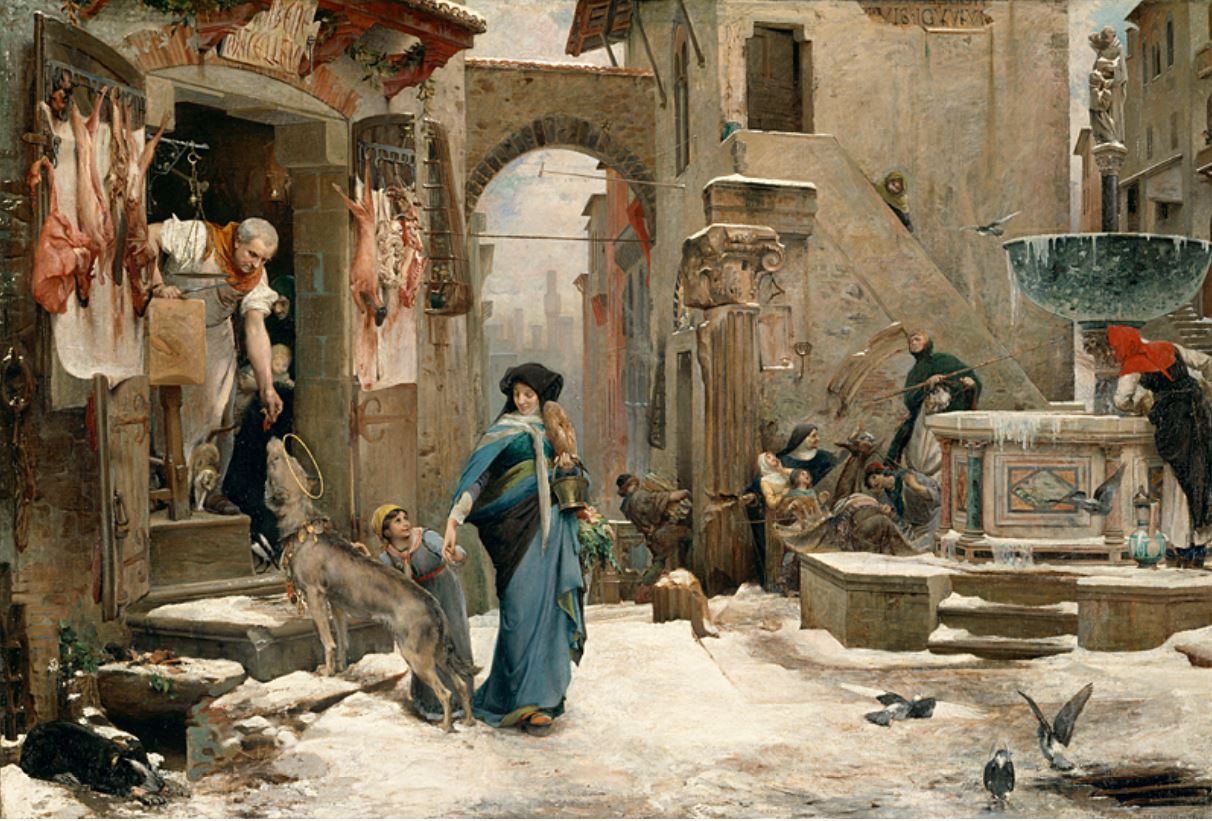
  • he tamed a ferocious wolf which had been terrorising the inhabitants of the town of Gubbio
  • he wrote a short letter to his friend, Brother Leo
  • he travelled to the Holy Land where, improbably enough, he met the Sultan of Egypt
  • four years before his death the stigmata or the same wounds suffered by Jesus on the cross, appeared on his body, obviously staggering his colleagues
  • towards the end of his life, already ill, he composed a hymn or canticle to the Sun

Not exactly a rich harvest of information, and with little or no historical context. The kind of richly historical exhibition the curators imagine their show to be would be better staged at the British Museum, and would involve a lot more historical documents and context, about church, doctrine, popes etc.

No, what this exhibition really consists of is something distinctly different, which is a review of how saint Francis has been depicted in art from his own time to the present day. If you go expecting to be thoroughly instructed about his life and relevance, I think you’d be sorely disappointed. Instead, I think the way to approach the show is as an excursion, a Cook’s tour, a fascinating stroll through the evolution and changing styles of Western art as represented by works on this one particular subject, this one historical figure.

The show includes over 40 works of art from European and American public and private collections, ranging from medieval painted panels, relic-like objects, medieval manuscripts, paintings, sculptures and even a Marvel comic.

Francis’s theology I could take or leave and mostly left, but what I found engaging was comparing the drastically different means and techniques and conceptualisations of art over pretty much the entire history of western art and featuring works by a who’s who of western art, including Botticelli, Caravaggio, El Greco, Zurbarán, Fra Angelico, Altdorfer, plus a gaggle of 19th and 20th century British artists.

Life of Saint Francis

Quoted from the National Gallery press release:

Francis was born to a prosperous silk merchant. He lived the typical life of a wealthy young man, but his disillusionment with the world around him grew. Events such as his traumatising experience of war, imprisonment, and an extended illness caused him to reassess his life. A mystical vision of Christ in the church of San Damiano and his encounter with a leper were life-changing moments. He renounced all his possessions, inheritance, and patrimony, and embraced the life of a penitent following in the footsteps of Christ, establishing the order of Friars Minor. In 1224 he received the stigmata (wounds that appear on a person’s body in the same places as those made on Christ’s body when he was crucified). These events contributed to the spread of his popularity as a preacher, peacemaker, a champion of the poor, early environmentalist, and social radical. Just two years after his death, in 1226, he was canonised (i.e. made a saint).

Francis’s life and miracles lent themselves to image making and were a great source of inspiration to artists. Apart from those appearing in the New Testament, Francis is probably the most represented saint in the history of art. The popularity of the Franciscan movement grew hand in hand with the rapid spread of imagery – by some of the greatest artists – recounting his likeness and legend. Art historians have estimated that as many as 20,000 images of Francis, not even including those in illuminated manuscripts, might have been made just in the century after his death.

Human nature

The single funniest thing in the show is the fact that although, by the time of his death in 1226, his followers were preaching his message all over Europe, Francis had already resigned the leadership of his order, dismayed by the increasingly worldly and materialistic turn it was taking as it became a pillar of the established Church.

Exactly. All attempts at reforming nature are always defeated by pragmatism and compromise and inertia and then laziness and then greed and institutionalisation and grand churches and rich paintings and rituals and ceremonies and pilgrimages and medals and so on – until the idea of standing quietly listening to the birds is left far, far behind.

13th century

From his native Umbria, Saint Francis’s image spread rapidly to become a global phenomenon. This was helped by the proliferation of biographies written by, among others, Thomas of Celano and Saint Bonaventure. In the 1290s, Giotto and his collaborators painted frescoes in the Upper Church of the Basilica of San Francesco in Assisi recounting the saint’s life, which changed the course of European painting. Many other artists depicted the saint within decades of his death, in that pre-Renaissance style which is so reminiscent of Eastern Orthodox art.

A ‘vita-retable’ is an altarpiece showing a central image of a saint flanked by episodes from his life and posthumous miracles. Here’s one from just 25 after Francis’s death.

Vita-retable of Saint Francis, about 1253 © Photographic archive of the Sacred Convent of S. Francesco in Assisi

Manuscripts

I love medieval manuscripts, for the awesome manual labour that went into them, as symbols of survival through the cataclysms of history, and for the sweet and charming illustrations you often find in them.

The exhibition not only includes some lovely old hand-written medieval books – notably, the ‘Chronica maiora’ of Matthew Paris (from the Parker Library, Corpus Christi, Cambridge) – but the curators have usefully pulled out and blown up some of the illustrations. I liked the curators’ identification of the birds in the illustration at bottom left, as being a crane, a heron, a hawk and some songbirds. What songbirds? Thrushes, maybe?

Details from the Chronica maiora II by Matthew Paris (1240 to 1255) © Parker Library, Corpus Christi College Cambridge (photo by the author)

Franciscans

As the popularity of the Franciscan movement grew, so did the numbers of Friars Minor, as Francis called his followers, who spread across Europe. They established friaries, built ever-larger Franciscan churches and commissioned pictorial decoration that venerated their founder, instigating a flowering of artistic and architectural production in the runup to the Renaissance.

15th century

One of the most celebrated visual biographies of Saint Francis was created by Stefano di Giovanni di Consolo, known as il Sassetta (1392 to 1450). In 1437 he was commissioned to create an altar-piece for the church of San Francesco in Borgo San Sepolcro. The National Gallery owns seven panels from the monumental double-sided altarpiece and devotes a room to displaying them in narrative order (they are missing the eighth panel and centrepiece).

Saint Francis meets a Knight Poorer than Himself (on the left) and Saint Francis’s Vision of the Founding of the Franciscan Order (on the right), from the San Sepolcro Altarpiece by Sassetta (1437 to 1444) © The National Gallery, London

The Counter-Reformation room

The Counter-Reformation was the Catholic Church’s response to the Protestant Reformation of the first half of the 16th century. It began with the Council of Trent (1545 to 1563) and is considered to have lasted through to the end of the European wars of religion in 1648.

The Counter-Reformation sought to redefine Catholic dogma and reform the hierarchy of the Church. It was accompanied by a new strictness of doctrine and organisation, associated with the revival of religious inquisitions in Italy and especially Spain. Spanish spiritualism developed a dark intensity which matched the authoritarian tendency of church and state. Religious painting and architecture achieved new heights of sophistication and were made on a grander scale than ever before, literally designed to awe and impress believers.

And so there’s a room devoted to this style of gloomy, intense and lachrymose religiosity, which includes paintings by masters from the period including Zurbarán, Caravaggio, Murillo and El Greco. I heartily loathed them all. I appreciate the technical mastery of Zurbarán but am repelled by its world of morbid shadows, mortification and self-loathing. Saint Francis loved the sun and the moon and preached to birds and beasts in the sunny Italian countryside. This figure, his face half-hidden, clutching a skull, represents the exact opposite, a world of darkness and death.

Saint Francis in Meditation by Francisco de Zurbarán (1635 to 1639) © The National Gallery, London

When the curators tell us that “approximately 135 paintings of Francis by El Greco and his collaborators survive, reflecting Spanish devotion to the saint” they obviously see this as an achievement, whereas I see it as sinister.

Victorian anecdote painting

There’s a section featuring lovely, detailed, hyper-realistic Victorian paintings of incidents in the life of the saint. These include Saint Francis of Assisi and the Heavenly Melody (1904) by a painter I don’t think I’d heard of before, Frank Cadogan Cowper, who is described as the last Pre-Raphaelite painter; and the much drabber ‘Brother Francis and Brother Sun‘ by Giovanni Costa (1875 to 1885).

The standout work is this detailed, hyper-realistic narrative painting based on the legend of the wolf of Gubbio by French painter Luc Olivier Merson. There’s an entertaining ‘Where’s Wally’ enjoyment to be had from picking out the countless artfully conceived and beautifully painted details.

The Wolf of Gubbio by Luc Olivier Merson (1877) Musée des Beaux-Arts, Lille © RMN-Grand Palais (PBA, Lille) / René-Gabriel Ojeda

Early 20th century

Bonkers but charming, Stanley Spencer is the Milton Jones of English artists. After the Great War (in which he served in the ambulance service) Spencer withdrew to the small village of Cookham on the River Thames, where he painted scenes of everyday life, striking nudes of himself and his wife and lovers, and numerous works showing scenes from Christian narratives, but taking place in the homely, domestic settings of his little hometown. And so here he is, reimagining Saint Francis, looking like the artist’s grandad and wearing his dressing gown and slippers, walking down Cookham High Street accompanied by a very English gaggle of chickens and songbirds.

St Francis and the Birds by Stanley Spencer (1935) Tate, London © Estate of Stanley Spencer. All rights reserved 2023 / Bridgeman Images (photo: Tate)

I’ve walked several times from Maidenhead to Cookham just to visit the Stanley Spencer Gallery there, and gone on pilgrimage to his headstone in Cookham graveyard. I know it’s nowhere near as much of an awesome work of art as the Zurbarán, but I find more of the Franciscan spirit of modesty and love in one work by Spencer than in the entire Counter-Reformation.

Contemporary art

Arguably, the modern works are the most successful, certainly the most striking and take us to a completely different place from the medieval altarpieces. For example, landscape artist Richard Long is represented by three works, A Walk for Saint Francis (2022), River Avon Mud Crescent (2023) and Desert Flowers (1987). In May 2022 Long spent a week in solitude walking and camping on Mount Subasio, the mountain rising above Assisi that provided Francis with an early refuge. ‘A Walk for Saint Francis’ derived from this experience. It is not a painting at all but a circle of words, of phrases, which capture the experience, such as ‘Watching night turn to day’ and ‘Watching the Earth turn’. Whereas ‘River Avon Mud Crescent’ is what it says in the title, a big circle on the wall, suggesting the crescent moon, and made from daubs of mud from the River Avon.

Installation view of Saint Francis of Assisi with ‘River Avon Mud Crescent’ on the left and ‘A Walk for Saint Francis’ on the right (photo by the author)

Oddly, there hadn’t been any sculptures of Francis through the classic eras of Western art. Only in the modern era do we come across not one but two. One is by Antony Gormley and is, typically, a cast of his own body. According to the wall label, it’s based on Giovanni Bellini’s painting ‘Saint Francis in the Desert’, complete with holes in his hands, feet and chest, referencing the tradition of Francis’s stigmata –but, like all Gormley’s sculptures, it is really a kind of everyman figure, this time everyman as devout believer.

Installation view of ‘Untitled (for Francis)’ by Antony Gormley (1985) Tate © Antony Gormley (photo by the author)

Vying with the Gormley for most striking sculpture, is this work, ‘Albero Porta – Cedro’ (‘Door Tree – Cedar’) by Italian artist Giuseppe Penone. Within the old tree, battered by generations of sun and rain and snow, lies concealed the secret inner soul of the tree, its youthful spirit, just as inside each of us cynical old adults still lies the fresh hopeful child of nature. I warmed to this even before the wall caption told me that Penone is a member of the Italian Arte Povera movement who sought to make art out of everyday material (and whose name, of course, echoes the nickname and concerns of il poverello).

Installation view of ‘Door Tree-Cedar ‘by Giuseppe Penone (2012) Gagosian and Marian Goodman Gallery © Giuseppe Penone (photo by the author)

There’s another Arte Povera work, ‘Sacco‘ (Sack) by Alberto Burri (1953), consisting of fragments of coarse hessian sack overlaid on each other and bound in a simple wooden frame. The single red wound gaping through a circle torn in the sacking presumably symbolises Francis’s stigmata but I found it all too realistic and stomach-churning.

There are two striking series of black and white prints. One is a series of lithographs by Arthur Boyd (1965). The Australian Arthur Boyd was living in London when he made 16 lithographs illustrating the life of Francis for an edition of T.S.R. Boase’s biography of the saint.

In a space to itself is an impressive set of black and white woodcuts on paper, made in 2016 by Andrea Büttner and titled ‘Beggars’. Nine hooded figures, reduced to the simplest possible outline of cloth and hands, are shown sitting with their arms outstretched in supplication. A source for the series was a book from 1510 which was, contrary to the spirit of Francis, a warning against dishonest and abusive mendicants. (The photo below, by the way, is from some other exhibition and is not how they’re displayed here.)

Beggars Suite 1 to 9, by Andrea Büttner (2016) © DACS 2023

Elsewhere, Büttner has an interesting big print showing tiers of birds, ‘Vogelpredigt (Sermon to the Birds)‘ which riffs off an altarpiece from Santa Croce, Florence, which was a very early cycle of images depicting the saint’s life.

Mass media

In the final room are some examples of how Francis has been portrayed in 20th century mass media, namely movies and, believe it or not, comics.

Saint Francis movies

A big monitor plays scenes from some of the post-war movies made about Francis, namely:

  • The Flowers of St. Francis (1950) directed by Roberto Rossellini
  • Brother Sun, Sister Moon (1972) directed by Franco Zeffirelli
  • Francesco (1989) directed by Liliana Cavani

Film, as a medium, is the ultimate instrument of consumer capitalism in reducing all facts, narratives and events to the same palatable product, to the same half dozen formulae, shoehorned into the same three-act structure, all loose ends neatly wrapped up in a nice bow in under two hours.

Comic books

The idea for the 1980 Marvel comic ‘Francis, Brother of the Universe’ came from two Franciscans who approached Marvel’s representative in Tokyo. If you think about it, like so many Marvel superheroes, Francis was a seemingly ordinary man with extraordinary capabilities (albeit given from God). The cover art shows a collage of our man in a series of characteristic scenes: preaching as a youth in the marketplace; leading crusaders; thrown before the initially scornful Sultan of Egypt; greeting the sun and the doves of peace; meeting the Pope or some such eminence. Shame they didn’t go on to do the kind of crossover story which Marvel excels at: Saint Francis calms The Hulk. Saint Francis persuades Thor to hand over his hammer and talk to the trees.

Installation view of ‘Francis, Brother of the Universe’ by Marvel Comics (1980) © Disney. All rights reserved (photo by the author)

Saint Clare

A small section of the exhibition is dedicated to Saint Clare (1194 to 1253), one of the first followers of Francis. Following her death, the order she founded was renamed the Order of Saint Clare, commonly referred to today as the Poor Clares. Her/their story is represented in works like:

  • Giovanni da Milano’s ‘Christ and the Virgin Enthroned with Six Saints’ (1350s)
  • Giovanni di Paolo’s ‘Saint Clare Rescuing a Child Mauled by a Wolf’ (1455 to 1460)
  • Josefa de Óbidos’s ‘Nativity Scene with Saint Francis and Saint Clare’ (1647)

Francis’s nature worship

Much is made of Saint Francis’s nature worship. The curators say he believed that nature itself was the mirror of God. He called all creatures his ‘brothers’ and ‘sisters’, preached to the birds and supposedly persuaded a wolf in the Italian town of Gubbio to stop attacking the locals. He saw God reflected in nature. In the hymn he composed – ‘Canticle of the Sun’ – he gives God thanks for Brother Sun, Sister Moon, Brother Wind, Water, Fire, and Earth and they print a full translation of the Canticle on the gallery wall. Here it is in the translation given on the Catholic Agency for Overseas Development website:

Most High, all-powerful, all-good Lord,
all praise is yours, all glory, honour and blessings.
To you alone, Most High, do they belong;
no mortal lips are worthy to pronounce your name.

We praise you, Lord, for all your creatures,
especially for Brother Sun,
who is the day through whom you give us light.
And he is beautiful and radiant with great splendour,
of you Most High, he bears your likeness.

We praise you, Lord, for Sister Moon and the stars,
in the heavens you have made them bright, precious and fair.

We praise you, Lord, for Brothers Wind and Air,
fair and stormy, all weather’s moods,
by which you cherish all that you have made.

We praise you, Lord, for Sister Water,
so useful, humble, precious and pure.

We praise you, Lord, for Brother Fire,
through whom you light the night.
He is beautiful, playful, robust, and strong.

We praise you, Lord, for Sister Earth,
who sustains us
with her fruits, coloured flowers, and herbs.

We praise and bless you, Lord, and give you thanks,
and serve you in all humility.

Surely this is a long way short of pantheism and Nature worship. It is, quite explicitly, the Lord God who Francis is praising – just as any priest of his time would – and the sun and moon and wind and fire and so on are emphatically not praised, or addressed, in their own right, but only insofar as they demonstrate the benevolence and all-powerfulness of the Creator. The feeling for nature is there, but only as a sin-off from the deep worship of the Lord God.

Projecting our values

At several places the curators assert that Francis speaks to us, now, in 2023, of very contemporary ‘concerns’, and list some of these, such as ‘interfaith dialogue’, environmental concern and feminism. They claim that ‘Saint Francis of Assisi continues to be an attractive and inspirational figure for’:

  • both Christians and non-Christians
  • for pacifists and environmentalists
  • for those who clamour for social justice
  • for utopians and revolutionaries
  • for animal lovers
  • for those who work for causes of human solidarity

Or:

Francis’s powerful appeals for peace and human solidarity, his encounter with Islam and his embryonic environmentalism continue to hold great interest. He is considered by many to be a patron saint, or an ally, of causes related to social justice, interreligious dialogue, socialism, feminism, the animal-rights movement and ecology, among others.

The exhibition was co-curated by the Director of the National Gallery, Dr Gabriele Finaldi, who joins in with his variation on the list of Francis’s fabulous qualities:

‘Francis’s spiritual radicalism, his commitment to the poor and human solidarity, his love of God, nature and animals, which we might call embryonic environmentalism as well as his striving for peace between enemies and openness to dialogue with other religions, are themes that still resonate with us today and make him a figure of enormous relevance to our times.’

But it’s my view that all this discourse consists of us projecting our own modern concerns back onto this remote medieval figure. Moreover, all this high-minded projection has the unintended consequence of highlighting how irrelevant Francis is to our modern day.

Poverty No modern Christian believes in God with the same wholeheartedness Francis was capable of. No Christian whatsoever is prepared to sell everything they possess, give all the proceedings to the poor, and become a mendicant beggar for God. Do you know anyone who’s done that? No.

Interfaith Although faith leaders in the West like to talk about dialogue between religions, it’s not clear that happens much on the ground here and, globally, dividing lines between the secular West, Muslim Middle East and Africa, and Hindu India have hardened, with astonishing levels of sectarian violence taking place around the world.

Pacifism Pacifists are irrelevant in an era when Russia has invaded Ukraine and threatens the rest of Europe, while analysts worry about China attacking Taiwan.

Environmentalism is sweet and lovely for the middle classes who can afford to fret about such things and shop at farmers’ markets, but irrelevant to most people who, in recent years, have been struggling to keep a roof over their heads and food on the table, who can’t afford electric cars and have no time to lobby for clean energy. When I worked at a distribution centre a couple of years ago, you should have heard the packers and supervisors yelling abuse at Just Stop Oil activists gluing themselves to the road or tube trains. Meanwhile, every single indicator of environmental wellbeing and climate change is deep in the red and getting worse.

Social justice Francis may have clamoured for social justice, just as millions of the kind and well meaning have done for the 800 years since: but the outcome of all this clamour is that today, in 2023, over a billion people worldwide live on less than a dollar a day, while all western societies are more unequal and unfair than at any time in the last 50 years.

In other words, Francis can, with some justice, be taken as the patron saint of lost causes.

I find the high-falutin’ sentimental sentiments of the wall labels so much cant (defined as ‘sanctimonious talk, typically of a moral, religious, or political nature’) where ‘sanctimonious’ is defined as ‘making a show of being morally superior to other people’. It is a discourse of feel-good bromides, where ‘bromide’ is defined as ‘a trite statement that is intended to soothe or placate’.

The National Gallery was, as usual, packed to overflowing with educated, middle-class people, many of whom were obviously tourists i.e. had travelled long distances, probably in environment-destroying airplanes, and spent a lot of money to be here. Outside the National Gallery I walked past a clutch of filthy dirty, wretched-looking vagrants, sleeping rough with their dogs. I gave each of them a pound. “Clamouring for social justice”, my arse.


Related link

Souls Grown Deep like the Rivers: Black Artists from the American South @ the Royal Academy

From left to right: 1) ‘Sarah Lockett’s Roses’ (1997) by Ronald Lockett, made from cut tin, nails and enamel on wood. 2) ‘Stars of Everything’ (2004) by Thornton Dial, made from paint cans, plastic cans, spray-paint cans, clothing, wood, steel, carpet, plastic straws, rope, oil, enamel, spray paint and Splash Zone compound on canvas on wood. 3) ‘Oklahoma’ by Ronald Lockett (1995) made from found sheet metal, tin, wire, paint and nails on wood. All in room one of ‘Souls Grown Deep like the Rivers’ at the Royal Academy

1. The Souls Grown Deep Foundation

There are two important points to grasp about this exhibition. The main one is that ‘Souls Grown Deep’ isn’t a fancy name dreamed up by the curators but the name of an organisation in America. The Souls Grown Deep Foundation (SGDF) is based in Atlanta, Georgia. It:

  • advocates for the inclusion of Black artists from the South in the canon of American art history
  • fosters economic empowerment, racial and social justice, and educational advancement in the communities that gave rise to these artists

Founded by Atlanta collector William S. Arnett in 2010, Souls Grown Deep derives its name from a 1921 poem by Langston Hughes titled ‘The Negro Speaks of Rivers’. The poem is one of Hughes’s signature works and is worth printing in its entirety:

I’ve known rivers:
I’ve known rivers ancient as the world and older than the
flow of human blood in human veins.

My soul has grown deep like the rivers.

I bathed in the Euphrates when dawns were young.
I built my hut near the Congo and it lulled me to sleep.
I looked upon the Nile and raised the pyramids above it.
I heard the singing of the Mississippi when Abe Lincoln
went down to New Orleans, and I’ve seen its muddy
bosom turn all golden in the sunset.

I’ve known rivers:
Ancient, dusky rivers.

My soul has grown deep like the rivers.

The Souls Grown Deep Foundation stewards the largest and most eminent collection of works by Black artists from the Southern United States. It originally totalled some 1,300 works by more than 160 artists, two-thirds of them women.

Part of the foundation’s remit is publicise and promote these artists beyond America. To this end it energetically partners with galleries around the world and has placed more than 500 works from the collection in 32 museums globally. So this is an example of the foundation’s global outreach program. They came to an arrangement to display a selection of their works at the prestigious Royal Academy in London.

What exactly do we mean by ‘The Deep South’?

Map of the South featured in ‘Souls Grown Deep like the Rivers’ at the Royal Academy

The artists live and work in this region, from communities in South Carolina to the Mississippi Delta, in isolated rural areas like Gee’s Bend, Alabama, and in urban centres like Atlanta, Memphis and Miami, all indicated on the map.

2. Outsider art

Obviously all the artists are Black Americans, that’s explained by point 1. But just as important is the idea that these artists, growing up in communities in the Deep South, come from outside the mainstream of American art schools and galleries. Some couldn’t afford art school, some were actively excluded on the basis of their colour, others didn’t know about the possibility or care.

So, with little access to formal art education, most of the works on display here were made by artists who developed their own artistic techniques and styles by learning from neighbours, friends and family. Both the foundation and individual artists make a big point of emphasising that these artists came from within very local traditions and communities. In this respect a bunch of photos at the entrance to the show capture the context and vibe of these works in their original settings.

Clockwise from top left: Ronald Lockett standing by ‘Sarah Lockett’s Rose’; Thornton Dial pointing at the camera; Doris Moseley and Mary Margaret Pettway working on a quilt; Purvis Young standing by a canvas; Lonnie Holley giving a thumbs up; Mary T Smith in the middle of a big yard show.

Some used skills they developed when working in industry, such as Thornton Dial and Joe Minter who were metalworkers. These skills were handed down – Dial trained his sons Thornton Dial Jr and Richard Dial and nurtured the talents of his younger cousin Ronald Lockett.

The women of Gee’s Bend, a remote settlement on the Alabama River, have handed down the skills of sewing and making quilts from generation to generation. Artist Loretta Pettway Bennett, featured here, recalls learning to sew by helping her mother and grandmother make quilts.

Raw materials

Coming from outside the mainstream art tradition, many of the artists here recycle and reuse materials available locally – like clay, driftwood, roots, soil, sawdust and all manner of cast-off items, old phones, bicycles, tools, shears, wire, trash and detritus. This gives almost all the works a rough and ready, hand-made appearance. For example this stunning work by Archie Byron (one of my favourites in the show) is made entirely from sawdust and glue!

Anatomy by Archie Byron

Or take these two sculptures, assembled from bits and pieces of bicycle (on the left) and an old tool box, spanner and wire (on the right).

Three-Way Bicycle by Charlie Lucas (c. 1985) made from bicycle wheels, metal machine parts and electrical wiring and Where is My Hammer? by Joe Minter (1996) made from welded found metal

The exhibition

The exhibition brings together 64 works by 34 artists from the mid-20th century to the present. There’s various media including assemblages, sculpture, paintings and drawings, reliefs, and video.

Artists

The artists include Thornton Dial, Lonnie Holley, Ronald Lockett, Joe Minter, Hawkins Bolden, Bessie Harvey, Charles Williams, Mary T. Smith, Purvis Young, Mose Tolliver, Nellie Mae Rowe, Mary Lee Bendolph, Marlene Bennett Jones, Martha Jane Pettway, Loretta Pettway, and Henry and Georgia Speller.

Room 1. Friendships and family ties

The first room is, arguably, the best and showcases work by artists connected by close familial relations and friendships. Lonnie Holley, who had been working as a gravedigger and cotton picker, began sculpting in 1979, when he carved grave markers for a young niece and nephew following their tragic deaths in a fire. Through a former girlfriend he met Thornton Dial, who had worked in farming and as a steelworker before he became an artist. Both artists worked with discarded and salvaged objects and organic materials, transforming them into impressive sculptures and assemblages rich in personal, social and political symbolism.

The most impressive pieces here are by Dial including the biggest piece in the show, the fabulous ‘Stars of Everything’ (see above). But it was the relatively small piece, ‘Keeping a Record of It (Harmful Music)’ by Lonnie Holley (1986) which the curators chose for the exhibition poster. Like all the assemblages here it is made from cannibalised waste and spare parts, in this case a salvaged phonograph top, a phonograph record and an animal skull.

Keeping a Record of It (Harmful Music) by Lonnie Holley (1986)

I don’t know what it’s saying, but it’s saying it very powerfully indeed, a brilliantly powerful, unnerving image.

Room 2. Personal stories, local sources

Working almost entirely without recognition from the wider art world, these southern Black artists drew inspiration from daily life and current events. The resulting works are intensely local in terms of materials, subject and audience, while also bringing out universal themes.

This room features the work of Sam Doyle, Henry Speller, Eldren M. Bailey, Georgia Speller, Jimmy Lee Sudduth. Lack of access to conventional art materials and tools often led artists to repurpose what
was around them. Sculptors including Bessie Harvey found artworks ready to be ‘drawn out’ from the twisted organic forms of roots and dead wood, a practice that became a distinct regional tradition.

Instinct drove visually impaired artist Hawkins Bolden as he searched the streets for items he could sense felt right for his ‘scarecrow’ sculptures, giving new life to materials that others would class as trash.

Installation view of ‘Souls Grown Deep like the Rivers’ @ the Royal Academy

By and large the sculptures were much more interesting and effective than the paintings. Many of the ‘primitivist’ paintings were just too basic for my taste.

Paintings from room 2.

For example, I couldn’t get on with any of the big, puke-yellow paintings by Purvis Young. Apparently, his scenes are populated by wild horses, warriors, angels, pregnant women, boats and prison bars but I still don’t like them.

Paintings by Purvis Young

By contrast with the paintings, I found almost all the sculptures wonderfully effective. In part this is, I think, because I’ve seen so much of this kind of thing before. Pablo Picasso made cubist sculptures before the First World War; Marcel Duchamps signed a urinal and put it in an art gallery in 1917; Dada artists created absurdist sculptures made mashed-up street junk in the early 1920s. Then lots of artists in the 1960s turned to making sculptures from found objects, and then the Arte Povera movement of the early 1970s, which took industrial waste products and cast-offs and made them into abstract sculptures.

My point is that recycling street junk into imaginative or surreal sculptures is hardly new but, on the contrary, feels like a venerable and well-explored strategy, which is why so many of the pieces here had such a reassuringly familiar feel to them. I really, really liked this piece by Hawkins Bolden but that’s partly because it reminded me so strongly of classic Surrealist sculpture. Could be by Picasso or Max Ernst.

Untitled by Hawkins Bolden (1989) Pot, drainpipe, cans, muffin tin, rubber hoses, nails, wood and wire

Room 3. The yard show

As most of the artists did not have access to formal art spaces, often the only place they could display their work was in their own back yards. The ‘yard show’ is a deeply rooted Southern tradition where artists would arrange their sculptures, paintings, and assemblages on their property.

One of the best known examples has been created over decades by Joe Minter (b. 1943), and is titled ‘African Village in America’, on a half acre site near Birmingham, Alabama. The show includes an impressive video featuring a panoramic scan over this huge area full of ramshackle constructions.

Room 4. The quilt-makers of Gee’s Bend

Gee’s Bend, officially known as Boykin, is a remote settlement on a hair-pin bend of the Alabama River. The Bend’s residents are descendants of the enslaved people who worked on the cotton plantation established there in 1816 by Joseph Gee. After the American Civil War (1861 to 1865), many of the formerly enslaved people remained on the plantation working as sharecroppers, who were obliged to give part of their crop to the landowner, and many inhabitants today still bear the surnames of their ancestors’ enslavers. The community was able to remain intact due to Government loans provided during the Depression which enabled tenants to buy the land they farmed and protected them from forced evictions.

Installation view of Gee’s Bend quilts

This continuity allowed a unique tradition of quilt-making to survive and be passed down through generations of women. Most Gee’s Bend quilts are improvisational or ‘my way’ quilts. Quilt-makers start with basic forms then head off ‘their way’ with unexpected patterns, unusual colours and surprising rhythms. Not originally conceived of as formal artworks, quilts were both decorative and necessary objects, keeping families warm and making use of fabric scraps.

More Gee’s Bend quilts

I appreciate the enormous amount of time and energy which goes into creating patchwork quilts like this. I appreciate the communal nature of the work, and the deep local tradition which has bound successive generations of women quilt-makers together. But, to be blunt, I wasn’t that impressed by the quilts. Maybe it’s just not my medium or genre. I quite liked the couple which were made from corduroy, because the texture of the fabric was so tactile, and my favourite was the one made entirely from denim patches, maybe because it approached closest to being a painting in design.

‘Triangles’ by Marlene Bennett Jones (2021). Denim, corduroy, and cotton © 2023 Marlene Bennett Jones

Spending five minutes in the quilt room made me suspect I just don’t ‘get’ quilts and embroidery and sewn artefacts in the same way that I do paintings, sculpture and photographs. Well, my loss.

Marfa Stance and quilts for sale

‘Souls Grown Deep like the Rivers’ is a relatively small exhibition, but be warned that there’s an additional room, which is sort of part of the show but situated right at the other end of the Royal Academy building. I couldn’t find it and had to be shown the way by one of the Royal Academy receptionists. It’s through the members’ cafe, then up some stairs and in the Academicians’ Room on the first floor.

Here are displayed eight or so modern quilts from some of the Gee’s Bend quilt-makers. The difference between these ones and the works in the main exhibition is that these ones are for sale. They felt ‘better’, more elaborate and finished than the ones in the main show but, as I explained, I’m not a good judge of these kinds of thing. But be warned about the prices. The cheapest one will set you back a cool £25,000, the most expensive one, £30,000.

There’s a web page about them where you can not only read a bit more but buy one, if the fancy takes you and your bank balance can handle it.


Related links

More Royal Academy reviews

Magdalena Abakanowicz: Every Tangle Of Thread And Rope @ Tate Modern

‘I am interested in the feeling when confronted by the woven object. I am interested in the motion and waving of the woven surfaces. I am interested in every tangle of thread and rope and every possibility of transformation.’
(Magdalena Abakanowicz, 1971)

Magdalena Abakanowicz (1930 to 2017) was one of Poland’s most famous modern artists. This fairly big (6 room) exhibition at Tate Modern aims to give a comprehensive overview of her career. It follows a simple chronological order, showing the artists evolving steadily through a series of explorations and innovations.

Abakanowicz began her career more interested in weaving and fabric design than in painting or sculpture. She graduated from the Academy of Plastic Arts in Warsaw with a specialization in weaving in 1954. Weaving was encouraged because it was the kind of ‘craft’ or ‘folk art’ which the communist regime supported.

Room 1

This displays a number of early works from the start of the 1960s, flat woven tapestries in abstract patterns, using dark colours, generally shades of brown. They reminded me of American 1950s Abstract Expressionism. Reproduced as flat images, as below, they remind me of 1950s modern jazz album covers.

Brown Textile 21 by Magdalena Abakanowicz (1963) © Fundacja Marty Magdaleny Abakanowicz Kosmowskiej i Jana Kosmowskiego, Warsaw

Except that they’re not paintings and they’re not flat, they’re lumpy, bumpy woven fabrics. Anyway, mildly interesting though this first room is, it’s just preliminary work, preparing for you what comes next.

Room 2

This becomes a bit clearer in room 2, which features really massive tapestries but now made out of very coarse-woven fabric and with 3-D bulges and folds and joins. Tapestry as proto-sculpture.

Helena 1 by Magdalena Abakanowicz (1965) © Fundacja Marty Magdaleny Abakanowicz Kosmowskiej i Jana Kosmowskiego, Warsaw

During the mid to late 1960s Abakanowicz first emerged as a leader of the ‘New Tapestry’ movement in Europe. Artists associated with the movement began to claim fibre as a valid medium for the creation of art. Her interest in the tactility of fabric, in its potential for emerging from the flat plane, its ability to have fold and seams and wrinkles, is clearer in this example.

Installation view of Magdalena Abakanowicz @ Tate Modern (photo by the author)

Room 3. The Abakans

But it’s only when you walk into room 3 that you get the full Monty, the impact of her innovation, the riotous new form which made her reputation. For it took about a decade for Abakanowicz’s art to evolve into its full flourishing as enormous, three-dimensional sculptures made out of thick, heavy, coarsely woven fabric (sisal, sometimes incorporating wool and horsehair) created and hung in a variety of strange, portentous shapes.

Installation view of Magdalena Abakanowicz @ Tate Modern (photo by the author)

Suddenly these are objects to walk among, to wander between and around and enjoy their strange, heavy, ragged shape and heft and mystery, which is why the curators call this room ‘the fibrous forest’. This was still the 1960s and critics didn’t know how to categorise or even name these pieces. In 1964 one critic, Elżbieta Żmudzka, suggested the term ‘Abakan’ to describe them, a term the artist happily accepted and incorporated into her practice. Altogether, there are 26 of these massive, looming, strange shapes in the exhibition.

‘The Abakans were a kind of bridge between me and the outside world. I could surround myself with them; I could create an atmosphere in which I somehow felt safe because they were my world.’

Abakanowicz began to exhibit internationally and win recognition and prizes: in 1965 she won a gold medal for applied art at the São Paulo Biennial and, on the back of this, was appointed professor of weaving at the Poznań art academy, where she taught until.

But the thing about these big international expos is that is you are brought into contact with a wide variety of gallery spaces and installation possibilities. The sheer size of the Abakans, and the way they can be arranged in patterns or shapes, to make mini-mazes naturally lent themselves to creating relationships or ‘situations’ within the gallery. She was one among many 1960s artists who paved the way for modern installation art. The exhibition includes photos of some dramatic examples.

Artist in front of Bois le Duc, Provinciehuis van Noord-Brabant, ’s-Hertogenbosch, the Netherlands (1972) © Abakanowicz Arts and Culture Charitable Foundation. Photographer: Jan Nordahl

The curators emphasise that, just as she refused to be limited by conventional ideas of weaving and fabric, so she refused to be bound by the specifics of the time and place where she happened to have been born, namely the repressive communist regime in Poland, but was determined to become an international figure and travel as widely as possible. In fact she went on to cross the Iron Curtain more than any other Eastern Bloc artist and took part in hundreds of exhibitions worldwide.

The forests of childhood

About here is where you realise the importance to her of Abakanowicz’s childhood and youthful memories. For Abakanowicz was the daughter of an aristocratic family and was brought up in a manor house deep in the Polish forest deep (near the village of Krępa, 140 kilometres from Warsaw). For her, then, the natural world was a mysterious forest of enormous trees, of strange shapes looming through the mist, none of which scare her, all of which, years later as an adult in Warsaw, she remembered as comforting and healing presences.

‘Strange powers dwelled in the woods and the lakes that belonged to my parents. Apparitions and inexplicable forces had their laws and their spaces…’.

The Abakans, therefore, are not monsters but healing, if strange and mysterious, presences.

The artist conveying how the Abakans have a protective, reassuring, hide-and-seek quality

And:

‘The Abakans were my escape from categories in art. They could not be classified…Larger than me, they were safe like the hollow trunk of the old willow I could enter as a child in search of hidden secrets.’

Worth mentioning, maybe, that I really really wanted to touch and stroke the coarse, nubbly surface of these huge objects and, where there was an opening, slip inside like a naughty child playing hide and seek. Needless to say, not only are you not allowed to hide in the Abakans, you are not allowed to even touch them – I was ticked off by a gallery attendant for just leaning quite close to one – which kind of undermines all her claims for the Abakans as being warm and comforting presences. In the modern gallery, curators ensure that they are cold and clinical and aloof, bringing out their spectacular side but stifling the warmth and comfort which the artist talks about so much.

For these childhood memories developed into a deep reverence for nature, and an identification of her artistic practice – strands and fibres and weaving – with the basic elements of the natural world.

‘I see fibre as the basic element constructing the organic world on our planet… It is from fibre that all living organisms are built, the tissue of plants, leaves and ourselves… our nerves, our genetic code, the canals of our veins, our muscles… We are fibrous structures.’

Room 4. Abakans and beyond

The next room is even more dramatic, with half a dozen huge works, which have abandoned the brown and ochre earth hues of the previous work for bold gold and red. The examples here seem much more distinctive and characteristic than in the previous room, that’s to say they have far more individual character, although their titles tend to be as minimal as possible, for example ‘Abakan red’ and ‘Abakan orange’.

Installation view of Magdalena Abakanowicz @ Tate Modern (photo by the author)

Rope

The room also contains specific sub-genres or sets of other types of fabric sculpture which spun off from her main concern. Several of these involved rope, which became a more important material for her in the 1970s. I love art made from found objects, I love the Arte Povera movement from the same period (the early 1970s) in Italy, and so I warmed to her description:

‘Along the Vistula River one could find old, discarded ropes. They had their own history. They became my material. I pulled out thread, washed and dyed them on our gas stove.’

According to the wall label:

The work shown here is a total ‘situation’ devised by the artist, combining a pair of giant garment-like, hanging forms that have been created from industrially woven cloth and ropes that spill out onto the floor. The hollow ‘garments’ evoke a protective shell or coat, while the entwined fibres of rope suggest the complexities of the nervous system.

‘Set of Black Organic Forms’ by Magdalena Abakanowicz (1974) (photo by the author)

These several works interested me because I just happen to have seen the exhibition of work by Barbara Chase-Riboud at Serpentine North which is very much about cascades of fabric and ropes, some unspooling from the main sculpture across the floor. Exactly as here.

On the whole I liked the Chase-Riboud more because her ropes and plaits dangle from large, abstract metallic pelmets. These are interesting in their own right as metal sculptures, but the juxtaposition of hard angular metal with flowing plaited fabric creates a very powerful dynamic effect. Compared with the Chase-Riboud, I found some of the Abakanowicz a bit, well, weak. The two huge black ones, above, looked like enormous coat hangers to me. Others were more powerful.

Abakan Yellow by Magdalena Abakanowicz (1970) © Fundacja Marty Magdaleny Abakanowicz Kosmowskiej i Jana Kosmowskiego, Warsaw

It’s a mild irony throughout the exhibition that Abakanowicz is cited as saying she is not a very eloquent explainer of her work and that she leaves it to others to define and describe, and yet, whenever she is quoted describing her work, she is in fact wonderfully eloquent:

‘The rope to me is like a petrified organism, like a muscle devoid of activity. Moving it, changing its position and arrangement, touching it, I can learn its secrets and the multitude of its meaning…It carries its own story within itself, it contributes this to its surroundings.’

Like everything she did, this use of rope was applied on an often large scale, in one-off installations, leading visitors around the works and sometimes even connecting different buildings. For example, at the 1972 Edinburgh International Festival she deployed a long stretch of painted red cable winding throughout the city.

The more you read, the more you realise how a lot of her work was very site-specific, created for particular exhibitions or events. What we’re seeing in this Tate Modern exhibition is only a fragment of the hundreds of pieces and installations she created in different galleries and cities across half a century.

Room 5. Abakany, the movie

In 1969 Abakanowicz collaborated with the avant-garde film director Jarosław Brzozowski and experimental composer Bogusław Schäffer to create the film Abakany. Alas, I can’t find this anywhere on the internet. There’s an alcove or viewing area at the exhibition, set off to one side where you can sit and watch the entire thing.

It was filmed at the sand dunes of Slowiński National Park in Łeba on the Baltic coast of Poland. The artist planted Abakans in the sand, supported by wooden armatures. The film captures the effect of the fibres blowing in the wind. It is a typical memento if its time, youthful and exuberant and optimistic. The beach scenes are interspersed with indoor sequences showing Abakanowicz working in her studio and gallery space.

The abstract modernist soundtrack prompted a thought. The wall labels are continually telling us how important the natural world and natural imagery was to Abakanowicz. Well, how cool it would have been to have included soundscapes in the exhibition. If, especially in the section of big shaggy hanging shapes which they call the ‘fibrous forest’, they had played an ambient recording of an actual Polish forest, the sounds of wind, distant bird calls, maybe occasional patters of rain on leaves. That would have helped it feel a little less cold and sterile.

Invented anatomy – Embryology

One corner of the coloured Abakan room is taken up with a distribution of fabric bags or sacks, of all sizes, the big ones poo-shaped, the smaller ones like smooth pebbles or rocks. A rummage, a spill of rough fabric containers, creating a rubble of soft boulders. A soft rockery

Installation view of Magdalena Abakanowicz showing ‘Embryology (1978 to 80) @ Tate Modern (photo by the author)

These are from the 1980s. By then Abakanowicz was bored of being labelled a ‘fibre-artist’ and began to use other materials to make increasingly figurative sculptures. In 1978 she made a new series of ambiguous forms titled Embryology, made from a combination of fabrics and fibres bundled and bound into rounded, organic masses. 800 of these forms were originally shown together at the Venice Biennale in 1980, when Abakanowicz was invited to exhibit in the Polish national pavilion. The curators quote another one of her eloquent explanations:

‘The contents, the inside, the interior of soft matter fascinated me… By ‘soft’, I meant organic, alive. What is organic? What makes it alive? In which region of throbbing begins the individuality of matter, its independent existence? …They were completing my physical need to create bellies, organs, an invented anatomy. Finally, a soft landscape of countless pieces related to each other.’

Embryology is the title of this specific work but also the name she gave to a wider idea she felt she was exploring. As the curators put it:

Although Abakanowicz did not identify herself as a feminist, her woven sculptures have been seen by curators and writers as emblematic of powerful female imagery and art-making. Birth, life, vulnerability, and decay are suggested by forms that resemble nests, wombs and eggs.

As it happens I’ve been reading about gender essentialism, the umbrella term given to the notion that gender differences are rooted in nature and biology. My understanding is that this – the notion that women are somehow more intrinsically associated with reproduction, giving birth, nurturing and so on – is deprecated in modern feminist theory. My understanding is that in modern feminist theory ‘gender’ is regarded as something which is socially constructed and therefore can be changed. In the eyes of leading theorists such as Judith Butler ‘gender’ has a performative aspect i.e. we create our gender through our behaviour. This is obviously a variation on existentialist notions that our destinies are not foretold and that we create who we are through our actions, and indeed the basic idea of the social construction of gender is routinely traced back to Simone de Beauvoir who, as long ago as 1949, summed it up in a famous quote, ‘One is not born, but rather becomes, a woman’.

I know all this mainly because my daughter, the Sociology student, has drummed it into me in repeated conversations. Regarded from this perspective, Abakanowicz’s deep interest in wombs, fertility and so on seems rather dated, rather conservative. (Discuss.)

Room 6. Timeline of Abakanowicz’s career

The two big rooms showing these colourful Abakans and the Embryology pieces are the centrepiece of the exhibition, full of dramatic masterworks. The final room, number 6, initially seems to be something of an anti-climax. It is much smaller, narrower, and almost entirely consists of texts on the wall, lots of photos and a couple of videos. There’s only one art work, radically different from everything before as it contains no fabric but is made of wood and metal.

It took a while for me to realise what was happening, to realise that this exhibition, all the stuff we’ve seen in the first 5 or 6 rooms and alcoves, only covers the first half of her career. It only takes us up to the 1980s, whereas Abakanowicz carried on working and producing till the end of her life in 2017, over thirty years later.

This final room is by way of being a timeline or chronology of her entire career, up to and including the 1980s, but then covering the final 30 years which the main exhibition doesn’t. From it we learn a lot more about her life which sheds life on what we’ve just seen. For example, fresh out of art school she found work in industry and took part in state-organised design exhibitions. Hmm. You can see how this experience would feed into her own confidence about creating large-scale installations and ‘environments’ a decade later.

The chronology brings out her extraordinary international success. In the 1970s she has 21 solo shows and participates in over 75 group exhibitions in Poland and worldwide. As early as 1973 she began moving beyond the Abakans, with a series of works titled Heads, Seated Figures and Backs. Insofar as these are obviously figurative works they mark quite a departure from what had gone before.

Exhibition view of Abakanowicz at Museum of Contemporary Art, Chicago, showing Heads (1973 to 1975) and Seated Figures (1974 to 1979) Photo © Artur Starewicz/East News (1982)

In 1981 the communist Polish government declared martial law and this seems to have marked a darkening of her worldview or certainly of her work. In 1985 she began a series of anonymous, headless figures she called the Crowd series, and which she continued adding to until 2014. In 1987 she began a series she titled War Games (which she continued until 1995) where she used felled trees in the Masurian Lake District of Poland to create a total of 21 huge forms that suggest both weapons and bodies.

(It’s one of this series, Anasta, which is the sole piece included in this last, chronology room, but it isn’t really given the space for you to engage with or enjoy it, and now I understand why. All these later works were designed to be outdoors, in huge spaces, to breathe and interact with each other. This one feels cramped and confined.)

In their medium and design and purpose, these all feel completely different from the fabrics and Abakans which came before. During the 1990s she became increasingly interested in trees and forests, the medium they’re made out of (wood) and their ecological and spiritual meaning. In 1992 she began a series titled Hand-like Trees.

In 1998 she created Space of Unknown Growth, a massive land art project near Vilnius, Lithuania, consisting of 22 concrete ovoid forms. Of the half dozen or so large-scale projects which are captured by photographs in this room, this one was my favourite.

‘Space of Unknown Growth’, Europos Parkas, Vilnius, Lithuania. Photo © Abakanowicz Arts and Culture Charitable Foundation. Photographer: Norbert Piwowarczyk. (1998)

But by now I’d realised why the exhibition is so oddly skewed towards the first half of her career and why nothing from the second half is on display here. It’s because the works from these last 30 years are, without exception, huge site-specific installations which cannot be moved and so cannot brought into a gallery space. All we can have of them is photos and descriptions on a wall.

Thus the wall labels tells us that in her late career Abakanowicz undertook major commissioned public sculptures around the world, each one of which responded to the unique landscape and history of each site. Thus:

  • Katarsis, 33 figures in bronze at the Giuliano Gori Collection, Santomato di Pistoia, Italy (1985)
  • Negev at the Billy Rose Sculpture Garden, Jerusalem, seven ten-ton wheels carved from the local limestone and dramatically positioned along the edge of a precipice (1987)
  • Space of Dragon, ten massive bronze animal heads created as a permanent public work for the Seoul Olympic Games (1988)
  • Sarcophagi in Glass Houses, giant wooden forms used for casting engines which she encased in a glass greenhouse-like structure, now permanently sited Storm King Art Center, Mountainville, New York (1994)
  • Hand-like Trees, an installation of huge bronze sculptures at the Yorkshire Sculpture Park (1994)
  • Unrecognized, 112 headless, two-meter tall iron figures, each striding off in their own individual direction, situated in Park Cytadela, Poznań (2002)
  • Agora for Grant Park, Chicago, 106 headless figures, each nine-feet tall and cast in iron; begun in 2003 and completed in 2006 this was Abakanowicz’s largest – and last – permanent public project

OK, these bodiless legs have been cast with the fissured texture of tree bark, giving them an organic vibe, but you can see how very far she had come from any sense of the weaving and abstract shapes which dominated the first half of her career and which, in the shape of the 26 Abakans, dominate this exhibition.

Agora, 106 iron cast figures installed at Grant Park, Chicago. Photo: Kenneth E. Tanaka (2006)

The video


Related links

More Tate Modern reviews

More reviews of women artists

Antony Gormley @ the Royal Academy

In the late 1990s I edited a what’s-on-in-London, arts and entertainment TV show for ITV. Mostly it was movies and stand-up comedy and West End musicals but I slipped in occasional blockbuster art shows.

We interviewed him for his 1998 exhibition show at the Royal Academy, the one where he positioned life-sized iron casts of his own body in various postures all round the forecourt, lying, standing on the rooftops, dangling from ropes.

What came over in the interview was his extraordinary fluency. He can just talk, in a calm mild voice, clearly and rationally, about art, for hours, without using jargon or difficult ideas. Here he is, in a short video explaining some aspects of this exhibition:

In his sensible calm voice he makes his art, modern art and its approaches, see seem eminently sensible and practical and interesting and, very often, blindingly obvious. Why didn’t I think of that?

For example, positioning a hundred or so iron casts of his own naked body across a two mile stretch of Crosby Beach in Merseyside. Seeing the figures dotted at random across the sane, some submerged in the sand, and then watching them be submerged and then revealed by the ebbing and flowing tide, is a wonderfully simple, but extremely evocative idea.

Another Place by Antony Gormley (2005)

A few years earlier Gormley had filled Great Court of the British Museum with 40,000 handmade clay figures. As soon as you heard about it, your realised it was a big blank space just crying out for some kind of intervention or installation.

Field for the British Isles by Antony Gormley (2002)

His best-known work is obviously The Angel of the North, erected in 1998, a vast steel sculpture of an angel, 20 metres tall, with wings 54 metres across, placed on a hill overlooking the motorway at Gateshead, Tyne and Wear. Yes. Yes the ‘North’ should have some kind of symbol or icon, something to mark it off from the soft South but give it pride and regional identity.

The Angel of the North by Antony Gormley (1998)

This big retrospective at the Royal Academy confirms that sense of his amazing fluency: there are recognisable themes (cast of his own body, for example) and plenty of other ideas and themes: and yet they all share this same quality of feeling just so, clever but not pretentious, just seeming like good ideas, good things to do, to have a go at.

Of course there’s a room of his trademark life sized casts of his own body, replicating the weirdness of all those bodies hanging all over the courtyard 20 years ago.

Lost Horizon I by Antony Gormley (2008) © the Artist. Photo by Stephen White

But he applies the same technique to other shapes and objects, though all distinguished by the same rust red iron finish, and the odd circular nodules which were originally part of the casting process but have become a visual and tactile signature. Having acquired such expertise at making huge iron casts of bodies, why not experiment with applying the same approach to other organic forms, with things as simple as fruit.

Body and Fruit by Antony Gormley (1991/93) © the Artist. Photo by Jan Uvelius, Malmö

But several rooms contain striking departures from the idea of the solid – the rust-red solid bodies and orbs we’re familiar with – a departure into explorations of the flimsy and the flexible and the peculiar sense of space this completely different approach can create.

Clearing V by Antony Gormley (2009) © the Artist, photo by Markus Tretter

I love industrial materials, I love stuff made from industrial junk redolent of factories and warehouses and the smelly, oily, petrol-soaked culture we actually live in.

I love Arte Povera and Minimalism and Mark Leckey’s current installation of the underside of a motorway bridge – and so that’s what I read into these wonderful ropes and tangles of thin but obviously taut and tremendously strong steel cable. Electricity pylons striding the countryside, motorway viaducts, overhead cables of trains and tubes and trams. Those complex metal grids which concrete is poured over to create tower blocks and tube power stations.

Our world is saturated with huge and immensely strong, durable industrial materials and designs.

The curators claim many of these more experiential sculptures are designed to make us aware of our bodies and the space we inhabit, but they reminded me of the vast, inhuman industrial processes which underpin our entire civilisation.

Matrix II by Antony Gormley (2014) © the artist, photo by Charles Duprat, Paris

The most experiential piece is The Cave, created this year. From the outside it looks like a Vorticist jaggle of angular steel blocks, which we are invited to go inside to discover a forbidding dark and angular space.

Cave by Antony Gormley (2019)

Some of the rooms change scale completely to show us much smaller early works from the 1970s and even change medium altogether to display a range of pocket sketchbooks and drawings. Even these have his trademark sureness of touch, a kind of radical simplicity, the human body against thrillingly abstract backdrops, and often made in the most primal materials, like this wonderful drawing which is made of earth, rabbit skin glue and black pigment. Rabbit skin?

Earth, Body, Light by Antony Gormley (1989) © the Artist

And then we’re back to a massive, radical and yet somehow entirely ‘natural’ feeling installation, Host, like Cave creates specially for this exhibition. One who huge room at the Royal Academy has been sealed watertight, the floor covered in sand-coloured clay and then covered with a foot or so of Atlantic seawater.

Host by Antony Gormley (2019)

What does it mean? Is it the image of a flood, of global warming and seas rising, of a drowned world?

On the whole I shy away from big ideas in art, and am more interested in an artwork’s actual tactile presence, the brushstrokes on the canvas or the shape and heft of a sculpture or, in this case, a purely sensual response to the smell of the seawater and the look of the rubbled clay just under the surface. Humans came from the sea and, all round the world, display the same wish to live on an eminence near water (as described at length in E.O. Wilson’s book The Diversity of Life).

And so Host had little or no ‘meaning’ for me, but conjured up all kinds of primal responses and longings from deep in my once-water-borne mammalian nervous system. I wanted to wade out into it. I wanted to swim into it.

Conclusion

No wonder the exhibition has been sold out since it was announced. Gormley has a genuine magic touch – everything he makes has the same sureness and openness and confidence. Although much of his sculpture sounds or looks like it should appear modern and forbidding, somehow it doesn’t at all. It all feels light and accessible and natural and unforced and wonderful.


Related links

  • Antony Gormley continues at the Royal Academy until 3 December 2019

More Royal Academy reviews

Robert Rauschenberg @ Tate Modern

This exhibition is a gas, I can’t remember laughing so much at a show for ages. It’s a big one, the biggest retrospective of Rauschenberg’s art for a generation, and he worked for six decades – from the 1940s to the 2000s (his dates are 1925 to 2008) – covering a lot of ground, producing a huge body of work.

I’ve recently read history books about the Second World War in the Pacific, the Korean War, the Cold War, and the Vietnam War. The major theme which emerges from all of them is the incredible, overwhelming power and wealth of America as it emerged from WW2 to be the first superpower in world history, capable of projecting bottomless economic aid and phenomenal military force right around the world, from Korea to Greece and Turkey.

Seen against this historical backdrop, the Abstract Expressionists, Rauschenberg’s generation, and then the Pop artists, represent three waves reflecting the unstoppable economic and military power of their country. As the recent show at the Royal Academy showed, the Abstract Expressionists were very interior, psychological artists, traumatised by the war, the Holocaust and the atom bomb, stuck in their new York lofts painting huge blocks of rough-edged colour or splattering the surface of the canvas with flickering expressions of existentialist angst. The Pop artists from the very end of the 1950s/dawn of the 1960s conveyed the sense of a society drowning in its own consumer products, sometimes with unironic adulation (Warhol), comic book fandom (Lichtenstein) or ironic questioning (Hamilton).

Rauschenberg falls in middle. His works are more fun, open-ended and disruptive than the serious AEs, but deliberately lack the sheen and finish of Pop. They include ready-made objects and junk found in the streets, magazine articles, random objects, and a randomised, carefree approach to cutting and combining materials and objects together. He wanted to bring the outside world into the artist’s studio.

The exhibition is in 11 big rooms which take his career chronologically introducing us to key themes and sets of works in different forms and media.

Photographer

Rauschenberg had an excellent eye as a photographer and at first considered photography as a professional career. An early set of works used photographic images and X-rays to produce experimental images of the human body.

Untitled/double Rauschenberg (c.1950) by Robert Rauschenberg

Untitled/double Rauschenberg (c.1950) by Robert Rauschenberg

Beginnings

Rauschenberg was born in 1925 and grew up in Port Arthur Texas, surrounded by big open spaces and the oil industry. Enrolled in the US Navy he saw his first art gallery in California, used his G.I. Bill money to travel to Paris where he studied art and met his wife-to-be, Susan Weil. Back in the States she enrolled in the experimental Black Mountain College in North Carolina where Rauschenberg quickly became a major player.

Hundreds of books have been written about the college, founded by exiles from the Bauhaus in Germany, who taught a complete integration of all the arts, with no gap between ‘fine’ and ‘applied’. Experimental poets, playwrights, artists, painters, sculptors, composers and choreographers worked together and exchanged ideas. It was the setting for the first ‘happenings’ and multi-media experiments which were to become so widespread in the 1960s.

Here he met the composer John Cage and choreographer Merce Cunningham. Rauschenberg created sets and backdrops for performances of avant-garde dance to Cage’s avant-garde scores, and was to remain involved in dance for decades. He painted a set of pure white canvases, using industrial paint and rollers to achieve no surface texture. The idea was that the art was the change of light and shadow, the drift of motes of dust, across the surface. Apparently this helped inspire Cage’s most famous work, 4’33”, in which the performer comes on stage, opens the piano and sits there without moving. The ‘art’ is in the audience being forced to pay attention, not to the silence (for there is never silence) but to the ambient sounds around them. It creates a Buddhist-style act of attention and focus.

‘The world around him’ could have been Rauschenberg’s motto. Whereas the Abstract Expressionists for the most part stayed inside their New York loft studios, Rauschenberg opened the windows and doors to let in the big dirty world, and went out a-walking through it to see what he could see, and then to create works which brought the ‘outside’ into art.

Hence Automobile Tire print (1951) in which he got twenty or so bits of common or garden typewriter paper, glued them together, then rang up Cage and asked him to come round in his Model A Ford. They applied black paint to the car’s tyre then Cage drove very slowly and carefully along the paper. Voilà!

The audiocommentary for this show is brilliant and nods to Rauschenberg’s love of collage, cutting up and mixing and matching, by having voices of the various curators interrupting each other, contributing questions and answers chopped up and sampled, alongside snippets of Rauschenberg himself from old interviews.

What comes over most is the laughter. Like Cage, Rauschenberg seems to have hugely enjoyed life and saw ‘art’ as a way of extending and exploring that enjoyment. He tells us it was a rainy day, and it was damn hard to get the paper to stay glued together.

The sense of humour comes over in what came to be known as the ‘Combines’ series, paintings made ‘awkward’ by the addition of objects. An example is Bed, a duvet and pillow stuck to a canvas and then spurted with oil paint, pencil, toothpaste and red fingernail polish. Rauschenberg gets a laugh on an interview snippet on the commentary by saying that up till then the quilt had been used to put over the radiator of his knackered car to keep it warm in the New York winter.

Bed (1955) by Robert Rauschenberg. The Museum of Modern Art, New York. © Robert Rauschenberg Foundation, New York

Bed (1955) by Robert Rauschenberg. The Museum of Modern Art, New York. © Robert Rauschenberg Foundation, New York

Junk and Arte Povera

The artist’s poverty is a running thread. The small set of boxes containing found objects, nails, insects, in room one are really the function of extreme poverty. The ‘Combines’ include works which have electric light bulbs, radios, fans, and alarm clocks embedded in them or tacked on them.

Her worked with what came to hand, what was outside on the streets, junk, wood, the cardboard boxes which are the material for a whole set of works later, in the 1990s, wood, tyres – the detritus of America’s booming consumer society.

A standout work from the period is Monogram. He came across a stuffed angora goat in a local junk shop and persuaded the owner to sell it to him, though he couldn’t afford the full $30 cost. Back in the studio he knew he had to do something to make it into ‘art’, and so tried painting its face. wedging it against a combine painting backdrop, or on a combine painting, but none of it really worked. In fact it was only a few years later when he had the idea of using a tyre which was lying around in the studio, slipping it round the goat’s belly that, he says, the thing was finally finished and – as he says on the audioguide, to appreciative laughter – the various elements of the work ‘lived happily ever after’.

Monogram (1955 to 1959) by Robert Rauschenberg. Moderna Museet, Stockholm. © Robert Rauschenberg Foundation, New York

Performance

Mention has been made of his involvement in ballet productions, and he went on a world tour with the Merce Cunningham Dance Company, creating sets and backdrops, often spontaneously from objects found near the theatres. In the later 1950s Rauschenberg staged performances, especially in the creation of ‘combines’. We are told about one which he created in front of a gallery audience using paint and all sorts of objects, including an alarm clock which he set at the start. When the alarm clock rang, the work was finished.

Silk screens

In the late 1950s Rauschenberg discovered that if you apply lighter fluid to the images in glossy magazines, place the page on blank paper and rub it, the image transfers to the white paper, often distressed. Do it with multiple images and you have a collage. Using this technique he created a set of drawings to illustrate Dante’s Divine Inferno, and 20 or so are on display here. They look a bit scrappy at first, but if you look carefully, images begin to emerge, of police, weightlifters, American street scenes, which have a strange appropriateness to Dante’s visions of hell. (Compare and contrast the recent exhibition of Botticelli’s illustrations of Dante. Of course, contemporary references and events is precisely the point of the Divine Comedy)

In 1962, at the same time as Andy Warhol, Rauschenberg began experimenting with making paintings using silk screens, a technique previously restricted to commercial printing. Whereas Warhol’s silks tend to be of one iconic image (Botticelli’s Venus, Marilyn Monroe, Mao, Elvis) Rauschenberg’s are always collages of multiple images and use a far wider range of imagery, including political and social imagery. To the casual viewer (like myself) these are probably his best-known works and the image chosen as poster for the show, the best-known.

Retroactive II (1964) by Robert Rauschenberg © Robert Rauschenberg Foundation, New York. Photo: Nathan Keay © MCA Chicago

Retroactive II (1964) by Robert Rauschenberg © Robert Rauschenberg Foundation, New York. Photo: Nathan Keay © MCA Chicago

Having a roomful of these works all together allows us to see how snippets or individual images are re-used: for example, the classical painting of a woman looking at her own reflection is repositioned as the main feature of Persimmon, the Army truck at the top reappears in other images, and several works feature the same image of mosquitoes, recast, recoloured, with different croppings.

It’s difficult to pin down what makes these works so arresting. First and foremost they are already acute and carefully chosen images, themselves the result of other people’s professional labours – for example, of the photographer who took the Kennedy image and then the newspaper or magazine designers who cropped and positioned it – and many of the other magazine images – just so.

But the assembly of these already-burnished images together creates strange emotions – in one mood they can be experienced as vibrant and exciting depictions of America Superpower, with its go-ahead young president, its space-age technology and so on. But the same montage can also be deeply poignant, recalling a vanished era, with its vanished hopes, assassinated presidents and failed technology.

Performance

In 1964 Rauschenberg broke with the Cunningham Dance Company and formed a new company with his partner, dancer Steve Paxton. Initially he created the sets, as usual, but then experimented with choreography and even performing himself. A video here shows an entrancing work called Pelican where Rauschenberg and another performer move around the stage on roller skates with parachutes attached to their backs. It looks wonderful.

A big space is devoted to the installation titled Oracle (1962 t o1965), ‘a multi-part sculpture made from scrap metal which contained wireless microphone systems, which could be moved around and choreographed in any configuration’. The showerhead in the middle actually spouts pouring water, and concealed loudspeakers play noises and snippets of radio music. This reminded me a lot of John Cage’s hilarious Water Walk as performed live on American TV in 1960.

You get the idea. The richness and power of America isn’t represented by diamonds and tall buildings: the opposite; a lot of this stuff is ramshackle and jimmy-rigged in the extreme. It’s the confidence of these artists, that they can now do whatever they want to, having completely thrown off the chains of the European tradition. If Cage says sitting at a piano without doing a thing is art – then it is, dammit! In another room in the show, if Rauschenberg builds a big metal tank containing 1,000 gallons of bentonite clay mixed with mud, through which pipes blow air which spurts and erupts as geyser-like bubbles on the muddy surface and calls it ‘art’ – then, why not?

After the 60s

Like a lot of artists of the time, Rauschenberg was exhausted by the end of the 1960s. In pop music I think of the famous performers who all managed to die in and around 1970 (Janis Joplin, Jimi Hendrix, Jim Morrison). The whole culture seemed to have become too frenetic and cluttered. Bob Dylan and John Lennon who in their different ways had contributed to the sense of clutter, of psychedelic lyrics packed with references and images, both eventually rejected the whole thing, rolling back to simple folk in Dylan’s case, or a man dressed in white in an empty room playing a white piano, as in Lennon’s Imagine.

In art music, the impenetrably complex mathematically-derived music of serialism began to give way to the repetitive rhythms and simple harmonics of New York pals Philip Glass and Steve Reich which would become known as minimalism. In American art, an art movement also known as minimalism, led by Sol LeWitt, Donald Judd, and Robert Morris, represented a wish to declutter and simplify.

In tune with the mood of the times, Rauschenberg left New York City, his home and inspiration for 20 years, to resettle in Captiva of the coast of Florida, in what looks like an amazing house built on stilts in the ocean.

Deprived of the endless bric-a-brac to be found in New York Rauschenberg chose his materials more carefully and used them to create large, spare, simpler works. One series became known as the Cardboards, for the way they are made of cardboard boxes reworked into large shapes and patterns. Didn’t do much for me. On the other hand, I really like the series known as ‘Jammers’, inspired by the colours and fabrics he encountered on a trip to India in 1975.

Untitled (Venetian) could be a work by one of the Italian Arte Povera artists, which feature elsewhere in Tate Modern, made from large-scale industrial cast-offs and waste material.

One of my favourite works form the show was Albino (Jammer) – four bamboo posts leaning against the wall. On the wall is a rectangle of white fabric and each of the posts is wrapped in the same white fabric. Simple as that. It obviously relates back to the white canvas squares from early in his career, but now more mature, deeper. For me the quietness, dignity, simplicity of the rectangle is beautifully dramatised and energised by the leaning posts.

Abroad

The pop culture I grew up with was all played out by the early 1980s: prog rock, heavy metal, glam rock, disco gave way to punk then post-punk, industrial, Goth and so on. I was struck by how John Peel’s successor Andy Kershaw left the European tradition altogether and, along with other intelligent rock lovers of the period, began to explore world music, and anybody who turned on Radio 1 late at night was likely to hear music from Burundi and Mali. The trend was crystallised by Paul Simon’s best-selling album Graceland, for which he went to South Africa to find inspiration beyond the American tradition and work with vocal group Ladysmith Black Mambazo.

Room nine in the exhibition tells us that Rauschenberg undertook a campaign of travel to exotic countries as part of a project he titled the ‘Rauschenberg Overseas Cultural Exchange’. Between 1982 and 1990 he visited China, Mexico, Chile, Venezuela, Tibet, Japan, Cuba, Russia, East Germany and Malaysia, collaborating with local artists in exploring their materials and traditions, one work from each stop donated to local museums, the rest accumulating to form a travelling show. The products of this project included in this exhibition are mostly collages featuring images from local magazines.

Untitled (Spread) (1983) by Robert Rauschenberg © Robert Rauschenberg Foundation, New York

Untitled (Spread) (1983) by Robert Rauschenberg. Solvent transfer and acrylic on wood panel, with umbrellas © Robert Rauschenberg Foundation, New York

Much more striking is the ‘Gluts’ series. Rauschenberg revisited his hometown in Texas in 1985 and was shocked by the extent of deindustrialisation, abandoned oil wells, derelict gas stations.

The automobile was a potent symbol of American economic power, and the shameless creativity of industrial design in the 1940s and 1950s and as such is a recurrent motif in his work (think of the Tyre work from back in New York City). After two oil crises in the 1970s, those days of boundless prosperity and cheap cruising along endless highways were gone. And so was the happy-go-lucky liberalism of the 1950s and 60s. It is the 1980s of Thatcher and Reagan. Rauschenberg is quoted as saying: ‘It’s a time of glut. Greed is rampant.’ While crooks on Wall street made undreamed-of fortunes, lots of industrial America fell into terminal decline.

The ‘Glut’ works use scrap metal, gas station signs, decayed car and industrial parts to create a series of wall reliefs and freestanding assemblages. I grew up in a petrol station, with the smell of petrol in my nose all day long, the oily sheen on the puddles out front, piles of knackered tyres out back of the tyre change bay, the sound of compressed air pumps which inflate the inner tubes and the machines which derimmed old tyres. I’ve always liked art made from the wreck of our ruinous industrial civilisation. The Glut series do this in excelsis, and are all the more poignant for hearkening back to Rauschenberg’s earliest inspirational use of the junk he found in the streets around his New York base.

Glacial Decoy and Photography

In 1979 Rauschenberg embarked on a 16-year collaboration with choreographer Trisha Brown. In one example of their work, Glacial Decoy, four performers dance in front of an enormous screen onto which are projected four large black-and-white stills of photographs taken by Rauschenberg. New slides appear every few seconds with a very audible click from the projector.

A whole darkened room is devoted to this slide show, each photo projected onto the wall ten or twelve feet tall. There were 620 slides and they are a revelation. They show that Rauschenberg was an extraordinarily talented photographer. All the images are very good and a lot of them are brilliantly evocative – poignant black-and-white images of brick walls, wooden steps, abandoned tyres, lilies, freight trains, roadside flagpoles, on and on, a wonderfully rich and haunting cornucopia of images of American life.

For me these slides revealed the bedrock of Rauschenberg’s artistry, which is his extraordinary ‘eye’ for composition, for imagery, for finding and combining beauty in the everyday, in magazine pictures, found objects, industrial bric-a-brac, cardboard boxes, car speedometers, the readymade junk of our civilisation.

Scenarios and Runts

Rauschenberg’s perfect judgement of how to combine, crop, place, position and work images is still very much in evidence in the final works in the last room, in which photography in fact became more central and prominent in his practice. Using newly developed water-soluble printing techniques, he mounted prints onto polylaminate supports before transferring them to the very large final works – enormous digital photograph montages.

Right up to these final paintings you have the sense of an artist who really did experiment, push the boundaries, try out new things, determined to bring the whole world into modern art and, whenever you hear snippets of him being interviewed, laughing and joking and enjoying himself hugely in the process.

This is a wonderful, eye-opening, life-affirming exhibition.

P.S.

60 years of art and not a single naked body, no tits or bums anywhere: human faces or human bodies are only included in works as semi-abstract shapes, as elements of composition. This near absence of the human face or figure emphasises Rauschenberg’s focus on the man-made, 20th century, industrialised world around us, a really genuinely modern art of the world we step out our front door and start tripping over.


Related links

More Tate Modern reviews