Royal Academy summer exhibition 2024

The usual procedure: tens of thousands of artworks submitted by members of the public and Royal Academicians (RAs) and then reviewed and chosen by a panel of eight or so RAs. Result: twelve galleries crammed from floor to ceiling with 1,710 paintings, prints, drawings, sculptures, architectural models, hangings, mobiles, photos and videos.

So, as usual, it takes a lot of time and effort to really focus on, assess and process so very, very many works. By less than half way through I was feeling overwhelmed. Doing the whole show properly requires stamina and determination.

Each work is accompanied by a wall label which just gives the work’s number so it’s well worth investing £3.50 in the little pocket catalogue because only by referring to this can you find out the work’s name, the artist and – subject of perennial fascination – its cost, because the majority of the works on display here are on sale. As far as I could see the cheapest work cost £100, the most expensive was a room-sized installation which could be yours for just £300,000.

I think it was the Guardian who accused this year’s show of being a chaotic jumble sale, but it always feels like that to me. And despite there being few real bangers (like the life-size sculpture of a gorilla made out of coat hangers or the life-sized sculpture of a tiger covered in red and silver Tunnocks teacake wrappers from former shows) there were a lot of really good things.

There’s always a chair of the curators, or chief co-ordinator, and they choose the show’s overall theme. This year’s co-ordinator was Ann Christopher and the supposed theme is MAKING SPACE.

As I walked very slowly through the rooms I marked up on my catalogue the works I really liked or were striking for one reason or another. Here’s my selection of personal favourites. She is quoted as saying:

“I plan to explore the idea of making space, whether giving space or taking space. This can be interpreted in various ways: to make space can mean openness – making space for something or someone, also making space between things. It is my belief that the spaces in between are as important as whatever those spaces separate.”

I think it’s fair to say I didn’t notice or recognise this theme anywhere in the exhibition and you could happily walk through the whole thing without being aware of any central theme, such is the range and diversity of the plethora of works on display.

A few Big Names are represented: the ones whose names I know are Rachel Whiteread, Ron Arad, Frank Bowling, Michael Craig-Martin, Anselm Kiefer, Mick Moon, Allen Jones. The only ones whose work I recognised unprompted were Michael Craig-Martin for the four or so big schematic paintings of everyday objects in room 3, because he has such a clear and recognisable brand and Allen Jones for the sculpture in room 9 because the heads on it had his very characteristic look.

The Annenberg courtyard

In the courtyard is a monumental textile sculpture. From a distance I thought it was a concatenation of chains and was going to be yet another reference to imperialism and slavery, the top subject of our times, but I was wrong. It’s by British artist Nicola Turner and is made of found organic matter, including horsehair and wool with the tips of each of the monstrous legs ending in old-style table legs on castors.

Apparently it is based on one of Reynolds’s own paintings, The Infant Hercules Strangling the Serpents and this explains why the slender tip of what turns into this monstrous rampage of rope emanates from the tip of Sir Joshua’s paintbrush. The work ‘explores the boundaries between life, death and the liminal spaces in between’.

‘The Meddling Fiend’ by Nicola Turner (Exhibit 1)

Room 1 (63 works)

Each room or set of rooms is hung by a member of the selection committee. The first two rooms were hung by Hughie O’Donoghue RA. Not to be too harsh, but both these rooms felt grey and dreary. It’s only in room 3 that things pick up. Apparently O’Donaghue was attracted to works that ‘displayed a painter’s sensibility in which the physical process of painting and a sense of the hard-won image were evident.’ I do, in fact, see what he means and my favourite pieces in this room do just that, show the process of painting making in a way I’ve always like, using or incorporating found materials, having a strong industrial vibe.

This is most clearly demonstrated in a hug work by O’Donoghue himself, ‘Channel’, which is not only dramatic but is painted on industrial tarpaulin complete with eyelets.

Channel (oil, mixed media on tarpaulin) by Hughie O’Donoghue RA £75,000 (32)

In the same spirit I liked Considerate Construction by Lee Maelzer, mainly for the dramatic gold and orange colouring but also for its industrial vibe.
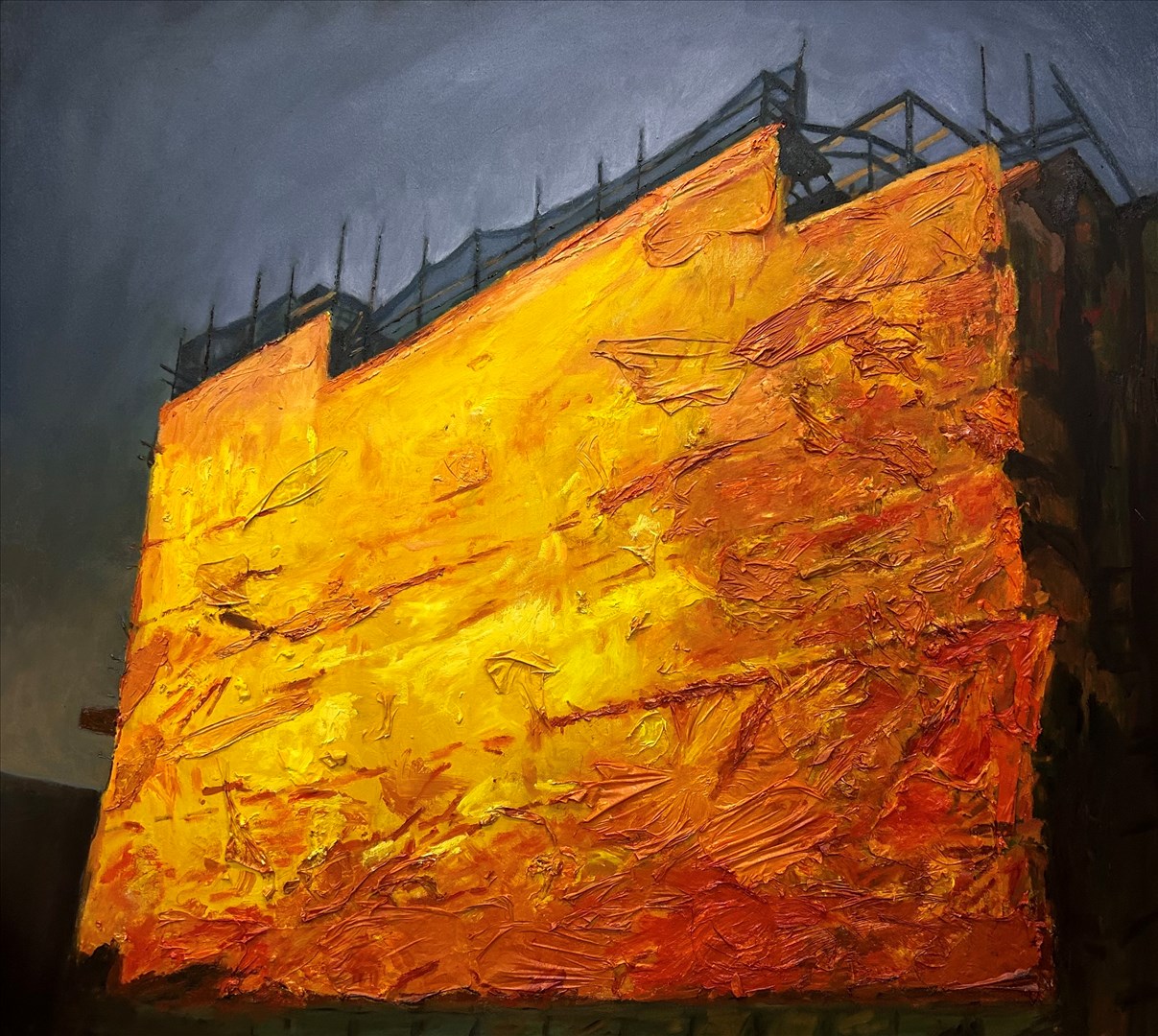
Considerate Construction (oil and latex) by Lee Maelzer £16,000 (28)

In a completely different vibe, the friend I went with liked:

Love Myself (knitting wool and cotton filling)by Chunyoung Yang £500 (42)

Room 2 (77 works)

Also hung by O’Donoghue. Amid the jumble sale disorder of so many images a number were about the sea, which emerged as a theme in both his rooms.

High and Dry (woodblock and etched lino) by Ian Burke £380 (71)

There was a little area devoted to the works of ‘the late Mick Moon RA’ including this, which I think I’ve seen at a previous show, dramatic in its size and painted on rough industrial planking so right up my street.

Outward Bound (acrylic and mixed media) by Mick Moon £30,000 (111)

The Large Weston Room (242 works)

It comes as a visual and psychological relief to emerge from the first two rooms, characterised by grey and blurred images, and into room 3. This is curated by the fabulous Cornelia Parker who has themed her room round the seven colours of the rainbow and it immediately feels like it. This is the room with the four big Michael Craig-Martins with his trademark flat colouring, and you are also struck by several works with colourful vertical strips. Big relief after the first two grey rooms.

Orchid (by Sir Michael Craig-Martin £8,600

My friend is a birdwatcher and nature lover so she liked the clever Bird Colour Wheel by Jim Moir.

Bird Colour Wheel (pigment print) by Jim Moir £1,250 (149)

There was also the first humorous offerings, including a pair of 18th century paintings spoofed by having 21st century products collaged onto them, by Toby Holmes.

A Bottle of Dog (Newkie Brown) (digital collage; giclee print) by Toby Holmes £250 (188)

I like the woodcut vibe and loveliness of this fine image (in fact a linocut).

Traitorous Trueness (linocut) by Gerard McMenamin £250 (205)

In a similar vein I liked the strong cartoon outlines of this nude.

Untitled Nude 2 (linocut) by Morag Bassinthwaite £250 (256)

At about this point it dawned on me that maybe, faced with a bombardment of images, the mind prioritises the realistic, naturalistic images. Was that why I was liking recognisable naturalistic images? Is that why I liked this one so much, where Paul Stephenson has merged an original 1820 oil painting (of John Porter by William Bradley) onto an image of the calm flat infinite sea?
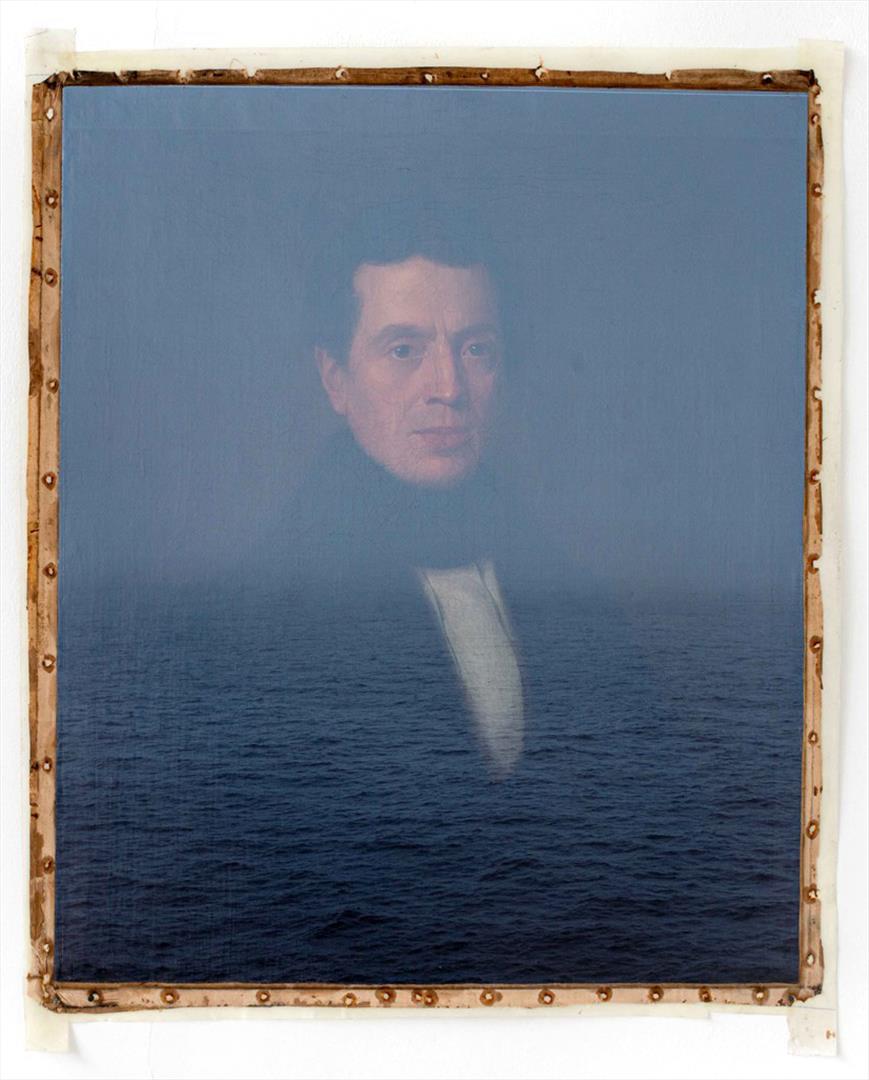
Reflets sous la pluie (ink on original oil painting) by Paul Stephenson £2,500 (211)

Remember I mentioned the tiger covered in Tunnock teacake wrappers. The famous tiger was done by David Mach (and there are a couple of smaller works in the same style in the penultimate room). Here’s a jokey hommage by Paula Martyr.

A Teacake Cat (collage) by Paula Martyr Not For Sale (NFS) (210)

When someone’s bought a print which comes in multiple editions, the gallery puts a round red adhesive label by it. I thought it telling that this Parker room has a whole stand devoted to twee and humorous images of cats and dogs which were festooned with red labels. People want art that is a) affordable b) makes you smile.

Resisting the appeal of winsome cats and dogs, I liked the casual gracefulness of this image by Julia Andrews.

In My Mind (five-later screenprint) by Julia Andrews £350 (266)

Small Weston Room (1 video)

The work in the Small Weston Room is by invited artist Carey Young. Filmed at SIGMA Corporation in Japan, ‘The Vision Machine’ captures the company’s female employees, creating a speculative fiction that suggests a lens factory run (and perhaps owned) by women. The factory is used as a metaphor for photography and cinema in a wider sense, and shows how women are framed within, and in relation to those fields. The piece pays homage to women as skilled makers and creators, whilst suggesting a female-centric vision, or perhaps a wider visual culture created by women.

There’s a page of stills from the film on her website. My friend – a woman and a feminist – walked in, watched the video for sixty seconds, and walked out again. Given our saturation with American TV and movies which are designed to grab and keep our attention for every second, it’s very difficult for any art video maker to compete.

Room 3 (63 works)

This room is massive, maybe three times the size of the previous rooms, so it needs big works to make an impression. It was hung by the exhibition’s overall co-ordinator, Ann Christopher who is a sculptor. Her aim (apparently) was to create contrasts of scale. A large collage of woodcuts by Anselm Kiefer (American), a new painting by Rose Wylie and a vibrant work on canvas by Sir Frank Bowling. Alongside are smaller works by artists such as David Remfry and Diana Armfield. Some sculptures are hung on the walls. Cornelia Parker ‘Psychobarn (Flotsam)‘ leans against a wall, while Honorary Academician El Anatsui’s intricate wall-hanging dominates one end of the gallery. I normally love Parker but didn’t react to her shed and the Anatsui is genuinely huge but left me meh. Richard Serra is ‘known for his large-scale abstract sculptures made for site-specific landscape, urban, and architectural settings’ which is why it was odd to see him represented by a painting, which admittedly had a nice Rothko-like abstract vibe (well, without the blurry edges).

Those are all big names but the actual works selected weren’t that exciting, for example a couple of drawings by Rachel Whiteread, who cares? It would have been much better to have one of her huge sculptures, specially for such a big space.

Maybe my favourite piece was the Bowling. There’s a reason why the famous guys are famous – at their best they have a certain something which lifts them above, in this case, the hundreds of other semi-abstract paintings on show. (Incidentally, I think the silver slipper is depicted in the central diamond, something which is much more obvious when you see it in the flesh, as it’s a whopping 3 metres tall.)

Silver Slipper (acrylic and acrylic gel with collaged canvas with marouflage) by Frank Bowling NFS (440)

Room 4 (71 works)

Room 4 was also curated by Christopher. I liked Horror Vacui by Paul Benney which is a digitally animated painting of a candle under a bell jar using up all the oxygen and snuffing out. There’s a slightly worrying big print of a naked man facing away from us by the famous Wolfgang Tillmans. It made me realise how relatively few nudes there were in the show and, as usual, mostly female.

Small but striking (maybe just because it reminds me of the photomontage pioneered by Peter Kennard whose show at the Whitechapel Gallery I recently visited) was this photomontage by Michelle Thompson.

Bomb (digital artwork) by Michelle Thompson £145 (520)

Room 5 (183 works)

Room 5 was hung by Hurvin Anderson and feels packed. Anderson is Black and it’s probably no coincidence that this room has the first real Black presence, for example the big (and not very good) portrait of Linton Kwesi Johnson and a multiple portrait of Bob Marley. (Having been reminded of Johnson I wrote this review listening to his 1979 album ‘Forces of Victory’.

There’s a vast messy colourful painting by Elizabeth Cope; I admired the colourfulness but not the design. My companion liked Storm Light by Leslie Dabson. Interestingly, this doesn’t reproduce at all well online; in the flesh it’s very small and compact and so gives a very strong vibe of a rainy evening in London’s Victorian terraces. One of the most vivid images is the hyper-naturalistic depiction of an abandoned car overgrown with vegetation by Geoff Archer.

440 (oil) by Geoff Archer £2,800 (631)

I really liked a couple of abstracts by Subai Zheng, 628 and 651. As far as I could tell every single one of the thousands of dots had been created by hand with a felt tip pen. The more I looked the more I was drawn into this mesmerising image.

Weaver: 30 Houses (felt tip marker and acrylic on canvas) by Subai Zheng £15,000 (651)

On the left-hand wall I surprised myself by liking Stone Pines Rome by Katharine Edwards, maybe because of its echoes of Piet Mondrian transitioning from naturalism to abstraction. Or just because I liked the design and the colours.

Stone Pines Rome (acrylic) by Katharine Edwards £4,000 (574)

On reflecton, it may also be because so many of the images have a rather dingy grey overcast feel. Maybe without realising it, the curators are biased by the simple fact of living in England to prefer works which are dingy, overcast, grey, or rainy i.e. like the English climate. Thinking about it, there are very few images depicting a fine sunny day let alone the light blue Mediterranean skies you associate with, say, the art of Raoul Dufy or Matisse.

Next to it another imagine I liked the more I looked at it was ‘Yellow Umbrella’ by Bill Jacklin. To me it felt romantic, like an illustration for an adventure novel, two huddled figures rushing through a snowstorm.

Yellow Umbrella (monotype with oil pastel) by Bill Jacklin £5,775 (623)

(See also his Sea at Night I in a later room.)

Room 6 (121 works)

Each year there’s an architecture room and I always amuse myself by calling it ‘the room of shame’. This is based on my lived experience of the vast discrepancy between the pretentious, high-falutin’ language of architects fantasising about building ecocities in Brazil or colonies on the moon, and the crappy, badly built, poorly insulated houses and flats most of us live in, the gritty streets dominated by big impersonal blocks which most of us hurry through against the gritty wind or dirty rain.

Anyway, this year exhibition co-ordinator Ann Christopher handed Room 6 over to Assemble RA with a view to making it ‘a space for making’. Who are Assemble RA?

Assemble RA is a collective based in London, who work across the fields of art, architecture and design. They began working together in 2010 and have described themselves as having between 16 and 20 permanent members. Assemble’s working practice seeks to address the typical disconnection between the public and the process by which places are made. Assemble champion a working practice that is interdependent and collaborative, seeking to actively involve the public as both participant and collaborator in the ongoing realization of the work.

And so Assemble RA transformed this room into ‘an industrial warehouse space, a creative’s store, full to the brim with an eclectic mix of models, machinery and curious objects. On the walls are photographs of interiors and artists’ workspaces, and works exploring different materials such as moss (720), 3d-printed sand and woven rush.

What with the shelves lining the walls and the shelf units displaying architects’ models etc this is the most cluttered and busy room. The standout piece for me was a set of industrial tools which have been remodelled to seem like giant metal monster claws.

Installation view of Room 6 at the Royal Academy Summer Exhibition room 6 showing Nippers (812) by James Capper (photo by the author)

Among the earnest models of sustainable blah blah were a few humorous models such as friends used to make at school.

Amorgos Monastery (plywood, painted light plaster, tree bark and tree branches) by Vasilis Politis NFS (709)

My companion liked this, Vast Seas in Green to Grey by Julie Massie which consists of hundreds of thin fragments of coloured porcelain embedded in wood to create this beautifully shaded but slightly worrying relief.

Vast Seas in Green to Grey (porcelain on wood) by Julie Massie £800 (707)

Room 7 (256 works)

Gallery 7 is the first of two adjacent rooms hung by printmaker Anne Desmet. I recently visited the big exhibition of her work at the Guildhall Art Gallery, which is still open and well worth visiting. There’s a thread of architecture and buildings running through it. But straight off I liked a couple of humorous works by Laura Beaumont who’s gotten old Observer Books, carved a square hole in them and then created tiny dioramas using model railway figures and foliage.
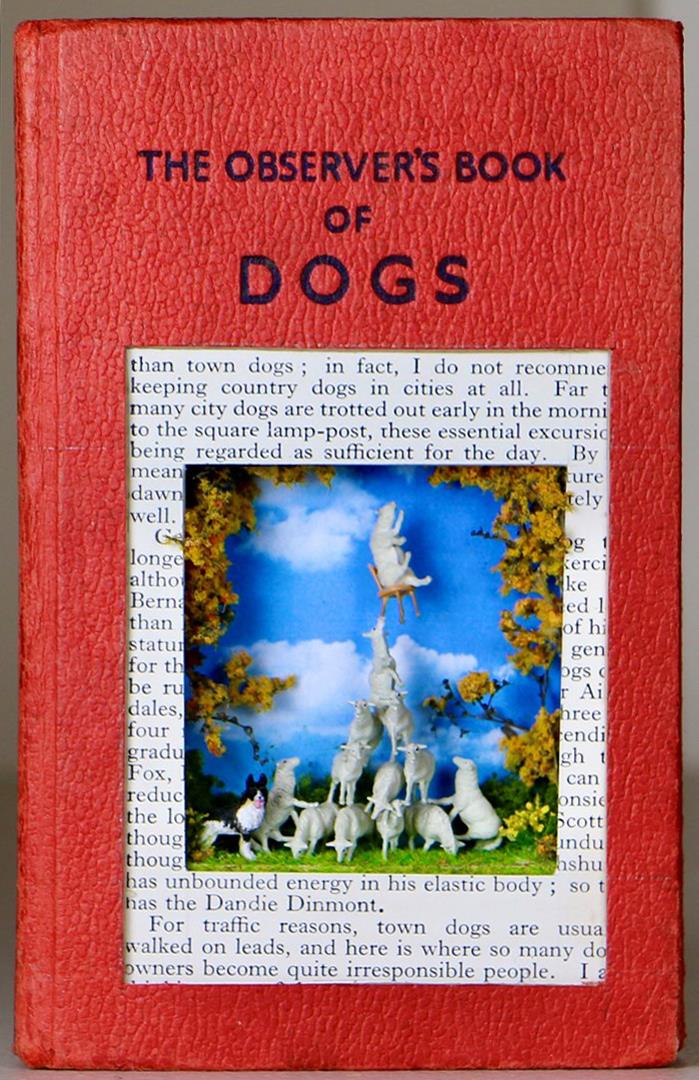
Observers Dogs by Laura Beaumont £1,500 (829)

My favourite piece in this room was hung up high and so you craned your neck, appropriately, to look up at an image of a high rise block. This reproduction doesn’t do it justice. In the exhibition the paper is set on dark brown wood and creates the impression that it’s made of weathered copper.

Cottingley Heights On Oak (Three) (acrylic on oak veneer) by Nicola Rawnsley £380 (841)

In a different mood, I liked Blueprint by Peter Lawrence, maybe because it reminds me of 1950s jazz LP covers. It also links in my mind with the wonderful prints by the Yoshida family currently on display at the Dulwich Picture Gallery.

Blueprint (wood engraving) by Peter Lawrence £175 (872)

Lovely, minimalist and clean are Ian Ritchie’s etchings of foxes (926). For me the standout work in the room was a lovely etching of the BBC offices in Langham Place, possibly because they remind me of the wonderful exhibition of 1930s linocuts at Dulwich Picture Gallery a few years ago.

W1A – BBC AND All Souls Church, Langham Place (etching) by John Duffin £795 (977)

There are lots of images of London streets and buildings which are Desmet’s own subject, in all kinds of styles. I was impressed by the realism of this image of Oxford Street through a rain-drizzled window, presumably of a bus.

Oxford Street (acrylic) by James Condon £5,200 (1015)

Honourable mention Urban Beings V (1024) by Francesco Russo.

Room 8 (259 works)

Second room hung by Anne Desmet, this had a noticeable theme of trees along one wall, with all manner of seascapes on the far wall, many of which I liked. This impressive work is an etching made on sycamore leaves, presumably commemorating the chopping down of the tee in the Sycamore Gap of Hadrian’s Wall. It’s more impressive in the flesh than this reproduction

Acer pseudoplatanus L (etching on sycamore leaves) by Emma Buckmaster and Janet French £7,500 (1132)

In line with my general preference for woodcuts and works with strong outlines, I liked this simple but effective linocut, ‘Trees Beneath a Lemon-Yellow Sky’ by Paul Hogg £750.

Trees Beneath a Lemon-Yellow Sky (linocut) by Paul Hogg £750 (1140)

Twenty of more images of the sea captured it in all its moods, from a lovely print by John Mackenzie of shallow surf over a light sandy beach, to images of waves crashing against rocks, a batch of Norman Ackroyd‘s trademark etchings of remote Scottish islands surrounded by gulls.

An Ocean to Swim (woodcut) (woodcut) by Trevor Price £580 (1189)

High up on a wall was a set of ‘London Heads’. This is small and cute in the flesh (40 x 40 cm) so doesn’t benefit from being blown up in reproduction.

London Heads by Sally Cutler £350

This might be the best room with a wide range of smaller but attractive and quality images. I liked the one of a single fern leaf, another painting of woodland floor all brambles etc. On the opposite wall were characterful images of individuals and groups. This one, also, was all the more powerful for being small (15 x 13 cm) like the illustration to an interesting novel.

Waiting For The Rain To Stop by Barbara Jackson £350

Funniest entries in the show might be the two jokey prints by Ceal Warnent.

Revolutionary by Ceal Warnants (photopolymer relief print on vintage book paper) £130

These prints had almost as many red labels on them as the cute cats and dogs in room 3 and you can see why. They would make you smile every time you look at them.

Room 9 (64 works)

Gallery 9 was hung by Ann Christopher and is dominated by the biggest piece in the show, ‘String Quartet’ by Ron Arad. This is a big carpet draped up the wall and across the floor, on which sit four chairs on which are placed the four instruments of a string quartet and over hidden loudspeakers is projected string quartet music which you can hear from the nearby galleries. It’s odd, really, how little modern art makes use of music or sounds of any sort.

The Quartet by Ron Arad (sculpture made of wood, steel, copper, silicon and cotton £300,000 (1408)

There’s another big showy work, a huge sculpture of a pair of black hands by Tim Shaw which I didn’t like at all. The curators comment ‘a pair of hands where the negative space forms part of the work’ – well, which sculpture does not create a greater or lesser space around it? On the plus side, some of the children visiting the show were enjoying pretending to shake hands with them or dancing in and around them which was fun to watch.

The Space Between (Does Not Come in a Vacuum) by Tim Shaw (sculpture of Painted foam) £35,000 (1410)

My companion the naturalist liked all images of birds throughout the show but particularly the strutting crow.

Strutting (acrylic) by Lisa Badau £645 (1384)

The Lecture Room

This room was hung by Veronica Ryan who had the bright idea of painting the wall turmeric ‘a colour inspired by the culinary spice which is known for its healing properties’. This turns out to be a very dynamic and enjoyable colour to stroll in. This room is full of sculptures, maybe it was unofficially ‘the sculpture room’ and Ryan has made the little innovation of replacing traditional white plinths with wooden shelves and trestle tables. This is cool but also brings out a strong village church jumble sale vibe as well. All kinds of things to admire. My photo of a battleship made of card shows the turmeric colour in the background.

Installation view of the Royal Academy Summer Exhibition 2024 showing ‘Worship-Warship’ by Richard Wilson and, in the background, the orange turmeric colour of the walls and the bric-a-brac vibe created by the trestle tables (photo by the author)

Maybe the most striking piece is an oriental carpet out of which a tiger’s head is mutating, like the alien bursting out of John Hurt’s stomach. It’s life size and genuinely a bit disturbing.

Brown Tiger by Debbie Lawson (sculpture made from Jesmonite, carpet and wood)

There was, maybe, an understated feminist theme in this room, with some paintings of menopause medication by Sara Gregory (1429). I liked the sculptures using an image of a mother and child printed on a metal plate and surrounded by rooster feathers to create a kind of ‘native’ African shield effect.

Female Warrior Army, Motherhood 2 by Emma McGuire (photo decal on porcelain with rooster feathers) £3,500

In a related African vibe (on the same wall) are hung a couple of big prints by Yinka Shonibare CBE (1525, 1526) whose exhibition at Serpentine South you can still visit. I quite liked a lot of things in this room but not burningly so. I suppose this is quite amusing and many of the other sculptures were in the same category: quite good, quite funny. Possibly I was just exhausted by this stage of the marathon.

The Invader by Hannah Simpson (stoneware ceramic) £1,050 (1620)

Wohl Central Hall (81 works)

The Wohl Central Hall is the last room in the show and the second of Assemble RA’s two rooms. The idea is that they’ve ‘created a studio setting and explored the creative process’. This explains why there are random swatches of paint on the walls and a clutter of props including a drafting table and a joinery bench. The plinths in the gallery have been repurposed from waste materials such as discarded slabs from an industrial estate etc. Probably there was lots of interesting and stimulating work here but I was full. My companion, blessed with more stamina than me, and also much clearer about what she likes, liked the big mosaic of ‘Hackney Birds’ and spent a minute or two checking off the ones we see in our garden.

Some Hackney Birds by Hackney Mosaic Project (wall-based glass and ceramic mosaic) NFS

Maintaining the ornithological theme I liked this – maybe because by this stage I was on my last legs and only noticing the really bright obvious pieces.

African Phoenix: Coffin for Qm Nana Yaa Asantewaa by Elsie Owusu (carved wood, paint and glazes) NFS

Thoughts

Despite all the curators’ talk of themes and issues, the experience of visiting is massive, chaotic and exhausting. That said there are hundreds and hundreds of things to like if you have the stamina, determination and patience to look carefully at everything. I wrote this review the day after visiting and was surprised to realise how many works I really liked, including many I haven’t shown here.

After a dingy start in the grey murky opening rooms, and despite the absence of any real showstoppers (apart, I suppose, from Arad’s Quartet and Shaw’s hands, and maybe Parker’s shed and El Anatsui’s wall-hanging, none of which did it for me) there are lots of smaller, sometimes very small, gems, which are worth the effort of carefully reviewing everything in the room to find and cherish and marvel, feel and chortle at.

Tunnocks Maneki-Neko by Robert Mach (kinetic sculpture with confectionary foil on plastic and wood) £1,400 (1555)


Related links

Related reviews

Anne Desmet: Kaleidoscope/London Exhibition @ Guildhall Art Gallery

This is a lovely exhibition of the popular, accessible and inspiring artist Anne Desmet – imaginative, decorative, beautiful to look at, civilised, teasingly clever and FREE.

British Museum Great Court by Anne Desmet @ in Kaleidoscope/London at the Guildhall Art Gallery

From the website and the press release I hadn’t really grasped the scale of the exhibition. With over 150 works this is a major retrospective, which features series of works from as far back as 1990 right up to the present day, including 41 London-themed kaleidoscopic prints created exclusively for this new exhibition.

1. Wood carver par excellence

Born in 1964, Anne Desmet is a well-established artist and member of the Royal Academy who specializes in wood engravings, linocuts and mixed-media collages.

Desmet is a highly skilled carver in wood and creator of dazzling woodcuts. She is only the third artist to be elected to the RA for working in the medium of wood engraving. The exhibition includes a fascinating 6-minute film shot at her studio in Hackney which follows the entire process through, from starting with an endpiece bit of wood, then showing the various sharp carving tools she used to get her effects, through to rolling the print ink flat, inking the cut and then making the print.

There are also four display cases showing the raw wood piece, the tools she uses, the final engraved wood blocks, her notebooks, sketches and so on.

Display case in ‘Kaleidoscope/London’ at the Guildhall Art Gallery, showing, from left to right, a sketchbook, a virgin block of end-grain wood with some of her carving tools, and a finished engraving block (photo by the author)

Most of these woodcuts are in black and white. Some are coloured in but colour isn’t her thing: shapes and patterns are her thing. She can do astonishingly realistic depictions of Italian or London landmarks, gardens and buildings, but its the way she then mashes up these images which get her juices flowing (see below).

2. Architecture

Desmet is strongly attracted by architecture and in particular architecture with strong mathematical lines and geometric shapes. There are three rooms and the first one contains cityscapes and townscapes, depictions of Rome, rooftops of Italian provincial towns, scenes from Oxford (the Radcliffe Camera, Balliol College) and, in a surprise, a piece I really liked, a fantasia of Tudor chimney stacks as she observed them when she was, believe it or not, artist in residence in Eton, in 2016.

‘Urban Jungle’ by Anne Desmet (2016) in ‘Kaleidoscope/London’ at the Guildhall Art Gallery

3. Fantasias

As you can tell from the Eton picture, this is a fantasia made up of lots of chimneys combined together into an improbably dense and overloaded image. She does the same to her Oxford landmarks, moving beyond the obvious aesthetic appeal of the colleges and instead creating fantastical images of, for example, the Radcliffe Camera, whose mighty dome appears ten or more times in a mashed-up fantastical image.

These clear crisp but fantastical images reminded me a little of the woodcut covers Scottish artist and novelist Alisdair Gray made for the covers of his books and short stories and John Lawrence’s illustrations for some of Philip Pullman’s fantasy stories, also set in Oxford. Also, the most fantastical of them are strongly redolent of Maurits Escher‘s optical illusions.

There are a handful of works from the 1990s which are completely fantastical, showing piles of household bric-a-brac (scissors, tape measure) mingled with learned tools such as you might find in a 17th century engraving depicting science (protractors and compass), with the image of Peter Breughel’s version of the Tower of Babel in the background and, snuffling in the foreground, miniature bulldozers and tiny people.

‘Wood Engraver’s Tower’ by Anne Desmet (2020) in ‘Kaleidoscope/London’ at the Guildhall Art Gallery

This image, Breughel’s tower, recurs throughout all of her work, sometimes centre stage, sometimes cropping up as an unexpected detail. It speaks to her interest in architecture, in large buildings, but also to the passage of time, and inevitable decay and collapse. Decline and fall. Ruined cities, empty streets, abandoned buildings…

My favourites in the first room were a series of images made by cutting up original prints and remaking them as collages. In particular I liked this one which takes is inspiration from Antoine de Saint-Exupéry’s children’s story, ‘The Little Prince’, which I liked for its sci fi vibe but mainly for its shape and design and feel. Note the tiny photo of the Radcliffe Camera floating incongruously at the top right.

‘Out of This World’ by Anne Desmet (2022) in ‘Kaleidoscope/London’ at the Guildhall Art Gallery

4. Mashing

So far so fairly realistic and there’s ample evidence that Desmet she can do breath-takingly realistic renderings of buildings and views. But the central concept is that Desmet chops up her work. It is sliced and diced, filleted, repeated, duplicated and recombined in a myriad ways, and it’s these processes which create her really stunning works. I made a list of the treatments she subjects her works to:

  • basic realistic engraving
  • fantasias – Tower of Babel, Eton chimneys, multiplying Radcliffe Cameras
  • collages
  • the same scene with variations – Urban Development or St Paul’s
  • mounted on razor shells – cityscapes, Olympic buildings
  • mounted on squares – Olympic Site A to Z
  • mounted on slate – Perimeter Fence
  • tall images – the angel tower
  • sliced as by a paper shredder – the British Museum Grand Court sliced vertically, horizontally and diagonally
  • hangings – British Museum
  • cut-out illuminated by an LED light – St Paul’s
  • behind glass cubes
  • behind convex clock glass circle
  • on crockery fragments – angels
  • kaleidoscope

Kaleidoscope

The technique central to maybe half of these works is the simple but surprisingly effective technique of using a kaleidoscope.

The exhibition quote Desmet’s own explanation, which I’ll quote in full:

‘Many of the collages were made in 2022 while I was undergoing treatment for breast cancer and consequently, they reflect something of a wild scattergun of thoughts that were running through my mind at that time, such as escape, possible new worlds, and the climate crisis.

‘The framework for those thoughts was inspired by a kaleidoscope toy that I had bought at the Sir John Soane’s Museum some years ago, which breaks up whatever view you’re looking at into extraordinary triangulated repeat-patterns.

‘I set about applying a kaleidoscope lens to my London imagery to create new work for the exhibition at Guildhall Art Gallery. By seeing the city anew and with a sense of its unexpected possibilities, I hope that my work will inspire optimism and constructive thinking in our uncertain times.’

Sky Windows

And so she set about reviewing prints from her earlier wood-engravings, linocuts and hand-drawn lithographs, and kaleidoscoping them. The most comprehensive example is the piece titled ‘RA: Sky Window’. In 2017 the Royal Academy was undergoing a refurbishment and Desmet made some beautifully realistic paintings of the building.

‘RA Revolution’ by Anne Desmet (2017) in ‘Kaleidoscope/London’ at the Guildhall Art Gallery

Then, as explained, in 2023, she returned to the image armed with her kaleidoscope and realised that she could manipulate the skyline of the building so as to place the blue of the sky at the centre of a surprising variety of shapes.

Installation view of ‘Sky Windows’ by Anne Desmet (2023) in ‘Kaleidoscope/London’ at the Guildhall Art Gallery (photo by the author)

And then she realised the blue sky could itself be changed to reflect, among other things, the changing seasons. And so she made versions featuring, for example, fireworks, snowflakes, pumpkins and so on, and the thought, why stop there? Why not be frivolous and whimsical, so there are ones with a rainbow, hot air balloons and helicopters, airplanes high in the sky leaving vapour trails. Suddenly you realise how much goes on in the sky above us without our really noticing.

‘Sky Window 23: Stars and Satellites’ by Anne Desmet (2023) in ‘Kaleidoscope/London’ at the Guildhall Art Gallery (photo by the author)

There are 24 in total, building up into a beguiling, entrancing series. I realised it’s much like the idea of a theme and variations, a stock genre of classical music: first state the theme, then work through a host of inventive variations (Beethoven’s Diabelli variations. Elgar’s Enigma variations spring to mind).

So self-contained and neat is the idea and the execution that a) the entire series of 24 is assigned a room of its own off to the side of the main gallery and b) you can buy the box set!

Installation view of the Sky Windows box set in ‘Kaleidoscope/London’ at the Guildhall Art Gallery (photo by the author)

London Gardens

She does the same thing but with a different visual result in a series called ‘London Kaleidoscope’. Here she starts with totally realistic (and wonderfully vivid and detailed) engravings of a) a London garden, in fact the view from her house and b) a pub down the road with a red phone box outside.

‘QEH’ by Anne Desmet (1998) in ‘Kaleidoscope/London’ at the Guildhall Art Gallery

She collages the original prints, to include the red phone box and greenery from the garden, and then takes her kaleidoscope to the original works and comes up with a (small) set of really vivid, beautiful images, arguably the best in the exhibition. They are London but seen in an entirely new, novel, fun and beautiful way.

‘London Gardens Kaleidoscope 1’ by Anne Desmet (2023) in ‘Kaleidoscope/London’ at the Guildhall Art Gallery (photo by the author)

The same scene with variations

Depicting a scene over time. Thus one of my favourites, the lovely ‘Urban Development’, depicts the front of a London house at seven times of day, showing the sun rising and its light slowly revealing more and more details of the scene.

‘Urban Development’ by Anne Desmet (2023) in ‘Kaleidoscope/London’ at the Guildhall Art Gallery (photo by the author)

Mounted on razor shells

There are at least three pieces which consist images of buildings carefully cut out and stuck onto razor shells. These are all exquisite and the fragility of the process and the end result gives you a fantastic sense of fragility and delicacy.

Installation view of ‘Fragile Earth’ by Anne Desmet (2022) in ‘Kaleidoscope/London’ at the Guildhall Art Gallery

In this piece fragments from prints she’s made of London, Rome, New York, Venice are collaged to produce an international skyline with the natural pink/purple colouring of the shells giving the sense of sunset over this megalopolis.

As good or better is the smaller series made using images she drew, carved and printed of the build-up to the London Olympics in 2012. Here is a finely detailed view of the Olympic velodrome cut up and pasted onto six razor shells. Amazingly powerful, the exquisite detailing of the original image then cut up onto these very fragile artefacts from a fragile, damaged natural world.

‘Fragile Hope’ by Anne Desmet (2012) in ‘Kaleidoscope/London’ at the Guildhall Art Gallery (photo by the author)

The third razor shell work is ‘Fires of London’, created using 18 razor-clam shells to dramatise the many historic fires of London over the last 1,500 years. The work has just been acquired for the Guildhall’s permanent collection.

‘Fires of London’ by Anne Desmet (2012) in ‘Kaleidoscope/London’ at the Guildhall Art Gallery (photo by the author)

Mounted on squares

There’s some example of another type of mounting, chopping an image up into small, mounted squares. In this example a wood engraving of the Olympic site is collaged / mixed into the relevant A to Z map of the same location, and then diced up into 75 small squares.

Olympic Site Map Metamorphosis by Anne Desmet (2010)

I love collage, pieces and fragments and, because I live in London, the A to Z map has an additional frisson or connotation. It is also a fairly obvious meditation on the dichotomy between map and world, which always fascinated me.

Towers

A number of the works are tall and narrow, mimicking the tall chimneys or towers she’s interested in – I’ve shown the Eton chimneys, above. There’s a similar series showing a ‘tower of angels’.

‘Tower of Angels’ by Anne Desmet (2020) in ‘Kaleidoscope/London’ at the Guildhall Art Gallery

The angel tower is one of a set of works inspired by Victorian bas-relief decorative angel sculptures near the ceiling in the Royal Academy’s Gallery 3. She created individual prints, this tower, and a work in ceramics (see below). The theme of angels (sometimes used as a nickname for nurses) seemed appropriate when she was making them, during the first year of the pandemic lockdown. You can tell these are more modern works because they have more edge. In particular, in some of the works the angels are wearing protective face masks. COVID art.

‘Triptych for Our Times’ by Anne Desmet (2020) in ‘Kaleidoscope/London’ at the Guildhall Art Gallery (photo by the author)

Sliced as by a paper shredder

She feeds versions of her lovely print of the British Museum Grand Court through a shredder. One sliced vertically, one horizontally, one diagonally. This image doesn’t do it justice. Only in the flesh can you see the fineness of the very thin paper shreds, curling slightly at the corners, which convey a powerful sense of evanescent fragility, a continuous theme throughout her work.

‘British Museum Diagonals’ by Anne Desmet (2005) in ‘Kaleidoscope/London’ at the Guildhall Art Gallery

Mounted on slate

This was another of my favourites. Only 2 or 3 of the works were mounted on slate but it’s a powerful material and it seemed, to me, strongly appropriate for the subject. It’s a depiction, a dramatisation, of the forbidding metal fences erected all around the Olympic site in East London in the years while it was being built.

‘Perimeter fence’ by Anne Desmet (2012) in ‘Kaleidoscope/London’ at the Guildhall Art Gallery (photo by the author)

I went for a walk around the area during that time and was intimidated, indeed slightly scared, and irked, by the way these ‘games for the people’ involved shutting off vast areas which had previously been free to roam, for years and years. In this piece the shredding technique a) re-enacts the look of the vertical metal fences b) enacts the way you could only glimpse fragments of what was going on on the sites through the slats and c) the slate mounting conveys the adamantine, hard, take-no-prisoners high security vibe which was imposed across the whole area.

Hangings

Closely related are a couple of hangings applying the kaleidoscope technique to the British Museum Grand Court image, rearranging details into immensely pleasing geometric patterns. From a distance they look like abstract geometric shapes but when you go up close you can see the architectural details of the Museum walls and ceiling. Magical!

Two hangings by Anne Desmet (2012) in ‘Kaleidoscope/London’ at the Guildhall Art Gallery (photo by the author)

Cutout illuminated by an LED light

There’s a series of six pictures of St Paul’s cathedral, taken from the identical same sport but showing it at different times of night, and in history, so with some scenes depicting the Blitz, enemy planes overhead and searchlights.

‘St Paul’s: Dance’ by Anne Desmet (2002) in ‘Kaleidoscope/London’ at the Guildhall Art Gallery

One of these has been reworked so the white parts of the image are made translucent (by a laser, apparently) and has been attached to an LED light box so as to create a little son-et-lumiere. To be honest, this felt a bit gimmicky and was one of the very few pieces which didn’t work for me.

‘London’s Secret Stars’ by Anne Desmet (2002) in ‘Kaleidoscope/London’ at the Guildhall Art Gallery

Behind glass cubes

Like one of her engravings of the Olympic velodrome, cut into squares and smoothly rounded glass cubes set over each square.

‘Olympic Memory’ by Anne Desmet (2010) in ‘Kaleidoscope/London’ at the Guildhall Art Gallery

Interesting experiment but a bit self-defeating as it was hard if not impossible to make out the original image, which explains why it only occurs once.

Behind a convex clock glass circle

Speaking of glass, another image manipulation she’s experimented with is placing a collage or print behind a convex glass circle such as you find on the front of old grandfather clocks. An interesting idea but, in my opinion, this blunted your reading of her finely drawn, detailed images, working against her strengths and so this was the one format which didn’t really light my candle. This flat photo of one doesn’t at all convey the shiny bulbous effect of the work.

‘Constructed Space III’ by Anne Desmet (2013) in ‘Kaleidoscope/London’ at the Guildhall Art Gallery

The curators point out how the use of convex glass, as used in old-style clocks, strongly references the notion of Time, linking up with the passage of time indicated, in different ways, by other series (St Paul’s at night; Sky Windows; Urban development and so on). So a clever-clever idea, but I don’t think works in practice, as actual artefacts.

On crockery fragments

On the other hand, I love fragments, wrecks and ruins, bits of industrial detritus, which is why I love the Arte Povera movement, minimalism, the wonderful photos of Jane and Louise Wilson, the great Cornelia Parker and so on. And so I loved the handful of places where she’s laminated her lovely images into fragments of crockery, as with this striking dismantling of one of the angel images.

‘Angel Fragment 2’ by Anne Desmet (2021) in ‘Kaleidoscope/London’ at the Guildhall Art Gallery (photo by the author)

Again, this speaks to the recurrent them in her work of large buildings or neo-classical architecture or Victorian art (as here) degraded, broken, fragmented by the passage of time.

Thoughts

Delightful, inspiring, endlessly inventive, beautiful images and, in the shape of the video and the display cases, very informative about the craft of wood engraving. And it’s FREE. Go and see it.


Related links

Related reviews

Dear Earth: Art and Hope in a Time of Crisis @ the Hayward Gallery

This is an outstanding exhibition. It may be my favourite exhibition of the year so far. Why? At least six reasons:

1. Empty It was empty. When I arrived at 10 past 10 there were 5 or 6 people in it. When I left an hour later there were more visitors, maybe 30 to 40, but I could still walk into a room and be the only person there. This is very rare at a gallery. At a blockbuster show at the National or British Museum, by 11 it would be so packed it often gets hard to see the pictures. Here I waltzed from one big white empty room to another, almost completely alone, like a private view.

2. Cold The Hayward’s galleries are, for the most part, big and spacious. On the first floor they are light and airy. And all of them have excellent air conditioning! I arrived hot foot from the boiling, sweaty tube, and the weather outside was warm and humid. So entering big, white, airy and beautifully cool spaces was a welcome balm to the senses.

3. Outstanding art This exhibition is full of outstanding pieces of modern art. I’ll pick out the four or five highlights below, but it feels like an excellent introduction to this is what art is like now, in 2023. Not old paintings by dead white men from 100 years ago. Many of the works are from just the last few years, no fewer than seven of them were commissioned specially for this show, so these are by way of being world premieres.

4. Big installations Many of these works are big and immersive. There are plenty of photos and paintings and a few rooms devoted to huge projections of videos i.e. traditional media. But half a dozen of the works are really massive and impressive and enjoyable. It’s just fun to walk around a very big work of art.

5. International And it’s very cosmopolitan, very international. Art these days is, of course, an international business, with a non-stop calendar of festivals and biennales which artists, curators and gallery owners have to jet to all around the world (Beijing, Dubai, Venice, Buenos Aires) and, thanks to the internet, works from exhibitions all round the world can be seen online. But this particular selection is deliberately global in range. It felt like a series of windows into alternative worldviews, from other countries, other sensibilities.

(I suppose if you were being cynical, you could argue the opposite; that all the works have a certain sameyness, if not of execution, then certainly of worldview and mindset, products of a fully globalised artworld with a highly conformist artspeak. Well, on this day, at this exhibition, I was in a good mood – helped by the lovely air-conditioning – and so responded lightly and brightly to all the shiny exhibits and chose not to be dour and cynical.)

6. Women artists And the majority of the artists are women. I’m not sure you could tell from just the art works alone, but on this particular day, on this particular visit, I enjoyed the knowledge of being surrounded by the work of caring sharing women; maybe it contributed, at some level, to the calming, healing, hugely enjoyable tone of the whole show.

Climate change

On the ramp up to the second room or space you’re confronted by a motto made of neon signage by the ‘passionate ecofeminist’ and American artist, Andrea Bowers. It’s from 2017 and reads CLIMATE CHANGE IS REAL. Maybe that was sort of necessary in 2017 but I think most people in the West now know about climate change, most educated people anyway.

Just over the last few days the front pages of the newspapers, on the radio and TV, there have been reports of Keir Starmer’s speech being interrupted by climate activists, Just Stop Oil disrupted the cricket test, protesters threw stuff at George Osborne’s wedding; there was the news that Monday and Tuesday had been the hottest days on record; the UN announced that the climate crisis is now out of control. So it’s no longer a niche issue: it’s all over the press and media on a pretty much daily basis, in fact it’s hard to ignore it.

Given almost universal awareness of the climate crisis, what is the point and aim of an exhibition like this? Let’s quote the press and publicity material issued by the Hayward Gallery:

‘Dear Earth: Art and Hope in a Time of Crisis’ brings together fifteen pioneering artists from across the globe, many of whom have created new commissions for this exhibition. Their work invites us to imaginatively rethink our responses to many of today’s major environmental issues.

Taking its cue from Otobong Nkanga’s suggestion that ‘care is a form of resistance,’ the exhibition focuses on artworks that seek to rekindle our bond with the natural world as a means of developing new attitudes and sustainable ways of being. Different forms of care are made visible throughout the exhibition, whether through nurturing communities, tending to plants or joining protests.

Many of the artists foreground the interconnected nature of all beings and challenge us to engage and empathise with non-human perspectives. Some works highlight the voices of environmental activists; others underscore histories of industrial and chemical pollution, whilst illuminating ways in which the growing ecological crisis is entangled with social, economic and political spheres. There are also works that commemorate loss – of people, species, habitats – due to climate change or ecological degradation.

But in one way or another, all of the artworks in ‘Dear Earth’ inventively imagine an ethic of care and compassion. Mapping out an ecology of hope and spiritual connection, they seek to deepen our engagement with the subject in ways that ultimately nurture both our understanding and our capacity to act in support of our planet.

I don’t want to be negative, but I don’t really believe in any of that, in, for example, ‘an ecology of hope and spiritual connection’. This world, and our species, contains Vladimir Putin, the Wagner Group, Xi Jinping, Islamic State, Jair Bolsonaro. Mass murder and ecocide are arguably the distinguishing characteristics of our species.

On a more mundane level, most people think it is fine to own and drive a car. Me, I think it should be a criminal offence to own and drive a car, van, lorry, bus, coach, motorbike or scooter. They should be banned. Everyone should cycle or walk, maybe ride horses, a return to mid-Victorian horse and carts. Cities should be redesigned without ICE-powered vehicles so that people can live closer to their work. Flying should be banned, obviously.

Either we need to make complete and comprehensive and sweeping changes to our lifestyles, and as soon as possible, or we’re just going to carry on as usual. I am a climate radical, a climate extremist. We need to stop burning fossil fuels NOW.

I’m fully signed up to the cause. I don’t own a car, am never getting on a plane again, have been recycling everything for 30 years. In the 1990s my wife helped launch The Forest Stewardship Council which promotes responsible management of the world’s forests. Last year we planted half a dozen trees in our back garden, along with as many butterfly and bee-friendly plants as we could fit in, and each year let it run wild to encourage insects, with the result that we get lots of birds. Trivial, insignificant stuff, I know, but the best I can do.

So maybe that’s why I wasn’t very interested in ‘the message’ of many of the works here – because I’ve been discussing, debating and embodying the same ‘messages’ for decades. With the result that I barely scanned the wall labels telling me how awful capitalism is, or how ruinous the oil industry is, or how the Amazon is being devastated etc etc, the kind of thing I’ve been reading and worrying about since the 1980s.

My pre-existing commitment to the cause freed me up to enjoy the works purely as works of art, judged solely by the impact they made on all my senses.

I can see what the various artists are aiming at, I can read what they wish the world was like, I understand their desire for a more caring and compassionate approach – to ourselves, to each other, and to the natural world around us. But that’s not what the world is like, that’s not what we’re like. We are horribly heedless and destructive. We have to face the facts and act accordingly.

Anyway this, the green environmentalist subject matter, is not why I liked this exhibition; I liked it because a lot of the art is really bold and impactful (and staged in big, calming, air-conditioned spaces).

Top works

As I mentioned, there are:

  • many excellent large photos – for example, of abandoned industrial plants by Richard Mosse (Ireland)
  • prints – for example, a series of X-rays of living organisms by Agnes Denes (Hungary)
  • big paintings – including a striking nude woman in a tribal style by Daiara Tukano

But what bowled me over were the installations.

1. ‘Memorial to Arcadia Woodlands Clear-Cut (Green, Violet, and Brown)’ by Andrea Bowers (2014)

The afore-mentioned ecofeminist Andrea Bowers made a big sculpture consisting of ropes or twines hanging from the ceiling, each ending with a fragment of wood. It’s entitled ‘Memorial to Arcadia Woodlands Clear-Cut (Green, Violet, and Brown)’. It commemorates a forest in California that Bowers attempted to save by climbing and tying herself to an oak tree alongside three other activists. The action failed to prevent the destruction of the pristine grove of trees and the protesters were arrested. Bowers later returned to the site, collecting the remaining wood chippings and connecting them with ropes and other tree-sitting gear to create this shrine. It is a ‘hanging sculpture’.

‘Memorial to Arcadia Woodlands Clear-Cut (Green, Violet, and Brown)’ by Andrea Bowers in ‘Dear Earth: Art and Hope in a Time of Crisis’ at the Hayward Gallery. Photo by Mark Blower. Courtesy of the Hayward Gallery

2. ‘we are opposite like that’ by Himali Singh Soin (2018 to 2019)

This is splendid. The space it’s in is dark, no lights. There is a big video screen but instead of hanging on a wall it is standing upright in a big square pool of something. Because it’s dark I wondered if it was oil, a protest against the oil industry etc, but a visitor assistant told me it’s water, flat, cold, completely black water. And so it reflects the action of the video above it. You sit on a bench and watch the video and watch its perfect reflection in the icy black water beneath.

The video itself is a haunting, slow-moving sequence of the artist appearing in various guises, sometimes wearing those foil protective suits against the cold, in Arctic or Antarctic landscapes. Reading the wall label you discover that it is Soin herself and she is playing Ice, an alien figure navigating a polar landscape speckled with coal mines. The film is based on the Victorian fears that a new ice age would advance across the world and consume the British Empire.

So, apparently the artist is reflecting on this colonial past and ‘the reparative possibilities of the Earth’s polar regions as they become increasingly vulnerable in the midst of climate change.’ Maybe. But just as striking as the imagery is the confrontationally modernistic soundtrack an original score (by David Soin Tappeser – any relation?) performed by a string quartet. Apparently the splintered, pointillist fragments are meant to denote the sounds of ice crystals, shifting ice platforms, an eerie, unhuman landscape.

Installation view of ‘we are opposite like that’ by Himali Singh Soin in ‘Dear Earth: Art and Hope in a Time of Crisis’ at the Hayward Gallery. Photo by Mark Blower. Courtesy of the Hayward Gallery

A photo can’t convey the impact of sitting in the dark, watching these beautiful images, hearing this jagged spooky music. There’s a video on YouTube of the artist introducing and explaining the piece, with a long extract starting at 3:44.

3. ‘Axis of Life and Vines in the Mountains’ by Aluaiy Kaumakan (2018)

Many of the rooms are such self-contained worlds or zones that they are separated by thick black curtains. You have to actively push through these to go from one artzone to another.

One of the best experiences in the show was pushing through some heavy black curtains into a big room to be confronted by this fabulous work, an enormous sculpture in multi-coloured fabric by Aluaiy Kaumakan. Kaumakan is not a rootless city-dweller but comes from a specific community within Taiwan. In 2009, a devastating typhoon forced the Indigenous Paiwan community to leave their mountain village in southern Taiwan. Kaumakan’s response to the disaster was to begin working collaboratively with other displaced women from her community, passing on the traditional Paiwan weaving techniques her mother had taught her. Apparently, the motifs and styles derives from Paiwan’s highly ornamented ceremonial dress, and Kaumakan combines natural fibres and recycled materials using the Paiwan technique of ‘lemikalik’, a process of binding fabric into cords looped in concentric circles.

This is all good to know but… wow! The piece is big and dramatic and strange and absorbing and mesmeric. I wandered off and came back twice, unable to tear myself away from its strange, and haunting power. Apparently, lemikalik can be translated as ‘intertwining’ and evokes both the joining of threads and the unbreakable bond between people and the land. I felt myself being drawn in, as in a science fiction film, into its strange, haunting, scary, huge, colourful world of skeins and ropes.

Installation view of ‘Axis of Life and Vines in the Mountains’ by Aluaiy Kaumakan in ‘Dear Earth: Art and Hope in a Time of Crisis’ at the Hayward Gallery. Photo by Mark Blower. Courtesy of the Hayward Gallery

4. ‘Green Screen’ by Hito Steyerl (2023)

You push through another set of thick, heavy, black curtains into a completely different world. The Kaumakan room is light and bright but next second you are in a room which is dark as a cinema. You are immediately confronted with a wall of what appear to be lightbulbs which are continually flashing ever-changing patterns of changing colours. There’s a bench to sit on and bean bags to slump on. I playfully asked the visitor assistant if the installation included drugs – obviously only natural, organic, environmentally-friendly drugs, things like peyote or mescaline. Apparently not. Shame. It’s screaming out for psychedelic enhancement.

Installation view of ‘Green Screen’ by Hito Steyerl in ‘Dear Earth: Art and Hope in a Time of Crisis’ at the Hayward Gallery. Photo by Mark Blower. Courtesy of the Hayward Gallery

But it is, obviously, not just a nightclub-style lightshow. It is an LED screen constructed from empty bottles and crates. When you go round the back you realise that plants, rubber plants, houseplants, are growing out of each of these bottles (‘a living wall of plants’). Now here’s the thing: bioelectrical signals from plants have been converted into the sounds and images displayed on the LED wall, with each bottle acting as a single pixel! So the ever-changing visual patterns (and the bleeps and tweeks which you hear) are generated by the living plants. Cool, eh.

5. Pabellón de Cristal I by Cristina Iglesi (2014)

Up the Brutalist concrete stairs you come across another wonder. This photo doesn’t do it justice.

Installation view of ‘Pabellón de Cristal I’ by Cristina Iglesi (2014) in ‘Dear Earth: Art and Hope in a Time of Crisis’ at the Hayward Gallery. Photo by Mark Blower. Courtesy of the Hayward Gallery

What happens is you walk up the concrete steps into something that resembles the steam room at my local gym, a square space with a (green) bench lining 3 sides and which you’re obviously meant to sit and rest on. But what makes it magical is the ‘floor’ is actually a metal grid under which is an uneven wrinkled brown surface, which looks like solidified lava flow, and across the multiple runnels and crevices of this surface is gurgling an abundance of real water. Actual flowing water, in an art gallery! The wall label gives a copious explanation:

The green glass room, benches and the grid floor affect the viewer’s perception of space, creating a sense of instability, while the increasing speed of the water draining away makes the passing of time more visible. Iglesias wants us to slow down and think about where we are standing. The land under our feet is an accumulation of different strata of rock and sediment, but also of layers of culture and memory, which are often overlooked. For the artist, consciousness of this stratification and how our planet is formed reveals our need to care for nature and the environment. ‘I want people to be aware that we’ve constructed the road and under that road, there’s a water system and there are also wider waters coming from deeper back in time,’ she explains.

Maybe. For me, as I mentioned, because the exhibition was incredibly empty meant that on the two separate occasions when I entered the Pabellon, I sat for a couple of minutes, I was completely alone. I put down my bag and notebook and pen and glasses and sat back against the green wall and closed my eyes and listened to the gurgling water and felt really, really chilled.

6. The Living Pyramid by Agnes Denes (2015/2024)

In one sense, the best is saved for last. Further along the corridor, you open double doors into the biggest display space in the Hayward, the Anna and Michael Zanni Gallery. And smack bang in the centre of this huge white open space, lit by skylights in the ceiling, sits the enormous Living Pyramid by Agnes Denes.

Installation view of ‘The Living Pyramid’ by Agnes Denes in ‘Dear Earth: Art and Hope in a Time of Crisis’ at the Hayward Gallery. Photo by Mark Blower. Courtesy of the Hayward Gallery

Denes is, apparently a leading pioneer of the environmental art movement, well known for creating outdoor works that engage with nature ever since the 1960s. She is perhaps best known for ‘Wheatfield – A Confrontation’ where she sowed, tended and harvested two acres of wheat on a landfill site beside the World Trade Centre in New York, and there are big colour photos of that and other similar works on the walls. But it’s obviously this dirty great pyramid lined with plants which grabs your attention.

The Living Pyramid was first shown in 2015 at Socrates Sculpture Park in New York and has become one of Denes’s iconic works, with versions appearing in Germany and Turkey. This is the first time it’s been shown indoors and this most recent iteration reaches five metres in height and showcases a flourishing selection of wildflowers and grasses. They include, for the gardeners among you, Calamagrostis, Deschampsia, Echinacea, Festuca, Helenium, Pennisetum, Rudbeckia and Veronica.

Obviously it’s meant to be saying something about the hierarchy of power in modern society and is probably a statement against capitalism or some such – but it’s also just a really impressive, big artefact, makes a awesome impression on the senses, is amusing and uplifting to walk around or to go up close and examine the plants.

However, at this point you notice something quite ironic, which is that quite a few of these carefully spaced and arranged plants are dying. I asked the visitor assistant if they’re getting enough water, because the soil around them (lovely compost-y soil, not like the heavy London clay soil in my garden) seemed very dry. This led him to tell me that the curators did at one point consider putting the whole thing outside, on the terrace just outside the Anna and Michael Zanni Gallery. That way it would have got natural sunlight and the showers which we’ve been getting here in London recently. He doesn’t know why they decided to stick it inside. There are skylights in the ceiling of the gallery, so the plants get some daylight but, by the looks of things, not enough. And not enough water.

I don’t know whether Denes intended this, for her work to be a pyramid of dying plants? Is that deliberate? Some kind of irony? It certainly raises the problem of creating works of art about ‘nature’ and displaying them in any art gallery because art galleries must be among the most sterile, antiseptic locations in the modern world. Clean, dry, air-conditioned and antiseptic in the highest degree to ensure the complete safety of priceless works of art.

Nature is dirty, messy, full of animals crapping everywhere, fungi and mould and spores and insects eating away at wood and dirty, unhygienic ecosystems everywhere you look. There is a profound contradiction between the messy world of nature and the spic and span world of art. This exhibition goes further than others I’ve been to, to try and address this gap. The very first display is a dirty great big fallen tree incorporated into a sculpture by Otobong Nkanga. But it is, characteristically, dead.

Installation view of ‘The Trifurcation’ by Otobong Nkanga (2023) in ‘Dear Earth: Art and Hope in a Time of Crisis’ at the Hayward Gallery. Photo by Mark Blower. Courtesy of the Hayward Gallery

I loved the Pabellón de Cristal with its real water, but the surface it was swirling across was completely lifeless resin moulding. The bottle bank LED had plants in it, but they weren’t the thing you noticed.

Anyway, the apparent ‘failure’ of the Living Pyramid highlights questions the ability of art to be genuinely fertile and full of life. Must art always be sterile and arid?

Videos

In addition to the wonderful Himali Singh Soin video, there are at least three other videos, all projected onto huge screens and so immersive experiences in their own right. Two stood out:

Grid (Palimi-ú) by Richard Mosse

In a big darkened room is a very widescreen projection of a series of poignant speeches by Yanomami people recorded on analogue 35mm infrared film in the village of Palimi-ú, near the Brazil-Venezuela border. On the wall adjacent is projected a series of images, multispectral photographs captured by drones flying over sites of environmental crimes in the rainforest. The aim is to’ document the impact of illegal mining and agribusiness in the Amazon’. Alas, the Amazon.

THE FUTURE (Sixes and Sevens) by Cornelia Parker (2023)

This is one of the seven works commissioned specially for this exhibition. In a darkened room are two massive video screens on which are projected primary school children answering questions about what they imagine their future will be like. After a while you realise the two screens are showing different kids answering the same question or raising other thoughts. In other words, out of this simply material is created a kind of polyphony. (The title is a reference to the very famous [if you’re me and Cornelia’s age] 1964 TV documentary ‘Seven Up!’ in which 7-year-olds were asked what they wanted to be when they grew up.) Watching kids is sweet and touching and maybe speaks to the exhibition’s theme of care and compassion. Doesn’t get us off the hook of doing something, though – doing something radical, now.

Installation view of ‘THE FUTURE (Sixes and Sevens)’ by Cornelia Parker in ‘Dear Earth: Art and Hope in a Time of Crisis’ at the Hayward Gallery. Photo by Mark Blower. Courtesy of the Hayward Gallery

Last tweet

Outside on the terrace are two works by the American artist Jenny Kendler. One is the rather scary sculpture, ‘Birds Watching III’, made up of paintings of the eyes of one hundred bird species that are threatened by the climate crisis. They are printed onto the reflective material used for traffic signs to give a sheeny, reflective and spooky effect.

More user friendly, child friendly, even, is the piece, ‘Tell it to the Birds’. This consists of half a ball or drum erected on a tripod and which you lean into to discover a microphone sitting nestled among a bed of foam. The idea is that you should say something into the microphone and… instead of your voice booming out across the rooftops, a savvy software ‘translates’ your words into birdsong. the software contains the calls of a load of endangered bird species and whatever you say will be ‘converted’ into tweets and calls. To quote the wall label:

These songs are broadcast for all to hear, yet only the speaker knows their true meaning. Driven by a desire to ‘re-enchant’ our relationship with the natural world, Kendler asks us to imagine what interspecies communication could sound like.

Installation view of ‘Tell it to the Birds’ by Jenny Kendler in ‘Dear Earth: Art and Hope in a Time of Crisis’ at the Hayward Gallery. You can see ‘Birds Watching III’ reflected in the window. Photo by Mark Blower. Courtesy of the Hayward Gallery

Obviously this is nothing whatsoever like what ‘interspecies communication could sound like’ but it’s a fun way to end a wonderfully inventive, big, immersive and enthralling exhibition. I can’t recommend it highly enough.

What can I do?

A few years ago UN Climate Envoy Christiana Figueres made a short list of things everyone should do, must do, right now:

  • give up meat
  • give up dairy
  • sell your car
  • never fly again
  • move any savings or investments you have from fossil fuel-supporting companies to sustainable, decarbonised investments

And plant trees. Lots and lots of trees. How many of these have you done? How many of these has anybody done?


Related links

Other Hayward Gallery reviews

Women artists

One-woman exhibitions

94

Couples

Exhibitions which feature or are about women artists, in the plural

  • A Story of South Asian Art: Mrinalini Mukherjee and Her Circle: Mrinalini Mukherjee, Leela Mukherjee, Nilima Sheikh
  • Abstract Expressionism: Lee Krasner, Janet Sobel, Joan Mitchell and Louise Nevelson.
  • A Crisis of Brilliance: Dora Carrington
  • America after the Fall: a section on Georgia O’Keeffe.
  • The American Dream: Pop to the Present: prints by Helen Frankenthaler, Carroll Dunham, Ida Applebroog, Dotty Attie, Kiki Smith, Lee Lozano, Louise Bourgeois, Emma Amos and Kara Walker.
  • Art and Life: Winifred Nicholson.
  • Botticelli Reimagined: works by Evelyn de Morgan, Noël Laura Nisbet, Orlan, Tomoko Nagao and Cindy Sherman
  • Brasil! Brasil! The Birth of Modernism: works by Anita Malfatti, Tarsila do Amaral, Djanira
  • By the Seaside: Sirkka-Liisa Konttinen, Anna Fox.
  • Carol Bove and Carlo Scarpa
  • Conflict, Time, Photography: Jane and Louise Wilson, Sophie Ristelhüber and Ursula Schulz-Dornberg.
  • Edith Tudor-Hart and Wolfgang Suschitzky
  • Expressionists: Kandinsky, Münter and the Blue Rider: Gabriele Münter, Marianne von Werefkin
  • The Ingram Collection: Elisabeth Frink
  • ISelf Collection: Bumped Bodies: Maria Bartuszovà, Huma Bhabha, Alexandra Bircken, Ruth Claxton, Berlinde De Bruyckere, Kati Horna, Sarah Lucas, Pippilotti Rist, Nicola Tyson and Cathy Wilkes
  • Killer Heels: shoe designers like Westwood and Hadid, and videos by Marilyn Minter, Leanie van der Vyver.
  • The London Open 2018: Rachel Ara, Gabriella Boyd, Hannah Brown, Rachael Champion, Ayan Farah, French & Mottershead, Céline Manz, Rachel Pimm, Renee So, Alexis Teplin, Elisabeth Tomlinson and Andrea Luka Zimmerman.
  • The Long Now: Alice Anderson, Olivia Bax, Jo Dennis, Ximena Garrido-Lecca, Maria Kreyn,
    Rannva Kunoy, Carolina Mazzolari, Misha Milovanovich, Polly Morgan, Martine Poppe, Jenny Saville, Soheila Sokhanvari, Dima Srouji
  • Magic Realism: Art in Weimar Germany 1919 to 1933: Jeanne Mammen
  • Medieval Women: In Their Own Words
  • Myth and Reality: Military Art in the Age of Queen Victoria @ the National Army Museum: Lady Elizabeth Butler and other Victorian women military artists
  • Now You See Us: Women Artists In Britain 1520 to 1920: Sarah Angelina Acland, Elinor Proby Adams, Anna Airy, Helen Allingham, Laura Alma-Tadema, Helen Cordelia Angell, Clare Atwood, Emma Barton, Rose Barton, Mary Beale, Vanessa Bell, Mary Benwell, Zaida Ben-Yusuf, Sarah Biffin, Mary Black, Barbara Leigh Smith Bodichon, Rosa Bonheur, Rosa Brett, Anne Brigman, Elizabeth Butler, Carine Cadby, Julia Margaret Cameron, Anna Maria Carew, Joan Carlile, Margaret Sarah Carpenter, Penelope Carwardine, Florence Claxton, Maria Cosway, Dolores Courtney, Catherine da Costa, Anne Seymour Damer, Evelyn De Morgan, Mary Delany, Sarah Anne Drake, Una Dugdale Duval, Susan Durant, Olive Edis, Maria Flaxman, Anne Forbes, Elizabeth Forbes, Eleanor Fortescue-Brickdale, Mary Gartside, Artemisia Gentileschi, Sylvia Gosse, Harriet Gouldsmith, Mary Grace, Nina Hamnett, Minnie Jane Hardman, Clementina Hawarden, Diana Hill, Harriet Hosmer, Anna Hope Hudson, Esther Inglis, Frances Elizabeth Jocelyn, Gwen John, Charlotte Jones, Mary Ann Jones, Louise Jopling, Gertrude Kasebier, Angelica Kauffman, Minna Keene, Lucy Kemp-Welch, Emma Kendrick, Anne Killigrew, Laura Knight, Mary Knowles, L.A. (Ida) Knox, Edmonia Lewis, Mary Linwood, Mathilda Lowry, Anne Mee, Margaret Meen, Anna Lea Merritt, Evelyn Meyers, Clara Montalba, Henrietta Montalba, Mary Moser, Olive Mudie-Cooke, Annie Feray Mutrie, Martha Darley Mutrie, Eveleen Myers, Caroline Emily Nevill, Emily Mary Osborn, Emily Pitchford, Clara Maria Pope, Henrietta Rae, Katherine Read, Frances Reynolds, Christina Robertson, Susannah Penelope Rosse, Ethel Sands, Helen Saunders, Sarah Setchel, Kate Smith, Rebecca Solomon, Marie Spartali Stillman, Maria Spilsbury, Jane Steele, Marianne Stokes, Sarah Stone, Annie Louisa Swynnerton, Levina Teerlinc, Mary Thornycroft, Maria Verelst, Ethel Walker, Agnes Warburg, Henrietta Ward, Joanna Mary Wells, Augusta Withers, Ethel Wright
  • Performing for the Camera: photos by Hannah Wilke, Adrian Piper, Jemima Stehli, Carolee Schneemann, Dora Maurer, Sarah Lucas, Cindy Sherman, Francesca Woodman and Amalia Ulman
  • Peter Pan and Other Lost Children Alice Bolingbroke Woodward and Edith Farmiloe
  • Pre-Raphaelite Sisters: Effie Gray Millais, Christina Rossetti, Annie Miller, Elizabeth Siddal, Fanny Cornforth, Joanna Boyce Wells, Fanny Eaton, Georgiana Burne-Jones, Maria Zambaco, Jane Morris, Marie Spartali Stillman and Evelyn de Morgan
  • Queer British Art 1861 to 1967: Gluck, Ethel Sands, Clare Atwood, Ethel Walker, Laura Knight, Cecile Walton
  • RE/SISTERS: A Lens on Gender and Ecology – 1
  • RE/SISTERS: A Lens on Gender and Ecology – 2 Laura Aguilar, Hélène Aylon, Poulomi Basu, Mabe Bethônico, JEB, Joan E Biren, melanie bonajo, Carolina Caycedo, Judy Chicago, Tee Corinne, Minerva Cuevas, Agnes Denes, FLAR, Feminist Land Art Retreat, Format Photography, LaToya Ruby Frazier, Gauri Gill, Simryn Gill, Fay Godwin, Laura Grisi, Barbara Hammer, Taloi Havini, Nadia Huggins, Anne Duk Hee Jordan, Barbara Kruger, Dionne Lee, Zoe Leonard, Chloe Dewe Mathews, Mary Mattingly, Ana Mendieta, Fina Miralles, Mónica de Miranda, Neo Naturists, Christine Binnie, Jennifer Binnie, Wilma Johnson, Otobong Nkanga, Josèfa Ntjam, Ada M. Patterson, PARI, People’s Archive of Rural India, Ingrid Pollard, Zina Saro-Wiwa, Susan Schuppli, Seneca Women’s Encampment for the Future of Peace and Justice, Fern Shaffer, Xaviera Simmons, Pamela Singh, Gurminder Sikand, Uýra, Diana Thater, Mierle Laderman Ukeles, Andrea Kim Valdez, Francesca Woodman, Sim Chi Yin
  • Ruin Lust: Jane and Louise Wilson, Rachel Whiteread, Tacita Dean and Laura Oldfield Ford
  • Shoes: Pleasure and Pain: shoe designers including Sandra Choi, Caroline Groves, Vivienne Westwood, Sophia Webster, Fleur Oaks and Zaha Hadid
  • Soul Of A Nation: Art In The Age Of Black Power: works by Betye Saar and Elizabeth Catlett
  • Strange and Familiar: Britain as revealed by international photographers: works by Edith Tudor-Hart, Evelyn Hofer, Candida Höfer, Tina Barney and Rineke Dijkstra
  • Unravel: The Power and Politics of Textiles in Art: Pacita Abad, Magdalena Abakanowicz, Ghada Amer, Arpilleristas, Mercedes Azpilicueta, Yto Barrada, Louise Bourgeois, Jagoda Buić, Margarita Cabrera, Judy Chicago, Myrlande Constant, Tracey Emin, Iva Jankovic, Harmony Hammond, Sheila Hicks, Yee I-Lann, Kimsooja, Acaye Kerunen, Tau Lewis, Teresa Margolles, Georgina Maxim, Małgorzata Mirga-Tas, Mrinalini Mukherjee, Violeta Parra, Solange Pessoa, Loretta Pettway, Faith Ringgold, Zamthingla Ruivah, Hannah Ryggen, Tschabalala Self, Mounira Al Solh, Angela Su, Lenore Tawney, T. Vinoja, Cecilia Vicuña, Billie Zangewa, Sarah Zapata
  • Women with Vision: Elisabeth Frink, Sandra Blow, Sonia Lawson
  • Women in Revolt! Art and Activism in the UK 1970 to 1990: Brenda Agard; Sam Ainsley; Simone Alexander; Bobby Baker; Anne Bean; Zarina Bhimji; Gina Birch; Sutapa Biswas; Tessa Boffin; Sonia Boyce; Chila Kumari Singh Burman; Shirley Cameron; Thalia Campbell; Helen Chadwick; Jennifer Comrie; Judy Clark; Caroline Coon; Eileen Cooper; Stella Dadzie; Poulomi Desai; Vivienne Dick; Nina Edge; Marianne Elliott-Said (Poly Styrene); Rose English; Catherine Elwes; Cosey Fanni Tutti; Aileen Ferriday; Format Photographers Agency; Chandan Fraser; Melanie Friend; Carole Gibbons; Penny Goring; Joy Gregory; Hackney Flashers; Margaret Harrison; Mona Hatoum; Susan Hiller; Lubaina Himid; Amanda Holiday; Bhajan Hunjan; Alexis Hunter; Kay Fido Hunt; Janis K. Jefferies; Claudette Johnson; Mumtaz Karimjee; Tina Keane; Rita Keegan; Mary Kelly; Rose Finn-Kelcey; Roshini Kempadoo; Sandra Lahire; Lenthall Road Workshop; Linder; Loraine Leeson; Alison Lloyd; Rosy Martin; Rita McGurn; Ramona Metcalfe; Jacqueline Morreau; The Neo Naturists; Lai Ngan Walsh; Houria Niati; Annabel Nicolson; Ruth Novaczek; Hannah O’Shea; Pratibha Parmar; Symrath Patti; Ingrid Pollard; Jill Posener; Elizabeth Radcliffe; Franki Raffles; Samena Rana; Su Richardson; Liz Rideal; Robina Rose; Monica Ross; Erica Rutherford; Maureen Scott; Lesley Sanderson; See Red Women’s Workshop; Gurminder Sikand; Sister Seven; Monica Sjöö; Veronica Slater; Penny Slinger; Marlene Smith; Maud Sulter; Jo Spence; Suzan Swale; Anne Tallentire; Shanti Thomas; Martine Thoquenne; Gee Vaucher; Suzy Varty, Christine Voge; Del LaGrace Volcano; Kate Walker; Jill Westwood; Nancy Willis; Christine Wilkinson; Vera Productions, Shirley Verhoeven
  • Work in Process: Julie Cockburn, Jessa Fairbrother, Alma Haser, Felicity Hammond, Liz Nielsen
  • The World Goes Pop @ Tate Modern: works by Joan Rabascall, Kiki Kogelnik, Judy Chicago, Evelyne Axell, Ángela García, Mari Chordà, Jana Želibská, Dorothée Selz, Beatriz González, Anna Maiolino, Uwe Lausen, Eulàlia Grau, Ulrike Ottinger, Nicola L, Ruth Francken, Ángela García, Mari Chordà, Marta Minujín, Isabel Oliver, Teresa Burga, Martha Rosler, Dorothée Selz, Delia Cancela, Renate Bertlmann, Chryssa Vardea, Romanita Disconzi, Natalia Lach-Lachowicz (Natalia LL), Sanja Iveković

Women’s history exhibitions

Books about women artists

Art books by women authors

Objects of Desire: Surrealism and Design 1924 to today @ the Design Museum

SURREALISM. Noun: Pure psychic automatism by which it is intended to express, either verbally or in writing, or otherwise, the true function of thought. Thought dictated in the absence of all control exerted by reason, and outside all aesthetic or moral considerations.
(First Manifesto of Surrealism, 1924)

Surrealism is not a new or better means of expression, not even a metaphysic of poetry; it is a means of total liberation of the mind.
(Surrealist declaration, January 1925)

Introduction to surrealism

Surrealism is ‘a philosophical and artistic approach which violently rejects the notion of the Rational Mind and all its works’. For Surrealists, the True Mind, true human nature – ‘the true function of thought’ – is profoundly irrational.

The Surrealists thought the Rational Mind formed the basis of ‘bourgeois’ society, with its moral and sexual repressiveness, its worship of work and money, its fetishisation of capitalist greed, which had led both to the stifling conformity of Western society and to a series of petty wars over colonies which had themselves led up to the unprecedented calamity of the First World War.

In the Surrealists’ opinion, this entire mindset had proved to be a ghastly mistake. The Surrealists thought that we had to reject it lock, stock and barrel by returning to the pure roots of human nature in the fundamentally irrational nature of the human mind, liberating thought from all censorship and superficial, petty morality, seeking to capture ‘the true function of thought’ and creativity through the exploration of the fortuitous and the uncontrolled, the random and the unexpected, through dreams and coincidences.

The first Surrealist magazine was titled La Révolution surréaliste (1924 to 1929) not because it espoused a communist political line, but because it proposed that Surrealist writing and art would, by its radical dysjunctions and unexpectednesses, reveal to readers and viewers the true nature of unbounded thought and lead to a great social transformation.

Cadeau by Man Ray

Massive show, massive space

This is a huge exhibition containing nearly 350 objects, an overwhelming number, a flood of objects and information in the related wall captions.

Also, the exhibition space itself is big and capacious. Roomy. This allows for the display of lots of large objects, namely furniture, lots and lots of chairs and several striking sofas, mannekins wearing dresses, some enormous sculptures and so on. Not so many tables because tables tend to be enormous, but three or four petite coffee tables or tea tables.

Gae Aulenti by Tour (1993) Manufactured by FontanaArte, Glass; bicycle wheels. Vitra Design Museum

Of course this is because this is an exhibition about design rather than art or sculpture as such. The exhibition is about how the design of objects was impacted by the Surrealist approach and ‘look’ and style and fashion. Hence the need for more than paintings and photos (though there are plenty of these); of designed products.

Chronological

Surrealism was, for its first five years or so, from 1924 to 1929, a writers’ movement, led by the self-appointed pope or bully of Surrealism, André Breton. Only in 1929 when the Catalan Wunderkind Salvador Dalí joined it, did the visual arts come to play a more important role and, eventually, dominate the movement and people’s ideas about it.

The show, like almost all exhibitions, is chronological in structure covering nearly a century of Surrealism from the earliest automatic writing to its most recent manifestation in using artificial intelligence to create artworks.

Thus we start with Surrealism’s first writings and manifestos, and then the outburst of Surreal artworks in the 1930s led by Dalí but with scores of other visual artists, and there were so many of them – Hans Arp, Hans Bellmer, Brassaï, Giorgio de Chirico, Salvador Dalí, Paul Delvaux, Max Ernst, Alberto Giacometti, Paul Klee, Wifredo Lam, René Magritte, André Masson, Joan Miró, Meret Oppenheim, Pablo Picasso, Man Ray, Yves Tanguy and many more.

The strangeness of objects

The exhibition is divided into themes and begins with the importance of everyday objects. Surrealism took the revolutionary approach of investing the most everyday of everyday objects with an aura of mystery and strangeness.

.It starts with an examination of Surrealism’s beginnings from the 1920s and considers the crucial role that Everyday objects and interiors were embraced by the movement’s early protagonists, as artists sought to capture the aura or mysterious side of ordinary household objects. Cubism had looked at everyday objects – café table, newspaper, bottle of wine – from multiple angles. Surrealism looked at them from a sur-real angle, attributing them volumes of meaning never dreamed of by ordinary people, setting them in weird juxtapositions to jar us out of our everyday doze and jerk us into awareness of the strangeness of being alive and moving through this world of images and symbols.

What could be more normal and everyday than an apple, a businessman and a cloudy sky? Or, in the way René Magritte deploys them, more disturbing?

The Son of Man by Rene Magritte (1946)

The Son of Man by René Magritte (1946)

These ideas took a while to be developed and fully expressed. It was only the ‘Second Surrealist Manifesto’ of 1929 that introduced the notion of ‘the Surreal object’ – using art or writing to reveal ‘the remarkable symbolic life of quite ordinary, mundane objects’. This inspired artists including Dalí, Magritte, Meret Oppenheim and Man Ray to experiment with an entirely new form of sculpture, by creating absurd objects from found materials and items, revealing the bizarre potential of the everyday.

Object by Meret Oppenheim (1936)

This is the point of Marcel Duchamp’s famous ‘readymades’, objects he noticed amid the bric-a-brac of ordinary life and carefully selected to be placed within a gallery setting, in an exhibition in a gallery, where they acquired completely new resonances, the cheapest of mass-manufactured objects acquiring a holy aura, its entirely practical aspects magically converted into profound and mysterious statements about shape and dynamism and meaning.

Bottle Rack (Porte-Bouteilles) by Marcel Duchamp (1914/1959)

He was to some extent mocking the idea of ‘art’ and ‘the gallery’; but he was also discovering the numinous in the quotidien which was to inspire artists ever since. But this gesture also, as the curators pithily point out, prioritised concept over craft and conceptual art has been with us ever since.

Paintings

There are cases containing manifestos and magazines, key works by Breton such as Amour fou.

There are early paintings by Dalí, Le Corbusier (who was a painter before he became an architect), the mysterious desertscapes of Yves Tanguy, a couple of weird paintings by the English artist, Leonora Carrington who came on the scene a bit later, in the 1940s.

The Old Maids by Leonora Carrington (1947) © Estate of Leonora Carrington / ARS, NY and DACS, London 2022

Photos

There are lots of photos, maybe a hundred photos, performing its two functions, as documentary record and as artwork.

Among the documents are scads of photos of the founders and early protagonists, Breton and his Parisian colleagues, then the artists. There’s records of the famous 1936 Surrealism exhibition in London, of the Surrealist pavilion (the Dream of Venus’) Dalí created for the World Fair in 1939, and so on. There’s Max Ernst at home in his apartment surrounded by African and Oceanic masks and artefacts (a lovely photo by Hermann Landshoff). And so on.

In the section about ‘sex and desire’ (every art exhibition has to have a section about sex and desire) there’s a suite of photos of Surrealists cross-dressing or being deliberately androgynous, for example photos of Marcel Duchamp dressing as his female alter ego, Rrose Sélavy, in 1921, and Claude Cahun’s calculatedly androgynous photographic self-portraits, from 1928.

There are photos of works of art, such as the still-disturbing fetishistic mannekins created by Hans Bellmer, or the room full of a mile of string created by Marcel Duchamp for a 1942 exhibition in New York.

And there are photos which are works of art, such as pretty much anything by the genius Man Ray (born Emmanuel Radnitzky in 1890 in New York but who changed his name and moved to Paris where he spent most of his career).

Le Violon d’Ingres by Man Ray (1924) © Man Ray 2015 Trust/DACS, London 2022

Films

There are four or five films. There are early black and white silent Surrealist films, such as Entre’Acte by Rene Clair (1924), winningly described by the director as ‘visual babblings’.

Oddly, they didn’t have clips from the most super-famous experimental movies by Bunuel, Luis Buñuel’s ‘subversive’ early films Un Chien Andalou and L’Age d’Or.

Later in the show there’s a few art films from a generation later:

And a much later film by an African director:

But dominating one wall, not least because it has a loud musical soundtrack, is a screen showing Destino, a short Surrealist animated film which was an unlikely collaboration between Dalí and Walt Disney. It tells the love story of Chronos – the personification of time – and a shapeshifting woman. In fact the movie was never completed because war work took precedence, and the project was only revived in the 1990s when Disney animators competed it according to the original sketches and scenario.

The significance of the film is its indication of Dalí’s success and name recognition in the USA by the 1940s, and the way in which what, on the face of it, are a sequence of nonsensical absurd events, have been assimilated enough for a mainstream producer like Walt Disney to agree to it.

Partly this is down to the instant recognition of a relatively small number of surreal images associated with Dalí. The short 7-minute animation is a collection of greatest hits such as the desert landscape setting, melting clocks, ants appearing out of cracks, human faces or bodies moving into trompe l’oeil settings to cleverly morph into something else.

Also in America during the war, Dalí designed shop windows for the Bonwit Teller department story. Frederick Kiesler designed a new gallery for rich art collector Peggy Guggenheim in a Surrealist style with curving walls. Emerging designers like Ray Eames and Isamu Noguchi used the zoomorphic curves found in Surrealism to design more moulded products, such as chairs (Eames) and a chess table and baby monitor (Noguchi).

Was it during the war, when so many European artists were exiled in America, that Surrealism’s pre-war radicalism was neutralised and converted into one more among many styles and fashions?

Sculpture

There are some sculptures, especially from the early period, but not many and this is because of the focus of the exhibition which is not on art, per se, but on design. Therefore, instead of abstract art sculptures, what the rooms are full of is designed furniture.

Classic Surrealist furniture

If the 1930s was the decade when there was an explosion of Surrealist art and the movement broke through into the general consciousness via a series of well-publicised exhibitions (and carefully staged scandals and press events, such as Dalí attending the opening of the London exhibition wearing a deep-sea diver’s outfit) it was in the 1940s that designers began to incorporate elements of the style into their work.

The Surrealists themselves had led the way. If they started out by invoking the weirdness of everyday objects and thoroughly explored this in paintings, sculptures and photos throughout the 1930s, some had applied their deliberately, provocatively bizarre way of seeing to create bizarre household objects, tables, chairs, lamps.

The most florid early examples come from the joint venture between Dalí and the English collector and patron, Edward James. James had Dalí create an entirely Surrealist interior for his home at Monkton House, West Dean in Sussex, notably the famous sofa designed in a cartoon imitation of the lips of Hollywood actress Mae West.

Mae West’s Lips sofa by Salvador Dalí and Edward James (c. 1938) Royal Pavilion & Museums Trust, Brighton and Hove. © Salvador Dalí, Fundació Gala-Salvador Dalí, DACS 2022

Also on display is the famous lobster telephone, alongside less well-known objects such as the standard lamp made out of brass casts of a stack of champagne glasses (which ‘subverts’ the Victorian notion of a standard lamp); and, most obviously humorous, a carpet with human footprints cut out of it. These, we are told, were the footprints of his wife, the dancer Tilly Losch. When Tilly danced right out of his life, James commissioned a new carpet with the footprints of his dog in it, the dog making, he dryly remarked, ‘a more faithful friend’.

Other rich people commissioned Surrealist interiors:

  • Swiss architect Le Corbusier was commissioned by eccentric millionaire Carlos de Beistegui to design his Paris apartment in a style which combined fantastical elements with clean cut modern lines
  • clean Le Corbusier-designed furniture was included in Dali’s house in Portlligat, Spain
  • aristocrats Charles and Marie-Laure de Noailles commissioned Man Ray to shoot a Surrealist film at their modernist pad on the Riviera

By the late 1930s the new surreal style of interior design had been given a name, Fantasy Modernism.

This suite of objects amount to some of the greatest hits of first wave surrealism but they weren’t alone. Meret Oppenheim produced equally imaginative and talismanic sets of surreal objects such as the fur cup and saucer mentioned above, and her birds-leg tables.

Occasional table (1939) by Meret Oppenheim

Occasional table (1939) by Meret Oppenheim

Modern Surrealist furniture

Once you turn the corner into the post-war period, you encounter two big rooms full of more contemporary interpretations of surrealist furniture, by designers from the 1960s, 70s, 80s and through on to the present day. These include lamps, chandeliers, some tables, but above all a lot of weird, wacky, and humorous chairs.

Hand Chair by Pedro Friedeberg (about 1962; this version 1965) Vitra Design Museum

I find it very revealing that this chair started life as a throwaway, joking remark of Friedeberg’s to a carpenter. He thought it would be funny to try and make a chair shaped on a human hand. For me this little anecdote is symptomatic of the way Surrealism stopped being subversive and became a type of visual joke, more like a branch of comedy than an art movement.

There’s:

  • a chair made out of burned carbon i.e. has been burned to a crisp – Smoke Thonet chair number 209 by Maarten Baas (2019)
  • Capitello chair by Studio65, a chair shaped like the capital of a classical column only made of comfy styrofoam instead of marble
  • Ruth Francken’s Man Chair (1971), shaped like a man’s body, the legs the shape of real legs, the arms effigies of two real arms
  • a chair made out of two thick jagged slabs of grass held together by thick steel springs
  • La Momma, a feminist piece by Gaetano Pesce (1973), the ball and chain referencing the oppression of women in a patriarchal society
  • Due Più by Nanda Vigo (1971)
  • Conquest by Nina Saunders (2017)

There’s a chair by Sara Lucas, characteristically lowering the tone (not necessarily a bad thing) with its two boobs made of lots of cigarettes glued together. What I noticed was a) that’s a really basic, anonymous, institutional chair, the kind you get at a school or college, and b) the cigarettes are really nicely arranged, not just bodged together but arranged in a neat concentric circles which bring out what a visually pleasing thing a cigarette is, with its nice alternation between white tube and sandy brown filter; the brown matching the wood brown of the chair seat and back i.e. it’s a funny gag, ha ha, but it’s also a nice ensemble to look at, aesthetically.

Cigarette Tits [Idealized Smokers Chest II] by Sarah Lucas (1999) © Sarah Lucas. Courtesy of Sadie Coles HQ, London

Picking up on the sofa theme set by Mae West, there’s a bang up-to-date piece, wherein a classic Chesterfield sofa, covered in trademark buttons, has been ‘released’, set free, and ‘melted’ out of shape and over the floor, in the manner of Dali’s melting watches – Pools and Poof! by Robert Stadler (2019).

There are several chandeliers, including this striking piece by Ingo Maurer. It immediately made me think of Cornelia Parker‘s famous exploding works, and made me wonder which came first.

Porca Miseria by Ingo Maurer (2019 edition of 1994 design) Vitra Design Museum

And dominating one of the rooms, a life-sized model of a horse, cast in black plastic and with an everyday lamp coming out of its head.

Horse Lamp by Front Design (2006), manufactured by Moooi BV, Breda /Niederlande, Plastic; metal. Vitra Design Museum

When you learn that this comes in a suite of animal furniture including a rabbit lamp and a pig table, you realise the original impulse has become washed out into a kind of homely humour. It’s become about as ‘radical’ as Ikea.

Fashion

One of the most high profile aspects of design is fashion, which holds shows around the world on an annual basis at which dress and clothes designers compete feverishly to outdo each other with new and outlandish ways to ornament the (tall, skinny) female body.

The world of Surrealism overlapped the vast ocean of fashion design, events and, above all, magazines, from the start of the 1930s when, as I’ve described, the visual side of the movement took over from the purely literary.

Thus several surrealist artists also worked as fashion photographers, including Lee Miller and Man Ray. Some, like Dalí and de Chirico, created covers for fashion magazines such as Vogue (some are included here). The exhibition includes fashion photographs and vintage copies of fashion magazines to highlight these connections

Dalí’s collaboration with the French fashion designer Elsa Schiaparelli (who set up her haute couture house in 1927) resulted in several ground-breaking designs. Their first collaborative piece, the Telephone Dial Powder Compact of 1935, became very popular and was copied and bootlegged for the mass market.

Over in a side room is a dais with five shop-window mannekins sporting classic surrealist designs. One applies Schiaparelli’s signature pink to a minidress contoured to look like the chest and stomach of a very buff man. Another is a modern reworking of iconic Skeleton Dress. There’s a dress by contemporary designer Mary Katrantzou which, when you look closely, uses elements of a typewriter.

Typewriter’ Printed Silk Dress by Mary Katrantzou (2018) Courtesy of Mary Katrantzou

Alongside other designs by Maria Grazia Chuiri, Christian Dior, Iris van Herpen and emerging Afro-surrealist inspired fashion designer Yasmina Atta.

These are funny conceits well executed but I couldn’t help thinking they’ve reduced Surrealism to a gag, a gif, a meme, a one-liner. ‘Did you see the typewriter dress?’ ‘Yes, Wasn’t it funny?’

Generally, by the time something reaches the world of fashion its disruptive energy has, by definition. been neutered, for example punk. Nothing is disturbed. Everything remains in place, but with lolz for a million Zoolander clones.

From communism to consumerism

At around this point in the exhibition, where I encountered the absorption of the Surrealist impulse into the world of international jet-setting fashion, I began to have my doubts.

Breton wanted Surrealism to trigger a genuine revolution in society and perception. He thought bourgeois society could be smashed apart by ripping a great tear through reality and letting out deeper realities. He talked about ‘convulsive beauty’, he wanted a kind of stricken, epileptic aesthetic.

Breton and many other Surrealists became card-carrying communists during the wartorn 1930s. Their movement was a protest against a bourgeois industrial society which had reached the end of its useful life and needed to be torn down to create a free-er, fairer world.

Ironic, then to see the entire movement, the impetus for revolutionary change, utterly absorbed, neutralised, defanged, neutered and then absorbed into the world of the international haute bourgeoisie in the form of high fashion. For me high fashion is the acme of consumer capitalism with its relentless drive for novelty and new product to keep the profits rolling in.

Fashion is not only a forward post of consumer capitalism but at the cutting edge of unnecessary consumption, the epitome of built-in obsolescence whereby you simply have to buy this season’s must-have items and junk last year’s hideously out of date clothes, handbags etc. Epitome of the compulsive need to keep up, to buy the new thing, which we now know, without any ambiguity, is using up the earth’s finite resources and destroying the planet.

Nothing I say, do or write can dent the huge power of the destructive urge to buy buy buy ever-new stuff, but I despise it and, in a way, fear it, this hysterical need to use up all the planet’s resources in the neurotic pursuit of novelty. What will our grandchildren make of the urge to fly round the world from fashion show to fashion show, seeking endless novelty, encouraging the throwing away and junking of what we have, burning up the planet at an ever-increasing rate.

Is Surrealism dated?

Putting aside my antipathy to the world of fashion, by the end of the exhibition the plethora of objects had raised another, pretty basic question, which is: Does any of this shock and surprise any more, cause the kind of frisson of fear, unnerve the viewer, let the unconscious erupt from the conscious mind with shocking force etc, as the Breton’s manifestos hoped it would?

The short answer is, of course: No. No, it doesn’t. Surely Surrealism has been completely assimilated into our bourgeois, neo-liberal, consumer capitalist society. The famous icons, the lobster phone, the Mae West sofa, every painting by Dali, these have been around for nearly 90 years, and you see images of them in any number of art books or postcards in what my kids call bougie (pronounced ‘boozhee’) shops.

Take the series of plates by Piero Fornasetti which run variations on a wonderfully blank, idealised portrait of the Victorian opera singer Lina Cavalieri. I suppose if you were actually eating off one of these, then it might give you a frisson to scrape away at the mashed potato and slowly reveal an eye looking at you. But as an image and idea I feel I’ve seen this hundreds of times and, indeed, almost 400 variations exist, of which seven are on display in an appealing little set hanging on the wall.

Wall plates no. 116 from the series Tema e Variazioni by Piero Fornasetti (after 1950) Fornasetti Archive

In other words, surely most Surrealist art, these days, instead of conveying ‘the shock of the new’ is the precise opposite – reassuring and familiar. We smile or laugh when we see the lobster phone and go ‘oh yes’ with a pleasant feeling of recognition.

Art changes nothing. All art is swiftly assimilated into bourgeois society and loses the ability to shock or even make the viewer think. The simple act of being displayed in a gallery neutralises art, makes it into a mental commodity, to be discussed in highbrow conversations or namedropped to make you seem swanky. Or into an actual commodity, which can be safely hung on the walls of any investment banker or corporate lawyer, or bought by Arab or Russian billionaires and salted away in a vault in Switzerland as part of their diversified investment portfolio.

Thus, for example, the exhibition includes black and white photos recording the Surrealist display Dali created for the 1939 New York World’s Fair. Apparently you entered the suite of bizarrely decorated rooms by walking between models of a woman’s open legs and through a wall-sized vulva into a ‘womb’ containing a predictable congeries of Freudian imagery, complete with numerous scantily clad models arranged in alcoves or sprawling on a bed amid unlikely ‘Surreal’ bric a brac. Looking at these photos now, they seem like a standard chorus girl show with added lobsters.

A lot of the exhibition, in other words, feels warm and nostalgic, pretty much the opposite of what Breton et al originally had in mind.

Up-to-date exhibits

The curators promise, and the exhibition title indicates, a review from the 1920s up to the present day i.e. covering just about a century of Surrealism, and nearly a third of the objects on show are from the past 50 years.

Thus there are a lot of works from more recent times, the 80s, 90s, noughties, generally by artists I’d never heard of. This is particularly true of the big items of furniture, mostly chairs, which dominate the last few rooms or sections of the show, including:

  • Gae Aulenti’s Tour (1993), a table made from a glass top supported by four bicycle wheels set in chrome forks
  • Jasper Morrison’s ‘readymade’ Handlebar Table (1982)
  • Roberto Matta’s amusing MagriTTA Chair, a sofa style chair which is filled with an enormous green apple, obviously a nod to Magritte’s apple paintings
  • the cartoon chair of Fernando and Humberto Campana from 2007, a basic wide-angle modernistic chair which is then infested with cuddly toys based on Disney characters
  • Sella (1957), by brothers Achille and Pier Giacomo Castiglioni, which is composed of a bicycle saddle mounted on a post fixed into a hemispherical base, blurring the boundary between furniture and art
  • video of how contemporary designers Ronan and Erwan Bouroullec use an intuitive, automatic drawing process to discover new imagery and forms
  • sketch furniture which is created using motion capture cameras to capture the movements of a designer’s hand in the air, save this as a digital file and then use 3D printing technology to print out the object the designer originally sketched out in the air; there’s a video of the process and an actual life-sized chair designed and created using this approach

Or simpler things, Surrealist objects like this absurdist hairbrush spouting hair, worthy of Magritte.

Beauty Hairbrush by BLESS (2019 edition of 1999 design) Vitra Design Museum

Maybe I’m being unfair, maybe I lack taste or sympathy, but I found most of the works in the second half of the show, from the 1960s onwards, far less engaging than the material from the first, classic, era. Take three examples from towards the end of the exhibition.

Björk

The famous musician, composer, performer, singer, songwriter etc Björk, is represented by videos of three fairly recent tracks. Visitors pop on swish earphones and listen to the track while you watch the video. They are:

Well, they’re very well made indeed, both the music and the videos – deliberately different, eschewing visual and musical clichés, consciously innovative and imaginative. And yet…and yet…Björk Guðmundsdóttir, born in 1965, has been Björking for 40 years now (her first single was in 1983). She has become a byword in the pop/fashion/music video businesses for her wildly inventive outfits and compellingly original videos etc. Her oeuvre demonstrates the strengths and weaknesses of being a lifelong innovator in pop music. But whatever you think of her exactly, she doesn’t tear the veil of bourgeois convention from the world because thousands of pop and rock musicians and video makers have been doing similar or comparable things for decades.

Tilda Swinton

Over by the fashion mannekins are some photos of famous and award-winning actress Tilda Swinton wearing some bizarre / surreal jewellery.

Same as with Björk, Tilda, born in 1960, feels over familiar. She has been doing her brave androgynous schtick since she first appeared in Derek Jarman’s films in the mid-1980s i.e for nearly 40 years. Far from disturbing me, tearing the veil from my mad unconscious urges, Tim Walker’s photos of Swinton looked like standard Sunday supplement fashion shoot any time in the past 30 years, just with a particularly ‘arty’ kink.

Sarah Lucas

I went to the original Sensation exhibition at the Royal Academy of Arts back in 1997 and it was a genuinely transformative experience, to see so much vibrantly exciting and innovative artworks, all by a young generation of artists reflecting the ‘modern’ world, all in one place. But it’s been some time now since Damian Hirst’s sharks in a glass tank stopped being subversive or world-shattering and became a kind of joke, common enough knowledge to be used in popular cartoons.

Sarah Lucas never reached Hirst-like levels of fame and notoriety, because she kept (I think) her visual metaphors to a much more modest scale and her works reek of laddish, pub culture, and schoolboy (or girl) jokes. Hence her cheap and cheerful work, Cigarette Tits.

Cigarette Tits by Sarah Lucas (1999)

Compare and contrast with Lucas’s fried eggs t-shirt which has become a popular postcard in the kind of bougie shops I mentioned earlier.

When has an art movement run its course?

This all raises the question: when do you recognise that – or admit that – a style has run its course, is worn out, has become pedestrian – has, in fact, become a cliché?

It’s a more relevant question for Surrealism than maybe any other art movement in history because Surrealism set out to be more shockingly subversive than any other art movement in history (with the possible exception, I suppose, of its parent, Dada).

So where are you, what are you to make of it, when the most deliberately bourgeois-bating, consciously ‘subversive’ art movement of the 20th century has long since arrived on the front of colour supplements, inspires high fashion dresses, is reduced to jokes and cartoons, has been done to death in TV, movies, comedy, in every channel of output, only to feature in calm and sedate and scholarly exhibitions like this one?

The curator’s view

Kathryn Johnson, the exhibition’s main curator, optimistically claims that:

“If you think Surrealism fizzled out in the 1960s, think again. This exhibition shows that it is still alive and well and that it never really went away. The early Surrealists were survivors of the First World War and the 1918 influenza pandemic, and their art was in part a reaction to those horrors. Today, in the context of dizzying technological change, war and another global pandemic, Surrealism’s spirit feels more alive than ever in contemporary design.”

Hmm. Are we in the midst of dizzying technological change? I mean, isn’t your laptop this year, or your smartphone, pretty much like the one you had one or five years ago? Maybe you can do a few more tricks on it, but isn’t it basically the same? And did the COVID-19 pandemic produce shattering changes in social structure and values? Not really. I don’t think so. And has the war in Ukraine turned Britain upside down, decimated a generation of young men, traumatised the western world? No, not really, not at all.

Like all curators, Johnson is paid to make the most powerful possible case for her show, and you can see how she’s roping in these adventitious historical events to try and do so, but…she doesn’t persuade me.

Did Surrealism have any impact on twentieth century design?

For the entire time I was at the gallery I was beguiled by the objects on display and spent all my mental energy reading the main wall labels, and then the many captions for each of the individual pieces. A labour of love or a fool’s errand, depending on your point of view.

It was only on the Tube home that something really struck me. The curators claim that Surrealism had a major impact on 20th century design but I’m not sure they prove it in this exhibition. They have gathered nearly 350 Surrealist exhibits, hundreds of which demonstrate how striking and powerful individual Surrealist objects, furniture, photos, films and so on can be. No doubt about it.

But whether Surrealist principles, the Surrealist aesthetic, actually impacted the broad range of 20th century design, that’s a lot less clear and the more I thought about it the less plausible it seemed.

Sure there were striking Surrealist chairs and lamps and chandeliers and some ‘Surreal dresses’, but…these are all one-offs. No-one is going to buy the melted Chesterfield sofa or the chair made out of two jagged slabs of glass, or the lamp sticking out of a horse (well, one or two wealthy people might).

My point is that pretty much all the designed objects in the show are one-offs, inspiring, amusing luxury artefacts or art objects, but…could any of them be mass produced and sold in significant numbers? Not really (the one notable exception is the Fornasetti plates, which have been mass produced).

The fad for adding Surreal elements to interior design was christened ‘Fantasy Modernism’ in the late 1930s, but how many homes did it every apply to? The curators name four. Not a large number, is it?

Compare and contrast with the impact of Art Nouveau or Art Deco. A glance at articles about them show that they mainly existed as styles of design: of lovely stained glass and furniture for cafes and restaurants for Art Nouveau; as an entire look in the 1930s which affected everything from blocks of flats to ocean liners.

Or take the impact of the Bauhaus. Without a shadow of a doubt the Bauhaus aesthetic of stripping away Victorian decoration to reveal the clean, geometric functional lines of everything from teapots to high rise buildings massively influenced mid-20th century design of everything, having a world-changing impact on, for example, the design of buildings all around the world for 50 years or so, from the 1930s to the 1980s. Nobody can doubt the profound impact the Bauhaus’s design principles had on all aspects of twentieth century design.

But Surrealism’s impact on design? Look around you. Is anything you can see in your house – interior design, table, chairs, sofa, workbench, laptop, sink, kettle, cups, or outside, the design of cars or bikes or buildings – does anything anywhere around you betray the slightest impact of the Surrealist impulse to yoke together the bizarre and the weird and the absurd? I don’t really think so.

Sure, there are a lot of Surreal works of art. Certainly a contemporary photographer or fashion designer can invoke or reference some aspects of the visual language worked out by Surrealist painters and photographers all those years ago. Movies can have Surreal dream sequences etc. But design? Mass market, mass produced, widely available objects which everyone could have in their house, mass produced styles of car design or architecture? No. Not at all.

Is the entire concept of design the opposite of Surrealism?

There’s a related point: designing anything and then converting the design into an actual object, especially an object produced through industrial manufacturing, obviously takes a lot of time, effort, precision of design and co-ordination of the manufacturing process.

Surrealism was committed to automatic writing, bizarre juxtapositions, spontaneous eruptions of the unconscious, savage breaks in reality. How could the weird, dissociative effects aimed at by Surrealism be reconciled with the careful calculation required of designing anything?

I wonder whether, by bombarding the visitor with 350 examples of Surrealist art works, photos, magazine covers, sculptures, paintings and so on, the curators somehow dodge the central point at issue. ‘Objects of Desire: Surrealism and Design 1924 to Today’ is a magnificent assembly of Surrealist works in all formats, and includes a lot of interesting, intriguing and amusing pieces from its origins right up to the present day. But does it make its case for the widespread influence of the Surrealist way of thinking on 20th century design. I was left wondering…

Top ten exhibits

The curators made a handy selection of top ten items. I might as well share it with you.

1. Lobster telephone by Salvador Dalí

One of the exhibition’s most iconic works and a key moment in Surrealism’s transition from art to design. Dalí designed it for the collector Edward James, and in the show it is positioned next to a Mae West sofa to bring to mind an image of James’ wild interiors. It is a fully functioning telephone, designed to give the impression that its user is kissing the lobster when speaking into the receiver. Dalí saw both lobsters and telephones as erotic objects, and his first designs for this object were titled the ‘Aphrodisiac Telephone.’

Lobster Telephone by Salvador Dalí (1938) Photo West Dean College of Arts and Conservation. © Salvador Dalí, Fundació Gala-Salvador Dalí, DACS 2022

2. Destino by Salvador Dalí

The cartoon animation collaboration with Walt Disney described above.

3. Porte-Bouteilles by Duchamp

A 1964 re-edition of Duchamp’s 1914 original Porte-Bouteilles or bottle rack. A ready-made sculpture, the original was bought at a department store in Paris. Duchamp didn’t think to keep it, and it was only when the piece became famous later on that he got an identical rack from the same store and remade it. Placing this mass-produced, industrial object in an artistic context was a hugely important gesture. It emphasised concept over craft, one of several gestures by Duchamp which in effect created ‘conceptual art’ which has been hugely influential ever since.

Bottle rack by Marcel Duchamp

4. Look 6 Haute Couture by Schiaparelli

Maison Schiaparelli’s shocking pink dress features a trompe-l’œil pattern embroidered by glass tubes, following the contours of a muscular (male?) body. This silhouette is echoed across Maison Schiaparelli’s Spring Summer 21 collection, and is modelled on Elsa Schiaparelli’s 1930s wooden mannequins – a pair called Pascal and Pascaline – that she showed in her shop window in Paris.

Look 6 Haute Couture by Schiaparelli (Spring/Summer 2021) Courtesy of Schiaparelli

5. Hay by Najla El Zein

Created by contemporary designer and sculptor El Zein, this is a piece of porcelain with hay inserted into the holes it to give the impression that it is growing out of the stone. Part of a series called ‘Sensorial Brushes’, this work plays with the transition between familiar and unfamiliar. El Zein’s imaginative use of materials, and the call to her audience to experience the world differently, places her firmly within the Surrealist canon.

6. Fur bracelet by Méret Oppenheim

Méret Oppenheim designed a fur-covered bracelet for Elsa Schiaparelli and reportedly wore the prototype when meeting up with fellow artists Pablo Picasso and Dora Maar at a Parisian café. They played with the idea that anything might be covered in fur, and Oppenheim soon afterwards created her widely celebrated Surrealist work ‘Luncheon in Fur / Object’ – a fur covered cup and saucer (see above) which ‘disrupts expectations’ by combining the domestic with the uncanny.

Fur bracelet by Meret Oppenheim

7. Cadeau by Man Ray

One of the first works you see in the show is called ‘Cadeau’ or ‘Gift’ by Man Ray. The story goes that Man Ray was on his way to one of the first Surrealist exhibitions in 1921 and needed to make a piece on the hoof to show. He went into an ironmonger and bought a flat iron and some nails, before proceeding to stick the nails to the flat iron with glue. Not only does it make the iron completely dysfunctional, it also has this aggressive, proto-punk edge. Instead of being a domestic tool for pressing clothes neatly, it becomes a weapon that could rip your clothes.

Cadeau by Man Ray

8. Sketch Chair by Front Studio

This ‘Sketch Chair’ is designed by literally sketching in mid-air with hand gestures. These gestures are captured using motion capture technology, then translated into 3D printed works. The 3D form captures the spontaneity and messiness of human movement in a functional piece of furniture.

It connects with Picasso’s light drawings, photographed by Gjon Mili, from 1949, shown in a photograph beside the Sketch Chair.

9. Photographs by Tim Walker

Tim Walker is known for using Surrealist imagery in his fashion photography. Both photographs in the exhibition featuring Tilda Swinton as a model are from a shoot for W magazine titled ‘Stranger than Paradise’. Walker and Swinton went to Mexico, to the architectural folly La Pazas, created by Edward James – the man who commissioned the lobster telephone and Mae West Lips sofa from Dalí.

They used the folly as a set for a fashion shoot inspired by Surrealist artists, referencing works by painters like Leonora Carrington and Leonor Fini. In the exhibition the photos are placed next to original paintings by Carrington (‘The old maids’, ‘The house opposite’) and Fini. Walker’s photography also features jewellery by Vicki Beamon, namely jewel-encrusted lips reminiscent of Dalí imagery.

10. Kosmos in Blue collection by Yasmina Atta

Working in the spirit of the rapidly expanding Afrosurrealist movement, Yasmina Atta’s Kosmos in Blue – from her graduate collection – derives from the confluence of different cultures, including the designer’s Nigerian heritage and her interest in Japanese manga and Gundam girls.

The piece on display here is a set of embellished leather wings that move intermittently. The foam harness attaching the wings to the wearer’s body has an intentionally DIY-feel, as it was made in Atta’s studio over COVID lockdown when her access to materials was limited. She wanted the final product to reflect this experience of constriction, and as a result the wings represent a more personal and ready-made brand of couture.


Related links

Other Design Museum review

Pushing paper contemporary drawing from 1970 to now @ the British Museum

‘Learn to draw, learn to see.’
(Established artist Eugène Boudin to the up-and-coming young Monet)

A travelling show

The British Museum houses the national collection of Western prints and drawings, in the same way as the National Gallery and Tate hold the national collection of paintings. It is one of the top three collections of its kind in the world, and houses approximately 50,000 drawings and over two million prints dating from the beginning of the fifteenth century up to the present day.

Of these 50,000 drawings, some 1,500 are by contemporary or modern artists. From this 1,500, the museum has worked with curators from other galleries around the country to make a selection of 56 drawings for this exhibition, which:

  1. highlight the range and diversity of contemporary drawings
  2. are designed to show how the entire concept of ‘drawing’ has been subjected to radical experiments and redefinitions during this key period, 1970 to the present

The idea is that after a couple of months on display in London, the exhibition will travel to the partner museums around the country, which will add works from their own collections to the display, thus creating a unique combination at each venue.

You can see how this will a) make the works accessible to audiences round the country and b) create a network of curators who are interested and informed about drawings, which could lead to who knows what consequences in the future.

What is a drawing?

Here’s one of the first works you encounter, Untitled by Grayson Perry, featuring an early outing by his transvestite alter-ego, Clare (note what seems to be a dog’s tail coming out the back of her skirt). So far, so gender-bending.

What’s really going on here, though, is the extreme stress Perry is applying to the concept of the ‘drawing’. It clearly contains elements of collage, with stereotypical photos from magazines tacked onto it, plus the diagonal colour washes and diagonal bands of glitter. Is it a drawing at all?

Untitled (1984) by Grayson Perry © The Trustees of the British Museum

That is the question which echoes through the rest of the show. Some works are old-style figurative depictions of some real object in the world, for example this attractive portrait by Jan Vanriet (although I was a little puzzled whether this was a drawing or a watercolour. Is it a drawing which has been watercoloured? Is that still a drawing?)

Ruchla by Jan Vanriet (2011) © The Trustees of the British Museum

It turns out to be one of a series developed from portrait photos of the Jews deported from one particular location in Belgium to concentration camps where they were all murdered. Kind of changes your attitude to the image, doesn’t it?

Drawing also contains the genre of satire or caricature or political cartoon, here represented by Philip Guston‘s unforgiving image of American president Richard Nixon, whose face seems to have turned into a penis and scrotum. To his left what I initially thought was his body is in fact a caricature of Vice President Spiro Agnew, who was addicted to playing golf, hence the clutter of golf clubs and balls. And the crab-like glasses on the right reference Nixon’s adviser Henry Kissinger.

Untitled by Philip Guston (1971) © The Trustees of the British Museum

(This caricature is a reminder to younger viewers that there’s nothing new about Donald Trump: America has a long, long, long track record of scumbag, murdering, lying presidents. Why, then, do the arbiters of culture give America so much weight and respect?)

And then there are what you could call artistic ‘deformations’ of real objects, specifically the human body, subjected to stylisation, morphing into abstract patterns, as in this drawing by Gwen Hardie, the tiggerish striping of the torso counterpointed by the stylisation of what are presumably female sex organs, the leaning-back posture a cross between a cave painting and a Henry Moore sculpture. Gwen is a woman artist ‘who has a longstanding preoccupation with the body and its perception’.

Untitled (1962) by Gwen Hardie © The Trustees of the British Museum

A striking ‘deformation of the actual’ is this work by Hew Locke, a British artist of Guyanese descent. According to the wall label, Locke takes the view that the Queen has been party to countless secrets during her record-breaking reign, and that this nightmarish image captures the corroding and corrupting effect all these secrets and lies have had on her, by the look of it, transforming her face into a mask of eyes against a backdrop of scores of little wiggly lime-green skulls. The image ‘asks us to question the Queen as a symbol of nationhood , as well as the power and history which she embodies.’

Sovereign 3 by Hew Locke (2005) © The Trustees of the British Museum

For those of us who were around during the punk Summer of Hate of 1977 – 42 years ago – this is nothing new. Taking the piss out of the Queen is an extremely old activity, in fact it made me feel quite nostalgic.

Sex Pistols album cover (1977)

According to the curators, the period from 1970 to the present saw a resurgence of interest in drawing. Previously it had mostly been seen as a format in which you practiced life studies, or prepared for work in a more demanding medium such as painting. The 1960s opened the box on this (as on so many other genres and practices) and freed up artists to be as playful and experimental as they could imagine. Thus:

Drawings in the exhibition encroach on territories traditionally associated with mediums including sculpture, land art and even performance.

‘Drawing’ spills out all over the place.

Five themes

The exhibition groups the works into five themes, ‘examining’:

  • Identity
  • Place and Space
  • Time and Memory
  • Power and Protest
  • Systems and Process

Personally, I felt these ‘themes’ rather limited and directed and forced your responses to works which often had nothing at all in common, and could each have stood by themselves. Except for the last one, that is: because a lot of the works genuinely are interested in systems and processes.

For example, there’s a yellow square by Sol LeWitt which is just one of countless of works the American artist generated from algorithms, from sets of rules about geometry, shapes and colours, which he created and then followed through to produce thousands of variations.

There’s a drawing of the tiles on a floor by Rachel Whiteread which comes with quite an extensive label explaining that a) she has always been interested in floors which are the most overlooked parts of a room or building and b) that it’s a heavily painted drawing, done in thick gouache onto graph paper, which points forward, or hints at, the vast casts of rooms and entire buildings which she was soon to create.

There’s a work by Fiona Robinson which juxtaposes two sets of vibrating lines which she created while listening to the music of John Cage, and then of Johann Sebastian Bach.

Related to these, insofar as it’s black and white and made of abstract patterns, is this charming drawing by Richard Deacon.

Some Interference 14.01.06 (2006) by Richard Deacon © The Trustees of the British Museum

I found a lot of these ‘abstract’ works a lot more appealing than many of the rather obvious ‘messages’ in the ‘Power and Protest’ section. But maybe you’d prefer the latter. Different strokes. The whole point is, the exhibition has been designed to showcase the immense variety of images, formats and materials which can go into the making of ‘a drawing’.

The artists

What is a drawing? Well, this exhibition presents an impressive roll call of major contemporary artists all giving answers to that question, including:

  • Edward Allington
  • Phyllida Barlow
  • Louise Bourgeois
  • Stuart Brisley
  • Pablo Bronstein
  • Glenn Brown
  • Jonathan Callan
  • Judy Chicago
  • Adel Daoud
  • Richard Deacon
  • Tacita Dean
  • Michael Ditchburn
  • Peter Doig
  • Tracey Emin
  • Ellen Gallagher
  • Philip Guston
  • Maggi Hambling
  • Richard Hamilton
  • Gwen Hardie
  • Claude Heath
  • David Hockney
  • Andrzej Jackowski
  • Anish Kapoor
  • Anselm Kiefer
  • Minjung Kim
  • Marcia Kure
  • Micah Lexier
  • Liliane Lijn
  • Hew Locke
  • Nja Mahdaoui
  • Bahman Mohassess
  • David Nash
  • Cornelia Parker
  • Seb Patane
  • A R Penck
  • Grayson Perry
  • Frank Pudney
  • Imran Qureshi
  • Gerhard Richter
  • Fiona Robinson
  • Hamid Sulaiman
  • Jan Vanriet
  • Hajra Waheed
  • Rachel Whiteread
  • Stephen Willats

Apart from anything else, it’s a fascinating cross-section of the artistic practices and concerns of some of the most important artists of the last 50 years.

Mountain by Minjung Kim (2009) © The Trustees of the British Museum

Pushing Paper is in room 90, which is right at the back of the British Museum and up several flights of stairs, in the Drawings and Print Department. It is varied and interesting and thought-provoking, and it is FREE.


Related links

  • Pushing Paper continues at the British Museum until 12 January 2020

Other British Museum exhibitions

Women with Vision @ the Royal West of England Academy

I like the way the Royal West of England Academy building is old and complex, making it a bit of a warren to explore, with unexpected treasurers round each corner, and the smell of the cosy café with its real coffee and organic health food, a constant temptation.

This winter the RWA’s overarching theme is Women with Vision, and they are showing four separate exhibitions of women artists designed to celebrate:

1. Vote100, the centenary of women gaining the vote. (In 1918, Parliament passed an act granting the vote to women over the age of 30 who were householders, the wives of householders, occupiers of property with an annual rent of £5, or graduates of British universities. About 8.4 million women gained the vote. It was only in 1928 that Parliament passed the Representation of the People [Equal Franchise] Act that extended the voting franchise to all women over the age of 21, i.e. granting women the vote on the same terms as men.)

2. 140 years since the RWA opened its doors The RWA has always featured women among its members and exhibitors, and is celebrating the fact.

Frink-Blow-Lawson

The main exhibition space at the RWA consists of two very big light airy rooms upstairs. These are currently housing a joint exhibition of work by:

  • Dame Elisabeth Frink CH DBE RA (1930 to 1993)
  • Sandra Blow RA (1925 to 2006)
  • Sonia Lawson RA RWS RWA (b.1934)

Elisabeth Frink

Dame Elisabeth is known for her haunting sculptures, generally figurative, of animals or people, always done in a way that you can see the hand modelling, the working of the clay which made up the original casts i.e. very much not smooth and perfect, sometimes looking like they’re the carbonised remains of burnt up bodies. There were nine pieces, big and small, in the main gallery.

Sculptures by Elisabeth Frink at the RWA. Photo by Lisa Whiting

Sculptures by Elisabeth Frink at the RWA. Photo by Lisa Whiting

I wanted to like them, but none of them really did it for me. Certainly not as much as her two enormous pieces which have been strategically placed in the RWA’s main entrance hall, In memoriam III and Walking man. These are much more impactful.

In Memorian III by Dame Elisabeth Frink. Photo by Lisa Whiting

In Memoriam III by Dame Elisabeth Frink. Photo by Lisa Whiting

Maybe I lack subtlety and refinement, but these two pieces just have a semi-cartoon, slightly science fiction effect, which I find immediately compelling.

Walking man (Riaces I) by Dame Elisabeth Frink. Photo by Lisa Whiting

Walking man (Riaces I) by Dame Elisabeth Frink. Photo by Lisa Whiting

Also these works are fairly widespread and have become a little iconic. Not to the broader public, maybe, but to gallery goers. I’m sure the Bristol Art Gallery just down the road has a similar head by Frink Tate in London has a version of the walking man. And I saw a version of the monumental head in the Lightbox Gallery in Woking a year or two ago. Maybe I like them because they’re familiar.

Sandra Blow

Sandra Blow’s works are massive abstract works, generally with rags and scraps of material attached to the canvas to make them 3-D and break up the surface. There was no particularly consistent use of shapes or patterns. Compared to artists I’ve recently seen like Jean Arp (blobby zoomorphic shapes) or Mondrian (rigid geometrical lattices) Blow’s designs feel bigger, freer, incorporating whatever shapes, swirls or gestures, take her fancy and feel appropriate.

Installation view of the Sonia Blow room at RWA. Photo by Lisa Whiting

Installation view of the Sonia Blow room at RWA. Photo by Lisa Whiting

I liked the scale and freedom of all of them, but particularly warmed to Breakwater and Helix.

Sonia Lawson

Lawson’s work appears to come in two completely different flavours, both using oil on very big canvases but to completely different effect. On the left wall are very figurative works depicting works with titles like Grieving womanPortrait of my motherGarrison town.

Installation shot of paintings by Sandra Blow. Photo by Lisa Whiting

Installation view of paintings by Sandra Blow. Photo by Lisa Whiting

I didn’t warm to the naive use of figurative people, in a kind of rough, dirty realism style. On the opposite wall hung a set of much more abstract works. She River was inspired by poems by the poet Linda Saunders and depicts a dried-up river bed with dragonflies hovering over it. A photo cannot convey the extent to which Lawson has incised and engraved lines all over the canvas, creating a rich sense of texture. Close up, this incision and scouring is incredibly exciting and vibrant.

She river by Sonia Lawson (2005)

She river by Sonia Lawson (2005)

This is the lightest and happiest of the works here, but all of them use this technique of incision and carving into the paint to great effect. Next to it is the completely different Herd (1996), which consists of rows of deer depicted in the primitive style of cave paintings, ordered in rows as in a frieze from the ancient world. Very powerful.

Installation view of paintings by Sandra Blow. Photo by Lisa Whiting

Installation view of paintings by Sandra Blow. Photo by Lisa Whiting

Women of the RWA

There’s a door from these two big main exhibition spaces into a suite of four smaller rooms.

Two of these are devoted to ‘Women of the RWA’. Women were admitted to the RWA since its foundation in the 1840s and these rooms give a comprehensive selection of work by women RWAs over the past few centuries.

From the earliest ones – cheesy chocolate box paintings of cats by Augusta Tallboys – right through to ultra-modern sculptures and canvases, and featuring such famous names as Dame Elizabeth Blackadder, Gillian Ayres OBE and Vanessa Bell.

The work is so utterly varied that it’s impossible to make any generalisations except that – there have obviously been scores of interesting women artists born or based in the South-West. In this photo you can see Double Hare by Sarah Gillespie (in the middle) and Fishes by Chien-Ying Chang (on the right).

Installation view of Women of the RWA

Installation view of Women of the RWA. Photo by Lisa Whiting

I like the RWA. Away from London, it feels less pressurised, less high profile, less big money. The art is always more varied, more relaxed, more unexpected. You can like what you fancy.

Cornelia Parker: One day this glass will break

The final room in the set is devoted to an exhibition of work by Cornelia Parker OBE. She has been experimenting with photogravure which, as I understand it, is a technique which involves placing objects on prepared photographic paper to create an image which isn’t a photograph in the conventional sense, but which nonetheless captures the object, with a spooky aura.

They’re all conventional print-sized black-and-white works, depicting wine decanters, glasses, cups, light bulbs, grapes and so on – a kind of experimental photographic twist on the still life genre.

Installation view of One Day This Glass Will Break. Photo by Lisa Whiting

Installation view of One Day This Glass Will Break. Photo by Lisa Whiting

Parker is most famous for the works where she submits objects to extreme physical treatment, blowing them up as in Cold Dark Matter: An Exploded View (1991) or the wonderful Thirty Pieces of Silver (1988 to 1989) where, as the Tate website puts it, she selected:

‘a thousand flattened silver objects, including plates, spoons, candlesticks, trophies, cigarette cases, teapots and trombones. All the objects were ceremoniously crushed by a steamroller at Cornelia Parker’s request. She then arranged the transformed silver artefacts into thirty disc-shaped groups, which are suspended about a foot from the floor by hundreds of fine wires.’

That strikes me as being post-modern, conceptual, punk art genius. By contrast, this series of photogravure prints was pretty enough but not, I felt, in the same imaginative league.

Anne Redpath

On the ground floor is the small exhibition room where I saw PJ Crook’s exhibition, Metamorphoses, a few months ago. Now it’s showing works by Anne Redpath, the first woman elected as a Royal Scottish Academician. They are brightly coloured, often dominated by red.

To be honest, I was so overflowing with impressions from the previous wealth of images and sculptures, big and small, that I didn’t have the head-space to do this justice.


Related links

The RWA has a very good visual presence on the internet. Its website has galleries of images for each of its exhibitions, and it has a great photostream on Flickr.

Other Bristol reviews

Women and ethnic minorities in the art world

I’ve recently read a number of feminist critiques of the art world accusing it of being an all-male patriarchy which women can’t enter, of having a glass ceiling which prevents women from reaching the top, and of systematically underplaying or denying the achievement of women artists.

While I’m not really qualified to tackle all these issues in their entirety, the books did make me start paying closer attention to the gender of the artists featured in the London art exhibitions I visit, to the gender of the exhibition curators, and to the gender of the people running the main London art galleries which I frequent – with the following results:

Recent art exhibitions and their curators

  1. Oceania – Peter Brunt, Nicholas Thomas
  2. Heath Robinson’s War Effort – Geoffrey Beare
  3. Peter Pan and Other Lost Children – Geoffrey Beare
  4. Liberty / Diaspora by Omar Victor Diop – Curatorial Project Manager: Karin Bareman, Curatorial Assistant: Leanne Petersen ♀
  5. Learn the Rules Like a Pro, So You Can Break Them Like an Artist! – Cliff Lauson and Tarini Malik ♀
  6. Edward Burne-Jones – Alison Smith ♀
  7. Space Shifters – Dr Cliff Lauson
  8. Modern Couples: Art, Intimacy and the Avant-Garde – Jane Alison ♀
  9. Frida Kahlo – Making Herself Up – Claire Wilcox and Circe Henestrosa ♀
  10. Christo and Jeanne-Claude: Barrels and The Mastaba – Melissa Blanchflower ♀
  11. Aftermath: Art in the wake of World War One – Emma Chambers and Rachel Rose Smith ♀
  12. Picasso 1932: Love, Fame, Tragedy – Achim Borchardt-Hume and Nancy Ireson ♀
  13. Vanessa Winship: And Time Folds – Alona Pardo ♀
  14. Dorothea Lange: Politics of Seeing – Alona Pardo and Jilke Golbach ♀
  15. I Am Now You – Mother by Marcia Michael – Renée Mussai ♀
  16. Devotion: A Portrait of Loretta by Franklyn Rodgers – Mark Sealy, Renée Mussai ♀
  17. Shirley Baker
  18. Alex Prager: Silver Lake Drive – Nathalie Herschdorfer ♀
  19. Tish Murtha: Works 1976–1991 – Val Williams, Gordon MacDonald, Karen McQuaid ♀
  20. Monet and Architecture – Rosalind McKever ♀
  21. Print! Tearing It Up – Paul Gorman, Claire Catterall ♀
  22. World Illustration Awards 2018 – committee
  23. Killed Negatives – Nayia Yiakoumaki ♀
  24. ISelf Collection: Bumped Bodies – Emily Butler ♀
  25. The London Open 2018 – Emily Butler ♀
  26. Ed Ruscha: Course of Empire – Christopher Riopelle
  27. Thomas Cole: Eden to Empire – Tim Barringer, Christopher Riopelle and Rosalind McKever ♀
  28. Quentin Blake: Voyages to the Moon and the Sun – Olivia Ahmad ♀
  29. Tomma Abts – Lizzie Carey-Thomas (assistant curator Natalia Grabowska) ♀
  30. Enid Marx – Alan Powers, Olivia Ahmad ♀
  31. Edward Bawden – James Russell
  32. Under Cover – Karen McQuaid ♀
  33. Lee Bul – Stephanie Rosenthal (Eimear Martin, Bindi Vora) ♀
  34. Adapt to Survive – Dr Cliff Lauson
  35. AOP50 – Zelda Cheatle ♀
  36. Andreas Gursky – Ralph Rugoff
  37. Age of Terror – Sanna Moore ♀
  38. Neo-Romantic Book Illustration in Britain 1943-55 – Geoffrey Beare
  39. Charmed lives in Greece – Evita Arapoglou, Ian Collins, Sir Michael Llewellyn-Smith ♀
  40. Post-Soviet Visions – Ekow Eshun
  41. Made in North Korea – Olivia Ahmad, Nicholas Bonner ♀
  42. Ocean Liners: Speed and Style – Ghislaine Wood ♀
  43. All Too Human – Elena Crippa (Laura Castagnini, Zuzana Flaskova) ♀
  44. Lucinda Rogers – Olivia Ahmed ♀
  45. David Milne: Modern Painting – Ian Dejardin, Sarah Milroy ♀
  46. Living with gods – Jill Cook ♀
  47. Illuminating India – Shasti Lowton ♀
  48. Rhythm and Reaction – Catherine Tackley ♀
  49. Ilya and Emilia Kabakov – Juliet Bingham, Katy Wan ♀
  50. Women with Vision: Elisabeth Frink, Sandra Blow, Sonia Lawson – Nathalie Levi ♀
  51. Women of the Royal West of England Academy – Nathalie Levi ♀
  52. Cornelia Parker: One day this glass will break – Antonia Shaw ♀
  53. Opera: Passion, Power and Politics – Kate Bailey ♀
  54. Scythians – St John Simpson
  55. War Paint – Emma Mawdsley ♀
  56. Modigliani – Nancy Ireson, Simonetta Fraquelli, Emma Lewis, Marian Couijn ♀
  57. Soutine – Barnaby Wright, Karen Serres ♀
  58. Cézanne Portraits – John Elderfield, Mary Morton, Xavier Rey
  59. Van Eyck and the Pre-Raphaelites – Susan Foister, Alison Smith ♀
  60. Burrell Degas – Julien Domercq
  61. Lake Keitele: Akseli Gallen-Kallela – Anne Robbins ♀
  62. Monochrome – Lelia Packer, Jennifer Sliwka ♀
  63. Rachel Whiteread – Ann Gallagher, Linsey Young, Helen Delaney & Hattie Spires ♀
  64. Dali/Duchamp – Dawn Ades, William Jeffett, with Sarah Lea and Desiree de Chair ♀
  65. Jasper Johns – Roberta Bernstein & Edith Devaney ♀
  66. Impressionists in London – Caroline Corbeau-Parsons & Elizabeth Jacklin ♀
  67. Matisse in the studio – Ann Dumas & Ellen McBreen ♀
  68. Jean Arp – Frances Guy & Eric Robertson ♀
  69. Tracey Emin / Turner – Tracey Emin ♀
  70. Tove Jansson – Sointu Fritze ♀
  71. Basquiat – Dieter Buchhart & Eleanor Nairne ♀

Artists by gender and race

71 shows
43 about specific artists (i.e. not about general themes)
52 named artists, of whom –
22 (42% of 52) were women
Black or Asian artists 4 (6%)

Curators by gender and race

71 shows
110 curators and assistant curators
81 women curators (74% of 110)
29 men curators (26%)
5 Black or Asian curators (5%)

London gallery directors by gender

  1. Army Museum Director – Janice Murray ♀
  2. Autograph ABP – Dr Mark Sealy MBE 
  3. Barbican Director of Arts –  Louise Jeffreys ♀
  4. British Museum – Hartwig Fischer 
  5. Calvert22 – Nonna Materkova ♀
  6. Courtauld Gallery Director – Deborah Swallow ♀
  7. Dulwich Picture Gallery Sackler Director –  Jennifer Scott ♀
  8. Guildhall Art Gallery & London’s Roman Amphitheatre – Sonia Solicari ♀
  9. Hayward Gallery Chief curator – Ralph Rugoff 
  10. Heath Robinson Museum Manager – Lucy Smith ♀
  11. House of Illustration – Colin McKenzie 
  12. Imperial War Museum – Diane Lees ♀
  13. National Army Museum – Janice Murray 
  14. National Gallery – Gabriele Finaldi 
  15. National Portrait Gallery –  Nicholas Cullinan 
  16. The Photographers’ Gallery – Brett Rogers 
  17. Royal Academy of Arts President – Christopher Le Brun 
  18. Saatchi Gallery – Rebecca Wilson ♀
  19. Serpentine Gallery Co-Directors – Hans-Ulrich Obrist, Yana Peel ♀
  20. Tate Britain Director –  Alex Farquharson 
  21. Tate Modern Director – Frances Morris ♀
  22. Victoria and Albert Museum Director –  Tristram Hunt 
  23. Whitechapel Gallery – Iwona Blazwick ♀

Bristol & Margate gallery directors by gender

Recently I was in Bristol and visited the main art gallery and the Royal West of England Academy:

Bristol City Museum and Art Gallery Director – Laura Pye ♀
Royal West of England Academy Director – Alison Bevan ♀

And popped down to Turner Contemporary in Margate:

Turner Contemporary, Margate Director – Victoria Pomery ♀

Grand total of gallery directors

27 galleries/museums
27 directors
17 women directors (63% of 27)
10 men directors (37%)
1 Black or Asian director (Mark Sealy) (4%)

Conclusions

I accept that the selection of exhibitions I happen to have gone to is subjective (although it does tend to reflect the major exhibitions at the major London galleries).

The gender of curators similarly reflects my subjective choices of venue – but it has in fact remained pretty steady at around 75% women, even as I’ve doubled the number of exhibitions visited over the past couple of months.

The genders of the heads of the main public London galleries are objective facts.

Anyway, from all this very shaky data, I provisionally conclude that:

  1. Of exhibitions devoted to named artists (not about themes or groups) about 40% are about female artists.
  2. About two-thirds of the London & Bristol art galleries I’ve visited are headed by women.
  3. Significantly more art exhibitions are curated by women than by men (about 75%).
  4. It is common to hear talk about ‘diversity’ and ‘inclusivity’ in the art world, but not a single major London gallery is run by someone of black or Asian ethnicity, and none of the major art exhibitions I’ve visited were curated by blacks or Asians.

Visitors Also, hardly any visitors to exhibitions are black or Asian. At the Monochrome exhibition, there were no non-white visitors, but no fewer than five of the ‘security assistants’ were black. There were no black or Asian people in the one-room Lake Keitele show. There were no black or Asian visitors at the Degas, though all the women serving in the shop were Asian. Of the 170 people I counted in the Cézanne exhibition, there was one black man, and two Chinese or Japanese. In the Modigliani show, no black people – and so on…

From all of which I conclude that if there is an ‘absence’ or repression going on here, it is not – pace Whitney Chadwick and other feminist art critics – of women, who are in fact over-represented as heads of galleries and as exhibition curators: it is of people of colour, who are almost completely absent from this (admittedly very subjective) slice of the art world, whether as artists, administrators, curators or visitors.

Only the Basquiat show was about a black artist (and it attracted a noticeably large number of black visitors) but even this was curated (astonishingly) by two white people.

All of which confirms my ongoing sense that art is a predominantly white, bourgeois pastime.

Age And old. Every exhibition I go to is packed with grey-haired old men and women. It would be interesting to have some kind of objective figures for sex and age of gallery-goers (I wonder if Tate, the National and so on publish annual visitor figures, broken down into categories).

When I began to try and count age at the Cézanne show I very quickly gave up because it is, in practice, impossible to guess the age of every single person you look at, and the easiest visual clue – just counting grey-haired people – seemed ludicrous.

So I know that these stats are flawed in all kinds of ways — but, on the other hand, some kind of attempt at establishing facts is better than nothing, better than relying on purely personal, subjective opinions.

Now I’ve started, I’ll update the figures with each new exhibition I visit. I might as well try to record it as accurately as I can and see what patterns or trends emerge…