Ancient India: living traditions @ the British Museum

‘God – or his avatars, manifestations – is believed to dwell in the sacred images. The clothing and adornments are devotional offerings, expressions of a loving relationship with God.’

Hinduism, Buddhism and Jainism – some 2 billion people follow these three major world religions. This fabulous, beautifully staged and atmospheric exhibition at the British Museum brings together 180 objects – imposing statues and friezes, vibrant paintings, glittering coins and bracelets, drawings and manuscripts, as well as half a dozen videos – to explain the origins of the imagery and iconography of these three religions and (in the videos) how they live on into contemporary religious practice.

The exhibition focuses on the period between 200 BC and AD 600. It was during this period that artistic depictions of the gods and enlightened teachers of these three religions dramatically changed from purely symbolic or abstract images to showing them as human figures. It was during this period that much of the iconic imagery and attributes that today’s followers are familiar with, first emerged.

A highlight of the show is the evolution of depictions of the Buddha, tracing the transformation from symbolic representations to the human form we recognise today. In contrast, images of the Hindu goddess Lakshmi, associated with wealth and good fortune, have remained largely unchanged for over two millennia.

Installation view of Ancient India: living traditions at the British Museum showing the opening three statues (photo by the author)

Right at the start the visitor is confronted by these three statues, one each from the Buddhist, Hindu and Jain traditions, and invites us to ‘meet’ (from left to right) the Buddha, Ganesha and a tirthankara.

And straightaway we are also faced with the exhibition’s strengths and challenges. Its strengths are that:

  • it is stylishly designed, with hanging curtains dividing different sections, with soft lighting and ambient sounds (featuring the sound of rivers, monsoon rains, thunder and wind blowing through grass, animals, people worshipping in temples, monasteries and shrines, bells, gongs, cymbals, horns and drums)
  • you are subtly aware of the gentle scent of sandalwood in the background
  • it is extremely informative
  • it contains many really beautiful objects, particularly the many striking statues

Installation view of Ancient India: living traditions at the British Museum (photo by the author)

Its challenge is that describing the iconography of not one but three religions entails a dazzling amount of information. To be more precise, I was a little overwhelmed by the number of numbers involved in each of these religious traditions.

As I went from one wall panel to the next I reflected on how relatively simple the Christian tradition I was raised in is: the Catholic tradition has a vast number of saints, but in essence Christianity boils down to: there is one God, he created earth, heaven and hell; humans disobeyed him and their disobedience is recreated in each generation and augmented by all our individual sins; so he sent his son Jesus to die as an act of atonement, as expiation for our sins; and everyone who truly believes in him will be saved from hell and go to spend eternity in heaven.

Similarly, the pantheon of the ancient Greeks contains numerous demigods and spirits of woods and rivers and so on, but the core is relatively straightforward: gods of heaven, sea and underworld, each with a wife; gods of war, beauty and wisdom; a messenger, a blacksmith – ten or so gods you need to remember – and these were copied or mapped onto the traditional Roman gods and then disseminated across Europe and round the Mediterranean.

It’s even simpler for Judaism which, beneath its plethora of rules and customs, depends on one creator god, Yahweh; let alone Islam, again festooned with customs, saints and so on, but which can be boiled down to the Shahada, ‘There is no god but God and Muhammad is his prophet’.

But here, right at the start of the exhibition, you learn that these three Indian religions – Buddhism, Hinduism and Jainism – contained a sometimes bewildering multiplicity of entities. If you’re brought up in the tradition no doubt you know them from the cradle, or at least know which ones are important to your community. But as an outsider, trying to process the sheer number of beings, across so many interlinked but separate traditions, and stretching far beyond the borders of India (the exhibition includes a section about the spread of these religions to South East Asia and beyond), is quite a challenge.

Numbers

Jainism

Jains follow the teachings of twenty-four tirthankaras – enlightened beings – who are human rather than divine, and are attended by male and female nature spirits. They also worship some gods.

To help them, they have sixteen goddesses of knowledge called Vidyadevisvidya means knowledge in Sanskrit and devi means goddess. They are usually depicted holding a manuscript and sometimes a pen.

All 24 Jain enlightened teachers have identical bodies because they are depicted as they are about to enter the heavens – the realm of liberated souls at the top of the universe. So that devotees can tell them apart, symbols from stories connected with their lives are used.

Jains follow the Three Jewels – right faith, right knowledge, right conduct – to enable their immortal souls to live in a state of bliss. Ahimsa (non-violence) is central to their faith, as is the belief that humans, animals and plants have living souls.

Parshvanatha is the 23rd tirthankara, depicted in the exhibition in a sandstone sculpture.

The Jain universe is divided into three worlds – the hells, the middle world and the heavens. As beings advance spiritually, their souls are eventually liberated from the cycle of rebirth and reach the heavens. The three worlds are depicted in a vivid painted cotton map showing the two-and-a-half continents of the middle world, where humans reside.

Map of the Jain universe. Gujarat or Rajasthan, India (1700 to 1900) © The Trustees of the British Museum

Buddhism

Buddhism is based on the teachings and philosophy of Siddhartha Gautama, a prince who became known as the Buddha after gaining enlightenment. He taught the Four Noble Truths, helping others to also achieve enlightenment.

Hinduism

Many Hindu teachings emphasise the four aims of lifedharma (righteous duty), artha (prosperity), kama (desires) and moksha (liberation from the cycle of rebirth).

Vishnu is said to have ten principal avatars, known as the Dashavatara, who appear to restore cosmic order and protect righteousness. While these ten are the most celebrated, texts like the Bhagavata Purana suggest his incarnations are innumerable.

Hindus believe Vishnu uses the different incarnations to preserve order on earth and to save the world and humankind from disaster. His first form is Matsya the fish, who rescued the first man from a great flood. Here, Vishnu emerges from Matsya’s mouth. Rama, Vishnu’s seventh avatar, is a central character in India’s epic poem the Ramayana.

Images of Hindu goddesses have many features in common with those of female nature spirits, including floral headdresses, plentiful jewellery and full figures. During the first century AD, an important moment of artistic innovation occurred when deities began to be shown with multiple arms. Each hand was held in a particular gesture or carried something which enabled the devotee to identify the god.

Overlap

Maybe the biggest single learning from the whole exhibition is the surprising extent to which these three major religious traditions had common origins, often in local nature gods and spirits and how, even when they’d become distinct belief systems, they still strongly influenced and interpenetrated each other.

There is a surprising amount of overlap among the gods and spirits and guardians and scared figures of Buddhism, Hinduism and Jainism and the exhibition includes objects demonstrating how nature spirits or gods or guardians from one tradition morphed into another, or highlighting the common origins of many traditions, figures and stories.

Some learnings

It is an information-rich exhibition which, as I said, I struggled to fully absorb and process. Here are some choice learnings:

Nagas and naginis are male and female serpent spirits who control life-giving waters. These nature spirits grant wealth, fertility and protection but they can also kill with a single bite. Among the most ancient deities to be venerated in India, they are usually depicted as many-headed cobras. Such was their enduring power and popularity that they were incorporated into Jain, Buddhist and Hindu art.

A nagini is a female sacred serpent. She has a woman’s torso, but still has her snake tail and her canopy rising above her head. Such figures are erected at temples or by trees and bodies of water, where they are venerated for their life-giving powers.

A nagaraja or snake king. Divine snakes are usually represented as many-headed cobras and snake kings tend to have five or seven hoods. Images of sacred snakes are often placed at entrances to sacred buildings – whether Hindu, Jain or Buddhist – to protect them.

Ancient sculptures show Hindu gods taming the powerful and ancient snake kings Kaliya, Vasuki and Ananta Sesha.

Manasa is a snake goddess venerated by Buddhists and Hindus alike for her ability to provide prosperity, children and protection from snakes. She can also cause harm with a deadly snakebite. Depicted as a beautiful woman surrounded by snakes, she usually holds a serpent or a child.

Yakshas are male nature spirits associated with trees, mountains, bodies of water and wealth. Widespread across India, yakshas were gradually adopted by Jains, Buddhists and Hindus, who used their imagery and attributes when they began to depict their gods and enlightened teachers in human form.

The famous elephant god Ganesha has yaksha origins as indicated by his elephant head and potbelly. Ganesha symbolises wisdom and new beginnings.

Installation view of Ancient India: living traditions at the British Museum showing a 2nd century AD statue of Ganesha (photo by the author)

Kubera is the king of yakshas and also the god of wealth, emphasised by his potbelly and plentiful jewellery.

Yakshis are powerful female nature spirits able to bestow abundance and fertility, as well as death and disease. Originally independent goddesses, many yakshis were given male consorts when adopted into Jainism, Buddhism and Hinduism.

Yakshis are always depicted as full-figured, extravagantly bejewelled women standing and looking directly at the viewer.

A stupa is a dome-shaped memorial shrine built over sacred relics, built by both Buddhists and Jainists.

Mathura was a major ancient centre of production for Jain, Buddhist and Hindu devotional sculpture in northern India. The earliest known and definite images of Jain tirthankaras (enlightened teachers) depicted in human form are from here, perhaps dating to about 100 BC. The earliest dated figurative sculptures of the Buddha that survive today were produced in Mathura.

Incidentally, the earliest images of the Buddha in human form were created independently in Mathura (India), the Swat Valley (Pakistan) and Gandhara (Pakistan and Afghanistan).

Ayagapatas, square or rectangular tablets of homage depicting tirthankaras, shrines and deities, are a uniquely Jain innovation. They often have inscriptions from donors, many of whom were women, who gained spiritual merit through their donations.

Bodhisattvas are beings who seek enlightenment, whereas great bodhisattvas have gained additional powers over many lifetimes, enabling them to perform miracles and help others on the path to enlightenment. There are generally accepted to be eight great bodhisattvas, although other traditions speak of four (Chinese Buddhism) or as many as 16.

A distinctive feature of Buddha images from both Sri Lanka and southern India is the flame-shaped ushnisha on top of his head, representing his enlightenment.

Individual gods

According to Buddhist tradition, Hariti was associated with smallpox, and the stealing and killing of children to feed her large family. To show Hariti how much these parents were suffering, the Buddha briefly hid one of Hariti’s children beneath his rice bowl. She was so distraught that from that moment on she vowed to protect all children and women in childbirth.

Isakki and Pecci are worshipped in Tamil Nadu, India’s southernmost state, and among Tamil communities living elsewhere. Devotees believe that such goddesses were women who perhaps died during pregnancy or childbirth and were later deified.

Mount Mandara rests on the back of Kurma, a tortoise and one of the god Vishnu’s bodily forms on earth.

The great bodhisattvas include figures such as Tara and Avalokiteshvara.

Statistics

I like numbers. The show prompted me to do some research. Here’s the number of followers of each religion worldwide:

  • Hindus – 1.2 billion, 15% of global population
  • Buddhists – 535 million, 7% of global population
  • Jainists – 12 million (but tricky to pin down because many Jainists identify as Hindu), about 0.15% of global population

And in the UK:

  • Hindus – 1 million, 1.7% of UK population (cf Muslims 4 million, 6%)
  • Buddhists – 275,000, 0.4% of population (around the same as Jews, 313,000, 0.6%)
  • Jainists – 25,000

South East Asia

Buddhist and Hindu devotional art spread along sea and land-based trading networks to Southeast, Central and East Asia. Sacred imagery and religious ideas from India were adopted and adapted to merge with local beliefs and styles, producing unique depictions of Buddhist and Hindu deities and enlightened teachers. Enough core features were retained, such as the ushnisha on the Buddha’s head symbolising his wisdom, to enable devotees from different regions and cultures to still recognise the gods and teachers depicted.

New and distinct architecture also emerged to house these sacred images. Fascinatingly, the largest surviving ancient temple complexes for both Buddhism and Hinduism are found, not in India, but in Southeast Asia, such as Angkor Wat in Cambodia.

Gallery

Shiva

In some of the earliest representations of the Hindu god Shiva, he is depicted as Ardhanarishvara which represents the divine couple Shiva and Parvati. In this painting, Shiva is shown on the left with the river Ganges flowing from his matted hair while he carries a trident and drum. His consort Parvati wears a crown and holds prayer beads.

Ardhanarishvara, ‘lord who is half woman’, Shiva and Parvati combined in one deity, about 1790 to 1810 © The Trustees of the British Museum

Buddha

The Buddha was first represented symbolically, through footprints or a tree, for example, and was only later depicted in human form. This gold reliquary might represent the earliest dateable image of the Buddha shown as a man, as coins found with it could date to the late 1st century AD. The Buddha stands with his right hand raised in the gesture of reassurance and is flanked by the gods Indra (right) and Brahma (left).

Bimaran casket, about 1st century © The Trustees of the British Museum

Gaja-Lakshmi

Gaja-Lakshmi (‘Elephant Lakshmi’) has yakshi (female nature spirit) origins. She bestows good fortune and is one of the most popular Hindu, Buddhist and Jain goddesses. The dark bodies of the elephants symbolise monsoon clouds filled with much-anticipated rain ready to bring the earth to life. This image so successfully conveys the message of abundance and fertility that it has remained largely unchanged for the last 2,000 years.

Gaja-Lakshmi (‘Elephant Lakshmi’) goddess of good fortune, about 1780 © The Trustees of the British Museum

Ganesha

Hindu ideas and imagery flowed in both directions between India and Southeast Asia. The elephant-headed god Ganesha is part of Southeast Asia’s diverse religious landscapes. This sculpture shows Ganesha’s traditional attributes, such as his broken tusk, axe and prayer beads, along with some differences. Javanese artists often portrayed him with skulls, his feet together and carrying an empty bowl rather than one filled with sweets, indicating that varying communities understood and worshipped him differently.

Ganesha made in Java from volcanic stone, about AD 1000 to 1200 © The Trustees of the British Museum

A yaksha

This mottled pink sandstone figure represents a yaksha (male nature spirit). Yakshas can grant prosperity but also make life difficult if not properly placated. This is represented by the fierce or scowling expressions on these yakshas. Leaves sprout above this yaksha’s ears which possibly connects him with trees.

Head of a grimacing yaksha, about 2nd or 3rd century © Ashmolean Museum, University of Oxford

Naga

Stone plaque with the rearing figure of a five-headed cobra. Plaques like these can be difficult to date as some have been placed by sacred tree shrines for over a thousand years. Snake veneration belongs to the most ancient and potent substrate of Indian religion. Today, across India, popular veneration of divine snakes by followers of different religions still centres on devotional images such as this one.

Naga, about 17th century © The Trustees of the British Museum

Silk Buddha

From about the third century BC, following trading networks, Buddhist missionaries took their faith and its devotional art beyond India. In different regions, Buddhist art merged with local ideas and art to form new artistic styles. This is one of the oldest and best-preserved paintings from Cave 17 – the famous ‘Library Cave’ at Dunhuang. It shows the Buddha, seated between bodhisattvas, with his hands in the gesture of preaching This composition originates from earlier devotional images from India which became popular across East Asia.

Silk watercolour painting of the Buddha, China, about AD 701 to 750 © The Trustees of the British Museum

Seated Jain

This marble figure depicts a Jain tirthankara (enlightened teacher). Tirthankaras are human, not divine, and the earliest certain representations of them in human form were shaped in Mathura, possibly in about the first century BC. Seated in meditation, the tirthankara has the sacred symbol of an endless knot in the middle of his chest.

Seated Jain enlightened teacher meditating, about 1150 to 1200 © The Trustees of the British Museum


Related links

Related reviews

Evil Under The Sun by Agatha Christie (1941)

‘It is peaceful. The sun shines. The sea is blue. But you forget, Miss Brewster, there is evil everywhere under the sun.’
(Poirot in sententious mode)

Rosamund said suddenly: ‘Sometimes—things seem unreal. I can’t believe, this minute, that it ever happened…’
(One or other character says this in every novel)

‘I do think the people who make puzzles are kind of mean. They just go out of their way to deceive you.’
(The American Mrs Gardener is referring to jigsaw puzzles but clearly, in a Christie joke, this can be applied to detective novels)

‘Motive and opportunity.’
(Chief Constable Weston stating the fundamental goals of a murder enquiry, Chapter 6)

Plot summary

The Jolly Roger hotel

The Jolly Roger hotel is located on Leathercombe Island just off the Devon coast. With the rise of seaside holidays in the 1920s it has become very popular but likes to think of itself as an exclusive sort of place, certainly in the view of its owner Mrs Castle, with her ‘almost offensively refined manner of speech’. The hotel’s pretentious aspirations are helped by the way it can only be reached from the mainland via a causeway which is underwater at high tide.

Improbably enough, world famous detective Hercule Poirot is taking a summer holiday there (instead, as a character points out, at the more believable Riviera) and finds himself – surprise, surprise – thrown into the middle of a murder mystery!

Hotel guests

The setup is pretty straightforward. The first couple of chapters introduce us to the dozen or so guests at the hotel, superficially a heterogeneous lot although you quickly recognise stock Christie types: the gabby Mrs Gardener and her monosyllabic husband; the tough no-nonsense middle-aged woman (a lesbian?) Miss Brewster; an old Major who bores on about his time in India; a fiercer-than-usual vicar who disapproves of immorality etc.

The love triangle

But central to the story is an eternal triangle: bluff handsome Kenneth Marshall, in his 40s, recently married former stage star Arlena Stuart (‘She appeared in Revue and musical shows’), a stunningly glamorous flirt, in her 30s. Also staying at the hotel are Patrick Redfern, lean and bronzed, and his new wife, Christine Redfern, pale and ineffectual. From the moment the Marshalls arrive, Patrick is bewitched by Arlena, follows her around the beach like a puppy and more or less ignores his wife. All the other guests, like the chorus of an ancient play, comment on this central action and how it will end badly, building up the tension (just like in a Greek play).

The murder

And it does end badly because one sunny day Arlena is discovered dead, brutally strangled, at Pixy Cove, a rarely-visited cove round the headland from the main hotel beach. Poirot himself helped her push off the little ‘float’ she took and paddled round the headland. She made a point of asking Poirot not to tell anyone he’d seen her, as if she was heading for a secret assignation.

Poirot then observed Patrick come down to the beach and pace up and down as if waiting to meet her, before chunky Miss Brewster arrived and Patrick persuaded her to take a rowboat and row round to the cove, which is where they both discovered Arlena’s body. They initially thought she was lying calmly sunbathing before Patrick went closer and realised she was dead, at which point he panic-strickenly told Miss Brewster to row back to the hotel and call the police.

Chief suspects

So: who killed Arlena Stuart? The obvious suspects are:

1) her husband, Ken, goaded beyond endurance by her very public infidelity. Moreover, in his police interview we learn that two years ago Arlena was left the hefty sum of £50,000 by an ‘admirer’, Sir Robert Erskine. As she appears to have died without a will, this sum will go directly to her husband, Ken. There’s your old-fashioned motive – material gain – right there.

Except that he has an alibi: he was in his bedroom at the precise time of the murder (the police doctor estimates time of death between 10.45 and 11.45) writing letters on his typewriter. Hotel staff heard and saw him. And at noon he sallied out to play a game of mixed doubles tennis with Mrs Redfern, Miss Darnley and Mr Gardener.

2) Christine Redfern, goaded by her husband’s very public infidelity – but her alibi is that she was painting at Gull Cove in the company of young Linda Marshall, until she returned to the hotel to take part in the mixed double tennis starting at noon.

3) I’ve just mentioned Linda, Ken’s 16-year-old daughter by an earlier marriage. Christie shows her in half a dozen scenes in her bedroom being a self-conscious adolescent and utterly hating Arlena for taking her Daddy away from her and making him behave so unnaturally.

4) Patrick Redfern had possibly moved from the infatuation stage to realising he was being played with by Arlena, and coming to hate her and the damage it was doing his marriage. But his alibi is that he was in plain sight on the main beach for some time before persuading Miss Brewster to row a dinghy round to Pixy Cove where they both discovered the body.

5) Is it the Reverend Lane who, at every appearance, is made to look more like a religious fanatic, quick to describe Arlena as the embodiment of Evil, ‘a woman such as Jezebel and Aholibah’ etc?

And in any case, surely these are too obvious. Might not one of the hotel guests have some secret reason for wanting to kill Arlena? Or might the murderer come from quite outside the closed circle of hotel guests – Arlena had, after all, left a string of exploited embittered men across the Home Counties. Not to mention jealous (female) rivals in the bitchy world of West End theatre. Or could the murder result from complex historical events which rope in people from the other side of the planet, as in the preposterous denouement of ‘Sad Cypress’? Frankly anything is possible.

So the usual procedure clunks into operation: the triumvirate of Poirot, the police inspector leading the investigation, Inspector Colgate, and the country’s Chief Constable, Colonel Weston, set up shop in a hotel room and interview all the guests one by one, establishing their movements on the morning of the murder plus wider relationships and opinions of the murdered woman. This takes up about a quarter of the novel and is then followed, just as predictably, by Poirot’s own personal conversations and probing of the suspects, at random moments, accompanied by a trickle of further revelations which keep moving the goalposts and introducing no end of red herrings.

Although all the details are novel, the overall shape is incredibly formulaic, one more reason why readers then and now find the novels so homely and reassuring.

Cast

  • Mrs Gardener – American, can’t stop talking, and knitting
  • Odell C. Gardener – American, hardly says anything except to comment on how ‘very sensitive’ his wife is
  • Miss Emily Brewster – ‘a tough athletic woman with grizzled hair and a pleasant weather‐beaten face’; ‘a voice like a man’s. She is gruff and what you call hearty’
  • Major Barry – fatal tendency to embark on long Indian stories
  • Mr Lane – ‘a tall vigorous clergyman of fifty odd. His face was tanned and his dark grey flannel trousers were holidayfied and disreputable’ – unlike the amiable vague vicars of previous novels, Lane is a born-again fanatic, obsessed with Satan, Sin and Evil, and quick to describe Arlena as an embodiment of Evil
  • Patrick Redfern – ‘a good specimen of humanity. Lean, bronzed with broad shoulders and narrow thighs, there was about him a kind of infectious enjoyment and gaiety—a native simplicity that endeared him to all women and most men’
  • Mrs Christine Redfern – ‘an ash blonde and her skin was of that dead fairness that goes with that colouring. Her legs and arms were very white’, ‘She had a fair serious face, pretty in a negative way and small dainty hands and feet’
  • Arlena Stuart – real name Helen Stuart, stage name Arlena Stuart – ‘tall and slender. She wore a simple backless white bathing dress and every inch of her exposed body was tanned a beautiful even shade of bronze. She was as perfect as a statue. Her hair was a rich flaming auburn curling richly and intimately into her neck. Her face had that slight hardness which is seen when thirty years have come and gone, but the whole effect of her was one of youth—of superb and triumphant vitality. There was a Chinese immobility about her face, and an upward slant of the dark blue eyes. On her head she wore a fantastic Chinese hat of jade green cardboard’ – ‘the eternal Circe’
  • Kenneth Marshall – man of about forty, fair‐haired and sun‐tanned. He had a quiet pleasant face and was sitting on the beach smoking a pipe and reading The Times
  • Linda Marshall – his self-conscious 16-year-old daughter
  • Rosamund Darnley – business name is Rose Mond Ltd, a celebrated dressmaker; Poirot ‘admired Rosamund Darnley as much as any woman he had ever met. He liked her distinction, the graceful lines of her figure, the alert proud carriage of her head. He liked the neat sleek waves of her dark hair and the ironic quality of her smile’ – old family friend of Kenneth Marshall, their families lived next to each other
  • Mr Horace Blatt – ‘a large man with a red face and a fringe of reddish hair round a shining bald spot’, ‘It was Mr Blatt’s apparent ambition to be the life and soul of any place he happened to be in’ – ‘a rich man. He talks a good deal—about Mr Blatt. He wants to be everybody’s friend’
  • the Mastermans and the Cowans, two families with young people
  • Mrs Castle – owner and proprietress of the Jolly Roger Hotel, ‘a woman of forty odd with a large bust, rather violent henna red hair, and an almost offensively refined manner of speech’
  • George the handyman – ‘George attends to the bathing beach. He sees to the costumes and the floats. William is the gardener. He keeps the paths and marks the tennis courts and all that’
  • Henry in the bar
  • the cook and two under her
  • Albert, the Maitre d’, with three staff
  • Gladys Narracott – hotel chambermaid, ‘a woman of thirty, brisk, efficient and intelligent’

Cops

  • Inspector Colgate
  • Dr Neasden – police surgeon
  • Chief Constable Colonel Weston
  • Chief Inspector Ridgeway – ‘who’s in charge of the dope business, and he was no end keen’

The importance of the character of the murderee

Hercule Poirot answered before either of the others could speak. He said: ‘You do not comprehend, Captain Marshall. There is no such thing as a plain fact of murder. Murder springs, nine times out of ten, out of the character and circumstances of the murdered person. Because the victim was the kind of person he or she was, therefore was he or she murdered! Until we can understand fully and completely exactly what kind of a person Arlena Marshall was, we shall not be able to see clearly exactly the kind of person who murdered her. From that springs the necessity of our questions.’

Poirot’s method

Every novel contains at least some explanation of Poirot’s method. Christie must have got bored having to ring the changes on such an essentially limited subject. Here she does it via the device of having Poirot get involved with garrulous old Mrs Gardener doing a jigsaw. Poirot helps her by placing a white piece into the black cat. Mrs Gardener objects that it’s a black cat but Poirot points out that it certainly is, except for the tip of its tail, which is white. Which leads on to Mrs G asking:

‘about detecting, I would so like to know your methods—you know, I’d feel privileged if you’d just explain it to me.’
Hercule Poirot said: ‘It is a little like your puzzle, Madame. One assembles the pieces. It is like a mosaic—many colours and patterns—and every strange‐shaped little piece must be fitted into its own place.’
‘Now isn’t that interesting? Why, I’m sure you explain it just too beautifully.’
Poirot went on: ‘And sometimes it is like that piece of your puzzle just now. One arranges very methodically the pieces of the puzzle—one sorts the colours—and then perhaps a piece of one colour that should fit in with—say, the fur rug, fits in instead in a black cat’s tail.’

Heroin

Two-thirds of the way through an enormous red herring is introduced into the story when a consignment of heroin is found stashed in a cave on the cove where Arlena was killed. For a while the police run with the theory that Arlena stumbled across a drug smuggling gang and was bumped off or, even more far-fetched, that she was part of a drug smuggling gang. Christie has Inspector Colgate explain to his boss that he’s been in touch with Scotland Yard about it, where he:

‘saw Chief Inspector Ridgeway who’s in charge of the dope business, and he was no end keen. Seems there’s been a good bit of heroin coming in lately. They’re on to the small distributors, and they know more or less who’s running it the other end, but it’s the way it’s coming into the country that’s baffled them so far.’ (Chapter 11)

As usual, what interest me is not very much the plot (after 20 or so pages of being a serious theory about the murder, the whole dope angle is quietly dropped) it’s the social history of the thing: i.e. that heroin smuggling (and therefore, illegal consumption) was a problem for the police as long ago as the 1930s.

Fawlty Towers

As I keep saying, I’m not that interested in the ‘murders’ or the mysteries surrounding them in Christie’s novels, though I can see that they presented, and still present, entertaining crossword or Sudoku-style puzzles for readers who like that sort of thing.

I read them more for the comedy, which is present throughout at multiple levels, from the blatant comedy of broad comic characters down to Poirot’s sly looks and half-smiles. Even at the most serious moments, Christie gives him his green cat’s eyes or has him rearrange the objects on a mantelpiece or light one of his tiny, tiny cigarettes – all which bring a smile to the lips of the seasoned reader.

The novels themselves are packed with characters who feel so stock and stereotyped they continually verge on caricature.

And they are comedies in the technical sense that, although one or two people die, the story is rounded off with complete closure, all the loose ends are tied up, and the reader is left with a deep smile of reassurance on their face.

Of the broad character / caricature type is the old Major in the story, Major Barry, who at the drop of a hat is liable to embark on yet another of his long boring stories about his time in India. Here’s an example which demonstrates what fun Christie had mimicking the voice of such a pompous old Army bore:

‘Matter of fact this business reminds me of a case in Simla. Fellow called Robinson, or was it Falconer? Anyway he was in the East Wilts, or was it the North Surreys? Can’t remember now, and anyway it doesn’t matter. Quiet chap, you know, great reader—mild as milk you’d have said. Went for his wife one evening in their bungalow. Got her by the throat. She’d been carryin’ on with some feller or other and he’d got wise to it. By Jove, he nearly did for her! It was touch and go. Surprised us all! Didn’t think he had it in him.’
(Chapter 7)

Suddenly I realised this is the Major from Fawlty Towers. Fawlty Towers is set in a hotel in Torquay (where Agatha was born and raised) and features a bunch of recurring characters very much like the characters you meet in classic Christie (the nagging wife, the moustachio-ed foreigner, the old Major, the temperamental chef, the two nice old spinster ladies, the sexy maid, the handsome guest, and so on).

Bookishness

There are none of the usual references by one or other character to the whole thing resembling a detective novel, but there is the statutory comparison with Sherlock Holmes which occurs in nearly but not quite all of Christie’s novels. In fact there are two references. The first comes from the blabbermouth Horace Blatt:

‘Hullo, Poirot, didn’t see you at first. So you’re in on this? Oh well, I suppose you would be. Sherlock Holmes v. the local police, is that it? Ha, ha! Lestrade – all that stuff. I’ll enjoy seeing you do a bit of fancy sleuthing.’ (Chapter 9)

Then Mrs Darnley.

‘Ha!’ said Poirot. ‘So nobody took a bath. That is extremely interesting.’
‘But why should anyone take a bath?’
Hercule Poirot said: ‘Why, indeed?’
Rosamund said with some exasperation: ‘I suppose this is the Sherlock Holmes touch!’
Hercule Poirot smiled.

Vocab

Not very systematically, I’m interested in 1920s and 1930s slang. In this one, I was interested in the recurrence of the word ‘stunt’

‘Let’s have ’em all in and get it over as soon as possible. Never know, might learn something. About the blackmailing stunt if about nothing else.’

Inspector Colgate whistled. He said: ‘Now we’re getting places, all right! Depend upon it, this dope stunt is at the bottom of the whole business.’

Weston said: ‘If the Marshall woman’s death is the result of her getting mixed up, innocently or otherwise, with the dope‐running stunt, then we’d better hand the whole thing over to Scotland Yard.’

And the verb ‘wash out’ meaning something like ‘excluded’, ‘removed from the list’ (of suspects):

Inspector Colgate said gloomily: ‘Then that washes her out.’

Inspector Colgate said: ‘I think, sir, that we can wash out the first two entries.’

‘Miss Darnley saw him at twenty minutes past, and the woman was dead at a quarter to twelve. He says he spent that hour typing in his room, and it seems quite clear that he was typing in his room. That washes Captain Marshall right out.’

‘Nothing to fit in with the blackmail theory?’
‘No, sir, I think we can wash him out as far as that’s concerned.’

‘But when it came down to brass tacks the husband was washed right out of the picture. The body was discovered by one of these women hikers—hefty young women in shorts. She was an absolutely competent and reliable witness—games mistress at a school in Lancashire.’


Credit

‘Evil Under The Sun’ by Agatha Christie was published by the Collins Crime Club in June 1941.

Related links

Related reviews

Arpita Singh: Remembering @ Serpentine North

There are two Serpentine galleries, one north of the bridge over the lake, one south of it.

Currently on show at Serpentine North is the first solo exhibition ever to be held outside India by the Indian woman artist Arpita Singh (born 1937). Here’s her Wikipedia entry:

From the show’s posters and publicity material I didn’t think I’d like it and initially I didn’t – but slowly, slowly I changed my mind and eventually came round to finding it an interesting, memorable and even haunting show.

A show of two halves

For me there was one big fact about the exhibition: the Serpentine North Gallery is a converted armoury with a perimeter corridor running round three sides of a square with big white walls suitable for hanging big works. In the middle, two distinct passages or long narrow rooms run between the two opposite sides of the square. These darker spaces retain the original dark brickwork and are suitable for hanging smaller works. I learned from a gallery assistant that the staff refer to the white outer corridor, as The Perimeter, and the two cut-through passages as The Powders.

Entrances to the two powder rooms from the main perimeter corridor. Compare the large oil painting in the perimeter with the set of much smaller works just visible on the wall in the first powder room. At ‘Arpita Singh, Remembering’ at Serpentine North © Photo: Jo Underhill. Courtesy Arpita Singh and Serpentine

The Perimeter: big oil paintings

So, as with other shows, the Perimeter hosts a series of big works, unglazed oil paintings which span Singh’s long career, from the 1960s to the present day, evolving from the big, through extra large, to the final handful of works which are Enormous.

I can confidently say that I didn’t like any of these. I reacted badly to what I took to be the badness of the draughtsmanship, the busy-ness of the compositions which overflow with loads of inconsequential details without any focus, teeming with cartoon-simple human figures and cars or airplanes or buildings or other objects which a 7-year-old might be ashamed of painting – all depicted amid the choppy seas effect of the impasto i.e. unattractive ridges and whirls of thick oil paint.

One of the very big, very cluttered oil paintings at ‘Arpita Singh, Remembering’ at Serpentine North © Photo: Jo Underhill. Courtesy Arpita Singh and Serpentine

And they felt very alien. They felt like they come from a completely alien tradition, one which cares nothing for all the Western achievements of perspective and depth and pictorial realism – in preference for a highly stylised notion of what a painting is, which comes closer to a depthless, perspectiveless, shapeless clutter of human figures, maps, roads, buildings, all out of perspective and filling every available inch of the space as a child would do.

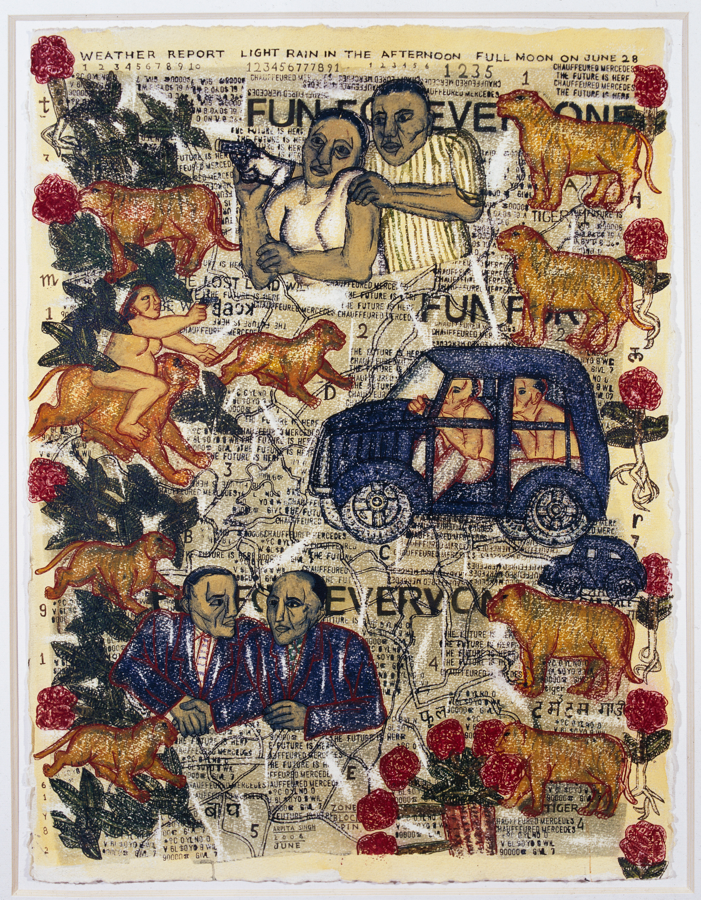
My Lollipop City: Gemini Rising by Arpita Singh (2005) Vadehra Art Gallery © Arpita Singh

The Powders: smaller acrylics

BUT… Big but… when I went into the ‘powders’, the two smaller, more intimate spaces, something happened. I began to like the works here and, given time and sympathy, ended up really liking many of them. Why?

Smaller

Well, they’re all a lot smaller than the monsters in the Perimeter. I can’t quite put into words why this felt important but somehow they were easier to relate to.

Sets

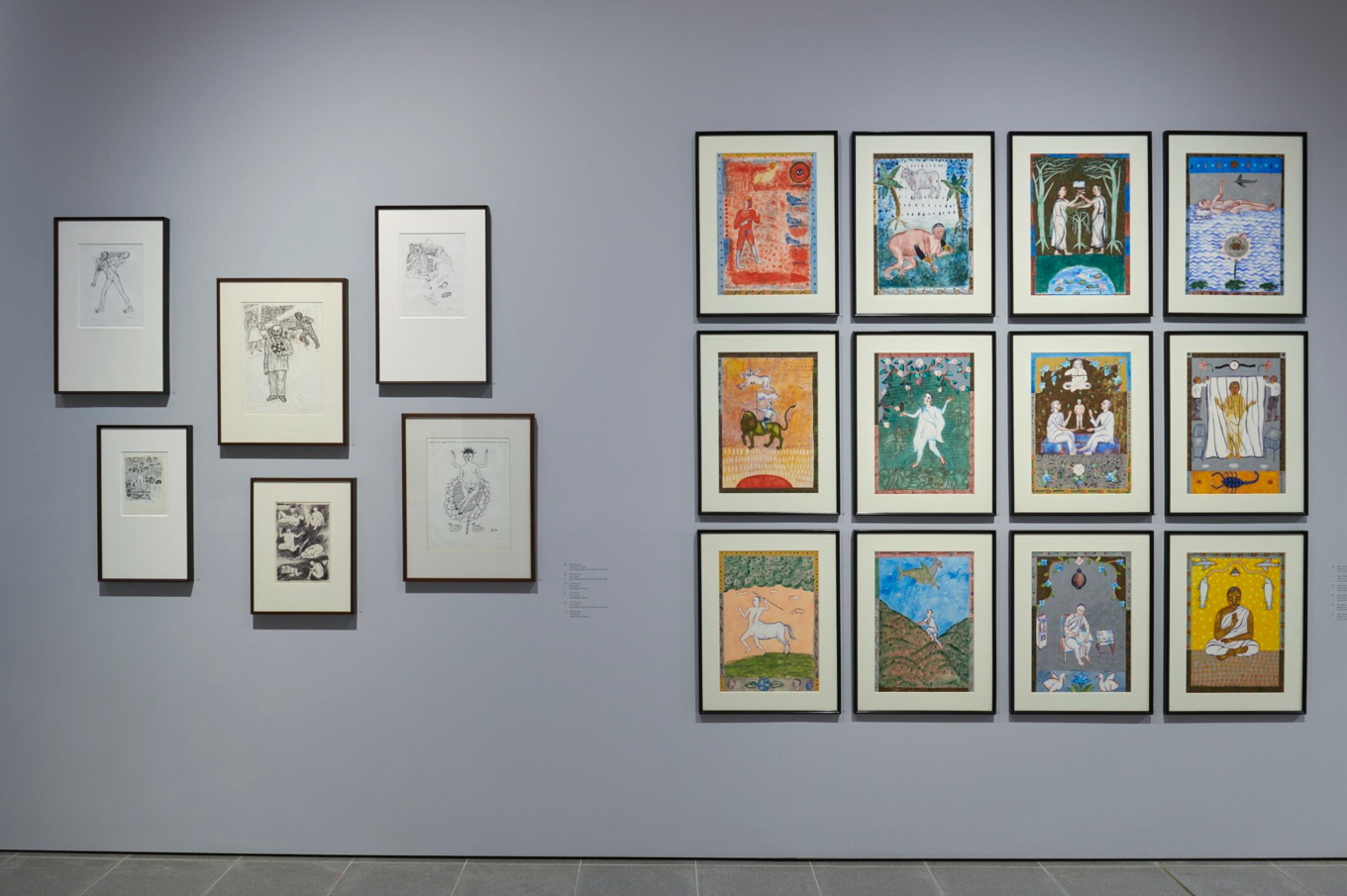
They often come in sets or series, like the series of her reworking of the 12 signs of the Zodiac, and when seen like this her apparently random, childlike imagery becomes more accessible and more likeable, when seen in recurring settings.

Installation view of ‘Arpita Singh: Remembering’ at Serpentine North showing a set of pen and ink drawings on the left, and the 12 acrylic versions of the Zodiac on the right © Photo by Jo Underhill. Courtesy Arpita Singh and Serpentine

Acrylic

A really important reason was the significant difference in psychovisual impact between the big heavily layered oil paintings and the far more muted acrylic and watercolour works. The latter are not only smaller but the lack of surface agitation found in the oil paintings somehow made them seem a lot more calm and civilised. Less hysterical maybe, more serene.

Fewer human figures

And this lack of surface busy-ness, greater calmness, allows you to savour and enjoy the figures more. Some of the larger ones still have lots of figures in but many don’t. In many of them the figures are fewer, bigger and so more impactful, more interesting.

Mysterious

And a lot more beguiling. In the huge oil paintings so much is going on that it’s hard to care. In these smaller, more intimate acrylics and watercolours there’s more time to ponder the compositions and wonder what’s going on.

Influences

The curators tell us that Singh’s art draws on Bengali folk art and Indian stories, interwoven with experiences of social upheaval and global conflict, and that her style is a mashup of Surrealism, figuration, abstraction and Indian Court paintings. And it’s true, at various points all these can be seen: the first few big oil paintings are flat smooth Surreal depictions of random symbols that might have been by the Surrealist Leonora Carrington, while in one of the Powders there are early pen and black ink drawings which might have been by Paul Klee. And the flatness and decorativeness of the images, with a lack of concern for perspective reminded me of the Mughal-era courtly Indian paintings you can see at the Victoria and Albert Museum.

Urban settings

Except that these aren’t in any sense courtly figures. The opposite, they feel like men and women from very modern urban environments, people trapped within or struggling against their environments. In many of them the city seems to be represented by a kind of simple version of an A to Z or city map, showing various roads, all forking and branching out behind the human figures. Some of these lines are blue and so might represent a river (?).

One of the best of these urban alienation images shows what seems to be the same figure of a woman dressed in a black burqa, bent over in various postures of struggling to battle her way through a city represented by what looks like images of a skyscraper (rows of rectangular windows) which has been torn into pieces and scattered around the surface.

Reviewing all this made me think there’s something of Franz Kafka in Singh’s depiction of the city as a challenge, puzzle and maze.

Technology

Onto these child’s-style views of cities are often pasted images of modern technology. Two which recur are cars or taxis stuffed with her primitive figures, or airplanes flying in her childlike sky.

Lesser Myth by Arpita Singh (2006) Courtesy of Vadehra Family Collection © Arpita Singh

Naked women

Arpita Singh is, of course, a feminist, and the two feminist curators of the exhibition (Tamsin Hong and Liz Stumpf) point out that:

Since the 1990s, Singh has increasingly explored themes of motherhood, the aging female form, feminine sensuality, vulnerability, and violence, demonstrating the impact of relationships and external events on the emotional and psychological landscape of the artist. Her works are intimate portrayals of domestic and inner life but are equally concerned with the experiences of women navigating the outside world.

This, I think, is true but what I came to actively like was the way she portrays women; was the way her drastically unwestern eye or style extends to the way she portrays women. It turns out that the rather childlike, gawky style, which doesn’t give a damn about western realism, means that her images of women capture something completely other, different. Western iconography of women is so dominated by the Christian church for 1,000 years and then by the male gaze for the last 500 years, that it’s all but impossible for any depiction of women to escape its clutches. But Singh’s women do. Escape, I mean.

They are obviously ‘adult’ in the sense that they are often naked or wearing diaphanous outfits and she goes to some lengths to depict the women’s vulva, labia etc. In western hands this might be unavoidably graphic and problematic. But somehow, in Singh’s childlike, non-western iconography, it begins to say something else. Something about women’s privacy, integrity, distinctiveness. It’s not salacious. It doesn’t sexualise women in any way. It just emphasises that women are.

A Feminine Tale by Arpita Singh (1995) Courtesy of Taimur Hassan Collection © Arpita Singh, Photo by Justin Piperger

There’s a linked set of images of women pulling transparent saris or fabrics round their bodies which are nothing like the stately dressed aristocratic ladies of Bengali court painting but… but somehow, they bespeak an entirely modern, late 20th century reality of women’s lives and independence. It’s hard to put into words but the more I saw of these, the more I felt like I was entering a really, genuinely, alien and alternative artistic world.

Threatening men

One of the woman wrapping herself in a sari has half a dozen much smaller male figures pulling it down or pinning it down around her and you can feel her resistance to this male… what? Something. Power. Oppression. And you can feel this atmosphere of resistance throughout.

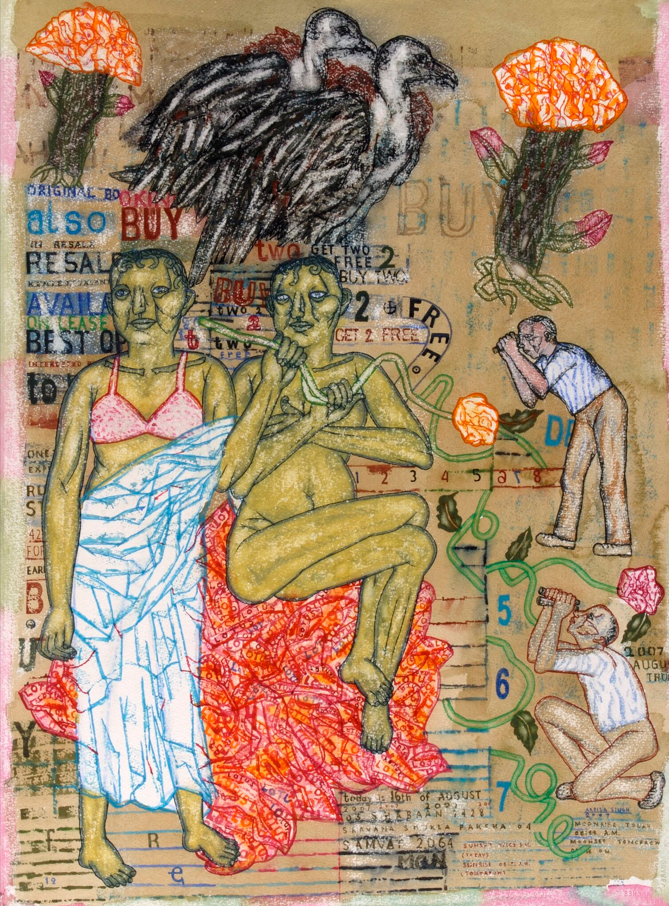
Or take this dense painting. Note the familiar recurring motifs. There’s lots of text all over the work. The women figures are by no stretch of the imagination in any way created for the male gaze but instead express something important but inscrutable about women’s independence. The green line, is it the tendril of some plant? The orange cloth behind the women, is it a curtain or spread of some kind or a sort of map, a sort of tangled A to Z.

Buy Two, Get Two Free by Arpita Singh (2007) Private Collection © Arpita Singh

So the men with the binoculars, are they peeping Toms, are they looking through windows to get a glimpse of scantily clad women? In which case the birds at the top, are they vultures? In which case do the vultures ‘symbolise’ the men, picking over the scraps of women’s bodies chopped up by binocular vision, picking over scraps, exploiters and parasites? Or is the iconography more complex than that? And what do the two trees or bushes with orange heads have to with anything?

Resisting interpretation

This brings us to one of Singh’s strongest points which is that she is not programmatic. Lots of the works have words in, lots of words, mostly in English (why? why not in Bengali or any other Indian language?) as the three images above indicate. ‘Fun Fun Everyone’ are the biggest words visible in ‘Lesser Myth’ amid what seem to be newspaper fragments cut out and collaged together. But what does it really mean? And why are there nine lionesses in the picture? And why is a naked woman riding one of them? And what are the two men in suits at the bottom talking about? And why are there two half-dressed men crammed into one of her characteristically dinky cars? And why is the man in the couple at the top holding a pistol over the woman’s shoulders and why is her arm bent up to support it? And why are there lots of red rose bushes everywhere (or are they hibiscus or some other bright bush native to India which I’m completely ignorant of)?

The pleasure of mystery

It is actively enjoyable not to know the answers to these questions. The more of her acrylic and watercolour work I looked at, the more beguiled I became. All that writing feels as if she has something very important to say and yet all the texts tempt and tease and then veer away, turning out to be more elliptical and obscure than they first appear. And this is very enjoyable.

And there are lots of them. The exhibition features a rather staggering 165 works. I hope I’ve conveyed my journey to you, from initial dislike and scepticism, through slow understanding, and letting the works teach me how to see them, until I felt I had, to some extent, entered her world, a world really very far removed from my own culture and experiences. And that’s what art can do, so well.


Related links

Related reviews

Stories of the East by Leonard Woolf (1921)

Leonard Woolf’s first novel, the brilliant evocation of peasant life in Ceylon, ‘The Village in the Jungle’, was published in 1913. His second novel, the more conventional ‘Wise Virgins’, a thinly disguised account of his and Virginia’s Bloomsbury friends, was published the following year. There then followed a seven year hiatus while he concentrated on publishing the serious political and sociological works he wished to be remembered by:

  • International Government – 1916
  • The Future of Constantinople – 1917
  • The Framework of a Lasting Peace – 1917
  • Cooperation and the Future of Industry – 1918
  • Economic Imperialism – 1920
  • Empire and Commerce in Africa – 1920
  • Socialism and Co-operation – 1921

Then, in among all these serious works about international affairs and the future of imperialism (of which he was a fierce critic) the Hogarth Press, which he had set up with Virginia in 1917, published a slim volume titled ‘Stories of the East’. There are just three stories:

  1. A Tale Told by Moonlight
  2. Pearls and Swine
  3. The Two Brahmans

1. A Tale Told by Moonlight

The setup

This has the influence of Joseph Conrad all over it, from the narrator within a narrator structure, through to the pretty insignificant story itself, which is jazzed up to try and make it about treatment and atmosphere which, in my opinion, doesn’t come off.

The narrator is staying somewhere in the English countryside with Alderton, the novelist. The other house guests are Pemberton the poet and Hanson Smith, the critic. The fourth member of the party is Jessop who the narrator starts the story by telling us is generally unpopular for his habit of being blunt to the point of rudeness and incivility.

After dinner these chaps stroll down through the fields to the river and lie around chatting as dusk falls. When it’s dark they hear footsteps coming along the river and realise it’s a young couple out for a stroll. Concealed in the darkness and on a bank over the riverside path, our chaps hear the young couple murmuring sweet nothings then the sounds of kissing, before they stroll on.

This puts our chaps in a sentimental mood and they share stories about first loves and wooing. All except Jessop who hears the others out then weighs in with his unsentimental withering opinion, which is:

‘Think of it for a moment, chucking out of your mind all this business of kisses and moonlight and marriages. A miserable tailless ape buzzed round through space on this half cold cinder of an earth, a timid bewildered ignorant savage little beast always fighting for bare existence. And suddenly it runs up against another miserable naked tailless ape and immediately everything that it has ever known dies out of its little puddle of a mind, itself, its beastly body, its puny wandering desires, the wretched fight for existence, the whole world. And instead there comes a flame of passion for something in that other naked ape, not for her body or her mind or her soul, but for something beautiful mysterious everlasting—yes that’s it the everlasting passion in her which has flamed up in him. He goes buzzing on through space, but he isn’t tired or bewildered or ignorant any more; he can see his way now even among the stars. And that’s love, the love which you novelists scatter about so freely…’

So Jessop ridicules all the soppy talk about love and moonlight and says real love is strange, uncanny, unpredictable, makes no sense, is the rarest thing in the world. He’s knocked around the world and only ever seen two cases of it, and he’s now going to tell us about one of them.

So all this has been by way of introduction and this it is so redolent of Conrad: the all-male company; after dinner, in the dark; all described by an unknown narrator who then introduces one of the party telling a story-within-a-story. Structurally, it’s identical with the famous setting of Heart of Darkness.

The story

Among Jessop’s many friends and acquaintances was a man named Reynolds, a novelist. They were at Rugby (public school) together. Jessop was living ‘out East’, in Ceylon, in the capital Colombo. Reynolds and he exchanged occasional letters until Reynolds announced he was heading in that direction and it was arranged he’d come and stay for a week.

He was a thin, weedy man who’s ‘stood aside’ from life, out of nervousness, a legacy of being bullied at school, knew all about people’s little tricks and mannerisms but didn’t know how they felt because he’d never felt anything except fear and shyness. So Jessop took him to all the expat clubs and they sat and talked about love and life and Jessop realised he’d never actually lived a day in his life.

So he determines to show him a side of life he hadn’t seen before, and takes him in a rickshaw out into the seedy, native part of town, to a dingy house which is a native brothel. Here they are greeted by ten or so beautiful young scantily-clad women, laughing and giggling. Poor Reynolds is terribly embarrassed at the bare boobs and golden bodies and doesn’t respond to their kisses or caresses so most of them gravitate over to Jessop who can speak their language and is prepared to listen to their stories about the native villages they come from and the arduous lives they’ve escaped to come to the big city. All except one.

She was called Celestinahami and was astonishingly beautiful. Her skin was the palest of pale gold with a glow in it, very rare in the fair native women. The delicate innocent beauty of a child was in her face; and her eyes, Lord, her eyes immense, deep, dark and melancholy which looked as if they knew and understood and felt everything in the world. She never wore anything coloured, just a white cloth wrapped round her waist with one end thrown over the left shoulder. She carried about her an air of slowness and depth and mystery of silence and of innocence.

Long story short, they fall in love and, Jessop insists, it was the real thing not the milk and moonlight version of English poets and novelists. It was something deep and inexplicable.

He looked into her eyes that understood nothing but seemed to understand everything, and then it came out at last; the power to feel, the power that so few have, the flame, the passion, love, the real thing. It was the real thing, I tell you; I ought to know…

So Reynolds becomes hooked and goes back to the brothel night after night in order to see Celestinahami. But Reynolds becomes so unhappy at the impracticality of the whole situation that he makes a feeble attempt to shoot himself. He buys a revolver but Jessop burst into his room to find him struggling with the mechanism which clips chamber shut and seized it out of his hands.

Then Jessop read him the riot act and this is the bit I didn’t really understand, or thought contradicted itself. Because Jessop tells Reynolds that the girl is nothing like he imagines:

not a bit what he thought her, what his passion went out to—a nice simple soft little animal like the bitch at my feet that starved herself if I left her for a day

BUT, at the same time, acknowledging that what Reynolds feels for her IS the real thing:

You’re really in love, in love with something that doesn’t exist behind those great eyes. It’s dangerous, damned dangerous because it’s real—and that’s why it’s rare.

So it’s real love, one of the only two times Jessop has seen ‘real’ love – and yet he’s perfectly aware that it’s love for something which doesn’t exist. Reynolds is utterly projecting something onto this girl which simply isn’t there. And yet this is what Jessop calls real love. See why I’m a bit confused?

Anyway, Jessop roughly tells Reynolds to either get on the next ship home or ‘practise what you preach and live your life out, and take the risks.’ So for the first time in his life, Reynolds takes a chance on life. He buys the girl out of the brother (for the bargain price of 20 rupees) and Jessop fixes them up in a nice cottage by the sea.

At first they were happy. He taught her English and she taught him Sinhalese. He started to write a novel about the East. But pretty quickly he comes to realise the truth. He comes to realise the vast difference in intellect and education and culture between them.

He couldn’t speak to her and she couldn’t speak to him, she couldn’t understand him. He was a civilized cultivated intelligent nervous little man and she—she was an animal, dumb and stupid and beautiful.

He loved her but she tortured him. She got on his nerves.

But the cruellest thing of all was that she had grown to love him, love him like an animal; as a bitch loves her master.

Because:

There’s another sort of love; it isn’t the body and it isn’t the flame; it’s the love of dogs and women, at any rate of those slow, big-eyed women of the East. It’s the love of a slave, the patient, consuming love for a master, for his kicks and his caresses, for his kisses and his blows. That was the sort of love which grew up slowly in Celestinahami for Reynolds. But it wasn’t what he wanted, it was that, I expect, more than anything which got on his nerves.

So, the story tells us, there are two types of love: the big visionary type which, it has been clearly explained, Reynolds projected onto Celestinahami; and the dog-like, slave-like master-love of Celestinahami. Neither sound to me like ‘the real thing’, which Jessop set out to describe.

She used to follow him about the bungalow like a dog. He wanted to talk to her about his novel and she only understood how to pound and cook rice. It exasperated him, made him unkind, cruel. And when he looked into her patient, mysterious eyes he saw behind them what he had fallen in love with, what he knew didn’t exist. It began to drive him mad.

And so the story hurtles to its inevitable, Conradian end. She takes desperate steps to try and keep his ‘love’, the most florid being to dress up like the white women she sees in Colombo, in stays and white cotton stockings and shoes. But the more she tries, the more she destroys the image Reynolds had of her, the more angry he becomes, the more wretched she.

Eventually Reynolds realises he has to leave and carry on his travels. He swears to Celestinahami and Jessop that he’ll be back, he considerately makes over the house to Celestinahami’s ownership, then one fine day sails away on a P&O liner.

I never saw Reynolds again but I saw Celestinahami once. It was at the inquest two days after the Moldavia sailed for Aden. She was lying on a dirty wooden board on trestles in the dingy mud-plastered room behind the court… They had found her floating in the sea that lapped the foot of the convent garden below the little bungalow—bobbing up and down in her stays and pink skirt and white stockings and shoes.

I suppose this is all very well done, but very much in the manner of Conrad even down to the punchline. Just as in one of Conrad’s classic tales told by his sailor-narrator Charles Marlow, the storyteller ends his tale, there’s a pause, and then one of the company of listeners brings us back to reality with a down-to-earth comment.

Jessop stopped. No one spoke for a minute or two. Then Hanson Smith stretched himself, yawned, and got up. ‘Battle, murder and sentimentality,’ he said. ‘You’re as bad as the rest of them, Jessop. I’d like to hear your other case—but it’s too late, I’m off to bed.’

Commentary

The feel and structure of the thing are, as pointed out, very Conradian, from the double narrative structure through to the deliberately throwaway ending, designed to evince that mood of cynical, jaded, man-of-the-world indifference to what is, in essence a tragedy (reminiscent of the plot of Puccini’s opera ‘Madame Butterfly’).

And you don’t have to be a feminist to find the fundamental structure – or two narrative structures – objectionable. What I mean is the frame story, in which four comfortably-off men sound off to each other about love without much or any admission of the woman’s point of view – and then listen to a tragedy based around the innocence and ignorance of poor Celestinahami. The power imbalances in both these structures are there for everyone to see. And the worldly note of the throwaway ending may be designed to indicate the fundamental heartlessness of the world, but it highlights that none of the listeners has a word of lament over poor Celestinahami.

But what puzzled me, more than anything, was that the story, the first narrator, and then Jessop all promise some great revelation about The Truth of Love, and then it doesn’t arrive. Maybe the narrator and Jessop’s point is that such a thing doesn’t exist, and instead, what actually exists in the real world is more complex, unsentimental, irrational and almost unpleasant, than the moon-in-June sentimental clichés.

In which respect, then, it chimes very much with the heartless worldview which radiates from his wonderful if extremely bleak novel, ‘The Village in the Jungle’.

2. Pearls and Swine

The setting

The unnamed first-person narrator is staying at a hotel in Torquay. After dinner and a game of billiards he joins three other chaps sitting round the fire. They’re talking about India, which reminds him of the 15 years he spent out there. Two of the three – a stock jobber and a clergymen – have never been out East and so sound off with insufferably imperialist cant and clichés: the stock jobber says the Indians must accept our racial superiority; the clergymen says we are undoubtedly raising them up to our level of civilisation, not least through the work of earnest young missionaries, basing his views on:

‘I read the papers, I’ve read books too, mind you, about India. I know what’s going on.’

All this cant goads the third member of the group, a small man with dark skin and wrinkles round his eyes (the narrator recognises a fellow servant of empire) beyond endurance, and he bursts out with a Tamil proverb. When asked to translate he explains that it’s a polite way of indicating the foolishness of earnest young Englishmen who go out to idea full of naive ideas drummed into them by their School Board education and think that somehow, after just 18 months, they understand the place from top to bottom, from ‘Benares to Rameswaram’. Compared to the Tamils who have lived in India for at least 7,000 years, compared to the hundreds of races who share the continent (‘there are more races in India than people in Peckham’).

Mention of views and opinions provides the hinge or pretext for the little Anglo-Indian man to announce that instead of views, he will tell them some facts. And this is what he proceeds to do.

The story

This is the real point of the story. The Anglo-Indian gives a ten-page account of his time serving in southern India as government administrator of a peal fishery. This was based on a God-forsaken stretch of the coast which consisted of nothing but barren sand and scrub for hundreds of miles, without a town or village or river or fresh water. But off this coast were marvellously rich oyster beds and every year, for 6 to 8 weeks between monsoons, thousands of fishermen in hundreds of boats, come to farm the oysters, a varied crew including scores of different races of Indians, plus Arabs and their Black ex-slaves, a multicultural community devoted to one end, diving to bring up thousands of oysters every day, to leave them rotting in the sun for the flies to devour, in the hope they will reveal pearls of great price embedded in their flesh.

The British Imperial government taxes their catch, taking two-thirds of the pearls. And the small, dark intense storyteller once performed this role and now describes, in vivid and powerful detail, what it was like – the heat, the unbearable flies, the nauseating smell of thousands of rotting oysters, the babble of native voices. All the several thousand fishermen had to be confined in a compound for 6 to weeks, creating a madly unhygienic and disease-ridden environment.

So that establishes the ground base of the story. Into this environment come two more white men: one is Robson, a 24-year-old bright spark who passed the Civil Service exams and is overflowing with bright new ideas about reforming everything, who criticises the narrator for giving up on changing the East and instead letting the East change him.

He was too cocksure altogether, of himself, of his School Board education, of life, of his ‘views’. He was going to run India on new lines, laid down in some damned Manual of Political Science out of which they learn life in Board Schools and extension lectures.

Predictably, his body and mind are not prepared for the disgusting conditions of the compound, the heat and the flies, and he ends up vomiting lots of time every day, becoming sicker and sicker.

The other white man is (ironically) named White. He’s a drunk, a rummy, with a pinched face and sharp teeth with gaps between them. But he’s a white man so Robson and the (unnamed) narrator let him eat at the same table. White tells the others he went to public school, which is probable, failed in England and so came out East. But even here he has been bedevilled by ‘damn bad luck’ and tells sob stories about a succession of dubious-sounding jobs.

So that’s the setup: three white men in a huge barren hot inhospitable semi-desert next to the sea, trying to control thousands of native pearl divers from all across India and beyond. We expect trouble, if not tragedy.

Sure enough, things happen. First a fight breaks out between a group of Arabs and one of Tamils over a handful of oysters which fall out of a bag. By the time the narrator separates them one Tamil is dead and ten or so have been injured. Idealistic Robson, for all his fancy ideas of ‘Reforming The Empire’, turns out to be predictably useless, running around like a distracted hen and crying.

But the main event in the story is that White comes down with a severe attack of delirium tremens or DTs. He starts raving and threatening violence so the narrator has to knock him out with a rifle butt. When he comes round, the narrator ties him to his bed. His raving, his tormented hallucinations are a trial for the narrator but tip young Robson over the edge, reducing him to sitting and crying.

All this allows Woolf to write some highly enjoyable bravura passages of the different mentality of the old India hand, of how you come to adopt the native mentality, become more passive, and accept the vast impersonal forces which dictate life, your life, everyone’s lives.

One just did one’s work, hour after hour, keeping things going in that sun which stung one’s bare hands, took the skin off even my face, among the flies add the smell. It wasn’t a nightmare, it was just a few thousand Arabs and Indians fishing tip oysters from the bottom of the sea. It wasn’t even new, one felt; it was old, old as the Bible, old as Adam, so the Arabs said. One hadn’t much time to think, but one felt it and watched it, watched the things happen quietly, unastonished, as men do in the East. One does one’s work,—forty eight hours at a stretch doesn’t leave one much time or inclination for thinking,—waiting for things to happen. If you can prevent people from killing one another or robbing one another, or burning down the camp, or getting cholera or plague or small-pox, and if one can manage to get one night’s sleep in three, one is fairly satisfied.

And again, a meditation on the profound difference between East and West:

Things here feel so different; you seem so far from life, with windows and blinds and curtains always in between, and then nothing ever happens, you never wait for things to happen, never watch things happening here. You are always doing things somehow—Lord knows what they are—according I suppose to systems, views, opinions. But out there you live so near to life, every morning you smell damp earth if you splash too much in your tin bath. And things happen slowly, inexorably by fate, and you—you don’t do things, you watch with the three hundred millions. You feel it there in everything, even in the sunrise and sunset, every day, the immensity, inexorableness, mystery of things happening. You feel the whole earth waking up or going to sleep in a great arch of sky; you feel small, not very powerful. But who ever felt the sun set or rise in London or Torquay either? It doesn’t: you just turn on or turn off the electric light.

This is all rather wonderful. But White won’t stop raving, all through the night. He moves on from hallucinations to describing shocking, immoral, cruel and corrupt behaviour all through his life, which is worse, more demoralising. The narrator moves him from his bed and ties him to a pole near his official desk where he can keep an eye on him. Arabs and Tamils come to watch him silently. The narrator explains that he is ill, the heat has driven him mad, and they accept this as they accept everything and move away with the ‘calm patient eyes of men who watched unastonished the procession of things’.

For one long night White raves and then, as dawn arrives, he cries out and dies. The narrator cuts him down from the pole and lays him out. But at that exact moment he is called by some locals. An oyster boat is coming inshore with a dead body on it, an Arab who died in mid-dive.

Woolf creates a very deliberate and stark contrast between the two dead men: White is a symbolic figure, symbolising the absolute worst of white men in the East, a corrupt drunk and public scandal who dies with horrible indignity.

By contrast the dead Arab is brought ashore by his colleagues, his brother sits by his body quietly weeping, an Arab sheikh comes up, lays his hand on the head of the lamenting man, and quietly and calmly consoles him. He died doing his work, doing his duty as a man. Everyone – dead man, brother and sheikh – are drenched in dignity and honour as the dawn breaks.

At this point the little brown man finishes his story. As with ‘A Tale Told by Moonlight’ the ending is deliberately dismissive, realistic, indicating the place of this, just one more story among a million stories in the western realm of endless discourse.

There was silence in the smoking-room. I looked round. The Colonel had fallen asleep with his mouth open. The jobber tried to look bored, the Archdeacon was, apparently, rather put out.

This feels much better than the first story for two obvious reasons. The dichotomies or binaries are easy to spot and enjoy, namely: between the shallow pontificating of the stock jobber and the clergyman, and the little brown Anglo-Indian; then between young idealistic Robson and the narrator; and then between the dignified locals and the wildly undignified, drunken White. There is the deeper dichotomy between imperial rules and the ruled to unpick as well, if you want to.

But mostly what makes it enjoyable is Woolf’ couple of paragraph-length descriptions of the mentality of the East, the spirit of the East, so utterly different from the pampered ignorance of London clubland where the frame story is set. All very neat, well constructed and enjoyable.

The Two Brahmans

Description of Yalpanam, a very large town in the north of Ceylon, which always feels abandoned and sleepy as all the living goes on behind the high fences made of the dried leaves of the coconut palms which conceal the compounds in which sit the huts and houses.

In the north of the town is the section devoted to Brahmans, to most senior caste in India’s caste system, who must keep themselves from being defiled, losing caste and face in countless ways. For example they do no work for themselves, all their needs are catered to by lower cast workers devoted to trades such as fishing tending rice, digging wells and so on.

In order to avoid defilement, the 50 or so Brahman families in Yalpanam all live in the same part of town, on the northern edge abutting the big lagoon. And for centuries if not millennia they have all married off their sons and daughters to each other to preserve their purity.

The story spans four generations of two particular families, headed by two fathers Chellaya and Chittampalam whose compounds neighbour each other. To be brief, both Chellya and Chittampalam shame their families by undertaking manual work. They try to keep it hidden but words get out and the other Brahman families cut them off. Among other things, this means their children and their children’s children and their children’s children’s children, will not be accepted for marriage by anyone in the town. They’ll have to go to distant settlements to find Brahman families which have never heard of their shame.

Chittampalam is a miser. When the water in his well starts to become brackish he should have gotten an earth carrying caste member to dig him a new well. Instead, in order to save, money he dug it and carries the soil away on his head himself. People saw him and he lost caste.

But it’s Chellaya who gets the lion’s share of (this very short) story. He likes to spend his afternoons staring out over the big lagoon and slowly becomes obsessed with the fishermen who wade out into the water and cast their nets. It looks so idyllic, it looks so relaxing. So one day he shamefacedly asks one of the fisherman if he could show him how to cast a net. He comes up with a cock-and-bull story about having made a vow to some god to do it as reward for healing his son but nobody is fooled. So for a small payment the fisherman sells him a net and then on successive days, far away from the village, shows him how to cast it. But someone, inevitably, sees, and he, too, loses caste.

I was wondering how these two bad Brahmans were going to be brought into contact or conflict but they aren’t. Chittampalam dies soon after being discovered carrying earth and Chellaya a few years later. It’s their great-great-great grandchildren who are. Four generations later the male descendants of the two naughty Brahmans bear the same names, Chellaya and Chittampalam.

Everybody’s forgotten which one of them carried the earth and which one cast nets, but they are still shunned by the other Brahman families and still have to marry outside the town.

And so we reach the climax of this little tale. The descendant Chellaya and Chittampalam still live in the same compounds as their ancestors, next to each other. And Chittampalam has a very beautiful daughter and Chellaya has one son unmarried, who one day sees the beautiful daughter through the compound wall, and suggests to his father that he marries her.

So the two fathers meet up and are in agreement that it would be an excellent marriage. However there’s one sticking point, the same sticking point there always is in all these native marriages, the size of the bride’s dowry: the father of the girl wants the dowry to be small and the father of the boy wants it to be large.

Well, the denouement, climax or punchline of the story turns out to be that… each time they meet to discuss the dowry it isn’t long before Chittampalam loses his temper and calls Chellaya a fisher, Chellaya loses his temper and calls Chittampalam a pariah and they both storm off.

Chellaya’s son calms his father down and arranges for the two men to have another meeting a few days later, but the exact same thing happens, with negotiations which start sensibly ending in a shouting match and both men storming away. Oh well, they realise; like their fathers and grandfathers and great-grandfathers before them, they will have to marry off their children to partners from some distant village which has never heard of their shame.

So the moral of the story, children, is that the sins or errors or mistakes of the ancestors continue to bedevil and stymie the wishes of their descendants. Silly, isn’t it? And yet it’s those values and traditions which give our lives their meaning and aren’t as easy to shake off as glib outsiders think.

In a poignant and symbolic coda, Chellaya’s son, lovesick for Chittampalam’s daughter, takes to going and sitting at the exact same spot where his great-great-great-grandfather Chellaya used to sit and watch the fishermen cast their nets.

Maybe it’s not just social conventions and transgressions which are passed down through the generations, but something deeper; something about gestures and longings and desires which are revived and repeated in every generation…

Thoughts

‘Pearls and Swine’ is clearly the best of the three stories, which is why Eland chose to include it in their paperback edition of ‘The Village in the Jungle’ but not the other two.

‘The Two Brahmans’ is fine as far is it goes, conveying not only the restrictions of Brahman life but, better, the sense of the yearning of the Brahman who wanted to become a fisherman, briefly standing for everyone who has a dream or desire beyond their station in life; but is too short to make a big impact.

‘A Tale Told by Moonlight’ is clearly the worst story, because of the unsympathetic character of Jessop the blunt cynic; because it is based – like so many turn-of-the-century stories, plays and operas – on the immiseration and suicide of an innocent young woman; but most importantly, I thought it didn’t live up to the promise to be some kind of meditation on the nature of Real Love. Didn’t strike me as being that at all, but instead a cliché, and an unpleasant exploitative cliché at that.


Credit

‘Stories of the East’ by Leonard Woolf was published by the Hogarth Press in 1921. I read ‘Pearls and Swine’ in the 2008 Eland Publishing paperback edition of ‘The Village in the Jungle’ which includes it as a kind of bonus. The other two I read online.

Related link

Related reviews

The Years by Virginia Woolf (1937)

‘What could be more ordinary?’ she said. ‘A large family, living in a large house…’
(Rose Pargiter, thinking back on her childhood, page 161)

He looked clean, he looked starched and ironed like his robes. But what did he mean by what he was saying? She gave it up. Either one understood or one did not understand, she thought. Her mind wandered.
(Typical behaviour from one of Woolf’s female protagonists [in this case, Delia], detached from male discourse and dreamily drifting into her own world)

Her mind was a perfect blank for a moment. Where am I? she wondered. What am I doing? Where am I going? Her eyes fixed themselves on the dressing-table; vaguely she remembered some other room, and some other time when she was a girl…
(Kitty Malone expressing the dissociation and bewilderment typical of so many Woolf women)

The Years is Woolf’s longest novel. The strange thing is how this big and traditional novel punctuated her run of much shorter, much more experimental works, coming after the run of Jacob’s Room (1922), Mrs Dalloway (1925), To The Lighthouse (1927) and before her last, normal-length work, Between The Acts (1941).

It’s a sad and mournful book, lyrical and nostalgic. I like the suggestion by Nuala Casey (see below) that it’s a sort of ghost story, the ghosts being Woolf’s own family who the Pargiter family are clearly based on.

‘The Years’ and ‘Three Guineas’

‘The Years’ had a long, complicated and painful gestation. It was intimately tied up with the long feminist essays which became Three Guineas. According to Wikipedia:

Although Three Guineas is a work of non-fiction, it was initially conceived as a ‘novel–essay’ which would tie up the loose ends left in her earlier work, A Room of One’s Own (1929). The book was to alternate between fictive narrative chapters and non-fiction essay chapters, demonstrating Woolf’s views on war and women in both types of writing at once. This unfinished manuscript was published in 1977 as The Pargiters. When Woolf realised the idea of a ‘novel–essay’ wasn’t working, she separated the two parts. The non-fiction portion became Three Guineas. The fiction portion became Woolf’s most popular novel during her lifetime, The Years, which charts social change from 1880 to the time of publication through the lives of the Pargiter family. It was so popular, in fact, that pocket-sized editions of the novel were published for soldiers as leisure reading during World War Two.

The soldiers’ version

Regarding its popularity and the publication of a pocket edition for soldiers, as I read through The Years I came to understand why. It is gentle and beautiful, sad and nostalgic. Each of the book’s 11 sections opens with a description of the English countryside or the busy London streets, in winter and in summer, in rain and shine, and these slowly build up into a composite portrait of the country those soldiers were fighting for.

And you can put The Years down and pick it up at any point, on any page, without worrying about forgetting the plot, because there is no plot. The characters waft around London in the same lyrical, detached, dreamlike state for hundreds of pages.

Similarly, although we know Woolf was incensed by the oppression of women by the patriarchy of her day, and although her fury is hinted at at various points in the narrative, ironically it is the very exclusion of women from education, the professions and public life, from activities of most kinds, which permits the novel’s lazy, hazy, dreamy tone.

The person who emerges as the central protagonist, Eleanor Pargiter, is the one who suffers most from patriarchal exclusion, finding herself obliged to stay at home to look after her widowed father, never benefiting from a proper school let alone university education, excluded from all the professions and any kind of paid employment. No wonder she grows up into the detached, dreamy, forgetful woman she’s depicted as – what alternative was there for women of her era and class?

There is also a pleasing irony that the great pamphlet The Years grew out of, Three Guineas, is furiously against war and against the entire patriarchal, masculinist system of hierarchy, competition and militarism which encourages it, and yet the fiction which evolved alongside it was mass published to help and succour… soldiers, becoming, in its particular way, part of the vast machinery of war which Woolf claimed to hate so much.

‘Three Guineas’ feminism

As explained, The Years was originally conceived to be interspersed with factual chapters detailing the oppression of women in England during the period covered (1880 to 1937). Eventually Woolf realised the two books had to be separated out and from her factual material created the great pamphlet, Three Guineas.

Three Guineas is a powerful feminist polemic. Reading it changed my opinions, shifting me to a markedly more feminist point of view of English social history and in particular the literature of this period, the late Victorian and Edwardian era. It is more difficult to read but, in the end, much more powerful than the shorter, more popular A Room of One’s Own.

Three Guineas is a searing indictment of all aspects of the patriarchal system developed during the Victorian era, which Woolf felt still strangled women’s aspirations in the 1930s. One aspect of this is her compelling portrait of the classic Victorian family home as a prison for daughters. Middle-class daughters were deprived of the private education given to their brothers, prevented from going to university, prevented by law from entering any of the professions, prevented from earning money and having any kind of financial or personal independence. Instead they were trapped in the prison of the Victorian family home ‘like slaves in a harem’, subject to the tyrannical whims of an all-powerful paterfamilias and, more often than not, confined to tending family members, especially if they were sick. Millions of women were forced to squander their talents, living lives blighted by endless legal, financial and cultural restrictions. This boredom crops up throughout the opening chapters.

‘I’ve nothing whatever to do,’ [Delia] said briefly. ‘I’ll go.’

This, then, is why the young women of Woolf’s day obsess about marriage and spend so much time fantasising about the young men they meet at this or that party or reception. Because marriage represents the only means of escape from the stifling family home. Deprived by law and tradition from all other channels of expression and achievement, pursuit of the perfect marriage is the only ‘profession’ allowed them.

She [Eleanor] wished Milly did not always bring the conversation back to marriage. And what do they know about marriage? she asked herself. They stay at home too much, she thought; they never see anyone outside their own set. Here they are cooped up, day after day… (p.31)

My reading of Three Guineas heavily influenced my reading of The Years, the weight of Woolf’s angry critique of Victorian oppression of women hanging very heavily over the text of the novel.

The character of the damaged, angry, unpredictable Colonel Pargiter is straight out of the essay, as is the permanent gloom caused by their mother’s long illness, the heavy curtains, the sense of trapment and stasis. Then, after the mother dies, Eleanor finds herself even more trapped in the role of her father’s carer and household manager, while all the time she watches the boys of the family go off to their private schools, then to Oxbridge colleges, and then on to professions in the army, academia or the law. All forbidden to the daughters of the family.

Presumably the dominance of this factual or even political agenda is one reason why the novel is so unlike her experimental ones, so much more conventional, much closer to the big novels about family dynasties which were so popular in the Edwardian era (for example, the series of novels by John Galsworthy making up The Forsyte Saga published 1906 to 1921).

Structure

How do you ‘chart social change? Well, Woolf picked a series of specific years, like snapshots in a family scrapbook. Hence the structure, the chapter titles and title of the novel as a whole.

  1. 1880 (82 pages)
  2. 1891 (37 pages)
  3. 1907 (15 pages)
  4. 1908 (12 pages)
  5. 1910 (29 pages)
  6. 1911 (20 pages)
  7. 1913 (8 pages)
  8. 1914 (52 pages)
  9. 1917 (20 pages)
  10. 1918 (3 pages)
  11. Present Day (123 pages)

Curious to see if the section lengths indicated any sort of pattern, I turned them into a graph. No particular pattern emerges except the obvious fact that the first and last chapters are the longest, with the final chapter as long as all the short ones put together. The book is heavily weighted towards the ‘Present Day’

The Waves and The Years

Each of the 11 sections starts with a paragraph or so describing the time of the year and the weather, giving lyrical natural descriptions before the text zooms in onto the human characters. This tactic of natural setting followed by human interaction is very similar to the structure of The Waves, in which each of the sections is preceded by a description of the passage of the sun through the sky and the effect of the changing light, wind and weather on the sea beneath it – before moving on to focus on the lives of the characters. Not quite identical but a very similar idea.

And it’s not just using an introductory section about the weather that both novels have in common. The idea of following half a dozen or so characters, from childhood through to adulthood by giving snapshots of particular moments or events scattered over a period of 40 or more years, this is exactly the method of The Waves.

The similarity extends to the tactic of giving the children a couple of childhood events or moments, and then having these same events be remembered in each successive section, so that they slowly build up significance and resonance. Thus it was with the childish incident of Jinny kissing Louis in The Waves which gains significance as the various characters remember it throughout their lives. Here it is incidents like defiant little Rose sneaking out of the house to run along to Lamley’s shop or Maggie’s memory of the cheap necklace Eleanor bought for the Colonel to give her (Maggie) on her birthday.

1880. The Pargiter family at Abercorn Terrace wait for their mother to die (82 pages)

It was an uncertain spring. The weather, perpetually changing, sent clouds of blue and of purple flying over the land…

Colonel Abel Pargiter is in his 50s. He served in India where he lost two fingers during the Mutiny of 1857. He lives in a comfortable family home in Abercorn Terrace, off the Bayswater Road, north of Hyde Park.

An online article by Nuala Casey tells me that:

The Pargiter family home in Abercorn Terrace is a replica of 22 Hyde Park Gate where Woolf grew up with her father, the Victorian biographer Leslie Stephen, her mother Julia, a former Pre-Raphaelite model, her siblings Vanessa, Thoby and Adrian and step-siblings Stella, Gerald and George Duckworth.

The colonel’s wife is dying of some slow wasting illness, so he has taken a mistress, Mira, who lives in a dingy house near Westminster Abbey. Mira herself is no longer young, being about 40 and with a daughter at school.

Back at the family home wait the Colonel’s children – Milly, Delia (‘his favourite daughter’), Rose, Eleanor and Martin. They are all terrified of his bad moods. Eleanor, in her early twenties, is already the household manager and accounts keeper. Martin is 12, Rose is 10.

There are several servants. The main housekeeper is named Crosby, silent and efficient. The butler is named Hiscock, rarely talks, always mumbles.

Morris is another son but is old enough (after his private education) (in his early 20s) to have a job, as a junior in a barristers chambers (‘devilling for Sanders Curry’).

Cut to rooms in an Oxford college. Here we meet Edward Pargeter and his two friends, hulking great Gibbs and more effete Ashley. They’re not really friends, they don’t get along. When he’s got rid of them Edward hears laughter from the Lodge of the college and wonders who’s there with young Kitty who, presumably, he has a thing for.

Cut to the Malone household. Father is a don, Dr Malone. The interest is on young Miss Kitty Malone. She’s spent the day showing Mrs Fripp, the wife of American tourists, round Oxford. At the end of the day she undresses to go to bed. She’s a large girl who’s self conscious about her size.

Next morning she gets up and goes to see her tutor, Miss Craddock who’s tutoring her in history. Miss C is very harsh and says a child of ten could have written Kitty’s latest essay. We don’t even find out that the subject of the essay is, before their hour is up and Kitty goes on to visit the Robson family in Prestwich Terrace.

She despises their bad taste, their rooms cluttered with pretentious junk, and they’re all so small, until the son of the house, Jo, comes in from the back garden where he’s been repairing a hen coop. Kitty fancies him; she’d like him to kiss her. Jo thinks she’s a ‘stunner’.

She returns to the Lodge and sits with her mother as the latter reads The Times. Then a note arrives to say that cousin Rose has died. This is obviously Mrs Pargiter. Mrs Malone remembers sitting with Rose out on the moors in Yorkshire when young Abel Pargiter rode up from his barracks to propose to her (Rose).

Cut to the house in London, in Abercorn Terrace. it is dark and full of wreaths. The coffin containing their mother’s body is carried out. Rose’s funeral is seen through the eyes of Delia who loved and hated her. Delia feels excluded by her father and brothers who manage everything.

1891. Eleanor goes to watch brother Morris in the law courts, Colonel Pargiter visits his brother, Sir Digby Pargiter. Death of Parnell (37 pages)

The autumn wind blew over England. It twitched the leaves off the trees, and down they fluttered, spotted red and yellow, or sent them floating, flaunting in wide curves before they settled…

It is October. Kitty has married Lord Lasswade, has a little boy, lives at his grand house in the North of England. Milly has married Edward’s student friend, big Hugh Gibbs. She is pregnant. Edward is an academic at Oxford, in Classics. Morris is a barrister walking through the Inns of Court.

Eleanor, now in her early 30s, still lives at home with her father, still does the household accounts, as well as running round taking part in various committees and managing the family’s other properties, dingy rented houses called Rigby Cottages, dealing with dishonest traders; plus buying a last-minute present for her father to take to Aunt Eugénie for her little girl, Magdalena (Maggie)’s, birthday.

After a morning of chores and lunch with her father, Eleanor hurries off to the Law Courts to watch Morris prosecute a case. On the way she reads a letter from Martin who is 23 and serving in India. She rendezvous with Morris’s small, cat-faced wife in furs, Celia Chinnery.

I read the scene of Morris in court through the prism of Three Guineas. Woolf’s fierce condemnation of the way the patriarchy excluded women from all the professions brings out the outsiderness of Eleanor, excluded from a good education, prevented from attending university, she views proceedings as an outsider. She notes the palliness of all the barristers, their awe of the judge, but without following any of it, her head full of her own impressions and memories. All this makes a lot more sense if you bear in mind Three Guineas explanation of women’s exclusion from every aspect of public life.

Out in the busy Strand she reads a newspaper announcement that Charles Stewart Parnell, the Irish independence leader, is dead (6 October 1891). Her sister, Delia, was a supporter of Home Rule so she takes a cab out to the squalid square where Delia lives, but she’s not there.

Cut to Colonel Pargiter visiting Aunt Eugénie in her house in Browne Street. She is married to his younger brother, Sir Digby Pargiter, and her two young daughters, (Sara and Magdalena) are playing in the garden round a bonfire of autumn leaves. Sir Digby arrives, 5 years younger than the Colonel, though the Colonel has more money. After some chat and chaffing the children, the brothers have no more to say to each other, so the Colonel leaves.

En route to their house he’d read a letter to him from his old mistress, Mira, who’s now in her 50s and fat. She had gone off with some other chap who has now, predictably, dumped her and she wants money from him. The Colonel had wanted to tell Eugénie about her, Mira, to unburden himself of his secret life but the moment never occurs, and he leaves, frustrated.

1907. Digby and Eugénie attend a party then come home to their daughter, Sara (15 pages)

It was midsummer; and the nights were hot. The moon, falling on water, made it white, inscrutable, whether deep or shallow…

Each chapter opens with a bird’s eye description of London or the countryside. This one opens with a long description of all the carts of agricultural produce lumbering along roads into London towards Covent Garden (compare and contrast Oscar Wilde’s description of the same thing in Lord Arthur Saville’s Crime and D.H. Lawrence’s description in Aaron’s Rod).

Eugénie and Digby and their older daughter, Magdalena (Maggie) are riding in a coach through Hyde Park towards a party. Back in their house in Browne Street their teenage daughter Sara is too young to attend, so has been left behind. She’s trying to sleep but is kept awake by the waltz music from a nearby party. She opens a present from her cousin Edward, the Oxford Classics scholar, his own translation of Sophocles’ Antigone.

We know from Three Guineas that the Antigone was very, very important to Woolf. Of more than personal importance, it had a polemical, political significance, because Antigone stands for all women everywhere who stand up to dictators and tyrants as Antigone stood up to her tyrannical uncle, Creon. This carried not only an immense significance in the 1930s of the fascist dictators but, in Three Guineas, Woolf makes a direct link between the public tyranny of the dictators and the private tyranny of the Victorian paterfamilias. Even Antigone’s eventual fate was highly symbolic, not just being executed but being buried alive just like the daughters of the upper-middle-class like Woolf and her generation, were buried alive in the dark, curtained mausoleum of the patriarchal home. So this isn’t a casual reference.

Identities and selves

Anyway, the parents return and Maggie visits Sara in her room. Their conversation winds round to the central Woolf theme of identity, not in any profound ore worked-through way, just in a kind of girlish throwaway:

‘Would there be trees if we didn’t see them?’ said Maggie.
What’s ‘I’?…’I’…’ She stopped. She did not know what she meant. She was talking nonsense.
‘Yes,’ said Sara. ‘What’s ‘I’?’ She held her sister tight by the skirt, whether she wanted to prevent her from going, or whether she wanted to argue the question.
‘What’s ‘I’?’ she repeated.

As we know from the last chapter of Orlando, Woolf had evolved to a position where the whole idea of identity was problematical, where she imagines the so-called ‘I’ being made up of scores or even hundreds of ‘selves’. (This theme is picked up in the 1910 chapter, see below.)

Their mother comes into the room and there’s a lovely scene of mother-and-daughters warmth as they chat about the party. The girls (both now in their twenties) persuade their mother to show them how she used to dance, holding her Edwardian skirt out like a partner. Until Sir Digby calls her to come down and lock up, angrily, and when Maggie tiptoes downstairs it’s because there have been burglaries in the street, and Digby told Eugénie to get a new lock fitted and she’s forgotten. The sweet Edwardian mother and the angry Edwardian father.

1908. Martin views the Digby house then visits Eleanor looking after their father (12 pages)

It was March and the wind was blowing. But it was not ‘blowing’. It was scraping, scourging…

It’s March the following year and we learn that Eugénie died a year ago (can that be right? if she was going to parties in October the previous year?) and Digby is dead too. The family house in Browne Street has been put up for sale, and has been sold, as Martin (now in his 40s) discovers when he arrives to view it. The Malone children used to come here all the time. Martin is upset at the loss of this setting of his childhood.

So Martin pops round to the family home. Old Crosby opens the door. The Colonel’s had a stroke and is slow. Eleanor, now in her 50s, is still looking after him. Martin finds a newspaper obituary for Sir Digby among the cuttings that the Colonel nowadays has Eleanor cut for him, which leads to a mild disagreement about whether they preferred him or Eugénie.

(And there’s a joke. Woolf started in the 1930s collecting newspaper cuttings into scrapbooks, many of them to be used in Three Guineas. So it’s a sly joke against herself when Woolf has Eleanor think, about her father: ‘That was a sign that he had grown very old, Eleanor thought—wanting newspaper cuttings kept,’ p.143)

Martin goes to play chess with their father and Eleanor reflects that he, Martin, was right to quit the army.

Martin notes that Eleanor is reading a book by the French historian Ernest Renan. Left by herself Eleanor reflects that she knows so little, is so ignorant of so much. This, of course, is an understated reference to the way she (and so many women her age) were denied any formal education.

There’s a knock at the front door and their sister Rose arrives. She is in her 40s, lives in Northumberland, and is a well-established eccentric, giving to muttering quotes from poems and songs. Eleanor was expecting her to arrive on the 18th but Rose says this is the 18th and both she and Martin laugh at Eleanor for thinking it’s the 11th, for getting her dates mixed up, for being so forgetful and ditzy. (A lot later Woolf tells us ‘She could never do sums in her head at the best of times’ and ‘She never could remember names’.)

This is a trope familiar to Woolf readers, who often goes out of her way to describe the ignorance and lack of education and general ditziness of her central woman protagonists (Mrs Dalloway in the book of the same name, Mrs Ramsay in To The Lighthouse). Woolf describes their practical shortcomings in order to emphasise that it doesn’t matter so long as their heart is in the right place, and because they love life.

All this has much more meaning to me after reading Three Guineas in which Woolf is so angry about the exclusion from all forms of education of women of her class. It made me rethink these women characters as not so much feebly dim but as victims of patriarchal laws and traditions designed to exclude them from education and public life – to be blunt, to keep them ditzy and distracted with trivia.

This adds bite to the way that, as Martin goes to leave, he mentions that he’s dining out that night, again, and Eleanor is jealous that he dines out every night and meets all sorts of people, and here she is trapped at home with a dying old man. Again, reading Three Guineas gives a powerful feminist, political bite to all these simple events and thoughts.

We learn that Rose is very politically engaged and has been making speeches ahead of the 1907 general election. It is nowhere mentioned, but the OUP editors assume she is a suffragette.

1910. Rise visits Sara and Maggy, Kitty goes to the opera, death of Edward VII (29 pages)

In the country it was an ordinary day enough; one of the long reel of days that turned as the years passed from green to orange; from grass to harvest. It was neither hot nor cold, an English spring day…

A lyrical portrait of busy London leads into a description of eccentric Rose catching a bus south of the river to visit her cousins Maggie and Sally at a place called Hyams Place, near Waterloo. After both their parents died and the Browne Street house was sold off, Maggie and Sara had to fend for themselves.

Rose is dismayed by how shabby and poor their house is. When they try to make conversation about the old times she feels like she’s two different people (the Multiple selves theme).

They talked as if they were speaking of people who were real, but not real in the way in which she felt herself to be real. It puzzled her; it made her feel that she was two different people at the same time; that she was living at two different times at the same moment. She was a little girl wearing a pink frock; and here she was in this room, now (p.159)

Rosie persuades Sara to go with her to a meeting. Eleanor is already there taking notes and then Kitty Malone, now Lady Lasswade, arrives, inappropriately dressed in opera wear. We don’t learn what the meeting is about, and since half the people arguing are men I assume it’s not a suffragette meeting. Wikipedia says it’s just ‘one of Eleanor’s philanthropic meetings’.

The meeting breaks up and Kitty, Lady Lasswade offers Eleanor a lift in her magnificent chauffeur-driven car. She drops her where she wants to be dropped then continues on to the Opera. There’s a tasty description of the embarrassment of her and all the other posh types who are wearing evening dress, heels, cloaks and furs in the middle of the day because they are attending a matinee performance, dodging between the Covent Garden workers.

The opera is Siegfried by Wagner and Woolf gives a description. Lady Lasswade/Kitty is in a box with Edward and another young man, very in-the-know. She and they observe that the Royal Box is empty.

Cut back to Sara and Maggie back in their dingy home in the squalid street near Waterloo. There’s a pub just on the corner, children shouting in the street, a geezer yelling for any old iron. A drunk is thrown out of the pub and comes battering on the front door of the neighbouring door. Then along comes a man selling the evening paper and yelling that the king is dead. (King Edward VII was declared dead on 6 May 1010.) So that’s how the characters find out, one set at the Royal Opera, the other in their dingy digs.

1911. Eleanor visits Morris and Celia in Wittering (20 pages)

The sun was rising. Very slowly it came up over the horizon shaking out light. But the sky was so vast, so cloudless, that to fill it with light took time…

August, the holiday season. We learn that every year Eleanor comes to stay at Morris’s house on the south coast, at Wittering. There’s a nice description of the little town in the blistering August sun. We learn that old Colonel Pargiter has died and therefore the London house is locked up.

Morris is the barrister we saw in the courtroom scene where Eleanor soon lost interest in proceedings. Eleanor is greeted by Morris’s wife, Celia, who explains they’re all of a tizzy because other guests have only just left and yesterday they held a bazaar with a little play, a scene from Shakespeare, in support of the local church spire. Characteristically for a Woolf woman, Celia can’t remember which Shakespeare play it was. Because they don’t work – are barred from most work – Woolf’s women are notoriously indifferent about details and precision: everything is a drift and blur.

Eleanor washes herself and changes in the room she’s been given (the blue room). She’s been on a big trip abroad, maybe her first freedom after her father’s death, which included Naples, the Acropolis and, lastly, Spain – Granada and Toledo. Her skin is notably brown (though nobody uses the word ‘tanned’; they say burned; the concept of a suntan must have appeared later in the century. According to the internet the first use of ‘suntan’ as a commercial name for a light-brown skin colour was in 1937. The OED’s earliest evidence for the word ‘suntanning’ is from 1946).

Eleanor is 55. This is the first time the age of any of the Pargiters is mentioned. From it we can deduce that she was already 24 when the novel opened in 1880.

She went on this grand tour with her brother, Edward, the Classics scholar. Another guest is staying for the weekend, a man named Dubbin who they’ve known since they were children. He is now a balding old buffer called Sir William Whatney. He’s been out in India, ruling a province the size of Ireland ‘as they always said’.

Having read Three Guineas I detect the bite behind all this. Whatney and Eleanor’s brothers Edward and Morris have had careers, gone places, had responsibilities, competed over their achievements and status. From this, like all women of her class, Eleanor has been excluded by the entire system of patriarchy which condemned her to live at home with her father managing the household accounts.

She isn’t really jealous, just indifferent, so as Sir William tells another story about India in her booming voice Eleanor, like all the Woolf women, loses interest, drifts away, notices inconsequential details of the room around her, wonders about the passage of time etc.

More bite in the fact that, when Morris and Whatney start talking about politics, Celia takes that as a signal to ‘leave the gentlemen to their politics’, and to take Eleanor and the children out onto the terrace for coffee. Here we learn that 1) Rose is in court, again, for throwing a brick, so presumably she is a suffragette and 2) Maggie has got married to a Frenchman, René.

Morris and Celia have two teenaged children, Peggy and North. The daughter of this house, Peggy, is excited because they see an owl every evening at the same time and her excitement spreads to Eleanor. Celia wants Whatney to come and live somewhere close because he’s so good for Morris.

In the top floor of the house lives old Mrs Chinnery, Celia’s mother, a very ancient 90 years old. Her nurse brings her downstairs in her wheeled chair and Eleanor goes through the rigmarole of politely kissing her and trying to make conversation. As you strongly suspect Woolf did in these situations (because so many of her characters do), Eleanor finds herself going through the motions and acting the part of the dutiful guest.

Eleanor goes to bed and can hear old Whatney huffing and puffing round in the room next door. His life is over (he’s retired) while hers – liberated from caring for her father – is only just beginning. Where should she go? What should she do?

1913. The family home is locked up and Crosby moves to Richmond (8 pages)

It was January. Snow was falling; snow had fallen all day. The sky spread like a grey goose’s wing from which feathers were falling all over England…

It’s a snowy January and Eleanor is escorting an estate agent, Mr Grice, round the now-empty family house at Abercorn Terrace. All the furniture’s been removed, leaving empty spaces, stains on the walls. The point is it’s Crosby’s last day. She’s served the family for 40 years. Showing the estate agent round, Eleanor for the first time realises how low and dingy the cellar was where she spent those 40 years, and feels ashamed. Crosby cries as Eleanor sees her into the carriage which will take her and her dog, Rover off to a one-room apartment in Richmond.

So off Crosby goes to her new home in Richmond, sharing the house with Mr Bishop and Mrs Burt, But Rover doesn’t like the change, sickens and dies.

Crosby catches the Tube to Ebury Street and walks to the bachelor pad of Martin, I wasn’t sure from the text why. The Wikipedia article tells me it’s because she’s still doing his laundry.

Martin is now about 45 and still a bachelor. He is uneasy around servants, tries to sympathise when Crosby tells him about Rover. As he clumsily says his goodbyes to her, he reflects on the tradition of telling lies in their wretched family. After the Colonel died they discovered a batch of letters to him from Mira i.e. that he had a mistress. We’ve seen how the Victorian family house was a prison for girls, but Martin has just as negative a view.

It was an abominable system, he thought; family life; Abercorn Terrace. No wonder the house would not let. It had one bathroom, and a basement; and there all those different people had lived, boxed up together, telling lies. (p.212)

1914. Martin goes to the City, Hyde Park, then to a party (52 pages)

It was a brilliant spring; the day was radiant. Even the air seemed to have a burr in it as it touched the tree tops…

‘Martin, standing at his window, looked down on the narrow street’ (see my section on Windows, below). He heads off towards the City and bumps into Sara/Sally, now in her 40s, outside St Paul’s. He invites her for lunch at a chop house and is angry when the waiter tries to steal some of the change from the bill. They walk back along Fleet Street and catch a bus to Hyde Park. Here the beautiful sunshine gives him a transcendent moment, which revives the ‘multiple selves’ theme.

The sun dappling the leaves gave everything a curious look of insubstantiality as if it were broken into separate points of light. He too, himself, seemed dispersed. His mind for a moment was a blank. (p.230)

He’s accompanying Sara to meet her sister, Maggie – who’s gotten married (to René, a Frenchman) and recently had a baby – at the Round Pond in Kensington Gardens. I like reading about London because I myself stroll around these places; only a few months ago I went to an exhibition at the Serpentine Gallery then strolled along to the Round Pond then down to Kensington High Street where I popped into the Japan House. So all these London placenames aren’t vague abstractions but places where I myself have walked and strolled at different seasons, following in the footsteps of so many of Woolf’s characters.

Sara and the baby fall asleep and Martin finally gets to tell Maggie that his father had a mistress. It seems so silly and petty now, that he bothered to hide it. But this leads him on to ask Maggie if she thinks her mother, Eugénie, was in love with his father, the Colonel, her brother-in-law.

I know there are many readers for whom love – who in a novel is in love with whom, and who having affairs with whom, who is being unfaithful etc etc – is a subject of inexhaustible interest. For me it is a subject of ineffable boredom. But at the same time, I have to accept that this narrow, dull subject – the love lives of the bourgeoisie – is what this art form, the novel, is more often than not about.

Sara wakes up and breaks the odd intimacy he and Maggie had enjoyed. He leaves the sisters. A few hours later he’s wearing evening dress and riding in a carriage to a party in Grosvenor Square. It is hosted by Kitty, Lady Lasswade. It is dazzling how utterly indifferent Woolf is to dialogue. Martin is assigned a young women, Ann Hillier, to escort for the evening (to dinner) and their conversation is quite dazzling in its dullness and banality. One page of dialogue by Oscar Wilde outshines all the conversations in every novel Woolf ever wrote. She has a very poor sense of the difference between people. All her characters have the same dreamy inconsequentiality.

Kitty takes a train to her castle in the north

To our surprise Kitty is impatient for her guests to leave because, as soon they do (soon after 11pm) she rushes upstairs, gets changed into the clothes her maid has laid out, runs downstairs and into the car which the chauffeur drives fast to the station (Euston? King’s Cross?) and she just makes it onto her train, is shown to her sleeper compartment, undresses, lies in the narrow bed and sleeps.

Kitty wakes the next morning, looks out the train window, arrives in a northern station, alights with her bags, is collected by another chauffeur (in the new car) and is driven to the family castle, where she changes for breakfast.

This is an unusual bit of energy and excitement for a Woolf novel, but also serves to highlight the complete absence of plot. She is, after all, just travelling from her London home to the family castle in the North. The entire novel is the record of its half a dozen posh characters coming and going. This sequence is notable because it’s a rare passage set outside London, so Woolf shows off with a description of a train journey and the colder, harder landscape of the North.

1917. Eleanor goes to dinner with Renny and Maggie, there’s an air raid (20 pages)

A very cold winter’s night, so silent that the air seemed frozen, and, since there was no moon, congealed to the stillness of glass spread over England…

Eleanor goes to dinner with Renny and Maggie who have fled France to live in a shabby house in one of the obscure little streets under the shadow of the Abbey. Here she is introduced to a dark foreigner, Nicholas, talkative and philosophical.

Then Maggie’s sister, Sara arrives. Sara has always been portrayed as on the edge of madness, and she infects this dinner party with a kind of delirium. The characters talk and mention things but it’s hard to make sense of the conversation, it seems more a series of random observations. They argue but it’s hard to know what about.

This inconsequential conversation is interrupted by a German air raid. They all go down to the damp cellar while the sound of bombs gets slowly, closer, is overhead, then passes on.

Back in the living room, the meandering conversation turns to Nicholas and Eleanor talking vaguely about the future, about whether there will be a better world.

When, she wanted to ask him, when will this new world come? When shall we be free? When shall we live adventurously, wholly, not like cripples in a cave?

But Sara pours cold water on all this by pointing out the way that people always say the same thing: Nicolas always says ‘Oh, my dear friends, let us improve the soul!’, Eleanor agrees with everything, Maggie says nothing just sits and darns a sock, and Renny angrily says ‘What damned rot!’

Sara surprises the reader by saying Nicholas is gay. To be precise, she jokes that he ought to be in prison:

‘Because he loves,’ Sara explained. She paused. ‘—the other sex, the other sex, you see.’

Eleanor feels a moment of repulsion and then realises it doesn’t matter, at all. She likes him. She reacts like so many Woolf characters do, in so many situations, by going to the window and looking soulfully out.

She got up. She went to the window and parted the curtains and looked out. All the houses were still curtained. (p.284)

1918. Crosby and the armistice (3 pages)

A veil of mist covered the November sky; a many folded veil, so fine-meshed that it made one density. It was not raining, but here and there the mist condensed on the surface into dampness and made pavements greasy…

The last four years have aged old Crosby, the Pargiter family servant. She talks to herself, grumbling and complaining about the other occupants of the house near Richmond Green, especially a Belgian refugee from the war who calls himself a count and spits on the side of the bath, which Crosby has to clean up.

She hears guns bombing and a siren wailing. Woolf in her Woolfian way, tells us what Crosby sees, a man up a ladder painting windows, a woman walking by carrying a loaf of bread wrapped in paper. Someone in a shop queue tells her the war is over.

This is a classic example of Woolf’s technique of indirection and disassociation which can be interpreted in several ways.

  1. Modernism: modernism was all about rejecting Victorian pomp and circumstance and addressing a subject in an obvious and relatable way; instead tackling everything obliquely and ironically.
  2. Woolfian dissociation: in all her mature novels, characters tend to be dissociated and detached from events, even ones directly affecting them. How much more detached they are from supposedly big public events. Compare and contrast the oblique way King Edward VII’s death, though Kitty’s visit to the opera.
  3. Woolfian feminism: the complete indifference of a muttering old lady to the Armistice exemplifies my reading of Three Guineas, which is centrally concerned with the question How to avoid war, and drips with mocking sarcasm about men’s obsession with competition, priority, hierarchy and status which she sees as one of the roots of war. Muttering old Crosby doesn’t give a monkeys about your war or peace or politics or diplomacy and maybe she is right to do so.

Present day (123 pages)

It was a summer evening; the sun was setting; the sky was blue still, but tinged with gold, as if a thin veil of gauze hung over it, and here and there in the gold-blue amplitude an island of cloud lay suspended…

As explained, each section opens with a description of the time of year and weather which largely sets the tone for what follows. As you can see this, the longest, section, opens with an image of mellow contentment, high summer gold, a thin veil, an island of cloud etc. So what’s become of our characters? And when is the present day?

Eleanor back from India, North back from Africa

Eleanor has just returned from a trip to India, brown skinned and white haired. She now in her 70s. She’s just had visitors at her little flat, including her nephew North, son of her brother Morris. North is back from years ‘in Africa’. (Characteristically, the narrative doesn’t tell us what he was doing there. We have to deduce from scattered references that he was a farmer and now he’s sold the farm.)

Eleanor shows North her jazzy new shower. He drives off in his nifty little sports car. He’s going for lunch with Sara, his aunt, now in her 50s i.e. 20 years or so older than him. He parks in a dingy street and has the characteristic Woolf experience of forgetting who he is or what he’s doing:

He mounted slowly and stood on the landing, uncertain which door to knock at. He was always finding himself now outside the doors of strange houses. He had a feeling that he was no one and nowhere in particular…

He knocks and enters Sara’s dingy house:

‘And you—’ she said, looking at him. It was as if she were trying to put two different versions of him together; the one on the telephone perhaps and the one on the chair. Or was there some other? This half knowing people, this half being known, this feeling of the eye on the flesh, like a fly crawling—how uncomfortable it was, he thought…

The uncomfortableness of being observed reminds me of Jean-Paul Sartre’s novels.

She’s on the phone to a man he met at Eleanor’s, the philosophical foreigner we first met in the previous chapter, ‘that very talkative man, her friend Nicholas Pomjalovsky, whom they called Brown for short.’ He is meant to be a great intellectual but the grandest thing he’s said, so momentous it’s repeated several times, is: ‘if we don’t know ourselves how can we know other people,’ which feels mundane and limp.

Come down in the world

A serving girl serves them undercooked mutton which bleeds. A theme in the last few chapters is how all the Pargiter siblings have come down in the world compared to the grand family home they lived in as children, paralleled by the warm Digby household at Browne. The children of both houses find themselves, in the modern world, living in dingy houses and pokey flats. Only their cousin Kitty Malone has done well for herself, marrying Lord Lasswell.

North and Sara have a dingy dinner, but the thing about their encounter is its staginess: he seems to be egging her on to perform her lines rather than have a conversation. Only from the notes did I learn that they were actually reading from a play.

Eleanor rings. She’s having dinner with her niece Peggy. Thus, by phone, two pairs of this extended family communicate. In their part of the narrative, Peggy thinks how old and forgetful Eleanor’s become but then we know she’s always been vague and easily distracted.

Eleanor loves hot water and electric lights but is not so keen on motor cars – one nearly ran her over the other day – and hates the wireless.

Eleanor sees a newspaper with the face of one of the dictators on it, Hitler or Mussolini, and swears and tears it in half, to the shock of her niece. The pair catch a cab to her sister, Delia’s house, who’s having a party. Which is an opportunity for Woolf to slip in a description of travelling into central London, Oxford Street by night etc.

Cut back to North and Sara reading this play, him egging her on to read her lines. I didn’t realise they were reading a play because Sara’s always been a bit cracked, much given to randomly (mis)quoting poems and plays.

Cut back to Eleanor and Peggy arriving at Delia’s party.

Cut back to North with Sara. Again they are creating a kind of joint fantasy, describing living on a desert island, when they’re interrupted by the arrival of Sara’s sister, Maggie, and her husband Renny. They’re all going to Delia’s party.

Cue Maggie, Miss Margaret Pargiter, being announced at the party and going to sit with deaf old Uncle Patrick, Delia’s husband.

The big party scene

I’ve seen commentary to the effect that this big long party scene is a sort of reprise of the big party which ends Mrs Dalloway, and to some extent of the big warm family meal at the end of part 1 of To The Lighthouse, with the implication of themes and variations across her career. What I take from it is how very little Woolf has to offer in terms of incident or plot. Characters wander round London, meeting up for lunch or dinner or attending parties, and that’s more or less it.

One way of reading her novels is as records of almost asphyxiating dullness. There was so little to do. In the real world people spend a lot of time at work, go and watch sports or take part in them, or amateur theatricals, have hobbies, tinker with their cars, go on cycling or walking holidays. Absolutely none of those worlds are in Woolf at all. Instead the trip to the opera house and Kitty’s train journey to the north are the only scenes with any life or colour in them, the only scenes outside the endless rounds of lunch and dinner, walks through the park, cab journeys here or there, the crushing mundaneness of life. I suppose the scene of the family taking shelter in the cellar during a German bombing raid in 1917 ought to be another example but somehow Woolf manages to downplay the danger, focus on the characters’ trivial conversations and make it sound very run-of-the-mill

So the climax of this long novel is this party at which various Pargiter relatives meet up and chat. It’s as excruciatingly boring as the kind of family do’s I had to go to as a boy. I wanted to run a mile from the feelings of claustrophobia, embarrassment and boredom, only leavened by the occasional nice conversation or moment of connection with a random relative. So why would I want to read 130 pages of characters expressing pretty much the same negative feelings? Although it’s the longest, it’s by far the worst chapter in the book and the only one which felt like a chore to read.

Facts: Rose is now ‘stout’ and deaf. Peggy is a doctor which is mentioned everso casually but, from the Three Guineas perspective, is a massive thing, a very big deal that women of her generation were allowed to study medicine at university, qualify and practice as doctors. Yet it is slipped very casually into the narrative. In fact Peggy is her Uncle Martin’s physician. He’s petrified of getting cancer.

Peggy is bored or impatient and, in the archetypal Woolf gesture, looks out the window (see below) and sees Maggie, North, Renny and Sara arriving. Up they come. Points of view alternate between the perceptions of Eleanor, North and Peggy who all experience more or less of the classic Woolf feeling of alienation and unreality.

North is bored he is as he interacts with all the members of his family. Milly is there with his big fat husband, Hugh Gibbs. North is appalled by how married couples learn to walk and talk like each other.

Eleanor falls asleep, then wakes up feeling rejuvenated, feeling that ‘life has been a perpetual discovery, my life, a miracle.’ She doesn’t want North to go back to Africa. He tells them he made four or five thousand from the sale of his farm.

Someone puts a record on the gramophone, they move the carpet out of the way and the young people dance. Peggy, finding herself marooned by the bookshelves, plucks a book at random. Eleanor calls her over and asks her, as a doctor, what dreams mean. Maggie and Renny appear and Eleanor candidly says that if she’d been younger she would have fallen in love with him.

Eleanor insists she is happy but Peggy, characteristically hard and pessimistic, wonders how anyone can be happy in such a world of poverty, depression, mass unemployment and the threat of war. Then again, she wishes she could just stop thinking all the time. Oh for a life of dreams. The conversation stumbles awkwardly and without wishing to, she finds herself being quite critical of her brother, North, critical of him writing book after book instead of ‘living’.

The moment is eclipsed when Aunt Milly appears, telling them everyone’s going downstairs to eat. Kitty, Lady Lasswade appears in the doorway looking majestic. North takes an instant dislike to her. She is widowed now. Everyone heads downstairs. North and Peggy recall childhood exploits but it’s to paper over the fact they now feel very antagonistic to each other.

Delia makes a big deal about getting spoons for everyone to eat the soup. We see inside her head and how she’s always loved bringing people together at parties like this. This is exactly the thinking of Mrs Dalloway, supervising her party.

North finds himself bunched up with Lady Lasswade and Uncle Patrick (husband of Delia who’s hosting the party). They all wonder why he came back from Africa and for the umpteenth time he explains that he’d had enough. The conversation drifts onto the threadbare topic of whether the present is better than the old days. Old Patrick thinks everything’s gone to the dogs, specially in Ireland where he’s from. Kitty on the other hand, welcomes women’s liberation; she remembers the old days when women weren’t allowed to do anything.

Delia lets North escape her pontificating husband but where to? He’s been out the country, he knows nobody. Woolf gives him the latest of several passages where she gently despises the young men of today (the 1930s) obsessed with talking politics but really just saying ‘I, I, I’.

He bumps into Edward, the thin, dried-out scholar of Sophocles. North feels like he’s being interviewed by the headmaster, when Eleanor, that ‘impulsive, foolish old woman’, calls them over. North admires the way the old brother and sister are at ease with each other, and Edward’s grace and precision.

Nicholas thumps a fork on the table to make a speech, which brings Rose to his side to support him but Martin mocks her and Eleanor intervenes, telling them to stop arguing. it takes a while for this family welter to die down and Nicholas to have another go at a drunken speech but they interrupt him again.

‘How can one speak when one is always interrupted?’ (p.404)

That’s what I always dislike about big family do’s, everyone interrupts everyone else so that nothing is ever finished. But this, arguably, is what the book is all about, all of Woolf’s books, maybe: about interruptions and things never completed, about absences and things that might have been, wistful dreamy memories and perceptions of people and events which always escape our understanding.

And so it is here, with the other siblings over-riding Nicholas who abandons his attempt, and the others toast Rose for having the courage of her convictions, smashing a window for the suffragettes and going to prison.

The music starts up in the room above and all the young people head upstairs, leaving the ruck of the Pargiter family to carry on remembering, blundering, talking at cross-purposes. According to the notes, one of the working titles for the novel was ‘Here and Now’, and here on the last few pages Eleanor has thoughts which use that phrase and would, in that case, have been the clear statement of its meaning. Here brother Edward says something to her nephew North but the end of his sentence is masked by someone else laughing and she is a little frustrated. Life is always like that.

There must be another life, she thought, sinking back into her chair, exasperated. Not in dreams; but here and now, in this room, with living people. She felt as if she were standing on the edge of a precipice with her hair blown back; she was about to grasp something that just evaded her. There must be another life, here and now, she repeated. This is too short, too broken. We know nothing, even about ourselves. We’re only just beginning, she thought, to understand, here and there. She hollowed her hands in her lap, just as Rose had hollowed hers round her ears. She held her hands hollowed; she felt that she wanted to enclose the present moment; to make it stay; to fill it fuller and fuller, with the past, the present and the future, until it shone, whole, bright, deep with understanding. (p.406)

Then something weird happens. It’s very late, in fact the sky is lightening for dawn, when Delia brings two small shy children into the room. She cuts them slices of cake. they are the caretakers’ children. Martin offers them sixpence to sing and if Woolf were fully sentimental, they’d sing some reassuring children’s song to round off this book of creams. But instead they sing in unison incomprehensible words in a tuneless screech. The dysjunction between their sweet innocent appearance and the horrible screech which comes out of their ears appals the middle-class listeners. Martin gives them their sixpences and off they toddle, leaving the Pargiter family, and the reader, perplexed.

Dawn is coming. In Woolf’s characteristic gesture, Delia steps to the window and opens the curtains. The party is over. Nicholas asks Maggie to wake her sister, Sara, and as Sara wakes, she has a monetary vision, of the Pargiter siblings all gathered in the window like a frieze.

‘How strange,’ she murmured, looking round heir, ‘…how strange…’
There were the smeared plates, and the empty wine-glasses; the petals and the bread crumbs. In the mixture of lights they looked prosaic but unreal; cadaverous but brilliant. And there against the window, gathered in a group, were the old brothers and sisters.
‘Look, Maggie,’ she whispered, turning to her sister, ‘Look!’ She pointed at the Pargiters, standing in the window.
The group in the window, the men in their black-and-white evening dress, the women in their crimsons, golds and silvers, wore a statuesque air for a moment, as if they were carved in stone. Their dresses fell in stiff sculptured folds. Then they moved; they changed their attitudes; they began to talk. (p.411)

For the most part Woolf eschews obvious symbolism so this feels like an unusually overt move, it feels fittingly beautiful, consciously beautiful, a very beautiful, understated and realistic climax to this long lovely novel. The siblings offer each other lifts and remember the last time they parties till dawn and so amid friendly chat and memories, the novel sweetly and beautifully ends.

Now it was summer. The sky was a faint blue; the roofs were tinged purple against the blue; the chimneys were a pure brick red. An air of ethereal calm and simplicity lay over everything.


Family members

Pargiter family

Live in Abercorn Terrace.

Colonel Pargiter is married to Rose, Mrs Pargiter, who has a long-term illness then dies.

  • Eleanor, remains single
  • Morris, becomes a barrister, marries Celia Chinnery, has three children:
    • North
    • Peggy
    • Charles (who we never see, is mentioned once as having died in the war)
  • Milly, marries Edward’s university friend Gibbs
  • Delia, marries Patrick, hosts the party in the final chapter
  • Edward, remains single, turns into a silver-haired, dignified Classics don
  • Martin
  • Rose, the activist suffragette who goes to prison for her views and ages into a stout spinster

Digby family

Live in Browne Street.

Sir Digby Pargiter is the Colonel’s younger brother. He is married to the beautiful Eugénie — which makes them Uncle Digby and Aunt Eugénie to the Colonel’s children.

  • Magdalena (Maggie) marries the Frenchman René
  • Sara (Sally) becomes increasingly eccentric

Malone family

They are related because Kitty is a cousin of Edward’s, though I can’t figure out whether on her mother or father’s side. They live at the Lodge of an Oxford college.

  • Kitty Malone – marries the wealthy Lord Lasswade, becoming mistress of both his swanky London house, where she hosts a party, and his castle in the north

Seeing life through a window

My only contribution to Virginia Woolf scholarship would be to point out how regularly her characters stare out of windows, day-dreaming, or observing people in the street, avoiding dialogue and interaction with other people in the room, retreating to their own little worlds. I’ll be publishing a blog post on the subject.

Disassociation

Forever seeing life through windows is one example of the way the entire narrative, long though it is, feels beautifully detached from real life. Women in Woolf are not only – as she furiously points out in Three Guineas – legally and financially debarred from the wide world of the professions, of the British Empire, trade, finance, industry, and from the whole world of work – they are temperamentally or psychologically detached too.

At all the dinners and set-piece conversations (posh dinner at Lady Lasswade’s, dinner at Digby and Celia’s in Wittering, the cheap meal at Maggie and Renny’s) the female protagonist starts off by paying attention to the conversation but soon loses interest, loses track, drifts away, focusing on irrelevant details of the cutlery or the furnishings or what people are wearing, drifting off into a world of their own.

He [Morris the lawyer] looked clean, he looked starched and ironed like his robes. But what did he mean by what he was saying? She [Delia] gave it up. Either one understood or one did not understand, she thought. Her mind wandered…

Or, in the final chapter, Peggy the doctor, a bit more aggressively:

Why must I think? She did not want to think. She wished that there were blinds like those in railway carriages that came down over the light and hooded the mind. The blue blind that one pulls down on a night journey, she thought. Thinking was torment; why not give up thinking, and drift and dream?… I will not think, she repeated; she would force her mind to become a blank and lie back, and accept quietly, tolerantly, whatever came… She did not want to move, or to speak. She wanted to rest, to lean, to dream.

‘She wanted to dream.’ A Virginia Woolf novel is like a beautiful, lyrical, dreamy painting of the world with almost everything which makes up the real world – all the work and effort, the organisations, the companies, trade and labour, the practicalities and the hard thinking – taken out, excised, surgically removed – to leave a dream world through which her sensitive heroines waft in their long, trailing Victorian dresses.

The effect is very restful. The equanimity of Woolf’s calm, lyrical style, the lack of modernist tricks and tactics, the absence of any events liable to worry or disturb the reader, the absence of any plot and the deep sense of the whole thing being a beautiful dream, makes this by far the most readable and enjoyable of the six Woolf novels I’ve read.


Credit

‘The Years’ by Virginia Woolf was first published by the Hogarth Press in 1937. Page references are to the 2004 Oxford Classics paperback edition, although the text is easily available online.

Related links

Related reviews

The Waves by Virginia Woolf (1931)

‘When we sit together, close,’ said Bernard, ‘we melt into each other with phrases. We are edged with mist. We make an unsubstantial territory.’

All for a moment wavered and bent in uncertainty and ambiguity…

‘The Waves’ is an experimental novel made up of highly poetic, sometimes almost abstract and visionary monologues, delivered by six characters, depicting their lives over 30 years or more as they grow from children through maturity to old men and women. The six are:

  1. Bernard (fancies himself a novelist; never goes anywhere without his notebook in which he jots down notes for novels which never get written)
  2. Susan (wants to be a rural materfamilias like her mother)
  3. Rhoda (nervous, anxious)
  4. Neville (fancies himself a poet)
  5. Jinny (party-loving Londoner)
  6. Louis (fancies himself heir to Egypt and all the ages; acutely self-conscious of his Australian accent and his father a banker in Brisbane)

Early on the image of Enid Blyton’s Famous Five appeared in my mind (Julian, Dick, Anne, George and their dog Timmy) and I never quite managed to lose the association. This book is about the Sensitive Six.

Here’s how it opens, to indicate the schematicness of the structure, and the stilted, hieratic nature of the prose.

‘I see a ring,’ said Bernard, ‘hanging above me. It quivers and hangs in a loop of light.’
‘I see a slab of pale yellow,’ said Susan, ‘spreading away until it meets a purple stripe.’
‘I hear a sound,’ said Rhoda, ‘cheep, chirp; cheep chirp; going up and down.’
‘I see a globe,’ said Neville, ‘hanging down in a drop against the enormous flanks of some hill.’
‘I see a crimson tassel,’ said Jinny, ‘twisted with gold threads.’
‘I hear something stamping,’ said Louis. ‘A great beast’s foot is chained. It stamps, and stamps, and stamps.’

In her great novels, ‘Mrs Dalloway’ and ‘To The Lighthouse’, and to a lesser extent in ‘Orlando’, the narrator – or the characters the narrator describes – are continually noticing small details in the world around them: the toot of a car horn, a bird arcing in the sky, a fragment of dress someone’s wearing, the tinkle of cutlery. Quite often the pressure of all these details pressing in on the characters’ senses becomes too much, sensual overload giving rise to a sort of hysteria which I thought I detected in ‘Jacob’s Room’.

In a sense ‘The Waves’ represents the triumph of this detail-noticing approach over conventional plot or characters. The text consists of nothing but random details, hundreds and hundreds of them, described in isolation like jewels hanging in space.

There is the stable clock with its gilt hands shining. Those are the flats and heights of the roofs of the great house. There is the stable-boy clattering in the yard in rubber boots… That is the close-clipped hedge of the ladies’ garden… The ferns smell very strong, and there are red funguses growing beneath them… That is a wood-pigeon breaking cover in the tops of the beech trees… The lady sits between the two long windows, writing. The gardeners sweep the lawn with giant brooms… Listen! That is the flop of a giant toad in the undergrowth; that is the patter of some primeval fir-cone falling to rot among the ferns…

From the start there’s no indication how old the characters are or where any of this is happening: it is a set of free-floating and deliberately random observations which is, to begin with, quite disorientating.

Children

In the event, the initial level of abstraction can’t be maintained for long – the speaker’s speeches become longer and start to contain circumstantial details. We learn that they are all together in one place and are children waiting for ‘lessons’ to begin. ‘My mother still knits white socks for me and hems pinafores and I am a child,’ says Susan. We learn who they all are because Louis very bluntly tells us:

‘My father is a banker in Brisbane and I speak with an Australian accent. I will wait and copy Bernard. He is English. They are all English. Susan’s father is a clergyman. Rhoda has no father. Bernard and Neville are the sons of gentlemen. Jinny lives with her grandmother in London…’

But they don’t speak like children at all. They talk in the fixed hieratic style of adults reciting the words of a play. Around the same time Woolf produced this experimental drama-novel other writers were doing something similar. T.S. Eliot tried to revive plays in verse starting in the early 1930s with ‘Sweeney Agonistes’. W.H. Auden wrote plays in verse starting as early as ‘The Orators’ in 1932. Woolf’s characters, also, speak like characters on a stage, standing facing an audience, reciting the words of a poetic play. Woolf herself referred to it not as a novel but a ‘playpoem’. No pre-school child talks like this:

‘Now the stricture and rigidity are over; and I will continue to make my survey of the purlieus of the house in the late afternoon, in the sunset, when the sun makes oleaginous spots on the linoleum, and a crack of light kneels on the wall, making the chair legs look broken.’ (Neville)

They are children talking in adult terms, using adult language.

Starting time and place

We learn that the children are all together in a country house named Elvedon. They are supervised and catered to by an extensive staff. It is the Edwardian decade because one of the girls refers to Queen Alexandra, wife of King Edward VII, who reigned 1901 to 1910.

Structure

There are no chapters, as in ‘Orlando’, or parts as in ‘To The Lighthouse’. Instead the text is broken up into nine long sections in Roman text, each one preceded by ten short descriptive sections printed in italics. After a while I realised the italicised sections describe the transit of the sun across the sky during a single day. Not just that, it is the sun rising over the sea, over a seascape, necessarily characterised by waves. So each time we cut back to one of these passages the sun is just rising or is half-way up the sky or stands at noon etc, shedding its light on the sea and its endless waves, and that these also change appearance and character at these different times of the day.

These sections are highly formalised, almost all of them opening with the same key words, ‘The sun…’ and containing some reference to the endless waves.

The sun had not yet risen. The sea was indistinguishable from the sky…

The sun rose higher. Blue waves, green waves swept a quick fan over the beach…

The sun rose. Bars of yellow and green fell on the shore, gilding the ribs of the eaten-out boat and making the sea-holly and its mailed leaves gleam blue as steel. Light almost pierced the thin swift waves as they raced fan-shaped over the beach…

The sun, risen, no longer couched on a green mattress darting a fitful glance through watery jewels, bared its face and looked straight over the waves. They fell with a regular thud. They fell with the concussion of horses’ hooves on the turf…

The sun had risen to its full height. It was no longer half seen and guessed at, from hints and gleams…

The sun no longer stood in the middle of the sky. Its light slanted, falling obliquely. Here it caught on the edge of a cloud and burnt it into a slice of light, a blazing island on which no foot could rest. Then another cloud was caught in the light and another and another, so that the waves beneath were arrow-struck with fiery feathered darts that shot erratically across the quivering blue…

The sun had now sunk lower in the sky. The islands of cloud had gained in density and drew themselves across the sun so that the rocks went suddenly black, and the trembling sea holly lost its blue and turned silver, and shadows were blown like grey cloths over the sea. The waves no longer visited the further pools or reached the dotted black line which lay irregularly upon the beach.

The sun was sinking. The hard stone of the day was cracked and light poured through its splinters. Red and gold shot through the waves, in rapid running arrows, feathered with darkness.

Now the sun had sunk. Sky and sea were indistinguishable. The waves breaking spread their white fans far out over the shore…

So it is not just about the passage of the sun through the sky, it is about the interplay between the slow-moving, inevitable sun and the ever-changing sea, the endless waves which, clearly, give the book its title. Right at the end, the text concludes with the briefest of these italicised passages, just one short sentence:

The waves broke on the shore.

So although the prose sections take us through the growth from childhood to adulthood of the six main characters, in some sense their entire lives are compassed within the frame not even of 24 hours, but in the 12 or so hours from the sun rising to the sun setting, as if part of some larger, natural cycle.

No dialogue

I thought the style would loosen up and the characters would get to talk to each other, but they don’t, at all. There is no dialogue. The characters never interact. To all intents and purposes they might be lined up on a stage, facing the audience, declaiming their parts and never facing or interacting with any of the others. Talking of complete lack of interaction…

Aspergers syndrome?

Lack of awareness of others or how to interact with other people are classic symptoms of being on the spectrum from Aspergers syndrome to full-blown autism. Here are the symptoms of Aspergers:

  • difficulty understanding social cues, body language, and facial expressions
  • difficulty relating to others
  • difficulty making eye contact
  • difficulty responding to people in conversation
  • difficulty staying on task and understanding or following directions
  • unusual speech patterns
  • formal style of speaking that’s advanced for their age
  • repeating words, phrases, or movements (‘it is not you, it is not you, it is not you’)
  • hypersensitivity to lights, sounds, and textures
  • sensitivity to loud noises, odours, clothing, or food textures

These are exactly the traits demonstrated by all six characters throughout this strange book.

Section 1. Childhood (13 pages)

We meet the six children, all for some reason living in the same house and sketchily follow a day in their lives, playing in the garden, sitting through lessons. There are several key moments: one when Susan sees Jinny kiss Louis which throws her into a rage. One when Bernard convinces the others the gardeners are after them with their shotguns and persuades them to all runs away and hide in terror. Rhoda is described as floating flower petals on the water in a basin, pretending they’re ships, and this image recurs throughout her sections in the rest of the book.

Then (rather abruptly) they are being bathed and put to bed.

Section 2. School days (29 pages)

They set off for their first days at school, by train, so there’s a description of a railway station and a train arriving. The gaggle of children, the Edwardian formality made me visualise The Railway Children, which is set in 1905, so the children would have worn similar clothes.

Train journeys have for a century and a half been the pretext for random observations, fragments seen out the window cf The Whitsun Weddings by Philip Larkin. Woolf utilises it to the maximum, here as they head to school and even more at the end of the section, where Susan, Jinny and Rhoda all describe the fleeting images they see through the speeding carriage windows.

There a white church; there a mast among the spires. There a canal. Now there are open spaces with asphalt paths upon which it is strange that people should now be walking. There is a hill striped with red houses. A man crosses a bridge with a dog at his heels. Now the red boy begins firing at a pheasant. The blue boy shoves him aside…

The boys arrive at a private school with its quadrangles, statue of the founding father, promise of Latin lessons, the lobsided headmaster, Crane. The girls go to a separate school. At this point you start wondering whether it’s a problem that they all sound alike and that they all sound like Virginia Woolf i.e. no attempt is made to give them childish turns of phrase or to distinguish between them – the opposite, these children are all gifted with Woolf’s lyrical turn of phrase and describe Woolf’s great theme, ‘identity’.

This great company, all dressed in brown serge, has robbed me of my identity. We are all callous, unfriended. I will seek out a face, a composed, a monumental face, and will endow it with omniscience… (Rhoda)

Here’s Louis reacting to the sight of Dr Crane entering the chapel:

I rejoice; my heart expands in his bulk, in his authority. He lays the whirling dust clouds in my tremulous, my ignominiously agitated mind… (p.23)

Although they are given different opinions the opinions are secondary to the style, and the style is all the same. Yes, I think this is a flaw, a failing. Woolf substitutes any feel for how children actually think and speak, with her own lyrical but sometimes ponderous, almost pompous phraseology.

From discord, from hatred… my shattered mind is pieced together by some sudden perception. I take the trees, the clouds, to be witnesses of my complete integration. I, Louis, I, who shall walk the earth these seventy years, am born entire, out of hatred, out of discord. Here on this ring of grass we have sat together, bound by the tremendous power of some inner compulsion. The trees wave, the clouds pass. The time approaches when these soliloquies shall be shared. (p.26)

There’s a service in the chapel. Cricket, of course. Bernard already wants to become a novelist, God help us. He is described as turning everything into stories – except that Woolf doesn’t turn everything into stories. There are hardly any stories in her novels, just page after page after page of lyrical descriptions. Louis envies the other boys, the ones with eminent fathers who dominate sports and clubs. Neville develops a hatred for the sign of the cross and becomes passionately devoted to the Latin poets, Catullus, Horace, Lucretius. Susan hates her school and would like to bury it.

Here, as in ‘Orlando’, Woolf claims a character (Bernard) is always bubbling over with stories, just as she claims various people in ‘Orlando’ (notably Nicholas Greene) are bubbling over with stories, and yet… there are never any stories. Not one, not one anecdote, tale or joke, nothing you could retell to anyone who hasn’t read the book. It is hard to avoid the conclusion that Woolf couldn’t tell a story – with a beginning, middle and an end – to save her life.

It is extremely symptomatic that Bernard is good at setting scenes but that even he acknowledges that his so-called ‘stories’ always fizzle out, ‘tail off absurdly’ (p.34). What Woolf really means when she talks about ‘stories’ is the unstoppable flow of her own dizzyingly acute observations. But listing thousands of acute details and insights is very much not telling a story. In fact it’s the opposite of telling a story. A story is a sequence of linked events in the shape of a narrative. That doesn’t appear in any of Woolf’s novels.

I can sketch the surroundings up to a point with extraordinary ease. But can I make it work? (Bernard)

No. No he (and she) can’t make it work. Instead the tsunami of details never ends. They flood her mind and her text with a stricken profusion, a thousand snapshots, a million moments brilliantly lit.

Passing the open door leading into the private garden, I saw Fenwick with his mallet raised. The steam from the tea-urn rose in the middle of the lawn. There were banks of blue flowers.

When I wake early… I lie and watch the brass handles on the cupboard grow clear; then the basin; then the towel-horse. As each thing in the bedroom grows clear, my heart beats quicker.

I catch sight of something moving – a speck of sun perhaps on a picture, or the donkey drawing the mowing-machine across the lawn; or a sail that passes between the laurel leaves…

Then their school days are over, and they look back at what they’ve learned. Susan gives a half page impression of London which triggers memories of ‘Mrs Dalloway’ and ‘Orlando’ before she catches a train back to her country home. And then the perceptions of Jinny, Rhoda, Louis and Neville on their respective train journeys home. Neville is 18.

Section 3. University (21 pages)

University, Cambridge of course (because that was the Bloomsbury University). Bernard ponders how he is multiple selves (the great theme described at the end of ‘Orlando’). He models himself on Byron (amazingly, given that Byron died 80 years previously). He tries to dash off a letter to his girlfriend but is crippled by self consciousness. It is thumpingly clear that what he means by a ‘story’ is in fact a thousand and one cluttered details with not the slightest sense of a narrative. In the same way Louis and Neville both fancy themselves poets but can’t write a line (see ‘The Bloomsbury Error’, below). They punt up the river and eat fruit from a bag, watching the cows in the meadows.

Susan was sent to finishing school in Switzerland but now she’s gone back to her parents’ farm where she lives a rural life, walking out to see cows and pick mushrooms. She wants to get married and have babies, like her mother.

Jinny lives in London and lives for elegant society parties, large lit rooms full of gilt chairs and being swept off her feet by handsome young men.

Rhoda also lives in London but struggles to make sense of her life, to hold her selves together, lacking the rural conviction of Susan or the society confidence of Jinny.

Section 4. Dinner for Percival (25 pages)

Bernard is engaged and catches a train to London, then stands in the busy street. All six are reuniting for a farewell dinner for their mutual friend Percival (who we haven’t seen much), ‘a hero’, who is leaving for India. Each of the six imagines Percival acting with godlike decision in India, to sort out ‘the Oriental problem’. They all genuinely believe this Percival would have been a great governor who would have ruled India widely and benevolently: ‘He would have done justice. He would have protected.’

Section 5. Percival’s death (10 pages)

News comes that Percival is dead. He was playing some game out in India when his horse threw him and he died on the spot. The Sensitive Six each give their responses which are, predictably, hyperbolic and immoderate:

  • All is over. The lights of the world have gone out.
  • We are doomed, all of us.
  • All palpable forms of life have failed me. Unless I can stretch and touch something hard, I shall be blown down the eternal corridors for ever.
  • I am alone in a hostile world. The human face is hideous.

And so, immoderately, on.

Section 6. Success and babies (11 pages)

Louis has become a successful businessman. He loves his office, his desk and his telephone. He’d like to write poetry but is too busy advancing trade around the world. He and Rhoda are lovers. To do this, he has had to deal with the identity problem and from the many men inside him, make one.

Susan is married with babies. She feels replete, complete, and waxes lyrical about getting them to sleep in her country farm.

Jinny, the London party girl, is now past 30. She seems to be describing her life to a man she’s met, including gossip about loads of society figures, but also a lyric delirium about her body and her wish to go off in a ship over the sea.

Neville delivers an impassioned monologue to a woman he has a troubled relationship with, they walked round London together but then she abandoned him at the Tube but later that night arrived at his front door, so…

Section 7. Middle age (16 pages)

If you can’t think what to do next, send your characters abroad. Bored of middle-aged life, Bernard travels to Italy, to Rome. He is middle-aged and has, at last, acknowledged that he has no real talent, that all those clever hopes come to nothing.

I have made up thousands of stories; I have filled innumerable notebooks with phrases to be used when I have found the true story, the one story to which all these phrases refer. But I have never yet found that story. And I begin to ask, Are there stories? (Bernard)

In other words, there is no final statement, there is no Masterwork all these observations are building towards. The observations themselves, in all their brilliant fragmentation, are the work. Or at least, they are in Woolfworld.

Meanwhile, Susan is very content with her rural life bringing up two children in a world of butterfly nets and home-made jam, and visiting the rural poor, especially the dying in their cottages.

Jinny appears to be single but forces herself to rejoice in London life, in the energy and excitement of the Tube and buses and the hectic streets.

Neville feels himself getting old. He’s lost the old anger and bitterness. Now he reads Shakespeare and drifts from party to friend’s house, all passion spent. His section feels more than usually demented, stricken, mad.

Back to Louis who is a successful businessman, well turned-out in spats and a gold-handled cane. He tells us Rhoda left him so he’s taken up with a slatternly Cockney mistress. He is still attracted to his first love – poetry – and fantasises about writing the one Great Poem which will make sense of everything.

Rhoda has been scared all her life, copying the others to give the right appearance of living normally. Now she is in Spain, on a pilgrimage to go by donkey to the top of a mountain where she hopes she’ll be able to see Africa.

Section 8. Lunch at Hampton Court (19 pages)

They all meet up to have lunch at a restaurant in Hampton Court. Unexpressed jealousies and resentments like stags clashing antlers.

Neville despises Susan for waking up every morning to the same husband, when he has a succession of different women, sensations and conversations every season.

Louis wants everyone to notice his smart clothes and success and yet feels the perennial outsider.

Jinny wants them to acknowledge her fascination with people and life.

Rhoda is terrified of the simplest things and imagines her bed at night falling over the edge of the world. She’s the most mental of the lot:

After all these callings hither and thither, these pluckings and searchings, I shall fall alone through this thin sheet into gulfs of fire. And you will not help me. More cruel than the old torturers, you will let me fall, and will tear me to pieces when I am fallen. Yet there are moments when the walls of the mind grow thin; when nothing is unabsorbed, and I could fancy that we might blow so vast a bubble that the sun might set and rise in it and we might take the blue of midday and the black of midnight and be cast off and escape from here and now. (Rhoda)

And indeed, right at the end of the book, in a throwaway remark, Bernard indicates that Rhoda kills herself: Woolf’s avatar, in this respect. She jumped out the upper story of a house to her death, as Woolf tried to when she was 13…

As I talked I felt “I am you”. This difference we make so much of, this identity we so feverishly cherish, was overcome

Then they all go for a wistful sad walk by the river, arm in arm and hand in hand.

Section 9. Bernard’s recap (40 pages)

Oddly and disappointingly a lot of this final section consists of a recapitulation of stuff we’ve read before.

Woolf has finished with all the other characters, we see and hear them no more, but for Bernard. This section consists entirely of Bernard’s voice and lugubrious reminiscences. It consists of him addressing someone over a meal in the West End, a barely known stranger he remembers boarding a ship to Africa with years ago and has recently bumped into, a virtual stranger to tell his life story and the story of the six characters to. So the text finishes with Bernard ‘winning’ and his version of events being the crowning and defining one. Shame. I preferred the women characters, Susan, Rhoda and Jinny. Tant pis.

Early on in his 40-page monologue, Bernard complains that he’s fed up of telling ‘so many stories’. This is a bit rich seeing as how nowhere at all has there been an indication of him producing even a half-decent anecdote let alone a full-blown story.

He also says he is sick of flamboyantly beautiful phrases, which is maybe Woolf being ironic against herself, seeing as Woolf is praised above all for her lyrical (and often delirious) prose style, and this book consists entirely of fine phrases almost completely bereft of plot, event or psychology. (I say bereft of psychology because, despite a handful of superficial differences, all the characters think and speak exactly like Virginia Woolf.)

Anyway, all Bernard does, at great length, is recapitulate many of the scenes we have already had described to us, described in the childhood, school and university sections. But a scene is not a story, it is just a scene. Repeatedly telling us that Rhoda liked stirring flower petals in a basin and Neville like the Roman poets is not a story, it is creating images which, through repetition, acquire a kind of talismanic power. (Woolf does it in her factual works, as well, for example the image of the officious beadle who shooed her off a lawn in Cambridge which is repeated throughout ‘A Room of One’s Own’ and even in ‘Three Guineas’ to become a kind of looming symbol of the patriarchy.)

And on and on it goes, by far the longest section of the book and essentially a recapitulation of everything we’ve heard before. Tragically, as I’ve mentioned, as he gets towards the end of this bald list of impressions and mild events, he says ‘that’s enough of stories’ and the reader thinks ‘what stories?’ His idea of a story seems to be that Percival died when his horse threw him. Not a scintillating story, is it? Not the most complex of narratives. Woolf is the great writer of anti-stories.

Another one of his cracking stories, so good he repeats it half a dozen times, is that once, Percival invited him to accompany him to Hampton Court but he said no. That’s it. Not the ‘Thousand and One Nights’, is it? It’s more of a motif, a (very small) incident which Bernard keeps remembering and which comes to haunt him. But a story it is not.

This long final section not only recapitulates many of the events (to over-describe them), the feelings and intuitions of the previous chapters, it makes great play of repeating certain memories which have become recurring motifs – like Jinny kissing Louis, Rhoda sailing her flower-petal boats, Bernard turning down Percival’s invitation to go to Hampton Court – and alongside this, repeating certain key phrases. Presumably the intention is to give them a kind of poetic or psychological charge, but I found it just made them more and more inconsequential, like the harmless words of a lullaby.

  • The mind grows rings… the being grows rings… The being grows rings, like a tree…
  • Life is pleasant, life is tolerable. Tuesday follows Monday… Something always has to be done next. Tuesday follows Monday… I put on my hat, and went out to earn my living. After Monday, Tuesday comes… Life is pleasant; life is good. After Monday comes Tuesday, and Wednesday follows…

Empty rhythmic lulling, like the waves which wash across the empty beach, slowly wearing the mind down into utter indifference.

Right at the very end, on the last few pages, Bernard describes an epiphany he had in the countryside, leaning on a gate looking out over a valley, when he felt like his ‘self’ disappear completely, with the result that he blundered on through the countryside, a man without a self.

Now, here, in this restaurant off Shaftesbury Avenue, he begins to doubt the reality of the here and now. And then wonders if any of them are real. Who is he? Maybe he’s not one of them, Bernard, but all of them, Bernard, Susan, Rhoda, Neville, Jinny, Louis?

As I talked I felt ‘I am you’. This difference we make so much of, this identity we so feverishly cherish, was overcome…

It’s the same theme which surfaced towards the end of ‘Orlando’, the suggestion that our so-called identities are almost infinitely malleable and interchangeable.

On the very last page of the book Bernard explains that no matter how old and tired you are, each day the waves come and lift you to start the day again, dawn, rising from your bed, breakfast and the whole day to be faced again. Again and again we are lifted and propelled forward by the endless waves.

And in me too the wave rises. It swells; it arches its back. I am aware once more of a new desire, something rising beneath me like the proud horse whose rider first spurs and then pulls him back.

For the waves endlessly driving us forward are life, and the only enemy of all of this, of this long, dense, verbose, lyrical, empty-headed text, is death. So down with death and on with life, and its endless waves.


Sex

There is no sex. The six characters go through puberty, adolescence and young adulthood without developing genitals, bodily hair, breasts, discovering masturbation, orgasms or having sex. None of them lose their virginities, they just marry and have children without the apparent involvement of sex at all.

Woolf was a Victorian lady. Like most of her class and generation she was too well bred to mention sex. But she also had a personal aversion to it, as well. Victoria Glendinning’s biography of her husband, Leonard Woolf, tells us that every time he broached the subject early on in the marriage, presumably with kissing and touching etc, she began to have a panic attack, beginning to display the symptoms of her full-blown madness. Understandably, he backed off and after a while, stopped trying, and so the marriage was never consummated.

Hence the strange absence of any sexual drive in any of her novels. The entire thing repelled her, was alien to her, she knew nothing about it, and so couldn’t write about it. Hence the impression all her books give of valuing a certain kind of billowing, purely verbal lyricism above anything to do with the body.

(Hence also her revulsion at James Joyce’s novel ‘Ulysses’ with its vivid descriptions of physical activities – not just the sexual ones, but peeing and defecating. She realised ‘Ulysses’ was a great book but couldn’t overcome the revulsion of her class at the vulgar goings-on of plebeians, and the revulsion peculiar to her against any descriptions of human corporeality. Taken together this explains why she couldn’t get past its ‘obscenity’. It’s a big blind spot.)

On the broader issue of physicality, none of the six characters have any physical oddities or ever become ill. That would drag the narrative down into the realm of the physical and, on one level, all of Woolf’s works are attempts to fly above and deny human physicality.

Mental illness, dissociation and fragile identity(ies)

I am not one person; I am many people; I do not altogether know who I am. (Bernard)

Woolf was stricken throughout her life with mental illness, nowadays through to be bipolar disease, striking her down with sustained periods of depression shelving into mania and madness. It’s fairly obvious that a lot of the heightened and often dissociated perceptions which litter her books derive from her own experience of altered psychological states, what Bernard calls his ‘states of detachment.’

Am I not, as I walk, trembling with strange oscillations and vibrations of sympathy… (Bernard)

There is nothing to lay hold of. I am made and remade continually. (Bernard)

Woolf triumphed by turning her illness into a style, into a worldview. Still, some passages stick out as more than usually deranged, vividly describing the alienated, dissociated effects of mental illness.

I flicker between the set face of Susan and Rhoda’s vagueness; I leap like one of those flames that run between the cracks of the earth; I move, I dance; I never cease to move and to dance. I move like the leaf that moved in the hedge as a child and frightened me. I dance over these streaked, these impersonal, distempered walls with their yellow skirting as firelight dances over teapots. (Jinny)

‘That is my face,’ said Rhoda, ‘in the looking-glass behind Susan’s shoulder – that face is my face. But I will duck behind her to hide it, for I am not here. I have no face. Other people have faces; Susan and Jinny have faces; they are here. Their world is the real world. The things they lift are heavy. They say Yes, they say No; whereas I shift and change and am seen through in a second. (Rhoda)

There is no single scent, no single body for me to follow. And I have no face. I am like the foam that races over the beach or the moonlight that falls arrowlike here on a tin can, here on a spike of the mailed sea holly, or a bone or a half-eaten boat. I am whirled down caverns, and flap like paper against endless corridors, and must press my hand against the wall to draw myself back. (Rhoda)

Is it significant, maybe, that these shimmering states of mind are assigned to the girls? No. Bernard feels just the same if not more so. In fact all six characters routinely feel like this. Sometimes the descriptions dwindle down to something approaching a catalogue of symptoms more than anything else:

I choke. I am rocked from side to side by the violence of my emotion. I imagine these nameless, these immaculate people, watching me from behind bushes.

I hate looking-glasses which show me my real face. Alone, I often fall down into nothingness. I must push my foot stealthily lest I should fall off the edge of the world into nothingness. I have to bang my head against some hard door to call myself back to the body.

Unstoppable images

More and more bubbles into my mind as I talk, images and images. (Neville)

So many times it feels as if Woolf is barely in control of the never-ceasing bubbling up of images and similes which throng her mind, all the characters plight of being incurably ‘aware, awake; intensely conscious of one thing, one object in particular’.

I feel at once, as I sit down at a table, the delicious jostle of confusion, of uncertainty, of possibility, of speculation. Images breed instantly. (Bernard)

The bubbles are rising like the silver bubbles from the floor of a saucepan; image on top of image. I cannot sit down to my book, like Louis, with ferocious tenacity. I must open the little trap-door and let out these linked phrases in which I run together whatever happens, so that instead of incoherence there is perceived a wandering thread, lightly joining one thing to another. (Bernard)

Endless lists, lists, lists of things seen, random collocations:

People holding forth under chandeliers in full evening dress, wearing stars and decorations, some spray in a hedge, or a sunset over a flat winter field, or the way some old woman sits, arms akimbo, in an omnibus with a basket… (Neville)

Waves of hands, hesitations at street corners, someone dropping a cigarette into the gutter – all are stories. (Bernard)

A view over chimneypots; cats scraping their mangy sides upon blistered chimney-stacks; broken windows; and the hoarse clangour of bells from the steeple of some brick chapel. (Louis)

Sometimes it feels claustrophobic, makes you want to put down the book and run out into the fresh air in order to escape the relentless bombardment of her text. And in some places the characters express the same sense of borderline hysteria:

I am afraid of the shock of sensation that leaps upon me, because I cannot deal with it as you do – I cannot make one moment merge in the next. To me they are all violent, all separate… (Rhoda)

So Woolf’s texts are matrices of these never-ending perceptions oppressing characters who can never switch off, never lose themselves in action or laughter or any physical activity, trapped in consciousnesses endlessly enmeshed and enmeshing themselves:

Thus we spin round us infinitely fine filaments and construct a system. (Neville)

And always watching themselves like hawks, afflicted with never-ending bombardment of brilliant and oppressive images till they feel like they’re going to burst.

I tremble, I quiver, like the leaf in the hedge, as I sit dangling my feet, on the edge of the bed, with a new day to break open. (Jinny)

There is some check in the flow of my being; a deep stream presses on some obstacle; it jerks; it tugs; some knot in the centre resists. Oh, this is pain, this is anguish! I faint, I fail. (Rhoda)

Identity(ies)

Which of these people am I? It depends so much upon the room. (Bernard)

Who am I, who lean on this gate and watch my setter nose in a circle? (Susan)

What am I? There is no stability in this world. Who is to say what meaning there is in anything?(Bernard)

The characters are continually assailed by the fragility of their own identity, rarely if ever feeling their ‘true’ selves, struggling to define what a true self even is.

In the middle, cadaverous, awful, lay the grey puddle in the courtyard, when, holding an envelope in my hand, I carried a message. I came to the puddle. I could not cross it. Identity failed me. We are nothing, I said, and fell. I was blown like a feather, I was wafted down tunnels. (Rhoda)

I am the ghost of Louis, an ephemeral passer-by, in whose mind dreams have power, and garden sounds when in the early morning petals float on fathomless depths and the birds sing. I dash and sprinkle myself with the bright waters of childhood. Its thin veil quivers. (Louis)

I feel insignificant, lost… I will let the others get out before me. I will sit still one moment before I emerge into that chaos, that tumult… The huge uproar is in my ears… We are cast down on the platform with our handbags. We are whirled asunder. My sense of self almost perishes… (Neville)

I am more selves than Neville thinks. (Bernard)

The woods had vanished; the earth was a waste of shadow. No sound broke the silence of the wintry landscape. No cock crowed; no smoke rose; no train moved. A man without a self, I said. A heavy body leaning on a gate. A dead man. (Bernard)

The ‘message’ of the last part of ‘Orlando’ is not that we are male or female, or even made up of aspects of male and female mingled, but instead that we have scores, hundreds, maybe thousands of selves, which all appear, mix and mingle continuously. Same here. It is Woolf’s central theme and message, expressed again and again and again:

‘What am I?’ I ask. ‘This? No, I am that.’ Especially now, when I have left a room, and people talking, and the stone flags ring out with my solitary footsteps, and I behold the moon rising, sublimely, indifferently, over the ancient chapel – then it becomes clear that I am not one and simple, but complex and many. (Bernard)

I do not know myself sometimes, or how to measure and name and count out the grains that make me what I am. (Neville)

Alone, I rock my basins; I am mistress of my fleet of ships. But here, twisting the tassels of this brocaded curtain in my hostess’s window, I am broken into separate pieces; I am no longer one. (Rhoda)

To be myself (I note) I need the illumination of other people’s eyes, and therefore cannot be entirely sure what is my self. (Bernard)

The Bloomsbury Error

Bernard, Louis and Neville are convinced they are going to be Great Novelists and Poets because of the depth and sincerity of their perceptions, just as Lily Briscoe in ‘To The Lighthouse’ is convinced she will be a great painter because of the vividness with which she perceives things.

Wrong. Just because you feel things deeply doesn’t mean you can express them well. The latter, especially being a poet and an artist, are matters of technique rather than feeling. It’s not clear that John Singer Sargent perceived things particularly strongly, it was his technique which makes him a master painter. (I think of Sargent because the old Granada paperback of ‘The Waves’ which I own has a painting by him, The Black Brook, on the cover.) Ditto what made T.S. Eliot the giant poet he was, wasn’t his depth of feeling (though he harboured terrible depths of feeling) but the dazzling effectiveness of his phrasing. It’s not about feeling, it’s about technique, craft, skill.

What makes reading a bunch of Virginia Woolf novels back to back a bit tedious is her unchanging, unevolving, naive conviction that deep feeling must inevitably lead to the ability to write Great Novels or Great Poetry. It is a fundamental error but one she apparently held and makes all her characters hold.

It is boring reading Bernard and Louis and Neville going on and on and on about how wonderfully intensely they feel things and yet, when they try to get them down on paper, their stories or attempts at poetry just fizzle out. It’s because they’re making the fundamental Bloomsbury Error of confusing deep feeling with artistic ability. It’s not clear that Picasso had particularly fine and sensitive feelings, in fact all the evidence suggests the opposite. Yet he had breath-taking technique which made him the artist of the century. QED.

Death and travel as basic narrative devices

The only significant things which happen in a Woolf novel are death and travel. Having run out of ideas what to do with Jacob in ‘Jacob’s Room’, she packs him off to Italy and Greece, ending up in Constantinople. Unsure how to end it, she simply has him killed off in the Great War.

The meandering mellifluousness of ‘Mrs Dalloway’ builds to an unexpectedly harsh climax with the suicide of Septimus Smith, which overshadows the book’s ending and Mrs Dalloway’s party. Arguably it’s a regrettable stain on an otherwise charming Cath Kidston drawing room of a book.

The dominating event in ‘To The Lighthouse’ is the death in the intermezzo of Mrs Ramsay, which completely changes the flavour of the book and dictates the events of the final part (the journey to the lighthouse undertaken as a sort of penance).

At a loss what to do with Orlando, Woolf has the bright idea of packing him off to Constantinople, ostensibly as British Ambassador and it’s here, abroad, that the decisive event of the book takes place, Orlando’s transformation from a man into a woman. (‘Orlando’ is by way of being the exception that proves the rule, in having no death of a major character; in fact part of the joke is that the central characters very much don’t die but live for hundreds of years.)

Here, in ‘The Waves’, first she bumps off the rather obscure character Percival, who all the others loved but whose voice we never hear; then she sends Bernard off to Rome, admittedly a minor excursion; but then, towards the end, in a throwaway remark we learn that the attractive character Rhoda has killed herself. So it was these deaths and excursions which triggered the reflections that death and travel are Woolf’s only two narrative devices.


Secondary characters

For me, the secondary or tertiary characters in a Woolf novel have a special interest, the characters which peep round from behind the curtain of the main narrative. It’s especially true of the servants, the unspeaking lackeys whose reliable labours enable the privileged lives of the main characters. As I argued in some of my reviews of E.M. Forster, I think part of the reason these classic novels are so enduringly popular derives from the way they provide the reader with the lovely, consoling, escapist fantasy that we, the readers, while we are immersed in the narrative, are living just such a pampered, privileged life – surrounded by cooks and cleaners and maids and servants to cater to our every whim, our only worries which shoes to wear with this skirt and who to invite to dinner. They’re the literary equivalent of the Sunday Times Luxury section.

There’s another aspect of the supporting characters which is how many there are. All of her novels rotate around a handful of main characters, as most novels do, but in each one I’ve been struck by the sheer number of tertiary characters she bothers to identify and name. Here’s a list of tertiary characters in ‘The Waves’:

  • Two gardeners sweeping the lawn with brooms
  • Miss Hudson the teacher
  • Miss Curry, another teacher
  • The cook
  • Florrie, a maid
  • Ernest, a male servant
  • Mrs Constable, who bathes the children
  • George, a servant with bandy legs who carries Bernard’s suitcase
  • The housemaid cleaning the steps
  • The boot-boy made love to the scullery-maid in the kitchen garden
  • The stableboy
  • The railway guard blowing his whistle
  • The headmaster, Old Crane
  • Mrs Crane, his wife, fan of French memoirs
  • The boy who Susan leaves her squirrel (in a cage) and her doves to
  • The fat woman, presumably the matron at the boys’ school
  • Teachers at the boys’ school: Mr Barker, Mr Wickham
  • Older boys, the ‘boasting boys’, at the boys’ school: Larpent, Smith, Archie, Hugh, Parker, Dalton, Fenwick, Baker, Roper
  • Teachers at the girls’ school: Miss Lambert, Madame Carlo the music teacher, Miss Matthews, Miss Cutting and Miss Bard
  • Lady Hampton, wife of General Hampton, one of the boys’ school governors (?)
  • Boys at university: Simes, Billy Jackson, Canon, Lycett, Peters, Hawkins, Larpent, Neville
  • Mrs Moffat, Bernard’s cleaner at university
  • Miss Johnson, Louis’s secretary
  • Louis’s business associates: Mr Burchard, Mr Prentice, Mr Eyres
  • Bernard’s parlourmaid
  • Bernard’s hairdresser

Conclusion

Despite dwelling at length on what I take to be its shortcomings and limitations, the overall impression of reading ‘The Waves’ is strange and haunting. It is an awesome book and Woolf was a great, great writer.


Credit

‘The Waves’ by Virginia Woolf was first published by the Hogarth Press in 1931. Page references are to the 1977 Granada paperback edition, although the text is easily available online.

Related links

Related reviews

Mrs Dalloway by Virginia Woolf (1925)

Why did she suddenly feel, for no reason that she could discover, desperately unhappy?

‘Mrs Dalloway’ feels like a significantly better, fuller, more complete and significant novel than ‘Jacob’s Room’. But maybe that’s because it’s much more traditional and easier to read.

I powerfully disliked ‘Jacob’s Room’ because it felt, to me, packed with barely contained unhappiness and occasional hysteria, which I found badly triggering i.e. triggered the same feelings in me. ‘Mrs Dalloway’ contains some of the same technical tricks as Jacob, but feels much, much more contained and controlled and accessible.

Continuities between Jacob and this include:

  • it’s set in London with an obsessive attention to the precise geography of the city and the exact routes taken by the main protagonists
  • a large cast of secondary characters, often passersby or people just on the streets or parks or shops of London who the main characters momentarily notice, who pop up for a brief mention then disappear forever
  • unexpected segues or jumps between scenes which neither begin nor end in a conventional way

But what makes it significantly easier than Jacob, is 1) there are far fewer lead characters, just 4 or 5 and 2) we get to know them in much, much more detail than in Jacob. Jacob went out of its way to omit any explanation of characters’ backgrounds and relationships to each other, leaving the reader in a permanent sense of frustration and bewilderment. Its extreme fragmentation and continual hopping about from one fragmented scene to another was its main artistic aim. By contrast, in ‘Dalloway’ there’s just a handful of characters and everything about their backstories is explained at great length. We get to know and walk around the characters. In this respect it is a far more conventional, ‘ordinary’ and accessible novel than its predecessor.

Main cast

The action of the novel follows one day in the life of its characters, a Wednesday in June 1923. Each of the main characters has some business to carry out and so the novel follows them going about their tasks, lightly jumping from one to another.

1. Mrs Clarissa Dalloway

Wife of Richard Dalloway, a Conservative MP. Just entering her 52nd year. Has a daughter, Elizabeth, 17 and serious. Lives in a lovely town house in Mayfair, complete with maids etc, notably Lucy. Was raised in a country house, Bourton, in Gloucestershire. When her father, old Mr Parry, Justin Parry, died, the house went to her brother, Herbert. A neighbour sees:

A charming woman, Scrope Purvis thought her (knowing her as one does know people who live next door to one in Westminster); a touch of the bird about her, of the jay, blue-green, light, vivacious, though she was over fifty, and grown very white since her illness. (p.2)

Mrs Kilman sees:

her small pink face, her delicate body, her air of freshness and fashion

She thinks of herself as having:

a narrow pea-stick figure; a ridiculous little face, beaked like a bird’s. That she held herself well was true; and had nice hands and feet; and dressed well, considering that she spent little. But often now this body she wore (she stopped to look at a Dutch picture), this body, with all its capacities, seemed nothing — nothing at all. She had the oddest sense of being herself invisible; unseen; unknown… (p.7)

When a wave of depression flows over her at not being invited to Lady Brunton’s, she feels ‘herself suddenly shrivelled, aged, breastless’ (p.26). She is essentially talentless: she has no gift for writing or talking, can’t play the piano, doesn’t follow her husband’s political campaigns, is astonishingly ignorant (she doesn’t know what the equator is) (p.107).

She knew nothing; no language, no history; she scarcely read a book now, except memoirs in bed…

Not that she was striking; not beautiful at all; there was nothing picturesque about her; she never said anything specially clever… (p.66)

She has the frigid anti-passion of her class and gender and especially of her author (I say this having read Victoria Glendinning’s biography of Leonard Woolf which shows that theirs was a sexless marriage, probably never consummated, because Virginia became hysterical every time the subject of sex was even raised, let alone moved towards.) ‘Horrible passion! she thought. Degrading passion!’ Her main activity in life is bringing disparate people together at her parties. She really enjoys doing this and enjoys her life.

In people’s eyes, in the swing, tramp, and trudge; in the bellow and the uproar; the carriages, motor cars, omnibuses, vans, sandwich men shuffling and swinging; brass bands; barrel organs; in the triumph and the jingle and the strange high singing of some aeroplane overhead was what she loved; life; London; this moment of June. (p.2)

How unbelievable death was! — that it must end; and no one in the whole world would know how she had loved it all!

Bravo to Woolf for not making her heroine a writer, poet, painter etc but a fairly ordinary upper-middle-class woman with few if any talents. She is therefore (in an admittedly narrow, upper class way) a sort of everywoman.

Task: Clarissa is organising things for a big party she’s hosting that evening.

2. Richard Dalloway

Clarissa’s husband is a conscientious Conservative MP, not top drawer material, never likely to make the Cabinet.

He was a thorough good sort; a bit limited; a bit thick in the head; yes; but a thorough good sort. Whatever he took up he did in the same matter-of-fact sensible way; without a touch of imagination, without a spark of brilliancy, but with the inexplicable niceness of his type. He ought to have been a country gentleman—he was wasted on politics. He was at his best out of doors, with horses and dog… (p.65)

He is invited to luncheon with Lady Bruton, along with their old friend, the pompous Hugh Whitbread.

3. Peter Walsh

Clarissa has known since a boy. He’s six months older than her. He was always unconventional, got kicked out of Oxford for being a Socialist. Back in the 1890s when they were young, he proposed to Clarissa who turned him down. Years later he returns from India (where he’s been for 5 years, 1918 to 1923) and turns up unannounced at the Dalloway house. He is back in London to organise a divorce from his wife because he has fallen in love with a major’s wife, Daisy, aged just 24 i.e. less than half his age. Foolish man.

Task: Walsh has an appointment to see the lawyers Messrs. Hooper and Grateley of Lincoln’s Inn about his divorce.

4. Septimus Warren Smith

The outsider, completely outside the network of Clarissa’s friends and family which mostly dominates the text. Septimus is aged about thirty, pale-faced, beak-nosed, wearing brown shoes and a shabby overcoat. He is a shell-shocked World War One veteran who talks to himself and threatens suicide to his terrified, long-suffering wife Lucrezia.

Task: at noon Septimus and Lucrezia have an appointment with the Harley Street nerve specialist Sir William Bradshaw.

Lucrezia Warren Smith

Long-suffering wife of Septimus. Looks after him all day and shepherds him to the Harley Street appointment, then back to their rented room.

Secondary characters

Sally Seton

Unconventional woman Clarissa fell in love with and kissed back in the 1890s (p.30). And turns up out of the blue at Clarissa’s party. And is changed utterly. Clarissa compares their youthful hijinks with the plump conventional woman she’s become.

She smoked cigars,… she ran down the passage to fetch her sponge bag, without a stitch of clothing on her, and Ellen Atkins asked, ‘What if the gentlemen had met her?’ But everybody forgave her. She stole a chicken from the larder because she was hungry in the night; she smoked cigars in her bedroom; she left a priceless book in the punt. But everybody adored her (except perhaps Papa). It was her warmth; her vitality — she would paint, she would write. Old women in the village never to this day forgot to ask after ‘your friend in the red cloak who seemed so bright.’ She accused Hugh Whitbread, of all people (and there he was, her old friend Hugh, talking to the Portuguese Ambassador), of kissing her in the smoking-room to punish her for saying that women should have votes. Vulgar men did, she said. And Clarissa remembered having to persuade her not to denounce him at family prayers — which she was capable of doing with her daring, her recklessness, her melodramatic love of being the centre of everything and creating scenes, and it was bound, Clarissa used to think, to end in some awful tragedy; her death; her martyrdom; instead of which she had married, quite unexpectedly, a bald man with a large buttonhole who owned, it was said, cotton mills at Manchester. And she had five boys! (p.161)

Aunt Helena

Old Mr Parry’s sister, so Clarissa’s aunt (p.28), now in her 80s and with one glass eye. A great traveller in India in the 1860s and a keen watercolorist of rare orchids (p.158).

Tertiary characters

Scrope Purvis – neighbour in Westminster.

Sir John Buckhurst – venerable judge, caught up in the traffic jam in Brook Street (p.13).

Dr Holmes – physician to Septimus Smith who insists there’s nothing physically wrong with him.

Large, fresh coloured, handsome, flicking his boots, looking in the glass, he brushed it all aside — headaches, sleeplessness, fears, dreams — nerve symptoms and nothing more, he said.

(Compare and contrast the physician who shows up to pronounce Leonard Bast dead at the end of E.M. Forster’s novel Howards End, and the useless doctor who misdiagnoses the daughter with terrible consequences in D.H. Lawrence’s story England, My England. Doctors generally get a bad rap in the fiction of this period.)

Mr Brewer – managing clerk at Sibleys and Arrowsmiths, auctioneers, valuers, land and estate agents, Septimus’s boss.

Lady Millicent Bruton – invites Richard Dalloway to lunch, but not Clarissa, upsetting her.

Miss Milly Brush (40) – Lady Bruton’s secretary, ‘knobbed, scraped, angular, and entirely without feminine charm’ (p.90).

Perkins – Lady Bruton’s servant (?) (p.91).

Miss Pym shop assistant at Mulberry’s the florists, hands always red (p.9).

Edgar J. Watkiss, a workman carrying a roll of lead piping round his arm (p.11).

Mrs Sarah Bletchley with her baby in her arms.

Mrs Emily Coates – passerby in Pall Mall.

Mr Bowley – appears in Jacob’s Room.

Maisie Johnson – freshly arrived from Edinburgh, encounters Septimus and Lucrezia in Regents Park.

Mrs. Dempster – worn-out old lady in Regents Park observes Maisie’s interaction with the Smiths.

The unknown young woman who Peter spots in Trafalgar Square, is suddenly infatuated with and follows north till she disappears into a house in Bloomsbury, leaving him feeling deflated.

The elderly nurse with a pram in Regent’s Park, sat knitting on the bench where Peter comes to rest and falls asleep.

Miss Isobel Pole – lectures about Shakespeare, Septimus attended and developed a crush on her, wrote her letters and poems and stalked her.

Mrs Filmer – older woman living in same boarding house as Septimus and Lucrezia.

Agnes the serving girl in the Smiths’ boarding house.

Sir William Bradshaw – Harley Street physician, calm recommender of a sense of proportion (p.87).

Lady William Bradshaw – wife, fusses about her son at Eton and her hobbies, namely:

Large dinner-parties every Thursday night to the profession; an occasional bazaar to be opened; Royalty greeted; too little time, alas, with her husband, whose work grew and grew; a boy doing well at Eton; she would have liked a daughter too; interests she had, however, in plenty; child welfare; the after-care of the epileptic, and photography… (p.80)

Doris Kilman – Kicked out of her school for her German ancestry during the war, Richard came across Miss Kilman and hired her as a history tutor for Elizabeth. Over 40, embarrassingly poor, ‘heavy, ugly, commonplace’, she had a mighty religious conversion 2 years and 3 months ago (109). Now when she comes Clarissa isn’t sure how much of their time is history and how much is religious zeal.

Rev. Edward Whittaker whose sermon converted Miss Kilman.

Mr Fletcher – retired, of the Treasury, ‘neat as a new pin’, worshipper in Westminster Abbey

Mrs Gorham – widow of the famous K.C., worshipper in Westminster Abbey

Mrs Burgess – a good sort and no chatterbox, who Peter confides in about his affair, advises that while he’s away in England, hopefully Daisy will come to her senses.

Old Joseph Breitkopf – a frequent guest at Bourton who liked singing Brahms but didn’t have any voice.

Events

‘Jacob’s Room’ was divided into 14 distinct chapters. ‘Mrs Dalloway’ doesn’t have any chapters or parts. From time to time there’s just a break in the text, which indicates a new scene or time:

10am

Mrs Dalloway is walking across Green Park towards the florists. She bumps into her old friend Hugh Whitbread. She walks along Piccadilly and into the shop window of Hatchards. She crosses into Bond Street and walks up to her florists, Mulberry’s. A car backfires in the street outside. Various passersby stop and notice. The road is blocked and we meet the shell-shocked war veteran Septimus Smith.

Ripple of excitement among passersby about who is inside the car (which has curtains over its windows), the Prime Minister, the Prince of Wales. The narrative takes us down the Mall to the crowd outside Buckingham Palace including, in Woolf’s usual manner, a clutch of casual bystanders who she bothers to name – shawled Moll Pratt with her flowers on the pavement, Mrs Emily Coates, Sarah Bletchley with babe in arms, little Mr Bowley.

All of them then witness something strange which is an airplane flying low over central London and emitting smoke as if writing letters in the air. In classic modernist confusion nobody can agree what the letters spell.

Cut to: Lucrezia sitting next to her depressed husband Septimus Smith in Regents Park. Her feelings of desperate loneliness now her husband is mad.

Maisie Johnson, a young woman freshly arrived from Edinburgh, asks them the way to Regents Park tube and thinks them a very strange couple. Mrs Dempster who has lunch in the park and feeds the squirrels observes their interaction. The plane eventually flies off, giving a few moments thought to a Mr Bentley mowing his lawn in Greenwich. A seedy-looking nondescript man carrying a leather bag hesitates at the entrance to St. Paul’s Cathedral. Woolf’s novels are packed with these inconsequential moments from random strangers’ lives. In fact she theorises it a bit, attributing this affinity with complete strangers to Clarissa:

Odd affinities she had with people she had never spoken to, some woman in the street, some man behind a counter… (p.135)

Presumably this flitting between snippets of random strangers’ lives was part of the modernism which discombobulated the book’s first readers. All I can say is I took it in my stride and enjoyed this bird’s eye overview of London and random people doing random activities. A hundred years later the technique is thoroughly assimilated.

Clarissa arrives home, discovers her husband has been invited to luncheon with Lady Millicent Bruton, and is jealous. This triggers a wave of memories, her childhood at the family home at Bourton, her wooing by Peter Walsh. But much more she remembers her close friendship with the unconventional Sally Seton which ended with the latter kissing her (p.30).

She is awoken from her revery when the doorbell rings and it’s Peter Walsh, out of the blue. They sit and reminisce. He tells her he’s come back to organise a divorce so he can marry a woman (unfortunately, herself married) Daisy.

Their conversation is just becoming personal, and Clarissa is allowing herself to feel something for this silly loveable man, when the door opens and her daughter, Elizabeth walks in. Walsh had been pacing up and down and now he simply says ‘Goodbye’ and leaves the room, and their densely emotional conversation simply ends.

Reeling, Peter walks along Victoria Street and into Whitehall where he sees a procession of Boy Scouts leaving memorials at the Cenotaph.

11.30am

He is in Trafalgar Square looking at the statues. In a peculiar passage, he sees an attractive woman crossing the road and ends up following her, trailing her, fantasising about starting a completely new life with her, across Piccadilly, up Regents Street, across Oxford Street, up Great Portland Street, and off into a side street where she goes into a house.

The fantasy bursts, and he continues up towards Regents Park, dawdles till he finds a park bench with a nurse sitting on it, knitting, sits down and slowly falls asleep. Starts snoring.

He wakes with a start and painfully remembers the stay at Bourton, in the early 1890s, when he declared his love to Clarissa and she not only rejected him but very visibly fell in love with another guest, simple dashing young Richard Dalloway.

These memories are interrupted when the little girl who’s with the nanny accidentally runs into Lucrezia as she walks miserably with her husband. This takes us into 4 or 5 pages describing Smith’s worsening mental illness, delusions of grandeur (the secrets of the universe), hearing voices, seeing his dead friend Evans in unexpected places.

Peter is now up and walk and walks past the miserable Smiths sitting on their park bench. He is reflecting on the ship journey back to England, being struck that women now openly apply face powder and lipstick, something nobody did in his day.

He remembers how much he dislikes Clarissa’s old friend Hugh Whitbread, an utterly conventional pompous ass who married the Right Honourable Evelyn someone and has a post at Court; how conventional Richard Dalloway is; his disapproval of Shakespeare’s Sonnets for being disreputable etc. How much he still likes Clarissa, her sense of life and comedy, her sense of duty, always running round helping people; how, now into his 50s, he just doesn’t need people any more.

Exiting the Park he hears and sees an ancient crone singing for money. She is a kind of pivot because we also see her through Lucrezia’s eyes and the narrative switches to describing Lucrezia’s story, how she met Septimus. He had fallen in love with the lecturer in Shakespeare, Miss Isabel Pole, working at Sibleys and Arrowsmiths, auctioneers, valuers, land and estate agents. He was one of the first to volunteer and served the full four years. He became very close to his officer, Evans, who was killed just before the Armistice. Now he hears Evans talking to him from behind trees and park benches.

The end of the war found Septimus in Milan, billetted with an innkeeper whose two daughters made hats. Lucrezia was the younger. They fell in love and married and came back to London, took rooms in Tottenham Court Road, and Septimus slowly became more (mentally) ill. He talks openly about killing himself and wonders how to do it most effectively.

Twelve noon (p.82)

The sound of Big Ben (which, I realise, tolls through the book on the hour, every hour). Septimus and Lucrezia have an appointment with Sir William Bradshaw, nerve specialist, in Harley Street. Woolf mocks Bradshaw and his pathetically inadequate advice to Septimus to cultivate a proper sense of ‘proportion’. To achieve this, Bradshaw says he’ll arrange for Septimus to be sent to a rest home, a care home (nobody uses the word asylum). Although presented sweetly, this obviously has a coercive element and leads onto a peculiar couple of pages where Woolf claims that, the (pathetically inadequate) concept of ‘proportion’ is accompanied by a ‘sister’ concept, ‘Conversion’. This is obscure but seems to refer to compulsion, to forcing his patients to acquiesce in his diagnoses, with the implication that he will be forced to go to this home (asylum). This sense of being forced against his will, plays a crucial role in the climax of Septimus’s story.

Like all contemporary physicians, Bradshaw knows nothing about the workings of the brain and central nervous system.

One thirty (p.90)

According to a clock in nearby Oxford Street where is walking Hugh Whitbread, 55, respected holder of a position at Court, ‘unbearably pompous’. He, too, has been invited to luncheon with Lady Bruton and arrives on the doorstep of her house in Brook Street at the same moment as Richard Dalloway.

She talks of this and that and mentions that Peter Walsh is back in England. But it turns out she has invited them both there simply because she needs their help writing a letter to The Times about her hobby horse, encouraging the emigration of the ‘surplus population’ to the colonies, specifically Canada. Hugh is a gluttonous creep in many respects but in this, writing formal letters in the style of the Establishment, he is outstanding and does a great job, developing and refining it at Lady Bruton’s instructions. Then lunch is over and the two men depart.

But a wind is blowing up Brook Street and for some indefinable reason they find it difficult to part and end up together going into a jewellers’s shop where Hugh buys a necklace for his wife, Evelyn. Talk of Peter Walsh has reminded him of his wooing of Clarissa and suddenly he wants to buy her a present. Lacking judgement of jewellery, in the blink of an eye he has bought some red and white roses and strides through Green Park towards their house, intending to give them to her and tell her he loves her.

Scholars think the Dalloways live in Great College Street, Westminster, though this is nowhere made explicit.

3pm (p.103)

Big Ben sounds the hour as Dalloway enters his house, surprising Clarissa. He gives her the roses but can’t quite bring himself to tell her he loves her. He quickly leaves to attend a committee, concerned with Armenian survivors of the genocide though Clarissa, characteristically, can’t remember whether it’s Armenians or Albanians.

Miss Kilman emerges from being cloistered with Elizabeth. She was hired as a history tutor for Elizabeth but during the war had a religious conversion. We get the story of her conversion. Now she and Elizabeth emerge to go shopping. There is a momentary standoff between Clarissa and Miss Kilman which Clarissa ends by laughing. They exit.

3.30pm (p.112)

Clarissa watches the old lady opposite laboriously climb her stairs and thinks that, that is life.

Meanwhile, Mrs Kilman is infuriated beyond measure by the way Mrs Dalloway laughed at her, seething with hatred for her dim, philistine privilege. She and Elizabeth go to the Army and Navy Story (to buy a petticoat) and then have tea and a chocolate eclair. Woolf gives us Miss Kilman’s thoughts which are almost as demented as Septimus’s in her seething anger at being ugly and poor and clumsy.

Miss Kilman goes into Westminster Abbey to share her misery with God and some other sniffling worshippers. Elizabeth, 17, loves being out in the busy streets and takes a bus down the Strand, across into Fleet Street and bravely ventures towards St Paul’s Cathedral, all the way thinking a confused, immature 17-year-old girl’s thoughts about what she might do when she grows up.

The passing backwards and forwards of omnibuses is a link to the Smiths, Septimus lying on the sofa in their lodgings while Lucrezia tries to fix a hat at their table, a hat for Mrs Filmers’ married daughter, Mrs Peters. For half an hour he comes out of his madness and actively helps Rezia design the little hat and she is deliriously happy but then Mrs Filmer’s grand-daughter arrives to deliver the paper, and Rezia gives her a sweet then accompanies her back to her flat, leaving Septimus by himself, and he has tremors of relapse.

When she comes back he suggests she gets out all his mad writings, the letters and poems and diagrams and drawings, and burns them all, but she wants to keep them, sorts them and ties them with string.

At this point the indefatigable Dr Holmes arrives downstairs and Rezia runs down to head him off but he insists on blundering up to see his ‘perfectly well’ patient, which triggers a panic attack. Because Septimus associates the doctors with Sr William’s air of polite coercion, of being confined to an asylum.

So as soon as hears Holmes’s voice, Septimus quickly considers various methods of suicide and, as Dr Holmes enters the room, throws himself out the window and down onto the area railings. So that he is impaled on the railings. Yuk.

What happens next is odd because instead of having hysterics, Rezia is given a sweet drink by the doctor and feels relaxed and has happy visions, presumably a powerful tranquilliser. And it isn’t made clear whether Septimus is dead or badly or lightly injured. Mystery.

The ambulance carrying Septimus whizzes past Peter Walsh out walking and he’s struck by how civilised the notion of the traffic pulling aside to let is pass is, after the chaos of the Orient (i.e. India). Peter reacts a bit deliriously, with a hint of the Woolf madness, which is disguised as his temperamental over-susceptibility.

6pm (p.137)

Peter arrives back at his hotel, a sad sterile place, his mind awash with memories of Clarissa on his many visits to Bourton. He is upset when these fantasies are punctured by a one-line note she’s had sent round which simply says ‘Heavenly to see you!’ So conventional, so middle-aged and disappointing. And he reflects on his affair with Daisy, her mad love for him, his jealousy, the whole thing utterly inappropriate and disreputable, as he gets dressed for Clarissa’s party. No wonder she married Richard.

He goes down to the hotel dining room where he is shy and sits at a table by himself. After dinner he gets into conversation with the Morris family, being old Mr Morris, young Charles Morris, Mrs Morris and Miss Elaine Morris.

Evening falls over the city. Peter realises he’ll go to the party simply because he wants a gossip and to hear the latest talk about the future of India. As night falls the streets light up and fill with lively young people. Peter prides himself at not being at the Oriental Club surrounded by harrumphing old bloaters, but sitting on a cane chair outside his hotel near the Tottenham Court Road enjoying the sense of youth and possibility.

He pays a penny for an evening paper, reads the cricket scores, then leaves it on the table and sets off walking through Bloomsbury, heading south and west to Westminster and a lovely description of people stepping out their houses and into cabs, of windows lighting up, the sound of gramophones through windows on this hot June evening, till he arrives at Clarissa’s house and braces himself.

The servants, Lucy bustling about front of house and Mrs Walker, the very harassed cook and old Mrs Barnett, Ellen Barnett, helping the grand ladies off with their cloaks. Mr Wilkins a sort of butler/announcer, hired specially for parties.

Clarissa is terrified that the party is not going well, people are not mingling, are standing around tutting about the draught (Peter desperately wishes he hadn’t come, he knows nobody). But then more guests arrive and it starts to go. Clarissa stands at the main door to the drawing room greeting them all as they’re announced by Wilkins. Lady Bruton has come and Clarissa is genuinely relieved. Then she is amazed that Sally Seton has gatecrashed, happened to be in London, heard about it etc. She is now Lady Rosseter with five strapping sons!

And then the Prime Minister, an amusingly non-descript little man. Peter Walsh, an outsider from India, is appalled at the snobbery of the English, and then amused to see pompous Hugh Whitbread dancing attendance like a toady. And then he is touched with how old but gracious Clarissa looks in her green dress, effortlessly managing her guests. And there’s pages of her dealing with each of these guests, maybe based on real people (?), certainly an interesting variety.

Coincidentally (it’s a small world; well it’s a big world actually, but fiction is a small world) Sir William Bradshaw arrives, with his wife. He’s the pompously expensive nerve doctor who was so fundamentally useless to Septimus, and who Lucrezia was so relieved to escape. Interestingly, Clarissa once went to him with a problem and had the same experience, being impressed by his tone and dignity, but everso relieved to escape back out onto the street. Lady B explains they are late because they were just leaving when someone rang up Sir William to tell him a sad case of his had just killed himself (p.162).

Aha. So Septimus succeeded in killing himself. I was wondering whether I’d have to look it up on the internet to find out what happened (as I had to Google it to find out what happened at the end of ‘Jacob’s Room’).

News of this death affects her badly and Clarissa withdraws into a little side room. She feels it has a special message, is meant as an act of defiance. (Surely in this we can hear Woolf defending madness and suicidal ideations as something more than just illness, but a rebellion, a defiance, suicide as a kind of treasure).

And Clarissa’s response is to find Sr William somehow, obscurely, evil. When she met him professionally she felt the evil of compulsion in him, forcing his patients at their most vulnerable time. It awakens in her a deep terror:

Then (she had felt it only this morning) there was the terror; the overwhelming incapacity, one’s parents giving it into one’s hands, this life, to be lived to the end, to be walked with serenely; there was in the depths of her heart an awful fear.

Because:

Somehow it was her disaster — her disgrace. It was her punishment… She felt somehow very like him — the young man who had killed himself. She felt glad that he had done it; thrown it away. (p.165)

Mad though this sounds, I know exactly what she means. It feels profoundly true.

Meanwhile Sally and Peter sit together and have a long chat about old times. He is 53, she is 55. This I found very moving because I’m about their age and at parties have sat and talked to friends I met at university when we were 20 and full of dreams and now look at each other, grey and middle-aged and worried about our children. That feeling comes over very well indeed.

And Peter confides that he never got over his love for Clarissa, the rest of his life was a throwing-himself-away. Sally sympathises and insists she comes to stay with him in her huge house in Manchester and meet her husband, a vastly wealthy mine owner who started out a working man himself and brought himself up by his shoestraps.

And they both watch young Elizabeth, looking radiant, walk over to her doting father who tells her how beautiful she is. Sally says she’s getting up to go and talk to them. And then the novel ends on a kind of bombshell, which I shall quote in its entirety. Sally leaves him and:

‘I will come,’ said Peter, but he sat on for a moment. What is this terror? what is this ecstasy? he thought to himself. What is it that fills me with extraordinary excitement?
It is Clarissa, he said.
For there she was.

Nothing will happen between them, we know too much about them to sentimentally think that. But it is like colour in the composition of a painting. It ends on a tremendous upbeat of something we have come to realise is much more potent than love or memory, something much deeper.

It really is about as beautiful and moving as a novel can possibly be.

Thoughts

1. ‘Mrs Dalloway’ is not at all the avant-garde, modernist text I’d been led to believe, but a remarkably conventional, normal novel, easy to read and understand.

2. Mrs Dalloway is a posh, upper-class wife of a Conservative MP, a classic lady who lunches, it’s not clear that she’s ever done a day’s work in her life, just orders around her servants and suppliers. As such she has 0% of my sympathy. My sympathies are always with people who work for a living and not the parasitic upper classes which throng so much classic bourgeois fiction. But not having much sympathy for her doesn’t at all prevent me from appreciating the craft and beauty of the novel.

3. As you know I had a severe abreaction to Jacob’s Room, a book which gave me a powerful sense of mental illness barely controlled. It is symptomatic of this book’s greater sense of control and order that the mental illness is still there but has been channelled into just one character, isolated and delimited, as it were. Still that figure is a major player, the opposite pole to Clarissa, Septimus Smith. Into this character Woolf was able to pour all her demons, the voices talking in her head, and the calm and practical planning how to kill yourself.

The whole world was clamouring: Kill yourself, kill yourself, for our sakes. But why should he kill himself for their sakes? Food was pleasant; the sun hot; and this killing oneself, how does one set about it, with a table knife, uglily, with floods of blood — by sucking a gaspipe? He was too weak; he could scarcely raise his hand. Besides, now that he was quite alone, condemned, deserted, as those who are about to die are alone, there was a luxury in it, an isolation full of sublimity; a freedom which the attached can never know. Holmes had won of course; the brute with the red nostrils had won. But even Holmes himself could not touch this last relic straying on the edge of the world, this outcast, who gazed back at the inhabited regions, who lay, like a drowned sailor, on the shore of the world.

A note in the Oxford University Press edition of ‘Mrs Dalloway’ tells me that Woolf suffered mental collapses in 1895, 1904 and 1913 to 1915; that she tried to kill herself in 1895 (aged 13) and again in 1913 (aged 31). In 1922 when she felt another attack coming on, she went to see a Harley Street specialist who was, predictably, useless.

So the novel dramatises her two states – being a posh sensitive woman in London, and being mentally ill unto making practical plans to commit suicide – in its two central characters. It is a bipolar book.

And the two halves are brought together in the climactic party in a very complex, moving, disturbing, but sympathetic way, as Clarissa sorts through her complex response to Lady William’s mention of Septimus’s suicide. It is really a wonderfully complex working of a stricken subject and her horrible experiences into a beautiful work of art.


Credit

‘Mrs Dalloway’ by Virginia Woolf was first published by the Hogarth Press in May 1925. References are to the 2004 Vintage paperback edition.

Related links

The Virginia Woolf Society holds a DallowayDay event on the Saturday before or after the third Wednesday in June.

Related reviews

Lady Chatterley’s Lover by D.H. Lawrence (1928)

He suddenly drew her to him and whipped his hand under her dress again, feeling her warm body with his wet, chill hand. ‘I could die for the touch of a woman like thee,’ he said in his throat. ‘If tha’ would stop another minute.’

Warning: this review contains swear words, including the c word, as well as explicit descriptions of sexual anatomy and sex.

Forget its lingering reputation for sex and rude words, ‘Lady Chatterley’s Lover’ is a masterly novel, packed with powerful themes and ideas, strong characterisation and wonderful nature descriptions – and at its core is a storyline of fabular simplicity. It is arguably Lawrence’s best, certainly his most crafted, conventional and accessible work. Every page springs new issues and symbols on the reader, as well as nature descriptions which are worth rereading and savouring for their startling vividness.

It was a grey, still afternoon, with the dark-green dogs’-mercury spreading under the hazel copse, and all the trees making a silent effort to open their buds. Today she could almost feel it in her own body, the huge heave of the sap in the massive trees, upwards, up, up to the bud-tips, there to push into little flamey oak-leaves, bronze as blood. It was like a tide running turgid upward, and spreading on the sky.

After the dense impressionistic epics ‘The Rainbow’ and ‘Women in Love’, after the ramshackle picaresque of ‘Aaron’s Rod’, the strange and incoherent ‘Kangaroo’, and the delirious nonsense of The Plumed Serpent’, Lady C feels like a wonderfully calm, sensible return to planet earth. Lawrence reveals himself as an author who can write something like a conventional novel, with normal characters having normal feelings and normal conversations. Their feelings last for more than a page i.e. they aren’t a bewildering kaleidoscope of everchanging moods, as in ‘Rainbow’ and ‘Women’. All the characters are easy to understand and sympathise with in a way not really true of any other Lawrence novel.

Brief plot

Presumably everyone knows the plot. Constance ‘Connie’ Reid marries Sir Clifford Chatterley in 1917 while he’s on leave from the war. But he returns a year later paralysed from the waist down and in a wheelchair. They live at the family estate of Wragby Hall beyond which is the grim coal mining community of Tevershall, the noise of the clanking trams, the lights and the sulphur smell permanently wafting over the house and grounds and what remains of the old woods.

Clifford hires a new gamekeeper, Oliver Mellors. Mellors is separated from his wife, Bertha Coutts, who ran off with a miner, and now tries to live a quiet, isolated life, just him and his dog, Flossie, living in the small cottage in the woods.

So we have these two damaged people, hurt in love and life, frustrated and unfulfilled. And the point of the novel is to show how they slowly fall in love and discover a new fire and meaning in life. A big part of this is their joint rediscovering the ecstatic side of sex. Neither were virgins but had only experienced partial or emotionally stunted forms of sex. Lawrence wrote the novel to showcase the supremely healing qualities of loving sex.

Arty families

But there’s a lot more circumstantial detail about the characters than I remember. For a start how arty they all are. Connie is the younger of two daughters of the noted painter and Royal Academician Sir Malcolm Reid (Hilda Reid and Constance Reid). The daughters are raised in a Bohemian arty set and are sent to Dresden to study art and music. Here the young ladies have passionate affairs with their fellow students, both of them loving their virginities.

Next, I’d forgotten that Clifford is himself a writer. He writes curious, very personal stories about people he had known, clever, rather spiteful, and yet, in some mysterious way, meaningless. They appeared in the most modern magazines and he gains a reputation and Connie, for a while, finds new enthusiasm for their marriage, by helping him with them. Clifford eventually wins real fame and is hailed as one of Britain’s finest young writers etc.

His photograph appeared everywhere. There was a bust of him in one of the galleries, and a portrait of him in two galleries. He seemed the most modern of modern voices. With his uncanny lame instinct for publicity, he had become in four or five years one of the best known of the young “intellectuals. (p.54)

Connie’s affair with Michaelis

This arty milieu explains why Clifford invites the Irish playwright Michaelis to stay at Wragby. Michaelis has been fabulously successful and makes a fortune from the States but has recently been dropped by English ‘society’ when they realised he was mocking them. Connie realises behind his cynical charm there’s a damaged boy, Michaelis plays the adorer and seduces her in her boudoir on the third floor. There being no risk that Clifford will suddenly walk in.

It is the first indication that the novel is going to be about the mechanics of sex for Lawrence describes Michaelis as climaxing quite quickly and Connie being disappointed until she realises a way to keep him hard inside her and wriggling about in order to achieve her own orgasm.

The physical desire he did not satisfy in her; he was always come and finished so quickly, then shrinking down on her breast, and recovering somewhat his effrontery while she lay dazed, disappointed, lost. But then she soon learnt to hold him, to keep him there inside her when his crisis was over. And there he was generous and curiously potent; he stayed firm inside her, given to her, while she was active… wildly, passionately active, coming to her own crisis. And as he felt the frenzy of her achieving her own orgasmic satisfaction from his hard, erect passivity, he had a curious sense of pride and satisfaction. (p.31)

I get the point that she has to please herself but does it seem likely to you that he could remain hard and erect after climaxing, hard and erect long enough for her to pleasure herself against him? Lawrence was not only breaking taboos on the subject of sex and with his deliberate use of swearwords (see below), he was also writing at a time when there was little or no sociological study of sex. Only after the Second World War would begin the kinds of studies which are still ongoing and suggest that a very large percentage of women, perhaps as high as 75% of women, can’t climax from penile penetration alone, but need some other stimulation as well.

Anyway the affair with Michaelis happily continues for a while, carried on during her trips to London, and she is in high spirits which, in turn, inspire Clifford to some of his best writing.

The cronies

Friends of his from Cambridge come to stay, all so-called intellectuals, namely:

  • Tommy Dukes, a brigadier general in the British army
  • Charles May, an Irishman, who wrote scientifically about stars
  • Arnold Hammond
  • Berry, a brown shy young man

Connie nicknames them ‘the cronies’. We are shown Clifford and these pals engaging in empty, pontificating, after-dinner discussions about sex, regarded purely as an intellectual talking point, reduced to the idea that sex is not much more than a conversation between a man and a woman, in actions instead of words.

TOMMY DUKE: Let any woman start a sex conversation with me, and it’s natural for me to go to bed with her to finish it.

This entire scene is to demonstrate how cold-bloodedly cerebral these British intellectuals are, how they lack the root of the matter. Also how they simply ignore the woman’s role in any of this, for Connie sits there silent as a mouse while they drone on.

The four men smoked. And Connie sat there and put another stitch in her sewing…. Yes, she sat there! She had to sit mum. She had to be quiet as a mouse, not to interfere with the immensely important speculations of these highly-mental gentlemen.

Satire. Mockery. On a different evening the cronies get into a ‘discussion’ of Bolshevism which is disappointingly superficial. But maybe this is how people discussed things like this at the time. Maybe most people’s discussions of politics are superficial, anecdotal.

‘The Bolshevists aren’t really intelligent.’
‘Of course not. But sometimes it’s intelligent to be half-witted: if you want to make your end. Personally, I consider Bolshevism half-witted; but so do I consider our social life in the west half-witted…’ etc

Presumably this is Lawrence mocking the intellectual inanity of the pseudo-intellectuals of his day; but having struggled through the ‘political’ discussion bits of ‘Kangaroo’ I’m more inclined to think it’s Lawrence revealing his own shortcomings. But the most notable thing about this male banter is the swearing. The cronies freely say ‘fuck’ and ‘shit’, unprintable words in 1928.

People who encourage Connie to have an affair

As I mentioned at the start the novel contains a lot of information to process. Instead of the endless shapeshifting emotions described with such weird power in ‘The Rainbow’ et al, Lawrence gives his characters fixed and understandable positions. In fact there are quite a few secondary characters, and Lawrence worked hard to give each of them histories, characters and opinions.

Father One of the threads that emerges from this is the sympathetic voices who suggest Connie has an affair. Her father, the louche old painter, directly tells her he hopes her situation won’t lead to her becoming a ‘demi-vierge’ which, as far as I can make out, means a woman who flirts and behaves suggestively but doesn’t actually have sex with anyone. This is a bit obscure but indicates that her father is worried about the impact having no sex will have on a healthy woman in her 20s.

Sister Her sister, Hilda, comes to stay and says she needs taking away from Wragby, to life and sun and physical restoration.

Husband And then Clifford himself, on a walk with Connie into the old woods on the estate, himself says he would love to have an heir to the estate, someone to hand it on to. He spends some time distinguishing between the closeness and psychological intimacy of marriage and the casual, transient nature of all sexual connections. It’s worth quoting at length because it makes it quite clear that Connie isn’t some sex-mad hussy

‘What do the occasional connections matter? And the occasional sexual connections specially! If people don’t exaggerate them ridiculously, they pass like the mating of birds. And so they should. What does it matter? It’s the life-long companionship that matters. It’s the living together from day to day, not the sleeping together once or twice. You and I are married, no matter what happens to us. We have the habit of each other. And habit, to my thinking, is more vital than any occasional excitement. The long, slow, enduring thing… that’s what we live by… not the occasional spasm of any sort. Little by little, living together, two people fall into a sort of unison, they vibrate so intricately to one another. That’s the real secret of marriage, not sex; at least not the simple function of sex. You and I are interwoven in a marriage. If we stick to that we ought to be able to arrange this sex thing, as we arrange going to the dentist; since fate has given us a checkmate physically there.’ (p.47)

So all this leads up to Clifford’s surprising proposal that Connie should make herself pregnant by another man. Obviously a man of the right sort but he doesn’t specify who or where. In order to bear a son which they can raise as an heir to the estate.

‘If lack of sex is going to disintegrate you, then go out and have a love affair. If lack of a child is going to disintegrate you, then have a child if you possibly can. But only do these things so that you have an integrated life, that makes a long harmonious thing. And you and I can do that together … don’t you think?’

It’s an eminently rational and sensible position. You can see how Lawrence goes out of his way to make Clifford sympathetic, given the terrible hand he’s been dealt. But in the end this position falls short: Connie is dismayed by the way Clifford talks about the child as ‘it, it, it’, like a business proposition.

Anyway, it’s at this precise moment in their conversation that with timing that is heavily symbolic, almost comical, that Mellors the gamekeeper makes his first appearance in the narrative, emerging so unexpectedly from a side path that she alarms Connie. Clifford hails him and asks him to help guide Clifford’s bath-chair down the track through the woods and back towards the house.

Oliver Mellors

Mellors was gamekeeper at Wragby before the war (and so before Connie married Clifford). He fought in the war, Clifford thinks somewhere in India. On his return to Tevershall, Clifford was delighted to rehire him and he’s been in post 8 months before this, Connie’s first encounter with him.

He is moderately tall and lean, with light brown, almost fair hair, and blue impersonal eyes. (Incidentally, Clifford also has blue eyes. Connie has blue eyes. Her father has blue eyes. Improbably, the two gondolieri they meet in Venice had blue eyes. I realised a while ago that a disproportionate number of Lawrence characters have blue eyes.)

Mellors’ distinguishing features are his aura of aloneness and independence, and the hint of impudence or sarcasm in his polite responses. Connie thinks he must be 37 or 38. She herself is now 27 (p.73).

The impact of the war

In her memoir Frieda says after the Great War Lawrence was never the same again. But this was true of hundreds of millions of people and entire societies. The feeling of vast loss and the febrile partying of the young post-war generation are something he describes in numerous fictions. ‘Aaron’s Rod’ refers continually to the great changes wrought by the war. The callowness of jazz-mad youth is a thread in ‘The Virgin and The Gypsy’.

Meanwhile you just lived on and there was nothing to it. She understood perfectly well why people had cocktail parties, and jazzed, and Charlestoned till they were ready to drop. You had to take it out some way or other, your youth, or it ate you up. But what a ghastly thing, this youth! you felt as old as Methuselah, and yet the thing fizzed somehow, and didn’t let you be comfortable. A mean sort of life! And no prospect! She almost wished she had gone off with Mick, and made her life one long cocktail party, and jazz evening. Anyhow that was better than just mooning yourself into the grave.

And this critique broadens out or is connected to Connie’s feeling that not just Clifford but all the men of her generation are somehow neutered and ineffectual.

Poor Clifford, he was not to blame. His was the greater misfortune. It was all part of the general catastrophe.

She listens to the Cronies crapping on with their clever-clever theories and thinks how shallow they are. Her husband and Michaelis are rivals for literary success and yet she is just impressed by how hollow and dead their works are.

Connie felt again the tightness, niggardliness of the men of her generation. They were so tight, so scared of life! (p.72)

And this spills over into their general uselessness at sex. She laments the fresh sensuality of the German lover she lost her virginity to before the war. Now that freshness seems to have gone.

Where would she find it now? It was gone out of men. They had their pathetic, two-second spasms like Michaelis; but no healthy human sensuality, that warms the blood and freshens the whole being. (p.74)

The great words are dead

In a passage which immediately draws comparison a similar passage in Ernest Hemingway’s ‘A Farewell To Arms’, Lawrence writes of Connie going ‘home’ to Wragby.

Connie went slowly home to Wragby. ‘Home!’ … it was a warm word to use for that great, weary warren. But then it was a word that had had its day. It was somehow cancelled. All the great words, it seemed to Connie, were cancelled for her generation: love, joy, happiness, home, mother, father, husband, all these great, dynamic words were half dead now, and dying from day to day. Home was a place you lived in, love was a thing you didn’t fool yourself about, joy was a word you applied to a good Charleston, happiness was a term of hypocrisy used to bluff other people, a father was an individual who enjoyed his own existence, a husband was a man you lived with and kept going in spirits. As for sex, the last of the great words, it was just a cocktail term for an excitement that bucked you up for a while, then left you more raggy than ever. Frayed! It was as if the very material you were made of was cheap stuff, and was fraying out to nothing. (p.65)

Events

Connie comes across Mellors washing himself in his garden and the warm white flame of his life, his living being, strikes her in the womb. Events lead to her bumping into him increasingly. On another occasion she’s walking in the woods when she hears voices and comes across Mellors and a little girl in floods of tears. It’s his daughter and she’s just seen him shoot a cat dead. He is being rough with the child and Connie, disgusted, calms the girl by giving her a sixpence and then offers to talk her home to her grandma’s cottage.

Mrs Bolton

Connie becomes so depressed she writes her sister, Hilda, to come and visit, and Hilda, sizing up the situation, insists on some changes. First and foremost she decides Connie must stop being Clifford’s slavey and arranges for a woman from the village, capable, 40-something and district nurse Mrs Bolton to move into Wragby Hall and to undertake Clifford’s physical needs.

(It is characteristic of this book that Mrs Bolton is given a lot of back story, a detailed account of how her husband died in a pit accident 22 years earlier, how hard she had to fight to get compensation, her struggles bringing up two children as a single mum and her determination to get an education and qualification to win herself the post of district nurse. It is easy to let the sensational aspects of the novel blind you to the sheer effort Lawrence made to pack it with very well-developed characters.)

A lot is made of Mrs Bolton shaving Clifford but even Lawrence can’t bring himself to describe the blunt realities of Clifford having to be helped to the toilet, having his bottom wiped etc by such an assistant. If you’re paralysed from the waist down how does your bladder work? Can you control it like an adult or do you need a nappy?

Clifford resents this ‘desertion’ by his wife but slowly falls into a voluptuous closeness with Mrs Bolton. It’s reassuring to be nursed. He teachers her the card games he used to play with Connie and even chess. And Lawrence is acute on how all this feeds Mrs Bolton’s desire to raise herself above the ruck of the mining class, to discover the cultural ‘secrets’ of the upper classes.

Her arrival has the unintended consequence of interesting Clifford in his own coal mines. Mrs Bolton is a source of endless gossip and stories about the villagers and this revives Clifford’s interest in the village, the colliers and then the mines themselves. Before the war he had been studying mine engineering, and now his interest revives. He asks to be taken down the mines and shown the coalface and becomes interested in the new idea of chemical works to exploit the by-products of mining.

All this leaves Connie increasingly to her own devices. One of her pastimes is walking in the old woods in the grounds. Here she comes across Mellors at the gamekeeper’s hut. It’s a convenient place, with a porch and eaves, to sit out of the rain if it’s raining. There’s a bit of bickering about providing her a key to the hut, which Mellors eventually offers up. He’s built a chicken coop there for brooding hens and Connie likes to come and feed them.

Chapter 10

Clifford becomes more and more interested in mine management. Connie sometimes feels like she might die. She feels constantly on the verge of fainting. Only visiting the hens and their chicks at the roost in the woods gives her any pleasure.

It is on page 121 of the Penguin edition, chapter 10, a little over a third into the text, that she comes to see the chickens one evening, and he shows her how to gently extract the tiny helpless chick from under its mother’s ruffled feathers, and she holds the helpless little mite in her hand, that she suddenly starts crying, for herself, for Clifford, for her entire forlorn generation.

And the sight of her tears makes Mellors reach out and touch then stroke her shoulders and he feels the old flame in his loins and he takes her silently into the hut, moves the furniture out of the way, gets a blanket out of a box and lays it on the floor, lays her on it, pulls down her pants and makes love to her, while she lies silent and numb.

Unlike with Michaelis, she doesn’t then do her wriggling thing. She has no climax. She is not really fully conscious. He helps her up and they adjust their clothes and he walks her down to the gate between the woods and the formal grounds of the house, and she asks if it’ll be OK for her to come again.

Walking back alone, Mellors is bitter. She has dragged him back into life. He had hoped to live utterly free and private, but now she’s dragged him back into ‘the world’. Why can he never free himself?

It was not woman’s fault, nor even love’s fault, nor the fault of sex. The fault lay there, out there, in those evil electric lights and diabolical rattlings of engines. There, in the world of the mechanical greedy, greedy mechanism and mechanised greed, sparkling with lights and gushing hot metal and roaring with traffic, there lay the vast evil thing, ready to destroy whatever did not conform. Soon it would destroy the wood, and the bluebells would spring no more. All vulnerable things must perish under the rolling and running of iron.

Oh, if only there were other men to be with, to fight that sparkling electric Thing outside there, to preserve the tenderness of life, the tenderness of women, and the natural riches of desire. If only there were men to fight side by side with!

Incidentally, if Connie has voiced quite a few criticisms of how useless modern men are, Mellors has parallel, mirror thoughts about modern young women.

Poor forlorn thing, she was nicer than she knew, and oh! so much too nice for the tough lot she was in contact with. Poor thing, she … wasn’t all tough rubber-goods and platinum, like the modern girl… Somewhere she was tender, tender with a tenderness of the growing hyacinths, something that has gone out of the celluloid women of today.

(Some academic must have done a study of Lawrence’s use of modern materials in his prose. Here we have platinum and celluloid. I was very struck by his use, in ‘Kangaroo’, of radium in his descriptions of the ocean.)

She goes back to the hut next day, in the drizzle, and waits, but Mellors doesn’t come. She goes back to the house, has dinner with Clifford, but that evening has to sneak out the house and out to the hut again. Eventually Mellors shows up and they make love again. He warns her about the dreadful risk, about the inevitability that everyone will find out, Clifford will find out, but she doesn’t care.

Clifford has got a big strong man as a chauffeur and next day has him drive the couple out to Shipley Hall at Uthwaite, the estate of his godfather, Leslie Winter.

A few days later Connie walks towards Marehay to pay a visit to Mrs Flint who shows her her pretty little baby daughter. On the walk back she bumps into Mellors and he is seized with lust and leads her through trees into a dense part of woodland, lays her down and has sex with her. This is described in purple prose for over a page indicating for the first time the depths of Connie’s physical response to his sex, and she manages to climax at more or less the same time as him. Mellors comments that it’s very rare, simultaneous orgasms.

Back at the hall Clifford senses a new life in her but when she describes Mrs Flint’s baby, ascribes it to the general female glow around babies. He reads to her from Racine (the French playwright) but she doesn’t hear a word and goes to bed without kissing him goodnight.

Clifford occasionally has night terrors and can’t sleep this night, so he calls Mrs Bolton to come and play cards with him. She, as always, is flattered to be invited into the upper class ambience, but she also has noticed a change in Connie and, with feminine sympathy, thinks she must have a lover.

Meanwhile, Mellors also cannot sleep, sitting by the fire thinking back on his army career, when he was promoted to lieutenant and might have made captain. But then nearly died of illness and was happy to make it back to England and to disappear back into the anonymity of the working class.

He frets about the future of this affair, knows it can only end badly and in exactly the kind of misery he was enmeshed in with his first, unfaithful, wife. To staunch these thoughts he goes out and does his gamekeeper rounds, beating the bounds of the property, 5 miles in total. But his still can’t sleep and finds himself drawn to the hall, as the first light is showing stands in front of it. He doesn’t even know which room she sleeps in.

But, as explained, Mrs Bolton has stayed up late as well, and as she finally leaves a sleeping Clifford, looks out the window, she sees the figure of the gamekeeper standing on the grass watching the house and in a flash realises it’s him! He is Lady Chatterley’s Lover. She is pleased. She, herself, was a little in love with him, years ago, when he was a lad of 16 and she was a married woman of 26. He was always handsome and had a way with the ladies. She isn’t scandalised at all. She is pleased for her ladyship.

Chapter 11

Connie is sorting out the lumber of accumulated possessions at the house. She happily gives a massive old Victorian to Mrs Bolton.

Somehow rumour starts to go around that Clifford might be able to father a child after all. His seed may be extracted and implanted in Connie. Other people don’t know these details but the godfather, other visitors, even the vicar get to hear of it, so many people ask Clifford about it that he starts to believe it himself.

Field (the chauffeur) drives Connie across country to Uthwaite. This allows Lawrence to deliver an extended eulogy for the death of old rural England and its grand old houses which are being demolished one by one, drowned in a sea of mines and machines, and immediately built over as rude red-bricked housing estates, a tidal wave of ugliness.

She felt again in a wave of terror the grey, gritty hopelessness of it all. (p.159)

A year after Connie’s visit, old Leslie Sharp died, his heirs immediately demolished the hall, cut down the beautiful avenue of yews. Connie is so alienated she wonders whether the colliers are even human or some kind of elemental sprites thrown off by the minerals they excavate.

A few days later Connie asks Mrs Bolton to help her plant out spring bulbs, and Mrs B tells her more about her love for her husband, killed in a mine explosion twenty years ago, describing love and fidelity in ways which make Connie think.

Chapter 12

On a beautiful spring afternoon she visits Mellor at his cottage. He’s just finishing lunch. It is a prickly encounter. She explains she’s accepted an invitation from Sir Alexander Cooper to stay at the Villa Esmeralda in Venice in July so she’ll be going away. She also explains that Clifford has accepted the idea of her getting pregnant by another man. Mellors jumps to the conclusion that she’s been using him and sarcastically says he’s flattered to have been of service. She’s offended and pleads she doesn’t mean it like that. She wants to be able to touch him as freely as he touches her, so (in a voice strangled with desire) he invites her upstairs but like squeamish, careful, cautious women everywhere she says no, not here, at his cottage. But she will at the hut.

So she leaves and goes back to the house for tea, loiters a bit, then leaves by a side door and walks to the hut. Finds him tending the hens and chicks. After a short exchange he asks if she wants to ‘go in the hut’, and she agrees. but even as he hoiks up her dress and kisses her breasts and then enters and ruts her, she feels completely detached oppressed by the absurdity of sex. Lawrence was and is condemned for being sex mad but really he was interested in the many and ever-changing moods we have about love and sensuality, and he’s an example of him very much not being pornographic.

This time the sharp ecstasy of her own passion did not overcome her; she lay with her hands inert on his striving body, and do what she might, her spirit seemed to look on from the top of her head, and the butting of his haunches seemed ridiculous to her, and the sort of anxiety of his penis to come to its little evacuating crisis seemed farcical. Yes, this was love, this ridiculous bouncing of the buttocks, and the wilting of the poor insignificant, moist little penis. This was the divine love! After all, the moderns were right when they felt contempt for the performance; for it was a performance. It was quite true, as some poets said, that the God who created man must have had a sinister sense of humour, creating him a reasonable being, yet forcing him to take this ridiculous posture, and driving him with blind craving for this ridiculous performance. Even a Maupassant found it a humiliating anticlimax. Men despised the intercourse act, and yet did it. (p.179)

She starts crying and he says don’t cry, it happens sometimes, that you’re not in the zone together. But her crying rouses him, makes him hard again, and he enters her again, and this time she is swept away as by a storm, described at some length. In fact they do it twice more, each time with a different feeling. At the end comes one of the passages which caused its prosecution for obscenity, so is worth quoting at length. She’s copying his dialect speech back to him and getting it comically wrong, when he suddenly says:

“Tha’rt good cunt, though, aren’t ter? Best bit o’ cunt left on earth. When ter likes! When tha’rt willin’!’
‘What is cunt?’ she said.
‘An’ doesn’t ter know? Cunt! It’s thee down theer; an’ what I get when I’m i’side thee, and what tha gets when I’m i’side thee; it’s a’ as it is, all on’t.’
‘All on’t,’ she teased. ‘Cunt! It’s like fuck then.’
‘Nay nay! Fuck’s only what you do. Animals fuck. But cunt’s a lot more than that. It’s thee, dost see: an’ tha’rt a lot beside an animal, aren’t ter? even ter fuck! Cunt! Eh, that’s the beauty o’ thee, lass!’
She got up and kissed him between the eyes, that looked at her so dark and soft and unspeakably warm, so unbearably beautiful. (p.185)

Chapter 13

Connie accompanies Clifford on one of his rare outings to the woods. En route he explains his social theories i.e. the masses are always with us and need to be ruled with a form hand for their own benefit. This develops into the idea that if he is given a baby, a hair, it’s not the ‘blood’ or ‘class’ of his father that counts, it’s how he’s raised. Give Clifford any baby and he’ll mould him into a Chatterley.

All this is prelude to an almighty scene. It’s to do with Clifford’s bath chair. It chugs through the woods but on the return journey has to motor up a steep rise and it can’t quite make it. Clifford obstinately refuses Connie’s help and only finally gives in to her suggestion of calling for Mellors. When Mellors comes he turns out to be useless with engines and despite wriggling under the car and getting dirty, can’t figure out what’s wrong, as Clifford becomes more furious. He insists on making the poor knackered engine power itself but Mellors and then Connie both end up having to push to get it up the hill to Clifford’s rage. In his obsession to make it work he seems to have burned out the engine and Mellors and Connie end up pushing it all the way back to the house. Connie disgusted by Clifford’s behaviour, lets fly her contempt at him – ridiculing all his talk of being a lord and master and member of the ruling class when he can’t even get one little motor to work – and storms off to her bedroom.

At 9pm that night she changes into light tennis dress and shoes and slips out the side door of the house with the aim of spending the night with Mellors.

Chapter 14

She goes to Mellors’ cottage and he lets her in. Things get off to a bad start when she notices a wedding photo of himself and his separated wife, a very young looking couple, and asks why he ever married her. The answer is simple. He was an attractive lad and a number of women fell in love with him and acquiesced in having sex with him but he discovered the hard way that many women will agree to have sex with their man but don’t enjoy it, regard it as a trial they have to undergo to keep ‘their man’. After several women like this he wanted a woman who wanted to have sex and Bertha Coutts was common enough and randy enough to want to. So he married her.

Now he overshares a bit when he explains that Bertha was vexing in her own way because she never climaxed at the same time as him, but always had to make a big fuss and climax ten or fifteen minutes later. Once again I was a bit astounded. As I mentioned when this issue came up with Michaelis, it is a well-known fact (and has been known for generations, surely: I knew it in the late 1970s and ’80s) that the large majority of women cannot climax from penile penetration alone, but need some other form of stimulation, most obviously masturbation but these days including everything from cunnilingus to umpteen mechanical gadgets.

In the fiction Mellors is depicted as the knowledgeable one but his supposed knowledge is dire. He thinks Bertha deliberately didn’t come at the same time as him, and makes her representative of women as a whole. Here’s his overview of different types of women:

‘Only to my experience the mass of women are like this: most of them want a man, but don’t want the sex, but they put up with it, as part of the bargain. 1) The more old-fashioned sort just lie there like nothing and let you go ahead. They don’t mind afterwards: then they like you. But the actual thing itself is nothing to them, a bit distasteful. And most men like it that way. I hate it. But 2) the sly sort of women who are like that pretend they’re not. They pretend they’re passionate and have thrills. But it’s all cockaloopy. They make it up. — 3) Then there’s the ones that love everything, every kind of feeling and cuddling and going off, every kind except the natural one. They always make you go off when you’re not in the only place you should be, when you go off. — 4) Then there’s the hard sort, that are the devil to bring off at all, and bring themselves off, like my wife. They want to be the active party. — 5) Then there’s the sort that’s just dead inside: but dead: and they know it. 6) Then there’s the sort that puts you out before you really ‘come,’ and go on writhing their loins till they bring themselves off against your thighs. But they’re mostly the Lesbian sort. It’s astonishing how Lesbian women are, consciously or unconsciously. Seems to me they’re nearly all Lesbian.’

Presumably Lawrence prided himself on his knowledge of this subject, so this speech given to Mellors indicates a dire combination of ignorance and bigotry.

This cold-blooded bad temper leads to something like an argument and he goes to get dressed and go out for a walk but she calls him back and they have sex in front of the fireplace then go to bed and fall straight asleep. Next morning they wake in bed and make love again. He goes to his clothes but she makes him turn and show her his nakedness and described his cock and falls and light pubic hair as he get another erection and they make love again. Then she closely observes it a limp and shy after sex. There is no mention of one of the basic facts of straight sex which is what to do with the semen which tends to uncomfortably leak back out of a woman’s vagina, nor of any little hand washbowl which they could use to wash and clean their parts.

Instead he entertains her by speaking in the dialect and calling his pecker John Thomas and her lady parts, Lady Jane. She is now hopelessly smitten. She asks if she can come and stay with him, but he is realistic about the world and delivers a little speech which, I imagine, still offends feminists.

‘Dunna ax me nowt now,’ he said. ‘Let me be. I like thee. I luv thee when tha lies theer. A woman’s a lovely thing when ‘er’s deep ter fuck, and cunt’s good. Ah luv thee, thy legs, an’ th’ shape on thee, an’ th’ womanness on thee… Ah luv thee wi’ my ba’s an’ wi’ my heart. But dunna ax me nowt. Dunna ma’e me say nowt. Let me stop as I am while I can. Tha can ax me ivrything after. Now let me be, let me be!’ (p.220)

They get dressed and it kills her to have to go back to the big house, whose doors have now been unlocked so she slips inside and goes to her bedroom with no issue.

Chapter 15

Her sister, Hilda, writes to say she’ll become coming to collect her on 17 June to take her off for this holiday in Venice. Clifford isn’t happy, he is frightened by her going. Even though they don’t spend much time together, her presence in the house gives him the faith to carry on researching mine improvements etc.

Connie spends almost every day at the cottage or hut. She listens to Morrell’s long diatribe on how mankind is being dehumanised and neutered, every spark of real life being sucked out. While he describes how he would try to reform the miners, to sweep away all traces of industry and clean the planet and make men walk tall and proud again, she listens while she kisses his navel and cups his soft balls and plaits forget-me-nots in his pubic hair.

She is genuinely worried that, if he sees the future as the collapse of civilisation, he won’t want her to be pregnant, won’t welcome the child she so wants, and he refuses to commit himself unequivocally.

Throughout his gloomy stormy predictions of the end of humanity it’s been raining hard outside and suddenly she can’t stand it any long, strips off and goes running outside in the rain. Perplexed for a moment, Mellors quickly does the same and goes running down the path in the rain till he catches her and they dance with glee then he lays her on the ground and takes her hard and fast like an animal.

Back in the house they dry themselves on sheets and sit naked before the fire and he plaits flowers in her pubic hair while she talks about going away. She asks if he doesn’t want her to go but he merely mocks. Will she tell Clifford about them when she gets back? He, for his part, has spoken to a solicitor about getting a divorce from his estranged wife. Obviously he should have done it years ago.

After more bantz, he walks her back towards the house when they are both surprised to bump into Mrs Bolton come to look for them.

Chapter 16

Turns out hours have passed of violent storm and, for once, Clifford has noticed her absence and has been going berserk with concern about Connie lost somewhere out in the wild storm. He was all for sending the male servants (Betts and Field) to find her but Mrs Bolton, strongly suspecting Connie is with her fancy man, does everything she can to put him off, insisting Connie’s probably sheltering in the hut and calmly saying she’ll go to find her.

On the walk back to the house, Connie is cross with Mrs Bolton but knows she covered for her. Back at the house Connie outfaces Clifford’s angry concern by falling in with the story that she sheltered from the storm in the hut, lit a fire and lost track of time but goes one further by saying she stripped off and ran round naked in the rain. This seems so outlandish a confession that it overshadows Clifford’s doubts and he calls her mad, eccentric etc, and the scene moves on.

That night he reads her excerpts from the latest work by some great scientific-religious ‘intellectual’. The key passage is:

The universe shows us two aspects: on one side it is physically wasting, on the other it is spiritually ascending.

Which Clifford literally believes but Connie fiercely mocks. It suits him to think the body is wasting away and giving rise to some spiritual nirvana, but Connie (like her creator) believes reality is rooted in the physical. Clifford patronisingly says, well a woman couldn’t be expected to understand ‘the life of the mind’, to which Connie replies ‘life of the mind’?

‘No thank you! Give me the body. I believe the life of the body is a greater reality than the life of the mind: when the body is really wakened to life. But so many people, like your famous wind-machine, have only got minds tacked on to their physical corpses.’ (p.244)

The life of the body was appreciated by the ancient Greeks but then was closed down by the over-cerebral Socrates and Plato, and then completely shut down by the Jewish Jesus. Only now, in Connie (and Lawrence’s) view, is it maybe reawakening.

(All this kind of thing is, as I’ve written so many times, just well-read tripe. It is wrong on two accounts: 1) in that it is so pathetically western-centric, treating the accidents of the European canon as if they represented ‘all mankind’, ignoring the traditions of India, China, Japan, all of Africa, all the non-western traditions; and 2) all generalisations about the development or evolution of ‘humanity’ are tripe. The technology changes but humans remain resolutely the same, in their fear, desperation, tribalism and violence. To anybody who talks or writes about the spiritual evolution of humanity, just mention Vladimir Putin, Benjamin Netanyahu, Xi Jinping, Donald Trump Islamic State, Reform UK, the Janjaweed. What spiritual evolution? Talk like that can only exist due to a wilful bourgeois blindness to the world as it actually is.)

Mrs Bolton helps her pack her things ready to go to Venice. On Thursday morning Hilda arrives in her two-seater car, as arranged. Connie promptly tells her sister all about Mellors. (Close female friendships or sisterhoods feature in many of Lawrence’s stories:

  • Ursula and Gudrun (Women in Love)
  • March and Banford (The Fox)
  • Yvette and Lucille (The Virgin and the Gypsy)
  • Hannele and Mitchka (The Captain’s Doll)

Hilda listens, understands but warns Connie she’ll regret it. As is typical with the novel, Lawrence goes out of his way to give more backstory and depth to Hilda by explaining that her attitude is coloured by the fact she’s getting divorced from her husband and so has a jaundiced view on the whole man-woman thing.

Hilda wanted no more of that sex business, where men became nasty, selfish little horrors. Connie really had less to put up with than many women, if she did but know it. (p.249)

(All these elements – Clifford’s ludicrous religio-scientific author and now Hilda’s sex aversion – are carefully, carefully placed so as to create foils for the novel’s pedagogical lesson, demonstrate ways to fail at securing a proper sexual-physical relationship designed to offset Connie and Mellor’s ideal way of doing it.)

Anyway, Hilda agrees to Connie’s ludicrous plan for spending a last night with Mellors i.e. the girls wave goodbye to Clifford and motor off to stay overnight at a hotel in Mansfield. But after dinner, Hilda drives Connie back to the entrance of a lane leading into Wragby woods and Mellors is waiting for them. He shows Hilda how to park the car so it’s concealed by bushes then walks the two sisters to his cottage.

Here he is, maybe, unnecessarily belligerent, for example insisting on talking in dialect when Hilda can’t really understand it, and calls Hilda dry and boney and undesirable, which isn’t tactful, while she says men like him ought to be ‘segregated’. He makes some supper (haven’t they eaten dinner) then escorts her back to the car and she drives back to her hotel and Connie and Mellors have their last night together. What is it like?

It was a night of sensual passion, in which she was a little startled and almost unwilling: yet pierced again with piercing thrills of sensuality, different, sharper, more terrible than the thrills of tenderness, but, at the moment, more desirable. Though a little frightened, she let him have his way, and the reckless, shameless sensuality shook her to her foundations, stripped her to the very last, and made a different woman of her. It was not really love. It was not voluptuousness. It was sensuality sharp and searing as fire, burning the soul to tinder.

Burning out the shames, the deepest, oldest shames, in the most secret places. It cost her an effort to let him have his way and his will of her. She had to be a passive, consenting thing, like a slave, a physical slave. Yet the passion licked round her, consuming, and when the sensual flame of it pressed through her bowels and breast, she really thought she was dying: yet a poignant, marvellous death.

In particular Lawrence deploys a telling phrase:

She would have thought a woman would have died of shame. Instead of which, the shame died.

Instead of which the shame died. I know what he’s describing: the burning beyond shame to realise it is alright, it is OK not to be embarrassed or ashamed of each others’ bodies and desires but to celebrate them for what they are and to revel in them.

Shame, which is fear: the deep organic shame, the old, old physical fear which crouches in the bodily roots of us, and can only be chased away by the sensual fire, at last it was roused up and routed by the phallic hunt of the man, and she came to the very heart of the jungle of herself. She felt, now, she had come to the real bedrock of her nature, and was essentially shameless. She was her sensual self, naked and unashamed. She felt a triumph, almost a vainglory. So! That was how it was! That was life! That was how oneself really was! There was nothing left to disguise or be ashamed of. She shared her ultimate nakedness with a man, another being.

The tremendous liberation in rising above self consciousness and shame: this is still the kind of thing you see being described and advocated by agony aunts in sex advice columns (to be honest, the main one I’m thinking about is the Guardian’s sex advice column, and it’s always about being at peace with your body, with what it tells you, how to give and take pleasure).

As to what exactly might be triggering the deepest oldest shames, we are not told. Sodomy? Fellatio? We are not told, in fact the text strongly implies against any form of sexual activity except the phallic. Lawrence here and in loads of other writings makes a cult of the phallus and here says how it was ‘the phallic hunt of the man’ which brought Connie to ‘the very heart of the jungle of herself’.

Anyway, all this burning beyond shame into self realisation emphasises another of Lawrence’s hobby horses, which is how wretched, shallow, mechanical and sordid most modern men are. In Connie’s view:

Ah God, how rare a thing a man is! They are all dogs that trot and sniff and copulate. To have found a man who was not afraid and not ashamed! She looked at him now, sleeping so like a wild animal asleep, gone, gone in the remoteness of it. She nestled down, not to be away from him.

Next morning they’re getting dressed when he’s startled by a knock at the cottage door. It’s the postman with a registered delivery. He cycles off but Mellors is paranoid that someone will see them and tell, and so takes her by a circuitous route to the end of the lane where Hilda, reliable, is waiting for them. He pushes her through a holly bush, stumbles down into and up the other side of a ditch and Hilda’s opening the car door and she’s in and they’re driving away before she’s really had time to say goodbye.

Chapter 17

On the drive to London, Connie continues to justify herself to Hilda. Once in London they are treated by their man-of-the-world father, Sir Malcolm, who takes them to fine restaurants and the opera. But predictably London seems full of dead people and, when they move on to Paris, it is no better, Paris:

weary of its now-mechanical sensuality, weary of the tension of money, money, money, weary even of resentment and conceit, just weary to death, and still not sufficiently Americanized or Londonized to hide the weariness under a mechanical jig-jig-jig! (p.265)

They drive across France, through Switzerland and into Italy and on to Venice but the spectacular scenery doesn’t touch Connie. They garage the car and take a boat to Venice then a gondola to the Villa Esmerelda where they’re staying.

Lawrence gives a bitingly satirical portrait of Venice, a pleasure city overflowing with half-drugged sensation seekers, the Lido packed with pink, half-naked bodies, the evenings full of jazz dancers pressing their stomachs against each other.

With all the cocktails, all the lying in warmish water and sunbathing on hot sand in hot sun, jazzing with your stomach up against some fellow in the warm nights, cooling off with ices, it was a complete narcotic. And that was what they all wanted, a drug: the slow water, a drug; the sun, a drug; jazz, a drug; cigarettes, cocktails, ices, vermouth. To be drugged! Enjoyment! Enjoyment! (p.270)

This is completely of a piece with all his other withering criticism of the younger generation, the post-war generation and its addiction to jazz and partying, the opposite of the isolated search for the self which Lawrence, of course, espoused.

Connie realises she’s pregnant, though this causes her surprisingly little upset. Lawrence doesn’t dwell on it, surprisingly. Instead he gives us the long well-written letters Clifford sends her. This informs her that Mellors’ wife has turned up (presumably triggered by his solicitor’s letter requesting a divorce) and broke into his cottage and installed herself there, so Mellors has fled to his mother’s place in Tevershall. Connie is desperate to know Mellors’ side of the story but they had agreed not to write during her Venetian trip.

Instead Mrs Bolton writes with a lot more detail of how his wife goes about telling everybody he’s been having fancy women at the cottage, she found a perfume bottle and gold-tipped cigarettes, a rumour confirmed by the postman who, on the occasion when he brought the registered letter, had heard voices coming from the bedroom window. All this is to show how you can’t escape the world which is made of other people, and how awful they are, how intrusive, prying and judgemental.

Worst of all, Bertha is telling everyone what a beast Mellors was to her in bed. This triggers Connie’s memories of his animal behaviour on their last night together (what does this mean? Does it mean sodomy? Or just sex ‘doggy style’?) and the thought that Mellors had done those things to Bertha before he did them to her, makes her feel degraded and dirty. It makes her want to break her connection with him, it almost makes her want to abort the baby.

An artist named Duncan Forbes has joined the house party at the Villa. He is sensitive, with integrity. Connie shares some of her secret with him and he is very forthright, declaring society always drags down anyone who is true to their sex. Society does dirt on sex. Society revels in the ‘hyena instinct of the mob against sex’ (p.276). This gives her the resolve to stick by her experiences and cherish what Mellors has given her, which is worth describing at length.

Connie had a revulsion in the opposite direction now. What had he done, after all? what had he done to herself, Connie, but give her an exquisite pleasure, and a sense of freedom and life? He had released her warm, natural sexual flow. And for that they would hound him down.

No, no, it should not be. She saw the image of him, naked white with tanned face and hands, looking down and addressing his erect penis as if it were another being, the odd grin flickering on his face. And she heard his voice again: ‘Tha’s got the nicest woman’s arse of anybody!’ And she felt his hand warmly and softly closing over her tail again, over her secret places, like a benediction. And the warmth ran through her womb, and the little flames flickered in her knees, and she said: Oh no! I mustn’t go back on it! I must not go back on him. I must stick to him and to what I had of him, through everything. I had no warm, flamy life till he gave it to me. And I won’t go back on it. (p.277)

Tenderness is worth defending, love is worth sticking up for.

Clifford writes a long letter describing how this Bertha Coutts has gone supernova, destroying the gamekeeper’s life, laying siege to him in his mother’s home, broadcasting their sex secrets to the entire village. Clifford has the educated aristocrats’ disdain for all this, saying the secrets of the marriage bed should remain secrets (‘it is a matter of their own personal squalor, and nothing to do with anybody else’) but he uses a high-falutin’ phrase which finally confirms my hunch:

Humanity has always had a strange avidity for unusual sexual postures, and if a man likes to use his wife, as Benvenuto Cellini says, ‘in the Italian way,’ well that is a matter of taste.

When I Googled this it does appear to be sodomy. So Mellors had a penchant for sodomising his wife and this is the ‘shameful’ activity referred to on his and Connie’s last night together. (A bit more Googling informs me that this particular passage of cultural dressing-up proved beneficial in the 1960 obscenity trial, because the judge in the case simply didn’t understand the reference, as I didn’t, without the benefit of the internet.)

Clifford writes that he had to interview Mellors as his wife is in effect trespassing on Clifford’s land and there are questions whether Mellors can do the job any more. In fact things progressed to the stage where Mellors more or less quit and has trained up a fellow called Joe Chambers to replace him. When Clifford asks him whether rumours about women at the cottage are true, Mellors tells him to mind his own business; when he offers to pay him a month’s parting salary, Mellors tells him to keep his conscience money. He really is a difficult man. Meanwhile some kind of warrant has been taken out to arrest Bertha (for libel?) and so she’s disappeared.

A letter arrives from Mellors explaining that Bertha had identified Connie as Mellors’ lover, partly due to books of hers she found in the hut, and was broadcasting it to everyone. It was this that caused Sir Clifford to bring in the police and take legal steps against Bertha who promptly disappeared. Mellors is clearer that he and Clifford argued. Clifford said he was a disreputable character walking round with his breeches unbuttoned and Mellors replied well at least he had something between his legs worth unbuttoning them for. No surprise that he was sacked. He’s going to move to London and gives Connie the address.

What upsets Connie is that Mellors didn’t take advantage of the interview to proudly proclaim his affair with Connie, to announce it and defend it. Instead he shied away. But she realises this is to leave her free to chose, to go back to Clifford if she wants to. But she’s disappointed.

Chapter 18

Connie shares the train back to London with her father and tells him she is pregnant. He’s not shocked to learn it’s by another man, of course, as Clifford is impotent. And he’s secretly pleased his little girl has found a real man. But he advises her to go back to Wragby, specially if Clifford gave her permission. Then he will provide Clifford with the heir he wants, do the decent thing, but retain her freedom to love where she pleases. The traditional upper class solution.

In London there’s a letter waiting at her hotel and she goes to meet him at a rendezvous. Finally, after four weeks they are together. They painfully discuss the future. She tells him she’s pregnant but he is not pleased. He asks if she’ll go back to Wragby and give Clifford the heir he needs but she says no, she wants to be with him. But he has nothing, she’s the one with the private income, he doesn’t want to just be her concubine. But she defines the thing he has that makes him unique: he has the courage of his own tenderness.

She makes him take her back to his hotel, a small attic room where they strip and she asks him to take her and keep her, forever. He kisses her pregnant belly and mons Veneris and then slips inside her. Then more talk. He has to get divorced from Bertha. But that means 6 months of pure living or he will legally become the guilty party, guilty of adultery. Connie is appalled that this means they won’t be able to see each other during her entire pregnancy. The world is screwed up. Then again, he should have divorced Bertha years and years ago. He has mismanaged the situation.

Connie persuades her father to have lunch with Mellors at his club. A private room. Mellors dresses smartly. They talk about India (the role the colonies played in cementing class identity.) Sir Malcolm gets drunk and lecherous. He ends up talking dirty, hoping his daughter was a good fuck and betting Mellors has got a good cock on him. This is all pretty disgusting and there’s no practical outcome.

Next day he has lunch with Connie and Hilda. This is getting boring. To live in peace in the world as it is, they need to marry. In order to marry they both need to be divorced. Mellors must get his divorce from Bertha. More tricky is how Connie gets a divorce from Clifford. With her father and Hilda Connie has developed the idea of asking Duncan Forbes to agree to be cited as co-respondent: she could spend a night with him in a hotel or at his place, enough to work for legal purposes. Mellors asks why they can’t be honest and cite him? Because then he will never get his divorce from Bertha.

So there’s yet another meal, this time a dinner with Duncan Forbes, Mellors and the Reid sisters. Mellors manages to insult Forbes’ modernist painting, thus casting a pall. With angry self control, Forbes agrees to the plan on condition Connie will pose for her. Seems cheap at the price.

Chapter 19

Connie writes Clifford a brief letter saying she’s met another man, her old friend Duncan Forbes, the artist, and fallen in love and won’t be coming back to Wragby. Clifford has a kind of nervous breakdown and has to be nursed by Mrs Bolton. He becomes a man-baby, loving to be washed and cleaned and kissed by her and he, in a naughty boy way, slips his hand in her bosom to feel her boobs. And, with typically Lawrentian ambivalence, Mrs Bolton thrills to all this and yet despises it as well.

Surprisingly, out in the real world, Clifford becomes much more effective, an effective cut throat businessman.

And in this spirit he writes a tough letter to Connie saying she promised to come back to Wragby so come back she must and face him, or he will regard them as married till their deaths. Mellors says he’s getting his revenge, but he holds the legal whip hand, so…

She goes with Hilda. Clifford ignores Hilda who he blames. Connie hates every second inside Wragby Hall. She used to be its mistress and now she feels like its victim. Formal dinner. Only after Hilda retires does Clifford say he doesn’t believe all this nonsense about her being in love with Duncan Forbes.

So she comes clean, admits it’s not Forbes – she is in love with and pregnant by his gamekeeper, Mellors. Clifford is absolutely flabbergasted, shocked, and enraged.

‘My God, you ought to be wiped off the face of the earth!’ (p.308)

And Clifford simply refuses to divorce her for such a cad, such a scoundrel. Refuses. Connie tries everything but he won’t budge. Even if the child is legally his and legally becomes heir to Wragby. He refuses to budge.

Connie goes up to see Hilda who tells her to pack so she does and sends her stuff first thing to the station. She says goodbye to Mrs Bolton (who in many ways emerges as the most sympathetic character in the book) and drives off with Hilda.

And then the novel ends hurriedly like a damp squib. Connie goes back with Hilda to Scotland. Mellors gets a job on a farm. And the final pages amount to a long letter from Mellors to Connie. This last-minute swerve, this avoidance of a neat happy ending, is very characteristic of ‘modern’ novels of the 1910s and ’20s. There’s stuff about Mellors pursuing his divorce against Bertha and his encouragement that Clifford will eventually divorce her…

But what makes this concluding letter interesting is Lawrence uses it to preach against modern capitalist society. He has Mellors say his farm is in a mining district and the mines are experiencing a recession. And the trouble with modern society is the young are trained up to spend money, to live for shopping and jazzing, but what happens when the money dries up? They have no resources to fall back on. If only they had been trained to live they could get by with very little money, make their own clothes and furniture and entertain themselves. He sees a bad time coming:

I feel great grasping white hands in the air, wanting to get hold of the throat of anybody who tries to live, to live beyond money, and squeeze the life out. There’s a bad time coming. There’s a bad time coming, boys, there’s a bad time coming! If things go on as they are, there’s nothing lies in the future but death and destruction, for these industrial masses.

And, of course, the year after the book was published came the Wall Street Crash, leading to a decade of mass poverty, leading up to the unfathomable catastrophe of the Second World War.

Against all this he sets the little forked flame between him and Connie, the little forked flame to set against the great global catastrophe. Mellors is enjoying their chaste separation now, he feels clean and pure. In the spring (the letter is written in September) he will get his divorce and he and Connie will be able to reunite, in body and mind, as the new warmth revives the spring flowers.

So the novel ends on this tiny affirmation of life and defiance of the coming darkness. It is a profoundly moving and humanitarian conclusion and, in my opinion, mistaken.


Credit

‘Lady Chatterley’s Lover’ by D.H. Lawrence was published in 1928 by Martin Secker. References are to the 1981 Penguin Classics paperback edition.

Related links

Related reviews

BERRY: But you do believe in something?
TOMMY DUKES: Me? Oh, intellectually I believe in having a good heart, a chirpy penis, a lively intelligence, and the courage to say ‘shit!’ in front of a lady. (p.42)

The Rainbow by D.H. Lawrence (1915)

A flame kindled round him, making his experience passionate and glowing, burningly real.
(description of Will Brangwen falling in love, although it could be almost any Lawrence character, male or female)

What did the self, the form of life matter? Only the living from day to day mattered, the beloved existence in the body, rich, peaceful, complete, with no beyond, no further trouble, no further complication.
(Ursula’s credo right at the end of the book, p.484)

This strikes me as a work of utter genius. Lawrence had an astounding gift for creating men and women who are more like pagan gods of the landscape, who live what seem primeval lives of extraordinary depth and intensity.

Other novelists build their narrative out of key scenes, scenes which move the story along or reveal people’s personalities, create way stations to the plot or highlight characters’ development. Many novelists work through extensive dialogue, designed to disclose people’s (clashing) personalities, sometimes to announce shocking revelations, as in a stage play or, alternatively, to be witty and amusing. Lawrence is extremely unlike all of that. This novel amounts almost to a repudiation of that entire tradition.

Instead, with relatively few well-defined scenes and tens of pages passing with no dialogue at all, Lawrence describes the inner lives of his characters at great length, to intense and penetrating depth, in rhapsodic poetic prose. At one point he gives a sense of what he’s about, in the perception of the newly-married Tom Brangwen:

He surveyed the rind of the world: houses, factories, trams, the discarded rind; people scurrying about, work going on, all on the discarded surface. An earthquake had burst it all from inside. It was as if the surface of the world had been broken away… leaving here exposed the inside, the reality: one’s own being, strange feelings and passions and yearnings and beliefs and aspirations, suddenly become present, revealed, the permanent bedrock… (p.150)

He does so not in a rational, analytical way. Instead there are page after page describing the complex, many-sided and continually changing quality of his characters. Their moods, emotions, feelings and qualities are described with incandescent vividness and they are always changing, sometimes paragraph to paragraph, sometimes sentence to sentence, in a dizzying, bewildering shimmer. Is this how people’s perceptions, moods and feelings change? It feels rather delirious and yet wonderful at the same time. Here are young Anna and Will falling in love.

A spell was cast over her. And how uneasy her parents were, as she went about the house unnoticing, not noticing them, moving in a spell as if she were invisible to them. She was invisible to them. It made them angry. Yet they had to submit. She went about absorbed, obscured for a while. Over him too the darkness of obscurity settled. He seemed to be hidden in a tense, electric darkness, in which his soul, his life was intensely active, but without his aid or attention. His mind was obscured.

(Note the repetition. I’ll come to that in a moment.) Or Ursula wanting to be back in love with Anton.

When she had roused him to a pitch of madness, when she saw his eyes all dark and mad with suffering, then a great suffering overcame her soul, a great, inconquerable suffering. And she loved him. For, oh, she wanted to love him. Stronger than life or death was her craving to be able to love him.

Hundreds and hundreds of pages of characters keyed up to the most intense and exquisite emotional peaks and extremities.

Passion

‘The Rainbow’ follows three successive generations of the Brangwen family who inhabit and inherit the family farm, Marsh Farm, in rural Nottinghamshire, from the 1840s to the Edwardian era. But there is little or nothing about business dealings, the practical details of raising crops or cattle and so on.

Instead the book focuses in huge detail on two types of subject: first the childhood and adolescence of the key figure in each generation; but then, most particularly, on the love lives of these figures, described with astonishing, monomaniacal intensity. Here is just one among many, many such passages, in this case describing Ann and Will falling in love, in this scene embracing and kissing.

They would stand sometimes folded together in the barn, in silence. Then to her, as she felt his young, tense figure with her hands, the bliss was intolerable, intolerable the sense that she possessed him. For his body was so keen and wonderful, it was the only reality in her world. In her world, there was this one tense, vivid body of a man, and then many other shadowy men, all unreal. In him, she touched the centre of reality. And they were together, he and she, at the heart of the secret. How she clutched him to her, his body the central body of all life. Out of the rock of his form the very fountain of life flowed. But to him, she was a flame that consumed him. The flame flowed up his limbs, flowed through him, till he was consumed, till he existed only as an unconscious, dark transit of flame, deriving from her.

Lawrence’s characters are continually being swept out into the spaces between the stars, bursting into flames, swooping cruel as a hawk, and generally being transported by stark, primeval, unstoppable passions. At numerous points the impassioned couples imagine themselves transported far from ‘civilisation’, like beings on a desert island, like Adam and Eve. At one point Lawrence makes this more than usually clear.

And yet, for his own part, for his private being, Brangwen felt that the whole of the man’s world was exterior and extraneous to his own real life with Anna. Sweep away the whole monstrous superstructure of the world of to-day, cities and industries and civilization, leave only the bare earth with plants growing and waters running, and he would not mind, so long as he were whole, had Anna and the child and the new, strange certainty in his soul. Then, if he were naked, he would find clothing somewhere, he would make a shelter and bring food to his wife. (p.193)7

Male and female created He them

He asserted himself before her, he felt himself infinitely male and infinitely irresistible, she asserted herself before him, she knew herself infinitely desirable, and hence infinitely strong. And after all, what could either of them get from such a passion but a sense of his or of her own maximum self, in contradistinction to all the rest of life? (p.302)

Above all, this enormous 500-page hymn to the life of the passions and emotions focuses on what, in Lawrence’s hands, is the primal dyad, duality and dichotomy between a man and a woman in love. Thousands of other writers have handled this worn-out subject but Lawrence does it unlike anyone else. Other novelists structure their stories through scenes, which generally include dialogue in which characters reveal their feelings, and the scenes are carefully calibrated to depict men and women going through the fairly well-recognised stages of acquaintance, friendship, admiration, affection, first feelings of love and so on. Think Jane Austen. Above all they have a social aspect and their characters conform to social norms.

Not so Lawrence. Lawrence works through page after page of prose poetry describing the characters’ feelings in the most primal, extreme, almost abstract way, sometimes with the simple profundity of the Old Testament.

She liked Anthony… All her life, at intervals, she returned to the thought of him and of that which he offered. But she was a traveller, she was a traveller on the face of the earth, and he was an isolated creature living in the fulfilment of his own senses. (p.417)

His characters are like protagonists in a kind of Wagnerian drama of souls, endlessly battling for fulfilment.

She became proud and erect, like a flower, putting itself forth in its proper strength. His warmth invigorated her. His beauty of form, which seemed to glow out in contrast with the rest of people, made her proud. It was like deference to her, and made her feel as if she represented before him all the grace and flower of humanity. She was no mere Ursula Brangwen. She was Woman, she was the whole of Woman in the human order. All-containing, universal, how should she be limited to individuality? (p.444)

Very often the drama rotates around ideas of completion. Male and female both feel a lack and want to be made complete and, once married, finally achieve this wonderful sense of completion, and yet all kinds of things can knock it sideways, create barriers, can make them hate each other, and brood and be distant, but then something snaps, one or the other begs forgiveness, there is joyful reunion and completeness again.

It was begun now, this passion, and must go on, the passion of Ursula to know her own maximum self, limited and so defined against him. She could limit and define herself against him, the male, she could be her maximum self, female, oh female, triumphant for one moment in exquisite assertion against the male, in supreme contradistinction to the male.

Something Lawrence does again and again is give each gender successive paragraphs – a paragraph to how the man is feeling, a paragraph to the woman. It’s one of the many ways he creates this sense of a primal male-female opposition or dyad.

He was struggling in silence. It seemed as though there were before him a solid wall of darkness that impeded him and suffocated him and made him mad. He wanted her to come to him, to complete him, to stand before him so that his eyes did not, should not meet the naked darkness. Nothing mattered to him but that she should come and complete him. For he was ridden by the awful sense of his own limitation. It was as if he ended uncompleted, as yet uncreated on the darkness, and he wanted her to come and liberate him into the whole.

But she was complete in herself, and he was ashamed of his need, his helpless need of her. His need, and his shame of need, weighed on him like a madness. Yet still he was quiet and gentle, in reverence of her conception, and because she was with child by him.

Sex

As that passage implies, there is a very strong sexual undertone to all this. For most of the book Lawrence nowhere explicitly describes sex, even when the couple are alone in their house, even alone in their bedroom, the language is never specific about undressing, boobs and willies and so on, it always remains at this level of abstract nouns, of ‘need’ and ‘completion’ and ‘union’ and suchlike.

But sex, heterosexual sex, the loss of self in the union of bodies making love, obviously underpins a great deal of the book’s psychology and, maybe, it’s aesthetic, its constant search for a kind of primitive intensity and physical communion between male and female.

At one point Will, a Christian, takes his wife Anna, a sceptic, to visit Lincoln cathedral. As he enters the soaring building he undergoes a great soaring of the soul but, as you can see, the whole thing is described in very thinly veiled sexual terms.

Here the stone leapt up from the plain of earth, leapt up in a manifold, clustered desire each time, up, away from the horizontal earth, through twilight and dusk and the whole range of desire, through the swerving, the declination, ah, to the ecstasy, the touch, to the meeting and the consummation, the meeting, the clasp, the close embrace, the neutrality, the perfect, swooning consummation, the timeless ecstasy. There his soul remained, at the apex of the arch, clinched in the timeless ecstasy, consummated… Every jet of him strained and leaped, leaped clear into the darkness above, to the fecundity and the unique mystery, to the touch, the clasp, the consummation, the climax of eternity, the apex of the arch. (p.202)

More straightforwardly, Will returns from an evening in Nottingham after arguing with Anna, and they approach each other as strangers, which they find more arousing.

She watched him undress as if he were a stranger. Indeed he was a stranger to her. And she roused him profoundly, violently, even before he touched her… They abandoned in one motion the moral position, each was seeking gratification pure and simple.

Strange his wife was to him. It was as if he were a perfect stranger, as if she were infinitely and essentially strange to him, the other half of the world, the dark half of the moon. She waited for his touch as if he were a marauder who had come in, infinitely unknown and desirable to her. And he began to discover her. He had an inkling of the vastness of the unknown sensual store of delights she was. With a passion of voluptuousness that made him dwell on each tiny beauty, in a kind of frenzy of enjoyment, he lit upon her: her beauty, the beauties, the separate, several beauties of her body.

He was quite ousted from himself, and sensually transported by that which he discovered in her. He was another man revelling over her. There was no tenderness, no love between them any more, only the maddening, sensuous lust for discovery and the insatiable, exorbitant gratification in the sensual beauties of her body. And she was a store, a store of absolute beauties that it drove him to contemplate. There was such a feast to enjoy, and he with only one man’s capacity. (p.235)

Still described in general or euphemistic or categorical terms. Whereas, 25 or so years later, here are Ursula and Anton.

She enjoyed him, she made much of him. She liked to put her fingers on the soft skin of his sides, or on the softness of his back, when he made the muscles hard underneath, the muscles developed very strong through riding; and she had a great thrill of excitement and passion, because of the unimpressible hardness of his body, that was so soft and smooth under her fingers, that came to her with such absolute service. (p.460)

‘With such absolute service,’ what a thrilling phrase. Once they have slept together once, the descriptions of Anton and Ursula become more, not explicit exactly, more frank. More honest, maybe, though still couched in poetic rather than naturalistic details.

He came to her, and cleaved to her very close, like steel cleaving and clinching on to her. Her passion was roused, it was fierce but cold. But it was fierce, and extreme, and good, their passion this night. He slept with her fast in his arms. All night long he held her fast against him.

As you can see, it’s not really the sex, it’s the complete picture of closeness or otherwise between people, which Lawrence is after.

Married love

Tens of thousands of novels, from Jane Austen to Bridget Jones, depict the process of finding a mate, of falling in love, as leading up to the great plot climax of marriage and ending there.

Lawrence is notable for carrying right on into the state of married love, in fact he only really blossoms once a couple are married and the real struggle begins, the struggle for complete physical and spiritual union, which is so overwhelming when achieved and experienced, which obliterates the outside world in its intensity, and yet is so fragile, so easily punctured by the slightest whims of jealousy or irritation or misunderstanding on the part of either spouse. And then the days and nights of alienation and coldness and apartness, sometimes rising to active hatred of the other, before some route is found back to apologise and forgive.

A large amount of the first half of the text is made up by this endless battle of the two sexes, conceived in a kind of elemental abstraction.

Horrible in the extreme were these nocturnal combats, when all the world was asleep, and they two were alone, alone in the world, and repelling each other. It was hardly to be borne. (p.189)

Joy

If there are black moments of hatred and scorn, Lawrence’s work is also, and mostly, coloured by an extraordinary primeval joy. Here’s the heavily pregnant Anna Brangwen, left alone during the day while her husband, Will, goes to work in Nottingham.

She had her moments of exaltation still, re-births of old exaltations. As she sat by her bedroom window, watching the steady rain, her spirit was somewhere far off.

She sat in pride and curious pleasure. When there was no one to exult with, and the unsatisfied soul must dance and play, then one danced before the Unknown.

Suddenly she realized that this was what she wanted to do. Big with child as she was, she danced there in the bedroom by herself, lifting her hands and her body to the Unseen, to the unseen Creator who had chosen her, to Whom she belonged.

She would not have had anyone know. She danced in secret, and her soul rose in bliss. She danced in secret before the Creator, she took off her clothes and danced in the pride of her bigness.

It’s not joy, is it, it’s exultation, and this note of fantastic joy and psycho-physical excitement recurs again and again, the fantastic excitement of being alive!

To Ursula it was wonderful. She felt she was a new being. The darkness seemed to breathe like the sides of some great beast, the haystacks loomed half-revealed, a crowd of them, a dark, fecund lair just behind. Waves of delirious darkness ran through her soul. She wanted to let go. She wanted to reach and be amongst the flashing stars, she wanted to race with her feet and be beyond the confines of this earth. She was mad to be gone. It was as if a hound were straining on the leash, ready to hurl itself after a nameless quarry into the dark. And she was the quarry, and she was also the hound. (p.317)

Aspects of Lawrence’s style

Plain prose

Lawrence doesn’t achieve his effects through fancy vocabulary. It’s striking how ordinary most of his vocabulary is. It’s really the power of his perceptions which startle you. Lydia gets a job caring for an old vicar who keeps a parish by the sea.

Very strange was the constant glitter of the sea unsheathed in heaven, very warm and sweet the graveyard, in a nook of the hill catching the sunshine and holding it as one holds a bee between the palms of the hands, when it is benumbed. Grey grass and lichens and a little church, and snowdrops among coarse grass, and a cupful of incredibly warm sunshine.

Repetition within paragraphs

Who knows how conscious it was but Lawrence employs a very definite strategy of repeating two or three key words within each paragraph. Each paragraph has one or two key words which are repeated two or three times. The effect is to make each paragraph feel… feel like it has an identity of its own, stands distinct from its neighbours. Each one seems to be ringing its own bell. Look at the repetition of ‘very’ in the paragraph above. There are thousands of similar and often more striking examples.

It’s as if Lawrence has struck out a phrase encapsulating a perception and then wants to examine it from various sides, repeats the phrase, repeats it with slight variations, to see what happens as he walks round it, to observe the changing light giving it different perspectives.

To pick a paragraph more or less at random: young Anna Brangwen has gone to church accompanied by her cousin, Will Brangwen. They are both sitting in a pew as the service begins. First read it for the sense:

The colour came streaming from the painted window above her. It lit on the dark wood of the pew, on the stone, worn aisle, on the pillar behind her cousin, and on her cousin’s hands, as they lay on his knees. She sat amid illumination, illumination and luminous shadow all around her, her soul very bright. She sat, without knowing it, conscious of the hands and motionless knees of her cousin. Something strange had entered into her world, something entirely strange and unlike what she knew. (p.110)

And then pick out the repetitions:

The colour came streaming from the painted window above her. It lit on the dark wood of the pew, on the stone, worn aisle, on the pillar behind her cousin, and on her cousin’s hands, as they lay on his knees. She sat amid illumination, illumination and luminous shadow all around her, her soul very bright. She sat, without knowing it, conscious of the hands and motionless knees of her cousin. Something strange had entered into her world, something entirely strange and unlike what she knew.

It’s not the consciously poetic prose of an Oscar Wilde because it avoids Wilde’s gossamer vocabulary, all silver and emeralds, and instead deliberately uses very plain ordinary language (except, I suppose for luminous, maybe). But the key words are the opposite of recherché – on the, hands, knees, strange. You could hardly get commoner words. Yet this kind of sounding repetition is without doubt poetic in technique and it’s absolutely everywhere, in every single paragraph.

Direct repetition

Generally, the repeated words or short phrases are scattered throughout a paragraph, separated by other phrases. But sometimes he wants to be so emphatic that he just repeats a phrase side by side.

She felt his power persisting on her, till she became aware of the strain, she cried out against the exhaustion. He was forcing her, he was forcing her. (p.181)

Why could he not leave her? Why could he not throw himself into the hidden water to live or die, as might be? He could not, he could not. (p.187)

Hard and fierce she had fastened upon him, cold as the moon and burning as a fierce salt. Till gradually his warm, soft iron yielded, yielded, and she was there fierce, corrosive, seething with his destruction, seething like some cruel, corrosive salt around the last substance of his being, destroying him, destroying him in the kiss. (p.322)

Ursula was beside herself. She could not endure till the Saturday came, her thoughts burned up like a fire. If only it were Saturday, if only it were Saturday. (p.339)

On a macro level, certain words or images become associated with certain characters through repetition: foreign and foreignness with Lydia; Tom Brangwen’s blue eyes; flame with Anna; Will the hawk.

Dialect and surprise words

He does, occasionally, deploy dialect, or unusual words, or (colloquial?) phrases, mostly in direct speech.

Will Brangwen had some weeks of holiday after his marriage, so the two took their honeymoon in full hands, alone in their cottage together.

‘Sit you down,’ said Tom Brangwen, ‘an’ take a bit off your length.’

What did the unrevealed God matter, when a man had a young family that needed fettling for? (p.275)

‘Isn’t it a nasty morning,’ she said.
‘Yes,’ he said, ‘it’s not much of weather.’ (p.370)

‘Pens don’t melt into the air: pens are not in the habit of mizzling away into nothing. What has become of them then?’

The main motor of the text is his staggering imagining of people’s primeval lives and feelings; but the proximate cause is his extraordinary sentences. On page 30 or 40 I realised that nearly every sentence comes with an unexpected phrasing which knocks the wind out of you, extraordinary unexpected vividnesses in sentence after sentence, smacking your imagination like a sheet of rain across a lake.

He held her in his arms, and his bones melted. (p.119)

The days went by, they ran on dark-padded feet in silence. (p.120)

The air was all hoary silver. She looked around her. Trees stood vaguely at their distance, as if waiting like heralds, for the signal to approach. In this space of vague crystal her heart seemed like a bell ringing.

Tom Brangwen wanted to make a speech. For the first time in his life, he must spread himself wordily. (p.137)

Lawrence is an astonishing spendthrift of beautiful lines, throwing away hundreds of casually brilliant and inspiring lines.

The firelight glowed against the darkness in the room.

He had worked for many years at Cossethay, building the organ for the church, restoring the woodwork, gradually coming to a knowledge of beauty in the plain labours. Now he wanted again to carve things that were utterances of himself. (p.355)

He seemed made up of a set of habitual actions and decisions. The vulnerable, variable quick of the man was inaccessible. (p.443)

And the mood in the build-up to Christmas.

Everywhere was a sense of mystery and rousedness. Everybody was preparing for something.

Nature poetry

The period just before the First World War saw an efflorescence of nature writing, a gaggle of so-so poets jostling to describe what was coming to feel like the disappearing landscapes of rural England. Edward Thomas was probably to emerge as the best of these but he only started writing his magical poetry once the Great War commenced. Anyway, Lawrence describes nature with the same bright vivid intensity he depicts his humans. They’re relatively rare, his straight nature descriptions, but when they occur, they are like the brightest nature photography.

The year drew on, in the hedges the berries shone red and twinkling above bare twigs, robins were seen, great droves of birds dashed like spray from the fallow, rooks appeared, black and flapping down to earth, the ground was cold as he pulled the turnips, the roads were churned deep in mud…

And yet a deep characteristic of Lawrence is that he doesn’t describe nature as an outsider, as a bourgeois tourist, but always relates it to the hard, muddy lives of the farmers he’s depicting. Sparkling nature is embedded in the world of human labour.

The year drew on, in the hedges the berries shone red and twinkling above bare twigs, robins were seen, great droves of birds dashed like spray from the fallow, rooks appeared, black and flapping down to earth, the ground was cold as he pulled the turnips, the roads were churned deep in mud. Then the turnips were pitted and work was slack.

For me, reading the first version of this paragraph without the final sentence lacks something. When you add in those final nine words, the whole rhythm of the paragraph seems complete. Here’s a selection of his nature writing.

Corn harvest came on. One evening they walked out through the farm buildings at nightfall. A large gold moon hung heavily to the grey horizon, trees hovered tall, standing back in the dusk, waiting. (p.121)

The young people went home as a sharp little moon was setting in the dusk of spring. Tufts of trees hovered in the upper air, the little church pricked up shadowily at the top of the hill, the earth was a dark blue shadow. She put her hand lightly on his arm, out of her far distance. And out of the distance, he felt her touch him. They walked on, hand in hand, along opposite horizons, touching across the dusk. There was a sound of thrushes calling in the dark blue twilight. (p.178)

How lovely was the sunshine that loitered and wandered out of doors, where the catkins on the big hazel bushes at the end of the garden hung in their shaken, floating aureole, where little fumes like fire burst out from the black yew trees as a bird settled clinging to the branches. One day bluebells were along the hedge-bottoms, then cowslips twinkled like manna, golden and evanescent on the meadows.

The dim blue-and-gold of a hot, sweet autumn saw the close of the corn-harvest. To Ursula, it was as if the world had opened its softest purest flower, its chicory flower, its meadow saffron. The sky was blue and sweet, the yellow leaves down the lane seemed like free, wandering flowers as they chittered round the feet, making a keen, poignant, almost unbearable music to her heart. And the scents of autumn were like a summer madness to her. She fled away from the little, purple-red button-chrysanthemums like a frightened dryad, the bright yellow little chrysanthemums smelled so strong, her feet seemed to dither in a drunken dance. (p.308)

There was a place where she went trespassing to find the snowdrops that grew wild. It was evening and the winter-darkened meadows were full of mystery. When she came to the woods an oak tree had been newly chopped down in the dell. Pale drops of flowers glimmered many under the hazels, and by the sharp, golden splinters of wood that were splashed about, the grey-green blades of snowdrop leaves pricked unheeding, the drooping still little flowers were without heed. Ursula picked some lovingly, in an ecstasy. The golden chips of wood shone yellow like sunlight, the snowdrops in the twilight were like the first stars of night. And she, alone amongst them, was wildly happy to have found her way into such a glimmering dusk, to the intimate little flowers, and the splash of wood chips like sunshine over the twilight of the ground.

The plot = four generations of the Brangwen family

The Marsh farm in the valley of the river Erewash, not far from the village of Cossethay in one direction and the town of Ilkeston further away. In the 1840s a canal was built across their land and then a railway on a viaduct.

At the back a confusion of sheds spread into the home-close from out of two or three indistinct yards. The duck-pond lay beyond the furthest wall, littering its white feathers on the padded earthen banks, blowing its stray soiled feathers into the grass and the gorse bushes below the canal embankment, which rose like a high rampart near at hand, so that occasionally a man’s figure passed in silhouette, or a man and a towing horse traversed the sky.

First generation – Alfred Brangwen

Alfred Brangwen of this period married a woman from Heanor, a daughter of the ‘Black Horse’. They had four sons and two daughters. The eldest boy ran away to sea and did not come back.

The second boy, Alfred, became a draughtsman in a lace-factory in Nottingham, stifling his native creativity. He married the daughter of a chemist, became something of a snob, in later life took to womanising.

The third son, Frank, became a butcher, at eighteen married a little factory girl, who bore him numerous children. In later life he became a drunk and a bore.

Of the daughters, Alice, the elder, married a collier and lived for a time stormily in Ilkeston, before moving away to Yorkshire with her numerous young family. Effie, the younger, remained at home.

Second generation – Tom Brangwen marries Lydia

The story follows the youngest son, Tom Brangwen, from boyhood to manhood. He struggles at school. When he was 17 his father fell and broke his neck, leaving just him, his mother and Effie in the farm. When he was 23 his mother died leaving him and Effie. They quarrel a lot. He takes a corner at the local pub to keep out of the way. Then Effie got married and moved out, leaving Tom with Tilly, the cross-eyed servant girl.

The story describes him having pre-marital sex several times, first time with a prostitute, next time with a girl he meets from a group at the pub, the glory and bewilderment of it. One day he sees a small woman dressed in black shepherding a child, walking the other way up the hill. One thing leads to another and he starts to woo her.

She is Lydia Lensky, of German descent, who married a Polish doctor who got caught up in the Polish Rebellion (spring 1863), was forced to flee, arriving in London (recapped pages 256 to 258). The doctor died and she threw herself upon charities who found her work caring for old single vicars, first one in Yorkshire, now one in Derbyshire.

Tom woos her over months, then one evening carries a bunch of daffodils he’s picked to the vicarage to propose to here. They are married. Account of his winning over Lydia’s feisty young daughter by her deceased doctor husband, Anna Lensky. Lydia bears him a son but Tom always stays closer to Anna.

She [Anna] was, however, only eighteen when a letter came from Mrs Alfred Brangwen, in Nottingham, saying that her son William was coming to Ilkeston to take a place as junior draughtsman, scarcely more than apprentice, in a lace factory. He was twenty years old, and would the Marsh Brangwens be friendly with him.

Will Brangwen, comes to visit and the narrative describes their slowly falling in love, till they are regularly meeting for illicit hugs and kisses in the cowshed. One time father Tom spies them, doesn’t interfere but is upset at the thought of losing his beloved daughter.

Third generation – Anna marries Will Brangwen

Will and Anna marry. It is a very stormy relationship, Anna being independent and headstrong but Will subject to black rages. Tom leases them a cottage of their own, Ivy Cottage.

Tom Brangwen had taken them a cottage at Cossethay, on a twenty-one years’ lease. Will Brangwen’s eyes lit up as he saw it. It was the cottage next the church, with dark yew-trees, very black old trees, along the side of the house and the grassy front garden; a red, squarish cottage with a low slate roof, and low windows. It had a long dairy-scullery, a big flagged kitchen, and a low parlour, that went up one step from the kitchen. There were whitewashed beams across the ceilings, and odd corners with cupboards. Looking out through the windows, there was the grassy garden, the procession of black yew trees down one side, and along the other sides, a red wall with ivy separating the place from the high-road and the churchyard. The old, little church, with its small spire on a square tower, seemed to be looking back at the cottage windows.

Will retains a lifelong interest in Christianity and church architecture, he feels liberated into eternity by it, whereas Anna sees only the finite stone building which feels man-made and cramped next to the wide universe.

Fourth generation – Ursula and Gudrun

Anna bears several children. The first is a daughter, Ursula. Will is still just 22 (p.214) and falls helplessly for this first daughter. Barely a year later another girl, Theresa. Two years later, Gudrun (p.219). Then Catherine. By the time he’s 26, Will has four children. By the time he’s 30, five (p.238).

Anna becomes totally self sufficient in being a mother which drives him to seek fulfilment elsewhere. But after failed attempts to chat up girls in Nottingham, he returns home more ironic and alienated and, paradoxically, this makes him more attractive to Anna, and they embark on a renewed sex life.

(Anna’s father, Ursula’s grandfather, Tom, dies in a flood, when torrential rain bursts the canal bank and floods the Marsh, he being drunk and riding back from a day in town. His son, Tom, works away and so the second son, Alfie, inherits the Marsh.)

Ursula is 8 when her father, Will, sets up woodwork classes in the local church for village boys (p.239). Ursula is conscious of a difference from the poor families in the village and gets into fights. Her parents send her to Nottingham Grammar School where she is thirsty for knowledge but not systematic. As she hits adolescence she undergoes intense religious experiences, though contradictory, rebelling against the literal interpretation of Jesus, wanting a more sensual religious rapture or ecstasy.

She feels hampered by being the eldest in a house full of children, by ‘the perpetual tyranny of young children’.

She’s just short of 16 (‘a slim, smouldering girl, deeply reticent… sensitive in the extreme, always tortured, always affecting a callous indifference’) when young Anton Skrebensky, son of the friend of the Brangwen family’s, turns up, aged 21 and in the army and wonderfully confident and self possessed.

History, breasts, the rest of England

History With the arrival of Ursula something happens: the narrative seems to emerge from a kind of unspecified timelessness, from ‘the dark backward and abysm of time’, and into something more like the modern, historical, recorded world. This is signalled by specific historical references: at first the vague one to ‘the Mahdi’, which could derive from a long period, but then the extremely specific one marking the exact start of the (second) Boer War (October 1899) and intermittently chronicles the progress of the war via letters from Anton Skrebensky who serves in it.

Breasts I’ve added ‘breasts’ to this heading for a specific reason. When Lawrence described the previous generations of womenfolk – the woman from Heanor, Lydia Lensky, Anna Brangwen – there was a great deal of Lawrence’s characteristically ripe and florid prose about their love affairs but it was all described in general terms, about completion and fulfilment, even when she clasped his firm body or he pulled her towards him, it’s in a generalised kind of way, very rarely is there a reference to physical particularities (apart from height, body shape, facial features).

My point is that when Ursula arrives, she does so accompanied for the first time by 1) specific historical references and 2) by the word ‘breasts’. We learn that women have, not a vague ‘bosom’ which heaves with passion, but two breasts which are revealed when they strip naked. Ursula strips for her lesbian lover and they both have breasts. Thus the women cease being almost abstract principles of femininity (although they retain all those aspects) but now become real, physical women. You have for the first time real nudity.

The rest of England And the rest of England starts to appear. Up till now, a little over half-way through, the narrative took place in an almost abstract rural background with very limited horizons. The nearby village of Cossethay, the town of Ilkeston on its hill which can be seen from Marsh Farm, those are the borders of the narrative’s world, that is all the country the characters know or need to know.

But with the arrival of Ursula, suddenly we are turfed out of the primal dream of the first half and dumped into contemporary England, the England of economics and coal mines and imperial wars, of politicians in London. It is a shock when Skrebensky’s barracks at Salisbury is mentioned, or the fact that Fred Brangwen’s bride, Laura, attended Salisbury Training College. Naming mundane places in England seems like a crashing come-down after the primal semi-abstract setting of the first half. Even more so when Ursula applies for teaching jobs at Gillingham in Kent or Kingston-on-Thames in Surrey. I’d spent so long in Lawrence World that I’d forgotten such boring and mundane places existed. As with the history and the breasts of naked women, it feels like the narrative emerges from a kind of ahistorical dreamtime into the modern world of real people with physical bodies scrabbling for jobs.

Ursula’s story

Anton goes to war Ursula has a romantic involvement with the dashing son of friends of the family, Anton Skrebensky, but comes to see he is too conventional. By the time he is called on duty to serve in the Boer War (started October 1899) Ursula is over him. He writes a few letters which she loses.

Lesbian Miss Inger She has a schoolgirl crush on her grammar school teacher Miss Winifred Inger, which develops into a lesbian affair. Miss Inger invites her to stay with her at a bungalow with a lake where they go swimming, kiss and appear to have sex. But after a while Ursula comes to find her too ‘hippy’ and ‘clayey’ and stops feeling so intensely. In fact, she manages to marry Winifred off to her Uncle Tom. There’s a vivid portrait of an extended visit to Uncle Tom Brangwen, who is the manager of a horrible modern filthy colliery in the brand new red-brick town of Wiggleston. He explains how the coalminers are like faceless units who have adapted themselves to their horrible work and their horrible homes, They stay for weeks. Uncle Tom is experienced and cynical, he just wants someone to breed with (p.352). One night Miss Inger slips into Ursula’s bed to ask her whether she should accept Tom’s proposal. Coldly, Ursula say yes. Miss Inger goes back to her own bed to cry.

Applying to become a teacher When school ends Ursula is dumped back in the cottage (Yew Cottage) overflowing with kids and babies and hates it. She writes to her headmistress who advises her to become a teacher. She should earn in the region of fifty pounds a year. (Interestingly, her father estimates that, from his work and a private income of Anna’s, he earns about £400 a year. Compare with Margaret and Helen Schlegel, who each have annual unearned income of £600 pa i.e. £1,200 combined.)

Ursula applies through a central agency and receives interested replies from schools in Gillingham, Kingston and Swanwick (p.362). But her father (Will Brangwen), now well entrenched in restoring the church next door, playing the organ and supervising the choir, refuses to let her go as far away as London. Instead he finds a school in the slum quarter of Ilkeston, St. Philip’s Church School in Brinsley Street (p.367).

(Incidentally, 2 years earlier her grandmother, Lydia, had died; seeing as old Tom died in the flood years earlier, Marsh Farm passes to their second son, Uncle Fred and his wife whose marriage Ursula attended with Skrebensky, where she wanted to expose her breasts to the huge moon, p.368.)

Teaching The headmaster, Mr Harby, ‘a short, thick-set, rather common man’ with complete control of the school and its hundreds of boisterous children. She is a hopeless failure at keeping discipline and standards with her 55 (!) small children. The head master comes to loathe her. She is still only 17 (p.393).

She hates teaching. The pupils are wildly disobedient and violent, kicking her, throwing stones at her. In a major learning she loses her temper and thrashes a boy to a whimpering wreck. Then does it again to another. Now the children are scared of her, but she has hardened her heart.

Suffragettism and feminism

She and Maggie, in their dinner-hours and their occasional teas at the little restaurant, discussed life and ideas. Maggie was a great suffragette, trusting in the vote. To Ursula the vote was never a reality. She had within her the strange, passionate knowledge of religion and living far transcending the limits of the automatic system that contained the vote. But her fundamental, organic knowledge had as yet to take form and rise to utterance. For her, as for Maggie, the liberty of woman meant something real and deep. She felt that somewhere, in something, she was not free. And she wanted to be. She was in revolt. For once she were free she could get somewhere. Ah, the wonderful, real somewhere that was beyond her, the somewhere that she felt deep, deep inside her.

That deeply-felt sense of injustice, that you’re put down and held back merely by virtue of being a woman, explains feminism’s deep and abiding and universal hold over billions of women, but also why it is so incoherent, contradictory and impractical as anything like a set of beliefs or demands. Because it’s a deep gut conviction which can express itself in a myriad different ways.

Maggie Schofield She becomes friends with another young teacher, Maggie Schofield. They eat packed lunches together in the nearby churchyard. Ursula goes to stay at Maggie’s home, in the grounds of a fine house where her brothers are caretakers and gardeners. She is set a-flutter by Maggie’s older brother, Anthony, with his eyes like a goat, and walks and talks with him, but when he proposes she gently says no. She knows she is a wandering spirit.

She buys a bicycle I’ve repeatedly read that bicycles were the great liberating invention of the 1890s. There was a widespread bicycle craze and countless cycling clubs were set up. The device was especially important for women because it allowed women, for the first time in history, to travel widely and freely beyond their homes and without male chaperones. A paragraph indicates that Ursula and Maggie fully participate in this new freedom.

She and Maggie went to all kinds of places together, to big suffrage meetings in Nottingham, to concerts, to theatres, to exhibitions of pictures. Ursula saved her money and bought a bicycle, and the two girls rode to Lincoln, to Southwell, and into Derbyshire. They had an endless wealth of things to talk about. And it was a great joy, finding, discovering.

(Compare the bicycle as agent for freedom in H.G. Wells’s novel, Ann Veronica, and the brief mention and photo of lady bicyclists in my review of Oscar Wilde’s London.)

Outgrowing Cossethay The Brangwen clan have always felt themselves superior to the villagers. In fact it’s one of the earliest themes, sounded in the book’s opening pages. When her parents decide to move away from Cossethay Ursula is delighted. She, too, needs to leave. The locals:

They quoted this and that about her. And she was ashamed because she did feel different from the people she had lived amongst. It hurt her that she could not be at her ease with them any more. And yet — and yet — one’s kite will rise on the wind as far as ever one has string to let it go. It tugs and tugs and will go, and one is glad the further it goes, even it everybody else is nasty about it. So Cossethay hampered her, and she wanted to go away, to be free to fly her kite as high as she liked. She wanted to go away, to be free to stand straight up to her own height. (p.419)

Will Brangwen gains a position After decades of plugging away at his wood carving, Will Brangwen is invited to apply for the job of Art and Handwork Instructor for the County of Nottingham. His salary will be £200 a year (p.429). To do this he will have to be located more centrally and so he, Anna and the remaining children leave Yew Cottage and move to a big red-brick villa at a place named Willey Green, on the edge of the sprawling colliery-townlet of Beldover. Will Brangwen, like the novel as a whole, since Ursula arrived, ‘must become modern’ (p.421). Ursula, as the eldest, helps with the move to the new house (we are told the astonishing fact that the Brangwen family now numbers ten! – no wonder Ursula complained about the tyranny of children, toddlers and babies everywhere).

Ursula starts college She completes her two years at St Phillips school and enrols to do an art degree at University College Nottingham (a constituent college of the University of London which didn’t become the University of Nottingham until 1948).

She studies for three years. At first the college seems a magical place of learning, linking back to the medieval origins of education. But by the second year she’s come to realise the lecturers are not priests of higher wisdom but retailers of second hands goods. All the subjects come to bore her. Cynically, she realises they are just being trained to add to their commercial value.

In her third year she is 22. She gets a letter from Skrebensky. It is six years since their last meeting, so, since he went off to the war in October 1899, it must be 1905.

Ursula finds the meaning of life Pages 441 to 442. In science classes, Ursula is given a lecturer, Dr Frankstone, who puts forward the extreme rationalist argument that, from a scientific point of view, there is nothing special about life which, after all, follows the laws of physics, chemistry, biology. But Ursula rebels against this scientific materialism, in these terms:

Suddenly in her mind the world gleamed strangely, with an intense light, like the nucleus of the creature under the microscope. Suddenly she had passed away into an intensely-gleaming light of knowledge. She could not understand what it all was. She only knew that it was not limited mechanical energy, nor mere purpose of self-preservation and self-assertion. It was a consummation, a being infinite. Self was a oneness with the infinite. To be oneself was a supreme, gleaming triumph of infinity. (p.441)

Ursula loses her virginity Anton Skrebensky writes to say he’s in England, does she want to meet? They meet in Nottingham and go for many walks. She is transfigured by his presence and he declares he still loves her. He tells her stories of his years in Africa and weaves a spell, a mystique around the darkness of the African night, ‘massive and fluid with terror’, and this becomes the motif of their meetings, ‘darkness’ and the ‘fecundity’ of the night become the key words of these passages. They appear to fall in love all over again and kiss in kisses described with great sensual beauty by Lawrence.

So they stood in the utter, dark kiss, that triumphed over them both, subjected them, knitted them into one fecund nucleus of the fluid darkness. It was bliss, it was the nucleolating of the fecund darkness. Once the vessel had vibrated till it was shattered, the light of consciousness gone, then the darkness reigned, and the unutterable satisfaction. They stood enjoying the unmitigated kiss, taking it, giving to it endlessly, and still it was not exhausted. Their veins fluttered, their blood ran together as one stream.

See what I mean about the poetry of Lawrence’s primal, elemental view of human existence, transformed and transported into a mystical realm. One walk leads them to a shade of an old oak tree and it is here that they finally go beyond kisses and Ursula appears to lose her virginity.

He came to her finally in a superb consummation. It was very dark, and again a windy, heavy night. They had come down the lane towards Beldover, down to the valley. They were at the end of their kisses, and there was the silence between them…

They walk on to an old oak tree, swaying in the wind, and lie down under it, and this, I think, is Lawrence’s description of Ursula losing her virginity:

Then he turned and kissed her, and she waited for him. The pain to her was the pain she wanted, the agony was the agony she wanted. She was caught up, entangled in the powerful vibration of the night. The man, what was he? — a dark, powerful vibration that encompassed her. She passed away as on a dark wind, far, far away, into the pristine darkness of paradise, into the original immortality. She entered the dark fields of immortality. (p.451)

1) Note how ungraphic this is, how hedged around and muted and euphemised. I take it the sentence describing the act is ‘The pain to her was the pain she wanted, the agony was the agony she wanted’ which is the opposite of explicit. Lawrence characteristically turns it into an elemental moment, fraught with Biblical overtones (the ‘agony’ of Jesus in the garden of Gethsemane) which would have infuriated Christian traditionalists. 2) But barely is the sentence over before we are swept away on a great wind of gassy abstractions, off into paradise.

(When E.M. Forster does this, moves from the concrete moment up into one of his pagan or classical references, it is objectionable because it feels so limp and polite. By contrast I find Lawrence’s deployment of a similar trajectory, from the concrete to the abstract, convincing because he is so sincere. He really means it.)

Contemporary Edwardian readers would have been scandalised that Ursula feels absolutely no shame or regret about having pre-marital sex: ‘She was not ashamed — why should she be?’ But it’s worse than that because Lawrence portrays sex as the main way to become fully human, to complete yourself. And in so doing, achieve that annihilation of the external world which all his characters seek.

When she rose, she felt strangely free, strong… She had taken him, they had been together… But it was as if she had received another nature. She belonged to the eternal, changeless place into which they had leapt together… Her soul was sure and indifferent of the opinion of the world of artificial light. As they went up the steps of the foot-bridge over the railway, and met the train-passengers, she felt herself belonging to another world, she walked past them immune, a whole darkness dividing her from them… This curious separate strength, that existed in darkness and pride of night, never forsook her. She had never been more herself. (p.452)

Instead of being a dirty, shameful act which requires ages of guilt and atonement, Lawrence depicts unmarried sex as a complete liberation of her, a fortification, a making of her character, a giving of strength and inner certainty which will never leave her.

She was perfectly sure of herself, perfectly strong, stronger than all the world. The world was not strong — she was strong. The world existed only in a secondary sense: — she existed supremely. (p.452)

This is a powerfully non-conformist point of view, in our own times as much as Lawrence’s. Sex has completed her and now they both stand outside all conventional values, free and utterly independent.

They had revoked altogether the ordinary mortal world. Their confidence was like a possession upon them. They were possessed. Perfectly and supremely free they felt, proud beyond all question, and surpassing mortal conditions.

Holiday in London Anton proposes marriage (the decent thing) but Ursula, strong-headed as always, refuses. Instead they go for an extended holiday to London, where they live under false pretences as Mr and Mrs Skrebensky in a hotel in Piccadilly. Living in sin, as the Establishment would call it until the 1970s or ’80s, maybe still in some Christian or religious communities.

To France On a whim Ursula demands they go to France. They catch the train to Paris, which isn’t described at all, then she wants to go to Rouen, and the one-sentence description of the great cathedral for a moment revives the reader’s memory of Will and Anna in Lincoln cathedral. As their short break draws to an end she beings to draw apart from him.

Back in England she goes back to Nottingham and Anton is left bereft in London. He drinks at his club. He pesters her to get engaged. He has six months before his posting to India and wants to take her as a bride. He writes to her father, gets his permission, they are formally engaged, she gives him a ring.

Her final exams These have to be taken in London so she goes to stay in a pension near the British Museum. Anton sleeps with her. They go out west to a restaurant on the river near Richmond which is a disaster because Anton asks when she wants to be married and she says she doesn’t, and he starts crying, gets up and walks away crying, till she runs after him to dry his eyes and calm him down before they get a memorable cab back into London, getting out to walk through Hyde Park.

Failure and decision Ursula fails her third year exam. She does not get her BA. Anton is leaving for India in September. Ursula faces a decision: marry him and go to India to live the life of an army officer’s wife; or remain unmarried and become a spinster teacher. She consults Dorothy, pointing out she doesn’t believe in love, love isn’t the be-all and end-all, why shouldn’t she love many men? Dorothy points out how promiscuity ends badly. So, out of fear, she acquiesces and agrees to marry Anton.

The house party In August Anton invites her to a house party on the Lincolnshire coast being given by his great aunt, golf, tennis etc (p.476). Ursula is intimidated by all these worldly people, described with characteristic Lawrentian hyperbole.

She did not like it. In crowds, in assemblies of people, she liked formality. She felt she did not produce the right effect. She was not effective: she was not beautiful: she was nothing. (p.476)

She and Anton go for walks beside the sea and have sex among the sand dunes. These scenes, right at the end of this huge novel, feel like the most shameless and permissive. We are repeatedly told how Anton sneaks out of the room he’s sharing with another man, sneaks down the big house’s corridors and into Ursula’s room ‘when it’s safe’.

She let him take her, and he seemed mad, mad with excited passion. But she, as she lay afterwards on the cold, soft sand, looking up at the blotted, faintly luminous sky, felt that she was as cold now as she had been before. Yet he, breathing heavily, seemed almost savagely satisfied. (p.477)

But the point of these fornications is they slowly drive the pair apart until Ursula is utterly detached from them while Anton revels in his savage triumphs. When the time comes for her to catch a cab to the station they part as strangers. All this is interesting – the way you can have mad sex with someone and yet, on an emotional level, become more and more alienated. It’s a strange, uncanny thing which I think I’ve experienced myself and couldn’t be described by an author who politely omitted the entire sexual side of life.]

Anton marries Left bereft and empty, tortured by nights without the mad passion of Ursula, Anton acts decisively. He writes to the grown-up daughter of the colonel of his regiment, and proposes. Initially surprised, she replies, they correspond, she accepts, they are married in a fortnight, and Anton sails off to India a respectable married man. All this has a peculiar psych-sexual logic. It makes no rational sense but perfect emotional sense.

Ursula realises she’s pregnant Back at the (relatively new) family home in Beldover, Ursula repents her hardness to Anton. She realises she is pregnant with his child which transforms here view. She has an epiphany about the deep truth of motherhood, how it brings stability and identity. For the first time she realises the achievement of her mother, Anna, with her endless babies. She writes to Anton apologising, saying she will become his wife and come out to India, then waits for a reply. And waits…

The walk in the rain and the horses This extraordinary novel ends with an extraordinarily, hallucinatorily powerful scene. One windy rainy day Ursula goes for a walk across fields in the rain and has a terrifying encounter with a pack of horses, depicted as vast elemental, mythical forces. She becomes terrified and has to climb up a tree, through its branches and drop the other side of a hedge to escape them. After lying in a stupor against a tree in the rain, she finally makes it home and takes to her bed where she develops a fever that lasts for weeks.

Freedom In her delirium, she yearns for freedom from everything, society, the world, her lover, her parents, even from her own body.

If she could but extricate herself, if she could but disengage herself from feeling, from her body, from all the vast encumbrances of the world that was in contact with her, from her father, and her mother, and her lover, and all her acquaintance. Repeatedly, in an ache of utter weariness she repeated: ‘I have no father nor mother nor lover, I have no allocated place in the world of things, I do not belong to Beldover nor to Nottingham nor to England nor to this world, they none of them exist, I am trammelled and entangled in them, but they are all unreal. I must break out of it, like a nut from its shell which is an unreality.’

The fundamental Lawrence position: denial of the entire world in order to achieve complete freedom.

The rainbow In her recovery she realises she is not pregnant. She gets a brisk cablegram from Anton telling her he’s married. She doesn’t care, he is part of the old life. She sits in the windowseat watching the world go by, the shabby colliers and constrained women and watches the new housing estates being built across the hillsides, ‘a dry, brittle, terrible corruption spreading over the face of the land’, and is sickened by the world, she dreams of a new life, of a new germination, of new seed waiting to burst into life. And suddenly she sees a rainbow forming in the rainy skies, a symbol of hope for a new life.

And then, in the blowing clouds, she saw a band of faint iridescence colouring in faint colours a portion of the hill. And forgetting, startled, she looked for the hovering colour and saw a rainbow forming itself. In one place it gleamed fiercely, and, her heart anguished with hope, she sought the shadow of iris where the bow should be. Steadily the colour gathered, mysteriously, from nowhere, it took presence upon itself, there was a faint, vast rainbow. The arc bended and strengthened itself till it arched indomitable, making great architecture of light and colour and the space of heaven, its pedestals luminous in the corruption of new houses on the low hill, its arch the top of heaven.

And the rainbow stood on the earth. She knew that the sordid people who crept hard-scaled and separate on the face of the world’s corruption were living still, that the rainbow was arched in their blood and would quiver to life in their spirit, that they would cast off their horny covering of disintegration, that new, clean, naked bodies would issue to a new germination, to a new growth, rising to the light and the wind and the clean rain of heaven. She saw in the rainbow the earth’s new architecture, the old, brittle corruption of houses and factories swept away, the world built up in a living fabric of Truth, fitting to the over-arching heaven.

God, what a magnificent, hallucinatory, overwhelming work of genius!

Memorable scenes

The description of Frank watching farm hands carrying fresh sides of beef from the slaughterhouse.

Tom taking a bouquet of daffodils to woo Lydia Lensky.

Married Tom Brangwen taking toddler Anna to the market with him, how she outbraves the other farmers.

Tom Brangwen takes toddler Anna out to the cowshed to stop her crying.

Young toddler Ursula running across the fields to meet her daddy, Will, from work.

Her father, Tom, drowning in the great flood.

Married Will, after an argument with Anna, picks up a young woman at the theatre and takes her to a dark park where they kiss and he is dazed with lust but she says no and breaks away.

Anton Skrebensky takes Ursula to a funfair in Derby. Weeks later, on his last day, they go to town then he brings her home in a crazy car ride.

Ursula thrashing the rat-like schoolboy Williams.

The walk through the snowy park when Maggie Schofield’s brother, Anthony, proposes to her. The snow and birds in the snow are beautifully done.

Anton and Ursula in Lincolnshire, she dancing in the waves, he caressing her body through her long Edwardian dress, sex in the sand dunes.

Lawrence and imperialism

Skrebensky is in the British Army, the Royal Engineers or Sappers, to be precise (p.474). When Ursula asks whether he enjoys the army Anton explains the need for an army and references the triumph of the Mahdi in Sudan. The Mahdi’s forces took Khartoum after a year-long siege and killed the British barrack, including General Gordon, on 26 January 1885. The British public clamoured for revenge but it was a long time coming and the extensive Mahdist state wasn’t overthrown by British forces until 1899. Ursula and Anton’s conversation takes place sometime during this long interval, 1885 to 1899.

I’ll quote Ursula and Anton’s dialogue in its entirety because it demonstrates Lawrence’s relentless focus on the personal. There may be wars and fighting and such, but they mean nothing next to his characters’ quest to find themselves and be themselves. Ursula is talking and Anton replies:

‘It seems just as much a game.’
‘If you call war a game.’
‘What is it?’
‘It’s about the most serious business there is, fighting.’
A sense of hard separateness came over her.
‘Why is fighting more serious than anything else?’ she asked.
‘You either kill or get killed — and I suppose it is serious enough, killing.’
‘But when you’re dead you don’t matter any more,’ she said.
He was silenced for a moment.
‘But the result matters,’ he said. ‘It matters whether we settle the Mahdi or not.’
‘Not to you — nor me — we don’t care about Khartoum.’
‘You want to have room to live in: and somebody has to make room.’
‘But I don’t want to live in the desert of Sahara — do you?’ she replied, laughing with antagonism.
‘I don’t — but we’ve got to back up those who do.’
‘Why have we?’
‘Where is the nation if we don’t?’
‘But we aren’t the nation. There are heaps of other people who are the nation.’
‘They might say they weren’t either.’
‘Well, if everybody said it, there wouldn’t be a nation. But I should still be myself,’ she asserted brilliantly.
‘You wouldn’t be yourself if there were no nation.’
‘Why not?’
‘Because you’d just be a prey to everybody and anybody.’
‘How a prey?’
‘They’d come and take everything you’d got.’
‘Well, they couldn’t take much even then. I don’t care what they take. I’d rather have a robber who carried me off than a millionaire who gave me everything you can buy.’
‘That’s because you are a romanticist.’
‘Yes, I am. I want to be romantic. I hate houses that never go away, and people just living in the houses. It’s all so stiff and stupid. I hate soldiers, they are stiff and wooden. What do you fight for, really?’
‘I would fight for the nation.’
‘For all that, you aren’t the nation. What would you do for yourself?’
‘I belong to the nation and must do my duty by the nation.’
‘But when it didn’t need your services in particular—when there is no fighting? What would you do then?
He was irritated.
‘I would do what everybody else does.’
‘What?’
‘Nothing. I would be in readiness for when I was needed.’
The answer came in exasperation.
‘It seems to me,’ she answered, ‘as if you weren’t anybody — as if there weren’t anybody there, where you are. Are you anybody, really? You seem like nothing to me.’

You can see why they both become irritated with each other. There is no breaking down Ursula’s focus on the personal and her light mockery of Anton’s earnestness, which is mockery of his entire profession and commitment. You can pick different bits to make different points, but for me the key statement is Ursula saying: ‘But we aren’t the nation. There are heaps of other people who are the nation.’ It is a manifesto for complete irresponsibility. Whatever it is, other people will do it while we concentrate on living our best lives, discovering ourselves, expressing ourselves.

I thought that this dialogue happened any time during that 14 year period of Mahdist rule, as indicated above, until page 326 when, the narrative tells us, war is declared against the Boers i.e. 11 October 1899. This triggers a couple of pages repeating Anton’s belief that individual needs and feelings must be subordinated to the needs of the whole, the state, the community.

Who was he, to hold important his personal connection? What did a man matter personally? He was just a brick in the whole great social fabric, the nation, the modern humanity. His personal movements were small, and entirely subsidiary. The whole form must be ensured, not ruptured, for any personal reason whatsoever, since no personal reason could justify such a breaking. What did personal intimacy matter? One had to fill one’s place in the whole, the great scheme of man’s elaborate civilization, that was all.

Which is, of course, the precise opposite of Lawrence’s position. For Lawrence, the community or ‘civilisation’ is an abstract term which is derived from individuals but individuals are concrete entities while civilisation is a word. Later on, we are told Uncle Tom Brangwen’s similarly cavalier attitude.

About all the rest, he was oblivious, and entirely indifferent — even about the war. The nation did not exist to him. He was in a private retreat of his own, that had neither nationality, nor any great adherent.

From what I know this was Lawrence’s essentially unpatriotic attitude to the Great War (when this book was published) and contributed to his bad reputation and unpopularity.

(Note: interesting that both classics, ‘Howards End’ and ‘The Rainbow’, contain fragments of imperialism. In ‘Howards End’ Mr Wilcox’s company made its fortune in West Africa – when Margaret visits his London office there’s a big map of West Africa on the wall – and the youngest son, Paul Wilcox, goes out to Nigeria as an imperial officer. Here in ‘The Rainbow’, Skrebensky is in the British Army and serves in the Boer War, remains in Africa for three more years, before being posted to India.)

Why Lawrence’s attitudes to sex, morality and Christianity got him into trouble

1. Lawrence’s sexual worldview

There’s not a lot of graphic sexual description – a quick check shows the word ‘breasts’, for example, only appears seven times in this huge text – but, as you’ve seen, Lawrence’s entire conception of human personality is based on this hyperbolic, super-exaggerated depiction of extremes of emotional and psychological and spiritual delirium and a crucial, central component of this is the vision of couples achieving an extraordinary physical and emotional communion. Sex sets them free.

The fact of their own consummate being made everything else so entirely subordinate that they were free. (p.452)

This is described again and again, with Tom and Lydia, Will and Anna, Ursula and Anton, in rhapsodies of bodies meeting and achieving consummation, which are modelled on and continually hint at sexual intercourse.

Although sex nowhere appears explicitly, a hyper-sexualised frame of mind, page after page of rhapsodic descriptions of psycho-physical unions, underpins the entire book.

This explains why, just a few months after its publication, ‘The Rainbow’ was prosecuted in an obscenity trial at Bow Street Magistrates’ Court on 13 November 1915. As a result, the book was banned and 1,011 copies were seized and burned. It became unavailable in Britain for 11 years, although editions were available in the United States.

2. Lawrence’s characters’ complete indifference to social morality

Arguably, though, just as important in the Establishment’s widespread criticism of the book as its sexualised worldview, is the complete indifference of all his characters to conventional morality, and often their active rejection of it. They are barely aware of it, it never hampers or controls their behaviour. Of Anna, he writes:

She adhered as little as he to the moral world. (p.235)

And she stands for all the main characters: frankly, none of them give a damn what society thinks. Here are Ursula and Anton:

She gave the complete lie to all conventional life, he and she stood together, dark, fluid, infinitely potent, giving the living lie to the dead whole which contained them.

Lawrence goes out of his way to explain how each successive couple lives life on their own terms, heedless of any outside comments or values. When young Tom Brangwen loses his virginity to a prostitute at a pub, and then has sex with a woman he’s picked up in a pub out in the woods, he shows no remorse or Christian guilt. Lawrence just explores the impact on his emotions.

After Ursula loses her virginity, Lawrence goes out of his way to say she was not ashamed or embarrassed, just as she had the lesbian affair without any thought of outside values or strictures. When Will Brangwen tries to have his way with a girl he’s picked up at the theatre, in a dark public park, all this is described frankly and openly with none of the Christian or moralising commentary the Edwardian world demanded.

And after Ursula and Anton become lovers, they go on holiday to London and live in sin, unmarried but masquerading as Mr and Mrs Skrebensky, which was not only scandalous but probably against the law. They don’t care, they revel in their blithe rejection of all society’s values.

If I was an Edwardian moralist, preaching the stern requirements of Empire and Duty and Christian morality, the uniform indifference of all the main characters to social norms and values would upset me just as much as the impassioned sexualised descriptions.

(A side note on this: Uncle Tom Brangwen the colliery manager’s open cynicism about ‘morality’ when Ursula and Winifred go to stay with him i.e. the working classes can’t afford morality and don’t care. They leave that sort of thing to their betters who can afford ‘morality’, p.349.)

3. Lawrence and Christianity

This is too big a subject for me. It would take a book to describe and disentangle because all the main characters have complex responses to Christian teachings which change and develop over time. Lawrence is not unsympathetic to Christianity’s message and cultural significance. He was raised on it and it shows. It’s important that Will Brangwen is made very sympathetic to Christian belief, maintains the church next door to Yew Cottage, repairs the organ, leads the choir and so on. But it is all done in the Lawrentian style i.e. in terms of rhapsodies and ecstasies, depicting a kind of utterly amoral, sensual and rhapsodic type of Christianity which must have horrified contemporary churchmen.

For example, take the extraordinary scene set in Lincoln Cathedral where Will experiences a deeply religious experience and yet it is couched in unmistakably sexualised terms, with the soaring arches coming together in great climaxes of fulfilment. Not only that, but at the climax of that chapter, in an extraordinary narrative manoeuvre, the narrator himself becomes Jesus for the last few pages (281 to 282).

Lawrence has a lot of time for the historical, cultural and spiritual importance of the church and its traditions but it is a profoundly Lawrentified Christianity. He is clearly soaked in the Biblical tradition and from time to time makes Biblical comparisons, mentioning Pisgah or David or Samuel. But these have a different flavour to his citations from Jesus, which are weighed and assessed by characters.

In particular, an entire book could be written about the changing, evolving attitude of Ursula to Christianity. In her, Lawrence describes in some detail the changing beliefs of a sensitive young girl, from girlhood, through adolescence and into young adulthood. At one point there’s a passage of several pages where Ursula considers one by one the main teachings of Jesus and relates them to her own life.

‘Sell all thou hast, and give to the poor.’
Did she want to do that? Did she want to sell her pearl-backed brush and mirror, her silver candlestick, her pendant, her lovely little necklace, and go dressed in drab like the Wherrys?

This seems a fair thing for a novelist to do, to describe how their characters respond to Christian teaching and how that response changes as they grow and mature; something similar must have occurred in thousands of other coming-of-age novels. What most of them probably didn’t have so much is the earlier passages where the adolescent Ursula responds to Christian belief in purely sensual terms.

‘Come unto me, all ye that labour and are heavy-laden, and I will give you rest.’
It was the temporal answer she gave. She leapt with sensuous yearning to respond to Christ. If she could go to him really, and lay her head on his breast, to have comfort, to be made much of, caressed like a child!

Recap

So I’d have thought it was not just 1) the deeply sexualised worldview which underpins the entire book and is present in so many passages, which offended contemporary readers, but also 2) the characters’ complete indifference to convention values and social morality, and 3) Lawrence’s having an ostensibly serious, earnest feel for Christian teachings but again and again converting these into his hyper-sensualised worldview. I’d have thought it was all three aspects of this deeply unconventional and aggressively non-conformist writer which offended the powers that be, triggered scathing reviews and landing him in court.

Can a male author write women characters?

In quick succession I’ve read ‘Howards End’ and ‘The Rainbow’, both long novels written by men with strong women as the central figures, extended depictions of the deepest thoughts, feelings, sensations of strong characterful women, written by men.

More than once, as I read Forster and Lawrence’s descriptions of the deepest thoughts and feelings of their women characters, I’ve wondered, ‘Is any of this true? Or likely?’ As a heterosexual man living with a wife and daughter my experience is of being continually bewildered by the lack of communication or understanding between man and woman. And yet many women readers, for over a century, have loved the characters of Margaret Schlegel and Ursula Brangwen.

This is too big a question for me to work through or settle, I’m just pointing out the oddity of reading such extended depictions of the most private, intimate thoughts and feelings of women, written by men.

Criticisms

Unrealistic

The obvious criticism is that this is ludicrously unlike how people in the real world think, behave or speak. The defence is, How do you know? How do any of us know how other people are feeling, especially at the deep, emotional level Lawrence is obsessed with depicting?

Boring

Another obvious criticism is that it’s boring – 500 pages of characters all living on a kind of high wire of emotional intensity, described in page after page of rhapsodic prose-poetry, get pretty exhausting. You’d have thought so – all I can say is I found it exhilarating right up to the end.

You can’t ignore the world

A stronger criticism is to do with the tension between the characters and the real world. In a nutshell, Lawrence characters try to ignore and keep the real world at bay. Again and again his couples create a private world, often centred in the intimacy of their bedrooms, extending at most to other rooms in their household, and completely ignore the outside world. This works perfectly for Tom Brangwen whose farm is a sort of microcosm. For a long time it works for Will and Anna who make Yew Cottage and the nearby church into their entire world. But it breaks down in the figure of Ursula who, as I’ve described, brings real physicality, along with history, and then the harsh contemporary world of work into the novel, in the blunt form of the horrible school she teaches at, then Nottingham College.

Lawrence kept reminding me of the Jacobean poet John Donne, whose love poems are devoted to making ‘one little room an everywhere’. His characters are so intensely solipsistic that even when they’re out and about, going about their business, even when Tom Brangwen goes into Ilkeston on market day or Will Brangwen commutes to his office in Nottingham or Ursula takes the train to Nottingham Grammar School, still, somehow, they take their ‘one little room’, their imaginative universe, with them.

The criticism is that this is not a sustainable attitude. The world is the world, demands that we take it seriously, if only to earn a living, at which point we have to interact with all manner of other people, and, generally, lots of them. All of that Lawrence tries to keep at bay.

Seen from this perspective, the novel reflects a kind of primal conflict between the one little room of the characters’ intensive loves and the wider world of jobs and people. Viewed thus it falls into two halves. In the first half, the book succeeds in inhabiting a kind of timeless country idyll, almost untouched by the outside world, in which Marsh Farm is a kind of universe of its own, scene of Tom’s single and then married life, just as Yew Cottage represents the world created by Will and Anna, and all their children.

In the second half the novel emerges, with Ursula, into the light of day, engaging far more fully with the real world in all its complexity, father Will getting his inspectorate, the girls commuting to grammar school, Ursula getting her ill-fated teaching job, the children, the other teachers and so on.

But it isn’t a complete transformation. Ursula still battles hard against the influence of the outside world. She loathes the redbrick town where Uncle Tom has gone to live and is appalled by the empty shadow lives lived by its broken coalminers, just as she is appalled by the lives of the poor children she teaches, and the hard hearts of the other school teachers.

In the first half the characters live in an ahistorical world which is like a timeless dream, which is why I liked it so much. In the second half, the Ursula half, the mix is more half and half, Ursula’s many moods and rhapsodic emotions are more kettled by the real world, which all the time she tries to hold at bay.

I imagine critics have discovered all kinds of dichotomies in the text. The obvious one is between men and women. Then another obvious one, between town and country. But I suggest yet another dichotomy which dominates the text, echoing the town and country one in places, but lying deeper: this is the dichotomy between the ‘little room world’ each of the characters creates and treasures, and their rejection of and resistance against the Outside World. Again and again the characters seek to ridicule, belittle and abolish the outside world. Here’s Ursula walking through Nottingham, with its bright street lights and busy trams and panting trains, rejecting the lot:

‘The stupid, artificial, exaggerated town, fuming its lights. It does not exist really. It rests upon the unlimited darkness, like a gleam of coloured oil on dark water, but what is it? — nothing, just nothing.’

In the tram, in the train, she felt the same. The lights, the civic uniform was a trick played, the people as they moved or sat were only dummies exposed. She could see, beneath their pale, wooden pretence of composure and civic purposefulness, the dark stream that contained them all. They were like little paper ships in their motion. (pages 447 to 448)

And here’s Anton, from the same passage, rejecting the city and all its people:

He despised it all — it was all non-existent. Their good professors, their good clergymen, their good political speakers, their good, earnest women — all the time he felt his soul was grinning, grinning at the sight of them. So many performing puppets, all wood and rag for the performance! (p.449)

Lawrence characters don’t just criticise the external world, they seek to annihilate the outside world in order to let their inner worlds triumph, become the universe.

They were perfect, therefore nothing else existed. The world was a world of servants whom one civilly ignored. Wherever they went, they were the sensuous aristocrats, warm, bright, glancing with pure pride of the senses.

They alone inhabited the world of reality. All the rest lived on a lower sphere.

She was in some other land, some other world, where the old restraints had dissolved and vanished, where one moved freely, not afraid of one’s fellow men, nor wary, nor on the defensive, but calm, indifferent, at one’s ease. Vaguely, in a sort of silver light, she wandered at large and at ease. The bonds of the world were broken. This world of England had vanished away. (p.472)

But England hasn’t vanished, London hasn’t disappeared, the world of work and trains and trams resumes day after day, without respite.

Lawrence characters continually focus on their inner lives, feelings and emotions, scorning and rejecting almost everything about the outside world, and yet are still subject to its presence and pressure, which sometimes overwhelms them, but at other points they successfully obliterate. This, I think, is the fundamental dynamic driving this book.

The sequel

Originally Lawrence conceived of ‘The Rainbow’ and ‘Women in Love’ as one massive novel which he considered titling ‘The Sisters’ and ‘The Wedding Ring’. It was his publisher, Methuen, who persuaded him to break it into two (still very long) works (both about 500 pages long). In the event, what with the negative reviews and then the legal banning of ‘The Rainbow’, Methuen chose not to publish the sequel.


Credit

‘The Rainbow’ by D.H. Lawrence was published in 1915 by Methuen and Co. References are to the 1977 Penguin paperback edition.

Related links

Related reviews

The Good Soldier: A Tale of Passion by Ford Madox Ford (1915)

That is the plain English of it, and I suppose plain English is best.
(The ostensibly artless, candid tone of the narrator, John Dowell)

Forgive my writing of these monstrous things in this frivolous manner. If I did not I should break down and cry.
(Confession of his emotional devastation, p.60)

Perhaps all these reflections are a nuisance; but they crowd on me. I will try to tell the story.
(Artlessly excusing the cleverly episodic narrative structure)

I know nothing – nothing in the world – of the hearts of men. I only know that I am alone – horribly alone.
(His utter failure and alienation)

Ford Madox Ford (1873 to 1939) was a prolific author of the late-Victorian and Edwardian era, leaving some 70 volumes to his name. ‘The Good Soldier’ is generally acknowledged to be his best novel and was his personal favourite.

First the facts. The 228-page novel is told in the first person by an American man. Like lots else about the story, we only get his name well into the text, and even then only in fragments, first learning his surname is Dowell, and 20 pages later, and then only casually, in dialogue, that his first name is John. As he sits down to tell the story he is 45.

This tiny detail, the carefully delayed revelation of his name, can be taken as emblematic of the aim and technique of the entire thing, for ‘The Good Soldier’ is a deliberate, canny, teasing puzzle. Only slowly can the reader piece together the following facts:

  • the narrator was married to an American woman named Florence, née Hurlbird
  • a boat trip they took from Britain to France was so stormy and stressful that it affected his wife’s heart and doctors said another boat trip would kill her, so the couple were, in effect, marooned in Europe, circulating around the usual middle-class resorts and spa towns, for her health
  • one evening, at the Hotel Excelsior in Nauheim, they met a charming English couple, Captain Edward ‘Teddy’ Ashburnham, home on leave from his regiment in India, and his wife Leonora Ashburnham, tall and horsey

The four got on very well and became a sort of item, a quartet, who met every year at the same resorts (for half the year the Ashburnhams stay at their estate Branshaw House near the village of Branshaw Teleragh in Hampshire). Over time they became inseparable and used to following the same routine at whichever resort town they were staying in. Breakfast together, followed by trips to tourist sights, or walks or rides. Luncheon followed by a rest. Dinner then cards or conversation.

The striking thing about them, Dowell reflects, is how on the surface their relationships were, how everything was polite and just so. They were ‘good’ people, not rich, just comfortably off (in fact surprisingly precise details are given of the income of Teddy’s large estate in England and of Florence and Dowell’s inheritances, page 179). Teddy is tall, handsome and amiably dim:

It struck him, he said, that brainy Johnnies generally were rather muffs when they got on to four legs.

He was so presentable and quite ready to lend you his cigar puncher – that sort of thing.

While Leonora is tall and white skinned and chilly. But then, precisely nine years and six weeks after they first met, in four tragic days, the tranquil facade of their lives was torn to shreds, terrible secrets were revealed and two of the quartet lost their lives. How? Why? What? These shocking events are what the dazed narrator sets out to make sense of and we accompany him on his shattered odyssey of understanding.

Puzzling

Which is why the narrator finds himself, disillusioned and appalled, confused and bereft, trying to make sense of what happened by writing the account we’re about to read.

A lot of the book’s tremendous appeal comes from the tone of voice created by this narrator, who comes over as sympathetic, well-intentioned, utterly devastated but continually obtuse, unperceiving, hopelessly puzzled. His nonplussed state extends to sharing with us that he doesn’t even know how to tell a story. His characteristic move is to ask a question about this or that aspect of the friendship and then wail ‘I don’t know, I don’t know’ which becomes a catchphrase.

Is all this digression or isn’t it digression? Again I don’t know…

For whose benefit did she do it? For that of the bath attendant? of the passers-by? I don’t know…

What could they have done better, or what could they have done that could have been worse? I don’t know…

It is this part of the story that makes me saddest of all. For I ask myself unceasingly, my mind going round and round in a weary, baffled space of pain—what should these people have done? What, in the name of God, should they have done?

Every few pages, in the middle of mentioning a topic, he candidly admits that he knows nothing about it and understands less. Female psychology, English society, English attitudes towards religion, Catholic doctrine, love and attraction, human nature, he barely understands any of them:

I do not know much about English legal procedure… (p.153)

I don’t know exactly what [her spiritual advisers] taught her.

I did not know much about housekeeping expenses in England… (p.180)

I don’t attach any particular importance to these generalizations of mine. They may be right, they may be wrong; I am only an ageing American with very little knowledge of life. (p.219)

He makes a big deal of not understanding the ranks or social etiquette of the British Army, pretends never to have heard of Simla, the famous town built by the Raj in the foothills of the Himalayas where imperial administrators could retire from the heat of the plains (p.155).

I am no good at geography of the Indian Empire.

Above all he continually volunteers his sense that he is failing to explain the story properly, to get it down, to achieve his aim of making us really see his friends and understand their fates.

It is very difficult to give an all-round impression of a man. I wonder how far I have succeeded with Edward Ashburnham. I dare say I haven’t succeeded at all. (p.140)

Who in this world can give anyone a character? Who in this world knows anything of any other heart – or of his own? (p.144)

Eventually he settles on the conceit of imagining that the person he’s writing for (‘O silent listener’) is sitting with him in a country cottage, on the other side of the hearth in front of a roaring fire, as he tells the story – but this image, though he recurs to it a couple of times, doesn’t last long or really help. What he’s trying to set down is too complex and confusing.

What’s so brilliant, enjoyable and wonderful about the book is that it really sounds like someone genuinely struggling to make sense of a great emotional disaster which has utterly wrecked his life and his faith in people and belief in a moral universe.

Because what slowly emerges, in fragments, first as hints, and then in devastating revelations, is that everything he thought true about his wife and this other couple of ‘good people’, for nine long years of friendship and stability, turns out to be howling lies.

It turns out that his cold, calculating wife never had a heart condition. She invented it in order to be pampered and looked after but, above all, to obviate all physical relations with her husband. And, in the name of calmness and security, insisted she slept in her own room with the door locked. For the 12 years of their marriage she treated him as no more than a ‘trained poodle’ (p.114). It is only in the shattering four days of revelations that the narrator learns that all the locked door business was the better to entertain a string of lovers, chief among whom, was his friend Edward Ashburnham.

For Ashburnham turns out to have been a world-class philanderer. Before Leonora met him he had nearly been prosecuted for kissing a servant girl at his house, a scandal the Hampshire establishment hushed up. But even after they were married, Edward had a series of affairs. But it wasn’t just that. He plunged the household into financial crisis after crisis.

In Monte Carlo he fell madly in love with ‘a cosmopolitan harpy who passed for the mistress of a Russian Grand Duke’, in fact a Spanish dancer named La Dolciquita, who demanded tens of thousands of pounds before she’d sleep with him. But like the imbecile he was, Ashburnham thought he’d make the money gambling in the casino but, of course, lost even more tens of thousands of pounds.

All this was in the last years of Queen Victoria’s reign, in the late 1890s, when a thousand pounds meant something. The income from his estate was in the tens of thousands, but still, this was reckless folly. Once Leonora realised what her husband was like and began investigating his affairs, she discovered he was also being blackmailed by people who knew about other affairs of his. At around the time the narrator and Florence met the Ashburnhams, he was having an affair with mousey little Maisie Maidan. This poor woman really did have a heart condition and had been persuaded by Leonora to leave her husband (also serving in India) to visit the spa towns of Europe. When she realised that she had essentially been pimped for Ashburnham’s sexual desires, she was distraught, and did, eventually die.

But Maisie Maidan was, for Ashburnham, just a stepping stone towards the great passion of his life, who was the narrator’s wife, Florence. In fragments, memories, random scenes and snatched dialogue, Dowell pieces together a portrait of a complex character, Florence Hurlbird, from a southern family, who needed a man with income to take her away from her stifling family, and settled on Dowell, a rootless aimless man with a comfortable fixed income.

Later in the third quarter of the book, he describes, in fits and fragments, the upbringing and characters of Leonora and Edward, she a sheltered convent girl, he a virginal jolly good chap, paired off by their parents and all-too-quickly realising they had nothing in common.

Ford’s storytelling technique is gold standard, it’s a masterclass of the craft. As his narrator sits day after day at a table in a house in Hampshire, trying to piece together the series of events, he builds up, by a mosaic or almost a cubist technique, portraits of the three other members of the quartet, seen from multiple angles, via numerous episodes, visited and reinterpreted again and again, over this nine-year period, and every angle, facet and fragment, takes us deeper, builds up a fascinating and fantastic multi-levelled, intricately complex narrative. And all underpinned by the age-old aesthetic principle, that the most naive and artless effects, are the result of the most cunning contrivance.

I have, I am aware, told this story in a very rambling way so that it may be difficult for anyone to find their path through what may be a sort of maze. I cannot help it. I have stuck to my idea of being in a country cottage with a silent listener, hearing between the gusts of the wind and amidst the noises of the distant sea, the story as it comes. And, when one discusses an affair – a long, sad affair – one goes back, one goes forward. One remembers points that one has forgotten and one explains them all the more minutely since one recognizes that one has forgotten to mention them in their proper places and that one may have given, by omitting them, a false impression. I console myself with thinking that this is a real story and that, after all, real stories are probably told best in the way a person telling a story would tell them. They will then seem most real… (p.167)

4 August

As calculated as everything else in the narrative, Ford makes the date 4 August ring out through the book as a symbolic, talismanic date, a fateful date.

4th of August: Florence born.

4 August 1899: Florence sets out with her uncle for the tour round the world in company with a young man called Jimmy.

4th of August 1900: the owner of a house party, Mr Bagshawe, sees Florence coming out of the room of a man named Jimmy who, it is assumed, she had sex with.

4th of August 1901: Florence marries John Dowell and sets sail for Europe in a great gale of wind.

4 August 1904: Maisie Maidan dies of shock at realising Leonora persuaded her to come to Europe, not for her health, but to become a mistress to her husband Edward.

4 August 1913: Florence realises Ashburnham has dropped her to seduce the orphan girl who the Ashburnhams have raised since she was a girl, and commits suicide by taking a phial of prussic acid (p.97). Therefore this is last day of the narrator’s absolute ignorance and perfect happiness (p.95).

The unreliable narrator

The narrator is a brilliant fictional creation. I found his permanent air of confusion very plausible and winning, the crucial basis of the narrative; it is his obtuseness about the true nature of his own wife and two best friends on which the whole thing depends.

His stupidity means that he is continually shocked and passes this shock onto the reader. It’s a startling revelation that he only found out his wife was having an affair with Ashburnham a) when Teddy and Florence are both dead and b) only when Leonora tells him, in passing, in the most casual offhand manner, because she thinks he already knows (p.101). But he didn’t and is staggered, as a result, he tells us, going into a kind of zombie catatonic state of shock for days.

And I thought nothing; absolutely nothing. I had no ideas; I had no strength. I felt no sorrow, no desire for action, no inclination to go upstairs and fall upon the body of my wife. (p.103)

In his stupidity he didn’t even realise that his wife killed herself; he thought she was having one of her heart spasms and took some medicine to calm it, but the medicine failed. It takes Leonora to explain there wasn’t any medicine in the phial but arsenic – Florence wanted to die (p.101).

And yet, as the narrative progresses, somehow Dowell’s candour becomes harder to believe. He starts out saying he loved his wife, he enjoyed the company of bluff Teddy and aloof but terribly polite Leonora and thought they all made a wonderful happy quartet of friends… But then, as revelation after revelation piles up you come to realise that no one could be that obtuse and stupid, that the evidence was all around him.

So the narrator is both a person – an appealingly candid character we’re meant to relate to (and I do) –but also a narrative device which comes to seem more and more contrived (which I also acknowledged, and at the same time).

He comes over as naive and innocent and frank and candid… But what lies and deceptions is the narrator himself concealing? I bet if you really studied it and read it two or three times, you’d begin to tease out the inconsistencies which imply much greater knowledge and awareness than he lets on… and that, too, is part of the exquisite enjoyment.

The philanderer’s philosophy

It’s a novel about two adults, a man and a woman, Edward and Florence, who can’t stop having adulterous affairs. As it happens Ford was quite the philanderer himself, leaving his wife for another woman and then having a series of affairs. So for two reasons it’s interesting to read his narrator’s thoughts on the subject.

I have come to be very much of a cynic in these matters; I mean that it is impossible to believe in the permanence of man’s or woman’s love. Or, at any rate, it is impossible to believe in the permanence of any early passion. As I see it, at least, with regard to man, a love affair, a love for any definite woman—is something in the nature of a widening of the experience. With each new woman that a man is attracted to there appears to come a broadening of the outlook, or, if you like, an acquiring of new territory…

And the fading of that early passion:

Whatever may be said of the relation of the sexes, there is no man who loves a woman that does not desire to come to her for the renewal of his courage, for the cutting asunder of his difficulties. And that will be the mainspring of his desire for her. We are all so afraid, we are all so alone, we all so need from the outside the assurance of our own worthiness to exist. So, for a time, if such a passion come to fruition, the man will get what he wants. He will get the moral support, the encouragement, the relief from the sense of loneliness, the assurance of his own worth. But these things pass away; inevitably they pass away as the shadows pass across sundials. It is sad, but it is so. The pages of the book will become familiar; the beautiful corner of the road will have been turned too many times… (p.109)

And the narrator attributes to the noble Leonora, devout Catholic and convent educated, a similarly simple and primeval view of women’s role vis-a-vis men:

She saw life as a perpetual sex-battle between husbands who desire to be unfaithful to their wives, and wives who desire to recapture their husbands in the end. That was her sad and modest view of matrimony. Man, for her, was a sort of brute who must have his divagations, his moments of excess, his nights out, his, let us say, rutting seasons… The lot of women was patience and patience and again patience. (p.170)k

Vivid

I love books more than music or movies or TV because of what writing can do, which is convey the world in words, something I find intoxicating; and also for the never-ending number of ways simple words, arranged in beguiling rhythms, revealing unexpected notions, can surprise you and make you sit up.

Certain women’s lines guide your eyes to their necks, their eyelashes, their lips, their breasts. But Leonora’s seemed to conduct your gaze always to her wrist. And the wrist was at its best in a black or a dog-skin glove and there was always a gold circlet with a little chain supporting a very small golden key to a dispatch box. Perhaps it was that in which she locked up her heart and her feelings.

She gave me, suddenly, yet deliberately, one long stare. Her eyes too were blue and dark and the eyelids were so arched that they gave you the whole round of the irises. And it was a most remarkable, a most moving glance, as if for a moment a lighthouse had looked at me.

A feminist digression

Though women, as I see them, have little or no feeling of responsibility towards a county or a country or a career – although they may be entirely lacking in any kind of communal solidarity – they have an immense and automatically working instinct that attaches them to the interest of womanhood. It is, of course, possible for any woman to cut out and to carry off any other woman’s husband or lover. But I rather think that a woman will only do this if she has reason to believe that the other woman has given her husband a bad time. I am certain that if she thinks the man has been a brute to his wife she will, with her instinctive feeling for suffering femininity, ‘put him back’, as the saying is… (p.219)

Is this at all true? Do women have a feeling for ‘the interest of womanhood’ which men don’t have for ‘the interest of manhood’? In my anecdotal experience, many women do have a fellow feeling for other women, in other countries, in other situations, which I and most of the men I know just don’t have for men in other countries, or even this country, or even in the same pub.

A note on the timeline

Because of the year of publication, 1915, and the title, you would be forgiven for thinking it was a novel about the First World War, but it very much isn’t. It was completed before the war began and its earliest portions are set two decades earlier. Ashburnham and Leonora are married in the early 1890s (1892) because it takes a few years for their marriage to fall apart, for Leonora to take control of his estate, rent it out and take him back to his regiment in India, and for some years to pass in India before the outbreak of the Boer War in October 1899.

Edward and Leonora

The last quarter of the book shifts its focus onto Edward and Leonora as the narrator retells the story of their unhappy marriage, from both perspectives, explaining the process of slow alienation which led Leonora to conspire with the family solicitor to finally seize control of Edward’s land, assets and income, and give him a paltry allowance. How she was so disgusted by his affair with La Dolciquita as to become physically frigid towards him, a lofty hauteur which only increased as Edward had affairs with the wife of a colonel in his regiment, and then poor Maisie Maidan.

Her tragedy was that, all the time, she thought that if she only waited long enough, Edward would burn out his pashes for other women, would be so impressed by her efficient running of the estate and building back up of his fortunes, that he would, eventually, come back to her.

And then she realised he was having an affair with Florence, the narrator’s wife, and her entire world crashes in ruins. It comes to a head in a scene he described early in the novel, when all four of them went on an innocent expedition to the castle in Germany where Martin Luther took refuge from the Inquisition, after he’d published his theses. The narrator senses a powerful atmosphere of agony and fraughtness and suddenly, inexplicably, Leonora shrieks and goes running out of the room, across the huge halls and out into the courtyard. When Dowell catches up with her she babbles something about how she is a Catholic and so this is where the Reformation started, the damning of so many millions of people including her poor husband – and at the time this makes a sort of rather mad sense to the narrator. Only much later does he learn that what triggered her panic attack was when she saw Florence lightly put her hand on Edward’s wrist and Edward turned to her with that look in his eyes… and then Leonora knew they were having an affair, and the ten or so long years of putting up with Edward’s behaviour and keeping the finances on a tight leash and depriving herself of life’s little luxuries in the name of financial prudence… all came crashing down in flames around her ear.

It’s like that, this book, full of fantastically charged scenes which the narrator doesn’t understand, which only much, much later is he able to puzzle out and understand and we, the readers, share in this restless work of poring over the fragments and making sense of his devastated life. Extraordinary things happened and were said and he interpreted them one way. And then, years later, he discovered that everything he had seen and heard and said himself, was wrong, hopelessly wrong. And isn’t life all too often like that?

It is a queer and fantastic world. Why can’t people have what they want? The things were all there to content everybody; yet everybody has the wrong thing. Perhaps you can make head or tail of it; it is beyond me. (p.213)

There are more characters, and levels of complexity which I haven’t mentioned, namely the role played by the niece Nancy Rufford, her appalling family upbringing, her hero worshipping of Edward, and the grim and melodramatic fates of both Edward and Nancy, all described in ever-increasing agony and horror in the last 50 pages… Read it and find out. It’s a quite brilliant book, a masterpiece.

And, at the same time, Leonora was lashing, like a cold fiend, into the unfortunate Edward. Or, perhaps, he was not so unfortunate; because he had done what he knew to be the right thing, he may be deemed happy. (p.191)

I don’t know. I know nothing. I am very tired.

I don’t know. I leave it to you… (p.220)

Mini me

Society must go on, I suppose, and society can only exist if the normal, if the virtuous, and the slightly deceitful flourish, and if the passionate, the headstrong, and the too-truthful are condemned to suicide and to madness. But I guess that I myself, in my fainter way, come into the category of the passionate, of the headstrong, and the too-truthful. For I can’t conceal from myself the fact that I loved Edward Ashburnham – and that I love him because he was just myself. If I had had the courage and virility and possibly also the physique of Edward Ashburnham I should, I fancy, have done much what he did. He seems to me like a large elder brother who took me out on several excursions and did many dashing things whilst I just watched him robbing the orchards, from a distance. And, you see, I am just as much of a sentimentalist as he was. (p.227)


Credit

The Good Soldier: A Tale of Passion by Ford Madox Ford was published by Bodley Head in 1915. References are to the 1972 Penguin Modern Classics paperback edition.

Related links

Related reviews