Myth and Reality: Military Art in the Age of Queen Victoria @ the National Army Museum

The National Army Museum, at the west end of Royal Hospital Road, between the Royal Chelsea Hospital (home of the famous Chelsea Pensioners) and the Chelsea Physic Garden (and just round the corner from Oscar Wilde’s main London home in Tite Street) is a lovely place to visit on a Saturday morning.

It’s clean and light and airy and you just waltz right in with only a minimal bag search, there’s a lovely clean café with free drinking water, lovely clean toilets, and it’s never very busy so it’s easy to stroll around the exhibitions without having to fight your way through crowds of tourists unlike, say, the pressure cooker experience of visiting British Museum or National Gallery.

There are 3 or 4 permanent galleries accompanied by one or two rotating exhibitions, and it’s all completely FREE.

In the exhibition space on the second floor the Museum is currently hosting quite a large display of oil paintings, watercolours, sketches and memorabilia on the theme of the Victorian Army – some 140 works and objects in total.

I enjoyed it very much: there are lots of talking points, not only about the specific history/battles/wars behind many of the paintings, but about individual artists, about the evolution of artistic styles across the period, about the relative merits of big oil paintings, watercolours or sketches to capture the reality of soldiering, the spirit of battle, and so on.

Installation view of Myth and Reality: Military Art in the Age of Queen Victoria at the National Army Museum showing, on the left, a print of the Charge of the Light Brigade by Lady Elizabeth Butler and, on the right, the huge painting of ‘Reveille at Waterloo’ by the same artist (photo by the author)

First I’ll list the rooms or sections which the curators have divided their material up into, as a kind of evidence base, and then I’ll go on to my own topics or headings.

The official themes

  1. Myth and Reality
  2. Lady Butler
  3. Women and Military Art
  4. Patriotism and Portraiture
  5. The Victoria Cross
  6. Realism and Reportage
  7. The End of an Era

The general premise is that it was during Queen Victoria’s long reign (1837 to 1901) that not only did artists come to depict war and soldiers more realistically than ever before, but developments in publishing and print technology made these images more accessible and popular than ever before. This meant that major exhibitions were attended by huge crowds, while affordable prints and publications and even cheap postcards could be mass produced at increasingly affordable prices, and so found in homes across the country.

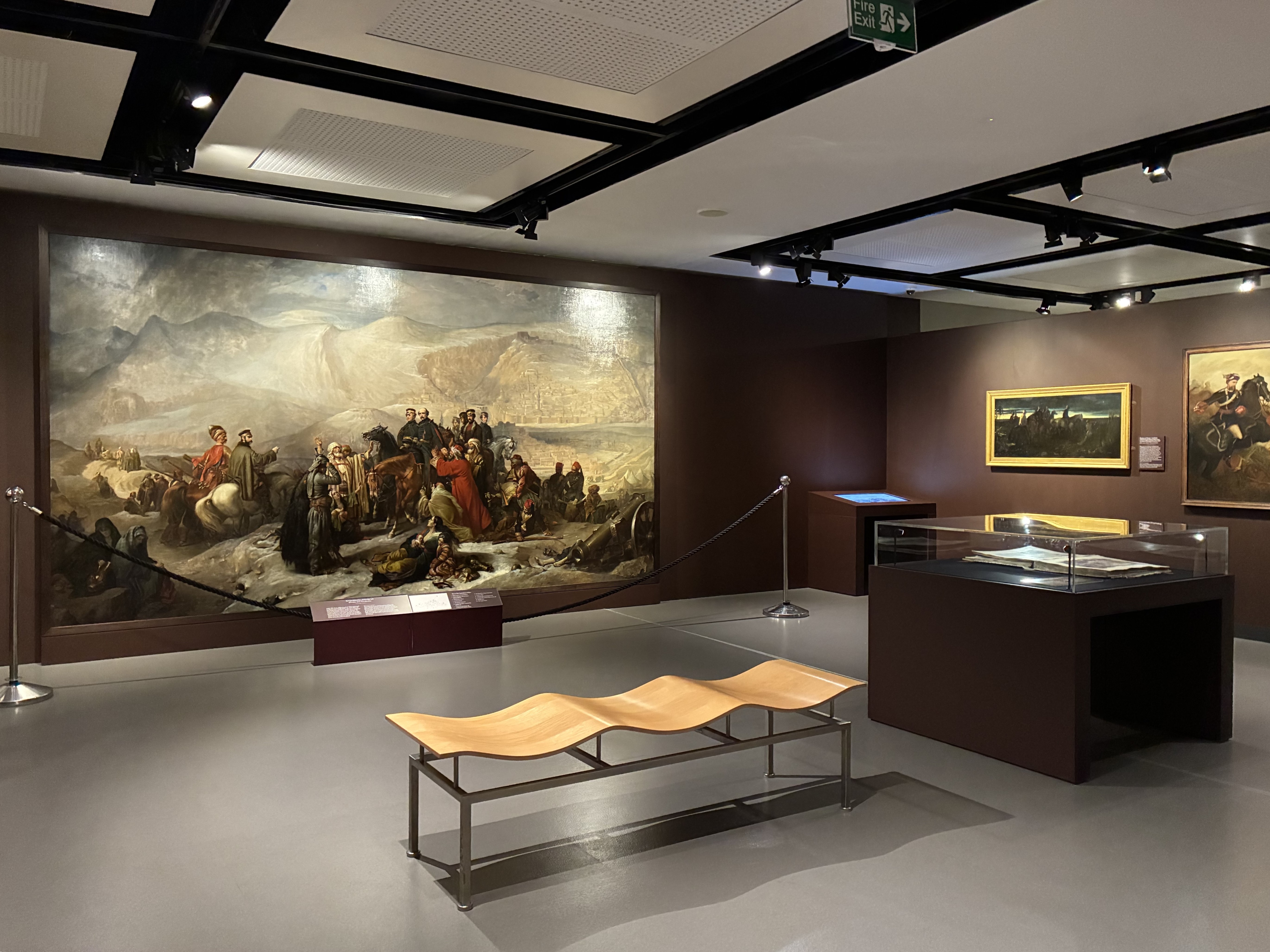
Installation view of Myth and Reality: Military Art in the Age of Queen Victoria at the National Army Museum showing the five-yard-wide oil painting ‘The Capitulation of Kars, Crimean War’ by Thomas Jones Barker (1855) with its static explanatory panel in front and an interactive screen off to the right (photo by the author)

Victoria’s Wars timeline

The exhibition includes a timeline of wars fought during Victoria’s reign. The point is that the British Army campaigned almost constantly throughout the period. There were a few big wars (the Crimean War, the Indian Mutiny and, right at the very end, the Boer War) but most of the conflicts we were involved in were small and localised, what modern historians call Victoria’s ‘small wars’.

  • 1837 – Queen Victoria ascends the throne
  • 1839 – the first photographs by Louis Daguerre in France and William Fox Talbot in England
  • 1842 – the world’s first illustrated weekly news magazine launched, the Illustrated London News
  • 1845 to 1846 – First Sikh War
  • 1852 to  1853 – The Second Anglo-Burmese War
  • 1853 to 1856 – the Crimean War
  • 1854 – Florence Nightingale travels to Crimea with 38 nurses. William Howard Russell’s reporting for The Times transforms people’s understanding of the squalid reality of war. 25 October – Battle of Balaklava and Charge of the Light Brigade.
  • 1854 – the Victoria Cross (VC) was introduced by Royal Warrant on 29 January 1856 to acknowledge the bravery displayed by soldiers and sailors during the Crimean War and soon after the Queen awards it to 62 Crimean war veterans

Queen Victoria and Prince Albert inspecting the wounded Grenadier Guards in Buckingham Palace. Coloured lithograph by George Thomas after himself (1855) Wellcome Collection

  • 1857 to 1858 – the Indian Rebellion
  • 1873 to 1874 – Third Anglo-Ashanti War
  • 1878 to 1880 Second Anglo-Afghan War
  • 1879 Anglo-Zulu War, featuring the Battle of Rorke’s Drift, 23 January 1879
  • 1880 to 1881 First South African War
  • 1882 Anglo-Egyptian War
  • 1884 to 1885 – Siege of Gordon at Khartoum, leading to its fall on 26 January 1885
  • 1885 Third Anglo-Burmese War
  • 1895 to 1896 Fourth Anglo-Ashanti War
  • 1898 – British reconquest of Sudan, featuring the Battle of Omdurman, 2 September 1898
  • 1899 to 1902 – Second South African War, featuring the sieges, the concentration camps etc
  • 1900 Fifth Anglo-Ashanti War

My take

There are about 40 artists, amateur and professional, soldiers and civilians, represented across the exhibition but the exhibition begins in a very decided way which raises a number of questions, because it starts with a strong emphasis on women war artists.

A feminist emphasis on women’s military art

The curators – all women – have decided that the first dozen or so works you see are all by women artists and devote several sections to them.

Victorian women artists, they tell us, helped to shape public perceptions of Army life. Many women were connected to soldiers through marriage or family, sometimes travelling with them abroad and depicting the people and places they saw.

Women were also important supporters and collectors of art, none more so than Queen Victoria herself. The Queen was also one of the most prominent subjects of military art, along with another celebrated figure of the time, Florence Nightingale – which explains why there’s a wall of works depicting the Queen meeting war veterans, awarding medals etc, and a little section about Florence Nightingale (who was famously averse to having her image captured, as she believed it detracted from her work).

However, as the exhibition proceeds you realise that most of the artists on display are not women, and, of course, none of the soldier artists are female – so why start this way unless you’re making a polemical feminist point? The implication seems to be that, after centuries or millennia of The Patriarchy, of tellings of history and art which downplay or completely ignore the role of women in the creation and consumption of art, this exhibition is doing its bit to redress the balance.

Fine. I understand. Why not? But there’s a second element to this approach which is notable and, maybe, problematic: this that one of the greatest, if not the greatest war artist of the Victorian era was Lady Elizabeth Butler, and so, hand-in-hand with the ‘women and military art’ section goes the ‘Lady Elizabeth Butler’ section. On one level there’s no quibbling with this: Butler was an outstanding artist and produced some of the standout works of the entire century. She was an absolute mistress of her craft, the half a dozen big paintings of hers brought together here are alone worth travelling to visit the show for, especially as several of them are usually buried in the Royal Collection.

So on the plus side, ignoring all its other features for a moment, you could say this is an outstanding selection of paintings, sketches and anecdotes by one of the nineteenth century’s great artists, and this is all to the good.

So why am I kvetching? Because the curators state, in these opening sections, in these early wall labels, that Lady Butler transformed military painting, depicting the life of soldiers with a new realism, taking a new, humane approach and setting a new standard for the subject. And this is all well and good, too, except that… In order to understand why Lady Butler is so important, and what she transformed, and what she changed it would have been good to have been fully introduced to the tradition of Victorian military painting which preceded her.

Instead, the result of placing Lady Butler right at the start of the show is to jump quite a long way into the later Victorian period without any preliminary explanation.

The work which really brought her to general attention was her ‘Roll Call’ which was displayed in 1874, 37 years into Victoria’s reign – and the first big work of hers which the curators feature, on the first wall of the exhibition, is ‘Dawn of Waterloo’ which was first displayed in 1895! 58 years into Victoria’s reign and only 6 years before her death. It’s a great painting but it comes at the very fag end of the period being covered and so is pretty misleading about the military art of Victoria’s era.

‘The Dawn of Waterloo: The Reveille in the Bivouac of the Scots Greys on the morning of the battle’ by Lady Butler (1895) the first full-scale painting by Lady Butler which the visitor encounters in ‘Myth and Reality: Military Art in the Age of Queen Victoria’ at the National Army Museum

Recap

So the decision to emphasise women’s role in military art may be laudable, and bringing a number of women’s works all together in the first few rooms ensures that the subject gets the prominence it deserves, rather than interspersing women’s works chronologically among the men’s pictures where they might be overlooked and unnoticed (as very probably happened in so many previous exhibitions on the subject).

Fine. And if you’re going to mention women artists of the time, then it would be silly not to mention and indeed have a section about the greatest of them, Lady Butler, also here right at the start. OK. Fine.

But the (maybe unintended) consequence of all this is that the visitor is deprived of a chronological understanding of the subject – of what military art looked like before Victoria, then at the start of her reign, how it developed through the decades leading up to the two seismic conflicts of the Crimean War and the Indian Mutiny in the 1850s, how it reflected trends in the broader art world, and so on.

You see how a chronological survey like this would have been interesting in itself and might also have better prepared the way for Lady Butler’s dramatic innovations: by the time you got to Lady B you’d have had a much better understanding of The Tradition she was transforming… but instead you have to work it out for yourself.

Five styles

This unchronological approach characterises the rest of the exhibition, too. Particularly in the sections about ‘Patriotism and Portraiture’ and ‘Realism and Reportage’, works from the 1840s or ’50s are placed next to works from the 1880s, ’90s or even early 1900s – it’s up to the visitor to make chronological, historical and aesthetic sense of the many different styles on display.

Having gone round the exhibition three or four times, dwelling on favourite works (and being drawn back again and again to the brilliant Butler paintings) I think I came up with about five different, roughly chronological styles of painting. They are:

  1. Romantic-sublime
  2. Patriotic-sentimental
  3. Mid-Victorian anecdotal
  4. Lady Butler
  5. Stiff official portraits

(This isn’t taking into account the pencil or charcoal sketches, and the many watercolours, which are specialist areas unto themselves.)

1. Romantic-sublime

Although painted in 1853 this picture strikes me as epitomising high Romanticism with its fondness for dramatic mountainous scenery and The Sublime. Look at the big baby eyes of Wellington (and his horse), the ethnic outfits of the local guides – it all has the rosy, soft-focus approach of Sir Water Scott’s novels.

Wellington at Sorauren, 27 July 1813 by Thomas Jones Barker 1853 © National Army Museum

2. Patriotic-sentimental

Kars is a city in north-eastern Turkey. In June 1855, as part of the during the Crimean War (1854 to 1856) it was besieged by a Russian army of 25,000. Demoralised by their defeats at the hands of the Russians, the Turks left the defence of Kars to Brevet Colonel (later General Sir) William Fenwick Williams, the British commissioner. The garrison was able to repulse three major Russian attacks but eventually cold, famine and an outbreak of cholera forced it to surrender on 26 November 1885. In recognition of their heroism, the Russians allowed the British garrison to march out of the city with the honours of war and into captivity.

‘The Capitulation of Kars, Crimean War’ by Thomas Jones Barker (1855) (National Army Museum)

This is a huge painting, over five yards wide (!), and it’s accompanied by not one but two diagrams identifying all the figures in it, one a static diagram, one an interactive display of the same. But it was only chatting to one of the (very well-informed) visitor assistants that I really understood what is going on.

You see the local in the red cloak clutching the hand of the bald British officer on his horse (Major General Fenwick Williams) and the cascade of similar locals off to his right, and the pitiful woman lying on the ground with her helpless children in the foreground, and similar locals on his left?

These are the local Turks who the British are abandoning to the kindness of the conquering Russians. So they are pleading with the British not to leave and abandon them but the British, defeated, have to. (Maybe a modern analogy would by NATO forces pulling out of Afghanistan and letting the Taliban take over.) It is this acute sense of regret and shame which explains the expression on the face of the British officer.

(You could write a book about the peoples the British Army promised to protect, only to abandon them – I’m currently reading a book about the Dutch Revolt which mentions that Queen Elizabeth I made all kinds of promises to the Dutch patriots in the 1580s which she then completely broke… It’s a long tradition.)

Back to the painting: ‘The Capitulation’, then, is a psychological study in the pain and embarrassment of duty, of a fine upstanding officer mortified to be abandoning the people he promised to protect. As such it is full of all kinds of melodramatic details, the thrown-up hands of the man in white on the left, the tearful eyes of the woman on the ground. It’s like a tableau from a mid-Victorian melodrama, at the centre of which is the British officer maintaining a stiff upper lip despite being deeply moved.

In fact it tells you a lot about mid-Victorian art and audiences that the work was commissioned, not by an aristocratic patron, but by the art dealers and print makers Agnew and Sons, precisely to be turned into prints and widely sold. So it is very deliberately catering to popular taste and demand.

3. Mid-Victorian anecdotal

The Victorians loved detail and clutter. Dickens’s novels overflow with wonderfully telling details and so do classic mid-Victorian paintings like William Powell Frith’s Derby Day (1858) or The Railway Station (1862), packed with little stories and anecdotal details. The exhibition includes an absolute classic of this style, ‘Home Again’ by Henry Nelson O’Neil.

‘Home Again’ by Henry Nelson O’Neil (1860)

‘Home Again’ depicts soldiers disembarking from a troopship at Gravesend on their return from the Indian Mutiny (1857 to 1859). For military history buffs the curators tell us that about 40,000 British troops were sent to India (more than had been mobilized for the Crimean conflict) to suppress the mutiny among the Indian troops of the East India Company’s Bengal Army.

But in purely visual terms we are invited to relish the details! At the very top a young woman peers over the shoulder of a bearded infantry corporal, who holds their baby for the first time. In the middle-right a young soldier of the 60th (The King’s Royal Rifle Corps) dressed all in black leans down to offer his Victoria Cross to a Chelsea Pensioner. The central action depicts sailors assisting a wounded sergeant to disembark. We are told that he wears a Kilmarnock ‘pork-pie’ cap under the white cotton ‘Havelock’ cover distinctive to the campaign, with the neck flap for protection from sunstroke.

There is patriotic pride here, and sentimentality of a sort, but it is very clearly all about the common people, ordinary soldiers (and sailors) and their reunions with wives and sweethearts. As such, it a little bit anticipates Lady Butler’s humanism but still with that mid-Victorian obsession with anecdote and detail.

4. Lady Butler

‘The Roll Call’ is one of the most celebrated British paintings of the 19th century. On its public appearance in 1874 it cemented Butler’s reputation as one of the leading painters of the age. It depicts a roll call of soldiers from the Grenadier Guards following the Battle of Inkerman in 1854 but can stand for thousands of similar occasions.

The Roll Call by Lady Elizabeth Butler (1874) © Royal Collection Enterprises Limited 2025 | Royal Collection Trust

The composition expresses Butler’s profound feel for the plight and experiences of the ordinary soldier, for the pity of war and the walls of the show feature not one but two quotations by her, emphasising how she eschewed patriotic guff in her concern for the actual lived experiences of the men who fought and suffered.

‘I never painted for the glory of war, but to portray its pathos and heroism’.

‘The Roll Call’ was fantastically successful. When it went on display at the Royal Academy it attracted over 300,000 visitors in a 3-month period and the more you look, the more brilliant it becomes.

The curators explain that historical or military painting for a long time worked with the basic design of a triangle which places the most important person – generally the commanding officer – at the apex (as in the pictures of Wellington and Major General Fenwick Williams, above). As soon as that’s pointed out to you, you realise really drastic difference her, the polemical message sent by the composition which is the equality of the men, all placed on the same level.

There’s still an anecdotal aspect to the thing, if you go up close and work slowly from left to right, starting with the two soldiers on the left lighting a sneaky fag or cigar, and working along through the bandages and blood of the wounded to the striking element of the man who’s collapsed into the snow. It really conveys the wretched pity of war, 44 years before Wilfred Owen coined the phrase for his volume of First World War poetry.

There is, of course, a figure on horseback, but he isn’t treated with the Romantic sentimentalism of the Wellington, above. Instead we can feel the gruff sympathy of the sergeant in charge as he reviews his wounded troops. And he also acts as the viewer’s entrance point into the work. If it was just the row of soldiers it would be slightly impenetrable: the officer on horseback not only relieves what might have been monotonous, but his movement carries the eye into the composition.

But there’s more because, after you’ve finished admiring the overall shape and canny dynamism of the composition, if you step back you notice the colours. You notice how Butler has depicted the uniforms of the men with great accuracy but used them as a springboard to create a composition of shades of grey. The grey coats and badges are reflected under the line of men by the different shades of snow and above them by the extremely nuanced and varied shading of the clouds.

On a literal level the coldness of the winter is evoked by the dominant tones of black, grey, white and brown, contrasting with small splashes of red from coatees and flags. But on a more aesthetic level, the awareness of shades of grey makes you think of James McNeil Whistler’s compositions, symphonies of certain palettes and timbres.

And then you notice the crows, the brilliant broken flight of crows coming from the middle of the composition and looping up over the head of the reviewing officer.

In its: 1) absence of sentimentality; 2) its immediately felt humanistic concern for the plight of the average soldier; and 3) its stunning painterliness, its brilliance of composition and colouring, ‘Roll Call’ really is a masterpiece. It’s worth visiting the exhibition just to see this one work in the flesh.

5. Stiff official portraits

Something the curators of the Army Museum must struggle with is that so much military art is decidedly average, if not actively poor. One or two of the battle paintings here struck me as ludicrously bad, but there’s a more subtle problem and that’s to do with military portraits.

I bet there are tens of thousands of these up and down the land, professional portraits of Britain’s countless officers, generals, admirals and so on which are good enough, decent enough, professional likenesses, but are never going to make it into anyone’s history of art because they are, by their nature, a very conservative wing of the medium.

Their number, their prevalence and popularity in Victorian times explain why there is a section titled ‘Patriotism and Portraiture’ here. Not only did ‘the people’ want to see portraits of heroes like Wellington or Gordon or Roberts, but countless military families wanted professional portraits of their eminent male members to hang alongside all their forebears, and hundreds of officers messes and regimental headquarters, ditto.

Hence a half dozen masterpieces of stultifying conventionality and woodenness.

Lieutenant The Honourable Frederick Hugh Sherston Roberts VC, Kings Royal Rifle Corps by Julian Russell Story (1899)

There’s a story behind this portrait, which is that Roberts not only won the Victoria Cross, but the same medal was awarded to his father, Field Marshal Frederick Sleigh Roberts, 1st Earl Roberts, making them one of only three father-and-son pairs to be awarded the VC in its 169-year history.

Watercolours

As mentioned, the exhibition includes 20 or so watercolours, much smaller and more intimate than the bombastic oil paintings. In a sense, watercolours under-promise and so are often able to over-deliver.

Installation view of Myth and Reality: Military Art in the Age of Queen Victoria at the National Army Museum showing a set of six watercolours of the Crimean War by William Simpson (photo by the author)

General Cannon’s landing, July 7 1854

My wife and I play a simple game when visiting exhibitions. Having crawled through the exhibits and rooms, reading and processing every wall label, we reach the end, turn round and go back through it, this time lightly, airily choosing one work per room which we like and having to explain why. A variation is to choose a work we would buy and take home to hang in the landing or hall or wherever. As I’ve stated, the Lady Butler paintings are all brilliant, but in terms of something I’d actually buy and live with, something a bit more modest, I kept returning to one of the 20 or so watercolours on display, ‘General Cannon’s landing, July 7 1854’, a pencil and watercolour by Joseph Archer Crowe (who has seven works in the exhibition).

‘General Cannon’s landing, July 7 1854’ Pencil and watercolour by Joseph Archer Crowe

Crowe worked at the Crimean War as a special artist for The Illustrated London News. This watercolour depicts how, on 7 July 1854, Turkish forces launched an amphibious assault across the River Danube on Russian positions at Giurgiu (in modern day Romania). The Russians were driven back and Giurgiu was occupied by the Turks.

It’s not going to rock anyone’s world, I just liked the composition, the line of ships going in from roughly right to left, and the light impressionistic touches of colour.

Women artists

I may have missed some but, for the record, here are the women military artists featured in the exhibition:

  • Lady Elizabeth Butler
  • Jane Drummond (portrait of Mrs Anne Steele)
  • Gertrude Ellen Burrard (portrait of Nussiban, our ayah)
  • Elizabeth Anne Leslie Melville (portrait of Major General Sir Owen Tudor Burne)
  • Emily Henrietta Ormsby (portrait of Colonel Henry Francis Strange; portrait of Major General John William Ormsby)

Lady Butler’s works

  • Tenth Bengal Lancers tent pegging (1873)
  • The Roll Call (1874)
  • Study of a Wounded Guardsman (1874)
  • Quatre Bras (engraving of oil painting, 1879)
  • Patient Heroes: A Royal Artillery Gun Team in Action (1882)
  • Scotland Forever! (engraving after oil painting, 1882)
  • After the Battle of Tel-el-Kebir (engraving of original painting, 1888)
  • After the Battle of Tel-el-Kebir (fragment of original painting, 1888)
  • The Defence of Rorke’s Drift (1882)
  • The Ballad of the Royal Irish at Sebastapol (6 x pencil illustrations of a poem, 1890)
  • Military sketches (pen, watercolour and pencil, 1893)

Summary

I don’t know whether my point about the lack of chronology and build-up to Lady B is even worth mentioning. My wife went round the displays two or three times with me and didn’t even notice or care, just enjoyed various works on their own merit.

So: if you’re interested in military history the exhibition contains lots of titbits about key wars and engagements of Victoria’s reign, about medals and uniforms, some lovely watercolours and a dozen or so really impressive oil paintings, along with a number of average or also-ran works which, however, illustrate interesting topics, such as the section about the creation of the Victoria Cross, and so on.

And the National Army Museum is always a lovely place to visit because – ironically, given its subject matter – it’s such a calm, clean and peaceful place to be. Go see.


Related links

Related reviews

The Rainbow by D.H. Lawrence (1915)

A flame kindled round him, making his experience passionate and glowing, burningly real.
(description of Will Brangwen falling in love, although it could be almost any Lawrence character, male or female)

What did the self, the form of life matter? Only the living from day to day mattered, the beloved existence in the body, rich, peaceful, complete, with no beyond, no further trouble, no further complication.
(Ursula’s credo right at the end of the book, p.484)

This strikes me as a work of utter genius. Lawrence had an astounding gift for creating men and women who are more like pagan gods of the landscape, who live what seem primeval lives of extraordinary depth and intensity.

Other novelists build their narrative out of key scenes, scenes which move the story along or reveal people’s personalities, create way stations to the plot or highlight characters’ development. Many novelists work through extensive dialogue, designed to disclose people’s (clashing) personalities, sometimes to announce shocking revelations, as in a stage play or, alternatively, to be witty and amusing. Lawrence is extremely unlike all of that. This novel amounts almost to a repudiation of that entire tradition.

Instead, with relatively few well-defined scenes and tens of pages passing with no dialogue at all, Lawrence describes the inner lives of his characters at great length, to intense and penetrating depth, in rhapsodic poetic prose. At one point he gives a sense of what he’s about, in the perception of the newly-married Tom Brangwen:

He surveyed the rind of the world: houses, factories, trams, the discarded rind; people scurrying about, work going on, all on the discarded surface. An earthquake had burst it all from inside. It was as if the surface of the world had been broken away… leaving here exposed the inside, the reality: one’s own being, strange feelings and passions and yearnings and beliefs and aspirations, suddenly become present, revealed, the permanent bedrock… (p.150)

He does so not in a rational, analytical way. Instead there are page after page describing the complex, many-sided and continually changing quality of his characters. Their moods, emotions, feelings and qualities are described with incandescent vividness and they are always changing, sometimes paragraph to paragraph, sometimes sentence to sentence, in a dizzying, bewildering shimmer. Is this how people’s perceptions, moods and feelings change? It feels rather delirious and yet wonderful at the same time. Here are young Anna and Will falling in love.

A spell was cast over her. And how uneasy her parents were, as she went about the house unnoticing, not noticing them, moving in a spell as if she were invisible to them. She was invisible to them. It made them angry. Yet they had to submit. She went about absorbed, obscured for a while. Over him too the darkness of obscurity settled. He seemed to be hidden in a tense, electric darkness, in which his soul, his life was intensely active, but without his aid or attention. His mind was obscured.

(Note the repetition. I’ll come to that in a moment.) Or Ursula wanting to be back in love with Anton.

When she had roused him to a pitch of madness, when she saw his eyes all dark and mad with suffering, then a great suffering overcame her soul, a great, inconquerable suffering. And she loved him. For, oh, she wanted to love him. Stronger than life or death was her craving to be able to love him.

Hundreds and hundreds of pages of characters keyed up to the most intense and exquisite emotional peaks and extremities.

Passion

‘The Rainbow’ follows three successive generations of the Brangwen family who inhabit and inherit the family farm, Marsh Farm, in rural Nottinghamshire, from the 1840s to the Edwardian era. But there is little or nothing about business dealings, the practical details of raising crops or cattle and so on.

Instead the book focuses in huge detail on two types of subject: first the childhood and adolescence of the key figure in each generation; but then, most particularly, on the love lives of these figures, described with astonishing, monomaniacal intensity. Here is just one among many, many such passages, in this case describing Ann and Will falling in love, in this scene embracing and kissing.

They would stand sometimes folded together in the barn, in silence. Then to her, as she felt his young, tense figure with her hands, the bliss was intolerable, intolerable the sense that she possessed him. For his body was so keen and wonderful, it was the only reality in her world. In her world, there was this one tense, vivid body of a man, and then many other shadowy men, all unreal. In him, she touched the centre of reality. And they were together, he and she, at the heart of the secret. How she clutched him to her, his body the central body of all life. Out of the rock of his form the very fountain of life flowed. But to him, she was a flame that consumed him. The flame flowed up his limbs, flowed through him, till he was consumed, till he existed only as an unconscious, dark transit of flame, deriving from her.

Lawrence’s characters are continually being swept out into the spaces between the stars, bursting into flames, swooping cruel as a hawk, and generally being transported by stark, primeval, unstoppable passions. At numerous points the impassioned couples imagine themselves transported far from ‘civilisation’, like beings on a desert island, like Adam and Eve. At one point Lawrence makes this more than usually clear.

And yet, for his own part, for his private being, Brangwen felt that the whole of the man’s world was exterior and extraneous to his own real life with Anna. Sweep away the whole monstrous superstructure of the world of to-day, cities and industries and civilization, leave only the bare earth with plants growing and waters running, and he would not mind, so long as he were whole, had Anna and the child and the new, strange certainty in his soul. Then, if he were naked, he would find clothing somewhere, he would make a shelter and bring food to his wife. (p.193)7

Male and female created He them

He asserted himself before her, he felt himself infinitely male and infinitely irresistible, she asserted herself before him, she knew herself infinitely desirable, and hence infinitely strong. And after all, what could either of them get from such a passion but a sense of his or of her own maximum self, in contradistinction to all the rest of life? (p.302)

Above all, this enormous 500-page hymn to the life of the passions and emotions focuses on what, in Lawrence’s hands, is the primal dyad, duality and dichotomy between a man and a woman in love. Thousands of other writers have handled this worn-out subject but Lawrence does it unlike anyone else. Other novelists structure their stories through scenes, which generally include dialogue in which characters reveal their feelings, and the scenes are carefully calibrated to depict men and women going through the fairly well-recognised stages of acquaintance, friendship, admiration, affection, first feelings of love and so on. Think Jane Austen. Above all they have a social aspect and their characters conform to social norms.

Not so Lawrence. Lawrence works through page after page of prose poetry describing the characters’ feelings in the most primal, extreme, almost abstract way, sometimes with the simple profundity of the Old Testament.

She liked Anthony… All her life, at intervals, she returned to the thought of him and of that which he offered. But she was a traveller, she was a traveller on the face of the earth, and he was an isolated creature living in the fulfilment of his own senses. (p.417)

His characters are like protagonists in a kind of Wagnerian drama of souls, endlessly battling for fulfilment.

She became proud and erect, like a flower, putting itself forth in its proper strength. His warmth invigorated her. His beauty of form, which seemed to glow out in contrast with the rest of people, made her proud. It was like deference to her, and made her feel as if she represented before him all the grace and flower of humanity. She was no mere Ursula Brangwen. She was Woman, she was the whole of Woman in the human order. All-containing, universal, how should she be limited to individuality? (p.444)

Very often the drama rotates around ideas of completion. Male and female both feel a lack and want to be made complete and, once married, finally achieve this wonderful sense of completion, and yet all kinds of things can knock it sideways, create barriers, can make them hate each other, and brood and be distant, but then something snaps, one or the other begs forgiveness, there is joyful reunion and completeness again.

It was begun now, this passion, and must go on, the passion of Ursula to know her own maximum self, limited and so defined against him. She could limit and define herself against him, the male, she could be her maximum self, female, oh female, triumphant for one moment in exquisite assertion against the male, in supreme contradistinction to the male.

Something Lawrence does again and again is give each gender successive paragraphs – a paragraph to how the man is feeling, a paragraph to the woman. It’s one of the many ways he creates this sense of a primal male-female opposition or dyad.

He was struggling in silence. It seemed as though there were before him a solid wall of darkness that impeded him and suffocated him and made him mad. He wanted her to come to him, to complete him, to stand before him so that his eyes did not, should not meet the naked darkness. Nothing mattered to him but that she should come and complete him. For he was ridden by the awful sense of his own limitation. It was as if he ended uncompleted, as yet uncreated on the darkness, and he wanted her to come and liberate him into the whole.

But she was complete in herself, and he was ashamed of his need, his helpless need of her. His need, and his shame of need, weighed on him like a madness. Yet still he was quiet and gentle, in reverence of her conception, and because she was with child by him.

Sex

As that passage implies, there is a very strong sexual undertone to all this. For most of the book Lawrence nowhere explicitly describes sex, even when the couple are alone in their house, even alone in their bedroom, the language is never specific about undressing, boobs and willies and so on, it always remains at this level of abstract nouns, of ‘need’ and ‘completion’ and ‘union’ and suchlike.

But sex, heterosexual sex, the loss of self in the union of bodies making love, obviously underpins a great deal of the book’s psychology and, maybe, it’s aesthetic, its constant search for a kind of primitive intensity and physical communion between male and female.

At one point Will, a Christian, takes his wife Anna, a sceptic, to visit Lincoln cathedral. As he enters the soaring building he undergoes a great soaring of the soul but, as you can see, the whole thing is described in very thinly veiled sexual terms.

Here the stone leapt up from the plain of earth, leapt up in a manifold, clustered desire each time, up, away from the horizontal earth, through twilight and dusk and the whole range of desire, through the swerving, the declination, ah, to the ecstasy, the touch, to the meeting and the consummation, the meeting, the clasp, the close embrace, the neutrality, the perfect, swooning consummation, the timeless ecstasy. There his soul remained, at the apex of the arch, clinched in the timeless ecstasy, consummated… Every jet of him strained and leaped, leaped clear into the darkness above, to the fecundity and the unique mystery, to the touch, the clasp, the consummation, the climax of eternity, the apex of the arch. (p.202)

More straightforwardly, Will returns from an evening in Nottingham after arguing with Anna, and they approach each other as strangers, which they find more arousing.

She watched him undress as if he were a stranger. Indeed he was a stranger to her. And she roused him profoundly, violently, even before he touched her… They abandoned in one motion the moral position, each was seeking gratification pure and simple.

Strange his wife was to him. It was as if he were a perfect stranger, as if she were infinitely and essentially strange to him, the other half of the world, the dark half of the moon. She waited for his touch as if he were a marauder who had come in, infinitely unknown and desirable to her. And he began to discover her. He had an inkling of the vastness of the unknown sensual store of delights she was. With a passion of voluptuousness that made him dwell on each tiny beauty, in a kind of frenzy of enjoyment, he lit upon her: her beauty, the beauties, the separate, several beauties of her body.

He was quite ousted from himself, and sensually transported by that which he discovered in her. He was another man revelling over her. There was no tenderness, no love between them any more, only the maddening, sensuous lust for discovery and the insatiable, exorbitant gratification in the sensual beauties of her body. And she was a store, a store of absolute beauties that it drove him to contemplate. There was such a feast to enjoy, and he with only one man’s capacity. (p.235)

Still described in general or euphemistic or categorical terms. Whereas, 25 or so years later, here are Ursula and Anton.

She enjoyed him, she made much of him. She liked to put her fingers on the soft skin of his sides, or on the softness of his back, when he made the muscles hard underneath, the muscles developed very strong through riding; and she had a great thrill of excitement and passion, because of the unimpressible hardness of his body, that was so soft and smooth under her fingers, that came to her with such absolute service. (p.460)

‘With such absolute service,’ what a thrilling phrase. Once they have slept together once, the descriptions of Anton and Ursula become more, not explicit exactly, more frank. More honest, maybe, though still couched in poetic rather than naturalistic details.

He came to her, and cleaved to her very close, like steel cleaving and clinching on to her. Her passion was roused, it was fierce but cold. But it was fierce, and extreme, and good, their passion this night. He slept with her fast in his arms. All night long he held her fast against him.

As you can see, it’s not really the sex, it’s the complete picture of closeness or otherwise between people, which Lawrence is after.

Married love

Tens of thousands of novels, from Jane Austen to Bridget Jones, depict the process of finding a mate, of falling in love, as leading up to the great plot climax of marriage and ending there.

Lawrence is notable for carrying right on into the state of married love, in fact he only really blossoms once a couple are married and the real struggle begins, the struggle for complete physical and spiritual union, which is so overwhelming when achieved and experienced, which obliterates the outside world in its intensity, and yet is so fragile, so easily punctured by the slightest whims of jealousy or irritation or misunderstanding on the part of either spouse. And then the days and nights of alienation and coldness and apartness, sometimes rising to active hatred of the other, before some route is found back to apologise and forgive.

A large amount of the first half of the text is made up by this endless battle of the two sexes, conceived in a kind of elemental abstraction.

Horrible in the extreme were these nocturnal combats, when all the world was asleep, and they two were alone, alone in the world, and repelling each other. It was hardly to be borne. (p.189)

Joy

If there are black moments of hatred and scorn, Lawrence’s work is also, and mostly, coloured by an extraordinary primeval joy. Here’s the heavily pregnant Anna Brangwen, left alone during the day while her husband, Will, goes to work in Nottingham.

She had her moments of exaltation still, re-births of old exaltations. As she sat by her bedroom window, watching the steady rain, her spirit was somewhere far off.

She sat in pride and curious pleasure. When there was no one to exult with, and the unsatisfied soul must dance and play, then one danced before the Unknown.

Suddenly she realized that this was what she wanted to do. Big with child as she was, she danced there in the bedroom by herself, lifting her hands and her body to the Unseen, to the unseen Creator who had chosen her, to Whom she belonged.

She would not have had anyone know. She danced in secret, and her soul rose in bliss. She danced in secret before the Creator, she took off her clothes and danced in the pride of her bigness.

It’s not joy, is it, it’s exultation, and this note of fantastic joy and psycho-physical excitement recurs again and again, the fantastic excitement of being alive!

To Ursula it was wonderful. She felt she was a new being. The darkness seemed to breathe like the sides of some great beast, the haystacks loomed half-revealed, a crowd of them, a dark, fecund lair just behind. Waves of delirious darkness ran through her soul. She wanted to let go. She wanted to reach and be amongst the flashing stars, she wanted to race with her feet and be beyond the confines of this earth. She was mad to be gone. It was as if a hound were straining on the leash, ready to hurl itself after a nameless quarry into the dark. And she was the quarry, and she was also the hound. (p.317)

Aspects of Lawrence’s style

Plain prose

Lawrence doesn’t achieve his effects through fancy vocabulary. It’s striking how ordinary most of his vocabulary is. It’s really the power of his perceptions which startle you. Lydia gets a job caring for an old vicar who keeps a parish by the sea.

Very strange was the constant glitter of the sea unsheathed in heaven, very warm and sweet the graveyard, in a nook of the hill catching the sunshine and holding it as one holds a bee between the palms of the hands, when it is benumbed. Grey grass and lichens and a little church, and snowdrops among coarse grass, and a cupful of incredibly warm sunshine.

Repetition within paragraphs

Who knows how conscious it was but Lawrence employs a very definite strategy of repeating two or three key words within each paragraph. Each paragraph has one or two key words which are repeated two or three times. The effect is to make each paragraph feel… feel like it has an identity of its own, stands distinct from its neighbours. Each one seems to be ringing its own bell. Look at the repetition of ‘very’ in the paragraph above. There are thousands of similar and often more striking examples.

It’s as if Lawrence has struck out a phrase encapsulating a perception and then wants to examine it from various sides, repeats the phrase, repeats it with slight variations, to see what happens as he walks round it, to observe the changing light giving it different perspectives.

To pick a paragraph more or less at random: young Anna Brangwen has gone to church accompanied by her cousin, Will Brangwen. They are both sitting in a pew as the service begins. First read it for the sense:

The colour came streaming from the painted window above her. It lit on the dark wood of the pew, on the stone, worn aisle, on the pillar behind her cousin, and on her cousin’s hands, as they lay on his knees. She sat amid illumination, illumination and luminous shadow all around her, her soul very bright. She sat, without knowing it, conscious of the hands and motionless knees of her cousin. Something strange had entered into her world, something entirely strange and unlike what she knew. (p.110)

And then pick out the repetitions:

The colour came streaming from the painted window above her. It lit on the dark wood of the pew, on the stone, worn aisle, on the pillar behind her cousin, and on her cousin’s hands, as they lay on his knees. She sat amid illumination, illumination and luminous shadow all around her, her soul very bright. She sat, without knowing it, conscious of the hands and motionless knees of her cousin. Something strange had entered into her world, something entirely strange and unlike what she knew.

It’s not the consciously poetic prose of an Oscar Wilde because it avoids Wilde’s gossamer vocabulary, all silver and emeralds, and instead deliberately uses very plain ordinary language (except, I suppose for luminous, maybe). But the key words are the opposite of recherché – on the, hands, knees, strange. You could hardly get commoner words. Yet this kind of sounding repetition is without doubt poetic in technique and it’s absolutely everywhere, in every single paragraph.

Direct repetition

Generally, the repeated words or short phrases are scattered throughout a paragraph, separated by other phrases. But sometimes he wants to be so emphatic that he just repeats a phrase side by side.

She felt his power persisting on her, till she became aware of the strain, she cried out against the exhaustion. He was forcing her, he was forcing her. (p.181)

Why could he not leave her? Why could he not throw himself into the hidden water to live or die, as might be? He could not, he could not. (p.187)

Hard and fierce she had fastened upon him, cold as the moon and burning as a fierce salt. Till gradually his warm, soft iron yielded, yielded, and she was there fierce, corrosive, seething with his destruction, seething like some cruel, corrosive salt around the last substance of his being, destroying him, destroying him in the kiss. (p.322)

Ursula was beside herself. She could not endure till the Saturday came, her thoughts burned up like a fire. If only it were Saturday, if only it were Saturday. (p.339)

On a macro level, certain words or images become associated with certain characters through repetition: foreign and foreignness with Lydia; Tom Brangwen’s blue eyes; flame with Anna; Will the hawk.

Dialect and surprise words

He does, occasionally, deploy dialect, or unusual words, or (colloquial?) phrases, mostly in direct speech.

Will Brangwen had some weeks of holiday after his marriage, so the two took their honeymoon in full hands, alone in their cottage together.

‘Sit you down,’ said Tom Brangwen, ‘an’ take a bit off your length.’

What did the unrevealed God matter, when a man had a young family that needed fettling for? (p.275)

‘Isn’t it a nasty morning,’ she said.
‘Yes,’ he said, ‘it’s not much of weather.’ (p.370)

‘Pens don’t melt into the air: pens are not in the habit of mizzling away into nothing. What has become of them then?’

The main motor of the text is his staggering imagining of people’s primeval lives and feelings; but the proximate cause is his extraordinary sentences. On page 30 or 40 I realised that nearly every sentence comes with an unexpected phrasing which knocks the wind out of you, extraordinary unexpected vividnesses in sentence after sentence, smacking your imagination like a sheet of rain across a lake.

He held her in his arms, and his bones melted. (p.119)

The days went by, they ran on dark-padded feet in silence. (p.120)

The air was all hoary silver. She looked around her. Trees stood vaguely at their distance, as if waiting like heralds, for the signal to approach. In this space of vague crystal her heart seemed like a bell ringing.

Tom Brangwen wanted to make a speech. For the first time in his life, he must spread himself wordily. (p.137)

Lawrence is an astonishing spendthrift of beautiful lines, throwing away hundreds of casually brilliant and inspiring lines.

The firelight glowed against the darkness in the room.

He had worked for many years at Cossethay, building the organ for the church, restoring the woodwork, gradually coming to a knowledge of beauty in the plain labours. Now he wanted again to carve things that were utterances of himself. (p.355)

He seemed made up of a set of habitual actions and decisions. The vulnerable, variable quick of the man was inaccessible. (p.443)

And the mood in the build-up to Christmas.

Everywhere was a sense of mystery and rousedness. Everybody was preparing for something.

Nature poetry

The period just before the First World War saw an efflorescence of nature writing, a gaggle of so-so poets jostling to describe what was coming to feel like the disappearing landscapes of rural England. Edward Thomas was probably to emerge as the best of these but he only started writing his magical poetry once the Great War commenced. Anyway, Lawrence describes nature with the same bright vivid intensity he depicts his humans. They’re relatively rare, his straight nature descriptions, but when they occur, they are like the brightest nature photography.

The year drew on, in the hedges the berries shone red and twinkling above bare twigs, robins were seen, great droves of birds dashed like spray from the fallow, rooks appeared, black and flapping down to earth, the ground was cold as he pulled the turnips, the roads were churned deep in mud…

And yet a deep characteristic of Lawrence is that he doesn’t describe nature as an outsider, as a bourgeois tourist, but always relates it to the hard, muddy lives of the farmers he’s depicting. Sparkling nature is embedded in the world of human labour.

The year drew on, in the hedges the berries shone red and twinkling above bare twigs, robins were seen, great droves of birds dashed like spray from the fallow, rooks appeared, black and flapping down to earth, the ground was cold as he pulled the turnips, the roads were churned deep in mud. Then the turnips were pitted and work was slack.

For me, reading the first version of this paragraph without the final sentence lacks something. When you add in those final nine words, the whole rhythm of the paragraph seems complete. Here’s a selection of his nature writing.

Corn harvest came on. One evening they walked out through the farm buildings at nightfall. A large gold moon hung heavily to the grey horizon, trees hovered tall, standing back in the dusk, waiting. (p.121)

The young people went home as a sharp little moon was setting in the dusk of spring. Tufts of trees hovered in the upper air, the little church pricked up shadowily at the top of the hill, the earth was a dark blue shadow. She put her hand lightly on his arm, out of her far distance. And out of the distance, he felt her touch him. They walked on, hand in hand, along opposite horizons, touching across the dusk. There was a sound of thrushes calling in the dark blue twilight. (p.178)

How lovely was the sunshine that loitered and wandered out of doors, where the catkins on the big hazel bushes at the end of the garden hung in their shaken, floating aureole, where little fumes like fire burst out from the black yew trees as a bird settled clinging to the branches. One day bluebells were along the hedge-bottoms, then cowslips twinkled like manna, golden and evanescent on the meadows.

The dim blue-and-gold of a hot, sweet autumn saw the close of the corn-harvest. To Ursula, it was as if the world had opened its softest purest flower, its chicory flower, its meadow saffron. The sky was blue and sweet, the yellow leaves down the lane seemed like free, wandering flowers as they chittered round the feet, making a keen, poignant, almost unbearable music to her heart. And the scents of autumn were like a summer madness to her. She fled away from the little, purple-red button-chrysanthemums like a frightened dryad, the bright yellow little chrysanthemums smelled so strong, her feet seemed to dither in a drunken dance. (p.308)

There was a place where she went trespassing to find the snowdrops that grew wild. It was evening and the winter-darkened meadows were full of mystery. When she came to the woods an oak tree had been newly chopped down in the dell. Pale drops of flowers glimmered many under the hazels, and by the sharp, golden splinters of wood that were splashed about, the grey-green blades of snowdrop leaves pricked unheeding, the drooping still little flowers were without heed. Ursula picked some lovingly, in an ecstasy. The golden chips of wood shone yellow like sunlight, the snowdrops in the twilight were like the first stars of night. And she, alone amongst them, was wildly happy to have found her way into such a glimmering dusk, to the intimate little flowers, and the splash of wood chips like sunshine over the twilight of the ground.

The plot = four generations of the Brangwen family

The Marsh farm in the valley of the river Erewash, not far from the village of Cossethay in one direction and the town of Ilkeston further away. In the 1840s a canal was built across their land and then a railway on a viaduct.

At the back a confusion of sheds spread into the home-close from out of two or three indistinct yards. The duck-pond lay beyond the furthest wall, littering its white feathers on the padded earthen banks, blowing its stray soiled feathers into the grass and the gorse bushes below the canal embankment, which rose like a high rampart near at hand, so that occasionally a man’s figure passed in silhouette, or a man and a towing horse traversed the sky.

First generation – Alfred Brangwen

Alfred Brangwen of this period married a woman from Heanor, a daughter of the ‘Black Horse’. They had four sons and two daughters. The eldest boy ran away to sea and did not come back.

The second boy, Alfred, became a draughtsman in a lace-factory in Nottingham, stifling his native creativity. He married the daughter of a chemist, became something of a snob, in later life took to womanising.

The third son, Frank, became a butcher, at eighteen married a little factory girl, who bore him numerous children. In later life he became a drunk and a bore.

Of the daughters, Alice, the elder, married a collier and lived for a time stormily in Ilkeston, before moving away to Yorkshire with her numerous young family. Effie, the younger, remained at home.

Second generation – Tom Brangwen marries Lydia

The story follows the youngest son, Tom Brangwen, from boyhood to manhood. He struggles at school. When he was 17 his father fell and broke his neck, leaving just him, his mother and Effie in the farm. When he was 23 his mother died leaving him and Effie. They quarrel a lot. He takes a corner at the local pub to keep out of the way. Then Effie got married and moved out, leaving Tom with Tilly, the cross-eyed servant girl.

The story describes him having pre-marital sex several times, first time with a prostitute, next time with a girl he meets from a group at the pub, the glory and bewilderment of it. One day he sees a small woman dressed in black shepherding a child, walking the other way up the hill. One thing leads to another and he starts to woo her.

She is Lydia Lensky, of German descent, who married a Polish doctor who got caught up in the Polish Rebellion (spring 1863), was forced to flee, arriving in London (recapped pages 256 to 258). The doctor died and she threw herself upon charities who found her work caring for old single vicars, first one in Yorkshire, now one in Derbyshire.

Tom woos her over months, then one evening carries a bunch of daffodils he’s picked to the vicarage to propose to here. They are married. Account of his winning over Lydia’s feisty young daughter by her deceased doctor husband, Anna Lensky. Lydia bears him a son but Tom always stays closer to Anna.

She [Anna] was, however, only eighteen when a letter came from Mrs Alfred Brangwen, in Nottingham, saying that her son William was coming to Ilkeston to take a place as junior draughtsman, scarcely more than apprentice, in a lace factory. He was twenty years old, and would the Marsh Brangwens be friendly with him.

Will Brangwen, comes to visit and the narrative describes their slowly falling in love, till they are regularly meeting for illicit hugs and kisses in the cowshed. One time father Tom spies them, doesn’t interfere but is upset at the thought of losing his beloved daughter.

Third generation – Anna marries Will Brangwen

Will and Anna marry. It is a very stormy relationship, Anna being independent and headstrong but Will subject to black rages. Tom leases them a cottage of their own, Ivy Cottage.

Tom Brangwen had taken them a cottage at Cossethay, on a twenty-one years’ lease. Will Brangwen’s eyes lit up as he saw it. It was the cottage next the church, with dark yew-trees, very black old trees, along the side of the house and the grassy front garden; a red, squarish cottage with a low slate roof, and low windows. It had a long dairy-scullery, a big flagged kitchen, and a low parlour, that went up one step from the kitchen. There were whitewashed beams across the ceilings, and odd corners with cupboards. Looking out through the windows, there was the grassy garden, the procession of black yew trees down one side, and along the other sides, a red wall with ivy separating the place from the high-road and the churchyard. The old, little church, with its small spire on a square tower, seemed to be looking back at the cottage windows.

Will retains a lifelong interest in Christianity and church architecture, he feels liberated into eternity by it, whereas Anna sees only the finite stone building which feels man-made and cramped next to the wide universe.

Fourth generation – Ursula and Gudrun

Anna bears several children. The first is a daughter, Ursula. Will is still just 22 (p.214) and falls helplessly for this first daughter. Barely a year later another girl, Theresa. Two years later, Gudrun (p.219). Then Catherine. By the time he’s 26, Will has four children. By the time he’s 30, five (p.238).

Anna becomes totally self sufficient in being a mother which drives him to seek fulfilment elsewhere. But after failed attempts to chat up girls in Nottingham, he returns home more ironic and alienated and, paradoxically, this makes him more attractive to Anna, and they embark on a renewed sex life.

(Anna’s father, Ursula’s grandfather, Tom, dies in a flood, when torrential rain bursts the canal bank and floods the Marsh, he being drunk and riding back from a day in town. His son, Tom, works away and so the second son, Alfie, inherits the Marsh.)

Ursula is 8 when her father, Will, sets up woodwork classes in the local church for village boys (p.239). Ursula is conscious of a difference from the poor families in the village and gets into fights. Her parents send her to Nottingham Grammar School where she is thirsty for knowledge but not systematic. As she hits adolescence she undergoes intense religious experiences, though contradictory, rebelling against the literal interpretation of Jesus, wanting a more sensual religious rapture or ecstasy.

She feels hampered by being the eldest in a house full of children, by ‘the perpetual tyranny of young children’.

She’s just short of 16 (‘a slim, smouldering girl, deeply reticent… sensitive in the extreme, always tortured, always affecting a callous indifference’) when young Anton Skrebensky, son of the friend of the Brangwen family’s, turns up, aged 21 and in the army and wonderfully confident and self possessed.

History, breasts, the rest of England

History With the arrival of Ursula something happens: the narrative seems to emerge from a kind of unspecified timelessness, from ‘the dark backward and abysm of time’, and into something more like the modern, historical, recorded world. This is signalled by specific historical references: at first the vague one to ‘the Mahdi’, which could derive from a long period, but then the extremely specific one marking the exact start of the (second) Boer War (October 1899) and intermittently chronicles the progress of the war via letters from Anton Skrebensky who serves in it.

Breasts I’ve added ‘breasts’ to this heading for a specific reason. When Lawrence described the previous generations of womenfolk – the woman from Heanor, Lydia Lensky, Anna Brangwen – there was a great deal of Lawrence’s characteristically ripe and florid prose about their love affairs but it was all described in general terms, about completion and fulfilment, even when she clasped his firm body or he pulled her towards him, it’s in a generalised kind of way, very rarely is there a reference to physical particularities (apart from height, body shape, facial features).

My point is that when Ursula arrives, she does so accompanied for the first time by 1) specific historical references and 2) by the word ‘breasts’. We learn that women have, not a vague ‘bosom’ which heaves with passion, but two breasts which are revealed when they strip naked. Ursula strips for her lesbian lover and they both have breasts. Thus the women cease being almost abstract principles of femininity (although they retain all those aspects) but now become real, physical women. You have for the first time real nudity.

The rest of England And the rest of England starts to appear. Up till now, a little over half-way through, the narrative took place in an almost abstract rural background with very limited horizons. The nearby village of Cossethay, the town of Ilkeston on its hill which can be seen from Marsh Farm, those are the borders of the narrative’s world, that is all the country the characters know or need to know.

But with the arrival of Ursula, suddenly we are turfed out of the primal dream of the first half and dumped into contemporary England, the England of economics and coal mines and imperial wars, of politicians in London. It is a shock when Skrebensky’s barracks at Salisbury is mentioned, or the fact that Fred Brangwen’s bride, Laura, attended Salisbury Training College. Naming mundane places in England seems like a crashing come-down after the primal semi-abstract setting of the first half. Even more so when Ursula applies for teaching jobs at Gillingham in Kent or Kingston-on-Thames in Surrey. I’d spent so long in Lawrence World that I’d forgotten such boring and mundane places existed. As with the history and the breasts of naked women, it feels like the narrative emerges from a kind of ahistorical dreamtime into the modern world of real people with physical bodies scrabbling for jobs.

Ursula’s story

Anton goes to war Ursula has a romantic involvement with the dashing son of friends of the family, Anton Skrebensky, but comes to see he is too conventional. By the time he is called on duty to serve in the Boer War (started October 1899) Ursula is over him. He writes a few letters which she loses.

Lesbian Miss Inger She has a schoolgirl crush on her grammar school teacher Miss Winifred Inger, which develops into a lesbian affair. Miss Inger invites her to stay with her at a bungalow with a lake where they go swimming, kiss and appear to have sex. But after a while Ursula comes to find her too ‘hippy’ and ‘clayey’ and stops feeling so intensely. In fact, she manages to marry Winifred off to her Uncle Tom. There’s a vivid portrait of an extended visit to Uncle Tom Brangwen, who is the manager of a horrible modern filthy colliery in the brand new red-brick town of Wiggleston. He explains how the coalminers are like faceless units who have adapted themselves to their horrible work and their horrible homes, They stay for weeks. Uncle Tom is experienced and cynical, he just wants someone to breed with (p.352). One night Miss Inger slips into Ursula’s bed to ask her whether she should accept Tom’s proposal. Coldly, Ursula say yes. Miss Inger goes back to her own bed to cry.

Applying to become a teacher When school ends Ursula is dumped back in the cottage (Yew Cottage) overflowing with kids and babies and hates it. She writes to her headmistress who advises her to become a teacher. She should earn in the region of fifty pounds a year. (Interestingly, her father estimates that, from his work and a private income of Anna’s, he earns about £400 a year. Compare with Margaret and Helen Schlegel, who each have annual unearned income of £600 pa i.e. £1,200 combined.)

Ursula applies through a central agency and receives interested replies from schools in Gillingham, Kingston and Swanwick (p.362). But her father (Will Brangwen), now well entrenched in restoring the church next door, playing the organ and supervising the choir, refuses to let her go as far away as London. Instead he finds a school in the slum quarter of Ilkeston, St. Philip’s Church School in Brinsley Street (p.367).

(Incidentally, 2 years earlier her grandmother, Lydia, had died; seeing as old Tom died in the flood years earlier, Marsh Farm passes to their second son, Uncle Fred and his wife whose marriage Ursula attended with Skrebensky, where she wanted to expose her breasts to the huge moon, p.368.)

Teaching The headmaster, Mr Harby, ‘a short, thick-set, rather common man’ with complete control of the school and its hundreds of boisterous children. She is a hopeless failure at keeping discipline and standards with her 55 (!) small children. The head master comes to loathe her. She is still only 17 (p.393).

She hates teaching. The pupils are wildly disobedient and violent, kicking her, throwing stones at her. In a major learning she loses her temper and thrashes a boy to a whimpering wreck. Then does it again to another. Now the children are scared of her, but she has hardened her heart.

Suffragettism and feminism

She and Maggie, in their dinner-hours and their occasional teas at the little restaurant, discussed life and ideas. Maggie was a great suffragette, trusting in the vote. To Ursula the vote was never a reality. She had within her the strange, passionate knowledge of religion and living far transcending the limits of the automatic system that contained the vote. But her fundamental, organic knowledge had as yet to take form and rise to utterance. For her, as for Maggie, the liberty of woman meant something real and deep. She felt that somewhere, in something, she was not free. And she wanted to be. She was in revolt. For once she were free she could get somewhere. Ah, the wonderful, real somewhere that was beyond her, the somewhere that she felt deep, deep inside her.

That deeply-felt sense of injustice, that you’re put down and held back merely by virtue of being a woman, explains feminism’s deep and abiding and universal hold over billions of women, but also why it is so incoherent, contradictory and impractical as anything like a set of beliefs or demands. Because it’s a deep gut conviction which can express itself in a myriad different ways.

Maggie Schofield She becomes friends with another young teacher, Maggie Schofield. They eat packed lunches together in the nearby churchyard. Ursula goes to stay at Maggie’s home, in the grounds of a fine house where her brothers are caretakers and gardeners. She is set a-flutter by Maggie’s older brother, Anthony, with his eyes like a goat, and walks and talks with him, but when he proposes she gently says no. She knows she is a wandering spirit.

She buys a bicycle I’ve repeatedly read that bicycles were the great liberating invention of the 1890s. There was a widespread bicycle craze and countless cycling clubs were set up. The device was especially important for women because it allowed women, for the first time in history, to travel widely and freely beyond their homes and without male chaperones. A paragraph indicates that Ursula and Maggie fully participate in this new freedom.

She and Maggie went to all kinds of places together, to big suffrage meetings in Nottingham, to concerts, to theatres, to exhibitions of pictures. Ursula saved her money and bought a bicycle, and the two girls rode to Lincoln, to Southwell, and into Derbyshire. They had an endless wealth of things to talk about. And it was a great joy, finding, discovering.

(Compare the bicycle as agent for freedom in H.G. Wells’s novel, Ann Veronica, and the brief mention and photo of lady bicyclists in my review of Oscar Wilde’s London.)

Outgrowing Cossethay The Brangwen clan have always felt themselves superior to the villagers. In fact it’s one of the earliest themes, sounded in the book’s opening pages. When her parents decide to move away from Cossethay Ursula is delighted. She, too, needs to leave. The locals:

They quoted this and that about her. And she was ashamed because she did feel different from the people she had lived amongst. It hurt her that she could not be at her ease with them any more. And yet — and yet — one’s kite will rise on the wind as far as ever one has string to let it go. It tugs and tugs and will go, and one is glad the further it goes, even it everybody else is nasty about it. So Cossethay hampered her, and she wanted to go away, to be free to fly her kite as high as she liked. She wanted to go away, to be free to stand straight up to her own height. (p.419)

Will Brangwen gains a position After decades of plugging away at his wood carving, Will Brangwen is invited to apply for the job of Art and Handwork Instructor for the County of Nottingham. His salary will be £200 a year (p.429). To do this he will have to be located more centrally and so he, Anna and the remaining children leave Yew Cottage and move to a big red-brick villa at a place named Willey Green, on the edge of the sprawling colliery-townlet of Beldover. Will Brangwen, like the novel as a whole, since Ursula arrived, ‘must become modern’ (p.421). Ursula, as the eldest, helps with the move to the new house (we are told the astonishing fact that the Brangwen family now numbers ten! – no wonder Ursula complained about the tyranny of children, toddlers and babies everywhere).

Ursula starts college She completes her two years at St Phillips school and enrols to do an art degree at University College Nottingham (a constituent college of the University of London which didn’t become the University of Nottingham until 1948).

She studies for three years. At first the college seems a magical place of learning, linking back to the medieval origins of education. But by the second year she’s come to realise the lecturers are not priests of higher wisdom but retailers of second hands goods. All the subjects come to bore her. Cynically, she realises they are just being trained to add to their commercial value.

In her third year she is 22. She gets a letter from Skrebensky. It is six years since their last meeting, so, since he went off to the war in October 1899, it must be 1905.

Ursula finds the meaning of life Pages 441 to 442. In science classes, Ursula is given a lecturer, Dr Frankstone, who puts forward the extreme rationalist argument that, from a scientific point of view, there is nothing special about life which, after all, follows the laws of physics, chemistry, biology. But Ursula rebels against this scientific materialism, in these terms:

Suddenly in her mind the world gleamed strangely, with an intense light, like the nucleus of the creature under the microscope. Suddenly she had passed away into an intensely-gleaming light of knowledge. She could not understand what it all was. She only knew that it was not limited mechanical energy, nor mere purpose of self-preservation and self-assertion. It was a consummation, a being infinite. Self was a oneness with the infinite. To be oneself was a supreme, gleaming triumph of infinity. (p.441)

Ursula loses her virginity Anton Skrebensky writes to say he’s in England, does she want to meet? They meet in Nottingham and go for many walks. She is transfigured by his presence and he declares he still loves her. He tells her stories of his years in Africa and weaves a spell, a mystique around the darkness of the African night, ‘massive and fluid with terror’, and this becomes the motif of their meetings, ‘darkness’ and the ‘fecundity’ of the night become the key words of these passages. They appear to fall in love all over again and kiss in kisses described with great sensual beauty by Lawrence.

So they stood in the utter, dark kiss, that triumphed over them both, subjected them, knitted them into one fecund nucleus of the fluid darkness. It was bliss, it was the nucleolating of the fecund darkness. Once the vessel had vibrated till it was shattered, the light of consciousness gone, then the darkness reigned, and the unutterable satisfaction. They stood enjoying the unmitigated kiss, taking it, giving to it endlessly, and still it was not exhausted. Their veins fluttered, their blood ran together as one stream.

See what I mean about the poetry of Lawrence’s primal, elemental view of human existence, transformed and transported into a mystical realm. One walk leads them to a shade of an old oak tree and it is here that they finally go beyond kisses and Ursula appears to lose her virginity.

He came to her finally in a superb consummation. It was very dark, and again a windy, heavy night. They had come down the lane towards Beldover, down to the valley. They were at the end of their kisses, and there was the silence between them…

They walk on to an old oak tree, swaying in the wind, and lie down under it, and this, I think, is Lawrence’s description of Ursula losing her virginity:

Then he turned and kissed her, and she waited for him. The pain to her was the pain she wanted, the agony was the agony she wanted. She was caught up, entangled in the powerful vibration of the night. The man, what was he? — a dark, powerful vibration that encompassed her. She passed away as on a dark wind, far, far away, into the pristine darkness of paradise, into the original immortality. She entered the dark fields of immortality. (p.451)

1) Note how ungraphic this is, how hedged around and muted and euphemised. I take it the sentence describing the act is ‘The pain to her was the pain she wanted, the agony was the agony she wanted’ which is the opposite of explicit. Lawrence characteristically turns it into an elemental moment, fraught with Biblical overtones (the ‘agony’ of Jesus in the garden of Gethsemane) which would have infuriated Christian traditionalists. 2) But barely is the sentence over before we are swept away on a great wind of gassy abstractions, off into paradise.

(When E.M. Forster does this, moves from the concrete moment up into one of his pagan or classical references, it is objectionable because it feels so limp and polite. By contrast I find Lawrence’s deployment of a similar trajectory, from the concrete to the abstract, convincing because he is so sincere. He really means it.)

Contemporary Edwardian readers would have been scandalised that Ursula feels absolutely no shame or regret about having pre-marital sex: ‘She was not ashamed — why should she be?’ But it’s worse than that because Lawrence portrays sex as the main way to become fully human, to complete yourself. And in so doing, achieve that annihilation of the external world which all his characters seek.

When she rose, she felt strangely free, strong… She had taken him, they had been together… But it was as if she had received another nature. She belonged to the eternal, changeless place into which they had leapt together… Her soul was sure and indifferent of the opinion of the world of artificial light. As they went up the steps of the foot-bridge over the railway, and met the train-passengers, she felt herself belonging to another world, she walked past them immune, a whole darkness dividing her from them… This curious separate strength, that existed in darkness and pride of night, never forsook her. She had never been more herself. (p.452)

Instead of being a dirty, shameful act which requires ages of guilt and atonement, Lawrence depicts unmarried sex as a complete liberation of her, a fortification, a making of her character, a giving of strength and inner certainty which will never leave her.

She was perfectly sure of herself, perfectly strong, stronger than all the world. The world was not strong — she was strong. The world existed only in a secondary sense: — she existed supremely. (p.452)

This is a powerfully non-conformist point of view, in our own times as much as Lawrence’s. Sex has completed her and now they both stand outside all conventional values, free and utterly independent.

They had revoked altogether the ordinary mortal world. Their confidence was like a possession upon them. They were possessed. Perfectly and supremely free they felt, proud beyond all question, and surpassing mortal conditions.

Holiday in London Anton proposes marriage (the decent thing) but Ursula, strong-headed as always, refuses. Instead they go for an extended holiday to London, where they live under false pretences as Mr and Mrs Skrebensky in a hotel in Piccadilly. Living in sin, as the Establishment would call it until the 1970s or ’80s, maybe still in some Christian or religious communities.

To France On a whim Ursula demands they go to France. They catch the train to Paris, which isn’t described at all, then she wants to go to Rouen, and the one-sentence description of the great cathedral for a moment revives the reader’s memory of Will and Anna in Lincoln cathedral. As their short break draws to an end she beings to draw apart from him.

Back in England she goes back to Nottingham and Anton is left bereft in London. He drinks at his club. He pesters her to get engaged. He has six months before his posting to India and wants to take her as a bride. He writes to her father, gets his permission, they are formally engaged, she gives him a ring.

Her final exams These have to be taken in London so she goes to stay in a pension near the British Museum. Anton sleeps with her. They go out west to a restaurant on the river near Richmond which is a disaster because Anton asks when she wants to be married and she says she doesn’t, and he starts crying, gets up and walks away crying, till she runs after him to dry his eyes and calm him down before they get a memorable cab back into London, getting out to walk through Hyde Park.

Failure and decision Ursula fails her third year exam. She does not get her BA. Anton is leaving for India in September. Ursula faces a decision: marry him and go to India to live the life of an army officer’s wife; or remain unmarried and become a spinster teacher. She consults Dorothy, pointing out she doesn’t believe in love, love isn’t the be-all and end-all, why shouldn’t she love many men? Dorothy points out how promiscuity ends badly. So, out of fear, she acquiesces and agrees to marry Anton.

The house party In August Anton invites her to a house party on the Lincolnshire coast being given by his great aunt, golf, tennis etc (p.476). Ursula is intimidated by all these worldly people, described with characteristic Lawrentian hyperbole.

She did not like it. In crowds, in assemblies of people, she liked formality. She felt she did not produce the right effect. She was not effective: she was not beautiful: she was nothing. (p.476)

She and Anton go for walks beside the sea and have sex among the sand dunes. These scenes, right at the end of this huge novel, feel like the most shameless and permissive. We are repeatedly told how Anton sneaks out of the room he’s sharing with another man, sneaks down the big house’s corridors and into Ursula’s room ‘when it’s safe’.

She let him take her, and he seemed mad, mad with excited passion. But she, as she lay afterwards on the cold, soft sand, looking up at the blotted, faintly luminous sky, felt that she was as cold now as she had been before. Yet he, breathing heavily, seemed almost savagely satisfied. (p.477)

But the point of these fornications is they slowly drive the pair apart until Ursula is utterly detached from them while Anton revels in his savage triumphs. When the time comes for her to catch a cab to the station they part as strangers. All this is interesting – the way you can have mad sex with someone and yet, on an emotional level, become more and more alienated. It’s a strange, uncanny thing which I think I’ve experienced myself and couldn’t be described by an author who politely omitted the entire sexual side of life.]

Anton marries Left bereft and empty, tortured by nights without the mad passion of Ursula, Anton acts decisively. He writes to the grown-up daughter of the colonel of his regiment, and proposes. Initially surprised, she replies, they correspond, she accepts, they are married in a fortnight, and Anton sails off to India a respectable married man. All this has a peculiar psych-sexual logic. It makes no rational sense but perfect emotional sense.

Ursula realises she’s pregnant Back at the (relatively new) family home in Beldover, Ursula repents her hardness to Anton. She realises she is pregnant with his child which transforms here view. She has an epiphany about the deep truth of motherhood, how it brings stability and identity. For the first time she realises the achievement of her mother, Anna, with her endless babies. She writes to Anton apologising, saying she will become his wife and come out to India, then waits for a reply. And waits…

The walk in the rain and the horses This extraordinary novel ends with an extraordinarily, hallucinatorily powerful scene. One windy rainy day Ursula goes for a walk across fields in the rain and has a terrifying encounter with a pack of horses, depicted as vast elemental, mythical forces. She becomes terrified and has to climb up a tree, through its branches and drop the other side of a hedge to escape them. After lying in a stupor against a tree in the rain, she finally makes it home and takes to her bed where she develops a fever that lasts for weeks.

Freedom In her delirium, she yearns for freedom from everything, society, the world, her lover, her parents, even from her own body.

If she could but extricate herself, if she could but disengage herself from feeling, from her body, from all the vast encumbrances of the world that was in contact with her, from her father, and her mother, and her lover, and all her acquaintance. Repeatedly, in an ache of utter weariness she repeated: ‘I have no father nor mother nor lover, I have no allocated place in the world of things, I do not belong to Beldover nor to Nottingham nor to England nor to this world, they none of them exist, I am trammelled and entangled in them, but they are all unreal. I must break out of it, like a nut from its shell which is an unreality.’

The fundamental Lawrence position: denial of the entire world in order to achieve complete freedom.

The rainbow In her recovery she realises she is not pregnant. She gets a brisk cablegram from Anton telling her he’s married. She doesn’t care, he is part of the old life. She sits in the windowseat watching the world go by, the shabby colliers and constrained women and watches the new housing estates being built across the hillsides, ‘a dry, brittle, terrible corruption spreading over the face of the land’, and is sickened by the world, she dreams of a new life, of a new germination, of new seed waiting to burst into life. And suddenly she sees a rainbow forming in the rainy skies, a symbol of hope for a new life.

And then, in the blowing clouds, she saw a band of faint iridescence colouring in faint colours a portion of the hill. And forgetting, startled, she looked for the hovering colour and saw a rainbow forming itself. In one place it gleamed fiercely, and, her heart anguished with hope, she sought the shadow of iris where the bow should be. Steadily the colour gathered, mysteriously, from nowhere, it took presence upon itself, there was a faint, vast rainbow. The arc bended and strengthened itself till it arched indomitable, making great architecture of light and colour and the space of heaven, its pedestals luminous in the corruption of new houses on the low hill, its arch the top of heaven.

And the rainbow stood on the earth. She knew that the sordid people who crept hard-scaled and separate on the face of the world’s corruption were living still, that the rainbow was arched in their blood and would quiver to life in their spirit, that they would cast off their horny covering of disintegration, that new, clean, naked bodies would issue to a new germination, to a new growth, rising to the light and the wind and the clean rain of heaven. She saw in the rainbow the earth’s new architecture, the old, brittle corruption of houses and factories swept away, the world built up in a living fabric of Truth, fitting to the over-arching heaven.

God, what a magnificent, hallucinatory, overwhelming work of genius!

Memorable scenes

The description of Frank watching farm hands carrying fresh sides of beef from the slaughterhouse.

Tom taking a bouquet of daffodils to woo Lydia Lensky.

Married Tom Brangwen taking toddler Anna to the market with him, how she outbraves the other farmers.

Tom Brangwen takes toddler Anna out to the cowshed to stop her crying.

Young toddler Ursula running across the fields to meet her daddy, Will, from work.

Her father, Tom, drowning in the great flood.

Married Will, after an argument with Anna, picks up a young woman at the theatre and takes her to a dark park where they kiss and he is dazed with lust but she says no and breaks away.

Anton Skrebensky takes Ursula to a funfair in Derby. Weeks later, on his last day, they go to town then he brings her home in a crazy car ride.

Ursula thrashing the rat-like schoolboy Williams.

The walk through the snowy park when Maggie Schofield’s brother, Anthony, proposes to her. The snow and birds in the snow are beautifully done.

Anton and Ursula in Lincolnshire, she dancing in the waves, he caressing her body through her long Edwardian dress, sex in the sand dunes.

Lawrence and imperialism

Skrebensky is in the British Army, the Royal Engineers or Sappers, to be precise (p.474). When Ursula asks whether he enjoys the army Anton explains the need for an army and references the triumph of the Mahdi in Sudan. The Mahdi’s forces took Khartoum after a year-long siege and killed the British barrack, including General Gordon, on 26 January 1885. The British public clamoured for revenge but it was a long time coming and the extensive Mahdist state wasn’t overthrown by British forces until 1899. Ursula and Anton’s conversation takes place sometime during this long interval, 1885 to 1899.

I’ll quote Ursula and Anton’s dialogue in its entirety because it demonstrates Lawrence’s relentless focus on the personal. There may be wars and fighting and such, but they mean nothing next to his characters’ quest to find themselves and be themselves. Ursula is talking and Anton replies:

‘It seems just as much a game.’
‘If you call war a game.’
‘What is it?’
‘It’s about the most serious business there is, fighting.’
A sense of hard separateness came over her.
‘Why is fighting more serious than anything else?’ she asked.
‘You either kill or get killed — and I suppose it is serious enough, killing.’
‘But when you’re dead you don’t matter any more,’ she said.
He was silenced for a moment.
‘But the result matters,’ he said. ‘It matters whether we settle the Mahdi or not.’
‘Not to you — nor me — we don’t care about Khartoum.’
‘You want to have room to live in: and somebody has to make room.’
‘But I don’t want to live in the desert of Sahara — do you?’ she replied, laughing with antagonism.
‘I don’t — but we’ve got to back up those who do.’
‘Why have we?’
‘Where is the nation if we don’t?’
‘But we aren’t the nation. There are heaps of other people who are the nation.’
‘They might say they weren’t either.’
‘Well, if everybody said it, there wouldn’t be a nation. But I should still be myself,’ she asserted brilliantly.
‘You wouldn’t be yourself if there were no nation.’
‘Why not?’
‘Because you’d just be a prey to everybody and anybody.’
‘How a prey?’
‘They’d come and take everything you’d got.’
‘Well, they couldn’t take much even then. I don’t care what they take. I’d rather have a robber who carried me off than a millionaire who gave me everything you can buy.’
‘That’s because you are a romanticist.’
‘Yes, I am. I want to be romantic. I hate houses that never go away, and people just living in the houses. It’s all so stiff and stupid. I hate soldiers, they are stiff and wooden. What do you fight for, really?’
‘I would fight for the nation.’
‘For all that, you aren’t the nation. What would you do for yourself?’
‘I belong to the nation and must do my duty by the nation.’
‘But when it didn’t need your services in particular—when there is no fighting? What would you do then?
He was irritated.
‘I would do what everybody else does.’
‘What?’
‘Nothing. I would be in readiness for when I was needed.’
The answer came in exasperation.
‘It seems to me,’ she answered, ‘as if you weren’t anybody — as if there weren’t anybody there, where you are. Are you anybody, really? You seem like nothing to me.’

You can see why they both become irritated with each other. There is no breaking down Ursula’s focus on the personal and her light mockery of Anton’s earnestness, which is mockery of his entire profession and commitment. You can pick different bits to make different points, but for me the key statement is Ursula saying: ‘But we aren’t the nation. There are heaps of other people who are the nation.’ It is a manifesto for complete irresponsibility. Whatever it is, other people will do it while we concentrate on living our best lives, discovering ourselves, expressing ourselves.

I thought that this dialogue happened any time during that 14 year period of Mahdist rule, as indicated above, until page 326 when, the narrative tells us, war is declared against the Boers i.e. 11 October 1899. This triggers a couple of pages repeating Anton’s belief that individual needs and feelings must be subordinated to the needs of the whole, the state, the community.

Who was he, to hold important his personal connection? What did a man matter personally? He was just a brick in the whole great social fabric, the nation, the modern humanity. His personal movements were small, and entirely subsidiary. The whole form must be ensured, not ruptured, for any personal reason whatsoever, since no personal reason could justify such a breaking. What did personal intimacy matter? One had to fill one’s place in the whole, the great scheme of man’s elaborate civilization, that was all.

Which is, of course, the precise opposite of Lawrence’s position. For Lawrence, the community or ‘civilisation’ is an abstract term which is derived from individuals but individuals are concrete entities while civilisation is a word. Later on, we are told Uncle Tom Brangwen’s similarly cavalier attitude.

About all the rest, he was oblivious, and entirely indifferent — even about the war. The nation did not exist to him. He was in a private retreat of his own, that had neither nationality, nor any great adherent.

From what I know this was Lawrence’s essentially unpatriotic attitude to the Great War (when this book was published) and contributed to his bad reputation and unpopularity.

(Note: interesting that both classics, ‘Howards End’ and ‘The Rainbow’, contain fragments of imperialism. In ‘Howards End’ Mr Wilcox’s company made its fortune in West Africa – when Margaret visits his London office there’s a big map of West Africa on the wall – and the youngest son, Paul Wilcox, goes out to Nigeria as an imperial officer. Here in ‘The Rainbow’, Skrebensky is in the British Army and serves in the Boer War, remains in Africa for three more years, before being posted to India.)

Why Lawrence’s attitudes to sex, morality and Christianity got him into trouble

1. Lawrence’s sexual worldview

There’s not a lot of graphic sexual description – a quick check shows the word ‘breasts’, for example, only appears seven times in this huge text – but, as you’ve seen, Lawrence’s entire conception of human personality is based on this hyperbolic, super-exaggerated depiction of extremes of emotional and psychological and spiritual delirium and a crucial, central component of this is the vision of couples achieving an extraordinary physical and emotional communion. Sex sets them free.

The fact of their own consummate being made everything else so entirely subordinate that they were free. (p.452)

This is described again and again, with Tom and Lydia, Will and Anna, Ursula and Anton, in rhapsodies of bodies meeting and achieving consummation, which are modelled on and continually hint at sexual intercourse.

Although sex nowhere appears explicitly, a hyper-sexualised frame of mind, page after page of rhapsodic descriptions of psycho-physical unions, underpins the entire book.

This explains why, just a few months after its publication, ‘The Rainbow’ was prosecuted in an obscenity trial at Bow Street Magistrates’ Court on 13 November 1915. As a result, the book was banned and 1,011 copies were seized and burned. It became unavailable in Britain for 11 years, although editions were available in the United States.

2. Lawrence’s characters’ complete indifference to social morality

Arguably, though, just as important in the Establishment’s widespread criticism of the book as its sexualised worldview, is the complete indifference of all his characters to conventional morality, and often their active rejection of it. They are barely aware of it, it never hampers or controls their behaviour. Of Anna, he writes:

She adhered as little as he to the moral world. (p.235)

And she stands for all the main characters: frankly, none of them give a damn what society thinks. Here are Ursula and Anton:

She gave the complete lie to all conventional life, he and she stood together, dark, fluid, infinitely potent, giving the living lie to the dead whole which contained them.

Lawrence goes out of his way to explain how each successive couple lives life on their own terms, heedless of any outside comments or values. When young Tom Brangwen loses his virginity to a prostitute at a pub, and then has sex with a woman he’s picked up in a pub out in the woods, he shows no remorse or Christian guilt. Lawrence just explores the impact on his emotions.

After Ursula loses her virginity, Lawrence goes out of his way to say she was not ashamed or embarrassed, just as she had the lesbian affair without any thought of outside values or strictures. When Will Brangwen tries to have his way with a girl he’s picked up at the theatre, in a dark public park, all this is described frankly and openly with none of the Christian or moralising commentary the Edwardian world demanded.

And after Ursula and Anton become lovers, they go on holiday to London and live in sin, unmarried but masquerading as Mr and Mrs Skrebensky, which was not only scandalous but probably against the law. They don’t care, they revel in their blithe rejection of all society’s values.

If I was an Edwardian moralist, preaching the stern requirements of Empire and Duty and Christian morality, the uniform indifference of all the main characters to social norms and values would upset me just as much as the impassioned sexualised descriptions.

(A side note on this: Uncle Tom Brangwen the colliery manager’s open cynicism about ‘morality’ when Ursula and Winifred go to stay with him i.e. the working classes can’t afford morality and don’t care. They leave that sort of thing to their betters who can afford ‘morality’, p.349.)

3. Lawrence and Christianity

This is too big a subject for me. It would take a book to describe and disentangle because all the main characters have complex responses to Christian teachings which change and develop over time. Lawrence is not unsympathetic to Christianity’s message and cultural significance. He was raised on it and it shows. It’s important that Will Brangwen is made very sympathetic to Christian belief, maintains the church next door to Yew Cottage, repairs the organ, leads the choir and so on. But it is all done in the Lawrentian style i.e. in terms of rhapsodies and ecstasies, depicting a kind of utterly amoral, sensual and rhapsodic type of Christianity which must have horrified contemporary churchmen.

For example, take the extraordinary scene set in Lincoln Cathedral where Will experiences a deeply religious experience and yet it is couched in unmistakably sexualised terms, with the soaring arches coming together in great climaxes of fulfilment. Not only that, but at the climax of that chapter, in an extraordinary narrative manoeuvre, the narrator himself becomes Jesus for the last few pages (281 to 282).

Lawrence has a lot of time for the historical, cultural and spiritual importance of the church and its traditions but it is a profoundly Lawrentified Christianity. He is clearly soaked in the Biblical tradition and from time to time makes Biblical comparisons, mentioning Pisgah or David or Samuel. But these have a different flavour to his citations from Jesus, which are weighed and assessed by characters.

In particular, an entire book could be written about the changing, evolving attitude of Ursula to Christianity. In her, Lawrence describes in some detail the changing beliefs of a sensitive young girl, from girlhood, through adolescence and into young adulthood. At one point there’s a passage of several pages where Ursula considers one by one the main teachings of Jesus and relates them to her own life.

‘Sell all thou hast, and give to the poor.’
Did she want to do that? Did she want to sell her pearl-backed brush and mirror, her silver candlestick, her pendant, her lovely little necklace, and go dressed in drab like the Wherrys?

This seems a fair thing for a novelist to do, to describe how their characters respond to Christian teaching and how that response changes as they grow and mature; something similar must have occurred in thousands of other coming-of-age novels. What most of them probably didn’t have so much is the earlier passages where the adolescent Ursula responds to Christian belief in purely sensual terms.

‘Come unto me, all ye that labour and are heavy-laden, and I will give you rest.’
It was the temporal answer she gave. She leapt with sensuous yearning to respond to Christ. If she could go to him really, and lay her head on his breast, to have comfort, to be made much of, caressed like a child!

Recap

So I’d have thought it was not just 1) the deeply sexualised worldview which underpins the entire book and is present in so many passages, which offended contemporary readers, but also 2) the characters’ complete indifference to convention values and social morality, and 3) Lawrence’s having an ostensibly serious, earnest feel for Christian teachings but again and again converting these into his hyper-sensualised worldview. I’d have thought it was all three aspects of this deeply unconventional and aggressively non-conformist writer which offended the powers that be, triggered scathing reviews and landing him in court.

Can a male author write women characters?

In quick succession I’ve read ‘Howards End’ and ‘The Rainbow’, both long novels written by men with strong women as the central figures, extended depictions of the deepest thoughts, feelings, sensations of strong characterful women, written by men.

More than once, as I read Forster and Lawrence’s descriptions of the deepest thoughts and feelings of their women characters, I’ve wondered, ‘Is any of this true? Or likely?’ As a heterosexual man living with a wife and daughter my experience is of being continually bewildered by the lack of communication or understanding between man and woman. And yet many women readers, for over a century, have loved the characters of Margaret Schlegel and Ursula Brangwen.

This is too big a question for me to work through or settle, I’m just pointing out the oddity of reading such extended depictions of the most private, intimate thoughts and feelings of women, written by men.

Criticisms

Unrealistic

The obvious criticism is that this is ludicrously unlike how people in the real world think, behave or speak. The defence is, How do you know? How do any of us know how other people are feeling, especially at the deep, emotional level Lawrence is obsessed with depicting?

Boring

Another obvious criticism is that it’s boring – 500 pages of characters all living on a kind of high wire of emotional intensity, described in page after page of rhapsodic prose-poetry, get pretty exhausting. You’d have thought so – all I can say is I found it exhilarating right up to the end.

You can’t ignore the world

A stronger criticism is to do with the tension between the characters and the real world. In a nutshell, Lawrence characters try to ignore and keep the real world at bay. Again and again his couples create a private world, often centred in the intimacy of their bedrooms, extending at most to other rooms in their household, and completely ignore the outside world. This works perfectly for Tom Brangwen whose farm is a sort of microcosm. For a long time it works for Will and Anna who make Yew Cottage and the nearby church into their entire world. But it breaks down in the figure of Ursula who, as I’ve described, brings real physicality, along with history, and then the harsh contemporary world of work into the novel, in the blunt form of the horrible school she teaches at, then Nottingham College.

Lawrence kept reminding me of the Jacobean poet John Donne, whose love poems are devoted to making ‘one little room an everywhere’. His characters are so intensely solipsistic that even when they’re out and about, going about their business, even when Tom Brangwen goes into Ilkeston on market day or Will Brangwen commutes to his office in Nottingham or Ursula takes the train to Nottingham Grammar School, still, somehow, they take their ‘one little room’, their imaginative universe, with them.

The criticism is that this is not a sustainable attitude. The world is the world, demands that we take it seriously, if only to earn a living, at which point we have to interact with all manner of other people, and, generally, lots of them. All of that Lawrence tries to keep at bay.

Seen from this perspective, the novel reflects a kind of primal conflict between the one little room of the characters’ intensive loves and the wider world of jobs and people. Viewed thus it falls into two halves. In the first half, the book succeeds in inhabiting a kind of timeless country idyll, almost untouched by the outside world, in which Marsh Farm is a kind of universe of its own, scene of Tom’s single and then married life, just as Yew Cottage represents the world created by Will and Anna, and all their children.

In the second half the novel emerges, with Ursula, into the light of day, engaging far more fully with the real world in all its complexity, father Will getting his inspectorate, the girls commuting to grammar school, Ursula getting her ill-fated teaching job, the children, the other teachers and so on.

But it isn’t a complete transformation. Ursula still battles hard against the influence of the outside world. She loathes the redbrick town where Uncle Tom has gone to live and is appalled by the empty shadow lives lived by its broken coalminers, just as she is appalled by the lives of the poor children she teaches, and the hard hearts of the other school teachers.

In the first half the characters live in an ahistorical world which is like a timeless dream, which is why I liked it so much. In the second half, the Ursula half, the mix is more half and half, Ursula’s many moods and rhapsodic emotions are more kettled by the real world, which all the time she tries to hold at bay.

I imagine critics have discovered all kinds of dichotomies in the text. The obvious one is between men and women. Then another obvious one, between town and country. But I suggest yet another dichotomy which dominates the text, echoing the town and country one in places, but lying deeper: this is the dichotomy between the ‘little room world’ each of the characters creates and treasures, and their rejection of and resistance against the Outside World. Again and again the characters seek to ridicule, belittle and abolish the outside world. Here’s Ursula walking through Nottingham, with its bright street lights and busy trams and panting trains, rejecting the lot:

‘The stupid, artificial, exaggerated town, fuming its lights. It does not exist really. It rests upon the unlimited darkness, like a gleam of coloured oil on dark water, but what is it? — nothing, just nothing.’

In the tram, in the train, she felt the same. The lights, the civic uniform was a trick played, the people as they moved or sat were only dummies exposed. She could see, beneath their pale, wooden pretence of composure and civic purposefulness, the dark stream that contained them all. They were like little paper ships in their motion. (pages 447 to 448)

And here’s Anton, from the same passage, rejecting the city and all its people:

He despised it all — it was all non-existent. Their good professors, their good clergymen, their good political speakers, their good, earnest women — all the time he felt his soul was grinning, grinning at the sight of them. So many performing puppets, all wood and rag for the performance! (p.449)

Lawrence characters don’t just criticise the external world, they seek to annihilate the outside world in order to let their inner worlds triumph, become the universe.

They were perfect, therefore nothing else existed. The world was a world of servants whom one civilly ignored. Wherever they went, they were the sensuous aristocrats, warm, bright, glancing with pure pride of the senses.

They alone inhabited the world of reality. All the rest lived on a lower sphere.

She was in some other land, some other world, where the old restraints had dissolved and vanished, where one moved freely, not afraid of one’s fellow men, nor wary, nor on the defensive, but calm, indifferent, at one’s ease. Vaguely, in a sort of silver light, she wandered at large and at ease. The bonds of the world were broken. This world of England had vanished away. (p.472)

But England hasn’t vanished, London hasn’t disappeared, the world of work and trains and trams resumes day after day, without respite.

Lawrence characters continually focus on their inner lives, feelings and emotions, scorning and rejecting almost everything about the outside world, and yet are still subject to its presence and pressure, which sometimes overwhelms them, but at other points they successfully obliterate. This, I think, is the fundamental dynamic driving this book.

The sequel

Originally Lawrence conceived of ‘The Rainbow’ and ‘Women in Love’ as one massive novel which he considered titling ‘The Sisters’ and ‘The Wedding Ring’. It was his publisher, Methuen, who persuaded him to break it into two (still very long) works (both about 500 pages long). In the event, what with the negative reviews and then the legal banning of ‘The Rainbow’, Methuen chose not to publish the sequel.


Credit

‘The Rainbow’ by D.H. Lawrence was published in 1915 by Methuen and Co. References are to the 1977 Penguin paperback edition.

Related links

Related reviews

Suspended States by Yinka Shonibare @ Serpentine South

Introducing Yinka Shonibare CBE

Yinka Shonibare CBE is a British artist of Nigerian extraction. He works in both London and Lagos. He was born in London in 1962. In 2013 he was elected to the Royal Academy. In 2019 he was made a Commander of the Order of the British Empire (CBE). One of the most interesting things in the exhibition is the fact that Shonibare has made ‘CBE’ part of his name. To quote the curators:

The artist includes CBE as part of his professional name as a gesture towards his complex relationship to British honours and the systems they represent.

In 2021 Shonibare co-curated the Royal Academy Summer Exhibition. In 2004, he was nominated for the Turner Prize. In 2008 and in 2010, his first public art commission, Nelson’s Ship in a Bottle, was displayed on the Fourth Plinth in Trafalgar Square. The Tetley commissioned Shonibare’s ‘Hibiscus Rising’, a major public memorial in Leeds for David Oluwale, which opened in November 2023.

His work has been bought by collections around the world including Tate and V&A in London, the National Museum of African Art, Smithsonian Institute, Washington and the Museum of Modern Art, New York.

Some Shonibare pieces were until recently on display in the Royal Academy’s Entangled Pasts exhibition.

Installation view of ‘Woman Moving Up’ by Yinka Shonibare at the Royal Academy’s ‘Entangled Pasts’ exhibition (2023). Note 1) the human figure 2) the West African patterned fabric. Courtesy the artist and James Cohan Gallery, New York. Photo © Royal Academy of Arts, London / David Parry © Yinka Shonibare CBE RA

The Shonibare work that I’m familiar with is characterised by 1) life-size human figures, sometimes looking like mannequins, sometimes like statues and 2) bright and vibrant colours used in decorative styles.

Suspended States

This is is Shonibare’s first solo exhibition in London for over 20 years and features two new large-scale installations: Sanctuary City and War Library. The Serpentine South Gallery has been divided into four distinct rooms or spaces for the show.

1) In the foyer or first room is ‘Wind Sculpture in Bronze IV’. Then come 2) ‘The War Library’ 3) ‘Sanctuary City’ and 4) ‘Decolonised Structures’. Off to one side is a room detailing Shonibare’s extraordinarily prolific work with art charities and groups he’s set up or hosts, either in London or Nigeria, but this is more part of his biography and career than art as such. It contains a packed timeline and an interesting video but no art works. Also gathered in the first few spaces are half a dozen works from his quilt series about African birds and cowboys angels. So to take them in order:

Wind Sculpture in Bronze IV

Straightaway the visitor is introduced to Shonibare’s swirling forms and colourful designs. Wind Sculpture in Bronze IV captures a giant billowing cloth, hand-painted in turquoise, yellow and orange Dutch wax pattern.

Installation view of showing ‘Wind Sculpture in Bronze IV’ in ‘Suspended States’ 2024 by Yinka Shonibare CBE at Serpentine South (photo by the author)

The wall label gives us some interesting cultural history which is that, back in imperial times, Dutch traders copied colours and designs from batik work in their colonies in the Dutch East Indies (what is now Indonesia). They adapted the patterns for mass production and sold them in West Africa. Here they became very popular and copied by local craftsmen and manufacturers who produced their own versions for sale within the British economic sphere. Slowly these colours and patterns became associated in the Anglosphere with West Africa, as they are today. But their true history reveals the complex cultural and economic entanglements of a globalised world.

(PS: A similar work, Material (SG) IV, has just been installed in the gardens of Dulwich Picture Gallery in South London.)

Three sets of quilts

1. The African Bird Magic quilt series

Large quilts of bold design and bright colours featuring realistic portrayals of endangered birds such as the Sokoke Scops Owl, Mauritius Fody and Comoro Blue Vanga into which are inserted traditional African tribal masks.

Installation view of ‘Suspended States’ 2024 by Yinka Shonibare CBE at Serpentine South showing two of the ‘The African Bird Magic’ quilt series © Yinka Shonibare CBE 2024. Photo © Jo Underhill. Courtesy Yinka Shonibare CBE and Serpentine

I liked these because I like, and value, birds. I have birdfeeders in my garden and plant insect-friendly flowers to encourage the insects the birds eat. And anyone who knows 20th century western art has been groomed to like African masks from their inclusion in so much Modernist art.

Apparently these pieces are intended to:

explore the degradation of the African environment through colonial industrialisation and its disastrous effects on ecology

But I didn’t get that one little bit from the actual works, which are pretty and decorative.

2. Creatures of the mappa mundi

Same kind of treatment, different subject. Large framed quilts depicting mythical creatures sourced from illustrations found in the largest surviving medieval map, Hereford Cathedral’s Mappa Mundi (late 13th and early 14th century). This one depicts the Bonnacon, a bull-like creature known for defending itself with caustic excrement.

The Bonnacon from ‘Creatures of the Mappa Mundi’ (2018) by Yinka Shonibare CBE. Commissioned by Meadow Arts. Courtesy Yinka Shonibare CBE and Goodman Gallery, Cape Town, Johannesburg, London and New York; James Cohan Gallery, New York; and Stephen Friedman Gallery, London and New York. Photo © Stephen White & Co.

I like medieval art and am a big fan of Northern renaissance art, but I wasn’t particularly taken with these. They seemed clumsy next to the delicacy and care of the originals.

Again, these pieces suffer from what you could call ‘over explanation’, as Shonibare claims that they reference ‘the history of xenophobia in European history and the resulting extinction of species’.

‘The map reflects our contemporary concerns of fear of the stranger or “other” which often leads to xenophobia. The depictions of extinct creatures of legend are a reminder that we may yet become extinct if we do not take care of our environment.’

If you say so, but none of that is visible in the actual work. This heavy freight of meaning has been projected onto it.

3. The Cowboy Angels woodcut series

The Cowboy Angels woodcut series depicts cowboy tropes from the American West with the text ‘Angel’ hovering above. Each cowboy is portrayed with angel wings and an African mask superimposed over their face. The subject matter is obviously messing with the idea of ‘the cowboy’ but are also interesting technical experiments with the woodcut print medium. Shonibare creates cuts in the printed paper to reveal Dutch wax printed cotton and collages each work with Financial Times newspaper as a commentary on economic dynamics connecting countries and ‘to signify power relations.’

He made the series in 2017 partly in response to the election of Donald Trump. I wonder what he’ll do if Trump gets re-elected this year.

Installation view of ‘Suspended States’ 2024 by Yinka Shonibare CBE at Serpentine South showing one of the Cowboy Angel woodprints © Yinka Shonibare CBE 2024. Courtesy Yinka Shonibare CBE and Serpentine

This sounds like a great idea but I didn’t actually like the works which lacked something, some kind of inspirational zing.

These quilts and prints are all in alcoves or side rooms. The three main exhibition rooms are devoted to three large installations. These are (in order):

1. The War Library

Two walls of a big white gallery are entirely given over to floor-to-ceiling bookshelves, which are packed, unsurprisingly, with books. The immediately noticeable aspect of these is that a) they are all different sizes b) from what you can see of the spines, they are all decorated with Shonibare’s trademark colourful patterns and c) the title of each one is given in gleaming gold lettering.

Installation view of ‘Suspended States 2024’ by Yinka Shonibare CBE at Serpentine South, showing ‘The War Library’ © Yinka Shonibare CBE 2024 (photo by the author)

The exhibition guide booklet which you pick up at the start of the show gives more detail, telling us there are 5,270 books bound in Dutch wax print cotton and that along the spines of 2,700 books is gold lettering naming conflicts and peace treaties. Some of the books are left without lettering, indicating events that are yet to take place.

On the white table are a couple of computer monitors and keyboards where visitors are meant to access further information created by the extensive research conducted by a team of 10 specialists which informed The War Library. When I visited both monitors were being used by toddlers who, given full access to the internet, were playing video games.

All galleries have security people in every room. In big old institutions like the National Gallery these are little more than security guards to protect the pictures. In somewhere like the Serpentine these ‘gallery hosts’ are often young, well educated, sometimes art students or budding artists themselves. I always ask them what they think, since they have inside knowledge of exhibitions and their views are younger and more au courant than mine.

In this way I discovered, to my surprise, that the young women gallery hosts at the Judy Chicago exhibition up the road at Serpentine North thought that Chicago was now a corporate brand, an international business whose second-wave feminism had little or no relevance to women today. And at the Shonibare, I ended up having quite long conversations with no fewer than three of the hosts who shared their views and also the kind of things visitors asked them.

Turns out that quite a few visitors to this room asked the host whether this was an actual library and kept wanting to take the books off the shelves and read them. They had to have it explained to them that it was an art installation and, in some cases, what an art installation is. Wouldn’t do them any good as the objects are real books but bought second hand for their shape and size and the actual contents bear no relation to the covers and titles.

Also the titles are not in alphabetical order but completely random, with no sequence or meaning, which offended the obsessive-compulsive librarian in me.

As to the idea that a library of books about war is some kind of radical idea, I was genuinely puzzled. Some 26 universities in the UK offer War Studies courses, each of which will, of course, have libraries packed with books on the subject.

And as to the idea that researching these (fairly recent) wars required ten assistants, I was very puzzled since we nowadays have a thing called the internet which, at the click of a switch, will show you things like:

Hard to see how it can have taken ten assistants to go through these easy-to-find lists and extracting the ones he wanted. Would have taken me an hour or less. And which ones did Shonibare select? Well:

The War Library does not aim to provide a comprehensive list of every conflict and peace process, instead it provides an insight into the global and historic reach of colonisation and the role it has in shaping society today.

Ah. So wars where non-white peoples massacre each other are downplayed while anything involving white imperialists is foregrounded. In other words, this is a partial, biased and propagandist view of history. I wonder if such recent conflicts as the Syrian civil war, the Libyan civil war, the Yemen civil war or the Sudan civil war feature, or if they are excluded because they don’t fit the blame-imperialism-for-everything narrative.

The guide goes on to quote Shonibare:

‘We’ve had so many of these conflicts, and we’ve had so many peace treaties… Do we learn anything from them, or do we just ignore them, or do we just carry on the catastrophe?’

I was amused when the gallery host who I was chatting to herself volunteered the view that this is such a trite question it doesn’t even merit an answer. The logical problem in that statement is who is the ‘we’ he’s talking about? I think all of us progressive gallery-goers can probably agree that war is hell and that we’ve thought as much since we were at school. The trouble is that our fabulously peaceful opinions don’t stop people like the Sudanese Armed Forces (SAF) under Abdel Fattah al-Burhan and the paramilitary Rapid Support Forces under Janjaweed leader, Hemedti, from tearing their country apart for personal gain. What they know is that military force does win victories, allowing you to seize land, goods and plunder, and so is worth waging. What people who start wars know is that people do win wars and that the gains for the winner are worth the cost (for the leaders, at any rate). So it’s got nothing whatever to do with whether we have learned anything, and everything about whether Third World paramilitary leaders have learned from the past: and what they’ve learned is that war pays. Does that help explain the world a bit, Yinka?

One last point: in the same quote he says that the work ‘raises questions about human memory and amnesia’. Really? You think that our current discourse and media and conversations have forgotten about imperial wars and have been erased by some kind of amnesia? Really? I wonder whether he’s heard of the three Imperial War Museums and the National Army Museum, which fall over themselves to document and apologise for imperial wars, of the History Channel or history documentaries on the BBC, Channel 4 and Channel 5, or of the hundreds and hundreds of books, documentaries and exhibitions which pour off the presses and fill the media with accounts of British imperialism, the injustices of colonialism, the horror of slavery, and so on and so on.

Far from there being some kind of social amnesia about these issues, it seems to me that we are so oversaturated with them that, as in other European nations, the dominance of the progressive woke narrative has triggered a sizeable backlash among ordinary citizens who are fed up of being told that they or their parents are racist, imperialist exploiters and that their countries only owe their wealth to the slave trade / imperial exploitation etc.

I’m not taking sides. Just pointing out that the claim that these are forgotten issues strikes me as ludicrous.

2. Sanctuary City

The second installation is in the Serpentine’s biggest gallery which has been blacked out for the purpose. It consists of small-scale replicas of a dozen or so buildings from around the world which have acted as sanctuaries to refugees, in the historic past and the present.

Installation view of ‘Suspended States 2024’ by Yinka Shonibare CBE at Serpentine South, showing the ‘Sanctuary City’ installation © Yinka Shonibare CBE 2024. Photo © Jo Underhill. Courtesy Yinka Shonibare CBE and Serpentine

These are:

  • Arima Boys Government School, Arima, Trinidad And Tobago
  • Amnesty International, London, England
  • Basmah Shelter, Cox’s Bazar, Bangladesh
  • Beaulieu Abbey, Hampshire, England
  • Bibby Stockholm, Dorset, England
  • Cathedral Of Saint Elijah, Aleppo, Syria
  • Chinese Methodist Church, Hong Kong, China
  • Chiswick Women’s Refuge, London, England
  • Covenant House, Mexico City, Mexico
  • Hôtel Des Mille Collines, Kigali, Rwanda
  • Notre-Dame, Paris, France
  • Peter Mott House, Lawnside, New Jersey, USA
  • Pu’uhonua O Hōnaunau, Hawaii
  • St Patrick’s Cathedral, Dublin, Ireland
  • Temple Of Hephaestus, Athens, Greece
  • Tokeiji Temple, Kanagawa, Japan
  • United Nations HQ, New York City, New York, USA

They can be grouped into categories such as ‘recent buildings’ (Hotel des Mille Collines, Rwanda, and Refuge’s headquarters in London), ‘sites of worship’ (Notre Dame Cathedral, Paris and the Chinese Methodist Church, Hong Kong) and ‘ancient sites’ (Temple of Theseus, Greece and the Tokeiji Temple, Japan).

As you can see, this is an interesting and thought-provoking list but the names aren’t actually visible anywhere (the exhibition wall labels give only the installation titles with no explanations). They’re only available if you’ve picked up the 15-page exhibition booklet.

Deprived of this knowledge, what you actually see is a collection of model buildings, all painted matt black on the outside with one or two lights to illuminate the interiors which are brightly decorated in Shonibare’s characteristic colourful patterns.

Installation view of ‘Sanctuary City’ at ‘Suspended States 2024’ by Yinka Shonibare CBE at Serpentine South, showing models of Notre Dame in Paris (left) and the UN building in New York (right) © Yinka Shonibare CBE 2024 (photo by the author)

According to the earnest guidebook:

The installation highlights the basic human need for safety and shelter in a time of increasing regional conflict and socio-economic disparities. Shonibare describes shelter as ‘one of the most pressing political concerns right now.’

According to the gallery host I chatted to about it, several of the toddlers who’ve visited with their parents have asked if they are dolls’ houses. This made me chuckle and immediately wish the models had been populated with little human figures, refugees in blankets cowering inside while supporters and opponents of hosting refugees held protest marches outside, waving banners and shouting through megaphones.

Shonibare thinks he’s ‘addressing’ contemporary issues but that’s really another way of saying ‘reacting to the news’. In this respect this installation is a bit like reading newspaper headlines in the Daily Mail or the Guardian about refugees. Yes, I see the problem and I had sort of heard about it since it has indeed been one of the central subjects of British politics for the last ten years or so. Well done for spotting this. And your solution is?

3. Decolonised Structures series

Shonibare has selected seven or eight of the statues of British historical figures which can be found all around London and Shonibared them, decorating them with his trademark Dutch wax colours and patterns.

‘Decolonised Structures’ (2022 to 2023) by Yinka Shonibare CBE. Commissioned by Sharjah Art Foundation. Courtesy Yinka Shonibare CBE and Goodman Gallery, Cape Town, Johannesburg, London and New York; James Cohan Gallery, New York; and Stephen Friedman Gallery, London and New York. Photo © Stephen White & Co.

These are immediately more visually pleasing, striking and memorable than a library of books or a collection of architects models, which explains why they are used in all the promotional materials, press releases and posters for the exhibition. Also, despite the efforts of Shonibare and the curators to insist that they raise vital questions about colonialism and the legacy of empire blah blah blah, they are, essentially, comic.

They reminded me of the anti-capitalist protests of 2000 in Parliament Square (how did that go? have they overthrown capitalism yet?) whose sole outcome was that some wag cut a slice of turf and placed it on a statue of Winston Churchill so as to give him a punk Mohican. And how this image was itself taken up by street artist Banksy who made a copy of it, which he turned into prints, which can be bought for (unsigned) £10,500 to £16,000 or (signed) £70,000-100,000. There’s your artists overturning capitalism for you.

Back to the Shonibare works, the pamphlet devotes quite a lot of space to potted biographies of all these old imperial figures, including a lengthy explanation of who Queen Victoria was, for anybody who’s never heard of her before. I couldn’t help laughing when the guide carefully explained that the period of Victoria’s reign ‘is often referred to as the “Victorian Era”‘. When I read that I realised maybe the guide is for schoolchildren, a sentence like that is certainly pitched at school age. At which point it dawned on me that maybe the entire exhibition is pitched at schoolchildren: certainly the ‘messages’ are GCSE level –war is bad; we must help refugees; imperialism was dreadful. Reinforced when I read the potted biography of Winston Churchill who, it explains with the same level of condescension, was Prime Minister during the Second World War, ‘when he delivered powerful speeches’. This isn’t really BBC Bitesize level.

Installation view of ‘Decolonised Structures’ in ‘Suspended States 2024’ by Yinka Shonibare CBE at Serpentine South, showing statues of, from left to right: Clive of India, Kitchener of Khartoum and, remind me who the grumpy-looking bald guy on the right is? © Yinka Shonibare CBE 2024 (photo by the author)

I liked very much the luminous colours and patterns the statues have been covered with. Nowhere in the guide does it mention that they’re very trippy. I remember the hippy era, and then the 90s period of raves and E, when this world of swirling multicoloured patterns overlaying old statues would have gone down nicely to the accompaniment of the right medication.

I also noticed the careful way this patterning omitted a) the hilts of the swords some figures wear, which have been very carefully gilded, and b) the scrolls some figures hold, which have been carefully left a statue-sand colour. I guessed this was to draw attention to the use of Force (swords) and bogus Legality (the scrolls) by imperialists to impose imperial control over huge areas of the globe.

Detail of the statue of Sir Henry Bartle Frere showing how the scroll in his hand has been deliberately excluded from Shinobare’s flower power treatment in ‘Suspended States 2024’ by Yinka Shonibare CBE at Serpentine South (photo by the author)

Pondering this display and reflecting on all the other exhibitions and works you see these days mocking and criticising the British Empire and colonialism, I couldn’t help thinking it’s an easy subject, an open goal, like shooting turkeys in a barrel. Who’s going to object? All these figures are long dead and gone. Criticising the current rulers of Nigeria or any other African country, dwelling on the horrors of African civil wars or genocides, addressing the role of Islamic fundamentalism in Nigeria and across North Africa, the interventions of the Wagner Group, the neo-colonialism of the Chinese in Africa – all the interesting, difficult current issues in Africa, these are never the subject of contemporary art works. A lot more complicated, lot more risky. Keep it simple, keep it safe. Blame whitey.

What to do with old statues?

I got talking to the gallery host in the statue room and we had an interesting discussion about various aspects of them, for example the swords and scrolls thing I mentioned above. But she said in her opinion the most interesting question the display raises is, What should we do with these old statues of imperialist criminals / historical heroes (depending on point of view)?

She told me the work was party triggered as a response to the famous chucking into Bristol harbour of the controversial statue of Bristol slave trader Edward Colston on 7 June 2020. The Colston statue was recovered and triggered an extended debate about what to do with it. This has concluded with the damaged statue, in its graffitied state, being put on permanent display in the M Shed museum since 2021.

So what should we do with the hundreds of statues of British imperial figures which litter London, which were erected when they were heroes of British history and the British Empire, and who the public discourse, like a vast oil tanker, is slowly turning against in light of the unstoppable flood of revisionist, anti-colonial historical interpretations?

Pull them down? Hide them away? Put them in a specially-commissioned museum of imperial criminals?

The gallery host told me that Shonibare’s own opinion is that they should be left in place but given information panels which explain their true roles (i.e. Shonibare and woke progressives’ interpretation of their true roles). To take them down and store them, or even put them on display in a museum, would be to remove them from public spaces and so contribute to the general historical ‘amnesia’ which we’ve seen him deploring elsewhere.

Rorschach tests

The gallery host I chatted to about the dolls houses made the point that all three installations are like blank canvases onto which people project their own concerns, something she’s picked up from their questions and comments. Wars, refugees, imperialism are the Big Subjects of the three installations and people bring their own preconceptions and then project them onto the works. The works trigger people’s pre-existing opinions. Oh isn’t war awful. We must do something about these poor refugees. Wasn’t the British Empire dreadful.

Picking up on her point I suggested they’re like Rorschach tests, like the abstract shapes the Swiss psychologist Hermann Rorschach developed in the 1920s i.e. a hundred years ago, to detect psychological problems in patients who (he discovered) projected onto these abstract shapes the personal issues and obsessions they were suffering from. One way of thinking about them…

Venice Biennale

Shonibare will feature in the official Nigerian Pavilion at the 60th International Art Exhibition, La Biennale di Venezia, from 20 April to 24 November 2024, one of eight intergenerational artists exhibiting in the ‘Nigerian Imaginary’. This, apparently, contemplates the current moment and presents a ‘defiant future’ for Nigeria. As I read this I couldn’t help thinking that, out in the real world, while artists and art critics spin their progressive fantasies, the ‘defiant future’ is happening now.


Related links

Nigeria reviews

Fiction

Politics

Art

Africa reviews

Serpentine reviews

My Uncle Oswald by Roald Dahl (1979)

‘Is this exactly what happened?’ Sir Charles asked me.
‘Every word of it, sir, is the gospel truth,’ I lied. (p.45)

Apart from his well-known children’s novels, Dahl also wrote movie screenplays, TV scripts, and some fifty-four short stories for adults which appeared in various magazines throughout his career, the first in 1942, the last in 1988. It was these which formed the basis of the Tales of the Unexpected TV series I watched as a teenager in the 1970s.

My Uncle Oswald is his only full-length novel for adults, sort of. The fictional character of Oswald Hendryks Cornelius is described as:

‘the connoisseur, the bon vivant, the collector of spiders, scorpions and walking sticks, the lover of opera, the expert on Chinese porcelain, the seducer of women, and without much doubt, the greatest fornicator of all time.’

He first appeared in two short stories, The Visitor and Bitch, first published in Playboy magazine and published in book form in the 1974 collection Switch Bitch, which I’ve reviewed.

It’s no surprise that Uncle Oswald eventually had a novel devoted to him, indeed it’s a surprise it took so long, he is such a garish, larger-than-life and transgressively monstrous creation.

As ‘the greatest fornicator of all time’, by the age of seventeen he’s already ‘had’ some fifty English lovelies, and goes to stay in Paris, where he swives nubile French daughters (Madamoiselle Nicole), the wife of the British ambassador (Lady Makepiece) and an energetic Turkish gentlelady.

After you adjust to the bantering tone about sexual conquests and the deliberately obscene subject matter, you begin to realise that arguably the real appeal of the book is the deliberately dated and nostalgic setting. The nameless narrator claims to be quoting verbatim from scandalous Uncle Oswald’s multi-volume diaries, specifically Volume XX, written in the 1938 when Oswald was 43 years old and much of the texture of the book is filled with young Oswald’s appreciation for fine wine, gourmet meals, and very early motor cars.

Thus the opening sequence is set as long ago as 1912, during the pre-Great War imperial heyday, when a chap could still travel the world flourishing his big British passport.

1. The Sudanese Blister Beetle aphrodisiac (1912)

The first story tells how Uncle Oswald made his fortune by learning, from a disreputable relation of his, about the most powerful aphrodisiac in the world made from the ground shells of the Sudanese Blister Beetle. Inspired, he sets off himself to the Sudan where he does a deal with the head porter at his hotel to get a few bags full of the precious powder, and brings it back to Paris.

Here he is staying with friends of his posh father (William Cornelius, member of the Diplomatic Service) and sets up a little chemistry lab in the rooms he’s been allotted, and proceeds to produce home-made aphrodisiac pills which, with an eye for marketing, he describes as products of a certain Professor Yousoupoff’s secret formula (foreign names impress the gullible).

Put in summary form like this, you can see that – although the theme is supposedly pornographic, as Oswald couples with women tall and short, foreign and British – in fact the basic ideas and the childish way they’re described (‘the greatest fornicator in the world’, ‘the most powerful aphrodisiac known to man’) are closely related to his children’s books (Danny the Champion of the World, Charlie and the Chocolate Factory), and so is the often funny and deliberately ludicrous way he describes his umpteen couplings:

‘Were you ever a gym teacher?’ I asked her.
‘Shut up and concentrate,’ she said, rolling me around like a lump of puff pastry. (p.34)

Also played for laughs is the conceit that Oswald is subject to vivid hallucinations while he is on the job – thus the second time he swives the nubile 19-year-old daughter of his hosts in Paris, we are treated to an extended and deliberately comic comparison of the whole thing to a medieval tournament, in which he appears as a knight in armour with an unusually long, firm lance and goes about his business to the enthusiastic cheers of the crowd – ‘Thrust away, Sir Oswald! Thrust away!’ (p.27)

There is also a good deal of humour at the expense of national stereotypes, especially in the dinner he gets invited to at the British Ambassador’s residence in Paris, attended by ambassadors from Germany, Russia, Japan, Peru, Bulgaria and so on, each a lively cartoon version of their national stereotype from the short, ultra-polite Japanese to the gruff German with his thick accent. It is to this assembly of bemedalled men that Oswald first explains the nature of the powerful aphrodisiac he has discovered.

The little Mexican clapped his hands together hard and cried out, ‘That is exactly how I wish to go when I die! From too much women!’
‘From too much goats and donkeys iss more likely in Mexico,’ the German ambassador snorted. (p.43)

When we are told (a bit later on) that a sexy young woman student he embroils in his schemes is named Yasmin Howcomely (p.90) we remember that Dahl worked on two movie adaptations of Ian Fleming novels – You Only Live Twice and Chitty Chitty Bang Bang (the female lead of which is named Truly Scrumptious). And these connections made me see the gruff and candid German ambassador in this scene being played by the fabulous Gert Fröbe, who plays Goldfinger in the film of the same name, and the cartoon dictator, Baron Bomburst, in Chitty Chitty

Anyway, Oswald manages to enchant these rich VIPs with visions of the staying power afforded by his aphrodisiac pills and (very cannily) gives them each a free sample presented on a puff of cotton wool in a stylish little jewellery box. Soon they are coming back for more and he sells them for an outrageous amount (1,000 Francs) to the national ambassadors and, by word of mouth, to their fellow countrymen who come flocking.

So that’s how wicked Uncle Oswald made his first fortune.

2. The freezing sperm scam (1919)

The Great War comes, Oswald serves his country and ends the war as a captain with a Military Cross. He goes up to Cambridge and studies Chemistry with a brilliant if rather shabby tutor, A.R. Woresley, whose moustache is coloured yellow by his pipe.

One evening, over a fine bottle of port (Oswald who is, as you might expect, a confident connoisseur of wines and spirits) Woresley tells him a cock and bull story about how he has carried out extensive experiments and perfected a method for freezing sperm, specifically bull sperm.

This is the pretext for a grotesque story about the tutor and his brother stealing the sperm of the prize bull of his brothers neighbouring farm, by taking along an in-heat cow one night, smuggling it into the field with the bull and, as the bull gets and erection and goes to cover the cow, instead manhandling his pizzle into a fake rubber cow vagina, which then captures the bull’s ejaculate, with the tutor then getting onto his pushbike to wobble off along country lanes carrying a bag with a fake cow vagina full of bull semen back to the lab they’ve rigged up at his brother’s farm complete with liquid nitrogen to freeze the semen.

(In case it wasn’t obvious before, this story makes you realise the book is not intended as pornography, even soft pornography, but is instead a Rabelaisian satire on the whole preposterous subject of sex and its indignities and absurdities.)

Student Oswald goes home and lies in bed at night pondering the implications of his tutor’s experiment and realising… there is a fortune to be made selling the frozen semen of Great Men and Geniuses to women who want to be the mothers of the children of Great Men.

He recruits a lively young filly from Girton – the half-Persian Yasmin Howcomely mentioned above – who is sex incarnate.

The plan is for her to seduce the great and the good, writers and discoverers and scientists, with a sideline in the kings of Europe – slipping them each a dose of beetle powder, then clapping a sturdy rubber johnny over their manhoods as they attain rutting speed, in which the precious spermatazoa can be collected, before she makes her excuses and dashes back to Uncle Oswald who’ll be somewhere with the liquid nitrogen ready to pack and store the precious fluid.

What could possibly go wrong with such a hare-brained scheme?

The tutor thinks it can’t possibly work, at which point Oswald – who loves a challenge – makes Woresley his first conquest, sending Yasmin to him, getting him to sign a form for her (supposed) autograph book, and then to eat a chocolate with the fateful beetle powder in it. From his concealed position Oswald watches while stuffy, staid old Woresely is transformed into a virile stud and ravishes young Yasmin, who manages to collect a rubber johnny full of his sperm. Next day Oswald brandishes a container of the sperm and his signature in the tutor’s face. QED. Theory proved.

So they form a team and draw up a hit list of the Great Men of the age (an interesting list in itself). When it comes to the royals, Oswald reveals that he has faked introductory letters from King George V to all the crowned heads of Europe introducing Yasmin as an aristocratic lady in need of a private audience about a sensitive matter.

Imagine a particularly bawdy, not to say crude pantomime, and you have the spirit of the thing. The whole world of the arts and sciences is reviewed not in terms of achievement, but their potential spunk donations. The only snag is that the list of Great Men to be despunked includes some rather elderly ones that they worry might have a heart attack during the process.

‘Now see here, Cornelius,’ A.R. Woresley said. ‘I won’t be a party to the murder of Mr Renoir or Mr Manet. I don’t want blood on my hands.’
‘You’ll have a lot of valuable sperm on your hands and that’s all,’ I said. ‘Leave it to us.’ (p.115)

Woresley will remain Cambridge, doing his day job but also setting up the permanent sperm bank, while Oswald and Howcomely tour Europe collecting the sperm of Great Men!

So they set off on a grand tour of Europe and the first king to be milked is King Alfonso of Spain who, we discover (in this scandalous fiction at any rate), has a clockwork sofa which moves up and down and so does all the hard work for him while he remains more or less motionless ‘as befits a king’. Yasmin bounces out of the palace a few hours later with a johnny full of royal sperm and Oswald motors her back to the hotel where he’s set up a small lab to mix it with preservative, and then freeze it in liquid nitrogen.

And that sets the pattern for the following fifty or so pages. Next up is 76-year-old Renoir who is confined to a wheelchair, but still manages to deliver the goods and who leaves Yasmin in raptures about his greatness.

Followed by: Monet, Stravinsky, Picasso, Matisse, Proust (for whom Yasmin dresses like and pretends to be a boy, the seduction treated like a Whitehall farce), Nijinsky, Joyce, and then Puccini in his Italian villa – in the moonlight by the lake where Oswald prepares Yasmin by teaching her one of the maestro’s favourite arias. Thus when she starts singing it outside his window, Puccini is smitten, and swiftly has his way with her, but is charming and amusing and courteous.

Compare and contrast with Sigmund Freud, who admits this troubled young lady to his consulting rooms who promptly gives him a chocolate (laced with the aphrodisiac), the whole encounter a broad satire on Freud (who Dahl obviously despises).

And so on. It might have seemed a funny idea at the time but this litany of encounters with famous men soon pales, not least because the pattern is the same time – Yasmin introduces herself, offers them a chocolate spiked with beetle dust and precisely 9 minutes later they are stricken with untamable lust, she pops a rubber johnny over their member, then lets herself be ravished, then finds some way to extricate herself (sometimes being forced to use a hatpin to jolt the man off her) before rushing outside to hand the johnny full of Great Man sperm over to Oswald, who motors them both back to his hotel room where he mixes it with a preservative, secretes it into tooth-pick thin straws (a convenient way of dividing up the sperm), then pops these into the cabinet of liquid nitrogen.

In Berlin they harvest Albert Einstein – the only one of the victims to smell a rat – and then worthy-but-dull Thomas Mann, before returning to Cambridge to deposit the straws of frozen semen at the master vat kept by Dr Woresley. And then an English tour taking in Joseph Conrad, H.G. Wells, Kipling, Arthur Conan Doyle and an extended passage satirising pompous, opinionated, dray-as-dust vegetarian George Bernard Shaw.

I suppose a lot of the pleasure of the book is meant to come from a) the outrageousness of the central premise, compounded by b) satirical portraits of various great men, plus c) the comic vulgarity of the actual sexual descriptions, which often sound like a grown-up children’s story. Of the encounter with George Bernard Shaw:

‘There’s only one way when they get violent,’ Yasmin said. ‘I grabbed hold of his snozzberry and hung on to it like grim death and gave it a twist or two to make him hold still.’
‘Ow.’
‘Very effective.’
‘I’ll bet it is.’
‘You can lead them around anywhere you want like that.’
‘I’m sure.’
‘It’s like putting a twitch on a horse.’ (p.182)

In the book’s closing passages Oswald and Yasmin embark on another European tour, milking the kings of Belgium, Italy, Yugoslavia, Greece, Bulgaria, Romania, Denmark, Sweden but are finally brought up short with the king of Norway (the country of Dahl’s parents). For here Yasmin makes her first mistake and is merrily badmouthing the King of England and even pointing out the queen’s lovers, all on the basis that the beetle powder will kick in and transform the king when… the beetle powder kicks in on her. She has taken the wrong chocolate! She tries to jump on king Haakon and ravish him but he has his guard throw her out, where she reports all to Oswald and they decide to make a quick getaway to Sweden and so back to Cambridge.

And here the partnership falls apart. Yasmin has had enough, and who can blame her. Oswald wants to press on to America – Henry Ford, Edison, Alexander Graham Bell – but Yasmin insists on a month long break and says she’s going to stay with an uncle in Scotland.

They agree to reconvene in a month’s time and Oswald buys tickets on the Mauretania to sail to the States. Then he goes on a massive bender in London, bedding a different member of the aristocracy every night. Until a terrible day. He is dallying in the bath with a duchess who decides she’s had enough and wants to go home. Oswald is unwisely rude to her and she –having got out the bath, dried and got dressed – contrives to lean over the bath and play with his parts while secretly removing the bath plug. Result: there is a sudden tremendous suction of water and Oswald’s goolies are sucked down the hole. His screams of agony can be heard all across Mayfair! Which leads him to warn us against aristocratic women or, as he puts it in a long-cherished motto:

Ladies with titles
Will go for your vitals

It takes weeks to recover and he is still hobbling with swollen privates when he arrives back in Cambridge at old Woresley’s house to discover a note pinned to the door. They’ve scarpered! Yasmin has married Worsely! And they’ve done a bunk with all the Great Men sperm. All except Proust that is, who Yasmin didn’t take to at all.

Oswald goes mad and trashes Woresley’s house, demolishing every single piece of furniture. Then conceives his final plan. On the last page of the book he tells us how he finally made his fortune. He goes back out to Sudan and buys up the entire area where the rare Blister beetle breeds, sets up plantations with native labour and builds a refining factory in Khartoum. He establishes secret sales operations in the world’s leading cities (New York, London, Paris etc)

There is some last-minute throwaway satire on generals, for Oswald discovers that retired generals are his best sales agents. Why? Because there are retired generals in every country; they are efficient; they are unscrupulous; they are brave; they have little regard for human life; and they are not intelligent enough to cheat him.

If you add this to the page or so satirising aristocratic ladies a few pages earlier, it confirms your sense that, although the theme of the book is sex, its real purpose is to be a scattergun, blunderbuss satire against all respectable values, people and institutions.

Kings, queens, aristocrats, inventors, Oxbridge dons, men and women – all come in for Uncle Oswald’s robust, take-no-prisoners attitude. It is a bracing and hilarious read and like many an older satire, if the narrative structure, if the ‘plot’, feels patched together and made up as he goes along, that, too, is part of the satirical intent.

If the reader was expecting anything remotely serious or dignified or carefully planned, then the joke is on us, too.


Credit

My Uncle Oswald by Roald Dahl was published by Michael Joseph Ltd in 1979. All references are to the 1980 Penguin paperback edition.

Related link

Roald Dahl reviews

The Night Wanderers: Uganda’s Children and the Lord’s Resistance Army by Wojchiec Jagielski (2009)

Warning: this review contains graphic descriptions of torture and mutilation.

Were you forced to kill any of your relatives or neighbours?
Were you forced to chop off people’s hands or feet with a machete?
Were you forced to gouge out people’s eyes?
Were you forced to rape women?
Were you forced to burn people alive?

(Part of the questionnaire given to freed child soldiers in north Uganda, quoted in The Night Wanderers, page 38)

Wojchiec Jagielski

Wojchiec Jagielski is a Polish journalist who specialises in reporting from the world’s worst conflicts. Hence, for example, ‘Towers of Stone’, his 2009 book about the gruesome brutal wars in Chechnya, along with books on Afghanistan and South Africa.

But it’s not not just reporting – Jagielski is interested in the psychology created by terrible conflicts and, beyond that, in the voodoo, spectral elements, the worlds beyond normal human experience which extreme situations create, the deprivation, degradation, demoralisation spread over long periods, which create new psychic zones.

For this reason – for Jagielski’s interest in moods and alternative states and his interest in depicting them in prose which is often more about poetry and fleeting perceptions than the journalist’s tradition fare of facts and dates – he has often been compared to the famous master of such writing and fellow Pole, Ryszard Kapuściński.

No surprise that snippets of praise from Kapuściński are found on the jackets of Jagielski’s books (”A stunning and beautiful book…Jagielski has scaled the heights of reportage’), or that Kapuściński wrote the introduction to one of his books, or that this very book was nominated for the Ryszard Kapuściński Prize.

Part 1 (Gulu and its night wanderers)

Ugandan elections 2006

The Night Wanderers is set in Uganda in 2006. Nominally Jagielski was in Uganda to cover the February 2006 general election and party politics are, accordingly, described in part 2. But the meat of the book is his descriptions of the appalling plight of the thousands of children abducted by the rebel group, the Lord’s Resistance Army (LRA), led by the psychopath Joseph Kony. J.M. Barrie wrote about the Lost Boys but it was a fairy tale compared to this lost generation of Ugandan children.

The Acholi

The north of Uganda is inhabited by the Acholi people. Some 2 million of them have been driven out of their villages, forced to abandon their homes, their fields and crops, to leave behind the graveyards full of ancestral spirits, and instead herded into about 200 refugee camps where they have built huts and live, but which they can never regard as home.

Exemplary cruelty

The rebels terrify civilians by attacking villages, hacking people to death with machetes, chopping off their hands, slitting their throats, clubbing them to death, hacking them to pieces with axes, raping the women, herding people into huts and burning them alive. The cruelty is exemplary: it is punishment for not believing in the wonderfulness of Joseph Kony, and also to terrify entire regions into submission. Thus:

On the orders of their commanders, the guerrillas killed the villagers in extremely cruel ways. They butchered and burned them alive, forced the prisoners to commit cannibalism and infanticide. They raped and tortured, cut off people’s lips, gouged out their eyes, and chopped off their hands and feet. They left behind bloodied corpses and gutted houses. (p.138)

(Why does the LRA cut off people’s lips? As a warning to others not to report encounters with them to the authorities or to the Ugandan Army, p.296.)

Refugee village headman

Jagielski meets Abola Imbakasi, headman of one such refugee camp, Palenga. His meek son, Robert, was taken by the guerrillas for 3 months (p.18). On returning he had to be exorcised by a priest but is still not the same. His mind has been permanently damaged by what he saw and was forced to do.

The children’s treatment centre

Jagielski meets Nora who runs a rehabilitation centre (a ‘children’s treatment centre’) for children who’ve escaped or been rescued from the guerrillas. All of them have killed, multiple times. Jagielski watches one of the therapy methods which is to let them act out what they did as a kind of gruesome pantomime, some of them acting out their own roles, some of them playing the villagers who they hacked, burned, tortured, shot and burned. The terrible questionnaire (p.38).

The journalist’s responsibility

Jagielski explains that he’s never had problems interviewing the commanders and leaders who order massacres and atrocities. They’re always confident it was the only way to achieve justice or peace. They are always full of excuses, justifications and blame others (see Putin’s justifications for murdering civilians in Ukraine).

In his experience it is always much harder talking to the victims of atrocities. For many their story, their experience, is all they have left. Therefore sharing it with a journalist is like a precious trust. Part of which is they think that by sharing their story, it will bring about justice in the outside world, and will bring them peace and closure. It is far harder dealing with these poor people when neither of those things happen, when the world doesn’t suddenly galvanise itself to address their wrongs, when they are left feeling even worse than they did before they told their stories (p.33).

Rebel magic

The ferocity of the attackers, the way they chiefly emerged at night, the way they hid in the jungle and picked off anyone foolish enough to stray into the darker jungle, all this gave rise to folk stories and legends: that they could dematerialise at will, could appear anywhere like witches, had magical powers, that they change the children they kidnapped from humans into savage animals (p.39)

And indeed, villagers, adults, normal civilians who haven’t been inducted, regard returnees from the rebels as ‘spirits of the forest’, as bewitched, soulless, voodoo, jinxed, bad luck (p.49).

Initiation killing

Jagielski learns from Nora’s interviews with countless child soldiers how new initiates into the LRA were forced at gunpoint to murder their own fathers, mothers, sisters, brothers, best friends, neighbours, in front of everyone, in front of plenty of witnesses, because then there was no going back, then they were forced to stay. This was the initiation ceremony into the Lord’s Army (p.45).

The boy Samuel

Jagielski is particularly interested in interviewing Samuel, who was abducted at age 9 and was soon afterwards forced to kill his first person, a boy from his village, and whose story Jagielski tries to piece together. Nora tells him the best age to create a child soldier is 9, old enough to be independent, young enough not to really know right and wrong. Mouldable (p.57).

Jackson the journalist

After trips to refugee camps or to interview the children, Jagielski returns to the bar at Franklin’s Inn where he regularly meets Jackson, now a radio journalist, himself inducted into the guerrillas many years earlier. Jackson plays the role of sardonic, satirical commentator on Jagielski’s efforts, claiming that no matter how many questions he asks, he’ll never understand what it’s like (p.46).

Atrocities

The narrative is regularly punctuated by descriptions of the most appalling atrocities, for example on pages 45, 50, 72, 138, 144, 146,

When they had finished their interrogation, the older guerrillas started killing the villagers. The commanders forbade them from shooting unnecessarily, to save bullets, and also because the noise of shots would alert the army. The peasants were tied up and made to lie on the ground, as the guerrillas unhurriedly murdered them one by one – men, women, old people, and also small children who weren’t fit to be prisoners. They killed them with machetes, axes, hoes and large knives usually used as agricultural tools. None of the villagers put up resistance or fought for their lives. Terror and a sense of doom had taken away their capacity for any kind of action. (p.137)

Or the story (repeated twice) of the LRA attack on a funeral procession when they forced the mourners to cook and eat the remains of the deceased, allegedly on the orders of Onen Kamdalu (p.241).

Gulu

Jagielski bases himself in Gulu, administrative capital of north central Uganda and each evening observes the same eerie ritual: every evening as the sun sets thousands of children (as many as 15,000) arrive having trekked from all the surrounding villages, for their own safety, to avoid the risk of being kidnapped and conscripted by the LRA. It is this silent army of forlorn children who arrive every evening and make beds in public spaces and on the sidewalks, who Nora calls ‘the Night Wanderers’ which give the book its title (p.58).

Jagielski describes the arrival of these tens of thousands of silent children in spooky spectral terms. The way the town of Gulu changed its atmosphere. the way adults departed abandoned the streets to the thousands of ghostly children. The peculiar way these children inspired irrational fear in the adult population, harbingers of evil (p.59).

Jagielski tells us he stayed at the Acholi Inn Hotel (p.91). This is a real place, still exists, and you can book a stay there, if you want.

Jagielski tells the history of how Uganda was created as a nation by the British, yoking together completely different peoples and tribes, the Buganda – agriculturalists – in the south, the Acholi, Lango and other peoples who lived by grazing and cattle, in the north.

Milton Obote and Yoweri Museveni

At independence in 1962 the British tried to reconcile these different peoples, making Milton Obote from the Lango tribe prime minister and the king of the Buganda, Frederick Mutesa II, president. But in 1966 Obote overthrew Mutesa and declared himself president. In 1971 Obote was overthrown by his own army chief of staff, Idi Amin from the Kwakwa people. In 1979 Ami invaded Tanzania but was swiftly repulsed and overthrown by the Tanzanian army (for a vivid description of Amin’s horrifying rule and the Tanzanian invasion, see Giles Foden’s powerful novel The Last King of Scotland).

Obote returned to power and swiftly commenced violent repression even worse than Amin’s triggering the Ugandan Bush War against him, led by members of Obote’s army plus tribal opponents. They crystallised into the National Resistance Army (NRA) and attracted support from the many Rwandan Tutsi exiles and refugees living in southern Uganda (who were to go on to form the Rwandan Patriotic Front and invade Rwanda in 1990).

In 1986 Obote was overthrown for the second time and the leader of the NRA, Yoweri Museveni, came to power. Museveni began a campaign of intimidation against the powerful Acholi people in the north and it was this which inspired Acholi resistance.

Alice Auma

Jagielski gives a pen portrait of Alice Auma, a withdrawn young woman who had failed to get pregnant by two husbands and been returned to her father in shame, before she began having visions and claimed to have visitations from spirits and announced she was a prophet of the Lord. She named the chief spirit visitor Lakwena (p.74).

Alice became known as Alice of the Holy Spirit. She set up a temple where she could heal the sick and the mentally disturbed. Then announced she was establishing an army which would not just defend the Acholi from the Ugandan Army’s depredations, but conquer all of Uganda and establish religious rule. She gathered followers from conventional guerrilla forces who were losing encounters against the army. She promised if they sprinkled holy water on their guns every bullet would find its billet, and if they smeared holy oil on their bodies they would be invulnerable.

Although this didn’t actually happen, the intensity of their belief led them to surprising victories over the conventional army and word spread. Conventional troops fled in panic when they heard the psalm-singing Alice army approaching. The army grew to several thousand and fought its way south to within 100 miles of the capital. But then her spirits abandoned her. Her troops said it happened when she crossed the White Nile and went beyond the borders of Acholi land. The central army also recruited powerful witches and magicians and defeated Alice’s army in November 1987.

Alice fled to Kenya where, ten years later (1997), Jagielski interviewed her. She didn’t say much. She claimed to have found a spirit cure for AIDS. She died in 2007.

Joseph Kony

Her father tried to take up her baton for a while but lacked the charisma. Then a new prophet arose in Acholiland, Joseph Kony. He claimed to be visited by Lakwena who had instructed him to create a new army, the Lord’s Army, and liberate Acholiland. One by one other rebel groups folded and ceasefired with the Ugandan army. Only the most fanatical opponents or those who had committed the most barbaric crimes held out and gravitated towards Kony’s army which, by a process of selection, became full of psychopaths, ‘vile, bloodthirsty, accursed creatures’ (p.81). (Jackson explains more about Lakwena, pages 198 to 200).

But they lacked manpower and the villages were no longer as keen to hand over their sons as they had been for Alice’s Army. So Kony took to kidnapping children on an industrial scale. Jagielski thinks the force Kony renamed the Lord’s Resistance Army might be the only child army in history.

Interview with Kony

Jagielski gives extended quotes from what I initially took to be a newspaper interview Kony gave, in which he disclaimed all responsibility for kidnapping children, claiming the mutilations were carried out by the Uganda army not him, swearing that his cause is just etc (pages 201 to 203). In fact the material comes from this video interview carried out by Sam Farmer, who must, as the saying goes, have balls of steel to doggedly track down a known mass murderer to his lair.

Warning: this video contains graphic and upsetting images of mutilation.

Sister Rachele Fassere

The story of Sister Rachele Fassere who tried heroically to rescue the 139 girls abducted by the LRA from the most eminent school in the region, St Mary’s convent school in Aboke.

Britain’s imperial behaviour and legacy: pages 71, 104, 154,

The stock African accusation against imperialists, the British, against all outsiders:

‘And that’s where the problem lies – in the names,’ said Jackson…’You give your own names to whatever you find in your country, and you’re convinced that once you’ve named it all, you’re also going to understand it all. But we have our own names too, but we look at things in our own way.’ (p.114)

Part 2 (Kampala)

In part 2 Jagielski leaves Gulu, travelling south by bus (with Jackson) to the capital of Uganda, Kampala. Thus we get a pen portrait of Kampala’s history – one of the few cities in all Africa that existed before the Europeans arrived i.e. that Europeans didn’t found. Winston Churchill was delighted with it and called it the pearl of Africa (p.154)

Jagielski checks into the Speke Hotel where all the foreign correspondents say, meet and swap knowledge (p.122). How western journalists co-op or rip off the hard-earned knowledge of local African journalists (pages 123 to 126).

Spirits

Alice Auma, and Joseph Kony after her, both triumphed because of the nearly universal belief in spirits. The book adverts again and again to spirit belief. For example, the passage about the area around Luwero where so many villagers were slaughtered that there was no-one to give them burial rites and so the spirits of the dead were trapped in this world and entered the bodies of the living (p.146).

Extended passage naming some of the spirits who take Kony, how he behaves when possessed etc, chief among them Lakwena (pages 166 to 169).

Jackson’s family believed that when his father came home from the war he was possessed by a spirit which eventually drove him to hang himself. The entire family and village were too scared to cut the rope he’d hanged himself by under the belief that anyone who did so would themselves be possessed and die, and had to bribe an old, old lady, known to be an ajwaka or healer, to do it.

Part 2 has more history and politics in it than part 1, which was more about individuals like Nora, Samuel et al. Jagielski is quite a repetitive writer. Some ideas are repeated in nearly the same phrasing. The dispossessed refugee men of Penga often raped women:

as if only by inflicting rape could they come alive and shake off their inertia (p.18)

Two hundred pages later, Nora complains that Acholi men are ‘useless’. They steal the money their womenfolk earn, simply abandon them, or rape them:

as if only through violence, by inflicting pain and harm, could they restrain something beyond their control which was causing their former world and old way of life to slip away before their very eyes. (p.237)

In a bigger example of repetition, the sequence of events whereby the British left Obote as Prime Minister and the king of Buganda as president, then Obote overthrew the king to become a dictator (1966), was himself overthrown by Amin (1971), who was overthrown by the Tanzania War (1979), which brought Obote back to power (Obote II), how Obote was even more bloodthirsty than Amin (maybe as many as 500,000 Ugandans died under his second regime), how this triggered the Ugandan Bush War (1980 to 1986), which eventually overthrew Obote and replaced him with Museveni – this narrative is repeated at least twice, some parts of it 3 or 4 times.

Part 2 goes into more detail about the biographies of all three players, Obote, Amin, Museveni, plus the restored king of Buganda, King Kabaka Ronald Muwenda Mutebi or ‘King Ronnie’ (p.140).

Pages about Amin and the mutual loathing between him and Julius Nyerere (pages 142 to 144); ‘the personification of horror (pages 155 to 166, including some of the scenes described in ‘The Last King of Africa’).

Another thing Jagielski repeats is the claim that Uganda became a place of war, horror and death. Because he repeats this kind of phrasing, stretched out to paragraphs, many times, and because the narrative is non-chronological but hops about in time, it becomes hard to figure out which leader it happened under and why it happened. Many passages like this:

Presidents changed but the nightmare continued and Uganda never stopped flowing with blood, as if it had been sacrificed to the god of war and evil. (p.145)

Wracked by lawlessness and violence, Uganda continued to be a bloodbath, doomed to horrific destruction, curse with an apocalypse. (p.164)

After almost two decades of the tyrannical regimes of Obote and Amin, civil wars, massacres, lawlessness and bankruptcy, plague and famine, and one and a half million corpses, it had come to be known as a doomed country… (p.170)

The bravery of British journalist William Pike, who edited the newspaper New Vision without fear or favour, and his lead journalist, Allio Ewaku Emmy (pages 126 to 129).

What triggers the more political flavour of part 2 is that Museveni had prided himself on not being like the old dictators, not hanging on forever…and yet, at the time Jagielski is writing, Museveni was trying to alter the constitution in order to allow him to run for president more than two times (as most constitutions require). That happened in November 2005, which dates the writing of these sections to that moment, rolling on to the subsequent elections of February 2006.

(In fact as I write, at the start of 2024, Museveni is still president of Uganda, having held the post since 1986, 38 years and counting.)

Museveni

Pen portraits of Museveni on pages 129 to 133, 139 to 140, 144 to 145, 170 to 177. Museveni surprised everyone by changing quickly, on taking power, from a firebrand socialist revolutionary guerrilla to a pragmatic head of state prepared to work with western banks and let capitalism thrive.

Museveni on slavery

Museveni discomfited other African rulers with a few home truths:

‘We like to complain about the whites, but have we ever wondered why only Africans let themselves be enslaved? Why didn’t we put up resistance? It was our own greed and quarrelsome nature that ruined us. That’s why we were defeated and conquered. We ourselves are to blame. It was our chiefs, waging fratricidal wars, who took people prisoner to sell them to slave traders from Europe. It was those black traitors who bear the blame for slavery.’ (quoted on page 171)

1. The kind of thing a white person could never say or think.

2. I think he’s wrong though, in two ways. Firstly, the reason Africa was so prey to depredation was because it was the most economically, socially and technologically backward of the continents (with the exception of Australia) due to the reasons laid out at length in Jared Diamond’s Guns, Germs and Steel.

But there’s a second thing going on here which is that Museveni, like most modern commentators, is thinking within the framework of black and white that has been firmly established over the past 100 years, which has created a false homogeneity among black people. I’m continually impressed, on a pretty much daily basis – reading the papers, listening to the radio, going to exhibitions – how black activists think there is some kind of inherent unity among black people, that all black people share the same interests and concerns. This seems to me wrong, wrong about any community or group of people.

What I’ve read in the books by Jeal or Hochschild or Segal give the impression that the Africans we’re talking about, in the 1700s and 1800s, didn’t have this simplistic modern binary between Black and White, nor share the modern idea that all black people share a common identity, common goals, need to be united etc. This all seems, as far as I can tell, to have sprung up among black people in the West, whether civil rights movements or black power or Nation of Islam or Black Lives Matters – all these groups define themselves by contrast with whites (and mostly derive from America).

My reading of the sources is that back in the 1700s and 1800s this kind of ‘black consciousness’ simply didn’t exist. Instead Africans identified themselves with tribes, maybe religions, with regions and languages, and regarded all Africans outside their tribal or religious group as others, others who could be quite legitimately enslaved or waged war on or whatever. They had no need to feel guilty as they were smiting the enemy and then selling them into slavery, thus boosting their own prowess, preserving their tribe, making their family wealthy, and that’s what mattered to them.

In a nutshell, Museveni is projecting back onto his ancestors a kind of black consciousness which is a twentieth century (and mostly American) creation and (like America) simply didn’t exist so no-one was aware of it and no-one acted on it, in the period he’s projecting it back onto.

African unity

3. Finally, yet again the strong impression given is that the whole concept of black unity in Africa is a joke. Here’s Michela Wrong describing the moribund Organisation of African Unity:

The summit of the Organisation of African Unity, that yearly get-together where insincere handshakes were exchanged, 29-year-old coup leaders got their first chance to play the international statesman, and the patriarchs of African politics politely glossed over the rigged elections, financial scandals and bloody atrocities perpetrated by their peers across the table.

(‘I Didn’t Do It For You: How The World Used and Abused A Small African Nation’ by Michela Wrong, p.357)

Biafra. The Rwanda genocide. The wars in Congo. The civil war in South Sudan. Just the history of Uganda alone makes clear how difficult Africans find it to live in peace with other Africans. One and a half million Ugandans dead in 20 years of civil wars and insurgencies is proof of something.

Look at how the insurgency of the Lord’s Resistance Army got mixed up with ongoing enmity between all the regional nations: at various points the governments of both Sudan and Democratic Republic of Congo gave the LRA aid and support, while Sudan backed Kony in retaliation for Uganda’s longstanding support of the secessionist movement in South Sudan.

Where is the ‘African unity’ in any of this? In fact Jagielski’s description of the poisonous backstabbing rivalry between African states is bleakly hilarious (pages 195 to 196).

The Ugandan opposition

Jagielski visits the HQ of the opposition party, the Forum for Democratic Change.

Portrait of Nasser Sebaggala, opponent of Museveni and mayor of Kampala from 2006 to 2011.

Portrait of Museveni’s slighted mistress Winnie Byanyima, who has blossomed into an international figure (pages 178 to 180). Winnie married Museveni’s one-time physician, Dr Kizza Besigye, and encouraged him to become a leading political opponent, to stand in the presidential election against Museveni (180 to 181).

As usual with the African elections I’ve read about, nobody talks about policies, instead the campaigns rotate solely around personality and character i.e. Museveni is the ‘great leader’ who has saved Uganda or Museveni has hung on too long and must go. Playground level.

Bounty hunters

A page on freelance bounty hunters around the world. The international community put a bounty of $1.5 million on Kony’s head, which attracted freelancers (p.193). In that case surely the question is, how come nobody tracked him down and killed him? Simply because he’s surrounded by trigger-happy bodyguards?

Bishop Joseph Kibwetere

Auma and Kony aren’t the only ones possessed by spirits. The story of Bishop Joseph Kibwetere who gathered a large following when he predicted the end of the world for 31 December 1999. He and his followers all burned to death in a church fire in March 2000. Or did he escape? Prophets and visionaries appear whenever there’s a natural disaster, droughts, floods, epidemics (p.209). (It doesn’t so much sound like, as actually is the European Middle Ages.) The ebola epidemic of the early 2000s which was, of course, seen as another attack of bad spirits and, like so many evil things, came from the Congo (pages 210 to 212).

Jagielski’s unhelpful way of describing disease

Jagielski writes about disease in a melodramatic, anthropomorphised way which undermines your trust in his descriptions of other things. Here he is describing the action of AIDS:

But the invisible virus was alive inside her, lying in wait, and when it launched its lightning attack, giving no chance for defence, it was too late to save her. (p.214)

This isn’t a very useful way of talking about or thinking about infectious diseases. Anthropomorphising disease like this is not far short of the local belief in spirits, except that Jagielski doesn’t have the excuse of no education. He’s dumbing down from dramatic effect.

In fact it has two deleterious effects. 1) Talk to any health professional and they’ll tell you we need to remove moralising and stigma from infectious disease. This kind of dumbed-down anthropomorphising encourages scientific illiteracy and folk attitudes. Most western nations are facing health crises, specifically over measles, caused by the decline in MMR vaccinations, triggered by rumour and false information. Many people thought the COVID vaccines were some kind of state-run conspiracy. For this reason discourse about illness should be kept scientific, factual and precise.

2) The second bad effect is that anthropomorphising illness like this, using this kind of emotionalising, unscientific way of describing disease, opens the door to moralising which quickly leads to judging victims, for example the way AIDS was initially stigmatised as a ‘gay plague’ or more recent slurs about monkeypox. Medieval worldview. Burn witches etc. People need to be encouraged to think about disease in the correct scientific, objective fashion.

A journalist’s complaint

Another thing I didn’t like was his self-centred hand-wringing about the moral challenges and compromises involved in being a journalist.

Messy, abandoned friendships, business started and interrupted, then forgotten, littered the routes of all my journeys. (p.216)

Well, I reflected, as I read the fifth or sixth such passage, if you don’t like it, get a job in an office. A lot of journalists seem to imagine that when I buy a book on a particular subject I’ll really appreciate lots of stuff thrown in about how hard their job is and how they have to continually make work-life compromises and let people down and oh it’s so difficult. Well, I don’t. Boring.

In a way the journalist’s profession has betrayal encoded into it. It demands gaining people’s trust and extracting confidences from them, purely in order to publicise and reveal them, all for a sense of a job well done, for satisfaction, applause and prizes. (p.216)

Like going to see your doctor with troubling symptoms and just wanting a diagnosis and treatment but instead having to listen to a long lecture about how badly paid doctors are and there’s never enough time to see patients and all their other gripes. No. Just diagnose and treat me. Same with journalists: don’t tell me all about your sensitive scruples and heroic regrets. Just tell me the bloody story.

Part 3 (back to Gulu)

To his own surprise, Jagielski didn’t hang around in Kampala to wait for the results of the election. He had unexpectedly bumped into Jackson and decides to return to Gulu. On the way Jackson tells him something extraordinary: most of the guests at the Acholi Inn Hotel where he’s staying are former guerrillas, people who have carried out the most appalling atrocities.

He describes the standard military corruption: all Ugandan soldiers are all corrupt. Their officers keep all their pay for themselves so the ordinary soldiers are forced to steal from the locals, hold them up at temporary roadblocks, even sell their arms and ammunition to the guerrillas.

Not only that, but many of the shops in Gulu sell goods stolen from country villages which the guerrillas  have looted and then send on here. And that the guerrillas, who kidnap other people’s children, send their own children to good public schools here in Gulu. This isn’t a dysfunctional society so much as dysfunctional people. When so many people dysfunction what hope is there for ‘normal’ society?

‘Where two elephants fight, the greatest victim is the grass.’ (Acholi proverb, p.229)

Rehabilitating child brides

Jagielski returns to the child treatment centre. It’s pretty obvious he fancies Nora and she’s quite happy to flirt with him. He admires her tight-fitting jeans. The other care worker, Christine, is careful to knock on Nora’s door, even when it’s open, so she doesn’t walk in on them kissing or worse. I found these scenes a bit icky (for example, page 249).

Lunch. Watching the children at crafts. The eldest girl is 16. All of them who were capable of it, were taken as child brides by guerrilla leaders and have borne children. On returning to the world they are shunned by their families. So the centre teaches them to sew, makes crafts, open market stalls. This is the route to financial independence and, once they’ve earned some money, to interesting some man into marrying them.

Refugees

Refugees are people who may not have lost their lives to war, but their existence has been robbed of its meaning. War has taken away all their faith, hope, dreams and energy. (p.234)

Former guerrilla leaders

Jagielski talks to the former LRA leaders now living quietly at the Acholi Inn:

Jagielski carries out an extended interview with Banya (pages 240 to 248), a characteristic figure in that he had been a senior figure in the formal Ugandan army but quit when Museveni came to power, disgusted that Museveni overthrew the interim rulers (who succeeded Amin) through violence, and also worried Museveni would start persecuting the Acholi (as he did). One day envoys from Kony arrived at his home and told him to come now or they would kill his entire family. So he went with them and was never allowed back.

Christine returning the lost boys

At the centre Nora works alongside Christine. They dislike and avoid each other. Nora thinks Christine obeises herself to a husband who’s moved to Kampala and is rumoured to have taken a second wife. Christine denies all this and thinks Nora is disreputable for not having married and settled down.

A long passage seeing things through Christine’s eyes, the arrival of the first liberated child soldiers at the centre, Christine’s opinion that they need love and support and, above all, to be told it’s not their fault. All of them were forced to kill or mutilate under threat of it happening to themselves.

The best medicine for these damaged children turned out to be routine: wake-up same time, breakfast, chores etc (p.259).

Jagielski accompanies Christine as she takes some of the last boys in the camp back to their various villages, observing their receptions (pages 259 to 269). Life in the dirt poor refugee camps, with absolutely no purpose, is hard for the reclaimed boy soldiers. Many of them run back into the bush, where there’s at least a purpose, and food. Or are so shunned by former neighbours and even their own family that they become embittered, violent. Some of them spontaneously kill.

Mato oput

Jagielski witnesses a ceremony of mato oput meaning reconciliation for a crime, and learns the complex traditional methods for a wrong-doer to admit their guilt, the compensation to be paid by his family, the road to acceptance and reconciliation (pages 266 to 269, 273 to 282).

A detailed description of Acholi beliefs about dead people’s spirits, specially how they persecute the living if they’re not happy (pages 269 to 273). Worth mentioning that a Catholic priest, Father Remigio, accompanied Christine and Jagielski on this trip, and was by his side explaining all aspects of the mato oput ceremony, their provenance and meaning.

The Acholi king

The Achioli king is named David Onen Acana II. His shabby court looks like a provincial post office. Some facts about the Acholi who migrated into north Uganda from Sudan where they were nomadic shepherds, hunters and fishermen.

When he arrives the king is discussing the future of Kony with one of his advisers, Chief Lugai. They’d been invited to meet Kony in the bush but when they got there he didn’t show up. The king and Chief Lugai say Museveni needs to pardon Kony and the International Tribunal at the Hague drop its charges. Only then will Kony come in, and he must be handled with traditional Aconi rites i.e. Mato oput (p.288).

The king then laments at length how the old tribal ways are being destroyed not only by the war, the enforced relocation of 2 million people, but criticism from Christian missionaries and Muslim imams and the new young generation in cities who turn to the West (pages 289 to 291). In other words, the inevitable process of ‘modernisation’ and ‘development’.

Father Cosmas

An interview with the Catholic priest Father Cosmas who is quite clear that Alice was possessed by satanic spirits but that Kony is Satan himself (p.294). Stories he has heard from children who have been rehabilitated and made their confessions to him.

Severino Lukoya

Jagielski says goodbye to Nora, with the uneasy feeling that he has wormed his way into her and Samuel’s affections merely to exploit them for his book then dump them. And that’s what she accuses him of.

The last thing he does in Gulu is go to visit Severino Lukoya. He was the father of Alice Auma who, after Alice’s forces were defeated, claimed that the spirits had entered him and that he was now the spokesman for Lakwena et al. In the event the forces he led were defeated by the Ugandan Army even more heavily than Alice’s, he fled to Kenya, and the mantle passed to Joseph Kony who lied that he was Alice’s cousin. So it’s a family romance, of sorts.

Anyway, Severino quietly returned to Gulu, built a church for his own denomination, and has been living quietly, left in peace by the authorities. Jagielski discovers he is now a very old, weak old man. Severino is assisted by Martin the chaplain who seats him on a chair and hands him one of the holy bottles. Then Jagielski witnesses the old man being possessed by Lakwena.

Severino speaks in Acholi, Martin translates, and it’s basically a recap of Severino’s career i.e. being chosen by God, trying to preach the word of God, going off to bush to live by himself, choosing water to purify and stones to act as weapons and incite his men to fight for the Last Judgement…

Then it’s over and the old man shrinks in his chair, exhausted.

Thoughts

1. This is a very, very good book which doesn’t so much explain as immerse you in the bloody, complex history of modern Uganda and especially the horrifying reality of the LRA’s campaigns and their terrible aftermaths for all concerned.

2. It’s a fount of information not only about the LRA and about Uganda’s troubled history, but many aspects of the folklore and traditional beliefs of the Acholi people, above all their profound belief in the role of spirits in all aspects of human life.

3. It also gathers together a range of valuable eye-witness accounts: from children directly involved, from some of Kony’s henchmen, from Nora and Christine, plus Jagielski’s witnessing of the mato oput ceremony, the knowledge of Father Remigio, the opinion of Father Cosmas, Jackson’s conveying of the voodoo mysticism of the Acholi people which no outsider can really understand.

4. It’s a real shame the book doesn’t have an index as I found myself wanting to reread certain passages or flip through the explanations of particular topics which are scattered in fragments through the text and so hard to re-find unless you’ve made a record or turned down the page. Part of my motivation in making such detailed notes and providing precise page references in this blog is to create such indexes, as best I can, for my own use and as, hopefully, a help to other readers.

5. Jagielski is in the same ballpark as Kapuściński but not in the same class. Kapuściński can be, by turns, genuinely philosophical, reaching deep into human nature, or lyrical, or quirky and drily humorous (as throughout his book about Haile Selassie). Jagielski attempts the same kinds of thing and they’re interesting enough, such as his fairly frequent personification of abstract entities:

The day fixed for the elections overslept and got up late, looking grey. For ages it couldn’t gain full consciousness and get itself going. (p.187)

This kind of thing is entertaining enough, but without the real depth or lyricism of his mentor.

6. Obviously most of the subject matter of The Night Wanderers is beyond appalling but, if you’ve read 20 or 30 books about contemporary Africa, as I have, you get used to Africans massacring each other, generally in the most brutal, sadistic ways possible.

What it makes me wonder is … you know how anti-colonial critics, post-colonial writers and anti-colonial historians often criticise the Europeans for, among countless other crimes, imposing their notion of the nation state onto cultures which were more flexible and fluid, based around tribes and traditional rulers … well, in descriptions of the collapse of whole regions of supposed ‘states’ (such as Rwanda or Congo or Uganda or Sudan) into violent anarchy, I wonder if it’s simply a matter of older traditional African culture reasserting itself, of societies rearranging themselves around their core attachment to tribes…and that the endless guerrilla wars are just the modern name given to the age old tradition of warlords gathering supporters and fighting the ruling king…

They’re called warlords and guerrillas these days but, from my reading of Gerald Segal’s book about Islamic slavery, I learned a lot about the continually shifting, rising and falling kingdoms and empires of west Africa, rising as new warrior chiefs achieved ascendancy, falling as other states seized land and towns under violent new leaders…

So isn’t the violent chaos in many African countries simply a continuation of the old traditions, but now with Kalashnikovs? That’s the strong impression you get from Jagielski’s extended description of the tangled web of insurgencies, civil wars, militias and guerrillas, which completely ignores state borders and sprawls across a huge area of north Africa taking in Somalia, Sudan north and south, Uganda, Congo, Darfur, Chad, Central African Republic, as far west as Niger, large parts of which are under no state control (pages 195 to 197).

And stepping right back – isn’t this patchwork quilt of petty kingdoms based around local chieftains in fact the way most humans have lived through most of history? Wasn’t this the same continually warring tribal world the Romans encountered everywhere they advanced, for example the complex tribal networks of Gaul and Britain endlessly at war with each other as described in Julius Caesar’s Gallic Wars? Or, hundreds of years later, the equally complex, warlord-based societies of Dark Age Britain and, indeed, right across post-Roman Europe? Isn’t it, in fact, the natural way most humans have lived in most of history – and the huge, secular, technocratic and democratic states we in the West take for granted, aren’t these the oddities and exceptions to the rule?

Antonia Lloyd-Jones

A word on the translation by Antonia Lloyd-Jones. It reads very well indeed. The word order and use of subordinate clauses do not feel as if converted from another language, as often happens with translations from French or German. It reads like English and very well written English at that. There are a few odd turns of phrase, which I enjoyed:

  • When Museveni announced new presidential elections that he intended to win again and extend his reign, Dr Besigye cast him a challenge and stood for election too. (p.180)
  • Museveni had the victory in his grasp. (p.184)
  • Emmy cast him a look but didn’t say anything. (p.194)

The only blemish on her style is her very frequent use of the word ‘whom’ which regular readers of this blog will know I have developed an irrational dislike of. I dislike it’s prissy formality. Nobody says it in actual speech. It is becoming a literary fossil.

There he had met Nora, the first person to whom he had told everything he had seen and endured. (p.187)

‘What about those who don’t even know whom they have killed?’ (p.283)

Despite being British, Lloyd-Jones uses the word ‘pants’ for trousers (p.248) and ‘line’ for queue (p.172). Maybe the sub-editors at the New York publishers insisted. But these are microscopic quibbles. It’s a highly readable, fluid translation.


Credit

The Night Wanderers: Uganda’s Children and the Lord’s Resistance Army by Wojchiec Jagielski was published in the Polish original in 2009. The 2012 English translation by Antonia Lloyd-Jones was published by Old Street Publishing (OSP). References are to the OSP paperback edition.

Related links

Related reviews

Zanzibar by Giles Foden (2002)

‘My dear boy, this is Africa.’
(Beaten-up old Brit, Ralph Leggatt, to naive young American, Nick Karolides, in Zanzibar, page 97)

This is a 389-page thriller about the 1998 embassy bombings in East Africa:

The 1998 United States embassy bombings occurred on 7 August 1998. More than 220 people were killed in nearly simultaneous truck bomb explosions in two East African cities, one at the United States Embassy in Dar es Salaam, Tanzania, and the other at the United States Embassy in Nairobi, Kenya.

Like many a thriller it opens with short, elliptical sections devoted to a handful of disparate characters. Only slowly do we find out more about them and begin to realise that their paths are ‘destined’ to cross. They are:

Khaled al-Kidr, native of Zanzibar who, aged 21, comes home to find his mother and father dead with their throats cut. He wastes his inheritance on drinking and women until an uncle figure, Zayn Mujuj, confides that his father worked for a secret Islamic organisation and was murdered by American-Israeli agents (p.53). At which point Khaled signs up for jihad, travelling to work for ‘the Sheikh. in Sudan and then onto an al-Qaeda training camp in Afghanistan where, after extensive training, he is flattered to be chosen for a special mission.

Jack Queller, a former CIA agent and expert on the Arab world, conduit of resources to the mujahideen in the 1980s (p.306), who had his arm amputated after a firefight in Afghanistan, is now a consultant at the Bureau of Diplomatic Security (known as DS), in his personal life haunted by the death from cancer of his wife who we wasn’t there to support, lives an isolated depressed existence on a seafront property on Martha’s Vineyard (p.141).

Nick Karolides, an American of Greek descent, a marine biologist, taking up a new job on a coral reef protection scheme off the island of Zanzibar. Unhappily haunted by the death of his father who was a keen diver till a shark bit off his arm and he died on the way to hospital, whereupon his mother retreated into (Greek Orthodox) religious fervour.

Miranda Power, keen young American State Department trainee who, as we meet her, has been given her first posting, as an Executive Assistant, Logistical and Security, to the American Embassy at Dar es Salaam, Tanzania.

By about page 50 we’ve been introduced to these characters and have a strong feeling that their lives are going to intersect.

(Notice how all the western characters are American. So quite apart from the extraordinary range and depth of research demonstrated in the text – about life in Zanzibar or marine biology or al-Qaeda – Foden is also ventriloquising the lives and speech patterns and culture of a range of American characters, a distinct new departure from the British or African characters depicted in his previous novels.)

A book teaches readers how to read it. By about page 70, we’ve realised that Foden is going to be interleaving, interweaving and interspersing narratives about these different characters. It’s going to be very episodic. This leads to several results:

  • it creates narrative tension, because you realise they’re going to meet and interact so the interest is in seeing how, and with what results
  • it creates dramatic irony i.e. juxtaposing characters who see the same thing but from different angles (the huge example is the completely different interpretation the Americans and al-Qaeda give to the previous 20 years of history)
  • this irony can be used for comic effect, as in the chapter which juxtaposes very short, half-page fragments of dialogue of the two enemies: between, on the one hand, Osama bin Laden and his acolytes in their Afghan hideout; and lectures being given about Osama bin Laden by a series of CIA and security experts (we see these lectures because they’re attended by one of the central character, Miranda)

This kind of jumping between scenes featuring characters who are going to eventually meet up in a fateful event is standard operating procedure for many thrillers. Or you could describe the effect as musical, the deliberate counterpointing of different characters, atmospheres and motifs. Or maybe compare it to collage, in art – like cutting out images from magazines and pasting them next to each other in unexpected juxtapositions.

Cast

Page numbers refer to when someone is first introduced, or first speaks, or when a significant fact about them is mentioned. I suppose it’s a kind of index of characters. Or cast list.

  • Khaled al-Kidr, young recruit to al-Qaeda
  • Queller, retired badly injured American agent (p.7), now works at the Bureau of Diplomatic Security, known as DS (p.47), first name Jack, used to be top Arabist under Reagan (p.52), full title (p.52)
  • Lucy, Queller’s wife who died from cancer and he feels guilty about not having been around to support
  • Nick Karolides, marine biologist, born and raised in Florida – tall, tanned, handsome, fit from his daily swim
  • his mother (unnamed), who’s become a religious fanatic since the death of his father (p.14)
  • Nick’s dad (unnamed), keen diver, who had his arm bitten off by a shark and died on the way to hospital
  • Dino, wiry 60-year-old owner of Dino’s Wine Shop, was diving with Nick’s dad when the shark attacked (p.20)
  • Inspector Chikambwa, unfriendly and (it turns out) corrupt marine policeman on Zanzibar, the USAID contact for the project Nick goes to Zanzibar to work on (p.27)
  • George Darvil, Nick’s predecessor who died in suspicious circumstances, found drowned, his boat riddled with holes (p.28)
  • Mr de Souza, proprietor of the Macpherson Ruins Hotel (p.29), very short and extraordinarily beautiful (p.32)
  • Leggatt, European clove farmer who also does boat tours, Ralph by name (p.82), made his money in copper and silver then diamonds in Sierra Leone (p.121), runs a clove farm, owns a yacht, the Winston Churchill (p.96)
  • Zayn Mujuj, changes Khaled’s life by recruiting him for jihad (p.45), big man, ‘enormous’ (p.230), Palestinian (p.222)
  • Ahmed the German, Osama bin Laden’s companion and cameraman (p.45) wears a Sport Team Osnabrück t-shirt, which becomes a leitmotif identifying him as the bomber (pages 143 and 282)
  • Yousef, al-Qaeda bomb maker (p.45), last name Mourad (p.295)
  • Ayman al-Zawahari, leader of Egyptian Jihad (p.62)
  • Muhammed Atef, al-Qaeda’s military commander (p.62)
  • al-Qaeda, first mentioned (p.43), described (p.66)
  • the Taliban, keeping guard over the al-Qaeda base (p.50)
  • Miranda Power, executive assistant, Logistical and Security, American Embassy, Dar es Salaam, Tanzania (p.51), Boston Irish, dad a cop (pages 151 and 184)
  • Morton Altenburg, Director of Operations, FBI (p.55), young and successful and scornful of Queller’s obsession with al-Qaeda
  • General Tom Kirby, Department of Defence (p.56)
  • Osama bin Laden (p.62) described by Queller (p.66 and elsewhere)
  • Tim Catmull, Brit working for the Department for International Development (DFID) (p.78)
  • Sayeed, boy accompanying the thugs who beat up Leggatt and tie him up on Lyly before Nick comes to his rescue; who they coax down from the rigging of Leggatt’s yacht; and who Leggatt gives a job
  • Ray Delahoya, American comms guy at the Dar embassy (p.103), cheerfully vulgar, likes junk food and low culture, apparently gay (fancies the tough Marine guards, pages 245 and 249)
  • Turtle Mo, a big imposing East African trawler baron, who Nick hires his diving gear from (p.126)
  • Olivier Pastoreau, Belgian land reclaimer who works for the European Development Fund, proud owner of a handsome white motor cruiser, the Cythère (p.130), amusingly pessimistic
  • Clive Bayard, only African American in the Dar Embassy (p.244)
  • Nisha Ghai, Asian employee in the embassy (p.244), killed in the bombing
  • Lee Denham, the one intelligence officer at the Dar embassy (p.245)
  • Corporal Rossetti, Marine on duty when the bomb goes off, helps badly injured Ray (p.247)
  • Juma, gate guard at the embassy
  • Dr Macintyre, embassy physician (p.259)
  • President Bill Clinton phones the chargé d’affaires’ house where the wounded have been brought to condole with them (p.262), condemns the attacks on TV (p.270), makes an extensive speech on TV (pages 305 to 306), forced to defend himself in the Starr investigation that he perjured himself lying about his affair with Monica Lewinsky (p.325), announces retaliation against al-Qaeda (p.331)
  • William Cohen, US Secretary of Defence, seen on TV condemning the bombing (p.270)
  • Madeleine Albright, US Secretary of State, seen on TV (p.270)
  • National Security Director Sandy Berger, explaining America’s retaliatory strikes against Sudan (p.332)
  • Omar el-Bashir, President of Sudan, calling the American attack on the pharmaceuticals factory ‘a terrorist act’ (p.339)

Part 1

Nick settles into his new post as USAID coral guy in Zanzibar, meeting locals friendly and unfriendly. Miranda flies out and settles into her new job at the US Embassy in Dar es Salaam. Khaled undergoes further training in preparation for his mission to blow up the same US Embassy.

As usual Foden is very, very good indeed, supernaturally good, at imagining these people’s lives and thoughts, and the hundreds of details, interiors, accessories, food and drink, cars and bikes and boats and tropical stuff they interact with. It is incredibly well imagined.

Nick gets to know a raddled, grumpy old Brit named Leggatt via an adventure. He had observed Leggatt’s yellow boat slowly cruising across the bay in the same direction every day. The hotel owner tells him he (Leggat) is visiting a small island named Lyly. Nick decides to go explore in his dinghy and outboard. He finds the island and beaches his dinghy and walks along the shore where, through binoculars, he spots Leggatt digging up turtle eggs. The bastard! But then a native dhow approaches and two men and a boy get out, swim ashore. Nick thinks they must be nature wardens so is astonished when they beat up Leggatt, tie him to a tree, and take all the eggs themselves. The attackers head back to their boat, Nick runs over and unties Leggatt (he’s bleeding from the beating), they run back to Nick’s boat and start the engine and motor round the coast to find the boy up in the sails of Leggatt’s boat, ripping up the sails and rigging with a knife. He has the idea to fire a safety/rescue flare at the bad guys’ dhow, where it sets fire to their sails. Nick and Leggatt get to the latter’s yacht, climb up the side ladder, Nick tying his dinghy to the stern, Leggatt starts the yacht’s motor and they chug away from the island and the burning dhow. Nick corners the boy who is quickly subdued.

Leggatt explains that he is not the bad guy, he is the one trying to protect the turtle eggs by digging them up and moving them to a secret location. When Nick naively suggests reporting the egg thieves and boy to the USAID contact, Inspector Chikambwa, Leggatt snorts with laughter an says he’s corrupt and commission the stealing of the eggs, among many other scams (p.97).

Leggatt tells him the island’s named Lyly which comes from the Swahili lala which means sleep. It’s 2 miles wide with a lighthouse on the highest point, built by a Brit in the 1930s. Nowadays it’s owned by a rich Saudi. Leggatt tells Nick about the Black African slaughter of Arab civilians soon after Zanzibar became independent i.e. 1964 (p.99).

Leggatt’s an old hand, he’s been fishing and monitoring these waters for decades, owns a house and several boats, made his pile from diamonds. He drops Nick and his dinghy off at the hotel. A few days later Leggatt takes Nick fishing for barracuda, a strong fighting fish. This fishing expedition is a set-piece which makes you think Foden must have done it, and been shown how to do it, in order to produce such a detailed description (pages 112 to 115).

There’s a lovely description of Nick rowing a rowboat back to his oceanside hotel (the Macpherson Ruins Hotel). I used to row at school, so I know exactly what he means (p.100).

Meanwhile Miranda settles into a completely new society. I think we are meant to register the decisions she makes as small moral compromises, accustoming herself to the grotesque poverty of most of the population, while she licks ice cream by the embassy pool. She soon hires a watchman and a ‘housegirl’ for her accommodation in Oyster Bay, as all the other ex-pats do. She falls in with Ray Delahoya, cheerful, fun, not a threat or boyfriend material (only a hundred pages later is it made explicit that he’s gay).

We’re shown security reports she files which are conscientious. If the reader is paying attention they’ll spot that a character described in bin Laden’s entourage is caught on security camera himself filming the Embassy layout, from outside the walls (p.123).

Part 2

Carries on in the same style. Khaled and the al-Qaeda team (Khaled’s mentor Zayn and Yusef the bomber) drive south through Afghanistan into Pakistan, fly to Dubai, to Muscat, then direct to Zanzibar (p.139). The movement of their van is picked up by spy satellites and the message sent to the CIA etc in America. Queller is asked to comment and thinks they’re embarking on an attack and need to be monitored. But his suggestion is shot down by his enemy within the CIA, Alternburg. Queller really hates Altenburg because he a) nixed a spy operation he’d set up and b) has been politicking to get Queller sacked as a consultant.

Nick and Miranda finally meet, as he’s in Dar to pick up the scuba gear he had sent on from the States. She bumps into him, they get talking, they go for a swim. She notices he is tall, dark, fit and handsome, almost like the hero of a movie. She gets into a bit of trouble in the sea; is pulled out by his strong arms etc. She gives him a lift into town and when he says he’s shopping, drives him past security into the Embassy where he fills up at the PX, the American supermarket found in all overseas bases.

Nick goes on a solo mission to Lyly, the deserted island where he and Leggatt had the adventure with the turtle egg thieves, ‘the island of sleep’. Beaching his dinghy he scratches his ankle. He has come surprisingly unprepared, without a toilet bag, for example or, more importantly, sunblock and a sunhat. He explores the small derelict house and abandoned mosque, manages to fire up the lighthouse light using paraffin he’s brought but half-blinds himself in the process. Diving through the spectacular coral, he finds a sea cave which, amazingly, appears to have Arab writing carved into the (slime-covered) walls (p.171). Later, Leggatt explains that it’s part of a whole cave and tunnel network where slaves used to throw recalcitrant or recaptured runaway slaves. Oubliettes. Hence the long-ago writing.

Nick invites Miranda to come visit Zanzibar from Dar for a weekend. He takes her (and the reader) on a tour of the sights. (I wonder if it’s a safe place for a tourist to visit, now, in 2023.) He takes the traditional male role i.e. showing her round, explaining history etc. She takes the traditional female role, passive, deferring to his knowledge. When they dance he has ‘strong hands on her hips’ etc. All very conventionally heteronormative and well mannered. In the refined, polite tone of this book no-one fantasises or masturbates or farts or menstruates, as they do in Leslie Thomas’s vulgar comedies. Makes me realise that the thriller genre is not only serious (obviously) but also, in a strange way, prissy, at some level, respectable. It’s the tiniest details but when Miranda is upset she doesn’t cry, as you or I might, but weeps, like the heroine of a Racine play. Even when it’s at its most gritty, there’s a kind of high-minded decorum about the thriller genre.

Anyway, I didn’t like this lovey-dovey stuff at all. Also the romance dialogue is very stilted and, well, boring. Next day, Nick takes Miranda to a beachfront restaurant then onto a tropical garden where he finally kisses her.

Something had happened, a change had taken place, the needle had swung around in the compass of her heart. (p.188)

Foden is a very savvy writer indeed, capable of deploying lots of different registers and styles. Surely he knows he’s writing Mills and Boon here. For the lolz I googled ‘Mills and Boon top titles’ and found the following: ‘Song of the Waves’; ‘The Emerald Garden’; ‘Tabitha in Moonlight’; ‘Rapture of the Desert’; ‘Whispering Palms’. To which could be added these passages from ‘Romance in Zanzibar’. The only slight fly in the ointment being that we know this is all heading towards a monstrous terrorist attack. I wonder if one or both of them will be killed in it. Or maimed. Both Foden’s previous novels contain scenes of brutal violence and bump off characters you’d become quite attached to. I suppose I should savour the kisses in the tropical garden while I can…

Nick persuades Leggatt to take him and Miranda back to Lyly. He shows her how to scuba dive, they frolic, find their way to an isolated spot of beach and have sex, mercifully passed over in silence and undescribed. Then an incident where they find a huge mamba snake uncovering the turtle eggs with a view to eating them, and Nick catches it with a forked branch and throws it into the undergrowth. More interesting that her being lulled and seduced is the way Nick starts to get on her nerves, a bit charmless, a bit clumsy, unempathetic, and then assuming masculine ownership of her.

The al-Qaeda cell

What happens next utterly transforms the tone and feel of the book. When they’d left Lyly, a powerful cruiser had crossed their path, apparently en route to the island. Miranda had looked at its crew and skipper through the telephoto lens of her camera and nearly taken a photo but then it veered away.

A day or so later Leggatt and Nick had gone back to the island and discovered there were two dhows and a cruiser pulled up. Nick had gone inshore in the diving gear and this section opens with him watching them from a distance, going in and out of the buildings where he slept, apparently Arabs, some sporting sub-machineguns.

Then a huge storm comes up which sinks the Churchill. Leggatt and Nick manage to abandon ship and get into the dinghy and cut the painted just before the big yacht goes down. With heroic strength Nick rows the dinghy through the coral barrier (guided by Leggatt) and ashore. Leggatt says they’ll never make it back to the mainland in a rowing boat; the only thing for it is to steal one of the dhows and to do it now, in the dead of night and while the aftersqualls of the storm are still making bad weather. They wade through the thick jungle, emerge on the side of the island where the Arabs are, try to sneak across the beach but are spotted. The Arabs open up with the machine guns, killing Leggatt and brushing Nick’s forehead. When he comes to, he is trussed up hand and foot and the enormous Arab, Zayn, whacks him with the flat of a machete, asking if he is American, hitting him, insulting him, till he says he’ll be back tomorrow to interrogate him and…throws Nick out the lighthouse window, attached by a rope, so that he is dangling upside down, his head bangs against the outside wall of the lighthouse and he loses consciousness again.

See what I mean by changing the tone of the narrative? We were in the western world of pampered tourists, all ice cream, skindiving and scotch on the veranda. Now we are in the world of jihad and unmitigated brutality.

Thing is, the way Zayn slit their throats reminded Khaled of how he returned home that terrible evening to find his parents’ throats cut. Zayn always told him it was done by Israeli-American agents but…but what if Zayn did it? Plus Zayn has been riding Khaled, pushing him and bullying and belittling him, on one occasion pushing his face right into their campfire. This isn’t jihad. This is sadistic bullying. And so…

So he goes up to the top of the lighthouse, hauls Nick’s unconscious body up and over the window sill, then leans down with a knife…Next morning the American is gone and Zayn angrily kicks and punches Khaled to find out what happened, at which Khaled shows him the American’s ear, says he cut it off as punishment then threw the body in the lagoon. Zayn is angry because he wanted to interrogate the American and also suspicious, as is the reader.

Miranda

Cut to Miranda at the US embassy and we discover that they didn’t have sex that time, on the island. I misread it. They were goofing in the waves, walked up the beach out of sight of Leggatt and lay down…there’s a gap in the text…which resumes with ‘Later, they walked back round to the fire’ (p.197). I misread this as them having sex. No. Because now, in this section, Miranda wonders whether she should have had sex with Nick, and worries whether the kiss she let him give her in the tropical gardens ‘meant more’.

I’m not sure, but I think all this fussing about lovey-dovey is meant to be an indicator of how shallow and naive Miranda is, on a par with her not understanding why America is so hated, and being upset by slavery and African poverty i.e. generally not understanding where she is. Conversely, maybe she is there to bring out the extraordinary distance between the poorest people on the earth and the richest.

7 August 1998: the bombing

Miranda is going about her normal day when, on page 252, the bomb goes off. It was 7 August 1998. The Wikipedia article gives forensic details about the make-up of the explosives then states that at Dar es Salaam 11 were killed and 85 wounded (p.260), considerably less than the bomb which went off at the Nairobi embassy, killing 213 and wounding about 4,000 (p.261).

Part 3

Hundreds of FBI, CIA, medical and forensics experts fly in from the Sates, including the prick Altenburg and kindly old Queller. These personality traits are on display when Miranda finds herself being given the third degree in an interview by Altenburg, and then horrified to find he has gotten her suspended for dereliction of duty for not inspecting the van which is now thought to have been carrying the explosives. Distraught, her world in tatters, her self confidence shot, she goes home weeping.

Queller sees all this and takes steps, calling up his old buddy Madeleine Allbright to ask for Miranda to be reinstated and assigned to him as his personal assistant. Which is what happens.

I thought the buildup to the explosion might be tense and exciting but it isn’t. It just happens, out of the blue, while Miranda’s going about a mundane morning’s work. If ‘grip’ or excitement there is, it comes from a completely different direction, which is The Hunt For Nick Karolides. Miranda becomes increasingly obsessed with the way he hasn’t been in touch, hasn’t replied to phone calls or emails. So flies from Dar to Stone Town (capital of Zanzibar) then taxis out to the Macpherson Ruins Hotel whose owner, Mr de Souza, is just as perplexed by Nick’s prolonged absence.

When she goes out to Leggatt’s farm she finds him also absent, but persuades the boy Leggatt hired, Sayeed, to organise a boat to take her back to Lyly. On the beach at Lyly they find the rotted body of Leggatt with an ear missing. So the reader realises it wasn’t Nick’s ear that Khaled cut off.

This happens on page 302. The book is 389 pages long. In these last 90 or so pages the interest focuses on two things: Miranda’s search for Nick; and the bitter contest between the two American intelligence operatives, Altenburg (who thinks the al-Qaeda connection is poppycock) and Queller, who is sure of it.

In a flashback we learn that Queller not only helped the mujahideen in Afghanistan but met Osama bin Laden several times, helped channel funds which not only armed the fighters but built airstrips, the cave complex in the Tora Bora mountains etc (pages 306 to 315). And then, extraordinarily, that it was Osama bin Laden himself who shot Queller in the elbow at their last meeting, as a warning to him, and all American ‘crusaders’ to get out of Muslim lands.

Where is Nick?

On page 317 (of 389) we discover what happened to Nick. We haven’t seen or heard of him since page 236, so he’s been absent for 80 pages or a fifth of the text. Presumably, one aim of this is to build up suspense about his fate, amplified by Miranda’s growing concern.

We find him cast adrift in a rowing boat without oars on the open ocean. He vaguely remembers someone bundling him into the boat then throwing away the oars and himself jumping overboard – presumably Khaled, saving his life. Over several pages we watch the effects of exposure, heatstroke, sunburn and dehydration. Nick has both ears and is unharmed except for the rope burns and where the bullet grazed his head but he quickly degenerates after a few days into a burned, blistered, hallucinating wreck.

Until he is picked up by a passing Greek cargo ship. He sees it emerge from the blurred horizon, stands up, waves his arms and shouts etc. The Greek crew wash him, slowly give him water, then soft food and restore him to health. Lucky, eh? Big ocean, the Indian Ocean.

Nick is of Greek heritage so when he starts speaking Greek, the crew and captain rally to his support. Presumably this is thrown in to explain/justify why the captain lets himself be persuaded to sail close to Zanzibar and not to dock in the main port – where he’d incur ruinous charges – but get close enough to the Macpherson hotel to be rowed ashore.

Which explains why, on the night when Miranda has flown to Zanzibar and taken a taxi to the hotel to enquire about him, and persuades the manager to let her sleep in Nick’s room…she hears the chalet door opening and…Grand Reunion! He staggers into her arms, tries to explain, she makes him have a shower while she gets a first aid kit from de Souza, makes him lie on the bed, tends his wounds like a good nursey, they lie facing each other, they touch, they make love.

His pains forgotten for a while – loving her for that mercy, and for the adventure of her body – he gathered her into his arms once more. (p.330)

Well…’Romance in Zanzibar’. Apparently, Mills and Boon novels are organised into sub-genres, one of which is ‘Heroes – Enjoy a thrilling story filled with danger and finding love no matter what.’ Well, these passages are a fine example.

He moved down her body, covering her stomach and pelvis with subtle kisses till, like a hummingbird over a flower, he began flicking his tongue over her. (p.330)

I’m not sure this is what a man who’s just returned from days in an open boat, who’s still suffering from wounds to his head and knee, which are still bleeding, would be up for. But the conventions of the thriller genre override any kind of realism.

Bill Clinton

It’s a funny mix, this text, because it goes from ripe Mills and Boon-type soft porn to our newly committed couple watching President Bill Clinton on TV explaining why he ordered US air strikes on the al-Qifa pharmaceutical factory in Sudan and a complex of training bases near Khost in Afghanistan (p.332). Nick and Miranda consume the TV news in puzzlement at the randomness of this target.

Passages describing the process whereby the targets were listed, assessed and agreed, and then the process of launching the missiles, read like magazine journalism, possibly from a military magazine. At one point Foden directly quotes a US Navy press release describing the operation of Tomahawk cruise missiles (pages 335 to 339).

Foden gives a roundup of responses to the US cruise missile attacks which reads like a Wikipedia article, giving quotes from the President of Sudan, the Taliban government, Arab newspapers etc, all of which describe the Americans as war criminals operating outside the law. Tony Blair gives Clinton his whole-hearted support. This is all very interesting but a) not really a novel and b) was all to be swept away in the vast tsunami of 9/11 and the War on Terror. The US retaliation prompted Foden to snide and snarky remarks about America being ‘one nation under God, indivisible etc’ which feel like cheap sarcasm, unworthy of his extraordinary gifts.

A passage describing Osama bin Laden’s thoughts as he rides a horse, far from where the missiles struck, with his closest lieutenants – Ayman Zawahari and Muhammad Atef – and personal bodyguards.

Khaled

A passage describing Khaled al-Khidr, praying in the mosque in Jambangona, on the island of Pemba where his parents came from and his jumbled thoughts, containing an impressive number of quotes from the Holy Koran and Khaled’s theological speculations, in particular whether Zayn, with his bullying and murder, led him from the path of righteousness.

The passage quoting Bill Clinton describing America as ‘one nation under God, indivisible’ (p.337) is deliberately paralleled by Khaled thoughts about the redeemed in Islam, ‘one nation, indivisible’ (p.345) – just one of many examples where Foden juxtaposes the value systems of ‘the West’ and ‘the Islamic world’ to bring out how their belief systems are so similar and yet so different.

Khaled is giddy with guilt, confused, wanders the streets of his home town in utter confusion, falls to his knees.

Cut to Zayn Mujuj, the big strong killer. He and Khaled had escaped after the bombing and gone to meet the cargo ship appointed to pick them up but it never showed. Instead they moored off the island of Pemba for a few days, Zayn calling the Sheikh for daily updates. We learn that Zayn, himself, is motivated by revenge, namely the wiping out of his family in Beirut, by the Israeli air force and the Christian phalange. Maybe he’s talking about the Sabra and Shatila massacre in September 1982. This is the source of his burning hatred. And now we learn Khaled was right to suspect that Zayn killed his (Khaled’s parents); he did, as punishment for embezzling al-Qaeda funds (p.348).

Now the boy has disappeared. Zayn phones the Sheikh on the sat phone. They speak in light code. Zayn says the boy (the finch) knows too much and must be eliminated. He takes a dinghy from the boat up the creek to Jambangona.

Exciting climactic chase

Foden reverts to small snippets giving different characters’ points of view: this is meant to jack up the tension. Thus, Queller gets a call from Altenburg back in Washington telling him SIGINT has picked up those sat phone calls off Pemba: could he go and investigate. He asks Nick and Miranda (instead of, say, some US marines or security forces) to help him. They putter off to Pemba in the Belgian guys’ boat (seeing as all the others have been lost earlier in the story). Meanwhile the killer Zayn has arrived in Jambangona with a big knife in his long boots. Who will get to Khaled first? Will Khaled recognise Nick as the American he saved? Will Nick recognise Khaled as the boy who saved him, dragging him half-conscious into the rowing boat and casting it adrift back on Lyly?

Zayn doesn’t find Khaled in Jambangona and so chugs upriver to Chake Chake, roaming the streets with murder in his heart. Nick, Miranda and Queller arrive at the map reference given by Alternburg to find nothing so they, also, chug upriver to Chake Chake, and here they spot the same motor cruiser they saw an age ago cutting them off as they returned from Lyly, the terrorist’s boat.

The climax comes when our heroes discover that they have arrived in town at the exact same moment when an annual festival takes place, the mchezo wa ngombe, the game of the bull, when brave youths taunt and try and jump onto two enraged bulls (named Bom-Bom and Wembe, I thought you’d like to know) in an arena. Lucky coincidence. Also improbable is that, at this moment of peril for his life, Khaled, throwing caution to the winds, tries his luck in the arena against the bulls. And that Zayn, attracted by the hullabaloo, sees him. And that Nick, amid the pressing crowd, sees both of them, tells Queller, and starts elbowing towards them. You can see how this has the logic more of a move than a novel.

Long story short: Zayn chases Khaled across the arena; one of the bulls gores and tramples him; Khaled escapes over the arena fence, through the crowd, and down backstreets, pursued by Nick, Miranda and Queller. First he’s cornered in a tourist shop, then escapes, then Nick tackles him, Queller steps forward with a gun, but Khaled grabs a dagger from a stall and Miranda and puts it to her neck, backing away as in ten thousand American movies. He drags her down to the quayside and into the terrorists’ boat, finds the key, powers up, casts off and motors away, hotly pursued by Nick and Queller, suddenly feeling his age, feeling tired, overcome by a sense of depression and failure.

Out of the crowded streets emerges Zayn, bleeding and furious to see his boat cruising away so he cuffs a white tourist off his jet ski and sets off in hot pursuit. Now the narrative has gone full James Bond.

Showdown on Lyly

Khaled steers out to the island of sleep, location of quite a few nightmares by now. Nick and Queller watch him beach and drag Miranda up the sand into the jungle. Queller shoots a way through the coral breach and they, also, beach their boat. Nick tells Queller to stay behind and guard the boat, takes Queller’s gun and sets off in pursuit. God, the excitement!

Khaled drags terrified Miranda through the caves at gunpoint. Nick gets lost pursuing. Queller investigates various jungle trails and on returning to the beach notices a jet ski lying on its side. Zayn is clearly badly injured, needs a stick to lean on. Queller, binocular distance away, takes a marlinspike out of the boat and slowly sets off in pursuit.

It’s called ‘suspense’ but what it boils down to is, Who is going to die? Khaled and Zayn, I’d guess, and possibly Queller, for his sins in aiding bin Laden. But it’s anyone’s guess; Foden is a brutal writer and hasn’t hesitated to wipe out sympathetic characters in previous books.

In the slimy caves Khaled undergoes a crisis, becomes hysterical , tells Miranda about Zayn killing his parents, admits involvement in the bombing, no longer knows what is jihad, what is righteous, drops the knife, pulls out a gun he found on Zayn’s boat, then disappears into the darkness.

On the beach Queller gets to the lighthouse then loses the trail. Turns round just as Zayn smacks him in the face with a plank of wood, grabs the marlinspike, lifts it to skewer Queller.

Nick finds Miranda cowering, shivering, in the caves.

Queller looks up at the man about to kill him when there’s a gunshot and, as in a thousand American movies, a hole appears in Zayn’s forehead, he shudders, and falls dead across the terrified American. Khaled appears, explaining – to Queller – who shot Zayn. He then delivers his Speech the speech which explains his Change of Heart. It is time for him to stop killing, to turn to do good work for Muslims. Queller asks him to come back with them but Khaled very reasonably says, just because I stop trusting al-Qaeda doesn’t mean I start trusting America. Then he’s gone.

Soon afterwards Nick and Miranda appear and pull the big heavy dead Zayn off Queller. Khaleed steals the Belgian’s very expensive cruiser and shoots holes in his own one, so our guys are stranded. Nick and Miranda wash the slime off themselves in the sea, they all sleep in the lighthouse, next morning helicopters find them.

The end

Nick, Miranda and Zayn’s body are choppered back to the mainland where they find themselves celebrities, the story of their chase and shootout somehow all over CNN. Then in a convoy of those huge black FBI SUVs which appear in all the movies, to some local base.

Miranda stares blankly out the window, Nick falls asleep and Queller has last thoughts about bin Laden and al-Qaeda. Will he ever be tracked down? (Yes) Can such an organisation be defeated? (No) Queller reflects that globalisation only entrenches local elites, often working hand in glove with multinational corporations, to maintain most of their populations in resentful poverty, from which are spawned endless fundamentalisms (p.377). Improbably, he has an old man’s hope for a better world, more equality, defusing violence etc. Pipe dream. There are 8 billion humans alive today. In 20 years it will hit 9 billion. More crushing poverty. More grievance. More violence.

All improbable as it is an American security service official wishing for the end of capitalism or its superseding by a fairer system. Not very likely. Sounds more like the thoughts of some Limey pinko novelist.

(Oh, I spotted Foden’s placing of a micro-joke; the SUV convoy roars past a hoarding advertising ENVI skin cream (p.377). Now a hoarding advertising this same product plays a role at the end of ‘The Last King of Scotland’ when Idi Amin, his regime overthrown, asks the novel’s protagonist, Dr Garrigan, to meet him at the ENVI hoarding to drive him to safety. Garrigan doesn’t go. I wonder if there are other sly echoes I didn’t spot.)

Coda

Miranda’s in Washington. Queller’s being investigated, for some reason. Nick didn’t want to stay, asked her to come back to Zanzibar but she didn’t want to leave, so they’ve split up and she wanders round Washington’s memorials feeling soulful.

Queller is being called for questioning in Washington about his links with al-Qaeda in the 80s. He knows he’s being set up as the fall guy. He writes a complete documentary account of his actions and sends it to Miranda. Tries on the latest spiffy prosthetic limb that’s arrived through the post. Has a drink. Reaches for his pistol and shoots himself in the head.

Nick after toying with staying in the States, has come back out to Zanzibar, done up the derelict cottage on Lyly and made it into a home. He is going to protect the turtles as homage to Leggatt. He is trying to be mindful. He is trying not to live in illusions. But he can’t help missing Miranda. It wasn’t true love but it was a lot.

Thoughts

Moral debate?

Because of the focus on the main characters at the start, because we are given such privileged access to Khaled’s life, tragedy, training and motivation, and because the book’s blurb says that Nick and Miranda become ’embroiled’ in a terrorist conspiracy – I thought they might have met Khaled, got to know and like him, then found out what he was going to do and there might have been some kind of agonising moral debate and so on when they try to talk him out of it, he goes ahead anyway… But no.

Inventive structure?

Again, Foden writes that ‘the event’ as the Americans quickly take to calling it, messed with people’s sense of time and place and identity, severely traumatising all involved, and so it crossed my mind that Foden could conceivably have run with that idea and created a postmodern jumping back and forth in time. At a few moments when Nick or Miranda were dazed and disorientated, the psychotic fictions of J.G. Ballard briefly came to mind.

But no. The narrative is much, much more straightforward than that, almost totally vanilla. This happened then this happened then this happened then this happened. The characters do stuff then there’s a big explosion then they rush off to catch the baddies. However brilliantly imagined and vividly written every scene is, and despite a few passages of tricksy juxtapositions, for the most part, structurally, it’s a very conservative book.

Al-Qaeda

The book contains several set-piece passages where the kindly old Queller gives straight explication about al-Qaeda’s history and aims, bin Laden’s speeches, the group’s structure and bases in Afghanistan. He describes how the US government funnelled hundreds of millions of dollars worth of training and munitions to the mujahideen, building secret hideouts, training them in guerrilla warfare etc, all skills and weapons which, with world-class irony, once the Soviets had finally quit Afghanistan, bin Laden and al-Qaeda turned against their western backers.

I’m guessing that at the time Foden drafted the book, all this was relatively specialist, niche stuff, and his up-to-the-minute research was news, and it was cutting edge to include it in a novel.

Unfortunately for Foden, before his book could be published along came 11 September 2001 and the entire world’s media suddenly overflowed with everything known about bin Laden and al-Qaeda, who became the subject of hundreds of books, thousands of documentaries, millions of articles – and the novelty of Foden’s book, its claim to shed light on a little-known terror organisation, evaporated overnight.

Must have been very galling. Then came the US invasions of Afghanistan then Iraq and the chaos they caused, covered on the telly and across all the media every night for years. So for the modern reader, the passages where Queller carefully explains bin Laden and al-Qaeda to Miranda (like pages 290 to 293), interesting refreshers though they are, can’t help but feel somewhat quaint and dated.

The risk of writing about contemporary politics or world affairs is that your text will be overtaken by events even as you write it. Compare with anyone half-way through writing a novel about Ukraine when Russia invaded and rendered the whole thing academic. Imagine you were just putting the finishing touches to your book about the current situation in Israel when Hamas attacked. It’s a high-risk strategy for a novelist. Safer to go that much further back in time, to when events are settled, complete, assimilated and contextualised – which is precisely what Foden did in his next novel, Mimi and Toutou Go Forth: The Bizarre Battle for Lake Tanganyika, set during the First World War. Can’t get more past, finished and over than that.

And yet…

For all my nitpicking, it’s an awesome book, an epic book. You really feel like you’ve been through the wringer, on a long journey, had an epic adventure. I felt quite shattered by the end of this long, dense book – informed about al-Qaeda and bin Laden, thrilled by the plot, and delighted by the thousand and one precise descriptions Foden encodes in his prose.

Swahili phrases

  • chamchela – hurricane squall (p.210)
  • chibuku – the local beer (p.252)
  • dar es salaam – haven of peace (p.243)
  • mlango – door
  • mnara – lighthouse (p.224)
  • mpuga za peponi – the gardens of paradise (p.220)
  • muzungu – white man
  • mchezo wa ngombe – the game of the bull (p.355)
  • pole-pole – slowly slowly
  • papabawa – Zanzibar vampire
  • twende! – let’s go (p.295)
  • zinj el-bar – coast of the black people (p.153)

Credit

Zanzibar by Giles Foden was published by Faber and Faber in 2002. References are to the 2003 Faber paperback edition.

Giles Foden reviews

Africa reviews

Islam’s Black Slaves: The Other Black Diaspora by Ronald Segal (2001)

al-asl huwa ‘l-hurriya
‘The basic principle is liberty’

Traditional Islamic jurisprudence assumes that everyone is free, based on the dictum: ‘The basic principle is liberty’ (al-‘asl huwa ‘l-hurriya). On this basis was slavery was an exceptional, and undesirable, condition.

Ronald Segal

Ronald Segal lived from 1932 to 2008. He was a white South African, born into a rich Jewish family. He became a committed socialist and anti-apartheid activist who fled South Africa after the 1960 Sharpeville Massacre. He was a political activist, writer and editor, founder of the anti-apartheid magazine Africa South and of the Penguin African Library. He wrote 17 books, including a biography of Leon Trotsky, though he is best known for The State of the World Atlas (first edition, 1981), co-founded with Michael Kidron. Islam’s Black Slaves was his last book. It was conceived as a companion to his previous book, 1995’s The Black Diaspora: Five centuries of the black experience outside Africa.

The link with McLynn and Jeal

I was moved to buy this rather expensive book because my reading of Frank McLynn and Tim Jeal‘s histories of European (mostly British) explorers in nineteenth century Africa sparked my interest in a number of issues, among them their repeated descriptions of the impact of the non-white Arab slave trade on East and Central Africa. (They also piqued my interest in a) the large number of white slaves captured by Islamic slave traders and b) the central role of the Royal Navy in quelling the sea-borne slave trade after 1833, both subjects I hope to explore soon.)

Islam’s Black Slaves

Both Jeal and Adam Hochschild‘s accounts show that the capturing of black slaves in East Africa was a bloody, brutal business, with entire villages laid waste and thousands murdered for every hundred or so slaves (mostly women and children) who were finally transported down the slave trails to the east coast of Africa (specifically to the slave trading island of Zanzibar, owned and run after 1840 by the Sultan of Oman on the Persian Gulf).

Eye witness descriptions of widespread devastation and the brutality of the slavers on pages 152 to 153, 156 to 157, 161.

The Atlantic slave trade

Slavery was probably part of pre-Islamic Arab life and economy.

Whereas the Atlantic slave trade only got going after 1500 as European explorers (at first mainly the Portuguese) visited the west coast of Africa, the slave trade in the realm of Islam existed since the 7th century, 900 years earlier. Whereas the British abolished the slave trade in 1807 and slavery itself in 1833, many Arab countries only formally banned slavery in living memory, Saudi Arabia and Yemen in 1962, Oman in 1970.

According to the BBC, Muslim traders exported as many as 17 million slaves to the coast of the Indian Ocean, the Middle East, and North Africa.

However 1) the Islamic trade in African slaves was always a lot smaller than the Atlantic slave trade, especially when the latter was at its height in the 18th century:

There was no extensive and long-sustained commitment of black slave labour to the scale of commercial plantation agriculture that absorbed so many millions of black slaves in the Americas. (p.42)

In part this was due to memories of the Zanj Rebellion (869 until 883) when black African slaves who were put to work draining the salt marshes around then present-day city of Basra in southern Iraq, rebelled, gathering more and more followers, slaves and free, and presenting a major threat to the Abbasid Caliphate (pages 43 to 44).

The rebellion had a lasting impact. The use of a large number of black slaves in plantation agriculture and irrigation schemes sharply declined; it was considered too dangerous. (p.44)

2) The Islamic attitude to black slaves was markedly different from that of white Europeans, in a number of ways.

The Atlantic slave trade, particularly as it escalated in the 18th century, was a key element in the development of industrial capitalism, generating the profits from sugar and tobacco plantations which was then invested in new technologies in Britain (p.106; cf Eric Hobsbawm in Industry and Empire). But what makes capitalism different from all other social and economic models is the relentless focus on profit. If you take this as the be-all and end-all of social effort, then human beings can quickly come to be seen as mere units of productivity or consumption, totted up on dry accounts books.

Thus, according to Segal, African slaves were treated as units of productions, like donkeys, horses or steam engines, stripped of any individuality, faceless drones whose lives and deaths meant nothing to their owners.

The treatment of slaves in Islam was overall more benign, in part because the values and attitudes promoted by religion inhibited the very development of a Western-style capitalism, with its effective subjugation of people to the priority of profit. (p.5)

He then discusses slavery’s place in Christianity, which is highly problematic. If Jesus meant what he said about the brotherhood of man and so on then slavery was an outrageous blasphemy against Christian teachings. This had two broad consequences.

1) Slave owners and their propagandists scoured the Bible to try and find justifications for slavery (blacks being the descendants of Ham, the son of Noah who cast him out and curses him after Ham, saw his father drunk and naked, etc); or they simply denied that blacks were fully human, using any pretext which presented itself to argue that Africans were animals, savages, lower down the evolutionary scale etc.

2) The other consequence was those brave Christians who applied Jesus’s teachings consistently and so opposed the slave trade, generally evangelical ‘low’ Christians who formed the backbone of the Abolitionist movement and whose story is told in Adam Hochschild’s moving book Bury the Chains: The British Struggle to Abolish Slavery.

Islam’s treatment of slaves

By contrast, slavery was accepted by the Prophet Mohammed and his successors but, being openly acknowledged, was provided for. Mohammed goes out of his way to insist that slaves be treated humanely. A slave’s master was enjoined:

  • not to show contempt for a slave
  • to share his food with a slave
  • to provide a slave as good clothes as his own
  • to set a slave moderate and achievable work
  • not to punish a slave excessively but forgive him ‘seventy times a day’

Of course slavery of any form is a wicked denial of the basic human rights of human beings as we now, in 2023, conceive of them. But Mohammed’s explicit insistence that slaves should be treated well established a venerable standard which all Muslim slave owners could be held to. Thus:

Slaves in the Ottoman empire were differently regarded and treated [than in the West]. In conformity with Islamic teaching and law, slaves were people who had stipulated rights. (p.106)

Two routes to slavery

According to the Prophet there were only two legitimate route to slavery: birth to a slave mother or capture in warfare (p.36). Warfare could only be against non-Muslims or infidels, as Muhammed assumed that Muslim would never fight Muslim, brother against brother. Enslavement of captives in war went some way towards repaying the losses of warfare but was also a means of assimilating and converting non-Muslims who could, ultimately, be freed.

Obviously these rules were flouted repeatedly through history, but at least there were rules, they were clear, and rulers could be held to account against them.

Islam’s anti-racism

There are other key distinctions between the two traditions. It follows from point 1) above, that the anxiety felt by European Christian slave traders and owners created and fuelled a vast ideology of racism. Christian slave owners could only square their consciences if they held to the view that black Africans were not fully human, less than human, or even a different species. Many, many commentators claim the legacy of these scandalous opinions lingers on today in numerous institutions and organisations and individuals.

The point is that the Prophet Muhammad explicitly forbade racism.

The Koran expressly condemns racism along with tribalism and nationalism. (p.6)

According to Arabist Bernard Lewis:

pagan and early Islamic Arabia seems to have shared the general attitude of the ancient world, which attached no stigma to blackness. (quoted p.46)

In his Farewell Sermon Muhammed said:

‘O people, your Lord is one and your father [Adam] is one. There is no superiority of an Arab over a non-Arab, nor a non-Arab over an Arab; no superiority of a white person over a black person, nor superiority of a black person over a white person – except in righteousness.’ (quoted p.46)

Indeed, the first official muezzin, personally appointed by Muhammed to proclaim adhan in Mecca, was Bilal ibn Ribah, an African slave who was emancipated when Abu Bakr (who was to be the first caliph or successor to the Prophet) paid his ransom on Muhammad’s instruction (p.46).

This, as I imperfectly understand it, is one of the great appeals of Islam through the ages. When a convert submits to Allah he or she joins the great international ulema, regardless of ethnicity or skin colour. This, as I understand it, explains the surge of interest in Islam among American black activists of the later 1960s such as Malcolm X, who thought the Christian tradition espoused by the Reverend Martin Luther King, was hopelessly compromised by its profound involvement in the slave trade for centuries.

Forty years later James Fergusson dwelled on the appeal of Islam to Somalis in his book ‘The World’s Most Dangerous Place: Inside the Outlaw State of Somalia’. He cites Gerald Hanley, a British officer who spent years among the northern Somali in the 1940s, who said:

‘Islam does wonders for the self-respect of non-white people.’ (quoted p.54)

Islam offers discipline, focus, purpose and self respect in people who feel themselves second or third-class citizens.

[Islam] continued to encompass slavery long after slaves had been freed throughout Christendom. But while slavery was practiced in Christendom and Islam alike, the freeing of individual slaves by their owners was much more frequent and widespread in Islam. This was of particular relevance to the social assimilation of blacks. As slaves, they were subject to no special racial discrimination in law; and, once freed, they enjoyed in law equal rights as citizens. (p.9)

Something very much not true of freed blacks in America and their descendants, arguably, to this day.

However, that was the theory, and Segal goes on to describe how Islamic social practice and attitudes often fell far short. He traces the emergence of anti-black attitudes which might be attributed to 1) the Zanj rebellion; 2) contempt for the mainly manual labour many black slaves were condemned to in a culture which prized intellectual achievement.

He then goes on to cite an impressive roster of medieval Islamic scholars who authoritatively declaimed a series of hair-raisingly racist generalisations against black Africans. A lot of this was repetition with elaboration of Galen’s founding racist generalisations from the third century of the Christian era.

By the Middle Ages the Arabic word ‘abd had come to denote black slave and mamluk to mean white slave (p.49).

A last point about the racism or absence arising from the Islamic slave trade. As mentioned, the Atlantic slave trade a) prioritised men, for hard manual labour and b) the European owners erected a severe race barrier, which involved legal and cultural denigration of Africans.

By contrast, the Islamic trade prioritised female slaves which led to greater miscegenation or inter-breeding. I wonder if anyone’s done research to discover how much ‘black DNA’ is present in the Arab population. I came across this website online: it claims the DNA of the typical Egyptian contains 3% of African genes, Kuwaitis are 7% African, Lebanese are 2% East African and so on. I’ve no idea if this is correct or scientifically meaningful.

But Segal definitely asserts that over 1,000 years of interbreeding between black Africans and Arabs produced a population many of whose members are racially indistinguishable – in stark contrast to the situation in North America where the visual distinction between black and white was fiercely enforced until well into the 20th century and so remains, to this day, much more prominent and problematic.

Islam’s slaves in the service sector

Slaves in the Atlantic system were, classically, regarded as units of production in a brutally capitalist system, worked to death on plantations. Thus it’s calculated that the slaves were transported in a ratio of 2 men to every woman, because sheer brute strength was required on the plantations.

Whereas slaves in the Islamic world tended to be employed in the name of consumption, often very conspicuous consumption, as Segal’s profiles of numerous immensely rich caliphs and Muslim rulers indicate. The very rich tended to have vast numbers of concubines, servants, attendants and whatnot, many of whom were slaves. Segal tells us that Ahmad b Tulun, the Tulunid ruler from 868 to 884, left at his death 24,000 white slaves and 45,000 black ones (p.54).

Essentially, the distinction between Western and Ottoman – indeed Islamic – slavery was that between the commercial and the domestic. (p.107)

Thus it is that the gender ratio was reversed, with an estimated two female slaves transported into the Islamic world for every male, as slaves were most commonly used for household work (most conspicuously, concubinage, which modern scholars might describe as sex slavery).

Lower down the social order, many slaves worked in the service sector as cooks, porters, secretaries and so on. There is much evidence that, although their capture in Africa was a violent and traumatic experience, once they ended up in Arab Muslim households, many slaves were treated well.

Slaves in Islamic armies

Some slaves were trained to serve as soldiers. This was the case with the Mamluks, an Arabic word which literally means ‘owned’ or ‘slave (p.31). These were non-Arab, ethnically diverse (mostly Turkic, Caucasian, Eastern and Southeastern European) enslaved mercenaries, slave-soldiers, and freed slaves who were assigned high-ranking military and administrative duties, serving the ruling Arab and Ottoman dynasties in the Muslim world.

Mamluks became a powerful military knightly class in various Muslim societies that were controlled by dynastic Arab rulers. Particularly in Egypt and Syria, but also in the Ottoman Empire, Levant, Mesopotamia, and India, mamluks held political and military power. In some cases, they attained the rank of sultan, while in others they held regional power as emirs or beys. Most notably, Mamluk factions seized the sultanate centred on Egypt and Syria, and controlled it as the Mamluk Sultanate from 1250 to 1517. The Mamluk Sultanate fought the Christian Crusaders in 1154 to 1169 and 1213 to 1221, effectively driving them out of Egypt and the Levant (p.31).

Segal’s discussion of slaves in Islamic armies pages 45 to 46.

Talking of one-time slaves rising to power, the longest reigning of the Fatimid Caliphs, al-Mustansir (1036 to 1094) was the son of a black Sudanese concubine, whose mother, because he only came to power when he was seven, was the real ruler of the Caliphate for the 15 years of his minority (p.51); and Segal gives other instances of Africans who rose to positions of high power, especially black eunuchs.

Islam’s releasing of slaves

The technical term in English is ‘manumission’, from the Latin, meaning simply ‘release from slavery’.

The Koran teaches that it is virtuous to free slaves. It says one of the uses of zakat, a pillar of Islam, which can be translated as ‘alms’, is to pay for the freeing of slaves:

‘Alms-tax is only for the poor and the needy, for those employed to administer it, for those whose hearts are attracted to the faith, for freeing slaves, for those in debt, for Allah’s cause, and for needy travellers. This is an obligation from Allah. And Allah is All-Knowing, All-Wise.
( Surah At-Tawbah 9:60)

Freeing your slaves can offset sins you have committed and hasten your entry to heaven.

‘The man who frees a Muslim slave, God will free him from hell, limb for limb.’ (quoted p.35)

The Koran describes a particular type of legal contract, the mukataba, which it encouraged slave owners to make with slaves, whereby they could work towards their freedom (p.36).

The Koran says slave owners can have sex with female slaves, but places on them an injunction to marry them off to male slaves, whereupon the husband has sole right. The Koran allots praise to a slave owner who educates his female slave, frees then marries her (p.36). Unlike America and other European colonies, it was expressly forbidden to separate slave mothers and their children.

Eunuchs

Islam expressly forbids mutilating the human body which is the image of God.

‘Whoever kills his slave, we will kill him; whoever mutilates (his slave), we will mutilate him; and whoever castrates his slave, we will castrate him.’ (Sunan an-Nasa’i 4736; Book 45, Hadith 31)

Nonetheless, eunuchs became an engrained part of wealthy Islamic culture and pious Muslims got around the ruling by having infidels do the castrating. Thus during the Middle Ages Prague and Verdun became castration centres supplying eunuchs to the Islamic market (p.40).

Possession of eunuchs was just one sign of the extraordinary conspicuous consumption which distinguished medieval Islam. Thus, Segal tells us, at the start of the 10th century, when Alfred the Great’s muddy successors were still fighting the invading Danes in East Anglia, the Caliph in Baghdad had seven thousand black eunuchs and 4,000 white ones, in his palace (p.41).

Vivid, stomach-turning description of castrating a boy (p.171).

Numbers and routes

There were three main routes of black African slaves into Islam:

  1. across the Sahara
  2. from Ethiopia across the Red Sea
  3. from East Africa

Segal cites the calculations of scholars like Ralph Austen and Paul Lovejoy who estimate that the total number of black Africans trafficked into the Islamic world between 650 and the twentieth century as 11 to 12 million. Raymond Mauvy calculates 14 million. This is directly comparable to the 11 or so million calculated to have been transported in the far shorter period of the Atlantic slave trade (pages 55 to 57). Scholar H.J. Fisher is quoted as saying the total number of black slaves transported in the Islamic slave trade was probably larger than the number involved in the Atlantic slave trade (p.61).

Segal points out that enormous though these numbers sound, the 14 million figure ‘only’ works out 10,370 slaves per year. All scholars agree that the 19th century saw a dramatic increase in volume in slave trading (in 1838 an estimated to 10 to 12 thousand slaves were arriving in just Egypt, each year), so the chances are that the figures for the previous 11 centuries are lower, a guesstimate of maybe 7,000 per annum (p.60).

Importantly, these numbers exclude the internal black-on-black slave trade, the intra-Africa slave trade. So, controversially, they don’t include the vast numbers of slaves captured in East Africa and transported to Zanzibar, owned by an Arab elite, to work on the clove plantations. Segal cites the figure of about a million black slaves set to work in Zanzibar during the nineteenth century. If you included the intra-African trade, the total would go up by at least 2 million.

If you add the Atlantic and the Islamic trades, you end up with a figure of around 25 million black Africans captured and taken off into slavery.

We will never know the precise numbers. All we can do, in this as so many other aspects of human history, is marvel, or reel, at the thought of so much human suffering.

Non-black slaves

Most of the above concerns black slaves. But Islamic rulers conquered and enslaved or bought slaves from many other ethnicities. Thus countless numbers of Turkish and Circassian people were enslaved, as were Slavs and others from the Balkans. Someone somewhere must have done research into this. Segal only mentions it in passing.

Chapters

The foregoing summarises the first 70 or so pages of the book, dealing in general principles, overall numbers and so on. Subsequent chapters deal with:

Chapter 5. The Farther Reaches

China

Segal brings together fleeting references to black people in medieval and early modern sources. Chinese porcelain has been found in ruined trading towns on the East African coast. There’s no records of an organised trade.

India

Islam expanded into north-west India through armed conquest. It brought black slaves, mainly for military service. They called themselves Sayyad, corrupted to Siddis who, when liberated, set up small kingdoms of their own, became employed as security on Muslim ships, some rose to become admirals. The story of the rise to power of Malik Ambar (1548 to 1626), a military leader who rose to the office of Peshwa of the Ahmadnagar Sultanate in the Deccan region of India, his military and cultural achievements.

Spain

North African Muslims invaded Spain in 611, overrunning almost the entire peninsula (apart from Galicia) by 620. The resulting kingdom of al-Andalus grew to legendary wealth. Black slaves were imported from Africa, but the realm was also famous for exporting white slaves from Gaul and Galicia. It became a centre for castrating male slaves to provide eunuchs (p.80). The career of the black poet and arbiter of taste, Ziryab (789 to 857).

Chapter 6. Into Black Africa

A very detailed look at the different routes of slave traders and the slave trade into the Islamic world, from Ethiopia across the Red Sea, from the coast of East Africa. Segal gives a long complicated account of the rise and histories of various black African empires in west Africa – the empires of Ghana, Mali, the Kanem and Songhai empires – many of whose rulers converted to Islam, and the complex history of black slaving along the major trans-Sahara slaving routes. It’s a complex, unfamiliar history.

Chapter 7. The Ottoman Empire

Of all the empires that rose and fell within the Islamic world, the Ottoman was the largest and longest lasting. Segal uses the Ottoman empire to really point the difference in attitudes to slavery between the Christian West and the Muslim East. Although many slaves may have held domestic positions in the Americas and some been released, the fundamental difference was the slaves in the West were used as units of production by fast-evolving capitalism. Whereas in the East, although some slaves were used in labour-intensive plantations and proto-factories, the majority were for domestic consumption. Plus the East had a more generous policy of freeing slaves. Many civil servants or soldiers who were, technically, slaves of the Sultan rose to become generals and governors (p.106).

He makes the simple crucial point that while the West pursued a model of nationalistic capitalism which encouraged aggressively competitive trade and enshrined in law the unbridled pursuit of profit, the Ottoman Empire cleaved to Islam’s disdain for trade, prioritising of military glory or scholarly achievement and its active discouragement, in law, of the kind of profit-seeking sought in the West. Merchants accumulated capital but their culture mandated them to use it charitably, to establish schools or hospitals. Lacking a central bank, or banks in general, which could be used to redistribute capital from its owners to speculative ventures, lacking the complex legal framework and definitions of property and company law which enabled Western capitalism, the Ottoman Empire condemned itself to slow decline.

While social, political and, above all, economic innovation swept the West, the Ottoman empire remained steeped in sterile ceremonial. (p.116)

Segal gives a lot of detail of Ottoman history, especially the role of black eunuchs at the highest level of the Ottoman court. As to general black slavery, there was a substantial and continuous trade but records are scanty.

He credits the British in particular for pressuring the Ottoman Turks to end slavery in their empire. In 1846 the slave market in Constantinople was closed. In 1855 moves to ban slavery throughout the empire led to a violent revolt in Arabia, led by an imam who declared the ban unIslamic. The revolt was put down but when the ban was promulgated, it made Arabia an exception, to the area continued to be a base for slavers. Slavery was banned in 1889 but kept its place in Sharia law. In 1923 the modern state of Turkey replaced the empire, with secular law banning slavery.

Chapter 8. The ‘Heretic’ State: Iran

Segal gives a thumbnail sketch of Persia’s resistance to Arab rule which came to be embodied in its espousal of a distinct brand of Islam, Shia Islam or Shiaism. There is scant evidence of black slavery in Iran; what there is suggests black slaves enjoyed good treatment and high status in households, especially of the wealthy. An English lady traveller speculated that between two and three thousand African slaves were imported each year (p.123).

A scholar estimates the number of slaves in mid-19th century Iran as 80,000. As late as 1898 the Anti-Slavery Society estimated up to 50,000 slaves in Persia. As with the Ottoman Empire, from the 1820s onwards the British brought pressure to bear to end the slave trade, but the exemption of Arabia allowed it to continue as a conduit of African slaves into Iran. Only in 1882 did the Persian government renounce slavery in a treaty signed imposed by Britain (p.126). Only in 1907 did the new National Assembly enact a law ensuring universal freedom.

Segal makes the interesting point that, as in the USA, colour prejudice might have intensified after the abolition of slavery.

Chapter 9. The Libyan Connection

The black slave trade into the semi-Ottoman state of Tripolitania. In 1818 a Royal Navy captain, G.F. Lyon, observed that the ruling Bey waged war on all his neighbours and carried away 5,000 slaves a year. Segal cites scholar Ralph Austen whose detailed calculations suggest that from 1550 to 1913 some 784,000 black slaves were transported through Libya. Given a 20% death rate on the journey from the South, this suggests 942,000 black Africans were kidnapped and enslaved by Arab and Muslim traders working the Tripoli route (there were numerous other routes).

In 1930 a Danish traveller to Libya reported that there was a slave market every Thursday in Kufra and a good adult slave cost £15.

Chapter 10. The Terrible Century

The nineteenth century saw an increase in volume and intensity of Islamic slaving across north and east Africa. In 1808 Britain withdrew from the slave trade and set about persuading other European nations to do the same. Britain also began to intervene in the Muslim world to abolish the trade, but tentatively, mindful of Muslim sensibilities.

East Africa

A European visitor stated that, around 1810, almost the entire income of the state of Oman derived from taxes on the slave trade. In 1840 the Sultan of Oman moved his court to the island of Zanzibar, main entrepot on the west of the Indian Ocean, principle outlets for black slaves captured in the interior.

By the 1840s up to 15,000 slaves a year were being trade. The Sultan himself needed huge numbers to work his clove plantations. In the 1850s it’s estimated that Zanzibar’s population included 60,000 slaves. A quarter of the Sultan’s income was said to derive from the trade.

The British protected the Sultan as their client but brought consistent pressure on him to abolish the trade. He signed a series of treaties to that effect but in the 1860s the British consul reported that 30,000 slaves were arriving annually at the coastal ports, some for Zanzibar, some shipped north to the Gulf. He also reported that for every slave who reached the coast alive, one had died en route. Other accounts claimed a far higher number.

Many of the slavers, the leaders of expeditions to attack and massacre African settlements, then take away prisoners in chains, were either Arab or, very commonly, of mixed Afro-Arab ethnicity. Segal, again, draws the distinction between the behaviour of the slavers, which was brutal and murderous, and slaves’ treatment in their destination households, which was often kind as per Islamic lore.

Sudan and Egypt

Khartoum was originally a small fishing village at the junction of the White and Blue Niles. After Sudan it was conquered by the Ottoman viceroy, Muhammed Ali, in 1840, it was turned into a major entrepot for African slaves. By 1838 12,000 black slaves were being imported into Egypt annually. Beyond the reach of the Egyptian authorities operated the Ja’aliyin, who raided west into Darfur and south into tropical Africa until well into the 1890s.

Huge enclosures for slaves were established in Cairo, where many died of smallpox and other infectious diseases. For every slave that made it to Cairo, it’s estimated that 5 died along the way (p.151). General Gordon calculated that in the area of Bahr el-Ghazal between 1875 and 1879, up to 100,000 slaves had been exported north. European explorers found entire areas which had been devastated and emptied of their populations by slavers (pages 152 to 153, 156 to 157, 161). Only in 1883, when Britain occupied Egypt, were they able to start cracking down on the trade. By 1904 the Viceroy, Lord Cromer, could claim that the systematic slave trade had been eradicated.

Ethiopia and Arabia

Slavery in Ethiopia thrived for centuries. Up to 500 slaves were sold at the market at Gallabat every day. King Menelik was alleged to take a 10% cut in the trade i.e. gifted one slave in ten. Most were sent across the sea to Arabia. After the Ottoman Sultan banned it, the trade increased because it was no longer taxed. A British reporter estimated in 1878 that 25,000 slaves a year were sold in Mecca and Medina and the trade continued into the early 1900s.

The trade through Kenya was ended when the British created the East Africa Protectorate in 1895. Slavery was only legally abolished in Zanzibar in 1897.

West Africa

Segal describes a confusing profusion of kingdoms and rulers, Muslim jihads, insurgencies, overthrows and new rulers, all across west Africa in the 18th and 19th centuries. The point is all of them engaged in the slave trade, sending slaves north into Muslim Arab lands, or collecting them for their own grandeur. As the nineteenth century raiding became more intense and destructive, not least due to growing access to Western arms, which resulted in the devastation of entire regions. It’s instructive to learn that black on black slave trading continued energetically right to the end of the nineteenth century and beyond. A French agent on the Senegal river reported that in 1889 some 13,000 slaves were transported along the river.

Chapter 11. Colonial Transactions

Northern Nigeria

The British claimed the former Sokoto Caliphate in 1906, naming it north Nigeria. Segal describes the economic, legal and social reforms which led to the erosion of slavery, not only the banning of the institution but the economic development of the colony which gave peasants paid work.

French Soudan

In 1848 the French National Assembly abolished slavery in all her colonies. But it wasn’t until 1905 that the Governor-General of French West Africa decreed an end to the slave trade and any person losing their liberty (p.181). The data suggests that slaves made their way back to their former towns and villages.

Mauritania

As the cost of accepting French rule (1905 to 1910), the leaders of inland tribes in this part of north-west Africa demanded that traditional tribal laws about slavery remain. Colonial attitudes and Islamic law favoured masters in this largely nomadic population. Drought and famine in the 1930s then again after the war, forced many to offer themselves as slaves in order to secure food.

Somalia

Italy seized part of Somaliland in 1892. They made noises about banning slavery but in 1903 a third of the population of Mogadishu were slaves. In 1906 when Italy took full control of the colony, they estimated the slave population at 30,000. When they freed the slaves in the city, the Italians discovered it led to unemployment and beggary, so were slower to act in the countryside. A complicated mesh of laws followed until the Fascists took power in 1922 and passed laws designed to liberate slaves but force them into low-paid labour on plantations.

Zanzibar and the Kenyan Coast

In 1890 the British declared the Sultanate a Protectorate but it wasn’t until 1897 that they passed legislation allowing slaves to claim their freedom and then take-up was patchy because for many ‘freedom’ meant loss of employment and home. Employers and ex-slaves had to negotiate new relations. Employers raised pay, many ex-slaves squatted on waste land or the edge of plantations. The authorities struggled with increased vagrancy, drunkenness and delinquency. The British supported the Arab minority, as small as 5% of the population, because they owned the land and the clove plantations. Resentment against this privileged minority would boil over at independence.

In Kenya Segal describes the long-running problem of ex-slaves who became squatters, had families, established squatter settlements, especially along the coast where there was likely to be more work, a problem which troubled the British authorities and carried on past independence in 1963.

In Zanzibar and along the coast anti-Arab feeling grew and in 1961 there were violent African-Arab riots which left 68 dead. In the election held after the British left, the Arab party won a majority through blatant vote-rigging. This led in January 1964 to an outbreak of politically-motivated African violence which massacred Arabs and seized property, overthrowing the Arab Sultan for good. As many as 4,000 Arabs were killed in the streets. President of Tanganyika, Julius Nyerere, offered the revolutionary leadership a union with their mainland neighbour and so the country of Tanzania was born.

Chapter 12. Survivals of Slavery

Stories of the ongoing existence of black slavery in Arab states such as Qatar, Oman, Saudi Arabia, Dubai and Muscat. As recently as 1982 accusations that black Africans travelling to Mecca are captured and sold. On the west coast, evidence that African girls are trafficked to Lebanon.

Mauritania

At the time of writing the secretive government of Mauritania kept up slavery, with as many as a third of the population of about 2.5 million enslaved. Segal moves into the present era with a description of the racist activities of the Arab Islamic Mauritanian government in deporting, arresting, executing and generally harassing Mauritanians of black ethnicity. Especially the 1989 Mauritania–Senegal Border War which led to the expulsion of some 70,000 sub-Saharan African Mauritanians from the country. Wikipedia:

Modern-day slavery still exists in different forms in Mauritania. According to some estimates, thousands of Mauritanians are still enslaved. A 2012 CNN report, ‘Slavery’s Last Stronghold’, documents the ongoing slave-owning cultures. This social discrimination is applied chiefly against the ‘black Moors’ (Haratin) in the northern part of the country, where tribal elites among ‘white Moors’ (Bidh’an, Hassaniya-speaking Arabs and Arabized Berbers) hold sway. Slavery practices exist also within the sub-Saharan African ethnic groups of the south.

Sudan

The civil war in Sudan between the Arab north and the African Christian or animist south lasted for 40 years after independence in 1956. In 1972 the south was granted regional autonomy. South Sudan finally became an independent country in July 2011. Segal masters evidence for the ongoing practice of slavery in Sudan, generally practiced by Arabs on black Africans (pages 216 to 222). He mentions Christian Solidarity International which undertakes missions to buy slaves their freedom. At the time of writing CSI had freed more than 20,000 slaves, at an average price of $50 each.

Epilogue. America’s black Muslim backlash

This was by far the easiest part of the book to read and for a reason I often remark on – because it’s about America and we in the UK are bombarded with American culture, history and values. So when he writes about racism in Detroit or Harlem, about the Civil Rights Movement and Martin Luther King, these are people and places and issues I feel superfamiliar with, from books and TV shows, documentaries and radio programmes and movies, exhibitions, art and photography.

Whereas the information about the trans-Sahara slave routes or the rise and fall of the various empires of west Africa or even the history of Islamic Spain were just some topics I knew next to nothing about and found very informative indeed, and all the more rewarding for being so radically unfamiliar.

Reading the stuff here about the Nation of Islam and Malcolm X reminded me of watching the movie starring Denzel Washington, plus documentaries, plus articles, all (over)familiar stuff. Whereas I know nothing about the Fulani or the Hausa kings, about the Oyo empire or the royal court of Bornu, about Usman dan Fodio or Muhammed al-Amin al-Kanami or Yusuf Pasha of Tripoli. Here is a huge subject (the history of north and west Africa) of which I am pitifully ignorant, and need to learn more.

Thoughts

The biggest, general thought prompted by the book is the ubiquity of slavery, among all nations and all ethnicities, throughout most of history. The chapter on the Ottoman Empire routinely describes the numbers of white slaves seized from the Balkans in the Sultan’s palace, or more broadly. The chapter on Iran mentions that Iranians were themselves taken as slaves by the Ottomans to the West or the Uzbeks to the north. Iranians in turn seized Christian Armenians or Circassians.

Next is the Big Idea that slavery in Islamic was qualitatively different than the Western and Atlantic form, as described above.

Third thing is the leading role played by Britain throughout the nineteenth century in trying to stamp out slavery, across North Africa, in the Turkish heartlands, in Iraq and Persia, and along the East African coast. In all these places British diplomats, backed up by the Royal Navy, tried to stamp out the Arab slave trade.

Lastly, and tangentially, Segal’s passage about West Africa and its empires (chapter 10) was illuminating in itself, but also made me wish I could find a good, affordable account of France’s empire in Africa, not just the well-covered Algeria, but countries like Mauritania, Senegal, Mali, Guinea, Ivory Coast, Burkina Faso, Benin, Niger and Gabon, French Congo, the Central African Republic and Chad, which we in the Anglosphere never hear about.


Credit

Islam’s Black Slaves: The Other Black Diaspora by Ronald Segal was first published by Farrar, Strauss and Giroux in 2001. All references are to the 2002 paperback edition from the same publisher.

Related links

More Africa reviews

The White Man’s Burden: Why the West’s Efforts to Aid the Rest Have Done So Much Ill and So Little Good by William Easterly (2006)

This book will offer plenty more suggestions for experimental improvements to Western assistance, but don’t expect a Big Plan to reform foreign aid. The only Big Plan is to discontinue the Big Plans. The only Big Answer is that there is no Big Answer.
(The White Man’s Burden, page 26)

The dynamism of the poor at the bottom has much more potential than plans at the top.
(p.94)

William Easterly (born 1957) is an American economist, specialising in economic development. He is a professor of economics at New York University, joint with Africa House, and co-director of NYU’s Development Research Institute. Surprisingly for an American academic, he’s only written three books, all of them about development economics.

  • The Elusive Quest for Growth: Economists’ Adventures and Misadventures in the Tropics (2001)
  • The White Man’s Burden: Why the West’s Efforts to Aid the Rest Have Done So Much Ill and So Little Good (2006)
  • The Tyranny of Experts: Economists, Dictators, and the Forgotten Rights of the Poor (2014)

This was the second one and established him, as the title suggests, as a robust critic of the entire ideology of western aid to the developing world.

Background

Right at the end of 2005 the doyen of US development economists, Jeffrey Sachs, wrote a book called ‘The End of Poverty’, an optimistic clarion call whose introduction by globally famous rock singer Bono helped propel it into the bestseller list. The book was timed to precede the G8 conference and summit held in Scotland in July 2005. The G8 leaders pledged to double 2004 levels of aid to poor nations from $25 billion to $50 billion by 2010, with half the money going to Africa

This book by William Easterly is by way of being a refutation of Sachs’s one. Very crudely, Sachs said we must give more aid, lots more aid to Africa – and Easterly says ‘oh no we shouldn’t’.

Easterly thinks the messianic save-the-world attitude of people like Sachs is perilously close to the old colonial assumption that We Know Best what to do for the natives.

Right at the start of the book he distinguishes between two types of foreign aid donors: ‘Planners’, who believe in imposing generalised, top-down, big plans on poor countries, and ‘Searchers’, who look for bottom-up solutions to specific needs. Planners are portrayed as utopian romantics while Searchers are more realistic because they focus on piecemeal interventions.

Planners and Searchers

The basic binary or dichotomy idea is repeated countless times:

Planners announce good intentions but don’t motivate anyone to carry them out; Searchers find things that work and get some reward.

Planners raise expectations but take no responsibility for meeting them; Searchers accept responsibility for their actions.

Planners determine what to supply; Searchers find out what is in demand.

Planners apply global blueprints; Searchers adapt to local conditions.

Planners at the top lack knowledge of the bottom; Searchers find out what the reality is at the bottom.

Planners never hear whether the planned got what it needed; Searchers find out if the customer is satisfied.

A Planner thinks he already knows the answers; he thinks of poverty as a technical engineering problem that his answers will solve. A Searcher admits he doesn’t know the answers in advance; he believes that poverty is a complicated tangle of political, social, historical, institutional, and technological factors. A Searcher hopes to find answers to individual problems only by trial and error experimentation.

A Planner believes outsiders know enough to impose solutions. A Searcher believes only insiders have enough knowledge to find solutions, and that most solutions must be homegrown.

Searchers have better incentives and better results.

Searchers could find ways to make a specific task—such as getting medicines to dying children—work if they could concentrate on that task instead of on Big Plans. They could test whether a specific task had a high payoff for the poor, get rewarded for achieving high payoffs, and be accountable for failure if the task didn’t work.

Foreign aid has been dominated by the Planners.

The War on Terror

The new military interventions are similar to the military interventions of the cold war, while the neo-imperialist fantasies are similar to old-time colonial fantasies.

Military intervention in and occupation of a developing country show a classic Planner’s mentality: applying a simplistic external answer from the West to a complex internal problem in a non-western country. Iraq. Afghanistan.

The aid-financed Big Push is similar to the rationale behind the invasion of Iraq = we in the West know best, we’re going to show you how to run your country. With all the disastrous consequences Easterly’s book predicts for top down, Planner solutions.

Politico-philosophical traditions

Early on Easterly claims that his binary reflects the most basic one in politics, between Utopian revolutionaries and pragmatic reformers. The French Revolution epitomises the first, with its grand Plan to introduce liberty, equality and fraternity. Edmund Burke, father of modern conservatism, epitomises the latter, believing society is best improved by targeting specific identifiable abuses and implementing limited, focused solutions. Ad hoc reforms.

In practice, the latter is how all western democracies work, overflowing with Acts and Bills and Laws fixing this, that or the other issue unaddressed by the vast quantities of previous legislation on the subject. Incremental, reformist.

Capitalism versus communism

And then he related it to another world-size binary, that between capitalism and communism.

Communists believed top-down Big Planning would deliver utopia. Capitalists believe in bottom-up, ad hoc solutions, called businesses, markets. Following on from this is his description of the often overlooked but vital quality of economic freedom which we in the West enjoy without really being aware of it.

Economic freedom is one of mankind’s most underrated inventions, much less publicised than its cousin political freedom. Economic freedom just means unrestricted rights to produce, buy, and sell. Each of us can choose the things we want and not have somebody else decide what is best for us. We can also freely choose what we are going to sell and what occupation to choose, based on our inside knowledge of what we are best at and most like doing.

Easterly overflows with fluent, articulate ways of expressing really big ideas.

The conditions for markets

Property rights, contract enforcement, rule of law, corporate accountability.

On one level, as Easterly makes abundantly clear, he is defending free market capitalist solutions to poverty. But it’s more than that, because he is very well aware that free market capitalism, pure and simple, far from delivers utopia – witness America, the most capitalist society on earth and also the most inequitable (not to mention its vast prison population and violent crime levels).

No, once he’s delivered his broadside against Planners and for Searchers, against communism and for capitalism, Easterly very interestingly goes on to describe the complex matrix of prerequisites necessary for a functioning market and productive economy and the many, many ways these can fall short, be corrupted or undermined.

To put it another way, Easterly launches into a sequence of explanations of what is required to make democratic capitalist society work and these turn out to be numerous and complicated.

No cheating

There are a myriad ways for people to cheat each other in market exchanges. The avoidance of cheating requires a certain amount of social capital or, to put it more simply, trust. He cites studies which have shown a correlation between income and trust i.e. better off people are more trustworthy; poor people are likely to cheat. Hence well off, equal societies like the Scandinavian countries have high median incomes and very high levels of trust. By comparison Mexico is a ‘low trust’ country.

Social norms also seem to be stronger among rich people than among poor people, as a rich person loses more economic opportunities and income from social disgrace.

In better off countries people can rely on the law to enforce norms of honesty although, as anyone knows who’s been to law, it is still i) very expensive ii) tardy and slow iii) has an element of randomness involved, principally in the quality of your solicitor or barrister.

The poorer the country, the less able the majority of citizens are to go to law, and the more likely aspects of corruption will creep in.

Trust networks

There are two tried and tested ways to ensure standards of trust and honesty, working within family or ethnic groups. Family is obvious and the basis of networks of trade and business around the world. Within many societies specialisation in trading is particularly prominent in minority ethnic groups.

In pre-industrial Europe, it was the Jews. In East Africa, it’s the Indians. (Indians own almost all businesses in Kenya, although they make up only 1 percent of the population.) In West Africa, it is the Lebanese. In southern Africa, it is whites and Indians. Among indigenous African groups, often one dominates trading—the Bamileke in Cameroon, the Luba in the Democratic Republic of the Congo, the Hausa in West Africa, the Igbo in Nigeria, and the Serahule in the Gambia. In Southeast Asia, the overseas Chinese (the “bamboo network”) play this role.

It’s overflowing with concepts like this which he illustrates with detailed and fascinating examples, which entertain and shed light, expanding your understanding of the world we live in.

Mafias

Unfortunately, the down side of strong ethnic networks is they often have their own systems of enforcement, which easily slip into intimidation. The mafia we know about, also the triads which figure largely in Chinese business networks. Drug lords in Jamaica, the farflung Russian mafia. Most societies have criminal networks which enforce their own systems of justice, outside official systems.

Property rights

If you own property you can mortgage it or borrow against it to raise money to invest in business. My shaky understanding of the rise of western capitalism is that we pioneered unique and innovative concepts of property, developed over centuries of adaptation and common law, which enabled the development of the money-making machine we call capitalism.

One aspect of this was the invention of the limited liability company and the corporation, a type of entity. Obviously this takes you into a vast area of history of the evolution of companies, company law, and company law-breaking. Easterly gives some examples but doesn’t go into detail because all he needs is to demonstrate his basis thesis, that:

Property law in the United States, as with many other kinds of law, evolved as piecemeal solutions to deal with particular problems as they arose.

Meanwhile, ‘Poorer societies define land ownership more by oral tradition, customary arrangements, or informal community agreement than by formal titles’. He gives a detailed description of land ‘ownership’, among the Luo tribe in western Kenya.

The traditional system among the Luo was a complicated maze of swapping plots among kin and seasonal exchanges of land for labor and livestock. There were both individual and family rights in cultivated fields and free-grazing rights for the community after the harvest. Each household’s claim to land included many plots of different soils and terrains, on which many different crops grew – not a bad system with which to diversify risk in an uncertain climate. The traditional land patron (weg lowo) would often give temporary land rights to the client (jodak). There were seasonal exchanges of ploughs and draft animals for land, or land for labour.

These may work in the context of their cultures but not many of them approach the objectivity and impersonality found in western concepts of property and companies. It’s small-time, localised.

Britain versus France

Interpreting everything in the light of his binary he applies it to the European traditions of law which he divides into two opposites. Britain good:

The common-law tradition originated in England and spread to British colonies. In this tradition, judges are independent professionals who make rulings on cases based on precedents from similar cases. The principles of the law evolve in response to practical realities, and can be adapted to new situations as they arise.

France bad:

The modern civil-law tradition originated under Napoleon, in France, and spread to French and Spanish colonies. (Spain was under the control of Napoleon at the time.) In this tradition, laws are written from the top down by the legislature to cover every possible situation. Judges are glorified clerks just applying the written law. This system of law lacks bottom-up feedback of the common law that comes from having cases determine law. As a result, the law is less well adapted to reality on the ground and has trouble adapting to new situations as technology and society change.

So:

The United States, Australia, Canada, New Zealand, Pakistan and Uganda are examples of former British colonies that have well-developed property rights protection for their level of income. Algeria, Colombia, Haiti, and Nicaragua are examples of former French or Spanish colonies that have poor property rights protection for their level of income.

Surely Easterly could add in the whole of South America, repeating the centuries-old comparison between the poverty and political instability of the Hispanic south and central America and the (relative) stability and astounding economic success of Anglophone North America. (In fact he rolls on into a section on the dire financial mismanagement of Mexico in the 1990s and makes very interesting points about the limitations of Latin American societies and economies throughout the book.)

The failure to westernise Russia

At the collapse of communism in Russia, in 1991, scads of western economists and consultants descended on Moscow with the aim of showing them commies how it’s done and helping them transition to western-style democracy and capitalism in one ‘Big Push’. Planner behaviour par excellence.

One example of how not to do it is having Western lawyers and accountants rewrite the legal code overnight from the top down, as the West tried in Eastern Europe after 1990. In Eastern Europe, chief recipients of foreign aid were the Big Six accounting firms in the West. 43 who drafted new laws for Eastern Europe and trained thousands of locals in Western law. Eastern European legislatures passed the Western-drafted laws, satisfying aid conditions for the West, but the new laws on paper had little effect on actual rules of conduct.

You can pass all the laws you like for the establishment of democracy and free markets but if the population they’re imposed on has no experience of either they will continue to behave according to the old ways, via networks of identity and obligation, through widespread ‘corruption’ and nepotism i.e. favouring family, tribe, clan, ethnicity and religious group first. Economic theorist Avinash Dixit’s research:

may help explain why the transition from communism to capitalism in the former Soviet Union was such a disaster, and why market reforms in Latin America and Africa were disappointing. Even with severely distorted markets, the participants had formed networks of mutual trades and obligations that made the system functional at some level. Trying to change the rules all at once with the rapid introduction of free markets disrupted the old ties, while the new formal institutions were still too weak to make free markets work well.

The Russian people, especially managers of businesses and state industries, carried on ignoring the new capitalist rules in much the same way as they had ignored and circumvented the old communist rules. The Russian economy continued to be ineffective and corrupt. What keeps the Russian economy afloat is its huge reserves of oil and gas. In its dependence on a handful of basic commodities to sell to the rest of the world Russia is more like the petrostates of the Middle East and Africa than like a diversified, productive western economy.

Bad government

Anybody who wants to know about bad government in developing countries, particularly in Africa, should look no further than The Looting Machine by Tom Burgis (2015) and Dictatorland: The Men Who Stole Africa by Paul Kenyon (2018).

Democracy works, but imposing democracy from the outside doesn’t.

Trying to impose it quickly failed in Russia, failed in Iraq, failed in most Arab countries after the Arab Spring, and has failed in most African countries where it has been imposed.

This is because democracy doesn’t start with elections every four or five years, but is the end point of a long, complex evolution of social norms and standards of behaviour. These standards are still undermined and not adhered to in many western countries; look at shameful recent events in the UK and America i.e. the Trump presidency and the hilarious incompetence of the Conservative Party. ‘Democracy’ is a kind of Platonic ideal which no individual country actually lives up to.

It is awfully hard to get democracy working well (p.128)

Thus the development of democracy, like that of free markets, in Easterly’s view, is something that evolves slowly over decades, centuries, to address specific social needs.

Just like markets, the functioning of democracy depends on the slow and bottom-up evolution of rules of fair play.

Democracy is an intricate set of arrangements that is far more than just holding elections.

Social norms may be the most difficult part of building a democracy – many poor countries are far from such norms. A staple of elections in many poor countries is to harass and intimidate the opposition so that they don’t vote.

What his account hints at but never quite states is that democracy might just never be the appropriate form of rule for most countries in the world. He hints as much in the section about oligarchies which explains that oligarchies i.e. the rule of a small class, generally a wealthy elite, will be economically effective for a certain period but will inevitably lead to stagnation. At some point an oligarchy realises that it has to make concessions to democracy i.e. the people, the majority of the population, in order to allow change and development, often driven by changing technologies and new economic patterns. Oligarchies stagnate and eventually acknowledge the need for change but the crux of the matter is the terms on which the oligarchy will concede power to the demos. The basis one is that it doesn’t want to give away too much of its power and too much of its money.

This explains the history of South America. All those countries were settled on the Spanish model of economic inequality – silver mines which required huge peasant labour, sugar plantations which required huge slave workforces, vast latifundia worked by big peasant workforces, with a small oppressed proletariat in the cities. A century or more of this established rule by a landed elite, that is their social model or norm.

Perpetual oligarchy is more likely in unequal agrarian or mineral societies than in more equal industrial societies, as Latin America demonstrated for most of the nineteenth and twentieth centuries. (p.109)

But societies, technology, cultures and economies change and so Latin American societies see the recurrent pattern of repressive rule by an elite, which is eventually overthrown in a violent revolution which gives hope to the majority of social change and economic redistribution, which the oligarchies permit, up to a point, at which there is a violent counter-revolution i.e. military coup.

The Mexican revolution typifies one part of this see-saw, being a broad social rebellion against the entrenched rule of a narrow elite. The military coup against Allende in Chile represents the opposite end of the cycle, as the forces of money and privilege stepped in when Allende threatened to take away their money and power. South America’s challenge is getting beyond these violent mood swings to achieve the kind of middle class, social democrat stability epitomised by the Scandinavian countries, but this will always be hampered by the legacy of a large, poor, rural peasant class and, these days, by the huge numbers of the poor in the countries’ teeming slums.

Security from violence

This, of course, is a prerequisite for the development of any economy. Western aid will not do much good in a country mired in civil war. Violence is part of the human condition, well, the male human condition. One of the key causes of conflict in the past 70 years since the war has, of course, been ethnic, religious or tribal difference. All the conditions listed above for the development of either markets or democracy are void if your country is mired in conflict, worst of all a civil war.

Reasons why good government may not take hold

  • conflict
  • elite manipulation of the rules of the political game
  • landed wealth
  • weak social norms
  • the curse of natural resources
  • high inequality
  • corruption
  • ethnic nationalism and hatreds

Part 2. Aid in practice

What I’ve summarised so far is ‘Part 1: Why Planners cannot bring Prosperity’. Part 2 of the book, titled ‘Acting out the burden’ applies these ideas to the actual practice of administering foreign aid, finding the same sorts of conclusions. Easterly very frankly describes himself as one of the hordes of bureaucrats the by-now bloated aid industry:

We bureaucracies will devote effort more to activities that are more observable and less to activities that are less observable. By the same token, we bureaucrats will perform better when we have tangible, measurable goals, and less well when we have vague, ill-defined dreams. We will perform better when there is a clear link from effort to results, and less well when results reflect many factors besides effort. We will perform better when we have fewer objectives, and worse when we have many objectives. We will perform better when we specialize in particular solvable problems, and less well when we try to achieve utopian goals. We will perform better when there is more information about what the customers want, and less well when there is confusion about such wants. We will perform better when agents at the bottom are motivated and accountable, and less well when everything is up to the managers at the top. (p.157)

You need to set narrow, achievable targets. You need to listen to feedback from your customers, the poor.

Aid agencies are rewarded for setting goals, not for achieving them. Aid agencies and transnational organisations publish plethoras of reports every year. Incestuous and narcissistic these reports rarely feature the voices of the poor in the developing world. Instead they proliferate aims and goals and targets like bunnies, the vaguer the better. It actually has a name: ‘goal proliferation’.

The UN Millennium Project developed a framework in 2005 with the help of 250 development experts, commissioning thirteen reports from ten task forces. All this helped the project to come up with its framework, with its eighteen indicative targets for the eight MDGs, its ten key recommendations (which are actually thirty-six recommendations when you count all the bullet points), “a bold, needs-based, goal-oriented investment framework over 10 years,” seventeen Quick Wins to be done immediately, seven “main investment and policy clusters,” and ten problems to be solved in the international aid system. (p.164)

Western countries all too often make aid conditional on the promise it will be spent on donor country products and services. Or dependent on the recipient country’s aid in, for example, the War on Terror.

Chapter 6. Bailing out the Poor

A chapter describing the origins, aims and achievements of the World Bank and the International Monetary Fund.

The IMF needs to shed its excessive self-confidence that it knows in detail what is best for the poor, based on an analysis of the whole economy that shares the presumptions of utopian planning.

Easterly uses a fair amount of data and graphs. Here he assembles data showing that countries the IMF and World Bank have heavy involvement in tend to have disastrous political and economic records. Of course, you could argue this is because it’s precisely struggling or failing states which they ought to get involved in.

Chapter 7. The Healers: Triumph and Tragedy

A chapter on AIDS which, like everything else he discusses, Easterly fits into the terms of his primal binary:

The breakdown of the aid system on AIDS…reflects how out of touch were the Planners at the top with the tragedy at the bottom, another sign of the weak power of the intended beneficiaries. It shows how ineffective Planners are at making foreign aid work. (p.213)

Among a blizzard of facts it contains the riveting statistic that money spent educating prostitutes to be hygienic and insist on condoms can save between 100 and a thousand times more lives than money spent on (very expensive) retroviral drugs once people have contracted HIV (p.227) and both are eclipsed by oral rehydration therapy which can save babies dying of diarrhea or vaccinating against measles.

Aid, like all political-economics, is about choices and trade-offs. Easterly thinks western governments and aid agencies are unduly influenced by high profile, image-led, televisable results, what he calls ‘the bias towards observability’ (p.322). Thus a statistic like ‘number of retroviral drugs sent to Uganda to treat x number of AIDS patients’ eclipses ‘number of children vaccinated against measles thus preventing a measles outbreak and saving an unknown number of children’.

Part 3. The White Man’s Army

When I worked on Channel 4’s international affairs programme I met pundits and theorists who discussed the need for a new imperialism i.e. many developing countries just can’t run themselves and that was in the late 1980s, over 30 years ago.

A decade later it had become a fashionable idea. In Empire Lite (2003) Michael Ignatieff said the West needed to have the courage of its convictions and take control of failing states for the good of their citizens. In Colossus (2004) Niall Ferguson says America should face up to its position as sole superpower and formalise its financial and military control, claiming that there is:

‘such a thing as liberal imperialism and that on balance it was a good thing…in many cases of economic ‘backwardness,’ a liberal empire can do better than a nation-state.’

Senior British diplomat Robert Cooper wrote an article advocating for more western intervention in failing states, thinking which influenced Tony Blair’s famous Chicago speech, a set of ideas which explain his enthusiastic support of George Bush’s plan to invade Iraq and overthrow the evil dictator Saddam Hussein.

Leaving aside the vast culture wars-style furore this would cause, there’s a simpler problem with this superficially attractive idea, which is that the Iraq fiasco proved that the West isn’t, in fact, up to the job.

One reason for this is clearly stated by Rory Stewart and various other commentators on the Iraq and Afghan debacles, namely that the old imperial powers were in it for the long term. Their administrators stayed for decades, got to know and love the local languages and cultures, probably exploited the locals and their resources, but also built schools, roads, railways, abolished slavery, tried to help women (banned suttee etc).

The commentators and analysts he cites talk about ‘postmodern imperialism’. Whatever it’s called, it reeks of the same top down, Planner mentality which came to ruin in Iraq and no just ruin, but laughable, ridiculous ruin.

As he says:

One thing today’s nation-builders could learn from their colonial predecessors: once you get in, it’s very hard to constructively get out.

See America’s 20 year, one-trillion-dollar involvement in Afghanistan which reverted to Taliban rule before the last US troops had even left.

I found Easterly’s chapter on the legacy of European colonialism fascinating because its focus is on colonial incompetence rather than malice. The imperialists undermined traditional societies, imposed outside rulers, exacerbated tribal rivalries and drew preposterous borders mainly out of ignorance and stupidity. His detailed examples of blundering interference, destroying local cultures and rulers, embedding conflicts many of which are still with us today, are far more powerful and shaming than the  cheap and easy blanket accusation of ‘racism’.

This emphasis is, of course, because Easterly wants to draw the comparison with modern-day aid agencies, western governments, NGOs and so on who he accuses of comparable amounts of ignorance and outside interference ignoring the wishes and complex realities of the natives. So he presents an entertaining survey of imperial mistakes and cock-ups.

There are three different ways that Western mischief contributed to present day grief in the Rest. 1) First, the West gave territory to one group that a different group already believed it possessed. 2) Second, the West drew boundary lines splitting an ethnic group into two or more parts across nations, frustrating nationalist ambitions of that group and creating ethnic minority problems in two or more resulting nations. 3) Third, the West combined into a single nation two or more groups that were historical enemies.

He describes a detailed analysis he did with academic colleagues. They examined the percentage of the population that belongs to ethnic groups that the borders split between adjacent countries.

Former colonies with a high share of partitioned peoples do worse today on democracy, government service delivery, rule of law, and corruption. Highly partitioned countries do worse on infant mortality, illiteracy, and specific public services such as immunisation against measles, immunisation for diphtheria-pertussis-tetanus, and supply of clean water.

They then did something interesting and amusing, which is calculate a value for how wiggly a state’s borders are, on the assumption that long straight borders indicate they were drawn on a map by ignorant colonial bureaucrats, whereas wiggly borders indicate older or more ethnically aligned borders.

We found that artificially straight borders were statistically associated with less democracy, higher infant mortality, more illiteracy, less childhood immunisation, and less access to clean water – all measured today. The straight hand of the colonial mapmaker is discernible in development outcomes many decades later.

Easterly gives extended descriptions of Congo, Palestine and the broader Middle East (Syria, Iraq), India and Sudan, in each case going into much detail to show how ruinous western involvement in each country was.

Chapter 9. Invading the Poor

This brings us up to date with the US invasion of Iraq in 2003 and then the Coalition Provisional Authority’s attempt to turn Iraq overnight into a free market capitalist system. Cheerleader of neo-liberal capitalism and post-modern imperialism, Niall Ferguson, is quoted again:

The United States should be devoting a larger percentage of its vast resources to making the world safe for capitalism and democracy…the proper role of an imperial America is to establish these institutions where they are lacking, if necessary…by military force…Imposing democracy on all the world’s “rogue states” would not push the U.S. defence budget much above 5 percent of GDP. There is also an economic argument for doing so, as establishing the rule of law in such countries would pay a long-run dividend as their trade revived and expanded…

But Easterly then goes back before the Iraq adventure, back before the fall of communism to look at two case studies of American intervention during the Cold War, in Nicaragua and Angola, a country of ‘spectacular misery’ (p.277). He demonstrates how the West and America in particular never really understood the local history, culture and political dynamics of either country, and how their interventions (supporting the murderous Contra opposition to the communist Sandanista government in Nicaragua, and the psychopath Jonas Savimbi against the Marxist MPLA government in Angola) resulted in decades of misery, extreme violence, unnecessary deaths and economic ruin.

This is yet another area where the Planners’ utopian goals—universal peace, democracy, human rights, and prosperity—substitute for modest tasks that may be more doable by Searchers, such as rescuing innocent civilians from murderous attacks.

So, to summarise:

The pre-cold war, cold war, and post-cold war record on intervening militarily to promote the more ambitious goals of political and economic development yields a cautionary lesson – don’t.

Chapter 10. Homegrown development

By contrast with the sorry record of weak states created by uninformed western bureaucrats, ruled by colonial exploiters and then abandoned to their fate in the 1960s, Easterly contrasts a series of nations which have done very well economically, rising to and sometimes superseding western levels of economic development and which were never colonised. The highest per capita growth rates in the world 1980 to 2002 were enjoyed by South Korea, China, Taiwan, Singapore and Thailand. What they have in common is they were never colonised but also, more Easterly’s point, found their own paths to economic success and had little or no western aid and intervention.

Most of the recent success in the world economy is happening in Eastern and Southern Asia, not as a result of some global plan to end poverty but for homegrown reasons.

Whereas the bottom ten countries in the per capita growth league are all in Africa, are all former colonies, are all the recipients of massive amounts of western aid, which doesn’t seem to have helped them at all.

He has sections about two of the home-grown high-growth success stories, Singapore and Hong Kong, analysing the reasons for their success. Both were, in fact, British colonies but, crucially, ones where the British authorities were wise enough to leave the local merchants and businessmen to their own devices.

He then goes on to the two giants of Asia, China and India. China’s story is simple. It stopped being a backward country, and took a huge leap forward as soon as the ruling communist party replaced Mao’s repressive, ruinous tyranny with measured, controlled form of Chinese-style capitalism.

In the mid-2000s I worked at the UK Department for International Development for 18 months. On the first day, as I was being shown round, my guide made the frank and disconcerting point that over the past 20 years nearly half a billion people had been lifted out of poverty and it was absolutely nothing to do with western aid; it was entirely down to China adopting capitalism.

You could argue that China has developed a strange hybrid version of capitalism:

It is an unconventional homegrown success, failing to follow any Western blueprint for how to be modern. It combines lack of property rights with free markets, Communist Party dictatorship with feedback on local public services, and municipal state enterprises with private ones. (p.310)

But that plays right into Easterly’s thesis, which is that each country has to work out its own way to economic success, precisely by not having identikit western models (à la World Bank and IMF) forced on them.

After China and India, Easterly gives us 3 or 4 page summaries of the success of Turkey, Botswana and, surprisingly, Chile. I quote his conclusion at length because it’s an important, succinct summary of his position.

The success of Japan, China, the East Asian Tigers, India, Turkey, Botswana, and Chile is turning into a comic relic the arrogance of the West. Americans and Western Europeans will one day realise that they are not, after all, the saviours of ‘the Rest.’

Even when the West fails to ‘develop’ the Rest, the Rest develops itself. The great bulk of development success in the Rest comes from self-reliant, exploratory efforts, and the borrowing of ideas, institutions, and technology from the West only when it suits the Rest to do so.

Again, the success stories do not give any simple blueprint for imitation. Their main unifying theme is that all of them subjected their development searching to a market test, using a combination of domestic and export markets. Using the market for feedback and accountability seems to be necessary for success. But we have seen in chapter 3 that creating free markets is itself difficult, and the success stories certainly don’t all fit some pristine laissez-faire ideal.

We know that gross violations of free markets and brutal self-aggrandizing autocrats usually preclude success. Beyond that breathtakingly obvious point, there is no automatic formula for success, only many political and economic Searchers looking for piecemeal improvements that overcome the many obstacles described in chapters 3 and 4.

Bottom-up, diverse, culture-specific, exploratory, open-minded, experimental, market-driven, are the characteristics of economic success in developing countries. Piecemeal solutions to defined problems. NOT the top-down, highly planned, centralised, vague and unspecific utopian visions of western aid donors.

Chapter 11. The Future of Western Assistance

When you are in a hole, the top priority is to stop digging. Discard your patronising confidence that you know how to solve other people’s problems better than they do. Don’t try to fix governments or societies. Don’t invade other countries, or send arms to one of the brutal armies in a civil war. End conditionality. Stop wasting our time with summits and frameworks. Give up on sweeping and naive institutional reform schemes. The aim should be to make individuals better off, not to transform governments or societies.

Aid cannot achieve the end of poverty. Only homegrown development based on the dynamism of individuals and firms in free markets can do that. Shorn of the impossible task of general economic development, aid can achieve much more than it is achieving now to relieve the sufferings of the poor.

Put the focus back where it belongs: get the poorest people in the world such obvious goods as the vaccines, the antibiotics, the food supplements, the improved seeds, the fertilizer, the roads, the boreholes, the water pipes, the textbooks, and the nurses. This is not making the poor dependent on handouts; it is giving the poorest people the health, nutrition, education, and other inputs that raise the payoff to their own efforts to better their lives.

He then gives examples of ground-up, localised interventions which have improved the lives of poor people, especially children, in Mexico, Kenya and India. He does a survey of small-scale interventions and also new methods of evaluation which he thinks could be replicated. Then a list of 6 basic principles which, again, I quote in their entirety so as to share the ideas and knowledge:

  1. Have aid agents individually accountable for individual, feasible areas for action that help poor people lift themselves up.
  2. Let those agents search for what works, based on past experience in their area.
  3. Experiment, based on the results of the search.
  4. Evaluate, based on feedback from the intended beneficiaries and scientific testing.
  5. Reward success and penalize failure. Get more money to interventions that are working, and take money away from interventions that are not working. Each aid agent should explore and specialize further in the direction of what they prove good at doing.
  6. Make sure incentives in (5) are strong enough to do more of what works, then repeat step (4). If action fails, make sure incentives in (5) are strong enough to send the agent back to step (1). If the agent keeps failing, get a new one.

And a restatement of his core position:

Aid won’t make poverty history, which Western aid efforts cannot possibly do. Only the self-reliant efforts of poor people and poor societies themselves can end poverty, borrowing ideas and institutions from the West when it suits them to do so. But aid that concentrates on feasible tasks will alleviate the sufferings of many desperate people in the meantime. Isn’t that enough?

If we can’t sort our own countries out, how can we expect to sort out other peoples’?

Since the turn of the century inequality has increased in all western countries, as the rich get richer, public services collapse, and the middle and working classes get poorer.

If we cannot ‘abolish poverty’ in our own countries, what kind of deluded hubris makes us think we can solve it in countries completely unlike ours, with wildly different cultures and traditions?

The fallacy is to assume that because I have studied and lived in a society that somehow wound up with prosperity and peace, I know enough to plan for other societies to have prosperity and peace.

Western social scientists don’t begin to comprehend fully the complex process of state formation and rule of law in the West, so they shouldn’t be too quick to predict how it will work anywhere else.

The rules that make markets work reflect a complex bottom-up search for social norms, networks of relationships, and formal laws and institutions that have the most payoff.

To make things worse, these norms, networks, and institutions change in response to changed circumstances and their own past history. Political philosophers such as Burke, Popper, and Hayek had the key insight that this social interplay was so complex that a top-down reform that tried to change all the rules at once could make things worse rather than better.

In the section titled ‘You can’t plan a market’, he writes:

Introducing free markets from the top down is not so simple. It overlooks the long sequence of choices, institutions, and innovations that have allowed free markets to develop in the rich Western economies.

Markets everywhere emerge in an unplanned, spontaneous way, adapting to local traditions and circumstances, and not through reforms designed by outsiders. The free market depends on the bottom-up emergence of complex institutions and social norms that are difficult for outsiders to understand, much less change…Planners underestimated how difficult it is to get markets working in a socially beneficial way.

But, as Easterly indicates, the arrogance never stops, and each new generation of politicians wants to strut and swank upon the world stage, and pledge billions to ‘aid’ and ‘poverty reduction’, commissioning the same kinds of Grand Plan, which will spend hundreds of millions on western consultants and experts and advisers and banks and planners with, in the end, little or no permanent effect on most of the inhabitants of the poorest countries.

Conclusion about the book

It might be 15 years old but ‘The White Man’s Burden’ is like an encyclopedia of ideas and arguments, every page exploding with explanations and concepts told in a clear, punchy, often humorous style. It’s hugely enjoyable and massively enlightening.

Thoughts about the West

Easterly’s book, written in 2004 and 2005, comes from a position of confident superiority – I mean it takes for granted that the West is rich and has an obligation to sort out ‘the Rest’ i.e. the Third World, the developing world or the Global South, whatever the latest term is for the poorest countries.

But nearly 20 years later it feels to me like the whole picture has changed. I can’t speak for America but the fact that Donald Trump might be re-elected president tells you all you need to know about the state of its ‘democracy’ and its deeply divided society.

But as for the country I live in, Britain no longer feels like a rich country. For thirteen years it has been mismanaged by a Conservative party in thrall to the neoliberal mirage that Britain can ever be like America, that – if only the state could be reduced to a bare minimum, all state-provided services slashed to the bone, personal and corporate taxes significantly cut – then the British people’s inner capitalist would be set free, Free Enterprise would flourish and Britain would become a high-education, high-tech, 21st century economy like the Asian Tigers (Hong Kong, Singapore, South Korea, and Taiwan).

In pursuit of this grandiose delusion the Conservative Party has undermined all Britain’s social services,  sold off our utilities, privatised state industries, making Britain a poorer, dirtier, more polluted and miserable place for most of its inhabitants to live in, with most public services on the verge of collapse (English town halls face unprecedented rise in bankruptcies, council leaders warn).

Easterly takes it for granted that the West is rich and will continue to be rich, and is democratic and will continue to be democratic, so that we can continue to intervene in other countries from a position of stable superiority. But what if this assumption is wrong?

Easterly’s book amounts to a long list of all the elements which need to be in place to secure wealth and democracy and, the longer the list went on, the more nervous I became about its viability. Democracy seems so unnatural, so against human nature, requires such a concerted effort to maintain and, in the 15 years since the book was published, so many forces have arisen, within western countries themselves and her enemies abroad (Russia, to some extent China), which seek to actively undermine it, not least the forces of the authoritarian, nationalist right.

And then there’s global warming. Severe weather conditions are coming which threaten to permanently damage food and water supplies, make parts of the planet uninhabitable and uproot billions.

The net effect of this book was to terrify me at the fragility and uncertainty of western wealth and democracy. What if Vladimir Putin is correct and liberal democracy is doomed? Personally, I don’t think  he is, Putin said that for propaganda effect. On the other hand, it’s fairly clear that liberal democracy is in trouble. Easterly’s book is nominally about our obligation to save the poorest countries in the world. But what if we can’t even save ourselves?


Credit

The White Man’s Burden: Why the West’s Efforts to Aid the Rest Have Done So Much Ill and So Little Good by William Easterly was published by Penguin Books in 2006. All references are to the 2007 Oxford University Press paperback.

Related links

More Africa reviews

Africa’s World War: Congo, the Rwandan Genocide and the Making of a Continental Catastrophe by Gérard Prunier (2009)

The most murderous conflict since World War Two.
(Africa’s World War, page 352)

‘The incompetence of most [Congolese] politicians is only rivalled by their determination to keep their privileges.’
(French ambassador Raymond Césaire, describing the chaos of Congo-Brazzaville in 1995, page 169)

This is said to be the definitive book on the subject and it feels like it, a large-format, massive, heavy Oxford University Press edition, printed on beautiful high quality paper. It’s surrounded by impressive scholarly apparatus consisting of:

  • a glossary of African terms (49 entries)
  • 4 maps
  • an impressively long list of acronyms (11 pages, 161 entries)
  • extensive notes (99 pages)
  • a huge bibliography (45 pages including not only books and articles, but reports from numerous official bodies and charities, plus films and works of fiction)
  • a long index

The great war

I’ve summarised the war, with maps, in my review of the relevant section of David Van Reybrouck’s great book, Congo: the epic history of a people. This is the briefest I can get it:

  • Rwandan Tutsis driven by low-level pogroms had fled during the 1980s into neighbouring Uganda
  • some of these served in the insurgent army of Yoweri Museveni during the Ugandan Bush War and helped him overthrow the dictatorial rule of Milton Obote in 1985
  • emboldened by their experience, some of these Tutsi exiles set up the Rwandan Patriotic Front (RPF)
  • in 1990 the RPF began small-scale incursions into northern Rwanda, fighting the army of the Hutu-majority government of Juvénal Habyarimana
  • after 4 years of civil war the parties were brought to a peace accord which Habyarimana signed and was about to implement when a plane carrying him was shot down in mysterious circumstances; most people think it was shot down by elements in the Hutu army and government which a) rejected the peace deal with the RPF b) wanted to implement the genocidal policy of the so-called Hutu Power group, which said that Rwanda would never be at peace until the Tutsis (about 15% of the population) were exterminated
  • they organised the Rwanda genocide, 7 April to 15 July 1994
  • as soon as the genocide started, the RPF recommenced military action, and successfully defeated the Hutu government forces, driving them into the south and west of the country and then over the border into Zaire
  • but it wasn’t just the Hutu leaders who fled; as cover and part of their ideological program, they forced up to 2 million Hutu civilians to flee, too, terrifying them with rumours of Tutsi massacres
  • having completely failed to prevent the genocide or halt it as it was carried out, the international community now over-compensated by flooding the refugee camps with aid
  • however aid agencies, UN officials etc quickly realised these vast camps were completely in the control of the extremist Hutu leaders and génocidaires
  • the génocidaires used some of the western aid to rearm and regroup and, as soon as possible, began raids back across the border into Rwanda, killing Tutsis and Hutu they accused of being collaborators
  • they also attacked, and caused others to attack, the Banyamulenge, ethnic Tutsis living in eastern Congo, particularly the province of South Kivu
  • the new Rwandan government of national unity which had been set up after the RPF victory protested loud and long about this anti-Tutsi violence and asked ‘the international community’ to stop it and properly police the camps but to no avail
  • eventually, the RPF, along with forces from neighbouring Uganda, invaded Zaire and seized the camps; they a) forced the hundreds of thousands of Hutu refugees to return to Rwanda and b) pursued the génocidaires who, reasonably enough, fled deeper into Zaire, often taking large groups of refugees with them as cover
  • before the RPF embarked on their campaign they and their Ugandan allies realised ‘the international community’ would react badly to a straightforward invasion and so came up with the plan of covering their actions by using a native, Congolese rebel group and their leader, as a front man for the invasion, to make ‘a foreign invasion look like a national rebellion’ (p.115)
  • the figure they chose was Laurent-Désiré Kabila, not very effective leader of the People’s Revolutionary Party (PRP), who in reality spent most of his time smuggling gold and running a brothel
  • so the Alliance of Democratic Forces for the Liberation of Congo (AFDL) was invented, with Kabila as its supposed leader; Prunier remarks that Kabila’s subservience to ‘the tall ones’ (as everyone called the Tutsis) earned him the Swahili nickname Ndiyo bwana, meaning ‘yes sir’ (p.124) (cf David van Reybrouck’s account, ‘Congo: The Epic History of a People’, p.418)
  • as the RPF-led alliance forces experienced success which surprised even them, the idea developed to permanently cut off Zaire’s support for Hutu extremists by the simple expedient of overthrowing its long-standing President, Mobutu Sese Seko, who had been friends with Habyarimana and had supported the Hutu génocidaires running the camp
  • and so the border incursion developed into a full-scale march on the capital of Zaire, Kinshasa, which Mobutu and his cronies fled in panic (16 May 1997) and where Kabila, much to his own surprise, was installed as third president of independent Congo (which now changed its name back from Zaire to Democratic Republic of Congo)
  • Prunier says this incursion could be seen as the first postcolonial imperial conquest of one African country (Zaire) by another (Rwanda), ‘the first case of clear-cut African imperialism’ (p.333)
  • the period from the invasion to the new regime became known as the First Congo War (October 1996 to May 1997)
  • trouble was Kabila found himself in a tricky position: he had to please his Rwanda-Uganda masters who had put him in power, but he now had all the political factions and the general population of Congo to please as well
  • to please these new constituencies, in July 1998, Kabila ordered all Rwandan and Ugandan forces to leave Congo, they were widely perceived as an invading and occupying force (p.178)
  • but Kabila’s masters back in Kigali (capital of Rwanda) and Kampala (capital of Uganda) were understandably miffed at their puppet’s ingratitude and so they launched a second invasion, this time to overthrow Kabila
  • Prunier explains that it was support from Angola and Zimbabwe which saved Kabila’s ramshackle regime, along with some support from Sudan, Libya and Chad;
  • it was this second incursion which came to be known as the Second Congo War, which commenced in August 1998 but which then unravelled into a wider conflict, eventually drawing in forces from half a dozen other African countries, and degenerating into the armed chaos which came to be known as the Great War of Africa, which dragged on until (supposedly) ended by peace treaties in July 2003, a five-year war in which some 350,000 people died in fighting and as many as 5 million died from massacres, disease and famine
  • and it is this, the Great War of Africa, whose complex origins and tangled course that this book sets out to explain

Prunier’s critical attitude

I associate serious history with a serious, professional tone so I was surprised from the start by Prunier’s tone of blistering cynicism and withering criticism, above all of the ‘so-called’ international community, in particular of the West and the ‘so-called’ international community, which he sees as behaving with stunning ineptitude at every stage of the crisis:

  • ‘Western incompetence and vacillation’ (p.23)
  • western ‘guilt, ineptitude’
  • ‘the Western world reacted with stunned incompetence’
  • ‘the West…was caught napping at every turn’ (p.24)
  • ‘nobody in the international community had done anything to stop the genocide (p.33)
  • ‘the utter spinelessness of the international community before, during and after the genocide’ (p.35)
  • ‘the cowardice of the international community’ (p.35)
  • ‘stunned impotence of the international community in the face of violence’ (p.38)
  • ‘of course the international community remained totally passive’ (p.57)
  • ‘the international community did not understand the nature of the problem’ (p.225)
  • ‘the United Nations, that supposed repository of the world’s conscience…frantically doing nothing and avoiding any responsibility in the third and last genocide of the twentieth century…’ (p.331)

Humanitarian aid instead of political solutions

Prunier blames the spiral down to war on the international community’s failure to address the political causes of the Rwanda civil war, then the genocide in Rwanda, then the refugee crisis in Zaire, then the armed invasion of Congo. In all instances the West preferred to offer humanitarian solutions i.e. to send in the aid agencies and NGOs, but consistently ignored the political roots of the crisis. Sending loads of tents and emergency food is easier than trying to address the political problems. And so the fundamental political issues were left unresolved, festered and spread.

The international community rushed into humanitarian aid with guilty relief, never-too-late-to-do-good, thus greatly helping the perpetrators of the very crimes it had done nothing to stop. (p.30)

And:

‘The West treated what was essentially a political problem as a humanitarian crisis.’ (p.58)

cf p.347.

Critical of the RPF

Prunier is far more critical of Paul Kagame’s RPF than other accounts I’ve read, accusing the regime of developing into a dictatorship, and of its military wing, the Rwandan Patriotic Army (RPA) of carrying out numerous massacres of Hutus in Congo.

Prunier explains this by going back to the RPF’s origins in Uganda in the 1980s to describe the atmosphere of violence in which it was born and flourished a) fleeing anti-Tutsi pogroms in Rwanda and then b) getting caught up in Uganda’s Bush War. When the Rwandan exiles helped Museveni win this war and come to power, it clinched their experience that disciplined violence works.

Prunier goes on to describe the RPA’s violent ethos more unforgivingly than other accounts. In particular he is at pains to emphasise, right from the start, that as it fought its way across Rwanda during the genocide, the RPA a) carried out its own massacres of Hutus and b) didn’t plan its campaign in order to stop the violence i.e. target the worst areas, but was more focused on eliminated the Rwandan army and securing complete control of the country.

He discusses the report drawn up by Robert Gersony for the UN which conclusively proved the RPA was carrying out massacres of its own and claims this report was suppressed by the UN and western nations (pages 31 and 350) because of its accusations against a force the West was championing as a solution to the genocide. The report was suppressed and Gersony was instructed to never discuss the findings, and has kept silent to this day. We are in the world of conspiracy theory. Mind you, it fits Prunier’s withering view of the United Nations generally:

  • As to the UN human rights operation, it was a sad joke. (p.18)
  • [The United Nations Assistance Mission for Rwanda was] despised by everybody in Rwanda as the embodiment of arrogant powerlessness. (p.33)

A key event was the Kibeho massacre, April 1995, in which up to 4,000 refugees were killed by RPA soldiers. Prunier describes it in detail and how it led to the collapse of the government of national unity which had been running Rwanda since the RPF victory. He draws the same jaded conclusion which he applies to the genocide and then the invasion of Congo as a whole:

Non-treatment of the consequences of genocide, well-meaning but politically blind humanitarianism, RPF resolve to ‘solve the problem’ by force, stunned impotence of the international community in the face of violence, and, finally, a hypocritical denial that anything much had happened.

It was one of what Prunier calls ‘massive human rights violations’ by the RPA (p.126). Much worse were the mass killings in and around the refugee camps in November 1996. Prunier cites the report of Father Laurent Balas (p.124) and of Roberto Garreton, the UN Special Rapporteur on the situation of human rights whose work was blocked by Kigali (p.157). At the end of the chapter dealing with the Alliance’s swift advances through Congo, and accusations of widespread massacre, Prunier calculates that as many as 300,000 of the refugees disappeared, died of starvation, disease, lost in the jungle or were murdered by RPA forces (p.148).

(Cf David van Reybrouck’s account of the RPF carrying out ‘ethnic cleansing’ and ‘massive carnage’, ‘Congo: The Epic History of a People’, pages 423 to 425, where he estimates that between two to three hundred thousand Hutus were murdered.)

Very broadly speaking, the idea is that ‘the West’, specifically America but others too, tried to downplay the massacres out of a) guilt at letting the genocide take place and b) the wish to believe that a clean, democratic new regime existed in Kigali. The massacres were embarrassing. It left the UN and others on a hook, not knowing how to react: so they consistently downplayed them (p.159).

Prunier makes this point, that Western guilt over having stood by and done nothing to stop the genocide, explains why the West gave large amounts of aid to Rwanda even as it was fighting an extensive war, and obstinately overlooked all evidence that RPF forces were carrying out large-scale massacres of their own (e.g. pages 246, 273). Rwanda was able, for years, to ‘surf’ on western guilt (pages 266, 350, 351).

And Prunier details the internal developments in Rwanda, namely the persecution of critics and the inevitable rise to power of Paul Kagame at the head of ‘a dictatorial minority government’ (p.273), his:

ruthless determination, his capacity to fine-tune white guilt as a conductor directs an orchestra’ (p.332)

and his creation of ‘an airtight authoritarian state’ (p.294).

[The enthusiastic support of the West, and especially Western journalists, for an underdog rebel militia with a noble cause fighting a brutal stronger power reminds me of the decade I spent watching BBC and ITV journalists in Afghanistan with the mujahideen singing the praises of these plucky Davids fighting the Soviet Goliath. Only after the Soviets left and the country plunged into civil war from which arose the Taliban were those western journalists forced to change their tune. Moral of the story: don’t take sides in foreign wars; neither side is ever as squeaky clean as we childishly wish them to be. All sides in a war are compromised.]

Encyclopedic complexity

As early as page 40 the text has got so complicated that it becomes difficult to follow. Everything Prunier describes he does so in immense, encyclopedic detail. The events in Rwanda I have a rough handle on, having read half a dozen accounts. I found it more challenging to read his long, detailed explanation of the civil war in neighbouring Burundi, his examination of the political and ethnic roots going back to the colonial period, starting with the fact that there were four different Hutu guerrilla groups, moving through dense complexity to the killing of Burundi president (Hutu) Cyprien Ntaryamira by Tutsis soldiers in an attempted coup in April 1994.

A contemporary journalist summed up the resulting situation in a quote I include not so much to clarify but as an example of the sheer number of entities the reader has to get clear in their heads, along with their changing motivations and policies.

The present situation in Burundi is largely a result of Zairean support for PALI-PEHUTU and CNDD. The final attack on Burundi would be a catastrophe for Rwanda because the plan is to allow Nyangoma to take power in Bujumbura and to bring the Interahamwe back in Rwanda. (quoted page 68)

Even more so his hyper-detailed explanation of the complex ethnic situations in the eastern Congo provinces of North and South Kivu, which also have long, very complicated ethnic histories. You’d have thought it would be difficult for anyone else to ever go into as much detail or display such scary erudition as Prunier. The situation in the Kivus is important because they form Congo’s border with Rwanda and therefore played a key role in the escalating crisis which eventually led to the Rwandan invasion, but the histories of ethnic rivalries, conflict, massacres, numerous parties and militias – for example the key role played by the Banyamulenge – are mind boggling.

And then he has a chapter titled ‘The Congo basin, its interlopers and its onlookers’ (pages 73 to 112). This is where Prunier slowly and painstakingly goes round all the countries which border Congo and explains why many of them were already infiltrating armed forces across its borders or through its territory in order to achieve a kaleidoscope of military and political goals. Featured countries include Congo and Rwanda (obvz), Uganda, Sudan, Tanzania and Angola, each of which themselves hosted complex civil wars, generally going back decades, as far as independence.

A feature of all these conflicts is the extraordinary number of military groups they give rise to, all of which have grand titles and imposing acronyms, hence the 161 acronyms listed at the start of the book. I found myself referring back to it on every page. Just the 5-page backgrounder on Congo includes:

  • Mobutu’s Mouvement Populaire de la Révolution (MPR)
  • Étienne Tshisekedi’s Union for Democracy and Social Progress (UDPS)
  • the Conférence nationale souveraine (CNS) set up in 1990
  • replaced by the Haut Conseil de la République-Parlement de Transition (HCR-PT)
  • the FAZ or Forces Armées Zaïroises

By about page 75 the book was feeling less a history than a degree course in the history, politics, ethnography and sociology of half a continent. I think you’d have to read it at least twice, probably three or four times, stopping to consult histories of all the other countries mentioned, to stand a chance of getting your degree.

I particularly enjoyed the background sections on countries we don’t hear so much about in post-imperial Britain, such as Angola and, even more so, the Francophonie countries which you rarely read about, Central African Republic, Chad and Congo-Brazzaville.

Initially, I was surprised at the jaded bitterness of Prunier’s tone but after a while I began to realise that only the blackest of black humour can do justice to a continent whose rules have spent 60 years doing their damnedest to utterly destroy.

Angola is a much richer country than either the Sudan or Uganda, which allowed its process of national destruction to be carried out with an impressive array of military means quite unknown in other parts of the continent, apart from Ethiopia. (p.88)

The guts of the war are described in a chapter graphically titled ‘Sinking into the quagmire’. It’s challenging keeping track of all the state-backed militias and armed forces, but when these start splintering and fighting amongst themselves, it becomes almost too complex to understand. On page 201 Prunier humorously asks whether his exasperated reader is ready to give up, and he’s got a point:

Does the reader at this point want to throw in the towel and give up on the ethnopolitical complexities of the region? I would not blame him, although I can assure him that I am honestly trying to simplify the picture. (p.201)

The importance of Angola

The single biggest cause of the Great War of Africa is that Eduardo dos Santos’s MPLA government in Angola went to the defence of Laurent-Désiré Kabila’s regime in Kinshasa.

I’ve explained how Kabila was installed as a puppet ruler by the alliance of Rwanda and Uganda to replace Mobutu, who both countries wanted removed from power, but how, after a year, he then turned on his own backers and ordered all Rwandan and Ugandan forces out of the country. And how this triggered those two countries to make a second invasion and remove Kabila.

For a start, Prunier adds much more detail to the story by explaining that Kabila was a terrible leader, stuck in a Marxist timewarp from the 1960s, but also just shambolic, chaotic and unpredictable, managing to insult or irritate all the neighbouring regimes and running his own one in a deeply unpredictable way, arresting his own ministers on a whim etc. So when Rwanda-Uganda began their second incursion to remove him many were keen.

Kabila had sacked his (Rwandan) chief of the army staff, James Kabarebe, who returned to the east of the country and, in Goma, hijacked three commercial freight planes, filled them with RPA troops, and flew them to the government base of Kitona on the Atlantic coast where they quickly turned Kabila troops to their side. Towns around Kitona fell, as did the diamond centre of Kisangani. The rebels seized the Inga hydroelectric station that provided power to Kinshasa as well as the port of Matadi through which most of Kinshasa’s food passed. In other words, Kabila’s regime looked doomed.

Then Angola intervened to save it. Why? The answer has to do with conditions inside Angola. The Movimento Popular de Libertação de Angola (MPLA) government based the capital Luanda had been fighting a civil war against Jonas Savimbi’s UNITA (União Nacional para a Independência Total de Angola) since independence in 1975. In 1994 the Lusaka protocol tried to broker a ceasefire and in 1995 UN peacekeepers arrived. But Prunier explains in detail why, by 1998, the truce had broken down and fighting began again.

The point is that the MPLA had, originally, in the 1970s, been a Marxist movement and Savimbi had presented himself as a business-friendly ally of the West, meaning America. In the simple binary of the Cold War, the MPLA were supported by the Soviet Union and the Cubans, UNITA by America and South Africa. And because Mobutu, ruler of Zaire/Congo, was also a creature of the CIA, supported by America, Mobutu had, for 15 years or more, offered UNITA bases and sanctuary in south Congo/Zaire.

Therefore, as Rwandan forces and Congolese forces backed by Rwanda closed in on Kabila’s regime, the MPLA, after some delay, finally gambled that supporting Kabila and having the gratitude of his weak regime, would guarantee that he would not support the MPLA’s enemy, UNITA. Angola threw itself behind Kabila as part of its ongoing civil war. And the key fact? Angola had one of the largest economies in Africa, based on its huge oil wealth. It had lots of planes, helicopters and a well-trained battle-hardened army, which it now sent to start supporting Kabila. The MPLA’s support for Kabila ensured he would stay in power and that the war would continue for three long, bloody, increasingly chaotic years.

Five layers of conflict

Prunier suggests the war had five layers (pages 201 to 203):

Layer 1: Core conflict: the RPF regime in Rwanda trying, with partner Uganda, to overthrow the puppet ruler, Kabila, who they’d installed.

Layer 2: Powerful players: Angola, Zimbabwe, with Namibia along for the ride, who had no interest in the Hutu-Tutsi conflict but wanted Kabila to remain in power (for Angola, to prevent UNITA taking refuge in Congo; for Zimbabwe, to continue mineral contracts made with Kabila; Namibia just went along with its big powerful neighbour, Angola).

Layer 3: Secondary actors: Libya, Chad, the Sudan, no interest in Congo but it was a zone to sort out relations between themselves and core players, mostly Uganda, which was more or less at war with Sudan.

Layer 4: bordering countries: Burundi which sent a small number of soldiers into the conflict; Central African Republic which tried to stay out.

Layer 5: South Africa: had no military or political interest and never sent troops to the war, but had a strong economic motive in infiltrating the economy of collapsing Zimbabwe and consolidating its hold on Congo’s huge mineral reserves so, on the whole, supported the rebels as being more desperate to turn the assets (mines etc) into cash i.e. let South Africa get bargains. This changed when Joseph Kabila came to power and, unlike his father, let it be known that he was open to business. South African banks and mining corporations suddenly packed his diary (p.262).

From all this you can see why Prunier calls it:

a war fought among foreigners on Congolese territory for reasons of their own. (p.274)

The shift to economic motivation

Why did so many of the countries neighbouring Congo get involved in the conflict? Prunier explains the motivation in the chapter titled ‘The Congo basin, its interlopers and its onlookers’ (pages 73 to 112). This has the added benefit of giving fascinating brief profiles of the countries involved, from Congo itself, through Angola, Zimbabwe, Namibia, Congo-Brazzaville and so on.

Then there are the two increasingly mind-boggling chapters describing the chaotic conflict itself, ‘A continental war’ (181 to 226) and ‘Sinking into the quagmire’ (227 to 255).

He makes a vital point: the war might have started out from geopolitical considerations but as it went on it became increasingly economic i.e. about seizing Congo’s mineral resources:

What mattered more and more as the war went on were the economic interests. (p.234)

And this had a big military-strategic consequence. The first war had been fought to overthrow Mobutu and gain control of the country, so the key battlezone, the target, had been the capital, Kinshasa. But in the Great War the motivation increasingly became to seize Congo’s assets and so the target areas were provinces like Kasai and Katanga, in which the warring parties disintegrated into ever-smaller entities, sometimes fighting over just one mine. These had nominal ties with other groups in other areas, or with various outside parties, then again often went independent. Hence the unravelling complexity of the conflict which eventually nobody understood or could contain.

A useful recap

In the chapter describing the beginning of the end, ‘Not with a bang but with a whimper’, he gives a useful recap of why they got involved in 1998 and what had changed by 2001 to make many want to withdraw. In other words, why did the war ramify out so disastrously in 1998, and what allowed it to be dragged to an end in 2001/2? Here’s a list of key intervening countries, giving their initial motivation and what changed:

Kabila supporters

Angola supported Kabila to ensure Congo wouldn’t give safe havens for UNITA. In 1998 Savimbi was still a threat. But by 2001 he was a spent force, militarily and financially, struggling to survive. The MPLA had achieved its aims.

Zimbabwe had allied with Kabila in order to protect the investments and commercial deals it had made with him on his rise to power, and also to block South Africa’s slow rise to economic dominance of the whole of southern Africa. By 2001 Zimbabwe’s economic plight had significantly worsened while South Africa’s commercial ascent continued unhindered, and Mugabe was coming under increasing internal pressure. While peasants starved Mugabe was blowing tens of millions of dollars on an unpopular war. Time to pull out.

Namibia had supported Kabila at the bidding of South Africa and Zimbabwe, but the latter was pulling out and the former never committed men or resources.

Anti-Kabila

Burundi a minor player, had always been most concerned with securing its Congo border and never taken part in the wider invasions.

Uganda was under strong donor pressure to reduce its military budget if it wanted to continue receiving Western aid. Senior members of the army and the regime had done very well out of the war, not least from illegal smuggling of diamonds, gold etc. But Uganda never had the urgent internal political pressure to sort out the Hutu / génocidaire issue that Rwanda did.

In addition, one aspect of the general chaos was the slow falling-out of Uganda and Rwanda. Museveni came to really dislike Kagami’s ‘arrogance’ (p.241). Their forces ended up coming to blows, specifically in several different episodes of street fighting in Congo’s main north-eastern city, Kisangani (p.242). This queered the relationship between Uganda and Rwanda.

Rwanda By 2001 the international situation had changed. The Clinton administration, crippled with guilt, had passively supported Rwanda and been accused of fine rhetoric about a New Africa but no practical follow-through (p.338). However, George W. Bush’s new US administration commenced on 1 January 2001 and took a much tougher line on Rwanda, condemning its ‘grave human rights violations’ (p.266).

By the start of 2002 all the main parties had reached the same conclusion: withdrawal was a certainty, it was just a matter of agreeing schedules (p.267).

Laurent Kabila’s assassination

Arguably, the single most important event – certainly the easiest to grasp because one very specific event – was the assassination of the man at the centre of the conflict, Laurent Kabila, on 16 January 2001. He was shot at point blank range in his office by one of his bodyguards.

Now, since he was the man at the centre of a huge and ruinous war, conspiracy theories have abounded. It’s a kind of African version of Who Killed JFK? The (fairly) straightforward answer is that, while running his guerrilla group out east Kabila recruited lots of boys, young boys, thousands of them, called kodogo (‘little ones’). Kabila trained them to become fighters, and they in turn looked up to him as their Father or Mzee, Swahili for ‘elder’. But once in power he betrayed them. In lots of ways, which Prunier details. He let some be massacred, some ended up on opposing sides and fighting each other. The bodyguard was one of these former boy soldiers.

Then again, Prunier thoroughly describes all the other conspiracy theories, which wander off into huge conspiracies, involving enemy countries, the CIA, the Rwandans, or the dark and shadowy forces which lots of people like to think are behind any disaster or assassination. The likeliest is that Kabila had done a deal with the MPLA’s enemy, UNITA, to smuggle diamonds through northern Angola.

135 people were arrested, tried and convicted, some given the death penalty although no-one, in the end, was executed (pages 249 to 255).

(cf van Reybrouck’s account, ‘Congo: The Epic History of a People’, pages 465 to 466.)

The key point is that, after a few days of confusion, the senior figures in the administration decided a compromise candidate who everyone could agree on temporarily was Kabila’s son, Joseph, a shy taciturn man who had, however, been moved by his father through the ranks until he was number two in the Congo army, and had helped with various diplomatic and administrative tasks.

In the event Joseph Kabila was to prove a very shrewd operator, the complete opposite of his chaotic unpredictable father. He outwitted all his superiors and peers, serving as president of Congo from January 2001 to January 2019.

From the point of view of the Great War, he was open to savvy negotiations and deals, and it was this new spirit of compromise and negotiation, combined with the war weariness of the key allies, namely Angola, which allowed the war to stumble to an end, sort of. Well, certainly for a peace treaty to be signed in 2002.

Peace, or conflict control

Prunier gives a fascinating summary of the year-long negotiations which eventually, reluctantly, ended with the signing of an inclusive peace treaty on 17 December 2002. Prunier humorously quotes a commentator who wrote that the deal offered the Congolese people the show of a government which was really made up of:

‘a coalition of people who looted their own country, predatory rebels and corrupt civil servants.’ (quoted page 277)

By the time of the treaty maybe 3.5 million people had died, 90% from the collateral effects of war. Agriculture had collapsed. 64% of the population was underfed. Maybe 33% were malnourished (p.278).

Massacre

Three days after Kabila’s murder Ngiti and Lenu warriors attacked Bunia, killing about one hundred Hema. The next day the Hema militia took revenge on Lendu civilians, killing about 25. (p.281)

Hardest to keep track of is the number of Africans killed by Africans. Every one of the 364 pages records Africans murdering other Africans, generally armed men killing defenceless civilians. A continent-wide abattoir. Thus in Prunier’s fascinating background to Angola‘s involvement in the war (pages 88 to 99), he describes the failed democratic elections of 1992 which led to panic on the streets of Luanda where MPLA soldiers killed about 1,500 UNITA soldiers and cadres (p.96). When UNITA took the strategic oil town of Soyo, the fall of the city was blamed on the Bakongo tribe and so about 1,000 unarmed Bakongo civilians were massacred in the streets of Luanda, Bloody Friday (p.97).

There’s killing on every page. The suffering of the population of Congo is beyond words. For the most part Prunier lets the facts of massacre after massacre convey the enormity of the horror to the reader.

In the period October 1992 and December 1993 the UN estimated civilian deaths at 450,000 to 500,000. In mid-1993, the UN counted about 1,000 war-related deaths per day. (Tufts University mass atrocities website)

Towards the end of the book he cites research by the US International Rescue Committee which suggested that between August 1998 and April 2000 there were some 1.7 million excess deaths in Congo (p.242). Of these only around 200,000 were directly due to fighting, the rest being due to:

  • frequent forced population displacement
  • overexposure to the elements
  • near collapse of the health system
  • disease
  • impossibility to carrying out agriculture, obviously leading to starvation
  • plain despair

(p.242, cf p.338).

Your life in their hands. 2015 photo of Democratic Forces for the Liberation of Rwanda (FDLR) fighters. The FDLR is the latest iteration of Rwandan Hutu army and Iterahamwe militia génocidaires who fled Rwanda in 1994, plus other Hutus who’ve signed up since. Gang rape and mass murder a speciality.

The colonial borders

Prunier calls his final chapter ‘Groping for meaning’. You can draw all kinds of conclusions. The one that impressed itself on me was the old chestnut about Africa’s colonial borders. More than any other book about Africa this one shows how the borders the colonial powers drew had little or nothing to do with tribes on the ground and how most Africans’ sense of identity, especially in rural areas i.e. most of the continent, remained based on tribe, clan, religion and family, complex multi-levelled identities, with ‘nationality’ an evanescent Western invention (p.360).

This really reinforces Prunier’s criticism that western models don’t work on ‘nations’ which are nothing like the western concept of a ‘nation’. If the traditional definition of a ‘state’ is an entity which has a monopoly of legitimate violence over a defined territory, then Congo isn’t a state at all, as there were and still are areas where numerous other groups carry out systematic violence (p.305). As you read this:

‘There are more than 120 different armed groups active in the eastern Democratic Republic of Congo’ (Kivu conflict Wikipedia article)

Just because an African leader wears a suit and tie and has a ‘cabinet’ made of ‘ministers’, Western leaders and bankers shake his hand and think he’s like them, has the same mindset, comes from the same background, is managing the same kinds of problems. But they’re really not. African leaders are trying to run ‘states’ which often barely exist or only exist in patches, across territories which aren’t states in the way we in the West are used to them, lacking infrastructure, modern economies, integrated populations, a high level of education and so on.

Hence the repeated point Prunier makes about the ‘reality gap’ between the fine words of the international community – the lovingly worked-out details of various peace accords, with their withdrawal of forces and integration of troops and civil society and so on – and the generally chaotic, anarchic, often incomprehensible situations on the ground (p.225).

One aspect of this is the point I made at length in my reviews of books about the West’s attempts to impose ‘democracy’ in Iraq and Afghanistan, which is that the attempts revealed the complete lack of understanding, in the West, of what democracy actually is, where it came from, and what sustains it, in the advanced, economically developed nations.

Democracy as a form of government presupposes a certain degree of social integration, the existence of a political class with some concept of the national interest, and a minimum of economic development (p.xxxii)

All of which are as absent in a country like Congo as they are in Iraq and Afghanistan, probably most of the Middle East and Africa. Lacking the social and economic prerequisites for full democracy, undeveloped countries tend to adopt democratic window dressing, which conceals simple power grabs by ethnic or religious or tribal groups. Thus Prunier commenting that, ahead of the first free elections in Congo in 2006, dozens of new political parties sprang up across the country, but that:

These were parties in name only, since they were mostly tribal or regional gatherings around the name of one or two well-known local politicians. (p.309)

With the recurring result that as and when governments are formed, they are more often than not little more than:

a coagulation of groups operating out of completely mercenary interests (p.315)

(Prunier explains the arbitrary nature of the borders right at the start, pages xxix to xxx, and then gives a concentrated summary along with the characteristics of weak states and strong tribal identities which will plague Africa for the foreseeable future, on pages 360 to 362.)

The Kivus

Throughout the narrative it becomes ever clearer that the hotspot, the trouble spot, the recurring source of conflict, is the two small territories known as the Kivus, North and South Kivu, both of which have complex ethnic, political and military conflicts. This troubled little area turned out to be the hardest to fully pacify after the 2002 peace agreement, then trouble flared up all over again in the mid-2000s which had to be fought to a standstill by UN and government forces.

At the time of writing the Kivu conflict constitutes the largest UN peacekeeping mission anywhere in the world, deploying some 21,000 soldiers.

Will the war happen again?

No. The conditions were unique, being:

  • the flight of the génocidaires and the refugees into eastern Congo provided a one-off motivation for the RPF government to invade, repatriate the refugees and wipe out the remaining génocidaires
  • – that whole crisis situation has disappeared
  • instead it turned into a mission to overturn the decrepit dictator Mobutu and then, in the sequel, to overthrow the unpopular puppet ruler Kabila – but Congo has had much more stable and effective leaders for 20 years
  • guilt over their role in the Rwanda genocide meant the West and the UN turned a blind eye to the RPF’s abuses and massacres – that wouldn’t happen again, indeed already with the arrival of the George W. Bush administration in 2001 the RPF had to start moderating its behaviour
  • but the key thing that turned it into a continental war was the decision by Angola to intervene and support Laurent Kabila in order to prevent their enemy, Jonas Savimbi’s UNITA, from using southern Congo as a base: but Savimbi died 20 years ago and the civil war ended with him, all parties are concerned with maintaining their grip on power and corrupt money, and any kind of war would only jeopardise that

So Congo will, like most African nations, continue to be a weak state for the foreseeable future; and violence may flare up in some its territory, especially the ever-troublesome Kivus. But a war on the same scale is extremely unlikely to be repeated. it was the result of one-off geopolitical forces which won’t recur.

Further issues

France’s shame

France sees all foreign affairs as a conspiracy of the Anglophone countries (mostly America and Britain) to undermine French glory and the superiority of French culture. Therefore, the French government stood by the genocidal Hutu regime in Rwanda even as the genocide was underway because they spoke French and the incoming Tutu forces, the Rwandan Patriotic Front, having been raised in former British colony Uganda, spoke English. Simple as that. The French supported the third great genocide of the twentieth century because its perpetrators spoke French (pages 341 to 343).

Viewing the war through European paradigms i.e. the Holocaust

The West could understand the genocide because they viewed it through the prism of European history and the Holocaust. This led to the tendency to blindly support the RPF, to regard the Tutsi regime as black Israelis, as a people who had suffered an appalling crime and so could be forgiven any behaviour in retaliation. The West tended not to understand the Congo conflict in its own right, for what it was, an imperialist attack by one African country (Rwanda) on another (Congo) which drew in a range of neighbouring countries who used the Congo as a battleground to fight their own conflicts (predominantly Angola).

Genocide narrative easy; Congo war narrative hard, complicated, sometimes impenetrable. Hence a) prolonged support for Rwanda and Kagame, whatever they did, b) long, long delay getting to grips with the political issues underlying the war.

Good guys

As remarked in my reviews about Iraq and Afghanistan, American foreign policy is plagued by a Hollywood simple-mindedness or regarding all foreign situations in terms of the good guys and the bad guys, consistently failing to understand complexities and shades of grey (p.340). Prunier sees this tendency to simplify situations and players into good guys/bad guys as distinctively American (p.357).


Credit

Africa’s World War: Congo, the Rwandan Genocide and the Making of a Continental Catastrophe by Gérard Prunier was published by Oxford University Press in 2009. All references are to the 2010 OUP paperback edition.

More Africa reviews

I Didn’t Do It For You: How The World Used and Abused A Small African Nation by Michela Wrong (2005)

Michela Wrong has had a long career as a journalist, working for Reuters, the BBC and the Financial Times, specialising in Africa. She came to the attention of the book-buying public with the publication in 2001 of ‘In the Footsteps of Mr. Kurtz: Living on the Brink of Disaster in Mobutu’s Congo’, which I read and reviewed.

This is the follow-up, a long and thorough (432 pages, including chronology, glossary, notes and index) account of the modern history of Eritrea, the country to the north of Ethiopia which, at independence, was bundled in with Ethiopia and which fought a 30 year war to be free.

The milky haze of amnesia

I’m afraid Wrong alienated me right at the start, in her introduction, by claiming that the ex-colonial and imperial powers (Britain, Italy, America) have made a conscious effort to erase their involvement in such places in order to conceal all the wrongs we did around the world

History is written – or, more accurately, written out – by the conquerors. If Eritrea has been lost in the milky haze of amnesia, it surely cannot be unconnected to the fact that so many former masters and intervening powers – from Italy to Britain, the US to the Soviet Union, Israel and the United Nations, not forgetting, of course, Ethiopia, the most formidable occupier of them all – behaved so very badly there. Better to forget than to dwell on episodes which reveal the victors at their most racist and small-minded, cold-bloodedly manipulative or simply brutal beyond belief. To act so ruthlessly, yet emerge with so little to show for all the grim opportunism; well, which nation really wants to remember that? (Foreword, page xi)

This is an example of conspiracy theory – that everything that happens in the world is the result of dark and threatening conspiracies by shady forces in high places. It may sound trivial to highlight it so early in my review, but it is the conceptual basis of the entire book, and an accusation she returns to again and again and again: that there are so few available histories of Eritrea purely because the imperial powers want to suppress the record of their behaviour there, to display ‘the conquerors’ lazy capacity for forgetfulness’ (p.xxii). I’m afraid I take issue with this for quite a few reasons.

1. First, I tend towards the cock-up theory of history. Obviously there are and have been countless actual conspiracies but, in geopolitics at any rate, events are more often the result of sheer incompetence. Read any of the accounts of the US invasion of Iraq or Britain’s military efforts in Iraq and Afghanistan. The idea that the establishments of three or four countries have placed an embargo on discussion of imperial interventions in Eritrea is, obviously, unlikely.

2. Second, there has been no embargo on accounts of Britain’s involvement in plenty of other and far worse colonial debacles: the concentration camps we set up during the Boer War or during the Mau Mau emergency in Kenya are common knowledge or, at least, there are loads of books and articles about them. Or take India. Nowadays there’s a growing pile of books about how we looted and ruined the subcontinent; Britain’s responsibility for the catastrophic partition featured in an episode of Dr Who for God’s sake, about as mainstream as you can get.

Books about the evils of the British Empire are pouring off the press, so these are hardly ‘forgotten’ or ‘erased’ subjects. Quite the reverse, they’re extremely fashionable subjects – among angry students, at middle class dinner tables, in all the literary magazines here and in the States, among BBC and Channel 4 commissioning editors falling over themselves to show how woke, aware and anti-colonial they are.

Or check out the steady flow of anti-Empire, anti-slavery exhibitions (like the current installation in Tate’s Turbine Hall about empire and slavery, or Kara Walker’s installation in the same location about empire and slavery, or the upcoming exhibition at the Royal Academy about empire and slavery). Anti-racist, anti-imperialist, anti-slavery sentiments are not some kind of revolutionary disruption but the received opinion of our time, one of its central ideological underpinnings.

Eight reasons why nobody’s much interested in Eritrean history

Wrong makes a big deal of the fact that so many Italians, Brits and Americans she spoke to during her research had no awareness of their nations’ involvements in Eritrean history, but this has at least eight possible explanations, all more plausible than it being due to some kind of joint conspiracy by the British, Italian and American governments. Let’s consider just Britain:

1. British imperial history is huge

First, the history of the British Empire is a vast and complicated subject. Hardly anyone, even specialists, even professional historians, knows everything about every period of every colony which the British ruled at one point or another. Understandably, most people tend to only know about the big obvious ones, probably starting with India and the slave trade, not least because these are hammered home via every channel and medium.

2. Second World War history is huge

Second, the British took over the running of Eritrea from the Italians only after we fought and defeated them in North Africa in the spring of 1941, in a campaign which was wedged in between the bigger, more important and better known Desert War in Libya. So the same principle applies as in the point about the empire as a whole, which is: even professional historians would probably struggle to remember every detail of every campaign in every theatre of the Second World War, so why should they care about this relatively small and strategically insignificant one?

Here’s Wikipedia’s list of the main theatres and campaigns of the Second World War. Did you know them all?

It was only reading up the background to Evelyn Waugh’s ‘Sword of Honour’ trilogy that I realised there was a whole theatre of war in West Africa, Gambia and so on, which I’d never even heard about before. Was this due to what Wrong calls the ‘milky haze of amnesia’ deriving from some government-wide conspiracy to forget? Nope. The reality is people only have so much time and attention to spare.

3. The limited attention span of ordinary people

What percentage of the British population do you think gives a monkeys that Britain was, for ten years or so, from 1941, responsible for administering Eritrea? Weren’t we also running about 50 other countries at the time? I suspect my parents’ experience of being bombed during the Blitz and watching Battle of Britain dogfights over their London suburb were quite a bit more relevant to their lives than the details of British administration of the faraway Horn of Africa. People have only so much hard drive.

4. General historical awareness is dire, anyway

Most people don’t care about ‘history’, anyway. If you gave a quick basic history quiz to the entire British population of 67 million, I wonder how many would pass. Auberon Waugh once joked that the fact that Henry VIII had six wives is the only fact from history which all Britons know, but I suspect this is way out of date. I live in Streatham, the most multi-ethnic constituency in Britain. Most of the people I interact with (doctor, dentist, shopkeepers, postman, electrician, council leafblowers) were not born in this country and many of them barely speak English (e.g. my Chinese postman). I struggle to explain that I want to buy a stamp at the shop round the corner because they don’t speak English so don’t know what ‘stamp’ is until I point to a pack. I can’t believe many of the millions of non-English-speaking people who now live here give much of a damn about the minutiae of Britain’s imperial history unless, of course, it’s the bit that affected their country and possibly not even then.

5. Busy

And this is because people are busy. The difference between Wrong and me is that she thinks it’s of burning importance that the British ‘confront’ every aspect of their ‘colonial past’, whereas I take what I regard as the more realistic view, that a) most people don’t know b) most people don’t care because c) most people are stressed just coping with the challenges of life.

By this I mean trying to find the money to pay their rent or mortgage, to buy food, to pay for the extras their kids need at school, or to find money to pay for their parents’ ruinously expensive social care. Most people are too busy and too stressed to care about what happened in a remote country in Africa 80 years ago. Most people are too busy and worried about the day-to-day to care about even the contemporary global issues that newspapers and magazines are always trying to scare us about, whether it’s the alleged impact of AI or the war in Ukraine or the strategic threat from China. Most don’t know or care about ‘history’ and, I’d argue, they’re right to do so, and to live in the present.

I’m a bookish intellectual who’s interested in literature and history but I’ve had to learn the hard way (i.e. via my children and their friends) that there are lots of people who really aren’t. They’re not ‘erasing’ anything, they just live lives which don’t include much interest in history, be it imperialist, early modern, medieval or whatever. They’re too busy going to music festivals or shopping at Camden market, and sharing everything they do on TikTok and Instagram, getting on with their (exciting and interesting) lives, to know or care about the minutiae of the historical record of every single one of the hundred or so nations Britain had some kind of imperial involvement in.

Wrong thinks it’s some kind of conspiracy on the part of the British authorities not to give Eritrea a more prominent part in our history. I think it’s a realistic sense of perspective.

6. Commercial priorities

Books tend to be published, documentaries commissioned and art exhibitions organised, if the editors think there is a commercially viable audience for them. Last time I visited the Imperial War Museum I spent some time in the bookshop chatting to the manager because I was struck by the very, very narrow range of subjects they stock books about. There were entire bookcases about the First and Second World War, a big section about the Holocaust, one about Women in War, and that was about it. I couldn’t even find a single book about Northern Ireland. Northern Ireland, for God’s sake! When I quizzed him, the bookshop manager explained that they’re a commercial operation, they need to maximise their revenue and so only stock books on the subjects which are reliable bestsellers.

So, living in a commercial/consumer capitalist society as we do, maybe the lack of awareness, books and articles about the modern history of Eritrea is not due to a government conspiracy to suppress it but simply because it is a really niche subject which interests hardly anyone, and so – there’s no money in it. No government conspiracy required.

7. News agendas

Even now, the current conflicts between Eritrea, Tigray and Ethiopia barely reach the news because they are, in fact, minor conflicts, they are far away, they have been going on for decades with no particularly dramatic changes to report on and, crucially, no signs of a conclusion – so they just never make the news agenda. Why would they, when Russia is threatening to start world war three?

8. Predictable

And I suppose there’s an eighth reason which is that, for anybody who is interested in modern history, it is utterly predictable that today’s historians or historical commentators will take a feminist, anti-racist, anti-imperial line. Nothing could be more predictable than a modern historian ‘revealing’ the racist truth about British imperial behaviour. This is the stock, standard attitude across the modern humanities. To reveal that European imperial behaviour in Africa was ‘racist and small-minded, cold-bloodedly manipulative or simply brutal beyond belief’ is the opposite of news – it is the utterly predictable compliance with modern ideology, as expressed through all available channels of print, TV, social media, films and documentaries, art galleries, plays and books and articles.

So, those are my eight reasons for not buying into the central premise of Michela Wrong’s book which is that there has been some kind of conspiracy of silence among the ex-imperial powers, that they have deliberately let the history of their involvement in Eritrea sink into ‘the milky haze of amnesia’ in order to conceal from a public which would otherwise be desperate for every scrap of information they could get about Italy, Britain and America’s involvement in one of the world’s smallest countries 80 years ago.

Presumable origin of the book

Wrong first visited Eritrea in 1996 in order to do a country profile for the Financial Times. She was surprised to discover that there was very little published about the place. She saw an opportunity. She approached her publisher, who agreed there was an opportunity to sell to the kind of niche audience which is interested in the history of tiny African countries. Obviously she would be building on the success of her first book to extend her brand.

But, to make the book more marketable it would have to try and make the story more ‘accessible’, more saleable, and so ought to incorporate several features: 1) elements of touristic travelogue, passages dwelling on, for example, Asmara’s surprising Art Deco heritage or the vintage railway that snakes up into the high plateau of the interior, the kind of thing that appears in ‘Train Journeys of The World’-type TV documentaries. Tick.

The second way to sex it up would be to adopt the modern woke, progressive, anti-imperial ideology so much in vogue, and take every possible opportunity to criticise all the western powers for their racism, sexism, massacres and exploitation. Tick.

And so we’ve ended up with the book we have. It is a history of Eritrea in relatively modern times i.e. since the Italians began annexing it in the 1890s, up to the time of writing in about 2004, written in a superior, judgemental, often sarcastic and sneering tone, regularly facetious and dismissive about every action of the colonial powers, and hugely reluctant to point out that the relevant Black African powers (i.e. Ethiopia) behaved ten times worse than anything the imperialists did.

I’m not saying Wrong is wrong to point out that the Italians were racist exploiters who carried out appalling, semi-genocidal massacres and installed apartheid-style laws; or that the British, to their shame, maintained many of Italy’s racist discriminatory laws and practices while dismantling and carting off much of the country’s infrastructure; or that the UN screwed up big time when it assigned Eritrea to be part of Ethiopia against the wishes of its people; or that the Americans should have done more to foster statehood and encourage Eritrean independence when they used the place as a listening post during the Cold War.

I’m sure all her facts are completely correct and they certainly build up into a damning portrait of how successive western powers abused a small African nation. No, what put me off the book was a) Wrong’s assumption that the lack of knowledge about Eritrea was the result of some kind of cover-up among the imperial powers, and b) her tone of sneering, sarcastic superiority over everyone that came before her. Her snarky asides about this or that imperial administrator or British general quickly become very tiresome.

It is possible to write history in a plain factual way and let the facts speak for themselves. Nobody writes a history of the Holocaust full of sneering asides that the Nazis were ‘racist’ and ‘discriminatory’ – ‘Hitler, in another typically racist speech…’. You don’t need to say something so obvious. The facts speak for themselves. Constantly poking the reader in the ribs with sarcastic asides about the awful colonialists gets really boring.

Travel writing

Wrong strikes a note of travel writer-style indulgence right from the start of her book. The opening pages give a lyrical description of what you see as you fly over the desert and come into land at Eritrea’s main airport. From her text you can tell she regards flying from one African capital to another, jetting round the world, as an everyday activity. It isn’t though, is it, not for most people, only for a privileged kind of international reporter.

She then goes on to explain that Eritrea’s capital, Asmara, has one of the finest collections of Art Deco buildings anywhere in the world. In other words, the opening of her book reads just like a Sunday supplement feature or upscale travel magazine article. Although she will go on to get everso cross about Eritrea’s agonies, the opening of the book strikes a note of pampered, first world tourism which lingers on, which sets a tone of leisured touristic privilege. I know it’s unintended but that’s how it reads.

Anti-western bias

Like lots of posh people who have enjoyed the most privileged upbringing Britain has to offer and then become rebels and radicals against their own heritage, Wrong is quick to criticise her own country and very slow to criticise all the other bad players in the story.

In particular, she downplays the elephant in the room which is that most of Eritrea’s woes stem from its 30-year-long war to be independent of Ethiopia, the imperialist nation to its south. She downplays the extent to which this was two African nations, led by black African leaders, who insisted on fighting a ruinous 30-year war in which millions of civilians died… and then started up another war in 1998, conflicts which devastated their economies so that, as usual, they needed extensive food aid to be supplied by…guess who?.. the evil West.

Gaps and absences

Imperial benefits, after all

There’s a particular moment in the text which brought me up short. In the chapter describing the machinations of various UN commissions trying to decide whether to grant Eritrea its independence or bundle it in with Ethiopia (Chapter 7, ‘What do the baboons want?’), Wrong describes the experiences of several commissioners who toured the two countries and immediately saw that Eritrea was light years ahead of Ethiopia: Ethiopia was a backward, almost primitive country ruled by a medieval court whereas Eritrea had industry and education and a viable economy which were established by the Italians. And the British had given Eritrea an independent press, trade unions and freedom of religion (p.171).

Hang on hang on hang on. Back up a moment. Wrong has dedicated entire chapters to excoriating Italian and British administrators for their racism, their exploitation of the natives, Italian massacres and British hypocrisy. Entire chapters. And now, here, in a brief throwaway remark, she concedes that the Italians also gave the country a modern infrastructure, harbours and railway while the British introduced modern political reforms, freedom of the press and religion, and that taken together these meant that Eritrea was head and shoulders more advanced than the decrepit empire to its south.

When I read this I realised that this really is a very biased account. It reminded me of Jeffrey Massons’ extended diatribe against therapy. Nothing Wrong says is wrong, and she has obviously done piles of research, especially about the Italian period, and added to scholarly knowledge. But she is only telling part of the story, the part which suits her unremitting criticism of the West.

And she is glossing over the fact that the Italians, and the British, did quite a lot of good for the people of Eritrea. This doesn’t fit Wrong’s thesis, or her tone of modern enlightened superiority to the old male, misogynist, racist imperial administrators, and so she barely mentions it in her book. At a stroke I realised that this is an unreliable and deeply biased account.

Magazine feature rather than history

Same sort of thing happens with chapter 10, ‘Blow jobs, bugging and beer’. You can see from the title the kind of larky, sarky attitude Wrong takes to her subject matter. Dry, scholarly and authoritative her book is not.

The blowjobs chapter describes, in surprising detail, the lifestyle of the young Americans who staffed the set of radio listening posts America established in the Eritrean plateau in the 1950s and 60s. The plateau is 1.5 miles high in some places and this means big radio receivers could receive with pinprick accuracy radio broadcasts from all across the Soviet Union, Middle East and rest of Africa. The signals received and decoded at what came to be called Kagnew Station played a key role in America’s Cold War intelligence efforts.

As her larky chapter title suggests, Wrong focuses her chapter almost entirely around interviews she carried out with ageing Yanks who were young 20-somethings during the station’s heyday in the late 60s. One old boy described it as like the movie ‘Animal House’ and Wrong proceeds to go into great detail about the Americans’ drinking and sexual exploits, especially with prostitutes at local bars. She sinks to a kind of magazine feature-style level of sweeping, superficial cultural generalisation:

This was the 1960s, after all, the decade of free love, the Rolling Stones and LSD, the time of Jack Kerouac, Jimi Hendrix and Hunter Thompson. (p.223)

This is typical of a lot of the easy, throwaway references Wrong makes, the kind of sweeping and often superficial generalisations which undermine her diatribes against the British and Italian empires.

Anyway, she tells us more than we really need to know about service men being ‘initiated in the delights of fellatio’ by Mama Kathy, the hotel in Massawa nicknamed ‘four floors of whores’, about a woman called Rosie Big Tits (or RBT) who would service any man or group of men who paid her, about the disgusting behaviour of the gang who accurately called themselves The Gross Guys (pages 225 to 226).

This is all good knockabout stuff, and Wrong explains how it came about after she got in touch with the surviving members of The Gross Guys via their website, and then was given more names and contacts, and so it snowballed into what is effectively a diverting magazine article. She includes photos, including a corker of no fewer than seven GIs bending over and exposing their bums at a place they referred to as Moon River Bridge.

I have several comments on this. 1) Interwoven into the chapter are facts and stats about the amount of money the US government gave Haile Selassie in order to lease this land, money the Emperor mostly spent on building up the largest army in Africa instead of investing in infrastructure, agriculture and industry, with the result that he ended up having loads of shiny airplanes which could fly over provinces of starving peasants. So there is ‘serious’ content among the blowjobs.

Nonetheless 2) the blowjob chapter crystallises your feeling that this book is not really a history of Eritrea, but more a series of magazine-style chapters about colourful topics or individuals (such as the chapter about the Italian administrator Martini and the English activist Sylvia Pankhurst), which don’t quite gel into a coherent narrative.

3) Most serious is the feeling that this approach of writing about glossy, magazine, feature-style subjects – interviews with badly behaved Yanks or Sylvia Pankhurst’s son – distracts her, and the narrative, from giving a basic, reliable account of the facts.

It’s only after the chapter about blow jobs and drinking games that we discover, almost in passing, that the very same period, the late 1960s, saw the rise and rise of the Eritrean Liberation Front (ELF) which waged a steadily mounting campaign of attacks against symbols of Ethiopian power e.g. police stations. And that the Ethiopian police and army, in response, embarked on a savage campaign to quell the insurgents / guerrillas / freedom fighters in the time-old fashion of massacring entire villages thought to be supporting them, gathering all the men into the local church and setting it on fire, raping all the women, killing all their livestock, burning all their crops, the usual stuff.

For me, this is the important stuff I’d like to have known more about, not the ‘four floors of whores’ popular with American GIs. Magazine mentality trumps history.

Religious division

And it was round about here that I became aware of another massive gap in Wrong’s account, which is a full explanation of Eritrea’s ethnic and, in particular, religious diversity. Apparently, the low-lying coastal area of Eritrea, and the main port, Massawa, was and is mostly Muslim in make-up, with mosques etc, whereas the plateau, and the capital, Asmara, are mostly Christian, churches etc.

Wrong’s account for some reason underplays and barely mentions either religion or ethnicity whereas, in the countries I’ve been reading about recently (Iraq, Afghanistan, Syria, Sudan, Rwanda, Congo), ethnic and religious divides are absolutely crucial to understanding their histories and, especially, their civil wars.

Instead Wrong only mentions very briefly, in passing, that it was ethnic difference which led to there being two Eritrean independence militias, the ELF and the ELPF. It was only from Wikipedia that I gathered the former was more Arab and Muslim, the latter more Christian or secular, and socialist. Wrong nowhere explains the ideological or tactical differences between them. She nowhere names their leaders, gives histories of the movements or any manifestos or programs they published. All this Wrong herself has consigned to the ‘milky haze of amnesia’. Is she involved in an imperialist conspiracy to suppress the truth, I wonder? Aha. Thought so. It’s all an elaborate front.

Similarly, when the ELPF eventually eclipse the ELF to emerge as the main Eritrean independence militia, Wrong doesn’t explain how or why this took place. Her description of this important moment in rebel politics is described thus:

The EPLF, which emerged as the only viable rebel movement after a final clash with the ELF, built its society on defeat. (p.283)

That’s your lot. A bit more explanation and analysis would have been useful, don’t you think?

Key learnings

Each chapter focuses on a particular period of Eritrea’s modern (post-1890) history and Wrong often does this by looking in detail at key individuals who she investigates (if dead) or interviews (if living) in considerable detail. This is fine, it makes for vivid journalism but biased and partial ‘history’.

Ferdinando Martini

Thus the early period of Italian colonisation is examined through the figure of Ferdinando Martini, governor of Eritrea from 1897 to 1907, who made heroic activities to modernise the country even as he endorsed Italy’s fundamentally racist laws. Wrong draws heavily on his 1920 literary masterpiece about his years as governor, ‘Il Diario Eritre’ which, of course, I’d never heard of before. Maybe Wrong thinks that almost all foreign literature has been sunk in ‘the milky haze of amnesia’ whereas I take the practical view that most publishers find most foreign publications commercially unviable and so not worth translating or publishing.

It was, apparently, Martini who gave the country its name, deriving it from the ancient Greek name for the Red Sea, Erythra Thalassa, based on the adjective ‘erythros’ meaning ‘red’.

It was Martini who commissioned the Massawa to Asmara train line, a heroic feat of engineering from the coast up into the steep central plateau, which Wrong describes in fascinating details and wasn’t completed during his time as governor.

Italian emigration

The Italian government hoped to export its ‘surplus population’ i.e. the rural poor from the South, to its African colonies but Wrong shows how this never panned out. Only about 1% of the Italian population travelled to its colonies compared to a whopping 40% who emigrated to America, creating one of America’s largest ethnic communities.

The Battle of Keren

Wrong’s account of the British defeat of the Italians in Eritrea focuses on a gritty description of the awful Battle of Keren, in March 1941, where British troops had to assault a steep escarpment of bare jagged rocks against well dug-in Italian (and native) troops, in relentless heat, with much loss of life. Once in control the British embarked on a scandalous policy of asset stripping and selling off huge amounts of the infrastructure which the Italians had so expensively and laboriously installed, including factories, schools, hospitals, post facilities and even railways tracks and sleepers.

Sylvia Pankhurst

Surprisingly, one of the most vocal critics of this shameful policy was Sylvia Pankhurst, daughter of the redoubtable Emmeline Pankhurst, the leading suffragette. Sylvia fell in love with Ethiopia and ran a high-profile campaign against Mussolini’s brutal invasion of 1936, demanding the British government intervene. After the war, her relentless pestering of her political contacts and the Foreign Office earned her the gratitude of the emperor Haile Selassie himself. Wrong estimates that the British stole, sold off, or shipped to her full colonies (Kenya, Uganda) getting on for £2 billion of assets (p.136). When she died, in 1960, aged 78, she was given a state funeral and buried in Addis Ababa cathedral. A lot of the material comes via her son, Richard Pankhurst, who was raised in Ethiopia, founder of the Institute of Ethiopian Studies at Addis Ababa University, and who Wrong meets and interviews on several occasions.

John Spencer

Wrong describes several meetings with John Spencer, an American who was international legal adviser to Haile Selassie. In the early 1950s the UN was worried (among many other pressing issues) with the future of Eritrea. There were three options: full independence; full integration into Ethiopia; federal status within Ethiopia. There were strong views on all sides. Independent commentators wondered whether Eritrea could ever be an economically viable state (good question since, 73 years later, it is still one of the poorest countries on earth). Ethiopians wanted complete assimilation in order to give them access to the Red Sea. As a canny, aggressive American lawyer, Spencer lobbied hard for the Ethiopian option with the result that he is remembered with hatred to this day in Eritrea.

Kagnew Listening Station

The Americans discovered the high Eritrean plateau was uniquely located to receive clear radio signals from all over the hemisphere. From the 1950s onwards they paid Selassie a hefty premium, plus military and development aid, for the right to build what ended up being some 19 separate listening stations. Ethiopia became the largest recipient of American aid in Africa. Wrong tells its story via interviews with half a dozen of the thousands of GIs who staffed it in the 1960s. She (repeatedly) blames them for ignoring and erasing the reality of the violent insurgency and brutal repression spreading throughout Eritrea. What does she expect a bunch of 20-something GIs to have done? Launched an independent peace mission?

Wrong works through interviews with Melles Seyoum and Asmerom to tell the story of the widely supported EPLF insurgency against the Ethiopian occupying forces.

Keith Wauchope

Similarly, she tells the story of the brutal Ethiopian crackdown of the 1970s through the eyes of Keith Wauchope, deputy principal officer at Asmara’s US consulate from 1975 to 1977. In particular the ‘Red Terror’ when the Ethiopian revolutionaries, like the French revolutionaries, Russian revolutionaries and Chinese revolutionaries before them, moved to eliminate all political opponents and even fellow revolutionaries who deviated even slightly from the party line. By this stage I’d realised that the book doesn’t proceed through events and analysis but by moving from interviewee to interviewee.

Nafka

Bombed out of their towns and villages by the Soviet-backed Ethiopian regime’s brutal campaign, the EPLF withdrew to the high Eritrean plateau where they holed up for a decade. they developed a cult of total war, total commitment, even down to the details of combat wear (basic, functional), disapproval of romantic relationships between fighters. They built an entire underground town including hospitals and schools, the famous Zero school, around the highland town of Nafka, to evade Ethiopia’s Russian-supplied MIG jets.

Wrong has met and interviewed a number of ex-fighters. It comes over very clearly that she venerates them as, she says, did most of the other western journalists who made their way to the EPLF’s remote bases and were impressed by their discipline and commitment, not least to education, holding seminars and workshops about Marxism, Maoism, the Irish struggle, the Palestinian struggle and so on. Western journalists called them ‘the barefoot guerrilla army’. She calls these western devotees True Believers.

But she is candid enough to admit that the hidden redoubts of Nafka also nursed a fanatical sense of commitment and rectitude. This was the Marxist practice of self criticism and self control, which would translate into the overbearing authoritarianism the Eritrean government displayed once it won independence in 1993.

‘Eritrea is a militarized authoritarian state that has not held a national election since independence from Ethiopia in 1993. The People’s Front for Democracy and Justice (PFDJ), headed by President Isaias Afwerki, is the sole political party. Arbitrary detention is commonplace, and citizens are required to perform national service, often for their entire working lives. The government shut down all independent media in 2001.’ (Freedom House website, 2023)

Ah, not so cool and fashionable once they actually come to power.

John Berakis

In line with the rest of the book, the chapter about the EPLF’s long years in its secret underground bases and highland redoubts, is told / brought to life via the biography of John Berakis, real name Tilahun (p.299) who was, improbably enough, both a committed fighter but also a qualified chef. Wrong interviews him and hears all about improbable banquets and feasts and recipes which he cooked up for the Fighters.

Asmara tank graveyard

The huge graveyard of tanks and other military equipment on the outskirts of Asmara is the peg for describing the astonishing amount of hardware the Soviet Union gave to Ethiopia: at one point in 1978 Soviet aircraft bearing equipment were arriving every 20 minutes in Ethiopia. By the end of the Soviets’ support for the Derg, the Russians had sent nearly $9 billion in military hardware into Ethiopia , about $5,400 for every man, woman and child in the population (p.314).

She makes the point that the USSR’s influence was on the rise. In 1975 Angola and Mozambique both became independent under Marxist governments. Across Africa one-party rule was ripe for Soviet influence. Ethiopia, Yemen and Somalia all had Marxist governments. It felt like the tide of history was flowing Russia’s way. By contrast America, had been weakened and humiliated by its defeat in Vietnam which had promptly turned communist, as did Laos and Cambodia.

Mengistu Haile Mariam

Wrong profiles Mengistu, his personal grievances for being looked down on by Ethiopia’s racial elite, his slavish devotion to the USSR (he declared Brezhnev was like a father to him), busts of Marx on the table, erected the first statue of Lenin anywhere in Africa etc.

But, of course, over the years Mengistu slowly morphed into another African strongman, driving in his open-topped Cadillac through the hovels of Addis Ababa, eliminating all possible opponents, living in a miasma of paranoia, surrounded by courtiers and flunkeys, turning into Haile Selassie. During the catastrophic famine of 1983/84 Ethiopia continued to spend a fortune on its military, which had ballooned to almost 500,000 troops, and spent $50 million on the tenth anniversary of the overthrow of Selassie and their coming to power. Over a million Ethiopians died in the famine.

Mikhail Gorbachev

The arrival of Gorbachev in 1985 worried all the communist regimes and his coterie slowly changed the tone of political commentary, starting to question the huge amount of aid the USSR was giving to supposedly Marxist African regimes. Even so between 1987 and 1991 Moscow still sent Addis $2.9 billion in weaponry (p.327).

Yevgeny Sokurov

Wrong appears to have interviewed quite a few Russian diplomats and military men. Former major Yevgeny Sokurov has some savagely candid words about the USSR’s entire African policy:

‘Helping Mengistu, that arrogant monkey, was pointless… In Moscow there was a pathological desire to support these thieving, savage, African dictatorships. It was a waste of time.’ (quoted p.340)

Anatoly Adamashin

A really profound comment is made by Anatoly Adamashin, deputy foreign minister under Mikhail Gorbachev, who points out that the Cold War led both America and the USSR and the African countries themselves to believe that each African nation was engaged in a historic struggle between reactionary capitalism and revolutionary communism, but this was never really true, it was a huge historical delusion. In actual fact what was taking place in all those countries was wars between ethnically-based factions, or ambitious individuals, simply for power.

As with Mobutu (Zaire) or Mugabe (Zimbabwe) or Jonas Savimbi (Mozambique) or Eduardo dos Passos (Angola) or here in this story, Mengistu in Ethiopia, when the Cold War evaporated it revealed that most of those conflicts had, in fact, been nothing more than the crudest struggles to achieve and maintain power.

It’s such a powerful view because it comes from a former Soviet official i.e. not from what Wrong regards as the racist imperialist West.

Mengistu flees

As the EPLF closed in on the capital, Mengistu took a plane to Zimbabwe, where he was granted asylum by another bogus Marxist dictator, Robert Mugabe, given a farm (probably confiscated from the ghastly white colonists) and lived an allegedly pampered life for decades. During his rule over a million Ethiopians died in the famine, and over 500,000 in the wars and/or the Red Terror, or the forced relocation of millions of peasants which, of course, led to famine and starvation.

The Organisation of African Unity

Wrong delivers an entertainingly withering verdict on the Organisation of African Unity:

One of the most cynicism-inducing of events: the summit of the Organisation of African Unity (OAU), that yearly get-together where insincere handshakes were exchanged, 29-year-old coup leaders got their first chance to play the international statesman, and the patriarchs of African politics politely glossed over the rigged elections, financial scandals and bloody atrocities perpetrated by their peers across the table. (p.357)

Even better, she describes it as ‘a complacent club of sclerotic dictators and psychopathic warlords’ (p.358).

Eritrean independence

In 1993 the population voted for independence and Eritrea became an independent country with its own political system, flag, army and so on. Five years of reconstruction and hundreds of thousands of exiles returned home. When war broke out again, Wrong characteristically doesn’t blame it on the new Ethiopian or Eritrean governments, the parties that actually went to war, but on the wicked imperialists:

The national character traits forged during a century of colonial and superpower exploitation were about to blow up in Eritrea’s face. (p.361)

It’s because of our legacy, apparently, that the Eritreans and Ethiopians went back to war, bombing and napalming and strafing each other’s citizens, killing 80,000 in the 2 years of war, 1998 to 2000. Two of the poorest countries in the world spent tens of millions of dollars trying to bomb each other into submission. Surely the leaders of those two countries have to shoulder at least some of the responsibility themselves?

The result of this second war was impoverishment for Eritrea which was rightly or wrongly seen as the main aggressor. Foreign investment dried up. Ethiopia imposed a trade blockade.

Afwerki Isaias

The man who rose to become secretary general of the ELPF, and then president of independent Eritrea in 1993. The trouble is that, 30 years later, he is still president, in the time-honoured African tradition. To quote Wikipedia:

Isaias has been the chairman of Eritrea’s sole legal political party, the People’s Front for Democracy and Justice. As Eritrea has never had a functioning constitution, no elections, no legislature and no published budget, Isaias has been the sole power in the country, controlling its judiciary and military for over 30 years. Hence, scholars and historians have long considered him to be a dictator, described his regime as totalitarian, by way of forced conscription. The United Nations and Amnesty International cited him for human rights violations. In 2022, Reporters Without Borders ranked Eritrea, under the government of Isaias, second-to-last out of 180 countries in its Press Freedom Index, only scoring higher than North Korea.

Tens of thousands have fled one of the most repressive regimes in the world and the jaundiced reader is inclined to say: you fought for independence; you made huge sacrifices for independence; you won independence; at which point you handed all your rights over to a psychopathic dictator. You had the choice. You had the power. Don’t blame Italy. Don’t blame Britain. Don’t blame America. Blame yourselves.

Paul Collier’s view

Compare and contrast Wrong’s sneering, sarcastic, anti-western tone with Paul Collier’s discussion of Eritrea in his 2008 book The Bottom Billion.

Collier is an eminent American development economist who is concerned to improve the lives of people in Africa here and now. He gives short shrift to third world rebel movements. In very stark contrast to Wrong’s 400 pages of grievance and complaint against the West, Collier’s account of Eritrea’s plight is brisk and no-nonsense:

The best organised diaspora movement of all was the Eritrean People’s Liberation Front. The diaspora financed the war for thirty years and in 1992 they won. Eritrea is now an independent country. But did the war really achieve a liberation of the Eritrean people? In September 2001, after an unnecessary international war with Ethiopia, half the Eritrean cabinet wrote to the president, Isaias Afwerki, asking him to think again about his autocratic style of government. He thought about it and imprisoned them all. He then instituted mass conscription of Eritrean youth. Ethiopia demobilised, but not Eritrea. Eritrean youth may be in the army as much to protect the president from protest as to protect the country from Ethiopia. Many young Eritreans have left the country…Was such a liberation really worth thirty years of civil war?
(The Bottom Billion by Paul Collier, 2008 Oxford University Press paperback edition, page 23)

Or compare Wrong with the chapter describing the horrific punishments, prisons and reign of terror run by Afwerki, in Paul Kenyon’s 2018 book, ‘Dictatorland’. The horror of Afwerki’s rule is glossed over in Wrong’s account because of her relentless concern to blame the West for absolutely everything. These two other accounts provide a necessary balance to Wrong’s biased agenda, or just a simple reminder that sometime African nations’ dire plights are less to do with colonial oppression 80 years ago, and more the result of gross mismanagement and terrible leadership in the much more recent past and even now.

Eritrea timeline

16th century – Ottoman Empire extends its control over the Red Sea/Ethiopian/Eritrean coast.

1800s – The Ottoman Turks establish an imperial garrison at Massawa on the Red Sea coast.

1869 – An Italian priest buys the Red Sea port of Assab for Italy from the local sultan.

1870 – Italy becomes a unified nation.

1885 – The British rulers of Egypt help Italian forces capture the Red Sea port of Massawa. This was to prevent the French getting their hands on it.

1887 to 1911 – Italians construct the Massawa to Asmara railway.

1890 – Italy proclaims the colony of Eritrea.

1894 – revolt of the previously loyal chief, Bahta Hagos, crushed.

1896 – 1 March, Italian army trounced by the Emperor Menelik at the Battle of Adwa; the borders of Eritrea are agreed.

1912 – After defeating Ottoman forces Italy seizes the two provinces of Tripolitania and Cyrenaica, which it joins under the name Libya (a division which reopened after the ousting of Colonel Gaddafi in 2011, and last to this day).

1915 – Italy is persuaded by France and Britain to join their side in the First World War, with the promise of Trieste, southern Tyrol, northern Dalmatia and expansion of her territories in Africa

1922 – Mussolini seizes power, campaigning on many grievances one of which is the Allies never gave Italy the empire they promised

1930 – coronation of Ras Tafari as emperor of Ethiopia; he takes the regnal name Haile Selassie. The coronation is attended by Evelyn Waugh who writes a hilarious satirical account, which is also full of accurate details about the country, Remote People (1931). (As a side note Waugh’s book is extensively quoted in Giles Foden’s humorous account of First World War naval campaigns in Africa, ‘Mimi and Toutou Go Forth’.)

1935 – Mussolini launches a campaign to conquer Ethiopia. The Emperor Haile Selassie addresses the League of Nations to complain about the invasion, the use of poison gas and atrocities, but is ignored.

1936 – Italian troops enter Addis Ababa and Eritrea, Ethiopia and Somalia are all incorporated into ‘Italian East Africa’. Italy institutes apartheid-style race laws stipulating segregation. Evelyn Waugh was sent to cover the war and turned his despatches into a book, which includes a surprising amount of straight history of Ethiopia, Waugh In Abyssinia (1936).

1941 – During the Second World War, British advance from Sudan into Eritrea, fighting the brutal Battle of Keren (February to March 1941), which Wrong describes in detail, featuring a map.

1941 to 1942 – Britain crudely strips Eritrea of all the facilities the Italians had spent their 5-year-imperial rule installing, removing factories, ports, even railways sleepers and tracks, stripping the place clean. Britain also keeps in place many of Italy’s race laws.

1945 to 1952 Britain administers Eritrea, latterly as a United Nations trust territory.

1948 – The UN Four Powers Commission fails to agree the future of Eritrea.

1950s – former suffragette Sylvia Pankhurst devoted her final decade (she died in 1960) to denouncing the asset stripping of both Eritrea and Ethiopia carried out by the British.

1950 – A fractious UN commission settles on the idea of making Eritrea a federal component of Ethiopia, which is ratified by the General Assembly in 1952 in Resolution 390 A (V). The US signals that it favours the integrated model because it needs a quiescent Ethiopia as location for its huge radio listening station.

1950s – Ethiopia slowly but steadily undermines Eritrea’s identity: closing its one independent newspaper; having its sky-blue flag replaced by the Ethiopian one; having its languages of Tigrinya and Arabic replaced by Amharic; downgrading the Eritrean parliament, the Baito, to a rubber stamp for the Emperor’s decisions.

1953 – The US and Ethiopia sign a 25-year lease on the Kagnew radio listening station.

1958 – The Eritrean Liberation Front (ELF) is formed with a largely Muslim membership, looking to brothers in the Arab world.

The Eritrean war of Independence

1961 – First shots fired by ELF guerrillas, against a police station.

1962 – On 14 November 1962 members of the Baito were browbeaten and bribed into accepting full union and abolishing themselves i.e. Ethiopia annexed Eritrea without a shot being fired. A day of shame, a day of mourning, many of the Baito fled abroad. For the next few years the UN refused to acknowledge or reply to petitions, letters, legal requests from independence activists. The UN washed its hands and walked away.

1963 – Organisation of African Unity set up in Addis Ababa, largely at the Emperor’s initiative, and freezes African nations’ borders in place.

1967 – Full-scale guerrilla war. The Ethiopian army carries out numerous atrocities.

1970 – ELF splits and the Eritrean People’s Liberation Front (EPLF) is formed, a secular socialist predominantly Christian highlanders. By the early 70s the liberation movements had secured some 95% of Eritrean territory.

1974 – Ethiopian Emperor Haile Selassie is overthrown in a slow-motion military coup (see ‘The Emperor: Downfall of an Autocrat’ by Polish journalist Ryszard Kapuściński). A military junta calling itself the Dergue or Derg comes to power. After squabbling (and killing) among themselves, a forceful lieutenant, Mengistu Haile Mariam, emerges as its leader and driving force. The Derg declares Ethiopia a socialist state committed to Marxism-Leninism. It rejects Selassie’s alliance with the US and turns instead to the Soviet Union.

1975 – In response to increasing insurgent attacks, the Ethiopian army goes on the rampage in Asmara, slaughtering up to 3,000 civilians, then destroys over 100 villages, killing, burning, raping wherever they go.

1977 to 1978 – Massive Soviet support enable Ethiopian forces to reverse the EPLF’s hard-won gains, thus ensuring the war would double in length, continuing for another 14 years.

1978 – Somalia launches a campaign to seize the Ogaden region of Ethiopia which is now fighting two wars, in the north and east. Soviet ships and artillery mow down EPLF fighters, airplanes carpet bomb Eritrean villages.

1982 – Ethiopia launches a massive military assault named the Red Star Campaign in an effort to crush the rebels, but itself suffers heavy casualties.

1985 – Mikhael Gorbachev comes to power in the Soviet Union.

1988 – March: Battle of Afabet is the turning point of the war, when the Eritrean People’s Liberation Front smashes an armoured convoy and then takes the town with barely a shot fired. Wrong describes the surreal way the Ethiopian commanders destroyed their own armoured column, once it had been trapped in a steep valley, burning hundreds of their own troops to death. Basil Davidson on the BBC described it as the equivalent of the Viet Minh’s historic victory over the French at Dien Bien Phu (p.337). It is described in an article by Peter Worthington.

1989 – May: senior Ethiopian generals try to stage a coup the day after Mengistu flew to East Germany to plea for more arms. The coup was foiled, several key generals, 27 other senior staff and some 3,500 soldiers were executed in the month that followed, further weakening the demoralised Ethiopian army. The Soviets, fed up with supplying Ethiopia (and their other African ‘allies’) huge amounts of munitions, withdraw their ‘special advisers’. The last one leaves in autumn 1989.

1990 – February: The EPLF takes Massawa in a daring land and speedboat operation.

1991 – Spring: the Eritrean People’s Liberation Front captures the entire coast and moves on the Eritrean capital, Asmara. In the last few years disaffected Amharas and Omoros in central and southern Ethiopia had formed the Ethiopian People’s Revolutionary Democratic Front (EPDRF). Running parallel to Eritrea’s history, the equally rebellious province of Tigray had spawned the Tigray People’s Liberation Front (TPLF) in 1975. Now the three groups worked together to topple Mengistu.

Eritrean independence

1993 – In a UN-supervised referendum, 99.8% of Eritreans vote for independence.

1994 – Having won independence, the EPLF reconstituted itself as the People’s Front for Democracy and Justice (PFDJ) and went onto establish one of the most autocratic, dictatorial regimes in the world.

1998 to 2000 – Eritrean-Ethiopian border clashes turn into a full-scale war which leaves some 70,000 people dead.

2001 – September: Eritrea’s president, Isaias Afwerki, closes the national press and arrests a group of opposition leaders who had called on him to implement a democratic constitution and hold elections.

END OF WRONG’S NARRATIVE

That’s as far as Wrong’s narrative covers. What follows is from the internet. There are loads of websites providing timelines.

2007 – Eritrea pulls out of regional body IGAD (Intergovernmental Authority on Development) as IGAD member states back Ethiopian intervention in Somalia.

2008 June – Fighting breaks out between Djiboutian and Eritrean troops in the disputed Ras Doumeira border area. At least nine Djiboutian soldiers killed. The US condemns Eritrea, but Eritrea denies launching an attack.

2009 December – The UN imposes sanctions on Eritrea for its alleged support for Islamist insurgents in Somalia.

2010 June – Eritrea and Djibouti agree to resolve their border dispute peacefully.

2014 June – The UN Human Rights Council says about 6% of the population has fled the country due to repression and poverty.

2016 July – The UN Human Rights Council calls on the African Union to investigate Eritrean leaders for alleged crimes against humanity.

2017 July – UNESCO adds Asmara to its list of World Heritage sites, describing it as a well-preserved example of a colonial planned city.

Peace with Ethiopia

2018 July – Ethiopia and Eritrea end their state of war after Ethiopian diplomatic overtures.

2018 November – The UN Security Council ends nine years of sanctions on Eritrea, which had been imposed over allegations of support for al-Shabab jihadists in Somalia.


Credit

I Didn’t Do It For You: How The World Used and Abused A Small African Nation by Michela Wrong was published in 2005 by Fourth Estate. References are to the 2005 Harper Perennial paperback edition.

Related reviews

More Africa reviews