Putin’s Wars: from Chechnya to Ukraine by Mark Galeotti (2022)

This is a very military history. Seeing as it also covers the decade before Vladimir Putin came to power, and that it is very focused on the minutiae of the Russian Army, Navy and Air Force, as well as details of the various reforms and reorganisations they have undergone during the Putin years, the book could more accurately have been titled ‘A History of The Russian Army, Navy and Air Force, 1990 to 2022’.

Military units

Here’s an example of what I mean by military minutiae. This is Galeotti’s description of the Russian army’s invasion of Chechnya:

From the north Major General Konstantin Pulikovsky led a mechanised force drawn from the 81st and 276th Motor Rifle regiments and a battalion of the 131st Independent Motor Rifle Brigade. From the west Major General Valery Petruk led elements of the 19th Motor Rifle Division supported by two regiments and two battalions of paratroopers along the railway tracks to seize the central station and then advance on the presidential palace. From the east, the 129th Motor Rifle Regiment and a battalion each of the 98th and 104th Airborne Divisions under Lieutenant Colonel Nikolai Staskov would make a similar thrust along the railway line to Lenin Square in the heart of the city and from there take the bridges across the Sunzha river. From the north-east, Rokhlin himself would lead elements of the 255th and 33rd Motor Rifle Regiments and the 66th Reconnaissance Battalion of the 20th Motor Rifle Division to take the Central Hospital complex, while units of the 76th and 106th Airborne Division would secure the Lenin and Sheripov oil processing factories and chemical works to prevent the rebels from destroying these crucial economic assets. (p.61)

The accounts of all the wars feature lots of paragraphs like this, precise accounts of which units under which commanders went where and how they fared in the fighting.

There’s also a lot of analysis of organisational and administrative reforms from between the wars, as Galeotti gives detailed accounts of the attempts of successive Russian defence ministers, most notably Anatoly Serdyukov and then Sergei Shogai, to reform the Russian army against opposition and inertia from the military high command.

Hence the chapter titled ‘New Look Army’ (pages 142 to 152), which gives us detail of how the Defence Minister and head of the general staff implemented the 2010 plan for a new-look Russian army, half the size of its predecessor but better equipped and better trained, with better retention of conscripts, fewer but better quality senior officers.

Galeotti explains, with maps, the reorganisation of the army into half a dozen military districts, gives a detailed breakdown of what a new-look motorised rifle brigade consisted of (3,800 officers and men) plus a list of all its components (including 1 nuclear, biological and chemical company) and so on. And a similar level of description of the new-look air force and navy, followed by an organogram showing the chain of military command starting with the president and working down.

And then the last 90 or so pages of the original edition of this book (before he added a new chapter about the Ukraine War), pages 229 to 310, present a very detailed review of the current state of all Russia’s fighting forces, army, navy and air forces, along with special forces, paratroopers and black berets, nuclear weapons and so on, as of the time of writing (April 2022).

In this long final section the book turns into a version of ‘Janes Fighting Ships’ only about all aspects of the Russian fighting machine, giving mind-numbing details of the speed, size, range, design and latest versions of a wide range of military kit, from machine guns (the AK12 to replace the ageing AK74) to its sole aircraft carrier (the Admiral Kuznetsov), along with equally excessive detail of each service’s organisational structure, divisions, brigades and so on and so on. Take the opening of the Spetsnaz section:

The Spetsnaz comprise seven regular brigades of various sizes, in total constituting perhaps 19 battalion-size units called Independent Special Designation Detachments (OOSN) each with around 500 personnel. The relatively small 22nd Brigade has just two OOSN, the 173rd and 411th, for example, while the large 14th Brigade… (p.292)

And so very much on, for page after page after page of excruciating detail.

I was looking for a book about the geopolitics of Putin’s Wars and that’s certainly here, attached to his fairly brisk accounts of each conflict, and when he summarises it, Galeotti is very good. But his accounts of the political background to each conflict, and even the wars themselves, take second place to his forensic analysis of Russian fighting forces and how they have changed and evolved since 1990.

Military biographies

As for the key political and military players, as the book trundled on I realised Galeotti was devoting quite a lot of time to them. All the key players in the 30-year period of the Russian army which he covers are given potted biographies. Putin is the most obvious one, along with sometime prime minister Dmitry Medvedev, but all the defence ministers, the key generals in each of the wars, and the leaders of the respective nationalist or independence uprisings, all are given a half-page potted biography (for example, the extended profile of key defence minister Sergei Shogai on pages 155 to 159).

Slowly this builds up into a sort of indirect social history, because all of them grew up in the ’60s, ’70s or ’80s, their life stories include snapshots of their lives and careers during the late Cold War, the Afghan War, the chaos of the Yeltsin years and so on. It isn’t a collective biography but, taken together, the many individual biographies begin to sketch out a network of real lives, and so start to give a feel for the institutional life of the last years of the Soviet Union.

The 1990s

For Russia the 1990s were a decade of chaos at home and humiliating conflicts abroad. The army almost fell apart amid the chaos following the end of the Soviet Union and economic collapse: stories of soldiers reduced to begging in the streets and even dying of malnutrition. In February 1991 the Warsaw Pact, which had been the West’s bogeyman since its inception in 1955, was formally disbanded.

Prime example of the chaos was how nationalist President Boris Yeltsin inherited a Duma packed with communists who blocked his every move, the standoff escalating to a crisis in October 1994 when pro-communist crowds seized TV channels and the Duma building, which prompted Yeltsin, on 4 October 1993, to send in the army who shelled their own parliament building, starting a fire which ended up gutting it. Like some chaotic Third World country.

Putin was manoeuvred into power by the KGB and other forces who wanted social and political stability after a decade of chaos under Yeltsin. As you’d expect, there are pages detailing Putin’s non-descript career, how he came over as loyal, reliable and dependable to a series of powerful men, until shadowy forces in the KGB and military helped broker the deal whereby Putin was nominated by Yeltsin to be his successor as president, on condition that he passed an act of immunity freeing Yeltsin from prosecution for his umpteen acts of corruption. Putin was made president in December 1999 and his first act was to pass this immunity law for drunk Boris.

All this Russian drunkenness, chaos and corruption is amusing to read about but the point that matters is that Putin came to power determined to restore Russia’s status as a superpower. He and his sponsors wanted to Make Russia Great Again (p.169).

‘Near abroad’

Putin wants to restore the territory lost to Russia when all the other Soviet states declared independence. Galeotti quotes a Russian defence minister in 1995 talking about ‘Near abroad’, meaning the countries and territories adjacent to Russia which it dominated for over a century through its Tsarist empire, and then bossed around through the Soviet era. It’s a well enough known phrase for Wikipedia to have an article on it, defining Russia’s ‘near abroad’ as ‘the post-Soviet states (other than Russia itself) which became independent after the dissolution of the Soviet Union.’

This concept overlaps with the nationalist notion of a Greater Russia which transcends modern borders to include all the old Tsarist territories. Both of them justify Russia interfering in, invading and taking control of their neighbours.

Reuniting the Russian people

During the Soviet Union entire populations were moved around the different republics with little concern for the consequences. It didn’t matter in the borderless USSR but it became very important when all the former Soviet Republics became independent states. At a stroke no fewer than 20 million Russians found themselves stuck in ‘foreign’ countries. To put it another way, all the countries bordering Russia contain Russian minorities, sometimes quite sizeable minorities.

The most obvious examples are the large Russian-speaking communities in the Crimea and in Eastern Ukraine which gave Putin the excuse for invading both of them in 2014 but there are also vocal Russian minorities in, for example, all three Balkan states. At any moment Putin might stir them into protests and then use these protests as a pretext for invading, pretty much as Hitler invaded the Sudetenland in 1938, to reunite its protesting Germans with the Fatherland. Which is why the leaders of the Baltic states are so worried.

So Putin 1) believes Russia has total command over its sphere of influence which can be defined as 2) Greater Russia, Russia at its greatest extent under the empire and also, maybe, the Soviet Union, and 3) wants to liberate these Russian communities now in foreign countries and reunite them with the Holy Motherland.

Russian irredentism

Yet another way of describing the same thing is the term Russian irredentism:

Russian irredentism refers to territorial claims made by the Russian Federation to regions that were historically part of the Russian Empire and the Soviet Union, which Russian nationalists regard as part of the ‘Russian world’. It seeks to create a Greater Russia by politically incorporating ethnic Russians and Russian speakers living in territories bordering Russia. This ideology has been significantly defined by the regime of Vladimir Putin, who has governed the country since 1999. It is linked to Russian neo-imperialism.

Insofar as all the old republics of the Soviet Union are now independent nation states, the Putin Doctrine represents a permanent threat to peace in Europe.

Comparison with Hitler

In many ways it’s like the situation of the German people after World War One. When the victorious Allies imposed the punitive Treaty of Versailles on defeated Germany they redrew the map of Europe so that no fewer than seven million Germans found themselves stuck in countries outside Germany. This was partly what Hitler was about with his popular promise to reunite all ethnic Germans in an expanded Fatherland. This, for example – its large German population – was why Hitler demanded the area known as the Sudetenland back from the state of Czechoslovakia, a nation which was only created by the Treaty of Versailles and which Hitler refused to recognise as a real country.

Putin is very close to Hitler’s way of thinking. He, Medvedev, foreign secretary Sergei Lavrov, members of his political party (United Russia), commentators and intellectuals, have all been lined up to claim that Ukraine simply isn’t a country, it has no claim to be a nation state. It was, is and always will be part of Greater Russia.

In his 2021 essay ‘On the Historical Unity of Russians and Ukrainians’, Putin referred to Russians, Ukrainians and Belarusians as ‘one people’ making up a triune Russian nation. He maintained that large parts of Ukraine are historical Russian lands and claimed there is ‘no historical basis’ for the ‘idea of Ukrainian people as a nation separate from the Russians’.

It would be one thing if this was just the view of a particular clique or party but in fact these nationalist, neo-imperial views are very popular across Russia. That’s the real worry. That even if Putin and his entire clique were vaporised it wouldn’t change the fundamental neo-imperial irredentist mindset of the entire Russian ruling class and a large part of its population. Russia is committed to being a source of instability and conflict in Eastern Europe for the foreseeable future…

Russian paranoia

To which we must add Russian paranoia. The whole premise of the Russian forces in all services, of Russian military doctrine, of the vast amount spent on arms and men, is that everyone wants to attack and destroy Russia. All Russian officials toe the Putin line that Russia is permanently under serious threat. Former head of the FSB, Nikolai Patrusheve, is on the record as saying the United States ‘would very much like Russia not to exist as a country’ (quoted p.312). As Galeotti puts it:

We can never underestimate the paranoias and resentments of Putin and his circle… (p.307)

Paranoia is defined on Wikipedia as:

an instinct or thought process that is believed to be heavily influenced by anxiety, suspicion, or fear, often to the point of delusion and irrationality. Paranoid thinking typically includes persecutory beliefs, or beliefs of conspiracy concerning a perceived threat towards oneself i.e. ‘Everyone is out to get me’.

If it’s a mental illness or psychiatric condition then the entire Russian military-political establishment is mentally ill.

Weakness of the Russian army

However, when he came to power Putin faced a simple challenge which was the army left to the Russian Federation after the collapse of the USSR was in very poor shape and this book is very largely about the efforts of his successive defence ministers, and hand-picked senior military staff, to reform and improve it.

Early on Galeotti mentions all kinds of reasons for the Russian army’s weakness. Obvious ones were chaos, mismanagement and universal corruption. The tradition of building a mass army of over a million using reluctant conscripts. The way the conscripts were signed up in two waves, in the spring and autumn, ensured lack of overlap and consistency. Galeotti also says the Russian army has a long-standing problem because it lacks the rank of non-commissioned officer that the British army has, the rank of men who’ve risen from private, command the trust of and speak the language of the ordinary soldiers, can convert officers’ orders into do-able actions.

Another problem was the Russian army has a centuries-old tradition of hazing, dedovshchina or ‘grandfathering’. Like everything Russian this is the legitimisation of brutal bullying designed to turn raw recruits into ‘men’. But, as well as regularly actually killing them, it of course does nothing of the sort, turns no-one into ‘men, it just brutalises them, preparing them to rape, pillage and torture whatever foreign population is unlucky enough to be occupied by them.

Then there was the vast problem of out-of-date equipment. Galeotti has passages throughout the book detailing the shortcomings of all kinds of Russian military kit, from tanks to body armour. The lack of reliable radios and communications led to friendly fire incidents in all the wars he describes. Half the Russian planes and helicopters shot down in the short Georgian war (7 to 12 August 2008) were shot down by their own side.

Hence the central thread which the book comes back to again and again, which was the efforts of successive defence ministers to reform the army, navy and air force at all levels, in all ways. Maybe the book should have been titled ‘The Reform of the Russian Army 1990 to 2022′.

Bad advice

I was amused that Yeltsin was encouraged to embark on the First Chechen War (11 December 1994 to 31 August 1996) by his advisers and Minister of Defence, who assured him they would take Grozny and pacify the country in a matter of weeks, that it would be a ‘bloodless blitzkrieg’ (p.56). The Russian attack began in November 1994 and was dogged by failure of every kind – ‘The plan was doomed from the start’.

Compare and contrast the over-optimistic advice given to George W. Bush about the invasion of Iraq, ‘they’ll be welcoming us with open arms and throwing flowers’ etc.

Compare and contrast Britain’s defence staff telling Tony Blair they could easily cope with policing Basra and sending troops to Helmand Province in Afghanistan, no problem.

Compare and contrast the Russian military establishment assuring Putin they could invade Ukraine, overthrow the government and elect a Russia-friendly administration within a week.

These military advisers, eh? Maybe the beginning of wisdom is never trust anything your military advisers tell you.

The First Chechen war (December 1994 to August 1996)

The First Chechen War was a disaster for the Russian army. It has been outsmarted and outfought, even losing cities to a ramshackle guerrilla army. All the inefficiencies, brutality and corruption of the army had been put on public display. (p.67)

The Second Chechen War (August 1999 to April 2000)

This time the Russians had a better plan and knew to advance slowly, pacifying and securing territory as they went, rather than the strategy in the first was which was to race to the capital Grozny leaving all the territory outside under the control of insurgents.

The Russo-Georgian War (August 2008 Russo-Georgian War)

The underwhelming performance of the military in Georgia… (p.88)

In 2008 when mighty Russia took on tiny Georgia, more than a quarter of all the armoured vehicles deployed simply broke down before they even reached the battlefield. (p.239)

It only lasted a week but, according to Galeotti, it was a war of blunders, including the bombing of abandoned airfields, officers lost to friendly fire and advances halted by broken-down vehicles (p.120). From his point of view – concerned with the issue of military reform – this little offensive was important because it gave Shogai and Putin the ammunition they needed to push through their sweeping reforms against resistance from the Army staff.

Annexing Crimea

Crimea had been part of the Russian empire for centuries and only (rashly) given by Nikita Khrushchev to the Ukraine Soviet Republic in 1954. So it was a prime example of the Greater Russia argument, the argument that, at the chaotic collapse of the Soviet Union, many territories which had for centuries been part of Russia were abruptly included in what were suddenly newly independent nations, often against the wishes of their Russian minorities.

Thus Ukrainians in western Ukraine were thrilled when their popular Euromaidan uprising led to the overthrow of Russia-leaning president Viktor Yanukovych and the establishment of a western-friendly government, but the large Russian minority in Crimea was genuinely scared, especially when the Kiev government indicated that they were going to remove Russian as an official language, remove Russian street signs etc. All this played into Putin’s master narrative:

In his 2021 essay ‘On the Historical Unity of Russians and Ukrainians’, Putin referred to Russians, Ukrainians and Belarusians as ‘one people’ making up a triune Russian nation. He maintained that large parts of Ukraine are historical Russian lands and claimed there is ‘no historical basis’ for the ‘idea of Ukrainian people as a nation separate from the Russians’.

Reading Galeotti’s account of the annexation of Crimea, what’s impressive was the lack of violence and Russian brutality. Russia infiltrated special units (Galeotti, of course, gives minute detail of just what units, led by which commanders, were deployed where) to all the key command points before the Ukraine high command had cottoned on to what was happening.

Crimea was an extraordinary military success. (p.178)

Local support

A key point is that a lot of Crimeans are ethnic Russians and genuinely welcomed the annexation. Putin organised a quick referendum and claimed 97% of the population approved the annexation (p.177). Do they think the rest of the world is stupid? Or are they so trapped inside their chauvinist box that they think Soviet-era electoral fictions are viable? Maybe both. They might as well have claimed 200% of the electorate wanted reunification with Russia. This kind of thing brings down derision and contempt on the Putin administration but they don’t see it.

And all along, as Galeotti points out, it isn’t necessary. If they had held a free and fair referendum, chances are the pro-Russian vote would still have won. But the Russian political elite has no concept of what democracy is and how to use it. The heirs to 250 years of Mongol khans and 400 years of tsars and 75 years of communist totalitarianism, the Russian elite literally knows no other way of ruling except via top-down diktats.

Comparison of Russian nationalism and Islamism

A key point, and a running thread through the book, is that in all these conflicts – Chechnya, Georgia, Moldova, Ukraine – the situation was made messy and confusing by the involvement of local militias. Chechnya is fascinating because some of the forces fighting the Russians were straight nationalists but, given the era and the proximity to Afghanistan, many of them were Islamic groups fighting for something else entirely, for the creation of an Islamic Caliphate in the Caucasus.

In a sense this kind of Islamic ideology and Russia’s chauvinism have a lot in common in that 1) they both inspire a kind of messianic intensity of belief and, 2) on a more practical level, that they don’t believe in borders. Greater Russia chauvinism flies free of accepted borders, borders are the enemy, keeping good Russians trapped in foreign countries created by an alien settlement somehow engineered by the perfidious West. Russia will only be great when these invalid nation states are swept away and the borders redrawn to include all true Russians in the genuine Greater Russia.

Identically the same with Islamist ideology, which believes all the borders and nation states of the Middle East were created by Western imperialists and the region will only be strong and pure when all believers are united in the restored caliphate, free of the trappings of the imperial West.

It’s a match made in heaven.

The role of militias in near Russian countries

To come back to the role of local militias, something which makes all the Russia wars feel very distinctive is that they were and are fought in places which are already riven by ethnic and tribal and cultural division. To read about Chechnya and Georgia is to be impressed by how fissile those ‘nations’ already were. The authorities in Georgia’s capital, Tbilisi, had only nominal control over the entire region of South Ossetia which was packed with pro-Russian separatists or, over to the west, on the Black sea coast, with the region of Abkhazia, ditto.

These are ‘countries’ which 1) already featured a large pro-Russian community and 2) were and are characterised by a high level of clan and tribal attachment which converts into tribal politicians, tribe-based mafias and, by an easy extension, clan-based militias.

The complicated role played by local militias in very clan-based, feuding societies is a central feature of all these conflicts.

Donbas and beyond

And continued in the Ukraine. For even as he was infiltrating his troops into Crimea for what proved to be a surprisingly bloodless annexation (February 2014), Putin was also encouraging local pro-Russian militias in eastern Ukraine.

The fascinating aspect of Galeotti’s account is how the conflict in the Donbas region of eastern Ukraine began spontaneously, with coalitions of independence politicians, activists, and rag-tag militias taking on the Ukrainian authorities. It certainly wasn’t a carefully planned operation like the annexation of Crimea, the opposite, and for some time the Kremlin didn’t know how to react. To begin with they began to siphon military hardware to the more successful pro-Russian militias, followed, after some months, by military advisers.

Galeotti says that in these early phases the aim was to warn the new pro-western regime in Kiev of the consequences of allying with the West, no more. However, as the Ukraine army got its act together and, working with pro-government militias, began to drive the pro-Russia forces East, the Kremlin had to decide whether to acquiesce in their defeat or escalate. They chose to escalate and sent in regular Russian troops, breaching the sovereignty of a European nation (p.187).

Galeotti describes the two ceasefire treaties, Minsk 1 and Minsk 2, their predictable failure, and the settling down of the problem into a permanent low-level conflict. It reminded me of some of the civil wars I’ve read about in Africa, contested borders, governments relying on local militias, all sides using exemplary violence i.e. carrying out atrocities on unarmed civilians designed to warn other villages and towns to surrender without a fight.

As 2014 turned into 2015 and 2016 the Ukrainians reformed and reinforced their army with a huge recruitment drive, better training, new kit. They drove the rebels back but could never win because whenever they looked close to victory, the Russians deployed a regiment to block them.

So the pattern was one of on-off ceasefires, trench warfare, sporadic local fighting, mutual sniping and shelling, and equally mutual recrimination, until 2022 when Putin decided that it was time to break the stalemate. (p.191)

Syria, the unexpected intervention

We in the West think the Arab Spring was a spontaneous uprising of oppressed peoples across the Middle East to overthrow their corrupt old rulers. See my review of:

From the paranoid perspective of the Kremlin, though, it looked a lot like the uprisings were the work of a West systematically getting rid of traditional Soviet allies (Gaddafi, Saddam, Bashar al-Assad). At the UN, Russia acquiesced in the West’s bombing of Libyan forces but felt betrayed when this led not to a ceasefire but to the overthrow of Gaddafi. All of this, of course, was in light of America’s overthrow of Saddam Hussein in 2003 which led not to a pleasant democracy but the collapse of the Iraqi state and chaos within and beyond its borders.

So Russia had at least three reasons for stepping in to prop up the Assad regime:

  1. the Assad family had been a friend and ally in the region: why not make him really indebted to you by saving his skin?
  2. as a message to America that Russia, too, could throw its weight around / be a regional force in the Middle East
  3. genuine concern that if Assad, too, fell, the whole Syria-Iraq strip of territory would fall to ISIS or other Islamist groups, which Russia has genuine cause to fear

Regarding ISIS, see my review of:

Regarding the international aspects of the Syrian civil war, see my review of:

The events of the Syrian civil war are complicated. But for Russia its intervention was surprisingly successful. It showed itself and the West that it could project its power significantly beyond its borders. It saved an old ally, thus bolstering its credibility. It served as a useful blooding ground for large parts of the Russian army, navy and air force, which were rotated through the theatre. It allowed the military to road test new technology, especially new drones, and to road test new doctrines and strategies for different situations and types of engagement.

It also marked the high point and maybe eclipse of the Wagner group of mercenaries, who were vital in holding the line during some attacks alongside the prone-to-run-away Syrian army, but also taught the Russian high command to keep them in their place.

Invasion of Ukraine

The 2022 invasion of Ukraine and the poor performance of Russia’s troops… (p.89)

Requires a post of its own…

List of post-Soviet conflicts Russia has been involved in

  • Transnistria war – November 1990 to July 1992
  • First Chechen war – December 1994 to August 1996
  • Tajikistan civil war – May 1992 to June 1997
  • Yugoslavia – 1992 to 1995 Russian forces were part of the UN peacekeeping force
  • Second Chechen War – August 1999 to April 2009
  • Russo-Georgian War – 7 to 12 August 2008
  • Russian forces joined international anti-pirate patrols off the coast of Somalia
  • Annexation of Crimea – February 2014
  • Start of Donbas war – February 2014
  • Syrian civil war – from 2015 Russian forces supported the Assad government
  • Second Nagorno-Karabakh War – 27 September to 10 November 2020 –Russia sent peacekeeping force in 2021
  • Invasion of Ukraine – 20 February 2014 to the present

Table of contents

For your information, here is a straight copy of the book’s table of contents, from which you can see its comprehensive scope and level of detail:

1. Before Putin

  1. Born in chaos
    • The Soviet Disunion
    • The August coup
    • Boris Yeltsin: the man without a plan
  2. A military in crisis
    • An army gone bad
    • Nukes for sale?
    • Bringing the boys back home
    • Empty dreams
    • ‘Pasha Mercedes’
  3. The first Chechen war
    • Resistance and resentment
    • High hopes, quick defeats
    • The plan
    • Taking Grozny…
    • … and losing Grozny again
  4. The wars of Russian assertion
    • Moldova’s post-Soviet hangover
    • Central Asia: the Tajikistan contingent
    • Balkan dash

2. Enter Putin

  1. Putin’s priorities
    • Who is Vladimir Putin?
    • Putin in charge
    • Putin’s ministers
  2. The second Chechen war
    • Round two
    • Retaking Grozny
    • Operation Wolf Hunt
    • The creation of ‘Kadyrovstan’
    • Lessons learned
  3. Ivanov, the Initiator
    • My name’s Ivanov, Sergei Ivanov
    • The spy and generals
    • Ivanov’s reforms
    • Size does matter
  4. Sedyukov, the Enforcer
    • Enter the taxman
    • Serdyukov’s purge
    • And enter Makarov
    • The Georgian excuse
  5. Georgia 2008: Tblisi’s move…
    • Harbingers
    • Provoking a war
    • The Georgian advance
    • The battle for Tskhinvali
    • The Russian advance
  6. Georgia 2008: …Moscow’s counter
    • The tide turns
    • The Abkhaz front
    • The audit
    • Did anything work well?
  7. ‘New Look’ army
    • Command and control: unified battle management
    • The ground forces: divisions to brigade
    • The air forces: rationalised
    • The navy: integrated at last
    • The airborne: survival

3. The New Cold War

  • Shoigu, the Rebuilder
    • Who is Sergei Shoigu?
    • ‘A servant to the tsar, a father to the soldiers’
    • General Gerasimov
    • Rearmament and recruitment
    • Ready for action
  • Crimea, 2014
    • Russia and Ukraine
    • ‘Returning Crimea to Russia’
    • Taking Crimea
    • Enter the ‘little green men’
    • ‘Crimea is ours’
    • An audit of the operation
  • Donbas, 2014-
    • Strelkov’s spark
    • A war of irregulars
    • The ‘Northern wind’
    • The fixing of the conflict
    • Stalemate
  • Lessons of the Donbas war
    • Command and control in a proxy war is hard
    • Information warfare is a powerful force multiplier
    • Implausible deniability has its place
    • Drones are the next big thing
  • Syria 2015 (1): the unexpected intervention
    • A long, bloody war
    • A friend in need
    • Heading to Hmeymin
    • Hmeymin’s hammer
    • Turning the tide
    • Victory of sorts
  • Syria 2015 (2); lessons of the Syrian campaign
    • Airpower is not (usually) enough
    • Mercenaries have their place, but need to know it
    • Brutality can work, but hearts and minds matter, too
    • Frenemies can find themselves in battle
    • A nice little war is good for business

4. Rearming Russia

  1. Rumble for ruble
    • When comparisons fail
    • ‘Let us starve, but let us export’
    • The metal-eaters
    • Buyer beware
    • Modernising the military
  2. Armiya Rossii
    • The battalion tactical group
    • The return of the division
    • Heavy metal
    • Specialised forces for specialised operations
    • Logistics
    • Capabilities
  3. The sky is Russia’s!
    • Always in transition
    • The aerospace forces
    • Defence of the motherland
    • Fist of the motherland
    • Heavy lift
    • Drones
  4. Contesting the sea
    • Never a naval power
    • Rusted, rebuilt
    • Organisation
  5. Power projection: blue and black berets
    • ‘Nobody but us’
    • By parachute, plane or track
    • The black berets
    • ‘Black Devils’
    • ‘Where we are, there is victory!’
    • Underwater sentinels
  6. The Spetsnaz
    • Special people, for special tasks
    • Tip of the spear
    • Putin’s Spetsnaz
    • The special operations command
  7. The nuclear backstop
    • Post-Soviet armageddon
    • Rail, road and tube
    • Under the waves
    • Strategic aviation
    • Modernisation and magic
    • Why nukes matter so much [they bolster Russia’s sense of itself as still a superpower]

5. The Future

  1. Political warfare
    • The rise of the spooks
    • Hybrid, ambiguous, non-linear, political
    • Outsourced warfighters [the Wagner group]
    • Information warfare
  2. New generation warfare
    • Small wars
    • Limited deployments
    • Big wars
    • Escalation, de-escalation and lesser apocalypses
  3. The challenges of the future
    • The Western flank
    • … And the turbulent South Caucasus, too
    • Central Asia: instability and jihad
    • China, the great frenemy
  4. Ukraine 2022: Putin’s last war?
    • Not the generals’ war
    • A police action, not a war
    • From Kyiv to the Donbas
    • How hubris destroyed a military
    • Deadlock
  5. Conclusions: the Eurasian Sparta?
    • A nation under arms?
    • The military myth
    • The security state?
    • A weak hand played well
    • After Putin?
  6. Ukraine 2023: a dispatch on a war in progress
    • The paradox of reform
    • War Putinism
    • The mutiny
    • The war in Russia
    • The imagination race
    • Prospects

General conclusions

The whole spectacle confirms my strong feeling that human beings simply cannot govern themselves. The naive expect humanity to take some kind of concerted action against climate change. Really? With people like this in charge?

Are modern wars doomed to failure?

Are modern wars winnable? When was the last time either Russia or America actually won a war?

For the Russians – Afghanistan, Chechnya, Georgia, Yugoslavia, Syria, Ukraine.

For the Americans – Vietnam, Afghanistan, Iraq.

Russian lies

I watched the BBC TV series ‘Putin and the West’ in which French president Francoise Hollande and British Prime Minister David Cameron baldly stated that Putin is a liar. Hollande said not only is Putin a liar but his entire approach to diplomacy is to lie, his strategy is based on lying about everything.

The Russians even lie when the lie is so blatant and absurd it damages their own cause. Galeotti’s book contains some nice examples. In 1993 during the Georgian war the Russians broke a ceasefire agreement by bombing Sukhumi while it was still held by Georgian forces.

Russian defence minister Grachyov responded with the implausible and widely derided claim that these were Georgian aircraft painted with Russian colours, bombing their own positions as a provocation. (p.122)

In moments like that you can see how lying is such second nature to the Russian establishment that it can’t see how stupid and ridiculous it makes them look to the outside world. This was captured in a recent press event in Delhi where Russian foreign minister Lavrov claimed the Ukraine war started when Ukraine attacked Russia and went on to claim that Russia was trying to halt this unfortunate war.

This is Göbbels-level lying which is so absurd that it makes you worry about the sanity of the Russian leadership. Putin ordered the military invasion of Ukraine but, having read Galeotti’s book it’s easy to think that Putin and his circle genuinely believe that they invaded the territory of a neighbouring country because they genuinely see Ukraine’s defection to the West as a kind of attack on Russia, on Russia’s idea of itself, on the Russian nationalist belief that Ukraine and Belarus aren’t independent nations at all. They felt culturally, psychologically and strategically ‘attacked’ and so sincerely believe that the military invasion was a justified response to the Ukraine government’s insult and threat to Russian hegemony.

At moments like this you can see how the Russian elite inhabits a different mindset, in effect a different reality, from the rest of the world, utterly blinded by their Greater Russia nationalism and prepared to do anything to protect it.

But there is, of course, an alternative interpretation, which is that a lot of these lies uttered in public fora are for domestic consumption. Edited by Russia’s totally cowed and quiescent media, they can then be broadcast on the nightly news, with the laughter track removed and roars of applause edited in.

Yes, it’s important to remember that the Russian government lies to everyone including its own people, and that if anyone finds out the truth and starts broadcasting it they are quickly locked up or pushed out a window or die of mystery poison. But then being lied to by your government is another venerable old Russian tradition. This isn’t my prejudice, it is a factual point Galeotti makes over and over again:

Russians have decades’ or even centuries’ experience of being lied to by their governments, especially regarding wars… (p.375)

The Russian bearhug

There’s a hoary old proverb about Mexico, ‘Poor Mexico! So far from God, so close to the United States!’ How much more true this is of every nation which borders Russia today. China, Mongolia and Kazakhstan probably needn’t be too worried, too big, nothing to steal.

But poor Georgia, Belarus, Latvia, Estonia and Finland – the Putin Doctrine, the concepts of Greater Russia, near abroad, Russian irredentism, Russian neo-imperialism, Russian nationalism – all these variations on the same theme mean the leaders and peoples of those countries must be permanently anxious about whether Russia will attack and invade them next.

It’s unlikely, seeing as most of the Russian army’s resources are deployed to – and being consumed in – Ukraine. But in planning for the future, the next five, ten years, should they be factoring in invasion by Russia?

Thank God there’s the whole length of Europe between my country and the resentful, angry, permanently aggrieved Russian bear.

War with China?

Although I’ve spent my entire life worrying about a nuclear war, subjected to movies and novels and documentaries about the horror of a nuclear war with the USSR or Russia, and although Putin and his mouthpieces go on and on about the threat from ‘the West’, Galeotti disarmingly says Russia is never going to face the threat of an invasion by NATO. Do you think the people of Belgium or Italy or Austria would ever want to attack Russia? Why? Let its people stew in the repressive authoritarian culture which they seem to love and recreate in every generation.

Galeotti argues that the real threat is China. The majority and the best Russian armed and air forces are concentrated in the west of the country, all on high alert for the mythical invasion by Holland and Denmark and Lithuania which is never going to come. But what about the vast area of Siberia?

Galeotti explains that during the imperial nineteenth century Russia seized large bits of territory from China. In principle these borders were re-agreed by a treaty of 2008, but what if China wants them back? Russia’s border with China is 4,000 kilometres long and very thinly protected (p.339).

The relationship between China and Russia is set to become more asymmetrical with China increasingly becoming the economic master and Russia the vassal. Deprived of trade with the West because of Ukraine sanctions, Russia is increasingly forced to sell its oil and gas to China which is aware of its partner’s weakness. What if China’s demands for unequal trade deals slowly, steadily increase? And apparently there has been growing concern in the FSB, some of it expressed publicly, at the growth of Chinese cyber activity against Russia, spying and hacking. And what about China’s growing influence in the five vast ‘stan’ countries to Russia’s south, Kazakhstan, Kyrgyzstan, Tajikistan, Turkmenistan, and Uzbekistan, where Chinese promises of investment and cash prove more attractive than Moscow’s penniless bullying? Likelihood is all these tensions will slowly ratchet up, the direction of travel is one way, with Russia contracting before an ever-growing China…

All of Russia east of the Urals is serviced by just two enormous train lines both of which could be easily ruptured and then none of its western forces could be redeployed. Any incursion could not be contained by forces which can’t reach the battlefield and so it is here, out East, that any escalation to battlefield nuclear weapons and beyond is most likely, or least unlikely. Discuss.

Over-optimistic?

The paperback edition of the book has a final chapter written in August 2023 covering the war in Ukraine up to that date and moving onto political conclusions. Galeotti’s account of the war (as of all the other wars he covers) is brisk and very readable, it’s his broader conclusions I question.

Writing in 2022, Galeotti pulls together a raft of evidence to suggest the war has been a disaster for Putin and Russia, it’s the end of the Russian army, public opinion is turning against him, draft dodging is up, there have been firebombing of draft offices, social media is awash with soldiers bitterly complaining about being used as cannon fodder, strongly implying that the president’s days are numbered and throwing in the old canard about him being ill, cancer, some immune disease etc.

It starts out sensible and maybe each of the strands are true, but life isn’t that sweet. There is no justice. Russia is an autocratic nation, ruled for its entire history by lying dictators. It’s not being pessimistic, it’s being coldly realistic, to assume that this will never change.


Credit

‘Putin’s Wars: from Chechnya to Ukraine’ by Mark Galeotti was published by Osprey Publishing in 2022.

Related links

Related reviews

Myth and Reality: Military Art in the Age of Queen Victoria @ the National Army Museum

The National Army Museum, at the west end of Royal Hospital Road, between the Royal Chelsea Hospital (home of the famous Chelsea Pensioners) and the Chelsea Physic Garden (and just round the corner from Oscar Wilde’s main London home in Tite Street) is a lovely place to visit on a Saturday morning.

It’s clean and light and airy and you just waltz right in with only a minimal bag search, there’s a lovely clean café with free drinking water, lovely clean toilets, and it’s never very busy so it’s easy to stroll around the exhibitions without having to fight your way through crowds of tourists unlike, say, the pressure cooker experience of visiting British Museum or National Gallery.

There are 3 or 4 permanent galleries accompanied by one or two rotating exhibitions, and it’s all completely FREE.

In the exhibition space on the second floor the Museum is currently hosting quite a large display of oil paintings, watercolours, sketches and memorabilia on the theme of the Victorian Army – some 140 works and objects in total.

I enjoyed it very much: there are lots of talking points, not only about the specific history/battles/wars behind many of the paintings, but about individual artists, about the evolution of artistic styles across the period, about the relative merits of big oil paintings, watercolours or sketches to capture the reality of soldiering, the spirit of battle, and so on.

Installation view of Myth and Reality: Military Art in the Age of Queen Victoria at the National Army Museum showing, on the left, a print of the Charge of the Light Brigade by Lady Elizabeth Butler and, on the right, the huge painting of ‘Reveille at Waterloo’ by the same artist (photo by the author)

First I’ll list the rooms or sections which the curators have divided their material up into, as a kind of evidence base, and then I’ll go on to my own topics or headings.

The official themes

  1. Myth and Reality
  2. Lady Butler
  3. Women and Military Art
  4. Patriotism and Portraiture
  5. The Victoria Cross
  6. Realism and Reportage
  7. The End of an Era

The general premise is that it was during Queen Victoria’s long reign (1837 to 1901) that not only did artists come to depict war and soldiers more realistically than ever before, but developments in publishing and print technology made these images more accessible and popular than ever before. This meant that major exhibitions were attended by huge crowds, while affordable prints and publications and even cheap postcards could be mass produced at increasingly affordable prices, and so found in homes across the country.

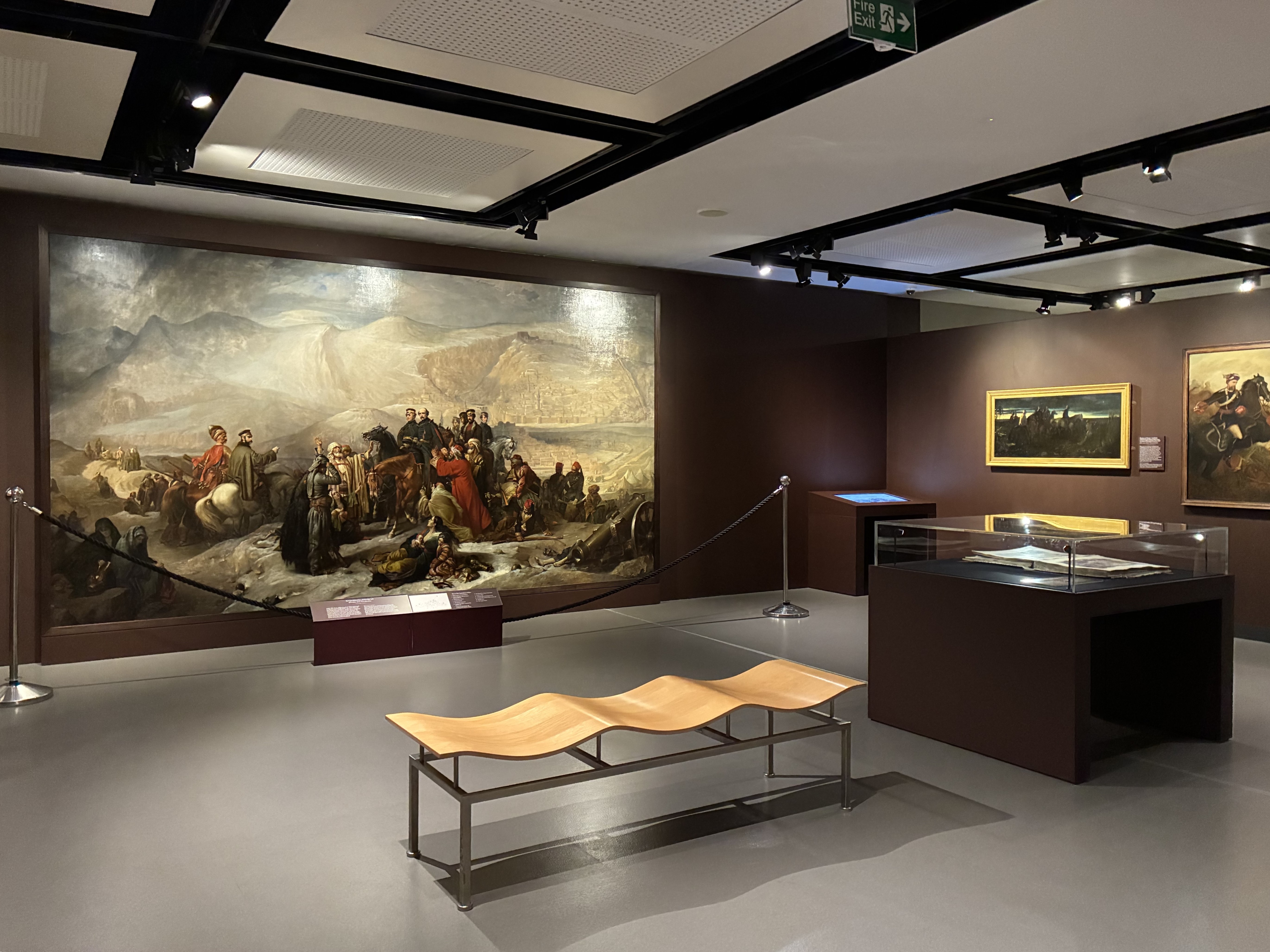
Installation view of Myth and Reality: Military Art in the Age of Queen Victoria at the National Army Museum showing the five-yard-wide oil painting ‘The Capitulation of Kars, Crimean War’ by Thomas Jones Barker (1855) with its static explanatory panel in front and an interactive screen off to the right (photo by the author)

Victoria’s Wars timeline

The exhibition includes a timeline of wars fought during Victoria’s reign. The point is that the British Army campaigned almost constantly throughout the period. There were a few big wars (the Crimean War, the Indian Mutiny and, right at the very end, the Boer War) but most of the conflicts we were involved in were small and localised, what modern historians call Victoria’s ‘small wars’.

  • 1837 – Queen Victoria ascends the throne
  • 1839 – the first photographs by Louis Daguerre in France and William Fox Talbot in England
  • 1842 – the world’s first illustrated weekly news magazine launched, the Illustrated London News
  • 1845 to 1846 – First Sikh War
  • 1852 to  1853 – The Second Anglo-Burmese War
  • 1853 to 1856 – the Crimean War
  • 1854 – Florence Nightingale travels to Crimea with 38 nurses. William Howard Russell’s reporting for The Times transforms people’s understanding of the squalid reality of war. 25 October – Battle of Balaklava and Charge of the Light Brigade.
  • 1854 – the Victoria Cross (VC) was introduced by Royal Warrant on 29 January 1856 to acknowledge the bravery displayed by soldiers and sailors during the Crimean War and soon after the Queen awards it to 62 Crimean war veterans

Queen Victoria and Prince Albert inspecting the wounded Grenadier Guards in Buckingham Palace. Coloured lithograph by George Thomas after himself (1855) Wellcome Collection

  • 1857 to 1858 – the Indian Rebellion
  • 1873 to 1874 – Third Anglo-Ashanti War
  • 1878 to 1880 Second Anglo-Afghan War
  • 1879 Anglo-Zulu War, featuring the Battle of Rorke’s Drift, 23 January 1879
  • 1880 to 1881 First South African War
  • 1882 Anglo-Egyptian War
  • 1884 to 1885 – Siege of Gordon at Khartoum, leading to its fall on 26 January 1885
  • 1885 Third Anglo-Burmese War
  • 1895 to 1896 Fourth Anglo-Ashanti War
  • 1898 – British reconquest of Sudan, featuring the Battle of Omdurman, 2 September 1898
  • 1899 to 1902 – Second South African War, featuring the sieges, the concentration camps etc
  • 1900 Fifth Anglo-Ashanti War

My take

There are about 40 artists, amateur and professional, soldiers and civilians, represented across the exhibition but the exhibition begins in a very decided way which raises a number of questions, because it starts with a strong emphasis on women war artists.

A feminist emphasis on women’s military art

The curators – all women – have decided that the first dozen or so works you see are all by women artists and devote several sections to them.

Victorian women artists, they tell us, helped to shape public perceptions of Army life. Many women were connected to soldiers through marriage or family, sometimes travelling with them abroad and depicting the people and places they saw.

Women were also important supporters and collectors of art, none more so than Queen Victoria herself. The Queen was also one of the most prominent subjects of military art, along with another celebrated figure of the time, Florence Nightingale – which explains why there’s a wall of works depicting the Queen meeting war veterans, awarding medals etc, and a little section about Florence Nightingale (who was famously averse to having her image captured, as she believed it detracted from her work).

However, as the exhibition proceeds you realise that most of the artists on display are not women, and, of course, none of the soldier artists are female – so why start this way unless you’re making a polemical feminist point? The implication seems to be that, after centuries or millennia of The Patriarchy, of tellings of history and art which downplay or completely ignore the role of women in the creation and consumption of art, this exhibition is doing its bit to redress the balance.

Fine. I understand. Why not? But there’s a second element to this approach which is notable and, maybe, problematic: this that one of the greatest, if not the greatest war artist of the Victorian era was Lady Elizabeth Butler, and so, hand-in-hand with the ‘women and military art’ section goes the ‘Lady Elizabeth Butler’ section. On one level there’s no quibbling with this: Butler was an outstanding artist and produced some of the standout works of the entire century. She was an absolute mistress of her craft, the half a dozen big paintings of hers brought together here are alone worth travelling to visit the show for, especially as several of them are usually buried in the Royal Collection.

So on the plus side, ignoring all its other features for a moment, you could say this is an outstanding selection of paintings, sketches and anecdotes by one of the nineteenth century’s great artists, and this is all to the good.

So why am I kvetching? Because the curators state, in these opening sections, in these early wall labels, that Lady Butler transformed military painting, depicting the life of soldiers with a new realism, taking a new, humane approach and setting a new standard for the subject. And this is all well and good, too, except that… In order to understand why Lady Butler is so important, and what she transformed, and what she changed it would have been good to have been fully introduced to the tradition of Victorian military painting which preceded her.

Instead, the result of placing Lady Butler right at the start of the show is to jump quite a long way into the later Victorian period without any preliminary explanation.

The work which really brought her to general attention was her ‘Roll Call’ which was displayed in 1874, 37 years into Victoria’s reign – and the first big work of hers which the curators feature, on the first wall of the exhibition, is ‘Dawn of Waterloo’ which was first displayed in 1895! 58 years into Victoria’s reign and only 6 years before her death. It’s a great painting but it comes at the very fag end of the period being covered and so is pretty misleading about the military art of Victoria’s era.

‘The Dawn of Waterloo: The Reveille in the Bivouac of the Scots Greys on the morning of the battle’ by Lady Butler (1895) the first full-scale painting by Lady Butler which the visitor encounters in ‘Myth and Reality: Military Art in the Age of Queen Victoria’ at the National Army Museum

Recap

So the decision to emphasise women’s role in military art may be laudable, and bringing a number of women’s works all together in the first few rooms ensures that the subject gets the prominence it deserves, rather than interspersing women’s works chronologically among the men’s pictures where they might be overlooked and unnoticed (as very probably happened in so many previous exhibitions on the subject).

Fine. And if you’re going to mention women artists of the time, then it would be silly not to mention and indeed have a section about the greatest of them, Lady Butler, also here right at the start. OK. Fine.

But the (maybe unintended) consequence of all this is that the visitor is deprived of a chronological understanding of the subject – of what military art looked like before Victoria, then at the start of her reign, how it developed through the decades leading up to the two seismic conflicts of the Crimean War and the Indian Mutiny in the 1850s, how it reflected trends in the broader art world, and so on.

You see how a chronological survey like this would have been interesting in itself and might also have better prepared the way for Lady Butler’s dramatic innovations: by the time you got to Lady B you’d have had a much better understanding of The Tradition she was transforming… but instead you have to work it out for yourself.

Five styles

This unchronological approach characterises the rest of the exhibition, too. Particularly in the sections about ‘Patriotism and Portraiture’ and ‘Realism and Reportage’, works from the 1840s or ’50s are placed next to works from the 1880s, ’90s or even early 1900s – it’s up to the visitor to make chronological, historical and aesthetic sense of the many different styles on display.

Having gone round the exhibition three or four times, dwelling on favourite works (and being drawn back again and again to the brilliant Butler paintings) I think I came up with about five different, roughly chronological styles of painting. They are:

  1. Romantic-sublime
  2. Patriotic-sentimental
  3. Mid-Victorian anecdotal
  4. Lady Butler
  5. Stiff official portraits

(This isn’t taking into account the pencil or charcoal sketches, and the many watercolours, which are specialist areas unto themselves.)

1. Romantic-sublime

Although painted in 1853 this picture strikes me as epitomising high Romanticism with its fondness for dramatic mountainous scenery and The Sublime. Look at the big baby eyes of Wellington (and his horse), the ethnic outfits of the local guides – it all has the rosy, soft-focus approach of Sir Water Scott’s novels.

Wellington at Sorauren, 27 July 1813 by Thomas Jones Barker 1853 © National Army Museum

2. Patriotic-sentimental

Kars is a city in north-eastern Turkey. In June 1855, as part of the during the Crimean War (1854 to 1856) it was besieged by a Russian army of 25,000. Demoralised by their defeats at the hands of the Russians, the Turks left the defence of Kars to Brevet Colonel (later General Sir) William Fenwick Williams, the British commissioner. The garrison was able to repulse three major Russian attacks but eventually cold, famine and an outbreak of cholera forced it to surrender on 26 November 1885. In recognition of their heroism, the Russians allowed the British garrison to march out of the city with the honours of war and into captivity.

‘The Capitulation of Kars, Crimean War’ by Thomas Jones Barker (1855) (National Army Museum)

This is a huge painting, over five yards wide (!), and it’s accompanied by not one but two diagrams identifying all the figures in it, one a static diagram, one an interactive display of the same. But it was only chatting to one of the (very well-informed) visitor assistants that I really understood what is going on.

You see the local in the red cloak clutching the hand of the bald British officer on his horse (Major General Fenwick Williams) and the cascade of similar locals off to his right, and the pitiful woman lying on the ground with her helpless children in the foreground, and similar locals on his left?

These are the local Turks who the British are abandoning to the kindness of the conquering Russians. So they are pleading with the British not to leave and abandon them but the British, defeated, have to. (Maybe a modern analogy would by NATO forces pulling out of Afghanistan and letting the Taliban take over.) It is this acute sense of regret and shame which explains the expression on the face of the British officer.

(You could write a book about the peoples the British Army promised to protect, only to abandon them – I’m currently reading a book about the Dutch Revolt which mentions that Queen Elizabeth I made all kinds of promises to the Dutch patriots in the 1580s which she then completely broke… It’s a long tradition.)

Back to the painting: ‘The Capitulation’, then, is a psychological study in the pain and embarrassment of duty, of a fine upstanding officer mortified to be abandoning the people he promised to protect. As such it is full of all kinds of melodramatic details, the thrown-up hands of the man in white on the left, the tearful eyes of the woman on the ground. It’s like a tableau from a mid-Victorian melodrama, at the centre of which is the British officer maintaining a stiff upper lip despite being deeply moved.

In fact it tells you a lot about mid-Victorian art and audiences that the work was commissioned, not by an aristocratic patron, but by the art dealers and print makers Agnew and Sons, precisely to be turned into prints and widely sold. So it is very deliberately catering to popular taste and demand.

3. Mid-Victorian anecdotal

The Victorians loved detail and clutter. Dickens’s novels overflow with wonderfully telling details and so do classic mid-Victorian paintings like William Powell Frith’s Derby Day (1858) or The Railway Station (1862), packed with little stories and anecdotal details. The exhibition includes an absolute classic of this style, ‘Home Again’ by Henry Nelson O’Neil.

‘Home Again’ by Henry Nelson O’Neil (1860)

‘Home Again’ depicts soldiers disembarking from a troopship at Gravesend on their return from the Indian Mutiny (1857 to 1859). For military history buffs the curators tell us that about 40,000 British troops were sent to India (more than had been mobilized for the Crimean conflict) to suppress the mutiny among the Indian troops of the East India Company’s Bengal Army.

But in purely visual terms we are invited to relish the details! At the very top a young woman peers over the shoulder of a bearded infantry corporal, who holds their baby for the first time. In the middle-right a young soldier of the 60th (The King’s Royal Rifle Corps) dressed all in black leans down to offer his Victoria Cross to a Chelsea Pensioner. The central action depicts sailors assisting a wounded sergeant to disembark. We are told that he wears a Kilmarnock ‘pork-pie’ cap under the white cotton ‘Havelock’ cover distinctive to the campaign, with the neck flap for protection from sunstroke.

There is patriotic pride here, and sentimentality of a sort, but it is very clearly all about the common people, ordinary soldiers (and sailors) and their reunions with wives and sweethearts. As such, it a little bit anticipates Lady Butler’s humanism but still with that mid-Victorian obsession with anecdote and detail.

4. Lady Butler

‘The Roll Call’ is one of the most celebrated British paintings of the 19th century. On its public appearance in 1874 it cemented Butler’s reputation as one of the leading painters of the age. It depicts a roll call of soldiers from the Grenadier Guards following the Battle of Inkerman in 1854 but can stand for thousands of similar occasions.

The Roll Call by Lady Elizabeth Butler (1874) © Royal Collection Enterprises Limited 2025 | Royal Collection Trust

The composition expresses Butler’s profound feel for the plight and experiences of the ordinary soldier, for the pity of war and the walls of the show feature not one but two quotations by her, emphasising how she eschewed patriotic guff in her concern for the actual lived experiences of the men who fought and suffered.

‘I never painted for the glory of war, but to portray its pathos and heroism’.

‘The Roll Call’ was fantastically successful. When it went on display at the Royal Academy it attracted over 300,000 visitors in a 3-month period and the more you look, the more brilliant it becomes.

The curators explain that historical or military painting for a long time worked with the basic design of a triangle which places the most important person – generally the commanding officer – at the apex (as in the pictures of Wellington and Major General Fenwick Williams, above). As soon as that’s pointed out to you, you realise really drastic difference her, the polemical message sent by the composition which is the equality of the men, all placed on the same level.

There’s still an anecdotal aspect to the thing, if you go up close and work slowly from left to right, starting with the two soldiers on the left lighting a sneaky fag or cigar, and working along through the bandages and blood of the wounded to the striking element of the man who’s collapsed into the snow. It really conveys the wretched pity of war, 44 years before Wilfred Owen coined the phrase for his volume of First World War poetry.

There is, of course, a figure on horseback, but he isn’t treated with the Romantic sentimentalism of the Wellington, above. Instead we can feel the gruff sympathy of the sergeant in charge as he reviews his wounded troops. And he also acts as the viewer’s entrance point into the work. If it was just the row of soldiers it would be slightly impenetrable: the officer on horseback not only relieves what might have been monotonous, but his movement carries the eye into the composition.

But there’s more because, after you’ve finished admiring the overall shape and canny dynamism of the composition, if you step back you notice the colours. You notice how Butler has depicted the uniforms of the men with great accuracy but used them as a springboard to create a composition of shades of grey. The grey coats and badges are reflected under the line of men by the different shades of snow and above them by the extremely nuanced and varied shading of the clouds.

On a literal level the coldness of the winter is evoked by the dominant tones of black, grey, white and brown, contrasting with small splashes of red from coatees and flags. But on a more aesthetic level, the awareness of shades of grey makes you think of James McNeil Whistler’s compositions, symphonies of certain palettes and timbres.

And then you notice the crows, the brilliant broken flight of crows coming from the middle of the composition and looping up over the head of the reviewing officer.

In its: 1) absence of sentimentality; 2) its immediately felt humanistic concern for the plight of the average soldier; and 3) its stunning painterliness, its brilliance of composition and colouring, ‘Roll Call’ really is a masterpiece. It’s worth visiting the exhibition just to see this one work in the flesh.

5. Stiff official portraits

Something the curators of the Army Museum must struggle with is that so much military art is decidedly average, if not actively poor. One or two of the battle paintings here struck me as ludicrously bad, but there’s a more subtle problem and that’s to do with military portraits.

I bet there are tens of thousands of these up and down the land, professional portraits of Britain’s countless officers, generals, admirals and so on which are good enough, decent enough, professional likenesses, but are never going to make it into anyone’s history of art because they are, by their nature, a very conservative wing of the medium.

Their number, their prevalence and popularity in Victorian times explain why there is a section titled ‘Patriotism and Portraiture’ here. Not only did ‘the people’ want to see portraits of heroes like Wellington or Gordon or Roberts, but countless military families wanted professional portraits of their eminent male members to hang alongside all their forebears, and hundreds of officers messes and regimental headquarters, ditto.

Hence a half dozen masterpieces of stultifying conventionality and woodenness.

Lieutenant The Honourable Frederick Hugh Sherston Roberts VC, Kings Royal Rifle Corps by Julian Russell Story (1899)

There’s a story behind this portrait, which is that Roberts not only won the Victoria Cross, but the same medal was awarded to his father, Field Marshal Frederick Sleigh Roberts, 1st Earl Roberts, making them one of only three father-and-son pairs to be awarded the VC in its 169-year history.

Watercolours

As mentioned, the exhibition includes 20 or so watercolours, much smaller and more intimate than the bombastic oil paintings. In a sense, watercolours under-promise and so are often able to over-deliver.

Installation view of Myth and Reality: Military Art in the Age of Queen Victoria at the National Army Museum showing a set of six watercolours of the Crimean War by William Simpson (photo by the author)

General Cannon’s landing, July 7 1854

My wife and I play a simple game when visiting exhibitions. Having crawled through the exhibits and rooms, reading and processing every wall label, we reach the end, turn round and go back through it, this time lightly, airily choosing one work per room which we like and having to explain why. A variation is to choose a work we would buy and take home to hang in the landing or hall or wherever. As I’ve stated, the Lady Butler paintings are all brilliant, but in terms of something I’d actually buy and live with, something a bit more modest, I kept returning to one of the 20 or so watercolours on display, ‘General Cannon’s landing, July 7 1854’, a pencil and watercolour by Joseph Archer Crowe (who has seven works in the exhibition).

‘General Cannon’s landing, July 7 1854’ Pencil and watercolour by Joseph Archer Crowe

Crowe worked at the Crimean War as a special artist for The Illustrated London News. This watercolour depicts how, on 7 July 1854, Turkish forces launched an amphibious assault across the River Danube on Russian positions at Giurgiu (in modern day Romania). The Russians were driven back and Giurgiu was occupied by the Turks.

It’s not going to rock anyone’s world, I just liked the composition, the line of ships going in from roughly right to left, and the light impressionistic touches of colour.

Women artists

I may have missed some but, for the record, here are the women military artists featured in the exhibition:

  • Lady Elizabeth Butler
  • Jane Drummond (portrait of Mrs Anne Steele)
  • Gertrude Ellen Burrard (portrait of Nussiban, our ayah)
  • Elizabeth Anne Leslie Melville (portrait of Major General Sir Owen Tudor Burne)
  • Emily Henrietta Ormsby (portrait of Colonel Henry Francis Strange; portrait of Major General John William Ormsby)

Lady Butler’s works

  • Tenth Bengal Lancers tent pegging (1873)
  • The Roll Call (1874)
  • Study of a Wounded Guardsman (1874)
  • Quatre Bras (engraving of oil painting, 1879)
  • Patient Heroes: A Royal Artillery Gun Team in Action (1882)
  • Scotland Forever! (engraving after oil painting, 1882)
  • After the Battle of Tel-el-Kebir (engraving of original painting, 1888)
  • After the Battle of Tel-el-Kebir (fragment of original painting, 1888)
  • The Defence of Rorke’s Drift (1882)
  • The Ballad of the Royal Irish at Sebastapol (6 x pencil illustrations of a poem, 1890)
  • Military sketches (pen, watercolour and pencil, 1893)

Summary

I don’t know whether my point about the lack of chronology and build-up to Lady B is even worth mentioning. My wife went round the displays two or three times with me and didn’t even notice or care, just enjoyed various works on their own merit.

So: if you’re interested in military history the exhibition contains lots of titbits about key wars and engagements of Victoria’s reign, about medals and uniforms, some lovely watercolours and a dozen or so really impressive oil paintings, along with a number of average or also-ran works which, however, illustrate interesting topics, such as the section about the creation of the Victoria Cross, and so on.

And the National Army Museum is always a lovely place to visit because – ironically, given its subject matter – it’s such a calm, clean and peaceful place to be. Go see.


Related links

Related reviews

Dirty Hands by Jean-Paul Sartre (1948)

“How you cling to your purity, young man! How afraid you are to soil your hands! All right, stay pure! What good will it do? Why did you join us? Purity is an idea for a yogi or a monk. You intellectuals and bourgeois anarchists use it as a pretext for doing nothing. To do nothing, to remain motionless, arms at your sides, wearing kid gloves. Well, I have dirty hands. Right up to the elbows. I’ve plunged them in filth and blood. But what do you hope? Do you think you can govern innocently?”
(Communist Party boss, Hoederer, in Act V of Dirty Hands by Jean-Paul Sartre)

This is by far the longest of the four plays in the Vintage collection of Sartre’s plays – Huis Clos is one continuous act of forty pages, The Respectful Prostitute is even shorter at 30 pages – whereas Les Mains Sales has seven acts and is 120 pages long! And I think it’s also the most enjoyable because the characters have time to breathe and expand and become believable.

The plot

Act I

It is 1944 in the fictional East European country of Illyria and the Russian Army is coming closer. Olga is in a flat used by the Illyrian communist party. Hugo arrives. He has just been released from prison. He is young, handsome, talkative. He has just served two years for the murder of the communist leader, Hoederer. A knock at the door and he hides. Olga opens the door to representatives of the Party, tough guys with guns. They’ve come to kill Hugo, they’ve trailed him here, he’s a liability, a loose cannon, he must be liquidated. Olga pleads for his life and says, ‘Give me till midnight to find out what really happened.’ The tough guys grudgingly relent and leave.

Hugo comes out of the bedroom where he’d been hiding. Olga explains he must tell her everything; maybe she can protect him, persuade the others he is trustworthy after all. ‘Tell me everything, right from the start.’ The stage darkens and now begins the majority of the play, which is told as a long flashback detailing the events leading up to the assassination of Hoederer.

(Setting up the threat of Hugo’s ‘liquidation’ in the present is a Hitchcock-like trick, like seeing the bomb being placed on the bus: everything that happens subsequently is charged with menace and suspense. Simple but effective.)

So the rest of the play shows in detail the build-up to the assassination and explores the very mixed motives of young Hugo the assassin.

Act II

It is 1942, Hugo has broken with his rich bourgeois family to join the People’s Party. As a callow young intellectual, he has been given the task of editing the party paper and is horribly intimidated by the ‘real men’ of action who surround him.

After a turbulent meeting of the party heads Louis explains to him and Olga that the party’s general secretary, Hoederer, is planning to sell the party out. He is persuading the central committee to go into an alliance with the Fascists and the bourgeois party after the war to create a government of national unity.

Olga and Hugo can’t believe he is a sell-out. Louis hesitates then lets them in on a plan to assassinate Hoederer. Hugo will get a job as Hoederer’s personal secretary. On a night to be arranged he will open the door to the assassins. Hugo bridles: he wants to be a man of action. Let him assassinate Hoederer. Louis hesitates but Olga speaks up for Hugo: let him. OK, says Louis. Pack your bags and take your new young wife, Jessica, with you (oh, he’s married, we realise). Move into Hoederer’s house. Become his secretary. Await orders.

The next few acts introduce us to the shrewd watchful Hoederer, surrounded by tough guy bodyguards (George, Slick and Leon). But by far the most interesting character is Jessica, Hugo’s attractive flighty nineteen-year-old wife. She and Hugo play baby games, play act, role play and neither are sure when the game is over or when they’re playing. This could have been a tiresome embodiment of Sartre’s ideas about people playing roles for others’ consumption, but in fact their young married flirting and flyting is done with a surprisingly light touch and I found very believable. It is Huis Clos but in a comic mode. When Hugo swears Jessica to secrecy then whispers that he’s here to assassinate Hoederer, Jessica bursts out laughing. Hugo’s plight is that no-one will take him seriously. He can’t even take himself seriously.

HUGO: Tell it to me now.
JESSICA: What?
HUGO: That you love me.
JESSICA: I love you.
HUGO: But mean it.
JESSICA: I love you.
HUGO: But you don’t really mean it.
JESSICA: What’s got into you? Are you playing?
HUGO: No, I’m not playing.
JESSICA: Then why did you ask me that? That’s not like you.
HUGO: I don’t know. I need to think that you love me. I have a right to that. Come on, say it.
Say it as if you meant it.
JESSICA: I love you. I love you. No: I love you. Oh, go to the devil! Let’s hear you say it.
HUGO: I love you.
JESSICA: You see, you don’t say it any better than I do. (Act III, p.156)

The next scene is set in Hoederer’s office, the representatives of the two other parties arrive, the Fascists and the Liberals. There is some interesting political analysis as Hoederer points out to the other two that, with the USSR on the horizon, the Proletariat Party, though numerically in a minority, will soon be supported by the conquering Reds: so they’d better do a deal now. At which point Hugo jumps to his feet, outraged that Hoederer is prepared to do a deal with the bourgeois he so despises, with the bourgeois party leader (Karsky) who actually knows Hugo’s own father and made a point of mentioning it to Hugo on the way in.

The bomb

Hugo is on the verge of pulling out his revolver and shooting Hoederer then and there, when a bomb goes off in the garden, shattering the window, throwing the characters to the floor. The political leaders are ushered into a safe room, leaving Hugo, the bodyguards and a terrified Jessica. There is now some dramatic irony because Hugo had blurted out ‘the dirty bastards’ just as the bomb went off. He was describing the cynical politicians making this stitch-up, as he worked himself up to shooting, but now has to pretend to Hoederer’s suspicious bodyguards that he was referring to the ‘dirty bastards’ who threw the bomb. In fact Hoederer had already (unwisely) given Hugo a few drinks before the politicians arrived, and now he has a few more to recover from the shock with the result that he gets hammered and starts drunkenly skirting round the fact that it is he who has been sent as an assassin.

They’re not particularly subtle, but these scenes where the callow Hugo teeters on the brink of giving himself away, unhappily revealing himself to be precisely the over-talkative intellectual he’s trying to stop being, while his quick-witted wife covers for him, are more dramatically complex and satisfying than anything in Sartre’s previous plays, whose characters have tended to be schematic and one-dimensional.

In particular, Jessica’s innocent quick-wittedness is a joy to behold. In an earlier scene, when Hoederer’s goons had insisted on searching the new arrivals’ room, Jessica had quick-wittedly hidden Hugo’s revolver in her dress and brazenly invited one of the bodyguards to search her who was, as a result, so red-faced that he only did a cursory job, not finding the gun.

Now Jessica quickly interprets Hugo’s drunken babblings as anger against the ‘dirty bastards’ who threw the bomb and devises other ways of masking what Hugo’s saying. In fact she encourages him to drink more, lots more, until he passes out and Slick and George just laugh at him, thanking their lucky stars they didn’t have a rich privileged upbringing.

Olga in the summerhouse

Cut to the summerhouse which is Jessica and Hugo’s quarters, and Olga is tending the unconscious Hugo, when Jessica returns to the room with a cold compress for his head. The two women confront each other over Hugo’s unconscious body – the scheming, hard, political woman versus the politically naive but sensuous and sharp woman. They wake a groggy Hugo and Olga tells him it was she who threw the bomb. The party’s getting impatient. It’s been ten days and Hoederer’s still alive. She came to finish the job off but botched it. Hugo’s got till tomorrow, then they’ll come en masse. Anyway, whatever happens, the party thinks Hugo’s sold out – he is in big trouble. Being blown up by the bomb would have done him a favour. Olga leaves, climbing over the wall and escaping.

Jessica confronts Hugo with the reality of what he’s promised. For the first time they’re not playing. Hugo admits he can’t believe it, can’t believe he’s a killer, can’t believe that Hoederer’s bright quick eyes will go dull, that blood will seep into his suit, all because he, Hugo, has pulled a trigger. He is over-thinking and over-imagining the deed. But Jessica is no Lady MacBeth; the opposite, she begs Hugo to reconsider and, instead of just murdering Hoederer, discuss the issues, arguing him out of whatever it is that Hugo so vehemently opposes.

At which moment there’s a knock on the door and Hoederer himself enters, to check up on his secretary. The goons told him he’s drunk himself unconscious: is he alright? Having made certain, Hoederer makes as if to leave but Jessica jumps up before him. Now, now is the time for Hugo to do it? For a moment we the audience and Hugo are flabbergasted: what? shoot Hoederer now? No, Jessica means now is the time for the two men to talk, to thrash out their differences, for Hugo to find out if it’s really necessary to kill Hoederer (Jessica obviously doesn’t say this out loud, but we know from the previous dialogue with Hugo that’s this is what she means).

Hoederer explains Realpolitik to Hugo

And this is the lead-in to a very enjoyable scene where Hoederer a) explains the political situation in Illyria b) explains why a political deal with the other parties is necessary c) taunts Hugo with his naive intellectual purity. He’s more interested in principles than men, Hoederer taunts. He doesn’t want to get his pretty little bourgeois hands dirty. Well, Hoederer’s hands are dirty all right, covered in blood and filth.

This works very well as drama; it is written really effectively with Hoederer’s arguments battering Hugo’s feeble denials. When Hoederer has left, even Jessica can see that his arguments were right and, worse, that Hugo knows it, despite all his denials, despite his intention to stay true to his original mission, Hoederer converted him.

But I was also fascinated by Hoederer’s analysis of the situation in this fictional East European country because it closely parallels the analyses of the post-war communist takeover of Europe I have just read in Anne Applebaum’s brilliant history, Iron Curtain: The Crushing of Eastern Europe 1944 to 1956. Hoederer argues that:

  • The Proletariat Party cannot take power by itself; the proletariat only make up 20% of the population and not even all of them support the party. Hugo naively says, “Let’s seize power.” Hoederer replies that if they seized power, they would quickly be suppressed by the Peasants Party which represents 55% of the population, in alliance with the Fascists who control the army and police.
  • Hence the need to enter power peaceably in a national coalition.
  • Hoederer has suggested to the leaders of the Fascists and Bourgeois parties that they set up a national government with six on the council and the Proletariat Party will have three of those delegates. He even – and this chimes exactly with Applebaum’s description – wouldn’t want most of the ministries, just two: the interior and defence, because those are the only two that matter.
  • “But,” Hugo says, “the Red Army will be across our borders in weeks: why don’t we ride their coat-tails to power?” “Because, my naive friend,” replies Hoederer, “they will still have to fight their way across the country and many will be killed; the Soviets will be blamed. And because the Party will forever afterwards be thought to have been imposed by a foreign power rather than rising up to represent the people. And because, even for the national unity government, the country will be a wasteland when peace finally comes, difficult decisions about law and order will have to be taken; the Party can represent itself as a natural outgrowth of the nation and people, and can present itself as opposing these unpopular policies from within government. With control of key industries it can slowly isolate the leaders of the other parties and wait till the time is right to stage a coup.”

Hugo hates all this because it is messy and unprincipled and yuk. Hoederer laughs at his naivety and bourgeois prissiness.

Act VI

Next day, the day of the deadline Olga told Hugo he must act or else. Before the working day begins Jessica comes into Hoederer’s office and after a little flirting reveals that Hugo has a gun, and has been tasked with assassinating him. Hoederer knew it all along. Hugo knocks at the door, Jessica exits through the window (reminding me of all the entrances and exits through windows in The Respectful Prostitute).

Now Hoederer toys with Hugo, continuing the discussion over whether Hugo has it in him to be an assassin or whether he is too much of an intellectual. Because assassins don’t think at all, have no imagination, just kill. Whereas Hugo has too much imagination, can not only picture the dead body and the blood, but has grasped the political consequences, the cause of the Party set back, no single leader to greet the Red Army, its chance for power maybe irrevocably lost. He deliberately turns his back and fixes a cup of coffee, while Hugo gets the gun out his pocket and holds it trembling, very obviously struggling with himself. Hoederer turns, faces him, says “Give me the gun,” and takes it. Hugo collapses, virtually in tears, and says, “You despise me.”

Hoederer says he remembers being a naive principled young man. He can help Hugo to maturity, guide him, mentor him. Hugo is almost in tears. But he won’t give up his opposition to the political pact. Don’t worry, says Hoederer: he’ll go to town tomorrow and square it all with Louis (the guy who sent Hugo in the first place). Go back to writing, it’s what you do best; and he dismisses Hugo.

Re-enter Jessica who’s been perched on the window ledge all this time (!) She heard everything. She thinks Hoederer is noble. In fact, she’s realised she’s not in love with her silly immature husband, she realises she wants a ‘real man’ (p.232). Oh dear. The 21st century reader’s heart sinks a little. They look at each other in silence. She’s never thrilled to a man’s touch, sex with her husband makes her giggle. “Are you frigid?” Hoederer asks. “I don’t know,” Jessica replies. “Let’s find out,” says Hoederer and embraces and kisses her.

At just this moment Hugo re-enters the office. Oops. Incensed, he accuses Hoederer of lying to him and stringing him along and sparing him and promising to make him a man because all along he’s just wanted his wife. Hugo springs for the desk where the revolver was left, seizes it, Jessica screams, Hugo fires three shots at Hoederer who crumples in his chair. Enter the bodyguards, George and Slick with guns aimed at Hugo but Hoederer with his dying breath tells them to spare him, it was a crime of passion, that he – Hoederer – was sleeping with Hugo’s wife. And dies.

Act VII

Lights go up on the setting of the first act, as Hugo finishes pouring his heart out to Olga. She keeps asking, “So did you assassinate him because of our orders,?” and Hugo honestly doesn’t know. In a typically Sartrean way, Hugo isn’t even sure that he did it: or was Chance the key agent? If he’d opened the door two minutes later or earlier, it wouldn’t have happened. In fact, he was coming back to ask for Hoederer’s help.

It was an assassination without an assassin. (p.234)

Hugo is crushed by a characteristically Sartrean sense of his own unreality. But Olga is pleased. She thinks she can fend off the men who want to kill him. And here comes the punchline, the cynical climax of the play. For Olga explains:

The party line has changed. When they despatched Hugo to murder Hoederer communications with Moscow were poor. Later they discovered that Moscow did, in fact, want the party to go into a government of national unity with the Fascists and bourgeois parties. It would mean saving many lives among the Illyrian army (which would immediately lay down its arms). It would save Moscow embarrassment with the Allies (Britain and the US). The new plan is for the party to join a 6-man government, and the party to have 3 delegates. Hugo is amazed and then bursts out laughing. This is exactly what Hoederer intended, what we saw him proposing to Hugo just a few moments (and two years) ago down to the last detail.

“Yes,” Olga explains, “but Hoederer was ‘premature’ in his policy.” Meanwhile, another man, now dead, has been officially blamed for Hoederer’s assassination. Now Hoederer has been rehabilitated and… Hugo joins in, “You’re going to put up statues to him after the war. You’re going to make him a hero of the party?” Hugo collapses into helpless tear-filled laughter of despair.

Olga tells him to snap out of it, the Party killers are about to arrive. She is ready to tell them he is a new man, rehabilitated, he will go along with the party line, he will lie about Hoederer’s assassination, he will forget all about and never mention to anyone that he did it. He will live a life of deceit and lies for the greater good.

But Hugo refuses. The only thing that kept him going in prison was that he fired – maybe for personal reasons – but in accordance with the party line. To learn that the line has changed and the act become completely meaningless is too much to bear. He thought that killing someone would make him feel real, give him weight and substance – but he carried on feeling horribly unreal and contingent. Now, now he has the chance to stand up, to act for himself, to make himself real. Olga begs him to stop but as the killer’s car draws up outside, Hugo stands up and walks to the door. He will proclaim his guilt and force them to kill him. It will be his final, defining acte.

Thoughts

Apparently the big and powerful Communist Party of France disliked the play. You can see why.

In purely political terms, this was the decade when Moscow’s concept of Socialist Realism came to be enforced all across the Eastern Bloc. Art, music, literature, all had to be high-minded and inspiring, showing happy workers exceeding their quotas and merrily bringing in the harvest. It’s hard to imagine a more nihilistic, defeatist, cynical and plain anti-communist narrative than Les Mains Sales, hard to imagine anything more completely contrary to the spirit of Socialist Realism, focusing as it does on the amoral political manoeuvring, the lying to its membership, the cynical alliances with its class enemies, and the pointless infighting and murders of the communist party.

Politics aside, the communist party of Illyria comes over as a mob of gangsters, little different in terms of threat and violence from Al Capone and Chicago gangsters of Prohibition. Time and again I am reminded that Sartre and Camus were writing their intense, man-holding-gun fictions during not only the rather obvious violence of the Second World War, but also during the heyday of Hollywood films noirs which they both hugely enjoyed. Camus cultivated a Humphrey Bogart look with his collar turned up and a Gitanes cigarette permanently smouldering in his mouth. The romance, the glamour of being the dude with the shooter, calling the shots. Specially if you yourself are mostly the chap in the library with the pipe and the thick glasses.

As a specimen of intellectual French film noir, as a dissection of the worldview of communist politics in 1947 and 1948, and as pure entertainment, I think les Mains Sales is by far the best of these four plays.

Jessica and sexism

All the male characters utter contemptuously sexist comments either about Jessica in her absence, or to her face, which would get you locked up nowadays. They casually refer to her political naivety, her inability to do anything significant for the Revolution and her liability as distracting ‘bait’ for all the male characters. This was, after all, 20 years or so before the birth of Women’s Liberation / second wave feminism.

It is, for example, offensive to modern readers when the bodyguards make remarks about Jessica’s attractiveness in the first scene in the big house, and Hoederer is no better, dismissing her as a distraction, saying why doesn’t she ‘scratch her itch’ with Slick or George.

More to the point, there is something sexist about the entire conception of the play which sets the world of passive sensuality (Jessica) against the ‘active’ network of male politics and action (Hugo and Hoederer). With crashing stereotyping the main woman character represents Sex, anti-Politics (although, to be fair, she is balanced by clever calculating Olga, who is smart enough to try and save Hugo, and who, after all, throws a bomb in the middle of the play.)

But despite what we nowadays would describe as the #everydaysexism of the text, Jessica is, by and large, the most attractive character in the play. She is the least hoodwinked, the least deceived. She knows nothing about politics but she knows more about life than her over-intellectual husband, tricks the bodyguards with her nimble-wittedness, and is quite a match for Hoederer. She is the only one who sees through the men with all their high-handed rhetoric to ask the real questions, specifically; why does Hugo want to murder a man he respects and, by the end of the play, has come to love? Why? Fool!

Although it’s ostensibly a play about tough guy men politicking and conspiring, Jessica is – for me – the star of the show.

The movie

Despite being ‘the philosopher of the century’ it’s damn difficult to get hold of the movie versions of Sartre’s plays. The Respectful Prostitute seems impossible to track down in any shape or form. Here’s a print of the film version of Les Mains Sales, made in France in 1951. There are no sub-titles and the sound is out of synch for a lot of it, but it gives a stark sense of how stagey the story is. And how French.

Apparently, the French Communist Party were so angry about the play that they tried to organise a boycott of cinemas where the film was showing.


Credit

Les Main Sales by Jean-Paul Sartre was first performed in Paris in April 1948. This English translation – Dirty Hands by Lionel Abel – was published in the United States in 1949. Page references are to the 1989 Vintage paperback edition. All quotations are for the purposes of criticism and review.

Related reviews