Lucian Freud: Drawing into Painting @ the National Portrait Gallery

Lucian Freud (1922 to 2011) was a British painter and draughtsman, specialising in figurative art, who is known as one of England’s leading 20th-century portraitists.

Towards the end of his life, the Lucian Freud Archive was created by accumulating the artist’s personal papers, sketchbooks, and working materials over his lifetime. Spanning his long working life from about 1939 to 2011, the Archive contains over 160 childhood drawings, 47 sketchbooks containing some 600 drawings, and personal letters. In 2015 the Archive was officially acquired by the National Portrait Gallery.

Now a generous selection of images from the Archive is on display at the National Portrait Gallery. These include a wealth of early drawings and sketches, newly acquired etchings of family members which, along with Freud’s etching tools and his paintbox. As we progress through the show, we watch him evolve from his early bug-eyed cartoony style, into something more caustic and realistic, showing his development from standalone drawings into sketches which are obvious preparations for paintings, and then on to a dozen or so finished oil paintings in his mature style. The combination of all these formats is designed to showcase Freud’s skill as a draughtsman across many mediums, in

Created in close collaboration with David Dawson, Director of the Lucian Freud Archive, this is the first exhibition of Freud’s work at the National Portrait Gallery since the major painting retrospective Lucian Freud Portraits, in 2012.

Gallery

The show opens with a wall-sized blown-up image of Freud’s studio.

Wall-sized photo of Freud’s studio towards the end of his life, in ‘Lucian Freud: Drawing into Painting’ at the National Portrait Gallery (photo by the author)

There’s a selection of schoolboy drawings, for real completists.

Lucian Freud schoolboy drawings in ‘Lucian Freud: Drawing into Painting’ at the National Portrait Gallery (photo by the author)

Early style – portrait drawings from the 1940s.

Early ‘cartoon’ style in ‘Lucian Freud: Drawing into Painting’ at the National Portrait Gallery (photo by the author)

‘Girl with Roses’, painted in 1948, is a seminal early oil-on-canvas portrait by Lucian Freud, of his first wife, Kitty Garman. It depicts a tense, pregnant Kitty looking away with a stiff posture, clutching a ‘Peace’ rose while another lies in her lap.

Girl with roses / portrait of his wife (1948) in ‘Lucian Freud: Drawing into Painting’ at the National Portrait Gallery (photo by the author)

One of several display cases showing drawings from the sketchbooks.

Display case of drawings in ‘Lucian Freud: Drawing into Painting’ at the National Portrait Gallery (photo by the author)

Portraits from the 1950s – in my opinion, scrappy and inconsistent.

Wall of 1960s portraits in ‘Lucian Freud: Drawing into Painting’ at the National Portrait Gallery (photo by the author)

Forty years later, 2000s portraits: more consistent, more detailed, darker, closer up. Far more impactful.

Wall of 2000s portraits in ‘Lucian Freud: Drawing into Painting’ at the National Portrait Gallery (photo by the author)

Transitioning to his mature style i.e. naked figures, in ungainly poses, painted with a kind of brutal honesty. This relatively small work is one of a series of naked portraits of his lover Jacquetta Eliot.

Small naked portrait from 1973-4 in ‘Lucian Freud: Drawing into Painting’ at the National Portrait Gallery (photo by the author)

Preparatory sketches and final painting, in his mature style. Studying these, it struck me that the drawings have an open quality – the poses are somehow more free and suggestive – whereas the finished oil painting is much more heavy and closed. On reflection maybe part of this is because the painting has a detailed backdrop – the sofa and rumpled white sheet, depicted in great detail – whereas the bodies in the sketches float free in an abstract white space.

Preparatory sketches and final painting in his mature style in ‘Lucian Freud: Drawing into Painting’ at the National Portrait Gallery (photo by the author)

Letters and comments by friends reveal that as a boy and young man, Freud did lots of drawings of animals. The exhibition includes some of these, including a number of etchings of his whippet, Eli. Here’s one from 2002 set next to a drawing of a toy rabbit from 60 years earlier, in his early style.

Eli (2002) and Rabbit on a chair (1944) in ‘Lucian Freud: Drawing into Painting’ at the National Portrait Gallery (photo by the author)

The exhibition has a section on group portraits he made as direct homages to works by classical painters, one by Watteau (Large interior W11, 1983), a few etchings inspired by Chardin.

The last few rooms contain prime examples of both his massive full body nude paintings, alongside more ‘discreet’ portrait busts. There are famous portraits of David Hockney (2002) and Queen Elizabeth II (2001), alongside equally vivid portraits of less well-known figures, and a couple of his really vivid self portraits.

Thoughts

In my mind I had a simple mental model of Early style – Naked style – Mature style, but this exhibition is distinguished by a lot more variety and digressions and distractions than that suggests (the school drawings, animals, Old Master homages, among many others) which you will either find enchanting (if you’re a Freud fan) or maybe a little confusing (as I think I did).

A problem with Freud is that, once you’ve seen a number of his naked portraits, especially the ones where the sitters are showing off their big, sore-looking red scrotums, it’s a little hard to expunge the shock of these images from your mind.

Sprawling naked men in ‘Lucian Freud: Drawing into Painting’ at the National Portrait Gallery (photo by the author)

In among the mix, a distinct and different theme which came over to me was the importance of Family and Friends – a recurrent theme in the sketches, drawings and paintings of his wife, his lovers, his children and grandchildren. (Freud was known for his vast, often chaotic family life, having acknowledged at least 14 children with various women.) These are ‘intimate’ in a different sense, an emotional sense.

Intimate late portraits in ‘Lucian Freud: Drawing into Painting’ at the National Portrait Gallery (photo by the author)


Related links

Related reviews

Hawaiʻi: a kingdom crossing oceans @ the British Museum

I didn’t read the press and publicity stuff closely enough so I vaguely thought this would be a general exhibition about historical Hawaiian art and culture – but I was wrong. It’s far more structured, nuanced and focused than that.

Featherwork and ornaments that evoke a gathering of ali‘i (chiefs) on display in ‘Hawaiʻi: a kingdom crossing oceans’ at the British Museum © The Trustees of the British Museum (photo by MKH)

A meeting of kings

The centrepiece of the show is that 200 years ago, in 1824, King Kamehameha II and Queen Kamāmalu became the first Hawaiian monarchs to visit the UK. It took them and ten of their courtiers 5 months (November 1823 to May 1824) to sail here on a Royal Navy ship and when they arrived they were treated with the courtesy and respect according any visiting monarch.

They met with the recently crowned British monarch, King George IV (crowned July 1821), and exchanged gifts: they gave our king beautiful hand-made cloaks, and received in return a silver teapot and a watch, among other luxury objects. They were dressed in the latest fashions, had their portraits painted by the court painter John Hayter, went to the theatre, were even the subject of the usual scathing regency satirical cartoons.

Portraits, cartoons and sumptuous gifts are all included here, along with a map of their route (they stopped at Buenos Aires along the way, and handed out gifts there, too).

Portrait of King Kamehameha II (left) and Queen Kamāmalu (right). Hand-coloured lithographs by John Hayter © The Trustees of the British Museum

Tragically – disastrously – after a few weeks, the handsome young king and queen both caught measles and died from it. Their courtiers returned to Hawaiʻi with the gifts but without a king, who was promptly replaced by his younger brother Kauikeaouli, who became King Kamehameha III and went on to reign for 30 years (June 1825 to December 1854).

It is this extraordinary event which provides the centrepiece of this exhibition. The show can be divided into the following parts:

1. Background facts

It opens with a brief recap of the history of Hawaii, complete with maps. Here’s a summary:

Hawaiʻi consists of 137 volcanic islands spanning 1,500 miles that make up almost the entire Hawaiian archipelago (the exception is Midway Atoll).

The eight main islands, from northwest to southeast, are Niʻihau, Kauaʻi, Oʻahu, Molokaʻi, Lānaʻi, Kahoʻolawe, Maui, and Hawaiʻi, after which the state is named. The last is often called the Big Island or Hawaiʻi Island to avoid confusion with the state or archipelago.

The archipelago was settled between 1000 and 1200 by Polynesian seafarers navigating by the stars and following the flight of migratory birds. Over the centuries, the islands became the seats of numerous independent chiefdoms.

In 1778, British explorer James Cook was the first known non-Polynesian to arrive at the archipelago (he was to go on to be killed here, after a tragic cultural misunderstanding). The early British influence is reflected in the Hawaiian state flag, which contains a Union Jack.

King Kamehameha I, also known as Kamehameha the Great, unified the Hawaiian Islands by force and diplomacy, establishing the Kingdom of Hawaiʻi in 1795 and completing unification by 1810, creating a single, powerful monarchy from separate chiefdoms.

It was his son, Kamehameha II, who succeed Kamehameha in 1819, who undertook the journey to Britain. the backstory is that in April 1822, English missionary William Ellis arrived with a schooner, the Prince Regent, to add to the King’s growing collection of ships (!). It was a gift from George IV the King of Great Britain and Kamehameha II wrote to thank him, requesting closer diplomatic ties. It was from this gesture and this correspondence that the idea was born for the royal court to journey to the other side of the planet to meet the British king.

Display of Akua hulu manu (feathered gods) in ‘Hawaiʻi: a kingdom crossing oceans’ at the British Museum © The Trustees of the British Museum (photo by MKH)

Language and pronunciation

The Hawaiian language is referred to as Ölelo Hawali and terms and phrases from it are used throughout the exhibition.

Apparently, the correct pronunciation of Hawaiʻi is to insert a glottal stop before the final ‘e’ sound. What is a glottal stop? Imagine saying in a broad Cockney accent, the following phrase: ‘Wotta lotta little bottles’ so that it sounds like ‘Wo’a lo’a ‘li’el bo’els’, where you don’t voice the t sound. Same with Hawa [glottal stop] ee.

2. Hawaiʻi culture, beliefs and crafts

Having painted in this background, the exhibition then devotes the first big space to giving an overview of the gods, traditional beliefs, arts and crafts of the Hawaiian people at around the time of the royal visit. (Here we discover, amid much else, that the British Museum holds one of the largest collections of Hawaiian objects in the world outside of Hawaiʻi.)

Wooden ki‘i (images) that embody kua (gods) in ‘Hawaiʻi: a kingdom crossing ocean’ at the British Museum © The Trustees of the British Museum (photo by MKH)

Highlights include:

  • a nine-foot kiʻi (image) of the god Kū, the god of warfare and governance, dressed with a contemporary loincloth and standing atop a pole
  • a magnificent ʻahu ʻula (feathered cloak) sent in 1810 by the first king of unified Hawaiʻi, Kamehameha I, to King George III, the largest known example of its kind

There are striking statues of wooden gods (see above), wooden bowls, plumed hats, gorgeous cloaks made from bird feathers, and a wall of coloured barkcloths.

kapa (barkcloth) pieces on display in Hawaiʻi: a kingdom crossing oceans at the British Museum © The Trustees of the British Museum (photo by MKH)

Barkcloth: Kapa (barkcloth) is made from the inner bark (bast) of the paper mulberry and other plant fibres. As a medium, kapa is a connector between the land, the people and the gods. Different forms of kapa had many uses, from everyday life to ritual practice, including as chiefly garments, spacial dividers, blankets and wrappings for bones.

HelmetsMahiole (helmets) were worn in battle and in ceremonial contexts, often together with ʻahu ʻula (feathered cloaks and capes). The head has particular significance in Hawaiʻi as one of three centres in the body where the aumākua (deified ancestors) hover. Each helmet is unique and identifies the bearer as a chief. The structure is woven from the aerial roots of a climbing plant called ʻieʻie and is often adorned with feathers.

Gods: Origin stories tell that the islands were birthed by the gods. High chiefs were manifestations of the gods on earth. Through rituals, chefs could protect the people and ensure the land’s abundance. In turn, the people revered their chiefs and cultivated the land, gathering materials and nurturing resources. Craftspeople created precious items that honoured their chief.

Kū and Lono: Kū is a Hawaiian god whose realm includes warfare and governance and that in the Hawaiian ritual calendar, the season of Kū begins in January-February and ends in October-November. At that point Ku is replaced by Lono, a deity associated with harvest, peace and recreation. (So we are currently in the season of Kū.)

Here’s one of the exhibition’s carved wooden artefacts, which experts thinks depicts a chief, as indicated by the loincloth round his waist and the feathered headdress.

ʻUmeke kiʻi (bowl with figure) © The Trustees of the British Museum

In addition, there are feathered cloaks worn by chiefs, powerful shark-toothed weapons, spears and clubs, and much more.

3. The meeting of kings

As described above, this is the centrepiece of the show and includes displays of ceremonial cloaks, lithographs of the king and queen, portraits and pictures of them at the theatre, the silver teapot, the silver watch and a couple of satirical cartoons depicting a lecherous King George groping a buxom native queen, in the comically gross style of Regency cartoons.

Installation view of ‘Hawaiʻi a kingdom crossing oceans’ at the British Museum showing the gallery devoted to the royal visit © The Trustees of the British Museum (photo by MKH)

Red

The exhibition displays a large Hawaa’ian feathered cloak near to George IV’s coronation surcoat and this triggers fascinating thoughts about a) the persistence of monarchy and king worship across the most diverse societies, b) the need these have for grand costumes and regalia, and c) the importance of the colour red. In fact red, as you can see from the images, is the really dominant colour of the exhibition: you can see for yourself that the cloaks in particular include yellow and black patterning, but it’s almost always against a core background colour of red.

King George IV’s coronation surcoat (left) and a cloak belonging to King Kamehameha II (right) displayed so you can make a direct comparison of size, shape, colour and impact, in Hawaiʻi: a kingdom crossing oceans @ the British Museum (photos by the author)

4. Alliance with Britain

Having established the close connection between Great Britain and Hawaiʻi which existed from its discovery by the West, the exhibition then explains that for 70 or so years after the 1824 visit, the two countries maintained close relations. When a zealous Royal Navy officer, Captain Lord George Paulet of HMS Carysfort, in 1843 illegally occupied Hawaiʻi and tried to formally annex the kingdom for Britain, King Kamehameha III wrote to the British government who recalled Paulet and assured the King of ongoing Hawaiian independence.

Negotiations were already underway which led in November of the same year (1843) to Great Britain and France signing the Anglo-Franco Proclamation, a joint declaration that formally recognized the independence and sovereignty of the Kingdom of Hawaiʻi. This agreement committed both nations to never take possession of Hawaiian territory, either directly or as a protectorate.

There’s a copy of the Proclamation in the exhibition, on loan from The National Archives and the curators tell us that the precise date, 28 November 1843, is still celebrated in Hawai’i today as Lā Kū’oko’a (Independence Day).

5. Annexation by the US

However, as we progress through the exhibition, the next key moment in the nation’s history came when America annexed Hawaiʻi. Like all historical events, this was more complex and fraught than it is now presented, with a background of political problems within Hawaiʻi exacerbated by the commercial interests of European and American businesses which owned extensive sugar and pineapple plantations. In 1893 a group of Western businessmen persuaded the local American agent to allow US marines to take part in the (peaceful) overthrow of the native government and to establish the Republic of Hawaii; and then lobbied Congress and the Senate to formally annex the islands, which the United States did 5 years later, in 1898. (Just worth reminding ourselves that the nearest part of the Hawaiian archipelago is 2,000 miles from the American mainland.)

The Hawaiian monarch, Queen Liliʻuokalani, protested against the coup but, when weapons were found in the palace which might have been used by loyalist forces, was placed under house arrest. She appealed to the British government, invoking the Anglo-Franco Proclamation but, to our shame, and as so often, we did nothing to defend the monarchy we had so enthusiastically hosted in 1824. Instead, in 1895 Queen Liliʻuokalani was forced to abdicate, thus ending the Hawaiian monarchy.

Even at the time, there was a great deal of debate in America, among politicians and the press, about the rights and wrongs of the coup and President Grover Cleveland opposed annexation. However, he was replaced by President William McKinley who pushed for annexation, which formally took place in July 1898. There then followed the inevitable sequence of assimilation whereby, first of all, in February 1900, the Hawaiian Islands became a US ‘incorporated territory’; and then in August 1959, the territory was officially declared America’s 50th state.

(For comparison, the contemporaneous Spanish-American war of 1898 ended with the Treaty of Paris (1898) whereby Spain ceded 1) Puerto Rico, 2) Guam and 3) the Philippines to the United States. The Philippines were a US colony from 1898 until given independence in 1946 whereas Guam and Puerto Rico remain to this day parts of the US as self-governing, ‘unincorporated territories’, meaning people born there are US citizens, they use US currency and passports, but residents can’t vote in presidential elections and have limited representation in Congress.)

And then, just as inevitably, came the modern attack of imperial guilt and in 1993 the US Congress passed the Apology Resolution, apologising for America’s role in the illegal annexation of the Hawaiian nation, which was signed by President Bill Clinton.

Throughout the annexation process the majority of Hawaiians wished to remain independent and this is signalled here in the exhibition by a picture of ʻAuʻa Haunani-Kay Trask (1949 to 2021). Trask was ‘a prominent Native Hawaiian activist, scholar, author and poet who was a leading figure in the Hawaiian sovereignty movement. She was known for her fierce advocacy against US imperialism, the illegal occupation of the Hawaiian Kingdom, and the commodification of Hawaiian culture by the tourism industry.’

Trask is quoted, on the centenary of the annexation in 1993, making the simple statement: ‘We are not American’ and this is the text you see running in lines across this striking portrait, part of a series of 108 photographic portraits of Kānaka Oiwi (Native Hawaiians) made by Hawaiian artist Kapulani Landgraf.

Photo of ʻAuʻa Haunani-Kay Trask in ‘Hawaiʻi: a kingdom crossing oceans’ at the British Museum © Kapulani Landgraf 2025

All of which makes for a thought-provoking read in light of President Trump’s ongoing threats to annex Greenland against the wishes of its (57,000) population…

6. Contemporary Hawaii

After this striking photo of Trask, we enter the final part of the exhibition, which focuses on contemporary Hawaiʻi.

Contemporary arts

I haven’t yet found space to mention that throughout the show, right from the start, the older objects have been interspersed with contemporary works made in the traditional style but made by contemporary Kānaka ʻŌiwi (Native Hawaiian) artists. These include:

Statue: A statue of historical figure Kekuaokalani, Liholiho’s cousin, who rebelled against the King’s decision to overturn the ‘ai kapu religious system. He was defeated and killed by Liholiho’s forces at the battle of Kuamo’o. The statue was made by contemporary carver Rocky Ka’iouliokahihikolo’Ehu Jensen after the traditional manner of articulated figures depicted in early drawings of Ahu’ena, defender of Hawaiian gods and faith.

Drum: Right at the start of the exhibition there’s a pahu or drum. Drums were thought to have been brought to Hawaiʻi by one of the first ancestors, named Laamaikahiki. The ancestors travelled from a place they called Kahiki, possibly in the Society or Marquesas Islands. But the point is that the drum in question isn’t an antique but was hand-carved by contemporary Native Hawaiian artist Dennis Kanale Keawe.

Akeanaliʻi by Dennis Kanaʻe Keawe (b. 1944). Made of kamani wood, shark skin, ʻaha (coconut cordage), carbon black soot coating, 2020

Contemporary videos

In the same spirit, sprinkled throughout the show are four or five short videos which show contemporary living practitioners of traditional arts and crafts explaining their practice. Take the drum, above – there’s a 90-second clip of La’akna Perry performing a mele or chant using the drum. Elsewhere:

  • Barkcloth: Hina Kneubuhl, a contemporary maker of kapa (Hawaiian barkcloth), explains how barkcloth is created and decorated, and how contemporary artists draw inspiration from ancestral works.
  • Hula: La’akea Perry, a Hawaiian kumu hula (dance master teacher), explains the importance of hula as a living practice and how it is taught today. He is filmed dancing with a newly made version of a ‘ulī’ulī (dance rattle), next to an historic example.

There’s also a general soundscape which floats across the displays, featuring the sound of waves breaking over lava beds and the sound of wind blowing through a coconut grove. All very soothing given that outside the Museum, the rain was pouring down in the gritty streets of central London.

Contemporary problems

No doubt there are all kinds of issues and ideas and things which could be written about contemporary Hawaii. The exhibition has selected a handful of areas where the state faces severe challenges and highlights how locals are trying to address them. these are mostly deep environmental issues which made for depressing reading.

1. Birds: Many of the mea kupuna or ancestral treasures on display in the exhibition – the many cloaks and other objects like coronets – were made from feathers taken from native birds. They were gathered sustainably – meaning the feathers were plucked in moderation from live birds which were then released – from species like the ‘ō’o, which was prized for its bright yellow plumage.

Today, many of Hawai’i’s unique bird species are extinct, including the ‘o’o. Those that survive are critically endangered. Avian diseases introduced from overseas have had a devastating effect, while natural habitats have been impacted by intensifying human activity. The art of featherwork continues but makers mostly use feathers from other bird species, often dyed.

2. The sea: There are almost one hundred Hawaiian fish hooks in the British Museum’s collection, reflecting the longstanding importance of fishing in Hawai’i, and also indicating the close interaction between early British crews and local fishing communities. There’s a display showing hooks with different shapes and materials designed to snare particular species of fish; the largest hook on show here was used to catch sharks.

Again, the contemporary situation is dire. Commercial overfishing in Hawaiian waters has led to a significant decline in fish populations and contributed to food insecurity for local people.

Fishing hooks in ‘Hawaiʻi: a kingdom crossing oceans’ at the British Museum (photo by the author)

3. Agriculture: Kalo (taro) is such an important crop in Hawai’i that it is described as an ancestor in origin stories. Its tuber is pounded to make a dish called poi. But over the century of American occupation much of Hawai’i’s agricultural land was turned into monoculture plantations of sugar cane and pineapples. Some communities are now reclaiming land, aiming to restore the environment by planting crops like kalo, but they’ve a mountain to climb.

7. Ownership

Quite often at these sorts of exhibitions the curators have to apologise for the fact that lots of the artefacts were looted or stolen from their original owners – so it’s nice to visit an exhibition where both sides were surprisingly polite and respectful. All the artefacts in the royal visit section are well attested as gifts from the royal delegation and many of the other arts and crafts objects are on loan from museums in Hawaii. The relatively small number of objects which were possibly stolen by naval officers or missionaries are all carefully marked and indicated.

Indeed the Museum goes out of its way to explain that the entire show was assembled in collaboration with Native Hawaiian stewards. Apparently this extended to an opening ceremony on the day it opened which started with a native Hawaiian ceremony to greet the sunrise, and then progressed to blessing this space which contains so many objects crafted by the ancestors.

And, as my summary indicates, wherever possible the curators have used terms and phrases from the ʻōlelo Hawaiʻi (Hawaiian language) alongside the English captions. The entire thing radiates respect and sensitivity.

8. Hope

Is there any hope for the future? Well, obviously not, but in order to live we all have to pretend there is. And so the exhibition ends with the projection onto a wall of a video showing four young Hawaiian students reciting a poem of hope for the future written by Hawaiian poet Brandy Nälani McDougall. The pattern and rhythm echo a traditional chant we heard earlier in the exhibition, another example of the way the curators, and their Hawaiian advisers, have tried to tie ancient and modern together into a living fabric.

Wall-sized video of students from Kamehameha School reciting the poem by Brandy Nälani McDougall in ‘Hawaiʻi: a kingdom crossing oceans’ at the British Museum (photo by the author)


Related links

Related reviews

Myth and Reality: Military Art in the Age of Queen Victoria @ the National Army Museum

The National Army Museum, at the west end of Royal Hospital Road, between the Royal Chelsea Hospital (home of the famous Chelsea Pensioners) and the Chelsea Physic Garden (and just round the corner from Oscar Wilde’s main London home in Tite Street) is a lovely place to visit on a Saturday morning.

It’s clean and light and airy and you just waltz right in with only a minimal bag search, there’s a lovely clean café with free drinking water, lovely clean toilets, and it’s never very busy so it’s easy to stroll around the exhibitions without having to fight your way through crowds of tourists unlike, say, the pressure cooker experience of visiting British Museum or National Gallery.

There are 3 or 4 permanent galleries accompanied by one or two rotating exhibitions, and it’s all completely FREE.

In the exhibition space on the second floor the Museum is currently hosting quite a large display of oil paintings, watercolours, sketches and memorabilia on the theme of the Victorian Army – some 140 works and objects in total.

I enjoyed it very much: there are lots of talking points, not only about the specific history/battles/wars behind many of the paintings, but about individual artists, about the evolution of artistic styles across the period, about the relative merits of big oil paintings, watercolours or sketches to capture the reality of soldiering, the spirit of battle, and so on.

Installation view of Myth and Reality: Military Art in the Age of Queen Victoria at the National Army Museum showing, on the left, a print of the Charge of the Light Brigade by Lady Elizabeth Butler and, on the right, the huge painting of ‘Reveille at Waterloo’ by the same artist (photo by the author)

First I’ll list the rooms or sections which the curators have divided their material up into, as a kind of evidence base, and then I’ll go on to my own topics or headings.

The official themes

  1. Myth and Reality
  2. Lady Butler
  3. Women and Military Art
  4. Patriotism and Portraiture
  5. The Victoria Cross
  6. Realism and Reportage
  7. The End of an Era

The general premise is that it was during Queen Victoria’s long reign (1837 to 1901) that not only did artists come to depict war and soldiers more realistically than ever before, but developments in publishing and print technology made these images more accessible and popular than ever before. This meant that major exhibitions were attended by huge crowds, while affordable prints and publications and even cheap postcards could be mass produced at increasingly affordable prices, and so found in homes across the country.
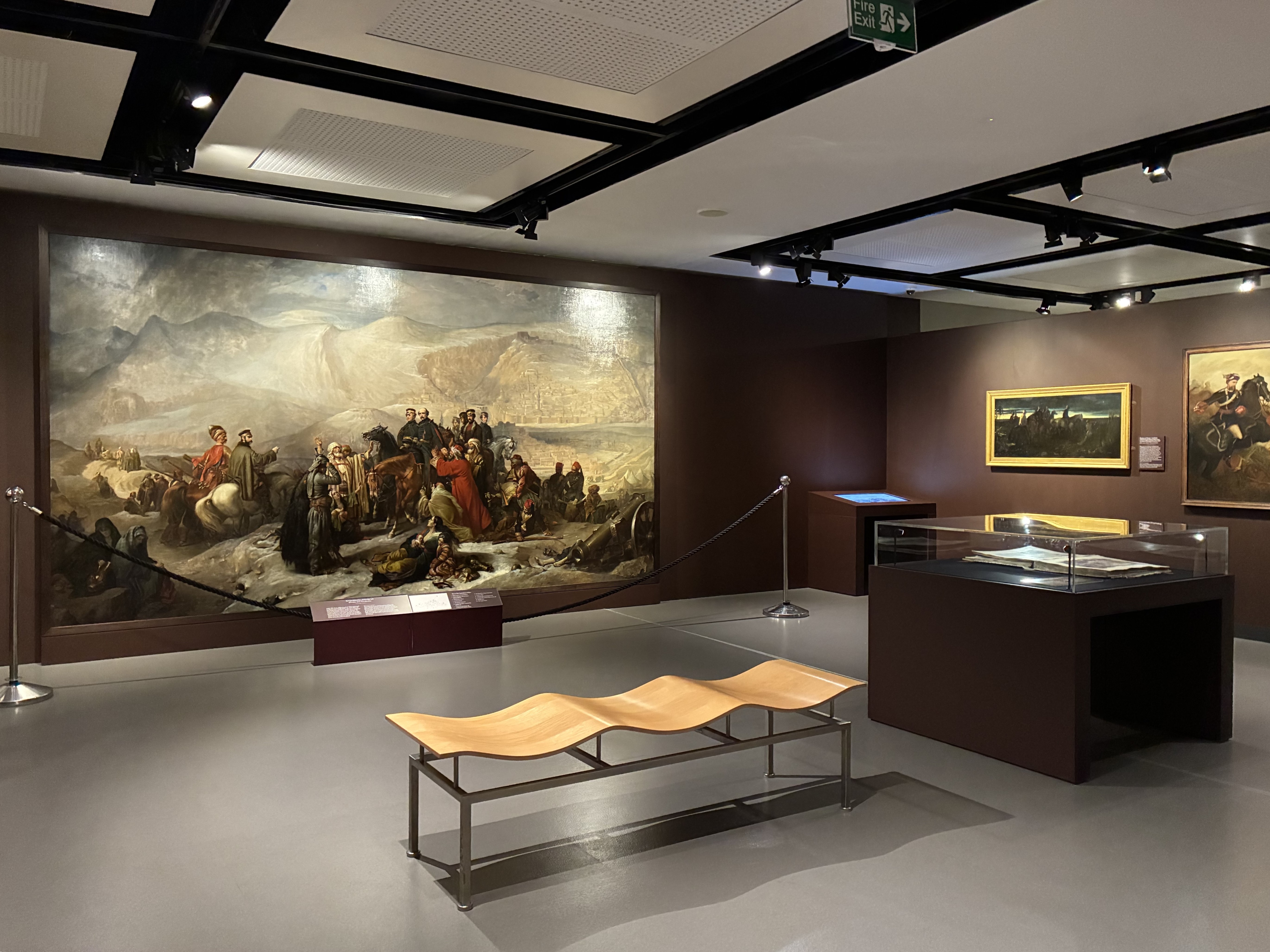
Installation view of Myth and Reality: Military Art in the Age of Queen Victoria at the National Army Museum showing the five-yard-wide oil painting ‘The Capitulation of Kars, Crimean War’ by Thomas Jones Barker (1855) with its static explanatory panel in front and an interactive screen off to the right (photo by the author)

Victoria’s Wars timeline

The exhibition includes a timeline of wars fought during Victoria’s reign. The point is that the British Army campaigned almost constantly throughout the period. There were a few big wars (the Crimean War, the Indian Mutiny and, right at the very end, the Boer War) but most of the conflicts we were involved in were small and localised, what modern historians call Victoria’s ‘small wars’.

  • 1837 – Queen Victoria ascends the throne
  • 1839 – the first photographs by Louis Daguerre in France and William Fox Talbot in England
  • 1842 – the world’s first illustrated weekly news magazine launched, the Illustrated London News
  • 1845 to 1846 – First Sikh War
  • 1852 to  1853 – The Second Anglo-Burmese War
  • 1853 to 1856 – the Crimean War
  • 1854 – Florence Nightingale travels to Crimea with 38 nurses. William Howard Russell’s reporting for The Times transforms people’s understanding of the squalid reality of war. 25 October – Battle of Balaklava and Charge of the Light Brigade.
  • 1854 – the Victoria Cross (VC) was introduced by Royal Warrant on 29 January 1856 to acknowledge the bravery displayed by soldiers and sailors during the Crimean War and soon after the Queen awards it to 62 Crimean war veterans

Queen Victoria and Prince Albert inspecting the wounded Grenadier Guards in Buckingham Palace. Coloured lithograph by George Thomas after himself (1855) Wellcome Collection

  • 1857 to 1858 – the Indian Rebellion
  • 1873 to 1874 – Third Anglo-Ashanti War
  • 1878 to 1880 Second Anglo-Afghan War
  • 1879 Anglo-Zulu War, featuring the Battle of Rorke’s Drift, 23 January 1879
  • 1880 to 1881 First South African War
  • 1882 Anglo-Egyptian War
  • 1884 to 1885 – Siege of Gordon at Khartoum, leading to its fall on 26 January 1885
  • 1885 Third Anglo-Burmese War
  • 1895 to 1896 Fourth Anglo-Ashanti War
  • 1898 – British reconquest of Sudan, featuring the Battle of Omdurman, 2 September 1898
  • 1899 to 1902 – Second South African War, featuring the sieges, the concentration camps etc
  • 1900 Fifth Anglo-Ashanti War

My take

There are about 40 artists, amateur and professional, soldiers and civilians, represented across the exhibition but the exhibition begins in a very decided way which raises a number of questions, because it starts with a strong emphasis on women war artists.

A feminist emphasis on women’s military art

The curators – all women – have decided that the first dozen or so works you see are all by women artists and devote several sections to them.

Victorian women artists, they tell us, helped to shape public perceptions of Army life. Many women were connected to soldiers through marriage or family, sometimes travelling with them abroad and depicting the people and places they saw.

Women were also important supporters and collectors of art, none more so than Queen Victoria herself. The Queen was also one of the most prominent subjects of military art, along with another celebrated figure of the time, Florence Nightingale – which explains why there’s a wall of works depicting the Queen meeting war veterans, awarding medals etc, and a little section about Florence Nightingale (who was famously averse to having her image captured, as she believed it detracted from her work).

However, as the exhibition proceeds you realise that most of the artists on display are not women, and, of course, none of the soldier artists are female – so why start this way unless you’re making a polemical feminist point? The implication seems to be that, after centuries or millennia of The Patriarchy, of tellings of history and art which downplay or completely ignore the role of women in the creation and consumption of art, this exhibition is doing its bit to redress the balance.

Fine. I understand. Why not? But there’s a second element to this approach which is notable and, maybe, problematic: this that one of the greatest, if not the greatest war artist of the Victorian era was Lady Elizabeth Butler, and so, hand-in-hand with the ‘women and military art’ section goes the ‘Lady Elizabeth Butler’ section. On one level there’s no quibbling with this: Butler was an outstanding artist and produced some of the standout works of the entire century. She was an absolute mistress of her craft, the half a dozen big paintings of hers brought together here are alone worth travelling to visit the show for, especially as several of them are usually buried in the Royal Collection.

So on the plus side, ignoring all its other features for a moment, you could say this is an outstanding selection of paintings, sketches and anecdotes by one of the nineteenth century’s great artists, and this is all to the good.

So why am I kvetching? Because the curators state, in these opening sections, in these early wall labels, that Lady Butler transformed military painting, depicting the life of soldiers with a new realism, taking a new, humane approach and setting a new standard for the subject. And this is all well and good, too, except that… In order to understand why Lady Butler is so important, and what she transformed, and what she changed it would have been good to have been fully introduced to the tradition of Victorian military painting which preceded her.

Instead, the result of placing Lady Butler right at the start of the show is to jump quite a long way into the later Victorian period without any preliminary explanation.

The work which really brought her to general attention was her ‘Roll Call’ which was displayed in 1874, 37 years into Victoria’s reign – and the first big work of hers which the curators feature, on the first wall of the exhibition, is ‘Dawn of Waterloo’ which was first displayed in 1895! 58 years into Victoria’s reign and only 6 years before her death. It’s a great painting but it comes at the very fag end of the period being covered and so is pretty misleading about the military art of Victoria’s era.

‘The Dawn of Waterloo: The Reveille in the Bivouac of the Scots Greys on the morning of the battle’ by Lady Butler (1895) the first full-scale painting by Lady Butler which the visitor encounters in ‘Myth and Reality: Military Art in the Age of Queen Victoria’ at the National Army Museum

Recap

So the decision to emphasise women’s role in military art may be laudable, and bringing a number of women’s works all together in the first few rooms ensures that the subject gets the prominence it deserves, rather than interspersing women’s works chronologically among the men’s pictures where they might be overlooked and unnoticed (as very probably happened in so many previous exhibitions on the subject).

Fine. And if you’re going to mention women artists of the time, then it would be silly not to mention and indeed have a section about the greatest of them, Lady Butler, also here right at the start. OK. Fine.

But the (maybe unintended) consequence of all this is that the visitor is deprived of a chronological understanding of the subject – of what military art looked like before Victoria, then at the start of her reign, how it developed through the decades leading up to the two seismic conflicts of the Crimean War and the Indian Mutiny in the 1850s, how it reflected trends in the broader art world, and so on.

You see how a chronological survey like this would have been interesting in itself and might also have better prepared the way for Lady Butler’s dramatic innovations: by the time you got to Lady B you’d have had a much better understanding of The Tradition she was transforming… but instead you have to work it out for yourself.

Five styles

This unchronological approach characterises the rest of the exhibition, too. Particularly in the sections about ‘Patriotism and Portraiture’ and ‘Realism and Reportage’, works from the 1840s or ’50s are placed next to works from the 1880s, ’90s or even early 1900s – it’s up to the visitor to make chronological, historical and aesthetic sense of the many different styles on display.

Having gone round the exhibition three or four times, dwelling on favourite works (and being drawn back again and again to the brilliant Butler paintings) I think I came up with about five different, roughly chronological styles of painting. They are:

  1. Romantic-sublime
  2. Patriotic-sentimental
  3. Mid-Victorian anecdotal
  4. Lady Butler
  5. Stiff official portraits

(This isn’t taking into account the pencil or charcoal sketches, and the many watercolours, which are specialist areas unto themselves.)

1. Romantic-sublime

Although painted in 1853 this picture strikes me as epitomising high Romanticism with its fondness for dramatic mountainous scenery and The Sublime. Look at the big baby eyes of Wellington (and his horse), the ethnic outfits of the local guides – it all has the rosy, soft-focus approach of Sir Water Scott’s novels.

Wellington at Sorauren, 27 July 1813 by Thomas Jones Barker 1853 © National Army Museum

2. Patriotic-sentimental

Kars is a city in north-eastern Turkey. In June 1855, as part of the during the Crimean War (1854 to 1856) it was besieged by a Russian army of 25,000. Demoralised by their defeats at the hands of the Russians, the Turks left the defence of Kars to Brevet Colonel (later General Sir) William Fenwick Williams, the British commissioner. The garrison was able to repulse three major Russian attacks but eventually cold, famine and an outbreak of cholera forced it to surrender on 26 November 1885. In recognition of their heroism, the Russians allowed the British garrison to march out of the city with the honours of war and into captivity.

‘The Capitulation of Kars, Crimean War’ by Thomas Jones Barker (1855) (National Army Museum)

This is a huge painting, over five yards wide (!), and it’s accompanied by not one but two diagrams identifying all the figures in it, one a static diagram, one an interactive display of the same. But it was only chatting to one of the (very well-informed) visitor assistants that I really understood what is going on.

You see the local in the red cloak clutching the hand of the bald British officer on his horse (Major General Fenwick Williams) and the cascade of similar locals off to his right, and the pitiful woman lying on the ground with her helpless children in the foreground, and similar locals on his left?

These are the local Turks who the British are abandoning to the kindness of the conquering Russians. So they are pleading with the British not to leave and abandon them but the British, defeated, have to. (Maybe a modern analogy would by NATO forces pulling out of Afghanistan and letting the Taliban take over.) It is this acute sense of regret and shame which explains the expression on the face of the British officer.

(You could write a book about the peoples the British Army promised to protect, only to abandon them – I’m currently reading a book about the Dutch Revolt which mentions that Queen Elizabeth I made all kinds of promises to the Dutch patriots in the 1580s which she then completely broke… It’s a long tradition.)

Back to the painting: ‘The Capitulation’, then, is a psychological study in the pain and embarrassment of duty, of a fine upstanding officer mortified to be abandoning the people he promised to protect. As such it is full of all kinds of melodramatic details, the thrown-up hands of the man in white on the left, the tearful eyes of the woman on the ground. It’s like a tableau from a mid-Victorian melodrama, at the centre of which is the British officer maintaining a stiff upper lip despite being deeply moved.

In fact it tells you a lot about mid-Victorian art and audiences that the work was commissioned, not by an aristocratic patron, but by the art dealers and print makers Agnew and Sons, precisely to be turned into prints and widely sold. So it is very deliberately catering to popular taste and demand.

3. Mid-Victorian anecdotal

The Victorians loved detail and clutter. Dickens’s novels overflow with wonderfully telling details and so do classic mid-Victorian paintings like William Powell Frith’s Derby Day (1858) or The Railway Station (1862), packed with little stories and anecdotal details. The exhibition includes an absolute classic of this style, ‘Home Again’ by Henry Nelson O’Neil.

‘Home Again’ by Henry Nelson O’Neil (1860)

‘Home Again’ depicts soldiers disembarking from a troopship at Gravesend on their return from the Indian Mutiny (1857 to 1859). For military history buffs the curators tell us that about 40,000 British troops were sent to India (more than had been mobilized for the Crimean conflict) to suppress the mutiny among the Indian troops of the East India Company’s Bengal Army.

But in purely visual terms we are invited to relish the details! At the very top a young woman peers over the shoulder of a bearded infantry corporal, who holds their baby for the first time. In the middle-right a young soldier of the 60th (The King’s Royal Rifle Corps) dressed all in black leans down to offer his Victoria Cross to a Chelsea Pensioner. The central action depicts sailors assisting a wounded sergeant to disembark. We are told that he wears a Kilmarnock ‘pork-pie’ cap under the white cotton ‘Havelock’ cover distinctive to the campaign, with the neck flap for protection from sunstroke.

There is patriotic pride here, and sentimentality of a sort, but it is very clearly all about the common people, ordinary soldiers (and sailors) and their reunions with wives and sweethearts. As such, it a little bit anticipates Lady Butler’s humanism but still with that mid-Victorian obsession with anecdote and detail.

4. Lady Butler

‘The Roll Call’ is one of the most celebrated British paintings of the 19th century. On its public appearance in 1874 it cemented Butler’s reputation as one of the leading painters of the age. It depicts a roll call of soldiers from the Grenadier Guards following the Battle of Inkerman in 1854 but can stand for thousands of similar occasions.

The Roll Call by Lady Elizabeth Butler (1874) © Royal Collection Enterprises Limited 2025 | Royal Collection Trust

The composition expresses Butler’s profound feel for the plight and experiences of the ordinary soldier, for the pity of war and the walls of the show feature not one but two quotations by her, emphasising how she eschewed patriotic guff in her concern for the actual lived experiences of the men who fought and suffered.

‘I never painted for the glory of war, but to portray its pathos and heroism’.

‘The Roll Call’ was fantastically successful. When it went on display at the Royal Academy it attracted over 300,000 visitors in a 3-month period and the more you look, the more brilliant it becomes.

The curators explain that historical or military painting for a long time worked with the basic design of a triangle which places the most important person – generally the commanding officer – at the apex (as in the pictures of Wellington and Major General Fenwick Williams, above). As soon as that’s pointed out to you, you realise really drastic difference her, the polemical message sent by the composition which is the equality of the men, all placed on the same level.

There’s still an anecdotal aspect to the thing, if you go up close and work slowly from left to right, starting with the two soldiers on the left lighting a sneaky fag or cigar, and working along through the bandages and blood of the wounded to the striking element of the man who’s collapsed into the snow. It really conveys the wretched pity of war, 44 years before Wilfred Owen coined the phrase for his volume of First World War poetry.

There is, of course, a figure on horseback, but he isn’t treated with the Romantic sentimentalism of the Wellington, above. Instead we can feel the gruff sympathy of the sergeant in charge as he reviews his wounded troops. And he also acts as the viewer’s entrance point into the work. If it was just the row of soldiers it would be slightly impenetrable: the officer on horseback not only relieves what might have been monotonous, but his movement carries the eye into the composition.

But there’s more because, after you’ve finished admiring the overall shape and canny dynamism of the composition, if you step back you notice the colours. You notice how Butler has depicted the uniforms of the men with great accuracy but used them as a springboard to create a composition of shades of grey. The grey coats and badges are reflected under the line of men by the different shades of snow and above them by the extremely nuanced and varied shading of the clouds.

On a literal level the coldness of the winter is evoked by the dominant tones of black, grey, white and brown, contrasting with small splashes of red from coatees and flags. But on a more aesthetic level, the awareness of shades of grey makes you think of James McNeil Whistler’s compositions, symphonies of certain palettes and timbres.

And then you notice the crows, the brilliant broken flight of crows coming from the middle of the composition and looping up over the head of the reviewing officer.

In its: 1) absence of sentimentality; 2) its immediately felt humanistic concern for the plight of the average soldier; and 3) its stunning painterliness, its brilliance of composition and colouring, ‘Roll Call’ really is a masterpiece. It’s worth visiting the exhibition just to see this one work in the flesh.

5. Stiff official portraits

Something the curators of the Army Museum must struggle with is that so much military art is decidedly average, if not actively poor. One or two of the battle paintings here struck me as ludicrously bad, but there’s a more subtle problem and that’s to do with military portraits.

I bet there are tens of thousands of these up and down the land, professional portraits of Britain’s countless officers, generals, admirals and so on which are good enough, decent enough, professional likenesses, but are never going to make it into anyone’s history of art because they are, by their nature, a very conservative wing of the medium.

Their number, their prevalence and popularity in Victorian times explain why there is a section titled ‘Patriotism and Portraiture’ here. Not only did ‘the people’ want to see portraits of heroes like Wellington or Gordon or Roberts, but countless military families wanted professional portraits of their eminent male members to hang alongside all their forebears, and hundreds of officers messes and regimental headquarters, ditto.

Hence a half dozen masterpieces of stultifying conventionality and woodenness.

Lieutenant The Honourable Frederick Hugh Sherston Roberts VC, Kings Royal Rifle Corps by Julian Russell Story (1899)

There’s a story behind this portrait, which is that Roberts not only won the Victoria Cross, but the same medal was awarded to his father, Field Marshal Frederick Sleigh Roberts, 1st Earl Roberts, making them one of only three father-and-son pairs to be awarded the VC in its 169-year history.

Watercolours

As mentioned, the exhibition includes 20 or so watercolours, much smaller and more intimate than the bombastic oil paintings. In a sense, watercolours under-promise and so are often able to over-deliver.

Installation view of Myth and Reality: Military Art in the Age of Queen Victoria at the National Army Museum showing a set of six watercolours of the Crimean War by William Simpson (photo by the author)

General Cannon’s landing, July 7 1854

My wife and I play a simple game when visiting exhibitions. Having crawled through the exhibits and rooms, reading and processing every wall label, we reach the end, turn round and go back through it, this time lightly, airily choosing one work per room which we like and having to explain why. A variation is to choose a work we would buy and take home to hang in the landing or hall or wherever. As I’ve stated, the Lady Butler paintings are all brilliant, but in terms of something I’d actually buy and live with, something a bit more modest, I kept returning to one of the 20 or so watercolours on display, ‘General Cannon’s landing, July 7 1854’, a pencil and watercolour by Joseph Archer Crowe (who has seven works in the exhibition).

‘General Cannon’s landing, July 7 1854’ Pencil and watercolour by Joseph Archer Crowe

Crowe worked at the Crimean War as a special artist for The Illustrated London News. This watercolour depicts how, on 7 July 1854, Turkish forces launched an amphibious assault across the River Danube on Russian positions at Giurgiu (in modern day Romania). The Russians were driven back and Giurgiu was occupied by the Turks.

It’s not going to rock anyone’s world, I just liked the composition, the line of ships going in from roughly right to left, and the light impressionistic touches of colour.

Women artists

I may have missed some but, for the record, here are the women military artists featured in the exhibition:

  • Lady Elizabeth Butler
  • Jane Drummond (portrait of Mrs Anne Steele)
  • Gertrude Ellen Burrard (portrait of Nussiban, our ayah)
  • Elizabeth Anne Leslie Melville (portrait of Major General Sir Owen Tudor Burne)
  • Emily Henrietta Ormsby (portrait of Colonel Henry Francis Strange; portrait of Major General John William Ormsby)

Lady Butler’s works

  • Tenth Bengal Lancers tent pegging (1873)
  • The Roll Call (1874)
  • Study of a Wounded Guardsman (1874)
  • Quatre Bras (engraving of oil painting, 1879)
  • Patient Heroes: A Royal Artillery Gun Team in Action (1882)
  • Scotland Forever! (engraving after oil painting, 1882)
  • After the Battle of Tel-el-Kebir (engraving of original painting, 1888)
  • After the Battle of Tel-el-Kebir (fragment of original painting, 1888)
  • The Defence of Rorke’s Drift (1882)
  • The Ballad of the Royal Irish at Sebastapol (6 x pencil illustrations of a poem, 1890)
  • Military sketches (pen, watercolour and pencil, 1893)

Summary

I don’t know whether my point about the lack of chronology and build-up to Lady B is even worth mentioning. My wife went round the displays two or three times with me and didn’t even notice or care, just enjoyed various works on their own merit.

So: if you’re interested in military history the exhibition contains lots of titbits about key wars and engagements of Victoria’s reign, about medals and uniforms, some lovely watercolours and a dozen or so really impressive oil paintings, along with a number of average or also-ran works which, however, illustrate interesting topics, such as the section about the creation of the Victoria Cross, and so on.

And the National Army Museum is always a lovely place to visit because – ironically, given its subject matter – it’s such a calm, clean and peaceful place to be. Go see.


Related links

Related reviews

Royal Academy Young Artists’ Summer Show 2025

This is the children’s version of the Royal Academy’s Annual Summer Exhibition. In my opinion it’s much more fun than the grown-up show, for several reasons. Grown-ups always have to be so serious and po-faced whereas kids, especially young children, know how to have fun! They can be unselfconsciously silly. This lack of adult seriousness means loads of the works here are lovely, and charming, and sometimes very striking.

Ostrich by Anastasiia, aged 14

Here is a cat which has done an enormous poo, a wasp which has just farted, two pet dogs dressed up as vampires, a fox which has eaten two chickens, a crow nesting in a chimney pot, a family tree of bouncy balls, a lamp fish made out of rubbish, three hamsters dressed up for a party! What’s not to find adorable 🙂

Installation view of Royal Academy Young Artists’ Summer Show 2025 (photo by the author)

It’s only in one room (on the ground floor at the back of the RA building) but manages to contain an impressive 270 works of art, by children aged from 4 to 18. As soon as you see that age range you realise there’s going to be a real range of abilities, skills and techniques. Plenty look and feel like very small children’s work:

A cat and a rat – by Fox aged 11 and Jago, aged 10 (photo by the author)

While at the other end of the scale is work which feels fully achieved and adult, such as this stunning portrait of her friend, Louisa, by Rosa, aged 18. Rosa tells us that making this work, with its staggering photographic accuracy, took over her entire life for two months. Wait till you have kids, Rosa, and they take over your whole entire life for twenty years 🙂

More than 23,000 students entered the competition this year and the works were whittled down by a panel of artists and arts professionals. Tough job. Some were awarded prizes, though that didn’t influence me much. Visitors can take part in the annual People’s Choice Award.

Captions

There’s a lavishly produced free catalogue of works in which every piece is accompanied by a short paragraph from the artist, big or small. You couldn’t help detecting the voice of art teachers or parents in some of this text, specially when they started going on about ‘desire’ and ‘diversity’ and other artspeak jargon. On the other hand some of the captions had the artless comedy of larky kids.

‘I love capybaras,’ says Martha, aged 8, and you can’t say fairer than that.

Capybara Takes a Sip While Balancing a Peach by Martha, aged 8

Memorable works

Chicken in Blue by Erin, aged 15

Who tells us that the intense cobalt blue background was inspired by van Gogh’s similar use of a pure blue background which she saw at the National Portrait Gallery. Art speaks to art, across the ages.

Chicken in Blue by Erin, aged 15

Entangled in Waste by Coral, aged 18

This poor clay octopus is entangled in some of the billions of tons of plastic waste we pump into the sea every day. Coral aims to show how even the ocean floor has become infested with rubbish.

Entangled in Waste by Coral, aged 18 (photo by the author)

Squirrel and hamsters

A red squirrel made from recycled junk, paper mache and wound wool, by Jake, aged 7. Below which are the party hamsters, Toffee and Pumpkin and a friend, made out of fabric with hand and machine sewing, by Ellen, aged 9.

A papier mache squirrel above three fabric hamster dressed up for a party, not forgetting a Lego spaceship lost in the grass, by Jake aged 7, Ella aged 9, and Eden aged 7, respectively (photo by the author)

The Life Inside a Book by Clara, aged 12

Clare explains that she imagined what the text and illustrations in a book do when we’re not around, namely come to life, jumping around between pages.

The Life Inside a Book by Clara, age 12 (photo by the author)

Ballami by Bonnie, aged 10

Bonnie’s been collecting rubber balls since she was three, has made them houses, a school, a playground and imagined them getting married and having little baby rubber balls, all recorded in this intricate rubber ball genealogy.

Top right: Ballami by Bonnie, aged 10, plus others (photo by the author)

Themes

Pets So lots of family pets – cats, dogs and guinea pigs – with the occasional fox and ostrich thrown in! Here are some paper moths attracted to and trapped in an attractive green lantern.

Endangerment by Luka, aged 18

The sea I noticed there’s a lot about the sea – ships and a storm-beset lighthouse – but much of it very environmentally aware / political, pieces harping on about plastic pollution, overfishing and so on – for example the octopus above, and the brilliant plastic lantern fish below – the kind of thing people have been harping on about for over 50 years with bugger-all impact. Be nice if we were making the world a nicer place. But we aren’t, I’m afraid. We’re destroying it.

Plastic Lantern Fish by Nicolas, age 13

Transport I noticed a number of works about planes, cars, buses, trains contemporary and steamy, plus bicycles. Here are some buses by Artur who is 7 and is neurodivergent and has a special interest in London buses, their numbers and where they go. He knows many bus directions by memory – which is more than I do and ‘ve lived here for 40 years. Well done, Artur.

London Buses by Artur, aged 7

Ethnicity There are a number of works about race and ethnicity – from the purely descriptive type i.e. depicting their Black or Asian family or schoolmates, through to a rather more polemical tone, with one which seemed to be about the Edward Colston statue in Bristol and similar vestiges of empire.

The Challenges of History by Beatrice, aged 18

Well, if we need to address topical adult issues, it’s not as if these aren’t covered in the massive adult show next door, not to mention in countless other art exhibitions, articles, documentaries, books and so on.

But, meanwhile, back in kiddyland, it’s the silly ones I remember.

From the top, clockwise, a cat which has done a big poo, a lioness holding a cocktail, an odd sock, a bicycle against a lamp-post, and a colourful frog (photo by the author)

A lioness with a cocktail. Genius!

Gaps and absences

Know what isn’t here? Just like in the main Summer exhibition? Mobile phones and computers. It’s as if they don’t exist, whereas I was under the strong impression that most people and pretty much all kids, have smartphones of their own and are glued to them at all hours of the day and night. But completely absent here, utterly unrecorded. Most of these images could have been from an exhibition 10, 20 years ago. Why is the digital age, the lived experience of living in the digital world, so impossible to depict in art?


Related links

Related reviews

Stanisław Wyspiański: Portraits @ the National Portrait Gallery

Drawing to the end of its display is a lovely room at the National Portrait Gallery devoted to the first ever UK exhibition of portraits by the late-Victorian Polish artist Stanisław Wyspiański (1869 to 1907).

Wyspiański was an impressive polymath. He was an interior and furniture designer and conceived monumental schemes for churches and public buildings. He was also a playwright who is often credited with inaugurating modern Polish theatre, during the same period as Ibsen in Norway and Chekhov in Russia.

In his day Poland didn’t actually exist as an independent state and was still partitioned between Prussia, Austria and Russia. The city he grew up in, Krakow, was part of the Austro-Hungarian Empire. So Wyspiański was among the artists and writers seeking to create a new national art based on folk traditions, the Polish language and its distinctive heritage. The Young Poland movement which he belonged to contributed to helping bring about Polish independence in 1918.

Based in Kraków, Wyspiański did much to innovate not only theatre, stage design and architecture, but wrote poems and – the reason we’re here – drew and painted. He worked mainly in pastels, using a characteristically bold black outline to make clear but stylised images which are clearly influenced by a number of late nineteenth century trends, including Art Nouveau, Japanese woodcuts, and the strong stylised moulding of Paul Gauguin.

This stylised and idealised image of his wife, Teodora Pytko, suckling their baby son Staś, watched by his daughters, is one of the most famous portraits in Polish art. In fact the two girls on the left is a doubling of his one daughter, Helenka. The more you look at the face facing us the more she looks like a spooky Symbolist head, hovering amid the stylised foliage.

Maternity by Stanisław Wyspiański (1905) pastel on paper, National Museum in Kraków

The 16 paintings and drawings in this exhibition have been selected to focus on portraits of writers, artists and politicians who Wyspiański knew or worked with. Rather shamefully, they have never been exhibited in the UK before. They all radiate a wonderful charm, sympathetic and intimacy. Here’s a portrait of the actress Władysława Ordon-Sosnowska in theatrical costume.

Portrait of Władysława Ordon-Sosnowska in the role of Krasawica in the drama ‘Bolesław the Bold’ by Stanisław Wyspiański (1093)

There is some overlap with the big exhibition of Edvard Munch portraits recently staged here at the NPG. Munch and Wyspiański were connected through the writer Stanisław Przybyszewski who was a close friend of Munch, a critic of his work, and introduced Wyspiański to Munch’s art in Berlin.

A portrait of Przybyszewski is included in the show, but I’m choosing to share this portrait, of physician, social activist, politician and professor, Julian Nowak, because it highlights Wyspiański’s technique. It’s done with pastel and note the different types of shading he creates. The different hues of the face – the deft combination of brown, orange, red, yellow, grey – are interesting and tangy. But the obviously striking thing is the deliberately rough treatment of Nowak’s black coat which creates a magically vivid and dynamic effect.

Julian Nowak by Stanisław Wyspiański (1904) private collection, on loan to the National Museum in Krakow

Vivid and at the same time precise, isn’t it? In my opinion Wyspiański has a claim to be a more consistently attractive and accurate portrait painter than Munch.

I mentioned his children. Here’s one of the most attractive and charming ones, a portrait of his daughter, Helenka. Note the contrast between the fine detail of the girl’s dress and the rough shading of the background wallpaper. And also the unusual tilted nature of the image, demonstrating the same kind of casual attitude to classical perspective you see in Gauguin or Van Gogh. There’s more table surface in the image than child, and yet this somehow brings out her delicacy and detail all the more.

Little Helen with a Vase by Stanisław Wyspiański (1902)

Summary

I’m afraid I’ve come to reviewing this lovely little exhibition very late and it closes this Saturday. It’s completely FREE so if you’re in central London this week and have half an hour to spare, it’s worth dropping in and savouring these lovely, beautifully drawn and often charming images.


Related links

Related reviews

Liotard and the Lavergne Family Breakfast @ the National Gallery

‘The Lavergne Family Breakfast’ is generally considered the masterpiece of Swiss painter Jean-Etienne Liotard (1702 to 1789). It was made not in oil paint but in pastel, of which Liotard was an acknowledged master.

Executed across more than six sheets of paper, ‘The Lavergne Family Breakfast’ is Liotard’s largest and most ambitious pastel. It depicts a breakfast between an elegantly dressed woman and a young girl, whose hair is still in paper curlers. Between the two lies a luxurious breakfast still life. Although not strictly a portrait, the sitters have long been associated with relatives of Liotard’s, the Lavergne family, who lived in Lyon.

The calm domesticity of the scene is accentuated by the tremendous technical brilliance of his pastelwork, recording a hundred tiny details – the sheen on the metal coffee pot, the shiny ceramic jug, the silky fabrics, the reflections in the black lacquer tray, down to individual notes on the sheet music peeping out from the drawer at the bottom left.

The Lavergne Family Breakfast in pastel by Jean-Etienne Liotard (1754) Private collection, Waddesdon © Courtesy the owner

But it is not only a remarkable work in itself, it is also remarkable for the fact that twenty years later, Liotard painted exactly the same scene, with almost digital accuracy, in oil paint. According to the curators this is an extremely rare example of a painter anywhere ever painting the precise same subject with such photographic accuracy, in two different media. Above is the pastel version. Below is the paint version.

The Lavergne Family Breakfast in paint by Jean-Etienne Liotard (1773) © The National Gallery, London

In 2019 the National Gallery acquired the oil version and this provided the impetus to request the loan of the pastel version (in a private collection) so that the two works could be hung side by side. Both versions were made for Liotard’s most important patron, William Ponsonby, Viscount Duncannon (1704 to 1793) and this is probably the first time in 250 years that they have been seen side by side to compare and admire the difference in technique and effect between the two.

Can you spot the differences? The oil one is better at depicting darkness – the shadows, on the figures’ skin and on the background wall, are deeper and richer. As to the actual design, the curators remark only two significant differences between the two versions: There are only two differences: in the oil painting the bright blue decorations on the porcelain have turned brown, probably due to the use of smalt (a blue pigment that loses its colour), and in both works the signature on the sheet of music poking out of the table drawer bears a different date.

Using this pairing as a centrepiece the National Gallery has created a small (three rooms) but lovely and FREE exhibition, bringing together about 20 other works and objects to give a charming overview of Liotard’s life and career.

Pastel

Liotard was extremely versatile, producing works in pastel, oil, enamel, chalk and even on glass, but was best known for his work in pastel. Pastel is a notoriously delicate medium but the exhibition doesn’t just tell us this, it devotes an entire display to it.

Installation view of ‘Liotard and the Lavergne Family Breakfast’ at the National Gallery. Photo by the author

Here we can see an antique box of pastels from 1910 Paris alongside the tools you needed to use them, namely:

  • a colour chart from La Maison du Pastel, Paris, showing the range of colours available in the 1930s
  • a box of charcoal sticks for drawing, produced by the Maison Macle in the second half of the 19th century
  • a porte-crayon (chalk holder) used for holding chalks whilst drawing
  • a selection of ‘stumps’ used to blend pastels on the picture surface
  • blue rag paper, of the sort used by pastellists

And there’s a lovely, calm, silent 4-minute video showing modern-day French artisans creating pastel pencils by hand. As the curators explain:

Pastel crayons are made of coloured pigment, a pale, chalky filler and a binder to hold them together. Until the late 17th century they had to be rolled by hand in the studio – a lengthy and laborious process. By the 18th century it was possible to buy ready-made pastel crayons in major European cities. The pastels on view here are antiques, made in Paris in the 1910s.

The act of using pastels is described as ‘painting’ in pastel. But unlike oil paint, pastel was not applied with a brush, nor could you mix pastel crayons to create new colours. Artists therefore needed many crayons to work with. In Liotard’s day pastellists painted onto vellum (prepared animal skin) or thick paper made from rags. These surfaces were often roughened with pumice stones or razor blades so that the pastel medium – in essence, millions of coloured particles – had something onto which to cling. The 18th-century art critic and philosopher Denis Diderot (1713 to 1784) described pastel, which commanded very high prices but was also extremely fragile, as ‘precious dust’.

Fascinating and instructive.

Travels

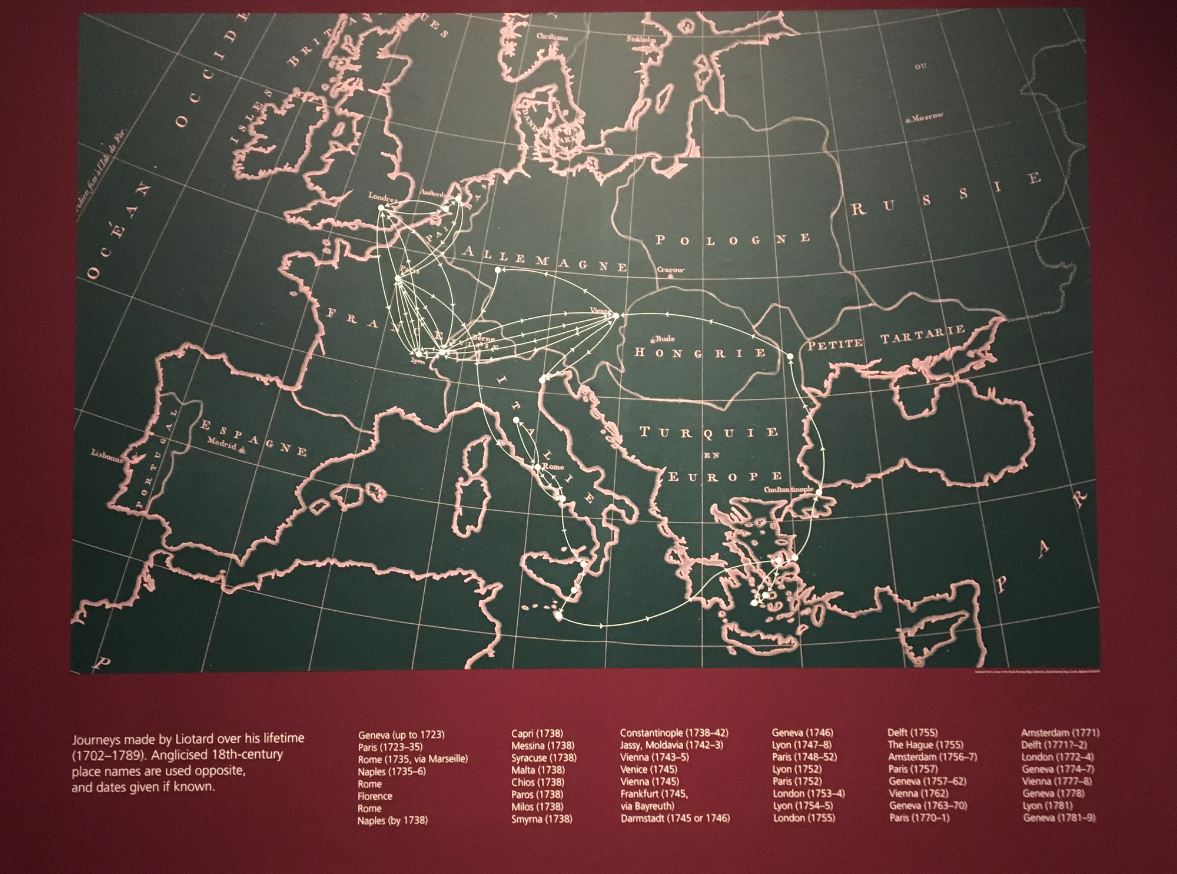
Liotard worked across the length and breadth of 18th-century Europe, from Paris, Rome, London and Amsterdam to the courts of Versailles and Vienna, and the show features a wall-sized map showing his extensive peregrinations.

Map showing Jean-Etienne Liotard’s travels round Europe. Photo by the author

Liotard’s most extended stay was in distant Constantinople where he accompanied his patron Viscount Duncannon. He spent four years there and developed a taste for oriental life and manners. He grew a long beard, adopted Turkish dress and nicknamed himself ‘the Turkish painter.’ The exhibition includes a group of black and red chalk drawings made on his travels, most strikingly charming studies he made of (European) women in Oriental dress.

Portrait of Signora Marigot, Smyrna by Jean-Etienne Liotard (1738) Musée du Louvre. Photo © RMN-Grand Palais (Musée du Louvre) / Jean-Gilles Berizzi

On this portrait the curators comment:

Liotard drew this portrait in Smyrna (present-day Īzmir) in May 1738, while on route to Constantinople. Smyrna was the busiest port on the Turkish coast, and Signora Marigot probably belonged to its thriving international community. Liotard captures her confident pose with great economy, using bare paper to create the folds of her gown and the ornaments in her hair. The high level of detail is characteristic of an artist skilled at working on a miniaturist’s scale.

Liotard in London

Liotard’s arrival in London in 1753, with a full beard and Turkish dress, created a sensation. He was introduced to the Royal Family, took lodgings in Golden Square near Piccadilly and advertised his works in the newspapers. A young Joshua Reynolds, later first President of the Royal Academy, enviously described Liotard’s ‘vast business at 25 guineas a head in crayons’ and Horace Walpole marvelled at a viscountess having her four daughters painted by Liotard ‘as his price is so great’.

London provided rich possibilities for a portraitist. It was taken as fact in the 18th century that the British loved having their portraits painted. Even allowing for a visit to Lyon in 1754, where ‘The Lavergne Family Breakfast’ was painted, some 50 works survive from the two years that Liotard spent in London between 1753 and 1755. Nobles, celebrities and even the Royal Family asked Liotard to paint their portraits in pastel, some of them donning Turkish dress themselves.

Take this striking portrait of Lady Anne Somerset, later Countess of Northampton.

Lady Anne Somerset, later Countess of Northampton by Jean-Etienne Liotard (about 1755) © The Devonshire Collections, Chatsworth. Reproduced by permission of the Chatsworth Settlement Trustees

As the curators explain:

With her cascading auburn locks and plunging neckline, Lady Anne (1741 to 1763) looks older than her fourteen years. But women’s lives were accelerated in the 18th century and Lady Anne was already active on the London social scene when this portrait was painted. She may have chosen this Turkish dress – either a garment Liotard owned or one inspired by his drawing Woman from Constantinople (also in display) – to create a more grown up, sophisticated persona.

Miniatures

Liotard also gained a reputation for his skill at creating miniatures. Several are featured here including a stunning miniature self-portrait. It’s only about 2 inches tall so the exquisiteness of the detail is breath-taking. Surely he must have used some kind of magnifying glass and the brushes must have had only a handful of hairs in them. A photo doesn’t do the richness of the real thing justice. Look at the perfectly painted flowers decorating his collar!

Self Portrait on enamel with ivory backing by Jean-Etienne Liotard (about 1753) Royal Collection Trust © His Majesty King Charles III 2023

The curators:

Liotard exploits the smooth and luminous surface of enamel to paint his wiry beard, the folds of his raspberry-red jacket and the tiny flowers that dance along his collar in minute detail. His first training as an artist in Geneva was with a miniaturist and he could rely on his skill in this demanding form of painting to impress. This miniature was probably intended as a means of self-promotion on his first arrival in London, capturing his unusual appearance.

Chocolate tracing

As well as the Family Breakfast the exhibition displays several other works highlighting Liotard’s skill at depicting porcelain services. Sadly, they don’t have the original of one of his other Greatest Hits, The Chocolate Girl (about 1756), which is astonishing both for the wonderful poise of the central figure and the incredible realistic detail of the chocolate cup and glass of water. What they do have is a tracing of the original work which Liotard would have used to generate copies, the same technique he used for making his copy of the Family Breakfast.

Porcelain

And this brings us to the final section of the exhibition, which focuses on Liotard’s fascination for, and incredible skill at depicting, porcelain.

Throughout his career Liotard was fascinated by porcelain, repeatedly depicting cups, saucers and the act of using them in his works. In this he was not alone: throughout the 18th century, paintings of people drinking tea, coffee and chocolate became extremely popular. Such paintings played on the idea of taste: both the literal tastes depicted in these pictures and the tasteful refinement of the scenes portrayed. Liotard was unusual, however, in his fidelity to the porcelain he depicted.

The cups and saucers in ‘The Lavergne Family Breakfast’, for example, can be identified as true Japanese porcelain and not cheaper European imitations. It is not surprising that Liotard owned several pieces of important porcelain, including the boxed tea service displayed nearby.

And here’s a photo of that tea service:

Luxury tea service given to Liotard by the Empress Maria-Theresa during his third visit to Vienna in 1777. Photo by the author

The curators:

Liotard received this luxury tea service as a gift from the Empress Maria-Theresa (1717 to 1780) during his third visit to Vienna in 1777 to 1778. He had not only worked extensively for the Empress as a portraitist, producing likenesses of her and her family in pastel, oil, enamel and chalk, but he had also enjoyed privileged access to the Imperial Porcelain Manufactory where this tea service was made. Liotard’s lifelong fascination with technical experimentation led him to help develop new enamel colours for production.

Summary

Eccentric man, amazing skills, beautiful art, lovely exhibition. And it’s FREE.

Video focusing on pastel


Related links

More National Gallery reviews

Young Bomberg and the Old Masters @ the National Gallery

The National Gallery regularly uses room to house interesting and quirky, FREE exhibitions. To get there, go up the grand main stairs, then left up a spur of the stairs and then, on the mezzanine, as you come to the shop, turn left into a relatively small exhibition room.

This one claims to be setting the early work of the radical Modernist, English painter David Bomberg (1890 to 1957) against some of the Old Master paintings in the National’s collection which we know inspired him. We know this because he recorded his enthusiasm for Old Masters at the National in letters and diaries and the exhibition quotes his sister and girlfriends who he would drag, at the drop of a hat, along to the National to show them his latest passion.

Young Bomberg and the Old Masters

Except that, surprisingly, and despite the explicit title, this isn’t what the exhibition actually does.

There are only two Old Master paintings in the exhibition: Sandro Botticelli’s Portrait of a Young Man in oil is hung next to Bomberg’s chalk self-portrait and they do indeed share a certain intensity, Bomberg’s confrontational direct gaze modelled on the Florentine’s.

Portrait of a Young Man by Sandro Botticelli (1480 to 1485) © The National Gallery, London and Self Portrait by David Bomberg (1913 to 1914) Courtesy of the National Portrait Gallery, London / © The estate of David Bomberg

And a crucifixion from the studio of El Greco which is interesting, but mostly for the strange moulded nature of the background, which reminded me of the Surrealists.

As for the rest of the Old Masters, the final wall label has a list of precisely five other Renaissance paintings which apparently influenced Bomberg – but they’ve all been left in situ in their original rooms and you have to go on a treasure hunt through the National Gallery to find them:

  • Michelangelos The Entombment (room 8)
  • Veronese’s Unfaithfulness (room 11)
  • Botticelli’s Mystic Nativity (room 58)
  • Antonio Poliaullo’s Martyrdom of Saint Sebastian (room 59)
  • Piero della Francesca’s Baptism of Christ (room 61)

Bomberg’s sketches and paintings

No, the real thing about this exhibition is much more interesting: they’ve brought together half a dozen of Bomberg’s greatest early paintings and Bomberg’s preparatory sketches for them. Setting them next to each other is fascinating.

Who was David Bomberg?

Bomberg’s early paintings were among the most excitingly dynamic and abstract created in the first flush of modernism just before the Great War. Visitors to his first solo show in 1914 thought he had completely rejected the entire existing tradition of painting in order to create dazzling abstract works like the justly famous Mud Bath, painted when he was just 23.

The Mud Bath by David Bomberg (1914) © Tate

Alongside Mud Bath are hung three masterpieces from his early, Modernist period and next to each one, a preparatory sketch:

  • Vision of Ezekiel (1912, Tate) inspired by the sudden death of his beloved mother Rebecca and the theme of the resurrection in the Old Testament
  • Ju-Jitsu (c.1913, Tate) a geometrical and fractured painting based on his brother’s East End gym
  • In the Hold (c.1913–14, Tate) where dockers appear to be unloading migrant adults and children from a ship

Take In The Hold. Here’s the preparatory sketch:

Study for In the Hold by David Bomberg (about 1914) © Tate

From this sketch you can clearly see that the objects ‘in the hold’ of the ship are human beings. You can see the ladder coming up out of the hold on the right, and two particularly obvious hands being waved up out of the hold in the centre middle. You can just about make out that the figure on the right is holding a horizontal child up over his head. The whole thing depicts the none-too-gentle removing of immigrants from the hold of an immigrant ship, maybe the kind of old steamer that brought Bomberg’s parents, Jewish immigrants, to London in the 1890s.

Already the curved human figures have been transformed into semi-abstract geometric patterns. Not only that but the clashes of angles and geometries powerfully convey a) the nervous energy and b) the sheer cramped claustrophobia of the ship’s belowdecks.

Now look at the painting he made from this sketch.

In the Hold by David Bomberg (1913 to 1914) © Tate

A masterpiece, in my opinion.

The most fundamental aspect of it is the grid of 64 squares which make it seem like a kaleidoscope. Next that he has painted the rectangles and other angular shapes between the figures with as much power and brightness as the figures themselves. The result is that everything is presented on the same plane, with no depth or perspective, a wonderfully bright and brilliantly arranged puzzle.

It’s fascinating to keep referring back to the sketch, then coming back to the painting and seeing just how expertly he has elided, obscured and displaced what were already geometrised human figures, until they are barely legible.

I couldn’t ‘read’ the painting by itself at all, I had no real sense of it being a depiction of a scene. But looking at the preparatory sketch is like having the key to undo its secret. And then I found that switching from one to the other was like alternative points of view of a landscape, or like stereo – like seeing two aspects of the same view. There was a kind of visually dynamic pleasure to be had simply from turning from one version to the other and back again.

And you can do the same – compare the detailed sketch and then the final painting – of Ju-Jitsu and Vision of Ezekiel, two other powerful (if rather smaller) hyper-modernist works.

Conclusions

1. It’s a small room, but it contains four or five masterpieces which remind you how great 1914 Bomberg was. Mud Bath and In The Hold are enormous paintings which dominate the room. Amazing that so much energy and beauty can be contained in such a small space.

2. In small letters, the introduction wall label says this is a collaboration with Tate. When you look closely you realise that all bar two of the nine works by Bomberg are actually from the Tate collection. So it’s more than a collaboration, it’s an inventive way of airing and sharing some of their key Bomberg holdings, bringing them together with some of the sketches which are held at completely different collections. Well done to the curators!

3. Lastly, it is hard not to lament the way Bomberg abandoned his avant-garde style after the Great War, adopting a more figurative style and ‘rediscovering nature’ – sigh – just like many other artists did, contributing to the undistinguished blah of a lot of English art in the 20s and 30s. Hard not to see it as a sad falling-off.

Evening, The Old City and Cathedral, Ronda by David Bomberg (1935)


Related links

Reviews of other National Gallery exhibitions

Lucian Freud: The Self-portraits @ the Royal Academy

‘By the turn of the millennium, Freud was widely acknowledged to be Britain’s greatest living painter.’
(Alex Branczik, Head of Contemporary Art for Sotheby’s Europe)

Contrary to the implications of the title, this exhibition does not include all of Lucian Freud’s self-portraits, nowhere near. Given that Freud was interested in self portraiture throughout his long career, the selection here is a only relatively small percentage. Also, contrary to the title, the exhibition also includes a number of portraits not of himself, in fact arguably the best room is the one devoted to portraits of other people.

Lucian and me

I didn’t use to like Lucian Freud. I associate him with Frank Auerbach and the other dreary, depressing post-war British artists, a kind of visual equivalent of Harold Pinter, who I was force-fed at school. Their dreary, depressed, rainy English miserabilism nearly put me off contemporary art and literature for life.

But this exhibition made me change my mind (a bit) for two reasons:

1. It is told in a straightforward chronological order, which allows us to see the quite remarkable evolution of his style over 60 years of painting. Stories are always interesting and, by stopping to investigate each stage along his journey, the exhibition does a good job of making his development interesting.

2. By luck I got into conversation with another visitor who happened to be an amateur painter and she, for the first time, made me understand how his journey had been one of technique. It dawned on me that, to use a cliché, he may be a painter’s painter. Certainly the last couple of rooms make you think that his paintings may well depict men or women, naked or clothed, including himself, as subjects – but the real subject is the adventure of painting itself.

And this made me go back and really examine the technique of the paintings in the last few rooms and come to respect, in fact to marvel, at the complex painterly effects of his mature style.

A brief outline

Freud was born in Berlin in 1922 and fled Nazi Germany with his family in 1933, coming to London. He held his first solo show as early as 1944. In the late 1940s he chose to make portraiture the focus of his practice.

Drawing

Drawing was central to Freud’s style from the late 30s through to the early 1950s. His drawings from this era are strikingly different from the later work. This is a rare opportunity to see a whole roomful of them together and they come from a different world. They have a graphic sharpness, an economy of line which makes them very like cartoons. Look at the careful shading in the ears and on the cheek, and the extraordinary attention he’s devoted to each individual hair. Critic Herbert Read called him ‘the Ingres of Existentialism’.

Startled Man: Self-portrait (1948) by Lucian Freud © The Lucian Freud Archive / Bridgeman Images

This clear style lent itself to illustration so it’s no surprise to learn that he illustrated a number of books, several of which are in a display case here, Cards of Identity by Nigel Dennis (1955) and Two Plays and a Preface by Nigel Dennis (1958) and that Startled Man was one of five illustrations for a novella by William Sansmon titled The Equilibriad (1948).

Apart from the strikingly clean graphic style, what’s obvious is how performative these pictures are – the male head in them is always striking a pose, adopting an attitude, sometimes with props like a feather, in one dramatic case posing as Actaeon for a book on Greek myths.

Back to painting

Around the mid-1950s Freud turned his attention from drawing to painting and for a period of seven years or so stopped drawing altogether. Initially he painted sitting down using fine brushes. This enabled a smooth finished graphic style, very much in line with the clean defined outlines of his drawings, and the people in them share the same slightly distorted, rather frog-like faces as many of the drawings, more like caricatures than paintings.

Hotel Bedroom by Lucian Freud (1954) © The Lucian Freud Archive / Bridgeman Images

The wall label tells us that Freud associated with fellow painters Frank Auerbach and Francis Bacon. Like him they were figurative painters working against the grain of Abstract Expressionism and, later on, ignoring experimental and conceptual art. That, in a sentence, explains precisely why I don’t like them.

Bigger brushes

Anyway, Bacon inspired Freud to switch from soft sable-hair brushes to hog’s hair brushes which are capable of carrying more paint. This, it seems, was the physical, technical spur for the decisive change in his style. Between the late 1950s and mid-1960s his painting left behind the draughtsmanlike precision, so close to drawing, of paintings like Hotel Bedroom, and became far looser, a matter of large looser brushstrokes, which create more angular images, images made out of clashing planes and angles with an almost modernist feel about them.

Man’s Head (Self-portrait III) by Lucian Freud (1963) © The Lucian Freud Archive / Bridgeman Images

This is the third of three self-portraits which the exhibition reunites for the first time since they were shown together in 1963. You can see how the interest is now in structure more than likeness. There is no attempt to create a realistic background (his studio or a bedroom) which is now a plain matt surface. Similarly, his face has its familiar long, rather hawkish look, but here transformed into a semi-abstract mask.

Watercolours

Surprisingly, in 1961 he took up watercolours alongside paint. Both were ways of escaping from the linearity of pen-and-ink drawing. The exhibition includes a number of watercolours where he is obviously exploring the effect of broad washes, and the dynamic contrast that creates with more sharply defined faces.

In both types of work he drops the symbols and props which had abounded in the drawings. The subject matter is simpler and in a way starker. The paintings still feel pregnant with meaning but their force or charge is achieved by different means, purely by the arrangement of brushstrokes.

Mirrors

Mirrors have been used by artists since time immemorial to paint accurate self-portraits, and countless artists have gone one step further to include mirrors in their paintings to highlight the artifice and paradox or making images which, on one level, claim to be true, claim to be reality, but on another, are patent artifice.

Quite a few Freud self portraits include mirrors or depict himself from angles clearly designed to bring out the mirrorly artifice. When you learn that he did this increasingly from the mid-1960s it makes a kind of sense; you can see the echo of similar experiments going on in in contemporary film posters and album covers. This instance using a mirror on or near the floor is striking enough, but made disturbing by the inclusion of small portraits of two of his children perched ‘outside’ the main frame.

Reflection with Two Children (Self-portrait) by Lucian Freud (1965) © The Lucian Freud Archive / Bridgeman Images

In the studio

The penultimate room is the best and it’s the one which has no self portraits. Instead there’s two massive portraits of naked women on sofas, a huge standing male nude (his son, Freddy), and an eerie portrait of two fully clothed Irish gentlemen.

The wall label emphasises that by the 1970s Freud had established a definite approach. He painted people he had some kind of connection with, himself, some members of his family and friends, and sometimes people he met through chance encounters but who held a special visual importance for him.

They are all painted indoors, in his studios, not outside, not at their houses or in a neutral space. They are always in the familiar space of his studio, whose props and space and dimensions he knows inside out. This allowed him to focus on what he stated in interviews was his aim, which was to recreate in paint a physical presence.

So the obvious things about the paintings you see as you walk into this room of late works is that:

  • they’re huge, compared to what came before
  • they’re of other people
  • they’re full length instead of face portraits
  • they’re (mostly) naked

But, among this surfeit of impressions, maybe the most striking is the extraordinary poses and postures he has put his naked subjects in. In his mature works, this became his trademark – the rather tortured and certainly uncomfortable poses of naked women, which creates an uncomfortable, unsettling psychological affect on the viewer.

Naked Portrait with Reflection by Lucian Freud (1980)

What is going on? Is he torturing and exploiting these naked women, demonstrating his male power, as feminist critics have it? Or is he twisting their bodies round to create symbols of his personal unhappiness or anguish, as psychological critics might have it? Or had he stumbled across a new kind of motif, which he realised he could make uniquely his own, a ‘look’ which he could use to consolidate his ‘brand’ in the highly competitive London art market, as a Marxist critic might have it? (It is rather staggering to learn that this painting fetched over £11 million at auction in 2008. God knows what it’s worth now.)

Cremnitz white

But the wall label draws attention another, more technical feature of his painting from this period.

In 1975 he began using Cremnitz white, a heavy paint which, when mixed with other paints, creates a thick granular affect. Armed with this information, look again at the sprawling nude above. Look at the white highlights on her body. Two things:

1. Identifying the area of pure white prompts you to look closely at how they relate to the other colours around them. Obviously there’s a lot of pink but, when you look closely, there’s a lot of yellow and, looking more closely, brown and grey and even green. In fact, the more you look, the more entranced you become by the interplay of colours which make up her flesh, a panoply of creams and ochres and bistre tones.

It dawns on you that maybe Freud posed his naked women (and men, he painted a lot of naked men, too) in this contorted sprawling style and lying down rather than sitting up, because this way he exposes the maximum amount of flesh. Maybe these distorted poses have nothing to do with misogynist exploitation or twisted sexuality or psychological symbolism. Maybe they simply create the largest possible expanse of human flesh for him to paint.

2. Go up close, right up to the painting, and what becomes strikingly obvious is the immensely contoured, nubbly, grainy nature of the surface of the work. It is as if someone has thrown small gravel or stones onto the surface which have got embedded in the paint. It is immensely grainy and rubbly and tactile.

Here’s a close-up of the shadow along the right-hand side of the model’s body. You can see:

1. the lumps and bobbles of solid matter in the paint of the darker shadow near the middle of the image

2. the grooves of the thick brushstrokes moving up out of that dark patch to form her tummy or, at the bottom left, the long smooth but very visible and ridged strokes which create her thigh

3. the tremendous variety of colours and tints: granted, they’re all from the same tonal range of brown: but when you look closely you can see the extraordinary dynamism and interplay of shades. There’s barely a square inch of the same colour, but a continual variety, and a tremendous interest and even excitement created by the plastic, three-dimensional, raised and very tactile way different areas of colours stroke and swadge and brush, and daub and paste and are modelled and placed over and against each other.

Detail from Naked Portrait with Reflection by Lucian Freud (1980)

As I mentioned above, this was partly the result of chatting to the painter I met at the show. It was her enthusiastic description of Freud as a painter as a handler of paint, as the creator of such drama on the canvas, which made me go back and look at these last paintings in more detail.

Same thing can be seen in the other big nude in the room, Flora with Blue Toenails. Armed with this new way of seeing, what I noticed about this painting were 1. that the surface is so granular and lumpy you can see it even in a reproduction 2. the striking difference in timbre between her light torso and her much darker, more shaded legs. The keynote seemed to me to be grey. Follow the lines of grey. A solid line of grey goes from her cleavage, down her sternum and snakes around the top of her tummy almost creating a circle, where it almost joins to another long serpent of the same grey which snakes across her left thigh and curls round at her knee before reappearing across her right shin.

Flora with Blue Toe Nails by Lucian Freud (2000 to 2001)

My point is that, by this stage I was seeing these compositions as adventures in paint, as incredibly complex interplays of an astonishing range of colours, applied in a thick dense impasto, with heavy brushstrokes and entire regions raised and nubbled with grains and lumps of solid matter.

Here’s a close-up of Flora’s elbow, as transformed by Freud’s painterly prestidigitation. I found it quite thrilling to step right up to the painting and examine small areas in great detail, revelling in the adventures of the tones and surfaces – look at the myriad colours intermingling in the broad horizontal strokes at the top of her forearm, it’s almost like a rainbow, the multi-levelled mixing of colours is so advanced. And all this combined with the gnarly gritty, deliberately granular surface.

Detail of Flora with Blue Toe Nails by Lucian Freud (2000 to 2001)

Which meant that by the time I entered the final room, a collection of self-portraits from his final years, I wasn’t at all interested in either the biographical or supposedly psychological elements to them (‘ruthlessly honest, apparently) but instead was riveted by the extraordinarily vibrant, confident, sweeping, dashing painterliness of the things.

Here’s a medium close-up of the 1985 work, Reflection (Self portrait) which is a prime example of his thickly-painted and complex technique. Note the green – green blodges either side of his nose and the pouches under his eyes.

Detail of Reflection (Self portrait) by Lucian Freud (1985)

I became irrationally fascinated by the patterned edge to the image, to his shoulders which is presumably created by a spatula of some kind to model the border between the figure and the background, and which created the kind of crimping effect you see around the edge of pies.

Detail of Reflection (Self portrait) by Lucian Freud (1985)

But everywhere you look in the painting you see the same supremely confident use of paint, applied in apparently slapdash thick strokes and in a blather and combo of colours which seems almost chaotic when seen from really close up…

Detail of Reflection (Self portrait) by Lucian Freud (1985)

… but you only have to step back a few paces to see how these thick, spattered applications meld, at the ideal viewing distance, into extremely powerful, and even haunting, images.

Reflection (Self-portrait) by Lucian Freud (1985) © The Lucian Freud Archive / Bridgeman Images

So I’m still not sure that I particularly like Lucian Freud’s paintings, but now, thanks to this handy exhibition, I have a much better grasp of the shape of his career, and a completely different way of seeing and conceptualising his paintings – not as the grim and dreary products of a troubled claustrophobe with dubious psychosexual issues, but as thrilling and masterly exercises in painterly technique.

I am not very interested in him as a painter of portraits per se – I couldn’t care less about the various marriages or children which the wall labels tell us about. But this exhibition did help me see how Freud really was one of the greatest painters of human flesh who ever put brush to canvas.


Related links

More Royal Academy reviews

Gauguin Portraits @ the National Gallery

This is a spectacular exhibition, bringing together a range of masterpieces by Gauguin from collections around the world to give you a really deep, rich sense of his boundary-breaking artistic attitude and achievement.

The exhibition is beautifully staged and arranged, with a generous free booklet giving a paragraph or two of informative explanation about each of the show’s 55 exhibits, many of which are mind-blowingly beautiful – the whole thing only slightly spoiled by the nagging political correctness of the audioguide.

Portraits and self portraits

For a start there are two categories: self portraits and portraits of others, which can themselves further be divided into paintings and sculptures.

Gauguin painted a lot of self portraits and it is clear that right from the start he dramatised himself, creating and embroidering various strands of self-mythology. This took several forms. He played on the fact that, as a child, he had been taken to live in South America, and thereafter claimed to have Incan or Peruvian blood, being especially proud of his strong hook nose. In the later 1880s, he also took to deliberately comparing himself to Christ, as a victim, martyr and outsider – as in the extraordinarily strange and vivid Christ in the Garden of Olives (1889).

What appeals to me in all these paintings is his use of paint, the heavy visibly brushstrokes reminiscent of Cézanne, the strong black outlines a bit reminiscent of Degas, and the counter-intuitive use of stark colours (blue trees, red hair) which anticipates the Fauves.

Christ in the Garden of Olives by Paul Gauguin (1889) © Norton Museum of Art

Gauguin’s careful nurturing of the image of himself as outsider, primitive and ‘savage’ went into overdrive as a result of his two trips to French Polynesia (1891 to 1893, and 1895 till his death in 1903). Reporting back by letter, or arriving back in Paris 1893 to 1895 he justifiably presented himself as a man with a unique knowledge of, and identification with, the more backward ‘primitive’ natives, and yet…

It’s a striking fact that during both his South Sea stays it seems that Gauguin stopped painting self portraits, striking evidence that the numerous self-portraits he made in Europe were made for social reasons:

  • as gifts to other artists
  • as calling cards to dealers and potential buyers
  • and to fashion an image of himself, to create a brand with which to position himself within the Paris art market

Props

And what vivid and effective branding he created. Haunting images of the hook-nosed outsider, an image we see again and again in this exhibition.

Self Portrait with Yellow Christ by Paul Gauguin (1890 to 1891) © RMN-Grand Palais (Musée d’Orsay) / René-Gabriel Ojéda

But this time, look at the background. Once you look, you see the backdrop isn’t just a room or wallpaper, but is entirely filled with two artifacts. On our left as we look, is the yellow Christ, itself bizarrely coloured. And on our right what looks to be a version of the primitive-style ceramic pot in the shape of a face which is also included in the exhibition.

The point is that, above and beyond the image of himself, Gauguin is using props – and not casual props, but extremely significant and meaningful props. Here is the artist caught between Europe and Christianity and the savage and primitive. Even more simply, between light on the left, and dark on the right.

You or I are free to interpret their precise meaning at our leisure, but there is no doubting the intention that the chosen objects charge the painting.

Symbolism

Gauguin’s habit or tendency or aim in placing and positioning props and (quite often) text into his paintings, is part of the reason he’s sometimes seen as a forebear of Symbolism, the movement in art and poetry and prose which aimed to hint or suggest at deeper and, generally, hidden meanings.

It’s at work in even his earliest paintings. Take this apparently innocent painting of his son, Clovis, asleep. Innocent until you really start looking at it – at which point you notice three things.

Clovis Asleep by Paul Gauguin (1884) Private collection © Photo courtesy of the owner

One: the post-impressionist use of very broad, highly visible brushstrokes, laid on in rows, and using vivid colours.

Two: the tankard. The longer you look at it the more you realise how grotesquely over-large it is, as if it is growing, looming, almost threatening.

Three: the swirling patterns on the vivid blue wallpaper. What are they, birds, fish? Or… are they creatures emerging from Clovis’s dreams? Are they dream animals playing on the wall?

Tahitian meanings

This brings us to the numerous paintings he made on his two stays in the Pacific, where this technique of symbolic props and writing come into their own.

Every aspect of this painting is eerie with meaning. For a start it is surreal to see a Tahitian woman dressed in the ankle to neck dresses forced on them by the French Christian missionaries. Especially when you connect the covered woman with the painting of the naked woman apparently on some kind of frieze in the background – the women in the foreground is not only totally covered but unnaturally still, sitting in a missionary-approved polite posture; while the woman in the frieze is not only mostly naked but has her arms raised as if in some meaningful gesture, and appears to be interacting with at least two other figures we can glimpse. And all of that is going on before you begin to interpret what look like golden letters on the upper wall, and smaller black letters written at the bottom left.

The Ancestors of Tehamana or Tehamana Has Many Parents (Merahi metua no Tehamana) by Paul Gauguin (1893) © The Art Institute of Chicago

In other words, like many of his self portraits, this painting is brimful of meanings, overflowing with significant poses, prose and props.

So one of the immense pleasures of the exhibition is being able to walk between the paintings and see how Gauguin develops this visual language of symbolic props.

The commentary goes heavy on how his travels to the South Seas were in pursuit of ‘authenticity’, in quest of a more simple, pure and unsullied form of life. Unfortunately, as any cynic might have told him, by the time he arrived the early ‘unspoilt’ life of the natives was destroyed by Christian missionaries, by European laws and trade and money and capital.

But I suggest we see his travels to Tahiti and then on to the Marquesa Islands as a quest in search of more props and meanings. It’s as if he had created a vivid, unnaturalistic post-impressionist style, a style of vivid powerful primary colours and people drawn in blocky outlines but now… he needed to find a society which suited his style more than boring, commercial Paris.

They tell us he went in search of Paradise. But I think he also went in search of a society and culture which was somehow answerable to, adequate to, appropriate to, the visual style he had forged for himself.

Portraits without people

The curators pick up on the tremendous meaning Gauguin was able to pack into his paintings through the use of props, and in particular the use of other works of art, or his own works of art, in the background – by devoting an entire room to portraits without people.

For if a person’s personality or character can be indicated by the props you place around them (and around yourself) then why couldn’t you indicate a person via props alone? Have nothing but props in a picture to convey the person you’re depicting?

This is the rationale for the exhibition having a roomful of still lives of flowers which, in greater or lesser measure, portray people, people who just happen to be absent from the picture. My favourite among these was a wonderfully vivid vase of colourful flowers behind which, if you looked hard enough, you can see a vague grey portrait of Gauguin’s lifelong friend Meyer de Haan. Once you’ve noticed it you realise its presence suffuses the image.

Even more comprehensive is the still lifes Gauguin painted of sunflowers. In 1888 Gauguin spent a famously intense and tumultuous nine weeks staying with Vincent van Gogh at the latter’s Yellow House in Arles in the South of France. It ended badly with Gauguin storming out but the working, painterly and psychological relationship went so deep that years after van Gogh’s death, in 1890, Gauguin sent a letter from Tahiti asking a friend to send him packets of French flower seeds, including sunflowers, for him to grow in his garden And as late as 1901 and 1902 Gauguin painted a series of still lifes with sunflowers which can be taken as a very moving tribute to his wonderful friend. But note the use of props – the painting in the top left is Hope by Puvis de Chavannes, and the bowl the flowers are in appears to be a hand-carved Tahitian bowl with two carved figures. Vincent is here by default, but so are various other threads and themes in a tangle of meanings.

Still Life with ‘Hope’ by Paul Gauguin (1901) Private collection Milano, Italy © Photo courtesy of the owner

Carvings and ceramics

There’s a lot more to be said about the paintings, about how he did portraits of useful and important people in the Paris artworld, or what the portraits he did alongside van Gogh show about their respective approaches, or how the images of good friends changed over the years, let alone the world of ideas and issues, from comparative religion to under-age sex which are thrown up by the brilliant South Sea paintings.

but the revelation of the exhibition for me was what an absolute genius sculptor Gauguin was. I was shattered by this massive and chunkily carved portrait of his friend, the Dutch painter Jacob Meyer de Haan. Apparently Gauguin carved it out of a piece of waste wood he found lying around, part of which still shows burn marks, which makes it ten times more attractive to me, as I love art made from waste or industrial products. But, for me, it is quite simply one of the most electrifying and brilliant sculptures I have ever seen.

Bust of Meyer de Haan by Paul Gauguin (1889) © National Gallery of Canada

The exhibition includes several ceramics, including a terrific ‘portrait vase’ of the wife of Gauguin’s friend, Émile Schuffnecker, as well as bronze casts of plaster faces he made of Tahitian friends or lovers which show Gauguin’s restless and experimental side.

But it was the carvings which came as a complete surprise to me and blew my mind. Here’s a carving in a different style, on a polished wood, using a ‘primitive’ style to portray the characters from the the poem by Stephane Mallarmé, Symbolist poet and supporter of Gauguin, Prélude à l’après-midi d’un faune, which the artist brought back from the Pacific in 1893 and gave to the poet in person.

L’Apres-midi d’un faune by Paul Gauguin (1892)

There were half a dozen other wood carvings, including a haunting portrait of his young ‘wife’, the fourteen-year-old Teha’amana, and several casts of ‘savage’ masks. But it was my first real introduction to the fact that wood carving, woodcuts and ceramics took at least as much of his energy in his last decade as painting, and it made me want to see a lot, lot more of all of them.

Conclusion

A wonderful bringing-together of rare works of art from collections around the world, which really bring out what an innovator, and what a restless creative force Gauguin was. Huge and enormous pleasure from all parts of his career, in a surprising range of media, including not only oil paintings, but drawings, prints, ceramics and wood carvings, which also allow really penetrating and interesting discussions of what a portrait is, what a portrait is for, and how Gauguin deliberately burst open all kinds of traditional constraints on the genre, to create something utterly new and thrilling.

Tehura (Teha’amana) by Paul Gauguin (1891 to 1893) © RMN-Grand Palais (Musée d’Orsay) / Gérard Blot


Related links

South Sea reviews
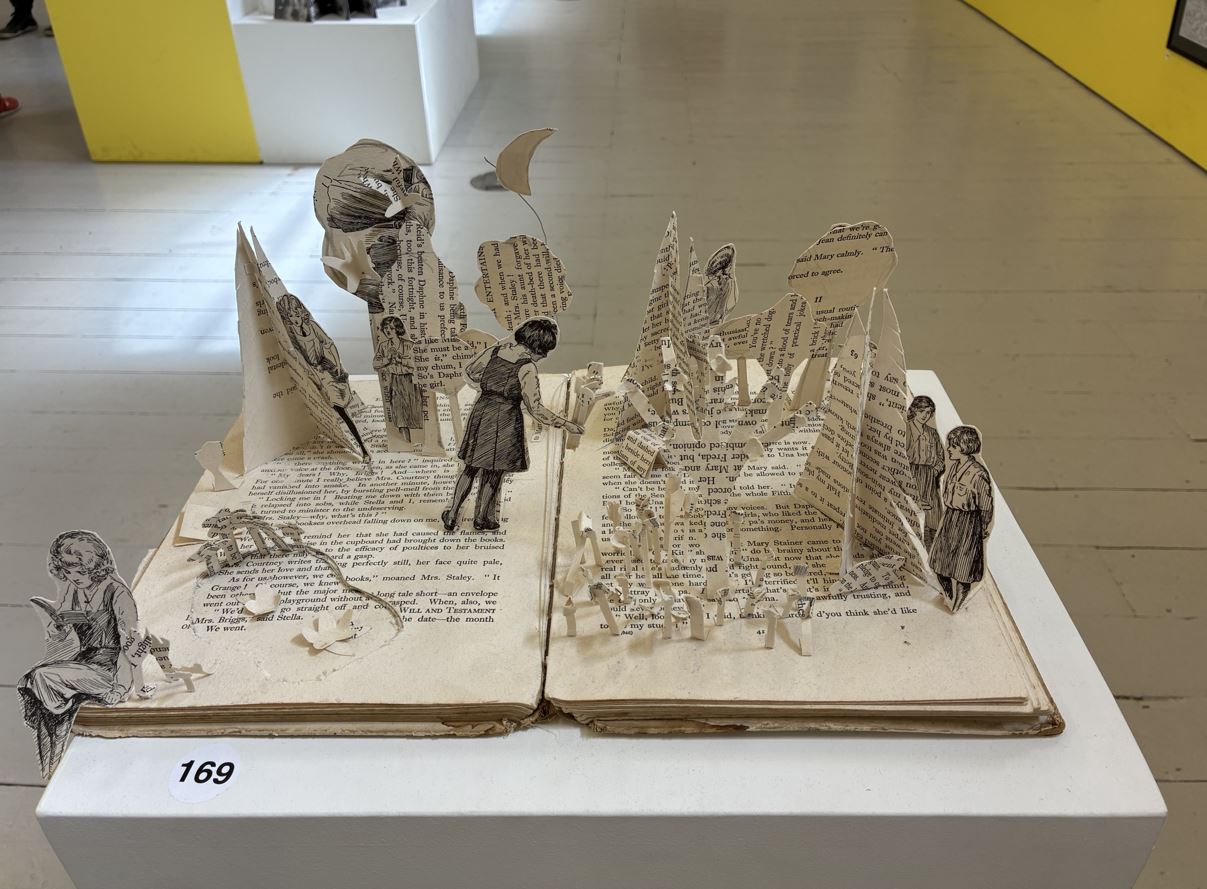
Nineteenth century France reviews

More National Gallery reviews

BP Portrait Award 2019 @ the National Portrait Gallery

According to the press release: ‘The BP Portrait Award is the most prestigious portrait painting competition in the world and represents the very best in contemporary portrait painting.’

With a first prize of £35,000, and a total prize fund of £74,000, it attracts entries from all over the world. This year there were 2,538 entries from which the judges selected a short list of forty-four and, back in June, selected a first, second and third prize winner, as well as a BP Young Artist Award and a BP Travel Award.

The competition has been taking place every summer for forty years (thirty under the sponsorship of BP) and is a fixture in the London art calendar. Certainly, I’ve been going every year for a while.

Installation view of the BP Portrait Award 2019 exhibition with a characteristic sprinkling of gallery goers older, white, and mostly female

Four quick and obvious points:

1. In previous years the short-listed works have been displayed in rooms at the back of the gallery, which feel big and airy. This year they’re all in the small gallery which you enter from the landing (the exhibition is, incidentally, FREE) and this space somehow made it feel pokier and smaller…

2. As I’ve mentioned in my reviews of previous shows, no-one is smiling let alone laughing. Everyone looks stony-faced and serious, which makes for an oddly downbeat experience.

3. Also, as I’ve pointed out before, almost all the subjects are friends of, partners of, daughters or sons or fathers or mothers of, the artist – which, after a while, gives anyone reading all the wall labels a slightly claustrophobic sense of being in a small, incestuous world of like-minded liberals and bien-pensant artists, their friends and families. A small and very passive, inactive world. A world where people sit still with unchanging expressions…

Conservative and traditional

4. And this brings me to the fourth, and most directly art-related point, which is… how very very conservative almost all the art on display is. Of the forty-four images only about three departed in any way from conventional figurative oil painting. There was one collage, a sort of photographic negative… um. In fact a list of the ‘modernist’ works would amount to:

A few had a cartoon-like simple-mindedness, which I sort of liked (Davetta by Natalie Voelker, Passion Fruit by Luis Ruocco) and most of the rest were good, sometimes very good – but almost all straight-down-the line, easy and accessible figurative oil paintings.

Here is a portrait of Ezra Pound done by Henri Gaudier-Brzeska in 1917, just over one hundred years ago.

Drawing of Ezra Pound by Henri Gaudier-Brzeska (1917)

It was a quick sketch done from life and represents everything I love about the first heroic era of Modernism about the time of the Great War, which is its tremendous energy and confidence. What a blaze of personality is captured in a handful of brushstrokes! I don’t know why this image popped into my head as I walked around the BP gallery but, once it had, I couldn’t help feeling that this one drawing contains more energy and life than all forty-four entries in this display put together.

Here is an online gallery of the 44 paintings in the exhibition.

A personal selection

You can surf the gallery and select whichever works light your candle or pull your daisy. My own opinion changed as I strolled between them, liking now this now that work, in a lazy summer Saturday kind of way, but three I grew to particularly like are:

Jenne by Manu Kaur Saluja

Jenne by Manu Kaur Saluja © Manu Kaur Saluja

Hyper-realistic it may be but, looking at it for a while, I became more and more beguiled by the use of turquoise – always a favourite colour of mine – in the tiles behind the sitter, and in her face, under her left eye, on her neck. The more I looked, the more I liked the very complicated play of colour Saluja uses to create what many people mistake for ‘white’ skin, which is, in fact, nothing of the kind.

Rumination by Frances Bell

Rumination by Frances Bell © Frances Bell

Fantastically traditional in style, this reminded me of the exhibition of Russian art from the end of the 19th century which the NPG held three years ago. It could be a young Tolstoy with his shirt off after a hard day pretending to be a peasant. Instead it is Edd, a friend of the artist’s, admirably skinny and bearded and with an impressive arm tattoo.

Ninety Years by Miguel Angel Oyarbide

Ninety Years by Miguel Angel Oyarbide © Miguel Angel Oyarbide

Like all Western nations, we have an ageing population (I am aging as I write this, are you aging as you read it?) – a fact which is rarely reflected in art or the intersection of art and music and advertising and fashion, all of which fetishise youth.

I grew up in a village which was full of old people, in the village shop where they came to congregate and chat each day, itself opposite a Victorian priory which had been converted into an old people’s home and us kids were regularly dragged off to visit some of the bed-ridden old ladies our mum had got to know.

I have seen so many Hollywood movies and adverts and TV shows where sexy young things get their kit off, allowing the camera to linger on their smooth burnished curves or muscular torsos. It is, quite simply, a relief from the oppressive world of photoshopped youth, to come to this painting and admire an extremely skilful depiction of age. Look at the light on the side of her face, and the liver spots on her forehead, and the dense wrinkling of her hand (she still uses nail polish). The narrow shoulders and the amazing way the artist has captured the fabric of the subject’s cardigan.

Isn’t it a bit hypocritical of me to claim to admire dashing modernist works and yet to end up choosing three very conventional pieces as my favourites? No. My point is precisely that there is hardly anything ‘modern’ available in this selection, and that what there is struck me as echoes of modernist approaches which were done much better, generations ago. You don’t order steak at a vegan restaurant. I chose what I liked from what was on offer.

Which ones do you like?


Related links

More National Portrait Gallery reviews