Discover Constable and The Hay Wain @ the National Gallery

Six footers

In 1818 at the age of 42, the well-established English landscape painter John Constable made a conscious decision to start painting bigger works and so began the first of what became known as his ‘six footers’.

The first one, ‘The White Horse’, exhibited in 1820, was so successful that Constable was elected an Associate of the Royal Academy on the strength of it, so he knew he was on to a good thing. The ‘Hay Wain’ was the third in the series. Constable painted it under pressure to make the deadline for submissions to the Royal Academy’s 1821 exhibition and, maybe surprisingly, it was painted entirely at his home in London. But he was able to do this because of the countless sketches and previous paintings he’d made of the same location and setting.

The Hay Wain by John Constable (1821) © The National Gallery, London

Constable knew this place so well because his father, Golding Constable, owned it. Golding was a wealthy mill owner and corn merchant so John had grown up surrounded by the appurtenances of the trade and knowing exactly what went into growing, harvesting and processing wheat. The house on the left of the picture belonged to Willy Lott, a tenant farmer, but behind the painter, behind us as we look at the painting, stood Flatford Mill which belonged to Constable’s father. Both stood on the east bank of the River Stour which, at this point, forms the border between Essex and Suffolk.

Map showing location of the buildings in Constables paintings of Flatford Mill and Willy Lott’s cottage

The Hay Wain, like much of Constable’s best work, came to symbolise a certain type of innocent rural scene, eventually becoming iconic of an innocent way of life which industrialising Victorian Britain knew it was losing.

The bicentenary connection

The National Gallery was founded in 2024 so this is its bicentenary year. It’s using the occasion to re-explore favourite items in the collection. It was around Van Gogh’s much-loved painting of sunflowers that the gallery created the brilliant Van Gogh: Poets and Lovers show which you must go and see.

In a similar way, they’ve used the opportunity to take John Constable’s super-famous painting The Hay Wain (1821), and make it the centrepiece of an exhibition in its own right. The bicentenary connection comes in because 1824 was the year when The Hay Wain was displayed at the Paris Salon to great acclaim and was awarded a gold medal, which Constable received from the French King, Charles X, in person.

The medal is here, on display, and is just part of this fascinating and FREE exhibition at the National Gallery, which brings together 50 or so paintings, sketches, drawings, models, contemporary and modern cartoons, photomontages as well as the artist’s own palette (!) to place this super well-known and well-loved image in its full artistic, political, cultural, geographical, agricultural and biographical context. It’s full of beautiful, relaxing rural paintings and fascinating facts.

Political context

To begin with, the socio-political context of the 1810s is dealt with in a fairly small section. At the end of the Napoleonic Wars, after the victory at Waterloo on 18 June 1815, the British Army was rapidly demobilised, with no provision or thought for hundreds of thousands of demobbed men dumped back in their rural communities.

In the same year the Tory administration passed the first of many Corn Laws. These blocked the import of cheap corn from abroad, thus creating a monopoly for British wheat-growers i.e. the landowning aristocracy. But while it guaranteed these landowners a good price for their product it raised the price of bread and related foodstuffs very sharply for ordinary people, leading to hunger and hardship.

Since the landowning class was in the majority in the House of Commons and dominated the House of Lords, it was a very naked form of class war: a few thousand aristocratic landowners arranged the law and economy to their immense benefit and to the starvation of millions of rural workers and the increasing urban proletariat. The corn laws weren’t abolished until 1846 and only after a generation of protests, agitation, riots and criticism.

This cruel and oppressive law doesn’t have much traction in the exhibition. It is dramatised in four or so contemporary political cartoons, by the likes of James Gillray and Joseph Rowlandson. The fiercest is this one by Charles Williams and titled ‘Political Balance’ (1816).

Political balance, An unexpected inspection, or A Good Old Master Taking a Peep Into the State of Things Himself by Charles Williams (1816) © British Museum

The only contemporary artists who spoke out against exploitation, poverty and despoliation of the countryside was the great William Blake but none of his political work is included here, just a couple of tiny illustrations from the Songs of Innocence and Experience.

Interesting though all this is to those of us with a taste for history, none of this rural poverty or agitation is visible in any of the actual paintings by Constable or Gainsborough, Turner or Mulready, Stubbs or Combes which are included here. The subject is raised by the curators only to be quietly forgotten.

The Hay Wain’s radicalness

Landscape painting

At the time in Britain, landscape painting was still considered an ‘inferior’ genre compared to history painting. Among other goals, Constable was determined to raise its prestige and this was part of his motivation for creating the six footers.

‘En plein air’

The Hay Wain was painted in the artist’s London studio over five months in preparation for the Royal Academy annual exhibition which Constable had entered numerous times before. He painted it from several preliminary sketches, probably created ‘en plein air’, a revolutionary approach for the period which Constable eagerly adopted in his quest to represent ‘truth to nature’. It was considered revolutionary in other ways.

Brown

The exhibition includes works by slightly earlier painters including George Stubbs and especially Thomas Gainsborough to show what the traditional approach looks like. In this Gainsborough painting the dominant hue is brown and the play of light is suggested by lighter and darker shades of the relevant colour.

Smooth

Above all the brushwork is invisible and the surface of the painting is flat and smooth.

Cornard Wood, near Sudbury, Suffolk by Thomas Gainsborough (1748)

The Stubbs painting, like the Gainsborough, is dominated by brown, and is as smooth as a horse’s bottom, all slick and shiny surface. Go up close, peer right into the painting, and its surface is as smooth as a piece of porcelain.

Reapers by George Stubbs (1785) © Tate

By contrast 1) Constable boldly used a much brighter shade of green but 2) much more noticeable is his looser, expressive handling of the paint with noticeable brushstrokes which you can see even from a distance. When you go up close you can see countless details which completely lack the consummate finish of a Gainsborough or Stubbs, loads of places where the paint gestures at what it is depicting.

He used a range of marks, surfaces and textures to reflect the variety that he saw in nature and to add to the mood of the painting. He used a palette knife and brushes to create expressive surfaces which are surprisingly varied – scuffed and scored and smeared, lumpy or rasped across the canvas, with small ripples and waves, surfs of impasto. The closer you get, the more varied and dramatic you realise the paintwork is.

Detail of the Hay Wain by John Constable showing the washerwoman by Willy Lott’s cottage (photo by the author)

Smooth when he wants to be

What makes this really striking is that, when he wanted to be, Constable could easily be as smooth as his predecessors. The exhibition includes two paintings of the view from the first floor of his family home which, the curators tell us, he made shortly after the death of his beloved mother, Ann.

Golding Constables Kitchen Garden by John Constable (July 1815) © Ipswich Borough Council Collections: Colchester + Ipswich Museum Service

It’s a quietly beautiful picture in its own right. It has deep biographical resonance not only because of the poignant dating of it, but also because it shows, in the foreground, the garden which was his mother’s pride and joy. But, for our current purposes, the chief thing about it is that the finish is immaculately smooth. If you go right up and peer closely, and from the side, you can see how smooth and finished the paintwork is, completely unlike the ridged and rasped and sprawling brushstrokes of The Hay Wain. He could do it when he wanted to. Not doing it was a very conscious statement of artistic intent.

Constable snow

I was mighty pleased with myself for noticing and then becoming obsessed with Constable’s use of white paint to create a kind of silvery chrome effect all over the Hay Wain. The more you look, the more you see it, not just highlighting the water but iridescent along the tops of the wain itself, dusting spars of wood and brickwork, suggesting the flickering light across the landscape and its reflection off multiple surfaces.

Detail of the Hay Wain showing the silver highlighting

However, I was deflated to read in the curators’ labels that this liberal use of flecks of white paint to represent the sparkling or reflection of sunlight, was noticed and criticised at the time, some smart aleck nicknaming it ‘Constable’s snow’.

Alongside the visible brushwork, the rasps of paint on canvas, and the ridges of paint, this silvery snow was used in the general criticism that Constable’s paintings were unfinished. Constable, of course, considered the plein air approach, the loose brushstrokes and the use of silver slicks of sunlight central to his aim of creating a realistic effect of being there and seeing the landscape, of conveying the shimmering, ever-changing light and shade effects of a real English day, with its everchanging drama of clouds and light.

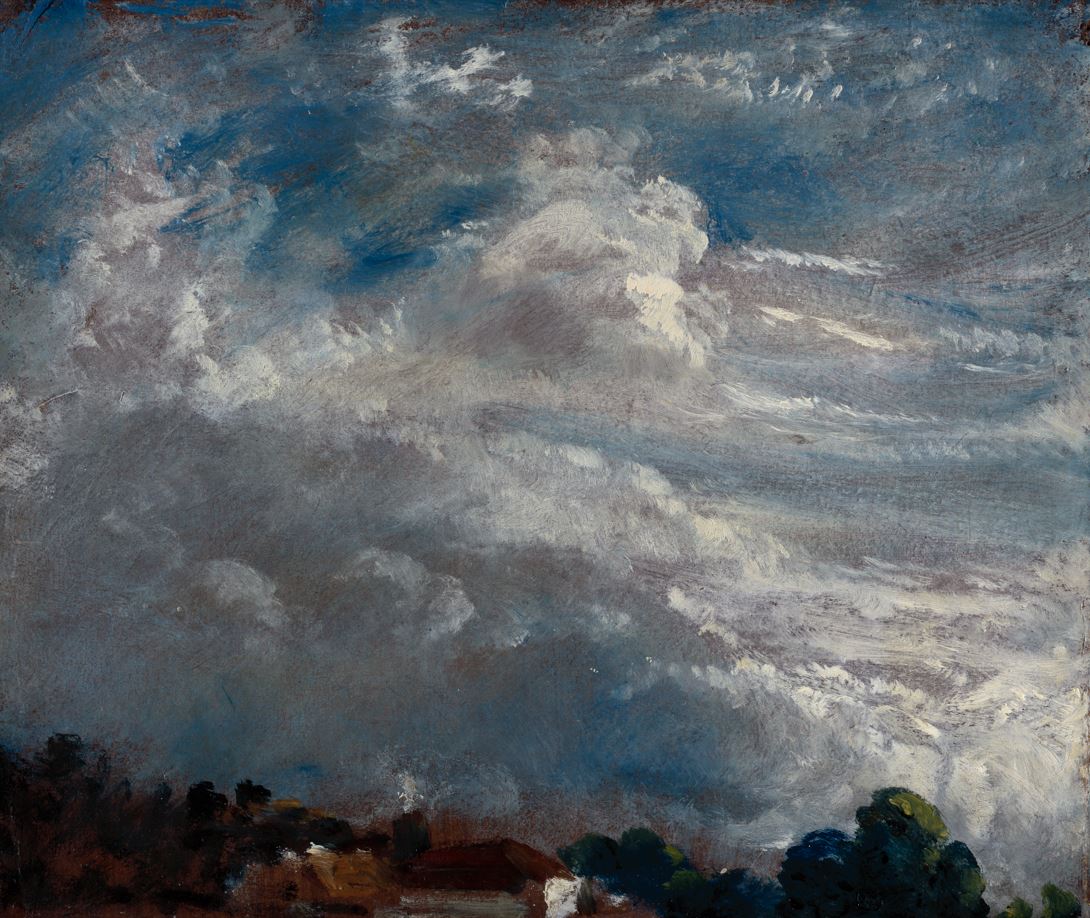
Clouds

Constable was particularly interested in the study of clouds. The exhibition includes numerous paintings, sketches and drawings he made of cloudscapes. A man named Alexander Cozens wrote a book titled ‘A New Method of Assisting the Invention in Drawing Original Compositions of Landscape’ which included different types of cloud shape and the exhibition includes some of the 20 drawings he made from the book as well as oil sketches.

Cloud Study: Horizon of Trees, 27 September 1821 by John Constable © Royal Academy of Arts, London; photographer: John Hammond

What Salisbury tells us

The show includes the splendid ‘Salisbury Cathedral from the Bishop’s Ground’ (1823) and it is a deep pleasure to sit on the bench in front of it and just drink it in. What sumptuous, sensual beauty of composition, colour and light.

Salisbury Cathedral from the Bishops Ground by John Constable (1823) © V&A Images / Victoria and Albert Museum, London

Slowly several points emerge, namely around the use of light and shade and clouds. The dark cloud rising from behind the cathedral gives the composition a sense of drama (it’s interesting to learn that the Bishop of Salisbury actively didn’t like this dark cloud).

It also indicates the kind of day it is, one of those days when the sun comes in and out between clouds, and this explains the radiance of the cathedral facade: it’s one of those moments when the sun comes out from between clouds and makes whatever it shines on appear radiant. Once you notice this, you realise it also applies to the meadow in front of the cathedral, up to and including the cow, whereas the field and trees further towards the viewer are still in shadow.

With this in mind, if we go back to the Hay Wain, I suggest part of its popularity is down to its use of cloud and light as design features. On the face of it, it’s a painting of a cart in a pond but if you focus just on the play of light, and light on clouds, several things become obvious.

The Hay Wain by John Constable (1821) © The National Gallery, London

The spiral

In the West we read from top left to right. I suggest that one of the reasons the painting feels so satisfactory and pleasing is the way its design plays to this deep way of ‘reading’ visual elements. So if you start at the top left the cloud is very dark which leads your eye to the right, towards the nice light cloud, and your eye continues on round and down into the meadow which stretches off into the distance and is dappled with sunlight, before swinging down into the water and round to the cart in the pond.

So my suggestion is that we don’t just perceive it as a complex composition and pick out details at random but enjoy this sense of sweep and progression.

Comparing the sketch

A bit more evidence for this us supplied by the full-sized sketch of the Hay Wain which the exhibition also includes. Comparing the sketch and the finished painting suggest quite a few points from which I’d emphasise two.

Full-scale study for The Hay Wain by John Constable (about 1821) © V&A Images / Victoria and Albert Museum, London

1. Brown and green

Remember the idea that older landscape artists used a tastefully subdued palette of brown when painting outdoors? Well, the sketch clearly shows that this is how Constable began, using a far more sombre, brown and rather lifeless palette. Comparing the sketch and the finished painting shows how powerful adding in the vibrant shades of green transforms the finished product. They bring it to life; they make it zing with life, foliage, fertility.

The Hay Wain by John Constable (1821) © The National Gallery, London

2. Decluttering the composition

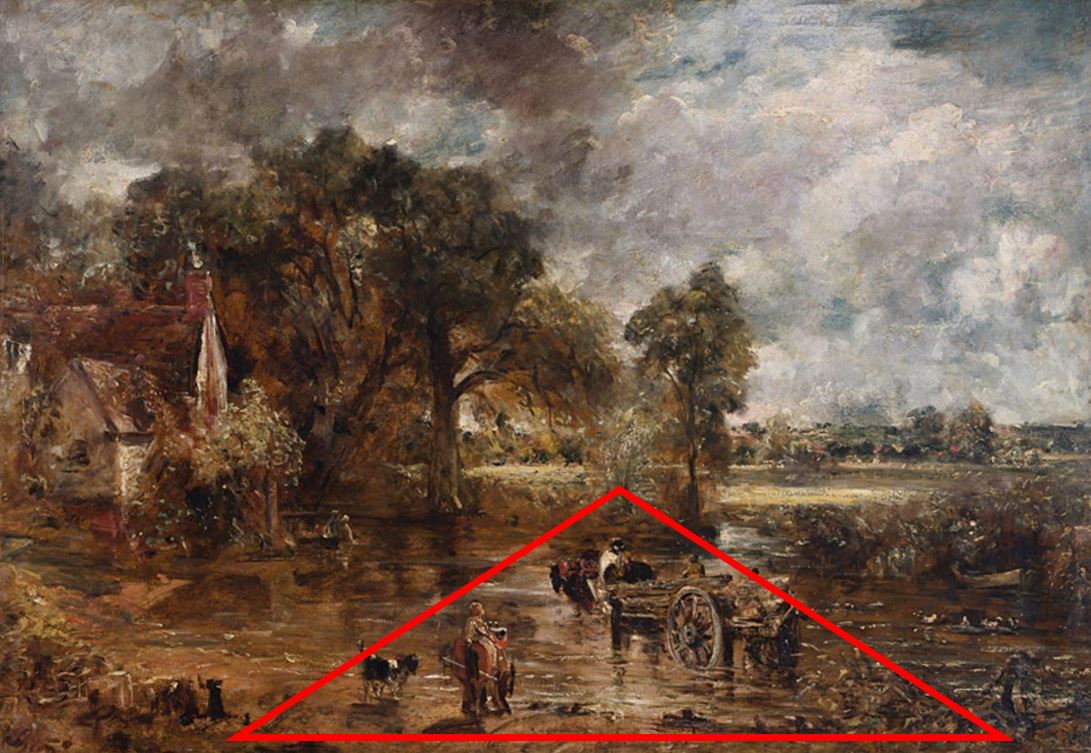
But back to the issue of composition, look at the one big, obvious difference between the sketch and the finished work. The figure of a horse and rider between the dog and the cart has been deleted. Why? Because including it crystallises the dog and cart from being light and almost random elements into becoming a strong central ensemble which dominates the picture. With it in your eye tends to go straight to it and you get distracted into peering closer to make out the precise nature of the figure on a horse (in fact, you have to peer quite closely to realise it’s a horse at all). And all this supersedes or obliterates the sweeping curve, the spiral I’ve described above.

Full-scale study for The Hay Wain by John Constable (about 1821) with added triangle © V&A Images / Victoria and Albert Museum, London

Keep it in and the eye goes straight to these central figures and tries to identify them / make them out, making you tend to overlook the wider composition. Remove it and your eye is freed to step back, to take in the larger compositional sweep, from dark cloud to light, round and down to the meadow, and only slowly and leisurely coming round to the cart. The picture becomes lighter and airier. It breathes.

History of an icon

It’s interesting to learn that John Ruskin, the godfather of mid-Victorian art criticism, really disliked Constable and helped depress his reputation for a generation. It was only later in the nineteenth century that Constable’s reputation bounced back and has remained high ever since.

The curators claim a major aim of the exhibition was to chronicle the rise of Constable from the kind of criticism he received in his lifetime and the active dislike of cultural arbiters in the mid-nineteenth century his current unassailable position as one of Britain’s classic painters. This is a fine ambition so it’s regrettable that the exhibition doesn’t really achieve it.

There are a few wall labels explaining that this or that painting was given to the National Gallery by supporters or, in one case, by his daughter, in this or that year, as if that tells us very much and that’s about it.

There’s a glaring absence of any explanation of what changed in aesthetic theory, in the practice of art, in social attitudes to the landscape, in artistic taste through the middle and later Victorian era to explain Constable’s rise and canonisation. I’d really like to have read this but didn’t see it anywhere.

So in the opening section there’s a 1920s black-and-white photo of Willy Lott’s cottage and we are told that it was extensively restored in the 1920s after a revival of interest in Constable’s paintings – but not why there was a revival of interest in Constable’s paintings. What was sufficiently different in the 1920s from the 1880s or 1860s to spark the investment? What changed and why?

Spoofs and parodies

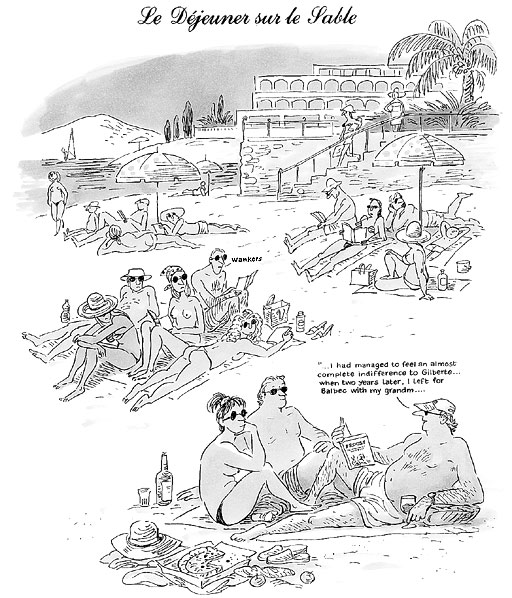
To end on a lighter note, right at the start of the show, while they’re telling us how The Hay Wain has become an iconic image of the English countryside, the curators include half a dozen examples of how it’s been parodied and pastiched, used in cartoons and adverts for railways (‘Explore Constable country!’).

A striking one is this use of The Hay Wain in a 1929 cartoon bewailing the despoliation of the English countryside by cars and advertising hoardings. People tend to think this is a modern problem but here’s proof that it goes back at least a hundred years!

‘Had Constable lived today’ cartoon in the Daily Express, 2 March 1929, created by the Campaign for the Protection of Rural England © CPRE

There’s the satirical anti-war photomontage by radical anti-war artist Peter Kennard.

More up to date is this photomontage by Cold War Steve, where he’s cut and pasted leading political figures from 2019 into the scene. I like the truck full of dead washing machines but the killer detail is the image of Wayne Rooney riding a jet ski just to its left, so the joke is that this version of the picture should be titled ‘Hey, Wayne!’

The Hay Wain by Cold War Steve (2019) © Cold War Steve


Related links

Related reviews

Royal Academy Summer Exhibition 2023 @ the Royal Academy

And so to the 255th Royal Academy Summer Exhibition. Anyone can enter a work for the show, and the result is 11 rooms packed with 1,613 works of art, including paintings, prints, photographs, sculptures and architect’s models. I can’t perfectly remember the last few I’ve been to but this one felt underwhelming, less good than previous ones I’ve been to, a feeling I spent most of the time I wandered round trying to analyse and explain.

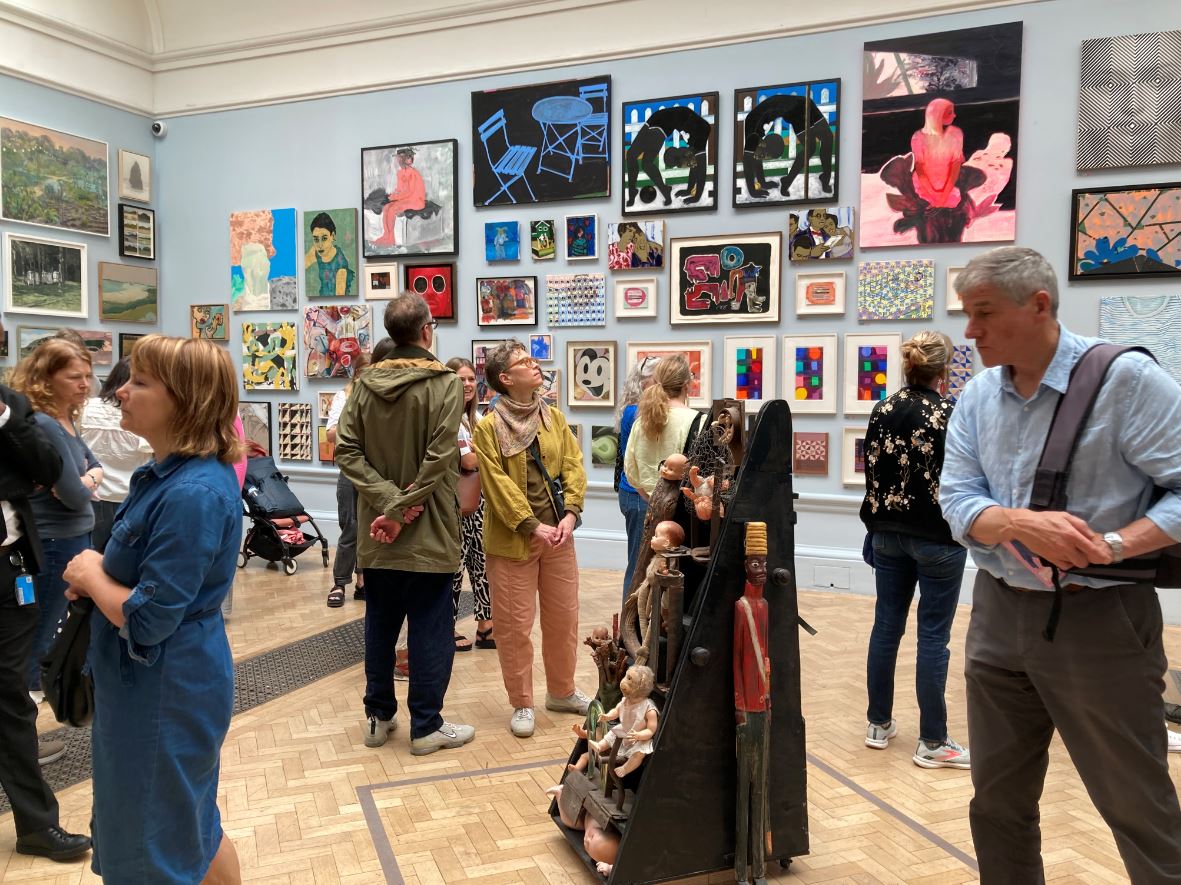
Installation view of the Summer Exhibition 2023 at the Royal Academy of Arts in London demonstrating just how difficult it is to separate out and assess individual works © Royal Academy of Arts, London / David Parry,

(Incidentally, you can view every single one of the 1,613 works on the Royal Academy website, where you can filter by painting or photo or whatever medium you like, search for artists, and where –rather proving my point – lots of the works look much better presented in smaller numbers or, if you click an individual work, in isolation. In many ways, an hour spent slowly surfing through the works online is, possibly, better than actually visiting. Also, in case you didn’t know, you can buy many of the works on display via the website which, in the case of prints and photos, means instances of multiple editions.)

The show is curated by British artist David Remfry RA, who worked with the rest of the Summer Exhibition Committee (Eileen Cooper, Bill Jacklin, Katherine Jones, Tim Shaw, Clare Woods, Peter Barber, and the RA president, Rebecca Salter) to ‘explore’ the theme of ‘Only Connect’, inspired by the quote from E.M. Foster’s novel, ‘Howard’s End’. The theme is meant to underlie many of the words and comes into the open in pieces like the work of the same name by Tom Phillips (number 1162).

Un-diversity

I had two or so general observations. One: although a) the Royal Academy, like all modern art galleries (and most modern organisations) shout loud and long about diversity (and there’s an artwork in the penultimate room which consists of loads of woke sloganeering about Art and Diversity – The modestly titled Constitution of the Arts by Bob and Roberta Smith, number 1449), and b) there are hundreds of paintings and images of black people throughout the show – nonetheless, the only black people I actually saw in the galley were, as so often, the security guards or ‘visitor attendants’.

In fact, being a big tourist attraction, the most noticeable ethnicities in attendance were two large groups, one of Chinese, one of Japanese, who processed through the show at the same time as me, generally standing en masse in front of whichever work I wanted to see and photograph. Grr.

White and old

Instead of the supposed ‘diversity’ art galleries go on about, I was, as so often, impressed by the whiteness and the old age of a lot of the visitors; look around and you saw a lot of grey-haired old men and women, some really doddery, some requiring sticks and moving very slowly, several actually in wheelchairs.

I don’t know why this struck me so much except that it feels like a symbol of the show itself. I suppose it’s an excellent idea to have an open exhibition where anyone from the UK can submit a work of art and, if it passes the reviewing committee, have it displayed alongside works by top international artists. The exhibition is ‘the world’s largest open submission contemporary art show’. That’s a good idea, right? So why does it feel so old?

Packed

Second observation is related to the first, which is that the rooms were not only packed with tottering, peering human beings, but jam-packed with art works and, maybe it’s me, maybe I’m old, maybe I’m jaundiced, but I felt very oppressed by the sheer number of works on display but also increasingly dismayed that I didn’t really like many of them. I went through the first four rooms not really liking any of the hundreds of paintings and photographs on show. Lots were OK, obviously. Probably some were very good. But nothing really stood out for me.

The Room of Shame

I perked up a bit when I came to the Architecture Room which I amuse myself by calling The Room of Shame. This is because, while glitzy international starchitects are designing space-age new airport terminals or railway stations around the world, and ‘cutting edge’ architects are dreaming up Cities of the Future, back in the real world, certainly all across this country, the UK, horribly windy shopping precincts and soulless plazas continue to be built which lack all soul and humanity.

Take the horrible new development outside Tottenham Court Road a mile or so from the Academy. What a shiny, clever, brilliantly designed, windswept, cold, dusty, gritty, alienating environment. Architecture, as a profession, long ago lost its way in soulless anti-human ideologies. I wonder if a modern architect will ever again design a building people actively want to be around.

Installation view of the architecture room, showcasing the youthful dynamism of typical exhibition-goers. The big photo on the wall is of the Shoreham Houseboat by Andrew Popkin (number 176) (Photo by the author)

Which is why I always enjoy the Room of the Shame for its unintentional humour. This year’s room featured several designs –wooden models and photos – of a base on the moon (Lunar Habitat Study by Spencer de Gray, number 242).

1) Is this where humanity really needs to be focusing its energies, on burning huge amounts of fossil fuel to send rockets full of building materials to the moon?

2) They’ve been predicting this kind of thing since the 1950s. Like most normal people I regard all talk of setting up bases on the moon, let along ‘colonising Mars’, as the deluded displacement activity.

I liked one piece, a little model, because it was presented ready-covered with graffiti as most low-rise, low-budget, local buildings end up being (Long House Concept by Artel 31, number 53, £1,000). It felt like it had more connection with the real world than the models of new airport terminals dotted with tiny wooden figures, featureless pawns in the architects’ fantasy world.

Long House Concept by Artel 31, number 253. Photo by the author

Incidentally, each of the rooms has a curators’ explanation and summary and these obviously contain useful information but are also, quite often, unintentionally comic in their po-faced earnestness:

The architecture room has been curated by Peter Barber RA. He has decided to focus on sociologist Richard Sennett’s assertion that ‘making is thinking’, and through the physical craft of making we have a better connection with the world around us.

Dominating the architecture room was a towering sculpture made of clay blobs by the late Dame Phyllida Barlow. I know she made this thing through physical effort and I understand what they get at when they say ‘making is thinking’, which I experience in a mild way when I put up trellises or tripods for plants in my garden to grow up. But it’s hard to see how just looking at it forges ‘a better connection with the world around us.’

Untitled Folly; Bouldercolumn 2016 by Phyllida Barlow (number 254) (photo by the author)

Likes

The ideal way to visit is in a group of friends and family because there’s such a profusion and variety of works that there’s something for everyone and it’s fun to explain to friends or family why you like this particular work, and then have them drag you over to the other side of the room to point out something you hadn’t even noticed. And, with this many works on show, there are always lots of things you haven’t noticed. It’s a team effort, visiting the Summer Exhibition.

But there’s so much on display that it’s impossible to take it all in or give most of it the attention it deserves. For example, while I was savouring the graffiti building my friend liked a big embroidery of, of all subjects, Heathrow Airport by Ben Stringer (number 133); and a wonderful photo of a houseboat which is so colourful I thought it must come from India or Thailand some developing country but is in fact from Shoreham (number 176; visible in the photo above). She also liked the tiny models of temporary retail spaces i.e. popup markets, which had been set up in Westminster and Elephant and Castle by Jan Kattein Architects (numbers 259 and 260)

Anyway, the general sense of being overloaded with visual stimulation might be the simple explanation of why I liked all three works in the Small Weston Room, simply because there were only three of them  and so there was lots of space for them to breathe and expand. They were:

1. Walk With Me by Lorna Simpson (number 281), a big black and white video of three black women with beehive hairdos in the style 1960s Motown groups, but whose blinking eyes, mouths and other facial parts had been dislocated into a kind of jagged, animated collage.

Installation view of Walk With Me by Lorna Simpson (number 281) (photo by the author)

2. Spitnuk by Bill Woodrow (number 282), another video, this time showing a cartoon-style satellite spinning through space and with every rotation revealing that it has a big portrait of Joe Stalin on one surface. You can buy this for the princely sum of £25,000.

3. Lore, The Enlightened Granddaughter by Piplotti Rist (number 283), consists of a one-piece swimming costume hanging in a clothes hanger but with a frosted glass spherical lamp inserted in the bottom half. I can imagine thousands of feminist interpretations ramifying out from this image, about the female body and desire and gender stereotypes etc, but I enjoyed it because it was weird and strange and beautiful.

Lore, The Enlightened Granddaughter by Piplotti Rist (number 283) (photo by the author)

But after this peaceful interlude, it was back into the busy main rooms, shuffling along like a crowd on a rush-hour Tube platform.

Sculptures and brands

A lot of the works which stood out for me were sculptures. I think this is because they literally stand out to your senses, whereas the hundreds and hundreds and hundreds of paintings, prints and photos, placed side by side all over the walls are much harder to single out and engage with, individually.

This, incidentally, explains why, in today’s thronged art market, it pays to establish a really distinctive visual brand and stick with it. Two good examples of this are the crisp, clean, brightly coloured outline images by Michael Craig-Martin, represented here by 4 or 5 works, including his treatment of the Mona Lisa and a work by Caravaggio, both given the MCM treatment.

Caravaggio (Green) from Past Present by Michael Craig-Martin (number 401)

And the distinctive cartoony, larky paintings of Anthony Green, often cut into unusual shapes or moulded to follow the shape of the subject for example his own profile (A Vase of Flowers, number 1170 and The Blue Bedroom, number 1169). These immediately stand out in walls otherwise covered in so-so, quite good, but generally indistinguishable paintings.

Anyway, sculptures which literally stood out from the crowd included Planets In My Head, Young Geologist by Yinka Shonibare (number 448).

Planets In My Head, Young Geologist by Yinka Shonibare (number 448). (photo by the author)

There was a sculpture of just the right arm of Christ on the cross, with the hand brutally nailed to the wooden post (Cuddy by Brian Catlin, number 1179). It freaked me out when I thought I saw the hand move and then realised that it does move, presumably in a pitiful depiction of the last flexions of the dying Saviour.

There was a tiny sculpture of one of those dogs that kids party entertainers make out of balloons except the entire shape was covered in Tunnock confectionary wrappers, Tunnocks Redcoat by Robert Mach (number 660). The friend I was with very much liked Moments from 365 Days of Whistling by Emma Carlow (number 831) which, I’m afriad, did nothing for me.

More likes

I liked Where Sheep May Safely Graze by Sir Frank Bowling (number 295). I like big abstract art, and I especially like big pieces with rough surfaces which incorporate found materials, paint, dirt, stones, wood etc.

My son liked The Machine Stops by Amber Hodge (number 433), a collection of clock hands, some still moving, some busted and stuck in place. I liked Stairwell by Frederick Jones (number 490) which I found simple and evocative.

I noted Ice Floe Svalbard by Emma Stibbon (number 903), the new Academician who had a whole little exhibition devoted to her earlier this year, in the Collection Gallery at the back part of the Academy (she has 6 characteristically clean and beautiful works in this show).

I liked Stoned by Chris Levin, because a) it is a chunky geometric shape of the kind I like b) it’s obviously got a historical dimension and c) it has an enjoyable gimmick, which is the surface is dusted with glitter so that it spangles as you walk past it, recreating a sense of morning frost.

I very much liked Headsets by Alan McQuillian (number 1314). If you look closely you can see a ‘set’ of six heads, from right to left, some kind of shrunken head on the top of a stick, the head of the woman wearing a headset, then the heads on models of Darth Vader, an alien and a toy dragon, and then the head of the leggy shopwindow mannekin, herself alsom wearing a headset. So I liked the larky title, but I also liked the framing, and the energy given by the way the woman is captured in mid-step, entering screen right.

But my favourite piece in the entire show was a photograph of a manky-looking kitchen sink, Hearth by Leslie Osterling (number 742). I came back to it several times and relished it, and let it really sink in. When my son asked why I liked it so much, I pointed to some formal aspects of its composition.

1) There is clear space all around important elements i.e. there is clear space at the edge of the rail of implements on the left, the shelf at the bottom left and the bracket supporting it underneath; space under the piping under the sink; there’s a subtle space to the right of the whiskey bottle on the right and of the wooden strut directly beneath it. 2) There are natural diagonals coming out of the picture at its corners: the fluorescent tube at the top left, and the wooden shelf at the bottom right.

Obviously there’s a whole lot to be written about the actual subject matter of the photo, but it was these formal elements, creating a really clean defined image, which I found calming and pleasing.

Hearth by Leslie Osterling (number 742)

Chairs

There appeared to be a subterranean theme of wacky chairs running through the show. Not all, but a lot of the rooms contained interesting and amusing variations on the simple chair. Given the overarching theme of the show, maybe the idea is that people need to only connect to their bottoms more. There was Sit by Jazmin van Breda (number 1579). And this big fluffy colourful chair (Conversation 2 by Darcey Fleming, number 72) has a case for being the single most striking work in the place.

Conversation 2 by Darcey Fleming (number 72), yours for £6,500 (installation photo by the author)

Comedy

Maybe because I found so much of the art emotionally blank and null, landscapes, cityscapes, still lifes, portraits of unsmiling people – or, sometimes, political and grim, like the sequence of photographs of black activists by Sire Horace Ové (numbers 1010 to 1012) – or deliberately hideous, like the enormous sculpture which is like a house-of-horror altarpiece by Dame Paula Rego (Oratoria, number 1175) – it was a relief to come across little bits of comedy.

Thus there were several actual cartoons, some with comic captions, for example the Glen Baxter one, The Critics Spotted The Bogus Rothko Almost Immediately (number 455). There are several comical illustrations of what could be incidents in a children’s book, like the car driven by two young Famous Five types careering off a bridge into a river (Joyride by David Mach, number 1524) or the shepherd cutting the rope on a rope bridge so his enemy falls into the river (Shepherd’s Delight, number 1525). There’s Daft Vader by Martin Langford (number 527). There’s Panto Tactics (Down in the Dumps) by Mark Hampson (number 1030) which channels the old Beano comics of my youth.

I liked a child’s style cross-section of a ship, showing the adventures of lots of people inside it, Ship by Chris Orr (number 347), related to Changing Deckchairs (number 1053). They reminded me of the brilliant Richard Scarry books I read when I was a boy.

One work in particular made me laugh out loud, a sequence of four photos by Brian Griffiths of a wooden mannequin falling over (numbers 1054 to 1057). Simple things please simple minds.

No No to Knock-Knocks I to IV by Brian Griffiths (numbers 1054 to 1057)

Last few rooms

The last three rooms presented an interesting study, not in art itself, but in the dramatically different impact art can have on you depending on how it is hung and displayed.

Gallery 9 seemed to me an example of how not to do it. The four walls of this relatively small room were jammed to the hilt with 288 paintings, prints, photos and a handful of sculptures, some small, all dominated by Paula Rego’s enormous, grotesque altarpiece which appears to be a kind of memorial to toxic masculinity (in each of the panels women appear to be being raped or bearing the children of rape amid pain and blood. The room was so packed with art and with people that my son had to leave the exhibition altogether, to sit down in the foyer and recover for 6 or 7 minutes. It was making him feel stressed and overloaded.

Packed with people and pictures (photo by the author)

So he missed the most dramatic moment in the show which was the transition from the claustrophobic, hysteria-inducing room 9 into the next gallery, which is at least three times the size, with a much higher ceiling and, crucially, far, far fewer works on the walls. Instead, Gallery 10, the Lecture Room, felt bright and light and airy and spacious and so came as an almost physical relief.

More space, light and perspective (photo by the author)

And after a moment I realised that part of this was because the room is mostly fully of sculptures. At least three points arise: 1) You can walk around sculptures; your body is looser and free-er, compared to a painting which requires a more or less static fixed posture, maybe with a bit of leaning in or walking back a bit. Therefore engaging with sculpture feels more human; it’s like exercise; it makes you feel free-er.

2) Subconsciously, I think you’re aware in this room that there aren’t literally hundreds of images covering the walls, in effect screaming out for your attention. It was the clamouring for attention which I think my son couldn’t bear. 3) Lastly, it was him who pointed out that the number of sculptures added an element of depth and perspective i.e. as you looked, you saw the sculpture immediately in front of you, but also the one behind, and the one behind that, and the one behind that. This sense of depth and the perspective – which obviously changes as you move around the room – also, very strongly, if unconsciously, added to the sense of freedom and ease.

There was lots to enjoy in this final room. There was a giant inflatable beetle stuck up in one corner of the ceiling (by Hang Zhang, number 1484). There was a leather and metal model of a hawk sitting over the archway into the next room (Peregris by Georgina Brett Chinnery, number 1519). There was a fleet of pink and blue glass butterflies flying up the side of one wall (Summer Cluster by Anne Bennett, number 1479).

There’s a recreation of one of the dark brown embalmed bog men, such as those found in Northern Ireland (by Carlos Zapata, number 1569).

My son liked the animatronic i.e. semi-animated robot figure of a child, made so you can see the metal joints as it move jerkily: It Takes a Village To Raise A Child by Giles Walker (number 1592, yours for £12,500). I didn’t like it. Like the absurd plans for a moonbase, this is the kind of thing I’ve seen hundreds of times, minatory warnings of some fantasy human/robot interface which people have been panicking about since the 1930s, the kind of thing I watched being described on Tomorrow’s World back in the 70s, and which we’re absolutely no closer to creating.

No, as I mentioned above, I found relief from what I was finding quite an oppressive experience in straight comedy, in lolz. Thus, tucked away in a corner behind the characteristic lifesize sex mannequin by Allen Jones (another artist who established a look and brand decades ago and has stuck to it (number 1514, £210,000) was this little suite of joke works, being:

This final room was the best room, with a very high percentage of hits. There were quite a few attractive sculptures, from the totally abstract to the figurative, and some paintings and drawings. But I liked it that the sequence of rooms ended with a fat, distorted cartoon bust of his excellency President Donald Trump. My God, if he gets nominated to be the Republican Party’s candidate in the next presidential election, it will prove everything I believe about democracy, America and humanity in general. I may die of laughter.

Donald Trump Helmet Head by John Humphrey (number 1584) (installation photo by the author)

Epilogue

Finally you arrive in the last room, a tall octagonal space, the Wohl Central Hall, which is usually filled with a blockbuster sculpture. This year it’s Poem In The Dark About Sadness by Richard Malone (number 1613).

Installation view of Poem In The Dark About Sadness by Richard Malone (number 1613), part of the Summer Exhibition 2023 at the Royal Academy of Arts in London © Royal Academy of Arts, London / David Parry

I’ve mentioned my friend Andrew the designer who goes to many art exhibitions but rarely if ever reads the wall captions because, as he puts it, they are so predictable and so boring. If I had a pound for every art gallery caption which went on about ethnicity or gender, the only two issues the art world knows about (with, OK, maybe an honourable mention for The Environment). Here’s the official puff about this piece:

The artist describes the work as ‘a sculpture that centres gesture, personal action and queer working-class Irish and immigrant identities’.

Ethnicity and gender – the exhibition ends with a full house of bullshit bingo.

P.S.

If you go to the Summer Exhibition you MUST go through to the back of the building where they’re also hosting a parallel Young Artists’ Summer Show. They’ve managed to pack 248 works into just one medium-sized gallery, but for some reason it doesn’t feel cramped, the opposite, it feels fun and open and, more importantly, it has a strong claim to having more interesting, varied and successful pieces in one room than the adult version has in 12.


Related links

More Royal Academy reviews

Quentin Blake: From the Studio @ the House of Illustration

Sir Quentin Blake helped set up the House of Illustration, which opened in 2014. One of the perks of being found is that the third and smallest of the House’s exhibition spaces is a permanent Quentin Blake gallery which is given over to a rotating series of small exhibitions and displays by the great man.

At the moment, the Quentin Blake gallery is hosting the latest iteration of a project titled simply ‘From the studio’.

England’s favourite illustrator (born in 1932 and so now 87 years old) draws every day. In this little, L-shaped room are gathered the early drawings from several of his recent projects.

The mouse on a tricycle

Words cannot really convey how fantastic Blake’s work is. With a few strokes of the pen he creates characters and situations which transport you. Not only that, but almost everything he draws is funny.

Take the adventures of the mouse on a tricycle. That’s just a brilliant idea, but he then submits it to a series of hilarious variations, with the eponymous mouse, a tiny figure on his little trike, being: cheered on by football supporters with rattles and a megaphone; inspiring a flowery poet to song; having his photo taken by the paparazzi; being given a stern telling off by an elderly teacher; being made the subject of a learned disquisition by a science professor to his students accompanied by a barrage of graphs and statistics by a businessman, and so on.

Each one is brilliant. The cumulative effect is genius.

The Mouse on a Tricycle by Quentin Blake

The art of conversation

Just as simple is the idea of ‘the conversation’, which gives rise to a florid variety of different people conversing in wildly different ways, from muttered asides, to arm-waving rants, to jolly chaps with legs crossed in the park, to two people talking over the head of a disgruntled neighbour at a dinner party.

The Art of Conversation by Quentin Blake

In fact both mouse and conversation are part of a series QB has been published called the QB Papers, relatively short, large format paperbacks containing a series of drawings based on a single topic. There is no text and no story, so you are free to browse and free-associate. To date the Art of Conversation and Mouse on a Tricycle have been joined by Constant Readers, Scenes at Twilight, A Comfortable Fit, Free in the Water and so on.

The King of the Golden River

Blake has previously shown some of the illustrations he’s done for a luxury edition of John Ruskin’s 1842 children’s story, The King of the Golden River. This time round he’s showing the coloured versions, and explains that he waited some time after doing the initial drawings, for the correct colouring schemes to come to him.

Illustration for The King of the Golden River by Quentin Blake

The Lost City Challenge

There are drawings done for the Lost City Challenge, which was an instagram campaign organised by Greenpeace, the ‘lost city’ being the vibrant ecosystem surrounding chimney-shaped hydrothermal vents located in the middle of the Atlantic which are under threat from mining companies planning to extract rare earth minerals from the area. Blake contributed a picture of a vibrant oceanic scene and another one showing a lifeless seascape after the drilling has killed everything.

Moonlight travellers

This began as a personal project in 2017, the notion of a group of anonymous people journeying through a moonlit landscape. Slowly they grew into a series of watercolours depicting journeys through unknown landscapes which capture, with vivid immediacy, the mystery and intrigue of the dead of night. This years the series was published accompanied by a prose text by novelist Will Self mediating on the mystery of the moonlight.

Illustrations to Moonlight Travellers by Quentin Blake

There are only twenty or so drawings and watercolours in all, but every single one is a thing of pure delight.


Related links

More House of Illustration reviews

Manga @ the British Museum

Wow! The British Museum sure knows how to put on an exhibition! This comprehensive overview of the history and variety of Japanese manga comics, characters and stories, is the largest show on manga ever staged outside of Japan, and an all-singing, all-dancing feast for the mind and imagination and the senses!

Higashikata Josuke, a hero from Jojo’s Bizarre Adventure (1987 to the present) by Araki Hirohiko. Photo by the author

The long Sainsbury Exhibition Galleries at the back of the Museum’s main courtyard have been turned into lowlit funfair and phantasmagoria of all things manga, absolutely packed with a riot of ways of displaying, showing, highlighting, explaining, animating and enjoying all things manga. There are:

  • bookshelves packed with manga books (tankôbon) to take down and read
  • blow-ups of favourite manga characters in striking poses stuck to the walls
  • frames from manga books blown-up onto big canvases hanging from the ceiling
  • animated manga adventures (anime) projected onto screens all over the place
  • display cases examining scores of aspects and elements of the manga style
  • wall labels explaining the history and origins of manga
  • an long, painted theatre curtain covered with traditional Japanese characters from the 1880s, showing manga’s roots in theatrical costume and caricature
  • a huge model of a human head flayed of its skin to become a looming, muscled menace (a manga character, not an anatomical model)
  • footage of the enormous Comiket convention which attracts tens of thousands of manga fans every year
  • footage of a typical ‘cosplay’ festival where thousands of Japanese and foreigners dress up as their favourite manga characters
  • clips from some of the classic animated films produced by the famous Studio Ghibli projected onto a couple of big screens hanging from the ceiling
  • TV monitors which show interviews with famous and venerable practitioners of manga art
  • and all the way through, countless wall labels giving an enjoyable overload of information – either long ones giving you the history and development of the form, or shorter ones giving brief explanations of the huge variety of genres and subject matters which manga has covered

The press release explained that the exhibition is actually structured into six sections but it didn’t feel like that at all, and this review reflects the random, scattergun and sometimes repetitive experience of wandering around the big exhibition hall attracted to this or that image or TV interview or display or information label, sometimes several times, as I tried to get the facts and history and varieties of manga clear in my head.

Information panel early on in the exhibition. Photo by the author

Manga: a quick overview

To quote Wikipedia:

Manga are comics or graphic novels created in Japan or by creators in the Japanese language, conforming to a style developed in Japan in the late 19th century.

The term manga in Japan is a word used to refer to both comics and cartooning. ‘Manga’ as a term used outside Japan refers to comics originally published in Japan.

In Japan, people of all ages read manga. The medium includes works in a broad range of genres: action, adventure, business and commerce, comedy, detective, drama, historical, horror, mystery, romance, science fiction and fantasy, erotica, sports and games, and suspense, among others.

Since the 1950s, manga has steadily become a major part of the Japanese publishing industry. By 1995, the manga market in Japan was valued at $7 billion, with annual sales of 1.9 billion manga books and manga magazines in Japan (equivalent to 15 issues per person per year [the population of Japan is 127 million]).

Manga stories are typically printed in black-and-white, although some full-color manga exist. In Japan, manga are usually serialized in large manga magazines, often containing many stories, each presented in a single episode to be continued in the next issue.

A manga artist (mangaka in Japanese) typically works with a few assistants in a small studio and is associated with a creative editor from a commercial publishing company. If a manga series is popular enough, it may be animated after or during its run.

Nowadays Manga has expanded way beyond printed magazines and books to include animated films (anime) and a huge gaming industry.

Icaro by Moebius and Jirō Taniguchi (1997) describes the mind-bending adventures of a young man, Icaro, with the ability to fly and a young woman, Yukiko, who risks her life – and more – to help Icaro achieve his dream. Photo by the author

Modern origins

Manga developed from serialised cartoon strips in newspapers in the late 1800s. Political and satirical artists Kitazawa Rakuten (1876 to 1955) and Okomoto Ippei (1886 to 1948) are considered the first manga artist. Their work inspired the next generation, including manga legend Tezuka Osamu, creator of Astro Boy.

Osamu’s first manga book was New Treasure Island published in 1947, which blended influences of earlier manga, Disney cartoons and movies. It sold a sensational 400,000 copies, not bad for an 18-year-old and just after the war when the country’s economy was in ruins. Osamu went on to pioneer various manga ‘looks’, not least in his use of cinematic page layouts, casts of recurring characters, and imaginative stories.

Osamu produced manga aimed at both male and female readers, The Mighty Atom (1952) for the former, Princess Knight (1953) for the latter.

Some young visitors enthusiastically copying details about one of the many manga characters blown up and painted on the wall. Photo by the author

Visual techniques of manga

Manga has evolved a set of signs and symbols (manpu) which manga artists use to suggest actions or emotions.

Reading direction

Like Japanese writing manga is read from top to bottom and from right to left. The action is contained within frames called koma, which divide the page.

Fukidashi

Speech bubbles. The shapes of speech and thought bubbles change to reflect mood and content.

Gitaigo / giseigo

Sound effects are used to convey drama and to involve the reader in the action.

Screen tone (tōn)

The colour and texture and ‘tone’ of the background, or of the entire image, can be varied to reflect the mood of a scene.

Two characters from the women-only Princess Jellyfish series (2008 to 2017). Photo by the author

The profession of manga

There are about 5,000 professional manga artists in Japan and the number continues to grow. There are many routes into the industry: some up-and-coming artists submit manga ideas to publishing houses, some are spotted at fan conventions, some get work as editorial assistants and work their way up.

There’s a monitor showing footage of manga artists and scriptwriters working away in a modern studio, in almost factory, mass production, conditions. The books and magazines and stories are certainly churned out on an industrial scale.

Typical manga stories progress through fixed stages, from sketches and drafts, to a script and storyboard (neemu), to final pages approved by an editor for publication. Many artists write and illustrate their own manga, some use a scriptwriter. Others rely heavily on their editors for content and drawing.

Shelves packed with manga books and a bench to sit and read on. Note the nationality and age of the visitors. Photo by the author

The manga industry

Manga is big business. The total income of the Japanese manga industry in 2016 was about three billion dollars. Four of the top manga publishers – Hakusensha, Kodansha, Shogakukan and Shueisha – dominate the market. They are in constant competition, publishing new stories and characters, striving to keep popular manga artists on their books, and running regular competitions to discover new artists, while any new innovation is quickly copied.

Alongside many other audiovisual displays, the exhibition includes half a dozen TV monitors showing interviews with current leading practitioners of the art, including:

  • Nahuma Ichirō, born 1963 and now editor-in-chief of Big Comic
  • Suzuki Haruhiko (b.1955) co-creator of the popular series Captain Tsubasa (1981 to 1988) and now Managing Director of Shueisha
  • Torishima Kazuhiko (b.1952) now chairman of Hakusensha, but who, as editor of the weekly Shōnen Magazine helped to create the popular Dragon Ball series (1984 to 1995)

Visitor demographics

The exhibition was heaving, absolutely packed. There were a lot of Japanese here, and I heard French and Italian being spoken. But what really impressed me was the age of the visitors. At Tate Britain’s Frank Bowling exhibition, which I went to last week, most of the visitors were the traditional older, grey-haired types – and, after soaking myself in manga, I popped upstairs at the British Museum to see the Edvard Munch show which was rammed with really old people, including at least three old men who were using sticks and moving very slowly – the oldest of the old – barely mobile.

The contrast between those shows of ‘fine’ art, and the crowd in the Manga show couldn’t have been more dramatic. Manga was packed with kids and teenagers and – mirabile dictu – even non-white people!

At the end of the show there’s an interactive gimmick where you stand on a white circle that’s been painted on the floor and a camera up on the wall captures you and projects it onto a computer screen where you can select a variety of manga backgrounds and even, I think, change your own appearance to become a manga character.

The point is there was a whole cluster of black kids doing it, pushing and joking with each other and clustered round the screen giving each other ridiculous appearances. From visiting well over 150 art exhibitions I can tell you that you never get groups of black kids at art exhibitions. Isolated black individuals or couples, maybe.

I smiled as I watched them larking about, genuinely having fun, and it crossed my mind that, if art galleries and museums are sincere about ‘reaching out to all sectors of the community’ and ‘promoting diversity’, the obvious way to do it is to put on shows on popular subjects. Trying to attract the street people I see everyday in Streatham and Tooting to an emotionally and intellectually challenging exhibition of woodcuts by the late-Victorian and chronically depressed Norwegian artist Edvard Munch is always going to be an impossible challenge.

Putting on a fun, interactive show, with plenty of moving pictures, animations, cartoons, TV clips and things to do, on a subject which lots of kids and teenagers can immediately relate to – that’s the secret of attracting more diverse and varied (and younger) audiences.

Busy and immersive

This is a terrible photo but it shows you how busy and visually immersive the exhibition is. At bottom is a huge video photo of a typically packed manga bookshop (it is in fact Comic Takaoka, in Jinbôchô Tokyo, one of the oldest continually operating manga bookstores in Japan).

Above it is one of several screens hanging from the ceiling on which are projected an animated version of Professor Munakata’s British Museum Adventure which the British Museum commissioned from leading manga artist Hoshino Yukinobu and which has gone on to be animated.

You can see loads of other blown-up images hanging like a forest in the background.

And off to the left, there is the enormous plastic sculpture of a flayed head, the Colossal Titan, maybe ten feet tall, from a manga story called The Attack on Titan (2012 to 2013). It’s like a fair.

Installation view of Manga at the British Museum. Photo by the author

Historical precursors

Manga as we know it emerged in the late 1800s, building on Japan’s long tradition of visual storytelling. Precursors of manga include narrative handscrolls and woodcut prints and cheap illustrated novels. The exhibition goes way back to display a picture handscroll dating to 1100, the so-called Handscroll of Frolicking Animals, which shows cartoon animals wrestling, playing and, well, generally frolicking.

Other examples of historical precursors are scattered through the exhibition but the most striking example of manga’s historical roots is the 17-metre-long Kabuki theatre curtain from the Shintomiza theatre in Tokyo which dates from the 1880s and depicts traditional Japanese folk characters and monsters. This repays some study and a slow stroll along it taking in the garish and grotesque characters and animals.

Shintomiza Kabuki Theatre Curtain (1880) by Kawanabe Kyōsai (1831 to 1889). Photo by the author

Style and gender

During the 1950s two styles of manga emerged:

  1. shōnen and seinen aimed at boys and young men, respectively and focusing on action and adventure
  2. shōjo aimed at girls and women, focusing on romance and relationships

In fact these gendered genres were created by, and read by, either sex indistinguishably. Around 1970 a pioneering group of women, named the Year 24 Group, brought a new stylishness and sophistication to shōjo stories.

Genres

In the latter half of the exhibition are loads of displays, each one highlighting the wide range of subject matter manga stories can cover. Each of them was accompanied by a couple of examples of storylines around that particular subject.

Sport

Packed with passion, competition, rivalry, and dramatic physical activities which forge lasting friendships, sport is a natural subject for manga and has even been credited with making certain sports like soccer more popular in Japan

Sci fi

An obvious area is science fiction, not least because the cartoon style gives scope for drawing any number of futuristic spaceships, gadgets and gizmos. An example is Toward the Terra (1977 to 1980) set in a future where computers controal all aspects of birth, life and death. Only the Mu, a mutant breed of humans with telepathic powers, question the oppressive status quo.

Horror

Arising out of traditional Japanese horror stories, the clever use of frames means the horrifying thing can be ‘off screen’ or only hinted at, while the reader only sees the characters’ terrified reactions

Religion

Japan has two belief systems, Buddhism and Shinto. the example given here was of a manga comic which imagines what would happen in Jesus and the Buddha were modern flatmates, an idea which made me burst out laughing

Love and sex

This is a huge area. Some titles are sexually explicit and so veer into pornography. Others are squeaky clean romances for younger schoolgirls. And everything in between, including high school romance, maternal love, and Boys Love, an odd term which apparently refers to gay love affairs. As with everything to do with sex – a basic element of human behaviour which no society has ever been able to understand or police – there are, apparently, ‘concerns’ about some of the depictions of sex, and the United Nations, no less, has apparently listed some manga stories and threads as violent pornography. Should it be banned in order ‘to protect women and children’? Discuss.

Transformation

Adventure stories are full of people or things which can transform shift shapes – think of all the superheroes who pop into a phone box to change from boring salarymen into saviours of the world. Then multiply that idea by a thousand themes and variations. They give the example of Cyborg 009 which ran from 1964 to 1992 and concerned nine cyborgs, forced to transform into weapons by the evil Black Ghost Corporation, but who gained superhuman powers and escaped to run off and have thirty years’ worth of colourful adventures. Cyborgs creator – Ishinomori Shōtarō (1938 to 1998) currently holds the world record for manga output, having created 770 titles and 550 volumes.

Education

Manga is incorporated into educational texts, to produce simplified introductions to all manner of subjects from Marxism to sex education.

Current affairs

Manga can be produced on current political affairs or traumatic national history. The curators give the example of Kōno Fumiyo’s moving story about a family living with the after effects of the atomic bombing of Hiroshima, which won international praise.

Among the scores of snippets from various manga plotlines and heroes which I read, the most memorable was The Willow Tree, created by Hagio Moto in 2007. The entire story was displayed in its entirety in a long glass case. A woman stands by a tree and a boy passes by, growing older in each passing scene. As the seasons pass the willow tree grows and the boy becomes a man. On the final page the man approaches the woman under the tree, and we learn that she is his dead mother who has been watching over him all this time. When he tells her that he knows she is there and that he is fine, she disappears. The changing appearance of the tree, and its falling and regrowing leaves, symbolise not only the passage of time, but the evolving nature of maternal love.

Willow Tree by Hagio Moto (2007)

Comiket

Twice a year there’s a Comiket convention-event which lasts three days and attracts hundreds of thousands of participants and visitors. A big screen shows a speeded-up video of the hordes of visitors arriving outside the convention hall and then circulating round the vast arena of displays and stands, intercut with interviews with fans explaining why they attend.

Lots of fans bring along their own manga comics which they’ve created, known as dōjinshi, often using well-known characters, the manga equivalent of fan fiction. There are about 35,000 dōjinshi groups in Japan.

Cosplay

Short for ‘costume play’, this simply refers to dressing up as your favourite manga characters. Another massive video display shows a montage of mainly young people dressed up as all manner of manga characters and fooling around for the cameras, some acting out entire scenes, some going as far as staging entire storylines.

The annual World Cosplay Summit began in Nagoya in 2003. Cosplayers attend from round the world and the event includes a parade and a competition to be crowned world cosplay champion.

A still from the film about the World Cosplay Competition. Photo by the author

Studio Ghibli

Studio Ghibli is a Japanese animation film studio based in Koganei, Tokyo. The studio is best known for its anime (or animated cartoon) feature films. It was founded in 1985, after the worldwide success of the anime, Nausicaä of the Valley of the Wind (1984).

Six of Studio Ghibli’s films are among the 10 highest-grossing anime films ever made in Japan, with Spirited Away (2001) the second highest, grossing over $290 million worldwide, and winning that year’s Academy Award for Best Animated Feature Film.

Two big screens suspended from the ceiling play a montage of clips from the Studio’s greatest hits, and down at floor level there are monitors showing interviews with some of the studio’s leading animators, explaining their approach and how anime differs from manga.

Still from The Wind Rises (2013) directed by Hayao Miyazaki for Studio Ghibli. Photo by the author

The frame

In among this bombardment of information and entertainment, I came across one information panel which struck me as saying the most interesting thing about manga as a visual art form. Inoue Takehiko was commissioned by the Museum to create a manga triptych to conclude the exhibition, and has contributed large, blown-up portraits of three of the tough urban heroes from his series REAL. These are accompanied by clips from an interview with him in which he says:

For me it is all in the frame (koma). I think frames are set to take you beyond, and at the same time to confine, infinity within their confines…a good manga is composed of human figures drawn as if alive defined within an artificial environment defined by the frame.

The second part of this statement is not necessarily true. The human figures of manga are most notable for not looking remotely lifelike, but having highly simplified, open, innocent facial features (characterised by unnaturally large, doe eyes), and for being improbably athletic and dynamic.

But the first half touches on something really profound about all art, which is the power of the frame in limiting and defining the image. This is true of one-off paintings, drawings and prints. But is immensely important in the creation of all manner of cartoon strips, from manga to the French tradition of bandes dessignées through to Anglo-American comic strips.

It is not about the individual picture – although these can often be of stunning impact and beauty – but fundamentally it is about the dynamic experience of reading through a series of framed pictures. And, as Takehiko points out, the framing is vital in creating the mood and tone of each image; and the way successive frames are defined, creates a kind of visual narrative energy, over and above the logical content of the pictures, of their narrative.

It would be really interesting to learn more about the psychology of reading comic strips – how they affect the eye and the mind in a way that static individual images don’t. Wonder if anyone’s researched this subject.

In fact, now I reflect on it the day after visiting, I realise that the exhibition gave a lot of information about the various subject matters of manga, but maybe not enough analysis of that look. All the characters and stories have the same simplified cartoon style and all have the supersize eyes with big catchlights in them.

And, reviewing all the photos I took, and manga online, I realise another fact which is so obvious no-one comments on it. Which is that manga characters don’t look very Japanese. Here’s a photo of a typical Japanese young woman picked at random off the internet, after googling ‘Japanese girl.’

A random Japanese young woman

And here’s a manga of a young woman, from the Wikipedia article.

Figure in manga style by Jez (2016)

The real woman has brown or lightly tanned skin, the manga has pure white skin; and the Japanese has the characteristically narrow eyes of the Far East, while the manga figure has those alarmingly big, round catchlit, cartoon eyes.

It would have been good to have had it explained just how that look came about. Why – for over fifty years – it has stayed essentially the same. And why it denatures the ethnic Japanese appearance in favour of something more…generic and, often, more white and western-seeming. (I may be wildly wrong about this, I’m just going on the impression gained from studying the examples of manga on display here, in this particular exhibition. For example the lead figure in the still from The Wind Rises could be Harry Potter, there is absolutely nothing Japanese about his appearance. Why?)

Golden Kamuy (2014 to the present) is set in early 20th century Hokkaido, where young Sugimoto Sa’ichi leads a ragtag band on a dangerous quest to locate a stolen golden hoard belonging to the Ainu people

Anyway – this is a fabulous and hugely enjoyable exhibition. If you or your friends or kids are remotely interested in manga, this is a must-visit experience.

The Guardian review

The next day I read the review by the Guardian art critic Jonathan Jones.

Jones savages the exhibition, raising two issues: 1) the unnecessary comparison with Old Masters, and 2) the omission of the filth and the fury associated with Japanese art.

1. Manga versus the Old Masters

Seems like whoever took Jones round, knowing he was a critic of high or fine art, tried to justify the show by comparing manga with classical Japanese art. This leads Jones to dismiss the exhibition we have as unworthy of the British Museum’s purpose and to wish it had been a completely different show:

I’ve rarely seen a show whose catalogue is so much more interesting than the display in the gallery. Not only are the drawings in the book dirtier, but there are far more illustrations of classic Japanese art. Surely this is what the exhibition should have been. It should have used the contemporary allure of manga to draw us into a huge survey of Japan’s art history.

I think he’s wrong. An exhibition of classic Japanese art should be that, and just that, and not need any gimmicks. This is an exhibition of a worldwide visual and commercial phenomenon. It needs no other justification. Jones accuses the museum of pandering to popular tastes. As I discussed above – if you want to attract kids and young people to museums you have to reach out to where they are. If, on the way to the manga show, the walk past Egyptian mummies and Assyrian lions and Viking helmets, all the better. They are acquiring the museum-going habit, the air of elitism and snobbery which I know – from personal experience – puts so many people off visiting art galleries and museums, is being dispelled. Once they’ve been to this, it’ll be easier (less intimidating) to go to something a bit more recherché.

2. Manga and pornography

Jones’s article also mentions the fact that lots of manga is ‘dirty’ (an oddly old-fashioned choice of word) by which he means pornographic. This confirms a nagging feeling I had that associates manga with random pornographic images I’ve come across in years of surfing the web. Even googling just the word ‘manga’ produces results which include topless or bottomless manga schoolgirls, some with a variety of sex aids. And some of the comments at the bottom of Jones’s article go into greater detail, giving the types of pornographic manga that are readily available, along with the Japanese terminology defining them (for example hentai, which refers, apparently, to ‘any type of perverse or bizarre sexual desire or act.’)

Having read those comments, and looked up some of the images, two obvious points emerge, for me. One is that Japanese erotic taste is different from ours. They are casually explicit about some things we are shocked by, and, as anyone who’s met a Japanese knows, quite easily shocked and even insulted by the casualness of our Western manners.

Yes, folks, it’s almost as if they come from a strikingly different culture and tradition (something which is so easy to forget in our 24/7, internationalised, global culture). Having read all the Guardian comments, collected the pornographic terminology, and looked up some of the examples, there is a second easy point to make.

Which is that the Museum and its curator obviously set out to attract the widest audience possible, to attract visitors of all ages – I saw plenty of teenagers, and families with kids, sometimes toddlers, excitedly looking at the cartoons or filling in the Children’s Trail handout they’d be given. I stood by one wall label while a girl about 7-years-old read out the label to her sister who was too young to read. Should the curators have included hard-core manga pornography in the exhibition? Should that little girl have found herself spelling out the precise meaning of pornographic terms to her young sister?

Obviously not. As Jones points out, some of that stuff can be found in the catalogue, all exhibition catalogues generally going into more detail than exhibitions can, and no child is going to buy the catalogue.

So it was the right call. You or I can explore porno manga on the internet to our heart’s content, if we wish. It would have been a disaster to include any in this show, thus created an X-rated zone kids couldn’t go into and probably causing shock horror stories in the press.

This exhibition is about creating a family-friendly, child-safe environment in which a) to enjoy yourself b) to learn lots about manga c) to inspire kids and the museum-averse to coming more often. It’s a success in every way.

Curator

Professor Nicole Coolidge Rousmaniere, founding Director of the Sainsbury Institute and Professor of Japanese Art and Culture at the University of East Anglia.


Related links

  • Manga continues at the British Museum until 26 August 2019

Other British Museum reviews

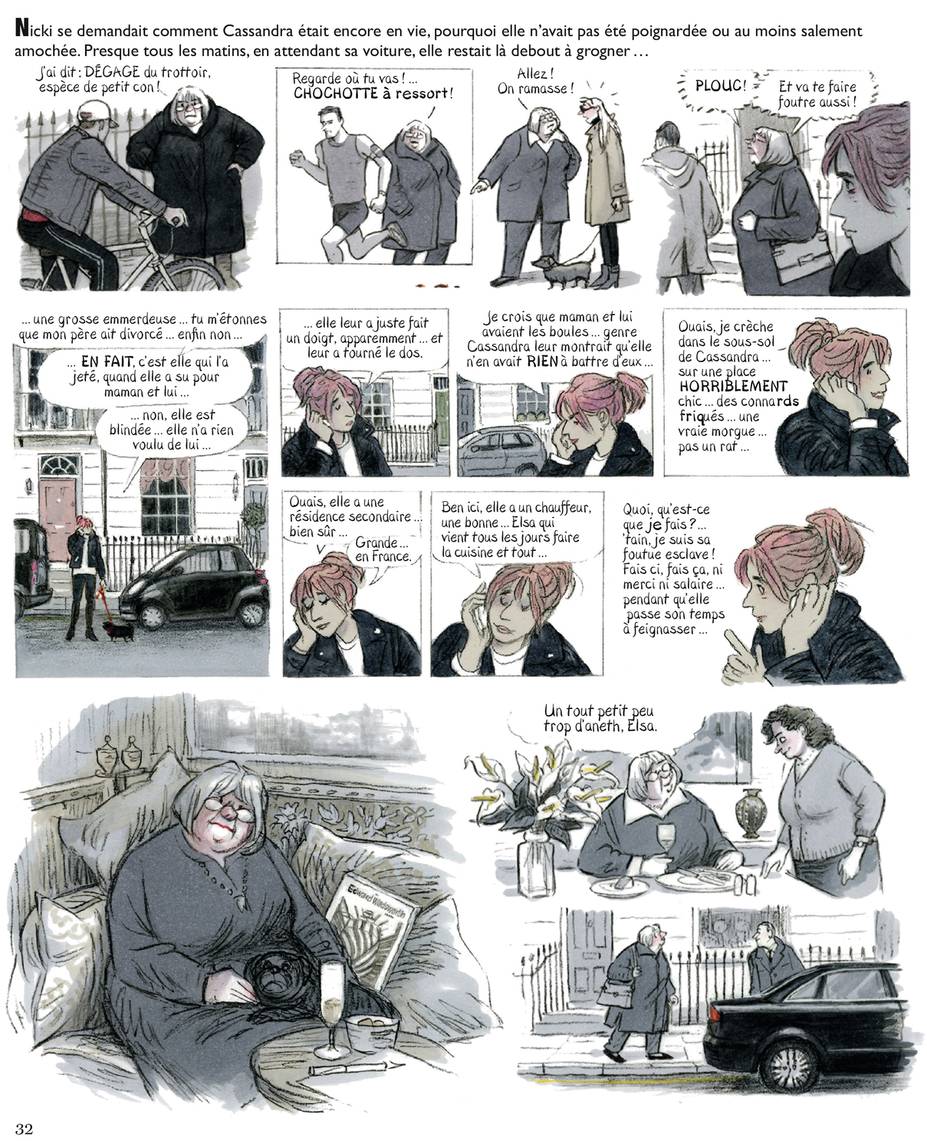
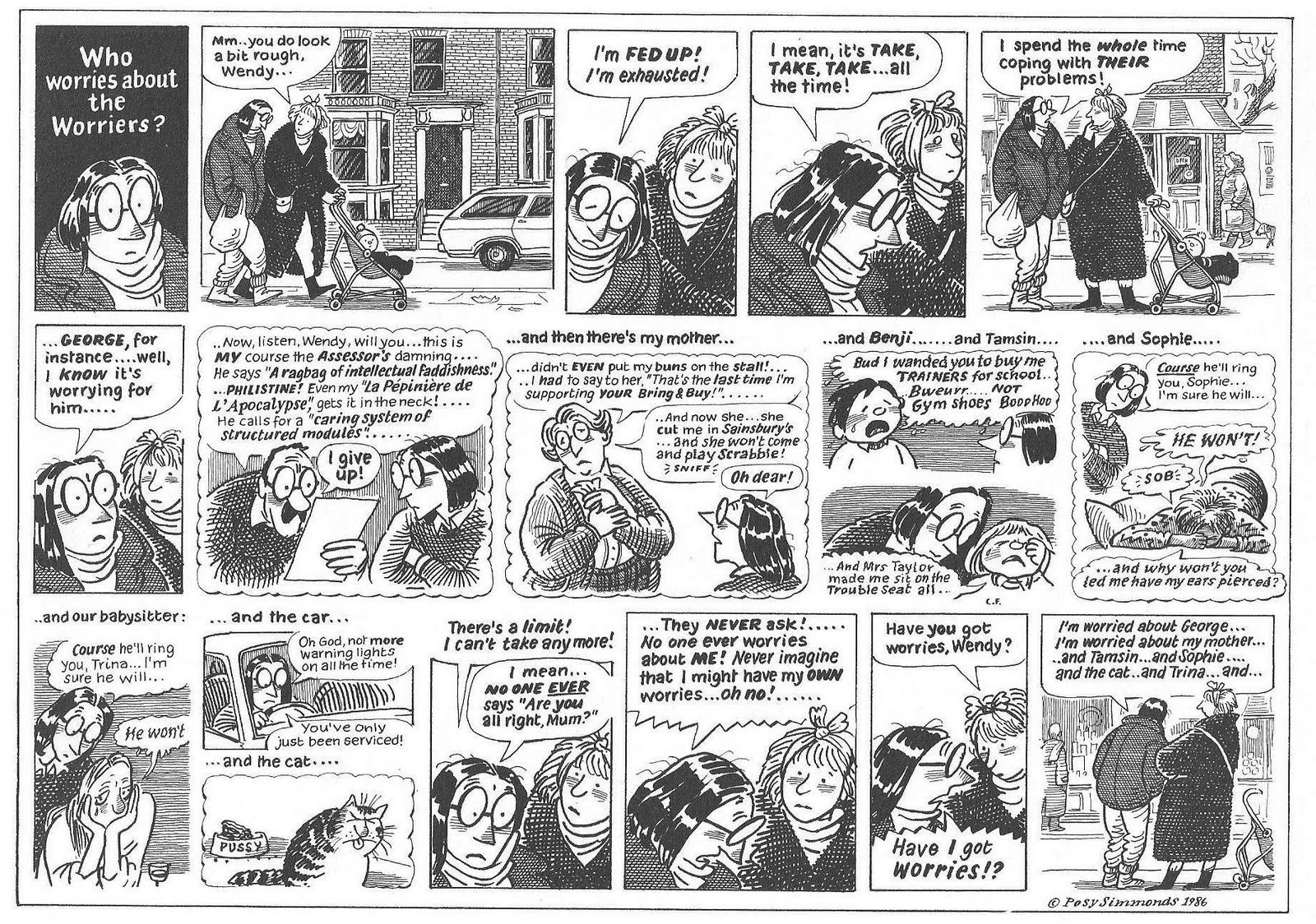
Cassandra Darke by Posy Simmonds (2018)

Cassandra Darke is 71 years old, which is an immediate change and relief from the protagonists of Posy Simmonds’s two previous graphic novels, Gemma Bovery and Tamara Drewe, who were both nubile, lithe, sexy, twenty-something young women whose lives revolved around a series of romantic ‘liaisons’.

By complete contrast right from the start of this book we are in the company of, and listening to the narrating voice of, plump and bustling, grumpy old misanthrope Cassandra. She is more than usually bad-tempered because it is Christmas-time and, as we know from her previous cartoon strips, Posy Simmonds particularly dislikes Christmas, as does her Scrooge-like creation.

However, if the reader thinks they’ve escaped from ‘Simmonds World’, a smug, self-centred world of upper-middle-class white London professionals, where all the women are obsessed by men and define themselves by their sexual relations (or lack of) with men – they would be wrong.

The character of Cassandra is great – she doesn’t give a stuff about anything, swears freely and has a bad word for everyone – but barely had I started enjoying her rude obnoxious character than, alas – like all Simmonds’s women – she begins to define herself, and her life and career, in terms of men, starting with her husband, Freddie.

Thus we learn that it was forty years earlier that Freddie and Cassandra set up a swish art gallery together. However, some time later Freddie ran off with Cassandra’s half-sister, Margot, and the pair got divorced. Cassandra was able to carry on earning a living by dealing art from home, and from writing. Then, decades later, Cassandra bumped into Freddie at an art fair and he told her he’d been diagnosed with Alzheimer’s Disease and asked if she like to take over the old gallery from him. She agreed to.

Anyway, this is all background to the issue which dominates the opening pages, which is that Cassandra has been caught dealing in fake copies of valuable sculptures. She has charged a rich American collector £400,000 for an illegal copy of a limited edition modern piece of sculpture and he has found this out and sent her a letter threatening to take her to court.

Thus the book opens on a note of unease as Cassandra, although in posh Burlington Arcade surrounded by happy Christmas shoppers, is shown trying to avoid the widow of the sculptor in question, who has come to pay a call, and delays going back to the gallery, strongly suspecting that bad news is waiting for her there. As it is.

In a sequence which is not shown but briefly referred to, Cassandra is duly tried and convicted of fraud, her case being reported in sundry newspapers. She might well have gone to prison but – being posh – is let off by the (woman) judge with a hefty fine and told to do community service.

Nonetheless, she still has to sell off her private art collection and the house in Brittany (I know: imagine the heartbreak of having to sell your house in Brittany!) to pay the fine.

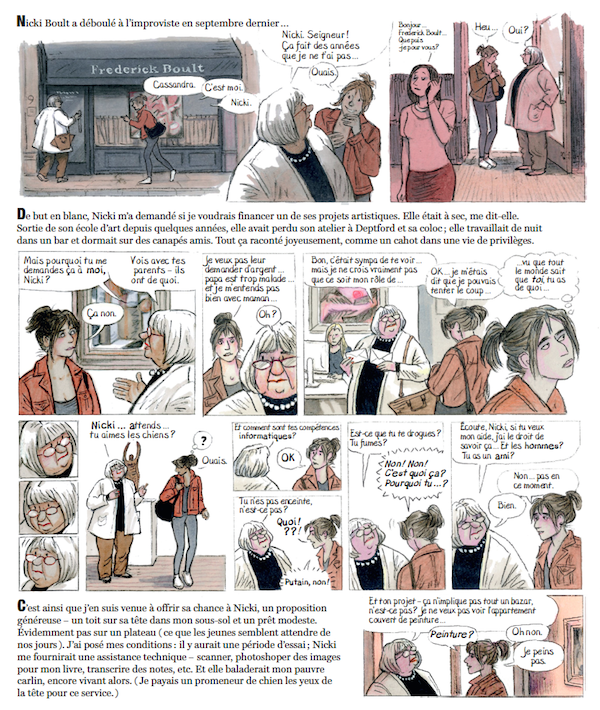
Here is the first page of the book, establishing Cassandra’s look and character, and the central London setting of most of the story, and straightaway the sense that something is wrong. Cassandra is trying to avoid Jane McMullen, wife of the sculptor whose work she has fraudulently sold, and who – it turns out – is looking for her in order to deliver the letter which accuses her of dealing in fakes.

First page showing Cassandra emerging from Burlington Arcade and spotting an old acquaintance she wants to avoid © Posy Simmonds

December 2017

The accusations, her arrest, and trial and conviction and sentence are all dealt with very quickly, and the narrative jumps to a year later, December 2017, as Cassandra is nearing the end of her community service.

We now find Cassandra without work but still living in her nice house in ‘Osmington Square, SW3’ i.e. Chelsea, nowadays populated by rich Chinese and Russian billionaires and their wives and nannies.

Osmington Square, where Cassandra lives, mostly empty apart from a few Russian or Chinese nannies and their charges © Posy Simmonds

Cassandra gets home to find an invitation to Freddie’s memorial service – the Alzheimer’s has finally killed him. She takes a taxi to the service and hides up in the gallery of the Mayfair church, making acerbic comments about all the other attendees, including her half-sister Margot (who Freddie ran off with all those years ago) and Margot and Freddie’s grown-up daughter, Nicki, who Cassandra cheerfully refers to as a ‘shit’.

Then Cassandra sneaks out and walks through the dark Christmas London streets, morbidly reflecting on Freddie’s sad decline into senility, thinking how she would prefer to commit suicide than end up like that, and then weighing the different methods of killing yourself. Cheerful stuff!

Cassandra ponders different ways to kill herself © Posy Simmonds

Once home, Cassandra finds gravel in her kitchen which looks like it must have come from her small back garden, and at first panics and thinks someone has broken in. But she discovers nothing has been stolen, calms down, and then decides it must be Freddie and Margot’s grown-up daughter Nicki, who she let stay in the downstairs flat the previous year, and for some reason has come into the main house.

Cassandra goes down to the basement flat to explore, and finds some dirty clothes and then, rummaging in the linen basket – finds A GUN, a pistol! Christ!

A gun and a peculiar pink glove with kind of raised blotches on it, and a little make-up bag, all bundled up in dirty linen and stuffed at the bottom of the bin! What is Nicki involved in?

Cassandra goes back to the house and sits obsessively running through all the other people who have had access to the flat, for example the two different cleaners she’s used, any other friends or relations… but keeps coming back to Nicki, bloody Nicki. A GUN! What the hell is she doing leaving a GUN in her flat?

The events of 2016

In order to discover how we got here the narrative undergoes a big flashback, going back in time a year to the middle of 2016. It was then that Nicki Boult, Freddie and Margot’s daughter, turned up out of the blue at Cassandra’s gallery, saying that she was broke, had lost her studio in Deptford and her share of a flat, and asking Cassandra if she can stay?

After initially saying No, Cassandra relents and says Nicki can stay in the basement flat providing she earns her keep by doing regular chores for Cassandra.

Nicki Boult arrives, asking Cassandra for a job or a place to stay © Posy Simmonds

(As a side note, Cassandra tells us about Nicki’s art, which is a kind of performance art. Nicki goes to galleries and stands in front of paintings of women being harassed, attacked or raped, copies their poses or has written on her body or clothes the message RAPE IS NOT ART and has a friend video it all. Radical, eh? As Cassandra sourly points out: ‘And you think that people can’t work that out for themselves?’)

Anyway, Nicki moves in and is soon helping Cassandra with all sorts of chores from walking her repellent little pug, Corker, to helping with prints and such. We see Cassandra going about her usual day, being rude to everyone she can – telling kids cycling on the pavement to get off, calling a jogger a ‘prancing ponce’, insisting a woman pick up the poo her dog has just deposited, and so on. She’s a great stroppy old woman.

Cassandra being fabulously rude to everyday people in the street (French translation) © Posy Simmonds

So the pair’s daily routine is established and settled by the time of the first big important sequence in the plot, which is the hen party of Nicki’s friend, Mia. Nicki doesn’t really want to go, not least because Mia’s booked a burlesque session to kick-start the evening, but reluctantly she dresses up as a cowgirl, wearing kinky boots, a pink tutu, a pink bra and pink cowboy hat. She looks like a strippagram.

She is, in fact, another one of Posy Simmonds’s nubile, leggy, twenty-something, single women who look so sexy in a bra and panties (cf all the pics of Gemma Bovery stripped naked or in black stockings and suspenders.)

Nicki at Mia’s hen night, in her pink tutu and bra, and drinking too much © Posy Simmonds

Nicki goes to the party but is ill at ease and drinks too much. The girls play a game of Dare and Nicki’s dare is to get a phone number off a complete stranger, so she is egged on to go up to the bar and approach a rough but handsome dude for his number. Drunkenly, Nicki gives him Cassandra’s name and phone number, but when it’s his turn to give his, as the dare demands, the guy refuses. He and his mates are moving on so he asks if she wants to come? But Nicki realises she’s drunk too much, is going to be sick, and stumbles downstairs to the loo.

Suddenly the stubbly guy from the bar appears behind her, puts his hand over her mouth and pushes her into a side room, presumably intending to rape her. Nicki bites the hand over her mouth drawing blood. The guy slaps her and grabs her again but she reaches down and back to grab his balls and squeezes. The guy loses his hold and staggers backwards, allowing Nicki to escape into the girls toilet. Here she waits and waits until the coast is clear, stumbles back upstairs to her friends, half explains what happened, wraps her coat around her, they’ve called an Uber for her. But!! The guy and his mates are still hanging round outside, so she dodges into an alleyway.

Here Nicki is terrified to discover another young man lurking in the shadows (men! they’re everywhere!) but this one is friendly and guesses she’s hiding from the three bad guys. He tells her when they’ve gone and she stumbles back into the street, orders another Uber, staggers out of it up to Cassandra’s front door because she realises she’s lost her keys… incoherent.. Cassandra looks at the state she’s in with disgust.

Next morning Cassandra is going about her business when she is surprised to get a text on her phone: ‘Big mistake Cassandra!! Break yr fucking legs thats a promise cunt’. It’s from the would-be rapist – remember, Nicki gave him Cassandra’s name and phone number. Amusingly, Cassandra thinks this text might be from a rival art collector and sends a rude text back, only to receive another: ‘ur dead meat whore’.

Much puzzled, Cassandra returns from a little walk to find a young man on her doorstep, very polite, looking for ‘the young lady’. Cassandra guesses he means Nicki and explains that Nicki lives in the basement flat.

Cassandra gets on with her day. It’s a Sunday and since her ‘lady who does’, Elsa, doesn’t come at the weekend, Cassandra has to fix her own lunch (fix her own lunch! I know, how dreadful! Personally, I am continually brought up dead by the little details in all Posy Simmonds’s graphic novels which indicate just how posh and privileged her character are: not actual aristocracy, just used to a certain level of culture and education and savoir vivre – fine food, fine wine, fine art, fine writing.)

Cassandra phones the rival art dealer and quickly discovers it’s not him sending the texts. In fact, while they’re talking, another abusive txt arrives, plus a photo of whoever it is’s dick. Cassandra is too mature to be offended, just startled and puzzled.

Later Nicki surfaces. She has been for a walk and a chat with that bloke she met briefly in the alleyway, now we learn he’s called Billy. How did he find her? Last night, drunk, she dropped her keys in the alley, which had her address on them. Now Billy tells us more about the would-be rapist and txt abuser. He’s Dean Hart, a nasty piece of work. Billy gives her a full profile: he and Deano grew up together, they used to hang out and do graffiti together, then Deano went a bit mental, took to snorting coke and gambling, supported by his family who are East End crooks.

Later, we see Billy on his way home, back to his mum’s flat in a tower block. He is waylaid by some of Deano’s sidekicks who tell him Deano wants to see him. (This and the subsequent conversation Billy has with his plump, working class mum are a welcome change from the bourgeois writer-and-art-dealer class Simmonds usually deals with.) Billy’s mum said someone called round asking for him, a Dean something. Billy says, ‘Next time tell him I don’t live here any more, I’ve moved out.’ He packs his things and leaves, walking away from the East End council flats…

Simmonds and her young women: love love love is still on Nicki’s mind. It is, after all, weeks since Nicki’s last relationship, weeks, people! So she obviously needs a new man in her life asap. All Simmonds’s heroines can’t function without a man (Gemma Bovery, Tamara Drewe and now Nicki). Thus she goes out for a drink with Billy, their eyes meet, she wonders whether he fancies her? Ooh-er, it’s so exciting! They leave the pub, snog, walk, then run back to the basement flat for a shag.

Trouble is, Billy’s in a fix. Not only has he not gone to meet Deano as his minders told him to – he’s got something that belongs to Deano – a GUN!

Down in the basement, after the shag, Billy tells her more. A while ago Deano bumped into him in some pub and persuaded him to go with his minder – his uncle ironically nicknamed ‘Nanny’ – to Newbury races. They gambled and made money, get bored, drive home in gathering mist, get lost looking for some country pub and pick up a girl hitch-hiker.

Billy falls asleep, wakes up as they arrive back in London, turning into Billy’s family’s scrap metal yard. Deano gets out with the girl and heads into the house, ignoring Billy, telling Nanny to bring his fags and the tripod. (Tripod? Maybe to film him and the girl having sex.) Billy is rooting around for the fags when he finds some odd kind of pink glove, and a little make-up bag, and a jacket, heavy, with something bulky in it. It’s A GUN! What the…?

Billy suddenly wonders what he’s doing hanging round with these people and… here’s the crux and the slightly implausible thing about the entire plot – he pockets the gun and the glove and the make-up bag. Nanny doesn’t notice, he’s busy in the boot getting the tripod out, now he locks the car with a remote and walks off across the yard ignoring Billy and Billy thinks… screw it! and runs off in the other direction. With the gun and the glove and the make-up bag.

Now he’s on the run from Deano and his mob, with a gun of theirs. He tells Nicki all this, says he’s moved out of his mum’s place, is kipping on a mate’s floor. And so Nicki asks him to move into the basement flat.

Back to Cassandra’s narration. Cassandra spends the day visiting three old ‘friends’ who might possibly be behind the mystery texts, but they are all quite frank and friendly, it’s obviously none of them. Mystery.

Nicki explains her next art project, making objects out of the cardboard boxes the homeless sleep in on the streets of London. Nicki on the phone describing how wonderful Billy is to a friend. Then Nicki has a call with Billy while he’s at work on set. Via basic electrics and wiring he’s got himself a career as an electrician on TV productions.

Cassandra hosts a dinner for gay Teddy Wood and his partner Yves – wonderful food and wine ruined by the very loud love-making of Nicki and Billy downstairs. Amusing pictures of a furry of bodies and limbs – Cassandra envisions two pigs rutting and is furious that her evening is spoiled.

Next day, walking in the square, Billy admits to Nicki that he lied about his family situation. In fact he was once married and has a son, Jack. Nicki berates him for lying, and asks if he’s telling the truth now? Of course, he smiles at her. OK, she says.

Cassandra books her regular Christmas trip to a five star hotel in Biarritz – she usually loves the bracing winds and isolation, but this time has bad dreams, cuts the trip short and returns to London.

Cassandra watching Billy and Nicki snogging in the park – and then on holiday in out-of-season Biarritz © Posy Simmonds

Arriving home in Osmington Square earlier than anticipated, Cassandra is horrified to find her house festooned in fairy lights and illuminated Father Christmases and a crowd gathered outside. A friend of Nicki’s is collecting donations in a bucket because they are putting on a show in support of the homeless and the show is… Nicki doing a striptease in the window! At the show’s climax Nicki removes the big feathery fans to reveal her bare breasts each adorned with a shiny star over the nipple! Posy Simmonds does love drawing naked foxy babes.

Cassandra doing a burlesque strip tease in the window of Cassandra’s house to raise money for the homeless © Posy Simmonds

Furious, Cassandra storms inside, turns off the power and the lights and gives Cassandra a good talking to, accusing her of caring bugger-all for the homeless but putting on the show to promote herself, her brand, on social media.

She also makes the fairly obvious point that how can doing a strip-tease be considered an act of the ‘feminism’ that Nicki is always going on about? Surely she is ‘playing out male fantasies’, ‘objectifying the female body’ and all the other things she claims to be vehemently against?

Anyway. Cassandra gives her until Saturday to clear out.

December 20 17.15 One of Deano’s associates, Pete, tracks down Billy’s ex, Dee, and tells her that Billy won a packet on a long-term bet on the horses, and he and Deano want to give him his winnings. Naively, Dee tells Pete that Billy said something about a party in a pub in Soho tomorrow.

December 21 20.15 Pete waits at the Jutland pub, in phone contact with Nanny in a waiting Range Rover. He spots Billy, then follows him through the West End to catch a bus west, phoning his movements through to Nanny who follows.

Meanwhile, this is the same December 21st that the novel opened with, the one where Cassandra is in Burlington Arcade, avoiding Jane McMullen because she knows she is going to hand her a letter telling her her fraud has been discovered and her wronged client is going to sue.

Now, having arrived late at the gallery and been handed the letter and reading it and realising her world is about to come tumbling down, Cassandra arrives back at her house same time as Nicki, disgruntled and worried. She, absent-mindedly asks Nicki to take her ugly little pug Corker to ‘do his thing’ in the square.

Nicki does so but at that moment her mum (Margot, Cassandra’s step-sister who stole her husband Freddie off her 40 years ago) rings on her mobile, to tell her the news about Cassandra i.e that she’s been caught out in her fraudulent dealings. Distracted, Nicki lets the little dog, Corker, wander off.

Meanwhile, Billy has got off the bus from the West End and walks through the snow and darkness towards Osmington Square, followed by Pete, who is giving directions to Nanny who is following in the Range Rover. They pull up in the square and the next thing Billy knows he’s confronted by Pete and Nanny, who punches him in the face, knocks him down and kicks him in the ribs. The dog barks so Pete kicks it in the head. The thugs wander off as Nicki comes running up. She calls an ambulance. She realises Corker is dead.

Next day we see events from Cassandra’s point of view. Nicki’s mother (Margot) turns up to collect Nicki and drive her to their home in the country. With Billy in hospital, Nicki had gone through his rucksack and found the gun and a weird pink glove. She wraps it all up in an old sheet and shoves it in the bathroom bin of the basement flat and gets in the car with her mum. On the drive west she finds herself telling her mum about Billy and his, er, ‘involvements’, triggering a lecture about getting mixed up with the criminal classes.

December 2017

So this brings us back to where we started – to a full year later, and to Christmas 2017 (all the previous section happened in the run-up to Christmas 2016). (Does that mean the gun and the glove have lain hidden in the downstairs flat for a whole year? I am slight confused by this or, if I’ve understood it correctly, slightly incredulous.)

So here we are right back at the scene from near the start of the book where Cassandra has just found the gun and glove and make-up bag in Nicki’s bin and is wondering how the hell it got there. On impulse – and a bit drunk from drinking most of a bottle of claret – Cassandra brings the gun and glove and the clip of bullets up from Nicki’s flat, handles it drunkenly, before stashing it in her own washing machine.

Next day (the day after Freddie’s memorial service which we saw at the start of the book) Cassandra phones Margot, Freddie’s widow, to find out where Nicki is so she can question her. She finds out that Nicki is now living in a shared house in Tooting and working at a swanky art dealers in Dover Street. Cassandra goes to the dealers and confronts Nicki about the gun. Nicki bombards her with explanations, about it being Billy’s, well, not Billy’s it really belongs to Deano who she’s never met, and Billy took it and she was etc etc. Cassandra becomes very confused and threatens to call the police. Nicki say that’s rich, coming from a convicted fraudster.

Cassandra turns away in fury. Too angry to catch a bus home, she pads the streets of London at Christmas-time – thus allowing Simmonds to give vent to one of the most consistent of her themes – something which appears throughout the Posy comic strips – a really jaundiced, venomous hatred of Christmas. ‘I pad past Christmas windows, their sterile perfection contrasting with the scrum of shoppers inside, racking up debt, sharing their seasonal bugs – norovirus, coughs, colds, flu.’

Illustration from Cassandra Darke by Posy Simmonds © Posy Simmonds

Back home in bed, Cassandra has a nightmare in which she is back in court and the judge accuses her of pandering to rich art collectors, price fixing, knowingly taken part in the laundering of money by criminals until the judge finds her… ‘a waste of space’. Reflecting that maybe her whole life has been a waste.

Cut to Billy at MacDonalds with his mum and son Jack. He’s surfing through the news on his phone, as you do, when he stumbles across a news item about a woman’s remains recently found in a wood, with a quilted coat and a distinctive pink glove! Same as the one he took from the car! Same as the one belonging to that hitch-hiker! God, is the body hers?

Billy is stunned. He immediately leaps to the conclusion that Deano and his lot must have murdered and dumped the hitch-hiker.

He texts Nicki and they meet on the Embankment. Now it is that we learn for the first time that, after he got beaten up and hospitalised, it was Billy who suggested they break off the relationship. If it was a relationship. As usual for a Simmonds heroine, Nicki is confused about her emotions and her feelings etc.

Sometimes Nicki wondered if all that stuff hadn’t happened, would she and Billy still be an item?They’d never examined their relationship at the time, had left their feelings for each other unspoken. It wasn’t just sex, there were feelings, Nicki knew. Quite strong feelings. (p.76)

(Maybe this is what helps the book feel like ‘chick lit’ – the heroine’s endless agonising about whether she has feelings for a handsome man, and what kind of feelings they are, and whether he shares her feelings and, you know, they need to talk about their feelings and their relationship, we need to talk, I need to talk, are we an item, do you have feelings, is this just about sex or about something more…? Repeat ad infinitum without ever getting anywhere, as the Bridget Jones’ column and books and movies amply demonstrate.)

Back to the plot: Now, at their rendezvous on the Embankment, Billy tells Nicki that Nanny and Pete have been keeping tabs on him, sending him photos of places he’s been to. They’ve turned over his flat twice and demanded to know where the gun is. But he just keeps lying and saying he never took it. (I find it a little hard to believe this has been going on for a year: if I was them I am sure I could hurt him until he admitted nicking the gun and… simply handed it back over. Wouldn’t that be the simple thing to do?)

Like a good middle-class young lady, Nicki tells him he should go to the police. Like the working class boy he is, Billy says no, it’ll be Deano and Nanny’s word against his, and whatever happens, sooner or later they’d get their revenge.

Cut back to Cassandra and some tiresome feminism is injected into the story. She is sitting at home at Christmas feeling sorry for herself, feeling that the world finds her a ‘failure as a woman’ because she hasn’t lived as ‘a woman ought to live’ i.e. got married, had children, grandchildren. I’ve news for her: the world doesn’t give a toss what she does with her life. Only in her head does this self-condemning monologue grumble on. Meanwhile she has led a pampered, privileged life most of us could only fantasise about: she’s had more than enough money, a good education, choice, freedom, travel, comfort, art, opera, theatre, films, books… Ah yes, but ‘society’ (whatever that is) considers her ‘a failure as a woman’ (whatever that means). This is what my daughter (the 17-year-old feminist) calls ‘white feminism’ i.e. the self-centred grumbling of privileged, white, middle-class women. As my daughter regularly puts it, ‘Get over yourself’.

There’s a knock at the door and Cassandra opens it to find Nicki with Billy. Nicki admits the truth, about giving Deano Cassandra’s phone number at the hen night (thus explaining Deano as the source of the violent threats and the dick pic), explains how Billy is involved, swears he fled the scene with the gun, brought it with him in his backpack when he moved in with Nicki (which explains the existence of the gun), how they’ve come to the decision to tell the police, but they need the gun. Where is it?

Furious, Cassandra kicks them out, and then – Billy having told her that the body and suspected murder were reported on ‘Crimefile’ – she looks up and watches it on the BBC iPlayer. Through her eyes we watch as the programme interviews the couple out walking their dog who found the corpse.

Cassandra finds herself wondering who the poor woman was. She gets out the gun and glove and the little make-up bag from the washing machine where she’d stashed it. Rummaging through it she comes upon a pack of paracetamol with the label of a pharmacy still attached. She looks it up and discovers this pharmacy is way out East, so Cassandra catches the tube out there to go and investigate.

Cassandra on the tube © Posy Simmonds

Cassandra wanders round the scuzzy district of Lowbridge Road looking for the pharmacy. The Asian couple who run it can’t remember any particular young woman buying it (and, anyway, wasn’t it bought over a year ago?) and neither can any of the other shopkeepers she tries, though she does pick up the knowledge that some of the houses in the area are packed with sex workers, foreign mostly.

Cassandra asks the pharmacy in Lowbridge Road whether they remember who bought the bottle of paracatemol © Posy Simmonds

In fact ill luck befalls her and Cassandra manages to lose her wallet, containing her cash and bank cards. Thus she experiences a whole 90 minutes of feeling poor and abandoned. It starts to rain. She begins to panic. No Oyster card, no money for a taxi. Finally she realises she can pawn her gold necklace, and makes enough money from it to buy a tube fare back to Knightsbridge, where she is once again safely among her people.

Back in her house, Cassandra gets the gun and glove out and ponders her next move. Thinking about the slimeball who sent her those vitriolic texts, she takes a photo of the gun and texts it back to him, a year after the original exchange: ‘Hi, remember me? Keeping your gun safe. And the left hand glove too. Vital evidence I’d say. What’s it worth to you, Deano? You tell me. Cassandra’

Cut to the office of Deano’s scrap metal yard where we learn that i) prolonged taking of drugs has half-unhinged Deano and ii) when the text arrives, it prompts another outpouring of regret, with Deano saying he never meant to kill that girl.

Soon afterwards, Deano goes for a drink and (incredibly fortuitously) sees Billy. Deano follows Billy to a bar where he’s meeting Nicki. Nicki tells Billy what Cassandra’s done i.e. only gone and texted a photo of the bloody gun to Deano, the silly so-and-so. Billy says he’ll go mental! Outside, Deano sees Billy and Nicki smooching and recognises her from that nightclub a year earlier, the infamous hen party evening when Nicki told him her name was Cassandra, and then bit him and squashed his balls.

When Nicki and Billy part, Deano follows Nicki down into the Tube, gets out at Knightsbridge stop with her, follows her along into Osmington Square. Simmonds does that thing where she uses just pictures, with no words, to rack up the tension, in this instance to portray the nagging anxiety of a woman walking on her own in the dark.

Now Deano makes his move, accosting Nicki in the street brandishing a knife, demands the gun, demands to know where she lives. Nicki starts screaming HELP! At that moment, Cassandra, who – as we have seen – had been playing with the gun, emerges from her front door holding it like an American cop, pointing at Deano.

Momentarily confused, Deano loosens his grip on Nicki who runs off. Deano recovers his nerve and crosses the road to Cassandra, who says, ‘Drop it, I’ll shot’, but he knows she won’t. Instead she throws it over the railings into the basement area, but Deano attacks her anyway and, after a tussle, stabs her in the stomach. ‘Stupid arse… what have you done?’ she gasps as she clutches the wound and falls to the pavement. Deano panics and flees. Nicki calls an ambulance and gives a statement to the police.

A wordless page follows which shows Cassandra in bed in hospital, sleeping, on a drip. Waking and talking to the police. Back to sleep. And then:

January Cassandra recovers and winds up the story, tying up all the loose ends.

She’s come to stay with her half-sister Margot in the country (a very idealised super-rural country, a country of postcards very like the perfect countryside around Stonefield in Tamar Drewe). She’s learned not to despise Margot so much, realising she has a lot in common with Margot and that what Margot calls ‘healing’ and ‘closure’ are actually quite enjoyable.

Dean Hart was arrested and confessed to the stabbing which, along with the bloody knife and the photos Nicki took of the fight, convicted him. He also confessed to strangling the girl during sex play a year before. Nanny and Pete were also arrested.

Best of all, Cassandra’s enquiries about the dead girl were followed up by the police who went to Lowbridge Road and on to a squalid flat inhabited by five other girls. Her name was Anca Radu, she was 23, grew up in a Romanian orphanage, was groomed and trafficked to the UK as a prostitute, escaped from the flat, hitched a lift, but was dropped in the middle of nowhere, which is where she had the bad luck to be picked up by Deano, taken to London and then killed, accidentally or not.

Lastly, in hospital the doctors discovered that Cassandra has pancreatic cancer. Given the gloomy thread running throughout the book in which Cassandra periodically worried about becoming senile like her poor husband, and pondered different ways of killing herself to avoid that fate, the reader understands when Cassandra says this diagnosis is a perfect solution. It comes as no surprise that she has chosen not to receive treatment.

She is selling the house in Osmington Square and will give the proceeds to charities, including refuges for women.

Thoughts

Issues

One of the pleasures of the book is the way that various contemporary ‘issues’ familiar to Londoners are dramatised via the characters.

Off the top of my head I remember the several places where Nicki and Cassandra discuss or argue about the purpose and merits of ‘feminist’ art.

Similarly, the ‘issue’ of homelessness is raised via Nicki’s burlesque strip tease fund raiser, but also in the paired moments when Cassandra refuses to give change to a beggar (at the start) and does (after herself being briefly moneyless in the East End).

And the entire plot rotates, to some extent, about sex trafficking from eastern Europe. Other thoughts – about art and class are snagged, or rise briefly to the surface of situations or conversations then disappear again. Taken together, these issues, large or trivial, and other references (to Uber taxis) make the book feel surprisingly contemporary. Gives the reader the simple pleasure of recognition, of recognising the rather mundane world around us transformed into art, well, comic strip cartoons.

White collar versus gangland crime

Implicit in the whole story is the contrast between Cassandra and her smart, Mayfair form of white-collar crime, and the much more brutal, unhinged crime of Deano and his family out in the East End. Two wrongs, two types of wrong, prompting broader comparisons between life in Chelsea and life out East in the endless tower blocks of East London.

Cassandra’s redemption

Obviously the narrative arc as a whole depicts Cassandra’s ‘redemption i.e. by doing one brave act she stops being such a grumpy so-and-so and sheds her grumpy, sourpuss persona. No more fretting about how ‘society’ sees her. No more dismissing Margot who, at the start of the book, she had found unbearably pompous and touchy-feelie. Instead, acceptance of her own mortality, acceptance of emotions and emotional intelligence.

It is a timeless stereotype that urban characters have to go to the countryside to be ‘complete’, to achieve ‘authenticity’.

Most of all, maybe, it wasn’t the act of bravery – pointing the gun at Deano and saving Nicki so much as the sympathy Cassandra showed for the once-unnamed and now identified person of the murdered woman. It was discovering her identity more than anything that happens to wretched Deano, which matters most. Giving her a name, an identity, and so some respect.

Loose ends and problems

But many things are left unresolved and unredeemed. Cassandra is still a convicted criminal. We have no sense whether Billy and Nicki are going to live happily ever after, or even whether Deano will go to prison. Presumably…

In terms of plot there is a glaring hole which is the improbability of Billy nicking Deano’s gun in the first place. Even he can’t explain why he did it and it is left to the reader to conclude that he did it because otherwise there would be no story.

And the flashback structure – which worked so well in Gemma Bovery and Tamara Drewe – left me a bit confused. The mapping of two Christmases onto each other, the year long gap, forced me to go back and reread bits to understand the precise sequence of events. And also the way Billy split up with Nicki after he’d been hospitalised wasn’t told at the time, but reported a year later, in retrospect, so it took me a moment to fit that into the timeline, too.

Art

The use of colour makes for a deep and rewarding visual experience. But to be honest, although some pictures seemed to me to perfectly convey the intended atmosphere – especially lots of the scenery, of London or the countryside – there is an obstinate ungainliness or scrappiness about almost all of the frames which nagged at me, which held me back from going over the top and declaring it a masterpiece etc.

For example, here is Cassandra in a shop near Burlington Arcade, presumably Fortnum and Masons. The top picture of her mooching across a snowy road with her snub nose, pince-nez, slice of lipstick along her thin lips, and characteristic trapper’s fur hat, are all immediately grabby and evocative.

But in the pic below it, look at the girl standing on the right. She just feels to me anatomically incorrect and, stylistically, a throwback to the Posy strip of the 1980s. If Cassandra is fully imagined and drawn, many of the peripheral characters feel less so.

Cassandra in Fortnum and Masons © Posy Simmonds

Here (below) is Cassandra arriving late at her gallery to find the gallery assistant furious that she’s been delayed getting away and organising her own Christmas. Look at the assistant’s face. It is oddly unstable, in the first picture she is characterised by enormous shark’s teeth and big angry eyes – throughout the sequence she has lizard eyes i.e. not with a circular human black pupil, but with vertical slits of pupils. But then in the right-hand picture she suddenly has much softer features and just dots for eyes, a reversion to the Posy strip style, which suddenly makes her seem much less offensive, much less real. In the bottom row second from the left, something odd has happened to her left eye. It’s an example of the way many of the faces in Simmonds are unstable and undergo sometimes striking variations.

Cassandra and her gallery assistant © Posy Simmonds

I know I’m nit-picking but you will read articles claiming Simmonds is the pre-eminent graphic novelist in Britain and I’m not entirely sure. Although I liked the scenery and many of the settings, I still didn’t wholeheartedly enjoy her depiction of faces which too often seemed odd, inconsistent and sometimes positively cack-handed.

Still, that reservation apart, it’s a very enjoyable graphic novel and a very skillful weaving of so many contemporary ‘issues’ into what is, in the end, an extended cartoon strip. And the real point is Cassandra’s journey to redemption, to a form of happiness and closure. If you focus on that, on the skill with which she imagines, describes and draws the central figure – then nitpicking about details tends to fade away.


Credit

All images are copyright Posy Simmonds. All images are used under fair play legislation for the purpose of analysis and criticism. All images were already freely available on the internet.

Other Posy Simmonds reviews

Tamara Drewe by Posy Simmonds (2005)

Tamara Drewe was a weekly comic strip serial by Posy Simmonds, which ran for 13 months in The Guardian newspaper from 24 September 2005. At the end of the run it was published as a stand-alone graphic novel in November 2007.

The strip is based on a modern reworking of Thomas Hardy’s nineteenth century novel Far from the Madding Crowd, in that it focuses on a very attractive young woman who is pursued by three very different lovers – Nick Hardiman the successful novelist, Andy Cobb the local handyman, and Ben Sergeant the former rock star.

There’s not much subtlety about the reference since the frontispiece to the entire book features an ad torn from a fictional newspaper’s small ads column advertising the writers’ retreat at the centre of the novel, and given a big bold capitalised title – FAR FROM THE MADDING CROWD.

In its deep structure Tamara is not that different from its predecessor, Gemma Bovery, which was also about a very attractive, sexy young woman and her three lovers (Patrick the restaurant critic, Charlie the furniture restorer and Hervé the aristocratic law student).

Two books in a row about impossibly foxy babes who surround themselves with male lovers. Hmmm.

The picture on the front cover of Tamara immediately conveys the stereotypical babeliciousness of the central figure – a tall, leggy, lithe, sexy fox, with massive come-hither eyes and pert red lips, a babe who likes to flirt with all the men in range, gives men the eye, likes to draw attention by dressing provocatively (in shorts so tight the other women characters comment on them), who likes being eyed and ogled in shops and to walk arm-in-arm with a rock star down the local high street, drawing everyone’s eyes.

Here’s the impression she makes on American novelist and critic Glen Larson:

Of course I fall in love with Tamara, along with everyone else… As she moves round the gathering I watch people succumb. It’s as if she’s picking us off one by one, each of us receiving the full force of her radiance, her smile, her warmth, her interest, all of it seemingly genuine and unforced. She’s Princess Charming…

And here is Tamara’s first appearance as she wanders into a gaggle of writers at a writers’ retreat in the country, instantly drawing all eyes. She is wearing the crotch-displaying shorts which – in case we hadn’t noticed them ourselves – Nick the writer will later fantasise about, and his long-suffering wife, Beth, will disapprove of, at length.

Tamara makes an entrance, joining the group of writers enjoying a pre-dinner drink

The setting

The story is set in Stonefield, a writer’s retreat run by Beth and Nicholas Hardiman, where the American novelist Glen Larson is staying to find inspiration for his latest novel. All the gardening and maintenance around Stonefield is done by Andy Cobb.

Andy’s family used to own a nearby farm, Winnards Farmhouse, but his Dad ran into financial difficulties, as small dairy farmers will, and it was sold to the Drewe family. They had two posh daughters, now grown up, one is a successful lawyer (natch), while the younger, Tamara, has gone to London and become a fashionable gossip columnist.

Tamara makes her first appearance when she sets off the burglar alarm at her family farm by accident and tough, man-of-the-soil Andy goes to investigate, eventually finding her, long-limbed and oblivious of his presence, astride a rocking horse in the old nursery on the phone to her mum.

Andy the handyman discovers leggy Tamara astride a rocking horse in the attic

It is later that day that she makes her casual appearance among the gaggle of writers gathered for pre-dinner drinks in the garden of Stonefield. Wherever she goes she draws all eyes towards her, towards her and her own enormous doe-like eyes, looking up flirtatiously from under her fringe.

Writers writing about writing

Having waded through Literary Life, the volume collecting Simmonds’s cartoons and strips about all aspects of the writers’ life (sitting alone in a room with a computer, sad book-signings, packed paranoid literary parties, jealousy envy and back-stabbing abounding) I was initially down-hearted to confront yet another seventy pages chronicling the comfortable, secure and bourgeois lifestyles, smug cultural superiority and attitudes of yet another bunch of middle-class, middle-aged, middle-brow white writers. And I’m not alone. Most of the writers are ambivalent about their trade, and Beth describes literary festivals as:

rutting grounds of viciousness, jealousy, vanity, disgusting displays of male ego – well, and female – ‘My queue’s longer than your queue’, etc. Loathsome.

So the setting – writers writing about writing, and snoopily watching each other out of jealousy or in order to pinch pieces of each other’s lives for their books – tired and repelled me. But I forced myself to persevere and quickly came to appreciate that the complexity of the intertwining relationships among all the characters in the book soon builds up to something greater than the sum of their parts. Although I cordially despised the clichéd setting and bourgeois self-centredness of the characters, their interplay soon becomes absorbing.

Colour

The book is immediately more interesting than Gemma Bovery because it is in colour. Sounds trivial but colour adds a whole new dimension of interest for the reader, and of expressive possibility for the artist.

Maybe it’s because the use of colour gives the pictures more depth, but there are a number of pages in this book which are almost wordless, which allow a sequence of pictures to tell the story without text – like the succession of frames in a movie. This is particularly true of the climax of the novel, which features the death of one of the main characters, a fact introduced wordlessly, solely by means of changing visual framing.

Saturday 6.30 pm

Wordiness

But the complete absence of words on some pages contrasts with the extreme wordiness of others.

Some pages consist are more than half made up of densely-printed text. The page below portrays the American Glen Larson remembering back to an argument he had with his lover Maggie, who has abruptly told him their relationship is over and that she wants him to leave.

Note how the two time zones are indicated by colouring (and maybe, more subtly, by positioning) – the present day where Glen is doing the remembering, is coloured brown, while his memory of the scene is coloured blue and white, a form of grisaille. Note how neatly the past is sandwiched between the ‘present’ scenes at the top and bottom. Note how the text – and there is a lot of text – still feels neatly balanced by the pictures, elegantly integrated into the overall design.

Glen Larson remembers arguing with his partner, Maggie, back in London

Arguably the quality of the drawing has not progressed that much since the end of her Posy strip days in 1987 (look at the face of tearful Maggie in the centre of the page, many of the faces, particularly in group scenes, are surprisingly rough).

What feel so much more mature and powerful in this book are:

  • the use of colour to indicate mood and situation
  • the subtle placing of the pictures around the page, to the same effect and
  • the interaction between pictures and the really extensive text, which gives the reader huge amounts of information about the characters and their backstories.

The overall design and layout feel more mature and integrated than Bovery.

Narrators

Tamara is also more interesting because it has a number of narrators who all interweave their perspectives and stories.

Gemma Bovery‘s narrator was a middle-aged man, Raymond Joubert, who overlooked – or overheard – key bits of plot, and pieced the story together from what he’d seen and heard, combined with what he read in Gemma’s posthumous diaries – and he was also in love with the central figure – which made for a complex stew of perspectives and feelings.

Tamara also features a fat, middle-aged man who lusts after the babelicious doll at the centre of the story, but doesn’t stand a chance – the observant, self-aware, overweight American critic and novelist Glen Larson. (In case you think I’m being fattist, Larson makes a point of telling us that he is so overweight he [and the retreat’s owner, Beth] are worried he might break the designer toilet in his writer’s apartment – so he’s allowed to come down into the main farmhouse and use the more robust toilets there – which is also how, rather neatly, Glen gets to overhear various revealing conversations.)

But Glen is joined by a number of other voices telling their version of events, notably Beth, the middle-aged and plump wife of philandering Nick the novelist. Her suspicions of Nick, her dislike of his roving eye, is combined with her sense of the endless duties and work required to keep the writers’ retreat going (she does all the cooking, for example), as well as the way she slavishly manages all his business matters for him – taking his hand-written manuscripts at the end of the day and typing them up, liaising with his publishers and PR people, arranging his social calendar and so on.

I found Beth’s character immediately attractive, in the sense of believable and sympathetic. I’ve met lots of capable, bustling, large-sized mums – and also a number who were caught in the bind of loving, serving and acting as doormats for men they know aren’t worth it.

I also strongly like her for the way she wasn’t a babelicious sexpot like Tamara or Gemma Bovery.

Tamara herself is sort of another narrator, because the text is punctuated by examples of her ‘column’, like so many thousands of columns in popular newspapers and magazines, an only lightly touched-up version of her own life and experiences. Thus it is that we see her newspaper column, reporting the latest exciting developments in her life, inserted into the text, providing another – highly stylised – perspective on events.

And there are also newspaper cuttings and clips from the celebrity mags Casey and Jody read. I think this type of multi-textuality is not uncommon in graphic novels, which often include newspaper headlines or clips from letters or diaries – but nonetheless, it gives variety and interest to Tamara Drewe.

Affair world

As with my initial dismay at realising we are in the world of writerly writers writing about writing, I had a powerful sense of déjà vu and claustrophobia when I also realised we are back in middle-class Affair World, a world where everyone is having affairs, or struggling with ‘relationships’ which snap like twigs at the first pressure, and where everyone is spying on everyone else’s affairs, sneaking and eavesdropping on their illicit goings on. On one level it felt as cloying and claustrophobic as the supermarket magazines which obsess about the love affairs of the rich and glamorous.

God, do these people really have nothing better to do? Short answer: No. They’re ‘writers’. Their first duty appears to be to snoop on everyone around them, while themselves trying to sneak off unseen to clandestine shags. Thus:

  • Glen is splitting up with his lover Maggie who, at 36, tearfully insists the clock is ticking and she needs to find a man to have babies with
  • Nick was having an affair with a pretty young Asian babe up in London (Nadia Patel), until his wife Beth twigs to it – and also the ungrateful little thing dumps Nick
  • later Nick has a fling with Tamara
  • Tamara has a prolonged relationship with Ben Sergeant, but he has only recently broken up with his girlfriend, Fran, and not got over it
  • while man-of-the-soil Andy carries a torch for Tamara throughout the novel, repeatedly asking her out or trying to help, only to be snubbed
  • the dads of both the working class girls in the story had affairs and abandoned their mothers, to their abiding bitterness
  • and both the girls obsessively read celebrity gossip mags and use the rhetoric and clichés of that world to describe their own activities and situations

This girly obsession with relationships at the expense of anything else in the world prompted me to look up chick lit, which is defined as ‘heroine-centered narratives that focus on the trials and tribulations of their individual protagonists’. Sounds about right.

At its onset, chick lit’s protagonists tended to be ‘single, white, heterosexual, British and American women in their late twenties and early thirties, living in metropolitan areas’. (Wikipedia)

Well, that describes Gemma Bovery and Tamara Drewe to a t. Apparently American critic Alex Kuczynski criticised Helen Fielding’s character Bridget Jones as ‘a sorry spectacle, wallowing in her man-crazed helplessness.’ That’s a handy description to bear in mind as we follow Tamara’s adventures.

Working class

Another element which makes Tamara more interesting than it might initially seem is the presence in the background of the disaffected, bored teenage yobs from the nearby village, Ewedown. These lads liven up their boring existences by nicking stuff from Stonefield and throwing eggs at the swanky cars of the writers on their way to and from the retreat.

It’s sooo boring, this village. Nowhere to go, nothing to do. Nothing happening, except when Gary Pound and his mates nearly set fire to the Coronation Tree on the green. (Casey)

They provide a pleasing background hum of disaffection and revolt, I say ‘pleasing’ because that’s my class, the youths who hung around vandalising bus shelters and throwing supermarket trolleys in lakes because there was nothing else to do – and chucking things at the passing cars of the posh, white, affluent, middle-classes who liked to isolate themselves in ‘writers’ retreats’ so they can cultivate their oh-so-finer feelings while, in reality, ceaselessly leching and snooping on each other.

The working class girls Casey and Jody get off the local bus and discover some of their male mates kicking and vandalising Nick the writer’s car

Anyway, it soon becomes more than a background hum because two figures who slowly emerge to play a central role in events are the teenage schoolgirls and best mates, Judy and Casey. Casey emerges as the third of the novel’s narrators, her version of events written in a different typeface from the other two narrators (Beth and Glen).

Through Casey’s eyes we enter the world of teenage girls in a remote provincial village, Ewedown, who read gossip magazines, fantasise about their pop star heroes, and try to avoid the greasy clutches of the local boys their own age. Here they are hanging out in one of the village’s few public spaces, the much-vandalised village bus stop.

Casey and Jody, the two working class teenage girls who lust after rock star Ben Sergeant

The plot

August

Beth collects American author Glen Larson from the station and drives him to Stonefield, the writers’ retreat which she runs. We learn her husband, Nick, the successful crime writer, is having an affair with an Indian girl up in London. Nick tries to deter Beth from coming with him to attend a writer’s party in London but she smells a rat and gets Nick to admit he’s having an affair. The argument spills out into the courtyard of the retreat where she tells Nick to fuck off loud enough for all the writers to hear.

Andy the handyman comes into the kitchen to comfort Beth, ‘he’s not worth it’ etc. Meanwhile, Glen remembers the tearful argument he had with his lover in London (as show above).

Later Glen is using the main house loo when he overhears Nick returning, telling Beth a pack of lies about how he’s dumped Nadia, then giving Beth a big hug. She goes to recycle some bottles and Glen hears Nick on his mobile phone extremely cross with Nadia for dumping him. Glen is resentful of Nick for his easy success, and how he always mockingly refers to him at dinner or in the garden as ‘our resident academic.’

That night, in bed, Beth quizzes Nick about Nadia but he reassures her it meant nothing and it’s all over and she lets him shag her, but then lies awake feeling used and wondering why she is so good to him.

Next morning Andy and Beth are out in the vegetable garden when the alarm goes off from the nearby Winnards Farm, which used to belong to Andy’s parents till his dad went bankrupt and was forced to sell it to rich Londoners. Glen accompanies Andy over to the farm to see why the alarm is ringing, but leaves Andy to go into the building, wander round then go upstairs, where he discovers leggy Tamara on a rocking horse phoning her mum about the alarm. Andy tiptoes back out.

Walking the long way back to Stonefield through the village, Andy tells Glen about the Drewe family, the two sisters, how Tamara has a newspaper column for which she write a piece about having a nose job to reduce her big hooter to the pert little nosette it subsequently became.

At drinks in the garden that evening Tamara makes an entrance wearing only tight denim shorts and a white vest. All eyes are on her. Tamara works her way round each of the writers and Beth, casting her spell, batting those wonderful eyes. People drift off for dinner and Glen volunteers to walk Tamara back to her farm, but on the way makes a pass at her, for a blissful moment touching her wonderful body till she shrieks and tells him to piss off.

Next morning Beth is cooking and chatting to Nick, who wanders into a reverie, remembering five years previously when he met Tamara when she was assigned to him by his publishers as the publicity girl for a tour of bookshops and festivals he was doing. He made a pass (what else do male writers do in Simmonds World except make passes at every pretty girl who crosses their path) but she irritatedly told him to get lost. We see all this in grisaille flashback.

Sunday evening and Glen strolls past Andy’s cottage and stops for a chat which turns to the subject of Tamara. Glen tells Andy that a young fit man like him, he should make a pass at her.

Glen telling Andy to try his luck with Tamara

Later Andy is working in the garden remembering Tamara, remembering how he knew her before the nose job – sweet girl – and met her subsequently and disapproved of her new glamorous identity – as the girl herself walks in, and asks if he would kindly come and help her set up a vegetable garden at Winnard’s Farm. Well, OK, I suppose so, he says, noticing her laying her hands on his shoulders.

Autumn

Out walking, Glen reflects on Tamara and her ‘charm’. Having tried it on and been rejected, he is biased, but he thinks he sees through her now.

It’s weird talking to her. You think she’s coming on to you: she aims this scorching look and you’re transfixed with lust, I’m not kidding. But she’s kidding. It’s as if she has an erotic stun gun and you’re just target practice. Just her bit of fun…

Glen also gives a jaundiced description of Nick during the retreat’s evening meals, holding court while he brandishes an electric carving knife, gently deprecating his own (sizeable) success, a gaggle of female writers hanging on his every word.

Beth thinks the nanny goat Astrid is in heat and looks everywhere for Andy, looking after situations like this is his job. She discovers him giving Tamara’s garden a major overhaul and gets cross. Beth pays his wages: if he’s going to do all this work for Tamara, she’ll let him go and get another handyman. Beth knows Andy can’t afford that.

Later that day Tamara persuades Andy to let him accompany her to a nearby farm so the nanny goat can be mounted by a billy goat. She learns all about it, films it on her phone and then writes a sarcastic metropolitan magazine column about it. On the way back Andy blurts out his feelings for her. Tamara takes it as her due – isn’t every man in love with her? Lets him down gently and asks if he’ll still do her garden. Then gives him one of those infuriatingly chaste pecks on the cheek which pretty girls use to control foolish men. Cut to Andy standing on a hillside looking moonily into the distance…

Cut to Tamara a few days later in a stylish London cocktail bar, noticing a celebrity at the bar, Ben Sergeant, ex-drummer of rock group, Swipe. She approaches him, gets chatting, says she’s a journalist but only for a silly gossip column, everything will be off the record, shall they go somewhere more intimate and… they end up snogging then shagging.

Tamara approaches Ben Sergeant at a swanky London club

Cut to Andy telling Glen he’s just going over to Winnards’ Farm to pick up some kit he left there, but as he approaches he sees a yellow Porsche parked outside, and an unknown dog, a boxer left outside and then, the ground floor window opens and a hairy bloke, bollock naked, asks if he’s Andy and would he kindly let the dog in. So. Tamara’s got a boyfriend. And walks away unhappy.

Next thing Beth gets a text telling her a strange dog is running wild and scaring the cows in a field they own but rent to a neighbour. The neighbour, Penny is livid, the dog might have frightened her pregnant cows into miscarrying. Beth apologises (even though it’s not her dog) and phones Tamara – is this bloody boxer dog here? Tamara, naked in bed with Ben, picks up and apologises profusely.

Ben turns up half an hour later roaring his yellow Porsche into the forecourt and disturbing all the writers. Beth shows him round but he is surly and then gets angry at the fact his boxer is chained up. When Nick says he ought to be grateful, next time he worries livestock a farmer might shoot him, Ben sinisterly replies well, then, he’d shoot the shooter.

Ben drives off with his dog but not before dropping a broad hint that Tamara’s told him all about Nick – as if they have a past. Beth confronts Nick about it. Nick furiously denies it. Beth laments to the reader:

We’ve always had an open sort of marriage. Affairs are OK, up to a point. Lying about them is not. Which sounds sensible and realistic, but in practice Nick needs the flings and I don’t. He always admits them – in so many words – and I absolve them. I just hate it.

Back at Winnards’ Farm Ben paws Tamara and says he hated the retreat, bunch of self-satisfied wankers. A few days later Beth sees Tamara in the local town, Hadditon, arm in arm with leather-jacketed Ben, both looking like movie stars and turning heads.

Ben and Tamara putting on the style in Hadditon High Street

Tamara announces she’s going to marry Ben. They have regular weekends for all their posh thirty-something London friends, staying up all night and throwing frisbees around next day. The teenagers from the village hang around hoping to catch a sight of the Londoners, especially Ben who the teenage girls fancy.

Ben gives Tamara an expensive ring which a chance remark reveals he actually bought for his former lover, Fran, but Ben hastens to reassure Tamara that it’s her he loves now.

A week in the life of Tamara as the deadline for her weekly piece hangs over her and saps all pleasures (going for drinks, socialising).

Tamara stresses over the deadline for her next column

Contrasted with Nick working away in his writing shed, at the end of the day loyal Beth collecting his papers to type and telling him about invitations and work.

Nick benefiting from Beth’s care and concern as she collects up his manuscript and informs him of the week’s messages

A two-page spread devoted to a book-signing Nick does at the Hadditon bookshop. Having read Simmonds’s collection Literary Life I feel I’ve read and seen enough cartoons about dismal book-signings to last me a lifetime.

Next day Andy overhears Ben arguing with Tamara. He’s sick of living in the farm and the nearby village, it’s all so boring, why not sell it go to LA or France? But Tamara refuses to think of leaving. This is where she grew up. Ben then collects the Christmas goose from Andy who explains how they’re shot and gutted which revolts Ben, who is also antsy with Andy because the latter so obviously hangs around the place solely to get a look at Tamara.

Winter

Introducing the two pissed-off local teenage girls, Casey Shaw and Jody Long. Casey narrates their adventures, Jody is the more rebellious, experimental, out-there of the two. Jody’s got a mega crush on Ben so they spend a lot of time huddling in the village bus shelter on the off-chance of seeing him drive by.

Simmonds builds up a very persuasive picture of how awful and stifling the two girls home lives are, with Jody’s mum working long shifts at Tesco, and Casey hating being at home because of her step-father.

It’s Jody who persuades Casey to break in to Winnards farm when Tamara and Ben are away – more precisely, she knows where the latchkey is hidden for Andy. Thus they let themselves in and wander round the bedroom where Jody fantasises about Ben being naked and ‘doing it’. Second time they go back (Boxing Day) Jody nicks one of Ben’s t-shirts and forces Casey to take away Tamara’s Chloë bag. Their parents don’t notice. The local lads on their BMX bikes yell rude things at them.

Jody is determined, She scores blow and E in the local town and smokes dope. She describes in great detail losing her virginity (‘losing her V plates’) to Ben and how romantic it will be. On Valentine’s Day Casey chat to local youth Ryan (19, drives a Vauxhall Nova) who she really fancies but knows he’s only talking to her because he wants to get to Jody.

Casey meets Jody at the farmhouse and discovers she’s dressed entirely in Tamara’s clothes, including a dazzling leopard-skin coat. And she’s pissed. She’s found Tamara’s laptop and hacked straight into it without needing a password. She’s discovered that Tamara’s writing a novel (titled Tick Tock – a title which reminds us of a cartoon strip from back in Simmonds’s ‘Posy’ strip period [1977-87] featuring Stanhope Wright and his wife Trisha).

Jody opens up Tamara’s email and – drunk – addresses an email to Ben, Nick and Andy, subject: ‘Love’, text: ‘I want to give you the biggest shagging of your life’. And before petrified Casey can stop her, Jody presses send. Because she cc-ed the others, all three can see the message was sent to the other two as well as themselves.

Andy receives the email and is understandably confused. He’s having a drink down the local pub (The Rick) and asks the barmaid what she thinks the email means. Barmaid says it sounds like they’re kinky. Or Tamara was pissed. Yes, probably pissed.

Arriving on Ben’s laptop in London, the email prompts a fight between Tamara and Ben, she accusing him of always having his ex, Fran, in the back of his mind, he saying she’s going to leave sooner or later.

Meanwhile Beth tells us she read and deleted the email, puzzled by it but doesn’t want to cloud Nick’s concentration as he heads towards completion of his current novel. Doesn’t stop Andy bumping into Nick in the snow-covered fields and asking Nick what he made of it. Nick, accurately, says he knows nothing.

Tamara writes a column about it, gets a call from Andy and says the email was nothing to do with her, and asks Andy to go and have a snoop round the farmhouse, see if anyone’s broken in. At which point Ben staggers into their stylish London loft, badly beaten up and bleeding.

Casey and Jody are in the bus stop, reading gossip mags while Jody explains why and what it’s like to have most your pubic hair shaved off, when they see a paparazzi photo of Ben beaten up and gripped by bouncers, after a fracas with his ex-girlfriend Fran. It’s clever of Simmonds to set up Ben coming through the door bleeding on one page, and then have the explanation given a hundred miles away in the countryside, and via the medium of a cheap gossip mag.

As you might expect, the evidence that he’s prepared to fight for his ex, leads Tamara to have a furious row with Ben, pack her bags and return to Winnards’ Farm.

At the end of another day, Beth picks up the papers from Nicks’ desk and, back in her study, starts to go through them sorting out which ones to type up and sometimes having ideas of her own. Till she comes to a scrap of paper which isn’t part of the novel and not for her eyes, which describes in graphic detail how bored he is, how flat and dull and empty his life seems. How he hurts her!

Casey fields loads of calls from Jody who is gutted that Tamara and Ben have broken up because now he won’t be coming down to Winnards. Part of the pleasure of reading Casey’s narrative is how everything is expressed in teenage girl magazines: thus Casey thinks Ben has been a Total Love Rat. When they spy Tamara walking round she has the look of someone who has been Betrayed. When they feel sorry for Beth they related it to Brad and Angelina breaking up.

Nick lies his head off on his mobile phone to Beth, telling her he’s at the London Library whereas in fact he drives (in his swank Range Rover) round to Tamara’s house where he finds her sitting in the gloom, alone and depressed. He is tall and successful. She can’t exist without a man in her life. She takes his glasses off. They snog.

Nick pays a visit on Tamara. Note the look in her eyes

They go to bed. There’s realistic lovers’ chat, him saying he’s not just a rebound shag, is he, her saying no, no she likes him, both telling each other to be careful.

Nick arrives home, some hours later, into Beth’s waiting arms and gives her a gift of tea from Fortnum and Mason’s. She falls for it, thinks he is much invigorated after his trip to London, he should go more often, and Nick heartily agrees!

Spring

The American novelist Glen is back at Stonefield after a break in Paris (hard life, eh?). He tells us he’s ripping through his novel, and how cosy and companionable he finds Beth. Beth for her part feels in her bones that Nick is having an affair but can’t prove it. She hates getting into this mood where she ends up checking every aspect of his life for tell-tale signs: such a waste of effort. Glen is helping a lot round the kitchen and she finds his company soothing. (Hmmm so is a Beth-and-Glen thing on the cards?)

Casey is pissed off with Jody who’s bored and drinking a lot. They see Andy’s car pull up outside Winnards and watch him go to the door, ring the bell, and wait for Tamara. She opens up a little sheepishly, Andy asks if she fancies a drink and she says no, and he walks off cursing his stupidity. Only minutes later the same door opens and Tamara lets Nick out with a kiss.

The girls see this and spend days reflecting on it, Jody in particular grossed out that Nick is so old. It also reflects on their own lives, in which both their dads ran off with younger women, so they feel badly for Nick’s wife, Beth. When Beth walks through the village Casey and Jody can’t bring themselves to look at her or reply to her ‘Hi’.

In bed Beth reads one of Nick’s old novels to about adultery to remind herself of all the tricks the male character uses. But when she phones up the friends Nick says he’s going for a drink with, dammit! He actually is going from a drink with them. Try as she might, she can’t catch him out.

Tamara goes for a walk with a girlfriend through the countryside and tells her all about her affair with Nick. Note: Tamara avoids the field with the big cows in it, they scare her. Reminds me that Glen, at an earlier stage, refused to go through the cow field, insisted on going the long way round.

The girls get the bus back from Hadditon, though it’s a pain because the bus no longer goes all the way to Ewedown and it’s full of teenage boys i.e. vandals with spray paint. They come across Nick Hardiman’s car, empty, and the lads let the tyres down.

Jody and Casey hang around, hiding in the bushes, waiting for Nick to come back to his car. When he does and discovers the tyres have been let down, he angrily phones Tamara asking if she’s got a foot pump and if so can she bring it out to meet him at his car. Ten minutes later she turns up and they pump up the tyres. Then they have a great snog. And Casey takes a great close-up photo of it on her new mobile phone.

On another day, Casey and Jody break into Winnards Farm, again, Jody wandering round touching everything as if it will put her in touch with Ben. She picks up various bottles of booze and then a tin of compressed computer cleaner gas, Does Casey know it gives you a nice little buzz? Casey say. Don’t be so silly, she knows Casey has asthma and can’t even smoke.

They break into Tamara’s laptop again, and read emails from Ben asking them to meet again and, when Tamara says No she needs her space, asking if she would babysit the boxer dog (Boss), while Ben goes to LA for three months, but again Tamara replies No. Now Casey sends an email claiming to be from Tamara saying she knows a good dog-sitter in the village, and giving her – Jody’s – mobile phone number!

Cut to Beth walking through the village, stared at by all the kids as if they know something, herself deeply suspicious of Nick but unable to prove anything. He is off to a literary festival. Beth organises his travel, accommodation and timings of his interviews, and he gives her a big hug and pats her on the head like a good dog, before leaving Beth, fuming. It’s at that moment that her phone chirps and she receives the mobile phone photo Casey took of Nick and Tamara having a snog!

She is gutted. Later Tamara drops round to Andy’s to pick up some fresh eggs and he quizzes her about her affair with Nick, she says it’s none of his business, he says he hates to see Beth getting hurt and goes on to mock how cheap and easy and convenient it is for old Nick. Tamara phones Nick (in London en route to the literary festival) as she trudges along a country lane in her wellies and tells him Andy Cobb knows about them. Nick curses but then says maybe it’s for the best, this means she and he can start making plans for their life together. ‘What?’ Tamara exclaims – ‘You’d leave your wife for me’ – but at that moment Nick’s daughter (who he’s staying with) comes in and he has to ring off.

Meanwhile Beth is still furious. She quizzes the local girls she sees hanging round the bus stop if it was they who sent her the photo and they of course deny it. Now Beth realises why all the youths look at her. It’s pity. She decides not to make a scene with Nick, let him tell her in his own sweet time. But later on, she passes Tamara’s car in town and on impulse crumbles a fish stock cube into the air intake. And she can’t help replying to some innocent letters sent to Nick in a fiery rage.

Nick is with Tamara at the Monksted Literary Festival – but she is not happy. Nick tells her he is sick with his cosy life and the cosy farm and his cosy wife and churning out a book a year like clockwork – he wants to drop all that and live, feel again, be with Tamara and be young again. She can’t hide her dismay; this is not at all what she planned.

But Beth has followed him to the festival and sees him hanging round smooching with Tamara before his on-stage interviews. At one of these he announces he’ll never write another Dr Inchcombe novel, to general gasps, since that is the character which made his fortune. The fact that he does so without even consulting Beth makes her see red and determine to go straight home and find a good divorce lawyer.

Cut to Casey who is well pissed-off with her friend Jody. 1. Ben rang, Ben phoned her, right in the middle of helping Casey with her maths revision, and Jody told all kinds of lies about having dog baskets and bowls and so on when she has none! 2. That night at a party, Casey was chatting to Ryan, who she fancies, when Jody came along in a flimsy stop ‘flashing her teapot lids’ with the result that it’s Jody who ends up snogging Ryan later. God! She hates Jody!

Next day the sheepdip hits the fan when Jody tells her mum she’s agreed to babysit someone else’s dog. Her mum flat out refuses. And Ben’s driving all the way down just to hand Boss over. She gets all stressed and tries on different outfits and perfumes but in the event Ben doesn’t show up and she is gutted. Nothing ever happens in their crap village and she storms off.

Jody breaks into Winnards farm again and starts to try on some of Tamara’s clothes in the bedroom when she hears a voice. It is Ben!

Jody sneaks into Winnards Farm and tries on a dress of Tamara’s

When he asked Tamara about the message Tamara had supposedly sent, giving Jody’s name and number as a dog minder, and Tamara denied it, Ben realised it was a con. But Jody is so pathetic, so apologetic, tells Ben she loves him. She at least gets him to listen to her when she says she’s always loved him, ever since she saw him drumming in the band on Top of the Pops. ‘How old are you?’ Ben asks her. ’16’, she says. ‘Liar’, he replies.

At this moment Casey rings up and says Ben’s dog is running around outside her house. Yes, can she catch it for him, Jody replies. Ben’s really come down just to collect some of his stuff and he’s just kissed me!!! and given her an early Swipe CD and agreed to give them advance notice of gigs etc.

Saturday Cut to Tamara parked by the side of a road and on her mobile to her friend Cate. She brings us up to date with events at the literary festival, namely that Beth was there and texted him the photos of Nick and Tamara snogging. Nick was in Tamara’s bedroom and appalled at his own behaviour and decides there and then to tell Beth the truth when he gets home, split up with Beth and move in with Tamara. Who, we know, is terrified at the thought.

‘I didn’t want this to happen.’

He tells her he’ll come to her house tomorrow evening.

Saturday afternoon in Beth’s kitchen and plump, amiable Glen Larson is there. Glen has done all the menial chores and is now telling Beth how well his book is going, while she chops vegetables. Beth isn’t hearing a word because she is seething inside and speculating what will happen if Nick wants a child with Tamara. Then the little so-and-so will find out what a selfish brute he is! (This reminds me of the Posy cartoon strip which radiated the Anger of the Mothers against their lazy do-nothing husbands.)

Glen notices Ben’s dog, the boxer named Boss, crapping on Beth’s lawn. Beth says that’s Ben’s dog, he’s probably come her to beat up Nick. Glen is puzzled, so Beth explains that Nick is having an affair with Tamara, so she’s going to divorce him and sell Stonefield. Glen is appalled – what about his book!? He needs the peace and quiet of Stonefield to finish it. He tries to calm Beth down and assure her they can get back together, and before he knows it spills the beans that Nick’s last lover, Nadia, chucked Nick, not the other way round as Nick told Beth. In other words Nick only went back to Beth once he’d been jilted. This makes Beth insensate with anger, not only against Nick but against Glen who’s know all this time and not told her.

Saturday afternoon 5.30pm The change of font alone tells us that this is now being narrated by Casey. She sees some mindless teenagers chucking clods at the big cows. She also hears Ben’s dog barking. She sees that Beth’s caught it and tethered it to a post. At this moment Nick appears up from his writing shed in the field and begins to apologise to Beth but she’s had it up to hear and roars her grief and anger at him. ‘Go. Go away. Go now. Go to her,’ she shouts.

Casey had started to take long distance pap shots of this funny couple but it became too upsetting and she goes off in tears. The bloody dog is still yapping so Beth lets it off its leash and tell it to bugger off, too.

6.30pm This is the famous page with no text on it, just seven colour panes, which I included earlier int he review. Successive frames show Tamara at her window waiting for Nick, the cows around the water trough, then they walk past the trough, it gets darker, we see a body lying by the trough, close up on the body, then a big wide shot of the sun setting over the distant hills.

10pm Tamara on the phone to her friend Cate. She’s furious because Nick stood her up, obviously gone back to his wife BLOODY MEN!!! Tamara goes down the pub where she sharply rebuffs Andy’s offer of a drink.

10pm Casey is at a loud house party. She lost her phone in the woods so can’t ring Jody to ask why she’s not there. Last thing she heard was Jody talking to her all loved-up, insisting talking to Ben was the best thing ever. (Simmonds drops in some frames parodying love-bird, valentine’s day scenes amid flowery bowers and swags of love hearts – something she’s amused herself parodying from at least as long ago as 1981’s True Love.)

Now Ryan comes up to her and, mirabile dictu, actually wants to talk to her. They go outside and start having a snog when an ambulance screams by. An ambulance! In Ewedown! That never happens. Then she realises it’s stopped outside number six – Jody’s house!

Cut to another silent wordless page, with panels showing the rain pouring down on Stonefield, Beth looking out her bedroom window, Beth in the big double bed looking at the empty space where Nick should be, and cutting to a light on in one of the writer’s flats, and then a close-up of Glen Larson looking out the window into the rain looking worried.

Sunday morning Casey is the narrator and tells us that the night before, her mum took her back to her house and explained that Jody had been found dead! Her mum went upstairs wondering why she wasn’t going to the party and found her in a pretty party dress, dead on the floor holding in her hand an aerosol spray of Air Dust, a kind of computer cleaner. Casey knew that Jody sucked up lungfuls of the stuff from time to get a little buzz. This time it simply stopped her heart.

Now the change of typeface tells us we are reading Beth’s narration. Some of her writers found Nick’s body the next morning. He had been trampled to death by the cows (remember all those little references to the cows being scary and people going out of their way to avoid them which have been threaded through the book?).

Beth calls the police. When they start questioning her she immediately blurts out that she must have killed him by letting the bloody dog loose which stampeded the cows. The detective is certainly suspicious why she didn’t report it when Nick didn’t come back last night. Beth is forced to admit that they’d had a row and she expected he was sleeping at a neighbour’s. The police motor over and tell Tamara. She is in floods of tears.

Another font tells us we are now reading Glen’s narration. He tells the police a sanitised version of the events (leaving out the fact that Beth and Nick had rowed).He timidly goes down to the kitchen to find Beth and begins to apologise but she poo-poos that and asks if he will stay, to lend a hand, there are some things she and her daughter (who’s come straight down from London) can’t face. Like the reporters at the gate.

Through Casey’s eyes we read all the reports in the papers. Mum finds girl dead. Dr Inchcombe author Found Dead in Field Author’s Sex Tryst Led To Tragedy. Pop Star Ben last To see Tragic Jody. Nothing like this has ever happened in Ewedown before: two tragic deaths on the same night!

Casey explains how she kept schtum about their breaking into the farm, but it was Jody’s mum found a post-it note from Ben, and Ben’s number was on her mobile, and the media quickly put two and two together and joined Ben to Jody and Tamara and Nick! A festival of sex and death, ‘telly crews everywhere!’

Andy walks past the press camped out at Tamara’s drive and asks if there’s anything he can do for her. Tamara’s quite rude, telling him he’s always Mr bloody perfect, but then relents, says thanks but no thanks.

Andy calls on Tamara to see if she’s alright

Glen watches the comings and goings, describes how the finger pointed at Ben, the jealous rival for a while till CCTV footage showed he was a service station miles away. Forensics say cause of death was being trampled by cows after a collision with the water trough.

And only now does he reveal what really happened. After telling Beth about Nadia he didn’t go to his apartment but went for a walk through the fields. It was here that Nick spotted him and called him over, called him a fucking bastard for telling Beth all about Nadia, accuses him of trying to suck up to Beth and take his (Nick’s) place. On and on Nick goes, telling him he’ll never have the income or success he (Nick) enjoys, capping it all with ‘Mine’s bigger than yours!’

Right. That was it. Glen snaps and punches Nick. Nick stumbles backwards and hits his head against one of the concrete pillars of the cattle trough. He gets up again, groggy and dazed, Glen goes to help but Nick tells him to fuck off and, at that moment, the famous herd of big pregnant cows comes barging into the field running after that bloody boxer dog, Boss. Terrified of animals, Glen runs off as fast as he can, not looking back, assuming Nick, younger and fitter than him, can look after himself. But turns out he couldn’t. Somehow he got stuck against the trough and trampled.

Glen is sitting on the trough weeping for what happened when Tamara comes up and gently puts her hand on  his shoulder and tries to reassure him but suddenly… it feels like an interview and Glen – who has babbled too many times in the story – gets to his feet without telling the truth, and sets off back to Stonefield.

Here he finds Beth in the garden drinking tea and reading the paper. She looks happy and relieved as she tells him the police have closed the investigation and now officially consider it an accident. Glen looks at her and considers telling her the truth about what happened i.e. his responsibility in punching Nick, making him hit his head against the trough, making him too dazed to escape the rampaging cows — but she has found closure, why ruin it?

Cut to Casey’s point of view. Ryan, the boy she fancies, has spent a lot of time with her, talking things through. Casey tells Ryan everything, about breaking into Winnards, hacking Tamara’s computer, sending the shag email, Jody’s obsession with Ben, her taking the pap shots of Nick snogging Tamara then sending them to Beth. What should she do? ‘Keep quiet’, advises Ryan. After all, what would their sort do for her if she was in trouble? Nothing.

Beth’s narrative. She cuts Tamara when they bump into her. But then she receives an email from Casey explaining that it was her and Jody who sent the shag email, for a joke, and she who texted Beth the photos of Tamara and Nick snogging. She’s really sorry for all the hurt she’s caused. This prompts Beth to make a pilgrimage over to Winnards to confront Tamara, where she’s surprised to discover Casey is present, having also gone to apologise to Tamara.

The other two stand in the kitchen while Beth gives them a bollocking but then explains life’s too short, she might as well forgive them, we’ve all got to live here together etc. Beth realises she feels like a cigarette, Tamara too, but they’ve both given up. Luckily Casey has one and the three women, now reconciled, pass a fag of closure among themselves.

The cigarette of closure

Late that night Tamara is mooning over her laptop. Suddenly she shuts it, leaves the farm, sets off at a run across the fields, arrives at Andy’s cottage, knocks, looks stunning and helpless – Help me, I’m a poor helpless vulnerable woman! – And Andy takes her in his arms – big stwong man pwotect helpless woman!!! They kiss.

Tamara must have gone all of two, maybe three days, without a man in her life! Is she, to quote American critic Alex Kuczynski, ‘a sorry spectacle, wallowing in her man-crazed helplessness’? Tempting to think so…

A few days later Beth describes her trip to the local church for the funeral of Jody Long. She realises it’s an event for the real locals – in other words, the working class inhabitants of Ewedown, not the posh, down-from-London writers and second home-owners. But there’s Tamara on Andy’s arm – she is, after all, always on some man’s arm, not complete unless she has a man to cling onto – then hugging Casey, and working the crowd.

Then Tamara spots Beth and makes an operatic gesture to do a Big Hug of Closure, but Beth turns and melts away. Not ready to forgive, not yet.

One year later

Beth gives a summing up. She’s still at Stonefield. They launched a young writers’ prize in Nick’s honour. Beth handed over Nick’s shed to Casey and the other yoof as a meeting place. Andy moved in with Tamara and she had a baby in January. And her novel comes out in September.

The last page has a couple of images of Glen Larson. Beth has written him a letter congratulating him on the success of his novel, Excess, and telling him that Tamara’s novel is due out in September. But when Glen reads that it is about a writer’s retreat, he clutches his head, ‘Oh no!’

All in all, Tamara may be the titular centre of the story, but I think Beth is the heroine.


Credit

All images are copyright Posy Simmonds. All images are used under fair play legislation for the purpose of analysis and criticism. All images were already freely available on the internet.

Related links

Other Posy Simmonds reviews

Gemma Bovery by Posy Simmonds (1999)

‘Affairs are absolutely OK as long as you don’t get involved and you’re really discreet.’
Gemma Bovery’s diary (p.63)

Gemma Bovery

True Love which Posy Simmonds published in 1981 was, apparently, the first graphic novel in English, although it is more like a set of loosely connected sketches (see my review). Eighteen years later Simmonds published Gemma Bovery, a much longer, much wordier, and infinitely more sophisticated graphic novel.

As the title immediately indicates, the book is a modern take on Flaubert’s classic novel of 1857, Madame Bovary, whose ill-fated heroine was named Emma. In the original novel, Emma marries boring and incompetent provincial doctor Charles Bovary and, to escape the drudgery and boredom of her life, has a series of increasingly doomed affairs, and borrows money recklessly, until her world collapses and she commits suicide. I happened to write a detailed synopsis and review of the Flaubert novel a few years ago.

The obvious difference with the Simmonds is that whereas the Flaubert novel is about a cabined and trapped Frenchwoman, Simmonds’s graphic novel is about a free-spirited young Englishwoman from the cultured middle classes who takes it for granted that she’ll always have a job and can shift homes easily from England to France.

The plot 1

Gemma is the twenty-something, middle-class daughter of a comfortably-off dentist based in Reading. She has moved to London and made a career as a magazine illustrator who can turn her hand to interior designing and decorating. We meet her in the midst of an affair with older, high-status male, Patrick Large, who is the suave, confident food critic for a Time Out-type London magazine. She resents the way he patronises her, and is always on the lookout for other pretty young things, but nonetheless she stays with him for in his company she gets kudos, the best tables at restaurants, invites to good parties, and so on.

Until one day she sees him coming out of his flat snogging some other pretty young thing. She is distraught. That night she is at a party and bursts into tears and flings herself into the arms of the innocent chap chatting to her, an older man named Charlie Bovery. Charlie is divorced, lives in rented digs in Hackney while paying alimony to his ghastly wife (Judi) who is bringing up their two kids (Justin and Delia) in Islington. Judi is always on the phone nagging for the alimony and telling him what a bad father he is.

One thing leads to another and Gemma goes to bed with Charlie and moves in with him. (It seems she can’t live without at least one man in her life.) Charlie’s wife gets even angrier when she learns her ex is living with a pretty dolly bird, can’t he think of the kids etc.

Then she and Charlie get married – an event accompanied by a drone of criticism from Gemma’s mum when she and Charlie turn down the all-expenses-paid bash her mum and dad offer. Even at the wedding her mum is sniping. Everyone snipes. All Gemma’s family, and Charlie’s wife. Snipe snipe snipe.

Gemma’s mum and dad trying to bully her into a Full Monty wedding (left) and Charlie’s ex, Judi, being bitchy (bottom right)

Eventually, the ex and the constant visits of the pesky kids and the crappy location of his flat in Hackney starts to really get Gemma down and she fantasises about moving away from all of it. Which is when her father drops dead of a heart attack and leaves her fifty-five grand. So Gemma persuades Charlie to buy an old country house in rural Normandy and move to France.

They do so and are, at first, enchanted. Surrounded by countryside, with a sweet little village nearby, Bailleville, all of whose shops are ‘authentic’ and locally owned. Mmmm smell the freshly baked French bread!

However, the book then reveals all the negatives about living in a plain old peasant house in rural France. It smells; there’s only a septic tank, not proper sewerage, so in the summer the whole place reeks of shit. The windows are small, making being inside dingy and depressing. After a couple of months Gemma is bored of the same old ten or so shops in the crappy little ‘one-eyed’ village, and prefers motoring to the nearest supermarket – cheaper, more convenient, and people aren’t watching you all the time. Charlie’s kids, Justin and Delia, hate coming to stay, there’s nothing to do, they hate the French food Gemma prepares, and the telly doesn’t work.

Worst of all is all the other bloody Brit ex-pats, especially the ones who don’t live there but have bought up all the surrounding pretty rural houses, and only turn up at half-term and the other school holidays, bringing along their yapping ‘Brit brats’. Suddenly the quiet village is infested with the sound of braying upper-middle-class voices – ‘Mark, daahhhhling, better get twice as many baguettes, Sam and Polly may pop in on their way back from Périgeux.’

These posh Brits are exemplified by Mark and Wizzy Rankin who have bought a large manor house near the village, which they’ve done up within an inch of its life. They’re always having loads of friends to stay – fellow corporate financiers chatting about their skiing holidays, bond traders, financial journalists and the like – piles of empty bottles of fine wine, posh guffawing late into the night. Their wealth and their effortless success (this year Mark’s bonus was £2 million – p.65) oppress Gemma (as they did this reader) and highlight the dingy poverty of the half-repaired house she’s stuck in with Charlie.

And Charlie irritates the hell out of Gemma. He’s taken to rural French life, padding round in a vest, a Gauloise cigarette permanently hanging off his lip (as far as I can tell all the adult characters smoke incessantly), fixing up antique furniture in his workshop, not really bothered about the damp and the thousand and one little tasks which need doing round the house.

Late at night Gemma lies in bed next to him consumed with anger and frustration and has half-asleep fantasies of getting back with her tall, handsome, successful London lover, Patrick Large.

Gemma lies in bed with poor, honest Charlie Bovery but fantasises about getting back together with glamorous successful Patrick Large

Until one day Gemma reads in one of the Sunday supplements that Patrick has gone and married the dolly bird she saw him snogging (Pandora) and had a baby! The supplement shows photos of his perfect wife and perfect baby and perfect up-market London flat and something in Gemma snaps. She is consumed with frustration and envy, beside herself with frustration.

She goes into the village by herself in a very short skirt and her long legs catch the eye of local aristocratic layabout Hervé de Bressigny whose family own a rundown chateau near the Bovary’s house. They chat a bit, then part.

A few days later Charlie organises a dinner party for some of the French neighbours. Gemma goes into town to do the shopping and bumps into Hervé in the supermarket where they chat a bit more. A few hours later, driving home, on impulse, and even though she’s meant to be cooking for the dinner party that very evening, Gemma swings left through the gates of the old chateau (for she’s found out this is where Hervé lives), and as a storm gathers, knocks and young Hervé comes to open the door.

Hervé, we learn, has failed his law exams in Paris and his stern mother, Madame de Bressigny, has told him to stay at the rotting family mansion and work hard for the resits. He was hard at it when Gemma knocked on the door and he is irritated by her visit. But out of politeness shows her round – and Gemma, being into interior decoration, marvels at the decaying mansion’s original features.

Suddenly there is a tremendous crack of thunder which makes Gemma start backwards… into the arms of the dapper young man and… well… they kiss, they snog, they embrace, they fumble and grope and fall to the floor and…

Then we cut away to the dinner party she and Charlie have arranged with the Rankins and two local French couples, where she arrives late, claiming to have been delayed in the storms, looking flustered, and then whizzes up a tremendous dinner (although various bits of it puzzle the French – sushi?).

Gemma serves at her dinner party (left) while thinking back to meeting Hervé in the supermarket (top right) and then going round to his gloomy old chateau and knocking on the front door (bottom right)

She is closely watched he shows her round – he is supposed to be revising for a retake of the law exam he failed. there’s a crash of thunder, she steps back startled into his arms and… snog, embrace, strip off, sex. We learn she is 30 years old.

Raymond Joubert

At this point I should explain that the entire narrative is told in flashbacks by the village baker, Raymond Joubert.

Joubert is a bearded middle-aged man who was once himself something of an intellectual, having written and taught in Paris, and occasionally still contributing to an old intellectual quarterly. But his career was going nowhere so when his parents passed away he decided to return to the village of his birth (along with his Parisian wife and two children) and take over the family bakery. In time he realised he had a real feel for making bread, and found it deeply satisfying.

Joubert noticed Gemma from the moment she arrived, and watches her changing shape and happiness and manner like a hawk. He, too, is in love with her.

And so it is Joubert who sees the first encounter of Gemma and Hervé at the market, and happens to be driving in front of her on the road home when he sees Gemma turn off into the chateau for that first meeting with Hervé. And who attends the dinner party a few hours later, scrutinising her for signs of post-coital passion.

And then watches her closely over the ensuing weeks as her affair with Hervé deepens, notices her working hard, earning more money, and comprehensively redecorating her and Charlie’s house, chucking out the rural wood furniture and installing 18th century period pieces.

Prolepsis and the sense of doom

More than that, the narrative begins after Gemma has died. Gemma is dead and a grief-stricken Joubert is moping and reflecting on everything which led up to her tragic death. Therefore his narrative lends every detail of her life a morbid and gloomy sense of tragic foreboding.

In the first few pages Joubert pays a visit to a heart-broken Charlie Bovery and, as Charlie pours him a drink, notices Gemma’s belongings strewn about the old farmhouse – Charlie is having a clear-out – and spots some of Gemma’s diaries lying around. While Charlie’s back is turned Joubert steals as many of her diaries as he can hide and, when he gets back to his house, a short walk from the Bovery’s, starts to read them (translating with the help of his son’s English-French dictionary).

Joubert visits Charlie in his grief over Gemma’s death, and learns with alarm of the existence of Gemma’s diaries

Thus the entire narrative is one giant flashback, heading inexorably towards the moment of Gemma’s death – and it is told via two voices, in a kind of textual split-screen effect – because the main narrative, in printed text, gives Joubert’s account of what he saw, from the moment the Boverys arrived at the old farmhouse, but this is counterpointed with the handwritten entries in Gemma’s diary – which Joubert is reading and which helps shed light on little mysteries he had observed.

The narrative is thus a journey of discovery for both Joubert and the reader.

An additional weight or significance is given to everything because Joubert has an increasingly doom-laden feeling that Gemma is fated to re-enact the destiny of her famous namesake, Flaubert’s Emma Bovary, who has ill-fated love affairs with a local aristocrat, with a playboy in the local town, Rouen, runs up huge debts before killing herself with arsenic.

So, arguably, the narrative contains at least three levels – Joubert’s eye-witness account of events – Gemma’s diary giving her view of things – and the heavy hand of destiny in Joubert’s increasingly hectic concern that Gemma is unconsciously treading in Emma Bovary’s footsteps and that the same awful fate awaits her.

It’s a sophisticated narrative structure and it builds up a sense of genuine tension because we want to know how Gemma died. As events speed up and the sense of inevitable doom darkens, the reader becomes more and more absorbed until – on the last few pages – I was gripped, really gripped, couldn’t put it down and had to find out what happens.

Joubert as compromised narrator

Joubert starts to follow Gemma around. He thinks he is in love with her, concerned for her and so on, poo-poos the notion that he is a creepy pervert and voyeur, although Simmonds includes plenty of examples of how he notices Gemma’s long legs, her love bite, how he imagines her lying in bed, frustrated, finds this or that notion about her ‘erotic’ – in other words how he has all sorts of pervey thoughts about her. Plus we are given several asides in Gemma’s diary about how she has noticed that Joubert is always watching her, she finds him creepy.

So Joubert is far from being an objective narrator, he is himself implicated in the story’s passion plays. By the middle of the story he is actively stalking and following her to her secret rendezvous with young Hervé, not least because Joubert’s house lies off the path from the Bovery’s house to Hervé’s mansion, so it’s easy for him to keep tabs on her (there’s even a map showing the relative location of the three houses – the Boveries’, Hervé’s and Jouberts, along with the public footpaths, to help us visualise it all.)

I went after Gemma, and if this sounds  criminal – stalking a young woman – I can only protest that at the time it seemed quite legitimate… (p.55)

I told myself the only reason I was following Mrs Bovery was to confirm my speculations about her and Hervé… (p.56)

This stalking continues up to and including the scene where Joubert delivers some croissants to the Bovary house, knocks on the door a few times then goes round the side and, through a window, sees Gemma and Hervé making love.

A few days later, Joubert sneaks through the grounds of Hervé’s mansion in order to peer through the windows and catch them at it, again. But is he a pervert, a voyeur? Not in his own mind. “Moi?? Non, non monsieur, I was simply concerned for ‘er well-being” etc.

Joubert ‘accidentally’ bumping into Gemma on one of her walks along the path past his house

Joubert also has a comic side, playing to broad stereotypes of the Frenchman: his erotic fantasies are rather quirky, he fetishises French bread and food and is appalled at English gastronomy (Pimms! Porky scratchings!!) and doesn’t disapprove of Gemma taking a lover – what, after all, could be more French – but is scandalised at how Gemma dresses to go to her assignations – chewing gum! wearing a tracksuit!!

Joubert (in the small pictures in the middle of the page, watches through the chateau windows as Gemma disrobes to her sexy underwear for the gaze of her lover

In his curious mix of Frenchness, middle-aged lust, voyeurism, and in his over-heated comparisons between Gemma and her ill-fated Victorian forebear, Joubert is in many ways the central, certainly the most memorable, character in the plot.

The plot 2

Back to the main narrative.

Through Joubert’s eyes – and through his reading of Gemma’s diary – we watch Gemma continue the affair and blossom with happiness. She goes on a spending spree, redoing the interior furnishings of the farmhouse, chucking out the heavy rural furniture and splashing out on new furniture, wallpapers, carpets etc. In other words, running up a stack of debts, just like Madame Bovary. She also spends a lot on expensive sexy lingerie.

Gemma Bovery fait le shopping

Joubert, reading her diary, disapproves of how Gemma buys the lingerie to turn herself into a sex object for her lover’s pleasure, and of the stunning, leggy blonde bombshell she has turned herself into, on the rare occasions when she comes shopping in his boulangerie (both scenes appearing in the page below).

Gemma shops, practices sexily stripping to her lingerie for Hervé, and turns up in Joubert’s boulangerie looking like a model

All this during half-term while Charlie is back in England. Returning, he is impressed by the change in the farmhouse, but appalled at how much it must have cost…

But Joubert guesses correctly that something is on Hervé’s mind, namely that he has a full-time lover back in Paris and must return to his studies there. Thus we the reader see them in bed together, but only we know why Hervé has such a distracted look on his face. He wants to end the affair. He wants to be shot of Gemma.

Hervé is soon back in Paris telling his mate Arnaud about his entanglement with Gemma and trying to persuade his mum to let him stay part of the new academic term down in the country, and to square his suspicious girlfriend, Delphine.

Joubert is now following her all the opportunities he gets and so overhears the couple have an argument in the big park of Hervé’s house, during which the latter curses her for still sleeping with Charlie and then comes out with a passionate declaration of love. Joubert himself is torn apart and realises he is stricken with jealousy, while Gemma goes home transported. She is on cloud nine. She insists they go for lunches, admittedly at remote villages. All the time Charlie seems oblivious, not least because he receives a letter from HMRC saying they’re going to do a check of his revenue and taxes, a check he knows he will fail, and Charlie is convinced it’s his malicious ex, Judi, who has shopped him.

According to the diaries, their love-making takes on a new intensity, which is how they come to break a precious Sevres porcelain statuette at the chateau.

Gemma’s fantasies get the better of her. She stops returning business calls and emails, spends even more money on Hervé, and starts fantasising about getting a commission from  his mother to redecorate the entire chateau (never going to happen) and then commissions from her friends (cloud cuckoo land). Meanwhile Hervé’s girlfriend in Paris realises he’s got another woman and confronts him, in floods of tears.

Joubert learns that Gemma is going for a long weekend in London and has made elaborate plans for Hervé to come too, but the confrontation with his girlfriend, Delphine has crystallised his doubts.

Meanwhile, Joubert, consumed with jealousy, has decided to sabotage the lovers’ relationship and so he cuts and pastes from the English Penguin translation of Madame Bovary, excerpts from the letter Emma’s lover sends her on the day of their planned elopement, to say he is pulling out, their love cannot be etc. it is hand delivered to Gemma by a village boy and when she opens and reads it she really thinks it’s from Hervé and that he’s dumping her.

Gemma, already worrying whether a long weekend in London with Hervé will really work out, receives Joubert’s letter containing the quote from Madame Bovary as if a rejection letter from Hervé

But in fact the real Hervé is having second thoughts and, egged on by his Paris friend Arnaud who tells him to think of his future, his career and of Delphine, Hervé faxes Gemma a short note saying he can’t come with her to London. Gemma is distraught but Charlie is expecting her to go, everyone is, and so she leaves.

Five days later she is back, her hair cut short and a lost look in her eyes, as Joubert, inevitably, notices.

Cut to Hervé struggling to write Gemma a letter. Seems his mother is going to visit and will notice the absence of that pesky statuette which they broke. Gemma said she’s give it to Charlie to fix, that’s the kind of thing he’s good at – but Hervé must get it back and into the chateau before his mother’s visit.

The business with the statuette gets complicated. Hervé tells his mother he gave it to a woman who said she’s give it to her husband to fix, a Monsieur Tate (Gemma always told Hervé her maiden name, Tate – he thinks that’s her married name). So out of the blue Hervé’s mother turns up at Charlie Bovery’s house (Gemma is out) and first of all calls him Monsieur Tate and then asks for a statuette he’s never heard of.

Two things result: 1. when Gemma returns, Charlie confronts her about the statuette which she remembers she’s put in a cupboard and she decides it’s the moment to tell Charlie all about her affair but – he doesn’t want to know, he refuses to listen to her and announces he has to go to London to sort out  his tax affairs.

And 2. Hervé’s mother confronts him with her interview with Charlie, gets Hervé to cobble together more and more complex lies, before revealing that she found plenty of evidence of his affair with Gemma down at the chateau. She is disgusted that he is having an affair with a married woman, has steadily lied to her, and has lost the statuette into the bargain. She instructs her lawyers to write Gemma a stiff letter demanding the return of the statuette or their will be legal ramifications.

Gemma wakes up to her situation and realises she is drowning in official letters, claims for all her bills, not least from the maxed-out credit cards as well as all the utilities for the farmhouse. She asks Joubert in to write formal French replies to them, but he is so stunned to be in the same room where he was watched Hervé undress Gemma, that he cannot think straight and says he’ll take the bills and write out French replies that evening. Meet her in Rouen tomorrow, the day of the Saturday market, where he can hand them over.

Gemma’s financial mess deepens. The cheque she wrote to the electricity company bounced. Her electrics are about to be cut off and the bank has withdrawn her cheque facility. She has to get cash for doing a decorating job for posh Englishwoman, Wizzy. It’s while at their place that Patrick Large, her old beau, steps into the room. His wife, the perfect wife of the colour supplement, Pandora, has kicked him out and refuses to let him see their son. All this he tells quickly, and the fact that he knew Mark and Wizzy back in London and they’ve given him shelter in the storm.

Meanwhile we cut back to Joubert the next day, Saturday, in Rouen, all a-flutter waiting to meet Gemma to hand over the letters he’s typed for her. In his self-deluded way he imagines himself becoming her aid and helper, even imagines them in bed, naked, together and feels his heart racing. But she is late for their rendezvous. Eventually he hears the growl of her VW camper van and goes outside to see her climb out of it but then… a man also exit the van, who comes up besides Gemma and… they embrace!… they kiss!!! Once again Joubert’s hopes are dashed.

In an odd sequence, Joubert hears the van start up and drive round Rouen town centre – and is able (improbably) to give its itinerary. This is odd until you realise it is a parody of the scene in Madame Bovary where Emma takes a ride in a hansom cab with a handsome man and during the ride becomes his lover i.e. they have sex. In its modern-day reincarnation, Joubert follows them down to an underground car park, locates the van and is about to stuff the letters he so carefully composed for her under its windscreen wipers when he realises it is rocking back and forth. Gemma and Patrick are shagging. Disgusted, Joubert walks away wishing them dead, wishing Gemma DEAD!

But that night, out to dinner with suave Patrick, Gemma realises that he hasn’t changed at all, still treats her like a trophy girlfriends, swanks with the waiters, talks down to her. She realises she doesn’t even like him any more and that the afternoon shag was just a one-off. That night she fends off his advances, drops him at the Rankins’ place, and goes home alone, feeling proud of herself. She decides to sort her life out, sell the farmhouse, clear her debts, move back to London and revive her career, live simply and avoid entanglements.

Then she sees the statuette. Charlie must have repaired it. He is such a good man, he deserves better of her.

Next day she’s in the garden when Joubert passes by walking his dog. Gemma politely explains that she doesn’t need those letters she asked him to compose, she’s found the statuette, all she needs is him to write a letter in French replying to the stern missive from Madame de Bressigny’s lawyers. She talks him into going into the farmhouse and there, accidentally, he sees a Penguin translation of Madame Bovary, He starts back, knocks over a stool. Surprised, Gemma looks from him to the book, from the book to him and… rumbles him. It was he who sent her that letter, quoting the lover’s rejection from the novel.

‘You sod! How dare you interfere in my life?’

Pathetically, Joubert tries to defend himself, says he is worried for her, worried she is re-enacting the fate of Flaubert’s heroine. She replies: ‘What! Commit suicide over a few debts? Don’t be ridiculous!’

Gemma kicks him out but Joubert continues to feel hysterically frightened for her and that night has intense and ominous dreams, imagines the black figure of death closing in on her house. In the morning, unable to leave the thing alone, Joubert photocopies the pages from Madame Bovary where she takes the arsenic, and anonymously sends a copy each to Charlie (in London), to Patrick and the Rankins.

Wizzy Rankin is predictably robust. She is in the middle of frenzied preparations for her fortieth birthday party and thinks the letter Joubert has sent her is a stupid plea for help and that Gemma’s brought it all on herself. But what if it’s a real cry for help and she’s about to take arsenic like Madame Bovary? To which posh wife Wizzy replies, in one of the best jokes in Simmonds’s entire oeuvre:

‘What? Take arsenic? She’d better not – she’s doing my table decorations!’ (p.91)

Mark (the rich banker) drives round to make sure Emma’s alright and she dismisses the letter as further machinations by the bonkers baker, Joubert. Mark quizzes her about her debts and when he learns they’re a measly 25 grand offers to pay them if she… if she, you know, made it nice for him.. But Gemma robustly tells him to piss off, which, shamefacedly, he does.

Then Joubert comes to discuss with us the final entries in Gemma’s diary, which describe Patrick coming round to see her in response to the silly letter Joubert sent him. When Gemma explains that Joubert was behind it, Patrick suggests she sue him. He’s not worth it, she replies. Anyway she’ll be going back to London soon. Patrick asks if she’ll consider moving in with him. But she says ‘No, it wouldn’t work out.’ She has changed. She wants to be a new person.

Next morning Joubert awakens in panic and guilt. He tries to write a letter of apology to Gemma. Goes to the bakery and starts kneading the dough way before sunrise. Once the shop is opened and staffed, decides to go and deliver her a fresh-baked baguette and the note. Walking through her gate he hears the sound of whale music coming from the shade of a tree. She is practicing yoga positions to whale song, with her back to him. Unwilling to disturb her, Joubert tiptoes into the open house and leaves the baguette on the kitchen table with the letter propped up against it.

At lunchtime Joubert and Martine settle down for a light lunch with cheese. They hear a van draw up and park. It is Charlie, back from England at long last, and parking this far from the farmhouse, maybe to surprise Gemma. He walks down the track. Joubert settles for his post-prandial snooze.

Next thing he knows Charlie is running over the field his glasses knocked off, blood on his face and shirt, bellowing the GEMMA IS DEAD! Joubert babbles that he knew it, he knew it, was it arsenic?? Charlie doesn’t know what he’s saying and begs to use the phone. Martine takes over from her babbling husband and calls the emergency services, as Charlie runs back to the farmhouse.

Joubert and his wife begin to walk to the farmhouse, but a car pulls up and it is Madame de Bressigny, of all people, come for her statuette. When Joubert babbles to her arsenic and Flaubert she stares at him but when the ambulance arrives, she departs. The Jouberts continue into the kitchen of the farmhouse where they find Charlie on his knees beside the body of Gemma, lying peacefully on the floor and quite quite dead.

Moments later the Rankins drive up with a doctor friend who’d come for Wizzy’s party. He checks the body, Wizzy takes control as these sturdy upper middle-class women often do, dispensing whisky to Charlie and lending him her mobile phone so he can start making formal calls to England.

The doctor and then the ambulanceman pronounce the cause of death: she choked on a piece of the bread Joubert baked and brought for her that morning. They try to reassure him that it was an accident, but Joubert – who all the way through had been obsessed with a brooding sense of doom and death – who felt as if he had himself kick-started the affair between Hervé and Gemma and then supervised every step of its progression – it was Joubert himself who was the cause (at some remove) of poor Gemma’s death.

Charlie’s account

A few weeks later Joubert is in his boulangerie, inconsolable. Gemma has been buried. The Rankins paid for the small service and wake. Now, Joubert feels guilty and takes the short walk across the fields to the Boverys’ farmhouse. He’s been popping in on Charlie now and then to check he’s alright.

Now he feels guilty and starts to confess, telling Charlie that a) he stole Gemma’s diaries and b) he is responsible for her death – and is about to vent a long soliloquy about how he magically created the love affair between Gemma and Hervé, all the self-centred twaddle we’ve read him gushing throughout the text – when Charlie cuts across him and says, no, he killed Emma.

He knew she was having an affair but when it did finally blow over Gemma remained distant so he thought, blow it, and went back to London. It was there that he got a phone call from a regretful Gemma, followed up by a long letter in which she said she still loved him.

But in the same post someone had sent him photocopies of pages from Madame Bovary describing Emma’s agonising death from arsenic (that being Joubert, of course). This worried Charlie so he caught the next ferry and drove to the farmhouse, parking a little way away so as to walk (as observed by Joubert and his wife).

But when he walked into the open front door it was to find Patrick Large standing behind Gemma with his arms around her. Finally, after all these months, Charlie snapped and saw red and attacked the guy, knocking him to the floor where they rolled around fighting. Only after a few minutes does Patrick make Charlie realise they weren’t snogging – Gemma was choking and he was trying to do the Heimlich manoeuvre as Charlie walked in. Those precious few minutes while they fought were long enough for Gemma to choke and die.

So Charlie ran to Joubert’s, they called the ambulance, Patrick ran off and fetched the Rankins (which explains their sudden arrival) – all too late. Later that night Patrick came back and he and Charlie got drunk. Patrick explained that Gemma choked because she got cross with him trying to persuade her to get back with him.

So did Patrick kill her, from provoking the choking? Or Charlie for stopping Patrick help her in the vital minute? Or Joubert for sending the photocopied pages to Charlie to make him come back? Or for breaking the baguette a fragment of which choked her?

Did all these men kill her? Or was it her own nature, unable to settle, to make her mind up, to form a fixed relationship?

Or was it a pointless stupid accident?

There’s one last thing. Joubert is still fussing and fretting about Charlie, irrationally concerned the he will meet the same fate as Charles Bovary (who is found dead in the garden, in Flaubert’s novel). And here there is the second good joke of the book, for Charlie dismisses Joubert’s concerns as nonsense – everyone calls him Charlie but his actual name – he was named after his grandfather – his actual name is CYRIL – and Joubert kisses him with relief and delight!

Epilogue

It’s Spring. Charlie sold the farmhouse and made enough to pay off his and Gemma’s debts. He’s gone back to London and picked up a new girlfriend. Joubert has inherited Gemma’s dog. As to Hervé, Joubert hears he passed his law exams but his long-standing girlfriend gave him the push.

There’s a removal van outside the Boverys’ farmhouse. New owners are moving in. Joubert’s wife met them walking in the lane. The wife is called Eyre. Jane Eyre!


The triumph of Thatcherite values

Simmonds ended the Posy strip in 1987. Twelve years later, Gemma Bovery exists in a completely different universe, a post-Thatcherite Britain, among a well-heeled, well-educated, comfortable urban bourgeoisie.

What surprised me – astonished me, really – is that sex and adultery seem to have won. In the Weber strips a powerful recurring character was Stanhope Wright, tall, blonde advertising executive who propositioned every pretty young woman he met and generally had several affairs on the go at once, but always returned to his long-suffering wife Trish. In the Weber strip-world it was understood that Stanhope was a philandering swine, while the heart of the strips rotated around the home life of nerdy lecturer George Weber and his ironic, feminist, vegetarian, Guardian-reading wife, Wendy.

They’ve disappeared. Their whole world of values to do with respect and concern for right-on political values – has ceased to exist. Instead we are in a dog-eat-dog world of late twentieth century London, where private wealth contrasts with public squalor and homelessness, where rural France is infested with shouty, posh, banker Brits.

Affair World

And where almost every character seems to be having an affair. Charlie and Judi’s marriage broke up, Patrick is unfaithful to Gemma with Pandora, but goes on to have an affair, be discovered and kicked out. Gemma is unfaithful to Charlie with not one but two lovers and Hervé cheats on his Paris girlfriend. Given half a chance Joubert would cheat on his wife, Martine. Even Gemma’s father, Michael Tate the dentist, had an affair with his receptionist while his wife was dying.

In other words, we are in Middle-Class Affair World. We are in a world where almost everyone is being unfaithful to their spouses and partners, a world stiflingly familiar to me from all the other middle-class novels of our time about adultery and affairs, particularly those of Kingsley Amis or David Lodge, which I have reviewed elsewhere.

And a world I have never encountered except in books. I live in London and have brought up two children all the way through school. In those 18 years I only know of four couples who have got divorced, and am not aware of any long-running affairs. Certainly not aware of either men or women who have a new affair each year or are ‘notorious for their philandering’. I suppose it must happen in the real world, but not nearly as much as it happens in this kind of middle-class, middle-brow fiction. In the kind of genre Gemma Bovery belongs to, where it happens all the time.

Feminism

And I am a little staggered that, whereas the strongest thread in the 488 pages of the Weber comic omnibus is Simmonds’s persistent hectoring feminism, in strip after strip going on and on and on and on about the wickedness of the sexual stereotyping of women, the objectification of women, the leery association of women with sex and boobs and bras and kinky outfits…

She drew a memorable cartoon on the subject which, she explained, was a protest against the way Women in Cartoons were only treated as nymphets and sex objects by a sexist world which ignored all their other attributes and achievements…

The Seven Ages of Woman by Posy Simmonds

AND THEN… the central character of this book is a stunningly good-looking, gorgeous, pouting super model, a skinny shapely nymphet who makes all men stop and stare when she walks by, who spends a fortune on sexy lingerie so she can drop her overcoat and reveal herself in all her splendour as an erotic pinup, and whose central activity is snaring and sleeping with men.

The story makes occasional mention of Gemma’s talent for painting and decorating, but hurries on to focus on what really matters – her relationships with men and, in particular, which one she is taking her clothes off and revealing her gorgeous, lithe, leggy nymphet body for.

Gemma stripping to her sexy underwear for Hervé (and for the reader)

Boobs. Gemma has great trim, shapely boobs and Simmonds draws them for our delectation, again and again.

Bare-naked Gemma in bed with her lover, Hervé (who is, however, distracted and worried)

Obviously Gemma keeps her clothes on most of the time but, if you flick through the book, the visual impression is of a streamlined, lithe and sexy babe, just hitting her physical and sexual prime, who loves dressing like a Victoria’s Secret sex model, and strips off and has sex again and again.

Maybe this is all some subtle way of subverting the male gaze, but it felt very much to me like encouraging the male gaze, and encouraging just about every sexist stereotype you can conceive about lithe, young, shapely women.

It is all a million miles away from downtrodden Wendy Weber and her big glasses and sensible dungarees and knitted pullovers and concern about poor people and immigrants and the environment, or the angry feminism of plain-jane art student Jocasta Wright, which dominated the Posy strip.

Who worries about the worriers? by Posy Simmonds (1986)

So it seemed to me that not only does Gemma Bovery depict the victory of Thatcherite values (the unabashed making and spending of money, basically) but also describes the triumph of post-feminist visual values of sexual fantasy and adultery. This kind of thing was consistently disapproved of in the Posy strip. In Gemma Bovery it is celebrated.

Coming to the book after experiencing the rigorous political correctness of the Posy strip makes it feel like the enemy has won, both thematically and visually.

Here’s a page of preparatory sketches Simmonds made for the character, showing Gemma about her favourite activities – shopping and wearing sexy underwear for her man.

If they’d been done by a man wouldn’t you say they were patronising, sexist and stereotyped, the kind of mindless shopper/sex doll clichés women have been fighting for centuries?

Joubert

In my reviews of the Posy cartoon collections I pointed out how frequently Simmonds used parody to make a point, copying classic paintings or putting satirical new words to well-loved carols and tunes.

Insofar as it is an extended modern take on Flaubert’s classic novel, Gemma Bovery seemed to me a triumph. It is a masterpiece of storytelling. The first time I read it I found myself seriously gripped by the book’s final pages, feverishly reading them faster and faster to discover the long-anticipated cause of Gemma’s death.

Presumably there will be millions of women readers who identify to a greater or lesser extent with Gemma’s well-meaning but confused inability to make up her mind about her men, with her ‘weakness’ in falling from one lover to another – but that part didn’t interest me so much.

By the end it was the figure of Joubert I found fascinating. In many respects a joke – without doubt a fantasist, a lecherous old man and a voyeur – he is also given the genuine imaginative power of making you believe there really is a malign destiny at work in the story. His obsession with the fictional Emma Bovary really does come to infuse the modern real-life story of Gemma.

Without Joubert Gemma Bovery would have simply been the story of a young woman who had a fling in France and died an accidental death. With him – stealing her diaries and filtering Gemma’s consciousness through his own morbid and lustful obsessions and suffusing everything with his over-awareness of the Flaubert novel – the narrative becomes something altogether richer, more complex and stranger.

The attention to detail paid to all the characters throughout Gemma Bovery is impressive and persuasive, creating a totally real world. But the invention of Joubert was a masterstroke.


Credit

All images are copyright Posy Simmonds. All images are used under fair play legislation for the purpose of analysis and criticism. All images were already freely available on the internet.

Related links

Other Posy Simmonds reviews

Literary Life by Posy Simmonds (2003)

Front cover of Literary Life by Posy Simmonds (2003)

I’ve noticed that many of Simmonds’s books are not numbered. This slender hardback contains sixty-four pages of cartoons satirising all aspects of the literary life, from the panic of sitting in an empty room staring at a computer with writer’s block, to the backstabbing and paranoia of literary parties, to the loneliness of book signings, to the plight of small independent bookshops, and so on.

The obvious thing about this subject is its extreme obviousness. They say, ‘Write about what you know’, well what could be more familiar, and more hackneyed, clichéd and done to death, than the subject of a writer writing about writing – about the petty discomforts, the irritations, the niggling jealousy and petty rivalries and bitching and in-fighting and gossiping of the literary world.

What ‘serious’ novelist hasn’t written a book about a novelist writing a book or how tough it is being a writer or how hard it is coming up with new stuff, and so on and self-pityingly, narcissistically on…

Literary Life

  • Writer’s block Six frames showing a woman writer alone in her kitchen (apart from her cat, natch) struggling from 9.05 am to 12.30 pm to produce just one sentence and that one, in the end, one of venom and violence expressing her suppressed frustration.
  • Wintergreenes An independent bookshop which is being threatened because a vast branch of ‘Boulders’ has just opened down the road. Three characters, the plump middle-aged owner, Penny, a skinny girl assistant Zoe, and a stubbly angry young man who swears so much abuse at the new Boulders that Penny calls him in because he’s putting off the customers.
  • Wintergreenes Colin is still moaning about the new branch of Boulders up the road to which optimistic Penny replies that it’s a muzak-filled hypermarket whereas what their little shop offers is intimacy and personal service. Colin jaundicedly replies that what their shop offers is shelter from the rain for a couple of alcoholics and a mum with her shopping.
  • Time goes by… At a book launch a middle aged man tells his companion that when he was young, he used to get turned on by leggy young things dressed in short black skirts but nowadays he remembers they’re just from the publicity department and fantasises about… them selling more copies of his novel.
  • Panel A Q&A session at a literary festival. The joke is the panel consists of a kindly old buffer, a smart young woman, a stubbly dud smoking a fag and a broad serious-looking man, so that when a guy in the audience asks a question about so-and-so’s work being all about extreme violence and sadism and coprophilia and so on, we’re expecting him to be addressing stubbly bloke or broad serious bloke, but it turns out he’s talking about the works of the harmless looking old buffer in the half-rim glasses.

Q&A by Posy Simmonds (2002)

  • The same character in the right of the strip above (Owen), appears at home in a book-lined study reading a newspaper review to his wife and rejoicing because it slaughters the new book of a rival, right up till the moment that his wife points out that the only reason he hates his rival (Denton) is because he slept with her (the wife) at Oxford.
  • One big picture showing four adults on a long train journey trying to read their own books while an enthusiastic schoolgirl gives them a long, detailed explanation of the latest Harry Potter book. (The first book in the series, Harry Potter and the Philosopher’s Stone, was published on 26 June 1997.)
  • Wintergreene The rep of a publishers makes his monthly visit and tries to interest Penny in their latest publication. She insists it is garbage, rubbish, with zero cultural value until the rep mentions that the same author’s last book sold 400,000… at which Penny swiftly changes her tune and says, Put me down for six.
  • A man’s soliloquy about moving to the country and joining the village reading group which gives an accurate and withering portrayal of all the petty jealousies and rivalries and irritations it causes.
  • Owen’s book signing We learn that the rugged-face author we first met in the Q&A panel is named Owen Lloyd and we see him at a book signing in a bookshop where no one at all stops by to buy a copy of his book. There is some bitter Simmonds satire because what we read is Lloyd’s maundering self-pity about nobody coming up, the pity in the eyes of the booksellers and his PR agent, and how nobody, oh nobody, knows what it is like to be ignored, he thinks as… he and the pretty young publishers assistant walk right by a homeless man on the street begging for some change.
  • A teenage couple are in bed asleep when there’s a knocking at the door and they realise her parents have come home early. She opens the door an fraction to the suspicious parents but then completely diverts their attention by assuring them she is doing her revision and quoting from Keats. Mollified, they go away.
  • Enemies of promise A woman writer is trying to write in the stylish open plan house but is completely put off by the sound of her husband upstairs trying to give a bottle to their toddler, with accompanying commentary and chatter. Pity the poor woman writer in her luxury house!
  • Big single cartoon of a drinks party in a big bookshop and a middle-aged writer chatting up one of the short-skirted waitresses with the immortal line: ‘You know, you’re really beautiful… Have you ever thought of being a novelist?’
  • A cool, stubbly author in shades spends ten pictures of the strip complaining like mad about how awful it is to be so successful and rich and be recognised everywhere and be bothered by fans all the time – his doleful friend uttering agreement – saying they just won’t leave him alone, take that couple of young women over there, they… they… but in fact the two women get up and simply walk out the bar… at which point the ‘successful’ author says ‘Bitches’.
  • Same young male author who we now learn is named Sean Poker and is ringing his agent because he’s been offered the opportunity to model for a new set of designer pants.
  • A woman writer in a nice Pringle sweater is sitting in a front room festooned with Christmas tree and cards (and accompanied by her cat, natch) as she reads through several paragraphs she’s written about the First World War till she comes to the word stuffing (‘kicked the battered armchair whose stuffing…) at which point she leaps up and runs outside to catch her husband who’s just getting into the car to go shopping, and tells him not to forget the stuffing.
  • At a literary party attended by Owen Lloyd a woman is explaining how she organised a petition to complain about some political cause. ‘And has there been a reaction?’ asks Owen. ‘You know, the usual predictable stuff,’ she replies, and what she means is there’s been a jealous outcry from all the authors who weren’t invited to join the petition.
  • Wintergreene In the local independent bookshop one customer is giving bother, dripping rainwater and coughing and sneezing over the books.

Wintergreene by Posy Simmonds

  • One big illustration showing a confident man leading his reluctant wife and friends on a big walk through the woods and pontificating: ‘… and when, you know, any minute we could all die of smallpox, or anthrax… you think “Why? Why does one write? What a futile occupation! What difference could a bloody book make to anything!?… and then you think, “No, come on… isn’t that something rather magnificent – sitting at one’s PC in the face of Armageddon?” And, that in a nutshell, is the theme of…’
  • Wintergreene Penny the owner tells skinny Zoe to be more polite so the next customer who comes in get the full ingratiating service and Zoe agrees to order three copies of a book which, it turns out, the lady ordering wrote herself and is published by a vanity press – at which point Penny explodes with swearing and angriness, contradicting her own earlier strictures for Zoe to be polite, at which point… they both realise that trying to give up cigarettes is HELL, so that’s what the strip is really about.
  • Full page cartoon showing a big tall paunchy man in a suit on the phone in an open plan office complaining, at length, about the shoddy production values on a recent book…
  • Ecstasy Featuring the thickset author Owen Lloyd, he is surfing the internet looking to see how much copies of his novels are fetching on Ebay and is gratified that first editions are fetching up to $790 until he comes across a copy which bears a personal inscription, which he remembers writing to the love of his life, and so is FURIOUS with her.
  • A big one-page cartoon showing various children’s characters (bears, giraffes, Alice in Wonderland I think) all drinking and smoking in a book-lined room, obviously at a sort of party for children’s book characters and one rabbit is asking another: ‘So how did you get into children’s publishing?’ and the other is replying, ‘Oh, it’s in the family… my father was a Flopsy Bunny’. As so often with Simmonds, you feel it’s clever without being actually funny.
  • A big, page-sized cartoon spoofing magazines aimed at women and their babies: this is called Your new Baby but ‘baby; is metaphor’ for book.
  • The Literary Three Three parody schoolgirls from a 1950s private school receive a book from their time-travelling Uncle Bill. It is a book about schoolgirls in 2003, for some reasons schoolgirls in New York whose parents are frightfully rich if divorced, and she and her friends play truant, nick things from shops, smoke joints and go all the way with boys.
  • A writer sits in a book-lined room with his laptop open, unable to write while he flips through TV channels, which are showing: 10 worst motorway pile-ups, Killer mud-slides, Killer bees, Hitler’s torturers, until he finally comes upon a channel showing Noddy, cheers up, and starts tapping away at his book.
  • A strip satirising a woman writer writing a sex scene who, the more feverish the scene becomes, the more intensely she focuses and writes. More to the point, the more brutal and primal the cartoon becomes, until drawn in wide, thick, primal lines. The couple she’s describing climax, and the writer leans back and lights herself a cigarette.

Writer’s orgasm by Posy Simmonds

  • Wintergreene Zoe is off to the local supermarket. The ‘joke’ is that she can buy books from the supermarket to stock their little independent bookshop cheaper than they can buy them from the publishers.
  • One large cartoon showing a tearful woman walking out on a bespectacled writer sitting in front of his computer, and saying: ‘Wait, Charlotte!.. You can’t leave me now, I haven’t finished my novel – I need your misery!’
  • A young woman tells her frumpy middle-aged mother that she’s packing in writing a book, and even being a reviewer, because she wants to be a full-time, stay-at-home mum. The mum gives a whole list of how horrible it will be to be so isolated and patronised and then cheerfully concludes, there’ll be a good polemical feminist book in it!
  • The national character Successive hikers come across a stand of daffodils and, in succession, fumble to quote the famous Wordsworth poem.
  • Dr Derek’s casebook Spoof advice column in which the twist is that Dr Derek gives ‘literary’ advice to struggling writers. Suzie X spends sits for hours and hours in her little room and nothing comes out. Yes, she has writer’s block!
  • Dr Derek’s casebook Vicki X comes about her husband, who’s developed a swollen head ever since he won the Booker Prize. Yes, he’s suffering from ‘swollen head’.
  • One big cartoon in which a couple well into middle-age are sitting in their book-littered front room and, to his great irritation, his wife is reading some of the old love letters he sent her.
  • Facts and fallacies No.6 Children’s picture books An extended satire on common misconceptions about children’s books i.e. they are written by women in Suffolk cottages, only take five minutes to think of the story, 98% of people who work in children’s publishing are called Emma, everyone who works in picture books are held in the highest esteem. — Reading a strip like this you get the impression that there is no aspect of her life which Posy Simmonds can not feel aggrieved about. It doesn’t strike me as at all funny, but a moan from someone who feels that their own picture books aren’t taken seriously enough.

Facts and Fallacies No. 6 by Posy Simmonds

  • Spot the differences Two large cartoons of a dad in his dressing gown in the family kitchen reading review of his new book in the paper watched by his wife and two little girls (and the cat). We are invited to ‘spot the difference’ between one picture in which ‘They rate it’ and the other picture in which ‘they hate it.’ I looked quite carefully and decided there are no differences except that in the ‘rate’ it one, the author, the wife and daughters and the cat are smiling. At about this point I wondered why I was bothering to read this book.
  • Pride and prejudice Jane Austen is invited to return from the Great Beyond and be given the full media treatment of an author i.e. rude and probing questions and decides, er, no thanks.
  • Facts and fallacies No.11: Publishers’ readers i.e. it is not a cushy little job, 97% of publishers’ readers are not multi-tasking home-makers, there is not a cabal of London writers who reject possible rivals, and so on.
  • A big, single cartoon satirising the vast multi-story, department store-style bookshop.

Department store bookshop by Posy Simmonds

  • Dr Derek’s casebook James X turns up at Dr Derek’s surgery bleeding, it’s one of the worst cases of ‘a critical mauling’ that he’s ever seen.
  • A modern woman is at home on the sofa watching the tennis, for nine frames. On the ninth she hears the front door opening, turns the telly off, and sneaks back into her study, which is where her husband, returning from taking the kids out for a walk, finds her pretending to be hard at work.
  • Dr Derek’s casebook Quite a humorous strip in which Dr Derek counsels novelist Colin X about how to do sex in novels properly i.e. cut the purple passages, don’t feel shy about using a rubber (to rub out embarrassing passages) and… once a chapter is quite normal!

Dr Derek’s casebook by Posy Simmonds

  • Le Déjeuner sur le Sable One big cartoon parodying Manet’s famous painting Le Déjeuner sur l’herbe adapted to show three posy Brits sunning themselves in the South of France, with the main male figure reading Proust. — Simmonds has parodied this painting in at least two previous strips.

Le Déjeuner sur le Sable by Posy Simmonds

  • Dynaglobe’s summer party Once again we are with author Owen Lloyd as he attends the annual party given by publishing conglomerate, Dynaglobe. How he hates it, getting trapped with some stupendously successful airport novelist, who patronises him on his minuscule sales, the coven of women writers, either trying to rope him into discussion groups, or who you shagged last year and can’t remember their names, or a new young nymphet who you just start chatting up when you notice the gaggle of middle-aged women opposite all watching and tittering. He only goes so people know he’s still alive. — Having been to similar London parties of the well-heeled and successful I find this totally accurate and grimly depressing.
  • Nurse Tozer Quite a funny strip which extends the idea of Dr Derek, the literary doctor, over-wrought and on holiday he overhears some bronzed bimbo dismissing a book by Victor Hugo as ‘junk’ and explodes, explaining who Victor Hugo was and calling the woman a moron, until he is hustled away by ever-watchful Nurse Tozer, who then gives quite an interesting speech to the holiday woman about how popular literature comes in bite-sized chunks which wear down your brain. — This was a good strip because it felt like the comedy premise really bore up all the way through the strip.
  • Writer’s problems No.4 How to create a buzz An unnamed male author complains that, although he has written three successful crime novels, he has never created a buzz, his real-life persona is too boring, he doesn’t take drugs or have affairs, he loved his parents etc. The strip then ironically recommends that next time he’s at a literary party he takes a pair of rubber gloves, blows one up, places it over his head, then lets it go and it will blow round the room creating… a tremendous buzz!
  • seasonal traditions in the book trade No.2 Spotting the Christmas turkeys The three staff at the independent bookshop, Wintergreene, which we’ve come to know through several strips – owner Penny, slender sprite Zoe and stubbly earnest young man Colin – are depicted reading the publishers’ catalogues for the upcoming Christmas period and taking the mickey out of the synopses of the direst-sounding books – ‘lifts the lid off media-folk in Alderley Edge…’, ‘… an epistolary novel done in text messages…’, ‘… another bloody book about moving to a Provençal village…’
  • One enormous cartoon showing a disgruntled author (Nat Tarby) in a vast modern bookstore all set and ready to do a book-signing with piles of his books on the table in front of him and… not a customer in sight. — I feel like Simmonds has depicted this scene of the disappointing book-signing at least 3 or 4 times already. She may think it’s endlessly funny, but once was sort of enough.

Murder at Matabele Mansions: A Christmas Mystery

A six-page graphic short story, a murder mystery in which woman Detective Sergeant Stoker phones Detective Inspector Collar from a crime scene at the back of a mansion block. The body of unpopular second-hand book-seller Godfrey Fibone, 58, is found round the back of Matabele Mansions, apparently in the act of carrying a black bin liner out to the dustbins he slipped and cracked his head.

However, Stoker and Collar notice that the contents of the bin-liner are strangely inappropriate for a man who lived alone, including dirty nappies (he had no children), tea bags, a curry TV dinner, and cat food tins (he didn’t own a cat).

So they set about interviewing all the inhabitants of the mansions – which gives Simmonds an opportunity to display her gift for characterisation, not only in drawing but in the very dense text which describes each of the dead man’s neighbours, being:

  • Viv and Chris Collins-Smith, website designers
  • June Tozer, divorcee and masseuse
  • Gavin Boyce, novelist
  • rude Dennis Buttril
  • Mrs Kowalski, entertaining her daughter and son-in-law to dinner
  • Tim Makepeace, a research chemist
  • Ian MacDire, worked for British Telecom

Next day forensics confirm Fibone was murdered, then carried out to where his body was arranged to make it look as if he’d slipped and had an accident. The detritus in the bin bag, combined with what the two police learned in their interviews, should be enough for the reader to work out who the murderer was. Can you work it out?

Cinderella

Another six-page graphic short story, starts with Desmond Duff, 85, inhabitant of an old people’s home (alert readers will remember that Desmond featured as the man of the month for April in the calendar for 1988 which Simmonds drew for the Spectator).

He and his fellow inhabitant, Joan, learn the owners are throwing a lavish Christmas party to which residents are not invited. As they hear the first sounds of music a fairy god-daughter appears and gives them their wish, giving them back their youths, making Desmond a very smart, svelte 20-something, and Joan a stylish young lady in a ball gown and fur. But they must be back in the home by midnight.

They set off to the party and make quite a splash, Desmond impressing with his suavity, Joan being immediately chatted up by a lothario who invites her out to his car for a bit of slap and tickle. Several guests trigger Desmond into giving a blistering lecture about how miserable it is living in their hosts’ old people’s home, how they’re treated like crap, the accommodation is rotting, the food is dismal, and is in mid-flow when he hears the clock ringing midnight and so runs out into the snow where he transforms back into his 85-year-old body…

Finds himself in the car park where the young Lothario emerges partly unbuttoned and holding a slipper, describes how he was in a passionate clinch with the ravishing young beauty who suddenly wriggled out of his grasp and ran off, leaving only a slipper behind. Clutching the slipper, he stumbles back into the party and old Joan comes out of her hiding place behind a car, embraces Desmond, says ‘Wasn’t it wonderful?’ and they potter slowly back towards the home.

But there is a happy end note. Desmond’s rant in the party, in front of lots of influential guests, has spurred the owners to make improvements, sort out the smell on the stairs and fix Desmond’s radiator etc, and generally fuss over Desmond and Joan. So it’s a happy ending! Cheers!


Thoughts

The subject of writers, authors, novelists agonising, writer’s block, book-signings and endless literary parties – I don’t think any subject could bore me more. A few of the strips or cartoons are amusing, but most are wearing, or positively depressing.

The interest, such as it is, comes from the extraordinary variety of cartooning styles which Simmonds deploys. There’s:

  • the spoof true romance style of the Dr Derek strip, where the characters all have the same kind of chiselled angular outlines
  • the freestanding humorous cartoon of the department story-style book warehouse, where all the figures have softened rounded outlines
  • the facts and fallacies strip which, along with the Owen Lloyd cartoons, has a looser drawing style and is meant to create a much wider variety of faces and characters
  • the sketchy loose, unfinished lines of the Writer’s orgasm strip, which starts loose and then deliberately becomes bold and fragmented to visually make the point
  • the ‘cartoon realism’ of the Wintergreene strips – in the one above look at the tremendous attention to detail paid in the opening picture which depicts the shop frontage in the rain, or the third picture which shows the geography of the shop’s interior, dominated by a stand of books in the foreground which divides the disapproving owner on the left and browsing punter on the right
  • the Le Déjeuner sur le Sable style, which is so loose and scratchy that bits of it could almost be by Quentin Blake
  • and the Writers’ panel at the top of this review which has realism of a sort – witness the microphones in front of the speakers – but a sort of wobbly or wonky realism – the microphones aren’t drawn with the same razor sharp precision as the exterior of the Wintergreene shop – instead it is a realism softened or mollified in order to bring out the variety of human faces in the audience and on the panel – it is just enough realism to create a space in which comic types can exist

These are all distinct drawing or cartooning styles (plus some others I haven’t mentioned) which Simmonds has mastered and can deploy at will. It’s an impressive display of versatility and virtuosity.

So for me, there are half a dozen funny strips in the book (if their aim is to be funny or entertaining) but the real pleasure to be had derives from Simmond’s impressive mastery of the craft of drawing, her fluency and versatility.


Related links

Other Posy Simmonds reviews

Mustn’t Grumble by Posy Simmonds (1993)

In 1987 cartoonist Posy Simmonds brought down the curtain on the weekly strip cartoon she’d been drawing for the Guardian newspaper and which featured the everyday lives and woes of a gaggle of well-meaning middle-aged, middle-class mums and dads, coloured by a feminist slant on the tribulations of being a stay-at-home mum, or a working mum, or a young woman, or just a woman, in a sexist, man’s world.

The strip focused in particular on the married couple George and Wendy Weber, he an earnest, hunched-over, mustachioed lecturer in sociology at a London polytechnic, she an ex-nurse and harassed mother of six trying to do night school classes, the pair of them united by a commitment to touchy-feely liberal socialism, and vegetarianism and environmentalism. They felt a bit out-dated when they first appeared in the paper in 1977, and they and their world had failed to move with the times, with the triumph of Thatcherism, the unashamed declaration that ‘greed is good’, the ‘Big Bang’ deregulation in the City of London which brought tsunamis of new money coursing through the capital, out into the Home Counties and bought tens of thousands of holiday homes around the countryside, while the Thatcher government did its best to dismantle the post-war welfare state, demonised single mums and welfare scroungers, and huge tranches of heavy industry were denationalised or scrapped.

In 1987 Simmonds axed the Posy strip and concentrated on writing and illustrating children’s books. She continued to do miscellaneous illustrations for the Guardian and other newspapers and magazines. Then in 1992 she returned to the paper with a new strip which lasted a year, chronicling the misadventures of a grumpy, middle-aged, male novelist, J.D. Crouch. (Why, I couldn’t help thinking, does a vehement feminist devote a strip to a man, and a grumpy, middle-aged man at that? Is it because men are more interesting to write about – but surely that’s feminist heresy. Or is it because men, middle-aged grumpy men, are such fun to lambast and satirise?)

This volume, Mustn’t Grumble, brings together that miscellaneous work, plus some of the Crouch series, so feels a bit bitty.

I think the title, Mustn’t Grumble, is ironic. I assume it is an ironic comment on what would nowadays be called the white privilege of most of the characters, who are members of the comfortably-off, London, middle-classes – with a particular focus on Crouch and the London world of writing and publishing – who, despite living what a lot of the rest of the British population would regard as a life of luxury, still manage to be unhappy and find fault with everything.


A calendar from 1988

Simmonds created large-format, monthly cartoons – more illustrated texts – for the Spectator magazine through 1988 and 1989. The calendar format allowed Simmonds to focus on a completely new range of characters, one a month, whose lives are taken to typify the ‘greed is good’ decade as it ended and gave way to the 1900s. Thus:

  • January Miles Upmaster (42) LMX broker at Johnson, Duff, Morant, lives in Parsons green with wife Vanessa and daughters Jojo and Davina
  • February Chloe Banister (37) design consultant at a top Soho consultancy, a house in Dulwich Village with husband Hugo (TV commercials director) and son Jack, who’s down for Westminster.
  • March Jackie Green (29) bed and breakfast landlady, husband’s off work ill, Jackie’s doing lots of jobs to make ends meet and can no longer afford to live in the seaside village of her birth.
  • April Desmond Duff (82) retired engineer and resident of Deddingham Court Rest Home.
  • May Mr Robin Chutney-Darke, a dealer in 18th and 19th century paintings, educated at Eton.
  • June Katie Gilleyman (7) is having a birthday party, which in true bilious Simmonds style, is an opportunity for her to describe the snobbery, hypocrisy and showing off among the various mums.
  • July Tony McVitie and Lorraine, waiting exhausted in the departure lounge for the plane back to England from Malta, where they’ve been on holiday and Lorraine’s lovely long legs got a) sunburnt b) bitten by mosquitoes.
  • August Farmer Hughes facing financial ruin.
  • September Prissie Rugeley, mother of four and wife of a British Army infantry officer stationed in Germany.
  • October James Dalston Crouch (59) fading novelist, is at Euston accompanied by sexy young publicity girl from his publishers, having arrived back from a dismal outing to a book signing in Manchester where only six people turned up.
  • November Simon Sandercock (33) single, company director, rugger player, in blue and white striped tie and bright red braces, what a hoot he is!
  • December A characteristically cynical and downbeat take on Christmas, Simmonds focuses on an ageing failed actor named Gerald, who had high hopes, played a number of roles in provincial theatres and a few sitcoms, and now is reduced to working as Father Christmas in a department store.

What’s striking is how wordy these profiles are, how densely worked-out everyone’s backstory is, as if they are characters in a novel. There’s nothing particularly comic or even entertaining about the characters, except, maybe, the wry smile of recognition which I identified earlier as the prime pleasure from a Posy Simmonds cartoon.

And they’re in colour, full colour, unlike all the Posy strips, attention to colour which will come into its own in the later graphic novels.

Six bounden duties

I had to look up the meaning of this phrase. A ‘bounden duty’ is ‘a responsibility regarded by oneself or others as obligatory’. Each of the six is in the page-sized format of the Posy strips.

  1. Conservation A message from Aubrey Shyte, owner of Grade II listed Rakesham Hall, in which he spouts the usual crap of owners of very big houses which are largely funded from the public purse, and explains why it is necessary to close the public footpath through his deer park.
  2. Numeracy and literacy As if for children, the strip compares the world of Smilies (1st class travel, 1st class service, 2nd homes, 2nd cars, 3 hour lunches etc) and Grumblies (1 parent families, 2nd class citizens, 3rd world conditions etc) i.e. the gleeful rich and the miserable poor. The sentiment is hardly novel, and the tone is bleak and bitter. The entertainment, such as it is, comes in the format and in the satirical use of child-style drawings to convey this bitter truth.
  3. A sense of humour Simmonds parodies a range of different comic styles with dead humourless, depressing, grim content i.e. the first little strip is about the gender wage gap, then how we’re killing the planet with radiation, then the health gap between the rich and the poor, then a working class woman complaining about male chauvinism… Hard to see who this kind of thing is aimed at… Is it preaching to the choir to make them feel more bitter and angry?
  4. Keeping the lines of communication open Middle class parents in the kitchen with a bottle of wine open discussing their awful children, lazing around reading porn all day… while the teenage kids are in the living room saying their parents are grumpy because they’re going through the menopause and mid-life crisis – both teams saying it’s just a phase the others are going through. This just feels bleak and depressing.
  5. Not to change one’s spots A comfortably off middle class family claim they haven’t changed a bit, well, they’ve sold the old C CV and bought a Volvo, sold the bean bags and Che Guevara posters, and built a new conservatory on the back of the house, still running a poster shop which is doing frightfully well, and as to politics it’s not them that’s changed, it’s the Labour Party. — Obviously the point is to show how they have changed out of all recognition from their young adult selves.
  6. To record Some kind of satire on the middle class compulsion to record everything with a camera and on video, with a bit of extra satire / bitterness thrown in at the end saying there are some events too traumatic to be photographed… and that’s when the bloodsucking media step in… Odd, because Posy did of course work most of her life for the bloodsucking media.

The cherry orchard A satire on Londoners and their second homes in the country, cast in the form of a parody of the Chekhov play, with the middle class couple lamenting the fact that the orchard across the road was sold by the farmer to a developer who’s built a bloody great garden centre there! The couple can’t wait to sell up and get back to London.

Hard Times (1992)

As mentioned above, Simmonds returned to the Guardian with a new strip rotating about the failing novelist J.D. Crouch, but giving herself the freedom to feature other ad hoc characters and even – the occasional cameo appearance from the old Weber favourites.

  • Hard times An ironic strip in which reinsurance broker Miles Upmaster gets home and berates his young wife for having friends round, eating expensive food etc, seeing as he’s had no bonus for two years, the firm’s reorganising and he might even be sacked. In the final picture he lies back on an elaborate, swagged and bow-tied four-poster bed and laments how hard his life is.
  • An explanation by J.D. Crouch, Author Crouch explains that the recent interview and photos of him at home with his family are a travesty, that he dislikes his grown-up son and is going through a rough patch with his second wife.

  • Mid-life libido in forward and reverse J.D. Crouch first of all rants to his wife that their son had a pretty young woman over to stay and how dare he use the place as a knocking shop. When his wife puts him right, that they’re not shagging, just friends, he slept on the floor etc, Crouch switches to the polar opposite position and says, Good God, why on earth is his son not knocking off such a fabulous ‘piece’, lovely bum in figure-hugging leather. In other words, Men, eh! Lascivious hypocrites.
  • Mens sana Crouch and his adult son have an argument because the old man is always having epic baths, which triggers a trip down memory lane, remembering all the baths he’s had in all the cheap shitty flats, and how much he cared about Thom Gunn and Suez in the 50s, and Ferlinghetti and Czechoslovakia in the 60s, and the more luxury bath he got when his first novel made it big and was adapted for TV. Now we find Crouch splashing about in a huge jacuzzi!
  • Literary party Crouch tells us about a literary party he went to, giving his version of events in which he nonchalantly sailed through the crowd – but this is counterpointed by sub-titles pointing out what really happened, which is that Crouch barely got close to the people he said he talked to, and nobody was interested in talking to him except a waitress who said she thought her granny liked his stuff. Depressing portrait of a man on the way down.
  • Club ability Crouch’s wife Sophie is invited to his club where a crusty old cigar-smoking bore explains to her why they don’t allow women members and she proceeds to take the mickey, yes, my God, what would happen if women were allowed in to remind men of their child-rearing responsibilities or maybe drinking all alone at the bar or… Feminism = helping middle-class women join exclusive London clubs.
  • Haves and have-nots An idealistic young teacher is trying to teach a junior school class to pretend to be flower buds in the soil which slowly wriggle upwards and burst into the light. One little boy gets it, but when she asks the others to do the same they explain he’s only showing off because he’s got a brand new pair of Nike Air trainers.
  • Lost Eden A Victorian picture of children playing in the street is criticised by do-gooding modern parents, tut tut, they might be knocked down by a lorry or abducted by a paedo… contrasted with a picture of today’s young people, packed inside onto a sofa, eating junk food and watching violent videos on TV.
  • Noises off A well-off middle class woman is in bed with her husband and the can hear the coughing of the vagrant who sleeps in their doorway all night, and she then has an aria describing how awful it is and how awful she and her husband feel, and that’s why they’re double glazing the window so they won’t be able to hear him any more.
  • The vileness of penury Vanessa, blonde wife of reinsurance broker Miles (who we’ve met several times by now) answers the door to her ex-cleaner. Miles has been laid off so they’ve had to sack all their staff and the strip consists of a sequence of speeches in which Vanessa asks the tracksuit-bottomed cleaner to feel sorry for her, now that they’re both in the same boat and all.
  • Common market A stuck-up posh mum walks round a London market lamenting the scruffy way the common fruit and veg are displayed and comparing everything negatively with the simply super markets you get in France (where she, of course, has a second home) – and wonders why all the stall-keepers scowl at her.
  • Insecurity Miles and Vanessa Upmaster (again) she wakes up in the middle of the night (in their wonderfully curtained and beribboned double bed) because she hears something outside and her subsequent fears give a list of all the burglars and criminals a posh white lady can imagine, up to and including the hiss of an ocy-acetylene kit until they realise… it’s the sound of someone having a piss in their doorway.
  • Beneath the ivory tower The life of a writer is a hard one, grinding away, wasting time in all kind of displacement activities. And so grumpy J.D. Crouch goes to the grocers where he buys some peas and some such while listening to customers discussing the ups and downs of Lady Di’s marriage to Prince Charles (they were married on 29 July 1981, during 1992 the book about her by Andrew Morton, plus leaked phone recording revealed their marriage was a sham). Crouch takes a characteristically pompous and high line that he doesn’t read ‘newspapers’ or mucky his fingers with current affairs. Whereas we then see him take the groceries home wrapped in a newspaper which he feverishly unfolds, straightens out and reads.
  • Agony and ecstasy The Webers haven’t completely disappeared. Here George makes a reappearance. An old friend from the poly took early retirement and was irked when, shortly afterwards, the poly upgraded to a university. Now he meets George and colleagues in the pub who set him right about how working conditions are ten times harder, no-one will fund their course, the seminar room is always booked, the students are doing so many other modules they can’t concentrate on your courses, and so on…
  • Object lesson A mum who bears a resemblance to an older, grey-haired Wendy Weber, tries to comfort her daughter who’s convinced she’s fat and ugly, the mum telling her she’s not and she should be glad not to be treated as a ‘sex object’, the result of all the battles her mum and the feminists of her generation fought, and any way she’s bombarded with phone calls from boys. That, mum, the girl is explained, is because I can drive. They want me to be their taxi driver. As she slopes away she sobs, ‘I’d rather be a sex object.’
  • Dating a single parent Man arrives to take a woman on a date. Her little one bursts out crying and needs to be comforted. When she asks the teenage daughter to look after the toddler, the teenager bursts out that mum doesn’t care about her revision or her exams. So they all end up crying in a cuddle, and when the mum eventually extricate herself to go with her date, she looks frazzled. Being a woman is so hard!
  • Coming cleanish Crouch is having an affair with a young woman (do writers do anything else, in Posy Simmonds?) and spends the strip working through different scenarios how to tell his wife, ending up with bottling out and not telling her at all.
  • Acquiring the habit Crouch comes across his teenage children quietly reading books and is astonished and delighted and tells wife Sophie to keep quiet, but she insists they’re a load of old rubbish they found at the jumble sale, full of nauseating stereotypes and their bickering puts the kids off reading so they turn on the TV and get glued to the box.
  • Fireworks At a fireworks party a grandad is arguing with his teenage grand-daughter, complaining about her generations’s pessimism, they’ve never had it so good etc. The mother intervenes to break up the fight but finds both the others turning on her, the grandad saying the 60s generation had it lucky, with an economic boom, growth in higher education, jobs galore, cheap flats, sex on tap thanks to the pill, yes and all before AIDS says the daughter and before you know it, old and young have ganged up on the middle-aged mum. It’s tough being a middle-aged woman!
  • Sunbeam corner A bizarre strip in which a balding middle-aged man conducts a smiling exercise, in order to keep optimistic, although the words underneath spell the grim news headlines of the day (Maastricht, wages freeze, subsidiarity, British steel, Downing Street, Public spending freeze, Price increases etc.
  • We’re dreaming of a white Christmas Aubrey Shyte, the pompous rich landowner, has become a real hate figure for Simmonds, and leads this hypocritical rendering of ‘White Christmas’, against the backdrop of a dingy, rundown street somewhere in London with a couple of homeless people sleeping in doorways, until the snow covers up the homeless and the street looks remarkably scenic and festive. God, Simmonds hates Christmas! Of the ten or so Christmas cartoons she’s done, all are dyspeptic.

A calendar from 1989

Another series of page-large pieces, each featuring a person of the month, described in immense wordy detail and accompanied by a full-scale, colour cartoon, with a spattering of other smaller ones illustrating the text.

  • Janvier Mme Rutherford, harassed French teacher, two young children in daycare, husband works at a garden centre, worn down with stress by the horrible kids, growing class sizes, LEA cuts so she has to cover other teacher’s lessons, and soon. God, it’s hard being a woman (teacher).
  • February Conversation among a gaggle of middle-aged men and women attending a health spa in the country, ending with the sort of comedy that they sneak out to scoff a packet of Maltesers in the car park.
  • March A soliloquy from Australian dentist Warren McMurdo moaning about the bad state posh patient Simon Sandercock arrives in.
  • April Rachel (14) on her horse Sultan, at this year’s First Gashford Hunt.
  • May Dido is 18 from Haverstock Hill and at a super private school.
  • June Etiquette for the new landed gentry: Dealing with trespassers i.e. if you’re nouveau riche and bought a whopping house in the country you need to clear trespassers off your land but be damned certain they’re oiks and walkers, and not other members of the gentry who you need to keep buttered up.
  • July Gillian Button (25) with a first in French and Drama, is now a PA at the BBC, and a surprisingly heavy smoker.
  • August Clive Troutley (37) a golf addict.
  • September When harassed housewife Pippa gets to W in the alphabet book she’s reading her kids, she realises everything named in it is either a health hazard or threatened with extinction (panda, whale etc). Depressing.
  • October Adam Nubleigh (27) went to a North London comprehensive but dresses and sounds as if he went to a posh private school and flogs fake antique furniture to the over-rich.
  • November Posh Naomi Padfield is a big opera fan. She is given a soliloquy about how she’s driven up to Covent Garden from Beaconsfield despite the beastly traffic on the M40.
  • December Colin Cockley is managing director of Retouché Studios, here he is at the firm’s Christmas party.

Note:

  1. how everyone is white, heterosexual and all are either Londoners or from the sunny Home Counties. Black, Asian or immigrant experience, lower-middle or working-class experience, are things beyond Simmonds’s ken and which she therefore, wisely, avoids.
  2. The use of rich deep colouring.
  3. The very heavy use of text. At least half, sometimes more, of the space is text. There’s little funny or amusing about these caricatures, but a great deal of effort has gone into thinking through each of the characters’ backstories.

Bumping along the bottom

Being a further set of the weekly strips Simmonds devoted to failing novelist J.D. Crouch, with appearances from other characters, and a few cameo appearances from our old friends George and Wendy Weber.

Does ‘bumping along the bottom’ refer solely to Crouch, or to the entire middle class which was hit hard by the recession of 1991-2?

  • Bumping along the bottom Miles Upmaster, who we’ve met a number of times, is now officially unemployed and trying to sell his house, reduced to scrubbing and cleaning it and then keeping his temper while prospective buyers walk round it poking and prying.
  • Scene from a literary life J.D. Crouch takes his dog for a walk on the common and, noticing people stopping and staring, egotistically assumes because he was on TV last night doing an interview. Simmonds gives him plenty of room to preen and swank before pulling back to reveal that all this time his dog is being shagged by another dog. That’s why people are staring and pointing.
  • Missing persons Canvassers for political parties are shown working their way along a busy road of suburban houses, and the inhabitants making all kinds of excuses for not speaking to them. Only at the end does one of the frustrated canvassers explain they’re all dodging the poll tax (which required that you had to register to pay the council tax in order to get on the electoral register. An estimated million people preferred to have no vote and so avoid paying the tax).
  • Election fever A satire on the Crouch household getting ‘election fever’, told from the point of view of the wife, Sophie, who feels dizzy and nauseous for three weeks (being a Labour voter) compared to grumpy old Crouch the novelist who votes Conservative (Why? ‘Because of my wallet’), the strip follows through election night when, contrary to all the opinion polls, the Conservatives under John Major returned to power (9 April 1992).
  • Tired old sociologist George Weber sits, alone and alienated, in a shopping centre and marvels that people are still continuing on the same mindless consumerism which characterised the 1980s, despite the economic crash, unemployment, bankruptcies and so on. His musings are transformed into those of a naturalist studying the great herds of the African savannah.
  • Topped balls Crouch is trying to get membership of an exclusive golf club but his attempts are ruined by his wife, Sophie, who insists on coming along, bring the two small children and picking mushrooms.
  • Spot the difference Using the split screen or binary technique she’s used elsewhere, Simmonds contrasts the fortunes of a dealer in oil paintings and watercolours at their 1988 ‘view’ and the same event four years later in 1992 i.e. at the 1992 view, he can’t afford canapés, the wine is cheap and nobody is buying.

  • Terminal belly ache Waiting at the airport department lounge with his wife and children, Crouch volunteers to go and get a magazine for his wife to read. When he returns after some delay he is in a filthy mood, complaining about the junk people watch and read and eat and drink. Wife Sophie knows what this means. He didn’t find a copy of one his books in the bookstall.
  • Déjeuner sur le patio A simply lovely English middle-class couple lament that their simple holiday hideaway in rural France has been ruined by all kinds of pollution (from the septic tank, the chlorine in the swimming pool, the copper sulphate they spray the vines with), there seem to be endless repairs, snarling dogs if you go for a walk and they’re the only ones in the village who didn’t vote for Le Pen. God how they wish they could return to the simple life in London!
  • Old rose-tinted spectacles Two big pictures contrasting Then and Now. Once, grown-up folk cast friendly eyes on children… Now they’re scared of them.

Old rose-tinted spectacles by Posy Simmonds (1993)

  • One man’s meat A middle-class couple agonise about what to take to their kids’ school’s International Picnic to represent British cuisine. Everything they think of (bacon, ham, sausage rolls, pork pies) will offend one or other religious or cultural sensitivity.
  • The brood Seems to be the Weber family’s kitchen in which are Wendy Weber, now that much older and with grey hair, talking to her married daughter Belinda, who appears to have had a baby, and the eldest daughter Sophie. Sophie’s thinking about having a baby and has seen something on the telly about how over-50s can be fertilised. Belinda and Sophie both think that’s gross and, more to the point, both think Wendy should be investing her time and savings in them and their babies.
  • P.C. PC 43 A heavy-handed satire about a police constable who uses only politically correct language e.g. referring to the homeless as ‘the involuntarily undomiciled’.
  • A lecture Crouch is invited ‘all the way out here’ to the polytechnic where George Weber works to deliver a lecture. Now, afterwards, George is accompanying him to the train station. Initially Crouch complains about the poor attendance and the bad food and the crappy wine and slowly George – an older, grey-haired George Weber – turns the tables and starts to lecture Crouch about how hard it is trying to keep an underfunded university lit and working despite not having the advantage of fancy-ancy Oxbridge colleges.
  • Sour grapes of wrath Crouch is at a book signing and seethes with jealousy because no one is asking for his signature but crowds are flocking around comedian Nigel Doyle and working mum and TV presenter Denni Welch. His loathing bursts out into muttered insults and abuse with his PR people telling him this isn’t going to persuade people to come over. This struck me as sad, not funny and is, I think, the third book signing strip we’ve seen.
  • The perfect present As usual, Christmas brings out the bilious, cynical and bad-tempered in Posy Simmonds, as she describes the tribulations of a young woman who has become the girlfriend of a married man who left his wife for her. This Christmas the ex-wife is holidaying with her lover in Luxor and the girlfriend knows that, whatever she buys and no matter how much effort she goes to, her boyfriend’s kids will vent all their rage and anger at their parents’ break-up onto her.
  • I’m dreaming of… Packed with resonance for fans of the Posy strip, this shows Belinda, eldest daughter of George and Wendy Weber, now married to her banker, (options trader) Alistair Razor-Dorke and director of her own upmarket catering company, as they ponder whether to spend Christmas with her parents (George and Wendy in their poky terrace conversion) listening to them moan against the government, or with his parents (frightfully posh but live in a draughty old country house and will serve posh but decrepit old food) – or stay in their swish two-bedroom, waterfront, duplex apartment, hmmm, it’s not a difficult decision.
  • I’m dreaming of… Reappearance of the appalling alcoholic Edmund Heep who rings work to say he’s too sick to come in and describes the night before when he went on a pub crawl with a friend, downing an appalling amount of booze, nearly getting into a fight with skinheads before stumbling into a late night caff and ordering scrambled eggs. Now he is claiming it was the eggs, the eggs that made him ill.
  • Christmas: The adoration of the general public As usual, Simmonds’s take on Christmas is jaundiced and cynical. Her Christmas strip for 1988 consisted of one large cartoon showing two sides of Christmas (this binary juxtaposition of past and present or idealised and actual, is an extremely common device). On the left we see the crib with the baby Jesus in it and Mary worshiping surrounded by angels, in the style of a Renaissance painting. On the right we see the identical stable but in this one Father Christmas is doling out presents to excited kiddies whose parents are queueing up in front, under the watchful eye of a security guard with walkie-talkie. There is a comic touch in that many of the mums and dads are saying ‘aaah’ at the religious scene, but the security guard is saying into his walkie-talkie ‘aaah… over.’

The end of January 1989

Once again, this is done in a calendar format, with one strip for every month of the year. I didn’t understand why they’re titled ‘The end of…’ January, February etc. The pictures are smaller than ever and overwhelmed with explanatory text, which sometimes begin to read like short stories.

  • The end of January A wordy sequence explaining the career of Kevin Penwallet, once an anthropology lecturer who quite working at the same polytechnic as George Weber to set up a shop in the sweet Cornish?) seaside village of Tresoddit. He started with health foods in 1979, but was forced to bend to prevailing commercialism and in 1989 turned it into Ye Olde Gift Shoppe full of twee knick-knacks before, in 1988, turning it into an upmarket delicatessen catering to the ever-increasing numbers of wealthy Londoners, to a chorus of disapproval from the locals, and from his old friend George Weber who accuses him of ‘collaboration with the consuming interests of the over-rewarded.’
  • The end of February George Weber is appalled by the mother’s day cards his daughters are browsing and points out to Wendy that they all present reassuring images of motherhood, mostly from the 19th century, and this is because we, as a society, are traumatised and sacred of numerous new hazards – streets full of muggers and addicts, paedophiles, country full of radioactive sheep and cows with BSE, rivers full of junk and pesticides, ozone layer being eaten away, sex is dangerous (AIDS) – and so need mummy’s hand to cling on to. Trouble is, when he tries to envision a perfectly up-to-date vision of mother caring for her young ones, what he sees is… a child-minder.
  • The end of March A sustained blast against the comprehensive pollution and desecration of the countryside, as seen by the endless flow of bumper-to-bumper traffic heading down our polluted motorways.
  • The end of April A soliloquy from an unbearably posh upper-class lady telling us how they’ve done up their house, and the whole neighbourhood is gentrified and you can buy decent prosciutto and the tramps have been kicked out of the square which has been turned into a wildflower garden and they can afford the best private education for their kids, mind you all this comes at the high cost of security, security locks, security buzzers, a panic room and an electrified truncheon.
  • The end of May: Jerusalem A satire on the new young rich and their passion for redecorating their stonking new homes, set to a parody of Blake’s Jerusalem: ‘And did those brogues in ancient times, Walk upon Nigel’s verdant sward, Or were they only just acquired, In Bond Street with an Access card…’ and so on.
  • The end of June: Our friendly neighbourhood Use of the frequent juxtaposition technique, two large pictures showing past and present or appearance and reality, in this case showing the polite greetings made between a cross-section of modern young people out walking, set against…the ferociously aggressive messages conveyed by their huge and frightening dogs.

  • The end of July: Turning back the floral clock A history of the floral clock on the seafront parade of some coastal town, as it evolved from 1959, 1969, 1979 to 1989, with tut tutting comments from each generation of locals.
  • The end of August This is a laboured satire on a middle-class family with two older children, just back from shopping at their local organic grocers’ with their right-on dad, who proceed to find various slugs and maggots in all the fruit and veg, much to the children’s disgust, but the patronising father assures them this is a good sign, shows no pesky pesticides were used.
  • The end of September: A Jeremiad for the new academic year We’re in the staff room of George Weber’s poly where the staff are grimly depressed about the start of a new year, and where the principal lecturer in information design brings them even lower by revealing that his students are doing signs for the new massive ‘Phosco’ superstore being built on the edge of town.
  • The end of October Soliloquy by one of Simmonds’s trademark posh mums with massive hairdo who spends the first half lamenting what blood-sucking bastards the people who bought their house are… and the second half explaining how they’ve screwed a great deal out of the people they’re buying from. Hypocrisy doesn’t come much purer.
  • The end of November: The march of feminism as shown by the changing shape of women’s shoes from 1969 to 1989, with a bit of satire thrown in about how the Forward March of feminism seems to be being held up by sisters in the 1980s. Tut tut.
  • A Christmas Carol A typically sour Simmonds take on Christmas in which the spirit of Christmas, looking very much like our old friend, the alcoholic Edmund Heep, appears to a sleek, well, manicured City banker, all to the accompaniment of a parody of the festive hymn: ‘While Shepherd watched his stocks by night, And monitored the pound, The other chaps went down the pub, And Gloria stood a round…’

As mentioned, there’s so much text and information in some of these cartoons that they read almost like short stories. This affects the size of the pictures, which are often very small and crammed with narrative text, and then further filled with speech or thought balloons – quite a stuffing of text and meaning until the ‘reading’ experience becomes quite complicated or demanding.

All this anticipates the style of her graphic novels with their dense interplay of different types of text (narrative, dialogue, thoughts, along with parodies, songs and quotes) with very tightly-drawn pictures arranged in very precise and rather cramped compositions.

Thoughts

Negative and depressing

When I first read through the six books collected in Mrs Weber’s Omnibus I came to the end deeply disliking Posy Simmonds for her unremitting negativity and satire which I felt lacked wit but overflowed with bile.

Having taken the time and trouble to go through and itemise pretty much every cartoon in Mrs Weber’s Omnibus, I now realise the negative feeling I took away largely stems from this final collection, Mustn’t Grumble, for in it the tone really darkens, she stops being very funny at all and the satire – for example against brutal rich bastards like Aubrey Shyte – becomes genuinely bitter.

Meanwhile the extended series of cartoons about the failure and self-loathing of past-it novelist J.D. Crouch also – for me – had nothing redeeming about it, it’s just episodes from the life of a middle-aged man who is failing and angry against the world.

And the twenty-four calendar characters from the Spectator similarly have next to nothing humorous about them but are all-too-accurate barometers of a society becoming steadily, relentlessly more greedy, self-serving, and shamelessly unequal.

So I realise now that it was mainly this last book which left such a bitter aftertaste in my mind, and overshadowed the fact that most of the earlier collections are much lighter in tone, and do contain genuinely comic moments which are worth savouring and remembering.

Abandoning the Weber family meant, to some extent, abandoning the containment of her bitter vision of the world within the cosy arena of the regular gallery of comic characters.

Set free, unconstrained, but also unsoftened, by the mollifying filter of the Weber characters, Simmonds’s vision emerges in this final collection, as one of real anger and bitterness at the social injustice and the revolting hypocrisy of the new, rich middle classes of Thatcher’s Britain.


Related links

Other Posy Simmonds reviews

Pure Posy by Posy Simmonds (1987)

From 1977 to 1987 Posy Simmonds drew a regular cartoon strip in the Guardian newspaper gently mocking the middle-class lifestyles and liberal concerns of a regular cast of a dozen or so fictional characters, centred on:

  • Wendy Weber, a former nurse, married to verbose polytechnic sociology lecturer George Weber, trying to attend night school while being mother of a brood of six children, ranging from little Benji to teenage glamour-puss Belinda
  • Jo Heep, married to tedious alcoholic whisky salesman Edmund Heep, and mum to two rebellious teenagers who’ve adopted the punk look
  • Trish Wright, married to philandering advertising executive Stanhope Wright, and mother of a young baby

Throughout the period the cartoons were periodically gathered together into books, namely:

  • Mrs Weber’s Diary (1979)
  • True Love (1981)
  • Pick of Posy (1982)
  • Very Posy (1985)
  • Pure Posy (1987)

And these books were themselves gathered together into a huge compendium volume, Mrs Weber’s Omnibus, which was published in 2012 and now appears to be the only way to get hold of the cartoons.

Pure Posy is the fourth and final in the series of collections (given that 1981’s True Love wasn’t a collection but a one-off ‘graphic novel’, following the schoolgirl crush of a naive young woman, Janice Brady, for a regular cast member, tall, suave, philandering advertising executive Stanhope Wright).

Historical context

Pure Posy brings together 75 Posy cartoon strips from 1985 through to 1987, a period of great historical change. In Britain the Miner’s Strike of 1984-5 tore the country apart and polarised political and social opinion, while Mrs Thatcher’s harsh monetarist economic policies saw unemployment continuing at record highs in many parts of the country. And yet those who had jobs, especially nice jobs in the City and service sector, had never had it so good, and thrilled to all sorts of new fashions, big shoulder pads, big hair, jogging, health food etc.

On the international scene the arrival of Mikhail Gorbachev as leader of the Soviet Union in 1985 was soon followed by the launch of his new policies of glasnost and perestroika which, although nobody suspected it at the time, would lead to the sudden collapse of the Soviet Union in 1990, and the collapse of socialist ideology all around the world.

But for the first few years, the ones covered by this strip, all most of us saw was a continuation of the worsening relations between the world’s superpowers and the escalation of tensions which terrified everyone that there might be actually a nuclear war, and which was symbolised, in England, by the ongoing protests by thousands of women at the Greenham Common airbase.


Pure Posy

In general the Posy strip formed a haven away from politics and the hurly-burly of events reported elsewhere in the Guardian newspaper, focusing, as it does, on the domestic concerns and foibles of the Weber, Wright and Heep households, with occasional forays off to meet new, unnamed characters to make other points about middle-class, white, heterosexual, well-meaning liberal Londoners.

As in the previous books the strips are deliberately not placed in the chronological order of their publishing but arranged to create a sort of seasonal progression through one notional year, opening with Christmas-themed strips, and in-between progressing through spring, summer holidays, autumn, and back to Christmas again.

The triumph of Thatcherism

That said the general cultural spirit of the times does hang heavy over many of the strips, depicting the extinction of the old 1960s values of caring and concern, in a welter of greed and materialism.

This is epitomised by a very telling strip from 1986 which depicts a local working-class couple commenting on the changes they’ve seen in their neighbourhood, namely that, in the later 1970s/early 1980s, posh middle-class nobs moved in, all called Gemma and holding dinner parties and hiring au pairs but… they spoke as if they were genuinely concerned about unemployment and the need to invest in infrastructure and the NHS and so on. They were nobs, but they were also ‘sort of middle-class socialists’.

Nowadays a new breed of nobs are moving in, who show all the signs of middle-class gentility i.e. obsession with wine, interior furnishings, hiring au pairs and nannies and having a pretty little place down in the country, BUT… they have abandoned their soft-left scruples: Now they say we’ve got to be realistic about unemployment, they choose private medicine over the NHS, they unashamedly send their children to private school.

In other words, this strip epitomises the success of Thatcherism in making middle-class people across the country feel unembarrassed about making money and spending it selfishly.

This one strip shows how the cosy, rather smugly liberal, soft socialist and feminist and environmentalist worldview of George and Wendy Weber became old hat, old fashioned, musty, irrelevant, marginalised, swept away by a new generation of thrusting young entrepreneurs and money-makers.

This theme is further demonstrated by the ‘Ox and Tiger’ strip in which the Webers are at a dinner table – but no longer accompanied by other bearded sociologists and dungareed feminists – now it’s being hosted by a coiffured chap in stripey shirt and red braces, who looks like a banker out of an Alex cartoon.

The world was moving on around the Webers and they were not moving at all, they were being outflanked and outnumbered, even by their own children (notably their go-getting materialist daughter, Belinda who is given several strips despising their useless, woolly old-fashioned values).

Themes

Changing times / the Weber values becoming passé (9)

  • Pot-head revisited The Webers hire Crispin Naylor, a young fogey down from Oxford to tutor their daughter Beverley. He is astonishingly old-fashioned, dressed in a tweed suit and smoking a pipe, he berates the 1960s generation as the ones who undermined the fabric of society. (The ITV adaptation of Brideshead Revisited was broadcast in 1981. The expression ‘young fogey’ was coined in 1984.)
  • The ox and tiger The middle-aged, middle classes have no idea how they’ve screwed up the world for the unemployed young, who bitterly resent them.
  • W.O.T. For some reason Simmonds coins the expression Wifully Over-Tasked for people who choose to over-work or use work as an excuse not to face relationships or parental responsibilities.

W.O.T. A doctor warns (1986) by Posy Simmonds

  • Fortress Britons Simmonds quotes the famous John of Gaunt speech from Shakespeare’s Richard II (‘This other Eden, demi-paradise..) contrasting the jingoistic words with the reality of a society in which everyone’s afraid of everyone else, has burglar alarms on their cars, persons and multiple locks on doors and windows.
  • Gingerbread without guilt At a very swanky private party given for Stanhope Wright a kind of strippergram arrives, except that she has an odd role, which is to assuage Stanhope’s guilt at revelling in such luxury and persuade him that the party is giving employment and jobs to all sorts of people. She is a ‘guilt-o-gram’.
  • Weights and measures Another strip depicting the fad for jogging, exercising and losing weight, depicting a party of bright 1980s people dominated by a smart woman who shows off how much weight she’s lost… until a very ‘big’ woman joins the conversation at which point they change the subject.
  • Toujours la politesse Belinda Weber’s rich City boyfriend is struggling to write a thank you note to George and Wendy for letting him stay over, and describes the evening to a work colleague, ridiculing George being a househusband, them letting the kids stay up and their general liberal permissive household. Maybe Guardian readers were meant to sympathise with the Webers but the thing is… City boy won.
  • Babaware A balding, paunchy middle-class chap goes to a Mothercare type shop pushing a buggy with a very small child in it and asks an assistant about an item of clothing for it, and the assistant makes the mistake of asking, Is it for your grandson? No my son says the man. So the strip is addressing the (middle-class) trend for men to become fathers older and older.
  • Lunch break An office meeting attended by four men and two women who all appear to be equals discussing business, turnover, profits etc. they break for lunch and the men go to a bar where they’re served by scantily-clad young women, while the two women go to an Italian restaurant where they enjoy being fawned over by handsome young Italian men. Then they reconvene and carry on business. Is this strip making a comment on feminism, or equality, or real gender differences? To a modern reader the most striking thing is that they go to a restaurant for lunch break. Or that they have a lunch break at all.

Women and feminism (7)

  • Rough winds do blow On Bank Holiday the Webers drive down to the countryside to visit friends, but after a stroll through the fields and a drink in a pub, George snaps at his host, and we see him worrying and fretting about his work. Don’t worry, explains Wendy, he’s always like that when it’s his turn to look after the kids. Maybe that’s funny but I thought it just insulted men.
  • The house-keeping A wife suggest to her husband that she stops working (as the dogsbody in an art gallery), they stop employing a nanny, she’ll be able to shop properly and have good hot meals ready, iron his shirts and everything properly washed… then she pulls his nose and says ‘April Fool!’ Presumably this is meant to be funny, because in Posy Simmonds’s view, all men’s deepest wish is to have their wives at home looking after the kids, keeping a good house and so on.
  • A mother’s plea Hand-written in dancing script, this is a letter from the statue of a suckling mother perched high on a plinth over some busy street, about how she is ignored, isolated, mute, passive, and only notice her to call her a single-parent family and a threat to society.
  • Always in the news George is in the front room watching telly with Wendy and two of their older daughters, as the news reports a succession of violent and sexual crimes perpetrated by men, while George – cartoon-style- gets smaller and smaller and smaller until, as the three women tut, ‘Tsk, men eh?’ he makes his excuses and leaves. I guess that’s because all men are rapists, paedophiles and child-murderers.
  • Pictures of the ages Like the Seven ages of women and the Seven ages of men cartoons she drew, this wordless strip shows the progress of a woman in twelve pictures from baby to old lady (dressed all in black in a parody of the painting Whistler’s mother [full title ‘Arrangement in Grey and Black No.1’ by the American-born painter James McNeill Whistler]).
  • Long in the tooth Stanhope is in bed with his wife, Trish and for the first half dozen pictures is flossing his teeth which makes a peculiar tic and toc sound. Suddenly his wife says, ‘Stanhope, I want to have another baby before it’s too late’. ‘What’s brought this on?’ asks Stanhope, continuing to make the tick tock tick tock sound of her biological clock.
  • The world turned upside-down My wife remembers reading this strip back in 1987 in its original Guardian context and laughing out loud, it was so true! A harassed secretary, being leered over by her boss, dreams of a world in which women are in charge and men are patronised, touched up and made to do menial tasks, leered at by security guards and building workers etc.

Difficulties of motherhood and childcare (4)

  • Who worries about the worriers? Looking miserable and exhausted, Wendy walks home with a mum friend and explains how she gives all her energy to supporting her husband, her mother, Benji and Tamsin and Sophie and the babysitter and the bloody car and even the cat… ‘No one ever worries about ME!’

Who worries about the worriers? by Posy Simmonds (1986)

  • An inspiration to us all Having given the kids their tea, Wendy Weber reads an interview in a women’s magazine with a successful globe-trotting woman writers, whose smug patronising tones make Wendy screw the mag up and chuck it in the bin.
  • Nature abhors a vacuum Another ironic reversal: for ten pictures a youngish mum tells Wendy how wonderful it is to finally have her kids off her hands, as they are starting full-time school, painting a vivid picture of what hell it is to be sole carer for young children, and Wendy supportively asks what she’s going to do next, get a job, do a PhD? And the mum dreamily says… ‘Thing is… I thought I’d have another baby.’
  • Cheerful thoughts George and Wendy are in their garden with a heavily pregnant mother, but the conversation soon takes a pessimistic turn as George in particular rants against the horribly violent aggressively materialistic society the new baby will be coming into. Result: general depression.

Childhood and small children (4)

  • The ratings Two youngish children are watching a TV soap in which the characters are shouting and criticising each other, until the voices of their parents in the kitchen get louder and we realise the parents are having a row (she’s accusing him of being selfish and being out every night and leaving her to do all the housework) and so the kids turn away from the TV to watch the squabbling shouting soap which is their parents’ marriage, until the parents quieten down and the bored children return to the TV.
  • Little ones’ lunch A busy strip divided into 4 to six boxes each depicting the various stages of children playing with, putting in their mouths, spitting out, mixing with uneaten food or spitting at their neighbours one of: fizzy drinks, jelly and ice cream, noodles with sauce, chocolate digestive biscuits, stew mash and peas.
  • Men’s talk Two little girls come into a room where two little boys are falling about laughing and eventually find out it’s because one little boy has looked at another boy’s willy. So the girls ask to look at the boys’ willies and themselves fall about with laughter, at which the little boys are aggrieved: ‘S’not funny.’

Men’s Talk by Posy Simmonds (1986)

  • Good sports Little Katie’s birthday party, where the bien-pensant liberal parents are determined to give everyone who takes part in the games presents – although ironically this creates lots of upset and unhappiness because those who genuinely won something are aggrieved that children who didn’t get exactly the same as them.

Divorce

Divorce featured strongly in the previous collection; for some reason it doesn’t feature at all in this one.

Ironies of love (2)

  • Live-in-love Young woman takes her cat to the vet. The cat is furious because after five years of living alone together, the woman’s fiancé has moved in so now the cat is pooing everywhere and generally misbehaving.
  • Moon flush A middle-aged woman is reading a romantic novel (the text of which is given in an unusual font, a type of Courier) and the cat is fidgeting with boredom so she shoos her out into the garden where the cat proceeds to re-enact the ‘romantic’ scene depicted in the novel, with a female cat, till their caterwauling prompts George Weber to throw a shoe at them and the cat scampers inside back to her owner’s lap just as the latter burst into tears at the sad love story she’s reading and the cat sobs at the missed opportunity for a shag.

Sex and adultery (5)

  • Forbidden fruit An ironic reversal of the reader’s expectations, for we find dedicated philanderer Stanhope Wright chatting up a dishy old flame at a Christmas party, and asking whether they can have a quick one for old time’s sake, but, when they sneak outside, it is revealed that they’re both being furtive and ashamed because they’ve nipped out… for a smoke!

Forbidden fruit by Posy Simmonds (1986)

  • Good timing One of the pastiche cartoons Simmonds is so good at, five rows of pictures which depict the four phases of a casual sexual encounter, namely: well before, before, during, and after – and on the left of the rows a bunch of Rococo cherubs hassling one of their number to intervene with an important message. It’s only at the very last picture that you realise they are encouraging him to prompt one or other of the participants to ask: WHAT CONTRACEPTIVE PRECAUTIONS ARE YOU TAKING?’ (Given that this dates from 1986 it’s surprising Simmonds isn’t satirising the Safe Sex / use a condom message, which first appeared in British journalism in 1984.)
  • Just past it That said, this strip from 1987 is about AIDS, featuring Belinda Weber sitting at dinner with her parents and some friends complacently discussing AIDS and how difficult sex is going to be for young people today… until she burst their complacency by suggesting that the AIDS virus has been about longer than people think, like back into the 1960s… at which the smug middle-aged people start panicking.
  • Where there’s a will A long ironic strip wherein inveterate philanderer Stanhope Wright chats up an old flame over lunch and they agree to have a shag, but there’s a snag: wife? au pair? STD!? No, it’s the new neighbourhood watch scheme and the snooping neighbour Primula Stokes. To evade her ever-watchful gaze Stanhope outlines a plan of Byantine complexity and the would-be shagee politely declines.

A writer’s life (3)

  • Nine till five Satire on a woman writer who has to produce a weekly column showing how she puts off all her other chores and social engagements yet still manages to leave it to the last minute and have a massive crisis the night before.
  • J.D. Crouch As far as I can see this is the first appearance of the tubby, middle-aged, bearded writer J.D. Crouch, who will go on to become a regular feature in post-Posy strips (in 1992 Simmonds commenced a year-long strip solely about him and a writer’s life). Here he is in his natural habitat – the book signing – when unexpectedly his ex-wife appears and asks him to sign a copy of the book for: herself who he beat up in 1975, one each for the writer’s she saw him plagiarise (Kingsley Amis, John Updike, Alan Sillitoe, Gunther Grass), one each for the children he has never bothered to visit, one for his former researcher who he was knocking off while his wife lay in hospital… during which recitation Crouch shrinks smaller and smaller until he is hiding under the table. Men, eh.
  • The pleasure of their company A literary party at which a load of writers mill about gossiping about new books, are jealous of more successful writers, criticise book deals and publishing execs and publicity people and generally bitch and backstab, ending with the ironic conclusion that they don’t know why they bother attending them. A strip like this just makes you despise book luvvies even more.

Academia (3)

  • George retires? In the poly canteen George’s colleagues speculate that he’s retiring and in a chorus tell him about the pitiful perks he’s amassed in 17 years working there (a small parking space, use of the Xerox machine, he can claim for cassette tapes on expenses), all of them tending to how pitiful and puny his rewards are, except that… in an ironic reversal… they all reveal that they are madly jealous of these huge perks and tell him he’d be mad to quit.
  • The absent-minded professor George has a nightmare in which he actually really kicks an insufferable colleague he’s dreamed about kicking for years.
  • To whom it may concern George is angry that he’s been asked to provide a reference for one of his pupils without the student asking him first, also that the boy was lazy and rude. At first he types out the truth, but then we see the debate in his wooly liberal conscience as the figure of the student asks what right George has to ruin his life and, slowly, reluctantly, George goes back through his draft revising it and systematically lying.

Middle class mores and hypocrisies (10)

  • Year of the tiger A dinner party where most of the guests are lamenting how awful 1985 (the year of the Ox) was but how they’re looking forward to 1986 (year of the Tiger) and proceeding to chunter on about the new vintages of Bordeaux and champagne and so on – leading to an outburst by the posh host’s son. An unshaven man who points out that he and his girlfriend are unemployed. They represent the new year and the anger of the tigers.
  • Union Jakes In the Brass Monk pub the Weber’s are discussing Britain with some Americans and the conversation somehow gets onto toilets and toilet humour and the assembled Brits make fools of themselves by trotting through the amazing gamut of slang expressions we have for toilets and crapping.

Union Jakes by Posy Simmonds (1986)

  • New minorities A comment on the spread of health food shops and jogging, Edmund Heep is in a cheap corner shop where his punk sons spot him and encourage him to buy a selection of crisps and buns and lollies, but when they go out onto the street we see all the other shops have become gentrified (‘Croissant Neuf’, the Natural Food Store, the Grainery, Herbalism) and it is they who are regarded as oddballs and cranks.
  • Senses and sensibilities A very structured strip in three rows of five pictures, the top row showing three high street shops, including clothes, burgers and records: in the next row pedestrians experience the five sense of sight (nice looking clothes), smell (of fired burgers and chips), taste (people munching burgers on the street), hearing (sounds from the record shop), touch (two women feeling nice clothes). And in the third row is the reaction of passersby to a tramp (unsightly, smelly, distasteful), a busker (unheard) and some vagrants who tell passersby to fuck off (untouchable). This is the kind of strip my daughter (aged 17) read and asked me, ‘So? What’s it meant to be about?’ Maybe Posy’s strips are an early example of ‘virtue signalling’ and reading them was meant to make you feel that, somehow, you more sensitive and caring about the homeless and squalid high streets than anyone else… all without the effort of putting down your newspaper.
  • The Age of REASON A television commentator reports that inhabitants of gentrified Balaclava Road are up in arms because one new incomer has stripped away all the chintzy facade of his house and restored it to being the Victorian artisans’ dwelling (which, we then learn, the entire street, despite their facades, actually consists of).
  • School steps Two teachers at parents’ evening discuss how there’s been a lot of them this evening, them being the parents who fuss about giving their beloved kids extra coaching and tutoring and support and so on and the punchline is that… these are all the signs of over-concerned step-parents. (This 1986 strip is notable for having a non-white person speaking, an apparently Asian male teacher.)
  • What Monet can buy At a house party that posh woman with the big blonde hair and twin pearl necklace we’ve met at her second home and running the Society for People With Second Homes, ribs Wendy because she’s heard Wendy is sending Bev to a private school. No no no no no insists Wendy, however can we expect to tackle inequality and improve the state system if the middle classes abandon it etc etc? But then the daughter in question reveals that she does have a private tutor and Wendy turns bright red with embarrassment.
  • May Day The Webers and children drive through wretched Bank Holiday traffic, the children requiring stops to throw up, everyone getting tired and angry… all to visit George’s mother in her rest home, whereupon she is subtly dismissive of all the presents they’ve brought and moans and complains. Maybe this is meant to prompt ‘the wry smile of recognition’ but I found it simply depressingly accurate.
  • French impressionists A funny strip in which the Webers take some French friends to the Royal Academy and, to the Webers’a amazement, the French rave about the foggy, grey, dull English climate. Really? Yes think of the great masterpieces it has produced and then… they point at some of the shops along Piccadilly showcasing the great names of British art, namely… Harris Tweed, Burberry and Barbour!
  • Smoke signals Bonfire night and three London neighbours have fires which pinpoint their social class: the posh Belpers are burning wood they brought back from the countryside, admittedly with one or two disposable nappies in it; the Timmises are burning an old settee and some shag pile carpet, the Webers are burning old books and magazines and theses (in a symbolic bonfire of so much of the late 60s / early 70s French intellectual content they valued and went out of date like old fruit).

Pastiches and parodies (5)

  • The Christmas carol Good King Wenceslas is retold with the king giving a poor collector of wood in the snow ‘Take this sovereign and this tie / This clever bar utensil / And this stilton and this pie / This matching pen and pencil’… and then the strip cuts to some moustachioed club bores telling a silly joke at a modern party.
  • A second cartoon features Good King Wenceslas and his rich party-goers besieged in their castle by four million unemployed for whom they have zero sympathy: ‘Don’t bore us with talk of strikes / Or your whingeing blather / Off your bums and on your bikes / And pull yourselves TOGETHER!’
  • Pilgrimage An extended skit which takes the opening verses of Chaucer’s Canterbury Tales (‘Whan that Aprill with his shoures soote, The droghte of March hath perced to the roote…’) but applies it to middle-aged, middle class people going on pilgrimage to sanctuaries and health spas.
  • Spring song The text is written in Simmonds’s trademark chintzy hand-written script (technically, dancing script, I think) which tells a jingle (‘As I awoke this morning, I heard a funny thing…’) which is ironically set against poor student Jocasta Wright waking, crunching around in her dingy student flat, and suddenly realising she’s late handing in her dissertation.
  • Household tips from the household gods Not sure it’s really a parody, but the strip is dominated by the Greek gods who give spring cleaning tips on how to clean various dirty areas round the house, like the kitchen floor or the toilet, but give up when – unexpectedly – this includes nuclear waste! A reflection, maybe, of the Chernobyl disaster (26 April 1986).

Second homes (3)

  • Arcadia Also a parody, two large pictures, the first showing an 18th century gentleman and wife admiring a winsome country cottage, the second in the present showing a coachload of tourists turning up to photograph the same cottage, now the second home to rich Londoners.

Old Arcadia by Posy Simmonds (1986)

  • Different species Rich London family enjoy walking round the cliffs near their second home identifying plants and species until, in the final frame, they enter a packed pub of locals and we are shown the latter’s thoughts, assessing their worth, calling them a blight, and figuring out how to mulch them for money doing repairs and gardening.
  • Turning an honest penny Tresoddit is the fictional seaside Cornish village Simmonds has invented to take the mickey out of the way the countryside is colonised by rich Londoners buying up second homes. The strip concerns Kevin Penwallet, one-time lecturer in anthropology who gave it up to open a shop in Tresoddit but has been forced to abandon all his socialist principles and reinvent it as an emporium of revoltingly twee knick-knacks for posh London mums to coo over and pay extortionate prices. Again, this isn’t funny so much as depressingly accurate.

Christmas (3)

  • The book opens with one big photo showing a Santa on top an open-top red bus yelling ‘Ho Ho Ho’ in the middle of an Oxford Street absolutely thronged with harassed shoppers, even the bus driver looks pissed off, and Wendy Weber is among the throng and yells up at Santa, ‘It’s NOT FUNNY.’
  • The book ends with a sequence of Christmas strips:
  • Thinking of you this Christmastide Notorious philanderer Stanhope Wright is slow coming to bed with wife Trisha. Being Christmas-time, she is thinking about all her relations, making a list of everyone she’s got to send a card to. Stanhope, by contrast, is weighed down by fears about his relations which are, of course, sexual in nature: He worries that he may have contracted a sexually transmitted disease, maybe even AIDS!!! and so runs through a list of all the women he’s had sex with – Helen after the D&AD awards, Vicki, Penny, you never know. It is typical of Simmonds to be really depressing at Christmas-time.
  • Edmund Heep’s problem page An oddity made up of two big pictures in which you’re asked to spot the difference – except I don’t think there were any differences. Another in which you’re asked to spot the four policemen – except I don’t think there were any policemen in it. Edmund asks three riddles, none of which I thought were funny or interesting. And then there’s a maze the reader has to navigate to help drunk Edmund back to his house.

Teenagers and the Generation Gap (3)

  • George and Wendy’s eldest, Belinda, is moping round the house leading the parents to worry what it could be – break-up with boyfriend? pregnant? herpes? other STDs? drink? drugs? debt? trouble with the police? general depression? But then she comes bouncing out of the loo happy and clutching a box of tampons: she’s had her period and she’s not pregnant.
  • Family planning Trish Wright is showing her step-daughter Jocasta photos of a family wedding tutting about the ghastly relatives. Jocasta says Don’t knock the family, it’s the cornerstone of society (echoing Thatcherite rhetoric), and then ironically goes on to point out how the young couple getting married in the photo will end up having to support a whole array of ageing relatives (as is coming true in our own time).
  • Hair today A young dud with stubble and a ponytail goes into a barber’s who presents him with a bewildering range of haircuts, until the dude says he needs one that will help when he goes home to see his parents to beg for money since he can’t survive on his grant.

Edmund Heep the alcoholic (3)

  • Good samaritans Heep is staggering home drunk in his sheepskin jacket and beer belly, and about to throw up, ignored by decent couples who pass by on the other side of the road when… he is accosted by two skinhead bovver boys who appear to be rifling through his pockets, finding £20 notes etc, but… it turns out they are looking for a 20p piece to open a nearby street lavatory. They find one, pay, help him into it, wait till he’s thrown up, then help him out and give all his money back, and walk off, two modern angels.
  • Giving up An ironic reversal where the appalling Edmund Heep is propping up the bar at some pub and showing off to friends how he’s cut back on smoking by making a cigarette log which he then shows them and reveals.. he’s smoked two packs already that day!
  • Edmund Heep’s problem page as above

Miscellaneous (4)

  • Live from the scene of the tragedy An odd strip devoted to satirising TV news, showing a reporter shoving his microphone in front of someone who’s just witnessed a terrible (unspecified) tragedy, asking how they feel, and the interviewee does what most of us wish they would do in these situations, which is knee the insensitive, crass reporter in the nuts, grab his microphone, and asks him how he feels now!

We bring you – live, from the scene of the tragedy… by Posy Simmonds (1986)

  • To a tree Wendy gets furious with the council workmen who’ve come to prune the tree in front of the house, insisting they cut the bloody thing down as it is a magnet for dog poo.
  • A modern alphabet 26 acronyms, starting with AIDS and going through to the Zzzz of a homeless person in a cardboard box, via  CND, GBH, PLO, UB40, and VDU among others.
  • Two American tourists wonder just what it was that stood out most for them on their visit to Britain and trot through a set of clichés – was it the pub, the language, the history and culture, the healthy lifestyle – to each of which, as you might expect, Simmonds gives a typically depressing, downbeat ironic visual counterpoint (the language of Shakespeare is old codgers in a pub, the healthy food is sausage and mash and beans) until they conclude – depressingly – that whatever it was they sure are glad they don’t live here.

Animal liberation and vegetarianism (2)

  • Flying fur Unexpectedly, a strip showcasing ‘speciesism’ in the form of a selection of furry toys in a department store all complaining about how humans exploit them for food, fur, research and so on
  • Only connect Linked to this 1987 strip which has a straightforward vegetarian message, as the lamb joint Wendy Weber serves up to guest starts singing and dancing.

Homosexuality (1)

  • A kind of liberation The one and only strip about homosexuality in the strip’s ten year existence, this is an odd one about George going shopping with a gay friend and how the gay friend camping it up has ruined all the effort George has put in over the years to persuade the proletarian shopkeeper that it’s OK for men to do the shopping and the housework. I couldn’t work out if this is insulting or patronising, but I couldn’t see how it could be considered funny.

A kind of liberation by Posy Simmonds (1985)

Politics (4)

  • The game of happy families The one and only appearance of the dominant personality of the age, Mrs Thatcher, showing her playing a game of happy families with a vicar which is ruined when it’s revealed one of the cards has run off with his PA leaving a one-parent family to sponge on the state.
  • Heresies and blasphemies George and Wendy try to persuade their daughter Sophie to come on a march against nuclear dumping. the joke, such as it is, is that they present it as a duty, and Sophie resents it as a duty, which eerily echoes the pieties and sitting and standing and shuffling round which used to accompany attendance at church.
  • Suffering Compares the suffering of anonymous dark third World figures (war, famine, disease etc) with the suffering of the bien-pensant middle classes who read Guardian reports about it; and the real relief (food, medicine, money, water, clothes etc) is juxtaposed with the ‘relief’ felt by the Guardian-reading classes at how much they raised and donated to charity.
  • Consequences A surprisingly blunt and crude ‘political’ strip in comparing the fates of three drivers pulled over by the police. The rich white man talks his way out of it. The posh white woman gets off, although not without the policeman patronising her (‘Is this your boyfriend’s car?’). And then a black man driving an expensive car who doesn’t even wait for the police to ask if he’s stolen it but drives right out of the strip. Ending with the rhyme: ‘If you drive a motor car… You’ll get stopped, the chances are. But as a rule, you’ll be alright, If you’re male and posh and white.’ I found this crude, obvious and patronising, especially from a writer who includes no black or Asian or ethnic minority characters in any of her strips. In fact, the black man in this strip appears to be the only black person who speaks in any of the ten years of Posy Simmonds’ cartoon strips and his role is – to get into trouble with the police. Can’t help feeling Simmonds deals in stereotypes which are as patronising and clichéd as anything you’d find in the Sun or Daily Telegraph but just that they’re the patronising stereotypes of her tribe.

The end of the Webers (2)

  • Cutting the cord At a barbecue George sees his grown-up daughter Belinda in a huddle with notorious philanderer Stanhope Wright and thinks she must be propositioning him. In fact she is asking if he will ‘give her away’ at the big traditional wedding she’s planning to have, since her ‘principled’ feminist father refuses to.
  • Wedding party politics A strip describing Belinda’s marriage to options trader Mr Alistair Razer-Dorke, humorously profiling all the relatives and guests in terms of their party politics. In fact the wedding is an opportunity for Simmonds to review the key characters she’s created and whose company readers have kept over the previous ten years – and to say GOODBYE. The Posy strip’s time was up.

Thoughts

I showed my teenage, feminist daughter this book and she surfed through a dozen or so strips before handing it back saying she didn’t find anything in it funny in it, the opposite. She said she felt she was being nagged or scolded – a common enough feeling for readers of the Guardian, which after all is targeted at self-flagellating liberals who feel guilty because they’re not doing enough about sexism and racism and homophobia and Islamophobia and the environment etc.

Some of the Posy strips are funny, but many of them rely on this mood or attitude – of taking a perverse pleasure in being told off or lectured or harangued. Of course the reader feels that, because they are being told off, they somehow rise above the guilt and responsibility for all the wrongs and injustice of the world. As if being nagged and lectured, cleanses and absolves you. As if, by reading a bitter comic strip about homelessness, and tutting and tsking about it, you have in any way whatsoever ameliorated the problem of homelessness.

It’s a peculiar psychological state, this state of recognition of some social ill, without any kind of proposal for what to do about it – and it is much the most frequent feeling you experience at the end of reading a strip, far more so than humour or comedy.

But the real story of the book is the way the Webers with their polytechnic-level, woolly soft liberal socialism and feminism and vegetarianism and permissive attitudes and touchy-feely concern about society and everyone less well-off than themselves had lived far beyond their sell-by date.

The strip had become stuck in that world, a world which had become a small island, a leftover of faded 1960s ideas, while the big wide world outside had moved on into a violent schizophrenic situation, caught between the millions thrown onto the dole, especially in the North of England and Wales, by the wide-ranging devastation of British industry, symbolised by the Miners’ Strike of 1984-5 (not referred to anywhere) – while down in London, the City and related service industries of advertising and TV and publishing had never had it so good, with money cascading out from bankers’ bonuses into holiday homes, and new fashions for clothes and music and foreign holidays, while the escalating tension between the superpowers gave even the most stoic sleepless nights.

Not much of this, the drastically changing national mood, could be captured in the Webers’ homely little world, which is why it was the right decision to kiss them goodbye. And why I admire the cleverness with which Simmonds did it, the book climaxing in the highly symbolic marriage between the Webers’ own daughter, go-getting daughter Belinda – who had repeatedly repudiated and criticised their narrow old views – and rich, posh, public school City banker, Alistair Razer-Dorke.

Simmonds did, in fact, return to writing a weekly cartoon strip for the Guardian for the year 1992-3, and the Webers and a few other characters do, in fact, make a few scattered cameo appearances in it – but it was entirely the right decision for her to end the Weber strip in 1987 and move on to other projects and new perspectives.

Credit

All Posy Simmonds cartoons are copyright Posy Simmonds. All images are used under fair play legislation for the purpose of analysis and criticism. All images were already freely available on the internet.


Related links

Other Posy Simmonds reviews