Turner and Constable at Tate Britain

Joseph and John

Joseph Turner was born in 1775, John Constable in 1776. In other words, it’s just about 250 years since their joint births. Tate owns big holdings of paintings, watercolours, sketches and related paraphernalia (paintboxes, journals, letters, sketchbooks) by both of them, so they’ve used the anniversaries to bring lots of this up out of the archives – plus substantial loans from other collections – in order to create a blockbuster exhibition placing two of England’s most popular painters side by side. The aim is to compare Turner and Constable’s differing origins, styles, subject matters and careers, and the way that, even during their lifetimes, they were pitted against each other as rivals, with rival visions of art.

Turner versus Constable: ‘The Golden Bough’ (left) by Turner, faces off against ‘Dedham Lock’ (right) by Constable, in ‘Turner and Constable’ at Tate Britain (photo by the author)

Obviously, it’s full of lot and lots of good stuff but I confess I didn’t really enjoy it. I finished it with a great sense of relief and couldn’t wait to escape.

Massive exhibition

I expected the exhibition to be packed and it was, but I hadn’t anticipated it being quite so big, thorough and exhaustive. It contains some 190 oil paintings, watercolours and sketches, as well as seven or eight display cases containing everything from their paintboxes and brushes to Turner’s dismantled fishing rod (!).

Four outdoor sketches by Turner along with his dismantlable fishing rod, in ‘Turner and Constable’ at Tate Britain (photo by the author)

Most exhibitions are in 7 or 8 rooms but this one stretches to 12, concluding with a set of videos by contemporary artists (Bridget Riley, George Shaw, Emma Stibbon and Frank Bowling) describing aspects of Joseph or John which inspire their own practice.

The wall labels are admirably thorough in introducing each of the 11 or so major themes which each room addresses, plus detailed captions for many of the paintings, watercolours, sketches and objects – but there are just so many that by the end I was full, I couldn’t read anything more, and I was relieved to give up the effort.

Also, heretical though it is to admit it, I don’t really like Turner, I never have; and I like Constable in small doses but here, faced with 80 or more works, the brilliantly glorious works are diluted by a lot of much more humdrum stuff. Exposed at such length, over so many works, the weaknesses of both artists become more and more glaring and – for me – began to drown out their strengths.

For example whereas Turner arguably came into his own in his later years, from 1830 onwards, the final room shows four of Constable’s last works from 1835 to 37, and I thought they were really dire: they look like his Hay Wain-style landscapes but put through a blender or painted by someone with serious eyesight problems (details below).

In the end I found myself equally put off Turner’s huge shimmering light experiments and Constable’s sometimes lovely but often very scrappy Suffolk landscapes, and found relief in the much smaller, lighter watercolours and sketches by both artists, although Turner was generally better at these (see below).

To put it another way, I came away from the National Gallery’s small, thoughtful, very focused exhibition about the Hay Wain liking and appreciating Constable more. Whereas I left this exhibition with a measurably lower opinion of him, and hoping I don’t see another Constable for a long time.

Main points

Constable focused largely on the English countryside, especially the Stour Valley in Suffolk, developing a distinctive practice of outdoor oil sketching to capture natural light, weather, and atmosphere with unprecedented immediacy. His textured brushwork, bright colours, and close study of skies challenged academic conventions and gradually earned critical recognition.

Turner, by contrast, was a prolific traveller whose work ranged across Britain and Europe. He explored dramatic subjects from the sublime forces of nature to modern technology, working across oil, watercolour, and print. His radical handling of colour and light, particularly in watercolour, pushed the medium to new artistic heights.

So Constable was, on the whole, a homebody, whereas there’s an entire room devoted to Turner’s extensive trip to Italy, displaying his sketchbooks, explaining the detailed preparations he made, showing preparatory sketches and some of the huge oils he did of dramatic Alpine scenery. For the rest of his life was liable at the drop of a hat to produce another enormous work set in Venice or Rome or the Alps.

Still, the early works produced soon after that trip can be breath-taking.

The Passage of Mount St Gothard from the centre of Teufels Broch (Devil’s Bridge) by JMW Turner (1804) © Abbot Hall, Kendal (Lakeland Arts Trust)

Room summary

Room 1. Starting out (8 prints, 10 paintings)

Eight paintings including Turner’s self portrait and two portraits of Constable.

Turner was born in London, the son of a Covent Garden barber, Constable to a prosperous family in the Suffolk village of East Bergholt.

As a teenager, Turner earned money alongside his art studies at the Royal Academy. He worked as an architectural draughtsman’s assistant and a watercolour copyist, which introduced him to a wide range of art. He was a commercially minded, fast-rising young star who first exhibited at the Royal Academy in 1790 aged just 15.

By contrast, Constable was largely self-taught and undertook extensive sketching tours in order to perfect is artistic technique, not exhibiting at the Royal Academy until 12 years after turner, in 1802.

Both trained at the Royal Academy. Training at the Royal Academy centred on drawing the human figure. It aimed to produce painters of grand historical and mythological subjects. Landscape was far down its artistic hierarchy – so the main way both artists were innovators was in proclaiming landscape painting as a high genre in its own right.

It’s odd that the Academy focused on figure drawing when both Turner and Constable are dreadful, awful painters of human beings. It’s one of the things I dislike about them both. Any Turner painting with people in is going to be embarrassingly bad (see below). Constable’s figures are more superficially attractive until you go up close and see how gawkily the bodies are composed and how terrible the faces are, if he’s bothered with them at all. Constable’s clouds, ten out of ten. His faces, nil.

Room 2. Constable sketching outdoors (14 sketches, display case, chair)

Fourteen sketches and a display case showing his paintbox and palette. My wife and I both thought the most interesting thing in this room was Constable’s sketching chair.

Constable’s outdoor sketching chair in ‘Turner and Constable’ at Tate Britain (photo by the author)

Room 3. Turner in the Alps and Italy (4 big paintings, 7 sketches, 5 sketchbooks, display case)

A pause in the long war with France in 1802 allowed the 27-year-old Turner to travel to Paris, then on south to the Alps, Switzerland and the Val d’Aosta. Thirteen years later, when the wars finally ended in 1815, he went again. His extensive preparations for the six-month trip included reading guidebooks and making sketches of other artists’ views of key sites to visit. Turner was hungry for Italy’s scenic riches. He filled 23 sketchbooks five of which are on display here and came home with imagery that would underpin decades of finished paintings.

One of Turner’s extravagant fantasias from Italian history – Caligula’s Palace and Bridge by J.M.W. Turner (1831) Tate

Remember I was saying how poor Turner’s human figures are? From a distance they pass, they appear to fit in with the blurry mode of the paintings. But go up close and they’re embarrassing. Here’s a close-up of the most prominent two figures in this work.

Detail of Caligula’s Palace and Bridge by J.M.W. Turner (1831) Tate

The basket and hula hoop and kettle and the blue cloak at bottom right, yes. The two goats at top right, yes. But the two human figures on the left? The bloke’s legs, yes, but their faces? They look like Punch and Judy.

Room 4. Turner’s watercolours (6 watercolours, 10 sketchbooks)

Going back and forth through the rooms, slowly overcoming the sheer scale of some of the enormous paintings here, it takes the mind a little while to adjust to the scale of the smaller, more delicate sketches and watercolours. Eventually I came to think these were the works I liked best.

Turner at his most attractive: four (relatively) small watercolours, in ‘Turner and Constable’ at Tate Britain (photo by the author)

A contemporary critic wrote: ‘Another mused: ‘blended and sometimes delicately contrasted as [Turner’s] colours are – the effects are exquisitely tender, but not without sufficient force, from a certain magic arrangement, a graphic secret of his own’ and in many of them, you can see what he meant.

Room 5. Turner’s studio (9 paintings, 10 cloud studies)

Turner’s studio was a chaotic shambles. His landlady owned seven Manx cats and these are allowed to roam over wet paintings; we know this because their paw prints have been found. At his death it was discovered that he’d used his own paintings to block up gaps in the roof and had cut a catflap into one of them.

Room 6. Constable fields and sky (9 paintings, 10 cloud studies)

Most contemporary artists made extensive sketches on location then took them back to their studios to work up into finished compositions under controlled indoor conditions. In 1814 Constable began completing entire paintings on location, out of doors, and there are plenty of examples in the Hay Wain / Dedham Lock manner, as well as numerous preparatory sketches.

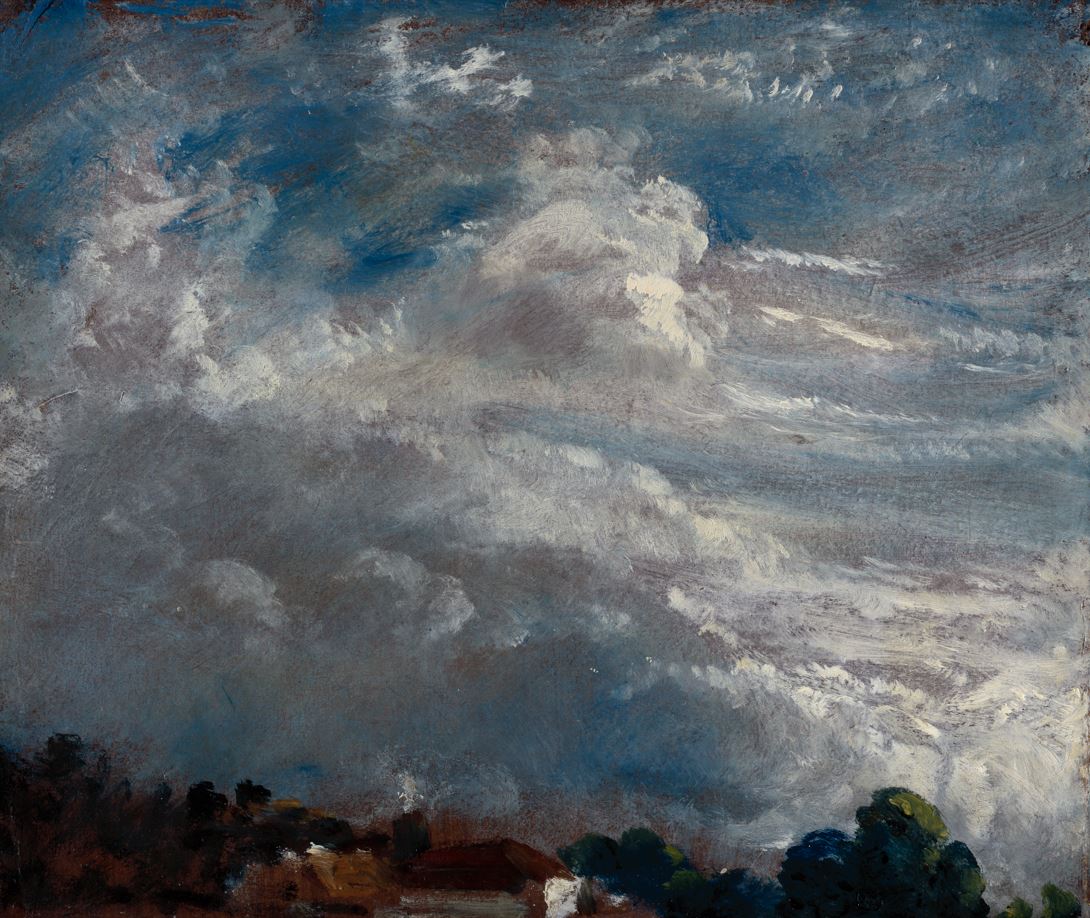
Taking this a step further, in 1819, Constable rented a house in Hampstead, then a village outside London where he started making rapid oil sketches of clouds, a practice he called ‘skying’. These works reflect Constable’s keen interest in weather.

Some of Constable’s cloud studies in ‘Turner and Constable’ at Tate Britain (photo by the author)

His preoccupation with the sky is evident in his dramatic 1823 depiction of Salisbury Cathedral, which became another recurring subject and is given the full Mona Lisa treatment in this show, complete with visitor bench to sit and gaze in awe.

Constable’s painting of Salisbury cathedral given the full treatment in ‘Turner and Constable’ at Tate Britain (photo by the author)

Room 7. Big is beautiful (5 Turner, 4 Constable huge paintings)

Both artists struggled to get noticed and one easy way to do this was to make their paintings big, really big, ginormous. Turner was already doing his huge classical and mythological paintings. In 1819 Constable joined him by exhibiting the first of his huge canvases (what he called his ‘6-footers’) ‘The White Horse’, and its appearance for the first time triggered comparisons with Turner. They were both now competing in sheer size – but what a complete difference in subject matter and style.

The White Horse by John Constable (1819) © The Frick Collection, New York (photo by Joseph Coscia Jr)

This feels like a great painting. If there had been just 4 or 5 works like this you’d have gone away inspired. It’s the fact that it’s accompanied by about 80 others, sketches, scraps and some decidedly bad works, which dilutes its effect.

Room 8. Fire and water (4 massive paintings: 3 JC, 1 T)

The rivalry was real. By the late 1820s Turner was the well-established master in all forms of landscape (oil, watercolour, prints). Constable only achieved official recognition in 1829 when he was finally made a member of the Royal Academy. To quote the curators:

Two years later, they came to blows. Artists hated being hung next to Turner in the Royal Academy’s annual exhibition because his paintings ‘caught your eye the instant you entered the room’. In 1831, Constable took up the challenge. As a member of the committee responsible for placement of works in the exhibition, he hung his Salisbury Cathedral from the Meadows next to Turner’s Caligula’s Palace and Bridge. The arrangement gave Constable’s own painting prime position. At a dinner party, Turner apparently came ‘down upon him like a sledge-hammer’. One onlooker recalled dramatically that Constable ‘wriggled… like a detected criminal’.

Room 9. Late Constable: ‘beyond Constable country’ (9 sketches, 3 big paintings)

With election to the Academy in 1829, Constable moved to expand his subject matter, producing works set in Brighton and London, away from his home turf in the Stour Valley. He tackled coastal storms and grand neoclassical architecture. I didn’t like his Brighton paintings but some of the sketches of the beach were appealing.

Rainstorm over the Sea by John Constable (1824-1828) © Photo Royal Academy of Art (photo by John Hammond)

I was tickled to read that Constable didn’t like Brighton and dismissed it as ‘Piccadilly by the seaside’. Plus ça change, eh?

In this room the curators are showing a clip from Mike Leigh’s 2014 movie, Mr Turner, dramatising another famous moment in their rivalry, when both painters had work hung in the 1832 Academy exhibition and Turner (played by Timothy Spall) adds a last-minute red buoy to his painting Helvoetsluys: Fishermen at Sea in order to catch the viewer’s eye and distract it from Constable’s long-laboured over piece, The Opening of Waterloo Bridge – which triggered Constable (played by the stalwart character actor James Fleet) to walk out in a huff. At least it’s all very dramatic in movieland.

Room 10. Late Turner (9 paintings, 8 sketches)

Turning 60 in 1835, Turner could have rested on his financial position and slowed down but he kept up the pace. 1835 saw him take one of his most extensive and taxing European sketching tours and he continued to travel abroad for another decade. He made topical paintings of contemporary subjects, including the fire that destroyed the Houses of Parliament.

The Burning of the Houses of Lords and Commons, 16 October 1834 by JMW Turner (1835) Cleveland Museum of Art

Favourite locations like Venice and the Swiss Alps came back into focus with repeat visits. There’s a really dreadful giant monster of a painting depicting Juliet and her nurse in a typically gauzy, highly romanticised Venice when, of course, the play is set in Verona, 120 kilometres away.

On the other hand, some of these late watercolours are truly visionary, and the curators are right to single out The Blue Rigi, Sunrise (1842) as awe inspiring.

The Blue Rigi, Sunrise by Joseph Mallord William Turner (1842) Tate

Room 11. Landscape and memory (3 Turner, 4 Constable, 4 prints)

Constable died in 1837, by now accepted as a classic. But his last years were saddened by the absence of his dead wife. The curators suggest his late paintings are clouded by melancholy but optimistically claim they reverberate with energy. Well, the four they hang in the final room are awful. They revert to the Suffolk subject matter but as if someone had thrown a bucket of mud over them. The palette has lost all its brightness and sparkle, everything is black and grey and mud. A couple of them have sets of diagonal white slashes across them as if someone had repeatedly stabbed them with a knife. They’re so horrible I made a list to show you:

My wife wondered whether he must have been suffering from some eye problem, cataracts or something, which would explain their dirgelike darkness, their fevered, cluttered, murky feeling. But that can’t be true because alongside it the curators hang a marvellously limpid and detailed drawing of fir trees on Hampstead Heath.

Fir Trees by John Constable (c. 1833) The Higgins Art Gallery & Museum, Bedford, UK/Bridgeman Images

(Incidentally,  you can see the join three-quarters of the way down the work; this is because Constable had originally drawn just the upper part of the tree but ended up devoting so much time and effort to it, that he glued on an extra strip of paper at the bottom so he could continue it down to the roots.)

Anyway, the point is that, if he could produce extremely clear, detailed and lucid drawings like this, then the dire appearance of a late painting like On the river Stour (1834) was an artistic choice.

By contrast with the murky Constable, this final room contains arguably the best Turner in the exhibition, certainly the one I liked best, Norham Castle, a work of pure luminousness, almost completely untainted by worldly subject matter.

Norham Castle, Sunrise by Joseph Mallord William Turner (c.1845) Tate

Room 12

This room is devoted to a big video screen onto which is projected an 11-minute-long film featuring interviews of contemporary artists Bridget Riley, George Shaw, Emma Stibbon and Frank Bowling, giving their opinions about T and C.

What’s really striking about this video is that it contains many tasteful close-ups of T and C’s works and these often make the paintings seem much more interesting and exciting and innovative than the complete, wider works do. It was a revelation to think of both their paintings like this, as collections of good bits which frequently impress more as inventive and wonderful details than they do as often contrived and stagey wholes.


Related links

Related reviews

Discover Constable and The Hay Wain @ the National Gallery

Six footers

In 1818 at the age of 42, the well-established English landscape painter John Constable made a conscious decision to start painting bigger works and so began the first of what became known as his ‘six footers’.

The first one, ‘The White Horse’, exhibited in 1820, was so successful that Constable was elected an Associate of the Royal Academy on the strength of it, so he knew he was on to a good thing. The ‘Hay Wain’ was the third in the series. Constable painted it under pressure to make the deadline for submissions to the Royal Academy’s 1821 exhibition and, maybe surprisingly, it was painted entirely at his home in London. But he was able to do this because of the countless sketches and previous paintings he’d made of the same location and setting.

The Hay Wain by John Constable (1821) © The National Gallery, London

Constable knew this place so well because his father, Golding Constable, owned it. Golding was a wealthy mill owner and corn merchant so John had grown up surrounded by the appurtenances of the trade and knowing exactly what went into growing, harvesting and processing wheat. The house on the left of the picture belonged to Willy Lott, a tenant farmer, but behind the painter, behind us as we look at the painting, stood Flatford Mill which belonged to Constable’s father. Both stood on the east bank of the River Stour which, at this point, forms the border between Essex and Suffolk.

Map showing location of the buildings in Constables paintings of Flatford Mill and Willy Lott’s cottage

The Hay Wain, like much of Constable’s best work, came to symbolise a certain type of innocent rural scene, eventually becoming iconic of an innocent way of life which industrialising Victorian Britain knew it was losing.

The bicentenary connection

The National Gallery was founded in 2024 so this is its bicentenary year. It’s using the occasion to re-explore favourite items in the collection. It was around Van Gogh’s much-loved painting of sunflowers that the gallery created the brilliant Van Gogh: Poets and Lovers show which you must go and see.

In a similar way, they’ve used the opportunity to take John Constable’s super-famous painting The Hay Wain (1821), and make it the centrepiece of an exhibition in its own right. The bicentenary connection comes in because 1824 was the year when The Hay Wain was displayed at the Paris Salon to great acclaim and was awarded a gold medal, which Constable received from the French King, Charles X, in person.

The medal is here, on display, and is just part of this fascinating and FREE exhibition at the National Gallery, which brings together 50 or so paintings, sketches, drawings, models, contemporary and modern cartoons, photomontages as well as the artist’s own palette (!) to place this super well-known and well-loved image in its full artistic, political, cultural, geographical, agricultural and biographical context. It’s full of beautiful, relaxing rural paintings and fascinating facts.

Political context

To begin with, the socio-political context of the 1810s is dealt with in a fairly small section. At the end of the Napoleonic Wars, after the victory at Waterloo on 18 June 1815, the British Army was rapidly demobilised, with no provision or thought for hundreds of thousands of demobbed men dumped back in their rural communities.

In the same year the Tory administration passed the first of many Corn Laws. These blocked the import of cheap corn from abroad, thus creating a monopoly for British wheat-growers i.e. the landowning aristocracy. But while it guaranteed these landowners a good price for their product it raised the price of bread and related foodstuffs very sharply for ordinary people, leading to hunger and hardship.

Since the landowning class was in the majority in the House of Commons and dominated the House of Lords, it was a very naked form of class war: a few thousand aristocratic landowners arranged the law and economy to their immense benefit and to the starvation of millions of rural workers and the increasing urban proletariat. The corn laws weren’t abolished until 1846 and only after a generation of protests, agitation, riots and criticism.

This cruel and oppressive law doesn’t have much traction in the exhibition. It is dramatised in four or so contemporary political cartoons, by the likes of James Gillray and Joseph Rowlandson. The fiercest is this one by Charles Williams and titled ‘Political Balance’ (1816).

Political balance, An unexpected inspection, or A Good Old Master Taking a Peep Into the State of Things Himself by Charles Williams (1816) © British Museum

The only contemporary artists who spoke out against exploitation, poverty and despoliation of the countryside was the great William Blake but none of his political work is included here, just a couple of tiny illustrations from the Songs of Innocence and Experience.

Interesting though all this is to those of us with a taste for history, none of this rural poverty or agitation is visible in any of the actual paintings by Constable or Gainsborough, Turner or Mulready, Stubbs or Combes which are included here. The subject is raised by the curators only to be quietly forgotten.

The Hay Wain’s radicalness

Landscape painting

At the time in Britain, landscape painting was still considered an ‘inferior’ genre compared to history painting. Among other goals, Constable was determined to raise its prestige and this was part of his motivation for creating the six footers.

‘En plein air’

The Hay Wain was painted in the artist’s London studio over five months in preparation for the Royal Academy annual exhibition which Constable had entered numerous times before. He painted it from several preliminary sketches, probably created ‘en plein air’, a revolutionary approach for the period which Constable eagerly adopted in his quest to represent ‘truth to nature’. It was considered revolutionary in other ways.

Brown

The exhibition includes works by slightly earlier painters including George Stubbs and especially Thomas Gainsborough to show what the traditional approach looks like. In this Gainsborough painting the dominant hue is brown and the play of light is suggested by lighter and darker shades of the relevant colour.

Smooth

Above all the brushwork is invisible and the surface of the painting is flat and smooth.

Cornard Wood, near Sudbury, Suffolk by Thomas Gainsborough (1748)

The Stubbs painting, like the Gainsborough, is dominated by brown, and is as smooth as a horse’s bottom, all slick and shiny surface. Go up close, peer right into the painting, and its surface is as smooth as a piece of porcelain.

Reapers by George Stubbs (1785) © Tate

By contrast 1) Constable boldly used a much brighter shade of green but 2) much more noticeable is his looser, expressive handling of the paint with noticeable brushstrokes which you can see even from a distance. When you go up close you can see countless details which completely lack the consummate finish of a Gainsborough or Stubbs, loads of places where the paint gestures at what it is depicting.

He used a range of marks, surfaces and textures to reflect the variety that he saw in nature and to add to the mood of the painting. He used a palette knife and brushes to create expressive surfaces which are surprisingly varied – scuffed and scored and smeared, lumpy or rasped across the canvas, with small ripples and waves, surfs of impasto. The closer you get, the more varied and dramatic you realise the paintwork is.

Detail of the Hay Wain by John Constable showing the washerwoman by Willy Lott’s cottage (photo by the author)

Smooth when he wants to be

What makes this really striking is that, when he wanted to be, Constable could easily be as smooth as his predecessors. The exhibition includes two paintings of the view from the first floor of his family home which, the curators tell us, he made shortly after the death of his beloved mother, Ann.

Golding Constables Kitchen Garden by John Constable (July 1815) © Ipswich Borough Council Collections: Colchester + Ipswich Museum Service

It’s a quietly beautiful picture in its own right. It has deep biographical resonance not only because of the poignant dating of it, but also because it shows, in the foreground, the garden which was his mother’s pride and joy. But, for our current purposes, the chief thing about it is that the finish is immaculately smooth. If you go right up and peer closely, and from the side, you can see how smooth and finished the paintwork is, completely unlike the ridged and rasped and sprawling brushstrokes of The Hay Wain. He could do it when he wanted to. Not doing it was a very conscious statement of artistic intent.

Constable snow

I was mighty pleased with myself for noticing and then becoming obsessed with Constable’s use of white paint to create a kind of silvery chrome effect all over the Hay Wain. The more you look, the more you see it, not just highlighting the water but iridescent along the tops of the wain itself, dusting spars of wood and brickwork, suggesting the flickering light across the landscape and its reflection off multiple surfaces.

Detail of the Hay Wain showing the silver highlighting

However, I was deflated to read in the curators’ labels that this liberal use of flecks of white paint to represent the sparkling or reflection of sunlight, was noticed and criticised at the time, some smart aleck nicknaming it ‘Constable’s snow’.

Alongside the visible brushwork, the rasps of paint on canvas, and the ridges of paint, this silvery snow was used in the general criticism that Constable’s paintings were unfinished. Constable, of course, considered the plein air approach, the loose brushstrokes and the use of silver slicks of sunlight central to his aim of creating a realistic effect of being there and seeing the landscape, of conveying the shimmering, ever-changing light and shade effects of a real English day, with its everchanging drama of clouds and light.

Clouds

Constable was particularly interested in the study of clouds. The exhibition includes numerous paintings, sketches and drawings he made of cloudscapes. A man named Alexander Cozens wrote a book titled ‘A New Method of Assisting the Invention in Drawing Original Compositions of Landscape’ which included different types of cloud shape and the exhibition includes some of the 20 drawings he made from the book as well as oil sketches.

Cloud Study: Horizon of Trees, 27 September 1821 by John Constable © Royal Academy of Arts, London; photographer: John Hammond

What Salisbury tells us

The show includes the splendid ‘Salisbury Cathedral from the Bishop’s Ground’ (1823) and it is a deep pleasure to sit on the bench in front of it and just drink it in. What sumptuous, sensual beauty of composition, colour and light.

Salisbury Cathedral from the Bishops Ground by John Constable (1823) © V&A Images / Victoria and Albert Museum, London

Slowly several points emerge, namely around the use of light and shade and clouds. The dark cloud rising from behind the cathedral gives the composition a sense of drama (it’s interesting to learn that the Bishop of Salisbury actively didn’t like this dark cloud).

It also indicates the kind of day it is, one of those days when the sun comes in and out between clouds, and this explains the radiance of the cathedral facade: it’s one of those moments when the sun comes out from between clouds and makes whatever it shines on appear radiant. Once you notice this, you realise it also applies to the meadow in front of the cathedral, up to and including the cow, whereas the field and trees further towards the viewer are still in shadow.

With this in mind, if we go back to the Hay Wain, I suggest part of its popularity is down to its use of cloud and light as design features. On the face of it, it’s a painting of a cart in a pond but if you focus just on the play of light, and light on clouds, several things become obvious.

The Hay Wain by John Constable (1821) © The National Gallery, London

The spiral

In the West we read from top left to right. I suggest that one of the reasons the painting feels so satisfactory and pleasing is the way its design plays to this deep way of ‘reading’ visual elements. So if you start at the top left the cloud is very dark which leads your eye to the right, towards the nice light cloud, and your eye continues on round and down into the meadow which stretches off into the distance and is dappled with sunlight, before swinging down into the water and round to the cart in the pond.

So my suggestion is that we don’t just perceive it as a complex composition and pick out details at random but enjoy this sense of sweep and progression.

Comparing the sketch

A bit more evidence for this us supplied by the full-sized sketch of the Hay Wain which the exhibition also includes. Comparing the sketch and the finished painting suggest quite a few points from which I’d emphasise two.

Full-scale study for The Hay Wain by John Constable (about 1821) © V&A Images / Victoria and Albert Museum, London

1. Brown and green

Remember the idea that older landscape artists used a tastefully subdued palette of brown when painting outdoors? Well, the sketch clearly shows that this is how Constable began, using a far more sombre, brown and rather lifeless palette. Comparing the sketch and the finished painting shows how powerful adding in the vibrant shades of green transforms the finished product. They bring it to life; they make it zing with life, foliage, fertility.

The Hay Wain by John Constable (1821) © The National Gallery, London

2. Decluttering the composition

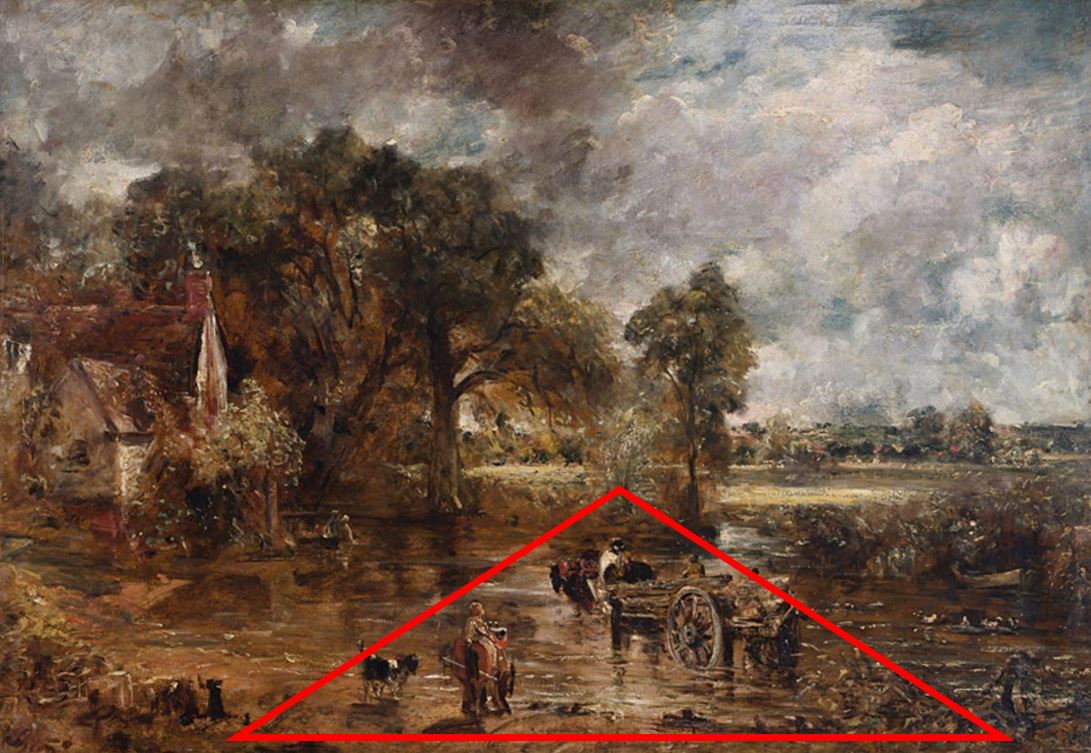
But back to the issue of composition, look at the one big, obvious difference between the sketch and the finished work. The figure of a horse and rider between the dog and the cart has been deleted. Why? Because including it crystallises the dog and cart from being light and almost random elements into becoming a strong central ensemble which dominates the picture. With it in your eye tends to go straight to it and you get distracted into peering closer to make out the precise nature of the figure on a horse (in fact, you have to peer quite closely to realise it’s a horse at all). And all this supersedes or obliterates the sweeping curve, the spiral I’ve described above.

Full-scale study for The Hay Wain by John Constable (about 1821) with added triangle © V&A Images / Victoria and Albert Museum, London

Keep it in and the eye goes straight to these central figures and tries to identify them / make them out, making you tend to overlook the wider composition. Remove it and your eye is freed to step back, to take in the larger compositional sweep, from dark cloud to light, round and down to the meadow, and only slowly and leisurely coming round to the cart. The picture becomes lighter and airier. It breathes.

History of an icon

It’s interesting to learn that John Ruskin, the godfather of mid-Victorian art criticism, really disliked Constable and helped depress his reputation for a generation. It was only later in the nineteenth century that Constable’s reputation bounced back and has remained high ever since.

The curators claim a major aim of the exhibition was to chronicle the rise of Constable from the kind of criticism he received in his lifetime and the active dislike of cultural arbiters in the mid-nineteenth century his current unassailable position as one of Britain’s classic painters. This is a fine ambition so it’s regrettable that the exhibition doesn’t really achieve it.

There are a few wall labels explaining that this or that painting was given to the National Gallery by supporters or, in one case, by his daughter, in this or that year, as if that tells us very much and that’s about it.

There’s a glaring absence of any explanation of what changed in aesthetic theory, in the practice of art, in social attitudes to the landscape, in artistic taste through the middle and later Victorian era to explain Constable’s rise and canonisation. I’d really like to have read this but didn’t see it anywhere.

So in the opening section there’s a 1920s black-and-white photo of Willy Lott’s cottage and we are told that it was extensively restored in the 1920s after a revival of interest in Constable’s paintings – but not why there was a revival of interest in Constable’s paintings. What was sufficiently different in the 1920s from the 1880s or 1860s to spark the investment? What changed and why?

Spoofs and parodies

To end on a lighter note, right at the start of the show, while they’re telling us how The Hay Wain has become an iconic image of the English countryside, the curators include half a dozen examples of how it’s been parodied and pastiched, used in cartoons and adverts for railways (‘Explore Constable country!’).

A striking one is this use of The Hay Wain in a 1929 cartoon bewailing the despoliation of the English countryside by cars and advertising hoardings. People tend to think this is a modern problem but here’s proof that it goes back at least a hundred years!

‘Had Constable lived today’ cartoon in the Daily Express, 2 March 1929, created by the Campaign for the Protection of Rural England © CPRE

There’s the satirical anti-war photomontage by radical anti-war artist Peter Kennard.

More up to date is this photomontage by Cold War Steve, where he’s cut and pasted leading political figures from 2019 into the scene. I like the truck full of dead washing machines but the killer detail is the image of Wayne Rooney riding a jet ski just to its left, so the joke is that this version of the picture should be titled ‘Hey, Wayne!’

The Hay Wain by Cold War Steve (2019) © Cold War Steve


Related links

Related reviews

Van Gogh and Britain @ Tate Britain

Before I went I’d read some disparaging reviews of this exhibition – but I found it really interesting, thought-provoking, full of wonderful paintings and prints and drawings, and making all kinds of unexpected connections. And big, much bigger than I expected.

The premise is simple: Vincent van Gogh came to live in England in 1873, at the age of 20. He lived in London for nearly three years, developing an intimate knowledge of the city and a great taste for English literature and painting. The exhibition:

  1. explores all aspects of van Gogh’s stay in London, with ample quotes from his letters to brother Theo praising numerous aspects of English life and London – and contains several rooms full of the English paintings and prints of contemporary urban life which he adored
  2. then it explores the development of van Gogh’s mature style and the many specific references he made back to themes and settings and motifs he had first seen in London, in London’s streets and galleries
  3. finally, the exhibition considers the impact van Gogh had on British artists
    • as a result of the inclusion of his pictures in the famous 1910 exhibition Post-Impressionist Painting
    • between the wars when van Gogh’s letters were published and fostered the legend of the tormented genius, the man who was too beautiful and sensitive for this world
    • and then how van Gogh’s reputation was further interpreted after the debacle of the Second World War

Gustave Doré

The first three rooms deal with the London that van Gogh arrived in in 1873. Among the highlights was a set of seventeen prints from Gustave Doré’s fabulous book London, a pilgrimage, which had been published only the year before, 1872. All of these are marvellous and the first wall, the wall facing you as you enter the exhibition, is covered with an enormous blow-up of Doré’s illustration of the early Underground.

The Workmen’s Train by Gustave Doré (1872)

Frankly, I could have stopped right here and admired Doré’s fabulous draughtsmanship and social history, as I looked at the wall covered with seventeen of the prints from the book which we know van Gogh owned and revered.

It’s the basis of the first of many links and threads which run through the show because, many years later, when van Gogh had developed his mature style but had also developed the mental illness that was to plague him, during his confinement in a mental hospital, he was to paint a faithful copy of Doré’s depiction of inmates in Newgate prison but in his own blocky style, to express his own feelings.

The prison courtyard by Vincent van Gogh (1890) © The Pushkin State Museum of Fine Arts, Moscow

Social realism

Van Gogh had come to London because he had got a job with the art dealing firm Goupil, which was part of the fast-growing market for the popular prints and art reproductions which were informally referred to as ‘black and whites’.

VanGogh ended up with a collection of over 2,000 of these English prints, and admired them for their realistic depictions of contemporary urban scenes, especially among the poor. I was fascinated to learn that there was a set of socially-committed artists who all drew for The Graphic magazine, including Luke Fildes, Edward Dalziel, Frank Holl, and Edwin Buckman. The exhibition includes quite a few black and white social realist prints by artists from this circle and, as with the Doré, I could have studied this stuff all day long.

A London Dustyard by Edwin Buckman, from the Illustrated London News, 1873

The curators related these blunt depictions of London life back to the novels of Charles Dickens, who we know van Gogh revered (in this instance the rubbish dump motif linking to the dust yard kept by the Boffin family, the central symbol of his last, finished novel, Our Mutual Friend). As Vincent was to write during his first year as a struggling artist:

My whole life is aimed at making the things from everyday life that Dickens describes and these artists draw.

But these illustrations by numerous London artists are also here because Vincent copied them. Next to the Buckman image of a dustyard is a graphite sketch of dustmen by Vincent. Next to a Luke Filde image of the homeless and poor, is a van Gogh drawing of a public soup kitchen.

A Public Soup Kitchen by Vincent Van Gogh (1883) © The Van Gogh Museum, Amsterdam

Other images include one of surly roughs waiting for the pub to open and a hooligan being arrested. Next to them all are van Gogh’s own earliest sketches and drawing, including a series he did of a homeless single mother begging on the streets, Sien Hoornik, who he took in and fed and had model for him (fully clothed) in a variety of postures of hopelessness and forlornness. And variations on the theme of tired, poor old men.

This is the Vincent who set his heart on becoming a vicar and did actually preach sermons at London churches, as well as crafting skilled sketches of churches in the letters he sent to brother Theo, and which are displayed here.

The example of old masters

But it wasn’t just magazine and topical illustration which fired Vincent’s imagination. The curators have also included a number of big classic Victorian paintings – by John Constable and John Millais among others – to give a sense of what ‘modern’ art looked like to the young van Gogh.

He was not yet a painter, in fact he didn’t know what he wanted to be. But the curators have hung the sequence, and accompanied them by quotes from letters, to show that, even in his early 20s, he was an acute observer of other people’s art, not only Victorian but other, older, pictures he would have seen at the National Gallery.

The Avenue at Middelharnis by Meindert Hobbema (1689) © The National Gallery, London

Several of these classic paintings depict an open road between a line of trees and, as the room progresses, the curators have hung next to them van Gogh’s later depictions of the same motif, showing early versions of the motif done in a fairly rudimentary approach, the oil laid on thick and heavy and dark…

Avenue of Poplars in Autumn by Vincent van Gogh (1884) © The Van Gogh Museum, Amsterdam

And then next to these, suddenly, we have the first works of his mature style in which his art and mind have undergone a dazzling liberation.

Path in the Garden of the Asylum by Vincent van Gogh (1889) © Collection Kröller-Müller Museum, Otterlo

The triumph of distortion

One of the things you can see evolving is his depiction of faces. Early on, he’s not very good. There’s a set of faces of what look like jurymen, as well as individual portraits of working men and women, and often they are either expressionless blocks, or a bit cack-handed, a bit lop-sided. Even the numerous sketches of Sien Hoornik are better at conveying expression through the bent posture of her body, than through facial expressions which are often blurred or ignored.

Similarly, you can’t help noticing that the early landscapes like the avenue of poplars, above, very much lack the suave painterly finish and style of his models (Constable, Millais).

But what happens as you transition into room four – which covers his move to Paris to be near his brother in 1885 – is a tremendous artistic and visual liberation, so that the very wonkiness and imperfections in his draughtmanship which were flaws in the earlier works, are somehow, magically, triumphantly, turned into strengths. The blockiness, the weakness of perspective, the lack of interest in strict visual accuracy, have suddenly been converted into a completely new way of seeing and of building up the image, which feels deeply, wonderfully emotionally expressive.

Sorrowing old man (‘At Eternity’s Gate’) by Vincent van Gogh (1890) © Collection Kröller-Müller Museum, Otterlo

Room four makes fleeting reference to the community of like-minded artists he found working around Paris, and in particular to Pissarro, exponent of what was being called neo-Impressionism.

It seems quite obvious that van Gogh was very influenced by the Frenchman’s experiments with chunks and blocks, and spots and dabs and lines of pure colour. The painting above combines the strong formal outlines redolent of the black and white Victorian prints he revered so highly, with a new approach to filling in the outlines – not with a consistent smooth finish à la Millais – but a completely new idea of filling the space with disconnected lines of paint, the artist quite happy to leave blanks between them, quite happy to let us see them as isolated lines all indicating colour and texture.

The curators link this technique back to the cross-hatching used to create volume and shape by the Victorian print-makers and illustrators. So one way of thinking about what happened is that Vincent transferred a technique designed for print making to oil painting. What happens if you don’t create a smooth, finished all-over wash of colour, but deliberately use isolated lines and strokes, playing with the affect that basic, almost elemental short brushstrokes of mostly primal colours, create when placed next to each other.

It has a jazzy effect, creates a tremendous visual vibration and dynamism. the image looks like it is quivering or buzzing.

The Manet and the Post-Impressionists exhibition

To be honest, by this stage my head was buzzing with the fabulous images of Doré and Fildes and the other British illustrators, and van Gogh’s similarly social realist depictions of the poor, the old, prostitutes and so on and the way the early social realist paintings had morphed into a series of paintings of outdoor landscapes. I felt full to overflowing with information and beauty. But there was a lot more to come.

Suddenly it is 1910 and room five is devoted to the epoch-making exhibition held in London and titled Manet and the Post-Impressionists by the curator Roger Fry. As with Doré’s underground image at the start, the curators have blown up a page from a popular satirical magazine of the time, depicting the dazed response of sensible Britishers to the outlandish and demented art of these foreign Johnnies and their crazed, deformed, ridiculously over-coloured paintings. A number of Vincent’s paintings were included in the show and came in for special scorn from the philistine Brits.

This amusing room signals the start of part two of the show which looks at van Gogh’s posthumous influence on a whole range of native British artists.

This second half is, I think more mixed and of more questionable value than the first half. We know which British artists and illustrators van Gogh liked and admired and collected, because he included their names and his responses to their works, in his many letters.

As to the influence he had after his death, this is perforce far more scattered and questionable. Thus room six introduces us to paintings by Walter Sickert, leader of the Camden Town school (whose work I have always cordially hated for its dingily depressing dark brown murk), to Vanessa Bell and Duncan Grant (bright Bloomsburyites), and to Matthew Smith, Spencer Gore and Harold Gilman.

The Vineyard by Vanessa Bell © The Estate of Vanessa Bell, courtesy of Henrietta Garnett

It’s impossible to place any of these artists on the same level as Vincent. Amid the sea of so-so also-rans, the scattered examples of works by van Gogh ring out, shout from the walls, proclaim the immensity of his genius, the vibrancy of design, colour and execution. Like an adult among children.

That said, there’s quite a lot of pleasure to be had from savouring these less-well-known British artists for their own sakes. I was particularly drawn to the works of Harold Gilman and Spencer Gore. Here is Gore’s painting of Gilman’s house. It doesn’t have a lot to do with van Gogh, does it, stylistically? Apart from being very brightly coloured.

Harold Gilman’s House at Letchworth, Hertfordshire by Spencer Gore. Courtesy of New Walk Museum & Art Gallery, Leicester Arts and Museums Service

Similarly, I really liked Gilman’s picture of the inside of a London caff, focusing on the decorative wallpaper and bright red newel posts, and a sensitive portrait titled Mrs Mounter at the Breakfast Table, 1917. The curators relate this latter painting back to Vincent’s vivid, warts-and-all portraits, which also contain highly decorative elements and stylised wallpaper, a garish brightness which scandalised critics of the 1910 show.

Maybe. It’s a good painting, he conveys the old woman’s character in a sober, unvarnished way and the use of decorative elements is interesting. But only a few yards away is hanging one of five or six drop-dead van Gogh masterpieces of the show, the Hospital at Saint-Rémy (1889), and there is absolutely no competition.

Hospital at Saint-Rémy (1889) by Vincent van Gogh © Hammer Museum collection

Good God, hardly anything you’ve ever seen before explodes with such power and vibrancy as this painting. The brown earth, the green grass, the writhing trees and the very air seem to have burst into flames, to be erupting and leaping with energy, fire, ecstasy, fear, manic force.

Although there are a number of other, milder, more discreet landscapes by Vincent, when he is in this manic mood he wipes everybody else off the table, he dominates the dancefloor, he takes over the room, while the others are playing nice tunes on their recorders, he is like a Beethoven symphony of colour and expression, full of tumult and vision.

The impact of sunflowers

Emotionally and intellectually exhausted? I was. But there’s more. A whole room devoted to sunflowers. Pride of place goes to one of his most famous paintings, the sunflowers of 1888, and I was fascinated to learn from the wall label that van Gogh’s still lifes contributed to a major revival of the art of painting flowers. There are ten or a dozen other paintings of sunflowers around this room, by a whole range of other artists (of whom I remember Winifred and William Nicholson, Christopher Wood and Frank Brangwyn and Jacob Epstein). One of the Brits is quoted as saying that the painting of flowers had been more or less dismissed by the moderns, as having come to a dead end in Victorian tweeness and sentimentality. Until Vincent’s flower paintings were exhibited in the 1920s.

Sunflowers by Vincent Van Gogh (1888) © The National Gallery, London

Van Gogh’s flower works showed that flowers could be painted in an entirely new way, blazing with colour and passion, wildly undermining traditional canons of beauty, revealing the passionate secrets implicit in the shapes and patterns of nature.

In a work like this you see a pure example of his exploration of colour for its own sake, a post-Impressionists’ post-Impressionist, the sunflowers not only being a blistering depiction of the flower motif, but a highly sophisticated and daring experiment with all the different tones of yellow available to the artist in 1888. So much to do, so much to paint, so much experience implicit in every fragment of God’s beautiful world!

Van Gogh’s reputation between the wars

By the 1920s van Gogh’s works were being exhibited regularly in Britain and snapped up by private collectors. He became famous. The process was helped hugely by the publication in English translation of his vivid, passionate and tormented letters. The life and the works became inextricably intertwined in the myth of the tortured genius. The curators quote various writers and experts between the wars referring to Vincent’s ‘brilliant and unhappy genius’.

However, this room of his last works makes a simple point. For a long time it was thought that the painting he was working on when he shot himself on 27 July 1890 was ‘Wheatfield With Crows‘. Forests have been destroyed to provide the paper for oceans of black ink to be spilt publishing countless interpretations which read into this fierce and restless image the troubled thoughts which must have been going through the tormented genius’s mind on his last days.

Except that the display in this room says that the most recent research by Vincent scholars have conclusively proven that it was not Van Gogh’s last painting! The painting he was working on when he shot himself was a relatively bland and peaceful landscape painting of some old farm buildings.

Farms near Auvers by Vincent Van Gogh (1890) © Tate

The point is – there’s nothing remotely tormented about this image. And so the aim of the display is to debunk the myth of the ‘tortured’ artist and replace it with the sane and clear-eyed artist who was, however, plagued by mental illness.

Phantom of the road

This point is pushed home in the final room which examines van Gogh’s reputation in Britain after the Second World War. All his works, along with all other valuable art had been hidden during the war. Now it re-emerged into public display, including a big show at Tate in 1947.

In the post-war climate, in light of the Holocaust and the atom bomb, the legend of the tormented genius took on a new, darker intensity. The curators choose to exemplify this with a raft of blotchy, intense self-portraits by the likes of David Bomberg which, they argue, reference van Gogh’s own striking self portraits.

But this final room is dominated by a series of paintings made by the young Francis Bacon in which he deliberately copies the central motif of a self-portrait Vincent had made of himself, holding his paints and easel and walking down a road in Provence.

Bacon chose to re-interpret this image in a series of enormous and, to my mind, strikingly ugly paintings, three of which dominate one wall of this final room.

Study for portrait of Van Gogh by Francis Bacon (1957) Tate © The Estate of Francis Bacon

They are, in fact, interesting exercises in scale and colour, and also interesting for showing how Bacon hadn’t yet found his voice or brand. And interesting, along with the Bomberg et al in showing how the legend of tormented genius was interpreted in the grim grey era of Austerity Britain.

And they show what a very long journey we have come on – from the young man’s early enthusiasm for Charles Dickens and Gustave Doré right down to his reincarnation as a poster boy for the age of the H-bomb.

A bit shattered by the sheer range of historical connections and themes and ideas and visual languages on show, I strolled back through the exhibition towards its Victorian roots, stopping at interesting distractions on the way (some of Harold Gilman’s works, the big cartoon about the Post-Impressionist show, some Pissarros, the Millais and Constable at the beginning, the wall of Dorés), but in each room transfixed by the one or two blistering masterpieces by the great man.

Even if you didn’t read any of the wall labels or make the effort to understand all the connections, links and influences which the curators argue for, it is still worth paying to see the handful of staggering masterpieces which provide the spine for this wonderful, dazzling, life-enhancing exhibition.

Starry Night by Vincent van Gogh (1888) Paris, Musée d’Orsay. Photo © RMN-Grtand Palais / Hervé Lewandowski

Promotional video


Related links

More Tate Britain reviews

Every room in Tate Britain (part one)

Tate Britain is dedicated to exhibiting British art from 1500 to the present day.

It is housed in a beautiful neo-classical building facing onto the river Thames. To the left a ramp and steps lead to the lower floor with a large exhibition space (currently showing Artist and Empire). To the right of the main building is the Clore Galleries (opened 1987), nine rooms on the ground floor housing the gallery’s big collection of JMW Turner paintings, watercolours, sketches etc, along with a room of Constable and, upstairs, a room of pre-Raphaelite drawings/paintings, and a room of William Blake engravings and paintings.

If you enter up the grand steps through the main entrance you arrive at a long central hall, home to changing displays and currently housing Susan Philipsz’ War Damaged Musical Instruments, an entirely audio display, tannoy speakers emitting the mournful sound of brass music played by instruments damaged in war, which she has rescued and refurbished. Sweet haunting sounds drift through the galleries as you saunter through the history of British art.

The west wing contains ten rooms covering British art from 1540 to 1910. Then you cross the entrance hall to the east wing and pick up the story in 1930, walk through another ten rooms containing the twentieth century exhibits.

Off to the side of these chronological sequences are single rooms dedicated to ad hoc displays of art ancient or bang up to date.

The rooms

1540

  • Full length portrait of Queen Elizabeth I by Steven van der Meulen. I like the still-medieval feel, the flatness, the compaction, and the gorgeousness of the detail, the tremendously patterned gold background to the left, but also the idealised plants, flowers and fruit to the right.
  • Sir Peter Lely Two Ladies of the Lake Family (c.1660) I love the stylised round-cheeked cherub look of all Lely’s women. He was Dutch and emigrated here to become the principal portrait-painter at the court of Charles II, filling the position Sir Anthony van Dyck held for Charles I.

1730

  • Samuel Richardson, the Novelist, Seated, Surrounded by his Second Family 1740–1 by Francis Hayman. This isn’t a particularly good painting, I’m just surprised to learn of its existence. Richardson was a printer whose long epistolary novel about a 15-year-old serving girl named Pamela who writes letters to her parents about fighting off the ‘attentions’ of her country landowner master, Mr B, became the first bestseller and prompted a flood of merchandising and imitations. I enjoyed the attention paid to the silk of the dresses and the detail of the leaves on the trees.
  • William Hogarth The Painter and his Pug (1745) embodying a certain kind of pugnacious bully-boy philistinism. I’ve always enjoyed his O the Roast Beef of Old England (‘The Gate of Calais’) which is a pictorial list of reasons why the French are rubbish.
  • Hogarth’s crudity is highlighted by comparison with Sir Joshua Reynolds’s Three Ladies Adorning a Term of Hymen (1773). Here the focus not now on the depiction of static fabric, as in the Hayman painting of 30 years earlier, but on the effect of the overall composition, the diagonal made by the three women, and the softening effect of light and shade on the numerous decorative details, flowers, rug, plinth, jug and so on.
  • Sir William Beechey Portrait of Sir Francis Ford’s Children Giving a Coin to a Beggar Boy (exhibited 1793) reflecting the later 18th century fashion for ‘sentiment’, for subjects depicting finer feelings.
  • Henry Fuseli Titania and Bottom (c.1790) stands out from the other 18th century works, mainly portraits in the country, for its dark fantasy, note the tiny old man with the long white beard at the end of a lady’s leash in the bottom right.

Foreign painters in England

À propos Fuseli, it’s worth pointing out how many of these ‘British’ painters are foreign. Not featured at all here is the great Hans Holbein (German Swiss painter to the court of Henry VIII), but other foreign painters ‘incorporated’ into the British tradition include van Dyck (Flemish), Rubens (Flemish), Lely (Dutch), Fuseli (Swiss), James Tissot (French), Sir Lawrence Alma-Tadema (Netherlands), John Singer Sergeant (American), Percy Wyndham Lewis (Canadian).

  • I liked George Stubbs’ Reapers (1785) rather than the several dramatic horse pictures on display because it is unusual and it shows a very human, almost Dutch landscape-type scene.
  • Next to Reynolds the other great genius of the 18th century is of course Thomas Gainsborough, represented here by half a dozen enormous portraits and a few landscapes. I liked Henry Bate-Dudley: it is not a magnificent picture, the opposite, it has a quiet, a calm superiority or confidence. Note Gainsborough’s distinctively loose brushstrokes on coat, silver birch bark and among the leaves, but somehow coinciding with precise detail.

Looking back down the long 1780 room to compare them, you can see that Gainsborough is dainty and Reynolds is stately.

No religion

After five rooms I noticed a striking contrast with the National Gallery with its in-depth collection of European paintings from the same period – the lack of religious paintings. Overwhelmingly, the works here are portraits, with some landscapes. I counted only two religious paintings in these rooms:

  • Henry Thomson The Raising of Jairus’ Daughter (exhibited 1820) with the stagey Poussinesque figures to the right but the rather haunting central figure of the dead daughter.
  • William Dyce’s Madonna and Child (c.1827–30) a sport, a freak, a careful pastiche of a Raphael painting and completely unlike anything else being painted at the time.

Our British tradition of painting may be thin until the time of Reynolds (1770s) but I think it is typical of the national culture that it focuses on real people and places, and very often on touching and moving personal stories, rather than the tearful Maries and crucified Jesuses of the continental tradition.

All of that, the heavy earnestness of the Baroque tradition of languishing saints, weeping Madonnas and annunciating angels, is completely absent from these displays. For me the religion is in the attention to ordinary life, the valuing of people and their feelings, the same emphasis on psychology and the human scale which saw the English pioneer the novel, the art form which more than any other penetrates the human mind. This sensitivity and refinement of everyday human feeling is exemplified in:

  • George Romney Mrs Johnstone and her Son (?) (c.1775–80) Sure they’re rich, sure it’s partly to show off the sumptuousness of the fabric. But it also shows real love.
  • It’s actually at the National Gallery, but Gainsborough’s unfinished portrait of his young daughters, The Painter’s Daughters with a Cat (1761) epitomises the English ability to capture love and affection, not Holy Love for a Martyred Saint, but real human love, and childishness and innocence and intimacy and aliveness.

Even when we do intense and visionary, rather than angels floating round the heads of saints, it is embodied in people and real landscapes:

  • Take Samuel Palmer’s paintings strange, vivid, jewelled depictions of the landscape around Shoreham in Kent, eg The Gleaning Field (c.1833)
  • And striking because it is so unlike Constable and Turner and his other contemporaries is William Etty’s Standing Female Nude (c.1835–40), very modern in its frankness, not trying to be Greek or statuesque.

The Turner Collection

There is so much Turner. Enough to fill eight good size rooms in the Clore Gallery off to the east of the main building, and this is only a small selection of what Tate owns. Turner’s history paintings, Turner’s classical landscapes, Turner’s mountains, Turner’s figures, Turner’s watercolours. And in all states of finish, from vast formal commissions to sketches to unfinished canvases to the wispiest watercolours. Despite trying hard I find Turner difficult to really like, and the task is not helped by the sheer volume of material. There is a room here dedicated to ‘Turner and the human figure’ which proves conclusively how bad he was at it:

He went on the Grand Tour and I find the resulting huge Roman landscapes strained, pretentious, overblown, bad in a number of ways:

Senses blunted by the vast Roman landscapes, I perked up when I saw the much more modest, and therefore impactful:

All in all, I preferred the one room dedicated to Constable, which is hidden away in a corner of the Clore Gallery, to the eight preceding Turner rooms:

  • Fen Lane, East Bergholt (?1817) Like gently sloping farmland I’ve seen in my walks around Kent.
  • Glebe Farm (c.1830) the church nestling among trees, the solitary cow at the pond, the thoughtful little girl, all artfully composed to create a stock feeling, but a feeling I like.

Pre-Raphaelite Works on Paper

In the far corner of the Clore gallery is stairs up to the smallish room displaying pre-Raphaelite works on paper, lots of sketches but some oils as well. A wall label reminds me that the Pre-Raphaelite Brotherhood (PRB) only lasted from 1848 to 1853. I liked the strange, visionary, angular, amateurish but atmospheric work of early Rossetti, like Arthur’s Tomb (1860). Technically not as innovatory as Constable or Turner, but these small works convey an experimental psychology, using medieval motifs for very modern reasons, to convey the troubled inter-personal relationships of the Brotherhood and their various muses, anticipating the tensions of, say, the Viennese Expressionists fifty years later.

But there are also examples of Rossetti in his smooth, glowing, bosomy phase: Monna Pomona (1864). I liked the wall label’s description of the medievalising tendency in PRB work, its use of: ‘shallow space, tight interlocking composition and rich colour of medieval manuscripts’. A handy description of what I like about medieval art.

I liked Ford Madox Brown’s Jesus Washing Peter’s Feet (1852–6) the oddities of composition riffing off medieval ideas of space to create a very modern psychology.

The glory years

Although the earlier rooms contain many good paintings, in my opinion British art explodes into a glory of masterpieces between the mid 1880s and the Great War, the period which saw Victorian academic art reach its height of verisimilitude before being swept away by the exhilarating eruption of the new Modernism. Rooms 1840, 1890 and 1900 contain painting after painting of pure visual pleasure, greatest hits which make everything before them pale by comparison.

  • James Tissot The Ball on Shipboard (c.1874) Illustration of a Trollope novel.
  • John Singer Sargent Carnation, Lily, Lily, Rose (1885–6) Barely a century after Reynolds, and how far not only painting, but the understanding of mood and psychology, has expanded and deepened.
  • John William Waterhouse Saint Eulalia (exhibited 1885) Exotic realism.
  • William Logsdail St Martin-in-the-Fields (1888) The figures, hmm, but the depiction of the church itself is amazing, conveying the cold and drizzle…
  • John William Waterhouse The Lady of Shalott (1888) Late Victorian Arthurianism.
  • Sir Lawrence Alma-Tadema A Silent Greeting (1889) A fantasy of the classical world.
  • Stanhope Alexander Forbes The Health of the Bride (1889) Illustration for a Tomas Hardy novel.
  • Anna Lea Merritt Love Locked Out (1890)
  • Sir George Clausen Brown Eyes (1891) Haunting the way strangers glimpsed in a crowd sometimes are.
  • Henry Scott Tuke August Blue (1893–4) Why is it always naked women? Why not some beautiful boys for a change?
  • Thomas Cooper Gotch Alleluia (exhibited 1896) Peculiar, odd, immaculate in some ways, but look at their lips.
  • John Singer Sargent Ena and Betty, Daughters of Asher and Mrs Wertheimer (1901) The figures are impressive but it’s the vase that takes my breath away. Close up to the painting in the flesh you can see the casual mastery of oil with which it’s done.

And then, suddenly, bang! It is the Modernists with their Futurism and Vorticism and Fauvism and fancy European ways:

In the 1910 room are works for well after the Great War, like Eric Gill sculptures or Stanley Spencer or Alfred Wallis, but I’ll leave them for part two.

One-off rooms

One room contains three big bright double portraits by David Hockney. Hockney’s art has always seemed to me bright and empty, and also badly drawn, but I know I am in a minority.

Jo Spence Feminist artist-activist in the 1970s and 80s, member of the Hackney Flashers who spent a lot of time interrogating traditions, exploring issues, situating their practices. This seemed to involve quite a few photos of herself naked or topless, especially after being diagnosed with breast cancer. No doubt making serious feminist points, but also a treat for admirers of the larger woman.

Art and Alcohol Half a dozen historical paintings on the subject of the English and alcohol, one wall dominated by Cruickshank’s famous panorama of a pissed society (at one stage place in a room by itself with lengthy commentary). The highlight is the series of black-and-white photos Gilbert and George took in the 1970s of them and others getting pissed in a pub in the East End, the photos treated with various effects, blurring and distortion conveying a sense of the evening degenerating.

Anwar Jalal Shemza (1928 to 1985) Never heard of him, a leading artist, novelist, playwright and poet born in north-west India, which then became Pakistan, where he made a reputation before moving to England in 1962 – presumably he’s represented here because Tate bought his works thereafter. The wall label explained that he used Islamic texts as the basis for his abstract-looking paintings, but I was caught by some of the images which reminded me powerfully of Paul Klee, one of my heroes.


Related links

More ‘every room’ reviews

More Tate Britain reviews

Constable: The Making of a Master @ the Victoria and Albert Museum

This major exhibition aims to explain Constable’s training and influences, especially Dutch landscape painters, but also Old Masters like Rubens and Claude. So it includes rooms dedicated to the work of his predecessors and contemporaries, which he copied or owned, as well as lots of his sketches and the large scale draft paintings he did of the classic ‘exhibition’ works.

So there are full-scale ‘rough cuts’ of The Hay Wain, The Horse Leaping etc next to the famous final versions. These made me realise how very artful and calculating this painter of so-called Nature is; to put it another way, Constable is generally credited with being the founder of a whole school of Nature painting, but these sketches show just how carefully he arranged and composed ‘Nature’ to bring it in line with compositional models derived from much older artists. Lots of the compositions are borrowed from earlier painters – or are very skillfully contrived rearrangements of elements first set down in his various sketchbooks.

1. The exhibition has his tiny 5″ x 3″ pencil sketches for Boat-building near Flatford Mill next to the finished painting: the nine humans working in and around the real dock, scattered randomly around the scene as they go about their work – in the sketch – have been reduced to a carefully placed four in the final painting. The dominant figure, a rather forlorn-looking man sitting in the foreground, isn’t found in the pencil sketch at all, nor is the little girl over by a tree on the right, nor the wistful dog, bottom right. The sketch is a miniature marvel of accuracy, and the painting follows it in outline and many details – but the final composition, particularly of the figures, is an artifice, a carefully created illusion.

2. Similarly, the draft painting of the Hay Wain has someone on a horse smack bang in the middle foreground, but this is removed in the final version, a change which highlights the distance between, and the poignant effect of, the dog staring wistfully at its master in the cart. In both paintings the disorder of Work or the ‘real world’ is carefully edited out to create an emotionally charged image.

Invisible War and Revolution

As I walked round I reflected that all these paintings were made – Constable was active – during the period of the Napoleonic Wars leading up to Waterloo in 1815, and on into during the turbulent years after 1815 – an era of unemployment and industrial distress, workers uprisings and political radicalism which was clamped down on hard by the repressive government of Lord Liverpool with its widely-hated Home Secretary Castlereagh. This is the period when both Byron and Shelley left England, revolted by its repressiveness and hypocrisy. None of that is reflected in these idylls. The only sign is the absence of signs – the editing out of Work and the reinvention of agricultural labour as timeless idyll.

3. The first oil draft of The Cornfield is an enjoyable impressionist study of a field seen at the end of a track between trees – the final version introduces a twee narrative: the boy in red taking a break from driving his docile sheep to lie on the grass sipping water from the pond – and another wistful collie dog turning its head to look at its master. (I began to think of Constable’s habit of inserting a wistful dog, its head generally turned against the direction of its body in order to look at its (presumed) master, as ‘the Lassie Effect’).

In every instance the move from draft to final version deliberately sentimentalises the composition.

Conclusion

This show transformed my opinion of Constable:

  • made me realise he was a far more savvy and sophisticated painter than I previously thought, extremely well-informed about art history
  • that Constable was highly contrived and calculating in the composition of his big ‘exhibition’ paintings, especially when it came to the human figures
  • made me realise he could be seen as the Father of Victorian sentimentality, the inventor of chocolate box tweeness
  • and understand why, for the last generation or more, most people with a feel for art have preferred the rough Nature sketches, the cloud studies and Brighton beach-scapes, to the sentimental chocolate box family favourites

Related links

More V&A reviews