Discover Constable and The Hay Wain @ the National Gallery

Six footers

In 1818 at the age of 42, the well-established English landscape painter John Constable made a conscious decision to start painting bigger works and so began the first of what became known as his ‘six footers’.

The first one, ‘The White Horse’, exhibited in 1820, was so successful that Constable was elected an Associate of the Royal Academy on the strength of it, so he knew he was on to a good thing. The ‘Hay Wain’ was the third in the series. Constable painted it under pressure to make the deadline for submissions to the Royal Academy’s 1821 exhibition and, maybe surprisingly, it was painted entirely at his home in London. But he was able to do this because of the countless sketches and previous paintings he’d made of the same location and setting.

The Hay Wain by John Constable (1821) © The National Gallery, London

Constable knew this place so well because his father, Golding Constable, owned it. Golding was a wealthy mill owner and corn merchant so John had grown up surrounded by the appurtenances of the trade and knowing exactly what went into growing, harvesting and processing wheat. The house on the left of the picture belonged to Willy Lott, a tenant farmer, but behind the painter, behind us as we look at the painting, stood Flatford Mill which belonged to Constable’s father. Both stood on the east bank of the River Stour which, at this point, forms the border between Essex and Suffolk.

Map showing location of the buildings in Constables paintings of Flatford Mill and Willy Lott’s cottage

The Hay Wain, like much of Constable’s best work, came to symbolise a certain type of innocent rural scene, eventually becoming iconic of an innocent way of life which industrialising Victorian Britain knew it was losing.

The bicentenary connection

The National Gallery was founded in 2024 so this is its bicentenary year. It’s using the occasion to re-explore favourite items in the collection. It was around Van Gogh’s much-loved painting of sunflowers that the gallery created the brilliant Van Gogh: Poets and Lovers show which you must go and see.

In a similar way, they’ve used the opportunity to take John Constable’s super-famous painting The Hay Wain (1821), and make it the centrepiece of an exhibition in its own right. The bicentenary connection comes in because 1824 was the year when The Hay Wain was displayed at the Paris Salon to great acclaim and was awarded a gold medal, which Constable received from the French King, Charles X, in person.

The medal is here, on display, and is just part of this fascinating and FREE exhibition at the National Gallery, which brings together 50 or so paintings, sketches, drawings, models, contemporary and modern cartoons, photomontages as well as the artist’s own palette (!) to place this super well-known and well-loved image in its full artistic, political, cultural, geographical, agricultural and biographical context. It’s full of beautiful, relaxing rural paintings and fascinating facts.

Political context

To begin with, the socio-political context of the 1810s is dealt with in a fairly small section. At the end of the Napoleonic Wars, after the victory at Waterloo on 18 June 1815, the British Army was rapidly demobilised, with no provision or thought for hundreds of thousands of demobbed men dumped back in their rural communities.

In the same year the Tory administration passed the first of many Corn Laws. These blocked the import of cheap corn from abroad, thus creating a monopoly for British wheat-growers i.e. the landowning aristocracy. But while it guaranteed these landowners a good price for their product it raised the price of bread and related foodstuffs very sharply for ordinary people, leading to hunger and hardship.

Since the landowning class was in the majority in the House of Commons and dominated the House of Lords, it was a very naked form of class war: a few thousand aristocratic landowners arranged the law and economy to their immense benefit and to the starvation of millions of rural workers and the increasing urban proletariat. The corn laws weren’t abolished until 1846 and only after a generation of protests, agitation, riots and criticism.

This cruel and oppressive law doesn’t have much traction in the exhibition. It is dramatised in four or so contemporary political cartoons, by the likes of James Gillray and Joseph Rowlandson. The fiercest is this one by Charles Williams and titled ‘Political Balance’ (1816).

Political balance, An unexpected inspection, or A Good Old Master Taking a Peep Into the State of Things Himself by Charles Williams (1816) © British Museum

The only contemporary artists who spoke out against exploitation, poverty and despoliation of the countryside was the great William Blake but none of his political work is included here, just a couple of tiny illustrations from the Songs of Innocence and Experience.

Interesting though all this is to those of us with a taste for history, none of this rural poverty or agitation is visible in any of the actual paintings by Constable or Gainsborough, Turner or Mulready, Stubbs or Combes which are included here. The subject is raised by the curators only to be quietly forgotten.

The Hay Wain’s radicalness

Landscape painting

At the time in Britain, landscape painting was still considered an ‘inferior’ genre compared to history painting. Among other goals, Constable was determined to raise its prestige and this was part of his motivation for creating the six footers.

‘En plein air’

The Hay Wain was painted in the artist’s London studio over five months in preparation for the Royal Academy annual exhibition which Constable had entered numerous times before. He painted it from several preliminary sketches, probably created ‘en plein air’, a revolutionary approach for the period which Constable eagerly adopted in his quest to represent ‘truth to nature’. It was considered revolutionary in other ways.

Brown

The exhibition includes works by slightly earlier painters including George Stubbs and especially Thomas Gainsborough to show what the traditional approach looks like. In this Gainsborough painting the dominant hue is brown and the play of light is suggested by lighter and darker shades of the relevant colour.

Smooth

Above all the brushwork is invisible and the surface of the painting is flat and smooth.

Cornard Wood, near Sudbury, Suffolk by Thomas Gainsborough (1748)

The Stubbs painting, like the Gainsborough, is dominated by brown, and is as smooth as a horse’s bottom, all slick and shiny surface. Go up close, peer right into the painting, and its surface is as smooth as a piece of porcelain.

Reapers by George Stubbs (1785) © Tate

By contrast 1) Constable boldly used a much brighter shade of green but 2) much more noticeable is his looser, expressive handling of the paint with noticeable brushstrokes which you can see even from a distance. When you go up close you can see countless details which completely lack the consummate finish of a Gainsborough or Stubbs, loads of places where the paint gestures at what it is depicting.

He used a range of marks, surfaces and textures to reflect the variety that he saw in nature and to add to the mood of the painting. He used a palette knife and brushes to create expressive surfaces which are surprisingly varied – scuffed and scored and smeared, lumpy or rasped across the canvas, with small ripples and waves, surfs of impasto. The closer you get, the more varied and dramatic you realise the paintwork is.

Detail of the Hay Wain by John Constable showing the washerwoman by Willy Lott’s cottage (photo by the author)

Smooth when he wants to be

What makes this really striking is that, when he wanted to be, Constable could easily be as smooth as his predecessors. The exhibition includes two paintings of the view from the first floor of his family home which, the curators tell us, he made shortly after the death of his beloved mother, Ann.

Golding Constables Kitchen Garden by John Constable (July 1815) © Ipswich Borough Council Collections: Colchester + Ipswich Museum Service

It’s a quietly beautiful picture in its own right. It has deep biographical resonance not only because of the poignant dating of it, but also because it shows, in the foreground, the garden which was his mother’s pride and joy. But, for our current purposes, the chief thing about it is that the finish is immaculately smooth. If you go right up and peer closely, and from the side, you can see how smooth and finished the paintwork is, completely unlike the ridged and rasped and sprawling brushstrokes of The Hay Wain. He could do it when he wanted to. Not doing it was a very conscious statement of artistic intent.

Constable snow

I was mighty pleased with myself for noticing and then becoming obsessed with Constable’s use of white paint to create a kind of silvery chrome effect all over the Hay Wain. The more you look, the more you see it, not just highlighting the water but iridescent along the tops of the wain itself, dusting spars of wood and brickwork, suggesting the flickering light across the landscape and its reflection off multiple surfaces.

Detail of the Hay Wain showing the silver highlighting

However, I was deflated to read in the curators’ labels that this liberal use of flecks of white paint to represent the sparkling or reflection of sunlight, was noticed and criticised at the time, some smart aleck nicknaming it ‘Constable’s snow’.

Alongside the visible brushwork, the rasps of paint on canvas, and the ridges of paint, this silvery snow was used in the general criticism that Constable’s paintings were unfinished. Constable, of course, considered the plein air approach, the loose brushstrokes and the use of silver slicks of sunlight central to his aim of creating a realistic effect of being there and seeing the landscape, of conveying the shimmering, ever-changing light and shade effects of a real English day, with its everchanging drama of clouds and light.

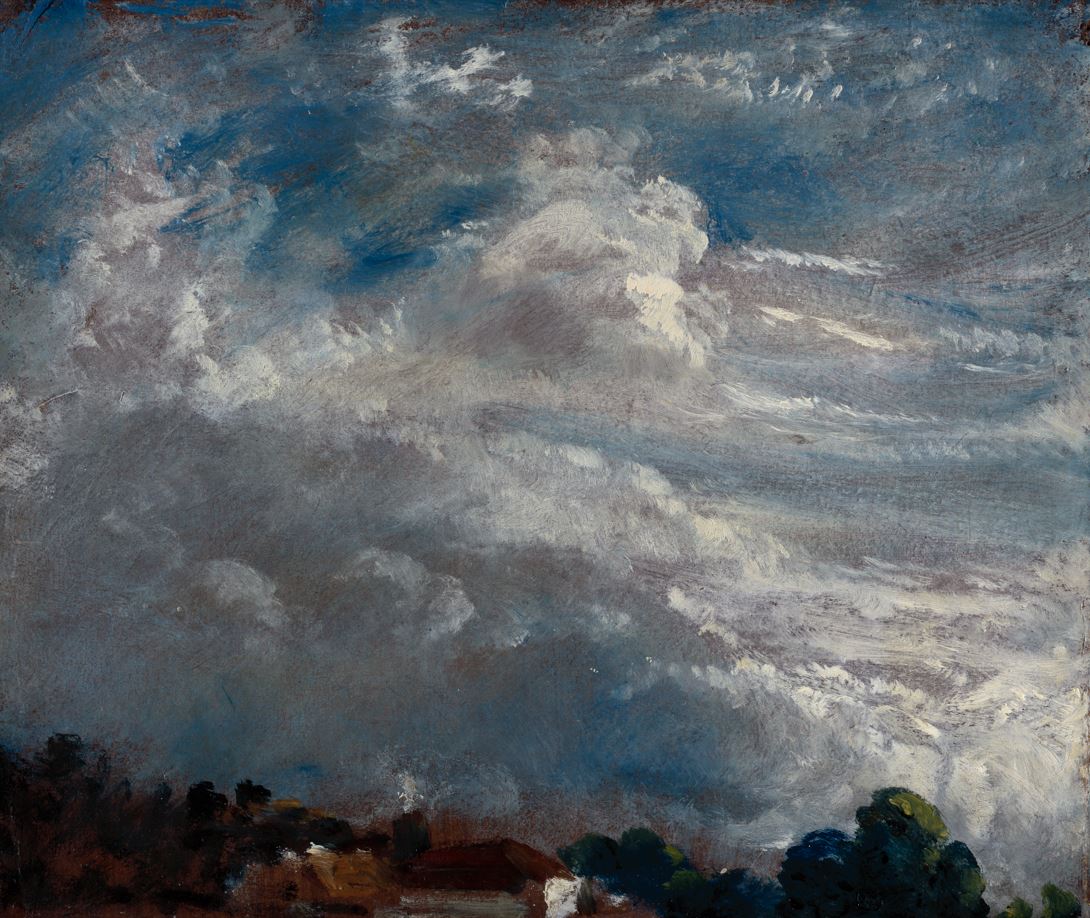
Clouds

Constable was particularly interested in the study of clouds. The exhibition includes numerous paintings, sketches and drawings he made of cloudscapes. A man named Alexander Cozens wrote a book titled ‘A New Method of Assisting the Invention in Drawing Original Compositions of Landscape’ which included different types of cloud shape and the exhibition includes some of the 20 drawings he made from the book as well as oil sketches.

Cloud Study: Horizon of Trees, 27 September 1821 by John Constable © Royal Academy of Arts, London; photographer: John Hammond

What Salisbury tells us

The show includes the splendid ‘Salisbury Cathedral from the Bishop’s Ground’ (1823) and it is a deep pleasure to sit on the bench in front of it and just drink it in. What sumptuous, sensual beauty of composition, colour and light.

Salisbury Cathedral from the Bishops Ground by John Constable (1823) © V&A Images / Victoria and Albert Museum, London

Slowly several points emerge, namely around the use of light and shade and clouds. The dark cloud rising from behind the cathedral gives the composition a sense of drama (it’s interesting to learn that the Bishop of Salisbury actively didn’t like this dark cloud).

It also indicates the kind of day it is, one of those days when the sun comes in and out between clouds, and this explains the radiance of the cathedral facade: it’s one of those moments when the sun comes out from between clouds and makes whatever it shines on appear radiant. Once you notice this, you realise it also applies to the meadow in front of the cathedral, up to and including the cow, whereas the field and trees further towards the viewer are still in shadow.

With this in mind, if we go back to the Hay Wain, I suggest part of its popularity is down to its use of cloud and light as design features. On the face of it, it’s a painting of a cart in a pond but if you focus just on the play of light, and light on clouds, several things become obvious.

The Hay Wain by John Constable (1821) © The National Gallery, London

The spiral

In the West we read from top left to right. I suggest that one of the reasons the painting feels so satisfactory and pleasing is the way its design plays to this deep way of ‘reading’ visual elements. So if you start at the top left the cloud is very dark which leads your eye to the right, towards the nice light cloud, and your eye continues on round and down into the meadow which stretches off into the distance and is dappled with sunlight, before swinging down into the water and round to the cart in the pond.

So my suggestion is that we don’t just perceive it as a complex composition and pick out details at random but enjoy this sense of sweep and progression.

Comparing the sketch

A bit more evidence for this us supplied by the full-sized sketch of the Hay Wain which the exhibition also includes. Comparing the sketch and the finished painting suggest quite a few points from which I’d emphasise two.

Full-scale study for The Hay Wain by John Constable (about 1821) © V&A Images / Victoria and Albert Museum, London

1. Brown and green

Remember the idea that older landscape artists used a tastefully subdued palette of brown when painting outdoors? Well, the sketch clearly shows that this is how Constable began, using a far more sombre, brown and rather lifeless palette. Comparing the sketch and the finished painting shows how powerful adding in the vibrant shades of green transforms the finished product. They bring it to life; they make it zing with life, foliage, fertility.

The Hay Wain by John Constable (1821) © The National Gallery, London

2. Decluttering the composition

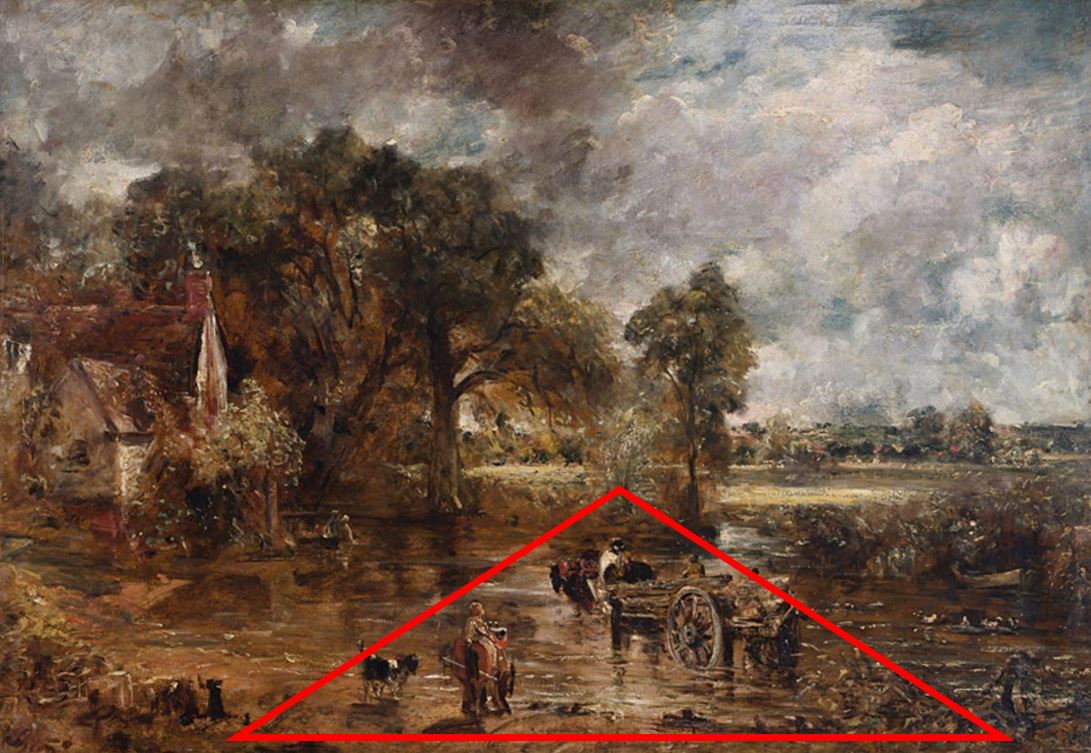
But back to the issue of composition, look at the one big, obvious difference between the sketch and the finished work. The figure of a horse and rider between the dog and the cart has been deleted. Why? Because including it crystallises the dog and cart from being light and almost random elements into becoming a strong central ensemble which dominates the picture. With it in your eye tends to go straight to it and you get distracted into peering closer to make out the precise nature of the figure on a horse (in fact, you have to peer quite closely to realise it’s a horse at all). And all this supersedes or obliterates the sweeping curve, the spiral I’ve described above.

Full-scale study for The Hay Wain by John Constable (about 1821) with added triangle © V&A Images / Victoria and Albert Museum, London

Keep it in and the eye goes straight to these central figures and tries to identify them / make them out, making you tend to overlook the wider composition. Remove it and your eye is freed to step back, to take in the larger compositional sweep, from dark cloud to light, round and down to the meadow, and only slowly and leisurely coming round to the cart. The picture becomes lighter and airier. It breathes.

History of an icon

It’s interesting to learn that John Ruskin, the godfather of mid-Victorian art criticism, really disliked Constable and helped depress his reputation for a generation. It was only later in the nineteenth century that Constable’s reputation bounced back and has remained high ever since.

The curators claim a major aim of the exhibition was to chronicle the rise of Constable from the kind of criticism he received in his lifetime and the active dislike of cultural arbiters in the mid-nineteenth century his current unassailable position as one of Britain’s classic painters. This is a fine ambition so it’s regrettable that the exhibition doesn’t really achieve it.

There are a few wall labels explaining that this or that painting was given to the National Gallery by supporters or, in one case, by his daughter, in this or that year, as if that tells us very much and that’s about it.

There’s a glaring absence of any explanation of what changed in aesthetic theory, in the practice of art, in social attitudes to the landscape, in artistic taste through the middle and later Victorian era to explain Constable’s rise and canonisation. I’d really like to have read this but didn’t see it anywhere.

So in the opening section there’s a 1920s black-and-white photo of Willy Lott’s cottage and we are told that it was extensively restored in the 1920s after a revival of interest in Constable’s paintings – but not why there was a revival of interest in Constable’s paintings. What was sufficiently different in the 1920s from the 1880s or 1860s to spark the investment? What changed and why?

Spoofs and parodies

To end on a lighter note, right at the start of the show, while they’re telling us how The Hay Wain has become an iconic image of the English countryside, the curators include half a dozen examples of how it’s been parodied and pastiched, used in cartoons and adverts for railways (‘Explore Constable country!’).

A striking one is this use of The Hay Wain in a 1929 cartoon bewailing the despoliation of the English countryside by cars and advertising hoardings. People tend to think this is a modern problem but here’s proof that it goes back at least a hundred years!

‘Had Constable lived today’ cartoon in the Daily Express, 2 March 1929, created by the Campaign for the Protection of Rural England © CPRE

There’s the satirical anti-war photomontage by radical anti-war artist Peter Kennard.

More up to date is this photomontage by Cold War Steve, where he’s cut and pasted leading political figures from 2019 into the scene. I like the truck full of dead washing machines but the killer detail is the image of Wayne Rooney riding a jet ski just to its left, so the joke is that this version of the picture should be titled ‘Hey, Wayne!’

The Hay Wain by Cold War Steve (2019) © Cold War Steve


Related links

Related reviews

Shakespeare and War @ the National Army Museum

A tale of two Henries

In 1944 Laurence Olivier produced, directed and starred in a movie version of Shakespeare’s play ‘Henry V’. Shot in bright primary colours it dealt in bright primary patriotic emotions and 30 years later my Dad and his best friend could remember seeing it in the cinema as 12-year-old kids and being stirred by its patriotic fervour, its stirring invocation of England’s valour and fortitude, at a time when German V rockets were falling on London and the south-east. (A V2 rocket fell on the house next door to my Dad’s, killing the occupants. The one time he mentioned it was the only time I ever saw him cry. Britain needed all the patriotism and determination it could muster.)

Installation view of ‘Shakespeare and War’ at the National Army Museum showing posters, cartoons, photos and programmes from the Second World War including a poster for Olivier’s Henry V

Those ardent schoolboys will have noticed that the film was ‘dedicated to the ‘Commandos and Airborne Troops of Great Britain the spirit of whose ancestors it has been humbly attempted to recapture’ because this appears as a caption at the start of the film, but won’t have known that the production was partly funded by the British government as a form of soft propaganda.

Forty five years later, in 1989, the actor widely seen as inheriting Olivier’s mantle, Kenneth Branagh, directed and starred in a new movie version of ‘Henry V’. Much was made of the fact that, instead of stylised sunny sets, the play went for a darker, grittier look, most notably in the battle of Agincourt scenes, filmed on a lovely sunny day in the Olivier version, but in a downpour of rain in the Branagh, which turns the battlefield into a quagmire, spattering all the characters with mud and also gore from the countless bodies which have been hacked and stabbed. Critics weren’t slow to point out that it was made in the aftermath of the Falklands War and so carried a strong message against war and warmongering.

Poster for the original 1984 Royal Shakespeare Company production of Henry V directed by Adrian Noble and starring Kenneth Branagh, as featured in ‘Shakespeare and War’ at the National Army Museum

The same play, the same author, the same plot, the same characters, the same stage directions and the same words – and yet supporting two very different productions, reflecting very different societies, mindsets and values.

These are just two examples of the way Shakespeare’s plays about war – the causes of war, the preparations for war, the experience of war, wartime emotions from terror to exhilaration – and the greatly varying opinions of his many different characters about war and warfare, have been quoted, adapted, distorted, illustrated and recycled, used both to support and attack Britain’s wars, in the 400 years since his death.

Shakespeare and War

The National Army Museum in Chelsea is currently holding a FREE exhibition titled ‘Shakespeare and War’ which sets out to review the huge history of the national playwright’s role in Britain’s many wars and conflicts and how his words, stories, characters and scenes have been used in widely different times and situations.

The exhibition sets out to document how the plays, characters and speeches have been excerpted and exploited propagandists, governments, commentators, satirists and anti-war activists, soldiers and civilians – during the turbulent 400 years since Shakespeare’s death, in 1616. As the curators put it:

The plays have been used to rally the nation at times of crisis and to reflect on the human cost of conflict. But they have also been used to critique war and to consider the more challenging aspects of the military experience. They have inspired soldiers and civilians alike, helping people face adversity on the battlefield and at home.

After Shakespeare

Thus the exhibition starts after Shakespeare’s death. There’s none of the usual fol-de-rol about his biography or the Globe Theatre or the parabola of his career, just the blunt facts that he was a very successful actor-dramatist-manager, who died in 1616, before the British Army even existed.

Instead we are thrown straight into the first major conflict which occurred after his lifetime, the civil war or wars of three kingdoms which broke out 23 years after his death, in 1639, and lasted until Cromwell’s pacification of Scotland in 1653.

The exhibition is divided into six broad historical sections, each of which is introduced by a wall label and then features all sorts of bric-a-brac from the period in question – broadsheets, posters, cartoons, pamphlets which cite or reference, quote or parody scenes, characters or speeches from the plays to suit the purpose of polemicists and propagandists of the moment, paintings or photos of Shakespearian actors or patrons, posters for productions through the ages, and then – in the modern era – recordings of radio and TV productions and so on. At the most basic level, it’s a curiosity shop of historical Shakespeariana.

1. Royal Shakespeare: The Civil War and Beyond

During the English Civil War Shakespeare was often associated with the monarchy. While in prison awaiting trial, King Charles I read Shakespeare’s (Second) Folio (the First and Second Folios were the first attempts to publish all Shakespeare’s works in one volume). The King made notes on its pages and the exhibition has his copy on show. This did not go unnoticed by the great poet and Puritan propagandist, John Milton, who is represented here by a first edition of his pamphlet, Eikonoklastes.

Installation view of the civil war part of ‘Shakespeare and War’, showing, on the left, engravings of Charles I (above) and Cromwell (below) along with Charles’s copy of the Second Folio beneath an English mortuary sword (photo by the author)

This little collocation of objects overflows with meanings. Eikonoklastes was written and published late in 1649 to justify the execution of King Charles which took place on 30 January 1649. It was a point-by-point rebuttal of a pamphlet titled Eikon Basilike, a Royalist propaganda work, which purported to be a spiritual autobiography of the saintly king. The Basilike set Charles up as the type of a perfect enlightened monarch who ruled by the Divine Right of Kings and through the ancient constitution. Milton refuted all these points and more, claiming that Charles’s rule had degenerated to a tyranny over a people who could only be free by executing him and abolishing the monarchy altogether.

Where does Shakespeare come in all this? Well, he was part of the culture wars between the two sides. Theatre was encouraged and sponsored by the King, the Court and aristocrats. Shakespeare’s younger contemporary, Ben Jonson, ended up writing masques – elaborate ritualistic performances, accompanied by music – for the King and Court, which reinforced the ideology of royalty and monarchical rule and in some of which the king himself took part.

In the eyes of radical Puritans all this was blasphemy. Representing people on stage came close to breaking the commandment about not worshipping images. Plays diverted people’s minds away from the only thing they should be contemplating, the glory of God. Playhouses were notorious sites of crime and prostitution. Shakespeare’s plays, even the sternest tragedies, are littered with outrageously rude puns and euphemisms, the kind of thing Parliamentary Puritans had in mind when they accused the theatre of staging ‘spectacles of pleasure, too commonly expressing lascivious mirth and levity.’

For all these reasons and more the Puritans protested against the theatre in the years leading up to the war, and this explains why, when Parliament took control of the capital in September 1642, they promptly shut down all the playhouses. Which explains why there’s an engraving of Cromwell in this exhibition showing him wearing a suit of armour above a pile of discarded theatrical bric-a-brac, such as masks and disguises. For 18 long years the theatres were dark. Shakespeare’s Globe was torn down in 1644 and turned into ‘tenements’.

The Restoration

In 1660 the monarchy was restored and Charles II assumed the Crown. His 25-year reign was troubled by political and religious issues along the old civil war schism, at its most fundamental the clash between devotees of the Protestant cause and Charles’s Court which became tainted with accusations of Catholic sympathy, especially after he married the Catholic princess Catherine of Braganza in 1662.

Like his father Charles was a great patron of the arts, including theatre, and his rule saw the flourishing of the movement referred to as Restoration Comedy. The theatre once again became associated with all the vices of Londoners at play, and this, like the theatre of his father, became the target of religious criticism. The ongoing schism between Catholic-leaning court and Protestant nobles came to a head during the three-year reign of Charles’s brother, James II, who with typical Stuart arrogance, not only took a Catholic wife but made it clear that the new infant son she bore him would be raised a Catholic. The Protestant aristocracy rebelled and overthrew him in what their propagandists named The Glorious Revolution, inviting the Protestant Prince of Orange (in modern Holland) to come and be our king.

The curators skimp a bit on this period, displaying just one work, a copy of a book by the playwright John Crowne adapting Henry VI parts 2 and 3 and titled ‘Misery of Civil War’.

Shakespeare’s history plays

The thing is, Shakespeare’s history plays amount to a sustained investigation of the nature of authority and ‘good’ rule. All of them are named after the English king they focus on and ask questions like, What makes a good king? What makes a bad king? Are nobles, or ‘the people’, ever justified in overthrowing a king? If two noble houses fight for the crown, what are ordinary people to do? Follow their conscience, try to avoid the conflict, or fight for their local lord and master? Is there such a thing as a ‘just’ war in which case, how do you define one?

Questions like these echo throughout the obvious plays i.e. the ones about English history, but are also central to the Roman plays and three of the four great tragedies.

The history plays are usually divided into three groups:

  • the series depicting the Wars of the Roses, being: Henry VI parts 1, 2 and 3, and Richard III (4 plays)
  • the second tetralogy – including Richard II, Henry IV parts 1 and 2, and Henry V
  • the standalone plays King John, Edward III and Henry VIII

The Roman plays which discuss the nature of authority and leadership focus on Julius Caesar and its sequel, Antony and Cleopatra. Both cover wars and include battle scenes.

The tragedies all feature war, in different ways. Macbeth is about a successful soldier and includes actual battle scenes. King Lear and Hamlet feature the invasion of their respective countries (England by the French and Denmark by the Swedes) but no actual fighting. And Othello is all about a highly successful mercenary general, which features no battles but is drenched in reminiscences of fighting and the rhetoric of battle.

What I’m trying to convey is that these 17 or so plays are rarely about war as such, but but are far more about the nature of power and authority and what happens when authority collapses.

The eight classic history plays are about the collapse of authority in one country and civil war among the English. The two Roman plays are the same: in both the Romans aren’t fighting any external enemy, but among themselves. Similarly, the three tragedies (excluding Othello) are about the collapse of royal authority in one country – the French only invade England in Lear and the Swedes invade Denmark in Hamlet once the native rulers have made a complete horlicks of trying to rule themselves.

And again, although the English come to the aid of the rightful heir to the throne at the end of Macbeth, they only have to do so because, yet again, the ruling class of the country in question (this time Scotland) have made a total mess of ruling themselves, as a result of all the murders Macbeth finds himself voodooed into committing.

Thus, the seventeen or so plays about history are almost entirely about the collapse of political authority in one country leading to civil war. The fifty years from the collapse of Charles I’s power in the 1630s through to the Glorious Revolution in 1688 are, therefore, the most relevant or applicable to Shakespeare’s concerns. It is, therefore, strange and intriguing that contemporaries, apparently, according to this exhibition, made so little application of the huge amount Shakespeare wrote on this subject to the one era in the past 400 years which most suited it.

This little survey of Shakespeare’s history plays also explains something else. Henry V is the only one in which is not about a civil war. Henry V is the only one in which we are not fighting among ourselves, but go abroad and fight somebody else. This explains why Henry V crops up in this exhibition as the spearhead for patriotic fervour more times than the ten other history plays put together – because once we’d sorted out our own political problems via the civil wars and rebellions of the seventeenth century, we turned our warlike energies against foreigners.

2. Revolutionary Shakespeare: Change and Political Debate

The late eighteenth century saw a major global war (against France) and two revolutions (in America and France) which changed the world. In each of these conflicts Shakespeare’s plays, characters and the Shakespeare brand were used to define, critique and support both a patriotic war and new political movements.

The Seven Years War

By the start of the eighteenth century Shakespeare had become established by numerous writers, critics and commentators as a national icon. The exhibition skips over the wars of the early 18th century, in Europe and India:

  • War of the Spanish Succession 1701 to 1714
  • Great Northern War 1717 to 1720
  • War of the Austrian Succession 1740
  • Carnatic Wars 1744 to 1763

Instead it jumps to the Seven Years’ War (1756 to 1763), the war against France which saw British victories on the Continent, in India, in the Caribbean and North America. The exhibition includes a number of interesting mementoes from the war.

David Garrick, the leading figure in London theatre by the mid-century, wrote a Dialogue to preface a 1756 production of The Tempest, in which two characters debate the rights and wrongs of the new war. It reminds us that for hundreds of years actors, managers and playwrights felt perfectly free to preface Shakespeare productions with prologues like this, tailoring the play to the issues of the day, or even cutting and rewriting bits of the plays to reflect current concerns.

In 1768 Edward Capell produced an edition of the plays in which he states what had, by then, become orthodoxy, that the 38 or so plays amount to ‘a part of the kingdom’s riches’. Not only this, but Britain’s standing ‘in the world’ depended on ‘the esteem within which these are held.’

The fact that Shakespeare’s one play which takes a foreign enemy is directed against the French did not escape numerous writers and commentators as Britain embarked on a global struggle against…the French. There’s a playbill for a production of Henry V staged in Covent Garden in 1761 which has two significant aspects. 1) For this occasion, the play was unsubtly subtitled ‘the Conquest of France’ and 2) each of the 23 productions were followed by a lavish recreation of the coronation of King George III which had just taken place (22 September 1761).

If Shakespeare’s association with kingship had been deeply problematic for Milton in the 1640s, long before a century had passed the name of Shakespeare, the Shakespeare brand, had become indissolubly linked to celebration of the solidly Protestant and anti-French monarchy.

The American War of Independence (1775 to 1783)

Following on from, and partly a result of, the Seven Years War, came the American War of Independence. Unsurprisingly, American patriots seeking to break from Britain drew on Shakespeare’s classical histories. Plays like ‘Julius Caesar’ and ‘Coriolanus’ helped support the idea of republican government and liberation from imperial rule.

The two sides (British and American) both staged plays and the curators display playbills from both sides, which use Shakespeare texts to propagandise for their cause. So there’s a playbill for an American production of Julius Caesar which applauds the ‘noble struggles for Liberty by that renowned patriot Marcus Brutus.’

There are rather more relics from the British side and the curators display pictures focusing on New York. This is because early on in the war, the British Army under the command of Lieutenant-Colonel Henry Clinton occupied New York City and turned it into a garrison town. Members of the Army staged regular productions of Shakespeare at the newly-renamed Theatre Royal, confirming the by-now well-established link between drama and royalty. the performances were staged ‘with permission’ of Clinton, who was also a patron of the performances. Plays were staged to raise funds for wounded soldiers. The British tended to favour Shakespeare’s monarchical plays, whilst American Patriots used plays with a republican ethos (such as Julius Caesar and Coriolanus) in their satirical prints and posters.

Lieutenant-Colonel Henry Clinton, 1st Regiment of Foot Guards, 1758 (National Army Museum)

The French Revolutionary and Napoleonic wars (1789 to 1802, 1805 to 1815)

As explained above, Shakespeare’s plays can be used to provide examples of resistance to oppression and corrupt politics and so justify insurrection against corrupt rulers. The French Revolution amounted to a massive ideological upheaval in the thinking of all Europe. In the three years after the initial overthrow of the monarchy in 1789, politicians and intellectuals all across Europe took the sides of either the revolutionary liberators or the rule of monarchy, hierarchy and order. But in 1792 revolutionary France declared war on Austria and Prussia and the conflict became military in nature. Many former sympathisers retracted their support, especially after the situation in Paris descended into The Terror of 1793 to 1794.

The French Revolutionary War lasted from 1792 to 1802, when it was terminated by the Treaty of Amiens. Fighting broke out a year later in what came to be called the Napoleonic Wars which were to last from 1803 to 1815.

During this long period of ideological and military conflict, Shakespeare plays, characters and lines were mobilised to justify both sides of the ideological and military divide. In Britain, politicians, public figures, actors, and the Army drew on the playwright’s characters and speeches to justify their reasons for going to war, and to criticize rebellions against royalty.

This 25-year period also happened to be a golden age of political satire, featuring two of the greatest British caricaturists and cartoonists, James Gillray (1756 to 1815) and Isaac Cruikshank (1764 to 1811). Amid the many visual jokes and references they and many cartoonists and commentators like them used to pillory the politics of the day, Shakespearian references loomed large.

So the exhibition has some excellent cartoons by both men, which invoke Shakespearian references for the purposes of mockery and exaggeration. This print by Cruikshank uses The Tempest to praise the patriotic Tory Prime Minister William Pitt and ridicule his chief political opponent, Charles James Fox, an opponent of the British monarchy who was an initial supporter of the French Revolution.

Prospero and Caliban in the Enchanted Island by Isaac Cruikshank (1798)

Smoothly dressed Pitt is depicted as the wonder-working magician Prospero, telling his creature:

Hence! – fetch us fewel and be quick
Thou wert best – shrugst thou malice?
If thou dost unwillingly what I command
I’ll rack thee with old cramps –

While Fox, portrayed as big ugly Caliban, and wearing a tricolour scarf (symbol of the revolution) shrugs with savage disgust, saying:

I must obey! his art is of such power
It would control a Setebos,
And make a vassal of him.

There’s a brilliantly vivid print by Gillray titled ‘A phantasmagoria – conjuring up an armed skeleton’ which depicts contemporary politicians as the three witches from Macbeth. The print criticises the Treaty of Amiens which was widely seen as a capitulation to France. In the picture the witches are replaced by three leading supporters of the treaty, Henry Addington, Lord Hawkesbury and William Wilberforce and their magic spells for peace have, it is implied, reduced Britannia to a skeleton. Note the sack of gold at bottom left implying that these ‘traitors’ were bribed to betray their country and the French cockerel at bottom right, mockingly standing astride a skinned British lion.

‘A Phantasmagoria; — Scene – Conjuring-Up an Armed-Skeleton’ by James Gillray (1803)

The exhibition includes probably Gillray’s most famous image, ‘The Plumb-pudding in danger; – or – State Epicures taking un Petit Souper’. The image depicts British Prime Minister William Pitt and French Emperor Napoleon carving up the world between them. I’ve seen it many times but didn’t realise that the epigraph directly under the title, at top right, is an adapted quote from The Tempest, namely ‘”The great globe itself and all that it inherits” is too small to satisfy such insatiable appetites’.

The Plumb-pudding in danger; – or – State Epicures taking un Petit Souper by James Gillray (1805)

In these cartoons you see something interesting happening. Many of the previous objects (from the Seven Years or American Revolutionary Wars) indicated that Shakespeare was best promulgated via productions of entire plays. Here, in these cartoons, you can see the way that Shakespearian tags and clichés now lend themselves to much more pithy and succinct visual media.

Satirical prints had been around all through the 18th century, in fact they go back to Shakespeare’s day and even earlier. But somehow the Gillray and Cruikshank feel new. They demonstrate how Shakespeare, as well as representing the ‘the kingdom’s riches, according to high-minded editors such as Edward Capell, could also be the source of popular jokes and gags.

From now on, alongside all the stirring patriotic stuff, the exhibition features a strand of often very funny works using Shakespeare for comic purposes.

3. Imperial Shakespeare: The Victorian Army

After Napoleon’s defeat at Waterloo in 1815, the British Army’s role began to change. Rather than fighting major campaigns on the Continent, it was regularly used to protect and expand Britain’s imperial possessions, to fight Queen Victoria’s ‘small wars‘. But further to what I just mentioned about comedy, my favourite bits from what amounts to the Victorian section of the exhibition, were comic.

It must be said that some of the exhibits in the show seem to bear a pretty slender relationship with its supposed subject, Shakespeare and War. For example, the eighteenth century section has a set of images around the death of General James Wolfe at the 1759 Battle of Quebec which have no direct relation to Shakespeare, don’t quote or cite Shakespeare, seem to have no relationship except that Wolfe’s death was made the subject of ‘patriotic plays’.

Less utterly irrelevant is this entertaining print. In 1823 British aristocrats still carried out duels and this print mocks the practice by having the duellers and their seconds portrayed as monkeys. Apparently the title derives from a quote from ‘The Merchant of Venice’ but it’s a pretty flimsy pretext for including it in an exhibition about Shakespeare and War.

Awful Moments or Monkeys of Honour, colour print by John Lewis Marks after an unknown artist (1823)

More directly relevant if irreverent are the excellent prints taken from a later book, the Military Misreadings of Shakespere by Major Thomas Seccombe. It contains 31 beautifully delineated cartoons of military cockups, clumsiness and pratfalls, each offset by an ironically serious Shakespeare quotation. In this one a beautifully dressed member of the Life Guards has just been thrown by his horse to the accompaniment of a grand quote from Titus Andronicus: ‘That what you cannot, as you would, achieve, you must perforce accomplish as you may’ which thus acquires a completely comic meaning.

‘That what you cannot, as you would, achieve, you must perforce accomplish as you may’ from Military Misreadings of Shakespere (1880)

The Crimean War (1853 to 1856)

It wasn’t all lolz. The great exception to the century of generally small colonial wars which the British Army fought was the Crimean War, the one major conflict we were involved in in the century between the end of the Napoleonic Wars (1815) and the start of the Great War (1914). This famously highlighted significant problems with the Army’s organization, notably in the famous and futile Charge of the Light Brigade. Newspapers reported on the poor conditions in which soldiers found themselves, leading to demands for improvements and reforms to the Army’s culture and structure.

Only one exhibit relates to this badly managed and bitter war, a watercolour done by the Swedish artist Egron Sellif Lungren which depicts a kind of cinematic reimagining of a production of Henry V (what else?) staged by Charles Kean at the Princess’s Theatre in 1859 i.e. a few years after the war ended. Queen Victoria attended the play and commissioned Lundgren to do a watercolour version of it for her Theatre Album. Of all the scenes in the play Lundgren chose to depict the siege of Honfleur which is not only the setting for Henry’s famous speech ‘Once more unto the breach dear friends’, but will have reminded many people of the long and gruelling British siege of Sebastapol.

Installation view of ‘Shakespeare and War’ at the National Army Museum showing Egron Sellif Lungren’s watercolour plastered across one wall, with Gillray and Cruikshank cartoons on the left

Imperial Shakespeare

Obviously the nineteenth century was the one in which Britain cemented its grasp over the largest land empire the world has ever known, as well as almost total control of the world’s oceans. This is a very big subject indeed and it is not really properly explored. Take just India. Were there no British theatres in India, Shakespeare productions in India? Did the growing Indian middle class every stage Shakespeare productions with Indian casts? Was Shakespeare’s name, plays or quotes never invoked to justify British rule in India? Were there comic or satirical pamphlets or prints using Shakespeare quotes to mock British rule in India? Not in this exhibition, nor anything about the British Army’s involvement in Africa, the Caribbean, the Middle East or Far East.

Instead, as I’ve already pointed out, some of the exhibits have only a tenuous or oblique connection to the exhibition topic. For example, a picture caption tells us that amateur theatricals were often staged by regiments and soldiers as peacetime entertainments, which we might well have guessed. And that’s the fairly flimsy pretext for sharing a photo of members of the East Yorkshire regiment staging a production of Hamlet at their barracks in Cheltenham in 1895.

The Cast of Hamlet, Winter Gardens, Cheltenham, 1895 (National Army Museum)

Meanwhile, there’s nothing about the second war of the period which shook British confidence, the Boer War of 1899 to 1902. Were there no Shakespeare productions mounted here in England to raise funds or stir patriotic fervour? Did the besieged populations of Ladysmith, Mafeking or Kimberley put on productions to keep their spirits up? Didn’t domestic commentators or cartoonists use Shakespeare quotes or characters as material? If so, none of it is displayed here.

4. Patriotic Shakespeare: The First World War (1914 to 1918)

During the First World War great service and sacrifice were required of both the Army and the civilian population. As in the last great campaign in Europe a century before, Shakespeare was used in Britain to rally the troops and the country behind a sense of national duty.

As mentioned above, some exhibits are included on pretty flimsy grounds: for example, there’s no real reason to include some of Lord Kitchener’s recruitment posters (Your country needs You) except for the fact that, after Kitchener drowned when the ship he was sailing in hit a German mine (HMS Hampshire, 5 June 1916) the League of the Empire started publishing and presenting special editions of the ‘Complete Works of Shakespeare’ to wounded and disabled soldiers in his name, an edition which quickly became known as ‘the Kitchener Shakespeare’ – but there’s nothing at all about Shakespeare in the famous posters.

‘Lord Kitchener’s Appeal’, recruiting poster, 1914 (National Army Museum)

More tenuous examples include: a sketchbook by a John Henry Jenkins, a front line soldier, which depicted not only trench life but the watercolours of amateur theatricals which the soldiers put on, although Shakespeare is nowhere mentioned; or a 1915 recruitment poster which includes the image of St George and the dragon and so, the curators suggest, might have reminded some viewers of Henry V’s famous call, ‘God for Harry, England, and Saint George!’ Pretty tenuous.

Much more relevant is a book of Shakespeare quotations arranged under themes or headings relevant to the war and distributed to soldiers, ‘Shakespeare in Time of War: Excerpts from the Plays arranged with Topical Allusions’, edited by the artist Francis Colmer and published in 1916.

Another apparently random object is this photo of Women’s Army Auxiliary Corps personnel packing boxes in a factory in 1918. Spot the Shakespeare connection? No, because there isn’t one…

Women’s Army Auxiliary Corps personnel packing boxes in factory, 1918

…until you look at the photo beneath it, which is a photo of Maggie Smale’s all-women production of Henry V, staged in a munitions factory in Leeds which had been operated by the ‘Barnbow Lasses’ during the Great War. Is this to do with feminism? Or pacifism? Or a celebrating of provincial grit? I wasn’t sure.

Still from Maggie Smale’s all-female production of Henry V as featured in ‘Shakespeare and War’ at the National Army Museum. Photo by Mike Oakes

Amateur productions of Shakespeare were mounted across the country, sometimes to raise morale, to entertain wounded soldiers, for the benefit of the public. Three hundred years after his death Shakespeare was not only a well-known brand but possibly the only literary writer a lot of working class people had heard of. As in his own time, he catered for an audience of elite intellectuals, the educated middle classes, and illiterate workers. You can see why Shakespeare productions abounded because he was 1) possibly the only playwright everyone had heard of and 2) safe –unlike more recent troubling playwrights of the previous generation (Shaw, Ibsen etc).

There’s a clip from an official film showing wounded soldiers watching open air production of A Midsummer Night’s Dream. Scenes like this 1) the British heritage which the soldiers were fighting for 2) to a wider audience demonstrated the care the government was taking of its fighting men. This clip appeared alongside footage of scenes of artillery and war preparation, thus dovetailing Britain’s cultural heritage into the war effort.

in my own life I’ve met plenty of people who don’t give a toss about official culture, art or theatre. You’ve got to wonder how many of the sock and maimed soldiers forced to watch this kind of thing actually enjoyed it or even understood it. Because that’s a thing about Shakespeare – unless you’re pretty familiar with the play beforehand, it’s impossible to get the most out of a theatrical production, in fact it’s often impossible to understand what’s going on and especially difficult to get any of the comedy in his plays.

It’s fascinating to learn about the Shakespeare Hut. In February 1916, to commemorate 300 years since his death, this mock-Tudor retreat was opened on a plot of land in Bloomsbury. The hut was built on a site cleared for a planned Shakespeare Memorial Theatre, which was abandoned because of the war.

The aim was to provide shelter for wounded Australian or New Zealand troops. Over the next two years it would welcome in more than 100,000 soldiers far from their New Zealand homes. Queen Mary visited in 1917, took up her post behind the tea counter, and poured cups for all the men.

The troops were subjected to regular Shakespeare productions, including an all-female Henry V starring Ellen Terry, one of the most famous actors of her day. Hah! So the Maggie Smale production was following in venerable footsteps.

The exhibition features photographs and playlists from the Hut and you can read more and see photos in an interesting Guardian article about it. Interesting to learn that it the site is now occupied by the London School of Hygiene and Tropical Medicine.

One of the most interesting learnings from the exhibition is about the role of theatricals among British prisoners of war held in Germany. The exhibition focuses on the Ruhleben Camp in Germany which housed some 5,000 POWs. Prisoners were allowed to construct a theatre and, for the same tercentenary which prompted the Shakespeare Hut, staged a series of productions, including Twelfth Night and Othello. The exhibition features photos and a programme from a 1915 production of As You Like It.

In a similar spirit, the British Red Cross mounted a Shakespeare Exhibition at the Grafton Galleries in 1917. Quite clearly, if you go looking for Shakespeariana during the First World War, you’ll find it.

Installation view of ‘Shakespeare and War’ at the National Army Museum, showing a poster for the Red Cross Shakespeare Exhibition of 1917 (photo by the author)

5. Democratizing Shakespeare: The Second World War

Same goes for the Second war. Once again Shakespeare was trotted out as the exemplar of the culture and values that were under attack from Nazi Germany, that we were fighting to preserve. The motives and means were very similar to the first war – am dram productions across the country to entertain wounded troops or raise money, leading actors of the day giving patriotic productions in London to stir patriotic fervour, footage of productions shot to be show in cinemas and raise morale.

With the new angle of radio. For the first time productions could be broadcast, to a large radio audience which steadily grew throughout the six war years. As part of the government’s attempt to mobilize society to support the war effort, British theatre was sponsored by the state for the first time in its history.

The Council for the Encouragement of Music and the Arts (CEMA) was created to promote and maintain the fine arts and British cultural life. It later became the Arts Council of Great Britain. The Entertainment National Services Association (ENSA) provided for the forces, organising shows and performances by well-known actors, singers, and comedians.

Photo of an ENSA production staged in a London underground station in 1942 (National Army Museum)

Despite the challenges of wartime, both theatre and Shakespeare thrived. Once again, his words helped to frame the experience of conflict both in Britain and across the world. The exhibition features a recording of a radio programme originally broadcast by the BBC Overseas Services on Shakespeare’s birthday on 23 April 1942. It included extracts from ‘As You Like it’, Henry IV part 1 and, of course, Henry V. It was introduced and performed by leading Shakespearean actors Peggy Ashcroft, Robert Donat, Edith Evans and Ralph Richardson. You can listen to it on headphones and marvel at their phenomenally posh plummy English voices.

There’s a section devoted to the Laurence Olivier production of Henry V described at the start of this review.

And once again there’s a section devoted to British prisoners of war staging Shakespeare productions in camps in Germany. The exhibition includes a list of plays staged at Stalag 383 in Hohenfels, which included ‘The Merchant of Venice’.

6. Just Shakespeare: Adapting After 1945

After the Second World War the patriotic tone of Laurence Olivier’s Henry V lingered throughout the 1950s. But the second half of the 1960s saw radical changes in all aspects of art and culture, with a variety of new approaches to all the arts including theatre. This included the anti-war movements triggered by Vietnam, as well as new attitudes to sex and nudity, which now began to appear in Shakespeare productions.

For 200 years the name and plays of Shakespeare had acted as a kind of recruiting sergeant for the British Army and rallying point for the nation in times of real threat (particularly during the Napoleonic, First and Second World Wars). From the late 60s onwards, Shakespeare’s relationship with the state, the Establishment and the Army came under increasing critical scrutiny. Not in every production, but in an increasing number.

Hence Kenneth Branagh’s 1984 RSC production. Unlike earlier productions it shows the execution of French prisoners onstage and then left the bodies and corpses from the Battle of Agincourt at the back of the stage, behind a gauze curtain, for the later, supposedly reconciling scenes between the English king and his French bride-to-be.

The last section of the exhibition, in the central booth of the (fairly small) exhibition space, takes the Branagh production as setting the tone for productions which followed the Falklands War (1982), the Gulf War (1990 to 1991), and the Iraq War (2003 to 2011).

It includes video clips of stage productions including:

  • a 2013 production of ‘Othello’ which depicts the characters in the modern-day Army uniform used during the Iraq War
  • a 2015 production of ‘Othello’ which features graphic scenes of waterboarding Iraqi suspects
  • ‘Days of Significance’, a play by Roy Williams based on ‘Much Ado About Nothing’ which looks at the impact of British troops who fought in the Iraq War

The strong anti-war flavour of these productions and the pretty intense criticism of the British Army and its techniques, could hardly be more unlike the innocent patriotism of the Shakespeare Hut or the brightly colours optimism of Olivier’s Henry V. If we go to war with Russia I wonder if Shakespeare will be trotted out to inspire patriotic spirit as it was 100 and 70 years ago. I doubt it. Shakespeare hasn’t changed, that’s to say the texts remain pretty much what they were 400 years ago. But our understanding of war, gained in the brutal conflicts in Iraq and Afghanistan, has made any thoughts about the glamour or heroism of war impossible to modern Brits.

Availability bias

This is a fascinating premise for an exhibition and I thoroughly enjoyed working my way through the wealth of objects and their captions. It proves that Shakespeare is like the Bible, so compendious and diverse that you can find words to justify more or less any opinion on any subject (as demonstrated by the opposing sides in the American War of Independence using Shakespeare to bolster their arguments).

However, it throws up an obvious issue which is to do with the availability of objects to display. The exhibition was curated by – and is based on the scholarly books by – two Shakespeare scholars, Amy Lidster and Sonia Massai, namely Wartime Shakespeare: Performing Narratives of Conflict. Just from the synopsis on Amazon you can see how a book-length work like this is free to range over all and any productions it likes because words are easy. On the other hand, an exhibition in a museum is severely limited by the objects it can get its hands on.

In fact, like every exhibition at every gallery or museum, this one is an exercise in the art of the possible. Objects which denote important productions or topics may not be available (or may not even exist) while other topics throw up a glut of barely relevant artefacts.

In addition, it’s difficult and expensive to get objects on loan from other collections whereas it’s cheap and easy to get them from your own storeroom, so all exhibitions in all galleries are biased towards the host institution and its collection.

Plus there’s the common problem with any historical overview which is that objects from three or four hundred years ago are rare whereas, as you get closer to the present day, the number of objects rapidly increases, until you are drowning in a surfeit of stuff.

These imbalances in the real world threaten to unbalance or distort the picture painted by any exhibition, an imbalance which is easily managed in books and articles where issues and ideas can be easily conveyed by text alone.

So, at various points, I couldn’t help feeling that the curators had included some objects more because they were just related to one of the conflicts during the period in question than for their Shakespearian relevance. As mentioned above I couldn’t see any Shakespeare connection to the three or four pictures of General Wolfe and the capture of Quebec except that the event was turned into patriotic plays and prints. To put it another way, some of the links between specific conflicts and Shakespeare were pretty tenuous. I still don’t understand why there was an English mortuary sword in the Civil War section except that maybe the curators felt they just needed a physical object, any object, to go alongside the half dozen books and pamphlets.

All the objects (photos, pamphlets, diaries and whatnot) are interesting, it’s just that I was left scratching my head why some of them were included.

Shakespeare and conflict

There’s another, more scholarly, issue. This, as I touched on earlier, is that taken together, Shakespeare’s dozen or so history plays, plus the relevant Roman plays and the tragedies, build up into a subtle, sophisticated, multifaceted meditation on the themes of power, authority, legitimacy, insurrection, rebellion, revolt and overthrow.

Arguably, to really address the topic which this exhibition sets out to explore, you would need a really sound grasp of how all these issues are dramatised and explored in the 20 or so relevant plays, before you even started your review of how they’ve been applied to Britain’s wars and Britain’s Army.

But this, of course, is a massive task – after a lifetime reading Shakespeare I still haven’t read all the history plays and have nothing like a complete grasp of the issues of legitimacy and political power which they raise.

And an exhibition like this has to be practical, finite and manageable. This one achieves what it sets out to do, in a relatively small space, as well as it probably could do. But, in my opinion, the ghost of the larger political, social and cultural issues raised by the plays hover over it, unmentioned and undiscussed.

To take just one aspect of what I’m driving at, many of the characters in the history plays (the ones I’m familiar with) describe and discuss the horror of war, the fear experienced by soldiers, the terror of innocent civilians, the horrific injuries, killing and massacres involved, the fields strewn with bodies, the devastated landscapes and ruined economies. Descriptions of these kinds of things are commonplace in the plays and yet, somehow, hardly occur anywhere in this exhibition.

At some point I realised that this is not an exhibition about Shakespeare and War as about Shakespeare and the British Army. This explains why it’s divided into chronological periods based entirely around conflicts the British Army engaged in right up to the present day, rather than the themes of war encountered in the plays which I have just listed. And this is why, although it’s a very enjoyable trot through British military history, with an emphasis on how Shakespeare’s name, characters and words have been exploited in times of war – it feels, ultimately, despite being packed with shiny objects, intellectually thin.

You can see how an exhibition about Shakespeare and war would actually be something quite different: instead of taking a chronological approach it would take the topics I’ve mentioned several times now – the collapse of authority, civil war, rebellion, interstate war – and then the aspects of war – recruitment, training, fighting, sieges, inspirational rhetoric, the exhilaration of fighting, the horror of wounding, the devastation of the countryside, the mourning of widows – and explore how all of these are described and critiqued in Shakespeare’s multifaceted dramas. It would be something completely different from this exhibition. But then again, maybe what I’ve got in mind would be so wordy and text-heavy that it couldn’t be staged as an exhibition at all.

What this exhibition does, it does very well. It is small but beautifully staged and is FREE.


Related link

Related books

Shakespeare reviews

National Army Museum reviews

Joshua Reynolds: The Life and Times of The First President of the Royal Academy by Ian McIntyre (2003)

Sir Joshua Reynolds (1723 to 1792) was one of – if not the – leading English painter of the 18th century. He specialised in portraits, painting about 2,000 of them during a long and busy professional career, as well as 200 ‘subject pictures’, and over 30 self-portraits.

Self-portrait by Sir Joshua Reynolds (1780) Note the bust of Michelangelo, the Rembrandtesque hat, and the text of one of his Discourses folded in his hand © Royal Academy of Arts

Reynolds promoted a ‘Grand Style’ in painting which was less interested in visual or psychological accuracy to his sitters than in placing them in idealised and heroic poses and settings. He was known – and criticised – for pinching aspects from the Old Masters – poses, tints, props, tricks of lighting and so on.

So when you look at this painting – of Reynolds’s lifelong friend, the successful actor David Garrick – you see that not only is he caught between the two allegorical figures representing Comedy and Tragedy, but that the figures are each painted in different styles – the figure of Comedy on the left in a flirty rococo style of Correggio, the figure of Tragedy is done in a consciously ‘antique’ or neo-classical style reminiscent of Guido Reni, dressed in Roman robes with a stern profile – and Garrick in the middle, is wearing a historical costume reminiscent of van Dyck but his face is done in an unashamedly realistic or figurative style.

David Garrick Between Tragedy and Comedy by Joshua Reynolds (1760)

Reynolds was a founder and first president of the Royal Academy of Arts. He gave an inaugural lecture and this soon settled into an annual – later, biannual – lecture or ‘discourse’. At the end of his life these were published together as 20 or so Discourses about art, which were influential for decades afterwards.

The biography

Ian McIntyre’s biography of Sir Joshua Reynolds is a big book, weighing in at 608 pages, including index and notes (542 pages of actual text). What makes it hugely enjoyable is the way McIntyre very deliberately widens its scope to become a portrait of the age. Not a page goes by without entertaining and often amusing digressions away from the basic chronology of events.

For example, before we’re ten pages in we’ve had a whistlestop history of Devon and the town Reynolds was born in, Plympton, from Roman times to his birth in 1723. There’s an interesting explanation of the medieval and Renaissance tradition of Emblem Books and in particular the work of Jacob Cats, little known in this country but hugely influential on the continent. A little detour into the life of a well-known gypsy of the early 18th century, Bamfylde Carew. And so on.

The book is packed with footnotes, often as many as six on a page, giving biographical snapshots of every single person Reynolds comes into contact with, reads or meets or writes to or mentions, often with a bit of background about their achievements in art or literature – Reynolds cultivated friendships with the leading writers of the time – or, quite often, the wars or battles they were involved in, as a) Reynolds painted a large number of military and naval personnel and b) Britain was almost continually at war throughout the 18th century.

This blizzard of contextual information is partly explained because, as McIntyre candidly points out, we don’t actually know all that much about Reynolds’s life. We know he went to Italy to study the Old Masters for an extended stay from ages 25 to 27 (1750 to 1752). Then he returned to London, set up a studio, and quickly became very successful. We have annual business ‘pocketbooks’ he kept, and these are packed full of appointments with sitters, practical notes about rents and paints and canvas and shopping (p.94). We have the accounts and minutes of the Royal Academy which he set up and ran from 1768 till his death in 1792, the Discourses he published to the world – the written version of the lectures he delivered at the Academy – and numerous descriptions of him in the diaries and letters of contemporaries – but not much more.

Reynolds didn’t keep a diary or interesting notes and thoughts about art which contain breath-taking insights and ideas. He never married, and so didn’t have either a wife or children to write memoirs about him. He doesn’t appear to have had affairs, or if he did they were kept very secret (the issue is discussed on p.85). His sister, Fanny, was his housekeeper for 25 years, followed by a niece.

Er, that’s about it in terms of a ‘personal’ life.

`So in a way McIntyre’s strategy of padding out the story with reams and reams of information about pretty much everyone else alive at the time was a necessity – a factual account of just Reynolds’s life would be quite sparse. Still, McIntyre’s encyclopedic approach makes for a highly enjoyable account.

As does his rangy, slangy style. He is at pains to emphasise that he is not a stuffy art critic, he’s one of the boys:

  • Then, brushing away a crocodile tear, he [an anonymous critic] put the boot in. (p.319)
  • Reynolds was taking a fair amount of stick in the press… (p.320)

18th century artists

Thus McIntyre doesn’t just place Reynolds in the 18th century art world – he introduces us to quite an intimidating number of 18th century artists, starting with Reynolds’s predecessors in Britain, referencing leading contemporary painters in France and Italy, and then a host of other contemporary painters – the famous, the not so famous, and the downright obscure. They include – and this list excludes all the many sculptors:

  • Sir Godfrey Kneller (1646 to 1723) leading portraitist of his time
  • Francesco Solimena (1657 to 1747) leading Italian painter of the Baroque
  • Jonathan Richardson (1667 to 1745) whose book, ‘An Essay on the Theory of Painting’ inspired young Reynolds
  • Joseph Highmore (1692 to 1780)
  • William Hogarth (1697 to 1764) leading English artist, caricaturist and printmaker
  • Jean-Baptiste-Siméon Chardin (1699 to 1779) ‘the other great middle-class painter of the century’ specialising in quiet domestic scenes, in contrast to either grand historical paintings, or pink and blue rococo
  • John Shackleton (? to 1767) Principal ‘Painter in Ordinary’ to George II and George III
  • Thomas Hudson (1701 to 1779) Reynolds was apprenticed to him
  • Francesco Zuccarelli (1702 to 1788) Italian landscape painter from Venice
  • Jean-Étienne Liotard (1702 to 1789) French portraitist working mainly in pastel
  • Francis Hayman (1708 to 1776)
  • Arthur Devis (1712 to 1787) started as landscape artist, then portraits of members of pro-Jacobite Lancashire families, then portraits of London society
  • Allan Ramsay (1713 to 1784) rising star arrived in London from Rome in 1738, painted the definitive image of the coronation of King George III and a stream of royal commissions
  • Claude-Joseph Vernet (1714 to 1789) landscape and marine painter
  • Richard Wilson (1714 to 1782) ‘the classic master of British 18th century landscape painting’
  • Henry Robert Morland (1716 to 1797) Young woman shucking oysters
  • Richard Dalton (1720 to 1791)
  • Katherine Read (1721 to 1778) Scottish portrait painter
  • John Astley (1724 to 1787) portrait painter
  • George Stubbs (1724 to 1806) English painter of horses
  • Francis Cotes (1726 to 1770) pioneer of English pastel painting
  • Thomas Gainsborough (1727 to 1788)
  • Anton Raphael Mengs (1728 to 1779) German artist, precursor of neo-classicism
  • Charles Catton (1728 to 1798) coach painter to George III
  • George Barrett Senior (1732 to 1784) Irish, leading contemporary landscape painter
  • Jean-Honoré Fragonard (1732 to 1806) late Rococo painter of remarkable facility, exuberance, and hedonism
  • Robert Edge Pine (1730 to 1788)
  • George Romney (1730 to 1802) portrait painter in the Reynolds / Ramsay league
  • Sawrey Gilpin (1733 to 1807) English animal painter, illustrator and etcher who specialised in painting horses and dogs
  • Johann Zoffany (1733 to 1810) German neo-classical painter
  • Joseph Wright (1734 to 1797) to become Wright of Derby
  • Jeremiah Meyer (1735 to 1789) Painter in Miniatures to Queen Charlotte, Painter in Enamels to King George III
  • John Singleton Copley (1738 to 1815) Anglo-American painter, active in both colonial America and England
  • Benjamin West (1738 to 1820) first American artist to visit Rome, settled in London as a painter of historical scenes, early pioneer of neo-classicism
  • Nicholas Pocock (1740 to 1821) master of a merchant ship aged 26, he became a noted painter of naval battles
  • Ozias Humphry (1740 to 1810) a leading English painter of portrait miniatures, later oils and pastels
  • Angelica Kauffman (1741 to 1807) history painter and portraitist
  • Ozias Humphrey (1742 to 1810) a leading English painter of portrait miniatures, later oils and pastels
  • Mary Moser (1744 to 1819) English painter specialised in flowers
  • Philip Reinagle (1749 to 1833) pupil of Allan Ramsey, specialised in hunting pictures: Members of the Carrow Abbey Hunt
  • Robert Smirke (1753 to 1845) English painter and illustrator, specialising in small paintings of literary subjects
  • James Gillray (1756 to 1815) British caricaturist and printmaker
  • Thomas Rowlandson (1757 to 1827) English artist and caricaturist of the Georgian Era
  • Maria Cosway (1760 to 1838) Italian-English artist and educationalist
  • John Opie (1761 to 1807) English painter of historical subjects and portrait, took London by storm in 1781
  • Thomas Phillips (1770 to 1845) leading English portrait painter of the day, notable for portraits of William Blake and Lord Byron
  • Benjamin Haydon (1786 to 1846) British painter who specialised in grand historical pictures,

As with many of McIntyre’s digressions about contemporary figures, I found it well worth taking a few minutes to look up each of these painters. I was particularly drawn to some of the pictures of Jean-Étienne Liotard who I’d never heard of before.

The Chocolate Girl by Jean-Etienne Liotard (1744)

Provenances

An interesting aspect of Reynolds’s career is the number of portraits which have gone missing or are disputed. That the authorship of works of art can be disputed is significant: it shows you that, when the provenance of a painting is crystal clear, then the experts can confidently pontificate about its distinctive composition and style; but where there is no signature of clear history of ownership, where the authorship is disputed, then style and composition are not enough to determine the identity of the painter. Take this portrait of a black man.

Portrait of an African by Allan Ramsay (1757 to 1760)

It is instructive to learn that it was once thought to be a portrait of Olaudah Equiano and painted by Joshua Reynolds, but is now generally accepted to a portrait of the young Ignatius Sancho painted by the Scottish painter, Allan Ramsay. The point being that the ‘house style’ of 18th century portrait painters was so similar, overlapped at so many points, that even experts can’t tell them apart.

Destructions

McIntyre’s book is extremely thorough. He documents the sitters and the painting sessions for what seems like every one of Reynold’s nearly two and a half thousand paintings. But a theme which emerges is the dismayingly large number of paintings which have been lost or destroyed, by Reynolds:

  • Portrait of Lady Edgcumbe – destroyed by bombing during Second World War
  • Portrait of Thomas Boone – untraced
  • Portrait of Jane Hamilton – untraced
  • Portrait of Mrs Baddeley – untraced
  • Portrait of Alexander Fordyce – untraced
  • Portrait of Elizabeth Montagu – untraced

No fewer than nineteen works by Reynolds were destroyed in a disastrous fire at the family seat of the Dukes of Rutland, Belvoir Castle in Grantham, Leicestershire, in 1816 (in which also perished works by Titian, Rubens and Van Dyck).

Or other artists of the day:

  • Benjamin West’s Cimon and Iphigenia and Angelica and Medoro – untraced

Which gives rise to a meta-thought: I wonder what percentage of all the paintings ever painted, still exist? Half? A quarter? To put it another way – how much of all the art ever created has been ‘lost’?

[The beginnings of an answer are given in Peter H. Wilson’s vast history of the Thirty Years War where he writes that Dutch artists produced several million paintings in the 16th and 17th centuries combined – ‘of which perhaps 10 per cent survive‘ (p.816). 10% – is that a good working guesstimate?]

Miscellaneous notes

Reynolds’s first studio was at 5 Great Newport Street, in London’s West End. It was on the edge of the country, with a good sized garden both behind and in front (inconvenient in rainy weather since rich people’s carriages couldn’t park right outside the door, p.119). His rival, Allan Ramsay (1713 to 1784) lived round the corner in Soho Square.

In 1760 he moved to a house on the west side of Leicester Fields, later Leicester Square. The Prince of Wales kept a big house dominating the north side. Hogarth had lived since 1733 in a house on the east side.

Reynolds’s style is considered ‘more masculine and less ornamental’ than that of his main rival, Allan Ramsay, who was therefore generally thought to be the better painter of women portraits (p.117).

Penny-pinching Reynolds was careful with money. Anecdotes abound. He got up early to visit the fishmarket to select the best value fish then returned home with detailed instructions to his servant about which ones to buy. He made a fuss about the value of an old mop (p.122)

Vandal

Reynolds was fantastically disrespectful of old paintings. Apparently, he stripped back layer by layer of paint to see how they had been painted, a number of Venetian paintings and one by Watteau – stripped them right down to the canvas until he had utterly destroyed them (p.239).

Factory production

None of your romantic waiting-for-inspiration nonsense, 18th century painters painted to order and commission and on an awesome scale. Allan Ramsay’s portraits of George III and Queen Charlotte dressed for his coronation (1761) was so popular that his studio i.e. assistants, produced no fewer than one hundred and fifty pairs of the paintings to meet the market; buyers including members of the royal family, sovereigns, heads of state, colonial governors, ambassadors, corporations, institutions and courtiers.

Knock ’em out, pile ’em high was the watchword. When one aristocratic sitter offered to come for an additional sitting so that Reynolds could have a session devoted to her hands (of which she was very proud) Reynolds casually told her not to bother as he normally used his servants as models for hands (p.137). (This chimes with the revelation in James Hamilton’s book that Gainsborough generally painted the entire body of his sitters from models, often his wife or grown-up daughters.)

Anti-romanticism

It has been the fate of arts to be enveloped in mysterious and incomprehensible language, as if it was thought necessary that even the terms should correspond to the idea entertained of the instability and uncertainty of the rules which they expressed.

To speak of genius and taste as any way connected with reason or common sense, would be, in the opinion of some towering talkers, to speak like a man who possessed neither, who had never felt that enthusiasm, or, to use their own inflated language, was never warmed by that Promethean fire, which animates the canvas and vivifies the marble.

If, in order to be intelligible, I appear to degrade art by bringing her down from her visionary situation in the clouds, it is only to give her a more solid mansion upon the earth.  It is necessary that at some time or other we should see things as they really are, and not impose on ourselves by that false magnitude with which objects appear when viewed indistinctly as through a mist. (Discourse 7)

No good at drawing

Reynolds was acknowledged to be more interested in colour and tone than in drawing and design. He himself confessed he wasn’t too strong on anatomy. One of the hardest parts of pure figure drawing is hands and Reynolds’s sitters hands are often ungainly, stylised or hidden. He wasn’t too bothered about strict visual accuracy:

The likeness consists more in taking the general air, than in observing the exact similitude of every feature. (quoted on page 127)

‘Flying colours’

Throughout his career Reynolds experimented with materials that make an oil painting, incorporating at one time or another, asphalt, wax, charcoal, experimenting with non-traditional types of key colours such as incarnadine for red. This was often disastrous, as scores of anecdotes testify, the painter Benjamin Haydon just one who was sharply critical of his over-treatment of his paintings (quoted page 282).

One painting, being carried to its patron, was knocked in the street and the entire creation simply slid off the canvas and onto the street. Many others complained that the colours changed. The sky in Admiral Barrington’s portrait changed from blue to green within months of receiving it (p.362). Hence his reputation for ‘flying colours’ and many burlesques and parodies about them.

Rich

As a result of his astonishing industry, Reynolds was by 1762 making £6,000 a year (p.141). By way of comparison, the homely parson in Goldsmith’s The Deserted Village has a stipend of:

A man he was, to all the country dear,
And passing rich with forty pounds a year.

By about 1780 it cost 50 guineas for a ‘head’, 70 guineas for a ‘half length’, 200 guineas for a full length (p.361).

Reynolds’s deafness

In Rome in 1751 Reynolds suffered a heavy head cold which left him partially deaf. For the rest of his life he carried about an ear trumpet. There are numerous humorous anecdotes of him pretending not to hear unflattering or critical remarks.

Reynolds’s height

Sir Joshua Reynolds was five feet five and one-eighths of an inch tall (p.149).

Reynolds and the king

Despite his prolific portrayal of the British aristocracy, Reynolds was disliked by King George III and never got the post of Principle Painter in Ordinary which he aimed for. This post went to Allan Ramsay in 1761. A number of reasons are given for this dislike, for example that when Reynolds was offered the presidency of the newly founded Royal Academy in 1768 but said he’d have to consult his close friends, Dr Johnson and Edmund Burke. Since it was a royal appointment which the king had personally agreed, he was offended that Reynolds hesitated, and particularly offended at the mention of Edmund Burke, a critic of the king. And his friendship with John Wilkes, a radical critic of the king and the Establishment as a whole (p.322).

Reynolds and Dr Johnson

I’d like to like Dr Johnson more than I do. At the end of the day, his bluff English pragmatism comes close to philistinism. His rudeness was legendary, as was his greed (the story of a host setting out bowls of clotted cream, strawberries and a jar of cider for a party of guests and Johnson eating the lot, or asking for pancakes and eating 13 in a row) and his addiction to tea. And his depression: letters are quoted in which he describes his morbid fear of being left alone to his thoughts. Which is why it was difficult to get rid of him; he’d pop round for tea then stay, talking interminably, till past midnight. If he was ever left out of a conversation:

His mind appeared to be preying on itself; he fell into a reverie accompanied with strange antic gesticulations. (Reynolds, quoted page 210)

Reynolds and his sister

Reynolds’s sister, Francis (1729 – 1807), acted as his housekeeper from when he moved to London in the early 1750s until 1779, when some kind of argument – still unknown – led to her leaving and her place being taken by their nieces. Fanny was an artist in her own right, of histories and portraits. She also wrote and won the support of Dr Johnson, who encouraged her and remained friendly and supportive even after the break with her brother. Mutual friends were critical of Reynolds’s treatment of her, e.g. Mrs Thrale (p.327).

Reynolds and Gainsborough

The ‘Grand Style’ which Reynolds spoke about in his Discourses meant improving on nature, removing blemishes and imperfections, creating an idealised image.

The likeness consists more in taking the general air, than in observing the exact similitude of every feature. (p.127)

And by ‘idealised’ he often meant aspiring to the style of Roman art and architecture, all pillars and togas. Thus Gainsborough and Reynolds disagreed about what their sitters should wear. Gainsborough, the more informal, casual and bohemian (p.338) of the pair thought it was an important part of capturing a sitter’s personality that they wore their own clothes; Reynolds, by contrast, kept a wardrobe of ‘idealised’ costumes and often painted his sitters in Romanised togas and tunics. The Dowager Duchess of Rutland complained that Reynolds made her try on eleven different dresses before settling on what she dismissed as ‘that nightgown’ (p.151).

Benjamin West, the American painter of historical scenes and second President of the Royal Academy, is quoted criticising Reynolds’s fondness for dressing his female sitters in antique robes, pointing out how much more interesting and useful for posterity it would be to see them in their actual everyday wear.

Technical terms

Conversation piece

An informal group portrait, popular in Britain in the 18th century, beginning in the 1720s, distinguished by portrayal of a group apparently engaged in genteel conversation or some activity, very often outdoors. Typically the group will be members of a family, but friends may be included, and some groups are of friends, members of a society or hunt, or some other grouping.

Fancy picture

Fancy picture refers to a type of eighteenth century painting that depicts scenes of everyday life but with elements of imagination, invention or storytelling. The name fancy pictures was given by Sir Joshua Reynolds to the supreme examples of the genre produced by Thomas Gainsborough in the decade before his death in 1788, particularly those that featured peasant or beggar children in particular. (Source: Tate)

Profile portrait

The profile portrait ultimately derived from coins and medals from ancient Rome. It could be used as a commemoration of the dead, or as a tribute to the living great.

Eighteenth century London courtesans

In terms of his desire to associate himself with the celebrity of others, the most compelling paintings by Reynolds are surely his portraits of courtesans which he began to make from the late 1750s onwards.

I include this list not out of a conscious or unconscious wish to define women by their sexuality, but because these women’s lives are fascinating, and the niche they occupied in the society of their time so startlingly different from our day.

Eighteenth century women artists

  • Katherine Read (1721 to 1778) Scottish portrait painter
  • Angelica Kauffman (1741 to 1807) history painter and portraitist
  • Mary Moser (1744 to 1819) English painter specialised in flowers
  • Maria Cosway (1760 to 1838) Italian-English artist and educationalist

Those are the ones I noticed in the text. There’s a full list of eighteenth century women artists online:


More eighteenth century reviews

John Opie @ Tate Britain

Tate Britain is labyrinthine enough to have half a dozen side rooms and spaces where it mounts small (and sometimes not so small) ‘spotlight’ exhibitions, focusing on a particular topic or artist.

In a modest room off the main atrium, little more than a glorified corridor, Tate Britain is hosting a small but beautifully formed exhibition about the painting and cultural environment of the late-eighteenth century English painter, John Opie (1761 to 1807).

The Cornish Wonder

Opie’s success is surprising because of his background. In the late eighteenth century artists generally came from artistic families, or from educated, middle-class homes where their interest in such a risky career could be indulged.

In contrast, Opie was born at St Agnes, near Truro in Cornwall, the son of a mine carpenter. Although he did attend school, he was probably largely self-educated. A wealthy local couple later reported that he visited the library in their house and ‘read every book in it’. But Opie’s father opposed his intellectual and artistic interests, and trained him as a carpenter.

Opie’s life was transformed when he encountered the poet and art critic, Dr John Wolcot, who brought Opie to London and launched him on his career. Wolcot became the painter’s manager, taking a cut of his earnings and helped him gain fame as a sort of self-taught genius. Opie’s dramatic style and mastery of light and shade that prompted comparisons with the most admired Old Masters such as Rembrandt and Caravaggio, and earned him the reputation of ‘the Cornish wonder’.

Portrait of the Artist by John Opie (c.1790)

The common people

When Opie first came to London, much was made of his humble origins. The Peasant’s Family is a good example of his dignified images of ordinary people. One critic wrote:

Could people in vulgar life [the working-class] afford to pay for pictures, Opie would be their man.

Little is known of the early history of this painting. There is no documentation to prove without doubt that Opie painted it, but it has always been accepted as by him.

The Peasant’s Family by John Opie (c.1783 to 1785)

Portraits

Opie produced portraits and subject paintings of striking originality and realism. Although little-known today, his work created a sensation in exhibitions during his lifetime. Opie was working at a time when fame was becoming an increasingly important part of artistic success. Artists jostled to grab public attention, painting more flamboyant and dramatic pictures.

We do not know the identity of the woman in this painting who is depicted as the heroine of Shakespeare’s tragedy Troilus and Cressida, but she is probably a celebrity or actress who contemporary viewers would have recognised.

Portrait of a Lady in the Character of Cressida by John Opie (1800)

Radicals

Mary Wollstonecraft was a ground-breaking feminist. This portrait shows her looking directly towards us, temporarily distracted from her studies. Such a pose would more typically be used for a male sitter. Women would normally be presented as more passive, often gazing away from the viewer like Cressida above.

The painting dates to around the time she published A Vindication of the Rights of Women (1792). This argued against the idea that women were naturally inferior to men and emphasised the importance of education.

Mary Wollstonecraft by John Opie ( c.1791)

The intellectual milieu

In fact Opie was part of the leading radical circles of the day. After the French Revolution broke out in 1789 and then Britain went to war with revolutionary France in 1793, radical beliefs of any sort became dangerous, but Opie was part of a liberal metropolitan circle which included Wollstonecraft, her philosopher husband William Godwin and the ‘sensation’ painter Henry Fuseli.

Aside from the portraits, one of the most interesting exhibits here is an elaborate anti-radical cartoon by the famous Georgian caricaturist James Gillray. It depicts sequences from a long anti-revolutionary poem by George Canning.

The caricature warns of post-apocalyptic world where evil has triumphed, where the president of the French Directory (Revelliere-Lepeaux) is being installed at St Paul’s Cathedral as the head of a new religion named ‘theophilanthropy’, and where the Leviathan arrives accompanied (and ridden) by an extensive retinue of triumphant British followers waving their revolutionary bonnets rouges.

NEW MORALITY, or, The promis’d Installment of the High Priest of the THEOPHILANTHROPES, with the Homage of Leviathan and his Suite by James Gillray (1798)

As intended, it’s fun reading the elaborate caption under the cartoon and trying to identify the contemporary political and intellectual figures who are being so thoroughly lampooned. And the wall label tells us that Opie in fact painted many of these ridiculed radicals – including Charles James Fox, John Nichols, Lord Moira and Samuel Whitbread, the Duke of Norfolk and the Earl of Stanhope, the scientist Joseph Priestley and the radical John Horne Tooke.

The ‘cornucopia of ignorance’ which the acolytes are emptying before the altar contains works by Mary Wollstonecroft, the playwright Thomas Holcroft, and the novelist Charlotte Smith, all of whom had sat for Opie.

Amelia Opie

And he married someone from this progressive world – the liberal novelist and poet Amelia Alderson.

Amelia Opie by John Opie (1798)

Amelia was the daughter of a successful physician. She was already gaining notice as a writer with strong liberal and radical sympathies when she met John around 1796. He probably painted this wonderfully feeling portrait in 1798, the year of their marriage. As Amelia Opie she went on to achieve success as a novelist, poet and political activist, especially against the slave trade.

Early death

Despite his unconventional manners and his resolutely working class origins (his father in law was revolted by his table manners; even his wife admitted his studio was like a ‘pigsty’), John carved a career for himself in London’s fast-moving and competitive art market. He had just been made Professor of Painting at the Royal Academy when he died suddenly, at the early age of 45. For the rest of her life, Amelia did much to promote his memory and achievement.

Thoughts

This is a charming, funny and interesting little display. There must be hundreds of similarly obscure and forgotten British painters who would benefit from the same care and attention.


Related links

  • John Opie continues at Tate Britain until 23 February 2020 and it is FREE

More eighteenth century reviews

More Tate Britain reviews