Shakespeare and War @ the National Army Museum

A tale of two Henries

In 1944 Laurence Olivier produced, directed and starred in a movie version of Shakespeare’s play ‘Henry V’. Shot in bright primary colours it dealt in bright primary patriotic emotions and 30 years later my Dad and his best friend could remember seeing it in the cinema as 12-year-old kids and being stirred by its patriotic fervour, its stirring invocation of England’s valour and fortitude, at a time when German V rockets were falling on London and the south-east. (A V2 rocket fell on the house next door to my Dad’s, killing the occupants. The one time he mentioned it was the only time I ever saw him cry. Britain needed all the patriotism and determination it could muster.)

Installation view of ‘Shakespeare and War’ at the National Army Museum showing posters, cartoons, photos and programmes from the Second World War including a poster for Olivier’s Henry V

Those ardent schoolboys will have noticed that the film was ‘dedicated to the ‘Commandos and Airborne Troops of Great Britain the spirit of whose ancestors it has been humbly attempted to recapture’ because this appears as a caption at the start of the film, but won’t have known that the production was partly funded by the British government as a form of soft propaganda.

Forty five years later, in 1989, the actor widely seen as inheriting Olivier’s mantle, Kenneth Branagh, directed and starred in a new movie version of ‘Henry V’. Much was made of the fact that, instead of stylised sunny sets, the play went for a darker, grittier look, most notably in the battle of Agincourt scenes, filmed on a lovely sunny day in the Olivier version, but in a downpour of rain in the Branagh, which turns the battlefield into a quagmire, spattering all the characters with mud and also gore from the countless bodies which have been hacked and stabbed. Critics weren’t slow to point out that it was made in the aftermath of the Falklands War and so carried a strong message against war and warmongering.

Poster for the original 1984 Royal Shakespeare Company production of Henry V directed by Adrian Noble and starring Kenneth Branagh, as featured in ‘Shakespeare and War’ at the National Army Museum

The same play, the same author, the same plot, the same characters, the same stage directions and the same words – and yet supporting two very different productions, reflecting very different societies, mindsets and values.

These are just two examples of the way Shakespeare’s plays about war – the causes of war, the preparations for war, the experience of war, wartime emotions from terror to exhilaration – and the greatly varying opinions of his many different characters about war and warfare, have been quoted, adapted, distorted, illustrated and recycled, used both to support and attack Britain’s wars, in the 400 years since his death.

Shakespeare and War

The National Army Museum in Chelsea is currently holding a FREE exhibition titled ‘Shakespeare and War’ which sets out to review the huge history of the national playwright’s role in Britain’s many wars and conflicts and how his words, stories, characters and scenes have been used in widely different times and situations.

The exhibition sets out to document how the plays, characters and speeches have been excerpted and exploited propagandists, governments, commentators, satirists and anti-war activists, soldiers and civilians – during the turbulent 400 years since Shakespeare’s death, in 1616. As the curators put it:

The plays have been used to rally the nation at times of crisis and to reflect on the human cost of conflict. But they have also been used to critique war and to consider the more challenging aspects of the military experience. They have inspired soldiers and civilians alike, helping people face adversity on the battlefield and at home.

After Shakespeare

Thus the exhibition starts after Shakespeare’s death. There’s none of the usual fol-de-rol about his biography or the Globe Theatre or the parabola of his career, just the blunt facts that he was a very successful actor-dramatist-manager, who died in 1616, before the British Army even existed.

Instead we are thrown straight into the first major conflict which occurred after his lifetime, the civil war or wars of three kingdoms which broke out 23 years after his death, in 1639, and lasted until Cromwell’s pacification of Scotland in 1653.

The exhibition is divided into six broad historical sections, each of which is introduced by a wall label and then features all sorts of bric-a-brac from the period in question – broadsheets, posters, cartoons, pamphlets which cite or reference, quote or parody scenes, characters or speeches from the plays to suit the purpose of polemicists and propagandists of the moment, paintings or photos of Shakespearian actors or patrons, posters for productions through the ages, and then – in the modern era – recordings of radio and TV productions and so on. At the most basic level, it’s a curiosity shop of historical Shakespeariana.

1. Royal Shakespeare: The Civil War and Beyond

During the English Civil War Shakespeare was often associated with the monarchy. While in prison awaiting trial, King Charles I read Shakespeare’s (Second) Folio (the First and Second Folios were the first attempts to publish all Shakespeare’s works in one volume). The King made notes on its pages and the exhibition has his copy on show. This did not go unnoticed by the great poet and Puritan propagandist, John Milton, who is represented here by a first edition of his pamphlet, Eikonoklastes.

Installation view of the civil war part of ‘Shakespeare and War’, showing, on the left, engravings of Charles I (above) and Cromwell (below) along with Charles’s copy of the Second Folio beneath an English mortuary sword (photo by the author)

This little collocation of objects overflows with meanings. Eikonoklastes was written and published late in 1649 to justify the execution of King Charles which took place on 30 January 1649. It was a point-by-point rebuttal of a pamphlet titled Eikon Basilike, a Royalist propaganda work, which purported to be a spiritual autobiography of the saintly king. The Basilike set Charles up as the type of a perfect enlightened monarch who ruled by the Divine Right of Kings and through the ancient constitution. Milton refuted all these points and more, claiming that Charles’s rule had degenerated to a tyranny over a people who could only be free by executing him and abolishing the monarchy altogether.

Where does Shakespeare come in all this? Well, he was part of the culture wars between the two sides. Theatre was encouraged and sponsored by the King, the Court and aristocrats. Shakespeare’s younger contemporary, Ben Jonson, ended up writing masques – elaborate ritualistic performances, accompanied by music – for the King and Court, which reinforced the ideology of royalty and monarchical rule and in some of which the king himself took part.

In the eyes of radical Puritans all this was blasphemy. Representing people on stage came close to breaking the commandment about not worshipping images. Plays diverted people’s minds away from the only thing they should be contemplating, the glory of God. Playhouses were notorious sites of crime and prostitution. Shakespeare’s plays, even the sternest tragedies, are littered with outrageously rude puns and euphemisms, the kind of thing Parliamentary Puritans had in mind when they accused the theatre of staging ‘spectacles of pleasure, too commonly expressing lascivious mirth and levity.’

For all these reasons and more the Puritans protested against the theatre in the years leading up to the war, and this explains why, when Parliament took control of the capital in September 1642, they promptly shut down all the playhouses. Which explains why there’s an engraving of Cromwell in this exhibition showing him wearing a suit of armour above a pile of discarded theatrical bric-a-brac, such as masks and disguises. For 18 long years the theatres were dark. Shakespeare’s Globe was torn down in 1644 and turned into ‘tenements’.

The Restoration

In 1660 the monarchy was restored and Charles II assumed the Crown. His 25-year reign was troubled by political and religious issues along the old civil war schism, at its most fundamental the clash between devotees of the Protestant cause and Charles’s Court which became tainted with accusations of Catholic sympathy, especially after he married the Catholic princess Catherine of Braganza in 1662.

Like his father Charles was a great patron of the arts, including theatre, and his rule saw the flourishing of the movement referred to as Restoration Comedy. The theatre once again became associated with all the vices of Londoners at play, and this, like the theatre of his father, became the target of religious criticism. The ongoing schism between Catholic-leaning court and Protestant nobles came to a head during the three-year reign of Charles’s brother, James II, who with typical Stuart arrogance, not only took a Catholic wife but made it clear that the new infant son she bore him would be raised a Catholic. The Protestant aristocracy rebelled and overthrew him in what their propagandists named The Glorious Revolution, inviting the Protestant Prince of Orange (in modern Holland) to come and be our king.

The curators skimp a bit on this period, displaying just one work, a copy of a book by the playwright John Crowne adapting Henry VI parts 2 and 3 and titled ‘Misery of Civil War’.

Shakespeare’s history plays

The thing is, Shakespeare’s history plays amount to a sustained investigation of the nature of authority and ‘good’ rule. All of them are named after the English king they focus on and ask questions like, What makes a good king? What makes a bad king? Are nobles, or ‘the people’, ever justified in overthrowing a king? If two noble houses fight for the crown, what are ordinary people to do? Follow their conscience, try to avoid the conflict, or fight for their local lord and master? Is there such a thing as a ‘just’ war in which case, how do you define one?

Questions like these echo throughout the obvious plays i.e. the ones about English history, but are also central to the Roman plays and three of the four great tragedies.

The history plays are usually divided into three groups:

  • the series depicting the Wars of the Roses, being: Henry VI parts 1, 2 and 3, and Richard III (4 plays)
  • the second tetralogy – including Richard II, Henry IV parts 1 and 2, and Henry V
  • the standalone plays King John, Edward III and Henry VIII

The Roman plays which discuss the nature of authority and leadership focus on Julius Caesar and its sequel, Antony and Cleopatra. Both cover wars and include battle scenes.

The tragedies all feature war, in different ways. Macbeth is about a successful soldier and includes actual battle scenes. King Lear and Hamlet feature the invasion of their respective countries (England by the French and Denmark by the Swedes) but no actual fighting. And Othello is all about a highly successful mercenary general, which features no battles but is drenched in reminiscences of fighting and the rhetoric of battle.

What I’m trying to convey is that these 17 or so plays are rarely about war as such, but but are far more about the nature of power and authority and what happens when authority collapses.

The eight classic history plays are about the collapse of authority in one country and civil war among the English. The two Roman plays are the same: in both the Romans aren’t fighting any external enemy, but among themselves. Similarly, the three tragedies (excluding Othello) are about the collapse of royal authority in one country – the French only invade England in Lear and the Swedes invade Denmark in Hamlet once the native rulers have made a complete horlicks of trying to rule themselves.

And again, although the English come to the aid of the rightful heir to the throne at the end of Macbeth, they only have to do so because, yet again, the ruling class of the country in question (this time Scotland) have made a total mess of ruling themselves, as a result of all the murders Macbeth finds himself voodooed into committing.

Thus, the seventeen or so plays about history are almost entirely about the collapse of political authority in one country leading to civil war. The fifty years from the collapse of Charles I’s power in the 1630s through to the Glorious Revolution in 1688 are, therefore, the most relevant or applicable to Shakespeare’s concerns. It is, therefore, strange and intriguing that contemporaries, apparently, according to this exhibition, made so little application of the huge amount Shakespeare wrote on this subject to the one era in the past 400 years which most suited it.

This little survey of Shakespeare’s history plays also explains something else. Henry V is the only one in which is not about a civil war. Henry V is the only one in which we are not fighting among ourselves, but go abroad and fight somebody else. This explains why Henry V crops up in this exhibition as the spearhead for patriotic fervour more times than the ten other history plays put together – because once we’d sorted out our own political problems via the civil wars and rebellions of the seventeenth century, we turned our warlike energies against foreigners.

2. Revolutionary Shakespeare: Change and Political Debate

The late eighteenth century saw a major global war (against France) and two revolutions (in America and France) which changed the world. In each of these conflicts Shakespeare’s plays, characters and the Shakespeare brand were used to define, critique and support both a patriotic war and new political movements.

The Seven Years War

By the start of the eighteenth century Shakespeare had become established by numerous writers, critics and commentators as a national icon. The exhibition skips over the wars of the early 18th century, in Europe and India:

  • War of the Spanish Succession 1701 to 1714
  • Great Northern War 1717 to 1720
  • War of the Austrian Succession 1740
  • Carnatic Wars 1744 to 1763

Instead it jumps to the Seven Years’ War (1756 to 1763), the war against France which saw British victories on the Continent, in India, in the Caribbean and North America. The exhibition includes a number of interesting mementoes from the war.

David Garrick, the leading figure in London theatre by the mid-century, wrote a Dialogue to preface a 1756 production of The Tempest, in which two characters debate the rights and wrongs of the new war. It reminds us that for hundreds of years actors, managers and playwrights felt perfectly free to preface Shakespeare productions with prologues like this, tailoring the play to the issues of the day, or even cutting and rewriting bits of the plays to reflect current concerns.

In 1768 Edward Capell produced an edition of the plays in which he states what had, by then, become orthodoxy, that the 38 or so plays amount to ‘a part of the kingdom’s riches’. Not only this, but Britain’s standing ‘in the world’ depended on ‘the esteem within which these are held.’

The fact that Shakespeare’s one play which takes a foreign enemy is directed against the French did not escape numerous writers and commentators as Britain embarked on a global struggle against…the French. There’s a playbill for a production of Henry V staged in Covent Garden in 1761 which has two significant aspects. 1) For this occasion, the play was unsubtly subtitled ‘the Conquest of France’ and 2) each of the 23 productions were followed by a lavish recreation of the coronation of King George III which had just taken place (22 September 1761).

If Shakespeare’s association with kingship had been deeply problematic for Milton in the 1640s, long before a century had passed the name of Shakespeare, the Shakespeare brand, had become indissolubly linked to celebration of the solidly Protestant and anti-French monarchy.

The American War of Independence (1775 to 1783)

Following on from, and partly a result of, the Seven Years War, came the American War of Independence. Unsurprisingly, American patriots seeking to break from Britain drew on Shakespeare’s classical histories. Plays like ‘Julius Caesar’ and ‘Coriolanus’ helped support the idea of republican government and liberation from imperial rule.

The two sides (British and American) both staged plays and the curators display playbills from both sides, which use Shakespeare texts to propagandise for their cause. So there’s a playbill for an American production of Julius Caesar which applauds the ‘noble struggles for Liberty by that renowned patriot Marcus Brutus.’

There are rather more relics from the British side and the curators display pictures focusing on New York. This is because early on in the war, the British Army under the command of Lieutenant-Colonel Henry Clinton occupied New York City and turned it into a garrison town. Members of the Army staged regular productions of Shakespeare at the newly-renamed Theatre Royal, confirming the by-now well-established link between drama and royalty. the performances were staged ‘with permission’ of Clinton, who was also a patron of the performances. Plays were staged to raise funds for wounded soldiers. The British tended to favour Shakespeare’s monarchical plays, whilst American Patriots used plays with a republican ethos (such as Julius Caesar and Coriolanus) in their satirical prints and posters.

Lieutenant-Colonel Henry Clinton, 1st Regiment of Foot Guards, 1758 (National Army Museum)

The French Revolutionary and Napoleonic wars (1789 to 1802, 1805 to 1815)

As explained above, Shakespeare’s plays can be used to provide examples of resistance to oppression and corrupt politics and so justify insurrection against corrupt rulers. The French Revolution amounted to a massive ideological upheaval in the thinking of all Europe. In the three years after the initial overthrow of the monarchy in 1789, politicians and intellectuals all across Europe took the sides of either the revolutionary liberators or the rule of monarchy, hierarchy and order. But in 1792 revolutionary France declared war on Austria and Prussia and the conflict became military in nature. Many former sympathisers retracted their support, especially after the situation in Paris descended into The Terror of 1793 to 1794.

The French Revolutionary War lasted from 1792 to 1802, when it was terminated by the Treaty of Amiens. Fighting broke out a year later in what came to be called the Napoleonic Wars which were to last from 1803 to 1815.

During this long period of ideological and military conflict, Shakespeare plays, characters and lines were mobilised to justify both sides of the ideological and military divide. In Britain, politicians, public figures, actors, and the Army drew on the playwright’s characters and speeches to justify their reasons for going to war, and to criticize rebellions against royalty.

This 25-year period also happened to be a golden age of political satire, featuring two of the greatest British caricaturists and cartoonists, James Gillray (1756 to 1815) and Isaac Cruikshank (1764 to 1811). Amid the many visual jokes and references they and many cartoonists and commentators like them used to pillory the politics of the day, Shakespearian references loomed large.

So the exhibition has some excellent cartoons by both men, which invoke Shakespearian references for the purposes of mockery and exaggeration. This print by Cruikshank uses The Tempest to praise the patriotic Tory Prime Minister William Pitt and ridicule his chief political opponent, Charles James Fox, an opponent of the British monarchy who was an initial supporter of the French Revolution.

Prospero and Caliban in the Enchanted Island by Isaac Cruikshank (1798)

Smoothly dressed Pitt is depicted as the wonder-working magician Prospero, telling his creature:

Hence! – fetch us fewel and be quick
Thou wert best – shrugst thou malice?
If thou dost unwillingly what I command
I’ll rack thee with old cramps –

While Fox, portrayed as big ugly Caliban, and wearing a tricolour scarf (symbol of the revolution) shrugs with savage disgust, saying:

I must obey! his art is of such power
It would control a Setebos,
And make a vassal of him.

There’s a brilliantly vivid print by Gillray titled ‘A phantasmagoria – conjuring up an armed skeleton’ which depicts contemporary politicians as the three witches from Macbeth. The print criticises the Treaty of Amiens which was widely seen as a capitulation to France. In the picture the witches are replaced by three leading supporters of the treaty, Henry Addington, Lord Hawkesbury and William Wilberforce and their magic spells for peace have, it is implied, reduced Britannia to a skeleton. Note the sack of gold at bottom left implying that these ‘traitors’ were bribed to betray their country and the French cockerel at bottom right, mockingly standing astride a skinned British lion.

‘A Phantasmagoria; — Scene – Conjuring-Up an Armed-Skeleton’ by James Gillray (1803)

The exhibition includes probably Gillray’s most famous image, ‘The Plumb-pudding in danger; – or – State Epicures taking un Petit Souper’. The image depicts British Prime Minister William Pitt and French Emperor Napoleon carving up the world between them. I’ve seen it many times but didn’t realise that the epigraph directly under the title, at top right, is an adapted quote from The Tempest, namely ‘”The great globe itself and all that it inherits” is too small to satisfy such insatiable appetites’.

The Plumb-pudding in danger; – or – State Epicures taking un Petit Souper by James Gillray (1805)

In these cartoons you see something interesting happening. Many of the previous objects (from the Seven Years or American Revolutionary Wars) indicated that Shakespeare was best promulgated via productions of entire plays. Here, in these cartoons, you can see the way that Shakespearian tags and clichés now lend themselves to much more pithy and succinct visual media.

Satirical prints had been around all through the 18th century, in fact they go back to Shakespeare’s day and even earlier. But somehow the Gillray and Cruikshank feel new. They demonstrate how Shakespeare, as well as representing the ‘the kingdom’s riches, according to high-minded editors such as Edward Capell, could also be the source of popular jokes and gags.

From now on, alongside all the stirring patriotic stuff, the exhibition features a strand of often very funny works using Shakespeare for comic purposes.

3. Imperial Shakespeare: The Victorian Army

After Napoleon’s defeat at Waterloo in 1815, the British Army’s role began to change. Rather than fighting major campaigns on the Continent, it was regularly used to protect and expand Britain’s imperial possessions, to fight Queen Victoria’s ‘small wars‘. But further to what I just mentioned about comedy, my favourite bits from what amounts to the Victorian section of the exhibition, were comic.

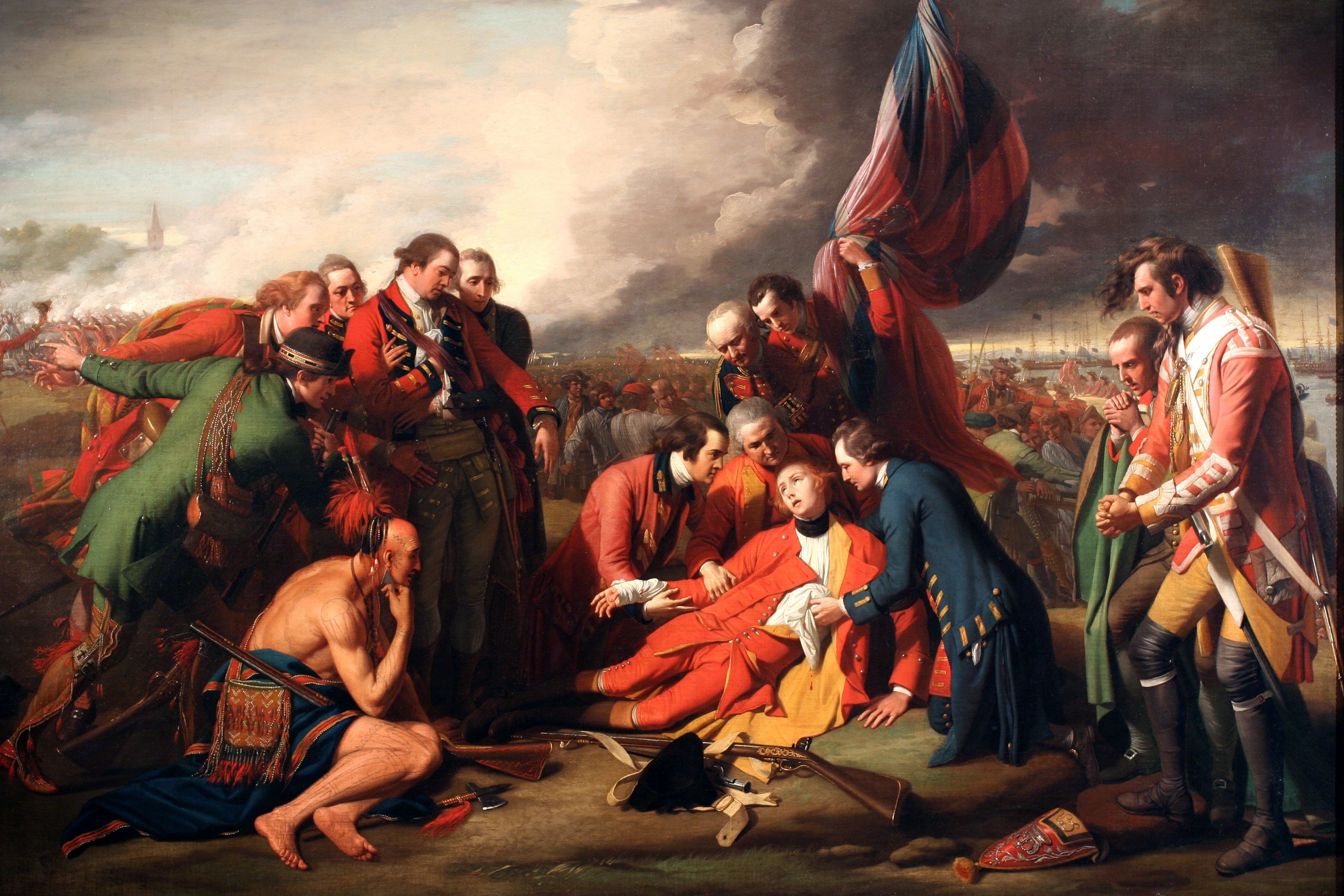
It must be said that some of the exhibits in the show seem to bear a pretty slender relationship with its supposed subject, Shakespeare and War. For example, the eighteenth century section has a set of images around the death of General James Wolfe at the 1759 Battle of Quebec which have no direct relation to Shakespeare, don’t quote or cite Shakespeare, seem to have no relationship except that Wolfe’s death was made the subject of ‘patriotic plays’.

Less utterly irrelevant is this entertaining print. In 1823 British aristocrats still carried out duels and this print mocks the practice by having the duellers and their seconds portrayed as monkeys. Apparently the title derives from a quote from ‘The Merchant of Venice’ but it’s a pretty flimsy pretext for including it in an exhibition about Shakespeare and War.

Awful Moments or Monkeys of Honour, colour print by John Lewis Marks after an unknown artist (1823)

More directly relevant if irreverent are the excellent prints taken from a later book, the Military Misreadings of Shakespere by Major Thomas Seccombe. It contains 31 beautifully delineated cartoons of military cockups, clumsiness and pratfalls, each offset by an ironically serious Shakespeare quotation. In this one a beautifully dressed member of the Life Guards has just been thrown by his horse to the accompaniment of a grand quote from Titus Andronicus: ‘That what you cannot, as you would, achieve, you must perforce accomplish as you may’ which thus acquires a completely comic meaning.

‘That what you cannot, as you would, achieve, you must perforce accomplish as you may’ from Military Misreadings of Shakespere (1880)

The Crimean War (1853 to 1856)

It wasn’t all lolz. The great exception to the century of generally small colonial wars which the British Army fought was the Crimean War, the one major conflict we were involved in in the century between the end of the Napoleonic Wars (1815) and the start of the Great War (1914). This famously highlighted significant problems with the Army’s organization, notably in the famous and futile Charge of the Light Brigade. Newspapers reported on the poor conditions in which soldiers found themselves, leading to demands for improvements and reforms to the Army’s culture and structure.

Only one exhibit relates to this badly managed and bitter war, a watercolour done by the Swedish artist Egron Sellif Lungren which depicts a kind of cinematic reimagining of a production of Henry V (what else?) staged by Charles Kean at the Princess’s Theatre in 1859 i.e. a few years after the war ended. Queen Victoria attended the play and commissioned Lundgren to do a watercolour version of it for her Theatre Album. Of all the scenes in the play Lundgren chose to depict the siege of Honfleur which is not only the setting for Henry’s famous speech ‘Once more unto the breach dear friends’, but will have reminded many people of the long and gruelling British siege of Sebastapol.

Installation view of ‘Shakespeare and War’ at the National Army Museum showing Egron Sellif Lungren’s watercolour plastered across one wall, with Gillray and Cruikshank cartoons on the left

Imperial Shakespeare

Obviously the nineteenth century was the one in which Britain cemented its grasp over the largest land empire the world has ever known, as well as almost total control of the world’s oceans. This is a very big subject indeed and it is not really properly explored. Take just India. Were there no British theatres in India, Shakespeare productions in India? Did the growing Indian middle class every stage Shakespeare productions with Indian casts? Was Shakespeare’s name, plays or quotes never invoked to justify British rule in India? Were there comic or satirical pamphlets or prints using Shakespeare quotes to mock British rule in India? Not in this exhibition, nor anything about the British Army’s involvement in Africa, the Caribbean, the Middle East or Far East.

Instead, as I’ve already pointed out, some of the exhibits have only a tenuous or oblique connection to the exhibition topic. For example, a picture caption tells us that amateur theatricals were often staged by regiments and soldiers as peacetime entertainments, which we might well have guessed. And that’s the fairly flimsy pretext for sharing a photo of members of the East Yorkshire regiment staging a production of Hamlet at their barracks in Cheltenham in 1895.

The Cast of Hamlet, Winter Gardens, Cheltenham, 1895 (National Army Museum)

Meanwhile, there’s nothing about the second war of the period which shook British confidence, the Boer War of 1899 to 1902. Were there no Shakespeare productions mounted here in England to raise funds or stir patriotic fervour? Did the besieged populations of Ladysmith, Mafeking or Kimberley put on productions to keep their spirits up? Didn’t domestic commentators or cartoonists use Shakespeare quotes or characters as material? If so, none of it is displayed here.

4. Patriotic Shakespeare: The First World War (1914 to 1918)

During the First World War great service and sacrifice were required of both the Army and the civilian population. As in the last great campaign in Europe a century before, Shakespeare was used in Britain to rally the troops and the country behind a sense of national duty.

As mentioned above, some exhibits are included on pretty flimsy grounds: for example, there’s no real reason to include some of Lord Kitchener’s recruitment posters (Your country needs You) except for the fact that, after Kitchener drowned when the ship he was sailing in hit a German mine (HMS Hampshire, 5 June 1916) the League of the Empire started publishing and presenting special editions of the ‘Complete Works of Shakespeare’ to wounded and disabled soldiers in his name, an edition which quickly became known as ‘the Kitchener Shakespeare’ – but there’s nothing at all about Shakespeare in the famous posters.

‘Lord Kitchener’s Appeal’, recruiting poster, 1914 (National Army Museum)

More tenuous examples include: a sketchbook by a John Henry Jenkins, a front line soldier, which depicted not only trench life but the watercolours of amateur theatricals which the soldiers put on, although Shakespeare is nowhere mentioned; or a 1915 recruitment poster which includes the image of St George and the dragon and so, the curators suggest, might have reminded some viewers of Henry V’s famous call, ‘God for Harry, England, and Saint George!’ Pretty tenuous.

Much more relevant is a book of Shakespeare quotations arranged under themes or headings relevant to the war and distributed to soldiers, ‘Shakespeare in Time of War: Excerpts from the Plays arranged with Topical Allusions’, edited by the artist Francis Colmer and published in 1916.

Another apparently random object is this photo of Women’s Army Auxiliary Corps personnel packing boxes in a factory in 1918. Spot the Shakespeare connection? No, because there isn’t one…

Women’s Army Auxiliary Corps personnel packing boxes in factory, 1918

…until you look at the photo beneath it, which is a photo of Maggie Smale’s all-women production of Henry V, staged in a munitions factory in Leeds which had been operated by the ‘Barnbow Lasses’ during the Great War. Is this to do with feminism? Or pacifism? Or a celebrating of provincial grit? I wasn’t sure.

Still from Maggie Smale’s all-female production of Henry V as featured in ‘Shakespeare and War’ at the National Army Museum. Photo by Mike Oakes

Amateur productions of Shakespeare were mounted across the country, sometimes to raise morale, to entertain wounded soldiers, for the benefit of the public. Three hundred years after his death Shakespeare was not only a well-known brand but possibly the only literary writer a lot of working class people had heard of. As in his own time, he catered for an audience of elite intellectuals, the educated middle classes, and illiterate workers. You can see why Shakespeare productions abounded because he was 1) possibly the only playwright everyone had heard of and 2) safe –unlike more recent troubling playwrights of the previous generation (Shaw, Ibsen etc).

There’s a clip from an official film showing wounded soldiers watching open air production of A Midsummer Night’s Dream. Scenes like this 1) the British heritage which the soldiers were fighting for 2) to a wider audience demonstrated the care the government was taking of its fighting men. This clip appeared alongside footage of scenes of artillery and war preparation, thus dovetailing Britain’s cultural heritage into the war effort.

in my own life I’ve met plenty of people who don’t give a toss about official culture, art or theatre. You’ve got to wonder how many of the sock and maimed soldiers forced to watch this kind of thing actually enjoyed it or even understood it. Because that’s a thing about Shakespeare – unless you’re pretty familiar with the play beforehand, it’s impossible to get the most out of a theatrical production, in fact it’s often impossible to understand what’s going on and especially difficult to get any of the comedy in his plays.

It’s fascinating to learn about the Shakespeare Hut. In February 1916, to commemorate 300 years since his death, this mock-Tudor retreat was opened on a plot of land in Bloomsbury. The hut was built on a site cleared for a planned Shakespeare Memorial Theatre, which was abandoned because of the war.

The aim was to provide shelter for wounded Australian or New Zealand troops. Over the next two years it would welcome in more than 100,000 soldiers far from their New Zealand homes. Queen Mary visited in 1917, took up her post behind the tea counter, and poured cups for all the men.

The troops were subjected to regular Shakespeare productions, including an all-female Henry V starring Ellen Terry, one of the most famous actors of her day. Hah! So the Maggie Smale production was following in venerable footsteps.

The exhibition features photographs and playlists from the Hut and you can read more and see photos in an interesting Guardian article about it. Interesting to learn that it the site is now occupied by the London School of Hygiene and Tropical Medicine.

One of the most interesting learnings from the exhibition is about the role of theatricals among British prisoners of war held in Germany. The exhibition focuses on the Ruhleben Camp in Germany which housed some 5,000 POWs. Prisoners were allowed to construct a theatre and, for the same tercentenary which prompted the Shakespeare Hut, staged a series of productions, including Twelfth Night and Othello. The exhibition features photos and a programme from a 1915 production of As You Like It.

In a similar spirit, the British Red Cross mounted a Shakespeare Exhibition at the Grafton Galleries in 1917. Quite clearly, if you go looking for Shakespeariana during the First World War, you’ll find it.

Installation view of ‘Shakespeare and War’ at the National Army Museum, showing a poster for the Red Cross Shakespeare Exhibition of 1917 (photo by the author)

5. Democratizing Shakespeare: The Second World War

Same goes for the Second war. Once again Shakespeare was trotted out as the exemplar of the culture and values that were under attack from Nazi Germany, that we were fighting to preserve. The motives and means were very similar to the first war – am dram productions across the country to entertain wounded troops or raise money, leading actors of the day giving patriotic productions in London to stir patriotic fervour, footage of productions shot to be show in cinemas and raise morale.

With the new angle of radio. For the first time productions could be broadcast, to a large radio audience which steadily grew throughout the six war years. As part of the government’s attempt to mobilize society to support the war effort, British theatre was sponsored by the state for the first time in its history.

The Council for the Encouragement of Music and the Arts (CEMA) was created to promote and maintain the fine arts and British cultural life. It later became the Arts Council of Great Britain. The Entertainment National Services Association (ENSA) provided for the forces, organising shows and performances by well-known actors, singers, and comedians.

Photo of an ENSA production staged in a London underground station in 1942 (National Army Museum)

Despite the challenges of wartime, both theatre and Shakespeare thrived. Once again, his words helped to frame the experience of conflict both in Britain and across the world. The exhibition features a recording of a radio programme originally broadcast by the BBC Overseas Services on Shakespeare’s birthday on 23 April 1942. It included extracts from ‘As You Like it’, Henry IV part 1 and, of course, Henry V. It was introduced and performed by leading Shakespearean actors Peggy Ashcroft, Robert Donat, Edith Evans and Ralph Richardson. You can listen to it on headphones and marvel at their phenomenally posh plummy English voices.

There’s a section devoted to the Laurence Olivier production of Henry V described at the start of this review.

And once again there’s a section devoted to British prisoners of war staging Shakespeare productions in camps in Germany. The exhibition includes a list of plays staged at Stalag 383 in Hohenfels, which included ‘The Merchant of Venice’.

6. Just Shakespeare: Adapting After 1945

After the Second World War the patriotic tone of Laurence Olivier’s Henry V lingered throughout the 1950s. But the second half of the 1960s saw radical changes in all aspects of art and culture, with a variety of new approaches to all the arts including theatre. This included the anti-war movements triggered by Vietnam, as well as new attitudes to sex and nudity, which now began to appear in Shakespeare productions.

For 200 years the name and plays of Shakespeare had acted as a kind of recruiting sergeant for the British Army and rallying point for the nation in times of real threat (particularly during the Napoleonic, First and Second World Wars). From the late 60s onwards, Shakespeare’s relationship with the state, the Establishment and the Army came under increasing critical scrutiny. Not in every production, but in an increasing number.

Hence Kenneth Branagh’s 1984 RSC production. Unlike earlier productions it shows the execution of French prisoners onstage and then left the bodies and corpses from the Battle of Agincourt at the back of the stage, behind a gauze curtain, for the later, supposedly reconciling scenes between the English king and his French bride-to-be.

The last section of the exhibition, in the central booth of the (fairly small) exhibition space, takes the Branagh production as setting the tone for productions which followed the Falklands War (1982), the Gulf War (1990 to 1991), and the Iraq War (2003 to 2011).

It includes video clips of stage productions including:

  • a 2013 production of ‘Othello’ which depicts the characters in the modern-day Army uniform used during the Iraq War
  • a 2015 production of ‘Othello’ which features graphic scenes of waterboarding Iraqi suspects
  • ‘Days of Significance’, a play by Roy Williams based on ‘Much Ado About Nothing’ which looks at the impact of British troops who fought in the Iraq War

The strong anti-war flavour of these productions and the pretty intense criticism of the British Army and its techniques, could hardly be more unlike the innocent patriotism of the Shakespeare Hut or the brightly colours optimism of Olivier’s Henry V. If we go to war with Russia I wonder if Shakespeare will be trotted out to inspire patriotic spirit as it was 100 and 70 years ago. I doubt it. Shakespeare hasn’t changed, that’s to say the texts remain pretty much what they were 400 years ago. But our understanding of war, gained in the brutal conflicts in Iraq and Afghanistan, has made any thoughts about the glamour or heroism of war impossible to modern Brits.

Availability bias

This is a fascinating premise for an exhibition and I thoroughly enjoyed working my way through the wealth of objects and their captions. It proves that Shakespeare is like the Bible, so compendious and diverse that you can find words to justify more or less any opinion on any subject (as demonstrated by the opposing sides in the American War of Independence using Shakespeare to bolster their arguments).

However, it throws up an obvious issue which is to do with the availability of objects to display. The exhibition was curated by – and is based on the scholarly books by – two Shakespeare scholars, Amy Lidster and Sonia Massai, namely Wartime Shakespeare: Performing Narratives of Conflict. Just from the synopsis on Amazon you can see how a book-length work like this is free to range over all and any productions it likes because words are easy. On the other hand, an exhibition in a museum is severely limited by the objects it can get its hands on.

In fact, like every exhibition at every gallery or museum, this one is an exercise in the art of the possible. Objects which denote important productions or topics may not be available (or may not even exist) while other topics throw up a glut of barely relevant artefacts.

In addition, it’s difficult and expensive to get objects on loan from other collections whereas it’s cheap and easy to get them from your own storeroom, so all exhibitions in all galleries are biased towards the host institution and its collection.

Plus there’s the common problem with any historical overview which is that objects from three or four hundred years ago are rare whereas, as you get closer to the present day, the number of objects rapidly increases, until you are drowning in a surfeit of stuff.

These imbalances in the real world threaten to unbalance or distort the picture painted by any exhibition, an imbalance which is easily managed in books and articles where issues and ideas can be easily conveyed by text alone.

So, at various points, I couldn’t help feeling that the curators had included some objects more because they were just related to one of the conflicts during the period in question than for their Shakespearian relevance. As mentioned above I couldn’t see any Shakespeare connection to the three or four pictures of General Wolfe and the capture of Quebec except that the event was turned into patriotic plays and prints. To put it another way, some of the links between specific conflicts and Shakespeare were pretty tenuous. I still don’t understand why there was an English mortuary sword in the Civil War section except that maybe the curators felt they just needed a physical object, any object, to go alongside the half dozen books and pamphlets.

All the objects (photos, pamphlets, diaries and whatnot) are interesting, it’s just that I was left scratching my head why some of them were included.

Shakespeare and conflict

There’s another, more scholarly, issue. This, as I touched on earlier, is that taken together, Shakespeare’s dozen or so history plays, plus the relevant Roman plays and the tragedies, build up into a subtle, sophisticated, multifaceted meditation on the themes of power, authority, legitimacy, insurrection, rebellion, revolt and overthrow.

Arguably, to really address the topic which this exhibition sets out to explore, you would need a really sound grasp of how all these issues are dramatised and explored in the 20 or so relevant plays, before you even started your review of how they’ve been applied to Britain’s wars and Britain’s Army.

But this, of course, is a massive task – after a lifetime reading Shakespeare I still haven’t read all the history plays and have nothing like a complete grasp of the issues of legitimacy and political power which they raise.

And an exhibition like this has to be practical, finite and manageable. This one achieves what it sets out to do, in a relatively small space, as well as it probably could do. But, in my opinion, the ghost of the larger political, social and cultural issues raised by the plays hover over it, unmentioned and undiscussed.

To take just one aspect of what I’m driving at, many of the characters in the history plays (the ones I’m familiar with) describe and discuss the horror of war, the fear experienced by soldiers, the terror of innocent civilians, the horrific injuries, killing and massacres involved, the fields strewn with bodies, the devastated landscapes and ruined economies. Descriptions of these kinds of things are commonplace in the plays and yet, somehow, hardly occur anywhere in this exhibition.

At some point I realised that this is not an exhibition about Shakespeare and War as about Shakespeare and the British Army. This explains why it’s divided into chronological periods based entirely around conflicts the British Army engaged in right up to the present day, rather than the themes of war encountered in the plays which I have just listed. And this is why, although it’s a very enjoyable trot through British military history, with an emphasis on how Shakespeare’s name, characters and words have been exploited in times of war – it feels, ultimately, despite being packed with shiny objects, intellectually thin.

You can see how an exhibition about Shakespeare and war would actually be something quite different: instead of taking a chronological approach it would take the topics I’ve mentioned several times now – the collapse of authority, civil war, rebellion, interstate war – and then the aspects of war – recruitment, training, fighting, sieges, inspirational rhetoric, the exhilaration of fighting, the horror of wounding, the devastation of the countryside, the mourning of widows – and explore how all of these are described and critiqued in Shakespeare’s multifaceted dramas. It would be something completely different from this exhibition. But then again, maybe what I’ve got in mind would be so wordy and text-heavy that it couldn’t be staged as an exhibition at all.

What this exhibition does, it does very well. It is small but beautifully staged and is FREE.


Related link

Related books

Shakespeare reviews

National Army Museum reviews

The Fatal Shore: A History of The Transportation of Convicts to Australia, 1787 to 1868 by Robert Hughes (1987)

Warra, warra
(First recorded words of the first indigenous people met by the captain of the first convict fleet to Australia in 1788. They mean: ‘Go away’)

Prime fact: The First Fleet of 11 ships transporting convicts from Britain to Australia landed at Botany Bay on 20 January 1788.

If you’re my age you might remember watching the Australian journalist and art critic Robert Hughes (1938 to 2012) presenting his ground-breaking TV series about modern art, ‘The Shock of the New’, back in 1980. He looked like a boxer and expressed feisty, sometimes controversial, opinions in a muscular, punchy prose style.

Seven years later Hughes published his epic study of the British penal colonies and early European settlement of Australia, ‘The Fatal Shore’ (1987). It became an international best-seller because there were few if any histories of Australia which presented the facts of the country’s early history with such a combination of solid research and journalistic brio.

‘The Founding of Australia by Captain Arthur Phillip RN, Sydney Cove, 26 January 1788’ by Algernon Talmage (1937) [The British flag was not officially planted until 7 February 1788, when possession was formally proclaimed]

The text is laid out in a pleasingly clear structure, proceeding logically topic by topic and exploring each of them thoroughly and convincingly.

The narrative starts dramatically with the arrival of the first shipload of convicts at Botany Bay on 20 January 1788. What was the land like that they had arrived at? Hughes gives us several pages description of the astonishingly weird and unique fauna of Australia (pages 3 to 7) and his narrative will go on to be peppered with periodic descriptions of the arid, sunburned, eucalyptus-riddled terrain.

Indigenous Australia

What were the people like that they met? He gives us a ten-page summary of what was then known (1980) about Aboriginal or indigenous culture (pages 7 to 18).

What comes over in his description is the really primitive nature of Aboriginal culture: the Aborigines hadn’t invented the bow and arrow, they had no buildings, they hadn’t even invented the tent (unlike American Indians) because they never stayed long in one place. Some made temporary lean-tos out of bark which the settlers quickly nicknamed ‘humpies’ but their entire way of life was based on firing the bush to catch wildlife, then moving on.

It’s now thought that Australia had been inhabited for over 60,000 years when the Brits arrived. Its  inhabitants had developed a patchwork of tribes and peoples and nations, each inhabiting large tracts of land (Australia is only fractionally smaller than the landmass of continental United States, 2,969,907 square miles to America’s 3,119,884 square miles). To this day scholars debate the precise number, but at least 300 languages and language families existed.

The AIATSIS map of Indigenous Australia attempts to represent the language, social or nation groups of indigenous Australia

The people who inhabited the area of south-east Australia where the Brits landed were called the Iora. They had no concept of private property so the Brits couldn’t barter with them. They didn’t wash, in fact they covered their bodies with fish guts as a prophylactic against disease and so stank to high heaven. They treated their women appallingly. Unwanted children were aborted by ingesting herbal medicines or simply thumping the pregnant woman’s stomach. Deformed babies were killed at birth. There was no room for the weak in the Indigenous people’s nomadic economy.

Hughes’s description of the Aborigines sets the tone of the entire book. It is going to be deliberately anti-Romantic, debunking myths, puncturing legends, showing that the reality is always more squalid and sordid than the rose-tinted stories he and his generation were told at school or prim progressives tell each other today about the noble savage. In this story, nobody is noble.

According to the estimates available to Hughes, when the Brits arrived in 1788 there were an estimated 300,000 Indigenous Australians across a continent the size of America. No wonder it felt almost ’empty’ to the Europeans: no towns, no villages, no buildings of any kind, no agriculture, nothing that registered with them as civilisation or culture.

(I wouldn’t be surprised if someone contacts me to say this description is unduly negative. Hughes makes every effort to be fair to the Indigenous Australians, and to depict their heart-breaking plight, but he was writing nearly 40 years ago, so I wouldn’t be surprised if some of his account is wrong and/or nowadays considered offensive. I apologise in advance if it is and am happy to be corrected.)

Georgian crime

Why was the transportation policy created by the British? Hughes gives a fascinating review of the growth of criminality in Georgian Britain (the long century from 1714 to 1830), which powerfully conveys the stink, poverty and abject misery endured by most of the population (pages 19 to 42).

The Georgians refused to set up a police service, as many nations on the continent had, because of an obstinate belief that it would infringe on the ‘liberty of the subject’ which they fetishised. (Plus the French had a form of police who had the right to enter and search private dwellings, so if the French had one, it must be bad.) But at the same time, the second half of the 18th century witnessed a population explosion which resulted in a surplus of young men who migrated from the country to the city, discovered there were no jobs for them, and so took to crime.

In the absence of a police force the Georgian authorities resorted to passing ever more draconian laws, an astonishing number of them carrying the ultimate sanction i.e. the death penalty. Eventually, there were some 200 statutes carrying the death penalty on the books and you could be hanged for burning a house or hut, a rick of corn, for poaching a rabbit, for damaging a fishpond, for cutting down an ornamental shrub of appearing on a high road with a sooty face (p.29). These were in fact provisions of a particular law, the Waltham Black Act of 1723, designed to stop agrarian unrest in Hampshire (the lawbreakers moved at night with blacked-up faces, hence the oddly specific provision). But most crime was urban and the result of poverty and starvation. As you read on you come across plenty of examples of people transported for life for stealing a loaf of bread, some butter, some bacon etc.

Middle-class people could be transported too. An architect was sentenced to death for forging a contract, commuted to transportation for 14 years (p.297). A satirical poet, Michael Massey Robinson, tried to blackmail an ironmonger by threatening to publish a scurrilous poem about him and was transported for life (p.300).

Hughes describes the rituals of hanging day and the long trek of the victims’ cart from Newgate prison to Tyburn ‘tree’, the sturdy wooden frame situated where Marble Arch is now, the route lined with cheering Londoners, the actual hangings witnessed by crowds of up to 30,000, drinking heavily, pullulating with pickpockets and whores, the whole thing, paradoxically, a festival of criminality, something which outraged moralists deplored in Boswell’s day (1760s and 70s) and Dickens was still complaining about in the 1850s (pages 31 to 36).

‘The Idle Prentice Executed at Tyburn’ by William Hogarth (1747)

In fact Hughes returns to the question of class and crime repeatedly throughout the book. I suppose it’s obvious but I hadn’t thought about the way the policy of transportation was merely one aspect of British penal policy. In other words, it was entirely dependent upon and reflected 80 years of British social and economic history. What was happening in Britain entirely dictated who was sent to Australia, and when and why and in what numbers.

In other words, the book is as much a social history of Britain during this period as it is of Australia. Thus there’s a lot more detail than you’d expect about, especially early on, about, for example, the geography, slums and criminal classes of Georgian London.

The hulks

Britain had no nationwide prison system, in fact at least half of the prisons were privately owned and run (p.37). There was no belief in rehabilitation, prisons were just regarded as dumping sites for toxic males to stew in their own juice.

By the 1770s the prisons had become so overcrowded that the authorities had the bright idea of sending the ever-increasing population of convicts to prison ships or ‘hulks’, the rotting shells of decommissioned navy ships moored in harbours like Portsmouth and Plymouth. In 1776 Parliament passed the ‘Hulks Act’ (16 Geo III, c.43) (p.41). These hulk-bound prisoners were used as labourers in the naval dockyards and, in the picture below, can be seen being taken by boat from a hulk to their work on the mainland.

Prison hulk at Deptford, London, after a painting by Samuel Prout (about 1826)

The American precedent

One of the little known facts about the period which I found fascinating is that the practice of transportation was already well established, but it was transportation to the American colonies. The Transportation Act of 1717 had begun the process of sending indentured servants to Britain’s colonies in the Americas 53 years before Australia was even discovered. Between 1717 and 1777 as many as 40,000 convicts were sent to America for seven or 14-year periods. They were sold to shipping contractors who then sold them on in America to plantation owners in the Caribbean or mainland in what Hughes describes as a ‘thinly-disguised form of slavery’ (pages 40 to 41).

But when they declared independence in 1776 the Americans refused to accept any more British criminals. Anyway, as Hughes points out, they didn’t need them. By the year of independence more African slaves were arriving in America every year (about 47,000) than white convicts had done in the previous 60 years put together (40,000) (p.41).

At first the British authorities thought the Americans would give up their fight for independence. It took until 1783 for the government to finally accept American independence and another few years for the full implications to be worked out for Britain’s overflowing prisons. By the early 1780s even the hulks were overflowing and William Pitt’s government was receiving angry demands from MPs for Plymouth and Portsmouth to do something about them. There began to be riots aboard the hulks, convicts rebelling against the disgusting conditions. In one riot aboard a prison hulk, in 1786, eight convicts were killed and 36 wounded (p.65).

It’s fascinating to read Hughes’s account of the way the mounting complaints of MPs with hulks in their constituencies became a real political problem for Pitt and drove him to appoint a commission to look into ways of disposing of the convicts which filled them – surprising that the problem of what to do with Britain’s surplus convict population became such a leading political issue. It crossed my mind it was a little like the refugee crisis of our own day: successive governments keep promising to do something decisive about it and keep dismally failing. And both involve boats and the problem of what to do with unwanted people…

The other side of the world

Fascinating to learn that, as a result, the British authorities were open to all suggestions, and that a number of entrepreneurs came up with bold and crazy schemes. One was to transport the convicts to the island of Lemane 400 miles up the River Gambia and set up an African penal colony there (p.64). Or how about a penal colony somewhere off the coast of South America?

Zeroing in on the continent which was eventually chose, Hughes gives us a potted history of European theories and encounters with the legendary southern continent before Captain Cook did his first definitive exploration of Australia’s eastern coast (pages 43 to 48). He describes the voyages of Magellan and various intrepid Dutchmen, mentions the Englishman, William Dampier, who touched on the north-west coast of Australia in 1688.

Captain Cook

Then, of course, Captain Cook. Hughes gives a typically factual, forthright and gripping account of Cook’s expeditions, devoting some space to the long-running problem for all seafarers of scurvy, and how Cook, a modern innovator in this as so many other things, lost not a single man from scurvy by the savvy use of anti-scorbutics. As Hughes puts it, with typical pith and wryness:

Malt-juice and pickled cabbage put Europeans in Australia, as microchip circuitry would put Americans on the moon. (p.49)

Hughes gives a characteristically thorough and vivid description of Cook’s voyage in the Endeavour (‘a converted Whitby trawler, small and brawny’, p.51). He devotes a fascinating few pages to the technical inventions which had just recently made such map-making voyages more precise and useful, namely John Harrison’s invention of the marine chronometer, a device for solving the problem of calculating longitude while at sea (pages 50 to 57).

The convict problem

Prisons overflowing with unreformable criminals? A newly discovered continent on the other side of the world? The British authorities put two and two together and realised that this was an opportunity to redirect the now-defunct American transportation policy, and on a far larger scale. Fascinating to learn that the policy was accompanied or swayed by a number of other considerations. For example, Admiralty strategists suggested that establishing a colony in Australia would aid in the ongoing conflict with France to establish naval supremacy in the Indian Ocean. Others pointed out the need to have a base in the Far East to compete with the well-established Dutch colonies out there.

Practically minded boosters claimed that the tall pine trees and flax plants Cook had noted on what he named Norfolk Island, 1,000 miles off the Australian coast, could quickly become a commercial business, capable of supplying Royal Navy ships with masts and sails. In the event, none of these pipe dreams were to work out. Sydney is, quite obviously, on the wrong side of the continent to be of use in patrolling the Indian Ocean and the ‘pine’ and ‘flax’ on Norfolk Island turned out to be commercially worthless.

The First Fleet

And so, after a great deal of prevaricating, and parliamentary committees, and bickering about the number of ships and who should captain them and how it should be paid for – typical British bumbling – the first convict convoy was dispatched to Australia in May 1787 and arrived in the place Cook had named Botany Bay, on the southeast coast of Australia, on 20 January 1788. It was commanded by Captain Arthur Phillip who was to become first governor of the new penal colony.

Hughes gives a characteristically thorough profile of this modest man (a ‘middle-aged nonentity’) who had had a patchy naval career and was in retirement when contacted by the Admiralty to carry out the policy which had finally been agreed by the government of William Pitt (pages 67 to 71). What comes over is Phillip’s professionalism. Hughes shows that he thought the equipping and provision for a fleet setting out to colonise an entire continent from scratch was hopelessly inadequate and bombarded ministers and Admiralty for more (p.71).

Of the 736 convicts sent at least 431 were guilty of ‘minor theft’ and Hughes gives examples of how pitifully trivial these might be (p.72). The oldest was Dorothy Handland, aged 83, a dealer in rags convicted for 7 years for perjury. The youngest was John Hudson, a chimney sweep aged 9 (p.73).

Hughes gives a characteristically thorough description of the challenges of the 8-month-long voyage (252 days) across 15,000 miles of ocean. Forty-right people died on the journey while 28 were born. All were to be confronted by the immense disappointment of Botany Bay when they finally arrived. Within days Phillips and his lieutenants had realised it was wholly impractical as a settlement, not least due to the thin sandy soil cluttered with eucalypt detritus. The bay was open and unprotected, the water was too shallow to allow the ships to anchor close to the shore, fresh water was scarce, and the soil was poor.

So they sailed up the coast to Port Jackson, the name given to the bay area where Phillip established a settlement he called Sydney, after the current Home Secretary ,Thomas Townshend, 1st Viscount Sydney (p.87).

The starvation years

Agricultural opportunities turned out to be very poor. Supplies were meagre and Phillip had to introduce rationing which got steadily tighter (p.96). Crops failed or wouldn’t take. The convicts became too tired and listless to work. The first couple of years were dire and some wondered if the entire colony would die of starvation, before the final arrival of the Second Fleet in June 1790.

The Second Fleet was notorious for the poor conditions aboard the vessels, and for cruelty and mistreatment of its convicts. A quarter of the 1,006 convicts transported aboard the fleet died during the voyage and around 40 per cent were dead within six months of arrival in Australia. Hughes describes in stomach-churning detail the disgusting conditions aboard the early convict ships. Not all ships in the fleets had the same standards. Those in which people suffered worse, were worse treated and with the highest death rates came to be called the ‘hell ships’.

First failed attempt to colonise Norfolk Island

Norfolk Island is about 1,000 miles east of the Australian coast. It turned out to be extremely inhospitable, the pine trees weren’t true pines, the flax couldn’t be woven, it was immensely difficult to clear the land for agriculture. A ship bringing supplies and more convicts sank, losing the supplies but adding hundreds of mouths to feed, making 959 in total. All that saved the first settlers from starvation was easy availability of tame mutton birds, Pterodroma melanopus which they slaughtered in their hundreds of thousands. By 1830 the settlers had driven the mutton bird to extinction (p.100).

Van Diemen’s Land and the genocide

He devotes a section to the settlement of Van Diemen’s Land off the south coast of Australia under the command of David Collins (pages 120 to 128). The island had named in honour of Anthony van Diemen, Governor-General of the Dutch East Indies who had sent the Dutch explorer Abel Tasman on his voyage of discovery in the 1640s. In 1642 Tasman became the first known European to land on the shores of Tasmania but the Dutch never followed through on the discovery. Now, 150 years later, the British claimed it. The capital, Hobart, was named after the Secretary of State for the Colonies who was the patron of Collins’s expedition.

The island was initially perceived to be less fertile than the land around Sydney and early attempts at farming failed, so the colonists faced starvation. What saved them was the humble kangaroo which was far more common than around Sydney. Every able-bodied man was issued a gun to hunt and kill kangaroo for himself and dependents (wife or children).

As Hughes pithily puts it this reliance on hunting triggered social results, all of them bad. It installed the gun rather than the plough as the totem of survival on the island. It incentivised settlers to ignore long-term planning required for farming and live by day-to-day hunting. And as nearby roos were wiped out and the heavily white settlers ranged further afield it brought them into conflict with the native populations who, more often than not, they shot.

It soon created a fringe class of armed, uncontrollable bushmen, most of whom regarded Aborigines as vermin. (p.126)

With their guns and hinting dogs these men became completely independent of the authorities. They were the first bushrangers. And so were laid the foundations of what would be the only real genocide of the British Empire, the deliberate extermination of the entire native population of Tasmania.

Impact on Indigenous Australians

As to the natives, the government had explicitly ordered friendly treatment, enjoining Phillip to ‘conciliate their affections…[and] live in amity and kindness to them.’ At first this held, but what nobody knew was the white ships had brought white infectious diseases, endemic in Britain and entirely unknown in Australia, flu, cholera, smallpox, typhus, which quickly spread. it was a common sight for the early settlers to come across indigenous corpses huddled in the bush where they’d crawled to die. The British incomers were, literally, a plague.

As settlement spread out from Sydney, the Aborigines took to fighting back, raiding farms, killing livestock, singling out for assassination white farmers of community leaders who’d acquired reputations for killing them. Which triggered massacres of unarmed Aborigines by vigilante gangs, for example the Myall Creek massacre when at least 28 unarmed Indigenous Australians were executed by 12 armed colonists on 10 June 1838. Which triggered further revenge raids, and so on, in a deadly spiral downwards into a sustained ‘frontier war’ (pages 272 to 281).

The System

Year by year the shipments came to be called ‘the System’, the process of sending shiploads of convicts to Australia, who had to build their own prisons and barracks for the soldiers who guarded them and pleasant houses for the civil authorities who supervised the whole thing.

Between 1787 and 1868 around 162,000 convicts were sent to Australia and Hughes goes on to give a fascinating and vivid description of every stage of the development of the System.

Hughes is at pains to dispel the stereotype of life under the convict system which he and his generation inherited, which is that it was a living hell on remote ‘secondary’ or punishment settlements on Van Diemen’s Island. On the contrary, most convicts served out their time, then were released to become citizens in the fast-growing new colony.

Only a fraction of the men and women transported to Australia spent any time in these ‘secondary’ settlements, which were as a rule reserved for prisoners who had committed second crimes while in the colony. Most served a few years of their sentences in assignment to a free settler or in government labour, never worse chains, got their tickets-of-leave and in due course were absorbed into colonial society as free citizens. (Introduction, page xiii)

He makes one simple but devastating riposte to the endless cheap jokes about Australia being a land of convicts:

Whatever other conclusions one might draw from our weird national origins, the post-colonial history of Australia utterly exploded the theory of genetic criminal inheritance. Here was a community of people, handpicked over decades for their ‘criminal propensities’ and for no other reason, whose offspring turned out to form one of the most law-abiding societies in the world.

Hell ships

Conditions on the first ten years or so of ships was so appalling they acquired the nickname of ‘hell ships’. Conditions of unbelievable squalor which people who’d sailed on both thought were worse than slave ships. And the condition of the survivors was no better. A propos slavery, an anonymous convict ballad from 1825 runs:

The very day we landed upon the Fatal Shore,
The planters stood around us, full twenty score or more;
They ranked us up like horses and sold us out of hand,
They chained us up to pull the plough, upon Van Dieman’s Land.

Conditions were dire. In the early years the entire colony nearly starved. But as the settlement at Sydney became established so did its reputation for appalling brutality. The descriptions of lashings and floggings which litter the book are quite nauseating, with prisoners’ backs being reduced to raw meat, bystanders being flecked with lumps of raw flesh.

Hughes devoted a passage to proving that conditions for the convicts were not literally slavery, not as practiced in the Caribbean or American South; convicts had legal rights and could take the masters they were assigned to to court (pages 282 to 287), if arrested they could invoke habeas corpus (p.346), something African slaves couldn’t do. But conditions were consistently atrocious and exploitative nonetheless. It’s difficult to imagine the primitiveness of the conditions.

Governor Macquarie’s Australia was more backward than Cromwell’s England. There was as yet no steam power; draft animals were few; and there were no streams near Sydney reliable enough to turn watermills. So every hole was dug, every log sawn, every rock quarried and every ton of rubble moved by that least efficient of engines, the human body toiling in gangs. (p.298)

Futile escapes

Obviously convicts tried to escape continually. The most shocking story is of a group of convicts that escaped in Van Diemen’s land (Tasmania) and ended up eating each other. There was a persistent folk belief that if you travelled north far enough you would get to China. In fact most escapees either perished in the Outback from starvation and thirst, were murdered by Aborigines, or stumbled back into government settlements more dead than alive. Hughes devotes a chapter to the more colourful escape attempts, notably that of Mary Bryant (pages 203 to 226).

New South Wales Corps

The New South Wales Corps were formed in 1789. Indisciplined and corrupt it quickly gained a reputation for lawlessness and corruption. In particular it acquired a monopoly of the importation and sale of rum to convicts and freemen alike, so much that it was nicknamed the Rum Corps. It repeatedly clashed with the civil governor, most flagrantly in the 1808 Rum Rebellion against governor Bligh who tried to assert civil power over them, see below.

Governors of New South Wales

1. Arthur Phillip 1788 to 1793

Commander of the epic First Fleet and settlement at Sydney, which he named. After guiding the colonists through the early starvation years as they struggled to establish agriculture and had to repeatedly reduce rations of the limited supplies they’d brought from Britain, Phillip was allowed to return home.

Lieutenant-Governorship of Francis Grose 1793 to 1795

For the next two years the military were in complete control of the fledgling colony under Lieutenant-General Francis Grose. The European population of New South Wales when Grose took over was 4,221, of whom 3,099 were convicts. Grose established military rule, abolished civil courts, and made generous land-grants to his officers. Grose unmercifully exploited the convicts and during his lieutenant-governorship a great traffic in alcoholic spirits (mostly rum) developed, managed and run by officers of the New South Wales Corps. This clique gained control of the courts and management of the lands, public stores, and convict labour, all led by John Macarthur, ‘British Army officer, racketeer, entrepreneur, grazier, usurper and politician’.

2. John Hunter 1795 to 1800

Hunter had been second in command on the First Fleet. He was appointed governor and tasked with combating the abuses of power built up by the New South Wales Corps, represented by their commander, John MacArthur, but was too mild and fair-minded to succeed. In fact the militarily cleverly sent letters back to the British ministers accusing Hunter of the very crime and peculation he was trying to stamp out, with the result that he was recalled in 1799 to defend himself.

3. Philip Gidley King 1800 to 1806

King helped develop livestock farming, whaling and mining, built many schools and launched the colony’s first newspaper but was forced to resign after conflicts with the military. He appointed Major Joseph Foveaux as Lieutenant-Governor of Norfolk Island where Foveaux ruled with extreme brutality and sadism.

4. William Bligh, 1806 to 1808

Chosen as the job because a strict disciplinarian who was tasked with taking on the military and their control of the hugely profitable rum trade. However his confrontational style led to the so-called Rum Rebellion of 1808, a coup d’état in which the New South Wales Corps arrested Bligh, keeping him first in confinement in Sydney, then aboard a ship off Hobart, Van Diemen’s Land, for the next two years.

Lieutenant-Governorship of Major George Johnston, 1808 to 1810

Johnston led the troops that deposed Governor William Bligh, assumed the title of lieutenant-governor, and illegally suspended the judge-advocate and other officials. The administration of justice became farcical, and there were signs of strong discontent among the settlers. He sailed back to Britain in 1809 where he was court-martialled but let off with the lenient sentence of being cashiered.

5. Lachlan Macquarie 1810 to 1821

Had a crucial influence on the transition of New South Wales from a penal colony to a free settlement and therefore to have played a major role in the shaping of Australian society in the early nineteenth century

The Irish

Like every subject he touches, Hughes gives the background to the arrival of the first Irish convicts with brisk authority. He gives a whistlestop review of the colonisation of Ireland by England, which had started back in the twelfth century, and led to the creation of a society divided between Protestant rulers who deprived the native Catholic majority of land and rights for centuries (pages 181 to 195).

The reason this is needed is because in 1798 a great rebellion broke out in Ireland which terrified the English ruling class because a) it united both Protestant and Catholic rebels and b) the rebel leaders allied with England’s traditional enemy, France, leaguing with a French force to land in the west of Ireland and combine with them against the British occupiers. Unfortunately, the plans were discovered and most of the rebel leaders arrested before the planned rising and invasion could take place.

Most of the rebel leadership was killed and estimates of the total death toll of the subsequent fighting have been put in the tens of thousands. Hundreds of the rebels were briskly tried and transported to Australia. Here they presented the authorities with a severe security problem. The English convicts, surly and disobedient and quick to escape, nonetheless were the same nationality as the authorities. The Irish, on the contrary, refused to accept the authority of any part of the System and took every opportunity to buck it. With the result that governors and leaders of the New South Wales Corps were doubly severe and brutal with them.

The Irish were ‘doubly’ convicts. At the slightest suspicion of ‘mutiny’ they were liable to severe punishment, for example when five suspected leaders were each given 500 lashes (p.187). The brutality of their treatment triggered the very mutiny the British authorities feared in the form of the Castle Hill revolt in 1804. On 4 March 1804 233 convicts, led by Philip Cunningham (a veteran of the rebellion of 1798, as well as a mutineer on the convict transport ship Anne), escaped from a prison farm intent on capturing ships to sail to Ireland. The authorities quickly declared martial law and despatched troops who surrounded the rebels on a hillock nicknamed Vinegar Hill on 5 March. While negotiating under a flag of truce Cunningham was arrested then the troops opened fire and decimated the rebels. Nine of the rebel leaders were executed and hundreds were punished with severe floggings.

This was the largest convict mutiny in Australian history but there were further small revolts and a continual atmosphere of sullen anger among the Irish and paranoia among the English. From 1815 to 1840 the Irish countryside was in a state of more or less continual civil war and, in total, some 30,000 Irish men and 9,000 Irish women were transported from Ireland to Australia. This was never forgotten in Irish communities who nursed the grievance of their persecution.

Hughes attributes a strong Irish flavour of bolshie independence to the Australian national character, especially to its working class culture. The long, bitter memories of the Irish community gave a permanent legacy of sectarianism to Australian politics.

Rebels and revolts

Transportation would deal with representatives of every British protest movement, rebellion, upheaval and agrarian revolt for the first half of the 19th century so Hughes’s account has the effect of shedding light on a whole series of political rebellions back in Britain. It’s like reading two histories side by side, that of Britain and that of Australia. British protest movements included:

  • the Scottish Martyrs – the first political agitators transported in the life of the System were convicted in Edinburgh in 1793 and were known as the Scottish Martyrs (pages 176 to 181)
  • the Irish rebellion 1798 – In 1798, an underground republican group known as the Society of United Irishmen instigated a major uprising against British rule in Ireland
  • English Jacobins i.e. sympathisers with the French Revolution, whose activities were increasingly persecuted after Britain and France went to war in 1793
  • frame-breaking Luddites 1812-13
  • food rioters from East Anglia 1816
  • members of the Pentridge Rising 1817
  • members of the Cato Street Conspiracy to which planned to assassinate the entire cabinet, 1820
  • radical weavers from Scotland, 1821
  • Bristol rioters 1831
  • Captain Swing – fictional author to whom threatening letters were attributed during the rural Swing Riots of 1830, when labourers rioted over the introduction of new threshing machines and the loss of their livelihoods (pages 198 to 200)
  • the Tolpuddle Martys, 1834
  • more than 100 Chartists, political activists associated with political campaigns surrounding the Great Charter, a set of demands to extend the franchise to the working class, which was inaugurated in 1839, then flared up periodically through to 1848
  • the Canadian Rebellions of 1837 and 1838 led to the execution of the ringleaders and the transportation to Australia of at least 100 convicts (p.261)

The colourful adventures of the first fleets and the starvation and the antics of the New South Wales Corps grab the reader’s attention, but the heyday of transportation was actually during the 1830s, which saw unparalleled poverty and suffering throughout rural Britain, an epidemic of disorder and crime, and so the peak numbers of transported convicts (p.197). So, throughout the book, the history of transportation is also a detailed history of English social and economic misfortunes.

Bushrangers

Though most attempts to escape were futile failures, plenty of convicts ran off into the wild and became known as ‘bolters’. As the colony expanded, agricultural land was created along with flocks of sheep so there was more for convicts living in the wild to steal. By the 1810s society was stratified enough between large landowners, often senior officials in the administration, judges and the like, and more ordinary smallholders, for convicts living in the wild to make a living stealing sheep or goods from rich landowners and secretly selling it onto the poor. These were the first whites to range through the uncultivated parts of the territory which the settlers had taken to calling ‘the Bush’ – hence ‘bushrangers’ (also known as ‘bolters’). With typically neat turn of phrase, Hughes says:

By taking to the bush, the convict left England and entered Australia. (p.243)

Hughes is as cynical and unillusioned about the bushwhackers as about everyone else in this sorry story. They gave rise to a legend which help inform Australian’s image of themselves as rebels and non-conformists and freedom fighters, who ran away rather than submit to injustice, as Robin Hoods stealing from the rich to give to the poor. The reality was, of course, both more complex and less idealised than that.

Colonial life

Population

The first formal census of New South Wales was made in 1828. It showed that for the first time the free population eclipsed the number of convicts, 20,870 free and 15,728 convicts = total of 36,598. Sydney had a population of 10,815 i.e. less than a third.

Contented convicts

In fact the peak of transportation due to English rural unrest leads to a counter-intuitive result; which is that, as Hughes showed, many of the convicts transported in the 1830s loved their new lives. He quotes many letters back to loved ones reassuring them that convict life was not at all the hell everybody believed it to be. Why? Because there was work, pay and food. These were the very basic elements of life the rural poor were rioting for during the 1830s and they were to be had in abundance in a now settled and well-organised colony.

The man assigned to a decent master in the country districts in the 1830s was, as Eyre pointed out, ‘in a better position than half the honest labourers of England’. (p.314)

And:

Convicts who found benevolent masters far preferred their assigned life to the miseries they had known in England. (p.316)

Class and snobbery

Hughes shows that, contrary to stereotypes of matey modern Australia, the early colony developed into a society obsessed with class. In particular the newly rich and free emigrants were desperate to distance themselves from ‘the stain’ of convictry. Names developed to describe the new colonial classes and the number of names for the same thing indicates the intensity with which people indicated their (or others’) origins:

  • Convict: British prisoner, generally sentenced to death back in Britain, who has their sentence remitted to either a 7-year or 14-year transportation
  • Government man: a convict
  • A ticket-of-leave man: a ticket of leave was a parole document issued to convicts who had shown they could be trusted with some limited freedoms
  • Emancipists: convicts who had completed their terms of imprisonment and were now free settlers
  • Exclusives: members of the sociopolitical faction of free settlers, officials, and military officers of the convict colony, who tried to copy English fashions and recreate a hierarchical class system
  • the Currency: ‘currency lads and lasses’ (collectively known as Currency or The Currency) were the first generations of native-born white Australians, the children of the British settlers and convicts; currency as in money, coins or notes that were ‘only good in the colony’ (p.354)
  • the Sterling: by contrast with the Currency, the Sterling was another name for free-born emigrants (p.355)
  • Merino: an early immigrant to Australia with no convict origins; a member of a leading family in Australian society; a person of fine breeding or good character
  • Specials: educated convicts, a relative rarity (probably fewer than a third of transported convicts could sign their own names, p.349)
  • Old hands: old former convicts who lived on into the era after transportation ended (p.594)

Sheep or seals

Hughes devotes a passage to describing the first sheep farms in Australia and profiling the men who imported and cross-bred the delicate merino strain with hardier breeds (pages 318 to 322, and 326 to 331). He explains how the isolation of shepherds sent off into the Outback to guard their master’s flocks, sometimes in pairs, helped develop the particularly strong Australian concept of ‘mateship’, i.e. sticking with your mate through thick and thin.

So it comes as a surprise to learn that for the first 50 years of its existence, the colony’s major trade was whale and seal catching (pages 331 to 336).

The end of transportation

Overall, the transportation System lasted from 1788 to 1868, during which period some 162,000 convicts were transported. By the 1830s Sydney was settled enough and large enough, with an increasingly free-born residents and settlers, that they lobbied the British government to end transportation. At the same time there was another force at work which is fascinating to learn about. I knew about the long-running opposition among British liberals and religious groups to slavery which became the abolitionist movement and which achieved its goal of having slavery made illegal within the British Empire in 1807. I didn’t realise the same group of people opposed transportation just as vehemently, and gained growing support in the 1800s as reports percolated back to Britain of the atrocities carried out against convicts in hellholes like Norfolk Island. Just as there was a movement to abolish slavery, so there was a movement to abolish transportation.

Thus with pressure from liberal Establishment figures in Britain combined with lobbying from the increasingly free and genteel population of New South Wales and led the government to cease transportation to New South Wales in 1840 (p.484). Transportation to Van Diemen’s land ceased in 1853 (p.402) 50 years to the day after the first settlement was founded at Risdon Cove (p.572).

Was the System a success or failure?

Over the life of the system the British government used about five reasons to justify the policy:

Strategic To protect against French influence in the Indian Ocean and Far East. In the event the French never tried to claim any part of Australia, the Dutch Empire was engaged by other means. No port in early Australia became an important naval station.

Regarding specifically crime, the System aimed to do four things: separate, deter, reform and colonise.

1. Separate

Separate the criminal classes from the general population on the analogy of amputating a diseased limb. This failed because it was based on the false premise that criminality is an inherited genetic attribute whereas, in almost all cases, it is the result of bad education, poor upbringing, childhood abuse and, in the great majority of transported convicts, the result of lack of work, lack of opportunity, poverty and starving.

2. Deterrence

This is always difficult to assess because it’s impossible to measure the number of crimes which weren’t committed. But the arguments against are a) contrary to the claims of its proponents, the crime rate in England did not drop after the policy of transportation was introduced (because its roots lay in gross inequality, crushing poverty and lack of opportunity) and b) for a lot of the English working classes, especially from the hunger years after the end of the Napoleonic Wars, Australia sounded like a land of opportunity. Hence the instructions given to governors like Brisbane, Darling and Arthur to apply relentless suffering to the convicts; hence the appalling brutality of the chain gangs and the barbaric cruelty of Macquarie Harbour, Norfolk Island and Moreton Bay. But it didn’t work. Increasing number of emigrants left for Australia of their own free will. The gold rush of 1851 crystallised the image of Australia as a place the poor and downtrodden of Britain could go to to make a fortune.

3. Reform

Hughes thinks chances are the system did actually ‘reform’ a lot of convicts, in the sense that they came out the other end as law-abiding citizens and, if so, this was down to the assignment system. Many masters were poor, brutal, some were sadistic; but the system did assign men to meaningful labour, which gave them some sort of self respect. It had many flaws but assignment did get many men back into society as self-sustaining workers.

4. Colonisation

Here the system was an undoubted success. Australia would never have been colonised without the forced labour of over 100,000 transported convicts. No sane free man would have emigrated there in 1788 or 1808. Although most of the first buildings they erected have been demolished and built over, convict labour created from nothing the settlements which now have populations of millions.

Hughes’ style

When he wants to be, Hughes can be a formidably vivid writer:

The sight of the hulks at Portsmouth, Deptford or Woolwich was deservedly famous. They lay anchored in files on the grey, heaving water, bow to stern, a rookery of sea-isolated crime. As the longboat bearing its prisoners drew near, the bulbous oak walls of these pensioned-off warships rose sheer out of the sea, patched and queered with excrescences, deckhouses, platforms, lean-tos sticking at all angles from the original hull. They had the look of slum tenements, with lines of bedding strung out to air between the stumps of the masts, and the gunports barred with iron lattices. They wallowed to the slap of the waves, and dark fleeces of weed streamed in the current from the rotting waterlines. (p.138)

The kind of purple descriptions a scholar, a professional historian, would never attempt. But his narrative is continually punctuated with dazzling displays of prose virtuosity.

Some convicts who tried to cross [the Blue Hills], thinking China lay beyond, died of hunger in their immense labyrinth of sandstone, where bellbirds chimed and long filaments of water fell, wreathing, from distant cliffs. (p.299)

And pages 373 (Macquarie Harbour), 399 (Port Arthur).

Slang and jargon

  • basil – an iron fetter worn on one leg only
  • a canary – 100 lashes (p.345)
  • buttock-and-twang – sex as practiced by prostitutes (p.255)
  • cramping box – punishment cell or room or box too small to sit or lie in (p.155)
  • a sandstone – weakling who crumbled under flogging (p.345)
  • stringy-back – wizened, poor farmer (p.256)
  • triced – secured by a rope or chain (p.155)

Placenames

Australia – since australis is Latin for ‘south’ terra australis was the name used for a hypothetical continent in the Southern Hemisphere since ancient times.

Botany Bay – named by Captain Cook as testament to the number of specimens collected by expedition scientist, Joseph Banks.

Brisbane – named after Major General Sir Thomas Makdougall Brisbane, 1st Baronet, British Army officer, administrator, and astronomer, and sixth governor of New South Wales, from 1821 to 1825.

Hobart – named after Robert Hobart, 4th Earl of Buckinghamshire aka Lord Hobart, secretary of state for the colonies who commissioned Captain David Collins’ expedition to settle Van Diemen’s Land.

Melbourne – founded in 1835 with the arrival of free settlers from Van Diemen’s Land and named after the then British Prime Minister, William Lamb, 2nd Viscount Melbourne.

Sydney – named after Home Secretary Thomas Townshend, 1st Viscount Sydney by Captain Arthur Phillip, leader of the first transport of convicts to Botany Bay, who moved location to the cove north of it, called Port Jackson by Cook, but renamed after Sydney.

Van Diemen’s Land – named in honour of Anthony van Diemen, Governor-General of the Dutch East Indies who had sent the Dutch explorer Abel Tasman on his voyage of discovery in the 1640s.

Old joke

Australia was always destined for greatness because her population was chosen by the finest judges in England! (p.354)


Credit

The Fatal Shore by Robert Hughes was published by William Collins in 1986. References are to the 1987 Guild Publishing hardback edition.

Related links

Related reviews

Almost a Miracle: The American Victory in the War of Independence by John Ferling (2007)

‘We are now launching into a wide and boundless field, puzzled with mazes and o’erspread with difficulties.’
George Washington, autumn 1779

At 680 larger-than-usual pages, this is a very long, very thorough and very heavy book.

I bought it under the misapprehension that it would explain the economic and political background to the American War of Independence, which was a mistake. Almost a Miracle is a highly detailed account of the arguments about military strategy conducted by both sides in the war, and of the actual battles fought during the war.

In this respect its focus on the nitty-gritty of military engagements large and small follows straight on from the couple of books I recently read about its immediate predecessor, the Seven Years War:

The Seven Years War (1756 to 1763)

Put simply, the result of the Seven Years War was that the British Army and its colonial and Indian allies won Canada from the French, seizing its key city, Quebec, and expelling the French from their would-be North American empire. Thus ensuring that America would be an English-speaking nation.

Britain won because:

  1. the British government threw many more men and resources at the war than the French
  2. the British colonists far outnumbered the French, 1.2 million Brits compared to 55,000 French

But the British government, led by William Pitt, had to borrow a lot of money to pay for these military campaigns and, as soon as the Seven Years War ended with the Treaty of Paris in 1763, lost no time in trying to recoup their money from the colonists. A range of new taxes were introduced – via the Sugar Act, the Stamp Act and the Townshend Revenue Act – and existing taxes were collected more stringently.

The colonists didn’t like new taxes

The colonists didn’t like it. There was a long, steady rumble of complaint from the moment the new taxes were introduced in 1763 to the outbreak of war in 1775. A spectrum of dissenting opinion emerged among the colonists, from:

  • radicals like John Adams, who early grasped the need for complete independence from Britain
  • moderates, who accepted British rule but wanted the taxes lightened or lifted
  • Loyalists or so-called ‘Tories’, who accepted everything the British government demanded on the basis that they were loyal subjects of His Majesty and His Majesty’s government

Key way stations along the road to war were:

  • 1768 – the arrival of British troops in Boston, the most important port (and largest city) in the colonies, to support the collection of taxes
  • 5 March 1770 – ‘the Boston Massacre’, when an angry mob surrounded the British customs building, someone let off a shot, the soldiers panicked and killed five colonials
  • the 1773 Tea Act which aimed to promote tea from India in America and led to ‘the Boston Tea Party’ of 16 December, when American patriots disguised as Mohawk Indians dumped £9,000 of East India Company tea into the Boston harbour
  • the four ‘Intolerable Acts’ passed by the British Parliament in May and June 1774, which stripped Massachusetts of self-government and judicial independence following the Boston Tea Party
  • the first Continental Congress in September 1774 when delegates were sent from all 13 colonies to the town hall in Philadelphia to discuss their response to the Intolerable Acts

Although critics of Lord North’s administration in the British Houses of Parliament fiercely criticised many of the British measures, although many British politicians spoke and wrote pamphlets in favour of greater moderation and understanding of the Americans, and although most of the American politicians were themselves conservative and favoured reconciliation with Britain – nonetheless, reading any timeline of the build-up to war gives an overwhelming sense of inevitability – of the Titanic steaming unstoppably towards the iceberg.

The two points of view were just irreconcilable:

  • The British king and his ministry thought they had spent a fortune, and lost a lot of men, defending colonists who paid only a fraction of the taxes which their cousins in Britain paid: it was time they coughed up.
  • The Americans thought victory in what they called ‘the French and Indian War’ had owed a lot to their own men and blood; they didn’t owe anyone anything. Plus, they had all grown up paying minimal taxes and so were outraged when the London government started imposing all kinds of new taxes and tolls on them and their imports.

American resentment crystallised into the expression ‘no taxes without representation’, meaning they refused to pay taxes imposed on them by a legislature 3,000 miles away, in which they had no say.

Because the outcome is so well-known, and because the extremists on both sides (especially the American patriots, John Adams, Benjamin Franklin, Thomas Jefferson and George Washington) went on to become such household names, it is most interesting to read about the moderates on both sides, those advocating for peace and compromise.

I learned that the Loyalist members of Congress got together an Olive Branch Petition to send to George III. Their belief that America could quite easily remain within the British Empire, with just a few tweaks and adjustments, have – like the rational, carefully argued opinions of so many moderates throughout history – disappeared from view.

Studying them carefully – putting yourself in their place and trying out their arguments – gives you insights into the fate of moderates in so many revolutions – the French or Russian ones, to name the big two; and by extension, helps you to understand the fate of moderates in modern political situations (America, Turkey, Britain, Iran).

The American War of Independence

This book, by its sheer length and the staggering accumulation of detail, really brings home that the American War of Independence was much longer than you tend to imagine – from first skirmishes to final peace treaty it lasted a surprising eight and a half years, from 19 April 1775 to 3 September 1783.

What should the Americans do?

I think the single most striking learning is that both sides didn’t know what to do or how to fight the war, an uncertainty which persisted right to the end.

Hostilities broke out because the British garrison in Boston was sent in April 1775 to confiscate munitions which Patriot militias had been building up in the towns and villages of Massachusetts.

Patriot spies got wind of this and set off on horseback to warn the militias, who were therefore armed and prepared by the time the 700 or so British soldiers reached the small towns of Lexington and Concord. Small engagements broke out at both places, before the British regulars were reinforced and marched together back to the safety of Boston, shot and sniped at all the way. Their blood up, the local militias rallied across Massachusetts and set up a siege of Boston. The war had, in effect, begun.

On June 14 1775 the Continental Congress voted to create the Continental Army and voted George Washington its commander-in-chief. When news of all this arrived back to London, the government sent a British Army force across the Atlantic under the command of General Howe. It was war.

But what should both sides do next? The biggest learning from the book is that both sides effectively made it up as they went along. I’m used to the Great War where the Allied aim was to defeat Germany on the Western Front, and the Second World War where the Allies demanded the unconditional surrender of Germany and Japan.

In both wars there were clear ‘fronts’ where the enemies fought, with the Allies pushing the Germans back from the Western Front in the Great War, with the Allies crushing Germany from east and west in the Second War, and pushing Japan back across Pacific islands towards her homeland in the East.

But in this war, where was the American homeland? Where could a knock-out blow be delivered?

And what did the Americans aim to achieve? Was it best to meet the British Army in a head-on, traditional-style battle and defeat it? When you put it like that, you see how unlikely it was that an army made of volunteers who’d spent most of their lives working on farms, with officers and NCOs having been appointed just a few weeks earlier, would be able to defeat the well-armed, well-drilled professional Brits.

So the Americans tended to seek smaller engagements where they had the advantage of surprise and knowledge of the territory – or otherwise they just retreated.

Washington early informed Congress that his would be a war of ‘posts’ (p.136) meaning small specific engagements, and that he would adopt the withdraw-and-fight-another-day tactics of the famous Roman general, Fabius Cunctator.

But not everyone agreed with Washington, and his headquarters was always riven by factions of officers arguing fiercely about strategy. It is the merit of a military history on this scale that it makes it quite clear that the American military command was permanently rife with debates and arguments, sometimes quite bitterly, about what to do, where to strike, when to pull back.

And, as it became clear that the war wouldn’t be over by Christmas, there were fierce and partisan arguments in Congress.

Not only were there divisions about how to fight but, more importantly, where. Were there ‘key colonies’ or areas which must not be ceded to enemy at any cost – and, if so, where? Was it vital to hold Boston, or to retire if the army was imperiled? Ditto New York: should Washington’s army defend New York come what may or, again, make a tactical withdrawal in the face of superior British forces, and live to fight another day?

What should the British do?

But while the Patriot side was riven by indecision and infighting about where to defend, where to retreat, and how much of a big battle to engage in, it was, if anything worse, on the British side.

In particular, there was a fundamental division between those who thought the British should fight with no quarter, ravaging and destroying the land as they went – as the Union army was to do in the Civil War – giving the retreating army nowhere to hide and wearing down the enemy’s agricultural infrastructure, teaching them who was boss – and others who thought that the only practical policy was to fight a civilised and limited war, in order to win the hearts and minds of men who were after all, in a sense, our cousins.

This is one of the main big learnings of the book –  that the men in charge of the British war effort hesitated and prevaricated over and over again, especially General William Howe, general in command of British forces from 1775 to 1777.

At several key moments, for example when he had cornered the American Army in New York, Howe hesitated to push his advantage – and so let the Americans escape.

Great Britain’s last best chance to destroy the Continental army and crush the American rebellion occurred in September 1776, but the opportunity slipped away through a series of monumental mistakes. (p.139)

Howe had been an MP in the Commons during the build-up to war, and had voted for conciliation and compromise with the rebels. While the hawks called for a slash and burn policy, Howe appears to have thought that the Americans were misled by a handful of fanatics and that, if only they could be dealt a bloody nose, the Congress and most of the population would suddenly realise the error of their ways, put down their weapons, and accede to His Majesty’s very reasonable demands.

So although Howe defeated Washington in a series of encounters designed to drive him out of New York, he deliberately let slip a couple of sitting duck opportunities to surround and annihilate his opponent. History remembers Washington as a great general but he was fighting an opponent who was reluctant to really comprehensively defeat him.

Indecisive battles

And so both the British and the Americans hesitated among a variety of choices before embarking on anything coherent enough to be termed a ‘campaign’. What is then notable is how many of these campaigns failed – it seems to the untutored reader to have been a war of failures rather than successes.

Thus the engagements at Lexington and Concord led the Americans to besiege Boston, which sounds like a big bold thing to do. But General Howe threatened to burn the city to the ground unless he was allowed to sail away unscathed, the Americans reluctantly gave in, and Howe sailed off with all his men. Hardly a victory.

Similarly, the Americans launched a twin-pronged campaign to capture Quebec and therefore Canada, from the British, with Major General Richard Montgomery capturing forts up Lake Champlain while Major General Benedict Arnold led a force through the wilds of Maine, to join up in front of Quebec City.

The section describing the appalling sufferings of Arnold’s men as they hacked their way through swamp and forest, drowned in makeshift rafts on rapids, and began to starve, before finally blundering into the settled territory in Canada, is the most imaginatively gripping part of the whole book, reading like a gruesome novel of backwoods survival.

But the military point is that both the American forces were so weakened by the time they arrived and commenced the Battle of Quebec that their attack was a complete failure. Montgomery was killed and Arnold badly wounded in the assault on the city, before the survivors were forced to regroup and retrace their way back to America.

It had been ‘a calamity of epic proportions’ (p.111).

Similarly, Howe launched a great campaign to take New York City from Washington’s army ,and this involved a whole series of engagements as Washington slowly withdrew back through Long Island, then up Manhattan, and over into new Jersey. But the real story is that Howe missed several glaring opportunities to surround and exterminate Washington’s army, letting it live on.

Similarly, much is made of the Battle of Saratoga, a supposedly great victory by the Americans in October 1777. But when you read about it in as much detail as Ferling supplies, you first of all realise that it wasn’t a battle at all. British General Burgoyne had led an army down from British Canada, hoping to link up with General Howe’s army from New York, and another one coming east from Lake Ontario. Neither turned up and Ferling’s account shows how Burgoyne’s force was steadily weakened and depleted by small engagements along the way, loss of food and supplies, the necessity of leaving detachments to guard all the little forts he captured on the way south and so on and so on. So that by the time Burgoyne’s weakened force approached the American stronghold of Albany, at the northernmost point of the River Hudson, his depleted forces were perilously short of ammunition and supplies. Eventually Burgoyne’s force was surrounded by outnumbering American forces and he surrendered. There was no battle.

A lot of American mythology surrounds the Battle of Trenton, when Washington led his forces across the half-frozen River Delaware to take by surprise detachments of German mercenaries stationed in the small town of Trenton, who were outliers of Howe’s larger British Army stationed in New Jersey.

Yes, it was a daring pre-dawn raid, yes it caught the Hessians completely unprepared, and yes it led to the capture of almost all of them (22 killed, compared with just 2 dead on the American side).

But its importance was far more psychological than military. The Americans had done nothing but retreat from New York for six months. Trenton wasn’t a victory at all, it just showed that the Americans weren’t completely beaten and still had some kick left in them. Trenton stemmed the tide of defections and desertions from the Patriot army and showed sceptics at home and abroad that American troops could win something. But it didn’t gain much ground or defeat a major British force.

There is much more like this. Ferling quotes lots of contemporary eye-witness testimony to give really impactful accounts of the endless marching, of long gruelling campaigns like Arnold’s trek north or Burgoyne’s trek south, of the endless arguments at British and American HQ – which make up the majority of the text.

The suffering and hardships, the climatic extremes, the lack of food and shelter, are quite difficult to read sometimes. I was particularly struck by the way many of the Continental soldiers had no shoes or footwear of any sort. On numerous marches their fellow soldiers followed the blood from bleeding feet left in the snow or mud. In fact, the two Patriots who died at Trenton died from advanced frostbite, and thousands of American soldiers lost toes and feet due to lack of basic footwear.

Skirmishing aside, really large full-scale battles didn’t happen that often, but when they do Ferling’s accounts are appropriately gory and bloodthirsty, over and again bringing out how war amounts to the frenzied butchering and dismembering, skewering, hacking and eviscerating of human bodies.

War in the south

By 1779 and 1780 Washington was in despair because he didn’t know what to do next. Ferling makes it clear that right up to the last moments of the war, Washington was fixated, obsessed, with returning to fight a big battle for New York – despite the fact that the Americans never had enough men to retake it against Britain’s well-entrenched forces.

That or maybe another stab at taking Canada from the British – another phantasm which haunted American military minds, despite the catastrophe of the Arnold campaign.

Washington’s obsession with the north meant that he missed the region where the war was eventually won, which was in the southern states. About half way through the book Ferling switches focus from New England, New York and Pennsylvania, to the southern states of Maryland, North and South Carolina and Georgia.

This second half feels different from the first half for two reasons: the French had got involved, and there was a lot more guerrilla and partisan fighting.

France and world war

American representatives had been in Paris since before the start of the war, negotiating trade deals etc. Once conflict broke out, Ferling devotes sections to describing in detail the lengthy negotiations between American representatives and the French government, with the former trying to persuade the latter to join in and support the revolution.

Both sides had many considerations to weigh up: some Americans worried that any victory with the help of the French would mean handing over territory in North America to them – maybe they’d want Canada back, and so become a threat to the young country from the north; or maybe the French would demand the rights to Louisiana (at that point all the land along both sides of the Mississippi) and would thus block any further American expansion to the west. Risky.

Other Patriots worried that any even-handed military alliance with the French might mean that Americans would get dragged into France’s endless wars in Europe: having begun a war to get free of entanglements with Britain and her power politics on the Continent, the Americans might find themselves ending up worse off than they began.

Many on the French side weren’t that thrilled either, and the French minister who managed the war, Charles Gravier de Vergennes, was presented with a sequence of obstacles, opposition and unexpected dilemmas which Ferling presents with great clarity.

I had no idea that, once the French had overtly allied with the Americans in 1778, they again began planning for one of their many attempts to invade England, and sent privateers to board and confiscate British shipping.

In the event, massive French loans to America enabled Congress to feed and clothe and supply its armies, and the fleet France sent turned out to play a vital role in ‘victory’. The Americans couldn’t have won their ‘freedom’ if it hadn’t been for French support.

War in the South

As 1780 dawned the British were as puzzled as the Americans about what to do next. A series of events led the British to conceive of mounting a ‘Southern strategy’ and General Henry Clinton (who had succeeded the indecisive General Howe in 1778) despatched General Charles Cornwallis to raise Loyalist forces across the south.

Cornwallis did attract Loyalist forces and – as Ferling brings out throughout his book – substantial numbers of slaves defected and/or ran away from their southern plantations to join the British forces who promised them their freedom.

But it was never enough. Loyalist support was defeated at the Battle of Kings Mountain (October 1780), and the British Legion, a cavalry force led by swashbuckling Banastre Tarleton, was defeated at the Battle of Cowpens (January 1781).

Cornwallis marched into North Carolina, gambling on a Loyalist uprising but it never materialised. He was shadowed by the American general Nathanael Greene, who dominates the American side of the story for this whole southern campaign and emerges (from my amateur perspective) as a much more energetic, successful and important American general than Washington, who spent all these last few years holed up in the north, vainly fantasising about recapturing New York.

It was very typical of this prolonged and indecisive war that a key engagement was the Battle of Guilford Courthouse on 15 March 1781, where Cornwallis’s army beat Greene, but suffered large casualties in the process. As in so many battles of the American War of Independence, Cornwallis held the field but the other side had won.

Because it wasn’t a war of decisive victories; it was a war of attrition where the winner was the one who could wear down the other side. This describes the American failure at Quebec and the British failure at Saratoga – and that is how the war finally ended.

British surrender

In 1781 the French arranged to send a significant fleet to the Americas. In fact it went first to the West Indies to secure French territories there, before asking its American allies where along the coastline it should be sent.

This prompted feverish debate among the Americans and their French allies about whether the French fleet should be sent to New York to revive Washington’s endless dreams of recapturing the city. But in the end it went to Virginia, partly under the influence of the French officer Lafayette, who had been fighting alongside the Americans almost from the start, and was now embedded in Greene’s southern army.

Before he left North Carolina for Virginia, Cornwallis had been receiving confused orders from his commander-in-chief, Clinton, holed up in New York. At some moments Clinton asked him to come all the way back north to help protect the city, but in other despatches ordered him to stay where he was. The one clear message that emerged from this confusion was that Cornwallis should hunker down in a coastal port and await the Royal Navy.

So Cornwallis marched to Yorktown on the Virginia coast, built outworks, prepared for a siege and awaited relief. But it never came. Instead the French fleet arrived and Nathanael Greene’s army was joined by a steady flow of Continental soldiers and militias from all across the south, who were able to block off all Cornwallis’s escape routes.

As so often during the narrative, there were several windows of opportunity when Cornwallis could have escaped the siege and fled north, or embarked at least some of his forces across the Cooper river to land east of the city.

But he had been ordered to await the Royal Navy and await them he did until it was too late, he was completely surrounded and, with food beginning to run short – giving in to reality – Cornwallis surrendered his army on 17 October 1781.

The British give up

It cannot be emphasised too much that the Americans did not win the American war of Independence through a battle. They simply surrounded a British army which had let itself be taken by a series of accidents and bad judgements, and which decided to surrender.

And the Americans couldn’t have done it without the French naval force which blockaded Yorktown, thus preventing any hopes of relieving supplies or escape.

When news of this disaster arrived back in London in late November 1781 the British government… gave up. The British still had 30,000 troops garrisoned in New York, Charleston, and Savannah, could have recruited more, and the war could have been prosecuted for another six years, if anyone had wanted to. But enough of the ruling classes were fed up with the loss of men and money to make it untenable.

Although the vote in Britain was limited to a tiny percentage of male property owners, nonetheless Britain was a democracy of sorts, and on 27 February 1782, the House of Commons voted against further war in America by 19 votes. The minister responsible for conducting the war, Lord Germain, was dismissed and a vote of no confidence was passed against Lord North, who had led the government throughout. A new government led by the Whig party came to power and immediately opened negotiations for peace. So it goes.

Conclusions

I’d never read an account of the American War of Independence before. It was a real eye-opener. There was:

1. Lack of focus

As both sides racked their brains to decide what they were trying to do

2. Lack of fighting

Especially in 1779 and 1780 long periods passed with no fighting at all – I think Washington didn’t see any action at all in the final two years of the war

I was really, really struck by the way that a handful of events from the first months of the war have become so mythical that even I have heard of them – Paul Revere’s Ride from Boston to warn the Patriots that the British were coming; the first shot fired at Concord which inspired Emerson’s poem:

By the rude bridge that arched the flood,
Their flag to April’s breeze unfurled,
Here once the embattled farmers stood,
And fired the shot heard round the world.

And the Battle of Bunker Hill outside Boston.

But all these happened within the first few months of the war. American mythology dwells on these early, idealistic, and entirely positive events, and then – the following six years of failure and stalemate, well… you hear a lot less about them.

The exception is Washington’s night-time crossing of the Delaware river, ferrying his army across to launch his surprise dawn attack on Trenton, because it was a daring, dashing undertaking and it inspired a number of heroic paintings depicting the scene.

Washington Crossing the Delaware (1851) by Emanuel Gottlieb Leutze

Washington Crossing the Delaware (1851) by Emanuel Gottlieb Leutze

But it’s as if the events of those first few months have become super-iconic, overflowing with revolutionary zeal and idealism and then…. as with all wars, when it wasn’t over by Christmas and in fact dragged on for six long, gruelling years more, during which thousands of men died, thousands of citizens’ lives were destroyed by marauding militias or Indians, and the entire economy of America was undermined by a lack of supplies which led to galloping inflation, well… you don’t hear much about that.

Ferling’s long, detailed account shows the gruelling reality which lay behind the handful of mythical highlights which we remember.

3. Lack of inevitability

Again, I am used to the kind of war where ‘the tide turns’ and the Germans start to be defeated on the Western front or the Japanese are fought back across the Pacific, so that the conclusions of World Wars One and Two possess a grinding sense of inevitability.

But there was no decisive ‘turning point’ in this war and the end, when it comes, is oddly anti-climactic, almost an accident. Oh well. We’re surrounded. Better surrender, chaps.

This sense of contingency is heightened by the way Ferling, at all points, investigates very thoroughly all the arguments and logics underpinning everyone’s strategies. There was no inevitability to Cornwallis deciding to invade Virginia or deciding to retreat to Yorktown – in fact, historians to this day struggle to account for it.

Indeed, for the last few years of the war, there was a mounting sense that either side might sue for international arbitration. This had happened in previous wars, where mediators such as Russia or Prussia were invited to arbitrate between warring sides in European conflicts.

As 1781 dawned, all sides – American, French and British – were fed up with the war and wanted it to end somehow, but the Americans in particular lived in fear that an international peace treaty might be imposed on them, and that – as was traditional – territory would be allotted to whoever held it when the deal was signed.

This wish to hold on to territory partly explains why commander-in-chief Clinton was reluctant to leave New York, which would be a jewel in the crown if Britain was allowed to retain it, and also explains Cornwallis’s energetic attempts to clear the southern states of rebels, and to raise Loyalist forces to keep them secure.

If peace suddenly broke out, they would have been retained by the British Empire.

Ferling brings out how this nightmare scenario kept men like Washington and John Adams awake at night – the notion that after six years of sacrifice, and watching the American economy go to hell, the Patriots might end up rewarded only with the New England states, and Pennsylvania and New Jersey, while New York state (which extends north to the border with Canada) and the entire south would be retained by Britain.

Worse, if the French insisted on reclaiming Louisiana, the new American republic would be surrounded on all sides by enemies and barriers.

It was not to be – but it might have been – and it is one of the many pleasures of Ferling’s long and exhaustingly thorough account, that the reader develops a real sense of just how contingent and arbitrary this shattering war and, by extension, all human affairs, really are.

The Battle of Bunker Hill, June 17, 1775 by Howard Pyle (1897)

The Battle of Bunker Hill, June 17, 1775 by Howard Pyle (1897)


Related links

More eighteenth century reviews

The Global Seven Years War by Daniel A. Baugh (2011)

(This long book is part of the Routledge ‘Modern Wars in Perspective’ series. Since some of the wars date back to 1460 you have to query the use of ‘modern’ in that title.)

Although an American, the author, Daniel A. Baugh, is a distinguished historian of the British Royal Navy from the Restoration to the mid-Victorian era. In many ways this book is the summit of his career.

Baugh was born in 1931 so was 80 years old when this book was published. This may partly explain why it is so very readable. Baugh was brought up in a more leisurely, less technocratic age and his prose is relaxed and amiable, devoid of modern academic jargon and in many places has a sweet, human touch. Though long, the book is a pleasure to read from start to finish.

Baugh’s naval background

Also, Baugh himself served in the American navy. This gives his accounts of the naval battles a special authority, but more particularly underpins his accounts of naval and military discipline. When Admiral Byng’s flotilla fails to prevent the French seizing Minorca (May 1756) or when General Braddock’s forces are massacred in woods beside the river Monongahela (9 July 1755) Baugh not only describes the events but gives thorough explanations of the mistakes the commanders made, what they should have done differently, and continues on to explain in detail why this or that action was rewarded or blamed, according to the military code of the day.

It’s one of the learnings of the book that praise and blame was so immediate and extreme; a general or admiral who won a battle might be knighted (as the admiral George Pocock was, for his aggressive engagements with the cowardly French fleet off the Indian coast) whereas losers might pay the ultimate price – Admiral Byng, court martialled and executed by the British for losing Minorca; Thomas Arthur, comte de Lally, tried and executed by the French for losing their main base in India, Pondicherry, or Charles François Emmanuel Nadeau du Treil, governor of Guadeloupe, forced to surrender it to superior British forces, for which he was sent to prison for twenty years.

There was obviously a lot at stake for each nation-state in major battles – it is a revelation to learn how much was at stake for the military leaders on the ground.

A big complex war

Including the index, this book weighs in at a hefty 736 pages. It claims to deal mainly with the global aspect of the Seven Years War i.e. the fighting between France and Britain in North America, India, the West Indies, with two campaigns late in the war against Spain, in Cuba and the Philippines – and the war in Europe is specifically addressed by a sister book in the same series, The Seven Years War In Europe by Franz A.J. Szabo, itself a weighty 530-page tome.

But in fact Baugh does devote substantial space to the European war. He has to, because his aim is to give a comprehensive overview of the strategy of the two protagonists of the global war – France and Britain – an aim which involves detailed consideration of the key personnel on both sides. These were, on the French side, King Louis XV, his mistress and adviser Madame de Pompadour and their Foreign Minister, the duc de Choiseul – and on the English side, King George II, the Duke of Newcastle and ‘the Great Commoner’ as he was nicknamed, William Pitt. And the global strategy of both sides was inextricably linked with their strategy on the continent; the one just doesn’t make sense without the other.

Therefore this book has much, much more about the war in Europe than the two other books I’d read on the subject to date, 1759 by Frank McLynn and Battle For Empire by Tom Pocock, and is vastly better for it. In fact, it’s the first account I’ve read that really makes sense of the whole war.

Understanding in depth

The Pocock and McLynn books emphasised that everyone suspected hostilities would break out again after the cessation of the War of Austrian Succession in 1748, but only Baugh’s book explains why that was.

The treaty which concluded that war – the Treaty of Aix-la-Chapelle – was drawn up in a hurry, as both sides were exhausted and running into unsustainable debt. It left many issues about who owned what unresolved, kicking them into the long grass by declaring they’d be sorted out by a ‘Boundary Commission’. But this commission never really got established with the result that conflict on the frontier between French and British North America festered on and, although the British were handed back Madras (in south-east India) in the Treaty, the lack of clarity about Indian affairs also made conflict there inevitable.

The Diplomatic Revolution

Thus (for example) Baugh’s account is the first one which fully explained to me the importance of the abrupt reversal of a century of tradition which took place when Louis XV surprised Europe by suddenly allying France with Austria in the so-called Diplomatic Revolution. They had been enemies for decades.

It happened because in the 1740 to 1748 war Prussia had seized the Hapsburg territory of Silesia and Austria wanted it back. So Prussia was scared of an Austrian attack. Now France wanted to terrorise and/or seize Hanover, the north German principality which was still ruled by George II of England, in order to wrest maximum concessions from Britain when the war ended. If France attacked Hanover, Prussia would see that as a threat to its hegemony over northern Germany. So Britain could see that it would be in her interests to pay King Frederick of Prussia to defend Hanover for her.

And thus a constellation of interests crystallised into the alliances which dominated the war: France and Austria (and Russia, which threatened Prussia’s eastern front) allied against Prussia, who was herself supported by money, and then by troops, sent from England.

Map of the territories involved in the Seven Years War

Map of the territories involved in the Seven Years War

Bargaining chips

The biggest single thing that comes over from reading this long enjoyable account is that warfare was just an aspect of diplomacy. Nobody expected to fight a war to the complete unconditional surrender of the enemy (as in 20th century wars). Battles were fought to capture strategically important cities or islands or territory, with more than half an eye on the final and inevitable peace negotiations, where they would be used simply as bargaining chips.

Thus the French captured Minorca not because it had any economic or strategic usefulness, but solely to use as a chip in the endlessly complex game of diplomacy which gripped all the nations of Europe: first, they thought they could use it to bribe Spain into entering the war on the French side; when Spain refused, Minorca became just another bargaining chip to be played in the negotiations which led up to the Peace of Paris in 1763. Sure enough, it was handed back to Britain in exchange for the (far more valuable) West Indies islands of Guadeloupe and Martinique. (It is striking to learn that little Guadeloupe produced more sugar than all the British islands combined, worth about £6 million a year.)

Similarly, thousands of British soldiers and sailors died in the twin campaigns to capture Havana in Cuba and Manila in the Philippines, so it is disconcerting to the modern reader to find out the British government never intended to keep either of them, but just wanted them as bargaining chips with Spain in the final settlement. And, sure enough, shamefully, both ports were simply handed back to Spain, a mockery of the immense suffering of the soldiers and sailors on both sides who perished.

At every point, from before the war even began, statesmen of all the European nations were engaged in playing this game at multiple levels not least because, as Baugh, again, amply shows, the government of each nation was itself made up of sharply conflicting visions, strategies and goals.

Thus, in Britain, King George II was understandably obsessed with his hereditary territory of Hanover in Germany, and so detested William Pitt who had built a parliamentary career on criticising the government’s attachment to a distant and unimportant bit of Europe while ignoring the colonies which were vital to its commerce and economy. Following Henry Pelham’s death, George’s other ministers had to work hard to persuade the king to take Pitt into the government – he was widely admitted to be the most capable parliamentarian of his time – and Pitt proved to be a strategist of genius, but they never got on. When the old king died in 1760 and was replaced by his grandson, George III, Pitt’s days were numbered, and so all the other countries of Europe knew a change of British policy was inevitable.

Much the same level of back-stabbing and politicking took place at the top of the French government, except it’s obvious from Baugh’s account how much more limited and limiting the French setup was: King Louis XV didn’t want to be bothered with details, he was in thrall to his former mistress-turned-confidante Madame de Pompadour, and all their ministers had to tread carefully not to cross her strong opinions.

And no-one in the French government was prepared to face up to the acute financial crisis the war created – Baugh shows the king and Pompadour repeatedly not wanting to be bothered with petty details of money – in their minds, France had a God-given right to be top dog in Europe. But this was to lead to financial ruin, specifically to a financial collapse prompted by the loss of Quebec to the British in 1759.

Both Pocock and McLynn give lively accounts of the battle for Quebec (both probably better, more vivid, than Baugh’s) – but only Baugh goes on to explain in detail how the military and strategic loss led to a cataclysmic financial crash in which virtually all the French government’s paper credit became worthless, scores of bankers and contractors to the army and navy went bankrupt and the king and nobility were reduced to sending their silver plate to the mint to be melted down to create coins to keep the economy going (pages 447 to 452).

So the actions of generals in Canada could have seismic impacts on their home governments of Europe, which in turn affected how all the other players in the game assessed their ally/enemy, and adjusted their diplomatic and military plans accordingly. It’s like reading about a true life and vastly complex combination of the board games ‘Risk’ and ‘Monopoly’.

Unpopular bargaining

Some of these bargaining chip exchanges were very unpopular. American colonial forces had been involved in a bitter 46-day siege of Louisbourg, the main French port on Cape Breton Island which protected the mouth of the long St Lawrence Waterway, in 1745. There was widespread resentment when statesmen in faraway England simply handed the port and island back to the French in exchange for Madras at the peace in 1748. (I was amused to learn that Aix-la-Chapelle was so unpopular in France that it gave rise to a popular expression, bête comme la paix = as stupid as the peace.) Apparently, being treated by pawns in this giant game was one (of the many) grievances which slowly bubbled under among the men who went on to spark the American Revolution.

So it was only reading Baugh’s book that made me realise quite why a renewed outbreak of war was inevitable and made sense of the way statesmen on both sides spent the intervening years calculating how their countries could best benefit from another war, and drawing up and debating various strategies.

The rise of William Pitt

I now understand much better that the cautious Duke of Newcastle owed his place as prime minister to the king because of his steady adherence to the cause of Hanover’s safety but how, when Newcastle’s man in the Commons, Leader of the House Henry Pelham died in 1754, he needed someone who could command authority in the Commons but also fall in with his policies. William Pitt fulfilled the first criterion but had publicly criticised the government for its adherence to Hanover-based policies (thus incurring the undying enmity of George II). So when Newcastle promoted him to secretary of state and took him into the small wartime cabinet he knew he was recruiting a man entirely devoted to pursuing Britain’s overseas interests in America and India (and the West Indies). But the gamble paid off.

It is one of the many merits of this book, and the reason why it’s so long, that Baugh takes you right into the heart of these continual political debates and discussions among the most senior statesmen, quoting letters, diaries and journals to show how strategic thinking about each theatre of war changed and evolved, but how the statesmen also had to keep an eye on how things would play out both among the public at large, and in the clamorous House of Commons, and how they’d be taken by the continental-minded king, and how they might be used against them as weapons by the uneasily jostling members of the cabinet itself.

Baugh’s account reveals the layer upon layer upon layer of power politics and Machiavellian manoeuvring which underpinned every event in the long war; it makes for a fascinating and gripping read.

Specific things

I learned some specific things from this book:

  • The Seven Years War actually lasted eight years, since Baugh shows that hostilities broke out in early summer 1755. Quite a lot of naval and land battles took place before war was formally declared the following year.
  • Privateering It is astonishing how lawless the sea and land were. Before the war proper is declared, in 1755, the British started simply intercepting legitimate French merchant ships, sailing them to English ports, stealing them and their cargo and putting the crews in prison. Some 400 ships were sequestered like this and some 10,000 seamen imprisoned. Whenever any army appeared anywhere it thought it had the right at the very least to plunder the surrounding countryside (in Europe as much as India) and sometimes ravage it (burn crops, food, stores, towns and villages) in order to deprive its enemy forces of food or shelter. Baugh mentions these continual acts of piracy and devastation in passing, but the modern reader is appalled at the sheer scale of wanton destruction.
  • Silhouette Étienne de Silhouette tried to sort out France’s pitiful finances and his name became synonymous with penny-pinching. Around that time a fashion for cutting out black outlines of people became fashionable as a stylish and cheap alternative to painted portraits. In derision these were given the insulting name of ‘silhouettes’ which has stuck to this day.
  • The Watershed principle France claimed that if any of its explorers had named a river they automatically owned all the territory encompassed by all the tributaries right up to each tributary’s watershed. Hence the its territory of Louisiana looked like a balloon on the map since it covered every single tributary of the massive Mississippi.
  • Wilderness warfare Handy term for the style of fighting required in the vast virgin forests of Eastern America.

Maps

There are 17 maps in this long book, and all are better, clearer and more detailed than those in Pocock or McLynn – but it still isn’t nearly enough. A book like this needs 100 maps. When Baugh says that Frederick II launched his surprise attack on Saxony in August 1756, seizing Dresden before marching on to besiege Prague and fighting a big battle at Lobositz in Bohemia on 1 October … there is no map of this at all; no map showing the borders of Prussia, Saxony or Austria; no map showing the route of Frederick’s army or the location of Lobositz. Why not? I had to google them all. Why? You can never have too many maps.

The Treaty of Paris February 1763

The wars I’m familiar with (especially the first and second world wars) have generated vast mountains of analysis devoted to explicating their beginnings. Apparently, the great controversy about the Seven Years War was how it ended. The French had been thrashed to a standstill, unable to supply their army in Germany (which kept being defeated), defeated in India and Canada and driven out of the disputed Ohio territories, then losing the key islands of Guadeloupe and Martinique; the Austrians were fought to a standstill and had to accept they could never regain Silesia and, when the Empress Elizabeth died and was replaced by the pro-Frederick Peter III they realised they had to quit; while the Spanish failed in their attempt to invade Portugal and then lost Havana and Manila to the British, who destroyed a fifth of their fleet and kept the French fleet locked up impotently in its ports.

Tentative moves to peace began in 1760 but the conflict dragged on for two more years of almost unalloyed British victories and the extraordinarily complex machinations not only between the main nations’ ministers and ambassadors, but also disagreements within governments, especially within the British government, take Baugh over 100 pages of describe. This is a little difficult to follow and then a little hard to care about. The main points that come over are:

  1. Given the hopelessness of their position, credit must go to France’s duc de Choiseul who managed to wring significant concessions out of Britain.
  2. How? It is difficult not to feel contempt for the Earl of Bute – who replaced the meticulous and visionary Pitt as Prime Minister on the accession of George III – and was devoted to achieving peace as quickly as possible regardless of the cost, strategic, financial or reputational. Both Bute and the king lied to Parliament and their own cabinet colleagues, continually reassuring and coaxing the (heavily beaten) French and in the event handing over completely unnecessary concessions in India and Newfoundland.

Ten years later the French would be conspiring how to support the American Revolutionaries and subvert British interest yet again (1775-83), a dedicated enmity which would blossom after the French Revolution (1789) into the twenty year war against Republican and then Napoleonic France (1794 to 1815). With hindsight Bute’s craven appeasement of France looks unforgivable.


Credit

The Global Seven Years War by Daniel Baugh was published by Pearson Education Ltd in 2011. All references are to the 2014 Routledge paperback edition.

Related links

More eighteenth century reviews

1759: The Year Britain Became Master of the World by Frank McLynn (2004)

The war in the wilderness of North America was a nasty, brutal, vicious war, fought without quarter on both sides.
(‘1759: The Year Britain Became Master of the World’, page 352)

The basic idea is simple. The Seven Years War (1756 to 1763) was a major European conflict which was of critical importance in world history. It had two components:

The European War

Six years of fighting on the continent of Europe which involved the armies of France, Prussia, Austria, Sweden, Poland and Russia responding to the tortuous diplomatic manoeuvres of those nations’ rulers – Louis XIV (France), Czarina Elizabeth (Russia), Frederick the Great (Prussia), the Empress Maria Theresa (Austria) and so on. In many ways the conflict was a continuation of the War of Austrian Succession (1740-48) and to really understand what was at stake you would have to read hundreds of pages about each of the different combatant countries and the complexity of their territorial ambitions.

The World War

By contrast the global dimension was much simpler: during these years France and Britain battled for world domination in two major cockpits, East India and North America – with additional conflict in the Caribbean and the Philippines when, towards the end (in 1762), Spain got dragged into the fighting.

Although British armies fought on the continent – not least because King George II of England was also king of Hanover, one of the many minor states in Germany – British historians have been less interested in the bewilderingly complex diplomatic manoeuvring of the Europeans than in the life-or-death struggles for control of India and North America which we fought with the French. The European situation established by the Peace of Paris in 1863 was to go on changing through another 150 years of warfare i.e. is only part of a continuous and complicated narrative – whereas it was this war which saw the decisive emergence of Britain as the dominant global power.

Louis XV, by Maurice Quentin de La Tour (1748)

King Louis XV of France painted by Maurice Quentin de La Tour (1748) ‘neurotic, weak and indecisive… vindictive and vengeful’ (p.71)

Pocock and McLynn

This explains why Tom Pocock’s popular account, Battle for Empire, which I read recently, barely even mentions Europe or its numerous bloody battles, instead giving vivid accounts of the campaigns in Bengal, Canada, the Caribbean (the British siege of Havana) and the Philippines (the British siege of Manila).

This book, by popular historian and biographer Frank McLynn, focuses on just one year of the war, arguably the key year, of 1759 – the year the British won decisive victories in India and Canada, expelling the French from both and opening the way to the dominance of the British Empire. Hence the blurb on the back which claims that 1759 ought to be as well-known a date in British history as 1066 or 1588 or 1815.

Between this and the Pocock, I prefer Pocock. McLynn is a lot longer – some 400 pages of small print versus Pocock’s 300 of larger print. But the Pocock is very tightly focused. At first I was put off by the way he opens each section with thumbnail sketches of leading personalities, generally admirals and key naval officers. But as the book progressed, this approach helped me to grasp the connections between the relatively small number of senior military and naval personnel involved and who pop up i different theatres of the war. Pocock’s method allows the reader to follow careers, promotions, demotions, deaths and injuries in battle – to get a flavour of the jostling for power, ambition and often quite crass stupidity, which determined the outcome of key battles.

Pocock also describes the fights in quite bloodthirsty detail – I am still reeling from the appalling butchery at the Battle of Ticonderoga on 8 July 1758 where, misled by faulty intelligence and his own apparent stupidity, General James Abercromby ordered British forces to charge uphill towards a powerfully built timber stockade manned by French and Indian forces who cut down the Brits like wheat, turning the hillside into an abattoir (Battle For Empire pages 100 to 112). McLynn only mentions this harrowing disaster in a passing sentence:

His [Pitt]’s 1758 strategy had worked in the Ohio Valley and on Lake Ontario but came to grief at Fort Carillon (Ticonderoga) when General Abercromby foolishly sent his much larger army on a frontal assault on Montcalm’s entrenchments, where it was shot to pieces. (p.138)

Portrait of a year

But then McLynn is aiming for something quite different. He is not aiming for a military or diplomatic history, but for a ‘portrait’ of the whole year in all its cultural, literary, artistic and philosophical aspects as well as battles – to give you a feel of everything that was going on in this fateful year.

Which explains why McLynn’s book is massively and deliberately digressive. There is more about Dr Johnson and David Hume, about Casanova’s love life, the plays of Goldoni, Madame de Pompadour’s early years, about the alcoholic Bonny Prince Charlie or the brutal Duke of Cumberland – than there is about some of the crucial military encounters earlier in the war. McLynn is setting out to give the broadest possible social, cultural and biographical context for the whole year.

Madame de Pompadour by François Boucher (1756)

Madame de Pompadour painted by François Boucher (1756) ‘a multi-talented woman with many different gifts and charms’ (p.72)

It is an immensely gossipy book, wandering off to give us a five-page description of Venice in the 1750s, complete with profiles of the city’s leading composers and painters and playwrights, or a pen portrait of the founder of Methodism, John Wesley (p.56), and his (surprisingly) unhappy marriage. 1759, we learn, was the year that Arthur Guinness bought a brewery in Dublin (p.34), James Watt opened a shop in Glasgow (p.23), the Duke of Bridgewater got the first Canal Act through Parliament (p.23), John Smeaton built the Eddystone Lighthouse (p.35), Kew Bridge – designed by John Barnard – was opened and the British Museum opened to the public. You get the picture. George Washington got married (p.27). So did Tom Paine (p.22). Thomas Arne (composer of ‘Rule Britannia’) received an honorary degree (p.49). As did Benjamin Franklin (p.53). And so on.

Even when we come to the actual history being described, it is pre-eminently history seen through the personalities and biographies of powerful people, with all their quirks and oddities, their feuds and obsessions, their endless scheming, bickering, gossiping and bitching behind each other’s backs.

Thus the ultimate failure of the French to keep New France (or Canada, as ‘we’ called it) is seen as a failure of the indecisive French King Louis XV, his former mistress and primary adviser Madame de Pompadour, and his bickering Conseil d’en Haut, to realise Canada’s importance and keep it properly supplied or armed.

This strategic failure was exacerbated by the bitter rivalry of the two men on the ground, head of the army Louis-Joseph Montcalm and the Governor General of the colony, Pierre de Rigaud, Marquis de Vaudreuil-Cavagnial. Montcalm despatched an ambassador to Versailles to plead his case. (This was the noted mathematician, Antoine Comte de Bougainville, who had joined the army and risen to be Montcalm’s aide-de-camp. In a typically diverting aside McLynn describes his later career as a noted explorer, in fact the first french officer to circumnavigate the globe, claiming Tahiti for France and getting plants and part of Papua New Guinea named after him). But Vaudreuil sent his own representative and the two gave conflicting accounts and lobbied rival camps of supporters back in France. It was a viper’s nest of intrigue.

Louis Antoine de Bougainville

Louis Antoine de Bougainville, award-winning mathematician who became aide-de-camp to Montcalm and was sent by him to lobby Versailles for more resources in Canada. In the 1760s Bougainville undertook the first voyage round the world by a French officer, claiming Tahiti for France, getting an island off Papua New Guinea and the genus of plant named after him.

Why the French were doomed

Amid the lengthy descriptions of the Canadian landscape and the potted biographies of all the key players, there emerges some analysis of the challenges the French faced and which, set down in black and white, seem insuperable. They were:

  • outnumbered by British forces five to one
  • poorly supplied and paid by France, which was erratic in its support compared to Britain’s commitment of large resources, arms and men to its colonies
  • hampered by France’s chaotic and failing finances which was administered by nobles who themselves refused to pay taxes, compared with Britain’s much more effective tax system backed up by the lending capacity of the Bank of England
  • crippled by the vast ‘pyramid of corruption and defalcation’ created in New France by world-class embezzler and swindler, the Finance Minister, François Bigot – McLynn’s account of his swindles and scams is breath-taking
  • restricted by the British navy’s control of the Atlantic which amounted to a blockade of French traffic
  • daunted by the British ability to recruit American colonists from the densely populated Thirteen Colonies with their settled farming communities and towns (total population maybe 1 million), compared to the very thin, scattered nature of French settlers, often itinerant trappers (population maybe 70,000)

The more you read about the situation in Canada the more inevitable the French defeat and expulsion seems. The French commander in the field, Montcalm, knew it, writing to the Minister of War, Belle-Isle, that Canada would inevitably fall to the British in the next fighting season because:

  • The British have 60,000 men, the French have only 11,000
  • The British are well organised, the French government of Canada was ‘worthless’
  • The British had food and supplies; the French had none (p.135)

But it is characteristic of McLynn’s book that the first few pages of his Canada section are devoted not to an analysis of the economic, social or military situation – but to an exposition of Edmund Burke’s landmark treatise on ‘the Sublime’, which distinguished between Beauty (symmetrical, pleasurable) and the Sublime (huge, overpowering and containing elements of fear and/or pain). McLynn goes on to relate this idea of the Sublime to the grandeur of the North American landscape as described by 18th century travellers and tourists, quoting diaries and letters which describe the mountains, the Great Lakes and, of course, Niagara Falls, in term of their size and majesty.

This leads naturally to a consideration of the Canadian climate – especially the biting cold endured by both sides in the conflict, stories of frostbite and amputated toes among both armies – before leading on to the structure of the Indian nations, with profiles of the various Indian leaders and their complex treaties and alliances with either the French or British. All very interesting, often fascinating & thought provoking – but if you don’t already have quite a good grasp of the key political and military events, eventually quite confusing.

Étienne-François, comte de Stainville, duc de Choiseul, Foreign Minister of France 1758-1761

Étienne-François, comte de Stainville, duc de Choiseul, Foreign Minister of France 1758 to 1761,  apparently ‘a compulsive and frenzied womaniser’

In defence of McLynn’s personality-based approach, it does seem to have been an age where the quirks and characters of leading figures were hugely important. In Europe the Austrian Queen Maria Theresa pulled off a diplomatic coup by making flattering overtures to Madame de Pompadour who in turn persuaded Louis XV to completely reverse French policy – and astonish Europe – by making a pact with France’s traditional enemy, Austria. Direct personal contact between rulers could change the course of history – in this case, badly for France, since I’ve read that French soldiers were dragged into Austria’s continental campaign which would have been much more effectively deployed in either India or Canada. Another example of the importance of personality is the rivalry between Montcalm and Vaudreuil which does seem to have been particularly poisonous and helped weaken New France.

Pitt and Newcastle

Compare and contrast the disunity in the French camp with McLynn’s account of the famously close and effective partnership between Britain’s Prime Minister, the master strategist William Pitt (Pitt the Elder), and his one-time political opponent and temperamental opposite, Thomas Pelham-Holles, 1st Duke of Newcastle, ‘an amoral, cowardly, unprincipled, vacuous man’ (p.96) who ended up becoming one of the great ‘odd couples’ of political history.

So in some ways, McLynn’s chatty, gossipy approach is appropriate for a chatty, gossipy age which was dominated by powerful personalities, their alliances, feuds, friendships and enmities. But some of his digressions stray so far beyond the political and military sphere, off into remote regions of culture and art and topography that, interesting though they all are, these excursions ultimately, I think, rather muddle the central thesis. In among the welter of general knowledge and historical trivia, it’s easy to lose track of which events directly impacted the war – and therefore of the book’s central thesis i.e. just why 1759 was so important.

India

Thus (relatively brief) chapter on the Anglo-French conflict in India (the majority of the book is about Canada) is introduced by a long excursus into the work of Samuel Johnson whose popular short novel, Rasselas, was published in 1759, part of the fashion for tales and accounts of exotic far-off countries (Persia, Canada, India). This leads into the role played by exotic animals in the popular imaginary of India, specifically elephants and tigers; of the role of the elephant in classical Hinduism; the efforts of the famous horse painter, George Stubbs, to paint exotic animals; and the way later British imperialists took over the Mughal tradition of hunting tigers on elephant-back. All very interesting, but quite a while before we arrive at the political and military situation in India.

The India chapter highlights the other, fairly obvious, drawback with concentrating so much on one year, which is that, no matter how momentous it is, key geopolitical and military events happen either side of it. Thus the decisive battle which secured Bengal for the British East India Company was fought at Plassey in 1757. Pocock’s account of the build-up and the battle itself are a revelation to someone like me, who didn’t know much about it beforehand. Whereas in McLynn’s account it is briefly mentioned in order – fair enough, according to his own prospectus – to concentrate on the events of his magic year 1759. Here we are given detailed (and withering) portraits of the two key French military figures –

  • Thomas Arthur Lally, comte de Lally-Tollendal, in charge of the French army in India, failed to capture Madras, lost the Battle of Wandiwash, then surrendered the remaining French post at Pondicherry. After time as a prisoner of war in Britain, Lally voluntarily returned to France to face treason charges for which he was eventually beheaded. McLynn accuses him of ‘stupidity and incompetence’ (p.178)
  • Anne Antoine, Comte d’Aché, in charge of the French fleet, a timid and indecisive man who fought a series of inconclusive battles with his aggressive British counterpart Admiral Sir George Pocock, failed to provide adequate naval support to French troops trying to capture Madras in 1759 and failed to support the French forces defending Pondicherry, the French capital in India, which was subsequently surrendered to the British. ‘A prickly, difficult individual’ (p.179)

It was more complex than this, as McLynn explains how Lally’s high-handed approach to Indian princes lost him alliances and territory in the interior and alienated all his subordinates and colleagues, before ending in complete failure. He gives a gossipy profile of Lally the (very flawed) man – ‘imperious, short-tempered and despotic’ (p.167) – as well as a detailed account of the plans and marches and sieges and retreats and battles and skirmishes which took place throughout the year. But ultimately, this account of the Anglo-French conflict in India suffers rather than benefits for concentrating so much on one year, without placing the events of 1759 in the continuum of what came before or after, a drawback for which no amount of entertaining digressions about Johnson or Voltaire can really compensate.

Admiral Sir George Pocock (1706–1792) by Thomas Hudson

Admiral Sir George Pocock (1706 to 1792) though never winning a decisive sea battle, his aggressive tactics eventually forced his French rival, Admiral D’Aché, to abandon the East Coast of India to British control.

The Battle of the Plains of Abraham 13 September 1759

On 13 September 1759 General James Wolfe won the Battle of the Plains of Abraham. This was high ground to the west of Quebec, the capital of New France i.e. Canada. He had been sent there by Pitt with a large naval force and plenty of soldiers, irregulars and Indians. The problem he faced was breaking through the French defences to the east of the city and McLynn shows in detail how he failed to do this, with many casualties, in a frontal assault and then resorted to terrorising the neighbourhood of the city, systematically burning remote settlements to the ground in order to demoralise the French. His own officers objected to this policy and, predictably, it stiffened French resolve.

It was only after months of stalemate that he acted on what some historians take to be more or less impulse – and there is a great deal of controversy about who gave him the idea – a renegade Indian, a deserting Frenchman, a Brit who had been held prisoner in Quebec and escaped; but someone suggested landing on the narrow shingly beach upstream of Quebec and that there was a path up the 300 foot cliffs to the plain above. Wolfe had good luck all the way, with the flood tide being just right to carry his ships upstream but not too much to cover the beach; the French sentries had been told to expect a flotilla of supplies going upstream and so mistook the British for that; French sentries on the heights were palmed off by a Scot who happened to speak fluent French – until enough British forces had scrambled up the track to the top, overpowered the scanty French forces and to allow Wolfe’s army to come up, bringing artillery with them.

Thus the commander of the French forces awoke to discover to his horror that a full British Army was drawn up in battle ranks on the sloping plain above the city. He transferred his troops from the eastern approaches which they’d been defending for months and battle commenced. Even now it was a close run thing, with British forces mauled on the east and west flanks by Indian and irregular forces, until the British eventually broke the French army and forced them to retreat beyond the city to the east. At the height of the battle Wolfe was shot in the wrist and groin and bled to death. Coincidentally, the leader of the French forces, Montcalm, was also killed. Their deputies acted according to the book, Townshend lining up his guns above the town ready to blast it to pieces, the French withdrawing the remainder of their forces to a distance to regroup and await reinforcements from the north.

Battle of the Plains of Abraham based on a sketch made by Hervey Smyth, General Wolfe's aide-de-camp

Battle of the Plains of Abraham based on a sketch made by Hervey Smyth, General Wolfe’s aide-de-camp

What I didn’t know is that the actual surrender hung by a thread. A relief force under Major-General François de Gaston (aka the Chevalier de Lévis) was appalled at the cowardly Governor de Vaudreuil’s decision to withdraw. Lévis regrouped all his forces and marched back towards the city. But delay in assembling all the logistics for the march allowed the governor of Quebec, Jean-Baptiste Nicolas Roch de Ramezay, to believe the army had abandoned him. Stuck in charge of a large number of sick and wounded, his already heavily bombarded town thronged with women and children and seeing the British lining their guns up to pound the city to oblivion, Ramezay took the decision to hand over the city. Thus on 18 September British forces entered Quebec and took control. There was, as McLynn emphasises, no looting or pillage, the French were guaranteed security, freedom of religion etc; all comparatively civilised. But Lévis’ force arrived one day later. If Ramezay had held out for one more day the history of North America might have been completely different.

The Battle of Quiberon Bay 20 November 1759 part one

The seizure of Quebec wasn’t decisive in itself. A French army remained in the field and, as McLynn points out, in some ways it was a relief for the French not to be responsible for feeding the civilian population, including all the sick and wounded, during the harsh Canadian winter. In fact the British forces in Quebec suffered badly during the winter, not least from scurvy caused by their poor diet, and were considerably weakened when the French returned to give fight in the spring.

But although fighting continued up until the end of the war in 1763, the British never relinquished the city and the strategic advantage it gave them. An important reason they could hang on was the Royal Navy’s great victory at Quiberon Bay off the French coast on 20 November 1759. All through the year the French had been planning to mount an ambitious amphibious invasion of Britain, landing some 100,000 troops, defeating the Brits and marching on London.

This theme threads throughout the book and McLynn is good on the continual vacillations among the French high command for this huge project, which saw the site of the invasion being switched from the South Coast of England to Ireland or Scotland. At one point the French tried to persuade the Swedes to lend them ships to ferry troops to the east coast of England. It is against the backdrop of this ambitious if ever-changing plan that McLynn threads his descriptions of Bonny Prince Charlie.

Bonny Prince Charlie and the Jacobite rebellions

Charles Edward Stuart was the grandson of King James II of Britain. In 1688 James was expelled by a coup of leading British aristocrats, because he was a Catholic and had had his baby son christened as a Catholic. The coup leaders invited the Protestant William, Prince of Orange (part of Holland) to come and be Britain’s king, because he was married to James II’s (Protestant) daughter, Mary. Mary died comparatively young in 1694. When William died in 1702 he was succeeded by Mary’s sister i.e. another daughter of James II, Anne. She reigned until 1714 and died without children. Parliament had planned for this contingency and decreed that the crown should then go to Sophia, Electress of Hanover, the granddaughter of James VI and I through his daughter Elizabeth. As it happened, Sophia had died earlier the same year, and so the law decreed the British throne should then pass to her son, George, Elector of Hanover, who became King George I of Great Britain. His son would be George II, his grandson George III, his son George IV, collectively giving their name to the Georgian era, Georgian architecture etc.

These elaborate machinations obviously made a mockery of any notion of the ‘divine right of kings, and there were many in England who pined for the ‘true’ line of descent to be followed, and for King James (and later on his son) to be restored to their ‘rightful’ throne. This feeling was even stronger in Scotland, where many felt that the English could do what they wanted, but Scotland deserved to have her ‘rightful’ Stuart dynasty restored, instead of some preposterous German prince.

Collectively the cause of restoring the Stuart king was called Jacobitism (from Jacobus, the Latin for James, the name of the deposed king, and his heirs) and its followers were Jacobites. In 1715 there was a major Jacobite rising beginning in Scotland, in which armed forces captured a lot of the country, and coinciding with a rising of English Jacobites in Northumberland and the West Country. The Hanoverian government (as it had become known) successfully quashed this, only after months of manoeuvring and several major battles, in 1716. James (the Old Pretender) returned to France a disappointed man.

In 1745 his son, Charles Edward Stuart (the Young Pretender also known as Bonny Prince Charlie) led a much more substantial rising. The collective Jacobite forces took the Hanoverian army by surprise and marched as far south as Derby, only 120 miles from London, before losing their nerve, halting and then withdrawing. This turned into an increasingly desperate retreat all the way back into Scotland and then into the Highlands where, at the notorious Battle of Culloden on 16 April 1746, the Jacobite forces were decimated, survivors being hunted down and killed. The rising led to a brutal backlash in which vast areas of the Highlands were cleared of their suspected treacherous inhabitants, the kilt and other signs of the clan system were banned, all the ringleaders were arrested and many hanged, drawn and quartered.

It was this smouldering resentful Jacobite cause which the French government hoped to revive in 1759. Hence repeated bad-tempered meetings between the Young Pretender and Louis XV’s exasperated ministers: they wanted him to land in Scotland and spark a Highland rebellion to distract Hanoverian forces from the south of England, where the invasion would then take place. Charlie knew from bitter experience where that led (Culloden), suspected most of the surviving Highland chiefs would be reluctant to support him, and realised he was, in any case, only being used as a pawn. He insisted on significant French forces to support him and that he lead an assault on England. London or nothing. Repeated suggestions that he lead an assault on Scotland, Ireland or (bizarrely) Canada, were swept aside.

In the event, Charlie played no part in the decisive events of 1759, but McLynn is fascinating about his character (he had become a grumpy alcoholic), the collapse of the Jacobite cause in England and Scotland (when Charlie took a mistress he lost many of his Puritanical followers), and the intense and frustrating negotiations, as seen from both sides.

Charles Edward Louis John Casimir Sylvester Severino Maria Stuart (1720 – 1788) known as The Young Pretender and Bonnie Prince Charlie

Charles Edward Louis John Casimir Sylvester Severino Maria Stuart (1720 to 1788) also known as ‘The Young Pretender’ and ‘Bonnie Prince Charlie’. By 1759 an embittered alcoholic.

The Battle of Quiberon Bay 20 November 1759 part two

Preliminary to the victory at Quiberon Bay, was the Battle of Lagos Bay on 18 and 19 August 1759. McLynn devotes a chapter to this battle where the Royal Navy defeated the French Mediterranean fleet in a running fight coming out around the south coast of Spain, which ended with the French survivors limping into Lagos Bay, Portugal. This ended all hopes of a Grand Invasion plan (which required multiple French naval forces to fend off the Royal Navy in the English Channel) and forced the French to lower their ambitions. Still, they had built hundreds of flat-bottomed barges in the Channel ports and just needed the Atlantic fleet to protect them. Pitt and his cabinet knew there was a plan to invade and the location of the barges, and so he ordered the Navy to enforce a blockade on the key Atlantic port of Brest.

McLynn is full of admiration for Admiral Edward Hawke, who spent months itching for a fight, compared to his timid opposite number, the Comte de Conflans. Finally the French were sighted exiting the port, word got back to Hawke in Torbay and he gathered as many ships as possible to sail south. Both fleets struggled to manage stormy Atlantic weather, but Hawke chased the French back towards their port in the Gulf of Morbihan, attacking the stragglers first then engaging with the main fleet.

24 British ships of the line engaged a fleet of 21 French ships of the line under Marshal de Conflans. McLynn gives a vivid and terrifying account of the battle, which amounted to huge ships firing at virtually point blank range into other huge ships, destroying rigging, obliterating human bodies, turning the decks into bloody slaughterhouses. Result: the British fleet sank or ran aground six ships, captured one and scattered the rest, giving the Royal Navy one of its greatest ever victories.

The Battle of Quiberon Bay a) led the French to abandon any plans for an invasion, b) established the Royal Navy as the most powerful in the world c) meant the French were from that point onwards hampered in trying to send provisions and troops to the other theatres of war, namely Canada. Although French forces fought on in Canada for another few years, they were never able to receive the reinforcements of troops or provisions which they British did, which was weakening in itself but also demoralising. The Peace of Paris in 1763 falls outside McLynn’s remit, and was a complex deal in itself, whereby various territories seized by one side or the other were returned or exchanged. But the key element was French ceding of almost all their North American territory to the British. And in many ways the treaty merely reflected the reality on the ground: the Royal Navy ruled the seas and so made much easier, or maybe inevitable, British overlordship of America and India.

Britain won

So we won and, as the Wikipedia entry on Madame de Pompadour puts it, ‘France emerged from the war diminished and virtually bankrupt.’ Weakening the prestige of the monarchy, allowing the revival of the great and reactionary aristocrats, and crippling France’s finances, the Seven Years War in many ways sowed the seeds for the French Revolution of 1789.

But, paradoxically, it also sowed the seeds of the American War of Independence and the loss of Britain’s American colonies, as is made clear in Tom Pocock’s account. The weakening of the American armies which the British used in the Caribbean, where they were decimated by disease, was one of the reasons the Pontiac Indian rebellion of 1763 was able to take hold, causing many colonists to complain about the lack of protection from ‘their’ government. The British beat Pontiac and his forces after a long struggle and proceeded to build forts to protect the frontier with the Indians, but then made the fateful decision of taxing the colonists to pay for their own defence. The Stamp Act of 1765 was the seed around which all kinds of grievances and complaints against the mother country crystallised, leading to riots alongside the formation of corresponding societies to co-ordinate the new demands for ‘independence’.

These events occur well past McLynn’s set year of 1759, but they – as well as the decisive victory of the British on the world stage – are its important legacy.

William Pitt, 1st Earl of Chatham by William Hoare

William Pitt, 1st Earl of Chatham, the strategic genius who led Britain to victory in the Seven Years War. The American town of Pittsburgh is named after him. ‘He could not understand friendship and had no real friends’ (p.282)

Punishing profiles

McLynn has more of a writerly sensibility than a scholar’s concern for references and theories, and his prose often slips into gushing novelette style. This is particularly noticeable in his enthusiastic criticisms of almost all the main characters:

  • Choiseul was a ‘compulsive and frenzied womaniser’ (p.60)
  • Benedict XIV was ‘undoubtedly one of the great popes of the ages’ (p.61)
  • Louis XV was ‘a great ditherer and prevaricator’ (p.61) as well as being ‘neurotic, weak and indecisive… vindictive and vengeful’ (p.71)
  • King Ferdinand of Spain was ‘under the thumb of his termagant queen’ (p.65)
  • In the 1750s the high aristocracy began to reassert the powers they’d lost under Louis XIV, with the result that ‘patronage-hungry great families crowded to the trough, snouts a-quivering’ (p.70)
  • ‘The classic bull in a china shop, Lally was a hopeless politician’ (p.167)
  • D’Aché ‘was a stickler for protocol and paranoid about imaginary slights…a malcontent who groused eternally about the lack of support given him by the Ministry of Marine’ (p.173)
  • Georges Duval de Leyrit, Governor General of Pondicherry between 1754 and 1758 was’ cold, bureaucratic and venal’ (p.176)
  • ‘One of the most striking things about Wolfe was his physical ugliness.’ (p.201)
  • Townshend, one of Wolfe’s three brigadiers, was ‘aloof, quarrelsome, malicious, pompous and generally dislikeable’ (p.207)
  • The Duc de Richelieu, ‘hero of a thousand bedroom conquests’ was a ‘lazy, sybaritic commander’ (p.260)

And so on… After a while I looked forward to the introduction of new characters to the narrative purely in order to enjoy McLynn’s ‘acidulous’ (a favourite word of his) character assassinations of them. The parade of backstabbing buffoons threatens to turn into Monty Python’s Upper Class Twit of the Year, 1759 edition.

  • The 3rd Duke of Marlborough was ‘ignorant, careless and insouciant’ (p.262)
  • Lord George Sackville, commander of British forces on the Continent, was ‘sharp-tongued, arrogant, ambitious, unsure of himself, depressive and hyper-sensitive to criticism.’ (p.262) After his disgraceful behaviour at the Battle of Minden he was court-martialled and expelled from the army. ‘Probably more stupid and incompetent than cowardly in the normal sense.’ (p.283)
  • Charles de Rohan, Prince de Soubise, was ‘a nonentity, timid and indecisive as a commander, possessing no military talent’ (p.263)
  • General Freiherr von Spörcken was ‘an unspectacular plodder’ (p.274)
  • The Comte de Conflans ‘vain and self-regarding’ (p.357), ‘a true prima donna’ (p.358)

Thomas Arthur, comte de Lally at the siege of Pondicherry - guilty of 'egregious stupidity'

Thomas Arthur, comte de Lally at the siege of Pondicherry – ‘pigheaded’ (p.181), ‘a martinet and petty disciplinarian… [guilty of] egregious stupidity’ (p.176)

When he’s not being wonderfully bitchy about these long dead heroes and villains, much of McLynn’s phraseology slips into thriller-ese or cliché:

  • Native Indians ‘presented an awesome military spectacle, armed with musket or rifle, tomahawk, powder-horn, shot-pouch and scalping knife, seemingly the perfect killing machine’ (p.133)
  • The umpteen forts which are besieged by one side or the other are generally ‘tough nuts to crack’
  • Embattled forces fight ‘tigerishly’
  • ‘Morale in Lally’s forces plummeted alarmingly; confidence was at rock-bottom… [Lally is] not a white abashed…The French were now in a parlous state…’ (pp.182-183)

His long descriptions of landscape often read like adventure fiction. There are several extended descriptions of the Canadian landscape, lush and verdant in summer, turning to a white inferno of snowdrifts and frostbite in winter.

After leaving the northern end of Missisquoi Lake, the Rangers entered a spruce bog, with water at least a foot deep and sometimes deeper, where the current had carved brook-like channels. For nine days they splashed through mud and icy water, often stumbling and sometimes falling full-length into the noisome tarn. There was no firm ground anywhere, and the entire area was plashy marsh, with water everywhere between the trees, concealing irregularities in the ground. Young and choked trees of every height provided invisible tripwires; huge trunks lay rotting in the water with small spruces sprouting thickly along them; there were dead branches sharp as razors concealed in the water and if a man trod on them, he would be raked from ankle to thigh on jagged points. It seemed as if living malevolent branches clutched and tore at their clothes, gored them through the holes, plucked the caps from their heads and tried to scratch their eyes out. (p.339)

In many places this long work feels more like a novel than a work of history, and certainly has more of a writerly sensibility than a scholarly, historical one. Compared with the tremendous intelligence, the sheer force of ideas and analysis present on every page of John Darwin’s brilliant book Unfinished Empire, McLynn’s work reads like a series of entertaining magazine articles.

An enjoyable symptom of his writerly approach is McLynn’s attraction to out of-the-way vocabulary, his fondness for rarely-used words:

  • adipose – fat
  • contumacity – wilfully and obstinately disobedient
  • defalcation – misappropriation of funds by a person trusted with its charge
  • escalade – the scaling of fortified walls using ladders, as a form of military attack
  • feculent – of or containing dirt, sediment, or waste matter
  • fetch – the length of water over which a given wind has blown (part of a long explanation of the origin of monster waves in the North Atlantic)
  • gallimaufry – a confused jumble or medley of things
  • hellion – a rowdy or mischievous person, especially a child
  • lacustrine – relating to or associated with lakes
  • Manitou – the spiritual and fundamental life force understood by Algonquian groups of Native Americans
  • persiflage – light and slightly contemptuous mockery or banter
  • phratry – a descent group or kinship group in some tribal societies
  • sept – a division of a family or clan
  • tourbillion – a vortex especially of a whirlwind or whirlpool

The book is not only an interesting conspectus of the 18th century as seen through the prism of one year, but an entertaining tour of the English language as well.

The death of Wolfe by Benjamin West

The Death of Wolfe by Benjamin West. Wolfe is not such a hero to McLynn, who sees him as ‘impetuous, headstrong and brave to the point of folly’ (p.202) and, incidentally, guilty of war crimes.

Further reading

In the sections about Quebec and Wolfe, McLynn often disagrees with someone he refers to as ‘Parkman’, accusing him of naivety and propaganda. It took a bit of research to find out he’s referring to Francis Parkman, a Harvard-educated American historian, who published a seven-volume history of ‘France and England in North America’ in 1884, the sixth volume of which is titled ‘Montcalm and Wolfe’. The whole thing is available online at Project Gutenberg, and just reading through the chapter headings and summary of contents gives you a good sense of the story and issues.

Both McLynn and Pocock’s accounts, though long, are deliberately narrow in scope. For a comprehensive scholarly account I’ll need to read something like The Global Seven Years War 1754 to 1763: Britain and France in a Great Power Contest by Daniel Baugh. Even this only focuses on the global Anglo-French rivalry i.e ignores the European conflict, but still manages to be a whopping 750 pages long!

The book Amazon pairs it with, The Seven Years War in Europe: 1756 to 1763 by Franz A.J. Szabo, which does focus on the European theatre of war, is over 500 pages long. Just this one war feels like it could easily become a lifetime’s study.


Credit

1759: The Year Britain Became Master of the World by Frank McLynn was published by Jonathan Cape in 2004. All references are to the 2005 Pimlico paperback edition.

Related links

More eighteenth century reviews