Lee Miller @ Tate Britain

This is a quite amazing exhibition, a complete eye-opener not only regarding Lee Miller’s extraordinary range and ability as a photographer and her staggering achievement in so many different fields – but at the same time a portrait of an astonishingly blessed and yet, in parts, harrowing life.

This is the largest retrospective of Miller’s work ever staged and easily fills 11 decent-sized rooms. It features 230 vintage and modern prints, many (especially her wonderful Second World War shots) on show for the first time. You might think that’s a lot of items to take in but if anything it’s not enough. I could easily have lapped up more.

The show also includes a wide range of supporting material, including original copies of the many magazines her work appeared in, numerous copies of Vogue as well as wartime publications.

Quick overview

A quick overview would refer to Miller’s success as:

  • a fashion model
  • a muse and icon for avant-garde photographers
  • an actor in an avant-garde film
  • a core member of French surrealism
  • a collaborator with the great Man Ray
  • a travel photographer in the Middle East
  • a fashion photographer for Vogue in the 1930s and through the first years of the Second World War
  • a war photographer, at first in Britain among air crews and suchlike, before being early on the scene at the D-Day landings and at the liberation of Buchenwald and Dachau concentration camps
  • in post-war life hosting her artist friends at the country house in Sussex she shared with husband Roland Penrose
  • a late-blooming interest in cordon bleu cookery

In room after room, in one area after another, the visitor comes across amazing photos in a wide range of genres. It’s a staggering achievement and this is a thrilling, mind-boggling exhibition.

The exhibition

As I mentioned the exhibition is in 11 rooms. I’ll give a quick summary of each, with an indication of favourite photos.

Room 1. Fashion model

Miller was born in 1907 in Poughkeepsie, New York State. Her father was a keen amateur photographer and she posed frequently for him from early childhood. She began modelling professionally in New York City in 1926 (aged 18) while studying painting at the Art Students League. In March 1927, aged just 19, she appeared on the covers of British and American Vogue, drawn in pearls and furs against a glittering city skyline. She was photographed by celebrated figures like Cecil Beaton and Edward Steichen and room 1 is full of wonderfully atmospheric 1920s photo shoots.

Installation photo of Lee Miller at Tate Britain showing Miller in 1920s cloche hat and furs © Lee Miller Archives, England 2025. All rights reserved. Photo © Tate (Sonal Bakrania)

The photos bring out her height, her strikingly long neck, the rather big nose which gives her a slightly tomboy, androgynous look, which perfectly suited the 1920s era of slender flappers.

The experience of being a model inspired her to become a photographer herself, declaring she would ‘rather take a picture than be one.’ Not only that, but she wanted to be at the cutting edge of photography, which was Europe. So in 1929 she moved to Paris.

Room 2. Association with Man Ray

With extraordinary courage, ambition and chutzpah, Miller tracked down Paris’s leading avant-garde photographer, (the American) Man Ray and announced that she was to be his new student. ‘I told him boldly I was his new student. He said he didn’t take students and anyway he was leaving Paris for his holiday. I said, I know, I’m going with you – and I did.’

Impressed by her looks, confidence and evident ability, Man Ray took her not as a student but as an active collaborator, both a model for many of his most famous photos and a photographer in her own right, and then lover.

The famous photo of a woman’s bottom as she kneels forward, revealing her feet, that’s Miller, along with scores of other striking and iconic images.

This room explains how they jointly stumbled across the process of solarisation, the process where a negative or print is partially re-exposed to light during development, leading to a tone reversal effect where bright areas become dark and vice versa. You can see an example on the left in this photo.

Installation photo of Lee Miller at Tate Britain © Lee Miller Archives, England 2025. All rights reserved. Photo © Tate (Sonal Bakrania)

The Blood of a Poet

Very quickly Miller was established at the centre of Paris’s surrealism circle. In her role as model, she was invited by Jean Cocteau to star in his ground-breaking surrealist film, Le Sang d’un poète, 1930. In it she appears as a classical statue which comes to life. In a darkened room off to one side, you can watch a 3-minute excerpt.

Room 3. The surreal streets of Paris

By the early 1930s, Miller was fully embedded in Paris’s avant-garde circles, in particular befriending artists associated with surrealism, the movement that rebelled against convention and advocated an aesthetic of chance, randomness and the uncanny.

Having established her own studio, Miller took to photographing the City of Light and created a dazzling series of images. Using the avant-garde strategies of photographing everything from above, from an angle, incorporating disorientating reflections – she rendered everyday sights in the city mysterious and surreal.

My favourites were a pair of bird cages set against the ornate metalwork of a shop window. Or the really surreal one of a woman reaching her hand up and behind her to touch her hairdo in a hairdressers’ but which makes the hand look like an alien creature. Tate press give us this one to use, of a sheet of semi-congealed tar oozing across the pavement towards a pair of anonymous feet. All of them weird and wonderful and inspiring.

Untitled, Paris 1930 by Lee Miller. Lee Miller Archives © Lee Miller Archives, England 2025. All rights reserved. leemiller.co.uk

Returning to New York in 1932, she set up Lee Miller Studios Inc. and opened her first solo exhibition. In both the United States and Europe, Miller exhibited regularly alongside fellow pioneers of modern photography and her work was published in numerous artistic journals and magazines.

Room 4. Egypt and other destinations

By 1934 Miller had spent two years running a commercial studio in Depression-era New York and felt burnt out by the repetitive demands of high-profile clients and brands. In that year she met the Egyptian businessman and engineer Aziz Eloui Bey, who had come to New York City to buy equipment for the Egyptian National Railways, and they were married.

At first Miller renounced photography entirely. thanks to her rich husband she no longer needed to earn a living. But a trip to Jerusalem in 1935 reignited her creative spark, and she returned to the camera as a tool of experiment and exploration. Over the next four years, Miller made regular expeditions across remote Egyptian deserts, as well as through Syria, Palestine, Lebanon, Cyprus, Romania and Greece.

This room contains lots of stunning images from these trips, images of the desert, tracks in the sand, decrepit cars, a pile of sandals made from car tyres, the strange and disorientating architecture of the desert world.

Portrait of Space, Al Bulwayeb near Siwa 1937 by Lee Miller. Lee Miller Archives © Lee Miller Archives, England 2025. All rights reserved. leemiller.co.uk.

In Cairo Miller took a photograph of the desert near Siwa that Magritte saw and used as inspiration for his 1938 painting Le Baiser. Miller also contributed an object to the Surrealist Objects and Poems exhibition at the London Gallery in 1934. There’s a great one of bleached snail shells on an old tree.

The room also includes striking black-and-white images of peasants in Greece, Albania and the other ‘exotic’ countries she visited during this period. All of them are good, some are outstanding. I particularly liked the one with the three Albanian peasants and their two bears.

By 1937, Miller had grown bored with her life in Cairo. She returned to Paris and went to a party the day she arrived, where she reconciled with Man Ray, and met the British surrealist painter and curator Roland Penrose who she would marry in May 1947.

Room 5. Arty friends

Charismatic, creative and intelligent, Miller befriended many of the leading artists and intellectuals of her day and throughout her carer created striking, candid, intimate portraits of them.

‘It takes time to do a good portrait … [and] find out what idea of himself or herself he has in mind.’

There’s a set of entertaining ones of Charlie Chaplin, who claimed the shoot was one of the most entertaining days of his life, and best of which appeared in a popular French cinema magazine as well as in modernist photography exhibitions on both sides of the Atlantic.

With Picasso Miller had a long and fruitful relationship, taking over 1,000 photos of him during their lives.

Having returned to Paris in 1937, she took intimate portraits of the surrealists in the troubled period of the late-30s, many of them jolly snaps of larky group holidays. These include Eileen Agar, Max Ernst, Paul Eluard, Leonora Carrington and many more.

Room 6. Vogue and war

Miller moved back from Paris to London to join her lover, Roland Penrose, in September 1939, just as World War Two kicked off.

As a US citizen, Miller was ineligible for war work in the UK and so she offered her services to British Vogue. Before long, with more established figures tied up, she was the magazine’s leading photographer, and this room contains some of her wonderful, inspired photoshoots in wartime London, including shots of the editorial staff busking it after the offices were Blitzed.

Room 7. Photographing the Blitz and women’s war

From 7 September 1940 to 11 May 1941 London was blanket bombed by the Germans. Some 30,000 people were killed during the Blitz but Miller wasn’t the only one to notice the bizarre and surreal imagery produced by intensive bombing of urban landscapes. Placing pristine, beautifully dressed models in tailored outfits against the rubble created jarring but striking images. The Blitz was a whole new look.

Model Elizabeth Cowell wearing Digby Morton suit, London 1941 by Lee Miller. Lee Miller Archives © Lee Miller Archives, England 2025. All rights reserved. leemiller.co.uk

All aspects of wartime life inspired Miller, from a documentary news-style photo like:

To consciously surreal compositions like:

Fire Masks by Lee Miller (1941) Lee Miller Archives © Lee Miller Archives, England 2025. All rights reserved. leemiller.co.uk

And a great one of a melted typewriter, titled Remington Silent to jokily echo the Remington typewriter company’s advertising claim that their typewriters were very quiet. Well, this one’s never going to bother anyone again.

Her sense of humour was never far away.

David E. Scherman dressed for war, London 1942 by Lee Miller. Lee Miller Archives © Lee Miller Archives, England 2025. All rights reserved. leemiller.co.uk

Many of Miller’s Blitz photographs were published as a book, Grim Glory: Pictures of Britain Under Fire (1941). Although intended primarily for a US audience, it proved highly popular on both sides of the Atlantic, and there are several copies open to various pages here in a display case.

At least ten of her photographs were also included in ‘Britain at War’, an influential exhibition at the Museum of Modern Art in New York. Touring North and South America over the next three years, these works shaped international perceptions of the Blitz.

Women’s war

Several walls here hold photos describing women’s lives in war. British women, conscripted for the first time from 1941, poured into the workplace. Miller took inspiration photos of women working as mechanics, journalists and searchlight operators, a striking photo of a woman fighter pilot in her cockpit, her photos were a vital contributions to the war effort.

Room 8. In warzones

Once the USA had joined the war (Japan. Germany and Italy declared war on the United States on December 11, 1941) Miller was able to apply to become an accredited war correspondent with the US Army. This she did in late 1942. She continued to take photos of war work in Britain. it was only after the Normandy landings of June 1944, that she – like most correspondents – was able to follow the army into combat.

This room contains vivid photos of the Normandy beaches still littered with wreckage, and then a series depicting the claustrophobic lamplit environment of army field hospitals, and then photos of sometimes grossly injured soldiers in their makeshift beds.

Most of these stories were produced for Vogue with whom she’d kept all her contacts. She produced a regular supply of not only photos but reporting to accompany them. Up till now she hadn’t written much but she proved a natural journalist, producing vivid first-hand descriptions of what she saw as she followed the US Army in its fiercely contested progress across Europe.

Installation photo of Lee Miller at Tate Britain showing the case containing Miller’s war correspondent uniform and, at the left hip, her lightweight Rolleiflex camera (photo by the author)

She turned out to have the journalist’s fundamental skill, being in the right place at the right time. In France, Belgium, Luxembourg, Germany, Denmark, Austria, Hungary and Romania she produced a range of images: some, as mentioned, of field hospitals, others artillery exploding on nearby buildings. In many of them she drew on the surrealist aesthetic to bring out the absurdity as well as the stupid cruelty of war.

Room 9. The Holocaust

The war thread reaches a peak of horror in room 9. This displays the photos Miller took after entering Buchenwald concentration CAMP on 16 April 1945, soon after it had been liberated. Two weeks later, on 30 April, she visited Dachau, a concentration camp near Munich. Thirty-five years later I went to Dachau.

Most of these photos have never been seen before. They show piles of bones or prisoners so starved they were little more than skin and bones.

The trains pulling cattle wagons which used to be packed full of victims, now bestilled in the summer heat with just a few corpses lying around on the gravel. There’s a sequence showing Nazi camp guards who have been soundly thrashed. And one which really stuck in my mind, a discomfortingly idyllic one of a dead German camp guard floating in a ditch or canal – a kind of mid-twentieth century version of Millais’s Ophelia, which hangs not far away in Tate Britain.

Miller’s Rolleiflex camera had no zoom lens and so, in order to get the shots, she had to get very close to the subjects, to all those piles of corpses, to the starved inmates dying of disease in the barracks. Up close with the worst evil in history.

This is a devastating subject, Miller captured images with her usual skill and eye for detail, but the experience marked her for life.

Months later, she was among the first to reach Hitler’s weekend retreat at Berchtesgarten just as American GIs began to loot it. In images overflowing with historical irony, she and her war photographer comrade David E. Scherman photographed each other taking baths in Hitler’s own personal bath The sight of the enemy cavorting in the most private inner sanctum of the great Leader rammed home the message of total defeat. It also represented the par washing off the filth and grime of months living through the apocalypse which the deranged leader started. And, for Scherman who was Jewish, a particularly sweet and apposite revenge on the Antisemite-In-Chief.

Unbeknown to Miller and Scherman as they set up these shots, just a few hours later Hitler and Eva Braun would commit suicide in their bunker in Berlin and the war in Europe would soon be over.

Room 10. War’s aftermath

But the suffering wasn’t over, not for tens of millions of people, not by a long chalk. The war left unthinkable devastation all across Europe.

Miller continued photographing and reporting into 1946 and recorded how the euphoria of liberation gave way to disillusionment. Her images and writing show people facing mass displacement, starvation and disease. Much of this is covered in Keith Lowe’s harrowing history of the war’s aftermath:

She travelled in eastern Europe, capturing the poverty of really dirt-poor peasants. There’s an extraordinary photo of the public execution of László Bárdossy, the fascist ex-Prime Minister of Hungary, on 10 January 1946.

Throughout she maintained her eye for the surreal detail, the sur- in the real.

She went out of her way to photograph children, believing they represented the future everyone now had to build towards, but this quote shows her acrid realism:

‘I’m taking a lot of kid pictures, because they are the only ones for whom there is any hope … And also we might as well have a look at who we’re going to fight twenty years from now.’

Room 11. At home in Sussex

Happily married Finally it was over, Miller quit being a correspondent and returned to England. After she discovered she was pregnant by her long-time lover, the artist Roland Penrose, she divorced her Egyptian husband Bey and, on 3 May 1947, married Penrose. Their only son, Antony Penrose, was born on 9 September 1947.

Happy home In 1949 the couple bought Farley Farm House in Chiddingly, East Sussex. During the 1950s and 1960s Farley Farm became a popular resort for visiting artists such as Picasso, Man Ray, Oskar Kokoschka, Henry Moore, Eileen Agar, Jean Dubuffet, Dorothea Tanning, Max Ernst, Yves Tanguy, Humphrey Jennings and many more…

Cookery In the 1950s Miller drifted away from photography and became increasingly interested in cordon bleu cookery, developing her own eccentric and humorous recipes. But her mental health was problematic. What she’d seen so close-up during the war cast a shadow over the rest of her life.

In this final room are many of the photos she took of the artistic giants of the twentieth century who were also her friends, as well as a charming display case showing magazine features about her staid, domestic home life.

Installation photo of Lee Miller at Tate Britain showing a photospread in a 1973 edition of Home and Gardens featuring the interior of her Sussex home complete with some of her cooking (photo by the author)

Sometimes Miller claimed that her photographic archive had been destroyed. The true extent of her work was only discovered after her death in 1977. The roughly 60,000 negatives, prints, journals and ephemera uncovered in the family attic now form the basis of the Lee Miller Archives and this exhibition represents a dazzling opportunity to delve into those archives and savour their countless treasures.

Summary

What an amazing life! What a prodigious, multifaceted talent! And what a brilliant exhibition!

Promo video


Related links

Related reviews

Agatha Christie: An English Mystery by Laura Thompson (2007)

Key facts

Agatha Christie was born Agatha Mary Clarissa Miller on 15 September 1890. So just add a ten to the year of publication of any of her books to get her age when it was published – ‘Murder on the Orient Express’ 1934: 34 + 10 = 44 (in fact 43, as it was published in January and she was born in September, but you get the basic idea).

The surname Christie derives from her first husband, Archie Christie, who she married on Christmas Eve 1914, as the First World War was settling in for the long haul (p.94).

In total Agatha Christie published 66 detective novels and 14 short story collections, as well as six non-detective novels under the pseudonym Mary Westmacott.

She created the famous fictional detectives Hercule Poirot and Miss Marple who have featured in countless movie and TV adaptations, not to mention radio, video games and graphic novels. Over 30 movies have been based on her works.

She wrote the world’s longest-running play, the murder mystery ‘The Mousetrap’, which has been performed in the West End of London since 1952.

She is the best-selling fiction writer of all time, her novels having sold more than two billion copies.

Her novel ‘And Then There Were None’ is the world’s best-selling mystery novel and one of the best-selling books of all time, and with over 100 million copies sold.

Childhood

Christie was born into a wealthy upper middle-class family in Torquay, Devon, and was largely home-schooled.

Frederick and Mary Boehmer

Her parents were an odd couple. Her mother, Clarissa ‘Clara’ Margaret Boehmer was born in Dublin in 1854 to British Army officer, Frederick Boehmer, and his wife Mary Ann West. Boehmer died in Jersey in 1863, leaving Mary to raise Clara and her brothers on a small income.

Nathaniel and Margaret Miller

Two weeks after Boehmer’s death, Mary’s sister, Margaret West, married the widowed American dry-goods merchant, Nathaniel Frary Miller.

Foster Clara

To help her impoverished widowed sister, Margaret and Nathaniel agreed to foster nine-year-old Clara Boehmer. In other words, at a very early age Clara was taken away from her mother and brothers and raised by her aunt and never ceased to regret it.

Frederick Miller

Now Nathaniel had a son, Frederick from his previous marriage. Fred was born in New York City and travelled extensively after leaving his Swiss boarding school, returned for visits as Clara grew up. In 1969 i.e. six years into this fostering arrangement, Nathaniel Miller, like Frederick Boehmer before him, died young, leaving Margaret a widow.

Frederick Miller marries Clara Boehmer

Fifteen years after Clara’s father died and nine years after Nathaniel Miller died, in 1878, this Frederick Miller, now 32, proposed to Clara, now 24, and she accepted. They were married in London in 1878.

Madge and Monty

Their first child, Margaret ‘Madge’ Frary, was born in Torquay in 1879. The second, Louis Montant ‘Monty’, was born in Morristown, New Jersey, in 1880, while the family was on an extended visit to the United States.

Fred and Clara buy Ashfield

When Fred’s father (and Clara’s foster father), Nathaniel, had died in 1869, he had left Clara £2,000, something like a quarter of a million in today’s money. In 1881 Fred and Clara used this to buy a villa in Torquay named Ashfield. It was here that their third and last child, Agatha, was born in 1890. Note the age difference between her elder siblings: Madge was 11 years older, Monty 10 years older.

Home schooling

Clara actively prevented Agatha from going to school, believing she should be home schooled. The result was Agatha largely taught herself, not least by voraciously reading everything in her father’s library.

Fred Miller dies

In 1901 Agatha’s cheerful, lazy father Fred died from pneumonia and chronic kidney disease. Christie later said that her father’s death when she was 11 marked the end of her childhood. Two points about this:

1) Fred never worked a day in his life and cheerfully lived off investments. However, income from these had steadily declines, with suspicions of embezzlement or sharp dealing by his American trustees. Whatever the precise reason, Fred’s death left Clara severely straitened for funds. Not that impoverished – she could still afford the upkeep of Ashfield and some servants but could no longer afford to entertain or maintain the traditional upper middle class lifestyle (p.58).

The matriarchy

The other point is The Matriarchy. All these men died young, and the womenfolk lived on with the result that Agatha was raised in a household of women (Clara and Madge), and made regular visits to her great-aunt the ‘magnificent’ (p.77) Margaret Miller in Ealing and maternal grandmother Mary Boehmer in Bayswater.

Nice old ladies

There are dashing young chaps in her novels, older professional men such as judges and police and so on, but I think Agatha’s upbringing in a matriarchy left a strong impression on her fictional world. Her novels abound with highly enjoyable older women, Miss Marple just being the most obvious. The utterly conventional values attributed to characters like Miss Marple or Miss Peabody or numerous others, have such warm-hearted authority because they are, in fact, the values of the utterly conventional Agatha.

  • Miss Jane Marple – elderly spinster who lives in the village of St. Mary Mead
  • Mrs Price Ridley, Miss Wetherby, Miss Hartnell – Miss Marple’s three friends who make up the quartet of old ladies in St. Mary Mead, in the first Miss Marple book, ‘Murder at the Vicarage’
  • Mrs Harfield – who Katherine Grey is a companion to (The Mystery of the Blue Train)
  • Miss Lavinia Pinkerton – suspects there is a murderer at work in the village of Wychwood under Ashe (Murder Is Easy)
  • Miss Caroline Peabody – tubby, sharp and witty spinster lives at Morton Manor, and is the oldest resident of Market Basing (Dumb Witness)

Laura Thompson on Agatha’s childhood

It’s Agatha’s childhood, girlhood and teenage years, mostly spent at the women’s family home of Ashfield, which Laura Thompson’s biography really dwells on. It gives a vivid and sympathetic portrait of a late-Victorian childhood and a girl growing into a young woman during the Edwardian decade, raised with traditional values which Thompson clearly sympathises with.

Music

Music for a while was a passion. Agatha learned piano as a girl and as a teenager took singing lessons to a very high standard. Thompson has page after page quoting Agatha’s diary and letters and the autobiography she wrote at the end of her life to describe her intoxication with music. She had a classic late-Victorian sensibility, with lots of vapouring about beauty, fancy dress balls where people dressed as characters out of Tennyson, she had a lifelong love of Wagner’s music (Wagner died in 1883, so by the 1910s when she was in love with it, it was 30 or more years out of date) (p.61).

Paris

In 1905, Clara sent Agatha to Paris, where she was educated in a series of pensionnats (boarding schools), focusing on voice training and piano playing. She was very good at both but not good enough to take them up professionally. Agatha stayed in Paris for nearly two years. Presumably this influenced the nationality of her greatest creation, Hercule Poirot – not the fact that he’s Belgian so much as Agatha’s confidence in rendering his French speech patterns.

Conventional

Thompson tried to make much of her heroine’s intelligence and Agatha was fluent and articulate and thoughtful, there’s lots of works and autobiography to quote from –but all of it is second rate. There is nothing about ideas or challenging books she read or intellectual pursuits. Instead, as she hit 18 and ‘came out’ to society, Agatha spent all her time going to parties and dances and concerts, amateur theatricals and attending fox hunts (p.64), flirting with large numbers of eligible young men, endlessly discussing their merits with her watchful mother, Clara.

As to her beliefs, she was a run of the mill, ordinary, devout Anglican. As to feminism and women’s rights, Agatha thought it was her role and fate in life to get married. That’s what women of her age and class did, and she never changed her view.

So it’s no surprise to learn that she was a lifelong Conservative voter (p.353).

The Mary Westmacott novels

In describing Agatha’s early years, Thompson draws heavily on the set of six Westmacott novels. Christie was so unstoppably prolific that alongside her murder mysteries she wrote six ‘ordinary’ non-detective novels, about love and relationships etc, sometimes described as ‘romantic’ novels’. They gave her ‘the chance to better explore the human psychology she was so intrigued by, freed from the expectations of her mystery fans’ as her grand-daughter explained.

To distinguish them from the murder mysteries she came up with a nom be plume based on her own middle name (Mary), Westmacott being the blandly English name of some distant relatives. The six Westmacott novels are:

  • Giant’s Bread (1930)
  • Unfinished Portrait (1934)
  • Absent in the Spring (1944) – she wrote this in less than a week!
  • The Rose and the Yew Tree (1947)
  • A Daughter’s a Daughter (1952)
  • The Burden (1956)

Thompson quotes from them extensively. Thus ‘Giant’s Bread’ concerns a sensitive young musician named Vernon Deyre, and Thompson reckons Christie poured into it a lot of her own feelings for classical music, for studying, practicing and performing; and similarly with autobiographical elements of the other books.

Marrying off Agatha

Clara had successfully married Madge off in 1902 to James Watt who had taken her off to his family home in the Midlands. Monty had joined the army and was posted overseas. What about Agatha? For Clara, and Agatha herself, adulthood meant marriage.

1907 to 1908: Trip to Egypt

Clara decided to spend the winter of 1907 to 1908 in the warm climate of Egypt, which was then a regular tourist destination for wealthy Britons. They stayed for three months at the Gezirah Palace Hotel in Cairo. Christie attended many dances and other social functions; she particularly enjoyed watching amateur polo matches.

First story

At 18 Agatha wrote her first short story, ‘The House of Beauty’, while recovering in bed from an illness. It was 6,000 words about ‘madness and dreams’. Her imagination had a decidedly Gothic turn. Subsequent stories dealt with spiritualism and the paranormal. Some of this lingered on into her mature novels, such as the powerful séance scene at the start of The Sittaford Mystery (p.78).

1909: first novel

Around the same time, in 1909 Christie wrote on her first novel, ‘Snow Upon the Desert’ based, predictably enough, on the winter she’d just spent in Egypt (p.67).

Conventional

Agatha was utterly conventional. About everything she had ‘the conventional, sensible attitude’ (p.116). As she came out, aged 18, she took to a life of country house parties, riding, hunting and countless dances, and numerous flirtations with eligible men.

‘Cairo meant nothing to me – girls between eighteen and twenty-one seldom thought of anything but young men’ (Agatha’s Autobiography, quoted p.68)

She had short-lived relationships with four men and an engagement to another (p.74). And Laura Thompson comes over as every bit as conventional, expecting no depths or insights from her heroine. She writes so well about Agatha’s life because she functions at the same shallow, Readers’ Digest level.

It was delight, all of it; the life that any normal, healthy, attractive, young girl would want to live (p.60)

1912: Archie Christie

In October 1912 she was introduced to Archibald ‘Archie’ Christie at a dance given by Lord and Lady Clifford at Ugbrooke, 12 miles from Torquay (p.73). The son of a barrister in the Indian Civil Service and an Irishwoman Ellen, known as Peg, Archie was a year older than Agatha (born September 1880). He was a Royal Artillery officer who was seconded to the Royal Flying Corps in April 1913.

Archie proposes

The couple quickly fell in love. Three months after their first meeting, Archie proposed marriage, and Agatha accepted. (She was something of a pro at all this, having already received three proposals of marriage, and actually being engaged to someone else when Archie proposed, to one Reggie Lucy, p.79.)

Anti-feminism

‘I hate a slobbering female,’ said Miss Percehouse. ‘I like one who gets up and does things.’
(The Sittaford Mystery, Chapter 17)

A naive feminist like Lucy Worsley thinks Agatha is a feminist heroine, but Christie was expressly anti feminist in both the tendency of her characters and stories, and explicitly, in her letters and autobiography – in fact anywhere and everywhere she could express an opinion.

Satirising feminist characters

The novels feature a number of loud-mouthed feminists who Agatha heartily satirises, boomingly women’s libbers like Lady Westholme in ‘Appointment with Death’ or the pretentious (and alcoholic) feminist author Salome Otterbourne in ‘Death on the Nile’. Rather:

[Christie] had a deep regard for working women. Not the strident ones who waved the feminist flag, like the politician Lady Westholme in ‘Appointment with Death’, proclaiming that ‘If anything is to be accomplished, mark my words, it is women who will do it’… (p.85)

Agatha’s anti-feminist attitudes

Pages 83 to 84 are just some of the many where Thompson makes crystal clear how utterly conventional Agatha was in her notions of gender roles. It was a woman’s responsibility to get married. She never considered a career of any kind. I’m going to quote from these pages to really convey the flavour.

To Agatha [marrying Archie] was fate; it was her female destiny. Having been brought up to express herself in any way she chose, she expected only to marry. This was her upbringing, which she had no urge to question. Girls of her sort did not have careers. They had husbands.

Agatha, despite her extraordinary achievements, would always assert that a career was a man’s job – ‘Men have much better brains than women, don’t you think?’ was a typical comment – and that the true value of a woman lay within the personal arena.

‘It makes me feel that, after all, I have not been a failure in life – that I have succeeded as a wife,’ she wrote to her second husband, Max, in 1943.

So as a girl she never chafed against the limits of her life: the conventions, the corsets, the need to speak low or sing to a teddy bear. Unlike her near-contemporary Dorothy L. Sayers – who, at the time of Agatha’s entry into the marriage market, was chewing the intellectual fat over cocoa at Somerville [college] – she had no desire to break free. She felt free anyway.

For all that she loved the novels of May Sinclair, she shared none of her feminist concerns. The frustrations of a girl like Vera Brittain, then at Oxford with Sayers, whose Testament of Youth rages against the male-dominated conventions of the time, would have been utterly remote from her.

The truth is that she liked a man’s world. She saw beyond it, although not in a political sense; later she would live beyond it, with her success and self-sufficiency; yet she loved being female and never felt circumscribed by her sex. She had grown up in a matriarchy after all. And she understood – as ‘cleverer’ girls perhaps do not – that female strength could show itself in many different ways… (pages 83 to 84)

Romantic love

Thompson has page after page after page describing Agatha’s initial love for Archie. Although her mother instantly saw the danger that he was a) selfish and b) attractive to other women, Agatha (who Thompson repeatedly tells us was immature and still basically ‘a girl’) saw the whole situation in Victorian terms, as something out of Tennyson, she as the pure-hearted lady Elaine cleaving to her handsome Sir Lancelot etc etc. He was ‘her dream come true’.

1914: VAD

When the war broke out Archie was sent to France almost immediately and Agatha hastened to join up as a nurse in a VAD:

Voluntary Aid Detachments (VADs) were organizations that provided support to the military during World War I. These detachments, formed by the British Red Cross and the Order of St. John, played a vital role in staffing hospitals and providing various services like nursing, cooking, and general aid.

Doctors

Dr Lord approached the bed, Nurse O’Brien fluttering behind him. Mrs Welman said with a twinkle: ‘Going through the usual bag of tricks, Doctor: pulse, respiration, temperature? What humbugs you doctors are!’
(Sad Cypress, part 1, chapter 5)

As a nurse Agatha saw at first hand how pompous and incompetent many doctors are. There’s a police doctor in most of the murder mysteries, but some doctor characters play larger roles and, by and large, they’re pretty unflattering characters.

  • The Mysterious Affair at Styles – Dr Bauerstein, sinister
  • The Murder of Roger Ackroyd – Dr Sheppard, the murderer
  • Why Didn’t They Ask Evens? – Dr Nicholson, a sinister drug addict
  • Murder is Easy – Dr Thomas
  • Cards on the Table – Dr Donaldson
  • The Sittaford Mystery – Dr Warren
  • And Then There Were None – Dr Armstrong, the murderer

Thompson describes Agatha as being as unflappable and sound in her work as a nurse, calmly describing the amputations, the severed limbs, the crying men, briskly getting on with the work (p.94). This is very much of a piece with the attitude which comes over in the books, brisk and no-nonsense, ‘Stop crying, girl! There’s a job to be done! Pull yourself together!’

And with her extraordinary ability to be interrupted at any point of writing a novel, go out for lunch or dinner, go to a party, come back and pick up exactly where she left off, and carrying on writing. Extraordinarily nerveless and anxiety-free (p.129). What a gift!

1916: The dispensary

In 1916 a drug dispensary was opened at Torquay hospital and Agatha switched to it from nursing. The hours were shorter and the pay better (p.103). The detailed knowledge of drugs, medicines and poisons she acquired her was to stand her in good stead for the rest of her life. The murder in her first detective novel, The Mysterious Affair at Styles, is entirely premised on professional knowledge of the action of poisons.

Twenty-four years later, in ‘One, Two, Buckle My Shoe’, the feel for drugs and poisons acquired in Torquay hospital dispensary, along with the relationships between the processions involved, was still underpinning the storyline of a dentist who appears (for a little while at least) to have poisoned a patient with a combination of adrenaline and prococaine.

‘These things happen—they happen to doctors—they happen to chemists…Careful and reliable for years, and then—one moment’s inattention—and the mischief’s done and the poor devils are for it. Morley was a sensitive man. In the case of a doctor, there’s usually a chemist or a dispenser to share the blame—or to shoulder it altogether. In this case Morley was solely responsible.’
(‘One, Two, Buckle My Shoe’, Chapter 2, section 1)

Unintellectual

Thompson tries to persuade us how imaginative Agatha was and yet what comes over is how utterly unimaginative she was, uninterested in politics, uninterested in suffragettes or feminism, uninterested in any social issues, in philosophy or any of the humanities – but with a vivid sense of her class of people, conceived as stock types.

Surely that’s one of the secrets of her success, is how utterly unthreatening her books are; how populated they are by reassuringly conventional jolly good chaps and plucky chapesses, stern judges, reassuring police inspectors, and so on. Everyone observes the decencies and common courtesies. It’s their lovely manners and good behaviour which are so attractive, reassuring and comforting. Seen from this angle the murders almost don’t register.

Readability

And this goes a long way towards explaining probably the biggest single explanation of her success, which is her immense readability.

The invention of Poirot

Poirot arrived fully formed in her first novel. Later she at various times tried to explain his creation but couldn’t because she was a deeply unreflective, unintellectual writer. Belgian refugees during the war provided the nationality, the rest she plucked from circumstances around her and voilà, he was fully formed. A miracle. What’s so impressive about Poirot is how much he doesn’t change over the next 40 years.

The feature which struck me most about Poirot from his first appearance is that he is old, in fact he has retired from being a detective on his first appearance. And he is old like Miss Marple. So Christie’s two great characters are outwith any concern for sex, outside relationships, the marriage market, the whole thing. Outsiders to the fierce competition over sex, mates, children, resources, jobs, reputations, money. It’s because of this that the books they appear in can observe the silliness of human sex lives – and family rivalries and bitterness about money – with such detachment and amusement.

Yes, amusement, that’s the watchword, the key quality of Christie’s novels and the main reason I like them. I don’t care that much about the murders and the silly clues and the ludicrous explanations; I enjoy the humour of the characters and, above all, the amused, smiling tone of her narrative voice.

1919: Parenthood

The war ended, Archie was demobilised fairly quickly and got a job at the Air Ministry. The couple took to living together as man and wife, something they hadn’t actually done during the war. Within a year Agatha was pregnant and delivered of a baby girl. Like everything else in her life, Agatha accepts pregnancy as the fate of a young wife here, as in everything, adopting the conventional, sensible attitude.

But she wasn’t a natural mother for the simple reason that she herself was still a girl.

Agatha did not need a perfect child: she herself was perfect to Clara. So in love was she with being a daughter… that she was unable to find true fulfilment as a mother. (p.122)

It is a recurring theme in her later novels that mothers often don’t like or resent their daughters (p.123). Lots of evidence that she never really bonded with Rosalind.

Something about this marvellous, bright, sharp-edged child seems to have shrivelled Agatha’s maternal impulses in the bud’ (p.268)

Nonetheless, they came to have a respectful relationship, joshing bonhomie concealing the underlying tension. Thompson quotes a character from the novel ‘Five Little Pigs’:

Many children, most children, I should say, suffer from over attention on the part of their parents. There is too much love, too much watching over the child. It is uneasily conscious of this brooding, and seeks to free itself, to get away and be unobserved. With an only child this is particularly the case, and, of course, mothers are the worst offenders.

Or this from Dumb Witness:

‘What is she like, your cousin?’
‘Bella? Well, she’s a dreary woman. Eh, Charles?’
‘Oh, definitely a dreary woman. Rather like an earwig. She’s a devoted mother. So are earwigs, I believe.’

She was sometimes angry or frustrated that she would never be to her daughter what her mother, Clara, had been for her, her all-in-all.

Writing for money

Archie suggested she write another novel, in fact he actively supported her writing career. ‘The Mysterious Affair at Styles’ made her £25 for serialisation rights in the Weekly Times. Its sequel ‘The Secret Adversary’ made the grand total of £50 and sold better than Styles. There followed in quick succession ‘The Murder on the Links’, ‘The Man in the Brown Suit’ and a bunch of Poirot stories.

1922: tour of the white Empire

Archie was offered a job touring the white Empire nations (Canada, South Africa, Australia, New Zealand) to promote the upcoming 1924 Empire exhibition. He took Agatha and they were abroad travelling for most of 1922.

Thompson judges the novel she wrote during and about the trip, ‘The Man in the Brown Suit’, to be her most joyful and sexy. The heroine, Anne Beddingfield, falls madly in love with the tall adventurer Harry Rayburn and is given to bold idealistic speeches:

‘I shouldn’t dream of marrying any one unless I was madly in love with them. And of course there is really nothing a woman enjoys so much as doing all the things she doesn’t like for the sake of some one she does like. And the more self-willed she is, the more she likes it.’
‘I’m afraid I disagree with you. The boot is on the other leg as a rule.’ He spoke with a slight sneer.
‘Exactly,’ I cried eagerly. ‘And that’s why there are so many unhappy marriages. It’s all the fault of the men. Either they give way to their women—and then the women despise them, or else they are utterly selfish, insist on their own way and never say ‘thank you.’ Successful husbands make their wives do just what they want, and then make a frightful fuss of them for doing it. Women like to be mastered, but they hate not to have their sacrifices appreciated. On the other hand, men don’t really appreciate women who are nice to them all the time. When I am married, I shall be a devil most of the time, but every now and then, when my husband least expects it, I shall show him what a perfect angel I can be!’

Archie was often quite ill on the trip. On their return his job in the City had gone to someone else and he was unemployed and miserable for months. Their (relative) impecunity is turned to comic account of the start of the first Tommy and Tuppence novel, The Secret Adversary.

1924: Brown and money

In 1924 the Evening News offered Agatha £500 for the serialisation rights of ‘The Man in the Brown Suit’. This brought home to her and Archie (and her sister and mother, Clara) that Agatha was looking at the makings of a real career and serious money. With the money she bought her first car, a grey Morris Cowley (p.153).

Agatha always drove a hard bargain, as producers at the BBC were later to complain. Money is a central preoccupation of her books and their characters. Money is the motive in 36 of the 55 murder mystery novels.

There was a silence, and then Tuppence burst out:
‘Money, money, money! I think about money morning, noon and night! I dare say it’s mercenary of me, but there it is!’
‘Same here,’ agreed Tommy with feeling.
(The Secret Adversary, Chapter 1)

In 1924 she signed a three book deal with Collins, who were to remain her publisher for the rest of her life, having left Bodley Head after her initial five-book deal which she felt had taken advantage of her.

1925: Chimneys

In Thompson’s view ‘The Secret of Chimneys was perhaps the happiest book that Agatha ever wrote’ (p.143).

1926: Ackroyd

Her first book for Collins, ‘The Murder of Roger Ackroyd’, transformed her reputation. It is often described as the ‘ultimate detective story’. This is for the simple reason that the narrator, honest-sounding Dr Sheppard, turns out to be the murderer. That’s it.

In ‘Roger Ackroyd she revealed for the first time her natural quality of translucency: her ability to control every sentence of her books, yet allow them breathe free. Agatha did not impose. Nor did she interpose one atom of herself between her writing and her readers. Her words communicate exactly and only what is required; which is not the same as saying they have no life beyond what is on the page. They have, in fact, the mystery of simplicity. They are the conduits for her plots, which are ultimately simple. (p.156)

Agatha’s qualities

Agatha was not a naturally descriptive writer. (p.139)

‘She was by nature remarkably unobservant’ she wrote of herself in ‘Unfinished Portrait’ (quoted p.139)

Agatha was not an especially humorous woman. (p.143)

Chimneys is what nowadays would be called a snobbish book…Impossible to deny that Agatha lived in an enclosure, that of the upper middle class into which she was born. (p.145)

Archie and Agatha grow apart

In 1924 Archie finally got a job in the City and was happy. He was taking home £2,000 a year. He took up golf and slowly this became an obsession. Soon he played every weekend, and resented anyone coming to stay who didn’t play. Agatha tried her best but wasn’t very interested and wasn’t very good. She had thickened since having Rosalind. She was 35 and her young good looks had gone. She rarely drank alcohol (good) but her favourite drink became a mix of milk and cream, such as she had loved as a girl at Ashfield. She put on weight. Archie began to dislike her schoolgirl gushiness, her chunkiness, her resentment at his weekends at the golf course.

Clara dies

Then her mother, Clara, died, on 5 April 1926. Agatha (‘too much of a child herself’) was devastated and went down to Ashfield to spend months clearing out the house of her childhood. Archie reacted badly: he disliked illness and hadn’t wanted to hear about Clara’s decline and refused to go down to comfort or help Agatha. It was the end of the marriage though she didn’t realise it.

Agatha disappears

The most famous incident in Agatha Christies life was when she went missing for 11 days and sparked a nationwide frenzy. She left her car abandoned off a lane on the North Downs overlooking a quarry with a deep pool nearby. The Surrey police were convinced she had killed herself. Day after day more volunteers joined the search scouring the Surrey countryside and numerous people claimed to have sighted the missing woman all around the UK.

Thompson devoted pages a slightly staggering 72 pages to the incident, page 186 to 258. Frankly I find this kind of thing quite staggeringly boring, as it doesn’t really seem to have impacted her writing – certainly not as much as her projection of herself into upper middle class settings, her xenophobia, her ingenuity, and her thumpingly conventional view of human nature do – based on her ‘obtuse and childlike’ character (p.179).

In Thompson’s the whole thing was a ploy to win back Archie’s love. While Agatha was away in Torquay weeping over her lost childhood, Archie decisively fell in love with a younger, sexier woman, named Nancy Neele. Archie told Agatha about it in August 1926, and asked Agatha for a divorce. After many recriminations, they agreed on a three-month trial period to try and save the marriage, but the months passed and Archie continued to spend much time in London or at friends’ house parties with Nancy in attendance.

Finally, in December things came to a head. On 3 December 1926 they had a big argument after Archie announced his plan to spend the weekend with friends, unaccompanied by his wife, but in the presence of Nancy.

Late that evening Christie disappeared from their home in Sunningdale. The following morning, her car, a Morris Cowley, was discovered at Newlands Corner in Surrey, parked above a chalk quarry with an expired driving licence and clothes inside. It was feared that she might have drowned herself in the Silent Pool, a nearby beauty spot.

The disappearance quickly became a news story. One newspaper offered a £100 reward. Over 1,000 police officers, 15,000 volunteers, and several aeroplanes searched the rural landscape. Sir Arthur Conan Doyle gave a spirit medium one of Christie’s gloves to find her.

Christie’s disappearance made international headlines, including featuring on the front page of The New York Times. According to Thompson she wrote and posted a letter to Archie’s brother, Campbell Christie, i.e. her brother-in-law, explaining that she needed time away and was going to a spa in Yorkshire and she caught a train from London to Harrogate where she checked in under the name Mrs Neele. That, of course, was the name of his husband’s mistress.

In Thompson’s view, Campbell Christie was intended to get the letter on the Monday morning, ring up Archie who would have been distressed at her disappearance, and got on the next train to Yorkshire. Harrogate, according to Thompson, is the kind of Yorkshire equivalent of Sunningdale, very posh, and so it shouldn’t have taken Archie long to track her down.

According to eye witnesses (notably a Mr Pettelson, a cultivated Russian exile) she had a lovely time in the Swan Hydropathic Hotel where she checked in, spending the days sightseeing and the evening joining in singing and music making or billiards in the drawing room.

The main source of the delay and the escalation of a private marital squabble into a national manhunt appears to have been the obsession of the police officer in charge of the investigation, police Superintendent Kenward, that Agatha had killed herself. Even when (belatedly) informed of the letter in which she simply explained that she’d gone to stay in Yorkshire, he refused to believe it. Only when guests at the hotel approached the local police to claim that the mysterious Mrs Neele looked strikingly like the missing Agatha, did the cops intervene and invite Archie up. He walked into the hotel at dinner time on the tenth evening and simply identified Agatha, for himself and to a detective who’d accompanied him.

So it appears to have been a pitiful cock-up by the police, egged on by a tabloid press always keen for a scandal. To the members of the press who quickly flooded the hotel, and the railway stations on the route to her sister’s house outside Manchester, then back at their home in Surrey – Archie gave out the same rather desperate story that Agatha had suffered a breakdown accompanied by complete amnesia. The press and most of the public didn’t believe this and Thompson thinks it’s a lie.

Failure and divorce

As an attempt to win Archie back by sparking panic and regret, it was a miserable failure.

Having, as she thought, helped to destroy her marriage by leaving Archie alone while she grieved for her mother, she had now delivered its death blow by making herself an object of public ridicule, and Archie an object of public loathing. (p.256)

Archie lived at the unhappy family home in Sunningdale while he tried to sell it, Agatha lived in a flat in London with her daughter. They met once in 1927, where she begged him again to return but he simply stated he was in love with Nancy and only waiting for her to return from the round the world cruise her family had packed her off on to get her out of the limelight, before he wanted to marry her. So in spring 1928 Agatha petitioned for divorce and was granted a decree nisi against her husband in April 1928. This was made absolute in October 1928 and two weeks later Archie married Nancy Neele. Game over.

(Incidentally Archie remained married to Nancy for the next 20 years, till her death from cancer in 1958. It wasn’t just a flash in the pan.)

(Also incidentally, Agatha, up till then a fairly devout Anglican, never attended communion again after her divorce, p.290.)

The relevance of Agatha’s disappearance for her books

Thompson cites a shrewd quotation from P.D. James who says that Archie’s betrayal and desertion was the first real trauma she’d ever faced in her pampered protected life, that she never really recovered from it – and that this shaped her fiction.

Anybody who’s written about Christie’s novels makes the same point which is that, no matter how brutal the murder(s) and how byzantine the plot and backstories, in the end, everything comes out right: the guilty party is identified, everyone else is vindicated, surprisingly often one or more couples who we’ve met during the narrative end up getting married; and Poirot makes everything better, by tying up all the loose ends and leaving us with one of his little quips, very much like the Afterword to an Elizabethan play craving their audience’s indulgence.

On this reading, every single one of her detective stories does the same thing, which is throw us into death, disorder and ever-more bewildering confusion before… slowly, slowly leading us back up into the light. Thus every one of the novels can be seen as a cathartic experience. Almost every one leaves us with a jaunty smile on our faces.

For Thompson, the failure of her marriage represented Agatha finally growing up after 38 years of pampered privilege: not financially (the couple had been hard-up after the war, and Agatha had independent income from her writing) but in psychological terms. Her mother and her husband abandoned her, within a matter of months. No longer young or attractive or living a life of dreamy illusions, Agatha changed character, buckled down, and became a really professional writer.

The comment about no longer good-looking may sound sexist but it’s Thompson’s view that it came as a liberation.

Without the burden of normal female expectations, she found herself free. There was no longer an obligation to be a certain kind of woman: slim, pleasing, feminine. She could absent herself from these restraints. She could formulate a persona and wear it like a suit of armour – present it to the world in place of herself – and inside she could be whoever she chose. That was the freedom of the creator.

And so she became the staggeringly prolific professional writer. Between 1930 and 1939 Agatha produced 17 full-length novels, plus short stories. Although ‘Agatha Christie’ was her legal name, after the divorce it became a pen-name, a fictional name, a persona. And she used it to create radical reinventions of the detective novel:

  • the murderer who pretends to be a victim
  • the murderer who pretends to be a serial killer
  • the murderer who is also the investigating policeman
  • the cast of suspects who are all innocent
  • the cast of suspects who are all guilty

Mary Westmacott

But while she addressed the murder mystery novel with a kind of cold-blooded forensic experimentalism, at the same time she embarked what became a series of six novels under the alter ego of Mary Westmacott. See the section above. Knowing that they were written soon after her life-changing divorce sheds a different light on them and explains why Thompson mines them so heavily to depict the ‘real’ Agatha.

Travels and Max

In 1928 Christie left England and took the (Simplon) Orient Express to Istanbul and then onto Baghdad. Obviously the Orient Express trip provided the material for the book of the same name.

In Iraq she became friends with archaeologist Leonard Woolley and his wife, Katherine. They stayed with her at her new London home and then invited her to return to their dig in February 1930. On that second trip, she met archaeologist Max Mallowan, 13 and a half years her junior. She was 39, he was just 25 (Max b. 6 May 1904; Agatha b. 15 September 1890) (p.284). The precise occasion was when he took her and a group of tourists on a tour of his expedition site in Iraq.

By the standards of the day it was a fairly quick romance. Christie and Mallowan married in Edinburgh in September 1930. Unlike her first marriage, and like Archie and Nancy, Agatha and Max’s marriage lasted the rest of their lives, until Christie’s death in 1976.

Agatha accompanied Mallowan on all his subsequent archaeological expeditions, and her travels with him contributed background to several of her novels set in the Middle East, notably ‘Murder in Mesopotamia’, ‘Death on the Nile’ and ‘Appointment with Death’. His last trip back to Ur, the ancient city being excavated by Woolley was in 1931.

According to Thompson, Woolley’s wife, Katherine Woolley appears only thinly disguised in ‘Appointment with Death’ as the murderee, Mrs Leidner, a cold woman who enjoyed trifling with all the men around her – a rare instance of Agatha basing a character on an identifiable real life person.

Critics accused young Max of being a gold-digger and Agatha certainly funded his expeditions, notably one to Arpachiyah in Iraq in 1933. In 1935 he took Agatha to Chagar Bazar in Syria. Max wasn’t a brilliant excavator but he was brilliant at organising digs and keeping up to 200 local workmen under discipline. Agatha wasn’t that interested in the finds, but happily played the loyal wife and was also very interested in exotic wildflowers.

It was also, often, extremely uncomfortable, but Agatha was tough and healthy, and always despised complaining women. (p.314)

It’s true she featured archaeologists in some of her books: in ‘Murder in Mesopotamia’ but most critically in ‘Death in the Clouds’ where the narrator mocks the pretensions of the father and son team of archaeologists.

Thompson analyses the relationship at length but what it boiled down to was that Max restored her faith and trust and allowed her to return to a kind of state of pampered childhood, the state she enjoyed with her beloved mother and, at first, with Archie, till he got fed up of her gushing girliness: Max restored it to her and, thus liberated, her imagination was set free to roam far and wide, taking the detective story genre to pieces, and putting it back together in all kinds of interesting forms.

Buying houses

During the 1930s Agatha bought a number of houses with her earnings. At one point Thompson mentions properties at:

  • Sheffield Terrace
  • Campden Street
  • Half Moon Street
  • Park Place
  • a mews cottage at 22 Cresswell Place, Chelsea, SW1 (1929)
  • Lawn Road (p.344)

She finally, reluctantly, allowed beloved Ashfield to be sold but she had bought a comfortable home at Wallington near Oxford (Winterbrook; 1934) abut her romantic purchase was of the grand white house named Greenway, which overlooked the banks of the River Dart in Devon (also 1934).

On page 348, Thompson states that Agatha owned four houses: so presumably that’s Winterbrook, Greenway and two in London, so the other properties must have been flats.

Second World War

Max had a distinguished war career. According to his Wikipedia entry:

After the beginning of the Second World War he served with the Royal Air Force Volunteer Reserve in North Africa, being based for part of 1943 at the ancient city of Sabratha in Libya. He was commissioned as a pilot officer on probation in the Administrative and Special Duties Branch on 11 February 1941, promoted flying officer on 18 August 1941, flight lieutenant on 1 April 1943 and for some time he also had the rank of wing commander. His first role with the RAF was as a liaison officer with allied forces and, later in the war, as a civilian affairs officer in North Africa.

Thompson summarises Max’s career rather differently on page 319, emphasising the initial struggle he had to find a post.

Peripatetic

Greenway was commandeered by the military before being handed over to the American navy in 1942.(Naval officers billeted there painted a mural round the cornices of the library, celebrating their feats, which sounds like a bit of a liberty).

So Agatha spent the war years in London, moving between her half dozen properties, but mostly at Lawn Road Flats in Hampstead.

Agatha’s prolific war years

Agatha kept on writing at a prodigious rate. Between September 1939 and August 1945, she published:

  • And Then There Were None (1939)
  • Sad Cypress (1940)
  • One, Two, Buckle My Shoe (1940)
  • Evil Under the Sun (1941)
  • N or M? (1941)
  • The Body in the Library (1942)
  • Five Little Pigs (1942)
  • The Moving Finger (1943)
  • Towards Zero (1944)
  • Absent in the Spring (1944)
  • Death Comes as the End (1945)
  • Sparkling Cyanide (1945)

And this doesn’t include the plays she adapted from her own novels, sometimes radically rewriting the endings. Prodigious output, eh?

Five Little Pigs

Of all of these, Thompson singles out ‘Five Little Pigs’ as the masterpiece. This is because of the unusually intense and real feeling with which she describes a marriage on the rocks, as the husband falls for a much younger woman (although, typically, the situation turns out not to be quite as straightforward as it seems for the first three-quarters of the book). It has a ‘lived’ quality, which most of her novels don’t, really.

Stephen Glanville

During the war, while Max was away, Agatha had a brief flirtation, of sorts, with Stephen Glanville, a historian and Egyptologist ten years her junior. He helped her write her strangest novel, a murder mystery set in ancient Egypt, ‘Death Comes as the End’ (pages 330 to 335).

Shakespeare

She developed an intense passion for Shakespeare, attended numerous productions, and adapted her novel, ‘Ten Little N******’ for the stage, in 1943.

Hospital volunteering

In 1940 Agatha began to give a few days a week to voluntary work at University College Hospital, in the dispensary, the same kind of work she’d done during the first war.

Rosalind comes of age and marries

Thompson uses her war chapter to bring us up to speed with the life of Agatha’s difficult daughter Rosalind. Born in 1919, she ‘came out’ in 1937. In 1940, aged just 21, after a brief courtship, she surprised Agatha and Max by marrying a soldier, Major Hubert de Burr Prichard, in Wales. In 1943 they had a child, Mathew Prichard. A year later Major Prichard was killed in the invasion of Normandy. Five years later (in 1949) she married the lawyer Anthony Hicks and kept the married name Rosamond Hick to the end of her life.

Fat as a psychological defence

According to Thompson it was really during the war years that Agatha completely lost her youth and figure and became the stout middle-aged woman we know from the photos. Becoming fat made her sad but ‘she loved to eat’ (p.328). Thompson has a lyrical paragraph describing the change in Agatha’s self image:

It was a long way from the slender, fairy-like girl who had married Archie Christie: between those two there had been the mystery of physical allure, which Agatha still conjured in her books but had deliberately destroyed for herself. She had, indeed, coarsened. She did not merely his behind the public persona of ‘Agatha Christie’; she sheltered within a shroud of flesh, dense and unwieldy, a symbolic defence against the sharp agonies of the past. (p.328)

And even more so after the war:

Her large comfortable physicality was a defence against wounds, and after the war it grew more massive still. She lost the last trace of the attractions she had held, until her early fifties, for a man like Stephen Glanville. Her weight rose to nearly fifteen stone, her legs swelled immensely and she became extraordinarily sensitive about photographs.

And quotes a friend of Stephen Glanville’s daughter who met her in Cambridge in the 1950s:

‘I thought the sight of her surprising, with a fat, somewhat uncoordinated body and messily applied lipstick.’ (p.364)

It made her unhappy but this was the course she had adopted.

Tax troubles

To the amazement of Agatha, her agents in both the UK (Edward Cork of Hughes Massie) and the States (Harold Ober), towards the end of the 1930s she got into trouble with the tax authorities in both countries, trouble with ramified and complexified and ending up dogging her for decades. Thompson’s account begins on page 345 and then the theme recurs for the rest of the book.

As far as I can make out, the problem had two causes. Until the later 1930s Agatha had been categorised by the US tax authorities as a ‘non-resident alien author’ and so didn’t have to pay tax on income earned through the sale of her copyrights in the US, plus the increasing amount of movie and theatrical rights sales. All this changed when the US authorities decided that the wildly successful popular British novelist, Rafael Sabatini, did have to pay tax on the income he earned in the States. In 1938 the US tax authorities began to pry into Agatha’s affairs, quickly revealing how much she earned in the Sates and backdating her tax liability to the start of her career (in 1920). They started impounding her US earnings while the case went through the courts.

But in the meantime, back in the UK Agatha continued to live an upper middle class life, maintain her half dozen properties, with staff etc, and enjoy the high life, but with no income coming in from the States (p.359). She began to go into debt and borrowed to maintain her lifestyle. But at the same time, although she continued to be prolific and popular, wartime conditions in Britain also hit sales, revenue and publishers payments.

Then in 1945, the new Labour government put up tax thresholds to fund the welfare state and other policies, and people like Agatha, well off but not rich, were penalised.

A combination of all these factors means that the war years were marked by growing concerns about her income, her tax, and her lifestyle, worries which dogged her for decades to come.

The impact of war

Several novels Agatha published just after the war deal with its impact:

  • The Hollow (1946)
  • Taken at the Flood (1948)
  • The Rose and the Yew Tree (1948)

With their mood of restlessness and dissatisfaction (p.351).

The post-war

Thompson commences her account of Agatha’s post-war years with a couple of generalisations:

It was in the middle of the century that the phenomenon of ‘Agatha Christie’ really took off. In 1945 she was a popular and successful author whose new books always sold out a print run of 25,000. But by 1950 she was a global brand estimated to have sold 50 million books! And receiving increasing amounts of fan mail (p.361).

Two paradoxes about this:

1. It is generally agreed that this huge popularity came just as the quality of her novels began to fall away. In the 30 years from 1945 to 1976 she wrote a handful of outstanding books, but most of them war solid, reliable, formulaic. Not many matched the brilliance of the 20 or so year before (1926 to 1945) and especially ‘the period of intense, sustained creativity around the war which marks the high point of her achievement’ (p.356).

2. The other paradox is that her fame became truly enormous more from the adaptations of the books than the books themselves. Thus movie versions of:

  • Love From A Stranger (1937)
  • And Then there Were None (1945)

And theatrical adaptations of:

  • And Then there Were None (1943)
  • Hidden Horizon (adaptation of Murder on the Nile; 1944)
  • Murder at the Vicarage (1949)
  • The Hollow (1951)
  • The Mousetrap (1952)
  • Witness for the Prosecution (1953)

Not to mention radio, for example a series of weekly adaptations of the Poirot stories on American radio.

Goodbye

And with that, with Agatha having married off her daughter, undergone a period of prolific productivity, had a brief flirtation but remained fundamentally true to the man who rescued her wounded heart (Max), settling into middle-age and overweight, becoming a global brand but sinking into ever-murkier disputes with the tax authorities in two countries – I’m going to leave this biography. Maybe, when I’ve read the later books, I’ll pick it up and review the post-war years. But not now.


Credit

‘Agatha Christie: An English Mystery’ by Laura Thompson was published in 2007 by Headline Review. Page references are to the 2008 paperback edition.

Related reviews

Ernest Cole: A Lens in Exile @ Autograph ABP

Autograph is a small but stylish gallery over towards Shoreditch which specialises in Black photographers. To be precise:

Established in 1988, Autograph’s mission is to champion the work of artists who use photography and film to highlight questions of race, representation, human rights and social justice.

Its exhibitions are consistently excellent and are FREE.

Ernest Cole potted biography

There are two Ernest Cole exhibitions on in London at the moment. A big show at the Photographers’ Gallery in Soho displays nearly 100 photos from his landmark book, ‘A House of Bondage‘. This recorded in unflinching photos and sometimes harrowing documentary prose life for oppressed Blacks in the apartheid South Africa which Cole grew up in.

In 1966 Cole left South Africa with a case full of his negatives. He went to New York where the contacts he’d built up in his five years as a freelance photographer paid off. He showed the work to editors from Magnum Photos who took it up and got him a book publishing deal, and ‘A House of Bondage’ was written and published the following year (1967).

In America

But then he found himself, an outsider, with some but not many contacts, in the relentlessly competitive world of New York photography, magazines, newspapers and so on. So, on the back of the critical and commercial success of ‘Bondage’ he conceived several projects. The Autograph exhibition features quotes from letters Cole wrote and interviews he gave. Several of the letters are to arts funding organisations and in one of them (to the Ford Foundation) he mentions two specific photo projects he  was seeking funding for, ‘The Negro in the Rural South’ and ‘A Study of Negro Life in the City’.

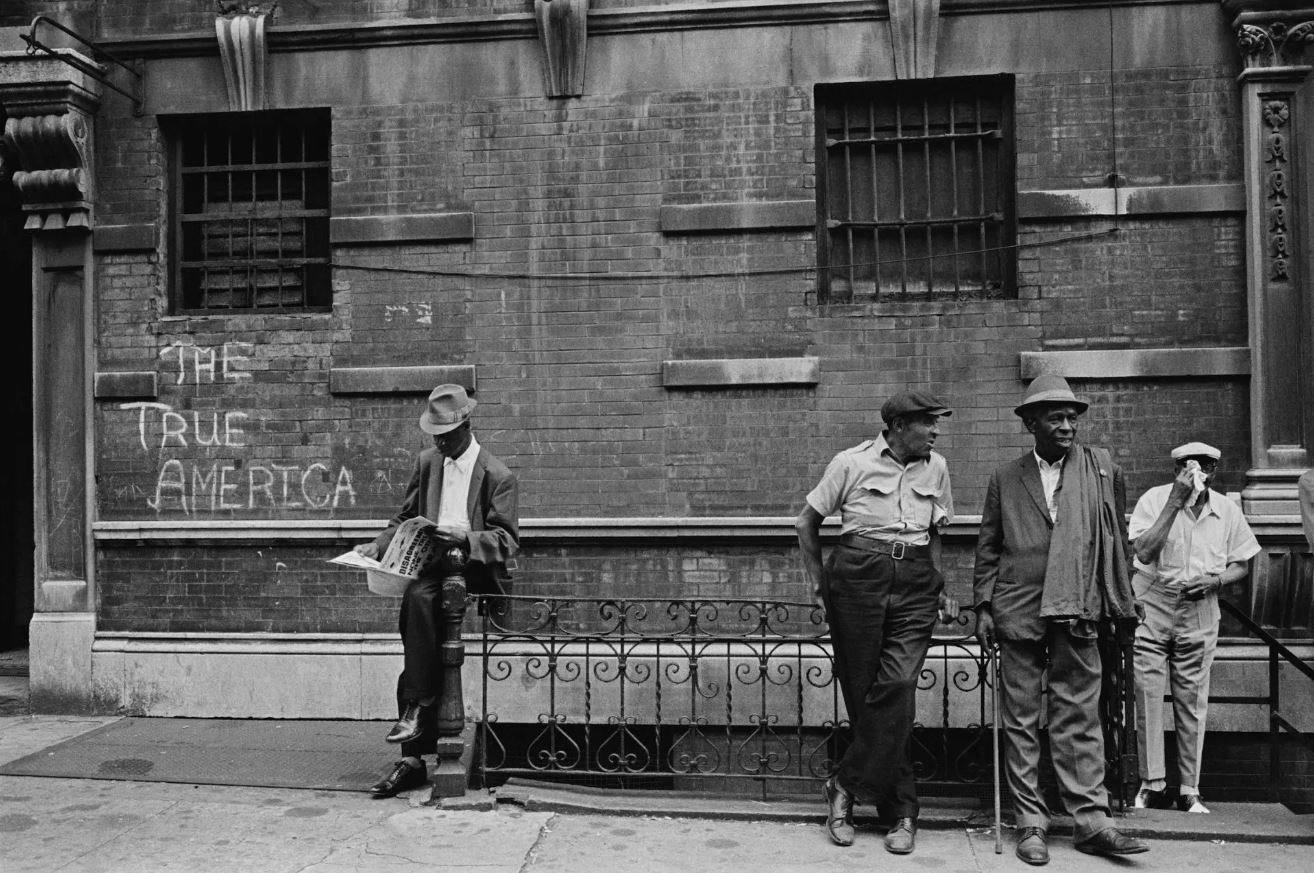
Cole travelled to the South to take photos of poor rural communities but, as far as I can make out, none of these photos have surfaced. For the second project Cole took thousands and thousands of photographs of New York street life, specifically the street life of Harlem, the part of Manhattan Island above 96th Street which was, at the time, almost entirely populated by the Black community. Most are in black and white but about a quarter are in a vibrant but beautifully dated and nostalgic colour.

Harlem, New York City, about 1970 by Ernest Cole © Ernest Cole / Magnum Photos

The rediscovered archive

The introduction to the show comes in the first (small) room. Here we learn from the wall caption that between 1967 and 1972 Cole took an estimated 40,000 photos (!). However, neither the city or rural projects was completed, no book was forthcoming, and Cole released very few of the photos during his lifetime. In the mid-’70s Cole’s life fell into disarray due to illness, he could get no work, he was sometimes reduced to homelessness and lost control of his archive. Surprisingly, despite the highly American provenance of all these images, he spent a lot of time in Sweden where he worked with a photography collective before dropping the medium altogether to take up film-making. He died of cancer back in New York City in February 1990 at the age of just 49.

What’s triggered this revival of interest in his work is that in 2017 a huge trove of his negatives was discovered in a Stockholm bank vault. As a result the Ernest Cole Family Trust was established to publicise and protect his legacy. This helps to explain the impetus behind the recent republication of ‘House of Bondage’ (2022) and the publication, now, finally, of his New York street photos, in a handsome volume titled The True America (2024).

Installation view of ‘Ernest Cole: A Lens in Exile’ at Autograph (photo by Kate Elliott)

‘Photography as a Social Weapon’

In the photo above you can see the small first room through the archway in the middle. In this space are displayed seven photos, the biographical wall label I’ve been quoting from, and a film. The film is a 5-minute clip from a long interview with Cole shot in 1969 and titled ‘Photography as a Social Weapon’. What comes over from this clip first and foremost is what a very charismatic and articulate man he was. But there are two main learnings from the interview:

1. The first is about the model for his vision. Cole tells us that the first ever photobook he got his hands on in South Africa inspired his vision and crystallised what he wanted to achieve. It was ‘People of Moscow’ by Henri Cartier-Bresson and he was inspired by the Frenchman’s way of capturing of the poetry of everyday life.

2. The second is his disillusionment. As he educated himself in South Africa (via a photography correspondence course from England and by meeting artists and musicians) he heard about the United Nations and about the existence of an African-Asian bloc. They’ll save us, he thought; they’ll intervene in South Africa to overthrow the evil apartheid system. But when he arrived in New York he slowly realised that South Africa was just one item on the agenda of its regular meetings, that the same countries stood up and made the same loud criticism of SA, and then the meeting moved onto the next item. Nobody was going to intervene. It was up to Black South Africans to liberate themselves.

And this was part of a broader disillusionment with American society. In the interview he expressed a hope of being liberated from the day-to-day experience of racism which had made life so unbearable in South Africa. But everywhere he went (and the label tells us he visited Chicago, Cleveland, Memphis, Atlanta and Los Angeles, as well as rural areas of the South) he found American Blacks to be poor and oppressed and discriminated against. Eventually he reached the devastating conclusion that Black people in America were no better off than Black people in apartheid South Africa. It was oppression everywhere.

He happened to travel American during the climax of the Civil Rights Movement, in the months either side of the assassination of Martin Luther King (4 April 1968) and in some of the photos captures the way many young Blacks had moved beyond King’s Christian faith in non-violent protest to believing that only direct, and potentially violent, action could liberate them. Hence also one of the best photos, of a proud young Black woman staring unflinchingly into the camera, wearing a lapel badge of herself carrying a submachine gun. Hence the several photos of Black Panthers looking uncompromising.

Black Panthers in the Park, Harlem, New York City 1968 by Ernest Cole © Ernest Cole / Magnum Photos

The main gallery contains 42 photos, 20 in colour and four of them blown up and printed on the wall.  All of them are shots of people in the street, street scenes, a few posed but mostly spontaneous documentary shots. He had such a gift, he had such an eye for capturing people in their variety and humanity. I can’t show them all so will give a verbal summary.

There’s a drunk passed out on the sidewalk, a street vendor selling clams, a smartly dressed Black couple in downtown Manhattan, a kids playing with a hula hoop, another child held by his Dad brandishing a toy popgun. There’s a man wearing a billboard warning against the dangers of Dope!, there’s a couple of guys in African tribal dress sitting on an open-top car obviously going very slowly through a little mob of onlookers and bearing a placard reading ‘Don’t riot. Get wise. Go to Africa.’

In the same spirit there are three or four shots of what appears to be a motorcade of cars carrying placards depicting African leaders, namely Patrice Lumumba of the Congo and Marcus Garvey, the Jamaican politician and activist. As you might expect there are also some very stylish, cool and nattily dressed people: a cool all of woman wearing what I take to be an African outfit in a north African, Muslim style. A very cool dude wearing no shirt, just a loose gold embroidered waistcoat, a loose necktie and a purple hat, smoking a cigar.

Apart from anything else there’s a very strong nostalgic feel about lots of the images. As a boy I watched a range of TV shows from the late ’60s’ and early ’70s which featured not just Black but white hipsters and dudes, everyone wearing shades and cowboy hats and tasselled suede jackets and so on. Many of these photos, putting aside the race issue, evoke nostalgia for the street fashions of half a century ago.

There are hardly any white people in the photos. Two are very negative. One shows a middle-aged businessmen looking contemptuously, maybe angrily, at a Black couple having a snog in the lee of some building work. There’s a highly symbolic shot of a middle-aged Black shoeshine guy on his knees in front of a suited white man who is nonchalantly leafing through a wad of dollar bills – an upsetting emblem of money-colour-power dominating Black poverty and humiliation.

Harlem, New York, 1969 by Ernest Cole © Ernest Cole / Magnum Photos

And nowadays…?

As you walk round, and as you read the wall labels in which Cole described his disillusionment and  growing sense that Blacks are oppressed everywhere, it’s impossible not to ponder the current situation of Black people.

It’s far too big a question for me to handle and, not being Black, my opinion is of questionable use anyway. We now have many Black people in positions of power and position. In the UK not long ago there was a Black Chancellor of the Exchequer and we currently have a Black Foreign Secretary. Black faces are increasingly prominent across public discourse, in the media of TV, film, theatre and art. But how that translates into everyday life, I have no idea. The Guardian reports almost daily of British institutions being called out for institutional racism, racism still (apparently) flourishes in the police, young Black men are five times as likely to be stopped and searched by the cops etc.

I read the news, I watch TV and movies and go to art exhibitions and see more and more Black faces, issues and discussions, but what Black life is like in the UK I haven’t a clue. And that’s just in England, my home country. I couldn’t possibly guess at the situation in the US, except for a) my awareness (like everyone else’s) of the Black Lives Matter movement which sprang up following the murder of George Floyd in May 2020, and b) the fact that all the media I read harp on constantly about ongoing racism and racial injustice in the States.

Anyway, I thought I’d end by mentioning that, in among the many street shots, there are a few more optimistic ones, which depict interracial couples arm-in-arm or hand-in-hand on the New York subway. It’s not much but, in their way, these are the opposite of the standing businessman and the kneeling shoeshine man, these are images of love and equality. If they hardly changed society at large – which, as I’ve just mentioned, appears to remain in many ways horribly unchanged – still, maybe they are images of hope that ordinary people can find their own ways to overcome prejudice and bigotry and to live the lives they want to.

Midtown Manhattan, New York, 1971 by Ernest Cole © Ernest Cole / Magnum Photos


Related links

Related reviews

Shakespeare and War @ the National Army Museum

A tale of two Henries

In 1944 Laurence Olivier produced, directed and starred in a movie version of Shakespeare’s play ‘Henry V’. Shot in bright primary colours it dealt in bright primary patriotic emotions and 30 years later my Dad and his best friend could remember seeing it in the cinema as 12-year-old kids and being stirred by its patriotic fervour, its stirring invocation of England’s valour and fortitude, at a time when German V rockets were falling on London and the south-east. (A V2 rocket fell on the house next door to my Dad’s, killing the occupants. The one time he mentioned it was the only time I ever saw him cry. Britain needed all the patriotism and determination it could muster.)

Installation view of ‘Shakespeare and War’ at the National Army Museum showing posters, cartoons, photos and programmes from the Second World War including a poster for Olivier’s Henry V

Those ardent schoolboys will have noticed that the film was ‘dedicated to the ‘Commandos and Airborne Troops of Great Britain the spirit of whose ancestors it has been humbly attempted to recapture’ because this appears as a caption at the start of the film, but won’t have known that the production was partly funded by the British government as a form of soft propaganda.

Forty five years later, in 1989, the actor widely seen as inheriting Olivier’s mantle, Kenneth Branagh, directed and starred in a new movie version of ‘Henry V’. Much was made of the fact that, instead of stylised sunny sets, the play went for a darker, grittier look, most notably in the battle of Agincourt scenes, filmed on a lovely sunny day in the Olivier version, but in a downpour of rain in the Branagh, which turns the battlefield into a quagmire, spattering all the characters with mud and also gore from the countless bodies which have been hacked and stabbed. Critics weren’t slow to point out that it was made in the aftermath of the Falklands War and so carried a strong message against war and warmongering.

Poster for the original 1984 Royal Shakespeare Company production of Henry V directed by Adrian Noble and starring Kenneth Branagh, as featured in ‘Shakespeare and War’ at the National Army Museum

The same play, the same author, the same plot, the same characters, the same stage directions and the same words – and yet supporting two very different productions, reflecting very different societies, mindsets and values.

These are just two examples of the way Shakespeare’s plays about war – the causes of war, the preparations for war, the experience of war, wartime emotions from terror to exhilaration – and the greatly varying opinions of his many different characters about war and warfare, have been quoted, adapted, distorted, illustrated and recycled, used both to support and attack Britain’s wars, in the 400 years since his death.

Shakespeare and War

The National Army Museum in Chelsea is currently holding a FREE exhibition titled ‘Shakespeare and War’ which sets out to review the huge history of the national playwright’s role in Britain’s many wars and conflicts and how his words, stories, characters and scenes have been used in widely different times and situations.

The exhibition sets out to document how the plays, characters and speeches have been excerpted and exploited propagandists, governments, commentators, satirists and anti-war activists, soldiers and civilians – during the turbulent 400 years since Shakespeare’s death, in 1616. As the curators put it:

The plays have been used to rally the nation at times of crisis and to reflect on the human cost of conflict. But they have also been used to critique war and to consider the more challenging aspects of the military experience. They have inspired soldiers and civilians alike, helping people face adversity on the battlefield and at home.

After Shakespeare

Thus the exhibition starts after Shakespeare’s death. There’s none of the usual fol-de-rol about his biography or the Globe Theatre or the parabola of his career, just the blunt facts that he was a very successful actor-dramatist-manager, who died in 1616, before the British Army even existed.

Instead we are thrown straight into the first major conflict which occurred after his lifetime, the civil war or wars of three kingdoms which broke out 23 years after his death, in 1639, and lasted until Cromwell’s pacification of Scotland in 1653.

The exhibition is divided into six broad historical sections, each of which is introduced by a wall label and then features all sorts of bric-a-brac from the period in question – broadsheets, posters, cartoons, pamphlets which cite or reference, quote or parody scenes, characters or speeches from the plays to suit the purpose of polemicists and propagandists of the moment, paintings or photos of Shakespearian actors or patrons, posters for productions through the ages, and then – in the modern era – recordings of radio and TV productions and so on. At the most basic level, it’s a curiosity shop of historical Shakespeariana.

1. Royal Shakespeare: The Civil War and Beyond

During the English Civil War Shakespeare was often associated with the monarchy. While in prison awaiting trial, King Charles I read Shakespeare’s (Second) Folio (the First and Second Folios were the first attempts to publish all Shakespeare’s works in one volume). The King made notes on its pages and the exhibition has his copy on show. This did not go unnoticed by the great poet and Puritan propagandist, John Milton, who is represented here by a first edition of his pamphlet, Eikonoklastes.

Installation view of the civil war part of ‘Shakespeare and War’, showing, on the left, engravings of Charles I (above) and Cromwell (below) along with Charles’s copy of the Second Folio beneath an English mortuary sword (photo by the author)

This little collocation of objects overflows with meanings. Eikonoklastes was written and published late in 1649 to justify the execution of King Charles which took place on 30 January 1649. It was a point-by-point rebuttal of a pamphlet titled Eikon Basilike, a Royalist propaganda work, which purported to be a spiritual autobiography of the saintly king. The Basilike set Charles up as the type of a perfect enlightened monarch who ruled by the Divine Right of Kings and through the ancient constitution. Milton refuted all these points and more, claiming that Charles’s rule had degenerated to a tyranny over a people who could only be free by executing him and abolishing the monarchy altogether.

Where does Shakespeare come in all this? Well, he was part of the culture wars between the two sides. Theatre was encouraged and sponsored by the King, the Court and aristocrats. Shakespeare’s younger contemporary, Ben Jonson, ended up writing masques – elaborate ritualistic performances, accompanied by music – for the King and Court, which reinforced the ideology of royalty and monarchical rule and in some of which the king himself took part.

In the eyes of radical Puritans all this was blasphemy. Representing people on stage came close to breaking the commandment about not worshipping images. Plays diverted people’s minds away from the only thing they should be contemplating, the glory of God. Playhouses were notorious sites of crime and prostitution. Shakespeare’s plays, even the sternest tragedies, are littered with outrageously rude puns and euphemisms, the kind of thing Parliamentary Puritans had in mind when they accused the theatre of staging ‘spectacles of pleasure, too commonly expressing lascivious mirth and levity.’

For all these reasons and more the Puritans protested against the theatre in the years leading up to the war, and this explains why, when Parliament took control of the capital in September 1642, they promptly shut down all the playhouses. Which explains why there’s an engraving of Cromwell in this exhibition showing him wearing a suit of armour above a pile of discarded theatrical bric-a-brac, such as masks and disguises. For 18 long years the theatres were dark. Shakespeare’s Globe was torn down in 1644 and turned into ‘tenements’.

The Restoration

In 1660 the monarchy was restored and Charles II assumed the Crown. His 25-year reign was troubled by political and religious issues along the old civil war schism, at its most fundamental the clash between devotees of the Protestant cause and Charles’s Court which became tainted with accusations of Catholic sympathy, especially after he married the Catholic princess Catherine of Braganza in 1662.

Like his father Charles was a great patron of the arts, including theatre, and his rule saw the flourishing of the movement referred to as Restoration Comedy. The theatre once again became associated with all the vices of Londoners at play, and this, like the theatre of his father, became the target of religious criticism. The ongoing schism between Catholic-leaning court and Protestant nobles came to a head during the three-year reign of Charles’s brother, James II, who with typical Stuart arrogance, not only took a Catholic wife but made it clear that the new infant son she bore him would be raised a Catholic. The Protestant aristocracy rebelled and overthrew him in what their propagandists named The Glorious Revolution, inviting the Protestant Prince of Orange (in modern Holland) to come and be our king.

The curators skimp a bit on this period, displaying just one work, a copy of a book by the playwright John Crowne adapting Henry VI parts 2 and 3 and titled ‘Misery of Civil War’.

Shakespeare’s history plays

The thing is, Shakespeare’s history plays amount to a sustained investigation of the nature of authority and ‘good’ rule. All of them are named after the English king they focus on and ask questions like, What makes a good king? What makes a bad king? Are nobles, or ‘the people’, ever justified in overthrowing a king? If two noble houses fight for the crown, what are ordinary people to do? Follow their conscience, try to avoid the conflict, or fight for their local lord and master? Is there such a thing as a ‘just’ war in which case, how do you define one?

Questions like these echo throughout the obvious plays i.e. the ones about English history, but are also central to the Roman plays and three of the four great tragedies.

The history plays are usually divided into three groups:

  • the series depicting the Wars of the Roses, being: Henry VI parts 1, 2 and 3, and Richard III (4 plays)
  • the second tetralogy – including Richard II, Henry IV parts 1 and 2, and Henry V
  • the standalone plays King John, Edward III and Henry VIII

The Roman plays which discuss the nature of authority and leadership focus on Julius Caesar and its sequel, Antony and Cleopatra. Both cover wars and include battle scenes.

The tragedies all feature war, in different ways. Macbeth is about a successful soldier and includes actual battle scenes. King Lear and Hamlet feature the invasion of their respective countries (England by the French and Denmark by the Swedes) but no actual fighting. And Othello is all about a highly successful mercenary general, which features no battles but is drenched in reminiscences of fighting and the rhetoric of battle.

What I’m trying to convey is that these 17 or so plays are rarely about war as such, but but are far more about the nature of power and authority and what happens when authority collapses.

The eight classic history plays are about the collapse of authority in one country and civil war among the English. The two Roman plays are the same: in both the Romans aren’t fighting any external enemy, but among themselves. Similarly, the three tragedies (excluding Othello) are about the collapse of royal authority in one country – the French only invade England in Lear and the Swedes invade Denmark in Hamlet once the native rulers have made a complete horlicks of trying to rule themselves.

And again, although the English come to the aid of the rightful heir to the throne at the end of Macbeth, they only have to do so because, yet again, the ruling class of the country in question (this time Scotland) have made a total mess of ruling themselves, as a result of all the murders Macbeth finds himself voodooed into committing.

Thus, the seventeen or so plays about history are almost entirely about the collapse of political authority in one country leading to civil war. The fifty years from the collapse of Charles I’s power in the 1630s through to the Glorious Revolution in 1688 are, therefore, the most relevant or applicable to Shakespeare’s concerns. It is, therefore, strange and intriguing that contemporaries, apparently, according to this exhibition, made so little application of the huge amount Shakespeare wrote on this subject to the one era in the past 400 years which most suited it.

This little survey of Shakespeare’s history plays also explains something else. Henry V is the only one in which is not about a civil war. Henry V is the only one in which we are not fighting among ourselves, but go abroad and fight somebody else. This explains why Henry V crops up in this exhibition as the spearhead for patriotic fervour more times than the ten other history plays put together – because once we’d sorted out our own political problems via the civil wars and rebellions of the seventeenth century, we turned our warlike energies against foreigners.

2. Revolutionary Shakespeare: Change and Political Debate

The late eighteenth century saw a major global war (against France) and two revolutions (in America and France) which changed the world. In each of these conflicts Shakespeare’s plays, characters and the Shakespeare brand were used to define, critique and support both a patriotic war and new political movements.

The Seven Years War

By the start of the eighteenth century Shakespeare had become established by numerous writers, critics and commentators as a national icon. The exhibition skips over the wars of the early 18th century, in Europe and India:

  • War of the Spanish Succession 1701 to 1714
  • Great Northern War 1717 to 1720
  • War of the Austrian Succession 1740
  • Carnatic Wars 1744 to 1763

Instead it jumps to the Seven Years’ War (1756 to 1763), the war against France which saw British victories on the Continent, in India, in the Caribbean and North America. The exhibition includes a number of interesting mementoes from the war.

David Garrick, the leading figure in London theatre by the mid-century, wrote a Dialogue to preface a 1756 production of The Tempest, in which two characters debate the rights and wrongs of the new war. It reminds us that for hundreds of years actors, managers and playwrights felt perfectly free to preface Shakespeare productions with prologues like this, tailoring the play to the issues of the day, or even cutting and rewriting bits of the plays to reflect current concerns.

In 1768 Edward Capell produced an edition of the plays in which he states what had, by then, become orthodoxy, that the 38 or so plays amount to ‘a part of the kingdom’s riches’. Not only this, but Britain’s standing ‘in the world’ depended on ‘the esteem within which these are held.’

The fact that Shakespeare’s one play which takes a foreign enemy is directed against the French did not escape numerous writers and commentators as Britain embarked on a global struggle against…the French. There’s a playbill for a production of Henry V staged in Covent Garden in 1761 which has two significant aspects. 1) For this occasion, the play was unsubtly subtitled ‘the Conquest of France’ and 2) each of the 23 productions were followed by a lavish recreation of the coronation of King George III which had just taken place (22 September 1761).

If Shakespeare’s association with kingship had been deeply problematic for Milton in the 1640s, long before a century had passed the name of Shakespeare, the Shakespeare brand, had become indissolubly linked to celebration of the solidly Protestant and anti-French monarchy.

The American War of Independence (1775 to 1783)

Following on from, and partly a result of, the Seven Years War, came the American War of Independence. Unsurprisingly, American patriots seeking to break from Britain drew on Shakespeare’s classical histories. Plays like ‘Julius Caesar’ and ‘Coriolanus’ helped support the idea of republican government and liberation from imperial rule.

The two sides (British and American) both staged plays and the curators display playbills from both sides, which use Shakespeare texts to propagandise for their cause. So there’s a playbill for an American production of Julius Caesar which applauds the ‘noble struggles for Liberty by that renowned patriot Marcus Brutus.’

There are rather more relics from the British side and the curators display pictures focusing on New York. This is because early on in the war, the British Army under the command of Lieutenant-Colonel Henry Clinton occupied New York City and turned it into a garrison town. Members of the Army staged regular productions of Shakespeare at the newly-renamed Theatre Royal, confirming the by-now well-established link between drama and royalty. the performances were staged ‘with permission’ of Clinton, who was also a patron of the performances. Plays were staged to raise funds for wounded soldiers. The British tended to favour Shakespeare’s monarchical plays, whilst American Patriots used plays with a republican ethos (such as Julius Caesar and Coriolanus) in their satirical prints and posters.

Lieutenant-Colonel Henry Clinton, 1st Regiment of Foot Guards, 1758 (National Army Museum)

The French Revolutionary and Napoleonic wars (1789 to 1802, 1805 to 1815)

As explained above, Shakespeare’s plays can be used to provide examples of resistance to oppression and corrupt politics and so justify insurrection against corrupt rulers. The French Revolution amounted to a massive ideological upheaval in the thinking of all Europe. In the three years after the initial overthrow of the monarchy in 1789, politicians and intellectuals all across Europe took the sides of either the revolutionary liberators or the rule of monarchy, hierarchy and order. But in 1792 revolutionary France declared war on Austria and Prussia and the conflict became military in nature. Many former sympathisers retracted their support, especially after the situation in Paris descended into The Terror of 1793 to 1794.

The French Revolutionary War lasted from 1792 to 1802, when it was terminated by the Treaty of Amiens. Fighting broke out a year later in what came to be called the Napoleonic Wars which were to last from 1803 to 1815.

During this long period of ideological and military conflict, Shakespeare plays, characters and lines were mobilised to justify both sides of the ideological and military divide. In Britain, politicians, public figures, actors, and the Army drew on the playwright’s characters and speeches to justify their reasons for going to war, and to criticize rebellions against royalty.

This 25-year period also happened to be a golden age of political satire, featuring two of the greatest British caricaturists and cartoonists, James Gillray (1756 to 1815) and Isaac Cruikshank (1764 to 1811). Amid the many visual jokes and references they and many cartoonists and commentators like them used to pillory the politics of the day, Shakespearian references loomed large.

So the exhibition has some excellent cartoons by both men, which invoke Shakespearian references for the purposes of mockery and exaggeration. This print by Cruikshank uses The Tempest to praise the patriotic Tory Prime Minister William Pitt and ridicule his chief political opponent, Charles James Fox, an opponent of the British monarchy who was an initial supporter of the French Revolution.

Prospero and Caliban in the Enchanted Island by Isaac Cruikshank (1798)

Smoothly dressed Pitt is depicted as the wonder-working magician Prospero, telling his creature:

Hence! – fetch us fewel and be quick
Thou wert best – shrugst thou malice?
If thou dost unwillingly what I command
I’ll rack thee with old cramps –

While Fox, portrayed as big ugly Caliban, and wearing a tricolour scarf (symbol of the revolution) shrugs with savage disgust, saying:

I must obey! his art is of such power
It would control a Setebos,
And make a vassal of him.

There’s a brilliantly vivid print by Gillray titled ‘A phantasmagoria – conjuring up an armed skeleton’ which depicts contemporary politicians as the three witches from Macbeth. The print criticises the Treaty of Amiens which was widely seen as a capitulation to France. In the picture the witches are replaced by three leading supporters of the treaty, Henry Addington, Lord Hawkesbury and William Wilberforce and their magic spells for peace have, it is implied, reduced Britannia to a skeleton. Note the sack of gold at bottom left implying that these ‘traitors’ were bribed to betray their country and the French cockerel at bottom right, mockingly standing astride a skinned British lion.

‘A Phantasmagoria; — Scene – Conjuring-Up an Armed-Skeleton’ by James Gillray (1803)

The exhibition includes probably Gillray’s most famous image, ‘The Plumb-pudding in danger; – or – State Epicures taking un Petit Souper’. The image depicts British Prime Minister William Pitt and French Emperor Napoleon carving up the world between them. I’ve seen it many times but didn’t realise that the epigraph directly under the title, at top right, is an adapted quote from The Tempest, namely ‘”The great globe itself and all that it inherits” is too small to satisfy such insatiable appetites’.

The Plumb-pudding in danger; – or – State Epicures taking un Petit Souper by James Gillray (1805)

In these cartoons you see something interesting happening. Many of the previous objects (from the Seven Years or American Revolutionary Wars) indicated that Shakespeare was best promulgated via productions of entire plays. Here, in these cartoons, you can see the way that Shakespearian tags and clichés now lend themselves to much more pithy and succinct visual media.

Satirical prints had been around all through the 18th century, in fact they go back to Shakespeare’s day and even earlier. But somehow the Gillray and Cruikshank feel new. They demonstrate how Shakespeare, as well as representing the ‘the kingdom’s riches, according to high-minded editors such as Edward Capell, could also be the source of popular jokes and gags.

From now on, alongside all the stirring patriotic stuff, the exhibition features a strand of often very funny works using Shakespeare for comic purposes.

3. Imperial Shakespeare: The Victorian Army

After Napoleon’s defeat at Waterloo in 1815, the British Army’s role began to change. Rather than fighting major campaigns on the Continent, it was regularly used to protect and expand Britain’s imperial possessions, to fight Queen Victoria’s ‘small wars‘. But further to what I just mentioned about comedy, my favourite bits from what amounts to the Victorian section of the exhibition, were comic.

It must be said that some of the exhibits in the show seem to bear a pretty slender relationship with its supposed subject, Shakespeare and War. For example, the eighteenth century section has a set of images around the death of General James Wolfe at the 1759 Battle of Quebec which have no direct relation to Shakespeare, don’t quote or cite Shakespeare, seem to have no relationship except that Wolfe’s death was made the subject of ‘patriotic plays’.

Less utterly irrelevant is this entertaining print. In 1823 British aristocrats still carried out duels and this print mocks the practice by having the duellers and their seconds portrayed as monkeys. Apparently the title derives from a quote from ‘The Merchant of Venice’ but it’s a pretty flimsy pretext for including it in an exhibition about Shakespeare and War.

Awful Moments or Monkeys of Honour, colour print by John Lewis Marks after an unknown artist (1823)

More directly relevant if irreverent are the excellent prints taken from a later book, the Military Misreadings of Shakespere by Major Thomas Seccombe. It contains 31 beautifully delineated cartoons of military cockups, clumsiness and pratfalls, each offset by an ironically serious Shakespeare quotation. In this one a beautifully dressed member of the Life Guards has just been thrown by his horse to the accompaniment of a grand quote from Titus Andronicus: ‘That what you cannot, as you would, achieve, you must perforce accomplish as you may’ which thus acquires a completely comic meaning.

‘That what you cannot, as you would, achieve, you must perforce accomplish as you may’ from Military Misreadings of Shakespere (1880)

The Crimean War (1853 to 1856)

It wasn’t all lolz. The great exception to the century of generally small colonial wars which the British Army fought was the Crimean War, the one major conflict we were involved in in the century between the end of the Napoleonic Wars (1815) and the start of the Great War (1914). This famously highlighted significant problems with the Army’s organization, notably in the famous and futile Charge of the Light Brigade. Newspapers reported on the poor conditions in which soldiers found themselves, leading to demands for improvements and reforms to the Army’s culture and structure.

Only one exhibit relates to this badly managed and bitter war, a watercolour done by the Swedish artist Egron Sellif Lungren which depicts a kind of cinematic reimagining of a production of Henry V (what else?) staged by Charles Kean at the Princess’s Theatre in 1859 i.e. a few years after the war ended. Queen Victoria attended the play and commissioned Lundgren to do a watercolour version of it for her Theatre Album. Of all the scenes in the play Lundgren chose to depict the siege of Honfleur which is not only the setting for Henry’s famous speech ‘Once more unto the breach dear friends’, but will have reminded many people of the long and gruelling British siege of Sebastapol.

Installation view of ‘Shakespeare and War’ at the National Army Museum showing Egron Sellif Lungren’s watercolour plastered across one wall, with Gillray and Cruikshank cartoons on the left

Imperial Shakespeare

Obviously the nineteenth century was the one in which Britain cemented its grasp over the largest land empire the world has ever known, as well as almost total control of the world’s oceans. This is a very big subject indeed and it is not really properly explored. Take just India. Were there no British theatres in India, Shakespeare productions in India? Did the growing Indian middle class every stage Shakespeare productions with Indian casts? Was Shakespeare’s name, plays or quotes never invoked to justify British rule in India? Were there comic or satirical pamphlets or prints using Shakespeare quotes to mock British rule in India? Not in this exhibition, nor anything about the British Army’s involvement in Africa, the Caribbean, the Middle East or Far East.

Instead, as I’ve already pointed out, some of the exhibits have only a tenuous or oblique connection to the exhibition topic. For example, a picture caption tells us that amateur theatricals were often staged by regiments and soldiers as peacetime entertainments, which we might well have guessed. And that’s the fairly flimsy pretext for sharing a photo of members of the East Yorkshire regiment staging a production of Hamlet at their barracks in Cheltenham in 1895.

The Cast of Hamlet, Winter Gardens, Cheltenham, 1895 (National Army Museum)

Meanwhile, there’s nothing about the second war of the period which shook British confidence, the Boer War of 1899 to 1902. Were there no Shakespeare productions mounted here in England to raise funds or stir patriotic fervour? Did the besieged populations of Ladysmith, Mafeking or Kimberley put on productions to keep their spirits up? Didn’t domestic commentators or cartoonists use Shakespeare quotes or characters as material? If so, none of it is displayed here.

4. Patriotic Shakespeare: The First World War (1914 to 1918)

During the First World War great service and sacrifice were required of both the Army and the civilian population. As in the last great campaign in Europe a century before, Shakespeare was used in Britain to rally the troops and the country behind a sense of national duty.

As mentioned above, some exhibits are included on pretty flimsy grounds: for example, there’s no real reason to include some of Lord Kitchener’s recruitment posters (Your country needs You) except for the fact that, after Kitchener drowned when the ship he was sailing in hit a German mine (HMS Hampshire, 5 June 1916) the League of the Empire started publishing and presenting special editions of the ‘Complete Works of Shakespeare’ to wounded and disabled soldiers in his name, an edition which quickly became known as ‘the Kitchener Shakespeare’ – but there’s nothing at all about Shakespeare in the famous posters.

‘Lord Kitchener’s Appeal’, recruiting poster, 1914 (National Army Museum)

More tenuous examples include: a sketchbook by a John Henry Jenkins, a front line soldier, which depicted not only trench life but the watercolours of amateur theatricals which the soldiers put on, although Shakespeare is nowhere mentioned; or a 1915 recruitment poster which includes the image of St George and the dragon and so, the curators suggest, might have reminded some viewers of Henry V’s famous call, ‘God for Harry, England, and Saint George!’ Pretty tenuous.

Much more relevant is a book of Shakespeare quotations arranged under themes or headings relevant to the war and distributed to soldiers, ‘Shakespeare in Time of War: Excerpts from the Plays arranged with Topical Allusions’, edited by the artist Francis Colmer and published in 1916.

Another apparently random object is this photo of Women’s Army Auxiliary Corps personnel packing boxes in a factory in 1918. Spot the Shakespeare connection? No, because there isn’t one…

Women’s Army Auxiliary Corps personnel packing boxes in factory, 1918

…until you look at the photo beneath it, which is a photo of Maggie Smale’s all-women production of Henry V, staged in a munitions factory in Leeds which had been operated by the ‘Barnbow Lasses’ during the Great War. Is this to do with feminism? Or pacifism? Or a celebrating of provincial grit? I wasn’t sure.

Still from Maggie Smale’s all-female production of Henry V as featured in ‘Shakespeare and War’ at the National Army Museum. Photo by Mike Oakes

Amateur productions of Shakespeare were mounted across the country, sometimes to raise morale, to entertain wounded soldiers, for the benefit of the public. Three hundred years after his death Shakespeare was not only a well-known brand but possibly the only literary writer a lot of working class people had heard of. As in his own time, he catered for an audience of elite intellectuals, the educated middle classes, and illiterate workers. You can see why Shakespeare productions abounded because he was 1) possibly the only playwright everyone had heard of and 2) safe –unlike more recent troubling playwrights of the previous generation (Shaw, Ibsen etc).

There’s a clip from an official film showing wounded soldiers watching open air production of A Midsummer Night’s Dream. Scenes like this 1) the British heritage which the soldiers were fighting for 2) to a wider audience demonstrated the care the government was taking of its fighting men. This clip appeared alongside footage of scenes of artillery and war preparation, thus dovetailing Britain’s cultural heritage into the war effort.

in my own life I’ve met plenty of people who don’t give a toss about official culture, art or theatre. You’ve got to wonder how many of the sock and maimed soldiers forced to watch this kind of thing actually enjoyed it or even understood it. Because that’s a thing about Shakespeare – unless you’re pretty familiar with the play beforehand, it’s impossible to get the most out of a theatrical production, in fact it’s often impossible to understand what’s going on and especially difficult to get any of the comedy in his plays.

It’s fascinating to learn about the Shakespeare Hut. In February 1916, to commemorate 300 years since his death, this mock-Tudor retreat was opened on a plot of land in Bloomsbury. The hut was built on a site cleared for a planned Shakespeare Memorial Theatre, which was abandoned because of the war.

The aim was to provide shelter for wounded Australian or New Zealand troops. Over the next two years it would welcome in more than 100,000 soldiers far from their New Zealand homes. Queen Mary visited in 1917, took up her post behind the tea counter, and poured cups for all the men.

The troops were subjected to regular Shakespeare productions, including an all-female Henry V starring Ellen Terry, one of the most famous actors of her day. Hah! So the Maggie Smale production was following in venerable footsteps.

The exhibition features photographs and playlists from the Hut and you can read more and see photos in an interesting Guardian article about it. Interesting to learn that it the site is now occupied by the London School of Hygiene and Tropical Medicine.

One of the most interesting learnings from the exhibition is about the role of theatricals among British prisoners of war held in Germany. The exhibition focuses on the Ruhleben Camp in Germany which housed some 5,000 POWs. Prisoners were allowed to construct a theatre and, for the same tercentenary which prompted the Shakespeare Hut, staged a series of productions, including Twelfth Night and Othello. The exhibition features photos and a programme from a 1915 production of As You Like It.

In a similar spirit, the British Red Cross mounted a Shakespeare Exhibition at the Grafton Galleries in 1917. Quite clearly, if you go looking for Shakespeariana during the First World War, you’ll find it.

Installation view of ‘Shakespeare and War’ at the National Army Museum, showing a poster for the Red Cross Shakespeare Exhibition of 1917 (photo by the author)

5. Democratizing Shakespeare: The Second World War

Same goes for the Second war. Once again Shakespeare was trotted out as the exemplar of the culture and values that were under attack from Nazi Germany, that we were fighting to preserve. The motives and means were very similar to the first war – am dram productions across the country to entertain wounded troops or raise money, leading actors of the day giving patriotic productions in London to stir patriotic fervour, footage of productions shot to be show in cinemas and raise morale.

With the new angle of radio. For the first time productions could be broadcast, to a large radio audience which steadily grew throughout the six war years. As part of the government’s attempt to mobilize society to support the war effort, British theatre was sponsored by the state for the first time in its history.

The Council for the Encouragement of Music and the Arts (CEMA) was created to promote and maintain the fine arts and British cultural life. It later became the Arts Council of Great Britain. The Entertainment National Services Association (ENSA) provided for the forces, organising shows and performances by well-known actors, singers, and comedians.

Photo of an ENSA production staged in a London underground station in 1942 (National Army Museum)

Despite the challenges of wartime, both theatre and Shakespeare thrived. Once again, his words helped to frame the experience of conflict both in Britain and across the world. The exhibition features a recording of a radio programme originally broadcast by the BBC Overseas Services on Shakespeare’s birthday on 23 April 1942. It included extracts from ‘As You Like it’, Henry IV part 1 and, of course, Henry V. It was introduced and performed by leading Shakespearean actors Peggy Ashcroft, Robert Donat, Edith Evans and Ralph Richardson. You can listen to it on headphones and marvel at their phenomenally posh plummy English voices.

There’s a section devoted to the Laurence Olivier production of Henry V described at the start of this review.

And once again there’s a section devoted to British prisoners of war staging Shakespeare productions in camps in Germany. The exhibition includes a list of plays staged at Stalag 383 in Hohenfels, which included ‘The Merchant of Venice’.

6. Just Shakespeare: Adapting After 1945

After the Second World War the patriotic tone of Laurence Olivier’s Henry V lingered throughout the 1950s. But the second half of the 1960s saw radical changes in all aspects of art and culture, with a variety of new approaches to all the arts including theatre. This included the anti-war movements triggered by Vietnam, as well as new attitudes to sex and nudity, which now began to appear in Shakespeare productions.

For 200 years the name and plays of Shakespeare had acted as a kind of recruiting sergeant for the British Army and rallying point for the nation in times of real threat (particularly during the Napoleonic, First and Second World Wars). From the late 60s onwards, Shakespeare’s relationship with the state, the Establishment and the Army came under increasing critical scrutiny. Not in every production, but in an increasing number.

Hence Kenneth Branagh’s 1984 RSC production. Unlike earlier productions it shows the execution of French prisoners onstage and then left the bodies and corpses from the Battle of Agincourt at the back of the stage, behind a gauze curtain, for the later, supposedly reconciling scenes between the English king and his French bride-to-be.

The last section of the exhibition, in the central booth of the (fairly small) exhibition space, takes the Branagh production as setting the tone for productions which followed the Falklands War (1982), the Gulf War (1990 to 1991), and the Iraq War (2003 to 2011).

It includes video clips of stage productions including:

  • a 2013 production of ‘Othello’ which depicts the characters in the modern-day Army uniform used during the Iraq War
  • a 2015 production of ‘Othello’ which features graphic scenes of waterboarding Iraqi suspects
  • ‘Days of Significance’, a play by Roy Williams based on ‘Much Ado About Nothing’ which looks at the impact of British troops who fought in the Iraq War

The strong anti-war flavour of these productions and the pretty intense criticism of the British Army and its techniques, could hardly be more unlike the innocent patriotism of the Shakespeare Hut or the brightly colours optimism of Olivier’s Henry V. If we go to war with Russia I wonder if Shakespeare will be trotted out to inspire patriotic spirit as it was 100 and 70 years ago. I doubt it. Shakespeare hasn’t changed, that’s to say the texts remain pretty much what they were 400 years ago. But our understanding of war, gained in the brutal conflicts in Iraq and Afghanistan, has made any thoughts about the glamour or heroism of war impossible to modern Brits.

Availability bias

This is a fascinating premise for an exhibition and I thoroughly enjoyed working my way through the wealth of objects and their captions. It proves that Shakespeare is like the Bible, so compendious and diverse that you can find words to justify more or less any opinion on any subject (as demonstrated by the opposing sides in the American War of Independence using Shakespeare to bolster their arguments).

However, it throws up an obvious issue which is to do with the availability of objects to display. The exhibition was curated by – and is based on the scholarly books by – two Shakespeare scholars, Amy Lidster and Sonia Massai, namely Wartime Shakespeare: Performing Narratives of Conflict. Just from the synopsis on Amazon you can see how a book-length work like this is free to range over all and any productions it likes because words are easy. On the other hand, an exhibition in a museum is severely limited by the objects it can get its hands on.

In fact, like every exhibition at every gallery or museum, this one is an exercise in the art of the possible. Objects which denote important productions or topics may not be available (or may not even exist) while other topics throw up a glut of barely relevant artefacts.

In addition, it’s difficult and expensive to get objects on loan from other collections whereas it’s cheap and easy to get them from your own storeroom, so all exhibitions in all galleries are biased towards the host institution and its collection.

Plus there’s the common problem with any historical overview which is that objects from three or four hundred years ago are rare whereas, as you get closer to the present day, the number of objects rapidly increases, until you are drowning in a surfeit of stuff.

These imbalances in the real world threaten to unbalance or distort the picture painted by any exhibition, an imbalance which is easily managed in books and articles where issues and ideas can be easily conveyed by text alone.

So, at various points, I couldn’t help feeling that the curators had included some objects more because they were just related to one of the conflicts during the period in question than for their Shakespearian relevance. As mentioned above I couldn’t see any Shakespeare connection to the three or four pictures of General Wolfe and the capture of Quebec except that the event was turned into patriotic plays and prints. To put it another way, some of the links between specific conflicts and Shakespeare were pretty tenuous. I still don’t understand why there was an English mortuary sword in the Civil War section except that maybe the curators felt they just needed a physical object, any object, to go alongside the half dozen books and pamphlets.

All the objects (photos, pamphlets, diaries and whatnot) are interesting, it’s just that I was left scratching my head why some of them were included.

Shakespeare and conflict

There’s another, more scholarly, issue. This, as I touched on earlier, is that taken together, Shakespeare’s dozen or so history plays, plus the relevant Roman plays and the tragedies, build up into a subtle, sophisticated, multifaceted meditation on the themes of power, authority, legitimacy, insurrection, rebellion, revolt and overthrow.

Arguably, to really address the topic which this exhibition sets out to explore, you would need a really sound grasp of how all these issues are dramatised and explored in the 20 or so relevant plays, before you even started your review of how they’ve been applied to Britain’s wars and Britain’s Army.

But this, of course, is a massive task – after a lifetime reading Shakespeare I still haven’t read all the history plays and have nothing like a complete grasp of the issues of legitimacy and political power which they raise.

And an exhibition like this has to be practical, finite and manageable. This one achieves what it sets out to do, in a relatively small space, as well as it probably could do. But, in my opinion, the ghost of the larger political, social and cultural issues raised by the plays hover over it, unmentioned and undiscussed.

To take just one aspect of what I’m driving at, many of the characters in the history plays (the ones I’m familiar with) describe and discuss the horror of war, the fear experienced by soldiers, the terror of innocent civilians, the horrific injuries, killing and massacres involved, the fields strewn with bodies, the devastated landscapes and ruined economies. Descriptions of these kinds of things are commonplace in the plays and yet, somehow, hardly occur anywhere in this exhibition.

At some point I realised that this is not an exhibition about Shakespeare and War as about Shakespeare and the British Army. This explains why it’s divided into chronological periods based entirely around conflicts the British Army engaged in right up to the present day, rather than the themes of war encountered in the plays which I have just listed. And this is why, although it’s a very enjoyable trot through British military history, with an emphasis on how Shakespeare’s name, characters and words have been exploited in times of war – it feels, ultimately, despite being packed with shiny objects, intellectually thin.

You can see how an exhibition about Shakespeare and war would actually be something quite different: instead of taking a chronological approach it would take the topics I’ve mentioned several times now – the collapse of authority, civil war, rebellion, interstate war – and then the aspects of war – recruitment, training, fighting, sieges, inspirational rhetoric, the exhilaration of fighting, the horror of wounding, the devastation of the countryside, the mourning of widows – and explore how all of these are described and critiqued in Shakespeare’s multifaceted dramas. It would be something completely different from this exhibition. But then again, maybe what I’ve got in mind would be so wordy and text-heavy that it couldn’t be staged as an exhibition at all.

What this exhibition does, it does very well. It is small but beautifully staged and is FREE.


Related link

Related books

Shakespeare reviews

National Army Museum reviews

Artspeak key words

Modern Couples was a enormous exhibition held at the Barbican in the winter of 2018/19, which examined the role played by couples, women, lesbians, gay men and transgender people in the avant-garde art and literary movements of the early twentieth century.

Beginning by describing the working relations of no fewer than 40 (mostly heterosexual) artistic couples, the exhibition went on to examine a variety of other forms of artistic collaboration – between same-sex partners, between trios of artists, ménages à trois, and among larger groupings and movements, such as the Surrealists. The exhibition was a polemical one designed to show that:

  1. not only was the core of the Modernist movement based around radical new ideas about love, sex and eroticism, but also that:
  2. Modernism was the result of an unprecedented number and variety of types of artistic collaboration

With over 80 named artists and some 600 objects and artworks on show, the exhibition was an overwhelming bombardment of information and took a lot of time and several visits to really absorb.

Key words of contemporary artspeak

Above all, it was a very wordy exhibition, with over 40 lengthy wall labels, totalling some 100 paragraphs of densely factual text, plus extensive quotations from the writings, letters, diaries and so on of the numerous artists and authors featured.

As I read through these labels I became more and more aware of the repetition of key words and phrases and the recurrence of key themes and ideas. Eventually I began to wonder what it would be like it I cut and pasted together all the phrases which used one or more of these keywords; to see what picture would emerge from this textual collage.

A collage of quotes

So: this blog post is intended as a collage of the keywords (and, therefore, the key themes) from the exhibition. After all, collage – cutting up and re-arranging words and images – was a distinctive invention of the Modern movement.

I’m not sure what conclusions to draw. On a purely logical level, the repetition of a small set of closely related terminology to do with love, sex, desire and gender suggests the narrowness of the concepts underpinning the exhibition and the tremendous limitedness of the curators’ concepts and vocabulary.

But, on another level, the repetitions may have a sort of incantatory quality: like the holy words and phrases repeated by Christians and other religions at their weekly services, annual festivals, rites of passage, baptisms, christenings and deaths. In Christianity these would be keywords like God, love, Father, Son, sin, forgiveness, love, atonement, saviour, saint. In the jargon of modern artists and curators the keywords are bourgeois, challenge, desire, erotic, gender, practice, queer, sex, subvert, same-sex desire, transgressive and unconventional. If religion concerns things of the spirit, modern art is all about the body.

Repetition and faith

Repetition performs a number of functions for a believer: it grounds them in their beliefs; the reassuring litany of familiar words and ideas binds you to the community of the faithful; repetition drums home key terms and concepts with a brainwashing function which eventually makes independent thought impossible. To the initiate, the litany is a quick introduction to the value system of the ideology.

In much same way, the following keywords are central elements in the modern secular religion of critical theory, touching on notions of identity politics, LGBTQ+ activism, feminist theory, and a kind of watered-down Marxism – the key elements which dominate modern art jargon.

Their purpose is not to explain anything but to create a sense of identity and community among believers, to identify the enemy, rally the faithful, and endlessly repeat the key dogmas which the true believer must hold in order to be saved.

A dictionary of received ideas

Viewed another way, this post invokes the spirit of Gustave Flaubert’s Dictionary of Received Ideas. This was:

A short satirical work assembled from notes compiled by Gustave Flaubert during the 1870s, lampooning the clichés endemic to French society under the Second French Empire.

For his own amusement Flaubert assembled notes towards ‘a dictionary of automatic thoughts and platitudes’, where a platitude is defined as:

A remark or statement, especially one with a moral content, that has been used too often to be interesting or thoughtful… A trite, meaningless, or prosaic statement, often used as a thought-terminating cliché… The statement may be true, but its meaning has been lost due to its excessive use.

Note how a key aspect of a platitude is that it has lost its meaning due to repetition. That’s my point about these artspeak ideas. They may seem radical and shake your world the first time you read them, when you’re 17 or so. But just in this exhibition the same ideas are repeated 10, 15, 20 times, which makes them start to lose their power. And if you visit 10 exhibitions which feature the same basic ideas, rephrased 10 or so time, you’ll have read the same ideas about art ‘subverting bourgeois norms’ 100 times. And if you’ve visited hundreds of art exhibitions then you’ll have seen this same handful of ideas expressed in all possible permutations, thousands of times.

Over time repetition makes them go from exciting and mind-opening, to familiar and comfortable, and then on to threadbare empty. Incessant repetition turns them into platitudes and clichés.

So I am both a) lampooning the clichés of contemporary artspeak, using the texts available at this particular show and b) showing how endless, brainless repetition of the same handful of ideas and phrases eventually empties them of all meaning.

The list of keywords

In what follows I give three elements:

  1. the keyword
  2. the attitude any self-respecting, progressive follower of intellectual fashion should adopt towards it (in italics) – that’s the bit which is most a homage to Flaubert’s dictionary of platitudes and stock attitudes
  3. then quotes from the wall labels at the Modern Couples exhibition, which illustrate how the keyword is used by curators

N.B. I’ve punctuated the list with illustrations of images from the exhibition.

Bourgeois

Bourgeois morality. Bourgeois conformity. Bourgeois conception of marriage. Awful. Stifling. Must be combated and overthrown.

‘Toyen and Štyrský believed in the political nature of eroticism, convinced that desire could transform human consciousness, fight bourgeois conformity, assault the hypocritical status quo, while opening up a liberated space unfiltered by aesthetic and moral constraints.’ (Hannah Höch and Raoul Hausmann)

‘In Hausmann’s eyes, Höch needed to free herself from the bonds of bourgeois morality and as he wrote to her, ‘kill the father in yourself’.’ (Hannah Höch and Raoul Hausmann)

‘Inspired in part by their friend and collaborator Vladimir Mayakovsky’s 1921 assertion that henceforth “the streets shall be our brushes, the squares our palettes“, bourgeois representation was to be eliminated and photography and design were to be valued equally with painting and sculpture.’ (Varvara Stepanova and Alexander Rodchenko)

‘[Mayakovsky, Osip and Lilya Brik’s] unconventional relationship placed friendship, love and creativity at the centre of a way of life that paid no heed to the bourgeois conception of marriage.’ (Lilya Brik, Osip Brik and Vladimir Mayakovsky)

Alexander Rodchenkom Lilya Brik and Vladimir Mayakovsky

Alexander Rodchenko, Lilya Brik and Vladimir Mayakovsky

Challenge

All good art ‘challenges’ bourgeois conformity, popular conceptions, gender stereotypes and everything else bad.

‘Within the same photographs, polarities such as poetry and violence; submission and agency; and male and female are challenged.’ (Lee Miller and Man Ray)

‘Throughout the 1920s, Cahun and Moore pursued a project of theatrical camera play that yielded hundreds of photographic images, mostly featuring Cahun in a variety of roles that challenged the established repertoire of gender stereotypes.’ (Claude Cahun and Marcel Moore)

‘Stieglitz interpreted O’Keeffe’s early paintings as embodying female sexuality and O’Keeffe, perhaps in an attempt to counter such an interpretation, began painting New York City, challenging the popular perception of urban motifs being essentially masculine territory.’ (Georgia O’Keeffe and Alfred Stieglitz)

Georgia O'Keeffe by Alfred Stieglitz (1918)

Georgia O’Keeffe by Alfred Stieglitz (1918)

Desire

This is polite curatorspeak for sexual attraction, lust, sex, sex drive, libido, carnality, lasciviousness, all of which are banned. ‘Desire’ is the very broad term which covers all of this. Heterosexual ‘desire’ is deprecated. The best form of ‘desire’ is same-sex desire, preferably female. Purer, more refined.

‘Toyen and Štyrský believed in the political nature of eroticism, convinced that desire could transform human consciousness, fight bourgeois conformity, assault the hypocritical status quo, while opening up a liberated space unfiltered by aesthetic and moral constraints.’ (Hannah Höch and Raoul Hausmann)

‘The exhibition begins on the Lower Level where all the principal themes that gave rise to Modernism and underpin Modern Couples are introduced: desire, agency, transgression, liberation, activism, collaboration and the urgent pulse of experiment.’ (Introduction)

‘In her confident embrace of female same-sex relationships, Sackville-West engendered desire in Woolf that then permeated her writing…’ (Vita Sackville-West and Virginia Woolf)

‘The relationship [with Vita] gave rise to Woolf’s Orlando (1929), a transformation of desire into writing.’ (Vita Sackville-West and Virginia Woolf)

‘Zürn shared Bellmer’s fascination with mapping desires and fears onto the female body. Eyes, limbs and breasts, often entangled with hybrid animal forms are recurrent motifs in her work.’ (Unica Zürn and Hans Bellmer)

‘For Bellmer, Zürn was a living incarnation of his Poupée and so he played out his desires on her body in a number of works that are powerful but undeniably shocking.’ (Unica Zürn and Hans Bellmer)

‘Klimt was one of Austria’s most acclaimed artists, who put the female form centre-stage, celebrated desire and the human psyche and created luxurious canvases, murals and mosaics.’ (Emilie Flöge and Gustav Klimt)

‘Male homosexuality was illegal in the United States when the American photographer George Platt Lynes was active from the mid-1930s until his death, and yet he trailblazed defiantly homoerotic works that celebrate male desire.’ (George Platt Lynes, Glenway Wescott and Monroe Wheeler)

George Platt Lynes, Stoneblossom (c. 1941) by PaJaMa. Collection Jack Shear

George Platt Lynes, Stoneblossom (c. 1941) by PaJaMa. Collection Jack Shear

Erotic

Just as same-sex desire is the best form of desire, so the optimum form of eroticism is homoeroticism. Both are based on the universal if unspoken disapproval shared by women and gay art curators of heterosexual male sexuality.

‘More than any of his contemporaries, the French sculptor Auguste Rodin knowingly placed eroticism at the centre of his work.’ (Camille Claudel and Auguste Rodin)

‘The, inanimate, naked figure sprawled on a bed of twigs and only visible through a peephole was cast from her body, the result of a long artistic and erotic dialogue between the two artists.’ (Maria Martins and Marcel Duchamp)

‘Saint Sebastian became one of [Lorca and Dali’s] coded signs, the preferred mascot for their different aesthetics. The saint’s historical association with male homoeroticism and sado-masochism may also have been on their minds.’ (Federico García Lorca and Salvador Dalí)

‘Male homosexuality was illegal in the United States when the American photographer George Platt Lynes was active from the mid-1930s until his death, and yet he trailblazed defiantly homoerotic works that celebrate male desire.’ (George Platt Lynes, Glenway Wescott and Monroe Wheeler)

‘Homophobic views were rife in post-war America when PaJaMa – an acronym for the collective formed by Paul Cadmus, Jared French and Margaret French in 1937 – began taking their homoerotically charged photographs.’ (PaJaMa: Paul Cadmus, Jared French and Margaret French)

‘Erotically charged photographs of these dolls were celebrated in Surrealist circles and remain extraordinary relics of a “mad love”.’ (Unica Zürn and Hans Bellmer)

‘Together [Lee Miller and Man Ray] made the darkroom and studio a place of shared photographic and erotic experiment.’ (Lee Miller and Man Ray)

Lee Miller with a cast of her torso, Downshire Hill, London, England 1940 by Roland Penrose © Roland Penrose Estate, England 2018. The Penrose Collection

Lee Miller with a cast of her torso, Downshire Hill, London, England 1940 by Roland Penrose © Roland Penrose Estate, England 2018. The Penrose Collection

Gender

‘Gender’ is possibly the central concept of modern art theory. What all modern art is about. What all contemporary art curators are obsessed with. The best art subverts, interrogates, undermines etc bourgeois gender stereotypes, expectations etc.

Gender indeterminacy, sexual empowerment and the fight for safe spaces of becoming were part of the avant-garde currency.’ (Lili Elbe and Gerda Wegener)

‘Capturing Picasso with his eyes closed and wearing only his bathing trunks while holding a bull’s skull, Maar makes Picasso’s famous machismo her subject. In a turnaround of gender expectations, Picasso becomes Maar’s muse.’ (Dora Maar and Pablo Picasso)

‘In 1934 [Toyen and Jindrich Štyrský] founded the Czech Surrealist Group that was known for rejecting notions of gender entirely.’ (Toyen and Jindřich Štyrský)

‘[Toyen]’s use of phallic imagery is a rare example of a female artist humorously commenting on the standard erotic language of the time and subverting gender expectations.’ (Toyen and Jindřich Štyrský)

‘Born Maria Cerminova, Toyen chose an ungendered pseudonym, which she claimed, came from the French word for citizen “citoyen”.’ (Toyen and Jindřich Štyrský)

‘With new inspiration Hannah Höch continued to comment on the battle of the sexes, gender and the ‘new woman’ as an engine of social renewal.’ (Til Brugman and Hannah Höch)

‘Throughout the 1920s, Cahun and Moore pursued a project of theatrical camera play that yielded hundreds of photographic images, mostly featuring Cahun in a variety of roles that challenged the established repertoire of gender stereotypes.’ (Claude Cahun and Marcel Moore)

Suzanne Malherbe/Marcel Moore (1928) by Claude Cahun. Courtesy of Jersey Heritage Collections

Suzanne Malherbe/Marcel Moore (1928) by Claude Cahun. Courtesy of Jersey Heritage Collections

Practice

Blanket term for what any artist actually does.

‘The photograms have solely been attributed to László, yet a double portrait of both artists is evidence enough of their collaborative practice.’ (Lucia Moholy and László Moholy-Nagy)

‘[Sonia]’s practice soon impregnated all aspects of life, experimenting with domestic interiors, dress, theatre designs and textiles in parallel with the chromatic fireworks found in Robert’s painting.’ (Sonia Delaunay and Robert Delaunay)

‘Taeuber-Arp’s puppets for King Stag show the importance of performance and dance within her practice.’ (Sophie Taeuber-Arp and Jean Arp)

‘[Natalia Goncharova and Mikhail Larionov] were prolific and versatile, engaging in a Russian form of expressionist practice known as Neo-Primitivism.’ (Natalia Goncharova and Mikhail Larionov)

‘The American photographer Margrethe Mather was instrumental in the development of her fellow countryman Edward Weston’s practice as a photographer.’ (Margrethe Mather and Edward Weston)

Edward Weston and Margrethe Mather (1922) by Imogen Cunningham. George Eastman Museum © Imogen Cunningham Trust

Edward Weston and Margrethe Mather (1922) by Imogen Cunningham. George Eastman Museum © Imogen Cunningham Trust

Queer

Hugely important concept. Far larger than the art world, ‘queer’ is a central part of the campaign throughout the humanities and beyond to overthrow traditional bourgeois notions of gender stereotyping and heterosexual convention. See ‘Queer Studies’.

‘Many of their images were taken on the beaches of Fire Island, Nantucket and Provincetown, offering a record of a long standing LGBTQ community in the United States, as Fire Island especially, was – and still is – a sanctuary for queer freedom.’ (PaJaMa: Paul Cadmus, Jared French and Margaret French)

‘With Orlando [Virginia Woolf] craftily weaved together one of the most important queer texts of the 20th century.’ (Chloe liked Olivia)

‘These lively, cultural spaces attracted a variety of creative queer women such as the female modern dandy, the Symbolist inspired femme-fatale and the androgyne.’ (Chloe liked Olivia)

Virginia Woolf and Vita Sackville-West

Virginia Woolf and Vita Sackville-West

Sex

Generally disapproved-of word because mostly (but not always) associated with male sexuality, toxic masculinity, heteronormativity, gender stereotyping, gender conventions, bourgeois conformity and everything bad. Meaning men, basically. Thus Rodin’s ‘sexual prowess’ and Klimt’s ‘sexual exploits’ are disapproved of.

Broadly speaking, men have the rather disgusting ‘sex‘ while women, gay men and lesbians have the far more spiritual and superior ‘desire‘.

‘Dating from when Claudel and Roding first met, Je suis belle (1882) pairs two previously existing works and expresses the older artist’s feelings of sexual prowess with characteristic bravura.’ (Camille Claudel and Auguste Rodin)

‘Duchamp made sexual union the focus of much of his conceptually oriented work.’ (Maria Martins and Marcel Duchamp)

‘The Erotic Objects became sexually charged keepsakes for Duchamp.’ (Maria Martins and Marcel Duchamp)

‘With “Chloe liked Olivia” Virginia Woolf’s A Room of One’s Own made a thinly veiled reference to female like-with-like sexuality for those looking out for it.’ (Chloe liked Olivia)

‘She was close to the Dadaists and Surrealists and was known for her sexually liberated relationships with artists and writers, including Louis Aragon, Aldous Huxley and Ezra Pound.’ (Nancy Cunard and Henry Crowder)

‘The extent of Dali and Lorca’s sexual relationship is unclear, although Dalí made a pointed reference to it in his later autobiography.’ (Federico García Lorca and Salvador Dalí)

‘This adventurous ménage à trois escaped the intolerance of American society for Paris and Villefranche-sur-Mer where they met a diverse artistic and largely sexually liberated community. (George Platt Lynes, Glenway Wescott and Monroe Wheeler)

‘Klimt was well known for his sexual exploits and illegitimate children, but his relationship with Flöge was respectful and mutually enabling.’ (Emilie Flöge and Gustav Klimt)

The Bride by Gustav Klimt (1918)

The Bride by Gustav Klimt (1918)

‘The decidedly cool and precise evocation of the hawk in the story reflects Westcott’s own struggles with aging and sexual frustration.’ (George Platt Lynes, Glenway Wescott and Monroe Wheeler)

‘The three first met at the Art Students League of New York, where Paul and Jared were lovers. Jared married Margaret in 1937, after which he sustained a sexual relationship with both partners.’ (PaJaMa: Paul Cadmus, Jared French and Margaret French)

‘Hausmann also upheld that a sexual liberation would enable a life unconstrained by monogamy and so was happy to maintain a relationship with Höch while still married to his wife.’ (Hannah Höch and Raoul Hausmann)

Subvert

The key central aim of all modern and contemporary art is to ‘subvert’ bourgeois convention and gender stereotyping and all bad things. Can be used interchangeably with ‘challenge.’

‘They also subverted the Greek myth of Narcissus (the tale of a young man who falls in love with his own reflection) to celebrate queer desire and refute historical ideas of feminine vanity.’ (Claude Cahun and Marcel Moore)

‘[Toyen]’s use of phallic imagery is a rare example of a female artist humorously commenting on the standard erotic language of the time and subverting gender expectations.’ (Toyen and Jindřich Štyrský)

Drawing 18 from the cycle '21' by Toyen (1938)

Drawing 18 from the cycle ’21’ by Toyen (1938) Subverting gender expectations?

Same-sex desire

The best kind of desire because it doesn’t involve horrible heterosexual men.

‘In her confident embrace of female same-sex relationships, Sackville-West engendered desire in Woolf that then permeated her writing.’ (Vita Sackville-West and Virginia Woolf)

‘Woolf’s activism and advocacy for same-sex love echoed what was happening on Paris’s more tolerant Left Bank.’ (Chloe liked Olivia)

Transgressive

The main aim of modern artists is to ‘transgress’ all the terrible conventions of bourgeois / conventional / racist / sexist / homophobic society by producing fabulously transgressive art. Use with the verbs ‘challenge’ and ‘subvert’.

‘Perceived as transgressive in the racist context of the 1920s and 1930s, the relationship [of Nancy Cunard and Henry Crowder] was a source of profound enrichment for both of their careers and opened Cunard’s eyes to the segregation in the United States as well as introducing her to Black American culture.’ (Nancy Cunard and Henry Crowder)

‘It was their shared belief in the transgressive and poetic potential of erotic imagery that had the biggest impact on surrealism.’ (Lee Miller and Man Ray)

‘By all accounts, Zurn and Bellmer were magnetically drawn to each other and the intense and transgressive nature of their relationship is starkly evident in their respective works.’ (Unica Zürn and Hans Bellmer)

One of many iterations of 'the Doll' by Hans Bellmer

One of many iterations of ‘the Doll’ by Hans Bellmer

Unconventional

The modern artist is desperately unconventional. He, she and they aim to transgress and subvert and challenge as many artistic and social conventions as possible in order to attain a peak of unconventionality. Conventions are for ‘normies’. Bourgeois conventions were made to be transgressed, challenged and subverted by artists who dared to be unconventional.

‘Mather made several portraits of Weston and others, employing unconventional cropping. In a number of intimate nude portraits of Mather, Weston did the same.’ (Margrethe Mather and Edward Weston)

‘Their unconventional relationship placed friendship, love and creativity at the centre of a way of life that paid no heed to the bourgeois conception of marriage.’ (Lilya Brik, Osip Brik and Vladimir Mayakovsky)

‘From 1910 onwards, the year of their marriage, Sonia and Robert Delaunay sought to break loose from conventional approaches to painting’ (Sonia Delaunay and Robert Delaunay)

‘Most notable, was their adoption of face painting as a means of upsetting established conventions and celebrating what they considered the multi-dimensional and magical qualities of modernity.’ (Natalia Goncharova and Mikhail Larionov)

Natalia Goncharova and Mikhail Larionov, Moscow, 1913

Natalia Goncharova and Mikhail Larionov, Moscow, 1913


Related link

More art reviews

Cindy Sherman @ the National Portrait Gallery

According to the press release, Cindy Sherman is widely regarded as one of the world’s leading contemporary artists. This is a massive retrospective of Sherman’s entire career, from the mid-1970s to the present day. It includes over 190 works from international public and private collections, some of them never seen in public before, some of them reunited after decades apart.

What is Sherman famous for? For dressing up as fictional characters and types, and taking photos of herself.

She stumbled across the idea as an art student in the mid-1970s and – in an impressive example of an artist hitting a style, establishing a brand, and then sticking to it through thick and thin – she has followed the same practice for the past 45 years.

Untitled Film Still #21 by Cindy Sherman (1978) Courtesy of the artist and Metro Pictures, New York

Chronological order

The exhibition is arranged in a straightforward chronological order allowing you to see how Sherman’s art has evolved and developed from the mid-1970s to today. It opens with rarely exhibited photographs and films created while she was still an art student at the State University College at Buffalo from 1972 to 1976.

One early set, from 1976, is titled Unhappy Hooker where Sherman depicts herself as a prostitute waiting for a client.

In Murder Mystery (also 1976) she made a series of black-and-white photos of herself, in each one dressed up in the outfit of a character from a fictional murder mystery play (which she herself wrote) – the butler, the waitress, the rich old lady, the detective etc. Note the stereotyping of the characters.

In November 1976, shortly after she graduated from art school, Sherman created a series titled Cover Girl, in which she takes the covers of five fashion or ‘women’s’ magazines (CosmopolitanVogue, Family Circle, Redbook and Mademoiselle), and transposes her own face (generally pulling a yucky, silly expression) onto the face of the glamour model on the cover. Each work accomplishes the transformation from sensible to satirical in three images, and the five sets of three images are displayed here together for the first time since that heady summer of 76!

In Line-Up (1977) made just after she graduated and just before she moved to New York City, there are thirty-five black and white photos, in each of which Sherman appears, on her own, dressed in costume with make-up, playing thirty-five different characters.

So right from the beginning we can see the patterns emerging in Sherman’s work which will hold true for the rest of her career:

  1. She works in projects or series, all addressing a particular theme or taking a similar approach
  2. All the photos are of herself. There is never anyone else in the photos. But she is always ‘in character’, playing a role.
  3. None of her photos has ever had a title. They are all called Untitled and then given a number. Thus the final photo in the exhibition is named Untitled #549. (They may have brackets added after the number indicating the particular series the image belongs to.) One of the intentions of this is to ‘universalize the particular’, and leave the images open to the widest possible range of interpretations by the viewer.

Untitled Film Stills

Her breakthrough piece was Untitled Film Stills. Building on the previous series but going one big aesthetic step further, Untitled Film Stills is a series of 70 black-and-white photos which Sherman started creating soon after she arrived in New York City in 1977, and which, when they were exhibited, made her reputation. They are also – to give away the plot – in my opinion, by far and away the best thing in the exhibition.

They’re fairly small, portrait-shaped prints, about 18 inches high by a foot wide. In each of them Sherman dresses and poses as a completely different character. So that’s 70 female characters going about their business in the big bad city. Each of the figures is caught in different setting, in apartments, out on the street, in a suburban garden, several appear to be set in a swimming pool.

If there’s a consistent ‘look’ to the photos it derives from 1950s and 60s Hollywood – from film noir, B-movies and, maybe, from European art-house films. Some could be papparazzi shots of unknown celebs. The most obvious vibe they emit is a sense of suppressed anxiety or, in some of the long lens photos of blurred figures, a sense of mystery. Though all that makes them sounds too dark and indoors-y. Many of the best ones are outdoors or in full sunlight.

Untitled Film Still #7 by Cindy Sherman (1978) Courtesy of the artist and Metro Pictures, New York

A number of things make them great. As compositions, they are all top quality, imaginatively posed, full of detail and interest.

But the really obvious thing is how dramatic they are. They are like stills from a wider drama. You feel the presence of other people just out of the shot, who are about to walk in and say or do something, or else have just left the frame after saying something explosive. They suggest all kinds of possible backstories – who where what why how? – and prompt an incredibly rich response in the viewer, making you imagine all kinds of films and stories and plots of which these are decisive moments and fragments. Each one is like a short story in itself.

The Untitled Film Stills are given a room to themselves early on in the show and – in my humble opinion – it is by far the best room, the one I came back to at the end, once I’d reviewed the entire exhibition, and sat on the bench conveniently provided for visitors, and let my eye wander over the images and my mind – not exactly work out a complete story for each image – but respond to the mood and vibe and possibilities contained in each one.

This idea, of a kind of photo pregnant with meaning, struck me as a wonderful achievement. And doing them as a set hugely contributes to the cumulative effect, creating the sense of an entire world set in this one but, because of the demonstrably false and made-up actor Cindy Sherman featuring centre stage in each photo, both this world and vividly artificial, fake and created.

Bigger

From this point onwards, the remaining eight or so rooms show three things happening to Sherman’s work over the succeeding decades:

  1. the photos go from black and white to colour
  2. they get bigger and bigger until, soon they are four or five foor tall, in the work from the 1990s they are horribly, oppressively huge and, in the final room, have become photo-murals covering entire walls
  3. and, as a result, I felt that – as the photos became more technically adroit in colour and saturation, and evermore grandiose in size – the viewer, and the viewer’s imagination, gets progressively more and more squeezed out of the photos and, eventually, instead of leaning forward and entering her imaginative world, I felt I was cowering backwards and being harangued

Later series

Each of the remaining rooms hangs samples from Sherman’s major series, namely:

Rear Screen Projections (1980 to 1981)

The first series she made in colour, the Rear Screen Projections are also noticeably larger than the Film Stills, about five times bigger. The camera is closer up to her face, which is more subtly made-up to create different characters. The commentary says this greater close-up creates more psychological depth, but I felt there was more imaginative depth in the Untitled Film Stills.

Centrefolds (1981)

In the new larger size, and in the new full colour, Centrefolds are cast in a wide, landscape format which is deliberately reminiscent of the centrefolds of men’s magazines i.e. soft porn. But instead of scantily-clad women arranged to titillate ‘the male gaze’, Sherman’s personas look ill at ease and troubled, women in trouble or some kind of extreme situation. Though referencing magazine culture, some of the images very clearly derive from the aesthetic of film posters or the kind of dramatic stills used to promote movies.

Untitled #92 by Cindy Sherman (1981) Courtesy of the artist and Metro Pictures, New York

Pink Robes (1982)

A series of big colour photos in which Sherman dresses as an artist’s or photographer’s model, who wraps herself in a pink robe between shots. So the idea is these are off-the-cuff casual moments in a photographer’s studio, with Sherman posing as the bored model.

For the first time in these photos Sherman stares directly at the camera, which led some critics to get over-excited about how we were ‘seeing the real Cindy Sherman for the first time’! This strikes me as taking a strikingly naive view of what constitutes ‘reality’.

Fashion (1983)

In 1983 Sherman was commissioned by New York boutique owner Dianne Benson to produce advertising images to promote clothes designed by Jean Paul Gaultier. Sherman responded with photos of herself – in different personas – wearing the clothes alright, but in characters which are obviously abject and neurotic. This was intended as a satirical critique of the shallow superficiality of the fashion world.

The trouble is you cannot satirise fashion. There’s nothing you can say about the frivolity and shallowness of the fashion world which the inhabitants of the fashion world are not completely aware of, but still love. Thus the client loved the photos, so new, so original daaahling.

Vogue Paris (1984)

Sherman received another fashion commission from a French fashion house to provide photos for a shoot for Vogue Paris. She created images of herself made-up to be the models, again wearing the designer clothes alright, but again shooting them in a subversive style, making her look deliberately gawky, clumsy and unhappy. The client loved them. And a glance at her Wikipedia article shows that she has had a long and extensive engagement with the world of fashion, receiving numerous further commissions, designing jewellery and other accessories etc. ‘There’s nothing you can say about the frivolity and shallowness of the fashion world which…’

Fairy Tales (1985)

In this series Sherman dresses up as ‘types’ from fairy tales, in enormous colour photos, heavily made-up to create some really aggressive, scary images. The lighting is (inevitably) more dark and in most of these shots, the settings looking like the forests and gravelly soil of the Germanic Grimm stories – a visual departure for Sherman most of whose photos – you realise – have been set in city streets or urban interiors. In some of them the Sherman personas looking like they’re undergoing real physical ordeals.

Untitled #153 by Cindy Sherman (1985) Courtesy of the artist and Metro Pictures, New York

History Portraits (1988 to 1990)

the fairy tale series represents a conscious departure from the urban setting of most of her photos hitherto,

At the end of the 1980s Sherman took a conscious break from dissecting / analysing / subverting contemporary culture and immersed herself in the world of Old Master paintings, including a trip to Rome to see the real thing.

The result was a series of thirty elaborately staged, huge, richly coloured photos in which Sherman appears in a range of costumes and uses prosthetic noses, breasts and other accessories to drastically change her appearance and parody the appearance of male and female royalty and aristocrats, even a madonna and child.

Untitled Film Still #216 by Cindy Sherman, 1989. Courtesy of the artist and Metro Pictures, New York

I didn’t like these at all. I thought they were a bad joke in poor taste. I thought they showed a complete lack of empathy with the Middle Ages, Renaissance or Old Master painting. You can’t really dress them up as a feminist ‘reclamation’ of the images as – unusually – half the images are of Sherman dressing up as late medieval men.

Sex Pictures (1992)

In a room by themselves – with a warning that it contains ‘adult content’ – is a set of huge, garishly coloured and disturbing photos of what look like plastic mannequins, cut up and reassembled to emphasise their (generally female) genitals, which – presumably – were specially created for these photos. The general aim is to produce disturbingly transgressive rewrites of porn tropes, and the handful of massive images here certainly are disgusting, showing cobbled-together bits and pieces of fake plastic human bodies, featuring not only vulvas but anuses, penises made of plastic, in one image a string of sausage-like turds proceeding from what looks like a vulva.

As far as I can see, these are the only series in which she does not appear. A very great deal has been written about these pictures, by critics who, apparently, do not understand what pornography is or who it is for. By which I mean they imagine that disassembling the human body into surreal conglomerates of chopped up pieces will act as a once and for all, decisive ‘subversion’ and undermining of the male gaze and pornographic imagery.

How pitifully, it seems to me, they underestimate the baseness of human nature, and woefully underestimate the ubiquitous power of pornography. A few repellent art photos change nothing, nothing at all.

Office Killer (1997)

In the later 1990s Sherman got involved in making films, directing an art movie titled Office Killer released in 1997. One critic called it ‘sadly inept’, others ‘crude’ and ‘laugh-free’. Having produced and directed TV myself, I know there is a world of difference between taking one inspired photo and creating a plausible and effective series of moving shots.

Clowns (2003 to 2004)

Sherman dresses up as a variety of clown types. Obviously all looking miserable and forlorn. The sad reality behind the clown strikes me as being one of the more exhausted, clichéd tropes of all time.

Society Portraits (2008)

A series satirising rich women in high society. The ageing female characters created in these huge colour photos are all using make-up and cosmetics to try and mask the ageing process and, failing in that, emphasise their wealth via fashionable dresses, expensive accessories and to-die-for houses.

Untitled #466 by Cindy Sherman (2008) Courtesy of the artist and Metro Pictures, New York

Presumably these are meaningful if you in any way read about, or are aware of, rich American society ladies – from magazines and high society and gossip columns in newspapers, or from the publicity surrounding fashion houses, or at the openings of new operas or plays or art exhibitions at the Met or New York’s fashionable art galleries. Not engaging with any of this content or people, I saw them less as satire than fictionalised portraits of a social type I’ve been aware of for decades – the swank American millionaire wife – who has been lampooned and satirised for ages, going back to the so-called Gilded Age (1870s to 1900) and before.

Balenciaga (2008)

Balenciaga is a luxury fashion house, originally from Spain. Echoing her repeated engagement with the world of fashion, and mixing it with the ageing heroines of Society Portraits, Sherman created a series of six enormous, colour digital photos of herself playing the character of an ageing fashion doyenne, a bit like Patsy from Absolutely Fabulous. Like I say, this is maybe hilarious or relevant if you give a damn about the world of high fashion or rich-bitch society women – but I don’t.

Untitled #462 by Cindy Sherman (2008) Courtesy of the artist and Metro Pictures, New York

Chanel (2012)

Sherman was then commissioned by the perfumier Chanel to record some of their dresses and outfits. Sherman chose to create her biggest works to date, a set of absolutely enormous, wall-sized photos depicting more-than-life-sized women standing alone in enormous landscapes. On closer inspection these landscapes appear to have been either painted in, or digitally altered to have a painterly feel. The landscapes were from both Iceland and the isle of Capri, and I found them, artistically, the most interesting part of the compositions.

Flappers (2016 to 2018)

Sherman dresses up as flappers from the 1920s.

Untitled #574 by Cindy Sherman (2016) Courtesy of the artist and Metro Pictures, New York

For completists

If you are a Sherman completist then I can imagine you will be thrilled by the digital version on display here of A Cindy Book, a private album of family photographs that Sherman began compiling when she was eight or nine-years-old, which has never been seen before, and which reveals an early fascination with her own changing appearance.

Similarly, one whole room (in fact it’s the ‘transition’ space between the galleries at the front and the galleries at the back of the building) has been given over to a recreation of Sherman’s studio in New York, with wall-sized photos of her bookshelves, posters and collections of photos torn from glamour magazines and pinned to the wall, and shelves and cupboards full of masks and make-up and prosthetic attachments – all designed to provide ‘an unprecedented insight into the artist’s working processes.’

During the recent big exhibition at the NPG of photos by Martin Parr (which I found much more interesting and fun than Sherman) this space was converted into a working model of a transport caff which actually sold hot tea and cake. It would be funny if, for every exhibition they hold in these galleries, the National Portrait Gallery created a themed eaterie. A Giacometti pizzeria would have been good – imagine how thin the crusts would have been! Or a Cézanne café, with French peasants smoking pipes and playing cards, and a view of Mont Saint Victoire in the distance…

Thoughts

First of all, it is a striking achievement to have made a career out of what is basically one idea.

This is because Sherman has been able to come up with a succession of subjects and topics to each of which she can apply her distinctive, dressing-up approach and each of which are susceptible to rich and stimulating critical interpretation.

Then there’s the quality of the photographs themselves. The wall labels don’t go into as much detail about this as I’d like, but you get the impression that, as digital photography has evolved over the past forty years, Sherman has kept well abreast of all the developments and been able to incorporate each new wave of technology into her trademark concept. The sheer size of prints which modern digital photography enables, with pinpoint focus at every part of the image, becoming the most obvious one, as the exhibition progresses.

To keep mining the same vein and consistently coming up with apparently new and innovative variations on more or less the same theme deserves respect, especially in the shark pool which is the New York art scene.

However, at about this point questions of personal taste begin to intrude. All of the series certainly contained at least several highly impactful and striking photographs. And, unlike me, readers of this post may well like the fairy tale or Old Master or Flapper photos more than the earlier ones. Different people will have different responses.

All I can say is that, as the exhibition advanced through the decades and series, I was less and less engaged and attracted, and slowly became repelled by the sheer size and garish colouring of some of the photos. Way before the porn room I was actively shrinking from these big, shouty images, and I had certainly had enough by the end, and was relieved when I got to the final room with its overpowering wall-sized murals of vague landscapes with a modern woman plonked in front of them. Phew. Duty done, I could stroll back to the early room and enjoy again the marvelous Untitled Film Stills.

As well as feeling more and more repelled by the images, I also quickly disliked the ideas and subjects. Satirising the world of New York fashion, while making a lot of money from working within the world of New York fashion, just struck me as hypocritical and typically… American. If you are American, an American artist or photographer or film-maker, it appears to be very difficult to escape from the vast money-making machine which is American culture.

When it came to the society photos, taking the mickey out of vain, rich, wrinkly old American millionairesses is something I grew up watching the great Alan Whicker do on his TV documentaries back in the 1970s. It just seemed such a very…. old idea.

And lampooning Old Master paintings seemed to me a rather pointless thing to do, particularly when it’s done in such a grim and humourless way. Strapping on a fake plastic boob and spending hours dressing up to look like a madonna and child seemed a peculiarly futile exercise. If you’re going to mock them at least be funny, in the manner of Monty Python or the Horrible Histories. Just pointing out that the real-life kings and queens of that time were probably not as smooth-skinned and luminously handsome as their portraitists depicted them strikes me as being, well, not the most original or interesting idea.

The notes to the porn room made the point for me that her photos heavily referenced the disturbing sexualised mannequins the Surrealist sculptor Hans Bellmer was making back in the 1930s. Well, quite.

The curators suggest that Sherman’s work has never been more relevant than here and now, in the age of the selfie and the internet and Instagram and social media – but I disagree.

Watching my teenage kids and their friends has shown me that all my ideas about images and how they should and shouldn’t be used, assessed and consumed, belong in the Stone Age. The speed and sophistication of modern teenagers’ attitudes to movies, TV shows, stills, photos, ads and selfies is light years ahead of the kind of mainstream, dad culture represented by this exhibition.

For this exhibition – like most of the exhibitions I go to – was mostly populated by mums and dads, mostly filled, as usual, with grey-haired, older, white people, the majority of them women. No doubt some of the visitors have done courses in Critical Theory and Feminist Studies and are conversant with the numberless theories of gender and identity and performance which have been generated over the past fifty years, all of which can be liberally applied to Sherman’s work.

But a) Cindy Sherman’s basic idea – dressing up as ‘characters’ contemporary or historical or from fairy tales, and photographing herself – seems so old-fashioned, so pre-digital, as to be sweet and naive.

And b) I didn’t really believe anything I read in the wall labels about gender and identity and subverting this or that stereotype. In most of the photos she looks like a woman. When she was a young woman, she looks like a young woman, sometimes dressed and posed as a noticeably attractive young woman, pink towel about to fall off her lissom body as in a Kenny Everett sketch.

As she’s grown older, Sherman’s subjects have changed and, for example, the series of photos depicting fictional American women using cosmetics to appear younger than they are… well… that’s actually what millions of ageing American women do, isn’t it? I didn’t see that it was subverting any stereotypes. On the contrary, I thought almost all of her images reinforced the stereotypes so actively produced and disseminated by the mainstream American bubblegum culture which she so constantly refers to (all those compositions which look like scenes from movies) or which she has herself, personally, contributed to (all those fashion shoots).

For me the Untitled Film Stills series was the best series. It was the most modest in aim and so, somehow, the most effective. It had the most mystery and each one of the shots created an imaginative space for the viewer to inhabit and populate as they wished.

You may well disagree and find her later work funny or disturbing or inspiring or bitingly satirical, and I can see how different people – old and young, gay and straight, men or women – might get very different things from her work.

The one thing which is unquestionably true is that this is as definitive and complete an overview of a figure many critics refer to as ‘one of the most important and influential artists of our time’ (the Observer) as we are likely to see in our lifetimes.

So if you want to find out for yourself whether you like some, all, or none of Cindy Sherman’s work, you should definitely go along and check it out for yourself.

Video

This short video by Divento.com gives a good feel for the variety and layout of the exhibition.


Related links

National Portrait Gallery reviews

Photography reviews

Dave Heath: Dialogues with Solitudes @ the Photographers’ Gallery

‘The fact that I never had a family, a place or a story that defined me, inspired a need in me to join the community of mankind. I did so by inventing a poetic form linking this community, at least symbolically, in my imagination, through this form.’
(Dave Heath)

This is the first major UK exhibition dedicated to the work of American photographer Dave Heath (1931 to 2016).

New York City, 1960 by Dave Heath © Dave Heath / Courtesy of Howard Greenberg Gallery, New York, and Stephen Bulger Gallery, Toronto

New York City, 1960 by Dave Heath © Dave Heath / Courtesy of Howard Greenberg Gallery, New York, and Stephen Bulger Gallery, Toronto

Heath started taking photos towards the end of his stint in the Korean War (1950 to 1953). All his photos from Korea ignore battlefield heroics, firefights, explosions and hardware – instead showing the average grunt as isolated individuals caught in moments of thought, looking down, looking sad.

Korea, 1953 by Dave Heath © Dave Heath, Courtesy Howard Greenberg Gallery, NYC

Korea, 1953 by Dave Heath © Dave Heath, Courtesy Howard Greenberg Gallery, NYC

And this is the sensibility he brought back to civilian life. Of the 109 photos on display here, I only saw three where the subject is smiling or laughing. The other hundred and six show individuals or couples looking moody, intense, sullen, lost in thought. Inhabitants of solitude. Aficionados of introspection.

Elevated in Brooklyn, New York City, 1963 by Dave Heath © Dave Heath / Courtesy of Howard Greenberg Gallery, New York, and Stephen Bulger Gallery, Toronto

Elevated in Brooklyn, New York City, 1963 by Dave Heath © Dave Heath / Courtesy of Howard Greenberg Gallery, New York, and Stephen Bulger Gallery, Toronto

Even the handful of photos which aren’t of people, but of buildings or the sidewalk, manage to make them look lost in thought and downbeat. The result is tremendously atmospheric if, on occasion, a bit samey.

Biography

The downbeat tone was set early in Heath’s life. He was born in Philadelphia in 1931 to very young parents who abandoned him at the age of four after which he was sent to a series of foster homes before being placed in an orphanage. From then on he carried a sense of loss and abandonment which he projected, very successfully, onto everything around him.

Heath became interested in photography as a teenager, and joined an amateur camera club. He read the photo essays in Life magazine and cites one in particular as having a decisive impact on his future. Bad Boy’s Story by Ralph Crane depicted the emotional experiences of a young orphan not unlike young Heath.

In a flash Heath realised that photography could be a means of self-expression, a way of shaping the external world to fit his experiences, and a way of connecting to others.

In his early twenties he set about becoming an expert in photographic techniques, taking courses in commercial art, working in a photo processing lab, and studying paintings at the Philadelphia Museum of Art. His stint in the army as a machine gunner interrupted his career for a few years, but crystallised his approach to subject matter, his skill at capturing a wide range of people in moments of thought and vulnerability.

On his return, Heath developed this aptitude for capturing an ‘inner landscape’, seeking out the lonely and lost and fragile on the streets of big city America. Most of the photographs on display here were taken on the streets of Chicago and New York (where he moved to in 1957).

Heath’s subjects seem eerily detached from their physical context, shot either singly or in couples, but always intensely aware of – almost physically projecting – their isolation.

Washington Square, New York, 1960 by Dave Heath © Dave Heath / Collection Torosian, courtesy Howard Greenberg Gallery, New York, and the Stephen Bulger Gallery, Toronto

Washington Square, New York, 1960 by Dave Heath © Dave Heath / Collection Torosian, courtesy Howard Greenberg Gallery, New York, and the Stephen Bulger Gallery, Toronto

Heath is quoted as saying:

My pictures are not about the city but from the city. I’ve always seen it as a stage and I’ve always seen the people in the streets as being actors, not acting out a particular play or story, but somehow being the story itself…

It would be wrong to think that all his photos are close-ups of alienated individuals or couples. There’s more variety than that. At the busy end of the spectrum there’s a photo of a crowd gathering round a policeman in Central Park guarding the spot where a suicide has been discovered. At the other end of the spectrum, sometimes he picked out just details, lost property, street detritus, close-ups of parts of people’s bodies, which manage to convey a tremendous sense of loss and abandonment.

California, 1964 by Dave Heath © Dave Heath / Courtesy of Howard Greenberg Gallery, New York, and Stephen Bulger Gallery, Toronto

California, 1964 by Dave Heath © Dave Heath / Courtesy of Howard Greenberg Gallery, New York, and Stephen Bulger Gallery, Toronto

Heath’s photos capture that eerie moment in American history just before the 1960s exploded, just around the time JFK was assassinated and Civil Rights began to become an enormous, society-sundering issue and then, of course the growing opposition to the Vietnam War.

He had always been interested in exploring how individual photos could be tied together into sequences which created something larger than the sum of its parts. Heath once wrote that ‘the central issue of my work is sequence’ and thought that the rhythm of images arranged in collages or montages created a deeper and more complex psychological state than a single image.

A master printer – so good that other photographers asked him to make their prints for them – Heath also crafted handmade books and experimented with multimedia slide presentations. All this thinking and experimentation culminated in the book which is considered his masterpiece, A Dialogue with Solitude, published in 1965.

A Dialogue With Solitude

A Dialogue with Solitude was conceived in 1961 but not published till 1965. Heath chose 82 of his best or most characteristic photographs taken between 1952 and 1962 and grouped them into ten chapters dedicated to variations on the theme of solitude, being: violence, love, childhood, old age, poverty, war, race and death.

Each one is preceded by a short quote from a literary giant including: Matthew Arnold, James Baldwin, T.S. Eliot, William Hazlitt, Herman Hesse, Rilke, Yeats and so on. In other words, all the names you’d meet in a basic undergraduate course in comparative literature – or at least before the explosion of feminist and black and queer studies added a lot more women and marginalised writers to the canon.

The book is commemorated here by a wall-seized display which places scores of photos next to the bookish quotes, to create a sort of immersive visual and literary experience.

Installation view of Dave Heath: Dialogues with Solitudes at the Photographers Gallery, showing the wall-sized display of photos and texts from the book, Dialogue with Solitude. Photo by the author

Installation view of Dave Heath: Dialogues with Solitude at the Photographers Gallery, showing the wall-sized display of photos and texts from the book, Dialogue with Solitude. Photo by the author

In the opinion of the writer whose wall label accompanies this display, Francesco Zanot:

The primacy of montage and sequencing in Heath’s work is made obvious. The result has nothing to do with linear narration, but rather resembles a vast poem, rhapsodic and tormented. Heath merges together on the space of a page references as refined as they are distant from one another. The book, then, becomes the ideal medium by which to carry out a reflection both through and upon photography.

Thoughts

I liked the Korean War photos best. Soldiers in a war really have got something to be pissed off about. Guys lying on their bunks or sitting on a crate smoking a fag reminded me of all the crappy labouring jobs I’ve had, and how it feels when you get a break and five minutes to just sit staring into space, too tired to think about anything, too tired or too mind numblingly bored to say or do or think anything.

The photos of sad people in Philadelphia and Chicago and New York are undoubtedly atmospheric and poignant, beautifully composed and printed with a grainy effect that carries the viewer back back back to a historic era.

And yet… and yet…. I think I’ve seen too many photographs of unhappy Americans recently – the hundred or more photos by Diane Arbus currently at the Hayward Gallery, or the long career of Dorothea Lange devoted to documenting American misery and injustice, celebrated at the Barbican last summer, or the enormous brightly coloured images of alienation and being lost in the crowd created by Alex Prager.

Upstairs at the Photographers’ Gallery, right now, the works of Mark Ruwedel don’t feature any people but they, also, convey a tremendous sense of loss and abandonment via pictures of run-down shacks in the desert or the abandoned sites of military tests.

Abandonment, loneliness, isolation, solitude, unhappiness. These seem to be the default subjects of American art photographers.

Washington Square, New York City, 1960 by Dave Heath © Dave Heath / Courtesy of Howard Greenberg Gallery, New York, and Stephen Bulger Gallery, Toronto

Washington Square, New York City, 1960 by Dave Heath © Dave Heath / Courtesy of Howard Greenberg Gallery, New York, and Stephen Bulger Gallery, Toronto

Independent movies

Off to one side of the main display rooms is a dark room where you can watch clips from cult independent films from the 1960s, contemporary with Heath’s works, which also focus on theme of solitude. These include:

1. Portrait of Jason by Shirley Clarke (1966), Jason being ‘a gay African-American hustler and aspiring cabaret performer’.

2. Salesman by Albert and David Maysles and Charlotte Mitchell Zwerin (1968) a creepy depiction of slimy American salesman.

3. The Savage Eye by Ben Maddow, Sidney Meyers and Joseph Strick (1960)

Interview with Senior Curator, Karen McQuaid

Curators

  • Curated by Diane Dufour, Director of LE BAL.
  • Senior Curator for the Photographers’ Gallery, Karen McQuaid

Related links

More Photographers’ Gallery reviews

More photography reviews

diane arbus: in the beginning @ Hayward Gallery

Diane Arbus was born in 1923 into a rich and cultured Jewish family in New York City. Her older brother, Howard, would go on to become the American poet laureate. She was sent to a series of private schools. In American terms, it would be difficult to be more privileged. But her father was rarely involved in her upbringing, absorbed in running the well-known Russek department store on Fifth Avenue, and her mother suffered from depression – so Diane and her siblings were raised by a succession of maids and governesses. It was a childhood of alienation and loneliness.

Indeed, Arbus suffered depressive episodes throughout her life and in 1971, at the age of 48, she took her own life while living at an artists community in New York City, swallowing barbiturates and slashing her wrists with a razor.

By that time she had established herself as one of the most influential, visionary and powerful photographers of the post-war period, and her reputation has grown steadily ever since.

The exhibition layout

This exhibition at the Hayward Gallery includes nearly 100 photographs taken during the first half (‘in the beginning’) of Arbus’s career, from 1956 to 1962, giving you a powerful sense of how she started out, of the incredible gift she began with, and how she developed and crafted it into something really distinctive.

All the photos are black and white, and consist of vintage prints from the Diane Arbus Archive at The Metropolitan Museum of Art, New York. They are generally quite small, discreetly framed. The earlier ones are often dark and grainy in texture, shot on the hoof as she captures street scenes. By the early 60s this has changed a lot, the images gain clarity, the prints become larger, more lucid, the subjects more obviously posed and engaged, rather than caught on the fly.

But the first and most striking thing about the exhibition is how they’ve all been hung. The images are attached to the sides of square pillars which have arranged in a grid pattern in two big rooms.

The images are not in any particular chronological order, and so this ‘pillar layout’ allows you to wander past them in a number of directions: from front to back, or from side to side, diagonally, or to shimmy through the pillars in a random pattern.

Installation view of diane arbus: in the beginning at Hayward Gallery, 2019. Photo by Mark Blower

Installation view of diane arbus: in the beginning at Hayward Gallery, 2019. Photo by Mark Blower

If you saw them from above they would make a grid pattern and I suppose this could be said to echo the grid-like layout of the streets of her home town, Manhattan, the pillars representing city ‘blocks’.

Themes

The result of roaming freely through this forest of images is to make you notice recurring themes and subjects and thread them onto your own strings. Three large themes stick out:

  1. They’re all set in the city – urban scenes, streets and cars and shops, snack bars, inside people’s homes (generally shabby front rooms and cramped kitchens of cheap apartments) as well as various places of entertainment
  2. They’re all black and white, the earlier ones especially (i.e. mid-1950s) having a gritty, late-night film noir feel, almost like the crime scene photos and artless street scenes of someone like Weegee
  3. They’re almost all of people. Only three out of the hundred don’t feature people as their central focus, and in all three the absence of people is their main affect.

To be more specific, the images include the following recurring subjects:

  • night-time street scenes, people standing in the daytime street, taxi cabs, passersby
  • looking into shop windows, down a passage into a barber shop, an empty snack bar
  • scenes from films and shows broadcast on her television
  • circus performers
  • freaks: dwarves, giants, identical twins
  • a waxworks museum
  • Coney Island, famous for its entertainment and sideshows
  • the changing rooms of female impersonators
  • unnerving children
  • fathers holding babies
  • upper class women, in the street, in art galleries, in restaurants
Jack Dracula at a bar, New London, Connecticut (1961) Courtesy The Metropolitan Museum of Art, New York © The Estate of Diane Arbus, LLC. All Rights Reserved

Jack Dracula at a bar, New London, Connecticut (1961) Courtesy The Metropolitan Museum of Art, New York © The Estate of Diane Arbus, LLC. All Rights Reserved

Performers

The subjects most associated with Arbus are circus performers, midgets, giants, freaks and grotesques, transvestites and other ‘outsiders’ – so we have photos of ‘the human pin cushion’, of a circus strong man, a contortionist seen over the heads of a watching crowd. These might all come under the heading ‘Performers’, along with shots of:

  • Andy ‘Potato Chips’ Rotocheff doing his impression of Maurice Chevalier
  • the man who swallows razor blades
  • the Russian midget
  • The Jewish giant
  • the Mexican dwarf

Outsiders, people who perform exaggerate versions of themselves for entertainment.

Female impersonators

Another recurring subject is images of men who made a living as female impersonators in various states of undress in their backstage dressing rooms. I guess they have a combination of cheap glamour with pathos.

Female impersonator holding long gloves, Hempstead, Long Island (1959) Courtesy The Metropolitan Museum of Art, New York © The Estate of Diane Arbus, LLC. All Rights Reserved

Female impersonator holding long gloves, Hempstead, Long Island (1959) Courtesy The Metropolitan Museum of Art, New York © The Estate of Diane Arbus, LLC. All Rights Reserved

Circus acts, sideshow entertainers, female impersonators. They are all people who dress up and perform versions of themselves, who create their identities.

That summary might give the impression Arbus is attracted by the glamour of show business, or be a relative of the countless photographers of Hollywood film stars or Broadway actors. Far from it.

Poor and shabby

Because what all these subjects have in common is that they are poor.

Arbus was born into a wealthy family with nannies and maids, but emotionally stifled, repressed, alienated. The photos indicate that she went out looking for trouble, for worlds which represented the opposite of her privileged, Upper East Side, private school bubble. Slumming down among the proles in their shabby bars, pool halls and bizarre Victorian entertainments.

It’s in this spirit that there’s a strong thread of grainy, gritty shots of ugly working class people snogging, getting drunk and generally being lowlives at the poor man’s seaside resort, Coney Island in Brooklyn. As distant in terms of class, culture and manners, as it was possible to get from her privileged Manhattan background.

Note the grainy, foggy quality of the images. There’s a good cross-section of her photos in this New York Times article.

The Macabre

Alongside the depictions of living freaks and performers, there are several images of the dead. For example, a handful of shots from a New York waxworks museum, including a really gruesome one of an elaborately staged crime scene with fake blood spattered over the waxwork figures (Wax Museum Axe Murder).

Nearby is a shot of a corpse at a mortuary, shot from behind the head and showing the rib cage broken open to perform an autopsy.

The Surreal

As a grace note to these images of the grotesque and morbid is a handful of images of the genuinely surreal. Thus she made a trip to Disneyland where she saw a number of stage set ‘rocks’ parked on the trailers or trolleys which were used to move them around.

But this kind of deliberate and rather obvious surrealism was not her thing, not least because these are objects. Arbus is a people person: weird, disturbing and unsettling people, maybe, but it the strangeness of humanity is her subject, not the wide world of odd objects.

TV and film

Related to the idea of performance, and of the grotesque, is a whole series of black and white photos she took of films or TV shows. As far as I could tell a lot of these were shot directly off her TV while they were being broadcast, although some also seem to have been shot at the cinema, the camera pointing up at a distorted image on the screen.

Either way, these film still photos are clearly related to the themes discussed above in being hammy or kitsch. Thus we have:

  • Bela Lugosi playing Dracula
  • Man on Screen Being Choked,1958
  • a blonde woman on screen about to be kissed (and looking terrified)
  • a kiss for Baby Doll (from a movie)
  • a screaming woman with blood on her hands

As you can see, she’s chosen subjects which are cheap, melodramatic and pulpy. They should be funny except that something in Arbus’s framing, exposure and printing stops them being funny. Somehow they all suggest an imaginative world of genuine trauma, no matter how hokey its trappings.

Behind the cheap histrionics of Bela Lugosi or the woman screaming, behind the appalling bubblegum world of American culture, Arbus manages to identify something much deeper and genuinely disturbing.

How the weird infects the everyday

And this, I think, was the one big idea which gradually suggested itself as I circulated round the pillars and viewed and re-viewed this jungle of images: it dawned on me that Arbus took the same sensibility which had plumbed the depths of proley entertainment, which had faced the waxwork axe murders, which had tracked down ‘the human pin cushion’ and captured rough, deformed, chavvy working-class people about their entertainments in cheap funfairs and seedy pool halls, in smoke-filled cinemas, arguing and getting drunk and watching gimcrack performers, and…

… she then brought this feel for the weird and the strange and applied it to everyday life. She found herself able to detect the strange and unsettling quality of the sideshow contortionist in random passersby, the pathos of the fat lady in the passengers in a parked taxi cab, the mystery of the circus dwarf in a middle-aged woman on a bus, the glittery pathos of the transvestites in the face of a boy about to cross the road.

Somehow, what should be everyday people and banal scenes become charged, through her lens, with a tremendous sense of weirdness and strangeness.

Lady on a bus, New York City (1957) Courtesy The Metropolitan Museum of Art, New York © The Estate of Diane Arbus, LLC. All Rights Reserved

Lady on a bus, New York City (1957) Courtesy The Metropolitan Museum of Art, New York © The Estate of Diane Arbus, LLC. All Rights Reserved

It’s just a woman of a certain age in a fur coat on a bus, what’s so strange about that?

Well, in Diane Arbus’s hands, lots. Everything about this image has become strange and unsettling. It’s as if she had bottled the weird, edge-of-humanity vibe she had found down among the midnight sawdust and sweaty changing rooms of the circus midget and the transvestite performers, and then come back to the ordinary, everyday world of the bustling city and stealthily blown it onto passersby, transforming everyone she pointed her camera at into the stars of some obscure, unfathomable but deeply eerie storylines.

Through her lens they all become aliens caught in the act of… of doing something… of being something… strange and incommunicable.

Boy stepping off the curb, N.Y.C. 1957–58 © The Estate of Diane Arbus, LLC. All Rights Reserved

Boy stepping off the curb, N.Y.C. 1957–58 © The Estate of Diane Arbus, LLC. All Rights Reserved

A boy stepping off a kerb, what could be more mundane and boring, right? Except that in Arbus’s hands – through her eye -–transmuted through her ability with camera and print – this kid seems to be a representative from another planet. Or to be hinting at strange unsuspected depths, of mysteries which can never be fathomed, right here, in this hectic, over-crowded city.

And so it is with a huge tranche of these images, even the most thoroughly ordinary – a girl with a pointy hood 1957, a woman with white gloves and a pocketbook 1956, a woman carrying a child in Central Park 1956 – all are super-charged with rare meaning and some kind of fraught but invisible symbolism, felt but not understood.

She was dead right when she said:

I do feel I have some slight corner on something about the quality of things. I mean it’s very subtle and a little embarrassing to me but I really believe there are things which nobody would see unless I photographed them.

Very subtle, but very very powerful.

A box of ten photographs

She didn’t stop photographing the weird and the uncanny. Well into the 60s she was photographing giants and midgets and twins. But as the 1950s turns into the 1960s, you can watch how she perfected her ability to capture the ominous quality of people doomed to be outsiders, losing the grainy look of the 50s and producing images which are much clearer, starker, all the more moving for their bluntness – and at the same time more and more subtly injecting that freak quality into deceptively ‘ordinary’ scenes of everyday life.

In a change to the white pillar layout, a room to the side of the main exhibition is devoted to one of her last works, a limited edition portfolio containing just ten of her photographs which she considered her best. Beautifully printed and presented, the limited edition boxes were priced at a thousand dollars apiece!

All ten of the photos she selected are on display here, and include several of her greatest hits, such as the identical twins.

Also included are A Jewish giant at home with his parents in the Bronx, N.Y. 1970, the Mexican dwarf, the King and Queen of a Senior Citizen dance, and the boater-wearing young man who is a supporter of the Vietnam war.

In just these ten shots you can see her major subjects recapitulated: circus freaks, grotesque chavs, transvestites (the guy with curlers in his hair), the everyday weirdness of the middle-aged nudist couple in their living room.

Posed weirdness against spontaneous unease

So far so obvious. But the image I liked most from the set was of the youngish couple lying on loungers in their big garden while junior plays with a paddling pool in the background.

The wall label tells us that her friend, the photographer Richard Avedon, bought two of the boxes, one for himself and one to give as a gift to the film director Mike Nichol.

Now Nichol has made a whole rack of excellent films, but that image of the couple on their loungers reminded me strongly of The Graduate from 1967, starring then unknown actor Dustin Hoffman, alongside Anne Bancroft and Katharine Ross. The Graduate is set in wealthy suburbia, is a story about people with nice houses with big gardens and swimming pools, and powerfully conveys the smothering politeness of American middle-class life which you only had to scratch the surface of to reveal a seething underworld of jealousies and animosities, lusts and betrayals.

It’s a very uncharacteristic photo for Arbus. Not urban, city streets, not at night. A suburban garden. Yet somehow (to pursue my thesis of her ability to find the weird amid the banal) the couple’s awkward pose and their strange indifference to their rummaging child, conveys – to me, at any rate – just as much un-ease, as much edginess, as a photo of, say, the spooky twins, or another one nearby, the kid with the hand grenade.

This is a famous photo. It has its very own Wikipedia article. After getting talking to him in the park and getting his parents permission to photograph him, she circled him getting to adopt different faces and poses, before selecting the one where he’s pulling the funniest face and looking, well, weirdest.

In the later photos, the exhibition gives us an increasing sense of the photographer arranging, engaging with and posing her subjects like this, a change from the more casual, fly-on-the-wall street photography of the 50s. They become more clearly framed and shot. It’s after the period covered by the show, from 1962 onwards, that she produces the images she’s most famous for.

But this, I think, is why I like the couple in the garden – it’s obviously been set up but it’s not a pose, it’s one among, presumably, a set of shots, and yet it captures very well the quality I’m on about – the more subtle end of her work, the capturing of dis-ease in the midst of the what ought to be the everyday.

Only connect

There’s another aspect to the Child with a toy hand grenade photo. The boy’s name was Colin Wood. Years later he gave an interview to the Washington Post about the experience of being photographed by Diane Arbus.

My parents had divorced and there was a general feeling of loneliness, a sense of being abandoned. I was just exploding. She saw that and it’s like… commiseration. She captured the loneliness of everyone. It’s all people who want to connect but don’t know how to connect. And I think that’s how she felt about herself. She felt damaged and she hoped that by wallowing in that feeling, through photography, she could transcend herself.

It would be easy to take this testimony and what we know about her unhappy childhood, to conclude that alienation and disconnect is the single dominating and defining quality of her photos.

It’s a powerful interpretation because it does, in fact, eloquently express the look in the eyes of all those transvestites, midgets and so on, the taxi drivers, the woman with white gloves and a pocketbook standing marooned on the sidewalk – people who seem somehow abandoned in the middle of their own lives.

But I tend to shy away from interpretations of books or art which focus solely on the psychology of the creator. Obviously it’s important, often decisive, but it is never enough. For me the most important thing is the work itself, the book and the words or the art and the images. The interest for me is in deciphering how it works, why it moves and transports us, in analysing the choice of subject, the maker’s skill with composition, framing, lighting, with contrasting effects of graininess or smoothness and so on.

It may be that the haunted loneliness in Diane Arbus’s personality sought, drew out and depicted the fellow loneliness she found in the people she photographed. But this psychological sympathy isn’t a sufficient explanation for her achievement. The same, the ability to coax secrets from subjects, might be said of social workers or therapists.

Any full explanation of the photographs’ impact must not lose sight of the fact that she was a photographer of genius. It is because she was a superb technician that her personal vision of the world didn’t die with her but is preserved in literally thousands of haunting photographs (some 6,000 at the most recent count).

The rise of weirdness

Looking at all these images of shabby circus performers and seedy changing rooms suddenly made me think of the cover art of The Basement Tapes by Bob Dylan. In the same year as Arbus shot the Identical twins – 1967 – Dylan retired to Woodstock where he and the Band made home tape recordings of scores of songs which were later released on the album titled the Basement Tapes.

The album cover (in fact created a decade later) is an effort to depict the surreal cast of characters who wander through the forty or so songs Dylan wrote that summer, a deliberate invocation of the circus world of bizarre and offbeat performers – a ballerina, a strong man in a leopard skin, a harem odalisque, a fire-eater, a midget, a fat lady.

It feels as if the rich vein of American weirdness which Arbus mined in her very personal photos from the late 1950s onwards was somehow destined to become part of the pop mainstream less than a decade later.

Cover of The Basement Tapes by Bob Dylan (1975)

Cover of The Basement Tapes by Bob Dylan (1975)

Arbus’s photos progress from a film noir and Naked City world of the late 1950s – distilled in her grainy shots of empty bars, barber shops, Coney island fairground lights and so on – to a much clearer, early-60s aesthetic which presents its subjects much more openly, candidly and vulnerably.

But I couldn’t help thinking that in both incarnations, she eerily anticipated what by the mid-1960s had become a very widespread interest in outsiders, freaks, the circus, transvestites and the rest of it.

In 1957 the word ‘freak’ meant someone suffering a deformity of body or mind, unacceptable to the average smartly-dressed, Middle American family. But just ten years later, the word ‘freak’ was being used to describe the pioneers of a new Zeitgeist, the trippy, zoned-out prophets of new ways of seeing and living. As soon as I hear the word ‘freak’ I think of the cartoon characters, The Fabulous Furry Freak Brothers, who first appeared in 1971, and the whole freak aesthetic went on to have a long dwindling afterlife in the 1970s.

From what I read Arbus herself was never anything like a hippy or flower child – but she was certainly way ahead of the curve in her obsession with freaks and outsiders. And in her ability to find the freakish and the uncanny in the everyday, she had nailed and defined a whole thread of Americana before its emergence into broader pop culture a few years later.

Cover of Strange Days by The Doors

Cover of Strange Days by The Doors (1967)

Not just illuminating ‘some slight corner on something about the quality of things’, Diane Arbus pioneered a whole way of seeing America, the world and modern urban life which shed light, not only on the obviously weird and bizarre (what she’s famous for), but also suffused countless banal and everyday scenes with wonderfully strange and ominous undertones.

What a great exhibition. What a brilliant photographer.


Related links

More Hayward Gallery reviews

More photography reviews

They Shall Have Stars by James Blish (1956)

The second of the four Cities in Flight novels by James Blish, this is a ‘fix-up’ novel made by joining two long short stories, ‘Bridge’ and ‘At Death’s End’, which were originally published in sci-fi magazines.

In terms of internal chronology, these stories describe the two key discoveries which make possible the world of the flying cities which we met in Earthman, Come Home, namely anti-agathic drugs and the spindizzy anti-gravity drive.

Background to the plot

It is 2013 and the Cold War between the Soviet Union and the West continues. It seems to be a big idea (or fixation, or worry) of Blish’s that this sustained animosity will undermine Western society and freedoms. It will require the West to spy on its own citizens, to curtail scientific enquiry, and to enforce voluntary censorship, not least because of the vast spying and political control enforced by the hereditary head of the FBI, Francis X. MacHinery (a character clearly modelled on the Red-baiting demagogue, Senator Joe McCarthy).

Characters are careful what they say to each other and, if speaking candidly, make nervous jokes about being overheard and reported.

(There’s a scene, mid-novel, where Senator Wagoner has reported to him the key discovery which enables the anti-gravity device and Blish says the characters had to speak more or less in code because both knew the senator’s office was bugged by the FBI (pp.52-54). Similarly, on their third date Anne Abbott shows her date, Paige Russell, that the powder compact she keeps looking into is in fact a device which detects bugging devices i.e. tells you when it is safe, or unsafe, to talk freely.)

There are roughly two locations – America, in either Washington DC or New York City, and ‘the Bridge’ on Jupiter, monitored from its control room on a moon of Jupiter’s, Jupiter V.

On earth

In Washington and New York we see Senator Bliss Wagoner take the helm of the Joint Congressional Committee on Space Flight and ask the opinion of Giusseppi Corsi, head of the American Association for the Advancement of Science, what he should do. Between them they make a number of points and recommendations. The basic one is that space travel is going nowhere. They’re still using the same rocket technology invented during the war. Rockets have now taken man to Mars and even Jupiter, but Wagoner is frustrated that no-one is thinking big, beyond the solar system: there’s still no viable kind of trans-space engine. Corsi replies that the entire existing structure of government sponsored science is fossilised, third rate men fine-tuning existing tech. He advises Wagoner to cast the net wide, to look at oddballs, freaks, weird experiments, renegades: the future has got to come from outside existing mind-sets.

In New York Colonel Paige Russell is waiting impatiently in the lobby of Pfitzner and sons, the big pharma company. He has in his pocket samples of soil from Ganymede and Jupiter V. He’s a rocketman, has been to those places, brought back these samples at Pfitzner’s request, and is irritated to be kept waiting. Eventually he is given a cursory guided tour by a flunkey but then superseded by a visiting general and more or less kicked out. Irritated, he hits on the receptionist and persuades her to come to dinner.

The dinner scene contains various bits of information: for a start we learn that there’s been a religious revival, because Paige and the receptionist’s taxi (her name is Anne Abbot) gets caught in a chanting crowd. The religious people are now called Believers and have developed perfume bubbles which they disperse at their rallies. When they burst they disperse narcosynthetic drugs which make people feel like repenting, make them feel guilty and self pitying.

Once at the dinner table Anne slowly opens up about work at Pfitzner which has been mainly focused on developing new antibiotics which have worked very well at combating not only infectious diseases but some of the viruses which cause some cancers and so on. But eliminating infectious disease has just revealed a substrate of harder-to-cure conditions, degenerative diseases, circulatory diseases and so on.

This all hooks up with something Russell had heard while taking the tour of the labs: he thought he had heard a baby crying. Now, to his astonishment, Anne admits that they are experimenting on babies: after years of giving antibiotics to animals to make them stronger and healthier, experiments are taking place on newborn babies, giving them small doses of a range of antibiotics to see what happens.

Jupiter V

Meanwhile, some 600 million miles away, we meet two men who work on a space base on Jupiter V, one of Jupiter’s satellites. Robert ‘Bob’ Helmuth works four hours a day with headgear, visor and headphones on, monitoring the machines which repair and build ‘the Bridge’. His supervisor is Charity Dillon.

The Bridge lies six thousand miles below the top of Jupiter’s cloud layer. It is thirty miles high, eleven miles wide, and fifty-four miles long. Most of it is made of ice, Ice IV to be precise, existing under a pressure of a million atmospheres, at a temperature of 94 below zero Fahrenheit. It takes millions of megawatts to maintain it and keep it growing in Jupiter winds of 25,000 miles per hour.

Bob emerges from his shifts maintaining the Bridge’s equipment shell-shocked and drained. From the dialogue between him and Dillon, we learn that the crew who work on the Bridge project have all had ‘conditioning’; that the Bridge doesn’t go anywhere – it is built with giant pillars based on one of the few stable pieces of ‘land’ they could find on Jupiter’s surface – is more like a travelling crane which is just adding bits to itself not to ‘reach’ anywhere, but to increase its stability. Why? Because. To find out. To see if they can. Bob says the whole thing is a deplorable waste of time and effort. Dillon tells him to get some rest.

Washington

Back at the Pfitzner plant Paige comes to see Anne Abbot again, to apologise, but discovers MacHinery in the waiting room, the scary, Beria-type head of the secret police, who cross-questions him. But when MacHinery’s left, Anne and a Pfitzner scientist finally reveal what they’re investigating. They have established that all complex life forms secrete an aging toxin. Research has moved on to try and identify a drug or drugs which will neutralise this aging toxin: an anti-agathic, an anti-death drug.

Jupiter V

Bob Helmuth over-rides a more junior tech in the Bridge control room, responding to an ‘infection’ of one of the Bridge’s caissons with chemical ‘cancer’ by sending into the leg drills which locate the core of the chemical infection then detonate – badly damaging the caisson, but the cancer would have destroyed it. At least that’s what Bob argues to his boss, Dillon, who warns that Bob’s pessimism about the project is making him enemies.

Especially since a group of earth politicians is about to arrive to inspect the works. Bob is puzzled that they can skip out here to the edge of the solar system so easily and pushes Dillon who concedes that they are using a ship with a new anti-gravity rive. Anti-gravity!?

New York

Paige – now working closely with Anne and a scientist named Harold Gunn (vice president in charge of exports at Pfitzner, p.16) spots a Soviet spy in the lab, follows him to a vast camp of Believers which has is growing up in New York state, watches him go into a trailer, run up an aeriel and, presumably, broadcast his secrets to his controllers.

But when Paige tells Gunn and Anne they reveal that a) they’ve known about him all along, b) they actively don’t want to report the spy to the authorities because that will provide an excuse for MacHinery to close them down, and c) in a long passage Anne explains how the revelation of anti-death drugs will destabilise society, undermine the whole economic, legal, political and moral fabric of civilisation: i) as soon as it is revealed in the west, the Soviets will learn of its feasibility and eventually make their own anyway ii) leaking it to the Soviets will crash their system, so it is not treason to let the spy carry on spying.

Jupiter V

The subordinate he reprimanded, Eva, comes to Helmuth’s quarters to carry on the argument and to announce that she wants to have a baby. It emerges that they had been lovers some time in the past. Now he mocks her and they have a fierce argument. After the leaves Helmuth falls asleep and as his customary nightmare, of using an anti-gravity device on Jupiter which fails so that he is squashed flat – and wakes up screaming.

Book three – Entre’acte: Washington

Wagoner writes a memo to Giusseppi Corsi dated 4 January 2020 in which he explains in some detail how he followed Corsi’s advice from the Prelude, namely to seek out crackpots and radical thinkers, and how two lines of investigation led to a) the anti-gravity impact of spinning electrons and b) the discovery of anti-agathic drugs at Pfitzner.

New York

Knowing that he’s due to be posted to the remotest outpost of the solar system, the base on the newly-discovered planet Proserpine – and hearing mounting rumours that Pfitzner is about to be the subject of an investigation by Senator Wagoner, Paige heads to the company’s offices determined to make a clean breast of what he knows.

But instead he finds Wagoner already there, who briskly orders him and Anne to accompany him in a Cadillac taxi to the New York space port. Here they are bundled into a spaceship the size of a standard planetary ferry without much ceremony, told to strap in, and off they go! (In all these space operas people, completely untrained unprepared people, just get into ‘spaceships’ and off they whizz; as far as you can imagine form the reality which crystallised during the Apollo space programme, that you in fact need highly trained physically fit people to go into space.)

It’s a trick or gag: Paige can’t believe the ship is so small; he can’t believe they’re told they’re beyond earth’s atmosphere in moments; he can’t believe there’s proper one-G earth gravity on the ship, there never is on normal shuttle ships; and he is blown away when he goes up to the control and sees, through the viewing window between Wagoner and Anne – Jupiter appearing.

It is, quite obviously, a new breed of spaceship powered by an anti-gravity drive.

Jupiter V

Bob Helmuth sees what he takes to be another ferry land on the landing platform, but is preoccupied by a particularly fierce outburst of interference near the Bridge, and sends a crawling bot equipped with camera down the nearest leg… and is flabbergasted to see a) white objects fleeting past at top speed and then b) a kind of large bubble attached to the leg. It’s a laboratory, manned by a many-tentacled robot. Nobody told him about this! There’s nothing in the blueprints or plans!

A call comes through on the switchboard, plugs his helmet in and hears Doc Barth, who explains this lab was set up top secret a year ago. They now know for sure there is life on Jupiter, a kind of ammonia-based jellyfish which seems to feed on microscopic plankton!

Wagoner reveals all

But this discovery is nothing to what comes next. Helmuth is politely invited over to the ferry ship (a short walk outside the command centre for which he has to wear a spacesuit), invited into Senator Wagoner’s comfy cabin and introduced to Paige and Anne Abbott.

Helmuth states the grounds of his gloomy pessimism to the threesome: his boss Dillon thinks the creation of the Bridge shows that Man can do anything he sets his mind to, and is also a testament to the power of the West. Helmuth radically disagrees, he thinks it is a sign of the West’s decadence.

Wagoner astonishes Helmuth by saying he is even righter than he thought: the Soviets have already won. The unrelenting pressure of the Reds has made the West into an identikit copy, complete with repressive spying apparatus exemplified by H’s FBI.

‘We Sovietised ourselves’

But this history and politics is beside the point. Wagoner tells Helmuth the Bridge project is complete. They’ll keep it up for a bit longer but it has fulfilled its purpose of confirming the Blackett-Dirac equations about the relationship between magnetism and the spinning of a massive body. It could only be tested on a spinning object of enormous mass – hence, Jupiter. And the experiment has proved it.

Hence, he goes on to explain, the functioning of the Dillon-Wagoner gravitron polarity generator which makes atoms within its field refuse to recognise the existence or function or forces exerted by atoms outside its field i.e. escapes gravity. It leads to both a faster-than-light travel and effective shielding for everything within the field of its operation.

Bring together a) the fact that the West is about to collapse with b) a new technology which permits superfast space travel and you come up with c) Wagoner’s plan to evacuate the West and send freedom-loving Americans to colonise the nearest star systems. The whole thing to be led by Paige, Anne and him, Helmuth!

The final part of the jigsaw is the anti-agathic drugs. Wagoner announces they’ve brought the entire existing supply in the hold of the ferry ship. Helmuth, Anne and Paige will take them, administer them to others, live forever and colonise the galaxy!

Meanwhile, Wagoner will return to earth to face the heat (accusations of treason), probably be executed: who cares; the job will be done.

The end of the Bridge

Helmuth explains all this to his former lover, Eva. They realise that their attachments to the Bridge were, in different ways, a result of the ‘conditioning’ all the Jupiter scientists were subject to. Now they both realise it is not work saving, but was a means to something greater. At this climactic moment, the alarm bells ring. The vast red spot on Jupiter is passing close to the Bridge and threatens to tear apart its fabric. Alarm bells deafen and they hear Charity Dillon’s voice calling for all hands on deck to man the repair bots and drones. Eva, the scales fallen from her eyes, says ‘Let it fall’. In the stunned silence, she and Helmuth both hear Wagoner’s dry chuckle.

Coda

One final page describes Bliss Wagoner’s last day in the atomic pile where, as he predicted, he has been locked after being found guilty of treason. (We realise that the letter date January 2020 which he wrote to Corsi explaining his actions, must have been written from prison). The narrative’s antagonist, MacHiney, has got his way when he announces later that day that ‘Bliss Wagoner is dead’. But Wagoner’s legacy will live on across the galaxy.

Chris Foss’s cover art

Back in the 1970s it was worth buying science fiction paperbacks purely to own the stupendous cover art by Chris Foss. Quite often though, as in this case, when you read the book you discovered the cover had almost nothing to do with the text inside. They Shall Have Stars concerns the bridge – which is buried deep in the stormy atmosphere of Jupiter – controlled from what appears to be a modest little cluster of space buildings on Jupiter V – but most of all in the labs and offices of Pfister Corp in New York – none of which look like anything in this fabulous illustration.

Cover of the 1974 Arrow Books edition of They Shall Have Stars, art by Chris Foss

Cover of the 1974 Arrow Books edition of They Shall Have Stars, art by Chris Foss


Related links

Other science fiction reviews

1888 Looking Backward 2000-1887 by Edward Bellamy – Julian West wakes up in the year 2000 to discover a peaceful revolution has ushered in a society of state planning, equality and contentment
1890 News from Nowhere by William Morris – waking from a long sleep, William Guest is shown round a London transformed into villages of contented craftsmen

1895 The Time Machine by H.G. Wells – the unnamed inventor and time traveller tells his dinner party guests the story of his adventure among the Eloi and the Morlocks in the year 802,701
1896 The Island of Doctor Moreau by H.G. Wells – Edward Prendick is stranded on a remote island where he discovers the ‘owner’, Dr Gustave Moreau, is experimentally creating human-animal hybrids
1897 The Invisible Man by H.G. Wells – an embittered young scientist, Griffin, makes himself invisible, starting with comic capers in a Sussex village, and ending with demented murders
1898 The War of the Worlds – the Martians invade earth
1899 When The Sleeper Wakes/The Sleeper Wakes by H.G. Wells – Graham awakes in the year 2100 to find himself at the centre of a revolution to overthrow the repressive society of the future
1899 A Story of the Days To Come by H.G. Wells – set in the same London of the future described in the Sleeper Wakes, Denton and Elizabeth fall in love, then descend into poverty, and experience life as serfs in the Underground city run by the sinister Labour Corps

1901 The First Men in the Moon by H.G. Wells – Mr Bedford and Mr Cavor use the invention of ‘Cavorite’ to fly to the moon and discover the underground civilisation of the Selenites
1904 The Food of the Gods and How It Came to Earth by H.G. Wells – two scientists invent a compound which makes plants, animals and humans grow to giant size, leading to a giants’ rebellion against the ‘little people’
1905 With the Night Mail by Rudyard Kipling – it is 2000 and the narrator accompanies a GPO airship across the Atlantic
1906 In the Days of the Comet by H.G. Wells – a passing comet trails gasses through earth’s atmosphere which bring about ‘the Great Change’, inaugurating an era of wisdom and fairness, as told by narrator Willie Leadford
1908 The War in the Air by H.G. Wells – Bert Smallways, a bicycle-repairman from Bun Hill in Kent, manages by accident to be an eye-witness to the outbreak of the war in the air which brings Western civilisation to an end
1909 The Machine Stops by E.M. Foster – people of the future live in underground cells regulated by ‘the Machine’ until one of them rebels

1912 The Lost World by Sir Arthur Conan Doyle – Professor Challenger leads an expedition to a plateau in the Amazon rainforest where prehistoric animals still exist
1912 As Easy as ABC by Rudyard Kipling – set in 2065 in a world characterised by isolation and privacy, forces from the ABC are sent to suppress an outbreak of ‘crowdism’
1913 The Horror of the Heights by Arthur Conan Doyle – airman Captain Joyce-Armstrong flies higher than anyone before him and discovers the upper atmosphere is inhabited by vast jellyfish-like monsters
1914 The World Set Free by H.G. Wells – A history of the future in which the devastation of an atomic war leads to the creation of a World Government, told via a number of characters who are central to the change
1918 The Land That Time Forgot by Edgar Rice Burroughs – a trilogy of pulp novellas in which all-American heroes battle ape-men and dinosaurs on a lost island in the Antarctic

1921 We by Evgeny Zamyatin – like everyone else in the dystopian future of OneState, D-503 lives life according to the Table of Hours, until I-330 wakens him to the truth
1925 Heart of a Dog by Mikhail Bulgakov – a Moscow scientist transplants the testicles and pituitary gland of a dead tramp into the body of a stray dog, with disastrous consequences
1927 The Maracot Deep by Arthur Conan Doyle – a scientist, engineer and a hero are trying out a new bathysphere when the wire snaps and they hurtle to the bottom of the sea, there to discover…

1930 Last and First Men by Olaf Stapledon – mind-boggling ‘history’ of the future of mankind over the next two billion years
1932 Brave New World by Aldous Huxley
1938 Out of the Silent Planet by C.S. Lewis – baddies Devine and Weston kidnap Ransom and take him in their spherical spaceship to Malacandra aka Mars, where they discover the Selenite civilisation

1943 Perelandra (Voyage to Venus) by C.S. Lewis – Ransom is sent to Perelandra aka Venus, to prevent a second temptation by the Devil and the fall of the planet’s new young inhabitants
1945 That Hideous Strength: A Modern Fairy-Tale for Grown-ups by C.S. Lewis– Ransom assembles a motley crew to combat the rise of an evil corporation which is seeking to overthrow mankind
1949 Nineteen Eighty-Four by George Orwell – after a nuclear war, inhabitants of ruined London are divided into the sheep-like ‘proles’ and members of the Party who are kept under unremitting surveillance

1950 I, Robot by Isaac Asimov – nine short stories about ‘positronic’ robots, which chart their rise from dumb playmates to controllers of humanity’s destiny
1950 The Martian Chronicles – 13 short stories with 13 linking passages loosely describing mankind’s colonisation of Mars, featuring strange, dreamlike encounters with Martians
1951 Foundation by Isaac Asimov – the first five stories telling the rise of the Foundation created by psychohistorian Hari Seldon to preserve civilisation during the collapse of the Galactic Empire
1951 The Illustrated Man – eighteen short stories which use the future, Mars and Venus as settings for what are essentially earth-bound tales of fantasy and horror
1952 Foundation and Empire by Isaac Asimov – two long stories which continue the future history of the Foundation set up by psychohistorian Hari Seldon as it faces down attack by an Imperial general, and then the menace of the mysterious mutant known only as ‘the Mule’
1953 Second Foundation by Isaac Asimov – concluding part of the ‘trilogy’ describing the attempt to preserve civilisation after the collapse of the Galactic Empire
1953 Earthman, Come Home by James Blish – the adventures of New York City, a self-contained space city which wanders the galaxy 2,000 years hence powered by spindizzy technology
1953 Fahrenheit 451 – a masterpiece, a terrifying anticipation of a future when books are banned and professional firemen are paid to track down stashes of forbidden books and burn them
1954 The Caves of Steel by Isaac Asimov – set 3,000 years in the future when humans have separated into ‘Spacers’ who have colonised 50 other planets, and the overpopulated earth whose inhabitants live in enclosed cities or ‘caves of steel’, and introducing detective Elijah Baley to solve a murder mystery
1956 The Naked Sun by Isaac Asimov – 3,000 years in the future detective Elijah Baley returns, with his robot sidekick, R. Daneel Olivaw, to solve a murder mystery on the remote planet of Solaria
1956 They Shall Have Stars by James Blish – explains the invention – in the near future – of the anti-death drugs and the spindizzy technology which allow the human race to colonise the stars

1962 A Life For The Stars by James Blish – third in the Okie series about cities which can fly through space

1971 Mutant 59: The Plastic Eater by Kit Pedler and Gerry Davis – a genetically engineered bacterium starts eating the world’s plastic

1980 Russian Hide and Seek by Kingsley Amis – in an England of the future which has been invaded and conquered by the Russians, a hopeless attempt to overthrow the occupiers is easily crushed
1981 The Golden Age of Science Fiction edited by Kingsley Amis – 17 classic sci-fi stories from what Amis considers the Golden Era of the genre, namely the 1950s

Earthman, Come Home by James Blish (1953)

‘We’, said the golden giant, ‘are the Margraf Hazca, Vice Regent of the Duchy of Gort under his Eternal Eminence, Arpad Hrunta, Emperor of Space.’ (p.269)

Reading space opera like this means accepting the absurd, the grandiose and the preposterous. At moments Earthman, Come Home teeters on the edge of Terry Gilliam absurdity or Douglas Adams-style pastiche. But I found it very enjoyable, with a fast-moving plot of adventure and excitement, accompanied by a steady flow of discoveries or revelations about galactic adventurers 1,000 years in the future, which jolt and tickle the imagination.

James Blish (1921-75)

Blish was born in 1921 in New Jersey, and while at school published a science fiction fanzine. His first published story was in a pulp sci-fi magazine in 1940. His first successful stories were only published after the war, and it wasn’t till 1950 that he hit his stride with the first of the stories which was to develop into the ‘Okie’ series, describing entire cities which used ‘spindizzy’ technology to launch themselves and travel into space.

The first two stories, ‘Okie’, and ‘Bindlestiff’, were published in 1950, by Astounding Science Fiction magazine. ‘Sargasso of Lost Cities’ appeared in Two Complete Science-Adventure Books in April 1953. ‘Earthman, Come Home’ followed a few months later, also published by Astounding. In 1955, Blish collected these four short stories into an omnibus ‘novel’ titled Earthman, Come Home.

More stories followed, namely ‘Bridge’ and ‘At Death’s End’ which tell how the spindizzies were developed and the early era of space exploration. In 1956 these two were published together in the volume titled They Shall Have Stars. In 1958 Blish released a third ‘Okie’ novel, The Triumph of Time. Four years later, he returned to the subject for the last ‘Okie’ novel, A Life for the Stars.

The sequence of four Okie novels was edited together into an omnibus edition, titled Cities In Flight, which was first published in October 1970. This version was then republished as part of Orion’s large-format, yellow-spined SF Masterworks series in 1999, and this is the version I borrowed from my local library.

Are these stories literature? No way. A glance at the cover of the 1953 Two Complete Science-Adventure Books which featured ‘Sargasso of Lost Cities’ tells you everything you need to know about the cultural level of its first publishers and readers. Pulp, with scantily clad young women threatened by purple-skinned aliens is about the level. (As far as I can tell, nothing like that scene with a woman in a red bra takes place in any of the stories: the ‘Jungle’ chapter based on the Sargasso story contains nothing like it.)

Cover of Two Complete Science-Adventure Books featuring Blish's novella 'Sargasso of Lost Cities'

Cover of Two Complete Science-Adventure Books featuring Blish’s novella ‘Sargasso of Lost Cities’ (1953). $5 value for just 25 cents!!!

Which order to read them in?

Before you start reading there’s a snag: the Cities in Flight omnibus volume doesn’t present the stories in the publishing order outlined above, but according to the order of their internal chronology, namely:

  • They Shall Have Stars
  • A Life For The Stars
  • Earthman, Come Home
  • The Triumph of Time

So, should you read them in the order published, or in the chronological order of the narrative? Well, in his introduction, Adam Roberts says the first-written stories remain the most thrilling and visionary, so he recommends you do not read the novels in the order they’re arranged in the omnibus edition, but start with Earthman, Come Home, the freshest and most exciting tales. Alright.

Earthman, Come Home

It is about the year 4,000 AD, and two key inventions have transformed the human race.

1. The first is anti-agathic drugs which enable humans to live more or less forever. The central figure of Earthman, Come Home, John Amalfi, is nearly 1,000 years old, and as young and virile and clear-headed as ever.

He was now about nine hundred years old, give or take fifty, ; strong as an ox, mentally alert and active, in good hormone balance, all twenty-eight sense sharp, his own special psi faculty – orientation – still as infallible as ever, and all in all as sane as a peripatetic starman could be. (p.325)

2. The second invention was ‘the Dillon-Wagoner Graviton Polarity Generator’, known colloquially as the spindizzy, an anti-gravity device. Because these project a protective field around anything using them, it was realised a) that things which went up through the earth’s atmosphere (or any planet’s atmosphere) needn’t be streamlined like traditional spaceships, but could be any shape, b) could be any size, as long as they had enough spindizzies to propel them.

In an earlier wave of colonisation immediately after their invention, set off to colonise other planets. Now, 1,000 years later, entire earth cities have abandoned the mother planet and ‘gone aloft’, journeying through space protected by hermetically sealed atmospheres, supplied by self-contained water and food systems. New York, we are told, was among the last to leave, in around 3111 AD.

These city-spaceships wander the settled galaxy looking for ‘trade’ i.e. looking for planets which need their particular skill sets. There are hundreds of wandering cities, each one specialising in particular areas. They’ve acquired the nickname ‘Okies’, copied from the impoverished farmers from Dustbowl Oklahoma who headed west to California looking for work in the 1930s. At last count there were some 18,000 Okie cities (p.350)

However, there are hazards. Not, surprisingly enough, from aliens because – just as in the contemporaneous Foundation novels by Isaac Asimov – it turns out that there are hardly any ‘alien’ life forms anywhere in the galaxy. (This is worth meditating on for a moment: in both the Foundation and Okie series there are no aliens. Despite the covers of Astounding Science Fiction always featuring giant insect or octopus monsters, nothing like that appears in the stories. The threat in both series always and only comes from other humans.)

So the threats are entirely human, and come from a) ‘bindlestiffs’ or Okie cities who have gone bad, gone rogue, become predators and murderers, or b) from the cops, Earth police who still, apparently, hold sway, even out on the edges of the galaxy and dislike or even hate Okie cities for their frequent rule breaking.

So this is the background and setting for a series of adventures featuring New York, more accurately the island of Manhattan, which can magically fly through space and land on any planet it fancies. The idea is wonderful, and Blish’s realisation of it is astonishingly convincing: the basic technique is ‘less is more’. New York City landmarks are sparingly referred to, the technology only fleetingly mentioned and, most conspicuously of all, there are hardly any characters. A quick Google search shows that the population of New York in 1950 was about eight million, but only a handful of characters ever appear in the stories – I counted about eight in all. Where are the teeming bustling millions of the actual New York? And how do any of them make a living drifting through space for months and years between planetfalls? The answer to these conundrums is – not to ask them.

Lead character is John Amalfi, the city’s mayor – tall, stocky (he has a barrel-shaped body), bald, it is he who takes the chances, assesses the odds and comes up with canny plans of action when the city gets into tight scrapes. Amalfi is advised Mark Hazleton, the city’s manager and trusted side-kick, who makes all the technical calculations but, more importantly, comes up with cunning plans.

Amalfi often refers to, or rings up and talks to, the City Fathers. It’s only in about the third story that we realise ‘the City Fathers’ are in fact a super-wise computerised database which Amalfi can consult whenever he wants to, but can occasionally turn off when he wants to override their Spock-like, logical advice in order to take another of his wild risks.

1. Utopia

New York, or just ‘the city’, arrives at a star system dominated by two warring planets, Utopia which is continually under attack from the brutish Hruntans. Amalfi lands on Utopia, Hazleton returns from a recce with a pretty native woman, Dee (who will end up accompanying them on all their subsequent adventures) and the rest of his team are drilling for oil and minerals when the Hruntans attack the planet. the plot is complicated (as the plots of all the stories will turn out to be) by the presence of the Earth police, the cops, who are just raring to catch an Okie city for the slightest technical violation of either a) space law or b) breaching its contract with a planet.

In this instance the earth cops have arrived to pacify the system which means crushing the Hruntan military. In a complex piece of Machiavellian manoeuvring, Amalfi orders the city aloft, leaving Mark and Dee back on Utopia, with a view to sucking up to the Hruntans.

2. Gort (the Duchy of Gort)

A Hruntan delegation arrives on the bridge, led by the thuggish Margraf Hazca. He informs them that other landing parties have landed at key locations around the city. Amalfi makes a deal to trade Hruntan resources (particularly oil) for the city’s knowledge of friction-field technology – although the Margraf thinly threatens that they plan to take the city’s technical know-how by force, anyway.

Blish the narrator takes the opportunity of explaining that:

‘The spindizzy or Okie cities are like bees, wandering around the galaxy of earth-colonised planets (the ‘pollinating bees of the galaxy’ p.345), spreading knowledge, new technology, minerals and resources. The earth police look down on them, and try to bust them if they break trading contracts with planets, but at the end of the day the Okies perform a useful service.’

Amalfi lays out a complex and not totally comprehensible plan: Mark will lecture the Hruntans’ leading scientists and military strategists on the cutting edge tech the city possesses and the Hruntans – way out here on the edge of the galaxy – don’t.

Amalfi assumes there’ll be one or two scientists who genuinely understand the city’s advanced tech. He assumes that, within any group of such scientists, there’s always jealousy, even unto assassination. He assumes that if the Okies favour one particular scientist, they will create dissension and jealousy among the Hruntan scientists. And this indeed does seem to occur, with a certain Dr Schloss a) understanding the city’s tech and, in short order b) being threatened by his peers.

(None of this makes much sense, but then a lot of the plot doesn’t really make much sense: entering the text is like entering another world where normal motivations, human psychology or behaviour have been twisted out of recognition.)

What happens next is even more bewilderingly weird: Amalfi has gone to the penthouse suite of the city’s tallest building which has been commandeered by the thuggish Margraf Hazca and his entourage. Amalfi is having a difficult conversation with him and the Margraf is just raising his blaster to threaten him, when Mark and his assistants turn on a ‘friction-field generator’, and turn it up to overdrive. Normally the machine works to create friction-free movement of surfaces, thus eliminating the need for oil in machines; in overdrive it does the reverse and makes ‘creates adherence between all surfaces’ (p.286).

I’m not sure that explains what happens now, which is that all the Hruntans in the penthouse are stuck to their chairs and seats, unable to move. For some reason Amalfi, standing, can move, runs to the lift but finds it stuck to its shaft walls, so runs back through the penthouse (past the furious Hruntans struggling to lift their arms from the chairs they’re stuck to), onto a ledge, and then – grips the side of the building (extra adhesion) and slides the 80 storeys back to the ground, which he hits with quite a bang.

When he recovers consciousness Dee is laving Amalfi’s blistered hands and forehead, while Mark explains that he had hidden good old Dr Schloss (the Hruntan scientist whose colleagues turned on him for being too clever) in the knackered old ‘invisibility’ machine which they’d been sold by inhabitants of the planet Lyra ages ago and had never got to work. (‘You remember that old Lyran invisibility machine, boss.’)

Well, clever old Dr Schloss got it to work, the entire city was made invisible for thirty minutes, and this was enough for it to beam aloft and escape the security net which was just being cast around the planet by the earth police.

Now they’re flying free, but Amalfi worries that the cops can now bust them for, technically, breaking a treaty they signed with the Hruntans. Therefore he instructs Mark to steer the city towards the Rift. Not the Rift!

3. The Rift

The Rift is ‘awesome beyond all human experience’, it is ‘a valley cut in the face of the galaxy’, a vast space devoid of stars. Amalfi is not sure any city has ever successfully crossed it from one side to the other, but he’s going to try. Amalfi has barely explained all this to Dee, than they see a flaring in space (Amalfi uses a big video screen to steer the city by) and hear over the radio screaming pleas of SOS.

A city has been attacked and destroyed by a bindlestiff. What is a bindlestiff? An Okie city that’s gone pirate. Where will the lifeships from the destroyed city go? Well, there’s only one freak star out here in the emptiness of the Rift, so Amalfi sets a course for it.

Obviously and inevitably the star turns out to have a planet circling it which is capable of human life (as they pretty much all are: earth gravity; earth air; all very convenient). As the city comes in to land on the planet they are surprised to pick up chanting on the radio: it is inhabited.

After the huge city has dropped onto the surface (rather roughly, since a recurring theme is that the 23rd Street spindizzy is playing up), they discover a primitive tribal-level civilisation.

As Amalfi and the others exit the city onto the plain they are surprised to see a great procession of locals dressed in gowns and head-dresses and what-have-you snaking out from the nearest settlement and approaching them with singing and signs of reverence. After a cohort of children, come men in symbolic dress, and then a huge cage full of naked, filthy, unwashed women (!), drawn by two giant lizards (!!) Do they have to be naked?

Most of [the Hevian women] had been stoned for inadvertently covering themselves at one time or another, for in Hevian society women were not people but reminders of damnation, doubly evil for the slightest taint of secretiveness. (p.328)

Attendants unshackle the lizards and lead them away, leaving Amalfi face to face with a cage full of naked women, and a tall impressive man comes forward and places in Amalfi’s hand… ‘an ornate wrought-metal key’!

4. He (the planet He)

Miramon is spokesman for the local people, and tellus Amalfi the planet is named He. It seems they had a very advanced civilisation until some kind of catastrophe 8,000 years earlier. Amalfi suspects he knows why (the key feature of this book is that Amalfi knows everything and is nearly always right; it is very comforting and reassuring to be on Amalfi’s side in all these conflicts and emergencies, since he always emerges unharmed and vindicated, and saves the city yet again.)

He has a Draysonian cycle i.e. every so often it abruptly changes the axis of its rotation. Amalfi guesses that’s what happened 8,000 years ago, destroying the old civilisation and turning the entire planet into a steamy tropical jungle. Miramon explains that a new religion arose and it is now universally believed that the inhabitants of He are in a steamy tropical hell because of their sins – the kind of standard, shallow, bubble-gum religion you get in all these space operas, which lingers on into Star Trek or Star Wars.

Meanwhile Amalfi’s techs have discovered that a lifeship from the attacked city landed in another settlement, one of the rebel settlements which have broken with He‘s orthodox religion.

Having made friendly relations with Miramon and his people, Amalfi is able to cadge a rocket ship off him and get it piloted to this other settlement, because although He suffered a collapse of advanced civilisation, some elements of hi tech survived. For example, they have automobiles, which Blish enjoys using in a comic scene where Amalfi and Hazleton are driven in one to meet the settlement’s head men, disbelieving the noise and smell and discomfort of a car, as compared with the city’s own smooth, friction-free computer-driven cabs.

In an exciting scene, the little local rocketship they’re flying in comes under sustained attack from the enemy settlement, with bullets and bits of shrapnel shredding its thin metal skin, nearly hitting Amalfi et al. An attack squad suppresses the locals then locates the prison where the survivors of the destroyed Okie city’s lifeship were being tortured to reveal their tech secrets. One begs to be killed, two have gone mad, one has had his tongue torn out.

The motive for saving these guys was that, in their brief distress call, the Okie city had claimed to have a fuel-free drive, something which would be worth a fortune to New York or anyone. But Amalfi has barely begun questioning the tongueless man (who has, in the magic way of these books, somehow learned a way of speaking without a tongue) before the top of his (tongueless man’s) head is blown off by a bullet.

Back at the city, they come under dynamite and gas attack. Amalfi realises that the bindlestiff – which they had thought had disappeared into deep space – has in fact landed on the planet and is aiding the rebels. In a modern movie-type scenario the entire vast city turns out to have buried itself deep in a muddy quagmire near the leading town of the rebels, which is called Fabre-Suith.

Two things happen to make this story fast-moving and almost incomprehensible.

1. While the attack is still on (by now we have grasped that the Fabre-Suith people are attacking the city, but with weapons given them by the bindlestiff) Amalfi orders Mark to take the wild naked native women (who we saw in an earlier scene being taken to a kind of underground bathing rooms and hosed down by Dee, who joined in!) now cleaned and washed and dressed, to a clearing in the jungle near where all the weapons are being fired at the city. I couldn’t quite believe this was meant to be a serious plotline, but what happens is that the native men leave off firing weapons at the city and rush towards this clearing full of nubile young women, where they start fighting among themselves for the women. Not only that, but the bindlestiff ship emerges from its muddy hiding place, and itself sends a party of men to grab the women. The two groups of men start fighting. Eventually the bindlestiff sends a missile which annihilates the nearest settlement (in, I think, a mushroom-cloud atomic explosion) and their men make off with the women prisoners.

But all this is a distraction from Plan Two which is that, without anything having been explicitly agreed between Amalfi and Miramon, Amalfi has taken it upon himself to correct the axis of spin of the planet. This involves quite a lot of cod engineering with 40-mile wide tunnels being bored right to the core of the planet and spindizzy technology inserted. You’d expect this to take weeks, maybe months or even years to accomplish, but for the purposes of the pulp plot it all seems to be done in a day or so.

Then, just as the bindlestiff is pulling free of the vast mud swamp it had hidden in and about to pose maximum threat to New York, Amalfi presses the button to activate the deep planet drivers: Moving Day has begun; the engines buried near He‘s core kick off.

In fact it turns out be wildly more effective than Amalfi had anticipated. The vast engines they’ve buried near the planet’s core don’t slightly adjust the planet’s spin, they blast the whole thing clean out of orbiting its star. Within moments He‘s star has flashed by Amalfi’s viewing screen, and the planet is coursing through the Rift at light speed. The bindlestiff was thrown clear by the blast but New York is still attached to He.

Amalfi asks Mark to find the planet’s old star (it is part of these stories’ charm that Mark does so using a slide rule. In a similarly sweet and naive way, Amalfi guides this vast flying city using… a master space stick..’ by hand… by touch and feel, while staring at the big screen in front of him.)

By the time Mark’s done that the planet He is leaving the galaxy, departing upwards from the dish-shaped galaxy, far too far to return to its host sun, and it will take thousands of years, even at light speed, to reach the next galaxy. ‘What shall we do, boss?’ (Mark always calls Amalfi ‘boss’.)

In the kind of grand, sweeping and insouciant gesture which we’re getting used to by now, Amalfi points out that the spindizzy field which is driving He will also protect it from space cold, and supply it with heat; that by the time they reach the next galaxy they should have figured out the technology required to slow the planet down and locate it in a star orbit. Yeah, He will be alright. So they can leave.

So he orders Mark to take the city ‘aloft’, leaving He to its fate, and heading back into our galaxy. Now, it has been a recurrent theme that one of the city’s spindizzy engines, the one sited at 23rd Street, is always malfunctioning. They skip off He and and their next priority is to look for a repair or ‘garage’ planet.

5. Murphy (the planet Murphy)

Mark and/or the City Fathers tell Amalfi that they are re-entering the galaxy in the zone run by the Acolytes. They identify a sun and an engineering and repair planet but are still only approaching it when they are pulled over by cops. But these are swaggering, edge-of-the-galaxy, provincial cops, Acolyte cops (I think the analogy might be with the swaggering bully stereotype of the Deep South American cop).

Amalfi gives their bully boy leader (‘Lieutenant Lerner, Forty-fifth Border Security Group’, p.347) a five hundred Oc dollar bribe to let them pass on to the repair planet (incongruously named Murphy).

As they approach they realise that parallel to the main sun (in fact a pair of circulating stars) is a red dwarf sun and that around this feeble heart source has clustered some 300 Okie cities. It is an Okie ‘jungle’.

They touch down on Murphy which they discover to be very discouraging. The vast bays designed to take Okie cities for repairs are empty. The equipment is rusting. It is almost abandoned. An engineer comes running and Blish blinds us with pseudo-science about what needs repairing, but then a little later he returns waving a blaster around. Once they’ve calmed him down, Amalfi and Hazleton are shocked to discover that their money is worthless.

All through the story up to now Amalfi and co have used the rare metal germanium as the basis for their deals, drilling it out of planets where they could (along with oil) in return for their technological know-how. Now, the engineer informs them, germanium has ceased to be currency. A great economic collapse has swept out from earth and the new currency is drugs, specifically the anti-agathic drugs which keeps them all alive. New York’s treasury is worthless overnight.

Amalfi’s techies had been examining the only other city in the garage, an apparently all-purpose city with several functioning spindizzies. Amalfi orders his teams to cannibalise them.

At which point they hear sirens of police spaceships closing in, ready to arrest them not only for their long list of violations but for bribing Lieutenant Lerner with money which, they now know, was worthless. So Amalfi presses the ‘Get out of here fast’ emergency button.

6. The Jungle (i.e. the Sargasso sea of knackered Okie cities)

New York reappears among the ruined Okie cities clustered around the red dwarf star. He and Hazleton quickly realise that the cities are being forced to bid for work grudgingly offered out by bullying Acolyte officials. It’s like those scenes from 1940s and 50s movies where dockers turn up at the docks and the favoured ones get given work and the unlucky ones go home hungry.

Over the radio the Acolyte woman holds an auction for various mining and dirty jobs the Acolytes want them to so, in which the desperate cities undercut each other. the cop spaceships approach and foolishly some of the Okies open fire on them, only to be wiped out.

Avoiding this chaos, Amalfi goes over to the Okie city which has established rulership over these waifs. It is the city of Buda-Pesht and is run by a ‘King’. He it is who tries to enforce discipline among the cities and makes them all hold to minimum wages.

There now follows a scene which, in its byzantine complexity but childish psychology, is strongly reminiscent of Asimov’s Foundation stories. The King has a grand plan which is for the 300 or so Okie cities to band together and fly to earth to ask for justice (and food).

In a long scene, Amalfi recruits the German mayor of a minor city, and then proceeds to interrupt the meeting, speak from the floor, demand to be heard from the platform, goes up and engages in head to head rivalry with the King, making a powerful counter-proposal. This is that the Okies should pool the knowledge of their City Fathers to develop new levels of hyper-technology, which they can then sell as a cartel to the galaxy. Amalfi sways the meeting, many of whom are attracted by the idea, but at the crucial moment, when the King asks him where he is from, Amalfi refuses to say. Hazleton is there in the wings, with Dee, urging him to utter the words ‘New York’, because the city has such prestige that just the mention of its name would swing the meeting.

But here’s the Asimov-like twist. As he explains to Dee and Hazleton as they leave, he didn’t want to sway the meeting. The plan to link up all the City Fathers would never work. He just wanted to present a strong enough counter-plan… to ensure that the King’s plan triumphed. Aha. Amalfi wants the so-called March on Earth to take place, because he wants to hide New York in among it.

This is the last straw for Amalfi’s sidekick Hazleton, but there’s a final last straw when Amalfi goes on to admit that he also is in love with Dee. Hazleton explodes and says the fateful words: I want off. He wants to permanently leave the city. it is a legal form of words no mayor can ignore and no starman can retract. Amalfi accepts it at face value. Only later will it become clear that this, too, is part of his plan.

What happens next is Amalfi orders his new city manager to take New York to one of the outermost Okies which seems to be abandoned. They communicate politely as they walk through the dark and empty city but one person holds out in one floor of a deserted building, firing on them incessantly until reluctantly, Amalfi’s attack team take it out. They then dismantle the city’s spindizzies and take them back to New York.

On the big screen they see that the King’s rebellion has been reported to the earth police who appear out of hyperspace to corral the Okies. Some foolishly fight back, but surprisingly manage to take out cop ships. While the battle proceeds, most of the fit Okies abandon the area, heading off into space.

7. Hern VI (the planet Amalfi steers across the galaxy)

The majority of the Okie cities have set out on the March on Earth. Luckily New York is equipped with ‘proxies’, ten-metre-long ships with cameras attached, and Amalfi has these proxies tail the March across the galaxy.

Meanwhile Amalfi’s men use the spindizzies from the all-purpose ship and from the outermost Okie which they plundered to fit them to a planet – to Hern VI, a chunk of rock circling the sun. You’d think it would take a while to equip a planet to be driven through space but, as usual in these stories, it only takes a few pages covered in dialogue and some bogus science and the job is done. Hern VI blast off into space, in pursuit of the March Okies.

Despite being ridiculous beyond words this sequence is actually very exciting, as Amalfi steers an entire planet which is travelling faster than the speed of light across the galaxy in pursuit of the Okie Marchers.

As they whizz by any number of star systems and spaceships put out warnings about a rogue planet flying across the galaxy.

The career of Hern VI from its native Acolyte cluster across the centre of the galaxy made history. (p.412)

The aim is to catch up with the Marchers. To cut a long (and exciting) story short 1. The Marchers approach the earth solar system, slow down and adopt a battle formation. 2. After radio warnings, all kinds of earth battleships appear out of nothing and start attacking them, the King orders the Okies to fight back, mayhem. 3. But Amalfi has seen something other people have noticed but not realised the significance of, that an unusual spherical object had got in among the Okies and was now in the vanguard of their approach to earth. Then 4. everyone hears a peculiar radio message given out by the sphere, in English, but a strangely mangled English threatening the ‘People of Earth’.

Barely has this taken place than there is a profound crash, seismic tremors across Hern VI, the glimpse of a blue pearly earth has gone, the sight of Sol in the big video screen has gone, Hern VI has entered and exited the solar system in seconds.

And only now does Amalfi reveal his plan. He knew that the strange ellipsoidal metal object in among the Okie Marchers, and which then threatened earth, was none other than the legendary Vegan Battle Cruiser. The Vegans ruled the galaxy thousands of years before humanity came along. Beaten back by humanity’s advance, they had retreated to their heartlands, but then sent out this cruiser to take revenge. Marching with the Okie cities gave it perfect cover.

Amalfi had realised all this, had engineered the King and other Okies to march on earth, had engineered his teams stealing the spindizzies from the other cities, equipping Hern VI and making its hot pursuit of the Marchers, and he had engineered Hern VI’s collision with the Vegan spaceship. He had piloted Hern VI half way across the galaxy in order to collide with the Vegan battle cruiser which was instantly reduced to a pile of steaming metals in a deep crater on the planet’s leading edge.

Not only was this all a cunning plan but – when Dee suggests they tell earth how they saved the planet, Amalfi reveals that they can’t. If they reveal that they defeated the Vegan ship, the Vegans will build a new one. Not publicising the fact that they blatted it will leave the Vegans uncertain what’s happened to it. Earth’s security depends on them keeping their mouths shut.

Unfortunately every cop in the galaxy will now be after them for breaching earth’s security borders etc. Which is why they are steaming on towards an area of the galaxy know as the Megallanic clouds.

One last thing. the City Fathers have made it quite clear that the 23rd Street spindizzy has had it, but so have several of the others. So their next planet-fall will be their last. So that solves the dilemma of his best buddy, Hazleton, wanting off. He will get off. But so will everyone else. Once it’s docked, New York will never fly again.

8. IMT

The city lands on a new planet in the Magellanic Cloud. They have been given permission by the planet’s ‘Proctors’. They land on a particularly barren stretch of heathland and come across ‘chocolate-coloured’ illiterate serfs ploughing the land. They take one, Karst, under their wing, and go to the nearest city to meet the ‘Proctors’ who allowed them to land. 1. the handful of Proctors use the native inhabitants as slaves. 2. this city was clearly itself once an Okie, with spindizzy tech hidden in its bowels.

Now all through the previous stories had been references to an atrocity carried back in legendary days by a particularly brutal Okie city on a planet named Thor V, I’m not sure the details are given anywhere but the general idea is the Okies massacred every man, women and child, and that this is one of the bases for the very bad reputation the Okies have across the galaxy and why the cops hate them.

What emerges slowly in this story is that – again very like an Asimov Foundation story – Amalfi knows something which we and all the rest of the characters don’t. The ‘Proctors’ are the very same men who carried out the atrocity on Thor V. Amalfi slowly reveals this to Karst, who has been undergoing hynopedia education sessions.

Karst sings an old slave folk song to him which has a refrain that IMT / made the sky / Fall – which Amalfi realises is a folk memory of the way the IMT city crushes opposition by literally landing on them.

9. Home

At the climax of the story, and the series, Amalfi fools one of the Proctors, Heldon, into letting him examine the city’s spindizzies. The pretext is that New York will trade its own tech in exchange for being allowed to settle there. The ‘Proctors’ realise Amalfi is up to something and corner him in the machine room where he’d been examining the ways the spindizzies were connected. Amalfi holds up two eggs. Very simple: they are full of plague bacillus. Shoot him, he falls, the eggs shatter, the Proctors would be dead of plague before they reach the doors.

Cursing, they let him exit the door, which he locks behind him and scampers up the main Proctor building, the Temple, to its highest point. Up here must be the control room. He discovers a secret entrance to a kind of attic, and discovers the controls to the city and just has times to make some vital alterations to the controls, before going back down to the room below and once again using the egg threat to get free.

Amalfi walked backwards out of the star chamber and down two steps. Then he bent, deposited his remaining black egg carefully on the threshold, thumbed his nose at the furious soldiery, and took off down the spiral staircase at a dead run. (p.471)

Flash Gordon. The Prisoner of Zenda. Douglas Fairbanks Junior. Mesotron rifles are fired at him, demolishing entire buildings, as he zigzags through the streets of the IMT city, eventually making it to the scrubland at the perimeter, the area which is obviously where the city joins the land. All the while the noise had been building up, the sound of screeching metal and the streets had been bucking and writhing.

Amalfi is just scrambling across the no mans land when a line of light appears all round the city’s circumference. it is wriggling free of its location ready to fly over to new York and squash it. But Amalfi fiddled with the controls, remember. Suddenly, with no warning, the IMT city rises but doesn’t hover and then head for New York… it keeps on rising uncontrollably, up up up, Amalfi had disabled the steering mechansim and jammed the engines, it is doomed to fly directly upwards and in an endless straight line.

The freed slave Karst helps Amalfi to his feet and both stand on the edge of the vast hole the IMT city left behind it, and Amalfi (and Blish) have one more trick up their sleeve. As relations with the IMT had soured, the Proctors had called the earth police (them again! they appear in pretty much every story) and warned them that the wanted Okie city of New York was likely to make a getaway from this planet.

Now as Amalfi and Karst look up into the sky at the dwindling light of the IMT city – suddenly it flares into a great white light. The earth cops were there waiting, and have vapourised it.

Thus 1. justice has been served on the genocidairs of IMT. 2. the earth cops now think they have destroyed New York and its population are now free of the threat of arrest and execution. 3. With the yoke of IMT slavery removed from their necks, the native chocolate brown people of the planet are now free.

Thus New York’s great odyssey, and the entire sequence of stories comes to a fitting end, with John Amalfi (rather like the psychohistorian Seldon in Asimov’s Foundation series) vindicated at every turn for his vast wisdom and strategic guile. And love of justice. Now he and Dee and Hazleton and all the other inhabitants of New York will turn to cultivating this planet, and making it a new Earth.

Around them, there was a murmuring of voices, hushed with disaster, and with something else, too – something so old, and so new, that it hardly had a name on the planet that IMT had ruled. It was called freedom. (p.474)

Cover art

Interesting how the same story can be illustrated so many different ways – starting in the 1950s with the half-naked woman pulp magazine cover shown above, through to just twenty years later, which saw the advent of stunning sci-fi art, like the dazzling 1970s cover shown below.

Cover of Earthman' Come Home, 1974 Arrow paperback edition, by Chris Foss

Cover of Earthman, Come Home, 1974 Arrow paperback edition, by Chris Foss


Related links

Other science fiction reviews

1888 Looking Backward 2000-1887 by Edward Bellamy – Julian West wakes up in the year 2000 to discover a peaceful revolution has ushered in a society of state planning, equality and contentment
1890 News from Nowhere by William Morris – waking from a long sleep, William Guest is shown round a London transformed into villages of contented craftsmen

1895 The Time Machine by H.G. Wells – the unnamed inventor and time traveller tells his dinner party guests the story of his adventure among the Eloi and the Morlocks in the year 802,701
1896 The Island of Doctor Moreau by H.G. Wells – Edward Prendick is stranded on a remote island where he discovers the ‘owner’, Dr Gustave Moreau, is experimentally creating human-animal hybrids
1897 The Invisible Man by H.G. Wells – an embittered young scientist, Griffin, makes himself invisible, starting with comic capers in a Sussex village, and ending with demented murders
1898 The War of the Worlds – the Martians invade earth
1899 When The Sleeper Wakes/The Sleeper Wakes by H.G. Wells – Graham awakes in the year 2100 to find himself at the centre of a revolution to overthrow the repressive society of the future
1899 A Story of the Days To Come by H.G. Wells – set in the same London of the future described in the Sleeper Wakes, Denton and Elizabeth fall in love, then descend into poverty, and experience life as serfs in the Underground city run by the sinister Labour Corps

1901 The First Men in the Moon by H.G. Wells – Mr Bedford and Mr Cavor use the invention of ‘Cavorite’ to fly to the moon and discover the underground civilisation of the Selenites
1904 The Food of the Gods and How It Came to Earth by H.G. Wells – two scientists invent a compound which makes plants, animals and humans grow to giant size, leading to a giants’ rebellion against the ‘little people’
1905 With the Night Mail by Rudyard Kipling – it is 2000 and the narrator accompanies a GPO airship across the Atlantic
1906 In the Days of the Comet by H.G. Wells – a passing comet trails gasses through earth’s atmosphere which bring about ‘the Great Change’, inaugurating an era of wisdom and fairness, as told by narrator Willie Leadford
1908 The War in the Air by H.G. Wells – Bert Smallways, a bicycle-repairman from Bun Hill in Kent, manages by accident to be an eye-witness to the outbreak of the war in the air which brings Western civilisation to an end
1909 The Machine Stops by E.M. Foster – people of the future live in underground cells regulated by ‘the Machine’ until one of them rebels

1912 The Lost World by Sir Arthur Conan Doyle – Professor Challenger leads an expedition to a plateau in the Amazon rainforest where prehistoric animals still exist
1912 As Easy as ABC by Rudyard Kipling – set in 2065 in a world characterised by isolation and privacy, forces from the ABC are sent to suppress an outbreak of ‘crowdism’
1913 The Horror of the Heights by Arthur Conan Doyle – airman Captain Joyce-Armstrong flies higher than anyone before him and discovers the upper atmosphere is inhabited by vast jellyfish-like monsters
1914 The World Set Free by H.G. Wells – A history of the future in which the devastation of an atomic war leads to the creation of a World Government, told via a number of characters who are central to the change
1918 The Land That Time Forgot by Edgar Rice Burroughs – a trilogy of pulp novellas in which all-American heroes battle ape-men and dinosaurs on a lost island in the Antarctic

1921 We by Evgeny Zamyatin – like everyone else in the dystopian future of OneState, D-503 lives life according to the Table of Hours, until I-330 wakens him to the truth
1925 Heart of a Dog by Mikhail Bulgakov – a Moscow scientist transplants the testicles and pituitary gland of a dead tramp into the body of a stray dog, with disastrous consequences
1927 The Maracot Deep by Arthur Conan Doyle – a scientist, engineer and a hero are trying out a new bathysphere when the wire snaps and they hurtle to the bottom of the sea, there to discover…

1930 Last and First Men by Olaf Stapledon – mind-boggling ‘history’ of the future of mankind over the next two billion years
1932 Brave New World by Aldous Huxley
1938 Out of the Silent Planet by C.S. Lewis – baddies Devine and Weston kidnap Ransom and take him in their spherical spaceship to Malacandra aka Mars,

1943 Perelandra (Voyage to Venus) by C.S. Lewis – Ransom is sent to Perelandra aka Venus, to prevent a second temptation by the Devil and the fall of the planet’s new young inhabitants
1945 That Hideous Strength: A Modern Fairy-Tale for Grown-ups by C.S. Lewis– Ransom assembles a motley crew to combat the rise of an evil corporation which is seeking to overthrow mankind
1949 Nineteen Eighty-Four by George Orwell – after a nuclear war, inhabitants of ruined London are divided into the sheep-like ‘proles’ and members of the Party who are kept under unremitting surveillance

1950 I, Robot by Isaac Asimov – nine short stories about ‘positronic’ robots, which chart their rise from dumb playmates to controllers of humanity’s destiny
1950 The Martian Chronicles – 13 short stories with 13 linking passages loosely describing mankind’s colonisation of Mars, featuring strange, dreamlike encounters with Martians
1951 Foundation by Isaac Asimov – the first five stories telling the rise of the Foundation created by psychohistorian Hari Seldon to preserve civilisation during the collapse of the Galactic Empire
1951 The Illustrated Man – eighteen short stories which use the future, Mars and Venus as settings for what are essentially earth-bound tales of fantasy and horror
1952 Foundation and Empire by Isaac Asimov – two long stories which continue the future history of the Foundation set up by psychohistorian Hari Seldon as it faces down attack by an Imperial general, and then the menace of the mysterious mutant known only as ‘the Mule’
1953 Second Foundation by Isaac Asimov – concluding part of the ‘trilogy’ describing the attempt to preserve civilisation after the collapse of the Galactic Empire
1953 Earthman, Come Home by James Blish – the adventures of New York City, a self-contained space city which wanders the galaxy 2,000 years hence, powered by spindizzy technology
1953 Fahrenheit 451 – a masterpiece, a terrifying anticipation of a future when books are banned and professional firemen are paid to track down stashes of forbidden books and burn them
1954 The Caves of Steel by Isaac Asimov – set 3,000 years in the future when humans have separated into ‘Spacers’ who have colonised 50 other planets, and the overpopulated earth whose inhabitants live in enclosed cities or ‘caves of steel’, and introducing detective Elijah Baley to solve a murder mystery
1956 The Naked Sun by Isaac Asimov – 3,000 years in the future detective Elijah Baley returns, with his robot sidekick, R. Daneel Olivaw, to solve a murder mystery on the remote planet of Solaria

1971 Mutant 59: The Plastic Eater by Kit Pedler and Gerry Davis – a genetically engineered bacterium starts eating the world’s plastic

1980 Russian Hide and Seek by Kingsley Amis – in an England of the future which has been invaded and conquered by the Russians, a hopeless attempt to overthrow the occupiers is easily crushed
1981 The Golden Age of Science Fiction edited by Kingsley Amis – 17 classic sci-fi stories from what Amis considers the Golden Era of the genre, namely the 1950s