Chiharu Shiota: Threads of Life @ the Hayward Gallery

‘Everyone’s different. Everyone’s connected.’
(Chiharu Shiota)

‘While we live our lives separately, we are, at the same time, deeply connected’

This is a weird and wonderful, beguiling and genuinely ‘immersive’ exhibition. Japanese artist Chiharu Shiota was born in Osaka in 1972 but has lived and worked in Berlin, Germany since 1996. ‘Threads of Life’ is her first major solo exhibition in a London public gallery. As a retrospective it includes examples of:

  • drawings
  • early performance videos
  • photographs

But the blockbuster items are the three big gallery-sized installations in which thousands of yards of woollen thread have been intricately woven into dazzling webs and cocoons, strange disorientating mazes which eerily incorporate everyday objects such as shoes, keys, beds, chairs and dresses. The show includes other, less dramatic works, but let’s look at the three big showstoppers first.

1. Threads of Life (2026)

‘Threads that bind us to life, to others, the complex ties that not only bind us to one another and to the world, but also to the memories that are always shaping the cycle of life. networks of relationships and meaning…’

In the Hayward’s biggest upstairs gallery, thousands of yards of bright red wool have been intertwined to create an enormously complicated web of fine filaments covering the whole ceiling and coming down the walls of this big gallery, and from this mesh dangle what the visitor assistant told me is no fewer than 20,000 old keys. And there, abandoned in the middle of this strange entanglement, is the frame of an old wooden, double door, set partly open.

Installation view of Chiharu Shiota at the Hayward Gallery showing the largest installation, ‘Threads of Life’ (photo by the author)

Curators talk a lot about ‘immersive experiences’ but because it comes down from the ceiling at you, and covers the walls and intrudes onto the floorspace it really did feel ‘immersive’. Also the sheer redness, unadulterated, uninterrupted, unrelieved red, the gallery lights shining through the intricate web and turning everything red, red, red. It felt like something urgent and important was happening. What does Shiota herself say?

‘I believe that people are connected by an invisible thread. Some call this ‘the red string of fate,’ but I use red thread because it also resembles the colour of blood. Like threads, human relationships can be tight, loose, dense, cut, or knotted…’

And the keys? Twenty thousand rusty old, second-hand worn keys. What do they symbolise except 20,000 precious locations, places people wanted to keep secure and private – homes, rooms, cupboards, trunks and boxes, safe spaces, protected spaces, locations of experiences and memories and values. And now deracinated, removed from their sources and meanings, from their previous owners, and now dangling from blood red skeins. Why?

Installation view of Chiharu Shiota at the Hayward Gallery showing some of the 20,000 keys hanging by intricate webs of red thread from the ceiling (photo by the author)

And the doors, the double doors, ajar enough for visitors to walk through – what are you walking into? And out of? What happens when you walk through the door? As when Alice stepped through the looking glass. Doors can mark the boundary between the public and private, the known and unknown, the past and the future. Interestingly, lot of visitors were walking round and round the room but very few walking through the obvious opening, as if daunted. Unafraid, I walked self-consciously through the parted portals and nothing happened… or did it?

Installation view of Chiharu Shiota at the Hayward Gallery showing the open doors at the centre of ‘Threads of Life’ (photo by the author)

Another thing: these doors had a lock so the obvious questions arises: which of the 20,000 keys unlocked these doors? As in a fairy story, as in a fable. If I’d been visiting with my young children I’d have asked them to suggest which key was The Key, the Key To The Door and set them off hunting. As Shiota puts it:

‘Although each of our lives is different, we all hold a key in our hands, and with that key, you feel anything is possible. It secures your home, but it can also open the door to new opportunities. My work offers the chance to experience something different from ordinary life: the chance to enter another realm and see the red threads that are invisible in the [real] world, but are impossible to live without.’

2. Letters of Thanks (2026)

Into the next gallery and a variation on the theme: instead of tangled skeins we have thousands of small-gauge ropes , dyed the identical same primary red as in the key room, but this time hanging directly down from the high ceiling until just above the floor. But once again that’s not all, there is another component: as the key room enmeshed thousands of keys, so these hanging threads are interspersed with hundreds and hundreds of sheets of paper, folding, curled, suspended in mid-flutter, frozen in space and time as they appear to fall from the white ceiling.

Installation view of Chiharu Shiota at the Hayward Gallery showing ‘Letters of Thanks’ (photo by the author)

What are they? Thank you letters. Shiota tells us that she wanted to convey her gratitude to her father, who worked so hard for his family but fond it easiest to do in a letter and this prompted thoughts about how it’s often easiest to bare deep emotions in the objective form of writing than by saying them.

And so the genesis of this iterative work: every time the work is exhibited, Shiota invites people to share their own thank you letters, and she proceeds to embed them in the next iteration. This the work includes, in tumbling mid-flight, letters from Brazil, Austria, Germany, Denmark, Japan, and now London.

And clearly the cosmopolitan nature of contemporary art, and Shiota’s many destinations, themselves weave a kind of invisible web of connections. You can imagine a thread following the airplanes she takes round the world, weaving red threads round the globe. And then you could kind of dig deeper, look closer, and imagine the hundreds, probably thousands of thank you letters she’s received and embedded in the work, and the myriad connections those make out to their loved ones, parents, partners, children and so on. Macro and micro meshes.

This exhibition reflects the often-hidden connections between us, with each thread becoming a trace of our shared existence, weaving visible forms from the invisible threads of life. Through my work, I try to make sense of life and its uncertainties; each installation has grown from personal experiences, such as losing my father, facing death and questioning what it means to be human. With this exhibition, I want to highlight the marvellous aspects of ordinary existence.’

3. During Sleep (2026)

The third blockbuster installation is in another big gallery space and consists of half a dozen basic metal beds, such as you might find in an army barracks, laid out in an orderly pattern so you can walk up one aisle, round the end and back out of the gallery – but the point is that these banal objects are enmeshed in an even more invasive, consuming cocoon of thousands and thousands of internetted threads, this time coloured minatory black.

Installation view of Chiharu Shiota at the Hayward Gallery showing ‘During Sleep’ (photo by the author)

The red key room felt wonderful, liberating and life-enhancing whereas, presumably because of the colour black, and the stark contrast between the black thread and the white sheets and pillows and metal frames of the bed – black and white – this space felt both colder and more claustrophobic and downright spooky. Shiota provides a detailed explanation:

‘When I moved to Germany I moved nine times in three years. Every time I changed where I slept, I’d wake up unable to recognise where I was. While sitting in bed, I picked up some yarn and started weaving it around my body, desperate to create a space of my own. It was like painting in the air. The black threads enveloped the bed just like a cocoon.’

So for her the thing appears to have a comforting, protective motivation but I must say it worked the opposite for me. I am scared of spiders and this made me feel like I was entering an enormous spider’s web with a barely suppressed feeling of panic that somewhere, lurking just out of sight, must be an enormous spider. It reminded me of the horrible scene in ‘Lord of the Rings’ where Frodo and Sam find themselves in the pitch black caves of the giant spider, Shelob, monster of nightmares. Or other old-timers like me might remember the famous Dr Who episode from the 1960s where a monster takes over the London Underground and spins a horrifying cocoon of sticky webs which trap its victims.

Well, Shiota’s aim is nothing like that. She goes on to explain that, as part of the exhibition, on certain days, performers are going to get into the beds and lie there for a time, impressing the beds with their weight and shape and warmth.

‘At certain times during the exhibition, performers sleep in the beds. I like the shape of the sheets after someone has slept in them. Each person leaves a different one and I can see their former existence in those traces. A sleeping person occupies the gap between dreaming and reality. To me, death might be the perfect sleep. It represents a new state of existence within the cycle of life, one that moves towards a larger universe.’

Very restful, calm and civilised. I could see the outlines in the beds and sheets where these performers had already slept and I understand the intention. Shiota intends the work to depict a kind of haunting of the real world by ghostly absences. But I couldn’t get past my own sense of uncanny, spooky and barely-suppressed horror.

Installation view of Chiharu Shiota at the Hayward Gallery showing ‘During Sleep’ (photo by the author)

Another web work

State of Being (Dress) (2025)

Between the huge key room and the narrow dangling help note room is what looks like a vitrine, large enough to hold what looks like a white wedding dress, but engulfed in an amazingly intricate web of black thread. Again, total black against total white. Maybe white purity occluded by the thousand striations of real life. Or the purity of the dram world or ideal life, imprisoned in ten thousand compromises and preventions.

Installation view of Chiharu Shiota at the Hayward Gallery showing ‘State of being: Dress’ (photo by the author)

As usual my response is more intense (and negative) than Shiota’s etherial intention:

‘In my work, I use found objects that I come across in my daily life. These items represent an absent person whose story I can never truly know, yet they help me feel connected to universal human experiences. Clothing, in particular, reflects this idea. When we wear our clothes, the fabric accumulates our feelings and memories. It is like a second skin. In the absence of the body, a shell of our existence remains – a state of our being. Piling up layer upon layer of threads creates the entirety of the universe bound within this framed space. When I can no longer trace a single line with my eye, the sculpture is complete. At that point, I feel as if I am able to glimpse what lies beyond, and touch the truth.’

Non-web works

These four web-and-thread works are all relatively recent. As you proceed into the exhibition you go back in time to earlier works from Shiota’s career, specifically to three earlier and non-thread-based pieces.

Video: Wall (2010)

On the stairs to the upstairs gallery you come across a video screen showing all 3 minutes and 39 seconds of ‘Wall’. In this video 38-year-old Shiota is lying naked on a white floor and is covered with a spaghetti tangle of white plastic tubing. As the video proceeds in flickering time-lapse jumps, we discover the tubes are hollow because one by one they fill with a red liquid, red the colour of blood, slowly spurting through all the tubes until a tangle of white tubes has become a tangle of red ones.

Installation view of Chiharu Shiota at the Hayward Gallery showing ‘Wall’ (photo by the author)

Surprisingly, this started from a meditation on the concept of walls:

‘I had wanted to create a work around the theme of walls for a long time. I took photographs of the Berlin Wall and the Western Wall in Jerusalem, but I decided to focus instead on the ‘walls’ within our bloodstream: family, nationality, religion, and other boundaries to do with the human condition. These walls give us comfort and a sense of identity, yet they can also strangle us. In Wall, my body is entangled in red tubes resembling blood vessels, as if the body has been turned inside out, revealing everything that is carried in our blood on the outside.’

I haven’t yet mentioned that there is an audio track on the film which is a slow human heartbeat:

‘The heartbeat of a fetus inside the womb forms the soundtrack, encapsulating my sense of the many things I have experienced over the years – such as illness, pregnancy, miscarriage, and childbirth.’

Try and Go Home (1997)

This feels very basic and entry-level compared to the mature sophistication of the web works. It simply consists of six black and white photos depicting a performance. According to her own account, Shiota moved to Germany in 1996 and enrolled in the University of Fine Arts in Hamburg. Here she took a course with performance artist Marina Abramović who told them to write down one word. ‘Japan’ immediately came to Shiota’s mind.

Her account then jumps to the idea that she went out to the countryside and dug a hollow in the ground. She proceeded to take off all her clothes and performed the attempt to crawl back to the place she wanted to go home to. Again and again she tried, again and again she couldn’t get very far into the cave and rolled back down the slope, obviously becoming more dirty and muddy with every attempt.

Which is why the exhibition presents us with these six photos, presumably taken by a colleague and partner in the performance, of her naked body in various parts of the burrow-and-roll process.

Installation view of Chiharu Shiota at the Hayward Gallery showing six photos from ‘Try and Go Home’ (photo by the author)

This is so far removed from the webworks as to feel like the works of a completely different artist. On the other hand, it is obviously linked to the video by Shiota’s willingness to get naked, to photograph and film herself naked, and to display herself naked in a public gallery for tens of thousands of visitors to look at. Make of that what you will.

The Trainee (2023 to 2024)

Much more recent is another work which, initially, seems completely unrelated to the web works. In the early 2020s Shiota was asked to create illustrations for a novel. Yoko Tawada’s novel ‘The Trainee’ is set in Germany in the 1980s and follows a young woman who works at a book distribution company. It draws from Yoko’s own experience of moving to Germany around the same time, where she felt like she was starting a second life.

The novel was serialised in the Japanese newspaper Yomiuri Shimbun and Shiota created pictures to accompany its daily publication. It was a case of trial and error. Her first illustrations derived from underlining words and transforming them into pictures but when she saw them in print they felt too dark. So she developed a new approach which was to use coloured wrapping and origami paper and interweave them with her trademark red thread. Aha! Return of the threads!

The final result was nearly 400 watercolour and charcoal drawings and collages, each stitched with her signature red threads and they are all exhibited here in one wall-length display.

Installation view of Chiharu Shiota: Threads of Life. Drawings for Yoko Tawada’s Praktikantin (The Trainee) Photo by Mark Blower. Courtesy of the Hayward Gallery © DACS, London, 2026 and Chiharu Shiota

To be honest, I was still so dazzled by the big web rooms that I found it difficult to readjust my sense of scale and response to these relatively small and detailed works. Especially as I had no idea what the plot of the novel was that they’re illustrating. And especially since there are so many of them. To my mind they required a completely different sense of scale and attention than the big web rooms which had completely bowled me over.

Video of Shiota at work and explaining


Related links

Related reviews

Theatre Picasso at Tate Modern

From a hurried glance at the exhibition title and web page, I mistakenly assumed this was an exhibition about Picasso’s involvement in the theatre i.e. a detailed look at the succession of plays and ballets he did set or costume design for. This turns out to be completely wrong. There is one, relatively small, display case about his theatre, ballet (and film) work, but it’s a relatively small part of this exhibition. No, to explain it, we have to start from a different position.

2025 marked the centenary of the painting of one of Tate’s strongest Picasso possessions, The Three Dancers. Instead of doing the usual chronological overview of his career, Tate invited a couple of guest curators, contemporary artist Wu Tsang and author and curator Enrique Fuenteblanca, to review the entirety of Tate’s Picasso collection and come up with a new and inventive way of presenting it.

The Three Dancers by Pablo Picasso (1925) Tate

Performance

So, after some research and thought, the two guest curators came up with the idea that Performance was a central aspect of Picasso’s work and persona. Many of his works depict performances, not only onstage, but in the many paintings and drawings he did of bullfights, circus performers, acrobats and so on.

Portraits You can consider portraiture as a sort of performance, by both artist and sitter, in which both are playing a part. What else does the sitter do but pose? And so the exhibition contains a dozen or so portraits in different styles. What is being scripted, dramatised and performed in this picture?

Nude woman in a red armchair by Pablo Picasso (1932) Tate

Studio as theatre In which case, the studio is a kind of theatre in which the artistic performance takes place – so there are photos of his studio, paintings of the studio, and a particularly poignant late painting of an empty studio made in tribute to his friend and rival Henri Matisse a year after his death.

The Studio by Pablo Picasso (1955) Tate

Performing for the camera Picasso was always shrewdly aware of his image and loved performing for the cameras – so we have a short film of him dressed up as Carmen! photos of him posing on the beach wearing a fake bull’s head, and even a sound recording of him reading his own poems (all dwarfed by him performing in the documentary about him, see below).

Pablo Picasso wearing a cow's head mask at the beach, Pablo Picasso, Photography, 1949 : r/Art

Picasso wearing a bull’s head used for the training of bullfighters in La Californie, Cannes (1959) Courtesy Gagosian Photograph by Gjon Mili/Time and Life, in ‘Picasso Theatre’ at Tate Modern

Ballet and theatre And, as mentioned above, he was involved in costume and set design for a number of plays, operas and ballets so there are several display cases showing photos, designs and programs connected to productions of, for example Pulcinella, Parade, Mercure. He even wrote directed his own play, ‘Desire Caught by the Tail’, in 1941.

So as you can see, the exhibition takes Performance in the broadest sense as being the central thread or theme of Picasso’s life and art and then works through its implications.

Staged

First among these is the fact that the exhibition itself is conceived as a show and a sort of performance.

Behind the scenes This approach explains why 1) the first thing you see (before you get into the dark room) is a metal fence with random works tied to it and then 2) the passageway you walk along to get into the dark room is designed to look like the back of a stage set i.e. rude, unfinished wooden slatting supporting the fancy audience-facing facade on the other side. We are behind the scenes in a theatre, about to walk into the darkened performance area.

A gallimaufrey of Picasso works grouped together under the theme of Transgression (brothels and naked women) at ‘Theatre Picasso’ at Tate Modern (photo by the author)

Darkened space Normal exhibitions are divided into distinct whitewalled rooms. By contrast this one is a) set in a darkened space with black walls, and b) amounts to one main central space with temporary partition walls scattered about to support the works. It feels far more open, loose and walk-aroundable than most formal exhibitions.

Installation view of ‘Theatre Picasso’ at Tate Modern showing the black walls, darkened layout, mixed display (on the immediate left are the display cases showing photos and programmes from theatre and ballet productions he did. On the right is the ramp down to the audience viewing area, explained below (photo by the author)

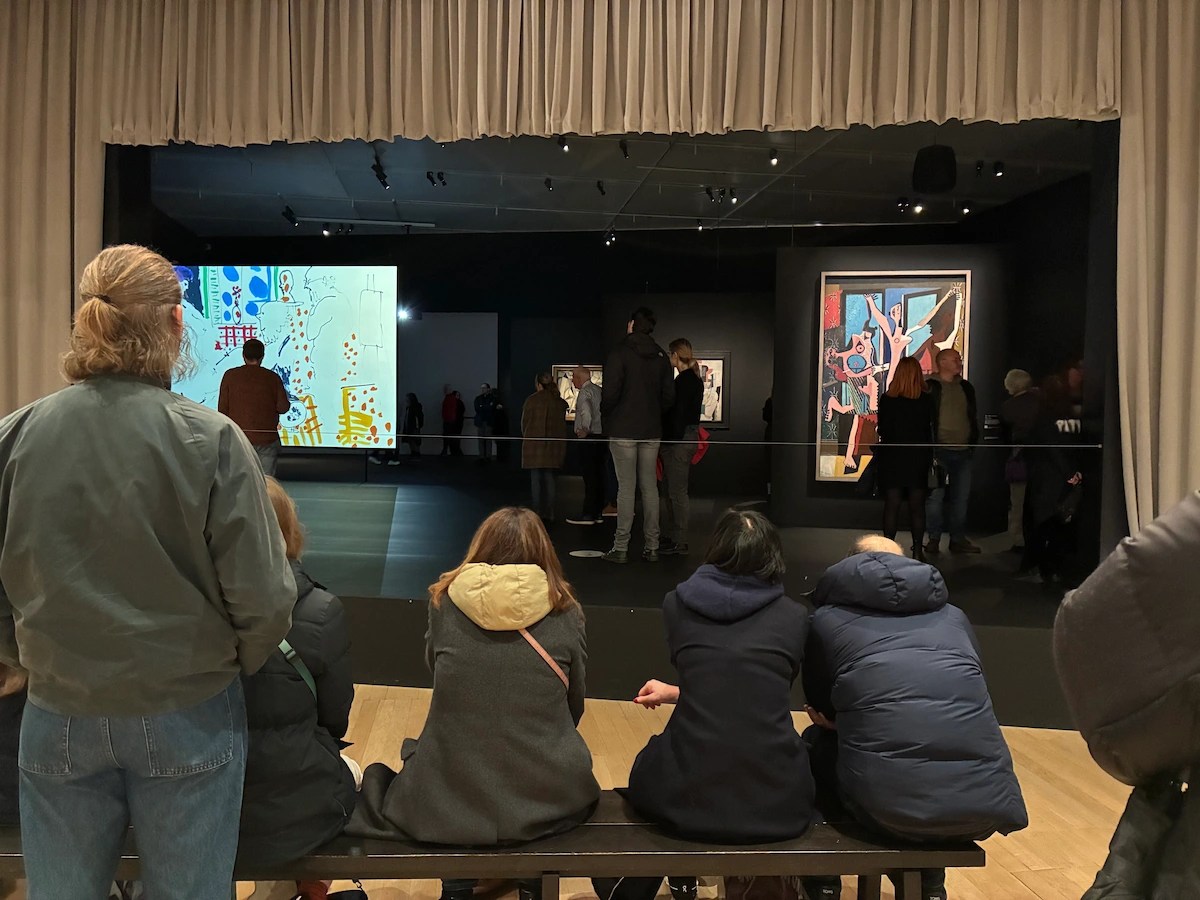
A performance space This perspective explains another massive design aspect of this exhibition which is that the main space, the main display area for paintings, drawings, sculptures, photos and so on, is raised and framed by curtains as if it was itself a theatre, and the second space visitors walk into is on a lower level with a bench for you to sit and look through a prosceniun arch fringed by curtains at all the other visitors as if they’re on a stage. Yes, the curators have turned their own exhibition into a performance.

Visitors watching other visitors ‘onstage’ ie through a curtain-edged proscenium arch, in ‘Picasso Theatre’ at Tate Modern (photo by the author)

And here’s a view of the viewing room (which itself contains three fairly large works, notably The Painter and His Model (1926) on the right. Note the girl sitting on the floor drawing the scene; arguably she’s the one with the right idea: don’t watch, do).

Reverse view of visitors watching other visitors ‘onstage’ ie through a curtain-edged proscenium arch, incidentally showing a couple more late-period works, in ‘Picasso Theatre’ at Tate Modern (photo by the author) You can see how excited they are by the whole thing

The Mystery of Picasso

And finally, by far the most dominant feature of the whole show is a massive cinema screen onto which is projected in its entirety a 1956 French documentary film titled ‘The Mystery of Picasso’, directed by Henri-Georges Clouzot, which shows Picasso at work creating some 20 drawings. This is a huge installation, it is dynamic, it has lots of movement and colour, and it has a soundtrack by the avant-garde composer Georges Auric which is also very loud, varied and dramatic.

The size, the colour, the movement and the loud music totally dominate the entire space. So much so that the curators have installed tiered rows of benches for people to settle down on and watch the entire thing which runs to 75 minutes! On a rainy Sunday morning I settled down leaned back and watched the entire film, savouring the way the great man starts by creating simple marker drawings in black and white before progressing to full-scale collages and oil paintings.

The entire film is available to watch online. This appears to be the most complete version if not the best picture quality.

Comment on the film

One thing which comes over really, really, really strongly from the film is that, without exception, he overdoes it. All of the images start with a few simple lines and then he adds in more details and shading so that you magically see the image coming to life before your eyes. However, in almost all cases it reaches a kind of perfection of lightness and deftness but he doesn’t stop. He keeps on adding heavier and heavier washes of colour and ink, obliterating the airy lightness of the original under swamps of murky blues and thick black lines, until they feel utterly ruined.

Mixing it up

One last point. Having done all this, the curators take one more step which is not to present the 50 or so other works (paintings, drawings, fabric, sculpture, collage, cartoons, photos, set designs, theatre programs and so on) in boring chronological order. No, no, they take their inspiration from the first retrospective of his work which Picasso himself supervised, in 1932, where he went out of his way to mix it up, to place works from completely different periods and styles side by side. And so that’s what the curators do here, pairing up works from completely different periods by virtue of their theme or the aspect of performance which they demonstrate.

A nice mix of Picasso works from across his periods and styles in ‘Theatre Picasso’ at Tate Modern (photo by the author)

Thoughts

I’m not sure whether I like Picasso. I can appreciate that he was a genius who revolutionised art etc but that doesn’t mean I particularly warm to any of his individual works. He’s certainly not my favourite modern artist, I like scores of 20th century artists more than him, Paul Klee, Kandinsky, Schiele, Wyndham Lewis, Epstein, Nevinson, Spencer, Pollock, Riley, Saville, loads.

I like the lightness of some of his works, like the woman in a red armchair. But I actively dislike the pre-cubist portraits and I find the cubist stuff deadly dull – bottles of wine and fragments of Figaro, seen a couple and you’ve seen thousands. I can appreciate that the 1920s tubular women running along beaches is an achieved style, and I suppose I ought to admire the 1930s weeping women biting their fingernails etc. And ought to be moved by Guernica et al. The first time you see one of his dove sketches you think Wow, but after you’ve seen 20 or 30 the effect wears off.

I’m ranging over his different styles like this because that’s what this exhibition does, showcasing good examples of each of Picasso’s styles and periods, as well as demonstrating his range of materials or formats, such as painting, drawing, etching, woodcut, lithograph, print, fabric, sculpture and the aforementioned set and costume designs. It’s a very varied and impressive selection, and I could see that much of it is very good, but none of it touched me.

When I was a student I liked the Minotaur prints, in fact a girlfriend bought me a book of them I liked them so much, but I’ve gone off them too. They feel too fussy and too amateurish. Silly poses, cartoon faces, monotonous subject matter.

In fact wandering round the show I realised I’ve slowly gone off Picasso’s entire masculine ethos, the obsession with bulls and bullfighting and bullheaded men has come to seem steadily more ridiculous to me. Living in a culture where gay and lesbian and gender fluid ideas have become more prevalent, most of Picasso’s masculinist posing now seems not just dated but ludicrous. As you wander round this striking and ambitious exhibition, dominated by the big loud central film, you can’t help thinking: what a lot of naked women; what a lot of bulls.


Related links

Related reviews

Picasso

Tate

A Story of South Asian Art: Mrinalini Mukherjee and Her Circle @ the Royal Academy

Upstairs at the Royal Academy, the three rooms of the Jillian and Arthur M. Sackler Wing of Galleries are currently given over to an exhibition of modern-ish art from south India. The show is based around the figure of the female Indian artist and sculptor Mrinalini Mukherjee (1949 to 2015) but doesn’t stop there. Both her parents, Benode Behari Mukherjee (1904 to 1980) and Leela Mukherjee (1916 to 2002), were artists and we are shown quite a lot of their work too along with their biographies i.e. they taught at Kala Bhavana in Santiniketan, the pioneering art school founded by poet and polymath Rabindranath Tagore.

Mukherjee was strongly influenced by a mentor at her art college in the Indian city of Baroda, K. G. Subramanyan, and we get a selection of his work. At college Mukherjee was part of a group or cohort of young artists and we are introduced to work by some of these, namely Gulammohammed Sheikh (b.1937) and Nilima Sheikh (b.1945). Lastly, when the group moved to new Delhi, they encountered the older artist Jagdish Swaminathan (1928 to 1994) whose exploration of tribal art and iconography encouraged their efforts to create an authentic Indian art, free of Western influences.

So in these three rooms is gathered the work of seven distinct artists, from two different generations, who worked across a wide range of media, in a great diversity of styles, all of them consciously reacting against and trying to escape from European aesthetics and methods. The show features paintings, ceramics, collages and drawings, sculptures in hemp and clay and bronze, and some enormous painted screens.

Installation view of ‘A Story of South Asian Art: Mrinalini Mukherjee and Her Circle’ @ the Royal Academy (photo by the author)

This range and diversity makes the exhibition a challenging experience to process and understand. There is quite a lot to like and enjoy, alongside much that is puzzling, and quite a lot which seemed, well, bad.

Mukherjee’s hemp sculptures

Mukherjee had a long career, active from the 1970s right up to her death in 2015. She painted and drew but her reputation rests on the large sculptures she made from dyed and woven hemp fibre arranged over metal frames to create large, impressive semi-abstract shapes.

Jauba by Mrinalini Mukherjee (2000) Hemp fibre and steel © Tate. Courtesy of Mrinalini Mukherjee Foundation

I didn’t realise it until a wall label pointed it out, but there is a deliberate evocation of female genitalia. Once it’s pointed out I suppose I can see the folds of labia to left and right, and even the difference between the large vaginal opening at the bottom and the smaller urethral opening above it, but hesitate to go any further. My gallery partner, who rarely bothers to read the wall labels, just warmed to the tumbling feel of the thing, and to its arrangement of folds and colours.

Seeking a post-colonial art

The key point, which is made repeatedly throughout the show, is that Mukherjee grew up in the post-independence generation who were powerfully committed to breaking free of colonial, European values and aesthetics and part of this was a very conscious return to and promotion of native Indian folk arts and crafts.

Benode Behari Mukherjee (1904 to 1980)

The curators really emphasise these artists’ wish to escape Western influence and create a truly independent Indian art and in some works maybe they do. But my own impression was the opposite: I was struck by how many of the paintings in particular very clearly showed the influence of modern Western art. A number of the paintings seemed to me to be copying between-the-wars Picasso, cartoon faces with both eyes visible on the same side of the nose, that kind of thing.

Here’s the work by Mukherjee’s father, Benode Behari Mukherjee, which the press people make available to us, a work made from coloured paper in the 1950s and it seems to me a straight pastiche of Matisse’s later coloured-paper cutouts. Maybe the brown skin of the central figure is a nod to the Indian nature of the work but surely it’s dwarfed by the utterly Matisse-an conception.

Lady with Fruit by Benode Behari Mukherjee (1957) © Tate. Courtesy of Mrinalini Mukherjee Foundation

Leela Mukherjee (1916 to 2002)

Here’s the work the press office makes available to represent Mukherjee’s mother, Leela Mukherjee. I don’t want to harp on about this too much but here again, I struggled to discern the distinctly Indian quality because the shape of the faces and the generally primitive working of the wood reminded me very much of African tribal art, such as you see in the British Museum.

Schematic Seated Figure by Leela Mukherjee (1950s-80s) Taimur Hassan Collection. Photo by Justin Piperger. Courtesy of Mrinalini Mukherjee Foundation

Gulammohammed Sheikh (b.1937)

Similarly, here are two works from 60 years later by Mukherjee’s friend Gulammohammed Sheikh, depicting (on the left) birds which might be cranes and (on the right) a kind of dragony-peacock bird, depicted in tall, narrow images which instantly reminded me of classical Chinese art. I can’t see anything Indian about them at all, they radiate Chinese shape, composition and styling.

Two paintings by Gulammohammed Sheikh 2018 to 2024 (photo by the author)

K. G. Subramanyan

K.G. Subramanyan (1924-2016) studied under under Mukherjee’s father and, according to the curators, developed into a ‘prolific artist-educator’. He rallied fellow artists to mine folk and craft traditions in unconventional ways, forging a postcolonial vision of Indian modernism. Here’s a gouache work demonstrating what this means in practice.

Untitled by K. G. Subramanyan (c.1950s) Taimur Hassan Collection. Photo by Justin Piperger © Uma Padmanabhan

Now this does have the amateurish quality I associate with modern Indian art, the very basic, child-level depiction of the human form which I saw just a few months ago in the extensive display of work by Indian artist Arpita Singh (born in 1937) at the Serpentine.

The exhibition’s long timeframe

Another challenge presented by the exhibition is the long timeframe it covers. The earliest work is from the very early 1970s whereas the most recent is from the 2020s. That’s a very long period of time. During that half century the international art world has changed out of all recognition. It has outgrown its European and American origins to become truly international. It has, for some time, promoted and valued artists from an enormous range of cultures, including many indigenous traditions such as Aboriginal art, which is now highly prized.

The patriotic, post-independence drive to create an authentic Indian art which the curators attribute as a central motivation to Mukherjee, her friends and colleagues, has long since become history. An ethnocentric perspective is now seen as reactionary and dangerous, witness liberal repugnance at the rise of right-wing nationalisms in countries around the world, including Hindu Nationalist sentiment in Mukherjee’s own India.

The modern art world floats above individual countries, in a kind of multicultural, cosmopolitan, liberal, enlightened, post-gender world of its own. So Mukherjee and her friends’ insistence on an Indian nationalist art, as well as her particular interest in the old-fashioned gender binary between phallic and vulvic forms, all seem rather quaint now.

To look specifically at Mukherjee’s work, when she began ‘sculpting’ in fabrics in the 1970s this was a radical and innovative technique, quite obviously rejecting the whole ‘carving in stone or marble’ tradition of the West. But by the time she began exhibiting in Europe, in the 1990s, it was a lot less unique. Numerous other artists were working in the same vein.

Jagdish Swaminathan (1928 to 1994)

Back to the art, here’s the example of Jagdish Swaminathan which we are given. This painting of a thin sliver of a bird singing above a mildly phallic lily plant against a big abstract yellow background is from Swaminathan’s ‘Bird, Tree and Mountain’ series. We find him in the late ’60s and early ’70s rejecting any type of naturalism, along with Western modernism, and instead returning to tribal and folk visual traditions. This probably is a good example of a non-western, Indian visual style although I’m not sure I like it. Do I not like it because it is not Western? No, because I love lots of non-Western art starting with Aboriginal art and lots of African art. It’s more that it’s like Western art but without enough real kick and originality.

Untitled (Lily by my Window) by Jagdish Swaminathan (early 1970s) Photo courtesy of Sotheby’s Inc © 2025 © J. Swaminathan Foundation

Gallery

A selection of photos I took to indicate the (sometimes bewildering and confusing) range of works on show.

Untitled by K.G. Subramanyan 1955-9

I liked this because it reminds me of something almost exactly the same I’ve seen by Paul Klee, in other words a European model or origin.

Untitled by K.G. Subramanyan 1955-9 (photo by the author)

Intertwined by Leela Mukherjee

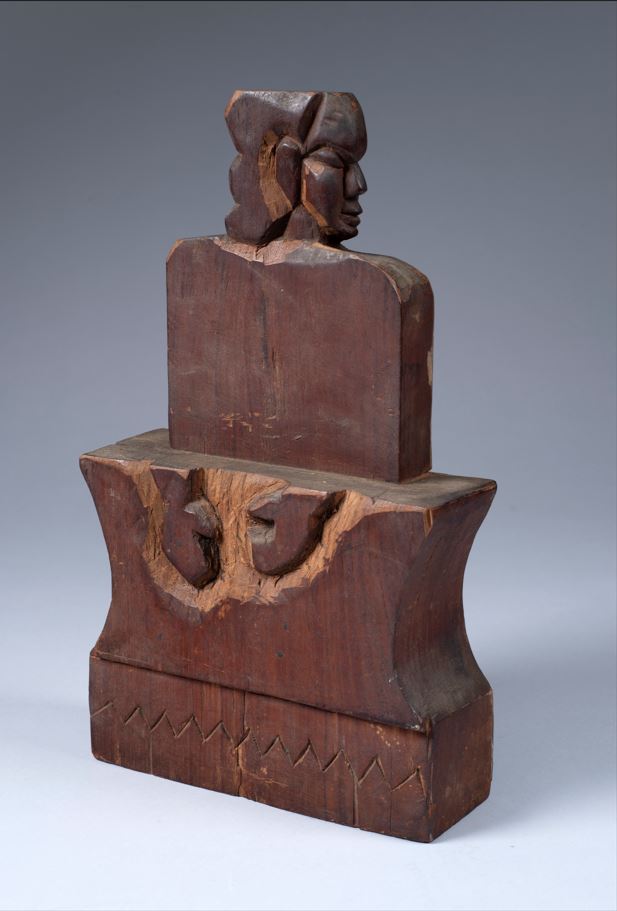
Relatively small, crudely carved and unfinished wooden sculptures.

From left to right, Figure with Raised Hand, Intertwined Figures and Intertwined Figures II, by Leela Mukherjee, 1950s to ’80s (photo by the author)

Landscape 1968

My partner liked this because of the simplicity of the black silhouette but also the ambiguity of whether it’s some hills and a tree, as it appears at first glance, or whether the two lines dangling down in the middle indicate that it’s a human being.

Landscape by Gulammohammed Sheikh (1968) (photo by the author)

Untitled by Jagdish Swaminathan (1980)

According to the curators:

By the 1980s, Jagdish Swaminathan’s art reflected his deepening engagement with India’s tribal and Indigenous traditions. Moving away from the pristine colour planes of his earlier works, he adopted earthy palettes, textured surfaces, and symbolic forms. Shapes such as triangles and serpentine lines evoked mountains and snakes, resonant with Hindu mythologies of the god Shiva. These later canvases fuse abstraction with spiritual metaphor, recalling Swaminathan’s lifelong insistence that art should reveal nature and myth in their primal, symbolic essence.

Not knowing very much about ‘India’s tribal and Indigenous traditions’, I liked it because it reminded me of the brown abstract works my parents picked up at Heals or Habitat in the 1970s. And then of Paul Klee’s beautiful abstract shapes and patterns, which also often include gold or striking highlights.

Untitled by Jagdish Swaminathan, 1980 (photo by the author)

Also because of the rough impasto finish, especially of the two mysterious orange glyphs written across the image.

Detail of Untitled by Jagdish Swaminathan, 1980 (photo by the author)

Songspace by Nilima Sheikh (1995)

‘Songspace’ is the name of a series of scroll paintings by Nilima Sheikh, which I prefer to think of as ‘hangings’. Apparently there are ten in the series, of which 5 are hung in this exhibition in such a way as to create a kind of alcove into which you can step and be surrounded on 3 sides. Apparently the use of casein tempera paint on canvas is very distinctive and gives them their light and floating feel. Most of the surface is made up of abstract shapes, some of which may be landscapes in brown or green or red. Scattered in these shapes are wispy human figures which, apparently, reference Indian folktales, especially from Kashmir. They reference the style of classical Indian miniatures only blown up to wall size and refracted through a postmodern sensibility.

Songspace by Nilima Sheikh (1995) (photo by the author)

I liked the size, and the format of the hanging scroll, and the light and uplifting colouring but, as with most of these works, wasn’t impressed by, or was actively put off by, the scrappy amateurishness of the human figures.

Snake Column I by Mrinalini Mukherjee (1995)

According to the curators:

This terracotta sculpture is one of two ‘snake columns’ that reflect Mrinalini Mukherjee’s engagement with fertility and vitality. The cylindrical, phallic form recalls the ‘lingam’ of Shiva, while the serpent motifs and raised hood canopy reference Bankura terracotta vases dedicated to Manasa, a goddess of fertility. Like ‘Adi Pushp II’, nearby, the work channels sexuality as a generative power, fusing sacred imagery with organic, body-like forms that pulse with energy.

Snake Column I by Mrinalini Mukherjee (1995) (photo by the author)

If it as deliberately phallic as they say, then the snakes could as easily be sperm fighting their way to the front of the queue.

Forest Flame IV by Mrinalini Mukherjee (2009)

According to the curators:

In her final years, Mrinalini Mukherjee turned from hemp to bronze, creating sculptures that progressively grew in scale and ambition. Casting leaves, fronds and branches into molten form, she transformed nature into something both corporeal and otherworldly. ‘Forest Flame IV’ recalls the striking ‘Flame of the Forest’ tree of Santiniketan, which bursts into vivid orange blossoms each spring. Here, a trunk-like column erupts into flame-like petals, conflating vegetal growth with bodily emergence. Light animates the textured bronze surface, giving the work a sense of continual unfolding and transformation.

Forest Flame IV by Mrinalini Mukherjee (2009) (photo by the author)

I didn’t particularly like these because, as I said much earlier, by the 2000s, art had become so globalised, with so many artists creating so many kinds of object, that Mukherjee’s don’t really stand out. Downstairs at the Royal Academy are metal sculptures by Anselm Kiefer which are not unlike this. What made her very distinctive in the 1970s and ’80s had become utterly diluted 30 years later.

Adi Pushp II Mrinalini Mukherjee (2009)

To finish, back to what she did best, hemp sculptures. This one supposedly derives from her interest in botany and flowers and ‘adi pushp’ means ‘first flower’. But the curators go on to tell us that:

The sculpture’s central bulges and folds evoke human sexual organs, transforming the flower into a potent emblem of generative energy, and affirming nature as a vital, erotic life force.

None of which – the use of sublimated sexual imagery, the idea of sex as a central force in human nature – is at all distinctively ‘Indian’ but the common currency of humankind and any number of artworks, traditional or contemporary.

Adi Pushp II Mrinalini Mukherjee (2009) (photo by the author)

At the end of this small but sometimes confusing, sometimes enjoyable, sometimes boring, sometimes lovely exhibition, it looked less to me like a tumble of sexual organs than a comfortable-looking chair to have a nice sit-down in.


Related links

Related reviews

Mickalene Thomas: All About Love @ the Hayward Gallery

Mickalene and Linder

A word of explanation. The Hayward Gallery is currently hosting two exhibitions, one of the radical British feminist artist Linder, one of the radical Black queer American feminist artist, Mickalene Thomas. When I got there I mistakenly thought they shared the same main gallery space, with Mickalene downstairs and Linder upstairs. This was my mistake. Although you buy a joint ticket to both of them, the two exhibitions are completely distinct and you enter them by different doors. The Mickalene is situated in the Hayward’s main gallery with its huge rooms, while you enter the Linder by a different entrance into a series of smaller, more intimate rooms along the ground floor. This is a review of the Mickalene Thomas show. I’ve written a separate review of the Linder show.

Mickalene Thomas: All About Love

‘The central place of my work, and my art, is from a loving space’

This is an outstanding exhibition, I heartily recommend it. Mickelene Thomas’s paintings, collages, photomontages, videos and installations start big and become huge, filling the cavernous spaces at the Hayward Gallery with bold colours, delirious patterns, glitter and glamour. And then there’s a soundtrack, a continual loop of chilled soul and jazz classics drifting through the gallery which makes the whole thing a lovely Saturday morning experience. And, for me personally, I got chatting to several of the (female) visitor assistants who answered my questions, drew my attention to all kinds of details, and significantly deepened my understanding and enjoyment of the show (see below).

Afro Goddess Looking Forward by Mickalene Thomas (2015) © Mickalene Thomas

A reproduction like this gives no sense of the scale of the original, which is nearly 3 yards wide and 2 yards high, completely filling a gallery wall, towering over you and, as you get closer, enfolding in its bright, warm, welcoming designs.

Theory or beauty, issues or love

Born in 1971, Thomas is a Black, queer woman and proud as hell of it. This is catnip to the world of straight white women curators who write lots of wall captions claiming that her work subverts all the usual stereotypes (gender, ethnicity, identity), questions social norms, interrogates the blah blah blah. Thomas is well aware of this, and freely draws on the tenets of Black feminist and queer theory. In fact the title of the exhibition derives from bell hooks’ 2000 book ‘All About Love: New Visions’. Thus every wall label sounds like this:

Thomas work challenges societal norms and provides a powerful counter-narrative to mainstream depictions of beauty and identity…

It may well do all of that, and you can certainly immerse yourself in a critical theory-level response to her art – but what that style of writing doesn’t convey is how beautiful her work is. It’s big and bold and stunning and full of LIFE, full of lovely details and full of LOVE. Don’t need no theory to understand that.

Mickalene Thomas biography

From her Wikipedia article:

Mickalene Thomas (born January 28, 1971) is a contemporary African-American visual artist best known as a painter of complex works using rhinestones, acrylic, and enamel. Thomas’s collage work is inspired from popular art histories and movements, including Impressionism, Cubism, Dada, the Harlem Renaissance, and selected works by the Afro-British painter Chris Ofili. Her work draws from Western art history, pop art, and visual culture to examine ideas around femininity, beauty, race, sexuality, and gender.

From the press release:

Thomas is a trailblazer of portraiture and collage, widely renowned for her large-scale paintings of Black women posed against boldly patterned backgrounds embellished with rhinestones. As an artist who fearlessly transcends creative boundaries, her artworks have also adorned album covers (Solange’s EP True, 2013) and emblazoned fashion runways (Dior, 2023).

Love, leisure, and joy

All true, but much nearer the point is the first sentence of the first big wall label:

Mickalene Thomas’s art is an exploration of love, leisure, and joy.

This is certainly the keynote for the works on the ground floor of this two-floor exhibition. They are big and bold and depict friends and lovers and family in a candid, open, vivid and delightful way. Here’s a portrait of her beloved mother, a former fashion model named Sandra Bush, fondly known as Mama Bush.

Mama Bush: (Your Love Keeps Lifting Me) Higher and Higher by Mickalene Thomas (2009) © Mickalene Thomas

Now clearly half a dozen things are going on in this piece so let’s try to unpick them one by one.

Family

Thomas’s paintings depict family, friends and (women) lovers.

‘My gaze is the gaze of a Black woman unapologetically loving other Black women.’

There are some installations based on her childhood home (see below). As you read about this in the wall labels, as you see the sweet furnishings of the family rooms, as your heart rate goes down to match the smooth jazz soundtrack. It all creates a sense of warmth and love.

Based on photos

Thomas’s creative process begins by photographing her muses in a variety of sets created in her Brooklyn studio. These photos then form the basis of paintings in oil, acrylic and enamel paint which are inlaid with lustrous multi-coloured rhinestones. Originally chosen by the artist as affordable substitutes for oil paints, these materials have since become her signature.

Fabrics

After I’d got over the size, and the bold design and colour, and the use of shiny rhinestones, I began to notice the role of fabric and fabric-style patterning in the works. The figures are almost secondary to the dazzling collage of fabrics of starkly clashing colours and designs.

Installation view of Mickalene Thomas ‘All About Love’. ‘Din avec la main dans le miroir et jupe rouge’ (2023). Photo by Mark Blower. Courtesy the artist and the Hayward Gallery

The overall effect is dramatic but each of the works repays going up close to enjoy the detail of each of these fabrics.

Detail from ‘Naughty Girls Need Love Too’ (2009) by Mickalene Thomas in ‘All About Love’ at the Hayward Gallery

As mentioned above, the wall labels overflow with references to queer Black theory, and yet the exhibition can, sort of, be considered an adventure among fabrics. My wife knits, sews, crochets and is fascinated by fabrics and yarns and so, quite oblivious to all the critical theory, spent ages looking very closely at all these fabric designs.

Collage

According to the Tate website:

Collage describes both the technique and the resulting work of art in which pieces of paper, photographs, fabric and other ephemera are arranged and stuck down onto a supporting surface.

Quite clearly, then, the pictures are massive examples of collage in which the photos of friends and family form just the base layer over which she drapes patterned fabrics, cuts and rearranges imagery using the papier collé technique, and studs them with patterns of glittering rhinestones.

‘Collage is how I create form and composition. It’s a way to edit, disrupt, and dismantle – creating a space that is complex, by deconstructing the depth of the field of illusion.’

The wall labels reference a number of influences and even I could see the legacy of Henri Matisse’s cutouts in the more seaweed-shaped designs. But there are plenty of other influences including the Black woman artist Faith Ringgold, whose work we recently saw at the Serpentine Gallery.

The male gaze

‘My gaze is the gaze of a Black woman unapologetically loving other Black women.’

Before we move on to the other rooms, let’s address an issue which cropped up in the opening rooms with their enormous portraits, not least because it is mentioned ten or more times in the wall labels, our old friend The Male Gaze.

This concept crops up in more or less every exhibition about or which includes women artists. It is a standard accompaniment to any women’s art which includes depictions of female figures.

The male gaze was first articulated by British feminist film theorist Laura Mulvey in her 1975 essay, ‘Visual Pleasure and Narrative Cinema’, so it’s 50 years old this year. According to the Wikipedia page:

The male gaze is the act of depicting women and the world in the visual arts and in literature from a masculine, heterosexual perspective that presents and represents women as sexual objects for the pleasure of the heterosexual male viewer… thus reinforcing a patriarchal visual narrative.

With the explosion of feminist and critical theory over the past 50 years, the male gaze is now detected in every medium whenever women are portrayed, in not just classical painting, but advertising, films and TV, social media, all forms of literature, you name it.

I get it and I agree with it. What I don’t understand so readily is how all these paintings of scantily-clad young women, generally exposing their breasts, can be said to subvert the male gaze. Surely – without wanting to – they cater to it.

Portrait of Marie by Mickalene Thomas (2015) © Mickalene Thomas

Now one of the reasons I enjoyed my trip so much was because I got into conversations with several of the (female) visitor assistants, who were extremely knowledgeable and very perceptive. I benefited a lot from their insights.

One of these visitor assistants was giving periodic tours of the exhibition. When she’d finished, genuinely puzzled, I asked her how lots of images of scantily-clad, attractive young women with their boobs out was meant to subvert the male gaze. Speaking as a heterosexual male, they seem to me to encourage the male gaze by playing up to every expectation of women as a) beautiful b) lounging on sofas and beds c) half dressed. The visitor assistant made the following three points:

1. Thomas starts a lot of her works with photographs then paints and assembles collages of materials over them. The relevance of this is that her sitters only pose for a few hours i.e. not for days and days on end. I.e. the relationship between artist is less hierarchical, less dominating and demanding.

2. This lack of a male-female power imbalance extends to collaboration. After discussing a backdrop and a pose and what to wear, the subjects then help decide which poses and shots are best, which ones they feel most comfortable with. So, again, less of a male master and woman servant relationship, more a collaboration of equals, and of women equals.

3. She went on to make the rather more obvious point how so much Western art of the beautiful-woman-half-dressed-on-a-divan type was commissioned by rich men to adorn their walls. Many examples of rich men commissioning titillating images of scantily-clad young women to decorate their homes, or even assemble semi-pornographic collections of them in private rooms, where they could be enjoyed (i.e. leched over) by other creepy men. In all of this the woman model had no control whatsoever but was paid a pittance to be converted into a sex object.

Now I understood all these points, and they deepened my understanding of the concept of the male gaze and how women artists depicting the female body operate in a different atmosphere with different aims, and of Thomas’s anti-male gaze ethic. But the assistant didn’t really address my core point which is… they’re still images of half-naked women. To paraphrase Taylor Swift, ‘Male gazers will malely gaze’ and how, in practical terms, are you gong to stop them?

But maybe I’m misunderstanding. Maybe this isn’t about changing society as a whole (stopping men malely gazing) and a much more limited term, an art world term, restricted to describing certain works by certain women artists.

Women at rest

Another apparent contradiction intrigued me. At several points the commentary deprecated the old male art tradition of showing women lying around on beds or divans, thus creating a sexualised boudoir atmosphere for easily aroused male viewers. There are so many paintings like this in the western tradition that it is a genre unto itself, the Odalisque.

The odalisque not only presents women as sexual objects but plays to the gender stereotype which associates The Male with Activity and The Female with Passivity. Active men doing things, bursting with agency. Utterly passive women lying around half-dressed like pets or sex objects, existing solely to please their male owners.

And that’s bad. OK. I get it. The contradiction comes in as you realise that so many of Thomas’s huge paintings show women, er, lying around on beds or divans, half undressed. Why is it sexism and misogyny when painted by men but the exact same subject, with the exact same visual result, is not only ‘reclaimed’ from the male gaze, but is actively liberating, when painted by a woman? Here’s how the curators put it:

Thomas’ celebratory and glamorous portraits put Black women front and centre. Their poses are restful, but filled with power, meeting our gaze and staring right back with regal force.

Or:

These works centre on repose, rest and leisure which, in Thomas’s handling, are shown to be radical acts.

You can see what the curators are trying to do here – to get round the contradiction by rewriting the terms, by changing the vocabulary, by asserting that these works by a woman artists are different from a male depiction of the same subject. But it does it fit the reality of what you actually see? Here’s one of the most notorious odalisques in western art, Olympia by Édouard Manet (1863).

Olympia by Édouard Manet (1863)

Is Olympia not ‘meeting our gaze and staring right back’? Whether or not with ‘regal force’ is for the viewer to decide, but the ‘meeting our gaze and staring right back’ is an undeniable fact. So the ‘meeting our gaze and staring right back’ does not distinguish Thomas’s works from the male work she is meant to be ‘subverting’. The real difference lies elsewhere.

Is it in a certain spirit of defiance in the expressions of (some of) the women sitters? Something in their pose and their expressions is markedy, definably different from the passive acquiescent expressions of the classic odalisque? Maybe I’m missing something obvious and you can help me. Anyway, I only dwell on it at such length because 1) this type of pose is the core subject matter of all the works on the ground floor, and 2) the make gaze and how Thomas undermines and subverts it is mentioned in more or less every wall label i.e. it’s a central feature of the curators’ commentary.

A Moment’s Pleasure #2 by Mickalene Thomas (2008) © Mickalene Thomas

Living rooms

Moving on, if you know the Hayward, you know that you then walk up a gently sloping ramp to the second main downstairs space. Here there are a few more massive rhinestone paintings, including her reworking of The Sleep, a painting by French artist Gustave Courbet, given the Thomas treatment. (Later on we meet a big bright reworking of Le Déjeuner sur l’herbe by Eduard Manet. What with the visual references to Matisse’s cutouts, we are learning that Thomas has a fondness for modern nineteenth century French art.)

But more dramatically, here you find a couple of big installations. These are mock-ups or reconstructions of family living rooms Thomas remembers from her childhood. They are designed to transport visitors back to domestic settings of the artist’s 1970s and 1980s childhood. On the left is a room from the late 1970s during Thomas’s early childhood in New Jersey, a homage to her late grandmother.

Installation view of ‘I was born to do great things’, room 1, by Mickalene Thomas (2014) Photo by the author

Of these she says:

‘I created domestic settings primarily for fellow Black women – my muses – to spend time and have new experiences in familiar surroundings, perhaps resembling their mother’s or grandmother’s living rooms.’

Inside the installation are two artworks from early in Thomas’s career. The green one at the back is ‘Portrait of Mickalena’, a painted self-portrait in which Thomas performs her childhood alter ego, Quanikah. On the wall on the left is a photographic triptych of her mother from 2003, in which Sandra Bush poses in the style of actor Pam Grier, star of 1970s Blaxploitation cinema

One of the visitor assistants I spoke to was mixed race and she said the rooms triggered warm memories of her childhood. They feel sweet and comfortable and at least part of this is because is this is the source of the mellow soul and jazz music which permeates the ground floor, emanating from a genuine old-school record player and hi fi unit, with ageing record covers by The Supremes and such like, leaning against it at the bottom left.

This hi fi unit is in the second room which recreates a room from Thomas’s teenage years in the 1980s, a completely different vibe from the previous one, this is all shagpile grey carpet and Art Deco lampshades.

Installation view of ‘I was born to do great things’, room 2, by Mickalene Thomas (2014) Photo by the author

As to the curators’ commentary:

‘The living room is where we see black imagination made visual’, writes poet Elizabeth Alexander in The Black Interior. She suggests that the home holds a sacred significance for African Americans who have grappled with the impermanence of place perpetrated by enslavement, segregation and gentrification.

Remember what I was saying about the importance of fabrics, of Thomas collaging together wildly varying and disparate fabrics and patterns? When you look more closely you realise every piece of furniture in room 1 is made of crazy collages of fabrics, patched together, sometimes with very overt stitching. Is this something to do with relative poverty, with having to make do and mend? Or a purely aesthetic statement, in fact it’s a style statement. The visitor assistant I was chatting to made the point that none of the fabrics really ‘go’ with each other and yet, at the same time, because everything is made out of crazy patching, it all, somehow, does go. It makes a Gestalt.

Installation view of ‘I was born to do great things’, room 1, by Mickalene Thomas (2014) Photo by the author

Off to one side of the room is another installation, smaller, dinky, filled with bedroom bric-a-brac, reminding me of my teenage daughter’s bedroom. Takes as a whole the shape is reminiscent of a shrine and it is, in fact, titled Shrine. I’m guessing it is a shrine to her teenage self.

Installation view of Shrine by Mickalene Thomas (2024) Photo by the author

It’s packed with interesting and charming details. There’s a fridge magnet-style motto which reads: ‘I’m not opinionated, I’m just always right.’ Books by Black and queer authors. And I noticed, underneath a classic photo of Black activist Angela Davies, a picture frame which holds a list of names.

Detail of Shrine by Mickalene Thomas (2024) Photo by the author

Recognise the names?

  • Frida Kahlo, the Mexican painter and feminist icon
  • Kara Walker, the contemporary Black political and feminist artist
  • Georgia O’Keefe, woman painter of big bold flowers and scenes of the desert south-western USA

And she’s added her name to the list. Her lineage. Her heroines and herself.

Music

By far the majority of exhibitions I go to are staged in empty, church-like silence, a deadening white-walled sterility as antiseptic as an operating theatre which intimidates visitors into whispering or intimidated silence. The dozen or so sexy, soul music tracks, smooth jazz and soul classics, which play on a loop went a long way to taking the frozen edge off the gallery space and making it a nice place to be.

It made me feel warm and fuzzy about her art, about the rooms she grew up in, about her mum and friends and lovers, it made the whole thing feel warm and welcoming. It made a significant different. Here’s the track list:

Upstairs

Upstairs there are five more rooms, some big, some enormous, more installations, and a wider range of her works, including straight (no pun intended) photography, video installations, and more overtly political works.

The water lilies room

The biggest room features her largest collage to date, an absolutely massive work covering one huge wall (on the left here), in which are embedded ten or more smaller collage pictures. This towers over a lot of plastic rubber plants arranged in a grid pattern on a huge rectangular mirror.

Installation view of La Maison de Monet by Mickalene Thomas at the Hayward Gallery. Photo by the author

I think this is titled ‘La Maison de Monet’ and dates from 2022. In 2011, Thomas took part in a summer residency at Claude Monet’s house and studio located at Giverny, in northern France. Giverny provided Thomas with the opportunity to reflect on Monet’s iconic depictions of gardens and the vibrant domestic spaces that he designed as places of inspiration and leisure. The grid of plastic pot plants represents the famous water lilies in Monet’s garden pond, the lily pond he painted so many times at the end of his life.

On the opposite wall are two more standard-sized works. These are noticeably different from the earlier works in two respects: although they still use jagged-edged collage the elements are mostly plain colour washes instead of intricately decorated fabrics. And no rhinestones. The one on the right reminded me of a record cover from the 1980s, though I can’t remember which one. Can anyone remind me?

Installation view of Mickalene Thomas: All About Love at the Hayward Gallery. Photo by the author

A note on laminated flooring

It was only after I’d strolled around the room and looked at the massive wall collage a few times that I began to appreciate the importance of wood in it. On the left you can see photos of a number of wooden shelving units such as you might find at Habitat, while on the bottom right are black and white photos of what looks like laminated wood flooring. Hold that thought…

The wrestling room

Beyond the water lily room is the wrestling room. Here are half a dozen rhinestone and jagged collage-style images of two Black women in various wrestling poses. To quote the curators:

Thomas created her series of Wrestlers to explore multiple sides of herself. All the figures depicted in the paintings are representations of Thomas, featuring the artist Kalup Linzy as her twin. The paintings reveal only one face – the artist’s. The artist considers the series a form of self-portraiture, embodying internal conflicts between our multiple selves within society.

The figures, locked in an embrace, blur the boundaries between erotic pleasure and pain, struggle and affection, dominance and submission, all expressions of desire. The tiger and zebra print leotards worn by the wrestlers can be seen as a critique of the stereotypical and exploitative portrayals of Black women’s strength and sensuality.

Well, as I’ve said in my comments about the male gaze, does dressing Black women in jungle animal leotards (tiger and zebra) ‘critique’ stereotypes about Black women… or subtly confirm them? You, the viewer, decide.

Installation view of the wresting room at Mickalene Thomas: All About Love at the Hayward Gallery. Photo by the author

I chatted with the visitor assistant about the bean bags. On the two times I visited the room nobody was sitting on them. Remember I mentioned the wooden shelf units and laminated flooring in the previous room? Well look at the walls here! The stripped varnished pine walls make it feel a bit like a shop, quite a clinical vibe.

Also, you only want to throw yourself on a bean bag if there’s something you really want to spend some time looking at and, I hate to say it, but these were probably the weakest set of works in the show.

But the visitor assistant, as so often, pointed out something I hadn’t noticed, which was the colour red. The bean bags are dark red because all the wrestling images who the two figures wrestling on a dark red blanket. Aha! More like interior decorating than art, the bean bags are visually tied in to the surrounding paintings.

Lastly, most visitors to most of the exhibitions I go to are old. Lots of grey-haired old men and women. I imagine no-one was using the bean bags because pretty much every visitor would struggle to get back to their feet. They’re appropriate to a younger crowd at a younger show and with something to really look at. (I vividly remember the beanbags in a projection room at the Victoria and Albert Museum show about So You Say You Want A Revolution, where you plumped down in a bag to watch excerpts from the rock movie, Woodstock.)

‘Me as Muse’

Round the corner from the lily pond room is a smaller installation, visually tied to it by the present of another clump of rubber plants and titled ‘Me as Muse’. It’s a multimedia video installation meaning there’s a bench and you sit on this and face

Installation view of ‘Me as Muse’ (2016) at Mickalene Thomas: All About Love at the Hayward Gallery. Photo by the author

Now what I noticed first about this was the way the bench was made of Thomas’s characteristic patched fabrics. I really liked the bench, vivid and colourful. The wall is covered by a massive montage of mostly black-and-white photos of woods and forest, which are complimented, I suppose, by the rubber plants.

But obviously the centre of attention is the 12 TV monitors. What appears on these screens is a little complicated. The core image is a self portrait of Thomas lying naked on a divan, the classic odalisque pose which prompted all those questions about the male gaze and the history of art and so on, on the ground floor.

What happens then is that different monitors cut to other images, not all at the same time but so that fragments of images are juxtaposed against each other. These other images include two classic odalisque paintings from western art, one by Jean-Auguste-Dominique Ingres, a more modernist one by Amedeo Modigliani. I think the point is to contrast the representation of Black or ‘exotic’ women in classical male art, with the body of a real Black woman (Thomas herself).

This process goes a step further when the monitors show us a photographic image of Sarah Baartman (1789 to 1815), a Khoikhoi woman from southwestern Africa who was displayed in colonial exhibitions across Europe in the 19th century. This obviously deepens things from just being an art history issue to showing its relationship to the wider world and to historic issues of colonialism, dehumanisation and so on.

So far, so very like an A-level exercise in gender and racial politics. Intercut with all this are clips from a BBC interview with Eartha Kitt in which the famous singer (apparently) speaks candidly about the abuse, suffering and racism she experienced throughout her life. This would have been more powerful if I could have heard anything she said. Maybe there were headphones or a QR code to use on my phone or something, but none of the other visitors who were in this area at the same time as me were listening to anything. Then again maybe the images of a Black woman talking but muted and silenced, were – in a presumably unintentional way – more powerful than hearing her words.

And it’s a collage, isn’t it, just in a different format (video instead of picture). Like the paintings, and the furniture, its basic idea is cutting up and juxtaposing elements from strikingly different sources.

This view shows the geographical relationship between the lily pond room and the TV room (in this photo you can see the Modigliani odalisque on the TV screens), and also shows how the rubber plants – and now I look closely, I can see how the use of black and white stripes and squares – bind the two pieces together. In fact it was only when reviewing my own photos that I realised that immediately behind the monitors are photos of… water lilies in a pond! Surely, they must be shots of Monet’s lily pond. In which case the two installations are really tied together.

Installation view of the upstairs rooms at Mickalene Thomas: All About Love at the Hayward Gallery. Photo by the author

Eartha Kitt sings Angelitos Negros

Eartha Kitt crops up in another work, another multiple screen installation just along the corridor. It consists of four much bigger screens, each one divided into three sub-screens. On them we see face shots of several Black women all singing the same song. The singing feels notably non-professional i.e. like you or me singing in the shower, and it sounds like several voices singing together at once though not in any kind of professional unity or harmony.

Installation view of Angelitos Negros by Mickelene Thomas at the Hayward Gallery. Photo by the author

It’s only when you read the wall caption that you realise one of the screens is showing Black singer and actress Eartha Kitt performing her 1953 song Angelitos Negros. In this the singer implores artists to paint Black angels in their religious paintings. ‘You paint all our churches, and fill them with beautiful angels,’ the song laments, ‘but you never do remember, to paint us a Black angel.’ As far as I can tell, in that original video Kitt starts crying so the tone of the music is obviously tearful, if not tragic.

So the other faces and voices are all of Thomas herself singing along. So that explains why there’s a kind of core track which sounds good (Eartha) accompanied by an impassioned by amateur rendition (Mickalene).

What I assume to be several takes of her doing this are cut and pasted into the different channels shown by the monitors, which continually change angle and distance. So it’s yet another example of Thomas’s use of collage, reusing, repurposing, juxtaposing original source material into new combinations.

In a way more striking than the piece itself is the fact that in front of it is something like the living room installations downstairs, a collection of armchairs place on a big carpet, with side tables piled with classics of Black and queer literature.

Installation view of Angelitos Negros by Mickelene Thomas at the Hayward Gallery. Photo by the author

Note 1) the way all the furniture is made of patchwork fabric, like the bench in the other TV room, like the furniture in the two living room installations, echoing the intense use of fabric patterns in her rhinestone paintings. 2) Note the use of fake wood laminated tiles, such as you see in flooring shops, visually linking this to the images of cheap wooden furnishing and flooring in the previous installations. And 3) our old friends, the pot plants, also linking this with the other upper gallery installations. It’s not only paintings that can have recurring motifs, but installations too.

The sly way all these displays are tied together by these motifs is enjoyable to decipher and savour. Clever. Very clever, and fun. In the manner of all good art, you feel all these linkages are saying something, something important and meaningful, but can’t work out what. But that’s fine. Art isn’t a scientific thesis. Hints and echoes and implications are what it’s good at. Very clever. Echoes and re-echoes.

Incidentally, the paintings on the wall in the background of this photo are a departure from everything we’ve seen so far. They’re portraits of people right enough, but painted on big mirrors. In fact here on the upper floor there’s a much greater variety of works, a greater range of paintings plus a corridor of simple (i.e. uncollaged) colour photographs, nicely staged and shot.

A note on James Baldwin

The Black American author James Baldwin (1924 to 1987) is frequently encountered in the art world. Why? Because he’s Black, queer and a writer. I’m not being sarcastic or snarky when I say he ticks all the boxes. We live in a liberal culture which is concerned to tick all the boxes – literally in the case of many organisations’ legally binding commitments to diversity and inclusion. In a thoroughly feminist culture like the art world most straight white men are frowned on and excluded. In a backlash against thousands of years of white heteronormative domination, there is currently a wave of exhibitions by Black artists, and an ever-growing number of exhibitions by queer artists.

Baldwin’s writings often address his challenges with identity. When he came of age in the 1940s a man was meant to be white and manly, Clark Gable or John Wayne. Being Black exposed him to the massive race discrimination in 1940s USA, but being queer made him doubly an outsider, especially in his own Black community which was just as homophobic as the white world, if not more so.

After facing years of everyday racism and homophobia, despite the support of other Black writers who spotted his talent, Baldwin in the end fled America, travelling to France in 1948 where he lived for the rest of his life.

It’s not just that Baldwin ticks the boxes, he’s not just an empty figurehead. It’s that he wrote so eloquently about the challenges and complexities of juggling his multiple identities: American, man, Black, gay.

So it is no surprise that in our times, when progressive politics, art and literature are more than ever before concerned with questions of gender and identity, Baldwin is not just a symbol of these issues, but his often very eloquent expressions of them find themselves being quoted again and again, in texts, in documentaries and in countless exhibitions.

When I visited the contentious Masculinities exhibition at the Barbican, supposedly a comprehensive survey of art from around the world about masculinity, no surprise that the massive quotation written in big letters on the wall right at the start of the exhibition was by Baldwin. Not a British writer, a white writer or a straight writer. To define masculinity, to set the keynote in their huge exhibition about masculinity, the curators chose the writing of a gay Black American man.

Not long ago I was at the Photographer’s Gallery in Soho and discovered quotes from Baldwin being used in their exhibition of queer photos. And here in the Mickalene show, Baldwin is 1) referenced in the wall captions, specifically the one for the Money installation which aligned Baldwin’s flight to France with Mickalene’s stay there 60 years later. 2) In the Shrine and here in this Earth Kitt installation, when there are little piles of books to make the place look more homely, you can bet your house they’ll include works by Baldwin and guess what? They do. 3) And photos of him appear in Thomas’s series celebrating Black politics, ‘Resist’. He’s everywhere.

I’m not mocking. I’m pointing out that particular periods or eras in history are defined by their economic and technological substructure, and the cultures they produce are marked by particular anxieties and means of expression. So that in an era saturated in issues to do with race and gender, it’s almost inevitable that Baldwin’s eloquent descriptions of the interplay of these issues – not that commercially successful in his own time (the 1950s, 60, 70s) – have come into their own. This goes some way to explaining why his words or image keep cropping up in so many exhibitions I visit.

Sorry for this long digression.

The Black Lives Matter room

The last room I arrived at, the room beyond the Eartha Kitt room, is a cul-de-sac, a comparatively small space and the most ‘political’ room. It contains just three works and these are completely unlike the homespun, family-oriented, bright and joyful vibe of the rhinestone works. They all address the dire state of race relations in contemporary America. They’re examples of a series of works gathered under the collective title ‘Resist’, being:

  • Resist #12: Power to the People
  • Resist #6: Say Their Names
  • Resist #7: Guernica detail

Rather than rewrite them, I’ll quote the curators’ own words:

While Thomas’s art is fundamentally and radically political, this recent series of paintings is explicitly so, centring on Civil Rights activism from the 1960s to the present.

The central painting serves as a memorial to Black men and women who have lost their lives at the hands of U.S. law enforcement or while in custody, urging the viewer to remember the names of countless victims.

The two flanking paintings explore the central role of Black women within civil rights activism from the 1960s onwards. Thomas finds echoes of the past in the present, layering archival images from the Civil Rights era with images from recent protests and uprisings related to Black Lives Matter and other social justice movements.

Here’s that central work, the ‘memorial to Black men and women who have lost their lives at the hands of U.S. law enforcement or while in custody’.

Installation view of ‘Say Their Names (Resist #6)’ (2021) by Mickalene Thomas in Mickalene Thomas: All About Love’ at the Hayward Gallery. Photo by the author

If you pull back from the specific names and focus on the dark grey outlines you can see that they echo or in fact repeat the shapes of the animals in Pablo Picasso’s famous painting, Guernica. As in her copies, pastiches of and homages to classic paintings by Ingres, Manet and Modigliani, you can see 1) her fundamental principle of collage at work, cutting and pasting and incorporating materials from other sources into her own art; and 2) in these particular instances, taking classic works from the canon and rewriting them for her own, modern purposes, to address contemporary social and political issues.

This is a very powerful room and you only have to start thinking about the long, dire history of race relations in America, about American slavery, the civil war, the Jim Crow era, the miserable segregation and racism Afro-Americans suffered for most of the twentieth century, the long battles of the Civil Rights Movement, the assassination of Martin Luther King, through various race riots of the 1960, ’70s’, ’80s and up to the present day with its ongoing litany of Black people killed by white cops and the vast numbers of Black men imprisoned in America’s incarceration complex, to feel yourself completely overwhelmed by the scale and horror of this terrible history and these ongoing horrible realities.

All of which has an undermining effect on the smooth jazz vibe of the ground floor, with its atmosphere of proud women and domestic happiness. This small room casts a long shadow over everything which came before it… But then, we are grown-ups and have to deal with the fact that the world is a troubled, complex and riven place. There’s really very little I can do to influence the community policies of most American police forces. But all the more reason to value the love, leisure and joy which she described at the very start of the show and which those first big collages convey so wonderfully.

Take-home

It’s big, colourful, inspiring, inventive, dark and troubling, all at the same time, all in one big complex feast. Go and see it.


Related links

Related reviews

Haegue Yang: Leap Year @ the Hayward Gallery

‘Leap Year’ is the first major UK survey of female South Korean artist, Haegue Yang, ‘one of the world’s most pioneering artists’. It covers her work from 1995 to the present day and includes three major new commissions and several new productions.

It’s a fun show, big, bright, bold, inventive, combining all kinds of materials to make sculptures large and small, collages, hangings, videos and even a ‘sensorial installation.’ Some are more immediately appealing than others, some you get straightaway, some require a bit of reading up about the traditional crafts or media she is invoking, quoting or combining. So you notice something new each time you go round. I did the tour three times. The central elements of her work are:

1. Sculptures: It’s almost all sculpture – there are actually quite a few collages, lots of prints and maybe 6 or 7 videos, but it’s the big sculptures and installations which strike you first and foremost.

2. Materials: Yang’s sculptures are made from a wide variety of materials. Her works often feature a variety of household and industrial objects including drying racks, light bulbs, metal-plated bells, nylon pom-poms, hand-knitted yarn and hanji (Korean paper).

3. Multicultural: It is extremely multicultural. Yang includes traditions and folklore from her homeland, Korea, but also magpies themes, ideas, craft and fabric practices and traditions from all round the world. (Half way through the show we hear about her interest in her interest in paper cutting traditions from other cultures including wycinanki from Poland, amate by the Otomi people of the Americas, and pabalat from the Philippines).

The exhibition is arranged into five thematic zones. To be honest my own experience of it cut across the formal zone ideas. I experienced it more as ‘rooms’, each with a particular vibe and highlights, so that’s how I’ll describe them in what follows.

Room 1

You enter through a curtain of blue and silver stainless-steel bells suspended from a characteristic Korean wooden porch structure. This is ‘Sonic Droplets in Gradation – Water Veil’ (2024), part of Yang’s ongoing Sonic Sculptures series. Visitors are invited to walk through a curtain of blue and silver stainless-steel bells which trigger ‘sonic reverberations’. This is one of the three installations created for this exhibition.

Installation view of Haegue Yang: Leap Year at the Hayward Gallery showing the bead curtain you have to walk through to enter (photo by the author)

What hits you in the first room is two obvious elements:

Installation view of Haegue Yang: Leap Year at the Hayward Gallery showing ‘Non-Indépliables, nues’ (photo by the author)

1) the huge collage on the far wall on the left, which is titled ‘Drip Drop Blob Dance – Trustworthy #228’, from 2013

and 2) the way the space is filled with a variety of plastic clothes horses, stacked across each other and festooned with lights. These are ‘Non-Indépliables, nues’, composed of drying racks, light bulbs, cables, zip ties and terminal strips. The idea is that these everyday domestic objects have been transformed into ‘expressive sculptural beings’ that perform delicate balancing acts or complex acrobatic poses. The French title ‘non-indépliable’ translates as ‘non-unfoldable’.

Once you’ve explored the impact of both these works, you come down to a smaller scale and realise there are some chairs for you to sit on and watch slides being projected on the wall. This is ‘Dehors’ (2006), two slide projectors projecting two sets of 81 colour slides in a loop.

Room 2

You go up the ramp (on the right in the photo above) into the second room or space which is arguably the best, certainly the one that’s used in all the posters and promotional material. The salient elements are:

  1. a set of spectacularly large and colourful abstract sculptures
  2. which are joined by geometric shapes, spirals, checkerboards, dots and fragmented lines drawn onto the floor – these are, apparently, inspired by meteorological charts
  3. and on the wall a series of big black and white collages using striking, humorous black and white photos

Here’s a wide view of the two most vivid sculptures with some of the amusing collages in the background. The two sculptures are, left to right, ‘The Randing Intermediate – Earth Alienage Rising Sporing’ and ‘The Randing Intermediate – Sea Alienage Fanned-Out Bang’. Great names, aren’t they, as preposterous as the objects themselves.

Installation view of Haegue Yang: Leap Year at the Hayward Gallery showing ‘The Randing Intermediates’ in the foreground and ‘Eclectic Totemic’ on the walls (photo by Mark Blower)

They are, apparently, made from naturally dyed rattan and were created in collaboration with local artisans in the Philippines using the basic weaving technique called randing, where a single wicker is woven onto a sculptural frame. The colourful zoomorphic shapes are said to resemble sea creatures or spores although they reminded me of the fantastical fossilised creatures from the Burgess Shale which Stephen Jay Gould describes in his book ‘Wonderful Life‘. When you look closer you can see they are topped with artificial plants, making them feel even more bizarre.

And here’s the same room from the other side, showing not only another sculpture and collage but also one of the half dozen geometric sculptures with neon lights hanging from the ceiling. The floor sculpture made from panels with differently patterned tinsel across them is ‘Sonic Dress Vehicle – Hulky Head’ from 2018. I think the orange one with neon hanging from the ceiling is titled ‘Stacked Corners – Ventilating Orange and Blue Square’ from 2022. Note how the basic element is a set of Venetian blinds which have been coloured orange and blue. We’ll be hearing a lot more about Venetian blinds.

Installation view of Haegue Yang: Leap Year at the Hayward Gallery showing ‘Sonic Dress Vehicle – Hulky Head’ and ‘Stacked Corners – Ventilating Orange and Blue Square’ (photo by the author)

Room 3

Then you go downstairs and into a room filled with these guys. They’re great. Not as multi-coloured as the ‘The Randing Intermediates’, to me they had more of an African vibe, the two on the right looking like the thatching from tribal huts. Although the one I thought most African is in fact titled ‘Chinese bride’. Completely wrong. Oh well.

Installation view of Haegue Yang: Leap Year at the Hayward Gallery showing ‘The Intermediates – Dancing in Woven Masks’ (photo by the author)

In fact they’re titled ‘The Intermediates – Dancing in Woven Masks’ from 2015. A propos of Yang’s use of disparate materials, these guys are made of:

Artificial straw, powder-coated steel frame, powdercoated mesh, casters, plastic raffia string, jute twine, cotton twine, knitting yarn, cord, folkloric tricolour band, root carving, artificial plants, gourds, Korean bridal crowns, artificial feathers, artificial seaweed, barnacles, abalone shells, sea shells, conch shells, metal basket, palm tree basket, coconut basket, wood perches, bird toys, trumpet, rubber object, Indian bells, bells, metal chain, split rings.

And they blend various motifs from traditional Korean cultural rituals, dances and festivals. As to what they mean, like all Yang’s works, like everything in the exhibition, there is no real guide or instruction on what to think or how to interpret them. There they are. Make of them what you will.

On a partition to the right of the Intermediates is a set of coloured paper collages, subtly made using Korean paper folding techniques.

Beyond the partition is another space, probably part of the same ‘zone’, whose walls are lined with works which, as you can see, combine woodwork and fabric decoration with 2D images, the whole design obviously referencing East Asian architecture and design. These are examples of the series ‘Mesmerizing Mesh’ (2021 to the present) collages which reference ‘sacred and ritualistic paper objects related to shamanism and folk or pagan traditions’. The wooden shrine-like or ‘enshrinement’ was inspired by the shamanistic home altars of the Hmong people from South East Asia.

Installation view of Haegue Yang: Leap Year at the Hayward Gallery showing pieces from the ‘Mesmerizing Mesh’ series (photo by the author)

In the middle of the room is another dramatic sculptural ensemble with a powerful mashup of zoomorphic shapes and metal household objects. The round one in the foreground is ‘The Intermediate – Psychic Turbine Vents Ball’ (2017), the one on the left ‘Dry Spell at Villeperdue’ (2016), the one with the gold curtain strands is ‘Sonic Fabric over Brass Plated Web’ (2015).

Installation view of Haegue Yang: Leap Year at the Hayward Gallery, showing ‘The Intermediate – Psychic Turbine Vents Ball’, ‘Dry Spell at Villeperdue’ and ‘Sonic Fabric over Brass Plated Web’ (photo by the author)

There’s more, a video, little sculpture cone and ball made of what look like blue Christmas tree baubles, a large black and white abstract drawing, there’s always more, each time I visited a room I saw new things I hadn’t noticed first time round.

Room 4

In this room are some works on the wall, a series of her careful Lacquer Paintings but, again, you are struck by the big sculpture or, more properly, installation. After the brilliantly imagined sculptures of the previous couple of rooms, this is big but felt a bit underwhelming. On the left, partitioned off by a low rope, is an assembly of small tables and chairs, moveable fans, fenced off with a low rope fence. Beyond it you can see an assembly made of a wooden pallet, packages and beer crates. I think the whole ensemble is titled ‘Storage space’.

According to the curators, Storage space ‘conceived during a precarious and nomadic phase of her life when she was unable to afford to hire storage space for her artworks’. Usually I like sculptures made from industrial objects very much – having worked in a number of factories and warehouses I have a more than usual connection with them, I can imagine humping and lifting them, they give me a physical response, but not here. As you can see, they might have autobiographical significance for the artist but they’re not a patch on the spectacular abstract shapes in the previous couple of rooms.

Installation view of Haegue Yang: Leap Year at the Hayward Gallery showing ‘Storage space’ (photo by the author)

Room 5

Then you go up the stairs to the next space. This is devoted to a massive work made of sets of Venetian blinds. Coloured lights are projected through them which create a rippling dappling effect on the wall. This is one of the new commissions, ‘Star-Crossed Rendezvous after Yun’ (2024). This work features ascending layers of Venetian blinds in varying formations and colours that guide visitors through the space, alongside two breathing stage lights and a historic musical score.

Installation view of Haegue Yang: Leap Year at the Hayward Gallery showing ‘Star-Crossed Rendezvous after Yun’ (photo by the author)

It is ‘after Yun’ in a reference to the late Korean composer and political dissident Isang Yun (1917 to 1995). The work was inspired by Yun’s Double Concerto (1977), a classic of plinky-plonky avant-gardeism which sounds like this.

Unfortunately, when I was visiting, first thing in the morning, the music was not playing which was a big shame. The raw sparse music in the big white space filtered by flickering blinds would have been an intriguing experience.

The view

At the end of this space is a long wide window, part of the Hayward building, which looks out over Waterloo Bridge. Yang has filled the space beyond the window with water in which are inserted tiny toy windmills, 100 of them apparently. But the obvious thing is the reflection of the sky. Very chill, as my kids would say. It’s titled ‘Windy Terrace Beyond Reach’ and is, of course, specific to this site.

Installation view of Haegue Yang: Leap Year at the Hayward Gallery showing ‘Windy Terrace Beyond Reach’ (photo by the author)

Off to one side there’s a small periscope. The viewing part of it, where you put your eye, is really low, only a few feet off the ground, so either we’re meant to kneel down to look through it, or it is (thoughtfully) for children.

Room 6

This room is the largest and busiest. A lot is going on but your initial feel is that it involves a lot more Venetian blinds. Wide expanses of blinds hanging from the ceiling divide it into different zones with different things going on. According to the curators ‘Yang is drawn to Venetian blinds for their obliqueness, semi-transparent quality, and their capacity to divide and configure a space’, which you may or may not agree with as you walk round.

Installation view of Haegue Yang: Leap Year at the Hayward Gallery showing ‘Recollection of Sadong 30 – Version London’ (photo by the author)

I found it a bit hard to follow or understand, so I’ll quote the curators at length. The entre installation is titled ‘Recollection of Sadong 30 – Version London’ and is another of the installations which have been created especially for this show. It consists of: digital slideshow, digital colour print, corrugated roof, origami objects, fairy lights, light bulbs, plant, fan, plastic stools.

In 2006, Yang staged her first solo exhibition in Korea in her grandparent’s former home in Incheon, a city to the west of Seoul, using the address as the project’s title. She made the crumbling house accessible and carefully placed origami, light bulbs on stands, a dressed drying rack, frozen water bottles and an electric fan in the rooms. These objects later became recurrent motifs in her work. ‘Recollection of Sadong 30 – Version London’ is an attempt to recall this moment through recreations of some of the original objects, architectural elements and projections that provoke the visitor’s own experiences and sentiments around this seminal work.

So now you know. Among the units on the floor there are some heaters and, somewhere, some humidifiers. I think the aim is to walk into a sensory zone which makes you feel what it’s like to be in humid tropical Seoul rather than chilly windy London. Bolstering this effect are a number of videos Yang shot in Seoul of what looks like pretty straightforward street life and maybe even her backyard, with chairs arranged for you to sit and watch, as you can see in the photo above.

Each of the spaces, so carefully partitioned by hanging Venetian blinds, contains a different set of objects, videos or photos. Some contain what look like air conditioner units but made from blinds, illuminated with coloured lights. These no doubt have a resonant meaning but, strolling round them, felt a bit meh, particularly by comparison with the vivid works we saw downstairs.

Installation view of Haegue Yang: Leap Year at the Hayward Gallery showing part of ‘Recollection of Sadong 30 – Version London’ (photo by the author)

One of the most accessible pieces is a panel of blown-up black-and-white photos with fairy lights strewn across the floor in front of them. Photography is, after all, the easiest and most accessible of the arts, conveying countless more times information and atmosphere than any of the other random objects scattered across the floorspace.

Installation view of Haegue Yang: Leap Year at the Hayward Gallery showing part of ‘Recollection of Sadong 30 – Version London’ (photo by the author)

Venetian sinks

The last element I’ll note is that, off to one side of the main space, were a couple of stainless steel kitchen sinks which had been hung on the wall with (yet more) Venetian blinds hung over them and a bit of coloured lighting. I liked these for their strong surreal vibe. They are titled, with Yang’s characteristic fondness for long names, ‘Twelve Pyeongchang-gil Moisture – #AP MJ134’ and ‘Seven Dircksenstraße Moisture – #AP ZL10164’.

Installation view of Haegue Yang: Leap Year at the Hayward Gallery showing ‘Twelve Pyeongchang-gil Moisture – #AP MJ134’ and ‘Seven Dircksenstraße Moisture – #AP ZL10164’ (photo by the author)

Thoughts

I liked it, some bits more than others, but there’s a very wide range of types and sizes and forms of work here. The blockbuster sculptures are the obvious show stoppers but once you’ve taken them in, enjoyed walking round and marvelling at them, on the second go round I noticed a lot of quieter, subtler works on paper – collages and prints – which require a different sort of attention. Plus the half dozen or so videos, if you have the patience.

Installation view of Haegue Yang: Leap Year at the Hayward Gallery (photo by the author)

It’s not going to rock your world like the Van Gogh exhibition at the National Gallery or overawe you with Masters of Art like the Michelangelo and Leonardo show at the Royal Academy, but it’s light and fun and intriguing and pleasing in a way neither of those are, and an insight into the look and feel of bang up-to-date, international contemporary art. Give it a go.


Related link

Related reviews

The Imaginary Institution of India: Art 1975 to 1998 @ the Barbican

Anyone wanting to skip my comments can go straight to the gallery of images, a third of the way through this review.

Barbican art is big

The great blessing and curse of the Barbican Art Gallery is that it’s so huge. It has four large open-plan spaces on the ground floor (which always house very large works or installations), three alcoves running off the side corridor, while the first floor gallery contains 8 more room-sized alcoves – so about 15 distinct spaces in total.

This sheer size explains why the Barbican’s art exhibitions are routinely epic in scope and scale, and this new one, ‘Imaginary Institution of India: Art 1975 to 1998’, is no exception. It features nearly 150 works by 30 artists across the full range of media including painting, drawing. sculpture, photography, installation and film.

The dates

The exhibition takes its start and end points from two pivotal moments in India’s post-independence history – the declaration of the State of Emergency by Indira Gandhi in 1975 and the Pokhran Nuclear Tests in 1998. As the curators point out, these 23 years were marked by social upheaval, economic instability and rapid urbanisation. But they’re also a kind of introduction into the way other parts of the world don’t follow our timelines. Neither 1975 nor 1998 are particularly significant years in British political cultural life. These key political moments, like much else in the exhibition, come from a different culture and history.

Woke

A couple more general points. Art exhibitions in general represent a kind of advance guard of wokeness and political correctness, and the Barbican is at the forefront of these up-to-the-minute discourses. Reading their wall labels and captions can feel like reading an omnibus of Guardian editorials. Thus I predicted before I went that there would be displays about feminist, LGBTQ+ and indigenous art, and I wasn’t disappointed. Here’s an example, a paintings by the overtly gay painter Bhupen Khakhar.

‘Grey Blanket’ by Bhupen Khakhar (1998) © Estate of Bhupen Khakhar

The free booklet

Talking of wall labels, this exhibition is a bit unusual in not having any. Most exhibitions feature a big wall label introducing each room and then captions for each particular work. Here’s there’s none of that. The curators have chosen to put all the text into a very nicely produced and surprisingly ample free booklet, complete with a Timeline of Social and Political Events in India 1975 to 1998, and a Glossary of Indian terms. All that indicates which work is which is a simple number printed on the wall or dais beside them. This makes the whole exhibition feel unusually clean and uncluttered, and the booklet feels like a very generous gift and memento.

Too dark to read

However there is a catch with the booklet concept, which is that the curators have decided to use very low light levels throughout the exhibition, apart from spots shining directly onto the works. Unfortunately, this makes it quite difficult, often impossible, for an old guy like me to read the handout, even with my glasses on, even leaning towards the artworks to try and get better light, and I can’t believe I’m the only one. Maybe they’ll adjust the lighting levels as the show progresses…

Installation view of ‘The Imaginary Institution of India: Art 1975 to 1998’ at the Barbican showing terracotta heads by Himmat Shah in the foreground and abstract paintings by Jagdish Swaminathan on the wall in the background (photo by the author)

Extraordinary variety

As to the works, the curators have gone to great trouble to ensure that there’s something for everyone.

Large At the large end of the scale there’s a shed-sized installation titled ‘House’ by Vivan Sundaram. This is close to a life-sized wooden figure standing at the centre of a rosette of agricultural tools (‘The Tools’ by N. N. Rimzon). There’s a hexagonal shelter formed from painted screens (‘Shamiana’ by Nilima Sheikh), a strange skeletal mannekin covered in purple velvet (‘Desert Queen’ by Anita Dube), a set of coloured ropes hanging from the wall (‘Untitled’ by Sheela Gowda) and a big colourful canvas suspended across the ceiling (also part of Nilima Sheikh’s ‘Shamiana’ installation).

Installation view of ‘The Imaginary Institution of India: Art 1975 to 1998’ at the Barbican showing the big painted canopy suspended from the ceiling by Nilima Sheikh (photo by the author)

Small At the small end of the scale there’s a series of lovely drawings of holy animals done in a kind of naive decorative style by Jangarh Singh Shyam; and a set of brilliant metal sculptures packed with strange humanoid figures cast in bronze by Meera Mukherjee.

For feminists there’s a room featuring a series of 19 black-and-white photos by Sheba Chhachhi featuring seven women activists from the 1990s (‘Seven Lives and a Dream,’); and an upsetting set of 12 A4-sized paintings by Nilima Sheikh following the life of Champa, a carefree teenage girl who was married off while still a child, abused in her new home, and then murdered for her dowry by her husband and in-laws.

Indigenous art There’s a lovely series of black-and-white photos by Jyoti Bhatt capturing indigenous artists at work on wall and floor paintings. This is next to a series of upsetting colour photos documenting the 1984 Union Carbide disaster by Pablo Bartholomew.

Gay 1 The first gay room features eight colour photos of gay men staged among famous Delhi landmarks by Sunil Gupta. Gupta’s was the only name I recognised since he at one point moved to New York and I’ve seen his photos of the New York gay community in numerous other exhibitions. The photos are given droll and sarcastic text captions. I especially liked the one which reads:

People operate here harassing people and intimidating them with beatings and extortion. Sometimes they just want a blowjob.

Yes, sometimes men just want a blowjob – if a gay man says that, it’s a bold declaration, challenging societal expectations and interrogating heteronormativity; if a straight man says it, not so much. One of the many reasons to enjoy queer art is the queer artist’s ability to be completely candid about sex in a way that a heterosexual male artist would be wise not to attempt…

Gay 2 The second gay room features paintings by Bhupen Khakhar. I admired the candid way these depicted that taboo part of human anatomy, the erect penis. Considering how much trouble they’ve caused to untold billions through all history, it’s remarkable how few erect penises you get in art of any kind. I didn’t really like Khakhar’s naive home-made style but I admired his willies.

Struggling to understand Indian art

This is a challenge. I have only a shaky grasp of British art, a reasonable understanding of selected spots of European art, and a loose hold on American art (despite it being everywhere) because even in art you think you know well, there are always hidden depths and meanings. There are always traditions and currents and precedents the artists were inspired by, or are reacting against, are reinterpreting, reviving, critiquing and so on. Nonetheless, as an inhabitant of the Euro-American world, I feel I have a reasonable grasp of its visual (dramatic, filmic and musical) languages.

But Indian art? Despite having been to 2 or 3 exhibitions of it, I’m all too aware that it comes from a world almost completely closed to me, a world of visual iconography, traditions, religions and political movements, local cultures and languages which are way beyond my experience or understanding.

Therefore it’s challenging, this exhibition, because so many of the works seem to be coming out of traditions or mixtures and updatings and reinterpretations of contexts and traditions which I have no feel for.

What’s more, a lot of the art is obviously very political, kicking off with responses to the state of emergency instituted by Indira Gandhi in 1975 and taking in war with Pakistan, the rise of communalism and incipient Hindu nationalism, the spectacular growth of India’s cities and comcomitant loss of many rural traditions, the rise of Indian feminism with campaigns against suttee, honour killing, femicide and so on. I can read long explanations about these things but found it very hard to really relate to them. Hard to become as involved as, presumably, an Indian visitor would be.

The exhibition is a big bold window onto an art world most of us are not very familiar with at all. There was plenty to enjoy but quite a lot which I felt was only so-so – clumsily naive paintings, abstract designs I felt had been done earlier and better elsewhere, installations I felt I’d seen before somewhere else … but then it crossed my mind that maybe I was wrong, maybe I was misreading it, maybe I’m a victim of my own ignorance. Hard to tell whether my taste is valid or just trapped in the parochial world of the Anglosphere… So I tried my best to give everything the benefit of the doubt and to let the art teach and educate me in how to see it, rather than viewing it through blinkered Anglophone spectacles…

Press gallery

The following are the official press images, accompanied by the curators’ original captions i.e. none of it is written by me. Why? To give you as much of the original source information as possible, to let you make up your own minds.

Speechless City by Gulammohammed Sheik (1975)

A forbidding glow pervades ‘Speechless City’. Foraging cattle and wild dogs huddle around abandoned dwellings in a town empty of inhabitants. Evoking the repressiveness of the Emergency era (1975 to 1977) and referencing the eruption of Hindu-Muslim riots in Gujarat from 1969 onwards, Gulammohammed Sheikh made this painting while teaching at his alma mater, Maharaja Sayajirao University, Baroda (Vadodara). The desolate urban landscape suggests the aftermath of an unknown, terrible event. The work originally featured a fleeing figure, which Sheikh later painted out to create a scene devoid of people.

‘Speechless City’ by Gulammohammed Sheik (1975) © 2024 Gulammohammed Sheikh.
Courtesy of The Artist and Vadehra Art Gallery

Village Opera-2 by Madhvi Parekh (1975)

Madhvi Parekh’s oil paintings depict remembered landscapes from both her childhood village of Sanjaya, Gujarat, and her subsequent travels. She painted ‘Village Opera-2’ after attending an artist’s camp organised by artist G. R. Santosh in Kashmir in 1975. The copper pots she saw there inspired the black anthropomorphic figures at the centre of this work. Working first with oil paint, Parekh then used oil pastels to add small, vibrant creatures which resemble birds, fish, snakes and amphibians. The scene floats in a colourful net of dots and lines, patterns drawn from the folk crafts of Rangoli and embroidery that she had practised as a child. Initiated into art by her artist husband Manu Parekh, Madhvi Parekh began to paint only after leaving Sanjaya, and with memory as their subject, her paintings provide a way back to the idyll of village life. “I have never forgotten the sights and sounds of my village,” she says. “I carry them with me everywhere and, although they are often combined with elements I have imbibed in the city, they still endure.”

‘Village Opera-2’ by Madhvi Parekh (1975) © Madhvi Parekh. Courtesy DAG

This was, I think, my favourite piece in the show, possibly because it reminds me of Paul Klee. It was one of the very few pieces which seemed happy.

Dhakka by Sudhir Patwardhan (1977)

Sudhir Patwardhan’s large-scale paintings visualise the effects of urbanisation on the body of the individual city dweller and the landscape of the city. A practising radiologist till 2005, Patwardhan uses his art to articulate stories of social struggle. His emphasis on figuration is a result of his belief in the accessibility of art for all. In the late 1970s, Patwardhan painted solidly built individuals against a minimal background. ‘Dhakka’ shows a labourer straining to pick up his shirt, the title (which translates as ‘push’ in Hindi) emphasising the effort of this activity. Dignified but worn out, this subject embodies the difficult lives of the working class.

‘Dhakka’ by Sudhir Patwardhan (1977) © 2024 Sudhir Patwardhan. Courtesy of The Artist and Vadehra Art Gallery

Two Men with Handcart by Gieve Patel (1979)

Under a vibrant pink sky, time is suspended as two men pause in their labour for a relaxed chat. Behind them, lightly shaded windows and bricks hint at a dense metropolis under construction. In the 1960s, Gieve Patel, a self-taught artist as well as a celebrated poet, playwright and doctor, began painting urban landscapes inspired by his native Bombay (Mumbai). While he documented the rapidly changing nature of the city around him, his focus remained on its working-class inhabitants. Placing the labourers at the centre of this work, Patel interrogated the impact of India’s social and economic transformations on its people. The artist had believed his use of colour in this work was non-naturalistic, but then was surprised to observe a sunset bathing the entire city in a pink glow. “The problem of how to relate to the given colours of life is full of thrilling ambiguities and possibilities,” he commented in 1985.

‘Two Men with Handcart’ by Gieve Patel (1979) © Gieve Patel. Courtesy of the Peabody Essex. Museum Photography by Barbara Kennedy

Two Men in Benares by Bhupen Khakhar (1982)

Bhupen Khakhar, an accountant by training, was a self-taught artist who took to painting in the 1960s. His early works comprised portraits of tradesmen. In 1980, he began to address his homosexuality, which he had struggled with until then. In this dramatic painting, the intertwined nude lovers are set against a blue background with numerous vignettes unfolding around them. Such narrative representation reveals Khakhar’s interest in fourteenth-century Sienese painting, especially the work of Ambrogio Lorenzetti. Khakhar integrates the lovers into the quotidian reality of the hallowed city of Benares (Varanasi), with its holy men, small shrines and kneeling devotees. By staging this sexual tryst within a religious context, he knowingly props up the erotic against the sacred, and provocatively collapses the boundaries between private and public. First exhibited at Gallery Chemould, Bombay (Mumbai), in 1987, the painting had to be stored away just two days later for fear of protests from the Central Cottage Industries Emporium, in whose premises the gallery was located.

‘Two Men in Benares’ by Bhupen Khakhar (1982) © Estate of Bhupen Khakhar. Note the willies

India Gate by Sunil Gupta (1987)

Staged amongst famous New Delhi landmarks and some cruising sites, these constructed images present the complexities faced by gay men when homosexuality was still a punishable offence in India. Section 377, a colonial law enacted in 1861, criminalised homosexuality and was only repealed by India’s principal court in 2018. The series was realised in 1986 to 1987 through a commission awarded by The Photographer’s Gallery, London, and was for Sunil Gupta “about locating Indian cis men in an international gay landscape”. Born in New Delhi, the artist moved to Canada in 1969 at the age of fifteen. He relocated to the United States prior to settling in London. Accompanied by excerpts of conversations with his subjects, all voluntarily offered, the colour photographs reveal the sentiments of gay Indian men and their vulnerable, clandestine lives. Gupta ensured he had the consent of his subjects to print the photographs, with the understanding that the images would not be shown at the time in India. Finally, in 2004, Gupta exhibited ‘Exiles’ at the India Habitat Centre in New Delhi as a belated, affirmative homecoming.

‘India Gate’ by Sunil Gupta (1987) from the series ‘Exiles’ 1987 © Sunil Gupta. Courtesy the artist and Hales London and New York

Construction Woman Washing Her Face by Sudhir Patwardhan (1998)

Sudhir Patwardhan’s graceful female construction worker as she raises her hands to wash her downcast face. Very economically, Khakhar and Patwardhan imbue simple gestures with tremendous power and emotion, demanding recognition for their subjects.

‘Construction Woman Washing Her Face’ by Sudhir Patwardhan (1998) © 2024 Sudhir Patwardhan. Courtesy of The Artist and Vadehra Art Gallery

House by Vivan Sundaram (1994)

Vivan Sundaram transitioned from painting and drawing in the early 1990s to embrace a broader, spatially oriented approach. ‘House’ portrays his reflections on the changing political landscape and communal tensions in India at the time. Held by a metal armature, the installation elaborates on the concept of refuge. A walled sanctuary cast in kalamkhush (paper handmade from khadi, the hand- spun, natural-fibre fabric promoted by Mahatma Gandhi during India’s anti-colonial struggle), ‘House’’s surface carries embossed emblems of the tools of labour and speaks to collective struggles against power. Alongside a mineral hue reminiscent of coagulated blood, the outer walls exhibit marks of brutality: scattered limbs, jagged outlines of weapons, and closed windows. Within, a pedestal bears a wide-brimmed vessel filled with water, and flickering through the transparent base of the bowl, a fiery video projection conveys an allegory of simmering injustice.

‘House’ by Vivan Sundaram (1994) from the series ‘Shelter’ 1994 to 1999. Photo by Gireesh G.V. Photo courtesy The Estate of Vivan Sundaram

Untitled by Sheela Gowda (1997/2007)

Alongside her explorations with cow dung, Sheela Gowda employed a range of everyday materials in her installations through the 1990s. ‘Untitled’ (1997/2007), made for the show ‘Telling Tales – of Self, of Nation, of Art’ at Victoria Art Gallery, Bath, is her first fully realised installation in which needle and thread are used. For this work, Gowda strung individual needles with threads varying in length from 40 to 133 centimetres. This labour-intensive process was very important for Gowda, who would reject a ball of thread if she encountered a single knot because “the process of threading empowers every inch” of the thread. She then anointed the threads with kumkum paste, and bound them together to form ropes, with a menacing head of needles at the end of each length. ‘Untitled’ comprises of eight such lengths of rope, which allow Gowda to configure and arrange them site-specifically. They travel viscerally along the wall and snake across the floor, intimating a transmuting body, an umbilical cord, intestines, trails of blood. Gowda has described the work as possessing “a very insidious sort of violence … the needles hang at the end almost passively but they have the potential for hurting.”

‘Untitled’ by Sheela Gowda (1997/2007) © Sheela Gowda. Courtesy Museum Gouda

Mild Terrors-II by C. K. Rajan (1991 to 1996)

Using only scissors and glue, C. K. Rajan composed the ‘Mild Terrors II’ series by pasting imagery from discarded popular magazines and dailies onto blank sheets of A4 paper. An erstwhile member of the Indian Radical Painters’ and Sculptors’ Association, Rajan began work on these collages in 1991, the year India liberalised its economy to allow foreign investment. Made quickly and intuitively, the perspective of these small-scale collages is purposefully disorienting. They are replete with rescaled objects and discordant visual mash-ups. Rajan cannily juxtaposed outsized human torsos and limbs (often female) with consumer goods, and inserted them into urban or rural settings to create surreal scenes. They convey the ‘mild terrors’ that lurked behind India’s rapid entry into a global free-market system – the unreported uneven economic development, the social disparities, the displacements. It was a strangely transforming landscape, somewhere between pre-modern, modern and post-modern, captured strikingly in these unsettling collages.

‘Mild Terrors-II’ by C. K. Rajan (1991 to 1996) Courtesy the artist and Kiran Nadar Museum of Art, New Delhi

Installation gallery

The following are my own photos of the exhibition accompanied, where relevant, by the curators’ comments. (I forgot to mention that many of the pictures are displayed on stands made of raw bricks which give the whole thing a…what vibe? Building site? Or are these holey bricks intended to be a characteristic symbol of Indian street scenes?)

Installation view of ‘The Imaginary Institution of India: Art 1975 to 1998’ at the Barbican showing ‘Two Men with Handcart’ by Gieve Patel on a stand made of raw bricks (photo by the author)

The Tools by N. N. Rimzon (1993)

N. N. Rimzon, whose practice was already sculptural, began turning towards a more installation-based approach, as many other artists did in the 1990s. In ‘The Tools’, a figure stands in a state of meditation. Rimzon derived the pose from sculptures of devotees in temple architecture, symbolising non-violence and inner peace. The figure is encircled by iron tools, the broken parts of agricultural equipment. Tension forms between the figure and these mundane objects: strikingly incongruous, the implements threaten violence. ‘The Tools’ exposes the lurking hostilities of the early 1990s with the rise in communalism and the advent of globalisation. In ‘House of heavens’ (1996), on display nearby, similar themes recur. While the human figure is absent, the effects of human action are palpable. A house and an egg rest against each other, intimating the home as a space for solace, refuge and the continuity of life. However, this ideal is destabilised by the iron sword upon which the house precariously rests, signifying the disruptions caused by rising social tensions and their intrusion into people’s lives.

Installation view of ‘The Tools’ by N. N. Rimzon (1993) (photo by the author)

Shamiana by Nilima Sheikh (1996)

The double-sided painted scroll or ‘kanats’ (side screens) of this work centre on the journeys taken by women for devotion, love and celebration in the face of hardship. This nomadic theme is echoed in the installation’s form as a ‘shamiana’, a temporary shelter or gathering place often used as a marriage tent. Nilima Sheikh began designing sets for the feminist theatre troupe Vivadi in 1989. This influenced her painting, and she experimented with ideas of scale and new ways of engaging with viewers. ‘Shamiana’ allows its audience to move around and within the installation. From tender domesticity in ‘Before Nightfall’ to the tragedy of ‘When Champa Grew Up’, and then to a more hopeful paradigm in ‘Shamiana’, Sheikh invokes mythology and other vernacular literary traditions of the Indian subcontinent to explore human conditions of celebrating, mourning, protesting and offering shelter.

Installation view of ‘Shamiana’ by Nilima Sheikh (1996) (photo by the author)

Bronzes by Meera Mukherjee

Meera Mukherjee sought a modernism that would articulate an Indian national identity in the aftermath of British colonisation. Educated at the Delhi Polytechnic College and the Academy of Fine Arts, Munich, she rejected their curriculums which adhered to the western canon of modern art. A grant from the Anthropological Survey of India provided the opportunity to work with Gharua craftsmen in Bastar in central India. She travelled widely, studying the metal-casting techniques of Dhokra artisans in West Bengal, Khoruras and Ghantrars in Odisha, and Sakya craftsmen in Bhaktapur, Nepal. This composite tradition informed Mukherjee’s own use of lost-wax casting, in which a wax model is used as a mould for molten metal. When cooled, the sculpture is finished by hand. Inspired by the devotion with which craftsmen attended sacred subjects, Mukherjee approached the ordinary with similar spiritualism. Small-scale and intricately detailed, Mukherjee’s sculptures elevate figures from everyday village life: labouring artisans in ‘Untitled (Smiths Working under a Tree)’, students in mass protest in ‘Untitled (Andolan)’, and religious devotees in ‘Pilgrims to Haridwar’. Configured in compositions at once rhythmic and organic, these figures from the contemporary world appear subject to larger, celestial forces.

Installation view of one of Meera Mukherjee’s bronzes (photo by the author)

Seven Lives and a Dream’ (1980 to 1991) by Sheba Chhachhi

Sheba Chhachhi’s series of nineteen black-and-white photographs follows seven women activists. Chhachhi became involved with the women’s movement when she returned to her hometown of Delhi in 1980 after completing degrees at the Chitrabani Centre for Social Communication, Calcutta (Kolkata), and the National Institute of Design, Ahmedabad. Amidst a wave of protests against dowry-related violence, Chhachhi photographed her fellow campaigners, the tightly focused images emphasising their emotional intensity. While these images were initially intended for circulation within the movement, Chhachhi felt the need to move beyond documentary photography – a form in which ‘the power of representation’ always remains with the photographer. She also felt that the single image could not adequately capture the complexity of the women, whom she knew personally. Almost a decade later, Chhachhi invited the same women to collaborate on a series of portraits, in settings and with props of their choosing. Satyarani chose to be depicted on the steps of India’s Supreme Court, the location of her decades-long battle for justice for her murdered daughter. Many of the women were photographed within their homes, the private, domestic realm sitting alongside the public forum of street protests. The props – books, family photographs, typewriters, grain – allude to facets of the sitters’ identities, from which emerges an image of the movement that united women across class lines.

Installation view of ‘Seven Lives and a Dream’ (1980 to 1991) by Sheba Chhachhi (photo by the author)

‘When Champa Grew Up’ by Nilima Sheikh (1984 to 1985)

This series of twelve narrative paintings on handmade paper immerses the viewer in the life of Champa, a teenager. At first, she appears as an idealistic girl, her bicycle a symbol of independence. In the following images, however, she is married off while still a child and subjected to abuse in her new home. The series culminates in her dowry-related murder by her husband and parents-in-law. Nilima Sheikh knew the young girl in real life and deliberated upon how to represent her tragedy. The artist explains that she moved away from wall painting because she “didn’t want to trivialise Champa’s fragile story”. The vivid realism of Indian miniature painting, particularly in traditions from the Punjab hills, as well as in East Asian scrolls, informed her method of creating a narrative that unfolds laterally in the unbound series of images.

Installation view of ‘When Champa Grew Up’ by Nilima Sheikh (1984 to 1985) (photo by the author)

Jangarh Singh Shyam and Himmat Shah

Jangarh Singh Shyam did the lovely sequence of ink-on-paper drawings on the wall, featuring serpents, birds, crocodiles and stags, in stylised way which reminded me of illustrations of the nature poems of Ted Hughes. In the foreground is a set of sculpted heads in terracotta by Himmat Shah.

Installation view of ‘The Imaginary Institution of India: Art 1975 to 1998’ at the Barbican showing sculptures by Himmat Shah in the foreground and drawings by Jangarh Singh Shyam on the wall (photo by the author)

Participating artists


Related links

Related reviews

Yoshida: Three Generations of Japanese Printmaking @ Dulwich Picture Gallery

This is a lovely exhibition full of really lovely and enjoyable images. Often you have to work a bit in an art gallery, especially with modern art, but most of the images here are delightfully easy to process and enjoy. It’s like being in a high quality ice cream parlour and faced with an embarrassment of riches.

Kumoi Cherry Trees by Yoshida Hiroshi (1926) Courtesy Fukuoka Art Museum

The show brings together artworks by three generations of just one extraordinary family, the Yoshida family from Japan who have each worked in the Japanese tradition of woodblock print art.

The father, Yoshida Hiroshi, was a leading creator of prints from the 1920s. He is represented by one room full of wonderful prints. His wife, Yoshida Fujio, was a renowned watercolourist, painter and printmaker in her own right, and is represented by six big lovely prints of flowers.

They had two sons who followed them into the family business, Tōshi and Hodaka, but who each followed different artistic paths and engaged with American art of the 1950s and 1960s in different ways with different results.

Hodaka’s wife, Yoshida Chizuko, was also an artist, co-founder of the first group of female printmakers in Japan, and is represented by works in her own right.

The fifth and final room is entirely filled by an installation by Hodaka and Chizuko’s daughter, Yoshida Ayomi, the third generation of this remarkable dynasty of artists, whose installation is closely modelled on one of the classic prints by her grandfather, which we saw in the first room.

The patriarch: Yoshida Hiroshi (1876 to 1950)

The first room is devoted to the life and career of Yoshida Hiroshi, one of Japan’s greatest artists. In  his early career he was successful as a Western-style painter. It was only at the age of 44 that he began designing woodblock prints.

He became a leading figure in the shin hanga movement which aimed to revive traditional ukiyo-e print subjects by combining them with Western principles, techniques and aesthetic choices, resulting in a unique fusion of styles. The movement was characterised by its emphasis on naturalistic and realistic depictions, in particular in the genre of landscapes.

Hiroshi was remarkably cosmopolitan and travelled the world in the 1920s and 30s. It was his trip across America which inspired some wonderful depictions of dramatic landscape such as mountains, the Grand Canyon and so on.

El Capitan by Yoshida Hiroshi (1925) Courtesy Fukuoka Art Museum

He not only travelled the Western world but exhibited and sold his woodblock prints, gaining an international reputation in the US and Europe.

In fact there turns out to be an amazing fact which is that Hiroshi visited Dulwich Picture Gallery, way back in 1900, when he was just 23, and the room of his works displays his signature in the Gallery’s visitor book. More than a coincidence, I wonder whether it’s been a long-running ambition of the gallery to bring together works by the great man.

Hiroshi worked by creating clear black outlines of the subject and then filling them in with washes of paint. In the small side room (the Mausoleum) off to one side of the series of rooms at Dulwich, they’re showing a short film featuring interviews with Japanese craftsmen who explain the incredible care Hiroshi took with his prints. He overlaid multiple blocks of the identical same subject, sometimes as many as 20 (!), each one designed to bring out a different aspect of the design or to print different colours over each other. This helps explain the tremendous sense of depth and resonance they have, an amazing subtlety of coloration which disappears in online reproductions.

Installation view of ‘Yoshida: Three Generations of Japanese Printmaking’ at Dulwich Picture Gallery showing the video ‘Hiroshi Yoshida and his woodblock prints’ and the display case of wood print tools (photo by the author)

It also explains why he made many prints in pairs designed to convey different times of day, such as the morning and evening prints of the Acropolis in Athens (1925) or the Taj Mahal in India (1932), the Matterhorn in Switzerland (1925) or the Sphinx in Egypt (1925). The images of the Taj Mahal used fourteen blocks (!) and 55 impressions to create the desired gradation of colour or bokashi.

This video (nothing to do with the gallery) gives you a sense of the graphic accuracy, the use of distinct black outlines, but the tremendous subtlety of colour in his works.

The patriarch’s wife: Yoshida Fujio (1887 to 1987)

Yoshida Fujio was a renowned watercolourist, painter and printmaker but this is the first time any of her work has been exhibited in the UK. Fujio was married to Hiroshi and travelled with him across the USA and Europe, exhibiting her delicate watercolours of Japan to acclaim. Upon returning home in 1907, she took part in the first exhibition organised by the Japanese Academy of Arts. In 1918 she set co-founded the Shuyokai or Vermilion Leaf Society, the first association of female Japanese artists.

It was with the death of her husband, in 1950, that Fujio, inspired by the experiments of her sons with abstraction, returned to artistic practice after a 30-year gap and created an iconic series of woodblocks in flowers in the early 1950s. Six big examples are on display here. In their hyper close-up transformation of vibrant colours into semi-abstract designs, they are pretty much the opposite of her husband’s long shots of realistically captured landscapes. Apparently, she achieved the distinctive optical effects by placing the flowerheads in a fishbowl.

Yellow Iris by Yoshida Fujio (1954) Private Collection. Photograph by Mareo Suemasa

The eldest son: Yoshida Tōshi (1911 to 1995)

The eldest son, Tōshi, started off in his father’s footsteps, depicting landscapes and cityscapes with fine examples on display here. But when his father died, in 1950, he became head not only of the family but the family business, the Yoshida Studio, and began experimenting with abstract art. The result is landscapes which achieve an abstract monumental quality.

Unknown (Michi no) by Yoshida Toshi (1968) Private Collection. Photograph by Mareo Suemasa

He was responsible for maybe my favourite piece in the show, a 1964 abstract titled Abstruse. As usual an online reproduction can’t convey the shimmering and entrancing effect of the multiple layers of colour. I kept having to go back to look at it again and each time got drawn deeper and deeper.

The younger son: Yoshida Hodaka (1926 to 1995)

In a break from his family’s established style the younger son, Yoshida Hodaka, expanded upon traditional printmaking to incorporate collage and photoetching. Like his father and brother, foreign travels influenced his choice of motifs, but he was also inspired by Pop Art, Surrealism and Abstraction. Here’s a characteristic work from the 1950s where you can immediately see the influence of Western abstraction, and the curators point out the influence of Juan Miro and Paul Klee.

Profile of an Ancient Warrior by Yoshida Hodaka (1958) Courtesy Fukuoka Art Museum

In the 1960s there’s a little explosion of Pop Art with images from magazines (often of 1960s glamour models wearing bikinis) in collages and assemblies. By the 1980s he’s morphed again to create collages combining realistic images of buildings and streets, rather American-looking, with figures of people or animals pasted in front.

The son’s wife: Yoshida Chizuko (1924 to 2017)

Hodaka married Yoshida Chizuko, herself a noted artist and co-founder of the first group of female printmakers in Japan, the Women’s Print Association. Chizuko often depicted landscapes, nature, and traditional Japanese scenes but she, also, explored aspects of abstraction and repetition. Her works combine Abstract Expressionism and traditional Japanese printmaking.

Tenryuji Garden by Yoshida Chizuko (1953) Private Collection. Photograph by Mareo Suemasa

Some of her works reminded me of the covers of 1950s jazz albums I own, so I wasn’t surprised to see one of them is actually titled Jazz (1954). One of my favourite works in the whole show was the one titled Rain (1953) because it’s so evocative of that era and its design.

The grand-daughter: Yoshida Ayomi (born 1958)

The youngest member of the Yoshida printmaking family is Yoshida Ayomi, Hodaka and Chizuko’s daughter. Her practice combines traditional Japanese printmaking techniques with modern elements, often utilising organic materials.

The final room in the exhibition hosts a site-specific installation created especially for the exhibition. It is titled ‘Transient beauty’ and completely covers three walls of the final room. On the right-hand wall the outline of the cherry trees exactly match the trees seen in the Yoshida Hiroshi print in the first room, ‘Kumoi Cherry Trees’ (1926). Just about 100 years later his granddaughter has lightly drawn the outline onto grey canvas and then stuck onto it hundreds and hundreds tiny pink petals made from fabric. These stray across onto the middle wall which has a completely different vibe. Rather than one complete piece of cloth as the grey wall is, the middle one is a set of 30 or so square wooden panels, and instead of being lightly painted onto it, as per the grey wall, here the outlines have been strongly graved into the wood, maybe a reference to the wood carving tradition of her family.

Installation view of ‘Yoshida: Three Generations of Japanese Printmaking’ at Dulwich Picture Gallery showing two of the three walls which make up ‘Transient beauty’ by Yoshida Ayomi (2024) (photo by the author)

The left-hand wall was my favourite, although I only have this bad photo I took of it. I think I liked it because there was more going on: at the top the black silhouette of winter branches was, for me, far more evocative than the sketchy outlines of the trees on the right. I think most of the space is intended to convey a rainy sky with variegated stormclouds, but I read it as the surface of a pond or lake with shadows and light playing across it and dappled by a million tiny splashes of stormy raindrops. There was more to look at and enjoy in this wall-sized image than the other two.

Installation view of ‘Yoshida: Three Generations of Japanese Printmaking’ at Dulwich Picture Gallery showing part of the middle and most of the left-hand wall of ‘Transient beauty’ by Yoshida Ayomi (2024) (photo by the author)

Video

DPG have released a video showing the speeded-up creation of the installation.

Thoughts

What an amazing family! What an imaginative world their works create and what a journey you go on as you walk through them. The majority of works by Yoshida Hiroshi are on loan from the Fukuoka Art Museum in Japan and are travelling to the UK for the first and maybe only time. This is a once in a lifetime opportunity. Treat yourself.


Related links

Related reviews

Anne Desmet: Kaleidoscope/London Exhibition @ Guildhall Art Gallery

This is a lovely exhibition of the popular, accessible and inspiring artist Anne Desmet – imaginative, decorative, beautiful to look at, civilised, teasingly clever and FREE.

British Museum Great Court by Anne Desmet @ in Kaleidoscope/London at the Guildhall Art Gallery

From the website and the press release I hadn’t really grasped the scale of the exhibition. With over 150 works this is a major retrospective, which features series of works from as far back as 1990 right up to the present day, including 41 London-themed kaleidoscopic prints created exclusively for this new exhibition.

1. Wood carver par excellence

Born in 1964, Anne Desmet is a well-established artist and member of the Royal Academy who specializes in wood engravings, linocuts and mixed-media collages.

Desmet is a highly skilled carver in wood and creator of dazzling woodcuts. She is only the third artist to be elected to the RA for working in the medium of wood engraving. The exhibition includes a fascinating 6-minute film shot at her studio in Hackney which follows the entire process through, from starting with an endpiece bit of wood, then showing the various sharp carving tools she used to get her effects, through to rolling the print ink flat, inking the cut and then making the print.

There are also four display cases showing the raw wood piece, the tools she uses, the final engraved wood blocks, her notebooks, sketches and so on.

Display case in ‘Kaleidoscope/London’ at the Guildhall Art Gallery, showing, from left to right, a sketchbook, a virgin block of end-grain wood with some of her carving tools, and a finished engraving block (photo by the author)

Most of these woodcuts are in black and white. Some are coloured in but colour isn’t her thing: shapes and patterns are her thing. She can do astonishingly realistic depictions of Italian or London landmarks, gardens and buildings, but its the way she then mashes up these images which get her juices flowing (see below).

2. Architecture

Desmet is strongly attracted by architecture and in particular architecture with strong mathematical lines and geometric shapes. There are three rooms and the first one contains cityscapes and townscapes, depictions of Rome, rooftops of Italian provincial towns, scenes from Oxford (the Radcliffe Camera, Balliol College) and, in a surprise, a piece I really liked, a fantasia of Tudor chimney stacks as she observed them when she was, believe it or not, artist in residence in Eton, in 2016.

‘Urban Jungle’ by Anne Desmet (2016) in ‘Kaleidoscope/London’ at the Guildhall Art Gallery

3. Fantasias

As you can tell from the Eton picture, this is a fantasia made up of lots of chimneys combined together into an improbably dense and overloaded image. She does the same to her Oxford landmarks, moving beyond the obvious aesthetic appeal of the colleges and instead creating fantastical images of, for example, the Radcliffe Camera, whose mighty dome appears ten or more times in a mashed-up fantastical image.

These clear crisp but fantastical images reminded me a little of the woodcut covers Scottish artist and novelist Alisdair Gray made for the covers of his books and short stories and John Lawrence’s illustrations for some of Philip Pullman’s fantasy stories, also set in Oxford. Also, the most fantastical of them are strongly redolent of Maurits Escher‘s optical illusions.

There are a handful of works from the 1990s which are completely fantastical, showing piles of household bric-a-brac (scissors, tape measure) mingled with learned tools such as you might find in a 17th century engraving depicting science (protractors and compass), with the image of Peter Breughel’s version of the Tower of Babel in the background and, snuffling in the foreground, miniature bulldozers and tiny people.

‘Wood Engraver’s Tower’ by Anne Desmet (2020) in ‘Kaleidoscope/London’ at the Guildhall Art Gallery

This image, Breughel’s tower, recurs throughout all of her work, sometimes centre stage, sometimes cropping up as an unexpected detail. It speaks to her interest in architecture, in large buildings, but also to the passage of time, and inevitable decay and collapse. Decline and fall. Ruined cities, empty streets, abandoned buildings…

My favourites in the first room were a series of images made by cutting up original prints and remaking them as collages. In particular I liked this one which takes is inspiration from Antoine de Saint-Exupéry’s children’s story, ‘The Little Prince’, which I liked for its sci fi vibe but mainly for its shape and design and feel. Note the tiny photo of the Radcliffe Camera floating incongruously at the top right.

‘Out of This World’ by Anne Desmet (2022) in ‘Kaleidoscope/London’ at the Guildhall Art Gallery

4. Mashing

So far so fairly realistic and there’s ample evidence that Desmet she can do breath-takingly realistic renderings of buildings and views. But the central concept is that Desmet chops up her work. It is sliced and diced, filleted, repeated, duplicated and recombined in a myriad ways, and it’s these processes which create her really stunning works. I made a list of the treatments she subjects her works to:

  • basic realistic engraving
  • fantasias – Tower of Babel, Eton chimneys, multiplying Radcliffe Cameras
  • collages
  • the same scene with variations – Urban Development or St Paul’s
  • mounted on razor shells – cityscapes, Olympic buildings
  • mounted on squares – Olympic Site A to Z
  • mounted on slate – Perimeter Fence
  • tall images – the angel tower
  • sliced as by a paper shredder – the British Museum Grand Court sliced vertically, horizontally and diagonally
  • hangings – British Museum
  • cut-out illuminated by an LED light – St Paul’s
  • behind glass cubes
  • behind convex clock glass circle
  • on crockery fragments – angels
  • kaleidoscope

Kaleidoscope

The technique central to maybe half of these works is the simple but surprisingly effective technique of using a kaleidoscope.

The exhibition quote Desmet’s own explanation, which I’ll quote in full:

‘Many of the collages were made in 2022 while I was undergoing treatment for breast cancer and consequently, they reflect something of a wild scattergun of thoughts that were running through my mind at that time, such as escape, possible new worlds, and the climate crisis.

‘The framework for those thoughts was inspired by a kaleidoscope toy that I had bought at the Sir John Soane’s Museum some years ago, which breaks up whatever view you’re looking at into extraordinary triangulated repeat-patterns.

‘I set about applying a kaleidoscope lens to my London imagery to create new work for the exhibition at Guildhall Art Gallery. By seeing the city anew and with a sense of its unexpected possibilities, I hope that my work will inspire optimism and constructive thinking in our uncertain times.’

Sky Windows

And so she set about reviewing prints from her earlier wood-engravings, linocuts and hand-drawn lithographs, and kaleidoscoping them. The most comprehensive example is the piece titled ‘RA: Sky Window’. In 2017 the Royal Academy was undergoing a refurbishment and Desmet made some beautifully realistic paintings of the building.

‘RA Revolution’ by Anne Desmet (2017) in ‘Kaleidoscope/London’ at the Guildhall Art Gallery

Then, as explained, in 2023, she returned to the image armed with her kaleidoscope and realised that she could manipulate the skyline of the building so as to place the blue of the sky at the centre of a surprising variety of shapes.

Installation view of ‘Sky Windows’ by Anne Desmet (2023) in ‘Kaleidoscope/London’ at the Guildhall Art Gallery (photo by the author)

And then she realised the blue sky could itself be changed to reflect, among other things, the changing seasons. And so she made versions featuring, for example, fireworks, snowflakes, pumpkins and so on, and the thought, why stop there? Why not be frivolous and whimsical, so there are ones with a rainbow, hot air balloons and helicopters, airplanes high in the sky leaving vapour trails. Suddenly you realise how much goes on in the sky above us without our really noticing.

‘Sky Window 23: Stars and Satellites’ by Anne Desmet (2023) in ‘Kaleidoscope/London’ at the Guildhall Art Gallery (photo by the author)

There are 24 in total, building up into a beguiling, entrancing series. I realised it’s much like the idea of a theme and variations, a stock genre of classical music: first state the theme, then work through a host of inventive variations (Beethoven’s Diabelli variations. Elgar’s Enigma variations spring to mind).

So self-contained and neat is the idea and the execution that a) the entire series of 24 is assigned a room of its own off to the side of the main gallery and b) you can buy the box set!

Installation view of the Sky Windows box set in ‘Kaleidoscope/London’ at the Guildhall Art Gallery (photo by the author)

London Gardens

She does the same thing but with a different visual result in a series called ‘London Kaleidoscope’. Here she starts with totally realistic (and wonderfully vivid and detailed) engravings of a) a London garden, in fact the view from her house and b) a pub down the road with a red phone box outside.

‘QEH’ by Anne Desmet (1998) in ‘Kaleidoscope/London’ at the Guildhall Art Gallery

She collages the original prints, to include the red phone box and greenery from the garden, and then takes her kaleidoscope to the original works and comes up with a (small) set of really vivid, beautiful images, arguably the best in the exhibition. They are London but seen in an entirely new, novel, fun and beautiful way.

‘London Gardens Kaleidoscope 1’ by Anne Desmet (2023) in ‘Kaleidoscope/London’ at the Guildhall Art Gallery (photo by the author)

The same scene with variations

Depicting a scene over time. Thus one of my favourites, the lovely ‘Urban Development’, depicts the front of a London house at seven times of day, showing the sun rising and its light slowly revealing more and more details of the scene.

‘Urban Development’ by Anne Desmet (2023) in ‘Kaleidoscope/London’ at the Guildhall Art Gallery (photo by the author)

Mounted on razor shells

There are at least three pieces which consist images of buildings carefully cut out and stuck onto razor shells. These are all exquisite and the fragility of the process and the end result gives you a fantastic sense of fragility and delicacy.

Installation view of ‘Fragile Earth’ by Anne Desmet (2022) in ‘Kaleidoscope/London’ at the Guildhall Art Gallery

In this piece fragments from prints she’s made of London, Rome, New York, Venice are collaged to produce an international skyline with the natural pink/purple colouring of the shells giving the sense of sunset over this megalopolis.

As good or better is the smaller series made using images she drew, carved and printed of the build-up to the London Olympics in 2012. Here is a finely detailed view of the Olympic velodrome cut up and pasted onto six razor shells. Amazingly powerful, the exquisite detailing of the original image then cut up onto these very fragile artefacts from a fragile, damaged natural world.

‘Fragile Hope’ by Anne Desmet (2012) in ‘Kaleidoscope/London’ at the Guildhall Art Gallery (photo by the author)

The third razor shell work is ‘Fires of London’, created using 18 razor-clam shells to dramatise the many historic fires of London over the last 1,500 years. The work has just been acquired for the Guildhall’s permanent collection.

‘Fires of London’ by Anne Desmet (2012) in ‘Kaleidoscope/London’ at the Guildhall Art Gallery (photo by the author)

Mounted on squares

There’s some example of another type of mounting, chopping an image up into small, mounted squares. In this example a wood engraving of the Olympic site is collaged / mixed into the relevant A to Z map of the same location, and then diced up into 75 small squares.

Olympic Site Map Metamorphosis by Anne Desmet (2010)

I love collage, pieces and fragments and, because I live in London, the A to Z map has an additional frisson or connotation. It is also a fairly obvious meditation on the dichotomy between map and world, which always fascinated me.

Towers

A number of the works are tall and narrow, mimicking the tall chimneys or towers she’s interested in – I’ve shown the Eton chimneys, above. There’s a similar series showing a ‘tower of angels’.

‘Tower of Angels’ by Anne Desmet (2020) in ‘Kaleidoscope/London’ at the Guildhall Art Gallery

The angel tower is one of a set of works inspired by Victorian bas-relief decorative angel sculptures near the ceiling in the Royal Academy’s Gallery 3. She created individual prints, this tower, and a work in ceramics (see below). The theme of angels (sometimes used as a nickname for nurses) seemed appropriate when she was making them, during the first year of the pandemic lockdown. You can tell these are more modern works because they have more edge. In particular, in some of the works the angels are wearing protective face masks. COVID art.

‘Triptych for Our Times’ by Anne Desmet (2020) in ‘Kaleidoscope/London’ at the Guildhall Art Gallery (photo by the author)

Sliced as by a paper shredder

She feeds versions of her lovely print of the British Museum Grand Court through a shredder. One sliced vertically, one horizontally, one diagonally. This image doesn’t do it justice. Only in the flesh can you see the fineness of the very thin paper shreds, curling slightly at the corners, which convey a powerful sense of evanescent fragility, a continuous theme throughout her work.

‘British Museum Diagonals’ by Anne Desmet (2005) in ‘Kaleidoscope/London’ at the Guildhall Art Gallery

Mounted on slate

This was another of my favourites. Only 2 or 3 of the works were mounted on slate but it’s a powerful material and it seemed, to me, strongly appropriate for the subject. It’s a depiction, a dramatisation, of the forbidding metal fences erected all around the Olympic site in East London in the years while it was being built.

‘Perimeter fence’ by Anne Desmet (2012) in ‘Kaleidoscope/London’ at the Guildhall Art Gallery (photo by the author)

I went for a walk around the area during that time and was intimidated, indeed slightly scared, and irked, by the way these ‘games for the people’ involved shutting off vast areas which had previously been free to roam, for years and years. In this piece the shredding technique a) re-enacts the look of the vertical metal fences b) enacts the way you could only glimpse fragments of what was going on on the sites through the slats and c) the slate mounting conveys the adamantine, hard, take-no-prisoners high security vibe which was imposed across the whole area.

Hangings

Closely related are a couple of hangings applying the kaleidoscope technique to the British Museum Grand Court image, rearranging details into immensely pleasing geometric patterns. From a distance they look like abstract geometric shapes but when you go up close you can see the architectural details of the Museum walls and ceiling. Magical!

Two hangings by Anne Desmet (2012) in ‘Kaleidoscope/London’ at the Guildhall Art Gallery (photo by the author)

Cutout illuminated by an LED light

There’s a series of six pictures of St Paul’s cathedral, taken from the identical same sport but showing it at different times of night, and in history, so with some scenes depicting the Blitz, enemy planes overhead and searchlights.

‘St Paul’s: Dance’ by Anne Desmet (2002) in ‘Kaleidoscope/London’ at the Guildhall Art Gallery

One of these has been reworked so the white parts of the image are made translucent (by a laser, apparently) and has been attached to an LED light box so as to create a little son-et-lumiere. To be honest, this felt a bit gimmicky and was one of the very few pieces which didn’t work for me.

‘London’s Secret Stars’ by Anne Desmet (2002) in ‘Kaleidoscope/London’ at the Guildhall Art Gallery

Behind glass cubes

Like one of her engravings of the Olympic velodrome, cut into squares and smoothly rounded glass cubes set over each square.

‘Olympic Memory’ by Anne Desmet (2010) in ‘Kaleidoscope/London’ at the Guildhall Art Gallery

Interesting experiment but a bit self-defeating as it was hard if not impossible to make out the original image, which explains why it only occurs once.

Behind a convex clock glass circle

Speaking of glass, another image manipulation she’s experimented with is placing a collage or print behind a convex glass circle such as you find on the front of old grandfather clocks. An interesting idea but, in my opinion, this blunted your reading of her finely drawn, detailed images, working against her strengths and so this was the one format which didn’t really light my candle. This flat photo of one doesn’t at all convey the shiny bulbous effect of the work.

‘Constructed Space III’ by Anne Desmet (2013) in ‘Kaleidoscope/London’ at the Guildhall Art Gallery

The curators point out how the use of convex glass, as used in old-style clocks, strongly references the notion of Time, linking up with the passage of time indicated, in different ways, by other series (St Paul’s at night; Sky Windows; Urban development and so on). So a clever-clever idea, but I don’t think works in practice, as actual artefacts.

On crockery fragments

On the other hand, I love fragments, wrecks and ruins, bits of industrial detritus, which is why I love the Arte Povera movement, minimalism, the wonderful photos of Jane and Louise Wilson, the great Cornelia Parker and so on. And so I loved the handful of places where she’s laminated her lovely images into fragments of crockery, as with this striking dismantling of one of the angel images.

‘Angel Fragment 2’ by Anne Desmet (2021) in ‘Kaleidoscope/London’ at the Guildhall Art Gallery (photo by the author)

Again, this speaks to the recurrent them in her work of large buildings or neo-classical architecture or Victorian art (as here) degraded, broken, fragmented by the passage of time.

Thoughts

Delightful, inspiring, endlessly inventive, beautiful images and, in the shape of the video and the display cases, very informative about the craft of wood engraving. And it’s FREE. Go and see it.


Related links

Related reviews

Sculpture and Other Matters by Peter Blake @ Waddington Custot

I came out the back end of the Royal Academy having seen two disappointing but mercifully small exhibitions and found myself in Cork Street, home of some of London’s most famous commercial art galleries. Ordinarily I don’t have the time or the headspace after crawling round a blockbuster like the current Entangled Pasts, but for once I did and decided to have a stroll and an explore.

Almost immediately I came across a display that’s more fun, more diverting and entertaining than anything at the Academy, ‘Peter Blake: Sculpture and Other Matters’ being held at the Waddington Custot Gallery.

Installation view of ‘Sculpture and Other Matters’ by Peter Blake at Waddington Custot

Blake is, of course, one of the famous pioneers of Pop Art in Britain, a movement which began in the 1950s and peaked in the 1960s. Apparently, it’s the first exhibition in twenty years to be dedicated to Peter Blake’s sculpture, less well known than his paintings. But it’s a lot of fun and there’s lots of them here – in fact there are no fewer than 100 works on display, covering the entire period of his career, from the 1950s right up to the present day.

Surprisingly, some of the most recent works are collages which throw back 60 odd years to his beginnings.

‘Big Little Books: Surrounded’ by Peter Blake (2023) Courtesy the artist and Waddington Custot

1959 This sculpture, an old RAF locker covered in glamorous pin-up images, was first shown at the Institute of Contemporary Arts (ICA), London in 1960 and is one of the earliest expressions of British ‘Pop’ culture.

It strikes me as marking two aspects of his aesthetic: 1) a loving fondness for found objects and the ephemera of pop culture and what was then mass media (newspapers and magazines) and 2) overlapping this, something to do with fandom, with the hypnotic appeal of being a fan of movie stars or pop bands and collecting their images and plastering them all over your bedroom wall as teenagers and students do, the strangeness, the obsessiveness and the deliciousness of being in love with glamorous stars.

‘Locker’ by Peter Blake (1959) Courtesy the artist and Waddington Custot

Another ‘investigation of’ or maybe, ‘infatuation with’ fandom. is the extraordinary wall-sized shrine to Elvis.

Installation view of ‘Sculpture and Other Matters by Peter Blake at Waddington Custot showing ‘Shrine for Elvis (Black and White)’ (2003) Photo by the author

Elvis fandom is a kind of black hole down which countless people have fallen into the sequined horror of Las Vegas soul death. Recently I was reading about and rewatching Elvis’s very first recordings and very first TV shows and what’s remarkable is how everything which made him so gauche and innocent and absolute dynamite in that first year or two was completely and utterly drained out of him until he had been replicated as a plastic simulacrum of himself in a decade of terrible movies. And yet the worse he got, the more besotted his fans became and still, to this day, lay flowers and wreaths outside Graceland.

While the Royal Academy’s Entangled Pasts show lectures its visitors about something they already know very well about (the Great Public Issue of the slave trade), art like this, which trembles on the brink of being no art at all, at the same time gestures towards something more strange and unexplored – the obstinate shallowness of human emotion, the ubiquity of bad taste, the universe of pop and movie obsessions which colours all of our lives. How so much of what we like to think of as our fine personalities is actually made of tacky pop culture. (‘Oh have you seen Andrew Scott in the new Ripley dramatisation on Netflix? Oh, he makes such a convincing psychopath!’)

Half our minds are made of junk, half people’s daily conversations about last night’s telly or movies are glamour-stricken kitsch. Oh the Oscars! Oh the Mercury awards! Oh Love island! Oh The Apprentice! Blake takes it out of the cellar of our minds and puts it on plain view for us to be appalled by.

Early 1960s The show includes painted wooden constructions from the early 1960s which nod to Blake’s earlier years studying at Gravesend, where he was taught woodwork.

1965 The iconic piece ‘Tarzan Box – “Big Iron Bird, She Come”’ (1965) demonstrates Blake’s early move towards assemblage and features some of the storybook characters which would recur in Blake’s work in the coming decades.

1980s The ‘Incidents from a sculpture park’ series, assemblages of found objects.

2003 The ‘Still Life’ series of 2003, homages are made to fellow artists including Claude Monet, Giorgio Morandi and Joseph Cornell, who take the place of pop icons and movie stars as the subjects of Blake’s fandom.

In a later series dedicated to artist and cartoonist Saul Steinberg, Blake assembles found items in compositions which directly reference the other artist’s sculptures of the 1970s and 1980s, in which he whittled and painted similar objects in wood.

‘A Parade for Saul Steinberg’ by Peter Blake (2007 to 2012) Courtesy the artist and Waddington Custot

2003 ‘In the Cubist’s Kitchen’ (2003) features a tobacco pipe while ‘Then & Now, For Damien’ (2003) gathers miniature bottles along a shelf, a reference both to Damien Hirst’s (now lapsed) heavy drinking and to Leonardo’s ‘Last Supper’ of 1498.

2008 to 2010 I really liked this ‘Museum of Black and White’, what a cornucopia of incunabula.

Installation view of ‘Sculpture and Other Matters by Peter Blake at Waddington Custot showing ‘Museum of Black and White 12: In Homage to Mark Dion’ (2008-2010). Photo by the author

Nearby were a number of alphabets with the letters represented by objects found in junk and antique shops, chosen for their poppy kitschness.

Installation view of ‘Sculpture and Other Matters by Peter Blake at Waddington Custot showing ‘Alphabet small’ (top) and ‘Alphabet large’ (bottom), both 2007 to 2012. Photo by the author

2012 In the ‘Found Sculpture’ series of conceptual works, pebbles, rocks and other found objects are elevated to fine art status, each placed on a plinth of oak and marble.

This work below is from a series where he uses stones which have ‘eyes’ and other facial features, stuck atop bits of wood or bric-a-brac, to create abstract human figures. It’s from a series of six or so which are all linked because in the foreground on the right is an utterly naturalistic little model of a boy sitting in an armchair (in each instance of the series he’s in a different type of chair but it’s always the same model).

Making art out of found materials goes back to the Dadaists and Duchamps. What makes it Pop or Blake is the inclusion of the pop-kitsch-junkshop element of the boy which turns it from sci fi weirdness into pipe smoking charm.

Installation view of ‘Sculpture and Other Matters’ by Peter Blake at Waddington Custot showing ‘people’ made out of found material and stones with ‘eyes’. Photo by the author

2012 The ‘Generals’ series features figures of dark-painted wood pinned with medals and each with a bowling ball for a head. Blake’s been fascinated by the artistic charge of medals, and of badges more generally, for over half a century and these works show that these small shiny pins and buttons retain a weird power. On one level these mysterious figures combine are fairly obvious satire on senior soldiers and militarism, the kind of naive anti-militarism which drove the 1969 musical ‘Oh What A Lovely War!’  But these figures combine that with something else entirely, something voodoo to do with science fiction and one-eyed robots…

Installation view of ‘Sculpture and Other Matters’ by Peter Blake at Waddington Custot showing five pieces from the ‘Generals’ series. Photo by the author

2010: Sea Battles One of the rooms is dominated by a series of big and wonderfully detailed models of old sailing ships. These chime strangely with the much bigger collection of model ships by Hew Locke, each suspended from the ceiling, currently to be seen in the Academy’s Entangled Pasts show. The difference is that whereas Locke is trying to make us feel bad (about slavery, pollution, globalisation, capitalism and the refugee crisis) Blake is aiming to make us smile. On the day I read about the Israeli army not just killing but blowing to pieces seven unarmed food aid workers in Gaza, I know which I prefer.

Installation view of ‘Sculpture and Other Matters by Peter Blake at Waddington Custot showing some of the ‘Sea Battle’ series. Photo by the author

Anyway, how do they make you smile? Because when you go up close you realise that these beautiful models are crewed by kitsch plastic models, mostly of Disney princesses (on the left) who appear to be coming under attack from models of soldiers (on the right). Hard not to be charmed and delighted.

Installation view of ‘Sculpture and Other Matters’ by Peter Blake at Waddington Custot, close-up of ‘Sea Battle: Disney Princesses’ (2010) Photo by the author

General themes

It’s amazing how impactful it can be just to put two found objects next to each other, on a plinth or a bench or a stand, and watch them reverberate. Not only visually, as objects, but semantically, as vessels of meaning, rich in cultural overtones.

The cult author the Comte de Lautréamont in his 1869 book ‘Les Chants de Maldoror’ wrote about ‘the chance meeting on a dissecting table of a sewing machine and an umbrella’, a sentence which was taken up and trumpeted by the Surrealists half a century later as expressing their aesthetic.

But Blake’s exuberant juxtapositions, despite yoking together all manner of objects, natural or man-made, are not, in fact, surreal. They don’t aim to disturb or momentarily open a doorway to the unconscious as surrealism did. They aim to entertain, amuse, and create good-humoured art objects, constructs, assemblies – strange but not that strange.

All of them feel very English and unthreatening, cosy and comfy, like the coloured pencils and shape tracer in this assembly which made me think of school, and not just school but junior school, of being 9 or 10 and happy.

Installation view of ‘Sculpture and Other Matters’ by Peter Blake at Waddington Custot showing ‘Still Life: The American Stamp Pad (in homage to Saul Steinberg)’ (2010) Photo by the author

They are playful in the literal sense of including toys and kids’ models, plastic figures for fairly small children or, as in the collages, Mickey Mouse images appropriate to toddlers. No images of Hiroshima or cut-up bodies or sex shock bondage of the kind favoured by the Surrealists or the psycho end of 60s Pop (I’m thinking, as I often do, of J.G. Ballard and his car crash exhibition at the ICA).

Not only does a lot of this stuff come from junk shops but the works feel as if they exist in a kind of mental junk shop – they invoke and recreate a wonderful old rag-and-bone shop of the kind that it’s hard to find nowadays, packed with all kinds of wonderful old junk, forgotten toys and curiosities – and then situate all these collocations and juxtapositions in your imagination.

Fundamentally, Blake deals in nostalgia but nostalgia with a kink, nostalgia for a kind of innocent strangeness, maybe the uncorrupted strangeness of the true child’s vision, which finds everything about the adult world bizarre and inexplicable.

Installation view of ‘Sculpture and Other Matters’ by Peter Blake at Waddington Custot showing ‘Family’ (2003) Photo by the author

The curators claim that the exhibition ‘transforms the gallery into an interactive, theatrical space which reflects the imaginative potential of the sculpture on show’ and for once this is true. It’s a fabulous exhibition. It really feels like you’re entering and strolling round another dimension. It feels like a wonderland, a fantasy world of oddities and strangenesses, some more obviously funny than others, but all underpinned by a fundamental and very winning sense of humour.

Because here is Snow White calling a meeting of all the dwarfs, not just the seven ones mentioned in the fairy tales and the Disney movie, no, the entire platoon of dwarves has been assembled and Snow White is about to make a Very Important Announcement. What is it? Imagine one. Make up one yourself. What message would you have for these plastic dwarves?

Installation view of ‘Sculpture and Other Matters’ by Peter Blake at Waddington Custot showing ‘Swiss chalet: A Lone Bagpiper Confronts Snow White and her 30 Dwarves’ (2012) Photo by the author


Related links

More art reviews

Soulscapes @ Dulwich Picture Gallery

Landscape painting is associated with the classical tradition, with nostalgic views of often idealised landscapes (in England, by painters such as Gainsborough and Reynolds in the 18th century, via Constable in the 19th, and onto 20th century artists as varied as Ravilious or David Hockney). Above all it is associated with white, male, historical artists, and Dulwich Picture Gallery is home to numerous works by masters of landscape painting, in Britain and Europe.

And so the thought naturally arises: why not gather together works by non-white artists, by contemporary living artists who, in a host of different ways, can offer new and interesting perspectives on a well-worn subject? Hence this exhibition, ‘a contemporary retelling of landscape by artists from the African Diaspora.’

It sounds like a simple enough proposition but raises a surprising number of questions and issues, problems and perplexities, which I try to address through the course of this review.

Scope

‘Soulscape’ features about 33 works (20 paintings, 2 textiles, 10 photos and 2 videos and a video installation) by 21 contemporary Black artists. The works include large-scale pieces, a site-specific installation, and a big new painting commission from Michaela Yearwood-Dan. They cover a wide variety of media including photography, film, tapestry and collage. And they are all very 21st century. The oldest work is from 2012 but that’s an outlier, most are much more recent. I counted five a piece from 2020, 2022 and 2023. It’s up-to-the-minute stuff.

Some of the artists I’d heard of before, namely the film-maker Isaac Julien, photographers Marcia Michael and Mónica de Miranda because I’ve been to exhibitions of their work at the Black gallery, Autograph ABP (and de Miranda also features in Tate Britain’s current Women in Revolt! exhibition). But most of the rest were, to my shame, completely new to me.

As you might expect the show goes way beyond traditional limited interpretations of ‘landscape’ to bring in a host of weighty themes and ideas. Dulwich Picture Gallery is a relatively small space, made up of four consecutive galleries (with a small broom cupboard of a mausoleum at the break between rooms 2 and 3) and the rooms have each been assigned themes or topics, being: belonging, memory, joy and transformation.

1. Belonging

Room one is arguably the best room in the show. It contains just four big works, but I liked them all. They have been selected to illustrate the theme of belonging. I’m going to quote the curators’ introduction in full:

Belonging is fundamental to the human experience. It is intrinsically linked with our relationship to landscape and our place in the world. We can feel an emotional affinity to a place through shared histories, as well as being rooted somewhere through a collective identity.

Each artist here offers a unique perspective in the way their work draws links between self and nature. They reflect on the intersections of felt experience and the traditional understanding of belonging, often against the backdrop of colonial history, migration, and the complexities of disputed territories.

‘Limestone Wall’ (2020) is a large-scale painting by Hurvin Anderson, which depicts the tropical foliage of Jamaica and explores the artist’s relationship to his ancestral homeland. The curators write:

Anderson is the youngest of eight children born to Jamaican parents, the only one born in England. His work reflects an attempt to reconcile his inherited and imagined knowledge of Jamaica with his own limited experience of the landscape. ‘Limestone Wall’ invites us to consider the liminality of belonging through a landscape that was inspired by photographs taken on a visit to Jamaica.

Limestone Wall by Hurvin Anderson (2020) © Hurvin Anderson. Courtesy the artist and Thomas Dane Gallery. Photo by Richard Ivey

‘The liminality of belonging’. For those not familiar with curatorspeak, liminality means ‘the quality of being in between two places or stages, on the verge of transitioning to something new’. It’s a term taken from anthropology where it indicates ‘the quality of ambiguity or disorientation that occurs in the middle stage of a rite of passage, when participants no longer hold their pre-ritual status but have not yet begun the transition to the status they will hold when the rite is complete’ (Wikipedia).

This is, as you can see, a big and complex idea to attach to a painting of what looks like some kind of terrace (of a café, maybe?) set against a lush green tropical jungle.

The idea that immigrants, emigrants, the children of people who have emigrated from one society to settle in another and who remain, in some sense, between two worlds, and two identities, is a Central Issue of Our Times, and runs like a thread through all the rooms in the exhibition.

The question which this first room raised for me was not the one the curators intended, about belonging or identity etc, but more like: Does the knowledge about the artist’s family background and immigration status (I apologise if this is insensitive phrasing, all I mean is knowledge of whether the artist comes from a family which has emigrated from an African country to somewhere in the West, Europe or America), does and should this knowledge affect our appreciation of their art?

On one level it doesn’t matter at all to me, I don’t care where any artist comes from or what their ethnic background is. I’ve come to an art gallery, I’m looking at 30 or so paintings (and a couple of videos) and deciding which ones I like purely on the basis of how they look and how they make me feel. But it matters a lot to the curators. It’s the curators who’ve made it an issue, because it’s the curators who include this ‘immigration information’ in almost every wall label, as well as in the articles which accompany the show in the Dulwich Gallery magazine.

This is the room which hosts the pieces by Marcia Michael and Mónica de Miranda. Of the Miranda triptych of photos, the curators write:

De Miranda, a Portuguese artist with Angolan ancestry, explores the poetry of belonging throughout her work. This piece, from the series ‘The sun does not rise in the north’, investigates the physical and mental concept of borders and migration. Depicting landscapes that witness hope, de Miranda examines the complexity of migrant histories in Europe in relation to the politics of land. The three figures, standing amid breaking waves, lead us to consider the limitations of belonging.

Sun rise (detail) by Mónica de Miranda (2023) Courtesy of the artist and Sabrina Amrani Gallery, Madrid

She’s also represented by ‘When words escape, flowers speak’, massive digital photos of twin Angolan sisters standing in the seemingly natural but carefully constructed landscape of the botanical gardens of Floresta da Ilha (Island Forest) in Angola’s capital city, Luanda. The curators describe this city, Luanda, as bearing ‘a history of colonial presence’. Well, yes, Luanda ‘bears’ quite a bit more than that, since Angola gained independence in November 1975 and was immediately plunged into a devastating civil war which lasted, with interludes, until 2002, leaving up to 800,000 dead and the country’s economy and infrastructure in ruins. See my reviews of:

As so often, as in Tate Modern’s excellent exhibition of African photography, the (white liberal) curators bang on at great length about the evils of the colonial period, and simply ignore the 60 years of civil wars, military coups, famines and kleptocratic dictatorships which have ravaged Africa since the end of the colonial era.

On the big wall facing the entrance is Marcia Michael‘s 2022 work, ‘Ancestral Home 45’, from the series ‘The Object of My Gaze’. It’s a photograph of a jungle scene which has been mirrored vertically and horizontally to create a dazzling image of a tropical landscape.

Kaleidoscopic and mesmerising, this photographic work is a meditation on the sense of belonging that can be evoked through immersion in nature. It was created from a series of images captured by Michael on a visit to her late mother’s homeland in Jamaica.

2. Memory

Room two is devoted to memory. The curators, again, make a number of sweeping claims:

Landscapes have the power to unlock feelings that only a particular place can activate. Sometimes these memories are nourishing and affirming and at other times they are challenging, making us feel unwelcome or excluded. The artists in this section explore the space in between these extremes. 

Do landscapes ‘have the power to unlock feelings that only a particular place can activate’? Maybe. It’s a big claim, a big thought.

This room contains the most works, with 8 or so paintings and fabrics, 6 photos, plus a video and a still from a video.

The video is by Harold Offeh, is titled ‘Body Landscape Memory. Symphonic Variations on an African Air’ (2019) and is 20 minutes long. It consists of very calm, quiet shots of one, two or three Black people sitting on log benches in what looks like a typical (and typically boring) English park. There’s no dialogue or interaction. The calm scenes are accompanied by music from the early twentieth-century Black British composer Samuel Coleridge-Taylor. There’s a web page which gives more explanation, stills and a clip from the video.

The curators give an explanation which is presumably the artist’s, namely that:

These figures are liberated from any racialised notions of victimisation, or suffrage, to reimagine the inclusive possibilities of this romanticised environment.

The complete lack of action or dialogue is the point, and I (think I) understand the political or polemical aim, to show Black people in a nice park, with none of the melodrama or negative stereotypes which usually accompany Black people in TV dramas or movies. Bit boring, though.

In a similar vein, of normalising Black figures in non-urban settings, are two big digital photos by Jermaine Francis.

‘A Pleasant Land J, Samuel Johnson, & the Spectre of Unrecognised Black Figures’ by Jermaine Francis (2023) Courtesy of Artist Jermaine Francis

According to the curators Francis:

considers the issues that arise out of interactions with our everyday environments, positioning the Black figure in rural settings to instigate conversations around power, identity and the history of the English Landscape.

‘Conversations around power, identity and the history of the English Landscape.’ These are hefty topics, walloping great ideas, to simply mention and then leave hanging. For me they are like lead weights which have been hung on the photos, which drag down your response, which channel whatever initial response you have to them as works of art, into an urgent-sounding, political-sounding straitjacket.

And the ideas are just too big to engage with. Am I meant, somehow, to review the entire history of the English landscape based on just these two photographs?

I mentioned Isaac Julien. He’s represented by a big colour photograph, a still from a 2015 film installation Julien made titled ‘Onyx Cave (Stones Against Diamonds)’. The film aimed to celebrate the beauty of natural elements. The sequence the still is from was filmed in the rarely accessible ice caves in the Vatnajökull region of Iceland. It shows a Black figure standing in a beautiful ice-white and azure cave. It is accentuated by the presence of the onyx figure, dwarfed by the magnificence of the backdrop.

Onyx Cave (Stones Against Diamonds) by Isaac Julien (2015) © Isaac Julien / private collection, London

But this beautiful, awesome image isn’t enough. Again the curators corral it into one of their polemical concerns about Black inclusion/exclusion from the tradition of landscape art.

Historically, these depictions of cold-climates excluded the Black figure, so its presence here challenges notions of belonging and memory.

Obviously this is an idea implicit in the image, if you choose to read it this way. But if Julien really did intend his piece to be first and foremost a celebration of the beauty of nature, I wonder how he feels about this broad aim being straitjacketed into yet another discussion about Black figures in art. It made me wonder what any of these 21 artists thought about being chosen for this exhibition primarily for the colour of their skin rather than the quality of their work.

Interlude: the Mausoleum

It’s a quirk of Dulwich Picture Gallery that half way through, between rooms 2 and 3, off to one side, there’s a smallish circular room which is actually the mausoleum of three of the founders of the gallery. It is shaped to recall a funeral monument, with urns atop the building on the outside, sarcophagi above the doors and sacrificial altars in the corners.

The back wall is flat and it’s onto this wall that Phoebe Boswell has created a ‘site-specific installation’, namely a big door-shaped projection of a video titled ‘I Dream of a Home I Cannot Know’ (2019). This is a kind of visual collage depicting everyday activities of (Black) people in a beach in Zanzibar. It’s happy and innocent and lovely, with a low soundtrack of laughter and conversation and chat as holiday makers and day trippers runs, skip, play, go swimming, handle fishing boats etc. There are four attractive stools carved from a gnarly old tree because they contain gaps and holes, for visitors to sit on and be nicely lulled. It’s more or less the only piece in the show which really does convey a sense of the happiness and relaxing quality of being out of doors. However, the curators rope it back into their concern with migration, disaporas and the artist’s multi-country identity:

The work is a reflection on belonging, community, freedom, and migration. Boswell is informed by her own history, which spans various geographies and landscapes, and her work navigates the spaces between.

3. Joy

Room 3 is devoted to the theme of Joy. It contains nine works.

The joy that that comes from connecting with nature is a deeply personal and emotional experience. Whether experienced in solitude or socially with others, this feeling is often underlined by the nourishment and release that arises from being at one with the natural world.

The artists here invite us to join with them in sharing this moment of euphoria. For some, this is conveyed through evoking the sensory delight that comes from an immersion in the beauty of nature; the smell of fresh flowers, the feel of petals between one’s fingers. For others, depicting scenes of familial joy that place Black figures into classical pastoral scenes is a way of expanding the possibility for Black bodies to experience true ease and freedom.

‘…expanding the possibility for Black bodies to experience true ease and freedom’ rather begs the question: Do Black bodies currently not experience true ease and freedom? Anywhere? What would it take for Black bodies to experience true ease and freedom? The wall labels begged loads of questions which I found worried and distracted me from the art.

Anyway, I’m afraid I found most of the pieces in this room pretty meh. After strolling through the four rooms four or five times, I came to the settled conviction that I only really liked about ten, about a third of the 33 or so works. Some I found so horrible that I could barely look at them. It would be invidious to single out the really bad ones, but here are some I thought were very average.

‘Unforeseen Journey of Self-Discovery’ by Kimathi Mafafo (2020). The medium is interesting – it’s a hand- and machine-embroidered fabric so that when you get up close, you can see the individual threads and appreciate the extraordinary amount of time and patience it must have taken to make. I just didn’t like the final image very much. Maybe you do. Tastes vary.

‘Unforeseen Journey of Self-Discovery’ by Kimathi Mafafo (2020) Image courtesy of the artist / Kristin Hjellegjerde Gallery

However the curators load the work with some rather scary issues.

Mafafo explores the joyous embrace of nature as an act of resistance. The woman emerging from a cocooned veil of white muslin peers out with an air of excitement and wonder. The veil, once a sanctuary of peace and introspection, billows around her playfully as she rediscovers her world, uplifted by the natural beauty that defies the weight of patriarchy and racism.

Looking at the image cold, was your first response be that it is an act of resistance to patriarchy and racism? Maybe it was. But these struck me as being huge, troubling issues to load onto what (I think) is intending to be an image of innocence and natural beauty.

Another work which didn’t light my fire was a set of four paintings by Kimathi Donkor from her ‘Idyl’ series (2016 to 2020).

‘On Episode Seven’ by Kimathi Donkor (2020) Courtesy of the Artist and Niru Ratnam, London. Photo by Kimathi Donkor

These depict:

The concept of Black joy is a central theme of Donkor’s Idyll series. The figures in his painting display gestures of ease, relaxation and shared play between friends and family members. The pleasures of public green space and balmy weather are celebrated as precious gifts of nature, available to uplift us all.

‘Black joy’? Is this a lot different from white joy? Chinese joy? Latinx joy? Asian joy? Then comes then the polemical kicker:

For Black communities, this joy is also a form of resistance against being excluded, silenced or classed as victims.

OK, if this picture is something as serious and politically committed as ‘a form of resistance…for Black communities’, am I even allowed to have a view of whether I like it or not? The other three in the series were all in the same style and, well, I just didn’t like them very much.

On the plus side, the room contained two very good works. Njideka Akunyili Crosby’s lush multimedia piece, ‘Cassava Garden’ (2015), layers images from fashion magazines, pictures of Nigerian pop stars, and samplings from family photo albums to represent a hybrid cultural identity.

‘Cassava Garden’ by Njideka Akunyili Crosby (2015) © Njideka Akunyili Crosby. Courtesy the artist, Victoria Miro, and David Zwirner. Photo by Robert Glowacki

I always like collage, whether in its 1910s Cubism, 1920s Weimar or 1960s Pop guides, so I straightaway liked this. But I just responded to the size and feel of this work, it’s big and striking. I liked the way the repeated face of the women embedded in the fabric on the right is at right angles to the picture plane. You can’t really see them in this reproduction but in the two big green leaves at the top are embedded (from left to right) the faces of an African woman and man and they are both stunningly vivid and realistic. Maybe they’re photos somehow worked into the piece. If they were painted they’re extraordinary. And the off-centre positioning of the stalk of what is, presumably, the cassava plant. It all combines to make this one of my favourite pieces from the show. According to the curators:

The Nigerian-born American artist Njideka Akunyili Crosby uses an abstracted collage to engage with the idea of memory. The main feature is the cassava plant, whose broad leaves extend across the canvas and are layered with photographic images of the artist’s family life.

The collage is a reflection on Njideka Akunyili Crosby’s childhood trips to her ancestral land which were marked in her memory by the presence of cassava plants. She also references traditional West African material and patterns, signifying the duality of her cultural identity since making a new life in the USA.

Nearby are two more really good pieces, ‘The Climber’ (2022) and ‘Moonlight Searchers’ (2022) by Che Lovelace which depict the flora, fauna, figures, landscapes and rituals of the Caribbean. Again this catered to my slightly Asperger’s taste for squares and geometric shapes. I immediately responded to the way it consists of four rectangles bolted together, each signalling a different perspective or colour palette on the main composition. And then I liked the rather Cézanne-like way the two naked women are turning into geometric shapes or geometric shapes are emerging from their bodies, beginning to schematise or diagrammatise them. And I liked the colours, especially the green fronds of the palm tree leaves on the left.

‘Moonlight Searchers’ by Che Lovelace (2022) private collection. Courtesy of the artist, Corvi-Mora, Various Small Fires and Nicola Vassell Gallery

According to the curators:

Lovelace reflects on the loving embrace of the landscapes found in his homeland, Trinidad. His depictions of the rhythms of life on the Caribbean island are informed by his rootedness there. The result is a complex and nuanced expression of his sense of identity, as well as an exploration of postcolonialism, resistance, freedom and joy. The division of the canvases into quadrants reflects the interactions between different cultures on Trinidad. Both works show bodies at ease with nature, exploring and connecting with their surroundings.

Once again the wall label raised questions in my mind: Is this painting ‘an exploration of postcolonialism, resistance, freedom and joy’? Or are those just fashionable words thrown at these paintings, combined and recombined in an impressive number of ways but, at bottom, representing just a handful of ideas, none of which actually is actually ‘explored’. Are these terms like confetti thrown at a wedding, bouncing off the central figures and then lying around on the floor till swept up and thrown away?

4. Transformation

The Gallery often reserves the fourth and final room for Big works, acting as a climax to what came before and this exhibition is no exception, the fourth room containing four big, big paintings. The curators explain the theme of transformation thus:

Nature can be a powerful force that changes the way we see the world and its history, as well as equipping us with tools for healing physical and emotional wounds.

This begs so many questions, it left me dizzy. Is nature ‘a powerful force’? What does that mean, exactly? Surely we are part of ‘nature’, every organic thing, plus the geographical and geological environment, surely these are all part of nature? So what does it mean to say that ‘nature’ can change ‘the way we see the world’? How are these terms, ‘nature’ and ‘world’ different? Is it because the curators are assuming that ‘world’ gestures more towards the world of humans the world of culture and technology we surround ourselves with?

And what does it mean to say that ‘nature’ can change ‘the way we see…history’? How, exactly? Does walking through a park change my view of the French Revolution or the Rwanda genocide? I don’t really see the connection?

And these are all implications of just the first half of that sentence. the second half goes on to make the huge claim that ‘nature’ equips us ‘with tools for healing physical and emotional wounds’. Does it? What tools? How?

So I found myself hugely distracted by this simple couple of sentences, my mind buzzing with an explosion of implications and issues, so it took quite a while to settle down and actually look at the works in the room.

These include the one specially commissioned for the show, by Michaela Yearwood-Dan, ‘Another rest in peace – from a holy land in which we came’. It’s a huge landscape-shaped canvas filled with swirling paints, with ceramic petals and other matter stuck to the surface, and I actively disliked it. It looked like an abortion on a canvas and had absolutely no healing impact on me.

Next to it is an equally huge painting of a tropical rainforest which appears to be hanging over a river, although the paint is handled in such a way that it looks like it is melting into the river, an uncomfortable image of distortion, reminding me of the cover art for a science fiction book where some horrible radioactive disaster has struck the world. the grey blobs on the right, from a certain angle, looked like distorted skulls.

‘There Is Water at the Bottom of the Ocean’ by Ravelle Pillay (2023)

This is ‘There Is Water at the Bottom of the Ocean’ by Ravelle Pillay (2023) and, according to the curators:

In this moody and evocative painting, Pillay explores the legacies of colonialism and transformation of painful colonial histories alongside the conflicting nature of historical memory. The lush shoreline sits against the backdrop of a jungle made up of palm trees that appear weighted and changed by the histories they have witnessed. The water seems to hold spectral energy. The artist allows us to consider the way history can affect a landscape and reveal wounds that call for healing and change.

None of that was obvious to me. I just found it huge, overpowering and depressing. Maybe you think differently.

And, finally, a pair of enormous paintings, dominated by orange and browns, by Christina Kimeze, namely ‘Wader (Lido Beach)’ and ‘Interior I’, both painted in 2022. Here’s a link to the Wader, and to the Interior on Kimeze’s website. Actually, in small reproduction they scrub up quite well, the orange palette coming across very powerfully. Also, on the internet you can see installation shots of exhibitions with lots of her works together, which I imagine give a strong cumulative effect.

But here, the context of two other huge and not very appealing works dragged my reaction down into negativity. In the ‘Interior’ I found the space (is it inside a hut?) offputtingly square and rigid, and the depiction of the woman’s shape or outline disconcertingly clumsy and unappealing.

The figure of the pregnant woman in ‘The Wader’ is a lot more appealing, as is the liberal use of purple marking or strokes but, in the flesh, huge and oppressive in a small room, I found both these works the exact opposite of healing or transformative. I couldn’t wait to get away from their looming presence.

Summary

After carefully reading the 40 or so wall labels which repeatedly invoke troubling social and political issues around racism, ethnicity, migration, identity, Black oppression, Black suffering, Black exclusion and Black exploitation, I felt anything but soothed and healed by nature. I felt very troubled and anxious about some of the hottest hot-button issues in modern society. The labels of almost every work have the harassing, hectoring tone of a Guardian article lecturing you about your white privilege and asking what you are going to do for the Black Lives Matter movement. Quite stressful.

As to the healing, joyous and transformative power of nature which the main room captions repeatedly invoke, one minute in the lovely gardens surrounding Dulwich Picture Gallery, amid the deckchairs and playing children and picnicking families, was more instantly and deeply healing and calming than anything I saw in the challenging hour I spent in this difficult and very uneven exhibition.

Exhibiting artists

  • Njideka Akunyili Crosby
  • Hurvin Anderson
  • Michael Armitage
  • Phoebe Boswell
  • Kimathi Donkor
  • Jermaine Francis
  • Ebony G. Patterson
  • Alain Joséphine
  • Isaac Julien
  • Christina Kimeze
  • Che Lovelace
  • Kimathi Mafafo
  • Marcia Michael
  • Mónica de Miranda
  • Harold Offeh
  • Nengi Omuku
  • Sikelela Owen
  • Ravelle Pillay
  • Alberta Whittle
  • EVEWRIGHT
  • Michaela Yearwood-Dan

Promotional video


Related link

  • Soulscapes continues at Dulwich Picture Gallery until June 2024

Related reviews