Yin Xiuzhen: Heart to Heart @ Hayward Gallery

This is a fun and funny exhibition. I’ve read some critics being snooty about it but on the day I went there were quite a few families with toddlers running in and out of the room-sized heart, marvelling at the models of cities in suitcases, pointing at the fabric bookshelves, climbing into the concertina minibus and generally enjoying themselves.

Yin Xiuzhen: Heart to Heart @ the Hayward Gallery (photo by the author)

Yin Xiuzhen

Yin Xiuzhen was born in Beijing, China in 1963. This means she grew up during the Cultural Revolution which lasted from 1966 to 1976, with its high ideals and practical chaos. You wouldn’t really have known this from her work which, far from declaiming high political ideals, is the opposite: it feels highly personal, sweet, domestic and above all, fun.

In particular Yin is known for her inventive use of worn clothing as a material, thinking of clothes as a kind of ‘second skin’ which retain ghostly memories of all their wearers. The curators tell us that Yin’s mother worked in a clothing factory and as a result Yin developed an intimate and industrial relationship with textiles.

‘I feel that clothes are like a second skin; they have their own expressive language, and are connected with their times and therefore with history.’

Hence variations on the theme or method of stitched-together fabrics, from the small-scale – sealing her own clothes in cement – to the massive – building a huge model jet airliner from old clothes and, even more striking, a room-sized heart made from discarded clothes dyed red and paintstakingly stitched together. And what do people carry their clothes around in? Suitcases. Hence the unexpected recurrence of suitcases, trunks and boxes throughout the show.

The exhibition starts in the present, with her biggest, funnest works including some made specially for this exhibition, and then moves back in time, becoming a bit more earnest and serious.

International Flight and Portable Cities

The biggest and most recent work fills the very first gallery. This is a mock-up of an airport luggage carousel. It appears to emerge from one wall of the gallery, curve round the central space before exiting through another wall. Looking closely you can see that the black plastic of the carousel is itself made of stitched fabric but the obvious thing is that this carousel is carrying models of major world cities, made out of fabric and made to a scale which fits neatly into an open suitcase.

The fabric model of an airport conveyor belt carrying portable cities in by Yin Xiuzhen (2026) in Heart to Heart @ the Hayward Gallery (photo by the author)

This is a great fun idea, it’s fun to inspect each city model looking for landmarks of the ones you know. They are New York (of course), Hamburg, Melbourne, Seoul, Dunhuang, Brussels, Shenzhen, and Yin has added a new model, of London, specially for this exhibition.

A fabric model of London by Yin Xiuzhen (2026) in Heart to Heart @ the Hayward Gallery (photo by the author)

Looming over the whole thing is a huge model of a jet airliner except that, instead of being made of sleek dominating metal, it is constructed from her trademark second-hand clothes and fabrics. This obviously softens its whole presence, making the entire space feel warm and humorous.

A fabric model of airliner by Yin Xiuzhen (2026) in Heart to Heart @ the Hayward Gallery (photo by the author)

There is a more serious side if you like seriousness. You could take a work like this as a reference to globalisation and the constant movement of people and goods around the world, to the fundamental fact that during her lifetime China transformed itself into the factory of the world, a major hub of global production and export.

And the cities made of fabric point towards the idea that cities are, in the end, made from the people that live in them, the soft bodies and their warm clothes, their activities and relationships and memories, rather than the huge buildings of concrete and steel which have shot up all around us. An impression emphasised when we learn that Yin made these cities out of clothes collected from each city’s inhabitants.

Heart to Heart (2025)

Up the ramp to the second gallery space where you encounter one of the show’s showcase exhibits, a model of a heart made from a metal frame on which have been stretched a huge patchwork of fabrics in a range of red and red-related colours. And crucially, not only can you walk around and admire its size and presence (reflected in the wall of mirrors next to it) but you can go inside where you find bean bags to sprawl on and fun portholes to look out of.

‘Heart to Heart’ by Yin Xiuzhen @ the Hayward Gallery (photo by the author)

According to Yin, Heart to Heart is grounded in the Chinese philosophy of xin meaning ‘heart-mind’, where thought and feeling are inseparable. I laughed when I read the wall label saying:

‘I invite people to enter and come into direct contact with the heart itself, inviting deep and meaningful conversations.’

For a start, this is London and these are the English, who travel the Tube in their millions every morning in total silence. Talking to strangers is a sacking offence. I did try to strike up a conversation with a middle-aged woman in the heart but she made the shortest possible reply and hurriedly moved away. So much for inviting ‘deep and meaningful conversation’.

I circled round past it three or four times and every time there were toddlers running in and out, peering out the porthole, enjoying themselves. Children’s laughter better than deep and meaningful conversations, anytime.

Bookcases

Sharing this gallery are half a dozen bookcases stuffed with books which – you might have guessed by now – are made of fabric. On closer examination you realise these are themed, with a red bookcase, a blue bookcase, and a sort of tartan one.

Fabric bookshelves by Yin Xiuzhen in Heart to Heart @ the Hayward Gallery (photo by the author)

These are funny and striking in their own right but, if you accept the premise of fabrics as bearing the ghostly imprint of their wearers, then they suggest the kind of secondary meanings which books possess – containing not only the words of their authors, but also, in some imaginary space, all the responses of their countless readers, all the emotions and insights and feelings they’ve ever prompted.

Collective Subconscious (Blue)

You go downstairs into the third big gallery of the show and this is dominated by another big striking installation. This is a beaten up old minivan which Yin has extended to five times its normal length using her metal frame and fabric technique.

‘Collective Subconscious’ by Yin Xiuzhen in Heart to Heart @ the Hayward Gallery (photo by the author)

These minibuses were known as a xiao mian or ‘little loaf of bread’. Yin recalls that in the 1990s owning one meant ‘you had a happy life that everyone would covet.’

But the first and overwhelming impact is funny and, as with the big heart, you are encouraged to climb inside and crawl along its length and exit at the back door. Or maybe stay for a deep and meaningful conversation.

The wall label tells us that Yin used over four hundred pieces of clothing she collected herself, the idea being, as with the plane and the heart, that by gathering the experiences of different individuals into one work through their clothes, she created a kind of collective subconscious, ghostly memories hovering around the everyday metal object.

From a speaker somewhere inside the caterpillared van is playing a very mellow, soul-style song, which turns out to be Beijing Beijing by Chinese pop star Wang Feng. Remember we’re looking into a deeply foreign culture here. Yin tells us that when Beijingers see the minibus and hear the song, they will remember that certain period of idealism in the nineties and think about where they see themselves now. Maybe a little like our Britpop and excitement about the New Labour government, then.

It’s ironic that she’s chosen this song as part of her plaint for the loss of traditional Chinese spaces and cultures, given that it is a complete copy of Western adult-oriented rock at its blandest. Still surprisingly effecting, isn’t it?

This rather sad nostalgia for many of the old buildings and spaces Chinese cities lost during their extraordinary spurt of growth in the 1990s and 2000s is the theme of this gallery. In chronological order:

Dress Box (1995)

Remember what I’ve said about clothes and trunks? ‘Dress Box’ consists of a wooden trunk which has been filled with a careful arrangement of clothes and cement. It’s accompanied by a 21-minute video.

‘Dress Box’ by Yin Xiuzhen in Heart to Heart @ the Hayward Gallery (photo by the author)

The themes are time and memory. The idea is that these are clothes Yin wore 30 years previously, bearing the ghost imprint of her back then, her experiences and memories.

Referencing her mother again, Yin tells us that she and her mother sewed together the seams of clothes from her childhood to adulthood. She stacked a selection of them into a dress box made by my father, before sealing them in concrete.

Why concrete? Well, concrete is (obviously enough) the basic material for modern buildings, the key component of Chinese cities’ extraordinary growth. But in a metaphorical way, Yin’s clothes are her building materials, the clothes – and family action and work – which built her.

Concrete is hard and cold but the clothes are soft and evoke ideas of warmth and closeness.

And, at a pinch, although this isn’t stated anywhere in the labels, concrete is masculine – representing the hard, commercial, technological future – while the clothes are feminine – representing the soft, intimate, family-based past.

Ruined city (1996)

In the other corner of this room is Ruined City. This is an installation of tiles, some random furniture and, most strikingly, dark grey cement powder stacked in cones.

‘Ruined City’ by Yin Xiuzhen in Heart to Heart @ the Hayward Gallery (photo by the author)

To quote Yin:

Day by day, I watched Beijing’s collective memory be dismantled and I felt a profound sense of loss. Everywhere you looked you saw the character chai (meaning ‘to be demolished’) written on buildings. There was a desire for modernisation, but we had no power to preserve our traditional way of living in the process, so I used artistic methods to articulate my grief.

I collected materials from demolished buildings; roof tiles, abandoned furniture, and the cement dust that constantly filled the air. These materials carry the traces of lost stories and express our shared sadness and indignation, transforming the debris into a portrait of the era.

And, poignantly:

I’d ride my bike to work in the morning, and the old houses would still be there, but on my way back in the afternoon, they would be gone.

Beijing Opera (2001)

In a room of its own is Beijing Opera (2001). The entire room is covered with blown-up photos of nice looking squares and spaces with old Chinese folk sitting around chatting. Again, there’s a soundscape, but this time of traditional Chinese popular music, harder for my western ears to understand, make out melody or harmonies…

‘Beijing Opera’ by Yin Xiuzhen in Heart to Heart @ the Hayward Gallery (photo by the author)

Again the point is loss. From the late 1980s into the 2000s, Beijing experienced unprecedented development that profoundly altered every aspect of city life. Vast highways, factories, and high-rise housing replaced networks of siheyuans (courtyards) and communal neighbourhoods. Again, Yin’s own account is best:

I would often pass by the neighbourhood of Houhai in Beijing, an area where many retired elders gather to play games, take part in liu niao (bringing caged birds to parks), or sing Peking Opera songs. These operatic melodies primarily draw from Chinese history, folklore and classical literature, and were once highly popular.

I found their activities very touching and they would say, ‘Come and sing something.’ I had to say: ‘I don’t know how!’ Even between this generation and my own, the old ways are dying out. The rapidly changing life of the modern city has eroded away the traditional way of living and left them at the margins of society.

Welcome to the capitalist world.

Summary

Fun, imaginative and genuinely thought provoking, Yin Xiuzhen creates bulletins from the other side of the world, from a China which has changed at a dazzling and in some ways destructive speed which we in the West probably can’t imagine – but, as you can see, she’s done it with humour and warmth, and with children running in and out and laughing. Lovely.


Related links

  • Yin Xiuzhen continues at the Hayward Gallery until 3 May 2026

Related reviews

Unsilenced: Sexual Violence in Conflict @ the Imperial War Museum

This exhibition includes cases of rape, sexual humiliation, torture and child abuse in conflict. Imperial War Museum advises that this exhibition is only suitable for those aged 16 or over.

This is a really important exhibition on a very important subject. Most exhibitions stimulate or entertain me but this one significantly changed my understanding and attitude towards a horrific and ongoing crisis.

‘Unsilenced: Sexual Violence in Conflict’ is the UK’s first major exhibition dedicated to describing, analysing and understanding sexual violence in conflict. It includes 162 objects which illustrate all aspects of the issue, from wartime propaganda posters to testimonies from women victims from the First and Second World wars, as well as more recent conflicts such as Yugoslavia, Darfur and Congo, Gaza and Ukraine.

Expert views

The first and last galleries house no objects, just video screens which feature interviews with experts in the field. In the first room they introduce key facts and concepts around sexual violence in conflict, including the term itself and its definition, what it means, who perpetrates it, and who the victims are. In the final room, the same experts suggest ways to bring about change. These experts are:

  • Charu Lata Hogg – founder and Executive Director of All Survivors Project
  • Dr Zeynep Kaya – Lecturer in International Relations, University of Sheffield
  • Dr Paul Kirby – Queen Mary University
  • Christina Lamb – Sunday Times journalist and author of ‘Our Bodies, Their Battlefield: What War Does to Women’
  • Sarah Sands – journalist and former Chair of the G7 Gender Equality Advisory Council

Why sexual violence in conflict has gone unreported

According to the experts, sexual violence has accompanied conflict and war for as long as we have records.

Wherever conflict erupts, sexual violence is present.
(Sara Bowcutt, Women for Women International)

For most of history it has been repressed and unrecorded, for numerous reasons.

  • Until the advent of photography and, nowadays, smartphones and social media, it’s been difficult to document and record.
  • This has led to sexual violence being under-reported at the time and so all but ignored in official records and historical accounts.
  • Perpetrators and the bodies they serve in (armies, militias, informal groups), wanting to preserve their ‘honour’ and prestige, suppress information.
  • But victims, families of victims, their communities and wider societies sometimes cover it up because of the ‘shame’ and social stigma attached.

But there are other occasions when sexual violence is the opposite of hushed up, when it is used to terrorise and demoralise civilian populations, with a view to depriving fighting forces of support or bringing pressure on them to surrender and end the abuse of their civilian communities. This was practiced in Darfur and more recently by Russian forces in occupied areas of Ukraine. In these situations incidents of sexual violence are widely advertised – but the challenge remains the same: of identifying the exact perpetrators, and trying to establish who in the chain of command gave authorisation for it. This can be frustratingly difficult to achieve.

Why it’s important to discuss sexual violence in conflict

The stance of this exhibition is that the subject must be directly addressed, discussed and aired, for a number of reasons:

  • Allowing victims to speak allows the crimes to be documented and so evidence gathered for legal proceedings.
  • But it also allows for something equally important, which is for the victims’ voices to be heard, their ordeals to be recognised, and so some kind of closure to be achieved.
  • Legitimating speech on the subject also helps to overcome social taboos around shame and keeping silent, which obtain in many if not most societies.
  • So: speaking out both helps victims recover and contributes documentary evidence to investigations and trials.

As a survivor explains:

‘To leave a little bit of what I had behind, that affected me, you don’t forget it but you learn to live with it, and by talking you take off a weight, a stigma, so I leave relaxed, free and happy.’

Four charities

With these aims in mind in mind, the penultimate room focuses on the ongoing work of four NGOs working in the field of sexual violence in conflict, namely:

  • Women for Women International
  • All Survivors Project
  • Free Yezidi Foundation
  • Waging Peace

There’s a panel on each of these organisations, alongside photos of the work they do, and moving testimonials from victims who have benefited hugely from being listened to and validated. As one of them wrote:

‘We all want to mean something to someone, that we matter. That we’re important.’

These testimonies are accompanied by objects:

  • a traditional cloth toub titled ‘Peace by Piece’, created by Sudanese women affected by the war in collaboration with Waging Peace
  • a handmade animal toy created by women through Free Yezidi Foundation’s programme to empower women through training, job opportunities and income generation
  • policy and testimony from All Survivors Project, the only international NGO dedicated to addressing acts of sexual violence in conflict against men and boys

Installation view of Unsilenced: Sexual Violence in Conflict @ the Imperial War Museum showing panels explaining the work of three of the four featured NGOs, including written and spoken testimony (via the headphones) © Imperial War Museum

Why an exhibition like this is part of the solution

Having explained all these processes you can see why an exhibition like this fits into the process of solution, by 1) documenting and recording abuses 2) allowing victims’ voices to be heard 3) increasing public awareness and understanding 4) making it easier to discuss abuses and, potentially, identify and target the patterns of behaviour which underpin or lead to sexual violence: the underlying attitudes which have made it ‘acceptable’ or ignorable in the past.

I would say that two major threads or themes run through the exhibition, one about gender, the other about justice.

Gender norms

Charu Lata Hogg is the most feminist or deploys the most academic feminist point of view. All I mean by this is that in her interviews she talks liberally about toxic masculinity and the patriarchy, two phrases which don’t appear in any of the other interviewees.

Hogg claims that sexual violence in conflict does not take place in a vacuum. It follows logically from the gender stereotyping widespread in peacetime society and then promoted in much wartime propaganda. She sees sexual violence in conflict as arising directly from ‘toxic gender norms’ i.e. the widespread perception in so many societies which associates masculinity with strength, power, dominance and violence, and women with passivity, domesticity, secondariness and victimhood.

This is why the first room of the exhibition, immediately after the introductory videos, is devoted to an impressively large number of images, posters and propaganda leaflets etc, from the First and Second World wars but also other conflicts, which play up to these gender stereotypes. They shows women as sexy spies, seducers, security risks, with a whole fleet of striking leaflets designed to be dropped over enemy troops depicting their beloveds back home having sex with non-combatants while they’re living in misery and fear at the front.

Installation view of Unsilenced: Sexual Violence in Conflict @ the Imperial War Museum showing posters promoting gender stereotyping in wartime © Imperial War Museum

In other words, the exhibition argues that the widespread deployment of sexual and gender stereotyping in peacetime society feeds into the propaganda accompanying a conflict, and both lay the foundation for the sexual violence which then occurs in the conflict itself.

In the final room of videos which addresses possible solutions, Hogg returns to this theme and says the only way forward is to target the patriarchy, to target ‘toxic gender norms’ and target ‘the patriarchal seeds’ that establish these gender stereotypes at such an early age, and so ubiquitously, that when conflict arises, men act accordingly, i.e. abuse the exaggerated positions of power which conflict gives them in order to rape, enslave, terrorise, mutilate and murder the vulnerable i.e. mostly (but not only) women.

You can see that this approach has a number of weaknesses. 1) It’s problematic knowing exactly what you mean by ‘patriarchy’ and ‘patriarchal seeds’; in a general way probably everyone could agree with the idea that, despite half a century of feminism, it’s still ‘a man’s world’, but can you be more specific? 2) ‘Targeting the patriarchy’ sounds fine as a slogan but, like ‘levelling up’ or ‘Make America Great Again’, the challenge is in formulating concrete proposals to make this happen.

3) But surely the biggest problem is that if you tie sexual violence in conflict to every type of gender stereotyping across all of society, and claim that you won’t be able to end the violence until you’ve ended all gender stereotyping, this means you’re going to be waiting a very long time. It is, in other words, a utopian wish rather than a practical solution.

Justice

This is why I was more attracted by Christina Lamb’s contribution in the final video room which discusses the way forward. Lamb says the solution is simple: hold the perpetrators to account. Encourage and support victims to speak out (as per the work of the NGOs listed above). Document the crimes. Empower international bodies such as the United Nations’ International Court of Justice to set up courts of enquiry into specific conflicts. Gather evidence, name names, and bring individuals to justice.

Although this has proven dismayingly difficult in practice, it is at least a practical agenda, and it harmonises with work already going on i.e. it can be based on the speaking out supported by the NGOs and also helps to validate the accounts of victims, make them feel that they’re not being ignored.

In this practical area of justice progress has been made over the last 30 years or so, which the exhibition describes.

Timeline

1919 Commission of Responsibilities established with rape near the top of the list of 32 war crimes.

1946 but at the war crimes tribunals at Nuremberg and Tokyo not a single prosecution for sexual violence.

1949 Geneva Convention, Article 27:

Women shall be especially protected against any attack on their honour, in particular against rape, enforced prostitution, or any form of indecent assault.

1993 International Criminal Tribunal for the former Yugoslavia (ICTY):

Men and women came forward to recount evils beyond imagining – women and girls locked up in schools and suffering repeated anal, oral and vaginal rape, people having their tongues cut off, or being burned alive as human torches as they ‘screamed like cats’ (p.160)

1994 International Criminal Tribunal for Rwanda (ICTR) established in Arusha in Tanzania and for the first time recognises rape as an instrument of genocide to be prosecuted as a war crime.

1998 First conviction for rape as a war crime.

1998 The Rome Statute, which established the International Criminal Court, defined rape as a war crime.

2000 UN Security Council Resolution 1325 is the first formal and legal document from the Security Council that required parties in a conflict to prevent violations of women’s rights, to support women’s participation in peace negotiations and in post-conflict reconstruction, and to protect women and girls from wartime sexual violence.

2008 UN Security Council passed Resolution 2008 stating that ‘rape and other forms of sexual violence can constitute war crimes, crimes against humanity or a constitutive act with respect to genocide’.

2009 Establishment of the office of the Special Representative of the UN Secretary General on Sexual Violence in Conflict.

2019 First conviction by the International Criminal Court for rape in wartime.

2019 Report of the UN Special Representative listed 19 countries where women are being raped in war, by 12 armies and police forces and 41 non-state actors.

Reconciliation

The comfort women

But it’s not only justice in the sense of arresting and charging individuals. Only by acknowledging the existence of sexual violence can any progress be made towards broader reconciliation.

The most striking example, and also an example of how difficult this is in practice, is probably the case of the ‘comfort women’ of south-east Asia. Before and during the Second World War the Japanese Army forced hundreds of thousands of women and girls into sexual slavery. They came from many different nationalities but the large majority were from Korea.

The exhibition describes the Wednesday demonstration, more fully the ‘Wednesday Demonstration demanding that Japan redress the Comfort Women problems’, which began to assemble outside the Japanese embassy in Seoul at noon on Wednesdays in 1992. Japan claims to have made a formal apology for the scandal and to have offered reparations but the wrangle goes on about precise details.

Meanwhile, the Koreans have erected several statues in memory of the comfort women, one outside the Japanese embassy in Seoul, another in front of the Japanese consulate in the southern port city of Busan. Here’s a newspaper article about it. The exhibition includes a miniature reproduction of this statue with an explanation of its symbolism.

Installation view of Unsilenced: Sexual Violence in Conflict @ the Imperial War Museum showing a tiny replica of the Korean Sonyeosang or statue of peace, and the panel explaining its symbolism © Imperial War Museum

My overview

I asked at the museum Information desk but there is, regrettably, no catalogue for the exhibition, so I intend to provide a public service and give a fairly thorough breakdown of its content. It is in six rooms. The headings are the titles of each room, the bullet points are sub-sections within each room.

1. Prologue

Video clips of the experts addressing the following questions:

  • What is sexual violence in conflict?
  • Who is affected by sexual violence in conflict? Mostly women but some men and boys, particularly homosexuals
  • Who are the perpetrators? Armies, militias, military police, armed bands
  • Does sexual violence in conflict still happen today? Yes, widespread in current conflicts including Ukraine, Sudan
  • Why are we talking about this now? It is bad now but with the stresses and displacements of climate change is only likely to get worse

2. Structures and representations

  • Wartime presentations: sexist imagery and propaganda (see photo, above) including a couple of unintentionally hilarious films from the 1940s informing soldiers about the risks of sexually transmitted infections
  • Power and accountability:

3. Acts and manifestations

  • Mass incidents:
    • Red Army: the mass rapes carried out by the Red Army as it fought its way across Germany at the end of the Second World War; Stalin notoriously commenting that he could understand why battle-scarred soldiers would want to have some ‘fun’ with enemy women; over 2 million German women were abused, leading to death and serious injury, infections and suicide
    • ISIS: in 2014 Islamic State authorities organised the enslavement and mass sexual abuse of Yazidi women and girls: the exhibition includes the guidelines ISIS published for its soldiers on how to capture and treat sex slaves
  • Power imbalance: the little-known stories of sexual abuse of evacuees, particularly children, including in Britain during the Second World War
  • Sexual humiliation and torture:
    • Abu Ghraib: the show includes the New Yorker magazine article by Seymour Hersh detailing the shocking abuse of inmates at Abu Ghraib prison in Iraq in 2003
    • les tondues: French women who, at the liberation of villages, towns and cities, were seized, displayed and had their hair shaven off as a form of punishment and social condemnation for alleged collaboration with the German occupiers – the show includes documentary photos of tondues taken by Lee Miller

Installation view of Unsilenced: Sexual Violence in Conflict @ the Imperial War Museum showing, on the wall on the right, the section about comfort women; on the wall in the middle evidence of the ISIS mass enslavement of Yazidi women; and in the glass cases letters and memoirs from child evacuees who were sexually abused © Imperial War Museum

4. Justice and reconciliation

  • Legal justice: history of attempts to set up courts and tribunals starting with the first arrest warrants for rape issued by the Yugoslavia tribunal in 1993; in 1998 the International Criminal Court recognised sexual violence in conflict as a crime against humanity
  • Children born of sexual violence in conflict: the work of TRIAL International and The Forgotten Children of War Association and how it took until 2022 for Bosnia and Herzegovina to acknowledge children born as a result of sexual violence during the Bosnian War 1992–1995 as civilian victims of war

5. Rebuilding

As described, a panel apiece on the four charities:

  • Women for Women International
  • All Survivors Project
  • Free Yezidi Foundation
  • Waging Peace

6. Final thoughts

Video room with the five experts listed above giving their thoughts on the following topics:

  • How are attitudes towards sexual violence in conflict changing?
  • Why is it important to listen to victims and survivors?
  • What does justice look like for victims and survivors?
  • How can we create change?

Installation view of Unsilenced: Sexual Violence in Conflict @ the Imperial War Museum showing the videos of expert opinion (photo by the author)

Niggles

On 2 November the exhibition ends and will be dismantled. Why? Surely an exhibition on such an important and universal subject as this should become a permanent display. Not least if it’s true, as the curators claim, that sexual conflict has always been a part of war and continues to be, right up to the present day. Well then, shouldn’t a key element of conflict be addressed in a permanent display in Britain’s leading museum of war and conflict?

In the same spirit, why is there no catalogue of the exhibition? I’ve been to hundreds of exhibitions, and even the most trashy or superficial have usually been accompanied by catalogues or brochures. Surely an important exhibition on such an important subject warrants a permanent documentary record.

Poster created by the Mansudae Art Studio, Pyongyang. The text, in Korean, can be translated as: ‘No! Rid the twenty-first century of sexual violence!’


Related links

Support

At the end of the exhibition, there’s a list of support groups. For public information, I include it here:

Related reviews

Haegue Yang: Leap Year @ the Hayward Gallery

‘Leap Year’ is the first major UK survey of female South Korean artist, Haegue Yang, ‘one of the world’s most pioneering artists’. It covers her work from 1995 to the present day and includes three major new commissions and several new productions.

It’s a fun show, big, bright, bold, inventive, combining all kinds of materials to make sculptures large and small, collages, hangings, videos and even a ‘sensorial installation.’ Some are more immediately appealing than others, some you get straightaway, some require a bit of reading up about the traditional crafts or media she is invoking, quoting or combining. So you notice something new each time you go round. I did the tour three times. The central elements of her work are:

1. Sculptures: It’s almost all sculpture – there are actually quite a few collages, lots of prints and maybe 6 or 7 videos, but it’s the big sculptures and installations which strike you first and foremost.

2. Materials: Yang’s sculptures are made from a wide variety of materials. Her works often feature a variety of household and industrial objects including drying racks, light bulbs, metal-plated bells, nylon pom-poms, hand-knitted yarn and hanji (Korean paper).

3. Multicultural: It is extremely multicultural. Yang includes traditions and folklore from her homeland, Korea, but also magpies themes, ideas, craft and fabric practices and traditions from all round the world. (Half way through the show we hear about her interest in her interest in paper cutting traditions from other cultures including wycinanki from Poland, amate by the Otomi people of the Americas, and pabalat from the Philippines).

The exhibition is arranged into five thematic zones. To be honest my own experience of it cut across the formal zone ideas. I experienced it more as ‘rooms’, each with a particular vibe and highlights, so that’s how I’ll describe them in what follows.

Room 1

You enter through a curtain of blue and silver stainless-steel bells suspended from a characteristic Korean wooden porch structure. This is ‘Sonic Droplets in Gradation – Water Veil’ (2024), part of Yang’s ongoing Sonic Sculptures series. Visitors are invited to walk through a curtain of blue and silver stainless-steel bells which trigger ‘sonic reverberations’. This is one of the three installations created for this exhibition.

Installation view of Haegue Yang: Leap Year at the Hayward Gallery showing the bead curtain you have to walk through to enter (photo by the author)

What hits you in the first room is two obvious elements:

Installation view of Haegue Yang: Leap Year at the Hayward Gallery showing ‘Non-Indépliables, nues’ (photo by the author)

1) the huge collage on the far wall on the left, which is titled ‘Drip Drop Blob Dance – Trustworthy #228’, from 2013

and 2) the way the space is filled with a variety of plastic clothes horses, stacked across each other and festooned with lights. These are ‘Non-Indépliables, nues’, composed of drying racks, light bulbs, cables, zip ties and terminal strips. The idea is that these everyday domestic objects have been transformed into ‘expressive sculptural beings’ that perform delicate balancing acts or complex acrobatic poses. The French title ‘non-indépliable’ translates as ‘non-unfoldable’.

Once you’ve explored the impact of both these works, you come down to a smaller scale and realise there are some chairs for you to sit on and watch slides being projected on the wall. This is ‘Dehors’ (2006), two slide projectors projecting two sets of 81 colour slides in a loop.

Room 2

You go up the ramp (on the right in the photo above) into the second room or space which is arguably the best, certainly the one that’s used in all the posters and promotional material. The salient elements are:

  1. a set of spectacularly large and colourful abstract sculptures
  2. which are joined by geometric shapes, spirals, checkerboards, dots and fragmented lines drawn onto the floor – these are, apparently, inspired by meteorological charts
  3. and on the wall a series of big black and white collages using striking, humorous black and white photos

Here’s a wide view of the two most vivid sculptures with some of the amusing collages in the background. The two sculptures are, left to right, ‘The Randing Intermediate – Earth Alienage Rising Sporing’ and ‘The Randing Intermediate – Sea Alienage Fanned-Out Bang’. Great names, aren’t they, as preposterous as the objects themselves.

Installation view of Haegue Yang: Leap Year at the Hayward Gallery showing ‘The Randing Intermediates’ in the foreground and ‘Eclectic Totemic’ on the walls (photo by Mark Blower)

They are, apparently, made from naturally dyed rattan and were created in collaboration with local artisans in the Philippines using the basic weaving technique called randing, where a single wicker is woven onto a sculptural frame. The colourful zoomorphic shapes are said to resemble sea creatures or spores although they reminded me of the fantastical fossilised creatures from the Burgess Shale which Stephen Jay Gould describes in his book ‘Wonderful Life‘. When you look closer you can see they are topped with artificial plants, making them feel even more bizarre.

And here’s the same room from the other side, showing not only another sculpture and collage but also one of the half dozen geometric sculptures with neon lights hanging from the ceiling. The floor sculpture made from panels with differently patterned tinsel across them is ‘Sonic Dress Vehicle – Hulky Head’ from 2018. I think the orange one with neon hanging from the ceiling is titled ‘Stacked Corners – Ventilating Orange and Blue Square’ from 2022. Note how the basic element is a set of Venetian blinds which have been coloured orange and blue. We’ll be hearing a lot more about Venetian blinds.

Installation view of Haegue Yang: Leap Year at the Hayward Gallery showing ‘Sonic Dress Vehicle – Hulky Head’ and ‘Stacked Corners – Ventilating Orange and Blue Square’ (photo by the author)

Room 3

Then you go downstairs and into a room filled with these guys. They’re great. Not as multi-coloured as the ‘The Randing Intermediates’, to me they had more of an African vibe, the two on the right looking like the thatching from tribal huts. Although the one I thought most African is in fact titled ‘Chinese bride’. Completely wrong. Oh well.

Installation view of Haegue Yang: Leap Year at the Hayward Gallery showing ‘The Intermediates – Dancing in Woven Masks’ (photo by the author)

In fact they’re titled ‘The Intermediates – Dancing in Woven Masks’ from 2015. A propos of Yang’s use of disparate materials, these guys are made of:

Artificial straw, powder-coated steel frame, powdercoated mesh, casters, plastic raffia string, jute twine, cotton twine, knitting yarn, cord, folkloric tricolour band, root carving, artificial plants, gourds, Korean bridal crowns, artificial feathers, artificial seaweed, barnacles, abalone shells, sea shells, conch shells, metal basket, palm tree basket, coconut basket, wood perches, bird toys, trumpet, rubber object, Indian bells, bells, metal chain, split rings.

And they blend various motifs from traditional Korean cultural rituals, dances and festivals. As to what they mean, like all Yang’s works, like everything in the exhibition, there is no real guide or instruction on what to think or how to interpret them. There they are. Make of them what you will.

On a partition to the right of the Intermediates is a set of coloured paper collages, subtly made using Korean paper folding techniques.

Beyond the partition is another space, probably part of the same ‘zone’, whose walls are lined with works which, as you can see, combine woodwork and fabric decoration with 2D images, the whole design obviously referencing East Asian architecture and design. These are examples of the series ‘Mesmerizing Mesh’ (2021 to the present) collages which reference ‘sacred and ritualistic paper objects related to shamanism and folk or pagan traditions’. The wooden shrine-like or ‘enshrinement’ was inspired by the shamanistic home altars of the Hmong people from South East Asia.

Installation view of Haegue Yang: Leap Year at the Hayward Gallery showing pieces from the ‘Mesmerizing Mesh’ series (photo by the author)

In the middle of the room is another dramatic sculptural ensemble with a powerful mashup of zoomorphic shapes and metal household objects. The round one in the foreground is ‘The Intermediate – Psychic Turbine Vents Ball’ (2017), the one on the left ‘Dry Spell at Villeperdue’ (2016), the one with the gold curtain strands is ‘Sonic Fabric over Brass Plated Web’ (2015).

Installation view of Haegue Yang: Leap Year at the Hayward Gallery, showing ‘The Intermediate – Psychic Turbine Vents Ball’, ‘Dry Spell at Villeperdue’ and ‘Sonic Fabric over Brass Plated Web’ (photo by the author)

There’s more, a video, little sculpture cone and ball made of what look like blue Christmas tree baubles, a large black and white abstract drawing, there’s always more, each time I visited a room I saw new things I hadn’t noticed first time round.

Room 4

In this room are some works on the wall, a series of her careful Lacquer Paintings but, again, you are struck by the big sculpture or, more properly, installation. After the brilliantly imagined sculptures of the previous couple of rooms, this is big but felt a bit underwhelming. On the left, partitioned off by a low rope, is an assembly of small tables and chairs, moveable fans, fenced off with a low rope fence. Beyond it you can see an assembly made of a wooden pallet, packages and beer crates. I think the whole ensemble is titled ‘Storage space’.

According to the curators, Storage space ‘conceived during a precarious and nomadic phase of her life when she was unable to afford to hire storage space for her artworks’. Usually I like sculptures made from industrial objects very much – having worked in a number of factories and warehouses I have a more than usual connection with them, I can imagine humping and lifting them, they give me a physical response, but not here. As you can see, they might have autobiographical significance for the artist but they’re not a patch on the spectacular abstract shapes in the previous couple of rooms.

Installation view of Haegue Yang: Leap Year at the Hayward Gallery showing ‘Storage space’ (photo by the author)

Room 5

Then you go up the stairs to the next space. This is devoted to a massive work made of sets of Venetian blinds. Coloured lights are projected through them which create a rippling dappling effect on the wall. This is one of the new commissions, ‘Star-Crossed Rendezvous after Yun’ (2024). This work features ascending layers of Venetian blinds in varying formations and colours that guide visitors through the space, alongside two breathing stage lights and a historic musical score.

Installation view of Haegue Yang: Leap Year at the Hayward Gallery showing ‘Star-Crossed Rendezvous after Yun’ (photo by the author)

It is ‘after Yun’ in a reference to the late Korean composer and political dissident Isang Yun (1917 to 1995). The work was inspired by Yun’s Double Concerto (1977), a classic of plinky-plonky avant-gardeism which sounds like this.

Unfortunately, when I was visiting, first thing in the morning, the music was not playing which was a big shame. The raw sparse music in the big white space filtered by flickering blinds would have been an intriguing experience.

The view

At the end of this space is a long wide window, part of the Hayward building, which looks out over Waterloo Bridge. Yang has filled the space beyond the window with water in which are inserted tiny toy windmills, 100 of them apparently. But the obvious thing is the reflection of the sky. Very chill, as my kids would say. It’s titled ‘Windy Terrace Beyond Reach’ and is, of course, specific to this site.

Installation view of Haegue Yang: Leap Year at the Hayward Gallery showing ‘Windy Terrace Beyond Reach’ (photo by the author)

Off to one side there’s a small periscope. The viewing part of it, where you put your eye, is really low, only a few feet off the ground, so either we’re meant to kneel down to look through it, or it is (thoughtfully) for children.

Room 6

This room is the largest and busiest. A lot is going on but your initial feel is that it involves a lot more Venetian blinds. Wide expanses of blinds hanging from the ceiling divide it into different zones with different things going on. According to the curators ‘Yang is drawn to Venetian blinds for their obliqueness, semi-transparent quality, and their capacity to divide and configure a space’, which you may or may not agree with as you walk round.

Installation view of Haegue Yang: Leap Year at the Hayward Gallery showing ‘Recollection of Sadong 30 – Version London’ (photo by the author)

I found it a bit hard to follow or understand, so I’ll quote the curators at length. The entre installation is titled ‘Recollection of Sadong 30 – Version London’ and is another of the installations which have been created especially for this show. It consists of: digital slideshow, digital colour print, corrugated roof, origami objects, fairy lights, light bulbs, plant, fan, plastic stools.

In 2006, Yang staged her first solo exhibition in Korea in her grandparent’s former home in Incheon, a city to the west of Seoul, using the address as the project’s title. She made the crumbling house accessible and carefully placed origami, light bulbs on stands, a dressed drying rack, frozen water bottles and an electric fan in the rooms. These objects later became recurrent motifs in her work. ‘Recollection of Sadong 30 – Version London’ is an attempt to recall this moment through recreations of some of the original objects, architectural elements and projections that provoke the visitor’s own experiences and sentiments around this seminal work.

So now you know. Among the units on the floor there are some heaters and, somewhere, some humidifiers. I think the aim is to walk into a sensory zone which makes you feel what it’s like to be in humid tropical Seoul rather than chilly windy London. Bolstering this effect are a number of videos Yang shot in Seoul of what looks like pretty straightforward street life and maybe even her backyard, with chairs arranged for you to sit and watch, as you can see in the photo above.

Each of the spaces, so carefully partitioned by hanging Venetian blinds, contains a different set of objects, videos or photos. Some contain what look like air conditioner units but made from blinds, illuminated with coloured lights. These no doubt have a resonant meaning but, strolling round them, felt a bit meh, particularly by comparison with the vivid works we saw downstairs.

Installation view of Haegue Yang: Leap Year at the Hayward Gallery showing part of ‘Recollection of Sadong 30 – Version London’ (photo by the author)

One of the most accessible pieces is a panel of blown-up black-and-white photos with fairy lights strewn across the floor in front of them. Photography is, after all, the easiest and most accessible of the arts, conveying countless more times information and atmosphere than any of the other random objects scattered across the floorspace.

Installation view of Haegue Yang: Leap Year at the Hayward Gallery showing part of ‘Recollection of Sadong 30 – Version London’ (photo by the author)

Venetian sinks

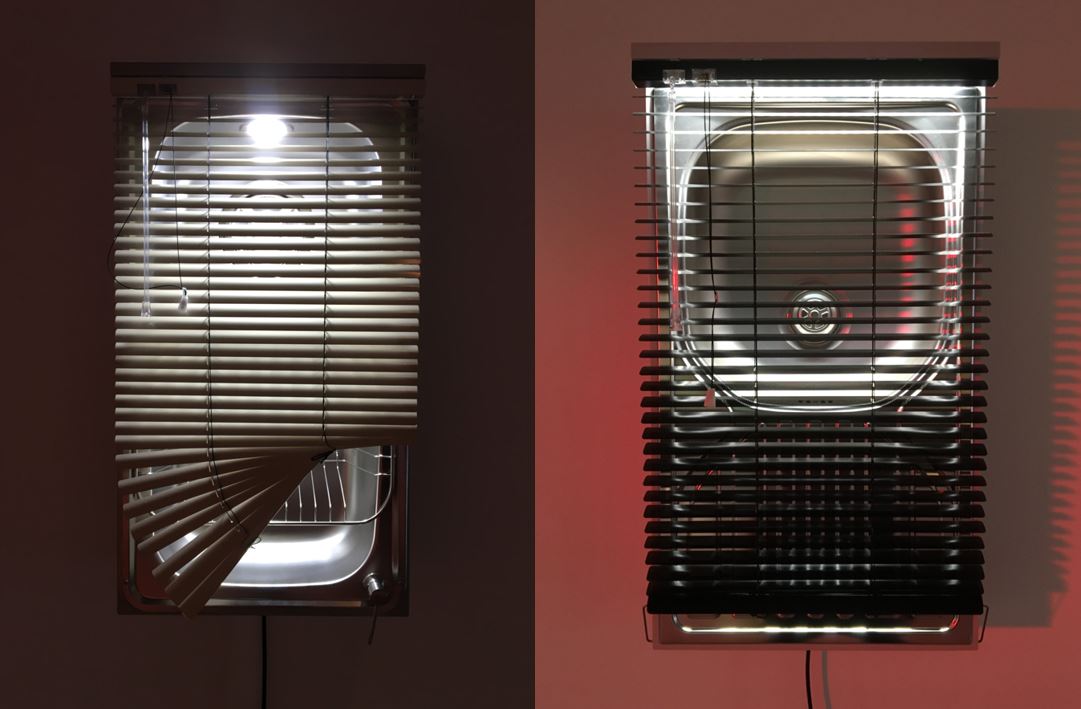
The last element I’ll note is that, off to one side of the main space, were a couple of stainless steel kitchen sinks which had been hung on the wall with (yet more) Venetian blinds hung over them and a bit of coloured lighting. I liked these for their strong surreal vibe. They are titled, with Yang’s characteristic fondness for long names, ‘Twelve Pyeongchang-gil Moisture – #AP MJ134’ and ‘Seven Dircksenstraße Moisture – #AP ZL10164’.

Installation view of Haegue Yang: Leap Year at the Hayward Gallery showing ‘Twelve Pyeongchang-gil Moisture – #AP MJ134’ and ‘Seven Dircksenstraße Moisture – #AP ZL10164’ (photo by the author)

Thoughts

I liked it, some bits more than others, but there’s a very wide range of types and sizes and forms of work here. The blockbuster sculptures are the obvious show stoppers but once you’ve taken them in, enjoyed walking round and marvelling at them, on the second go round I noticed a lot of quieter, subtler works on paper – collages and prints – which require a different sort of attention. Plus the half dozen or so videos, if you have the patience.

Installation view of Haegue Yang: Leap Year at the Hayward Gallery (photo by the author)

It’s not going to rock your world like the Van Gogh exhibition at the National Gallery or overawe you with Masters of Art like the Michelangelo and Leonardo show at the Royal Academy, but it’s light and fun and intriguing and pleasing in a way neither of those are, and an insight into the look and feel of bang up-to-date, international contemporary art. Give it a go.


Related link

Related reviews

Occidentalism: A Short History of Anti-Westernism by Ian Buruma and Avishai Margalit (2004)

The dehumanising picture of the West painted by its enemies is what we have called Occidentalism. It is our intention in this book to examine this cluster of prejudices and trace their historical roots.
(Occidentalism: A Short History of Anti-Westernism, page 6)

Some features of Occidentalism

Many groups have queued up to hate ‘the West’ over the past 200 years, for many reasons, claiming that:

  • the West is a purveyor of ‘poisonous materialism’
  • Westernism is a disease of the spirit
  • the Western mind splits human knowledge into soulless specialisms
  • Westernism promotes alienated individualism over communal belonging
  • Western science destroys religious belief and faith
  • Western media are decadent and pornographic
  • Western culture is shallow and materialist so destroys spiritual values
  • Western society is capitalist, greedy, exploitative
  • Westernism is a ‘machine civilisation’ (compared to hand-made rural arts and crafts)
  • resentment / hatred of Western imperialism
  • of Western colonialism
  • of Western (particularly American) global power and selfish foreign policy
  • Western civilisation is associated with huge, degraded, corrupt cities (compared with organic rural life)
  • the West represents ‘rootless cosmopolitanism’ and multiculturalism (compared with homogeneous native traditions)

These are the accusations and stereotypes which the authors set out to analyse and investigate, going much further afield than the contemporary Middle East, and much further back in time than the past few troubled decades, to do so.

The authors

Ian Buruma (born 1951, aged 72) is a Dutch writer and editor who lives and works in the US. Much of his writing has focused on the culture of Asia, particularly that of China and 20th-century Japan.

Avishai Margalit (born 1939, aged 83) is an Israeli professor emeritus in philosophy at the Hebrew University of Jerusalem. From 2006 to 2011 he was George F. Kennan Professor at the Institute for Advanced Study in Princeton.

Both were contributors to The New York Review of Books during the 1990s and in fact this book grew out of an article published in that magazine in 2002, less than 12 months after the 9/11 attacks on New York shook the world of international affairs.

The background: Edward Said’s Orientalism

Buruma and Margalit don’t mention Edward Said in the text but they explicitly state that their concept of ‘Occidentalism’ is conceived as a mirror image of the notion of Orientalism which Said was instrumental in defining and popularising.

The view of the West in Occidentalism is like the worst aspects of its counterpart, Orientalism, which strips its human targets of their humanity. Some Orientalist prejudices made non-Western people seem less than fully adult human beings; they ha the minds of children and could thus be treated as ‘lesser breeds’. Occidentalism is at least as reductive; its bigotry simply turns the Orientalist view upside down. [It reduces] an entire society or civilisation to a mass of soulless, decadent, money-grabbing, rootless, faithless, unfeeling parasites… (p.11)

Prior to Said’s book, Orientalism had been the value-neutral name given to a perfectly respectable academic discipline, the study of the languages, peoples and societies of ‘the East’ (loosely defined as lands from the Middle East to Japan) until Said published his landmark study, Orientalism in 1978.

Orientalism was a long, thorough, polemical attack on the entire discipline, claiming that from its earliest beginnings it 1) drew up a clear unbridgeable distinction between ‘The East’ and ‘The West’, 2) invented stereotypes of ‘the Oriental’, ‘the Arab’, ‘the Muslim’ and 3) attributed to them and their world a shopping list of negative qualities, the stereotypical ‘Oriental’ being lazy, irrational, dominated by a simple-minded religion, corrupt, sensual, and so on.

Orientalism was intended to be a comprehensive demolition of an entire academic field which Said proved by showing that the same mental structures underpinned, and the same demeaning stereotypes and clichés appeared in, almost all Orientalist writing, from the late eighteenth century right up to the present day.

This would all have been fairly academic, in the narrow sense – academics squabbling over the epistemological foundations of a particular academic field – but for the real bite of the book which is its highly political approach.

This has two elements. Firstly Said claims that the entire field of research into the languages, culture, religions, society and so on of ‘the Orient’ enabled and justified imperial control of the region. Knowledge is power, and the ever-more comprehensive and intrusive studies done of the countless peoples, religions and cultures of this vast area enabled Western imperial control over them. Orientalist academic studies served colonial power.

The Palestinian issue

This by itself would have been a fairly controversial conclusion, but there’s a second, really inflammatory element to Said’s critique. This is his attempt to show the discredited assumptions and degrading attitudes of Orientalism played, and continue to play, an important role in determining attitudes across western culture and politics to the Problem of Palestine.

This, as every educated person knows, is one of the most contentious issues in international affairs. In 1917 the British Home Secretary, Arthur Balfour, declared that Britain would support the Jews of Europe in their wish to create a homeland in the Biblical Lands of Palestine. Between the wars increasing numbers of Jewish immigrants fled Europe and settled in Palestine, buying land from its Arab owners. Tensions between incomers and natives erupted into regular bouts of violence which the British authorities, given a ‘mandate’ to run the area after the First World War, struggled to contain. After the Second World War, an exhausted, impoverished Britain tried to hold the ring between increasingly violent Jewish and Arab nationalist political parties and militias, until, in 1948, they effectively gave up and withdrew.

The well-organised and well-armed Jewish settlers promptly declared the existence of the independent state of Israel and the neighbouring Arab countries promptly attacked it, seeking to strangle it at birth. The Israeli army successfully defended its country and amid, much bloodshed, hundreds of thousands of Palestinians fled, or were expelled, into neighbouring countries, especially Jordan.

In 1967 a joint force of Arab countries led by Egypt was mobilising for another attack when Israel launched a lightning pre-emptive strike, crushing the Egyptian army and forcing the Arabs to sign an armistice after just six days. As a result Israel seized the Jordanian-annexed West Bank (including East Jerusalem), and Egypt’s Sinai Peninsula as well as the Egyptian-occupied Gaza Strip.

As many as 325,000 Palestinians and 100,000 Syrians fled or were expelled from the West Bank and the Golan Heights, respectively, creating a humanitarian crisis.

In 1973 the Arabs launched a surprise attack on October 6, the Jewish holy day of Yom Kippur. Once again Israel faced numerically overwhelming forces but fought them off in what was effectively the Third Arab-Israeli War. In the aftermath of the war the Israelis realised that they couldn’t rely on fighting off Arab armies indefinitely, and so they began to put out feelers for some kind of peace treaty, which was to lead to the 1978 Camp David Accords under which Israel return the entire Sinai Peninsula to Egypt.

Orientalist attitudes to the Palestinian problem

The point of this long digression is that Said was a Palestinian. Both his parents were of Palestinian heritage, he was born in Palestine and raised in Egypt, attending English-language schools in Jerusalem and then Alexandria. Said’s father had served with US Army during the Great War and so earned US citizenship so, when he was expelled from his Egyptian private school for being a troublemaker he was sent to a private boarding school in Massachusetts, USA. Thus began his career as an academic in America (in New York).

But as he progressed through the academic hierarchy, as well as his purely academic publications about comparative literature, Said became known for his ‘outspoken’ opinions about the Palestinian issue, namely speaking up for the plight of the hundreds of thousands of Palestinian refugees, calling for the government of Israel to moderate its policies in the occupied territories and so on.

This, as you might have expected in polarised politicised America, drew down on his head the wrath of numerous journalists, commentators, Jewish groups and so on, many of which didn’t refrain from employing exactly the kinds of denigratory stereotypes he had listed in Orientalism against Said himself and the Palestinians he spoke up for.

In the Introduction to Orientalism Said explains that the motivation to write the book was partly driven by his own personal experience of Orientalist tropes. In New York academia he found himself extremely isolated as almost the only Palestinian and Arab working in an academic and publishing environment dominated by white liberals or Jews sympathetic to Israel and its policies.

So his own personal experience of having anti-Arab, anti-Palestinian and anti-Muslim slurs directed at himself, his writings and his opinions was a big motivation behind the years of research and labour of love which Orientalism amounts to.

This explains why the huge book, with its mountains of evidence, all work one way, criticising ‘the West’, Western attitudes, Western academia, Western imperialism, Western racism and so on.

In the Introduction Said explicitly says that he is not interested in exploring ‘the Arab Mind’ or ‘the Islamic World’ and so on. That would have doubled or quadrupled the length of the book, plus which he wasn’t professionally qualified to take on such huge subjects. His interest is solely in a deep investigation of how Western attitudes against ‘the Orient’ were created and proliferated throughout Orientalist studies, fiction and so on.

9/11

A lot happened in the real world between Orientalism‘s publication in 1978 and the publication of Occidentalism in 2002, but in the world of academia, magazines and publishing Said’s critique of Western attitudes had become very widespread among bien-pensant liberals. In the academy and liberal journals Said’s view that ‘the West’ continually sees the Middle East, the Arab world and Islam through simplistic, racist ‘Orientalist’ stereotypes, had become very widely accepted.

The 9/11 attacks on the World Trade Centre in New York, the Pentagon and (possibly) the White House (the fourth plane that came down in Washington) galvanised and transformed the culture, shocking and terrifying people around the Western world. It led numerous commentators and analysts to claim that we had entered a new era of war between ‘the West’ and ‘Islam’ or ‘Islamic terrorism’ or ‘Islamofascism’ etc, an inflammatory rhetoric which translated into actual war when, within a month of the 9/11 attacks, in October 2001, US forces invaded Afghanistan to overthrow the Taliban regime there.

Occidentalism

This is where Buruma and Margalit come in. They readily concede that 9/11, like the First Gulf War before it, led to an explosion throughout the media of just the kind of Orientalist racist stereotypes which Said had dedicated his life to uncovering and critiquing. But they point out that there was a gap in the whole discussion. If ‘the West’ could be accused of deploying Orientalist stereotypes against ‘the East’, ‘the Arab world’ etc, what about the stereotypes of the West which could be found in the media and political and terrorist discourse of the East? Didn’t Arab and Palestinian and Muslim leaders regularly rail against ‘the West’, didn’t an endless stream of news footage show enraged mobs burning the American flag and shouting ‘Down with America’, and wasn’t this anti-western rhetoric routinely associated with a predictable shopping list of negative stereotypes? Short answer, yes.

So what are these anti-Western tropes and where did they come from?

The West and ‘the Modern’

Right at the start Buruma and Margalit made a fundamental conceptual decision which underpins everything that follows: this is to identify anti-Western discourse with anti-Modernism. They argue that when nationalist commentators and activists in the rest of the world attack ‘the West’, they almost always conflate ‘the West’ with every aspect of the modern world which they dislike, despise or fear, everything from industrialisation, secularism, capitalism, rationalism through to cultural products such as pop music and pornography.

What many of the anti-Western nationalist movements of the past 100 or 150 years, whether in India or China or Japan, in the Middle East or across Africa, have in common is that they want to turn the clock back. They dream of an era which preceded the arrival of the West with its monstrous attributes of godless science, nation states, brutal capitalism, cultural hegemony and so on, they dream of an era when their countries were untainted by western influence, untainted by godless capitalism, when everyone lived in small rural communities and shared the same simple faith and devoutness.

At the roots of much anti-Western feeling is a deeper resentment at all these aspects of the modern world and a passionate desire to turn the clock back to simpler, more spiritual times. This leads them to a counter-intuitive conclusion:

Anti-westernism is a western product

The first people to loathe and hate modernism i.e the rise of a secular, godless, liberal, pluralistic society based on industrial capitalism, with the uprooting or rural populations and their herding into monster cities which became sinks of immorality and degeneracy etc, were westerners themselves.

It is one of our contentions that Occidentalism, like capitalism, Marxism, and many other modern isms, was born in Europe before it was transferred to other parts of the world. (p.6, emphasis added)

The main opponents to the birth and spread of industrial capitalist society were inhabitants of that society itself. Marx is the obvious epitome of this trend, but there had been plenty of opponents to the rise of godless rationalism and capitalist industrialisation for generations before him, and loads of theoreticians who tried to cling onto older ideas of pre-industrial societies bound together by a common religion

To put it simply, Western society has, for well over 200 years, contained a large number of intellectuals who fear, hate and loath their own western society, and who have developed an extensive set of concepts and vocabulary to express that hatred in.

Communist anti-westernism

The Bolshevik revolution of 1917 appeared, at a stroke, to validate the enormous, world-reaching rhetoric of Marxist analysis, to prove the inevitable collapse of capitalism and of communist revolution, and the Soviet regime spent the next 70 years energetically spreading its anti-western ideas and rhetoric around the world.

Fascist anti-westernism

But the Bolsheviks triggered an equal and opposite reaction in the extreme nationalist movements which developed into totalitarian fascism in Italy, then Germany and the other European governments who fell prey to authoritarian or fascist regimes between the wars.

And the fascist, anti-modern rhetoric developed by these regimes and their numerous intellectual defenders and propagandists, continued long after the Second World War, helping to justify and underpin semi-fascist military regimes in, for example, Franco’s Spain, Salazar’s Portugal, the Greece of the generals, or right-wing regimes in South America such as Pinochet’s Chile (1973 to 1990) or the military government in Argentina (1976 to 1993).

So this is the most fundamental thing about the book – Buruma and Margalit’s decision to expand its frame of reference faaaar beyond a consideration of anti-western rhetoric in the Middle East, in the Arab world or as expressed by Islamic terrorists like Osama bin Laden, and to turn it into an investigation of anti-Western thought in its widest possible definition.

Scope

In their introduction, on page 11, Buruma and Margalit briefly consider taking a chronological approach to the subject, tracing the origins of anti-western feeling all the way back to the Counter-Reformation, through the Counter-Enlightenment, before exploring the roots of the various types of socialist, communist and fascist opposition to the modern world.

Mercifully, maybe, instead of the kind of exhaustive multi-volume study this would have turned into, they decide to take a thematic approach. They will look at certain key images or symbols of the decadent, greedy, rootless etc West, and sketch out their origins in (mostly) Western discourse. This helps explain why the book is a light and frolicsome 149 pages long, although some of the explication is so dense and compressed that it sometimes feels like longer…

Contents

Accordingly, the text is divided into six chapters. The headings are neat and logical but I found the text they contain often very digressive, in the sense that it hops between quite disparate topics, times and places and then, just as unpredictably, returns to what they were originally discussing. On the upside this means the text is often as interesting for the sidelights or incidental observations it throws out as for the central points.

1. War Against The West

Introduction, as summarised above.

2. The Occidental City

Contrary to received opinion, people who hold strong Occidentalist views tend to be educated, or at least educated enough to be familiar enough with the values of the West to hate them. Taking the view that ‘Western values’ are undermining this or that set of traditional native values requires you to have a pretty good theoretical understanding both of what your native values are, what Western values are, and how the latter is ‘poisoning’ the former.

Far from being a dogma favoured by downtrodden peasants, Occidentalism more often reflects the fears and prejudices of urban intellectuals, who feel displaced in the world of mass commerce. (p.30, emphasis added)

Re. the 9/11 attacks on hi-tech buildings, Osama bin Laden trained as a civil engineer. the ringleader of the hijackers, Mohamed Atta, studied architecture at Cairo University and went on to do a Masters in urban planning at the Hamburg University of Technology. He hated modern architecture. He thought the concrete high-rise buildings built in Cairo and across the region in the 1960s and 1970s ruined the beauty of old neighbourhoods and robbed their people of privacy and dignity.

The tower of Babel

Tall buildings have been a focus of anxieties and symbols of ill omen from at least as long ago as the Bible. The Old Testament or Jewish Bible has barely got going before, in chapter 11, we are told about Nimrod who built the Tower of Babel with a view to making a name for themselves. God and, it appears, his angels, feared what they might do next, so afflicted the workers on it with different languages so they couldn’t understand each other, and then dispersed them across the face of the earth.

I visited New York in the 1980s and went to the top of the South Tower of the World Trade Centre which had an observation deck on the 107th floor and an outdoor viewing platform. It was 1,377 feet above street level. You could feel the building moving under your feet since it was designed to have a certain amount of ‘give’. I have acute vertigo and was terrified.

Cities as sinks of iniquity

Throughout recorded history, cities in every culture have been associated with corruption, greed, exploitation of the poor by the rich, decadence and immorality.

It is a universal story, this clash between old and new, authentic culture and metropolitan chicanery and artifice, country and city. (p.27)

Western sources

Regarding the authors’ focus on western texts, they live down to my expectations. In just the first part of this chapter they quote the Bible, Juvenal, the Goncourt brothers, William Blake (Dark Satanic mills), T.S. Eliot (The Rock), Richard Wagner (despised the frivolity of Paris), Voltaire (admired the liberty of eighteenth century London), Theodor Fontane (disliked London’s materialism), Friedrich Engels (horrified by the poverty of Manchester) and not a single Arab or Muslim voice.

It feels like a fairly obvious sixth form selection of obvious cultural figures (Blake, Eliot, Wagner). I’d so much have preferred an explanation of Islamic traditions about ‘the city’.

Antisemitism

They then move onto antisemitism, long associated with cities, cosmopolitan i.e. non-native culture, money-lending and capitalism etc, citing (again) Eliot, Pierre-Joseph Proudhon, Marx. The Nazis incorporated late-nineteenth century tropes of seeking to escape the city for a healthier life in the country into their fascist propaganda about racial purity, despising a checklist of big capitalism, cosmopolitan crowds, decadence (nightclubs and jazz), corruption of good Aryan women into prostitution and, of course, managed to blame all of this on ‘the Jews’.

A lot of these concerns and the language they were expressed in were picked up by other nativist nationalists, in Japan (about which Buruma knows a lot and which developed its own form of fascism during the 1930s) and in the Arab Middle East, developing its anti-colonial, anti-western rhetoric (many nationalist Arab leaders allied with Nazi Germany on the twin bases that a) my enemy (Britain)’s enemy is my friend and b) shared antisemitism).

Sayyid Qutb

They make a brief mention of Sayyid Qutb (1906 to 1966), widely considered the father of modern Islamic fundamentalism, to address not his writings, but his miserable alienation when he moved to New York to study in the 1940s and was repelled by absolutely everything about American life, its soulless materialism, its obsession with capitalist consumerism, its degraded immorality. Maybe they felt obligated to wedge him in somewhere, but Qutb’s importance to the development of Islamism or Islamic fundamentalism or Islamic terrorism isn’t developed at all. A paragraph on him before swooping back to Europe and…

The French Revolution

Surprisingly, maybe, they then move to the French Revolution. The French Revolution crystallised Enlightenment trends against medieval monarchs and aristocrats, the rule of the Church, traditions of all sorts, which needed to be torn up and thrown away, replaced by the cult of Reason, modern laws for modern enlightened citizens.

Antisemitism was implicit in Christianity from the beginning, with the Jews being blamed for insisting on the crucifixion of Jesus by the earliest Church Fathers. Buruma and Margalit attribute the birth of modern antisemitism to the French Revolution. Traditional upholders of the monarchy, the aristocracy and the Catholic Church were easily persuaded that the whole thing was a Jewish conspiracy, and so was born a whole modern antisemitic way of thinking about the world, which was to flourish and become steadily more toxic in the heart of Europe as the nineteenth century progressed.

The German Volk

Soon after the revolution, France invaded Germany, or the German states. Ideological opposition to the teachings of the French Revolution became mixed up with patriotic fervour. This all happened to the first generation of German Romantics. France came to represent the modern, godless, cosmopolitan city, riddled with over-clever philosophers and money-grubbing Jews, which was trying to conquer and obliterate the values of the Volkisch, spiritual German town, the German landscape of sturdy peasants, wise artisans and soulful poets. The authors cite the German folklorist Gottfried von Herder (1744 to 1803) as an example of this view.

Japan and China struggle to adopt Western culture

But western ideas of democracy, industrialism, capitalism and so forth were undeniably effective. They provided the underpinnings for the astonishing spread of Western imperialism. The question for rulers in countries from Morocco to Japan was which ideas from the West it would be profitable to accept, and which they needed to reject in order to maintain their culture and traditions, protect their nations from ‘spiritual pollution’ i.e. Western liberal ideas. Tricky.

Japan and China in different ways tried to adopt Western techniques without changing the core of their culture. Japan was much more successful, maybe because its centralised administration was stronger: it imported Western industrialisation while managing to keep a strong sense of national culture. By contrast the Chinese political system had become corrupt and inefficient so it failed to import Western industrialisation but instead found itself infected with all kinds of Western ideas about republics and democracy and the individual etc, ideas which led to the overthrow of the monarchy in 1911.

The appeal of Marxism to anti-colonial nationalists

For the central 70 years of the twentieth century many developing countries thought that Marxism offered a way forward. It was modern, industrial, scientific but rejected the soulless materialism, corruption and imperialist mindset of the Western capitalist societies. hence its attraction for many developing countries, especially in the decades after independence in the 1940s and 50s.

Unfortunately it was the dream which failed. The failure of the secular socialist nationalism promoted by the likes of President Nasser of Egypt, Gaddafi in Libya, Saddam in Iraq, Assad in Syria led to a wave of disillusion across the Arab world and opened the cultural space for Islamists who promoted a radical solution, a return to a world before any kind of modernity existed, back to the pure, unsullied, pious and unified world of the early Caliphate.

Mao and the war against the city

The authors devote 4 or 5 pages to Chairman Mao, ruler of China from 1949 to 1976. They see Mao as the biggest exponent in all world history of the war of the country against the city. The corrupt westernised city was epitomised for Chinese communists like Mao by Shanghai, administered by westerners and packed with a cosmopolitanism, capitalism and corruption. Mao thought such places needed to be purged in the name of a peasant communism.

Mao’s promotion of peasant values promised an escape route from Western capitalism, from urban alienation, decadence and corruption, and a return to integrated rural communities, where life and work would have proper, deep human meaning and purpose.

And so during the 1950s he unleashed the Great Leap Forward which involved rounding up and shooting hundreds of thousands of members of the urban bourgeoisie, those who survived being sent to huge rural labour camps. It was, he boomed, in countless speeches, a good thing ‘to exterminate the bourgeoisie and capitalism in China’ (p.42).

The Khmer Rouge 1975 to 1979

This is the mindset which went on to guide the horrific Khmer Rouge regime in Cambodia, 1975 to 1979. Most of Pol Pot’s soldiers were illiterate peasants, often only boys. When they took the capital, Phnom Penh, they were staggered by the wealth, the size, the swarming multinational population, the coffee shops and fleshpots. All these were ruthlessly emptied and its inhabitants either shot on the spot, or dragged off to be tortured, or marched off to labour camps in the countryside. Only by exterminating the urban bourgeoisie could the country be restored to purity and truth and correct living. It was a kind of logical end point of centuries of anti-city rhetoric.

The Taliban 1996

Same with the Taliban, illiterate peasants in flipflops armed with weapons seized from the fleeing Soviets or donated by America. After a ruinous civil war they took the capital of Afghanistan, Kabul, in 1996. First they butchered the leader of the pro-Soviet regime, Mohammad Najibullah, then they banned everything to do with modern life, which they associated with the hated West, in a bid to return society to the ‘purity’ of the earliest days of the Muslim Caliphate.

All music was banned, along with television, soccer, and most forms of socialising. Women had to cover themselves from head to foot and were not allowed out without a chaperone. Kabul was ruled by a six-man shura not one of them from Kabul, not one of them had ever lived in a city.

The Khmer Rouge and the Taliban represented the triumph of ‘authentic’ rural values over the corrupt, decadent modern city.

Germania

The authors then take a characteristic leap in subject, concluding with a page describing a different way of triumphing over the chaotic modern western city: this was to demolish it and build a totalitarian alternative.

Hitler hated Berlin and planned to rebuild it as a totalitarian capital, its alleys and slums replaced by broad boulevards designed for marching armies, its swarming cosmopolitan crowds replaced by the unified adoring Aryan crowd. All the messy attributes of the decadent West – civil liberties, free market economies, democracy, individualism – would be replaced by one Folk, one Reich, one Führer and one Capital City.

The Hitler regime was overthrown before building got very far but other countries have made the experiment. The authors cite Pyongyang, capital of North Korea, as what Germania might have looked like, a neoclassical testament to untrammeled, totalitarian power.

Lastly, they reference the steel and glass cities of coastal China which have mushroomed in the last twenty years, which represent a kind of defiant triumph over the less impressive, shop-soiled cities of the West. We can do it bigger, better and shinier than you, say high rises such as the Burj Khalifa in the United Arab Emirates, Merdeka 118 in Kuala Lumpur, the Shanghai Tower in Shanghai, the Abraj Al-Bait Clock Tower in Mecca, the Ping An International Finance Centre in Seoul and so on.

These are not so much anti-Western, as supra-western, denying old ideas of Western supremacy by outdoing it.

3. Heroes and Merchants

Werner Sombart

This focuses on the roots of Germany’s sustained sense of being different from ‘the West’, which German intellectuals defined as soulless mercantile Britain and godless revolutionary France.

The authors zero in on a book written in 1915 by a German sociologist named Werner Sombart and titled Händler und Helden or Merchants and Heroes. In the book Sombart contrasted the commercial civilisation of Britain and the liberty, equality, fraternity culture of France with the heroic culture of Germany. The Western bourgeois is satisfied with ‘comfort’ (in German Komfortismus) and the soporific sports of the British. By contrast the German welcomes death as the ultimate sacrifice he can make for the Volk.

Similar ideas were shared by the historian Oswald Spengler and the warrior-author Ernst Jünger. Happy happy Germany to have such ideologues of the glory of war. The fundamental trahison des clercs (‘treason of the intellectuals’) is to promote exciting ideas about glory and sacrifice which lead hundreds of thousands of young men to their death. ‘The young must shed their blood,’ write Thomas Abbt (p.58). Other young men, obviously. You need to stay safe in your study in order to produce such intellectual masterworks.

The authors make a direct link between the widespread contempt for bourgeois Komfortismus described by numerous right-wing German intellectuals, and the attitude of the jihadi fighter interviewed early in the 2001 Afghan who said that the Islamists would triumph because ‘You [the West] love life, but we love death’.

Personally, taking a materialist Darwinian evolutionary view of Homo sapiens, it seems unlikely that impatience to make live heroic lives and die in a noble cause, particularly among zealous young men ‘ardent for some desperate glory’, will ever die out. It has been so ubiquitous throughout all human history, in all cultures, that it appears to be hard-wired into the species. I’ve recently read a suite of books about the problems of African society and prominent among them is what to do about disaffected, unemployed youths, hanging round, looking for a cause to redeem their alienated lives…

Military death cults in Japan

The authors go on to trace how German hyper-nationalism and Occidentalism went on to become surprisingly influential in intellectual circles in the Middle East and Japan. The same valuing of a heroic ideal of nationhood which led Hitler to sacrifice an entire generation of German youth, was the one that made the Japanese fight to the death, island by island and send waves of kamikaze pilots in 1944.

Buruma has a counter-intuitive interpretation of Japanese suicide warriors. The phenomenon was considered at the time as being somehow specifically Japanese, but Buruma says the surviving farewell letters of many of the kamikaze pilots (and drivers of the less well-known suicide torpedoes) indicate that most were highly educated students studying the humanities at leading universities, and that a surprising number of them were well read in German literature and philosophy. They dressed up their feelings in tropes about the Samurai and cherry blossom but their fundamental ideas about the diseased decadence of the West and the need for heroic sacrifice are actually Western ideas.

Buruma gives a potted summary of the way Japanese politicians and intellectuals in the mid-nineteenth century cobbled together a patchwork copy of Western intellectual, economic, political, military and religious life, not least in the cobbling together of a state religion, Shinto, which they thought would echo the Christianity which seemed to be such a central part of European life. Ditto the transition of the emperor from a remote and powerless figure in Kyoto, who was moved to Tokyo to become a combination of kaiser, generalissimo, Shinto pope, and highest living deity. People talk (dismissively) about the British inventing many of their ‘traditions’ in the nineteenth century (Christmas trees, the kilt) but the Japanese did the same with knobs on.

Regarding the development of a cult of heroic sacrifice Buruma says an important source was the Imperial Rescript to Soldiers and Sailors of 1882 which the armed forces learned by heart and included a passage commanding the ultimate sacrifice for the emperor.

A practical consequence of this Occidentalism were that, when Western forces surrendered, as at Singapore in 1942, the Japanese viewed surrendering forces as dishonourable cowards who preferred to save their skins rather than fight on to the death i.e. the exact opposite of Japanese martial values.

As a result the Japanese regarded the surrendering British forces as less than human and treated them accordingly, working them to death in brutal labour camps. My best friend at school’s dad was in the army in Burma at the end of the war. He saw the state of soldiers repatriated from the Japanese camps. As a result he refused to have anything Japanese in the house.

The Rashtriya Swayamsevak Sangh

The authors then move on to India for a quick description of the Rashtriya Swayamsevak Sangh (RSS) which means the ‘National Volunteer Organisation’. Founded in 1925 this was a far-right, Hindu nationalist paramilitary organisation which aimed to instil ‘Hindu discipline’ in order to unite the Hindu community and establish a Hindu Rashtra (Hindu nation). Like the Nazis they aimed to create a new society based on racial purity, military discipline and sacrifice.

Osama bin Laden

Then, in this whistlestop tour, we are on to your friend and mine, the demon figure of the first decade of the 21st century, Osama bin Laden. The authors give quotes from an interview bin Laden gave after the 1996 al-Khobar Tower attack in Saudi Arabia. They say the language bin Laded uses of self-sacrifice, of suicide attacks, is emphatically not part of the Islamic mainstream tradition. In mainstream Islam dying in battle against the infidel is what creates justified martyrs; blowing yourself up along with unarmed civilians is something quite different, feared and despised by many Muslims as much as by Westerners.

They slightly contradict themselves by then describing the death cult of the Assassins, created in the 13th century for reasons which are still debated, and the pattern they set for being prepared to die for Islam in taking out an infidel opponent.

Anyway, whatever the precise roots there’s no denying that throughout the nineteenth century Muslim leaders called for jihad against western colonists and their godless capitalism, against their Jewish agents, and against native leaders who had been corrupted by their infidel ways.

Assassination

When I read this I immediately thought of President Anwar Sadat of Egypt. He was assassinated in 1981 by members of Egyptian Islamic Jihad for signing a peace treaty with Israel and instigating a crackdown on Islamic extremists, and so was painted as ‘a traitor to Islam’.

Sadat’s fate raises a general principle of Occidentalism which is that often opponents of the West aren’t actually opposed to the distant West, which they had never visited and of which they knew relatively little, so much as against the westernisers in their own society, political or social leaders who they blame for importing Western secular values. So they kill them.

Historically, the main embodiment of Muslim resistance to westernisation was the Muslim Brotherhood, founded in 1928 with the following manifesto:

‘God is our objective; the Qu’uran is our constitution; the Prophet is our leader; Struggle is our way; and death for the sake of God is our highest aspiration.’

Then, in another leap, the authors tell us that Japanese kamikaze tactics were adopted by the Hezbollah in the Lebanon with the 1983 Beirut barracks bombings which killed 241 US and 58 French military personnel.

Buruma and Margalit wrote this book before the US invaded Iraq in March 2003, an occupation which triggered an epidemic of suicide bombings by Sunni and Shias against the occupying forces.

Weimar

They conclude with a simple but crucial message. The Weimar Republic didn’t die because it was liquidated by Nazis, big business and the Army. It died because too few people were prepared to defend it. See the books on the subject by Peter Gay and Walter Laqueur. Passionate young men from the Right and the Left conspired to attack and undermine it at every opportunity. Nobody stood up for the boring, unromantic business of liberal democratic political life.

4. Mind of the West

Russian anti-westernism

Occidentalists accuse the West of being effective, technologically adroit, economically triumphant, and yet lacking the soul, depth, spirit and godliness which the critics, of course, pride themselves on having. I particularly despise the long tradition in Russian culture of belittling the frivolity and superficiality of France or Britain compared to the Great Russian Soul and its vast capacity for Noble Suffering. Tolstoy. Dostoyevsky. Occidentalists.

Dostoyevsky despised the West because it sought happiness and comfort whereas it should have been seeking salvation. And the route to salvation is via suffering. Only suffering brings wisdom. The West is afraid of suffering. The West can never be wise. Only a people devoted to suffering can be genuinely holy. The Russian soul welcomes and endures great suffering. Thus it is superior to everyone else’s.

Dostoyevsky and the propagandists for Russian suffering prepared the way (or just accurately reported the mindset) of the great Soviet barbarism of the twentieth century, the horrific civil war, the mass famines of Stalin, the huge gulags, total repression of civil society, the incredible death toll of the Great Patriotic War caused by Stalin’s ineptitude (and having massacred all his leading army officers) and Russian military readiness to sacrifice soldiers by the hecatomb in ways the Western Allies couldn’t believe. Still. Spiritual superiority, that’s what counts.

The line continues all the way through to Vladimir Putin. Putin sits in the main line of Russian cultural thought in despising, like Tolstoy, like Dostoyevsky, the decadence of Western liberalism, whose rapid end he has confidently predicted in numerous speeches.

Meanwhile, while he wastes his nation’s resources on a stupid nationalist war, the population of Mother Russia is going into decline as people flee Putin’s dictatorship or just die of ill health due to its wretched health problems.

Russia has the world’s 11th-largest economy but ranks 96th in life expectancy. Life expectancy for Russian men is 67, lower than in North Korea, Syria or Bangladesh. Still. Spiritual superiority, that’s what counts, eh.

The authors spend a long section describing ‘the love affair of Russians with their own soul’ and the achievement of nativist thinkers, loosely termed ‘Slavophiles’.

Anti-westernism’s German roots

In fact, counter-intuitively, Buruma and Margalit attribute Slavophilia, like so much anti-westernism, to German roots, specifically German Romanticism. Humiliated by Napoleon’s victories over them, conscious of their political backwardness (fragmented into scores of little princedom and dukedoms) German intellectuals, in a massive case of sour grapes, said worldly success didn’t matter, what mattered was what was in your soul. They compensated for their economic, social, political backwardness by asserting the supremacy of their spiritual life.

A spectrum

It occurs to me that there was a spectrum in the moving west to east across Europe in the nineteenth century. At the western extreme was Britain, economic powerhouse of the world but almost bereft of genuine art, philosophy or religion (sure it had the oppressive Church of England but this had little or no spiritualist tradition). Then came France, nearly as economically diverse as Britain, a good deal more artistic and philosophical. Then Germany, economically and politically backward but packed with ‘deep’ philosophers and its great musical tradition. Poland, which is never taken account of by anybody in these kinds of surveys. And finally Russia, the most economically and socially backward of European nations and, accordingly, possessed of a self-congratulatory sense of its immense spiritual superiority over everyone else.

In the authors’ view, to be blunt, it’s all the Germans’ fault. Extremely resentful of the military, economic and artistic success of Napoleon’s France, German Romantics compensated for national humiliation by working out the theory of the superior spiritual value of Das Volk and the nobility of dying for it.

Isaiah Berlin on German Romanticism

No less an authority than Isaiah Berlin thought this was the case and, moreover, thought the model the Germans worked out became a template which could be exported to all peoples who feel mocked and humiliated. The template was copied by the Russians during the nineteenth century and, as we’ve seen, adopted by Arab and Indian nationalists between the wars.

Buruma and Margalit summarise Berlin’s model. The German Romantic movement was the Counter-Enlightenment. It valued intuition and spirit over reason and calculation. It preferred heroes to shopkeepers. It looked back to a lost era of national and religious unity and looked forward to its glorious restoration.

On this view Nazism, Japanese fascism and Islamic fundamentalism are all the heirs to the original German Romantic anti-Westernism.

Russian Orthodox Christianity

The authors tell me things about Russian Christianity I didn’t know. They describe the messianic conviction that Moscow is a second Rome and only home to true Christianity. They explain that Russian Orthodox Christianity is far less interested in theology than Greek or Roman Christianity and far more concerned with custom and practice. Icons are more important than intellectual debate.

Intellectualism is suspect. And any kind of change is not needed. The thousand year old tradition of the Russian church suffices. Innovation tends to come from outside, representing threat and betrayal.

The authors give a potted history of Russia, with Peter the Great and Catherine the Great realising they had to import Western technology and ideas. Throughout the nineteenth century Russian intellectuals split into westernising and slavophile parties. They give potted biographies of individual westernisers. And they explain that for these men, the West meant Germany and its succession of Romantic philosophers.

As with Orientalism, all these Russian thinkers worked out their theories and defined themselves against the Other, the Other being a highly simplistic, stereotyped view of The West, a West which was materialistic, godless, mechanical, superficial, divided, corrupt and decadent, which lacked the soulfulness and the unity of people and purpose which characterised Mother Russia.

The triumph of will over reason

One major aspect of Occidentalism is the valorising of will over reason. Timid reason calculates the best course of action, tots up the pros and cons, a shopkeeper mentality. All this contrasts with the will which acts instinctively, in large glorious romantic causes. Following the footsteps of Friedrich Nietzsche, Hitler and the Nazis famously praised the Triumph of the Will over pettifogging rationalism. And so did nineteenth century Russians.

Konstantin Leontiev

The Russian Nietzsche was Konstantin Leontiev (1831 to 1891). He wrote a big book, Russia and Europe, which made a big splash. He was one of hundreds of late-nineteenth century philosophers and commentators who worked up an ‘organic’ theory of history i.e. that societies are like organisms which have a birth, a youth, a maturity and then a decay.

Surprise, surprise, Leontiev thought that the West with its decadent liberal democracy was in the last stages of decay. Exactly what Vladimir Putin thinks today, 150 years later. Continuities like this demonstrate that this is not a rational belief based on evidence, it is a prejudice, an unchanging tenet of anti-western bigotry, of Occidentalism.

The authors end the chapter with a brief history of the word nihilism which came to prominence, in Russia, in Ivan Turgenev’s novel Fathers and Sons. The chapter ends with more evidence of Dostoyevsky’s fanatical hatred of the West and fear that it’s godless, scientistic values were undermining the noble soul of Mother Russia.

5. The Wrath of God [Muslim fundamentalism]

 Buruma and Margalit draw a distinction between religious Occidentalism and secular Occidentalism. 

They say that Islamism is the form Occidentalism is taking in our time. What is new or unique is Islamism’s view that the West is guilty of barbarous idolatry and proceed to explain what this means, starting with a definition of idolatry.

They give a pocket history of the concept of idolatry which stems from the Jewish Bible. Here God is depicted as a jealous husband who is hurt when his Chosen People whore after strange gods. But obviously it has a deeper charge than that. God is also king of the universe, master of creation, source of existence. Denying God is the worst kind of blasphemy imaginable. In the Old Testament numerous kings and rulers are depicted as behaving as if they were as powerful as, or more powerful than, their creator, and demanding the veneration which is due to God.

So idolatry is giving to men the devotions and worship which are due to god. They discuss the meaning of Arab terms such as tajhiljahiliyya and jahili. jahiliyyahas been used to describe the religious ignorance which prevailed in Arabia before the advent of the Prophet Mohammed but also, more metaphorically, as the notion of barbarism, in the same way the ancient Greeks used it to refer to everyone who wasn’t Greek. At school I was told it was a joke term for people whose unGreek languages made them sound like they were saying ba-ba-ba-ba.

To summarise, the use of the term jahiliyya in Islamist discourse can be interpreted as referring to a new barbarism (godless idolatry) which originates from the West and is infecting the Muslim world.

The authors have a digression into the history of Manicheism, first as an actual belief system propounded by the Iranian prophet Mani (216 to 277 AD) then as the strand in most religions which posits an absolute divide between God and Evil. Then they show how ‘evil’ in most religious traditions is associated with the body, with its weakness, tendency to degrade and die, its distracting appetites, worst of which is, as we all know, sex. The body is contrasted with the soul which is taken to be immortal and the part of a human body which can approach or commune with god.

Ali Shari’ati

They discuss Ali Shari’ati (1933 to 1977), an Iranian Shia Muslim revolutionary and opponent of the westernising regime of the Shah. Shari’ati thought the best way for developing countries to fight back against the infection of godless western materialism was by rallying around their religious beliefs and traditions, in his case, Islam. He explicitly linked the influence of the West as encouraging Muslims to idolatry i.e. diverting worship away from God and towards the godless things of man i.e. money, consumer goods.

The industrial revolution made the West rich but it led to what sociologist Max Weber called ‘the disenchantment of the world’. It lost its magic and spirits. It lost God. And so all its goods and products are tainted by this tendency to disenchant and divert men’s worship from God to things. Idolatry.

Sayyid Qutb

The authors tell us about Islamic radical thinkers who fought back against the forces of secularism, for example Muhamed Taleqani in Iran, before returning to Sayyid Qutb, first mentioned in chapter 2.

For Qutb the whole world, from decadent Cairo to New York, was in a state of jahiliyya. He saw the West as a gigantic brothel, steeped in animal lust, greed and selfishness. Human thought, in the West, was ‘given the status of God.’ Material greed, immoral behaviour, inequality and political oppression would end only once the world was ruled by God and by His laws alone. The opportunity to die in a holy war would allow men to overcome selfish ambitions and corrupt oppressors (p.117)

One of the appeals of Islam is its egalitarianism: all men really are equal in the eyes of God in a way they rarely have been in the Christian West, and the Islamic dream is of a society where all men worship God, all laws derive from God, all behaviour is godly, and so it is literally impossible for large disparities in wealth or for corrupt immoral rulers ever to arise.

Qutb is given more space this time around, with a thumbnail biography describing the two years he spent in America to improve his English and which turned him into a West-hating Occidentalist. He also became a ferocious antisemite, literally believing in the famous forgery, The Elders of Zion and the ‘worldwide Jewish conspiracy’ and associating the global nature of finance capital with ‘Jewish bankers’ and so on. Schoolboy antisemitism.

To look at it another way, Qutb thought he was developing an approach which saved the noble and godly in human nature. The West wasn’t just godless, it actively worshipped the things of the body, the West is a cult of physical appetites, valuing food, drink, sex, holidays, fast cars, thus degrading human nature, instead of uplifting it through things of the soul by focusing solely on God. jahiliyya is the culture of animals or, worse, of humans who have thrown away their human attributes in a mad rush to become animals.

So, if Westerners have deliberately denied their humanity and turned themselves into animals, then they can be treated like animals, as worse than sub-humans. It’s this development of a train of thought which led him to consider all Westerners as sub-human which makes Qutb, as Buruma and Margalit out it, ‘the high priest of Occidentalism’ (p.121).

More, the world is in a state of war, between those who seek the righteousness of Islam and the rest. Even Islamic countries have been tainted to some extent by Western or secular innovations, and so jihad must be fought to overthrow idolatrous leaders. This is, obviously enough, an incitement to permanent warfare. You can see why it would appeal to zealous young men disgusted by the West, such as Mohamed Atta and so it explains the never-ending supply of young men prepared to take up arms to defend and assert radical Islam. But it just as easily explains why those societies, Islamic societies, will never be at peace with themselves. Libya, Egypt, Yemen, Syria, Iraq. Permanent war.

Abu-l-A’la Maudadi

Then we are introduced to Abu-l-A’la Maudadi (1903 to 1979) Islamic scholar, Islamist ideologue, Muslim philosopher, jurist, historian, journalist and activist, who is described (on his Wikipedia page) by Wilfred Cantwell Smith as ‘the most systematic thinker of modern Islam’.

The thing about all these Islamic thinkers is it’s hard to remember them because they all appear to have had the same pretty simple idea: Islam needed to reject the corruption of the West, purged of Western corruption, in order to become pure. Then everyone will live happy godly lives.

In practice Maudadi opposed Indian nationalism because it was Hindu, and democracy because it would impose majority Hindu values on Muslims. He said in a speech that anyone who voted would be a traitor to the Prophet and to God. He wanted to revive the early Caliphate (what Islamic fundamentalist doesn’t?).

Maudadid founded the Jamaat I-Islami Party which went on to be influential in the politics of the new country formed at the Partition of India, of Pakistan.

Tawhid and Muhammed Iqbal

Tawhid is the doctrine of the Unity of God. One of its proponents was Muhammed Iqbal (1877 to 1938) writer, philosopher and politician, considered by many to be ‘the spiritual father of Pakistan’. In his view human society should practice unity, harmony and justice in order to reflect the Unity of God. Against this settled social background each individual should be able to develop their individuality or khudi.

So, Buruma and Margalit ask, what was it that made Qutb an Occidentalist and Iqbal not? Partly it was personal psychology; Qutb was overwhelmed and disgusted by everything he experienced in America, whereas Iqbal enjoyed his British education and took a degree at Cambridge.

But basically Iqbal was tolerant. He thought there were many ways to God; the best way is Islam but there might be others for men of good faith. Qutb, by contrast took a fiercely Manichean view: there was the world of Islam and then everything else, which was full of sub-human barbarians. Qutb wrote:

Any society that is not Muslim is jahiliyya

And true believers need to take up jihad to enforce the rule of God in their nations. Permanent war.

Protestantism and liberalism

The authors then shift their ground to explain that the Reformation i.e. rebellion against the grip of the Roman Catholic Church, began the long process whereby religion and the personal sphere were separated out, in the Protestant countries of the West. The separation of church and state. The right to freedom of conscience, of belief, of religion.

And this is anathema to Islamists who insist there is not, there cannot be, a divide between religion and private belief or morality. Everyone must believe and worship the same, follow the same morality. This is why some critics of political Islam liken it to fascism. More accurately it might be likened to totalitarianism. Mussolini said: ‘Everything in the State, nothing outside the State, nothing against the State.’ Swap ‘Islam’ for state. Note the Morality Police in Saudi Arabia and Iran.

Women in Islam

Buruma and Margalit finally get around to the hugely contentious subject of women in Islam. They claim that many Muslims yearn for a return to traditional and community values. Islamic fundamentalism draws its support from a nostalgia for a return to proper Muslim values, which are associated with tradition beliefs and customs.

One of the central areas is the role and behaviour of women because in a patriarchal culture like Islam, the behaviour of women directly reflects on the honour of their menfolk, in a way most of us in the West just don’t understand.

Countless visitors to Muslim countries in the eighteenth and nineteenth centuries observed the strict segregation of the sexes, the way women were completely invisible in many rural communities, or else were covered from head to foot in towns.

They zero in on the issue of the veil. The veil for women appears to have existed way before Islam there are depictions of it in pictures from the first century. Maybe Muslims copied it from the Byzantine Empire. It came to signify that the owner did not do manual labour i.e. became a status symbol.

During the independence struggle in Algeria many women took the veil as a proud assertion of their Islamic heritage and defiance of the French colonialists. But 50 years later, in the era of the Taliban, women are to be covered in what are effect shapeless sacks, completely denying their physicality, the assumption being that the merest glimpse of female flesh will cause an outbreak of ungodly fleshly thinking among surrounding men. In this respect ‘the veil’ is a symbol of a Manichean tension between the Spirit and the Body.

Wisely the authors don’t propose to delve deeper into the symbolism, meaning and all the debates raging around ‘the veil’, as fully explicating the history and then trying to find quotes in the Koran or the hadith to back up all the different opinions would keep us here till Doomsday.

Their book is not about Islamic beliefs and customs, it has the narrower focus of being about Muslim opinions about the West, in this case, Eastern views about Western women.

Islamic fundamentalists (and, the authors emphasise, Orthodox Jews) regard women’s dress and behaviour in the West as little better than prostitutes’. Here we’re back to Sayid Qutb’s opinion that Western immorality isn’t just bad, but degrades human beings to a level lower than animals. Animals don’t know any better, but humans do, and to reject what they know (of God’s demands for respect and morality) means they forfeit their humanity.

Also, in a patriarchal society, a woman is the ‘protected jewel’ in the crown of a man’s honour. Which means that how a man protects and defends his woman is a large part of his honour or identity. And here’s the point: Western men who relate to Western women as if they were just other citizens without any of the respect due to them in a Muslim country, show that they lack even the most basic sense of honour.

Wahhabism and Saudi Arabia

Three packed little pages which describe the alliance in the eighteenth century of fiercely puritanical preacher Muhammad Ibn Abd al-Wahhab and warlord Muhammad Ibn Saud. The warlord adopted the puritanical beliefs of the preacher and together they conquered the Holy Places. Then a lot of history as first the Ottomans and then the British took control of the Saudi peninsula, but by shrewd manoeuvring the family of the Sauds took control of the new kingdom and imposed an extremely fierce version of Islam on their population.

Then came the discovery of oil and these phenomenally strict Puritans found themselves among the richest people in the world. The result, say Buruma and Margalit, is an uneasy form of ‘officially sanctioned hypocrisy’, where the Saudi authorities impose a strict morality in public but live like Roman emperors in the privacy of their own palaces, or in their mansions in London and New York.

Saudi ‘hypocrisy’ would be of limited interest or importance if it weren’t for the fact that in the last decades of the twentieth century the Saudis began to export their form of intolerant Islam. As of 2004 the authors thought that:

Saudi Arabia is now the prime source of fundamentalist, puritanical ideology affecting Muslims everywhere, from North Africa to Indonesia. Oil money is used to promote religious radicalism around the world… (p.136)

That was 20 years ago, the trend has only increased since then, with Saudi involved not only in the Arab Spring uprisings and aftermaths, funding groups in Tunisia, Libya and Egypt, but also bankrolling sides in the ruinous civil wars in Syria and Yemen; and that’s before accounting for their promotion of their particularly virulent purist form of Islam in Muslim countries across North Africa and central Asia and into the Far East, in countries like Indonesia and Malaysia. And part of the package is a virulently anti-Western Occidentalist message.

6. Seeds of Revolution

A 12-page chapter on how the main venom of Occidentalism falls, even more than on distant America, on Israel. Eccentrically, they tackle this vast bottomless subject via a little known, unimportant novel published by the Theodor Herzl (1860 to 1904), the Austro-Hungarian Jewish journalist who was the father of modern political Zionism.

The Encyclopedia Britannica defines Zionism as a Jewish nationalist movement, originating in central and eastern Europe, that had for its goal the creation of a Jewish national state in Palestine, the ancient homeland of the Jews.

The novel was titled Altneuland which was translated into English as ‘The Old New Land’ when it was published in 1902. It’s apparently a huge text but the core of it is a vision of what Palestine will look like twenty years hence i.e. in 1922, after Palestine has been successfully occupied by Jews. The place has become a technological and economic miracle, the previously barren desert blooming, the previously rundown ports now full of cranes and ships, the rundown towns transformed into European-style cities with wide boulevards and cafes. Religion there is some, but hollowed out to become little more than the civic holidays of a mostly secular European culture.

Visitors to this brave new Jewish world marvel at the gleaming cities and high technology but find time to ask the one Arab in the book what he thinks, and he is overjoyed. Palestinian land-owners sold to the Jews for good prices, Palestinians are employed in all the new works, even the poor are lifted up by the rising standard of living. It’s win-win-win.

Of course it didn’t turn out that way and the modern state of Israel has become the number one hate figure for Arab politicians and Islamists throughout the region, a running sore in the Middle East which will, probably, never go away.

Anyway, the authors don’t really scratch the surface of the issue before proceeding to their rather rushed conclusion: this is that most of the nationalist responses to western imperialism borrowed western ideas to fight it with, whether they be the liberty-equality-fraternity of the French Revolution, the scientific positivism of Comte, the communism of Karl Marx, the anti-Enlightenment tropes of the German Romantics.

They move from Margalit’s home territory (Jerusalem/Israel) back to Buruma’s, Japan. He explains how the samurai leaders of Japan who realised in the 1860s that they needed to carry out a wholesale modernisation of their nation did so by importing selected Western ideas but also sparked a nativist nationalist backlash. But even this, although dressed in Japanese costume, borrowed ideas on how to run society from European fascists and the Nazis in particular.

They conclude that no Occidentalist can be free of ideas from the Occident. The modernisation of Japan gave rise to an anti-modern backlash which borrowed ideas and technology of the modern world in their effort to reject it. Same, they suggest, with Islamic fundamentalists. They loathe and fear western materialism, but communicate using laptops and mobile phones.

On almost the last page the authors start discussing the Ba’ath Party, which gained power in post-independence Syria and Iraq, and how it was forged in the 1930s from a combination of nostalgia for a holistic Arab community and ideas taken from European fascism. One of its theoreticians, Sati’ Husri, was a keen student of German Romantic theorists like Fichte and Herder who rejected the French Enlightenment by promoting the notion of the organic, völkisch nation united by blood and soil. This was translated by Husri into the Arab word asabiyya or (Arab) blood solidarity

The end of the book feels rushed and hurried. Only here do they make the big point that Arab ‘nationalist’ leaders have killed far more of their fellow Arabs than all the colonialists and Zionists put together, witness Saddam Hussein and Hafez al-Assad, who everyone thought was a cruel mass murderer until the Syrian civil war broke out in 2011 and we all discovered that his son, Bashar al-Assad, is even viler. Over half a million Arabs have died in the Syrian civil war.

What not to think

 Buruma and Margalit conclude with some very rushed thoughts. For a start they predict that the war against terror will mostly be fought within Arab states, against extremists. 

Secondly, they say the conflict is against a worldwide, loosely affiliated underground movement. (Presumably they mean al-Qaeda, though they don’t say so.)

As to the first prediction, now, in 2023, 20 years after the book was written, we know that America went ahead with its idiotically badly conceived invasion of Iraq, which on the face of it was an invasion by a foreign power, but that this triggered the collapse of Iraq into prolonged civil war and ethnic cleansing. The ‘within states’ thesis was more dramatically proven by the Arab Spring which led to the disintegration of the states of Libya and Syria, turmoil in Egypt, and a cruel civil war in Yemen. Presumably al-Qaeda and all its affiliates wanted to create pure Islamic states or restore the Caliphate, but they’ve turned out to be part of a process which has destabilised and wrecked much of the Arab world. My view is that it’s their culture, they’re their countries, we’ve interfered enough in that part of the world (and too many other parts of the world, too). Let them sort it out.

Buruma and Margalit say we shouldn’t be paralysed by ‘colonial guilt’ but I think we’re way beyond that now. Every time we intervene we make things worse. We turned Iraq into an abattoir. The Yanks spent a trillion dollars in Afghanistan over 20 years and look at it now: still the poorest country in the world and back to being ruled by the Taliban.

The West intervened in Libya to prevent Gaddafi massacring protesters in Benghazi but didn’t follow it through by leading and uniting the opposition which, instead, collapsed into regional factions, so that twelve years later, Libya has no one central government.

Total intervention, as in Iraq or Afghanistan, failed.

Partial intervention, as in Libya, failed.

I suggest the only viable policy is complete non-intervention as the West, in effect, is doing in Syria.

If Arabs and Muslims want to spend decades massacring each other, it’s not so much that we don’t want to intervene, or don’t have a moral duty or whatever to intervene; it’s more that we’ve tried intervening, in different countries in different ways, and almost always we make it worse. Non-intervention seems to me the only responsible policy.

This book was written when the Western world was reeling from the 9/11 attacks which everybody felt turned the world on its axis and introduced a whole new era. There was felt to be an urgent need for commentary and analysis, not least explanations of what Islamic fundamentalism was and why the terrorists hated us so much. This book was an interesting attempt to fill that gap.

By the end, although it contains lots of references to specific writers and theories, it feels somehow rushed and superficial. Buruma and Margalit’s thesis, which they repeat half a dozen times, is that German Romantic writers of the early nineteenth century developed a worldview opposing the rational scientific values of the French Enlightenment and Revolution, and this template for opposing all the forces of ‘modernity’ was then taken up by intellectuals in other countries which resented the way the godless materialism of Britain and France seemed to be destroying traditional values, in countries as far afield as Russia, China, Japan and India, and, in the twentieth century got mixed into the anger, resentment and humiliation of a number of Arab and Muslim theorists and theologians.

Their basic idea is that opposition to the West, and the negative stereotypes which its enemies use to characterise it which the authors call Occidentalism, began in the West and always carries the spoor of its Western origins.

However, it’s a long time since 9/11. Now, in 2023, it feels like a lot of the excitement, paranoia and hyperbole of that era has drained away. The Arab Spring, then the Arab Winter, then the collapse of Libya, Syria and Yemen, changed the landscape. Up till then Arab nationalists and radical Islamists believed that all they had to do was overthrow the ageing dictators who in one way or another had imposed Western ideas (nationalism, socialism, science) onto their peoples, and the purified, communal, traditional Islam of the good old days would rush back in to restore the Caliphate. Instead , when the dictators were overthrown, first in Iraq, then Tunisia, Libya, Egypt, with the vain attempt to do so in Syria, the result wasn’t the Unity of Islam but chaos and massacre.

Al Qaeda affiliates across North Africa continue to terrorise their countrymen but they will never be able to seize power; all they do is create the chaotic conditions in which warlords and mercenaries like the Wagner group thrive (in places like Chad, Mali or the Central African Republic or the wretched failed state of Somalia), while political and military leaders with no principles overthrow each other in naked bids for power, as in the utterly pointless Sudanese Civil War.

Piled onto all this is the relentless degradation of the environment of the Arab world, which is only going to get hotter and hotter, with evermore water shortages and the loss of evermore agricultural and even pasturing land. A lot of the Arab world is going to become a hellish place to live.

So the situation is massively more screwed up than when Buruma and Margalit wrote this book and their scholarly shuffling through tomes by Herder and Fichte, Schelling and Nietzsche, Dostoyevsky and Tolstoy, feels like bookish trip down memory lane. Then again maybe they were right to stick to the library; their treatment of the role of Israel in all this, approached through Theodor Herzl’s novel and a half page description of modern Jerusalem, feels entirely inadequate.

Either way, ahead lies total chaos in which the Occidentalism they describe and define will seem increasingly irrelevant to an Arab world collapsing into endless civil war and social collapse. The West wasn’t behind the Arab Springs, that was what so excited the protesters, they were entirely homemade, of domestic Arab and Muslim origin. But so was the chaos and collapse they brought in their wake, of entirely Arab and Muslim origin. It’s their countries, their people, their problems. We’ve intervened too many times. We shouldn’t get involved.


Credit

Occidentalism: A Short History of Anti-Westernism by Ian Buruma and Avishai Margalit was published in 2004 by Atlantic Books. References are to the 2005 Atlantic Books paperback edition.

Related reviews

The Korean War by Max Hastings (1987)

This book

This account of the Korean War (1950-53) is thirty years old this year, and so dates from before the collapse of the Soviet Union and the end of the Cold War. Nevertheless, although there are several shorter accounts on the market, this seems to be the only lengthy, in-depth, narrative history of the Korean War in print – an indication of the general lack of interest in the war, both at the time and since (compare and contrast the number of books which come out every year about WW2 or Vietnam).

Why the neglect? The Korean War lacked the scale of the Second World War, so only a relatively small number of soldiers’ families were involved. Around 100,000 British troops were posted to Korea in total, but the British population was more concerned with its own problems – ongoing food rationing, a general election – or the Soviet threat on the continent of Europe. Who cared whether Korea was partitioned along this line or that line?

a) The war was on the other side of the world and
b) After the dramatic reverses of the first year of the conflict, the latter two years dwindled down to a grinding stalemate, demoralising and inglorious. In the end there was no Allied victory (as in WW2), merely a ceasefire which created a border not very much different from the pre-war line. So it turned out to have been a boring, faraway war which achieved nothing.

Background to the partition of Korea

A newcomer to the subject might ask, Why was Korea partitioned between north and south at the 38th parallel in the first place?

To go back a bit, Japan had interfered in Korea’s affairs since the late 19th century. In 1905 Japan made Korea a protectorate; in 1907 the Japanese took control of Korean domestic affairs and disbanded their army; and in 1910 Japan formally annexed Korea.

In the following decades Japan forced some 100,000 Koreans to join the Imperial Japanese Army, and up to 200,000 Korean women were forced into sexual slavery to service Japanese soldiers in Korea and Japanese-occupied China.

Then in 1931 Japan invaded Manchuria, the huge block of territory between northern China and Russia, and in 1937 attacked the rest of the coastal regions of China (as well as into Indochina, Malaya, Burma and so on). Korea was the earliest conquest of Japan’s Far Eastern empire.

Korea became an armed camp, in which mass executions  and wholesale imprisonment were commonplace, and all dissent forbidden. (p.16)

When the Second World War broke out in Europe, Stalin was careful to remain at peace with Japan. When Nazi Germany invaded the Soviet Union in June 1941, the Japanese did not declare war on Russia or attack in Siberia, which they could easily have done from their base in Manchuria. Stalin, for his part, maintained Russian neutrality even after Japan attacked Pearl Harbour in December 1941 thus provoking war with America, and Japan and Russia remained at peace right up to the closing days of the war.

In February 1945, at the Yalta conference, Stalin promised Roosevelt and Churchill that he would enter the war against Japan but he delayed till the last minute. (This, among other things, meant that the Japanese government held out the vain hope right into August 1945 that ‘neutral’ Russia would somehow stand up for them and negotiate good surrender terms with the Allies – a delusion.) So Stalin’s Soviet Union only abandoned its policy of neutrality and declared war on Japan on 9 August 1945. A huge Soviet army crossed the border from Siberia into Japanese-occupied Manchuria and swept south.

A glance at the map shows that the southern border of Manchuria is mostly sea, the Sea of Japan to the east and the Yellow Sea to the west of the Korean peninsula, which dangles down from the Chinese mainland like an Asian Scandinavia. So, with the goal of attacking the Japanese wherever they found them, it was natural that the invading Soviet army crossed the Chinese-Korea border (formed by the Yalu river) and headed south into the peninsula, defeating Japanese forces as they went.

‘Suddenly’ the Americans who, according to Hastings hadn’t really considered the strategic significance of Korea, realised they didn’t want Stalin to occupy the entire peninsula create a communist stronghold so close to soon-to-be-defeated Japan. So the Americans requested Stalin to halt his forces and informed him that American forces would invade Korea from the south.

Two American officers were put in charge of figuring out where the dividing line should be between the uneasy allies. Poring over a map, they reached the ‘hasty’ decision that the 38th parallel was a handy dividing line: it more or less divided the country in two, with the capital Seoul, the best agriculture and industry, and most of the population, to the south i.e. in the American sector.

President Roosevelt duly contacted Stalin with the request that he stop his forces at the 38th parallel and, to the Americans’ surprise, Stalin readily agreed. Stalin didn’t want to risk confrontation with the ally he was working so closely with in Europe, and was also very aware of the atom bombs the Americans had just dropped on Japan. Yeah, sure, you can keep half of Korea.

(There is a nice irony here, that the Americans from Roosevelt down were vehement opponents of the European empires, and actively tried to sabotage the return to European imperial rule of Burma, Malaya or Indochina. But quite quickly they found themselves dragged into drawing precisely the kind of arbitrary lines and borders which they had criticised the Europeans for making in Africa and the Middle East. The existence of separate states of North and South Korea and the fates, the life chances and premature deaths of tens of millions of Koreans, were determined by this hurried decision made in the last gasp of the Second World War.)

North and South Korea

So Stalin stopped his troops at the 38th parallel, when he could easily have pressed on and seized the entire peninsula. American forces landed at Incheon on September 8 and liberated southern Korea from their Japanese occupiers. In time both countries put their own regimes in place in their sector, the Soviets basing their government in the northern city of Pyongyang, the Americans in the traditional capital, Seoul, permanently crystallising the distinction between communist North Korea and capitalist South Korea.

While the Russians proceeded with their standard process of step-by-step managing the local communists into government and then picking off the opposition one by one to create a mini Stalinist state, Hastings describes the Americans as making a number of important mistakes in the South.

For a start, the Americans found the native Koreans completely unused to governing their own country. Thus, against their intentions, in the early days they ended up being forced to work closely with the now-defeated Japanese authorities, for the simple reason that the Japs had the experienced men in place to carry on carrying out the function of the state. Only slowly were these replaced by native Koreans, and then the Americans had the devil of a time selecting which of the many groups of clamouring Korean politicians to choose to run things.

As the threat from Soviet communism became more palpable into 1946, the Americans found themselves setting up a government run by the smooth-talking, right-wing émigré Syngman Rhee. Hastings recounts how left-of-centre Korean groups were too quickly marginalised because of the taint of communism and how the Americans, despite their best intentions, found themselves installing Rhee, and then coming to regret the choice of such a corrupt, brutal figure. Rhee ended up being president of South Korea from 1948 to 1960 and was an early example of the kind of brutal, repressive and corrupt right-wing regime which the Americans would find themselves supporting again and again throughout the Cold War.

This had the result of fuelling left-wing and communist agitation against his government, which led to a spiral of repression, and left many Americans feeling ambivalent and uneasy in their support for Rhee. This was epitomised by a reluctance to arm his air force, artillery and infantry with more than a token minimum of equipment, since there was good evidence that arms were mainly used against his own civilian population.

Meanwhile, throughout the late 1940s North Korea kept up a steady stream of propaganda broadcasts to the south, designed to appeal to all Korean patriots, calling for the reunification of the country, as well as predictable calls for the overthrow of Rhee and his unlikeable clique. In the spring of 1950 this rhetoric became steadily more heated and experts in the U.S. State Department warned of the growing threat of some kind of attack by the North on the South. The American government, under President Harry Truman, had its hands full coping with crises in the more obvious cockpit of the Cold War, Europe, beset by a sequence of crises including the Berlin Airlift from June 1948 to May 1949, the communist coup in Czechoslovakia in 1948, and so on.

The Korean War

1. The North invades Thus it came as a complete surprise to the world when Kim Il-Sung’s North Korean army invaded South Korea on 25 June 1950. The United Nations immediately voted it an illegal act and sent forces to stop the advance. These were at first mostly American, but in time came to consist of a coalition including other Western countries and eventually 20 nations from round the world. But before this could be organised, the North Koreans succeeded in storming through the south, pushing the under-equipped demoralised Republic of Korea’s army back until it and its American support were, by September 1950, pinned into a pocket in the south-east of the peninsula, the Pusan area.

2. Landing at Inchon Not only did the Americans reinforce their troops who fought bravely to hold the line at Pusan but General MacArthur, the hero of the Pacific War, who had been ruling post-war Japan as American Vice-Consul, now conceived his last great strategic coup, which was to organise a massive American amphibious landing at Inchon in mid-September 1950, on the coast near Seoul, thus attacking the North Koreans in their rear, and threatening their supply lines.

The Americans broke out of the Pusan pocket and drove north, pushing back the demoralised and exhausted North Koreans, back across the 38th parallel and further north. At this point Hastings’ account dwells on the massive disagreements within the American administration on whether or not the Allies should halt at the parallel or press on to take the entire peninsula. This latter view prevailed and the American, ROK and other UN national forces (British and Commonwealth as well as a large contingent from Turkey) pressed north.

3. China enters the war Allied forces had come within sight of the Yalu river which forms the border between Korea and China when they were horrified to learn that a vast contingent of the People’s Republic of China had crossed the border and was attacking along the line. Briefly, sheer weight of numbers overran Allied positions, creating confusion and panic, and it is chastening to read accounts of Allied troops dropping their guns and equipment and running in panic fear. The Chinese routed the Allies, pushing them relentlessly southwards back towards the 38th parallel.

Hastings excels, in this book as in his later one about the War in the Pacific, at combining at least three levels of analysis:

  • Carefully chosen eye witness accounts (from letters, diaries and reports made at the time along with highlights of the scores of interviews with veterans which he conducts for each book).
  • Detailed descriptions, with maps, of specific battles and the broader military situation.
  • But what I enjoyed most is Hasting’s ability to pull out of this narrow focus to explain in detail the strategic and geopolitical issues behind the war. Thus there is a lot of analysis throughout the book of the conflicting aims and strategies of the Allies, and particularly within the US administration and armed forces. It is riveting to read how war aims a) can be so contradictory and fiercely debated within a set of allies b) change over time according to all sorts of pressures, like domestic opposition, political attacks from opponents, looming elections, threats elsewhere.

4. Shall we bomb China? The largest issue raised by the Chinese victories and our troops’ humiliating defeats was whether to broaden the war to attack China itself i.e. why only fight the Chinese forces inside Korea, why not bomb mainland China, as we did Germany and Japan? 1. The scattered terrain of hilly Korea, lacking main roads and railways, and the methodology of the communists, moving across country, made it difficult to attack enemy formations in Korea. 2. All their supplies were coming from factories in China, and Chinese MiG jets were flying from airfields in China – why not attack those?

The highpoint of this point of view, strongly espoused by senior figures in the US army and air force, was MacArthur’s request that the Allies use the atom bomb against Chinese forces not only in Korea, but against Chinese cities. The army drew up a list of twenty possible targets. Imagine!

Within Truman’s own cabinet there were – as always – hawks and doves, with some supporting broadening the war, others strongly against. In the event, Truman took the cautious line, and posterity has to agree. If both sides, by tacit consent, limited their confrontation to within the peninsula, it was containable and manageable. In February 1950 Russia and China had signed a defensive alliance committing each to go to war if the other party was attacked, so if the UN forces had bombed Chinese cities, would Russia have been forced to come to China’s defense? Would it have triggered World War III? Was it worth taking the risk?

Hastings brings out how US hawks saw the conflict in terms of the global Cold War against communism. The gruesome way Soviet-backed regimes were established across Europe and the victory of Mao Zedong’s communists in China in 1949, gave a very real sense that communism was advancing on all fronts. The North Korean attack fitted right in with that view of the democratic West being under sustained attack, and revelations of the extent of Soviet spies inside the atom bomb programme and throughout the US establishment, go a long way to explaining the mounting hysteria epitomised by the rise of Senator Joseph McCarthy and his House Unamerican Activities Committee. Truman had to stand up against a great deal of pressure, within the military establishment, from the McCarthyites, from some sections of the media and public opinion, in refusing to widen the war. 60 years later we pay him credit.

Only very slowly, did some parts of the US administration come to realise that China’s motives stemmed at least from simple nationalism as from world communist conspiracies. A captured Chinese soldier is quoted as saying, ‘How would you like your enemies armies, complete with atom bombs, parked just across your 450-mile-long border?’ If the Americans hadn’t pushed on north beyond the parallel, maybe the Chinese wouldn’t have been prompted to invade. Maybe a lot of lives could have been saved.

5. Stalemate Of course, the decision not to widen the war i.e. attack the Chinese mainland – condemned a lot of American, British Commonwealth and UN troops to ongoing slog, battle, injury and death. In December 1950 Lieutenant-General Matthew B. Ridgway took over command of the US Eighth Army and began to turn it around. Retrained, re-equipped and remotivated, his forces held the Chinese and then began to press northwards, retaking Seoul in March 1951, and pressing forward to the parallel.

Throughout this period General MacArthur, in overall command of US forces in the Far East, had given interviews and communicated to representatives of other governments his wish to expand the war, often in direct conflict to the stated aims of the US administration. Eventually, President Truman felt compelled to relieve him of his command on 10 April 1951. This caused a storm of protest within the military, in Congress and among the general public, for whom MacArthur was a great American hero. Truman’s popularity fell to the lowest ever recorded for a US President. And without it being the immediate intention, MacArthur’s sacking sent out a strong message to America’s allies, to China and Russia, that the United States did not intend to attack China, did not even intend to seize the whole Korean peninsula, but would settle for the much more limited aim of returning to the status quo ante.

As spring 1951 turned to summer, the front line advanced and receded around the parallel, slowly settling into a stalemate. A year after the initial invasion, the armies were back more or less where they had started. The North Koreans reluctantly agreed to open ceasefire talks and protracted armistice negotiations began on 10 July 1951 at Kaesong, before moving to the neighbouring village of Panmunjom. Due to the intransigence of the North and the Chinese, these talks dragged on for two long years, while on the ground there was a steady stream of offensives and counter-offensives, none of which really changed the strategic picture, but in which a lot of soldiers died pointlessly on both sides.

The narrative pauses at this point for a series of chapters looking at specific aspects of the war:

  • The war in the air, where the West learned for the first time the limits of air power – something which was to be repeated in Vietnam – and for the first time jet fighter fought jet fighter, Soviet MiGs against US Sabres.
  • The creation more or less from scratch of a U.S. intelligence operation, which featured a number of gung-ho operations behind the lines but precious little usable intelligence. I was tickled to read that the CIA’s Seoul station had 200 officers, but not a single speaker of Korean, an attitude of uninterest in local cultures and languages which the Americans repeated later in Vietnam and the Middle East.
  • The issue of communist prisoners of war, whose numbers had risen to some 130,000 by the end of the war and whose repatriation back to the North became one of the big stumbling blocks of the peace negotiations.

The mounting frustration at having to fight and die in bloody, futile engagements while the diplomats at Panmunjom, just a few miles away, drew the peace negotiations out with unbearable delays, is well depicted in this 1959 movie, Pork Chop Hill. It illustrates the brutality and heavy losses incurred for insignificant hilltops, the effectiveness of Chinese propaganda broadcast to Allied troops by loudspeaker across the front line, and the widespread demoralisation of the American soldiers with many, perhaps most, of them expressing intense doubt about what they were fighting for and whether it was worth it.

Hard not to see foreshadowings of the irresolution and crushing sense of futility which were to bedevil the Vietnam War.

6. Ceasefire Josef Stalin died in March 1953 and Soviet policy went into a shadowy period of uncertainty. Meanwhile, Republican President Eisenhower replaced Democrat President Truman. Part of his campaign had included the pledge to bring the war to an end. These final stages include the unnerving plans made by the new administration to: massively boost South Korean armed forces; bomb China north of the Yalu; deploy the new artillery-fired nuclear weapons the US had developed; and to transport Chinese Nationalist fighters from Formosa to the Chinese mainland to carry out guerrilla operations (p.473). These aims were communicated to the Soviets and Chinese and at last broke the logjam. In April the communist delegates at Panmunjom began to respond to suggestions.

Ironically, the final stumbling block turned out to be the obstinate dictator of South Korea, Syngman Rhee, who was refused by America’s decision to ‘abandon’ his nation and refused to agree to a ceasefire or sign the agreement. The Americans, not for the last time, found themselves struggling to contain a right-wing leader of their own creation, but by immense pressure managed to prevent Rhee actively sabotaging the negotiations. It is rather staggering to learn that they developed a plan for kidnapping Rhee and overthrowing his government if he refused to play ball (plan EVER-READY p.479).

On 27 July 1953 a ceasefire was finally declared and a demilitarised zone (DMZ) created either side of the ceasefire line. Legally, the war has never ended and this, along with the belligerent rhetoric which has continued to pour out of Pyongyang, along with the occasional terrorist atrocity and a trickle of shooting incidents across the DMZ, explains why South Koreans have lived in a state of tension and high alert for the past 64 years.

And now that Kim Il-sung’s son and successor as Great Leader, Kim Jong-il, has developed nuclear weapons and is testing long-range missiles to deliver them, who knows what further trouble this barren peninsula might cause.

Stats

  • 1,319,000 Americans served in Korea, of whom 33,629 were killed and 105,785 wounded
  • The South Korean army lost 415,000 killed and 429,000 wounded
  • The Commonwealth lost 1,263 killed and 4,817 wounded
  • The Americans estimate that 1.5 million Chinese and North Koreans died, but this is an educated guess
  • Wikipedia reports that some 2.5 million Koreans, north and south, were killed or wounded

This huge loss of civilian and military lives is captured in Taegukgi: The Brotherhood of War from 2004, a phenomenally violent Korean film directed by Kang Je-gyu, and saturated with blood-spattering special effects.

The lessons of history

The Korean War is interesting for a number of reasons:

  1. as a dramatic and very hard-fought war in and of itself
  2. as the first armed confrontation between two superpowers in the Cold War
  3. as a template for the Vietnam War

It’s the latter which is, at this distance of time, maybe the most resonant. Their convincing win against Japan gave the Americans the sense that overwhelming might on land and sea and in the air guaranteed victory. Korea disabused them of this confidence. In Korea the Americans stumbled upon issues which were to plague them 15 years later in Vietnam:

  • the difficulty of supporting an unpopular native regime
  • the problems of creating a native army to support an unpopular regime, in a corrupt and inefficient society
  • the cost of underestimating an Asian army
  • the difficulty of using air power, no matter how overwhelming, against a peasant army with no identifiable infrastructure – this wasn’t like bombing German or Japanese factories
  • the difficulty of deploying a highly mechanised army in broken country against a lightly armed, highly mobile enemy (p.xvi)

This is an excellent, thorough, well-written and gratifyingly intelligent account of an important war which, paradoxically, makes it clear why it has been so often overlooked by historians in the Allied countries which fought in it, namely America and Britain. It powerfully explains why fighting a pointless war in a faraway country for an ugly regime was so unpopular at the time and has been neglected ever since.

P.S. Japan

Big strategic history like this is full of ironies. I was delighted to learn that the Korean War helped to set Japan on its feet again and kick-started its astonishing post-war economic recovery, helped along by the vast amounts of money poured into the country which served as ‘aircraft carrier, repair base, store depot, commissariat, hospital, headquarters and recreation centre’ for the UN forces in the Far East (p.444). Every cloud has a silver lining.


Credit

The Korean War by Max Hastings was published in 1987 by Michael Joseph. All quotes and references are to the 2010 Pan Macmillan paperback.

Related links