Yin Xiuzhen: Heart to Heart @ Hayward Gallery

This is a fun and funny exhibition. I’ve read some critics being snooty about it but on the day I went there were quite a few families with toddlers running in and out of the room-sized heart, marvelling at the models of cities in suitcases, pointing at the fabric bookshelves, climbing into the concertina minibus and generally enjoying themselves.

Yin Xiuzhen: Heart to Heart @ the Hayward Gallery (photo by the author)

Yin Xiuzhen

Yin Xiuzhen was born in Beijing, China in 1963. This means she grew up during the Cultural Revolution which lasted from 1966 to 1976, with its high ideals and practical chaos. You wouldn’t really have known this from her work which, far from declaiming high political ideals, is the opposite: it feels highly personal, sweet, domestic and above all, fun.

In particular Yin is known for her inventive use of worn clothing as a material, thinking of clothes as a kind of ‘second skin’ which retain ghostly memories of all their wearers. The curators tell us that Yin’s mother worked in a clothing factory and as a result Yin developed an intimate and industrial relationship with textiles.

‘I feel that clothes are like a second skin; they have their own expressive language, and are connected with their times and therefore with history.’

Hence variations on the theme or method of stitched-together fabrics, from the small-scale – sealing her own clothes in cement – to the massive – building a huge model jet airliner from old clothes and, even more striking, a room-sized heart made from discarded clothes dyed red and paintstakingly stitched together. And what do people carry their clothes around in? Suitcases. Hence the unexpected recurrence of suitcases, trunks and boxes throughout the show.

The exhibition starts in the present, with her biggest, funnest works including some made specially for this exhibition, and then moves back in time, becoming a bit more earnest and serious.

International Flight and Portable Cities

The biggest and most recent work fills the very first gallery. This is a mock-up of an airport luggage carousel. It appears to emerge from one wall of the gallery, curve round the central space before exiting through another wall. Looking closely you can see that the black plastic of the carousel is itself made of stitched fabric but the obvious thing is that this carousel is carrying models of major world cities, made out of fabric and made to a scale which fits neatly into an open suitcase.

The fabric model of an airport conveyor belt carrying portable cities in by Yin Xiuzhen (2026) in Heart to Heart @ the Hayward Gallery (photo by the author)

This is a great fun idea, it’s fun to inspect each city model looking for landmarks of the ones you know. They are New York (of course), Hamburg, Melbourne, Seoul, Dunhuang, Brussels, Shenzhen, and Yin has added a new model, of London, specially for this exhibition.

A fabric model of London by Yin Xiuzhen (2026) in Heart to Heart @ the Hayward Gallery (photo by the author)

Looming over the whole thing is a huge model of a jet airliner except that, instead of being made of sleek dominating metal, it is constructed from her trademark second-hand clothes and fabrics. This obviously softens its whole presence, making the entire space feel warm and humorous.

A fabric model of airliner by Yin Xiuzhen (2026) in Heart to Heart @ the Hayward Gallery (photo by the author)

There is a more serious side if you like seriousness. You could take a work like this as a reference to globalisation and the constant movement of people and goods around the world, to the fundamental fact that during her lifetime China transformed itself into the factory of the world, a major hub of global production and export.

And the cities made of fabric point towards the idea that cities are, in the end, made from the people that live in them, the soft bodies and their warm clothes, their activities and relationships and memories, rather than the huge buildings of concrete and steel which have shot up all around us. An impression emphasised when we learn that Yin made these cities out of clothes collected from each city’s inhabitants.

Heart to Heart (2025)

Up the ramp to the second gallery space where you encounter one of the show’s showcase exhibits, a model of a heart made from a metal frame on which have been stretched a huge patchwork of fabrics in a range of red and red-related colours. And crucially, not only can you walk around and admire its size and presence (reflected in the wall of mirrors next to it) but you can go inside where you find bean bags to sprawl on and fun portholes to look out of.

‘Heart to Heart’ by Yin Xiuzhen @ the Hayward Gallery (photo by the author)

According to Yin, Heart to Heart is grounded in the Chinese philosophy of xin meaning ‘heart-mind’, where thought and feeling are inseparable. I laughed when I read the wall label saying:

‘I invite people to enter and come into direct contact with the heart itself, inviting deep and meaningful conversations.’

For a start, this is London and these are the English, who travel the Tube in their millions every morning in total silence. Talking to strangers is a sacking offence. I did try to strike up a conversation with a middle-aged woman in the heart but she made the shortest possible reply and hurriedly moved away. So much for inviting ‘deep and meaningful conversation’.

I circled round past it three or four times and every time there were toddlers running in and out, peering out the porthole, enjoying themselves. Children’s laughter better than deep and meaningful conversations, anytime.

Bookcases

Sharing this gallery are half a dozen bookcases stuffed with books which – you might have guessed by now – are made of fabric. On closer examination you realise these are themed, with a red bookcase, a blue bookcase, and a sort of tartan one.

Fabric bookshelves by Yin Xiuzhen in Heart to Heart @ the Hayward Gallery (photo by the author)

These are funny and striking in their own right but, if you accept the premise of fabrics as bearing the ghostly imprint of their wearers, then they suggest the kind of secondary meanings which books possess – containing not only the words of their authors, but also, in some imaginary space, all the responses of their countless readers, all the emotions and insights and feelings they’ve ever prompted.

Collective Subconscious (Blue)

You go downstairs into the third big gallery of the show and this is dominated by another big striking installation. This is a beaten up old minivan which Yin has extended to five times its normal length using her metal frame and fabric technique.

‘Collective Subconscious’ by Yin Xiuzhen in Heart to Heart @ the Hayward Gallery (photo by the author)

These minibuses were known as a xiao mian or ‘little loaf of bread’. Yin recalls that in the 1990s owning one meant ‘you had a happy life that everyone would covet.’

But the first and overwhelming impact is funny and, as with the big heart, you are encouraged to climb inside and crawl along its length and exit at the back door. Or maybe stay for a deep and meaningful conversation.

The wall label tells us that Yin used over four hundred pieces of clothing she collected herself, the idea being, as with the plane and the heart, that by gathering the experiences of different individuals into one work through their clothes, she created a kind of collective subconscious, ghostly memories hovering around the everyday metal object.

From a speaker somewhere inside the caterpillared van is playing a very mellow, soul-style song, which turns out to be Beijing Beijing by Chinese pop star Wang Feng. Remember we’re looking into a deeply foreign culture here. Yin tells us that when Beijingers see the minibus and hear the song, they will remember that certain period of idealism in the nineties and think about where they see themselves now. Maybe a little like our Britpop and excitement about the New Labour government, then.

It’s ironic that she’s chosen this song as part of her plaint for the loss of traditional Chinese spaces and cultures, given that it is a complete copy of Western adult-oriented rock at its blandest. Still surprisingly effecting, isn’t it?

This rather sad nostalgia for many of the old buildings and spaces Chinese cities lost during their extraordinary spurt of growth in the 1990s and 2000s is the theme of this gallery. In chronological order:

Dress Box (1995)

Remember what I’ve said about clothes and trunks? ‘Dress Box’ consists of a wooden trunk which has been filled with a careful arrangement of clothes and cement. It’s accompanied by a 21-minute video.

‘Dress Box’ by Yin Xiuzhen in Heart to Heart @ the Hayward Gallery (photo by the author)

The themes are time and memory. The idea is that these are clothes Yin wore 30 years previously, bearing the ghost imprint of her back then, her experiences and memories.

Referencing her mother again, Yin tells us that she and her mother sewed together the seams of clothes from her childhood to adulthood. She stacked a selection of them into a dress box made by my father, before sealing them in concrete.

Why concrete? Well, concrete is (obviously enough) the basic material for modern buildings, the key component of Chinese cities’ extraordinary growth. But in a metaphorical way, Yin’s clothes are her building materials, the clothes – and family action and work – which built her.

Concrete is hard and cold but the clothes are soft and evoke ideas of warmth and closeness.

And, at a pinch, although this isn’t stated anywhere in the labels, concrete is masculine – representing the hard, commercial, technological future – while the clothes are feminine – representing the soft, intimate, family-based past.

Ruined city (1996)

In the other corner of this room is Ruined City. This is an installation of tiles, some random furniture and, most strikingly, dark grey cement powder stacked in cones.

‘Ruined City’ by Yin Xiuzhen in Heart to Heart @ the Hayward Gallery (photo by the author)

To quote Yin:

Day by day, I watched Beijing’s collective memory be dismantled and I felt a profound sense of loss. Everywhere you looked you saw the character chai (meaning ‘to be demolished’) written on buildings. There was a desire for modernisation, but we had no power to preserve our traditional way of living in the process, so I used artistic methods to articulate my grief.

I collected materials from demolished buildings; roof tiles, abandoned furniture, and the cement dust that constantly filled the air. These materials carry the traces of lost stories and express our shared sadness and indignation, transforming the debris into a portrait of the era.

And, poignantly:

I’d ride my bike to work in the morning, and the old houses would still be there, but on my way back in the afternoon, they would be gone.

Beijing Opera (2001)

In a room of its own is Beijing Opera (2001). The entire room is covered with blown-up photos of nice looking squares and spaces with old Chinese folk sitting around chatting. Again, there’s a soundscape, but this time of traditional Chinese popular music, harder for my western ears to understand, make out melody or harmonies…

‘Beijing Opera’ by Yin Xiuzhen in Heart to Heart @ the Hayward Gallery (photo by the author)

Again the point is loss. From the late 1980s into the 2000s, Beijing experienced unprecedented development that profoundly altered every aspect of city life. Vast highways, factories, and high-rise housing replaced networks of siheyuans (courtyards) and communal neighbourhoods. Again, Yin’s own account is best:

I would often pass by the neighbourhood of Houhai in Beijing, an area where many retired elders gather to play games, take part in liu niao (bringing caged birds to parks), or sing Peking Opera songs. These operatic melodies primarily draw from Chinese history, folklore and classical literature, and were once highly popular.

I found their activities very touching and they would say, ‘Come and sing something.’ I had to say: ‘I don’t know how!’ Even between this generation and my own, the old ways are dying out. The rapidly changing life of the modern city has eroded away the traditional way of living and left them at the margins of society.

Welcome to the capitalist world.

Summary

Fun, imaginative and genuinely thought provoking, Yin Xiuzhen creates bulletins from the other side of the world, from a China which has changed at a dazzling and in some ways destructive speed which we in the West probably can’t imagine – but, as you can see, she’s done it with humour and warmth, and with children running in and out and laughing. Lovely.


Related links

  • Yin Xiuzhen continues at the Hayward Gallery until 3 May 2026

Related reviews

Theatre Picasso at Tate Modern

From a hurried glance at the exhibition title and web page, I mistakenly assumed this was an exhibition about Picasso’s involvement in the theatre i.e. a detailed look at the succession of plays and ballets he did set or costume design for. This turns out to be completely wrong. There is one, relatively small, display case about his theatre, ballet (and film) work, but it’s a relatively small part of this exhibition. No, to explain it, we have to start from a different position.

2025 marked the centenary of the painting of one of Tate’s strongest Picasso possessions, The Three Dancers. Instead of doing the usual chronological overview of his career, Tate invited a couple of guest curators, contemporary artist Wu Tsang and author and curator Enrique Fuenteblanca, to review the entirety of Tate’s Picasso collection and come up with a new and inventive way of presenting it.

The Three Dancers by Pablo Picasso (1925) Tate

Performance

So, after some research and thought, the two guest curators came up with the idea that Performance was a central aspect of Picasso’s work and persona. Many of his works depict performances, not only onstage, but in the many paintings and drawings he did of bullfights, circus performers, acrobats and so on.

Portraits You can consider portraiture as a sort of performance, by both artist and sitter, in which both are playing a part. What else does the sitter do but pose? And so the exhibition contains a dozen or so portraits in different styles. What is being scripted, dramatised and performed in this picture?

Nude woman in a red armchair by Pablo Picasso (1932) Tate

Studio as theatre In which case, the studio is a kind of theatre in which the artistic performance takes place – so there are photos of his studio, paintings of the studio, and a particularly poignant late painting of an empty studio made in tribute to his friend and rival Henri Matisse a year after his death.

The Studio by Pablo Picasso (1955) Tate

Performing for the camera Picasso was always shrewdly aware of his image and loved performing for the cameras – so we have a short film of him dressed up as Carmen! photos of him posing on the beach wearing a fake bull’s head, and even a sound recording of him reading his own poems (all dwarfed by him performing in the documentary about him, see below).

Pablo Picasso wearing a cow's head mask at the beach, Pablo Picasso, Photography, 1949 : r/Art

Picasso wearing a bull’s head used for the training of bullfighters in La Californie, Cannes (1959) Courtesy Gagosian Photograph by Gjon Mili/Time and Life, in ‘Picasso Theatre’ at Tate Modern

Ballet and theatre And, as mentioned above, he was involved in costume and set design for a number of plays, operas and ballets so there are several display cases showing photos, designs and programs connected to productions of, for example Pulcinella, Parade, Mercure. He even wrote directed his own play, ‘Desire Caught by the Tail’, in 1941.

So as you can see, the exhibition takes Performance in the broadest sense as being the central thread or theme of Picasso’s life and art and then works through its implications.

Staged

First among these is the fact that the exhibition itself is conceived as a show and a sort of performance.

Behind the scenes This approach explains why 1) the first thing you see (before you get into the dark room) is a metal fence with random works tied to it and then 2) the passageway you walk along to get into the dark room is designed to look like the back of a stage set i.e. rude, unfinished wooden slatting supporting the fancy audience-facing facade on the other side. We are behind the scenes in a theatre, about to walk into the darkened performance area.

A gallimaufrey of Picasso works grouped together under the theme of Transgression (brothels and naked women) at ‘Theatre Picasso’ at Tate Modern (photo by the author)

Darkened space Normal exhibitions are divided into distinct whitewalled rooms. By contrast this one is a) set in a darkened space with black walls, and b) amounts to one main central space with temporary partition walls scattered about to support the works. It feels far more open, loose and walk-aroundable than most formal exhibitions.

Installation view of ‘Theatre Picasso’ at Tate Modern showing the black walls, darkened layout, mixed display (on the immediate left are the display cases showing photos and programmes from theatre and ballet productions he did. On the right is the ramp down to the audience viewing area, explained below (photo by the author)

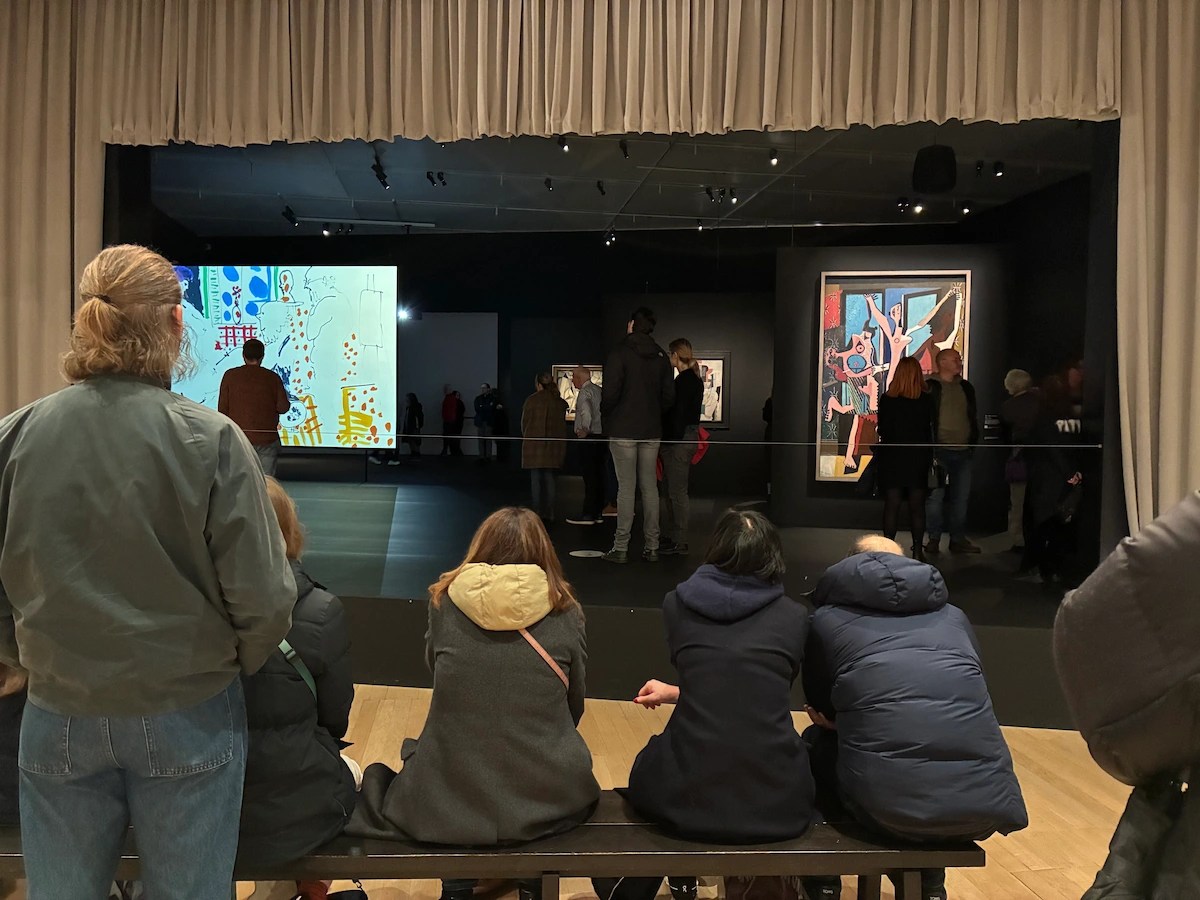
A performance space This perspective explains another massive design aspect of this exhibition which is that the main space, the main display area for paintings, drawings, sculptures, photos and so on, is raised and framed by curtains as if it was itself a theatre, and the second space visitors walk into is on a lower level with a bench for you to sit and look through a prosceniun arch fringed by curtains at all the other visitors as if they’re on a stage. Yes, the curators have turned their own exhibition into a performance.

Visitors watching other visitors ‘onstage’ ie through a curtain-edged proscenium arch, in ‘Picasso Theatre’ at Tate Modern (photo by the author)

And here’s a view of the viewing room (which itself contains three fairly large works, notably The Painter and His Model (1926) on the right. Note the girl sitting on the floor drawing the scene; arguably she’s the one with the right idea: don’t watch, do).

Reverse view of visitors watching other visitors ‘onstage’ ie through a curtain-edged proscenium arch, incidentally showing a couple more late-period works, in ‘Picasso Theatre’ at Tate Modern (photo by the author) You can see how excited they are by the whole thing

The Mystery of Picasso

And finally, by far the most dominant feature of the whole show is a massive cinema screen onto which is projected in its entirety a 1956 French documentary film titled ‘The Mystery of Picasso’, directed by Henri-Georges Clouzot, which shows Picasso at work creating some 20 drawings. This is a huge installation, it is dynamic, it has lots of movement and colour, and it has a soundtrack by the avant-garde composer Georges Auric which is also very loud, varied and dramatic.

The size, the colour, the movement and the loud music totally dominate the entire space. So much so that the curators have installed tiered rows of benches for people to settle down on and watch the entire thing which runs to 75 minutes! On a rainy Sunday morning I settled down leaned back and watched the entire film, savouring the way the great man starts by creating simple marker drawings in black and white before progressing to full-scale collages and oil paintings.

The entire film is available to watch online. This appears to be the most complete version if not the best picture quality.

Comment on the film

One thing which comes over really, really, really strongly from the film is that, without exception, he overdoes it. All of the images start with a few simple lines and then he adds in more details and shading so that you magically see the image coming to life before your eyes. However, in almost all cases it reaches a kind of perfection of lightness and deftness but he doesn’t stop. He keeps on adding heavier and heavier washes of colour and ink, obliterating the airy lightness of the original under swamps of murky blues and thick black lines, until they feel utterly ruined.

Mixing it up

One last point. Having done all this, the curators take one more step which is not to present the 50 or so other works (paintings, drawings, fabric, sculpture, collage, cartoons, photos, set designs, theatre programs and so on) in boring chronological order. No, no, they take their inspiration from the first retrospective of his work which Picasso himself supervised, in 1932, where he went out of his way to mix it up, to place works from completely different periods and styles side by side. And so that’s what the curators do here, pairing up works from completely different periods by virtue of their theme or the aspect of performance which they demonstrate.

A nice mix of Picasso works from across his periods and styles in ‘Theatre Picasso’ at Tate Modern (photo by the author)

Thoughts

I’m not sure whether I like Picasso. I can appreciate that he was a genius who revolutionised art etc but that doesn’t mean I particularly warm to any of his individual works. He’s certainly not my favourite modern artist, I like scores of 20th century artists more than him, Paul Klee, Kandinsky, Schiele, Wyndham Lewis, Epstein, Nevinson, Spencer, Pollock, Riley, Saville, loads.

I like the lightness of some of his works, like the woman in a red armchair. But I actively dislike the pre-cubist portraits and I find the cubist stuff deadly dull – bottles of wine and fragments of Figaro, seen a couple and you’ve seen thousands. I can appreciate that the 1920s tubular women running along beaches is an achieved style, and I suppose I ought to admire the 1930s weeping women biting their fingernails etc. And ought to be moved by Guernica et al. The first time you see one of his dove sketches you think Wow, but after you’ve seen 20 or 30 the effect wears off.

I’m ranging over his different styles like this because that’s what this exhibition does, showcasing good examples of each of Picasso’s styles and periods, as well as demonstrating his range of materials or formats, such as painting, drawing, etching, woodcut, lithograph, print, fabric, sculpture and the aforementioned set and costume designs. It’s a very varied and impressive selection, and I could see that much of it is very good, but none of it touched me.

When I was a student I liked the Minotaur prints, in fact a girlfriend bought me a book of them I liked them so much, but I’ve gone off them too. They feel too fussy and too amateurish. Silly poses, cartoon faces, monotonous subject matter.

In fact wandering round the show I realised I’ve slowly gone off Picasso’s entire masculine ethos, the obsession with bulls and bullfighting and bullheaded men has come to seem steadily more ridiculous to me. Living in a culture where gay and lesbian and gender fluid ideas have become more prevalent, most of Picasso’s masculinist posing now seems not just dated but ludicrous. As you wander round this striking and ambitious exhibition, dominated by the big loud central film, you can’t help thinking: what a lot of naked women; what a lot of bulls.


Related links

Related reviews

Picasso

Tate

Unravel: The Power and Politics of Textiles in Art @ the Barbican

Big and beautiful

This is a great exhibition, a huge and dazzling collection of contemporary fabric art from around the world, works large and small, incorporating a wide variety of techniques, bringing together images and traditions and colour palettes, stories and ideas from around the world.

Blood in the Grass, 1966 by Hannah Ryggen © Hannah Ryggen / DACS 2023. Photo by Kode / Dag Fosse

It brings together just over 100 artworks by 50 international practitioners. These include well-known names such as Faith Ringgold, Tracey Emin, Cecilia Vicuña, Magdalena Abakanowicz and Yinka Shonibare, alongside many less well-known figures. And it covers a very wide range of media, from intimate hand-crafted pieces to large-scale sculptural installations.

Textile as a medium

Textiles play an extraordinarily wide variety of roles in our everyday lives. They cover and protect us, engage our senses, trigger our memories, indicate our gender, display our beliefs. We are wrapped in cloth when we’re born and shrouded in it when we die and every day in between will be wearing some kind of fabric. I just towelled myself down after a shower, then slipped on some comfortable fleece trousers and a t-shirt, am sitting on a cotton-cushioned chair, later tonight will slip between a white cotton sheet and a patterned duvet cover. Fabrics are everywhere in our lives.

Exhibition aims

But Barbican exhibitions are never just about beautiful objects, they are always polemical and political, they’re always making a point. This one has two aims:

1) One is to challenge and question the way artistic work in fabrics has always played second fiddle to the fine arts i.e. painting and traditional sculpture, always been looked down on, often demeaningly referred to as ‘women’s work’, or slighted for having such close association with domestic and artisan production.

2) The second aim is very strongly political: every one of the artists has been chosen for the way they use textiles, fibre and thread with political goals – to challenge oppressive power structures, to commemorate the victims of state power and historical wrongs, to stand up for the weak and oppressed, to act as rallying cries or symbols of resistance to power.

The exhibition aims:

to shine a light on artists from the 1960s to today who have explored the transformative and subversive potential of textiles, harnessing the medium to ask charged questions about power: who holds it, and how can it be challenged and reclaimed?

to communicate vital ideas about power, resistance and survival.

And:

From intimate hand-crafted pieces to monumental sculptural installations, the works [gathered here] offer narratives of violence, imperialism and exclusion alongside stories of resilience, love and hope.

‘Hard-luck stories’

What this means in practise is that a lot of the works on display, no matter how beautiful or appealing at first glance, turn out to have harrowing and shocking inspirations or subject matter. For some reason I’ve been listening to the old Bob Dylan song, Black Diamond Bay. In the last verse the narrator cynically laments that:

Seems like every time you turn around
There’s another hard-luck story that you’re gonna hear.

Well, that perfectly describes the exhibits here. All of them have darker sides, and you need quite a strong stomach to cope with some of the stories you read about.

For example, the very first room contains a big bold quilt by Tracey Emin. This recalls her famous quilted tent, ‘Everyone I Have Ever Slept With 1963–1995’, and I immediately liked it because of the punk associations of the Union Jack. It also made me think of my daughter, a classic ‘school refuser’ who might well have said, with the artist, ‘No you listen – I’m not late – you’re lucky!’ All of which made me smile.

NO CHANCE (What a Year) 1999 by Tracey Emin © Tracey Emin. All rights reserved, DACS 2022, courtesy White Cube Photo by Stephen White

But then I read the wall label and discovered that this hand-stitched appliqué blanket expresses Emin’s feelings as a 13-year-old girl in 1977, the year a man raped her. Ah. Oh. Not so funny or entertaining now, is it? Now you understand the way the work’s sweary, confrontational text, cut out in felt and hand-stitched onto fabric, really comes from a place of great hurt and anger and vulnerability. God. Upsetting.

In a similar vein, I turned a corner into one of the upper gallery’s 12 alcoves and was immediately struck and attracted by the rich deep scarlet colouring of this wonderful piece of fabric, made all the more vibrant by the way it’s set against the jet-black background.

Installation view of ‘Luingamla Kashan’ by Zamthingla Ruivah (1990 to the present). Photo by the author

Until I read the wall label:

In 1986 a young woman in Northern India named Luingamla, a friend of the artist, was murdered by army officers who attempted to rape her. The officers walked free due to a law, a remnant of British colonial rule, that meant that armed forces were immune from being tried in civil courts. Student groups and the Tangkhul Shanao Long (Tangkhul Women’s Association) rallied to bring a case before the courts. They won the case in 1990, four years after her murder. Ruivah wove this keshan — a woollen sarong worn by men and women in the Naga Hills of Manipur, northeast India — to commemorate Luingamla’s path to justice. Since then, the design has been passed down through Naga communities across the region, with more than 6,000 women having produced over 15,000 of them. They have become a symbol of solidarity with the Naga resistance movement and the fight against state violence towards women.

Probably ‘hard luck story’ isn’t the correct term, but see what I mean? Every single artifact here has an upsetting or problematic inspiration or purpose.

Take the image I opened this review with, ‘Blood in the Grass’ by Hannah Ryggen. This turns out, on investigation, to be a visual depiction of the US war in Vietnam. Once you read the wall label you learn that the face at the top right is a stylised portrait of US President Lyndon B. Johnson, who presided over the disastrous escalation of the war in the late 1960s. And that the green rectangles represent the lush fields of Vietnam while the grid of red lines represents the blood shed by the massacred Vietnamese. Ah.

Or take this massive, wall-sized piece by Tau Lewis, ‘‘The Coral Reef Preservation Society’ which, at first sight, looks like lots of sea creatures frolicking against a patchwork of blue fabrics representing the ocean, a fairly harmless work you might find hanging in a sixth-form art block.

‘The Coral Reef Preservation Society’ by Tau Lewis (2019) © Tau Lewis, courtesy the artist and Night Gallery, Los Angeles

But in fact:

This patchwork quilt in part pays homage to the enslaved women and children who lost their lives during the Middle Passage (the enforced transport of enslaved people from Africa to the Americas in the sixteenth to nineteenth centuries). Reimagining them as sea creatures, Lewis transforms the trauma that lies in underwater territories into spaces of regeneration and emancipation.

There’s a lot about the historical crime of the slave trade, which feeds through into more up-to-date crimes against Black people and invocations of the Black Lives Matter movement.

‘american Juju for the Tapestry of Truth’ by Teresa Margolles (2015) Courtesy the artist and Galerie Peter Kilchmann, Zurich/ Paris

Apparently, artist Teresa Margolles often uses material residues from murder sites in her art. This patchwork tapestry was laid on the ground at the site in New York where Eric Garner, a 43-year-old Black man, was placed in an illegal chokehold and killed by New York police.

It’s one of a pair of works by Margolles which are laid flat on lightboxes like the bodies of the murdered placed on autopsy tables. The works were made collaboratively with embroiderers who were close to the victims. Members of the Harlem Needle Arts cultural arts institute made the work commemorating Garner’s death, a patchwork which also honours other African American victims of police brutality.

So, to recap: this is very far indeed from being a collection of pretty textiles. Every work tells a story and many of the stories are harrowing and upsetting.

Favourites

Here are some of the works I liked most, based more on their actual appearance and the impact they made on me than the righteousness of the issues they address. I add the curators’ explanations in italics.

‘TIKAR/MEJA’ by Yee I-Lann (2018)

Installation view of ‘TIKAR/MEJA’ by Yee I-Lann (2018) Photo by the author

In TIKAR/MEJA, images of tables are woven into the mats through the weft and warp of colourful strips of pandan leaves, using the same techniques Yee’s ancestors used for centuries. The table serves as a symbol for the imposition of a patriarchal and colonial worldview onto a population, while the mat signifies a more democratic and mutual power, imbued with ancestral knowledge and traditions. This display shows twelve works from a series of sixty that can be displayed in different configurations.

‘To Teach or to Assume Authority’ by Sarah Zapata (2018 to 2019)

Installation view of ‘To Teach or to Assume Authority’ by Sarah Zapata (2018 to 2019) Photo by the author

‘I do not permit a woman to teach or to assume authority over a man; she must be quiet.’ This passage from the Bible inspired the title of Zapata’s first sprawling ‘shag’ sculpture. Its structure references the architecture of the Nazca ceremonial site Cahuachi, where a huge woven cloth was excavated in 1952. She transforms the ruin into a landscape of vibrant latch-hooked threads, refusing any risk that this ancestral site might be lost to time. The undulating form subverts the notion of the rug as floor-based: Indigenous communities in Peru only began using textiles on the floor after the Spanish conquest in the sixteenth century.

Incidentally, the Zapata work raised a basic question about the exhibition which is that I really, really wanted to reach out, touch, stroke and run my hands over lots and lots of the works here. The curators make it worse by repeatedly emphasising how warm and intimate and comforting so many different types of fabric are – only to place around every single one of them, loud alarms which are triggered if you step or even put your hand beyond the black bars on the floor. Frustrating.

As usual the show is spread over the Barbican’s two floors. The 12 or so upstairs rooms have some great pieces, but the most impressive space is the big room downstairs, which contains the Zapata piece, a typical Abakan by Polish artist Magdalena Abakanowicz, whose major retrospective at Tate Modern I reviewed not so long ago.

Quipu Austral’ by Cecilia Vicuña (2012)

It also contains maybe the single most striking work in the show, a forest of slender, brightly coloured fabrics suspended from the ceiling and billowing gently as people walked past them, created by Chilean artist Cecilia Vicuña.

Installation view of ‘Quipu Austral’ by Cecilia Vicuña (2012) photo by the author

The idea of hanging fabrics is familiar to anyone who caught Vicuña’s recent installation at Tate Modern. According to the curators:

Lengths of knotted, unspun wool stream down from the ceiling, accompanied by the sounds of Vicuña chanting poems related to water, for which thread is a metaphor in Andean culture. This monumental work, which Vicuña describes as a ‘poem in space’, embodies her deep engagement with the ancient Andean form of the quipu (meaning ‘knot’ in the Quechua language): a system of ‘writing’ with knots. This ritualistic way of communicating was understood to connect its makers to the cosmos.

In 1583, following the Spanish conquest, quipu were banned and ordered to be destroyed. For Vicuña, reviving the quipu is ‘an act of poetic resistance’ — it is ‘a way to remember, its potential involving the body and the cosmos at once.’

Quipu Austral was commissioned for the 18th Biennale of Sydney in 2012. Proposing the work as a ‘prayer for the union of the world’, Vicuña found poetic resonances between the ancient Indigenous peoples of South America and Australia, connecting their world views of exchange, equality and freedom. This included the parallel oral traditions of the Andean concept of the cosmographic ceque (meaning ‘line’) and the Aboriginal ‘Dreamtime’ songlines, as metaphysical maps honouring the life-giving force of earth, water and song. The vibrant colours of the wool are based on the hues found in both Aboriginal Australian rock paintings and Andean weavings.

Igshaan Adams

Mind you, the upstairs has a very impressive room, probably the best single space, filled with works by Igshaan Adams. It’s an installation consisting of several works. From the ceiling hang ‘prayer clouds’ gassy feeling conglomerate structures made from gold and silver link chain, copper , gold and silver wire, gold chain and spray paint, polyester braid, metal charms, copper, brass and silver wire, wood, plastic and crystal beads, cowrie and sea snail shells, galvanised steel and wood centre, gold and silver link chain and clear lacquer spray paint. Quite a mix!

Installation view of the Igshaan Adams room. Photo by the author

Through the ‘foggy’ effect of these metal imbroglios you see a more conventional rectangular work hanging on the wall. This is ‘Heideveld’ (2021) made of wood, painted wood, plastic, glass, stone, precious stone, metal and bone beads, shells, nylon and polyester rope, cotton fabrics, wire and cotton twine. It was worth going right up close to the surface of this to see the extraordinary range of material which have been used and the awesome amount of work it must have taken.

Close-up view of ‘Heideveld’ by Igshaan Adams (2021) Photo by the author

This installation by Igshaan Adams grows out of his expanded practice of weaving and his exploration of so-called ‘desire lines’ in post-Apartheid South Africa, the informal pathways that are created over time through footfall, often acting as shortcuts. He understands these lines as ‘symbolic of a collective act of resistance by a community who have historically been segregated and marginalised through spatial planning. Intentionally or not, these pathways remain symbolic of carving out one’s own path, collectively or individually.’

‘Family Treasures’ by Sheila Hicks (1993)

Although the works the curators have chosen all too often commemorate murder, oppression, racism, sexism, misogyny and so on, there are occasional moments of happiness, like the sun breaking through the clouds on a gloomy winter’s day. One such piece is ‘Family Treasures’ by Sheila Hicks.

‘Family Treasures’ by Sheila Hicks (1993) © Sheila Hicks, ADAGP, Paris and DACS, London 2023, courtesy Stedelijk Museum Amsterdam

In ‘Family Treasures’, Hicks draws upon the intimacy of textile: we all wear it, we invest it with feelings and it is literally the texture of our everyday lives. While in Amsterdam in 1993, she asked close friends and family members to surrender their most beloved items of clothing, which she wrapped in colourful yarn and thread. Each tightly-wound bundle is a reminder of what we hold dear.

Hicks is a leading member of the fibre arts movement in Europe and the United States in the 1960s and 70s, in which mostly women artists experimented with fibre and thread as a legitimate medium for art. Hicks’ work is often sculptural, playful and harnesses a variety of scales — from the small and intimate to the monumental — challenging the idea that textiles are flat, decorative and wall-based. Her work has been motivated by the acknowledgement that fibre permeates peoples’ lives. She has commented: ‘you can’t go anywhere in the world without touching fibre.’

Sweet idea, huh? And very valid point that fabric art needn’t be flat and wall-based, as many, many of the works here amply demonstrate.

Hammock by Solange Pessoa (1999 to 2003)

‘Hammock’ (part of ‘Four Hammocks’) by Solange Pessoa (1999 to 2003) Courtesy of Rubell Museum, Miami and Washington DC. Photo by Chi Lam

‘Hammock’ was created in response to the land of Minas Gerais, Brazil, where Pessoa grew up. Textiles — in the form of rags and canvas — act as a carrier for living and decaying matter. Here fabric bags, stained with the orange soil that fills them, resemble voluminous, lumpen bodily forms that evoke internal and external organs, as well as life and death. They could be breasts, uteruses, entrails, testicles. In Brazil, cadavers are often transported in hammocks instead of stretchers.

Conclusion

I’ve covered 11 of the 50 exhibitors. That leaves 39 more for you to discover in this big, colourful, wonderful but – be warned – sometimes upsetting and challenging show. If it sets out to prove that work in fabric can be every bit as interesting as more traditional ‘fine art’, then it triumphantly succeeds. And if it wishes to show that this kind of work also lends itself to collaborative, community-based responses to brutality, abuse of power and exploitation, then it also succeeds.

Lastly, I haven’t devoted enough time to considering the actual techniques of quilting, sewing, knitting, collaging and assembling which are on display throughout the show. That’s because I’m not really qualified to do so, but the friend I went with hardly read any of the labels (thus sparing herself quite a lot of distress) and instead was riveted by the variety and inventiveness of technical skills on display.

I haven’t really dwelt enough on the artistry, skill and inventiveness which has gone into so many of these pieces. It’s worth visiting for anyone interested in fabric, quilting, sewing, decorating and texture-based art for that reason alone. Quite apart from the loud blare of the political stories and issues, here is a collection of quietly fastidious and intricate artistry.

Detail from ‘Dylegued (Entierro)’ by Teresa Margolles (2013) Photo by the author

Participating artists

  • Pacita Abad (The Philippines/USA)
  • Magdalena Abakanowicz (Poland)
  • Igshaan Adams (South Africa)
  • Ghada Amer (Egypt/France)
  • Arpilleristas (Chile)
  • Mercedes Azpilicueta (Argentina)
  • Yto Barrada (Morocco)
  • Kevin Beasley (USA)
  • Sanford Biggers (USA)
  • Louise Bourgeois (France / USA)
  • Diedrick Brackens (USA)
  • Jagoda Buić (Croatia)
  • Margarita Cabrera (Mexico / USA)
  • Feliciano Centurión (Paraguay)
  • Judy Chicago (USA)
  • Myrlande Constant (Haiti)
  • Cian Dayrit (The Philippines)
  • Tracey Emin (UK)
  • Jeffrey Gibson (USA)
  • Antonio Jose Guzman and Iva Jankovic (The Netherlands / Panama and The Netherlands / Yugoslavia)
  • Harmony Hammond (USA)
  • Sheila Hicks (USA)
  • Nicholas Hlobo (South Africa)
  • Yee I-Lann (Malaysia)
  • Kimsooja (South Korea)
  • Acaye Kerunen (Uganda)
  • José Leonilson (Brazil)
  • Tau Lewis (Canada)
  • Ibrahim Mahama (Ghana)
  • Teresa Margolles (Mexico)
  • Georgina Maxim (Zimbabwe)
  • Małgorzata Mirga-Tas (Poland)
  • Mrinalini Mukherjee (India)
  • Violeta Parra (Chile)
  • Solange Pessoa (Brazil)
  • Loretta Pettway (Gee’s Bend) (USA)
  • Antonio Pichillá (Guatemala)
  • Faith Ringgold (USA)
  • LJ Roberts (USA)
  • Zamthingla Ruivah (India)
  • Hannah Ryggen (Norway)
  • Tschabalala Self (USA)
  • Yinka Shonibare CBE RA (UK)
  • Mounira Al Solh (Lebanon)
  • Angela Su (Hong Kong)
  • Lenore Tawney (USA)
  • T. Vinoja (Sri Lanka)
  • Cecilia Vicuña (Chile)
  • Billie Zangewa (Malawi / South Africa)
  • Sarah Zapata (Peru / USA)

Related links

Related reviews

The Procession by Hew Locke @ Tate Britain

Every year Tate commissions established artists to create installations for its two London galleries. The ones which fill Tate Modern’s huge Turbine Gallery tend to get a lot of press. Less attention is devoted to the commission to fill the long hall or central atrium of Tate Britain. This year’s commission was awarded to well-established Black British sculptor Hew Locke. With a certain inevitability, a Black artist decided to cover the topics of race, slavery and empire.

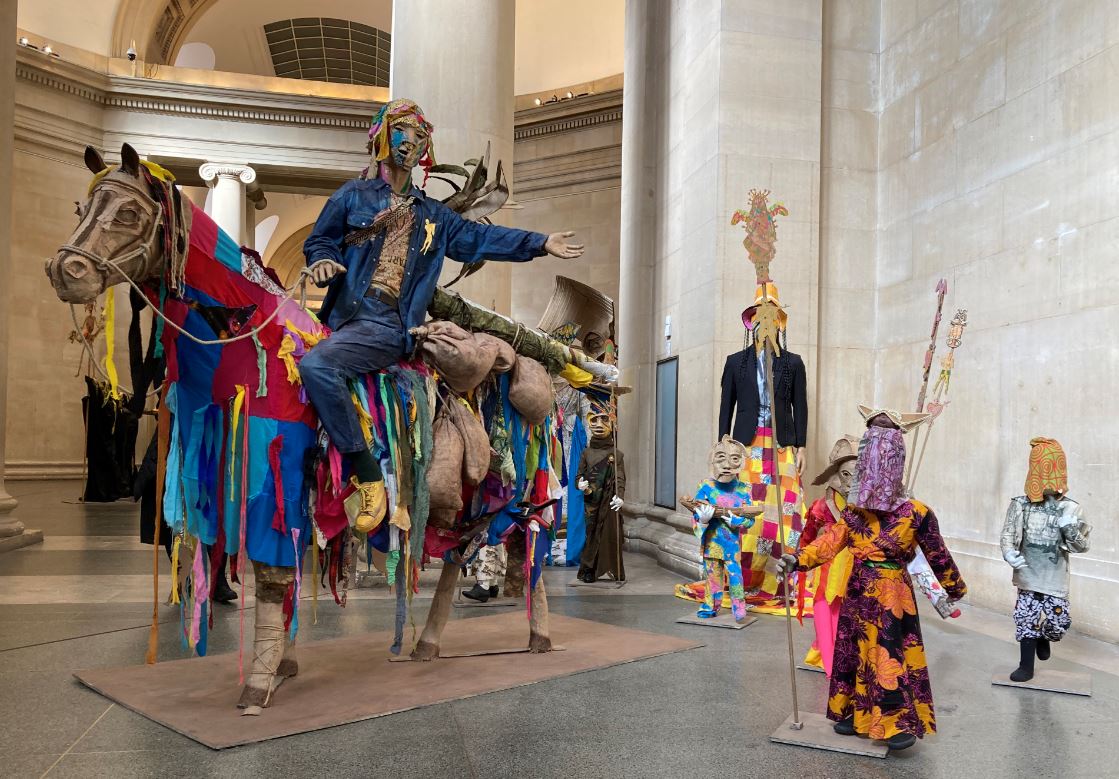
The result is a big bold piece which fills the central hall of Tate Britain with a parade of mannequins – of men, women, children, horses – dressed in a spectacular array of clothes and costumes, designed, stitched together, a surreal mish-mash of fabrics and colours and patterns, created just for this show, and titled ‘The Procession’.

Installation view of ‘The Procession’ by Hew Locke (2022) (Photo by the author)

Like most Tate shows this one is accompanied by a wealth – possibly a rather overwhelming wealth – of explanation and interpretation. You can read:

  1. Tate’s Hew Locke biography
  2. Tate’s Introduction to The Procession
  3. Tate’s fairly long Guide to The Procession
  4. or watch the 8-minute video about its inspiration and creation

Introduction

To quote Tate:

‘The Procession’ invites visitors to “reflect on the cycles of history, and the ebb and flow of cultures, people and finance and power.” Tate Britain’s founder was art lover and sugar refining magnate Henry Tate. In the installation Locke says he ‘makes links with the historical after-effects of the sugar business, almost drawing out of the walls of the building,’ also revisiting his artistic journey so far, including, for example, work with statues, share certificates, cardboard, rising sea levels, Carnival and the military.

Throughout the long, busy work, visitors will see figures who travel through space and time. Here, they carry historical and cultural baggage – from evidence of global financial and violent colonial control embellished on their clothes and banners – alongside powerful images of some of the disappearing colonial architecture of Locke’s childhood in Guyana.

The installation takes inspiration from real events and histories but, overall, the figures invite us to walk alongside them, into an enlarged vision of an imagined future.

I must say I didn’t get any of this at all from actually walking round and along ‘The Procession’. The colours and the way some figures were riding on horses distantly reminded me slightly of Renaissance processions – a very ragtag, surreal distortion of one. But the main impression is of daunting, intimidatingly alien figures with masks or veiled faces or blank mannequin faces from a nightmarish horror sci-fi movie.

Installation view of ‘The Procession’ by Hew Locke (2022) (Photo by the author)

Exhibition guide

The exhibition guide explains that ‘The Procession’ is divided into into sections devoted to themes or topics, mostly about empire, colonialism and rebellion.

  • Carnival
  • Post-Colonial Trade
  • Ghosts Of Slavery
  • Environmental Disaster
  • Monuments To Empire
  • Revolution And Emancipation

These read like chapters from a book and that is very much what the guide turns the work into – a series of tableaux, each one exemplifying one of the themes listed above. Reading the guide you realise that an impressive amount of work has gone into selecting the themes, thinking about them and then crafting tableaux to represent them using an interesting variety of source materials.

Installation view of ‘The Procession’ by Hew Locke (2022) (Photo by the author)

Each element of each outfit, every bit of fabric, plus objects like the palanquin or banners or huge images of old share certificates painted onto fabric, each of these elements has a complex backstory. Some elements are from the white imperialists and business organisations which organised and profited from the slave trade and sugar production on slave-worked plantations in Guyana (where Locke grew up).

But others reference African culture, slave culture, and the post-slavery Black culture Hew himself grew up and experienced. All changed, transmogrified into a Surreal and often quite nightmarish vision of history collapsing in on itself. The friend I went with absolutely loved the workmanship of the fabrics, looking in detail at how different coloured fabrics, printed or painted with a bewildering variety of patterns, had been crafted, juxtaposed and so on.

But I was frightened. I found the whole thing ominous and nightmarish. Faceless figures threatening violent revenge.

Installation view of ‘The Procession’ by Hew Locke (2022) (Photo by the author)

The man below – one of two bearing a stake of wood from which hangs a small fabric basket containing the bust of a white man – he doesn’t look like he’s marching into “into an enlarged vision of an imagined future.” The small figures wearing veils of fabric in the first two images in this review don’t look like carefree toddlers in a playground; to me they look like the psychopathic dwarf in the movie ‘Don’t Look Now’.

Installation view of ‘The Procession’ by Hew Locke (2022)

The Surreal fusion of white, Black, Western and African aesthetics didn’t strike me as Rainbow Nation liberation but reminds me all-too-much of the bizarre post-civilisation outfits worn by the many rebel guerrilla movements which have characterised Africa since independence – voodoo believers dressed in Man Utd shirts and toting semi-automatics. Cold-eyed killers wielding machetes while wearing garish wigs and women’s dresses. Scroll through the first five pages of this website to see what I mean. Or:

Torture, death and dismemberment have come to millions of Africans wearing bizarre outfits, wigs, handbags, kids’ toys, makeup, machine guns and machetes. The deliberate mashup of Locke’s work might be intended to make all kinds of points about resistance to Western imperialism and economic and social norms, but – unfortunately, and unintentionally – reminded me of the hundreds of descriptions I’ve read of mind-boggling violence in African conflicts.

Maybe my imagination has been damaged by reading too many accounts of too many African civil wars, but this installation gave me the willies. Instead of liberal guilt, which I assume is the desired output, I just felt fear, fear of a world which will – in light of inevitable global climate change, the collapse of Third World countries and the resulting mass migration (which, the guide tells us, Locke references somewhere amid these garish costumes) – become more and more like this, multicultural incomprehension, social collapse, people living amid the rags and tatters of the old civilisation, inventing new cults, practicing horrific violence.

Sorry. That’s how it felt to me. The friend I went with felt none of this and just loved the fabrics, the patterns, the designs and how they’d been cunningly assembled. Either way it’s a striking installation. Go and decide for yourself.


Related links

Wars in Africa

I’ve read too many books about unbelievable cruelty, atrocity and horror in post-independence Africa.

More Tate Britain reviews

Mary Sibande @ Somerset House

Mary Sibande (b.1982) is one of South Africa’s most notable contemporary artists, which makes it all the more surprising that this is her first solo exhibition in the UK.

Sibande calls herself a sculptor but she is also a very good photographer. In fact she mainly works with fabric, sewing her own fabric-based sculpture, and the friend I visited the exhibition with described her as a fabulous seamstress – hence, presumably, the show’s title, I Came Apart at the Seams.

For Sibande hit upon an idea early on in her career and has been producing variations on it for over a decade. The idea was to create life-size mannequins of herself, except

  1. imagined as an alter-ego or avatar, who she named Sophie
  2. to pose these sculptures in striking postures and activities
  3. and to dress them in elaborate, sometimes fantastical, almost science-fiction garments

Over the years she’s used this simple-sounding idea to produce some quite simply staggering works of art. I’m amazed she’s not better known and hasn’t been snapped up by one of the major galleries. This is a FREE exhibition at Somerset House so if you’re passing along the Embankment or through Covent Garden it’s well worth making a detour to visit.

Blue

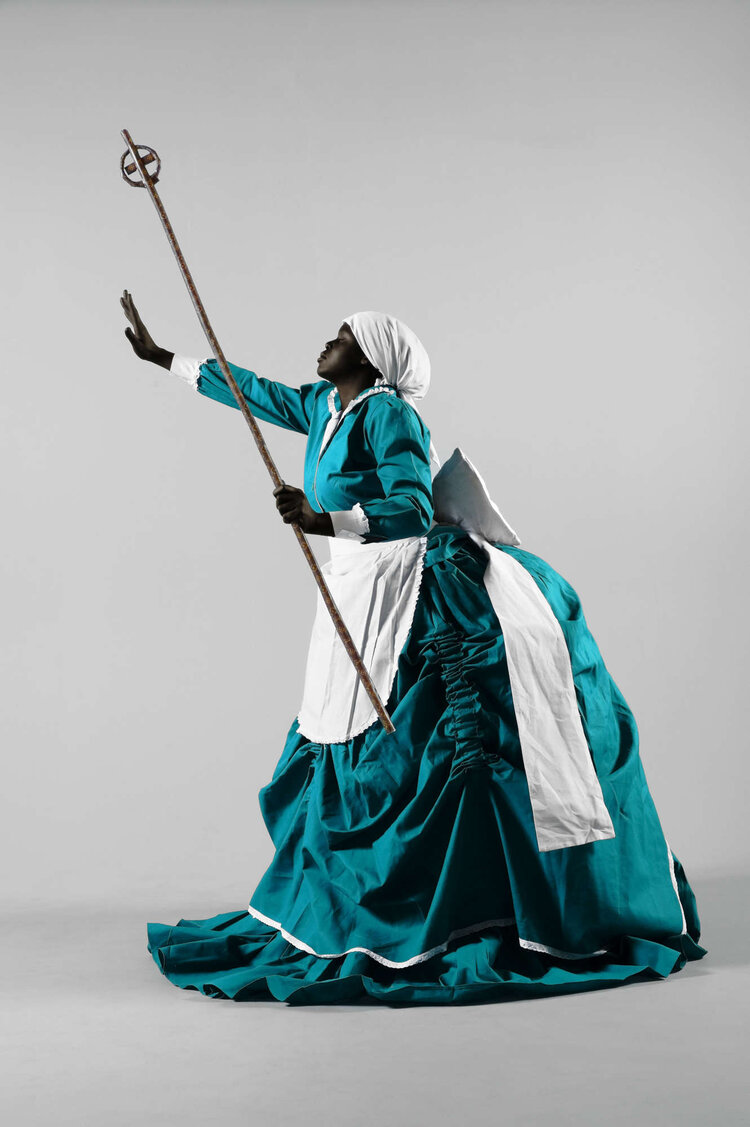
Long Live The Dead Queen (2008 to 2013) was the series in which we first met Sibande’s avatar, Sophie, conceived as a domestic servant – as Sibande’s mother and grandmother were before her. In various iterations Sophie is seen either as a sculpture or in enormous crystal-clear digital photos, transforming her servant costume (in one iteration she is embroidering the Superman logo onto it) in a series of dreams of escaping her lowly status and gender.

I Put A Spell On Me by Mary Sibande (2009)

Purple

Sibande’s next series was titled The Purple Shall Govern (2013 to 2017). In these Sophie is embodied as ‘The Purple Figure’.

The title is a play on words, making two references, mashing up the opening principle of the 1955 Freedom Charter of the African National Congress stated that ‘The People Shall Govern!’ – with the 1989 anti-apartheid Purple Rain protests.

During these, thousands of anti-apartheid protesters marched on the parliament building in Cape Town and the police sprayed the protesters with water cannon marked with purple dye so that they could be identified and arrested later. However, some of the marchers got their hands on the water cannon and turned it back onto the police and authorities, spraying them and thus symbolically equalising everyone.

Anyway, in Sibande’s hands the colour purple is the inspiration for a series of absolutely wild photos and fabric-sculptures, in which the Sophie figure is transfigured into a force of nature out of whose body and clothes and hair, wild dreadlocks or roots or tendrils cascade and explode in a twirling confusion.

A Terrible Beauty is Born (Long Live The Dead Queen series) by Mary Sibande (2013) Copyright the artist

The above is an enormous digital print which is a) of wonderful clarity and precision b) printed onto fabric not paper and hung across one whole wall and c) is totally wild.

The po-faced seriousness of the political commentary on her works – the references to apartheid and this or that protest – in no way prepares you for the wild, crazed, science fiction pullulation of her imaginings.

It is extravagant, operatic – dreams, nightmares or visions on an epic scale and all the more weird and compelling for having been made, created, carefully and time-consumingly sewn out of fabric.

One entire room in the show consists of an absolutely amazing piece of sculpture – the black woman Sophie wrapped in purple fabric, while her hair appears to be exploding backwards into a huge tangled skein which is itself intertwining to form something like the roots of a tree. It is as if the human being is metamorphosing into an awesome, phantasmagorical force of nature.

It’s one of the weirdest and most powerful works of art I’ve ever seen.

A Reversed Retrogress Scene 2 by Mary Sibande (2013)

Red

Sibande’s latest series is titled In The Midst of Chaos There Is Also Opportunity (2017-ongoing). In these Sophie has transformed into ‘The Red Figure’ – red to express the collective disillusionment and anger of many South Africans at the enduring poverty in post-apartheid South Africa.

So blood-red is for anger, but also the power to heal and restore – there’s something of the priestess and healer in the Red Figure. She is sad, she is angry – but she is also empowered by the legacy and memory of all those who gave their lives to overthrow apartheid.

Come, you spirits of the land and the skies by Mary Sibande (2019)

As I say, the commentators, the curators, and Sibande herself, are happy to describe her art in terms of South Africa’s apartheid and post-apartheid history, the struggle for liberation and the long disappointment that came afterwards, and so on.

Maybe that’s where her art starts. But in my opinion where it goes to is somewhere altogether different, somewhere weird, strange and entrancing, to a zone which is disturbing, upsetting, amazing and supremely memorable.

Look closely and you’ll see that Sophie’s eyes, in all her reincarnations, are always closed: she is dreaming, according to the curators, dreaming of freedom and equality etc.

But the way I read it, Sophie is having dreams far bigger than paltry ones about politics and justice – dreams which are far more disruptive and uncontrolled and weird and enthralling, about human nature itself.

A Terrible Beauty and A Reversed Retrogress show humanity morphing into something much bigger and more cosmic than petty concerns about this or that cause or country – in them the purple and red figures are becoming cosmic, entwining with the natural world, seizing power and going beyond the human into an extraordinary new realm of the imagination.


Related links

More Somerset House reviews

Natalia Goncharova @ Tate Modern

This is the UK’s first ever retrospective of the Russian avant-garde artist Natalia Goncharova. It’s huge, bringing together over 160 international loans which rarely travel, including works from Russia’s State Tretyakov Gallery which houses the largest collection of Goncharova’s work.

The exhibition is imaginatively laid out with some lovely rooms, and it certainly gives you a good sense of her range of styles, not only in painting, but in lithographs, fashion and costume design, especially for modern ballet, posters, pamphlets and much more. But it also leaves you with a few nagging questions…

Peasants Picking Apples by Natalia Goncharova (1911) State Tretyakov Gallery, Moscow © ADAGP, Paris and DACS, London 2019

Fabric design

Goncharova was born in Russia in 1881. She grew up on her family’s country estates in Tula province, 200 miles from Moscow. Her family were impoverished aristocrats who made their fortune through textiles, in fact the name of Goncharova’s family estate, Polotnianyi Zavod, means ‘cloth factory’. From early childhood, Goncharova witnessed the rhythms the farmers’ lives – working the land, planting and harvesting – and also became deeply familiar with all the stages of textile production, from shearing sheep to weaving, washing and decorating the fabric.

Hence two threads to her artistic practice:

  1. fabric design, which ran through the 1910s and led to her wonderful designs for the Ballets Russes in the 1920s and 30s, as well as commissions from fashion houses
  2. a profound feel for the rhythms of agricultural labour, which she depicted in a number of early paintings (like Peasants picking apples, above)

The first room epitomises both threads with several paintings showing agricultural labourers, in a highly modernist style, alongside a display case containing an example of the kind of traditional costume worn by the peasant women on Goncharova’s estate.

Installation view of Natalia Goncharova at Tate Modern

Cubo-futurism

What comes over is Goncharova’s very quick artistic development from about 1908, when she was doing stylised but essentially traditional paintings of peasant subjects, to 1911 when she had transformed herself into one of the leading lights of the Moscow avant-garde.

Her swift development was helped by two Moscow industrialists – Ivan Morozov and Sergei Shchukin – who had built up extensive art collections of leading European artists such as Cézanne, Gauguin, Picasso and Derain, and made their collections accessible to the public. These French works had an electrifying effect on young Russian avant-garde artists, which was accentuated by news of the new movement of Italian Futurism, which they could read about in international art magazines.

Goncharova swallowed both influences whole and became the leader of what contemporaries came to call Russian ‘cubo-futurism’. Various contemporaries are quoted commenting that she was the leader of the younger generation, not only in painting, but in self-presentation, creating an avant-garde ‘look’, as well as happenings, given walking through Moscow’s streets wearing stylised tribal markings on her face, or involved in volumes of avant-garde poetry published just before the Great War.

A work like Linen from 1913 seems to be a straight copy of Picasso-style cubism, cutting up an everyday domestic scene into fragments and pasting in some text, as if from a newspaper or advertising hoarding. The main differences from a cubist work by Picasso or Braques is that the text is in Russian, and the bright blue is completely unlike the cubist palette of browns and greys.

Linen (1913) by Natalia Goncharova. Tate © ADAGP, Paris and DACS, London 2019

The 1913 exhibition and ‘everythingism’

This exhibition feels logical and well designed, and features at least two particularly striking rooms. The first one is dedicated to recreating the landmark retrospective Goncharova was given in September 1913 at the Mikhailova Art Salon in Moscow. The 19193 show included more than 800 works (!) and was the most ambitious exhibition given to any Russian avant-garde artist up to that date. Goncharova was thirty-two years old.

The curators have brought together thirty big paintings which featured in the 1913 show and created a central column in the style of those circular bulletin boards you get in Paris, on which they have plastered copies of some of the posters and reviews of the original exhibition.

Here we learn that Goncharova’s fellow artist and long-time partner, Mikhail Larionov, invented the term ‘everythingism’ to describe her openness to diverse styles and sources, the way her paintings invoke all kinds of sources from the folk designs of her family farm, through to the latest ideas from Paris and Rome.

Thus the thing which comes over from the 30 or so works in this room is their tremendous diversity. There’s a striking female nude which reminded me of something similar by Matisse, there’s a pipe smoker at a table, a motif familiar from Cézanne, there’s a surprising work which looks like a dappled impressionist painting. It really is a little bit of everything and so ‘everythingism’ seems an accurate label.

You could claim this is as a positive achievement, indeed one of the wall labels praised the lack of ‘hierarchy’ in Goncharova’s diverse styles and I understood what they were getting at. There was the implication that it is somehow masculine to want to be the leader of the avant-garde, at the cutting edge, always one step ahead: and somehow a slave of capitalist or consumer culture to need to create a unique brand or style.

By contrast, Goncharova is praised for her more easygoing, unmasculine and uncapitalist stance – allowing herself to be open and receptive to all kinds of visual approaches, mixing Cézanne with Russian icons, or cubism with peasant designs, or futurism as applied to distinctly Russian cityscapes. She was presented as ‘a universal artist’.

You can see how, at the time, she seemed to contemporaries to be a one-woman explosion of all the latest visual breakthroughs and trends because she was covering so much territory.

The drawback of this approach is that Goncharova risks, in retrospect, appearing to be a Jill of all trades but a mistress of none. Lots of the works in this room were interesting but you found yourself thinking, ah, that’s the cubist influence, that’s the futurism, that’s a touch of Cézanne, and so on. They all had her mark, but not so many seemed entirely her, if that makes sense.

For me the most distinctive work in the room was the series of paintings she called Harvest, which was originally made up of nine large works which were designed to be hung together. Two have gone missing but Tate have hung the other seven together on one wall and the effect is stunning.

Harvest: Angels Throwing Stones on the City (1911) by Natalia Goncharova. State Tretyakov Gallery, Moscow © ADAGP, Paris and DACS, London 2019

The palette of red, orange and tan runs across all seven paintings and gives them a tremendous visual unity. Also note the highly stylised, almost child-like depiction of the human figure, with simplified arms and legs and big simple eyes. The same big wide white eyes with huge jet black irises which appear in Peasants picking apples. This is maybe her core visual style.

Harvest uses Christian motifs. It was inspired by popular prints and the frescoes in Russian cathedrals and takes its images from the Book of Revelation in which the end of the world is presented as a symbolic harvest with the grapes of human souls being gathered and thrown into the winepress of God’s anger.

All in all, surprisingly religious, unironically religious, for an avant-garde artist. It comes as no surprise to discover that room six of the exhibition is devoted to just her religious paintings, featuring half a dozen enormous works she did on Christian subjects, notably four tall narrow full-length portraits of the four evangelists. I can see the way she has applied her distinctive cubo-futurist style to a very traditional Russian subject – I note her characteristic way with big white eyes – but I didn’t really warm to them.

The Four Evangelists by Natalia Goncharova (1911)

Fashion and design

Room four picks up the theme of Goncharova the fashion designer, showing work commissioned from her by the couturier to the Imperial court, Nadezhda Lamanova, in 1911 to 1912. This room also includes work commissioned from Goncharova after the war by Marie Cuttoli, whose design house Myrbor showcased carpets and fashion designs by famous contemporary artists.

There’s a series of sketches from the 1920s, haute couture-style sketches which make the women subjects look as tubular as a Fairy Liquid bottle, with no hips or waist or bust, which were utterly unlike her modernist paintings, and looked more or less like any other fashion sketches for stick-thin flappers from the Jazz Age.

But on the opposite wall was a piece which I thought might be my favourite from the whole show, a study Goncharova did for a textile design in the later 1920s. I loved the vibrancy of the colours and the primitiveness of the design. In fact it’s only one of a series she did using bird motifs but, to me, it was a standout piece.

Design with birds and flowers: Study for textile design for House of Myrbor 1925 to 1928 by Natalia Goncharova. State Tretyakov Gallery, Moscow © ADAGP, Paris and DACS, London 2019

The Great War

In April 1914, Goncharova and Larionov were invited to Paris by the famous ballet impresario Sergei Diaghilev to work on designs for his opera-ballet The Golden Cockerel. This was presented in Paris to great acclaim and the pair followed it up with an exhibition. But then the Great War broke out, and both were forced to return to Moscow. Larionov was called up for military service and sent to the front line, was wounded within weeks and invalided out of the army.

Goncharova responded to the crisis by creating a series of prints titled Mystical Images of War which brought together symbols Britain, France and Russia together with images from the Book of Revelation and Russian medieval verse. They use her trademark stylisation of the human face and eyes, and throw in the religious iconography which we’ve by now realised was a big part of her psyche.

The fourteen or so prints on display in room five are a really interesting mix of modern warfare and traditional Orthodox iconography, featuring angels wrestling biplanes, the Virgin Mary mourning fallen soldiers, and the Pale Horse from the Apocalypse. She chose to create prints in order to reach a broad popular audience with what are, essentially, patriotic rallying cries, which also feature patriotic heroes who defended Mother Russia against invaders.

‘Angels and Aeroplanes’ from Mystical Images of War by Natalia Goncharova (1914) © ADAGP, Paris and DACS, London 2019

Books and photos

Room seven is a narrow corridor between the conventionally-shaped rooms six and eight. As in other exhibitions, this corridor makes a good space not to hang works of art, but to place books, pamphlets, photos, prints and posters related to the artist under review, in the long rack of display cases lining the wall.

For this exhibition the curators have displayed artist manifestos, exhibition catalogues and a number of books of poetry which Goncharova was involved in writing or designing or illustrating. The later part of the case displays the ephemera she produced for a series of artists’ balls in Paris, including posters, tickets and programmes. There’s a speaker on the wall from which comes a Russian voice reciting some of the avant-garde poetry included in the pamphlets on display. (It is, apparently zaum or ‘transrational’ poetry, from ‘World Backwards’ by Alexey Kruchenykh and Velimir Khlebnikov, and Vzorval or ‘Explodity’ also by Kruchenykh.)

Cubo-futurism

Room eight is devoted to another series of cubo-futurist works, highlighting classic Modernist-style depictions of factories and machines and cars and bicycles, all those implements of power and speed which were fetishised by the Italian founder of Futurism, Marinetti.

There are some great pieces here, classic Futurist depictions of machines and factories, a big painting of a bicyclist, another titled Aeroplane over a Train, and a vivid depiction of rowers on the river (which reminded me of the similar treatment given the same subject by Cyril Powers, the British printmaker, twenty years later, as featured in the current exhibition of the Grosvenor School of Modern Art at Dulwich Picture Gallery).

Cyclist (1913) by Natalia Goncharova (1881 to 1962) State Russian Museum © ADAGP, Paris and DACS, London 2019

Admirable though many of these paintings were, I began to be nagged or puzzled by something. Usually in a major retrospective, you are shown samples of the artist’s work throughout their career. Goncharova was established as a leader of the Russian avant-garde by the time of her huge exhibition in 1913, and lived on until 1962, producing works well into the 1950s.

So where are they? Where are all the later works? Here we are in room eight of ten and we are still… only at 1913?

The first eight rooms of this ten-room survey have all hovered around the years 1910 to 1914. Nowhere does the exhibition say so explicitly, but are we to conclude from this lack of later content that her golden years were a brilliant but brief period, from 1911 to 1914 or 1915?

Goncharova in Paris

Only in this, the ninth and penultimate room, do we learn what happened to Goncharova as a result of the Russian Revolution, namely that she and Larionov were on a tour with Diaghilev’s Ballets Russes through Switzerland, Italy and Spain when the October Revolution broke out. The revolution, and then the civil war, prevented them from returning home, and in 1919 Goncharova moved into a flat in Paris that would remain her home for the rest of her life.

This penultimate room contains half a dozen works from the 1920s during which Goncharova received more commissions for ballet costume, some from fashion houses (as mentioned earlier) and a few funky commissions for interior design, including an impressive painted screen made in 1928 for the American patron Rue Winterbotham Carpenter. She did the interior designs for the Paris house of Serge Koussevitsky, exploring the motif of the Spanish Lady on a monumental scale.

When she had accompanied the Ballet Russe in Spain, Goncharova had become fascinated by the clothes of the Spanish women she saw, and ‘the Spanish woman’ became a recurring motif in her inter-war years, maybe because the vividness and ethnic distinctiveness of the outfits reminded her of the Russian peasant look she knew so well.

By far the most impressive work was a huge abstract work titled Bathers from 1922. It is immense, at least fifteen feet across, and reminded me of all kinds of other modernist abstract painters though I couldn’t quite put my fingers on who. First time it’s ever been exhibited in the UK and a coup for the exhibition organisers.

Bathers by Natalia Goncharova (1922)

Ballet designs

Anyway, the point remains – why isn’t there more of her work from the 1920s, 30s, 40s and 50s? You might have expected the last room in the show to cover the later part of her career but, instead, the exhibition takes an unexpected detour to make this final room, arguably the best in the exhibition.

It is a big space which has been specially darkened to create an atmospheric setting in which to review Goncharova’s work for the ballet and the theatre. Lining the walls are drawings and sketches for costumes Goncharova designed for productions of The Golden Cockerel (Rimsky-Korsakoff) and Les Noces (Stravinsky). There are some videos of her costumes and backdrops being used in revivals of the ballets, The Golden Cockerel footage is a silent but colour film of a production dressed in Goncharova’s costumes which toured Australia in the late 1930s.

But the highlights of the room are four or five of the actual costumes themselves, the costumes Goncharova designed for these classic ballet productions, which are featured in display cases around the room. They are all wonderfully bright and imaginative, drawing on the (to us) exotic and fanciful traditions of Russian legend and folklore.

Theatre costume for Sadko (1916) by Natalia Goncharova. Victoria and Albert Museum, London © ADAGP, Paris and DACS, London 2019

And, last but not least, the room is filled with music, with clips from the famous ballet scores in question, wonderful Russian melodies filling the air as you stroll from wonderful costume to fascinating set designs, or stop to watch footage of actual performances using Goncharova’s colourful and vivid costumes.

The music, the darkened atmosphere, the videos of performances, and the glass cases of costumes – all make this room completely unlike the previous nine and a very evocative space to be in.

Summary

This is a major exhibition by a leading Russian artist who, for a period before the Great War, epitomised the avant-garde for her compatriots. She produced a lot of striking paintings, as well as pioneering designs for ballet costumes and sets, and a wealth of prints and posters and pamphlets and poetry books.

And yet I was left with two nagging questions: first, from such a profusion of images and designs, not that much really rang my bell. A lot of it was striking and thought-provoking and interesting – but possibly only the design with birds and flowers really set me alight.

The stylised human figures with those big eyes is the nearest Goncharova comes to having a recognisable ‘look’ and I liked it, but only up to a point. I actively disliked its application to the icons and evangelists and wasn’t, at the end of the day, that taken with the Great War prints, either.

Comparison with Käthe Kollwitz

Great War prints by a woman artist made me think of the epic prints created by the German woman artist Käthe Kollwitz. These are infinitely more powerful. Comparing the two made me think that maybe Goncharova was held back by her attachment to the Russian Orthodox tradition and its Christian iconography. Kollwitz, by contrast, has broken free of all traditional or religious straitjackets in order to create spartan images of humanity under stress which still speak to us today with horrifying force.

The Survivors by Käthe Kollwitz (1923)

Then again, maybe I’m comparing apples and oranges. Goncharova’s works were created at the very start of the war, when it was thought of as a religious crusade, and everyone thought it would be over by Christmas. Whereas Kollwitz’s haunting images were made nearly ten years later after not only bitter defeat, but collapse of the German state and descent into semi-civil war. So it’s not a fair comparison at all. But you can see why, if you set the two side by side – as we latecomers a hundred years later are able to – Kollwitz’s images are vital, a necessary record of a horrifying period; whereas Goncharova’s are an interesting and nice inclusion in a retrospective of her work, but have nowhere near the same importance or force.

Where is the later work?

And second, where was the work from the later years? Are we to deduce from its almost complete absence from this exhibition, that the curators consider Goncharova’s work from the 1930s, 40s and 50s to be poor or sub-standard? Or is it for some reason hard to borrow and assemble for an exhibition like this?

As far as I could see, the only work dating from either the 1940s or 1950s was one medium-size set design for Stravinsky’s ballet The Firebird, which Goncharova drew in 1954.

Set design for the final scene of The Firebird by Natalia Goncharova (1954) Victoria and Albert Museum, London © ADAGP, Paris and DACS, London 2019

I thought this was brilliant, vivid and fun, in a completely different style from everything which preceded it, like a highly stylised illustration for a children’s book. So is this what Goncharova’s work from the 1950s looked like?

Having devoted eight or so rooms to going over with a fine tooth comb the intricacies of her output from 1911 to 1915 or so, it’s a shame we didn’t get at least one room telling us what happened to her style in the entire last thirty years of her career.

Video

‘Visiting London Guide’ produce handy two-minute video surveys of all London’s major exhibitions. I include them in my blog because they give you an immediate sense of what the exhibition looks like.


Related links

More Tate Modern reviews

Anni Albers @ Tate Modern

Anni Albers combined the ancient craft of hand-weaving with the language of modern art.

This monumental, 11-room retrospective is the first major exhibition of Anni Albers’ work in the UK. It is a revelation and a fabulously calm, peaceful and enjoyable experience. The curators have somehow made all the rooms appear white and bright and open-plan. A couple of rooms are divided into sections partitioned off by translucent fabric stretched across Ikea-style pine frames.

The effect is to slow and calm you right down to a frame of mind which allows you to really soak up the beautiful and varied patterns of Anni’s fabrics and hangings, watercolours, prints and gouaches.

Installation view of Anni Albers at Tate Modern

Installation view of Anni Albers at Tate Modern

The exhibition includes more than 350 objects from exquisite small-scale ‘pictorial weavings’ (her term for weavings which were not meant to decorate or hang, weren’t intended to have an architectural purpose, but to have the same importance and impact as traditional paintings), to the large wall-hangings and textiles Anni designed for mass production, as well as a generous selection of her later prints and drawings.

It opens with a big visual statement – with a room dominated by an actual loom of the type she would have used while a student at the Bauhaus. To match or balance this, right at the end of the show, the final room includes samples of cloth and fabric which we are encouraged to touch and feel, as well as a film showing a weaving loom in use, highlighting the complex interaction of hand and eye which was required to use one of these machines.

A 12 Shaft Counter March loom of the type Albers would have used at the Bauhaus

A 12 Shaft Counter March loom of the type Albers would have used at the Bauhaus

Biography

Anni Albers (1899 to 1994) was born Annelise Else Frieda Fleischmann in Berlin, Germany, to a bourgeois family of furniture manufacturers. In 1922 she joined the Bauhaus, the influential art and design school established by the architect Walter Gropius in Weimar, and enrolled in the school’s weaving workshop. It was at the Bauhaus that she met the artist Josef Albers, who she married in 1925. (I am going to refer to her as Anni to distinguish her from her husband.)

Wall Hanging (1926) by Anni Albers. Mercerized cotton, silk © 2018 The Josef and Anni Albers Foundation

Wall Hanging (1926) by Anni Albers. Mercerized cotton, silk © 2018 The Josef and Anni Albers Foundation

The early rooms display her student work alongside work by her tutors at the Bauhaus, including Paul Klee, and colleagues such as Gunta Stölzl and Lena Meyer-Bergner.

I couldn’t help revering the only Klee here, Measured Fields, a watercolour from 1929. Albers is quoted as saying that she didn’t learn that much from Klee’s teaching, but masses from the actual practice of his watercolours which experimented with laying blocks of (generally quite washed-out) colour next to each other.

Measured Fields by Paul Klee (1929)

Measured Fields by Paul Klee (1929)

Klee and Kandinsky were just the two most famous painters experimenting with colour and abstract design at the Bauhaus. Although he doesn’t get much mention here, Anni’s husband, Josef, was also thinking about colours and how they interact. The Bauhaus was an incredibly stimulating environment.

Anni completed her diploma in weaving in 1930 and succeeded Gunta Stölzl as the head of the weaving workshop the following year. However, in 1933 the Bauhaus closed under increasing pressure from the Nazi party, and the Alberses fled to America when they were invited by the American architect Philip Johnson to teach at Black Mountain College, an experimental art school in North Carolina.

Here Anni and Josef they initiated and led the art programme until 1949. That year, Anni Albers held her first retrospective at the Museum of Modern Art in New York, the first solo exhibition to be dedicated to a textile artist at the institution.

In 1950 she moved for the final time in her life to New Haven, Connecticut, when Josef Albers was appointed to teach in the Department of Design at Yale University.

Pasture (1958) by Anni Albers. Cotton © 2018 The Josef and Anni Albers Foundation

Pasture (1958) by Anni Albers. Cotton © 2018 The Josef and Anni Albers Foundation

Printmaking

Anni Albers continued to hand-weave until the late 1960s when she began to focus on printmaking. On display here is a fabulous sequence of white prints on white paper. The effect is of embossed zigzag patterns on a plain white background which itself contrasts with the slightly stippled surface of the surround outside the main square. It sounds simple but they are tremendously evocative, in one way they were the most attractive thing in the show.

 Mountainous I by Anni Albers (1978)

Mountainous I by Anni Albers (1978)

Six Prayers

In the mid-1960s Anni was invited to design an ark covering for a Jewish temple in Dallas, Texas. The result was Six Prayers which are given a room to themselves. Into the cotton and linen of the tapestries is woven silver thread, giving them a scintillating effect in the carefully gauged darkness of the room.

The pattern, when you look up close, invokes but doesn’t quite use, the Hebrew script, an effect which can be interpreted as a fragmenting of language and meaning or, more hopefully, a sense of the numinous, of silver threads of meaning, struggling to pierce through the weight of the everyday.

Six Prayers by Anni Albers (1966-7)

Six Prayers by Anni Albers (1966 to 1967)

The event of a thread

Room eight – titled ‘The event of a thread’ – explores how, in the mid-1940s, Anni began to explore knots. She was probably influenced by the German mathematician and knot theorist Max Wilhelm Dehn, who joined Black Mountain College in 1945 and became a friend of the Alberses.

Although not a painter, in 1947 Anni Albers began to sketch and paint entangled, linear structures. Later, in the 1950s, she produced a number of scroll-like works with celtic-style knots, and then the Line Involvements print series in the 1960s.

To be honest, I think I respond to painting and drawing more immediately than I do to fabric, and so I found some of these knot paintings absolutely mesmeric. They are as if someone has taken the beautifully taut and compact interlocking lines of classic Celtic patterns and… unlocked them, loosened them, shaken them up, set them free. My photo of them is awful but the real things are entrancing.

Drawings for a rug by Anni Albers (1959)

Drawings for a rug by Anni Albers (1959)

On Weaving

Next to this section was the space which most epitomised the tasteful design and layout of the exhibition – a room created of see-through partitions, devoted to Anni’s writings. She published two influential books: in 1959, a short anthology of essays titled On Designing, and in 1965 the seminal book On Weaving.

The extensive display cases in this space convey the tremendous breadth and range of this latter work, which took as its subject the entire 4,000 year long history of the practice, from right round the world.

While still a student in Berlin, Anni had become a regular visitor to the Museum of Ethnology and become fascinated by its collection of Peruvian textile art. Apparently, the ancient Peruvians never developed a written language, in the way we think of it. Instead their art, and most of all their textiles, served a sort of communicative purpose.

Anni’s ‘pictorial weaving’, Ancient Writing, from 1936, was the first in an occasional series of works whose titles explicitly refer to language and texts, such as Haiku (1961), Code (1962) and Epitaph (1968).

Ancient Writing by Anni Albers (1936) Cotton and rayon © 2018 The Josef and Anni Albers Foundation

Ancient Writing by Anni Albers (1936) Cotton and rayon © 2018 The Josef and Anni Albers Foundation

The Peruvian tradition was only one among hundreds of ancient techniques and traditions which Anni taught could be used to revitalise contemporary practice. The cases display the source material Anni gathered for the book, from images of works by contemporary artists such as Jean Arp, to fragments of woven pieces from Africa and Asia, Europe and the Americas.

These are accompanied by technical diagrams of various knotting techniques, as well as ‘draft notation’ diagrams which show the weaver how to create the different weave structures and patterns.

Although I didn’t follow the details, I did get a sense of how universal this art has been, practiced by all human cultures across a huge span of time. How there is something almost primeval about weaving and binding fabrics for human use.

Installation view of room 9, On Weaving, of Anni Albers at Tate Modern

Installation view of room 9, On Weaving, of Anni Albers at Tate Modern

In the 1970s Anni finally gave up the physically arduous task of weaving and switched her interest to printing techniques such as lithography, screen-printing, photo-offset, embossing and etching.

Printing allowed Anni to pursue her interest in colour, texture, pattern, surface qualities and other aspects of ‘textile language’, translating these concerns onto paper. She used simple grids and rows of triangles to create a wide variety of effects that reveal the influence of the pre-Columbian textiles and artefacts she collected and studied.

I’ve shown one of the white patterns which she came to title Mountainous earlier, but there are plenty more examples of her wonderful eye for geometric design and colour, an endless play of design and pattern.

TR II (1970) by Anni Albers. Lithograph © 2018 The Josef and Anni Albers Foundation

TR II (1970) by Anni Albers. Lithograph © 2018 The Josef and Anni Albers Foundation

This is an eye-opening exhibition in every sense. A lifetime’s output of beautiful objects, fabrics, rugs, hangings, paintings and prints by a consistently inspired and inspiring artist.

The guide tells me it was designed by PLAID Designs, so major respect to them for having laid all these treasures out in light and airy spaces. In her 1957 article, The Pliable Plane, Anni had imagined a museum where

textile panels instead of rigid ones … provide for the many subdivisions and backgrounds it needs. Such fabric walls could have varying degrees of transparency or be opaque, even light-reflecting…

Well, the curators and designers of this exhibition have come as close to realising Anni’s vision as is possible. There is much more I haven’t mentioned, about her involvement with specific architectural projects, about her innovatory use of hangings as room dividers or sound-proofing music auditoria, and an enormous amount about her wide-ranging experiments with fabrics ancient and modern, and with techniques from ancient Peru to modern America.

But it’s the light and space of the show, in which countless examples of beautiful fabrics and prints hang suspended in their beauty and weightlessness, which make you leave the exhibition walking on air.

The promotional video

And this is one of Simon Barker’s videos showing how a handloom is used.


Related links

More Tate Modern reviews

Enid Marx: Print, Pattern and Popular Art @ the House of Illustration

The House of Illustration has three galleries and three exhibitions on at any given time.

Just opened in the Main Gallery is an impressive retrospective of textile designer, printmaker and illustrator Enid Marx (1902 to 1998). Marx was at the Royal College of Art in 1922, where her contemporaries included Eric Ravilious and Edward Bawden, and together with the latter in particular she helped to define the look and feel of mid-20th century commercial design.

The exhibition coincides with the 20th anniversary of Marx’s death and is the most comprehensive retrospective of her work mounted in the last 40 years. It brings together over 150 pieces from private and public collections, many displayed for the first time and is divided among the Main Gallery’s four rooms.

Room 4

Arguably the best way to start is to go to the smallest room (on the left) and watch the five-minute film about Enid which is playing in a loop and which features contributions from fellow print-makers, friends and art scholars.

The film introduces you to what I think are two important elements: she was not a fine artist working in oil or sculpture to make big depictions of the human condition or portraits or nudes; the reverse: she was first and foremost a textile or fabric designer who also tried her hand at designing book jackets, book illustration, posters, stamps, train seats and so on.

And this is the second thought – the diversity of her output. According to a friend in the film she was never happier than when drawing pen in hand, or using the tools to carve out of wood or lino a block for printing.

Room 1

Room one is dominated by a huge blow-up of a drawing of Enid’s studio at number 43 Ordance Road, St John’s Wood, made by her friend Eric Ravilious, which has been printed onto the gallery wall. This sets the tone of a kind of cluttered, homely workspace, of the makeshift setup of a young artist just setting out to forge a career.

Installation view of Enid Marx at the House of Illustration showing the wall-sized sketch of Marx's flat by Eric Ravilious, wall cases of fabrics and a central display of tools. Photo by Paul Grover

Installation view of Enid Marx at the House of Illustration showing the wall-sized sketch of Marx’s flat by Eric Ravilious, wall cases of fabrics and a central display of tools. Photo by Paul Grover

The room introduces us to ten or so large fabric designs, mostly assembled (if I’ve understood this correctly) by carving the original pattern into a woodblock, then inking the block and imprinting it on ready-made fabric, then re-inking the block and printing the section of fabric next to it, and so on, to make repeat-pattern prints. This is a very laborious hand process which made the resulting fabrics quite expensive.

The first of the ten display cases in the exhibition contains the very tools that Marx used in her craft, including a folding holder for wood cutting tools, an ‘ogee’ and ‘spook’ wood block, as well as an invitation to one of her earliest shows, a studio card, a dye recipe book copied out laboriously by hand, textile samples, an order book and so on. All very practical, very business like.

Being a woman

Enid suffered various professional disadvantages from being a woman. At the Royal College of Art she was banned from the Design department where the wood carving equipment was kept, although Ravilious used to sneak her in after hours. She was refused a diploma at the painting school because she was considered too modern. At various points in later life she was blocked out of commissions or not given adequate technical information to fulfil them.

I expected an emphasis on this part of her story, given the domination of art scholarship and art curation by women who feel they have to bring out the grievances and injustices experienced by all women in the past.

Enid Marx working on a textile design post-1945

Enid Marx working on a textile design post-1945

What was more interesting because less expected was the way one of the historians in the film pointed out that Marx benefited from the growth of women-led shops and businesses in the 1920s and 30s.

After the Great War women emerged more independent, with greater spending power. Thus shops with all kinds of domestic and fashionable goods sprang up to cater for this new market, and alongside them, a network of new women designers, craftspeople, businesswomen and so on.

Thus after leaving the Royal College of Art, Enid became assistant to Phyllis Barron and Dorothy Larcher who were reviving the old technique of using hand-carved blocks of wood. Her work from the 1930s was popular with clients such as the women-led craft shops Dunbar Hay and the Little Gallery.

Her talent was eventually to become widely acknowledged. Among other accolades, she was the first female engraver to be awarded the title of Royal Designer for Industry.

This first room, then, gives us a basic introduction to her life, to some examples of the large, repeat-pattern fabric designs, explained how there was a new market for them in the 1920s, and shows us some of the tools of the trade.

Room 2

Room two is the biggest room and contains an impressive variety of her design output from the 1920s to the 1960s. Where to start?

In 1929 she made her first designs for the covers of books by Chatto and Windus, initially as wood engravings, then as lithographic or line-block reproduction in colour. She designed book covers for the Curwen Press throughout the 1930s and in 1939 won a contract to design the covers of some of the new King Penguins, starting with Some British Moths by Norman Riley in 1945.

Small and discreet and dignified, these stylishly patterned covers are objects of great beauty.

Book cover designs by Enid Marx

Book cover designs by Enid Marx

In 1937 London Underground commissioned young designers to submit ideas for new seating moquettes, ‘a thick pile fabric used for carpets and upholstery’. The design had to be woven into the fabric not printed on top of it, as Enid had previously done, so this represented a whole new set of technical challenges.

The exhibition includes a couple of big panels showing two of the fabrics she eventually designed and London Transport purchased. Imaginatively, the curators of the exhibition have embedded these samples in a wall-sized blow up of a black and white photo of an old Tube train carriage, showing them in situ.

Installation view of Enic Marx at the House of Illustration showing her designs for Tube train seat covers

Installation view of Enid Marx at the House of Illustration showing her designs for Tube train seat covers placed over an enlarged b&w photo of an old Tube carriage

In 1944 Enid was recruited to the Board of Trade Utility Furniture Committee to design curtain and seating fabrics to be sold at a fixed, affordable price to owners of bombed-out homes. She created 30 upholstery and curtain fabric designs using limited wartime supplies of yarn.

In 1951 she was invited to design the stamps to commemorate Queen Elizabeth II’s coronation. Next to these rather staid creations, featuring an orthodox photobust of the Queen are displayed the much more funky set she designed 20 years later around the theme of medieval English embroidery.

Stamps designed by Enid Marx, 1976

Stamps designed by Enid Marx, 1976

In 1957 Enid was commissioned to design two London Underground posters featuring London Zoo and Whipsnade Zoo. Many of her earlier designs and illustrations had featured animals, birds and fish so this was a great pleasure for her. The results are funky sharp prints full of colour.

The end wall of room two features a dozen or so prints made from woodcuts showing she was a real mistress of this technique. Her woodcuts were used for book illustrations and covers, catalogues, book plates and repeat patterns. There are several impressive big woodcuts of cats and one of sunflowers. To my mind they echo the ‘primitive’ technique of some German Expressionists but utterly transformed into a world of charm and feminine tranquility.

The Main Gallery at the House of Illustration displaying Marx's prints (on the far wall), London Underground posters (on the right wall) and books and children's illustrations (in the display cases)

The Main Gallery at the House of Illustration displaying Marx’s prints (on the far wall, left), London Underground posters (on the right wall) and books and children’s illustrations (in the display cases)

Some of the display cases give abundant evidence of the fun she had designing ‘chapbooks’ (cheaply produced booklets), quiz books, story books and so on for children. These were ideal for wartime rationing conditions. She created a couple of sheets of paper titled Menagerie which contained the outlines of animals which could be cut up and folded together to make 3-D toys. She designed a 1939 chapbook with animal stories attached to each of the 26 letters of the alphabet.

Envelope for Menagerie Cut Out Game, Royle Publications (1947) by by Enid Marx. Courtesy of Manchester Metropolitan University Special Collections

Envelope for Menagerie Cut Out Game, Royle Publications (1947) by by Enid Marx. Courtesy of Manchester Metropolitan University Special Collections

She wrote a children’s story early in the Second World War titled Bulgy the Barrage Balloon, quickly followed by Nelson, the Kite of the King’s NavyThe Pigeon Ace and The Little White Bear.

Room 3

Room three offers an insight into Enid’s private life. In 1931 she met the historian Margaret Lambert and they were to spend the rest of their long lives together, known to their friends as ‘Marco’ and ‘Lambo’.

They shared an interest in British folk and traditional art, travelling far and wide and collecting a huge range of examples of popular and demotic art. This room is packed with charming and touching examples.

Installation view of Edith Marx at the House of Illustration showing some of her collection of folk art

Installation view of some of Edith Marx’s collection of folk art at the House of Illustration

It led to the book English Popular and Traditional Art, published in 1946, which aimed to showcase ‘the art which ordinary people have created for their own lives in contrast to the “fine arts” made for special patrons’.

Enid hoped that folk art would suggest a way ahead for English art which would reject the coldness and brutality of Modernism in favour of an art of ‘gaiety, delight in bright colours and a sense of well-balanced design.’

It’s a lovely note to end on, democratic, open to novelty and eccentricity, profoundly English and deeply affectionate, quietly loving, charming and humorous. Next to this entertaining bric-a-brac are hung three lovely landscape watercolours by Enid. It would have been nice to see more of those.

Marx, Bawden and Ravilious

The exhibition guide – and other sources you read about Enid – laments that she is not as well known as Ravilious and Bawden, both of whose reputations are currently undergoing a revival.

Having just visited the fabulous new exhibition of Edward Bawden at the Dulwich Picture Gallery, I can suggest two reasons for this. One is that – putting aside any assessment of the quality of their respective work – Ravilious in the 1930s, and Bawden much more so on the 1950s and 60s, were lucky enough / proactive enough, to be involved in book-length projects which promoted their work.

Enid certainly did illustrations for, and wrote her own children’s books, as well as making charming woodcuts for nursery rhymes and the alphabet, all of which are in evidence here. But Ravilious produced a set of illustrations for the classic 1938 book High Street (text by the architectural historian J. M. Richards), as well as sets of illustrations like his project to do watercolours of all the ancient figures carved out of the turf on the southern Downs, which had real mass appeal.

An illustration from High Street by Eric Ravilious and J.M. Richards

An illustration from High Street by Eric Ravilious and J.M. Richards

The large number of gorgeous cartoon-like pictures he did of the English high street or countryside can to this day be repackaged into books, calendars and cards, every one of which is immediately ‘grabby’.

Or compare Bawden’s reinvention of himself after the Second World War as a master of linocut printing, especially of architectural subjects, producing not only attractively stylised images of Brighton, or London landmarks or markets – but sets and series of them, which could be packaged up into books such as Bawden’s London, which also lend themselves to the world of calendars, postcards, posters and so on.

By contrast, although everything she did is striking and attractive, Enid doesn’t seem to have produced the same kind of sets or series designed to accompany a general text, in the way that Bawden and Ravilious did. Maybe this is one reason why her work then, and now, is less easily accessible.

Reason Number Two might be something to do with the nature of commercial and abstract design itself, which is that it works very well in situ, in context, but – taken out of context – loses power and impact.

Patterns and designs by Enid Marx at the House of Illustration. Photo by Paul Grover

Patterns and designs by Enid Marx at the House of Illustration. Photo by Paul Grover

Each one of Enid’s designs was made for a reason and context (curtain, chair cover, book cover) in which it made a statement. Each one is certainly worthy of study and admiration (I noticed the number of visitors to this exhibition with their noses right up against the glass, studying the detail of the designs). But if you take large numbers of her designs and place them next to each other, it tends to dissipate the impact rather than augment it. For some reason a whole load of snippets of design patterns placed together tend to neutralise each other.

By contrast, if you place Edward Bawden’s six big linocut prints of London markets together they complement and empower each other, making a strong cumulative statement.

Covent Garden by Edward Bawden (1967)

Covent Garden by Edward Bawden (1967)

Apart from the strong styling, each of Bawden’s illustrations has a kind of narrative – the element of human figures going about their work – which is both attractive, and builds up interest the more examples you see.

By contrast, Enid’s designs are not only subtle and small-scale (the book covers are only meant to be book sized) but mostly have no narrative or any kind of feature you can take and accumulate. Abstract patterns don’t tell a story.

Summary

To summarise, Enid a) mostly devoted herself to abstract designs, which, taken out of context as snippets, tend to appeal only to specialists, and don’t take well to being displayed en masse in a gallery. b) When she did do more figurative work – in her book illustrations and large prints – the illustrations were for books which remained obscure (wartime chapbooks, the children’s books which haven’t lasted) and the prints, lovely in themselves, don’t lend themselves to packaging up into books with strong themes or selling angles.

Her work, in other words, has a subtlety and understatement which doesn’t lend itself to the variety of commercial exploitation which that of Ravilious and Bawden does. And these may be some of the reasons why her work tends to be overlooked when 1930s and 1940s design and art is discussed.

Anyway, hopefully this lovely, uplifting exhibition will go a long way to raising her profile, winning her new fans and enthusiasts, and to making her name one to mention in the same breath as her contemporaries.

The House of Illustration

House of Illustration is the UK’s only public gallery dedicated solely to illustration and graphic art. Founded by Sir Quentin Blake it opened in July 2014 in King’s Cross, London. Its exhibition programme explores historic and contemporary illustration as well as the work of emerging illustrators, and is accompanied by a vibrant programme of talks and events.

Feline Phantasy. Linocut in four colours (1948) by Enid Marx © Estate of Enid Marx

Feline Phantasy. Linocut in four colours (1948) by Enid Marx © Estate of Enid Marx


Related links

Also currently on at the House of Illustration

More House of Illustration reviews

Eduardo Paolozzi @ The Whitechapel Gallery

This exhibition is great fun, as close to pure visual pleasure as I’ve had in a gallery for years.

Biography

Sir Eduardo Paolozzi (1924 to 2005) was born the son of Italian immigrants in Leith, outside Edinburgh, making him two times over an outsider to the posh world of English art. Young Ed served in his parents’ ice cream shop as a lad, surrounded by glossy advertising and packaging for the new consumer products which were sweeping into ‘Austerity Britain’ from the States, along with a tidal wave of comics and magazines and new colour movies.

Eduardo Paolozzi at the Shipbreakers’ Yard, Hamburg (c. 1962) Photo: Ulrich Mack © Ulrich Mack

Eduardo Paolozzi at the Shipbreakers’ Yard, Hamburg (c. 1962) Photo: Ulrich Mack © Ulrich Mack

Magazine collages

No surprise, then, that, after he’d gone to art school and got Picasso out of his system, he first made a real impact with a lecture given at the Institute for Contemporary Arts titled Bunk! and which consisted of a slide show of 40 or so collages featuring images cut out from pulp science fiction magazines, girly magazines, science and engineering books, newspapers and so on. It is, apparently, referred to as ‘the opening salvo of Pop Art’.

In the 1960s Paolozzi got interested in print making, the major result of which is the sequence of colourful large collage prints titled As is when (1965).

Wittgenstein in New York (1965) Courtesy Scottish National Gallery of Modern Art © Trustees of the Paolozzi Foundation, licensed by DACS

Wittgenstein in New York (1965) Courtesy Scottish National Gallery of Modern Art © Trustees of the Paolozzi Foundation, licensed by DACS

There are eight or so examples here and I could happily live with any of them on my wall – happy, bright, fun, with an intrinsic and immediately understandable sense of design.

Sculpture

After art school he’d spent some time in Paris, soaking up the still lingering vibe of Surrealism, exemplified in metal sculptures of strange zoomorphic shapes like:

What links the collages and sculptures is Paolozzi’s interest in the spare change of engineering, nuts and bolts and screws and cogs and wheels and jets and wings and so on. These came more to the fore in his sculptures of the 1950s and won him his first real fame when displayed at the Venice Biennale.

Many of them look like robots or strange bits of machinery which have been melted in an atomic explosion or maybe found thousands of years after their lost civilisation collapsed. Either way, they played heavily to the fast-moving technical innovations of the 1950s (the jet engine) combined with the political paranoia and nihilism of the Cold War. (The first full scale thermonuclear test was carried out by the United States in 1952.)

The 1960s saw a major shift in his sculptures towards happy shiny pieces made of the funky new material of aluminium or even out of polished chrome e.g. Silk.

There’s a display case of these shiny objects, strange combinations of geometric shapes which have somehow melted. But his heart is still with knobbly would-be machinery, albeit with a Summer of Love psychedelic style. One of the most famous works from this period could be straight out of the Beatles cartoon Yellow Submarine (1968).

Diana as an Engine I (1963–6) Courtesy the British Council Collection © Trustees of the Paolozzi Foundation, licensed by DACS

Diana as an Engine I (1963–6) Courtesy the British Council Collection © Trustees of the Paolozzi Foundation, licensed by DACS

Textiles

As early as 1954 Paolozzi set up a design company to create home furnishings from wallpaper and fabrics to ceramics. Examples of these, in particular a set of dresses he designed in different decades, is included in the exhibition, but didn’t have the same dynamic effect on me as either the sculptures or prints.

Cocktail Dress for Horrockses Fashions (1953) Photography by Norwyn Ltd. Courtesy the Harris Museum and Art Gallery, Preston © Trustees of the Paolozzi Foundation, licensed by DACS

Cocktail Dress for Horrockses Fashions (1953) Photography by Norwyn Ltd. Courtesy the Harris Museum and Art Gallery, Preston © Trustees of the Paolozzi Foundation, licensed by DACS

Revolutionary at the time was the incorporation of his brand of abstract designs into the very traditional medium of tapestry. The most famous work in this area is the four-metre wide Whitworth Tapestry (1967).

The Whitworth Tapestry (1967) Courtesy The Whitworth, University of Manchester © Trustees of the Paolozzi Foundation, licensed by DACS

The Whitworth Tapestry (1967) Courtesy The Whitworth, University of Manchester © Trustees of the Paolozzi Foundation, licensed by DACS

The 1970s

Apparently Paolozzi disliked the creeping engulfment of art by theory and curator-speak, and a room here is devoted to works which take the mickey out of the art world. These include a block of fake gold ingots made of aluminium and printed with the phrase ‘100% F*ART’.

The experimental portfolio General Dynamic F.U.N. consists of printed sheets of random text, abstract patterns and images designed to be rearranged and read by readers in infinite combinations. Maybe. But as hung on the walls of a gallery, the individual sheets look very much like more collages of comic and consumer magazine images from the 1950s.

More striking was a set of large prints of his characteristic engineer/machine imagery titled Calcium Light Nights (1974 to 1976) presumably because they all have a more washed out, pastel colouring than earlier prints.

Heads and bodies

The last rooms feature two very distinct but stylistically related types of output.

1. He found a new way of configuring the human body and head, basically taking a salami slicer to the human figure and sliding disconcerting sections of it forwards or back to create a strange angular vision of the human body, perfectly in keeping with his lifelong interest in science fiction and technology.

(Disconcertingly the show also features a couple of completely smooth, lifelike bronze busts, although even these have the sci-fi perfection of the automaton from the classic movie Metropolis.)

2. Through the 1980s and into the 1990s Paolozzi took on a number of commissions for large sculptures in public places. Some of these incorporate the salami sliced heads and bodies like the figure of Isaac Newton in the British Library or the Vulcan in Docklands; others are large castings of the kinds of intricate faux-mechanical friezes he liked throughout his career, like the cooling tower at Pimlico; others are purely abstract like the recently restored mosaics which cover the entrance hall, walls and walkways of Tottenham Court Tube station.

Conclusion

Bringing together an astonishing 250 works from collections around the world and spanning Paolozzi’s five decades of dynamic and varied work, this is a lovely, happy, creative and inspiring exhibition.


Related links

For once it is entirely appropriate that the gallery shop has lots of merchandise carrying Paolozzi imagery – I particularly liked the tea-towel with one of the As is when print designs on it. But also that it’s selling fabulous Robbie the Robot toys. What fun!

Reviews

More Whitechapel Gallery reviews