Michaelina Wautier @ the Royal Academy

The Royal Academy in Piccadilly is a rabbit warren of a building with numerous galleries large and small, on various floors, at the back and front. Currently the huge main galleries are taken up with the blockbuster Rose Wylie exhibition (which, I’m afraid to say, I think is tripe). Meanwhile, up two flights of stairs (or via the shiny glass and steel lift) are the much smaller, more intimate, Jillian and Arthur M. Sackler Wing of Galleries.

These are currently hosting a lovely three-room exhibition of little-known 17th century woman painter, Michaelina Wautier (1604 to 1689). It is based on one simple idea: active in Brussels in the middle of the 17th century, Michaelina Wautier was a leading painter of her time, certainly one of the most eminent female painters of her day, but soon after her death her reputation went into eclipse and for the last 300 years or so she has been written out of the art history books by a male art history establishment, with most of her work attributed to contemporary male painters, most notably her brother Charles who was also a successful painter.

In the last few decades, feminist scholars have been rediscovering Wautier; art experts have been using forensic techniques to reattribute works to her and even to identify parts of paintings previously attributed to her brother, to her (all the evidence suggests that they shared and worked together in the same studio).

This exhibition presents the most comprehensive survey of Wautier’s work to date, bringing together 25 paintings from across her career.

Room 1. Historical context

Room 1 contains 11 paintings and a print. To my surprise, of these 11 paintings only 5 were by Michaelina. I don’t think it’s anywhere explicitly stated but after studying them all I came to realise the aim was to place Wautier in her artistic and historical context. In art historical terms, this explains the presence of a 1638 self portrait by Peter Paul Rubens. Among other things this is used to contrast the way Rubens presents himself sumptuously dressed in black in the manner of a courtier or diplomat, with none of the attributes of his own profession – unlike Wautier who, in the large self portrait here, depicts herself at the easel.

Self-portrait by Michaelina Wautier (around 1650) Private collection

For historical context there are portraits of:

The overall effect of this room is to lower your expectations. Not many paintings in it are real humdingers; most are OK, some feel poor, meaning they are gawky compositions or fail to be persuasively realistic.

Room 2. Historical subjects

The wall labels make a very big deal of the fact that Wautier was a woman artist, repeatedly emphasising the sexism, prejudice and discrimination she had to put up with and work against. The highest genre of art was considered historical or allegorical painting and women were supposed to restrict themselves to the much more lowly subjects of portraits and flowers. The point of historical and religious paintings was to display the artist’s skill at composition, at the arrangement of figures, the effects of light, details of fabric and so on – and it was widely believed that women lacked the imagination and intellect to create such complex images (!).

So this room displays some very big historical/allegorical paintings which she was either wholly or partly responsible for, as emphatic disproof of this ludicrously sexist opinion.

It contains 8 generally pretty large oil paintings, 5 by Michaelina, three by brother Charles, with scholars debating whether she did, or didn’t contribute some elements to Charles’s ones. Here’s one which was for centuries attributed to Charles but has, in recent decades, now been at least partially reassigned to Michaelina. As the curators put it: ‘The extent to which Michaelina Wautier may have collaborated with her brother on large commissions such as this is still uncertain, but it has been suggested that the boy with the book and Christ may have been painted by her.’

The Calling of St Matthew by Charles and Michaelina Wautier (1650-60)

The trouble is the face of Christ is easily the worst/least realistic thing about this painting. The boy’s face is good and does feel somehow different from the three older characters. But after staring at the whole for a while, I came to realise the thing which gave me the most visual pleasure was the vivid realism of the array of objects on the table, the bag, coins, little box, penholder, book and notes. these are marvellously rendered.

Detail of The Calling of St Matthew by Charles and Michaelina Wautier (1650-60)

In the same way, I didn’t like the other large paintings in this room:

Or the education of the Virgin. They’re good, very goo, but there are always details, generally about the faces, which are jarringly unrealistic, unnaturalistic, fail the test of full believability, such as the old boy’s face in the Education, below. So many of the details – the composition, the hands, the light on the fabrics – are superb, and yet, and yet…

The Education of the Virgin by Michaelina Wautier (1656) Private collection, by courtesy of the Hoogsteder Museum Foundation

(Incidentally, if you think the Annunciation looks like a completely different style, you’d be right. The curators explain that it is far more ‘baroque’, meaning the figures are more smoothed out and simplified than in almost all her other work, which is more ruggedly naturalistic. It’s thought this must have been deliberate catering to a rich patron who wanted a work in the new ‘smooth’ style.)

What I did find myself increasingly attracted to was her portraits of old men. There’s a pair of portraits of St Joachim Reading and St Joseph, and I found these character studies of wrinkled old men persuasive and moving, particularly Joseph’s odd pose, turning loftily away from the frame. For some reason he reminded me of Tolstoy. Old men she’s good at, and books: books and old men.

Room 3. Senses and Bacchus

The third and final room contains some of her best works which have been displayed here as showstoppers.

1. The senses

Along one wall is the set of five paintings of boys depicted in actions which represent the five senses (sight, hearing, smell, taste, and touch). These are light and playful and charming.

Installation view of Michaelina Wautier at the Royal Academy showing the Five Senses

There’s a simple piece of fun to be had here which is to choose your favourite from the five. My friend’s favourite was second from right, the boy wrinkling his nose because he’s just cut himself with a knife (touch). For me the obvious winner is the one in the middle, smell, showing a boy holding his nose having just opened a rotten egg. It struck me as technically perfect in every way, so much so that it reminded me of the later, sentimental paintings of boys and girls and dogs by John Everett Millais.

Smell by Michaelina Wautier (1650) Rose-Marie and Eijk Van Otterloo Collection

2. The Triumph of Bacchus

Assigned pride of place on the end wall of this final room, and thus the climax of the entire show, is an enormous scene from the classical world, The Triumph of Bacchus.

The Triumph of Bacchus by Michaelina Wautier (1655–59) Kunsthistorisches Museum Vienna, Picture Gallery. Photo: © KHM-Museumsverband

I don’t generally like these kinds of works, even when they’re done by masters of the genre such as Rubens, because they’re generally such dog’s dinners. What I mean is that – I dare say we’re meant to be admiring the masterly treatment of the subject, disposition of the figures and so on – but my eye tends to go straight to the elements which are sub-par and fail the basic test of verisimilitude.

And so in this huge painting, after registering the overall flow of the shapes, I notice that Bacchus’s head is too small, and at an anatomically improbably angle; the boy sitting on the ram on the far right, his head is too small and his face is that of a 4-year-old on a 10-year-old’s body. The face of the central figure holding the grapes over Bacchus’s mouth is poor. The head of the boy behind his bottom looks deformed, and so on.

That said, the central figure of the bog old muscular tanned satyr holding the handles of the wheelbarrow contraption Bacchus is sprawled in, his half naked body, shoulders and head are all very well done.

The woman on the right is, according to the curators, a self-portrait of Wautier herself. This is sort of interesting but when you survey this huge painting in the flesh, her face looks as if it’s been badly Photoshopped onto someone else’s body. Also, maybe I shouldn’t say this, but she doesn’t have any boobs. My boobs are bigger than the one on show here.

Then again, the curators note this point and speculate whether she was trying to achieve an androgynous effect?

In her most famous painting, she painted herself as a pagan bacchante in monumental scale, looking squarely at the viewer and confidently asserting her position as the maker.

Or is it just a bad bit of a patchy painting. Anyway, the scale and ambition are very impressive and it makes a fitting climax.

Details

Here, as in all the other large paintings, it was particular details which struck me. In Bacchus, it’s the goat, brilliantly painted, not totally convincing, unnerving

Detail of The Triumph of Bacchus by Michaelina Wautier (1655–59) Kunsthistorisches Museum Vienna, Picture Gallery. Photo: © KHM-Museumsverband

The same applies to a pair of flower paintings she did. Still life paintings of flowers are a super-abundant genre in Old Master painting. Here the flowers aren’t in vases, as per the cliché, but a little more interestingly arranged in garlands such as Wautier might have seen on classical urns and vases. But the thing which caught my eye was the ox skulls, yes, the skulls of dead oxes, placed at each edge of the painting and bisected i.e. you only see half of each skull. These, I thought, were brilliantly painted, and vividly weird.

Detail of Flower Garland with a Dragonfly by Michaelina Wautier (1652)

In the same spirit, there’s another painting of boys blowing bubbles, which is good but, again, doesn’t totally convince, I think because the boy on the right’s face is not quite… there’s just something subtly ‘off’ about it. And yet when you go closer and look at the details – the incredible texture of the old wrinkled book, the skull, the boy’s cuff and buttons, the bubble itself, the hand and the scallop shell it’s holding – these are breath-taking.

Detail of Boys Blowing Bubbles by Michaelina Wautier (about 1650-1655)

Summary

This is a really good exhibition, lovingly staged, carefully explained, in the good cause of restoring an unjustly neglected master artist – all redolent of civilisation, intelligence and skill. If many of her large-scale religious or historical paintings didn’t – as total compositions – really do it for me, lots and lots of details from those paintings are awe-inspiring.


Related links

Women art reviews

Related reviews


Yin Xiuzhen: Heart to Heart @ Hayward Gallery

This is a fun and funny exhibition. I’ve read some critics being snooty about it but on the day I went there were quite a few families with toddlers running in and out of the room-sized heart, marvelling at the models of cities in suitcases, pointing at the fabric bookshelves, climbing into the concertina minibus and generally enjoying themselves.

Yin Xiuzhen: Heart to Heart @ the Hayward Gallery (photo by the author)

Yin Xiuzhen

Yin Xiuzhen was born in Beijing, China in 1963. This means she grew up during the Cultural Revolution which lasted from 1966 to 1976, with its high ideals and practical chaos. You wouldn’t really have known this from her work which, far from declaiming high political ideals, is the opposite: it feels highly personal, sweet, domestic and above all, fun.

In particular Yin is known for her inventive use of worn clothing as a material, thinking of clothes as a kind of ‘second skin’ which retain ghostly memories of all their wearers. The curators tell us that Yin’s mother worked in a clothing factory and as a result Yin developed an intimate and industrial relationship with textiles.

‘I feel that clothes are like a second skin; they have their own expressive language, and are connected with their times and therefore with history.’

Hence variations on the theme or method of stitched-together fabrics, from the small-scale – sealing her own clothes in cement – to the massive – building a huge model jet airliner from old clothes and, even more striking, a room-sized heart made from discarded clothes dyed red and paintstakingly stitched together. And what do people carry their clothes around in? Suitcases. Hence the unexpected recurrence of suitcases, trunks and boxes throughout the show.

The exhibition starts in the present, with her biggest, funnest works including some made specially for this exhibition, and then moves back in time, becoming a bit more earnest and serious.

International Flight and Portable Cities

The biggest and most recent work fills the very first gallery. This is a mock-up of an airport luggage carousel. It appears to emerge from one wall of the gallery, curve round the central space before exiting through another wall. Looking closely you can see that the black plastic of the carousel is itself made of stitched fabric but the obvious thing is that this carousel is carrying models of major world cities, made out of fabric and made to a scale which fits neatly into an open suitcase.

The fabric model of an airport conveyor belt carrying portable cities in by Yin Xiuzhen (2026) in Heart to Heart @ the Hayward Gallery (photo by the author)

This is a great fun idea, it’s fun to inspect each city model looking for landmarks of the ones you know. They are New York (of course), Hamburg, Melbourne, Seoul, Dunhuang, Brussels, Shenzhen, and Yin has added a new model, of London, specially for this exhibition.

A fabric model of London by Yin Xiuzhen (2026) in Heart to Heart @ the Hayward Gallery (photo by the author)

Looming over the whole thing is a huge model of a jet airliner except that, instead of being made of sleek dominating metal, it is constructed from her trademark second-hand clothes and fabrics. This obviously softens its whole presence, making the entire space feel warm and humorous.

A fabric model of airliner by Yin Xiuzhen (2026) in Heart to Heart @ the Hayward Gallery (photo by the author)

There is a more serious side if you like seriousness. You could take a work like this as a reference to globalisation and the constant movement of people and goods around the world, to the fundamental fact that during her lifetime China transformed itself into the factory of the world, a major hub of global production and export.

And the cities made of fabric point towards the idea that cities are, in the end, made from the people that live in them, the soft bodies and their warm clothes, their activities and relationships and memories, rather than the huge buildings of concrete and steel which have shot up all around us. An impression emphasised when we learn that Yin made these cities out of clothes collected from each city’s inhabitants.

Heart to Heart (2025)

Up the ramp to the second gallery space where you encounter one of the show’s showcase exhibits, a model of a heart made from a metal frame on which have been stretched a huge patchwork of fabrics in a range of red and red-related colours. And crucially, not only can you walk around and admire its size and presence (reflected in the wall of mirrors next to it) but you can go inside where you find bean bags to sprawl on and fun portholes to look out of.

‘Heart to Heart’ by Yin Xiuzhen @ the Hayward Gallery (photo by the author)

According to Yin, Heart to Heart is grounded in the Chinese philosophy of xin meaning ‘heart-mind’, where thought and feeling are inseparable. I laughed when I read the wall label saying:

‘I invite people to enter and come into direct contact with the heart itself, inviting deep and meaningful conversations.’

For a start, this is London and these are the English, who travel the Tube in their millions every morning in total silence. Talking to strangers is a sacking offence. I did try to strike up a conversation with a middle-aged woman in the heart but she made the shortest possible reply and hurriedly moved away. So much for inviting ‘deep and meaningful conversation’.

I circled round past it three or four times and every time there were toddlers running in and out, peering out the porthole, enjoying themselves. Children’s laughter better than deep and meaningful conversations, anytime.

Bookcases

Sharing this gallery are half a dozen bookcases stuffed with books which – you might have guessed by now – are made of fabric. On closer examination you realise these are themed, with a red bookcase, a blue bookcase, and a sort of tartan one.

Fabric bookshelves by Yin Xiuzhen in Heart to Heart @ the Hayward Gallery (photo by the author)

These are funny and striking in their own right but, if you accept the premise of fabrics as bearing the ghostly imprint of their wearers, then they suggest the kind of secondary meanings which books possess – containing not only the words of their authors, but also, in some imaginary space, all the responses of their countless readers, all the emotions and insights and feelings they’ve ever prompted.

Collective Subconscious (Blue)

You go downstairs into the third big gallery of the show and this is dominated by another big striking installation. This is a beaten up old minivan which Yin has extended to five times its normal length using her metal frame and fabric technique.

‘Collective Subconscious’ by Yin Xiuzhen in Heart to Heart @ the Hayward Gallery (photo by the author)

These minibuses were known as a xiao mian or ‘little loaf of bread’. Yin recalls that in the 1990s owning one meant ‘you had a happy life that everyone would covet.’

But the first and overwhelming impact is funny and, as with the big heart, you are encouraged to climb inside and crawl along its length and exit at the back door. Or maybe stay for a deep and meaningful conversation.

The wall label tells us that Yin used over four hundred pieces of clothing she collected herself, the idea being, as with the plane and the heart, that by gathering the experiences of different individuals into one work through their clothes, she created a kind of collective subconscious, ghostly memories hovering around the everyday metal object.

From a speaker somewhere inside the caterpillared van is playing a very mellow, soul-style song, which turns out to be Beijing Beijing by Chinese pop star Wang Feng. Remember we’re looking into a deeply foreign culture here. Yin tells us that when Beijingers see the minibus and hear the song, they will remember that certain period of idealism in the nineties and think about where they see themselves now. Maybe a little like our Britpop and excitement about the New Labour government, then.

It’s ironic that she’s chosen this song as part of her plaint for the loss of traditional Chinese spaces and cultures, given that it is a complete copy of Western adult-oriented rock at its blandest. Still surprisingly effecting, isn’t it?

This rather sad nostalgia for many of the old buildings and spaces Chinese cities lost during their extraordinary spurt of growth in the 1990s and 2000s is the theme of this gallery. In chronological order:

Dress Box (1995)

Remember what I’ve said about clothes and trunks? ‘Dress Box’ consists of a wooden trunk which has been filled with a careful arrangement of clothes and cement. It’s accompanied by a 21-minute video.

‘Dress Box’ by Yin Xiuzhen in Heart to Heart @ the Hayward Gallery (photo by the author)

The themes are time and memory. The idea is that these are clothes Yin wore 30 years previously, bearing the ghost imprint of her back then, her experiences and memories.

Referencing her mother again, Yin tells us that she and her mother sewed together the seams of clothes from her childhood to adulthood. She stacked a selection of them into a dress box made by my father, before sealing them in concrete.

Why concrete? Well, concrete is (obviously enough) the basic material for modern buildings, the key component of Chinese cities’ extraordinary growth. But in a metaphorical way, Yin’s clothes are her building materials, the clothes – and family action and work – which built her.

Concrete is hard and cold but the clothes are soft and evoke ideas of warmth and closeness.

And, at a pinch, although this isn’t stated anywhere in the labels, concrete is masculine – representing the hard, commercial, technological future – while the clothes are feminine – representing the soft, intimate, family-based past.

Ruined city (1996)

In the other corner of this room is Ruined City. This is an installation of tiles, some random furniture and, most strikingly, dark grey cement powder stacked in cones.

‘Ruined City’ by Yin Xiuzhen in Heart to Heart @ the Hayward Gallery (photo by the author)

To quote Yin:

Day by day, I watched Beijing’s collective memory be dismantled and I felt a profound sense of loss. Everywhere you looked you saw the character chai (meaning ‘to be demolished’) written on buildings. There was a desire for modernisation, but we had no power to preserve our traditional way of living in the process, so I used artistic methods to articulate my grief.

I collected materials from demolished buildings; roof tiles, abandoned furniture, and the cement dust that constantly filled the air. These materials carry the traces of lost stories and express our shared sadness and indignation, transforming the debris into a portrait of the era.

And, poignantly:

I’d ride my bike to work in the morning, and the old houses would still be there, but on my way back in the afternoon, they would be gone.

Beijing Opera (2001)

In a room of its own is Beijing Opera (2001). The entire room is covered with blown-up photos of nice looking squares and spaces with old Chinese folk sitting around chatting. Again, there’s a soundscape, but this time of traditional Chinese popular music, harder for my western ears to understand, make out melody or harmonies…

‘Beijing Opera’ by Yin Xiuzhen in Heart to Heart @ the Hayward Gallery (photo by the author)

Again the point is loss. From the late 1980s into the 2000s, Beijing experienced unprecedented development that profoundly altered every aspect of city life. Vast highways, factories, and high-rise housing replaced networks of siheyuans (courtyards) and communal neighbourhoods. Again, Yin’s own account is best:

I would often pass by the neighbourhood of Houhai in Beijing, an area where many retired elders gather to play games, take part in liu niao (bringing caged birds to parks), or sing Peking Opera songs. These operatic melodies primarily draw from Chinese history, folklore and classical literature, and were once highly popular.

I found their activities very touching and they would say, ‘Come and sing something.’ I had to say: ‘I don’t know how!’ Even between this generation and my own, the old ways are dying out. The rapidly changing life of the modern city has eroded away the traditional way of living and left them at the margins of society.

Welcome to the capitalist world.

Summary

Fun, imaginative and genuinely thought provoking, Yin Xiuzhen creates bulletins from the other side of the world, from a China which has changed at a dazzling and in some ways destructive speed which we in the West probably can’t imagine – but, as you can see, she’s done it with humour and warmth, and with children running in and out and laughing. Lovely.


Related links

  • Yin Xiuzhen continues at the Hayward Gallery until 3 May 2026

Related reviews

Radical Harmony Helene Kröller-Müller’s Neo-Impressionists @ the National Gallery

This is a marvellous, informative, inspiring and illuminating exhibition. There are two interweaving aspects, threads or storylines which can be summed up by the questions:

  1. Who was Helene Kröller-Müller?
  2. What was Neo-Impressionism?

Who was Helene Kröller-Müller?

Helene Kröller-Müller (1869–1939) was one of the early 20th-century’s greatest art collectors. Born in Germany, she was the third child of Emilie Neese and the wealthy industrialist Wilhelm Müller, the founder of Wm H. Müller & Co, a trading company in iron and steel. As a child she was precociously intelligent and was given the best education money could buy.

In 1888 i.e. aged 19, she married the husband chosen for her by her father, one of his managers Anton Kröller, a Dutchman (and as you can see, she chose to amalgamate her maiden name with his), and the couple moved to Rotterdam where he was the Müller & Co branch manager. Just one year later, in 1889, Helene’s father died suddenly and Anton became director of the entire company at the tender age of 27. As his wife, Helene overnight became one of the richest women in the Netherlands.

Helene Kröller-Müller © Kröller-Müller Museum

To begin with Helene concentrated on bearing and raising the couple’s four children. But in 1906 she began (along with her eldest child) to study art under painter Henk Bremmer. Given her fortune, he suggested she not only study but begin collecting artworks. Thus began the process which was to lead to her amassing one of the greatest collections of modern art ever created.

Far ahead of her time, she was one of the first to recognise the genius of van Gogh and eventually owning 90 of his paintings.

But from 1912 she began accumulating what would grow into the greatest single collection of Neo-Impressionist art anywhere, often purchasing directly from the artists.

In 1913, in the tradition of philanthropic multimillionaires, she decided to make her collection available to the public and commissioned the building of a modern art gallery by Belgian Neo-Impressionist turned architect Henry van de Velde (1863 to 1957). With its top-lit, white-walled galleries and later, its white picture frames, the gallery set a new tone and became influential in its own right.

The Kröller-Müller Museum opened in parkland near Otterlo in 1938, a year before Helene’s death. By then, her collection numbered around 11,500 works. And you can still visit it today.

This lovely exhibition features 50 or so Neo-Impressionist paintings from the Kröller-Müller Museum along with some from the National gallery and other UK collections and some from private collections to make up one of the largest exhibitions of Neo-Impressionist painting ever seen in the UK.

What is Neo-Impressionism?

The internet tells us that:

Neo-Impressionism is a style of painting, pioneered by Georges Seurat, that uses a scientific approach to colour by applying small, distinct dots of pure colour to the canvas. These dots are intended to blend in the viewer’s eye when seen from a distance, creating more vibrant and luminous effects than traditional mixing methods. The technique was quickly adopted by a surprising number of other artists, notably a member of the previous generation, the impressionist Camille Pissarro. The technique is often referred to as pointillism.

1. Colour

Seurat’s innovative painting technique had its roots in the well- established theory that opposing colours on the colour wheel – yellow and violet, orange and blue, red and green – make each other appear more vivid when juxtaposed. And at the start the exhibition features a classic colour wheel of the kind Seurat would have been familiar with to demonstrate the theory.

Through experiment and research into scientific and optical theory, Seurat determined that even greater luminosity could be achieved if pure colours remained unmixed and were applied in small touches placed side by side – the dots or points in French that led Neo-Impressionism to be popularly known as Pointillism.

Collioure, the Belltower, Opus 164 by Paul Signac (1887) © Collection Kröller-Müller Museum, Otterlo, the Netherlands. Photographer: Rik Klein Gotink

2. Structure

But this exhibition emphasises that, just as important as colour and dots, was its insistence on form and structure and line.

Neo-Impressionism rejected the spontaneity of Impressionism in favour of a more methodical and formal structure.

The Neo-Impressionists aimed to produce pictures that transcended reality, creating radically simplified compositions that captured the essence of what they aimed to depict, attaining harmony through colour and geometry.

Adopters of neo-impressionism

The movement was introduced to the public in 1886 when Georges Seurat exhibited his work ‘A Sunday on La Grande Jatte‘ at what was to prove the final Impressionist exhibition. If the exhibition heralded the end of Impressionism it heralded the genesis of Neo-Impressionism which was to become one of the first modern pan-European art movements

I knew that a very early adopter of Seurat’s method, who went on to popularise and create masterpieces using it, was Paul Signac (1863 to 1935). Signac worked out that the careful juxtaposition of separate dots of pure colour would fuse in the eye, making the surface of the canvas appear to shimmer and realising how the effect was ideally suited to capturing glowing light in landscape.

But the exhibition also includes works by many others who quickly adopted Seurat’s invention. The artists included in the exhibition are:

  • Georges Seurat
  • Paul Signac
  • Henri-Edmond Cross
  • Anna Boch
  • Maximilien Luce
  • Théo van Rysselberghe
  • Camille Pissarro
  • Jan Toorop
  • Lucien Pissarro
  • Henry van de Velde
  • Georges Lemmen
  • Johan Thorn Prikker

There is also one stunning work by Vincent van Gogh (see below), who was interested in the movement and made his own experiments in juxtaposing dashes of pure colour, but was completely different in his approach – as far from the scientific precision of Seurat and Signac as imaginable.

International spread

One of the early converts, Théo van Rysselberghe (1862 to 1926), invited members of the group to exhibit at the avant-garde artistic society Les XX (The Twenty) in Brussels, prompting the international dissemination of neo-impressionism. Hence the exhibition includes works by French, Belgian and Dutch artists.

Negative criticism

As usual, the critics hated it. One critic declared it was the end of painting as we know it in the sense of finished images with invisible brushstrokes (there’s always one).

Another, subtler, criticism, was that the technique lent itself very well to open air landscapes, especially good at capturing the sense of spacious light you experience by the sea, but was unable to depict the human figure as acutely as traditional painting.

Luminous

The many examples here show that the technique does indeed lend itself to landscapes and especially seascapes. The first and last (seventh) room, each contain half a dozen or more luminous landscapes, which definitely demonstrate the Signac ‘shimmer’, conveying a wonderful sense of light and air, with a popular subject being the Brittany coast.

The Channel of Gravelines, Grand Fort-Philippe by Georges Seurat (1890) © The National Gallery, London

You can see in this painting that the Neo-Impressionists often extended the use of the dot technique beyond the subject itself to decorate the edges of their paintings and even the frames.

Political ideals and ironies

Many of these artists held radical political views. They were anarchists or utopian communists (something which attracted the much older impressionist, Camille Pissarro, who was also an anarchist sympathiser, to support and champion them). Thus the exhibition devotes a room to their supposedly political works.

These are depictions of the lives and landscapes of people perceived to be of the exploited classes, be they rural labourers or urban workers. Most of these are in a pleasingly bucolic setting so have a Thomas Hardy feel. Some are more realistic and evoke Emile Zola’s more gritty Naturalism, like the pair of paintings by Jan Toorop which depict a peasant family preparing for a strike and then (in painting 2) carrying the body of the husband who looks like he’d been killed in the police violence which accompanied the strike.

Morning (after the Strike) by Jan Toorop (1888-90) © Collection Kröller-Müller Museum, Otterlo, the Netherlands. Photographer: Rik Klein Gotink

Anarchists championed the ideal of ‘harmony in autonomy’ in which non-exploitative self-government and harmony with nature were fundamental principles. The artists directly associated political harmony with the harmony they were seeking through their sophisticated colour experiments. Harmony in art was the direct corollary of the harmony in politics which they sought.

The most striking work in this room is also the most ironic. This is The Iron Foundry painted by Maximilien Luce quite late in the movement’s history, in 1899. If you go up close you can see the careful, scientific application of the famous dots. But if you step back, obviously what you see are two things: 1) the dynamic composition, with striking contrast between the areas of darkness and the bright red-white coming off the furnace; and, equally important for the Neo-Impressionists, 2) the lines or patterns created by the men’s leaning or bending figures. Line, outline, angles and composition are as important an element of Neo-Impressionism as the dots.

The Iron Foundry by Maximilien Luce (1899) © Collection Kröller-Müller Museum, Otterlo, the Netherlands. Photographer: Rik Klein Gotink

What’s ironic is the way all these artists railed against big business’s capitalist exploitation of the workers and yet these works were eagerly snapped up by the fabulously wealthy wife of… just such a rich capitalist 🙂 To quote the curators:

Kröller-Müller bought this picture directly from Luce in 1922 and it was without any apparent sense of irony that for many years it hung in the office of her husband, Anton Kröller, who ran the family’s iron ore and shipping business.

Portraits

On the face of it Neo-Impressionist theory militated against the whole concept of individual portraits. The traditional expectation that a portrait should capture a specific likeness lay at odds with the Neo-Impressionist principle that harmony in art should be achieved through a generalised distillation of form.

But it didn’t stop them trying and producing numerous very striking portraits. Théo van Rysselberghe, in particular, made a living from commissions to paint the wealthy, progressively-minded supporters of the new art, and the group’s portraits document the group’s highly cultured and politically engaged patrons, families and friends.

By far the most striking is Théo van Rysselberghe’s full-length portrait of his wife, the writer Maria Monnom standing in their fashionable home.

Portrait de Maria Van Rysselberghe-Monnom by Théo Van Rysselberghe (1892) © Collection Kröller-Müller Museum, Otterlo, the Netherlands

Interestingly, the work drew criticism from fellow members. Despite the picture’s shimmering surface of dots, Van Rysselberghe’s reliance on local (natural) colours, such as the orange of Maria’s dress, led Signac to later criticise his friend’s lack of adherence to the rigours of Neo-Impressionist theory.

Drawings

The portraits room includes striking paintings like the woman in orange and a woman seated at a piano but it also contains a couple of marvellous drawings. These are interesting for showing that the technique worked perfectly well without any colour at all. Here’s a quite dazzling portrait of Jan Toorop by Georges Lemmen done using conté crayons.

Jan Toorop by Georges Lemmen (1886) © Museum de Fundatie, Zwolle en Heino/ Wijhe the Netherlands

Caricature

But the portrait room also crystallised a feeling I had, that all this focus on lines and digging below the visible reality to find the ideal forms, created what I began to think of as simplified, almost cartoonish outlines of people, a noticeable tendency towards caricature in which settings, people and faces are simplified and exaggerated.

You can maybe see this tendency in the progression of two paintings by Signac in the room which is ostensibly about the painters’ depictions of bourgeois life. Here’s the first one, The Dining Room, completed in 1887.

The dining room, Opus 152 by Paul Signac (1886/1887) © Collection Kröller-Müller Museum, Otterlo, the Netherlands

The curators inform us that Signac used his own grandfather, mother and the family housekeeper as models for this work, and that the piece is a satire on the stifling atmosphere of the typical middle-class suburban household, pointing out how each figure appears entirely self-absorbed, no to say stifled.

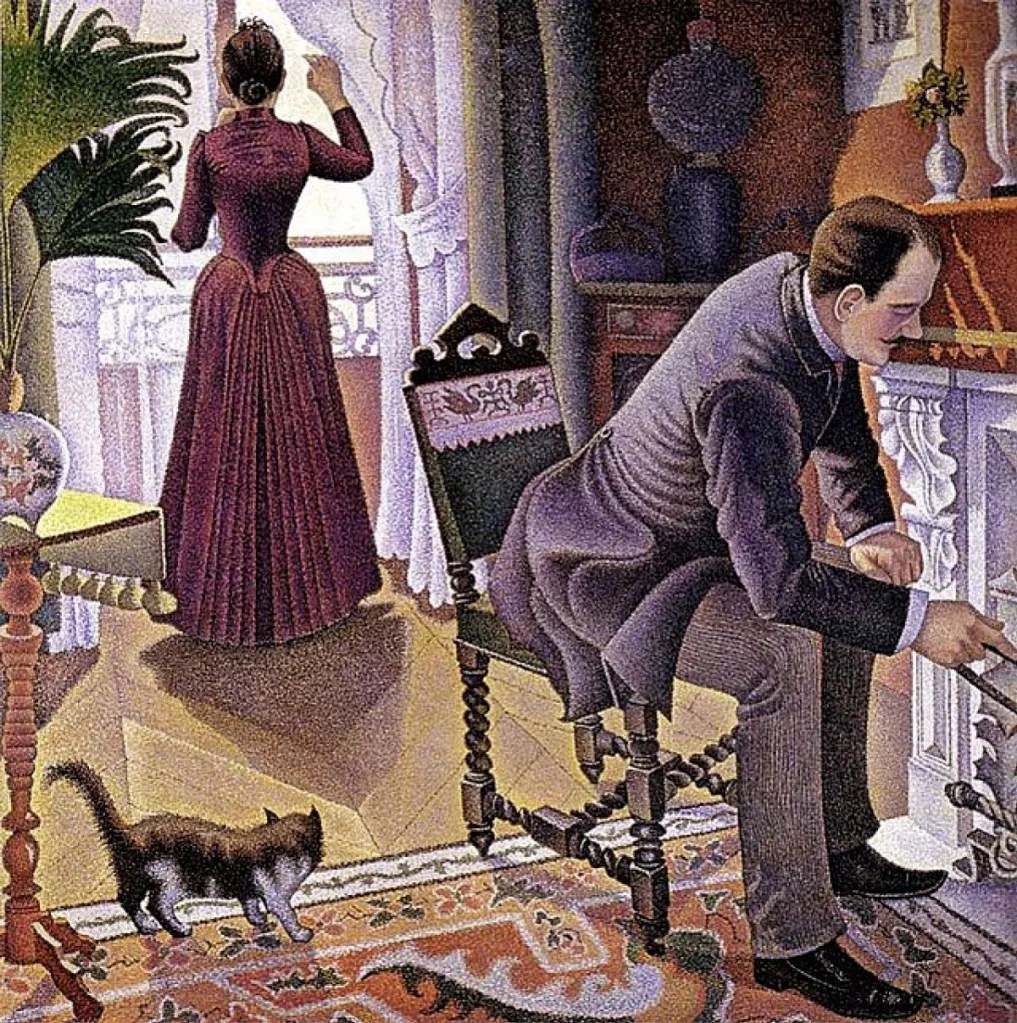
This is all true but I’d add that surely the painting also brings out the tendency within the technique of Neo-Impressionism to conceive of humans as forms, as collections of lines and shapes? A tendency which leads them to seem like self-contained, autonomous units which have no interaction – monads, mannequins. And that many of these images have a heavy tendency towards caricature.

All of which is even more true of its sequel, Sunday, completed in 1890. The dot technique is immaculate. And Signac has included in the composition many more firm, defined outlines. But surely this proves my point, that the more defined these lines and form become, the more cartoon-like the overall image.

A Sunday, Opus 201 (1888–90) by Paul Signac. Private collection

Chahut

This tendency comes to a climax in the biggest painting on display here, given more or less its own room and space, the enormous ‘Chahut’ by Seurat from 1890.

Le Chahut by Georges Seurat (1889-90) © Collection Kröller-Müller Museum, Otterlo, the Netherlands

The curators have a lot to say about this, for example that it was one of what he called his toiles de luttes meaning ‘battle canvases’. In other words it was intended to be a provocative rallying cry to his movement, a manifesto pictures. In addition, it is intended to be socially subversive or an attack on late-Victorian sexual morality, in that it depicts the ‘chahut’ or ‘can-can’– then the most risqué dance performed in Parisian café-concerts.

All this is no doubt true but surely the obvious thing about this painting is that it’s a cartoon. It’s left reality far behind in order to become something like an illustration in the funny papers. Surely Seurat’s obsession with form and pattern, instead of taking us towards some deeper spiritual reality, in fact takes us away from reality altogether into a realm of caricature and comic illustrations?

(I’ve just visited the Courtauld Gallery where I saw another egregious example of this tendency, Seurat’s Young Woman Powdering Herself from 1890. This is a comical picture, isn’t it? Surely you can’t possibly take it seriously.)

Ladies on lawns

‘Chahut’ is given centre stage in the exhibition but it is in almost all ways an anomaly, an exception. The next room in the show, the one about depicting the bourgeois world, is far more characteristic. As well as the two Signac interiors I’ve mentioned, there are more classically open-air Neo-Impressionist works. The largest and maybe most representative is ‘In July, Before Noon’ by Théo van Rysselberghe, from the same year as Signac’s cartoon music hall.

In July, before Noon, 1890 by Théo van Rysselberghe © Collection Kröller-Müller Museum, Otterlo, the Netherlands

The strengths and weaknesses of the style are obvious. It is superb at conveying not only the detailed light and shade of a sunny day out of doors in July but there is something about the women’s postures which is oddly formalistic and detached. The woman passing by at the back looks like a robot.

I thought I recognised it and, after some rummaging, confirmed that this image was used for the cover of an Oxford University Press edition of Anton Chekhov’s plays. It perfectly captures the late nineteenth century indolence of middle class ladies, arranged in vast folds of fabric and quietly going about their embroidery or needlework in a sunny French garden. Inside they may be seething with the frustrations of characters from Chekhov or Ibsen, but here, on the surface, all is luminous calm.

Neo-Impressionism and van Gogh

As I mentioned, the show includes one splendid van Gogh painting, ‘The Sower’ from June 1888. We know from his letters than van Gogh was interested by the Neo-Impressionists’ experiments with colour and form but he was never a member of the group, not close. ‘The Sower’ is here partly because, alongside the Neo-Impressionists, Kröller-Müller collected van Goghs. And partly to demonstrate the similarities and differences between them.

The Sower by Vincent van Gogh (June 1888) © Collection Kröller-Müller Museum, Otterlo, the Netherlands. Photographer: Rik Klein Gotink

The similarity lies in the radical simplification of the subject in order to focus on vibrant colour contrasts. Van Gogh juxtaposes all kinds of colours not seen together in nature (for example the insistent blue of the turned soil the sower is scattering his seed onto) in order to create his effects.

The difference is in two aspects of approach. The Neo-Impressionists took a calm, detached, almost scientific approach to their work, whereas all eye-witnesses describe van Gogh attacking his canvases in a fever of inspiration. And whereas the Neo-Impressionists famously used dots or dot-like dashes of pain, van Gogh notoriously squeezed out entire worms of paint onto his brush and applied them with slapdash inspiration. Which explains why the Neo-Impressionists’ canvases are almost flat while van Gogh’s canvases are thickly encrusted with gloops and whorls of paint whipping up from the surface like waves on a stormy sea.

Here’s a close-up of pointillist technique from George Lemmen’s Factories on the Thames from 1892.

Detail from ‘Factories on the Thames’ by George Lemmen (1892) (photo by the author)

And a close-up of van Gogh’s Sower.

Detail from The Sower by Vincent van Gogh (photo by the author)

Spot the difference.

Legacy

Google AI tells me that:

Neo-Impressionism’s legacy lies in its scientific approach to colour and form, which heavily influenced later movements like Fauvism, Cubism, Futurism, and Abstract Expressionism. By using optical science, the movement pioneered a new awareness of colour and laid the groundwork for modernist approaches to the flatness of the canvas and simplified geometric forms. This theoretical language and systematic technique offered a new foundation for artists, bridging the gap between Impressionism and the more radical movements of the 20th century.

Seurat at the Courtauld

If you like Seurat, you might be interested to know that the Courtauld Gallery will be hosting an exhibition about Seurat’s coast painting from February next year.


Related links

Related reviews

After Impressionism: Inventing Modern Art @ the National Gallery

This is a lavish and deeply enjoyable exhibition portraying the great explosion of creativity in West European painting which took place in the decades between the last Impressionist exhibition in 1886 and the outbreak of the First World War in 1914.

Critics then and now struggled to find a blanket term for the period, as Belinda Thompson explains in her excellent survey of the period, ‘The Post-Impressionists’. The term ‘post-impressionism’ persists because the only thing all these different artists had in common was that they were painting after the great Impressionist breakthrough of the 1860s and 1870s and were clearly influenced by it. Beyond that it’s difficult to generalise, except that they were all experimenting and innovating and following through on the countless possibilities inherent in the act of putting oil paint on canvas.

Mont Sainte-Victoire by Paul Cezanne (1902 to 1906) © Philadelphia Museum of Art

Structure

The exhibition structure is simple: it opens by celebrating the artists who have emerged, in retrospect, as the great gods of the period – Paul Cézanne, Vincent van Gogh, Paul Gauguin – and then examines the influence they had on the younger generations of artists, in the hotbed of modern art, Paris.

Where this exhibition strikes out and is distinctive from many surveys of the period is that it then makes a conscious effort to broaden its scope, geographically, with rooms or sections dedicated to other capital cities where exciting experimentation was taking place, namely Barcelona, Berlin, Brussels and Vienna. The curators point out that there was more cross-fertilisation than ever before due to the steadily increasing numbers of exhibitions and exhibiting societies, illustrated periodicals and commercial dealerships.

For once there isn’t a particularly strong central thread or thesis being propounded in the show, just a lot of wall labels describing art movements and groups and trends in all these different places, and then picture captions going into detail on individual works.

The show is, therefore, in effect, just a feast of fabulous post-impressionist masterpieces, and strolling through it is a quite wonderful, mind-blowing, eye-filling experience.

Specific movements are mentioned along the way (the Nabis, Symbolism, Die Brücke, the Fauves), in passing, but towards the end the show crystallises, as it were, presenting examples of the radical Modernism which supplanted what had come before in the form of works by Picasso, Matisse, and Mondrian.

What characterised post-impressionist art?

Impressionism began the movement away from traditional Salon art which a) depicted high historical or mythological subject matter or b) monumental nudes in c) an intensely figurative realistic manner. Instead the Impressionists were interested not in what was there, but in what we see, which is a different thing, trying to capture the shimmer and play of light.

The post-impressionists continued this departure from the conventional representation of the external world. In a host of different ways they developed non-naturalist visual languages, emphasising shape or pattern or colour which don’t exist in the real world. Some of them were interested in line and form, some became obsessed with colour, some with pattern bringing out the decorative potential of art, some focused on symbols and meanings. Once you walked away from the idea of figurative, realistic depiction of the ‘real world’ a thousand doors opened.

All this was helped by the swift development of photography, with many artists realising that their traditional role as makers of portraits, recorders of events, annotaters of landscapes was being superseded by the new technology. But this was entirely positive: it freed them up to explore the expressive potential of paint on flat surfaces in a thousand new ways.

Artists

With almost 100 works, many lent from institutions abroad and seen in London for the first time, the show features a host of big name artists like Paul Cezanne, Vincent Van Gogh, Edgar Degas, Pablo Picasso, Henri Matisse, Gustav Klimt, Käthe Kollwitz, Sonia Delaunay, Wassily Kandinsky, Piet Mondrian, Edvard Munch. It’s mostly paintings  but there’s a selection of ten or so sculptures carefully chosen to demonstrate innovation in that medium, too (notable sculptures by Rodin, Gauguin and Kollwitz).

I’m going to list the rooms, indicate what they contain i.e. which movements and artists, and then pick personal highlights.

Introduction

The introductory room contains just four works, a painting each by Pierre Puvis de Chavannes and Paul Cezanne, framed by two sculptures by Auguste Rodin (‘Monument to Balzac‘, 1898, and ‘Walking man‘, 1907). Cezanne’s ‘Mont Sainte-Victoire’ (1906) is obviously a greatest hit but after the recent Cezanne exhibitions at Tate Modern and the National Portrait Gallery I’m a bit Cézanned out. The Rodin pieces confirm my very strong dislike; I object to because of the lumbering clumsy size of his works and the crude, horrible unfinished nature. In terms of modern sculpture I like Epstein, Gill and Gaudier-Brzeska, small, smooth, beautiful lines and angles, the opposite of everything Rodin stands for.

Therefore I preferred the Puvis work, ‘The Sacred Grove’ from 1885, although this struck me as a very odd choice, because its idyllic classical setting, figurative approach, use of perspective etc seem completely contrary to everything which follows.

The Sacred Grove, Beloved of the Arts and the Muses by Pierre Puvis de Chavannes (1884) Art Institute of Chicago

Room 2: Cézanne, van Gogh, Degas, Gauguin

Greatest hits from some of Western art’s biggest names. Cezanne is represented by a classic version of The Bathers (1905) where he is transforming human figures, trees and landscape into geometric shapes, leaning rectangles of paint, the semi-abstract human figures having blank masks. You can clearly see the origins of Picasso and Braque’s cubism. A still life of a sugar bowl and apples, plus another of his numerous views of Mont Saint-Victoire.

There are 4 works by Van Gogh: ‘Snow-Covered Field with a Harrow (after Millet)‘ (1890) had the classic van Gogh wavy paint, as did ‘Sunset at Montmajour‘ and ‘Enclosed field with ploughman‘. But I found myself more drawn to ‘Houses in Saintes-Maries-de-la-mer’. Apparently the tight, constricted feel of the composition is a new thing in his style. It was painted in the south of France where the bright light made him realise he could exaggerate colour effects even more than he’d been doing previously.

Houses in Saintes-Maries-de-la-mer by Vincent van Gogh (1890)

An oddity I noticed is that the National Gallery itself owns some outstanding van Gogh masterpieces, such as the chair, and sunflowers and these aren’t in the exhibition. The only reason I can think of is that they’re part of the permanent collection which tourists quite possibly come to London to see and so the curators took the decision to exclude them from the exhibition and keep them on general display.

The caption to his ‘Woman from Arles’, a portrait of the owner of the Café de la Gare in Arles, raises an interesting point. Apparently, when they were sharing a house in the south of France, Gauguin and van Gogh had an ongoing argument about the nature of art: Gauguin argued that the artists is like a priest questing for the spiritual essence of a subject and therefore it was best to paint from memory, distance from the actual object freeing the artist to bring out the essential shapes and colours. Van Gogh, on the contrary, argued it is the artist’s sacred duty to paint what they see, as they see it.

No such scruples with the little selection of Degas works, the biggest example of which is the famous ‘Combing the Hair (Le Coiffure)’, an orgy of reds and oranges. It’s accompanied by a good example of his ballet dancers, ‘Dancers practicing in the foyer’. But my favourite piece was a small but exquisite piece, ‘Woman reading’ (1885).

Femme lisant by Edgar Degas (1883 to 1885)

It’s tightly focused, cropping the figure at the knee. Degas applied layers of pastel over a monotype print

Taken together this room makes a strong case for the dazzling impact these artists had both in Paris and elsewhere in Europe, with their reconsiderations of form, surface and space. The strokes are called ‘gestural’ because they convey the actual strokes by the artists as much as the object. Strong short dark lines make it look as if elements of the image have been stitched together. The use of bold pure colours and highly gestural strokes were very influential on later artists.

Then onto the Gauguin section. I was bowled over. Gauguin strikes me as less covered than Cezanne, van Gogh or Degas, maybe because he is the boldest, most radical, most muscular and controversial of them. He’s represented by a greatest hit, ‘Nevermore’, ‘The Wave’, ‘Fête Gloanec’, ‘The Wave’, ‘The Wine Harvest’ and his expressive ‘primitive’ carving in the circular shape of a totem, ‘The afternoon of a faun’. But it was the huge and amazing ‘Vision of the Sermon (Jacob Wrestling with the Angel)’ which bowled me over.

Vision of the Sermon (Jacob Wrestling with the Angel) by Paul Gauguin (1888) © National Galleries of Scotland, Edinburgh

As per the explanation on the van Gogh caption, you can see how Gauguin has taken real elements, such as peasant women from his native Brittany, a cow, a tree, but placed them in an abstract ‘symbolic’ landscape where the grass is bright orange and perspective is gestured at but mocked or transcended. And, contrary to all traditional rules, the nominal subject, the wrestling match, doesn’t take place at the front and centre of the painting, but is a strange, obscure, garbled struggle happening off in the middle distance.

Degas is more consistently sensually and visually pleasing, but Gauguin is bracing and weird. He is a godfather of the pictorial Symbolism which was a major strand of the 1890s with its concern for Big (if often nebulous) Ideas and a completely non-naturalistic treatment, both combining to convey a strong if indefinable emotion.

Room 3: Different paths

Side by side are placed dark, heavily outlined depictions of the city, and the tremendously light and airy works of the ‘divisionists’ or ‘pointillists’.

Part of the enjoyment of visiting art exhibitions is to test out my own tastes. Over the years my tastes have changed, and are also liable to vary from day to day depending on mood and circumstance (e.g. pressure of work). Something which appears to remain consistent is I am instantly drawn to works with strong outlines. This is part of the reason I like Gauguin over van Gogh and Degas over Cezanne.

So in this room I really liked the works by Emile Bernard and Louis Anquetin with their ‘intensified colour and flattened forms bounded by strong outlines’.

‘Avenue de Clichy: five o’clock in the evening’ by Louis Anquetin (1887)

The strong black lines defining figures or folds of clothes were described by some critics as cloisonné work. According to the curators it anticipates and to some extent influence Gauguin.

By contrast I found the works by pointillists Georges Seurat and Paul Signac pallid and limp. These were ‘Setting sun: sardine fishing’ and ‘Bertaud’s Pine’ by Signac, alongside ‘By the Mediterranean by Henri-Edmond Cross. I know they’re great works in their own right. I understand that they called themselves Neo-Impressionists because they saw themselves as applying ‘scientific’ rigour and analysis to the depiction of sunlight and shade. I appreciate that the pointillists were, surprisingly, associated with workers’ rights and socialism and thought of themselves as depicting a better lighter world for all. But it’s the dark urban night-time visions of Louis Anquetin which pull my daisy.

The Channel of Gravelines, Grand Fort-Philippe by Georges Seurat (1890) © National Gallery, London

Room 4:The Nabis

Beside them are two works showing the highly stylised approach of Toulouse Lautrec, ‘Tristan Bernard at the Vêlodrome Buffalo‘ and ‘The Reader‘. The room contains a partitioned-off section about the Nabis or ‘prophets’. According to Wikipedia, the Nabis were:

a group of young French artists active in Paris from 1888 until 1900, who played a large part in the transition from impressionism and academic art to abstract art, symbolism and the other early movements of modernism. They included Pierre Bonnard, Maurice Denis, Paul Ranson, Édouard Vuillard, Ker-Xavier Roussel, Félix Vallotton, Paul Sérusier and Auguste Cazalis.

The show includes what is commonly thought to be the first ‘Nabis’ painting, ‘Le Bois d’Amour à Pont-Aven or Le Talisman’ of 1888 by Paul Sérusier. You can see why it was widely felt to have pushed painting significantly beyond figurativism into an entirely new place where colour and pattern became the main aim of a painting. Serusier painted it under the supervision and direct encouragement of Gauguin at Pont-Aven in Brittany. This fact and the almost complete abstraction of the work itself had a dramatic impact on his friends back in Paris and helped crystallise the new movement.

‘Le Bois d’Amour à Pont-Aven or Le Talisman’ by Paul Sérusier (1888)

And so the show includes comparable works by other members of the Nabis, including ‘Island and village of Le Pecq‘ and ‘The evening wash by lamplight‘ by Maurice Denis. Nearby there’s a work by Pierre Bonnard, ‘Madame Claude Terrasse and her son Charles‘ (1893). I went to the Bonnard exhibition at Tate Modern back in 2019 and, eventually, overcome my initial dislike to sort of ‘get’ his messy way with colour and pattern but this specimen epitomised that lack of draughtsmanship which I find hard to overcome. Next to it are two pieces by Edouard Vuillard, ‘Figures in an interior: Music‘ (1896), ‘Lugny-Poe‘ (1891) and ‘Lady of Fashion‘ (1892), both of which highlight his interest in pattern and design over strict realism. No likee.

Room 5: New voices – Barcelona and Brussels

By my count there were 6 paintings from Barcelona and 5 from Brussels.

Barcelona

Barcelona is represented by works by Hermenglido Anglada-Camaras, Ramon Casas i Carbo, Santiago Rusiñol I Prats, Isidro Nonell i Monturio and Pablo Picasso. The exhibition goes heavy on the enormous painting by Casas i Carbo, ‘The Automobile’.

The Automobile by Ramón Casas i Carbó (about 1900) © Círculo del Liceo / photo Fotogasull

It’s imposingly big and has a long backstory. Casas, a leading figure in the Barcelona avant-garde, was commissioned to the series of 12 paintings for the private club, Círculo del Liceu in Barcelona, depicting modern musical life. In this one a woman dressed in modern (1900) clothes drives that amazing new invention, the automobile. Casas was one of the first in the city to own a motor car and, of course, the curators point out how ‘radical’ it was to depict a woman driving one. The link to ‘music’? She’s meant to be driving to or from a concert. You can see it in the background on the right. The bold simplicity of the design is said to represent ‘Catalan Modernism’ and to have impressed the young Picasso.

Picasso is represented by an early work, ‘The absinthe drinker‘ and a portrait of ‘Gustave Coquiot‘, Hermenglido Anglada-Camaras by ‘The White Peacock‘ (1904), Isidre Nonell by a tough naturalistic depiction of poverty titled ‘Hardship‘. But I particularly liked the portrait of Modesto Sanchez Ortiz by Santiago Rusiñol, not particularly radical or modernist but just very powerful. Ortiz’ eyes followed me round the room.

Brussels

As to Brussels, the curators tell us it was home to progressive exhibiting societies like The Twenty and The Free Aesthetic which fostered close links with the Paris avant-garde. The Twenty was an exhibition society founded in 1883 by 20 artists who wanted to break away from the conventional art establishment. It was in Brussels that van Gogh made his only sale during his lifetime. The five pieces felt very light and pointillist. They include the decorative and soothing ‘The Scheldt upstream from Antwerp‘ by Theo van Rysselberghe (1892), the political motive behind ‘The eve of the strike‘ by Jan Toorop (1889), and a strikingly pointillist work, ‘Going to church’ by Henry van de Velde (1892). As you can see, although pointillist in technique, it has a much darker, gloomier vibe than the sun-drenched works of Signac and Seurat.

Woman in front of the Church by Henry Van de Velde (1889)

Off in a corner is a single work by the outlier James Ensor, ‘Astonishment of the Mask Wouse‘ (1889). As you can see, Ensor’s art goes beyond satire into the weird and the grotesque.

Room 6: New voices – Vienna and Berlin

In both Vienna and Berlin at the start of the 20th century artists withdrew from the traditional art academies and salon exhibitions and set up breakaway organisations, the Secessions.

Vienna

Dominating the left side of the room are two huge portraits of women by Gustav Klimt in his trademark style, combining a highly realistic sensual face with a luscious depiction of stylised dress and fabric: ‘Hermine Gallia (1904) and ‘Adele Bloch-Bauer II‘ (1912). I loved Klimt when I first discovered him at school but move quickly on to prefer his disciple Egon Schiele and eventually found him too sweet and chocolate box. Also from Vienna is ‘The Artist’s Mother‘ by Broncia Koller-Pinell (1907).

Surprisingly, there are some works by Norwegian depressive Edvard Munch. Why? Because Munch actually exhibited and sold his works in Berlin. The works here show a healthy lack of interest in traditional perspective and preference for pattern and design, but aren’t particularly impressive: ‘Consul Christen Sandberg‘. More characteristic is ‘The death bed‘ (1896). I was interested to learn that Munch eventually had a complete nervous breakdown (in 1908) and that, when he returned to painting, it was in a far looser style and of relatively unemotional landscapes: ‘Cabbage field‘ (1915).

Berlin

I was surprised by this room because so many of the works seemed the opposite of ‘modern’ but surprisingly old fashioned. Thus the two works by Lovis Corinth are, maybe, a bit candid and honest about the female body but they are, nonetheless, female nudes in the time-honoured tradition, without a hint of the stylisation we’ve seen throughout the show up to this point: ‘Perseus and Andromeda‘ (1900).

Nana by Lovis Corinth (1911) St Louis Art Museum

There’s a portrait of historian and philosopher George Brandes by Max Liebermann (1901) and ‘Danae‘ (1895) where I really admired the frank peasant ugliness of the servant, and ‘Children by the Pond: The Garden in Godramstein‘ (1909) by Max Slevogt.

I was surprised by this entire room because it all seemed so reactionary and old fashioned. A glimmer of modernism was given by the sole piece by the great German artist Käthe Kollwitz, not a painting but a tightly conceived sculpture, ‘Pair of Lovers‘ from 1913 to 1915. I’m a huge fan.

Room 7: German Expressionism

The penultimate room is a small one tucked off to the side of the flow of big rooms but it came to me as a huge relief after the retro kitsch of the previous room, a sudden burst of vibrant colour and exciting non-conformity.

Why stick to traditional methods of compositions? Why not use blaring flagrant primary colours! Why bother to cover the whole canvas when leaving blank spots creates a sense of urgency and drama! Bang!!

Many of the works are by members of Die Brücke (The Bridge), a group of German expressionist artists formed in Dresden in 1905. Founding members were Fritz Bleyl, Erich Heckel, Ernst Ludwig Kirchner and Karl Schmidt-Rottluff. What they had in common was interest in primitivist art and expressing extreme emotion through high-keyed colours that were non-naturalistic. God, this is the dog’s bollocks, I thought, what a relief after the stodgy naturalism of the previous room!

Here are splendidly bold and unfettered works by Erich Heckel – ‘The house in Dangast‘ (1908) – and Karl Schmitt-Rottluf – ‘Break in the dyke‘) (1910). I loved Sonia Delaunay’s ‘Jeune Finlandaise’ (1907). In this small room experienced a physical sense of liberation.  This is the real McCoy.

Young Finnish woman by Sonia Delaunay (1907)

It’s significant that this painting captures Delauney on her journey towards pure abstraction which she would achieve a few year later. Part of the thrill of paintings like this is you can feel the future in them, ready to burst through. In the same vein is the National Gallery’s portrait of Charlotte Cuhrt by Max Pechstein (1910).

Two outliers are a portrait by Henri Rousseau (‘Joseph Brum’), whose ‘naive’ self-taught style became very popular in turn of the century Paris where ‘primitivism’ of all kinds was becoming fashionable.

And, off to one, side, the eerie and disturbing ‘Seated girl with a white shirt and standing nude girl’ by Paula Modersohn-Becker (1906).

8: New Terrains

Finally the exhibition closes with a big room drawing together strands which have emerged during the exhibition to date, and pointing forwards to the radical ruptures of Modernism.

Thus there’s a work by Wassily Kandinsky which is well on the way of his journey towards abstraction – ‘Bavarian Village with Field‘ (1908).

There are three paintings by Matisse, highlighting his move towards decoration, colour and pattern:

There are three little works by Piet Mondrian which neatly capture his progression from traditional figurativism in a realistic depiction of a tree by a river bank; to a half-way house, a tree painted in a style influenced by van Gogh’s broad brushstrokes; and finally onto pure abstraction:

In a similar spirit there are four Picassos which capture his progression from deliberate ‘primitivism’ of 1907 on to the invention of cubism in 1911:

But dominating the room is the enormous work ‘The Dance’ by André Derain. Derain was one of the group of Parisian artists who, in a review of a 1905 exhibition, were mockingly called ‘les Fauves’ (which simply means ‘the wild things’) by a Parisian critic and adopted the name as a badge of pride. Other works by Derain are included:

But it’s ‘The Dance’ which dominates the entire room and is your lasting, lingering visual image of it. Wild, high-toned colours, a cheerful disregard for perspective and, in this image in particular, a complete transition to fantasy, fairy-tale, exotic subject matter.

‘The Dance’ by André Derain (1906) Private Collection © ADAGP, Paris and DACS, London 2023

It’s funny but, although the curators started out by claiming there was a great explosion of styles and approaches from the late 1880s onwards, the works chosen for this final room suggest that all along there were in fact just two threads or streams or approaches.

For me the drab colouring and obsessive interest in volumes, hard-edged angles, facets and geometry found in the cubism of Picasso and Braque relates directly back to the exploration of volumes, forms, rectangles and blocks developed by Cézanne. Maybe we can call this the Analytic tradition and define it as stretching from (on one wing) the scientific approach of the Neo-Impressionists and, on the other, the pure, geometric abstraction of Mondrian.

Whereas the wild children’s drawing of brightly coloured figures dancing in the jungle obviously comes from a completely different place, clearly relates directly back to Gauguin’s symbolic exoticism. Maybe we could call this the Expressive tradition. Obviously, it incorporates, in Germany, the Bridge artists who we saw in the previous room, and includes the other Fauves, besides Derain.

Analytical versus expressive. Composition versus colour. Well, that’s the neat and simple pattern which struck me as I came to the end of this brilliant, exhilarating exhibition.


Related links

Related reviews

Nineteenth century France reviews

More National Gallery reviews

King Leopold’s Ghost by Adam Hochschild (1998) – part three

‘To gather rubber in the district… one must cut off hands, noses and ears.’
(Charles Lemaire, Belgian commissioner of the Equator District of the Congo Free State)

William Sheppard

Following his coverage of the black American Baptist minister George Washington Williams, who was appalled by what he witnessed in the Congo in 1890 and wrote an open letter of protest to the Belgian king, Leopold II, Hochschild goes on to describes the career of another black pioneer.

This is William Sheppard, a Baptist minister born in Virginia in 1865, who was sent by the Southern Baptists to the Free State, thus becoming the first black American missionary to the Congo. Hochschild emphasises that the church hierarchy ensured he was supervised every step of the way by a white superior, how it was the white man who actually met Leopold in Belgium while Shepherd was excluded, but how it was Shepherd who built up the mission on the river Kasai. Here he won the respect of the local BaKuba tribe whose language he was the only missionary to bother to learn, by his hard work and sympathetic understanding of their lives. They nicknamed him Mundéle Ndom, meaning ‘the black white man’.

Sheppard was the first Westerner to reach the Kuba capital, Ifuca, whose king usually ordered any outsider to be beheaded. But because he was black and spoke some BaKuba Sheppard was allowed to keep his head and stayed for four months, making detailed ethnographical records of their culture, art and religion (‘The Kuba are among Africa’s greatest artists,’ p.156). When he presented his findings to the Royal Geographic Society in London he was made a fellow, and back in the states presented the President with Kuba artefacts.

(Hochschild also mentions the spangling fact that Shepherd’s arrival at the mouth of the Congo coincided exactly with that of Joseph Conrad who was taking up the position of steamboat captain, and that Shepherd’s diary contains numerous references to the gentlemanly bearing of the exiled Pole who he spent some weeks with (p.154).)

Leopold’s grand plans

Leopold had impractically megalomaniac ambitions. He dreamed of linking his Congo possessions with the upper Nile and leasing Uganda from the British, both ideas gently rejected by Prime Minister Gladstone. He suggested raising a Congolese army to protect the Armenians who were being massacred by the Turks. When there was disturbance in Crete he offered Congolese troops as peacekeepers. His cousin, Queen Victoria’ thought Leopold was becoming delusional (p.168). But about one thing he was never deluded: maximising profit from his personal fiefdom in the Congo.

The rubber terror

‘Botofé bo le iwa!’, meaning ‘Rubber is Death!’ — Congo Proverb

Initially Leopold wanted to colonise the Congo because of ivory. As Frank McLynn makes clear in his chapter on the subject in Hearts of Darkness, ivory was the most valuable product of central Africa next to slaves, and the two trades were inextricably intertwined. Arab slavers destroyed native villages not only to enslave their women (killing most of the men) but also to loot the reserves of ivory many villages held, and use the newly acquired slaves to carry the plundered ivory the hundreds of miles to the coast.

It was the invention of the pneumatic tyre by John Dunlop, who set up the company of the same name in 1890, which made bicycling significantly more comfortable than before, which led to the outbreak of the ‘bicycling craze’ and which then led to a sudden spike in demand for rubber, that Leopold realised he was sitting on a goldmine, and that the farming of rubber from the huge rubber vines which twined up trees in the tropical rainforest almost overnight became a very profitable business (p.158). The West’s appetite for rubber grew for use not only in pneumatic tyres for bicycles and then cars, but for a myriad other uses, for example as insulation on electrical cabling which was undergoing an explosion of use around the world.

It is about this point, exactly half way through the book, and after a fair amount of relatively ‘ordinary’ historical and biographical stuff about Leopold and Stanley and so on, that the text takes a very dark turn and the reader is now plunged into the world of disgusting terror, massacre and mutilation created by the authorities who ran Leopold’s Congo Free State.

Force Publique officials were ordered to fulfil rubber quotas. They did this by kidnapping wives or children of villagers and threatening to mutilate or kill their hostages unless villagers handed in the correct and very onerous quotas of rubber. Natives who resisted were beaten, tortured, mutilated and murdered, had their families held hostage, their wives and daughters raped, or their houses and villages burned. If villages failed to fulfil the quota or showed any resistance, they were burned to the ground. The British traveller Ewart S. Grogan, crossing northeastern Congo, wrote: ‘Every village has been burned to the ground, and as I fled from the country I saw skeletons, skeletons everywhere’ (p.230). The Belgians turned Congo into a charnel house.

Most of the food the locals grew was confiscated by European officials leading to poor diet or starvation in many areas. State official Léon Féviez explained to a visiting official that when the local village didn’t supply enough fish and manioc to feed his troops he had a hundred of them beheaded. After that the villagers supplied sufficient food alright, even at the cost of themselves starving (p.166).

The incursions of black troops from one area into another spread diseases many had never previously been exposed to. Smallpox was carried from the coast where it was endemic, inland to populations who had no resistance to it. Worse was sleeping sickness, which is estimated to have killed half a million Congolese in 1901 alone (p.231).

The net effect of all these factors was a collapse in population. Missionaries and travellers through the Congo spoke again and again of entire regions laid waste and depopulated.

Hochschild singles out four factors and then gives copious evidence for each of them, being:

  • Murder
  • Starvation, exhaustion and exposure
  • Disease
  • Plummeting birth rate

The Reverend A.E. Scrivener was just one of many eye witnesses:

Lying about in the grass within a few yards of the house I was occupying were a number of human bones, in some cases complete skeletons. I counted 36 skulls, and saw many sets of bones from which the skull was missing. I called some of the men and asked the meaning of it. ‘When the rubber palaver began,’ said one, ‘the soldiers shot so many we grew tired of burying, and very often we were not allowed to bury and so just dragged the bodies out into the grass and left them.’

There was no census before Leopold’s murderous regime began but the best estimate is that 10 million Congolese lost their lives. This is based on the fact that in areas where population was known, it fell by a half between 1890 and 1910. Since the first detailed population estimate, in 1924, estimated the current population at around ten million, and most experts estimated that it was half the original number, that gives you some 10 million victims of Leopold’s regime, directly murdered or killed by overwork, famine or disease. (In fact at the end of the book, Hochschild devotes a passage to the estimates of modern demographers, who also agree with the 10 million figure.) More, in other words, than the Nazi Holocaust.

Chopping off Africans’ hands

Hands were used as proof that villages had been punished for failing to fulfil their quotas or rebelling. Force Publique soldiers had to prove that every bullet they were issued with was used to kill a villager (and not going off on hunting expeditions) by bringing in a hand for every bullet fired. Hands became a form of proof of discipline. Many soldiers couldn’t be bothered to wait for all the rubber to be counted and just hacked off a few hands at random to impress their superiors with how zealous they were.

But cutting off hands was also a form of punishment and incentive. Hostages – women and children –had their hands cut off unless their menfolk brought in the required quota of rubber. Some villagers, in desperation, instead of slicing a rubber vine and patiently waiting for the drops of sap to ooze out of it, were so panic-stricken that they cut down the entire vine and squeezed every drop of rubber out of it. This killed the vine rendering it unavailable for future use and so in turn was punished by the authorities, in the form which was now becoming universal – the men or their womenfolk or children having their hands cut off. Hochschild quotes scores of officials and soldiers who boasted about how many hands they collected per day.

‘Many fled and some were mutilated. I myself saw a man at Likange who had had both his hands cut off. Sometimes they cut them at the wrist, sometimes farther up . . . with a machete.’

In some military units there was a job, ‘keeper of the hands’ (p.165). Some units smoked severed hands over fires in order to keep them as decorations to hang on poles or over doors as a constant reminder to the locals of what even the slightest infringement would trigger.

Bestand:MutilatedChildrenFromCongo.jpg - Wikipedia

Mutilated Congolese children and adults. Photos taken between 1900 and 1905 by the English missionary Alice Seeley Harris

Hochschild brings out how atrocity acquires a momentum of its own. As in the Nazi genocide or the Soviet labour camps, cruelty and sadism, once permitted, become endemic. Thus René de Permentier, a Force Publique officer in the Equator district, had all the trees and bushes around his house cut down so he could use passing Africans as target practice for his rifle. If he found so much as a stray leaf in the courtyard swept by women prisoners he had one of them beheaded. If he found a forest path poorly maintained, he ordered a child in a local village executed. That kind of megalomaniac momentum.

Two Force Publique officers ordered a man hung by his feet and a fire lit underneath so he was cooked to death. Morel quoted a message from district commissioner Jules Jacques telling his underlings to warn the locals that if they cut down another vine he will exterminate them to the last man (quoted page 229). As the Reverend Scrivener testified:

A man bringing rather under the proper amount [of rubber to a collecting post], the white-man flies into a rage and seizing a rifle from one of the guards shoots him dead on the spot. Very rarely did rubber come but one or more were shot in that way at the door of the store.

There are hundreds of examples of this kind of psychopathic behaviour. Late in the book Hochschild says speakers of the Mongo language refer to the period as lokeli, the overwhelming (p.300).

Edmund Dene Morel

We know so much about the evil practices of Leopold’s state because of the obsessive work of one man, Edmund Dene Morel, who became a one-man international human rights dynamo.

In the late 1890s Morel was a relatively lowly clerk working for the Liverpool-based trading company Elder Dempster (p.177). He began travelling back and forth across the Channel as his company’s liaison with officials of the Congo Free State. Slowly he began to realise something was wrong. Hochschild attributes his revelation to three elements which he saw or, as a clerk handling the official paperwork for the cargoes, was able to calculate for himself while spending time at the State’s docks in Antwerp:

  1. He learned that huge amounts of arms and ammunition were being shipped to the Congo along with surprising amounts of chains and shackles. Why?
  2. The amount of ivory and rubber brought back by the ships greatly exceeded the amount stated on the manifests and paperwork. Someone was creaming off millions in profit. Who?
  3. Over 80% of the goods being shipped to the Congo were remote from trade purposes. In other words, a huge amount of goods were being brought out but very little was going in to pay for them. So how was this wealth of ivory and rubber being generated. Dene realised there could be only one explanation: slave labour.

‘These figures told their own story…Forced labour of a terrible and continuous kind could alone explain such unheard-of profits…forced labour in which the Congo government was the immediate beneficiary; forced labour directed by the closest associates of the king.’ (Morel, quoted page 180)

He called it: ‘the most gigantic fraud and wickedness that our generation has known’ (p.206).

Morel made his fears known to his superiors who told him to keep quiet. The Free State was a major client of Elder Dempster’s. They tried to coerce him into keeping silent. The company offered him a pay rise, then the role of highly paid consultant. Free State officials in Brussels stopped talking to him. He refused all bribes and insisted on speaking out.

Eventually, in 1901, Morel quit Elder Dempster and, after pondering what to do, set up a newspaper, the West Africa Mail in 1903, backed by philanthropic sponsors. It consisted of Morel’s articles, letters from missionaries, maps, cartoons, and pictures. Morel didn’t hold back:

‘Blood is smeared all over the Congo State, its history is blood-stained, its deeds are bloody, the edifice it has reared is cemented in blood—the blood of unfortunate negroes, spilled freely with the most sordid of all motives, monetary gain.’

Morel intended the West Africa Mail to publish everything he knew about the Congo and encouraged all-comers to send him their reports about ‘the shootings, shackles, beheadings, mutilations and kidnappings of a slave labour system’ they witnessed – and they did, in increasing numbers (p.270).

Morel tapped into the resources of existing anti-slavery organisations, namely the Anti-Slavery Society and the Aborigenes Protection Society, as well as roping in influential figures such as the politician Sir Charles Dilke and the author Mary Kingsley. He became a writing phenomenon, working 16 or even 18 hours a day to produce books, speeches, articles and pamphlets about the Congo (p.209). In the first six months of 1906 alone, he wrote 3,700 letters (p.214).

Morel requested information from all and any sources, and developed a remarkable knack for getting inside information from all kinds of people, not only missionaries and travellers in the region, but dissident military officers such as Raymond de Grez, who secretly fed him reports and statistics for many years, as well as people involved in the various shipping companies and testimony from their agents in-country, such as the American business agent Edgar Canisius (p.192).

The more Morel’s reputation grew as the doughty opponent of the evil being perpetrated in the Congo, the more people knew he was the man to slip confidential information (p.188).

It snowballed into a vast publicity campaign, featuring hundreds of public meetings, thousands of letters, he received thousands of letters full of facts and figures which Morel was then able to use in his articles or feed to sympathetic journalists and politicians.

With the aid of the charities and sympathetic politicians Morel secured a debate in the House of Commons which was held on 20 May 1903. At its conclusion the British Parliament passed a resolution to allow the British government to negotiate with the other Great Powers over the matter, avowing that the native Congolese ‘should be governed with humanity’ and, incidentally, noting that ‘great gratitude was due’ to Morel for creating public awareness (p.194). It was a truly impressive achievement. As Hochschild summarises:

Almost never has one man, possessed of no wealth, title of government post, caused so much trouble for the governments of several major countries. (p.209)

Pamphlets were followed by excoriating books, namely:

  • Affairs of West Africa (1902)
  • The British Case in French Congo (1903)
  • King Leopold’s Rule in Africa (1904)
  • Red Rubber – The story of the rubber slave trade that flourished in Congo in the year of grace 1906 (1906)
  • Great Britain and the Congo: the Pillage of the Congo Basin

When I read the title of Red Rubber I immediately saw the link with the campaign against ‘blood diamonds’ originating in Africa under war-torn or oppressive conditions from much the same region of Africa, in our own time.

Roger Casement

The Parliamentary debate directly affected another major figure. Parliament set up a commission to investigate the accusations and ordered the British consul to the Congo, Roger Casement, to go in-country to find out more.

Casement evaded the beady eye of Leopold’s officials, paid his own way and independently interviewed missionaries, natives, riverboat captains, and railroad workers. He then wrote up and submitted to Parliament a report containing 39 pages of testimony and a 23-page index of facts, what has been called ‘the most damning exposure ever of exploitation in Africa’. Morel published the ‘Casement Report’ in full in the West Africa Mail and it was picked up and syndicated around the world.

Hochschild devotes a chapter to Casement who is a fascinating figure in his own right, not least because of his principled but ill-fated support for Irish independence a decade later. (Unfortunately, no modern biographer can abstain from prying into the sex lives of their subject, and so we learn quite a lot about the fact that Casement was gay and kept a detailed log of his sexual encounters wherever he went, with Europeans or Africans. Great – and utterly beside the point.)

When they met they instantly clicked. Both respected each other’s fierce integrity and utter devotion to exposing the evil of Leopold’s regime. Casement was a government employee and so had to go where his superiors sent him, but they kept in touch and he offered Morel important confirmation and moral support, becoming a vital colleague and sounding board for Morel’s campaigns. Morel nicknamed him the Tiger; Casement called Morel the Bulldog (p.207). Chaps.

Congo Reform Association (CRA)

Casement and Morel met again, in Dublin, and agreed that it needed more than a newspaper to bring about the change needed. Casement convinced Morel they needed to set up an organisation and so in November 1903 Dene announced the establishment of the Congo Reform Association (CRA) with a founding manifesto filled with names of the great and good and calling for ‘just and humane treatment of the inhabitants of the Congo State, and restoration of the rights to the land and of their individual freedom’.

An American branch was quickly set up which garnered support from such notables as Mark Twain, Booker T. Washington and W. E. B. Du Bois. Twain was motivated to write a pamphlet, King Leopold’s Soliloquy: A defence of his Congo rule, in 1905, a satirical portrayal of Leopold as a self-pitying old man rambling on, making feeble excuses for the blood on his hands:

‘They burst out and call me “the king with ten million murders on his soul”.’

(It’s interesting that, even at this early point, the figure of 10 million dead was widely accepted. It’s a suspiciously round figure, isn’t it, but one Hochschild backs up with expert testimony at the end of his book)

Illustration from King Leopold’s Soliloquy by Mark Twain (1905)

Arthur Conan Doyle was inspired by his indignation to write The Crime of the Congo in 1908, while Joseph Conrad, in addition to the world famous novella about Leopold’s Congo, Heart of Darkness, co-wrote a novel with Ford Madox Ford, The Inheritors, which contains a devastating parody of Leopold’s greed and mendaciousness and personal oddities (p.257).

In 1904 Morel visited America, meeting with the President and members of Congress, before addressing large audiences around the nation. It took a while for the American campaign to gain traction, but in 1906 public pressure forced Congress to take a stand against Leopold and demand an end to the Congo Free State.

Alice Seeley Harris

Wife of the Reverend John Harris and a Baptist missionary in her own right, it was Alice Seeley Harris who took most of the photos of mutilated Africans which Morel distributed so widely and had such a devastating effect.

The couple had witnessed at first hand numerous atrocities, joined the Congo Reform Association and threw themselves into public activity. One or other of them made over 600 speeches in their first two years with the CRA, displaying implements like the shackles used to chain Congolese and the feared chicotte or whip made of hippopotamus hide, which was used to punish Africans who failed to meet their quotas and sometimes whip them to death (pages 120 and 216). Eventually John and Alice’s activism led to them running the newly combined Anti-Slavery and Aborigenes Protection Society (p.273).

Herbert Strang

The impact of the campaign spread far and wide. Hochschild mentions a British boys’ adventure writer, Herbert Strang, who wrote an adventure story set in the beastly Congo where a stout-hearted English teenager saves the day, titled Samba: A Story of the Rubber Slaves of the Congo. The preface he wrote to his novel is long but gives a fascinating insight into how the issue was seen at the time (1908).

Nearly a generation has passed since King Leopold was entrusted by the great Powers with the sovereignty of the Congo Free State. The conscience of Christendom had been shocked by the stories, brought back by Stanley and other travellers, of Arab slave raids on the Upper Congo; King Leopold, coming forward with the strongest assurances of philanthropic motive, was welcomed as the champion of the negro, who should bring peace and the highest blessings of civilization to the vast territory thus placed under his sway. For many succeeding years it was supposed that this work of deliverance, of regeneration, was being prosecuted with all diligence; the power of the slave traders was broken, towns were built, roads made, railways opened—none of the outward signs of material progress were wanting.

But of late the civilized world has been horrified to find that this imposing structure has been cemented with the life blood of the Congo races; that the material improvements to which the administrators of Congoland can point, have been purchased by an appalling amount of suffering inflicted upon the hapless negroes. The collection of rubber, on which the whole fabric of Congo finance rests, involves a disregard of liberty, an indifference to suffering, a destruction of human life, almost inconceivable. Those who best know the country estimate that the population is annually reduced, under King Leopold’s rule, by at least a hundred thousand. No great war, no famine, no pestilence in the world’s history has been so merciless a scourge as civilization in Congoland.

Yet owing to mutual jealousies, the Powers are slow to take action, and while they hesitate to intervene, the population of this great region, nearly as large as Europe, is fast disappearing.

It has been my aim in this book to show, within necessary limitations, what the effect of the white man’s rule has been.

If any reader should be tempted to imagine that the picture here drawn is overcoloured, I would commend him to the publications issued by Mr E. D. Morel and his co-workers of the Congo Reform Association, with every confidence that the cause of the Congo native will thereby gain a new adherent.

I must express my very great thanks to the Rev. J. H. Harris and Mrs. Harris, who have spent several years on the Upper Congo, for their kindness in reading the manuscript and revising the proofs of this book, and for many most helpful suggestions and criticisms.

By this point the atrocities were so widely known that Leopold had become associated with severed hands and blood in large parts of the press. Countless caricatures in European and American magazines satirised him as a mass murderer, his hands or beard dripping with blood while he hugged his sacks full of blood money (p.222).

Leopold II's Heart of Darkness, by David White | Open History Society

When Leopold’s second wife bore his second child, it was born with a withered hand and Punch magazine published a cartoon with the caption Vengeance from on high. Harsh but an indication of how universally he was despised.

What did Leopold spend his blood money on?

And how did Leopold spend the huge personal wealth he accrued from all this forced labour, slavery, murder and extortion? On grandiose building schemes and his teenage mistress.

1. Buildings

Leopold invested a huge amount of his blood money on buying, building or renovating grand properties. Wikipedia gives a handy summary of a subject which is spread across numerous passages in Hochschild’s book:

The public buildings were mainly in Brussels, Ostend and Antwerp, and include the Hippodrome Wellington racetrack, the Royal Galleries and Maria Hendrikapark in Ostend; the Royal Museum for Central Africa and its surrounding park in Tervuren; the Cinquantenaire park, triumphal arch and complex, and the Duden Park in Brussels, and the 1895–1905 Antwerpen-Centraal railway station.

In addition to his public works, Leopold acquired and built numerous private properties for himself inside and outside Belgium. He expanded the grounds of the Royal Castle of Laeken [one of Europe’s most luxurious royal homes] and built the Royal Greenhouses, the Japanese Tower and the Chinese Pavilion near the palace. In the Ardennes his domains consisted of 6,700 hectares (17,000 acres) of forests and agricultural lands and the châteaux of Ardenne, Ciergnon, Fenffe, Villers-sur-Lesse and Ferage. He also built important country estates on the French Riviera, including the Villa des Cèdres and its botanical garden and the Villa Leopolda.

(In a picquant footnote, Hochschild tells us that one of Leopold’s many villas on the Cote d’Azur was  subsequently bought by the English writer, Somerset Maugham, p.276.)

Hochschild contrasts these extravagant building projects with the many, many, many African homes and villages and entire regions which his officers laid waste and burned to the ground.

2. Caroline Lacroix

Leopold had married Marie Henriette of Austria, a cousin of Emperor Franz Joseph I of Austria and grand-daughter of the Holy Roman Emperor Leopold II, on 22 August 1853 in Brussels. She was popular with the Belgians, was an artist and accomplished horsewoman, and the marriage produced four children. However, the couple became estranged and ended up living apart, Marie settling in the town of Spa where she lived till her death in 1902.

Meanwhile, Hochschild tells us, Leopold became a regular customer at high class brothels which specialised in young and very young girls, preferably virgins. Still, it comes as a bit of a surprise when Hochschild tells us that in 1899, in his 65th year, Leopold took as a mistress Caroline Lacroix, a 16-year-old French prostitute, and that they were to stay together for the next decade until his death.

It was on Caroline that a lot of the blood money from the Congo was lavished, in the form of cash, bonds raised against the Congo Free State government, castles and villas and dresses and makeup and holidays. Throughout this period they were unmarried, so Caroline was in effect his teenage mistress and became unpopular with the Belgian public and made Leopold even more of a figure of fun and contempt among international critics and cartoonists.

File:Your Majesty! at your age....jpg - Wikipedia

The priest is saying: ‘O sire! At your age!’ to which Leopold replies: ‘You should try it yourself!’

Leopold finally married Caroline in a Catholic ceremony just five days before his death, on 17 December 1909, aged 74. He left her a huge fortune but their failure to perform a civil ceremony rendered the marriage invalid under Belgian law and the Belgian government tried its best to seize all the king’s assets and fortune, giving rise to a jamboree for lawyers. Despite legal wrangles it is likely that she managed to spirit away $7 million, maybe more.

The Vatican recognised their wedding though, and Catholic priests were with him till the end. It is nauseating to read how the Catholic church stayed staunchly loyal to Leopold despite the most disgusting revelations, whereas a large number of the truth-tellers and reports were Protestant missionaries. A classic example of the stark contrast between the generally servile subservience of Catholic officials and the outspoken truth-telling of Protestant clerics, especially of non-conformists such as Baptists and the ever-principled Quakers. (You should read Hochschild’s wonderful account of the campaign to abolish slavery to be moved to tears by the hard work of the non-conformists and especially the Quakers in devoting their entire lives to ending slavery.)

When Leopold first heard about her, Caroline had been the mistress and sometime prostitute of Antoine-Emmanuel Durrieux, a former officer in the French army. It is somehow pleasing to learn that she tried to keep up a surreptitious relationship with Durrieux throughout her time with Leopold and that, seven months after the old monster died, she married Durrieux. Ah. True love.

In 1937 she published her memoirs, A Commoner Married a King: As Told by Baroness De Vaughan to Paul Faure. It is a classic example of the logocentrism of the West, in the sense that the doctored and sentimental memoirs of a royal prostitute are preserved for all time for scholars to pore over, analyse and re-analyse, while the lives and experiences of the ten million or so Congolese murdered, mutilated and starved to death – apart from a handful of testimonies recorded in the Casement Report and a few other public enquiries – are nowhere, nothing, vanished as if they had never been.

Leopold’s death and the end of the Congo Free State

The real question, reading all this horror, is why, despite widespread knowledge of the appalling atrocities, little or no steps were taken against him and nothing changed for so long. Leopold’s personal rule over his Congo Free State lasted 23 years, from 1885 to 1908.

The decisive step was getting the US government to switch its policy from indifference to Congo to active hostility, and this coincided with a massive newspaper revelation about the extent of Leopold’s behind-the-scenes bribery and manipulation of US government ministers, agencies and media.

The American change of heart crystallised with the hostility of the British government and, indeed, of a decisive majority in the Belgian government itself, and in Belgian popular opinion, to make Leopold realise the game was up and he agreed to hand over the running of the Congo Free State to the Belgian government so that it could become a ‘proper’ colony, subject to scrutiny in the press and by third parties.

Still, the canny old miser and manipulator insisted on selling the Congo to the Belgian government and drove a very hard bargain, emerging tens of millions of francs better off. In the end a compromise was reached whereby Leopold was paid $10 million and a further $9 million was assigned to his various grandiose vanity projects across Belgium as ‘compensation’ for losses which in reality he had never incurred.

And so, after months of wrangling, in November 1908 the Congo was handed over from Leopold’s personal control to the Belgian state (p.259). In August 1908 his closest officials spent a week non-stop burning all the official records of the Congo Free State, destroying all the evidence of malfeasance committed during his rule. Nonetheless, because of Morel and his many contributors, a sizeable amount of documentary evidence remained in the public domain.

As you might expect, conditions improved somewhat but most of the Belgian officials running the place stayed in post, the Force Publique didn’t even bother to change its name (p.271) and the basic economic imperatives – to maximise revenue from rubber – meant that, in practice, the living conditions of most Congolese continued to be wretched and brutalised. Thirteen months after handing over the Congo to the Belgian government, Leopold was dead, surely one of the most infamous brutes in recorded history.

Reluctantly, knowing that many abuses would continue to take place, Morel had to concede that, with the arch villain dead, many supporters of the CRA at home and abroad thought the job had been done and the fire had gone out of the campaign. In 1913 he held a last meeting of the Congo Reform Association then dissolved it. It had lasted from 1904 to 1913 and was, in Hochschild’s view, ‘the most important and sustained crusade of its sort between the Abolitionism of the early and middle nineteenth century and the worldwide boycott and embargo against apartheid-era South Africa in the 1970s and 1980s’ (p.277).

Arthur Conan Doyle, a late convert who became a very enthusiastic supporter of the cause, described the management of the Congo in his pamphlet The Crime of the Congo as ‘the greatest crime which has ever been committed in the history of the world’ (quoted on page 271).

The fact that there are statues and plaques in Belgium to this day commemorating Leopold for his humanitarian deeds and philanthropy is beyond grotesque.

The documentary

In 2006 a documentary was released, based on this book and with the same title, King Leopold’s Ghost, directed by Pippa Scott and narrated by Don Cheadle.

Credit

King Leopold’s Ghost: A Story of Greed, Terror and Heroism in Colonial Africa by Adam Hochschild was published by Mariner Books in 1998. All references are to the 2012 Pan paperback edition.


Africa-related reviews

History

Fictions set wholly or partly in Africa

Exhibitions about Africa

Identity by Milan Kundera (1998)

This is a detailed summary of the plot of Identity by Milan Kundera. It aims to recreate the experience the reader has of only slowly discovering who it concerns and what it’s about and what happens, and also to recreate the continual sense of slight disorientation the book gives you – a feeling which snowballs in the second half, where the reader eventually realises that the book has actually crossed the line from ‘reality’ into ‘fantasy’, and is prompted to go back and try to figure out where it happened.

In other words, Identity is a clever, playful and deliberately teasing little book.

But it all starts very modestly with a middle-caged couple going to spend a weekend in a hotel in Normandy…


Chantal at the hotel

Jean-Marc and Chantal are going to spend the weekend at a small hotel on the Normandy coast. Chantal arrives first, freshens up and goes into the dining room. She overhears the waitresses discussing the disappearance of some rich person as described on a popular TV show Lost To Sight. She wonders how anyone can go missing in a world where every move is monitored by CCTV camera, where privacy is dying. She imagines losing Jean-Marc that way one day.

Jean-Marc visits an old friend

Meanwhile Jean-Marc has gone to Brussels to see an old school friend, F, because he is dying. They were close until he heard that F. refused to stand up for him in a meeting where he was universally attacked. At that point he completely cut F. out of his life. Looking down at F’s wasted body Jean-Marc realises how stupid that was. F. describes having an out-of-body experience.

F. describes some incident from their school days which Jean-Marc can’t remember. Suddenly it dawns on him that the purpose of friendship is to keep old memories alive.

Chantal and the daddies on the beach

After a bad night’s sleep troubled by a dream, Chantal walks down to the beach. On the way she observes fathers festooned with sacks and slings carrying babies and pushing prams. They have been daddified. On the beach she watches more dads flying enormous kites. She reflects that none of these absorbed men will turn and look at her, flirtatiously. Men don’t turn and stare at her any more 😦

Types of boredom

Jean-Marc has driven from Brussels to Normandy and parked at the hotel. He walks down to the beach, passing a girl wearing a Sony Walkman and half-heartedly jiggling her hips. Being a Kundera character he has to analyse and categorise everything, so he posits three kinds of boredom:

  1. passive boredom – the girl dancing and yawning
  2. active boredom – the men flying kites
  3. rebellious boredom – kids smashing up bus shelters

Down on the beach he comes across sand yachts being raced. Suddenly he sees one hurtling at high speed towards Chantal far out on the beach. He runs towards her trying to warn her. In the event, the sand yacht passes wide of her and, as he catches up with her, he realises it isn’t her at all.

Chantal is menaced in the café

This is because Chantal had got bored of the beach and gone up to a café complex perched on a cliff. It’s empty apart from a surly waiter and his mate, who deliberately intimidate her, turn up the rock music loud, block her way and threaten to prevent her from leaving. At the last minute they laughingly step aside so she can exit, her heart pounding with fear.

Men no longer turn to look at Chantal

Jean-Marc is appalled that he couldn’t tell his lover’s reality from a distance. He arrives back at the hotel and goes up to the room they’ve booked to find Chantal waiting. She is still in shock from the encounter in the café but she is also having a sustained hot flush. I surmise this is from the menopause, though Kundera doesn’t use the word; all we know is she is ashamed of feeling hot and perspiring. She tries to distract him by blaming her odd mood on the thought she had earlier – men no longer turn to stare at her.

Chantal’s work in advertising

A few hours later they’re at dinner, discussing her work in an advertising agency. She describes her two faces, the mocking one which thinks advertising is ridiculous, and the hard-faced professional one which has allowed her to succeed.

Now the company has got a brief to come up with adverts for a funeral parlour. This allows the characters to quote poems about Death, namely some lines from Baudelaire, as you do.

Chantal’s dead son

Talk of death makes her think of her son by her first husband, who died when he was just five. Her husband and his family told her to hurry up and have another one so that she would forget. This filled her with so much loathing that she vowed to divorce him and so a) she went back to work, not as a teacher as she had been but in advertising and b) as soon as she met Jean-Marc and was sure he was the one – she left her husband.

That night Jean-Marc has a dream in which Chantal appears to him vividly in every detail, except for her face. How do we know when someone is the person we love? If their face completely changed, would it still be the same person?

Existence and identity

By this stage (page 32) the reader has realised that the novel is a classic Kundera production, insofar as it is a prolonged meditation on a theme of existence, an aspect of the human condition. There’s no secret about it. The title broadcasts it. The theme is identity, what it is, and how fragile it is, how it can vanish and reappear from moment to moment in our quotidian lives.

Chantal in the bathroom, in the boardroom

The next morning Jean-Marc wakes up to find her already in the bathroom cleaning her teeth. For a moment he watches her unobserved being functional. Then she notices him and her whole body changes into the softness of love. They drive back to Paris and he drops her at work. Later, that evening, Jean-Marc arrives at Chantal’s advertising agency, and catches a glimpse of her being swift and professional with two colleagues and wonders at the change in her identity.

That morning, in the bathroom, he had recovered the being he’d lost during the night, and now, in the late afternoon, she was changing again before his eyes. (p.33)

By this stage, the reader realises the point of the book is just these fine distinctions, the way the two central characters, and the author, notice and analyse the myriad fine shifts in identity, from moment to moment, and across larger periods, during the change in their relationship.

Chantal’s fantasy about being a rose

When she was a girl Chantal had a fantasy about being as powerful and ubiquitous as a fragrance which would spread through the lives of men. But she was not by nature promiscuous and, as she’d grown older, had become more monogamous. So monogamous and devoted to Jean-Marc that she began to have feelings about her dead son where she was glad he was dead. Why? Because it meant her devotion to Jean-Marc, to her chosen one, was total.

The anonymous letter

One morning she receives an unsigned unmarked letter with the text: ‘I follow you around like a spy – you are beautiful, very beautiful’, which upsets her all day. Luckily, when she gets home, her letter is trumped by one from the hospital telling Jean-Marc that his old schoolfriend F. has died. This triggers a couple of pages on ‘the meaning of friendship’ i.e. to keep memories alive, memories being necessary for maintaining ‘the whole of the self’.

With typical morbid negativity, Kundera (well, his character) considers that friendship is dying and that modern friendship is merely ‘a contract of politeness (p.46).

Leroy, head of the advertising agency

CUT to a different type of scene and a new character, Leroy, who is supposed to be the whip-smart head of the advertising agency where Chantal works. Every week he does a presentation analysing a campaign which is in the media. Having worked in TV for 15 years I don’t recognise anything Kundera describes about TV, his version is far more casual and chaotic than the well-organised, budgeted and crewed TV productions I worked on. Similarly, I don’t believe this portrayal of an advertising agency. The character Leroy instead comes over as a sexed-up university lecturer, a type Kundera was familiar with since he was an academic for decades. The ‘analysis’ Leroy gives is about sex sex sex – the humanities lecturer’s favourite subject and not, as the advertising and marketing people I’ve met, about ratings, audience segments, personas channels and ratings. Leroy doesn’t sound anything like an advertising exec. He sounds like a film studies lecturer:

‘The issue is to find the images that keep up the erotic appeal without intensifying the frustrations. That’s what interests us in this sequence: the sensual imagination is titillated, but then it’s immediately deflected into the maternal realm.’ (p.50)

He goes on to tell his staff that new film footage shows the foetus in the womb sucking its own willy, fellating itself. Can you imagine a modern advertising executive playfully mentioning that in a presentation about a new campaign? No.

The self-fellating foetus

Amazingly, at the end of the day, when she climbs the stairs to the accompaniment of loud banging and drilling (because the lift is out of order), and in a menopausal flush, the self-fellating foetus is what she chooses to tell Jean-Marc about. Which prompts his clever-clever thought that the foetus feels a sexual impulse before it can even think of pleasure.

So our sexuality precedes our self-awareness. (p.53)

Modern society spies on everyone

But she has a different take on it. Chantal is appalled that even in the womb, ‘they’ can spy on you, that nowhere is safe nowadays from the prying eyes of the media, and she tells macabre stories of how they cut off Haydn’s head after his death to analyse his brain and various other famous clever people whose brains were experimented on after their deaths. Influenced by her hot flushes, she blurts out that only the crematorium, only being burned to ashes, means you will be finally, completely safe from them.

At the grave of her son

Next day she visits her son’s grave and talks to him. She realises that, if he still lived, she would have to have engaged herself with the horrible world and accepted all its stupidities. His death freed her to revolt against a world she hates, to be truly herself. She silently thanks her dead son for this gift.

The second anonymous letter

Chantal receives a second, longer anonymous letter, the author has been following her movements. It’s signed C.D.B. The reader reflects that this is another aspect of identity, where identity is withheld, the letter is from someone but a person with no name.

Jean-Marc remembers giving up medicine

Jean-Marc recalls his dead friend F. telling him about a boyhood memory he (F.) has of Jean-Marc, namely that at age 16 or so Jean-Marc was disgusted by the eye, by the eyelid sliding over the cornea. Jean-Marc went on to choose to study medicine aged 19, but after three years realised he couldn’t face blood and guts, the body, its decay and death.

The letter suggests she wears cardinal red

Chantal receives more letters, which are becoming more passionate, in a French way. The writer dreams of wrapping her in a red cardinal’s costume and laying her gently down on a red bed. So she buys a red nightdress, as you would do if an unknown man was writing you anonymous letters, and is wearing it when Jean-Marc comes home one day, and she sashays round him, seducing him, and so he ravishes her and, thinking of the letter, she climaxes. She shares the fantasy of wearing cardinal red in a crowd and, aroused a second time, he makes love to her again. I admire the rapid recovery time of his penis. Or is he just an empty cipher for the author’s psychological-erotic fantasies?

The obsession of all Kundera’s books with love-sex is wearing me down. There is so much more to life than love-sex.

Is the letter writer the young man in the café?

At first Chantal thinks the author of the letters is a moony young man who’s often in the local café. But one day she walks boldly almost up to him as he sits outside nursing a glass of wine, giving him ample time to at least smile, but he doesn’t register her existence at all.

Is the letter writer the beggar in the square?

Then she suspects it’s the incongruously well-dressed beggar who hangs about in their square, near the big lime tree. To test her theory she goes up to him and offers money into his outstretched hand, only at the last minute realising she doesn’t have any coins then, worse, that the only paper she has is the ludicrously large sum of 200 Francs. The beggar is flabbergasted and she realises it isn’t him.

Or is the letter writer Jean-Marc?

Then she begins to suspect it is Jean-Marc, specially when she realises that the pile of bras she’s been hiding the letters under has been riffled through, then carefully restored.

And indeed, on page 88 this suspicion is concerned as we flip over to Jean-Marc’s point of view, and are told why he wrote her an anonymous letter. It was to cheer her up when he saw she was depressed, after she had said that men no longer turn to look at her in the street i.e. she has become middle-aged and unattractive. That’s why he playfully signed the second one C.B.D. short for Cyrano de Bergerac, the lover who hid behind the mask of another. Soon he wrote another one, and soon he became hooked.

How writing the letters changes Jean-Marc’s view of himself and of Chantal

And as he did so, it created a different idea of Chantal in his mind. The fact that she has kept and hidden the letters from him, suggests she might countenance an affair with an anonymous letter writer. She is ready to be unfaithful.

For her part, Chantal has a whole fleet of complicated reactions (the point of a Kundera novel is to place the characters in a situation and then analyse their motives and reactions to the nth degree), the main one being the disturbing suspicion that Jean-Marc is trying to trap her. But why? Because he is going to dump her for a younger model.

The flush

Worth pausing to consider The Flush. In The Unbearable Lightness of Being a key incident was that, after turning up on his doorstep from her remote provincial town, Tereza a) made love with Tomas but then b) came down with a heavy flu fever. He was forced to nurse her back to health and during that nursing discovered all kinds of emotions within himself he didn’t know he had. That fever recurs again and again through the story, as the characters reassess its importance and consequences.

Kundera uses the same technique here with respect to Chantal’s hot flushes. The first time the couple met was at a conference at an Alpine hotel, where he was a ski instructor and invited along to mingle with the guests after a session. They were briefly introduced and made a little small-talk then went their ways. But the next evening he went back determined to find her again, and the moment she spotted him, she flushed crimson all across her chest and breasts. That flush decided their love, for both of them.

Now she is flushing again, although it is due to the menopause, her physiology confusing, or sending confusing signals, over the terrain and memory of that initial, primal flush. This is a key element of a Kundera narrative, repetition with variations, variations of interpretation.

Back to the narrative

Jean-Marc is sad because by creating a simulacrum of a lover, he has conjured into being a simulacrum of Chantal. And if Chantal is not real, but a simulacrum, then so is their relationship. And in fact so is his life, which he has committed to her. He decides to end the whole thing and writes a farewell letter.

He’s just about to post it in the apartment building mailbox when he is accosted by a woman with three children – it is Chantal’s sister-in-law, the (rather bossy) sister of Chantal’s first husband, the one who blithely said let’s have another child to help us forget the one that’s just died.

The fantasy

Quite abruptly the book changes tone and pace. Up till now this couple had been drifting peacefully from episode to episode, a morning here, arriving at work there, cleaning teeth, hiding letters – and Kundera has been cascading his own thoughts and their thoughts and analyses of each others’ feelings like confetti in the breeze.

All of a sudden the pace picks up and it turns into a farce, then a fantasy, then a kind of nightmare all happening in real time i.e. in one extended breathless fifty-page-long passage.

The sister-in-law’s unruly children

The sister-in-law’s kids run riot in Chantal’s room and Jean-Marc feebly tries to get them to leave. He is distracted by the sister-in-law flirting with him (in KunderaWorld a man and a woman cannot be in the same space without flirting and talking about sex), she even leans forward and whispers the bedroom secrets of Chantal and her first husband in Jean-Marc’s ear.

At which moment Chantal herself arrives in the door. She is livid. She bought this place to get away from her wretched sister-in-law and her brood. And then she sees that the kids have rifled through her pile of bras which are all over the floor, one of them on one of the kids’ heads, and the mystery letters are scattered all over the floor. She orders them to leave, all of them, orders her sister-in-law to leave.

Chantal and Jean-Marc argue

She and Jean-Marc have a blistering argument in which she asserts that she bought this flat so as not to be spied on, with the heavy implication that his letters say he is a Spy and, worse, she knows that he has been searching her room till he found her stash of his letters. And he realises she knows and is crushed. And in a few swift exchanges they reduce their relationship to ashes.

Chantal packs her bags and leaves for London

With steely self-control she goes into her bedroom, closes the door and doesn’t come out all night. Jean-Marc is forced to sleep on the spare bed. Early in the morning she has packed her bag and declares she is off to a conference in… in… London springs to mind, yes, London. In fact her office had been planning a trip to London, but not for three weeks. Several points:

  1. Earlier in the novel the seed of this was planted when Kundera invented an ageing English lecher who hit on Chantal on a visit to her office and left his card. They often joked about this figure who they blew up into a master of monstrous orgies, and gave him the nickname Britannicus.
  2. This had led Jean-Marc in the final letter, to suggest that he was ending the series because he had to leave to go to, to… on a whim he had written London.
  3. Incidentally, Chantal sleeps badly because, being trapped in a Milan Kundera novel she has all sorts of inappropriately intense erotic dreams. The narrator wonders whether all virtuous women have to combat erotic orgiastic fantasies all night long, before showering and facing the day with a straight face (p.115). Let me ask my female readers: Do you struggle every night with erotic fantasies of sexual promiscuity? In my opinion, this is more ageing male sex fantasy.

In fact Chantal has no plan but stumbles out the house and onto the first bus which comes along. As it happens it is going to the Gare du Nord from which trains head to London, she at first imagines she won’t get off at that stop, then she does, then she buys a ticket, then she bumbles down onto the platform where – in a coincidence which doesn’t make sense in any rational terms – she discovers her entire office waiting for her! What! How, why?

On the Eurostar

Onto the Eurostar they get and Chantal finds herself seated opposite the self-style super-clever boss of the advertising agency, himself sitting next to a middle aged female admirer. (Makes it sound more like a cult than a professional place of work.) Remember how Leroy regaled his staff with stories about the foetus that could self-fellate in the womb? Well, now he treats Chantal and the older woman to a prolonged analysis of the command in the Book of Genesis (‘Go forth and multiply’) which boils down to the categorical imperative that everyone must fuck. Chantal is wet and aroused. She admires Leroy for his ‘dry as a razor’ logic (while this author thinks he’s a dickhead).

Chantal fantasises about forcing the prim woman into an orgy

Down into the black hole of the Channel Tunnel the train hurtles as Leroy continues his prolonged sermon on the important of sex and coitus and coupling and fucking, while the middle-aged woman wails about ‘the grandeur of life’ etc, and Chantal sitting opposite her fantasising about leading this prim and properly dressed lady to Leroy’s bed, which is set on a grand stage amid smoke and devils.

Jean-Marc decides to head off Chantal at the Gare du Nord

Meanwhile, Jean-Marc had woken up to discover Chantal gone and himself packed his bags, he knows when he’s not wanted. He leaves his keys on the coffee table, slams the door and blunders out into the street. London? OK, London, he hails a cab and asks it to take him to the Gare du Nord. Here he blunders up to the ticket desk, buys a ticket to London, and is the last person to board the Eurostar, setting off through the carriages to find Chantal.

Jean-Marc sees Chantal behaving like a different person on the Eurostar

He does, spotting the back of her head as she engages in the long ‘razor sharp’ fantasy about fucking and deflowering the prim lady. Jean-Marc is appalled (yet again) at how unlike his Chantal she seems, animated and confident and professional. Though he doesn’t know that Chantal is now consumed with eroticism, imagining the middle aged lady stripped naked and forced to take part in an orgy while all around naked bodies couple and bump (p.134).

Jean-Marc tried and fails to reach Chantal in the London terminal

The train arrives in London and everyone disembarks. Chantal goes off to a phone booth to make a call (we are still before the era of mobile phones) and when Jean-Marc tries to get to her he is blocked by a film crew (film crews often play this role as frustraters, getting in the way, as in Slowness and the Farewell Party) filming a group of oddly dressed children, presumably for a commercial, and when he tries to push through he is firmly restrained by a policeman. By the time he’s let go, Chantal has disappeared.

Jean-Marc wanders the streets of London

Now Jean-Marc is lost, walking the streets of London, and he feels he has returned to his true self, a drifter, a loser – Chantal always made five times what he earned, he was always dependent on her charity. Now he’s homeless and looking for a bench to doss down on.

He finds one in a typical Georgian London square, opposite a big house with a grand portico and when the lights go on inside he knows this is the house where Chantal has come to attend the orgy, the orgy led by that lecherous Englishman who visited her in Paris, ‘Britannicus’.

Jean-Marc enters the house where the orgy is happening

Jean-Marc opens the door (unlocked) and goes up the stairs to a first floor where a huge clothes rack holds the clothes of all the people he knows are stripped off and fornicating like wizards in a room not far away. But at this point a tattooed bouncer in a t-shirt appears and manhandles him back down the stairs and into the street. I couldn’t help warming to this bouncer, one of the few characters in the book not overloaded with smart-alec psychological analysis.

Chantal at the (largely invisible) orgy

Chantal is in the middle of an orgy, or is dominated by the image of an orgy where, at the moment of climax, all the participants turn into animals. She opens her eyes to find she is naked and a blonde woman is trying to drag her somewhere for a sexual encounter but the spittle in her mouth makes Chantal want to gag (as in fact, we have seen her revolted reaction to the thought of the saliva in other people’s mouths throughout the novel; the Saliva theme is up there with the Flushing theme as a recurring image throughout the book).

Chantal and the septuagenarian orgy impresario

Then she is alone in a big cavernous room with the host, Britannicus, who is of course fully clothed and pulls up a chair and starts reassuring her that she is perfectly safe. He calls her Anne and she protests it is not her name, they are stripping her of her identity, but she can’t remember what her name is, she can’t remember anything about herself, she can’t she can’t…

And then she wakes up and it was all a dream.

Seriously. It was all a dream. ‘Wake up, wake up,’ Jean-Marc is shaking her awake and she wakens, hot and sweating and terrified from this long elaborate dream and everything is alright and she is safe in his arms.

Now, on the last page, Kundera invites the reader to decide at just what point his story ceased being ‘realistic’ and turned into this rather delirious dream, just where ‘reality’ crossed ‘the border’ into ‘fantasy’: was it when the train went into the Channel Tunnel? when Chantal announced she was leaving for London? maybe even when Jean-Marc began sending those letters?

Who knows 🙂 and it is difficult to care enough to try and decide. As if he himself can’t be bothered, Kundera only devotes a short paragraph to the questions and, unusually for him, doesn’t dwell on them.

Instead, in the last paragraphs, Chantal and Jean-Marc are in bed together. Once she has totally woken up, she vows she will henceforth sleep with the light on every night, so she can see him.

And that’s it. Finis.

Conclusions

This is a very strange book.

Having read his book of essays on the theory of the novel I understand how Kundera regards the novel as an investigation of aspects of human existence. That explains why, having chosen ‘identity’ as the theme of this one, he then crams every possible permutation on the theme into this little text. And yet, even on that basis – as a self-consciously contrived experiment – it seems oddly… limited. After years of thought, is this little story of two lovers who have an argument the most thorough investigation he can think up of the theme of identity in the modern world? Very limited…

Early on, the book contains some very sensitive moments, moments which genuinely capture the strange and evanescent feelings you might have for a lover or someone you’ve been married to for years, sudden distances and misapprehensions. These are delicately done. When Jean-Marc mistakes the woman on the beach for Chantal, or sees another side to his lover when she’s at work, these are novelistically interesting and on-point for his theme.

The trouble is that these early subtle moments are lost in a story a) whose scaffolding i.e. the plot, becomes more and more crude and stupid as it progresses, and b) are set next to examples of blundering crudity – for example, the extremely crude and horrible sex soliloquies of the monstrous head of her advertising agency, Leroy, yuk, what an idiot, and what crude bluster.

These are so bad and boorish and coarse that they tend to destroy the delicate filament of the earlier, subtler perceptions, blowing them away like a gossamer spider web in a hurricane.

The abiding memory of Identity is not so much of pornography – in a way straightforward pornography might be refreshingly honest, but the striking thing about the orgy scene is that there is, in fact, no description at all of an actual orgy – but of a sensibility which is obsessed with the erotic urge, which can’t conceive a human character without having him or her immediately thinking erotic thoughts, waking from steamy dreams, flushed by arousal, fantasising about whispering erotic provocations in the ears of the daddies on the beach (as Chantal does), imagining each other’s former sex lives, even the ghastly sister-in-law is within minutes flirting outrageously with Jean-Marc, leaning forward to whisper Chantal’s sexual practices with her first husband in his ear… not pornography so much as lust lust lust.

And this crude hectoring about sex and eroticism and fantasy and orgies, for me, eclipses and overshadows the more subtle insights Kundera has about identity in a relationship. Shame.

Is Kundera flirting with the reader?

Are Kundera’s books flirtations? Does Kundera flirt with his readers? I am not using the word in its ordinary sense, but as he himself defines it in The Unbearable Lightness of Being:

What is flirtation? One might say that it is behaviour leading another to believe that sexual intimacy is possible, while preventing that possibility from becoming a certainty. In other words, flirting is a promise of sexual intercourse without a guarantee. (The Unbearable Lightness of Being, p.142)

‘A promise of sexual intercourse without a guarantee.’

Throughout the book there is a permanent erotic charge and expectation, from Chantal imagining trying to seduce the daddies on the beach on page three or four, onwards. The night after she has the big argument with Jean-Marc, she is plagued with all manner of erotic fantasies. Then, on the Eurostar, she can’t control her fantasies about stripping and serving up the prim middle-aged woman to her boss at the advertising agency to be raped on a stage amid smoke and devils. That’s quite steamy, wouldn’t you say?

And then the entire fantasy sequence which constitutes the final third of the novel climaxes in her attendance at an orgy which is paralleled by Jean-Marc’s feverish jealous fantasies about what she is doing in the big smart house, and what is being done to her, at the orgy.

Except that… there is no orgy. She awakes (strangely, with no explanation of how she got there or why she’s naked) in a remote room in the big house in London, where no sex is going on at all, and she is alone. She (and we) actually sees no sex taking place, she has no sex with anyone, no contact with any man at all. Her only contact is with a blonde woman whose only role is to remind Chantal of her long-running aversion to saliva and French kissing, yuk.

So both of the key characters fear and fantasise about a gross, mass orgy and yet… we never see a single breast or penis, and no sex of any kind is described.

In this sense, then, the entire book can be seen as a prolonged promise of sex, ‘without a guarantee’. In other words, the entire novel can be seen as Kundera engaging in a prolonged ‘flirtation’ with the reader.

Credit

Identity by Milan Kundera was first published in Linda Asher’s English translation by Faber and Faber in 1998. All references are to the 1999 Faber paperback edition.


Related links

Milan Kundera’s books

1967 The Joke
1969 Life Is Elsewhere
1969 Laughable Loves (short stories)

1972 The Farewell Party
1978 The Book of Laughter and Forgetting

1984 The Unbearable Lightness of Being
1986 The Art of the Novel (essays)

1990 Immortality
1995 Slowness
1998 Identity

2000 Ignorance
2014 The Festival of Insignificance

Charles I: King and Collector @ the Royal Academy

King Charles I is most famous for getting his head chopped off in 1649, at the climax of the civil war he had triggered against his Puritan, ’roundhead’ opponents in Parliament.

(I am aware that there’s controversy about all aspects of the wars, from their very name [should it be called the Great Rebellion, the British Civil Wars, the Wars of Three Kingdoms, etc] through to the dates, because the civil wars across all four of his realms actually started with the rebellion of the Scots at having an English prayer book imposed on them in 1637 – which triggered Charles’s hapless manoeuvrings with his Parliament to get them to fund an army to repel the Scots invasion of 1638 – although it wasn’t until rebellion broke out in Ireland in 1641 that the final breach between Charles and his Puritan opponents in Parliament became irreconcilable. It’s a much more complicated story than usually depicted.)

Anyway, before he mismanaged his kingdoms so badly that he triggered war in all three of them (Wales was not a kingdom but a principality) Charles had been one of the most sophisticated royal patrons and collectors of art anywhere in Europe. This big exhibition at the Royal Academy brings together an impressive number of the sculptures, paintings, tapestries and so on that Charles either directly commissioned or purchased through his roving agents from the leading artists of the day. it is a magnificent display of some 150 works of art, ranging from classical sculptures to Baroque paintings, and from exquisite miniatures to monumental tapestries.

Equestrian painting of Charles I with M. de St Antoine by Anthony van Dyck (1633)

Scattered and reunited

A simple but important point about the exhibition – and a demonstration of the vanity of human wishes – is that, having spent a lifetime collecting all these riches, soon after Charles’s execution the new Puritan regime sold them off to pay their soldiers and all these masterpieces were scattered across Europe.

Some were tracked down and rebought by his son, Charles II after his restoration to the throne in 1660, especially the ones which had gone to British purchasers who were no keen to ingratiate themselves with the new king. Most remained abroad and, indeed, made very nice additions to the royal collections of the Louvre and the Prado. But what was returned, along with the works which Charles’s queen, Henrietta Maria, had taken to France and brought back in 1660, went on to form the core of the future Royal Collection.

Charles the collector

In 1623, two years before he became king, Prince Charles visited Madrid. The purpose of the visit was to sound out the possibility of marriage to Maria Anna of Spain, daughter of King Philip III of Spain. Negotiations broke down when the new king, Philip IV, demanded that Charles convert to the Catholic Church and live in Spain for a year as pre-conditions.

But although the diplomatic aim of the visit failed, one thing made a deep impact on the future king of England, namely the huge and dazzling art collection of the Philip IV. This, thought Charles, was the magnificence and grandeur befitting a divinely appointed monarch! Charles went shopping and returned to England with a number of works, including paintings by Titian and Veronese, while agents were sent to France and Italy to snap up anything which came on the market. Thus Charles was able to snap up the famous Gonzaga collection which had been accumulated by successive dukes of Mantua, through the work of Nicolas Lanier, his Master of Music and agent.

It was this collection which included Andrea Mantegna’s monumental series, The Triumph of Caesar, (1484 to 1492) which is given a whole room to itself in the exhibition.

Triumph of Caesar: The Vase Bearers by Andrea Mantegna (1484 to 1492)

But it wasn’t just a matter of liking fine art. A king’s collection bespoke his power, both to the few subjects who saw it, but, more importantly, to visiting ambassadors and princes. According to historian Jenny Uglow, ‘ceremonies were delayed and dinners cooled as he showed visiting dignitaries proudly round’ his collection, including the so-called Bear Gallery containing works like Titian’s portrait of Charles V with a Dog (1533) and Rubens’s Daniel in the Lions’ Den (1616), to the Privy Lodging Rooms which housed works by Titian, Correggio, Giorgione and others; and then, the core of the collection, the Cabinet Room, which held 80 paintings, 36 statues and statuettes, as well as bas-reliefs, miniatures, books, engravings, drawings, medals and precious objects.

Charles V with a Dog by Titian (1533) Museo Nacional del Prado

Moreover portraits, such as those by van Dyck, then had multiple copies made of them which could be sent to foreign monarchs as testaments to Charles’s majesty and glory.

By 1649, Charles’s collection comprised around 1,500 paintings and 500 sculptures. An inventory compiled by Abraham van der Doort (c.1580 to 1640), first Surveyor of The King’s Pictures, recorded the contents of the collection, providing a detailed account of the artistic tastes and high level of connoisseurship within the king’s circle.

Changing British taste

One of the aims of the exhibition is to demonstrate how Charles was the first British monarch to really grasp the artistic culture of the Continent. The Protestant Tudor monarchs (Henry VIII, Edward VI, Elizabeth I), with the brief exception of the Catholic Queen Mary (1553 to 1558), had been wary of Catholic Europe and its culture.

But Charles’s father, James I, changed this policy. During the long reign of Queen Elizabeth Catholic Spain had been the enemy, justifiably so since its king, Philip II, had launched an armed invasion of England, which, if it had succeeded, would have resulted in the forced conversion of the church and people back to strict Roman Catholicism, with untold numbers of arrests, tortures and public burners of recusants.

James came from a different family and tradition and so was able to break with Elizabeth’s policy and seek a rapprochement with Catholic Spain. During his reign the treaties with Spain were moderate but still sparked murmurs of dissent from the Protestant aristocracy. (Anti-Spanish murmurings became louder when the Protestant hero, Sir Walter Raleigh, was beheaded in 1618, largely at the behest of the Spanish ambassador, and as a result of a last, ill-fated expedition to South America in 1617.)

The apotheosis of James I, commissioned by Charles I from Peter Paul Rubens to form the centrepiece of the newly refurbished Banqueting House, completed in 1636

James’s eldest son, Henry, surrounded himself with scholars, artists and musicians and acquired ‘Catholic’ paintings from Holland and from Florence. On Henry’s death in 1612 his collection passed to his mother, Anne of Denmark, who herself became a keen patron of painters, dramatists and architects as well as court masques, and filled her rooms at Somerset House and Oatlands Palace with religious pictures, still-lifes, landscapes and allegorical scenes.

So this was the family atmosphere Charles grew up in, far more relaxed about Catholic culture than his Protestant forebears of the previous century. The Puritans in Parliament disliked this cultural shift, as they had disliked Charles’s trip to Spain (still Europe’s most Catholic power) and then really disliked Charles’s marriage to the Catholic Henrietta Maria, youngest daughter of Henry IV of France, who – to the Puritans’ outrage – was allowed to attend Catholic masses in the Royal Palaces.

But Charles wasn’t alone in his taste for Continental art. Other super-rich aristocrats vied with him to create superb collections, including Thomas Howard (1586 to 1646), Earl of Arundel, and George Villiers (1592 to 1628), Duke of Buckingham. At the height of his success, Buckingham’s palace in the Strand contained over 300 paintings by artists including Rubens, Titian, Tintoretto and Bassano. It became a fashion and a competition.

Titian was the main man. Titian (1490 to 1576) had loyally served Habsburg monarchs, sending them paintings on a wide range of subject from his base in Venice. Titian’s portraits, especially those of the Holy Roman Emperor Charles V, proved him the supreme painter of kingly, military and diplomatic power, and Charles wanted some.

The Allocution of Alfonso d’Avalos to His Troops by Titian (1540 to 1541) Museo Nacional del Prado, Madrid

Charles and Van Dyck

The artist most associated with Charles is Sir Anthony van Dyck (1599 to 1641). Charles persuaded the great Flemish painter to come to London in 1632, where he was appointed ‘principalle Paynter in Ordenarie to their Majesties’.

Triple Portrait of Charles I by Sir Anthony van Dyck (1636)

Van Dyck’s achievement was immense. His fluency and sense of composition, his extraordinary ability to capture not just the likeness but the mood and character of his sitters, was unparalleled. The exhibition includes some of his most spectacular works, including:

  • Charles I and Henrietta Maria with Prince Charles and Princess Mary (1632)
  • his two magnificent equestrian portraits, Charles I on Horseback with M. de St. Antoine (1633) and Charles I on Horseback (1638)
  • ‘Le Roi à la chasse’ (1635)

Many portraits were done in several versions, to be sent as diplomatic gifts or given to supporters of the increasingly embattled king. Altogether van Dyck has been estimated to have painted forty portraits of Charles himself, as well as about thirty of the Queen.

Such was the impact and range of his works that van Dyck became the dominant influence on English portrait-painting for the next 150 years. Charles awarded him a knighthood and a £200 annual pension. When van Dyck died young, in 1641, he was buried in (the old) St Paul’s Cathedral.

The Mortlake tapestries

But it wasn’t just van Dyck. Charles I commissioned some of the most important artists of his day. Beside the ceiling of the Banqueting House (above) Charles commissioned from Peter Paul Rubens paintings such as ‘Minerva Protects Pax from Mars’ (1630) and his ‘Landscape with Saint George and the Dragon’ (1630 to 1635).

Another major highlight of the exhibition is the Mortlake tapestries of Raphael’s Acts of the Apostles. These have a complicated history. In 1513 Pope Leo X commissioned Raphael to design a set of tapestries of the Acts of the Apostles to be hung in the Sistine Chapel. Detailed versions of the works were painted in gouache on sheets of paper which were glued together to achieve the scale required, and these preparatory studies are referred to as ‘cartoons’. These cartoons were the send to Brussels, at that time the premiere centre of tapestry making in Europe. The final tapestries took some time to create but were complete and delivered to Rome by the time of the Pope Leo’s death in 1521.

The cartoons were kept on at the workshops in Brussels for some years, and more versions of the tapestries created from them. But a hundred years later many had found their way back to Italy, to the city of Genoa to be precise. And it was here that one of Charles’s agents ascertained that they were available for sale and so young Prince Charles hurriedly bought them.

His aim was to bring the cartoons to England, where they could be used as models for the tapestry factory established in 1619 by his father, James I, at Mortlake in south-west London, and several partial sets of the Acts of the Apostles were indeed woven here over the next two decades. After passing through the hands of various monarchs, the reassembled cartoons were eventually gifted to the Victoria and Albert Museum. And it’s these huge and awesome works that the visitor can see in a room devoted to them.

The Miraculous Draft of Fishes by Raphael (1515 to 1516)

Summary

To visit the exhibition is to bask, for a while, in the reflected glory and magnificence of royalty, strolling past the masterpieces mentioned above as well as stunning works by other Renaissance artists such as Correggio, Agnolo Bronzino, Jacopo Bassano, Tintoretto and Paolo Veronese as well as Albrecht Dürer, Jan Gossaert, Hans Holbein the Younger and Pieter Bruegel the Elder. What a banquet of Baroque art, a visual feast fit for a king.

The promotional video


Related links

More seventeenth century reviews

More Royal Academy reviews