A Terrible Beauty is Born by Ulick O’Connor (1975)

I grew up in a free country which was decolonised seven years before my birth. The reflexes of colonialism linger on for a time after the rulers have departed.
(page 14)

‘I defy anyone to study Irish history without getting a dislike and distrust of England.’
(Lady Gregory)

This is, in the old and best sense of the word, an amateur book. It is a highly personal perspective on the series of very famous events in Irish history. Ulick O’Connor had a long and successful life as a sportsman, lawyer, writer, poet, playwright, historian and biographer, summarised in his obituary:

As a sportsman he certainly excelled. As a lawyer I’ve no idea of his status. As a writer, apparently his biographies of Oliver St John Gogarty and Brendan Behan are still important. But he was definitely not a professional historian and it shows. This slim 180-page account of the leadup to and aftermath of the 1916 Easter Rising in Dublin is anecdotal and empassioned rather than detached and scholarly. It’s a handy enough introduction to the events, although there must be many far more rigorous and scholarly accounts.

And it seems to skip or gloss over complex details. Every time I looked up an aspect of the leadup to the rising on Wikipedia, I found it to be more complex and byzantine than O’Connor’s account. This appears to be a simplified and romanticised account.

What makes it stand out is O’Connor’s flashes of real anger against British imperial rule in Ireland and, in the later stages, the number of participants and eye-witnesses who O’Connor seems to have met and interviewed for this book and so quotes verbatim.

Introduction

Setting the personal tone of the book, it opens with O’Connor visiting the Public Records Office at Dublin Castle to see the file on his great-grandfather. This was Matthew Harris who fought in the Irish risings of 1848 and 1867 and became one of three members of the Supreme Council of the Fenians, who, even though he went on to be elected as an MP to Westminster, was in later life followed everywhere by detectives. O’Connor discovers his file is huge and could be compared to the Czarist authorities’ files on Lenin. So O’Connor is using his great-grandfather as an example of the huge amount of time and energy the British colonial system spent keeping tabs on anyone who spoke against it.

But the anecdote is also typical of O’Connor’s romanticising tendency: he is quick to say of his forebears, or of any notable Irishman he’s writing about, that tales were told of him round fireplaces and ballads sung in pubs. The heroes of his story are constantly being turned into tales and ballads sung wherever patriots assemble.

His name had passed into tradition so that as I grew up I heard him talked about with reverence. (p.8)

And it’s typical of O’Connor’s approach in a third way, in that he underpins it, not with scholarly documentary information or research, but with an anecdote told him by an eminent person. In this case it’s the novelist Liam O’Flaherty, who tells O’Connor that he remembered his father recalling Harris’s fiery speeches. And in another anecdote, a visitor to the West of Ireland tells O’Connor that the peasants still remembered his great-grandfather. This is how the book proceeds: by anecdotes about heroes.

And a fourth way in which the introduction sets the tone and approach is when O’Connor broadens out his theme to explain how the Irish patriots’ struggle for independence went on to inspire like-minded revolutionaries in Egypt, India and many other colonies of the British Empire, a point he repeats a number of times in the rest of the book.

Back to great-grandfather Harris: O’Connor tells us that in 1880 he was persuaded to moderate his beliefs enough to stand for Parliament. He was persuaded to do this by Charles Stewart Parnell whose strategy was to unite the three elements in Irish political life: the physical forcers, the Land league and the Parliamentary Party. It was Parnell’s great achievement to do this and make his parliamentary party into the deciding force in British politics.

1. Rise and fall of Charles Stewart Parnell

O’Connor steps back to give us the deep background: he says it was the Flight of the Earls in 1607 after defeat in battle which handed Ireland over to British control. His great-great-grandfather was alive at the time of the 1798 rebellion. His great-grandfather lived through the potato famine when up to a million died of starvation due to the incompetence of the British administration, and some 2 million emigrated, mostly to America.

In the four years after the famine, 58,000 families amounting to 316,000 people were evicted from their homes for non-payment of rent, saw their houses destroyed and were left destitute, living in caves or wooden huts or dying by the roadside.

In 1886, leader of the Liberal Party and Prime Minister William Ewart Gladstone introduced the first Home Rule Bill with a horrified description of the abject poverty found throughout rural Ireland.

At the turn of the century the British Empire was at its height. O’Connor quotes Louis Fischer, the biographer of Gandhi, as saying that imperialism is a sort of perpetual insult to the colonised and governed.

Charles Stewart Parnell was a Protestant, a member of the ‘Protestant ascendency’ born into a wealthy Anglo-Irish Protestant landowning family in County Wicklow in 1846. He was leader of the Home Rule League from 1880 to 1882, and then of the Irish Parliamentary Party from 1882 to 1891, by which time his party held the balance of power in the House of Commons.

In a typically family anecdote, O’Connor remembers his grandmother telling him how, as a small girl, she used to greet Parnell when he came to stay with her father in the west of Ireland. ‘She treasured the table on which he wrote his speeches as if it were the relic of one of her favourite saints’ (p.16).

She also taught O’Connor that it was incorrect to refer to the married woman Parnell had a ten-year affair with as ‘Kitty’ O’Shea, it should always be Mrs O’Shea. It is typical of the book that we see the whole Parnell tragedy through the eyes of an O’Connor family member.

What happened was when it looked likely the Liberals under Gladstone were going to win the 1892 general election and pass his Home Rule bill, some Tory leaders persuaded Captain O’Shea (who knew about his wife’s long-standing affair with Parnell) to divorce her, citing Parnell as the third party. As soon as this happened Gladstone, leading a party whose core was nonconformist, was forced to repudiate Parnell and withdraw his support for the Irish Party till it replaced its leader. Parnell refused to stand down and the furore split his party with the majority of its MPs, and all his senior colleagues, abandoning him to form a new party.

The following, much more recent, account suggests the train of events had more to do with Captain O’Shea’s greed than with scheming Tories. In this as everywhere else you can feel O’Connor’s 1) tendency to simplify the story and 2) burning animus against English rule.

The party split and Parnell went into exile in… England, dying the next year, 1891, of pneumonia, aged just 45. His body was brought back to Dublin. A crowd of some 200,000 watched the procession to Glasnevin Cemetery. Many people say a meteor (or shooting star as O’Connor puts it with characteristic romance) fall from the sky.

O’Connor quotes James Joyce’s famous quip about the Parnell ‘betrayal’ although, characteristically, he slightly misquotes him. Here’s the Joyce quote from his 1912 essay ‘The Shade of Parnell’:

In his final desperate appeal to his countrymen, he begged them not to throw him as a sop to the English wolves howling around them. It redounds to their honour that they did not fail this appeal. They did not throw him to the English wolves; they tore him to pieces themselves.

Joyce’s essay was written 21 years after Parnell’s fall and indicates how long-lasting the sense of failure and loss was, as described in vivid fictional form in 1) his short story ‘Ivy Day in the Committee Room’ and 2) the famous Christmas dinner argument scene in ‘A Portrait of the Artist as a Young Man’.

Rather than attempt a full historical perspective, O’Connor characteristically quotes the opinions of famous writers: Joyce, Dennis Ireland, W.B. Yeats, Sean O’Faolain, P.S. O’Hegarty, an old Sinn Fein writer who spoke to him. All the way through it’s these personal perspectives which O’Connor likes to give. And seeing as these writers or old-timers tend to romanticise and glamorise events, this contributes to the romanticising tendency of the whole book.

2. Celtic Revival

1884: foundation of the Gaelic Athletic Association: hurling, Gaelic football.

1893: Douglas Hyde, another son of the Protestant Ascendency, decided to set up the Gaelic League, an organisation to promote the Gaelic language, fast dying out in the cities but preserved among the peasantry. By 1906, over 3,000 branches.

An early convert was Lady Augusta Gregory, Anglo-Irish daughter of landed gentry (1852 to 1932). She was home schooled then married off to Sir William Henry Gregory, a widower with an estate at Coole Park, near Gort, in 1880. Sir William was 36 years older than her and had just retired from his position as Governor of Ceylon. He had a large house and estate at Coole Park which she, in the coming decades, turned into a major venue for nationalist writers. He also had a town house in London where she held literary soirées for leading figures of the time.

Throughout, O’Connor refers to the military element of the occupying power by the general term ‘the Garrison’.

Novelists George Moore and Edward Martyn were attracted to the Celtic Revival but it was the conversion of young William Butler Yeats which transformed things. Up till then he’d been writing fey pre-Raphaelite poetry under the influence of William Morris.

O’Connor fast forwards to the founding of the Abbey Theatre in 1904 and the renaissance of literary talent which constellated round it including J.M. Synge, James Stephens, George Russell A.E., Padraig Column, Katherine Tynan and more. O’Connor was to deal with the Celtic Revival separately in his 1984 group biography Celtic Dawn.

This all allows him to proceed by his favourite method which isn’t via documents or data, but by cherry-picking quotes from Famous Authors. On the upside, these are always chatty and anecdotal; on the downside, it’s the absence of any real historical context which gives the book its thin texture.

3. Portrait of turn-of-the-century Dublin

Parks, grand squares, the Season at the Castle, debutante balls. Population 400,000 with a small centre where it was easy to bump into people you knew (compare with London’s monstrous 6.5 million).

This leads him to Maud Gonne (1866 to 1953) ‘the most beautiful woman in Europe’ according to Wickham Stead, editor of the Times. Despite her claims she was of English descent on both sides but became a firebrand Irish revolutionary. Willie Yeats fell madly in love with her but she refused to become his lover.

In 1900, Gonne helped found Inghinidhe na hÉireann (Daughters of Ireland). Twenty-nine women attended the first meeting. They decided to ‘combat in every way English influence doing so much injury to the artistic taste and refinement of the Irish people’.

Lady Constance Gore-Booth (1868 to 1927) was an Irish revolutionary, nationalist, suffragist, and socialist, famous as the first woman elected to the UK Parliament (1918), though she did not take her seat. Born into Anglo-Irish aristocracy at Lissadell, she rejected her privileged background to fight for Irish independence, becoming a key figure in the 1916 Easter Rising. In 1900 she married Polish artist and playwright Casimir Dunin-Markievicz, and they styled themselves the Count and Countess = Constance Markievicz.

4. Arthur Griffith and Sinn Fein

Ireland was ruled by England from 1170. There was a short period of home rule from 1782 to 1800 which was put to an end by the 1800 Act of Union. Since 1800 nationalists had wanted to replace this foreign rule with home rule, some by constitutional means, some by violent uprising, as in 1848 and 1867.

In the early 1900s a journalist called Arthur Griffith came to prominence with a new strategy, passive resistance. In 1900 he founded the United Irishman which attracted top writers and became very influential.

Characteristically, O’Connor paints Griffith’s portrait by quoting other writers (Oliver St John Gogarty, James Joyce). Just as characteristically, he dwells on the way the short unprepossessing Griffith was madly in love with Gonne.

1903: Griffith starts publishing articles about how Hungary secured home rule within the Austro-Hungarian Empire under the Hungarian People’s Party led by Francis Deak. The next year he launched a political party to copy Deak’s strategy (the historical figure’s proper name appears to have been Ferenc Deák) – Sinn Fein, ‘Ourselves alone’.

Clause 14 of the Sinn Fein constitution: Non-recognition of the British Parliament. The plan was not just to abstain, but to set up a parallel Irish administration at all levels. However (in the book’s first mention of the Ulster problem) Griffith allowed for there to be a King of Ireland and a King of Britain.

Constance Markievicz joined Sinn Fein as did Maud Gonne.

Chapter 5. Roger Casement

Sir Roger Casement (1864 to 1916) worked for the British Foreign Office as a diplomat. He was honoured in 1905 for the Casement Report on the Congo Free State and knighted in 1911 for his investigations of human rights abuses in the rubber industry in Peru, sometimes credited as the ‘father of twentieth-century human rights investigations’.

Typically O’Connor conveys his importance by quoting writers – Joseph Conrad, who knew him in the Congo, and E.D. Morel who campaigned with Casement to end Belgium’s disgusting slave regime in the Belgian Congo (characteristically, the book incorrectly gives his initials as A.D.). See:

Resting in his native County Antrim, Casement heard about Griffith’s party and joined. He set out to learn Gaelic. He had seen imperialism at its most disgusting and had a shrewd feeling that Griffith’s strategy for freeing Ireland could work. He donated money to a school being run by a young Gaelic Leaguer called Eamon de Valera.

Chapter 6. The 1912 home rule bill

In 1910, though, the lead party was not Sinn Fein but the Irish Party led by Parnellite John Redmond. The Liberal Party returned to power in 1906 and, in order to pass its social legislation, needed the support of the Irish Party to pass its legislation neutering the House of Lords. In exchange its leader, Herbert Asquith, promised to sponsor another Irish Home Rule bill.

In March 1912, at a mass meeting in Dublin, Irish nationalists greeted the launch of an Irish Home Rule bill in Parliament but warned that if their hopes were dashed, Ireland would take arms.

 Chapter 7. Ulster

A quarter of the population of Ireland was Protestant, over a million living in the counties of Ulster. Two weeks after the Dublin nationalist meeting, a mass meeting was held in Ulster, with 100,000 men marching past Sir Edward Carson.

O’Connor analyses the Ulster Protestant as a typical colon in that his link to the imperial power gave him superiority. Even the poorest Protestant was, in a sense, superior to the richest Catholic. He compares them to the poor whites in the American South, persuaded of their racial superiority by their exploiters who thus kept the working class divided.

Carson had been Solicitor General in the Conservative government which fell in 1906 election. Next to him on the stand was Andrew Bonar Law, the Canadian-born new leader of the Conservative Party. In subsequent speeches Carson made it quite clear he was prepared to break the law and disobey officers of the Crown if home rule were passed.

In 1912 he and others set up the Solemn League and Covenant which was signed by hundreds of thousands (echoing the Covenants signed in Scotland during the civil wars).

Echoing Griffith, the Ulstermen set up their own provisional government. The Ulster Volunteer Force (UVF) was set up under a British Army general. F.E. Smith was a leading figure, who later became Attorney General of Britain.

In Britain, a British League for Ulster was set up and 120 MPs and 100 Lords joined it.

It became obvious that these Ulster refuseniks were the key issue in the Irish Question. Carson and the rest were openly declaring treason. Warrants were made out for their arrest, in Dublin but not issued. Prime Minister Asquith hoped Ulster resistance would die down.

Chapter 8. The Irish Volunteers

Mirroring the foundation of the Ulster Volunteers, in the south the Irish Volunteers were founded. It was founded by professor of Irish history Eoin MacNeill. Characteristically, O’Connor’s grandfather knew him. His mother told stories of going with her parents and MacNeill to the Aran Isles for the summer to learn Gaelic and come back with Gaelic-speaking nannies.

It was following an article about the Ulster volunteers, that MacNeill was approached to spearhead its southern equivalent. A committee of 30 was set up, including men from Redmond’s party. Roger Casement (returned from Peru) was made secretary.

By January 1914 there were 10,000 volunteers, by September 180,000.

Chapter 9. The Irish Republican Brotherhood (IRB)

Clann na Gael based in New York, run by old Feinian John Devoy. In 1907 he sent Thomas Clarke to Dublin to recruit for the IRB. Willie Yeats joined. And working class Catholic Sean O’Casey. They looked up to intellect and culture.

The (underground) IRB carefully infiltrated its members into the (aboveground) Irish Volunteers.

Chapter 10. The Citizen Army

In chapter 3 O’Connor gave us a very brief sense of upper class life in Dublin. This chapter emphasises the poverty. Dublin had the highest death rate of any city in Europe. The Irish Times compared living conditions of the poor to Dante’s Inferno.

August to Christmas 1913 Dublin saw a massive general strike, led by Jim Larkin (orator and journalist) and James Connolly (brilliant analyst who applied Marxist theory to Ireland, founder of the Irish Socialist Republican Party). He left for the States, then returned to become General Secretary of Larkin’s Transport Union.

The outcome of the long bitter violent general strike wasn’t concessions from the employers, but the creation of a Citizen Army which proceeded to arm itself. It came into being in November 1913 with a constitution drawn up by Sean O’Casey, who became its secretary and later wrote its history.

The Army Commander was Captain Jack White who had distinguished himself in the Boer War. He received a telegram of praise from Roger Casement.

Chapter 11. Guns for the Ulster Volunteers

In March 1914 a huge consignment of arms and ammunition arrived at Ulster to be distributed to the Ulster Volunteers. O’Connor describes how hundreds of cars owned by the landed gentry were parked along the route at night to light the lorries away from the port. Reading this, I was impressed by the commitment and organisation of these people, always painted as the baddies. I went looking for books about the Ulster Volunteers and only found two. History is written by the winners.

Its arrival triggered similar thoughts in the Irish Volunteers who arranged for Roger Casement. In July a yacht left Hamburg carrying 10,000 rifles. They docked at Howth, were met by Irish Volunteers, who marched with them back into Dublin.

Chapter 12. The Curragh Mutiny, then war

In March 1914 General Sir Arthur Paget, commander of British forces in Ireland, ordering to send detachments to protect depots in the north from raids by the Ulster Volunteers, firing on them if necessary. 60 officers and the leader of the 3rd cavalry brigade refused. This was regarded as a mutiny and rocked the British Army.

What it seemed to show everyone was that the British government would back down when faced with the threat of force. This triggers amusingly emotional rhetoric in O’Connor: ‘sordid intrigue… devious charade… ‘

O’Connor is quick to say in this rebellion of part of the Establishment against another, this splinter was the crack that foreshadowed the end of empire in violent independence movements around the world.

The Home Rule bill passed through the Commons in May 1914 and was scheduled to become law in September 1914. But in August the Great War broke out and all domestic legislation was suspended.

When war broke out, John Redmond, leader of the Irish Party which held the balance of power in the Commons, and with a force of some 180,000 trained men at his disposal, could have bargained with the Liberal government and witheld his support until the government absolutely promised to enact the bill. If an Irish government had been set up in Dublin, albeit with limited powers and still under ultimate British control, it is unlikely there would have been any Easter Rising.

But he didn’t. Without consulting his party he stood in the House of Commons and pledged the support of the entire nation of Ireland to the British in their time of need. This made the Irish immensely popular, even with the Conservative right, but at a stroke he handed over his trump card and had nothing left to bargain with.

The bill was placed on the statute book but only to come into force after the war. That was the rub. That was the cause.

Recruits flocked to volunteer. Some 300,000 Irish fought for the Empire, 40,000 of them were killed. But after the first flush of enthusiasm, many Irish found it difficult to win commissions in Irish regiments. The British Army establishment preferred Irish regiments to be officered by loyal British Protestant officers.

Chapter 13. Padraig Pearse and the military council

September 1914 the leadership of the Irish Republican Brotherhood decided that a nationalist uprising would take place before the war ended and began making plans.

James Connolly opposed the war from a Marxist point of view, as empires fighting over resources and markets.

Snapshots of: Padraig Pearse, at this point teaching at St Enda’s school; Thomas MacDonagh, English lecturer at the National University; Joseph Plunkett, poet and editor of the Irish Review. All three are members of the military council of the IRB. They didn’t expect a rising to defeat the British. They expected it to create an independent republic long enough for its case to be made at the conferences which would end the war. More poetically, the felt that they would revive the soul of their nation.

In March 1916 Clann na Gael contacted him to say they would be sending 20,000 rifles and 10 million rounds.

Meanwhile James Connolly, the socialist trade unionist, independent of the IRB, had concluded that an armed uprising was necessary, using his citizen army. Fearful lest the plans clash, the military council invited Connolly to a meeting in January 1916. He was delighted to hear the news from Joseph Plunkett and both sides agreed the uprising would happen at Easter 1916.

Chapter 14. The Easter Rising

Eoin MacNeill interferes MacNeill was the commander-in-chief of the Irish Volunteers but he was deliberately kept out of the loop by the IRB military council. Only on Good Friday did he learn about plans for an uprising on Monday. He strongly disapproved and went to St Enda’s to see Pearse. Pearse persuaded him plans were too far advanced and also a shipment of arms was arriving from Germany so MacNeill acquiesced.

But late on Saturday morning, he learned the arms shipment had been intercepted. Feeling he’d been fooled, MacNeill took out an advert in the Sunday papers telling his volunteers their traditional Easter weekend training manoeuvres were cancelled. Many read this and stayed at home. When the news of the uprising spread on Monday they weren’t ready. Pearse’s response was to send out envoys to Volunteer groups around the country and tell them to carry on, but the damage was done. On the Monday, most Volunteer groups did not rise along with Dublin. If they had the British Army would have been spread very thin. Instead they were able to concentrate their firepower in Dublin and end the uprising after a week (p.84).

O’Connor tells us that his grandfather knew MacNeill and once told him he wasn’t a bad man. Hard to see how he doesn’t come out of this as the fall guy.

The uprising began at 12 noon on Monday 24 April 1916 and continued for 6 days. At 11 Pearse and Connolly marched their men from Liberty Hall over to the poorly defended Post Office and seized it. Pearse stood between the huge Greek columns and read out a declaration of independence. O’Connor gives a good enough account but I’m not sure it’s worth my summarising his summary. Instead here’s the Wikipedia article:

Chapter 15. The uprising continues

The British put Brigadier Lowe in charge of suppressing the uprising. He brought a gunboat up the river which bombarded Liberty Hall then the GPO. Houses on both sides were set on fire. Eight or so other buildings had been seized so sporadic sniping and shelling took place round those, too.

The weirdest thing about it was the way most Dubliners strolled around watching it take place. O’Connor quotes the usual suspects, Gogarty, James Stephens, George Moore, Sean O’Casey, strolling round the city, listening to the shellfire, observing other citizens going about their business.

Chapter 16. The uprising ends; the executions

On Friday 28 April 1916 General Maxwell arrived and began investing the key sites in a rigorous way. At 2.30pm the next day, Saturday 29 April, Pearse surrendered to General Lowe.

Four days later the executions began. Sixteen rebel leaders were shot:

Signatories of the Proclamation of Independence: Patrick Pearse, Tom Clarke, Thomas MacDonagh, Joseph Plunkett, Sean Mac Diarmada, Éamonn Ceannt, and James Connolly.

Other leaders: Willie Pearse (brother of Patrick), Edward Daly, Michael O’Hanrahan, John MacBride, Seán Heuston, Con Colbert, and Michael Mallin.

MacBride was husband to Maud Gonne, the dazzling beauty who bewitched Willie Yeats.

Remember dashing Lady Constance Markievicz? She had been deputy of the troop which held Stephen’s Green then pulled back to the College of Surgeons. She was sentenced to death, too, which was commuted to life imprisonment as she was a woman. In fact she was released after less than a year when the British government offered a general amnesty.

About 1,350 people were killed or wounded, mostly civilians. The centre of Dublin had been gutted. The general population was furious with the rebels. Elsewhere life went on as normal with business carried out while the middle classes played golf and tennis.

Chapter 17. Poetic reactions

Characteristically, O’Connor summarises the aftermath by quoting the usual suspects: W.B. Yeats, George Russell, James Stephens, Lady Gregory, Tom Kettle.

He has a romantic notion of poets, that they are the first to notice the changes in a nation’s soul, that these poets grasped the rising’s significance way before the silly politicians.

Chapter 18. Roger Casement

In the last few years before the war Casement developed a pathological hatred of Britain’s rule in Ireland. Just before the Great War broke out he went to New York to work with Clann na Gael. In December 1914 he persuaded its leader, John Devoy, to Germany, as an envoy from independent Ireland and to secure arms. In fact Casement spent two weary years getting nowhere, and eventually asked to be returned to Ireland (with no guns). The Germans laid on a submarine which took him to the south coast but due to a SNAFU in the arrangements he was put into a canvas boat with two others, while the U-boat departed. The canvas boat overturned in high seas and Casement barely made it ashore. he staggered to the nearest house where he was resting when he was arrested by the local bobby, sent to Dublin and then to the Tower of London.

Chapter 19. The trial of Roger Casement

O’Connor was a practicing lawyer and so gives a brief but vivid account of Casement’s trial. As usual, a trial had nothing to do with ‘justice’ but entirely practical wrangles and politicking. Casement’s defence lawyer, Serjeant Sullivan, had himself recruited in Ireland for the British Army i.e was on the opposite side of the political cause. (O’Connor remembers seeing the 90-something old lawyer still beetling around the Dublin Inns of Court when your man was just a young barrister.)

Not just that, but the prosecuting counsel was F.E. Smith who had been active in the setting up of the Ulster Volunteers back in 1912 i.e. was extremely anti-Casement’s independence position and also, as O’Connor emphasises, arguably more guilty of treason than Casement.

The case revolved round the accusation that casement tried to recruit Irish prisoners of war held in Germany to join the German Army and fight against Britain. The defence argued that the treason act only applied to activities here in England, and Casement’s activities had taken place abroad.

Throughout the trial the authorities made available to the police, lawyers and senior figures in the Establishment the so-called black diaries in which Casement appeared to describe his personal homosexual activities in great detail. For a long time these were thought to be fakes but in the 1990s were apparently confirmed as true.

Poor Casement, a hero of international human rights, a principled nationalist and patriot, he was found guilty and hanged on 3 August 1916. He made a condemned man’s speech from the dock. O’Connor points out that so many Irish patriots did this that it is virtually a literary genre in itself. He made the point that the creation of the Ulster Volunteers created the atmosphere of violence, and the Curragh Mutiny in effect condoned disobedience to the Crown (although all that was fine if you were on the Protestant side).

(True to his recurring attempts to portray the rising as the having international impacts on other freedom struggles of other imperial colonies, O’Connor claims that Casement’s speech had a profound impact on the young Pandit Nehru.)

High Treason, Court of Criminal Appeal: the Trial of Sir Roger Casement 1916 - Government Art Collection

The Trial of Sir Roger Casement by Sir John Lavery (1916)

With the end of the Casement trial we reach the en of the build-up to and events of, the Easter Rising, on page 114 of this 180-page book. The rest of O’Connor’s book describes events over the next 4 years, the rise of Sinn Fein, the success of Arthur Griffith’s abstentionist policy, the granting of home rule and then the bitter civil war of 1921 to ’22.

Chapter 20. Sinn Fein

Some 3,000 people were interned after the rising. Over the next 12 months they were released in batches. By June 1917 the public mood had changed to become more sympathetic to the rising leaders who were coming to be seen as martyrs. In by-elections that year, Sinn Fein candidates won but refused to take their seats in the London Parliament, a tradition which continues to this day.

Eamon de Valera was the only commander who wasn’t executed. Upon release he contested a by-election and defeated the Irish Party candidate. Sinn Fein was replacing Redmond’s party.

Thomas Ashe, president of the IRB, went on hunger strike in prison. When he died, Michael Collins, who’d been released from internment at Christmas 1916, decided to organise a vast funeral for him. Characteristically, O’Connor tells us Sean O’Casey wrote a ballad requiem for Ashe, and quotes a hymn by Ashe himself.

Chapter 21. Conscription and the Dail

Most Irish still favoured the constitutional party of John Redmond and expected the home rule bill, which was on the statute books, to be implemented as soon as the war ended.

Then in spring 1918 the British made the latest in a long line of blunders when the Army Chiefs of Staff prevailed on Lloyd George to pass an act compelling the conscription of all able-bodied men in Ireland into the British Army. Not only Sinn Fein and the Irish Party but the Catholic party opposed it, though O’Connor skips completely over its implementation. He quotes A.J.P. Taylor as saying it was the decisive moment in Ireland’s seceding from the Union.

In the December 1918 general election the Irish Party was obliterated by Sinn Fein, winning just 6 seats to the nationalists’ 73. John Redmond had died in March.

The Sinn Fein MPs promptly set up their own government in the Mansion House in Dublin and called it the Dail. No fewer than 36 of the 73 MPs were in British prisons. A Declaration of Independence was read out.

Three delegates were chosen to attend the Peace Conference in Versailles. In April 1919 a President was elected and a Cabinet chosen. Griffith stood down in favour of de Valera who was beginning to acquire charisma and status, although the latter was in prison in England. Republican courts of justice were set up in the counties of Ireland and slowly these began to replace the British institutions.

When physical force was used later, it was important that the Volunteers and others derived genuine legitimacy by acting as the Army of an elected government rather than a paramilitary force.

Michael Collins, who was becoming chief fixer, organised the escape of de Valera from Lincoln prison.

Chapter 22.

The British banned the Dail and set about arresting nationalists. The cabinet ministers went into hiding. Collins had been made Director of Intelligence. Now he turned out to be a spymaster and guerrilla organiser of genius. O’Connor makes his recurring point that the strategy Collins developed went on to be copied by independence movements around the globe.

Collins knew they couldn’t fight the British soldier for soldier. But imperial rule rested on a network of spies and he could kill these spies. He got his own men on the inside of Dublin Castle and access to government files. He drew up lists of informers, and then he created a cadre of cold-hearted killers who began a campaign of targets assassinations starting in July 1919.

I noted that O’Connor mentioned when he had personal connections with various figures in the story. Now these become more frequent. He appears to have interviewed quite a few of these informers and assassins (Bill Stapleton, Joe Dolan) who give him vivid descriptions of actual assassinations they took part in.

The squad operated out of a decorators’ shop in Abbey Street. It’s difficult to credit, hard to believe, that this gang of assassins operated just a few minutes’ walk from Dublin Castle, the centre of the British police effort. How?

Chapter 23. The IRA in the countryside

At some point the Irish Volunteers morphed into the Irish Republican Army although, apparently, it’s difficult to pinpoint exactly when. O’Connor describes the spread of volunteers through towns around Ireland. Often these were dominated by Big Houses and/or British Army barracks, along with schools, Protestant churches and so on.

As so often, the authorities found it difficult to deal with an enemy which was part of the local population, appeared suddenly to assassinate someone or blow something up, then melted back into the general population. Also they knew the country better than the occupier, and where to hide out.

The strategy of ambushing British Army troops, convoys and so on, sometimes throwing grenades, sometimes mining roads, followed by rifle fusillades. The Brits called it ‘ditch murder’, but in his internationalist mode. O’ Connor points out how it went on to be copied by Mao Tse Tung, Tito, General Guap, Che Guevara and many others (p.140).

These attacks continued through 1920, with sometimes large-scaled engagements leaving 10 to 20 British soldiers dead. It was a real guerrilla war On Easter Sunday 1920 these flying squads set fire to 100 Inland Revenue buildings and 350 empty police stations.

Inevitably the British retaliated with a heavy hand. If a police station was attacked, neighbouring houses were to be burned down. Hunger strikers were to be helped to die. This not only embittered local populations but led to widespread resignations by Irishmen from the Royal Irish Constabulary.

Chapter 24. The Black and Tans

Many servicemen demobilised after the Great War were still unemployed. The British government launched a recruitment drive and many signed up to go and serve in Ireland. There was a shortage of uniforms so they were given dark green tunics and khaki trousers. So the locals nicknamed the Black and Tans. The first arrived in Ireland in March 1920. A few months later they were joined by Auxiliaries, ex-Army officers paid £7 a week. They were given licence to embark on savage, undisciplined reprisals .

Every media outlet was soon condemning their activities which came to be described as a terror campaign. They arrived in force in a town, made all the inhabitants assemble in the street, humiliated and beat them, set some houses on fire, occasionally bayoneted or shot anyone who resisted, then drove off leaving generations of bitterness behind them. Stupid stupid stupid.

The worst burning was in Cork where the Black and Tans went berserk, burning down key buildings including the City Hall. For weeks after they suspended burned corks from their hats. Who authorised this? Whose bright idea was this?

O’Connor gives a particular anecdote. On 15 December 1920 Canon Magnar of Dunmanway County Cork was in the street talking to a man. A lorryload of Auxies drew up, some jumped out, and shot the man dead. When the Canon protested, he was shot dead too.

O’Connor notes how they often destroyed local dairies and creameries in an effort to destroy local economies, prompting a letter of protest from AE who had spent many years setting up dairy co-operatives precisely to support locals. O’Connor quotes Yeats’ poem Nineteen nineteen:

Now days are dragon-ridden, the nightmare
Rides upon sleep: a drunken soldiery
Can leave the mother, murdered at her door,
To crawl in her own blood, and go scot-free;
The night can sweat with terror as before
We pieced our thoughts into philosophy,
And planned to bring the world under a rule,
Who are but weasels fighting in a hole.

Chapter 25. de Valera

Back in June 1919 de Valera was smuggled onto a ship to New York. Here he held press conferences as the spokesman of the new (not yet existent) republic. New York, Boston, Chicago, San Francisco, he spread the word in a calm and dignified manner, boosting his own profile in the process. He took a financier with him and together they raised over a million dollars by the time he returned in January 1921.

Meanwhile the Dail continued to set up an alternative governance infrastructure with land courts, district courts etc, complete with lawyers and judges. People stopped using the British courts and used the nationalist ones. O’Connor quotes landowners and senior figures praising the new regime for its fairness and efficiency.

As usual, O’Connor internationalises it to say that just these tactics would be used in other colonies under the phrase ‘civil disobedience’ (p.152).

Chapter 26. Michael Collins

By the autumn of 1920 Dublin was under curfew. Lorries of soldiers patrolled the streets, with wire netting so grenades thrown at them bounced off. Houses were subject to random searches and maybe burning by the Black and Tans and citizens hauled off to prison. A police state. Officials and Auxies were assassinated in the streets. The press had uniformly turned against the government.

Meanwhile Michael Collins held four portfolios within the unofficial government and maintained an intricate network of spies, informers and assassination squads. He kept scrupulous records and accounts which O’Connor has perused.

The government put a bounty of £10,000 on his head but, incredibly, he remained not only at liberty but calmly cycled around central Dublin between his various offices. One of Collins’s key spies in Dublin Castle, Eamonn Broy, personally told O’Connor of some of his escapades with Collins.

O’Connor gives a brief impressionistic pen portrait, admiring Collins’s meticulous way with figures and accounting, his head rammed with facts and details which helped him make intelligence connections, his absolute cold-bloodedness when it came to assassinations, his courage in facing out numerous dicey situations and, alongside, what O’Connor sees as a typically Irish strain of romantic patriotism (he spends a page attributing the same thing to Casement, earlier).

Chapter 27. Martyrs

25 October 1920 Terence MacSwiney, Lord Mayor of Cork, died after a prolonged hunger strike in Brixton Prison. His lingering death was given international coverage, along with his claims for Irish freedom. He had actually written a play about a nationalist hunger striker but here, as elsewhere, O’Connor says the British authorities didn’t pay enough attention to Irish poetry, plays and literature. Here’s just one example of O’Connor’s personal and ripe prose style.

As with the death of Thomas Ashe, a shudder ran through the Nation’s being. (p.160)

If you wanted objective history, O’Connor is not your man. Facts yes, but also plenty of melodrama, passion, bitterness and romanticisation, along with quite a few personal confidences from eye witnesses, that’s what this brief book provides.

MacSweeney was afforded a magnificent funeral at Southwark cathedral in London. Sir John Lavery made this preparatory sketch for a large-scale painting.

Sketch for the Funeral of Terence MacSwiney, Lord Mayor of Cork, at Southwark cathedral by Sir John Lavery (1920)

On 1 November good looking, 18-year-old medical student Keven Barry was hanged for his involvement in an ambush in which a British soldier was killed. According to O’Connor his name became a symbol around the world, and:

There are few places in the English-speaking world where ‘Keven Barry’ is not sung. (p.162)

I’d never heard of it till I read this book. 1) Times change 2) it’s a typical example of O’Connor’s chauvinism, which I use to mean ‘excessive or prejudiced support for one’s own cause or group’, which crops up throughout the book. I don’t really mean that in a bad sense – just to mean that he is very strongly biased indeed.

Yeats had been booked to debate at the Oxford Union and apparently walked up and down the central aisle railing against the British government’s stupidity and mismanagement. A.E. lobbied Lord Northcliffe to get his American newspapers to print opinion pieces decrying British atrocities in Ireland. What with this and de Valera and their own anti-British history, American opinion swung behind the nationalists. It played an important part in negotiations between Britain and Ireland as it was to do for the rest of the century.

O’Connor quotes a very effective letter from Yeats to the Times saying the British spent the entire Great War railing against Germany’s atrocities against civilians in Belgium and philistine burning of cultural centres and now they were doing exactly the same in Ireland.

Chapter 28. The Cairo gang

Set up by Sir Henry Wilson in autumn 1920 to identify and assassinate all key Sinn Fein and IRA personnel. In one night one of these death squads murdered the current and former Lord Mayor of Limerick. The latter was Alderman George Clancy who had been a close friend of James Joyce and appears in ‘A Portrait of the Artist as a Young Man’ as Davin, the peasant nationalist.

Collins used his intelligence network to identify members of the Cairo gang. O’Connor spoke with General Richard Mulcahy, Chief of Staff of the IRA, who is forthright about the need to destroy the death squads. So after much planning, Collins launched Black Sunday, when his death squads assassinated their death squads. 9am on the morning of 21 November 1920. A total of 14 British spies were executed.

O’Connor gives several pages detailed descriptions of men kicking in doors, shooting unarmed men in the back, as they nipped out of windows, taking them to a cellar and shooting them in the side of the head, the British torturing captives.

Lieutenant Aimes and Bennet were pulled out of bed by a group of armed men, placed standing together, both were then shot.

Some of the men refused to come out and were shot in bed. Others came to the door and were shot as they opened it. Two agents were shot on the landing, the stairs were covered in blood.

Flanagan took four Englishmen down to the cellar and after asking their names, shot them in the side of the head.

[Ordered to track down an Irishman identified as a snitch, Bill Stapleton tells O’Connor] We found him in a pub, a big burly man. He blustered at first: then we took him out and shot him.

O’Connor and other nationalists see this as the price of freedom. I see it as the inevitable outcome of the ethnic nationalist way of thinking. Compare the similar accounts I’ve summarised of the civil wars in Yugoslavia or the chaos in Iraq: perfectly decent educated men convinced that in order to make a better world they have to torture and execute other unarmed men, sometimes women, and burn their houses down.

In retaliation for the Bloody Sunday assassinations, later the same day a detachment of Black and Tans drove to Croke Park Sports ground where a Gaelic football match was in progress. They set up a machine gun and started firing into the panic-stricken crowd. A drunk Black and Tan lined up both teams and was going to execute them all until a sober regular British Army officer intervened.

And there are people who still insist that humanity is a rational creature.

O’Connor suggests Bloody Sunday was the day British rule broke in Ireland, although I thought he said the same about the introduction of conscription in 1917. Maybe it broke repeatedly. As I’ve said, O’Connor links Ireland to the independence struggles of other British colonies.

Not only was Bloody Sunday to mark the end of Britain’s rule in the greater part of Ireland, it was to be the beginning of the break-up of British rule throughout the Empire.

In Kenya, in Cyprus, in Egypt, Palestine and Burma, for the next forty years, guerrilla leaders were to claim Collins as their prototype and adapt the strategy he had designed for evacuating the colonial power. (p.175)

What beggars belief is that Collins organised the funeral of his friend Dick McKee who the British had tortured to death to get information about Collins’s operation, and attended the funeral in person, even though the entire British operation in Ireland was obsessed with finding and arresting him. How was that possible?

Epilogue

The last four pages of O’Connor’s book give a very brisk account of the peace talks which led to the Treaty and then the intense civil war between pro and anti-treaty Irish forces which followed, in which Collins himself (pro-treaty) was killed by anti-treaty forces.

He jumps to January 1922 when the British flag was taken down over Dublin Castle and the last troops marched down to the quay to take ship back to England. Negotiations had taken place from September to December 1921 and a treaty signed with the Dail in January 1922. The 6 northern counties were excluded although everyone expected them to join the Irish Free State within a few years. Civil war broke out between pro and anti treaty nationalists and lasted till May 1922. Griffith died of a stroke. W.T. Cosgrave became the independent nation’s first president.

A Senate was formed which at Griffith’s suggestion reached out to specifically invite the Protestant landed gentry. The new nation had to include everyone. W.B. Yeats was nominated and given the job of designing the states new coinage.

1927: De Valera had been anti the treaty but in 1927 was persuaded to attend the Dail.

1932: Five years later the party he created, known as Fianna Fail, won the 1932 general election.

1937: De Valera set about removing the last vestiges of British rule, in 1937 passing a new constitution.

1938: De Valera persuaded the British government to evacuate its three treaty ports.

1939-45: Thus cleansed of British presence it was easy for the Irish Free State to maintain independence in the war against Nazi Germany. So many Irishmen had died defending the Empire which treated them so poorly in 1914-18.

1948: Fianna Fail lost the general election but the new coalition government promptly removed Ireland from the Commonwealth. Non serviam.

In a throwaway last page, he says the tragic legacy of Northern Ireland was a result of Carson and his ilk refusing to accept the home rule movement and being prepared to go to war to preserve their economic and social status. If only they had thrown in their lot with the nationalists, together they could have forced the British government to give independence 1) much earlier and 2) on more inclusive terms to include the Ulster Protestants. Instead they insisted on holing up in their ghetto which, at the time of O’Connor’s writing (1975) was in chaos.

Thoughts

England’s crimes

It goes without saying that it makes me ashamed to be English to read (yet again) the litany of exploitation, repression, spying, corruption and naked violence with which the English mismanaged Ireland for centuries. But a few other thoughts as well:

History is written by the winners

They say history is written by the victors. The irony here is that the victors were the Irish nationalists who won their free state, with the result that thousands of books, papers, presentations, school syllabuses, TV series and movies have been made about Ireland’s heroic struggle for independence, and not least the dramatic events surrounding the Easter Rising. Supported by latterday English progressives, in the same way that we English now retrospectively (and safely) root for the independence movements in India, Kenya and scores of other places, taking a masochistic pleasure in seeing our own men shot and blown up and our own government covered in ignominy.

What about the losers? With no motive except idle curiosity I went looking to see if there are any books about the Ulster Volunteers and discovered there appear to be just three in print: Carson’s Army, a boringly specialised one about the precise configuration, training etc of the UVF; Friends in High Places; and Ulster will Fight, a series of three books which are prohibitively expensive and aren’t stocked by my London library. Of accounts of the Easter Rising and the long centuries of struggle behind it, there will be no end, as a proud nation promotes itself and mythologisers line up to retell the romantic story. Of the much less glamorous but in its way just as important obstinacy of the Ulster Protestants, very little. They’ll always be the ugly sisters in the fairy tale.

(An impression confirmed by contemporary historian Charles Townshend in his recent book ‘The Partition’ (2021) where he mentions ‘the dearth of significant historical studies of Ulster, certainly in comparison with the plethora of nationalist histories of Ireland (p.265).)

Nationalism

As I’ve read my way across the history of the nineteenth century I’ve come to think of nationalism as a mental virus, like something out of a zombie movie. It spreads across entire nations converting everyone to the belief that they must be ‘free’, no matter how much pain is caused and blood is shed in the process. The problem is that forging a nationalist identity almost instantly requires identifying the enemies within, the protestants or Jews or Roma or Muslims who are tainting ‘the purity of the Nation’.

Nationalism gave birth to the utter catastrophes of the 20th century, to the Great War and the collapse of empires which followed it, and led to the rise of fascism and its turbo-charged mission to liquidate the enemies of the People, all of which led up to the catastrophic Second World War.

The fever of nationalism spread far and wide as scores of imperial colonies fought for their freedom and independence: Israel, the partition of India, the long struggles in Algeria or Malaya or Kenya or Vietnam to name obvious ones.

In the 1970s the struggle of self-defined communities to be free led to ruinous civil wars in Cyprus and Lebanon and countless African nations.

And then after the long freeze of the Cold War, ethnic nationalism led to disasters in Rwanda and the Yugoslav civil wars. Then in this century the rise of ISIS in post-war Iraq, the Arab Spring which led to the ruinous Syrian civil war, and now here we are in 2026 with bloody rebellion in Iran, Israel’s brutal suppression of Palestine, the triumph of the Taliban in Afghanistan and the resurgence of ISIS in Syria. My barbers in south London are all Iraqi Kurds. For as long as I’ve been getting my hair cut there I’ve listened to them giving me the latest on their small nation’s struggle to be free.

Everywhere peoples conceiving of themselves as a nation which needs to be free, or needs to expel the enemy within (as in contemporary Myanmar needs to eliminate its Muslim Rohynga minority). There has been no end of young nationalist zealots who are prepared to die for the Fatherland and take quite a few people along with them.

Irish independence was no doubt a righteous cause, the repressive and incompetent rule of the pompous British needed to be overthrown, and the Irish patriots’ struggle for freedom is no doubt inspiring when viewed from the patriotic angle.

But read now, in 2026, after a century of any-level-of-violence-is-justified-to-free-my-people nationalism, and the hecatombs of atrocities it has inspired, a big part of my response to all of these stories is a shiver of horror at humanity’s utter inability to manage itself.

Now more than ever, Stephen Dedalus’s cry, ‘History is a nightmare from which I am trying to awake’, rings true.


Credit

‘A Terrible Beauty is Born’ by Ulick O’Connor was published by Hamish Hamilton in 1975.

Related reviews

A Story of South Asian Art: Mrinalini Mukherjee and Her Circle @ the Royal Academy

Upstairs at the Royal Academy, the three rooms of the Jillian and Arthur M. Sackler Wing of Galleries are currently given over to an exhibition of modern-ish art from south India. The show is based around the figure of the female Indian artist and sculptor Mrinalini Mukherjee (1949 to 2015) but doesn’t stop there. Both her parents, Benode Behari Mukherjee (1904 to 1980) and Leela Mukherjee (1916 to 2002), were artists and we are shown quite a lot of their work too along with their biographies i.e. they taught at Kala Bhavana in Santiniketan, the pioneering art school founded by poet and polymath Rabindranath Tagore.

Mukherjee was strongly influenced by a mentor at her art college in the Indian city of Baroda, K. G. Subramanyan, and we get a selection of his work. At college Mukherjee was part of a group or cohort of young artists and we are introduced to work by some of these, namely Gulammohammed Sheikh (b.1937) and Nilima Sheikh (b.1945). Lastly, when the group moved to new Delhi, they encountered the older artist Jagdish Swaminathan (1928 to 1994) whose exploration of tribal art and iconography encouraged their efforts to create an authentic Indian art, free of Western influences.

So in these three rooms is gathered the work of seven distinct artists, from two different generations, who worked across a wide range of media, in a great diversity of styles, all of them consciously reacting against and trying to escape from European aesthetics and methods. The show features paintings, ceramics, collages and drawings, sculptures in hemp and clay and bronze, and some enormous painted screens.

Installation view of ‘A Story of South Asian Art: Mrinalini Mukherjee and Her Circle’ @ the Royal Academy (photo by the author)

This range and diversity makes the exhibition a challenging experience to process and understand. There is quite a lot to like and enjoy, alongside much that is puzzling, and quite a lot which seemed, well, bad.

Mukherjee’s hemp sculptures

Mukherjee had a long career, active from the 1970s right up to her death in 2015. She painted and drew but her reputation rests on the large sculptures she made from dyed and woven hemp fibre arranged over metal frames to create large, impressive semi-abstract shapes.

Jauba by Mrinalini Mukherjee (2000) Hemp fibre and steel © Tate. Courtesy of Mrinalini Mukherjee Foundation

I didn’t realise it until a wall label pointed it out, but there is a deliberate evocation of female genitalia. Once it’s pointed out I suppose I can see the folds of labia to left and right, and even the difference between the large vaginal opening at the bottom and the smaller urethral opening above it, but hesitate to go any further. My gallery partner, who rarely bothers to read the wall labels, just warmed to the tumbling feel of the thing, and to its arrangement of folds and colours.

Seeking a post-colonial art

The key point, which is made repeatedly throughout the show, is that Mukherjee grew up in the post-independence generation who were powerfully committed to breaking free of colonial, European values and aesthetics and part of this was a very conscious return to and promotion of native Indian folk arts and crafts.

Benode Behari Mukherjee (1904 to 1980)

The curators really emphasise these artists’ wish to escape Western influence and create a truly independent Indian art and in some works maybe they do. But my own impression was the opposite: I was struck by how many of the paintings in particular very clearly showed the influence of modern Western art. A number of the paintings seemed to me to be copying between-the-wars Picasso, cartoon faces with both eyes visible on the same side of the nose, that kind of thing.

Here’s the work by Mukherjee’s father, Benode Behari Mukherjee, which the press people make available to us, a work made from coloured paper in the 1950s and it seems to me a straight pastiche of Matisse’s later coloured-paper cutouts. Maybe the brown skin of the central figure is a nod to the Indian nature of the work but surely it’s dwarfed by the utterly Matisse-an conception.

Lady with Fruit by Benode Behari Mukherjee (1957) © Tate. Courtesy of Mrinalini Mukherjee Foundation

Leela Mukherjee (1916 to 2002)

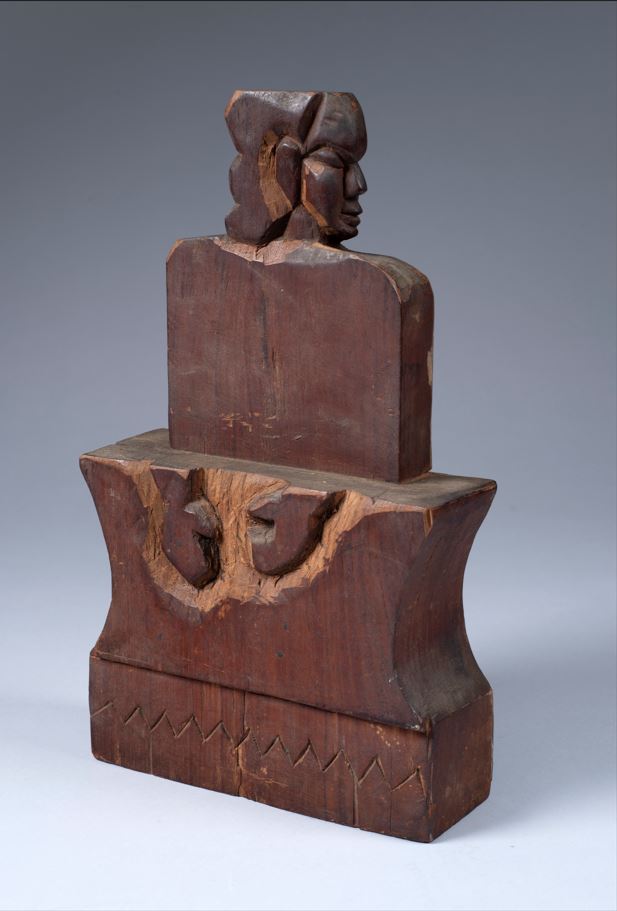
Here’s the work the press office makes available to represent Mukherjee’s mother, Leela Mukherjee. I don’t want to harp on about this too much but here again, I struggled to discern the distinctly Indian quality because the shape of the faces and the generally primitive working of the wood reminded me very much of African tribal art, such as you see in the British Museum.

Schematic Seated Figure by Leela Mukherjee (1950s-80s) Taimur Hassan Collection. Photo by Justin Piperger. Courtesy of Mrinalini Mukherjee Foundation

Gulammohammed Sheikh (b.1937)

Similarly, here are two works from 60 years later by Mukherjee’s friend Gulammohammed Sheikh, depicting (on the left) birds which might be cranes and (on the right) a kind of dragony-peacock bird, depicted in tall, narrow images which instantly reminded me of classical Chinese art. I can’t see anything Indian about them at all, they radiate Chinese shape, composition and styling.

Two paintings by Gulammohammed Sheikh 2018 to 2024 (photo by the author)

K. G. Subramanyan

K.G. Subramanyan (1924-2016) studied under under Mukherjee’s father and, according to the curators, developed into a ‘prolific artist-educator’. He rallied fellow artists to mine folk and craft traditions in unconventional ways, forging a postcolonial vision of Indian modernism. Here’s a gouache work demonstrating what this means in practice.

Untitled by K. G. Subramanyan (c.1950s) Taimur Hassan Collection. Photo by Justin Piperger © Uma Padmanabhan

Now this does have the amateurish quality I associate with modern Indian art, the very basic, child-level depiction of the human form which I saw just a few months ago in the extensive display of work by Indian artist Arpita Singh (born in 1937) at the Serpentine.

The exhibition’s long timeframe

Another challenge presented by the exhibition is the long timeframe it covers. The earliest work is from the very early 1970s whereas the most recent is from the 2020s. That’s a very long period of time. During that half century the international art world has changed out of all recognition. It has outgrown its European and American origins to become truly international. It has, for some time, promoted and valued artists from an enormous range of cultures, including many indigenous traditions such as Aboriginal art, which is now highly prized.

The patriotic, post-independence drive to create an authentic Indian art which the curators attribute as a central motivation to Mukherjee, her friends and colleagues, has long since become history. An ethnocentric perspective is now seen as reactionary and dangerous, witness liberal repugnance at the rise of right-wing nationalisms in countries around the world, including Hindu Nationalist sentiment in Mukherjee’s own India.

The modern art world floats above individual countries, in a kind of multicultural, cosmopolitan, liberal, enlightened, post-gender world of its own. So Mukherjee and her friends’ insistence on an Indian nationalist art, as well as her particular interest in the old-fashioned gender binary between phallic and vulvic forms, all seem rather quaint now.

To look specifically at Mukherjee’s work, when she began ‘sculpting’ in fabrics in the 1970s this was a radical and innovative technique, quite obviously rejecting the whole ‘carving in stone or marble’ tradition of the West. But by the time she began exhibiting in Europe, in the 1990s, it was a lot less unique. Numerous other artists were working in the same vein.

Jagdish Swaminathan (1928 to 1994)

Back to the art, here’s the example of Jagdish Swaminathan which we are given. This painting of a thin sliver of a bird singing above a mildly phallic lily plant against a big abstract yellow background is from Swaminathan’s ‘Bird, Tree and Mountain’ series. We find him in the late ’60s and early ’70s rejecting any type of naturalism, along with Western modernism, and instead returning to tribal and folk visual traditions. This probably is a good example of a non-western, Indian visual style although I’m not sure I like it. Do I not like it because it is not Western? No, because I love lots of non-Western art starting with Aboriginal art and lots of African art. It’s more that it’s like Western art but without enough real kick and originality.

Untitled (Lily by my Window) by Jagdish Swaminathan (early 1970s) Photo courtesy of Sotheby’s Inc © 2025 © J. Swaminathan Foundation

Gallery

A selection of photos I took to indicate the (sometimes bewildering and confusing) range of works on show.

Untitled by K.G. Subramanyan 1955-9

I liked this because it reminds me of something almost exactly the same I’ve seen by Paul Klee, in other words a European model or origin.

Untitled by K.G. Subramanyan 1955-9 (photo by the author)

Intertwined by Leela Mukherjee

Relatively small, crudely carved and unfinished wooden sculptures.

From left to right, Figure with Raised Hand, Intertwined Figures and Intertwined Figures II, by Leela Mukherjee, 1950s to ’80s (photo by the author)

Landscape 1968

My partner liked this because of the simplicity of the black silhouette but also the ambiguity of whether it’s some hills and a tree, as it appears at first glance, or whether the two lines dangling down in the middle indicate that it’s a human being.

Landscape by Gulammohammed Sheikh (1968) (photo by the author)

Untitled by Jagdish Swaminathan (1980)

According to the curators:

By the 1980s, Jagdish Swaminathan’s art reflected his deepening engagement with India’s tribal and Indigenous traditions. Moving away from the pristine colour planes of his earlier works, he adopted earthy palettes, textured surfaces, and symbolic forms. Shapes such as triangles and serpentine lines evoked mountains and snakes, resonant with Hindu mythologies of the god Shiva. These later canvases fuse abstraction with spiritual metaphor, recalling Swaminathan’s lifelong insistence that art should reveal nature and myth in their primal, symbolic essence.

Not knowing very much about ‘India’s tribal and Indigenous traditions’, I liked it because it reminded me of the brown abstract works my parents picked up at Heals or Habitat in the 1970s. And then of Paul Klee’s beautiful abstract shapes and patterns, which also often include gold or striking highlights.

Untitled by Jagdish Swaminathan, 1980 (photo by the author)

Also because of the rough impasto finish, especially of the two mysterious orange glyphs written across the image.

Detail of Untitled by Jagdish Swaminathan, 1980 (photo by the author)

Songspace by Nilima Sheikh (1995)

‘Songspace’ is the name of a series of scroll paintings by Nilima Sheikh, which I prefer to think of as ‘hangings’. Apparently there are ten in the series, of which 5 are hung in this exhibition in such a way as to create a kind of alcove into which you can step and be surrounded on 3 sides. Apparently the use of casein tempera paint on canvas is very distinctive and gives them their light and floating feel. Most of the surface is made up of abstract shapes, some of which may be landscapes in brown or green or red. Scattered in these shapes are wispy human figures which, apparently, reference Indian folktales, especially from Kashmir. They reference the style of classical Indian miniatures only blown up to wall size and refracted through a postmodern sensibility.

Songspace by Nilima Sheikh (1995) (photo by the author)

I liked the size, and the format of the hanging scroll, and the light and uplifting colouring but, as with most of these works, wasn’t impressed by, or was actively put off by, the scrappy amateurishness of the human figures.

Snake Column I by Mrinalini Mukherjee (1995)

According to the curators:

This terracotta sculpture is one of two ‘snake columns’ that reflect Mrinalini Mukherjee’s engagement with fertility and vitality. The cylindrical, phallic form recalls the ‘lingam’ of Shiva, while the serpent motifs and raised hood canopy reference Bankura terracotta vases dedicated to Manasa, a goddess of fertility. Like ‘Adi Pushp II’, nearby, the work channels sexuality as a generative power, fusing sacred imagery with organic, body-like forms that pulse with energy.

Snake Column I by Mrinalini Mukherjee (1995) (photo by the author)

If it as deliberately phallic as they say, then the snakes could as easily be sperm fighting their way to the front of the queue.

Forest Flame IV by Mrinalini Mukherjee (2009)

According to the curators:

In her final years, Mrinalini Mukherjee turned from hemp to bronze, creating sculptures that progressively grew in scale and ambition. Casting leaves, fronds and branches into molten form, she transformed nature into something both corporeal and otherworldly. ‘Forest Flame IV’ recalls the striking ‘Flame of the Forest’ tree of Santiniketan, which bursts into vivid orange blossoms each spring. Here, a trunk-like column erupts into flame-like petals, conflating vegetal growth with bodily emergence. Light animates the textured bronze surface, giving the work a sense of continual unfolding and transformation.

Forest Flame IV by Mrinalini Mukherjee (2009) (photo by the author)

I didn’t particularly like these because, as I said much earlier, by the 2000s, art had become so globalised, with so many artists creating so many kinds of object, that Mukherjee’s don’t really stand out. Downstairs at the Royal Academy are metal sculptures by Anselm Kiefer which are not unlike this. What made her very distinctive in the 1970s and ’80s had become utterly diluted 30 years later.

Adi Pushp II Mrinalini Mukherjee (2009)

To finish, back to what she did best, hemp sculptures. This one supposedly derives from her interest in botany and flowers and ‘adi pushp’ means ‘first flower’. But the curators go on to tell us that:

The sculpture’s central bulges and folds evoke human sexual organs, transforming the flower into a potent emblem of generative energy, and affirming nature as a vital, erotic life force.

None of which – the use of sublimated sexual imagery, the idea of sex as a central force in human nature – is at all distinctively ‘Indian’ but the common currency of humankind and any number of artworks, traditional or contemporary.

Adi Pushp II Mrinalini Mukherjee (2009) (photo by the author)

At the end of this small but sometimes confusing, sometimes enjoyable, sometimes boring, sometimes lovely exhibition, it looked less to me like a tumble of sexual organs than a comfortable-looking chair to have a nice sit-down in.


Related links

Related reviews

The 80s: Photographing Britain @ Tate Britain

Linton Kwesi Johnson

Johnson isn’t mentioned anywhere in this exhibition but thinking about the 1980s made me dig up favourite playlists, and I ended up writing most of this review listening to his great 1979 album, ‘Forces of Victory’.

Introduction

Sometimes you wonder whether exhibitions at the Tate galleries are really about art at all any more, but aren’t more like polemically woke sociology lectures, with art, photography, sculpture and other evidence used merely as illustrations for a familiar set of well-worn, ‘radical’ themes.

This exhibition contains rooms or sections devoted to immigration, race, race riots, racism, the Black Experience, the Black Body, the Queer Black Body, feminism, identity, gender, colonialism, imperialism, immigration, sectarianism, pollution and environmentalism. As you can see, these look like the topic tabs on the Guardian website or a list of fashionable humanities subjects at any modern university.

As to the lived experiences of anyone not a left-wing activist, not a feminist, not Black or Asian, and not gay or lesbian during the 1980s, these are less in evidence than the subjects I’ve just listed and where they do appear, it’s mainly to be mocked and ridiculed.

I visited with a friend and we loved the first room because it is packed with a Greatest Hits selection of political issues from the 1980s: photos of anti-racism demonstrations (by Syd Shelton and Paul Trevor), of Rock Against Racism gigs, of the Miners Strike (by John Harris and Brenda Prince), of Greenham Common (by Format Photographers), protests about Section 28 and AIDS, all leading up to the Poll Tax riots – yes, all the usual suspects, shot in vivid black and white, which took us both back to our heady student days.

But as the exhibition progressed her enthusiasm turned to puzzlement and then irritation and, by the end, she was so fed up with being lectured about identity and gender and race and queer Black bodies that she gave up. She described it as the worst exhibition we’ve been to this year and I came to agree. If you read all the wall captions (as I’m addicted to doing), it felt like being trapped in a lift full of woke humanities lecturers all talking at the same time.

‘No title’ from the series Strictly by Jason Evans (1991) Tate © Jason Evans

The central problem with this exhibition

I naively thought the exhibition would be a portrait of the 1980s, that the curators would make an honest attempt to give a balanced account of this troubled decade and the wide range of social and cultural changes it witnessed, as captured in photography – that it would be a visual history of the decade.

Very wrong. What the curators have done is to make a personal selection of just the radical photographers from the period who covered what they think are the important issues (then, as now), the disruptors, the radicals, the subversives. And, as mentioned, although they initially touch on many of the obvious issues of the time (the Winter of Discontent, Thatcher, Miners Strike, unemployment, inequality, Greenham Common, poll tax) this is not where the curators’ hearts lie.

The curators are far more concerned with contemporary woke issues of gender and ethnicity than with genuinely trying to reach back and understand what it was like to live through the 1980s, as my friend and I (and, obviously, scores of millions of other Brits) did.

The result is an exhibition which feels top heavy with the woke curatorial concerns of our own day – gender, race, colonialism, immigration, inequality – but feels like it misses out important aspects of the decade in they’ve chosen to cover.

While the wall labels are fairly neutral and factual about the political history (Callaghan government; winter of discontent; days lost to strikes; Thatcher elected; deindustralisation; working class poverty; anti-nuclear protests) the actual exhibits are utterly one-sided, with a plethora of photos, pamphlets and posters decrying the authorities, the police, the government, for their racism, lack of concern for the poor, inequality, tax and regulation changes to benefit business and the middle classes, and so on.

While all these criticisms are true, they fail to take account of the key fact of the decade which is that Mrs Thatcher was, and continued to be, phenomenally popular with about 40% of the population. Here’s how many voted for her three Conservative administrations.

  • 1979: 13,697,923 (44%)
  • 1983: 13,012,316 (42%)
  • 1987: 13,760,583 (42%)

Lots and lots of people thought Britain had gone down the drain in the 1970s, thought the Labour governments of Wilson and Callaghan were in hock to the trade unions who, despite all their promises, seemed to be continuously on strike, while all manner of public services collapsed – that Britain was becoming a failed state or Third World country.

In this narrative, Thatcher not only saved Britain from endless decline under Labour, but went on to remodel the entire economy, letting unprofitable nationalised industries go to the wall while privatising other state monopolies in order to enable international investment (for example, modernising the dire railway network or allowing greater innovation in telecoms). The deregulation of the City of London allowed British banks and investment companies to compete more aggressively around the world and become phenomenally successful. Selling council houses to their owners (as per the 1980 Housing Act) allowed millions of poor people to feel the pride and security of owning their own home for the first time. And, on the patriotic front, her staunch attitude in the Falklands War and victory against quite daunting odds, allowed tens of millions of Brits to feel proud about their country again.

I personally disagree with a lot of this or can point out the obvious criticisms of most of these policies – but 40% of the population enthusiastically agreed with it, saw the world this way, voted for her, and hero-worshipped her.

And my point is simple: None of that is in this exhibition. This is an exhibition of radical feminists, Black and Asian civil rights marchers, gay rights activists, of campaigners against race hate and misogyny and unemployment and nuclear weapons etc. It is like a collection of all the fringe groups you find at a Labour Party conference vying for the attention of those in power who are always too busy to listen, today as 40 years ago.

The large number of people who were relieved by the breaking of union power, the end of permanent strikes, the people who made fortunes in the City or found their pay doubling in newly privatised companies or suddenly owned a home for the first time in their lives or felt the government was (unlike labour) seriously backing them in the war against the IRA, all the people who benefitted from the booming North Sea oil industries in Aberdeen or working on the rigs, all the people who were encouraged by the new spirit of entrepreneurism to set up their own business and prospered – none of them are here.

To be clear, and to bend over backwards for the curators, the main wall labels which introduce each room and give the historical facts behind each theme are broadly objective historical summaries, albeit of the predominantly leftish issues they’ve chosen to discuss. It’s the selection of photos and objects which are unrelentingly one-sided, tendentious and biased and it is, of course, these which make the main impact on the visitor.

For example, the exhibition includes a photo by Anna Fox of this jokey cutout of Mrs Thatcher which has been splattered with orange or something. But to really convey the atmosphere of the decade it should have included many more images of Thatcher, including some of the terrifying ones of her at her most domineering. Now I think about it, the show could have had an entire section devoted just to images of Mrs Thatcher, showcasing all the photographic and image manipulation styles of the day, from adoring Conservative posters to satirical photomontages by Peter Kennard or photos of the Spitting Image puppet of her. That would have been interesting, funny and thought provoking but no. Just this image of the cutout spattered with soup. Disappointing. Missed opportunity. Photos of the woman who dominated a decade.

Friendly Fire, target (Margaret Thatcher) by Anna Fox 1989 © Anna Fox

The relentlessly left-wing perspective of the curators quickly comes to feel so narrow. Can it really be true that every single photographer, photographic studio or collective during the entire 1980s was vehemently left wing, concerned only with radical causes, with ‘pushing boundaries’ and ‘subverting’ all the usual suspects (gender norms, heteronormative stereotypes, racist myths etc)? Can the entire decade‘s photographic output really have been so narrow, repetitive and obsessed with the same handful of left-wing themes and issues?

Facts about the exhibition

This is a vast show: ten rooms, 16 themes, over 70 ‘lens-based artists and collectives’ are represented by over 550 art works and archive items: lots of ‘radical’ photography magazines such as Ten.8 and Camerawork; lots of posters, leaflets, handouts, Greenham Common posters and flyers and badges, anti-racism pamphlets, posters etc. It is massive. Prepare to be overwhelmed and exhausted.

No reasonable human being can be expected to fully process and assess 550 photos and objects at one go – so the curators are either assuming people will go back a second time (probably a good idea) or will hop from one section to another, or will skim through and not give anything enough attention (all too likely).

The negative affect of this jumble-sale overcrowding is exemplified by the sections devoted to the black-and-white documentary photography of two photographers I revere, Tish Murtha and Chris Killip. I raved about their depictions of dirt-poor working class communities when I first saw them in shows at the Photographer’s Gallery entirely devoted to their work, when they had a devastating impact on me. Tish Murtha, in particular, was a photographer of genius.

But here, half a dozen of their (outstanding) photos are wedged in between 6 by someone else, 9 by someone else, 4 by someone else, 7 by someone else, a section about Asian identity, another about the Black Experience, some stuff about pollution in Devon, a sequence of seaside snaps… and so on and so on until the whole thing becomes a blur. They both deserve a better environment and more respect.

Critch’ and Sean by Chris Killip (1982) Tate © Chris Killip

It’s the difference between walking through a landscape, stopping to give every tree and plant time and attention – and driving through the same landscape in a car, noticing the occasional standout feature against the general blur.

Chronological slippage

The exhibition is so huge that it overflows its own boundaries. It is everywhere referred to as ‘The 80s’ and yet the first photo dates from 1976 and the last one from 1993. That’s a 17-year spread, not a ten-year one. It feels bloated chronologically as well as content-wise.

Exhibition structure

At one point I drafted a long section comparing my own lived experience of the 1980s (including going on protest marches as a student, then living in the Brixton depicted in some of these photos, clubbing, protesting, walking through one of the Brixton riots etc) with the depictions given here but it got too long and irrelevant. Instead here is a boiled-down version of Tate’s own exhibition guide (which you can read in full here).

As you can see, the opening sections tick all the boxes, contain interesting facts and seem set fair to give you an interesting historical overview of the decade. It’s only slowly that the curators’ obsession with race and gender become more prominent and you begin to wonder, and then become irritated by, the absence of so many other things.

First a list of what is in the exhibition. Then my list of what, in my opinion, has been omitted.

1. Documenting the decade

Protests and riots from the 1976 Grunwick strike through the Miners Strike, National Front rallies met with anti-racist demonstrations, the Clash playing their famous Rock Against Racism gig in Victoria Park, the election of Mrs Thatcher and the ideology of Thatcherism, Greenham Common (obviously), the poll tax riots.

Paul Simonon of the Clash at a Rock Against Racism concert, Victoria Park, East London, April 1978, photo by Syd Sheldon/White Riot, in The 80s: Photographing Britain at Tate Britain

2. Anti-racist movements

The 1948 British Nationality Act allowed everyone born in Britain or its Empire to become a ‘Citizen of the United Kingdom and Colonies’ and tens of thousands came to fill job vacancies. Regrettably, sometimes tragically, this triggered hostility and racial discrimination, marking the beginning of decades of racist rhetoric, rioting and civil rights activism. 1968 Enoch Powell’s river of blood speech. By the mid-1970s, the far-right, anti-immigration National Front was England’s fourth largest political party. So the show has many photos of their rallies and protests by opponents (and posters, badges and flyers), including quite a few about the so-called Battle of Lewisham which took place on 13 August 1977.

Darcus Howe addressing the anti-racist demonstrators, Lewisham, 13 August 1977 by Syd Shelton (1977) Tate © Syd Shelton

Was 1977 in the 1980s? No. Why is it in the exhibition? Because this isn’t an exhibition about the 1980s: it is an exhibition about radical causes the curators support, and which had their origins in the 1970s.

Also, a bit of digging revealed that quite a few of the black-and-white protest photos in this first room are loans from the National Portrait Gallery a mile up the road. Handy. And they’re not just dusty old photos from the archive but are, in fact, star entries in the National Portrait Gallery’s Schools Hub. This includes the Darcus Howe photo and the photo of Jayaben Desai by David Mansell.

3. The Miners’ strike

In March 1984, the National Coal Board announced plans to close 20 collieries, putting 20,000 jobs at risk. The National Union of Mineworkers, led by Arthur Scargill, responded with a series of year-long strikes. Observed across England, Scotland and Wales, the strikes put industrial issues and workers’ rights on the national agenda. Many dramatic photos including the famous one of a mounted policeman wielding a baton against photographer Lesley Boulton at the Battle of Orgreave, 1984.

4. Greenham Common

On 5 September 1981, a group of women marched from Cardiff to the Royal Air Force base at Greenham Common in Berkshire. The site was common land, loaned to the US Air Force by the British Government during the Second World War and never returned. The group called themselves Women for Life on Earth. They were challenging the decision to house nuclear missiles at the site. When their request for a debate was ignored, they set up camp and the site became a women-only space. The camp lasted for 19 years although it was after only 6 years, in 1987, that Soviet President Mikhail Gorbachev and US President Ronald Reagan signed a treaty which paved the way for the removal of cruise missiles from Greenham.

Greenham Common, 14 December 1985 by Melanie Friend (1985) reprinted 2023. © Melanie Friend, Format Photographers

I smiled when the curators proudly explained that Gorbachev subsequently paid tribute to the role ‘Greenham women and peace movements’ played in this historic agreement as if they, the curators, were partly responsible for its achievements. And I also liked the implication that you should always believe what a Russian politician says.

The massive political exhibition which filled the same Tate Britain galleries before this, Women In Revolt! Art and Activism in the UK 1970 to 1990, also featured an entire room about Greenham Common. My friend jokingly suggested that maybe every Tate exhibition should have a section devoted to Greenham Common: The Pre-Raphaelites and Greenham Common. Victorian sculpture and Greenham Common.

5. Poll Tax

The community charge, commonly known as the ‘poll tax’, was introduced by Margaret Thatcher’s Conservative government in 1989 in Scotland, and 1990 in England and Wales. This flat-rate tax on every adult replaced previous taxation based on property value. The tax was accused of benefitting the rich and unfairly targeting the poor. The national anti-poll tax movement began on the streets of Glasgow and led to a series of anti-poll tax actions across the UK. Many demonstrations saw clashes between police and protestors, and resulted in rioting. The fallout from the tax triggered leadership challenges against the prime minister and, in 1990, Thatcher resigned. In 1991, following vehement national opposition, John Major’s Conservative government announced the poll tax would be replaced by council tax.

So news photos of anti-poll tax marches, some of which turned into riots, ‘ordinary people’ carrying placards, burning cars in Trafalgar Square. Ah, those were the days.

Nidge and Laurence Kissing by David Hoffman (1990) © David Hoffman

6. The Gay Rights Movement

In 1967, the Sexual Offences Act partially decriminalised sexual acts between two men. It was the result of decades of campaigning but did nothing to address the discrimination gay and lesbian communities continued to face. So photos of LGBTQ+ people protesting for equal rights.

In 1981 the UK saw its first identified cases of AIDS. By 1987 the HIV/AIDS epidemic was a global health crisis. The public focus was largely on gay men who were being infected in much greater numbers than the general population, fuelling anti-gay rhetoric in politics and the press. Queer activists organised in opposition to the resulting homophobia, as well as Conservative ‘family values’ campaigns. Do you remember some media labelling it the gay plague? Bigotry on a national scale. Lots of photos of anti-homophobia and AIDS awareness marches.

7. (Political) Landscapes

This is the first and, as it turns out, pretty much the only section which isn’t about political protest, gender awareness and Black issues. But don’t imagine it’s pretty photos of the British Isles. It, also, takes a heavily ‘theoretical’ i.e. politicised approach to its subject.

This section points out how the entire concept of ‘landscape’ is socially, culturally and politically constructed, and how the British tendency to see the countryside as cosy and reassuring often conceals the way the land has been a battlefield for rights to common land and to roam.

Also, in line with the gloomy focus elsewhere in the show, there’s an emphasis on landscapes as places of deindustrialisation and ruins, and as degraded by pollution and fly tipping.

That said this room contained some of the best sets of images, neither part of the obvious political issues of the first few rooms nor of the gender and race obsession of the second half of the exhibition. Having walked through the whole exhibition twice I found myself gravitating towards this room for the understated, sometimes elusive quality of its photos.

For example, I liked the red river sequence by Jem Southam, a set of 12 colour photos of the country around a stream in west Cornwall. None of them individually are ‘great’ photos but the fact there’s 12 of them collectively creates a great sense of location and strangeness. And the dramatic black-and-white study of a standing stone on Orkney by Albert Watson.

Orkney Standing Stones by Albert Watson (1991) © Albert Watson. Courtesy Hamilton Gallery

But the pull of politics is unavoidable. Nearby are upsetting images from the Troubles in Northern Ireland, namely The Walls by Willie Doherty, and the disturbing series Sectarian Murder by Paul Seawright. This records the sites where murdered bodies were found, after the bodies had been removed and they had returned to their normal, litter-strewn banality.

Even this apparently bucolic image by Paul Graham contains the tiny detail of a Union Jack high up in the tree which, in its little way, throws the shadow of 800 years of history across the green fields and blue sky.

Union Jack Flag in Tree, Country Tyrone by Paul Graham (1985) © Paul Graham

8. Remodelling history

Extensive coverage of radical feminist photographers Jo Spence and Maud Sulter who set out to ‘challenge photography’s sexist and colonial past’, and its relationship to class politics.

Remodelling Photo History: Revisualization by Jo Spence (1982) Tate © The Jo Spence Memorial Archive

There’s a surprising amount about these two figures, Spence and Sulter, including a separate section on Spence’s collaboration with artist Rosy Martin to develop photo-therapy. As with other Tate exhibitions, maybe there’s so much of it simply because Tate owns their archive and needs a pretext to display a decent amount of their work. (We’ll see the same is true of the unexpected prominence given to an American photographer, Lyle Ashton Harris, at the end of the show. Tate owns them so this is a prime opportunity to dust them off and display them.)

9. Black women

There’s a separate section devoted to Maud Sulter who’s quoted as saying, ‘Black women’s experience and Black women’s contribution to culture is so often erased and marginalised’, and so set about rectifying this in series of photos of her dressed up in period costume looking like an extra from Bridgerton.

Zabat, Terpsichore, 1989 from Zabat by Maud Sulter (1989) © Estate of Maud Sulter. All rights reserved, DACS/Artimage 2023. Image courtesy of Street Level Photoworks, Glasgow

10. Image and Text

A section on the use of text in photos, texts designed to amplify or undermine the central image. There is much citing of the artist and theorist Victor Burgin who, the curators tell us, was very influential during this period. He’s represented by some of his series of large, poster-sized photos which include ironical texts, titled ‘UK 76‘. 1976? But I thought this was an exhibition of photography from the 1980s? No. As with all the photos of anti-National Front marches, the Battle of Lewisham and so on, the curators bend their own rules and boundaries when it suits them. (As with the Jason Evans photo at the top of this review, and Albert Watson’s Orkney Standing Stones, both from 1991 and so spilling over the other end of the boundary.)

This section also included some big poster-sized images of rubbish new townscapes with official-sounding quotes from brochures pasted on top (which I liked very much). And it’s the section with the satirical images of office workers by Anna Fox (with mockingly ironic text) and Kroll’s sequence of posh chaps in private clubs (with mockingly ironic text) which I’ll describe below.

10. Reflections of The Black Experience

This is the biggest room in the exhibition. It takes its name from ‘Reflections of the Black Experience’ which was an exhibition held at Brixton Art Gallery in 1986, commissioned by the Greater London Council’s Race Equality Unit. It was followed by D-MAX: A Photographic Exhibition in Bristol.

Both exhibitions played an important role in the development of the Association of Black Photographers, which is now called Autograph ABP. Established in 1988, Autograph’s mission was to advocate for the inclusion of ‘historically marginalised photographic practices’. Working from a small office in Brixton, the agency delivered an ambitious programme of exhibitions, publications and events. Autograph is now one of my favourite small galleries in London, which I’ll discuss below.

There’s lots in this big room, including photos of Brixton from the later 1980s, when I lived there. The display that made the most impact on me was the brilliant series of Handsworth self portraits. This project was set up by Derek Bishton, Brian Homer and John Reardon in which they set up a makeshift studio in Handsworth, a multicultural part of Birmingham, and invited people to take self portraits of themselves. Over 500 people took part and the joy of people messing about, as solo shots, in pairs or larger family groups, is infectious. Once again, though, as throughout the show, works are included from outside the nominal time range because, well, they’re good.

Ting A Ling, from Handsworth Self Portrait, 1979 © Derek Bishton, Brian Homer and John Reardon

11. (Political) Self portraiture

You might have thought this would feature a fascinating range of self portraits by people across society throughout the ten years of the 1980s but no, this is Tate and so only a handful of social groups really count, namely radical feminists, Black activists and LGBTQ+ people. In the curators’ words:

In the nineteenth century, photography was a valuable tool for colonial powers. Ethnographic images of Indigenous Peoples and landscapes were distributed through postcards and magazines. They ‘othered’ subjects and created racist stereotypes that legitimised the mission of empire. The photographs on display here challenge this colonial gaze. They present nuanced, multi-dimensional representations of Black and Asian British selfhood.

So the self portraits in this section are entirely concerned with subverting imperialist, colonialist stereotypes. They link up with the series in the last room by Grace Lau of him or herself dressing up as types from the decade in order to subvert gender norms etc.

From the series ‘Interiors’ by Grace Lau © Grace Lau 1986

Black activists or gender activists. Little attempt to consider the myriad other types of self portrait taken outside these areas, by anybody else, at any other part of the decade.

12. Community

This room hosts series from half a dozen photographers who went to live with communities around the UK to share their experiences and create accurate depictions. Most are in black and white with a 100% left-wing focus on poverty, crappy housing, unemployment, aggressive policing and racial stereotypical. It includes outstanding photos by Chris Killip which, for some reason, didn’t hit me as hard as when I saw his one-man show at the Photographers’ Gallery. I think being set next to the work of 3 or 4 other photographers (for example, the equally as good Sirkka-Liisa Konttinen) doing more or less the same, attenuated all of them.

13. Colour photography

A room full of big, blaring, gaudy colour photos. Apparently, Britain’s first exhibition of photography taken on colour film was Peter Mitchell’s 1979 show at Impressions Gallery in York. During the 1980s technological developments continually improved the quality of colour photography and this room brings together sequences of giant colour photographs by Martin Parr, Paul Reas and Tom Wood. Because they are almost entirely very unflattering photos of very ordinary white people I came to think of it as the Chav Room or the White Trash Room (fuller explanation below).

14. Black bodyscapes

In case you didn’t get enough Blackness in the opening room about anti-racist protests, in the room about Black women or the massive room about The Black Experience, here is a room devoted to the Black Queer Experience. The assembled photographs of Rotimi Fani-Kayode, Ajamu X and Lyle Ashton Harris ‘explore masculinity, sexuality and Blackness’.

Fani-Kayode was described by Ajamu X as ‘the most visible, out, Black, queer photographer’ of the 1980s’. Ajamu X’s desire to document ‘the whole of Black queer Britain’ has been dubbed ‘Pleasure Activism’. Harris describes his photographs as a celebration of ‘Black beauty and sensuality’. The photos of Ajamu (black and white) and Fani-Koyode (moody, shadowy colour) are, in their different ways, staggeringly impactful.

Body Builder in Bra by Ajamu X (1990) Tate © Ajamu X

15. Celebrating subculture

The final room. You might have thought that a documentary look at the ‘subcultures of the 1980s’ might have covered some of the movements closely associated with ever-changing fashions of pop music such as post-punk, industrial music, Goths, New Romantics, synthpop and, later, Madchester, acid house, raves and so on. These affected how people dressed, thought about themselves, danced, partied, affected not just styles of music but graphics, album art, posters and many other types of visual content.

But no. None of that is here. Tate curators only know two subjects, race and sex, gender and ethnicity, and so they ignore all the pop cultures I’ve listed. Instead, at the mention of ‘subculture’ their thoughts immediately go to gender issues, to LGBTQ+, and to the furore surrounding the notorious Section 28 of the Local Government Act.

The wall labels go into great detail about how Section 28 prohibited local authorities from ‘promoting homosexuality’ and triggered a wave of protest from gay and lesbian communities. They tell us how Section 28 forced many LGBT groups to disband and saw literature depicting gay life removed from schools and libraries, but that it also galvanised the Gay Rights movement. People took to the streets in a series of marches and so, with thumping predictability, the exhibition ends with lots of photographs of people protesting, marches, banners etc, very much as in the first room, or the Greenham Common room, or the Black Experience room.

If you’re maybe a little bored by the subject of gay activism, tough, because not far away there’s photos by Tessa Boffin who ‘subversively reimagines literary characters as lesbians’, while nearby Grace Lau ‘documents members of various fetishist sub-cultures’.

To be crystal clear, none of this is ‘bad’ in itself, some of it is very good. It’s just that by this stage the visitor who’s been reading all the wall labels is exhausted by the curators’ obsessive harping on just the same two or three subjects to the exclusion of everything else.

End of exhibition summary

I suppose I could stop here, having given you a good summary of what there is to see and my own negative response to it. And you might be wise to stop reading here. But several things triggered me so much I needed to work them through in print.


Omitted subjects

As explained, my friend and I got increasingly frustrated as we looked for evidence of the other, non-political, non-woke aspects of the 1980s which we and millions like us like us experienced. Without trying too hard I made a list of the domestic and international events, music, style and commercial changes which I associate the decade with.

Take sport. There’s nothing about sport at all. Apparently there was no sport during the 1980s and no sports photography. Even if you wanted to ‘keep it Tate’ and make sport as political as possible, they could have mentioned the disastrous Bradford City stadium fire, the legislation which followed forcing all football grounds to become all-seated, and the resulting accusations that the sport was losing its working class fanbase and becoming embourgeoisified. And there were lots of other sporting events, highlights and scandals. But not a hint here.

Pop music. There’s one photo of The Clash performing at a Rock Against Racism gig in Victoria Park and that’s it. Nothing else: no industrial rock, post-punk, synth pop, New Romantics, no Smiths and, at the end of the decade, no Madchester, no ecstasy, no raves, no ambient music. There’s a wall of style magazines at the end, sections on the impact of, for example, i-D magazine, but somehow the curators’ focus purely on design manages to omit the extraordinary output of a decade many consider the greatest era in British pop history. Where’s Wham for God’s sake?

This was the decade when MTV arrived in the UK (1981) and its reliance on pop videos changed the dynamic of how people consumed pop. Same with cable TV generally, and the arrival of Sky TV (1984) with its crazy aerials. I appreciate these aren’t photographic but someone must have taken photographs of them and of this huge transformation of the cultural and visual landscape. Not here.

No jazz. No classical music. None. They didn’t exist during the 1980s or if they did, no one took any photos of them. Whereas I remember in the early 1980s transitioning away from pop music altogether and listening to the likes of Courtney Pine, Loose Tubes or Andy Shepherd. OK they’re not photographers, but it felt like a big cultural shift at the time and surely someone took photos of them.

World music same. Lots of young people got fed up with boring old rock music and sought new sounds from around the world. WOMAD (World of Music, Arts and Dance) was founded in 1980 and the first WOMAD festival was held in Shepton Mallet 1982. Nothing here.

Live Aid, remember that, Saturday, 13 July 1985? Not here, not a whisper, not so much of the event itself, but as the invention of really epic mass charity events which it invented. It was based around images because of Bob Geldof’s response to Michael Buerk’s reporting of the Ethiopia famine. I know that’s TV reporting, but there were lots of photographs of it (of the famine and of the concert). Why is Greenham Common included but Live Aid, which was a vastly bigger event and, arguably, more socially transformative, not? All curators are feminists. 39 iconic photos of Live Aid at London’s Wembley Stadium

Fashion photography? No. None. There’s a wall about style magazines but this is chiefly about the magazine design itself: I saw nothing recording the drastic new looks which appeared in the early 1980s, the New Romantics, Blitz nightclub, big hair, big shoulder pads which became crazy fashionable. According to this exhibition, never happened. 38 Iconic ’80s Fashion Photos.

The royal wedding On Wednesday 29 July 1981 Prince Charles married Lady Diana Spencer. It was a huge social and media event. If you think about it, royal photography is a specialised area or genre all to itself. As with Mrs Thatcher, the curators could have done an intellectually reputable section on how royal images are created, curated, marketed and disseminated, mocked and satirised. 70 Rare Photos From Princess Diana’s Wedding.

The Brighton bombing on 12 October 1984. See the relevant photos by brilliant photojournalist John Downing.

Architecture The 1980s was the great decade of postmodernism in architecture with its flagship building, Lloyds of London. Surely there were photographers specialising in the built environment across the UK and in particular this completely new look which swept across Britain? Not according to this exhibition. A Spotter’s Guide to Post-Modern Architecture.

Foreign reporting? Live Aid was of course a response to the Ethiopian famine and, in particular, the work of photojournalist Mohamed Amin, but there is no photography of events outside the UK in this exhibition. I take the point that the curators decided to limit their scope to the UK, but images of the major foreign stories of the decade were published in the UK and many taken by British photographers. So why aren’t they included here? How Mo Amin Inspired Change in Ethiopia

Chernobyl? No. No British photography of any aspect of it.

The Mujahideen in Afghanistan? Signature images of the decade were the reports on the evening news by some BBC or ITV journalist wearing a keffiyeh or pakol hat while Islamic freedom fighters fired off a Stinger missile in the background. Did no British photographers take any photos of this ten-year war? If they did, why are they excluded from this exhibition? To take one example from hundreds, the Afghan War photos of Scottish photographer David Pratt.

The fall of the Berlin Wall, 9 November 1989. That was a massive, world historic event with photos and footage beamed into every home. The curators can quote Gorbachev when it suits their agenda, when he’s praising the Greenham women, but on none of the other vast issues of the 1980s, namely the collapse of communism and the Soviet Union in which he was the prime actor.

Photos linked to film and theatre, glitz, actors, red carpets – forget Hollywood, just here in the UK? No. Didn’t happen during the 1980s. None here.

One of the biggest domestic stories of the decade was the deregulation of the City of London, nicknamed the Big Bang, which transformed the worlds of finance, banking and insurance, and made lots of people very rich, with far-reaching consequences for the British and maybe global economies. There’s text about it in the room labels but not a single image. Surely someone took photos of the changing culture in the City of London? No? Why not?

North Sea oil? Nada. Did no British photographer take photos of oil workers, Aberdeen, the creation of the refining infrastructure in that boom town? No photographer made a project of recording all this?

And what about The Falklands War (2 April to 14 June 1982) which had a seismic impact on British society and politics – footage of ships setting sail, news photos of battles, muddy paratroopers yomping through the long grass, looking shattered after a firefight, guarding nervous Argentinian captives, the celebrations when the ships arrived back in Portsmouth or Southampton? Even, if you are a Tate curator and insist on taking a left-wing view of the war, surely there was a world of anti-war photos, posters, and what not. Here are 30 Photographs From The Falklands Conflict they could have borrowed from the Imperial War Museum. But no, nothing, zip. Zilch.

Summary

Can you see why I became increasingly dismayed, and then irritated, by how many issues, events, music and fashion styles, new industries and technological innovations that were absolutely central to the 1980s the Tate curators left out because they didn’t fit their handful of woke concerns?

Omitted ethnic groups

As I’ve shown there is plenty of stuff about Black photographers, Black resistance, Black identity, Black photographic practice, Black selfhood, Black representation and much more and yet there are other ethnic groups in the UK – where are they?

From the series Revival, London by Roy Mehta (1989 to 1993) Courtesy of the artist and L A Noble Gallery

It’s not that extensive coverage of Black issues is ‘wrong’, it’s that the curators’ monomaniacal obsession feels like it comes at the neglect of all the other issues, types of people, professions and experiences alive in 1980s UK. Here are some wall labels to recreate the experience:

Frustrated by the misrepresentation of Black people in British mainstream media of the period, Zak Ové used his camera to challenge this visual discourse.

Dave Lewis‘s photographs of Black British communities in South London emphasise the diversity of experiences within these communities.

Marc Boothe‘s photographs sought to challenge traditional documentary practices and introduce viewers to a ‘Black aesthetic’.

Suzanne Rodan‘s candid shots capture moments of everyday life within Black and South Asian communities in 1980s London.

In Impressions Passing Roshini Kempadoo manipulates photographic prints to reflect how racist imagery is perpetuated in modern media.

Ajamu‘s portrait photographic series Black Bodyscapes focuses on intimate sexual desires.

Autoportrait is a series of nine self-portraits which challenge the under-representation of Black women in British fashion and beauty magazines.

Magenta Dress with Pink Tulips by Joy Gregory (1984) Courtesy of the Artist © Joy Gregory. All rights reserved, DACS

To be fair, there’s also quite a lot in the early rooms about the Asian experience, starting with the very first photos of the 1976 Grunwick strike which was triggered by Asian women walking out of the Grunwick Film Processing Laboratories in Dollis Hill. In that first room there are photos of Asians protesting about racism, against police violence (again, from the 1970s). The ‘Representing the Black Experience’ room also contains images of many Asians. The Communities room has some quieter photos celebrating Asian communities, religious festivals and so on.

Outside police station, Bethnal Green Road, London E2, 17 July 1978. Sit down protest against police racism, 1978 by Paul Trevor © Paul Trevor

I smiled when I saw the section devoted to Indian-born Canadian photographer Sunil Gupta. Gupta also has a wall dedicated to him at the Barbican exhibition of contemporary Indian art, and had no fewer than three sections dedicated to him in the Barbican’s epic exhibition about Masculinity.

Why is Sunil Gupta so popular with art curators? Because he is Asian and gay and so ticks two boxes in the curator’s diversity and inclusion checklist. No exhibition of 1980s or ’90s photography dare be without its Sunil Guptas. Now, you may love Gupta’s work but I found the photos at the Barbican and again, here, very meh. He is represented by ‘Pretended Family Relationships which juxtaposes portraits of queer couples with the legislative wording of Section 28 in order to subvert the blah blah bah. They seemed very average to me, but they are gay activism, so he’s in!

Anyway, despite the Asian presence in many of the photos, the word ‘Asian’ appears precisely once in the exhibition guide while the word ‘Black’ appears 27 times. Draw your own conclusion.

And were they any other ethnic groups in the UK in the 1980s? Apparently not. I tell you a word which doesn’t appear anywhere in the exhibition, which is ‘Jew’. Apparently there were no Jewish photographers in Britain during the 1980s and no Jews to photograph. In the ‘Community’ room there are (inevitably) Black communities, Asian communities and working class communities, but no Jewish community. Didn’t exist or no one bothered to photograph it.

In the same spirit of omission, there are no photos by or of Chinese, Arabs or Muslims. They either didn’t take photographs during the 1980s or have been omitted by the curators. Why? Hispanic communities, all the Brazilians in Stockwell, or European immigrants like the Poles, or the Somalis of Streatham, just to mention ethnic communities I live near? No. Nada.

Because feminism, Black and queer is where the money is. It’s where the academic courses and academic careers are. When I flicked through the exhibition catalogue and saw chapters titled ‘Feminist praxis’ and ‘Challenging colonialism’ I couldn’t help laughing. That’s where the money is, kids. Specialise in those areas and you’ll never be unemployed. Unlike being a trawlerman or a steel worker, being an expert in feminist praxis or post-colonial theory is a career for life.

Underground Classic (John Taylor) by Zak Ové (1986) © Zak Ové

Why Yanks?

Remember I was irritated by the lack of coverage of central events of the 1980s like Chernobyl, Afghan War, the fall of the Berlin Wall and so on while it seemed fine to have stuff about strikes or race riots from the 1970s? You could argue that those pivotal events are omitted because they’re in some sense foreign / happened abroad – which is why I was irritated by the presence of an American photographer, Lyle Ashton Harris, in the exhibition.

Why, you might well ask, are nine photos by American photographer Lyle Ashton Harris (born and works in New York) of American subjects – including one titled ‘Miss America’ – included in an exhibition about Britain and British photographers in the 1980s? Why is one entire wall devoted to four massive self portraits of the American photographer wearing bits of ballet costume?

Constructs 10 to 13 by Lyle Ashton Harris (1989) Tate

Because 1) Harris is Black and queer and, with Tate curators, Black or Queer trumps all other considerations, including the criteria of their own exhibition.

Because 2) America is like heroin to art curators. Everything ends up being about America.

And because 3) it turns out, after a bit of digging, that Tate owns these big Lyle Ashton Harris photos and so, like the room devoted to extensive coverage of Jo Spence and Maud Sulter – whose archives Tate also owns – it’s a good example of the way exhibitions are created around what a gallery already owns, or what curators can cheaply get their hands on, rather than an accurate, objective exploration of the nominal subject matter.

Conclusion

I hope you can see now why I told you this is very much not a photographic history of Britain in the 1980s – it is a selection of ‘radical’ left-wing, feminist, politically committed Black and Asian or LGBTQ+ photographers who were working from the late 1970s through to the early 1990s, some of whose work touches on social or political issues from the time, but a lot simply doesn’t. Unless you consider gay pride or feminism or anti-racism as uniquely 1980s phenomena – which, of course, they very much weren’t and aren’t.

Photos of the white working class

Amid the radical deconstructions of colonialism and the subverting of heteronormative stereotypes and celebrations of the Black Queer Body, there are some powerful photos of British working class life. Two of the best photography exhibitions I’ve ever been to were of Tish Nurtha and Chris Killip at the Photographers’ Gallery in Soho, and both are represented here by half a dozen or so photos of supernatural power. In this vast show they were, however, swamped by so many other images along similar lines, and so neither of them had the devastating power of their Photographers’ Gallery shows.

There’s a set of vividly squalid colour photos by Paul Graham of the unemployed waiting like souls in hell in smelly 1980s job centres. Ken Grant took grim photos of working class people in and around Liverpool. There’s an excellent set of black-and-white photos of working class white people on the Meadow Wall Estate in North Shields taken by Finnish photographer Sirkka-Liisa Konttinen.

Apparently it was in the 1980s that the phrase poverty porn was first used and, somehow, having so many series of stark black-and-white photos of poor people living in squalid or sad circumstances, demonstrated the law of diminishing returns. They began to seem rather samey. Again, this feels like an example of poor curatorship.

Photos of the white middle class

And what about the middle class people, the political, cultural and demographic centre of the United Kingdom? Not just the 13 million who consistently voted for Mrs Thatcher but all the people who made up the bulk of the population: the accountants or lawyers, doctor and dentists, people running family businesses or working at big corporations, the police and fire and ambulance services, people who worked in local government, the social services, in thousands of care homes, in the hundreds of thousand of charities, ordinary people? Not Black or gay or radical feminists or horribly impoverished Brits, but run-of-the-mill, ordinary people like the hundreds I saw visiting this exhibition, people like you or me?

Well, it was hard to not to conclude that these kinds of people, what you could call the white bourgeoisie, appear in this exhibition solely to be mocked and ridiculed. Anna Fox is represented by a series titled Work Stations which satirises people working in London offices. These are horribly vivid colour shots of ordinary office workers captured in the most awkward and unflattering poses, accompanied by ironic captions pinched from business articles and magazines in order to take the piss out of them and their values. Here’s a prime example. The text under the photo reads ‘Fortunes are being made that are in line with the dreams of avarice’, from Business magazine 1987.

Work Stations, Café, the City. Salesperson by Anna Fox (1988) © Anna Fox. The Hyman Collection, Courtesy of the Centre for British Photography

Next to Fox is the Old Master of colour photodocumentary, Martin Parr, represented by works from his ‘Cost of Living’ series (1986 to 1989). Parr felt the kind of people he mixed with, the comfortably-off middle class, had been systematically under-represented by 1970s and ’80s photography, so he set out to depict them. So he simply went along to art gallery openings, garden parties, Conservative party fetes, and photographed the people he saw. Because it’s Parr deploying his customary, unforgiving colour technique, all these people come out looking extraordinarily awkward and ugly, just like the people in the Anna Fox series.

The mere fact that an expert on contemporary photography believed that this huge tranche of the British population, the middle classes, the inhabitants of Middle England, was under-represented in his medium speaks volumes about the narrow ideological focus of the photography of his day. And the way both Fox and Parr’s photos are described as ‘satirical’ confirms how this huge class of people have become, as pictorial subjects, almost an outsider group in their own country.

Installation view of the ‘satirising the white bourgeoisie’ corner at ‘The 80s: Photographing Britain’ at Tate Britain, with the Anna Fox sequence at the back, Martin Parr on the right. Photo © Tate (Jai Monaghan)

Near to the Parr ‘mocking the middle classes’ photos is a selection of 9 photos from the 26 in the famous series Gentlemen by Karen Knorr. Knorr was given permission to photograph the very posh members of the most exclusive gentlemen’s clubs in London’s St James’s district. Beautifully staged and shot, she then ironically undercut the images with texts taken from news reports and parliamentary speeches (just as Fox had done with her office workers). Again, the aim is to mock and satirise.

It’s hard to avoid the conclusion that all of the depictions of the English middle classes in this exhibition are associated with irony and satire. Now, nobody takes the mickey out of the Black or Asian or women subjects – they are all portrayed as dignified or joyous or righteously angry. But posh white people? Look at the ugly, rich, privileged wankers air kissing, answering phones, stuffing their faces!

The Colour Photography room gives interesting explanations of the technological developments which made colour photography cheaper and better – but it, also, flays its white subjects mercilessly. It includes another series by Parr, his famous seaside scenes, The Last Resort, in which everyone is captured in bright colour with unforgiving candour.

Next to them are half a dozen similarly merciless photos of very ordinary people in Welsh supermarkets by Paul Reas. Like Parr’s photos, like Fox’s series, these seem so pitilessly unflattering as to be actively cruel. The Photography of Cruelty. Or maybe just mockery. Look at the poor white chavs.

Hand of Pork, Caerphilly, South Wales by Paul Reas (1988) © Paul Reas. Martin Parr Foundation

White trash, Black gods

The humiliation of white chavs and poshos in Parr and Fox and Wood’s photos is emphasised by the way that, in the rooms directly before and after them, Black people are depicted in stylish black-and-white photos which make them look dignified, noble or even godlike.

In the room before the white chavs is this set of serious, searching portraits made by Pogus Caesar. They were taken on an Ilford HP 5 camera using 35mm film to achieve a rich grainy effect as he travelled round the country taking shots of people in the street, as far as I can see, solely Black people. They’re really good. Stylish and atmospheric, they dignify and enrich their subjects.

Installation view of ‘The 80s: Photographing Britain’ at Tate Britain showing ‘Into the Light’ by Pogus Caesar (1985 to 89) (photo by the author)

The room after the white trash room is the one titled ‘Black Bodyscapes’, the one featuring photos by Rotimi Fani-Kayode, Ajamu X and Lyle Ashton Harris, photos which ‘explore masculinity, sexuality and Blackness’. I dare say these are important issues to the curators but to the ordinary visitor what you see is a set of spectacularly buff Black male bodies. Wow! Gorgeous, hunky men in prime physical condition, what’s not to lust after?

The Golden Phallus by Rotimi Fani-Kayode (1989) © Rotimi Fani-Kayode / Autograph ABP. Courtesy of Autograph ABP

(I first encountered both Rotimi Fani-Kayode and Ajamu X at the drolly titled A Hard Man is Good to Find! exhibition at the Photographers’ Gallery, and loved them both. I dare say they’re exploring this issue and subverting that stereotype but they are also extraordinarily sexy pictures of beautiful male bodies.)

Anyway, it’s impossible to miss the stark contrast between the dignified Black people in Pogus Caesar, the stunning Black nudes of Fani-Kayode and Ajamu X, and the 15 or so images of the pale, pasty, fat, badly dressed white people captured by Wood, Parr and Reas in the Chavs Room. Step into the Black room to be thrilled. Then back into the white room to be appalled. This isn’t a contrived comparison. The two rooms are right next to each other. They make for an unavoidable and extremely powerful visual contrast.

Autograph ABP versus Tate

Autograph ABP in Hoxton specialises in photography by Black photographers from around the world and is maybe my favourite small gallery in London. Everything I’ve ever seen there has been outstanding. It is a centre of photographic excellence and I was interested to read about its history in the ‘Representing the Black Experience’ room here in this show.

But it also made me wonder, why do I love Black photography at ABP but bridle at the exact same work when it is shown here in Tate Britain? Three reasons. 1) The attitude of the curators. At ABP it is taken for granted that the work is by Black photographers. There may be some stuff about combatting racism, if relevant, but quite often the labels just explain the specifics of the particular project. The ABP curators treat their artists and visitors with respect, as if they’re grown-ups.

Whereas Tate curators can’t stop haranguing their visitors about the horrors of racism and colonialism and the white gaze, as if we’re first year arts students who need to have all the evils of the world explained to us in a tearing hurry. The photographers’ Blackness or queerness becomes the primary thing about them.

This is what I meant be saying the Tate curators treat their artists and works as specimens in extended lectures on their handful of woke topics, about the evils of capitalism and colonialism and racism and sexism, explaining all these issues in words of one syllable or less as if it’s the first time their visitors had ever heard of such things.

So I’m not bridling at the photographers or their works. In other contexts I’ve really loved many of them. I’m reacting very negatively to the patronising tone of Tate’s curators.

2) Individually, many of the works here are great but something negative happens when a load of works by different photographers are all bunched together in a room demonstrating a thesis. So, for example, when I first saw Rotimi Fani-Kayode’s photos, I read the captions about the queer sensibility and undermining stereotypes of Black male sexuality etc, but I also responded to their plain weirdness. To what they look like. These are strange, disconcerting, haunting images which trigger responses beyond the verbal or easily expressed. They did what all good art does which is take you to strange places in the imagination, open doors you didn’t know were there.

But here, lumped together in one room, they feel subservient to the curators’ concerns to lecture us all about the Black Queer Body. This is what I mean by turning art into specimens, pinned like butterflies to a board to make a point.

3) Bulk. Volume. Sheer number. Same point I made about Tish Murtha and Chris Killip. Seen by themselves, their work felt seismic. Bundled together with half a dozen photographers working on the same subject (dirt-poor white communities), and making the same point (Thatcherism, inequality, poverty = bad), a lot of the power and individuality leached out of them.

Message to the curators

  1. Less is more.
  2. If you’re going to group lots of artists together, doing it by their most obvious feature (feminists, Black, queer, working class) tends to diminish their individuality and impact. Think of more imaginative, left-field ways of arranging them. Try to create surprises.
  3. If you claim your exhibition is about a subject, please make an effort to make it fully and adequately about that subject and don’t just restrict it to the handful of woke subjects dear to your hearts plus chucking in some archives you happen to own. Make it about the world, not just the same three curator obsessions (gender, ethnicity, class).

Yet another conclusion

So you can see why, by the end, I was fed up of being lectured about the wonders of queerness and feminism and the Black body and post-colonial identity, and deeply disappointed that so much of the actual history of the 1980s, the global incidents or – just to restrict it to the UK – the key social and media events, and the changing face of technology, music and style which meant so much to me personally, had simply been left out.

This is why the friend I went with thought it was the worst exhibition we’d visited all year: because of its glaring omissions of loads of the things we liked and remembered about the 1980s, because of its systematic rewriting of cultural history to be only about radical left-wing artist-activists, because of its flagrant political bias, because of its mockery of the white middle class which (I’m afraid) I belong to (just like everyone else I saw visiting this show) but, above all, because of its terrible, terrible narrowness of vision.

Well, I’ve given you a strong flavour of my own negative reaction to the thing, but I’ve also tried to give an accurate summary of the exhibition structure, objective summaries of all the rooms, and a good selection of the images, along with the curators’ own words.

This is a massive, exhausting and deeply problematic exhibition – but there’s lots of very good stuff in it and maybe you’ll have a completely different response. Go along and make your own mind up.


Related links

Related reviews

Expressionists: Kandinsky, Münter and the Blue Rider @ Tate Modern

This is an outstanding exhibition, a massive review of one of the great movements of modern art, with plenty of fascinating cultural context, some questionable digressions, and three novel ‘immersive’ rooms.

The exhibition is titled ‘Expressionism’ but really focuses on a subset of that broad German art movement. A quick skim through any article about Expressionism tells you that arguably the first Expressionist group was Die Brücke (The Bridge), formed in Dresden in 1905 by Fritz Bleyl, Erich Heckel, Ernst Ludwig Kirchner and Karl Schmidt-Rottluff, later joined by Emil Nolde, Max Pechstein, and Otto Mueller. None of these artists appear in, or are mentioned, in this exhibition.

Instead the Tate show focuses on the second circle of artists associated with the term, the group based around Russian lawyer-turned-artist Wassily Kandinsky who, in 1909 set up the New Artists’ Association of Munich (NKVM), and in 1911 published an artistic manifesto in the shape of The Blue Rider Almanac and so came to be called the Blue Rider group. (The story used to go that this was named after a 1903 painting of the same name by Kandinsky, although there’s an alternative story that BR co-founder Franz Marc liked horses and Kandinsky liked riders [specifically, knights on horseback] and they both found the colour blue deeply symbolic.)

Tiger by Franz Marc (1912) Lenbachhaus Munich, Donation of the Bernhard and Elly Koehler Foundation 1965

Both groups had 15 or so members but this exhibition focuses on a handful of them, namely:

  • Wassily Kandinsky
  • Gabriele Münter
  • Franz Marc
  • Marianne von Werefkin
  • August Macke
  • Lyonel Feininger
  • Alexej von Jawlensky
  • Paul Klee

The first four, in particular (Kandinsky, Münter, Marc, von Werefkin) form the core of the show, works by them appearing in virtually every room.

The exhibition’s ten big rooms are in loose chronological order so one aspect of strolling through them is to watch the development of these major artists. The two central figures are very clearly Kandinsky and Münter, the earliest members and most powerful presences.

Wassily Kandinsky (1866 to 1944)

The leading figure by number of works is Kandinsky and the exhibition allows us to watch his evolution as an artist through a series of extraordinary masterpieces. Kandinsky needs little commentary, he is one of the great wonders of early modern art. We start with the beautiful, fairy tale richness of ‘Riding Couple’:

Riding Couple by Wassily Kandinsky (1906-1907) Lenbachhaus Munich, Donation of Gabriele Münter, 1957

Then see works which are increasingly ‘abstract’ but in which you can still just about make out the subject, such as The Cow (1910):

Installation view of ‘Expressionists Kandinsky, Munter and the Blue Rider’ at Tate Modern 2024 showing ‘The Cow’ by Wassily Kandinsky. Photo © Tate (Larina Fernandes)

And then onto the works in which he slips the shackles of realism and creates a new kind of painting in which the colours are designed to reflect spiritual truths, human feelings, triggering and capturing new emotions.

‘Improvisation Deluge’ by Wassily Kandinsky (1913) Lenbachhaus Munich, Donation of Gabriele Münter, 1957

What I noticed this time round is that there is an OCD business about his paintings. Whether it’s the magical pointillism of the early works or the abstraction of the last ones in the show, a Kandinsky painting is always busy, with lots of lines and colours and dabs and lines.

Gabriele Münter (1877 to 1962)

Kandinsky is closely followed in the number of works included by Gabriele Münter. In fact if you count her photographs (see ‘Ethnicity’ below) she is the most represented artist here.

Münter’s style feels well established from the start. This picture, ‘Listening’, captures one of the many evenings the friends spent sitting round, drinking, smoking and talking about art and spirituality to the early hours.

‘Listening (Portrait of Jawlensky)’ by Gabriele Münter (1909) Lenbachhaus Munich, Donation of Gabriele Münter, 1957 © DACS 2024

In the caption to it, Münter is quoted as saying:

‘Those who look at my paintings with close attention, will discover the draftswoman in them. Despite their colourfulness, they boast a firm graphic framework. Mostly, I draw my paintings with a black brush onto the board or canvas before I add the colours.’

This was pretty obvious already, but this quote really drives it home and explains the strikingly clear, almost stark outlines which characterise all her work, for example in one of the best images of the show, her portrait of the ubiquitous Marianne von Werefkin (strong black outlines, coloured in).

Portrait of Marianne von Werefkin by Gabriele Münter (1909) Lenbachhaus Munich, Donation of Gabriele Münter 1957 © DACS 2024

Münter lived to a ripe old age and in the 1950s gave interviews cheerfully describing the lives of these friends and innovators, what they talked about, how they developed their theories and so on. In particular, she gives a quote which gets to the heart of the entire movement.

‘After a short period of agony, I took a great leap forward, from copying nature – in a more or less impressionist style – to feeling the contents of things, abstracting, conveying an essence.’

There you have it: the Great Leap Forward from the Old World (copying nature in an Impressionist manner) to the Brave New World (trying to convey not what is there, not what you see, but how what you see makes you feel).

The quote made me realise that the word ‘abstract’ has numerous meanings. As an adjective, it means not relating to concrete or specific things in the world and so is a category of thought, and it’s in this sense that it’s used to describe the various schools of ‘abstract’ painting i.e. not depicting anything in the real world. But the phrasing of this quote made me realise that it is also a verb, that ‘to abstract’ something means to extract or remove something – and that this connotation hovers over Münter’s words. By using primary colours in an unnaturalistic way, her paintings remove or extract from a scene its deeper meaning or feeling.

Münter (as far is this exhibition is concerned) never took the last, bold step into total abstraction, which Kandinsky did and which is why he is the more important figure in art history. She continued to paint (on the evidence here) easily recognisable landscapes and people. But what The Great Leap Forward meant for her is that she ceased worrying about painting what was in front of her looked like, and liberated herself to paint how what was in front of her made her feel. The result is a stream of works which are less flashily dramatic than either Kandinsky or Marc but every bit as wonderful. I just loved this piece to bits because, to my mind, you can feel the excitement of an artist set free from the old constraints. A new way of feeling.

Jawlensky and Werefkin by Gabriele Münter (1909) Lenbachhaus Munich, Donation of Gabriele Münter 1957 © DACS 2024

Franz Marc (1880 to 1916)

Marc isn’t as present as either Kandinsky or Münter in the first half of the exhibition but comes into his own in the big Room 8 which is packed with masterpieces. In particular it features his breath-takingly masterful images of animals, including The Tiger (at the start of this review), the image of a doe hunkering down in a rainstorm, and this wonderful, lovely, life-affirming painting of happy cows. The world needs more happy cows.

Cows, Red, Green, Yellow by Franz Marc (1911) Lenbachhaus Munich

The joy comes through partly in the unlikely image of the dancing cow but mostly in the uninhibited use of the boldest most vibrant colours. (Also note the absence of the strong black outlines which characterise all of Münter. In this respect, I suppose there’s a heavy squat thereness about Münter’s paintings, whereas the lack of strong outlines, the way Marc just leaves it to the colours themselves to define objects, contributes to his sense of wonderful lightness and energy.)

Modern sensibilities: gender and race

If I am always going on about gender and ethnicity in my exhibition reviews it’s simply because modern curators make them the central issues of their exhibitions, so I am simply reflecting what I read (see the slavery show at the Royal Academy, the feminist exhibitions Women in Revolt and Now You See Us at Tate Britain and Judy Chicago at Serpentine North, the post-colonial works of Yinka Shonibare CBE at Serpentine South, and so on and so on).

Thus some visitors might be surprised that the wall labels of the first three rooms contain so many references to ‘gender’ and ‘race’:

Room 1 displaying photographs Münter took on a visit to America:

In other photographs she reflects on social subjects including gender, racial tension in the southern USA, and economic inequalities.

Room 2 describing the group which was to form the Blue Rider:

The collective included women artists and those exploring their gender identities.

The painting belongs to a series featuring Sacharoff in crossdress, exploring gender fluidity through art and performance.

The strong facial features, direct assertive gaze and use of bold colours [in Werefkin’s self portrait] play with traits associated with masculinity employed to confront gender stereotypes of the time.

And that the exhibition goes on to feature entire rooms devoted to gender fluidity, post-colonial criticism, and cultural appropriation.

But this is where we are now. Contemporary art discourse is soaked in concepts and terms derived from sociological discourse around gender, race and ethnicity, colonialism and imperialism, and all aspects of ‘identity’.

Art, even art of the past, is no escape from these contemporary ideologies. The reverse: all art exhibitions and their curators nowadays not only have to take account of old-style feminism (pretty old hat by now), but:

  1. of new-style concerns about gender stereotypes, gender binaries, gender roles, gender fluidity, non-binary identity, heteronormativity, the male gaze and more
  2. have to be sensitive to all the concerns and terminology generated by decades of post-colonial theory the easiest of which to grasp is ‘racism’, accompanied by newer terms like Eurocentrism and the Eurocentric gaze
  3. have to be sensitive to accusations of cultural appropriation, which means that if you paint anything that is not from your own exact culture you run the risk of being accused – as the Blue Riders are accused here – of being patronising and exploiting folk craftspeople and of cultural appropriation

Since the curators repeatedly invoke these ideas, and devote an entire room to gender identity, I am simply reporting what is here. Let’s look at these three topics more closely.

1. Gender

Here’s the curator’s introduction to Room 5, ‘Performing Gender’. As usual I quote the curators’ words at length so you can capture for yourself every nuance of their meaning and it’s not filtered through my words or interpretation:

Traditionally, theatre and performance offered safe environments for the exploration of sexuality and gender. Performers could switch gender and power roles, and engage with transgressive themes. Artist and patron [Marianne von] Werefkin was attracted to the free arts of street theatre and popular entertainment for their freedom of expression and potential to disrupt the highly regulated social structures women were confined to.

Werefkin experimented with expressionist painting while also grappling with questions of identity. This included navigating the legal and social barriers of gender inequality. Her privileged upbringing and financial independence allowed Werefkin to assume a position of power, acting as patron and supporter of the arts – a field traditionally monopolised by men. In this period, such women were given the pejorative label ‘manwoman’ to denote their being ‘unnatural’, members of a ‘third sex’. This perspective was critically explored in the writing of contemporary philosopher and minority rights activist Johannes Holzmann.

Resenting gender binaries, Werefkin stated: ‘I am not a man, I am not a woman, I am I.’ She shared affinities with artists challenging traditional gender roles. This is reflected in her support of performer Sacharoff. Presenting androgynously both on and off stage, Sacharoff explored gender fluidity through new styles of performance that activated form through free movement. Believing that dance resembled music or painting, Sacharoff said: ‘In the art of dance the body must be an elaborate instrument capable of expressing the soul. In this sense, it must be as valid as the word, the sound and the colour’. Performance was central to both Werefkin and Sacharoff’s investigations and constructions of self-identity.

The room features three big photographs of Sacharoff dancing, plus a display case of Werefkin’s notebooks, and then Werefkin’s big blue painting of Sacharoff.

‘The Dancer, Alexander Sacharoff’ by Marianne von Werefkin (1909) Fondazione Marianne Werefkin, Museo Comunale d’Arte Moderna, Ascona

Of this painting the curators write:

Sacharoff entranced audiences with ground-breaking free-movement performances, radically disrupted gender norms by performing in women’s or gender-fluid outfits. Sacharoff also assumed an androgynous off-stage and in social life. Werefkin’s portrait of the dancer in the role of Salome is a powerful celebration of the body, transgressing the sexualisation of the male gaze. Rejecting both traditional and modernist modes of bodily representation, she presents an empowering image of that challenges the turn-of-the-century’s societal norms and expectations.

When I was young, men dressing as women, or adopting sexually ambivalent personas, especially in the worlds of ballet and dance, were well known enough and casually accepted by anyone sympathetic to the arts. Not long ago I went to an exhibition about David Bowie, whose debt to dancer Lindsay Kemp was freely acknowledged back in the 1970s. The adjective ‘androgynous’ was routinely applied to Bowie in the early 70s i.e. 40 years ago.

What feels completely new is the curators making such an immense song-and-dance about it, as if this Russian guy dressing as a woman, sporting a woman’s haircut and makeup, was such a centrally important part of the Blue Rider movement that it requires a room of its own to celebrate it.

This struck me as evidence of contemporary curators’ concerns (obsessions) rewriting and reprioritising what you could call ‘the facts’ of the historical record. For example, later in the show they mention the intense spiritual and religious concerns of Kandinsky and Marc, but don’t properly explore them. If you read other accounts, the diaries and letters of the group, you discover that they spent all their time debating a whole range of spiritual and religious issues, from theosophy to Buddhism. The curators mention these interests but don’t give them anything like the centrality they had to the actual artists.

Instead, what lights their fire are the modern turbo-charged issues of gender stereotypes, gender binaries, gender roles, gender fluidity, non-binary identity, subverting gender stereotypes and societal conventions. Thus in the third paragraph of the curator text for the ‘Performing Gender’ room, you’ll notice they include a quote from Sacharoff himself, saying:

‘In the art of dance the body must be an elaborate instrument capable of expressing the soul. In this sense, it must be as valid as the word, the sound and the colour’.

The key word in this quote is soul but you can see how the curators skip over this, don’t pick up on it, and instead surround it with no fewer than eight references to their own concern, gender issues. The Blue Rider artists’ concern with spirituality isn’t concealed – it’s mentioned in half a dozen places – it is merely eclipsed by the power and charge of the new ideology.

I’m not really bothered by this – as an old member of the Campaign For Homosexual Equality I’ve been a lifelong supporter of the kind of gender liberations they’re talking about. What I find fascinating is the way this intense focus on ‘identity’ (not just sexual but racial, too) has become the central concern of progressive artists, curators, academics and commentators and eclipses all other issues.

Also I’m not that bothered because this is the way culture works. Each new generation has it own concerns and interprets the record of the past (not just the artistic record but the immense record of all human events which we call ‘history’) in the light of these new concerns, and each new generation of scholars, academics and curators reads the past, and projects onto the past, the concerns of the present.

What fascinates me so much about the Tate curators’ editorial decisions and the wall labels justifying them. is that they make this generational, cultural shift so evident.

For me, as an old lefty, it feels like the worldview I grew up in which was concerned with inequality, extremes of wealth and poverty, economic exploitation, which routinely deployed a lexicon of rhetoric around socialism, communism, revolution, nationalisation, trade unions, redistribution and so on, has been completely superseded by this new progressive lexicon concerned with 1) gender stereotypes, gender binaries, gender roles, gender fluidity, non-binary identity, and 2) parallel concerns with race and ethnicity, tied to the red button topics of immigration and refugees.

So to summarise, for me, when I read wall labels like this, I don’t think I’m learning much new about the ostensible subject (one of the members of the Blue Rider group was a Russian dancer who liked dressing as a woman) but I am experiencing a kind of generational shift in discourse and political concerns, away from the hard political and economic concerns of the 1970s and 80s into the new world, the world we now inhabit, which is drenched in super-sophisticated terminology about gender and identity to such an extent that it overshadows or completely eclipses all the other issues raised by the subject, even the ones which the artists themselves said were central to their lives and thinking.

Back to the art: Werefkin

I didn’t like Werefkin’s paintings. I thought they were crude and amateurish next to the works of the big three (Kandinsky, Munter, Marc). When you compare the photos of Sacharoff with this painting, you see how poor it is – not vividly inventive and visually revolutionary like the Big Three’s work, but just scrappy and amateurish.

Nonetheless, Werefkin features very heavily in the exhibition, is references more than Paul Klee, Lyonel Feininger and August Macke put together. So many of her works are included maybe because 1) she was a consistent organising presence in the group, partly as a rich patron. But also because 2) this exhibition is consciously downplaying the male members and deliberately foregrounding and emphasising the women members of the group (see below). And further, because 3) Werefkin pushes all the up-to-the-minute buttons about gender fluidity, trans men and so on. Here’s another of her paintings.

Self-portrait I by Marianne von Werefkin (about 1910) Lenbachhaus Munich

Actually this one is rather good, but most of her other works here aren’t as successful. Go and make your own mind up.

2. Ethnicity and colonialism

To my surprise Room 4 is nothing to do with art or painting but entirely devoted to photos taken by Münter on an extended trip she and Kandinsky made together to Tunisia.

Münter’s Tunisian photographs were taken during her and Kandinsky’s trip to North Africa in December 1904 to March 1905. During French colonial occupation (1881 to 1956), Tunisia became a popular tourist destination for Europeans. Following established routes, Münter produced her second largest group of photographic works. Marking the start of a period of active artistic experimentation, she explored new forms of expression using traditional media (painting, embroidery and reverse glass painting) alongside new technologies (photography and linocut prints).

Münter’s architectural imagery demonstrates her interest in depicting the simplified, abstracted essence of a scene. They also reveal her occasional engagement with the established European visual culture of orientalism. This genre of painting and photography tended to depict places and people in North Africa and West Asia in reductive, stereotypical and exoticised terms.

Some images reflect Münter’s broader curiosity and engagement with modern Tunisia as an outsider. She captures a range of scenes including photographs of women in different roles – as mothers, travellers, camel riders and active participants in city life. These photographs counter the orientalist trope of women as odalisques – sexualised depictions of enslaved women. They also reveal the complexities of a colonial capital in a way that doesn’t appear in contemporary orientalist paintings.

This seemed a very odd decision. None of these photos really feed into her subsequent paintings, which are overwhelmingly portraits or landscapes of German rural scenes. Choosing to devote an entire room to Münter’s photographs felt to me designed to hit two nails on the head: One is the modern feminist curator’s compulsion to restore women to the narrative of art history. I wouldn’t be surprised if this trip to Tunisia features in standard biographies of Kandinsky and so the curators chose to tell it, but from the point of view of the woman. This obviously fits with the same feminist, restore-women-artists-to-the-record imperative at work in Women in Revolt and Now You See Us at Tate Britain.

But the room also goes out of its way to introduce questions of colonialism, exploitation and race into the exhibition which, otherwise, I don’t think would really crop up, for why would they in a show about a handful of Bohemian artists living in rural German towns quietly painting the scenery? None of them made a habit of painting oriental odalisques so this room felt like an odd digression, fuelled solely by the modern curator’s need to say something about colonialism and racism.

This motive, concern (or obsession) explains the rather odd final paragraph introducing Room 3 which is supposedly setting the historical context of turn-of-the-century Munich where the Blue Rider artists first met. Its ostensible purpose is to give a background to the government of newly unified Germany in the 1870s and 80s.

The government embraced imperial and colonial ambitions including the exploitation of people and resources overseas. Public fascination with world cultures was underpinned by racist narratives and cultural and ethnic hierarchies of imperialism. These perspectives were reinforced by staged public ‘ethnographic exhibitions’ and displays at museums across Germany.

I don’t think we particularly need to know any of this in order to understand the Blue Rider artists, but the curators very obviously need to tell us. It’s part of the new ideology in which even the slightest hint of imperial or colonial involvement must be dragged into the full light of day, described at length, and utterly condemned by curators concerned to tick every box on their Diversity and Inclusion checklist. You can almost see the boxes being ticked off, one by one. Deplore gender inequality, tick. Support trans people, tick. Condemn imperialism, tick. Outraged by racism, tick. (I’m not being that satirical. I work at a big government agency. We have Diversity and Inclusion checklists and mandatory diversity and inclusion courses we have to go on.)

As to Münter’s photos, they’re OK, some of them are pretty good, but nothing to write home about. It’s revealing that the press office don’t included any in their press pack and none of them are on the exhibitions web pages. No – because people have come to see the paintings. The main impression I got from them was how little has, apparently changed. Some of them looked like they could have been taken yesterday.

3. Cultural appropriation

‘Room’ 7 is the name given to the narrow corridor in the Tate Modern layout linking small Room 5 (Performing Gender) and the massive Room 8, the one containing masterpieces by Marc and Kandinsky, in particular. This narrow passage is tailor-made for display cases more than pictures hanging on a wall, and here it is used to display half a dozen examples of the kind of naive folk art from the rural regions around Munich, specifically the idyllic market town of Murnau where Kandinsky and Münter lived from 1909 to 1911 and and which they, especially Münter, liked to include in their paintings, especially still lives.

Thus there’s a still life by Münter, ‘Madonna with Poinsettia‘ (1911) alongside the actual wooden statuette of the Madonna which features in the painting. Cool. And the other cases contain other craft objects which feature in various of their works.

However, these days no work of art goes unpunished and so the curators use this mildly interesting and, you’d have thought, fairly harmless little display, to spank both the artists and, by implication, the naughty gallery goer who just likes this kind of thing without asking the difficult questions required by their post-colonial studies tutor. Because the artists’ habit of collecting objects made by local craftsmen turns out to be far from innocent:

Objects produced by local and international artists and craftspeople who were not academically trained were perceived by European modernists as ‘unspoiled’ and ‘authentic’. When shown in modernist exhibitions and illustrated in publications these works were often presented anonymously and removed from their original context. They were showcased purely for their stylistic qualities, artistry and boldness of colour.

The curators don’t use the phrase ‘cultural appropriation’ but they don’t have to. Torn from their cultural context, unattributed to the people who made them, patronised as ‘unspoilt’, these objects now have to be regarded through the half century of post-colonial discourse which nowadays throngs the humanities.

If you haven’t completed your reading list of post-colonial theory, tut tut, why not?

The Tate family of galleries provide an outstanding service, all round the country, of curating, presenting, and introducing the best of world art in beautiful settings, with all manner of helpful introductory videos and tours and books and so on. But you can’t help feeling that very often visiting one of their exhibitions is like walking through a series of Guardian editorials or walking into a sociology seminar at university to discover you’re the only white male in the room and everyone is looking at you accusingly. In the old days you visited an exhibition to be informed. Nowadays you are more likely to be lectured.

Evidence from Amazon

I was toying with buying the exhibition catalogue on Amazon (£35 at the exhibition, £22 on Amazon) when I was struck by several things which confirm the interpretation I’ve just given. One is that the brief book summary provided by the publisher mentions Alexander Sacharoff’s freestyle dancing and Gabriele Münter’s photographs before any actual painting, and doesn’t mention Kandinsky, the central figure in the movement, at all.

Then I was gratified by the comments of a couple of people who’d bought and read the book and shared my impression of the obtrusive, obstructive nature of the curators’ concerns:

“I bought the book for the reproductions and, unlike the previous reviewer, I am happy with them. However, the texts dwell heavily on all the usual 21st century concerns and issues in an attempt to force the art of the Blue Rider group to relate to them. But the artists concerned lived in a different era with different concerns. It would be more enlightening to try to understand them in their own context.”

And:

“Very good illustrations of work from all The Blue Rider group but the essays seem to want to impose today’s values on a group working over a 110 years ago.”

Exactly.

Other figures

There were about 20 members of the NKVM and 15 of the Blue Rider group but it felt, to me, as if almost all of them were marginalised in order to focus on the previously unknown photography of Gabriele Münter and the gender-fluid issues surrounding von Werefkin.

Thus there were a few bright and colourful abstracts by Robert Delaunay who exhibited with the Rider group, and an article about him appeared in the Almanac – he was more rooted in Paris and associated with the colour experiments of the movement Apollinaire named Orphism, but I would have liked to have seen more of his light and happy works.

Circular Shapes, Moon no. 1 by Robert Delaunay (1913) Lenbachhaus Munich and Gabriele Münter and Johannes Eichner Foundation, Munich

Sonia Delaunay is represented by an interesting experimental work, ‘Prose on the Trans-Siberian Railway and of Little Jehanne of France 1913’, which is a long scroll or parchment hanging which combines, on the left, a series of her abstract paintings designed to accompany or illustrate or interact with a long prose poem by French poet Blaise Cendrars printed down the right-hand side. The pair called this format a ‘simultaneous book’ whose aim was to ‘bring together text and design to express spoken words through colour’.

August Macke is represented by some wood cuttings, a portrait of his wife, and a handful of very distinctive scenes of urban life, of the urban bourgeoisie out for a stroll on a Sunday afternoon. His figures have a characteristic tube shape, elongated and willowy, while his trees and leaf canopies are converted into semi-abstract curves.

Promenade by Auguste Macke (1913) Lenbachhaus Munich, Donation of Bernhard and Elly Koehler 1965

Macke appears to have been an eminently sane man, who wrote:

‘work for me means a thorough enjoyment of nature, the blazing sun and trees, shrubs, human beings, animals, plants and pots, tables, chairs, mountains, water of illuminated becoming. I immerse myself in the snow-drop’s friendly nodding, in the rhythm of the bird-laden twigs swaying in the sun…’

Erma Bossi was born in the Austro-Hungarian Empire in 1875. She met Kandinsky and Münter in Munich after moving there from the multicultural city of Trieste. She was drawn to Werefkin’s circle and became a member of the NKVM. She is represented by a portrait of Werefkin in her role as founder and host of the artistic and intellectual salon, and by this lively painting of the circus.

‘Circus’ by Erma Bossi (1909) Lenbachhaus Munich, on permanent loan from the Gabriele Münter and Johannes Eichner Foundation, Munich

Maria Franck-Marc, born in 1876, was an artist and member of the Blue Rider collective. Born in Berlin, she moved to Munich to study at the Ladies’ Academy of the Royal School of Art. It was here that she met Franz Marc. An active participant in the Blue Rider group, she took part in conversations around the Almanac concept and content. She also exhibited at the second Blue Rider exhibition.

Franck met Marc in 1905. The couple broke social conventions by moving in together before marrying several years later, in 1913. There’s an (uncharacteristically dull) portrait of her by her husband, and three of her own paintings which reveal her interest in children and childhood as a subject.

‘Girl with Toddler’ by Maria Franck-Marc (about 1913) Lenbachhaus Munich © Legal succession of the artist

Another artist I could have done with seeing a lot more of was Lyonel Feininger, born in 1871 in America to German parents who returned to the Fatherland in 1887. He is notable for a very distinctive sort of vertical cubism, in which fairly straightforward buildings are transformed into tall, thin Vorticist apparitions as if from a science fiction future. He only has two paintings here, including ‘Behind the Church‘ (1916), and I’d have liked to have seen a lot more of his stuff.

It seemed odd that artists like Feininger (2 paintings), Robert Delaunay (3), Sonia Delaunay (1), Elizabeth Epstein (1), even the great Paul Klee (2 paintings) and quite a few others, feel very under-represented, while Gabriele Münter has not only a dozen or more paintings but an entire room devoted to her 20 or so pretty average holiday snaps. But then, you’ve read my reasons why I think the curators have distorted or re-oriented their reading of the past, in order to conform to modern concerns.

Three immersions

Exhibition organisers are always keen to diversify and jazz up their shows with something inventive and the curators of this one have excelled themselves.

1. Colours and prisms

There’s a room devoted to the Blue Rider artists’ interest in colour theory. This concerns the visual and psychological impact of every colour and shade of colour, added to which a painted like Kandinsky attributed to colours powerful spiritual vibrations (as explained in his book ‘Concerning the Spiritual in Art’). I’ve been to several exhibitions devoted to this subject, for example Making Colour at the National Gallery, and read several books and, in the end, find it extremely dull. Not least because every artist has a different theory and palette and these quickly become confusing. But mostly because, while they’re explaining the colour theory of Newton or Goethe or Monet or van Gogh, these books ignore the elephant in the room which is the supersaturation of modern life with visual elements drenched in the cunning use of colour which would probably provide more useful and up-to-date examples we could all relate to.

But it’s in this room that the curators have set up small prisms on two stands through which visitors are intended to view Franz Marc’s masterpiece Deer in the Snow II by Franz Marc (1911). The idea is that when you look through the prism you should notice how the colours faintly overlap. These overlapping edges either produce a neutral grey, signifying complementary colours, or coloured edges. signifying uncomplementary ones. (In case it doesn’t work for you, or there’s a queue for the prisms, there’s a big reproduction on the wall showing the blurred effect you’re striving for.)

Expressionists Kandinsky, Munter and the Blue Rider installation view at Tate Modern 2024. Photo © Tate (Larina Fernandes)

This was, I’m afraid, a little underwhelming.

2. White light

A bit better is the room off to one side which contains another experiment. Tate asked contemporary artist Olafur Eliasson to explore the impact of changed lighting conditions on our reading of Kandinsky’s abstracts, specifically hanging a work titled ‘Improvisation Gorge’ in a room lit by a very bright overhead fluorescent lamp.

‘Improvisation Gorge’ by Wassily Kandinsky (1914) Lenbachhaus Munich, Donation of Gabriele Münter, 1957

The aim is to show how a different quality of light from that encountered in the rest of the gallery, changes our reading of the painting. To be honest, it just made the painting look a bit washed out to me, and quite quickly the very bright white light made me feel uncomfortable. Reminded me too much of the overbright open plan office where I work.

Installation view of ‘Expressionists Kandinsky, Munter and the Blue Rider’ at Tate Modern 2024 showing ‘Improvisation Gorge’ by Wassily Kandinsky (1914) in the Olafur Eliasson room. Photo © Tate (Larina Fernandes)

3. Schoenberg and atonalism

On 2 January 1911, Kandinsky and Marc attended a concert of works by the experimental composer Arnold Schönberg. A few days later Kandinsky created his work ‘Impression III (Concert)’ as a visual response. Like the Riders, Schönberg wanted to create a new, spiritual art which broke free of traditional forms and constraints. His great achievement was to jettison notions of melody, harmony and all the great forms of repetition (sonata, fugue etc) and instead to create music which exists in the present. In writings and conversation Schönberg associated musical tones with colours and the mixing of instruments, timbres and musical effects with an artist’s mixture of composition and colour. He even made paintings of his own which were considered good enough to be included in Rider exhibitions.

For their part, several members of the Blue Rider were professionally trained musicians: Kandinsky was a skilled cellist and Klee and Feininger were serious violinists and so could perform Schönberg’s compositions.

Kandinsky’s intense interest in the relationship between colour and sound naturally led to an interest in the condition known as synaesthesia, where a person experiences one sense through another, such as perceiving sound as colour and vice versa.

Schönberg contributed to the Almanac with an essay, ‘The Relationship to the Text’, which explored the abstract nature of poetry as it relates to sound.

This immersive room focuses on these themes. A display case shows the book he created which combined free verse and woodcuts and which he called Klänge or ‘Sounds’, published in 1913. In a cool bit of digital technology, the entire book has been digitised and you can skim through the pages and select ones to blow up to full size on a monitor.

But the ‘immersive’ aspect of the room is that while one wall is devoted to displaying ‘Impression III (Concert)’, hidden speakers play some of the Schönberg pieces which inspired the painting, namely his breakthrough pieces, the Second String Quartet in F Sharp Minor opus 10, and the Three Piano Pieces, opus 11.

This is very successful although not, it turns out, particularly novel. The same thing was done at the Arnold Schoenberg Center in Vienna in 2000 and, I imagine, at other art centres, too.

Still, the non-sequitur nature of Schönberg’s pieces, in which musical events follow each other unpredictably, without reference to previous moments or traditional structures, correlates closely to the Kandinsky piece in which different colours and tones and shapes exist in themselves, in their own right, unconstrained by the requirement to refer to anything in the world. All this is summed up in a famous letter Kandinsky wrote to Schönberg, in which he describes ‘the particular destinies, the autonomous paths, the lives of individual voices’ of the latter’s compositions. These, he stated, ‘are precisely what I have been looking for in pictorial form.’

This is a nice installation, well worth sitting on the bench, in the darkened room, calming right down from the packed exhibition rooms, slowing right down to appreciate every colour and nuance of the painting, alongside the ‘autonomous paths’ and unexpected moments of this strange, beguiling music. If only they could lay on tea and snacks I’d have closed my eyes and let my imagination provide colours and patterns to match Schönberg’s free-running tones.

The promotional video


Related links

Related reviews

Relating to animals @ the British Museum

Room 24

Room 24 at the British Museum is a large open gallery at the junction between the huge covered courtyard and the back of the museum. It’s a kind of portmanteau room titled ‘Living and Dying’, bringing together displays from around the world to consider how these fundamental aspects of human existence vary from place to place, and people to people. So, for example, this room has a big display of Australian Aboriginal art (which I’ve described in another blog post) and another display about Inuit peoples.

Relatively new is the display about ‘Relating to animals’ which looks at some aspects of life among people in Amazonia. I’m going to more or less quote the wall labels along with my own photos of the artefacts.

Amazonian apron from Peru, 1920s, made from feathers and beetle tissue. © The Trustees of the British Museum. Photo by the author

Amazonia

Amazonia spans nine countries in South America and is made up of tropical rainforests and savannas. This display shows contemporary and traditional artworks from across the region.

For many Amazonian communities, animals and people are fundamentally interconnected with their environment. This relationship is reflected in microcosms such as the veins in leaves, and in macrocosms, such as the constellations of the stars.

The artefacts on display reveal different ideas about the world and ways of living with the environment that have endured colonisation. These concepts today are communicated through a wide range of art forms.

Indigenous art has traditionally been associated with local craft and folklore, but many Amazonian artists also participate in global circles. In this way the indigenous knowledge expressed in their art works reaches beyond local communities to an international audience.

The display arises from work by the British Museum’s Santo Domingo Centre which builds relationships with heritage-related projects in Latin America.

Cubeo barkcloth

Costumes like these were worn by Cubeo people from the Tukano region for the onye or ‘weeping’ dance. After the death of a community member these masks were worn to disguise the dancer as animals and insects or eggs and larvae. The ceremony marks the transition between the worlds of the living and the dead as well as the importance of rebirth and regeneration. These dances are no longer practiced anywhere in Amazonia.

Cubeo barkcloth costumes (1960s, 1970s) © The Trustees of the British Museum. Photo by the author

The power of feathers

Feathers can be used to enable people with special ritual and intellectual knowledge to transform into birds. These clothes might have been worn for ceremonies celebrating this transformation.

According to traditional knowledge there are many ways in which people can acquire the ability to move through space and time and so heal and shape their community’s experience of the world. One way of doing this is to transform into a bird and transition between spatial dimensions. This usually involves dream states and powerful plants.

Apron

An apron from Jivaro, Ecuador, made in the 1960s from feathers, bark and bird tissue.

Apron from Jivaro, Ecuador, 1960s © The Trustees of the British Museum. Photo by the author

Head dress

Head dress from Brazil, made in the 1860s from feathers and plant fibres.

Head dress from Brazil, 1860s © The Trustees of the British Museum. Photo by the author

Back ornament

A back ornament from Jivaro, Ecuador, made in the 1960s from feathers, seeds, bird and beetle tissue.

Back ornament from Jivaro, Ecuador, 1960s © The Trustees of the British Museum. Photo by the author

Feather hammock

Europeans settled in many parts of Amazonia from the 1670s onwards. An increase in demand for feather-work led Amazonian people to invent new techniques and styles of production to cater for foreign tastes. For example, the natural colour of the feathers was modified and the design began to incorporate European-style floral motifs and coats of arms. This hammock was made specifically for a foreign collector.

Feather hammock (1910s) Unknown artist, Iquitos, Peru © The Trustees of the British Museum. Photo by the author

Contemporary Amazonian art: A story of the fish people

According to the oral histories of the Tukano people from northern Amazonia, humans originated from a journey on the serpent canoe of transformation. These narratives describe worlds in which people and animals can transform into each other and where time can alter dramatically.

This set of 12 watercolours are by Tukano Desano artist Feliciano Lana and they depict just such an origin story. Unlike most stories Lana’s narrative does not take place at on particular time – the events happen in both the present and the past. This temporal disorder is echoed in the story where time is experienced in radically different ways in the two worlds which Lana describes.

Installation view of ‘A story of the fish people’ by Feliciano Lana (2019) © The Trustees of the British Museum. Photo by the author

Here are two episodes in close-up, numbers 5 and 8. In number 5, at the top, shows the protagonist of the story, a fisherman, locked in a dark room and ordered to climb on top of a giant fish before many tucuxis or dwarves come in and tell him to escape.

Installation view of ‘A story of the fish people’ by Feliciano Lana (2019) showing numbers 5 and 8 © The Trustees of the British Museum. Photo by the author

In number 8, at the bottom, a woman has told the fisherman to collect water from the river, at a specific place marked by a big stick. But when he gets there he discovers the stick is actually a big snake but he is the only one who can see it. When he returned empty handed the woman sent him back. This time he was able to climb on the back of the snake and so collect the water.

Summary

Room 24 is big, busy and confusing. In the centre are crowds walking from the main courtyard towards the back of the building, as well as all those taking the steps down to, or back up from, the Africa rooms downstairs. So it’s easy to blink and miss relatively small and niche displays like this. So, here it is for your enjoyment.


Related links

Related reviews

Mónica Alcázar-Duarte: Digital Clouds Don’t Carry Rain @ Autograph ABP

This is a fabulous, complicated, interesting and inspiring exhibition. Although it occupies just one room (gallery 2, upstairs at Autograph ABP in Shoreditch) and consists of just eight photos, an installation and a video, it is overflowing with ideas, creative juxtapositions and wonderful imaginings.

Mónica Alcázar-Duarte is a Mexican-British artist and the installations in this room tackle a whole raft of contemporary issues around history, colonialism, imperial knowledge systems, but with a wit, intelligence and beauty I rarely find in contemporary art. I was dazzled, overwhelmed.

Installation view of ‘Digital Clouds Don’t Carry Rain’ by Mónica Alcázar-Duarte at Autograph ABP, showing the eight photos on the side walls, the big one at the end, and the installation in the centre of the room

1. Systems of knowledge

The room contains three distinct works or set of works but first I think I need to define the elements from which Alcázar-Duarte has concocted these wonderful pieces. Running through them all is an interest amounting to an obsession with problems of knowledge:

How do we know what we know? How does anyone know what they know? Predominantly by relying on the knowledge systems and values of our society and culture. But how do we know these are correct? When one system exterminates another, how we can be confident the right one has triumphed? What happened to the world when European imperialists crushed, burned and destroyed native systems of knowledge and value? How many indigenous ways of seeing the world have been lost and at what cost?

What if we are all living inside a system of knowledge and meaning which is seriously awry, consenting to values which are destroying the world? In fact what if (as I believe) we are living amidst the fantastically complex wreckage of numerous value systems and theories of knowledge (paganism, various forms of Christianity – Catholicism, Anglicanism, Puritanism, non-conformity, Enlightenment atheism, industrial capitalism, industrial socialism, Liberalism, imperialism and so on), which partly explains the difficulty of thinking through any idea to a logical conclusion, given the clamour of opposing systems and ideas which spring up at every thought.

An enormous amount of the modern world, its banking and economic and transport systems, not to mention all the cultural fol-de-rol of the internet and social media, are all utterly reliant on new-ish digital technology – but what if this, also, in its way, is a delusion, an artificial set of systems and values imposed on a natural world in order to control and exploit it in new ways? And imposed on us, its users, to exploit us? What if it is as compromised as all previous systems of knowledge have turned out to be?

In the artist’s words:

‘How is it that the knowledge of my ancestors has been completely disassociated from contemporary knowledge systems?… I find myself wondering if there could be different approaches to tackling the important questions of our time?’

David

And before proceeding, a shout-out to the lovely Autograph visitor assistant, David. He and I spent about 45 minutes discussing the works, teasing out their elements to reach interpretations and conclusions neither of us could have made by ourselves. Half of the insights detailed below derive from him. Thank you, David.

2. Issues and ideas in Alcázar-Duarte’s works

1. Mayan ancestry

Mayan culture, language, religion and history are invoked by the works. The 8 photos are named after Mayan gods. The Mayans, in other words, had their own complex, integrated systems of knowledge, language, ritual and ceremony. To quote Wikipedia:

The Maya elite were literate, and developed a complex system of hieroglyphic writing. Theirs was the most advanced writing system in the pre-Columbian Americas. The Maya recorded their history and ritual knowledge in screenfold books… In addition, a great many examples of Maya texts can be found on stelae and ceramics. The Maya developed a highly complex series of interlocking ritual calendars, and employed mathematics that included one of the earliest known instances of the explicit zero in human history.

2. Spanish conquest

Predictably, this was wiped out with the arrival of the Spanish conquerors in the mid-1500s. The Spanish adventurers wanted gold but the Spanish Catholic Church, more culturally curious, encountered a complete religion and knowledge system not previously known in Europe. Some wanted to record it but one of the most notorious actions of the Spanish religious authorities was to burn the Mayan holy books, in a conscious bid to extirpate this rival, blasphemous, ‘evil’, pagan value system.

This event is memorialised in the film installation here (see below).

3. Casta paintings

During the first centuries of the Spanish occupation there was a lot of ‘interbreeding’ which created new types of ethnicity. Like colonial authorities everywhere, the Spanish were keen to name and categorise all aspects of their conquered peoples and developed a thorough-going system of caste. According to the Wikipedia article on Casta:

Basic mixed-race categories that appeared in official colonial documentation were mestizo, generally offspring of a Spaniard and an Indigenous person; and mulatto, offspring of a Spaniard and an African.

What Alcázar-Duarte is interested in is that the Spanish developed an entire genre of art devoted to the caste system, the so-called Casta paintings. These illustrated the different ‘types’ of ethnicity which had been created by the Spanish occupation and the system eventually became awesomely complicated.

The point for this exhibition is that Alcázar-Duarte has used these paintings as the basis for most of the works here, in two ways: 1) in all eight photos she has dressed up and is adopting a (usually quite florid) pose taken from a Casta painting 2) she has used a modern artificial intelligence programs to analyse the poses, reduce them to shapes and patterns, then extrapolate these patterns as dotted silver lines across the photos.

4. The language of flowers

Throughout history human cultures have assigned meanings and symbolism to flowers. In these photos Alcázar-Duarte wears masks made of flowers. Like everything else they have multiple meanings because they are both part of Spanish colonial flower symbolism, itself a sub-set of European systems of symbolism; but at the same time she has selected flowering plants which were important foodstuffs for Mayan bees (see section 10, below).

So just to recap, in this photo you can see Mónica Alcázar-Duarte: 1) standing in the woods (in fact, apparently, in a stand of Queen Anne’s lace); 2) wearing an old-fashioned outfit which I imagine is taken from the colonial-era Casta paintings; 3) holding her arms in a hieratic pose taken from a Casta paintings; 4) her face hidden by a mask of symbolic flowers; 5) while a system of silver dotted lines waves and wiggles across the image. Then 6) there’s the orange lines weaving in and out of the dotted lines, and I’ll explain those in section 7, below.

K’aaxal ja’ – Mayan Thunder deity’ by Mónica Alcázar-Duarte (2021) © copyright Monica Alcazar-Duarte

The deep point is that these Casta paintings are yet another system of human categorisation, taxonomy of knowledge creation.

5. British ancestry and the Industrial Revolution

Alcázar-Duarte is half British. On the face of it, for once, the British Empire is not involved. The Mayan culture covered the territory of modern-day Guatemala and its suppression, as that of most of central America, was a solely Spanish affair.

But the works in the exhibition demonstrate a link nonetheless. This is because Britain is the country which invented the industrial revolution and, arguably, everything which derives from it, the complex system of values and practices which we still inhabit, including ideas like: industrial capitalism; mass production; universal timekeeping; the proletarianisation of work; the capitalist extraction of raw materials regardless of cost; the conquest of poor countries in order to exploit their mineral resources and expand our markets. And so on. See the writings of Karl Marx.

Alcázar-Duarte has an oblique approach to all this, because the eight photos are all taken in rural Derbyshire. Why, I asked myself. David and I discussed this for a bit. The wall labels clearly state that Derbyshire was chosen because its valleys and towns were the cradle of the Industrial Revolution, why not set the photos in ruined mills and workshops and warehouses?

6. Environmentalism

Because underneath the hi-tech gloss of the photos, installation and film there is a running thread of concern for the environment. Rereading the label I see it says all the photos are set among the ‘dying trees‘ of Derbyshire. Aha. So the idea of decay, death and ruin are here, but not in buildings, instead subtly symbolised by dead and dying trees.

And this decay is symbolic not only of the past, the industrial ruins which litter the British landscape (although most urban Victorian buildings have these days been converted into bougie apartments) but of the present and future because we are, of course, in the middle of a slow-motion holocaust of the natural world. It’s not as dramatic as cutting down the rainforests or oil spills in the Niger Delta, but the British countryside is slowly steadily becoming degraded. Once common types of trees are dying out, species of birds which used to be rare are now endangered. Our rivers and coasts are now all tainted by human faeces. Slowly the pan of water is heating up and we’re sitting like stupid frogs enjoying the warmth, oblivious of the disastrous future.

All the photos are, at first glance, warm and attractive, but contain these coded portents of future loss.

7. Digital technology and copper

And of course we are living through an age of rapid technological change, the Digital Age, kick-started by the spread of the internet during the late 1990s, ramped up by the rapid proliferation of smart phones in the Noughties, and then the wildfire spread of social media. Nowadays most people are wired into this grid (like me writing this blog and you reading it) and this has two consequences for Alcázar-Duarte: one is artistic but behind it stands a vast system of meaning.

Remember I pointed out the orange lines which weave across the photo I included? They are made of copper and they symbolise at least two things. For a start, the historical perspective: copper was one of the rare metals mined by the Spanish using native forced labour. On one level, the use of copper filaments sheets across all the works on display here points towards colonial atrocity.

But it’s copper cables which have historically linked the world, first in 19th century telegraph cables, then in the phone lines laid across developed nations. Nowadays it’s copper cable which carry digital technology and link all of us in a vast web of knowledge, information, data, exchange, commerce and everything else which happens on the web.

Alcázar-Duarte has used artificial intelligence programs (see below) to scan the faces of Casta paintings in order to create datasets and then used programs to develop the patterns which wave and shimmy across the face of her photos.

Thus the symbolism of the photos suggests that, even in the most beautiful and rural setting, we are still enmeshed in the digital world which, of course, more than any previous technology, has created its own taxonomies and systems of knowledge. Think of all the articles you read explaining how the content delivered to us is driven by algorithms based on our previous choices. The internet has created digital simulacra of ourselves, which have become so complex and, in many cases, so accurate, that they’re almost more lifelike than our ‘selves’.

Squabbling about Spanish Catholic ideology (systems of knowledge and belief) wiping out Mayan ideology seem bookish and obscurantist compared with where we are, and the wholesale creating of new digital systems of knowledge all around the world, part of which process is the stomping out of local and national differences as everyone in the world starts documenting their lives via Facebook, Instagram, TikTok or their Russia or Chinese equivalents and everyone, to some extent or other, validates their lives and selves online.

8. The fleur-de-lis

There’s an aspect of the flower symbolism I haven’t covered yet because it’s done in copper. This is her use of the motif of the Fleur-de-lis. For a thousand years the fleur-de-lis has been stylised into a visual motif which has variously denoted royalty, French cultural heritage, Christianity, light, defence, female virtue and much much more. As such it was used by the Spanish in their coats of armour and official insignia and so on.

But Alcázar-Duarte has, as usual, incorporated it into her work in such a way as to create ambiguity and new resonances. For the wall labels tell us that this shining image of monarchy and virtue and whatnot was also used as a brand which was burned into the skin of slaves as a punishment. This knowledge sheds a radical new light on the whole thing, and can’t help but make you shudder.

But there’s a third level because Alcázar-Duarte scatters the motif of the fleur-de-lis very freely across the photographs, rendered in the copper foil which, as we have seen, is already a complex symbol in itself, denoting the copper which was mined by forced labour but also, at the same time, a bang-up-to-date symbol of the digital world we all inhabit.

So, having worked it through, we can see that these copper renderings of fleur-de-lis bear a complex freight of historical, cultural, moral (and immoral) meanings, as they gaily cavort across the surface of her photos.

Close-up of one of the photos in ‘Digital Clouds Don’t Carry Rain’ by Mónica Alcázar-Duarte at Autograph ABP, showing clouds of intricate fleurs-de-lis drawn onto the surface of the photograph in copper © copyright Monica Alcazar-Duarte

9. Artificial intelligence

But of course technology never sleeps, in fact it seems to be speeding forward at ever-increasing pace. We appear to have moved beyond the Digital Age, the Internet Age and the Social Media Age into the worrying new era of the Artificial Intelligence Age.

And here again we are seeing a ramping up, a taking to the next level, of the digital systems which already mesh and define us, because artificial intelligence (if such a thing really exists) has the ability to invent new systems of knowledge and taxonomy, originating in the systems we program into it, but with the potential to create entirely new worlds of information, definition and control.

And this, too, is not just touched on but central to Alcázar-Duarte’s art works. Because all the works on display here use artificial intelligence programs. I’ve mentioned that she used some kind of program to ‘read’ the gestures in the Casta paintings and extrapolate from them patterns, in this case of dotted silver lines, which loop across the beautiful photographs like pearl necklaces lacing across their surfaces.

‘Itzamna – Mayan Time Deity’ by Mónica Alcázar-Duarte (2021) © copyright Monica Alcazar-Duarte

So to recap the story so far:

  • colonial flower symbolism mask
  • colonial dress
  • pose taken from a Casta painting
  • setting amid dying trees in the heartland of the Industrial Revolution
  • dotted lines generated by AI
  • copper lines symbolising the digital mesh we are all entangled in
  • copper fleurs-de-lis symbolising beauty and atrocity

10. Non-human systems of knowledge and organisation: bees

So far we have been isolating and defining the historically consecutive systems of knowledge which Alcázar-Duarte is interested in. But, to state the obvious, they have all so far been human. But what about the natural world? One of the big things we’ve learned over the past generation is that all kinds of living organisms have systems of communication which are far more subtle and far-reaching than previous generations of scientists imagined. Two areas where amazing discoveries have been made are in the methods of communication among trees and fungi.

Anyway, Alcázar-Duarte focuses in on one particular species which has long been famous for its advanced and complicated systems of organisation and communication, bees. To be more precise, and as you would expect, she chooses a species of bee which comes laden with historical and cultural symbolism.

This is Mexico’s endangered stingless bee, Xunan-Kaab, the Regal Lady bee. This was first cultivated in the Mayan civilisation 3,000 years ago and the Spanish conquerors discovered than its honey was considered (and still is) a delicacy.

So there’s a colonial legacy aspect here, but, characteristically, Alcázar-Duarte doesn’t rest on historical grievance but drives her vision into the future, in a film which points towards the completely alien, non-human forms of ‘knowledge’ which bees, like so many thousands of other species, possess and which humankind is only barely starting to understand.

The bee element (mostly captured in the film; see below) in a way sheds a new perspective back over the cavalcade of knowledge systems and technological advances which the works embody: because it suggests the possibility that all of them are wrong simply by virtue of being human, and thus, more often than not, exploitative and coercive.

What if all human values are erroneous and, despite giving us more knowledge and power than ever before in human history, what if modern, up-to-the-minute technology, knowledge and taxonomies are entertaining and distracting us while the planet goes to wrack and ruin around us? What if we’ve been wrong all along, and the fungi, the trees and the bees are much wiser than us?

3. The works

1. The photos

I’ve comprehensively covered the ingredients which make up the photos and what you can see in them, how dense and multi-layered they are with systems of meaning and symbolism, in sections above. As mentioned each one is named after – or assigned to – one of the major gods of the Mayan pantheon. And, since you ask, here’s a list:

  • Kukulkan, Mayan serpent deity
  • Ixchel, Mayan moon and birth deity
  • Itzamná, Mayan time deity
  • Kinich Ahau, Mayan sun deity
  • Ah-Muzen-Cab, Mayan deity of bees
  • Ah pu’uch, Mayan death deity
  • Yum Kaax, Mayan jungle deity
  • K’aaxal ja, Mayan thunder deity
  • Ek Chuaj, Mayan deity of Cacao

2. The film: ‘U K’ux Kaj/Heart of sky, Mayan god of storms’

While we’re on the subject of Mayan deities, the short film on show here is titled after one, ‘U K’ux Kaj / Heart of sky, Mayan god of storms’ (2023 to 2024). It’s only 8 minutes long. It was produced at Maní in the Yucatán Peninsula and why here? Because this is the town where, in 1562, the Spanish authorities in the form of the Church. assembled the largest ever collection of Mayan codices, books containing knowledge of the Maya religion, language and history, piled them up and burned them to ashes.

The film features slow shots of a wrecked building, the foundations of a long abandoned building surrounded by the lush greenery of the jungle, in which stands a statuesque woman clad from head to foot in a light flowing pink garment while a voiceover explains the events that took place here in Maya, the language of the first peoples. This is intercut with very slow close-ups of a native (non-white) hand slowly turning and rotating against a blue background.

But that’s not all. There are the bees. Remember I mentioned Mexico’s endangered stingless bee, Xunan-Kaab, the Regal Lady bee and how it was first cultivated in the Mayan civilisation 3,000 years ago? Well these bees also feature in the film, for the conquerors destroyed Mayan culture at one of the epicentres of Mayan apiculture, and the film includes references to the beekeeping skills, themselves rooted in a profound appreciation of the flora and fauna of the region, which the Spanish couldn’t extirpate.

3. The installation:

At the centre of the room is a new installation ‘T’aabal chukChuuk/Embers (2024)’. It consists of a sort of low ‘fence’ arranged on short posts in the shape of a hexagon, with one bar missing to allow visitors to enter the central space. Why a hexagon? Think about it. Because that is the shape of the cells in a beehive and, once again, the work incorporates aspects of Mayan bee lore.

Installation view of ‘T’aabal chukChuuk/Embers (2024)’ by Mónica Alcázar-Duarte, part of ‘Digital Clouds Don’t Carry Rain’ at Autograph ABP. Photo by the author

What’s she’s done is combine three things: 1) using an algorithm inspired by the collective intelligence of bee colonies, Alcázar-Duarte 2) has merged the fleur-de-lis motif with 3) fragments from the Casta paintings. What this means in practice is you have no fewer than fifty-six artificial lilies, created by modern 3-printing technology, all gilded with the same copper leaf colour we saw in the photos and – here’s the kicker – each one contains a face or hand or pair of hands recreated from some of the Casta paintings we’ve heard so much about. Bees. Copper. Digital technology. Casta. Lost culture. All these themes come together in this fragile’ garden of technology, based on the multiple historical classification systems which I’ve outlined above, and given form by the latest digital technology.

You don’t really need to know any of this, or not much, to find the ‘face lilies’ haunting and poignant.

Installation view of ‘T’aabal chukChuuk/Embers (2024)’ by Mónica Alcázar-Duarte at Autograph ABP, showing the 3-D-printed face lilies. Photo by the author

4. Augmented reality

But that, of course, is not all. There is a bit of augmented reality included in the installation. On the floor at the centre of the broken hexagon is a pattern in black and white, apparently based on a map of the Yucatan area of modern-day Mexico, once part of Mayan territory.

Diagram on the floor of ‘T’aabal chukChuuk/Embers (2024)’ by Mónica Alcázar-Duarte, at Autograph ABP. Photo by the author

The visitor assistant (in my case, the lovely David) has a big ipad which he loans to you. As you walk into the hexagon and focus the camera of the ipad on this floor diagram, something happens. A spangly tree grows up out of the floor, outlined in the same ghostly white dots as cover the eight photographs.

Installation view of ‘T’aabal chukChuuk/Embers (2024)’ by Mónica Alcázar-Duarte at Autograph ABP, showing the ipad on whose screen appears the ghostly outline of a digital tree growing and spreading. Photo by the author

I wasn’t quite sure what to make of this. It seems to me an elaborate gimmick. It didn’t really add to my understanding or enjoyment of the photo, the film or the installation with its scary poignant face lilies.  I saw it as an example of the cheapjack gimmicks people are trying to piggyback onto the digital world, including the numerous pointless headsets you can get which allow you to interact with the digital world (for example, Facebook’s ill-fated Meta VR headsets which were obviously going to be a failure before they were even release).

Possibly Alcázar-Duarte thinks this kind of thing is an exciting new development in digital art but two obvious points: 1) the visitor assistant only has one ipad so the entire thing is premised on only a tiny number of people ever experiencing it. 2) For me it is an extension of the deep question raised at the start which is, Might the entire digital world which everyone is helping to create, curate, and spread over the entire globe, might this digital matrix turn out to be the latest, most intrusive, most controlling and most delusory of all the systems of knowledge which Alcázar-Duarte has spent the exhibition investigating?

Conclusion

I can express what I want to say best by comparing this (relatively small) exhibition with the huge one currently at the Royal Academy, ‘Entangled Pasts, 1768 to Now: Art, Colonialism and Change‘. The RA show is, in effect, a major art institution washing its dirty laundry in public, owning up to its profound and multifarious links with the slave trade and then, once the trade was abolished, to its the enduring, institutional racism which ran through a lot of its work like a poisoned thread.

It’s a massive show full of loads of interesting and often beautiful art works but it feels like it is staggering under the weight of History and the burden of guilt which is why (apart from the horrors of some of the subject matter) it has an overall lowering and depressing effect.

By striking contrast, in this exhibition by Mónica Alcázar-Duarte, inheritor of an oppressed people and a suppressed culture, it feels like she has owned her historical legacy, assimilated it, mastered it, mastered all the insidious legacies of history, come out and top and transformed it to her advantage. The exhibition at the Royal Academy is crushed under the weight of its historical legacy. Mónica Alcázar-Duarte has taken her cultural legacy and transformed it into something fascinating, strange and new. She has made History fly.

And now you can see why I started my review by saying how dazzled I was by her work’s complexity and interest and depth and control and mastery of its material, in awe of the complexity and beauty of Alcázar-Duarte’s vision. It’s FREE. Do your mind a favour and go see both this and the Wilfred Ukpong in Autograph’s other gallery space. They’re both blisteringly good, but Alcázar-Duarte’s has a depth and vision you genuinely don’t often come across.


Related links

Related reviews

More Autograph ABP reviews

Unravel: The Power and Politics of Textiles in Art @ the Barbican

Big and beautiful

This is a great exhibition, a huge and dazzling collection of contemporary fabric art from around the world, works large and small, incorporating a wide variety of techniques, bringing together images and traditions and colour palettes, stories and ideas from around the world.

Blood in the Grass, 1966 by Hannah Ryggen © Hannah Ryggen / DACS 2023. Photo by Kode / Dag Fosse

It brings together just over 100 artworks by 50 international practitioners. These include well-known names such as Faith Ringgold, Tracey Emin, Cecilia Vicuña, Magdalena Abakanowicz and Yinka Shonibare, alongside many less well-known figures. And it covers a very wide range of media, from intimate hand-crafted pieces to large-scale sculptural installations.

Textile as a medium

Textiles play an extraordinarily wide variety of roles in our everyday lives. They cover and protect us, engage our senses, trigger our memories, indicate our gender, display our beliefs. We are wrapped in cloth when we’re born and shrouded in it when we die and every day in between will be wearing some kind of fabric. I just towelled myself down after a shower, then slipped on some comfortable fleece trousers and a t-shirt, am sitting on a cotton-cushioned chair, later tonight will slip between a white cotton sheet and a patterned duvet cover. Fabrics are everywhere in our lives.

Exhibition aims

But Barbican exhibitions are never just about beautiful objects, they are always polemical and political, they’re always making a point. This one has two aims:

1) One is to challenge and question the way artistic work in fabrics has always played second fiddle to the fine arts i.e. painting and traditional sculpture, always been looked down on, often demeaningly referred to as ‘women’s work’, or slighted for having such close association with domestic and artisan production.

2) The second aim is very strongly political: every one of the artists has been chosen for the way they use textiles, fibre and thread with political goals – to challenge oppressive power structures, to commemorate the victims of state power and historical wrongs, to stand up for the weak and oppressed, to act as rallying cries or symbols of resistance to power.

The exhibition aims:

to shine a light on artists from the 1960s to today who have explored the transformative and subversive potential of textiles, harnessing the medium to ask charged questions about power: who holds it, and how can it be challenged and reclaimed?

to communicate vital ideas about power, resistance and survival.

And:

From intimate hand-crafted pieces to monumental sculptural installations, the works [gathered here] offer narratives of violence, imperialism and exclusion alongside stories of resilience, love and hope.

‘Hard-luck stories’

What this means in practise is that a lot of the works on display, no matter how beautiful or appealing at first glance, turn out to have harrowing and shocking inspirations or subject matter. For some reason I’ve been listening to the old Bob Dylan song, Black Diamond Bay. In the last verse the narrator cynically laments that:

Seems like every time you turn around
There’s another hard-luck story that you’re gonna hear.

Well, that perfectly describes the exhibits here. All of them have darker sides, and you need quite a strong stomach to cope with some of the stories you read about.

For example, the very first room contains a big bold quilt by Tracey Emin. This recalls her famous quilted tent, ‘Everyone I Have Ever Slept With 1963–1995’, and I immediately liked it because of the punk associations of the Union Jack. It also made me think of my daughter, a classic ‘school refuser’ who might well have said, with the artist, ‘No you listen – I’m not late – you’re lucky!’ All of which made me smile.

NO CHANCE (What a Year) 1999 by Tracey Emin © Tracey Emin. All rights reserved, DACS 2022, courtesy White Cube Photo by Stephen White

But then I read the wall label and discovered that this hand-stitched appliqué blanket expresses Emin’s feelings as a 13-year-old girl in 1977, the year a man raped her. Ah. Oh. Not so funny or entertaining now, is it? Now you understand the way the work’s sweary, confrontational text, cut out in felt and hand-stitched onto fabric, really comes from a place of great hurt and anger and vulnerability. God. Upsetting.

In a similar vein, I turned a corner into one of the upper gallery’s 12 alcoves and was immediately struck and attracted by the rich deep scarlet colouring of this wonderful piece of fabric, made all the more vibrant by the way it’s set against the jet-black background.

Installation view of ‘Luingamla Kashan’ by Zamthingla Ruivah (1990 to the present). Photo by the author

Until I read the wall label:

In 1986 a young woman in Northern India named Luingamla, a friend of the artist, was murdered by army officers who attempted to rape her. The officers walked free due to a law, a remnant of British colonial rule, that meant that armed forces were immune from being tried in civil courts. Student groups and the Tangkhul Shanao Long (Tangkhul Women’s Association) rallied to bring a case before the courts. They won the case in 1990, four years after her murder. Ruivah wove this keshan — a woollen sarong worn by men and women in the Naga Hills of Manipur, northeast India — to commemorate Luingamla’s path to justice. Since then, the design has been passed down through Naga communities across the region, with more than 6,000 women having produced over 15,000 of them. They have become a symbol of solidarity with the Naga resistance movement and the fight against state violence towards women.

Probably ‘hard luck story’ isn’t the correct term, but see what I mean? Every single artifact here has an upsetting or problematic inspiration or purpose.

Take the image I opened this review with, ‘Blood in the Grass’ by Hannah Ryggen. This turns out, on investigation, to be a visual depiction of the US war in Vietnam. Once you read the wall label you learn that the face at the top right is a stylised portrait of US President Lyndon B. Johnson, who presided over the disastrous escalation of the war in the late 1960s. And that the green rectangles represent the lush fields of Vietnam while the grid of red lines represents the blood shed by the massacred Vietnamese. Ah.

Or take this massive, wall-sized piece by Tau Lewis, ‘‘The Coral Reef Preservation Society’ which, at first sight, looks like lots of sea creatures frolicking against a patchwork of blue fabrics representing the ocean, a fairly harmless work you might find hanging in a sixth-form art block.

‘The Coral Reef Preservation Society’ by Tau Lewis (2019) © Tau Lewis, courtesy the artist and Night Gallery, Los Angeles

But in fact:

This patchwork quilt in part pays homage to the enslaved women and children who lost their lives during the Middle Passage (the enforced transport of enslaved people from Africa to the Americas in the sixteenth to nineteenth centuries). Reimagining them as sea creatures, Lewis transforms the trauma that lies in underwater territories into spaces of regeneration and emancipation.

There’s a lot about the historical crime of the slave trade, which feeds through into more up-to-date crimes against Black people and invocations of the Black Lives Matter movement.

‘american Juju for the Tapestry of Truth’ by Teresa Margolles (2015) Courtesy the artist and Galerie Peter Kilchmann, Zurich/ Paris

Apparently, artist Teresa Margolles often uses material residues from murder sites in her art. This patchwork tapestry was laid on the ground at the site in New York where Eric Garner, a 43-year-old Black man, was placed in an illegal chokehold and killed by New York police.

It’s one of a pair of works by Margolles which are laid flat on lightboxes like the bodies of the murdered placed on autopsy tables. The works were made collaboratively with embroiderers who were close to the victims. Members of the Harlem Needle Arts cultural arts institute made the work commemorating Garner’s death, a patchwork which also honours other African American victims of police brutality.

So, to recap: this is very far indeed from being a collection of pretty textiles. Every work tells a story and many of the stories are harrowing and upsetting.

Favourites

Here are some of the works I liked most, based more on their actual appearance and the impact they made on me than the righteousness of the issues they address. I add the curators’ explanations in italics.

‘TIKAR/MEJA’ by Yee I-Lann (2018)

Installation view of ‘TIKAR/MEJA’ by Yee I-Lann (2018) Photo by the author

In TIKAR/MEJA, images of tables are woven into the mats through the weft and warp of colourful strips of pandan leaves, using the same techniques Yee’s ancestors used for centuries. The table serves as a symbol for the imposition of a patriarchal and colonial worldview onto a population, while the mat signifies a more democratic and mutual power, imbued with ancestral knowledge and traditions. This display shows twelve works from a series of sixty that can be displayed in different configurations.

‘To Teach or to Assume Authority’ by Sarah Zapata (2018 to 2019)

Installation view of ‘To Teach or to Assume Authority’ by Sarah Zapata (2018 to 2019) Photo by the author

‘I do not permit a woman to teach or to assume authority over a man; she must be quiet.’ This passage from the Bible inspired the title of Zapata’s first sprawling ‘shag’ sculpture. Its structure references the architecture of the Nazca ceremonial site Cahuachi, where a huge woven cloth was excavated in 1952. She transforms the ruin into a landscape of vibrant latch-hooked threads, refusing any risk that this ancestral site might be lost to time. The undulating form subverts the notion of the rug as floor-based: Indigenous communities in Peru only began using textiles on the floor after the Spanish conquest in the sixteenth century.

Incidentally, the Zapata work raised a basic question about the exhibition which is that I really, really wanted to reach out, touch, stroke and run my hands over lots and lots of the works here. The curators make it worse by repeatedly emphasising how warm and intimate and comforting so many different types of fabric are – only to place around every single one of them, loud alarms which are triggered if you step or even put your hand beyond the black bars on the floor. Frustrating.

As usual the show is spread over the Barbican’s two floors. The 12 or so upstairs rooms have some great pieces, but the most impressive space is the big room downstairs, which contains the Zapata piece, a typical Abakan by Polish artist Magdalena Abakanowicz, whose major retrospective at Tate Modern I reviewed not so long ago.

Quipu Austral’ by Cecilia Vicuña (2012)

It also contains maybe the single most striking work in the show, a forest of slender, brightly coloured fabrics suspended from the ceiling and billowing gently as people walked past them, created by Chilean artist Cecilia Vicuña.

Installation view of ‘Quipu Austral’ by Cecilia Vicuña (2012) photo by the author

The idea of hanging fabrics is familiar to anyone who caught Vicuña’s recent installation at Tate Modern. According to the curators:

Lengths of knotted, unspun wool stream down from the ceiling, accompanied by the sounds of Vicuña chanting poems related to water, for which thread is a metaphor in Andean culture. This monumental work, which Vicuña describes as a ‘poem in space’, embodies her deep engagement with the ancient Andean form of the quipu (meaning ‘knot’ in the Quechua language): a system of ‘writing’ with knots. This ritualistic way of communicating was understood to connect its makers to the cosmos.

In 1583, following the Spanish conquest, quipu were banned and ordered to be destroyed. For Vicuña, reviving the quipu is ‘an act of poetic resistance’ — it is ‘a way to remember, its potential involving the body and the cosmos at once.’

Quipu Austral was commissioned for the 18th Biennale of Sydney in 2012. Proposing the work as a ‘prayer for the union of the world’, Vicuña found poetic resonances between the ancient Indigenous peoples of South America and Australia, connecting their world views of exchange, equality and freedom. This included the parallel oral traditions of the Andean concept of the cosmographic ceque (meaning ‘line’) and the Aboriginal ‘Dreamtime’ songlines, as metaphysical maps honouring the life-giving force of earth, water and song. The vibrant colours of the wool are based on the hues found in both Aboriginal Australian rock paintings and Andean weavings.

Igshaan Adams

Mind you, the upstairs has a very impressive room, probably the best single space, filled with works by Igshaan Adams. It’s an installation consisting of several works. From the ceiling hang ‘prayer clouds’ gassy feeling conglomerate structures made from gold and silver link chain, copper , gold and silver wire, gold chain and spray paint, polyester braid, metal charms, copper, brass and silver wire, wood, plastic and crystal beads, cowrie and sea snail shells, galvanised steel and wood centre, gold and silver link chain and clear lacquer spray paint. Quite a mix!

Installation view of the Igshaan Adams room. Photo by the author

Through the ‘foggy’ effect of these metal imbroglios you see a more conventional rectangular work hanging on the wall. This is ‘Heideveld’ (2021) made of wood, painted wood, plastic, glass, stone, precious stone, metal and bone beads, shells, nylon and polyester rope, cotton fabrics, wire and cotton twine. It was worth going right up close to the surface of this to see the extraordinary range of material which have been used and the awesome amount of work it must have taken.

Close-up view of ‘Heideveld’ by Igshaan Adams (2021) Photo by the author

This installation by Igshaan Adams grows out of his expanded practice of weaving and his exploration of so-called ‘desire lines’ in post-Apartheid South Africa, the informal pathways that are created over time through footfall, often acting as shortcuts. He understands these lines as ‘symbolic of a collective act of resistance by a community who have historically been segregated and marginalised through spatial planning. Intentionally or not, these pathways remain symbolic of carving out one’s own path, collectively or individually.’

‘Family Treasures’ by Sheila Hicks (1993)

Although the works the curators have chosen all too often commemorate murder, oppression, racism, sexism, misogyny and so on, there are occasional moments of happiness, like the sun breaking through the clouds on a gloomy winter’s day. One such piece is ‘Family Treasures’ by Sheila Hicks.

‘Family Treasures’ by Sheila Hicks (1993) © Sheila Hicks, ADAGP, Paris and DACS, London 2023, courtesy Stedelijk Museum Amsterdam

In ‘Family Treasures’, Hicks draws upon the intimacy of textile: we all wear it, we invest it with feelings and it is literally the texture of our everyday lives. While in Amsterdam in 1993, she asked close friends and family members to surrender their most beloved items of clothing, which she wrapped in colourful yarn and thread. Each tightly-wound bundle is a reminder of what we hold dear.

Hicks is a leading member of the fibre arts movement in Europe and the United States in the 1960s and 70s, in which mostly women artists experimented with fibre and thread as a legitimate medium for art. Hicks’ work is often sculptural, playful and harnesses a variety of scales — from the small and intimate to the monumental — challenging the idea that textiles are flat, decorative and wall-based. Her work has been motivated by the acknowledgement that fibre permeates peoples’ lives. She has commented: ‘you can’t go anywhere in the world without touching fibre.’

Sweet idea, huh? And very valid point that fabric art needn’t be flat and wall-based, as many, many of the works here amply demonstrate.

Hammock by Solange Pessoa (1999 to 2003)

‘Hammock’ (part of ‘Four Hammocks’) by Solange Pessoa (1999 to 2003) Courtesy of Rubell Museum, Miami and Washington DC. Photo by Chi Lam

‘Hammock’ was created in response to the land of Minas Gerais, Brazil, where Pessoa grew up. Textiles — in the form of rags and canvas — act as a carrier for living and decaying matter. Here fabric bags, stained with the orange soil that fills them, resemble voluminous, lumpen bodily forms that evoke internal and external organs, as well as life and death. They could be breasts, uteruses, entrails, testicles. In Brazil, cadavers are often transported in hammocks instead of stretchers.

Conclusion

I’ve covered 11 of the 50 exhibitors. That leaves 39 more for you to discover in this big, colourful, wonderful but – be warned – sometimes upsetting and challenging show. If it sets out to prove that work in fabric can be every bit as interesting as more traditional ‘fine art’, then it triumphantly succeeds. And if it wishes to show that this kind of work also lends itself to collaborative, community-based responses to brutality, abuse of power and exploitation, then it also succeeds.

Lastly, I haven’t devoted enough time to considering the actual techniques of quilting, sewing, knitting, collaging and assembling which are on display throughout the show. That’s because I’m not really qualified to do so, but the friend I went with hardly read any of the labels (thus sparing herself quite a lot of distress) and instead was riveted by the variety and inventiveness of technical skills on display.

I haven’t really dwelt enough on the artistry, skill and inventiveness which has gone into so many of these pieces. It’s worth visiting for anyone interested in fabric, quilting, sewing, decorating and texture-based art for that reason alone. Quite apart from the loud blare of the political stories and issues, here is a collection of quietly fastidious and intricate artistry.

Detail from ‘Dylegued (Entierro)’ by Teresa Margolles (2013) Photo by the author

Participating artists

  • Pacita Abad (The Philippines/USA)
  • Magdalena Abakanowicz (Poland)
  • Igshaan Adams (South Africa)
  • Ghada Amer (Egypt/France)
  • Arpilleristas (Chile)
  • Mercedes Azpilicueta (Argentina)
  • Yto Barrada (Morocco)
  • Kevin Beasley (USA)
  • Sanford Biggers (USA)
  • Louise Bourgeois (France / USA)
  • Diedrick Brackens (USA)
  • Jagoda Buić (Croatia)
  • Margarita Cabrera (Mexico / USA)
  • Feliciano Centurión (Paraguay)
  • Judy Chicago (USA)
  • Myrlande Constant (Haiti)
  • Cian Dayrit (The Philippines)
  • Tracey Emin (UK)
  • Jeffrey Gibson (USA)
  • Antonio Jose Guzman and Iva Jankovic (The Netherlands / Panama and The Netherlands / Yugoslavia)
  • Harmony Hammond (USA)
  • Sheila Hicks (USA)
  • Nicholas Hlobo (South Africa)
  • Yee I-Lann (Malaysia)
  • Kimsooja (South Korea)
  • Acaye Kerunen (Uganda)
  • José Leonilson (Brazil)
  • Tau Lewis (Canada)
  • Ibrahim Mahama (Ghana)
  • Teresa Margolles (Mexico)
  • Georgina Maxim (Zimbabwe)
  • Małgorzata Mirga-Tas (Poland)
  • Mrinalini Mukherjee (India)
  • Violeta Parra (Chile)
  • Solange Pessoa (Brazil)
  • Loretta Pettway (Gee’s Bend) (USA)
  • Antonio Pichillá (Guatemala)
  • Faith Ringgold (USA)
  • LJ Roberts (USA)
  • Zamthingla Ruivah (India)
  • Hannah Ryggen (Norway)
  • Tschabalala Self (USA)
  • Yinka Shonibare CBE RA (UK)
  • Mounira Al Solh (Lebanon)
  • Angela Su (Hong Kong)
  • Lenore Tawney (USA)
  • T. Vinoja (Sri Lanka)
  • Cecilia Vicuña (Chile)
  • Billie Zangewa (Malawi / South Africa)
  • Sarah Zapata (Peru / USA)

Related links

Related reviews

Prester John by John Buchan (1910)

I was going into the black mysterious darkness, peopled by ten thousand cruel foes.
(Davie Crawfurd penetrating the headquarters of the great black rebellion, Prester John page 99)

John Buchan (1875 to 1940) was absolutely determined to be a writer, and started being published while still at university in the 1890s. Prester John was Buchan’s sixth published novel but the first to reach a wide readership, establishing him as a writer of fast-paced adventures in exotic settings.

The historical Prester John

Between about the 12th and 17th centuries stories circulated throughout Europe of a legendary Christian patriarch and king ruling a fabulous kingdom somewhere in ‘the Orient’ named Prester John. At first Prester John’s kingdom was imagined to be in India, later its location moved to Central Asia. As European explorers, starting with the Portuguese in the 16th century, discovered Africa, Prester John’s mythical kingdom was relocated there, starting with the little-known coastal kingdom of Ethiopia, especially once it was understood that Ethiopia was a Christian enclave in what had been thought to be the Muslim world. Later still the mythical kingdom was said to be located somewhere in the African interior. By the time Buchan’s novel was published, most of Africa had been explored and nobody seriously believed in Prester John any more. He had become one among many children’s legends and stories.

Buchan knew about Africa. Soon after leaving university, he had spent two years in South Africa (1901 to 1903) as political private secretary to Lord Milner, High Commissioner for Southern Africa, who many people held responsible for the Boer War which was in its closing phases (it only ended in May 1902).

He puts this knowledge to good use in a story which deliberately harks back to the Africa adventure stories of Henry Rider Haggard, especially the ones about the hero Allan Quatermain, which were still being published when Prester John came out (Haggard novels continued to be published into the late 1920s). Presumably there’s a whole category of these kinds of fictions, given a name like ‘Imperialist Africa fictions’.

Prester John

Prologue with dancing black minister

The opening chapters of Prester John have a very consciously Scottish tone and vocabulary (see the vocabulary list at the end of this review). It opens in the village of Kirkcaple. The boy hero, David Crawfurd’s father is minister of Portincross. A black preacher comes to town and preaches about racial equality. The boy hero has a gang of mates, including Archie Leslie and Tam Dyke. One night they come across the black preacher on the beach, stripped down walking round a fire, lifting his hands to the moon, having drawn symbols in the sand. They creep up closer to get a better view but one of them makes a sound and the infuriated black man chases them up the gully of the stream which feeds down to the beach. David only escapes by throwing rocks in the pursuer’s face.

Next day they see him again, all respectable in his minister’s clothes, being driven in the free Church minister’s trap, gratified to see he has a swollen eye, and two strips of sticking-plaster on his cheek.

Seven years later

Years pass (on page 72 Arcoll states it is seven years since Davie saw Laputa dancing on the shore at Kirkcaple). David finishes his education in Edinburgh and goes on to the university. Then his father dies and his mother can’t live on the tiny pension he bequeaths. An uncle steps in on the basis that Davie and his mum move to Edinburgh. Days later this uncle says he’s had a word with a friend who runs one of the biggest businesses in South Africa – Mackenzie, Mure and Oldmeadows – and has secured him the job of assistant storekeeper at a place called Blaauwildebeestefontein. The general idea is that Davie will be encouraged to open up trade to the area north, becoming a successful entrepreneur or maybe getting involved with gold and diamonds. Better than sitting on a stool in an Edinburgh office.

The journey out

David makes friends with a couple of fellow Scots aboard the ship heading from Southampton to South Africa but gets the shock of his life when one day he sees the black man he hasn’t seen for years, since the incident on the sand, travelling first class. He discovers his name is the Reverend John Laputa. At one point David eavesdrops Laputa conferring with a bad-tempered, ugly-looking baddie named Henriques (‘that ugly yellow villain’).

The ship docks at several places in South Africa, at Cape Town where Henriques disembarks, then Durban where David meets up with his cousin, then with the local manager of the firm he’s going to be employed by, one Mr Colles. Colles briefs him on the place he’s going and why so many previous employees have quit: it’s in the middle of nowhere, there’s hardly any white men to socialise with, but also there’s some kind of religious centre nearby which natives for miles around go on pilgrimage to.

Lourenço Marques

David then takes a small cargo steamer to Lourenço Marques, the capital of Portuguese East Africa, and discovers that none other than his boyhood friend Tam is the second mate. They have a good yarn but are both amazed when, just before the ship sails, none other than the black minster, Mr Laputa, comes hustling up the gangplank. Tam is indignant when he is turned out of his cabin which is given to this VIP passenger.

When the ship docks at Lourenço Marques, Tam takes him to meet a Mr Aitken, ‘landing-agent for some big mining house on the Rand’ who was born and raised in Fife and turns out to have heard David’s father preach in his young days. Within the skeins of the British Empire was this subsidiary matrix of Scotsmen. Aitken gives him another layer of briefing about Blaauwildebeestefontein, namely 1) it’s the location of a wizard famous among the natives and 2) it’s a centre for diamond smuggling.

Blaauwildebeestefontein

After a journey by rail and then rickety ‘Cape cart’ across arid plains, through dusty gorges, David finally makes it to Blaauwildebeestefontein and he discovers it is a one-horse settlement, with just two solid buildings and twenty native huts. He discovers his boss-to-be, Mr Peter Japp, an old, balding, smelly man, passed out in a room reeking of alcohol on a shabby palette bed.

On the ship out from Britain David had met a small modest schoolteacher who, it turned out, was also heading for Blaauwildebeestefontein. Relations with Japp deteriorate, not least because of the appalling way he treats their girl servant Zeeta, one day whipping her till David seizes the whip (sambok) from his hand and promising to whip him (Japp) within an inch of his life if he does it again. At the same time Japp is strangely servile to the big booming black men who patronise the shop.

David buys a dog off a stony-broke prospector, ‘an enormous Boer hunting-dog, a mongrel in whose blood ran mastiff and bulldog and foxhound, and Heaven knows what beside. In colour it was a kind of brindled red, and the hair on its back grew against the lie of the rest of its coat.’ He takes some breaking in but eventually becomes David’s loyal companion. David names him Colin, and the dog proceeds to follow him everywhere and protect him.

Slowly, David comes to realise he is being spied on by natives hiding among bushes during the day and sometimes coming right up to his bedroom window at night.

Umvelos’

David’s manager, Colles, writes to revive an old idea, that he set up a commercial outpost at a place called Umvelos’. David travels half the way there with a convoy of Boers who he comes to admire as rugged honest country folk. Ample descriptions of the countryside, and of the Boers’ culture, tales of hunting, lore about the local tribes, with a sprinkling of Boer vocabulary. He admires the oldest of the party, a farmer called Coetzee, who’s a crack shot with a rifle.

As he penetrates into Africa, he finds people call him Davie.

The Rooirand

Arriving in his own cart at Umvelos’, Davie gets a mix of Dutchmen and natives to build a shop and house. While they do so he explores the mountainous ridge to the north, known as the Rooirand. An extended passage describing his arduous trek there and then dangerous climbing up cracks and chimneys and whatnot. The most significant event is he has made it back down off the cliffs when he becomes aware of someone moving through the jungle, creeps closer, and observes a black in a leopard skin marching towards the cliff face. But when David makes his way through the jungle to the same rockface he discovers the man has disappeared without a trace. Black magic! He half walks half runs away from the area, back along the road towards Umvelos’ where he rendezvous with one of the black workers from the new shop and homestead who was sent to meet him.

‘Mwanga

David arrives back early at Blaauwildebeestefontein and catches Japp discussing stolen diamonds with the most frequent black visitor to the shop, ‘Mwanga. So Japp is a fence for stolen diamonds! David tells Japp he must write a letter to Colles quitting, then leave and not be found within 20 miles or he’ll report him to the police.

Wardlaw’s premonitions

Davie moves in with Mr Wardlaw the schoolteacher who tells him about his paranoid premonition that the native blacks could rise up and massacre all the whites, as in the Indian Mutiny. There seem to be more blacks around than actually live there and the black kids have all stopped coming to his school. Davie calms him down, but moves his own bed out of direct sight of the window, keeps a loaded shotgun by the bed, and has his massive dog Colin sleep close by.

Days pass and the tension, the sense of being spied on and surrounded increases. Henriques pays a visit to Japp who takes him up to his bedroom but Davie is a building across the road and can’t see what they’re discussing, diamonds or the native insurrection Wardlaw is so worried about?

On a walk with Wardlaw they hear a shiver of drums rolling from north to south, are they war drums? A scribbled note arrives with the cryptic message ‘The Blesbok are changing ground’ (p.65). What does it mean? Davie gathers together all the firearms in the shop, plus some knives.

James Arcoll the spy

Late one cold afternoon (the town is on a berg or mountainside) a broken-down old black beggar appears. Davie kindly gives him some meal but then he invites himself inside, makes sure the door is secure, takes off his wig, washes his face and is transformed into Captain James Arcoll. He is, of course, a British Intelligence Officer (p.75) and, first, quizzes Davie about what he knows, then reveals the situation:

The idea is that Prester John was a real historical conqueror, founder of an empire in Ethiopia, as the generations passed, various successors claimed his title and the specificity of the historical figure blurred into legend. The key point is his power came to be associated with a particular fetish, probably a wooden carving. Chaka who built the great Zulu emperor had it but his successors couldn’t find it.

Ethiopianism

Arcoll has found that a black evangelist has been travelling up and down south Africa, preaching the word but going way beyond that and telling his audiences ‘Africa for the Africans’, claiming they can kick out the whites and establish a great empire again. Also known as Ethiopianism.

Laputa the reincarnation of Prester John

There’s a lot of detail (Arcoll has met Laputa disguised as a native in Africa but formally dressed like a white man in Britain, where he addressed Church gatherings and hobnobbed with MPs) but at his meetings with minor chiefs learns that Laputa considers himself the Umkulunkulu, the reincarnated spirit of Prester John, and he owns the Ndhlondhlo, the great snake necklet of Prester John.

Laputa has been making a fortune from the illegal diamond trade, working partly through Henriques, generating a fortune which he has spent arming the different tribes from the Zambezi to the Cape. Davie is stunned when Arcoll tells him the native rising is planned for the day after tomorrow! BUT Davie goes to bed happy and no longer scared. Arcoll has told him that, although Laputa has organised the tribes to rebel he, Arcoll, has also established a network of a) informers in those same tribes and b) alerted the authorities and settlers who are ready to rise up once the rebellion kicks off. So Davie is no longer frit because a) a leader has appeared who is going to take control, and b) far from being alone he’s discovered he’s a part of a huge co-ordinated army.

The plan

Arcoll knows that Laputa is scheduled to meet Henriques next day at Davie’s store, so the conspirators decide it will look perfectly natural if Davie turns up there but surreptitiously tries to gather as much intel as possible about the uprising.

To his horror, en route Davie encounters Laputa. Worth noting that Laputa, despite claiming to be the reincarnation of Prester John, has a far from classical African physiognomy, for Davie recognises ‘the curved nose, the deep flashing eyes, and the cruel lips of my enemy of the Kirkcaple shore.’

Davie the storekeeper

Somehow Laputa gains in stature and presence through the narrative. Davie now observes that he is a massive 6 foot 6 tall, and of ‘noble’ proportions. When Laputa says he’s heading for the store, Davie plays the fool and says he is the storekeeper. He gives Laputa a chair to sit on, shares dinner with him, even gives him a fine cigar, prattles on about how he believes the blacks are fine fellows, better than ‘the dirty whites’, how he hopes Africans will take Africa back for themselves etc, all designed to ingratiate himself with the man he knows is leader of the rebellion. In return Laputa politely warns him to leave this remote outpost and head back to ‘the Berg’, and not tomorrow, but tonight!

Davie spies

Later, Henriques arrives. He and Laputa confer in the outhouse and Davie sneaks through the cellar to eavesdrop. He’s nearly discovered but rushes back to the store and pretends to be dead drunk. Henriques wants to murder Davie in his supposed sleep, but Laputa stays his hand. Soon as they’ve left, Davie scribbles everything he’s heard about Laputa’s plans on a scrap of paper which he ties to the dog’s collar and tells it to run back to Blaauwildebeestefontein. Then Davie steals one of the horses and sets off north to the rendezvous point Laputa had mentioned.

The secret ceremony

Here he arrives and is greeted by black guards and led a merry tour into the face of the cliff, up narrow passages, emerging onto a ledge with a stone bridge across a chasm in which a fierce river flowed, then further in into the mountain till he emerges in a huge open space, one wall of which is a thundering waterfall.

We are, in other words, in the Land of Fantasy, a fantastical setting almost as dazzling as the Lost City in ‘She’. There are some 200 blacks gathered in a circle round an old blind black man with a circlet of gold on his forehead who is obviously ‘The Keeper of the Snake’ who Arcoll described as a key player in the ritual of anointing Laputa the rebel leader. Davie has been accepted because he claimed to be a messenger from Laputa, and he knew the password (‘Immanuel’) which he’s overheard Laputa sharing with Henriques.

Davie witnesses the impressive ritual of the reincarnation of Laputa with the spirit of Prester John, the daubing on the forehead of all present with the blood of a sacrificed goat, and the bestowal on Laputa of an ancient necklace of priceless rubies once worn by the Queen of Sheba, taken from an ivory box

During all this the narrative tells us that Davie is still only nineteen years old! (p.105)

To Davie’s amazement the priest and then Laputa invoke not pagan African gods but Christ and Christianity, a wild incantation, a long recital of glorious rulers from African history – ‘I was horribly impressed’. Once installed, Laputa delivers an awe-inspiring sermon listing all the infamies of the white man and calling on his black brothers to rise and overthrow them. Davie finds himself stirred and displaying fascist tendencies:

I longed for a leader who should master me and make my soul his own, as this man mastered his followers.

(He likes to be mastered. A lot later, when he meets up again and is close to passing out, Arcoll fixes him with his gaze: ‘Arcoll, still holding my hands, brought his face close to mine, so that his clear eyes mastered and constrained me,’ p.164.)

A key part of the vows Laputa makes is that for the next 24 hours nobody will commit any act of violence. As I read this I thought this was pretty much to ensure Davie’s safe escape or at least guarantee that he doesn’t get bumped off when he is discovered, as he surely soon must be.

Then the leaders of all the tribes take turns to kneel and swear allegiance to Laputa. Buchan gives a vivid sense of the varied appearance and appurtenances of the different tribesmen:

Such a collection of races has never been seen. There were tall Zulus and Swazis with ringkops and feather head-dresses. There were men from the north with heavy brass collars and anklets; men with quills in their ears, and earrings and nose-rings; shaven heads, and heads with wonderfully twisted hair; bodies naked or all but naked, and bodies adorned with skins and necklets. Some were light in colour, and some were black as coal; some had squat negro features, and some thin, high-boned Arab faces. But in all there was the air of mad enthusiasm.

Finally, it’s Davie’s turn to advance from the shadows to take the vow and, of course, first Henriques and then Laputa recognise him as the storekeeper, denounce him, he is seized by a hundred hands, beaten and passes out.

Tied to a horse

When he comes to Davie finds he is, of course, bound hand and foot and tied to the horse of none other than Mwanga, the domineering black who Japp fawned over and Davie chased out of the store. Now he has his revenge, gloating over Davie’s capture. The entire black army is marching south for a rendezvous with more forces at a place called Dupree’s Drift. Haggard and almost delirious from exhaustion and lack of food, nonetheless Davie estimates the black army at maybe 20,000 strong (!).

Finally there’s a break in the marching and a ‘savage’ looking native comes to check his bonds and give him some food but then whispers and turns out to be a messenger from Arcoll. Improbably enough his dog, Colin, got back to Blaauwildebeestefontein, Arcoll found him and read the message i.e. that the black army was going to march south to Dupree’s Drift. The messenger tells Davie that Arcoll will start firing just before the army gets to the drift at which point the native will cut his bonds and Davie can scamper free.

Along comes Henriques who stands gloating over him but then leans down and whispers that, actually, he is loyal to the white man’s cause, that he never killed the Boers he claimed to have, and that he’s on Davie’s side. I thought this might be an interesting development but Davie lets fly a deluge of insults and accusations and Henriques spits in his face before ordering a nearby African to tighten Davie’s bonds.

Henriques, looking tall despite being described in the text as short and slight, gloating over our hero, Davie, looking surprisingly fresh-faced for someone the text describes as dirty and fainting with hunger. Illustration by Henry Clarence Pitz (1910)

The ambush at Dupree’s Drift

At sunset they reach Dupree’s Drift and the army are half-way across the ford, and the litter carrying the priest bearing the ivory box containing the ruby necklace are precisely half-way across, when firing breaks out from a bluff on the other side. It is Arcoll and the white men, as arranged. As promised the African leading Davie falls to cutting through his bonds. However, firing hits the litter bearers from somewhere much closer. Once Davie is free he realises it’s Henriques who has only one motive, to seize the priceless necklace. He is a crack shot and shoots several of the litter guards and then the old priest himself.

It is now almost dark and Davie trails Henriques into the shallow water, watches him take the ivory box from the dead priest’s hand, open it and extract the ruby necklace. He is just standing up with it when Davie cracks him one on the chin, knocking him out, grabs the necklace, stuffs it in his breeches’ pocket. But instead of running downstream and crossing somewhere safe to join Arcoll’s men on the bluff, in the heat of the moment, scared by the size of the black army and the fact Laputa was riding back across the drift towards him, Davie bolted back up the track they’d come along.

Davie’s flight

After the initial buzz of the battle and his punch have calmed down, he realises he has a march of something like 30 miles to the West to ‘the Berg’ or the foothills to the mountains, which he regards as ‘white man’s territory’, ‘white men and civilisation’. For some reason the cool hills he regards as ‘white’ and the hot plains as ‘black’.

An exciting account of Davie’s feverish scared trek across wild African country, involving crossing two rivers, in one of which he manages to lose the revolver he’d nicked from Henriques. The stars are bright in the big black sky.

It was very eerie moving, a tiny fragment of mortality, in that great wide silent wilderness, with the starry vault, like an impassive celestial audience, watching with many eyes.

Davie is caught

Dawn shows him he is not far from the first glen which will lead him up into the safety of the mountains but at that moment he is cut off by black scouts who have beaten him to it. He makes it into the glen and climbs a good way through its varied terrain including jungle, but comes out to see a number of black figures spread out ahead of him. He slips into a side glen, slips off the necklace and places it in a cleft in rocks which gives onto a still shallow pool. Then he returns to face the men who are from Machudi’s tribe and explain they’ve been ordered to capture and bring Davie to Laputa. They treat him well, giving him food and letting him sleep before they set off back east and south to the place Laputa had appointed for meeting place of the tribes, Inanda’s Kraal.

At Inanda’s Kraal

He is too weak to walk and has to be carried in a litter which Machudi’s men efficiently construct. Description of the long trek and final arrival at Inanda’s Krall. Here all is pandemonium because the 24 hours of peace the vow pledged the army to make has lapsed and now scores of natives crowd round Davie threatening him with their assegais or spears. He sees Laputa surrounded by lesser chiefs and strides boldly over towards him. Laputa weighs him up, says it was folly to try and escape and tells his men to take Davie to his kya or hut, but Davie makes an impassioned attack on Henriques as the real traitor. Henriques lurches forward and goes for his pistol to shoot Davie. In that second Colin leaps forward and pushes Henriques to the ground but the Portuguese gets his gun hand free and shoots Colin three times. End of faithful hound.

Davie leaps forward but is soundly beaten and pricked by some of the spears before a final blow knocks him senseless.

Davie bargains for his freedom

When he comes round it is in a darkened hut being spoken to softly by Laputa who describes in detail the sadistic tortured death he is about to meet. Davie responds that Laputa needs the necklace. Laputa loses his temper and says is Davie so stupid as to believe his power derives from a petty trinket. He has the ivory box and if he chooses not to open it nobody will be any the wiser.

“Imbecile, do you think my power is built on a trinket? When you are in your grave, I will be ruling a hundred millions from the proudest throne on earth.” (p.147)

Davie is inspired to offer him a deal. Give him his life and he will lead him to where he hid the necklace. Even if his men torture him he wouldn’t be able to describe where it is, because he doesn’t know the country well enough. Laputa hesitates then accepts the deal. He has Davie blindfolded and shackled to his horse which he then rides at a slow trot so that Davie can just about keep up, stumbling and nearly falling.

Shattered David Crawfurd tethered to the horse of Laputa as they go off in search of Prester John’s necklace. Note Laputa’s angular features, more like a native American than an African. Illustration by Henry Clarence Pitz (1910)

Journey back to the Berg

It’s a long trek. At one point Davie asks Laputa how, as a sincere Christian, he can unleash a bloodbath against the whites. Laputa replies briskly that a) Christ turfed the moneychangers out of the temple and said he came to bring a sword b) Christianity in the intervening centuries has had many bloody reformations c) the Africans are ‘his people’.

After a long trek with various incidents they arrive at the glen where Davie hid the necklace. He has to be untied to clamber up the rocks and waterfalls to the pool where he hid it. He finds it and hands it to Laputa who transforms into ‘savage’ mode, demanding that Davie bow down to it.

At the sight of the great Snake he gave a cry of rapture. Tearing it from me, he held it at arm’s length, his face lit with a passionate joy. He kissed it, he raised it to the sky; nay, he was on his knees before it. Once more he was the savage transported in the presence of his fetish. He turned to me with burning eyes. “Down on your knees,” he cried, “and reverence the Ndhlondhlo. Down, you impious dog, and seek pardon for your sacrilege.” (p.157)

Davie escapes

Laputa’s anger distract him while Davie backs away up a ledge and works loose a big rock which he topples into the pool momentarily blinding Laputa with the splash. In that moment Davie is away up a ‘chimney’ in the cliff, staggers out onto the grassy top, leaps onto Laputa’s horse and, as the latter fires shots at him, gallops away, to safety!

I found the bridle, reached for the stirrups, and galloped straight for the sunset and for freedom. (p.159)

Pulp fiction (or what Buchan in the dedication to The Thirty-Nine Steps calls ‘shockers’) delivers simple, simple narrative pleasures.

Looking back

He rides through meadows as the sun sets, in a kind of transport of delight, delivered from the constant fear of death that has hung over him. Reminiscent of another boys’ adventure story, ‘Moonfleet’, which I’ve just read, the narrator is obviously writing some considerable time later, as a mature man looking back on the immature actions of his 19-year-old self.

Remember that I was little more than a lad, and that I had faced death so often of late that my mind was all adrift. (p.160)

Davie at Arcoll’s camp

But after the initial euphoria wears off he realises he has a duty to find Arcoll’s camp and warn him that Laputa is nearby and cut off from his army. An hour passes till his horse stumbles out of woods onto a path where a figure approaches. It is a white man who helps exhausted Davie out of the saddle then he hears the voice of Aitken, the Scot he met at Lourenco Marques. By luck (!) Arcoll’s camp is only 200 yards away and soon Davie is telling his story, but through a tide of weariness, barely able to remember. But he conveys the crucial fact that Laputa is without a horse, on foot and will have to cross the very road Davie has just reached i.e. if Arcoll can line the road with his men they can capture Laputa and prevent an Armageddon of bloodshed!

Davie passes out and so has the rest of the adventure told him later by Arcoll and Aitken. The trope of his narrative being set down much later is emphasised by mention of a two-volume history of the abortive rising which he is looking at as he writes i.e. it must be some years later.

The war against the rebels

Long story short, the various forces (Boer commandos, farmers, loyal blacks) deployed along the road force Laputa to try all kinds of angles to get south but in the end he is turned north, joining up at one point with Henriques, and the pair are forced all the way back to the cavern

Meanwhile Davie sleeps for 24 hours but has fever dreams in which he, spookily and supernaturally, sees Laputa meet up with Henriques, the pair swimming the river, arriving at the very store he had set up and spied on them at, then heading further north. In his exhausted feverish sate, Davie knows they are heading for the holy cave and feels it somehow his duty to find and confront them. He staggers out of the tent where he’s been sleeping, orders an astonished native to fetch him the same horse that he arrived on, and then he’s off for the final climactic 20 pages of the book.

Back at the secret cavern

He rides in a dream but nerveless, cold, sober, unafraid. He thinks he is riding to meet his God-given destiny and that he, Henriques and Laputa will somehow all died in the holy cavern. After riding all night he arrives at the cliff face where he had been brought four long days ago.

I marched up the path to the cave, very different from the timid being who had walked the same road three nights before. Then my terrors were all to come: now I had conquered terror and seen the other side of fear. I was centuries older. (p.175)

At the entrance to the path up to the cave Davie discovers Henriques’ body, His neck has been broken. But there is blood on his clothes and he finds his revolver nearby with two chambers empty. Henriques must have shot Laputa, hoping at the last to get his hands on the black man’s accumulated treasure, and wounded him, but Laputa still sprang at him and strangled him to death.

Vivid description of Davie retracing his steps through the various obstacles, the secret stone entrance, up the narrow steps, across the perilous rock bridge etc, and finally into the cavern. Here he finds Laputa badly wounded and bleeding from his side, kneeling before the ashes of the fire which had burned so brightly during the ceremony.

Death of Laputa

It takes Laputa ten pages to die during which he a) shows David all the chests and coffers filled with gold and jewels which he has amassed b) throws into the abyss the stone bridge over the river, cutting off Davie’s escape and c) maunders on at length about how he would have created a legendary kingdom and ruled his people wisely and well. Now his race will go down as drudges and slaves. At which he ceremonially clasps John’s necklace round his neck and throws himself into the cascade of water which runs along one wall of the cavern and is gone. A grand, romantic ending.

Davie climbs to freedom

At first Davie is overcome with lassitude and indifference sitting staring at the cascade. Only slowly does the will to live return. Then there is an epic description of his heroic act of climbing up the rock face, onto a tiny spur of rock jutting out of the cascade and so by slow painful ascent eventually up out of the cleft in the rock and into the joy of sunlight and the joy of lying on fresh turf. Saved!

It is very noticeable the way Buchan associates the binary worlds of darkness and light, the subterranean cave and the sunlit plateau, with savagery and civilisation.

Here was a fresh, clean land, a land for homesteads and orchards and children. All of a sudden I realized that at last I had come out of savagery. The burden of the past days slipped from my shoulders. I felt young again, and cheerful and brave. Behind me was the black night, and the horrid secrets of darkness. Before me was my own country, for that loch and that bracken might have been on a Scotch moor. (p.189)

Going over to the external cliff face he looks down, far down to the foot of the cliff, and sees the body of Henriques and two whites beside it, his friends Aitken and Wardle. Saved.

Epilogue

The uprising continued but without Laputa’s leadership degenerated into guerrilla warfare, inevitable white victory followed by white reprisals and then the magnanimous gesture of an official amnesty for the chiefs involved. Davie is brought to Arcoll and tells him about his escape and about the treasure. Thus Arcoll learns that Laputa is dead and is silent a long time. As for the treasure, he says it should be Davie’s reward.

The final act comes as Davie is involved in debate about what to do about the rebel army now surrounded in Inkana’s Kraal. The white forces could shell them then attack, but Davie has a brainwave. Rather than a bloodbath Davie suggests they walk in under a flag of truce and offer the rebels a decent deal – and this is what they do.

They’re allowed in and Arcoll makes a speech to the chiefs about the white man’s justice but it doesn’t move them. In desperation he calls on Davie to talk and Davie delivers a moving account of his last encounter with Laputa and the death of their leader. He describes it with respect and the chiefs respect him for it. One by one they lay down their arms.

And so the entire army is disarmed section by section, a prolonged process lasting months. Davie then delivers a controversial passage about the white man’s burden:

Yet it was an experience for which I shall ever be grateful, for it turned me from a rash boy into a serious man. I knew then the meaning of the white man’s duty. He has to take all risks, recking nothing of his life or his fortunes, and well content to find his reward in the fulfilment of his task.

That is the difference between white and black, the gift of responsibility, the power of being in a little way a king; and so long as we know this and practise it, we will rule not in Africa alone but wherever there are dark men who live only for the day and their own bellies.

Moreover, the work made me pitiful and kindly. I learned much of the untold grievances of the natives, and saw something of their strange, twisted reasoning. Before we had got Laputa’s army back to their kraals, with food enough to tide them over the spring sowing, Aitken and I had got sounder policy in our heads than you will find in the towns, where men sit in offices and see the world through a mist of papers. (p.198)

This passage combines the patronising patriarchalism of the colonial mentality with, towards the end, the endlessly repeated complaint from white men on the ground about their higher-ups not understanding the reality of colonial rule. This is a note sounded again and again by Kipling but also, 60 years later, attributed to the white colonial officials in Chinua Achebe’s Africa trilogy.

Finally, Arcoll supervises white soldiers blowing open the secret rock entrance to the steps up to the cavern, they throw planks across the chasm, and so liberate the boxes of treasure. The government intervenes and diamond companies lay claim to the stolen diamonds, but Davie had become a popular hero especially for the parlay with the chiefs which persuaded them to end the uprising without bloodshed and so he is awarded some of the gold and diamonds to the eventual tune of a quarter of a million pounds.

Davie goes home

He takes the train to Cape Town puzzled and perplexed by his sudden fortune, wondering what to do. He bumps into his old friend Tam who he treats to a luxury dinner. It’s a way of rehabilitating himself (and the reader) back from the realm of Adventure into the prosaic world of the everyday. We feel like we are being eased gently back into the real world.

The text finishes with the idea that two years later Aitken finds the pipe from which the biggest diamonds in Laputa’s treasure had been taken, sets up a lucrative mining business but spends a lot of the profits setting up a college for young Blacks, technical training, experimental farms, modern agriculture.

There are playing-fields and baths and reading-rooms and libraries just as in a school at home.

The white man’s burden. Well, this could either be described from a white perspective as philanthropy and development or, as in the novels of Chinua Achebe and Ngũgĩ wa Thiong’o, as deracination and cultural destruction.

In charge is Mr Wardle, the very schoolmaster Davie met on the voyage out and who at one time ran the dusty little classroom in Blaauwildebeestefontein. How far they have both come since then.

The many faces of John Laputa

I was hypnotised by the man. To see him going out was like seeing the fall of a great mountain.

Laputa is obviously the centre of the story and the narrative does a good job of developing a kind of cult around him. The seeds is sown on that fateful night on the Fife shore but once we’re in South Africa, and meet the savvy intelligence officer Arcoll, the latter massively expands Laputa’s cult image with his tales of meeting the black leader in various settings, concluding that he is:

‘The biggest thing that the Kaffirs have ever produced. I tell you, in my opinion he is a great genius. If he had been white he might have been a second Napoleon. He is a born leader of men, and as brave as a lion. There is no villainy he would not do if necessary, and yet I should hesitate to call him a blackguard. Ay, you may look surprised at me, you two pragmatical Scotsmen; but I have, so to speak, lived with the man for months, and there’s fineness and nobility in him. He would be a terrible enemy, but a just one. He has the heart of a poet and a king, and it is God’s curse that he has been born among the children of Ham. I hope to shoot him like a dog in a day or two, but I am glad to bear testimony to his greatness.’

And this is all before we meet Laputa again about half-way through the book and learn of his plan to reincarnate the power of Prester John and lead a black uprising. What’s interesting (maybe) is the way Buchan attributes to Laputa such a variety of facets or personalities. There is the Christian preacher. The suited mover and shaker in meetings of MPs. The educated scholar who can quote Latin. The inspiring leader and general. The awesome figure at the centre of a thrilling religious ceremony. And the ‘bloodthirsty savage’.

This multifacetedness is all made explicit in the last scene, as Laputa kneels dying:

He had ceased to be the Kaffir king, or the Christian minister, or indeed any one of his former parts. Death was stripping him to his elements, and the man Laputa stood out beyond and above the characters he had played, something strange, and great, and moving, and terrible. (p.178)

On the face of it this multifacetedness builds up his stature as a Prize Baddie. But from another, more pragmatic point of view, it allows Buchan to write about him in different ways – I mean it gives Buchan the opportunity of using different baddie tropes.

Or, if you want an interpretation which foregrounds Buchan’s racism I suppose it could be interpreted as Buchan implying that not far below the surface of even the most ‘civilised’ black person lurks the ‘bloodthirsty savage’.

To really assess where Buchan stands in this regard, I think you’d have to be familiar with pulp adventure tropes of the time. For example, mention of Napoleon made me think of Sherlock Holmes’s adversary, Professor Moriarty, regularly described as ‘the Napoleon of Crime’ and who is, like Holmes himself, a master of disguise. But I wonder if other pulp characters, such as Sax Rohmer’s Fu Manchu, are described in a similar way. I wonder whether multifacetedness is in some deep way the hallmark of the stage or pulp villain?

More recently, and in a much more grown-up novel, Giles Foden’s terrifying book The Last King of Scotland contains a sustained portrait of Ugandan dictator Idi Amin which makes it clear that a lot of his success was down to his terrifying unpredictability, moving from genuine laughter and bonhomie to loud anger, from civilised plans for his country to personally overseeing torture and executions, in a completely arbitrary way which kept everyone, even his closest entourage and family, on permanent tenterhooks.

So maybe what at first glance seems like a fictional trope in fact reflects the real world where real (male) terror figures are partly so scary because of their many faces and the unpredictability with which they move between them.

(Actually, I’ve just read commentary on Buchan’s 1916 novel ‘The Power-House’ where critics are quoted as saying that the central obsession of all Buchan’s fiction was the thin dividing line between civilisation and barbarism, that the novel contains the most famous line in all his works, when the baddie tells the hero ‘You think that a wall as solid as the earth separates civilisation from barbarism. I tell you the division is a thread, a sheet of glass’ (the Power-House, chapter 3). So maybe it isn’t a sentiment targeted specifically at Blacks, but just the local expression of the deep fear he felt about all supposedly civilised men or societies: one blow hard enough and they crumble.)

(Incidentally, the fact that ‘Napoleon’ was the stock go-to name for great leaders is reinforced by the incident in Buchan’s comic novel John McNab, where a housekeeper is said to have handled a horde of over-inquisitive reporters ‘like Napoleon’ (World Classics edition page 148), and by the five references to Napoleon in his short novel, The Power-House.)

Race

The book is so drenched in the racial attitudes of its time that it’s hard to know where to start. Buchan’s narrator takes it for granted that white man’s rule is just and inevitable. As so often in this kind of colonial writing, the narrator is alive to the native’s grievances, the way their culture has been erased by the white man who has seized all the best land for himself etc – all this is explicitly stated in Laputa’s rabble-rousing speech – yet at the same time ignores it and depicts Laputa’s goal of rousing the Africans to overthrow white rule as ‘treason’, ‘treachery’ and betrayal.

When they are submissive passive objects of the white gaze, then the white master can indulge a kind of patronising aesthetic appreciation of black bodies – hence the narrator’s repeated admiration of Laputa’s stunning physical magnificence and charisma, and Arcoll’s admiration of him as a black Napoleon.

I forgot all else in my admiration of the man. In his minister’s clothes he had looked only a heavily built native, but now in his savage dress I saw how noble a figure he made. He must have been at least six feet and a half, but his chest was so deep and his shoulders so massive that one did not remark his height.

But as soon as these black bodies start to display agency i.e. a determination to reclaim their ancestral land (a cause which must have awakened some stirrings in a Scot like Buchan, whose own country had been absorbed by the English, whose own traditional warriors i.e. the Highland clans, had been disarmed and disempowered) then they suddenly become ‘savages’, routinely described as ‘bloodthirsty’, ‘maddened savages’, ‘the wave of black savagery seemed to close over my head’.

And once Davie is among the black army, the narrative lets rip with a whole series of racial stereotypes:

To be handled by a multitude of Kaffirs is like being shaken by some wild animal. Their skins are insensible to pain, and I have seen a Zulu stand on a piece of red-hot iron without noticing it till he was warned by the smell of burning hide…

You know how a native babbles and chatters over any work he has to do. It says much for Laputa’s iron hand that now everything was done in silence…

A Kaffir cannot wink, but he has a way of slanting his eyes which does as well, and as we moved on he would turn his head to me with this strange grimace. (p.119)

It was Laputa’s voice, thin and high-pitched, as the Kaffir cries when he wishes his words to carry a great distance.

A note on ‘Kaffir’

To paraphrase Wikipedia:

The term was used for any black person during the Apartheid and Post-Apartheid eras, closely associated with South African racism. It became a pejorative by the mid-20th century and is now considered extremely offensive hate speech. Punishing continuing use of the term was one of the concerns of the Promotion of Prevention of Unfair Discrimination Act enacted by the South African parliament in 2000 and it is now euphemistically addressed as the K-word in South African English.

I’ve only just read this and discovered how offensive the word is. Obviously I am citing quotes which include it precisely to show the negative way it’s used by Buchan. But now I’m aware, I’ll make every effort not to use it in my own prose.

Bravery

Of course Buchan was not so consumed with the issue of race as we are nowadays. The issues were much simpler and untroubled for him. Instead, the novel contains a number of reflections on the nature of bravery and duty which were probably more salient for its Edwardian readers.

As to duty, the several occasions when Davie’s conscience overrides his animal wish for safety, compelling him to do the right thing for ‘his own people’, for the white race. I’m thinking of his realisation that instead of merely escaping on Laputa’s horse, he must actively seek out Arcoll in order to isolate Laputa north of the highway and thus cut of the general from his army, nipping the uprising in the bud. As to courage, he reflects on its nature half a dozen times, including right at the end when he and Arcoll walk into the rebel stronghold:

I believed that in this way most temerarious deeds are done; the doer has become insensible to danger, and his imagination is clouded with some engrossing purpose. (p.195)

Thoughts

Possibly other considerations distracted me (I read it at a time when I was very busy with work) but I found the book hard to get into. The word that initially came to mind was ‘forced’: Buchan’s narrator tells the reader he is embarking on an adventure rather than showing it. On the face of it, Davie is going to Africa to work in a shop, nothing very adventurous about that. OK, he recognises a black man he saw in outlandish circumstances in Scotland on the boat out but, again, there’s nothing desperately exciting about this.

For the first 80 pages or so, it felt like Buchan was telling us to be excited when I didn’t feel at all gripped. Even when Davie begins to suspect he’s being spied on, it doesn’t really make sense why Laputa’s people should spy on a teenage shop assistant. For quite a while the narrative tells us that it’s all a huge adventure before the adventure actually arrives. It doesn’t quite hang together.

The adventure only really kicks in when Arcoll wipes off his disguise as old black man, reveals the scope of the conspiracy – i.e. a mass uprising of Blacks across South Africa – and that it’s going to kick off tomorrow! From that point onwards the adventure really does kick in and I found it much more readable and gripping.

Different vocabularies

Obviously, most of the text is written in standard English but Buchan makes surprisingly extensive use of terms from other languages. At the start of the book, set in rural Fife, he deliberately deploys Scottish dialect words, including one in the very first sentence – ‘I mind as if it were yesterday my first sight of the man’ – where the Scottish word ‘mind’ stands for the English word ‘remember’. Later on, once he’s arrived in Africa, the text becomes littered with words of Afrikaner or Boer i.e. Dutch origin (although Scots keeps glimmering through the text as well).

Scottish vocabulary

  • to bide – stay or remain somewhere
  • a brae – a steep bank or hillside
  • a burn – a stream
  • a burnfoot – place at the foot of a burn or stream
  • a cockloft – a small upper loft under the ridge of a roof
  • to collogue – talk confidentially or conspiratorially
  • a fanner – a wind machine that blows away the husks during the process of threshing wheat
  • to fling up (a game) – to give up
  • to fossick – to rummage
  • a glen – a narrow valley
  • a glim – a candle or lantern
  • to grue – to shiver or shudder especially with fear or cold
  • hotching – swarming
  • a linn – a waterfall or the pool below a waterfall
  • ower – Scots for ‘over’
  • podley – a young or small coalfish
  • scrog – a stunted shrub, bush, or branch
  • a shebeen – an unlicensed establishment or private house selling alcohol and typically regarded as slightly disreputable (also Irish and South African)
  • a stell – a shelter for cattle or sheep built on moorland or hillsides
  • thrawn – twisted, crooked
  • whins – gorse bushes

Afrikaner vocabulary

  • battue of dogs
  • a baviaan – baboon
  • a blesbok – a kind of antelope
  • an indaba – a discussion or conference
  • a kaross – a rug or blanket of sewn animal skins, formerly worn as a garment by African people, now used as a bed or floor covering
  • a kopje – a small hill in a generally flat area
  • a kloof – a steep-sided, wooded ravine or valley
  • knobkerrie – a short stick with a knob at the top, traditionally used as a weapon by some indigenous peoples of South Africa
  • a kraal – an enclosure, either around native huts, forming a village, or an enclosure for livestock
  • a laager – an encampment formed by a circle of wagons and, by extension, an entrenched position or viewpoint defended against opponents
  • a naachtmaal – the Communion Sabbath
  • outspan – verb: to unharness (an animal) from a wagon. noun: a place for grazing or camping on a wagon journey
  • a reim – a strip of oxhide, deprived of hair and made pliable, used for twisting into ropes
  • a ring-kop – the circlet into which Zulu warriors weave their hair
  • a rondavel – a traditional circular African dwelling with a conical thatched roof
  • a schimmel – type of stallion
  • a sjambok – long, stiff whip, originally made of rhinoceros hide
  • Skellum! Skellum – rascal
  • a spruit – a small watercourse, typically dry except during the rainy season
  • a stope – a veranda in front of a house
  • a vlei – a shallow pond or marsh of a seasonal or intermittent nature

Plus a number of Afrikaans names for plants and animals e.g. tambuki grass, eland, koodoo, rhebok, springbok, duikers, hartebeest, klipspringer, koorhan

African vocabulary

Part of the problem or challenge for the white colonials was that there were so many tribes and cultures and languages in Africa, which they rode roughshod over. I’m aware that words here come from different languages but I’m trying to keep these headings simple and also couldn’t always find which language a specific word comes from. I like the flavour of diverse and novel words but I’m not an expert in them.

  • assegai – the slender javelin or spear of the Bantu-speaking people of southern Africa
  • dacha – hemp or marijuana
  • impi – an armed band of Zulus involved in urban or rural conflict
  • induna – a tribal councillor or headman
  • the Inkula – title applied only to the greatest chiefs
  • isetembiso sami – very sacred thing
  • a kya – Zulu for hut
  • a tsessebe – a species of buck, famous for its speed

Rare English words

  • to snowk – to smell something intensely by pushing your nose into it like a dog (Yorkshire)

European vocabulary

  • en cabochon – (of a gem) polished but not faceted (French)
  • machila – a kind of litter (Portuguese)

Conrad

The morning after he witnesses the great inauguration of Laputa, Davie reflects: ‘Last night I had looked into the heart of darkness, and the sight had terrified me.’ Joseph Conrad’s great novella Heart of Darkness had been published just ten years earlier (1899 to Prester John’s 1910). Presumably this a deliberate reference to it? The fact that writers as wildly diverse as John Buchan and Chinua Achebe felt compelled to quote or reference Conrad, is testament to the huge imaginative shadow cast by his famous novella.

The Thirty-Nine Steps

In a sense ‘The Thirty-Nine Steps’ takes up where ‘Prester John’ leaves off. ‘Prester John’ ends with the young hero returning to England having made his fortune in Africa (if not quite in the way his uncle imagined he would) and not sure what to do next. ‘The Thirty-Nine Steps’ opens with the hero, Richard Hannay, having just returned to England from Africa (from Buluwayo in modern-day Zimbabwe, to be precise) having made his fortune and discovering that … he is bored (‘I was the best bored man in the United Kingdom’, page 1) – boredom, in Buchan, invariably being the prelude to an exciting new adventure!


Credit

Prester John by John Buchan was published in 1910 by T. Nelson & Sons. References are to the 1987 Penguin paperback edition.

Related links

John Buchan reviews

Weep Not, Child by Ngũgĩ wa Thiong’o (1964)

‘Hurrah and victory for the black folk!’
(Typically naive political slogan Weep Not, Child, page 73)

Weep Not, Child was Ngũgĩ wa Thiong’o’s first novel, written in English and published in 1964, the same year as Nigerian author Chinua Achebe’s third novel, Arrow of God. But whereas Achebe wrote about the Igbo people in Nigeria in West Africa, Thiong’o is a native of Kenya in East Africa, which is where all his fictions are set.

I write ‘written in English’ because, after writing three novels in English, Thiong’o came to feel strongly that the African novelist ought to write in his or her own native tongue and so, from the 1970s to the present day, his novels, plays and essays have all been written in his native tongue, Gĩkũyũ.

Via a long writing career, along with his committed political involvement, and his numerous essays, Thiong’o long ago established himself as a major presence in African literature, and has been nominated for the Nobel prize.

Weep Not, Child

It’s a short book, just 136 pages in the Heinemann African Writers’ paperback edition and, I’m afraid to say, after the monumental vision of Achebe’s Africa trilogy, or the stylish grace and lucidity of Chimamanda Ngozi Adichie’s prose, Thiong’o suffers by comparison. His prose feels simple, almost school level, and the insights and ideas expressed by both the third-person narrator and the characters also seem childish in their illiterate simple-mindedness (more detail, below). That said, the very simplicity of the style arguably matches the stark (and highly political) outlines of the story.

Part One. The Waning Light

It’s set in Mahua village not far from Kipanga town. Ngotho is a middle-aged African, not well off, living in a village compound with his two wives, Njeri the eldest and Nyokabi. By Njeri he has three children, Boro, Kori and Kamau. By Nyokabi he has two sons, Mwangi, who died in the recently finished Second World War, and the boy Njoroge.

Boro fought in the white man’s war, and is now withdrawn and drinks too much. Kori works in an African tea shop. Kamua is apprenticed to a carpenter, Nangwa, in the village. The narrative kicks off as it is announced that Njoroge is going to school (Kamahou Intermediate School, p.109), a big achievement to be proud of in their community.

We learn about their neighbours who are each emblematic. The immediate neighbour is a man named Jacobo who owns a lot of land and a big house ‘like a European’s house’ (p.18). His wife is Juliana, a fat jolly woman. They have a daughter, Mwihaki, a little girl who Njoroge likes to play with. She’s in the year above Njorogoe at school and looks after him when he is a vulnerable new boy.

Mr Howlands is the local big white man, who owns most of the good land and a fine house and has lots of black employees and servants. His wife, the Memsahib, is bored, and regularly demands that the black servants be beaten and, periodically, sacked. Howlands is a product of the First World War, uncertain and disillusioned by the peace, who sought an opportunity and a purpose in Africa.

The older black characters, Ngotho and his friends, like meeting up in the barber’s shop in Kipanga. Recurring scenes turn the conversations there into a kind of chorus commenting on the main action.

Like Chinua Achebe, Thiong’o is not shy of depicting his people as they actually were, warts and unacceptable attitudes, customs and behaviour, and all. Njoroge is afraid of his father. Ngotho’s attitude to his wives:

When a woman was angry no amount of beating would pacify her. Ngotho did not beat his wives much. (p.11)

Children are routinely beaten and thrashed, at school or by their parents. Njoroge longs to be a bit older in order ‘to have the freedom to sit with the big circumcised girls and touch them as he saw the young men do.’ (p.22)

This community loves listening to old stories. The father, Ngotho, tells old folk stories, legends of the creation of the world by the Creator Murungu, as well as stories from when he was a boy and was press-ganged along with so many others during the white man’s first war. He explains that the Creator gave them all the land but the white man took the best of it away. In their little area the best land now belongs to the white man Mr Howlands.

As the narrative unfolds the Land Issue develops as the central theme. Ngotho obsessively remembers the words of Mugo wa Kibiro, an old medicine man and prophet who foresaw the arrival of the whites, and that they would seize the ancestral land given them by the Creator, but also that they would, eventually, leave. So:

  • the white man Mr Howlands thinks he owns the land. He thinks that ‘he alone was responsible for taming this unoccupied wildness’ (p.31)
  • Ngotho and Africans of his generation remember the folk stories about the Creator giving all the land to his ancestors in perpetuity, and passively wonders when the white man will leave and give it back to its rightful owners
  • Ngotho’s sons, especially Boro and Kamau, are disgusted that his father and father’s father were weak enough to have the land stolen from them by the white man

Njoroge’s father, Ngotho, loyally, faithfully works for Mr Howlands, turning up day after day, on time, and working the land with impressive fidelity, but in fact exemplifies the mutual misunderstanding about the land. Ngotho does all this not because he respects Mr Howlands, but in order to maintain his contact with land which he is convinced is his, and will one day revert to him and his sons.

Some of them have vaguely heard of a man named Jomo who came back from the war and calls for their ancestral land to be given back. One of the brothers refers to Jomo as the black Moses, come to lead his people home. (Presumably this refers to Jomo Kenyatta, the great Kenyan nationalist leader.) This chimes with the ways, as he attends school and learns to read, Njoroge develops a deep and simple Christian faith, that God rewards hard work with justice and fairness (p.49).

The thing is, the entire narrative is told in a kind of fog of ignorance and half understanding. The characters are illiterate peasants or barely urban workers. None of them have the education or articulacy to really analyse their situation. Things such as the land issue or the character of this rumoured leader, Jomo, are the stuff of rumour conveyed with great vagueness or naivety. Here’s a typical dialogue between young Njoroge and his older brother Kamau:

‘Do you think it’s true what father says, that all the land belongs to the black people?’
‘Yes. Black people have their land in the country of black people. White men have their land in their own country. It is simple. I think it was God’s plan.’
‘Are there black people in England?’
‘No. England is for white people only.’
‘And they have left their country to come and rob us of what we have?’
‘Yes. They are robbers?’
‘All of them?’
‘Yes.’ (p.43)

It’s not that it’s untrue, it’s just that it’s a very basic, very primitive account, on a par with the extremely simple creation myth which Ngotho tells his family. This makes reading the book frustrating, because all the characters are at such a very low level of education and awareness. Then again, maybe this is the entire point of the novel, to show the slow growth in awareness and political understanding of the main character, from village ignorance to more informed disillusion. But it’s an irritating read.

The menfolk gear up for a general strike, many coming to visit Ngotho to discuss it. They airily assume that all black men will join it because its aim is so noble, to drive the white men out of the land and reclaim their birth-right – that’s how simple and naive they are. Njorege, through whose eyes we see most of the action, doesn’t know what a ‘strike’ is. See what I mean by low level? How can something succeed when most of the characters don’t even know what it is?

Mr Howlands warns his black workers that if any of them join the strike they’ll be sacked on the spot. The Ngotho household is divided because his two wives tell Ngotho he would be mad to join the strike, achieve nothing, and lose his job. The theme of masculinity and patriarchy is evident and generally attached to Ngotho who genuinely doesn’t know what to do for the best.

Five years later New Year. Njoroge’s class assemble for their marks. He is top of the class (which made me reflect on how the schoolchild protagonists of this kind of novel generally are top of their class cf the natural intelligence driving Ugwu in Chimamanda Ngozi Adichie’s novel Half of a Yellow Sun). Mwihaki passed, too.

But they get home to find both their families in too much of a state to congratulate them. It was the day of the much-vaunted strike. Speakers came from Nairobi to address the locals, including Ngotho’s son, Boro, who has gone into politics. They describe how the white men came, stole their land and forced them to fight in two white men’s wars, from which they returned poorer than ever. Loud cheers.

To everyone’s surprise the police invade the stage and then usher onto it Jacobo, Ngotho’s neighbour, wealthy black man who has thrown in his lot with the whites. Outraged, Ngotho stands and strides toward the stage, and the crowd hesitates enough for the scene to crystallise as Ngotho for the blacks and Jacobo for the whites, before the crowd roars and surges towards the stage. The police reply with tear gas, truncheons and bullets. Two are killed. Ngotho is knocked to the ground and loses consciousness.

In the barber’s shop the old men discuss the riot and say it only goes to show that ‘we black people will never be united. There must always be a traitor in our midst.’ (p.60).

p.61 Ngotho is thrown off his land because it turns out it ‘legally’ belongs to Jacobo, who has now become his arch enemy. The family relocates to land owned by Nganga. It costs a lot to build new huts and Mrs Howlands has, of course, fired Ngotho, so times are very hard. But Kamau’s wages go up and they survive. He and Kori also donate money to continue funding Njoroge’s education.

There ought to be a name for the genre of story which is about the first member of a family to attend school and further education, often thanks to significant funding and sacrifices by his family or community. The same kind of story is told by Chinua Achebe in No Longer At Ease. Later, when he goes on to secondary school, the entire local area raises money for his fees, so proud are they of his achievement (p.105).

Interlude

Two and a half years later Fragments. An angry white administrator looks out over the Kenyan country shortly before returning to Britain, with the self-serving thought: ‘And to think of all we did for them’ (p.62). Some men gossip about the assassination of a black chief who was collaborating with the white administration.

We hear that Jomo has been arrested and a state of emergency is declared (p.63). This latter references dates events to October 1952, when the British authorities declared a State of Emergency after the Mau Mau murdered a loyal Kikuyu chief.

Njoroge continues to hear important things, central issues to the politics of independence, but his child’s point of view makes them frustratingly dim and naive.

Njoroge had heard about the colour-bar from his brothers in Nairobi. He did know what it was really. But he knew that the strike had failed because of the colour-bar. Black people had no land because of colour-bar and they could not eat in hotels because of colour-bar. Colour-bar was everywhere… (p.64)

Part 2. Darkness Falls

Two years later Njoroge has left primary school and been going to secondary school for two years (p.68). For his loyalty to the whites, Jacobo has been made a chief. The whites have banded together to protect themselves against the Freedom Boys of the Forest. Mr Howlands has been appointed District Commissioner.

Njoroge gets home to find the family assembled. Boro has come to tell them that Kori was arrested with a number of other agitators. As he’s describing it Kori comes staggering in, having jumped out of the police lorry carrying him and other prisoners. Boro regularly argues with his father. Ngotho refuses to take the Mau Mau oath from his own son. (This is the first mention of Mau Mau, p.71)

p.72 The men of the family discuss the Mau Mau. They all hope Jomo Kenyatta will win his court case and freedom. But he doesn’t.

Ngotho is upset because he has lost the vital connection with his ancestral land and wonders what kind of man that leaves him. He put all his hopes in Jomo. ‘For him Jomo stood for custom and tradition purified by the grace of learning and much travel’ (p.74).

What the text lacks in psychological depth or sophistication, it makes up for in the straightforward simplicity of its agit-prop rhetoric. As they discuss how Jomo lost his court case to be released from prison, Ngotho’s wife, Nyokabi, speaks out:

‘It seems all clear as daylight. The white man makes a law or a rule. Through that rule or law or what you may call it, he takes away the land and then imposes many laws on the people concerning that land and many other things, all without people agreeing first as in the old days of the tribe. Now a man rises and opposes that law which made right the taking away of land. Now that man is taken by the same people who made the laws against which the man is fighting. He is tried under those alien rules….’ (p.75)

Boro says the white people win because they stick together while the black people are divided.

p.76 Cut to Mr Howlands, now District Officer Howlands, in his office. Showing how embittered he is that his wife has left him to become a missionary. All he has left is the land which he has worked so hard to develop i.e. he’s not going to give it up without a fight.

Describes the malicious pleasure he takes in promoting Jacobo and setting one black man against another. Divide and rule. Jacobo comes in for order. He thinks Howlands likes him, respects his loyalty. But Howlands thinks he is a ‘savage’. I found the characterisation of Howlands thin and naive. He doesn’t sound or think like a British colonial administrator. He has the same simple, naive thoughts as the African characters i.e. I’m afraid, Thiong’o.

Jacobo feeds Howlands false information that Ngotho is a Mau Mau leader. Howlands gives Jacobo carte blanche to arrest Ngotho and his family for anything he can.

p.80 As a result Njeri and Kori are arrested for breaking curfew. Ngotho is abused by Boro for sitting by and doing nothing about the arrest. He becomes a shell. He looks none of his family in the eye. Young people no longer congregate in his compound to hear him tell the old stories.

p.82 Njoroge’s school receives a letter saying that if it doesn’t close down immediately, the headmaster and all the pupils will be beheaded. The kind of message sent out by the Viet Cong, by the FLN in Algeria, by umpteen jihadi groups across the Middle East – all collaborators with the oppressive colonialist authorities will suffer the ultimate penalty. Always the same logic to terrorise the entire population into submission.

p.84 The climate of fear created by the Mau Mau. Njoroge is preparing for the exam for entrance to secondary school. (Hang on, if that happens at age 11, as in the UK, and nine and a half years have been mentioned as passing since the opening scenes…well, no way was Njoroge one and a half when the narrative opened. I admit I don’t understand the timeline.

Njoroge laments that his infant friend Mwihaki’s father (Jacobo) a) became a leading figure in the white man’s homeguard and b) was attacked (no details).

p.87 Njoroge walks into town to see Kamau who tells him half a dozen local men were abducted and found dead in the forest, including the barber who hosted so many convivial evenings, and Nganga who kindly gave Ngotho permission to build a new compound on his land. The whites say it was the Mau Mau but the blacks say it was the whites who then blamed the Mau Mau.

Walking home Njoroge bumps into Mwihaki. He still holds a torch for her. She has grown, is an adolescent with budding breasts. Njoroge himself is tall, appears older than he is. They nervously make a date for the following Sunday.

They meet at the church where the preacher (who was once one of Njoroge’s infant school teachers) laments the tragedy, the bloodshed and fear, which have come over the land of the Gikuyu. He implies that the end of days is at hand.

Njoroge and Mwihaki walk back to her house i.e. the house of Jacobo. He isn’t there. He is always away on business but when he does return everyone is terrified of his power and anger. Unexpectedly Jacobo arrives with three bodyguards but, equally unexpectedly, he doesn’t abuse or threaten Njoroge, instead praises him for continuing school and says he will be one of those who rebuild the country.

Njoroge and Mwihaki go up a hill, look out over the plain, and worry that the end actually is at hand. They are both genuine Christians and wonder how Jesus could countenance the destruction of the world and all the people in it. They both struggle to express their emotions (and so does Thiong’o). In a burst she says she wants to live with him and be friends forever. But Njoroge is starting to see himself as a kind of saviour figure, sent to comfort and liberate the land from its white oppressor.

p.97 Cut back to Howlands who is portrayed as a pantomime villain, chortling at how easy it is to set black against black. What does he care if entire villages in the jungle are wiped out, mwah haha, the Sheriff of Nottingham played by Alan Rickman, he might as well be twirling the ends of his black moustache.

Enter Jacobo, the Sheriff’s dim sidekick. Somehow neither of them have managed to arrest Ngotho yet, despite Howlands allegedly having spent years scheming to defeat his enemy. Bit of a pathetic enemy, and pretty useless schemes.

Jacobo shows Howlands the most recent anonymous letter he’s received threatening death if he doesn’t leave off helping the white man.

Some months later Njoroge is heading a Christian procession to a nearby village, chatting to a fellow devotee, with a group of Christian woman walking behind them singing hymns. All of a sudden they are stopped by a white officer and realised they are surrounded by soldiers. The officer lets the women go then makes the boys and the men squat while he examines their papers. The black soldiers beat some of the black Christians.

Their preacher, Isaka, is separated from them because he has no papers. The others are told to be on their way but haven’t gone far before they hear two screams then machine gun fire.

p.102 Cut to Boro and his lieutenant hiding in the bush and discussing their next steps. It was Boro et al that the white man’s patrol was out hunting. We are given a very simplistic account of Boro’s motives, namely Revenge. Boro doesn’t care about the other’s fine talk about freedom. Killing the white man and his lackeys is his aim.

‘Freedom is meaningless unless it can bring back a brother I lost [in the white man’s war]. Because it can’t do that, the only thing left to me is to fight, to kill and to rejoice at any who falls under my sword. But enough. Chief Jacobo must die.’ (p.103)

In the fairy tale simplicity of this I suddenly heard the note of Victorian melodrama at its cheesiest. ‘Chief Jacobo must die!’

p.104 Njoroge graduates from junior school, the only boy in his area to do so. Many people in the area contribute to his school fees. He now has a full-blown messiah complex.

Njoroge now had a new feeling of pride and power for at last his way seemed clear. The land needed him and God had given him an opening so clear that he might come back and save his family and the whole country. (p.105)

Njoroge meets up with Mwihaki, as he keeps doing. It’s one year after the last time they walked up the hill. Now she criticises him for always talking about tomorrow and going on about the people. Njoroge replies with guff about Jesus and faith and hope and freedom and this completely reassures Mwihaki. I’ve no idea what age they’re meant to be, 11, 12, 13? It’s a childishly simple-minded conversation but without the charm.

p.108 So Njoroge starts attending the famous Siriana secondary school, a boarding school. It’s the first time he’s been taught by white teachers and he is surprised by how warm and supportive they are, surprised how boys from the other tribes of Kenya all get along.

One day a football team from a European school come for a game. To his surprise Njoroge gets talking to one of the boy supporters who is none other than Stephen, son of angry bitter Mr Howlands. Turns out the two boys share the same experience of being stared at and made uneasy by boys of the other race. They are both uneasy in this country covered in black stormclouds.

p.112 Mwihaki writes from back in Kipanga, where her father (Jacobo) lives in fear of attack. Every day bodies are found in the forest. She walked past some black people being beaten by police and begging for mercy. It’s a nightmare.

p.114 It’s the third term at the school. Njoroge really loves it, especially likes English lessons (of course), is awed by the way the white missionary teachers work alongside their black colleagues and black children with no colour consciousness at all. It is a sort of utopia.

With no warning Njoroge is called to the headmaster’s study and handed over to two policemen who drive him to a homeguard post nicknamed the ‘House of Pain’ where he is accused of being Mau Mau, interrogated and beaten unconscious. One night to recover then he’s interrogated again, this time by Mr Howlands who applies pincers to his genitals. Njoroge screams in agony. For the first time Howlands reveals what it’s all about: Jacobo has been murdered. Apparently, they’ve interrogated his father who, under torture, confessed to being Mau Mau and killing Jacobo which is, of course, nonsense. A few days later Njoroge and his two mother are released.

p.119 Ngotho on the other hand is detained. What happened is Jacobo was murdered and the cops arrested Ngotho’s son, Kamau. it was then that Ngotho decided to sacrifice himself for his son by walking into the nearest police station and confessing to Jacobo’s murder. Ngotho has become, for Howlands, the symbol of everything ungrateful and blocking his will in this wretched country. Hence the fury with which he tortures him, day after day.

In some obscure way Njoroge is racked by the thought that it’s his relationship with Mwihaku which somehow brought all this tragedy down on his family.

p.122 Ngotho is allowed home. He has to be carried out of the homeguard post. His nose is split in two, he can’t move his legs, he can’t sit without pain (was he in fact castrated, as Howlands in a frenzy told Njoroge?)

Out of the night appears the prodigal son, the accusatory son, the genuine Mau Mau, Boro. There’s a melodramatic scene where Ngotho struggles to sit up and blesses his son, tells him to fight on, before falling back on the bed and expiring. Victorian melodrama.

p.126 Five months later Njoroge is 20 years old. He is working as a shop assistant in a dress shop owned by an Indian. It is a humiliating come-down after all his fancy talk of saving his family and his country. Turns out that Mr Howlands was murdered the same night Ngotho died. His brothers Boro and Kamau are facing murder charges.

p.127 Thiong’o describes Howlands’ last hours of anger and frustration against Ngotho and his entire family really, really badly. Boro bursts in and accuses him of stealing the land, killing many black people, raping women etc. Howlands says it is my land. Boro shoots him. it is all done very, very badly, with laughably thin psychology or insight.

p.130 Mwihaki’s perspective, how she had heard about her father’s murder from the head of her school, then returned home. Her mother, obviously, hates the Ngotho family and Mwihaki is understandably swayed by this but, despite everything, still wants to see Njoroge again.

Mwihaki and Njoroge meet on the hill where they’ve had so many conversations. Njoroge has been beaten down, all his hopes destroyed, the only reliable thing in his life has been Mwihaki and so now he tells her that he loves her. Good grief, this is bad:

‘Mwihaki, dear, I love you. Save me if you want. Without you I am lost.’ She wanted to sink in his arms and feel a man’s strength around her weak body.

Njoroge tells her that he wants to flee Kenya, go to Uganda maybe, but Mwihaki, like so many young women, says No, she has to stay near her mother who needs her. Njoroge experiences her refusal to leave with him as a massive disappointment and disillusion. He sees his last hope of escape, of starting anew somewhere else, disappear, stricken that ‘his last hope had vanished’ (p.134). Unfortunately, all these overwrought feelings came over as barely comprehensible twaddle, to me.

p.134 It is a very shallow book, an immature young man’s book. It’s overstuffed with themes but Thiong’o treats none of them adequately, with any depth. He makes this character of Njoroge bear all kinds of significances which the story, and its complete lack of psychological depth or acuity, just don’t justify.

Thus now, in the last few pages, the narrator makes a big deal of the fact that Njoroge has, at a stroke lost his faith in God, lost his hope for a better day, lost his naive belief that he could be the redeemer who saved his country. Once he thought he would save his country but now he works in a dress shop whose customers look at him sadly and whisper about his family tragedy behind their hands. He has plummeted from utopian heights to humiliating depths.

Which is why he goes out wandering along the endless road till he comes to a tree which has been familiar to him all his life and prepares a noose. He’s about to hang himself when he hears his mother Nyokabi’s voice calling. Like Mwihaki, filial duty overcomes him, he turns from the noose, greets his poor aged mother and returns home with him.

The last sentences describe how Njoroge’s conscience accuses him of being a coward and how the poor young man, completely broken in spirit, miserably agrees.

Thoughts

I see the political importance and consciousness-raising purpose of Weep Not, Child but I couldn’t warm to either the simple style or the even simpler level of thought.

The blurb says it’s a novel about the impact of the Mau Mau emergency on one family but, as my summary conveys, it’s a very skimpy summary, with few if any descriptions of Mau Mau members – Boro popping up for a page two or three times in the narrative is not an adequate treatment of this massive, long-lasting, nationwide rebellion. I suppose some killings, like the execution of Howlands, are described in some detail but, due to the very poor psychology of the scene, it made little or no impression on me. Instead, the story foregrounds the shallow but shrill family melodrama which I’ve summarised.

I think we’re meant to react to the poignancy and emotion of the story, especially the humiliation piled on humiliation of the once buoyant and optimistic Njoroge, at the end. But I’m afraid what came over to my cynical mind was how abjectly unprepared African nations were to manage themselves, if they were placing their hopes in the hands of simpletons and ignoramuses like Njoroge or Boro.

Maybe the situation obtaining in Kenya and Uganda and Nigeria at independence was entirely the fault of the British government, but this book, far more than an insight into the Mau Mau phenomenon (which it hardly gives at all) struck me as being an indictment of how naive, ignorant and unprepared for any form of self rule that generation of Africans was.

So I read it as a tragic story but for this reason and not at all for the reasons given in the narrative and which Thiong’o intended.


Credit

Weep Not, Child by Ngũgĩ wa Thiong’o was first published in the Heinemann African Writers’ series in 1964. References are to the 1987 paperback edition.

Related links

Related reviews

Anthills of the Savannah by Chinua Achebe (1987)

‘Your Excellency is not only our leader but also our Teacher. We are always ready to learn…Your Excellency is absolutely right. I never thought of that. It is surprising how Your Excellency thinks about everything.’
(The head of the secret police, Professor Okong, grovelling to the military dictator in Anthills of the Savannah, page 18)

‘Worshipping a dictator is such a pain in the ass. It wouldn’t be so bad if it was merely a matter of dancing upside down on your head. With practice anyone could learn to do that. The real problem is having no way of knowing from one day to another, from one minute to the next, what is up and what is down.’
(Irreverent journalist Ikem Osodi, page 45)

‘This is negritude country, not Devonshire.’
(John Kent, also known as the Mad Medico, page 57)

‘This country na so so thief-man full am.’
(Drunk police sergeant at a roadblock lamenting the theft of his radio, page 213)

Background

There was a gap of 21 years between Chinua Achebe’s fourth and fifth novels. A lot happened in his life and in Nigeria, which I’ve summarised in my review of his 1983 pamphlet, ‘The Trouble with Nigeria’.

Achebe wrote five novels. Two are emphatically set in the past, in the colonial period of the 1890s (Things Fall Apart) and the 1920s (Arrow of God). Three of them have contemporary settings: No Longer At Ease (late 1950s), A Man of the People (mid-1960s), and this one, Anthills of the Savannah (late 1970s). Read in sequence, they neatly represent a story of decline and fall of the nation, at the same time as the characters go up the political pecking order.

No Longer At Ease takes the time and trouble to portray one man, Obi Okwonkwo, a university graduate who has studied in Britain, who struggles to maintain his high moral ideals in the face of a series of personal crises and difficulties, culminating in him doing what he spent most of the novel swearing he would never resort to, which is to start taking bribes to influence his decisions as a civil servant in the Education Department. It is a private tragedy limited to just one fairly lowly civil servant, which Achebe makes symbolic of the widespread corruption afflicting Nigeria even before Independence.

A Man of the People ups the stakes by having its protagonist, Odilo, take an active part in politics, standing as a candidate in a general election against his far more canny opponent, a tribal chief and sitting cabinet minister. So A Man of the People a) steps up a rung to examine politics at a regional level but b) in terms of decline and fall, is a far more wide-ranging depiction of corruption, bribery and bad leadership than No Longer.

And Anthills of the Savannah completes the progress: in terms of social rank, it is set at the highest level, opening with ministers attending a meeting chaired by the terrifying military dictator who now runs their country. In terms of what I’ve called decline and fall, it shows how the purely personal scruples of Obi, and then the party political idealism of Odili, both from the idealistic 1960s, have been completely swept away in the tsunami of a military coup.

In the late 1950s Achebe’s characters are fretting about corruption; in the mid-60s they are feebly trying to set up a new political party; by the late 1970s they exist in a state of continual fear about how to survive an arbitrary and violent military regime.

That’s what I mean by saying that Achebe’s three contemporary novels chart the decline and fall of Nigerian political life, from high-flown optimism at the time of independence (the early 1960s) to cynicism and terror 20 years later.

The detail with which Achebe wanted to portray a military dictator and the impact of military rule on a nation presumably also explains why Anthills is the first of his novels not to be set explicitly in Nigeria, but in the fictional Africa country of ‘Kangan’. Presumably it was just too dangerous to write something which would be interpreted as a direct attack on very powerful people still pulling the strings in 1980s Nigeria.

(Nigeria was ruled by the military from 1966 to 1979, in which year the army allowed free elections and the return to civilian rule. Achebe worked on Anthills throughout the 1970s so, although the army relinquished power in 1979, the novel very much captures the atmosphere and fear of living under military rule. In the event, the short-lived Nigerian Second Republic came to an end when another military coup overthrew it in 1983, ironically in the same year Achebe had published ‘The Trouble with Nigeria’ complaining about the country’s terrible leaders. Renewed military rule was to last another 16 years, until 1998.)

Setup

Anthills is set in the fictional African nation of Kangan (capital city: Bassa). The military dictator is a successful general named Sam. He didn’t carry out the military coup himself but the coup leaders asked him to become President and he agreed.

Trained at Sandhurst and a lifelong soldier Sam knew nothing about how to run a country so he turned to his civilian friends. Chief among these was Christopher Oriko, an academic. He and Sam had been schoolboys together at the Lord Lugard College 20 years earlier (pages 65, 66). Oriko helped Sam recruit various eminent figures to become his cabinet and was made Commissioner of Information.

The novel opens (Chapter 1) with a meeting of this cabinet which makes it perfectly clear that all these grown men are now absolutely terrified of the general. He has shed his initial nerves, is now in complete control of the situation, and has grown into a mercurial and quick-to-anger tyrant on the model of Idi Amin. (The comparison with Amin is explicitly made by Captain Abdu Medani in the final chapter, who says that rumour had it that Amin used to personally strangle then behead rivals for any woman who took his fancy, storing their heads in a fridge, p.221.)

What’s making him cross today is that a delegation from the troublesome province of Abazon has arrived in the city and wants to meet him to plead for investment in water holes and wells for their drought-stricken region. The President wants to fob them off by sending a photographer and journalist to give their visit lots of publicity but not actually have to meet them, make excuses about him having to meet some other VIP or something.

Technique

Such is the power of his subject matter that it’s easy to overlook Achebe’s interest in technique. Take his deployment of a consciously simplified monumental style in the two tribal novels, Things Fall Apart and Arrow of God. Or the way No Longer At Ease starts at the end, with the protagonist in court facing corruption charges, then flashes back in time to describe the sequence of events which led him there.

Well, Anthills represents a notable leap forward in narrative technique. Two things are immediately noticeable, in structure and style.

In terms of structure, many of the characters have periodic chapters named after themselves, which give their points of view in the first person. These are mixed with other chapters told in the third person. This is surprisingly effective.

In terms of style, one big thing. Some of the text is in the conventional past tense, but there are also passages told in the present. The interesting thing is this doesn’t bother the reader, you barely notice the switch from past to present tense in the verbs even when it happens in sequential sentences.

She shot up from my face where she was lying and gave my face a quick scrutiny. ‘I hope you are not being sarcastic,’ she said. I affect great solemnity, pull her back and kiss her mildly. (p.67)

Summary

In a sense Anthills of the Savannah is an African version of the terror experienced by the courtiers of any tyrant. It reminded me of descriptions I’ve read of Stalin’s court. My mind also leaps to the scenes featuring Robert Shaw as King Henry VIII in the movie ‘A Man For All Seasons’, by turns hugely jovial and terrifyingly angry. And Henry isn’t an inapt comparison because Achebe has his character Chris remark that most African leaders are like ‘late-flowering medieval monarchs’ (p.74).

The book describes in detail the changing relationships between:

  • Chris Oriko, who helped General Sam to the presidency and is now the government’s Commissioner for Information
  • his girlfriend, Beatrice Okoh, also known as BB, a Senior Assistant Secretary in the Ministry of Finance (p.75)
  • his old schoolfriend Ikem Osodi, now editor of the National Gazette, a newspaper fiercely critical of the regime
  • and his girlfriend, Elewa

The three men have known each other since school and their lives have been intimately connected.

‘We are all connected. You cannot tell the story of any of us without implicating the others.’ (p.66)

Oriko and Osodi have settled into a long-term antagonism because, as the former explains, he’s tired of waking up every Thursday knowing he’s going to have to defend Osodi’s latest inflammatory editorial to His Excellency (HE).

It was only in the last quarter or so of the book that I realised how privileged Achebe intends us to see his characters as – living in a privileged government compound, having servants, cars and drivers, operating at the highest levels of state and politics. This didn’t come over at first because the characters seem so ordinary and even banal. It’s only when they step outside their privilege bubble into the ‘real world’ that the characters, and the reader, begins to feel the real poverty which the huge majority of the population live in…

Chapter 3

Ikem gets into a ludicrous race/rivalry with a taxi driver to get ahead in spaces in the colossal traffic jam on the route to the Presidential Palace, both losing their tempers in the temper-fraying permanent bad traffic which characterises Bassa.

Chapter 4 (Ikem)

Ikem remembers a year earlier attending a public execution on a beach. The crowd roared its approval and he was disgusted. Welcome to the Colosseum.

(Compare and contrast the brilliantly thorough exhibition about public executions at the Museum of London Docklands, which explained how executions were the occasions of public holidays, festivals, celebrations, eating and drinking and picking pockets in London from the 16th to 19th centuries.)

Ikem is appalled at watching four criminals being led out of the police van, tied to stakes on a beach with bull’s eyes attached to their chests, and then killed by firing squad, while the crowd roared. This episode seems to demonstrate a) the crudeness of civil life in the newly independent state and b) Ikem’s huge distance from the mass of the people which, like any Third World intellectual, he claims to represent or speak for.

Chapter 5 (Chris)

White man John Kent, who goes by the nickname Mad Medico, hosts a drinks party for Chris, Ikem, their girlfriends and an arrival from London, Dick, who set up a new literary magazine, Reject, nearly four years ago (p.58). They reminisce about how approachable and innocent Sam was back in the old days. The chapter starts with anecdotes about how Mad Medico acquired his nickname and ends with stories about sex, see below.

Chapter 6 (Beatrice)

His Excellency phones Beatrice and invites her to a small dinner party. We get a sense of the closeness of the trio when Beatrice tells us that for the first year of HE’s rule, she and Chris went regularly to the palace, till HE found his style and became more aloof. I think Achebe indicates the voice of Beatrice by making her sentences long and clumsy, and having her mangle some phrases i.e. not as fluent as Chris or Ikem.

It’s a fairly formal dinner of 15 or so people, including senior officials, the Army Chief of Staff, that kind of level. There’s a woman American journalist who Beatrice, characteristically snaps at. A long difficult dinner is followed by dancing in the drawing room overlooking the lake. The President boomingly introduces the subject of African polygamy to roars of laughter from his sycophants. For reasons I didn’t fully understand Beatrice undertakes to seduce him and shimmies so close against him that she feels his erection growing (see Sex, below). But then for reasons I didn’t understand tells him a story about being jilted by a lover when she was at a student dance in London, something which infuriates the President who storms off. Next thing Beatrice knows she’s being escorted to the car to take her home. Was it because she didn’t simply go to bed with him but insisted on telling some moralising anecdote?

Chapter 7 (Beatrice)

Yes, the prose style of Beatrice’s sections is different from the others, deliberately long winded and confusing. In this chapter she seems to be explaining that she is bringing together all the scattered parts of the narrative to tell ‘their’ story. This begins, however, with the story of her life, how she was raised on an Anglican Mission and how if any of the children misbehaved, their father thrashed them with a cane and sent them to bed (p.85). In fact her father whipped insubordinate children throughout the region, and whipped her mother, too. Once she tried to console her mother, who instead pushed her away so violently she hit her head on a stone mortar. She was 7 or 8 at the time. Man hands on violence to man.

Then she describes her very close blood-brother friendship with Ikem who she met as students in London, how she’s always been enchanted by his grand thoughts and fluency but they never quite became lovers.

Chapter 8: Daughters

This chapter continues the theme of interpolated stories, in this case Igbo legends, starting with the story of Idemili, daughter of God.

The text becomes confusing. It jumps to Beatrice being marched in disgrace from HE’s soirée, as described at the end of chapter 6. Next morning she wakes to bird song and remembers stories from her girlhood although, as the omniscient narrator points out, she was brought up in a British Anglican compound and so was deprived of her cultural legacy (the legacy Achebe devoted his lifetime to promoting).

Chris calls her the next morning and motors over, they have an argument, she bursts into tears, he cuddles her, they kiss, then go to the bedroom tear off each other’s clothes and Achebe wins the Bad Sex in Fiction Award 1987 (p.114).

Beatrice tells Chris everybody was criticising Ikem at HE’s party and so he (Chris) must patch up his arguments with Ikem.

Chapter 9: Views of Struggle

Ikem drives to the seedy Hotel Harmoney which is where the delegation from Abazon is staying. He is welcomed and feted at which point I realised that Ikem is himself from the province in question, which becomes even clearer when some of the speakers mildly criticise him for not attending the monthly meetings of the Abazon community in Bassa (the capital city). This is identical to the structure of No Longer at Ease whose protagonist, Obi Okwonkwo, is an Igbo and is severely criticised by the monthly meeting of Igbos living in the capital (Lagos).

At which an illiterate elder from among the Abazon delegation stands up and delivers an extended speech which concludes that folk stories are what save us (p.124). He goes on to describe what the referendum held two years earlier to decide whether Sam should be made president for life looked like to village illiterates like himself i.e. highly suspect. They trusted the opinion of Ikem and when he didn’t write in favour of it, they voted No. Then the Big Chief’s people were in touch and said that as punishment for voting no all investment in water infrastructure in their region would be cancelled.

Now the white-haired old man says they have travelled all the way to Bassa to put their case to the Big Chief but he claimed to be meeting some other Big Chief so he couldn’t meet them. He tells the folk story of the tortoise and the leopard, whose point is that the tortoise was determined not to give up without a fight. The elder says they may lose but at least future generations will know at least they put up a fight.

In the hotel parking lot Ikem is issued with a totally spurious parking ticket by a typically arrogant mocking threatening policeman. Next day he calls the Chief of Police and uses his reputation, goes to visit the police HQ. The Chief is embarrassed such an important man was hassled by his traffic cops, calls in everybody on duty that night and gives them a bollocking before identifying the culprit who is ordered to hand over Ikem’s papers, which he had confiscated.

Clout. Pull. Intimidation. The thing is it works both ways: in the cop who threw his weight around, and then in the Chief’s embarrassment at having bothered a VIP. Somehow everything about this trivial incident highlights the lack of principle, the lack of objective service, the personalised nature of law enforcement, which is at one with its universal corruption.

Chapter 10: Impetuous Son

A knock at the door of Ikem’s apartment and it’s two taxi drivers, the one he got into the silly race for spaces in the traffic jam in chapter 2, and the head of his union of taxi drivers. They’ve come to thank Ikemi for standing up for them and the working classes in his editorials. Most of this chapter consists of dialogue in pidgin which I didn’t understand a word of.

Chapter 11

That night Ikem has sex with Elewa then drives her home. He returns home, brews a coffee and reflects on the absurdity of so-called ‘public affairs’:

nothing but the closed transactions of soldiers-turned-politicians, with their cohorts in business and the bureaucracy (p.141)

Characteristically, for Achebe, the only actual political ‘policy’ Ikem is associated with is writing editorials against capital punishment. Nothing about industrial, economic or fiscal policy. Instead a load of poetic guff about how the leaders need to:

re-establish vital inner links with the poor and dispossessed of this country, with the bruised heart that throbs painfully at the core of the nation’s being. (p.141)

Not particularly practical. Meanwhile Sam calls Chris to his office and announces he is going to have Ikem arrested for working cahoots with treasonous elements from Abazon, for attending a secret meeting with them in the north of the capital (i.e. the meeting with the Bassa Abazon Association we saw being dominated by a worthy old man). He goes on, in classic security state style, to claim Ikem also had a role in conspiring to deliver a No vote in Abazon during the presidential referendum. Sam orders Chris to sack Ikem as editor of the Gazette. Chris refuses and tenders his resignation. Sam laughs in his face and says he better watch out, or he’ll be next (p.144). Chris refuses to write the letter but Sam says it will get written anyway, and also that the head of the security service will be investigating his (Chris’s) role in the referendum.

So it’s Ikem’s visit to the Hotel Harmoney to see the Abazon delegation (as Sam himself requested back in chapter 1) which looks like it’s going to be the mainspring of the tragedy.

The letter of his dismissal is couriered to Ikem that afternoon. Ikem drives over to Chris’s place, finding Beatrice there. It’s only now that Chris tells everyone how deeply upset Sam was when he lost the president-for-life referendum, and was particularly hurt that his two closest friends let him down, that Chris as Commissioner for Information, didn’t do more, and Ikem chose to take annual leave and so didn’t write an editorial supporting it.

Elewa turns up and they all watch the 8 o’clock news. Ikema smiles through the item about his sacking but leaps from his chair when the next item announces that the six men in the delegation from Abazon, including the kindly old tribal elder, have been arrested on charges of conspiracy.

Chapter 12

Ikem delivers a speech at the university on the folk story of the tortoise and the leopard, as told him by the white-haired Abazon elder in chapter 9. Tough audience of students who all appear to take Marxism with literal seriousness, one student calling for Kangan to be placed under the dictatorship of the proletariat. He then mocks the leaders of the ‘working classes’ i.e. the trade union leaders who are more concerned about preserving their privileges and being treated like VIPs than changing the system they inherited. Ikem refuses to give easy answers. Obviously acting as Achebe’s spokesman in the text, he says everybody asks the writer for easy answers but the writer’s job is to ask questions.

‘No, I cannot give you the answers you are clamouring for. Go home and think! I cannot decree your pet, textbook revolution. I want instead to excite general enlightenment by forcing all the people to examine the condition of their lives because, as the saying goes, the unexamined life is not worth living. As a writer I aspire only to widen the scope of that self-examination.’ (p.158)

Everyone in the country must, in other words, become a reflective intellectual like himself. And when this doesn’t happen, as it can’t happen, Ikem will, like Achebe, write a long essay explaining why his country has let him down.

Ikem’s lecture concludes with an attack on his student audience for replicating in miniature all the vices of the nation at large, tribalism, corruption and the preservation of mediocrity and bad management. All covered by parroting right-on revolutionary phrases from Marxist professors who have absolutely no intention of overthrowing or even reforming the system they do so well out of.

During the jokey question and answer session which follows his lecture, someone asks whether he’s heard the proposals by the president to have his face put on the currency. Ikem jokes that any head of state who puts his head on a coin is tempting his people to take it off, the head he means. Much laughter. It was probably this light-hearted joke which condemned him to death (see below).

Chapter 13

Next day’s newspapers lead in the biggest type that Ikem has been promoting seditious beliefs including the suggestion that our Beloved President be beheaded! The secret police have been monitoring the Mad Medico. He is arrested, held and interrogated for four days, then deported. Chris and BB drive round to Ikem’s flat (at 202 Kingsway Road) to find his flat has been ransacked and he (Ikem) is not there. The neighbours say they saw two army jeeps outside in the middle of the night.

Chris spends the day on the phone ringing round the other high officials (he is a cabinet member, after all) like the Attorney General, the head of the State Research Council, the President himself, but they are all either unavailable or claim to have no knowledge.

Then the 6 o’clock news leads with a long story which accuses Ikem of being at the heart of a conspiracy to overthrow the state, how he was arrested by security forces but chose to fight and in the struggle a gun went off which killed him (p.169).

Chris packs and leaves for a ‘safe house’ immediately. He reaches out to foreign journalists to disseminate the true story of Ikem’s behaviour and murder, and claims on the BBC that Ikem was murdered by the Kangan security forces. He has a clandestine meeting with the leaders of students who photocopy Chris’s leaflet on the case and widely distribute it. In retaliation the security forces descend on the university campus, rampaging through it with batons (not actually shooting anyone) raping some female students. Then the campus is closed down.

The British High Commissioner complains but is handed a letter written by that poet, Dick, from chapter 5, who had written to the Mad Medico about the little drinks party at his flat at which he had heard a member of the cabinet (Chris) speak so openly and critically of the president. In other words, the security services have done a very good job of marshalling and then twisting all available evidence to make it seem like Ikem and Chris really were part of a conspiracy against the President and the State.

That night security forces come knocking on the door of Beatrice’s flat, where the terrified Ewela had come to seek sanctuary. Both women dress and watch the soldiers as they search everywhere, but leave without arresting either woman.

Chapter 14

Someone in the security forces phones Beatrice and tells her he knows where Chris is but doesn’t want to arrest him, tell him to move safe houses. Is it a trick to catch him? Beatrice phones and tells him to move. She goes to work as normal, then shopping to give an air of normality. The unknown mole in the security services calls again to say the city isn’t safe; Chris has to move out. The TV news announces that anyone found guilty of helping Chris, now an enemy of the people, will be guilty of treason which is punishable by death.

A couple of pages devoted to describing how callous and harsh Beatrice had been on her servant, Agatha, for years, ridiculing her membership of a revivalist Christian congregation and so on. Now, for the first time, Beatrice begins to feel compassion for her.

Chapter 15

Describes how Chris was handled through a succession of safe spaces. But the announcement of the death penalty for people helping him makes his current patron think someone might grass him up, so he better move out the city. First step is to move from the Government reservation to a safe house in the northern slums.

He’s collected in a taxi which is part of the network, with three minders. They get through three roadblocks but are stopped at a big one with many cop cars, lights flashing. On impulse Chris gets out of the car but this draws attention to him and his companion and a fierce soldier approaches. Tense scene where his companion does most of the talking, assuring him Chris works in a garage, and he has the brainwave of taking a kolanut out of his pocket and offering the soldier some. That’s all it takes. The soldier’s face lights up and he waves them through.

Chapter 16

Five days later Chris starts the move north. For those days he stays in the house of the very poor Braimoh, a taxi driver with five children. Beatrice elects to spend the night with him on the noisy bed Braimoh and his wife give up for their distinguished guests.

It was only at the point I realised just how privileged and elite a lifestyle Chris in particular had enjoyed, with a big house in the Government compound. a) the height of his privilege and so now b) the depth to which he has fallen, cadging a kip on the bed of a dirt-poor, taxi driver.

And realised that his journey represents an odyssey out among the common people who he and Ikem and their ilk spend so much time pontificating about but of whose lives they really know next to nothing. It is by way of being an education and a sort of penance. He has become ‘a wide-eyed newcomer to the ways of Kangan’ (p.201) undergoing a ‘transformation’ of the man he was (p.204).

Chapter 17

The bus journey on the Great North Road. The colourful design and slogans painted on long distance buses. The poverty of the passengers. The change from tropical rain country to dusty savannah as you head north. There’s been drought for two years. All water has to be bussed in (p.208).

Chris had been joined on the run by a student leader who is also wanted by the authorities, Emmanuel. He is still being accompanied/guarded by the faithful taxi driver, Braimoh. So there are three of them watching the landscape change, become more arid. Chris notices the anthills dotted around the savannah and thinks of Ikem’s prose poem hymn to the sun (the one quoted in full in chapter 3).

The bus is regularly stopped at checkpoints whose sole purpose is to extort money from the driver. Chris begins to understand the universal extent of the low-level extortion which dominates all Nigerians’ lives.

Then they come to a ‘checkpoint’ which is packed with a crowd all drinking beer and talking loudly, some dancing. When the bus stops, instead of just the driver going to pay the routine bribe, all the passengers get out and hear the astonishing news that there’s been a coup. The sergeant in charge of the checkpoint heard it on the radio half an hour ago just as a lorryload of beer pulled up, so they stopped the lorry and impounded its contents and distributed it to the growing crown and triggered an impromptu street party. Chris and Emmanuel try to get sense out of the crowd or the drunk policemen, but they just tell them to stop asking questions and drink like everyone else.

There’s a scream and Chris sees the drunk police sergeant dragging a young woman towards a nearby group of mud huts, with the obvious intention of raping her. Some women are asking him to stop, lots of the men are cheering. Chris strides right over and confronts the sergeant, tells him to stop, tells him he will report him to the Inspector-General of Police. The sergeant takes his gun from his holster, cocks it and shoots Chris point blank in the chest. Emmanuel runs over and kneels by Chris as he lays on his back and dies.

The cop drops his gun and runs off chased by Braimoh who tackles him on the edge of the scrub and they roll around struggling a bit but the cop is bigger, stronger and more desperate than Braimoh, staggering to his feet and running off leaving the latter lying in the dust.

Chapter 18

Beatrice arranges a naming ceremony for Elewa’s 28-day-old baby. Seeing as we were told Elewa was just barely pregnant in chapter 14 as Chris’s flight began, I take it this must be 7 or 8 months later.

In a brief recap we learn that after hearing about Chris’s death Beatrice collapsed, withdrew into herself etc. But then Elewa nearly had a miscarriage which forced Beatrice to emerge from her grief and assume responsibility for the young, poor, uneducated woman. So, it turns out, Beatrice has gone on a journey of self discovery comparable to Chris’s.

A group of friends or comrades regularly come to her flat, worried about her, namely:

  • Braimoh the taxi driver (so he wasn’t hurt in the fight with the drunk sergeant, as I’d feared)
  • Emmanuel the rebel student leader who accompanied Chris on his journey
  • Captain Abdul Medani, who had led the search of her fat and, she realises, was the voice of the mystery calls warning Chris to move on
  • Adamma, the pretty girl Emmanuel spent the later stages of the ill-fated bus journey trying to chat up, joking about his failure to do so with Chris

As far as I can tell the coup was an intra-military affair i.e. one bit of the army overthrew the President and the new leader is Major-General Ahmed Lango (p.218).

We learn that in the coup Sam was kidnapped from the Presidential Palace, tortured, shot in the head and buried in a shallow grave in the bush. The obvious point is that all three of the men who had been friends since their schooldays and whose fates were entwined with the modern history of Kangan (or so Achebe tries to persuade us) are now dead, run over by the juggernaut of history. And that kind of flaccid rhetoric about ‘history’ is precisely how Beatrice/Achebe see it. Were, she wonders, Ikem and Chris just victims of random accidents, or:

Were they not in fact trailed travellers whose journeys from start to finish had been carefully programmed by an alienated history? If so, how many more doomed voyagers were already in transit or just setting out, faces fresh with illusions of duty-free travel and happy landings ahead of them? (p.220)

This is OK as ‘literary’ writing, I suppose, but pointless waste of breath as political or sociological or historical analysis. I doubt it, because Achebe clearly believes in his characters and much of their debate, especially the long speech Ikem gives at the university defending the importance of storytellers – but you could argue that the entire novel is a satire on the uselessness of writers and writing, vapouring away in their ivory towers while history or events continue relentlessly on, completely ignoring all their fierce inconsequential debates.

The naming ceremony is held in Beatrice’s flat amid much tears over the dead father (Ikem) whose spirit, however is floating over them and smiling, apparently. Many tears which the reader is, I think, meant to join in.

Agatha chants one of her Christian songs and starts dancing. A Muslim woman who we’ve never heard of before, more or less invented for this scene I think, starts dancing along. So Beatrice, a self-declared pagan, thinks what the hell and starts dancing, too. I think we’re meant to see it as significant that this ecumenical gesture, this healing of communities, takes place among women, the healing sex according to much feminist thought (p.224).

Elewa’s mother and uncle turn up. The latter is a keen guzzler of booze but then unexpectedly becomes quite authoritative, and leads a traditional prayer (described as ‘the kolanut ritual’) for the long life, health and happiness of the newborn child (a girl) and indeed for everybody there (p.228).

(The baby is named Amaechina which means May-the-path-never-close, or Ama for short, p.222.)

On the book’s last pages we learn a secret. As he lay dying Chris’s last words to a tearful Emmanuel were ‘The last grin’, or at least that’s what he thought. When Emmanuel tells the christening party this, Beatrice rushes off in tears. When she returns, it’s to explain that this was a coded message or in-joke for her benefit. In one of their many arguments, Chris and Ikem had referred to themselves and Sam as three green bottles hanging on the wall (as in the song ten green bottles).

Somehow Beatrice manages to slightly distort this message into the Author’s Message for the book as a whole, which is about the isolation of its intellectual protagonists from the mass of the people.

‘The bottles are up there on the wall hanging by a hair’s breadth, yet looking down pompously on the world. Chris was sending us a message to beware. This world belongs to the people of the world not to any little caucus, no matter how talented…’ (p.232)

The very last paragraphs describe Beatrice achieving a kind of serene happiness, knowing that Chris died a good death, achieved wisdom at his death, like a holy man in a parable. ‘Beautiful,’ whispers Beatrice with tears running down her face, ‘Beautiful.’

Servants

A theme of the novel is how the intelligentsia as represented by Chris and Ikem, are out of touch with, disconnected from, remote from, the ‘ordinary people’, despite Ikem in particular going on about how his class needs to reconnect with ‘the poor and dispossessed of this country’.

Meanwhile, it seems to be taken for granted that all of Achebe’s characters have servants. I was staggered that even the poor young civil servant in No Longer At Ease had a houseboy, and the characters in this novel all seem to have a ‘boy’, housekeeper or cook. For example, Ikem’s cook Sylvanus, who is itching to demonstrate his culinary prowess to Beatrice when Ikem brings her home (chapter 5), or Beatrice’s maid, Agatha. Servants? A cook? A maid?

The African intellectuals go on and on about how the wicked white imperialist used to boss around and humiliate their fathers and grandfathers…and then boss around and humiliate their own (black) servants. The narrator tells us that Beatrice regularly reduces her maid Agatha to tears, making her cry for hours (p.185). Here’s Beatrice addressing her:

‘Agatha, you are a very stupid girl and a wicked girl… get out of the way!’ (p.182)

Only towards the end of the book is there a kind of set-piece where Beatrice for the first time sees Agatha as a human being, and realises how mean she’s been for years and years. Illumination too late.

Marxism

The chapter describing Ikem’s lecture crystallises the sense that a lot of the opposition to the military regime back then was couched in the date rhetoric of Marxism-Leninism. The radical characters refer to ‘the dictatorship of the proletariat’ as if this was a viable policy or could ever be the answer to anything.

This led me to realise that Achebe wrote Anthills of the Savannah through the 1970s and 80s i.e. in a dire period of the Cold War, when communist rhetoric was very popular, not just among students in the West, but much more pressingly in Third World countries, in places like Angola or Mozambique where Marxist parties were at war, in the rhetoric of the ANC in South Africa and so on. A whole mental worldview cast in terms of outdated concepts like ‘the bourgeoisie’ and ‘the proletariat’, ‘class war’, ‘revolution’, ‘communist utopia’ and so on.

It was only two short years after Anthills of the Savannah was published that the Berlin Wall came down leading the disintegration of the Soviet Union and the end of communism in Russia and Eastern Europe. Leaving Marxist intellectuals around the world intellectually and morally bankrupt. Epic fail.

It was a sudden insight for me that Achebe’s entire writing career took place during the Cold War. He wrote poems, some stories and essays after the Wall came down, but no more novels. He may well have been the godfather of African literature but he was also a Cold War author.

Anger

Lack of self discipline, immaturity and quick temper are just some of the things Achebe accuses his countrymen of in his withering essay, ‘The Trouble with Nigeria’. These negative attributes are very visible in the quick tempers and violence dramatised in A Man of The People and are on ample display here. Nigerians, according to this book, get furious with each other at the drop of a hat.

When Ikem phones Chris at work and the latter’s secretary insists he’s not in, Ikem starts yelling down the phone, ‘an angry man’ (p.27). It doesn’t take much to make Elewa become ‘really aggressive’ (p.35). Ikem is in the middle of his morning conference when his stenographer peers round the door to say he’s got a call, and Kiem asks who it is ‘angrily’ (p.36). Chris’s secretary makes a pert remark after Ikem has had an angry meeting with him, so he slams the door behind him in his rage (p.44). Ikem is parked in a market when he sees a soldier aggressively park his car, nearly knocking a trader over. The soldier then insults the trader ‘with a vehemence I found astounding’ which leaves Ikem ‘truly seething with anger’ (p.48). When the soldier sent to collect her tells her they’re not going to the Palace but the Presidential Guesthouse Beatrice is ready to ‘explode in violent froths of anger’ (p.72).

According to Beatrice, Ikem and Chris are always having ‘fierce arguments’ (p.73). When the security guard at Chris’s apartment complex won’t let a taxi driver in, they get into a heated altercation (p.149). When the soldiers come to search Beatrice’s flat, the sergeant leading his platoon is bursting with anger and hatred of her (p.177). When Beatrice loses her car keys and returns to a phone box where she made a call to find a man using it, when she taps on the window he angrily insists there’s no keys there and makes an angry hissing noise at her (p.181). When Beatrice gets back to her flat and finds her servant Agatha hasn’t made Elewa a proper big breakfast, she is furious at her (p.183).

As Achebe suggests in ‘The Trouble with Nigeria’, this lack of self-control, this lack of self-discipline, is connected to immaturity and childishness. The reader can extend the trait to the country’s leaders, whose speeches are full of petulant complaints, and are themselves quick to rain down dire threats on their opponents. Everyone seems to be angry all of the time.

Stupidity

Notoriously, the central claim of Achebe’s long essay ‘The Trouble with Nigeria’ was that the problem was the terrible quality of its leaders, not least that these leaders were uneducated, ignorant and stupid. In this book His Excellency Sam is described by Ikem as ‘not very bright’ (p.49) and there is a constant, understated hum throughout the book, a continual criticism of people who are illiterate, semi-literate and uneducated; and an implicit valorisation of Chris and Ikem and their like for having enjoyed a top hole education, first within Kangan and then topped off with post-graduate study in Britain.

Sex

As in A Man of the People I was dismayed by the novel’s bluntness about sex. Take Ikem’s description of Elewa’s lovemaking, ‘I shall never discover where in that little body of hers she finds the power to lift you up bodily on her trunk while she is slowly curving upwards like a suspension bridge’ (p.37). Or how he believes that, soon after sex a man should return to his own apartment in order to work. How he ‘couldn’t write tomorrow’s editorials with Elewa’s hands cradling my damp crotch’ (p.38).

How, when young Sam was in bed in Camberley recovering from double pneumonia, MM set him up with a good-time girl who gave excellent blowjobs (with an ‘invigorating tongue’, p.61). Which in turn makes Chris recall his ill-fated 6-month marriage to a woman named Louise who was ‘totally frigid in bed’ (p.63), and then another girl he went out with who ‘flaunted her flesh’, lacing her performance with ‘moans and all that ardent crap’ (p.63).

On one of their early nights together, Chris tells Beatrice loads about him and Ikem and Sam, including the morning after Sam and his then-girlfriend, Gwen, had sex, she woke and wanted another go, he said ‘there was nothing left in the pipeline’ so she:

‘swings herself around and picks up his limp wetin-call with her mouth’

at which point he gets an erection. This leads to a whole page devoted to Beatrice commenting on this behaviour, saying ‘how disgusting’, asking whether he ejaculated in her mouth, that’s something she’ll never do, and so on (p.69).

When Chris and Beatrice have sex in chapter 8 it should win an award for embarrassingly over-written sex scenes. In the same chapter Chris caricatures what would happen if he fled Kanga, went into exile in the west and it is typical of the novel’s worldview that he immediately thinks that in exile he would ‘sleep with a lot of white girls’ (p.118). Are white girls that sexually available to Nigerian students? Apparently so.

When Beatrice compares Chris and Ikem the salient point is not regarding their political position or economic theory or ideals for the country, it’s that Ikem has had a ‘string of earthy girlfriends’ (p.119).

When Beatrice insists on spending Chris’s last night in Bassa with him, even though it’s at the slum home of taxi driver Braimoh, the pair still have sex in someone else’s bed and despite the fact that his host’s five small children are sleeping on mats in the same room, separated only by a sheet hung from string strung across the room, so any wakeful children can hear the act (p.198).

Maybe we’re meant to find the sexual anecdotes, especially in the first half of the text, warm and funny; maybe they’re meant to indicate the openness between the three former friends and their girlfriends, a kind of prolongation of their student-era, light-hearted promiscuity. But to me almost all this sex talk felt somehow joyless and crude. It put me off the characters and the book.

And, just as in A Man of the People, I found it disappointing that these so-called ‘intellectuals’ don’t have an idea in their heads, don’t have a single practical suggestion about how to improve the law or commerce, industry, investment or economy of their country: they just spend all their time telling stories or thinking about sex.

And, of course, the entire narrative climaxes, or ends, with a fight over a sex act, namely Chris intervening to stop the police sergeant raping a young woman. Putting aside the (nasty) content of the act, it’s characteristic of Achebe’s contemporary stories that the decisive event is sexual rather than political, just as the swing event in A Man of the People is not a political decision but Odilo’s anger at Chief Nanga sleeping with his girlfriend. Seems like, in Achebe, sexual hot-headedness always trumps politics analysis.

Embedded stories

The character Ikem is now a powerful newspaper editor but like all literature students, fancies himself as a poet and author. All Achebe’s books contain numerous traditional proverbs and some of them (Arrow of God) describe characters telling each other traditional folk stories. In this one, we have Ikem’s productions quote in full, being:

  • a Hymn to the Sun (pages 30 to 33)
  • a ‘love letter’ to Women (i.e. a feminist interpretation of history and reform) (pages 97 to 101)
  • the leopard and the tortoise

Explanation of the title

At the end of chapter 3 Ikem composes a Hymn to the Sun – an unlikely thing, maybe, for a tough newspaper editor to do, but adding an interesting extra layer of meaning to the novel’s text. Half-way through he describes the way a hallucinatorily fierce sun burns away vegetation from the face of the earth, leaving trees looking like bronze statues:

like anthills surviving to tell the new grass of the savannah about last year’s brush fires.

So the anthills are repositories of history which survive a disastrous fire in order to tell succeeding generations what happened. So maybe that is the purpose of this book: to survive in the fierce times of Nigeria’s military dictatorship, to preserve history and stories for later generations.

Conclusion

I read Anthills of the Savannah when it first came out and it left a lasting, positive impression on me. Rereading it almost 40 years later I found I disliked many things about it. Of Achebe’s five novels I think it’s the weakest: I’d recommend any of the others, but especially Things Fall Apart and Arrow of God before it.

Without maybe being fully aware of it, Achebe seems to have moved into thriller territory, with the last 40 pages being an account of a man on the run from the state security services and he does a capable job but it’s not really his forte. The folk stories interspersed in the narrative are not as numerous as I expected, only about three in total, not enough to lift the book into the realm of magical realism which was so fashionable when it was published.

He makes a clear effort to be a feminist, taking time to flesh out the character of Beatrice, her one-sided upbringing, her experiences in London, falling in love with Chris, her boldness at the President’s party, overcoming her terror when Chris goes on the run, with plenty of reflections thrown in about the plight of women, the oppression of women, how women have to stick together, women are the future etc. All correct sentiments, but not really dramatised in the plot. Good intentions, somehow not fully worked through.

Also his prose style has gone to pot. I initially thought the long unravelling sentences were limited to Beatrice’s sections of the novel and designed to characterise her feminine thought processes like Molly Bloom’s in Ulysses. But they’re not. They occur throughout and are often really clumsy.

All these attractions of Abazon had of course to be set against the one considerable disadvantage of being a place where the regime might be sleeping with one eye open especially since the death of Ikem and an ugly eruption of a new crisis over the government’s refusal to turn over his body to his people for burial under the provocative pretext that investigations were still proceeding into the circumstances of his death! (p.195, cf p.196)

Achebe took over a decade to write this relatively short novel. Don’t you think that sentence could have been a teeny bit improved? Probably by breaking it up into two or more shorter sentences? And does it need the exclamation mark at the end? It serves mainly to make the thought it contains come over as callow and naive.

But most of all I disliked how useless, impractical, spurious and distracting most of its intellectual content is. Economic, social, industrial, developmental, fiscal and social problems need practical, thought-out and costed solutions, not folk stories and witless vapouring about:

re-establishing vital inner links with the poor and dispossessed of this country, with the bruised heart that throbs painfully at the core of the nation’s being.

I know it’s only a novel not an economic strategy, but it was Achebe himself who chose to make it a novel about politics, to get his hands dirty by entering the political arena and to give his characters great long speeches about the future of their country, the future of democracy, the validity of revolution, about feminism and overthrowing the patriarchy and smashing the system and supporting the poor.

So it is deeply disappointing that amid all this fine rhetoric the book’s political analyses are so limited and shallow – big on rhetoric about stories and feelings but, for all practical purposes, quite useless.


Credit

Anthills of the Savannah by Chinua Achebe was published in 1987 by Heinemann Books. References are to the 1988 African Writers Series paperback edition.

Related link

Chinua Achebe reviews

Africa reviews