Konrad Mägi @ Dulwich Picture Gallery

Konrad Mägi (1878 to 1925) was a pioneer of Estonian modernism. Renowned in his home country for his avant-garde, unique colouristic style, he is widely considered the greatest Estonian artist of his generation. I’d never heard of him before which is why Dulwich Picture Gallery are doing us a service by presenting this, the first major exhibition of Mägi’s works ever held in the UK. The exhibition brings together 61 paintings, mostly landscapes or portraits, many of which have never been seen outside of Estonia.

Norwegian Landscape by Konrad Mägi (1909) Courtesy of the Art Museum of Estonia

Four or five themes come over very strongly:

  1. Different styles Mägi’s style was unstable and variable. The first room contains works done in three or four completely different styles which could be by completely different artists.
  2. Self-taught This was partly because, after a brief spell at art school in St Petersburg, Mägi was largely self-taught. This explains the way other styles and influences appear throughout his career, with successive works showing the influence of Impressionism, Art Nouveau, Symbolism, Pointillism, Post-Impressionism and Expressionism, with some of his later works from the 1920s showing the sudden arrival of cubism in his style.
  3. Heavy All the paintings dark and heavy. Dark blues, dark greens, dark reds predominate. These feel a bit heavy and louring in the flesh but I was surprised how well they reproduce on the posters and postcards in the shop.
  4. Clouds In the fourth and final room I realised the importance of clouds in his paintings: of the 45 landscapes not one has a clear blue sky. Maybe this reflects the climate of Estonia but, in the final room, it also feels connected with his mental illness.
  5. Mental illness Mägi suffered from mental illness throughout his life. As a struggling young artist he lived in poverty and ‘despair’, and was afflicted with recurring feelings of Angst and futility. At the end of his life he suffered a breakdown, started destroying his paintings until students intervened to stop him, and he was admitted to a mental asylum where he died. This knowledge affects your reception, if not of all the works, then certainly the ones in the final, cloud-oppressed paintings.

The show is divided into four rooms, each addressing a specific period or theme.

Room 1. Norwegian landscapes

Room 1 contains 14 paintings on the wall and 3 in a display case. The curators tell us that Mägi started his working life in 1896 when he joined a furniture factory where he specialised in decorative carving, and where he took drawing classes organised for the factory workers. He was athletic, enjoyed wrestling, and co-founded a youth society in 1897 for the improvement of the body and mind.

In 1903, at the age of 24, Mägi decided to study at the Stieglitz Art School in St Petersburg. During this time he encountered numerous exhibitions, museums and visual art. Following the pivotal period after the Revolution in 1905, many Estonian intellectuals travelled abroad to experience other cultures, a trend inspired by the founding of the Noor-Eesti movement (Young Estonia) and their motto ‘Let us remain Estonians, but let us also become Europeans’.

In 1907 he was in Paris, living in great poverty but soaking up the new art movements of the day. But apparently it was only when Mägi scraped together the money to visit Norway in 1908, that his style crystallised, sort of, and he started to produce landscapes which found an audience. Room 1 room contains good examples of these, but also demonstrates the variability of Mägi’s style.

  • There are three or four paintings in a nice impressionist style, notably Field of Flowers with a Little House.
  • There’s the extraordinary Norwegian Landscape with a Pine Tree, which I joked to my wife looked like Mordor from Lord of the Rings but maybe reveals the influence of the great Norwegian painter, Edvard Munch.
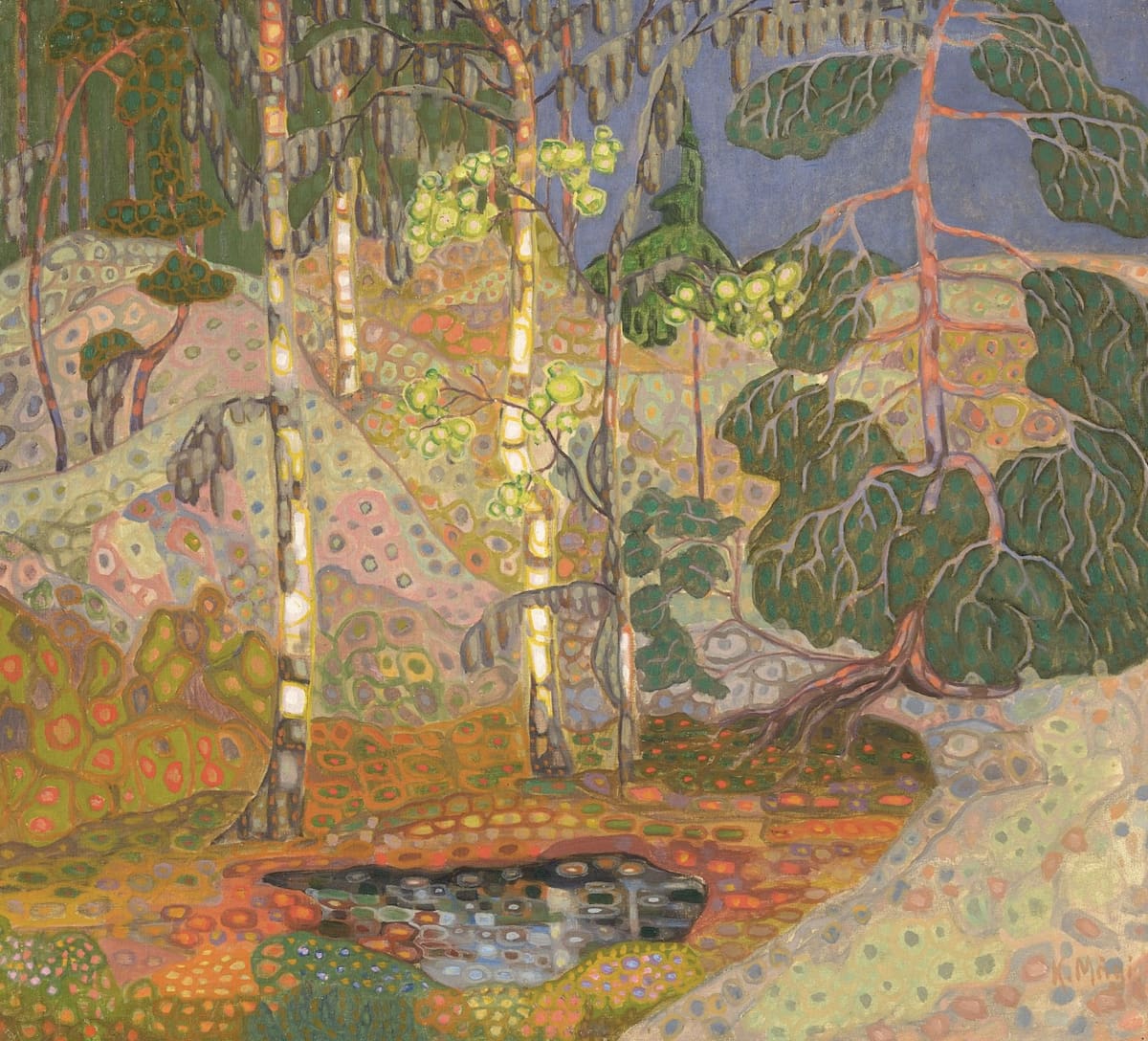
  • The Mordor painting is just the most extreme of the style he developed which combines the garishness of symbolism with the use of blobs of pure colour derived from pointillism. My favourite example was the bog painting (below). It’s figurative in the sense that you can make out the silver birch trees, but what’s happening on the ground isn’t remotely an effort to be realistic, but the use of brightly coloured blobs, lozenges and organic shapes (‘cellular structures’) which are more decorative than realistic. In the flesh, this painting is much more colourful and vibrant than this reproduction.

Norwegian Landscape: Bog Landscape by Konrad Mägi (1908-1910) Courtesy of the Art Museum of Estonia

  • Beside these were more realistic, less abstract landscapes, but still using a big blob pointillist style, such as the Norwegian lake at the top of this review.
  • And then, next door to all these stylised, sort-of-pointillist works, were some landscapes from Norway done in a completely different style, where instead of blobs, the paint has been applied in smooth brushstrokes, so the paintings appear much more traditionally figurative; such as Norwegian Landscape (Winter Landscape).

Room 2. Portraits

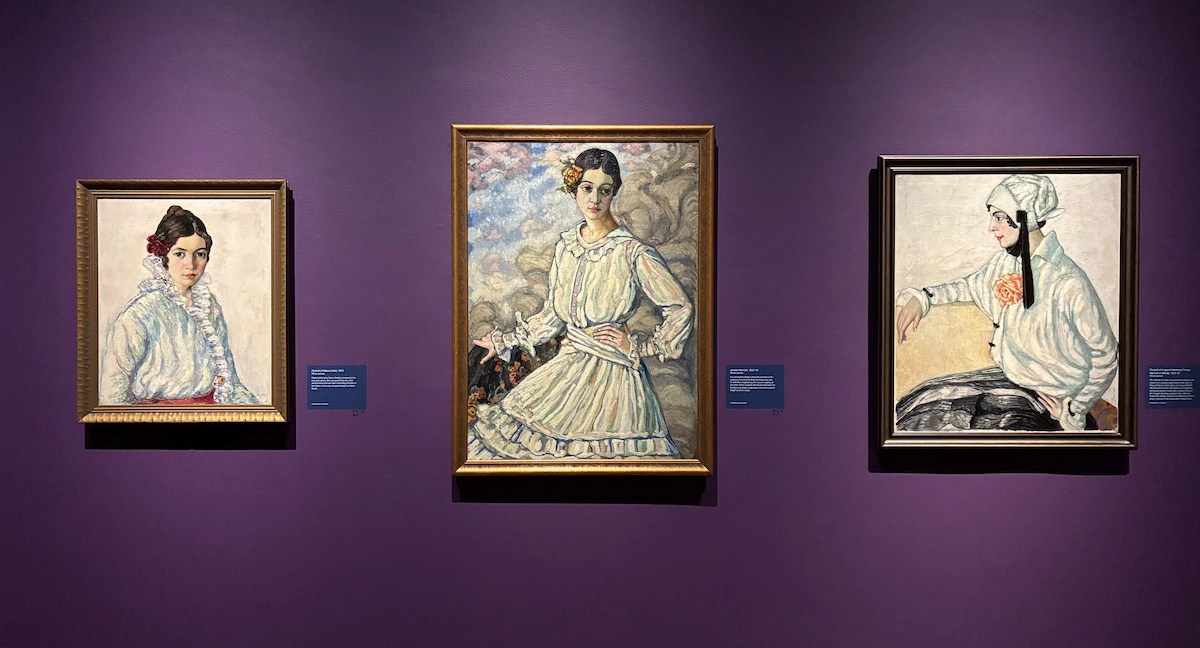
In 1912 Mägi returned to Tartu and, from spring 1913, began accepting portrait commissions for considerable sums of money, largely of wealthy women who were known to him through his cultural and political associations. Room 2 contains 17 of these generally large oil portraits. They showcase a stylised approach to the human face. They’re not unrecognisably distorted as in cubism, just simplified and done with deliberately unnaturalistic colouring. Mostly. But again, there’s a variety of styles. The ones I liked most had a hard angularity and used dark greens and blues to achieve an effect akin to German Expressionism.

Portrait of a Woman by Konrad Mägi (1918–1921) in Konrad Mägi @ Dulwich Picture Gallery

At the other end of the spectrum are some portraits of women whose cartoon, doe-eyed faces seem strangely at odds with the stylised backdrops, such as Portrait of Alvine Käppa from 1919.

Installation view of Konrad Mägi at Dulwich Picture Gallery showing three female portraits (photo by the author)

Somewhere in the middle were maybe the most attractive ones, which combined realistic faces with stylised backgrounds, the outstanding example being another ‘Portrait of a Lady’, below. Note the use of green to indicate shadowing on the skin.

Portrait of a Lady by Konrad Mägi (1916–1917) in Konrad Mägi @ Dulwich Picture Gallery

Room 3. The Baltic

Room 3 contains 16 landscapes from Mägi’s extended stays on the Baltic coast during the summers of 1913 and 1914. The paintings depict the landscape around Saaremaa and Vilsandi and, according to the curators, represented an artistic breakthrough for Mägi. The paintings here are certainly more consistent in style.

As if to demonstrate this, the centrepiece is a rare series by this artist, a set of 6 paintings depicting the same view of the lighthouse at Vilsandi. Three of these show the exact same view at different times towards the end of the day, as the (ever-present) clouds turn deeper shades of pink. the more I looked, the more I liked these three linked works.

Installation view of Konrad Mägi at Dulwich Picture Gallery showing three views of the Vilsandi lighthouse at different times of day (photo by the author)

As to the others, two things struck me:

  1. Lightless Although they are seascapes, and the curators tell us the Estonian coast is flat and open, Mägi’s paintings of it convey very little sense of light. His skies are always full of clouds and the terrain is depicted in thick heavy shapes.
  2. Botany Which is connected to the other thing which is that, although the bits of land he includes are busy with shapes and colours, giving an impression of luxuriant growth – and although the curators tell us that Mägi had an enduring fascination with the unique botanical species of his landscape, including its flora and fauna – there is precious little detail. In the garlands painted by Michaelina Wautier, currently on show at the Royal Academy, I spent some time trying to identify every species of flower. No point trying to do that with Mägi’s coastal paintings which are liberal with elements but all done in his familiar, blobby, stylised manner. Can you identify the plants in this picture?

Vilsandi Motif by Konrad Mägi (1913-14) Courtesy of the Art Museum of Estonia

Room 4. Southern Estonia

The walls of the fourth and final room are painted deep purple and this is an appropriate background for the 11 landscapes on display here, which I found heavy and louring. (I’ve just looked up ‘louring’ to check I’m using it in the right sense. The dictionary defines it as meaning ‘a dark, gloomy, or threatening appearance, usually referring to overcast weather, or a forbidding atmosphere.’ Seems about right.)

The landscapes are from Southern Estonia, from the last decade of his life. Note how the ‘blobby’ technique I’ve mentioned so many times has largely disappeared. Instead the pain is applied more smoothly but several other things are new.

One: the natural elements of the composition (the trees, the bushes, the outline of the lake) are heavily defined in black. Everything has a strong black outline, something I personally, always warm to.

Two: the clouds, the clouds! Look at the swirling, moiling, dark and threatening clouds coming to getcha!

Three: taken together these features indicate how much the landscape is actually an expression of the artist’s inner turmoil. This is the room whose wall label informs us that, after a lifetime struggling against mental illness, in 1924 Mägi suffered some kind of mental collapse and had to be placed in an institution for his own protection. Does that knowledge affect how you feel about this picture?

Lake Kasaritsa by Konrad Mägi (1915-17) Courtesy of the Art Museum of Estonia

As a footnote, not all the 11 works in this final room are as dark and ominous. In fact a couple of them right at the very end work with a much lighter palette and use light square blocks to create a landscape, completely opposite to the heavy, blobby, organic style which dominated so many of his central works. The curators tell us that here, right at the end of his working life, he was experimenting with the kind of Futuro-Cubism which was being used by radical Soviet artists of the 1920s.

Installation view of Konrad Mägi at Dulwich Picture Gallery showing three of the landscapes in the fourth and final room – note the cloud-congested skies (photo by the author)


Related links

Related reviews

Brasil! Brasil! The Birth of Modernism @ the Royal Academy

Executive summary

To be really blunt, my wife said, ‘If this is the best Brazilian art has to offer, you can see why we’ve never heard of it before.’ A proper review needs to be more nuanced and caveated than that, and as you study each of the individual artists, you come to appreciate them more deeply… but it is a not unreasonable thumbnail summary. There are lots of really good works here, easily enough to make it worth visiting, but no one artist that really, really broke through – and many of the works I liked partly because they so clearly showed their European influences and origins.

Because as you read the wall panels, the key point to emerge is that almost all of the artists featured here spent some or a lot of time in Europe studying art – especially in the early part of the show, during the period just before and after the First World War – which is why, in the first half, you are continually seeing paintings which remind you of cubism, the Fauves, German Expressionism, then later on, Art Deco and 1930s socialist realism.

This process of assimilation from European sources was directly addressed in the ‘Anthropophagic Manifesto’ by a writer closely associated with the early Brazilian modernists (and husband of the great Tarsila do Amaral) Oswald de Andrade. The manifesto describes modern Brazilian artists eating and digesting the great European innovations of the early twentieth century, mixing them with local subject matter and non-European traditions to produce a distinctive new hybrid.

Watching the artists’ Western influences and training being remodelled and fused with Brazilian subject matter to create each artist’s personal vision is one of the main interests of the show. (Although important to be clear that some of them never went to study in Europe and so developed their own native or naive style from scratch.)

For what it’s worth, in my opinion Tarsila do Amaral emerges as the artist with the most distinctive and fully formed vision in her own right, closely followed by Lasar Segall and Vicente do Rego Monteiro (see below for all of them).

This is a big exhibition, filling the Royal Academy’s main galleries and yet it doesn’t quite feel like it. Most of the works are relatively modest in scale and, with the exception of a handful of massive paintings and a few large sculptures towards the end, the rows of medium-sized paintings often feel over-awed by the hugeness of the gallery space. I couldn’t help seeing this as a metaphor for the way this often very striking post-colonial art, despite everyone’s best intentions, derived its strength from the series of innovations taking place in the European heartland and, latterly, in America.

Anyway, on to a more detailed review.

Overview

In the early 20th century a new modern art was emerging in Brazil. Starting in the 1910s and continuing through the 1950s, ’60s and ’70s, Brazilian artists adapted contemporary trends, international influences and artistic traditions to create new visual styles informed by the vibrant cultures, identities and landscapes of Brazil.

This exhibition celebrates this 60-year period between 1910 and the 1970s through the stories of ten influential artists. The show reveals the development of their artistic styles and the context in which they were created. It brings together over 130 works to capture the diversity of Brazilian art at the time. The artists are, in (rough) chronological order:

  1. Anita Malfatti (1889 to 1964)
  2. Lasar Segall (1891 to 1957)
  3. Tarsila do Amaral (1886 to 1973)
  4. Vicente do Rego Monteiro (1899 to 1970)
  5. Candido Portinari (1903 to 1962)
  6. Flávio de Carvalho (1899 to 1973)
  7. Djanira (1914 to 1979)
  8. Alfredo Volpi (1896 to 1988)
  9. Rubem Valentim (1922 to 1991)
  10. Geraldo de Barros (1923 to 1998)

The majority of works come from rarely-seen Brazilian private collections, as well as Brazilian public collections, most of which have never been exhibited in the UK. So this is a unique opportunity to see key works by ten of Brazil’s major twentieth century artists brought together in one place, and to get a sense of how pioneers of Brazilian visual culture took their European sources, developed and moulded them for their own purposes.

Brazil: history and ethnicities

1. History

I take a historical view of everything (art, politics, literature) so I liked it being explained right at the start that Brazilian history can be divided into four eras:

  • pre-Colombian i.e. before Europeans arrived
  • colonial (1500 to 1815)
  • Imperial (1815 to 1889)
  • modern since Brazil became a republic in 1889

The original inhabitants of this vast area of north-east South America consisted of numerous tribes and clans with their own languages and religions. The Portuguese explorer Pedro Álvares Cabral, hoping to sail west around the world to India, arrived in the territory that would become Brazil on April 22 1500, claiming the land for the King of Portugal.

2. African slavery

There followed centuries of colonisation and settlement by the Portuguese who first of all enslaved the local inhabitants to work on their ranches and mines, and then set up a transatlantic slave trade importing kidnapped Africans. In 1526 Portuguese mariners carried the first shipload of African slaves to Brazil. Of the 12 million enslaved Africans brought to the New World, almost half – 5.5 million people – were forcibly taken to Brazil as early as 1540 and until the 1860s. Slavery was only abolished in Brazil in May 1888, one year before the country overthrew its imperial regime to become a republic.

3. Mass immigration

The abolition of slavery in 1888 and the expansion of coffee plantations created a demand for labour. Many people internally migrated from the impoverished north-east, but Brazil also became a popular destination for immigrants. In the last decades of the nineteenth century Brazil experienced a surge in immigration, particularly from Europe, with Italians, Portuguese and Spanish immigrants fleeing poverty in their own countries, as well as Jews fleeing pogroms in Russia and Eastern Europe. Between 1872 and 1903 almost two million immigrants arrived in Brazil, increasing the population to around 17 million.

4. Technological change

Like every other country, Brazil (well, the cities and more developed regions) experienced the shock of new technologies, which seemed to follow each other with dizzying speed: the telegraph, the telephone, electrification of street lights and homes, the tram, the motor car.

These four factors explain why, as the twentieth century dawned, many Brazilian intellectuals realised they needed to create new literary and art styles to capture their newly republican, newly modern, newly multicultural society. They had to break away from the stuffiness and formality of the country’s nineteenth century Salon art, with its fondness for bog historical and religious subjects painted with painstaking realism.

Some of the leading figures were women who, like women in all the developed countries, thought women’s art and artists needed promoting. Some came from very poor backgrounds and reckoned the working classes needed to be sympathetically represented in art. And some were of Indigenous extraction and reckoned the original peoples of the land deserved better representation.

A curatorial mistake

The curators make what I think is a very big mistake right at the start of the exhibition. As usual the first room you enter is the octagonally-shaped Central Hall. Now the early wall labels emphasise the heaviness of the country’s nineteenth century art, with its European tastes for academic art and typical subjects such as historical allegories and religious scenes, as approved by Brazil’s own Royal Academy, the Academia Imperial de Belas Artes, which dominated Brazil’s arts and crafts for a century.

In my opinion, the curators would have done well to fill this Central Hall with examples of this stuffy old art, introducing us to the key figures of the old style, showing us massive realist depictions of some important battle and sentimental images of saints turning their tearful eyes towards heaven etc. This would very effectively have indicated what the ten artists in the subsequent galleries were breaking away from and given a better sense of just how radical their artistic revolution was.

Instead, with lamentable solipsism, the curators choose to fill this room by telling us that in November 1944, the Royal Academy of Arts hosted the first and, at that date, largest exhibition of modern Brazilian art in the UK. It was divided into two sections containing 80 paintings and 86 works on paper and was linked to a related exhibition about contemporary Brazilian architecture.

Now this is sort of interesting but only for art historians, and it doesn’t directly shed light on what is to follow. I thought it was a distraction and, as I say, a lost opportunity to provide deeper historical context.

Key historic event: Semana de Arte Moderna 1922

The early presentation of modernist art in Brazil crystallised in the Semana de Arte Moderna (Modern Art Week) that took place in Sao Paolo in 1922. ‘A cultural milestone in Brazil’, the Semana played a crucial role in bringing Brazilian Modernism to public awareness, and is referred to in the introduction and the biographies of the four or five artists who featured in it.

So, to the ten artists. Ten is a lot to take in. I’ll give a thumbnail sketch of each and a work which is either characteristic or exemplifies a theme of the show.

1. Anita Malfatti (1889 to 1964)

Pioneering woman artist who first brought European avant-garde styles (cubism, Fauvism, Expressionism) to Brazil.

  • the first Brazilian artist to introduce European and American forms of Modernism to Brazil
  • born in São Paulo, of Italian and German-American descent, when her father died the family moved to Germany
  • lived in Berlin from 1910 to 1914, attended drawing classes, influenced by German museum collections
  • 1915 moved to continue her education in the United States

Malfatti returned to Brazil in the autumn of 1916 and in December 1917 held the ‘Exposição de pintura moderna Anita Malfatti’ (Anita Malfatti Modern Painting Exhibition) in São Paulo. She must have blown people’s minds. The show was the first to challenge the orthodoxy of academic and Salon art and is now celebrated as the first modernist exhibition in Brazil. You know I mentioned the obvious influence of European pioneers on many of the Brazilians? Well:

First Cubist Nude or The Little Nude by Anita Malfatti (1916) Private collection, Rio de Janeiro

In 1923 Malfatti moved back to Europe, to Paris on a scholarship. She lived in Montparnasse and was mentored by French painter Maurice Denis, exhibiting at the Salon d’Automne in 1927. She returned to São Paulo in 1928 but the days of her experimental and progressive art were behind her.

The wall of her works is mostly portraits in a cubist-modernist style. I really liked two or three of these which leaned more towards German Expressionism in their strident colouring.

Portrait of Oswald by Anita Malfatti (1925) Collection of Hecilda and Sérgio Fadel. Photo by Jaime Acioli © Anita Malfatti

As usual this drab reproduction doesn’t convey the subtlety and vibrancy of the original.

2. Lasar Segall (1891 to 1957)

Colourful, stylised depictions of rural life, lots of green palm tree leaves, until his midlife turn to grimmer subject matter.

  • Jewish, born in 1891 in Vilnius, Lithuania, and so an outsider to a tropical country, to Catholic culture etc
  • 1906: moved to Berlin and studied at the Imperial Academy of Fine Arts of Berlin and Dresden Academy of Fine Arts, where he was exposed to the Expressionist and Neue Sachlichkeit (New Objectivity) movements
  • first visited Brazil in 1913, meeting fellow artists and intellectuals, and exhibiting and selling his work before returning to Europe
  • leading figure of the Dresden Expressionist movement – 1919 set up the Dresden Secession group with Expressionist painter Otto Dix
  • 1923 Segall migrated to São Paulo and was quickly welcomed by modernist artists and writers who saw him as a representative of the European avant-garde
  • 1932, with Anita Malfatti and Tarsila do Amaral, he founded the Sociedade Pró-Arte Moderna (SPAM) in 1932 to promote modern art
  • his work was at times subject to anti-immigrant and anti-Semitic attacks

His early depictions of favelas in a naive style are lovely, really simplified, stylised, semi-abstract. A scholar calls it a tropicalisation of early cubism but surely it’s more readable, less distorted than cubism. For example, Boy with Gecko (1924).

This is the painting which is included in the articles and promo material. Early on you realise that green, numerous shades of green, are a recurring colour in many of these paintings, capturing the distinctive greenness of tropical foliage.

Banana Plantation by Lasar Segall (1927) Collection of the Pinacoteca do Estado de São Paulo. Photo by Isabella Matheus © Lasar Segall

There are half a dozen of these deliberately stylised and naive paintings and then the viewer is brought up short by a very big painting in a completely different style. This is Pogrom from 1937. As the Nazi tyranny proceeded, Segall who had such an attachment to Germany, turned to depicting the horrors being inflicted on his co-religionists.

Pogrom by Lasar Segall (1937)

Note the headstone with Hebrew writing at the bottom left. The curators point out the dove at the top of the work, which indicates, or aspires to, a kind of hope. Ill-placed though, wasn’t it? There was no hope.

After the war Segall’s images became increasingly abstracted in the 1950s, producing a series of paintings featuring forests, brown paintings of vertical lines. These look like a traumatised response to the Holocaust, in the same way that Francis Bacon or Giacometti convey post-war trauma. A bit dazed by ‘Pogrom’, I read these as references to the thick forests of his native Lithuania, where so many Jews were murdered and buried.

3. Tarsila do Amaral (1886 to 1973)

do Amaral is the first painter you feel who develops a really distinctively Brazilian, non-European style, depicting the jungle and village life. Her work is very attractive.

  • pioneering woman artist who developed a distinctively Brazilian modern style
  • daughter of wealthy parents who owned numerous coffee plantations, and so ‘a coffee heiress’
  • private painting lessons then moved to Paris in 1920 to enrol at the Académie Julian, one of the few schools which offered women artists life drawing classes
  • 1922: returned to São Paulo where she formed the Grupo dos Cinco (Group of Five) alongside Anita Malfatti, Mário de Andrade, Menotti Del Picchia and Oswald de Andrade, who became her partner (whose portrait was painted by Anita Malfatti, see above)
  • 1923: she returned to Paris with Oswald where they lived till 1928
  • Tarsila’s art became known for its vibrant colours, simplified forms and distinctly Brazilian themes
  • her 1928 painting Abaporu, a simplified solitary figure with distorted proportions, inspired Oswald to write the ‘Manifesto Antropófago’, which proposed artists engage in “cultural cannibalism” that would metaphorically “devour” wide-ranging influences to create something new and uniquely Brazilianhttps://en.wikipedia.org/wiki/Abaporu
  • 1929: economic crash, she separated from Oswald
  • 1931: held an exhibition in Moscow, returned to Brazil and attended meetings of the Brazilian Communist Party. Paintings from this period, such as ‘Second Class’ (1933), reflect her more socially aware perspective

do Amaral produced the exhibition’s keynote image, the one used on the poster and all the promotional material and you can see why – it’s nice to look at. Pinks and greens and blues, very relaxing. Obviously she has taken a Brazilian jungle scene and utterly transformed it from the old Salon realism, into a series of semi-abstract shapes which are strongly reminiscent of Surrealism.

Lake by Tarsila do Amaral (1928) Collection of Hecilda and Sérgio Fadel. Photo by Jaime Acioli © Tarsila do Amaral S/A

4. Vicente do Rego Monteiro (1899 to 1970)

Big brown stylised Art Deco figures with a strong pre-Colombian flavour.

  • Rego Monteiro was born in the coastal city of Recife in the north-eastern state of Pernambuco
  • 1911 moved to Paris, where he studied drawing and sculpture
  • 1914: at the outbreak of the First World War his family moved back to Brazil, to Rio de Janeiro where he became interested in the culture of the Amazon and started using native themes and motifs into his work
  • 1922: joined the group who organised the famous Semana de Arte Moderna in São Paulo
  • he returned to Paris where he lived for the next decade and thereafter alternated between Paris and Recife

Rego Monteiro’s is arguably the most distinctive of the set. They are highly stylised brown paintings which depict human figures in a style derived from pre-Colombian native traditions.

Archer by Vicente do Rego Monteiro (1925) Courtesy of Almeida and Dale Galeria de Arte. Photo by Sergio Guerini © Vicente do Rego Monteiro

Initially I thought they felt the most free from any European influence – none of the cubism or Expressionism or Surrealism we’ve seen up till now. Until my wife pointed out that they’re Art Deco, with the repetitions and symmetries of the stylised human figures. Yes. Or like the stylised figures in the friezes of Eric Gill.

Before he developed this primitive style, he produced some lovely Art Deco images. The most famous is Tennis from 1928. As Mrs Simon pointed out, this is a rare instance of someone having fun in a painting. Most paintings show portraits of intense intellectuals or hard working peasants or murdered Jews or African-Brazilians working in the fields. People having fun is a rarity in art, which may be why it remains such a minority interest.

5. Candido Portinari (1903 to 1962)

Portinari is something else again. Born the son of Italian immigrants and he grew up in relative poverty on a coffee plantation and had a lifelong concern for the lives of the poor. This led him to a kind of 1930s social realism we haven’t yet seen in the rather elite Group of Five artists we’ve hitherto been learning about.

  • 1918 sent by his parents to Rio de Janeiro where he studied at the Escola Nacional de Belas Artes
  • 1928: won a scholarship to travel Europe in 1928 and spent two years moving around France, England, Italy and Spain, studying the old master
  • on his return determined to paint the hard lives of peasants in the backlands and developed his socialist-realist style

My wife pointed out a common theme of his paintings is the figures have enormous chunky feet. I thought this was a facetious remark, but it is picked up by the curators who state: ‘He enlarges the hands and feet of the coffee-plantation worker to emphasise his connection to the land.’

Coffee Agricultural Worker by Candido Portinari (1934)

A bit of historical background. The 1929 crash in world markets led to the collapse in Brazil of the coffee industry and widespread unemployment, impoverishment. This led to a coup establishing the populist government of Getúlio Vargas. (Vargas served as president of Brazil from 1930 to 1945 and then again from 1951 until 1954. Due to his long and controversial tenure as Brazil’s provisional, constitutional, dictatorial and democratic leader, he is considered by historians as the most influential Brazilian politician of the 20th century.) It was against this troubled economic, social and political background that Portinari copied Picasso’s 1930s style of big chunky figures, but for political effect.

Like his Mexican contemporary Diego Rivera, Portinari created massive public murals depicting the dignity of labour. He collaborated on numerous projects with the modernist architect Oscar Niemeyer. He received various high-profile commissions, including a Rivera-style commission to create huge murals, titled ‘War and Peace’, for the United Nations Headquarters in New York (1952 to 1956). The curators, a tad disappointingly, don’t include even photos of these, but there’s always the internet.

Commissions like this gave Portinari a huge international profile, so that in the mid-century he was widely seen as Brazil’s most important artist.

Portinari had a song written to him, ‘Un Son para Portinari’, regularly performed by the legendary Argentine singer, Mercedes Sosa.

6.Flávio de Carvalho (1899 to 1973)

de Carvalho was a painter, architect, theatre producer and designer, but appears to be mainly remembered as the first performance artist in Brazil.

  • born in Rio de Janeiro into an aristocratic family, raised in São Paulo, studied in Paris, and gained a degree in civil engineering from Durham University (!)
  • as an artist he was largely self-taught, his only formal training being the evening drawing classes he took while at university
  • he returned to Brazil in time to take part in the famous Semana de Arte Moderna of 1922
  • he entered national and international architecture competitions for public buildings with outlandishly ambitious designs, experimented with writing, and designed and staged several avant-garde theatre productions
  • 1933: founding member of the multidisciplinary Clube dos Artistas Modernos (Modern Artists’ Club) which attracted the attention of established modernists including Oswald de Andrade (author of the manifesto, partner of Tarsila do Amaral) who dubbed de Carvalho ‘the Ideal Anthropophagus’
  • his paintings blended Surrealist, Cubist and Expressionist influences
  • 1934: first public exhibition closed down on the grounds of obscenity

I think I liked de Carvalho’s paintings the least of any in the set. Grungy, they gave me the shivers. They reminded me of Graham Sutherland’s art, one of the few modern artists I really dislike, but de Carvalho caught the mood: he was successful and was invited to represent Brazil at the 1950 Venice Biennial.

In stark contrast to all his paintings is a photo recording one of de Carvalho’s several ‘performances’. He started doing these as early as the 1930s. According to Wikipedia, he created:

what he called ‘Experiências’ (experiments), ‘performance art’ before that term was introduced. In 1931, he joined a Catholic Corpus Christi parade in São Paulo, walking in the opposite direction and wearing a cap although removing headgear was considered a necessary sign of respect, driving the crowd to call for his lynching, which he later said was an experiment in crowd psychology. This work, the Experiência n. 2, has come to be understood as an early work of performance art, but it could also be understood in terms of Surrealist provocation that comments on the contested structures of political and religious authority in São Paulo following the Revolution of 1930.

The photo on display here is from 25 years later, when, on 18 October 1956, de Carvalho staged ‘Experiência N.3’, walking through São Paulo in the ‘New Look’ outfit he had designed for men in the tropics, which comprised a skirt, blouse and fishnet stockings, scandalising the crowd who gathered to watch him.

Photo of Experiência N.3’ by Flávio de Carvalho

7. Djanira (1914 to 1979)

Christened Djanira da Motta e Silva (she preferred to be referred to simply as Djanira) was a largely self-taught artist whose simple, dynamic paintings reflected the working class world of her upbringing.

  • born in Avaré, São Paulo, to a working-class family, father was of Indigenous ancestry, her mother the daughter of Austro-Hungarian immigrants
  • throughout her childhood Djanira worked as a seamstress and on a coffee plantation
  • her artistic practice began aged 23 (1937) while recovering from tuberculosis in a sanatorium in São José dos Campos
  • 1939: Djanira settled in the Bohemian neighbourhood of Santa Teresa, Rio de Janeiro, where she established a boarding house where many intellectuals lodged, including Emeric Marcier (1916 to 1990) who taught her the basics of painting
  • the only other formal training Djanira received was through evening classes in drawing
    at a private art school in São Paulo

Her subjects were self- portraits, portraits of people close to her, and the landscapes and everyday life of Rio. Her style, a hybrid of figuration and abstraction, was sometimes described as naïve, a description she rejected: ‘I might be naïve, but my painting is not.’

From 1945 to 1947, Djanira lived in New York, where she met the Surrealist artists Joan Miró and Marc Chagall. During the 1950s she journeyed around Brazil to study its landscapes, peoples, customs and social realities. Notably, she travelled to Bahia, where she experienced the Candomblé religion, and she also lived among the Canela people in Maranhão, which allowed her to reflect on her Indigenous Brazilian heritage. This explains why many of her paintings are accompanied by sociological or anthropological explanations.

Flying a Kite by Djanira (1950) Banco Itaú Collection. Photo by Humberto Pimentel/Itaú Cultural © Instituto Pintora Djanira

All her paintings are in this style. I could see what she was doing, the socio-political and artistic aims of it, but I didn’t warm to them. The best and biggest, one of the biggest works in the show, is ‘Three Orishas’ from 1966. It has a backstory:

Candomblé is an Afro-Brazilian religion of West African origin that combines elements of Yoruba, Fon and Bantu. Enslaved peoples brought the religion to Brazil and it developed in the port city of Salvador, the capital of the state of Bahia. Djanira encapsulates the rituals and beliefs of Candomblé with a triad of Afro-Brazilian deities, from right to left: Yemanjá, a maternal, protective deity; Oxalá, the creator, unusually represented as a woman here; and Oxum, deity of the river and fresh water.

Installation view of ‘Three Orishas’ by Djanira in Brasil! Brasil! The Birth of Modernism @ the Royal Academy. Photo by the author

8. Alfredo Volpi (1896 to 1988)

Volpi was self-taught and a pioneer of pure abstraction.

  • born in Lucca, Italy, his family emigrated to Brazil when he was just two years old
  • grew up in a working-class neighbourhood in São Paulo, and left school at 12 to work as a painter-decorator to support his family
  • never receiving a formal artistic education, Volpi began painting in the 1920s, adapting the materials and techniques of his trade, including preparing his own paints and canvases

Volpi’s early paintings were relatively conventional. He made landscapes and genre scenes alongside a group of other self-taught artists on weekend trips to the countryside, including to the seaside fishing village of Itanhaém.

His style changed significantly in the 1940s, when he turned his attention to urban scenes and began to work with egg tempera instead of oil paint. Some of them are naive and stylised depictions of buildings, such as the many paintings he titled Facade. These alternated with completely abstract works based on repeated geometric patterns.

Untitled by Alfredo Volpi (1950) Daniela and Alfredo Villela Collection. Photo by Jaime Acioli © Alfredo Volpi

His work became increasingly abstracted, taking architectural elements including apartment blocks, windows and roof tiles, and simplifying them to bold geometric shapes with a flat use of vibrant colour, reflecting the vitality and life of the cities he portrayed.

Volpi received widespread recognition during his lifetime; he was joint winner of the prestigious São Paulo Biennial Prize in 1953. He aligned himself with no particular art movement but followed artistic developments both in Brazil and Europe. He was responsible for introducing a generation of Brazilian artists to the work of Swiss-German artist Paul Klee (1879 to 1940) who emerges as an influence on the following two artists, as well.

Today his work is understood as a bridge between Brazil’s earlier modernists and the Concrete Art movement of the later twentieth century, which emphasised geometric abstraction, see Geraldo de Barros, below.

9. Rubem Valentim (1922 to 1991)

Lovely, Klee-like, colourful abstract paintings and sculptures.

  • born in Salvador, in the north-eastern state of Bahia, Rubem Valentim grew up in a region deeply influenced by spirituality, both Roman Catholicism and Candomblé, a religion rooted in West African beliefs, that would profoundly shape his art
  • Valentim initially trained in dentistry, but left the profession by the late 1940s to pursue painting
  • early work adopted the social-realism popular among local artists, but by the 1950s he began to develop his own distinct visual language
  • this geometric abstract style synthesised African symbols, particularly those associated with Candomblé, with modernist forms
  • his works came to feature vibrant colours and structured arrangements of symbols, evoking sacred Afro-Brazilian totems and spiritual iconography

The charming home-made quality of Valentim’s abstract paintings reminded me of Paul Klee, geometric shapes strung together on straight lines like kebabs. Here’s what I mean.

Installation view of Brasil! Brasil! The Birth of Modernism @ the Royal Academy showing Untitled (1962) by Valentim Rubem. Photo by the author

The paintings are complemented by four or five big sculptures which repeat the technique of abstract symmetrical designs.

Installation view of Brasil! Brasil! The Birth of Modernism @ the Royal Academy showing a painting and two reliefs by Valentim Rubem. Photo by the author

By the 1960s, Valentim had gained national and international recognition and took part in the São Paulo Biennial, the Venice Biennale, and the First World Festival of Black Arts in Senegal, which helped to cement his reputation as a leading voice in Brazilian art.

Calling himself an ‘artist-priest’, Valentim infused his works with powerful cultural significance as a means of preserving and celebrating African identity in Brazil.

In 1976 he wrote ‘Manifesto ainda que tardio’ (‘A Manifesto, Albeit Late’) in which he advocated for recognition of African cultural heritage as a vital part of Brazilian identity, challenged Eurocentric artistic norms, and promoted a greater cultural synthesis: ‘The Afro- Amerindian-Northeastern-Brazilian iconology is alive… and we must drink in it with lucidity and great love.’

We have come a long way from Malfatti and do Amaral bravely importing cubist or Expressionist motifs.

10. Geraldo de Barros (1923 to 1998)

Right at the end of the exhibition there comes a sharp change in format. All nine of the preceding artists had been painters. Suddenly there’s a wall of black and white photos, clever modernist studies in sharp angles and abstract shapes made by things like rooftops and telegraph wires, shot from high up or low down to emphasise their geometric shapes, or multiple exposures overlaying different perspectives of stark industrial artefacts (railway stations, electricity pylons). de Barros has his own website which includes a page of these photos under the title ‘Fotoformas’.

Here’s a thumbnail bio:

  • de Barros born in a small town in the state of São Paulo; shortly afterwards his family moved to the state capital
  • his interest in art began in 1941, and for several years he juggled working in a bank with studying for a degree in economics and taking art classes at the Associação Paulista de Belas Artes (São Paulo Association of Fine Arts)
  • de Barros soon found himself drawn to abstraction
  • in 1946 de Barros acquired his first camera and soon focused his artistic energies on photography
  • his approach was highly experimental, employing techniques such as photomontage, multiple exposures and physical interventions on negatives to explore the medium’s conceptual potential
  • by 1949 he was invited to set up the Museu de Arte de São Paulo’s photographic lab, and it was there in 1950 that he held the influential solo exhibition ‘Fotoforma’

All the photos on display here are really good in their way, although they reminded me of other modernist photographic experiments from the 1920s and ’30s, specifically the Bauhaus photos of Constructivist artist László Moholy-Nagy.

But the de Barros wall also featured a series of small quirky paintings which look exactly like Paul Klee paintings. He was well aware of the influence. One of photos is titled ‘Homage to Paul Klee’. I really liked Port View which I can see on the internet but can’t open as a separate image. Here it is in Google Images.

So he produced lovely Paul Klee-esque paintings, as well as a striking body of semi-abstract, modernist photographs. But it’s actually as a founded or pure abstraction in Brazil that he’s remembered.

  • 1951: a scholarship from the French government enabled de Barros to spend a year
    studying in Europe
  • on his return he founded the Grupo Ruptura (Rupture Group) which championed geometric abstraction as a means of transforming society, overcoming limits of language, geography and nationality
  • these ideas became cornerstones of Brazil’s Concrete Art movement

Arrangement of Three Similar Shapes within a Circle by Geraldo de Barros (1953) Collection Lenora and Fabiana de Barros. Courtesy Luciana Brito Galeria, São Paulo. Photo by Gustavo Scatena, Imagem Paulista © Geraldo de Barros

de Barro’s progressive approach extended to furniture design, marrying technical innovations with a Concrete aesthetic.

In 1954 he co-founded Unilabor, a cooperative that sought to merge modernist principles with accessible, affordable production and was in production until 1961. There’s a page devoted to Unilabor on his website.

In 1964 he founded a new furniture company, Hobjeto. This was a more commercial operation and it’s interesting to compare the 1950s Unilabor designs with the bolder, more colourful 1960s Hobjeto designs.

His output continued until his retirement in 1989. In terms of his range, from fine art to commercial furniture design, de Barros was obviously a major cultural influence.

The Klee connection

The three final artists in the show – Alfredo Volpi, Rubem Valentim and Geraldo de Barro – produced works that look very like Paul Klee paintings and watercolours, and even namecheck Klee directly.

It was intriguing, then, to read, on the credits label right at the end of the show, that this exhibition was organised by the Zentrum Paul Klee in Bern. Not contributed to, but organised by. Did that influence the selection of artists in this show? Were they chosen deliberately to reflect Klee’s influence? Or because the Zentrum just happens to own a lot of Brazilian art? At the time of writing, não sei.


Related links

Related reviews

The Father by August Strindberg (1887)

NURSE: Why do two people have to torture each other to death?

In the English-speaking world August Strindberg (1849 to 1912) is famous for a handful of plays characterised by intense plots and hysterical characters. But in the introduction to the Oxford World’s Classics edition of ‘Miss Julie and Other Plays’, translator Michael Robinson is at pains to point out that this handful of dramas is just a fraction of the output which makes Strindberg such a major literary figure in his native Sweden.

For a start Strindberg wrote what is widely considered the first modern Swedish novel, ‘The Red Room’ (1879) but he also wrote weighty histories, short stories, poems, essays, scientific studies, sociology, books on occultism and more. At some points he dropped writing altogether and devoted himself to painting, creating at least 117 accredited works which push beyond Victorian realism into an early Expressionism, especially his depictions of stormy seascapes.

Back to the plays, Strindberg wrote more than 60 and in a wide variety of styles or genres, starting with plays about Swedish history and moving onto naturalistic tragedy, monodrama and then, in his later pieces, experimental pieces which anticipate expressionist and surrealist techniques.

The Father

Act 1

This is a play about a very unhappy marriage. Adolf is a middle-aged captain in the cavalry. He lives at home but still has authority over a company of soldiers. Twenty years ago he married Laura, the sister of the parson who he enjoys chatting to. But Adolf and Laura are at daggers drawn. They have been married for 20 years and the marriage has degenerated into outright hatred.

The Captain is extremely rude, brusque and controlling towards her, controlling her movements, monitoring every penny she spends. Slowly it emerges the enmity is rooted in a religious divide. Laura, her mother and the Captain’s old maid, Margret, are all devout Christians. The Captain, on the other hand, is a freethinking atheist. More than that he’s a would-be scientist. He is undertaking serious research into the mineralogy of meteorites using a spectroscope. Typically, his wife misinterprets this as a mad claim that he can see life on other planets through a microscope.

Thus, in conversation with the pastor, the Captain gives vent to venomously misogynist sentiments, claiming it’s like living in a cage full of tigers and:

CAPTAIN: It’s man against woman, all day long, without end… (p.8)

What’s brought the situation to a head is the couple’s furious argument about what to do with their daughter, Bertha, aged 17. Laura wants her to stay in the household, subject to the Christian influence of her, her mother and maid. There’s also talk of indulging Bertha’s alleged talent at painting.

The Captain, on the contrary, wants to get his daughter out of this snakepit of superstition, away from ‘a bunch of ignorant and superstitious women’, to send her to lodge with an atheist lawyer in town, and to have her trained as a schoolteacher.

When a new young doctor arrives, Dr Östermark. Laura has engineered his arrival, having forced the old doctor to retire. Now she makes sure to meet him first and brief him about her husband’s ‘madness’ but the doctor in facts acts as a kind of chorus and intermediary. He hears both sides giving their versions of the story. For example he listens to the Captain complaining that his scientific researches are being hampered because the booksellers he’s sent off to for books he needs haven’t replied. Later the doctor finds out from Laura that she has been intercepting the Captain’s mail and destroying these very letters. So when the captain calls Laura his ‘enemy’ it’s not far from the truth. There really is a war between them.

In a big argument the captain, in his rigid legalistic way, insists that a father has complete and utter control over his child, to which Laura malevolently replies, well, what it Bertha isn’t your child, if I was unfaithful? Then all the captain’s high and mighty legal rights evaporate.

Act 2

He’s so infuriated he goes out for an extended sleigh ride. This gives Laura an evening with the new doctor to turn him against her husband. She tells the doctor it was the captain’s paranoid notion that Bertha isn’t really his own child. She tells him the captain has a track record of worrying about his sanity going back years, and the doctor is taken in by all this and takes her side.

When he still doesn’t return, Laura sets the maid Margret to sit up for him and she’s joined by Bertha who can’t sleep. She asks if it’s true that her father is ill and the maid confirms it, ill in the head. Of course the captain isn’t mentally ill he’s just a strict angry man, but the play shows us all the women in his household ganging up on him.

Margret packs Bertha off to bed and the captain returns from his ride. He goes straight to his photography album to look at photos of him and Bertha. He asks Margret if they look related, him and Berth, and questions the maid about the father of her child. Clearly he’s rattled by Laura’s suggestion that Bertha isn’t his daughter.

The doctor had stayed on to wait for the captain’s return and now they have an intense discussion about the nature of paternity. The captain talks about studies into crossbreeding horses and zebras. The doctor quotes Goethe who apparently said that every man must take the paternity of his children on trust to which the captain immediately responds:

CAPTAIN: Trust? Where a woman’s concerned? That’s risky. (p.30)

And then speechifies about the absurdity of paternity, asking the doctor if the very idea of a father walking along the street hand in hand with his children isn’t somehow absurd. He tells two stories about women he’s met who’s turned out to be immoral and seducible.

CAPTAIN: That’s the danger, you see, their instinct for villainy is quite unconscious. (p.31)

The introduction had mentioned Strindberg’s reputation for misogyny but it’s something else to be subjected to a play, and a character, so devoted to expressing an endless list of accusations against woman.

Anyway the scene with the doctor ends oddly, with an unnatural angularity to it. In fact it’s symptomatic of the way the relations between all the characters are oddly unrelaxed, feel like the speeches of puppets.

DOCTOR: Good night, then, Captain. I’m afraid. I can be of no further use in this case.
CAPTAIN: Are we enemies?
DOCTOR: Far from it. It’s just a pity we can’t be friends. Good night. (p.32)

The doctor exists and the captain goes over to the door and calls Laura in, for he realises she was listening just outside. He tells her he’s been to the post office and discovered that she’s been tampering with his outgoing and incoming mail, and also understands she’s been embarked on a campaign to persuade everyone he’s mad. As I say, the dialogue has a kind of programmatic, schematic aspect to it:

CAPTAIN: I won’t appeal to your feelings, for you don’t have any, that’s your strength. I do, however, appeal to your self-interest.

The scene gets odder for the captain lays out the possibility that all her scheming will actually drive him mad. But she must consider. If he goes mad he will lose his position in the army, then where will she be? If he goes mad he might commit suicide in which case she’ll lose his life insurance.

LAURA: Is this a trap?
CAPTAIN. Of course. It’s up to you whether you walk round it or stick your head in it.

The captain proposes an armistice. His terms are that she frees him from his doubts about Bertha’s parentage: is he the father? And. characteristically, Laura doesn’t respond at all like a real person would, but instead enters into the elaborate fencing, the strategising, as if in a game of chess, about which response suits her aims best.

The captain starts to rant. He compares himself to a slave who has slaved away and ruined his health and all for someone else’s child. He’s served 17 years hard labour in this cruel servitude. He works himself into such a state that he starts crying. He describes himself as a child in his helplessness before her scheming. And Laura walks over and strokes the hair of her poor man-baby and he goes into a kind of trance of remembrance, remembering how, when they married, he was a big tough officer on the parade ground but at home completely capitulated to her will ‘as to a higher, more gifted being’ (p.36).

Laura joins the reverie, describing how she felt like the mother of her man-baby but going on to explain how revolted she felt after sex because the pure mother had degraded herself to become the mistress – Ugh! So he tried to regain her by asserting his masculinity. But, Laura points out, that was his mistake. Again it all has the schematicness of a PowerPoint presentation.

LAURA: Yes but that was your mistake. The mother was your friend, you see, but the woman was your enemy; love between the sexes is a battle. Don’t go thinking I gave myself; I didn’t give, I took – what I wanted. (p.37)

Yes, the captain admits she had total power over him, could bend him to her will, could persuade him that a potato was a peach. But he awoke to his shame and sought to reassert his identity through some great act. But there was no war so it couldn’t be a military exploit. And that’s why he turned to science, hoping to make his name with his discoveries. And that is why her cutting off his letters to the booksellers is such a crime against the core of who he wants to be.

He bluntly asks her, Do you hate me? and she replies yes, when he ‘acts the man’, to which he gives another drastically misogynist reply:

CAPTAIN: It’s like racial hatred. If we really are descended from the apes, at least it must have been from two different species. (p.38)

It is a life or death struggle. At which Laura plays her trump card. She has an incriminating letter a copy of which has been sent to the court. She is going to use it to have him committed. What letter? he says. The one he wrote to the old doctor in which he discussed his fears for his own sanity. And now that he has served his function, he can be dispensed with, he’s no longer needed, as she exits through the door and the enraged captain throws the lighted lantern after her.

Act 3

Act 3 opens in the same living room, that evening. The door out of the room is jammed shit with a door wedged against it. Laura and the nurse are rummaging through the captain’s things. They both refer to the noise of pacing, banging, and then sawing, which they can hear from the room overhead. The implication is that the captain has retreated to (or been locked in?) his room.

The pastor arrives and we witness Laura lying to him as she has lied throughout the play, claiming the captain threw a lighted lamp ‘in her face’ whereas we saw with our own eyes him merely throwing it at the door she was closing after her. Violent, but not as precisely cruelly violent as she describes.

Obviously appalled, the pastor asks what she’s doing and she explains she’s informing all and sundry that the captain’s had a breakdown into madness, starting with his commanding officer in the cavalry. the doctor has sent to the local hospital for a straitjacket.

But remember the pastor is the captain’s friend. More importantly, he’s Laura’s brother and knows what a spoilt, cunning, scheming person she’s been since a girl. Now he directly accuses her of manipulating the situation so she can get her husband committed, take charge of the family money and have Bertha raised the way she wants. He calls her marvellously strong-willed and completely untroubled by a conscience but she gives as good as she gets, demanding, ‘Prove it!’ and of course he can’t.

Enter the new doctor who promptly says a) an assault has been carried out and so it’s entirely Laura’s decision, how she wants to proceed, which will decide whether her husband is sent to prison or an asylum. Under the pastor’s beady gaze she hesitates to condemn the captain so the doctor takes the initiative and says the asylum will be best; even a prison sentence will end and the man would be released to present a renewed threat. From the asylum he will never be released.

The doctor has brought a straitjacket with him and shows Laura, the nurse and pastor how to put it on a patient and buckle it to a chair or sofa. Question is, which one of them will jump the captain from behind and quickly wrap it round him? They all demur at which point very conveniently enters the common soldier Nöjd who’s arrived with a message from the colonel. The doctor is in the middle of asking him to straitjacket the captain when the nurse intervenes. She can’t bear some rough soldier to do it so she’ll do it.

At which moment, with the precision of a well-oiled watch, there’s a knock at the internal door and the captain himself enters.

The captain

He isn’t obviously violent. The reverse, he’s in a very bookish mood. He’s brought a load of books with him to prove his point about the fragility of fatherhood and quotes from the Odyssey and the Bible to the effect that a man can never be totally sure that his children are his own.

The captain goes on a ranting monologue that may well indicate he’s mad. He asks the pastor and the doctor if they’re confident their children are indeed their own and reminds them of a music tutor and lodger, respectively, who their wives might have taken a fancy too, and claims he sees them both going pale, and mockingly says he can see the cuckold’s horns growing on their heads.

When he goes on to say that the one big hope he had to be a scientist has been stolen from him and so his life is now empty and meaningless, I realised he is like Hamlet, and with that realisation wondered if the entire play is a sort of ‘modern’ domestic version of Hamlet, not least in its obsession with ‘true’ fathers. His monologue ends with abandonment:

CAPTAIN: Do what you will with me! I no longer exist! (p.47)

Then doctor and the parson sneak out, solely to allow Bertha to enter and for their to be a twisted father-and-daughter scene. This starts off sensible with him saying he doesn’t care about throwing the lamp at her mother but it descends into what sounds like genuine mania when he rants that she has two souls but must only have one, she must love him with all her soul, she must become one with her.

And deepens when he says he is a cannibal and wants to eat her, compares himself to Saturn who ate his own children. He then makes the Hamlet connection explicit by paraphrasing Shakespeare:

CAPTAIN: To eat or be eaten! That is the question. (p.48)

At which point the captain goes over to a wall with guns on it and takes down a pistol. he quickly discovers the women have removed all the bullets from it. At this moment the nurse enters and leads him like a child away from the wall and sits him in a chair. Then she gets the straitjacket.

She now recites memories from his boyhood, reminding him of the time they had to coax him into handing over a kitchen knife he’d got hold of (and she removes the gun from his grasp) and then how they had to coax him into his shirt by pretending it was made of gold – and while she weaves a spell of memories the captain, as in a trance, allows her to put him into the straitjacket.

Moments later he snaps out of it but it is too late, he is bound and straitened and cannot escape. When he asks why, the nurse replies to stop him killing his child to which he replies – genuinely bonkers now – why not kill her, at least that way she would go to heaven.

At his point Nöjd re-enters. The captain orders him to attack the nurse and free him, but Nöjd can’t, making the sexist point that a man just can’t attack a woman, ‘it’s in a man’s blood, like religion’ (p.50)

Laura enters. Am I your enemy? she asks. You’re all my enemy, the captain replies, every woman he’s ever known: his mother who didn’t want to bear him; his sister who bulled him; the first woman he slept with who gave him venereal disease; his daughter who chose her mother over him; and now her, his wife – all enemies. The captain is given a little rant about how modern love has gone to the dogs.

CAPTAIN: In the old days a man married a wife; now he forms a business partner with a career woman or moves in with a friend. – And then he seduces the partner or rapes the friend. Whatever happened to lovely, healthy sensual love? It died somewhere along the way…(p.51)

As you know, I despise all expressions by any author of the idea that the world is going to the dogs, that the world is, specially and uniquely in their time, going to hell, all morals lost, all values abandoned, modern life bankrupt yadda yadda yadda. All authors since the start of writing have expressed the same whining sentiment. All it does is convey an epic failure of imagination, a complete lack of historical awareness.

But Adolf goes beyond this to express a range of physical hallucinations. these may or may not be true of modern mental illness but they reminded me of the clichés of madness which are used in Elizabethan plays. He says he is trying to fight with shadows. He says his thoughts dissolve into thin air. He says his mind is catching fire and next second says he is cold, so terrible cold.

Laura strokes his hair while the madman remembers how they walked in spring woodlands amid flowers when they first courted. Now everything is lost. Who rules our lives? God, the pious Laura replies. He asks the nurse to lay his tunic over him (he’s lying on the sofa in a straitjacket).

He identifies with Hercules who was wrapped in a poisonous shirt by his deceitful wife. He tries to sit up to spit at the women but collapses back. He asks to lay his head on her breast. When she asks if he’d like to see his child he says he has no child, men can have no children, only women can have children which is why the future belongs to them, and he starts to pray like a child before falling backwards with a cry.

In the short last scene Laura calls in the pastor and the doctor to stand over the captain’s body. The doctor says Adolf has had a heart attack. He’s not dead but he may or may not regain consciousness. The nurse claims he was praying to God when it happened which makes the pastor perk up. The last incident in the play is cute and slick, ending it with a bit of pat symbolism like the punchline of a joke. Bertha comes running onstage:

BERTHA: [enters from the left, runs to her mother] Mother, mother!
LAURA: My child! My own child!
PASTOR: Amen.

The End.

Questions

So what just happened? Was the captain genuinely mentally unstable? Was the letter he wrote to the old doctor actually accurate? Was Laura not inventing any of it? Although we saw her explicitly lie, were her lies based on a true perception of the case?

And was he tipped over the edge, as he appeared to say at the end of Act 3, purely by the doubt Laura raised in his mind about his paternity of Bertha? She described it as a strategy of war, so was it just that one thing, the planting of the seed of doubt, which won the war for Laura?

So was the sustained misogyny of the captain’s attitude a reflection of the author’s own beliefs or, on the contrary, was the whole point that they were the hysterical rantings of an already damaged mind? Was there a conspiracy against him? Or was that the typical paranoid delusions of the mentally ill?

Michael Robinson’s introduction

Robinson is a leading Strindberg scholar having, among other achievements, edited a selected letters and selected essay, and it shows. His introduction and notes are extremely focused, erudite and illuminating. It’s worth buying this edition for the clarity and range of his analysis. From his introduction to ‘The Father’ I took the following points:

Not naturalist Although naturalist in appearance, ‘The Father’ lacks what naturalism meant for Zola or Ibsen. Zola’s method required the detailed description of the characters’ heredity and environment, the studied accumulation of biographical facts about each character which supported Zola and his school’s claims to be replacing fictional flummery with scientific objectivity.

Not Ibsen Nor does this play have much in common with Ibsen, whose plays are characterised by 1) immensely detailed description of the stage set and props, and 2) more importantly, the way a present crisis leads to a series of dramatic revelations about the past.

Present battle Instead ‘The Father’ takes place in a basic set and the past is barely referred to (except to say Laura was a stroppy child and Adolf had a difficult childhood). No, the focus is on something else, on the conflict entirely in the present, of ‘two implacable hostile minds’, bound to each other by desire and hatred. And a conflict which represents the deepest primal conflict, that between the two sexes of Homo sapiens:

LAURA: Love between the sexes is a battle… (p.37)

Indeed, on the question of the characters being epitomes or types, representatives of the two sexes, Robinson quotes from a letter Zola wrote to Strindberg explaining that it was precisely this schematic nature of ‘The Father’ which displeased him.

Soul murder In a review of Ibsen’s Romersholm, Strindberg talked about själamord meaning ‘soul murder’, describing the kind of half-conscious struggle to subjugate and defeat the other, within a destructive relationship. This is exactly what ‘The Father’ is, a battle to the death between Laura and Adolf, which requires none of the sociological detail of Zola or the revelations from the past of an Ibsen. It’s a straight fight taking place in the present.

Contemporary psychology This explains why Strindberg was a great reader of the up-to-the-minute psychology of his day, devouring books by English and French psychiatrists. These (especially the work of Jean-Martin Charcot in hypnosis which was to so influence Freud) reinforced Strindberg’s sense of the suggestibility of the human mind (a strange form of auto-hypnosis occurs at the end of his next play, ‘Miss Julie’). And it is this power we have over each other, the psychological effects we have on each other, and the way this power can be used to devastating effect, which ‘The Father’ dramatises.

Laura doesn’t just win the battle of the sexes, she wins it so comprehensively that she persuades the captain that he no longer exists (p.47).

Comments

Mad farrago, isn’t it? Now, in 2024, we are more sensitive than ever before to all aspects of misogynist and women-hating attitudes, with the result that this entire play feels off-the-scale misogynist, beyond the pale in its toxicity. Even the ‘modern’ introduction is written by a man and dates from 1998, a generation before #metoo. Imagine the articles and papers which must have been written about Strindberg by countless feminist academics over the past 30 years…

I suppose there are two or three reasons to be interested in it. 1) One is the simple historical one of understanding the impact Strindberg had at the time and in the generations of playwrights following him. the history of European drama. All I know is what’s in the introduction to this volume which I’ve summarised above.

2) The translator Michael Robinson, describes it as a relatively ‘realistic play’ but it isn’t, is it? The fencing between Adolf and Laura is entirely artificial. In the combination of precise logic and brutal gender enmity it reminded me of (what I remember of) the tragedies of Jean Racine (1639 to 1699), the logical, almost robotic statement of strategies of hatred and power coolly and calmly discussed between opponents who want to destroy each other. For me it all has a kind of weird, metallic flavour.

3) The extremity of the characters’ hatred leads to dialogue which reads like the purest melodrama. Half the dialogue given to the old maid seems designed solely to promote the claustrophobic atmosphere of doom and disaster:

  • Lord preserve us, whatever will be the end of this!
  • Oh, God have mercy on us all! Where will this end!

Lots of punctuation marks!

4) The child imagery. The play is saturated with it. The old nursemaid remembers caring for Adolf as a child. Laura and the captain remember the early days of their relationship when he was a child in her hands. At various moments when he’s angry with either of them, the captain insists he is not a child but, as has already been established, he has been and maybe in his core still is, a kind of helpless child. the extensive use of child-mother-father-parent imagery creates a complex web of dynamics and tensions, but the central one appears to be that the play’s title is deeply ironic. In many ways, the supposedly dominant, powerful Father turns out to be the most helpless and outwitted character of all.

But of course, this entire idea can easily be interpreted as a form of self-pitying male misogyny.

5) But most of all, I am sick to death of literature about the sex wars. As a man in 2024, I am sick beyond words at the saturation coverage of gender issues everywhere I look: in the art exhibitions I go to, in plays and movies, in documentaries, in TV shows, on the radio, on social media, in all newspapers and magazines, in the coverage of the US presidential election, in the coverage of the Olympics or any sport you care to mention, in the gender awareness courses I take at work, in the conversation of my wife and daughter and all their friends, I almost never get a break from the incessant non-stop discussion of gender issues, almost entirely from the point of view of angry, aggrieved feminists.

So I need a play like this – just one more rock in the Himalayan immensity of misogynist, gender-bating European literature – like I need a hole in the head.


Credit

I read The Father in the Oxford World’s Classics edition of ‘Miss Julie and Other Plays’ translated and introduced by Michael Robinson, and first published in 1998.

Related link

Strindberg reviews

  • The Father (1887)
  • Miss Julie (1888)
  • Dance of Death (1900)
  • The Ghost Sonata (1907)
  • Play reviews

Notes on symbolism and decadence

The coincidence of reading some classics of French symbolism and decadence, followed by the complete works of Oscar Wilde, and visiting Tate Modern’s Expressionist exhibition, made me try to sort out my understanding of these different movements, whose overlap confused even their own practitioners at the time. What I’m trying to untangle is the way that symbolism and the decadence frequently overlap, merge, are hard to tell apart, sometimes both occurring in the same stories or paintings.

Symbolism

Symbolist painting flourished in north European countries with a strong tradition of Catholicism which had been traumatised by industrialisation and the rise of a thrusting philistine bourgeoisie (France and Belgium). It speaks to a late-nineteenth century sense of the loss of Catholic faith and values in a newly modernised society. It is nostalgic for those values, for the deep aspects of human existence which  symbolist writers and artists felt had been lost in the hurly-burly of modern urban life.

Primordial truths

The spokesman for the symbolists, Jean Moréas, wrote that symbolists selected and depicted symbols in order to evoke ‘esoteric primordial truths’ which the contemporary movements of realism, naturalism, impressionism and so on could not reach, truths (about ‘the Ideal’, the esoteric, the occult, about ‘archetypal meanings’) which cannot, in fact, be uttered or expressed using normal language or traditional art.

But although symbolist writers and artists spoke about these symbols as if there was a wide range of them and some symbolists did create image systems which were personal, private, obscure and pregnant with meaning – in practice these ‘deep meanings’ tended to gravitate around one subject – death.

The Death of the Grave Digger by Carlos Schwabe (1895)

Death

Death is the most commonly depicted subject in symbolist paintings, closely followed by related subjects such as the devil, sin, heaven and hell – Christian themes reversioned. Two classic symbolist plays – Axël by Auguste Villiers de l’Isle-Adam (1890) and Maurice Maeterlinck’s Pelléas and Mélisande (1892) – are on the classic subject of Doomed Love, a classic subject of much literature but given a particularly funereal, static and morbid treatment.

Sex

And, of course, sex. It was the era of the femme fatale, tempting men to their doom etc, as painted by artists such as Edvard Munch, Gustav Klimt, Franz von Stuck, Gustave Moreau. This mixture of sexual allure and mortal menace was epitomised by the ubiquitous figure of Salomé (story by Gustave Flaubert [1877], play by Wilde [1891], opera by Richard Strauss [1905]) – both Eve and Salomé, of course, being Biblical-Christian figures.

Sin by Franz von Stuck (1893) The Neue Pinakothek, Munich

Anyway, maybe the central marker of the symbolist movement is that it accepts nature, but selects from nature aspects, images, objects which it then supercharges with significance. Symbolism uses natural imagery but instead of trying to depict it as you see it (as the impressionists did) use it ‘as a means to elevate the viewer to a plane higher than the banal reality of nature itself.’

In style, symbolist paintings are (generally) realistic, often using the highly finished techniques of academic Salon art but to depict symbolic i.e. non-naturalistic situations. OK, you can immediately think of lots of painters this is not true of, such as the archetypal symbolist painter Gustave Moreau, but nonetheless you can see that he is totally figurative in intention and a lot of the symbolists were very traditional in technique, sometimes impressively so.

Isle of the Dead by Arnold Böcklin (1880)

The Decadence

The decadence is superficially very similar to symbolism and can be difficult to disentangle, with its parallel interest in sensual excess and death but, for a start, it is older than symbolism. French poet Charles Baudelaire referred to himself as decadent in the 1857 edition of his influential poetry collection, ‘Les Fleurs du mal’, whereas the symbolists weren’t given their name till Jean Moréas wrote an article about them 30 years later, in 1886 – an article expressly designed to do what I’m trying to do now, clear up the confusion between symbolism and decadence.

(In fact it was only around the same time that the Decadent movement really became a movement –only in 1884 that Joris-Karl Huysmans published what came to be thought of as the ultimate decadent text, his novel Against Nature, in which he lists contemporary poets who he considered ‘decadents’. In the same year critic Maurice Barrès referred to a particular group of writers as Decadents. And it was only in 1886 – same years as Moréas’s article – that Anatole Baju founded the magazine ‘Le Décadent’ in an effort to organize the Decadent movement in a formal way.)

To start with I thought the fundamental difference between the two movements is that whereas symbolism accepts nature in order to select aspects of it to be regarded as ‘symbols’ of higher meanings, decadence rejects nature in preference for the artificial.

The protagonist of Huysmans’s decadent novel, Jean Des Esseintes, locks himself away from the world and embarks on a series of experiments to create completely artificial sounds, smells and sensations. Several times Des Esseintes is given speeches declaring that nature is clapped out, exhausted, and man’s unique gift is to be able to go beyond nature and create artificial objects which are more beautiful than anything in nature.

Artifice was considered by Des Esseintes to be the distinctive mark of human genius. Nature has had her day; she has finally and utterly exhausted the patience of sensitive observers by the revolting uniformity of her landscapes and skyscapes…with her never-ending platitudes the old crone has exhausted the good-humoured admiration of all true artists and the time has surely come for artifice to take her place whenever possible.
(À rebours, chapter 2, Penguin Classics translation by Robert Baldick)

This (amusingly ironic) approach was lifted wholesale by Oscar Wilde who, in essays and in his novel The Picture of Dorian Gray, repeats the basic premise that the highest aim of the human imagination (well, the imaginations of the kind of sensitive exquisites he is concerned with championing) is to create an art which transcends a nature which is stale and boring. As in this famous passage from his 1889 essay The Decay of Lying:

Art creates an incomparable and unique effect, and, having done so, passes on to other things. Nature, upon the other hand, forgetting that imitation can be made the sincerest form of insult, keeps on repeating this effect until we all become absolutely wearied of it. Nobody of any real culture, for instance, ever talks nowadays about the beauty of a sunset. Sunsets are quite old-fashioned. They belong to the time when Turner was the last note in art. To admire them is a distinct sign of provincialism of temperament. Upon the other hand they go on. Yesterday evening Mrs. Arundel insisted on my going to the window, and looking at the glorious sky, as she called it. Of course I had to look at it. She is one of those absurdly pretty Philistines to whom one can deny nothing. And what was it? It was simply a very second-rate Turner, a Turner of a bad period, with all the painter’s worst faults exaggerated and over-emphasised.

Higher meanings (symbolism) or no meaning (decadence)

Actually, as I’ve been researching and writing this note, I’ve realised there’s another key distinction between the two movements, maybe a deeper one than their attitude to nature (accept but supersede versus completely reject): and this is that symbolism believes there are higher or deeper meanings, the decadence thinks there aren’t.

Both movements believe the special, the chosen, the elect, the aesthetes etc are capable of subtler feelings, more complex emotions and finer perceptions than the ghastly herd, which is why their rhetorics so often overlap on this subject, in their descriptions of the psychology of aesthetic pleasure.

Both movements also share, as the previous sentence suggests, the assumption of elitism, that these secrets and meanings (symbolism) and finer sensations and perceptions (decadence) are limited to The Few and completely invisible to the vulgar herd and especially the ghastly philistines of the bourgeoisie.

But whereas the symbolists believe these finer perceptions point to deeper meanings and ‘truths  inherent in the universe (God and heaven and so on), the decadents believe there are no ‘truths’ at all, except the ones which artists and writers create.

For symbolists the symbol and the work are tools or channels towards deeper meanings (although, as noted at the start, these truths have a disappointing habit of turning out to be a kind of watered-down Catholicism, stock stereotyped subjects taken from conventional religion – God, transcendence, sin, redemption and so on. But for decadents, the work is an end in itself. ‘ If there is truth of value, it is purely in the sensual experience of the moment.’

In A rebours Des Esseintes revels in the new scents and mixtures of liqueurs, in new combinations of precious jewels, for their own sake. They don’t point towards any deeper values shimmering behind veil or hidden aspects of ‘the Ideal’. The aesthetic experience is an end in itself, needing no justification. Exquisiteness is its own reward.

And this is very much the attitude you meet in Oscar Wilde. In essays like The Soul of Man Under Socialism (which is really a hymn of praise to Wildean individualism) he depicts the true artist as creating art out of his own personality, regardless of the world in front of him. And in The Critic as Artist, he goes one step further by provocatively asserting the independence of The Critic to write works which can draw their inspiration from the second rate art, or from beyond art altogether, or from nothing at all, just the expression of his own highly developed sensibility.

The highest Criticism, being the purest form of personal impression, is in its way more creative than creation, as it has least reference to any standard external to itself, and is, in fact, its own reason for existing, and, as the Greeks would put it, in itself, and to itself, an end.

Catholicism

Catholic Christianity is always hovering in the background – Catholic because it is the full-blooded, gold and incense and ritual wing of Christianity, as opposed to the bloodless, colourless moralising of Protestantism.

Both symbolism and the Decadence are based on a kind of disappointed Catholic faith, so angry with its disillusion that it turns to childish debaucheries and blasphemies in order to spite its disappointing parent, but permanently unable to escape its parent’s apron strings.

Catholicism colours the classic symbolist play, Villiers de l’Isle-Adam’s Axël whose first act is set in a convent. Huysmans’ classic decadent novel, Against Nature, contains a whole chapter reviewing Catholic literature, as well as references to Catholic paintings and music, the book ends, unexpectedly, with its protagonist’s unironic prayer to God. In the novels Huysmans wrote after ‘Against Nature’, the lead character, Durtal, embarks on a long pilgrimage back to orthodox Catholic belief, reflecting Huysmans’ own journey back to the mothership.

Aubrey Beardsley, the classic illustrator of the decadence in England, converted to Catholicism in March 1897 whereupon he asked his publisher to destroy his trangressive and erotic prints (which his publisher, happily for us, refused to do) before dying of tuberculosis in March 1898.

On his release from prison (19 May 1897) Oscar Wilde wrote to the Society of Jesus requesting a six-month Catholic retreat (which was turned down) and didn’t stop trying to convert until he was finally accepted into the Catholic church on his deathbed (30 November 1900).

Summary

Similarities

Both movements overlapped in being aristocratic and elitist, the symbolists creating secret movements of initiatives and adepts, the decadents more literally depicting society’s elites – aristocrats – as, for example, in all of Oscar Wilde’s plays and his novel.

Both movements gravitated towards the same subjects, namely death and transgressive depictions of sex and sensuality – although the decadents tended to be more literal-mindedly sensual whereas much symbolist art is static and contemplative, a medieval knight contemplating a gravestone etc.

In their fondness for images of death, decay or depraved sexuality, both movements partook of what came to be called the fin-de-siecle mood of ennui, cynicism and pessimism, a tendency towards dark and morbid subjects.

Differences

As to the differences between the movements:

The symbolists 1) depicted nature but in order to make aspects of it symbolical i.e. pointing towards the occult, the Ideal. 2) For them, symbols were channels to deeper meanings which could only be depicted obliquely.

The decadents 1) rejected nature and pursued the artificial, just as 2) they rejected the notion of deeper or higher meanings, the Ideal etc.

The symbolists emphasised dreams and ideals; the Decadents cultivated precious, ornamented or hermetic styles, which explains why they sometimes invoke the concept of ‘art for art’s sake’, a separate movement from earlier in the century.


References

Related reviews

Fiction

Art

Expressionists: Kandinsky, Münter and the Blue Rider @ Tate Modern

This is an outstanding exhibition, a massive review of one of the great movements of modern art, with plenty of fascinating cultural context, some questionable digressions, and three novel ‘immersive’ rooms.

The exhibition is titled ‘Expressionism’ but really focuses on a subset of that broad German art movement. A quick skim through any article about Expressionism tells you that arguably the first Expressionist group was Die Brücke (The Bridge), formed in Dresden in 1905 by Fritz Bleyl, Erich Heckel, Ernst Ludwig Kirchner and Karl Schmidt-Rottluff, later joined by Emil Nolde, Max Pechstein, and Otto Mueller. None of these artists appear in, or are mentioned, in this exhibition.

Instead the Tate show focuses on the second circle of artists associated with the term, the group based around Russian lawyer-turned-artist Wassily Kandinsky who, in 1909 set up the New Artists’ Association of Munich (NKVM), and in 1911 published an artistic manifesto in the shape of The Blue Rider Almanac and so came to be called the Blue Rider group. (The story used to go that this was named after a 1903 painting of the same name by Kandinsky, although there’s an alternative story that BR co-founder Franz Marc liked horses and Kandinsky liked riders [specifically, knights on horseback] and they both found the colour blue deeply symbolic.)

Tiger by Franz Marc (1912) Lenbachhaus Munich, Donation of the Bernhard and Elly Koehler Foundation 1965

Both groups had 15 or so members but this exhibition focuses on a handful of them, namely:

  • Wassily Kandinsky
  • Gabriele Münter
  • Franz Marc
  • Marianne von Werefkin
  • August Macke
  • Lyonel Feininger
  • Alexej von Jawlensky
  • Paul Klee

The first four, in particular (Kandinsky, Münter, Marc, von Werefkin) form the core of the show, works by them appearing in virtually every room.

The exhibition’s ten big rooms are in loose chronological order so one aspect of strolling through them is to watch the development of these major artists. The two central figures are very clearly Kandinsky and Münter, the earliest members and most powerful presences.

Wassily Kandinsky (1866 to 1944)

The leading figure by number of works is Kandinsky and the exhibition allows us to watch his evolution as an artist through a series of extraordinary masterpieces. Kandinsky needs little commentary, he is one of the great wonders of early modern art. We start with the beautiful, fairy tale richness of ‘Riding Couple’:

Riding Couple by Wassily Kandinsky (1906-1907) Lenbachhaus Munich, Donation of Gabriele Münter, 1957

Then see works which are increasingly ‘abstract’ but in which you can still just about make out the subject, such as The Cow (1910):

Installation view of ‘Expressionists Kandinsky, Munter and the Blue Rider’ at Tate Modern 2024 showing ‘The Cow’ by Wassily Kandinsky. Photo © Tate (Larina Fernandes)

And then onto the works in which he slips the shackles of realism and creates a new kind of painting in which the colours are designed to reflect spiritual truths, human feelings, triggering and capturing new emotions.

‘Improvisation Deluge’ by Wassily Kandinsky (1913) Lenbachhaus Munich, Donation of Gabriele Münter, 1957

What I noticed this time round is that there is an OCD business about his paintings. Whether it’s the magical pointillism of the early works or the abstraction of the last ones in the show, a Kandinsky painting is always busy, with lots of lines and colours and dabs and lines.

Gabriele Münter (1877 to 1962)

Kandinsky is closely followed in the number of works included by Gabriele Münter. In fact if you count her photographs (see ‘Ethnicity’ below) she is the most represented artist here.

Münter’s style feels well established from the start. This picture, ‘Listening’, captures one of the many evenings the friends spent sitting round, drinking, smoking and talking about art and spirituality to the early hours.

‘Listening (Portrait of Jawlensky)’ by Gabriele Münter (1909) Lenbachhaus Munich, Donation of Gabriele Münter, 1957 © DACS 2024

In the caption to it, Münter is quoted as saying:

‘Those who look at my paintings with close attention, will discover the draftswoman in them. Despite their colourfulness, they boast a firm graphic framework. Mostly, I draw my paintings with a black brush onto the board or canvas before I add the colours.’

This was pretty obvious already, but this quote really drives it home and explains the strikingly clear, almost stark outlines which characterise all her work, for example in one of the best images of the show, her portrait of the ubiquitous Marianne von Werefkin (strong black outlines, coloured in).

Portrait of Marianne von Werefkin by Gabriele Münter (1909) Lenbachhaus Munich, Donation of Gabriele Münter 1957 © DACS 2024

Münter lived to a ripe old age and in the 1950s gave interviews cheerfully describing the lives of these friends and innovators, what they talked about, how they developed their theories and so on. In particular, she gives a quote which gets to the heart of the entire movement.

‘After a short period of agony, I took a great leap forward, from copying nature – in a more or less impressionist style – to feeling the contents of things, abstracting, conveying an essence.’

There you have it: the Great Leap Forward from the Old World (copying nature in an Impressionist manner) to the Brave New World (trying to convey not what is there, not what you see, but how what you see makes you feel).

The quote made me realise that the word ‘abstract’ has numerous meanings. As an adjective, it means not relating to concrete or specific things in the world and so is a category of thought, and it’s in this sense that it’s used to describe the various schools of ‘abstract’ painting i.e. not depicting anything in the real world. But the phrasing of this quote made me realise that it is also a verb, that ‘to abstract’ something means to extract or remove something – and that this connotation hovers over Münter’s words. By using primary colours in an unnaturalistic way, her paintings remove or extract from a scene its deeper meaning or feeling.

Münter (as far is this exhibition is concerned) never took the last, bold step into total abstraction, which Kandinsky did and which is why he is the more important figure in art history. She continued to paint (on the evidence here) easily recognisable landscapes and people. But what The Great Leap Forward meant for her is that she ceased worrying about painting what was in front of her looked like, and liberated herself to paint how what was in front of her made her feel. The result is a stream of works which are less flashily dramatic than either Kandinsky or Marc but every bit as wonderful. I just loved this piece to bits because, to my mind, you can feel the excitement of an artist set free from the old constraints. A new way of feeling.

Jawlensky and Werefkin by Gabriele Münter (1909) Lenbachhaus Munich, Donation of Gabriele Münter 1957 © DACS 2024

Franz Marc (1880 to 1916)

Marc isn’t as present as either Kandinsky or Münter in the first half of the exhibition but comes into his own in the big Room 8 which is packed with masterpieces. In particular it features his breath-takingly masterful images of animals, including The Tiger (at the start of this review), the image of a doe hunkering down in a rainstorm, and this wonderful, lovely, life-affirming painting of happy cows. The world needs more happy cows.

Cows, Red, Green, Yellow by Franz Marc (1911) Lenbachhaus Munich

The joy comes through partly in the unlikely image of the dancing cow but mostly in the uninhibited use of the boldest most vibrant colours. (Also note the absence of the strong black outlines which characterise all of Münter. In this respect, I suppose there’s a heavy squat thereness about Münter’s paintings, whereas the lack of strong outlines, the way Marc just leaves it to the colours themselves to define objects, contributes to his sense of wonderful lightness and energy.)

Modern sensibilities: gender and race

If I am always going on about gender and ethnicity in my exhibition reviews it’s simply because modern curators make them the central issues of their exhibitions, so I am simply reflecting what I read (see the slavery show at the Royal Academy, the feminist exhibitions Women in Revolt and Now You See Us at Tate Britain and Judy Chicago at Serpentine North, the post-colonial works of Yinka Shonibare CBE at Serpentine South, and so on and so on).

Thus some visitors might be surprised that the wall labels of the first three rooms contain so many references to ‘gender’ and ‘race’:

Room 1 displaying photographs Münter took on a visit to America:

In other photographs she reflects on social subjects including gender, racial tension in the southern USA, and economic inequalities.

Room 2 describing the group which was to form the Blue Rider:

The collective included women artists and those exploring their gender identities.

The painting belongs to a series featuring Sacharoff in crossdress, exploring gender fluidity through art and performance.

The strong facial features, direct assertive gaze and use of bold colours [in Werefkin’s self portrait] play with traits associated with masculinity employed to confront gender stereotypes of the time.

And that the exhibition goes on to feature entire rooms devoted to gender fluidity, post-colonial criticism, and cultural appropriation.

But this is where we are now. Contemporary art discourse is soaked in concepts and terms derived from sociological discourse around gender, race and ethnicity, colonialism and imperialism, and all aspects of ‘identity’.

Art, even art of the past, is no escape from these contemporary ideologies. The reverse: all art exhibitions and their curators nowadays not only have to take account of old-style feminism (pretty old hat by now), but:

  1. of new-style concerns about gender stereotypes, gender binaries, gender roles, gender fluidity, non-binary identity, heteronormativity, the male gaze and more
  2. have to be sensitive to all the concerns and terminology generated by decades of post-colonial theory the easiest of which to grasp is ‘racism’, accompanied by newer terms like Eurocentrism and the Eurocentric gaze
  3. have to be sensitive to accusations of cultural appropriation, which means that if you paint anything that is not from your own exact culture you run the risk of being accused – as the Blue Riders are accused here – of being patronising and exploiting folk craftspeople and of cultural appropriation

Since the curators repeatedly invoke these ideas, and devote an entire room to gender identity, I am simply reporting what is here. Let’s look at these three topics more closely.

1. Gender

Here’s the curator’s introduction to Room 5, ‘Performing Gender’. As usual I quote the curators’ words at length so you can capture for yourself every nuance of their meaning and it’s not filtered through my words or interpretation:

Traditionally, theatre and performance offered safe environments for the exploration of sexuality and gender. Performers could switch gender and power roles, and engage with transgressive themes. Artist and patron [Marianne von] Werefkin was attracted to the free arts of street theatre and popular entertainment for their freedom of expression and potential to disrupt the highly regulated social structures women were confined to.

Werefkin experimented with expressionist painting while also grappling with questions of identity. This included navigating the legal and social barriers of gender inequality. Her privileged upbringing and financial independence allowed Werefkin to assume a position of power, acting as patron and supporter of the arts – a field traditionally monopolised by men. In this period, such women were given the pejorative label ‘manwoman’ to denote their being ‘unnatural’, members of a ‘third sex’. This perspective was critically explored in the writing of contemporary philosopher and minority rights activist Johannes Holzmann.

Resenting gender binaries, Werefkin stated: ‘I am not a man, I am not a woman, I am I.’ She shared affinities with artists challenging traditional gender roles. This is reflected in her support of performer Sacharoff. Presenting androgynously both on and off stage, Sacharoff explored gender fluidity through new styles of performance that activated form through free movement. Believing that dance resembled music or painting, Sacharoff said: ‘In the art of dance the body must be an elaborate instrument capable of expressing the soul. In this sense, it must be as valid as the word, the sound and the colour’. Performance was central to both Werefkin and Sacharoff’s investigations and constructions of self-identity.

The room features three big photographs of Sacharoff dancing, plus a display case of Werefkin’s notebooks, and then Werefkin’s big blue painting of Sacharoff.

‘The Dancer, Alexander Sacharoff’ by Marianne von Werefkin (1909) Fondazione Marianne Werefkin, Museo Comunale d’Arte Moderna, Ascona

Of this painting the curators write:

Sacharoff entranced audiences with ground-breaking free-movement performances, radically disrupted gender norms by performing in women’s or gender-fluid outfits. Sacharoff also assumed an androgynous off-stage and in social life. Werefkin’s portrait of the dancer in the role of Salome is a powerful celebration of the body, transgressing the sexualisation of the male gaze. Rejecting both traditional and modernist modes of bodily representation, she presents an empowering image of that challenges the turn-of-the-century’s societal norms and expectations.

When I was young, men dressing as women, or adopting sexually ambivalent personas, especially in the worlds of ballet and dance, were well known enough and casually accepted by anyone sympathetic to the arts. Not long ago I went to an exhibition about David Bowie, whose debt to dancer Lindsay Kemp was freely acknowledged back in the 1970s. The adjective ‘androgynous’ was routinely applied to Bowie in the early 70s i.e. 40 years ago.

What feels completely new is the curators making such an immense song-and-dance about it, as if this Russian guy dressing as a woman, sporting a woman’s haircut and makeup, was such a centrally important part of the Blue Rider movement that it requires a room of its own to celebrate it.

This struck me as evidence of contemporary curators’ concerns (obsessions) rewriting and reprioritising what you could call ‘the facts’ of the historical record. For example, later in the show they mention the intense spiritual and religious concerns of Kandinsky and Marc, but don’t properly explore them. If you read other accounts, the diaries and letters of the group, you discover that they spent all their time debating a whole range of spiritual and religious issues, from theosophy to Buddhism. The curators mention these interests but don’t give them anything like the centrality they had to the actual artists.

Instead, what lights their fire are the modern turbo-charged issues of gender stereotypes, gender binaries, gender roles, gender fluidity, non-binary identity, subverting gender stereotypes and societal conventions. Thus in the third paragraph of the curator text for the ‘Performing Gender’ room, you’ll notice they include a quote from Sacharoff himself, saying:

‘In the art of dance the body must be an elaborate instrument capable of expressing the soul. In this sense, it must be as valid as the word, the sound and the colour’.

The key word in this quote is soul but you can see how the curators skip over this, don’t pick up on it, and instead surround it with no fewer than eight references to their own concern, gender issues. The Blue Rider artists’ concern with spirituality isn’t concealed – it’s mentioned in half a dozen places – it is merely eclipsed by the power and charge of the new ideology.

I’m not really bothered by this – as an old member of the Campaign For Homosexual Equality I’ve been a lifelong supporter of the kind of gender liberations they’re talking about. What I find fascinating is the way this intense focus on ‘identity’ (not just sexual but racial, too) has become the central concern of progressive artists, curators, academics and commentators and eclipses all other issues.

Also I’m not that bothered because this is the way culture works. Each new generation has it own concerns and interprets the record of the past (not just the artistic record but the immense record of all human events which we call ‘history’) in the light of these new concerns, and each new generation of scholars, academics and curators reads the past, and projects onto the past, the concerns of the present.

What fascinates me so much about the Tate curators’ editorial decisions and the wall labels justifying them. is that they make this generational, cultural shift so evident.

For me, as an old lefty, it feels like the worldview I grew up in which was concerned with inequality, extremes of wealth and poverty, economic exploitation, which routinely deployed a lexicon of rhetoric around socialism, communism, revolution, nationalisation, trade unions, redistribution and so on, has been completely superseded by this new progressive lexicon concerned with 1) gender stereotypes, gender binaries, gender roles, gender fluidity, non-binary identity, and 2) parallel concerns with race and ethnicity, tied to the red button topics of immigration and refugees.

So to summarise, for me, when I read wall labels like this, I don’t think I’m learning much new about the ostensible subject (one of the members of the Blue Rider group was a Russian dancer who liked dressing as a woman) but I am experiencing a kind of generational shift in discourse and political concerns, away from the hard political and economic concerns of the 1970s and 80s into the new world, the world we now inhabit, which is drenched in super-sophisticated terminology about gender and identity to such an extent that it overshadows or completely eclipses all the other issues raised by the subject, even the ones which the artists themselves said were central to their lives and thinking.

Back to the art: Werefkin

I didn’t like Werefkin’s paintings. I thought they were crude and amateurish next to the works of the big three (Kandinsky, Munter, Marc). When you compare the photos of Sacharoff with this painting, you see how poor it is – not vividly inventive and visually revolutionary like the Big Three’s work, but just scrappy and amateurish.

Nonetheless, Werefkin features very heavily in the exhibition, is references more than Paul Klee, Lyonel Feininger and August Macke put together. So many of her works are included maybe because 1) she was a consistent organising presence in the group, partly as a rich patron. But also because 2) this exhibition is consciously downplaying the male members and deliberately foregrounding and emphasising the women members of the group (see below). And further, because 3) Werefkin pushes all the up-to-the-minute buttons about gender fluidity, trans men and so on. Here’s another of her paintings.

Self-portrait I by Marianne von Werefkin (about 1910) Lenbachhaus Munich

Actually this one is rather good, but most of her other works here aren’t as successful. Go and make your own mind up.

2. Ethnicity and colonialism

To my surprise Room 4 is nothing to do with art or painting but entirely devoted to photos taken by Münter on an extended trip she and Kandinsky made together to Tunisia.

Münter’s Tunisian photographs were taken during her and Kandinsky’s trip to North Africa in December 1904 to March 1905. During French colonial occupation (1881 to 1956), Tunisia became a popular tourist destination for Europeans. Following established routes, Münter produced her second largest group of photographic works. Marking the start of a period of active artistic experimentation, she explored new forms of expression using traditional media (painting, embroidery and reverse glass painting) alongside new technologies (photography and linocut prints).

Münter’s architectural imagery demonstrates her interest in depicting the simplified, abstracted essence of a scene. They also reveal her occasional engagement with the established European visual culture of orientalism. This genre of painting and photography tended to depict places and people in North Africa and West Asia in reductive, stereotypical and exoticised terms.

Some images reflect Münter’s broader curiosity and engagement with modern Tunisia as an outsider. She captures a range of scenes including photographs of women in different roles – as mothers, travellers, camel riders and active participants in city life. These photographs counter the orientalist trope of women as odalisques – sexualised depictions of enslaved women. They also reveal the complexities of a colonial capital in a way that doesn’t appear in contemporary orientalist paintings.

This seemed a very odd decision. None of these photos really feed into her subsequent paintings, which are overwhelmingly portraits or landscapes of German rural scenes. Choosing to devote an entire room to Münter’s photographs felt to me designed to hit two nails on the head: One is the modern feminist curator’s compulsion to restore women to the narrative of art history. I wouldn’t be surprised if this trip to Tunisia features in standard biographies of Kandinsky and so the curators chose to tell it, but from the point of view of the woman. This obviously fits with the same feminist, restore-women-artists-to-the-record imperative at work in Women in Revolt and Now You See Us at Tate Britain.

But the room also goes out of its way to introduce questions of colonialism, exploitation and race into the exhibition which, otherwise, I don’t think would really crop up, for why would they in a show about a handful of Bohemian artists living in rural German towns quietly painting the scenery? None of them made a habit of painting oriental odalisques so this room felt like an odd digression, fuelled solely by the modern curator’s need to say something about colonialism and racism.

This motive, concern (or obsession) explains the rather odd final paragraph introducing Room 3 which is supposedly setting the historical context of turn-of-the-century Munich where the Blue Rider artists first met. Its ostensible purpose is to give a background to the government of newly unified Germany in the 1870s and 80s.

The government embraced imperial and colonial ambitions including the exploitation of people and resources overseas. Public fascination with world cultures was underpinned by racist narratives and cultural and ethnic hierarchies of imperialism. These perspectives were reinforced by staged public ‘ethnographic exhibitions’ and displays at museums across Germany.

I don’t think we particularly need to know any of this in order to understand the Blue Rider artists, but the curators very obviously need to tell us. It’s part of the new ideology in which even the slightest hint of imperial or colonial involvement must be dragged into the full light of day, described at length, and utterly condemned by curators concerned to tick every box on their Diversity and Inclusion checklist. You can almost see the boxes being ticked off, one by one. Deplore gender inequality, tick. Support trans people, tick. Condemn imperialism, tick. Outraged by racism, tick. (I’m not being that satirical. I work at a big government agency. We have Diversity and Inclusion checklists and mandatory diversity and inclusion courses we have to go on.)

As to Münter’s photos, they’re OK, some of them are pretty good, but nothing to write home about. It’s revealing that the press office don’t included any in their press pack and none of them are on the exhibitions web pages. No – because people have come to see the paintings. The main impression I got from them was how little has, apparently changed. Some of them looked like they could have been taken yesterday.

3. Cultural appropriation

‘Room’ 7 is the name given to the narrow corridor in the Tate Modern layout linking small Room 5 (Performing Gender) and the massive Room 8, the one containing masterpieces by Marc and Kandinsky, in particular. This narrow passage is tailor-made for display cases more than pictures hanging on a wall, and here it is used to display half a dozen examples of the kind of naive folk art from the rural regions around Munich, specifically the idyllic market town of Murnau where Kandinsky and Münter lived from 1909 to 1911 and and which they, especially Münter, liked to include in their paintings, especially still lives.

Thus there’s a still life by Münter, ‘Madonna with Poinsettia‘ (1911) alongside the actual wooden statuette of the Madonna which features in the painting. Cool. And the other cases contain other craft objects which feature in various of their works.

However, these days no work of art goes unpunished and so the curators use this mildly interesting and, you’d have thought, fairly harmless little display, to spank both the artists and, by implication, the naughty gallery goer who just likes this kind of thing without asking the difficult questions required by their post-colonial studies tutor. Because the artists’ habit of collecting objects made by local craftsmen turns out to be far from innocent:

Objects produced by local and international artists and craftspeople who were not academically trained were perceived by European modernists as ‘unspoiled’ and ‘authentic’. When shown in modernist exhibitions and illustrated in publications these works were often presented anonymously and removed from their original context. They were showcased purely for their stylistic qualities, artistry and boldness of colour.

The curators don’t use the phrase ‘cultural appropriation’ but they don’t have to. Torn from their cultural context, unattributed to the people who made them, patronised as ‘unspoilt’, these objects now have to be regarded through the half century of post-colonial discourse which nowadays throngs the humanities.

If you haven’t completed your reading list of post-colonial theory, tut tut, why not?

The Tate family of galleries provide an outstanding service, all round the country, of curating, presenting, and introducing the best of world art in beautiful settings, with all manner of helpful introductory videos and tours and books and so on. But you can’t help feeling that very often visiting one of their exhibitions is like walking through a series of Guardian editorials or walking into a sociology seminar at university to discover you’re the only white male in the room and everyone is looking at you accusingly. In the old days you visited an exhibition to be informed. Nowadays you are more likely to be lectured.

Evidence from Amazon

I was toying with buying the exhibition catalogue on Amazon (£35 at the exhibition, £22 on Amazon) when I was struck by several things which confirm the interpretation I’ve just given. One is that the brief book summary provided by the publisher mentions Alexander Sacharoff’s freestyle dancing and Gabriele Münter’s photographs before any actual painting, and doesn’t mention Kandinsky, the central figure in the movement, at all.

Then I was gratified by the comments of a couple of people who’d bought and read the book and shared my impression of the obtrusive, obstructive nature of the curators’ concerns:

“I bought the book for the reproductions and, unlike the previous reviewer, I am happy with them. However, the texts dwell heavily on all the usual 21st century concerns and issues in an attempt to force the art of the Blue Rider group to relate to them. But the artists concerned lived in a different era with different concerns. It would be more enlightening to try to understand them in their own context.”

And:

“Very good illustrations of work from all The Blue Rider group but the essays seem to want to impose today’s values on a group working over a 110 years ago.”

Exactly.

Other figures

There were about 20 members of the NKVM and 15 of the Blue Rider group but it felt, to me, as if almost all of them were marginalised in order to focus on the previously unknown photography of Gabriele Münter and the gender-fluid issues surrounding von Werefkin.

Thus there were a few bright and colourful abstracts by Robert Delaunay who exhibited with the Rider group, and an article about him appeared in the Almanac – he was more rooted in Paris and associated with the colour experiments of the movement Apollinaire named Orphism, but I would have liked to have seen more of his light and happy works.

Circular Shapes, Moon no. 1 by Robert Delaunay (1913) Lenbachhaus Munich and Gabriele Münter and Johannes Eichner Foundation, Munich

Sonia Delaunay is represented by an interesting experimental work, ‘Prose on the Trans-Siberian Railway and of Little Jehanne of France 1913’, which is a long scroll or parchment hanging which combines, on the left, a series of her abstract paintings designed to accompany or illustrate or interact with a long prose poem by French poet Blaise Cendrars printed down the right-hand side. The pair called this format a ‘simultaneous book’ whose aim was to ‘bring together text and design to express spoken words through colour’.

August Macke is represented by some wood cuttings, a portrait of his wife, and a handful of very distinctive scenes of urban life, of the urban bourgeoisie out for a stroll on a Sunday afternoon. His figures have a characteristic tube shape, elongated and willowy, while his trees and leaf canopies are converted into semi-abstract curves.

Promenade by Auguste Macke (1913) Lenbachhaus Munich, Donation of Bernhard and Elly Koehler 1965

Macke appears to have been an eminently sane man, who wrote:

‘work for me means a thorough enjoyment of nature, the blazing sun and trees, shrubs, human beings, animals, plants and pots, tables, chairs, mountains, water of illuminated becoming. I immerse myself in the snow-drop’s friendly nodding, in the rhythm of the bird-laden twigs swaying in the sun…’

Erma Bossi was born in the Austro-Hungarian Empire in 1875. She met Kandinsky and Münter in Munich after moving there from the multicultural city of Trieste. She was drawn to Werefkin’s circle and became a member of the NKVM. She is represented by a portrait of Werefkin in her role as founder and host of the artistic and intellectual salon, and by this lively painting of the circus.

‘Circus’ by Erma Bossi (1909) Lenbachhaus Munich, on permanent loan from the Gabriele Münter and Johannes Eichner Foundation, Munich

Maria Franck-Marc, born in 1876, was an artist and member of the Blue Rider collective. Born in Berlin, she moved to Munich to study at the Ladies’ Academy of the Royal School of Art. It was here that she met Franz Marc. An active participant in the Blue Rider group, she took part in conversations around the Almanac concept and content. She also exhibited at the second Blue Rider exhibition.

Franck met Marc in 1905. The couple broke social conventions by moving in together before marrying several years later, in 1913. There’s an (uncharacteristically dull) portrait of her by her husband, and three of her own paintings which reveal her interest in children and childhood as a subject.

‘Girl with Toddler’ by Maria Franck-Marc (about 1913) Lenbachhaus Munich © Legal succession of the artist

Another artist I could have done with seeing a lot more of was Lyonel Feininger, born in 1871 in America to German parents who returned to the Fatherland in 1887. He is notable for a very distinctive sort of vertical cubism, in which fairly straightforward buildings are transformed into tall, thin Vorticist apparitions as if from a science fiction future. He only has two paintings here, including ‘Behind the Church‘ (1916), and I’d have liked to have seen a lot more of his stuff.

It seemed odd that artists like Feininger (2 paintings), Robert Delaunay (3), Sonia Delaunay (1), Elizabeth Epstein (1), even the great Paul Klee (2 paintings) and quite a few others, feel very under-represented, while Gabriele Münter has not only a dozen or more paintings but an entire room devoted to her 20 or so pretty average holiday snaps. But then, you’ve read my reasons why I think the curators have distorted or re-oriented their reading of the past, in order to conform to modern concerns.

Three immersions

Exhibition organisers are always keen to diversify and jazz up their shows with something inventive and the curators of this one have excelled themselves.

1. Colours and prisms

There’s a room devoted to the Blue Rider artists’ interest in colour theory. This concerns the visual and psychological impact of every colour and shade of colour, added to which a painted like Kandinsky attributed to colours powerful spiritual vibrations (as explained in his book ‘Concerning the Spiritual in Art’). I’ve been to several exhibitions devoted to this subject, for example Making Colour at the National Gallery, and read several books and, in the end, find it extremely dull. Not least because every artist has a different theory and palette and these quickly become confusing. But mostly because, while they’re explaining the colour theory of Newton or Goethe or Monet or van Gogh, these books ignore the elephant in the room which is the supersaturation of modern life with visual elements drenched in the cunning use of colour which would probably provide more useful and up-to-date examples we could all relate to.

But it’s in this room that the curators have set up small prisms on two stands through which visitors are intended to view Franz Marc’s masterpiece Deer in the Snow II by Franz Marc (1911). The idea is that when you look through the prism you should notice how the colours faintly overlap. These overlapping edges either produce a neutral grey, signifying complementary colours, or coloured edges. signifying uncomplementary ones. (In case it doesn’t work for you, or there’s a queue for the prisms, there’s a big reproduction on the wall showing the blurred effect you’re striving for.)

Expressionists Kandinsky, Munter and the Blue Rider installation view at Tate Modern 2024. Photo © Tate (Larina Fernandes)

This was, I’m afraid, a little underwhelming.

2. White light

A bit better is the room off to one side which contains another experiment. Tate asked contemporary artist Olafur Eliasson to explore the impact of changed lighting conditions on our reading of Kandinsky’s abstracts, specifically hanging a work titled ‘Improvisation Gorge’ in a room lit by a very bright overhead fluorescent lamp.

‘Improvisation Gorge’ by Wassily Kandinsky (1914) Lenbachhaus Munich, Donation of Gabriele Münter, 1957

The aim is to show how a different quality of light from that encountered in the rest of the gallery, changes our reading of the painting. To be honest, it just made the painting look a bit washed out to me, and quite quickly the very bright white light made me feel uncomfortable. Reminded me too much of the overbright open plan office where I work.

Installation view of ‘Expressionists Kandinsky, Munter and the Blue Rider’ at Tate Modern 2024 showing ‘Improvisation Gorge’ by Wassily Kandinsky (1914) in the Olafur Eliasson room. Photo © Tate (Larina Fernandes)

3. Schoenberg and atonalism

On 2 January 1911, Kandinsky and Marc attended a concert of works by the experimental composer Arnold Schönberg. A few days later Kandinsky created his work ‘Impression III (Concert)’ as a visual response. Like the Riders, Schönberg wanted to create a new, spiritual art which broke free of traditional forms and constraints. His great achievement was to jettison notions of melody, harmony and all the great forms of repetition (sonata, fugue etc) and instead to create music which exists in the present. In writings and conversation Schönberg associated musical tones with colours and the mixing of instruments, timbres and musical effects with an artist’s mixture of composition and colour. He even made paintings of his own which were considered good enough to be included in Rider exhibitions.

For their part, several members of the Blue Rider were professionally trained musicians: Kandinsky was a skilled cellist and Klee and Feininger were serious violinists and so could perform Schönberg’s compositions.

Kandinsky’s intense interest in the relationship between colour and sound naturally led to an interest in the condition known as synaesthesia, where a person experiences one sense through another, such as perceiving sound as colour and vice versa.

Schönberg contributed to the Almanac with an essay, ‘The Relationship to the Text’, which explored the abstract nature of poetry as it relates to sound.

This immersive room focuses on these themes. A display case shows the book he created which combined free verse and woodcuts and which he called Klänge or ‘Sounds’, published in 1913. In a cool bit of digital technology, the entire book has been digitised and you can skim through the pages and select ones to blow up to full size on a monitor.

But the ‘immersive’ aspect of the room is that while one wall is devoted to displaying ‘Impression III (Concert)’, hidden speakers play some of the Schönberg pieces which inspired the painting, namely his breakthrough pieces, the Second String Quartet in F Sharp Minor opus 10, and the Three Piano Pieces, opus 11.

This is very successful although not, it turns out, particularly novel. The same thing was done at the Arnold Schoenberg Center in Vienna in 2000 and, I imagine, at other art centres, too.

Still, the non-sequitur nature of Schönberg’s pieces, in which musical events follow each other unpredictably, without reference to previous moments or traditional structures, correlates closely to the Kandinsky piece in which different colours and tones and shapes exist in themselves, in their own right, unconstrained by the requirement to refer to anything in the world. All this is summed up in a famous letter Kandinsky wrote to Schönberg, in which he describes ‘the particular destinies, the autonomous paths, the lives of individual voices’ of the latter’s compositions. These, he stated, ‘are precisely what I have been looking for in pictorial form.’

This is a nice installation, well worth sitting on the bench, in the darkened room, calming right down from the packed exhibition rooms, slowing right down to appreciate every colour and nuance of the painting, alongside the ‘autonomous paths’ and unexpected moments of this strange, beguiling music. If only they could lay on tea and snacks I’d have closed my eyes and let my imagination provide colours and patterns to match Schönberg’s free-running tones.

The promotional video


Related links

Related reviews

Albert Oehlen @ the Serpentine Gallery

Albert Oehlen

Albert Oehlen (b. 1954) is a German painter based in Switzerland. He has been a key figure in contemporary art since the 1980s.

“By bringing together abstract, figurative, collaged and computer-generated elements on the canvas, he continues to explore an inventive diversity of artistic approaches. Through Expressionist brushwork, Surrealist gestures and deliberate amateurism, Oehlen engages with the history of painting, pushing the components of colour, gesture, motion and time to new extremes.”

John Graham

The absolutely vital piece of information you need to know in order to understand this FREE exhibition of Oehlen’s work at the Serpentine Gallery is that ALL the pieces reference a much older painting by American artist John Graham, titled Tramonto Spaventoso (‘Terrifying Sunset’) (1940 to 1949).

Tramonto Spaventoso by John Graham (1940 – 49)

Graham is a fascinating figure, having been born Ivan Gratianovitch Dombrowsky in Kiev, fighting in Russian cavalry during the Great War, fleeing the Bolshevik revolution to Warsaw and then emigrating to America, where he took a new name, found a job and developed an experimental interest in art, trying out various forms of modernism and abstraction, and serving as a mentor to the young Abstract Expressionists, such as Jackson Pollock, Willem de Kooning, and Arshile Gorky.

As you can see from Tramonto Spaventoso there was also a lot of Surrealism mixed up in his style, along with a refusal of being afraid to look amateurish and cack-handed. The terrifying sunset consists of a roughly drawn portrait of a man with eyeglasses and caricature moustache, the picture behind him divided into four quadrants showing (from top left) four golden circles which might be suns but also have lions’ faces drawn in them; two black classical pillars between which you can see a ploughed field leading off to the horizon and a sky with clouds; a mermaid with a curlicue tail whose breasts appear to be spurting milk at the central figure, and with blood pouring from a wound in her side; and at the bottom left another yellow lion face, this one with three legs appearing around its mane.

The John Graham remix

Oehlen has taken this obscure work by a now-largely-forgotten artist and subjected it to a whole series of remixes, mash-ups and distortions. He’s been doing this for at least ten years and this exhibition brings together about twenty of the results, small, medium-sized, large, and absolutely enormous in scale.

Sohn von Hundescheisse by Albert Oehlen (1999) Private Collection, Photo: Archive Galerie Max Hetzler, Berlin | Paris © Albert Oehlen

So in each of the twenty or so mashups you are looking for those elements: face in the middle with a huge moustache; suns with faces; columns in the upper-right corner, with a series of lines going to the horizon, a mermaid at bottom right.

These figures or symbols are submitted to all kinds of distortions of shape and colour and position. The pain is applied in violent haphazard way, using extremely bright and vibrant colours with no regard for creating a consistent palette or tone (in real life the pink line along the top of this one looks almost fluorescent).

Oehlen’s aim is obviously to reference and recreate the original in the most random, attacked and disrespectful way possible, chucking out all guidelines of taste and decorum to see what happens. This makes it difficult to like. My initial reaction was visceral repulsion and anthropological amusement at what, nowadays, in the 2010s, comprises successful contemporary art.

However, once you have grasped that every single one of the works is referencing the Graham painting, it introduces a childish Where’s Wally aspect to trying to identify in each work the deeply buried mermaid and moustaches etc. And this activity ends up drawing you into his visual world, wild and deliberately scrappy, garish and amateurish though it is.

Vorfahrt für immer by Alber Oehlen (1998) Private Collection. Photo by the author

The Mark Rothko chapel

This is most obvious in the big central room of the Serpentine Gallery which has a circular cupola to let light in. Here Oehlen has created a new work especially for the Serpentine, a site-specific work which takes the remix approach to the Graham original to new heights and absurdities.

Installation view of Albert Oehlen at Serpentine Galleries © 2019 Photo: readsreads.info

This space is now the location of two overlapping re-interpretations of other artists’ work, because the layout, the size and hang of these enormous Oehlen works is deliberately based on the layout and hang of the paintings which American Abstract Expressionist Mark Rothko made for what became known as ‘the Rothko Chapel’ in Houston, Texas.

The Rothko Chapel, Texas

But whereas Rothko’s paintings are carefully composed and co-ordinated to create a shimmering meditative effect, and promote a spirit of serious meditation, Oehlen’s works rip up any idea of respect and decorum, consisting of wild hand-drawn cartoons, massive sketches, garish washes and caricature figures and faces.

It’s almost as if he’s doing everything he can think of to undermine the idea of ‘art’ as a serious activity worthy of respect. He has apparently given interviews throughout his career discussing the influence on him of Surrealism, but I think you have to go a step further back to DADA, with men on stage shouting nonsense poetry through megaphones while someone attacks a piano with a hammer to find artistic cognates of Oehlen’s works.

Installation view of Albert Oehlen at the Serpentine Gallery. Photo by the author

This resolutely iconoclastic approach explains a lot about what you’re actually seeing, but there’s a bit more going on as well. It was an excellent Serpentine visitor assistant who explained the importance of the John Graham original to me. But he then went on to explain other things Oehlen has done with these huge works.

  1. Charcoal is usually used by artists to do sketches and drawings. But some of these works are done in charcoal on canvas primed and painted white i.e. given the status of paintings. (See image on the left, above)
  2. By contrast, watercolour is usually employed in lightly figurative work to create delicate washes and effects, but here Oehlen uses it (or a very watery acrylic) to create huge and very rough lines or areas of pure colour (see image above, right)
  3. In other, smaller works you can also see that Oehlen has got a spraycan and simply sprayed reasonably crafted works with spatters of cheap, dayglo, spraycan colours, such as ginger.

Above and beyond these technical mashups, there are also two obvious visual references. One is to the notorious moustaches of Salvador Dalí, exaggerated into schoolboy cartoons (see above).

The other is the references to Pablo Picasso’s Guernica, which features heavily in the current Dora Maar exhibition at Tate Modern. Here’s Guernica: look at the heads at the far left and far right. In both instances the head is depicted side-on, face-up, at an unrealistic angle from the ‘neck’ supporting it.

Guernica by Pablo Picasso

Compare and contrast with this, one of the enormous panels in the Oehlen show. Clearly he is channeling the Guernica neck and head (along with the Dalí moustaches and the Graham composition).

Installation view of Albert Oehlen at the Serpentine Gallery. Photo by the author

Conclusion

So, it is good to be informed: having been told that the Graham painting underpins everything in this exhibition is crucial to understanding the show.

Knowing that the Graham painting itself showed heavy Surrealist influences, feeds through into feeling the Surrealist undertones of the Oehlen works, and you can have a laugh at the Dali moustaches, you can congratulate yourself at spotting the Picasso reference.

Knowing that the big central room is a parody or pastiche or riff on the Rothko Chapel also helps to explain its layout and the sheer scale of the paintings Oehlen has filled it with.

And I did like some of the images he’s come up with – like the one I opened this review with, whose sheer bloody-minded, cack-handed, over-coloured exuberance achieves a kind of Gestalt, a totality of awfulness which is sort of impressive.

But no, at the end of the day, despite all the extenuating circumstances, and the intellectual interest of all this background information, no, I found them horrible.


Related links

More Serpentine Gallery reviews

The New Objectivity: Modern German Art in the Weimar Republic 1918-33 edited by Stephanie Barron and Sabine Eckmann (2015)

This awesomely big, heavy hardback book is the catalogue published to accompany a major exhibition of Weimar Art held at the Los Angeles County Museum of Art in 2015.

It contains some 150 glossy, mostly colour reproductions of a huge variety of works (mostly paintings and drawings, but also quite a few stunning art photos from the period) by nearly 50 artists associated with the Neue Sachlichkeit or New Objectivity movement. The main text is followed by 28 pages of potted biographies of all the main artists and photographers of the time. All very useful.

Die Begegnung by Anton Räderscheidt

Die Begegnung by Anton Räderscheidt

I had only gleaned hints and guesses about many of these artists from the two books on the Weimar Culture by John Willetts which I read recently, and this book is exactly what I wanted – it goes to town with a really comprehensive overview of the different types of Neue Sachlichkeit and then – crucially – gives you plenty of examples so you can understand their common themes but diverse styles for yourself.

As I’d begun to figure out for myself in my post about New Objectivity, the phrase Neue Sachlichkeit was never a movement in the way Impressionism, Fauvism, Futurism or Dada were, never a self-conscious tag used by a cohort of allied artists. As so often, it was an attempt by critics to make sense of what was going on, in this case in post-war German art.

Weimar art came in a lot of varieties but what they all had in common was a rejection of the strident emotionalism and deliberately expressive style of German Expressionism, and a return to figurative painting, generally done to a meticulous and painterly finish. A rejection of utopian spiritualism, or apocalyptic fantasies, or the deep existential angst of the artist – and a sober, matter-of-fact depiction of the actual modern world in front of them.

Self-portrait with Ophthalmological Models by Herbert Ploberger 91928)

Self-portrait with Ophthalmological Models by Herbert Ploberger (1928)

The term Neue Sachlichkeit (as we are told in virtually every one of the book’s 14 essays, pp.6, 17-18, 105, 126, 203) was coined by Gustav Friedrich Hartlaub, the director of the Kunsthalle in Mannheim. He used it as the title for a 1925 exhibition which for the first time brought many of the new artists working in the Weimar Republic bringing together in the same exhibition space. (The introduction explains that the new trend had already been spotted by, among others, critic Paul Westheim who labelled it Verism in 1919 and tried again with New Naturalism in 1922, by Paul Schmidt who suggested Sachlichkeit in 1920, and by the critic Franz Roh whose 1925 book, Post-Expressionism: Magic Realism (which was sold to accompany Hartlaub’s exhibition when it went on tour of German galleries) presented two possible terms.)

Roh included in his book a table with two columns, in one an Expressionist characteristic, next to it its post-Expressionist equivalent. There were 22 qualities in all. According to Roh Magical Realist paintings were notable for their: accurate detail, smooth photographic clarity, painterly finish, and portrayal of the ‘magical’ nature of the rational world. They reflect the uncanniness of people and our modern technological environment. In all these ways Roh’s phrase is arguably a better descriptor for the majority of the hyper-accurate but subtly distorted and unnerving paintings of the period. But Neue Sachlichkeit stuck.

Self-portrait by Christian Schad (1927)

Self-portrait by Christian Schad (1927)

In fact this book makes clear that the terminology has gone on being debated, refined, rejected and refreshed right down to the present day. Maybe a word cloud or, more precisely, a phrase cloud summarise some of the ways various writers have sought to characterise it. According to various writers, New Objective paintings display:

an alienated relationship to the real… a disenchanted experiential world…detached alienated people…anti-human… treating humans like objects… lack of empathy…. excessively German objectification… a cold passion for the exactness of clichés… an aesthetics of the ugly… [according to Roh] abstraction instead of empathy… [according to critic Wilhelm Michel] the rediscovery of the ‘thing’ after the crisis of the ‘I’…

The nine essays

Of the book’s 14 essays, nine on specific academic subjects, while the last five are about the five themes which the exhibition was divided into. The nine essays are:

1. New Objectivity – by Stephanie Barron introducing us to the timeframe, the basic ideas, the origins of the term and so on.

2. A Lack of Empathy by Sabine Eckmann – looking back at 19th century Realism to conclude that the New Realism turned it inside out, concentrating on surfaces but deliberately lacking old-style empathy for the subjects.

3. Hartlaub and Roh by Christian Fuhrmeister – a dry, scholarly examination of the working relationship between the museum director Hartlaub who organised the famous 1925 show and the art critic Roh, who wrote the book which introduced Magical Realism.

4. New Women, New Men, New Objectivity by Maria Makela – Makela describes the prominence of gay and lesbian people in many Weimar portrait

Portrait of the journalist Sylvia von Harden by Otto Dix (1926)

Portrait of the journalist Sylvia von Harden by Otto Dix (1926)

I enjoyed this article hugely for the sheer unimaginative repetitiveness of its ‘ideas’. Here are choice snippets:

a mannish lesbian who cares little for the traditional codes of femininity… images of women who blurred clear-cut gender boundaries…women’s participation in sport undermined traditional gender roles… the 1920s independent young woman who undermined traditional gender roles… the prevalence of caricatures about New Women in the illustrated mass media considerable anxiety about the breakdown of traditional gender roles… the transgression of traditional gender codes was more threatening in Germany than elsewhere… clear-cut gender boundaries were being eroded in all industrialised countries… the horrible physical and psychic maladies [caused by the war] were intolerable for many German men whose gender identity was in tatters… sex, sexual alterity and gender ambiguity… an era of gender confusion… multiple and mobile gender positionalities…

5. The Politics of New Objectivity by James A. van Dyke. Van Dyke examines this potentially huge subject via the rather small example of the 1927 exhibition of 140 New Objective art works put on by the Berlin art dealer Karl Nierendorf for which the ubiquitous art critic, Franz Roh, wrote the programme. What comes over is that as early as 1927 both left-wing and right-wing critics had begun to turn against the style, accusing it of shallowness, fashionableness and petit-bourgeois crowd-pleasing.

6. New Objectivity and ‘Totalitarianism’ by Olaf Peters – A look at how the artists and idioms of New Objectivity lived on into Hitler’s Reich and then into the East German communist dictatorship. The left-wing artists fled Hitler immediately – Grosz most famously of all, managing to flee the country only weeks before the Leader’s accession. But plenty stayed behind and Peters shows how some of the blander ‘classicists’ managed to sustain careers, some even garnering commissions from powerful Nazi figures. Politicians and some artists for a while cooked up a new movement called New German Romanticism…

The situation in post-war East Germany was even more complex, as artists attempted either to deny their Objectivist pasts or to rehabilitate Objectivism as a precursor of the state-favoured style of Socialist Realism. Peters shows artists, critics, historians and scholars bending over backwards to try and rehabilitate some of the more extreme Objectivist works with the narrow Party line. In practice this seems to have been done by examining the artists’ origins: if he was the son of working class parents his art must be proletariat, and so on. It occurred to me that one reason why Weimar is such a popular period to write about is because it was the last time German writers and artists didn’t have to lie and feel compromised about their political beliefs. It was (briefly) a vibrantly open society. Post-war both East and West Germany were more crippled and constrained by their historical legacies.

7. Painting abroad and its nationalist baggage by Keith Holz looks at the way New Objective art was perceived abroad, by the neighbouring Czechs, by the French, but mostly by the Americans.

8. Middle-class montage by Matthew S. Wittkovsky – Wittowksy suggests that montage, among many other things, can be a way of allowing the real world back into a medium torn up by modernist experiments. In other words, a cubist effect is created but with elements which are hyper-realistic (photographs).

Metropolis by Paul Citroen (1923)

Metropolis by Paul Citroen (1923)

Wittowksy points out that both Christian Schad and Otto Dix made collages during their Dada years and tries to show that the collage mentality – conceiving the painting as an assemblage of disparate elements – underpins their oil paintings. He uses Schad’s self portrait (shown above) to suggest that 1. the two human figures are disconnected. 2. They are separated from the Paris skyline by some kind of gauze. 3. Even the body of the main figure is distanced by the odd translucent chemise he’s wearing. He pushes the idea of layers into history, suggesting that  there is a collage-like superimposition between Schad’s painterly finish, derived from Northern Renaissance painters, and the 20th century subject matter.

9. Writing photography by Andreas Huyssen – This essay is not at all about Weimar photography but about the conflicted opinions about photography of a couple of Weimar-era writers and critics, namely the super-famous (if you’ve studied critical theory) Walter Benjamin, his colleague Siegfried Kracauer, the right-wing warrior and writer Ernst Jünger, and the Austrian philosophical novelist, Robert Musil. It’s always good to be reminded how culturally right-wing even Marxist sociologists and theorists are: thus both Kracauer and Benjamin thought that photography was just one of the mass media, or instruments of distraction, which were undermining older human skills and values. Huyssen is concerned with the fact that all these writers wrote collection of short pieces, short feuilletons, prose pieces and fragments, which they published in various collections, to try to convey the Modernist notion of the fragmented quality of life in the ‘modern’ city. (Wonder what any of them would make of life in Tokyo 2018.)

Like Benjamin’s buddy, Theodor Adorno, their brand of Marxism amounted to a continual lament for the good old values which were being overthrown by the triviality and vulgarity of the ‘entertainment industry’ promulgated by the hated capitalist system.

And yet…. when Hitler rose to power they all emigrated to the heart of capitalism, America, where they spent the war in exile happily slagging off the vulgarity of American culture while 300,000 American boys died in combat to liberate their culturally superior Europe.

Once Europe had been made safe again for Marxist philosophers they went back to Germany and set up the Frankfurt School for Social research where they spent the rest of their careers criticising the economic and legal system which made their cushy, professorial lives possible.

Criticisms

1. I have tried to make these essays sound interesting, and they certainly address interesting topics, but in every case the authors are more interested in the work of curators, critics, gallery owners, art dealers and so on than in the art. This means you have to wade through quite a lot of stuff about particular critics and how their views changed and evolved. Thus the art scholar Keith Holz gives us his interpretation of the German curator Fritz Schmalenbach’s essay on the changing ways in which the German curator Gustav Hartlaub used the expression Neueu Sachlichkeit. Which is of, well, pretty specialist interest shall we say.

The essay on how New Objectivism was perceived abroad, maybe inevitably, is more about galleries and curators and critics than about the work or ideas or style of particular artists.

The essay about New Objectivity in Eastern Germany is mainly about the efforts of various critics and theorists to incorporate it into narratives of German art which would be acceptable in a communist regime.

After a while you begin to wish you could read something about the artworks themselves.

The Dreamer by Heinrich Maria Davringhausen ( 1919)

The Dreamer by Heinrich Maria Davringhausen ( 1919)

2. You get the strong sense most of the essays are not written for a general public, for us who know little or nothing about the twists and turns of abstruse debates among art historians for the past forty years. They are not written in a spirit of introducing and explicating the art or the artists, or of giving a history of the reception of Weimar paintings abroad to the likes of you or me. No, the dominant feeling is that the essays are overwhelmingly written by art historians and scholars for other art historians and scholars.

3. Therefore all of the essays are written in the kind of semi-sociological jargon which is uniform among art scholars and historians these days, a prose style which rejoices in ‘projects’ and ‘negotiations’ and ‘situating’ debates and ‘transgressing gender norms’, the tired critical theory style which makes them not exactly incomprehensible, but simply boring.

The prose often sounds like the annual reports of company accountants, like the kind of corporate brochures I helped to write and distribute when I worked in the civil service. Here’s a sliver from Olaf Peters describing how difficult East German art historians found it to include New Objectivity in their orthodox Marxist narratives of German art.

The fear of the so-called bourgeois formalist tradition in art history indeed made it impossible for art historians in East Germany to appropriately analyse the artistic potential of New Objectivity. The GDR was hardly prepared aesthetically or theoretically to reflect adequately on the phenomenon of New Objectivity as an all-encompassing presence in the interwar period. (p.86)

Maybe that’s not long enough to give you the taste of crumbling concrete which so many of these essays leave behind on the palate. Here’s a slice of Keith Holz.

The comparative manoeuvres that art historians are enticed to make between New Objectivity and its apparent variations (or influences) outside Germany are not new, nor are they likely to subside. A more comprehensive approach might ask what is at stake in such comparisons by noting similarities between, say, American, Czech, French or Italian paintings of the 1920s and early 1930s and paintings associated with German New Objectivity. On the German-American front, this ground is well traversed, nowhere more critically or richly than in recent work by Andrew Hemingway. Based on substantial original research, Hemingway has recently reconstructed the careers of Stefan Hirsch, George Ault, and Louis Lozowick in relation to German art of the 1920s. Relating the German-born Hirsch to the public face of Precisionism, Hemingway stations the artist’s incipient career within a history of the promotion and reception of New Objectivity in the United States. For Hemingway, the link between these Precisionist-allied artists and German New Objectivity is the representational function of their artworks within international capitalism, particularly the reification of people and objects within this system. (p.93)

You will be thrilled to learn that Hemingway’s ‘trenchant interventions’ represent a ‘methodological paradigm shift’ in historical research. Phew.

My point is – I can read and understand the words, and I understand that these essays are (disappointingly) snippets and excerpts from long and specialised scholarly conversations about the historical interpretation of Weimar art among scholars and historians, living and dead, but — hardly any of it takes me one millimetre closer to the actual works of art.

Quite the opposite, fairly often as I waded through this prose I had to remind myself that the authors were talking about art at all, and not production figures for concrete pipes.

The Parents by Otto Dix (1921)

The Parents by Otto Dix (1921)

4. Repetition. Lots of short essays means lots of generalising introductions and lots of vapid conclusions. This helps to explain why they feel very repetitive. For example, the passage here the curator Hartlaub distinguished between left or verist painters (who use harsh satire, fierce colours and ugly caricature to make a political point) and right or classical artists (who take a more cool and detached view of the world) is explained in detail at least five times (pp.17, 29, 42, 126, 263). The idea that the Weimar era was one of political and economic turmoil is repeated in some form in most of the essays. The idea that capitalism is nasty and exploitative is repeated in almost all of them. The following quote from Walter Benjamin, about Albert Renger-Patzsch’s photo album, The World is Beautiful, is repeated three times:

In it is unmasked the posture of a photography that can endow any soup can with cosmic significance but cannot grasp a single one of the human connections in which it exists. (p.213)

In one long text like Walter Laqueur’s account of Weimar culture (which reads like a masterpiece of calm authority next to many of these works) basic ideas and events need only be mentioned once. In these dozen or more essays you find the same basic ideas (1920s city life was faster and more disorientating than ever before, women had more rights than before the war) being stated again and again and again.

In the wake of the war and in light of the rapid modernisation of working life, increased gender equality and sexual emancipation, and ongoing political uncertainty, artists sought to redefine their role in society. (p.260)

I wonder which decade from the last hundred and fifty years that hasn’t been true of.

Conclusions are hard enough to write at the best of times: it’s difficult to sum up the content of an essay without repeating it. It’s bad enough reading the conclusion of a single book, but reading 15 essays means reading 15 conclusions which, by their nature, tend to be very generalised: again and again they say that ‘more work’ needs to be done to properly understand or fully explore or adequately decode the multiple streams of art of the time. Just like any other time, then.

5. The fourth really irritating aspect about the essays is how many of these scholars appear to live in the 1970s as far as ‘capitalism’ is concerned. They all breezily refer to the evil affects of ‘capitalism’ as if we’re all a bit silly for not choosing one of the countless other economic systems we could be using, like… like, er… And quite a few deploy the word ‘bourgeois’ as if it still means anything. Witkovsky in particular is lavish with the expression:

  • The new realism could continue the avant-garde attack on bourgeois subjectivity while simultaneously addressing the incipient subjugation of all subjectivity by the seductions of capital and by political dictatorship. (p.106)
  • [Schad’s subjects] belong to a decadent social space removed from the normative bourgois economy of labour and domestic comforts. (p.106)
  • [Schad’s paintings] are montages of different social spaces. They mask the materiality of that conflict [between the different social spaces] which the photograms laid bare, but they also suggest its social dimension more directly, through the illusions of figuration. This scrambling of the separations effected by bourgeois society makes the paintings discomfiting. (p.108)
  • Sander, like the artists of the New Objectivity, fully inhabited the bourgeoisie. His chosen portrait locations likewise emanate a degree of comfort and intimacy typically associated with the private home, the single most vaunted bourgeois setting. (p.112)
  • [The photographer August Sander embarked on a project to photograph all possible job types in 1920s Germany, a project he never completed.] In the necessary incompleteness of Sander’s project lies, perversely, its greatest promise of enlightenment – a realisation that modern society is grounded in accumulation without end. Infinitude may be implicit in the foundational bourgeois idea of capital accumulation, but to put such an idea on display – and to depict it, moreover, through portraiture of the citizenry – forces a rupture with the equally bourgeois ideals of closure, separation and control. (p.113)

In short, if you like your Marxism shorn of any connection with an actual political party or programme i.e. any risk of ever being put into practice, but you still want to enjoy feeling smugly superior to ‘bourgeois’ society with its vulgar ideas of ‘capital accumulation’ and its ghastly ‘gender stereotyping’, then being a white, middle-class art historian in a state-funded university is the job for you. Your sense of irony or self-awareness will be surgically removed upon entry.

It’s not just that this anti-bourgeois, anti-capitalist view seems so rife among these art scholars now, in 2018, thirty years after the collapse of communism – it’s that they’re all based in America. America. The centre of global capitalism for the past century. Do they not own private property, cars and houses and mobile phones? Are the art galleries and colleges they work for not funded and supported by big banks and finance houses (as most exhibitions are). If they’re so disgusted by capitalism and the revolting bourgeoisie why don’t they go to a country where neither exist. North Korea is lovely this time of year. The people there are wonderfully free of the reification and alienation and objectification which make life in Southern California so unbearable.


The five thematic essays

The second part of the book consists of five thematic essays, each of which is nine or ten pages long and followed by 40 or so full colour, full page reproductions. This, then, is the visual core of the book. I hoped the essays would be a bit more general and informative. Alas no.

1. Life in the Democracy and the Aftermath of War by Graham Bader. Bader invokes the usual suspects among contemporary Marxist thinkers (György Lukács, Walter Benjamin, Siegfried Kracauer) to declare that the art of the period reflected a new level of capitalism (‘this process of capitalist rationalisation appeared to have triumphed in the interwar period’ it was ‘rationalisation run amok’, p.125). Capitalism depersonalised people, reducing them to objects with no centre, to collections of surfaces. Bodies were ‘colonised and deformed’. Lukács lamented:

capitalist rationalisation’s penetration and capture of the human body, its dismissal of the ‘qualitative essences’ of the individual subject in the process of transforming human beings into abstractions, mere numbers for a general’s war plans or a pimp’s balance sheet. (p.131, 182, 228)

Like Lukács, Kracauer:

understood industrial capitalism’s ‘murky reason’ – its faith in a totalising abstractness that has ‘abandoned the truth in which it participates… and does not encompass man‘ – as having come to colonise rather than liberate the subjects it ostensibly served.

Among all this regurgitation of 100-year-old communist rhetoric Bader makes a simple point. The war and the crushing post-war poverty left highly visible marks on people’s bodies. The streets were full of maimed soldiers and the impoverished unemployed, and also a flood of women driven by poverty to prostitution. Hence the huge number of sketches, drawings and paintings of prostitutes and war cripples among Neue Sachlichkeit artists.

Two victims of capitalism by Otto Dix (1923)

Two victims of capitalism by Otto Dix (1923) According to Bader, ‘the paradigmatic couple of the age’ (p.130)

It doesn’t occur to Bader, any more than it occurred to any of the Weimar artists, that this situation wasn’t brought about by capitalism; it was the result of Germany losing the war. Their idiotic military leaders decided to take advantage of the assassination of Archduke Ferdinand to implement their long-cherished plan to knock out France in a few weeks and then grab loads of lebensraum off Russia. That resulted in a social and economic cataclysm. If lots of men were war cripples it was because they fought in a stupid war. If lots of women became prostitutes that is because Germany’s economy was brought to its knees by its leaders’ stupidity, by the fact that they were undergoing a military blockade because they lost the war.

If capitalism was always and everywhere so utterly exploitative and destructive how do you account for the experience of the 1920s in the world’s most capitalist country, America – the decade they called ‘the Roaring Twenties’, a decade of unparalleled economic growth and a huge expansion in consumer products and liberated lifestyles?

In fact the Weimar Republic experienced its golden years (1924 to 1929) precisely when it was at its most capitalistic, when it received huge loans from capitalist America and its capitalist factory owners were able to employ millions of people.

Art historians cherry pick the evidence (using a handful of paintings to represent a nation of 60 million people), quote only from a self-reinforcing clique of Marxist writers (Benjamin, Kracauer, Lukács, over and over again) and ignore the wider historical context in way which would get any decent historian sacked.

2. The City and the Nature of Landscape by Daniela Fabricius. Fabricius quotes the Marxist philosopher Ernst Bloch who pointed out the fairly obvious idea that different groups of people live in different ‘nows’ i.e. city dwellers live in a more technologically and culturally advanced ‘now’ than isolated country dwellers. This leads her into a consideration of different types of ‘space’, inparticular the new suburbs which sprang up outside German cities, generally of modernist architecture, which lent themselves to stylish modern photography by the likes of Arthur Köster, Werner Mantz and Albert Renger-Patzsch.

St Georgs-Garten Housing Settlement 1926 by Arthur Köster

St Georgs-Garten Housing Settlement, 1926 by Arthur Köster

Albert Renger-Patzsch published a photo album called the World is Beautiful which the egregious Walter Benjamin disliked for showing the world as beautiful and therefore not ‘problematising’ it, not subjecting it to the kind of dialectical analysis which would have shown that in fact the World Needs a Communist Revolution. Renger-Patzsch stayed in Germany during the Nazi years and was commissioned to do idealised studies of the German regions by the Nazis.

Fabricius ends her essay with a rare piece of useful information about a specific artist rather than an analysis of other art historians – by telling us a little about George Schrimpf, a self-taught painter who spent his early years bumming round south Germany, eventually getting involved with artistic and anarchist circles in Munich. All this is completely absent from his naive paintings of women in interiors with views of perfect landscapes or outside among the perfect landscapes.

On the Balcony by Georg Schrimpf (1929)

On the Balcony by Georg Schrimpf (1929)

3. Man and Machine by Pepper Stetler. Stetler explores the way the word Sachlichkeit was used as early as 1902 (by architect Hermann Muthesius) to describe a no-frills, functionalist aesthetic derived from the way machines are designed, built and work. The architecture critic Adolf Behne in the 1920s tried to shift the term to refer not to a visual style but to a way of working with machines, a way for humans to interact via machines. These were just some of the people debating this word when Hartlaub used it as the title for his famous 1925 exhibition. As well as Muthesius, Hartlaub and Behne, we are also introduced to the art historian Carl Georg Heise, the art critic Wilhelm Lot, the art critic Kurt Wilhelm-Kästner, the art critic Justus Bier, the critic Walter Benjamin and the Marxist philosopher, György Lukács. Again. Maybe the editors stipulated that Benjamin, Kracauer and Lukacs had to be referenced in every essay.

Stetler doesn’t mention it but the Dadaists had already conceived all kinds of man-machine combinations, and Dix and Grosz produced some grotesque caricatures of maimed war veterans who were more false limbs, artificial eyes, springs and contraptions, than men.

But the main thrust of this piece is to introduce a selection of wonderful paintings and photos of machinery. They demonstrate the way the machinery is 1. painted in punctiliously accurate engineering detail. 2. Is often depicted isolated, clean, often seen from below, as if it is an art work placed on a plinth for aesthetic enjoyment. 3. No people, no workers, no mess. Frozen in time. The star of the machine artists is Carl Grossberg, who trained as an architect and draftsman.

The paper machine by Carl Grossberg (1934)

The paper machine by Carl Grossberg (1934)

It is interesting to  learn how systematic and methodical these German artists were: Albert Renger-Patzsch’s project was to take 100 photographs of the modern germany for The World Is Beautiful. August Sandler’s Face of our Time (1929) contains a selection of 60 portraits from the larger project, People of the 20th Century which he intended to include 600 portrait photographs. Grossberg set out to do a series of twenty-five monster paintings which would provide a survey of Germany’s most important industries (p.209). Grosz published his drawings in themed portfolios.

4. Still Lifes and Commodities by Megan R. Luke. Luke scores full marks for mentioning Walter Benjamin early on in her essay about the New Objectivity’s use of still lives, and for slipping in a steady stream of Marxist terminology: in Weimar ‘the commodity reigned supreme’; there was a ‘general cultural anxiety’. She quotes the historian Herbert Molderings who, if not a Marxist, is happy to use Marxist terminology, on the still life photos of Neue Sachlichkeit:

‘They are the modern still lifes of the twentieth century: the expression of exchange value incarnate, the detached form of the fetish character of commodities.’ (quoted p.231)

She also takes the time to explain that photographs in adverts are designed to make us want to buy the products.

Advertising seeks not to show products of our labour or need but rather to excite and choreograph a desire that has the power to overwhelm us. (p.231)

Where would we be without art scholars to guide us through the confusing modern world?

This is the third essay in a row to tell us that the photographer Albert Renger-Patzsch’s produced a photo album titled The World is Beautiful (p.236).

The only useful idea I found was that objects were somehow cleansed of all significance, hollowed out, and subjected to ‘suffocating scrutiny’. Now wonder the Walter Benjamins of this world were so deeply ambivalent about photography: it revealed the complexity of the world in a way the human eye isn’t designed to (something pointed out by Moholy-Nagy in his book on photography) and yet this new type of image runs the risk of claiming to capture or depict reality and thus – as Benjamin and Brecht emphasised – completely erasing the web of human relationships it appears amid.

If Expressionist paintings screamingly overflowed with the artist’s distraught emotions, Sachlichkeit still lives seem to have been magically drained of all passion or emotion. It is this erasure of human presence, of human touch and context, which makes so much of the photography and painting of buildings and machinery both powerfully evocative, charged with mystery and yet bereft: all at the same time.

Insulated High Tension Wires from Die Welt Ist Schon by Albert Renger-Patzsch (1928)

Insulated High Tension Wires from Die Welt Ist Schon by Albert Renger-Patzsch (1928)

5. New Identities: Type and Portraiture by Lynette Roth. Amid the politically correct commonplaces (Dix’s portrait of Sylvia von Harden ’embodies the masculinised woman whose appearance challenged norms of sexual difference’), Roth brings out how a notable aspect of Neue Sachlichkeit was the interest in types. August Sander’s project to photograph 600 ‘types’ of profession and trade is the locus classicus, but the painters Grosz or Dix also offered combinations of the same ‘types’ over and again (war cripples and prostitutes throng their works).

She suggests the use of types and sterotypes was a way of addressing, sorting out, the post-war chaos. Thin ice, because the Nazis also were keen on types, notably the good Aryan and the bad Jew. And Roth definitely doesn’t mention this, but one of the easiest stereotypes in the world is the bad capitalist and the poor innocent proletarian ‘alienated’ from his work.

I am astonished how from start to finish all the art historians and scholars in this book make extensive and unquestioning use of Marxist terminology based on a fundamentally anti-capitalist worldview. On the last page she is quoting a fellow ‘scholar’ who suggests that some of Sanders’s photographs ‘challenge hegemonic bourgeois structures’.

Quite breath-taking.


Painterly finish

In 1921 Max Doerner published a popular handbook The Materials of the Artist and Their Use in Painting which provided information and guidance for artists wishing to use the techniques of the Old Masters, info about oil, tempera, fresco and other methods of artists like Jan van Eyck, Holbein, Rembrandt and Rubens.

Doerner’s book helped artists who were committed to painting works with hyper-realistic attention to detail and smooth invisible finish (compared to the deliberately obvious brush strokes of the impassioned Expressionists). The emphasis on portraiture of so many works of this era recall the portraits of Northern Renaissance painting.

It can be summed up in one word – painterliness – what Roth lists as ‘careful finish, attention to detail and smooth finish’ (p.263).

The current Van Eyck show at the National Gallery is focused round his wondrous use of a concave mirror, showing how this motif was picked up by later painters. I wonder if Herbert Ploberger is deliberately referencing it in the convex reflection in the powder case, middle left, in this painting.

Dressing Table by Herbert Ploberger (1926)

Dressing Table by Herbert Ploberger (1926)

Kanoldt and O’Keeffe

Doesn’t Alexander Kanoldt’s Olveano II from 1925…

… look like Georgia O’Keeffe’s Black Mesa Landscape (1930)?

The spirit of the age. A parallel tendency towards cartoon simplification, of both landscape and colour.

Last words

While both an aesthetics of the ugly and modernist innovation dovetail with nineteenth-century Realism, interestingly enough it is the specific German mentality and political context that is seen as necessitating a new form of realism characterised by unconditional attack, excessive exposure, and radical critique transgressing the paradigm of empathy. (Sabine Eckmann, p.35)


Related link

Related reviews

The Weimar Years: A Culture Cut Short by John Willett (1984)

This is a large format Thames and Hudson paperback (27 cm by 23 cm) which is designed to foreground large black and white historic photos and images rather than text.

After a short 10-page introduction, almost the whole book consists of assemblies of original images from the avant-garde of the Weimar culture, with only a small amount of accompanying commentary. It is a visual history. Just to recap the main events, the period falls roughly into three parts:

  1. 1918-1923 Post-war economic and social chaos
  2. 1924-1929 Peace and stability
  3. 1929-1933 Wall Street crash prompts more economic and social chaos, leading to the appointment of Hitler chancellor in January 1933, at which point the republic ends

The three periods of the Weimar Republic

1. The First World War ended in November 1918. The Kaiser abdicated to be replaced by a civilian government. The two commanding generals Ludendorff and Hindenberg made sure that this civilian government signed the peace, thus allowing them forever afterwards to blame civilians for stabbing the army in the back. In the same month there were coups in Berlin, Munich and elsewhere to try and set up revolutionary councils and soldiers and workers, which is how the Bolshevik revolution started.

For the next three or four years the Communist International in Moscow held out high hopes that Germany would fall to communism and trigger a Europe-wide revolution. In the event all these insurrections were put down by Freikorps or locally organised militia. Right from the start the left-liberal government had to rely on the army to keep it in power, and this was to prove a fatal weakness.

In March 1920 some of the Freikorps tried to overthrow the Berlin government and the army did nothing; it was only a general strike and popular armed resistance which restored the government. In 1922 Freikorps elements murdered Walter Rathenau, the Republic’s Foreign Secretary who had negotiated a trade treaty with the USSR and was Jewish. This led to outbreaks of anti-republican and communist agitation in the streets.

The terms of the Treaty of Versailles, announced in summer 1919, caused great resentment. It blamed Germany entirely for the war, seized over 10% of Germany’s territory in the east (given to Poland) and west (Alsace-Lorraine returned to France), took away all Germany’s colonies and imposed a punishing reparations bill. In 1922 failure to keep up repayments led the French to send in troops to reoccupy the Ruhr industrial area.

The government replied by ordering a go-slow by German workers. This undermined an already weak economy and exacerbated inflation. Mid- and late-1923 saw the famous hyperinflation where a loaf of bread ended up costing a billion marks, where people carried bank notes around in wheelbarrows and eventually stopped using money at all. In November Hitler and his infant Nazi Party tried to mount a coup against the Bavarian government, in Munich, which was quickly quelled by the authorities.

2. The Americans drew up a plan devised by Charles G. Dawes to give Germany huge loans which it could use to invest in industry. Higher taxes from increased industrial productivity could be used to pay off the French (and the French could then pay off the huge war debts they’d run up with the Americans). The deal was finalised in the autumn of 1924.

The point is that as a result of the stabilisation of the currency and the confidence given to business by the certainty of American investment, the entire country underwent a great feeling of relief. Street fighting disappeared, strikes and industrial unrest diminished, the government could proceed with coherent economic policies. Leaders of the Soviet Union reluctantly abandoned the dream they’d been nurturing since 1919 that Germany would fall to communism. There were political ups and downs over the next five years but economic stability and increasing employment meant that extremist parties on both sides (Nazis, communists) lost support.

3. In October 1929 there was the Wall Street Crash. American banks withdrew all their loans in order to stay solvent and that included the loans to Germany. The German economy crashed, companies large and small went bust, and there was a phenomenal growth in unemployment. The effect was to revive the social unrest of the post-war period, to polarise political opinion and to encourage extremist parties to opt for street violence.

In the September 1930 Reichstag elections, the Nazis won 18% of the votes and became the second-largest party in the Reichstag after the Social Democrats. Hitler ran for President against the incumbent Hindenburg in March 1932, polling 30% in the first round and 37% in the second against Hindenburg’s 49% and 53%. By now the Nazi paramilitary wing, the Sturmabteilung, had 400,000 members and its running street battles with the SPD and Communist paramilitaries (who also fought each other) reduced some German cities to combat zones.

At the July 1932 Reichstag election the Nazis polled 37%, becoming the largest party in parliament by a wide margin. The Nazis and Communists between them had won 52% of the vote and a majority of seats. Since both parties opposed the established political system and neither would join or support any ministry, forming a majority government became impossible. The result was weak ministries forced to rule by decree.

During the second half of 1932 there was much behind the scenes manoeuvring. Chancellor von Papen, his successor Kurt von Schleicher and the nationalist press magnate Alfred Hugenberg, spent December and January in political intrigues that eventually persuaded President Hindenburg that it was safe to appoint Hitler as Reich Chancellor, at the head of a cabinet including only a minority of Nazi ministers – which he did on 30 January 1933. Hitler was Chancellor of Germany but still restricted by democratic forms.

The Reichstag fire on 27 February 1933 gave Hitler a pretext for suppressing his political opponents. The following day he persuaded the Reich’s President Hindenburg to issue the Reichstag Fire Decree, which suspended most civil liberties. On 23 March, the parliament passed the Enabling Act of 1933, which gave the cabinet the right to enact laws without the consent of parliament, in effect giving Hitler dictatorial powers.

Now possessing virtually absolute power, the Nazis established totalitarian control – they abolished labour unions, all other political parties and imprisoned their political opponents at the first, largely improvised concentration camps. The Nazi regime had begun.

The three periods of Weimar arts

1. The Expressionist years 1918-23

Before the war German art was dominated by Expressionism. This had two key elements: it was an art of personal expression; and this personal expression was influenced by current ideas about the spirit, about a great spiritual awakening, about a new world of art and culture about to be born etc, as a glance at the writings of Kandinsky or Franz Marc make clear. Paradoxically this highly personal view of the world could easily tip over into grand paranoia, fear, a sense of brooding catastrophe, anxiety, terror etc.

Unsurprisingly, it is these elements of the grotesque and nightmarish which artists felt and expressed during and immediately after the Great War. Thus the works made by artists like George Grosz or Bertolt Brecht in 1919 to 1923 can loosely be called Expressionist. Similarly the immediate post-war years in film were the high point of Expressionism, with horror films like The Cabinet of Dr. Caligari (1920) or Nosferatu (1922) famous for their jagged Expressionist sets.

Scene from The Cabinet of Dr. Caligari (1920)

Scene from The Cabinet of Dr. Caligari (1920)

Extreme emotion was exacerbated by disillusionment with the failure of the 1918 revolution by many of the artists involved in it such as Piscator, Brecht, Carl Zuckmayer, George Grosz. For the next few years their Expressionism was given extra bite by savagely satirical disillusionment, by the realisation that the SPD’s socialism was only skin deep and that the army would always step in to crush any revolt, any rebellion, any revolutionary forces. Hence the talismanic meaning, for years to come, of the murder in the streets by thuggish Freikorps of the two heroes of the Spartacist or communist party, Karl Liebknecht and Rosa Luxemburg on 15 January 1919.

Blood is the Best Sauce from the portfolio God with Us by George Grosz (1919)

Blood is the Best Sauce from the portfolio God with Us by George Grosz (1919)

The Bauhaus, a kind of bellwether for all these developments, was in its Expressionist phase. Although the director was Walter Gropius, the introductory course and much of the tone was set by the eccentric Johannes Itten, a believer in mystical Eastern religions, who imposed vegetarianism and breathing exercises on his students.

2. The high point – New Objectivity 1924-29

Around 1924, as the economy and political situation stabilised, the Expressionist wave in the arts was exhausted. Instead this is the golden era of the so-called Neue Sachlichkeit or New Objectivity. The term was coined by Gustav Friedrich Hartlaub as the title of an art exhibition staged in 1925 in Mannheim to showcase artists working in the new spirit, namely Max Beckmann, Otto Dix, and George Grosz. At the Bauhaus, the spiritualist Ittens was sacked and replaced by the tough-minded Hungarian émigré and polymath László Moholy-Nagy. Willett hesitates over the translation of Sachlichkeit – his 1978 book on the period prefers to translate it as ‘objectivity’. Here he suggests it means ‘matter-of-factness’ (p.81). It represented a completely new mood and approach. Hard edges and technology. Design for the machine age.

  • Instead of self-involvement – objectivity, interest in the social world, the masses.
  • Instead of art promoting the artist – artists sought collaboration, both among themselves (thus Grosz’s collaborations with John Heartfield on photomontages) and with the public (in the new forms of agit-prop or street theatre, often performed in factories and workplaces and calling for audience participation). From among hundreds of examples, Piscator’s 1929 production of A Merchant of Berlin had a set designed by Moholy-Nagy and music by Eisler.
The photojournalist Egon Erwin Kisch as depicted by photomontagist Otto Umbehr aka Umbo (1926)

The photojournalist Egon Erwin Kisch as depicted by photomontagist Otto Umbehr aka Umbo (1926)

  • Instead of vague romantic idealism – hard-headed practical engagement with the problems of the age. Hence a slew of movements with ‘time’ in the name Zeitoper, Zeitstück.
  • Instead of the ‘demented’ Expressionism of Caligari – the purposeful social criticism of All Quiet on the Western Front (1930).

Or, as the pioneering stage director Erwin Piscator said, in 1929:

In lieu of private themes we had generalisation, in lieu of what was special the typical, in lieu of accident causality. Decorativeness gave way to constructedness, Reason was put on a par with Emotion, while sensuality was replaced by didacticism and fantasy by documentary reality.

Scene from Hoppla wir Leben, directed by Erwin Piscator, Berlin, 1927

Scene from Hoppla wir Leben, directed by Erwin Piscator, Berlin, 1927

This is the period Willett loves. This is the heart of his enthusiasm. This is the moment Willett claims that artists, designers, architects, theatre and film directors in the Soviet Union and in Weimar Germany converged in a period of hyper-experimentalism, making massive breakthroughs in adapting their respective media to the demands and possibilities of the machine age. New media called for new ideas and the creation of photojournalism, documentary cinema, broadcasting, radio, and gramophone records. El Lissitsky and Rodchenko devised new styles of graphic design, magazine and poster layout. Eisenstein’s film Battleship Potemkin (1925) rejected the crazy fairy tale sets of Expressionism, and instead used thrilling new technical techniques like montage, shock close-ups, setting the camera at high angles to the action and so on to tell an entirely realistic, in fact brutally graphic tale of revolutionary insurrection.

Brutal close-up from the massacre of civilians scene of Battleship Potemkin (1925)

Brutal close-up from the massacre of civilians scene of The Battleship Potemkin (1925)

Crucial to Willett’s view is that there was a tremendous amount of cross-fertilisation between the avant-garde in Russia and in Germany, though that idea is explored much more in The New Sobriety – this book focuses exclusively on the German side of the equation.

In 1925 the Weimar government withdrew funding from the first Bauhaus, which accordingly moved to Dessau, into purpose-built modernist buildings designed by Gropius. The buildings remain classics of modernism to this day, and the new, industrially-focused school dispensed with the arty farty flummery of the Itten years and began designing all kinds of practical fixtures and fittings which would suit the modern, stripped-back architectural style. From this period date the famous tubular steel and leather chairs, along with sets of tables, chairs for factory canteens and so on. Practical, sober, industrial.

Bauhaus Building, Dessau on opening day, 4 December 1926

Bauhaus Building, Dessau on opening day, 4 December 1926

It is during these years that Willett feels the collective effort of creative people in all media took modernism to ‘a new level’ (a phrase he uses several times) and stood on the brink of creating an entirely new civilisation. Willett’s passion convinces you with an almost science fiction feeling that a completely new society was trembling on the brink of appearing.

This explains his contempt for the workaday, wishy-washy, luxury goods associated with Art Deco in France. For Willett French culture sold out, compromised and abandoned the quest for a truly new world. This was because the economic and social structure of French society (as of British society) had remained unchanged by the war so that aristocrats kept on buying Lalique jewellery and holidaying on the cote d’azur decorated by tame artists like Dufy or Derain. French culture was both a) more centralised in Paris only and b) still reliant on the patronage of the rich.

By contrast German society was turned upside down by the war and the intense political upheavals of the post-war. An important factor was the way the last aristocratic principalities became fully part of the German nation, often turning over art galleries, schools, theatres and opera houses to the new state. The (generally socialist) regional governments took over funding for the arts from aristocrats and often lent a sympathetic ear to avant-garde experiments.

Poster for the 1923 Bauhaus exhibition by Joost Schmidt

Poster for the 1923 Bauhaus exhibition by Joost Schmidt

While French designers created Art Deco ink stands adorned with scantily clad nymphs, Marcel Breuer at the Bauhaus designed a completely new typography for the German language, rejecting all capital letters and serif styles, as well as designing the famous leather chair. Gropius and colleagues designed entirely new style of council estates for workers at Stuttgart. Moholy-Nagy oversaw his students’ new designs for lamps and chairs and tables, while the Bauhaus wallpaper department devised coolly objective, undecorative wallpaper designs which still sell to this day.

The pioneering Bauhaus chair of tubular steel and leather

The pioneering Bauhaus chair of tubular steel and leather

While Paris was staging the arch neo-classical works of Stravinsky and Les Six, politically committed German composers like Kurt Weill and Hans Eisler were working with communist playwright Bertolt Brecht to write songs for a new kind of play designed to convey powerful communist propaganda messages, and these were staged in an entirely new style by the revolutionary director Erwin Piscator, using bare, undressed sets, with the lights exposed and projecting onto bare walls relevant bits of movie footage or headlines or facts and figures and graphs showing the economic situation. The composer Paul Hindemith became associated with the notion of Gebrauchmusik i.e. music that was socially useful and Eisler took this to mean propaganda music, marching songs and the like, which could be widely disseminated among Germany’s many community music groups.

Not all these innovations worked or were very popular, but it was an explosion of talent experimenting in all directions. As Willett emphasises, many of their innovations are still used today – stark, exposed, non-naturalistic sets in the theatre – street theatre – abrupt cuts and high angles in experimental film – and a lot of the language of architecture and design developed by the Bauhaus architects went onto become a truly International Style which dominated the 20th century.

In 1925:

  • the Bauhaus moved to Dessau
  • Eisenstein’s Battleship Potemkin (and Charlie Chaplin’s The Gold Rush)
  • Ernst May is given the opportunity to deploy socialist architecture in a grand rehousing scheme begun by Frankfurt council
  • in Mannheim the artistic exhibition Neue Sachlichkeit
  • Bertolt Brecht moves to Berlin
  • December, Alban Berg’s opera Wozzek has its premiere
  • elementare typographie, was an influential supplement of Typographic Notes, the journal of the Educational Association of German Book Printers in Leipzig. The supplement was laid out by Jan Tschichold using innovative principles he’d picked up on a visit to the Bauhaus and included contributions from Bauhaus staff such as Bayer, Lissitsky, Moholy-Nagy and so on
elementare typographie designed by Jan Tschichold (1925)

elementare typographie designed by Jan Tschichold (1925)

3. The final crisis 1929-33

All of which was cut short by the Wall Street Crash of 1929. Throughout 1930 the Germany economy went into a tailspin and unemployment climbed out of control. During these three years of mounting crisis, 1930, 31 and 32, many of the artists he’s discussed reached new heights of commitment, especially Brecht who produced a series of his most stingingly anti-capitalist works.

But Willett shows how a reaction had already set in in Russia where, from about 1928, the chilly winds of Stalin’s influence began to blow through the arts. The suicide of the famous communist poet Mayakovsky in 1930 is often heralded as a tipping point. In 1932 the official doctrine of Socialist Realism was proclaimed and experimentation in the arts came to a grinding halt, to be replaced by kitsch paintings of happy smiling workers and the beaming features of the Great Leader, Stalin.

For completely different reasons a similar chilling came over the avant-garde in Germany. In 1930 nationalists took control of the state government in Thuringia and secured the resignation of the Bauhaus’s overtly communist director Hannes Meyer (who had replaced Gropius in 1928). Meyer quit and went to Russia, taking with him a dozen or so of the most politically committed students. He was replaced by the noted architect Mies van der Rohe, who was given the job of depoliticising the Bauhaus, especially the radical students. He did his best but the Bauhaus was on the list of institutions the Nazis considered enemy, and in 1933 they secured its final closure.

Summary

This is a visually powerful portfolio to support Willett’s thesis that a new fully modernist civilisation trembled on the brink of realisation in the uniquely innovative and experimental artistic culture of the Weimar Republic. This is more accessible and makes its points more viscerally than the often very clotted New Objectivity book, but probably both should be read together, not least to make sense of the Soviet connection which is omitted here but explored in numbing detail in the other book.

In passing I noticed that there’s no humour whatsoever in this book. Nothing for children, no book illustrations or cartoons. A handful of political cartoons radiating bitter cynicism but, basically, not a laugh in sight.

The other absence is sex. In the popular view Weimar is associated with the ‘decadence’ of the Berlin cabaret, with openly lesbian and gay bars and vaudevilles. Willett is having none of it. His Weimar is a puritan republic of high-minded artists, designers and architects devoted to bringing into being a better world, a fairer world, a workers’ world. There is a one-page spread about a volume of short stories whose cover showed a man groping a fully dressed woman but this is included solely to tell the story of how it was censored by the Weimar authorities. Sex is a bourgeois indulgence which undermines the dedication of the committed worker and intellectual.

Once you start pondering this absence, you realise there is little or nothing in either of Willett’s books about fashion, haircuts, dresses, about style and accessories, about new types of car and motoring accessories (gloves, goggles, helmets), about cartoons, popular novels, detective stories (this was the decade of Agatha Christie and Dorothy L. Sayers). He mentions jazz, of course, but only as it inspired painters and German composers to include it as a theme in their serious works about social justice – not as a thing to relax and enjoy

Only by looking at other books about the same period and reading about the explosion of pastimes and leisure activities, of ways to have fun, does it dawn on you how very intense, very urban, very cerebral and very narrow Willett’s view is. His dream of a ‘new civilisation’ is just that, a dream.

Which also makes you realise how thin and brittle this layer of hyper-inventiveness in the arts turned out to be, how little it had spread, how little it had influenced or changed the minds or lives of the vast majority of the German population. When the crunch came, they followed Hitler, and acquiesced in the burning of the books, the banning of the plays, and the ridiculing of ‘degenerate art’.


Related links

Related reviews

The New Sobriety: Art and Politics in the Weimar Period 1917-33 by John Willett (1978)

Willett was born in 1917. He attended Winchester public school and then Christ Church, Oxford (the grandest and poshest of all the Oxford colleges). He was just beginning a career in set design when the Second World War came along. He served in British Intelligence. After the war he worked at the Manchester Guardian, before becoming assistant to the editor of the Times Literary Supplement, writing scores of reviews and articles, until he went freelance in 1967.

He had travelled to Germany just before the war and become fascinated by its culture. He met and befriended Bertolt Brecht whose plays he later translated into English. As a freelance writer Willett authored two books about the Weimar period. This is the first of the pair, published by the well-known art publisher Thames and Hudson. Like most T&H art books it has the advantage of lots of illustrations (216 in this case) and the disadvantage that most of them (in this case, all of them) are in black and white.

The New Sobriety is divided into 22 shortish chapters, followed by a 30-page-long, highly detailed Chronological Table, and a shorter bibliography. There’s also a couple of stylish one-page diagrams showing the interconnection of all the arts across Europe during the period.

Several points:

  • Though it has ‘Weimar’ in the title, the text is only partly about the Weimar Republic. It also contains lots about art in revolutionary Russia, as well as Switzerland and France. At this point you realise that the title says the Weimar Period.
  • The period covered is given as starting in 1917, but that’s not strictly true: the early chapters start with Expressionism and Fauvism and Futurism which were all established before 1910, followed by a section dealing with the original Swiss Dada, which started around 1915.

Cool and left wing

The real point to make about this book is that it reflects Willett’s own interest in the avant-garde movements all across Europe of the period, and especially in the politically committed ones. At several points he claims that all the different trends come together into a kind of Gestalt, to form the promise of a new ‘civilisation’.

It was during the second half of the 1920s that the threads which we have followed were drawn together to form something very like a new civilisation… (p.95)

The core of the book is a fantastically detailed account of the cross-fertilisation of trends in fine art, theatre, photography, graphic design, film and architecture between the Soviet Union and Weimar Germany.

In the introduction Willett confesses that he would love to see a really thorough study which related the arts to the main political and philosophical and cultural ideas of the era, but that he personally is not capable of it (p.11). Instead, his book will be:

a largely personal attempt to make sense of those mid-European works of art, in many fields and media, which came into being between the end of the First War and the start of Hitler’s dictatorship in 1933. It is neither an art-historical study of movements and artistic innovations, nor a general cultural history of the Weimar Republic, but a more selective account which picks up on those aspects of the period which the writer feels to be at once the most original and the most clearly interrelated, and tries to see how and why they came about. (p.10)

‘Selective’ and ‘interrelated’ – they’re the key ideas.

When I was a student I loved this book because it opened my eyes to the extraordinary range of new avant-garde movements of the period: Cubism, Futurism, Dada, Constructivism, Bauhaus, De Stijl, and then the burst of new ideas in theatre, graphic design, magazines, poetry and architecture which are still influential to this day.

Although Willett doesn’t come across as particularly left wing himself, the focus on the ‘radical’ innovations of Brecht and Piscator in Germany, or of Proletkult and Agitprop in Soviet Russia, give the whole book a fashionable, cool, left-wing vibe. And if you don’t know much about the period it is an eye-opening experience.

But now, as a middle-aged man, I have all kinds of reservations.

1. Willett’s account is biased and partial

As long as you remember that it is a ‘personal’ view, deliberately bringing together the most avant-garde artists of the time and showing the extraordinary interconnectedness (directors, playwrights, film-makers travelling back and forth between Germany and Russia, bringing with them new books, new magazines, new ideas) it is fine. But it isn’t the whole story. I’m glad I read Walter Laqueur’s account of Weimar culture just before this, because Laqueur’s account is much more complete and more balanced.

For example, Laqueur’s book included a lot about the right-wing thought of the period. It’s not that I’m sympathetic to those beliefs, but that otherwise the rise of Hitler seems inexplicable, like a tsunami coming out of nowhere. Laqueur’s book makes it very clear that all kinds of cultural and intellectual strongholds never ceased to be nationalistic, militaristic, anti-democratic and anti-the Weimar Republic.

Laqueur’s book also plays to my middle-aged and realistic (or tired and jaundiced) opinion that all these fancy left-wing experiments in theatre (in particular), the arty provocations by Dada, the experimental films and so on, were in fact only ever seen by a vanishingly small percentage of the population, and most of them were (ironically) wealthy and bourgeois enough to afford theatre tickets or know about avant-garde art exhibitions.

Laqueur makes the common-sense point that a lot of the books, plays and films which really characterise the period were the popular, accessible works which sold well at the time but have mostly sunk into oblivion. It’s only in retrospect and fired up by the political radicalism of the 1960s, that latterday academics and historians select from the wide range of intellectual and artistic activity of the period those strands which appeal to them in a more modern context.

2. Willett’s modernism versus Art Deco and Surrealism

You realise how selective and partial his point of view is on the rare occasions when the wider world intrudes. Because of Willett’s compelling enthusiasm for ‘the impersonal utilitarian design’ of the Bauhaus or Russian collectivism, because of his praise of Gropius or Le Corbusier, it is easy to forget that all these ideas were in a notable minority during the period.

Thus it came as a genuine shock to me when Willett devotes half a chapter to slagging off Art Deco and Surrealism, because I’d almost forgotten they existed during this period, so narrow is his focus.

It is amusing, and significant, how much he despises both of them. The chapter (18) is called ‘Retrograde symptoms: modishness in France’ and goes on to describe the ‘capitulation and compromise’ of the French avant-garde in the mid-1920s. 1925 in particular was ‘a year of retreat all down the line’, epitomised by the Exposition Internationale des Arts Décoratifs et Industriels Modernes exhibition which gave its name to the style of applied arts of the period, Art Deco.

Willett is disgusted that dressmakers sat on the selecting committees ‘alongside obscure establishment architects and rubbishy artists like Jean-Gabriel Domergue’. Not a single German artist or designer was featured (it was a patriotic French affair after all) and Theo van Doesberg’s avant-garde movement, de Stijl, was not even represented in the Dutch stand.

Willet hates all this soft luxury Frenchy stuff, this ‘wishy-washy extremely mondain setting’ which was the milieu of gifted amateurs and dilettantes. It was a hateful commercialisation of cubism and fauvism, it was skin-deep modernism.

What took place here was a diffusing of the modern movement for the benefit not of the less well-off but of the luxury consumer. (p.170)

It’s only because I happen to have recently read Andrew Duncan’s encyclopedic book about Art Deco that I know that there was a vast, a truly huge world of visual arts completely separate from the avant-garde Willett is championing – a world of architects, designers and craftsmen who built buildings, designed the interiors of shops and homes, created fixtures and fittings, lamps and tables and chairs and beds and curtains and wallpapers, all in the luxury, colourful style we now refer to as Art Deco.

Thousands of people bought the stylish originals and millions of people bought the affordable copies of all kinds of objects in this style.

So who is right?

When I was a student I also was on the side of the radical left, excited by Willett’s portrait of a world of hard-headed, functional design in homes and household goods, of agit-prop theatre and experimental film, all designed to mobilise the workers to overthrow the ruling classes and create a perfect world. Indeed the same chapter which dismisses French culture and opens with photos of elegantly-titled French aristocratic connoisseurs and patrons, ends with a photo of a parade by the Communist Roterfront in 1926. That’s the real people, you see, that’s real commitment for you!

But therein lies the rub. The radical, anti-traditionalist, anti-bourgeois, up-the-workers movement in architecture, design, film and theatre which Willett loves did not usher in a new workers’ paradise, a new age of peace and equality – the exact opposite.

The sustained left-wing attacks on the status quo in Germany had the net effect of helping to undermine the Weimar Republic and making the advent of Hitler easier. All the funky film innovations of Eisenstein and the theatrical novelties of Meyerhold failed to create an educated, informed and critical working class in Russia, failed to establish new standards of political and social discourse – instead the extreme cliquishness of its exponents made it all the easier to round them up and control (or just execute) them, as Stalin slowly accumulated power from 1928 onwards.

Older and a bit less naive than I used to be, I am also more relaxed about political ‘commitment’. I have learned what I consider to be the big lesson in life which is that – There are a lot of people in the world. Which means a lot of people who disagree – profoundly and completely disagree – with your own beliefs, ideas and convictions. Disagree with everything you and all your friends and your favourite magazines and newspapers and TV shows and movies think. And that they have as much right to live and think and talk and meet and discuss their stuff, as you do. And so democracy is the permanently messy, impure task of creating a public, political, cultural and artistic space in which all kinds of beliefs and ideas can rub along.

Willett exemplifies what I take to be the central idea of Modernism: that there is only one narrative, one avant-garde, one movement: you have to be on the bus. He identifies his Weimar Germany-Soviet Russia axis as the movement. The French weren’t signed up to it. So he despises the French.

But we now, in 2018, live in a thoroughly post-Modernist world and the best explanation I’ve heard of the difference between modernism and post-modernism is that, in the latter, we no longer believe there is only one narrative, One Movement which you simply must, must, must belong to. There are thousands of movements. There are all types of music, looks, fashions and lifestyles.

Willett’s division of the cultural world of the 1920s into Modernist (his Bauhaus-Constructivist heroes) versus the Rest (wishy-washy, degenerate French fashion) itself seems part of the problem. It’s the same insistence on binary extremes which underlay the mentality of a Hitler or a Stalin (either you are for the Great Leader or against him). And it was the same need to push political opinions and movements to extremes which undermined the centre and led to dictatorship.

By contrast the fashionably arty French world (let alone the philistine, public school world of English culture) was simply more relaxed, less extreme. They had more shopping in them. The Art Deco world which Willett despises was the world of visual and applied art which most people, most shoppers, and most of the rich and the aspiring middle classes would have known about. (And I learned from Duncan’s book that Art Deco really was about shops, about Tiffany’s and Liberty’s and Lalique’s and the design and the shop windows of these top boutiques.)

On the evidence of Laqueur’s account of Weimar culture and Duncan’s account of the Art Deco world, I now see Willett’s world of Bauhaus and Constructivism – which I once considered the be-all and end-all of 1920s art – as only one strand, just one part of a much bigger artistic and decorative universe.

Same goes for Willett’s couple of pages about Surrealism. Boy, he despises those guys. Again it was a bit of a shock to snap out of Willett’s wonderworld of Bauhaus-Constructivism to remember that there was this whole separate and different art movement afoot. Reading Ruth Brandon’s book, Surreal Lives would lead you to believe that it, Surrealism, was the big anti-bourgeois artistic movement of the day. Yet, from Willett’s point of view, focused on the Germany-Russia axis, Surrealism comes over as pitifully superficial froggy play acting.

He says it was unclear throughout the 1920s whether Surrealism even existed outside a handful of books made with ‘automatic writing’. When Hans Arp or Max Ernst went over to the Surrealist camp their work had nothing to tell the German avant-garde. They were German, so it was more a case of the German avant-garde coming to the rescue of a pitifully under-resourced French movement.

There was in fact something slightly factitious about the very idea of Surrealist painting right up to the point when Dali arrived with his distinctively creepy academicism. (p.172)

Surrealism’s moving force, the dominating poet André Breton, is contrasted with Willett’s heroes.

Breton’s romantic irrationalism, his belief in mysterious forces and the quasi-mediumistic use of the imagination could scarcely have been more opposed to the open-eyed utilitarianism of the younger Germans, with their respect for objective facts. (p.172)

I was pleased to read that Willett, like me, finds the Surrealists ‘anti-bourgeois’ antics simply stupid schoolboy posturing.

As for his group’s aggressive public gestures, like Georges Sadoul’s insulting postcard to a Saint-Cyr colonel or the wanton breaking-up of a nightclub that dared to call itself after Les Chants de Maldoror, one of their cult books, these were bound to seem trivial to anyone who had experienced serious political violence. (p.172)

Although the Surrealists bandied around the term ‘revolution’ they didn’t know what it meant, they had no idea what it was like to live through the revolutionary turmoil of Soviet Russia or the troubled years 1918 to 1923 in post-war Germany which saw repeated attempts at communist coups in Munich and Berlin, accompanied by savage street fighting between left and right.

Although the Surrealists pretentiously incorporated the world ‘revolution’ into the title of their magazine, La Révolution surréaliste, none of them knew what a revolution really entailed, and

Breton, Aragon and Eluard remained none the less bourgeois in their life styles and their concern with bella figura. (p.172)

There were no massacres in the streets of comfortable Paris, and certainly nothing to disturb the salon of the Princess Edmond de Polignac, who subsidised the first performance of Stravinsky’s Oedipus Rex or to upset the Comtesse de Noailles, who commissioned Léger to decorate her villa at Hyères and later underwrote the ‘daring’ Surrealist film by Luis Buñuel and Salvador Dalí, L’Age d’Or (1930).

In this, as in so many other things, French intellectuals come across as stylish poseurs performing for impeccably aristocratic patrons.

3. Willett’s account is clotted and cluttered

The text is clotted with names, absolutely stuffed. To give two symptoms, each chapter begins with a paragraph-long summary of its content, which is itself often quite exhausting to read; and then the text itself suffers from being rammed full of as many names as Willett can squeeze in.

Almost every sentence has at least one if not more subordinate clauses which add in details about the subject’s other activities, or another organisation they were part of, or a list of other people they were connected to, or examples of other artists doing the same kind of thing.

Here’s a typical chapter summary, of ‘Chapter 16 Theatre for the machine age: Piscator, Brecht, the Bauhaus, agitprop‘:

Middlebrow entertainment and the revaluation of the classics. The challenge of cinema. Piscator’s first political productions and his development of documentary theatre; splitting of the Volksbühne and formation of his own company; his historic productions of 1927-8 with their use of machinery and film. The new dramaturgy and the problem of suitable plays. Brecht’s reflection of technology, notably in Mann ist Mann; his collaboration with Kurt Weill and the success of the Threepenny Opera; epic theatre and the collective approach. Boom of ‘the theatre of the times’ in 1928-9. Experiments at the Bauhaus: Schlemmer, Moholy, Nagy, Gropius’s ‘Totaltheater’ etc;. The Communist agitprop movement. Parallel developments in Russia: Meyerhold, TRAM, Tretiakoff.

Quite tiring to read, isn’t it? And that’s before you get to the actual text itself.

So Eisenstein could legitimately adopt circus techniques, just as Grosz and Mehring could appear in cabaret and Brecht before leaving Munich worked on the stage and film sketches of that great comic Karl Valentin. In 1925 a certain Walter von Hollander proposed what he called ‘education by revue’, the recruiting of writers like Mehring, Tucholsky and Weinert to ‘fill the marvellous revue form with the wit and vigour of our time’. This form was itself a kind of montage, and Reinhardt seems to have planned a ‘Revue for the Ruhr’ to which Brecht would contribute – ‘A workers’ revue’ was the critic Herbert Ihering’s description – while Piscator too hoped to open his first season with his own company in 1927 by a revue drawing on the mixed talents of his new ‘dramaturgical collective’. This scheme came to nothing, though Piscator’s earlier ‘red Revue’ – the Revue roter Rummel of 1924 – became important for the travelling agit-prop groups which various communist bodies now began forming on the model of the Soviet ‘Blue Blouses’. (p.110)

Breathless long sentences packed with names and works ranging across places and people and theatres and countries, all about everything. This is because Willett is at pains to convey his one big idea – the astonishing interconnectedness of the world of the 1920s European avant-garde – at every possible opportunity, and so embodies it in the chapter summaries, in his diagrams of interconnectedness, extending it even down to the level of individual sentences.

The tendency to prose overstuffed with facts is not helped by another key aspect of the subject matter which was the proliferation of acronyms and initialisms. For example the tendency of left-wing organisations to endlessly fragment and reorganise, especially in Russia where, as revolutionary excitement slowly morphed into totalitarian bureaucracy, there was no stopping the endless setting up of organisations and departments.

Becher, Anor Gabór and the Young Communist functionary Alfred Kurella, who that autumn [of 1927] were part of a delegation to the tenth anniversary celebrations [of the October Revolution] in Moscow, also attended the IBRL’s foundation meeting and undertook to form a German section of the body. Simultaneously some of the surviving adherents of the earlier Red Group decided to set up a sister organisation which would correspond to the Association of Artists of the Russian Revolution, an essentially academic body now posing as Proletarian. Both plans materialised in the following year, when the new German Revolutionary Artists Association (or ARBKD) was founded in March and the Proletarian-Revolutionary Writers’ League (BPRS) in October. (p.173)

Every paragraph is like that.

4. Very historical

Willett’s approach is very historical. As a student I found it thrilling the way he relates the evolving ideas of his galaxy of avant-garde writers, artists and architects – Grosz and Dix, Gropius and Le Corbusier, Moholy-Nagy and Meyerhold, Rodchenko and Eistenstein, Piscator and Brecht – to the fast-changing political situations in Weimar Germany and Soviet Russia, which, being equally ignorant of, I also found a revelation.

Now, more familiar with this sorry history, I found the book a little obviously chronological. Thus:

  • Chapter six – Revolution and the arts: Germany 1918-20, from Arbeitsrat to Dada
  • Chapter seven – Paris postwar: Dada, Les Six, the Swedish ballet, Le Corbusier
  • Chapter eight – The crucial period 1921-3; international relations and development of the media; Lenin and the New Economic Policy; Stresemann and German stabilisation

It proceeds with very much the straightforward chronology of a school textbook.

5. Not very analytical

The helter-skelter of fraught political developments in both countries – the long lists of names, their interconnections emphasised at every opportunity – these give a tremendous sense of excitement to his account, a sense that scores of exciting artists were involved in all these fast-moving and radically experimental movements.

But, at the end of the day, I didn’t come away with any new ideas or sense of enlightenment. All the avant-garde artists he describes were responding to two basic impulses:

  1. The advent of the Machine Age (meaning gramophone, cars, airplanes, cruise ships, portable cameras, film) which prompted experiments in all the new media and the sense that all previous art was redundant.
  2. The Bolshevik Revolution – which inspired far-left opinions among the artists he deals with and inspired, most obviously, the agitprop experiments in Russia and Piscator and Brecht’s experiments in Germany – theatre in the round, with few if any props, the projection onto the walls of moving pictures or graphs or newspaper headlines – all designed to make the audience think (i.e. agree with the playwright and the director’s communist views).

But we sort of know about these already. From Peter Gay’s book, and then even more so Walter Laqueur’s book, I came away with a strong sense of the achievement and importance of particular individuals, and their distinctive ideas. Thomas Mann emerges as the representative novelist of the period and Laqueur’s book gives you a sense of the development of his political or social thought (the way he slowly came round to support the Republic) and of his works, especially the complex of currents found in his masterpiece, The Magic Mountain.

Willett just doesn’t give himself the space or time to do that. In the relentless blizzard of lists and connections only relatively superficial aspects of the countless works referenced are ever mentioned. Thus Piscator’s main theatrical innovation was to project moving pictures, graphs and statistics onto the backdrops of the stage, accompanying or counter-pointing the action. That’s it. We nowhere get a sense of the specific images or facts used in any one production, rather a quick list of the productions, of the involvement of Brecht or whoever in the writing, of Weill or Eisler in the music, before Willett is off comparing it with similar productions by Meyerhold in Moscow. Always he is hurrying off to make comparisons and links.

Thus there is:

6. Very little analysis of specific works

I think the book would have benefited from slowing down and studying half a dozen key works in a little more detail. Given the funky design of the book into pages with double columns of text, with each chapter introduced by a functionalist summary in bold black type, it wouldn’t have been going much further to insert page-long special features on, say, The Threepenny Opera (1928) or Le Corbusier’s Weissenhof Estate housing in Stuttgart (1927).

Just some concrete examples of what the style was about, how it worked, and what kind of legacy it left would have significantly lifted the book and left the reader with concrete, specific instances. As it is the blizzard of names, acronyms and historical events is overwhelming and, ultimately, numbing.

The Wall Street Crash leads to the end of the Weimar experiment

In the last chapters Willett, as per his basic chronological structure, deals with the end of the Weimar Republic.

America started it, by having the Wall Street Crash of October 1929. American banks were plunged into crisis and clawed back all their outstanding loans in order to stay solvent. Businesses all across America went bankrupt, but America had also been the main lender to the German government during the reconstruction years after the War.

It had been an American, Charles G. Dawes, who chaired the committee which came up with the Dawes Plan of 1924. This arranged for loans to be made to the German government, which it would invest to boost industry, which would increase the tax revenue, which it would then use to pay off the punishing reparations which France demanded at the end of the war. And these reparations France would use to pay off the large debts to America which France had incurred during the war.

It was the guarantee of American money which stabilised the German currency after the hyper-inflation crisis of 1923, and enabled the five years of economic and social stability which followed, 1924-29, the high point for Willett of the Republic’s artistic and cultural output. All funded, let it be remembered, by capitalist America’s money.

The Wall Street Crash ended that. American banks demanded their loans back. German industry collapsed. Unemployment shot up from a few hundred thousand to six million at the point where Hitler took power. Six million! People voted, logically enough, for the man who promised economic and national salvation.

In this respect, the failure of American capitalism, which the crash represented, directly led to the rise of Hitler, to the Second World War, to the invasion of Russia, the partition of Europe and the Cold War. No Wall Street Crash, none of that would have happened.

A closed worldview leads to failure

Anyway, given that all this is relatively well known (it was all taught to my kids for their history GCSEs) what Willett’s account brings out is the short-sighted stupidity of the Communist Party of Germany and their Soviet masters.

Right up till the end of the Weimar Republic, the Communists (the KPD) refused to co-operate with the more centrist socialists (the SPD) in forming a government, and often campaigned against them. Willett quotes a contemporary communist paper saying an SPD government and a disunited working class would be a vastly worse evil than a fascist government and a unified working class. Well, they got the fascist government they hoped for.

In fact, the communists wanted a Big Crisis to come because they were convinced that it would bring about the German Revolution (which would itself trigger revolution across Europe and the triumph of communism).

How could they have been so stupid?

Because they lived in a bubble of self-reaffirming views. I thought this passage was eerily relevant to discussions today about people’s use of the internet, about modern digital citizens tending to select the news media, journalism and art and movies and so on, which reinforce their views and convince them that everyone thinks like them.

To some extent the extreme unreality of this attitude, with its deceptive aura of do-or-die militancy, sprang from the old left-wing tendency to underrate the non-urban population, which is where the Nazis had so much of their strength. At the same time it reflects a certain social and cultural isolation which sprang from the KPD’s own successes. For the German Communists lived in a world of their own, where the party catered for every interest. Once committed to the movement you not only read AIZ and the party political press: your literary tastes were catered for by the Büchergilde Gutenberg and the Malik-Verlag and corrected by Die Linkskurve; your entertainment was provided by Piscator’s and other collectives, by the agitprop groups, the Soviet cinema, the Lehrstück and the music of Eisler and Weill; your ideology was formed by Radványi’s MASch or Marxist Workers’ School; your visual standards by Grosz and Kollwitz and the CIAM; your view of Russia by the IAH. If you were a photographer, you joined a Workers-Photographers’ group; if a sportsman, some kind of Workers’ Sports Association; whatever your special interests Münzenberg [the German communist publisher and propagandist] had a journal for you. You followed the same issues, you lobbied for the same causes. (p.204)

And you failed. Your cause failed and everyone you knew was arrested, murdered or fled abroad.

A worldview which is based on a self-confirming bubble of like-minded information is proto-totalitarian, inevitably seeks to ban or suppress any opposing points of view, and is doomed to fail in an ever-changing world where people with views unlike yours outnumber you.

A democratic culture is one where people acknowledge the utter difference of other people’s views, no matter how vile and distasteful, and commit to argument, debate and so on, but also to conceding the point where the opponents are, quite simply, in the majority. You can’t always win, no matter how God-given you think your views of the world. But you can’t even hope to win unless you concede that your opponents are people, too, with deeply held views. Just calling them ‘social-fascists’ (as the KPD called the SPD) or ‘racists’ or ‘sexists’ (as bienpensant liberals call anyone who opposes them today) won’t change anything. You don’t stand a chance of prevailing unless you listen to, learn from, and sympathise with, the beliefs of people you profoundly oppose.

A third of the German population voted for Hitler in 1932 and the majority switched to Führer worship once he came to power. The avant-garde artists Willett catalogues in such mind-numbing profusion pioneered techniques of design and architecture, theatre production and photography, which still seem astonishingly modern to us today. But theirs was an entirely urban movement created among a hard core of like-minded bohemians. They didn’t even reach out to university students (as Laqueur’s chapter on universities makes abundantly clear), let alone the majority of Germany’s population, which didn’t live in fashionable cities.

Over the three days it took to read this book, I’ve also read newspapers packed with stories about Donald Trump and listened to radio features about Trump’s first year in office, so it’s been difficult not to draw the obvious comparisons between Willett’s right-thinking urban artists who failed to stop Hitler and the American urban liberals who failed to stop Trump.

American liberals – middle class, mainly confined to the big cities, convinced of the rightness of their virtuous views on sexism and racism – snobbishly dismissing Trump as a flashy businessman with a weird haircut who never got a degree, throwing up their hands in horror at his racist, sexist remarks. And utterly failing to realise that these were all precisely the tokens which made him appeal to non-urban, non-university-educated, non-middle class, and economically suffering, small-town populations.

Also, as in Weimar, the left devoted so much energy to tearing itself apart – Hillary versus Sanders – that it only woke up to the threat from the right-wing contender too late.

Ditto Brexit in Britain. The liberal elite (Guardian, BBC) based in London just couldn’t believe it could happen, led as it was by obvious buffoons like Farage and Johnson, people who make ‘racist’, ‘sexist’ comments and so, therefore, obviously didn’t count and shouldn’t be taken seriously.

Because only people who talk like us, think like us, are politically correct like us, can possibly count or matter.

Well, they were proved wrong. In a democracy everyone’s vote counts as precisely ‘1’, no matter whether they’re a professor of gender studies at Cambridge (which had the highest Remain vote) or a drug dealer in Middlesborough (which had the highest Leave vote).

Dismissing Farage and Johnson as idiots, and anyone who voted Leave as a racist, was simply a way of avoiding looking into and trying to address the profound social and economic issues which drove the vote.

Well, the extremely clever sophisticates of Berlin also thought Hitler was a provincial bumpkin, a ludicrous loudmouth spouting absurd opinions about Jews which no sensible person could believe, who didn’t stand a chance of gaining power. And by focusing on the (ridiculous little) man they consistently failed to address the vast economic and social crisis which underpinned his support and brought him to power. Ditto Trump. Ditto Brexit.

Some optimists believe the reason for studying history is so we can learn from it. But my impression is that the key lesson of history is that – people never learn from history.


Related links

Related reviews

Weimar: A Cultural History 1918-1933 by Walter Laqueur (1974)

The term ‘Weimar culture’, while generally accepted, is in some respects unsatisfactory, if only because political and cultural history seldom coincides in time. Expressionism was not born with the defeat of the Imperial German army, nor is there any obvious connection between abstract painting and atonal music and the escape of the Kaiser, nor were the great scientific discoveries triggered off by the proclamation of the Republic in 1919. As the eminent historian Walter Laqueur demonstrates, the avant-gardism commonly associated with post-World War One precedes the Weimar Republic by a decade. It would no doubt be easier for the historian if the cultural history of Weimar were identical with the plays and theories of Bertolt Brecht, the creations of the Bauhaus and the articles published by the Weltbühne. But there were a great many other individuals and groups at work, and Laqueur gives a full and vivid accounting of their ideas and activities. The realities of Weimar culture comprise the political right as well as the left, the universities as well as the literary intelligentsia. (Publisher’s blurb)

Laqueur was born into a Jewish family in 1921 in Prussia. He emigrated to British-controlled Palestine in 1938, where he graduated from school then worked as a journalist till the mid-1950s. In 1955 he moved to London, and then on to America where he became an American citizen and a leading writer on modern history and international affairs.

Laqueur is still going strong at the age of 96 and has had a prodigious career – his first book (a study of the Middle East) was published in 1956 and his most recent (a study of Putinism) was published in 2015.

Weimar: A Cultural History 1918-1933 is about twice the length of Peter Gay’s 1968 study of the culture of Weimar. It is more urbane and expansive in style, and less tied to a specific thesis. Gay’s aim was to show how, in a range of ways, the intelligentsia of Weimar failed to support, or actively sought to overthrow, the young German democracy.

The overall tendency of Laqueur’s book is the same – the failure of the arts and intelligentsia to support the Republic – but his account feels much more balanced and thorough.

Geography

I appreciated his description of the geography of post-war Germany and how it influenced its politics. It’s important to remember that, under the punitive Treaty of Versailles, Germany lost all her overseas colonies, 13% of her European territory and a tenth of her population (some 6 million people) who now found themselves living in foreign countries (France, Poland, the new state of Czechoslovakia).

Much more than France or Britain, Germany had (and still has) many cities outside the capital which have strong cultural traditions of their own – Hamburg, Munich, Leipzig, Dresden.

Laqueur emphasises the difference between the industrial north and west and more agricultural south and east. He points out that the cities never gave that much support to Nazism; on the eve of Hitler’s coup, only a third of Berliners voted for the Nazis. Nazism was more a product of the thousands of rural towns and villages of Germany – inhabited by non-urbanites easily persuaded that they hated corrupt city life, cosmopolitanism, rapacious capitalists, Jews, and the rest of the Nazi gallery of culprits.

The left

I benefited from his description of the thinkers based around the famous Frankfurt Institute for Social Research, founded in 1923. The aim of the Institute was to bring together Marxist thinkers, writers, philosophers in order to work on a cultural critique of capitalist society. The idea was to analyse literature, plays, the new form of cinema – to show how capitalism conditioned the manufacture and consumption of these cultural artefacts.

To us, today, this seems like an obvious project, but that’s because we live in a culture saturated with an analysis of culture. Newspapers, magazines, the internet, blogs, TV shows, books, university courses by the thousand offer analyses of plays, art, movies and so on, precisely in terms of their construction, hidden codes, gender stereotyping, narrative structures, and so on and so on.

And it was the Frankfurt School thinkers – men like Max Horkheimer, Theodor W. Adorno, Erich Fromm, Herbert Marcuse and Walter Benjamin – who more or less invented the language and approach to do this.

With Hitler’s rise to power in 1933, all these Marxist thinkers were forced into exile. Did they flee to the Workers’ Paradise of the Soviet Union? No. They may have been Marxists but they weren’t stupid. They fled to the epicentre of world capitalism, America. New York at first, but many passed on to California where, among the palm trees and swimming pools, they penned long disquisitions about how awful capitalism was.

What Laqueur brings out from a review of their different approaches is the complete impracticality of their subtle and sophisticated critiques of capitalist society, which were more or less ignored by the actual German Communist Party (the KPD).

In fact it only slowly dawned on these clever men that the Communist Party merely carried out Moscow’s foreign policy demands and that clever, individualistic Marxist thinkers like themselves were more of a liability to the Party’s demands for unswerving obedience, than an asset. In the eyes of the Party:

Since they lacked close contact with the working class few of them had been able to escape the ideological confusion of the 1920s, and to advance from a petty-bourgeois, half-hearted affirmation of humanist values to a full, wholehearted identification with Marxism-Leninism. (p.272)

Their peers in the USSR were rounded up and executed during Stalin’s great purges of the 1930s. Life among the tennis courts of California was much nicer.

The right

Surprisingly, Laqueur shows that this political impractibility also goes for thinkers of the right, who he deals with at length in a chapter titled ‘Thunder from the Right’.

The right had, probably, a higher proportion of cranks than the left, but still included a number of powerful and coherent thinkers. Laqueur gives insightful pen portraits of some of the most significant figures:

  • Alfred Rosenberg the Nazi propagandist, thought that the Bolshevik revolution symbolised the uprising of racially inferior groups, led by the Asiatic Lenin and the Jew Trotsky, against the racially pure Aryan élite (the Romanov dynasty). Rosenberg wrote The Myth of the Twentieth Century (1930), the myth being ‘the myth of blood, which under the sign of the swastika unchains the racial world-revolution. It is the awakening of the race soul, which after long sleep victoriously ends the race chaos.’ Despite his feverish support for the Nazis, Laqueur points out that Hitler and the Nazi leaders didn’t bother to read Rosenberg’s long work. Rosenberg was, in fact, seen as ‘plodding, earnest, humourless,’ a figure of fun, even, on the right.
  • Oswald Spengler‘s famous tome The Decline of the West (1922) had been drafted as early as 1911, its aim being to describe the 19th century as a soulless age of materialism, which had led to rootless immoralism in the arts. According to Spengler history moves in enormous unavoidable cycles of birth and decay. The age of kings and emperors was over, a new age of mass society and machines was at hand. (Although Spengler attacked the Republic for being a business scam, he also had some hard words for the Nazis who in reply criticised him. But they let him live and he died a natural death, in 1936.)
  • Moeller van den Bruck wrote The Right of Young Peoples and The Third Reich, the latter arguing that the key to world history was the conflict between the new young nations (Germany, Russia, America) and the old imperial ones (Britain and France). He thought Germany’s leaders needed to adopt a form of state ‘socialism’ which would unite the nation in a new Reich, which would become a synthesis of everything which had gone before. Laqueur comments that van den Bruck’s two books are almost impenetrably obscure, but nonetheless full of high-sounding rhetoric, ‘poetic visions, enormous promises and apocalyptic forebodings’ (p.96). It is in this hyperbole which he represents the overwrought spirit of the times.
  • Edgar Jung was a leader of the Conservative Revolutionary movement who lobbied long and hard against the Weimar Republic, whose parliamentarian system he considered decadent and foreign-imposed. Jung became speech writer to the Vice-chancellor of the coalition cabinet, Franz von Papen. He wrote a 1934 speech which was fiercely critical of the Nazis for being fanatics who were upsetting the return to Christian values and ‘balance’ which is what he thought Germany required. With the result that Hitler had him arrested and executed on the Night of the Long Knives, at the end of June 1934.
  • Carl Schmitt was an eminent legal philosopher who developed a theory based around the centrality of the state. The state exists to protect its population, predominantly from aggression by other states. To function it has to be a co-ordinated community of interests. Liberalism undermines this by encouraging everyone to go their own way. Parliamentarianism is the (ineffectual) reflection of liberalism. The state exists to make firm, clear decisions (generally about foreign policy), the opposite of the endless talking-shop of parliaments.

Schmitt was yet another ‘serious’ thinker who prepared the minds he influenced for the advent of a Führer. But what I enjoyed about Laqueur’s account is that he goes on to bring out nuances and subtleties in the positions of all these people. Despite being anti-parliamentarian and soundly right-wing, Schmitt wasn’t approved of by the Nazis because his theory of the strong state made no room for two key Nazi concepts, race and Volk. Also – like many right-wing thinkers – his philosophy was temperamentally pessimistic – whereas the Nazis were resoundingly optimistic and required optimism from their followers.

  • Ludwig Klages was, after the Second World War, nominated for a Nobel Prize for his work in developing graphology, the study of handwriting. But during the 1920s he was a pessimist of global proportions and a violent anti-Semite. His key work was The Intellect as Adversary of the Soul (1929) which claims that the heart, the soul, the essence of man has been trapped and confined ever since the beastly Jews invented monotheism and morality, twin evils which they passed on to Christianity. His book was a long review of the way Western morality had trapped and chained the deep ‘soul of Man’. Although the work was ripe in rhetoric, fiercely anti-rational and anti-democratic in tone and purpose it was, once again, not particularly useful to the Nazis.

To summarise: There was a large cohort of eminent thinkers, writers, philosophers, historians, of intellectuals generally, who wrote long, deeply researched and persuasive attacks on liberalism and democracy. Laqueur’s account builds up into a devastating indictment of almost the entire intellectual class of the country.

But all these attacks on Weimar democracy begged the central question: What would become of individual freedom when there were no longer human rights, elections, political parties or a parliament? The answer was that many of these thinkers developed a notion of ‘freedom’ completely at odds with our modern, UN Declaration of Human Rights-era understanding of the term, but a notion which came out of deep German traditions of philosophy and religion.

Spengler, for example, maintained that, despite its harsh outer discipline, Prussianism – an epitome of core German values – enabled a deeper, inner freedom: the freedom which comes from belonging to a unified nation, and being devoted to a cause.

Protestant theologians of the era, on the other hand, developed a notion that ‘freedom’ was no longer (and never had been) attached to the outdated, liberal concept of individual liberty (which was visibly failing in a visibly failing ‘democracy’ as the Weimar Republic tottered from one crisis to the next). No, a man could only be ‘free’ in a collective which had one focus and one shared belief.

In numerous thinkers of the era, a political order higher than liberalism promised freedom, not to individual capitalists and cosmopolitans, but to an entire oppressed people. The Volk.

What emerges from Laqueur’s summary of Weimar’s right-wing thinkers is that they were responding to the failure of democratic politics in just as vehement a fashion as the Marxists. The main difference is that invoked a much more varied selection of interesting (often obscure, sometimes bonkers) ideas and sources (compared with the communists who tended to be confined, more or less, to marginal variations on Marxism).

To summarise, common features of Weimar right-wing thinking included:

  • the favouring of German Kultur (profound, spiritual, rural, of the soil) against superficial French Zivilisation (superficial, decadent, urban)
  • a focus on deep cultural values – Innerlichkeit meaning wholesomeness, organic growth, rootedness
  • fierce opposition to the ‘ideas of 1918’:
    • political – liberalism, social democracy, socialism, parliamentarianism
    • sexual – lascivious dancing, jazz, nudity, immorality, abortion, divorce, pornography
    • cultural – arts which focused on corruption and low moral values instead of raising the mind to emulate heroes
    • racial – against foreigners, non-Germans, traitors and Jews

But just as the actual Communist Party didn’t think much of Weimar’s communist intellectuals and were as likely to be repelled by avant-garde art as the staidest Berlin banker (as Stalin’s crack down on all the arts in favour of Socialist Realism was soon to show) – so Laqueur shows that the Nazis weren’t all that interested in most of the right-wing intellectuals, some of whom (as explained above) they even executed.

One of the themes which emerges from Laqueur’s long account of intellectuals of all stripes is that none of them seem to have grasped that politics is not about fancy ideas, but about power.

The Nazis had a far more astute grasp of the realities of power than the other right-wing leaders; they did not think highly of intellectuals as allies in the political struggle, and they made no efforts to win them over. (p.88)

The Nazis realised (like Lenin) that the intellectuals who supported them would rally to their cause once they’d won power, and that those who didn’t… could be killed. Simples.

The politically negative impact of the arts

As to the arts, Laqueur echoes Gay in thinking that every one of the left-wing plays and movies and pictures, all the scabrous articles by Kurt Tucholsky and the searing drawings of George Grosz – didn’t convert one conservative or bourgeois to the cause. Instead, their net effect was to alienate large sectors of the population from an urban, predominantly Berlin-based culture, a milieu which the conservative newspapers could all-too-easily depict as corrupt, decadent, immoral and unpatriotic.

Conservatives said: ‘Why do all paintings, plays, cabarets and movies seem to focus on criminals, prostitutes, grotesques and monsters? Why can’t artists portray ordinary decency and German virtues?’

Laqueur gives a long account of Weimar literature, the main thrust of which is that a) it was more varied than is remembered b) Thomas Mann was the leading writer. Indeed, Mann’s career, writings and changing political attitudes weave in and out of the whole text.

Weimar had possibly the most interesting theatre in the world with the innovations of Erwin Piscator standing out (projection of film onto the stage, facts, statistics, graphs; stylised stage sets; stage workings left exposed to view, and so on). But he, like the most famous playwright of the era, Bertolt Brecht, appealed ultimately to an intellectual, bourgeois audience (as they both do today). There’s no evidence that ‘the workers’ saw many of these avant-garde plays. Instead ‘the workers’ were down the road watching the latest thriller at the cinema. Film was well-established as the populist art form of the era.

Art is much more international than literature or theatre, and Laqueuer makes the same point as Gay, that what we think of as Modern art was mostly a pre-war affair, with the Fauves, Cubism, Futurism and Expressionism all named and established by 1910, let alone 1914. In 1918 the survivors of these movements carried on, but Laqueur shows how the Expressionist impulse in all the arts – the harrowing sense of anguish, the apocalyptic visions, the strident imagery – was exhausted by 1923 or 4, and the more conservative, figurative (if still often stark and grotesque style) of Otto Dix and George Grosz was prevalent enough to be given its name of Neue Sachlichkeit well before the famous 1925 exhibition of that name.

Laqueur covers a lot more ground than Gay. There’s an entire chapter about German universities, which proceeds systematically through each of the subjects – sciences, arts, humanities, social studies and so on – explaining the major works of the era, describing the careers of key figures, putting them in the wider social and historical context. For example, art history emerges as a particularly strong point of Weimar scholarship, from which America and Britain both benefited when Hitler came to power and all the art scholars fled abroad.

The main take home about universities is how shockingly right-wing the authorities and the students were, with plenty of learned scholars spending all their energy undermining the hated republic, and students forming all sorts of anti-Semitic and nationalist groups. I was genuinely surprised by this.

There’s a section on Weimar theology describing the thought of famous theologians such as Karl Barth, Rudolf Bultmann and the Jewish thinker Martin Buber. As so often throughout the book there is often a strong sense of déjà vu, as the reader realises that ideas first promulgated during the 1920s have, in essence, echoed down to the present day:

The religious socialists, best-known among them Paul Tillich, preached ‘socialism derived from faith’, attacking soulless capitalist society, the free market economy and the alienation of man in which it had resulted. (p.210)

This sounds like the more outspoken Anglican bishops since as far back as I can remember (the 1970s).

Comparisons with our time

In fact one of the book’s great appeals is the way it prompts the reader to stop and draw comparisons between the Weimar years and our own happy times. Here are some thought-provoking similarities:

  • The left was full of utopian dreams, often about advanced sexual morality (divorce and abortions in the 1920s, LBGT+ and trans people in our time), which alienated a good deal of broader conventional opinion from their cause.
  • The left was characterised then, as now, by bitter internecine fighting (in our time the splits in the Labour Party between Momentum+young people supporting Jeremy Corbyn, against the Labour MPs and left-wing commentators [e.g. The Guardian] who bitterly opposed him). The net effect of all this in-fighting, then as now, was to leave the way clear for the right to take and hold power.
  • The Weimar left was overwhelmingly urban and educated and made the fundamental mistake of thinking everyone was like them and shared their values. But, now as then, the majority of the population does not have university degrees, nor live in big cities full of talk about ‘gender fluidity’ and ‘racial diversity’. This seems to be what took Vote Remain campaigners in the UK and Clinton campaigners in the US by surprise: the discovery that there are tens of millions of people who simply don’t share their views or values. At all.

Reading about: the obscene gap between rich and poor; the exploitation of workers; homelessness and dereliction; the in-fighting of the left; the irrelevance of the self-appointed avant-garde who made ‘revolutionary’ art, films, plays which were sponsored by and consumed by the bourgeois rich; while all the time the levers of power remained with bankers and financiers, huge business conglomerates and right-wing politicians — it’s hard not to feel that, although lots of surface things have changed, somehow, deep down, the same kind of structures and behaviours are with us still.

Reading the book tends to confirm John Gray’s opinion that, whereas you can definitely point to objective progress in the hard sciences, in the humanities – in philosophy, politics, art, literature and so on – things really just go round and round, with each new generation thinking it’s invented revolutionary politics or avant-garde art or subversive movies, just like all the previous ones.

On a cultural level, has anything changed since the Weimar Republic produced Marxist culture critics, avant-garde movies, gay nightclubs, gender subversion and everyone was moaning about the useless government?

The peril of attacking liberal democracy

For me the central take-home message of both Gay and Laqueur’s books is that — If left wingers attack the imperfect bourgeois democracy they’ve got, the chances are that they won’t prepare the way for the kind of utopian revolution they yearn for. Chances are they will open the door to reactionaries who harness the votes and support of people which the left didn’t even know existed – the farmers and rural poor, the unemployed and petty bourgeoisie, the religious and culturally conservative – and lead to precisely the opposite of what the left hoped to achieve.

All across the developed world we are seeing this happening in our time: the left preaching utopian identity politics, supporting mass immigration and bickering among themselves – while the culturally and socially conservative right goes from strength to strength. I’m not saying there’s a direct comparison between Weimar Germany and now; I’m just pointing out that, reading this long and absorbing book, it was striking how many times the political or artistic rhetoric of the era sounds identical to the kind of thing we hear today, on both sides.

German values

Like Gay, Laqueur is German. Therefore his occasional, generally negative, comments about the German character are all the more noteworthy.

The esoteric language they [the members of the Frankfurt School for Social Research] used made their whole endeavour intelligible only to a small circle of like-minded people. This, incidentally, applied to most of the writings of the German neo-Marxists; the German language has an inbuilt tendency towards vagueness and lack of precision, and the Frankfurt School, to put it mildly, made no effort to overcome this drawback. (p.63)

The new trend [Modernism in all its forms] was in stark contrast to German innerlichkeit, wholesomeness, organic growth, rootedness. (p.85)

[Thomas Mann was] Weimar Germany’s greatest and certainly its most interesting writer. But he could not be its spokesman and teacher, magister Germaniae. For that function someone far less complex and much more single-minded was needed. With all his enormous gifts, he had the German talent of making easy things complicated and obvious matters tortuous and obscure. (p.124)

[The heroes of the most popular writers of the time, neither left wing nor modernist, not much known outside Germany] were inward-looking, mystics, men in search of god, obstinate fellows – modern Parsifals in quest of some unknown Holy Grail. They were preoccupied with moral conflicts and troubled consciences, they were inchoate and verbose at the same time, very German in their abstraction, their rootedness and sometimes in their dullness. (p.139)

Something that comes over very powerfully is that the Germans don’t appear to have a sense of humour. They have bitter sarcasm, biting satire and harsh irony – but lightness, wit, drollery? Apparently not.

[Before The Captain of Köpenick by Carl Zuckmayer] the German theatre had been notoriously weak in comedy. (p.152)

It is easy to think of many tragedies in the annals of German theatre and opera; the comedies which have survived can be counted on the fingers of one hand. There was no German operetta, not a single composer who could even remotely be compared to Johann Strauss or Offenbach, to Milloecker or Gilbert and Sullivan. (p.226)

Quite a few patriotic films dealing with heroic episodes of Prussian or German history were produced. Von Czerèpy’s Fridericus Rex, perhaps the first major film of this genre, was done so crudely, with such a total lack of humour, that it was acclaimed outside Germany on the mistaken assumption that it was anti-German propaganda. (p.231)

The absence during the 1920s of good comedies and adventure films helps to explain the tremendous popularity in Germany not only of Charlie Chaplin, but also of Buster Keaton, Harold Lloyd and, later, Jackie Coogan. (p.243)

These are just a few examples, but Laqueur repeatedly describes the writers, thinkers, intellectuals and so on who he summarises as humourless, earnest, heavy and serious. I thought the notion of Germans being ponderous and humourless was a dubious stereotype, but reading this book goes a long way to confirming it.

The Weimar revival of the 1960s

In his final summary, Laqueur presents another very important piece of information, when he explains how and why the reputation of Weimar culture underwent a revival.

This, he says, happened in the 1960s. For 40 years the period had been forgotten or brushed aside as a shameful failure which preceded the Great Disaster. It was during the 1960s that societies across the Western world saw a swing to the left among intellectuals and the young, a movement which became known as the New Left.

It was as a result of this revival of interest in far left thought that much of Weimar’s experimental and left-wing achievements were revived, that saw an upsurge in interest in of Piscator’s modernist theatre stagings, Brecht’s theory of epic theatre, and the cultural Marxism of the Frankfurt School. This revival has never gone away. The Marxist theories of the Frankfurt School – a kind of communism-without-tears – has gone on to take over the thinking of most humanities departments in the Western world.

But, as Laqueur points out, the revival of interest in left wing and ‘radical’ thinkers, artists, writers of the period, systematically ignores both the conservative or right-wing thinkers of the period, as well as the middle ground of run-of-the-mill but popular playwrights, novelists or film-makers – the kind that most people read or went to the theatre to enjoy. These have all been consigned to oblivion so that in modern memory, only the radicals stand like brave heroes confronting the gathering darkness.

Laqueur argues that this has produced a fundamental distortion in our understanding of the period. Even the opinions of non-left-wing survivors from the Weimar years were ignored.

Thus Laqueur reports a conference in Germany about the Weimar achievement at which Golo Mann accused the Piscator theatre of being Salonkommunisten (the German equivalent of the English phrase ‘champagne socialists’), while Walter Mehring criticised Brecht’s Threepenny Opera for abetting Nazi propaganda by undermining the Republic. These kinds of criticisms from people who were there have been simply ignored by the generations of left-wing academics, students and bien-pensant theatre-goers and gallery visitors who have shaped the current Weimar myth.

The utopian left-wing 1960s sought for and boosted the thinkers and artists who they thought supported their own stance.

Just like Gay, Laqueur thinks that the latterday popularity of the novelist Hermann Hesse would have been inexplicable to those who lived through Weimar when he published most of his novels. Back then he was seen as an eccentric and peripheral figure, but in the 1960s he suddenly found himself hailed godfather of the hippy generation, and his books Steppenwolf, Siddhartha and Narcissus and Goldmund became bestsellers. In his final years Hesse was in fact driven to declare that his writings were being misinterpreted by the younger generation. But then, in 1962, he died and the hippies and their successors were free to interpret him according to their own needs and fantasies.

After the Second World War Bertolt Brecht’s plays and productions became the toast of champagne socialists everywhere.

The Bauhaus brand underwent a great efflorescence, the architects who had settled in America (particularly Mies van der Rohe) having a huge impact on American skyscraper design, while the works of Kandinsky and Klee were revived and made famous.

In the humanities, the Frankfurt School’s criticism of capitalist consumer culture fit perfectly with the beliefs of the ‘New Left’, as it came to be known in the 1960s. The obscure essays of Walter Benjamin were dusted off and are now included in all literature, culture and critical theory courses. (I was struck by how Benjamin was referenced in almost every one of the 14 essays in the book about Weimar Art I recently read, The New Objectivity: Modern German Art in the Weimar Republic 1918-33. I wonder if you’re allowed to write an essay in a humanities subject which doesn’t mention Walter Benjamin.)

Laqueur’s point is that the New Left of the 1960s, which has gone on to find a permanent home in humanities departments of all universities, chose very selectively only those elements of Weimar culture which suited their own interests.

Right here, at the end of the book, we realise that Laquer has been making a sustained attempt to present a less politicised, a more factual and inclusive account of Weimar culture than has become popular in the academy – deliberately ranging over all the achievements in pretty much every sphere of cultural endeavour, whether left or right, popular or avant-garde, whether it had undergone a golden revival in the 1960s or slumped into complete obscurity – in order to present a complete picture.

Weimar: A Cultural History 1918-1933 is a big, rich, thorough, sensible and thought-provoking book, which prompts ideas not only about the vibrant, conflicted culture of its time, but about how the Weimar legacy has been appropriated and distorted by later generations.


Related links

Related reviews