Three Guineas by Virginia Woolf (1938)

Almost the same daughters ask almost the same brothers for almost the same privileges. Almost the same gentlemen intone the same refusals for almost the same reasons.
(The eternal patriarchy, skewered by Woolf in Three Guineas, page 147)

I think this long essay is Virginia Woolf’s most important book 1) for the subject matter itself 2) because it is a key which explains the attitudes and experiences of so many of the female characters in her novels.

First the basic fact that this long essay or pamphlet was originally conceived as an integral part of an experimental fiction. Wikipedia tells us that:

Although ‘Three Guineas’ is a work of non-fiction, it was initially conceived as a ‘novel–essay’ which would tie up the loose ends left in her earlier work, ‘A Room of One’s Own’ (1928). The book was to alternate between fictive narrative chapters and non-fiction essay chapters, demonstrating Woolf’s views on war and women in both types of writing at once. This unfinished manuscript was published in 1977 as ‘The Pargiters’. When Woolf realised the idea of a ‘novel–essay’ wasn’t working, she separated the two parts. The non-fiction portion became ‘Three Guineas’. The fiction portion became Woolf’s most popular novel during her lifetime, ‘The Years’, which charts social change from 1880 to the year of publication through the lives of the Pargiter family. It was so popular, in fact, that pocket-sized editions of the novel were published for soldiers as leisure reading during World War II.

‘Three Guineas’ is 127 pages long in the 2015 Oxford University Press version, compared to ‘A Room of One’s Own’s 83 pages i.e. half as long again. It is a far more serious, structured and well-argued book than its predecessor. It is also far more mocking and scornful of the many forms of sexism, chauvinism and misogyny current in 1920s and ’30s British society. It is far more angry and, in the final, third, section, far more radical.

Woolf did a lot of reading and research for it. Whereas ‘A Room of One’s Own’ has only a dozen or so footnotes, ‘Three Guineas’ has an entire section at the end devoted to extensive notes, references and quotations which make up 36 tightly printed pages in the OUP edition, some 124 notes in total, some as much as a page long.

These notes are well worth reading, in fact in one way they are more rewarding than the text itself. This is because they are extremely focused and to-the-point, whereas the text tends to demonstrate Woolf’s weaknesses: these include her own deliberate foregrounding of her own amateurishness and haphazard research; her temptation to wander off into lyrical passages, to paint a picture and populate her essays with fictional characters.

Most importantly, the overall premise of the essay (which is that she’s answering a series of letters from people who’ve written asking donations to their causes) and its structure – the way answering a pacifist’s request for her support leads into an extended and impassioned defence of women’s rights – these are sometimes hard to follow and can feel a little cranky. By contrast, her extended footnotes present the range, extent and impact of the anti-women animus of the patriarchy of her day with shocking clarity.

The essay is in three parts. Each part purports to answer a correspondent who’s written to Woolf asking for a donation to a good cause. After very extended, discursive and sometimes baffling arguments, Woolf ends each section by agreeing to give a guinea to their cause, but only on the basis of the conditions which she’s spent the section exploring. There are three parts, three causes and so three guineas. Neat.

Part 1. Women’s education

The master letter which gets the whole thing rolling and to which she returns throughout all three sections is a letter she’s received from a gentleman of her own class, a barrister, writing to ask Woolf ‘how can war be prevented?’

What the unnamed correspondent can’t have expected was that this apparently straightforward question would trigger this vast screed about the historic oppression of women throughout English history, described in such boggling details, and Woolf’s outraged calls for sweeping reform.

To kick off, Woolf explains that you can’t even begin to think about answering this question (‘how can war be prevented?’) until she has considered her place as one of a class and gender in a society which still restricts the education and life opportunities of millions of women like her.

First of all Woolf establishes the completely different ways of approaching and thinking about the issue  taken by men and women, which is caused by the enormous discrepancies in their life experiences. She points out that all the men of their (her and the letter-writer’s) class have enjoyed expensive private educations topped off at the universities of Oxford or Cambridge, whereas both these (private school, Oxbridge) have been denied all through history to all women of her class.

While the men of her class enjoyed what she jokingly refers to as Arthur’s Education Fund (AEF), the daughters were given little if any formal education. Their plight is symbolised by the ethnographer, writer and explorer Mary Kingsley (1862 to 1900) who complained that she received no education whatsoever except a little bit of instruction in German. Woolf quotes a letter:

‘I don’t know if I ever revealed to you the fact that being allowed to learn German was all the paid-for education I ever had. Two thousand pounds was spent on my brother’s…’

(As in ‘A Room of One’s Own’, these initial ideas or quotes, fairly innocuous or random the first time you read them – in this instance the contrast between the fortunes English middle class families lavished on ‘Arthur’s Education Fund’ and the pitiful amount grudgingly spent on Mary Kingsley – will be repeated again and again, until they acquire a kind of mythic status, coming to symbolise the grotesque gender inequalities of English society.)

So – Woolf explains to her correspondent – it’s because of this and countless other differences in upbringing, education and opportunity between the sexes that her response will be different from an educated man’s. She thinks this massive difference in educational opportunities and women’s exclusion from all-male institutions explain why an educated woman’s response to calls for patriotism, and to the patriotic cliché of calling England ‘the home of freedom’, will be very different from a man’s. It’s for the simple reason that most women, through most of English history, have been radically, drastically unfree.

Her correspondent’s suggested ways of opposing war

Woolf tells us that the (unnamed) writer of the letter to her has suggested three ways of opposing war:

  1. sign a letter to the newspapers
  2. join a pacifist society
  3. donate to the society’s funds

These seem laughably ineffectual to us, but Woolf takes them seriously and they in fact provide a structure for the whole essay.

Woolf’s blistering descriptions of the patriarchy

Possibly the main strength of the essay derives not from its sometimes confused, circular and even contradictory arguments (I try to give a critique of these shortcomings at the end of this review), but from Woolf’s vivid depictions of the plight of women, the numerous concrete examples she gives of women’s exclusion from so many elements of a patriarchal society, in the Victorian era through to her own day.

She starts by giving her innocent letter writer a basic explanation of women’s condition in 1930s England.

You [her male interlocutor], of course, could once more take up arms – in Spain, as before in France – in defence of peace. But that presumably is a method that having tried you have rejected. At any rate that method is not open to us; both the Army and the Navy are closed to our sex. We are not allowed to fight. Nor again are we allowed to be members of the Stock Exchange. Thus we can use neither the pressure of force nor the pressure of money. The less direct but still effective weapons which our brothers, as educated men, possess in the diplomatic service, in the Church, are also denied to us. We cannot preach sermons or negotiate treaties. Then again although it is true that we can write articles or send letters to the Press, the control of the Press – the decision what to print, what not to print – is entirely in the hands of your sex. It is true that for the past twenty years we have been admitted to the Civil Service and to the Bar; but our position there is still very precarious and our authority of the slightest. Thus all the weapons with which an educated man can enforce his opinion are either beyond our grasp or so nearly beyond it that even if we used them we could scarcely inflict one scratch. If the men in your profession were to unite in any demand and were to say: ‘If it is not granted we will stop work’, the laws of England would cease to be administered. If the women in your profession said the same thing it would make no difference to the laws of England whatever. Not only are we incomparably weaker than the men of our own class; we are weaker than the women of the working class. If the working women of the country were to say: ‘If you go to war, we will refuse to make munitions or to help in the production of goods,’ the difficulty of war-making would be seriously increased. But if all the daughters of educated men were to down tools tomorrow, nothing essential either to the life or to the war-making of the community would be embarrassed. Our class is the weakest of all the classes in the state. We have no weapon with which to enforce our will.

And:

Your class possesses in its own right and not through marriage practically all the capital, all the land, all the valuables, and all the patronage in England. Our class possesses in its own right and not through marriage practically none of the capital, none of the land, none of the valuables, and none of the patronage in England… Though we see the same world, we see it through different eyes.

Vivid and repeated descriptions of the extent, depth and power of the patriarchy in England.

Within quite a small space are crowded together St Paul’s, the Bank of England, the Mansion House, the massive if funereal battlements of the Law Courts; and on the other side, Westminster Abbey and the Houses of Parliament. There, we say to ourselves, pausing, in this moment of transition on the bridge [where she imagines herself standing], our fathers and brothers have spent their lives. All these hundreds of years they have been mounting those steps, passing in and out of those doors, ascending those pulpits, preaching, money-making, administering justice. It is from this world that the private house (somewhere, roughly speaking, in the West End) has derived its creeds, its laws, its clothes and carpets, its beef and mutton.

And from all of which, all women, through all of English history, have been excluded.

Shortcoming 1. Lack of analysis of the causes of war

However, quite early on you become aware of various shortcomings in her approach. One is that the entire essay is triggered by that question, ‘how can war be prevented?’, but Woolf gives no analysis of the causes for the momentum towards war in the 1930s. No attempt to describe the triumph of fascism in Italy and, especially, Nazism in Germany. She gives no sense of the economic and social causes of the war i.e. the crushing of the German economy after the Great War and the confiscation of so much German territory by the Allies, which undermined the viability of the Weimar Republic and led so many Germans to vote for extreme populist parties offering magical solutions to their impoverishment and humiliation.

War is seen as some great looming threat (which it obviously was in 1938) but her analysis almost entirely omits the fact that the threat comes from abroad, in order to focus on the role of the patriarchy in England. That’s what I meant by saying that her blistering account of women’s suppression sometimes sits oddly with the essay’s nominal subject.

Men, status and silly costumes

Nothing that intellectual. Instead Woolf digresses into a long and amusing passage about the ludicrous ceremonial outfits which many men wear on formal occasions or as part of their ceremonial roles (judges, Chelsea pensioners, officials in Parliament) and the medals and titles men give each other. In her opinion these are all designed to flaunt their superiority over others. The book includes four contemporary photos of contemporary men dressed in regalia at formal ceremonies and very silly they look, too.
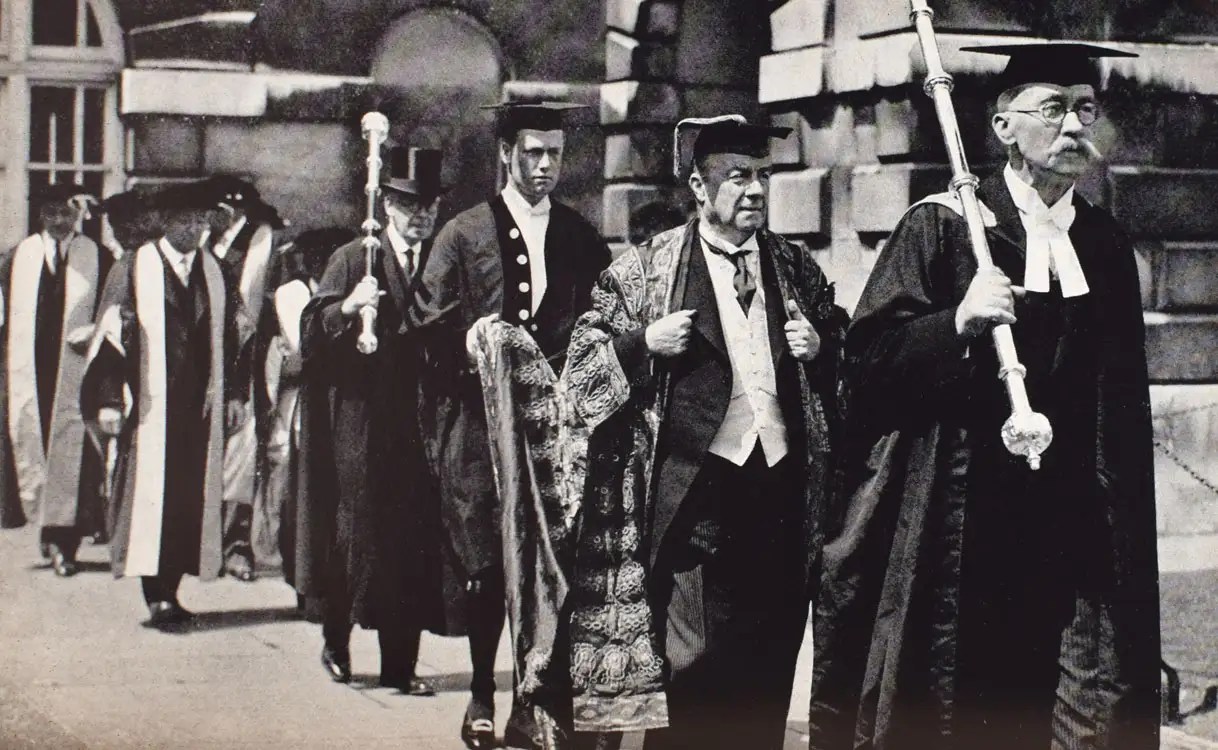
A university procession, from ‘Three Guineas’

She makes a simple point: men down the ages have ridiculed women for being so concerned about their clothes and dress; well, just look at these preposterous old buffers in their wigs and gowns and cloaks and gaiters.

But there’s also a serious point which is germane to her war theme: for she suggests that it is this flaunting of hierarchy and status, this cursed male wish to be superior, which is one of the roots of war. And so she thinks a good way to prevent war would be to attack this cause at the root and refuse to accept honours (as she did) or take part in silly ceremonies (a point developed at length in section 3).

Shortcoming 2. Over-reliance on biography as her primary evidence

The limitations of her education partly explain Woolf’s over-reliance on biography as evidence. She shows little sign of having read much history, economics, science or engineering, philosophy, psychology or sociology – some, but not much, and when she cites history books it’s rarely for the economic or social data.

Instead, what she does rely on to an overwhelming extent is biographies: all the damning evidence she assembles to demonstrate British society’s engrained misogyny and the power of the patriarchy is rarely drawn from history or sociology but relies exclusively on biographies and autobiographies and letters. The phrase you get in so many book titles, ‘Lives and Letters’, sums it up exactly. As an indication of her reliance on biography, here are quotes from just on one page:

  • ‘The witness of biography — that witness which any one who can read English can consult on the shelves of any public library…’
  • ‘Biography proves this in two ways…’
  • ‘Of this, too, there is ample proof in biography…’
  • ‘The study of biography… proves…’
  • ‘Perhaps the greatest testimony to the value of education with which biography provides us is…’
  • ‘You will find, if you consult biography…’

No need to consult facts and figures, assess data, decipher manuscripts, spend years in the archives. Again and again she takes the biography of an eighteenth century bluestocking or a nineteenth century hack writer like Mrs Oliphant off the shelf, and finds and pastes into her narrative their complaints about their limited lives and the dire condition of women in their time, which suit her argument.

(She does mention some histories but, when you look closely you see that she picks out of her historical sources the lives and opinions of her women witnesses: in other words, she selects the biographical elements of history and ignores the statistics, data, political history and so on.)

Late in the essay, rather as she does with her claims to be an amateur, untrained in academic enquiry, she turns an apparent weakness on its head. She tells us that she relies so much on (a very limited view of) history, on biography and newspapers, because they are the only sources of information open to a woman who has been denied a better, higher education, because of her sex; for:

history, biography, and… the daily paper [are] the only evidence that is available to the ‘daughters of educated men’.

Her very lack of scholarly rigour is itself an indictment of the patriarchal oppression which kept her excluded from the higher education her brothers and millions of men had benefited from.

And newspapers

She regards newspapers as ‘history and biography in the raw’. The excellent introduction by Anna Snaith tells us that Woolf kept three scrapbooks in which she gathered evidence for this book. It is striking how many of these snippets and excerpts are taken from newspaper articles or magazines, not the most in-depth kind of research. Newspapers are, by their nature, selective and biased and superficial. They sensationalise in order to sell copies. They are, in other words, the opposite of academic research into history, sociology and so on. This is a weakness in her evidence base.

On the other hand, newspapers are topical and up to date and give her useful snapshot of contemporary opinion – which makes them very interesting for the causal reader, 90 years later. Here’s a sample of the sources, taken from the numbered list of references at the back, which shows the combination of biography and newspaper cuttings which she overwhelmingly relies on as evidence.

  1. ‘Personal Reminiscences of a Great Crusade’ / a cutting from The Herald
  2. a cutting from The Listener / ‘Reflections and Memories’ by Sir John Squire
  3. ‘The Life of Sophia Jex-Blake’ by Margaret Todd
  4. Letter to The Times
  5. Debretts
  6. ‘Life of Sir Ernest Wild, K.C.’ by R.J. Rackham
  7. Lord Baldwin, speech reported in The Times
  8. ‘Life of Charles Gore’ by G.L. Prestige
  9. ‘Life of Sir William Broadbent’ edited by his daughter
  10. ‘The Lost Historian, a Memoir of Sir Sidney Low’ by Desmond Chapman-Huston
  11. ‘Thoughts and Adventures’ by Winston Churchill
  12. Speech at Belfast by Lord Londonderry, reported in The Times

You get the picture: her main sources are lives, letters and newspapers.

The second letter: funding a women’s college

Since the essay is in three parts and the introduction says it addresses three letters, I thought it would be a part per letter, so I was surprised when the second letter pops up at the end of part one. It is from a women-only college writing to ask Woolf to contribute to their fund raising. Anna Snaith’s excellent notes tell us it was a real letter Woolf received from Joan Strachey, Principal of the women-only Newnham College in Cambridge, asking for a donation to renovate the college buildings.

Woolf shows with some doleful quotations and examples, how petty-minded, snobbish and fierce for their stupid rules and regulations the existing (men-only) universities are. She harks back to the notorious incident of being kicked off the grass by the beadle early in ‘A Room of One’s Own’, which clearly still rankles.

Therefore, she replies to this letter that she will consider contributing to a women-only college but only if it is drawn up on a completely different basis from the male colleges. She proceeds to lay out the principles for an experimental college, one which will eschew all competition and exams, be open to the poor, and teach the humanities in a spirit of openness and collaboration:

A place where society was free; not parcelled out into the miserable distinctions of rich and poor, of clever and stupid; but where all the different degrees and kinds of mind, body and soul merit cooperated. Let us then found this new college; this poor college; in which learning is sought for itself; where advertisement is abolished; and there are no degrees; and lectures are not given, and sermons are not preached…

She warns that if the women-only colleges model themselves along male lines, with all the snobbery and competition and status-seeking and petty rankings that entails… those are precisely the kinds of habits of thought, the endless seeking superiority, which create the war mentality and she will not contribute to it.

And no chapels. She is as vehemently against the all-women colleges having chapels as she is violently against the engrained misogyny of the Church of England.

No to teaching English literature

She has a fierce passage execrating the teaching of English literature and its packaging into classes and exams, which she describes as ‘vain and vicious’. This is why Woolf herself refused to accept honorary degrees or prizes, despite being offered many in the later part of her life, and turned down offers to lecture (the exception which proves the rule being the lectures which formed the basis of ‘A Room of One’s Own’).

Woolf explains women’s war patriotism as an escape from domestic oppression

In a wonderfully irrational peroration she thinks that it can only have been delirious joy at being released from the narrow, cramped, uneducated lives forced upon Victorian daughters and spinsters which explained the huge outburst of patriotic enthusiasm among women at the outbreak of the Great War in 1914.

So profound was her unconscious loathing for the education of the private house with its cruelty, its poverty, its hypocrisy, its immorality, its inanity, that she would undertake any task however menial, exercise any fascination however fatal that enabled her to escape. Thus consciously she desired ‘our splendid Empire’; unconsciously she desired our splendid war.

This is splendid rhetoric but it’s a symptomatic of her failure to understand the causes of war, her failure to understand the psychology of crowds and societies embarking on war, her failure to understand genuine feelings of patriotism or national pride which are such big motivators for large numbers of people in any country – in a nutshell, her failure to understand anyone outside her own narrow upper-middle-class milieu.

Shortcoming 3. Ignorance of the wider world

I think her failure to understand the patriotic zeal which accompanied the start of World War One is indicative of her broader failure to understand the range and complexities of human nature, of all human nature across all of society.

Of the narrow little world of upper-middle-class women whose lives are supported by fleets of nameless servants which allow them to pursue their tedious obsession with art and poetry, of this tiny privileged world, she was a brilliant painter.

Of the big wide world, of the thousands of occupations, jobs and livelihoods, in finance, business, economics, trade, law, science, technology and engineering, of the lives of the working classes with their labour in coal mines and iron works, building ships, sailing the oceans, building trains and cars, laying down telegraph cables – in other words, in almost all the wide world and its billions of inhabitants, she has little or no interest and makes no effort to understand.

As an artist, as a writer, it doesn’t matter. Her novels focus on her chosen terrain and are masterpieces. As an essayist, claiming to gather evidence in order to analyse large social issues, it is, to say the least, problematic.

Giving a guinea

Out of this rather convoluted flow of arguments, Woolf concludes that she ought to give a guinea to the building of the women’s college, because it was entrapment in the family home that led so many women to explode with patriotism upon the outbreak of war. Building a college for the public education of the same class will prevent that and so materially contribute to the prevention of war which, if you recall, was the aim proposed right at the start of the essay.

Part 2. The professions

How can we enter the professions and yet remain civilized human beings, human beings who discourage war?

Woolf says a woman like her has only one weapon at her command to use against war, ‘the weapon of independent opinion based upon independent income.’ Now she will try to use this to sway the men in the professions.

The pretext is another letter she has received, from a society supporting women in the professions, asking for another donation, this time to the support of hard-up professional ladies. For Woolf it begs the question why, 20 years after women were admitted to the professions (1919) so few have risen to the top rank and so many are hovering round the bottom.

Woolf’s answers are convoluted and involve replies to other letters and lengthy addresses to her fictional interlocutor, they but boil down to:

  • women have much shorter traditions of thriving in the professions and so lack the centuries-old networks of male patronage and preferral
  • there are no limits to educated men churned out by the public schools and major universities, whereas there are far fewer schools for girls, only four or five colleges for women, and even the numbers admitted to these are severely restricted (only 500 women students were permitted at Cambridge in her day)
  • exams in the professions advantage those who have spent their lives taking exams, i.e. privileged, privately-educated men, and bar women who have (as she shows) vastly less access to private education
  • the nearly universal sexism and misogyny found at all levels of English society

Sexism and misogyny

As mentioned above, the flow of Woolf’s arguments is sometimes hard to follow, especially when it feels like she’s twisting the flow in order to fit her broader feminist critique to fit the essay’s ostensible subject of how to prevent war – but what the essay indisputably does do is powerfully convey the deeply entrenched tentacles of the patriarchy in contemporary 1930s England. She presents a wealth of facts and figures about the systematic prevention of women being educated, getting jobs, entering the professions and so on.

In this second part, the essay builds up into a devastating demonstration of English society’s hair-raising sexism and misogyny. In the main text but especially in the extensive notes which illustrate it, Woolf gives extended quotes from a wide range of men in powerful positions expressing the most hair-raising prejudices and slurs. I can’t give brief quotations, you have to read the notes, and the extended stories she gives, of awful politicians, judges, professionals, writers and commentators taking every opportunity to demean and limit women.

Fascists and Nazis

Woolf cranks up the temperature a lot by comparing several terrible British chauvinists who pontificate that a woman’s place is in the home, with a quote from none other than Adolf Hitler saying the exact same kind of thing.

Herr Hitler and Signor Mussolini have both often in very similar words expressed the opinion that ‘There are two worlds in the life of the nation, the world of men and the world of women’; and proceeded to much the same definition of the duties.

The juxtaposition of the two explains in a flash why Woolf is so resistant to all male talk about patriotism and ‘our country’. In what possible sense is it ‘her country’ when the Archbishop of Canterbury and the editor of the Daily Telegraph hold identical views about women’s place in society as Adolf Hitler? The same point is made in one of the long notes:

‘My husband insists that I call him “Sir”,’ said a woman at the Bristol Police Court yesterday, when she applied for a maintenance order. ‘To keep the peace I have complied with his request,’ she added. ‘I also have to clean his boots, fetch his razor when he shaves, and speak up promptly when he asks me questions.’ In the same issue of the same paper Sir E. F. Fletcher is reported to have ‘urged the House of Commons to stand up to dictators.’ (Daily Herald, 1 August 1926.)

Why, Woolf asks, all this fuss about opposing dictators abroad when every level of British society supports domestic tyrants at home?

Pay for housework

Men work in the public realm and get paid, sometimes a small fortune, often for jobs of dubious worth. Women labour in the home to raise families and manage households and care for the elderly, all unpaid. So: women’s domestic work should be paid.

The work of an archbishop is worth £15,000 a year to the State; the work of a judge is worth £5,000 a year; the work of a permanent secretary is worth £3,000 a year; the work of an army captain, of a sea captain, of a sergeant of dragoons, of a policeman, of a postman – all these works are worth paying out of the taxes, but wives and mothers and daughters who work all day and every day, without whose work the State would collapse and fall to pieces, without whose work your sons, sir, would cease to exist, are paid nothing whatever.

I wonder who first originated this call? Mary Wollstonecraft in ‘A Vindication of the Rights of Woman’ (1792)? Certainly Friedrich Engels mentions it in his 1884 book ‘The Origin of the Family, Private Property and the State’. Anyway, Woolf makes a sustained case for it over many pages, 30 years before the issue was revived by second-wave feminists in the 1970s:

Note: I was a househusband for eight years. I did all the childcare, running children round to nurseries, playgroups, parties, doing all the shopping, cooking and cleaning, changing thousands of nappies, giving bedtime baths and so on, while my wife earned the family income. So I have lived experience of issues like this. It’s this lived experience which feeds into my scepticism about feminism, not as a theory (fine and dandy) but in practice (complicated and compromised). I met plenty of women who were extremely happy to pack in office work and become full-time mums and housewives, who loved looking after their young children, dressing them up, holding parties, dropping them at nurseries or infant school and going to meet girlfriends for lunch or coffee.

Then again, some didn’t. Some felt trapped and needed support, would have welcomed free or cheap childcare, or just wanted to go back to work which they found more fulfilling than hanging round playgrounds or hosting rooms full of screaming kids.

I had many conversations with scores of mums about how the state should provide cheap childcare, or if only companies would allow more flexible work based around school hours, if only housework was recognised and paid for like other forms of work, and so on and so on. Hundreds of conversations on these and related subjects, over years and years.

So my scepticism about feminism is not ideological or temperamental. It’s based on the lived experience of being a housekeeper and child-rearer myself, and talking to hundreds of women in the same situation. The problem is not the top-level slogans and demands, anyone can come up with catchy slogans and carry banners – “Wages for Housework” – it’s figuring out the practical policies and application: where would the money come from? How would it be paid out? Who defines ‘housework’? Like child benefit would it go to anyone caring for a child or be subject to conditions? How would you prove that you do the housework and don’t sub-contract this or that part to cleaners or nannies? etc etc.

The procession

Back to the Woolf on the professions. She gives a vivid description of the processions of all the professions through London’s streets to the centres of law, finance and so on and asks her women readers: do we, in fact, want to be part of this procession? Do we want to do the same jobs but for less pay and more condescension? Or do we want to strike out on our own and lead our lives differently?

The facts… seem to prove that the professions have a certain undeniable effect upon the professors. They make the people who practise them possessive, jealous of any infringement of their rights, and highly combative if anyone dares dispute them. Are we not right then in thinking that if we enter the same professions we shall acquire the same qualities? And do not such qualities lead to war? In another century or so if we practise the professions in the same way, shall we not be just as possessive, just as jealous, just as pugnacious, just as positive as to the verdict of God, Nature, Law and Property as these gentlemen are now?

She gives a number of quotes from lawyers, clerics and politicians complaining they lead a dog’s life, and have sacrificed all their pleasures and family time to their work. Do modern women want to rush into exactly the same kind of wage slavery?

Woolf wonders if we can turn to the lives of nineteenth century women in the professions to help us find a more humane way to have one of these high-powered jobs and live properly? No, because there weren’t any women in the nineteenth century professions. They weren’t allowed. Instead:

We find, between the lines of their husbands’ biographies, so many women practising – but what are we to call the profession that consists in bringing nine or ten children into the world, the profession which consists in running a house, nursing an invalid, visiting the poor and the sick, tending here an old father, there an old mother? – there is no name and there is no pay for that profession; but we find so many mothers, sisters and daughters of educated men practising it in the nineteenth century that we must lump them and their lives together behind their husbands’ and brothers’.

The validity of housework and child-rearing, again, and the long buried, unrecorded of the scores of millions of women who spent their entire lives doing it.

Giving the second guinea

All these arguments have been contained, rather confusingly, in a very long letter replying to the letter she received asking for financial aid for impoverished women professionals. Woolf sums up her position by saying she will send the letter-writer one guinea ‘on condition that you help all properly qualified people, of whatever sex, class or colour, to enter your profession’, and in addition ensure that women:

  • must earn enough to be independent
  • must not prostitute their brain to their profession
  • must refuse all prizes, medals and awards, and be content with obscurity
  • must rid themselves of religious pride, college pride, school pride, family pride, sex pride and those unreal loyalties that spring from them

These are obviously very strict, probably utopian conditions, as with her demand for a completely different type of college which ended section 1. But:

If you agree to these terms then you can join the professions and yet remain uncontaminated by them; you can rid them of their possessiveness, their jealousy, their pugnacity, their greed. You can use them to have a mind of your own and a will of your own. And you can use that mind and will to abolish the inhumanity, the beastliness, the horror, the folly of war.

Antigone saying No to male tyranny

Part two rises to a very powerful invocation of Sophocles’ play, Antigone. Woolf studied this when young and it stayed with her all her life as a powerful story of female resistance to male tyranny. In the era of Hitler and Mussolini it was more than ever relevant. She comes back to it later.

No risk because of exclusion

Woolf ends part 2 with a grand fanfare of irony, saying there is no immediate risk of women professionals losing their souls and working themselves to shreds so long as the laws of England hold their nationality so lightly, prevent them from working in many professions, limit the numbers who can attend university, and ensure that so many women continue to live in the tradition of neglect and contempt, living gruelling lives of unpaid work in dark patriarchal homes.

Part 3. The Outsider Society

The sarcasm and irony which have been present throughout the essay rise to a real anger and bitterness in this, the longest of the three parts.

Woolf reverts back to the original letter she was sent, the one from the unnamed male correspondent asking her how they can prevent a war, and she repeats his three suggestions, namely that we should:

  1. sign a manifesto pledging ourselves ‘to protect culture and intellectual liberty’
  2. join a certain society, devoted to certain measures whose aim is to preserve peace
  3. should subscribe to that society which like the others is in need of funds

Failure of the universities

She addresses these points one by one. First she is satirical about this idea of ‘protecting culture and intellectual liberty’. Isn’t this what the Great Universities have said they were devoting themselves to for centuries, the ones which have been teaching men these values and brutally excluding their sisters and daughters? Is the fact that these values now need such support from society an admission that all those centuries of learning have failed? And if they’ve failed, why should the impoverished, life-opportunity-deprived daughters and sisters suddenly rush to the help of their oppressors?

What is ‘culture and liberty’?

Anyway, what is this ‘culture and liberty’ the letter writer refers to? She knows what it isn’t. Characteristically, she turns to biography and uses the life of an author like Mrs Margaret Oliphant (1828 to 1897) who, after her husband died, churned out meretricious romances to support her children. Was this intellectual liberty? No, this was intellectual prostitution and Woolf angrily takes it as typical of the intellectual prostitution forced on so many women writers and artists who had to sell their souls and prostitute their art because of the patriarchy’s refusal to let them earn a living any other way.

So she mocks the letter writer’s suggestion that women, victims of centuries of repression, should suddenly rush to help the poor privileged men in their time of need. He wants her to join his pacifist society, does he? Well, no. The very word ‘society’ denotes the systematic exclusion of women from education and influence and power and money, so screw society.

The very word ‘society’ sets tolling in memory the dismal bells of a harsh music: shall not, shall not, shall not. You shall not learn; you shall not earn; you shall not own; you shall not – such was the society relationship of brother to sister for many centuries.

The Outsiders Society

She’s not going to join any boys’ club. Instead she proposes setting up a separate organisation, for women of her class and (lack of) education. It would be called The Outsiders Society. It would consist of educated men’s daughters working through their own class and by their own methods for liberty, equality and peace. Members would:

  • not fight
  • not work in munitions factories or nurse the injured
  • not encourage men to go and fight but maintain an attitude of neutrality, as fighting is a ‘sex characteristic which she cannot share’

She rises to real bitterness:

She will find that she has no good reason to ask her brother to fight on her behalf to protect ‘our’ country. ‘”Our country,”‘ she will say, ‘throughout the greater part of its history has treated me as a slave; it has denied me education or any share in its possessions. “Our” country still ceases to be mine if I marry a foreigner. “Our” country denies me the means of protecting myself, forces me to pay others a very large sum annually to protect me, and is so little able, even so, to protect me that Air Raid precautions are written on the wall [i.e. women are defenceless against modern warfare]. Therefore if you insist upon fighting to protect me, or “our” country, let it be understood, soberly and rationally between us, that you are fighting to gratify a sex instinct which I cannot share; to procure benefits which I have not shared and probably will not share; but not to gratify my instincts, or to protect either myself or my country. For,’ the outsider will say, ‘in fact, as a woman, I have no country. As a woman I want no country. As a woman my country is the whole world.’

Wow. Very powerful. Furthermore, The Outsider will cultivate complete indifference to male nonsense about patriotism, war and fighting. On the contrary, she will:

  • take no part in patriotic demonstrations
  • not take part in patriotic praise
  • absent herself from military displays, tournaments, tattoos, prize-givings and all such ceremonies as encourage the desire to impose ‘our’ civilization or ‘our’ dominion upon other people

The idea is that this ‘indifference’ will damp down patriotic fervour in those around her and thus, in a tiny way, help to avoid war.

All this makes a sort of sense. But it feels like twisting logic when Woolf goes on to assert a link between these anti-war steps and the positive demands of her feminist programme. The connection feels tenuous and forced. Because she now switches to say that in order for their opinion or actions to matter, the outsiders must push for a raft of feminist requirements, being:

  • they must earn their own livings
  • they must press for a living wage in their professions
  • they must create new professions in which they can earn a living wage
  • they must press for press for a money wage for the unpaid worker in her own class – the daughters and sisters of educated men
  • they must press for a wage to be paid by the State to the mothers of educated men

Make the state pay for housework

This last is vital because until she has complete financial independence, a wife is dependent on her husband for money and will follow his opinions and men are for war. Therefore, in order to create an influential bloc of educated women who are against war, this class must be given financial, and so intellectual, independence. Women must be paid by the State for their work as mothers.

And she tells her male interlocutor that this step – paying women for their housework – would also liberate husbands, because by sharing the burden of earning an income they would no longer be wage slaves, slaves to the rat race. It would have an enlightening and life-enhancing effect all round.

I gave my thoughts on this proposal earlier. It sounds great, and you can see her logic – that women can only be truly independent and free if they have their own income, separate from their father’s or husband’s – but how would it be implemented in practice?

I’ll just make the additional point that its recurrence here is characteristic of how key themes and suggestions recur throughout the essay, building up power through repetition and echoes, not unlike her technique in her novels.

Outsider demands

But she hasn’t finished with her demands. The Outsiders would:

  • not only earn their own livings but become so expert that their threat to down tools would have power and influence
  • when they have earned enough to live on they would earn no more i.e. not pile up obscene wealth
  • they would reject any profession hostile to freedom such as the arms trade
  • they would refuse to take office in any institution which pretends to respect liberty but actually restricts it, such as Oxford and Cambridge

Outsiders will eschew all the stupid costumes and ceremonies so beloved by men (see the section about silly ceremonials in part 1).

Outsiders will eschew ‘the coarse glare of advertisement and publicity’ and prefer to work in honest obscurity.

The secret society already exists

Wandering into thriller territory, Woolf suggests that this Outsider Society already exists but is secret and underground in its activities. Her very dubious evidence for this far-fetched claim is a clutch of newspaper reports of various women officials making comments against war, opposing arms manufacture and the like. From random quotes and newspaper clippings she based the existence of a secret society operating across English society. Is this an example of her sometimes utopian or far-fetched argumentation – or an example of her dry sense of humour? Difficult to tell.

Against the Church of England

Outsiders will:

  • fearlessly investigate and criticise public institutions they are forced to contribute to, such as the universities, but especially the Church of England
  • by criticizing religion they would attempt to free the religious spirit from its present servitude and would help, if need be, to create a new religion based it might well be upon the New Testament, but, it might well be, very different from the religion now erected upon that basis

Woolf’s attitude to the Church of England had already been indicated in the passage about cited above about Antigone where she writes that ‘Antigone’s five words are worth all the sermons of all the archbishops’, those five Greek words (they total 11 in the English translation) being:

‘Tis not my nature to join in hating, but in loving.’

Pages 196 to 202 give a scathing account of how Jesus Christ’s own admonition that his followers are equal which promised equality between men and women was denied by St Paul, who invented the idea that women must be veiled in church and not speak. This bigotry hardened over the centuries into a church which forbids any positions of power or influence in the most powerful and prestigious organisation in the land, to women.

With the result that the salary of an archbishop is £15,000, the salary of a bishop is £10,000 and the salary of a dean is £3,000. But the salary of a deaconess is £150; and as for the ‘parish worker’, who ‘is called upon to assist in almost every department of parish life’, whose ‘work is exacting and often solitary…’ and who is most likely to be a woman, she is paid from £120 to £150 a year.

It’s a pattern mirrored in all the other professions and walks of life: women excluded from all the prestigious, well-paid higher positions, and forced to undertake the most menial and poorly-paid jobs.

Psychoanalysis, anger and fear

One of Anna Snaith’s excellent notes tells us that ‘Woolf’s brother Adrian [Stephen] and his wife Karin were trained psychoanalysts and were crucial in disseminating Freud’s work in England.’ This is relevant because Woolf quotes at length from the Archbishops’ Commission on the Ministry of Women (1936) and in particular from the appendix written by Professor Grensted, the Nolloth Professor of the Philosophy of the Christian Religion in the University of Oxford.

This professor concluded that there is no reason in theology (Christ’s teachings) why there should not be women priests, but there were strong objections to women priests among the clergy. Digging deeper he uses Freudian terminology to suggest the deep conviction held by many men of men’s superiority and women’s inferiority.

The causes are obscure but the outcome is obvious: that whenever a conversation lights on the topic of equality for women and women holding roles up till now reserved for men, many man become angry and many women become fearful. This imbalance leads women not to raise, mention or discuss the issue which, as a result, goes underground.

The infantile fixation

Woolf takes from Grensted the notion of the ‘infantile fixation’. I didn’t quite understand this and I didn’t see her defining it anywhere. Instead she gives three examples of what she means (taken, inevitably, from biographies), namely the wildly irrational anger and jealousy triggered in three classic Victorian fathers when their daughters asked permission to get married or (worse than that) to get a job. The fathers being:

  • Mr Barrett (father of Elizabeth who wanted to marry the poet Robert Browning)
  • the Reverend Patrick Brontë (father of Charlotte who wanted to marry)
  • Mr Jex-Blake (father of Sophia who was offered a small sum for tutoring mathematics to a friend)

By contrast, to show the impact of a father’s liberality, she gives the story of Mr Leigh Smith. It’s worth quoting at length because the impact is in all the details. Smith had a daughter, Barbara, who he loved.

When Barbara came of age in 1848 he gave her an allowance of £300 a year. The results of that immunity from the infantile fixation were remarkable. For ‘treating her money as a power to do good, one of the first uses to which Barbara put it was educational.’ She founded a school; a school that was open not only to different sexes and different classes, but to different creeds; Roman Catholics, Jews and ‘pupils from families of advanced free thought’ were received in it. ‘It was a most unusual school,’ an outsiders’ school. But that was not all that she attempted upon three hundred a year. One thing led to another. A friend, with her help, started a cooperative evening class for ladies ‘for drawing from an undraped model’. In 1858 only one life class in London was open to ladies. And then a petition was got up to the Royal Academy; its schools were actually, though as so often happens only nominally, opened to women in 1861; next Barbara went into the question of the laws concerning women; so that actually in 1871 married women were allowed to own their property; and finally she helped Miss Davies to found Girton. When we reflect what one father who was immune from infantile fixation could do by allowing one daughter £300 a year we need not wonder that most fathers firmly refused to allow their daughters more than £40 a year with bed and board thrown in.

The difference just one liberal father made. What if all Victorian fathers had been like that.

Sexist science

There follows a passage giving some examples of how even contemporary science is twisted to prove the inferiority of women. To be honest this section is neither very compendious nor persuasive. She doesn’t really go into the most basic accusation against women, that their bodies are designed for childbirth and child-rearing and this explains why their minds are limited to domestic subjects and childish logic. (I’m not saying this, I’m repeating the sexist, misogynist accusation.)

This is a failing but I think reflects the limitations of Woolf’s knowledge and education. Of science she knows next to nothing and so is simply incapable of unpacking all the biological and psychological aspects of woman-hating. She is much more at home in her comfort zone of education and literature, the lives of women writers.

She cites Bertrand Russell pointing out the sheer sadism of much medical science towards women (the medical profession’s reluctance to provide painkillers to women in childbirth) or the twisting of scientific knowledge to justify male superiority – but not as amply as this huge subject demands.

Cleons

Instead she reverts to literature again, and her obsession with Antigone. In the play the oppressive father is Cleon, the archetype for the Victorian paterfamilias and the modern fascist. Here is Cleon speaking dictator-talk:

‘Whomsoever the city may appoint, that man must be obeyed, in little things and great, in just things and unjust… disobedience is the worst of evils… We must support the cause of order, and in no wise suffer a woman to worst us… They must be women, and not range at large. Servants, take them within.’

Order and the oppression of women, Mr Barrett and Mussolini.

The personal and the private

In the essay’s last pages she brings things together by (rightly) saying that she has shown how male tyranny in the personal, domestic realm and in the public realm, are intimately linked:

that the public and the private worlds are inseparably connected; that the tyrannies and servilities of the one are the tyrannies and servilities of the other.

Despite the strangeness of the letter-answering structure and the oddly digressive, rambling flow of the argument, by the end she has presented a devastating barrage of evidence, as well as making a host of demands and suggestions.

The third guinea

So she refuses to sign the form her correspondent had sent her. She refuses to sign up to his society because of her opposition to all such male bodies, but she will send him a guinea to support it.

Their aims are the same, to oppose the tyrants in the name of Justice and Equality and Liberty. But, as this amazing book has explained, as a woman, as the patchily educated ‘daughter of educated men’, as someone with completely different life experiences and, consequently, utterly different perspectives from the male sender of the letter, she shares the same aim but insists that she will try to bring it about using, not the old male forms and words, but new words and new ideas appropriate for women.

Magnificent

For all its faults, ‘Three Guineas’ is a magnificent, powerful and very persuasive piece of work. Her assembly of a very wide range of evidence, facts and figures really bring home the historical endurance, depth and wide range of the legal, financial and cultural oppression of women throughout English history and the stupid, patronising and misogynist attitudes and opinions deployed to maintain that oppression.

The notion of the Outsiders Society is the crystallisation of the massive theme which emerges repeatedly throughout the text, the idea that women – not because of any biological or psychological differences – but purely because of the legal, financial, professional and cultural apartheid they have suffered for centuries, bring to the table a different perspective from men across a whole range of issues.

I think it’s a magnificent example of a polemical essay, of an impassioned political pamphlet.

Criticisms

There are a number of problems or issues with Woolf’s way of arguing. Initially I included them in my review where they occurred but they cluttered up the flow of my review, and gave an unduly negative opinion too early on. I mentioned three earlier on. Here are a few more.

Shortcoming 4. Woolf’s intellectual confusions

Periodically throughout the text Woolf freely admits to own intellectual shortcomings: for example, right at the start she admits being bewildered that there seems to be a wide range of opinions about whether war is good or inevitable. She herself tells us that the more she reads, the more opinions she discovers, the more confused she becomes. But… is that not the point of being an intellectual: to read all the opinions, weigh the evidence, and develop your own line of argument, based on the evidence you uncover and reacting to other people’s arguments?

This activity, intellectual activity, always puzzles and confuses Woolf. In ‘A Room of One’s Own’ there’s the section where she orders up some books in the British Museum and opens them up, expecting to discover The Truth staring her in the face.

Sometimes this is part of her general mocking irony, mocking the pretensions of pretty much all male activity, including the grand Pursuit of Truth. But at other times it can give you the worrying sense that she doesn’t really understand what intellectual enquiry is.

Her intellectual confusion as evidence of her case

In the opening and then at various transition moments, Woolf explicitly tells us that she struggles to marshal the evidence, is embarking on something too big for her abilities, and wonders if she’d be better off abandoning it. After a while I realised that maybe these passages are designed to dramatise the issue of women’s exclusion from formal education by using herself as an example.

Woolf’s brothers went to top private schools and Oxbridge whereas she more or less had to educate herself at home and mostly taught herself by browsing through her father’s extensive library. In other words, every time she shares how confused by the evidence or daunted by the challenge of answering big question she is, she is demonstrating the effect of the grotesquely unequal education of the genders, how women have been the victims of ‘tradition, poverty and ridicule’, and showing the reader how she (and we) are suffering for it.

Maybe that’s why she flaunts her own intellectual limitations so much: the intellectual inability she frequently laments is the result of her exclusion from higher education. It makes her case for her.

Shortcoming 5. Her analysis is restricted to a (relatively) small class

Her lack of real confidence in her own research, and her need to make her feminist points as categorical and powerful as possible, explain why Woolf makes the strategic decision of restricting her analysis to a relatively small class, to women like herself, to ‘the daughters of educated men’, as she describes them. As she puts it:

Our ideology is still so inveterately anthropocentric that it has been necessary to coin this clumsy term – ‘educated man’s daughter’ – to describe the class whose fathers have been educated at public schools and universities. Obviously, if the term ‘bourgeois’ fits her brother, it is grossly incorrect to use it of one who differs so profoundly in the two prime characteristics of the bourgeoisie – capital and environment.

She makes it quite clear on page one that she is only discussing upper-middle-class women, women like herself, women with immaculate manners who are used to managing servants and know which of the many forks and spoons to use at a formal dinner.

In order to avoid the confusions, contradictions and conflicting evidence I mentioned above, in order for her analysis to work, she has to reject the vast majority of the population (the working class and lower classes, of both sexes) and identify her cause with just this numerically small and limited class of posh ladies.

It isn’t just me pointing this out. The Wikipedia article about Three Guineas tells us that the noted academic Q.D. Leavis wrote a scathing review of ‘Three Guineas’ soon after it was published:

She denounces the essay because it is only concerned with ‘the daughters of educated men’, seeing Woolf’s criticisms as irrelevant to most women because her wealth and aristocratic ancestry means she is ‘insulated by class’.

And Anna Snaith’s notes in the Oxford University Press edition tell us that Woolf received letters from working class women readers who complained about being left out of her analysis, notably a long semi-autobiographical one from a working class woman named Agnes Smith.

This is closely related to what I called shortcoming 3, ignorance of the wider world. But it’s also a decision. She found it hard enough gathering the evidence for the sexist discrimination against her own type and class of woman. If she opened it up to the broader middle and working classes she’d never have finished it.

2025: the perils of intersectionality

Many of these criticisms are mentioned in Anna Snaith’s introduction to the Oxford University Press edition. Here she indicates the larger cultural and political problems the essay falls foul of. This is that there are, nowadays, so many grievances, so many groups claiming to be victims, so many communities and identities who feel that they, too, have been subjected to centuries of oppression, that it is hard to focus on just one, and it is especially hard to focus on the group Woolf defines as the ‘daughters of educated men’.

As you read Snaith’s account of Woolf’s life and social circle, with so many friends among England’s political and cultural elite, the idea of her as a persecuted outsider feels more and more ludicrous. She wasn’t a Jew in Hitler’s Germany, a Black in the American South, a kulak in Stalin’s Russia, an Aborigine in Australia, she grew up in a house full of books which she was actively encouraged to read and went on to become a centre of London’s literary and artistic elite.

This doesn’t invalidate any of the points she makes in the book or detract from the essay’s tremendous power. It’s just to say that the struggle for women’s equality takes its place among quite a few other struggles. I’ve a book about the Irish Civil War on my desk and Irish nationalists have quite a story to tell about 1,000 years of British oppression. Her husband was a Jew who had his own story about the legal and financial persecution of Jews. Something similar could be said of England’s Roman Catholics, prevented by law from holding official positions. Or – a group close to my heart – England’s non-conformists, banned by law from holding any positions of authority for 300 years after the civil war. Citizens from India or any of the colonies we ruled for centuries might have a thing or two to say about Britain’s oppression of their peoples and cultures.

Being a modern academic, Snaith is contractually obliged to drag in slavery – the progressive topic par excellence – to her discussion of ‘Three Guineas’, on the rather tenuous basis that guineas were, apparently, first used as currency in the British slave trade. Don’t know what Virginia would have made of that scholarly leap of imagination.

To repeat – this little digression about the modern over-abundance of historical grievances is not entirely my view but simply expanding points made by the book’s editor, Anna Snaith, in her introduction.

All these other issues don’t invalidate any of the points Woolf makes in the book but they place it in a much larger, real world context. If you’re a feminist, you can insist that your cause and your history of oppression is the real one, the big one, the important one and, convinced of your righteousness, overlook or downplay the grievances of all the other groups I’ve mentioned. In a sense, to get anything done, you have to focus on your issues and grievances; nobody can represent the issues of the whole world. You have to pick your battles. And this explains why Woolf realised that, in order to get her book written, she had to concentrate just on relatively privileged upper-middle-class women like herself, on ‘the daughters of educated men’.

Conclusion

It’s a very powerful book. Very. To repeat what I said at the start, from one point of view it may be her most important work. It’s a bit of a struggle, a bit meandering, a bit puzzling in places, her proposals such as for the Outsider Society are a bit eccentric – and yet so many of her main points drive right home, and the evidence gathered in the notes at the end is searing, blistering, eye-opening. It shook this old cynic. It materially changed my views about feminism. I strongly recommend it.


Credit

‘Three Guineas’ by Virginia Woolf was first published by the Hogarth Press in 1938. Page references are to the 2015 Oxford University Press paperback edition, edited and annotated by Anna Snaith, although the text is easily available online.

Related links

Related reviews

Brecht: fragments @ Raven Row

This is a fascinating and thought-provoking exhibition, in a lovely setting, I’m just kicking myself that I found out about it too late to see the theatrical performances (see below).

Raven Row

Raven Row is a secret treasure of a gallery tucked away in Spitalfields. It’s adapted from the domestic rooms of a tall thin eighteenth century building at the eastern end of Artillery Lane (nearest tube station Liverpool Street station). Raven Row is a charity committed to displaying art which is diverse and unusual, sometimes by established international artists, sometimes more out-of-the-way figures, united by having escaped the notice of the big name London art galleries. Their programme aims to be ‘improvisatory and undogmatic.’

This photo of the interior of one of the rooms immediately gives you a feel for how they’ve retained most of the original Georgian features and decoration.

Installation view of ‘brecht: fragments’ at Raven Row (photograph by Marcus J Leith)

Bertolt Brecht

Bertolt Brecht (1898 to 1956) has a claim to be the greatest German writer of the twentieth century, certainly the most famous. He had a first burst of fame when his musical, The Threepenny Opera, became a hit, and its signature tune, ‘Die Moritat von Mackie Messer’ was covered by American performers as ‘Mack the Knife’.

But it was after the Second World War when the radically innovative approach of his so-called ‘epic theatre’, as performed by his touring theatre company The Berliner Ensemble, revolutionised the possibilities of theatre. The spread of his technique was also helped by the fact that he wrote some of the great plays of the period such as ‘Mother Courage’, ‘The Chalk Circle’, ‘Galileo’ and many others.

But Brecht wasn’t just a world class playwright, he was also a noted poet, he wrote many essays in support of his theatre theory and, as this exhibition sets out to show, he could also be considered an artist of a particular type.

brecht: fragments

In the late 1930s Brecht came under attack from Soviet administrators of the new doctrine of Socialist Realism, most notably the powerful critic Gyorgy Lukács, who criticised him for using elitist, avant-garde techniques which were difficult for ‘the masses’ to understand. In one of his replies defending the use of modernist aesthetics for revolutionary communist purposes, Brecht mentions that, even though he was now in exile in Denmark, he was currently working on a surprising number of projects and goes on to mention 2 novels, a play and a book of poetry, not including the essay in which he describes all this (Aesthetics and Politics, Verso Books, 1977, p.70).

In other words, it was Brecht’s working practice throughout his career to be working on a multitude of projects, and to be surrounded by fragments of works in progress, across a range of genres and forms.

Found images

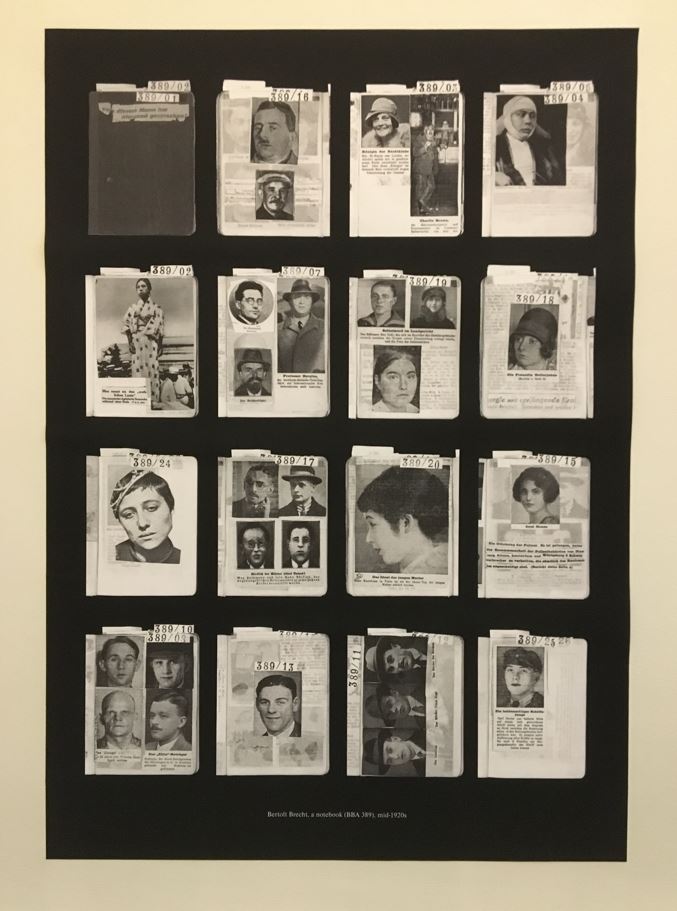
What this many-sided exhibition at Raven Row shows is how this concept, or category, of ‘fragments’ can be seen as not just a side effect of Brecht’s work-in-progress, but a fundamental principle which applies to them at every level. For, as this exhibition shows, Brecht was a compulsive collector of found images, often from newspapers and magazines. He pasted these into notebooks where he collected them by theme. He strewed his manuscripts with them where they obviously acted as inspiration or captured ideas, sometimes literal, sometimes tangential.

Installation view of ‘brecht: fragments’ at Raven Row showing a typical page from his notebook from the mid-1920s (photo by the author)

For example, why paste a postcard image by Pieter Breughel onto the front page of the manuscript of his great play ‘The Caucasian Chalk Circle’ except that it, in some sense, crystallised or captured the mood, or a mood, which the work was designed to present?

Installation view of ‘brecht: fragments’ at Raven Row showing the cover page of the manuscript of The Caucasian Chalk Circle, showing the cut and pasted letters and a postcard of a painting by Breughel (photo by the author)

Photomontage

Photos could be used in another way, to create photomontages, cutting out images from one context and pasting them into others, in the style of the radical photomontage artist John Heartfield. In actual fact, there isn’t much here in that style. For the most part, Brecht didn’t interfere with, cut and paste together, his images. They tended to go into his albums and notebooks and be pasted into play manuscripts unaltered. The artistry was in the initial selection.

The War Primer

Another use of news photos was when Brecht began collecting images during the Second World War and writing one four-line quatrains underneath them, producing what he came to call ‘photo-epigrams’. Over time this developed into a book which, after the war, came to be called the ‘War Primer’, containing 75 photo-epigrams.

A bunch of the original paste-ups for the book (actually created by Ruth Berlau, one of Brecht’s long-term collaborators) are hung across one wall. The quatrains, like most of Brecht’s poetry, consist of direct statement, unadorned by similes and metaphors, blunt and political. For example, under a photo of a bombardier in uniform inside a bomber:

You’re looking at a bastard, and a poor one!
‘I laugh at news of other men’s distress,
A corset salesman, formerly from Nürnberg,
A dealer now in death and wretchedness.’

Here’s an example, a striking magazine image of men in a steelworks which inspired Brecht to write the quatrain you can see, typed out, cut and pasted beneath it.

Paste-up for a page of War Primer (1940 to 1949) by Bertolt Brecht in collaboration with Ruth Berlau. Courtesy the Bertolt Brecht Archive, Akademie der Künste, Berlin (BBA 2096/38)

The quatrain for this one reads (in English translation):

‘What are you making, brothers?’ ‘A car of steel.
‘And what about these plates here, lying on the side?’
‘For shells that slice through sheer armoured walls.’
‘Why all this, brothers?’ ‘That we stay alive.’

Encyclopedia of gestures

Yet another use for images was that, heavily involved as he was in the staging of  his plays, he was very interested in the actors’ gestures. What happens if you get an actor to stand on a stage so? Or hold his arms just so? And now in this position? And now in that? How much can be achieved without words, without even action, just by posture and gesture? And then what happens if you add words to gestures, is it possible to make the words and gestures contradict each other or at least play off each other.

Dictatorial poses

Which explains why there’s a room of sheets from his numerous notebooks, which consists of newspaper photos of generally eminent men of the time (the obvious tyrants – Hitler, Mussolini and Stalin – with other lesser known politicians such as Daladier, Laval et al). Anyway, Brecht managed to get hold of photos them making speeches and it’s genuinely fascinating to study how they held themselves and what they did with their arms and hands. Thus prompted I adopted some of the poses of Hitler in full flow (hold two clenched fists up, palms towards you, in front of your chest – and instantly felt some of the coiled rage at the world. Elsewhere, Brecht picked up this improbable series of snaps of the Führer throwing a few shapes.

Installation view of ‘brecht: fragments’ at Raven Row showing the sheet of photos of Hitler posing and prancing (terrible photo by the author)

And, in the next glass case, copied a series of poses of Comrade Stalin addressing a meeting, which have him leaning forward and pointing an accusing finger, – and you immediately feel yourself dominating a room full of people petrified that there going to be the next one accused of some crime and hauled off to the gulag.

Installation view of ‘brecht: fragments’ at Raven Row showing the sheet of photos of Stalin, smiling, playing the affable good fellow, and pointing a finger at people he’s about to send to the gulag. Copy the poses for yourself and see how they make you feel (photo by the author)

Collaboration

Back to the plays, the wall labels tell us that it was Brecht’s common practice to be highly collaborative, to sit round a table with other writers, director, actors, to discuss parts and action and dialogue. Lines of dialogue or action were typed on strips of paper and often moved around in a process of continual shuffling and improvement.

Installation view of ‘brecht: fragments’ at Raven Row showing a typical Brecht manuscript showing how sections of dialogue were created as blocks before being moved around, all accompanied by a typical contemporary news photo (photo by the author)

Pictures for plays

Once you grasp the centrality of collaboration in Brecht’s practice then it makes perfect sense that so many of his manuscripts are not neatly typed out finished products, but highly fragmented texts made out of typed lines pasted onto notebook pages, often with lines of commentary scrawled around then and, as mentioned, often with a photo from a newspaper pasted in. Now you can see how the use of images like this 1) helps everyone involved understand the directly political context of a piece 2) captures the mood of discussions and decisions without needing to be put into words. ‘Yes, that’s it.’

Hence the examples here of work notebooks, and ‘finished’ manuscripts, which are festooned with cut out lines of dialogue or text, crystallised in newspaper photos.

Many scenes

In his conversations with Walter Benjamin, Brecht explained how he conceived of his plays less as made from ACTS, in the traditional way, but more as collections of lots of freestanding scenes. In the reply to Lukács mentioned above, he describes how the play he’s working on, describing life under the Nazis, consists of 27 short scenes with no overarching narrative arc. In other words, Brecht constructed many of his plays as if they were a series of snapshots.

Development and flux

Because another key part of Brecht’s practice is that the plays were never really finished. They always changed and developed in production as the actors and director discovered what worked, and from production to production as Brecht changed lines, or action or moved about the scenes. Narrative ideas, situations and segments of dialogue were subject to continuous cutting and rearrangement, often literally, using scissors and glue.

Recap

So from the smallest photo cut out from a magazine and pasted into a notebook, to the large scale of his three-hour-long plays, this sense of flux and fragments was foundational to Brecht’s conception of his works and his practice in assembling them.

The Brecht Archive

That’s probably enough to give you a feel for the exhibition and the light it sheds on the practice and process of Brecht’s imagination, and an indication of the kind of visual material you see (lots of pages from his notebooks and scrapbooks, lots of news and magazine photos from the 1930s, ’40s and ’50s).

Just a note that the entire thing hails from the Brecht Archive now, of course, housed in Berlin and this is the first time most of this (largely unknown) material has ever been shown in the UK. It is, as I hope I’ve indicated, a fascinating treasure trove of ideas, images, documentary background to not only Brecht’s numerous works, finished and unfinished, along with glimpses of the social history of the period (1930s to the early 1950s) all combined.

Performances

A major part of the exhibition was the theatrical performances which took place twice a day during most of its run. Because I only stumbled across this so late, like a fool I missed them. The idea was that twice a day a bunch of actors led visitors through the gallery spaces, performing dramatic fragments from four of Brecht’s unfinished plays from the 1920s, showing how montage and snapshot techniques played a crucial part in his conception of playwriting.

Unfinished

Because that’s another aspect of the show I’ve forgotten to mention, which was that not only a lot of his plays changed and evolved during production, but a sizeable number never even made it that far. In short, Brecht left behind lots and lots of unfinished works. So four of the galleries contain props and production notes, including photos and visual materials relating to four plays which were never completed, but are here summarised and explained, namely:

Performance 1: The Breadshop

A 1930 collaboration addressing issues of poverty and hunger after the Wall Street Crash, which eventually ran to 245 pages but was never completed or performed. For some reason the conception began to focus on the role of the Salvation Army (SA), with a surprising number of accompanying images and biographies of SA notables.

Installation view of ‘brecht: fragments’ at Raven Row showing the performance space for The Breadshop (note the production notes and accompanying photos pasted to the wall) (photo by the author)

Performance 2: The Flood

An unfinished draft for a radio play, written 1927 to 1928, about a man-made apocalypse, inspired by a hurricane which devastated Miami in 1926.

Performance 3: Fleischhacker

A collaboration with Elisabeth Hauptmann, worked on till 1931, this told the story of Jae Fleischhacker, a futures trader in Chicago, as he plays the wheat market. This is interwoven with the story of a ‘Family from the Savannah’, who move to Chicago to try their luck following crop failure in the wheat district.

Installation view of ‘brecht: fragments’ at Raven Row showing the performance space and props for the performance of Fleischhacker (photo by the author)

Performance 4: Fatzer

Title of a dramatic fragment that Brecht worked on intensively for four years, from 1926 to 1930, and returned to throughout his creative life. It tells the story of a four-man tank crew, led by Johann Fatzer,  who desert their post during the First World War. Amazingly, the manuscript ended up running to 500 pages but remained fragmented and unresolved and unperformable – until, that is, some scenes were reshaped and performed here, for this show.

Concluding scene from the performance of Fatzer in ‘brecht: fragments’ at Raven Row (2024) photograph by Anne Tetzlaff

Two films

And there are two films.

1. On a small TV monitor an experimental contemporary filming of a production of Mann ist Mann (Man Equals Man) from 1931. Set in British colonial India, the play concerns the brainwashing of an ordinary civilian, Galy Gay, into the perfect soldier. This film documents the 1931 production of the play at the Berlin State Theatre, for which Brecht was director, Peter Lorre played Galy Gay, and stage design was by Brecht’s long-time collaborator Caspar Neher. It was made using the experimental procedure of shooting film at a slowed rate of around one frame per second.

2. And in a darkened room, projected on a larger screen, are excerpts from the 1932 German feature film ‘Kuhle Wampe or Who Owns the World?’ about unemployment, homelessness and left-wing politics in the Weimar Republic. Brecht conceived and wrote the script, and directed the final debate scene, while the music was written by his long-term collaborator Hanns Eisler.

Gallery

Here’s the star performer of the era, Herr Adolf Hitler, cut out and pasted on the back of a manuscript page from ‘The Resistible Rise of Arturo Ui’. There are many photos of him, the most fascinating ones being the series depicting him in the full flood of his impassioned speeches.

Manuscript page from ‘The Resistible Rise of Arturo Ui’ (1941) courtesy the Bertolt Brecht

This one is a highly political photo showing Spanish peasants marching off to seize land owned by exploitative landlords.

From an album compiled by Brecht in the late-1940s, courtesy the Bertolt Brecht Archive, Akademie der Künste, Berlin (BBA 1198/058)

Here’s a vivid snapshot of Berlin men, the guy at the back giving it a particularly thuggish, threatening tone.

Image from research for Fatzer (1926 to 1930) by Bertolt Brecht. Courtesy the Bertolt Brecht Archive, Akademie der Künste, Berlin (BBA 0111/062)

The booklet

Usually galleries produce coffee-table catalogues to accompany their exhibitions, large-format, heavy books full of colour reproductions, which cost anything from £20 to £50.

Rather amazingly, the brecht: fragments exhibition at Raven Row is accompanied by an impressive 113-page pamphlet, consisting of five high quality essays by experts in the field, along with a chronology and bibliography, and it is COMPLETELY FREE. I can’t remember a comparably generous gesture by any gallery I’ve ever visited.

Envoi

One of the things that made Brecht such an interesting, innovative and powerful poet was his commitment to direct statement undeformed by the needs of scansion or rhyme. The power derives from the fundamental gestus, a word he coined to mean attitude or opinion but indicating more than that, evoking the pose and gestures of an actor onstage, a kind of mental image of how you would stand and move as you declaim the words. It’s a style epitomised by the plain but powerful final poem in the huge volume, ‘Poems 1913 to 1956’, edited by John Willett and Ralph Mannheim (1976):

And I always thought

And I always thought: the very simplest words
Must be enough. When I say what things are like
Everyone’s heart must be torn to shreds.
That you’ll go down if you don’t stand up for yourself
Surely you see that.

Although most of us disagree with his doctrinaire Marxism and foolish faith in Soviet communism, it’s hard not to be impressed by Brecht’s unflinching commitment to the victims of tyranny and exploitation everywhere, captured in so many of these photos, and in the texts and poems and fragments he derived from them.


Related links

Related reviews

Peter Kennard: Archive of Dissent @ the Whitechapel Gallery

‘Visual attempts to dissect the newspeak that bombards us’
(Peter Kennard in an article about his photomontages)

Chances are you’ve seen one or more of Peter Kennard’s iconic photomontages, particularly during his heyday in the 1980s when the reign of Mrs Thatcher provided the perfect background for his brand of aggressively radical, satirical photomontages, published in a wide variety of left-leaning magazines and newspapers.

‘Protest and Survive’ by Peter Kennard (1980) Tate: Purchased from the artist

Throughout Thatcher’s premiership, and fired by her close partnership with Rocking Ronnie Reagan, there was widespread paranoia on the Left that the world stood on the brink of a catastrophic nuclear war and Kennard’s witty, bleak, mashed-up montages provided a perfect accompaniment to the mood of anxiety among concerned activists everywhere.

‘Haywain with Cruise Missiles’ by Peter Kennard (1980) Tate: Purchased from the artist 2007 © Peter Kennard

Photomontage

Photomontage is the technique of cutting, arranging and gluing together photos (or parts of photos) to make a new image, sometimes with text similarly cut and pasted from newspapers or other sources. As a technique it’s always been associated with politics and satire, from its origins in the Weimar Republic of the 1920s and 30s and the great pioneer of political montages, John Heartfield.

The Meaning of the Hitler Salute: Little man asks for big gifts.

‘The Meaning of the Hitler Salute: Little man asks for big gifts’ by John Heartfield, October 1932

As a student activist in the 196os, Kennard found theoretical underpinnings for photomontage in the critical writings of Marxist thinkers like Walter Benjamin and Bertolt Brecht who promoted photomontage and collage (among other strategies) as ways of puncturing, subverting and questioning the smooth lies of capitalist discourse and bourgeois culture. Indeed, one of newspapers on show here is a Guardian Arts supplement from the 1990s featuring a long essay about Benjamin by James Wood and illustrated by a photomontage of him (Benjamin) by Kennard.

‘Walter Benjamin’ by Peter Kennard (1990) as featured in ‘Archive of Dissent: Peter Kennard’ at the Whitechapel Gallery

Kennard at the Whitechapel

This new exhibition of Kennard’s work includes lots of golden oldies from the 70s, 80s, and 90s, witty, savage, sometimes very bleak visual protests against a world run by rich Western corporations who, in what is probably his central theme, make obscene amounts of money by selling arms, weapons, bombs, guns to disgusting regimes which then use them to repress, murder, massacre their own and neighbouring populations. Champagne-swilling capitalists win – unarmed civilians, women and children lose.

‘Stop’ by Peter Kennard as featured in ‘Archive of Dissent: Peter Kennard’ at the Whitechapel Gallery

However, this exhibition is not by any means a retrospective or dwelling on the past. Two of the three rooms contain very up-to-date works, completed in 2023 or this year, which show Kennard expanding his range in new and interesting ways. Having pondered all this a bit, I think the best way to 1) indicate what the show actually contains and 2) to indicate how the new stuff differs and expands on the old, is simply to describe it room by room.

Room 1

Room 1 is named the Archive Room and contains four elements. First there’s a plain table on which are ten books, publications from Kennard’s career from coffee table blockbusters to smaller, postcard-sized works. You could grab a coffee from the cafe downstairs, sit and browse through these for an interesting half hour or so.

On a shelf round two walls are 17 copies of one of these books – @earth – open to 17 different images.

On another wall is a hinged rack (the kind you see in art gallery shops) of 42 posters of Kennard images ranging from 1979 to 2019, made from photolithography and silkscreen on card.

Lastly, there are piles and piles of newspapers – or at least that’s what I thought they were till I looked closely and realised they are specially printed broadsheet-sized, newspaper-style folded versions of his images, accompanied by smatterings of text, which are FREE and we are encouraged to take away with us.

Installation view of ‘Archive of Dissent: Peter Kennard’ at the Whitechapel Gallery, showing the reading table, copies of @earth open on the shelf and piles and piles of free papers (photo by the author)

Room 2

Barely a room, really just an extension of the same space, the second gallery contains three elements. There is a display case which bears the title ‘Worktop, 1966–2024’ and is, as the name suggests, a junk shop-style collection of the kinds of materials that Kennard collects – magazines, books, photos – plus all manner of equipment used to make the works, such as a tape measure, rulers, paints, knives and tools and so on.

The artist’s bric-a-brac at ‘Archive of Dissent: Peter Kennard’ at the Whitechapel Gallery (photo by the author)

Above the display case are four large framed works titled ‘Stocks’ from 1994. These are four copies of the Financial Times which have been subjected to a dramatic transformation, namely a gaunt, ravaged, black and white arm and hand tearing its way down through the neat columns of stock market prices, in a gesture which manages to convey terrible despair.

©Peter Kennard Newspaper 8 (1994) Carbon toner, oil, charcoal, pastel on newspaper, wood

‘Stock’ by Peter Kennard (1994) as featured in ‘Archive of Dissent: Peter Kennard’ at the Whitechapel Gallery

Opposite these a sort of alcove has been filled with 25 poster-sized blow-ups pf his images to create a little forest of placards, each attached to a wooden post themselves secured in red vices. This is his newest work, created specially for this exhibition, is titled ‘People’s University of the East End’, and there’s a story behind it.

It turns out that the three ‘galleries’ in which the show is held were once part of the former Whitechapel Library (1892 to 2005). At the turn of the twentieth century this was a free resource to the poor inhabitants of the area who would have read books, magazines and newspapers here. Back then it was nicknamed the ‘People’s University of the East End’, hence the title of this installation which, as the curators put it, ‘reflects on the capacity for learning, community and activism in public spaces.’

The exhibition, we learn, was conceived to echo and reflect on this idea of a library, a place where ideas are made available, promoted and circulate. Hence the inclusion of the word Archive in the title of the show, for it brings together not just the images themselves, but includes actual copies of the original newspapers and magazines and posters, as well as the more recent books, in which his images were first published and continue to circulate.

Installation view of ‘People’s University of the East End’ in ‘Archive of Dissent: Peter Kennard’ at the Whitechapel Gallery (photo by the author)

This little copse of placards is quite a neat idea, and contains up-to-date works such as the barbed-wire tree from the civil war in Syria (centre right) and the image of Julian Assange intercut with the American and British flags at the bottom right, but it didn’t pull my daisy, I’m not sure why. In the same way, the notion of the Archive certainly explains the bringing together of all these formats – posters, newspapers, and the vitrine showing his bric-a-brac – but doesn’t really come off, as an idea.

The best bit, I thought, were the shiny red vices supporting the posts, like a little army of red crabs. ‘Red vices’, hmm, that could have been a witty alternative title for the exhibition and the right-on causes Kennard has spent a lifetime supporting…

Anyway, themes from these first two spaces are picked up in the third, biggest and best room of the show.

Room 3: the installations

The first wall of the third and final room displays no fewer than 40 of his classic photomontages, ranging from a piece commenting on British Army brutality in Northern Ireland in 1973 to the Free Julian Assange piece I mentioned above, made in 2023, via one of my favourites, the very funny Maggie Regina from 1983.

Maggie Regina by Peter Kennard (1983) in ‘Archive of Dissent: Peter Kennard’ at the Whitechapel Gallery (photo by the author)

It’s an impressive selection from fifty years of mostly stark and upsetting imagery designed to provoke the viewer into thinking again about the forces of violence and exploitation which underlie our shiny Western world.

But the big thing here is the installations which I think are brilliant. There are four of them and, remember the copies of the Financial Times with the gaunt arm tearing through it in the previous room? – they all rely on newspapers as their central material.

1. Reading Room

The simplest is ‘Reading Room’. Picking up on the Whitechapel Library motif, these are four old two-sided wooden lecterns, the kind that turn-of-the-century readers would have read their newspapers on. Each of them hosts an original edition of a newspaper or magazine where a Kennard work originally appeared. Most of the 8 newspapers in question were copies of the Guardian, the exceptions being two copies of The Workers Press and a vintage copy of the New Musical Express.

Installation view of ‘Reading Room, 1997 to 2024,’ in ‘Archive of Dissent: Peter Kennard’ at the Whitechapel Gallery (photo by the author)

The classic black-and-white photomontages address these issues:

  • 1973 scientists involved in torture (The Workers Press)
  • 1974 British investment in apartheid South Africa (The Workers Press)
  • 1981 nuclear weapons, a skeleton morphing into an atom bomb (New Musical Express)
  • 1989 reunification of East and West Germany (Guardian)
  • 1990 the Whites Only policy of South African apartheid (Guardian)
  • 1990 profile of Walter Benjamin (Guardian)
  • 1991 Gulf War, the attempt to stop Saddam Hussein (Guardian)
  • 1991 a centrefold collection of photomontages (Guardian)

2. World Markets (1997 to 2024)

‘World Markets’ is a set of 16 broadsheet newspaper double-spreads, most if not all from Kennard’s favourite target, the Financial Times, on which he has projected faces intended, presumably, to represent The Poor and Exploited. The aim is to remind us that behind the wall of numbers which is the faster-then-ever, digitally automated stock market, are the lives of the poor and downtrodden who suffer from the ravages of global capitalism.

Installation view of ‘World Markets, 1997 to 2024,’ in ‘Archive of Dissent: Peter Kennard’ at the Whitechapel Gallery (photo by the author)

Both these are straightforward in manner and material. The last two installations represent something completely new because they use electric lights and projections.

3. Double Exposure, 2023

‘Double Exposure’ covers a whole wall. It consists of three rows of 12 Financial Times pages with lights projecting images of war and conflict and poverty onto them. It was made in collaboration with Nigel Brown and is large and imposing. Part of the overall visual impact comes from the complicated spaghetti of electric cabling hanging from each projection and spooling along the floor.

Installation view of ‘Double Exposure’ in ‘Archive of Dissent: Peter Kennard’ at the Whitechapel Gallery (photo by the author)

The dynamic nature of this installation i.e. the lights continually changing, is appealing. And the notion of this magic lantern show revealing the ‘truth’ behind the blank walls of stocks and shares prices on the FT pages is also sort of interesting.

Kennard’s dualistic worldview

‘Double Exposure’ really just brings out the fundamental concept which underlies all Kennard’s work which is that there are two levels of reality – the smooth, plausible, ‘common sense’ world we inhabit, defined and described and promoted in the hegemonic discourse of neo-liberal consumer capitalism, the world of perfect people smiling down at us from advertising hoardings in the streets, on the sides of buses, on the Tube, on TV on our social media, the world of newspapers and TV assuring us that our values and our way of life, our pensions and investments in mega-corporations, are the only rational, practical ways to run the world – and the other world, the Dark Side, where the huge profits which keep the corporations afloat which our pensions and savings are invested in, the world of ‘shiny happy people’ is sustained by the ruthless exploitation of the poor and powerless, of indigenous peoples around the world, of peasants and workers forced to sweat in terrible conditions in Indonesian sweatshops or be psychologically destroyed in China’s suicide factories, and where, above all, the West maintains its hegemonic control of the world’s economic and financial systems through the ruthless elimination of anyone who stands in its way via wars of conquest dressed up as ‘liberation’ or ‘freedom’ – as in the deep need to control the world’s oil supplies which underlay the West’s adventures in the Gulf War and then the Iraq War.

Kennard’s works represent this Two World Hypothesis, this duality, via works which are themselves dualistic or dichotomous, in which (in his classic works) images from two different value systems are made to crash into each other, the startlingness of the disjunction intended to wake us from our complacent slumber.

‘Thatcher Unmasked’ by Peter Kennard (1986) A/POLITICAL

You can see how this duality underlies all his work, from duality of ‘The Haywain with Cruise missiles’ (where the self-deceiving bourgeois dream of some Old Englande is punctured by the modern reality of England being a lunch pad for American nukes) through to the dual image of copies of the Financial Times which have been ripped by the gaunt arm of the global poor (‘Stocks’) or have projected onto them the faces of the global poor (‘World Markets’ and ‘Double Exposure’).

There are, of course, a number of problems with this approach and with the whole radical worldview which underlies it, of which three spring straight to mind.

1. What’s the alternative?

One is, What else do you suggest? Forty years ago I read Class War and Socialist Worker and the kind of publications Kennard’s works appeared in and fondly imagined that the (Western) world could be subjected to a socialist transformation, but the collapse of the Soviet Union and of all the regimes around the world which it supported took all the steam out of those (wildly impractical) hopes and into the vacuum rushed the two flavours of neoliberalism which have ruled the West ever since, the Hard Neoliberalism of the Conservatives and Republicans, of Reagan and Thatcher, or the Soft Neoliberalism of Bill Clinton and Tony Blair, which promised a fairer world and a middle way but still deregulated the financial sector leading to the 2008 crash and enthusiastically promoted the War on Terror and invasion of Iraq, trashing Blair’s reputation forever.

Photo-Op by kennardphillipps (2005) © kennardphillipps

Photo-Op by kennardphillipps (2005) © kennardphillipps

Right up to the present day, activists on the Left are still trying to devise a new economic and social theory on which to base their policies, an ideological vacuum you can clearly see in Keir Starmer’s Labour Party, which is just the British wing of the general bemusement of left-of-centre parties across the West.

Which explains why the Left has so enthusiastically embraced identity politics – it’s an excuse, it’s a fig leaf, it covers for their lack of an economic theory. Certainly feminism and black rights and refugees and Palestine are worthy causes, but in all the Western nations the Left and progressives and activists have clustered round these causes because they don’t know what to do about the economy any more – should we nationalise all the utilities, should the government create an industrial strategy and support native industries?

The Right has won everywhere because it has a clear strategy – reduce the state, privatise everything, neuter trade unions, leave all economic decisions to the market, cut taxes on the rich – which it implements everywhere with total consistency, and has ideological allies in all the media owned by the rich who stand to directly benefit from these policies.

I take the pint that Kennard’s work is satirical commentary and like satire through the ages is under no obligation to propose its own alternative agenda, and yet at some point, during this review of 50 years of political engagement, surely every visitor is going to ask, ‘OK – you hate this universe of exploitation and warmongering – what’s your alternative?’

2. The post-Cold War multipolar world

The second objection to Kennard’s worldview is that it is too western and too parochial. If Reagan and Thatcher deserved mocking in the 1980s how much more so did the totalitarian regimes in Soviet Russia and Communist China?

In this century 9/11 crystallised the threat from radical Islam, a completely new force which entered the world with the 1979 Iranian revolution but none of us were really aware of in the 1980s and 90s (except for those plucky mujahideen Sandy Gall was always reporting on for ITN) and despite the mounting rhythm of Islamic terror attacks.

The point is that the radical or Marxist critique of the West which Kennard’s works seem to embody – his relentless criticism of the British state and army, from Ulster to Basra, and British arms and weapons suppliers making fortunes from murder – has been trumped or eclipsed by forces which are demonstrably more evil and wicked – ISIS in Syria, the Taliban in Afghanistan – and the great arc of instability across North Africa, through the Middle East, Iran-Iraq, up into Syria, countries which were destabilised by the uprisings of the Arab Spring and the chaos, civil wars (Libya, Yemen, Syria) or renewed repression (Egypt) they left in their wake. And of course the horrific Hamas raid on Israel followed by the brutal war on Gaza, with the constant threat of a second front opening against Hizbollah in the Lebanon.

And if you throw in the very real threat to Eastern Europe presented by Putin’s invasion of the Ukraine and the ever-present anxiety about China’s threats to Taiwan, then get a world in which even the most radical Left are hard put to argue that it’s the West who are the biggest threat to peace or the most violent culture or the most repressive regimes.

It’s quite clear to everyone that, even if you want to excoriate Western arms companies and rapacious corporations who are, for example, continuing to supply arms for Israel’s murderous assault on Gaza, the overall values of the West need supporting against the very real enemies threatening it from all sides (including, of course, from within – Trump, Reform and the maniac right of the Conservative Party). As in France, the Left needs to present a united front against the Right which, as I mentioned above, succeeds time and time again because it knows what it wants, in a way the fractured Left all-too-often doesn’t.

In summary, mocking the American and British state, big corporations and warmongering leaders made a lot of sense in the Reagan-Thatcher 1980s, and again in the light of the Bush-Blair Iraq War of 2003 – but now, in 2024, doesn’t feel like an adequate response to a far more complicated, and threatening, world. The iniquity of British arms manufacturers continuing to supply Israel or the Syrian government, profiting from conflict in Yemen or Sudan, remains deplorable.

Union Mask by Peter Kennard (2007) Courtesy the artist

3. How ‘radical’ can any contemporary artist be?

The third objection would be the familiar one levelled at all artists no matter how ‘radical’ or ‘subversive’, which is that their works, across all channels and media, fit smoothly inside the capitalist consumer culture they claim to critique, so smoothly as to have, in practice, zero effect.

The Whitechapel Gallery has a shop which, as always, devotes a section to merchandise from the exhibitions of the moment, in this case books and posters and postcards by Peter Kennard all available at very competitive prices. All artists are as tightly enmeshed in the system they wish to undermine as the richest stockbroker or wickedest arms dealer.

You know the old Leftie joke, ‘If voting changed anything, they’d abolish it’ – same here: Kennard, Banksy, any other political artist you care to mention, don’t change anything at all, so much as provide a kind of backdrop for certain kinds of lives, images certain kinds of student zealots and ageing activists identify with and enjoy looking at.

The richest man I know loves all kinds of art, including ‘radical’ stuff like Kennard, loved political photos in the Elton John photo exhibition, coos as Yoni Shinkobare CBE’s deconstruction of imperial statues and why shouldn’t he? None of them threaten him or his ample investments in the slightest. They’re lifestyle accessories, they’re one more set of consumer items to be flicked through while waiting for a plane or by the pool or in a pokey room in Whitechapel.

The man who made them, Kennard, has to believe in The Cause and is as fiercely committed to making works skewering the evil arms trade as he was 50 years ago, and his consistency and commitment is admirable. But strolling round this exhibition inevitably raises the question whether work like this changes anything at all, even in the minds of visitors who, half an hour later, are browsing in the shop or wedged onto a busy tube train.

4. Boardroom (2023)

The last of the installations in the third room is ‘Boardroom’ which dates from last year. I really liked these works because they use rough, industrial, derelict materials, the kind of thing which always lights my candle. On three big salvaged boards are suspended sheets of (as usual) newsprint. Onto these have been printed anonymous portraits of everyday people, The People, the masses. And onto these are projected the logos of oil and arms companies, of Shell and BP, BAE Systems and many others of the same ilk, the point being, of course, that it’s ordinary people, especially in developing countries, who pay the price for the rapacious exploitation of oil (in the Middle East or Nigeria) and the disgustingly indiscriminate use of weaponry (Syria, Ukraine, Gaza).

Installation view of ‘Boardroom’ in ‘Archive of Dissent: Peter Kennard’ at the Whitechapel Gallery (photo by the author)

Arms and the artist

On reflection, maybe it’s his hatred of state violence which is Kennard’s most consistent subject, from the US bombing of Cambodia and North Vietnam, the British Army’s use of rubber bullets in Northern Ireland in the early 70s, the threat of nuclear apocalypse during the 1980s, the West’s use of devastating firepower against Iraq in 1991 and then again in 2003, and western arms companies continuing to profit from conflicts in Ukraine and Israel.

Maybe, rather than critiquing capitalism per se, it would be more accurate to say that Kennard has spent a lifetime excoriating the ruinous products of Western arms companies and the bellicose leaders who support and encourage the militaristic worldview.

‘Sub-Trump’ by Peter Kennard (2018) Courtesy of the artist and Richard Saltoun Gallery, London, Rome and New York

As an intellectual position, this hatred of companies who profit from selling instruments of death and destruction is more viable than thoughts about overthrowing the entire capitalist system. Who doesn’t agree that we should be feeding starving children rather than building nukes and subs and drones? Except that we live in a world with a Russia in it, where even if Vladimir Putin miraculously dies of a heart attack, chances are he would only be replaced by an even more aggressive Russian nationalist – and a world which also has an increasingly nationalist China in it – not to mention a belligerent Iran which was the main beneficiary of the foolish war in Iraq.

With the result that we live in a world where the defence ministers of every country in NATO are calling for more to be spent on defence budgets in readiness for a war with Russia. Is that wrong? Is Kennard saying European nations should be winding down their defence budgets and sending a signal of passivity to Putin?

You look at Kennard’s powerful images and installations, you are touched by the images of starving children and with one part of your mind you strongly sympathise with criticism of arms companies (and the entire ‘system’) which profits from making and selling weapons of death… and yet… another part of your mind wonders – ‘OK, I get it, arms companies are immoral and wicked… but what would your policy be towards Ukraine and Russia? What would you be advising NATO leaders? Do you think this is the moment to reduce our military capability even further?’

The moral outrage of the works excoriating the killing of the innocent and profiteering from death… clash with a realistic assessment of the warlike world we live in… and so left me, literally, in two minds about all of these works.

New media

Putting their subject matter to one side for a moment, Kennard was keen to emphasise that these latter works – the ones using lights and projections, ‘Double Exposure’ and ‘Boardroom’ – are an interesting new strategy of his, an attempt to deconstruct the whole process of photomontage, the artistic practice which made his name.

I think I understand what he thinks he’s getting at but I’m not sure it’s really true. If you use a narrow definition of photomontage i.e. juxtaposing photographs from different sources on a flat surface to make a new photo image, then yes. But if you use the broader definition I attempted above, of juxtaposing objects from two different value systems (faces of people from the developing world with the sleek markets pages of the Financial Times) then this is fundamentally the same approach, the same way to get an effect.

Putting the idea of ‘deconstruction’ to one side, I still liked these works the best: 1) because I like the industrial paraphernalia of salvaged wood, clips and metal brackets and cabling which they involve, and 2) because they are fresh and new, in technique and aim, when set beside the yellowing montages from the 1970s and ’80s. I found them the most interesting as overall objects or sculptures in the same way that I liked the red vices (novel) more than the protest placards (familiar).

Summary

As you can tell, I’m conflicted. I really liked the photomontages because, in their deliberately scrappy mashed-up appearance, they actually display great visual taste. They’re like classic punk visuals and are almost all impactful and effective images, cousins of the political cartoons from the period, distant relations, maybe, of the savage satire of Gerald Scarfe. Despite being made out of other people’s material, their harsh juxtapositions have an immediately recognisable visual identity, much as you can instantly recognise a Banksy work of graffiti.

And I liked the four installations, and the efforts he’s been making with wood and placards and lights etc to broaden out his practice.

And yet I couldn’t help feeling that, at some level, it all comes from a bygone age. Even his response to the most recent events like the terrible civil war in Syria or the jokey photomontages featuring Donald Trump… they’re good but they signify a style and approach which comes from another era and doesn’t (as I’ve tried to explain) really reflect the complexity of our time, the troubled 2020s.

‘Syria’ by Peter Kennard (2018) Courtesy of the artist and Richard Saltoun Gallery, London, Rome and New York

Or am I being too harsh? Is this a man who has been impressively true to his radical beliefs through half a century of political turmoil and social change, an unflinching critic of corporate greed and political mendacity? As he himself puts it:

‘My art erupts from outrage at the fact that the search for financial profit rules every nook and cranny of our society. Profit masks poverty, racism, war, climate catastrophe and on and on…’Archive of Dissent’ brings together fifty years of work that all attempt to express that anger by ripping through the mask by cutting, tearing, montaging and juxtaposing imagery that we are all bombarded with daily. It shows what lies behind the mask: the victims, the resistance, the human communality saying ‘no’ to corporate and state power. It rails at the waste of lives caused by the trillions spent on manufacturing weapons and the vast profits made by arms companies.’

Is it a good thing that he’s still making images which highlight the violent exploitation lying behind the sleek corporate reports, the environmental destruction which pays for BP bonuses, the murderous blowing up of innocent bodies which underlies the profits of the arms manufacturers named in ‘Boardroom’?

Or is it both at the same time? I was conflicted.

Recommendation

It’s not a big exhibition, it’s not a major exhibition. The first two rooms are small, the second one little more than an alcove. If you’re already a fan you should go in order to see the installations and new pieces, but if you’re not, I’d hesitate to recommend it. You don’t get a lot more of a visual hit than you do from surfing the images on his website.

On balance, I think the wall of images of poor people and babies’ faces projected onto copies of the FT which makes up ‘World Markets’ is worth seeing in the flesh, but as to the rest…well, I’ve given a detailed description of what you see, so you can make your own mind up.

The good old days: a copy of the New Musical Express from 1981 featuring a page-size photomontage by Kennard on the left and reviews of recent gigs by Echo and the Bunnymen and The Cure on the right, on show at ‘Archive of Dissent: Peter Kennard’ at the Whitechapel Gallery (photo by the author)


Related links

Related reviews

The Death of Virgil by Hermann Broch (1945)

The silver lamp next to the couch swung gently to and fro on its long silver chain and outside the window the emanation of the city, ebbing and flowing above the roofs, was dissolved into purple, from purple-violet into dark blue and black, and then into the enigmatic and fluctuant.
(The Death of Virgil, page 47)

The Sleepwalkers

A few years ago I read and reviewed The Sleepwalkers (1931), the masterpiece of Modernist German novelist Hermann Broch (1886 to 1951). The title in fact refers to a trilogy of novels each of which focuses on a troubled individual from successive generations of German society, the novels being titled: The Romantic (1888), The Anarchist (1903) and The Realist (1918).

I reviewed each novel individually but also subjected the magniloquent claims often made about the trilogy to fierce criticism, using evidence from Walter Laqueur’s blistering attack on the failure of intellectuals in the Weimar Republic, Weimar: A Cultural History 1918 to 1933 by Walter Laqueur (1974). I argued that calling the trilogy things like ‘a panoramic overview of German society and history’ were wrong in fact and misleading in implication. The three novels are more eccentric and particular than such generalisations. But then lots of critics make sweeping claims about books they haven’t read.

Broch flees Austria

In March 1938, Nazi Germany annexed Austria in a move known as the Anschluss. Within days Broch was arrested by Nazi authorities for possession of a Socialist pamphlet and thrown into a concentration camp. A campaign by western writers managed to get him freed and he immediately emigrated to Britain, then moved on to America where he settled in 1939.

Before this happened, in 1937, in Austria, Broch had delivered a radio lecture about Virgil. Over the following years he enormously expanded and elaborated this text to become his other great masterpiece, Der Tod des Vergil or The Death of Virgil. This big novel was first published in June 1945 in both the original German and English translation simultaneously. Symbolically, it appeared in the month after the Second World War in Europe finally came to an end, with the complete destruction of Nazi Germany. A crushing end to all illusions about Germany politics, history and culture.

Schematics

Broch’s imagination is schematic: the three novels which make up The Sleepwalkers trilogy each centre on a character who a) come from successive generations and are in some sense emblematic of them; and who b) are each of a distinct and categorisable type. The same urge to structure the material is immediately evident in The Death, which is divided into four equal parts, portentously titled:

  • Water – The Arrival
  • Fire – The Descent
  • Earth – The Expectation
  • Air – The Homecoming

Despite these universal-sounding categories the ‘action’ of novel in fact only ‘describes’ the last 18 hours of the Roman poet Virgil’s life in the port of southern Italian port of Brundisium. The year is 19 BC. Virgil had travelled to Greece, according to this novel hoping to a) escape the fevers of Rome b) finally complete the long poem which has been dogging him, and c) be free to pursue his first love, philosophy.

But he was foiled in this ambition when the princeps or proto-emperor, Augustus, returning from the East, stopped off in Athens, called on Virgil and invited/ordered him to accompany him back to Italy. Hence Virgil’s regret at the start of the novel at giving in to Augustus’s insistence and abandoning his hopes of finally being rid or ‘art and poetry’ and devoting his life to meditation and study.

Anyway, on this return journey Augustus, Virgil and others of the party fell ill. Augustus fully recovered, but the novel opens with Virgil lying in a hammock that’s been rigged up in one of the ships, feeling very unwell indeed. Starting from this moment the long novel portrays the last 18 hours of his life.

The central theme or subject of the novel is Virgil’s wish to burn the manuscript of his epic poem, The Aeneid, a wish which is decisively thwarted by his master and ‘friend’, Augustus.

Modernist?

Blurbs about the novel claims it uses well-established modernist techniques, mixing poetry and prose with different styles and registers to convey the consciousness of a sick man drifting in and out of reality and hallucination but I didn’t find this to really be the case.

When I think of modernism I think of the combination of fragmented interiority matched by collage used in The Waste Land, or the highly collaged text of Berlin Alexanderplatz or the tremendous stylistic variety of Ulysses. There’s none of that here: the text is fluent and continuous. There’s no collage effect, no newspaper headlines or scraps of popular song or advertising jingles. Instead the text is continuous and smooth and highly poetic in style.

Modernism is also usually associated with the accelerated rhythms of the western city, as in the examples above or in John dos Passos’s huge novel, USA (1930 to 1936). Quite obviously a novel set nearly 2,000 years, before anything like the modern city had been imagined, could not use, quote or riff off any aspects of the twentieth century urban experience. So in that respect, also, the novel is not modernist.

What is modernist about it, maybe, is a secondary characteristic, which may sound trivial but is the inordinate length of Broch’s sentences. These can be huge and very often contain multiple clauses designed to convey the simultaneous perception of external sense impressions with bursts of interior thought, memory, opinion and so on – all captured in one sentence.

The Jean Starr Untermeyer translation

The 1945 translation into English was done by Jean Starr Untermeyer. I have owned the 1983 Oxford University Press paperback edition of this translation (with an introduction by Bernard Levin) since the mid-1980s and never got round to reading it till now. This edition contains a longer-than-usual 4-page translator’s note by Jean Starr Untermeyer who, we learn, devoted five years of her life to translating this novel. We also realise, within a few sentences, that her English is non-standard i.e. a bit quirky and idiomatic. On the whole I think that is a good thing because it continually reminds you of the novel’s non-English nature.

Untermeyer makes a number of good points about the difficulty of translating German into English. An obvious one is German’s tendency to create new words by combining individual nouns into new compound nouns. A second aspect of German style is that it can often have a concrete practical meaning but also a ghostly metaphysical implication. This doesn’t happen in English which has traditionally been a much more pragmatic down-to-earth language.

Long sentences

The biggest issue, though, is sentence length. Good German prose style has for centuries allowed of long sentences which build up a succession of subordinate clauses before being rounded out or capped by a final main verb.

English is the extreme opposite. English prefers short sentences. Hemingway stands as the patron saint of the prose style taught in all creative courses for the past 40 years which recommends the dropping of subordinate clauses, the striking out of all unnecessary adjectives, the injunction to keep sentences short and unadorned, a process Untermeyer colourfully refers to as ‘exfoliation’.

As Untermeyer points out, Henry James’s use of long, multi-clause sentences was very much against the general trend of 20th century English prose (as was the extravagant prose style developed by William Faulkner a generation or so later, contrary to the Hemingway Imperative).

Untermeyer says that English prose works by placing its thoughts in sequence and separately expressed in short, clear sentences; German prose more often works by seeking to express multiple levels of meaning ‘at one stroke’ i.e. in each sentence.

But Broch not only came from this very different tradition of conceiving and writing prose, but he pushed that tradition to extremes. Untermeyer reckons some of the sentences in the middle of the book might be the longest sentences ever written in literature. (I’m not so sure. Samuel Beckett wrote some very long sentences in Malone Dies and The Unnameable.)

Thought-groups

Broch’s sentences are long, very long, but they don’t have the deliberately confusing repetitiveness, the incantatory repetitiveness of Beckett. They are clearly trying to capture something and Untermeyer explains in her note that the aim can be summed up by one maxim: ‘one thought – one moment – one sentence’.

Each sentence is trying to capture what she calls one ‘thought-group’, the flickering and often disparate impressions and sensations which occur to all of us, all the time, continually, in each changing second of perception and thought. The difference between you and me and Hermann Broch is that Broch spent a lifetime trying to develop a prose style which adequately captures the complexity of each fleeting moment of consciousness.

In English we do have a tradition of hazy impressionistic prose maybe best represented by the shimmering surfaces of Walter Pater’s aesthetic novel, Marius the Epicurean (also about ancient Rome). And a related tradition of deliberate over-writing in order to create an indulgently sensual effect, maybe associated with Oscar Wilde and sometimes dismissively called ‘purple prose’.

Broch’s intention is different from both of those because he is trying to be precise. His sentences are so very long only because he is trying to capture everything that his subject felt in that moment. The superficial comparison in English is with James Joyce’s Ulysses but Joyce wove an intricate web of symbolic and sound associations, at the same time as he steadily dismantled the English language, in order to make his text approximate the shimmering a-logical process of consciousness. Broch goes nowhere near that far. His sentences may be epic in length, but they are always made up of discrete clauses each of which is perfectly practical and logical and understandable in its own right.

And from Pater to Joyce, the English style of long sentences has tended to choose sensual and lugubrious subject matter, from the lilies and roses of Wilde’s prose to the astonishing sensuality of Ulysses. Broch, by contrast, uses his long sentences to cover a much wider range of subject matter, much of it modern, unpleasant and absolutely not soft and sensual.

In the warehouse district

One example will go a long way to demonstrating what I’m describing. Early in the novel the little fleet carrying the emperor and Virgil docks at Brundisium. Virgil is then carried off the ship and carried in a litter by slaves to the emperor’s mansion in the city, led by a young man with a torch who leads them among the warehouses of Brundisium. Here is one sentence from the passage describing this journey.

Again the odours changed; one could smell the whole produce of the country, one could smell the huge masses of comestibles that were stored here, stored for barter within the empire but destined, either here or there after much buying and selling, to be slagged through these human bodies and their serpentine intestines, one could smell the dry sweetness of the grain, stacks of which reared up in front of the darkened silos waiting to be shoveled within, one could smell the dusty dryness of the corn-sacks, the barley-sacks, the wheat-sacks, the spelt-sacks, one could smell the sourish mellowness of the oil-tuns, the oil-jugs, the oil-casks and also the biting acridity of the wine stores that stretched along the docks one could smell the carpenter shops, the mass of oak timber, the wood of which never dies, piled somewhere in the darkness, one could smell its bark no less than the pliant resistance of its marrow, one could smell the hewn blocks in which the axe still clove, as it was left behind by the workman at the end of his labour, and besides the smell of the new well-planed deck-boards, the shavings and sawdust one could smell the weariness of the battered, greenish-white slimy mouldering barnacled old ship lumber that waited in great heaps to be burned. (Pages 24 to 25)

What does this excerpt tell us? It demonstrates both a) Broch’s ability to handle a long sentence with multiple clauses and b) the complete absence of modernist tricks such as collage, quotation etc.

And there is none of the shimmering incoherence of, say, Virginia Woolf’s internal monologues. Instead it is quite clear and comprehensible and even logical. What stands out is the repetition, and the way it’s really more like a list than a wandering thought.

I’ve mentioned that Broch is a systematic thinker and many of these long sentences don’t really meander, they work through all the aspects of a thought or, in Untermeyer’s phrase, thought-group. We are in the warehouse district, a place saturated in the stinks of the goods stored there. And so Broch enumerates them, not in the English style, in a series of short, discrete sentences, but in one super-sentence which tries to capture the totality of the sense impression all together, as it were, capturing one moment of super-saturated perception.

Pigs and slaves

Far from the shimmering impressionism of the English tradition, The Death of Virgil is also capable of being quite hard, almost brutal. Thus the opening passages contain quite stunning descriptions of being on deck of an ancient Roman galley on a very calm sea as it is rowed at twilight into the harbour of Brundisium just as a thousand lamps are lit in the town and reflected like stars on the black water. So far, so aesthetic.

But Broch mingles this soft stuff with over a page harshly criticising the aristocratic guests on the ship whose only interest on the entire journey has been stuffing their faces like pigs. At these moments the narrative is more like Breughel than Baudelaire.

He also devotes a page to a nauseated imagining of the life of the galley slaves, chained below decks, condemned to eternal toil, barely human, a frank admission of the slave society the entire narrative is set among. The theme is repeated a bit later as Virgil watches the slaves carrying goods from the ship once it’s docked and being casually whipped by their bored overseers.

And there’s another theme as well. When the imperial ship docks, it is greeted by roars of approval from the crowd who have gathered to greet their emperor. Suddenly Broch switches to a more socio-political mode, meditating on the terrible evil to be found in the crowds which seek to suppress their individual isolation by excessive adulation of The One – an obvious critique of Nazism.

From far off came the raging, the raging noise of the crowd frantic to see, the raging uproar of the feast, the seething of sheer creatureliness, hellish, stolid, inevitable, tempting, lewd and irresistible, clamorous and yet satiated, blind and staring, the uproar of the trampling herd that in the shadowless phantom-light of brands and torches dove on towards the evil abyss of nothingness… (p.47)

German brutalism

These passages also epitomise what I think of as ‘the German quality’ in literature, which is a tendency to have overgassy metaphysical speculation cheek-by-jowl with a pig-like brutality, qualities I found in the other so-called masterpiece of German Modernism.

The claim about metaphysical bloat is merely repeating the claim of Walter Laqueur, who knew more about Weimar literature than I ever will and found it present in much of that literature. The comment about piggishness is based on my reading of:

  • Berlin Alexanderplatz, which starts as the protagonist, Franz Biberkopf, is released from prison where he’d been serving a sentence for murdering his girlfriend, Ida, and one of the first things he does is go round and rape his dead girlfriend’s sister, Minna. There’s the scene where the scumbag Reinhold drunkenly smashes his girlfriend, Trude’s, face to a pulp or when Franz beats his girlfriend Mieze black and blue etc.
  • The surprising crudity of much Kafka, the protagonists of The Trial and The Castle jumping on their female companions without warning, and the visceral brutality of stories like The Hunger Artist or In The Penal Colony.
  • The crudity of Herman Hesse’s novels, such as The Steppenwolf, in which the ‘hero’, Harry Haller, murders the woman who took pity on him and loved him, Hermine.
  • The Man Without Qualities by Robert Musil which I was enjoying very much for its urbane and humorous tone until – sigh – being German, it had to introduce a psychopath, Moosbrugger, who is on trial for murdering a prostitute and chopping her up into pieces, a process which the author describes in gratuitous detail.
  • In Broch’s own novels, Esch, the piggish ‘hero’ of The Anarchist rapes the innkeeper he subsequently shacks up with, and thinks well of himself because he doesn’t beat her up too much, too often.
  • Wilhelm Huguenau, the smooth-talking psychopathic ‘hero’ of The Realist, murders Esch and then rapes his wife.
  • Bertolt Brecht made a point of dispensing with bourgeois conventions in order to emphasise the brutal reality of the ‘class struggle: ‘Erst kommt das Fressen, dann kommt die Moral.’

Phenomenology

I’ll quote from my own review of The Romantic:

Aged 40 Broch gave up management of the textile factory he had inherited from his father and enrolled in the University of Vienna to study mathematics, philosophy and psychology. I wonder what kind of philosophy Broch studied because this focus on trying to describe the actual processes of consciousness – the flavour of different thoughts, and the ways different types of thought arise and pass and sink in our minds – reminds me that Phenomenology was a Germanic school of philosophy from the early part of the century, initially associated with Vienna. According to Wikipedia:

In its most basic form, phenomenology attempts to create conditions for the objective study of topics usually regarded as subjective: consciousness and the content of conscious experiences such as judgements, perceptions, and emotions. Although phenomenology seeks to be scientific, it does not attempt to study consciousness from the perspective of clinical psychology or neurology. Instead, it seeks through systematic reflection to determine the essential properties and structures of experience.

‘Through systematic reflection to determine the essential properties and structures of experience.’ That’s not a bad summary of what Broch does in The Sleepwalker novels and does again here. The obvious difference is that whereas The Sleepwalker novels have plots and numerous characters who interact in a multitude of scenes, in The Death of Virgil Broch found a perfect subject – a deeply sensitive, highly articulate poet – to host/inspire/articulate an enormous number of these phenomenological speculations, long passages which not only describe Virgil’s sensations and thoughts, but analyse, ponder and reflect on the nature of thought itself.

Thus the first part of the passage through the warehouses, which I’ve quoted, amounts to a catalogue of sense impressions. But the smells of country produce awaken a yearning in him for the peace he knew back when he was growing up on his parents’ farm, but not some peace described in the English purple prose tradition – instead a highly theoretical and metaphysical notion of ‘peace’, as representing longing for a full integration of the self, a longing-yearning which haunts Virgil but which he is fated never to achieve.

Here’s an excerpt from that scene. To understand it you need to know that the roaring greeting of the mob in Brundisium town square had led Virgil to pretty negative thoughts about humanity in all its crudity. And so, in this sentence, the two themes –yearning, and the mob – are blended.

It was himself he found everywhere and if he had to retain everything and was enabled to return all, if he succeeded in laying hold on the world-multiplicity to which he was pledged, to which he was driven, given over to it in a daydream, belonging to it without effort, effortlessly possessing it, this was so because the mutiplicity had been his from the very beginning; indeed before all espial, before all hearkening, before all sensibility, it had been his own because recollection and retention are never other than the innate self, self-remembered, and the self-remembered time when he must have drunk the wine, fingered the wood, tasted the oil, even before oil, wine or wood existed, when he must have recognised the unknown, because the profusion of faces or non-faces, together with their ardour, their greed, their carnality, their covetous coldness, with their animal-physical being, but also with their immense nocturnal yearning, because taken all together, whether he had ever seen them or not, whether they had ever lived or not, were all embodied in him from his primordial origins as the chaotic primal humus of his very existence, as his own carnality, his own ardour, his own greed, his own facelessness, but also his own yearning: and even had this yearning changed in the course of his earthly wanderings, turned to knowledge, so much so that having become more and more painful it could scarcely now be called yearning, or even a yearning for yearning, and if all this transformation had been predestined by fate from the beginning in the form of expulsion or seclusion, the first bearing evil, the second bringing salvation, but both scarcely endurable for a human creature, the yearning still remained, inborn, imperishable, imperishably the primal humus of being, the groundwork of cognition and recognition which nourishes memory and to which memory returns, a refuge from fortune and misfortune, a refuge from the unbearable; almost physical this last yearning, which always and forever vibrated in every effort to attain the deeps of memory, however ripe with knowledge that memory might be. (pages 25 to 26)

Here we have some choice examples of the German tendency to make up new compound nouns to describe elusive philosophical or psychological categories: ‘world-multiplicity’, ‘self-remembered’, ‘animal-physical’.

And the use of repetition is pretty obvious – I’ve singled out the words ‘yearning’ and ‘memory’. It isn’t really repetition for the sake of either euphony (purely for the sound), or to drive home a point (as in, say, Cicero’s legal speeches). It is more that, with each repetition, the meaning of the word changes. Broch is examining the concepts behind these key words from different angles. Each repetition sheds new light, or maybe gives the word additional connotations. It is a cumulative effect.

An obvious question is: does this kind of thing actually shed light, does it help us to understand the human mind any better? Well, not in a strictly factual sense, but in the way that literature forces us to have different thoughts, sensations, expands the possibilities of cognition, vocabulary and expression, then, maybe, yes. And the epic length of Broch’s sentences are indicative of his attempt to really stretch the possibilities of perception, or perception-through-language, in his readers.

Then again, it isn’t an actual lecture, it’s not a scholarly paper appearing in a journal of psychology; it’s embedded in a work of literature so a better question is: how does it work within the text?

Any answer has to take account of the fact that this is only one of literally hundreds of other passages like it. No doubt critics and scholars have tabulated and analysed Broch’s use of key words and concepts and traced them back to works of psychology, philosophy or phenomenology he may have read. For the average reader the repetition of words and phrases and the notions they convey has more of a musical effect, like the appearance, disappearance, then reappearance of themes and motifs, building up a complex network of echoes and repetitions, many of which are not noticeable on a first reading. I ended up reading passages 2 or 3 times and getting new things from them at every reading.

Last but not least: do you like it? I found The Death of Virgil difficult to read not because of the clever meanings or subtle psychology but because a lifetime of reading prose from the Hemingway Century, compounded by a career working on public-facing websites, has indoctrinated my mind into preferring short, precise sentences. So I found it an effort to concentrate fully on every clause of these monster sentences – that, the sheer effort of concentrating of every element in these long sentences, holding all the clauses in your mind as they echo and modify each other – that’s what I found difficult.

But short answer: Yes, I did enjoy it. Very much. And it grows and adds new resonances with every rereading. It’s a slow read because I kept picking it up after putting it aside to make lunch, water the garden, feed the cats etc, found I’d forgotten where I was (because so many of the pages are solid blocks of text without any paragraph breaks) and so ended up rereading pages which I’d read once and not even realising it, but when I did, deliberately rereading it with a whole new pleasure, hearing aspects of the text, its meanings and implications and lush style, which I’d missed first time around.

Lyricism

Because The Death of Virgil is highly lyrical. Untermeyer says the entire text is in effect a poem because of its sustained lyricism. It certainly overflows with lyrical passages of deliberate sensuality.

Through the open arched windows well above the city’s roofs a cool breeze was blowing, a cool remembrance of land and sea, seafast, landfast, swept through the chamber, the candles, blown down obliquely, burned on the many-branched, flower-wreathed candelabrum in the centre of the room, the wall-fountain let a fragile, fan-shaped veil of water purl coolly over its marble steps, the bed under the mosquito netting was made up and on the table beside it food and drink had been set out. (p.41)

Maybe you could posit a spectrum of the content, with pure lyricism at one end, pure abstraction at the other, and a mix in the middle. So the excerpt above is what you could call entry-level lyricism in the sense that it is concerned solely with sense impressions, sense data, describing the ‘real’ world. Here’s a passage which contains hints of the metaphysical:

Yet in the night’s breath all was mingled, the brawling of the feast and the stillness of the mountains and the glittering of the sea as well, the once and the now and again the once, one merging into the other, merged into one another… (p.42)

And here is the full-on visionary-metaphysical:

Oh, human perception not yet become knowledge, no longer instinct, rising from the humus of existence, from the seed of sentience, rising out of the wisdom of the mothers, ascending into the deadly clarity of utter-light, of utter-life, ascending to the burning knowledge of the father, ascending to cool heights, oh human knowledge, unrooted, eternally in motion, neither in the depths nor on the heights but hovering forever over the starry threshold between night and day, a sigh and a breath in the interrealm of starry dusk, hovering between the life of the night-held herds, and the death of light-flooded identification with Apollo, between silence and the word, the word that always returns into silence. (p.48)

By now I hope you can see how Virgil’s mind is in almost permanently visionary mode. In his last hours he is entirely concerned with huge abstract ideas of human nature and destiny and personal intimations about being and consciousness and awareness, all mixed into a great, prolonged swirl. Every conversation, every new event, stirs a new aspect of this endless flow of thoughts, triggers a new long rhapsody. The novel as rhapsody, where rhapsody is defined as ‘an effusively enthusiastic or ecstatic expression of feeling’.

Plot summary

Part one, ‘Water – The Arrival’, is just 53 pages long. The third person narrator records Virgil’s thoughts about the sea journey, his swinish companions, his regret at being forced to leave Athens, notifies us that he is very ill, all as the fleet of 6 ships pulls into the harbour of Brundisium as night falls.

The emperor’s ship navigates among the many other ships in the harbour, ties up and slaves start to unload it, while Virgil is carried ashore in a litter borne by 4 slaves.

A huge crowd has turned out to greet Augustus in the central square, roaring approval. Virgil is carried through them, overcome with disgust at humanity, led by a youth who has appeared out of nowhere carrying a torch.

This youth leads the slaves bearing Virgil’s litter through the smelly warehouse quarter and then into a very dirty narrow back passage, reeking of poverty, as raddled women hang out their windows yelling abuse at the rich guy in the litter. This is a sort of vision of hell and goes on for some pages, Virgil repeatedly calling it Misery Street.

They finally emerge into a plaza, also thronged, and make their way through the surging crowd to the gates to the emperor’s palazzo. Here they are let through by the guard and handled by an efficient major-domo who escorts them to their room.

The mysterious torch-bearing boy is unaccountably still with Virgil and when the major-domo tells him to leave, Virgil, on an impulse, says the boy is his ‘scribe’ and can stay. When he asks how long the boy slave will stay with him, the boy gives the portentous reply ‘forever’, which triggers a characteristic response in Virgil:

 Everlasting night, domain in which the mother rules, the child fast asleep in immutability, lulled by darkness, from dark to dark, oh sweet permanence of ‘forever’. (p.44)

The slaves depart. Virgil is alone in the bedroom he’s been allotted, perceiving the night sky, the plash of the fountain in the gardens outside, overcome with swirling thoughts about peace and youth and sense impressions and memory, as he lies on the bed and tries to sleep. End of part one.


Credit

The Death of Virgil by Hermann Broch was published by Pantheon Books in 1945. References are to the 1983 Oxford University Press paperback edition.

Hermann Broch reviews

Reviews of 20th century German literature

The Weimar Republic

Exhibitions

Books

German history

Blood and Belonging: Journeys into the New Nationalism by Michael Ignatieff (1994) – 1

This is an outstanding book, bubbling over with ideas and insights on a subject which is as relevant today as when it was written back in the early 1990s. It’s actually the book of a BBC TV series. In 1993 Ignatieff and his five-man TV crew travelled to Croatia and Serbia, to recently reunified Germany, to Ukraine, Quebec, Kurdistan and Northern Ireland, to see at first hand what was already being heralded as the rise of a new kind of virulent nationalism following the end of Cold War and fall of the Soviet Union.

The text he’s produced is the extreme opposite of the two books of journalism about the Rwandan genocide which I’ve just reviewed, We Wish to Inform You That Tomorrow We Will Be Killed With Our Families: Stories from Rwanda by Philip Gourevitch (1998) and Season of Blood: A Rwandan Journey by Fergal Keane (1995).

What irritated me about those books was that the authors had travelled widely and had unparalleled access to loads of eye-witnesses and key officials and yet were incapable of coming up with a single useful idea about what they had seen. The best Gourevitch could manage was repeatedly citing the Bible story of Cain and Abel and the best Keane could come up with at the very end of his book was the pathetic injunction ‘that we do not forget’ (p.191).

This is because they are journalists, paid to get to the trouble zone, report what they see, what people say, and leave it that. The lack of intellectual content worth the name explains why I find books by even eminent journalists like John Simpson or Robert Fisk disappointingly empty of ideas.

By contrast, Ignatieff is a trained historian and political scientist, who has held a dazzling array of positions at academic institutions around the world – including a PhD from Harvard and a senior research fellowship at Cambridge – before his writing and teaching became more involved with political theory, international law and human rights.

The result is that this book, although essentially a collection of travelogues and interviews just like Gourevitch and Keane’s, overflows with brilliant, invaluable insights into the origins and nature of the chaotic new nationalism and ethnic conflicts which followed the collapse of the Soviet Union and the end of the imperial duopoly which had run the world from 1945 to 1991 (otherwise known as the Cold War).

Right at the start of the book, Ignatieff takes all he’s learned on his journeys and boils it down into a set of principles and insights which are laid out in his ten-page introduction. I think these ten pages are among the most intelligent things I’ve ever read on any subject. Here’s a summary.

Blood and Belonging

As it passes beyond a UN-held checkpoint in Pakrac between Serb- and Croat-held territory in the former Yugoslavia, the crew’s van is stopped by drunk Serbian paramilitaries who insist they are spies because they saw them talking to Croatians. They are about to hijack the van and drive it off who knows where, maybe to shoot them all, when one of the UN soldiers intervenes, talks the drunk Serbs out of the van, and lets them drive on their way.

This was the moment in my journeys in search of the new nationalism when I began to understand what the new world order actually looks like: paramilitaries, drunk on plum brandy and ethnic paranoia, trading shots with each other across a wasteland; a checkpoint between them, placed there by something loftily called ‘the international community’, but actually manned by just two anxious adolescents… (p.2)

When the Berlin Wall came down Ignatieff, like other cosmopolitan liberals of his type, thought it heralded a new era of freedom and justice. This is because (as I keep banging on) Ignatieff and his class do not realise what a tiny, tiny fraction of the world’s population they represent – highly privileged, affluent, super-well-educated, international liberals gaily flying around a world mostly inhabited by resentful peasantries crushed by poverty and trapped in failing states.

He says the Cold War was really an extension of the era of European imperialism but in which the world was ruled not by half a dozen European nations but by America or Russia. Cold War terror i.e. the fear of nuclear armageddon, produced peace and stability, of a sort. The fall of the Berlin wall signalled the end of this final phase of Western imperialism. But it wasn’t followed by a blossoming of civic nationalism of the sort Ignatieff and his fellow liberals hoped for (‘with blithe lightness of mind’), for the very simple reason that most people are not sensitive liberal playwrights like Vaclav Havel.

What has succeeded the last age of empire is a new age of violence. The key narrative of the new world order is the disintegration of nation states into ethnic civil war; the key architects of that order are warlords; and the key language of our age is ethnic nationalism. (p.2)

Three levels of nationalism

As a political doctrine, nationalism is the belief that the world’s people are divided into nations, and that each of these nations has the right of self-determination, either as self-governing units within existing nation states or as nation states of their own.

As a cultural ideal, nationalism is the claim that while men and women have many identities, it is the nation which provides them with their primary form of belonging.

As a moral ideal, nationalism is an ethic of heroic sacrifice, justifying the use of violence in the defence of one’s nation against enemies, internal or external. (p.3)

In the contexts Ignatieff is looking at, nationalism is about violence.

Nationalism is centrally concerned to define the conditions under which force or violence is justified in a people’s defence, when their right of self-determination is threatened or denied. Self-determination here may mean either democratic self-rule or the exercise of cultural autonomy, depending on whether the national group in question believes it can achieve its goals within the framework of an existing state or seeks a state of its own. (p.3)

Civic nationalism versus ethnic nationalism

Nationalisms talk a lot about ‘the people’ and sometimes invoke ideas of ‘democracy’ but this is deceptive, since ‘the people’ often turns out not to include a lot of the people who live in a particular area, in fact the exact opposite, it turns out that ‘the people’ refers to a restricted and highly defined set. To clarify this, Ignatieff defines another two types of nationalism.

Civic nationalism maintains that the nation should be composed of all those – regardless of race, colour, creed, gender, language or ethnicity – who subscribe to the nation’s political creed. This nationalism is called civic because it envisages the nation as a community of equal, rights-bearing citizens, united in patriotic attachment to a shared set of political practices and values. This nationalism is necessarily democratic because it vests sovereignty in all of the people. (p.4)

Ignatieff says this concept of civic nationalism was pioneered in Great Britain which by the mid-eighteenth century consisted of a nation state united by a civic and not an ethnic definition of belonging i.e. shared attachment to certain institutions: the Crown, Parliament, the rule of law.

Admittedly this was a civic model restricted to white, (straight) male landowners. The history of nations characterised by this kind of civic nationalism, such as the UK and USA, can be seen as one in which during the nineteenth and twentieth centuries, excluded groups fought for full civic inclusion.

As a result of their struggle, most Western states now define their nationhood in terms of common citizenship and not by common ethnicity. (p.4)

The other type of nationalism is ethnic nationalism. Historically, this was typified by Germany. When Napoleon occupied the German principalities in 1806 he unleashed a wave of patriotic fervour. German poets and politicians argued that it was not the state which created a people – since they did not then possess one unified state – but the people, the ethnic group, the Volk, which forms the state. Instead of the cold logic of the Napoleonic code with its abstract insistence on ‘rights’, German writers across the board insisted a nation was made out of feeling, a feel for and love for the people’s language, religion, customs and traditions.

This German tradition of ethnic nationalism was to go on and reach its acme in the hysterical nationalism of Hitler and the Nazis. But Ignatieff points out that it was this form of ethnic or cultural nationalism – not the civic nationalism of Britain or France – which inspired intellectuals in all the countries of Eastern Europe which, in the nineteenth century, were controlled by foreign empires (Poles and Ruthenians and Baltic peoples by the Russian Empire; Serbs, Romanians and Bulgarians under the Ottoman Empire; Croats by the Austro-Hungarian Empire).

Sociological realism

Which of these two types of nationalism, civic or ethnic, is a more realistic reflection of actual societies? Which has more sociological realism?

Of these two types of nationalism, the civic has a greater claim to sociological realism. Most societies are not mono-ethnic; and even when they are, common ethnicity does not of itself obliterate division, because ethnicity is only one of many claims on an individual’s loyalty. According to the civic nationalist creed, what holds a society together is not common roots but law. By subscribing to a set of democratic procedures and values, individuals can reconcile their right to shape their own lives with their need to belong to a community. This in turn assumes that national belonging can be a form of rational attachment.

Ethnic nationalism claims, by contrast, that an individual’s deepest attachments are inherited, not chosen. It is the national community which defines the individual, not the individuals which define the national community. This psychology of belonging may have greater depth than civic nationalism’s but the sociology which accompanies it is a good deal less realistic. The fact that, for example, two Serbs share Serbian ethnic identity may unite them against Croats, but it will do nothing to stop them fighting each other over jobs, spouses, scarce resources and so on. Common ethnicity, by itself, does not create social cohesion or community, and when it fails to do so, as it must, nationalist regimes are necessarily impelled towards maintaining unity by force rather than by consent. This is one reason why ethnic nationalist regimes are more authoritarian than democratic. (p.5)

You can see why civic nationalism is harder to create than ethnic nationalism because it depends on two things: strong, functioning, well-established and long-lasting institutions, and an educated population. The UK has both, having had universal primary school education for 150 years, and a complex web of long-running institutions like the monarchy, Houses of Parliament, an independent judiciary, local governments, courts, police forces and so on. It has taken a long time and successive generations of hard-working, selfless public servants, politicians, activists and reformers to achieve the current state of British civic nationalism, and nobody agrees it’s perfect. In fact everybody has an opinion about where it is still far from perfect and what needs to be reformed. But all this exists within a broad framework of civic nationalism, namely everyone agrees that all British citizens are equal and entitled to equal rights.

1. Ethnic nationalism is easier

Compared with the complexity of mature civic societies such as Britain, America or France, you can see how ethnic nationalism is simpler: a certain ethnic group seizes power and defines itself and its members and rests its power precisely by who it excludes: everyone not part of the ruling ethnic group who quickly find themselves being attacked as traitors, then rounded up and imprisoned.

Leaving all morality to one side, you can see why government by ethnic nationalism is always going to be quicker to define, set up and manage, especially in states which have little if any experience of the complex web of power centres, rules and traditions which make up civic nationalism.

On this reading it should come as no surprise to anyone that ethnic nationalism, being the quicker, easier option, should be the one opted for by rulers who suddenly find themselves liberated from the rule of imperial masters and with big complicated countries to run.

Roughly speaking, this explains what happened:

  • in the early 1960s in Africa, when the newly liberated post-colonial nations found they had to be ruled somehow and in the absence of the deep-rooted institutions and traditions required by civic nationalism, reverted to authoritarian rule often based around the ruler’s ethnic group, which led to numerous wars of independence fought by ethnic groups who wanted their own nations, for example Biafra in Nigeria and Katanga in Congo, and the long-running war of independence in Eritrea
  • in the early 1990s in eastern Europe, where the new rulers of the 15 or so nations freed from Soviet hegemony discovered that the quickest way to establish and consolidate power was with forms of nationalism which invoked the supremacy of their people, their Volk, by shared allegiance to language and religion instead of to the more abstract institutions of civic nationalism, a creed which led to actual civil wars in the former Yugoslavia and Ukraine
  • in the early 2010s, when a raft of Arab countries threw off their long-standing dictators but found that, instead of automatically transitioning to civic nationalism as so many day-dreaming liberals hope, promptly plunged into chaotic civil wars based on ethnic or religious allegiance, most notably in Libya and Syria

The tendency to authoritarianism and extremism of government by and on behalf of ethnic majorities explains the genocides in Rwanda and Sudan. In countries based on ethnic nationalism, the most extreme nationalists have a nasty habit of floating to the top and then, in situations of stress – such as the invasion and war in Rwanda or the famine in Sudan – they resort to the most extreme form of ethnic nationalism imaginable, which is the sustained attempt to exterminate everyone who doesn’t belong to the ruling ethnic group.

2. Ethnic nationalism fills a political vacuum

When the Soviet empire and its satellite regimes collapsed, the nation state structures of the region also collapsed, leaving hundreds of ethnic groups at the mercy of one another. Since none of these groups had the slightest experience of conciliating their disagreements by democratic discussion, violence or force became their arbiter. (p.6)

So ethnic nationalism flourishes where there is no tradition of democratic discussion and no experience of the (admittedly often complex and sometimes borderline corrupt) bargaining involved in democratic politics.

3. Negative reason for ethnic nationalism – avoidance of fear

The sense of belonging to an ethnic group within a nation based on ethnic nationalism has many aspects, positive and negative. The most obvious negative one, is the escape from fear. In a society falling to pieces, you are afraid of everyone. This fear is considerably lessened if you know you can at least trust everyone of your own ethnic group. In this respect, ethnic politics are an improvement on a state of total anarchy, where you can’t trust anyone.

In the fear and panic which swept the ruins of the communist states people began to ask: so who will protect me? Faced with a situation of political and economic chaos, people wanted to know who to trust, and who to call their own. Ethnic nationalism provided an answer which was intuitively obvious: only trust those of your own blood. (p.6)

Belonging, on this account, is first and foremost a protection against violence. Where you belong is where you are safe; and where you are safe is where you belong. (p.6)

This was the very important conclusion which came out of the many books I’ve read about the Weimar Republic and the chaotic social and economic situation of so much of continental Europe between the wars. The scared human animal prefers security to freedom. Given a choice between the politician who promises a crackdown on lawlessness, a return to order and stability, with the temporary curtailment of some human rights, and the politician who insists on the primacy of human rights but can’t promise anything about the economy, jobs and violence on the streets, people will always vote for the former. This explains why in the economic and political mayhem between the wars, almost every European nation ended up being ruled by authoritarian or out and out fascist governments.

4. Positive reasons for ethnic nationalism – belonging

That’s the negative aspect, escape from fear of anarchy. But there are also numerous positive aspects of ethnic nationalism which Ignatieff encapsulates as the sense of belonging.

At Oxford Ignatieff studied under Isiah Berlin (wow) and quotes him here to the effect that to be among your own people is to be confident that you will be understood, without having to explain. It is to feel at home among people who share the same language, catchphrases, jokes and references, love the same music, can quote the same national epic and so on.

‘They understand me as I understand them; and this understanding creates within me a sense of being someone in the world.” (quoted page 7)

This explains why the issue of language is so central to disputes in ethnic nationalism over the centuries. If the ‘official’ language, the language of street signs and government forms, is not the language you speak, then quite clearly you are not at home. Hence the issue of which language street signs are in can end up being a matter of life or death.

It also explains why so many of the ethnic nationalists Ignatieff meets are so sentimental. In Croatia, Ukraine and Belfast he met members of violent paramilitaries who showed a consistent tendency to get maudlin drunk, burst into tears or burst into rousing renditions of their national anthem or rebel songs. Sentimental kitsch is the characteristic art form of ethnic nationalists. (He nowhere mentions it, but the idea of a self-pitying, over-armed, drunk sentimentalism reminded me of a certain type of nostalgia for the Confederacy in the American South.)

5. Irresponsibility

There’s another positive aspect of the kind of ethnic nationalism he describes, which is its irresponsibility. Time and again in his journeys he talks to militiamen, paramilitaries and their political leaders, and finds them all saying the same thing: it’s not our fault. This avoiding of responsibility takes at least three forms: 1. it’s all the other side’s fault. 2. we’re the victims. 3. it’s all history’s fault.

Their fault

Again and again, drunk, self-pitying militiamen explain it was the other side who started it, we’re the victims in all this, we only took up arms to protect ourselves, to fight back. Ignatieff doesn’t mention the Rwanda genocide because it hadn’t taken place when he made his tour, but this is exactly the excuse made by every Hutu nationalist interviewed by Philip Gourevitch or Fergal Keane: ‘The Tutsis started it, the Tutsis used to lord it over us, the Tutsis invaded our country: so that’s why we have to exterminate every Tutsi we can find, even the grandparents and the little babies. Why can’t you understand?’

We’re only protecting ourselves

Same view given to Ignatieff about why the Serbs had to bomb Sarajevo, in a siege which went on long after he’d left, in fact from 5 April 1992 to 29 February 1996. Lasting 1,425 days, this made the siege of Sarajevo the longest siege of a capital city in the history of modern warfare, lasting three times as long as the Battle of Stalingrad and more than a year longer than the siege of Leningrad. Talk to any Serb commander and they would patiently explain that they had to surround and bombard the city for 4 years in order to protect themselves.

History is to blame

All the militias knew far too much history. From the UDA and IRA in Belfast to the Serb and Croat militias, all these people know far too much about their country’s histories and the histories they know prove they are right. This disproves two great liberal nostrums which I’ve always queried:

  1. Those who ignore their own history are condemned to repeat it. Rubbish. It’s almost always the opposite, it’s the Serbs nursing their grievances going back to the Yugoslav civil war of 1941 to 1945 or, if you like, going all the way back to the famous battle of Kosovo in 1389, it’s the Croats nursing their grievance against wartime Chetniks; or the IRA celebrating their long tradition of martyrs or the UDA nursing endless grievance at the way they’re betrayed by the London government. For all these groups their history is a history of grievances and carefully tending it and memorising it traps them in the prison-house of their nationalist narratives and condemns them to repeat the same conflicts over and over. (It is in this spirit that James Joyce made his famous declaration, leaving Ireland to its endless squabbles in order to make a new life abroad, that ‘History is a nightmare from which I’m trying to awake.’ Ethnic nationalists relive and re-enact the nightmare day after day but can never exorcise it.)
  2. History will prove us right. Rubbish. History is as contested as contemporary politics i.e. historians will argue about the significance and legacy of this or that event till the cows come home and very often are swayed by simple professional motivation i.e. the need to come up with a new angle, ‘shed new light’ and so on. The notion that there will eventually emerge one unanimous version of history is a fantasy.

But back to the main theme, blaming history is a way of avoiding taking responsibility yourself. Hence the drunken mumbling of some militia Ignatieff interviews that ‘history is to blame’. This is cognate with the white liberal guilt over empire which drives Gourevitch and Keane to lay blame for the Rwandan genocide on the Belgian authorities for introducing ethnic identity cards in the 1930s and thus hardening the divide between Hutus and Tutsis. This is where the objective study of history topples over into the crowd-pleasing activity of naming and blaming, of which there is no end.

6. Ethnic nationalism as career path = warlordism

Intellectual categorisation of ethnic nationalism risks overlooking another really obvious factor in the rise of ethnic nationalism, which is that it offers a career path to supreme power for men the world had otherwise overlooked and, especially, for latent psychopaths:

Nationalist rhetoric swept through these regions like wildfire because it provided warlords and gunmen with a vocabulary of opportunistic self-justification.

The anarchy of a collapsing state presents terror to most civilians but career opportunities for those brave and amoral enough to seize them. Hence warlordism, a version of the mafia. Local strong men emerge who dominate their area, who rule through fear and intimidation and violence but, if you are of the right ethnic group and follow the rules, they also bring peace and certainty. Which is why Ignatieff is taken on a tour of his fiefdom by one such local strongman and is impressed at the way his open-top car is greeted by cheering crowds, women offering their babies to be kissed, local businessmen giving him gifts.

Some people might find this easiest to understand this as a kind of mafia rule, but it reminds me of the Anglo-Saxon epic Beowulf and its depiction of a Dark Age Europe made up of a patchwork of very localised regions ruled over by thousands and thousands of warrior kings who ruled by dint of winning battles and distributing loot to their soldiers. It’s this kind of historical perspective i.e. the unchanging link between Europe 500 AD and 2000 AD, which makes me think human nature, and the kind of social structures it creates, over and over again, in all times and places, doesn’t change very much.

Ethnic nationalism within civic states

Obviously, you can have ethnically chauvinist movements within civic nationalist societies, and this would include the movement for Catalan independence in Spain and Irish nationalists in Northern Ireland, who themselves spawn their opposites, Spanish nationalists within Catalonia, and the special case of the Unionists within Northern Ireland.

Cosmopolitanism and privilege

Finally, Ignatieff addresses the issue of his own perspective and makes the one cardinal point that I have made hundreds of times in this blog which is that cosmopolitan intellectuals have proved to be wrong, wrong and wrong again about the world they live in.

He devotes a fairly long passage to explaining why. He and his ilk of jet-setting intellectuals thought the rest of the world was like them, an associate professorship at Harvard, a research fellowship at Cambridge, a year-long teaching placement in Paris. Winners of life’s game flying round the world on expense accounts, eating out at fine restaurants, knowledgeable about wine and poetry. He and his friends thought the world was set to become ever-more cosmopolitan, ever-more multicultural, ever-more relaxed about race and ethnicity.

But Michael was the son of a Canadian diplomat, who moved his family around the world to different postings, so young Michael grew up naturally cosmopolitan, speaking numerous languages. He was sent to a top private school in Canada where he acquired the elite education and psychological confidence to feel right at home discussing definitions of liberty with Isaiah Berlin. Just like BBC correspondent and superstar Fergal Keane attended the leading boys private school in Ireland, works for the impeccably liberal BBC, and found himself at a complete loss to explain the Rwandan genocide.

Neither of them can comprehend the anger of being an outsider, the all-consuming rage caused by being a member of the poor, the exploited, the repressed, the ignored, the downtrodden, the humiliated, the shat-upon, the mocked and the ridiculed, told they are losers and deserve to be losers for the whole of their lives…

And how – when society starts to fall apart, when there’s an economic collapse, when an invading army turns everything upside down – then it’s your turn to get your revenge, to get your own back, to show them all you aren’t a slave and lackey to be ignored and humiliated but a man, a real man, a strong man, who can click his fingers and have whole villages exterminated, who can hold the life or death of prisoners in the palm of his hand, who distributes the pickings from the looted houses among his followers, likewise the kidnapped women and keeps the best for himself.

Neither Fergal nor Michael have a clue what that must feel like and so simply can’t comprehend what motivates so many of the ordinary soldiers, militiamen and paramilitaries they meet to carry out the murders, gang-rapes, tortures and massacres which their books describe.

But the big difference is Michael is aware of it. Not just aware, but places his own self-awareness of his privilege and ignorance within a dazzling intellectual, political and historical framework which does an enormous amount to clarify, define and help us understand the broader sociological and political causes of the new world disorder.

He acknowledges that the ‘privilege’ he has enjoyed is the reverse side of the coin of the plight of most people in the world. During the Cold War most of the world was divided up into American or Soviet spheres of influence, and these paymasters acted to restrain, up to a point, the behaviour of their clients in countries around the world. But when the Cold War ended, this support and this restraint disappeared from scores and scores of countries where fear of the Cold War master had kept an uneasy peace.

As a result, large sections of Africa, Eastern Europe, Soviet Asia, Latin America and the Near East no longer come within any clearly defined sphere of imperial or great power influence. This means that huge sections of the world’s population have won ‘the right to self determination’ on the cruellest possible terms: they have been simply left to fend for themselves. Not surprisingly, their nation states are collapsing, as in Somalia and in many other nations in Africa. (p.9)

So, with the imperial police withdrawn from large parts of the world, ethnic rivalries and enmities which had been kept bottled up for generations, could burst out anew: Yugoslavia. Rwanda. The new chaos only appears inexplicable to Ignatieff and most of his readers because they don’t grasp the fundamental geopolitical realities and, more importantly, are limited in their understanding, by their sociological situation.

Globalism in a post-imperial age only permits a post-nationalist consciousness for those cosmopolitans who are lucky enough to live in the wealthy West. It has brought only chaos and violence for the many small peoples too weak to establish defensible states of their own. (p.9)

And:

It is only too apparent that cosmopolitanism is the privilege of those who can take a secure nation state for granted. (p.9)

And:

A cosmopolitan, post-nationalist spirit will always depend, in the end, on the capacity of nation states to provide security and civility for their citizens. (p.9)

Thus when Keane gets into a tricky confrontation with border police, he can play his BBC and British government card. When Gourevitch gets into a tight spot, he can point out he’s an American and his government probably supplies arms to whatever ramshackle militia he’s dealing with. Or both can buy their way out of trouble with dollars, which the BBC or the New Yorker can provide by the suitcase-full in order to rescue them. Both dip their toes in the chaos of failed states confident that they always can, if push comes to shove, buy their way out and get on the next plane home.

Neither of them seem to appreciate what it means to be someone who grows up in a society where there is no escape and where ‘kill or be killed’ is the only law and which has been drummed into you since childhood.

Ignatieff makes the dynamite point that many of the most senseless killings and brutal murders can be understood if you grasp the idea that they are fighting and murdering in order to bring a full, final and complete peace to their countries so that they can enjoy the same sense of security and safety which Gourevitch, Keane and Ignatieff have taken for granted all their lives.

Summary

It is Ignatieff’s mighty achievement to not only have created a conceptual framework which makes sense of the panorama of post-Cold War anarchy, extracting core principles and ideas which shed light on every aspect of the new nationalism; and not only to deliver high quality intellectual insights about all the conflicts this book goes on to investigate; but also to deliver an unblinking, candid and winning analysis of his own privileged position, which makes him such a fantastic guide to the new world disorder of the 1990s.


Credit

Blood and Belonging: Journeys into the New Nationalism by Michael Ignatieff was published by BBC Books in 1993. All references are to the revised 1995 Vintage paperback edition.

The new world disorder

When the Soviet Union collapsed, the Berlin Wall came down and the countries of eastern Europe and central Asia were freed from Soviet tyranny, many Western politicians and commentators optimistically thought this marked the end of history and the dawning of a golden era of peace and democracy. Well, as any fool could have told them, they were wrong, very wrong.

Instead, relieved of the threat of socialist parties and movements (which found themselves suddenly deprived of moral, political and sometimes financial support by the Soviets) a new more virulent form of neo-liberal capitalism triumphed around the world. Workers and even middle classes in the developed world found their living standards steadily declining, and entire Third World countries found themselves being exploited even more effectively by an international capitalist system evermore focused on supporting the lifestyles of westerners and a new class of international global super-rich.

Lacking political maturity (i.e. established democratic systems with a track record of the peaceful transition of power from one elected administration to another; the multifarious aspects of civil society such as a free press, independent judiciary) many newly liberated nations, afflicted with economic stress, political instability and unresolved nationalist-ethnic-border issues, not surprisingly, experienced major problems.

The specific causes were different in each case but instead of an outbreak of peace, love and understanding, the 1990s saw the Gulf War, the collapse of Somalia, civil war in former Yugoslavia and the Rwandan genocide, to name just the highlights.

The Islamic terrorist attacks of 9/11 added a whole new layer of misunderstanding and confusion to an already chaotic world, leading directly to the US invasion of Afghanistan and Iraq and subsequent destabilisation of the entire region. And was followed by the so-called Arab Spring of 2011 which, once again, naive liberal commentators welcomed as an outbreak of democracy and equality but almost immediately led to chaos, civil war and the rise of regional warlords, in Syria and Libya to take the two most notable examples.

New world disorder reviews

Reflections on The Age of Empire: 1875 to 1914 by Eric Hobsbawm (1987)

Critique of Hobsbawm’s Marxisant approach

In the third of his mighty trilogy of histories of the long nineteenth century, The Age of Empire: 1875 to 1914, as in its two predecessors, Hobsbawm makes no attempt to hide his strongly Marxist point of view. Every page shouts his contempt for the era’s ‘bourgeois’ men of business, its ‘capitalists’ and bankers, the despicable ‘liberal’ thinkers of the period and so on. From time to time his contempt for the bourgeoisie rises to the level of actual abuse.

The most that can be said of American capitalists is that some of them earned money so fast and in such astronomic quantities that they were forcibly brought up against the fact that mere accumulation in itself is not an adequate aim in life for human beings, even bourgeois ones. (p.186)

Replace that final phrase with ‘even Jewish ones’ or ‘even Muslim ones’ or ‘even black ones’ to get the full sense of how deliberately insulting it is intended to be and how unacceptable his invective would be if applied to any other group of people.

Hobsbawm loses no opportunity to quote Marx (who died in 1883, saddened by the failure of his communist millennium to arrive) or Lenin’s views on late capitalism and imperialism (Lenin published his first political work in 1893), and he loses absolutely no opportunity to say ‘bourgeoisie bourgeoisie bourgeoisie’ scores of times on every page till the reader is sick of the sight of the word.

Hobsbawm’s highly partisan and politicised approach has strengths and weaknesses.

Hobsbawm’s strengths

On the up side, using very simplistic binary oppositions like ‘the developed world’ and ‘the undeveloped world’, the ‘bourgeoisie’ and the ‘proletariat’, helps him to make great sweeping generalisations which give you the impression you are gaining secret access to the engine room of history. If you ignore the complexity of the histories and very different cultures of individual nations such as America, Britain, France and Germany, and lump them altogether as ‘the West’, then you can bring out the broad-brush historical and economic developments of the era, grouping together all the developments in science, chemistry, physics, technology, industry and consumer products into great blocks, into titanic trends and developments.

This gives the reader a tremendously powerful sense of bestriding the world, taking part in global trends and huge international developments. Just as in The Age of Capitalism, the first half or so of the book is thrilling. It makes you feel like you understand for the first time the titanic historical forces directing world history, and it’s this combination of factual (there are lots of facts and figures about industrial production) and imaginative excitement which garnered the trilogy so many positive reviews.

Hobsbawm’s obsession with capitalism’s contradictions

Hobsbawm makes obeisance to the Marxist convention that ‘bourgeois’ ideology was riddled with ‘contradictions’. The most obvious one was the contradiction between the wish of national politicians to define and delimit their nations and the desire of ‘bourgeois’ businessmen to ignore all boundaries and trade and invest wherever they wanted around the globe (p.40).

Another ‘contradiction’ was the way the spread of ‘Western ideology’ i.e. education and values, to developing countries, or at least to the elites within European colonies, often led to the creation of the very Western-educated elites who then helped to overthrow it (he gives the London-trained lawyer Gandhi as the classic example, p.77, though he could as easily have mentioned Jawaharlal Nehru, educated at Cambridge, trained at London’s Inner Temple as a barrister).

Another ‘contradiction’ was the between the way the mid-century ‘bourgeois’ industrial and economic triumph rested on a mechanical view of the universe, the mechanical laws of physics and heat and chemistry underpinning the great technological advances of the later nineteenth century. Hobsbawm then delights in the way that, at the end of the century, this entire mechanistic worldview was overturned in a welter of discoveries, including Einstein’s theory of relativity, the problematic nature of the sub-atomic world which gave rise to quantum physics, and deep discoveries about the bewildering non-rational basis of mathematics.

These are just some of the developments Hobsbawm defines as ‘contradictions’ with the aim of proving that Marx’s predictions that capitalism contained within itself deep structural contradictions which would undermine it and lead inevitably to its downfall.

Why Hobsbawm was wrong

Except that Marx was wrong and Hobsbawm is wrong. His continual mentioning Marx, quoting Lenin, harking back to the high hopes of the revolutionaries of 1848, invoking the memory of the Commune (redefined, in good Marxist style, as a heroic rising of the downtrodden working classes, rather than the internecine bloodbath that it actually was), his continual harking forward to the Bolshevik revolution as somehow the climax of all the trends he describes, his insistence that we, he and his readers, all now (in the mid-1980s when he wrote this book) still live in the forbidding shadow of the Russian revolution, still haunted by the spectre of communist revolution — every aspect of his attitude and approach now seems dated and irrelevant.

Now, in 2021, it is 30 years since the collapse of the Soviet Union and its satellites revealed:

  1. Their complete failure to build an economic and social system which could be a serious alternative to ‘capitalism’.
  2. The extraordinary extent to which communist regimes had to surveil, monitor and police every aspect of their populations’ behaviour, speech and thoughts, in order to prevent them relapsing into the ways of human nature – the prison camps, the psychiatric wards, the secret police. Look at China today, with its censorship of the internet and its hounding of dissidents, its suppression of Falun Gong and the Muslim Uighurs of Xinjiang.

Seen from our contemporary perspective, Hobsbawm tendentious habit of naming every clash in policies, every development in cultural thinking as some kind of seismic ‘contradiction’ which will bring global capitalism tumbling down, looks like what it is, a biased obeisance to Marxist ideas which have long ago proved to be untrue.

The misleading use of terms like ‘bourgeois’

To some extent his attitude is based on one particular logical or rhetorical trick which can be proved to be false.

In the later chapters of the book, about the arts, the hard and social sciences, Hobsbawm repeatedly claims that this or that aspect of ‘bourgeois ideology’ of the mid-nineteenth century came under strain, suffered insoluble contradictions, underwent a crisis, and collapsed.

I think this is the crux of the massive mistake he makes. It consists of several steps:

  1. identifying every element of mid-nineteenth century political and cultural theory as some universal thing called ‘bourgeois’
  2. identifying this ‘bourgeoisie’ as the central and necessary figure of the capitalist system
  3. and then claiming that, because in the last few decades of the nineteenth century this ‘bourgeois’ ideology came under strain and in many ways collapsed, that therefore this shows that capitalism itself, as a system, must come under strain caused by its internal contradictions and therefore must collapse

Surely anyone can see the logical error here. All you have to do is stop insistently repeating that mid-nineteenth century ideology was identical with some timeless ‘bourgeois’ ideology which necessarily and uniquely underpins all capitalism, and simply relabel it ‘mid-nineteenth century ideology’, and then all your sentences stop being so apocalyptic.

Instead of saying ‘bourgeois ideology was stricken by crisis’ as if The Great Revolution is at hand, all you need say is ‘mid-nineteenth century political and social beliefs underwent a period of rapid change at the end of the century’ and the portentous sense of impending doom hovering over the entire system vanishes in a puff of smoke – and you are left just describing a fairly banal historical process, namely that society’s ideas and beliefs change over time, sometimes in abrupt reversals resulting from new discoveries, sometimes as slow evolutionary adaptations to changing social circumstances.

Put another way, Hobsbawm identifies mid-nineteenth century liberal ideology as if it is the one and only shape capitalist thinking can possibly take and so excitedly proclaims that, by the end of the century, because mid-nineteenth century ‘bourgeois’ beliefs were quite visibly fraying and collapsing, therefore capitalism would collapse too.

But quite obviously the ‘capitalist system’ has survived all the ‘contradictions’ and ‘crises’ Hobsbawm attributes to it and many more. It is still going strong, very strong, well over a century after the period which Hobsbawm is describing and when, he implies, it was all but on its last knees.

In fact the basic idea of manufacturing products cheap and selling them for as much profit as you can, screwing the workers who make them and keeping the profits to a) enjoy yourself or b) invest in other business ventures, is probably more widespread than ever before in human history, seeing how it’s been taken up so enthusiastically in post-communist Russia but especially across hyper-modernising China.

In other words, Hobsbawm’s use of Marxist terms like ‘bourgeois’ and ‘proletarian’ may have a certain explanatory power for the era he’s describing, but after a certain point they are too simplistic and don’t describe or analyse the actual complexity of even one of the societies he describes, let alone the entire world.

At some point (which you can almost measure in Hobsbawm’s texts) they cease to be explanatory and become obfuscatory, hiding the differences which separate America, Britain and Germany much more than unite them. Use of the terms simply indicate that you have entered a certain worldview.

Imagine a Christian historian identifying mid-nineteenth century ideology as the one and only expression of ‘Christian’ ideology, an ideology which divided the population into ‘believers’ and ‘unbelievers’, into the ‘saved’ and the ‘damned’. Imagine this historian went on to describe how the widespread ‘crisis’ in Christian belief at the end of the century indicated that the entire world was passing out of the phase of Christian belief and into infidel unbelief.

If you read something like that you would immediately know you are inside the particular worldview of an author, something which clearly means a lot to them, might shed light on some aspects of the period – for example trends in religious belief – but which in no way is the interpretation of world history.

a) Plenty of other interpretations are available, and b) despite the widespread laments that Christianity was dying out in the later nineteenth century, contrary to all their pessimism, Christianity now has more adherents worldwide than ever before in human history. And ditto capitalism.

The dominance of the key terms Hobsbawm deploys with such monotonous obsessiveness (capitalism, bourgeoisie, proletariat, liberal ideology) don’t prove anything except that you have entered the worldview of a particular author.

The system with the real contradictions, contradictions between a) its utopian claims for equality and the reality of a hierarchical society which privileged party membership, b) between its promises to outproduce the West and the reality of permanent shortages of consumer goods and even food, c) between its rhetoric of ‘freedom’ and the reality of the harsh repression of any kind of political or artistic unorthodoxy – was communism, whose last pitiful remnants lie rusting in a thousand statue parks across Russia and Eastern Europe.

The fundamental sleight of hand in Hobsbawm’s argument

Because Hobsbawm identifies the mid-nineteenth century worldview with the ‘bourgeoisie’ and the ‘bourgeoisie’ as the indispensable foundation of ‘capitalism’, he tries to pull off the conjuring trick of claiming that, since the mid-nineteenth century worldview drastically changed in all kinds of ways in the last decade of the century, these change invalidate the ‘bourgeoisie’, and that this, in turn, invalidates ‘capitalism’. Proves it is wrong and doomed to collapse.

You can see how this is just a three-card trick which moves vague and indefinable words around on the table at speed to bamboozle the impressionable. For despite the trials and tribulations of the century of extremes which followed, ‘capitalism’ in various forms appears to have triumphed around almost the entire world, and the materialistic, conventional, liberal ‘bourgeoisie’ which Hobsbawm so despises… appears still to be very much with us, despite all Hobsbawm’s protestations about its terminal crises and death throes and contradictions and collapse.

Victimology tends to tyranny

To anyone familiar with the history of communist Russia, communist China and communist Eastern Europe, there is something unnerving and, eventually, worrying about Hobsbawm’s very broad-brush division of the entire world into victims and oppressors.

The first half of the twentieth century was the era of totalitarian governments seeking to gain total control over every aspect of their populations and mould them into better humans in a better society. The first thing all these regimes did was establish goodies and baddies, and rouse the population to be on perpetual guard against the enemy in whatever guise – ‘the bourgeoisie’, the ‘kulaks’, ‘capitalist roaders’, ‘reactionary elements’, ‘the Jews’, and so on.

Dividing the entire huge world and eight billion people into simple binaries like ‘oppressors’ and ‘victims’, ‘bourgeoisie’ and ‘workers’, ‘exploiters’ and ‘exploited’, ‘white’ masters and ‘black’ victims, is worryingly reminiscent of the simplistic, binary thinking which the twentieth century showed leads to genocides and mass killing.

Hobsbawm criticises the nationalist parties of the late-nineteenth century for dividing up populations into citizens and outsiders, members of the Volk or aliens, a process of which the Jews were notable victims. And yet he enacts the very same binary oppositioning, the same outsidering of a (large) group of society, by objectifying and insulting the ‘bourgeoisie’ at every opportunity.

It’s the same old mental slum: if only we could get rid of the gypsies / homos / lefties / commies / bourgeoisie / capitalists / Catholics / Protestants / Armenians / Jews / Croats / Serbs / Tutsis / Hutus / men / whites / blacks / immigrants / refugees, then society would be alright. I call it ‘If-only-ism’.

If capitalism and imperialism were inevitable, how can anyone be guilty?

In Age of Capital Hobsbawm describes how the industrial revolution amounted to a lucky fluke, a coming together of half a dozen circumstances (of which the most important was, in his view, Britain’s command of the waves and extensive trading network between colonies) and this helps you realise that some people were able to seize the opportunity and exploit it and become masters of small firms and then of factories etc. Clever, quick, resourceful or well-placed men leapt to take advantage of new opportunities. Any history of the industrial revolution names them and gives biographies of individuals central to the series of inventions or who then set up successful firms to exploit them.

However, the tendency of Hobsbawm’s very high-level Marxist approach, his sweeping surveys which pull together evidence from Austria, or France, from north Italy or New York, is, paradoxically, to remove all sense of agency from the humans involved. Hobsbawm makes it seem almost inevitable that the first industrial revolution (textiles) would give rise to a second (iron and coal) which in turn would give rise to a third (steel, organic chemistry, electrics, oil).

And he makes it seem inevitable that, once the world was fully mapped and explored, then the other ‘western powers’ which by 1890 had more or less caught up with Britain in terms of industrialisation, would join the competition to seize territories which contained valuable minerals or exotic produce (tea, coffee, bananas). That an acceleration of imperial rivalry was inevitable.

But if it had to pan out this way, how can you blame anyone? If, viewed from this lofty godlike perspective, it was inevitable that industrialisation broke out somewhere, that it would spread to all similar regions and states, that the now numerous industrial nations would find themselves in competition for the basic resources (food) and more arcane resources (rubber, oil, rare metals) required to drive the next stage of industrial development – can you blame them?

You could call it Hobsbawm’s paradox, or Hobsbawm’s Choice. The more inevitable you make the entire process sound, the less reason you have to be so cross at the ‘bourgeoisie’.

The reality is that you can, of course, hold the western nations accountable for their actions, but only if you descend to a lower level of historical discourse than Hobsbawm’s. Only if you begin to look at specific actions of specific governments and specific men in specific times and places an you begin to make assessments and apportion praise or blame.

Responsibility and guilt can’t really exist at the level Hobsbawm is operating on because he goes out of his way to avoid mentioning individuals (with only a few exceptions; Bismarck’s name crops up more than any other politician of the period) and instead emphasises that it all unfolded according to almost unavoidable historical laws, implicit in the logic of industrial development.

If humans couldn’t avoid it, then they can’t very well be blamed for it.

In light of Hobsbawm’s theory, is equality possible?

The same set of facts give rise to a parallel thought, which dogged me throughout reading this book, which is — if what Hobsbawm says is true, if industrial and technological developments tend to be restricted to just a handful of certain nations which have acquired the technology and capital resources to acquire ‘liftoff’ to industrialisation, and if, within those nations, the benefits of industrialisation accrue overwhelming to a small proportion of the population; and if this process is so stereotyped and inevitable and unstoppable — then, well… is it even possible to be fair? Is it possible to achieve anything like ‘equality’? Surely the entire trend of the history Hobsbawm describes with so much verve suggests not.

Putting aside the issue of fairness in one nation aside in order to adopt Hobsbawm’s global perspective, he often repeats the formula that countries in the ‘undeveloped’ or ‘developing’ or ‘Third World’ (whatever you want to call it) were forced by the demands of consumer capitalism or The Market to turn themselves into providers of raw materials or a handful of saleable commodities – after all, this was era which saw the birth of the banana republic. But, I thought as I ploughed through the book… what was the alternative?

Could undeveloped nations have turned their backs on ‘international capitalism’ and continued as agrarian peasant nations, or resisted the western imperative to become ‘nations’ at all and remained general territories ruled by congeries of local sheikhs or tribal elders or whatever?

At what stage would it have been possible to divert the general trend of colonial takeover of the developing world? How would it have happened? Which British leader would have stood up and said, ‘This is wrong; we renounce all our colonies and grant them independence today?’ in the1870s or 1880s or 1890s? What would have happened to the sub-continent or all those bits of Africa which Britain administered if Britain had simply packed up and left them in 1885?

As to all the wealth accumulating in Britain, among its sizeable cohort of ship-owners, traders, factory owners, bankers, stockbrokers and what not. On what basis would you have taken their wealth away, and how much? Half? All of it and shot them, as in Bolshevik Russia?

Having seized the wealth of the entire ‘bourgeoisie’, how would you then have redistributed it to the bedouin in the desert or the native peoples of Australia or the Amazon, to the workers on the rubber plantations, in the tin and gold mines, in the sugar fields, to squabbling tribes in central Africa? How could that have been done without a vast centralised redistribution system? Without, in fact, precisely the centralising, bureaucratic tendencies of the very capitalist system Hobsbawm was criticising?

And who would administer such a thing? Having worked in the civil service for over a decade I can tell you it would take hordes of consultants, program managers, project managers and so on, who would probably be recruited from the host country and make a packet out of the process?

And when was all this meant to happen? When, would you say, the awareness of the wrongs of the empire, or the wrongs done to the ‘undeveloped world’ became widespread enough to allow such policies to be enacted in a democracy where the government has to persuade the majority of the people to go along with its policies? In the 1860s, 70s, 80s?

Live Aid was held in 1985, just as Hobsbawm was writing this book, and which I imagine brought the issue of Third World poverty and famine to the attention of even the dimmest members of the population. But did that global event abolish poverty, did it end inequality and injustice in in the Third World? No, otherwise there would have been no need for the Live 8 concerts and related charity efforts 30 years later, in 2005. Or the ongoing efforts of all the industrialised nations to send hundreds of millions of dollars of support to the Third World every year (hence the furore surrounding the UK government cutting back on its foreign aid budget this year.) Not to mention the continuous work of thousands of charities all across the ‘developing world’.

When you look at the scale of activity and the amounts of money which have been sent to developing countries since the Second World War, it makes you wonder how much would be enough? Should every citizen of every industrialised nation give, say, half their annual earnings to people in the Third World? To which people? In which countries? To India, which has invested tens of billions in a space program? To China, which is carrying out semi-genocidal policy of incarceration and mass sterilisation in its Xinjiang province? Do we need to take money from the British public to give it to Narendra Modi or Xi Jinping? Who would manage that redistribution program, for whatever civil servants and consultants you hired to make it work would earn much, much more than the recipients of the aid.

Student excitement, adult disillusion with Hobsbawm

When I was a student, reading this trilogy educated me about the broad industrial, economic and social forces which created and drove forward the industrial revolution in the Western world throughout the nineteenth century, doing so in thrilling style, and for that I am very grateful. Hobsbawm’s books highlighted the way that, through the 1850s and 1860s, capitalism created an ever-richer class of ‘owners’ set against a rapidly growing number of impoverished workers; how the industrial and financial techniques pioneered in Britain spread to other Western nations; how the industrial system evolved in the 1880s and 1890s into a) a booming consumer society in the West and b) the consolidation of a system of colonial exploitation around the world.

I had never had the broad trends of history explained so clearly and powerfully and excitingly. It was a memorable experience.

But rereading the books 40 years later, I am now painfully aware that the simplistic Marxist concepts Hobsbawm uses to analyse his period may certainly help to elucidate it, but at the same time highlight their own ineffectiveness.

The confidence that a mass working class movement which will rise up to overthrow the inequalities of the West and liberate the developing world, that this great liberation is just around the corner – which is implicit in his numerous references to 1848 and Marx and the Commune and Lenin – and that all it needs is a few more books and pamphlets to spark it off….goes beyond boring to become sad. Although the historical facts he describes remain as relevant as ever, the entire ideology the books are drenched in feels terribly out of date.

Democracy not the blessing it is cracked up to be

In chapter 4 Hobsbawm discusses the politics of democracy. Throughout he takes it for granted that extending the franchise to all adults would result in the revolutionary change he supports. He starts his discussion by referencing the powerful German Social Democratic Party (founded back in 1863) and the British Labour Party (founded in 1900) and their campaigns for universal suffrage, as if giving the vote to ‘the working class’ would immediately lead to a social revolution, the end of inequality and exploitation.

Only in the chapters that follow does he slowly concede that new mass electorates also helped to create new mass, populist parties and that many of these catered not to the left at all, but to right-wing nationalist ideas of blood and Volk. For example, the notorious Karl Luger, mayor of Vienna from 1897 to 1910, whose Christian Social Party espoused populist and antisemitic politics which are sometimes viewed as a model for Adolf Hitler’s Nazism.

In fact it had already been shown that universal male suffrage not only didn’t lead to socialist revolution but the exact opposite, when, in the aftermath of the 1848 revolution which overthrew the French monarchy, the French granted universal male suffrage and held a presidential election in which the opera bouffe candidate, Louis-Napoléon Bonaparte, promptly won with 74% of the entire male adult vote, and then went on to win the plebiscite held after his 1851 anti-leftist coup with 76%.

So any educated person knew in the 1850s that extending the franchise did not, in and of itself, lead to red revolution. Often the opposite. (This is a point picked up in Richard Shannon’s book The Crisis of Imperialism 1865 to 1915 which quotes umpteen later Victorian politicians and commentators arguing against extending the franchise precisely because they’d seen what it led to in France, namely the election of a repressive, right wing autocrat.)

Hobsbawm’s excited description of the way the ‘scary’ working class were ‘threatening’ bourgeois hegemony, were on the brink of ‘seizing power’ and righting the world’s wrongs, underplays the extent to which universal suffrage led:

  1. directly to the rise of populist nationalist anti-left wing governments
  2. and to the fragmentation of the left into ‘reformists’, prepared to compromise their radical principles and ally with liberal parties in order to get into parliament, and the die-hards who held out for radical social change

In other words, extending the franchise led to the exact opposite of what Hobsbawm hopes. Something borne out after the Great War, when the franchise was drastically extended to almost all adults in most European countries and the majority of European governments promptly became either right-wing or out-and-out dictatorships. Mussolini won the 1924 Italian general election; Hitler won the largest share of the vote in the Weimar Republic’s last election. Or Hungary:

In January 1920, Hungarian men and women cast the first secret ballots in the country’s political history and elected a large counterrevolutionary and agrarian majority to a unicameral parliament. (Wikipedia)

Switching from Hobsbawm altogether to the present day, 2021, any reader of the English left-liberal English press must be struck how, since the Brexit vote, it has stopped being a taboo subject to suggest that quite possibly a large proportion of the British electorate is thick and uneducated (terms you frequently meet in the Guardian newspaper). You can nowadays read plenty of ‘progressive’ commentators pointing out that the great British electorate was persuaded, in voting for Brexit (2016) and Boris (2019), to vote for populist right-wing demagoguery and against their own best interests as working people. I have read so many commentators pointing out that it is the very conservative working class communities who voted for Brexit who are most likely going to suffer the prolonged consequences of economic dislocation and decline.

In other words, right now in 2021, you can read representatives of the left openly stating that universal franchise, one person one vote, not only doesn’t lead to the socialist paradise Hobsbawm implies it will, but the opposite – rule by right-wing populists.

As far as I can remember, thoughts like this would have been utterly taboo in the 1980s, or have immediately identified you as a right-wing conservative. But now I read comments like this every day in the Guardian or New Statesman.

So – this is the recent experience and current political discourse I bring to reading Hobsbawm’s chapter about democracy and which makes me think his assumption, his faith, his Marxist belief, that simply expanding the franchise to all adults would of itself bring about social revolution and justice and equality is too simplistic.

  • It doesn’t correlate with the historical fact that, as soon as the franchises of most European nations had been radically expanded (after the Great War), lots of them became very right-wing.
  • It doesn’t speak to our present situation where, it’s true that no-one is openly suggesting restricting the franchise, but many progressives are questioning whether the universal franchise produces the optimum results for a nation and its working class. Trump. Brexit.

The world is not as we would like it to be.

My opposition to Hobsbawm’s teleology

I am a Darwinian materialist. I believe there is no God and therefore no purpose or direction to human lives or events. There is no plan, divine or otherwise. Shit happens, people try to cope. Obviously shit happens within a complex web of frameworks and structures which we have inherited, it takes a lot of effort to disentangle and understand what is going on, or what we think is going on, and sometimes it may happen in ways some of which we can broadly predict. But ‘events, dear boy, events’ are the determining feature in human affairs. Take Afghanistan this past week. Who knew? Who expected such a sudden collapse?

This isn’t a very profound analysis but my aim is to contrast my preference for a theory of the unpredictable and chaotic nature of human affairs with Hobsbawm’s profound belief in Marxist teleology, meaning the very nineteenth century, rationalist, scientistic belief that there are laws of history and that human societies obey them and that they can be predicted and harnessed.

Teleology: the doctrine of design and purpose in the material world.

Teleology is the belief that if you shave away all the unfortunate details of history, and the peculiarities of culture, and the impact of charismatic individuals, in fact if you pare away enough of what makes people people and societies societies, you can drill down to Fundamental Laws of History. And that Karl Marx discovered them. And that these laws predict the coming collapse of capitalism and its replacement by a wonderful classless society. And that you, too, can be part of this future by joining the communist party today for the very reasonable online registration fee of just £12!

Anyway, the teleology (‘sense of direction, meaning or purpose’) which is a vital component of Marxism, the confidence in an inevitable advent of a future of justice and equality, which underpins every word Hobsbawm wrote, evaporated in 1991 and nothing has taken its place.

There will be no Revolution. The ‘capitalist system’ will not be overthrown. At most there will be pointless local revolts like the Arab Spring, revolts which, more than likely, end up with regimes more repressive or anarchic than the ones they overthrew (Syria, Libya, Egypt).

This sort of thing will occur repeatedly in countries which did not enjoy the early or middle benefits of the technological revolutions Hobsbawm describes, countries of the permanently developing world, which will always have largely peasant populations, which will always depend on the export of raw materials (oil being the obvious one), which will always have unstable political systems, liable to periodic upheavals.

The environmental perspective

If there is One Big Thing we do know about the future, it is something which isn’t mentioned anywhere in Hobsbawm’s book, which is that humanity is destroying the environments which support us.

My son is studying biology at university. He says it amounts to having world-leading experts explain the beauty and intricacy of various eco-systems in beautiful places around the planet – and then describing how we are destroying them.

As a result, my son thinks that human civilisation, in its present form, is doomed. Not because of global warming. But because we are killing the oceans, exterminating all the fish, destroying species diversity, wrecking agricultural land, using up all the fresh water, relying more on more on fragile monocultures, and generally devastating the complex web of ecosystems which make human existence possible.

Viewed from this perspective, human activity is, overall, fantastically destructive. And the massive ideological divide Hobsbawm makes between the tradition of the nineteenth century ‘bourgeoisie’, on the one hand, and the revolutionaries, Communards, Bolsheviks and communists he adulates, on the other, fades into insignificance.

We now know that polluting activity and environmental destruction were as bad or worse under communist regimes as they were under capitalist ones. It was the Soviet system which gave us Chernobyl and its extended cover-up. Capitalist ones are at least capable of reform in a way communist regimes turned out not to be. Green political movements are a feature of advanced ‘capitalist’ countries but were suppressed, along with every other form of deviance, under communist governments.

But then again, it really doesn’t matter from a global perspective. Looked at from the planet’s point of view, all human activity is destructive.

So this is why, looking at them from a really high-level perspective, as of aliens visiting earth and reviewing the last couple of centuries, these books no longer make me angry at the wicked ‘capitalist’ exploitation of its workers and entire colonial nations and the ‘heroic’ resistance of the proletariat and the exploited peoples of the colonial nations.

I just see a swarm of humans ruining their habitat and leading, inevitably, to their own downfall.

Hobsbawm’s style

Hobsbawm is very repetitive. He mentions bicycles and cars and so on representing new technologies at least three times. I swear he points out that imperialism was the result of increasing competition between the industrial nations at least half a dozen times. He tells us that a number of Germany’s most eminent revolutionaries came from Russia, namely Rosa Luxemburg, at least four times. He repeats President Porfirio Diaz’s famous lament, ‘Poor Mexico! So far from God, so close to the United States’ twice. He tells us twice that western governments were keen to invest in medical research into tropical fevers solely because the results promised to help their officers and administrators survive longer in colonial outposts several times. He repeatedly tells us that Bismarck was the master of maintaining peace between the powers (pp.312 and 318).

The impression this gives is of rambling, repetitive and circular arguments instead of linear, logical ones.

Hobsbawm’s discussions are often very gaseous in the sense that they go on at length, use lots of highbrow terminology, but at the end it’s hard to make out or remember what he’s said. The discussion of nationalism in Age of Capital was long and serious-sounding but I emerged at the end of it none the wiser. The long discussion of sociology in chapter 11 of this book left me none the wiser about sociology except for Hobsbawm’s weird suggestion that, as a social science, it was founded and encouraged in order to protect society against Marxism and revolution. Really?

In a similar spirit, although he uses the word ‘bourgeoisie’ intensively throughout both books, I emerged with no clearer sense of what ‘bourgeoisie’ really means than I went in with. He himself admits it to be a notoriously difficult word to define and then more or less fails to define it.

On a more serious level I didn’t understand his discussion of nationalism in Age of Capital or his discussion of the increasing democratisation in the 1890s in this volume, because they were vague and waffly. It seemed to me that as soon as he left his home turf of economic development, his ideas become foggy and repetitive.

And sometimes he comes over as a hilariously out of touch old buffer:

By 1914 the more unshackled youth in the western big cities and resorts was already familiar with sexually provocative rhythmic dances of dubious but exotic origin (the Argentinian tango, the syncopated steps of American blacks). (p.204)

‘The syncopated steps of American blacks’. No wonder American capitalism was doomed to collapse.

Overall conclusion

Hobsbawm’s books are thrilling because of their scope and range and the way he pulls together heterogenous material from around the world, presenting pages of awe-inspiring stats and facts, to paint a vivid, thrilling picture of a world moving through successive phases of industrialisation.

But he is eerily bereft of ideas. This comes over in the later chapters of both books in which he feels obligated, like so many historians before him, to write a chapter about The Arts. This is not his natural territory and the reader has to struggle through turgid pages of Hobsbawm dishing up absolutely conventional judgements (Van Gogh was an unrecognised genius; the arts and crafts movement was very influential), which are so lame and anodyne they are embarrassing.

I had noticed his penchant for commenting on everything using numbered points (‘The bourgeois century destabilised its periphery in two main ways…’; ‘Three major forces of resistance existed in China…’, ‘Three developments turned the alliance system into a time bomb…’, and many others). Eventually it dawned on me that he produces these nifty little sets of issues or causes or effects instead of having ideas. Lists beat insights.

Considering how fertile Marxist literary and art criticism has been in the twentieth century (cf György Lukács, Walter Benjamin, Theodor Adorno, Frederick Jameson) it is very disappointing how flat and untheoretical and banal Hobsbawm’s comments about the arts in both books are. In these later sections of each book it is amazing how much he can write without really saying anything. He is a good example of someone who knows all the names and terminology and dates and styles and has absolutely nothing interesting to say about them.


Credit

The Age of Empire: 1875 to 1914 by Eric Hobsbawm was published in 1975 by Weidenfeld and Nicholson. All references are to the 1985 Abacus paperback.

Hobsbawm reviews

Related reviews

Reviews about Marx and communism

Karl Marx

Communism in Russia

Communism in China

Communism in Vietnam

Communism in Germany

Communism in Poland

  • Warsaw 1920 by Adam Zamoyski (2008) How the Polish army stopped the Red Army’s advance into Poland in 1920 preventing them pushing on to support revolution in Germany.
  • The Captive Mind by Czesław Miłosz (1953) A devastating indictment of the initial appeal and then appalling consequences of communism in Poland: ‘Mass purges in which so many good communists died, the lowering of the living standard of the citizens, the reduction of artists and scholars to the status of yes-men, the extermination of entire national groups…’

Communism in Czechoslovakia

Communism in France

Communism in Spain

  • The Battle for Spain by Antony Beevor (2006) Comprehensive account of the Spanish civil war with much detail on how the Stalin-backed communist party put more energy into eliminating its opponents on the Left than fighting the fascists, with the result that Franco won.
  • Homage to Catalonia by George Orwell (1938) Orwell’s eye-witness account of how the Stalin-backed communist party turned on its left-wing allies, specifically the Workers’ Party of Marxist Unification which Orwell was fighting with, and how he only just managed to escape arrest, interrogation and probable execution during the communist purges.

Communism in England

Goodbye to Berlin by Christopher Isherwood (1939)

In the introduction to the 1954 edition which combines Goodbye to Berlin with Mr Norris Changes Trains, Isherwood describes the background to his Berlin stories. He lived almost continuously from 1929 to 1933 in Berlin, scraping a living as an English tutor and trying to fit in his writing. Realising that the social crisis he saw around him and the colourful characters he was meeting were solid gold material, Isherwood kept a detailed diary of everyone he met and everything he saw.

Initially he planned to create a huge sprawling masterpiece of interconnected stories in the manner of Balzac, but found it impossible to manage. So in 1934 he had the brainwave of writing solely about the larger-than-life crook and con-man he called Mr Norris and wrote that novel quite quickly, from May to August 1934, in the garden of a pension at Orotava in Tenerife. The other extended stories were published in magazines over the next few years, and then he drew them together into one volume, Goodbye to Berlin, published in 1939

Goodbye to Berlin

Goodbye To Berlin immediately signals its differences from Mr Norris Changes Trains. The main one is that the first-person narrator is not named William Bradshaw but Christopher Isherwood. Partly this is because the ‘novel’ seems much closer to being an actual diary. It gives rise to his landlady, Fraulein Schroeder’s, famous mispronunciation of his name, Herr Issyvoo.

The most famous lines in Goodbye To Berlin are the often-quote statement the narrator makes about being as blank and affectless as a camera.

I am a camera with its shutter open, quite passive, recording, not thinking. Recording the man shaving at the window opposite and the woman in the kimono washing her hair. Some day, all this will have to be developed, carefully printed, fixed.

This has been interpreted and reinterpreted as the basis for an entire aesthetic, of the 1930s combination of man and technology, and so on. On a simpler interpretation, it flags up that the book will basically be a diary of things that happen, with little attempt to shape them into narratives. This became clear to me after reading the very long prose text of Journey To A War by Isherwood which really is a long, detailed transcription of a diary. Reading that made me see the diary just beneath the skin of this book. Hence it is not one sutained narrative but four or five sections, each of which chronicles his relationship with a particular group of people, namely the demi-mondaine Sally Bowles, the dirt poor Nowak family, the rich Landauer family, and his gay buddies Peter and Otto on holiday in the Baltic.

In other words, the famous ‘I am a camera’ lines can be read, not as a manifesto, but as an excuse.

The most important difference, though, between Mr Norris Changes Trains and Goodbye To Berlin is that this book is a lot less funny than its predecessor. In fact it opens on a note of gloom and melancholy which I found it hard to shake off thereafter. Thus Fraulein S loves telling Herr Issyvoo about all his predecessors in the rented rooms, about their foibles and habits. This makes the narrator see himself as just another in an endless procession of meaningless lives.

How much food must I gradually, wearily consume on my way? How many pairs of shoes shall I wear out? How many thousands of cigarettes shall I smoke? How many cups of tea shall I drink and how many glasses of beer? What an awful tasteless prospect! And yet – to have to die… A sudden vague pang of apprehension grips my bowels and I have to excuse myself in order to go to the lavatory.

Not very cheerful, is it? Anyway, the other tenants of Fraulein Schroeder’s boarding house are:

  • Bobby, the barman at the Troika
  • Fraulein Mayr, ‘a music-hall jodlerin’ past her prime, with ‘a bull-dog jaw, enormous arms and coarse string-coloured hair’ who is addicted to tea and tarot cards, she is a Nazi
  • Fraulein Kost, ‘a blonde florid girl with large silly blue eyes’, a prostitute

The first chapter is very bitty. We are introduced to these characters, the narrator swings by the Troika bar and discovers how empty and sad it is until a small group walks in at which point it comes to life with the band suddenly playing and the cigarette boy hurrying over to their table. Or he comes across Frauleins Mayr and Schroeder lying on their tummies with their ears to the floor listening to the woman in the flat downstairs having a furious row with a man she’s contacted via a dating agency.

Sally Bowles

Things perk up in chapter two where we meet Sally Bowles.

She was dark enough to be Fritz’s sister. Her face was long and thin, powdered dead white. She had very large brown eyes which should have been darker, to match her hair and the pencil she used for her eyebrows… She was really beautiful, with her little dark head, big eyes and finely arched nose – and so absurdly conscious of all these features.

She is nineteen, been in Berlin two months, came out with a friend who promptly found a rich man who swept her off to Paris. Now Sally sings (badly) in a seedy bar, where Christopher’s friend, Franz Wendel, takes him to see her. She invited Chris for tea. She tells her life story, mother was the Lancashire heiress to a mill fortune, married a feisty businessman, so her real name is double-barrelled, Jackson-Bowles, she got herself expelled from her posh school and Daddy encouraged her to go to London to learn acting. She likes telling him all about this and flows straight into telling him about her numerous love affairs and the man she spent the night with last night.

I had posh women friends like that at university and for a while afterwards. Once it’s clear that you’re not going to make a pass at them – that you are neuter – they treat you like a pet and enjoy seeing if they can shock you – letting you stay while they get dressed and made up for a party for example – and you enjoy finding out whether you are shocked by what they say or do.

Now, about a hundred years since those days, and as the father of a teenage daughter the same age as Sally, I can see her behaviour as nerves and self-consciousness and an endless fishing for compliments and reassurance. I see her as pathetic and in need of help.

It initially seems as if Berlin is going to really focus on this one central figure in the same was Norris focused on Norris, but Sally Bowles is a lot less interesting or funny as a character. There is something sad about her from the start, and she’s just not funny. She mistakes flirting and talking about her lovers for having something interesting to say.

In other ways the book feels secondary. For example, he describes a little New Year’s Eve party at Fraulein Schroeder’s which includes Sally (who’s now moved in) then they move on to a big dance hall with phones on the tables, then he gets really drunk and wakes up in a bed full of paper streamers. The point is this is a pale echo or repetition of the far more vividly written and funnier New Year’s Eve party which occurs early in Norris and which climaxes with the narrator discovering Mr Norris on his hands and knees polishing the knee-length boots of his Mistress who is brandishing a whip!

Now that was something, that was surprising, impressive and very funny. Here the characters just get drunk and Sally ends up sleeping with her piano accompanist, Klaus, and then bragging about it next day to Chris, as she brags about all her conquests to her pet.

Then Klaus decamps to London where he’s got a good job orchestrating music for the movies and a few weeks later Sally gets the inevitable letter from him saying they must part because he’s fallen in love with the most marvellous English society lady and Fraulein Schroeder is scandalised, and Christopher listens loyally while Sally whines and smokes and the reader is bored.

They meet Clive, a big, fabulously rich American, who drinks half a bottle of scotch before breakfast and is full of grand plans. (This event is tied to a specific date when they watch the big state funeral of Weimar politician Hermann Müller, which took place in March 1931.)

If this is 1931, that new year’s even party must have been seeing in 1931. In which case Christopher is not the same character as William Bradshaw, because we saw William attend a completely different new year’s even 1931 party with Mr Norris. Just saying.

After getting their hopes up that he could take them on a round the world fantasmagoria of a travel, Clive does a bunk, Still he leaves some money and he bought Chris some nice shirts.

Sally discovers she’s pregnant. Fraulein Schroeder knows someone who knows an abortionist. It’s a fairly up-class deal, she’s signed into a rest home with a medical notes that she’s too ill to have a baby. Chris visits every day. The couple of days after the operation she’s very low. Bit depressing.

Chris goes to the Baltic, stays a month of more to write. When he comes back Sally has moved out of Frl Schroeder’s and into quite a swanky flat in a modernist block she shares with a girlfriend. She’s more distant, and vague about men. She is, basically, a prostitute, makes money by having sex with men, all the time telling herself she’s going to get her big break and be an actress. They argue. They aren’t friends any more, or not in the same way.

A con-man visits Chris and tries to extract money from him. When Chris says no, the con tells him he does a sideline in face cream for actresses, and out of malice Chris gives him Sally’s address. A few days later she phones to say she was wined and dined and then screwed out of all her money by a beastly conman. Oh dear. Chris goes round and hears the full story, and admits he sent her. They call the police who find the whole thing hilarious. But to their surprise they’re asked to come and identify the conman a week or so later, they’ve spotted him in a restaurant. Christopher instantly sees him and, after a moment’s hesitation, points him out to the cops. Then goes away feeling disgusted and swears he’ll never do anything like that again.

A few days later Sally pops round to tell him the end of the story. She had to identify him and he was terribly upset, said: ‘I thought you were my friend’. Amazingly, he turned out to be just 16 years old, so would have had to be tried in Juvenile Court but instead the doctors certified him and he was sent to a home.

Christopher never saw Sally again. A little later he gets a postcard from Paris, then a brief one-liner from Rome, then that was that. This ‘story’ is his tribute to her and their friendship. But it’s not a story, is it? It’s a series of diary entries written up a bit.

On Rügen Island (May 1931)

According to Wikipedia:

Rügen is Germany’s largest island by area. It is located off the Pomeranian coast in the Baltic Sea. Rügen is 31.9 miles from north to south and 26.6 miles east to west. Its coast is characterized by numerous sandy beaches, lagoons (Bodden) and open bays (Wieke), as well as peninsulas and headlands. In June 2011 UNESCO awarded the status of a World Heritage Site to the Jasmund National Park, famous for its vast stands of beeches and chalk cliffs.

It is to this idyllic and beautiful island that Christopher comes in the summer of 1931 to work on his novel. He’s sharing a holiday house with two others, an Englishman named Peter Wilkinson, about his own age and a German working-class boy from Berlin named Otto Nowak, aged sixteen or seventeen years old.

Peter is the fourth child of an immensely rich Englishman with a big house in Mayfair and a country seat. His sisters are marrying aristocracy while his brother is a successful explorer. Peter is the neurotic failure of the family, who went to Oxford but dropped out, had several nervous breakdowns. He’s been through several expensive psychoanalysts in England and then decided to try one in Berlin, which brings him here.

Peter appears to be in a gay relationship with Otto who, however, torments him by going out by himself every night to flirt with girls in the nearby small town and reeling back drunk to another argument. This long section or short story appears to be a diary recording of the day-by-day activities, sunbathing during the day, Otto and Peter arguing and occasionally having actual fights every night, while Christopher stays out of it and gets his work done.

Creeping in at various points are the Nazis. They meet a ferret-faced Nazi enthusiast who says types like Otto can’t be reformed but should be sent to a labour camp. He points out that one of the beaches (Hoddensee) is full of Jews. It is good to be back among ‘real Nordic types’. Christopher and Peter like going in the evenings to the nearby town of Baabe, although it is full of Nazi youths.

Peter and Christopher go for a row on the sea. Peter asks Christopher what should he do. Only at this point does it emerge that Peter is paying Otto to stay, to be with them, to be his partner. Anyway, it’s hypothetical, when they get back to the house the landlord tells them Otto’s caught the train. He’s ransacked Peter’s room, nicked a couple of ties, three shirts and two hundred marks.

Peter tells Christopher he’ll go back to England, not that he gets on with any of his family. Christopher sees him off then feels lonely in the holiday chalet without the two bickering lovers. He packs up and returns to Berlin.

The Nowaks

Not only does Christopher meet Otto again back in Berlin, he ends up renting a ‘room’ in the cramped, squalid, noisy, smelly apartment of this very working class Berlin family, not unlike George Orwell staying with working folk in the north of England. Herr Nowak the furniture remover, Frau Nowak the worn harassed mother who chars, Otto who thinks he’s a communist, 20-year-old Lothar who’s started going round with Nazis and pudgy 12-year-old Greta.

They live in a cramped, draughty, smelly two-roomed attic five flights up a block in a warren of slums in Wassertorsrasse. It’s never quiet, harassed Frau Nowak makes a dinner of mashed lung, boiled potatoes and brown bread. In the evenings he hangs around the Alexander Casino with rough trade like Piep or Gerhardt. Slowly the smell and the poverty and the arguments, especially between Otto and his poor mother, wear him down. He tells them he’s leaving. On his last afternoon Otto and mother have such a shouting match that Otto retires to his room and tries to cut his wrists.

Some time later, around Christmas, Christopher pays a visit. He can’t believe how squalid, dirty and noisy the street is. Frau Nowak is so ill she’s been sent to a sanatorium. They haven’t paid the bill so the electricity’s been cut off. Lothar and Otto don’t go home very much.

Otto persuades Christoph – they all call him Christoph – to accompany him out to the sanatorium to see his mother. This is a genuinely weird and hallucinatory sequence for Frau Nowak shares a room with three other women, one of whom is a skinny bright-eyed wreck who takes a shine to Christoph, the other is a plump 18-year-old who takes a shine to Otto, and the six of them spend a surreal deranged day together, walking in the grounds, then back to the room to dance to a gramophone and then sit listening to Frau Nowak’s reminiscences as it gets dark and nobody turns on the light and black-eyed skinny trembling Erna puts her wasted arm round Christoph and draws his mouth down for a feverish kiss. Like a horror story. Eventually the nurse comes to say visiting hours are over and Otto and Christoph get back to the coach which is take them back into town.

The Landauers

It is October 1930. In other words, before the events of the Sally Bowles section. In other words Goodbye to Berlin isn’t a continuous narrative but a collection of stories or reminiscences in non-chronological order.

Christopher had been given in England a letter of introduction to the rich, Jewish Landauer family. He takes it up and meets 18-year-old Natalia Landauer, dining several times with her and her mother, before going out to the cinema etc. They are a wealthy, happy, civilised family. On one occasion he has dinner with the father and a cousin as well as Frau and Natalia. The father is intelligent, stayed in London 35 years earlier and did what we’d call sociological research on London slums (so that would be about 1896, year of the bleak novel A Child of the Jago by Arthur Morrison).

The cousin, Bernhard, is incredibly polite, formal, correct, civilised, intelligent, speaks fluent English. Christoph calls on him at his luxury apartment, exquisitely furnished, immaculate luncheon. A few days later calls on him at the vast department store the Landauers own in the centre of Berlin. Bernhard is a beguiling character, one of several in this character-led book.

Christopher makes the experiment of introducing fastidious and tightly-disciplined Natalia Landauer to Sally Bowles at a restaurant. It goes wrong immediately as Sally apologises for being late because

‘I’ve been making love to a dirty old Jew producer. I’m hoping he’ll give me a contract–but no go, so far….’

Christopher kicks her under the table but it is too late, Natalia has gone rigid. Sally breezes on, nattering about the film business but all her stories involve adultery, sex or drugs (funny how little changes in that business) for an excruciating further 20 minutes before the date breaks up. Natalia walks briskly away. From that moment dates the decline in his friendship with her.

Bernhard rings up Christopher and asks if he wants to come to a secret destination. He calls round in his chauffeur-driven car and they drive along a stretch of motorway out to the Wannsee to an astonishingly luxurious built right by the shore, built by Bernhard’s father in 1904. His mother was English, Jewish, she became more interested in Jewish culture and studied Hebrew even as her cancer got worse until the pain was so severe she killed herself. All this and more Bernhard tells him over dinner and as they walk out to the shore in the darkness. The conversation gets bad-tempered when Bernhard explains he is experimenting with himself, he hasn’t had a private conversation with anyone about anything for ten years, he wanted to try it out. Christopher doesn’t enjoy being a guinea pig.

Next day Christopher is driven back into Berlin and dropped off by the chauffeur. He doesn’t speak to Bernhard for six months. Then Bernhard phones him up and invited him out there again. Christopher has cut his foot on some tin at the beach and it has got infected. He imagines it will be a little convalescence so doesn’t bother to dress and so is cross when the car arrives at the house and he discovers it is a posh party like something from The Great Gatsby.

They are waiting for the results of a referendum about the government. Christopher looks around at all these people and thinks they’re doomed.

It’s nine months before he sees Bernhard again. He’s been in effect hiding because he became really hard-up, that’s why he was forced to move in with the Nowaks and live in poverty. They banter in that detached way. Bernhard looks dreadful, overworked. Christopher recommends a holiday in Italy. Bernhard jokes about a trip to China, would he like to come with him to China, now, tonight? Christopher thinks this is a joke and makes a joke about having to wait for his clean linen to be returned from the laundry, but later he comes to think it was a totally serious proposal.

Christopher returns to England for a while, returns to Berlin in Autumn 1932, tries to contact Bernhard a couple of times, but is told he is away on business. Then Hitler is elected, the Reichstag burns down, the Jewish boycott includes the Landauer department store. Christopher leaves Germany for good in May 1933, for Prague. At a restaurant he overhears two fat German business men gossiping and one of them mentions Bernhard is dead. ‘Heart failure’, the kind of heart failure you get with a bullet through it, the kind of heart failure lots of Jews are getting in Nazi Germany.

Christopher’s thoughts and reactions are not recorded, we are left to imagine them and it is a complex imagining because theirs was a complex and strange relationship.

Berlin diary (winter 1932-3)

The text finally comes clean and turns into pure diary, the format which underlay it all the time.

His diary records miscellaneous memories as the political crisis deepens, as Christopher meets up with friends, sits in restaurants, the climate of fear intensifies.

One of his pupils, Herr Krampf, a young engineer, recalls the starvation at the end of the last war. Another, a police chief, announces he is taking up a post in America but worries about his wife who is too ill to make the trip. He goes to the funfair at the end of Potsdamerstrasse and watches the utterly fake, staged matches. Even though they know they’re staged the crowd still bets and argues about the outcome. These people will believe anything. He sees three SA men viciously attack a stranger in the street, beating him to the ground and poking out his eye with their spiked flagpoles. Another time he sees a Nazi fighting with two Jews who’d been kerb-crawling.

Fritz Wendel takes him on a tour of ‘debauched’ bars including one with performers dressed up as women. Christopher finds it tawdry and tacky but this, ironically, is precisely the subject matter people think of when they think of his Berlin stories even though they’re not about that kind of cabaret-nightclub decadence at all. Some American college boys are plucking up the courage to go in. When Fritz tells them the entertainment consists of men dressing as women, they say, ‘What? You mean queer?’

‘Eventually we’re all queer,’ drawled Fritz solemnly, in lugubrious tones. The young man looked us over slowly. He had been running and was still out of breath. The others grouped themselves awkwardly behind him, ready for anything – though their callow, open-mouthed faces in the greenish lamp-light looked a bit scared.
‘You queer, too, hey?’ demanded the little American, turning suddenly on me.
‘Yes,’ I said, ‘very queer indeed.’

In fact the really queer thing about Mr Norris Changes Trains and Goodbye to Berlin is how very, very unqueer they are.

The Nazis come to power, people are beaten up in the streets, publishers are closed down, Jews in all walks of life are arrested and dragged off. When Fritz takes Christopher to a ‘communist’ bar in a cellar, they all pretend to be confident of the future, assuring him this Nazi period in power is just a flash in the pan, but the reader knows they are doomed to lose and lose badly.

The book ends with these scattered, ominous fragments and Christopher’s final confession that, a few short years later (as he wrote), he can barely believe any of it actually happened.


The jarring image

Isherwood’s got a gift for the sudden, startling image, described crisply and clearly. Maybe he got it from Auden:

Birds call with sudden uncanny violence, like alarm-clocks going off.

Yesterday morning I saw a roe being chased by a Borzoi dog, right across the fields and in amongst the trees. The dog couldn’t catch the roe, although it seemed to be going much the faster of the two, moving in long graceful bounds, while the roe went bucketing over the earth with wild rigid jerks, like a grand piano bewitched.

‘It’s only a short time…’ sobbed Frau Nowak; the tears running down over her hideous frog-like smile. And suddenly she started coughing – her body seemed to break in half like a hinged doll.

Old Muttchen had a cold, they said. She wore a bandage round her throat, tight under the high collar of her old-fashioned black dress. She seemed a nice old lady, but somehow slightly obscene, like an old dog with sores. She sat on the edge of her bed with the photographs of her children and grandchildren on the table beside her, like prizes she had won.

Herr Landauer was a small lively man, with dark leathery wrinkled skin, like an old well-polished boot.

When Herr Nowak’s 12-year-old daughter runs to greet him:

Bending, he picked her up, carefully and expertly, with a certain admiring curiosity, like a large valuable vase.

Erna is in the sanatorium:

She had immense, dark, hungry eyes. The wedding-ring was loose on her bony finger. When she talked and became excited her hands flitted tirelessly about in sequences of aimless gestures, like two shrivelled moths.


Related links

Weimar Germany

Novels from or about the 1930s

Steppenwolf by Hermann Hesse (1927)

A wolf of the Steppes that had lost its way and strayed into the towns and the life of the herd, a more striking image could not be found for his shy loneliness, his savagery, his restlessness, his homesickness, his homelessness. (Steppenwolf, page 22)

Brief summary

Part one Steppenwolf was Hesse’s tenth novel. It starts in a fairly low-key, realistic style and for the first hundred or so pages is an extended exercise in self-pity, as the self-described ‘Steppenwolf’ dwells at length on his unhappiness, his broken marriage, his abandonment, loneliness and social isolation.

Part two However, about half way through the book he meets a woman, Hermine, a fun-loving dancer and courtesan at a popular local bar, and she completely turns his life around. Hermine introduces him to dancing and jazz music, providing him with a wonderfully sensuous lover (Maria) who reveals the hitherto unsuspected glories of sexual pleasure, and introducing him to a super-relaxed jazz player (Pablo), who smiles wisely, says little, and offers a variety of recreational drugs, including cocaine.

Part three And then, in the final forty pages or so, the book turns into a really delirious sequence of fantasy scenes, played out in THE MAGIC THEATRE (“For Madmen Only; Admittance Charge – Your Mind”), where each doorway opens into a new, extravagant, hallucinatory scenario.

The Magic Theatre almost certainly doesn’t exist because the sequence introducing it begins with Pablo, Hermine and the narrator sitting round in a room, after a long night dancing the night away at the town’s annual ball, drinking some of Pablo’s drug-spiked liquor and smoking drug-spiked cigarettes.

After an extraordinary series of fantasies (which include taking part in ‘the war against the machines’; reliving all the love affairs of his entire life but which, this time, are all positive, life-enhancing experiences; and meeting Mozart, who delivers a lecture about eternity and time) the novel ends without the narrative returning us to the ‘normal’ world.

One of the fantasy scenes involved our hero meeting a man sitting on the floor behind an immense chess board with many more squares than usual. This player prompts the Steppenwolf to take out of his pockets not just the two sides of his personality, but the hundreds and hundreds of aspects which Goethe and Mozart and Hermine and all the other wisdom figures in the novel have told him about. The player then arranges these avatars onto his board and plays a complex game with them. Moral: Life is just a game, it’s up to you how you play it.

And that is how the novel ends – not with the character returning sober and hungover to the ordinary, mundane reality it started in; it ends with the Steppenwolf taking up all these multiple aspects of his life, and determined ‘to begin the game afresh’, to live life in the light of everything he’s learned.

And it is this final, mad whirligig of fantasy stories – deeply mixed up with themes and ideas from the rest of the novel about suicide, death pacts, love, sex, the meaning of life, the multiple aspects of the human mind and so on – which, I think, leave a powerful, indeed bewildering impression on the reader’s mind, and whose garish extremity completely eclipses the mundane, realistic opening half of the novel.

You put it down feeling genuinely inspired, thinking, Wow, all these other lives are possible – sex and love and drugs and jazz and dancing and multiple ways of seeing not only the world, but your own life and experience – it’s all there waiting for you ‘to begin the game afresh’.

On the word ‘Steppenwolf’

The use of the single word ‘Steppenwolf’ in the English title makes it sound like a name (with distant echoes, for those of us of a certain age, of the English rock band which called itself Steppenwolf, and whose big hit was, appropriately enough, ‘Born To be Wild’).

But the title in German is The Steppenwolf, which makes it clear that the title doesn’t refer to one person’s proper name, but to a type of animal. In fact, Der Steppenwolf is German for ‘the Steppe Wolf’, also known as the Caspian Wolf, a distinct species of wolf which inhabits the steppes of southern Russia and the Caucasus.

Moreover, although the central character refers to himself as ‘the Steppenwolf’, the treatise about Steppenwolves embedded in the first part of the novel states quite clearly that there are thousands of Steppenwolves i.e. men who consider themselves part-sociable man, part-lonely, haunted wolf.

Part one – Steppenwolf’s self-pity

1. The nephew’s account

The thirty-page introduction is written in a muted, sober, naturalistic style by an unnamed youngish man. The nephew’s aunt rents out furnished rooms and one day, a few years earlier, a scruffy, nervous, 50-year-old man with short cropped hair (p.7) presents himself as a lodger. Against her nephew’s advice, the aunt lets out a bedroom and a living room to this stranger.

Over the first thirty or so pages, this nephew shares with us his impressions of the new lodger, whose name is Harry Haller. Haller refers to himself in conversation so often as ‘the Steppenwolf, that the narrator ends up using that name as well.

The nephew describes various encounters with the Steppenwolf, within his aunt’s house and sometimes in the local town, as he slowly forms an opinion about him. This is that Haller is a rebel. He doesn’t have a job but appears to have independent income. He drinks heavily and keeps anti-social hours (goes to bed late, gets up late). His bedroom is full of bottles of booze, but also of books by fashionably earnest and intense writers such as Dostoyevsky and Nietzsche, as well as photos from magazines and watercolour paintings which he himself paints.

The nephew comes to think of the Steppenwolf as a man torn between two extremes – sometimes a savage, angry, ironic loner; but at other times a perfectly sociable and civilised man, who the nephew bumps into attending a classical concert. He is defined by this tearing dichotomy in his soul.

One day the Steppenwolf packs his bags and goes. The nephew and aunt never hear from him again. But he leaves behind a manuscript diary, a sort of journal, and it is this manuscript which makes up the rest of the book, about 220 pages in my Penguin edition.

2. Harry Haller’s manuscript

The bulk of the book consists of this manuscript written by its protagonist, a middle-aged man named Harry Haller, which he leaves to the nephew when he leaves the house, and which the nephew finds himself arranging for publication and writing a short introduction to.

Broadly speaking, as described above, this manuscript is in two parts:

  1. Part one – Haller wanders the town feeling inconsolably sorry for himself
  2. Part two – Haller meets life-affirming Hermine who takes him on a whirlwind journey of self-discovery

In the first half, what comes over at great length is that the Steppenwolf is a loner, an outsider, a man who thinks his mind was made for great heights, for great achievements, who looks down on ‘ordinary’ people and the complacent comforts of the bourgeois middle classes, a man whose penetrating gaze has pierced to the heart of the human condition, no less:

The Steppenwolf’s look pierced our whole epoch, its whole overwrought activity, the whole surge and strife, the whole vanity, the whole superficial play of a shallow, opinionated intellectuality. And alas! the look went still deeper, went far below the faults, defects and hopelessness of our time, our intellect, our culture alone. It went right to the heart of all humanity, it bespoke eloquently in a single second the whole despair of a thinker, of one who knew the full worth and meaning of man’s life. It said: “See what monkeys we are! Look, such is man!” and at once all renown, all intelligence, all the attainments of the spirit, all progress towards the sublime, the great and the enduring in man fell away and became a monkey’s trick!

This is from the nephew’s account and shows the nephew falling under the Steppenwolf’s sway, and tending to see the world through the eyes of this super-clever but super-sad loner.

Yet the Steppenwolf is a conflicted man, a man of two halves, for the outcast loner also desperately yearns for all the little bourgeois comforts. He loves the tidy potted plants on the landings of the trim little boarding house, and the clean hallways, and venerates Mozart.

The Steppenwolf’s curse is that whichever mood he’s in – over-educated angst-ridden loner or polite, music-loving bourgeois – the other half of his personality consistently sabotages it. He can never be at rest.

This basic duality, and the Steppenwolf’s inability to settle his curse of being permanently at war with himself, recurs again and again, both in the nephew’s introduction and in the main text:

I saw that Haller was a genius of suffering and that in the meaning of many sayings of Nietzsche he had created within himself with positive genius a boundless and frightful capacity for pain. I saw at the same time that the root of his pessimism was not world-contempt but self-contempt; for however mercilessly he might annihilate institutions and persons in his talk he never spared himself. It was always at himself first and foremost that he aimed the shaft, himself first and foremost whom he hated and despised.

You can see why this kind of book would be a Bible to troubled teenagers and students. It perfectly captures that sense of being special, exceptional, blessed with superior wisdom and insight, of living a:

lonely, loveless, hunted, and thoroughly disorderly existence

And despising your comfortably bourgeois parents, poor drones who’ve never read Dostoyevsky or Nietzsche. Whereas you, the special soul who responds to Hesse’s book, have read the entire ‘How to be a tortured existentialist’ reading list, and so are blessed to wake up every morning feeling like a wild wanderer over the wide world, scorned of men and rejected by society.

And yet, and yet… deep down… at the same time… you don’t really want to leave home, where your mum can be relied on to do your washing and ironing and cooking and cleaning, and where there’s a nice hot meal every evening at teatime.

As Harry himself puts it:

‘But though I am a shabby old Steppenwolf, still I’m the son of a mother, and my mother too was a middle-class man’s wife and raised plants and took care to have her house and home as clean and neat and tidy as ever she could make it. All that is brought back to me by this breath of turpentine and by the araucaria, and so I sit down here every now and again; and I look into this quiet little garden of order and rejoice that such things still are.’ (p.20)

The two eras theory and ‘the sickness of our times’

The text is packed with sweeping generalisations about human nature and society, which read well but are of questionable practical use. Typical is a passage where Haller tells the nephew his theory about overlapping ages.

It interested me not because I think it’s true, but because something very like this idea of people tragically caught between two changing eras and marooned between two changing value systems underlies Hermann Broch’s immense trilogy of novels, The Sleepwalkers.

‘A man of the Middle Ages would detest the whole mode of our present-day life as something far more than horrible, far more than barbarous. Every age, every culture, every custom and tradition has its own character, its own weakness and its own strength, its beauties and ugliness; accepts certain sufferings as matters of course, puts up patiently with certain evils. Human life is reduced to real suffering, to hell, only when two ages, two cultures and religions overlap. A man of the Classical Age who had to live in medieval times would suffocate miserably just as a savage does in the midst of our civilisation. Now there are times when a whole generation is caught in this way between two ages, two modes of life, with the consequence that it loses all power to understand itself and has no standard, no security, no simple acquiescence. Naturally, every one does not feel this equally strongly. A nature such as Nietzsche’s had to suffer our present ills more than a generation in advance. What he had to go through alone and misunderstood, thousands suffer today.’

I think this is questionable as a theory of history or historical change or historical eras. But where it is a little useful is as indirect evidence of just how widespread the feeling was in Weimar Germany that society’s values had collapsed:

a whole generation is caught…between two modes of life, with the consequence that it loses all power to understand itself and has no standard, no security

This isn’t the only time the text confidently expands Haller’s feelings of confusion and unhappiness and projects them onto the whole world:

I see [Haller’s manuscript] as a document of the times, for Haller’s sickness of the soul, as I now know, is not the eccentricity of a single individual, but the sickness of the times themselves, the neurosis of that generation to which Haller belongs, a sickness, it seems, that by no means attacks the weak and worthless only but, rather, precisely those who are strongest in spirit and richest in gifts.

These records, however much or however little of real life may lie at the back of them, are not an attempt to disguise or to palliate this widespread sickness of our times. They are an attempt to present the sickness itself in its actual manifestation. They mean, literally, a journey through hell, a sometimes fearful, sometimes courageous journey through the chaos of a world whose souls dwell in darkness, a journey undertaken with the determination to go through hell from one end to the other, to give battle to chaos, and to suffer torture to the full. (p.27)

Ah, but it is hard to find this track of the divine in the midst of this life we lead, in this besotted humdrum age of spiritual blindness, with its architecture, its business, its politics, its men!

This kind of rhetoric sounds good, sounds wonderful if you’re of this kind of mindset, but means almost nothing.

Which generation has not been afflicted by a sense of collapse and confusion? We know this way of thinking was widespread among ancient Greek and Roman writers (‘O tempora, o mores’, meaning ‘Oh what times! Oh what customs!’  lamented the Roman orator Cicero in 70 BC). Anyone familiar with Anglo-Saxon or Norse literature knows that its characteristic genre is the elegy, a sense of irremediable loss of once glorious standards and values. The Middle Ages repeated these laments for a golden age, and any generation afflicted with plague (throughout the Middle Ages, Renaissance and into the early modern period) thought itself especially damned, especially punished for its sinfulness and moral laxity.

If you pick up any of the Victorian novelists or thinkers you will find them packed with laments for the collapse of civilised values (Thomas Carlyle was a leading offender, his 1829 essay Signs of The Times lamented ‘an artificial Morality, an artificial Wisdom, an artificial Society’), and most of the other Victorians lamented living in the sick world of frenetic activity which they find themselves plunged into.

In other words, this mood of lament for ‘the sickness of our times’ is one of the most consistent tropes in all Western literature, right up to and including the present day, with social media awash with laments that Donald Trump is the worst leader anywhere, ever, and the world is experiencing unprecedented horrors.

1. Actual corruption On one level the accusation is, of course, true. The grown-up, adult world is, once you’ve seen something of it, chaotic, confused and corrupt. It’s just that it’s always has been so, and young bookish men, raised on the beautifully clear and lucid works of the philosophers and poets, always end up disgusted to discover just how far short of those wonderful, inspiring works the actual world of marketing and business deals falls. The times are sick and corrupt. Thing is, they always have been.

2. Freudian interpretation Freud makes it simpler. He says everyone who thinks and writes like that is grieving for the lost certitudes of childhood, the warmth and simplicity of the nursery, when mummy and daddy protected you, and maintained a world of infant certainties, all gone, while you mope and moan about the sickness of the times.

3. A psychological interpretation And there is a third way of looking at this time-honoured trope, which is that it really boils down to saying that your times are special and that, as a result, you, the writer, and you, the reader who is aware enough to realise just how sick the times are, well, you also are special – blessed with a superior mind and perceptions but cursed, oh alackaday, to live through such a sick and chaotic era.

The hidden ‘appeal to specialness’ explains why these kinds of passages start off being about this generation or society as a whole, but have a tendency then to focus in on specially sensitive and wise individuals who are set against ‘the sickness of the times’, wise and sensitive souls who are doomed to suffer, precisely because they are so spiritual and superior and wise and noble.

You can see this tendency in the first passage I quoted which starts out lamenting whole epochs in history, and the collapse of values in our time, before moving on to worship an exception – a hero who stands out against it – in this case, Nietzsche, portrayed as an especially sensitive and prophetic soul.

And praise of Nietzsche leads, by an easy transition, into the idea that everyone who reads Nietzsche – reads and really understands Nietzsche – people like you and me dear reader, the elect, the elite, the special ones, that we are especially sensitive, what spiritual souls we are, that we, too are also condemned to suffer, suffer awfully, because of our special and superior sensitivity.

I am in truth the Steppenwolf that I often call myself; that beast astray who finds neither home nor joy nor nourishment in a world that is strange and incomprehensible to him. (p.39)

We – you and me and Nietzsche and the Steppenwolf – are not like ‘normal’ people, ‘ordinary’ people, ‘little’ people, those uninformed, ignorant, narrow-minded philistines who are happy with our fallen age, content in these sick times, quite at home in our degraded society and its paltry pleasures, those little people who, sadly, do not share our superior insights and sensitivity, and whose silly superficial pleasures we cannot lower ourselves to understand. The Steppenwolf is not slow to skewer the little people:

Among the common run of men there are many of little personality and stamped with no deep impress of fate…

I cannot understand what pleasures and joys they are that drive people to the overcrowded railways and hotels, into the packed cafés with the suffocating and oppressive music, to the Bars and variety entertainments, to World Exhibitions, to the Corsos. I cannot understand nor share these joys…

At every other step were placards and posters with their various attractions, Ladies’ Orchestra, Variété, Cinema, Ball. But none of these was for me. They were for ‘everybody’, for those normal persons whom I saw crowding every entrance…

It has always been so and always will be. Time and the world, money and power belong to the small people and the shallow people. To the rest, to the real men belongs nothing. Nothing but death…

There is much more in this vein, written in a very persuasive melodramatic style. All in all, the first half of the novel is a kind of handbook for troubled teenagers.

But to the older reader, there is also something broadly comic about this self-dramatising, self-pitying, late-Romantic pose. And it is indeed very, very Romantic – Hesse’s phraseology is often drenched in unashamed romanticism which wouldn’t have been out of place in the 1830s or the fin-de-siecle 1890s:

How I used to love the dark, sad evenings of late autumn and winter, how eagerly I imbibed their moods of loneliness and melancholy when wrapped in my cloak I strode for half the night through rain and storm, through the leafless winter landscape, lonely enough then too, but full of deep joy, and full of poetry which later I wrote down by candlelight sitting on the edge of my bed! All that was past now. The cup was emptied and would never be filled again. (p.37)

It is as helpless and self-pitying as Shelley.

Treatise on the Steppenwolf (p.51-80)

Only twenty or so pages into what purports to be Harry Haller’s manuscript, he describes following a mysterious street-seller in the midnight streets of the unnamed town where all this takes place, a man who turns and hurriedly stuffs into Harry’s hands a little book, then is gone.

When Haller looks, he sees it is A Treatise on the Steppenwolf – Not For Everyone. (Note the ‘Not For Everyone’ – here as throughout the first half of the book, the implication is that only the special ones, the sensitive ones, the élite, those who know care allowed to share these sensitivie feelings and insights.)

This turns out to be another description of Harry Haller, but presented as if written by some kind of omniscient authority, almost a naturalist. it is, in effect, the third text about him (after the nephew’s description and Harry’s own memoir) and one of the interests of the book is this multi-textuality or multi-dimensionality i.e. the differing perspectives given by a) the nephew’s account b) Haller’s manuscript c) the Treatise, and then d) the mad fantasia at the end.

The Treatise repeats the ideas of the previous sections, that the Steppenwolf is half-beast, half-man, but of a specially superior lofty type. He is explicitly compared with the greatest artists of the ages. He looks down on ordinary, ‘normal’ people.

The Steppenwolf stood entirely outside the world of convention, since he had neither family life nor social ambitions. He felt himself to be single and alone, whether as a queer fellow and a hermit in poor health, or as a person removed from the common run of men by the prerogative of talents that had something of genius in them. Deliberately, he looked down upon the ordinary man and was proud that he was not one. (p.62)

Again and again his individuality and his independence are emphasised, and we know from all his writings that these are the core values which Hesse valued:

With this was bound up his need for loneliness and independence. There was never a man with a deeper and more passionate craving for independence than he…

He was ever more independent. He took orders from no man and ordered his ways to suit no man. Independently and alone, he decided what to do and to leave undone. For every strong man attains to that which a genuine impulse bids him seek…

Overuse of the word ‘hell’

All the characters are too free and easy in describing their self-centred depression as ‘hell’. Having nursed a parent with dementia, and then cared for children with mental health issues, I now know that even when I’m feeling depressed or guilty myself, it is very very very far from ‘hell’, and nothing compared to what they were going through.

Thus I couldn’t help despising the nephew and then the Steppenwolf for throwing around this serious word so glibly, for cheapening it:

  • These records… mean, literally, a journey through hell, a sometimes fearful, sometimes courageous journey through the chaos of a world whose souls dwell in darkness, a journey undertaken with the determination to go through hell from one end to the other [no they don’t]
  • Human life is reduced to real suffering, to hell, only when two ages, two cultures and religions overlap…
  • Haller belongs to those who have been caught between two ages, who are outside of all security and simple acquiescence. He belongs to those whose fate it is to live the whole riddle of human destiny heightened to the pitch of a personal torture, a personal hell.
  • He who has known these days of hell may be content indeed with normal half-and-half days like today
  • Despising the bourgeoisie, and yet belonging to it, they add to its strength and glory; for in the last resort they have to share their beliefs in order to live. The lives of these infinitely numerous persons [the Steppenwolves] make no claim to the tragic; but they live under an evil star in a quite considerable affliction; and in this hell their talents ripen and bear fruit
  • And supposing the Steppenwolf were to succeed, and he has gifts and resources in plenty, in decocting this magic draught in the sultry mazes of his hell, his rescue would be assured.
  • And every occasion when a mask was torn off, an ideal broken, was preceded by this hateful vacancy and stillness, this deathly constriction and loneliness and unrelatedness, this waste and empty hell of lovelessness and despair, such as I had now to pass through once more.
  • How had this paralysis crept over me so slowly and furtively, this hatred against myself and everybody, this deep-seated anger and obstruction of all feelings, this filthy hell of emptiness and despair.
  • And since it appeared that I could not bear my loneliness any longer either, since my own company had become so unspeakably hateful and nauseous, since I struggled for breath in a vacuum and suffocated in hell, what way out was left me? There was none.
  • Then the world would be a desert once more, one day as dreary and worthless as the last, and the deathly stillness and wretchedness would surround me once more on all sides with no way out from this hell of silence except the razor.

Silly man.

The rebel

In this constant sense of being an outsider, Steppenwolf has a lot in common with the writings of Albert Camus, who wrote his classic novel, The Outsider fifteen years later (and mention of Camus makes you realise he is situated smack in the middle of the tradition of literary ‘outsiders’ which flourished, more on the Continent than in England, which would include Kierkegaard and Nitzsche, just for starters.)

According to the Treatise, the numerous ‘outsiders’ of which the Steppenwolf is merely one, play a vital role in maintaining the boring bourgeois world of law and order, as explained in this typically convoluted paragraph:

The vital force of the bourgeoisie resides by no means in the qualities of its normal members, but in those of its extremely numerous “outsiders” who by virtue of the extensiveness and elasticity of its ideals it can embrace. There is always a large number of strong and wild natures who share the life of the fold. Our Steppenwolf, Harry, is a characteristic example. He who is developed far beyond the level possible to the bourgeois, he who knows the bliss of meditation no less than the gloomy joys of hatred and self-hatred, he who despises law, virtue and common sense, is nevertheless captive to the bourgeoisie and cannot escape it. And so all through the mass of the real bourgeoisie are interposed numerous layers of humanity, many thousands of lives and minds, every one of whom, it is true, would have outgrown it and have obeyed the call to unconditioned life, were they not fastened to it by sentiments of their childhood and infected for the most part with its less intense life; and so they are kept lingering, obedient and bound by obligation and service. (p.65)

It’s eloquent, isn’t it? Eloquent and articulate and very readable and plausible and yet, in my opinion, not particularly useful.

I thought of Camus because as well as this hymn to The Outsider, the Treatise also contains an extended section about Suicide and suicides and the suicide mentality (pp.58-59).

According to the Treatise, ‘suicides’ are not defined by the act itself, but by a sensibility for whom suicide is always a realistic option. They have to fight against it as the kleptomanic fights against his urge to steal everything. the thought of suicide is a constant companion and way out which pops up every time the ‘suicide-minded are blocked, frustrated, embarrassed or humiliated.

Compare and contrast Camus’ lengthy essay about suicide, The Myth of Sisyphus (1942). It’s not the specific of the ideas, it’s the fact that both writers thought it worthwhile devoting extensive though to the subject which is revealing.

The final section of the Treatise berates Harry for being so simple-minded as to think man is made up of just two souls, in his case wolf and man. Man is made up of thousands of parts and pieces, man is a kaleidoscope of confused and clashing wishes, dreams, desires, intentions, plans, moods and memories and emotions.

The author of the Treatise closes by dwelling at some length on Eastern philosophy and Buddhism for indicating the complex nature of the human soul, and how hard it is to fully own and possess it in order to transcend it and encompass the All.

Back to sad Harry

Then the Treatise ends and it’s back to sad Harry.

Granting that I had in the course of all my painful transmutations made some invisible and unaccountable gain, I had had to pay dearly for it; and at every turn my life was harsher, more difficult, lonely and perilous.

Things happen:

  • Harry wanders round town feeling sorry for himself
  • he bumps into an old acquaintance, a professor of Eastern philosophy, who invites him for dinner that evening at 8.30pm, throwing him into paroxysms and anxiety and self-loathing and, sure enough, he makes a horlicks of it by getting into an argument about a portrait of Goethe the professor and his wife have which our hero thinks is too sentimental
  • Harry storms out of their house and wanders the streets, as usual giving into thoughts of shame and guilt and suicide, eventually plunging into a noisy smoky inn
  • here he sits next to a fancy women (a prostitute?) who quickly gets his measure, within a few minutes she realises that Harry is a helpless baby who needs to be looked after, who needs mothering, who has memorised his Nietzsche and is an expert on despair and hell and inauthenticity, but doesn’t know how to talk to a girl or dance, who knows, in fact, nothing about actual life
  • Harry falls asleep at the pub table and dreams a dream of Goethe, who starts off lofty and admirable but slowly becomes more fanciful and jokey, the medal on his chest turning into flowers as he explains that one must escape time, time is an illusion, in heaven eternity is a brief moment just long enough to tell a joke (reminding the reader of the reflections about time in Siddhartha)

After a week of anxiety worthy of a 16-year-old on his first date, having washed and dressed in new finery (new shoelaces!) he returns to the Black Eagle pub and meets the pretty flirtatious slender young girl there.

For a moment she reminds him of his boyhood friend Herman and he hazards a guess that her name is Hermine, the female equivalent. She nods delightedly but who knows, she is an experienced prostitute, maybe she’s lying.

[Rereading The New Objectivity: Modern German Art in the Weimar Republic 1918-33 ed. Stephanie Barron and Sabine Eckmann (2015), I was struck by the way all the essays in it at least mention, if not make their central theme the issue of gender-bending, gender alterity and gender fluidity in Weimar Germany. the book includes numerous photos and paintings of women, especially, dressed in men’s clothing, or with slender boyish figures and bob haircuts, all of which I was reminded of in the short moment when Hermine reminds Harry of a boy. He even asks if she’s a boy, and she jokes that, yes, she might be a boy in woman’s clothing (p.127). And a lot later, towards the climax of the book, at the big town ball, Hermine arrives dressed as a man, in a gentleman’s smart suit and fools even Harry into thinking she’s a male.]

Part two – Hermine

It isn’t formally divided into a new part but in practice, from the moment he meets Hermine, the book takes on a steadily different tone. In a nutshell, Hermine teaches Harry in a hundred and one ways to stop being so self-pitying and self-centred, to come out of himself, to engage with the world, to lighten up, to live a little (the variety of phrases which spring to mind indicate how widespread this injunction has become in the English-speaking world).

Almost immediately Hermine realises that despite all his fancy learning Harry is basically a child. He needs to be mothered. I thought I’d been reasonably clever in spotting this within a page or so but she then goes on to make it super-explicit quite a few times, telling him he’s a baby and needs a mother and she’s going to mother him. She makes him swear he will obey her in all things, so there’s an echo of the mistress-slave relationship in the world of S&M, or BDSM as it’s called nowadays.

Hermine teaches Harry to dance and like jazz. Characteristically, Harry initially hates both and nurses a long-standing dislike of jazz, and is ready at the drop of a hat to pontificate about the greatness of Bach and Handel and Mozart.

[Jazz] was repugnant to me… It was the music of decline. There must have been such music in Rome under the later emperors. Compared with Bach and Mozart and real music it was, naturally, a miserable affair; but so was all our art, all our thought, all our makeshift culture in comparison with real culture…

(In an interesting footnote, Hesse makes his character dislike Beethoven and really dislike both Brahms and Wagner: by their time music had, in his opinion, become too clotted and heavy; he prefers the infinite lightness and grace of Mozart).

Anyway, this is where the saxophonist Pablo comes in. ‘A dark and good-looking youth of Spanish or South American origin’, Pablo is effortlessly cool, rarely speaks but, when the band has finished playing a set comes and sits with Hermine and Harry and listens in silence while Harry rants on about Bach and tonal colour and harmonies.

Finally Pablo breaks his silence and reveals that he knows all about Bach and counterpoint but that is not his job. He is paid to play music which makes people tap their toes, and then their legs, and get to their feet, and start dancing, and lose their inhibitions and be happy.

The text tells us that ‘A new dance, a fox trot, with the title “Yearning,” had swept the world that winter’. Here it is. This is what these wild characters are jitterbugging to, getting drunk, taking cocaine, clasping each other tightly and dancing the night away to:

Hermine may become Harry’s mistress, but she doesn’t have sex with him. That, she says, is reserved for a special day, when he has finally completely fallen in love with her. Meanwhile, Hermine fits Harry up with a gorgeous dancer at the club, Maria, sleek and sexy in her velvet dress. With her Harry rediscovers not just sex – he had sex with his wife – but a magnificent new world of sex, of all kinds of subtle sensualities, of looks and poses and aspects and ways of touching and kissing which are completely new to him.

In other words, his body is brought to life just as much as his soul. The Steppenwolf rediscovers the radical innocence of sex (p.183-4).

The book continues to be packed with ideas and issues except that now he is not mulling them over in isolation and stewing in self-pity. He gets to discuss them with Hermine, with Pablo and with Maria, all of whom shed interesting and unexpected lights on the Steppenwolf’s obsessions. Thus there is:

War An extended discussion about war – we learn that the Steppenwolf was a writer and wrote an article during the Great War calling for moderation and less hatred, and was roundly condemned by conservatives and militarists and subjected to a campaign of hate and vilification. We know from his biography that exactly the same thing happened to Hesse himself, in fact this is straight autobiography. Harry is full of foreboding that all part of sciety – politicians, journalists, business – are greedily galloping towards the next war, which will be far worse than the last. Very prophetic. In fact Hesse left Germany to live in Switzerland precisely because he was a pacifist and wanted to dissociate himself from his countrymen’s crude militarism and lust for revenge. (pp.228ff)

German intellectuals There is a damning page where Harry harshly criticises the entire German intellectual class for their ineffectiveness. (p.159)

Weimar sexuality At their very first meeting, Hermine strikes him for a moment for her boyishness, and this theme recurs for the rest of the book. At the Town Ball Hermine arrives dressed as a man. But at one of the druggy sessions with Pablo and Hermine, Harry feels someone kiss his closed eyelids and knows it’s Pablo and doesn’t mind. In fact Pablo stonedly suggests a threesome, explaining how wonderful it would be, but Harry can’t quite bring himself to go that far. On one of the occasions when Harry discusses Maria with Hermine, Hermine makes it quite clear that she knows Maria is exceptional in bed because… she’s slept with her too. You can almost feel Harry’s mind being expanded. This is an aspect of Hesse I whole-heartedly approve, his completely relaxed, candid and honest attitude to sexuality. It seems extraordinarily ahead of his time, the 1920s. Then again, it was the Weimar Republic, where anything went. (Hesse on Weimar women p.162, and bisexuality p.194, 196.)

Time and eternity For me the best thing about Siddhartha was the profound discussion of time, what it means to be trapped in time, as we all are, and what it might mean to be able to escape time. What life, or existence, would feel like if there was no time. This theme is picked up here again, and is, for me at any rate, a particularly thought-provoking aspect of Hesse’s philosophy.

Part three – The Magic Theatre

As described in my brief summary, the book processes through these successive awakening of Harry’s narcissistic and self-pitying soul – jazz, sex, dancing, flirting, sensuality, relaxing, stopping being aloof but plunging into life – before heading towards the giddy climax of the Magic Theatre.

Harry attends the annual Town Ball in the town hall which has been converted into a catacomb of entertainments, with different bands playing in different rooms. This epic night of dancing and debauchery is vividly describe, it sounds almost like a rave, he makes it sound like London nightclubs I used to go to, where you dance all night long and eventually lose yourself completely in the throng, in the great mass of pulsing bodies, leave your poor pitiful ego behind and join a larger rhythm and music.

Anyway, as dawn comes up and the last of the dancers finally stop shimmying and the band packs away its instruments, Pablo takes Harry and Hermine to a small drab room where he feeds them spiked booze and a jazz cigarette and then… takes them through a doorway and parts a plush curtain to present THE MAGIC THEATRE (“For Madmen Only; Admittance Charge – Your Mind”). It is like the curved corridor which runs behind the private boxes at a grand theatre, except that each door has a motto on it, indicating what you will experience inside, a little like Alice in Wonderland. These include:

ALL GIRLS ARE YOURS
ONE QUARTER IN THE SLOT

JOLLY HUNTING
GREAT HUNT IN AUTOMOBILES

MUTABOR
TRANSFORMATION INTO ANY ANIMAL OR PLANT YOU PLEASE

KAMASUTRAM
INSTRUCTION IN THE INDIAN ARTS OF LOVE
COURSE FOR BEGINNERS
FORTY-TWO DIFFERENT METHODS AND PRACTICES

DELIGHTFUL SUICIDE
YOU LAUGH YOURSELF TO BITS

DO YOU WANT TO BE ALL SPIRIT?
THE WISDOM OF THE EAST

DOWNFALL OF THE WEST
MODERATE PRICES. NEVER SURPASSED

COMPENDIUM OF ART
TRANSFORMATION FROM TIME INTO SPACE BY MEANS OF MUSIC

LAUGHING TEARS
CABINET OF HUMOUR

SOLITUDE MADE EASY
COMPLETE SUBSTITUTE FOR ALL FORMS OF SOCIABILITY.

GUIDANCE IN THE BUILDING UP OF THE PERSONALITY
SUCCESS GUARANTEED

And so Harry indulges in some of them – namely the car hunting one which is set in a future war between machines (cars) and men – All Girls Are Yours in which he relives every feeling and encounter he’s had with a girl or woman except that they all turn into beautiful love affairs instead of occasions for frustration and anger. Then he goes through the door marked:

MARVELLOUS TAMING OF THE STEPPENWOLF

Which isn’t such a good idea because he sees both man and wolf being pitifully tamed and humiliated.

He meets the chessplayer with a super-sized board who explains to Harry that he has not two but two thousand aspects to his soul and proceeds to play vast super-complex chess games with them, demonstrating to Harry that Life is a Game. Make of it what you will.

Finally he is back in the corridor and the next door he sees bears a sign:

HOW ONE KILLS FOR LOVE

This needs explaining. At several moments during their conversations, Hermine had explained to Harry that he must obey her in all things, up to and including the final one – she will command him to kill her. I wasn’t happy with this idea, since it seemed to me to take us back into the melodramatic, late-Romantic world of the Steppe Wolf, but here it is.

In fact before anything happens, Harry sees himself in a vast floor-to-ceiling mirror and sees a wolf. He reaches into his pocket and finds a knife. Ah. Mack the Knife, weapon of choice for the Weimar murderer. In a weird (it’s all beyond weird) twist, Harry ends meeting Mozart and has a lengthy conversation with him about art and music and time and eternity.

But Mozart laughs the cold, icy laughter of eternity, of those who have transcended time and Harry finds himself entering a room to find the naked bodies of Pablo and Hermine sleeping side by side as if after sex.

Beautiful, beautiful figures, lovely pictures, wonderful bodies. Beneath Hermine’s left breast was a fresh round mark, darkly bruised – a love bite of Pablo’s beautiful, gleaming teeth. There, where the mark was, I plunged in my knife to the hilt. The blood welled out over her white and delicate skin. I would have kissed away the blood if everything had happened a little differently. As it was, I did not. I only watched how the blood flowed and watched her eyes open for a little moment in pain and deep wonder. What makes her wonder? I thought. Then it occurred to me. that I had to shut her eyes. But they shut again of themselves. So all was done. She only turned a little to one side, and from her armpit to her breast I saw the play of a delicate shadow. It seemed that it wished to recall something, but what I could not remember. Then she lay still.

Pablo stir and is not greatly upset by what has happened. Maybe because it hasn’t happened. Mozart reappears and laughs at Harry’s stricken guilt. he says Harry must learn to laugh, too. All humour is gallows humour because we are all on the brink of the grave. Harry must learn the laughter of the gods of the immortals, a cold glacial laugh of eternity.

HARRY’S EXECUTION

The final scene is Harry’s trial, where he is convicted of the murder of Hermine but, in an unexpected twist, the court sentences him to live and laugh him out of the court.

At which point Mozart and the court disappear and Harry is talking to Pablo. Pablo, in his wise understated way, is a little disappointed with Harry for bringing the mud of reality and passion into his Magic Theatre but forgives him. None of it is real. The figure of Hermine appears as a toy, a little model. Could things be more trippy?

He took Hermine who at once shrank in his fingers to the dimensions of a toy figure and put her in the very same waistcoat pocket from which he had taken the cigarette. Its sweet and heavy smoke diffused a pleasant aroma. I felt hollow, exhausted, and ready to sleep for a whole year.

I understood it all. I understood Pablo. I understood Mozart, and somewhere behind me I heard his ghastly laughter. I knew that all the hundred thousand pieces of life’s game were in my pocket. A glimpse of its meaning had stirred my reason and I was determined to begin the game afresh. I would sample its tortures once more and shudder again at its senselessness. I would traverse not once more, but often, the hell of my inner being. One day I would be a better hand at the game. One day I would learn how to laugh. Pablo was waiting for me, and Mozart too.

Those are the book’s final words, the final words of the manuscript the Steppenwolf left with the nephew and which he promised to publish way back at the start of what is, physically, quite a short book, but one which feels like it’s taken us on a trip right around the universe of human possibilities.

Conclusion

I spent a lot of energy ridiculing the morbid self-pity of the lead character in the first half of the book, only to realise by the end that this was a narrative strategy, that Hesse took the maudlin self-pity he himself was prone too, especially after his second marriage collapsed in the 1920s, and blew it up out of all proportion… in order to make the character’s transformation all the more vivid and memorable.

So the real interest of the book is in the way the Steppenwolf is humanised, literally brought to Life and instructed in how to Live it and Enjoy it, by the beneficent guidance of Hermine, the hermaphrodite healer. The journey is packed with weird and wonderful scenes involving Goethe and Mozart, discussions of suicide and time and eternity and human nature and music and sex, it is a gallimaufrey of intensely felt ideas and insights.

And then the final forty pages take it to a different level altogether, a mad science fiction / horror / drug trip fantasy which in its combination of weirdness and philosophy does something hardly any other book I’ve ever read manages.

What an incredible book!

Credit

Der Steppenwolf by Herman Hesse was published in 1927. This translation by Basil Creighton was published in 1929. All references are to the 1973 Penguin paperback edition.


Related links

20th century German literature

  • The Tin Drum by Günter Grass (1959)

The Weimar Republic

German history

Berlin Alexanderplatz by Alfred Döblin (1929)

Who is it standing in Berlin Alexanderplatz, very slowly moving from leg to leg? It’s Franz Biberkopf. What has he done? Well, you know all that. A pimp, a hardened criminal, a poor fool, he’s been beaten, and he’s in for it now. That cursed fist that beat him. That terrible fist that gripped him. The other fists that hammered at him, but he escaped.
A blow fell and the red wound gaped.
But it healed one day.
Franz didn’t change and went on his way.
Now the fist keeps up the fight,
it is terrible in its might,
it ravages him body and soul,
Franz advances with timid steps, he has learned his role:
my life no longer belongs to me, I don’t know what to set about.
Franz Biberkopf is down and out.
(Berlin Alexanderplatz, Penguin paperback edition, page 418)

Alfred Döblin

From Wikipedia:

Bruno Alfred Döblin (1878 to 1957) was a German novelist, essayist, and doctor, best known for his novel Berlin Alexanderplatz (1929). A prolific writer whose œuvre spans more than half a century and a wide variety of literary movements and styles, Döblin is one of the most important figures of German literary modernism. His complete works comprise over a dozen novels ranging in genre from historical novels to science fiction to novels about the modern metropolis, several dramas, radio plays, and screenplays, a true crime story, a travel account, two book-length philosophical treatises, scores of essays on politics, religion, art, and society, and numerous letters.

Berlin Alexanderplatz’s ‘modernist’ aspects

Berlin Alexanderplatz is not only considered Döblin’s masterpiece but a central achievement of German Modernism. It is often compared to James Joyce’s Ulysses because it, also, is:

– long (478 densely printed pages in the Penguin paperback edition I own)

– urban (not just set in Berlin, but rejoicing in the hectic urban bustle of trams and railway stations, and pubs and bars and music halls and tenements – in 1928 Berlin had a population of four million, p.198)

– concerns ordinary people (The ‘hero’ of Ulysses is Leopold Bloom, a hard-up seller of newspaper advertising space, and Joyce’s novel takes place in just one day, following him as he traipses round Dublin, hustling for work, popping into bars or the public library, attending a funeral and going shopping; the hero of Alexanderplatz, Franz Biberkopf, is distinctly lower down on the social scale from Bloom; he is an uneducated huckster, fresh out of prison, and the novel is set not on one day but much more conventionally, over quite a few months. But, just as in Joyce, we follow the hero around the noisy bustling streets of a ‘modern’ city, seeing adverts and shop windows, overhearing popular tunes and drinking songs)

The most obvious similarity is the shared use of modernist techniques like montage, multi-textuality and stream of consciousness.

Multi-textuality or Tatsachenphantasie

The narrative often switches, casually and with no warning, from third-person storytelling to direct quotation of texts such as newspaper adverts, magazine articles, anatomical textbooks, tram timetables, legal documents, an official breakdown of causes of mortality in Berlin 1928 and so on.

This approach was so novel at the time that it was given a name, Tatsachenphantasie. To quote the Wikipedia article about Döblin’s technique:

His writing is characterized by an innovative use of montage and perspectival play, as well as what he dubbed in 1913 a ‘fantasy of fact’ (Tatsachenphantasie) – an interdisciplinary poetics that draws on modern discourses ranging from the psychiatric to the anthropological to the theological, in order to ‘register and articulate sensory experience and to open up his prose to new areas of knowledge’.

This it certainly does, and I found many of the interpolated documents more interesting – certainly more comprehensible – than the main plot.

Montage

At a slightly higher ‘level’, the narrative is ‘bitty’: it often cuts and jumps to completely different scenes or points of view, sometimes in the one paragraph – directly copying the cutting between shots, between shot sizes and different angles which is the basic technique of movies.

Headlines

An obvious example of this multitextuality is the way the text is broken up by headings which are in the style of newspaper headlines, such as ‘LINA STICKS IT TO THE NANCY BOYS’ or ‘VICTORY ALL ALONG THE LINE! FRANZ BIBERKOPF BUYS A VEAL CUTLET’.

This is easy to understand and can be fun and is not really as modern as it first appears; after all, most novels up to the late 19th century included chapter headings which rambled on at length about their contents. Think of Charles Dickens; as a random example, chapter 14 of The Pickwick Papers is described as ‘Comprising a brief Description of the Company at the Peacock assembled; and a Tale told by a Bagman’, and all the other chapters in this and all his other early novels are given similarly extensive introductory descriptions.

So using newspaper headlines to summarise key events in the narrative can be thought of, and easily assimilated, as an early 20th century variation on a time-honoured tactic.

Stream of consciousness

Almost continually the narrative of events is interspersed with Franz’s memories of prison, fragments of songs, or short phrases running through his head.

In fact, as the novel progresses, this applies to almost all the other characters as well. We are introduced to them by a third-person narrator, then suddenly gets sentences starting with an ‘I’ and realise we have dropped inside their heads to see things from their point of view. The next sentence might be a quote from a song (we know this because it rhymes). The next sentence is the strapline for an advert ‘I’d walk a mile for Mampe’s brandy, It makes you feel like Jack-a-dandy’ (p.33). The next sentence mashes together ‘thoughts’ the characters had in an earlier scene – the whole thing recombined to depict the way thoughts purl and slide around inside our minds.

So there can be passages, paragraphs, made up of elements like the above, the interesting thing is how quickly you get used to it, and to read it. Occasionally a lot of quick cuts are confusing, but not often. So far, so similar with Joyce, then.

Joyce versus Döblin

But I’d say Berlin Alexanderplatz differs from Ulysses in one big respect: in the basic attitude to prose.

Joyce was not just a great writer, he was a writer of genius with a Shakespearian ability to command the English (and other languages) to perform almost any trick he wanted. All his works go beyond brilliant experiments in style and diction, beyond amazingly accurate parodies and pastiches, to actively dismantle the English language altogether.

Take the opening pages of Portrait of the Artist As A Young Man, which use baby talk to try to capture the infant thought processes of a baby which can barely speak; or almost any passage once you get into the main body of Ulysses.

What most characterises Ulysses is less the ‘mechanical’ and obvious aspects of modernism listed above (collage, stream of consciousness) but Joyce’s crafting of different prose styles to reflect each of the chapters and episodes in his story, each successive chapter becoming harder to read as it accumulates verbal references to previous events, given in evermore fragmentary form, and as the English language itself starts to break down as words merge and recombine, leading up to the delirious scene in the brothel where not only the characters, but the English language itself gets totally trolleyed and explodes.

As Ulysses progresses, it becomes more involved in a huge range of verbal special effects designed to convey the mood of, say, a Dublin pub full of heavy drinkers, the section in a library in which Joyce performs a tour de force describing the scene in language which mimics the evolution of the English language from its roots in Anglo-Saxon right through each century’s changing styles up to the present day.

At the novel’s climax, language breaks down completely as it mimics a host of drunken minds caught up in a drunken riot in a brothel. Then Ulysses concludes with the famous final chapter which consists of one vast flowing stream-of-consciousness rendition of the thoughts of a dozing woman (Molly Bloom, Leopold’s wife).

There is nothing at all like this level of verbal ambition in Berlin Alexanderplatz. On the contrary, long stretches of the prose – at least in the 1931 translation by Eugene Jolas which I read – is surprisingly flat, colourless and factual.

Thus Franz Biberkopf, the concrete-worker, and later furniture-mover, that rough, uncouth man of repulsive aspect, returned to Berlin and to the street, the man at whose head a pretty girl from a locksmith’s family had thrown herself, a girl whom he had made into a whore, and at last mortally injured in a scuffle. He has sworn to all the world and to himself to remain respectable. And as long as he had money, he remained respectable. Later, however, his money gave out: and that was the moment he had been waiting for, to show everybody, once and for all, what a real man is like. (p.42, last words of Book One)

See what I mean? The prose, in and of itself, often holds little or no interest. It is routinely as flat and grey as old concrete.

One effect of this prose flatness is to make the multi-textuality, the montage and the modest fragments of stream-of-consciousness much easier to recognise and to assimilate whenever they appear. The transitions may be abrupt, but the prose of each fragment is always complete and definite.

That crook Lüders, the woman’s letter, I’ll land you a knife in the guts. OLORDOLORD, say, leave that alone, we’ll take care of ourselves, you rotters, we won’t do anybody in, we’ve already done time in Tegel. Let’s see: bespoke tailoring, gents’ furnishings, that first, then in the second place, mounting rims on carriage wheels, automobile accessories, important, too, for quick riding, but not too fast. (p.135)

A little tricky, but from the context the reader knows that this a description of Franz walking through the streets of Berlin, his eyes registering advertising hoardings and shop frontages (bespoke tailoring, automobile accessories), angrily thinking how the crook Lüders betrayed him (which he knows from the letter she sent him) and in Franz’s violent fantasy he imagines stabbing him in the guts, but then contradicts this thought using ‘we’ to refer to himself, trying to quell his appetite for violent revenge by telling himself that ‘we’ (i.e. he, Franz) are not about to ‘do anybody in’, because ‘we’ have already ‘done time’ in Tegel, the name of the prison where he was locked up.

And – another crucial difference with Joyce – even if some passages like this take a bit of effort (though not much) the prose, sooner or later, returns to normal. We return to fairly flat, factual prose and know where we are again.

So Alexanderplatz is a bit confusing, yes, but not impenetrable as a lot of Ulysses quickly becomes (without repeated study). Compared to Joyce’s extraordinary and extended experiments with English prose, reading Berlin Alexanderplatz doesn’t present any real verbal challenge.

By far the hardest thing about reading this book, I found, was nothing to do with its (fairly tame) modernist techniques: it was trying to figure out why the devil the characters behave as they do. At almost every key crux in the plot I didn’t understand what the characters were doing or why (see plot summary, below). The net effects of reading the book were:

  1. enjoyable modernist experimentalism (I liked the insertion of newspaper headlines, official documents etc into the text)
  2. repulsion at the casual lowlife brutalism of almost all the male characters (see below)
  3. complete inability to understand why the characters behaved as they did (for example, the complex sex/love lives of Franz and Mieze and Eva, described from Book Seven onwards)

Nine books

Berlin Alexanderplatz is divided into nine ‘books’. Each book is prefaced by a couple of paragraphs describing in general terms what will happen in it, another trait reminiscent of English 18th century novels. Indeed, the entire text is preceded by a one-page summary anticipating the shape of the action, a little as a Greek tragedy is introduced by a chorus telling us what is going to happen.

The obvious difference is that these half-page introductions have more the quality of a fable or children’s tale, not least because they generally include deliberately trite jingles or doggerel.

Biberkopf has vowed to become respectable and you have seen how he stayed straight for many a week
but it was only a respite, so to speak.
In the end life finds this going too far,
and trips him up with a wily jar.
To him, Franz Biberkopf, however, this doesn’t seem a very sporting trick,
and, for a considerable time, he finds this sordid, draggle-tailed existence, which contradicts his every good intention, a bit too thick.
(Intro to Book Three, p.105)

This fondness for cheap songs, doggerel poetry, advertising jingles, and sometimes just random rhymes, becomes more noticeable as the book progresses and is every bit as prominent as the more obvious NEWSPAPER HEADLINES, insertion of official documents and so on.

In Switzerland, on Tyrol’s height,
One feels so well by day and night,
In Tyrol the milk comes warm from the cow,
In Switzerland there’s the tall Jungfrau. (p.358)

The children’s fairy tale feel is emphasised by the way that, in the one-page preface to the whole text, we are told Franz will suffer three blows, three after all being the canonical number in fairy tales (little pigs, Goldilocks bears, billy goats gruff etc).

Three times this thing crashes against our man, disturbing his scheme of life. It rushes at him with cheating and fraud. The man is able to get up again, he is firm on his feet. It drives and beats him with foul play. He finds it a bit hard to get up, they almost count him out. Finally it torpedoes him with huge and monstrous savagery. (p.7)

Greek and Bible imagery

Joyce’s Ulysses is (although it’s hard to make this out on a first reading) loosely structured on Homer’s ancient Greek epic poem, The Odyssey, with Leopold Bloom wandering round Dublin rather as Odysseus wanders round the Mediterranean, loosely sought by young Stephen Daedelus, in roughly the way that Odysseus’s son, Telemachus, searches for his father in Homer’s poem – until, at the climax of the book, they are reunited.

Again, Berlin Alexanderplatz doesn’t have anything like the same ambition or scope as the Joyce. Instead it contents itself with occasional references to ancient Greek legends or Bible stories, which pop up as ironic references, sometimes taking up a couple of pages of extended description, and thereafter popping up again as anything from paragraphs interrupting the main narrative, sometimes just one-phrase reminders.

So, for example, the sense that Franz’s story is like a Greek tragedy is made explicit in the numerous references throughout the book to the plot of the ancient Greek Oresteia in which, while King Agamemnon is away at the Trojan War, his wife Queen Clytemnestra has an affair and, upon his return, murders Agamemon in his bath. Whereupon their son Orestes returns and murders his mother and her lover. Whereupon Orestes is pursued everywhere by the Furies who torment murderers. On a number of occasions Franz’s self-torment over his killing of his girlfriend Ida is compared to Orestes and the Furies. It is not, in other words, a very difficult allusion.

Towards the end of the book, as Franz’ tribulations build up, there are some extended (two- or three-page-long passages) which quote the Book of Job from the Bible, explicitly comparing Franz to Job (pp.146-149, 399). Again, fairly obvious.

There’s an extended comparison with Abraham teetering on the brink of sacrificing his son, Isaac (pages 298 to 299). And as we see more of the murderous underworld Franz has got involved in, the text interpolates quite a few references to the Whore of Babylon, quoting descriptions of her from the Bible’s Book of Revelation (pages 266, 306, 400, 446)

The woman is arrayed in purple and scarlet colour and decked with gold and precious stones and pearls, having a golden cup in her hand. She laughs. And upon her forehead is a name written, MYSTERY, BABYLON THE GREAT, THE MOTHER OF HARLOTS AND ABOMINATIONS OF THE EARTH (p.266)

These high literary references sort of enrich the text though, to be honest, I found them a bit boring, less interesting than the newspaper reports Döblin interjects about scandalous murder trials being reported in the newspapers, or quotes from communist or Nazi articles, or even the extended description of the Berlin slaughterhouses in chapter four (pages 138 to 145). The Oresteia, Job, I know all about; the inside of a Berlin abattoir circa 1928 is a sweaty bloody revelation.

Collapsing house imagery

Also – sewn in among all the other impressions of the city or of Franz’s scattered consciousness – Franz has a recurrent vision of Berlin’s houses collapsing, their roofs sliding off, cascades of tiles sliding off rooftops and crashing down on him.

Repetition makes this recurring metaphor for Franz’s panic attacks acquire a real charge and ominousness.

Collapsing house imagery pages 13, 120, 240, 265, 314, 471.


Plot summary

Book one (pages 11 to 42)

It is 1927 (p.97).

Franz Biberkopf (the surname translates literally as ‘beaver head’) is released from Tegel prison on the outskirts of Berlin. He is 5 feet 10-and-a-half inches tall (p.176).

He has served four years for the manslaughter of his girlfriend, Ida (‘I knocked that tart’s ribs to pieces, that’s why I had to go in jug’, p.34. A detailed anatomical description of their fight, which quotes Newton’s Laws of Thermodynamics, is given on page 98).

Franz had been a cement worker, then a furniture remover, among numerous odd jobs (p.96). He catches a tram into town and wanders, dazed at being a free man, through the hectic streets, terrified of the hustle and bustle.

Terror struck at him as he walked down Rosenthaler Strasse and saw a man and a woman sitting in a little beer shop right at the window: they poured beer down their gullets out of mugs, yes, what about it? They were drinking: they had forks and stuck pieces of meat into their mouths, theyn they pulled the forks out again and they were not bleeding. (p.12)

Crude, isn’t it. In fact it’s almost as crude as language and psychology can get without sinking below the level of human articulation altogether.

Franz retreats into the courtyards of tenements in Dragonerstrasse (p.35), where he is taken in by a couple of Jewish men who (bizarrely) argue fiercely among themselves while they tell him the life story of young Stefan Zannovich the con man who ended up committing suicide in prison, and whose body was taken away by the knacker. It is a strange, offputting start to the book. First time I read it, I gave up at this point.

Having sobered up, as it were, Franz sets off into the streets again, dazed by freedom and the hustle and bustle of the Berlin crowds. A population of four million.

He decides – in the blunt crude German way we got used to in Hermann Broch’s novels – that he needs ‘a woman’ to calm down, but when he picks up and goes home with two successive prostitutes, can’t get an erection with either of them. Cue some multi-textuality when a textbook account of impotence is inserted into the text and, a little later, an advert for an aphrodisiac.

Day three and Fritz finds himself knocking at the door of the sister of the girlfriend he murdered, Minna, who reluctantly lets him in, then he rapes her, rather as August Esch rapes Mother Hentjen in Hermann Broch’s The Anarchist and then Wilhelm Huguenau rapes Mother Hentjen in The Realist.

German rapists, eh, well worth writing novels about. Well, all their wives and girlfriends would be raped to death 16 years later by the invading Russians, so it was good practice.

Finally Fritz feels content, released, free, like a real man again (p.37).

He leaves but comes back in the following days to bring her presents, but Minna rebuffs him every time. She is married and her husband Karl asks her how she got the black eye and bitemarks on her neck, which are the signs of Franz’s assault. Still, they talk quite affably. He comes round with some aprons to replace the ones he tore to shred in the initial rape. She listens, chooses an apron, but is terrified of the neighbours seeing, and keeps crying. The big hearty brute Fritz is quite oblivious to all this.

Book two (pages 45 to 103)

Opens with the characteristic quoting of official texts which read like small announcements from a newspaper, then a detailed technical description of the weather forecast (‘Weather changing, more agreeable, a degree or two below freezing-point’ [which, incidentally, echoes the opening of Robert Musil’s The Man Without Qualities]) and then a list of the main stops of tram number 68, from which Fritz alights amid a blizzard of ad straplines (‘Eat more fish, the healthy slimming dish!’)

It strikes me this is collage: ‘A collage is a composition of materials and objects pasted over a surface.’ The quoted texts may or may not be related, but in a way their unrelatedness demonstrates quite well the classic modernist impulse to embody or describe the chaotic, overwhelming sensory and mental stimulation of the ‘modern’ city.

And so the main action, if you can call it that, is surrounded by side actions, snippets and vignettes of life in the big city. A couple of old geezers chatting in a billiard hall about one of them losing his job. A young woman gets off a tram, is met by her older lover, who takes her to the flat of a friend, while she worries all the way about what mummy and daddy would say if they found out.

It is a few weeks later and Franz has found somewhere to live, has raised some money from savings and selling off furniture, and so is smartly dressed and going round with a plump new Polish girlfriend, Lina, Lina Przyballa of Czernowitz, the only legitimate daughter of the farmer Stanlislaus Przyballa (p.74), according to Lüders, a ‘little fat thing’ (p.118).

They come across a newspaper seller located in a doorway and – this is very obscurely described – he appears to also sell illicit gay magazines and persuades Franz to take some. Franz presents them to Lina in a café but she is disgusted and insists they go back to the shabby old seller and Franz watches from across the road as she yells at the seller then throws the magazines on the floor.

It is typical of the book’s technique that this ‘story’ is interrupted by an imaginary vignette of a respectably married old chap (a ‘greypate’) who one day picks up a pretty boy in the park and calls him his sunshine and takes him to a hotel room. It’s not even suggested that they have sex, but the hotel room has peepholes and the owner and his wife spy on the pair and then report them to the police. He is hauled up in court but persuades the judge nothing happened; but a letter detailing his court appearance and aquittal is posted to his home where, away on business, his wife opens it and the poor man returns home to weeping and lamentation from his wife (pp.72-3)

Meanwhile, Franz rejoices over his girlfriend’s victory over the magazine seller by forking her on the sofa, then they stroll along to the Neue Welt pub in the Hasenheide Park – musicians in Tyrolese costume, beer drinking songs – ‘Shun all trouble and shun all pain, Then life’s a happy refrain’ (p.76) a Charlie Chaplin impersonator on stage, you can buy tickling sticks. Döblin, like a camera, roams among the crowd, alighting briefly on the second fitter of an engineering firm in Neuköln, two couples necking, soldiers with their floozies, there’s weight-lifting competitions and see-your-future-wife stalls. Franz gets plastered and ends up at the bar with a fellow drunk complaining about having fought the French, being a patriotic German, but no job, down on his luck, he’s going to join the Reds.

It’s a deliberately whirligig chaotic depiction of a set of connected, loud, smoky, drunken music halls, yet it’s worth noting that the prose never ceases to be correct. It’s just broken up into short sentences, with frequent quotes from the cheap songs. But the sentences themselves don’t collapse, neither do the word themselves break up and intermingle, as they do in Joyce.

Franz now peddles Nordic Nationalist papers. He’s not against the Jews but he’s for law and order. The narrative immediately includes block quotes from said Nationalist papers, well conveying the wheedling tone of aggrieved Fascist propaganda. Franz is down the pub with mates, some of whom reminisce about their service in the war, then the trouble afterwards i.e. the communist uprisings in Berlin and elsewhere. Then the inflation and the hunger.

Franz’s drinking buddies (Georgie Dreske and Richard Werner, the unemployed locksmith, p.80) down at Henschke’s bar take exception to the Fascist armband Franz has taken to wearing. They argue about their war records.

Next night, when Fritz goes there, there are a few strangers with his mates, they all look at him surlily, the sing the Internationale. Franz recites a poem written by a fellow inmate, Drohms, then overcome with sentiment goes on to sing The Watch On The Rhine. This doesn’t stop one of the new boys starting a fight, a table is overturned, a plate and glass smashed, but then they back off and Franz walks out to bump into Lina who’d come to meet him there. She shows him a Peace newspaper with a sweet poem about love. She snuggles up to him and quietly suggests it’s time they got engaged.

Franz is prone to bad dreams, pangs of conscience. It is partly to quell this psychological eruptions that he longs for Order and Discipline which means escape from his personal demons. This leads to an extended passage about the fate of Agamemnon home from the Trojan War who is murdered by his wife Clyemnestra, who is then murdered by her son Orestes, who is pursued by the Furies – as Franz is by his bad dreams. The section includes a clinical description of how Franz murdered his wife – in fact, in the heat of a row, he hit her twice in the guts with a whisk, but the blows were enough to break a few ribs, rupture a lung, prompt several infections from which she died miserably in hospital five weeks later. And a characteristically ironic modernist juxtaposition of the hilltop flares which signalled the arrival of Agamemon home, with a technical description of the activity of modern radio waves.

Book three (pages 107 to 121)

In this fairly short book, Franz is embroiled with Otto Lüders, a more than usually disreputable prole who’s been out of work for a couple of years (a factual interlude in the previous book detailed the rise in unemployment at the end of 1927). Franz is now selling bootlaces on the street or hawking them door to door. He arrives in the pub for a drink with Otto and swankily tells him he’s made 10 marks (apparently a tidy sum) out of a woman, a skinny widow women who invited him in for a cup of coffee and he left his whole stock there. I wasn’t sure, but I think the implication is that Franz gave her one, as the saying goes. He also seems to have left his entire stock there, though whether as a gift or an oversight I couldn’t work out.

Anyway, next day Lüders sneaks along to the building, finds the same widow woman, forces his way in under pretence of being a door to door salesman, extorts a coffee out of her and terrifies her so much, he is able to nick a whole load of stuff, her table cover, sofa cushions etc, and legs it.

With the result that, next day when Franz goes round to see her with a bouquet of flowers, the widow woman slams her door in his face. Franz tries a few times more then leaves her a note telling her to bring his stuff to a pub. But she doesn’t. Otto enters said pub, spots Franz looking hacked off, turns and legs it. Franz puts two and two together.

Interlude of a war veteran whose four-year-old son has just died because the doctor was too busy to come and see him. He’s loitering outside their apartment house then goes to see the doctor to give him a piece of his mind, then goes upstairs to where his wife is weeping.

Franz is so distraught at Otto’s betrayal that he ups and leaves. Pays off his landlady, packs his things and leaves his flat. Doesn’t even tell Lina. Lina asks their friend (‘little’) Gottlieb Meck to find him. Meck goes for a beer with Lüders and then, in one of those scenes I find so disconcerting about this German fiction, walking down a dark street pounces on him, knocks him to the floor, beats the crap out of him and threatens him with a knife, telling him to locate Franz.

Next day Lüders reports back. He’s found Franz in a boarding house just three numbers down from his former place. Like Meck, Lüders keeps his hands on an open knife in his pocket as he goes into Franz’s room, finds him on the bed with his boots on, depressed. Frane yells at him to get out, then throws the bowl of washing water at him, Lüders insists he’s not right in the head.

Book four (pages 125 to 167)

It is February 1928 (p.151)

Lengthy description of all the inhabitants of the tenement in Linienstrasse which Franz has moved to, with intertextuality e.g. the description of lawyer Herr Löwenhund is interrupted by direct quotes from legal documents he’s dealing with or letters he’s written. Tatsachenphantasie.

Franz is lying around in the squalid room he’s renting, drinking all day. I still can’t figure out why Lüders going behind his back to threaten the skinny widow woman has affected him like this.

A lengthy description of the abattoir and slaughterhouse district of North Berlin, giving facts and figures as in a government report, then moving on to a precise and stomach-churning description of precisely how they slaughtered pigs and cattle.

With a weird interlude about the story of Job from the Bible.

Which then goes on to an extended yarn about the caretaker of a warehouse, a Herr Gerner, who is persuaded to fall in with a bunch of burglars who want to break into it, to the extent that after the break-in he allows them to stash all the stolen goods in his house. In some obscure way which is hedged around, I think he allows his wife to sleep with the youngest, tallest and handsomest of the thieves. I think. I couldn’t make it out. Anyway, the next morning the police call round and arrest him. Franz saw some of this happening i.e. an initial attempt of the burglars to climb over the wall and pinch some stuff, but he refuses to squeal to the cops.

It is freezing cold February morning and on a whim, Franz decides to go and visit Minna who he hasn’t seen for a while. But the door is opened by Minna’s husband, Karl, who sends him packing with a flea in his ear.

Book five (pages 171 to 223)

A very enjoyable panoramic overview of Alexanderplatz with its roadworks, shops, trams and hustling crowds. It is the evening of 9 February 1928, and little Meck bumps into Franz selling newspapers again. They go to a bar and have inconsequential chat with other working class men. All the antagonism Franz prompted by selling nationalist papers and wearing a swastika armband seems to have disappeared.

Franz gets into a some kind of ‘scheme’ with a slim stuttering man who wears a shabby army greatcoat named Reinhold (‘that quite insignificant figure, a mouse-grey lad in mouse-grey’, p.203). This Reinhold is a serial womaniser and takes a new girlfriend each month and shifts his previous one onto Franz. I really didn’t understand what anybody has to gain from this or why they’d do it, but a certain Fränzl comes to be Franz’s grilfriend for a month or so, and then she’s replaced by silly Cilly, and I think Franz then passes them onto little Ede the hunchback. I think that’s what happens.

As I mentioned above, I find the passages where the character’s walking through the streets, and the text cuts from his thoughts to advertising straplines, song jingles, a Berlin tram timetable, a leader from that day’s newspaper – the familiar technique and content of ‘modernist’ literature – easy to understand and enjoyable to read. In fact the passages where Döblin just inserts highlights and stories from the day’s newspaper are interesting social history.

But I find many passages of the apparent plot inexplicable: how exactly did the thieves persuade the nightwatchman Gerner to join them and what went on between the handsome one and Gerner’s wife? Why did Lüders going round to see the skinny widow woman upset Franz so much that he dumped Lina and moved apartment? What had Lina done wrong?

The modernism stuff is easy-peasy to process and, as the book progressed, I enjoyed the cumulative collage of Berlin life circa 1928 which it built up. Whereas the bones of the plot – what the characters were doing and why – I frequently found incomprehensible.

Franz gets fed up of getting Reinhold’s hand-me-downs every month. Cilly puts up a fight and Franz decides to stick with her and tells Reinhold, who storms off in a huff. Characteristically, that night Reinhold dreams of murdering his current squeeze, Trude.

Disaster strikes

It is the second week of April 1928. Easter. Franz pops out from his 4th floor apartment, leaving Cilly. It’s snowing. He bumps into an asthmatic man who tells him about a scam he carries out, which is to offer to buy old junk off people, he turns up, removes the junk, then slips a mimeographed card through their doors saying that ‘due to unforeseen circumstances’ he can’t pay, and legs it, Franz thinks he’s a bit bonkers.

They come across a brawl, a crowd has gathered round it. Franz pushes to the front and is enjoying the fight when he realises one of the fighters is Emil, a mate of Reinhold’s he’s seen around. Just then the cops arrive to break up the fight and Franz charitably helps Emil away to shelter in a doorway.

Here Emil tells Franz he’s going to stagger home – he got fairly beaten in the fight – but asks Franz to do him a favour: can he pop round and tell a man named Pums (who we’ve met knocking about the bars) that he, Emil, won’t be able to help with a spot of removal they’re planning to do. Franz pleads that he ought to go home & see Cilly, but Emil persuades him to go and see Pums, the house is just nearby. So he does. And Pums offers Franz money to help out with the removal, say five marks an hour for a few hours.

Franz is still reluctant and wants to go tell Cilly where he is, but Pums says there’s no time, they’ll be leaving soon, they give Franz a pen and paper and he scribbles a note to Cilly saying he’s unexpectedly on a little job. Pums’s girlfriend takes it – takes it next door and burns it in the fire…

To cut a long grim story short, Franz is piled into one of two cars with Pums and a few other guys including Reinhold, who we discover is one of ‘Pums’s men’. They drive for a long time to the outskirts of Berlin. And here he suddenly finds himself tasked with acting as lookout while the men comprehensively loot a warehouse, filling the cars with booty. Franz is basically an honest man and gets cold feet, makes to protest but Reinhold hits him very hard on the arm, while the men shuttle past him in the dark, their arms full of loot. Franz makes a second bid to leave, but they’ve finished anyway and drag him into the car, as both accelerate off.

But they see that someone’s spotted them and another car is in pursuit. Then something strange happens in the second of the two escaping crim cars. When Franz hears that another car is in pursuit, Franz stupidly grins. He was very anxious about being the lookout and resented being hit and threatened by the others and now, like an idiot, grins. Reinhold, squashed in next to him, asks him why he’s grinning, the damn idiot and then Reinhold’s resentment at Franz bubbles up. I found this – as I found all the motivation and psychology in the book – hard to understand, but it seems that although Reinhold persuaded Franz to join his scheme of taking his cast-off women, now – obscurely – in the stress of this tense moment – he resents it, comes to think Franz exploited him somehow, knows dangerous things about him. Franz’s idiotic grinning in the flickering light of the streetlamps which whizz by triggers a sudden surge of hatred in Reinhold and…

Reinhold signals to one of the other guys to fling the car door open… someone punches Franz in the face… Reinhold pushes Franz away from him and over the pile of stolen goods… Franz slips out the car but clinging onto the running board but the others hit him on the arm and thigh and then a crashing blow on the head.

Franz falls into the road and the car following close behind runs over him.

Book six (pages 227 to 315)

Is Franz dead? The narrative cuts to Reinhold the next day, drunk as a skunk before noon, his girlfriend, Trude, who he’s tired off, whines a little, so he beats her face to a pulp, smashing up her mouth and ruining her looks for ever, she runs away taking her stuff. Still drunk, Reinhold swanks around, remembering the job they did last night and feeling mighty proud of himself.

Poor Cilly waiting in his apartment for him to return, then going out into the snowy streets to find him. She bumps into Reinhold dressed up to the nines and very confident. She had brought a kitchen knife with her to tab him with (!). He doesn’t know this, but blames everything on Franz, says Franz has run off with Reinhold’s last girl, Trude, and promises Cilly they’ll get back together soon, and somehow casts his magic over her so she goes off mooning over him.

Now we learn that some other motorists find Franz in the road, load him into their car. Half conscious he asks to be driven to a bar in Elsasser Strasse and request an old friend of his, Herbert Wischow. Herbert is found and he and his girlfriend Eva taken Franz to their flat and change and dress him. Only then do they drive him to a private hospital in Magdeberg.

Why? I don’t know. This, as so much of the actual plot, seems incomprehensible to me. Why didn’t Franz just ask to be rushed to the nearest hospital?

In the hospital at Magdeburg the doctors amputate his right arm (!) and fix other broken bones. Then Wischow and Eva take Franz home to recuperate with them. Old friends from before Tegel drop by. Wischow is upset because Franz didn’t come to see them when he got out of prison and, now, that he’s gotten involved with a crook like Pums. Slowly it comes out that Franz didn’t want to go on the job, didn’t know what they were up to, is a victim in every way. Wischow asks questions about Pums and the gang and spreads the word about how they ill-treated Franz. The mood of the underworld turns against Pums’s mob. Some of them suggest having a whip round to give Franz compensation, and they raise several hundred marks but when Schreiber goes round to deliver it and puts his hand in his pocket, Eva has a hysterical fit thinking he’s going to pull a gun and shoot Franz, Franz staggers back, chairs fall over, panic, Schreiber runs off down the stairs, later claiming he gave the money to Eva, and which he keeps for himself.

It’s June 1928 (p.246). Franz determines 1. not to squeal 2. to live independently. He goes to the Charity Commission, he gets a job calling out circus attractions. He bumps into his buddy Meck and, realising the Pums gang have told him one story, tells him a far more heroic version where he, Franz, fired a gun at detectives stumbling over the burglary and the tecs shot back injuring his arm. The aim is to let the Pums gang know he’s not peaching.

Franz determines to resume normal life, to get a job. He picks up a pretty little thing named Emmi who’s been stood up in a bar. Franz is entertaining, they go to a crowded bar. A man with no legs pushes himself along in a kind of trolley. The younger men say anyone who fought and was injured in the war is a fool. When they ask Franz’s other arm is he says his girlfriend is very possessive, so he left it at home with her as a pledge that he’d come home. Laughter.

Franz buys a smart suit, wears a stolen Cross of Iron, looks like a respectable butcher, uses a set of false papers belonging to one Franz Räcker, which have done the rounds of the criminal world. Herbert & Eva have been away at a spa. She is the part-time fancy woman of a rich banker. He takes her to the spa, dresses her, dines her and ****s her. One evening, just after he’s withdrawn 10,000 marks from the bank, they go down for dinner and it is burgled. The implication is it was stolen by Herbert, her lover, who’s followed the couple out there and is tipped off about the money.

Back they come to Berlin, Eva having to live in the fancy apartment the banker puts her up in, hoping he soon tires of her. She can get away fairly often, and she and Herbert introduce Fritz to a pretty young girl they’ve picked up tarting at the Stettin station. Franz is bowled over by this pretty little thing, fresh as a schoolgirl – initially she’s called Sonia, but Franz prefers to call her Mieze (her real name is in fact Emilie Parsunke, p.269).

Franz becomes a pimp

There’s a hiccup in their relationship when Franz discovers she’s getting letters from admirers. Upset, he goes round to Herbert and Eva’s, Eva pushes Herbert out the door and then falls on Franz, ravishing him. She has been in lust with him for ages and seeing him all upset triggered her off. After they’ve had sex, Eva gets dressed and rushes off to find Mieze. Then returns, all straightened out. Mieze loves Franz but has been meeting during the day with ‘admirers’ and extorting money out of them. Franz is relieved, overcome with love, and hastens off to find Mieze, they return to his flat and are more in love than ever.

See what I mean about being confused by the behaviour of the characters. So Franz can have sex with the wife of one of his best friends, all the time upset about her being unfaithful to him, then the best friend’s wife goes to interpose on his behalf, and when it comes out that Mieze has other male admirers who (I think) she has sex with in order to generate income for Franz, everyone is relieved!

And so, in a way which I once again didn’t understand, Franz acknowledges that he has become a pimp (pp.278, 286, 313). Has he? Alright, if the narrator says so, but I found the events & behaviour of the characters hard to follow and almost impossible to understand.

Eva invites Mieze round to their nice apartment but when she admits that she’d like to have a child by Franz, Miese is overjoyed and kisses her and makes a lesbian pass at her (?)

Mieze soon gets set up with a rich admirer, married, who sets her up in a nice flat, though she carries on adoring Franz. Eva comes round and ravishes Franz again, although he’s in love with little Mieze. What if she gets pregnant, worries Franz. Oh she’d love to, replies Eva.

Franz attends political meetings with a mate, Willy, in fact a lowlife pickpocket but who enjoys getting chatting to politically minded workers at communist or anarchist meetings. Both Eva and Mieze want Franz to stop attending the meetings and/or hanging out with Willy.

Extended passage where an old anarchist explains to a sceptical Franz how the ruling class of every nation exploits the workers, but how a communist regime would just substitute a new exploiting class (pp.281-286). Willy, by contrast, is a devotee of Nietzsche and Stirner, and believes a man should do as he pleases.

August 1928. Mieze is settled into being her married man’s mistress, meanwhile remitting the money to Franz, who is thus living off immoral earnings, while Eva continues to love him. Franz pays a visit to Reinhold, who is terrified he’s going to do something. Franz does noting, goes away, feels restless and so returns to Reinhold’s apartment.

What is incomprehensible to me is Franz’s fatalism, the way he seems to bear no grudge against Reinhold for making him a cripple, he says he knew some kind of change had to happen in his life.

Somehow having confronted Reinhold and got it off his chest makes him happy. That night he dances the night away with Eva, while all the time imagining the two he loves, little Mieze (fair enough) and Reinhold. As I keep saying, it’s difficult to follow or understand the psychology. (Though, to be fair, Herbert and Eva are puzzled as to why Franz keeps going round to see the man who was responsible for him losing his arm, p.325).

Book seven (pages 319 to 372)

Opens with pages devoted to some Tatsachenphantasie with an account of one-time air ace Beese-Arnim who is convicted of murdering his girlfriend. And we are given a list of notable America officials who are visiting the German capital. And brief factual accounts of some of the cases passing through the Labour Law Courts. And then a working class girl Anna posts a letter to her boyfriend suggesting they split up. And a young woman of 26 writes in her diary how miserable and weak her periods make her feel, and how she often wants to kill herself.

August moves into September. Franz has unashamedly joined Pums’s gang. They’re as puzzled as Herbert and Eva but when Franz stands there in front of them saying let bygones be bygones, and they all know he hasn’t snitched to the cops, they have to admit he’s right. So they let him in.

Then we learn some of the challenges of selling on stolen goods. Pums’s fence is playing up. Eventually they carefully plan and pull off a job which requires teamwork, one duo lying low in offices above a place where valuables are kept, waiting till the early hours then drilling down through the ceiling, lowering a rope, while they open the door to this upstairs apartment to let other members get in and pass up the swag, pile it, take it down to the car, clear up after themselves with the smoothest member of the gang, elegant Waldemar Heller, taking a dump on the floor as a calling card (p.335).

Reinhold decides to pay Franz’s woman a visit, when he’s not there. He climbs the stairs to ominous accompaniment by the narrator, and slicks his ways past Mieze at the door, and lolls on her sofa and calmly describes the way he and Franz used to pass on women between each other. I was scared he was going to murder her, why? Because he’s German and this is a German novel, but in fact he just heavily implies that Franz might be considering swapping her – all the time openly eyeing her up, before slipperily seeing himself out. Which leaves Mieze with her heart pounding and her thoughts all mixed up with the lyrics of a sentimental love song being played by an organ grinder outside the house (‘In Heidelberg Town I lost my heart…’)

Anyway, a few days later another peculiar scene unfolds. Knowing Mieze is out, Franz takes Reinhold back to his apartment and hides him in the bedroom. Reinhold has been pestering Franz about Miese, what’s she like, remember when they used to swap girls etc, so Franz hides Reinhold with the intention of showing him what a Lady is like, what a pure good girl is like. But unfortunately Mieze comes in and clings to Franz really closely. She’s been away for a few days with her middle-aged gentleman lover. But now she tearfully confesses to Franz that the man brought his young son, a dashing handsome man who made advances to Mieze and so Franz asks whether she loves him and Mieze makes the bad mistake of saying Yes.

At which point Franz goes mental and I thought was going to batter her to death, he slaps her, beats her to the floor, throws himself on her I thought he was going to crush her, one of her eyes is closed, blood is running from her broken lips. Ironically, this is the night Franz chose to bring a witness home to their love and Reinhold watches in amazement, then tries to pull Franz off the cowering whimpering girl. Franz pulls on his coat and storms out and the girl staggers to the staircase shouting after that she still loves him.

Reinhold hesitates to make sure she’s alright, then stumbles down the stairs and out, wiping the blood from his hands.

It is barely believable that the passage ends a few hours later with Franz back in his apartment and Mieze making up to him, billing and cooing, them both in love, and her besotted more than ever with him, the wife-beater.

OK, I can grant that some women become in thrall to their beating partners. But the next scene is a ball given by the Pums gang which Mieze attends in a ball mask as the guest of Karl the tinsmith, dances with all of them, even Franz who doesn’t recognise her (?really) then allows herself to be driven home in a cab with Karl who heavily seduces her, if not has sex with her, in the back of the cab, for some reason having sex with another member of the gang is not being unfaithful, because she’s doing it for Franz, in order to find out more about the gang and help him.

She goes out with Karl a couple of times (telling Franz she’s with the rich gentleman friend). Then Reinhold gets wind of this liaison and muscles in. On a couple of odd occasions he persuades Karl to let him come along when they go on outings to the Freienwalde and its pretty Kurgarten, they stroll past the bandstand, through the woods, back to a hotel where Mieze stays the night, locking her door, the two men sit on the terrace smoking their cigars. That’s Wednesday 29 August 1928.

On Saturday 1 September, they repeat the experience, Karl making himself scarce while Reinhold goes into seduction mode, chatting sweetly to Mieze, while she is happy to go along with his sweet-talk. In an odd moment he undoes his shirt to show her the tattoo on his chest – an anvil – and harshly grabs her head and tells her to kiss it. She recoils, shouting at him, he’s mussed her hair. Nonetheless they move on. He guides her towards a bowl, a hollow in the grass by the woods. by now it’s dark. This entire sequence is very long, some 20 pages and 11 pages are devoted to just this evening walk, which changes in mood as Reinhold is now aggressive, now sweet, Mieze is frightened, then seduced back to walking hand in hand. But when he manhandles her down into the hollow, she starts screaming and fighting back and – in a horrible scene – he pushes her to the ground, kneels on her spine and strangles her from behind (p.370). Murders her. Buries her body under brush, goes fetches Karl who’s waiting at the car, they return and bury her properly, really deep in the soil, then sand, then scatter underbrush over the tomb. Poor Mieze’s smashed and broken body.

Reinhold gives Karl money to get out of Berlin and lie low for while, and keep his mouth shut.

Book eight (pages 375 to 431)

Mieze’s murder turns out to be the motor for the climax of the book. Franz becomes slowly more distraught as Mieze’s disappearance persists, Eva tries the cheer him up and announces she’s pregnant. Franz doesn’t tell many people because it’s shameful to admit his girl has abandoned him.

Weeks pass. It is early October (p.382) The criminals are restless at Pums’s leadership; they want to steal money, he prefers to steal goods and fence them, but they claim he keeps too much of the money. They pull a job on Stralauer Strasse, breaking into a bandage factory at night where there’s meant to be money in the safe. But Karl the tinsmith burns himself on his acetylene torch, none of the others can use it properly, in frustration and anger they pour petrol over the office and set it on fire but throw the match a bit too early and Pums himself gets burned on h is back. They all blame Karl the tinsmith for the fiasco and Karl grumbles, and also resents the way he was used by Reinhold to bury the dead girl.

Karl meets a wheelwright in a bar and they go in together, with two others, on the burglary of a clothing store in Elsasser Strasse. They get chatting to the nightwatchman, get invited in to share a coffee, then break it to him that they’re going to burgle the place, they’ll tie him up, give him some of the proceeds – although when they have tied him up they amuse themselves by beating him a bit round the face and nearly smothering him with a coat over his head. They are not cartoon thieves, they are thoughtless brutes, almost all the male characters in this book.

Next time the Pums gang invite Karl to join a job he is high and mighty and words are exchanged, between Karl and Reinhold especially. Which makes them suspicious of him. Then Karl and the wheelwright are arrested by the police. Their fingerprints match the ones found all over the clothing store watchman’s office and he identifies them. Karl is convinced that Reinhold snitched on him as revenge for him not joining that last job.

Karl asks a respectable in-law to find a lawyer for him and then runs past the lawyer where he would stand if he reveals he was involved in burying a dead body. The lawyer cautiously asks if he had any part in the body’s death. No. Lawyer leaves. Karl stews all night. Next day, hauled up in front of the judge, he snitches on Reinhold, telling the judge and police in great detail how he helped Reinhold bury the body of the young woman he, Reinhold, had murdered.

Karl leads the police to the burial site, they dig, there’s no body in the hole but some scraps of clothing and the hole has obviously recently been dug up i.e. Reinhold got wind of what was happening and moved it. When police publicise the case two garden labourers (p.395) come forward who saw Reinhold lugging a heavy case to another part of the woods. Digging here, the police finally find Mieze’s corpse.

This narrative – in itself not unlike a basic murder thriller plot – is given a light dusting of ‘modernism’ with the insertion of some Tatsachenphantasie – newspaper reports about a tenement block collapsing in Prague, an ambitious early flight of the new Graf Zeppelin over Berlin, and so on (p.397).

Meanwhile, Reinhold gets wind of all this & tries to diffuse the blame by getting Franz involved. He comes round to tell Franz they’re arresting people for the last Pums gang job, telling him to do a runner. Franz goes into hiding in a villa in Wilmersdorfer Strasse (p.401) owned by a woman called Fat Toni. Franz takes to wearing a wig.

Days go by then with a great fuss Eva arrives with a newspaper with big front-page photos of Reinhold and Franz next to each other, both equally Wanted by police for Mieze’s murder!! Initially Fat Toni and Eva are horrified at the thought that Franz might actually have done it, but when he dissolves into helpless tears and sobbing they realise he didn’t.

It is autumn 1928. Franz wanders the streets in a stupor, devastated by Mieze’s murder. For obscure reasons he finds himself drawn back to the Tegel prison, then goes to the cemetery to see her grave, he hallucinates conversation with other dead people.

It is November (p.410). The Graf Zeppelin makes a low flight over Berlin, Weather conditions are given. Herbert is incensed at Mieze’s murder and scours Berlin to find Reinhold and take revenge. Franz slowly joins him. Franz takes a can of petrol to Reinhold’s house. The house speaks. the house has a conversation with Franz (pp.412-13), but Franz sets fire to it anyway, and it burns down.

Two angels, Terah and Sarug, follow Franz everywhere. They discuss his sad fate (pp.414-15). Eva calls Doctor Klemens to come assess Franz who is sunk into a deep depression, and recommends a break, a rest cure. Franz hangs round in bars. We meet other drinkers, overhear their conversations and even songs.

Hush-a-bye
Don’t you cry
When you wake
You’ll have a little cake.

As the text becomes evermore full of rhymes and jingles.

All his crying, all his protests, all his rage was idle prating,
Evidence was dead against him, and the chains for him were waiting. (p.421)

There is a big police raid on a bar in Rückerstrasse. I can’t make out whether it’s because the bar was a brothel or unlicensed or a criminal hangout or what, but some fifty cops in lots of cars raid it and round up all the customers who file out. All except for some guy who persists in sitting at his table sipping his beer. When several cops approach shouting at him to gt up and come along Franz (for it is indeed Franz Biberkopf) takes a revolver out of his pocket and shoots one. He falls but the other cops rush Franz, hitting his arm to make him drop the gun, beating him to the floor, he takes a rubber baton to the eye (p.430), and handcuffing him.

Some Tatsachenphantasie as Döblin quotes police arrest forms (Christian Name, Surname, Place of residence etc). Franz is brought in and taken to an office for interrogation.

Book nine (pages 435 to 478)

At the police station they quickly identify Franz as one of the two men wanted for the murder of Mieze. Meanwhile Reinhold, seeing the way things were going, uses the old crook’s method of getting arrested for a minor offence, using false papers. He mugs an old lady, is convicted with papers which identify him as Polish (a certain Moroskiewicz, p.435) and locked up in Brandenberg prison as a mugger, thus evading the death penalty for murder. Or so he thinks.

Threats come from two quarters. First, as luck would have it, there’s another petty criminal, Dluga, in the prison who knew the real Moroskiewicz and quickly susses out that Reinhold is neither Moroskiewicz nor a Pole. Reinhold has to bribe him with tobacco then accuses him of snitching, which gets him beaten up.

But worse is to come. Reinhold falls in love with a pretty boy, a petty criminal named Konrad, spends all his time billing and cooing with him. But Konrad is soon to be released, so Reinhold spends a last evening with him getting drunk on illicit alcohol and, oops, telling Konrad the whole story, about Franz and Mieze and burying her and his false name etc.

Konrad is soon released, looks up Reinhold’s most recent girlfriend, gets money out of her, meets another young lad and makes the mistake of boasting about his criminal mates inside, telling stories and before he knows it has told the full story about Reinhold, the murder, and his fake identity. The mate he’s told this swears to keep it a secret, but the next day goes to the police station and discovers the stuff about Reinhold is true and there’s a reward of 1,000 marks for anyone who turns him in. So he turns him in, tells the cops Reinhold is in Brandenberg prison under a false name. Cops investigate and arrest Reinhold, who is so beside himself with rage and frustration that they nearly take him to an asylum.

Meanwhile, Franz has gone into a catatonic trance so is taken by the cops to Buch Insane Asylum. He refuses to wear clothes, refuses to eat, loses weight, can be easily carried to the bath where he plays like a child. They force feed him through tubes but Franz vomits it all up.

Cut to a learned discussion between the physicians, with the young doctors enthusiastically prescribing either electro-shock therapy, or talking therapy copied from Freud in order to address the patient’s unresolved psychic conflicts.

As he loses weight his soul escapes his body, he has reached deeper strata of consciousness, his soul wants to be an animal or wind or seed blowing across the fields outside the asylum.

Franz hears Death singing (I couldn’t help thinking that Joyce’s epic ends on a wonderful note of life affirmation while this book, characteristically German, is obsessed with Death). Death tells Franz to start climbing the ladder towards him, illuminating the way with a barrage of hatchets which, as they fall and strike, let out light. Death lectures Franz, telling him that he insisted on being strong – after he was thrown under the car he resolved to rise again; when he had pretty little Mieze all he wanted to do was brag about her to Reinhold. He has insisted on being strong, seeing life on his terms and swanking, self-centred, instead of being meek and realising life is mixed.

Franz screams, screams all day and all night. But silently. To outward appearance he is catatonic and unmoving. Inside his head Death torments him with his stupidity and then a procession comes of all the crims he took up with, Lüders and Reinhold, why did I like them or hang out with them or try to impress them, Franz asks himself.

Ida appears before him, repeatedly buckling and bending, he asks her what is wrong, she turns and says ‘You are hitting me, Franz, you are killing me’, no no no no he cries. Mieze appears to him at noon, asking his forgiveness, Franz begs her to stay with him, but she can’t, she’s dead.

Crushed, Franz realises what a miserable worm he is. He sinks into a world of psychological pain, is burnt up, annihilated and, after much suffering, reborn.

Somehow his recovery is connected with a historic panorama of Napoleon’s army invading across the Rhine, of marching armies which have marched in the Russian Revolution, Napoleonic Wars, the Peasants Wars and so back into time, Death drawing his vast clock across the ravaged landscape and smiling, oh yes oh yes oh yes.

The old Franz Biberkopf is dead. A new man is reborn, call him Biberkopf. He starts talking. He answers all the police’s questions, though reluctantly. He doesn’t want to go back. But his alibis stand up and he is cleared of Mieze’s murder. And even (hard to believe) shooting a police officer appears to be only a cautionable offence. So after some weeks of slow physical and mental recovery, Biberkopf is released.

DEAR FATHERLAND, DON’T WORRY
I SHAN’T SLIP AGAIN IN A HURRY

Biberkopf returns to Berlin a changed man. Döblin gives us some Tatsachenphantasie, some facts and figures about Berlin’s train and subway and tram systems, about current building works and the latest advertising campaigns (‘Everybody admires the shoe / That’s brightly polished with Egu’).

Biberkopf meets up with Eva. Herbert’s been arrested by the cops and sent to prison for two years. Eva had been excited about carrying Franz’s baby but she had a miscarriage. Just as well. She is still supported by her sugardaddy ‘admirer’. They go out to visit Mieze’s grave and Eva is struck by how sober and sensible Franz is. Lays a wreath but then walks Eva across the road to a coffee shop where they enjoy some honey cake.

Franz is a witness at the trial of Reinhold. He tells all that he knows but isn’t malicious. He still has feelings of friendship for Reinhold. Reinhold, for his part, is puzzled by the new strange blank look on Biberkopf’s face. Reinhold is sentenced to ten years in prison.

Immediately afterwards Biberkopf is offered the job of doorman at a medium-sized factory. He has learned that one man alone is overwhelmed by fate. But a hundred or a thousand are stronger. The novel ends with military imagery, of drums rolling and soldiers marching, ‘we march to war with iron tread’.

It is a powerful image of determination and unity, of a mass of people united so that it’s difficult to tell whether it’s a communist or a fascist image, of people determined to look fate in the face, grab it, make it. And at the same time an odd way to end the novel.

Is that the most positive image Döblin can conceive, of free people marching to war with iron tread. Well, ten years later his people did march to war with iron tread and much good it did them.


I find reading these German books hard not because of their ‘experimental’ or ‘avant-garde’ ‘modernism’. As I’ve pointed out, above, all of Döblin’s techniques are child’s play compared with Joyce.

No, I found Berlin Alexanderplatz hard to read for the much more basic reasons that 1. I found the character’s behaviour at key moments and in general throughout the book, incomprehensible, and 2. I was deeply repelled by the characters’ casual violence in their thoughts and deeds.

1. Incomprehensibility

So I got to the end of the book and I still didn’t understand:

  • the entire opening scene with Franz blundering into the home of some Jews who proceed to tell him a long-winded story about some Polish con artist (?)
  • why Lüders going behind Franz’s back to threaten the skinny widow woman was so devastating to Franz (major plot crux 1)
  • what the thinking was behind the scheme whereby Reinhold handed his discarded women over to Franz every month or so
  • what made Reinhold suddenly snap and decide to chuck Franz out of the speeding getaway car (major plot crux 2)
  • why Franz not only forgives Reinhold for trying to kill him, but ends up liking him and wanting to impress him
  • the psychology whereby both Herbert and Franz were perfectly content to let their girlfriends (Eva and Mieze) go off and spend nights and weekends having sex with rich sugardaddies
  • the psychology of Eva ‘finding’ young and beautiful Mieze ‘for’ Franz and making her his mistress while, at the same time, being hopelessly in love with Franz and wanting to have his baby
  • why, in the end, Reinhold had to murder Mieze (major plot crux 3)
  • why the devil Franz decides to start firing a revolver at the police during the raid of the club instead of going quietly?

So all the modernist techniques were easy and fun to process, but the basic psychology of the characters escaped me at almost every important turn of the plot.

2. Casual brutality

What horribly brutal people they are.

The reader searches high and low in vain for a touch of humour or gentleness. Kicking and stabbing, beating and raping appear to be the only way Germans can communicate with each other.

  • Franz assaulted his wife violently enough to rupture her lung leading to her death.
  • Walking through the Berlin streets, Franz fantasises about smashing all the shiny shop windows.
  • On his first day out of prison, Franz rapes his wife’s sister, giving her a black eye in the process.
  • Franz gets into a fight with commies at Hentchke’s pub.
  • Franz enjoys watching his girlfriend fling the gay magazines at the newsvendor and yell at him in the street.
  • When Meck tries to find out from Lüders where Franz has disappeared to, he doesn’t ask him firmly, he knocks him to the ground, beats him badly and threatens him with a knife.
  • When Lüders goes to Franz’s flat, he keeps hold of an open knife in his pocket in case Franz turns nasty.
  • In a casually brutal aside, Döblin makes a simile comparing Franz emerging into the slushy slippery Berlin streets, ‘just like an old horse that has slid on the wet pavement and gets a kick in the belly with a boot’ (p.164), yes that’s how Germans treat their animals
  • The brutal way Pums’s gang treat Franz, even before they throw him out of the speeding car.
  • The brutal way Reinhold beats his girlfriend’s face to a pulp without even thinking about it, permanently disfiguring her (p.228).
  • The horrible way Franz beats Mieze when she tells him she’s in love with the young gentleman, knocking her to the floor and smashing her mouth.
  • The horrible way Pums’s back gets burned during the bungled break-in at the factory and the rest of the gang laugh at him.
  • The really horrible way Reinhold tries to rape and then murders Mieze.

Yuk.

I know the casual brutality reflects the working class and criminal characters Döblin has set out to depict but a) surely there were a few working class people who weren’t thieves and rapists b) surely even the roughest thugs have a few moments of charity and affection, c) Joyce was not only far more avant-garde and experimental in his form, but his selection of fairly ordinary characters to describe at such length are loveable and humane.

3. German humour

There are a few moments of comedy in this 480-page-long book, but a close examination suggests that German comedy doesn’t seem to be verbal, to involve wit or word play, puns or irony. It consists mostly in laughing at others’ misfortune or stupidity.

  • Lūders laughs at Lina’s anxiety about Franz when the latter goes missing (p.118)
  • Cilly humorously suggests to Franz a headline story in the newspaper such as, a paper-seller had to change some money and gave the right amount by mistake! (p, 208)
  • Eva has a hysterical panic attack when she thinks Schreiber is about to pull a gun on Franz, leaping to her feet, screaming, making the two men themselves panic, knock over furniture, Schreiber hares off down the stairs, two men from the café come up to find out what one earth the noise is about, the landlady eventually comes in and throws a bucket of water over Eva to calm her down and now, finally calm and quiet, the soaking Eva softly says: ‘I want a roll’, and the two men from the café laugh (p. 246)
  • Franz amuses a young woman named Emmi. When she asks where his other arm is, he says his girlfriend is so jealous, he leaves it back home with her as a pledge that he’ll return. And goes on to say he’s taught it tricks: it can stand on the table and give political speeches: ‘Only he who works shall eat!’ (p.258)
  • Franz is joshing with some younger blokes down the pub. ‘As the Prussians used to say: hands on the seams of your trousers! And so say we, only not on your own!’ (p.261)
  • Franz is in a getaway car with the Pums gang after pulling a job. The driver accidentally runs over a dog and is really upset. Reinhold and Franz roar with laughter at the bloke being so soft-headed. The man says: ‘A thing like that brings you bad luck’. Franz nudges the bloke next to him and says: ‘He means cats’ and everybody ‘roars with laughter’ (p.336)
  • Reinhold pays Mieze a visit when Franz is out and flirts with her, rather intimidatingly. She asks him if he hasn’t got any work to do rather than lounging round with her. he replies: ‘Even the Lord sometimes takes a holiday, Fräulein, so we plain mortals should take at least two.’ She replies: ‘Well, I should say you’re taking three,’ and they both laugh (p.344)
  • Reinhold keeps pestering Franz to tell him about his new girl (Mieze), saying it does no harm to describe her, does it? Franz admits, ‘No, it doesn’t harm me, Reinhold, but you’re such a swine,’ and they both laugh. (p.347)
  • In a bar, three companions are drinking and joking. One says: An aviator walks onto a field, and there’s a girl sitting there. Says he: ‘Hey, Miss Lindbergh, how about some trick-flying together?’ Says she: ‘My name isn’t Lindbergh, It’s Fokker,’ and the three ‘roar with laughter’ (p.381)
  • Some detectives come snooping the Alexander Quelle club. Two boys who’ve recently escaped from a reformatory are sitting chatting with the tinsmith. He has papers but they don’t, all three are ordered to the local police station where the boys immediately blab about what they’ve been up to. Ten the sops reveal they had no idea who they were and weren’t particularly looking for them. Damn, says the boys. ‘In that case we wouldn’t have told you how we hooked it’, and they all laugh together, boys and cops (p.385)
  • The chief doctor in charge of Franz’s treatment in the mental institution listens to his two juniors squabbling about theories and ways to treat their catatonic patient, then gets up, laughs heartily and slaps their shoulders (p.450)

Setting them down like this I can appreciate that some of them are funny, I suppose. My negative perception is coloured by the often brutal or cruel remarks which jostle around them.

And in any case, old jokes are difficult to recapture even in English novels from the 1920s and ’30s, let alone jokes in a foreign language, from the vanished world of 1920s Berlin.

But at least there is some humour in Alexanderplatz, unlike the solemn, philosophico-hysteria of the Hermann Broch trilogy I have just completed.

Summary

All that said, Berlin Alexanderplatz is a quite brilliant novel which gives you a vivid panoramic impression of 1920s Berlin and more insight into Germany and German-ness than anything else I’ve ever read.

It is full of Weimar touches (the crippled war veterans, the legless man moving around on a wheeled trolley, the immense amount of prostitution, the pretty young things entertaining rich old sugardaddies, the casual sexual partners and the casual bisexuality of Reinhold, the threat of violence in the street from either the communists or the swastika-men, the hectic sense of things being continually hustled along without a chance to catch your breath given by the inclusion of so many newspaper headlines and events) which really do make it read like the verbal equivalent of harsh, unforgiving Weimar Republic artists like George Grosz and Otto Dix.

Twilight by George Grosz (1922)


Credit

Berlin Alexanderplatz was published in Germany in 1929. This translation by Eugene Jolas was published as Alexanderplatz by Martin Secker in 1931. All references are to the 1979 Penguin paperback edition.

Reviews of early 20th century German literature

The Weimar Republic

German history

Currency in Crisis: German emergency money 1914 to 1924 @ the British Museum

We all know about the hyper-inflation which hit post-Great-War Germany in the early 1920s, when people ended up pushing wheelbarrows full of billion-Mark notes around just to buy a loaf of bread, I thought this exhibition would be a mildly interesting display of those notes, but it is something much more interesting, stimulating and fun.

Notgeld

Notgeld is German for ’emergency money’ or ‘necessity money’. During the First World War and afterwards, as the national economy came under increasing strain, many German towns issued their own emergency money, aiming to address shortages of small denomination notes and coins and at a purely local level. Different towns and localities produced works which promoted or referenced their distinctive attractions or products. Designs quickly became sophisticated and the notes became collectible.

The point is that what started out as fugitive ‘money’, designed to be used as the small change of daily life, ended up becoming a hugely varied, inventive and entertaining social history of the period 1914 to 1924.

The British Museum has one of the largest collections of Notgeld in the UK and this exhibition brings together 100 or so examples of Notgeld with really useful wall labels setting the social and economic context and then detailed labels for each of the notes, explaining their design elements.

A 500 mark note made out of silk from Bielefeld. The note included an anti-American and laments the decay of (Christian) morals during the inflation © Trustees of the British Museum

Social issues

There are notes featuring local landmarks, designs which comment on social issues such as the Turnip Notgeld lamenting the disastrous food shortage of 1917. In one design on display an artist included a hidden message, criticising the dire food situation in Germany in the winter of 1917, the so-called ‘Turnip Winter’. Hidden within the seal of the town, the artist included the words ‘sweet hope’ above a picture of a ham, and ‘thus we live’ above an image of a turnip. Images of turnips abounded.

25 pfennig ‘turnip’ Notgeld note from Bielefeld, 1917 © Trustees of the British Museum

Collectible

From 1919, towns made a profit by issuing local Notgeld and ‘selling’ it to collectors all over Germany. The exhibition includes two Notgeld albums of collectors from the 1920s. There were thousands of different designs and even minor villages issued their own Notgeld. The myriad designs give an insight into the turbulent political and cultural life of Germany at the time.

25 Pfennig Notgeld note from Bad Oeynhausen, 1921. The note is commenting on the political strife of the early Weimar Republic © Trustees of the British Museum

Local legends

Many notes show references to local history, fairy tales or legends. For example, one note from Cologne refers to the alleged pact with the devil that a master builder struck to build the city’s grand cathedral. The Harz Mountains are home to legends about witches and notes produced in the area bore the legend: ‘There are witches in every place, but ours are the best!’ Or the series from Pritzwalk telling the story of a local outlaw.

Notgeld from the Harz Mountains, 1921. The note alludes to famous legends about witches in the region © Trustees of the British Museum

Local products

Other advertise local trade and tourism. Take the Köstritz Black beer series promoting black beer from, er, Köstritz, emphasising the beer’s healthful properties. There are notes from Bitterfeld promoting the town’s electrical products, and from Thale promoting its ironworks, notes from Wetzlar showing glass lenses and from Wittgensdorf advertising stockings. Some unusual notes were made out of silk or leather, intended to advertise the local textile and leather industries, at Bielefeld and Pössneck, respectively.

A rare leather 50 million Mark Notgeld from Pößneck, originally coloured with fake gilding

Local holidays

Many feature idealised views of German history and culture. There are romantic travel advertisements, appealing to a people longing to shake off the bitter war years such as the notes printed by a small town near Hamburg promoting itself as ‘a hiker’s paradise’ or the notes from Thuringia promoting it as a skiing destination.

Notgeld issued by the Braunschweig public transport authority, 1921. The image shows a coach travelling in the Harz Mountains, watched by the ‘Wild Man’, a mythological figure © Trustees of the British Museum

Nationalism

There are nationalist notes that demand the return of Germany’s colonies, seized under the Treaty of Versailles, or which promote the image of authoritarian Paul von Hindenburg.

50 pfennig Notgeld note showing Paul von Hindenburg. Hindenburg established himself as a nationalist politician in the post-war period and was elected president in 1925 © Trustees of the British Museum

There are notes castigating war profiteers and then, when the hyper-inflation hit, caricaturing the supposed speculators supposedly responsible for it. Allied to these are the antisemitic notes like the one from Tostedt showing two Jewish speculators hanging from a tree.

Notgeld from Verden, 1921. The note shows how ‘profiteers’ were punished in the middle ages. It was easy for contemporaries to read this as a more or less implicit threat to alleged profiteers of the inflation © Trustees of the British Museum

Politics

There’s a set of notes issued just for the 1921 Social Democratic Party conference in Emden which show portraits of Karl Marx, Friedrich Engels and August Bebel and which were only valid for the duration of the conference. And bitter images of the reparations Germany was forced to pay for years and years after the end of the war and which were the trigger for the 1923 hyper-inflation crisis when France re-occupied the Ruhr industrial region and the German government began printing money to pay workers for going not strike, a strategy which quickly spiralled out of control.

Notgeld from Bitterfeld, 1921. The note depicts a train transporting coal to France as part of the Treaty of Versailles. There is a small Eiffel tower on the left of the note © Trustees of the British Museum

1923 and the hyper-inflation

During the hyperinflation in 1923 Notgeld played a pivotal role as well. As the Reichsbank could not keep up with printing ever new notes, the government allowed towns and even companies to issue their own emergency money with denominations of millions, billions and even trillions of marks, at the height of the inflation. The note with largest denomination in the exhibition is from Duisburg in western Germany, denominating a whopping 50 trillion mark or 50,000,000,000,000.

Strikingly one of the notes on display was designed at the Bauhaus and shows how in this, as everything else, Bauhaus designers sought clarity and function above all else.

1 million mark note from Thuringia (1923) designed by the Bauhaus © Trustees of the British Museum

The notes on display show the hurried character of these emergency currencies, which were often only printed on one side of the paper. At the end of November 1923 the hyperinflation ended with the introduction of the Rentenmark. A less known fact is that the introduction of the Rentenmark was accompanied by a ban on Notgeld, which had contributed enormously to the currency crisis in the first place.

Conclusion

The closer I looked at each individual notes and read up on its story, the more fascinated I became. What a treasure trove of fascinating stories, local history and fabulously inventive design. There are even labels about designers who became famous, such as Franz Jüttner who was a popular cartoonist before the war and went on to design many Notgeld notes in a distinctive comic book style.

This is a small exhibition in tiny exhibition room 69a (on the first floor at the front of the Museum and easy to miss) but I found it absolutely fascinating.


Related links

More British Museum exhibition reviews