Brecht: fragments @ Raven Row

This is a fascinating and thought-provoking exhibition, in a lovely setting, I’m just kicking myself that I found out about it too late to see the theatrical performances (see below).

Raven Row

Raven Row is a secret treasure of a gallery tucked away in Spitalfields. It’s adapted from the domestic rooms of a tall thin eighteenth century building at the eastern end of Artillery Lane (nearest tube station Liverpool Street station). Raven Row is a charity committed to displaying art which is diverse and unusual, sometimes by established international artists, sometimes more out-of-the-way figures, united by having escaped the notice of the big name London art galleries. Their programme aims to be ‘improvisatory and undogmatic.’

This photo of the interior of one of the rooms immediately gives you a feel for how they’ve retained most of the original Georgian features and decoration.

Installation view of ‘brecht: fragments’ at Raven Row (photograph by Marcus J Leith)

Bertolt Brecht

Bertolt Brecht (1898 to 1956) has a claim to be the greatest German writer of the twentieth century, certainly the most famous. He had a first burst of fame when his musical, The Threepenny Opera, became a hit, and its signature tune, ‘Die Moritat von Mackie Messer’ was covered by American performers as ‘Mack the Knife’.

But it was after the Second World War when the radically innovative approach of his so-called ‘epic theatre’, as performed by his touring theatre company The Berliner Ensemble, revolutionised the possibilities of theatre. The spread of his technique was also helped by the fact that he wrote some of the great plays of the period such as ‘Mother Courage’, ‘The Chalk Circle’, ‘Galileo’ and many others.

But Brecht wasn’t just a world class playwright, he was also a noted poet, he wrote many essays in support of his theatre theory and, as this exhibition sets out to show, he could also be considered an artist of a particular type.

brecht: fragments

In the late 1930s Brecht came under attack from Soviet administrators of the new doctrine of Socialist Realism, most notably the powerful critic Gyorgy Lukács, who criticised him for using elitist, avant-garde techniques which were difficult for ‘the masses’ to understand. In one of his replies defending the use of modernist aesthetics for revolutionary communist purposes, Brecht mentions that, even though he was now in exile in Denmark, he was currently working on a surprising number of projects and goes on to mention 2 novels, a play and a book of poetry, not including the essay in which he describes all this (Aesthetics and Politics, Verso Books, 1977, p.70).

In other words, it was Brecht’s working practice throughout his career to be working on a multitude of projects, and to be surrounded by fragments of works in progress, across a range of genres and forms.

Found images

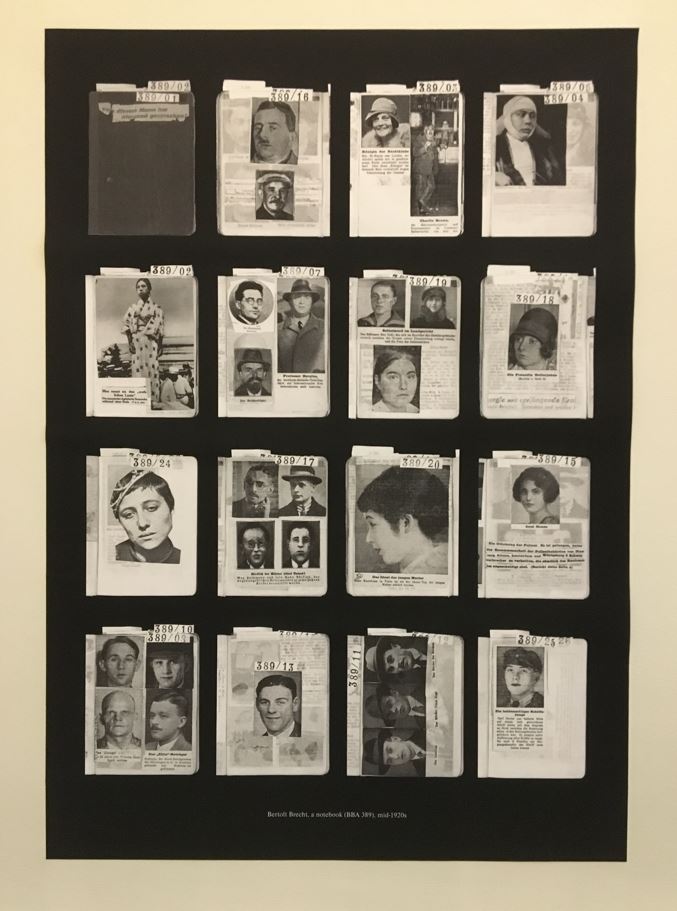
What this many-sided exhibition at Raven Row shows is how this concept, or category, of ‘fragments’ can be seen as not just a side effect of Brecht’s work-in-progress, but a fundamental principle which applies to them at every level. For, as this exhibition shows, Brecht was a compulsive collector of found images, often from newspapers and magazines. He pasted these into notebooks where he collected them by theme. He strewed his manuscripts with them where they obviously acted as inspiration or captured ideas, sometimes literal, sometimes tangential.

Installation view of ‘brecht: fragments’ at Raven Row showing a typical page from his notebook from the mid-1920s (photo by the author)

For example, why paste a postcard image by Pieter Breughel onto the front page of the manuscript of his great play ‘The Caucasian Chalk Circle’ except that it, in some sense, crystallised or captured the mood, or a mood, which the work was designed to present?

Installation view of ‘brecht: fragments’ at Raven Row showing the cover page of the manuscript of The Caucasian Chalk Circle, showing the cut and pasted letters and a postcard of a painting by Breughel (photo by the author)

Photomontage

Photos could be used in another way, to create photomontages, cutting out images from one context and pasting them into others, in the style of the radical photomontage artist John Heartfield. In actual fact, there isn’t much here in that style. For the most part, Brecht didn’t interfere with, cut and paste together, his images. They tended to go into his albums and notebooks and be pasted into play manuscripts unaltered. The artistry was in the initial selection.

The War Primer

Another use of news photos was when Brecht began collecting images during the Second World War and writing one four-line quatrains underneath them, producing what he came to call ‘photo-epigrams’. Over time this developed into a book which, after the war, came to be called the ‘War Primer’, containing 75 photo-epigrams.

A bunch of the original paste-ups for the book (actually created by Ruth Berlau, one of Brecht’s long-term collaborators) are hung across one wall. The quatrains, like most of Brecht’s poetry, consist of direct statement, unadorned by similes and metaphors, blunt and political. For example, under a photo of a bombardier in uniform inside a bomber:

You’re looking at a bastard, and a poor one!
‘I laugh at news of other men’s distress,
A corset salesman, formerly from Nürnberg,
A dealer now in death and wretchedness.’

Here’s an example, a striking magazine image of men in a steelworks which inspired Brecht to write the quatrain you can see, typed out, cut and pasted beneath it.

Paste-up for a page of War Primer (1940 to 1949) by Bertolt Brecht in collaboration with Ruth Berlau. Courtesy the Bertolt Brecht Archive, Akademie der Künste, Berlin (BBA 2096/38)

The quatrain for this one reads (in English translation):

‘What are you making, brothers?’ ‘A car of steel.
‘And what about these plates here, lying on the side?’
‘For shells that slice through sheer armoured walls.’
‘Why all this, brothers?’ ‘That we stay alive.’

Encyclopedia of gestures

Yet another use for images was that, heavily involved as he was in the staging of  his plays, he was very interested in the actors’ gestures. What happens if you get an actor to stand on a stage so? Or hold his arms just so? And now in this position? And now in that? How much can be achieved without words, without even action, just by posture and gesture? And then what happens if you add words to gestures, is it possible to make the words and gestures contradict each other or at least play off each other.

Dictatorial poses

Which explains why there’s a room of sheets from his numerous notebooks, which consists of newspaper photos of generally eminent men of the time (the obvious tyrants – Hitler, Mussolini and Stalin – with other lesser known politicians such as Daladier, Laval et al). Anyway, Brecht managed to get hold of photos them making speeches and it’s genuinely fascinating to study how they held themselves and what they did with their arms and hands. Thus prompted I adopted some of the poses of Hitler in full flow (hold two clenched fists up, palms towards you, in front of your chest – and instantly felt some of the coiled rage at the world. Elsewhere, Brecht picked up this improbable series of snaps of the Führer throwing a few shapes.

Installation view of ‘brecht: fragments’ at Raven Row showing the sheet of photos of Hitler posing and prancing (terrible photo by the author)

And, in the next glass case, copied a series of poses of Comrade Stalin addressing a meeting, which have him leaning forward and pointing an accusing finger, – and you immediately feel yourself dominating a room full of people petrified that there going to be the next one accused of some crime and hauled off to the gulag.

Installation view of ‘brecht: fragments’ at Raven Row showing the sheet of photos of Stalin, smiling, playing the affable good fellow, and pointing a finger at people he’s about to send to the gulag. Copy the poses for yourself and see how they make you feel (photo by the author)

Collaboration

Back to the plays, the wall labels tell us that it was Brecht’s common practice to be highly collaborative, to sit round a table with other writers, director, actors, to discuss parts and action and dialogue. Lines of dialogue or action were typed on strips of paper and often moved around in a process of continual shuffling and improvement.

Installation view of ‘brecht: fragments’ at Raven Row showing a typical Brecht manuscript showing how sections of dialogue were created as blocks before being moved around, all accompanied by a typical contemporary news photo (photo by the author)

Pictures for plays

Once you grasp the centrality of collaboration in Brecht’s practice then it makes perfect sense that so many of his manuscripts are not neatly typed out finished products, but highly fragmented texts made out of typed lines pasted onto notebook pages, often with lines of commentary scrawled around then and, as mentioned, often with a photo from a newspaper pasted in. Now you can see how the use of images like this 1) helps everyone involved understand the directly political context of a piece 2) captures the mood of discussions and decisions without needing to be put into words. ‘Yes, that’s it.’

Hence the examples here of work notebooks, and ‘finished’ manuscripts, which are festooned with cut out lines of dialogue or text, crystallised in newspaper photos.

Many scenes

In his conversations with Walter Benjamin, Brecht explained how he conceived of his plays less as made from ACTS, in the traditional way, but more as collections of lots of freestanding scenes. In the reply to Lukács mentioned above, he describes how the play he’s working on, describing life under the Nazis, consists of 27 short scenes with no overarching narrative arc. In other words, Brecht constructed many of his plays as if they were a series of snapshots.

Development and flux

Because another key part of Brecht’s practice is that the plays were never really finished. They always changed and developed in production as the actors and director discovered what worked, and from production to production as Brecht changed lines, or action or moved about the scenes. Narrative ideas, situations and segments of dialogue were subject to continuous cutting and rearrangement, often literally, using scissors and glue.

Recap

So from the smallest photo cut out from a magazine and pasted into a notebook, to the large scale of his three-hour-long plays, this sense of flux and fragments was foundational to Brecht’s conception of his works and his practice in assembling them.

The Brecht Archive

That’s probably enough to give you a feel for the exhibition and the light it sheds on the practice and process of Brecht’s imagination, and an indication of the kind of visual material you see (lots of pages from his notebooks and scrapbooks, lots of news and magazine photos from the 1930s, ’40s and ’50s).

Just a note that the entire thing hails from the Brecht Archive now, of course, housed in Berlin and this is the first time most of this (largely unknown) material has ever been shown in the UK. It is, as I hope I’ve indicated, a fascinating treasure trove of ideas, images, documentary background to not only Brecht’s numerous works, finished and unfinished, along with glimpses of the social history of the period (1930s to the early 1950s) all combined.

Performances

A major part of the exhibition was the theatrical performances which took place twice a day during most of its run. Because I only stumbled across this so late, like a fool I missed them. The idea was that twice a day a bunch of actors led visitors through the gallery spaces, performing dramatic fragments from four of Brecht’s unfinished plays from the 1920s, showing how montage and snapshot techniques played a crucial part in his conception of playwriting.

Unfinished

Because that’s another aspect of the show I’ve forgotten to mention, which was that not only a lot of his plays changed and evolved during production, but a sizeable number never even made it that far. In short, Brecht left behind lots and lots of unfinished works. So four of the galleries contain props and production notes, including photos and visual materials relating to four plays which were never completed, but are here summarised and explained, namely:

Performance 1: The Breadshop

A 1930 collaboration addressing issues of poverty and hunger after the Wall Street Crash, which eventually ran to 245 pages but was never completed or performed. For some reason the conception began to focus on the role of the Salvation Army (SA), with a surprising number of accompanying images and biographies of SA notables.

Installation view of ‘brecht: fragments’ at Raven Row showing the performance space for The Breadshop (note the production notes and accompanying photos pasted to the wall) (photo by the author)

Performance 2: The Flood

An unfinished draft for a radio play, written 1927 to 1928, about a man-made apocalypse, inspired by a hurricane which devastated Miami in 1926.

Performance 3: Fleischhacker

A collaboration with Elisabeth Hauptmann, worked on till 1931, this told the story of Jae Fleischhacker, a futures trader in Chicago, as he plays the wheat market. This is interwoven with the story of a ‘Family from the Savannah’, who move to Chicago to try their luck following crop failure in the wheat district.

Installation view of ‘brecht: fragments’ at Raven Row showing the performance space and props for the performance of Fleischhacker (photo by the author)

Performance 4: Fatzer

Title of a dramatic fragment that Brecht worked on intensively for four years, from 1926 to 1930, and returned to throughout his creative life. It tells the story of a four-man tank crew, led by Johann Fatzer,  who desert their post during the First World War. Amazingly, the manuscript ended up running to 500 pages but remained fragmented and unresolved and unperformable – until, that is, some scenes were reshaped and performed here, for this show.

Concluding scene from the performance of Fatzer in ‘brecht: fragments’ at Raven Row (2024) photograph by Anne Tetzlaff

Two films

And there are two films.

1. On a small TV monitor an experimental contemporary filming of a production of Mann ist Mann (Man Equals Man) from 1931. Set in British colonial India, the play concerns the brainwashing of an ordinary civilian, Galy Gay, into the perfect soldier. This film documents the 1931 production of the play at the Berlin State Theatre, for which Brecht was director, Peter Lorre played Galy Gay, and stage design was by Brecht’s long-time collaborator Caspar Neher. It was made using the experimental procedure of shooting film at a slowed rate of around one frame per second.

2. And in a darkened room, projected on a larger screen, are excerpts from the 1932 German feature film ‘Kuhle Wampe or Who Owns the World?’ about unemployment, homelessness and left-wing politics in the Weimar Republic. Brecht conceived and wrote the script, and directed the final debate scene, while the music was written by his long-term collaborator Hanns Eisler.

Gallery

Here’s the star performer of the era, Herr Adolf Hitler, cut out and pasted on the back of a manuscript page from ‘The Resistible Rise of Arturo Ui’. There are many photos of him, the most fascinating ones being the series depicting him in the full flood of his impassioned speeches.

Manuscript page from ‘The Resistible Rise of Arturo Ui’ (1941) courtesy the Bertolt Brecht

This one is a highly political photo showing Spanish peasants marching off to seize land owned by exploitative landlords.

From an album compiled by Brecht in the late-1940s, courtesy the Bertolt Brecht Archive, Akademie der Künste, Berlin (BBA 1198/058)

Here’s a vivid snapshot of Berlin men, the guy at the back giving it a particularly thuggish, threatening tone.

Image from research for Fatzer (1926 to 1930) by Bertolt Brecht. Courtesy the Bertolt Brecht Archive, Akademie der Künste, Berlin (BBA 0111/062)

The booklet

Usually galleries produce coffee-table catalogues to accompany their exhibitions, large-format, heavy books full of colour reproductions, which cost anything from £20 to £50.

Rather amazingly, the brecht: fragments exhibition at Raven Row is accompanied by an impressive 113-page pamphlet, consisting of five high quality essays by experts in the field, along with a chronology and bibliography, and it is COMPLETELY FREE. I can’t remember a comparably generous gesture by any gallery I’ve ever visited.

Envoi

One of the things that made Brecht such an interesting, innovative and powerful poet was his commitment to direct statement undeformed by the needs of scansion or rhyme. The power derives from the fundamental gestus, a word he coined to mean attitude or opinion but indicating more than that, evoking the pose and gestures of an actor onstage, a kind of mental image of how you would stand and move as you declaim the words. It’s a style epitomised by the plain but powerful final poem in the huge volume, ‘Poems 1913 to 1956’, edited by John Willett and Ralph Mannheim (1976):

And I always thought

And I always thought: the very simplest words
Must be enough. When I say what things are like
Everyone’s heart must be torn to shreds.
That you’ll go down if you don’t stand up for yourself
Surely you see that.

Although most of us disagree with his doctrinaire Marxism and foolish faith in Soviet communism, it’s hard not to be impressed by Brecht’s unflinching commitment to the victims of tyranny and exploitation everywhere, captured in so many of these photos, and in the texts and poems and fragments he derived from them.


Related links

Related reviews

Peter Kennard: Archive of Dissent @ the Whitechapel Gallery

‘Visual attempts to dissect the newspeak that bombards us’
(Peter Kennard in an article about his photomontages)

Chances are you’ve seen one or more of Peter Kennard’s iconic photomontages, particularly during his heyday in the 1980s when the reign of Mrs Thatcher provided the perfect background for his brand of aggressively radical, satirical photomontages, published in a wide variety of left-leaning magazines and newspapers.

‘Protest and Survive’ by Peter Kennard (1980) Tate: Purchased from the artist

Throughout Thatcher’s premiership, and fired by her close partnership with Rocking Ronnie Reagan, there was widespread paranoia on the Left that the world stood on the brink of a catastrophic nuclear war and Kennard’s witty, bleak, mashed-up montages provided a perfect accompaniment to the mood of anxiety among concerned activists everywhere.

‘Haywain with Cruise Missiles’ by Peter Kennard (1980) Tate: Purchased from the artist 2007 © Peter Kennard

Photomontage

Photomontage is the technique of cutting, arranging and gluing together photos (or parts of photos) to make a new image, sometimes with text similarly cut and pasted from newspapers or other sources. As a technique it’s always been associated with politics and satire, from its origins in the Weimar Republic of the 1920s and 30s and the great pioneer of political montages, John Heartfield.

The Meaning of the Hitler Salute: Little man asks for big gifts.

‘The Meaning of the Hitler Salute: Little man asks for big gifts’ by John Heartfield, October 1932

As a student activist in the 196os, Kennard found theoretical underpinnings for photomontage in the critical writings of Marxist thinkers like Walter Benjamin and Bertolt Brecht who promoted photomontage and collage (among other strategies) as ways of puncturing, subverting and questioning the smooth lies of capitalist discourse and bourgeois culture. Indeed, one of newspapers on show here is a Guardian Arts supplement from the 1990s featuring a long essay about Benjamin by James Wood and illustrated by a photomontage of him (Benjamin) by Kennard.

‘Walter Benjamin’ by Peter Kennard (1990) as featured in ‘Archive of Dissent: Peter Kennard’ at the Whitechapel Gallery

Kennard at the Whitechapel

This new exhibition of Kennard’s work includes lots of golden oldies from the 70s, 80s, and 90s, witty, savage, sometimes very bleak visual protests against a world run by rich Western corporations who, in what is probably his central theme, make obscene amounts of money by selling arms, weapons, bombs, guns to disgusting regimes which then use them to repress, murder, massacre their own and neighbouring populations. Champagne-swilling capitalists win – unarmed civilians, women and children lose.

‘Stop’ by Peter Kennard as featured in ‘Archive of Dissent: Peter Kennard’ at the Whitechapel Gallery

However, this exhibition is not by any means a retrospective or dwelling on the past. Two of the three rooms contain very up-to-date works, completed in 2023 or this year, which show Kennard expanding his range in new and interesting ways. Having pondered all this a bit, I think the best way to 1) indicate what the show actually contains and 2) to indicate how the new stuff differs and expands on the old, is simply to describe it room by room.

Room 1

Room 1 is named the Archive Room and contains four elements. First there’s a plain table on which are ten books, publications from Kennard’s career from coffee table blockbusters to smaller, postcard-sized works. You could grab a coffee from the cafe downstairs, sit and browse through these for an interesting half hour or so.

On a shelf round two walls are 17 copies of one of these books – @earth – open to 17 different images.

On another wall is a hinged rack (the kind you see in art gallery shops) of 42 posters of Kennard images ranging from 1979 to 2019, made from photolithography and silkscreen on card.

Lastly, there are piles and piles of newspapers – or at least that’s what I thought they were till I looked closely and realised they are specially printed broadsheet-sized, newspaper-style folded versions of his images, accompanied by smatterings of text, which are FREE and we are encouraged to take away with us.

Installation view of ‘Archive of Dissent: Peter Kennard’ at the Whitechapel Gallery, showing the reading table, copies of @earth open on the shelf and piles and piles of free papers (photo by the author)

Room 2

Barely a room, really just an extension of the same space, the second gallery contains three elements. There is a display case which bears the title ‘Worktop, 1966–2024’ and is, as the name suggests, a junk shop-style collection of the kinds of materials that Kennard collects – magazines, books, photos – plus all manner of equipment used to make the works, such as a tape measure, rulers, paints, knives and tools and so on.

The artist’s bric-a-brac at ‘Archive of Dissent: Peter Kennard’ at the Whitechapel Gallery (photo by the author)

Above the display case are four large framed works titled ‘Stocks’ from 1994. These are four copies of the Financial Times which have been subjected to a dramatic transformation, namely a gaunt, ravaged, black and white arm and hand tearing its way down through the neat columns of stock market prices, in a gesture which manages to convey terrible despair.

©Peter Kennard Newspaper 8 (1994) Carbon toner, oil, charcoal, pastel on newspaper, wood

‘Stock’ by Peter Kennard (1994) as featured in ‘Archive of Dissent: Peter Kennard’ at the Whitechapel Gallery

Opposite these a sort of alcove has been filled with 25 poster-sized blow-ups pf his images to create a little forest of placards, each attached to a wooden post themselves secured in red vices. This is his newest work, created specially for this exhibition, is titled ‘People’s University of the East End’, and there’s a story behind it.

It turns out that the three ‘galleries’ in which the show is held were once part of the former Whitechapel Library (1892 to 2005). At the turn of the twentieth century this was a free resource to the poor inhabitants of the area who would have read books, magazines and newspapers here. Back then it was nicknamed the ‘People’s University of the East End’, hence the title of this installation which, as the curators put it, ‘reflects on the capacity for learning, community and activism in public spaces.’

The exhibition, we learn, was conceived to echo and reflect on this idea of a library, a place where ideas are made available, promoted and circulate. Hence the inclusion of the word Archive in the title of the show, for it brings together not just the images themselves, but includes actual copies of the original newspapers and magazines and posters, as well as the more recent books, in which his images were first published and continue to circulate.

Installation view of ‘People’s University of the East End’ in ‘Archive of Dissent: Peter Kennard’ at the Whitechapel Gallery (photo by the author)

This little copse of placards is quite a neat idea, and contains up-to-date works such as the barbed-wire tree from the civil war in Syria (centre right) and the image of Julian Assange intercut with the American and British flags at the bottom right, but it didn’t pull my daisy, I’m not sure why. In the same way, the notion of the Archive certainly explains the bringing together of all these formats – posters, newspapers, and the vitrine showing his bric-a-brac – but doesn’t really come off, as an idea.

The best bit, I thought, were the shiny red vices supporting the posts, like a little army of red crabs. ‘Red vices’, hmm, that could have been a witty alternative title for the exhibition and the right-on causes Kennard has spent a lifetime supporting…

Anyway, themes from these first two spaces are picked up in the third, biggest and best room of the show.

Room 3: the installations

The first wall of the third and final room displays no fewer than 40 of his classic photomontages, ranging from a piece commenting on British Army brutality in Northern Ireland in 1973 to the Free Julian Assange piece I mentioned above, made in 2023, via one of my favourites, the very funny Maggie Regina from 1983.

Maggie Regina by Peter Kennard (1983) in ‘Archive of Dissent: Peter Kennard’ at the Whitechapel Gallery (photo by the author)

It’s an impressive selection from fifty years of mostly stark and upsetting imagery designed to provoke the viewer into thinking again about the forces of violence and exploitation which underlie our shiny Western world.

But the big thing here is the installations which I think are brilliant. There are four of them and, remember the copies of the Financial Times with the gaunt arm tearing through it in the previous room? – they all rely on newspapers as their central material.

1. Reading Room

The simplest is ‘Reading Room’. Picking up on the Whitechapel Library motif, these are four old two-sided wooden lecterns, the kind that turn-of-the-century readers would have read their newspapers on. Each of them hosts an original edition of a newspaper or magazine where a Kennard work originally appeared. Most of the 8 newspapers in question were copies of the Guardian, the exceptions being two copies of The Workers Press and a vintage copy of the New Musical Express.

Installation view of ‘Reading Room, 1997 to 2024,’ in ‘Archive of Dissent: Peter Kennard’ at the Whitechapel Gallery (photo by the author)

The classic black-and-white photomontages address these issues:

  • 1973 scientists involved in torture (The Workers Press)
  • 1974 British investment in apartheid South Africa (The Workers Press)
  • 1981 nuclear weapons, a skeleton morphing into an atom bomb (New Musical Express)
  • 1989 reunification of East and West Germany (Guardian)
  • 1990 the Whites Only policy of South African apartheid (Guardian)
  • 1990 profile of Walter Benjamin (Guardian)
  • 1991 Gulf War, the attempt to stop Saddam Hussein (Guardian)
  • 1991 a centrefold collection of photomontages (Guardian)

2. World Markets (1997 to 2024)

‘World Markets’ is a set of 16 broadsheet newspaper double-spreads, most if not all from Kennard’s favourite target, the Financial Times, on which he has projected faces intended, presumably, to represent The Poor and Exploited. The aim is to remind us that behind the wall of numbers which is the faster-then-ever, digitally automated stock market, are the lives of the poor and downtrodden who suffer from the ravages of global capitalism.

Installation view of ‘World Markets, 1997 to 2024,’ in ‘Archive of Dissent: Peter Kennard’ at the Whitechapel Gallery (photo by the author)

Both these are straightforward in manner and material. The last two installations represent something completely new because they use electric lights and projections.

3. Double Exposure, 2023

‘Double Exposure’ covers a whole wall. It consists of three rows of 12 Financial Times pages with lights projecting images of war and conflict and poverty onto them. It was made in collaboration with Nigel Brown and is large and imposing. Part of the overall visual impact comes from the complicated spaghetti of electric cabling hanging from each projection and spooling along the floor.

Installation view of ‘Double Exposure’ in ‘Archive of Dissent: Peter Kennard’ at the Whitechapel Gallery (photo by the author)

The dynamic nature of this installation i.e. the lights continually changing, is appealing. And the notion of this magic lantern show revealing the ‘truth’ behind the blank walls of stocks and shares prices on the FT pages is also sort of interesting.

Kennard’s dualistic worldview

‘Double Exposure’ really just brings out the fundamental concept which underlies all Kennard’s work which is that there are two levels of reality – the smooth, plausible, ‘common sense’ world we inhabit, defined and described and promoted in the hegemonic discourse of neo-liberal consumer capitalism, the world of perfect people smiling down at us from advertising hoardings in the streets, on the sides of buses, on the Tube, on TV on our social media, the world of newspapers and TV assuring us that our values and our way of life, our pensions and investments in mega-corporations, are the only rational, practical ways to run the world – and the other world, the Dark Side, where the huge profits which keep the corporations afloat which our pensions and savings are invested in, the world of ‘shiny happy people’ is sustained by the ruthless exploitation of the poor and powerless, of indigenous peoples around the world, of peasants and workers forced to sweat in terrible conditions in Indonesian sweatshops or be psychologically destroyed in China’s suicide factories, and where, above all, the West maintains its hegemonic control of the world’s economic and financial systems through the ruthless elimination of anyone who stands in its way via wars of conquest dressed up as ‘liberation’ or ‘freedom’ – as in the deep need to control the world’s oil supplies which underlay the West’s adventures in the Gulf War and then the Iraq War.

Kennard’s works represent this Two World Hypothesis, this duality, via works which are themselves dualistic or dichotomous, in which (in his classic works) images from two different value systems are made to crash into each other, the startlingness of the disjunction intended to wake us from our complacent slumber.

‘Thatcher Unmasked’ by Peter Kennard (1986) A/POLITICAL

You can see how this duality underlies all his work, from duality of ‘The Haywain with Cruise missiles’ (where the self-deceiving bourgeois dream of some Old Englande is punctured by the modern reality of England being a lunch pad for American nukes) through to the dual image of copies of the Financial Times which have been ripped by the gaunt arm of the global poor (‘Stocks’) or have projected onto them the faces of the global poor (‘World Markets’ and ‘Double Exposure’).

There are, of course, a number of problems with this approach and with the whole radical worldview which underlies it, of which three spring straight to mind.

1. What’s the alternative?

One is, What else do you suggest? Forty years ago I read Class War and Socialist Worker and the kind of publications Kennard’s works appeared in and fondly imagined that the (Western) world could be subjected to a socialist transformation, but the collapse of the Soviet Union and of all the regimes around the world which it supported took all the steam out of those (wildly impractical) hopes and into the vacuum rushed the two flavours of neoliberalism which have ruled the West ever since, the Hard Neoliberalism of the Conservatives and Republicans, of Reagan and Thatcher, or the Soft Neoliberalism of Bill Clinton and Tony Blair, which promised a fairer world and a middle way but still deregulated the financial sector leading to the 2008 crash and enthusiastically promoted the War on Terror and invasion of Iraq, trashing Blair’s reputation forever.

Photo-Op by kennardphillipps (2005) © kennardphillipps

Photo-Op by kennardphillipps (2005) © kennardphillipps

Right up to the present day, activists on the Left are still trying to devise a new economic and social theory on which to base their policies, an ideological vacuum you can clearly see in Keir Starmer’s Labour Party, which is just the British wing of the general bemusement of left-of-centre parties across the West.

Which explains why the Left has so enthusiastically embraced identity politics – it’s an excuse, it’s a fig leaf, it covers for their lack of an economic theory. Certainly feminism and black rights and refugees and Palestine are worthy causes, but in all the Western nations the Left and progressives and activists have clustered round these causes because they don’t know what to do about the economy any more – should we nationalise all the utilities, should the government create an industrial strategy and support native industries?

The Right has won everywhere because it has a clear strategy – reduce the state, privatise everything, neuter trade unions, leave all economic decisions to the market, cut taxes on the rich – which it implements everywhere with total consistency, and has ideological allies in all the media owned by the rich who stand to directly benefit from these policies.

I take the pint that Kennard’s work is satirical commentary and like satire through the ages is under no obligation to propose its own alternative agenda, and yet at some point, during this review of 50 years of political engagement, surely every visitor is going to ask, ‘OK – you hate this universe of exploitation and warmongering – what’s your alternative?’

2. The post-Cold War multipolar world

The second objection to Kennard’s worldview is that it is too western and too parochial. If Reagan and Thatcher deserved mocking in the 1980s how much more so did the totalitarian regimes in Soviet Russia and Communist China?

In this century 9/11 crystallised the threat from radical Islam, a completely new force which entered the world with the 1979 Iranian revolution but none of us were really aware of in the 1980s and 90s (except for those plucky mujahideen Sandy Gall was always reporting on for ITN) and despite the mounting rhythm of Islamic terror attacks.

The point is that the radical or Marxist critique of the West which Kennard’s works seem to embody – his relentless criticism of the British state and army, from Ulster to Basra, and British arms and weapons suppliers making fortunes from murder – has been trumped or eclipsed by forces which are demonstrably more evil and wicked – ISIS in Syria, the Taliban in Afghanistan – and the great arc of instability across North Africa, through the Middle East, Iran-Iraq, up into Syria, countries which were destabilised by the uprisings of the Arab Spring and the chaos, civil wars (Libya, Yemen, Syria) or renewed repression (Egypt) they left in their wake. And of course the horrific Hamas raid on Israel followed by the brutal war on Gaza, with the constant threat of a second front opening against Hizbollah in the Lebanon.

And if you throw in the very real threat to Eastern Europe presented by Putin’s invasion of the Ukraine and the ever-present anxiety about China’s threats to Taiwan, then get a world in which even the most radical Left are hard put to argue that it’s the West who are the biggest threat to peace or the most violent culture or the most repressive regimes.

It’s quite clear to everyone that, even if you want to excoriate Western arms companies and rapacious corporations who are, for example, continuing to supply arms for Israel’s murderous assault on Gaza, the overall values of the West need supporting against the very real enemies threatening it from all sides (including, of course, from within – Trump, Reform and the maniac right of the Conservative Party). As in France, the Left needs to present a united front against the Right which, as I mentioned above, succeeds time and time again because it knows what it wants, in a way the fractured Left all-too-often doesn’t.

In summary, mocking the American and British state, big corporations and warmongering leaders made a lot of sense in the Reagan-Thatcher 1980s, and again in the light of the Bush-Blair Iraq War of 2003 – but now, in 2024, doesn’t feel like an adequate response to a far more complicated, and threatening, world. The iniquity of British arms manufacturers continuing to supply Israel or the Syrian government, profiting from conflict in Yemen or Sudan, remains deplorable.

Union Mask by Peter Kennard (2007) Courtesy the artist

3. How ‘radical’ can any contemporary artist be?

The third objection would be the familiar one levelled at all artists no matter how ‘radical’ or ‘subversive’, which is that their works, across all channels and media, fit smoothly inside the capitalist consumer culture they claim to critique, so smoothly as to have, in practice, zero effect.

The Whitechapel Gallery has a shop which, as always, devotes a section to merchandise from the exhibitions of the moment, in this case books and posters and postcards by Peter Kennard all available at very competitive prices. All artists are as tightly enmeshed in the system they wish to undermine as the richest stockbroker or wickedest arms dealer.

You know the old Leftie joke, ‘If voting changed anything, they’d abolish it’ – same here: Kennard, Banksy, any other political artist you care to mention, don’t change anything at all, so much as provide a kind of backdrop for certain kinds of lives, images certain kinds of student zealots and ageing activists identify with and enjoy looking at.

The richest man I know loves all kinds of art, including ‘radical’ stuff like Kennard, loved political photos in the Elton John photo exhibition, coos as Yoni Shinkobare CBE’s deconstruction of imperial statues and why shouldn’t he? None of them threaten him or his ample investments in the slightest. They’re lifestyle accessories, they’re one more set of consumer items to be flicked through while waiting for a plane or by the pool or in a pokey room in Whitechapel.

The man who made them, Kennard, has to believe in The Cause and is as fiercely committed to making works skewering the evil arms trade as he was 50 years ago, and his consistency and commitment is admirable. But strolling round this exhibition inevitably raises the question whether work like this changes anything at all, even in the minds of visitors who, half an hour later, are browsing in the shop or wedged onto a busy tube train.

4. Boardroom (2023)

The last of the installations in the third room is ‘Boardroom’ which dates from last year. I really liked these works because they use rough, industrial, derelict materials, the kind of thing which always lights my candle. On three big salvaged boards are suspended sheets of (as usual) newsprint. Onto these have been printed anonymous portraits of everyday people, The People, the masses. And onto these are projected the logos of oil and arms companies, of Shell and BP, BAE Systems and many others of the same ilk, the point being, of course, that it’s ordinary people, especially in developing countries, who pay the price for the rapacious exploitation of oil (in the Middle East or Nigeria) and the disgustingly indiscriminate use of weaponry (Syria, Ukraine, Gaza).

Installation view of ‘Boardroom’ in ‘Archive of Dissent: Peter Kennard’ at the Whitechapel Gallery (photo by the author)

Arms and the artist

On reflection, maybe it’s his hatred of state violence which is Kennard’s most consistent subject, from the US bombing of Cambodia and North Vietnam, the British Army’s use of rubber bullets in Northern Ireland in the early 70s, the threat of nuclear apocalypse during the 1980s, the West’s use of devastating firepower against Iraq in 1991 and then again in 2003, and western arms companies continuing to profit from conflicts in Ukraine and Israel.

Maybe, rather than critiquing capitalism per se, it would be more accurate to say that Kennard has spent a lifetime excoriating the ruinous products of Western arms companies and the bellicose leaders who support and encourage the militaristic worldview.

‘Sub-Trump’ by Peter Kennard (2018) Courtesy of the artist and Richard Saltoun Gallery, London, Rome and New York

As an intellectual position, this hatred of companies who profit from selling instruments of death and destruction is more viable than thoughts about overthrowing the entire capitalist system. Who doesn’t agree that we should be feeding starving children rather than building nukes and subs and drones? Except that we live in a world with a Russia in it, where even if Vladimir Putin miraculously dies of a heart attack, chances are he would only be replaced by an even more aggressive Russian nationalist – and a world which also has an increasingly nationalist China in it – not to mention a belligerent Iran which was the main beneficiary of the foolish war in Iraq.

With the result that we live in a world where the defence ministers of every country in NATO are calling for more to be spent on defence budgets in readiness for a war with Russia. Is that wrong? Is Kennard saying European nations should be winding down their defence budgets and sending a signal of passivity to Putin?

You look at Kennard’s powerful images and installations, you are touched by the images of starving children and with one part of your mind you strongly sympathise with criticism of arms companies (and the entire ‘system’) which profits from making and selling weapons of death… and yet… another part of your mind wonders – ‘OK, I get it, arms companies are immoral and wicked… but what would your policy be towards Ukraine and Russia? What would you be advising NATO leaders? Do you think this is the moment to reduce our military capability even further?’

The moral outrage of the works excoriating the killing of the innocent and profiteering from death… clash with a realistic assessment of the warlike world we live in… and so left me, literally, in two minds about all of these works.

New media

Putting their subject matter to one side for a moment, Kennard was keen to emphasise that these latter works – the ones using lights and projections, ‘Double Exposure’ and ‘Boardroom’ – are an interesting new strategy of his, an attempt to deconstruct the whole process of photomontage, the artistic practice which made his name.

I think I understand what he thinks he’s getting at but I’m not sure it’s really true. If you use a narrow definition of photomontage i.e. juxtaposing photographs from different sources on a flat surface to make a new photo image, then yes. But if you use the broader definition I attempted above, of juxtaposing objects from two different value systems (faces of people from the developing world with the sleek markets pages of the Financial Times) then this is fundamentally the same approach, the same way to get an effect.

Putting the idea of ‘deconstruction’ to one side, I still liked these works the best: 1) because I like the industrial paraphernalia of salvaged wood, clips and metal brackets and cabling which they involve, and 2) because they are fresh and new, in technique and aim, when set beside the yellowing montages from the 1970s and ’80s. I found them the most interesting as overall objects or sculptures in the same way that I liked the red vices (novel) more than the protest placards (familiar).

Summary

As you can tell, I’m conflicted. I really liked the photomontages because, in their deliberately scrappy mashed-up appearance, they actually display great visual taste. They’re like classic punk visuals and are almost all impactful and effective images, cousins of the political cartoons from the period, distant relations, maybe, of the savage satire of Gerald Scarfe. Despite being made out of other people’s material, their harsh juxtapositions have an immediately recognisable visual identity, much as you can instantly recognise a Banksy work of graffiti.

And I liked the four installations, and the efforts he’s been making with wood and placards and lights etc to broaden out his practice.

And yet I couldn’t help feeling that, at some level, it all comes from a bygone age. Even his response to the most recent events like the terrible civil war in Syria or the jokey photomontages featuring Donald Trump… they’re good but they signify a style and approach which comes from another era and doesn’t (as I’ve tried to explain) really reflect the complexity of our time, the troubled 2020s.

‘Syria’ by Peter Kennard (2018) Courtesy of the artist and Richard Saltoun Gallery, London, Rome and New York

Or am I being too harsh? Is this a man who has been impressively true to his radical beliefs through half a century of political turmoil and social change, an unflinching critic of corporate greed and political mendacity? As he himself puts it:

‘My art erupts from outrage at the fact that the search for financial profit rules every nook and cranny of our society. Profit masks poverty, racism, war, climate catastrophe and on and on…’Archive of Dissent’ brings together fifty years of work that all attempt to express that anger by ripping through the mask by cutting, tearing, montaging and juxtaposing imagery that we are all bombarded with daily. It shows what lies behind the mask: the victims, the resistance, the human communality saying ‘no’ to corporate and state power. It rails at the waste of lives caused by the trillions spent on manufacturing weapons and the vast profits made by arms companies.’

Is it a good thing that he’s still making images which highlight the violent exploitation lying behind the sleek corporate reports, the environmental destruction which pays for BP bonuses, the murderous blowing up of innocent bodies which underlies the profits of the arms manufacturers named in ‘Boardroom’?

Or is it both at the same time? I was conflicted.

Recommendation

It’s not a big exhibition, it’s not a major exhibition. The first two rooms are small, the second one little more than an alcove. If you’re already a fan you should go in order to see the installations and new pieces, but if you’re not, I’d hesitate to recommend it. You don’t get a lot more of a visual hit than you do from surfing the images on his website.

On balance, I think the wall of images of poor people and babies’ faces projected onto copies of the FT which makes up ‘World Markets’ is worth seeing in the flesh, but as to the rest…well, I’ve given a detailed description of what you see, so you can make your own mind up.

The good old days: a copy of the New Musical Express from 1981 featuring a page-size photomontage by Kennard on the left and reviews of recent gigs by Echo and the Bunnymen and The Cure on the right, on show at ‘Archive of Dissent: Peter Kennard’ at the Whitechapel Gallery (photo by the author)


Related links

Related reviews

Orientalism by Edward Said (1978) part 1

(I believe you pronounce his surname Si-, to rhyme with sky, and -eed; Edward Si-eed.)

Orientalism created a big splash when it was published way back in 1978, nearly 50 years ago. It opened doorways into radical new ways of thinking about imperialist history and culture. It has gone on to be translated into more than 40 languages and had an immense influence right across the humanities. It’s a classic of cultural criticism.

An example of its ongoing impact is the way the very first wall label which introduced the 2019 exhibition at the British Museum about the interplay between the Muslim world and Europe – Inspired by the East – quotes page one of Orientalism and then liberally applies Said’s perspectives throughout the rest of the show. It may nowadays be impossible to discuss the cultural and ideological aspects of Western imperialism, specifically as it affected the Middle East and India, without taking into account his perspective and sooner or later mentioning his name.

There are probably four ways of considering the book:

  1. The thesis.
  2. What the text actually says, its discussion of individual Orientalists (I try to give a summary in part 2 of this review).
  3. Its implications and influence.
  4. The practical political conclusions Said draws from his thesis.

Said’s thesis

Said’s thesis is relatively simple in outline and consists of a set of interlocking contentions:

The ‘West’ has always defined itself against the ‘East’. In earlier centuries, Europeans defined Christianity and Christendom partly by contrasting it with Islam and the Muslim world. In the imperial nineteenth century Europeans thought and conceived of themselves as energetic, dynamic, inventive and ‘advanced’ partly by comparing themselves with an ‘Orient’ which was slothful, decadent and ‘backward’.

But this entire notion of ‘the Orient’ is a creation, a fiction, a fantasy, created over centuries by Western scholars and writers and artists. It is a self-contained, self-referential image which is the product of Western fantasies and needs and bears little or no relationship to the confusing and complex reality of peoples and races and religions which actually inhabit the very varied territories which Europeans all-too-easily dismissed as ‘the Orient’.

These fantasies and fictions and fabrications about ‘the Orient’ were created by a sequence of Orientalist scholars, starting in the later 18th and continuing throughout the 19th centuries. Orientalism as a discipline began back in the 18th century with the first studies of Arabic, the Semitic languages and Sanskrit.

The bulk of Said’s text comprises portraits of, and analyses of the work of, the leading Orientalist scholars who, from the late eighteenth century onwards, founded and then developed what turned into an eventually enormous body of work, given the disciplinary name of Orientalism. This far-flung discipline, whose attitudes leeched into arts, sciences, anthropology, economics and so on, set out to categorise, inventorise, define, label, analyse and intellectually control every aspect of life and culture in ‘the Orient’.

This body of ‘knowledge’ ramified out through Western societies: it was packaged and distributed via newspapers, magazine articles, the new technology of photography, and informing, and in turned informed by, creative writing – novels and stories and poems about the ‘exotic East’ – and the arts – painting, sculpture and so on – to produce an immense, self-reinforcing, self-justifying network of verbal, textual, intellectual, ideological and artistic, popular, journalistic and political stereotypes and clichés about ‘the mysterious East’, and its supposedly sullen, childlike, passive, sensual and barbarous peoples.

Eventually this huge network of images and texts became received opinion, idées recues, hardened into ‘common sense’ about the Ottoman Empire, the Middle East and the Islamic world. And all of it – Said’s main and central point – was completely and utterly misleading.

Why did it thrive? How was it used? Said contends that this eventually huge set of preconceptions, this extensive set of prejudices, supported by leading scholars in the field, backed up by the narratives of various explorers and adventurers, given visual power in thousands of lush, late-Victorian paintings of the sensual, slothful, backward ‘Orient’, all this provided the discourse – the network of texts and images and ideas and phrases – which European rulers (of France and Britain in particular) invoked to justify invading, conquering, oppressing and exploiting those countries and peoples.

Orientalism justified empire. Orientalism provided the ideological, cultural, scientific and academic discourse which justified western colonialism.

When imperialist politicians, adventurers, soldiers or businessmen wrote or spoke to justify the imperial conquest and exploitation of the Middle East they quoted extensively from this storehouse of supposedly ‘objective’ academic studies, from supposedly ‘eye-witness’ accounts, from the widely diffused visual and verbal stereotypes and clichés of European artists, from what had become the received wisdom about ‘the Orient’ which ‘every schoolboy knows’ – in order to justify their imperial conquests and ongoing domination. But which were, in fact, the profoundly misleading creations of Orientalist scholars, ethnographers, writers, artists and so on.

The logical consequence of this sequence of arguments or worldview is that all Western narratives and images of the so-called ‘Orient’ produced during the 18th, 19th and indeed the first half of the twentieth centuries, are deeply compromised – because they all, wittingly or unwittingly, to a greater or lesser degree, helped to justify and rationalise the grotesque racism and unfair domination and economic exploitation of an entire region and all its peoples.

Orientalism is not only a positive doctrine about the Orient that exists at any one time in the West; it is also an influential academic tradition…as well as an area of concern defined by travellers, commercial interests, governments, military expeditions, readers of novels and accounts of exotic adventure, natural historians, and pilgrims to whom the Orient is a specific kind of knowledge about specific places, peoples and civilisations. (p.203)

Compromised learning

Said’s basic premise is that all knowledge, including academic knowledge, is not pure, objective truth, but highly constrained and shaped by the society, and people, which produced it.

My principle operating assumptions were – and continue to be –that fields of learning, as much as the works of even the most eccentric artist, are constrained and acted upon by society, by cultural traditions, by worldly circumstance, and by stabilising influences like schools, libraries, and governments; moreover, the both learned and imaginative writing are never free, but are limited in their imagery, assumptions, and intentions; and finally, that the advances made by a science like ‘Orientalism’ in its academic form are less objectively true than we like to think. (p.202)

Foucault

Said is a chronic name-dropper. He namechecks what has become the standard sophomore checklist of French and Continental literary and political theorists so very fashionable when the book was written. Thus he refers to Walter Benjamin, Antonio Gramsci and Louis Althusser. It’s notable that these are all Marxist theoreticians and critics, because, at bottom, his project is not only to inject contemporary politics back into academic discourse, but specifically left-wing, anti-imperialist politics. But the figure Said refers to most often (fourteen times by my count) is the French historian and critical theorist, Michel Foucault.

This is because Said’s thesis piggybacks on Foucault’s notion of discourse. Foucault was a French historian who studied the institutions of prisons and madhouses (among other subjects) with a view to showing how the entire discourse around such institutions was designed to encapsulate and promote state power and control over citizens, and in that very Parisian perspective, over citizens’ bodies. So you could argue that Said is copying Foucault’s approach, lock, stock and two smoking barrels, and applying it to his own area of interest (hobby horse) the colonial Middle East.

Contents

Rather than give my own impressionistic view of a book, I generally find it more useful for readers to see the actual contents page. Then we can all see what we’re talking about. Here’s the table of contents. (I give a detailed summary of the actual contents of the book in part 2 of this review; and a summary of the long Preface and Afterword in a third review):

Chapter 1. The Scope of Orientalism

‘Draws a large circle around all the dimensions of the subject, both in terms of historical time and experiences and in terms of philosophical and political themes.’

1. Knowing the Oriental

2. Imaginative Geography and its Representations: Orientalising the Oriental

3. Projects

4. Crisis

Chapter 2. Orientalist Structures and Restructures

‘Attempts to trace the development of modern Orientalism by a broadly chronological description, and also by the description of a set of devices common to the work of important poets, artists and scholars.’

1. Redrawn frontiers, Redefined Issues, Secularised Religion

2. Silvestre de Sacy and Ernest Renan: Rational Anthropology and Philological Laboratory

3. Oriental Residence and Scholarship: The Requirements of Lexicography and Imagination

4. Pilgrims and Pilgrimages, British and French

Chapter 3. Orientalism Now

‘Begins where its predecessor left off at around 1870. This is the period of greatest colonial expansion into the Orient…the very last section characterises the shift from British and French to American hegemony. I attempt to sketch the present intellectual and social realities of Orientalism in the United States.’

1. Latent and Manifest Orientalism

2. Style, Expertise, Vision: Orientalism’s Wordliness

3. Modern Anglo-French Orientalism in Fullest Flower

4. The Latest Phase

Said’s personal position

Limiting his scope to the Middle East

On page 17 of the introduction Said says that, in order to avoid writing a book about ‘the Orient’ in its widest definition, he’s going to limit himself to writing about Islam and the Middle East. Sounds like a reasonable plan, the kind of defining of the boundaries of an intellectual project which you’d expect in any objective academic study. But the last pages of the Introduction give a whole new spin to this decision. On page 11 he writes that:

No production of knowledge in the human sciences can ever ignore or disclaim its author’s own circumstances.

He says this in order to broach his own relationship with the entire subject, then goes on to indulge in more pages of autobiography than you’d expect in a scholarly work. He tells us that the subject is in fact very, very close to his heart.

My own experience of these matters are in part what made me write this book. The life of an Arab Palestinian in the West [he’s obviously referring to himself], particularly in America, is disheartening. There exists here an almost unanimous consensus that politically he [Said] does not exist, and when it is allowed that he does, it is either as a nuisance or as an Oriental. The web of racism, cultural stereotypes, political imperialism, dehumanising ideology holding in the Arab or the Muslim is very strong indeed, and it is this web which every Palestinian has come to feel is his uniquely punishing destiny. It has made matters worse for him [i.e. Said] to remark that no person academically involved with the Near East – no Orientalist, that is – has ever in the United States culturally and politically identified himself wholeheartedly with the Arabs… (p.27)

So the book really is by way of being a very personal (and I use the word with knowing irony) crusade, coming out of his own personal experiences of discrimination and erasure, or, as he puts it in the 1994 Afterword to the book, from:

an extremely concrete history of personal loss and national disintegration. (p.338)

And written in the passionate hope that, by revealing the power structures behind the academic discipline of Orientalism in all its manifold forms, he can overthrow the false dichotomy between Orient and Occident, between East and West.

It’s a judgement call whether you find this frankness about his personal investment in the project admirably honest and an example of fessing up to the kind of personal position behind the text which his project sets out to expose in so many Orientalist scholars – or whether you think it reveals a highly partisan, parti pris perspective which invalidates his approach.

Said’s involvement in the Palestine-Israel problem overshadows the work

Said goes on to tie his detailed cultural analysis to a highly controversial contemporary political issue, namely the ever-fraught Israel-Palestine situation, as screwed up back in 1978 as it remains today. Crucially, his Introduction describes how this plays out in America culture, in academia and the media in the present day:

the struggle between the Arabs and Israeli Zionism, and its effects upon American Jews as well as upon liberal culture and the population at large (p.26)

In other words, Said explicitly ties his analysis of historical Orientalism to the bang up-to-date (albeit nearly 50 years old) political and cultural view of the Arab-Israeli conflict held inside American academia and the media and political establishments. This is obviously a perilous approach because the liveness of the current political debate around Israel-Palestine continually threatens to overshadow his academic, scholarly findings or ideas.

And Said was in fact far from being a distant academic viewer of the conflict. Said’s Wikipedia page tells us that from 1977 until 1991 he was a member of the Palestinian National Council (PNC) and deeply involved in negotiations to try and find a two-state solution to the Palestinian Problem.

1) It’s ironic that his book accuses all Orientalist scholars of being parti pris and biased, even if they don’t know it, while he himself is phenomenally biased and parti pris. But that’s a small point, and one he was perfectly aware of. He is perfectly clear about not really believing in the possibility of disinterested academic research:

I find the idea of strict scholarly work as disinterested and abstract hard to understand. (p.96)

2) More importantly, his political involvement threatens to a) distract from and b) overshadow Said’s entire project. In practice it meant he was forever getting dragged into stupid media squabbles, like the one featured on his Wikipedia page about him throwing a stone in Lebanon which managed to get blown up into press headlines about ‘The Professor of Terror’.

This is an American problem and links into the issues of the power of the Jewish lobby in Washington which is itself (as I understand it) linked to the even larger power of the fundamentalist Christian lobby in Washington, which (as I understand it) strongly supports the state of Israel for theological and eschatological reasons.

All I’m saying is that Said positions himself as someone who is bravely and pluckily bringing ‘politics’ into academia, revealing the power structures and political motivations behind an entire academic discipline, ‘Orientalism’, and good for him. But it’s a double-edged and very sharp sword. He who lives by politics dies by politics. Discussing radical political theory is relatively ‘safe’, as so many Marxist academics prove; but if you bring clarion calls about one of the most contentious issues in international affairs right into the heart of your academic work, and you shouldn’t be surprised if your political opponents will throw any mud to blacken your name.

Ironies

It’s a central irony of Said’s work that although he went to great lengths to expose the Islamophobia at the heart of the Orientalist project, he himself, despite being of Palestinian heritage, was not a Muslim, but had been raised a Christian.

In other words, all his writings about how Orientalists write about Islam without being inside it, without understanding it, without giving voices to Islam itself – the very same accusations could be brought against him.

From start to finish his book lambasts Westerners for speaking over the Orient, for never giving it a voice so it is a delicious irony that:

  1. There are no Muslim voices in his book – as far as I can tell he doesn’t quote one Arab or Muslim scholar anywhere, so he’s largely replicating a practice he is fiercely critical of.
  2. Said himself is not a Muslim – he lambasts various Western simplifications and demonisations of Islam with a strong sense of ownership and partisanship – but he himself comes from a completely different tradition.

I’m not saying either of these aspects negate his argument: but the whole thrust of the book is to teach us to pay more attention to the political aims and ideologies underlying apparently ‘objective’ academic texts, to question every author’s motives, to question the power structures they are part of and which permit their teaching, their research, their publishing. So these thoughts arise naturally from Said’s own promptings.

Problems and counter-arguments

Despite its astonishing success and the widespread adoption of its perspective throughout the humanities, Orientalism has many problems and issues.

Defining the ‘Orient’ and ‘Orientalism’

For a start, Said’s use of the word ‘Orient’ is extremely slippery. Sometimes he is referring just to the Middle East, sometimes he includes all of Muslim North Africa, sometimes he is referring to the entire Islamic world (which stretches to Indonesia in the Far East), sometimes he throws in India, the jewel in the crown of the British Empire, whichever suits him at the time.

In an ironic way Said’s definition(s) of Orientalism are as slippery and detached from reality as he says Orientalists’ discourse about ‘the Orient’ were.

One upshot of this is that you get right to the end of the book without ever reading a simple, definitive, usable definition of the central word. Here’s what the Etymological Dictionary has to say about ‘Orient’:

Late 14th century: ‘the direction east; the part of the horizon where the sun first appears,’ also (now with capital O-) ‘the eastern regions of the world, eastern countries’ (originally vaguely meaning the region east and south of Europe, what is now called the Middle East but also sometimes Egypt and India), from Old French orient ‘east’ (11th century), from Latin orientem (nominative oriens) ‘the rising sun, the east, part of the sky where the sun rises,’ originally ‘rising’ (adj.), present participle of oriri ‘to rise’.

Same applies to his slipperiness in defining what ‘Orientalism’ means. He gives at least ten distinct definitions (on pages 41, 73, 95, 120, 177, 202, 206, 300 and more) but it’s possible to arrive at the end of the book without have a really crystal clear definition of his ostensibly central concept.

Said is not a historian

This really matters because he is dealing with history, the history of European empires and of the texts which, he claims, though written by supposed ‘scholars’, in practice served to underpin and justify imperial rule. But thousands of historians of empire have passed this way before him and his text , whenever it strays into pure history, feels like history being done by an amateur.

It feels particularly true when he again and again suggests that what underpinned the British and French Empire’s control of their colonial subjects was the academic knowledge grouped under the heading Orientalism – and takes no account of some pretty obvious other factors such as economic, technological or military superiority.

In a sense he can’t afford to for at least two reasons: 1) because if he did get into, say, the economic basis of empire, his account would end up sounding like conventional history, and second-rate economic history at that; 2) literature and scholarly texts are his stomping ground a) because he’s just more familiar with them b) because his central premise is that knowledge is power; conceding that there are other types of power immediately undermine the narrow if intense scope of his book.

Histories of empires

In the introduction Said says that the chief imperial powers in the Middle East and India were a) Britain and France through to the mid-twentieth century, and b) America since.

This feels a bit gappy. John Darwin’s brilliant comparative study of the Eurasian empires, After Tamerlane, teaches us that ’empire’ has been the form of most governments of most civilisations for most of history. Imperialism is the ‘natural’ form of rule. It’s ‘democracy’ which is historically new, problematic and deeply unstable.

Were the British and French empires somehow unique?

No, in two ways. Taking a deep historical view, Darwin shows just how many empires have ruled over the Middle East over the past two and a half thousand years, namely: the Assyrian Empire, the Babylonian Empire, the Parthian Empire, the Persian Empire, the Moghul Empire, the Athenian Empire, the Roman Empire, the Byzantine Empire, the Seljuk Empire, various Muslim caliphates who concentrated on conquering territory the Umayyad Caliphate, the Abbasid Caliphate, and the Ottoman Empire (or Caliphate). So the British Empire’s relatively brief period of control was neither the sole nor the most important influence.

The role of the Ottoman Empire in falling to pieces during the nineteenth century, leading to mismanagement, repression and the rise of nationalist movements across its territories is never given enough credit in these kinds of books. It’s always the French and British’s faults, never the Turks’.

Second, focusing on Britain and France may be justified by the eventual size of their territorial holdings, but downplays the rivalry with and interference of other European imperial powers. For example, Sean McMeekin’s brilliant book ‘The Berlin-Baghdad Express: The Ottoman Empire and Germany’s Bid for World Power, 1898 to 1918‘ shows how the newly united German Reich (or empire) elbowed its way into the Middle East, with its own Orientalising scholars and preconceptions.

And Said completely ignores the Russian Empire. For me this is the most interesting empire of the 19th century because I know nothing about it except that it expanded its control relentlessly across central Asia, as far as the Pacific where it eventually got into a war with Japan (1905). But long before that Russia had ambitions to expand down through the Balkans and retake Constantinople from the Turks, re-establishing it as a new Christian city, the Second Rome. This is one of the most mind-boggling aspects of Orlando Figes’s outstanding book about The Crimean War (1853 to 1856).

Blaming Britain and France just feels like blaming ‘the usual suspects’. Very limited.

Putting politics back into scholarship

He says on numerous occasions that 19th century Orientalist scholars claimed that their work was objective and scholarly and completely unconnected with the way their countries exercised imperial dominion over the countries whose cultures they studied – and that this was of course bullshit. The Orientalist scholars were only able to carry out their studies because they could travel freely across those countries as if they were the members of the imperial ruling caste. Therefore his project is very simple: it is to put the politics back into supposedly neutral, ‘detached’ scholarly analysis.

This struck me as being very Marxist. It was Marx who suggested that cultures reflect the interests of the ruling class, aristocratic art in the 17th and 18th centuries, bourgeois art and literature with the rise of the industrial bourgeoisie in the 19th century – and made the point which underpins Said’s whole position, that supposedly ‘neutral’ bourgeois scholarship always always always justifies and underpins the rule of the bourgeoisie, there’s nothing ‘neutral’ about it.

Christendom versus Islam

Said claims that Western civilisation, that Christendom, largely defined itself by contrast with the Muslim world for 1,000 years from the rise of Islam to the decline of the Ottoman Empire, as if this is a subversive insight. But to anyone who knows European history it’s obvious. Expansionist militarist Islam had already seized half the territory of the former Roman Empire and threatened to invade up through the Balkans and, potentially, exterminate Christendom. You would notice something like that. I’d have thought it was schoolboy-level obvious.

General thoughts

The Other

At regular intervals Said invokes the notion of ‘the Other’ which is always presented in critical books like this as if it was a big bad bogeyman, but I always find the idea a) childish b) too simplistic. If you read Chaucer you’ll see that his notion of ‘the Good’ is defined in hundreds of ways, most of which have nothing to do with Islam. OK when he refers to the Crusades (the Knight’s Tale) he does mention Islam. But there’s lots of other things going on in European texts, lots of ways of creating value and identity, which Said just ignores in order to ram home his point.

It’s an irony that Said says the use of the simple binary of East and West is too simplistic but then uses an even more simplistic term, ‘the Other’, replacing one simplistic binary with another which just sounds more cool.

What if the East really is a threat to the West?

Fear of the Other is always treated in modern humanities, in countless books, plays, documentaries, in artworks and exhibition texts, as if it is always a bad thing, irrational, can only possibly be prompted by racism or sexism or xenophobia or some undefined ‘anxiety’.

But what if things really do get worse the further East you go? What if the governments of Eastern Europe, such as Poland or Hungary, really are worryingly authoritarian and repressive? What if the largest country in the world, which dominates ‘the East’, Russia, has clearly stated that Western liberal democracy is finished, carries out cyber-warfare against infrastructure targets in the West, and has invaded and committed atrocities in a West-friendly neighbour? What if ‘the East’ is a source of real active threat?

As to the Middle East, what if it is subject to one or other type of civil war, insurgency, and horrifying acts of Islamic terrorism, widespread atrocities committed in the name of Allah, and the region’s chronic political instability?

And further East, what if the most populous nation on earth, China, is also known to be carrying out cyber attacks against Western targets, operates spy networks in the West, and is raising tensions in the Pacific with talk of an armed invasion of Taiwan which could escalate into a wider war?

Isn’t it a simple recognition of the facts on the ground to be pretty alarmed if not actually scared of many of these developments? I don’t think being worried about Russian aggression makes me racist. I don’t think being appalled by barbaric acts in the Middle East (ISIS beheading hostages, Assad barrel-bombing his own populations) means I’m falling prey to Orientalist stereotypes.

I don’t think I’m ‘Othering’ anybody, not least because there are lots of players in these situations, lots of nations, lots of governments, lots of militias and ethnic and religious groups, so many that simply summarising them as ‘the Other’ is worse than useless. Each conflict needs to be examined carefully and forensically, doing which generally shows you the extreme complexity of their social, political, economic, religious and ethnic origins.

Just repeating the mantras ‘Oriental stereotyping’ and ‘fear of the Other’ strikes me as worse than useless.

Britain and the East

Said goes on at very great length indeed about the British Empire and its patronising stereotyped attitudes to ‘the East’, ‘the Orient’ and so on.

But, because he’s not a historian, he fails to set this entire worldview within the larger perspectives of European and British history. Attacks and threats have always come from the East.

The ancient Greeks and Romans feared the East because that’s where the large conquering empires came from: the Persian Empire which repeatedly tried to crush the Greek city states and the Parthian Empire’s threat to the Romans went on for centuries. When Rome was overthrown it was by nomadic warrior bands from ‘the East’.

As to Islam, all of Europe was threatened by its dynamic expansion from the 7th century onwards, which conquered Christian Byzantium and pushed steadily north-west as far as modern Austria, while in the south Muslim armies swept away Christian Roman rule across the whole of North Africa, stormed up through Spain and conquered the southern half of France. They were only prevented from conquering all of France – which might have signalled the decisive overthrow of Christian culture in Europe – had they not been halted and defeated at the Battle of Tours in 732.

As to Britain, we were, of course, invaded again and again for over a thousand years. Britain was invaded and conquered by the Romans, invaded and conquered by the Anglo-Saxons, invaded and conquered by the Vikings, then invaded and conquered by the Normans.

Attacks on Europe always come from the East and attacks on Britain always come from the East. Napoleon threatened to invade in the early 1800s and in the later part of the nineteenth century many Britons lived in paranoid fear of another French invasion. Hitler threatened to invade and obliterate British culture in the name of a horrifying fascism.

So the fundamental basis of these views isn’t some kind of persistent racism, isn’t fancy ideas about ‘the Other’ or ‘imperial anxiety’, it’s a basic fact of geography. Look at a map. Where else are attacks on Europe, and especially Britain, going to come from? The Atlantic? No, from the East.

Throughout European history the East has been synonymous with ‘threat’ because that’s where the threat has actually come from, again and again and again. For me, these are the kinds of fundamental geographical and historical facts which Said simply ignores, in order to sustain his thesis.

And what if the Orient actually was alien, weak, corrupt and lazy?

Said repeats over and over again that Western, Orientalising views of the Middle East or Islam loaded it with negative qualities – laziness, inefficiency, corruption, violence, sensuality – in order to help us define and promote our own wonderful values, of hard work, efficiency, honesty in public life, good citizenship, Protestant self restraint and so on.

You can see what he’s on about and I accept a lot of what he says about Western stereotyping, but still… what if the West was, well, right. This is where a bit of history would come in handy because even modern, woke, post-Said accounts of, say, the declining Ottoman Empire do, in fact, depict it as corrupt, racked with palace intrigue, home to astonishing brutality from the highest level (where rival brothers to the ruling Sultan were liable to be garrotted or beheaded) to public policy.

I’ve just been reading, in Andrew Roberts’s biography of Lord Salisbury, about the Bulgarian Atrocities of 1876 when an uprising of Bulgarian nationalists prompted the Ottoman Sultan to send in irregular militias who proceeded to rape, torture and murder every Bulgarian they came across, with complete impunity. Up to 30,000 civilians were slaughtered, prompting the British government to abandon its former stalwart support for the Ottomans. My point is this wasn’t invented by Orientalists to justify their racist stereotypes about the violent barbaric East; nobody denies that it happened, it was widely publicised at the time, and it moulded a lot of people’s opinions about Ottoman rule based on facts.

Anybody who tried to do business or diplomacy with the Ottoman Empire quickly came to learn how corrupt and venal it was. So what happens to Said’s thesis that all these views were foundationless stereotypes, artificial creations of the racist Western imagination – if historical accounts show that inhabitants of the Orient, which he defines at the Middle East, really were lazy, inefficient, corrupt, violent.

For example, in his book about the railway line which the Kaiser wanted to build to Baghdad, Sean McMeekin describes the comic meeting between German engineers and Turkish labourers. No ‘Orientalism’ was required for the contrast between Teutonic discipline and efficiency and the corrupt, lazy ineffectiveness of the Turks to be clear to all involved.

Said’s style

Said is long-winded and baggy. He never uses one word or concept where fifteen can be crammed in. Moreover, he is clearly aspiring to write in the high-falutin’ style of the Parisian intellectuals of the day, Roland Barthes or Michel Foucault, who used recherché terms and tried to crystallise new ideas by emphasising particular terms, words used in new, lateral ways, teasing out new insights. At least he hopes so. Here’s a slice of Said, made up of just two sentences.

Orientalism is not a mere political subject matter or field that is passively reflected by culture, scholarship, or institutions; nor is it a large and diffuse collection of texts about the Orient; nor is it representative and expressive of some nefarious ‘Western’ imperialist plot to hold down the ‘Oriental’ world. It is, rather, a distribution of geopolitical awareness into aesthetic, scholarly, economic, sociological, historical, and philological texts; it is an elaboration not only of a basic geographical distinction (the world is made up of two unequal halves, Orient and Occident) but also of a whole series of ‘interests’ which, by such means as scholarly discovery, philological reconstruction, psychological analysis, landscape and sociological description, it not only creates but also maintains; it is, rather than expresses, a certain will or intention to understand, in some cases to control, manipulate, even to incorporate, what is a manifestly different (or alternative and novel) world; it is, above all, a discourse that is by no means in direct, corresponding relationship with political power in the raw, but rather is produced and exists in an uneven exchange with various kinds of power, shaped to a degree by the exchange with power political (as with a colonial or imperial establishment), power intellectual (as with reigning sciences like comparative linguistics or anatomy, or any of the modern policy sciences), power cultural (as with orthodoxies and canons of taste, texts, values), power moral (as with ideas about what ‘we’ do and what ‘they’ cannot do or understand as ‘we’ do). (p.12)

That second sentence is quite exhaustingly long, isn’t it? In my experience, you often get to the end of Said’s huge unravelling sentences with the impression that you’ve just read something very clever and very important, but you can’t quite remember what it was.

A key element of his style, or his way of thinking, is the deployment of lists. He loves long, long lists of all the specialisms and areas which he claims his ideas are impacting or pulling in or subjecting to fierce analysis (power political, power intellectual, power cultural, power moral and so on).

On the one hand, he is trying to convey through monster lists like this, a sense of the hegemony of Orientalist tropes i.e. the way they – in his opinion – infuse the entire world of intellectual discourse, at every level, and across every specialism. This aim requires roping in every academic discipline he can think of.

On the other hand, his continual complexifying of the subject through list-heavy, extended sentences, through the name-dropping of portentous critical theorists, threatens to drown his relatively straightforward ideas in concrete.

Said describes the process of close textual analysis very persuasively but, ironically, doesn’t actually practice it very much – he is much happier to proceed by means of lists of Great Writers and Orientalist Scholars, than he is to stop and analyse any one of their works.

He explains that it would be ‘foolish to attempt an encyclopedic narrative history of Orientalism’ but this is deeply disappointing. That might have been really solid and enduring project. Instead we are given a surprisingly random, digressive and rambling account.

His actual selection of example, of texts which he studies in a bit of detail, is disappointingly thin. This explains why you can grind your way through to the end of this densely written 350-page book and not actually have a much clearer sense of the history and development of the academic field of Orientalism.

And lastly, he just often sounds unbearably pompous:

And yet, one must repeatedly ask oneself whether what matters in Orientalism is the general group of ideas overriding the mass of material? (p.8)

One uses the phrase ‘self conscious’ with some emphasis here because… (p.159)

And his frequent straining for Parisian-style intellectual rarefication sometimes makes him sound grand and empty.

I mean to say that in discussions of the Orient, the Orient is all absence, whereas one feels the Orientalist and what he says as presence; yet we must not forget that the Orientalist’s presence is enabled by the Orient’s effective absence. (p.208)

No, no we must never forget that. Forgetting that would be dreadful.

Lastly, he cites quotations, sometimes quite long quotations, in French without bothering to translate them. This is impolite to readers. On a smaller scale he drops into his prose Latin or French tags with the lofty air of an acolyte of Erich Auerbach’s grand traditions of humanist criticism who expects everyone else to be fluent in French and German, Latin and Greek.

Nevertheless, [in French Orientalist Louis Massigon’s view] the Oriental, en soi, was incapable of appreciating or understanding himself. (p.271)

It would be more polite, and effective, to take the trouble to find adequate English equivalents.

Immigration

When the book was published, in 1978, there weren’t many immigrants of any colour in Britain and Said could confidently talk about scholars and an academic world, as well as the nation at large, which was largely white. In other words ‘Orientals’ were still rare and relatively unknown.

In the 45 years since the book was published, mass immigration has changed the nature of all Western countries which now include not only large communities of black and Asian people, but eminent black and Asian cultural, political and economic figures. As I write we have a Prime Minister, Home Secretary and mayor of London who are all of Asian heritage.

I dare say fans of Said and students of post-colonial studies would point out the endurance of ‘latent’ Orientalism i.e. the continuation of prejudice and bigotry against the Arab and Muslim and Indian worlds, especially since the efflorescence of vulgar imperialist nostalgia around the Brexit debate.

Nevertheless, I imagine the unprecedented numbers of what used to be called ‘Orientals’ who now routinely take part in Western political and cultural discourse, who write novels and plays, direct films, comment in newspapers and magazines, host TV shows and, of course, teach courses of postcolonial and subaltern studies, would require Orientalism to be comprehensively rethought and brought up to date.

The modern Middle East

At the end of the day, Orientalism is a largely ‘academic’ book in two senses:

1. On reading lists for students

Said primarily set out to change attitudes within universities and the humanities. In this he was dramatically successful, and it is impossible to read about the European empires and, especially, to read about 19th century imperial art, without his name being invoked to indicate the modern woke worldview, the view that almost all European arts and crafts which referenced ‘the Orient’ are morally, politically and culturally compromised or, as he bluntly puts it on page 204, racist, imperialist and ethnocentric.

Said provides some of the concepts and keywords which allow modern students of the humanities to work up a real loathing of Western civilisation. Good. The Russians want to abolish it, too.

Irrelevant for everyone else

But it’s also ‘academic’ in the negative sense of ‘not of practical relevance; of only theoretical interest’. What percentage of the public know or care about the opinions of nineteenth century Orientalist scholars? For all practical purposes, nobody. Who gets their ideas about the modern Middle East from the poetry of Gérard de Nerval, the letters of French novelist Gustave Flaubert or umpteen Orientalising Victorian paintings? Nobody.

I suggest that most people’s opinions about the Middle East derive not from poetry or paintings but from the news, and if they’ve been watching or reading the news for the last 20 years, this will have involved an enormous number of stories about 9/11, Islamic terrorism, Islamic terror attacks in London and Manchester and other European cities, about the 2001 US overthrow of the Taliban in Afghanistan, the 2003 coalition invasion of Iraq, the long troubled military struggles in both countries, the 2011 Arab Spring followed swiftly by civil war in Libya, the terrible civil war in Syria, the military coup in Egypt, the ongoing civil war in Yemen, and just recently the humiliating and disastrous US withdrawal from Kabul (2021).

Remember the heyday of Islamic State, the videos they shot of them beheading Western hostages with blunt knives? Footage of them pushing suspected gays off rooftops? Blowing up priceless ancient monuments?

Alongside, of course, the perma-crisis in Israel with its never-ending Palestinian intifadas and ‘rockets from the Gaza Strip’ and retaliatory raids by the Israeli Defence Force and the murder of Israeli settlers and the massacres of Palestinians, and so on and so on.

And you shouldn’t underestimate the number of Westerners who personally know people who fought in one or other of those wars; for example, 150,610 UK personnel served in Afghanistan and some 141,000 in Iraq. All those soldiers had family, who heard about their experiences and shared their (sometimes appalling) injuries and traumas. First hand testimony trumping Victorian paintings.

And quite a few Westerners have been affected by one or other of the many Islamic terrorist attacks on Western cities, starting with the 2,996 killed in the 9/11 attacks and all their extended families, the 130 people killed in the 2015 Bataclan attack in Paris, the families of the 22 people killed and 1,017 injured in the 2017 Manchester Arena bombing; or attacks on tourists in Muslim countries such as the 202 killed and 209 injured in the 2002 Bali bombings, numerous Islamist attacks in Egypt, Tunisia and other tourist favourites.

Compared to the images and news footage and reports and first hand experience of these kinds of events, I’m just suggesting that Said’s warning about the frightful stereotyping of the Orient carried out by nineteenth century and early twentieth century writers, artists and scholars is a nice piece of academic analysis but of questionable relevance to the views about Arabs, Muslims and the Middle East currently held by more or less everyone living in the contemporary world.

Said addresses this point by saying that there is a direct link between older imperial views and current views, that his entire project was not only to show the origins and development of Orientalist views but how they continue up to the present day to inform contemporary news and TV and magazine and political discourse about Islam and the Middle East.

But proving that would require a completely different kind of book, something from the field of media studies which examined how the tropes and stereotypes Said complains are utterly without foundation in the real world, have gained renewed life from actual events which people not only consume via TV and newspapers, but via social media, massacres filmed live, as they happen.

In the 1995 Afterword and 2003 Preface which he added to the book (and I review separately) he does indeed try to do this, but he died (in 2003) well before the advent of social media and cheap phones transformed the entire concepts of media, news and information out of recognition.

In almost all ways, this book feels as if it comes from a bookish, scholarly, library-based world which has been swept away by the digital age.

An interview with Edward Said (1998)

This interview was produced in 1998, so before 9/11, the Afghan War, the Iraq War, al-Qaeda, ISIS, the Arab Spring etc. If Said thought Western attitudes to Middle Eastern countries were bad then, what must he have made of the hugely negative shift in impressions caused by 9/11 and the subsequent wars (he passed away in September 2003, living just long enough to see the American invasion of Iraq, commenced in March 2003, start to unravel)? You could almost say that the interview hails from a more innocent age.

Practical criticism

See if you can identify the kind of essentialising Orientalist stereotypes about the Middle East, Arabs and Islam which Said describes in the coverage of the recent Hamas attack on Israel (I’m just giving the BBC as a starting point):


Credit

Orientalism by Edward Said was first published by Routledge and Kegan Paul in 1978. References are to the 2003 Penguin paperback edition (with new Afterword and Preface).

Related reviews

Reflections on The Age of Empire: 1875 to 1914 by Eric Hobsbawm (1987)

Critique of Hobsbawm’s Marxisant approach

In the third of his mighty trilogy of histories of the long nineteenth century, The Age of Empire: 1875 to 1914, as in its two predecessors, Hobsbawm makes no attempt to hide his strongly Marxist point of view. Every page shouts his contempt for the era’s ‘bourgeois’ men of business, its ‘capitalists’ and bankers, the despicable ‘liberal’ thinkers of the period and so on. From time to time his contempt for the bourgeoisie rises to the level of actual abuse.

The most that can be said of American capitalists is that some of them earned money so fast and in such astronomic quantities that they were forcibly brought up against the fact that mere accumulation in itself is not an adequate aim in life for human beings, even bourgeois ones. (p.186)

Replace that final phrase with ‘even Jewish ones’ or ‘even Muslim ones’ or ‘even black ones’ to get the full sense of how deliberately insulting it is intended to be and how unacceptable his invective would be if applied to any other group of people.

Hobsbawm loses no opportunity to quote Marx (who died in 1883, saddened by the failure of his communist millennium to arrive) or Lenin’s views on late capitalism and imperialism (Lenin published his first political work in 1893), and he loses absolutely no opportunity to say ‘bourgeoisie bourgeoisie bourgeoisie’ scores of times on every page till the reader is sick of the sight of the word.

Hobsbawm’s highly partisan and politicised approach has strengths and weaknesses.

Hobsbawm’s strengths

On the up side, using very simplistic binary oppositions like ‘the developed world’ and ‘the undeveloped world’, the ‘bourgeoisie’ and the ‘proletariat’, helps him to make great sweeping generalisations which give you the impression you are gaining secret access to the engine room of history. If you ignore the complexity of the histories and very different cultures of individual nations such as America, Britain, France and Germany, and lump them altogether as ‘the West’, then you can bring out the broad-brush historical and economic developments of the era, grouping together all the developments in science, chemistry, physics, technology, industry and consumer products into great blocks, into titanic trends and developments.

This gives the reader a tremendously powerful sense of bestriding the world, taking part in global trends and huge international developments. Just as in The Age of Capitalism, the first half or so of the book is thrilling. It makes you feel like you understand for the first time the titanic historical forces directing world history, and it’s this combination of factual (there are lots of facts and figures about industrial production) and imaginative excitement which garnered the trilogy so many positive reviews.

Hobsbawm’s obsession with capitalism’s contradictions

Hobsbawm makes obeisance to the Marxist convention that ‘bourgeois’ ideology was riddled with ‘contradictions’. The most obvious one was the contradiction between the wish of national politicians to define and delimit their nations and the desire of ‘bourgeois’ businessmen to ignore all boundaries and trade and invest wherever they wanted around the globe (p.40).

Another ‘contradiction’ was the way the spread of ‘Western ideology’ i.e. education and values, to developing countries, or at least to the elites within European colonies, often led to the creation of the very Western-educated elites who then helped to overthrow it (he gives the London-trained lawyer Gandhi as the classic example, p.77, though he could as easily have mentioned Jawaharlal Nehru, educated at Cambridge, trained at London’s Inner Temple as a barrister).

Another ‘contradiction’ was the between the way the mid-century ‘bourgeois’ industrial and economic triumph rested on a mechanical view of the universe, the mechanical laws of physics and heat and chemistry underpinning the great technological advances of the later nineteenth century. Hobsbawm then delights in the way that, at the end of the century, this entire mechanistic worldview was overturned in a welter of discoveries, including Einstein’s theory of relativity, the problematic nature of the sub-atomic world which gave rise to quantum physics, and deep discoveries about the bewildering non-rational basis of mathematics.

These are just some of the developments Hobsbawm defines as ‘contradictions’ with the aim of proving that Marx’s predictions that capitalism contained within itself deep structural contradictions which would undermine it and lead inevitably to its downfall.

Why Hobsbawm was wrong

Except that Marx was wrong and Hobsbawm is wrong. His continual mentioning Marx, quoting Lenin, harking back to the high hopes of the revolutionaries of 1848, invoking the memory of the Commune (redefined, in good Marxist style, as a heroic rising of the downtrodden working classes, rather than the internecine bloodbath that it actually was), his continual harking forward to the Bolshevik revolution as somehow the climax of all the trends he describes, his insistence that we, he and his readers, all now (in the mid-1980s when he wrote this book) still live in the forbidding shadow of the Russian revolution, still haunted by the spectre of communist revolution — every aspect of his attitude and approach now seems dated and irrelevant.

Now, in 2021, it is 30 years since the collapse of the Soviet Union and its satellites revealed:

  1. Their complete failure to build an economic and social system which could be a serious alternative to ‘capitalism’.
  2. The extraordinary extent to which communist regimes had to surveil, monitor and police every aspect of their populations’ behaviour, speech and thoughts, in order to prevent them relapsing into the ways of human nature – the prison camps, the psychiatric wards, the secret police. Look at China today, with its censorship of the internet and its hounding of dissidents, its suppression of Falun Gong and the Muslim Uighurs of Xinjiang.

Seen from our contemporary perspective, Hobsbawm tendentious habit of naming every clash in policies, every development in cultural thinking as some kind of seismic ‘contradiction’ which will bring global capitalism tumbling down, looks like what it is, a biased obeisance to Marxist ideas which have long ago proved to be untrue.

The misleading use of terms like ‘bourgeois’

To some extent his attitude is based on one particular logical or rhetorical trick which can be proved to be false.

In the later chapters of the book, about the arts, the hard and social sciences, Hobsbawm repeatedly claims that this or that aspect of ‘bourgeois ideology’ of the mid-nineteenth century came under strain, suffered insoluble contradictions, underwent a crisis, and collapsed.

I think this is the crux of the massive mistake he makes. It consists of several steps:

  1. identifying every element of mid-nineteenth century political and cultural theory as some universal thing called ‘bourgeois’
  2. identifying this ‘bourgeoisie’ as the central and necessary figure of the capitalist system
  3. and then claiming that, because in the last few decades of the nineteenth century this ‘bourgeois’ ideology came under strain and in many ways collapsed, that therefore this shows that capitalism itself, as a system, must come under strain caused by its internal contradictions and therefore must collapse

Surely anyone can see the logical error here. All you have to do is stop insistently repeating that mid-nineteenth century ideology was identical with some timeless ‘bourgeois’ ideology which necessarily and uniquely underpins all capitalism, and simply relabel it ‘mid-nineteenth century ideology’, and then all your sentences stop being so apocalyptic.

Instead of saying ‘bourgeois ideology was stricken by crisis’ as if The Great Revolution is at hand, all you need say is ‘mid-nineteenth century political and social beliefs underwent a period of rapid change at the end of the century’ and the portentous sense of impending doom hovering over the entire system vanishes in a puff of smoke – and you are left just describing a fairly banal historical process, namely that society’s ideas and beliefs change over time, sometimes in abrupt reversals resulting from new discoveries, sometimes as slow evolutionary adaptations to changing social circumstances.

Put another way, Hobsbawm identifies mid-nineteenth century liberal ideology as if it is the one and only shape capitalist thinking can possibly take and so excitedly proclaims that, by the end of the century, because mid-nineteenth century ‘bourgeois’ beliefs were quite visibly fraying and collapsing, therefore capitalism would collapse too.

But quite obviously the ‘capitalist system’ has survived all the ‘contradictions’ and ‘crises’ Hobsbawm attributes to it and many more. It is still going strong, very strong, well over a century after the period which Hobsbawm is describing and when, he implies, it was all but on its last knees.

In fact the basic idea of manufacturing products cheap and selling them for as much profit as you can, screwing the workers who make them and keeping the profits to a) enjoy yourself or b) invest in other business ventures, is probably more widespread than ever before in human history, seeing how it’s been taken up so enthusiastically in post-communist Russia but especially across hyper-modernising China.

In other words, Hobsbawm’s use of Marxist terms like ‘bourgeois’ and ‘proletarian’ may have a certain explanatory power for the era he’s describing, but after a certain point they are too simplistic and don’t describe or analyse the actual complexity of even one of the societies he describes, let alone the entire world.

At some point (which you can almost measure in Hobsbawm’s texts) they cease to be explanatory and become obfuscatory, hiding the differences which separate America, Britain and Germany much more than unite them. Use of the terms simply indicate that you have entered a certain worldview.

Imagine a Christian historian identifying mid-nineteenth century ideology as the one and only expression of ‘Christian’ ideology, an ideology which divided the population into ‘believers’ and ‘unbelievers’, into the ‘saved’ and the ‘damned’. Imagine this historian went on to describe how the widespread ‘crisis’ in Christian belief at the end of the century indicated that the entire world was passing out of the phase of Christian belief and into infidel unbelief.

If you read something like that you would immediately know you are inside the particular worldview of an author, something which clearly means a lot to them, might shed light on some aspects of the period – for example trends in religious belief – but which in no way is the interpretation of world history.

a) Plenty of other interpretations are available, and b) despite the widespread laments that Christianity was dying out in the later nineteenth century, contrary to all their pessimism, Christianity now has more adherents worldwide than ever before in human history. And ditto capitalism.

The dominance of the key terms Hobsbawm deploys with such monotonous obsessiveness (capitalism, bourgeoisie, proletariat, liberal ideology) don’t prove anything except that you have entered the worldview of a particular author.

The system with the real contradictions, contradictions between a) its utopian claims for equality and the reality of a hierarchical society which privileged party membership, b) between its promises to outproduce the West and the reality of permanent shortages of consumer goods and even food, c) between its rhetoric of ‘freedom’ and the reality of the harsh repression of any kind of political or artistic unorthodoxy – was communism, whose last pitiful remnants lie rusting in a thousand statue parks across Russia and Eastern Europe.

The fundamental sleight of hand in Hobsbawm’s argument

Because Hobsbawm identifies the mid-nineteenth century worldview with the ‘bourgeoisie’ and the ‘bourgeoisie’ as the indispensable foundation of ‘capitalism’, he tries to pull off the conjuring trick of claiming that, since the mid-nineteenth century worldview drastically changed in all kinds of ways in the last decade of the century, these change invalidate the ‘bourgeoisie’, and that this, in turn, invalidates ‘capitalism’. Proves it is wrong and doomed to collapse.

You can see how this is just a three-card trick which moves vague and indefinable words around on the table at speed to bamboozle the impressionable. For despite the trials and tribulations of the century of extremes which followed, ‘capitalism’ in various forms appears to have triumphed around almost the entire world, and the materialistic, conventional, liberal ‘bourgeoisie’ which Hobsbawm so despises… appears still to be very much with us, despite all Hobsbawm’s protestations about its terminal crises and death throes and contradictions and collapse.

Victimology tends to tyranny

To anyone familiar with the history of communist Russia, communist China and communist Eastern Europe, there is something unnerving and, eventually, worrying about Hobsbawm’s very broad-brush division of the entire world into victims and oppressors.

The first half of the twentieth century was the era of totalitarian governments seeking to gain total control over every aspect of their populations and mould them into better humans in a better society. The first thing all these regimes did was establish goodies and baddies, and rouse the population to be on perpetual guard against the enemy in whatever guise – ‘the bourgeoisie’, the ‘kulaks’, ‘capitalist roaders’, ‘reactionary elements’, ‘the Jews’, and so on.

Dividing the entire huge world and eight billion people into simple binaries like ‘oppressors’ and ‘victims’, ‘bourgeoisie’ and ‘workers’, ‘exploiters’ and ‘exploited’, ‘white’ masters and ‘black’ victims, is worryingly reminiscent of the simplistic, binary thinking which the twentieth century showed leads to genocides and mass killing.

Hobsbawm criticises the nationalist parties of the late-nineteenth century for dividing up populations into citizens and outsiders, members of the Volk or aliens, a process of which the Jews were notable victims. And yet he enacts the very same binary oppositioning, the same outsidering of a (large) group of society, by objectifying and insulting the ‘bourgeoisie’ at every opportunity.

It’s the same old mental slum: if only we could get rid of the gypsies / homos / lefties / commies / bourgeoisie / capitalists / Catholics / Protestants / Armenians / Jews / Croats / Serbs / Tutsis / Hutus / men / whites / blacks / immigrants / refugees, then society would be alright. I call it ‘If-only-ism’.

If capitalism and imperialism were inevitable, how can anyone be guilty?

In Age of Capital Hobsbawm describes how the industrial revolution amounted to a lucky fluke, a coming together of half a dozen circumstances (of which the most important was, in his view, Britain’s command of the waves and extensive trading network between colonies) and this helps you realise that some people were able to seize the opportunity and exploit it and become masters of small firms and then of factories etc. Clever, quick, resourceful or well-placed men leapt to take advantage of new opportunities. Any history of the industrial revolution names them and gives biographies of individuals central to the series of inventions or who then set up successful firms to exploit them.

However, the tendency of Hobsbawm’s very high-level Marxist approach, his sweeping surveys which pull together evidence from Austria, or France, from north Italy or New York, is, paradoxically, to remove all sense of agency from the humans involved. Hobsbawm makes it seem almost inevitable that the first industrial revolution (textiles) would give rise to a second (iron and coal) which in turn would give rise to a third (steel, organic chemistry, electrics, oil).

And he makes it seem inevitable that, once the world was fully mapped and explored, then the other ‘western powers’ which by 1890 had more or less caught up with Britain in terms of industrialisation, would join the competition to seize territories which contained valuable minerals or exotic produce (tea, coffee, bananas). That an acceleration of imperial rivalry was inevitable.

But if it had to pan out this way, how can you blame anyone? If, viewed from this lofty godlike perspective, it was inevitable that industrialisation broke out somewhere, that it would spread to all similar regions and states, that the now numerous industrial nations would find themselves in competition for the basic resources (food) and more arcane resources (rubber, oil, rare metals) required to drive the next stage of industrial development – can you blame them?

You could call it Hobsbawm’s paradox, or Hobsbawm’s Choice. The more inevitable you make the entire process sound, the less reason you have to be so cross at the ‘bourgeoisie’.

The reality is that you can, of course, hold the western nations accountable for their actions, but only if you descend to a lower level of historical discourse than Hobsbawm’s. Only if you begin to look at specific actions of specific governments and specific men in specific times and places an you begin to make assessments and apportion praise or blame.

Responsibility and guilt can’t really exist at the level Hobsbawm is operating on because he goes out of his way to avoid mentioning individuals (with only a few exceptions; Bismarck’s name crops up more than any other politician of the period) and instead emphasises that it all unfolded according to almost unavoidable historical laws, implicit in the logic of industrial development.

If humans couldn’t avoid it, then they can’t very well be blamed for it.

In light of Hobsbawm’s theory, is equality possible?

The same set of facts give rise to a parallel thought, which dogged me throughout reading this book, which is — if what Hobsbawm says is true, if industrial and technological developments tend to be restricted to just a handful of certain nations which have acquired the technology and capital resources to acquire ‘liftoff’ to industrialisation, and if, within those nations, the benefits of industrialisation accrue overwhelming to a small proportion of the population; and if this process is so stereotyped and inevitable and unstoppable — then, well… is it even possible to be fair? Is it possible to achieve anything like ‘equality’? Surely the entire trend of the history Hobsbawm describes with so much verve suggests not.

Putting aside the issue of fairness in one nation aside in order to adopt Hobsbawm’s global perspective, he often repeats the formula that countries in the ‘undeveloped’ or ‘developing’ or ‘Third World’ (whatever you want to call it) were forced by the demands of consumer capitalism or The Market to turn themselves into providers of raw materials or a handful of saleable commodities – after all, this was era which saw the birth of the banana republic. But, I thought as I ploughed through the book… what was the alternative?

Could undeveloped nations have turned their backs on ‘international capitalism’ and continued as agrarian peasant nations, or resisted the western imperative to become ‘nations’ at all and remained general territories ruled by congeries of local sheikhs or tribal elders or whatever?

At what stage would it have been possible to divert the general trend of colonial takeover of the developing world? How would it have happened? Which British leader would have stood up and said, ‘This is wrong; we renounce all our colonies and grant them independence today?’ in the1870s or 1880s or 1890s? What would have happened to the sub-continent or all those bits of Africa which Britain administered if Britain had simply packed up and left them in 1885?

As to all the wealth accumulating in Britain, among its sizeable cohort of ship-owners, traders, factory owners, bankers, stockbrokers and what not. On what basis would you have taken their wealth away, and how much? Half? All of it and shot them, as in Bolshevik Russia?

Having seized the wealth of the entire ‘bourgeoisie’, how would you then have redistributed it to the bedouin in the desert or the native peoples of Australia or the Amazon, to the workers on the rubber plantations, in the tin and gold mines, in the sugar fields, to squabbling tribes in central Africa? How could that have been done without a vast centralised redistribution system? Without, in fact, precisely the centralising, bureaucratic tendencies of the very capitalist system Hobsbawm was criticising?

And who would administer such a thing? Having worked in the civil service for over a decade I can tell you it would take hordes of consultants, program managers, project managers and so on, who would probably be recruited from the host country and make a packet out of the process?

And when was all this meant to happen? When, would you say, the awareness of the wrongs of the empire, or the wrongs done to the ‘undeveloped world’ became widespread enough to allow such policies to be enacted in a democracy where the government has to persuade the majority of the people to go along with its policies? In the 1860s, 70s, 80s?

Live Aid was held in 1985, just as Hobsbawm was writing this book, and which I imagine brought the issue of Third World poverty and famine to the attention of even the dimmest members of the population. But did that global event abolish poverty, did it end inequality and injustice in in the Third World? No, otherwise there would have been no need for the Live 8 concerts and related charity efforts 30 years later, in 2005. Or the ongoing efforts of all the industrialised nations to send hundreds of millions of dollars of support to the Third World every year (hence the furore surrounding the UK government cutting back on its foreign aid budget this year.) Not to mention the continuous work of thousands of charities all across the ‘developing world’.

When you look at the scale of activity and the amounts of money which have been sent to developing countries since the Second World War, it makes you wonder how much would be enough? Should every citizen of every industrialised nation give, say, half their annual earnings to people in the Third World? To which people? In which countries? To India, which has invested tens of billions in a space program? To China, which is carrying out semi-genocidal policy of incarceration and mass sterilisation in its Xinjiang province? Do we need to take money from the British public to give it to Narendra Modi or Xi Jinping? Who would manage that redistribution program, for whatever civil servants and consultants you hired to make it work would earn much, much more than the recipients of the aid.

Student excitement, adult disillusion with Hobsbawm

When I was a student, reading this trilogy educated me about the broad industrial, economic and social forces which created and drove forward the industrial revolution in the Western world throughout the nineteenth century, doing so in thrilling style, and for that I am very grateful. Hobsbawm’s books highlighted the way that, through the 1850s and 1860s, capitalism created an ever-richer class of ‘owners’ set against a rapidly growing number of impoverished workers; how the industrial and financial techniques pioneered in Britain spread to other Western nations; how the industrial system evolved in the 1880s and 1890s into a) a booming consumer society in the West and b) the consolidation of a system of colonial exploitation around the world.

I had never had the broad trends of history explained so clearly and powerfully and excitingly. It was a memorable experience.

But rereading the books 40 years later, I am now painfully aware that the simplistic Marxist concepts Hobsbawm uses to analyse his period may certainly help to elucidate it, but at the same time highlight their own ineffectiveness.

The confidence that a mass working class movement which will rise up to overthrow the inequalities of the West and liberate the developing world, that this great liberation is just around the corner – which is implicit in his numerous references to 1848 and Marx and the Commune and Lenin – and that all it needs is a few more books and pamphlets to spark it off….goes beyond boring to become sad. Although the historical facts he describes remain as relevant as ever, the entire ideology the books are drenched in feels terribly out of date.

Democracy not the blessing it is cracked up to be

In chapter 4 Hobsbawm discusses the politics of democracy. Throughout he takes it for granted that extending the franchise to all adults would result in the revolutionary change he supports. He starts his discussion by referencing the powerful German Social Democratic Party (founded back in 1863) and the British Labour Party (founded in 1900) and their campaigns for universal suffrage, as if giving the vote to ‘the working class’ would immediately lead to a social revolution, the end of inequality and exploitation.

Only in the chapters that follow does he slowly concede that new mass electorates also helped to create new mass, populist parties and that many of these catered not to the left at all, but to right-wing nationalist ideas of blood and Volk. For example, the notorious Karl Luger, mayor of Vienna from 1897 to 1910, whose Christian Social Party espoused populist and antisemitic politics which are sometimes viewed as a model for Adolf Hitler’s Nazism.

In fact it had already been shown that universal male suffrage not only didn’t lead to socialist revolution but the exact opposite, when, in the aftermath of the 1848 revolution which overthrew the French monarchy, the French granted universal male suffrage and held a presidential election in which the opera bouffe candidate, Louis-Napoléon Bonaparte, promptly won with 74% of the entire male adult vote, and then went on to win the plebiscite held after his 1851 anti-leftist coup with 76%.

So any educated person knew in the 1850s that extending the franchise did not, in and of itself, lead to red revolution. Often the opposite. (This is a point picked up in Richard Shannon’s book The Crisis of Imperialism 1865 to 1915 which quotes umpteen later Victorian politicians and commentators arguing against extending the franchise precisely because they’d seen what it led to in France, namely the election of a repressive, right wing autocrat.)

Hobsbawm’s excited description of the way the ‘scary’ working class were ‘threatening’ bourgeois hegemony, were on the brink of ‘seizing power’ and righting the world’s wrongs, underplays the extent to which universal suffrage led:

  1. directly to the rise of populist nationalist anti-left wing governments
  2. and to the fragmentation of the left into ‘reformists’, prepared to compromise their radical principles and ally with liberal parties in order to get into parliament, and the die-hards who held out for radical social change

In other words, extending the franchise led to the exact opposite of what Hobsbawm hopes. Something borne out after the Great War, when the franchise was drastically extended to almost all adults in most European countries and the majority of European governments promptly became either right-wing or out-and-out dictatorships. Mussolini won the 1924 Italian general election; Hitler won the largest share of the vote in the Weimar Republic’s last election. Or Hungary:

In January 1920, Hungarian men and women cast the first secret ballots in the country’s political history and elected a large counterrevolutionary and agrarian majority to a unicameral parliament. (Wikipedia)

Switching from Hobsbawm altogether to the present day, 2021, any reader of the English left-liberal English press must be struck how, since the Brexit vote, it has stopped being a taboo subject to suggest that quite possibly a large proportion of the British electorate is thick and uneducated (terms you frequently meet in the Guardian newspaper). You can nowadays read plenty of ‘progressive’ commentators pointing out that the great British electorate was persuaded, in voting for Brexit (2016) and Boris (2019), to vote for populist right-wing demagoguery and against their own best interests as working people. I have read so many commentators pointing out that it is the very conservative working class communities who voted for Brexit who are most likely going to suffer the prolonged consequences of economic dislocation and decline.

In other words, right now in 2021, you can read representatives of the left openly stating that universal franchise, one person one vote, not only doesn’t lead to the socialist paradise Hobsbawm implies it will, but the opposite – rule by right-wing populists.

As far as I can remember, thoughts like this would have been utterly taboo in the 1980s, or have immediately identified you as a right-wing conservative. But now I read comments like this every day in the Guardian or New Statesman.

So – this is the recent experience and current political discourse I bring to reading Hobsbawm’s chapter about democracy and which makes me think his assumption, his faith, his Marxist belief, that simply expanding the franchise to all adults would of itself bring about social revolution and justice and equality is too simplistic.

  • It doesn’t correlate with the historical fact that, as soon as the franchises of most European nations had been radically expanded (after the Great War), lots of them became very right-wing.
  • It doesn’t speak to our present situation where, it’s true that no-one is openly suggesting restricting the franchise, but many progressives are questioning whether the universal franchise produces the optimum results for a nation and its working class. Trump. Brexit.

The world is not as we would like it to be.

My opposition to Hobsbawm’s teleology

I am a Darwinian materialist. I believe there is no God and therefore no purpose or direction to human lives or events. There is no plan, divine or otherwise. Shit happens, people try to cope. Obviously shit happens within a complex web of frameworks and structures which we have inherited, it takes a lot of effort to disentangle and understand what is going on, or what we think is going on, and sometimes it may happen in ways some of which we can broadly predict. But ‘events, dear boy, events’ are the determining feature in human affairs. Take Afghanistan this past week. Who knew? Who expected such a sudden collapse?

This isn’t a very profound analysis but my aim is to contrast my preference for a theory of the unpredictable and chaotic nature of human affairs with Hobsbawm’s profound belief in Marxist teleology, meaning the very nineteenth century, rationalist, scientistic belief that there are laws of history and that human societies obey them and that they can be predicted and harnessed.

Teleology: the doctrine of design and purpose in the material world.

Teleology is the belief that if you shave away all the unfortunate details of history, and the peculiarities of culture, and the impact of charismatic individuals, in fact if you pare away enough of what makes people people and societies societies, you can drill down to Fundamental Laws of History. And that Karl Marx discovered them. And that these laws predict the coming collapse of capitalism and its replacement by a wonderful classless society. And that you, too, can be part of this future by joining the communist party today for the very reasonable online registration fee of just £12!

Anyway, the teleology (‘sense of direction, meaning or purpose’) which is a vital component of Marxism, the confidence in an inevitable advent of a future of justice and equality, which underpins every word Hobsbawm wrote, evaporated in 1991 and nothing has taken its place.

There will be no Revolution. The ‘capitalist system’ will not be overthrown. At most there will be pointless local revolts like the Arab Spring, revolts which, more than likely, end up with regimes more repressive or anarchic than the ones they overthrew (Syria, Libya, Egypt).

This sort of thing will occur repeatedly in countries which did not enjoy the early or middle benefits of the technological revolutions Hobsbawm describes, countries of the permanently developing world, which will always have largely peasant populations, which will always depend on the export of raw materials (oil being the obvious one), which will always have unstable political systems, liable to periodic upheavals.

The environmental perspective

If there is One Big Thing we do know about the future, it is something which isn’t mentioned anywhere in Hobsbawm’s book, which is that humanity is destroying the environments which support us.

My son is studying biology at university. He says it amounts to having world-leading experts explain the beauty and intricacy of various eco-systems in beautiful places around the planet – and then describing how we are destroying them.

As a result, my son thinks that human civilisation, in its present form, is doomed. Not because of global warming. But because we are killing the oceans, exterminating all the fish, destroying species diversity, wrecking agricultural land, using up all the fresh water, relying more on more on fragile monocultures, and generally devastating the complex web of ecosystems which make human existence possible.

Viewed from this perspective, human activity is, overall, fantastically destructive. And the massive ideological divide Hobsbawm makes between the tradition of the nineteenth century ‘bourgeoisie’, on the one hand, and the revolutionaries, Communards, Bolsheviks and communists he adulates, on the other, fades into insignificance.

We now know that polluting activity and environmental destruction were as bad or worse under communist regimes as they were under capitalist ones. It was the Soviet system which gave us Chernobyl and its extended cover-up. Capitalist ones are at least capable of reform in a way communist regimes turned out not to be. Green political movements are a feature of advanced ‘capitalist’ countries but were suppressed, along with every other form of deviance, under communist governments.

But then again, it really doesn’t matter from a global perspective. Looked at from the planet’s point of view, all human activity is destructive.

So this is why, looking at them from a really high-level perspective, as of aliens visiting earth and reviewing the last couple of centuries, these books no longer make me angry at the wicked ‘capitalist’ exploitation of its workers and entire colonial nations and the ‘heroic’ resistance of the proletariat and the exploited peoples of the colonial nations.

I just see a swarm of humans ruining their habitat and leading, inevitably, to their own downfall.

Hobsbawm’s style

Hobsbawm is very repetitive. He mentions bicycles and cars and so on representing new technologies at least three times. I swear he points out that imperialism was the result of increasing competition between the industrial nations at least half a dozen times. He tells us that a number of Germany’s most eminent revolutionaries came from Russia, namely Rosa Luxemburg, at least four times. He repeats President Porfirio Diaz’s famous lament, ‘Poor Mexico! So far from God, so close to the United States’ twice. He tells us twice that western governments were keen to invest in medical research into tropical fevers solely because the results promised to help their officers and administrators survive longer in colonial outposts several times. He repeatedly tells us that Bismarck was the master of maintaining peace between the powers (pp.312 and 318).

The impression this gives is of rambling, repetitive and circular arguments instead of linear, logical ones.

Hobsbawm’s discussions are often very gaseous in the sense that they go on at length, use lots of highbrow terminology, but at the end it’s hard to make out or remember what he’s said. The discussion of nationalism in Age of Capital was long and serious-sounding but I emerged at the end of it none the wiser. The long discussion of sociology in chapter 11 of this book left me none the wiser about sociology except for Hobsbawm’s weird suggestion that, as a social science, it was founded and encouraged in order to protect society against Marxism and revolution. Really?

In a similar spirit, although he uses the word ‘bourgeoisie’ intensively throughout both books, I emerged with no clearer sense of what ‘bourgeoisie’ really means than I went in with. He himself admits it to be a notoriously difficult word to define and then more or less fails to define it.

On a more serious level I didn’t understand his discussion of nationalism in Age of Capital or his discussion of the increasing democratisation in the 1890s in this volume, because they were vague and waffly. It seemed to me that as soon as he left his home turf of economic development, his ideas become foggy and repetitive.

And sometimes he comes over as a hilariously out of touch old buffer:

By 1914 the more unshackled youth in the western big cities and resorts was already familiar with sexually provocative rhythmic dances of dubious but exotic origin (the Argentinian tango, the syncopated steps of American blacks). (p.204)

‘The syncopated steps of American blacks’. No wonder American capitalism was doomed to collapse.

Overall conclusion

Hobsbawm’s books are thrilling because of their scope and range and the way he pulls together heterogenous material from around the world, presenting pages of awe-inspiring stats and facts, to paint a vivid, thrilling picture of a world moving through successive phases of industrialisation.

But he is eerily bereft of ideas. This comes over in the later chapters of both books in which he feels obligated, like so many historians before him, to write a chapter about The Arts. This is not his natural territory and the reader has to struggle through turgid pages of Hobsbawm dishing up absolutely conventional judgements (Van Gogh was an unrecognised genius; the arts and crafts movement was very influential), which are so lame and anodyne they are embarrassing.

I had noticed his penchant for commenting on everything using numbered points (‘The bourgeois century destabilised its periphery in two main ways…’; ‘Three major forces of resistance existed in China…’, ‘Three developments turned the alliance system into a time bomb…’, and many others). Eventually it dawned on me that he produces these nifty little sets of issues or causes or effects instead of having ideas. Lists beat insights.

Considering how fertile Marxist literary and art criticism has been in the twentieth century (cf György Lukács, Walter Benjamin, Theodor Adorno, Frederick Jameson) it is very disappointing how flat and untheoretical and banal Hobsbawm’s comments about the arts in both books are. In these later sections of each book it is amazing how much he can write without really saying anything. He is a good example of someone who knows all the names and terminology and dates and styles and has absolutely nothing interesting to say about them.


Credit

The Age of Empire: 1875 to 1914 by Eric Hobsbawm was published in 1975 by Weidenfeld and Nicholson. All references are to the 1985 Abacus paperback.

Hobsbawm reviews

Related reviews

Reviews about Marx and communism

Karl Marx

Communism in Russia

Communism in China

Communism in Vietnam

Communism in Germany

Communism in Poland

  • Warsaw 1920 by Adam Zamoyski (2008) How the Polish army stopped the Red Army’s advance into Poland in 1920 preventing them pushing on to support revolution in Germany.
  • The Captive Mind by Czesław Miłosz (1953) A devastating indictment of the initial appeal and then appalling consequences of communism in Poland: ‘Mass purges in which so many good communists died, the lowering of the living standard of the citizens, the reduction of artists and scholars to the status of yes-men, the extermination of entire national groups…’

Communism in Czechoslovakia

Communism in France

Communism in Spain

  • The Battle for Spain by Antony Beevor (2006) Comprehensive account of the Spanish civil war with much detail on how the Stalin-backed communist party put more energy into eliminating its opponents on the Left than fighting the fascists, with the result that Franco won.
  • Homage to Catalonia by George Orwell (1938) Orwell’s eye-witness account of how the Stalin-backed communist party turned on its left-wing allies, specifically the Workers’ Party of Marxist Unification which Orwell was fighting with, and how he only just managed to escape arrest, interrogation and probable execution during the communist purges.

Communism in England

How students, academics, artists and galleries help to create a globalised, woke discourse which alienates ordinary people and hands political power to the Right

‘As polls have attested [traditional Labour voters] rejected Labour because it had become a party that derided everything they loved.’
(John Gray in The New Statesman)

As of January 2020, Labour has 580,000 registered members, giving it the largest membership of any party in Europe, and yet it has just suffered its worst election defeat since 1987. How do we reconcile these contradictory facts?

Trying to make sense of Labour’s catastrophic defeat in the 2019 General Election has prompted a flood of articles and analyses, most of which rightly focus on the distorting effects of Brexit. But I was fascinated to read several articles, by writers from the Left and the Right, which also attribute the defeat to more profound changes which have taken place in the Labour Party itself, that:

  • The decline of the traditional, manual-labouring working class, the decline in Trades Union membership and the increasing diversity of types of work and workplace, with the rise of part-time and zero hours contracts, now mean that the only section of society which Labour can entirely rely on is the vote of students, academics and middle-class, urban, university-educated progressives – writers, artists, film-makers, actors and the like – in other words, the cultural élite.
  • Students and academics and artists and film-makers are vastly more woke and concerned about the cultural issues which make up political correctness – feminism, #metoo, Black Lives Matter, LGBT+ issues and trans rights – these issues matter hugely more to them than to the rest of the population. Why? Because they’re well fed, they have the time, and the education.

1. ‘Why Labour Lost’ by John Curtice in The Spectator

John Curtice is Professor of Politics at the University of Strathclyde and Senior Research Fellow at the National Centre for Social Research. His article in the Spectator (in fact extracts from a speech) is measured and cautious, but includes the following revealing statements:

Where does the [Labour] party go from here? Well, you certainly need to understand where you are at. This is no longer a party that particularly gains the support of working-class voters. Although it does still do relatively well in places that you might call working-class communities. This, at the moment, is a party that has young people, it has graduates, and their distinctive characteristic is that they are socially liberal. These are the people who are remain-y. These are people who are not concerned about immigration…

… now the party should run with the grain of what its got, which is young, socially liberal, university-educated voters

This is where source of the new members who flocked into the Labour Party as it became clear that Jeremy Corbyn was running for leadership in 2015: young, socially liberal, aware and radical students or former students, who elected and then re-elected the old school, radical Socialist leader, Jeremy Corbyn.

Image result for labour party membership graph

UK political party membership

So if it has such an enormous membership, why did Labour lose so badly? Obviously Brexit played a large part, but so – every single post mortem and account of anyone who canvassed on the doorsteps indicates – did the public’s profound dislike and distrust of Jeremy Corbyn himself.

To put in bluntly: the half million or so members of the Labour Party repeatedly voted for a leader who was shown time after time to be incompetent and unelectable. And in so doing cemented the shift from Labour being a party of the working class, to it becoming a party which mostly represents the bien-pensant, socially liberal, urban, professional middle classes.

2. ‘Why the Left Keep Losing’ by John Gray in the New Statesman

I very much enjoy Gray’s detached scepticism. Like me, he starts from the belief that humans are only another type of animal, mammals who happen to be able to stand up, speak and make things and as a result have developed an over-inflated sense of their own importance, but whose main achievement, in the long run, may turn out to be making planet earth uninhabitable.

Gray rightly gives pride of place to Brexit in this long analysis of what went wrong for Labour. But it is set in the context of a broader attack on the self-defeating progressive strain within the party.

He starts by enjoying the way the progressive liberal-minded politically correct have been shocked to discover that they don’t own the electorate and that things don’t appear to be smoothly trundling along fixed railway lines towards their version of a progressive Nirvana.

For the two wings of British progressivism – liberal centrism and Corbynite leftism – the election has been a profound shock. It is almost as if there was something in the contemporary scene they have failed to comprehend. They regard themselves as the embodiment of advancing modernity. Yet the pattern they imagined in history shows no signs of emerging. Any tendency to gradual improvement has given way to kaleidoscopic flux. Rather than tending towards some rational harmony, values are plural and contending. Political monotheism – the faith that only one political system can be right for all of humankind – has given way to inescapable pluralism. Progress has ceased to be the providential arc of history and instead become a prize snatched for a moment from the caprice of the gods.

He is describing that state of blank incomprehension and incredulity which we have seen all across the progressive cultural élite (writers, commentators, film-makers, actors, playwrights, poets, novelists and academics) ever since Leave won the Brexit referendum (23 June 2016).

The root cause is because progressives don’t understand that the majority of people are not like them – didn’t go to university, don’t agonise every day about the slave trade and trans rights, don’t have cushy office jobs writing books and articles.

Because many people in Britain struggle to earn enough to keep a roof over their heads and feed their children. Many people never read books or magazine articles and only read newspapers for the football and racing results. In fact many people in this country – up to 8 million adults, a fifth of the population – are functionally illiterate. (Adult Illiteracy In The UK)

Ignoring these most basic facts about the country they live in and the people they live among, progressives think everyone is like them, deep down, whether they know it or not – because progressives are convinced that their values are the only correct values and so must inevitably triumph.

Given this mindset, the only reason they can conceive for their repeated failures is that it’s all due to some right-wing conspiracy, or Russians manipulating the internet, or the first past the post system, or the patriarchy, or the influence of the right-wing media, or institutional racism, or any number of what are, in effect, paranoid conspiracy theories.

A much simpler explanation doesn’t occur to them: that the majority of the British people do actually pretty much understand their ideas and values and simply – reject them.

Gray makes a detour to demolish the progressive case for changing the electoral system, the case the Liberals and Social Democratic Party and then the Lib Dems have been making all my adult life.

Because they don’t understand the nature of the population of the country they live in, Gray says, it rarely crosses the progressive mind to consider that, if we introduced some other form of electoral system such as proportional representation, it would in all probability not usher in a multicultural Paradise, but might reveal the electorate as being even more right-wing than we had imagined. Progressives easily forget that in the 2014 election UKIP won nearly 4 million votes. If we had an elementary system of proportional representation, that would have given them 80 MPs!

Progressives talk of building the kind of majority they want, as if it somehow already latently exists. More likely, parties of the far right would set the political agenda, as they do throughout much of the continent. If you want a European-style voting system, you get a European style of politics.

Sceptics love ironies and Gray is a turbo-charged sceptic, he revels in paradoxes and ironic reversals. Thus he enjoys the idea that Tony Blair’s enthusiasm for modernising New Labour, for the glamorous appeal of a global economy and for the unlimited immigration which went with it, ended up shafting his own party.

New Labour’s unthinking embrace of globalisation and open borders produced the working-class revolt against economic liberalism and mobilised support for Brexit.

A key element of this has been the unforeseen consequence of Blair and Brown’s idea to send 50% of the British population to university.

The result over the past fifteen years or so has been a huge increase in the number of young people with degrees, people who – if they did a humanities degree, certainly – will have been exposed to an exhilarating mix of Western Marxism, feminism, anti-racism, post-structuralism and the whole gamut of progressive ideas which come under the rubric of ‘Theory’ or ‘Critical Theory’. (What is critical theory)

I feel confident of this terrain since this is precisely the exhilarating mix of ideas which I absorbed as an English student back in the 1980s, when we thought reading Roland Barthes and Jacques Lacan and Walter Benjamin and Jacques Derrida would somehow sort out the Miners’ Strike and overthrow Mrs Thatcher, much like the rioting students of 1968 thought that reading Michel Foucault would usher in the Millennium.

But it didn’t, did it?

It turns out that clever students reading clever books – devoting months of your life to studying ‘the death of the author’, Gramsci’s theory of cultural hegemony or Derrida’s notion of deconstruction – doesn’t really change anything. And then they all go out into the real world and become lawyers and accountants. Or TV producers and writers. Or they remain in academia and teach this self-reinforcing and weirdly irrelevant ideology to a new generation of young acolytes.

Gray devotes a central section of his essay to the baleful impact which contemporary woke academia and the progressive ideology it promotes have had on actual politics.

If only people aged between 18 and 24 had voted in the general election, Corbyn would have won an enormous majority. No doubt this is partly because of Corbyn’s promise to abolish student tuition fees and the difficulties young people face in the housing and jobs markets. But their support for Corbyn is also a by-product of beliefs and values they have absorbed at school and university. According to the progressive ideology that has been instilled in them, the West is uniquely malignant, the ultimate source of injustice and oppression throughout the world, and Western power and values essentially illegitimate.

Humanities and social sciences teaching has been largely shaped by progressive thinking for generations, though other perspectives were previously tolerated. The metamorphosis of universities into centres of censorship and indoctrination is a more recent development, and with the expansion of higher education it has become politically significant. By over-enlarging the university system, Blair created the constituency that enabled the Corbynites to displace New Labour. No longer mainly a cult of intellectuals, as in Orwell’s time, progressivism has become the unthinking faith of millions of graduates.

When Labour voters switched to Johnson, they were surely moved by moral revulsion as well as their material interests. As polls have attested, they rejected Labour because it had become a party that derided everything they loved. Many referenced Corbyn’s support for regimes and movements that are violently hostile to the West. Some cited anti-Semitism as one of the evils their parents or grandparents had gone to war to defeat. For working class voters, Labour had set itself against patriotism and moral decency.

Compare and contrast Gray’s summary with this excerpt from an article by Toby Young, who did some canvassing for a friend standing as a Tory candidate in Newcastle. All the working class people he spoke to said they were going to vote Conservative, often for the first time in their lives. This was partly because many wanted to get Brexit done, but also:

Jeremy Corbyn and his supporters have talked a good deal about winning back these working class voters, but his policy positions haven’t been designed to appeal to them. I’m not just talking about his ambivalence on Brexit – there’s a widespread feeling among voters who value flag, faith and family that Corbyn isn’t one of them. Before he became Labour leader in 2015, he was an energetic protestor against nearly every armed conflict Britain has been involved in since Suez, including the Falklands War. He’s also called for the abandonment of Britain’s independent nuclear deterrent, the withdrawal of the UK from NATO and the dismantling of our security services – not to mention declining to sing the National Anthem at a Battle of Britain service in 2015. From the point of view of many working class voters, for whom love of country is still a deeply felt emotion, Corbyn seems to side with the country’s enemies more often than he does with Britain. (Britain’s Labour Party Got Woke – And Now It’s Broke)

Immediately after the election I read an interview with a Labour activist in a northern constituency which was home of several army barracks of the British Army. She said many people considered Corbyn a traitor who was a more enthusiastic supporter of groups like Hamas and the IRA than of our own armed forces.

The discrepancy between how woke, over-educated commentators interpreted the Brexit vote and the reality on the ground was epitomised by disputes about whether it involved some kind of nostalgia for the British Empire. I read numerous articles by academics and progressive commentators saying Brexit was the result of entrenched racism and/or nostalgia for the days when Britain was Great.

But on Radio 4 I heard Ruth Smeeth, the Labour MP for Stoke-on-Trent North, saying she’d been reading London-based, college-educated commentators claiming that the people who voted Brexit were nostalgic for the British Empire, and went on quite crossly to say people voting Brexit had nothing to do with the bloody British Empire which hardly any of them remember…

It’s because where they live there’s widespread unemployment, lack of housing, the schools are poor, the infrastructure is falling to pieces and they just think they’ve been ignored and taken for granted by London politicians for too long. And being told they’re ignorant white racist imperialist chavs by posh London liberals doesn’t exactly help.

This is the problem Rebecca Long-Bailey tried to address a few weeks ago when she called for a patriotic progressivism. She had obviously seen how Corbyn’s support for Britain’s enemies lost him huge swathes of working class support, the support of not only soldiers and sailors and air force personnel, but all the families of those people, the average squaddie and seaman who have often come from rough working class backgrounds and for whom a career in the services, with the training which goes along with it, is a welcome way out of a life of low expectations.

But on ‘patriotism’ Long-Bailey is caught between two forces, the common sense views of the majority of the British public and the hyper-liberal progressive values of the modern Labour Party’s middle-class and student base. Just as she is on transgender rights and anti-Semitism and dwelling endlessly on the evils of the slave trade – because the majority of the population doesn’t hold these views, but the majority of the Labour Party’s young, indoctrinated, politically correct students and graduates (the ones John Gray describes) very powerfully do hold all these views.

They have been taught by their lecturers and professors that the British Empire was the worst thing in world history, worse than the Nazis and Stalin and Pol Pot, and that Britain only has any industry or prosperity because of the slave trade, and that all British institutions (starting with the police, the army and the judiciary) are institutionally racist and sexist – just as they think trans rights are one of the key issues of our time, and are vehemently anti-Israel and pro-Palestine – the attitude which lies behind the lamentable rise of anti-Semitism in the modern Labour Party.

Here’s an excerpt from an article in GQ lamenting the big hole Labour has dug for itself by identifying with progressive anti-patriotism, and essentially agreeing with the John Gray and Toby Young analyses:

Much has been made of Labour leadership hopeful Long-Bailey’s reference to “progressive patriotism”, a phrase which wants to have its cake and eat it, but ends up satisfying nobody. The fact that she felt compelled to mention at all it suggests a cultural jolt is underway. In this context, “progressive” is being used to soothe her suspicious supporters, to help them hold their noses when discussing something as demeaning as patriotism. For the millions of voters Labour has lost, patriotism is not and has never been a problem, so dressing it up in the frills of progressive politics not only neuters the idea, but insults their intelligence. (Boris Johnson has won the culture war… for now by George Chesterton in GQ magazine)

Who can forget Emily Thornberry’s tweeted photo of a white van parked outside a house displaying the English flag while she was out canvassing in Rochester, a photo which neatly embodied both the anti-patriotic instincts of the Labour high command, as well as their Islington middle-class contempt for the actual working classes they so ludicrously claim to represent.

Thornberry was forced to resign from the shadow cabinet as a result of this tweet and this image, but she was, of course, taken back into the cabinet a year later, and until very recently was one of the candidates to become next Labour leader. Who needs any additional proof of the Labour Party top cadres’ contempt for the ‘patriotic’, ‘white’, ‘working classes’, three terms which, in the last decade or so, have become terms of abuse within progressive ideology.

Image result for emily thornberry tweet

Towards the end of his essay Gray skewers politically correct progressives with a vengeance:

Liberal or Corbynite, the core of the progressivist cult is the belief that the values that have guided human civilisation to date, especially in the West, need to be junked. A new kind of society is required, which progressives will devise. They are equipped for this task with scraps of faux-Marxism and hyper-liberalism, from which they have assembled a world-view. They believed a majority of people would submit to their vision and follow them. Instead they have been ignored, while their world-view has melted down into a heap of trash. They retain their position in British institutions, but their self-image as the leaders of society has been badly shaken. It is only to be expected that many should be fixated on conspiracy theories, or otherwise unhinged. The feature of the contemporary scene progressives fail to understand, in the end, is themselves.

Given the grip of these progressive zealots over the party base, it is going to be difficult to create a coherent Labour Party ideology which can reunite its alienated working class voters, especially in the North, with the liberal, middle-class progressives of the bourgeois south.

And then Gray ends his essay with a calculated insult designed to infuriate the kind of woke progressives he is describing, suggesting that to a large extent their vehement espousal of women’s rights, black rights, Muslim rights, LGBT+ rights, trans rights and so on were in fact, in the end, the convenient posturing of cynical careerists who could see that it would help their careers as actors and film-makers and TV presenters and artists and gallery curators and so on to adopt the latest progressive views but who might, given the right-wing drift of the times, be prepared to abandon them… for the right price.

Faced with the possibility of a decade or more of Conservative rule, Britain’s cultural establishment may change its complexion. As well as an identity, progressive views have been a means of advancement in the academy, the arts and broadcast media. With the funding position of cultural institutions under review, the usefulness of progressivism as a career strategy may be about to decline.

As satirical insults go, this is quite funny, as funny as anything in Swift or Pope, but I think it’s wrong.

In my opinion progressives will continue painting themselves further and further into a virtuously woke corner, and in doing so permanently undermine the ability of a Left-of-centre government to ever return to power.

Conclusion

The point of this blog post is not to present conclusive evidence for my thesis. There is a world of evidence for countless other positions and I’ve mostly omitted the importance of Brexit which might turn out to have caused a one-off temporary alignment of British politics which then gently returns to its basic two-party model, all the commentators I’ve quoted say that is a possibility.

And I’m always ready to accept the possibility that I am simply wrong.

The main point of this brief commentary on John Gray’s article is more to explain to readers the thinking underlying my response to books and exhibitions which embody progressivee ideology i.e. which go out of their way to criticise Britain, Britain’s armed forces, the British Empire, white people, men, and straight people.

My points are:

1. The progressive academics and writers and artists and film-makers and gallery curators who use 1960s sociological terminology to attack British history, British heritage, the British Empire and British values, and who quote feminist and post-colonial rhetoric to attack men, the patriarchy, the male gaze, heteronormativity, Britain’s racist society and so on – they quite clearly think that History is On Their Side and that each one of their critical and minatory articles, works of art, films and exhibitions, are chipping away at the white, patriarchal, racist Establishment which, because of their efforts, will one day crumble away and reveal a multicultural Paradise in which the male gaze and inequality and manspreading have all been abolished.

2. But not only is this not very likely to happen, but the General Election of 2019 (and the Brexit vote and, if you want to drag the Yanks into it, the election of Donald Trump) suggest the precise opposite: that there is no such thing as history being on anyone’s side, that events take their own course regardless of anyone’s intentions, that their victory is far from inevitable. I entirely agree with Gray’s fundamental interpretation of human history which is things change, they change all the time and often at bewildering speed – but they don’t necessarily change for the better. To believe they do is a fundamentally Christian idea, based on the notion that History has a purpose and is heading towards a glorious endpoint, the Revolution, the Return of the King, the creation of a fair and just society.

But it’s not. It never has been and it never will. To believe otherwise, contrary to all the evidence of human history, is to have precisely the same kind of ‘faith’ as Christians and other religious believers do in their consoling ideologies. It is not, in other words, to live in the real world which we all actually inhabit.

3. And lastly, as the various writers quoted above suggest, there is plenty of evidence that, if anything, the metropolitan, liberal, progressive élite of artists and actors and film-makers and writers and gallery curators and their relentless insistence on woke issues actively alienates the majority of the population.

The majority of the population does not support its victim-grievance politics, its disproportionate concern for refugees and immigrants and every other minority cause, its excessive concern for the Palestinians and the black victims of the American police. Who gives a damn about all that (the overwhelmingly white, London, liberal middle classes, that’s who).

On the contrary most of the polling evidence shows that the majority of the British population just wants someone to sort out the NHS, and the police, and crack down on crime, and control immigration, and improve their local schools. Much the same issues, in other words, as have dominated all the general elections I can remember going back to the 1970s, and which a huge swathe of working class and Northern voters didn’t believe the Labour Party was capable of delivering.

The sound of losers

So it is this real-world political analysis which explains why, when I read yet another book by a left-wing academic attacking the British Empire or the slave trade i.e. fighting battles which were over generations or hundreds of years ago – or when I visit another exhibition about the wickedness of straight white men, or read another article explaining why I should be up in arms about the rapacious behaviour of Hollywood film producers, my first reaction is: this is the rhetoric of losers.

Not ‘losers’ in the playground, insult sense. I mean it is, quite literally, the rhetoric of the over-educated minority of the population who keep losing elections, who lost the last election, and the three before that, and the Brexit referendum. It is the sound of people who keep losing. Any way you look at it, the progressive Left’s record is appalling.

  • 2010 General Election = Conservative-led coalition
  • 2015 General Election = Conservative government
  • 2016 Leave wins the Brexit referendum
  • 2017 General Election = Conservative government
  • 2019 General Election = Conservative government

In order to win elections in a modern Western country you need to build coalitions and reach out to people, all kinds of people, imperfect people, people you don’t like or whose values you may not share or actively oppose, in order to assemble what is called ‘a majority’.

The woke insistence on an utterly pure, unstained and uncontaminated virtue – a kind of political virginity test – militates against this ever happening.

So all this explains why, when I visited the Barbican gallery’s exhibition Masculinities: Liberation through Photography and read its wall labels:

  • attacking traditional notions of masculinity
  • attacking men for running the Patriarchy and for their male gaze and for their manspreading and mansplaining and their toxic masculinity (in case you think I’m exaggerating, there is a section of the exhibition devoted to manspreading, and several displays devoted explicitly to toxic masculinity)
  • attacking white people for their institutional racism
  • attacking straight people for their homophobia
  • and attacking heteronormative people for their transphobia

I very simply concluded that this is not how you reach out and build alliances. This is not how you create coalitions. This is not how you win political power.

This is how you create a politically correct ivory tower, convinced of your own virtue and rectitude – this is how you propagate an ideology which objectifies, judges and demonises the majority of the population for what you claim to be its sins of sexism, racism, misogyny, homophobia, transphobia and so on.

What I felt was that exhibitions like this are part of the much broader anti-British, anti-white, anti-straight, anti-family, anti-tradition cultural message being pumped out across all channels and all media by a London-based, university-educated, progressive élite, which worships American gay and black and feminist art, but which – when it came to the crunch – repelled huge numbers of traditional Labour Party voters and helped deliver the Conservative Party its biggest electoral victory since 1987.

Quite frankly this scares me. It scares me because I wonder whether the decline of the old manual-labouring working class, the disappearance of all the old heavy industries I grew up with – coalmining, steelmaking, shipbuilding, car manufactring – the casualisation and zero contract nature of so much modern work, the loss to Labour of the so-called Red Wall constituencies, the loss of Scotland dammit, combined with the sustained attack on all forms of traditional belief by the metropolitan cultural élite and the reduction of Labour support to the progressive middle classes of the big English cities – London, Bristol, Brighton…

All these social, economic and cultural changes hardly make me think we’re on the verge of some glorious multicultural, post-patriarchal age of Aquarius which progressive ideology promises if only we can smash the patriarchy and reclaim the night and free the nipple and stand up for trans rights and welcome tens of thousands more refugees into the country…

It all makes me wonder whether the Labour Party will ever hold power in Britain again.

And, more specifically, whether the kind of progressive art élite I’m describing is destined to become a permanent minority, stuck like a cracked record in its reverence of ‘transgressive’ and ‘rebel’ art by black and feminist and gay and trans artists from New York and Berlin and Seoul, luxuriating in its rhetoric of ‘subversion’ and ‘challenge’ and ‘interrogation’, while in reality being completely ignored by the great majority of the population or, if it makes any impression at all, simply contributing to the widespread sense that a snobbish progressive London élite is looking down its superior nose at the lifestyles, opinions and patriotic beliefs of the great majority of the working class, while hypocritically keeping all the money and power, the best schools, the private hospitals and the plum jobs for themselves.

The scale of the challenge


Related links

Here is an article by Owen Jones in the Guardian which soundly rejects the position I’ve sketched out. I agree with him that just because Labour lost is no reason to blame it on the various minorities which have achieved huge advances in freedom and reality over the past 30 or 40 years. I’m not blaming the minorities: I’m blaming the middle-class cultural élite which has prioritised trendy minority issues at the expense of the bread-and-butter issues which affect real communities the length and breadth of the land.

Also, analysing Jones’s piece, it is notable for being relatively light on psephological data i.e, quantitative or qualitative analysis of the 2019 election, and relies on going back to the 1970s and 1980s to dig up ancient examples of dated bigotry. In other words, it sounds good but unintentionally exposes the weakness of its own position. The 1970s were a long time ago. I was there. They were awful. But it’s 2020 now. Crapping on about 1970s bigotry is similar to crapping on about the British Empire or the slave trade – it’s enjoyable, makes us all feel virtuous, but avoids the really difficult task of explaining how you are going to tackle entrenched poverty and inequality NOW.

Related blog posts

The Nightmare of Reason: The Life of Franz Kafka by Ernst Pawel (1984) – 1

‘What do I have in common with the Jews? I hardly have anything in common with myself and should stand very quietly in a corner, content that I can breathe.’
(Franz Kafka, 8 January 1914)

This is a hugely enjoyable biography of Franz Kafka, chiefly because it is itself so unKafkaesque, so informative and logical and entertaining.

Although the subject matter and settings of Kafka’s novels and short stories vary, what all Kafka’s works have in common (well, apart from the really short stories) is the long-winded and often convoluted nature of his prose which seeks to reflect the over-self-conscious and over-thinking paranoia, anxiety and, sometimes, terror of his protagonists, narrators or characters.

Pawel’s book, by contrast, is a wonderfully refreshing combination of deep historical background, penetrating psychological insights, fascinating detail about the literary and cultural world of turn-of-the-century Prague, and hair-raising quotes from Kafka’s diaries, letters and works, all conveyed in brisk and colourful prose. Pawel’s style is about as variedly entertaining as prose can be, which came as a huge relief after struggling through the monotone grimness of a story like The Burrow.

Three ethnicities

If you read any of Kafka’s works it’s difficult to avoid blurbs and introductions which give away the two key facts of his biography: 1) his lifelong fear of his father, Herrmann, and 2) how he spent his entire working life in a state insurance company, itself embedded in the elephantine web of Austro-Hungarian bureaucracy.

The Workmen’s Accident and Insurance Institute for the Kingdom of Bohemia was an integral part of the pullulating Austro-Hungarian bureaucracy that, like a giant net of near-epic intricacy, covered the entire Hapsburg domain. (The Nightmare of Reason, page 183)

Between them these two facts can be used as the basis of entry-level commentaries on virtually all of Kafka’s stories, allowing readers to interpret them as being about either:

  1. anxiety and dread of some nameless father figure who inspires an irrational sense of paralysing guilt
  2. or (as the two famous novels do) as unparalleled descriptions of vast, impenetrable bureaucracies which the helpless protagonists can never understand or appeal to

So far, so obvious. What I enjoyed most in this biography was all the stuff I didn’t know. First and foremost, Pawel gives the reader a much deeper understanding of the history, the politics and, especially, the ethnic complexity of Bohemia, where Kafka was born and lived most his life, and of its capital city, Prague – and explains why this mattered so much.

What comes over loud and clear is the tripartite nature of the situation, meaning there were three main ethnic groups in Bohemia, who all hated each other:

1. The majority of the population of Prague and Bohemia was Czech-speaking Czechs, who became increasingly nationalistic as the 19th century progressed, lobbying for a nation state of their own, outspokenly resentful of the Austrian authorities and of their allies in the German-speaking minority.

2. A minority of the population, around 10 to 15%, were ethnic Germans. They regarded themselves as culturally and racially superior to the Czechs, who they thought of as inferior ‘slavs’. The Germans were bolstered 1. by their proximity to Germany itself, with its immense cultural and literary heritage, and 2. because they spoke the same language as the Austrians who ruled the Austro-Hungarian Empire. Most schools in Bohemia taught German as the official language, resulting in a state of civil war between the two languages and low level conflict between the two cultures – Pawel describes it as an ‘abyss’ (p.140).

Kafka, for example, although he was complimented on his spoken Czech, never considered himself fluent in it, and was educated, preferred to speak, and write, in German. In reference books he is referred to as a master of German prose.

3. And then there were the Jews. Pawel goes into great detail and is absolutely fascinating about the position of Jews in the Austro-Hungarian Empire and Bohemia in particular. He goes back to the Emperor Joseph II’s 1781 Patent of Toleration, which allowed Jews and Protestants for the first time to practice their religion in the Empire, and the charter for religious freedom granted the Jews of Galicia in 1789. From these statutes dated a series of other laws enacted throughout the nineteenth century designed to ’emancipate’ the Jews from a range of medieval laws which had placed huge restrictions on how they could dress, where they could go, what jobs they could hold.

But this so-called emancipation was a double-edged sword, because it also abolished the communal autonomy which the Jews had enjoyed, it forbad the wearing of traditional Jewish clothes, and it enforced the Germanisation of Jewish culture.

The effect of all this was that, through the 19th century, successive generations of Jews tried to break out of the squalor and poverty of their predominantly rural settlements, emigrated to the big cities of the Empire, dropped their traditional clothing and haircuts, learned to speak German better than the Germans, and in every way tried to assimilate.

Both [Kafka’s] parents belonged to the first generation of assimilated Jews. (p.54)

Unfortunately, this ‘aping’ of German culture mainly served to breed resentment among ‘true’ Germans against these cultural ‘impostors’, with the net result that, the more the Jews tried to assimilate to German culture, the more the Germans hated them for it.

Thus, in a bitter, world-historical irony, an entire generation of urbanised, secular Jews found themselves in love with and practicing a Germanic culture whose rightful ‘owners’, the Germans, hated them with an unremitting antisemitism (pp.99, 149).

And these hyper-intelligent Jews were totally aware of the fact, bitterly reminded of it every time another antisemitic article was published in their newspapers or antisemitic riot took place in their towns. And so it helped to create a feeling that if only they weren’t Jews everything would be alright. It helped to create the phenomenon known as Jewish self-hatred, a condition Pawel thinks Kafka suffered from, acutely, all his life (p.108).

(Though not as much as the journalist Karl Kraus. In a typically fascinating digression, Pawel devotes an excoriating passage to Kraus, a secular Jew born into a wealthy industrialist family, who became a leading satirical writer and journalist, and devoted his flaming energies to protecting the ‘purity’ of the German language, and – according to Pawels – castigating ‘the Jews’ for importing provincial jargon and Yiddishisms. Kraus was, in Pawel’s view, ‘the quintessential incarnation of Jewish self-hatred’ (p.226).)

And don’t forget that, all the while they were the subject of German antisemitism, the Jews also got it in the neck from the other side, from the nationalist Czechs, the more Germanic the Jews strove to become, the more the Czech nationalists hated them for sucking up to their oppressors. The Jews got it from both directions.

I knew about Austrian antisemitism, not least from reading biographies of Freud. But I didn’t know anything about the distinctive dynamic of Czech antisemitism.

The emancipation of the Jews

Pawel describes all this in such depth and detail because it explains the impact on Kafka’s own biography – namely that Franz’s father, Herrmann, was one of that generation of Jews who, in the mid-nineteenth-century, escaped from the grinding poverty of the rural shtetl, migrated to the city, and finagled the money to set himself up in business, to try to rise in the world.

One of the best-known things about Kafka is how he lived in abject fear of his father, who instilled a permanent sense of terror and anxiety in him, but Pawel explains brilliantly how Kafka senior was a highly representative figure, just one among a great wave of Jews of his generation who escaped rural poverty, migrated to the city, became more or less successful businessmen and… sired sons who despised them.

He wasn’t alone. Pawel shows how it was a pattern repeated across educated Jewry (p.98).

Seen from this historical perspective, Sigmund Freud (born 1856 in Příbor in what is now the Moravian province of the Czech Republic) is a kind of patron saint of his and the slightly later generation (Kafka was born in 1883) for Freud’s father, Jakob, was the son of devout Hasidic Jews, who, in the classic style, moved from his home district to the big city of Vienna where he struggled to run a business as a wool merchant, rejecting along the way all the appurtenances of the rural Judaism which were so associated with poverty and provincialism. It was as a result of Jakob’s deracination, that his son decisively broke with any religious belief, and became the immensely successful and highly urbanised founder of psychoanalysis.

Same or something similar with a whole generation of Jewish-German writers artists and composers – Kafka, Brod, Hermann Broch, Wittgenstein, Karl Kraus, Walter Benjamin, Gustav Mahler, Arnold Schoenberg and so on (pages 98 and 99). It was a world of staggering artistic brilliance – this was the generation which contributed to and helped define the whole idea of Modern Art. But it was all built on a volcano, the fierce hatred of ‘genuine’ Germans for the ‘cosmopolitan’ Jews who (they thought) were appropriating their culture.

This was the atmosphere of Kafka’s world, dense with hate. (p.44)

Judaism is replaced by literature

A further consequence emerges from Pawel’s historical approach which is that this generation, the first generation of truly urbanised Jews, which had largely lost its religious faith in the process, nonetheless continued, like their rabbinical forefathers, the Jewish obsession with the written word.

Only instead of devoting their lives to interpreting the Holy Scriptures as their Hasidic forefathers, rabbis and holy men had – these largely irreligious urbanites now nagged and worried about secular types of writing – namely literature and philosophy and criticism and aesthetics. God may have been declared dead and words no longer used to pray and worship – but instead, the endless finagling of rabbis and commentators was now applied to existence itself, to a scrupulous cross-examination of modern life in the hurly-burly of hectic cities.

The Jewish intelligentsia on the whole remained isolated, inbred and inward looking…Theirs was a paradoxically communal shtetl of cantankerous individualists huddled in the warrens of their self-absorption, with literature as their religion and self-expression their road to salvation. (p.153)

As Pawel puts it with typically colourful rhetoric:

Kafka’s true ancestors, the substance of his flesh and spirit, were an unruly crowd of Talmudists, Cabalists, medieval mystics resting uneasy beneath the jumble of heaving, weatherbeaten tombstones in Prague’s Old Cemetery, seekers in search of a reason for faith. (p.100)

The same intense scrutiny the forefathers paid to every word and accent of the Talmud, their heirs now devoted to the production of texts exploring the experience of the modern world which boiled down, again and again, in the hands of its most dogged exponents, to an investigation of language itself.

And so we find Kafka in December 1910 making one of the hundreds and hundreds of diary entries he devoted obsessively to the subject of writing, of words, of prose, of literature:

I cannot write. I haven’t managed a single line I’d care to acknowledge; on the contrary, I threw out everything – it wasn’t much – that I had written since Paris. My whole body warns me of every word, and every word first looks around in all directions before it lets itself be written down by me. The sentences literally crumble in my hands.

‘Every word first looks around in all directions before it lets itself be written down by me’! In Kafka’s hands, even language itself is gripped by fear.

Kafka’s diet

Kafka was a lifelong hypochondriac who also happened to suffer from actual illnesses and conditions. From early in adulthood he experimented with a variety of cures from surprisingly silly quack doctors. He became obsessed with diet, first becoming a vegetarian, and then implementing an increasingly complicated regime of diets, which Pawel describes in detail.

But once again Pawel uses this to make the kind of socio-psychological point for which I really enjoyed this book, when he points out the following: In the Jewish tradition, strict adherence to kashrut or traditional Jewish dietary law linked the individual to the community, made him one with a much larger people and their heritage – whereas the dietary rituals Kafka made for himself completely cut him off not only from the Jewish tradition, but even from his own family, and ultimately his own friends. Later in life Kafka:

gradually got into the habit of taking all his meals by himself and intensely disliked eating in anyone’s presence. (p.209)

Like everything else in his life, even eating became a source of anxiety and dread and shame.

Hermann Kafka and his family

Although Pawel records the lifelong terror and feeling of humiliation which Herrmann inculcated in his over-sensitive son, he injects a strong dose of scepticism. As you read Franz’s Letter to his Father, the sustained thirty-page indictment of Herrmann which poor Franz wrote at the age of 36, you can’t help beginning to feel sorry a bit sorry for Herrmann. It wasn’t his fault that he emerged from grinding poverty all but illiterate and had to work hard all his life to support his family. Whereas Franz enjoyed 16 years of education and wangled a cushy job at the Workers Insurance Company thanks to a well-connected uncle. From one point of view, Franz is the typically ungrateful, spoilt son.

And in a subtle reinterpretation of the traditional story, Pawel wonders if it wasn’t Kafka’s mother, Julie, who did most damage to her son. How? By being totally aware of young Franz’s hyper-sensitive nature, but doing nothing about it – by effectively ignoring his hyper-sensitive soul in order to suck up to her bullying husband.

Because, as Pawel points out, Kafka gave the notorious Letter to His Father to his mother to read and then pass on to the family ‘tyrant’. She certainly did read it but never passed it on, returning it to Franz after a week and, well… Franz could easily have handed it over to his father by hand – or posted it. But he chose not to. That, Pawel speculates, is because the letter had in fact achieved its purpose. Not to address his father at all, but successfully implicating his mother in his childhood and teenage trauma. After all:

All parents fail their children, and all children weave their parents failure into the texture of their lives. (p.82)

As this all suggests, Kafka’s story was very much a family affair, a psychodrama played out in the claustrophobic walls of the Prague apartment he shared with his mother, father and three sisters.

Indeed it is a little staggering to read Pawel’s description of the apartment the family moved to in 1912, whose walls were so thin that everyone could hear everyone else cough or sneeze or open a window or plump a book down on a table – let alone all the other necessary bodily functions. What a terrible, claustrophobic environment it was (and we know this, because we have hundreds of diary entries made by Franz moaning about it) and yet – he didn’t leave.

More than once Pawel suggests there is something very Jewish about this smothering family environment and the way that, although he could easily have left once he had a secure job, Kafka chose to remain within the bosom of his smothering family.

It’s aspects of Kafka’s psychology and life like this which drive Pawel’s frequent comparisons and invocations of Freud, dissector and analyst of the smothering turn-of-the-century, urban, Jewish family, investigator of the kind of family lives that the young women of his case studies made up hysterias and neuroses, and the young men made up violent animal fantasies, to escape from.

But here, as in other ways, Kafka stands out as taking part in a recognisable general trend – but then going way beyond it – or moulding it to his own peculiar needs – because at some level, deep down, he needed to be smothered.

Antisemitism and Zionism

And all around them, surrounding the anxieties of family life, were the continual ethnic tensions which regularly broke out into actual violence. Sometimes it was Czech nationalists rioting against their Austro-German overlords in the name of Czech nationalism – as they did in the so-called Prague Pogrom of 1897 when Czech nationalists started off by ransacking well-known German cultural and commercial establishments, but ended up devoting three days to attacking Jewish shops and synagogues and anyone who appeared to be a Jew.

Slowly, over his lifetime, Kafka noted the situation getting steadily worse. Fifteen years later, the 60th anniversary of the accession of the Emperor Franz-Joseph led to violent attacks organised by the Czech National Socialists on German properties, which led to troops being sent in and the imposition of martial law (p.298).

But whether it was the Germans or the Czechs, and whether it was the journalistic or bureaucratic attacks of the intelligentsia, or crude physical attacks on the street (and street fighting occurring on an almost weekly basis, p.205):

The extremist demagogues prevailing in both camps were equally vocal in their common hostility to the Jews.

This pervasive fearfulness among Jews helps explain the origins of Zionism, first given theoretical and practical expression by Theodor Herzl, another urbanised and ‘assimilated’ Jewish son of poorer, more rural parents, from the same generation as Freud (Herzl was born a year later, in 1860).

In 1896, deeply shocked by the antisemitism revealed by the Dreyfus Affair in France (1894-1906), Herzl published Der Judenstaat, in which he argued that antisemitism in Europe couldn’t be ‘cured’ but only avoided altogether, by leaving Europe and founding a state solely for Jews.

The theme of Zionism looms large in Kafka’s life. Many of his school and university friends became ardent Zionists – including his good friend and literary executor, Max Brod, who managed to escape Prague on the last train before the Nazis arrived, and successfully made it to Palestine. Zionism it was one of the big socio-political movements of the time, along with socialism, anarchism, and Tolstoyan pacifism. (pp.61, 290)

And it was a practical movement. The Bohemian Zionists didn’t just campaign for the establishment of a foreign homeland; closer to home they organised the community, publishing a weekly magazine named Self Defence edited by Kafka’s friend Felix Weltsch (one of the many writers, journalists, critics and poets who Pawel tells us about).

Above all, they preached the idea that all the Jewish hopes for ‘assimilation’ were a fantasy: the Jews who worshipped German culture were adulating their abuser. There could never be full assimilation and the sooner the Jews realised it and planned for their own salvation the better. Tragically, the Zionists were to be proved entirely right.

So from Kafka’s twenties onwards, Zionism was one of the half dozen cultural and political themes of the day. Late in life Kafka encouraged his sisters to develop agricultural skills preparatory to emigrating to Palestine. It was a constant possibility, or dream of his, mentioned in diaries and letters although, being Kafka, he knew it was not a dream he would ever live to fulfil.

Multiple reasons to be afraid

Thus it is that Pawel’s book brilliantly conveys the multiple levels or sources of Kafka’s terror.

  1. He was born over-sensitive and anxious and would have had a hard time adapting to real life anywhere. He was painfully shy and morbidly self-aware.
  2. His father was a philistine bully who ridiculed his son’s weakness and intellectual interests, exacerbating the boy’s paranoia and anxieties in every way.
  3. In newspapers and even in lectures at the university he attended, Kafka would routinely read or hear the most blistering attacks on the Jews as enemies of culture, emissaries of poverty and disease from pestilent rural slums, Christ-killers and followers of an antiquated anti-Enlightenment superstition.
  4. And then, in the streets, there would be periodic anti-Jewish riots, attacks on individual Jews or smashing up Jewish shops.

In the midst of explaining all this, Pawel makes a point which it is easy to miss. He notes that in Kafka’s surviving correspondence with Max Brod or with his three successive girlfriends, Kafka rarely if ever actually alludes to antisemitism, or to the street violence, clashes, public disorders and growing power of the antisemitic nationalist parties in Prague. Pawel makes what I thought was a really powerful comment:

It was only in his fiction that he felt both safe and articulate enough to give voice to his sense of terror. (p.204)

An insight I thought was really worth pondering… something to do with the way fiction, or literature, can be a way of controlling and ordering the otherwise chaotic and overwhelming, the personally overwhelming and the socially overwhelming…

Anyway, that’s a lot of sources of fear and terror to be getting on with, before you even get into Franz’s more personal anxieties – not least about sex and everything sexual, which sent him into paroxysms of self-disgust.

Sex

I had no idea that Kafka was such an habitué of brothels. I mean not now and then. I mean routinely and regularly, as well as having sexual escapades with all sorts of working class girls, serving girls and servants and waitresses and barmaids and cleaning women in the many hotels he stayed at on his business trips. We know this because it is all recorded in the copious diaries he kept, and in his extensive correspondence with Max Brod, and he even mentions it in letters to his various fiancées.

The subject prompts another one of Pawel’s wide-ranging cultural investigations which I found so fascinating, this time a lengthy description of the way the madonna-whore dichotomy experienced a kind of ill-fated, decadent blossoming in turn of the century Austro-Hungary – in the Vienna we all know about with its Klimt and Schiele paintings, but also in Germanic Prague.

Sex… was the sinister leitmotif dominating literature, drama, and the arts of the period. And beyond the poetic metaphors loomed the brutal real-life affinity of sex and death – botched abortions, childbed fever, syphilis, suicides. (p.77)

All his friends were at it, they all slept with prostitutes: we learn that Max Brod’s marriage got into trouble because he simply refused to carry on sleeping with every woman he could. The women – we learn – came in different grades, from professionals in brothels, to semi-pros in doorsteps, to amateurs – cleaners and suchlike – who would give you a quick one for cash.

All of which exacerbated the aforementioned Madonna-Whore complex, whereby women were divided into two categories – the generally working-class whores you paid to have dirty sex with – and the pure, high-minded and chaste young ladies you accompanied to concerts and were expected to marry (p.180).

To an astonishing extent, Kafka was a fully paid-up member of this club and had an extraordinary number of casual sexual partners – innumerable encounters which he then followed up with the predictable paroxysms of self-loathing and self-hatred. In this respect he was surprisingly unoriginal.

There is a lot more to be said about the relationship between Kafka’s intense but guilt-ridden sex life and the peculiar relations his two key protagonists have with women (in The Trial and The Castle) but that’s for others to write about. I’m interested in history, and language.

The Workmen’s Accident and Insurance Institute for the Kingdom of Bohemia

It is a revelation to discover that Kafka was good at his job in this insurance company. Not just good, vital. His quick intelligence and pedantic attention to detail were just what was needed. He was tasked with auditing safety regulations about a whole range of industrial processes, a job which required him to travel extensively around the country, staying in hotels (shagging chambermaids if possible) and visiting a huge range of factories and workplaces.

His annual reviews still survive and glow with praise from his superiors and colleagues. He started work at the company’s offices in 1908, was promoted within a year, given full civil service tenure in 1910, advanced to Junior Secretary in 1913, to Secretary in 1920, and senior Secretary in 1922. His immediate superior, Chief Inspector Pfohl, wrote that without him the entire department would collapse. He was a model employee, prompt, intelligent, diligent and polite, as all the testimony from his colleagues confirms.

Fourteen years of following bureaucratic procedures in an institute which was itself part of the wider bureaucratic Empire. And of writing official reports in the tone and style of a senior bureaucrat. You’d have to be quite dense not to link these factors with a) the visions of a vast topless bureaucracy which form the core of the two great novels, and b) with the parody of official, academic-bureaucratic style which is so omnipresent, especially in the later stories.

Kafka’s officialese

Commenting on the contradiction between Kafka the florid hypochondriac and Kafka the smartly turned-out insurance inspector, a contemporary Prague’s literary circle, Oskar Baum, is quoted about how the mental or intellectual structures of the workplace, of its official and stern prose, mapped very handily onto Kafka’s intensely personal obsessions with writing.

By nature he was a fanatic full of luxuriating fantasy, but he kept its glow in check by constantly striving toward strict objectivity. To overcome all cloying or seductive sentimental raptures and fuzzy-minded fantasising was part of his cult of purity – a cult quasi-religious in spirit, though often eccentric in its physical manifestation. He created the most subjective imagery, but it had to manifest itself in the form of utmost objectivity (quoted on page 133)

It’s easy to overlook, but this is a profoundly distinctive aspect of Kafka’s art which is easy to overlook: that all these delirious and often visionary stories are told in very formal and precise prose, and in a style which, in the later stories, becomes really heavily drenched in bureaucratic or academic or official rhetoric.

Pawel’s lurid style

So I found the way Pawel’s factual information about the social, economic and political changes in Bohemia leading up to Kafka’s birth – specifically the changing role of Jews in Bohemian culture – and then his detailed account of Franz’s family life and how that was woven into the complicated social and intellectual currents of the time, really built up a multi-layered understanding of Kafka’s life and times.

But curiously at odds with all this is Pawel’s own very uneven style. One minute he is describing statistics about industrial production or the percentage population of the different ethnicities in the tone of a government report or Wikipedia article:

Prague’s German-speaking minority was rapidly dwindling in proportion to the fast-growing Czech majority, from 14.6 percent in 1880, when the first language census was taken, to 13.6 percent in 1889, Kafka’s first school year. The city’s population totaled 303,000 at the time; of these, 41,400 gave German as their first and principal language. (p.31)

Or:

Between 1848 and 1890, Bohemia’s share in the total industrial output of the monarchy rose from 46 to 59 percent. By 1890, Bohemia and Moravia accounted for 65 percent of Austria’s industrial labour force. (p.37)

The next, he is writing wild and extravagant similes which seem to belong to another kind of book altogether. Here he is describing one of Kafka’s teachers:

Gschwind, author of several studies in linguistics, was rightfully regarded as an eminent classicist, and one can only speculate on the reasons that led him to waste his scholarly gifts and encyclopedic knowledge on a gang of recalcitrant teenagers who, as a group, progressed in classical philology with all the speed and enthusiasm of a mule train being driven up a mountain. (p.73)

Here he is describing Kafka’s anxiety about his end-of-school exams:

The prospect of those apocalyptic trials turned the final school years into a frenzied last-ditch effort to shore up the crumbling ramparts of knowledge, retrieve eight years of facts and figures, and prepare for a bloodbath. (p.76)

Once he starts engaging with Kafka’s stories, Pawel often adopts their phraseology, or at least their worldview, in over-the-top descriptions which could have been penned by Edgar Allen Poe.

Kafka’s impulse was basically sound – that of a trapped, starving animal wanting to claw its way out and sink its teeth into a solid food. (p.114)

Here he is describing the ferociously competitive literary world of Edwardian Prague:

In their panic it was every man for himself, a wild stampeded of gregarious loners grappling with monsters spawned in their own bellies. (p.155)

Or describing the detailed and self-punishing diaries Kafka kept all his adult life.

These so-called diaries assumed many forms and functions, from the writer’s version of the artist’s sketchbook to a tool for self-analysis; they were a fetishistic instrument of self-mutilation, a glimpse of reason at the heart of madness, and an errant light in the labyrinth of loneliness. (p.213)

In fact you can watch Pawel’s style go from sensible to overblown in just that one sentence.

I’ve read criticisms of the book which ridicule Pawel’s purple prose and certainly, from a po-faced academic point of view, much of his writing can sound a bit ludicrous. But as a reader I found it deeply enjoyable. It made me smile. Sometimes it was so over the top it made me laugh out loud.

I liked it for at least two reasons: after struggling with the long-winded and often very official and bureaucratic prose of late Kafka, reading Pawel’s juicy similes and purple paragraphs was like going from black and white to colour.

Secondly, it matches Kafka’s own hysteria. Kafka really was a very, very weird person. His letters abound in the most extreme language of paralysing fear and inchoate terror and crippling anxiety.

My fear… is my substance, and probably the best part of me.

He describes not being able to stand up for fear, not being able to walk for fear, not being able to face people or say anything because of the terror it caused him.

This craving I have for people which turns to fear the moment it reaches fulfilment (letter of July 1912)

– all symptoms of what Pawel calls his ‘near-pathological sensitivity’.

Kafka describes the way words crumble at his touch, his heart is going to explode, his head is too heavy to carry. He talked and wrote regularly about suicide (except that, in typical Kafkaesque fashion, he wrapped it round with paradoxes and parables).

Always the wish to die, and the still-just-hanging on, that alone is love (Diary, 22 October 113)

In other words, much of Pawel’s lurid and melodramatic writing, while not in the same league as Kafka’s, while much more obvious and pulpy and sometimes quite silly – nevertheless is not an unreasonable way to try and catch the permanent atmosphere of extremity and hyperbole which Kafka lived in all the time. I thought it was a reasonable attempt to translate Kafka’s own worldview from Kafkaese into phraseology which is easier for you and me to process and understand.

Fear, disgust, and rage were what this recalcitrant bundle of taut nerves, brittle bones, frail organs and coddled flesh had aroused in him from earliest childhood.

And sometimes Pawel’s phrases are so colourful and exaggerated that they’re funny. And humour, real laugh-out-loud humour, is in short supply in this story.


Credit

‘The Nightmare of Reason: The Life of Franz Kafka’ by Ernst Pawel was published by Harvill Press in 1984. All quotations are for the purposes of criticism and review.

Related reviews

Albert Camus on Franz Kafka (1942)

In 1942 Albert Camus published his famous long essay, The Myth of Sisyphus in which he addressed the issue of Suicide i.e. Is the world so empty, pointless and absurd that we might as well commit suicide? Camus takes a hundred or so pages to answer No, the basis of his argument being that at the core of every man is a Revolt Against His Fate.

Revolt gives life its value. Spread out over the whole length of a life, it restores its majesty to that life. (p.54)

Rather oddly, Camus added on to his passionate essay a 14-page appendix about the work of Franz Kafka.

Hope and the Absurd in the Work of Franz Kafka

The whole art of Kafka consists in forcing the reader to reread.

This is comparable in its bluntness to Walter Benjamin’s thought that the most important thing about Kafka was his failure. But then critics are much given to saying the most important thing about x is y — it is a structural limitation of the genre (and, maybe, of how we think about aesthetics).

Anyway, Camus is approaching Auden’s view that Kafka was the master of the parable which everyone interprets in their own way, from a different angle, from the insight that you get to the end of a Kafka story and are left wondering what it meant. Hence you are forced to reread it.

Camus speaks of Kafka’s symbols as overflowing with meaning, as refusing to deliver a pat meaning.

His summary of the plot of The Trial makes it sound quite a lot like his own novel The Outsider in that he focuses on the last act where Joseph K is brutally murdered and more or less skips the weird atmosphere, the strange encounters, the agonisingly long dialogues and the eerie details (all those attic rooms) which characterise the previous 250 pages.

He is on to something when he talks about the ‘naturalness’ with which Kafka’s characters accept their inexplicable predicaments.

The more extraordinary the character’s adventures are, the more noticeable will be the naturalness of the story: it is in proportion to the divergence we feel between the strangeness of a man’s life and the simplicity with which that man accepts it. It seems that this naturalness is Kafka’s.

Other critics have brought out the way that Kafka’s language is calm and sensible, and lacks almost all metaphor and simile: is flat and factual and precise. Early on Camus begins to impose onto Kafka his own conception of ‘the Absurd’.

He will never show sufficient astonishment at this lack of astonishment. It is by such contradictions that the first signs of the absurd work are recognized.

I’m afraid I recoiled at much of the pretentious rhetoric Camus employs in this essay. In my review of Camus’s other essays in The Myth of Sisyphus collection, I highlight the contrast between the pre-war essays full of lush verbiage and inflated rhetoric and the post-war essays which are immensely more chastened, more overt and accessible. This one definitely belongs to the pre-war, hothouse period.

The Castle is perhaps a theology in action, but it is first of all the individual adventure of a soul in quest of its grace, of a man who asks of this world’s objects their royal secret and of women the signs of the god that sleeps in them. Metamorphosis, in turn, certainly represents the horrible imagery of an ethic of lucidity. But it is also the product of that incalculable amazement man feels at being conscious of the beast he becomes effortlessly.

But Gregor Samsa feels no amazement, none at all, at changing into a giant insect, in fact neither do his family. He never does and his family, after their initial shock, settle down to accepting it s part of everyday life. That’s the whole point.

Camus wants to impose on Kafka a simple set of binary oppositions of which one is his pet notion of The Absurd.

These perpetual oscillations between the natural and the extraordinary, the individual and the universal, the tragic and the everyday, the absurd and the logical, are found throughout his work and give it both its resonance and its meaning. These are the paradoxes that must be enumerated, the contradictions that must be strengthened, in order to understand the absurd work.

Though he is correct to point out the reconciliation in Kafka’s stories of the mundane practical prose of everyday life on the one hand and, on the other, an almost supernatural anxiety.

There is in the human condition (and this is a commonplace of all literatures) a basic absurdity as well as an implacable nobility. The two coincide, as is natural. Both of them are represented, let me repeat, in the ridiculous divorce separating our spiritual excesses and the ephemeral joys of the body… Thus it is that Kafka expresses tragedy by the everyday and the absurd by the logical.

Or – the horrific, the terrifying is all the more effective if it is understated. As with all his early essays Camus veers in and out of making sense.

The human heart has a tiresome tendency to label as fate only what crushes it. But happiness likewise, in its way, is without reason, since it is inevitable.

Contrary to what he said a moment ago about the ‘incalculable amazement’ Gregor feels at turning into an insect, he is closer to the mark when he points out the combination of the extreme and the everyday. Thus this man to whom befalls the most amazing thing that has ever happened to anyone, ever, is a boring travelling salesman whose first thought is concern about what his boss will say when he’s late for work (Gregor having, in a very characteristic Kafka way, not yet acknowledged that he is never going back to work).

Camus tries to persuade us that The Castle complements The Trial in ‘a barely perceptible progression’ which represents ‘a tremendous conquest in the realm of evasion.’

The Trial propounds a problem which The Castle, to a certain degree, solves. The first describes according to a quasi scientific method and without concluding. The second, to a certain degree, explains. The Trial diagnoses, and The Castle imagines a treatment. But the remedy proposed here does not cure. It merely brings the malady back into normal life.

Like a lot of Camus this sounds good but melts in your hands. If it is an interesting idea it deserves to be expanded and explained at greater length. He is right to point out how K. is the more buoyant of the two protagonists, never gives up hope, remains optimistic even though he quite obviously will never make it into The Castle, never realises or accepts that each new chapter ‘is a new frustration’. Camus notes how K. strives endlessly to try and become normal, to become one of the villagers, like everyone else – to be accepted.

Camus refers o God a lot in his discussion of The Castle and talks about Kierkegaard’s notorious leap of faith (Kierkegaard thought man can never know whether or not there is a God; he has to take a leap). He refers to Nietzsche and uses words like ‘existentialism’, but without persuading the reader that he really understands what he’s talking about. As with his other early essays we see the triumph of rhetoric over meaning.

That stranger who asks the Castle to adopt him is at the end of his voyage a little more exiled because this time he is unfaithful to himself, forsaking morality, logic, and intellectual truths in order to try to enter, endowed solely with his mad hope, the desert of divine grace.

He tries to appropriate Kafka for his own concerns, and in particular the special use of the word ‘hope’ which he had developed in The Myth of Sisyphus. In that essays ‘hope’ is the word he gives to the thousand and one ways people turn away from and deny the reality of life, hoping for a God or a political party or a cause or something to transform the absurdity of the world.

The word ‘hope’ used here is not ridiculous. On the contrary, the more tragic the condition described by Kafka, the firmer and more aggressive that hope becomes. The more truly absurd The Trial is, the more moving and illegitimate the impassioned ‘leap’ of The Castle seems. But we find here again in a pure state the paradox of existential thought as it is expressed, for instance, by Kierkegaard: ‘Earthly hope must be killed; only then can one be saved by true hope,’ which can be translated: “One has to have written The Trial to undertake The Castle.’

Clever sounding, but what does it mean? In the essay’s final page he tries to do the same thing as in Sisyphus, which is bring a discussion which began with despair and the Absurd round to a positive conclusion, something along the lines of: Embrace the Absurdity, relish the challenge of the universe’s meaninglessness. Feel the fear, and do it anyway 🙂

It is strange in any case that works of related inspiration like those of Kafka, Kierkegaard, or Chestov -those, in short, of existential novelists and philosophers completely oriented toward the Absurd and its consequences – should in the long run lead to that tremendous cry of hope. They embrace the God that consumes them. It is through humility that hope enters in.

If you say so. But I think Camus is hopelessly [sic] distorting Kafka. There is no hope in Kafka. There is no uplift or rejoicing. By this stage I’ve realised that Camus is imposing his own dynamic onto Kafka (as, according to Auden, everyone does). I realise that he is imposing his own newly minted concept – The Absurd – on Kafka in order to make Kafka perform the same movement from despair to hope, or Revolt and lucid hope, which he has enacted in Sisyphus.

The absurd is recognized, accepted, and man is resigned to it, but from then on we know that it has ceased to be the absurd. Within the limits of the human condition, what greater hope than the hope that allows an escape from that condition? As I see once more, existential thought in this regard (and contrary to current opinion) is steeped in a vast hope.

1. I don’t think this is a very accurate or useful summary of the existentialism of Jean-Paul Sartre or the earlier existentialist philosophers. 2. There is no hope in Kafka, in fact the essay on Kafka by György Lukács which I’ve just read references a characteristically bleak and wry quote from Kafka on precisely this subject:

In conversation with Max Brod, after Brod had asked whether there is ‘hope outside this manifestation of the world that we know’, Kafka is said to have replied: ‘Oh, plenty of hope, an infinite amount of hope – but not for us.’

Now that is the true Kafka note, the bleak humour but also the teasing quality, the feeling that, as Walter Benjamin pointed out, he is privy to some kind of doctrine or knowledge that none of the rest of us understand: that his works are all fragments pointing towards some amazing new doctrine which, however, was never completed and never could be completed.

Comparing Camus’s superficial references to Kierkegaard and ‘the existentialists’ against this quote from Kafka, or against the force of Benjamin’s tremendously powerful essay, makes me realise that Camus is out of his depth.

He simply isn’t mature enough, clever enough or deep enough to grasp the unfathomable abyss which Kafka is plumbing. Thinking he can go from a set of superficial remarks about Kafka’s symbols and the elementary observation that The Castle complements The Trial before hurrying on to declare that, in the end, embracing the Absurd is paradoxically hopeful and uplifting — Camus comes over as an excitable teenager. His concluding remarks are painfully trite.

His work is universal (a really absurd work is not universal) to the extent to which it represents the emotionally moving face of man fleeing humanity, deriving from his contradictions reasons for believing, reasons for hoping from his fecund despairs, and calling life his terrifying apprenticeship in death. It is universal because its inspiration is religious. As in all religions, man is freed of the weight of his own life.

But Kafka emphatically was not freed of the weight of his own life. Camus is thinking about the emotional journey which he himself has just been through in The Myth of Sisyphus and not at all of the actual writer Franz Kafka who was more oppressed from start to finish of his career by the unbearable weight of his own life than any other writer in history. Who couldn’t escape himself or the delusion of trying to escape himself, no matter where he turned, who saw error building upon error and doors closing at the end of every corridor.

You can hold yourself back from the sufferings of the world, that is something you are free to do and it accords with your nature, but perhaps this very holding back is the one suffering you could avoid. (Kafka, Letters)

Camus’s distance from Kafka’s books is symbolised by the mistake he makes about the end of The Trial where he has the two men who arrest Joseph K. ‘slit his throat’, whereas, in fact, ‘the hands of one of the men closed round his throat, just as the other drove the knife deep into his heart and turned it twice.’ Camus has maybe misremembered this because it is, at some level, a little more capable of redemption that what Kafka actually wrote, which seems to me to be absolutely pitiless. Into the heart goes the metal knife. And then they twist it. There is no hope or rejoicing and no clever paradox about it. Camus’s final remarks are incoherent and, I think, profoundly irrelevant.

For if nostalgia is the mark of the human, perhaps no one has given such flesh and volume to
these phantoms of regret.

‘Phantoms of regret’ is a wholly inadequate phrase to convey anything to do with Kafka’s work. Camus’ prose is overblown, romantic, melodramatic and immature whereas Kafka’s was precise, understated, and unsparing.

The translation

Hope and the Absurd in the Work of Franz Kafka was translated by Justin O’Brien. Is it O’Brien’s fault or Camus’s that the text is often badly phrased and poorly structured, sometimes becoming incomprehensible?

A symbol is always in general and, however precise its translation, an artist can restore to it only its movement: there is no word-for-word rendering.

There are works in which the event seems natural to the reader. But there are others (rarer, to be sure) in which the character considers natural what happens to him.

In the fullest sense of the word, it can be said that everything in that work is essential. In any case, it propounds the absurd problem altogether.


Credit

‘The Myth of Sisyphus’ by Albert Camus was published in French in 1942. Page references are to the 1955 translation by Justin O’Brien in the 1977 Penguin paperback edition. All quotations are for the purposes of criticism and review.

Related link

Related reviews

Max Brod’s book on Kafka and some of my own reflections by Walter Benjamin (1938)

Max Brod, Kafka’s friend and literary executor, published a biography of Kafka in 1937. The German-Jewish critic Walter Benjamin gave his thoughts on the book in a letter to his friend, the Jewish scholar Gerhard Scholem, in June 1938. His comments were then extracted from the letter and published as one of the essays collected in a selection of Benjamin’s essays titled Illuminations and published in Germany in 1955 and in English translation in 1968.

Benjamin criticises Brod

Benjamin takes strong issue with Brod’s claim that Kafka was a deeply religious man who was well on the road to holiness. And objects to the offensively cheery bonhomie of Brod’s tone, his affable claim to be on the best possible terms with a man set apart from common humanity. It is ‘the most irreverent attitude imaginable’.

Brod thinks Kafka’s works only make sense under the category of religion and holiness, but Benjamin objects that ‘holiness’ is a category used to describe a life not works, and that ‘holiness’ anyway only makes sense within the framework of an established religion, whereas Kafka practiced no faith.

Benjamin is cross at Brod’s use of journalistic clichés, his ‘inability to do justice to his subject’, his inability to do any soul searching about his decision not to burn Kafka’s manuscripts, his inability ‘to gauge the tensions which permeated Kafka’s life’. In discussing Kafka’s work Brod doesn’t get beyond ‘diletanttish rudiments’. When he says Kafka’s thought is in line with the Jewish theologian Martin Buber, Benjamin thinks that Kafka is by far the bigger figure.

He ridicules Brod’s exploration of Kafka’s world of symbols via Hans Christian Anderson’s fairy tale The Tin Soldier. And he deprecates Brod’s implication that his and his alone is the correct interpretation of Kafka while all others (of which there already thousands) were unnecessary.

Brod’s book combines immoderate claims for Kafka’s holiness, with immoderate claims for the uniqueness of his (Brod’s) knowledge of his friend. Benjamin says it is typical of Brod’s obtuseness that he laments the way critics have criticised the way he (Brod) used extensive passages from a novel he wrote about his friendship with Kafka (Magic Realm of Love, 1928) in this biography. Brod cannot see why anyone would object to this questionable tactic.

There are, in summary, lapses of taste and judgement everywhere.

Benjamin’s own reflections

Having got that off his chest, Benjamin spends the last three pages of this short text giving his own view.

Benjamin posits that there are two poles to Kafka’s works, which contain sub-sets. At one extreme is ‘mystical experience (in particular, the experience of tradition)’; at the other ‘the experience of the modern big-city dweller’, which encompasses a variety of things, including:

the modern citizen who knows that he is at the mercy of a vast machinery of officialdom whose functioning is directed by authorities that remain nebulous to the executive organs, let alone to the people they deal with.

And which also includes knowledge of the new and weird world which has been opened up by the discoveries of contemporary physics (Einstein, relativity, Bohr and quantum physics).

Benjamin goes on to say (I think) that the paradoxical thing about Kafka is the way his conceptualisation of the ultra-modern individual is the result of, stems from, draws its power from, an engagement with the mystical tradition which delves right back into human prehistory.

(This immediately reminds me of the way the works of T.S. Eliot and James Joyce yoked together the absolutely up to date with ancient myths and legends, that the panoramic portrait of contemporary anarchy depicted in The Waste Land is underpinned by tribal myths of the Fisher King, or the way Joyce used Bronze Age legend [of Odysseus] to give structure to his astonishing portrait of contemporary Dublin in Ulysses.)

Kafka listened hard to ‘the tradition’ and somehow this made him more up to date than his modish contemporaries, than the novelists in his Prague literary circle who were much more ‘successful’ in their day and now are completely forgotten.

At which pint Benjamin says something I don’t quite understand, in fact I hover on the edge of not really ‘getting’ quite a bit in this short text. He writes:

Kafka’s work presents a sickness of tradition.

I expected him to say something like Kafka’s work presents a kind of distilling of tradition which is so timeless that it goes way deeper than the world Kafka actually lived in, and which explains why it has lasted, seems, in fact, to be timeless. But that’s not what he says, and I don’t really understand the sense of this sentence.

He goes on in the same vein to explain that the tradition can be defined as the truth which has been handed down, which has been transmitted. According to Brod, Kafka’s genius was that he abandoned truth and focused on the element of transmissibility.

Kafka’s real genius was that he tried something entirely new: he sacrificed truth for the sake of clinging to its transmissibility, its haggadic element. Kafka’s writings are by their nature parables. But it is their misery and their beauty that they had to become more than parables. They do not modestly lie at the feet of the doctrine, as the Haggadah lies at the feet of the Halakah. Though apparently reduced to submission, they unexpectedly raise a mighty paw against it.

I think this passage would be challenging to construe even if you knew what the Haggadah and the Halakah are but, not knowing what they are, it becomes all but impenetrable. On the other hand, immediately following this obscure premise, are two much more accessible conclusions.

This is why, in regard to Kafka, we can no longer speak of wisdom. Only the products of its decay remain. There are two: one is the rumour about the true things (a sort of theological whispered intelligence dealing with matters discredited and obsolete); the other product of this diathesis is folly – which, to be sure, has utterly squandered the substance of wisdom, but preserves its attractiveness and assurance, which rumor invariably lacks.

A thought which leads Benjamin up to his conclusion which is a) compressed b) highly mystical.

Some Benjamin you can understand straight away, but some is complicatedly mixed up with the learnèd references and allusions he makes, and you have to have read the works or authors he’s referring to in order to really understand his point. And then there are some thoughts which are just too mystical and abstruse to grasp at all; at moments he moves a few inches out of reach, and then is on the other side of the road or half way up a hill, and you wonder how he got there.

Folly lies at the heart of Kafka’s favourites from Don Quixote via the assistants [in The Castle] to the animals… This much Kafka was absolutely sure of: first, that someone must be a fool if he is to help; second, that only a fool’s help is real help. The only uncertain thing is whether such help can still do a human being any good. It is more likely to help the angels… who could do without help. Thus, as Kafka puts it, there is an infinite amount of hope, but not for us. This statement really contains Kafka’s hope; it is the source of his radiant serenity.

You could confidently say that as soon as a critic starts invoking angels and their likes and capacities in a critical essay, you know they have passed over from dispassionate analysis into a realm which is more subjective and itself artistically minded.

Part of Benjamin’s appeal is the way he hovers either side of that borderline – wavering between objective analysis and something which is closer to artistic invocation – meaning that when you can grasp hold of his insights, they are often very, very powerful indeed.

(You can make your own mind up by clicking the Illuminations online link below, then scrolling down to search for the essay.)


Credit

‘Max Brod’s book on Kafka and some of my own reflections’ by Walter Benjamin was written in 1938 but published much later. Page references are to the 1968 English translation of ‘Illuminations’ published by Harcourt Brace Jovanovich, Inc. All quotations are for the purposes of criticism and review.

Related link

Related reviews

Franz Kafka on the tenth anniversary of his death by Walter Benjamin (1934)

The German-Jewish literary critic Walter Benjamin (1892 to 1940) published several pieces about Franz Kafka, which were later collected in the selection of his essays titled Illuminations.

Franz Kafka on the tenth anniversary of his death (1934)

What makes Benjamin so enjoyable to read also makes him difficult to summarise. This is that he proceeds by a process of association, linking together thoughts and ideas to whip up a meringue of insights in a manner which is closer to that of a creative writer than a logical analyst. One thing leads to another which leads to another, and all sorts of sparks fly off all along the way.

This is exacerbated by the way he tends to bring out a flavour or aspect of a writer by comparing, by laying them alongside, work by another writer or from another tradition i.e. he works by a process of comparison and association.

Thus he opens the whole essay, not with anything by Kafka at all, but by telling a legend associated with the great Russian statesman Potemkin in order to make a preliminary definition of ‘the Kafkaesque’ – and at other moments he describes part of the legend of Ulysses, compares Kafka’s writing to that of the Chinese sage Lao Tse, or to Chinese theatre, or to the relationship between Jewish Holy Scriptures.

Some commentators have compared Benjamin’s approach to the Modernist technique of collage, cutting up and pasting next to each other material from different sources and traditions, in order to spark and jar interesting new perspectives and insights.

This makes for an immensely enjoyable, learned and impressionistic carnival ride through the subject being analysed, and reading Benjamin makes you feel wonderfully well-read and clever – which accounts for his enduring popularity among undergraduates ever since his essays were translated and became available in the 1970s. But also makes it quite difficult to grasp and define the points he’s making, or to extract logical summaries of his essays. That said, here’s my attempt to summarise the key points of this essay:

Original sin

Kafka’s world is one of people dogged by the Original Sin of having been born to fathers who have instituted an obscure and unknowable Law, which no-one can live up to, fathers who are themselves subject to decay, decline and fall. It is a primeval world:

  • ‘Laws and definite norms remain unwritten in the prehistoric world. A man can transgress them without suspecting it.’
  • ‘It takes us back far beyond the time of the giving of the Law on twelve tablets to a prehistoric world, written law being one of the first victories scored over this world. In Kafka the written law is contained in books, but these are secret; by basing itself on them the prehistoric world exerts its rule all the more ruthlessly.’
  • ‘…the prehistoric forces that dominated Kafka’s creativeness’
  • ‘In the mirror which the prehistoric world held before him in the form of guilt he merely saw the future emerging in the form of judgment.’

A world so prehistoric that it seems to exist before the world of myths and legends that we learned about at school, a world of inchoate feelings which only later, in man’s earliest myths and legends, found their first expression. [This is clearly an impressionistic, literary way of thinking about Kafka.]

The only beings who seem to exist outside the punishing dyad of decaying authority figures and stricken sons are ‘the assistants’, that category of characters who are not serious, are frivolous, who giggle and fool around. They seem to have escaped, or were never part of, the fallen world of endless guilt.

Characters in experimental theatre

Benjamin brings together allusions from the ‘gestic’ nature of ancient Chinese theatre and the melodramatic postures of characters in El Greco paintings, to bring out the way that many of the stories and characters can be seen as gestures. Each is playing a stylised role.

Key to this insight is the central role of the Nature Theatre of Oklahoma, in Amerika, which is clearly an allegorical entity, and which everyone is welcome to join.

a good number of Kafka’s shorter studies and stories are seen in their full light only when they are, so to speak, put on as acts in the “Nature Theater of Oklahoma.” Only then will one recognize with certainty that Kafka’s entire work constitutes a code of gestures which surely had no definite symbolic meaning for the author from the outset; rather, the author tried to derive such a meaning from them in ever-changing contexts and experimental groupings. The theater is the logical place for such groupings.

It strikes me as a profound way of reimagining the stories to say that ‘ Kafka’s entire work constitutes a code of gestures’. That’s quite a fertile insight, it makes you reflect back over the oeuvre, and consider how much and in what way it applies to the stories or novels.

The next bit is even more powerful:

a code of gestures which surely had no definite symbolic meaning for the author from the outset; rather, the author tried to derive such a meaning from them in ever-changing contexts and experimental groupings.

Now that is really profound because it opens up your understanding. A basic level understanding of Kafka’s work might be to say that he kept trying to write more or less the same story but kept failing. The motto of this fairly linear reading of Kafka would be Samuel Beckett’s famous line:

Ever tried. Ever failed. No matter. Try again. Fail again. Fail better. (from Worstward Ho!, 1983, Beckett’s second-to-last published work)

Benjamin’s metaphor is immediately more accurate, rich and suggestive, in that it is three dimensional: now the varied characters Kafka created are not doing the same thing, but actors trying out different stylised gestures within a vast stage or theatre (three dimensional because, though most are on the surface of the earth, some are up in the air – like the trapeze artist of First Sorrow, some beneath the ground like the narrator of The Burrow).

Parables

Benjamin makes some preliminary remarks about parables, dividing them into two types, ones which unfold like a bud blossoming into a flower, the other like a careful piece of origami which the maker opens and flattens out into a flat blank piece of paper, and goes on to relate the second type to Kafka’s work. Very brilliantly he nails the sense I’ve had throughout reading them that all the stories are immensely pregnant with deeper meaning but that… they resist all attempts to reveal, expose or define it.

They are not parables, and yet they do not want to be taken at their face value; they lend themselves to quotation and can be told for purposes of clarification. But do we have the doctrine which Kafka’s parables interpret and which K.’s postures and the gestures of his animals clarify? It does not exist; all we can say is that here and there we have an allusion to it.

Not only does it not exist, but Benjamin brilliantly captures the profoundly evanescent feel of this eluding meaning – that Kafka was struggling to express something ancient and primeval or, in a brilliant moment, that his works could just as well be taken as the building blocks towards a new doctrine and teaching of some kind.

Kafka might have said that these are relics transmitting the doctrine, although we could regard them just as well as precursors preparing the doctrine.

Benjamin takes a detour into discussing how the central subject of the works was how we organise ourselves into society, and takes the story about the Great Wall of China as a classic example of meditating on this subject. But then he returns with another thought about parables, which is the care Kafka took to ensure that they resisted interpretation.

Kafka had a rare capacity for creating parables for himself. Yet his parables are never exhausted by what is explainable; on the contrary, he took all conceivable precautions against the interpretation of his writings. One has to find one’s way in them circumspectly, cautiously, and warily.

This is a more practical, understandable point – that Kafka’s writings seem to be cast in the form of allegories and parables in order to prompt and invite interpretation by his readers. And yet, the closer you look, it feels like the more cannily they have been arranged so as to lead you only so far, before resisting all final, one-version interpretations. Before evading your grasp.

Talmudic interpretations

Benjamin was acutely aware of his Jewish heritage, and powerfully tuned in to the social plight and cultural role played by Jewish Germans of his own generation, a theme explained very clearly and thoroughly by Ernst Pawel in his biography of Kafka. This essay is sprinkled with references to Kafka’s Jewishness and by allusions to Jewish literary, theological and interpretative traditions and to individual Jewish folk stories or legends. Thus he writes of Kafka’s parables

This does not mean that his prose pieces belong entirely in the tradition of Western prose forms; they have, rather, a similar relationship to doctrine as the Haggadah does to the Halakah.

But I have no idea what the Haggadah or Halakah are. This particular section ends with Benjamin retelling a Talmudic legend told by a rabbi in answer to the question why Jews celebrate a meal every Friday evening. Some of Benjamin’s many allusions (like the one which compares the gestures of Kafka protagonists to the stricken, arms-raised gestures of El Greco figures who seem to be ripping open the sky behind them) illuminating and empowering. But I found Benjamin’s references to the Jewish tradition, on the whole, closing and narrowing.

This is by contrast to the lengthy sections Ernst Pawel devotes to the social and cultural plight of German-speaking Jews in the 1890s and early 1900s, in Austria, in Germany and in Kafka’s Bohemia, which I found electrifying. As Pawel describes the legal and political discrimination they suffered, the almost daily indignities, the attacks in the Press and by academics and nationalist writers, Pawel builds up a sense of the real climate of fear and alertness to attack from any sides which many of them felt and which I found helped me gain a deeper appreciation of Kafka’s permanent sense of unease and dread.

The hunchback

Benjamin asserts that the two commonest ways of interpreting or criticising Kafka’s texts – the psychological and the religious – are equally wrong.

There are two ways to miss the point of Kafka’s works. One is to interpret them naturally, the other is the supernatural interpretation. Both the psychoanalytic and the theological interpretations equally miss the essential points.

I tend to agree. (And so does Vladimir Nabokov, in his lecture on Kafka.) When Benjamin quotes some overtly Christian literary commentary on Kafka, its main effect is to make you realise how completely the entire Christian philosophy and worldview has disappeared from criticism and indeed most contemporary discourse. There are many many more articles about Islam in my newspapers and magazines than there are about Christianity.

As to psychology and psychoanalysis, still very much with us, I find it too trivial. That Kafka was afraid of his father or trapped in a hothouse stifling Jewish urban household, doesn’t begin to explain his genius, or the effect his writings have on us.

I didn’t understand much of what Benjamin says here.

Kafka could understand things only in the form of a gestus, and this gestus which he did not understand constitutes the cloudy part of the parables. Kafka’s writings emanate from it.

Nor when he quotes Kafka writing about a fictional character labouring under the weight of his ‘family, and goes on to say:

Doing this family’s bidding, he moves the mass of historical happenings as Sisyphus rolled the stone.

But I do mostly understand him when he goes on to emphasise the prehistoric nature of Kafka’s world, which he strikingly describes as a swamp world.

Kafka did not consider the age in which he lived as an advance over the beginnings of time. His novels are set in a swamp world.

This swamp metaphor allows Benjamin to link to some of the women Kafka’s protagonists encounter, describing them as swamp women (which chimes with the eerie detail in The Trial that the middle fingers of the woman Leni are joined together by a web of skin.) Benjamin makes the claim that only conceptualising the stories as coming from primeval prehistoric zone can we read them correctly.

Only from this vantage point can the technique of Kafka the storyteller be comprehended.

And then to move briskly on to the notion that everyone Joseph K. talks to speaks to him as if her has actually known all along the processes and procedures of the Court, but has for some reason forgotten them. This allows Benjamin to assert that the real subject of The Trial is forgetting and then to segue, as he so often does, into the role of memory in Jewish belief and ritual, quoting from Willy Haas that:

Memory plays a very mysterious role as piousness. It is not an ordinary, but … the most profound quality of Jehovah that he remembers, that he retains an infallible memory ‘to the third and fourth, even to the hundredth generation.’ The most sacred . . . act of the . . . ritual is the erasing of sins from the book of memory.

Benjamin conflates this deep memory as extending back into the prehistoric primeval world he has conjured up

What has been forgotten – and this insight affords us yet another avenue of access to Kafka’s work – is never something purely individual. Everything forgotten mingles with what has been forgotten of the prehistoric world, forms countless, uncertain, changing compounds, yielding a constant flow of new, strange products. Oblivion is the container from which the inexhaustible intermediate world in Kafka’s stories presses toward the light.

And, Benjamin suggests, this is why Kafka was attracted to narrators who are animals – because Kafka is plunging back into a world so deep, that it is pre-human. That or it casts back to a time when pre-literate tribes identified with sacred animals and set them on their totem poles. In some moods, Kafka is more of the animal world, than the human.

Which, after some convoluted reasoning, brings Benjamin to the biographical snippet that Kafka referred to his tubercular cough as ‘the animal’ – something pre-human rising up out of his own body.

Speaking of the body, Benjamin goes on to point out the frequency of characters in the novels with their heads bent down onto their chests. He then makes a larger than usual leap to connect these fictional characters with the figure of the hunchback in an old German folk song. And from there arrives at a conclusion of sorts, rejecting the two schools of false interpretations mentioned earlier – psychological or Christian – and instead associating Kafka with the prehistoric depths of the German (and Jewish) folk traditions.

In his depth Kafka touches the ground which neither ‘mythical divination’ nor ‘existential theology’
supplied him with. It is the core of folk tradition, the German as well as the Jewish.

Sancho Panza

The final section of the essay is titled Sancho Panza after Cervantes’ comic character, but, with characteristic ellipsis, Benjamin begins by not mentioning Sancho at all, instead quoting another Talmudic or Jewish folk story. See what I mean by the way Benjamin proceeds by building up mosaics or multiple levels of reference and association?

This section weaves together a brief consideration of the Jewish folk story with references to Jaroslav Hašek’s comic character, The Good Soldier Švejk, then refers to Plutarch of all people, to Peter Schlemihl, and arrives back at the Oklahoma Nature Theatre, the student Karl meets in Amerika, the bucket rider and Red Indian and Bucephalus short stories, to create a whirligig of insights and connections. I understood this part:

The invention of the film and the phonograph came in an age of maximum alienation of men from one another, of unpredictably intervening relationships which have become their only ones. Experiments have proved that a man does not recognize his own walk on the screen or his own voice on the phonograph. The situation of the subject in such experiments is Kafka’s situation; this is what directs him to learning, where he may encounter fragments of his own existence, fragments that are still within the context of the role. He might catch hold of the lost gestus the way Peter Schlemihl caught hold of the shadow he had sold. He might understand himself, but what an enormous effort would be required!

I think this section ends up by concluding that hope derives from learning, but learning without a goal.

The gate to justice is learning. And yet Kafka does not dare attach to this learning the promises which tradition has attached to the study of the Torah. His assistants are sextons who have lost their house of prayer, his students are pupils who have lost the Holy Writ.

And he ends his essay by saying it is all summed up in yet another of Kafka’s really short, gnomic pieces, the one about Sancha Panza – and hence the name of this section.

Without making any boast of it Sancho Panza succeeded in the course of years, by devouring a great number of romances of chivalry and adventure in the evening and night hours, in so diverting from him his demon, whom he later called Don Quixote, that his demon thereupon set out in perfect freedom on the maddest exploits, which, however, for the lack of a preordained object, which should have been Sancho Panza himself, harmed nobody. A free man, Sancho Panza philosophically followed Don Quixote on his crusades, perhaps out of a sense of responsibility, and had of them a great and edifying entertainment to the end of his days.

Which I partially understood, but Benjamin himself makes no effort to explain.


Credit

‘Franz Kafka on the tenth anniversary of his death’ by Walter Benjamin was published in German in 1934. Page references are to the 1968 English translation of ‘Illuminations’ published by Harcourt Brace Jovanovich, Inc. All quotations are for the purposes of criticism and review.

Related link

Related reviews

Deutsche Börse Photography Foundation Prize 2019 @ the Photographers’ Gallery

The Deutsche Börse Photography Foundation Prize

The Deutsche Börse Photography Foundation Prize acknowledges an international photographer for an outstanding body of work that has been exhibited or published in Europe in the previous twelve months. Projects are recognised for their major achievements and innovations in the field of photography and contemporary culture.

The DBPFP19 exhibition aims both to highlight and give platform to four very diverse artistic practices, which simultaneously display innovative, committed and engaged approaches to photography

Each year a long list is drawn up and then the panel of judges whittles it down to a list of four finalists. The winner of the £30,000 prize will be announced at a special award ceremony held at The Photographers’ Gallery on 16 May 2019.

N.B.

Note two things:

  1. books Several of the projects originated as books and the book versions are on display in display cases and can be bought separately at the Photographers Gallery shop. For exhibition purposes the books are dismantled and various elements of them blown-up, printed and variously displayed on the gallery walls, but it’s worth bearing in mind the bookish origins of most of the projects.
  2. projects The prize is not narrowly about photography, it is much more broadly about ‘achievements in the field of contemporary culture’, a very wide and loose definition.

This year’s four short-listed artists are:

1. Laia Abril for the publication On Abortion (Dewi Lewis Publishing, November 2017)

2. Susan Meiselas for the exhibition Mediations (exhibited at the Jeu de Paume, Paris, 6 February–30 May 2018)

3. Arwed Messmer for the exhibition RAF – No Evidence / Kein Beweis (exhibited at ZEPHYR|Raum für Fotografie, Mannheim, 9 September – 5 November 2017)

4. Mark Ruwedel for the exhibition Artist and Society: Mark Ruwedel (16 February–16 December 2018 at Tate Modern, London)

1. On Abortion by Laia Abril

Laia Abril was born in Spain in 1986 (aet. 33).

Over five years Abril has compiled a multi-layered, visual history of abortion. Her display starts with a row of photos of early contraceptive devices and abortion equipment, so that you slowly move past a series of images of gruesome-looking implements which have been used to perform abortions through the ages.

Illegal Instrument Kit (2018) by Laia Abril © Laia Abril

Illegal Instrument Kit (2018) by Laia Abril © Laia Abril

The next wall features photographic portraits Abril has made of women who tell their traumatic stories of being denied abortions in their native countries, or the risks they undertook to travel to another country to have one.

Portrait of Marta, 29, Poland by Laia Abril © Laia Abril, 2018

Portrait of Marta, 29, Poland by Laia Abril © Laia Abril, 2018

Each of these start b&w portraits is accompanied by the subject’s story. This is Marta’s:

“On January 2, 2015, I travelled to Slovakia to have an abortion. [In Poland, abortion is illegal except in cases of sexual assault, serious foetal deformation, or threat to the mother’s life] I was too scared to take DIY abortion pills alone. What if something went wrong? So I decided to get a surgical abortion in a clinic abroad. I felt upset about borrowing money for the procedure, and lonely and frustrated because I couldn’t tell anyone what was happening. The hardest part was facing my boyfriend, who opposes abortion. All the same, I felt stronger and more mature afterwards.”

The damage done to individuals by lack of access to legal, safe and free abortion services is indicated by this grid of nine women who all died because of botched abortions or because abortions were denied them by the state, even in cases of extreme medical emergency.

Installation view of On Abortion by Laia Abril. Photo by the author

Installation view of On Abortion by Laia Abril. Photo by the author

At the end of the final wall is an information panel which lists some of the attacks, arson and murders carried out by anti-abortion activists in America over the past few decades.

The project, in the words of the curators:

addresses the marginalised position of women in past and contemporary societies, whilst exposing the many social triggers, stigmas and taboos that still persist around abortion and female health.

Towards the end is this strikingly clear, bright image.

Hippocratic Betrayal by Laia Abril © Laia Abril, 2018

Hippocratic Betrayal by Laia Abril © Laia Abril, 2018

The story behind it is:

“In February 2015, a 19-year-old woman took abortion pills in Sao Bernardo do Campo, Brazil, then went to hospital with abdominal pain. After treatment, her doctor called the police, who handcuffed her to the bed and forced her to confess. In Brazil, abortion is illegal under most circumstances and doctors are known to break their confidentiality code in order to denounce women who try it. Patients accused of attempting abortion have been detained in hospitals for weeks and even months.”

My opinion

A close reading of the criteria and aims of the exhibition suggest there is a tension – or a spectrum – running between pure photography-as-art at one end and photography subordinated to ‘committed and engaged’ achievements in contemporary culture at the other.

Of the four projects, Abril’s seems to me the most obviously political, certainly the most ‘committed and engaged’ and, what’s more, on a highly emotive and often harrowing subject.

On that basis – if the judges give weight to the ‘committed and engaged’ criterion – I’d be surprised if Abril doesn’t win.

2. aka Kurdistan by Susan Meiselas

Meisalas was born in the USA in 1948 (aged 71).

She is an internationally acclaimed documentary photographer who’s been working for five decades, whose subjects have included war, human rights and cultural conflicts such as the sex industry and the visual representation of women.

She takes an immersive approach, spending long periods of time with her subjects. In addition to photographs, she produces essays and artworks, audio and film installations.

Meiselas has been working on a long-term project titled Kurdistan: In the Shadow of History, offering a multi-layered history of the Kurds. It has not been a happy history. The Kurdish people are spread across an area which overlaps the four states of south-east Turkey, northern Syria, northern Iraq and eastern Iran, what were once described to me as four of the most brutal regimes on earth.

Map of Kurdistan © The Washington Times

Map of Kurdistan © The Washington Times

It was seeing reports of Saddam Hussein’s genocidal attacks on the Kurds in the late 1980s that inspired Meiselas to visit the area in the early 1990s. Here she began to document the atrocities committed by the Hussein regime, including mass executions, tortures and rape.

Taymour Abdullah, 15, the only survivor of village execution, shows his bullet wound, Arbil, Northern Iraq, December, 1991 by Susan Meiselas © Susan Meiselas

Taymour Abdullah, 15, the only survivor of village execution, shows his bullet wound, Arbil, Northern Iraq, December, 1991 by Susan Meiselas © Susan Meiselas

Thus began a process which has continued for the past thirty years, with Meiselas continuing to work with Kurdish diasporic communities to document their experiences and gather visual evidence – documents, family photos, maps, mementos and personal stories – to give shape to a collective memory of Kurdistan.

Destroyed village along the Hamilton Road, Northern Iraq, 1991 by Susan Meiselas © Susan Meiselas

Destroyed village along the Hamilton Road, Northern Iraq, 1991 by Susan Meiselas © Susan Meiselas

The work itself consists of two walls of colour photographs showing destroyed villages, exhumed graves, and family members mourning the dead.

Another wall has been turned into an enormous map of the Middle East and Europe, into which pins have been driven at locations where Kurdish diasporas exist (London, Berlin) and from these pins hang photos, documents, brochures and pamphlets telling their stories, complete with photos of themselves, family members alive and dead and so on. A sort of archive of memories.

And, on the fourth wall there is a film installation which, on parallel screens, intersperses photos Meiselas has taken with historic photos and footage of people and places from the region, alongside personal testimony from Kurdish survivors as well as Meiselas herself.

Installation view of Kurdistan by Susan Meiselas. Photo by the author

Installation view of Kurdistan by Susan Meiselas. Photo by the author

My opinion

Between 1987 and 1991 I worked on Channel Four’s international affairs TV programme. I was the assistant producer in charge of stories from Asia, defined as all the countries from Japan to Israel and including the two most populous nations on earth, China and India.

But it was the Middle East which kept making the news and my stint coincided with the end of the Iran-Iraq War (20 August 1988) and the first Gulf War (2 August 1990 to 28 February 1991).

During this time I got to know quite a bit about the Kurds and their culture. In fact, on one occasion I was driven to a ‘safe house’ in West London to meet Jalal Talabani, leader of the Patriotic Union of Kurdistan who was at that point on the run from Saddam Hussein’s assassins, for an interview and to persuade him to appear on British TV to put the case for Kurdish independence. He agreed so I was his minder and organiser for that appearance. Later, he went on to be elected the first post-Saddam President of Iraq, serving from 2006 to 2014.

I remember to this day producing the section of the show which covered Saddam’s gassing of the village of Halabja on March 16, 1988. At least 5,000 people died as an immediate result of the chemical attack and an estimated further 7,000 people were injured or suffered long term illness. What a bastard he was. That weekend I produced the part of the show where we interviewed a poison gas expert describing the effects on the body of the nerve agents Tabun and Sarin – the burning lungs, the seared skin, the agonising pain as you go blind – and then a regional expert explaining why Saddam launched the attack and what he hoped to gain (to terrorise the local Kurdish population into stopping their support for the Kurdish peshmerga guerrillas who had recently taken control of the region).

The full history of the Kurds is long and complicated. Just the story of the past thirty years, from the persecutions of Saddam, through the chaos of the Iraqi Civil War, and then the eruption of ISIS into Kurdish territory in 2014, right up to last week’s news that Kurdish forces played a key role in taking the final ISIS stronghold in Syria – is a tortuously complicated story which requires a lot of explaining.

So I know a bit about Kurdish political history, I’ve met Kurdish political leaders and regional analysts, I’ve been following developments there for 30 years or so – but I felt ambivalent about this display. Gathering the stories of Kurdish survivors is clearly an important contribution to their oral history. Bringing the story of this brutally repressed people to a wider audience is obviously a very worthwhile cause.

And yet I felt ambivalent about the actual products which you see on display, the layout and content of the exhibition. Take the photos of men showing off the scars from beatings and tortures they received from Saddam’s forces – or of Middle Eastern women standing next to a mass grave of their menfolk. These are stock images of stock subjects.

Villagers watch exhumation at a former Iraqi military headquarters outside Sulaymaniyah, Northern Iraq, 1991 by Susan Meiselas © Susan Meiselas

Villagers watch exhumation at a former Iraqi military headquarters outside Sulaymaniyah, Northern Iraq, 1991 by Susan Meiselas © Susan Meiselas

Obviously a project like this is well-intentioned and has involved a lot of people in numerous forms of collaboration, in telling their often harrowing stories of persecution or uplifting stories of survival.

But, in my experience, accounts like this run the risk of making the horrors of war and genocide in this region seem like inexplicable nightmares, unless and until you make the hard effort to understand the Realpolitik which lies behind them.

The twin drawback of lots of ‘political’ art is that, whatever its good intentions, it tends to rely heavily on images, and on the testimony of the kinds of people who are available to give testimony, who are keen to have their stories heard. Thus it is easy to take photos of weeping mothers and bleak-eyed family members around a mass grave – and it is easy to take extensive accounts of how this or that family survived the attack on their village, the gassing, the roundups for interrogation, made a long trek into the mountains or managed to flee the region altogether.

But the risk is that these sad images and sad stories have the tendency to create an over-simplified dichotomy between the good and the bad, dividing people into sheep and goats. On the one hand are the inexplicable evil bastards who rape and torture and murder and gas and exterminate (represented here by stock photos of defaced images / posters/ paintings of Saddam) – on the other, the weeping mothers and crying children and shell-shocked men standing beside mass graves which are only now being opened up to reveal their grim contents.

But people aren’t black and white, people are a complex mix and if 20th century history teaches us anything, it is that ordinary boring people can be bullied and persuaded to do, and accept, almost anything.

To be more specific, the Kurds themselves are divided into many factions. They have created numerous militias and fighting forces which have proved themselves very effective and with whom the West, in particular America, has allied itself over the past 20 years – but which are themselves no angels.

The area is riven by religious, ethnic, nationalistic, political and militia-based divisions which look set to destabilise it for the foreseeable future.

And, once you’ve gotten familiar with the subject, the stories you really want to hear are not the stories of the men, women and children who escaped to make new lives in Berlin and London, it is the thinking of the leaders, the generals and the politicians who created this mess. It’s in the minefield jungle of conflicting nationalistic and security aims that some kind of compromise and peace has to be thrashed out.

If you want to understand why this kind of thing happens, and are genuine about trying to prevent it happening again, then listening to lots of weeping women isn’t enough. You need to undertake a thorough study of the landscape, the geography and climate and natural resources of the area (because half the time it comes down to fighting over natural resources – water, oil, farmable land), and then of the long, bitter histories of the warring peoples who have lived there.

Only then do atrocities like this become at least comprehensible, and only as they become comprehensible and analysable, can you gather the evidence and arguments to try and stop them happening again. There’s no way to avoid inexplicable atrocity. But if the atrocity turns out to be explicable – if it can be seen as part of a way of government based on terror, as a way of controlling fierce ethnic divisions – then at least that’s a start to thinking about how the international community should deal with governments based on terror, and begins to provide suggestions on how to police ethnic divisions.

I liked the idea of the enormous map with the pamphlets hanging from it as a thing, as an object – but then I love maps of any kind.

The film projections included lots of evocative old photos of Kurdish peasants taken in the late 19th or early 20th century.

All of the photos are taken with great clarity and all-too-vividly capture the horrible traumatic experiences of the victims.

And partly because the room is darkened to allow us to see the projections, the whole thing has a powerful sensaround feel to it.

And maybe all of this, maybe even the mere existence of a people called the Kurds, will come as news to a lot of the gallery goers.

But for me, personally, I didn’t think this display explains to any visitor why the history of the Kurds has been so troubled, exactly what challenges they face, and the best ways forward to some kind of peaceful solution.

3. RAF – No Evidence / Kein Beweis by Arwed Messmer

If women protesting against illiberal abortion laws, and the sorry plight of the Kurds are both likely to prompt sympathy – or righteous anger – from the enlightened gallery-goer, then this project by Arwed Messmer is much more problematic.

To state the facts:

The Red Army Faction (German: Rote Armee Fraktion), also known as the Baader-Meinhof Gang was a West German far-left militant organization founded in 1970. Key early figures included Andreas Baader, Gudrun Ensslin, Horst Mahler and Ulrike Meinhof. The West German government as well as most Western media and literature considered the Red Army Faction to be a terrorist organization.

The Red Army Faction carried out a series of bombings, assassinations, kidnappings, bank robberies and shoot-outs with police over the course of three decades. Their activity peaked in late 1977, which led to a national crisis that became known as the “German Autumn”. The RAF has been held responsible for thirty-four deaths, including many secondary targets, such as chauffeurs and bodyguards, as well as many injuries throughout its almost thirty years of activity.

RAF No Evidence/Kein Beweis (2017) by Arwed Messmer © Arwed Messmer: research, concept and editing; source: German Federal Archives, 2018

RAF No Evidence/Kein Beweis (2017) by Arwed Messmer © Arwed Messmer: research, concept and editing; source: German Federal Archives, 2018

Messmer’s display derives from a massive book, a copy of which is available to leaf through on a table in his exhibition room. According to the Photographers’ Gallery:

Messmer’s project repurposes images, documents and other source materials commonly used in police investigations and crime-scene reconstructions that he researched in German state and police archives. Messmer’s new and surprising ‘narrative’ examines how images once used as evidence in criminal cases can now provide a unique insight into our understanding of history. The installation highlights the early period between 1967 to 1977, showcasing images from the student protests in 1968, police re-enactments and an extensive collection of investigative, forensic and documentary photographs ranging from the mundane to the surreal.

RAF No Evidence/Kein Beweis (2017) by Arwed Messmer © Arwed Messmer: Compilation design and editing of the photographic material. Source: AM_PHS_SCHUPO_FILM 1933_19A_20A Berlin Police Historical Collection Kurfürstendamm, Berlin, 12.04.1968

RAF No Evidence/Kein Beweis (2017) by Arwed Messmer © Arwed Messmer: Compilation design and editing of the photographic material. Source: AM_PHS_SCHUPO_FILM 1933_19A_20A Berlin Police Historical Collection Kurfürstendamm, Berlin, 12.04.1968

In the German Autumn of 1977, I was 16 and punk rock was exploding across England. (It wasn’t the only thing that was exploding: here is a list of all the IRA attacks carried out in 1977 – long, isn’t it? If you didn’t live through that era you can’t imagine what it was like to turn on the evening news and read about a new terrorist attack in Northern Ireland, mainland Britain or Europe every night.)

The Clash’s first single White Riot was released in March that year and it seemed a completely appropriate soundtrack to an era of street disorder, to the terrorist shootings, bombings and assassinations which were the routine background to our lives. Baader, Ensslin and other members of the group had been arrested and imprisoned as early as 1972 but this didn’t stop other members of the extended group carrying out terrorist acts throughout the 1970s.

On 17 October 1977, in what came to be called the ‘Death Night’, Ensslin, Baader and Jan-Carl Raspe were found hanged in their cells at Stammheim Prison. The press ran features about the gang and I pinned atmospheric black-and-white photos of these university-educated would-be revolutionaries up on my bedroom wall, along with all the other symbols of the political chaos of the time.

As to Messmer’s display, this is on four walls of one room. On wall is dominated by an enormous blow-up of a black and white photo of student protester Benno Ohnesorg lying dead having been shot by Germany police during a student demo in June 1967, one of the increasingly violent events which crystallised the belief among some students that they, too, needed to take up arms in order to overthrow the West German capitalist, imperialist, patriarchal state.

Installation view of RAF – No Evidence / Kein Beweis by Arwed Messmer showing the bog photo of the death of Benno Ohnesorg and, on the bench in the foreground, the enormous book which the display is based on. Photo by the author

Installation view of RAF – No Evidence/Kein Beweis by Arwed Messmer showing the bog photo of the death of Benno Ohnesorg and, on the bench in the foreground, the enormous book which the display is based on. Photo by the author

Along the next wall are full-length mug shots of twenty or so student activists protesting at the state funeral of Reichstag President Paul Löbe in August 1967. They’re dressed in all kinds of comical outfits, some wearing make-up, so that it looks more like a parade of clowns and hippies than dangerous radicals. It was still the late ’60s. Hey, hey we’re the Monkees.

RAF No Evidence/Kein Beweis, 2017 by Arwed Messmer © Arwed Messmer: research, concept and editing; source: Berlin Police Historical Collection, 2018

RAF No Evidence/Kein Beweis, 2017 by Arwed Messmer © Arwed Messmer: research, concept and editing; source: Berlin Police Historical Collection, 2018

Jump forward ten long years to the period just before the Death Night.

The most evocative or eerie or disturbing element in the display, while at the same time being strangely banal, is an entire wall of photos taken inside the cells of Meinhof and Baader at Stammheim Prison at the time of their deaths.

What struck me was how comfy the cells look, with toothbrushes and rolling tobacco lying about and the walls packed with shelves full of books. It looks a lot like my son’s room at university, only tidier.

I noticed books by the usual suspects lying around, works by Marx and Lenin, of course, and then by the supposedly ‘softer’ Western Marxists such as Gramsci, Lukacs and Walter Benjamin.

Freedom through armed, anti-imperialist struggle.

Compared to other prison cells I’ve read about, compared to the Nazi death camps or the barracks in Russian gulags, this looks like the lap of luxury: hot and cold running water, as many books as you want and even – to my amazement – record players (I noticed a copy of Bob Dylan’s Blonde on Blonde in Meinhof’s cell).

RAF – No Evidence/Kein Beweis by Arwed Messmer showing the wall of photos depicting the inside of the Baader - Meinhof cells at Stammheim Prison

RAF – No Evidence/Kein Beweis by Arwed Messmer showing the wall of photos depicting the inside of the Baader-Meinhof cells at Stammheim Prison

My opinion

Does this installation offer a:

new and surprising ‘narrative’ [which] examines how images once used as evidence in criminal cases can now provide a unique insight into our understanding of history?

As with the Meiselas, I felt the display gave you the opposite of history and the opposite of understanding. I appreciate the aesthetic unity of the project; I appreciate in particular the visual uniformity of style and subject matter of the prison cell photos. Having them cover two walls does create a real sense of claustrophobia (tempered, as I’ve mentioned, by envy at their cracking book collection).

But the installation as a whole doesn’t, I think, begin to convey the mad craziness of the times and the power and persuasiveness of the anti-capitalist, anti-imperialist, student slogans which rang on in universities across the western world and continued to inspire the plane hijackings, the kidnapping and assassination of bankers and industrialists, or just the random acts of violence which dominated the decade.

The most illuminating thing I’ve read about the terrorist movements which raged through the 1970s are the relevant chapters of The Seventies Unplugged by Gerard DeGroot (2010). It’s a popular and non-scholarly book, but it’s impact lies in the interviews with ex-members of the terrorist groups in Italy, France and Germany who, to a man, feel nothing but shame and regret for the harm, damage and deaths they caused. The chapter in it about the Red Army Faction (pages 111 to 121) will tell you more about their motivation, their activities, and the regrets of the former members than anything in this display.

4. Artist and Society by Mark Ruwedel

Ruwedel was born in 1954 in America (thus two of the four entrants are Americans). His is the most straightforward display. After the bewilderingly complex moral, social and political issues raised by the multimedia installations, it’s quite a relief to come to a display in a photography exhibition which consists simply of… photographs.

Classic black and white photos of American landscapes and the American scene.

“Typical American House“, Nevada Test Site, Yucca Flat, Apple II Test Site, 1995 by Mark Ruwedel © Mark Ruwedel, 2018

‘Typical American House’, Nevada Test Site, Yucca Flat, Apple II Test Site, 1995 by Mark Ruwedel © Mark Ruwedel, 2018

The four walls of this room display beautifully composed, nicely framed, richly evocative black and white photos of a) abandoned houses in the desert b) the relics of military testing in the desert c) distinctively American houses lining Sunset Boulevard in Los Angeles, and d) rivers running through ravines.

Hells Canyon (1999) by Mark Ruwedel © Mark Ruwedel, 2018

Hells Canyon (1999) by Mark Ruwedel © Mark Ruwedel, 2018

Reading the wall labels you discover these images are indeed collected into sets which have names:

  • Dusk a series showing empty houses and shacks in the bleak empty desert under the twilight sky
  • Pictures from Hell awe-inspiring landscapes which generations of settlers evocatively named Helltown, Devils Gardens, Hells Hollow or Devils Land
  • We All Loved Ruscha his homage to the artist Ed Ruscha, which recreates shots included in Ruscha’s 1966 book, Every Building on the Sunset Strip
  • Crater which depicts nuclear test sites in Nevada

I like going on long walks in the country, and I’ve been a fan of land artists like Richard Long from the moment I learned about them in the 1980s, and I am a big fan of the J.G. Ballard aesthetic of how Western civilisation is already living amidst its own ruins – so I warmed most of all to Ruwedel’s shots of eerily deserted bomb test sites.

Ruined old shacks in the desert I’ve seen loads of times; picturesque photos of canyons you can see in tourist promos for America’s national parks etc… but the strange metal and concrete shapes built by military forces for reasons long forgotten and long since abandoned… they do it for me every time.

Nevada Test Site 1995 by Mark Ruwedel © Mark Ruwedel, 2018

Nevada Test Site 1995 by Mark Ruwedel © Mark Ruwedel, 2018

Not to be outdone by the bookish competition, Ruwedel is also interested in the craft of photographic printing and the photograph-as-object, and this is demonstrated by a number of his hand-made artist’s books which are on show in a glass display case. Stylish.

My opinion

If the prize were awarded solely of the basis of photography – on a photographer’s skill in choosing great visual subjects, on the quality of composition, the framing, and the creation of atmosphere, I think Ruwedel would win the Deutsche Börse Photography Foundation Prize hands down.

But it isn’t. A ‘committed and engaged approach’ is a key criterion for winning the prize, and seen from a political-cultural perspective Ruwedel is the weakest entrant.

The Messmer project is, in my opinion, the next weakest in that the images he has dug up from the archives are certainly intriguing and often striking (the mugshots of 1967 protesters dressed as clowns and freaks) but you had to know a bit about the subject matter first for it to really make sense.

The Susan Meiselas I have already discussed at length, and I suppose is worthy, thorough, deeply engaged, but – in my opinion – flawed.

Which leaves Laia Abril as the likely winner, for several reasons. One is the universal applicability of her subject – the politics of sexual reproduction, the issue of control of women’s bodies, by definition affects at least half the world’s population.

But it’s not just about the emotive subject matter, and her evident commitment to it. It’s also about her skill as a photographer. The emotion Abril gets into the gaunt, haunted portraits of her abortion-traumatised women makes a lasting impact that grows in the memory. Just that one photo of handcuffs attached to a metal bedstead is hard to forget, both as a story, and because it is such a skillful visual composition.

Altogether, regarded as a socio-political art project, I think Abril’s one really does show the fullest, most rounded breadth and depth – ranging from photos of the horrible implements used in back street abortions, to the stark images of women affected by repressive legislation here and now.

If I were a gambling man, I’d bet that Abril will win the prize on 16 May.

Curator

Curated by Anna Dannemann from The Photographers’ Gallery.


Related links

More Photographers’ Gallery reviews

More photography reviews