
This is a fascinating and thought-provoking exhibition, in a lovely setting, I’m just kicking myself that I found out about it too late to see the theatrical performances (see below).
Raven Row
Raven Row is a secret treasure of a gallery tucked away in Spitalfields. It’s adapted from the domestic rooms of a tall thin eighteenth century building at the eastern end of Artillery Lane (nearest tube station Liverpool Street station). Raven Row is a charity committed to displaying art which is diverse and unusual, sometimes by established international artists, sometimes more out-of-the-way figures, united by having escaped the notice of the big name London art galleries. Their programme aims to be ‘improvisatory and undogmatic.’
This photo of the interior of one of the rooms immediately gives you a feel for how they’ve retained most of the original Georgian features and decoration.

Installation view of ‘brecht: fragments’ at Raven Row (photograph by Marcus J Leith)
Bertolt Brecht
Bertolt Brecht (1898 to 1956) has a claim to be the greatest German writer of the twentieth century, certainly the most famous. He had a first burst of fame when his musical, The Threepenny Opera, became a hit, and its signature tune, ‘Die Moritat von Mackie Messer’ was covered by American performers as ‘Mack the Knife’.
But it was after the Second World War when the radically innovative approach of his so-called ‘epic theatre’, as performed by his touring theatre company The Berliner Ensemble, revolutionised the possibilities of theatre. The spread of his technique was also helped by the fact that he wrote some of the great plays of the period such as ‘Mother Courage’, ‘The Chalk Circle’, ‘Galileo’ and many others.
But Brecht wasn’t just a world class playwright, he was also a noted poet, he wrote many essays in support of his theatre theory and, as this exhibition sets out to show, he could also be considered an artist of a particular type.
brecht: fragments
In the late 1930s Brecht came under attack from Soviet administrators of the new doctrine of Socialist Realism, most notably the powerful critic Gyorgy Lukács, who criticised him for using elitist, avant-garde techniques which were difficult for ‘the masses’ to understand. In one of his replies defending the use of modernist aesthetics for revolutionary communist purposes, Brecht mentions that, even though he was now in exile in Denmark, he was currently working on a surprising number of projects and goes on to mention 2 novels, a play and a book of poetry, not including the essay in which he describes all this (Aesthetics and Politics, Verso Books, 1977, p.70).
In other words, it was Brecht’s working practice throughout his career to be working on a multitude of projects, and to be surrounded by fragments of works in progress, across a range of genres and forms.
Found images
What this many-sided exhibition at Raven Row shows is how this concept, or category, of ‘fragments’ can be seen as not just a side effect of Brecht’s work-in-progress, but a fundamental principle which applies to them at every level. For, as this exhibition shows, Brecht was a compulsive collector of found images, often from newspapers and magazines. He pasted these into notebooks where he collected them by theme. He strewed his manuscripts with them where they obviously acted as inspiration or captured ideas, sometimes literal, sometimes tangential.
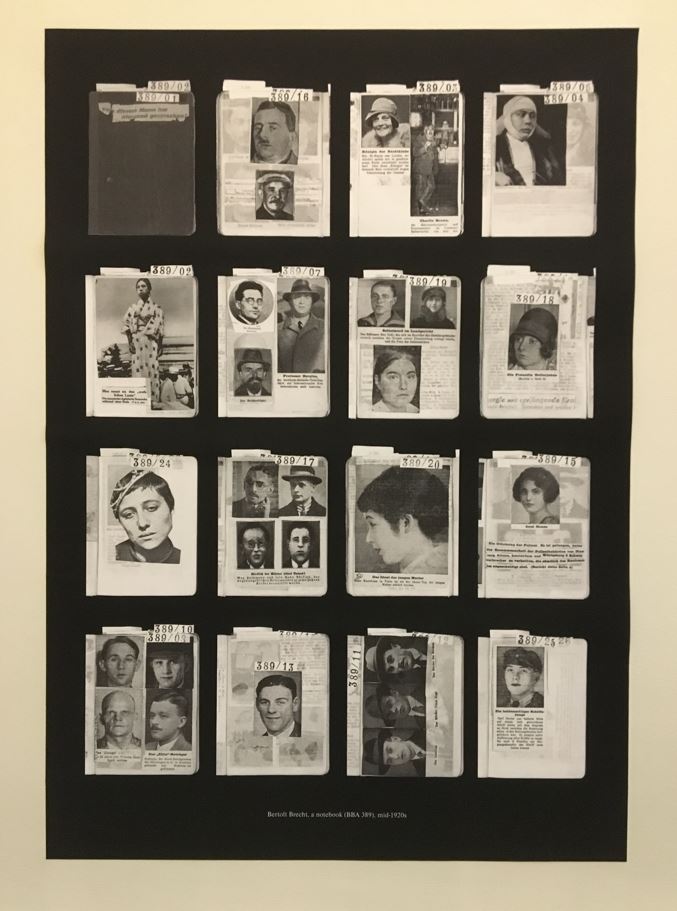
Installation view of ‘brecht: fragments’ at Raven Row showing a typical page from his notebook from the mid-1920s (photo by the author)
For example, why paste a postcard image by Pieter Breughel onto the front page of the manuscript of his great play ‘The Caucasian Chalk Circle’ except that it, in some sense, crystallised or captured the mood, or a mood, which the work was designed to present?

Installation view of ‘brecht: fragments’ at Raven Row showing the cover page of the manuscript of The Caucasian Chalk Circle, showing the cut and pasted letters and a postcard of a painting by Breughel (photo by the author)
Photomontage
Photos could be used in another way, to create photomontages, cutting out images from one context and pasting them into others, in the style of the radical photomontage artist John Heartfield. In actual fact, there isn’t much here in that style. For the most part, Brecht didn’t interfere with, cut and paste together, his images. They tended to go into his albums and notebooks and be pasted into play manuscripts unaltered. The artistry was in the initial selection.
The War Primer
Another use of news photos was when Brecht began collecting images during the Second World War and writing one four-line quatrains underneath them, producing what he came to call ‘photo-epigrams’. Over time this developed into a book which, after the war, came to be called the ‘War Primer’, containing 75 photo-epigrams.
A bunch of the original paste-ups for the book (actually created by Ruth Berlau, one of Brecht’s long-term collaborators) are hung across one wall. The quatrains, like most of Brecht’s poetry, consist of direct statement, unadorned by similes and metaphors, blunt and political. For example, under a photo of a bombardier in uniform inside a bomber:
You’re looking at a bastard, and a poor one!
‘I laugh at news of other men’s distress,
A corset salesman, formerly from Nürnberg,
A dealer now in death and wretchedness.’
Here’s an example, a striking magazine image of men in a steelworks which inspired Brecht to write the quatrain you can see, typed out, cut and pasted beneath it.

Paste-up for a page of War Primer (1940 to 1949) by Bertolt Brecht in collaboration with Ruth Berlau. Courtesy the Bertolt Brecht Archive, Akademie der Künste, Berlin (BBA 2096/38)
The quatrain for this one reads (in English translation):
‘What are you making, brothers?’ ‘A car of steel.
‘And what about these plates here, lying on the side?’
‘For shells that slice through sheer armoured walls.’
‘Why all this, brothers?’ ‘That we stay alive.’
Encyclopedia of gestures
Yet another use for images was that, heavily involved as he was in the staging of his plays, he was very interested in the actors’ gestures. What happens if you get an actor to stand on a stage so? Or hold his arms just so? And now in this position? And now in that? How much can be achieved without words, without even action, just by posture and gesture? And then what happens if you add words to gestures, is it possible to make the words and gestures contradict each other or at least play off each other.
Dictatorial poses
Which explains why there’s a room of sheets from his numerous notebooks, which consists of newspaper photos of generally eminent men of the time (the obvious tyrants – Hitler, Mussolini and Stalin – with other lesser known politicians such as Daladier, Laval et al). Anyway, Brecht managed to get hold of photos them making speeches and it’s genuinely fascinating to study how they held themselves and what they did with their arms and hands. Thus prompted I adopted some of the poses of Hitler in full flow (hold two clenched fists up, palms towards you, in front of your chest – and instantly felt some of the coiled rage at the world. Elsewhere, Brecht picked up this improbable series of snaps of the Führer throwing a few shapes.

Installation view of ‘brecht: fragments’ at Raven Row showing the sheet of photos of Hitler posing and prancing (terrible photo by the author)
And, in the next glass case, copied a series of poses of Comrade Stalin addressing a meeting, which have him leaning forward and pointing an accusing finger, – and you immediately feel yourself dominating a room full of people petrified that there going to be the next one accused of some crime and hauled off to the gulag.

Installation view of ‘brecht: fragments’ at Raven Row showing the sheet of photos of Stalin, smiling, playing the affable good fellow, and pointing a finger at people he’s about to send to the gulag. Copy the poses for yourself and see how they make you feel (photo by the author)
Collaboration
Back to the plays, the wall labels tell us that it was Brecht’s common practice to be highly collaborative, to sit round a table with other writers, director, actors, to discuss parts and action and dialogue. Lines of dialogue or action were typed on strips of paper and often moved around in a process of continual shuffling and improvement.

Installation view of ‘brecht: fragments’ at Raven Row showing a typical Brecht manuscript showing how sections of dialogue were created as blocks before being moved around, all accompanied by a typical contemporary news photo (photo by the author)
Pictures for plays
Once you grasp the centrality of collaboration in Brecht’s practice then it makes perfect sense that so many of his manuscripts are not neatly typed out finished products, but highly fragmented texts made out of typed lines pasted onto notebook pages, often with lines of commentary scrawled around then and, as mentioned, often with a photo from a newspaper pasted in. Now you can see how the use of images like this 1) helps everyone involved understand the directly political context of a piece 2) captures the mood of discussions and decisions without needing to be put into words. ‘Yes, that’s it.’
Hence the examples here of work notebooks, and ‘finished’ manuscripts, which are festooned with cut out lines of dialogue or text, crystallised in newspaper photos.
Many scenes
In his conversations with Walter Benjamin, Brecht explained how he conceived of his plays less as made from ACTS, in the traditional way, but more as collections of lots of freestanding scenes. In the reply to Lukács mentioned above, he describes how the play he’s working on, describing life under the Nazis, consists of 27 short scenes with no overarching narrative arc. In other words, Brecht constructed many of his plays as if they were a series of snapshots.
Development and flux
Because another key part of Brecht’s practice is that the plays were never really finished. They always changed and developed in production as the actors and director discovered what worked, and from production to production as Brecht changed lines, or action or moved about the scenes. Narrative ideas, situations and segments of dialogue were subject to continuous cutting and rearrangement, often literally, using scissors and glue.
Recap
So from the smallest photo cut out from a magazine and pasted into a notebook, to the large scale of his three-hour-long plays, this sense of flux and fragments was foundational to Brecht’s conception of his works and his practice in assembling them.
The Brecht Archive
That’s probably enough to give you a feel for the exhibition and the light it sheds on the practice and process of Brecht’s imagination, and an indication of the kind of visual material you see (lots of pages from his notebooks and scrapbooks, lots of news and magazine photos from the 1930s, ’40s and ’50s).
Just a note that the entire thing hails from the Brecht Archive now, of course, housed in Berlin and this is the first time most of this (largely unknown) material has ever been shown in the UK. It is, as I hope I’ve indicated, a fascinating treasure trove of ideas, images, documentary background to not only Brecht’s numerous works, finished and unfinished, along with glimpses of the social history of the period (1930s to the early 1950s) all combined.
Performances
A major part of the exhibition was the theatrical performances which took place twice a day during most of its run. Because I only stumbled across this so late, like a fool I missed them. The idea was that twice a day a bunch of actors led visitors through the gallery spaces, performing dramatic fragments from four of Brecht’s unfinished plays from the 1920s, showing how montage and snapshot techniques played a crucial part in his conception of playwriting.
Unfinished
Because that’s another aspect of the show I’ve forgotten to mention, which was that not only a lot of his plays changed and evolved during production, but a sizeable number never even made it that far. In short, Brecht left behind lots and lots of unfinished works. So four of the galleries contain props and production notes, including photos and visual materials relating to four plays which were never completed, but are here summarised and explained, namely:
Performance 1: The Breadshop
A 1930 collaboration addressing issues of poverty and hunger after the Wall Street Crash, which eventually ran to 245 pages but was never completed or performed. For some reason the conception began to focus on the role of the Salvation Army (SA), with a surprising number of accompanying images and biographies of SA notables.

Installation view of ‘brecht: fragments’ at Raven Row showing the performance space for The Breadshop (note the production notes and accompanying photos pasted to the wall) (photo by the author)
Performance 2: The Flood
An unfinished draft for a radio play, written 1927 to 1928, about a man-made apocalypse, inspired by a hurricane which devastated Miami in 1926.
Performance 3: Fleischhacker
A collaboration with Elisabeth Hauptmann, worked on till 1931, this told the story of Jae Fleischhacker, a futures trader in Chicago, as he plays the wheat market. This is interwoven with the story of a ‘Family from the Savannah’, who move to Chicago to try their luck following crop failure in the wheat district.

Installation view of ‘brecht: fragments’ at Raven Row showing the performance space and props for the performance of Fleischhacker (photo by the author)
Performance 4: Fatzer
Title of a dramatic fragment that Brecht worked on intensively for four years, from 1926 to 1930, and returned to throughout his creative life. It tells the story of a four-man tank crew, led by Johann Fatzer, who desert their post during the First World War. Amazingly, the manuscript ended up running to 500 pages but remained fragmented and unresolved and unperformable – until, that is, some scenes were reshaped and performed here, for this show.

Concluding scene from the performance of Fatzer in ‘brecht: fragments’ at Raven Row (2024) photograph by Anne Tetzlaff
Two films
And there are two films.
1. On a small TV monitor an experimental contemporary filming of a production of Mann ist Mann (Man Equals Man) from 1931. Set in British colonial India, the play concerns the brainwashing of an ordinary civilian, Galy Gay, into the perfect soldier. This film documents the 1931 production of the play at the Berlin State Theatre, for which Brecht was director, Peter Lorre played Galy Gay, and stage design was by Brecht’s long-time collaborator Caspar Neher. It was made using the experimental procedure of shooting film at a slowed rate of around one frame per second.
2. And in a darkened room, projected on a larger screen, are excerpts from the 1932 German feature film ‘Kuhle Wampe or Who Owns the World?’ about unemployment, homelessness and left-wing politics in the Weimar Republic. Brecht conceived and wrote the script, and directed the final debate scene, while the music was written by his long-term collaborator Hanns Eisler.
Gallery
Here’s the star performer of the era, Herr Adolf Hitler, cut out and pasted on the back of a manuscript page from ‘The Resistible Rise of Arturo Ui’. There are many photos of him, the most fascinating ones being the series depicting him in the full flood of his impassioned speeches.

Manuscript page from ‘The Resistible Rise of Arturo Ui’ (1941) courtesy the Bertolt Brecht
This one is a highly political photo showing Spanish peasants marching off to seize land owned by exploitative landlords.

From an album compiled by Brecht in the late-1940s, courtesy the Bertolt Brecht Archive, Akademie der Künste, Berlin (BBA 1198/058)
Here’s a vivid snapshot of Berlin men, the guy at the back giving it a particularly thuggish, threatening tone.

Image from research for Fatzer (1926 to 1930) by Bertolt Brecht. Courtesy the Bertolt Brecht Archive, Akademie der Künste, Berlin (BBA 0111/062)
The booklet
Usually galleries produce coffee-table catalogues to accompany their exhibitions, large-format, heavy books full of colour reproductions, which cost anything from £20 to £50.
Rather amazingly, the brecht: fragments exhibition at Raven Row is accompanied by an impressive 113-page pamphlet, consisting of five high quality essays by experts in the field, along with a chronology and bibliography, and it is COMPLETELY FREE. I can’t remember a comparably generous gesture by any gallery I’ve ever visited.
Envoi
One of the things that made Brecht such an interesting, innovative and powerful poet was his commitment to direct statement undeformed by the needs of scansion or rhyme. The power derives from the fundamental gestus, a word he coined to mean attitude or opinion but indicating more than that, evoking the pose and gestures of an actor onstage, a kind of mental image of how you would stand and move as you declaim the words. It’s a style epitomised by the plain but powerful final poem in the huge volume, ‘Poems 1913 to 1956’, edited by John Willett and Ralph Mannheim (1976):
And I always thought
And I always thought: the very simplest words
Must be enough. When I say what things are like
Everyone’s heart must be torn to shreds.
That you’ll go down if you don’t stand up for yourself
Surely you see that.
Although most of us disagree with his doctrinaire Marxism and foolish faith in Soviet communism, it’s hard not to be impressed by Brecht’s unflinching commitment to the victims of tyranny and exploitation everywhere, captured in so many of these photos, and in the texts and poems and fragments he derived from them.
Related links
- Brecht: fragments continues at Raven Row until 18 August 2024
- Manual of War: on Bertolt Brecht’s War Primer (Verso Books blog)
Related reviews
- Peter Kennard: Archive of Dissent @ the Whitechapel Gallery (July 2024)
- Peter Kennard @ the Imperial War Museum London (May 2015)
- Weimar Republic reviews
- Western Marxism reviews
- Communist reviews


 Books & Boots