Design for Living: A Comedy in Three Acts by Noel Coward (1932)

LEO: It should be easy, you know. The actual facts are so simple. I love you. You love me. You love Otto. I love Otto. Otto loves you. Otto loves me. There now!

GILDA: Ernest, if you only realized what was going on inside you, you’d be bitterly offended!

‘Design for Living’ is a comedy play written by Noël Coward in 1932. It concerns a trio of artistic characters, Gilda, Otto and Leo, and their complicated three-way relationship. Originally written to star Lynn Fontanne, Alfred Lunt and Coward, it was premiered on Broadway, partly because its risqué subject matter was thought unacceptable to the official censor in London. It was not until 1939 that a London production was presented.

‘Design for Living’ was a success on Broadway in 1933, but it has been revived less often than Coward’s other major comedies. Coward said:

‘It was liked and disliked, and hated and admired, but never, I think, sufficiently loved by any but its three leading actors.’

The play was adapted into a film in 1933, directed by Ernst Lubitsch, with a screenplay by Ben Hecht, and starring Fredric March, Gary Cooper, and Miriam Hopkins.

Background

In the second half the 1920s Coward became one of the world’s most famous playwrights, with a succession of popular hits ranging from the operetta Bitter Sweet (1929) and the extravaganza Cavalcade (1931), to the intimate comedies Hay Fever (1924) and Private Lives (1930). Back when he was penniless Coward had met Lunt and Fontanne Lunt on his first trip to new York and had promised he’d write a play to showcase them as an ensemble. By the early 1930s the time was right for Coward to write their star vehicle.

The play was based on the Lunts’ own marriage. They were a devoted couple but had an open relationship with ‘triangular relationships in their private lives’. Coward wrote:

‘These glib, over-articulate and amoral creatures force their lives into fantastic shapes and problems because they cannot help themselves. Impelled chiefly by the impact of their personalities each upon the other, they are like moths in a pool of light, unable to tolerate the lonely outer darkness but equally unable to share the light without colliding constantly and bruising each other’s wings…. The ending of the play is equivocal. The three of them… are left together as the curtain falls, laughing…. Some saw it as the lascivious anticipation of a sort of a carnal frolic. Others with less ribald imaginations regarded it as a meaningless and slightly inept excuse to bring the curtain down. I as author, however, prefer to think that Gilda and Otto and Leo were laughing at themselves.’

‘Design for Living’ opened in New York on 24 January 1933, at the Ethel Barrymore Theatre on Broadway. It was such a success that Coward was persuaded to relax his usual rule against appearing in any production for more than three months, and he allowed the play to run for a total of five months. So great were the crowds of fans in the street that special police had to be called in during the last week of the run.

Ménage à trois

A ménage à trois is a domestic arrangement or committed relationship consisting of three people in polyamorous romantic or sexual relations with each other, and often dwelling together.

Cast

  • Gilda – ‘a good-looking woman of about thirty’, ‘a permanent spectator’
  • Ernest Friedman – ‘any age between forty and fifty, rather precise in manner’
  • Otto Sylvus – ‘tall and good-looking’
  • Leo Mercuré – ‘thin and nervous’
  • Miss Hodge
  • Photographer
  • Mr Birbeck
  • Grace Torrence
  • Helen Carver
  • Henry Carver
  • Matthew

Plot

Act 1. Otto’s studio in Paris, 1932

Gilda is an interior designer who lives with the painter Otto, who was previously attached to Leo, an author. Ernest Friedman arrives, an art dealer and friend of all three. He is excited about his newly acquired Matisse and wants to show it to Otto. Gilda says that Otto is in bed, ill, has had neuralgia and absolutely cannot be disturbed.

Their conversation consists of classily phrased arguments and insults. ‘Private Lives’ taught me that a good deal of Coward dialogue consists of bad-tempered arguing.

ERNEST: If, in my dotage, I become a bore to you, you won’t scruple to let me know, will you?
GILDA: Don’t be an idiot!

He wonders why she doesn’t marry Otto and she replies because he loves her too much. To be tied legally to him would kill the love. She tells him to mind his own business.

ERNEST: I cannot, for the life of me, imagine why I’m so fond of you. You have such abominable manners.

Ernest tells her that Leo is back in Paris after making a success in New York. They both find it hilarious that he’s staying at the Georges V hotel.

Gilda’s discourse is all on stilts, on a high register of shrill self-awareness occasionally tipping over into hysteria, so much so that Earnest confesses she scares him.

GILDA: I’m yelling! Can’t you hear me yelling like mad?
OTTO: What on earth are you talking about?
GILDA: A bad joke, and very difficult to explain.

For example, she delivers a little speech about how she hates her own femininity, hates being trapped in a woman’s body.

There’s nothing funny in the scenario and few comic lines or jokes. It’s just listening to a posh man being mildly abused by this wilful neurotic. Everything is overdramatised. When Ernest makes the slightest of comments on her claiming to be in love with both Otto and Leo at the same time, she flies into a wild dramatisation of the threesome.

GILDA: Look at the whole thing as a side show. People pay to see freaks. Walk up! Walk up and see the Fat Lady and the Monkey Man and the Living.

To the audience and Earnest’s surprise, Otto – not at all in bed and suffering from neuralgia as Gilda claimed – enters from the street carrying luggage. Gilda lied fluently as so many Coward characters do cf Elyot and Amanda in ‘Private Lives’. In fact Otto’s just returned from a trip to Bordeaux where he was doing a portrait for an unknown client who he insulted by telling her she was fat, and got thrown out.

When Ernest tells Otto that Leo’s back from America, Otto insists that they go and see him straightaway and Gild eggs them on so they both depart.

Then Leo stumbles in from the bedroom and we realise why Gilda lied to Ernest about Otto being in bed with neuralgia and he couldn’t go into the bedroom even to whisper hello. It’s because it wasn’t Otto in the bedroom it was Leo. When he says ‘What we did was inevitable. It’s been inevitable for years’ it makes it sound like they’ve had sex for the first time after fancying each other for years. In other words, that the ménage à trois I’ve read about in all the blurbs and summaries of the play isn’t as established as I thought.

Anyway, he’s racked with guilt about it and they spend some time discussing what it means to have betrayed their best friend etc. As usual with Coward this takes the form of an argument or a squabble. His character suffer from an over-articulacy, they are far too fluent and articulate for their own good – which almost guarantees that they pick up on stray words here and there and magnify them into huge arguments. This was Elyot and Amanda’s way in ‘Private Lives’ and the same here. Leo says something sweet and reassuring which Gilda takes to be an appalling cliché and explodes:

GILDA [viciously]: Let’s have some more! ‘Passion’s only transitory’, isn’t it? ‘Love is ever fleeting!’ ‘Time is a great healer’. Trot them all out, dear.
LEO: Don’t try to quarrel with me.
GILDA: Don’t be so wise and assured and knowing, then. It’s infuriating.

The key word here is ‘viciously’. All Coward characters flip from civilised banter to vicious recriminations and insults in a second, and then back again. It makes them all dislikeable. And it gives the plays a constant sense of walking on eggshells, anxiously waiting for the next character to explode. It’s more like living with a wife beater than attending a sophisticated ‘comedy’.

At the height of their discussion-squabble-argument, Otto walks in and discovers them. Ah. He and Ernest got to the Hotel Georges V only to discover Leo wasn’t staying there at all, so he’s come back to his apartment and found…

They come out and tell him that they slept together in his absence. With crushing inevitability they start arguing and finding articulate fluent ways to describe how miserable they are and to accuse each other. Posh people fighting in a Noel Coward play! Yes.

LEO: What right have you to be hurt and grieved, any more than Gilda and me? We’re having just as bad a time as you are, probably worse.

Much like the audience. Coward’s alleged ‘wit’ is only intermittently apparent. Much, much more present in all these plays is the bad-tempered arguing and insults.

OTTO: I’ve seen something in you that I’ve never seen before; in all these years I’ve never noticed it—I never realized that, deep down underneath your superficial charm and wit, you’re nothing but a cheap, second-rate little opportunist, ready to sacrifice anything, however sacred, to the excitement of the moment.

Not that funny. Otto is violently unpleasant and Gilda collapses in tears.

GILDA (collapsing at the table): Stop it! Stop it! How can you be so cruel! How can you say such vile things?

Otto makes clear his contempt and hatred for both of them, wishes they were dead and in hell, and storms out.

Act 2

Scene 1. Leo’s Flat in London, 18 months later

Most of Coward’s plays take place over a few days. A gap of 18 months is a big thing, more like a novel.

Leo and Gilda are now living together and he is writing plays which are being produced and are tremendously successful. The scene opens with Leo reading out the reviews of his latest play, ‘Change and Decay’, to Gilda,

A playwright nervous about his reviews writing a play about a playwright nervously reading his reviews – you could consider this delightfully meta and cleverly postmodern – or tiresomely self-obsessed and narcissistic, according to taste.

Coward does that thing which numerous modern-ish authors do, which is have a character in one of their novels or plays repeat the popular criticism of them: in this case he has Leo read out the Daily Mirror‘s criticism that his latest play is ‘thin’. This exasperates him and stings him to tell Gilda that in future he will write fat plays about fat characters. This is, of course, to ignore the substance of the criticism: Coward’s plays are thin. The basic scenarios are often quite winning, but the characterisation is generally shallow as a puddle and the dialogue is astonishingly lacking in the wit and humour I have for decades associated with Coward until I actually came to read and watch his plays, and be rather disappointed. Instead of genuine wit or comedy you have exchanges like this.

GILDA: Anyhow, you can’t expect a paper like the Times to be really interested in your petty little excursions in the theatre. After all, it is the organ of the nation.
LEO: That sounds vaguely pornographic to me.

Schoolboy humour. Here’s another example of Coward’s shimmering wit, Gilda pretending to be a brainless newspaper interviewer:

Gilda [conversationally]: Tell me, Mr Mercure, what do you think of the modern girl?
LEO: [politely]: A silly bitch.

Not scintillating repartee, is it?

A phone call from some aristocratic inviting them to dinner prompts Leo to say these social situations are awkward when they’re obviously a couple but not married. So he proposes to her but she sagely turns him down and even says it would be against her moral code.

Presumably this kind of suave, sophisticated exchange was designed to shock and outrage the older, Edwardian generation with their Victorian morals.

The phone rings incessantly, a symptom of the modern world. Leo calls their maid or servant, Miss Hodge, in and tells her to answer the phone for him. Next time the phone rings working class Miss Hodge answers the phone with comic ineptness. The working classes, eh, ha ha ha.

What’s obvious is how bored they are. Gilda is bored to death.

GILDA: Perhaps you’re wise about our marrying; perhaps it would be a good thing. I’m developing into one of those tedious unoccupied women, who batten on men and spoil everything for them. I’m spoiling the excitement of your success for you now by being tiresome and gloomy.

Watching posh bored people torment each other, throwing ‘cheap gibes’ at each other, that’s entertainment. ‘Tiresome’ – that’s the key word. And Leo is as irritated and frustrated.

LEO: This looks like a row but it hasn’t even the virtue of being a new row. We’ve had it before several times, and just lately more than ever.

A journalist, Mr Birbeck, and press photographer from the Evening Standard arrive to do a feature on him. After arguing with Gilda Leo is in a bad mood and gives sharp replies to all the questions. Here is an example of his authorly wit:

MR BIRBECK: Do you believe the talkies will kill the theatre?
LEO: No. I think they’ll kill the talkies.
MR BIRBECK (laughing): That’s very good, that is! It really is.

It isn’t though, is it? It’s not in the slightest bit funny. It’s flippant and cynical and sounds like it ought to be a joke, but it isn’t. Leo gives up answering questions and tells him he’s tired and doesn’t he find asking all these stupid questions ‘grotesque?’ and tells him to come back dome other time when he’s less… tired.

Nonetheless he lets the photographer take some snaps and the scene ends with Mr Birbeck tentatively asking whether Leo could, just maybe, possibly, give them a teeny weeny smile? This is one of the few things I’ve found funny so far, these poor professionals trying to do their job in the face of Leo’s self-important moodiness.

Scene 2. Leo’s London flat, a few days later

A few days later Leo is away. After some comic business with the working class character, the maid Miss Hodge (Gilda asks if she minds that she and Leo are not married; Miss Hodge says she doesn’t mind, having herself been twice married and not thinking much of the institution) departs and Otto turns up.

He too is now successful, as an artist. He’s just back from staging an exhibition in New York.

There’s a joke, a joke with a punchline, such a rarity in Coward it’s worth recording.

OTTO: This seems a very nice flat.
GILDA: It is. You can see right across to the other side of the square on a clear day.

Ooh, immediately followed by another one. Otto says he bumped into a woman just leaving. Gilda explains that that was the maid, Mrs Hodge.

GILDA: That was Miss Hodge. She’s had two husbands.
OTTO: I once met a woman who’d had four husbands.

And a little later, after Otto explains that he went away for a while, on a Norwegian freighter:

OTTO: I can say, ‘How do you do?’ in Norwegian.
GILDA: We must get to know some Norwegian people immediately, so that you can say ‘How do you do? to them.—

Noel’s on fire! Maybe you can see what I mean when I say that this kind of thing isn’t really funny in itself. These aren’t really jokes, or barely. What makes them funny (if it does) is how they exemplify the attitude of these posh, superior, self-absorbed arty types. It’s so exactly the kind of flippant throwaway remark that a posh character in a Coward play ought to say.

Anyway, she asks why he’s avoided them for so frightfully long and he says yes, it has been frightfully long, hasn’t it. Did you miss me, darling etc.

Remember I commented on a playwright having a character in his latest play commenting on newspaper reviews of the character’s previous plays which sound very like the reviews and criticism Coward got for his plays? Happens again here. Otto asks what Gilda thinks of Leo’s latest play, prompting quite a serious reply:

GILDA: Three scenes are first rate, especially the last act. The beginning of the second act drags a bit, and most of the first act’s too facile—you know what I mean—he flips along with easy swift dialogue, but doesn’t go deep enough. It’s all very well played.

‘Doesn’t go deep enough’. Well, there’s no point criticising Coward for what he isn’t. No Ibsen or Strindberg, he. He concocted effective and extremely popular entertainments over a career spanning decades. An awesome achievement.

Back in this play, Otto and Gilda have a picnic dinner together: cold ham, salad, cold rice pudding, and slowly revive their friendship turning back into love. Or whatever it is they have. Maybe just opportunity.

Otto jokes about what would happen if they ended up fighting over Gilda, reminiscent of the fight scene between Elyot and Victor which fizzles out in ‘Private Lives’.

The conversation is frequently difficult to distinguish from an argument or row.

OTTO: Shut up! Don’t talk like that…
GILDA [breaking down]: Don’t—don’t laugh at me.

Author’s message

Remember how I’ve pointed out that the fundamental dichotomy in Coward isn’t between the straight and the gay, it’s between what my son calls ‘the normies’ – the normal, everyday people with their conventional beliefs and lives and morality and behaviour – and the Coward characters who proclaim that they are special, different, exceptional, Well, the same sentiment is expressed here in a pat little speech by Otto. For when Gilda has a moment of ‘normality’ and says that their falling in love is sordid and gross, Otto suavely replies that this is only so if measured by other people’s standards. I might as well give the whole speech, as it amounts to a manifesto of sorts.

GILDA: Why should we flatter ourselves that we’re so tremendously different?
OTTO: Flattery doesn’t enter into it. We are different. Our lives are diametrically opposed to ordinary social conventions; and it’s no use grabbing at those conventions to hold us up when we find we’re in deep water. We’ve jilted them and eliminated them, and we’ve got to find our own solutions for our own peculiar moral problems.
GILDA: Very glib, very glib indeed, and very plausible.
OTTO: It’s true. There’s no sense in stamping about and saying how degrading it all is. Of course it’s degrading; according to a certain code, the whole situation’s degrading and always has been. The Methodists wouldn’t approve of us, and the Catholics wouldn’t either; and the Evangelists and the Episcopalians and the Anglicans and the Christian Scientists—I don’t suppose even the Polynesian Islanders would think very highly of us, but they wouldn’t mind quite so much, being so far away. They could all club together—the whole lot of them—and say with perfect truth, according to their lights, that we were loose-living, irreligious, unmoral degenerates, couldn’t they?
GILDA [meekly]: Yes, Otto, I expect so.
OTTO: But the whole point is, it’s none of their business. We’re not doing any harm to anyone else. We’re not peppering the world with illegitimate children. The only people we could possibly mess up are ourselves, and that’s our lookout. It’s no use you trying to decide which you love best, Leo or me, because you don’t know! At the moment, it’s me, because you’ve been living with Leo for a long time and I’ve been away. A gay, ironic chance threw the three of us together and tied our lives into a tight knot at the outset. To deny it would be ridiculous, and to unravel it impossible. Therefore, the only thing left is to enjoy it thoroughly, every rich moment of it, every thrilling second.

This is no different from the ancient trope of carpe diem, Latin for ‘seize the day’, which is a literary phrase for the pretty obvious idea that you should enjoy life while you can. (The original Latin phrase comes from Horace’s Odes, which I’ve reviewed for this blog.)

The banter goes on for page after page until they realise they need to go to bed together. They embrace passionately. So it’s partner swapping again, as in ‘Private Lives’.

Scene 3. The same, the next morning

10.30 the next morning. Otto is still asleep when Ernest calls on Gilda. He asks to see Leo but Gilda lies, saying he’s not very well and can’t be disturbed. In reality, as we know, Leo is away at a weekend house party and it’s Otto asleep in the next room. This is quite funny because it mirrors the situation in the first scene, where Ernest arrived wanting to see Otto and Gilda lied, saying he was in bed with neuralgia when it was, of course, Leo who she’d illicitly slept with, who was in the bedroom.

This explains why Gilda is, once again, as in the first scene, slightly hysterical. And in this hysteria liable to sound off and make sweeping statements. For a start she says humanity is a great disappointment, has barely risen above the primeval slime. But this leads onto a more revealing statement.

GILDA: The human race is a let-down, Ernest; a bad, bad let-down! I’m disgusted with it. It thinks it’s progressed but it hasn’t; it thinks it’s risen above the primeval slime but it hasn’t—it’s still wallowing in it! It’s still clinging to us, clinging to our hair and our eyes and our souls. We’ve invented a few small things that make noises, but we haven’t invented one big thing that creates quiet, endless peaceful quiet—something to pull over us like a gigantic eiderdown; something to deaden the sound of our emotional yellings and screechings and suffocate our psychological confusions—

Coward hated critical analysis of his plays, so I’m going to do something he would have loathed and subject this little speech to tuppeny-ha’penny analyses according to several classical schools of literary criticism.

A Marxist interpretation

Most of Coward’s characters come from the parasite rentier class which doesn’t work for a living. Thus, lacking the purpose given to existence by the need to work, they are often bored to death, as Gilda is. In this particular play, the two male leads do in fact work for a living, after a fashion, as a playwright and an artist.

But the real point is that none of them are aligned with the forces of History, specifically the Proletariat which is, in late capitalism, the embodiment of the spirit of History and which must, as Marx proved with his scientific socialism, soon overthrow the exploitative capitalist system and its imperial extensions, and usher in the triumph of the working class.

So on the Marxist view of his day, it is only by throwing in their lot with people with a cause, committed to the liberation of humanity, that Coward’s characters can discover meaning and purpose to life and stop indulging in their squalid, petty bourgeois intrigues.

Thus Gilda’s wish for ‘something to pull over us like a gigantic eiderdown; something to deaden the sound of our emotional yellings and screechings and suffocate our psychological confusions—’ is the cry of the rootless, aimless, cosmopolitan bourgeoisie adrift from the unstoppable march of History, and for which there is only one cure or solution. Align with the class of the future, the proletariat. See the plays of Jean-Paul Sartre which dramatise just this issue.

A Freudian interpretation

Freud’s first, pre-war model of the mind, developed between about 1895 and 1918, attributed the central driving force of the unconscious to Sex, broadly speaking the Darwinian drive of the human organism to reproduce which, more narrowly, creates erotic drives which had to be channelled ‘correctly’ in order to be socially acceptable. Freud was among the first to discover how easily these drives get blocked and misdirected in childhood and adolescence to turn into the florid array of sexual ‘perversions’, or be stifled and emerge was a wide variety of neurotic and obsessive symptoms, which his patients described when they presented to him.

However, the colossal slaughter and destruction of the First World War persuaded him that his theory was inadequate. Nothing about sex could explain the hecatombs of corpses and entire empires brought to their knees.

Thus in the 1920s he developed his second model of the mind and this time posited that alongside the positive Life Force or Eros, of which reproduction and sex are merely subsets, an equal and opposite drive in all humans, indeed (he speculates) in all organisms, which he called the Death Drive or Thanatos: the widespread wish that the whole wretched business of life, all the anxieties and worries and responsibilities, not to mention illnesses and accidents, would all cease once and for all.

Thus Gilda’s wish for ‘something to pull over us like a gigantic eiderdown; something to deaden the sound of our emotional yellings and screechings and suffocate our psychological confusions’ is a textbook expression of the deep wish, a key component of all human minds – sometimes buried deep, sometimes (as here) freely acknowledged – for the whole stressful business just to end.

Anyway, this big speech is all preparatory to Gilda telling Ernest she is leaving. Leaving Leo and Otto. Running away. She feels stifled. She wants to be free. She wants to be her ‘unadulterated self’. She’s going to run away, stay in a hotel, go to Paris, no, Berlin. Explaining all this makes her feel very tender towards Ernest and she throws her arms round his neck. She leaves two letters on the desk and then leaves with Ernest.

The phone rings, Miss Hodge answers it and this prompts Otto to slouch out of his bedroom in his pyjamas and dressing gown. Miss Hodge lets him know she disapproves, and he tells her to go away and mind her own business.

Leo sneaks in through the front door, and for a moment mistakes the back of the head on the sofa and the cigarette smoke rising to be Gilda and shouts Hi honey, I’m home. So is appalled when it’s Otto who turns to greet him.

This turns into a row, with Leo telling him how vile he is, just as Otto told him how vile he was in the earlier scene. As with so much Coward, this is studiedly symmetrical and patterned.

OTTO: I said all that to you in Paris. Do you remember? I thought it was true then, just as you think it’s true now.

They have a long conversation about how they’re doomed to repeat the same situation (infidelity with Gilda). Leo says he needs to be tolerant which Otto, understandably, finds hard.

Then they notice the letters, reading them and concluding that Gilda has escaped. So, rather pathetically, they decide to get completely pissed on brandy and then sherry. Difficult for actors portraying steady descent into quite wild and then tearful drunkenness. Otto delivers a semi-drunken rant:

OTTO (with sudden fury): So many words! That’s what’s wrong with us! So many words—too many words, masses and masses of words, spewed about until we’re choked with them. We’ve argued and probed and dragged our entrails out in front of one another for years! We’ve explained away the sea and the stars and life and death and our own peace of mind! I’m sick of this endless game of three-handed, spiritual ping-pong—this battling of our little egos in one another’s faces! Sick to death of it! Gilda’s made a supreme gesture and got out. Good luck to her, I say!

Apart from the detail of it being a trio, the basic idea of being sick to death of choking themselves with words and dragging their entrails out, this could come from one of Elyot or Amanda’s rants in ‘Private Lives’.

Coward drags out this scene to inordinate length with Leo and Otto arguing at length, though it’s dressed up with fancy ideas, for example:

LEO: Science is our only hope, the only hope for humanity! We’ve wallowed in false mysticism for centuries; we’ve fought and suffered and died for foolish beliefs, which science has proved to be as ephemeral as smoke. Now is the moment to open our eyes fearlessly and look at the truth!

Which might mean something in a more serious play but, spoken by one of Coward’s superficial mannequins, comes over as flippant and inconsequential as everything else they say. For example, increasingly fanciful digressions, for example about the absurdity of the words ‘macaroni’ and ‘wimple’. Eventually they get so drunk that they embrace, sobbing helplessly.

So the act ends with two old friends having got hopelessly drunk and feeling hopelessly lonely and sad. Not immediately comic, in fact quite sad for us…

Act 3

Scene 1. Ernest’s apartment in New York, two years later

Like the gap of 18 months before Acts 1 and 2, two whole years is another long period of time to jump. So we find ourselves in Ernest’s New York apartment. Gilda has married Ernest and become a commercially successful designer. Ernest is away and, on this fine summer’s evening, Gilda is giving a reception for some important clients, namely: Henry and Helen Carver, ‘a comparatively young married couple, wealthy and well dressed’, and Grace Torrence, ‘slightly older, a typical Europeanized New York matron’.

Gilda has grown up. She is elaborately and beautifully gowned. Her manner has changed a good deal. She is much more still and sure than before. A certain amount of vitality has gone from her, but, in its place, there is an aloof poise quite in keeping with her dress and surroundings.

Gilda takes Grace off to show her something and Henry and Helen have an extended argument about the merit of interior decorators, Henry thinking it’s all a racket, Helen defending her. Couples fiercely arguing, it’s Coward’s basic situation.

Doorbell rings and Henry lets in… Otto and Leo, both in fine fantastical moods. They come over as very camp i.e. over self-consciously mocking everything everyone says.

OTTO: There’s something strangely and deeply moving about young love, Mr. and Mrs. Carver.
LEO: Youth at the helm.
OTTO: Guiding the little fragile barque of happiness down the river of life. Unthinking, unknowing, unaware of the perils that lie in wait for you, the sudden tempests, the sharp jagged rocks beneath the surface. Are you never afraid?
HENRY I don’t see anything to be afraid of.
LEO (fondly): Foolish headstrong boy.

This is deliberately aggressively offensive but cast in such suave politeness as to be hard to talk back to. Part of the purpose of camp which is a power play.

Otto and Leo’s fast-talking sophisticated banter startles and puzzles Henry and Helen. This is also a classic scenario – clever, fast-talking smartarses bewildering the normies. Which conceals, not very well, their anger. They are cattily, bitchily angry with Gilda and their anger quickly comes out, constantly teetering on the brink of… yet another argument, a fight, a flaring row. The basic Coward content.

Gilda responds to their aggressive flippancy with bitterness of their own and barely controlled fury. On a general point, lots of twentieth century drama seems to be about people behaving badly on stage. Drunken angry bitterness being the speciality of, for example, Tennessee Williams a generation later.

Their intense, recriminatory conversation drives Helen, Henry and Grace away. Grace recognises boorish behaviour when she sees it. Gilda insists Leo and Otto leave as well but secretly gives them a key and tells them to come back.

After they’ve all gone she compulsively finished one of the other’s drink, with tears in her eyes.

Scene 2. The same, the next morning

Ernest returns the next morning and is greeted by his Black servant who makes him a coffee, he puts down his luggage etc and then… Otto and Leo come down the stairs wearing his pyjamas and dressing gowns.

He is completely flabbergasted and triggers their ‘brazen impertinence’ i.e. more camp flippancy. They tell him they gatecrashed Gilda’s little party the night before, she gave them a key, but when they came back she had gone.

They call him ludicrous for claiming that Gilda is his wife, but they dismiss this as nonsense, claiming she belongs to them just as much as to him (Ernest).

Cue Gilda walking in and explaining that she spent the night at a hotel. Ernest explodes in anger but once again, as in the previous scene, it’s a case of the two tricksters, jokers, sparky and flippant and imaginative people, against the ‘normie’, Ernest, who can’t keep up with their smooth repartee. Just as straight-laced Victor couldn’t keep up with Elyot’s smart repartee in ‘Private Lives’. So:

ERNEST: I think your arrogance is insufferable. I don’t know what to say. I don’t know what to do. I’m very, very angry.

Of course he doesn’t know what to do. He’s the normie in a play about tricksters.

Now it turns out that Gilda has realised she is bored with her life with Ernest and so she’s going to leave him. She reveals that being her wife has no value to her, it’s been very convenient and comfortable but now she realises she has to go back to the tricksters.

Ernest tries to argue that Gilda knows too much to be taken back by them but she denies it. He thinks she’s gone mad but she declares they are all of a piece, they all share the same ‘difference’ from normal society which I commented on earlier.

GILDA: It’s silly to go on saying to yourself that I’m different from Otto. and Leo just because you want to believe it. I’m not different from them. We’re all of a piece, the three of us. Those early years made us so. From now on we shall have to live and die our own way. No one else’s way is any good, we don’t fit.

‘We don’t fit’, cry of the alienated teenager for at least the last 70 years. And more manifesto:

ERNEST: Your values are false and distorted.
GILDA: Only from your point of view.
ERNEST: From the point of view of anyone who has the slightest sense of decency.
LEO: We have our own decencies. We have our own ethics. Our lives are a different shape from yours. Wave us good-bye, Little Ernest, we’re together again.

Ernest accuses them of wallowing in a ‘disgusting three-sided erotic hotch-potch’. But the more angry he gets – the more he invokes conventional morality – the more flippantly amused the naughty threesome become and, as Ernest stomps to the apartment door, leaves and slams it shut, the threesome collapse into hilarious laughter.

Thoughts

I’ve made my main comments: not many comic lines; thin characters; the whole effect achieved almost entirely by the posh self-centred self-satisfied smug superiority of the characters, which the audience is invited to alternately identify with and/or laugh at.

What impresses, maybe, is the professionalism with which the initial premise or scenario is worked through, with clever structural echoes and parallelism. But it gets pretty monotonous at moments, since the audience quickly develops a strong idea of what’s going to happen.

Is it even a real ménage à trois?

Short answer, no. It isn’t. Our three heroes do not live in a relaxed happy ménage, so they? The opposite. What really happens is Gilda sleeps around, betraying first Leo, then Otto and then, a year or so later, her husband Ernest. It is not a ménage at all but the story of a serial adulteress or promiscuous woman. The idea that the three of them can somehow happily co-exist only really comes at the end, in the Betraying Ernest scene.

But again, as with The Vortex, there’s little point judging the scenario by our own modern standards: in its day, the play’s timid hints at a genuine ménage were enough to cause shock and scandal among the bourgeois newspapers, critics and staid theatre goers.

Mocking the provinces

I wonder how long the English upper classes have been mocking the provinces. Maybe since the Norman Conquest. One of Coward’s other plays mocks Newcastle, and there’s a slight dig here.

GILDA: Have you been married much, then?
MISS HODGE: Twice, all told.
GILDA: Where are your husbands now?
MISS HODGE: One’s dead, and the other’s in Newcastle.
GILDA (smiling): Oh.

More sustained metropolitan snobbery is dispensed by Otto in Act 2.

OTTO [drawing up a chair]: What delicious-looking ham! Where did you get it?
GILDA: I have it specially sent from Scotland.
OTTO: Why Scotland?
GILDA: It lives there when it’s alive.
OTTO: A bonny country, Scotland, if all I’ve heard is correct, what with the banshees wailing and the four-leaved shamrock.
GILDA: That’s Ireland, dear.
OTTO: Never mind. The same wistful dampness distinguishes them both.

A post-colonial interpretation

Hilarious (that’s sarcasm). But if you were an Irish nationalist, an Indian nationalist, any educated inhabitant of one of Britain’s 57 colonies, dominions, territories, or protectorates, you might have read this kind of thing as precisely the kind of ignorant, self-centred, privileged, smug indifference that you had to shoot your way through in order to gain independence.

Related links

Related reviews

Brecht: fragments @ Raven Row

This is a fascinating and thought-provoking exhibition, in a lovely setting, I’m just kicking myself that I found out about it too late to see the theatrical performances (see below).

Raven Row

Raven Row is a secret treasure of a gallery tucked away in Spitalfields. It’s adapted from the domestic rooms of a tall thin eighteenth century building at the eastern end of Artillery Lane (nearest tube station Liverpool Street station). Raven Row is a charity committed to displaying art which is diverse and unusual, sometimes by established international artists, sometimes more out-of-the-way figures, united by having escaped the notice of the big name London art galleries. Their programme aims to be ‘improvisatory and undogmatic.’

This photo of the interior of one of the rooms immediately gives you a feel for how they’ve retained most of the original Georgian features and decoration.

Installation view of ‘brecht: fragments’ at Raven Row (photograph by Marcus J Leith)

Bertolt Brecht

Bertolt Brecht (1898 to 1956) has a claim to be the greatest German writer of the twentieth century, certainly the most famous. He had a first burst of fame when his musical, The Threepenny Opera, became a hit, and its signature tune, ‘Die Moritat von Mackie Messer’ was covered by American performers as ‘Mack the Knife’.

But it was after the Second World War when the radically innovative approach of his so-called ‘epic theatre’, as performed by his touring theatre company The Berliner Ensemble, revolutionised the possibilities of theatre. The spread of his technique was also helped by the fact that he wrote some of the great plays of the period such as ‘Mother Courage’, ‘The Chalk Circle’, ‘Galileo’ and many others.

But Brecht wasn’t just a world class playwright, he was also a noted poet, he wrote many essays in support of his theatre theory and, as this exhibition sets out to show, he could also be considered an artist of a particular type.

brecht: fragments

In the late 1930s Brecht came under attack from Soviet administrators of the new doctrine of Socialist Realism, most notably the powerful critic Gyorgy Lukács, who criticised him for using elitist, avant-garde techniques which were difficult for ‘the masses’ to understand. In one of his replies defending the use of modernist aesthetics for revolutionary communist purposes, Brecht mentions that, even though he was now in exile in Denmark, he was currently working on a surprising number of projects and goes on to mention 2 novels, a play and a book of poetry, not including the essay in which he describes all this (Aesthetics and Politics, Verso Books, 1977, p.70).

In other words, it was Brecht’s working practice throughout his career to be working on a multitude of projects, and to be surrounded by fragments of works in progress, across a range of genres and forms.

Found images

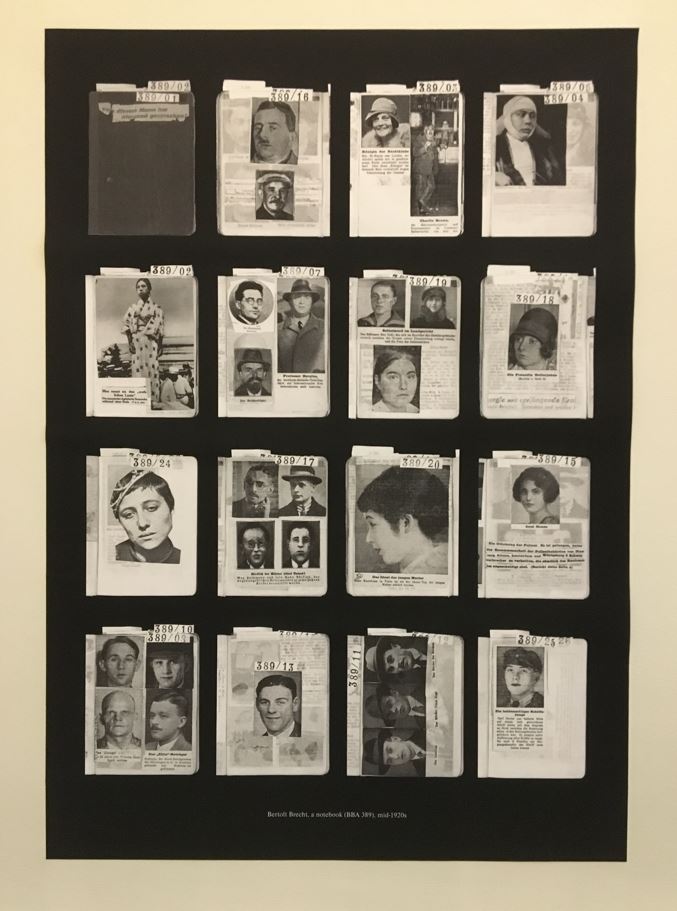
What this many-sided exhibition at Raven Row shows is how this concept, or category, of ‘fragments’ can be seen as not just a side effect of Brecht’s work-in-progress, but a fundamental principle which applies to them at every level. For, as this exhibition shows, Brecht was a compulsive collector of found images, often from newspapers and magazines. He pasted these into notebooks where he collected them by theme. He strewed his manuscripts with them where they obviously acted as inspiration or captured ideas, sometimes literal, sometimes tangential.

Installation view of ‘brecht: fragments’ at Raven Row showing a typical page from his notebook from the mid-1920s (photo by the author)

For example, why paste a postcard image by Pieter Breughel onto the front page of the manuscript of his great play ‘The Caucasian Chalk Circle’ except that it, in some sense, crystallised or captured the mood, or a mood, which the work was designed to present?

Installation view of ‘brecht: fragments’ at Raven Row showing the cover page of the manuscript of The Caucasian Chalk Circle, showing the cut and pasted letters and a postcard of a painting by Breughel (photo by the author)

Photomontage

Photos could be used in another way, to create photomontages, cutting out images from one context and pasting them into others, in the style of the radical photomontage artist John Heartfield. In actual fact, there isn’t much here in that style. For the most part, Brecht didn’t interfere with, cut and paste together, his images. They tended to go into his albums and notebooks and be pasted into play manuscripts unaltered. The artistry was in the initial selection.

The War Primer

Another use of news photos was when Brecht began collecting images during the Second World War and writing one four-line quatrains underneath them, producing what he came to call ‘photo-epigrams’. Over time this developed into a book which, after the war, came to be called the ‘War Primer’, containing 75 photo-epigrams.

A bunch of the original paste-ups for the book (actually created by Ruth Berlau, one of Brecht’s long-term collaborators) are hung across one wall. The quatrains, like most of Brecht’s poetry, consist of direct statement, unadorned by similes and metaphors, blunt and political. For example, under a photo of a bombardier in uniform inside a bomber:

You’re looking at a bastard, and a poor one!
‘I laugh at news of other men’s distress,
A corset salesman, formerly from Nürnberg,
A dealer now in death and wretchedness.’

Here’s an example, a striking magazine image of men in a steelworks which inspired Brecht to write the quatrain you can see, typed out, cut and pasted beneath it.

Paste-up for a page of War Primer (1940 to 1949) by Bertolt Brecht in collaboration with Ruth Berlau. Courtesy the Bertolt Brecht Archive, Akademie der Künste, Berlin (BBA 2096/38)

The quatrain for this one reads (in English translation):

‘What are you making, brothers?’ ‘A car of steel.
‘And what about these plates here, lying on the side?’
‘For shells that slice through sheer armoured walls.’
‘Why all this, brothers?’ ‘That we stay alive.’

Encyclopedia of gestures

Yet another use for images was that, heavily involved as he was in the staging of  his plays, he was very interested in the actors’ gestures. What happens if you get an actor to stand on a stage so? Or hold his arms just so? And now in this position? And now in that? How much can be achieved without words, without even action, just by posture and gesture? And then what happens if you add words to gestures, is it possible to make the words and gestures contradict each other or at least play off each other.

Dictatorial poses

Which explains why there’s a room of sheets from his numerous notebooks, which consists of newspaper photos of generally eminent men of the time (the obvious tyrants – Hitler, Mussolini and Stalin – with other lesser known politicians such as Daladier, Laval et al). Anyway, Brecht managed to get hold of photos them making speeches and it’s genuinely fascinating to study how they held themselves and what they did with their arms and hands. Thus prompted I adopted some of the poses of Hitler in full flow (hold two clenched fists up, palms towards you, in front of your chest – and instantly felt some of the coiled rage at the world. Elsewhere, Brecht picked up this improbable series of snaps of the Führer throwing a few shapes.

Installation view of ‘brecht: fragments’ at Raven Row showing the sheet of photos of Hitler posing and prancing (terrible photo by the author)

And, in the next glass case, copied a series of poses of Comrade Stalin addressing a meeting, which have him leaning forward and pointing an accusing finger, – and you immediately feel yourself dominating a room full of people petrified that there going to be the next one accused of some crime and hauled off to the gulag.

Installation view of ‘brecht: fragments’ at Raven Row showing the sheet of photos of Stalin, smiling, playing the affable good fellow, and pointing a finger at people he’s about to send to the gulag. Copy the poses for yourself and see how they make you feel (photo by the author)

Collaboration

Back to the plays, the wall labels tell us that it was Brecht’s common practice to be highly collaborative, to sit round a table with other writers, director, actors, to discuss parts and action and dialogue. Lines of dialogue or action were typed on strips of paper and often moved around in a process of continual shuffling and improvement.

Installation view of ‘brecht: fragments’ at Raven Row showing a typical Brecht manuscript showing how sections of dialogue were created as blocks before being moved around, all accompanied by a typical contemporary news photo (photo by the author)

Pictures for plays

Once you grasp the centrality of collaboration in Brecht’s practice then it makes perfect sense that so many of his manuscripts are not neatly typed out finished products, but highly fragmented texts made out of typed lines pasted onto notebook pages, often with lines of commentary scrawled around then and, as mentioned, often with a photo from a newspaper pasted in. Now you can see how the use of images like this 1) helps everyone involved understand the directly political context of a piece 2) captures the mood of discussions and decisions without needing to be put into words. ‘Yes, that’s it.’

Hence the examples here of work notebooks, and ‘finished’ manuscripts, which are festooned with cut out lines of dialogue or text, crystallised in newspaper photos.

Many scenes

In his conversations with Walter Benjamin, Brecht explained how he conceived of his plays less as made from ACTS, in the traditional way, but more as collections of lots of freestanding scenes. In the reply to Lukács mentioned above, he describes how the play he’s working on, describing life under the Nazis, consists of 27 short scenes with no overarching narrative arc. In other words, Brecht constructed many of his plays as if they were a series of snapshots.

Development and flux

Because another key part of Brecht’s practice is that the plays were never really finished. They always changed and developed in production as the actors and director discovered what worked, and from production to production as Brecht changed lines, or action or moved about the scenes. Narrative ideas, situations and segments of dialogue were subject to continuous cutting and rearrangement, often literally, using scissors and glue.

Recap

So from the smallest photo cut out from a magazine and pasted into a notebook, to the large scale of his three-hour-long plays, this sense of flux and fragments was foundational to Brecht’s conception of his works and his practice in assembling them.

The Brecht Archive

That’s probably enough to give you a feel for the exhibition and the light it sheds on the practice and process of Brecht’s imagination, and an indication of the kind of visual material you see (lots of pages from his notebooks and scrapbooks, lots of news and magazine photos from the 1930s, ’40s and ’50s).

Just a note that the entire thing hails from the Brecht Archive now, of course, housed in Berlin and this is the first time most of this (largely unknown) material has ever been shown in the UK. It is, as I hope I’ve indicated, a fascinating treasure trove of ideas, images, documentary background to not only Brecht’s numerous works, finished and unfinished, along with glimpses of the social history of the period (1930s to the early 1950s) all combined.

Performances

A major part of the exhibition was the theatrical performances which took place twice a day during most of its run. Because I only stumbled across this so late, like a fool I missed them. The idea was that twice a day a bunch of actors led visitors through the gallery spaces, performing dramatic fragments from four of Brecht’s unfinished plays from the 1920s, showing how montage and snapshot techniques played a crucial part in his conception of playwriting.

Unfinished

Because that’s another aspect of the show I’ve forgotten to mention, which was that not only a lot of his plays changed and evolved during production, but a sizeable number never even made it that far. In short, Brecht left behind lots and lots of unfinished works. So four of the galleries contain props and production notes, including photos and visual materials relating to four plays which were never completed, but are here summarised and explained, namely:

Performance 1: The Breadshop

A 1930 collaboration addressing issues of poverty and hunger after the Wall Street Crash, which eventually ran to 245 pages but was never completed or performed. For some reason the conception began to focus on the role of the Salvation Army (SA), with a surprising number of accompanying images and biographies of SA notables.

Installation view of ‘brecht: fragments’ at Raven Row showing the performance space for The Breadshop (note the production notes and accompanying photos pasted to the wall) (photo by the author)

Performance 2: The Flood

An unfinished draft for a radio play, written 1927 to 1928, about a man-made apocalypse, inspired by a hurricane which devastated Miami in 1926.

Performance 3: Fleischhacker

A collaboration with Elisabeth Hauptmann, worked on till 1931, this told the story of Jae Fleischhacker, a futures trader in Chicago, as he plays the wheat market. This is interwoven with the story of a ‘Family from the Savannah’, who move to Chicago to try their luck following crop failure in the wheat district.

Installation view of ‘brecht: fragments’ at Raven Row showing the performance space and props for the performance of Fleischhacker (photo by the author)

Performance 4: Fatzer

Title of a dramatic fragment that Brecht worked on intensively for four years, from 1926 to 1930, and returned to throughout his creative life. It tells the story of a four-man tank crew, led by Johann Fatzer,  who desert their post during the First World War. Amazingly, the manuscript ended up running to 500 pages but remained fragmented and unresolved and unperformable – until, that is, some scenes were reshaped and performed here, for this show.

Concluding scene from the performance of Fatzer in ‘brecht: fragments’ at Raven Row (2024) photograph by Anne Tetzlaff

Two films

And there are two films.

1. On a small TV monitor an experimental contemporary filming of a production of Mann ist Mann (Man Equals Man) from 1931. Set in British colonial India, the play concerns the brainwashing of an ordinary civilian, Galy Gay, into the perfect soldier. This film documents the 1931 production of the play at the Berlin State Theatre, for which Brecht was director, Peter Lorre played Galy Gay, and stage design was by Brecht’s long-time collaborator Caspar Neher. It was made using the experimental procedure of shooting film at a slowed rate of around one frame per second.

2. And in a darkened room, projected on a larger screen, are excerpts from the 1932 German feature film ‘Kuhle Wampe or Who Owns the World?’ about unemployment, homelessness and left-wing politics in the Weimar Republic. Brecht conceived and wrote the script, and directed the final debate scene, while the music was written by his long-term collaborator Hanns Eisler.

Gallery

Here’s the star performer of the era, Herr Adolf Hitler, cut out and pasted on the back of a manuscript page from ‘The Resistible Rise of Arturo Ui’. There are many photos of him, the most fascinating ones being the series depicting him in the full flood of his impassioned speeches.

Manuscript page from ‘The Resistible Rise of Arturo Ui’ (1941) courtesy the Bertolt Brecht

This one is a highly political photo showing Spanish peasants marching off to seize land owned by exploitative landlords.

From an album compiled by Brecht in the late-1940s, courtesy the Bertolt Brecht Archive, Akademie der Künste, Berlin (BBA 1198/058)

Here’s a vivid snapshot of Berlin men, the guy at the back giving it a particularly thuggish, threatening tone.

Image from research for Fatzer (1926 to 1930) by Bertolt Brecht. Courtesy the Bertolt Brecht Archive, Akademie der Künste, Berlin (BBA 0111/062)

The booklet

Usually galleries produce coffee-table catalogues to accompany their exhibitions, large-format, heavy books full of colour reproductions, which cost anything from £20 to £50.

Rather amazingly, the brecht: fragments exhibition at Raven Row is accompanied by an impressive 113-page pamphlet, consisting of five high quality essays by experts in the field, along with a chronology and bibliography, and it is COMPLETELY FREE. I can’t remember a comparably generous gesture by any gallery I’ve ever visited.

Envoi

One of the things that made Brecht such an interesting, innovative and powerful poet was his commitment to direct statement undeformed by the needs of scansion or rhyme. The power derives from the fundamental gestus, a word he coined to mean attitude or opinion but indicating more than that, evoking the pose and gestures of an actor onstage, a kind of mental image of how you would stand and move as you declaim the words. It’s a style epitomised by the plain but powerful final poem in the huge volume, ‘Poems 1913 to 1956’, edited by John Willett and Ralph Mannheim (1976):

And I always thought

And I always thought: the very simplest words
Must be enough. When I say what things are like
Everyone’s heart must be torn to shreds.
That you’ll go down if you don’t stand up for yourself
Surely you see that.

Although most of us disagree with his doctrinaire Marxism and foolish faith in Soviet communism, it’s hard not to be impressed by Brecht’s unflinching commitment to the victims of tyranny and exploitation everywhere, captured in so many of these photos, and in the texts and poems and fragments he derived from them.


Related links

Related reviews

Picasso 1932: Love, Fame, Tragedy @ Tate Modern

Pablo Picasso. You might just have heard of him, since he is probably the most famous artist of the twentieth century. Picasso had a number of ‘great years’, years in which he made stylistic innovations which really did send ‘shockwaves through the art world’ and change the way that educated people see and think about art.

Picasso 1932: Love, Fame, Tragedy has the simple idea of looking at one of Picasso’s Great Years in immense detail. It takes us month by month through Picasso’s life and output in 1932, ‘a time so pivotal in Picasso’s life and work that it has been called his “year of wonders”‘.

Pablo Picasso, rue La Boétie, 1933, Paris by Cecil Beaton © The Cecil Beaton Studio Archive at Sotheby’s

The exhibition includes more than 100 outstanding paintings, sculptures and works on paper to give you a flavour of Picasso’s prolific and restlessly inventive character. It includes an unprecedented range of loans from collections around the world, including the Musée National Picasso-Paris, as well as many works from private collection, reuniting some of Picasso’s greatest works of art, many of which are rarely shown in public, for the first time in 86 years.

What was happening to Pablo Picasso in 1932

In 1932 Picasso turned 50. He was married (to Russian dancer, Olga Khokhlova) and had an 11-year-old son Paulo. Many galleries were vying with each other to stage a retrospective of his works, a competition won by the Galeries Georges Petit, which staged Picasso’s first major retrospective in June 1932.

Picasso was the most famous living artist. He bought a big farmhouse in Normandy, created a studio in the barn and toyed with having an outdoor swimming pool built. He owned a luxury apartment in Paris and was ferried around in a chauffeur-driven Hispano-Suiza car.

Yet he was restless. He had been carrying on an affair with a sporty, outdoorsy 22-year-old blonde, Marie-Thérèse Walter. And the new flavour of the month in fashion-conscious Paris were the Surrealists, who in the 1920s had mostly been a literary movement, but whose visual experiments and confidence had been given a shot in the arm by the arrival of Salvador Dalí, who joined the group in the late 1929.

Some critics wondered whether Picasso was finished, a man of the past. He consciously set out to prove them wrong, with the result that 1932 marks an explosion of creativity and a restless set of experiments in oil painting, sculpture and drawing.

Nude Woman in a Red Armchair (1932) by Pablo Picasso. Tate. © Succession Picasso/DACS London, 2018

Pictures of women

When I (and the curators) say ‘experiment’ something must be emphasised right from the start: the exhibition showcases Picasso’s stunning creativity and includes a dozen or more quite wonderful works – but at the same time you can’t help noticing the monotony of subject matter. Women. Women are his subject. Or rather, single women. A woman in a chair. Sleeping woman. Woman reflected in a mirror.

Later in the show there are several women playing on a beach. Or a man saving a woman from drowning. Or women lying around while being serenaded by fauns. But at the imaginative core of the work is one woman.

You don’t get far into the exhibition before you’re being told that the woman in question is Marie-Thérèse, the mistress. She was blonde and she had the kind of nose which is an extension of the forehead without a dent or kink, a Roman nose it’s sometimes called.

Nude, Green Leaves and Bust (1932) by Pablo Picasso. Private Collection © Succession Picasso/DACS London, 2018

The obsessive repetition of the same woman, sleeping or sitting in a chair makes the visitor wonder whether there was some kind of a trade-off – that Picasso had to limit his subject matter to the tiny world of the studio, and his one, central muse figure – blanking out the entirety of the roaring, industrial, political, urban world of 1932, rejecting every visual thing in the universe except his blonde lover and a few studio props – in order to be imaginatively free to submit it to so many fantastic and brilliant variations.

Information

Each room is dedicated to a month or two, and the audioguide zeroes in on pictures often painted on a specific, named day.

The exhibition includes a huge amount of biographical information, a host of articles about what was going on in Paris at the time, about the fashionable popularity of Freud and Jung’s psychoanalytic theories, about the competition from the Surrealists and the launch of the Surrealist magazine Minotaur (first edition published June 1933 and devoted almost entirely to Picasso), about Picasso building the sculpture studio at his Normandy house, a detailed account of his comings and goings during the year, and the elaborate preparations for the retrospective exhibition.

So much so that it’s almost easy to lose sight of the art in the blizzard of explanations and timelines.

Reclining Nude (1932) by Pablo Picasso. Private Collection © Succession Picasso/DACS London, 2018

Practicing curves

One way to approach them is via the room devoted to some of the black-and-white charcoal drawings on canvas which Picasso made throughout 1932. The commentary very usefully pointed out that the sweeping lines, the curves and arabesques of the charcoal lines, are like a preparation for the paintings. For in the paintings, the scholars tell us there was little if any preparation. Picasso rarely painted from life – he started from memory and imagination and created shapes and patterns by great sweeping curves of his hand.

The charcoal pictures show his hand and arm building up the technique of creating great sweeping curves first time, with no afterthought or adjustment, again and again depicting the kind of curve which, in the finished paintings, become a woman’s face or nose or arms or torso or bottom.

His habit was to mark out shapes and patterns in black paint and, once he was happy with the composition, to fill in the shape with colour, but quite happy to leave both elements (black lines and colour) unfinished, rasping the paint, letting undercolours or even blank canvas show through.

All of the paintings here benefited from looking at close up to see this technique up close. Colouring and setting varied a little, but the fundamental idea of the defining black line (almost, at times, the thick black line of a cartoon) is always paramount.

Wallpaper

It may sound trivial and the commentary didn’t mention it, but I was struck by the care with which he depicts the wallpaper behind the subjects.

The Mirror by Pablo Picasso (12 March 1932) Private Collection © Succession Picasso/DACS London, 2018

The curator’s commentary dwells on the fact that these are paintings of a woman, and paintings of Picasso’s mistress. Either angle gives the opportunity for lengthy discussions of either his private life, or the long tradition of painting women in Western art. A woman near a mirror is bound to set off a small explosion of art theory referencing the long tradition of associating women with ‘vanity’.

Maybe. But when I look at this picture the first thing I notice is the dark blue patterned wallpaper and then the orange frame of the mirror, in other words the overall design of the composition, long before I notice the broad-nosed sleeping blonde with her ripe-apple boobs. And after processing her shape and curves, it is to the extraordinarily deep blue of the backdrop that my eyes returns.

In this concern for the decorative ancillaries to the main image a lot of these paintings reminded me of the purely decorative concerns of Picasso’s long-time frenemy, Henri Matisse.

The subject may be a female nude, it may be his hushed-up mistress, she may be passively sleeping and yet reflected, in a semi-surreal way, by the mirror. But the painting is also an arrangement of colours on a flat surface. It is a decorative object, whose subject you can almost ignore, if you will. It is first and foremost a big bright image and I think the viewer reacts immediately, either for or against the size and vibrancy of the colour and shape of the composition, long before you get round to thinking about the ‘issues’ of women and mirrors or marriage and mistresses.

Angles

Again, putting aside the subject matter for a moment, by the time I’d got to the end I realised Picasso had roughly three approaches or ‘styles’, at least in this year of 1932.

One is the curvy, ‘feminine’ style exemplified in the pictures shown above. But there was another, very different style – characterised by uncomfortable angles, distortions, harsh straight lines and geometric interactions. There are quite a few of them here and they feel completely different to the soft curvy sleeping blondes.

The most striking instances are a sequence of smaller works he made which are all variations on the idea of a woman sunbathing – but not a woman as you or I might conceive the subject.

Woman on the Beach (1932) by Pablo Picasso. The Penrose Collection © Succession Picasso/ ACS London 2018

The commentary points out that the small circle in the middle is the woman’s anus. Apparently, Picasso’s usual gallerist refused to exhibit the series because he said he didn’t want a load of ‘arseholes’ in his shop. But I think this rather typical obsession with sex and the body on the part of critic and seller is missing the more obvious point – which is the entire conceptualisation of the human figure which has, in a work like this, become fantastically stylised.

In the strange combination of the zoomorphic (i.e. curved shapes) with harsh geometry (the set of triangles and the table leg-style legs) there’s a lot of the influence of Surrealism, maybe of Max Ernst, influencing Picasso’s own abstracting tendencies.

But Picasso never actually becomes abstract – his paintings are always of something, almost always of people, and overwhelmingly of young nubile women.

Henry Moore

The closest he comes to pure abstraction is in the works of his third style, which kept reminding me of the drawings and sculptures of Henry Moore. In both the styles identified above – curvy and angular – the image is essentially flat. There may be token references to chairs or wallpaper but they don’t really create a sense of depth.

In the works where he does go for a sense that the picture is a window into the world, the effect is strikingly odd, for there’s a thread throughout the work of pictures made up of blobs and odd, curved shaded shapes, which look like the products of a pot-maker or clay modeller who’s gone mad.

Seated Woman in a Red Armchair (1932) by Pablo Picasso. Musée national Picasso © Succession Picasso/DACS London 2018

Here the two balls in the middle, the curved object which seems to contain them, and the curving cowl up towards two tiny eyes in a blank monster’s face – all of them have shade and shadowing which give them the illusion of three dimensionality.

Can you see why I mention Henry Moore? They look like paintings of Henry Moore sculptures.

One room in the show is devoted to a rarely-seen sequence of thirteen drawings Picasso made based on the crucifixion section of the Isenheim Altarpiece by the German painter Matthias Grünewald.

The Crucifixion, from the Isenheim Altarpiece (circa 1512-15)

The Crucifixion, from the Isenheim Altarpiece (circa 1512 to 1515)

The commentary goes heavy on the religious subject matter, but what struck me was how Picasso recast almost all his versions by breaking down the human figure into a sequence of Henry Moore-style blobs and craws.

The Crucifixion (1932) by Pablo Picasso. Musée National Picasso © Succession Picasso/DACS London, 2018

The approach may also, possibly, owe something to the Surrealists Hans Arp or Yves Tanguy. It was very much a style of the age. But on the evidence of all these works it does look as if, when Picasso thought of depth and perspective, everything turned into shaded, blobby shapes.

Sculpture and landscapes

There are many more themes and subjects. It is, ultimately a staggering and exhausting exhibition. How did he manage to think and see and create so many different things in one short year?

There is a series of surprisingly charming landscapes of the view from his Normandy house over the nearby village, Boisgeloup, which could almost be illustrations of a children’s book.

There is an entire room dedicated to classic works from earlier in Picasso’s career – including Blue Period, Rose Period and Cubist paintings – to give us a flavour of the major retrospective of June 1932. Picasso was very careful in which works he chose to include in it and, most strikingly, he mixed them all up, eschewing chronological order in order to create a solid wall of art, all of it as relevant as any other.

And another room has been carefully arranged to recreate something of the atmosphere of the rough and ready sculptor’s studio he created in a barn at his Normandy house, with one entire wall of the room covered in a massively blown-up photo of the studio with its decrepit barn doors, a sequence of black-and-white photos made of the artist at work on his sculptures by the classic photographer, Brassaï, and a handful of actual sculptures – big, semi-abstract heads. (Notice the Roman nose – I wonder who this could be a bust of?)

Bust of a Woman (1931) by Pablo Picasso. Musée National Picasso © Succession Picasso/DACS London, 2018

The rescue

But the exhibition ends with a turn to a completely new subject, something you wouldn’t have predicted at all from all the sleepy blondes or blondes in armchairs from earlier in the show.

1932 ended traumatically for Pablo when Marie-Thérèse fell seriously ill after swimming in the river Marne. During the illness she lost most of her iconic blonde hair. The result in his art was a series of paintings, large and small, showing the rescue of a drowning woman by a man – all heavily stylised.

Some of the variations take on a dark overtone with the male presence not rescuing but threatening the drowning woman, and at least one of them is titled The Rape.

Or there are variations like this one in which a woman appears to be saving the drowner. And who is the third figure at bottom right – a passing swimmer or a siren reaching out to drown the unwary? (And note the scrappier use of colour – in the earlier sleeping woman pictures the colours tended to be uniform within each section demarcated by a solid black line – in these last paintings the colours are more blotched and varied within each section.)

The Rescue (1932) by Pablo Picasso. Fondation Beyeler, Riehen/Basel, Sammlung Beyeler © Succession Picasso/DACS London, 2018

Here, in the last room, the commentary leads off into a load of history, explaining that only a month or so later, in January 1933, Herr Hitler became Chancellor of Germany, and it was only 3 years later that General Franco rebelled against the Republican government of Spain, triggering the brutal Spanish Civil War. And then World War Tow. And the Holocaust. And the atom bomb.

Yes, yes, yes, I know that terrifying things were just around the corner, but I think a) nobody in 1932 had an inkling that any of that was going to happen, and b) the curators are over-politicising a painter who went to great lengths not to reference the contemporary world in any way at all in his art. Guernica was still seven years off and even then it is a thing of primitive people and horse. Not many planes, trains and automobiles in Picasso’s entire oeuvre. In this respect – in terms of subject matter – he was a very unmodern, a surprisingly conservative, artist.

Anyway, I had never seen any of the works in this room before so, in some ways, found it the most rewarding room of the exhibition. The many variations on The Rescue, although mostly done in the big, cartoony, boldly coloured style of the previous rooms, were nonetheless haunting and powerful.

For reasons I can’t put into words I found one particular painting in this room especially hypnotic and upsetting.

The Rescue by Pablo Picasso (1933)

It’s at the most abstract end of his range. Probably the ‘figures’ are women, but they really seem more like creatures caught in some agonising death dance and suddenly turned to bronze, against a crude sea and an eerily realistic sky.

Picasso almost never painted landscapes, certainly not intending to make them ‘realistic’ depictions. This reproduction doesn’t convey the incongruity of setting such a completely abstract, modernistic, sculptured shape against that extreme rarity, a realistic Picasso sky.

I don’t know if I was more upset, or scared, or touched by it.

Sometimes it is good to just be in front of a work of art, undistracted by curatorial talk about mistresses and wives, breasts and anuses, analysis of the male gaze, and the theme of the mirror, and rivalry with other painters, and the vagaries of the Paris art market, and the looming European catastrophe, and all those other issues and stories.

To just stand in front of a work and be awed and puzzled and confused and absorbed and transported.

Videos

A brief, wordless overview of the exhibition.

A longer tour of the show by two art experts.


Related links

More Tate Modern reviews

The Narrow Corner by W. Somerset Maugham (1932)

If Dr Saunders was somewhat lacking in sympathy, he made up for it by being uncommonly tolerant. He thought it no business of his to praise or condemn. He was able to recognize that one was a saint and another a villain, but his consideration of both was fraught with the same cool detachment. (Chapter 11)

I started reading this 200-page novel because I saw it in the charity shop for £1. But it turns out, by accident, to be closely linked to the last Maugham novel I read, The Moon and Sixpence. In his typically breezy preface Maugham explains that he created the character of Captain Nichols in that book, a disreputable sea captain, based on someone he’d met in the South Seas, because he needed three or four ‘witnesses’ to help the narrator piece together the latter stages of the life of Charles Strickland, the ‘primitivist’ painter who is the subject of The Moon and Sixpence.

But the character stuck in his mind, along with another minor character, Dr Saunders, who he had created to make a cameo appearance in his first travel book, On a Chinese Screen. Both haunted and niggled at his imagination until here, 13 years after The Moon, they finally appear in their own story.

The plot

Dr Saunders is the short, ugly but immensely competent doctor based in Fu-Chou, China. He is persuaded by a well-known Chinese rogue and mastermind of all kinds of dubious businesses, Kim Ching, who lives on the distant island of Takana, to come and treat Kim’s cataracts.

Kim Ching’s two dutiful sons, who bring the invitation, offer to pay Dr Saunders a lot of money and so he overcomes his reluctance and goes. He arrives on the island, is put up at the best (in fact the only) hotel and performs the operation successfully. Kim is happy, pays up and offers him any little luxuries he needs but Dr Saunders is a man of modest needs. Now the doctor has to pass the time until the monthly ship arrives, to take him off the island and back north to his home in China.

So Dr Saunders eats on the balcony of the hotel, reads the out of date newspapers and smokes opium, prepared for him by his sleek young Chinese help, Ah Kay. The text gives several very evocative descriptions of the technical preparations and then the state of mind created by smoking opium. Saunders floats serenely and watches the world go by.

Ah Kay now made himself a couple of pipes, and having smoked them put out the lamp. He lay down on a mat with a wooden rest under his neck and presently fell asleep. But the doctor, exquisitely at peace, considered the riddle of existence. His body rested in the long chair so comfortably that he was not conscious of it except in so far as an obscure sense of well-being in it added to his spiritual relief. In this condition of freedom his soul could look down upon his flesh with the affectionate tolerance with which you might regard a friend who bored you but whose love was grateful to you. His mind was extraordinarily alert, but in its activity there was no restlessness and no anxiety; it moved with an assurance of power, as you might imagine a great physicist would move among his symbols, and his lucidity had the absolute delight of pure beauty. It was an end in itself. He was lord of space and time. There was no problem that he could not solve if he chose; everything was clear, everything was exquisitely simple; but it seemed foolish to resolve the difficulties of being when there was so delicate a pleasure in knowing that you could completely do so whensoever you chose. (Chapter eight)

Then one day two white men walk into the bar and they all get to chatting. One is the tremendously shifty, cockney, middle-aged, stubbly, nervy Captain Nichols. The other is a handsome young Australian man introduced as Fred Blake, who is also oddly nervous.

After some conversation Blake makes his excuses and leaves, whereupon Captain Nichols confides to Saunders that he was ‘on the beach’ without a job in Sydney, and desperate to get away from his nagging wife when he was approached by a powerful underworld figure who offered him money and the lugger he has just arrived in, to take a young man off for a cruise. Anywhere special, asks Nichols. ‘Just away from here,’ comes the threatening reply. All very suspicious.

Nichols continues to describe to Saunders the way he was given a cab ride to an out-of-the-way bay, rowed out to the boat – the Fenton, a relatively small vessel which can fish for pearls or do smuggling, as required – and had barely got his bearings before young Blake was put aboard from another dinghy. Nichols was handed £200 to go cruising and keep a low profile, and then the dodgy but obviously well-connected fixer who’d arranged all this disappeared back to shore.

And so it is that Nichols has spent the last month captaining the lugger as they cruise aimlessly round the south seas, all the time trying to puzzle out what Blake’s mystery is…

Later that day Saunders asks Kim Ching about the newcomers. Kim knows Nichols and says he is a no good man, and warns Saunders to have nothing to do with him.

Nonetheless, Saunders is impatient to go home and decides to ask Nichols if he can hitch a lift on the lugger, if it’s heading north. Nichols says sure, but Blake is dead against it and they have a fierce argument about it right in front of Saunders. Obviously Blake is hiding something pretty big.

But Nichols insists that he is captain and the captain’s decision is final. He also admits that he partly wants the doc to come along because he – Nichols – has bad dyspepsia which he (rather comically) complains about all the time and so he hopes the doc can cure him.

So Ah Kay packs Saunders’ bags, they say goodbye to the grateful and influential Kim Ching, and go aboard.

Saunders likes to think of himself as a connoisseur of character. Like many a Maugham narrator, like the narrator of the travel book The Gentleman in the Parlour, he is cool and non-judgmental. He observes men with all their foibles and is amused. Nichols knows that Saunders knows that he is a crook. They amuse each other with their canniness. (‘Nichols took an artist’s delight in his own rascality’.) Blake on the other hand is young and earnest and nervous, his temper constantly ready to snap.

Another perennial theme of Maugham’s – that people often have unexpected aspect to their character – is demonstrated when a big storm blows up. It quickly becomes too rough for Saunders and he retreats below decks. The point is that Nichols, although without doubt a shifty crook, is able to show his true colours as a supremely confident master of sailing. He is in complete control of the little lugger, making all the right decisions, and absolutely fearless while enormous waves crash over it and threaten to capsize it for hours on end. Nichols may be a dodgy geezer, but Saunders has to admire his stamina, courage and competency.

This is the central Maugham theme – that people aren’t ‘good’ or ‘bad’ but complex mixtures of contradictory characteristics, which is why ‘judging’ them is so futile. On the contrary, the doctor not only doesn’t judge, he savours, like a fine wine, the complicated blend of aromas and scents, qualities and characteristics, which each human presents for his delectation.

For the first 160 pages or so, the novel is slow-paced, lazily describing sea voyages, green islands, warm seas, blue skies, slow natives, smiling Chinese, opium nights, and Dr Saunders leisurely contemplating the odd people fate throws in his way.

After a while it reminded me of the Symbolist classic, Against the Grain by Joris-Karl Huysmans from 1884 in which the élite protagonist, a moneyed aristocrat, retires from the world altogether to a secluded chateau and devotes himself to the world of the senses, cultivating collections of fine paintings, rare wines, exclusive scents, erotic books and so on. Although in a different setting, Dr Saunders has much the same approach to life, a decadent almost symbolist approach.

After surviving the storm our crew of Saunders, Ah Kay, Nicholas, Blake and the two ‘blackfellows’ who man the ship, are relieved to put in at the nearest sheltered haven, Kanda-Meira, twin islands belonging to the Dutch East Indies.

Here they encounter the characters who will trigger the main action. The island is a decent size, is administered by Dutch officials, has a main town which is bustling with all ethnic groups (Chinese, natives, Indians, Arabs).

Our team bump into a pleasant, big, strong Danish man named Erik Christesson. He volunteers to show them round the island and, while Saunders and Nichols are content to drink and play cards, Erik and young Blake soon form a strong friendship, going on some long hikes together up the side of the local volcano and around the ruins of the original Portuguese forts. They become close friends, Blake more or less hero-worshiping the strong young Dane who is so confident and bluff, while the Australian remains so nervous and unhappy.

A gay novel?

The suspicion had been growing on me that this was a sort of gay novel. Obviously nothing overt or obvious, homosexuality was illegal in Maugham’s day, but:

1. Dr Saunders has a very close relationship with his servant Ah Kay, who he describes a couple of times as beautiful, slender, slim, well-dressed, obedient, smooth-skinned and generally lovely.

2. On a growing number of occasions Saunders notices just how devastatingly handsome young Fred Blake is, with a Grecian profile, sensual lips, and a handsome body when he strips off to wash in the sea.

As he sat there, in the mellow light, in his singlet and khaki trousers, with his hat off so that you saw his dark curling hair, he was astonishingly handsome. There was something appealing in his beauty so that Dr Saunders, who had thought him a rather dull young man, felt on a sudden kindly disposed to him. (Chapter 17)

3. The Dane Christessen (aged about 30) is described as a bit thick and slow, but is nonetheless physically impressive and Saunders, once again, on a number of occasions notices the puppy-like devotion he inspires in handsome young Blake.

So nothing especially overt but, in the lazy sensual atmosphere of tropical climate, opium nights, stripping off and swimming in the sea, and of repeated descriptions of trim native boys and strapping white men, I began to enjoy the rather homoerotic atmosphere.

Femme fatale

And couldn’t help thinking that Maugham himself enjoyed himself writing this first three-quarters of the novel, with its lazy inconsequential sensuality. Unfortunately, all this evaporates in the final quarter which descends a bit into melodrama and also involves a lot of backstory and explication i.e. becomes a lot more harassed and gnotty.

Christessen introduces our characters to a household which lives on a nutmeg plantation. The place is owned by old Swan, a man so decrepit and wizened that he gives the impression of being only half there, off in his own dream world of memories a lot of the time. His daughter, Catherine, married an Englishman named Frith, a former teacher from Britain – a particularly odoriferous Maugham creation, a fat lazy man gone to seed who has spent twenty years translating the Portuguese epic poem, The Lusiads, into rhyming English verse, and also, given half a chance, starts sounding off about Hindu philosophy.

Fat old Frith and his wife had a daughter, Louise, before his wife, Catherine, died suddenly of heart failure. So now Frith lives with his batty father-in-law and his beautiful daughter.

After Erik has introduced them all, Frith hosts a dinner party, old Swan tells disreputable stories, Saunders is entranced by the eccentric Frith, Captain Nichols just tucks into the grub and Blake… Blake is stunned when the lissom young Louise walks through the door. She is stunning, breath-takingly, staggeringly attractive.

She was wearing a sarong of green silk in which was woven an elaborate pattern in gold thread. It had a sleek and glowing splendour. It was Javanese, and such as the ladies of the Sultan’s harem at Djokjakarta wore on occasions of state. It fitted her slim body like a sheath, tight over her young nipples and tight over her narrow hips. Her bosom and her legs were bare. She wore high-heeled green shoes, and they added to her graceful stature. That ashy blond hair of hers was done high on her head, but very simply, and the sober brilliance of the green-and-golden sarong enhanced its astonishing fairness. Her beauty took the breath away.

Later the others drink and play cards but Louise takes Blake for a stroll round the tropical garden and he kisses her, then touches her breasts. After more kisses they go back in.

But it is enough. Blake knows he can have her. He knows she wants him.

Later that night, Christessen drops in for a drink at Dr Saunders’ hotel and tells the doctor that he and Louise are engaged. As a young man he had a great respect and devotion to Catherine, Mrs Frith, the girl’s mother and she asked him to marry her daughter and look after her. From the way he tells it, Saunders suspects that Christessen was actually in love with the mother, who gave him the kind of love and security he had lacked since coming out to the East as a vulnerable young man. Anyway, when Catherine passed away, Christessen promised to keep his vow.

That night big simple Christessen goes back up to the nutmeg plantation where he spent so many happy days as a young man. He sits in the rocking chair outside the darkened building while everyone is asleep and reveries about the old days.

Which is why he is startled when an upstairs French window – which he knows is Louise’s  – opens, Louise comes out onto the verandah, beckons someone else, and a man’s figure tiptoes out, climbs over the balustrade and drops to the garden beneath.

Louise goes back into her room and silently closes the window, but in those few moments Christessen has walked over to the figure on the ground, which is still fastening his shoes. Christessen hauls him to his feet and starts strangling him, without thought or remorse. Someone has been with his beloved Louise. He will kill him.

Until a stifled squeak makes him look again and – he realises that the man is none other than Fred Blake – the young man he’d come to look on as a new best friend, as a younger brother to mentor and look after.

Horrified Christessen lets Blake drop to the floor choking, and staggers off into the night.

To cut a long story short, Blake recovers, puts his boots on, goes very cautiously down the road back into town, and heads for Christessen’s house, determined to find out what on earth the big Dane was doing outside the Frith house, and why on earth he attacked him like that.

Remember: Blake doesn’t know that Christessen considers himself engaged to Louise. Only we know this because Maugham created the scene where Christessen explains it all to Dr Saunders.

Blake arrives at the hotel room where Christessen lives, opens the door, tiptoes in, lights a match – and sees the big man lying on the floor with half his head shot away. He has committed suicide.

Terror-stricken, Blake stumbles out and blunders across town to Saunders’s hotel, where he wakes the good doctor from a pleasant opium haze.

Saunders listens impassively to Blake’s confused story – and then tells him that the Dane was engaged to Louise. Blake is horror stricken and collapses in tears. He is devastated at causing the death of his big strong friend. And hates Louise for not telling him about the engagement.

For him, Blake, she was just another bit of skirt who threw herself at him because he is so damn handsome – if he’d had any idea they were engaged he’d never have slept with her. Why oh why didn’t she tell him? Saunders gives Blake a knockout shot of morphine and they both go back to sleep.

In the morning the Dutch police call as a formality. They have found Christessen’s body and can see that it was obviously suicide, they just want to double check his last movements. So Saunders gives an accurate description of Erik’s coming to have a drink with him the night before, then leaving, at which point everything had seemed alright.

The police attribute Christessen’s suicide it to the intense loneliness of the East which undermines so many good men. Blake is in the clear.

Blake’s story

So far so suddenly and abruptly, melodramatic. But as if this wasn’t enough, the book now lets us in on the reason Fred Blake is on the run. This is the result of another tragic love affair.

Blake’s father is a successful and influential lawyer in Sydney. Among his many contacts is an important politician, Pat Hudson. Blake’s dad has him and Mrs Hudson round for dinner. Unfortunately, Mrs Hudson – thin, old, a bit leathery – falls head over heels in love with handsome young Blake. (Blake tells this long convoluted story to Saunders in by far the longest chapter in the book, which lasts 25 pages.)

Blake and Mrs Hudson have sex everywhere. She is voracious. She is imaginative and teaches him all sorts of new tricks (I thought this must be a bit racy for a novel published in 1932). She takes insane risks of being caught or seen. She wants to live dangerously.

Eventually Blake gets sick and tired of it all, and tries to end the affair. She refuses to take no for an answer, bombards his home and office with phone calls, sends letters, waits outside his office morning, noon and night. She becomes a stalker.

Finally, Mrs Hudson sends Blake an unusually sober and sensible letter saying she sees his point, maybe he is right, maybe they should call it a day, but she has to tell him that her husband has been told some gossip  about them and now suspects. Can she see him just one last time so they can straighten their stories out about the few times they’ve been seen (at the cinema together, things like that)?

Naively, Blake agrees and goes along to her house. Mrs Hudson starts off the conversation by continuing with the line about getting their stories straight. But then she asks for just one last goodbye kiss, then a goodbye grope and then — then she begs him to make love to her one last time.

Weak as only a young man can be, Blake agrees, and they are in mid-coitus when the door opens and the husband walks in. Seeing his wife being penetrated by young buck, no-nonsense Pat Hudson strides over to Blake without a word and attacks him. They have one hell of a fight, punching, wrestling, pushing, throwing, smashing up all the furniture.

Eventually Pat Hudson has Blake in a death grip on the floor, kneeling on his neck and intending to snap it when Blake, scrabbling around with his hands, feels a gun being placed into one of them. He grabs it and fires. Hudson falls off him. Blake fires again. Hudson is dead. There is blood everywhere.

He realises that Mrs Hudson planned it all. She lured Blake into her honey trap and made sure her husband would come home to find them, all the time having a loaded gun to hand. Now she wants to run away with him to America and get married and make love to him all day long.

Appalled by what has happened, Blake staggers home, tries to eat an ordinary dinner with his mother and father, but breaks down and tells them everything. His father is a hard case. A general election is due and Hudson was a vital supporter of Blake Senior’s Labour Party. This adds a power political element to an already messy situation. His dad decides Fred will have to ‘disappear’. He contacts one of his best fixers to find a boat and a skipper who won’t ask any questions. For the time being, to avoid the police investigation, Fred is admitted to hospital on suspicion of having scarlet fever – this will put the cops off the trail and also stall Mrs Hudson.

A few days later, his dad gets Blake spirited out of the hospital and onto the same lugger Captain Nichols had been deposited on only half an hour before. At this point the backstory and the main narrative join up. Now Dr Saunders understands why Blake was so nervy right from the start, and this also fills in all the background to Captain Nichols’ story of being hired by a mystery man.

It also explains the couple of occasions on their cruise together, when Nichols or Saunders have had the opportunity to read fresh newspapers from Australia (always at a premium in the East) and Fred has hidden or thrown them away.

Then, in one of them, he had read that Mrs Hudson, widow of the leading politician Pat Hudson, had been found hanged, obviously being distraught at the still unsolved murder of her husband and having committed suicide.

Blake is even more horror-stricken. His father obviously arranged the ‘suicide’. She was mad and obsessive, but… they had slept together, he knew her, he feels awfully to blame for her ‘death’.

And now, as the story arrives back at ‘the present, Blake tells Saunders how he feels like a doomed man, a fated man. Everywhere he turns his handsome good looks attract women and instead of innocent fun and games, somehow it always seems to lead to death and disaster.

All this time Saunders has listened, the great collector of human stories, the connoisseur of human weakness and foll, with a grim detached expression on his face.

It’s at this moment, with a distraught Blake sitting in Saunders’ hotel room, that the door opens and Louise walks in. They stare intently at each other, neither talking, Blake with genuine hatred in his eyes. Louise leaves without a word. Later that day, the Fenton sails, carrying off Blake and Captain Nichols (never, alas, to be met again in Maugham’s fiction. I would pay good money for another novel featuring the shifty rascal Nichols – a very enjoyable character).

Dr Saunders pays a final visit to the house of Frith, encountering mad old Swan and Louise, who he is surprised to find completely calm and self-possessed.

Coda

In the last chapter, a month later, Doctor Saunders is sitting on the terrace of the van Dyke Hotel in Singapore when Nichols approaches him, looking down at heel and seedy.

Know what happened? That kid Blake disappeared overboard, fell or jumped. The sea was dead calm. It was night time, they’d been drinking, Blake had been low, Nichols went to bed, Blake wasn’t there in the morning.

What’s worse the boy had won almost all the money Nichols was paid for doing the job of spiriting him away, the £200, off him at cribbage.

After he’d disappeared, Nichols broke into Blake’s strong box but there was no money in it. The kid must have put all the money in a belt and been wearing it when he jumped. The doctor is dismayed and just about to ask some questions when Nichols goes pale and – his wife comes up to him, the legendary wife who he is always trying to avoid. Without further ado she commands the rough old sea captain to get up and follow her immediately, which he does like a scolded child. Comedy.

Leaving the doctor never to know the complete story, leaving him remembering the slow, calm, self-possessed movements of beautiful young Louise, the still centre of this perfect emotional storm.

Conclusion

This bald summary of the rather complicated plot doesn’t convey the real experience of the book, which is one of civilised and leisurely observation of some wonderful characters.

the fat old philosopher is a corker, particularly the scene where he arrives in great deliberation at Dr Saunders’ hotel room to read to the good doctor an excerpt from his ongoing translation of The Lusiads and Saunders, despite his best efforts to the contrary, falls asleep.

It contains hundreds of moments of acute perception and insight. I particularly liked the character of the rather mad old Swan, owner of the plantation where Frith and the fragrant Louise live. In our own day, everyone is so earnest about mental health and social care and Alzheimer’s. In an old-world author like Maugham, old people are more free to be weird and strange, as I remember them from my own boyhood.

Swan talked in a high cracked voice with a strong Swedish accent, so that you had to listen intently to understand what he said. He spoke very quickly, almost as though he were reciting a lesson, and he finished with a little cackle of senile laughter. It seemed to say that he had been through everything and it was all stuff and nonsense. He surveyed human kind and its activities from a great distance, but from no Olympian height – from behind a tree, slyly, and hopping from one foot to another with amusement. (Chapter 20)

Later, Louise comments on her grandfather:

‘Old age is very strange. It has a kind of aloofness. It’s lost so much that you can hardly look upon the old as quite human any more. But sometimes you have a feeling that they’ve acquired a sort of new sense that tells them things that we can never know.’

Having lived through the old age, illness and dementia of both my parents, I know what she means. The really old are uncanny, no longer relating to our world of deadlines and urgency, living by their own pace, and party to incommunicable truths.

Three traits

Maugham’s books have three characteristics: every page displays examples of his odd, rather clumsy non-English way with the English language; there are repeated meditations on the pointlessness and absurdity of existence; almost all his characters seem to have blue eyes.

Maughamese

Just a few examples of his odd clunky way with the English language.

  • There were few Chinese, for they do not settle where no trade is.
  • The grand houses of the old perkeniers, in which dwelt now the riff-raff of the East.
  • There was a wide space in front of it, facing the sea, where grew huge old trees, planted it was said
    by the Portuguese.
  • Often it is the same with men, with Anglo-Saxons at all events, to whom words come difficultly.
  • He was surprised and a trifle touched by the emotion that with this shy clumsiness fought for expression.
  • She gave them both a cool survey in which was inquiry and then swift appraisement.

Blue eyes

Fred Blake was a tall young man, slight but wiry, with curly, dark brown hair and large blue eyes. He did not look more than twenty. In his dirty singlet and dungarees he looked loutish, an unlicked cub, thought the doctor, and there was a surliness in his expression that was somewhat disagreeable; but he had a straight nose and a well-formed mouth.

Captain Nichols looked at him with his little shifty blue eyes and his grinning face was quick with malice.

The little old man had very pale blue eyes with red-rimmed, hairless lids, but they were full of cunning, and his glance was darting and mischievous like a monkey’s.

She wore nothing but a sarong of Javanese batik, with a little white pattern on a brown ground; it was attached tightly just over her breasts and came down to her knees. She was barefoot… Dr Saunders noticed that her brown hands were long and slender. Her eyes were blue. Her features were fine and very regular. She was an extremely pretty young woman.

The meaning of life

Maugham was an atheist. There is no meaning of life. It is all a dream. On this Dr Saunders with his opium trances, and Frith with his lengthy expositions of Eastern philosophy, agree.

But Saunders expresses another recurrent Maugham trope, which is the sheer oddity, the surreality, of pondering the way that all organic life has crawled out of the protozoic slime, struggled into multi-cellular life, fought and died and triumphed for billions of years – and all to arrive at the peculiar and random moments of life and death which Saunders, as a doctor, has witnessed first hand again and again.

There’s no ‘why’ to any of this – just wonder that it should be, and a connoisseur’s savouring of the infinite absurdity of existence. Here is Saunders attending a Japanese pearl diver who is dying of dysentery.

But in the hold where the pearl shell was piled, on one of the wooden bunks along the side, lay the dying diver. The doctor attached small value to human life. Who, that had lived so long amid those teeming Chinese where it was held so cheap, could have much feeling about it? He was a Japanese, the diver, and probably a Buddhist. Transmigration? Look at the sea: wave follows wave, it is not the same wave, yet one causes another and transmits its form and movement. So the beings travelling through the world are not the same today and tomorrow, nor in one life the same as in another; and yet it is the urge and the form of the previous lives that determine the character of those that follow. A reasonable belief but an incredible. But was it any more incredible than that so much striving, such a variety of accidents, so many miraculous hazards should have combined, through the long aeons of time, to produce from the primeval slime at long last this man who, by means of Flexner’s bacillus, was aimlessly snuffed out? Dr Saunders thought it odd, but natural, senseless certainly, but he had long made himself at home in the futility of things. (Chapter 11)

‘At home in the futility of things’. Very comfortably at home. That is the Maugham mood.

He awoke in the morning with a clean tongue and in a happy frame of mind. He seldom stretched himself in bed, drinking his cup of fragrant China tea and smoking the first delicious cigarette, without looking forward with pleasure to the coming day… and Ah Kay brought him his breakfast out on the veranda. He enjoyed his papaya, he enjoyed his eggs, that moment out of the frying-pan, and he enjoyed his scented tea. He reflected that to live was a very enjoyable affair. He wanted nothing.
He envied no man. He had no regrets. The morning was still fresh and in the clean, pale light the outline of things was sharp-edged. (Chapter 19)

Maugham isn’t a great novelist, and often struggles with the English language, but he is just such damn fine company!


Related links

Somerset Maugham’s books

This is nowhere near a complete bibliography. Maugham also wrote countless articles and reviews, quite a few travel books, two books of reminiscence, as well as some 25 successful stage plays and editing numerous anthologies. This is a list of the novels, short story collections, and the five plays in the Pan Selected Plays volume.

1897 Liza of Lambeth
1898 The Making of a Saint (historical novel)
1899 Orientations (short story collection)
1901 The Hero
1902 Mrs Craddock
1904 The Merry-go-round
1906 The Bishop’s Apron
1908 The Explorer
1908 The Magician (horror novel)
1915 Of Human Bondage
1919 The Moon and Sixpence

1921 The Trembling of a Leaf: Little Stories of the South Sea Islands (short story collection)
1921 The Circle (play)
1922 On a Chinese Screen (travel book)
1923 Our Betters (play)
1925 The Painted Veil (novel)
1926 The Casuarina Tree: Six Stories
1927 The Constant Wife (play)
1928 Ashenden: Or the British Agent (short story collection)
1929 The Sacred Flame (play)

1930 Cakes and Ale: or, the Skeleton in the Cupboard
1930 The Gentleman in the Parlour: A Record of a Journey From Rangoon to Haiphong
1931 Six Stories Written in the First Person Singular (short story collection)
1932 The Narrow Corner
1933 Ah King (short story collection)
1933 Sheppey (play)
1935 Don Fernando (travel book)
1936 Cosmopolitans (29 x two-page-long short stories)
1937 Theatre (romantic novel)
1938 The Summing Up (autobiography)
1939 Christmas Holiday (novel)

1940 The Mixture as Before (short story collection)
1941 Up at the Villa (crime novella)
1942 The Hour Before the Dawn (novel)
1944 The Razor’s Edge (novel)
1946 Then and Now (historical novel)
1947 Creatures of Circumstance (short story collection)
1948 Catalina (historical novel)
1948 Quartet (portmanteau film using four short stories –The Facts of Life, The Alien Corn, The Kite and The Colonel’s Lady)
1949 A Writer’s Notebook

1950 Trio (film follow-up to Quartet, featuring The Verger, Mr. Know-All and Sanatorium)
1951 The Complete Short Stories in three volumes
1952 Encore (film follow-up to Quartet and Trio featuring The Ant and the GrasshopperWinter Cruise and Gigolo and Gigolette)

1963 Collected short stories volume one (30 stories: Rain, The Fall of Edward Barnard, Honolulu, The Luncheon, The Ant and the Grasshopper, Home, The Pool, Mackintosh, Appearance and Reality, The Three Fat Women of Antibes, The Facts of Life, Gigolo and Gigolette, The Happy Couple, The Voice of the Turtle, The Lion’s Skin, The Unconquered, The Escape, The Judgement Seat, Mr. Know-All, The Happy Man, The Romantic Young Lady, The Point of Honour, The Poet, The Mother, A Man from Glasgow, Before the Party, Louise, The Promise, A String of Beads, The Yellow Streak)
1963 Collected short stories volume two (24 stories: The Vessel of Wrath, The Force of Circumstance, Flotsam and Jetsam, The Alien Corn, The Creative Impulse, The Man with the Scar, Virtue, The Closed Shop, The Bum, The Dream, The Treasure, The Colonel’s Lady, Lord Mountdrago, The Social Sense, The Verger, In A Strange Land, The Taipan, The Consul, A Friend in Need, The Round Dozen, The Human Element, Jane, Footprints in the Jungle, The Door of Opportunity)
1963 Collected short stories volume three (17 stories: A Domiciliary Visit, Miss King, The Hairless Mexican, The Dark Woman, The Greek, A Trip to Paris, Giulia Lazzari, The Traitor, Gustav, His Excellency, Behind the Scenes, Mr Harrington’s Washing, A Chance Acquaintance, Love and Russian Literature, Sanatorium)
1963 Collected short stories volume four (30 stories: The Book-Bag, French Joe, German Harry, The Four Dutchmen, The Back Of Beyond, P. & O., Episode, The Kite, A Woman Of Fifty, Mayhew, The Lotus Eater, Salvatore, The Wash-Tub, A Man With A Conscience, An Official Position, Winter Cruise, Mabel, Masterson, Princess September, A Marriage Of Convenience, Mirage, The Letter, The Outstation, The Portrait Of A Gentleman, Raw Material, Straight Flush, The End Of The Flight, A Casual Affair, Red, Neil Macadam)

2009 The Secret Lives of Somerset Maugham by Selina Hastings

Stamboul Train by Graham Greene (1932)

Born in 1904, public school, Oxford, The Times, this was Greene’s fourth novel (he later suppressed numbers two and three so this became his second ‘official’ novel), written when he was 27, a young man’s book, flashily written, showily cynical, larded with would-be worldly wisdom.

Having read a number of thrillers recently I’ve gotten used to everything in a novel – characterisation, description, thoughts & reflections – being subjugated to the speed and excitement of the (sensational) plot. Here it’s the opposite: the pace is extremely slow, almost dreamlike and the emphasis is on poetic descriptions for their own sake and on characterisation – though not done directly, done by sideways approaches, the same characters seen objectively by the 3rd person narrator, then through each others’ eyes, the overall impression a slow building up of layers and (often false) insights.

In another blog post I compared Raymond Chandler and F. Scott Fitzgerald’s novels about Hollywood and concluded that the multiple viewpoints and multi-layering of The Last Tycoon is a large part of what makes it ‘literature’ ie a fictional text with more than just the story on its mind.

Cast

  • Coral Musker – a thin girl, a dancer on her way to join a troupe in Istanbul, poor, a scared virgin
  • Coleman Myatt – wealthy young partner of a raisin import company, worried about corporate rivalries, his Jewishness heavily emphasised
  • Dr John with his long shabby moustache turns out to be a political exile, Dr Czinner, from Serbia, returning to head a revolution which goes off half-cocked without him
  • Mr Opie the clergyman, obtusely buttonholing everyone about cricket
  • a lesbian couple – Mabel Warren the alcoholic woman journalist and the slender pretty Janet Pardoe – Warren’s fierce journalistic ‘attitude’ revealed as being a continual war on the men she thinks despise her unnatural loves
  • popular Cockney author Quin Savory who is heavily satirised as a populist vulgarian
  • Josef Grünlich, a thief in Vienna who has chatted up an ageing maid in order to smuggle himself into her master’s apartment and is in the middle of breaking into his safe when he returns and Josef shoots him dead, socks the maid, and flees onto the Express, nicking Mabel Warren’s handbag in the process

Conspiratorial air

The novel reeks a bogus sense of secrecy and furtiveness – Mr Czinner the political exile who Mabel Warren spots and bullies, the novelist traveling incognito, the thief on the run, Warren with her secretive despatches by phone back to her newspaper, the general idea is that everyone has their secrets (and delusions), but this cloak-and-dagger vibe feels contrived, bogus, melodramatic, unconvincing, cartoonish.

Failure

And only exists, really, to point up their failures. Typical of Greene’s cynicism and pessimism that the big Socialist revolution Czinner had intended to spearhead kicks off without him and is easily defeated by the Belgrade police rendering his train journey utterly pointless. Typical again, that the past five years in exile have been spent as languages teacher at a public school. (Very 1930s that the snapshots of public schoolboy life are among the most vivid strands of description. That generation never outgrew their schoolboy mentality, think of Auden and the schoolboy agents in his 1930s poems masquerading as adult commentary on the age.)

Into his grandiloquent dream obtruded the memory of long rows of malicious adolescent faces, the hidden mockery, the nicknames, the caricatures, the notes passed in grammars, under desks, the ubiquitous whispers imposible to place and punish. (Penguin edition p.102)

Typical that Grünlich thinks himself a big shot criminal but in fact fails to crack the safe and likes to think the cops are after him when all along they’re seeking Czinner. Typical that when Czinner needs to make a confession, seeks some kind of absolution and stops into Mr Opie’s compartment, the clergyman completely fails him and starts talking about school sports.

Seedy

The novel shows a marked preference for seediness: when Myatt first sees Coral she is asleep on a bench next to a man sitting opposite his wife, and the man is furtively running his hand up her leg. Greene quite openly describes women’s breasts and thighs. Myatt has a dream which is half recollection of sampling the young women on Hampstead Heath who hang round waiting to be bought a drink, taken for a ride in a posh motor then screwed in the bushes. The drunk lady journalist’s track record includes covering a disproportionate number of rapes. Coral worries whether she needs to repay Myatt’s kindness in looking after her after she faints, with sex; she is a virgin with only the confused voices of older women and numerous seedy encounters backstage to guide her.

He thinks I want him to make love to me, she thought, and wondered, do I? Do I? It would complete the resemblance to other men she had known if he rumpled her hair a bit and pulled her dress open in getting his lips against her breast. (Part 2, 2)

And the act of sex between Myatt and Coral, in the hurried uncomfortable railway compartment, is described in a way that emphasises her painful loss of virginity and the seediness of the setting, but with a puzzling lack of intimacy or sensuousness. In the same squalid way Greene enjoys describing the sad old maid who’s taken her skirt off in anticipation of sex with the burglar Grünlich who slowly realises how he’s conned her. After he shoots the flat-owner Grünlich momentarily considers blinding this maid, Anna, with one of his chisels so she can’t identify him, Greene going beyond a fondness for squalor into sadism and horror.

Sneering

It could charitably be argued this disgust with people is a result of a great idealism horribly disappointed with reality, and that one should feel sympathetic for Greene’s conversion to Roman Catholicism as a logical response to his horror of the squalor of merely human realities.

Or it could be argued that his attitude is a repellent one of young-man superiority and that the book amounts to one long sneer at poor, sorry, sordid, futile humanity and ‘his shabby waiting fate’.

Satire

It is odd and boring how much writers are drawn to write about other writers. Thus one strand of the book is sneering satire on the popular novelist Quin Savory who complacently gives an interview to the lesbian journalist Mabel Warren who a) despises him b) all the time is trying to figure the angles of the exile Czinner. He is satirised for dismissing contemporary fiction (summarised in journalistic shorthand as ‘Joyce, Lawrence’) and for his ludicrous aim of restoring a healthy attitude to fiction, of bringing back Chaucer.

But it is a cheap victory and exposes Greene to a similar satirical approach: What is your attitude to life? Oh it is a sorry futile panorama of squalor and failure. What would you like to bring to the English novel? A sustained focus on the seedy and sordid aspects of modern life, rejecting all glamour and ‘goodness’ [knowing, dismissive chortle] presenting absolutely all human effort as doomed to pitiful failure.

All the characters are shown failing in their intentions.

  • Myatt is honourably inclined to Coral but she is arrested along with Czinner when, on a kindly impulse she goes to help him walk by the train when the soldiers stop it.
  • Grünlich escapes from arrest by the soldiers and ends up being rescued by Myatt who had come back for Coral, ling fluently to him that she isn’t there.
  • Coral wants Myatt but ends up being rescued by the predatory lesbian Warren.
  • Czinna wants to start a revolution, and we are treated to pages of his experiences as a doctor among the Serb poor which inspired his socialism, and he ends up dying in a farm shed in the middle of nowhere in the dark.

It is lyrically written and full of intensely imagined scenes but this superior, knowing, cynical attitude of the oh-so-worldly young author makes it a very depressing book.

Style

Greene is supposed to be a great stylist but I’ve never understood this. The most noticeable aspects of his style here are his poetic metaphors, which are nice –

The sparks from the express became visible, like hordes of scarlet beetles tempted into the air by night; they fell and smouldered by the track, touched leaves and twigs and cabbage-stalks and turned to soot. (p.16)

A lamp-lit bridge across the Danube gleamed like the buckle of a garter. (p.134)

Below them, between a tall bare tenement and a telegraph-pole, the domes of the Blue Mosque floated up like a cluster of azure soap bubbles. (p.204)

– his frequently clumsy word order, and the portrayal of thoughts in a wordy, mealy-mouthed way which is often confusing.

Confusion

Perhaps the most prominent aspect of the approach or technique is the very immediate focusing on characters’ perceptions rather than intentions or actions. In the thrillers I’ve been reading recently the (male) characters size up situations and act decisively. In this novel characters rarely act but drift, their minds generally portrayed as confused and clouded. Thus they are regularly falling asleep, waking up, passing out, drunk, hungover, startled by a woman sitting down opposite them and starting to interview them, dreaming and so on – giving Greene the opportunity on every page to portray them as uncertain, hesitant, unclear and confused, and reinforcing his worldview about the inability of feeble humans to achieve anything.

Coral sort of thinks she might owe Myatt something for him buying her a sleeper car for the journey, but she’s not sure if he expects her to offer to sleep with him, and when she tentatively suggests it he himself is not sure if it’s what he wants. The rather sordid offer is made but neither side is happy about it. Typical Greene.

These words did not at first reach her. She was too confused by her relief, even by the shame of being desirable only in a dream, above all by her gratitude. And then pursuing her out of the silence came the final words with their hint of humility – this was unfamiliar. She faced her terror of the bargain, putting out her hand and touching Myatt’s face with a gratitude which had borrowed its gesture from an unknown love. ‘If you want me to,’ she said. ‘I thought that you were bored with me. Shall I come tonight?’ (p.77)

Confusion about themselves, their lives, what to do next, is the dominant note:

He was back in familiar territory, he was at home, no longer puzzled by the inconsistency of human behaviour. (p. 98)

Dr Czinner, thrusting both hands into the pockets of his mackintosh, swayed backwards and forwards upon his toes. He appeared the master of the situation, but he was uncertain how to speak, for his mind was still full of grandiloquent phrases, of socialist rhetoric. (p.109)

She stared at him, bewildered by the flood of his explanation and the strength of his conviction, without understanding a word he said. (p.110)

The sense of unfamiliarity deepened around him. (p.122)

For a moment everyone sat still as though they were at a concert and a movement had ended and they were uncertain whether to applaud. (p.167)

The sudden terror of strangeness on the quay at Ostend. (p.191)

There are actually quite a few troubled, confused and confusing dreams which haunt and disorientate the characters –

Before the spill had flickered to its end, his sight had dimmed, and the great shed with its cargo of sacks floated away from him into the darkness. He had no sense that he was within it; he thought that he was left behind, watching it disappear. His mind became confused; and soon he was falling through endless space, breathless, with a windy vacancy in head and chest, because he had been unable to retain his foothold on what was sometimes a ship and at othet times a comet, the world itself, or only a fast train from Ostend to Istanbul. (p.186)

– and Quin, Opie and Czinner have a brief conversation about Dr Freud and psycho-analysis in the scene which is mostly about Czinner’s frustrated wish for some kind of confession and atonement. Freud, Catholicism, communism, antisemitism, lesbianism, sex, virginity, revolution, crime, murder – Greene threw everything and the kitchen sink at this one with the result that it sold well and helped establish his name.

The movie

The book was adapted into a movie in 1934, titled Orient Express, directed by Paul Martin and starring Heather Angel as Coral Musker.


Credit

‘Stamboul Train’ by Graham Greene was publish in 1932 by William Heinemann. Page references are to the 1987 Penguin paperback edition. All quotations are used for the purpose of criticism and review.

Related links

Graham Greene reviews