Catherine Opie: To Be Seen @ the National Portrait Gallery

Self-portrait/Nursing, 2004 © Catherine Opie, courtesy Regen Projects, Los Angeles; Lehmann Maupin, New York, Hong Kong, London, and Seoul; Thomas Dane Gallery

This is a self portrait by Catherine Opie. Born in 1961, Opie is a lesbian and one of America’s leading fine art photographers. For forty years she’s been creating photographic projects concerned with community and identity in the USA. Now the National Portrait Gallery is staging the first major museum exhibition of her work in the UK.

Half way round the show I came across a phrase which offers a handy entry to Opie’s oeuvre: a wall label refers to ‘the politics of visibility’. This was a new phrase for me, so I looked it up:

The politics of visibility is the strategic management, contestation, and control of who and what is seen, heard, or recognized within public, media, and digital spaces. It acts as a form of power that shapes social identities, recognizes marginalized groups, or enforces surveillance and exclusion.

The idea is that the community Opie belongs to – the queer or gay or lesbian community – has historically been unrepresented in Western art, photography, or just mainstream media, and so she has devoted her career to redressing this imbalance, to making her people seen, giving visibility to her community.

According to one online biography, Opie at an early age discovered the work of photographer Lewis Hine, who documented the plight of child labourers at the turn of the 20th century. Inspired by Hine’s images, she requested a camera for her ninth birthday and was given a Kodak Instamatic by her parents. She immediately began photographing her family and neighbourhood and, in a sense, has never stopped.

And hence the title of the exhibition: To Be Seen. As to this self portrait, Opie depicts herself breast-feeding her son Oliver. Her real, scarred and tattooed body proudly reclaims motherhood from depictions of pious devotion, represented through the Madonna and Child. It’s also, let’s face it, an assertion of pride in being big, heavy, as the Yanks say. I think it works in both ways, asserts two kinds of pride. It is, I think, a beautiful image of love and care and tenderness. In many ways it’s the best image in the exhibition, candid, open, unembarrassed and loving.

Projects

Being and Having (1991)

Her first major work, ‘Being and Having’ consists of 13 closely cropped portraits of Opie (as her alter ego, ‘Bo’) and her ‘leather dyke community enacting their moustachioed masculine alter-egos’. They were, apparently, inspired by court painter Hans Holbein. It was her first major artwork setting out to challenge a binary approach to gender identity. Opie says: ‘Being and Having stares right back at you – we’re women occupying a masculine space.’

Self portrait as Bo

Bo, 1994 © Catherine Opie, courtesy Regen Projects, Los Angeles; Lehmann Maupin, New York, Hong Kong, London, and Seoul; Thomas Dane Gallery

A ‘leather dyke community enacting their moustachioed masculine alter-egos’

Installation view of the exhibition Catherine Opie: To Be Seen at the National Portrait Gallery. Photo copyright © David Parry

Portraits (1993–97)

Portraits depicts her friends in the lesbian and gay community in Los Angeles, mixing traditional portrait photography with less traditional subjects.

Divinity Fudge, 1997 © Catherine Opie, courtesy Regen Projects, Los Angeles; Lehmann Maupin, New York, Hong Kong, London, and Seoul; Thomas Dane Gallery

Domestic (1995–98)

In the mid-1990s Opie embarked on an American road trip, traveling 9,000 miles over three and a half months to photograph lesbian couples and families in their homes. ‘Domestic’ was a response to the seminal exhibition ‘Pleasures and Terrors of Domestic Comfort’ at MoMA in 1991, curated by Peter Galassi. In ‘Domestic’ Opie wanted to represent her community, which was absent from the MoMA show. Using an 8 × 10 large format camera, ‘Domestic’ was Opie’s response to the absence of Queer lives in visual representations of home life.

Flipper, Tanya, Chloe & Harriet, San Francisco, California, 1995 ©Catherine Opie, courtesy Regen Projects, Los Angeles; Lehmann Maupin, New York, Hong Kong, London, and Seoul

Surfers (2003)

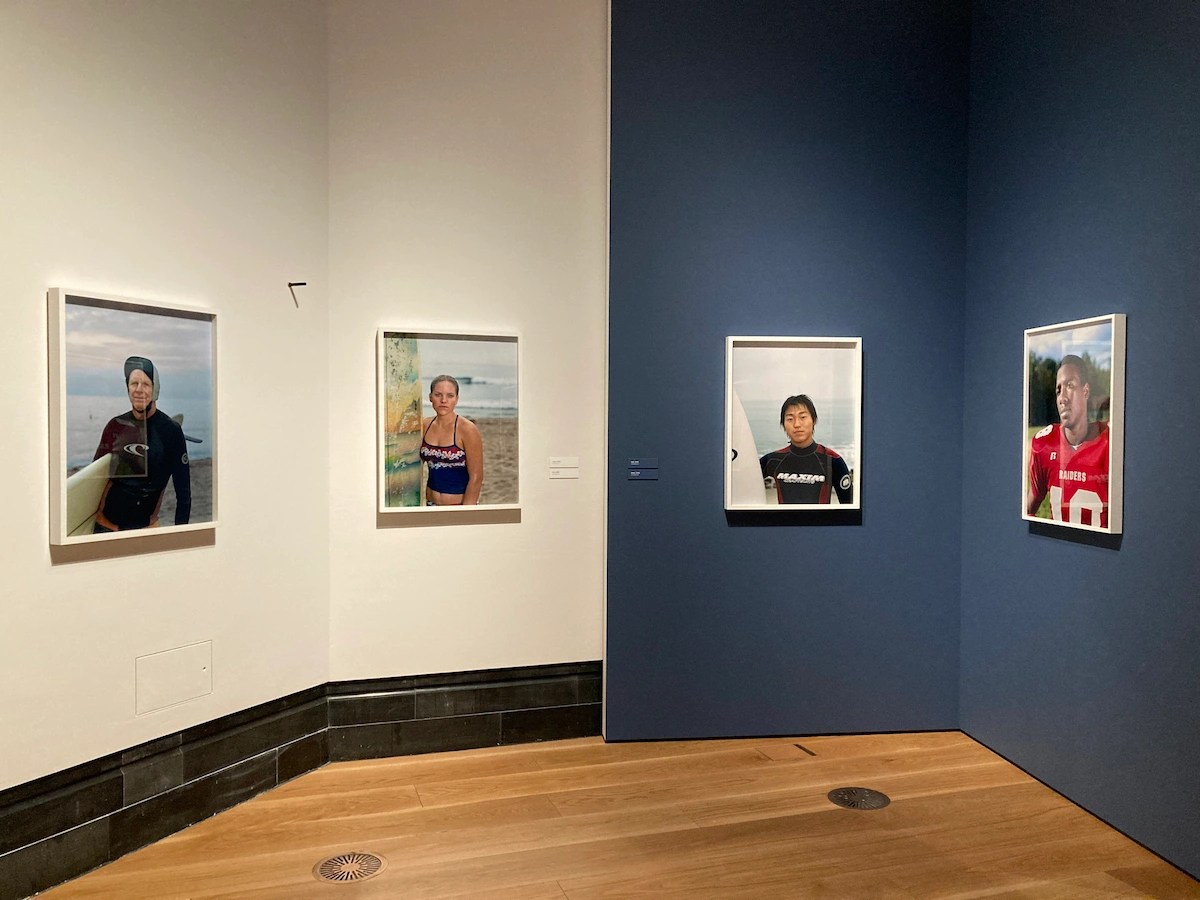
‘Surfers’ depicts the California surfing subculture. Rather than showing them riding waves, Opie portrays her surfers emerging from the sea looking unglamorously wet and cold and dazed – surprisingly British, in fact.

Installation view of Catherine Opie: To Be Seen @ the National Portrait Gallery, showing some of the ‘Surfing’ portraits’ (photo by the author)

In and Around home (2004)

In the early 2000s, Opie explored her Los Angeles neighbourhood and the domestic setting of her home. ‘Oliver in a Tutu’ from the series ‘In and Around Home’ depicts her son in a pink tutu in the kitchen doing laundry. This domestic scene is aligned with Opie’s politics of visibility against the backdrop of the continued homophobia within American culture at the time during the Bush era.

Oliver in a Tutu, 2004 © Catherine Opie, courtesy Regen Projects, Los Angeles; Lehmann Maupin, New York, Hong Kong, London, and Seoul; Thomas Dane Gallery

Doesn’t he look like a sweetheart! What a lovely image of everyday domestic happiness.

Children (2004)

For ‘Children’ Opie returned to the studio and to her signature highly focused portraits, this time of children set against bright solid colour backdrops.

Installation view of Catherine Opie: To Be Seen @ the National Portrait Gallery, showing some of the ‘Children portraits’ (photo by the author)

High School Football (2007-09)

From 2007 to 2009 Opie’s continued her exploration of the American landscape through the specificity of identity as it is played out on high school football fields. Opie made portraits of high school football players across several US states, vulnerable portraits of the young men counter stereotypes of athletic masculinity at a time when the US was engaged in a war with Iraq and Afghanistan.

Installation view of Catherine Opie: To Be Seen @ the National Portrait Gallery, showing some of the ‘American football’ portraits (photo by the author)

Do these images subvert, interrogate or deconstruct masculinity? Ask the marines steaming towards the Gulf of Hormuz.

Girlfriends (2010)

A series of black-and-white portraits (1989-1999) which were first exhibited in 2010), the series continues Opie’s longstanding examination of the history of photography and her community in a different format.

Studio Portraits (2012–2018)

In the 2010s Opie used theatrical lighting against a black velvet backdrop to illuminate masterly and striking portraits. Allegorical elements allude to the political and spiritual concerns of art. They evoke Renaissance and Baroque painting, presenting her subjects in allegorical poses in front of black backgrounds, which remove the individuals from any sense of time or place.

Installation view of Catherine Opie: To Be Seen @ the National Portrait Gallery, showing some of the Baroque Studio Portraits (2012–2018) (photo by the author)

These portraits are characterized by highly staged, theatrical lighting against a black background, intended to create a painterly, intimate, and often allegorical quality. I haven’t mentioned that the exhibition space has been unusually designed into box-shaped rooms and corridors with, as here, the wall colour chosen to offset the images.

Walls, Windows and Blood (2023)

Opie’s photograph of Pope Francis, diminutive at his Vatican window amid the ‘constructed architecture of power’, is drawn from a body of work entitled ‘Walls, Windows and Blood’ (2023), made during a pandemic-era residency at the American Academy in Rome. The title of this portrait of the former head of the Catholic Church is a reference to the delayed papal acknowledgement of the deaths of Canada’s First Nation’s children under the church’s administration. It’s part of a small selection of images from larger locations which includes shots from President Obama’s inauguration, a Boy Scout Jubilee, and others.

Installation view of Catherine Opie: To Be Seen @ the National Portrait Gallery, showing some of the photos she took at the inauguration of President Obama on 20 January 2009 (photo by the author)

Comments

When you read the press material, the online promotion and the wall labels, you are given the impression that Opie is a radical political figure. But when you stroll from photo to photo you come to realise nothing could be further from the truth. Everything is very quiet and homely. Photos of friends, of her house and child, of other children, images of young surfers and football players, documentary images of the Obama inauguration or a handful of other mass events (a Boy Scouts Jubilee, some festival).

The more it went on, the blander it felt. The set of lesbians with moustaches is funny in a 1990s kind of way. The half dozen local children are sweet. The surfers look very wet. The footballers look fit. The friends posing against black backgrounds look very stagey.

But few if any of the images really stood out for me. Compare and contrast the vividly seedy colour photographs of the recently deceased Martin Parr to see what unnerving commentary colour photography is capable of. If you strip away the excited queer rhetoric, most of the Opie images seemed to me, well, OK, proficient enough, quite nice, meh.

In the end I thought the opening image of her breastfeeding her son was the one really standout image, and the one which had the most ‘political’, emotional and visual impact.


Related links

Related reviews

Michael Kenna: Shin Shin @ the Photographers’ Gallery

The Photographers’ Gallery Print Room

The Print Room is downstairs at the Photographers’ Gallery, next to the shop. Admission is FREE and if you’re visiting one of the paid exhibitions upstairs, you should always pop down to the basement for her they have rotating displays by one or other of the 50 or so noted photographers which the gallery represents.

It’s a commercial operation and so the large and beautifully made prints are for sale, generally for a hefty price. Currently they’re showing a dozen or so lovely black and white photos by English-born photographer Michael Kenna which start at £1,975 + VAT (£2,370).

Flock of Red Crown Cranes, Tsurui, Hokkaido, Japan by Michael Kenna (2005) Courtesy of the artist and The Photographers’ Gallery

Michael Kenna

Michael Kenna was born in England in 1953. He studied at a seminary school as a boy, intending to become a priest, and his early encounters with ritual and faith left a lasting appreciation for mystery, doubt and the unseen. In his mid-twenties he moved to the United States.

Over five decades, Kenna has developed a distinctive visual language – a dialogue between dramatic chiaroscuro and the quiet minimalism of Japan, where he has regularly photographed since 1987.

Alley of Trees, Damyang, Jeollanamdo, South Korea by Michael Kenna (2012) Courtesy of the artist and The Photographers’ Gallery

Shin Shin

The show is titled Shin Shin which is a Japanese onomatopoeia that describes the quietness or silence of falling snow. This sensory phrase captures the meditative stillness that runs through Michael Kenna’s work, and his reverence for the natural world.

Many of Kenna’s images are made at dawn or at night, often using long exposures, some lasting up to ten hours. Primarily working with a 120 mm analogue camera and printing each image by hand in the darkroom, he creates luminous silver gelatin prints that he describes as, ‘an oasis, a calm place of rest, a catalyst for imagination’.

In his black and white landscapes, snow becomes a veil that softens the world. Through nature’s quiet transformation and the precision of his practice, Kenna invites reflection on what lies beyond what we can see, know, or touch.

An opinion

Obviously they’re all very beautiful but personally, I liked the ones where the subject was placed symmetrically in the middle of the frame. Very calm and pleasing.

Royal Balcony, Peterhof, Russia by Michael Kenna (1999) Courtesy of the artist and The Photographers’ Gallery

But I noticed that having soaked up one of the nicely centred compositions added piquancy and edge when you turned to look at one of the deliberately non-symmetrical images. Having settled into a calm Zen state based on symmetry, my mind was then slightly knocked askew by the off-centre images. That they played off each other. That, in this quiet, calm, subterranean space, they set up a kind of resonance between the two types of picture, like the very faint, distant ringing of bells…

Wanaka Lake Tree, Study 2, Otago, New Zealand by Michael Kenna (2013) Courtesy of the artist and The Photographers’ Gallery


Related links

Related reviews

Strike a Pose! 100 Years of the Photobooth @ the Photographers’ Gallery

This is a fun little exhibition. One room at the Photographers’ Gallery is hosting a small display celebrating 100 years of the automatic photobooth. It turns out that 2025 marked the 100th anniversary of the invention of the analogue photobooth by American Anatol Josepho. His first Photomaton appeared on Broadway in New York in 1925. The photobooth was a game-changer for the world of photography and quickly became an everyday sight in cities around the world.

This little exhibition features a range of resources from the collection of photobooth enthusiast Raynal Pellicer. It includes a variety of classic photo strips, montages of historic snaps, display cases showing the different uses these handy little photos have been put to (for passports, identity cards, ration cards and much more). It’s part of a year-long programme of centenary celebrations, in partnership with AUTOFOTO. The gallery has even installed a photobooth for visitors to the Photographers’ Gallery to use (it accepts card payment).

A Photobooth timeline

1852-1915 – Inventors across Europe and the United States of America striving for full automation and experimented with the concept from ferrotypes and ‘Sticky Backs’ to early machines like the Bosco Automat and penny photo devices.

1925 – Anatol Josepho opened the first Photomaton studio in New York. For 25 cents, customers got eight portraits in eight minutes, drawing huge crowds.

1927 – Josepho sold U.S. rights for $1 million. Engineer John Slack improved the booth, cutting photo session time, reducing mechanical jams, and adding mirrors for sitters.

1925-1929 – Photomatons spread rapidly across the U.S., Canada, and Europe, with competitors quickly entering the market.

1928 – The first British Photomaton machines debuted at Selfridge’s in London, becoming an instant sensation.

1929 – The fraud scandal involving Photomaton Parent Corporation’s director, Clarence Hatry, led to the collapse of the British Photomaton company. It became a symbol of overvalued speculation, while photographers’ unions accused the booths of being unfair competition.

1933 – Brighton’s Palace Pier hosted a ‘Photoweigh’ booth, which gave sitters both a miniature portrait and their weight.

1940s to ’50s – Photobooths became fixtures in public spaces, serving as a means for IDs, keepsakes, and casual portraits.

1950s-60s – With the rise of colour, booths evolved into cultural icons found across cities worldwide.

1954 – The first Photo-MeR photobooth appeared in the UK.

1970s-80s – Technological advances improved speed, colour, and durability, boosting the popularity of photobooths.

1989 – Photo-Me® International operated over 15,000 booth in 100 countries.

1994 – The first digital photobooths marked the decline of traditional analogue machines.

1995 – Japan launched purikura sticker booths, turning photography into a playful, customisable social activity.

1999 – The first International Photobooth Convention was hosted in Nottingham by Steve ‘Mixup’ Howard.

2000s – Analogue photobooths resurfaced as artistic and nostalgic mediums, while digital props and features became prevalent Photobooth.net is created by Brian Meacham and Tim Garrett.

2008 – Nakki Goranin published American Photobooth.

2011 – Raynal Pellicer published ‘Photobooth: The Art of the Automatic Portrait’, documenting the medium’s history through his own collection.

2025 – Marks 100 years of Josepho’s Photomaton studio and analogue photobooth.

Installation view of ‘Strike a Pose! 100 Years of the Photobooth’ at the Photographers’ Gallery – the frame in the middle and the display case show how these handy little photos came to be used for passports, identity cards and others forms of identification (photo by the author)

Brief history (the curators’ text)

A combined studio and photography lab in one place, photobooths offered the first affordable access to photography for the general public. With no technical knowledge needed and no operator, anyone could step behind the curtain, put their money in the slot and strike a pose.

After the success of the first booth, when over 7,500 New Yorkers used the booth in its first 5 days, global success quickly followed. The first photobooth launched in the UK in Selfridges, London, in 1928 and was an immediate hit.

In the 1950s and 1960s, photobooths were a common feature at fairs, shopping centres and train stations. These intimate inexpensive spaces gave everyone the freedom to control their own images. Behind the curtain, whether alone or crammed in with friends, the photobooth was a playground, beyond the gaze of a photographer.

The booths were loved by everyone, from John Lennon and Yoko Ono, to John and Jacqueline Kennedy, and used by artist Andy Warhol for his famous series of self-portraits. The coin-operated booths, once ever-present on high streets and stations, disappeared with the rise of digital photography in the 1990s.

However, restored by dedicated experts, analogue booths are nowadays enjoying a resurgence of interest with modern-day fans. As I mentioned, alongside the display of archive prints, vintage strips and materials, there’s also be a booth at the Gallery for visitors to create their own selfie souvenir.

What makes this doubly interesting is that upstairs, in the exhibition itself, there’s a live video feed to a mini camera installed inside the photobooth’s development machinery so you can watch photos visitors are taking of themselves being developed live. Alongside the monitor, is a technical explanation of how the booths are able to process and develop your snaps so quickly.

Installation view of ‘Strike a Pose! 100 Years of the Photobooth’ at the Photographers’ Gallery showing the live feed to inside the photobooth and accompanying technical explanation of how it works (photo by the author)

Critical reflection

The obvious thing about the booths is they give the user agency. Up to this point if you wanted a photo of yourself you had to get a photographer to take it or be lucky enough to be one of the few people who had some kind of timing device which allowed you to take a selfie with a traditional camera. Photobooths set people free to express themselves, and this was encouraged by their cheapness. For a few pennies you could have photos of you, or as many other people as you could cram into the little booth, performing and posing and larking about to your heart’s content. They became a sort of playground, up to a point…

Because the downside of these booths is that they were (and are) always installed in public places, generally very public places like train stations or (like my nearest one) in a supermarket. Not too much scope for larking about then, certainly no nudity or naughtiness. Publicly acceptable larks only – like making faces, wearing clothes you might not usually do i.e. dressing up, messing about with your hair and so on – or, as here, the large number of couples packing themselves into a booth in order to pout, kiss, and strike mutual poses, riffing off each other. Or, as most people probably used them, to take deadly dull and solemn passport photos.

Installation view of ‘Strike a Pose! 100 Years of the Photobooth’ at the Photographers’ Gallery showing the bureaucratic application of photobooth pics used in (French) identity cards (photo by the author)

Now of course, everyone in the world can take high quality selfies with their smartphones and it is estimated that over 90 million selfies are taken every day! And since these can be taken everywhere, they are and the scope of the self-portrait has exploded to cover every conceivable location and activity. If photobooths are making a modest return, as the curators suggest, maybe it’s for several reasons. One is that it represents a particular genre, like the miniatures created by Elizabethan artists, so cramped and restricted that from its limitations it evolved its own conventions.

Another more obvious reason is the ongoing fashion for retro tech, a retreat (by some people) from the glut of digital wonders now available to us, to older formats which are perceived as somehow more authentic. I’m thinking in particular of the revival of vinyl LP records and even, so I’ve read, of tape cassettes.

So there are motives of retro fashion, nostalgia, and fun involved in the revival of photobooths if, in fact, they are undergoing a revival. Although this was a little called into question by the way that, during the half hour I spent in this one-room little display, not a single person used the actual photobooth downstairs, so I never got to see the developing mechanism on the live feed in action. Sad face.

Summary

A small but fascinating slice of social history, included in admission to the larger, more significant Boris Mikhailov and Zofia Rydet exhibitions.


Related links

Related reviews

Zofia Rydet: Sociological Record @ the Photographers’ Gallery

In 1978, when she was 67, Polish artist and photographer Zofia Rydet (1911 to 1997) set out to photograph the inside of every Polish household. She would approach a home unannounced, knock and introduce herself, and ask the people living there if they would like to take part in her project. The result was her ‘Sociological Record’ (Zapis socjologiczny), a monumental project and one of the most important achievements in 20th century Polish photography – and this is a big exhibition devoted to the best and most representative images taken from this treasury.

Installation view of ‘Zofia Rydet: Sociological Record’ @ the Photographers’ Gallery showing a wall-sized blow-up of one of her thousands of interior photos (photo by the author)

Aim and timeframe

When she started the project, Rydet was already an artist with a well-established reputation. The Record aimed to satisfy her interest in The Home as a metaphor for human life, in the ways domestic interiors reflect personal people’s aesthetic, religious or political views, but are also repositories of histories and values which were fast disappearing.

Work on the ‘Sociological Record’ would eventually span over 12 years from 1978 to 1990, becoming an increasing obsession for Rydet as she approached the end of her life. During these years she photographed people in their homes, at their doorsteps, building exteriors and landscapes. She also returned to the same houses several years after she first visited to document the transformation of rural Poland.

Zofia Rydet at work in ‘Zofia Rydet: Sociological Record’ @ the Photographers’ Gallery

Historical background

The creation of Zofia Rydet’s ‘Sociological Record’ coincided with a turbulent period in Poland. In 1978 the country was under communist rule and sinking into a deepening economic crisis. This was the backdrop to the rise of the independent trade union Solidarity (Solidarność), a wave of strikes, and the imposition of martial law in December 1981. A long decade of repression ensued, ended only as the Soviet Union began to collapse, triggering the fall of communist regimes across the bloc, and the first free Polish elections in 1989.

Plentiful negatives and rare prints

The Record includes over 20,000 negatives taken in more than 200 provinces of Poland and abroad. By the mid-1980s, Rydet’s drive to document her subjects left no time to spend in the darkroom so she left numerous boxes of negatives. This exhibition focuses on the relatively rare number of prints the artist made in her lifetime alongside books and personal letters.

Installation view of ‘Zofia Rydet: Sociological Record’ @ the Photographers’ Gallery showing one wall covered with 63 examples of Rydet’s thousands of interior photos (photo by the author)

Over time the Record grew into a multifaceted work and developed into a number of subcategories and independent series. These include: Women on Doorsteps; the Myth of Photography; Windows; Professions; Presence; The Infinity of Distant Roads and more.

Although the work does include residents in towns and cities, most of the photographs focused on rural areas where she witnessed traditional ways of life and folk culture fast disappearing, and it’s these simple, rural dwellings and people who look like peasants, living in grim conditions, who the Record records.

A typical interior from ‘Sociological Record’ © Zofia Rydet, courtesy of the Zofia Rydet Foundation

On the Road

Many of Rydet’s journeys were undertaken by bus and this location or situation, too, evolved into an independent series. She always photographed from the front seat, behind the driver, making sure to capture the reflection in the mirror. A couple of examples are on show.

She also developed a series of photographs of roads and road signs, some of which would be incorporated into a subcategory titled ‘The Infinity of Distant Roads’ (Nieskończoność dalekich dróg).

Installation view of ‘Zofia Rydet: Sociological Record’ @ the Photographers’ Gallery showing part of a video about Rydet on the right, and on the left, one of her haunting shots of an empty road sweeping across a wet and windy landscape (photo by the author)

Categories and themes

Women on Doorsteps

Women on Doorsteps, or Standing Women, is the most consistently visualised sub-series within the ‘Sociological Record’. The women of the household would often be the first to greet Rydet on her field trips and, as such, they made a great impression on her.

Installation view of ‘Zofia Rydet: Sociological Record’ @ the Photographers’ Gallery showing examples from the ‘Women in Doorways’ series (photo by the author)

Like the work of Boris Mikhailov in the gallery above, Rydet’s work gains immeasurably from being organised into sets. The consistent composition and framing of the ‘Women in Doorways’ series allows you to dwell on the individuality – the great variety in shapes and sizes – not only of the women but of the doorways. After a while I found the design and construction of the walls and doorways as, if not more, fascinating than the people.

Houses

From shooting a doorway it’s only a few steps backwards (literally), to taking photos of the whole house and so a new category was born. The majority are rural homes and outbuildings which have been, as you can see, beautifully staged against a vast wall-sized blow-up of a particularly striking example.

Installation view of ‘Zofia Rydet: Sociological Record’ @ the Photographers’ Gallery showing examples from the series ‘Houses’ (photo by the author)

She chose distinctive structures, often with traditional designs, recognising the limited time many of them had remaining, as many were being cleared and rebuilt following the death or departure of their owners.

People in interiors

The idea of documenting the interiors of homes came to Rydet from a visit to a Polish car factory in Jelcz. Speaking to journalist and photographer Krystyna Łyczywek, she said:

‘There one of the factory halls had been turned into cubicles, office rooms. And although they were identical, they differed greatly from one another, because the people working there decorated them with whatever they liked to look at. You name it, it was there!… Beautiful girls and holy pictures, jazz idols and photos of children, hunters’ trophies and rosaries… Each of these individuals left the mark of their personality. And that’s how it all began…’

When Rydet started the project in 1978, her working method became quickly established. She would walk around a local area, knock on strangers’ doors, and ask to come in and take pictures. Rarely refused, she would then pose people against a wall, using a wide-angle lens and a strong flash to capture details in the often poorly lit interiors. The sitters were asked not to smile, in part a reflection of the importance she attached to the work but presumably also to ensure a consistency of approach.

Installation view of ‘Zofia Rydet: Sociological Record’ @ the Photographers’ Gallery showing 6 of the 70 or so interior shots (photo by the author)

Rydet wrote of the Record:

‘It is meant to faithfully show a person in their everyday environment, among that sort of shell they create for themselves, which on one hand becomes more of their intimate and private surroundings – the interior – but which also reveals their psyche, sometimes saying more about them than they themselves could.’

The title ‘Sociological Record’ was coined by Rydet’s friend, art historian and critic Urszula Czartoryska. Although Rydet adopted it, she had some reservations about its abstract and ‘scientific’ character.

Windows

Obviously, as well as specific rooms (bedroom, living room), houses have a number of distinct elements such as doors and windows. Alongside other aspects, Rydet came to realise that windows perform an important function, in fact a host of functions:

– In the low light of rural cottage interiors, the kitchen table is often placed by the window, a central focus of family life, revolving around shared meals and food preparation, repairing household items, conversations, and more.

– The window is also an opening onto the neighbourhood, a vantage point where private space turned outward, towards what was communal and external.

– Windows and window sills can also serve a decorative function, displaying plants, religious icons, and family photographs. They offer a kind of intensification of the personality or character of the owners.

Installation view of ‘Zofia Rydet: Sociological Record’ @ the Photographers’ Gallery showing some of the Window shots (photo by the author)

The Myth of Photography

This is a meta move. After photographing a certain number of domestic interiors, Rydet realised that an important part of many people’s interiors is other photographs. Often these are rare and precious objects portraying family members, or the now-ancient occupants of the houses as beautiful young couples.

These were often a specifically Polish artefact, the traditional hand-painted wedding photographs known as monidła. In these cases, she would sometimes pose her sitters holding their own photographs or would prop the images up to enhance the composition.

An old couple with a ‘monidło’ of themselves on their wedding day, from ‘Sociological Record’ © Zofia Rydet, courtesy of the Zofia Rydet Foundation

As soon as you think about it, you realise that photographic images have been freely available, even to the poorest households, and people can choose any images to ornament their lives or express their personalities. Older people have images of Polish politicians or historical figures or writers…

An impressive array of portraits of Polish patriotic figures hanging from someone’s ceiling, from ‘Sociological Record’ © Zofia Rydet, courtesy of the Zofia Rydet Foundation

Whereas it’s very noticeable that younger people decorated their rooms with image of western pop and lifestyle images.

A young Police fan surrounded by posters of her idols, from ‘Sociological Record’ © Zofia Rydet, courtesy of the Zofia Rydet Foundation

Presence

Of course the images most prevalent in older people’s homes were religious, Christian, images of Christ, the Virgin Mary and, of course, the famous Polish Pope, Pope John Paul II, head of the Catholic church from October 1978 until his death in 2005. The Pope was not only an immensely important spiritual figure through the 1970s and 80s but also supported the country’s political aspirations for system change and liberation from Soviet influence.

So it was inevitable that images of the Pope appear in so many of the interiors that Rydent decided to create another sub-genre of them, titled ‘Presence’. There’s no mention anywhere of whether Rydet herself was a person of faith. Here, as in so many of the photos and categories, it feels like she is recording and taxonomising, with no value judgements, precisely with the detachment of a sociologist recording what they see.

Installation view of ‘Zofia Rydet: Sociological Record’ @ the Photographers’ Gallery showing photos of Pope John Paul II in people’s homes (photo by the author)

Professions

Rydet was fascinated by folk culture and disappearing ways of life. This series of people at work particularly focuses on small workshops, local crafts and services, village shops and so on, places which, like the rural houses she photographed, were undergoing rapid modernisation or being abandoned by farmers migrating to cities.

Professions shown here include a postman, an artist, a sign maker, a tailor and teacher. The curators compare them to the German photographer August Sander’s epic project to document the people of his nation between the wars, or the famous Photography Unit of the Farm Security Administration program during the Great Depression in the United States. Which begs the question, why was this type of encyclopedic sociological project undertaken in Germany and the States in the 1930s, but not until half a century later in Poland?

Installation view of ‘Zofia Rydet: Sociological Record’ @ the Photographers’ Gallery showing small traders in their places of work (photo by the author)

Epitaph

The ‘Epitaph’ series was created in 1980 during a return visit to the Biadacz family in Upper Silesia. Following her first visit, Rydet returned to discover the elderly couple she had photographed had recently died. And so she photographed their wedding portrait, found in the empty house, against various backdrops – domestic objects, the yard, the field, the graveyard.

Installation view of ‘Zofia Rydet: Sociological Record’ @ the Photographers’ Gallery showing 9 shots from the ‘Epitaph’ series

Rydet wrote:

‘Not only people vanish, but also everything that surrounded them. Only photography can stop time. Only photography has the power to overcome the spectre of death, and that is my unending struggle with death and transience.’

Is that true? Can only photography stop time? I doubt it. It’s more that photography gives us a heightened sense of time passed, of the passage of time. Also, I know this was done out of kindness but it’s hard for the jaded Londoner not to detect a surreal aspect to this idealised double portrait popping up in a variety of locations.

Video


Related links

Related reviews

Boris Mikhailov: Ukrainian Diary @ the Photographers’ Gallery

From the press photos I wasn’t anticipating too much but ‘Boris Mikhailov: Ukrainian Diary’ turns out to be a really interesting and rewarding exhibition, fully deserving the two floors of gallery space given over to it.

First room of Boris Mikhailov: Ukrainian Diary @ the Photographers’ Gallery

One of the problems is the promotion web pages and images just show one photo at a time and some of them look a bit meh, don’t feel that good, as a group they don’t add up to a unified look’ etc. It’s only when you get to the exhibition that you realise a number of key facts which transform your understanding.

1. Amateur Boris Mikhailov got into photography by accident, had no formal training, and so was free to invent and make things up. A lot of these innovations are really interesting.

2. Articulate Mikhailov is a very good explainer of his own work, so the wall labels which explain it are not only informative but his explanations of his innovations are unusually inspiring and interesting.

3. Bad photography One of these was the simple idea of bad photography. In the Soviet Union photography was a profession like any other, heavily controlled by the state with approved styles and qualities to promote uplifting images of perfect life in the workers’ state.

Mikhailov opened up a whole new world when he realised that bad, out of focus, poorly framed, damaged images were themselves a valid aesthetic, and a political statement. Badly printed, damaged or poor-quality productions were, he realised, the appropriate response to the shabby reality of Soviet life: ‘lousy photography for a lousy reality’. This explains why some of the images, when seen in isolation on a web page are only meh, whereas seen en masse, and accompanied by an eloquent explanation, they gain so much more power.

4. Sets It also explains why Mikhailov’s images are conceived and designed to be seen in sets and the sets don’t just represent a new subject, but the best of them embody an entirely new technique and way of thinking about photography. As he explains:

‘The idea that a single picture contains maximum information is a lie; I don’t believe in absolute truth. Exploring something from many different angles gives you a heightened sense of the truth. I need the sum of the images, the sum of the sequences in order to cast doubt on the correctness of one single, possible perception. The vibration between the images expands their possibilities.’

Biography

Born in Kharkiv, Ukraine in 1938, Boris Mikhailov is a self-taught photographer. Having trained as an engineer, he was first introduced to photography when he was given a camera to document the state-owned factory where he worked. He took advantage of this opportunity to take nude photographs of his first wife – an act forbidden under Soviet norms – which he developed and printed in the factory’s laboratory. He was fired when the photographs were found by KGB agents. From then he pursued photography full time, using it as a subversive tool and operating as part of the underground art scene.

His work first gained international exposure in the 1990s with the series ‘Case History’, a shockingly direct portrayal of the realities of post-Soviet life in the Ukraine. Having learned of him via his post-USSR collapse photos, Western fans were then able to go back and review his subversive works from the 1970s and ’80s. This exhibition presents the complete body of his work in chronological order.

‘Ukrainian Diary’ brings together work from over twenty of Mikhailov’s most important series, including:

Slideshow: Yesterday’s Sandwich (mid-’60s to 1970s)

One day he threw a couple of slides onto his bed and they stuck together. When he held the stuck slides up to the light he realised they made a dramatically surreal image and hence was born the series ‘Yesterday’s Sandwich’. As he experimented with the technique he realised the juxtaposition of random images could be thought of as reflecting the dualism and contradictions of Soviet society.

His commentary is fascinating. He explains that the 60s and 70s were a time, in all the countries of the Soviet bloc, of hidden messages and secret codes. No-one took official propaganda seriously but all organs of free expression were ruthlessly suppressed. Hence codes and secret signs and hidden allusions. In actual fact no particular ‘message’ emerges from these images except a surreal subversion of the normal, logical, sensible everyday world.

Nearly 100 of these wonderfully funny, crazy, surreal images are here displayed as a slideshow projected onto the wall of a darkened space in the gallery. For some reason they are displayed to a severely edited version of the classic Pink Floyd album, Dark Side of the Moon’ which Mikhailov considers an ‘exaggeration of beauty’ conveying a kind of ‘paradise lost’. It makes it an even more surreal experience, watching images from a distant and vanished society accompanied by such a familiar homely soundtrack.

Installation view of Boris Mikhailov: Ukrainian Diary @ the Photographers’ Gallery showing one of the composite images in the Yesterday’s Sandwich slideshow (photo by the author)

Black Archive (1968 to 1979)

‘Black Archive’ documents everyday life in Kharkiv, often revealing the disparity between public life and private life in domestic spaces. Under Soviet rule it was forbidden to photograph everyday life and so Mikhailov was forced to hide his camera in order to take furtive snapshots, often taken from behind and at odd angles. By contrast, the private sphere of people’s apartments was a space of freedom, most vividly expressed in the carefree nudity of many of his subjects.

But in the series Mikhailov also deploys his concept of ‘bad photography’— the deliberate production of sloppily printed, blurred, and low-contrast images full of visible flaws — as a metaphor and a tool for social critique.

Red (1968 to 1978)

The set ‘Red’ brings together more than 70 images taken in Kharkiv in the late 1960s and 1970s, all of which contain the colour red. From the wall labels we learn that red was a powerful symbol of the Russian Revolution (1917) and of the Soviet Union (1922 to 1991). Its presence in these varied photos indicates the extent to which communist ideology saturated everyday life. As usual Mikhailov explains all this in his vivid and fascinating way:

‘The word “red” in Russian has the same root as the word for beauty, it also means revolution and evokes blood and the red flag. Everyone associated red with communism. But few people realised that red had permeated all our lives. Demonstrations and parades are an important part of this series. It’s a place where one of the main images of Soviet propaganda—the face of happy Soviet life, secure in its future—was created. They became absolutely kitschy and vulgar… I sometimes felt that I was surrounded by a herd of cynics, victims, and fools, followed by people wearing red ribbons as if they were policemen. As if the regime was using the people’s desire to celebrate for its own ends. And it was important to me to photograph them in such a way that you could tell the “Soviet” from the “human”.’

From the series ‘Red’ by Boris Mikhailov (1968-75) © Boris Mikhailov, VG Bild-Kunst, Bonn, Courtesy Boris and Vita Mikhailov

Luriki (Coloured Soviet Portraits) (1971 to 1985)

After losing his job as an engineer, Mikhailov managed to make a living as a commercial photographer, sometimes working on the black market, enlarging, retouching, and hand-colouring snapshots of weddings, newborns or family members lost in the war.

In what is considered the first use of found material in contemporary Soviet photography, Mikhailov then appropriated and reworked these manipulated photographs for his own practice. Often using vibrant or exaggerated colours, he made them more ‘beautiful’, staying within the law while simultaneously mocking the way Soviet propaganda glorified mundane events.

By means of these simple techniques, Luriki comically undermined the absurdity of the iconography of Soviet life. Grouped together, the pictures are like a Soviet family album, a collection of surreal, ridiculous situations.

Installation view of Boris Mikhailov: Ukrainian Diary @ the Photographers’ Gallery showing one of the Luriki images (photo by the author)

Dance (1978)

Apparently open-air dancing was a popular activity in Soviet Kharkiv. Mikhailov has a lovely set depicting people of all ages, sizes and shape, in 1970s Soviet clothes, sedately dancing, quite often women dancing with other women.

Installation view of Boris Mikhailov: Ukrainian Diary @ the Photographers’ Gallery showing some of the Dance photos (photo by the author)

Series of Four (early 1980s)

One wall is covered with these images grouped into sets of four. This came about by accident. Mikhailov set out to wander the streets of Kharkiv and take photos of nothing, of non-events, designed to capture the boredom and emptiness of Soviet life. But when he came to make contact prints he realised he didn’t have small-format paper so he put four images together on one sheet. At a stroke he realised he’d created something: the multiple points of view of the same scene creates complex effects. Suddenly a boring scene becomes part of a fragmented, multi-angled world. Presented in this way, they can also have a cinematic effect, telling a story in snapshots. And another effect is to create out of a mundane non-space a kind of cocoon, creating a compression of space, imbuing an anonymous nowhere with strange fugitive meanings.

Installation view of Boris Mikhailov: Ukrainian Diary @ the Photographers’ Gallery showing some of the Series of Four photos (photo by the author)

Crimean Snobbism (1982)

Mikhailov went to Gursuf, a seaside resort on the Crimean Peninsula and took portraits of himself, wife and friends frolicking by the seaside, adopting holiday poses etc. As with many of his sets, Mikhailov gave them a sepia tone, making them feel historic and detached from the present, and also suggesting their subversive intent. Because the entire set is intended as a parody of the kind of carefree, bourgeois lifestyle then associated with ‘the West’ and far beyond the reach of your average Ukrainian citizen, and which he satirises in phrases: ‘We’re so happy. We’re so beautiful. We’re so in love etc’.

Viscidity (1982)

In another interesting experiment, in the early 1980s Mikhailov started combining text and image together in a conceptual way: he glued his photographs carelessly onto sheets of paper, then scribbled thoughts—banal, poetic, or philosophical—in the margins. His fragmentary thoughts were not intended as captions, nor to illustrate or elucidate the photographs; they were often utterly unrelated to them and intended to be equally important, a composite reflection on the social stagnation of the Soviet Union.

‘Viscidity’ is the word he used to describe the period the country was living through at the time — ‘a peaceful, quiet, featureless, dull life, a time of deep political stagnation, a frozen day-to-dayness. There was no catharsis, no nostalgia, just grey, everyday life. Nothing was happening, nothing was at all interesting.’ Hence ‘lousy photographs with these lousy texts’, ‘unchanging ordinariness and timelessness.’

Unfinished dissertation (1984-5)

On the back of the tattered pages of a stranger’s university dissertation found in a rubbish bin, Mikhailov pasted poorly printed black-and-white photos of inconsequential moments and then jotted down his thoughts about art and life in the margins. The photos don’t synch with the text, neither shedding light on each other, except obliquely.

Salt Lake (1986)

Mikhailov’s father used to tell him about a salt lake in southern Ukraine where people went to bathe in the 1920s and ’30s, believing that the warm, salty water had healing properties. When Mikhailov went to visit himself he found the crowds of people on the beach near to a disused old factory, washing themselves in the factory pipes and smearing themselves with mud.

He found it ‘the quintessence of an average person’s life in the Soviet context. Despite the horrible, polluted, inhuman environment, the people were relaxed, calm, and happy.’ To the modern Western ye, this looks like a gallery of grotesques in a grim, squalid environment.

Later Mikhailov toned his images sepia, like photographs from another era and explains: ‘There was a kind of an interplay there, a fusion between the old and the new. Old, because it was something my father had seen, and at the same time a reality that still existed… An elaboration of an idea I’d explored before: we’re both there and not there, it’s both today and a long time ago.’

Installation view of Boris Mikhailov: Ukrainian Diary @ the Photographers’ Gallery showing some of the Salt Lake photos (photo by the author)

By The Ground (1991)

When the Soviet Union collapsed in 1991, Mikhailov took to the streets with his panoramic camera slung low around his waist. While the panoramic format is conventionally used for sweeping vistas and beautiful landscapes Mikhailov captured bleak street scenes which captured the shabby poverty of the streets.

Mikhailov also devised a protocol for installing the series: the prints are hung low on the wall, forcing the viewer to stoop down to see the images, as if to bring us closer to his subjects. As with previous sets, he also treated the images, toning the silver prints brown, imbuing them images with a sense of nostalgia. As always his own comments on his process are fascinating:

‘I “aged” the images by toning them in sepia… embedding the photos in layers of time to trigger parallel, photo-historical associations, to show that photography has become as elusive as existence itself.’

Installation view of Boris Mikhailov: Ukrainian Diary @ the Photographers’ Gallery showing some of the By The Ground wide-angle photos (photo by the author)

I am not I (1992)

A series of nude self portraits in which Mikhailov parodies traditional masculine stereotypes. The stereotypes he mocks are those promoted by the recently collapsed USSR but they are also recognisable as American stereotypes too. Thus he photographs himself in a range of comic or demeaning poses, wearing an absurd curly wig, holding a toy sword or, most strikingly, an artificial phallus. Like all the sets, these gain in meaning and humour when you see 20 variations next to each other.

From the series ‘I am not I’ by Boris Mikhailov (1992) © Boris Mikhailov, VG Bild-Kunst, Bonn. Courtesy Boris and Vita Mikhailov

Green (1991 to 1993)

In the early 1990s Mikhailov produced a series of hand-coloured photographs known as the ‘Green’ series. The images are suffused with a lingering, toxic green tint to reflect the environmental decay and societal collapse following the fall of the Soviet Union. The series is represented here by a monumental triptych showing a decaying junkyard in an overgrown landscape. The colour green has a particular resonance for Mikhailov who says it is the colour of a swamp and indicates the moss which had grown on Soviet life, a metaphor for Soviet decay.

In earlier sets he had had photographed people living in poverty, drug addiction and social degradation using a disposable camera and cheap gelatin silver paper to evoke awkwardness and fragility. Here, he takes the concept further, using stains and drips of paint on the thin, crumpled paper as if to embody the worn, impoverished landscape and lives he saw around him.

Installation view of Boris Mikhailov: Ukrainian Diary @ the Photographers’ Gallery showing ‘Green’ (photo by the author)

At Dusk (1993)

Shortly after the collapse of the Soviet Union Mikhailov wandered the streets of Kharkiv with a swing-lens camera that took in a 120-degree panoramic view, capturing the life of destitute people on the streets. He tinted all the images a heavy cobalt blue. Why? Several reasons: the colour (along with the title) indicate the transition from day to night. But blue also represents his boyhood memories of the Second World War, of fleeing with his mother on one of the last freight trains out of Kharkiv to escape the Nazi advance. Blue, he explains, is the colour of blockade, hunger and war. Tinting these images of street people the same colour a) indicates the severity of the crisis of poverty which hit his country and b) also produces images of intense and haunting beauty.

From the series ‘At Dusk’ by Boris Mikhailov (1993) © Boris Mikhailov, VG Bild-Kunst, Bonn. Courtesy Boris and Vita Mikhailov

Case History (1997 to 98)

A few years after the collapse of communism, Mikhailov realised that in his hometown of Kharkiv, not only had a new ruling elite of millionaires emerged, but a significant part of the population had also been plunged into poverty. The mid-1990s produced a new group of people, the bomzhes or homeless.

So Mikhailov set about photographing these pitiful people, right at the bottom of society. He produced a series of 400 raw portraits. As with other sets, he deliberately transgressed the codes of photojournalism by paying his subjects, and he and his wife Vita also often offered them hot meals in exchange for posing. Some of the poses are stage in the manner of the Pietà or the Descent from the Cross.

This exhibition shows one image of one abject couple blown up on the wall and a display case of 100 small test prints from his archive. They are pitiful to look at.

Installation view of Boris Mikhailov: Ukrainian Diary @ the Photographers’ Gallery showing the one blown-up image and 100 test prints from ‘Case Study’ (photo by the author)

Reflecting on these images the next day, I realised that their abjectness is emphasised by their nudity. What I mean is that, unless you have a buff toned body, most of us already look a bit embarrassing when naked and caught in everyday postures, in the shower, getting out of bed etc. Many (half?) of the shots in the Case History exacerbate the poverty and squalor of the subjects by showing old, ugly, maimed or ill people, naked or half-clothed. What I’m trying to convey is how this nudity powerfully amplifies the general air of degradation and humiliation.

The Theatre of War, Second Act, Time Out (2013 to 2014)

Euromaidan or the Maidan Uprising was a wave of demonstrations and civil unrest in Ukraine, which began on 21 November 2013 with large protests in Maidan Nezalezhnosti (Independence Square) in Kyiv. The protests were sparked by President Viktor Yanukovych’s sudden decision not to sign the European Union–Ukraine Association Agreement, instead choosing closer ties to Russia and the Eurasian Economic Union. Ukraine’s parliament had overwhelmingly approved of finalizing the Agreement with the EU but Russia had put pressure on Ukraine to reject it.

In late December 2013 Boris and Vita Mikhailov documented the protests, photographing protestors who had pitched their tents in the central square in Kyiv. Mikhailov comments that the situation was so tense that scenes felt like they had been staged. ‘The bonfires, the colours, the lights, the people sitting there exhausted — everything created a general feeling of tension. It was unclear how it would all end.’

The protests succeeded in forcing President Viktor Yanukovych to flee to Russia but soon afterwards, on 27 February 2014, Russian forces occupied the Crimea, starting the Russo-Ukrainian War which continues to this day.

Thoughts

Many of Mikhailov’s images are very strong in their own right, and display adeptness in an extraordinary range of styles, from the photojournalism of Salt Lake to the nostalgic surrealism of Yesterday’s Sandwich, the warlike intensity of the At Dusk series to the blistering poverty porn of the miserable Case Histories.

But as well as the appeal of individual images, or the impact of specific sets, the exhibition as a whole builds up into a powerful portrait of life in a Soviet state – to the shabby, unhealthy, stiflingly boring nature of life under communism – and then after 1990, to the catastrophic collapse in living standards for large swathes of the population in post-Soviet society.

It’s not only an impressive body of work by a consistently inventive and innovative artist, but a powerful portrait and indictment of life in Soviet and post-Soviet regimes.

Video

This is not the usual 30-second exhibition promotional video but an extended, 14-minute-long interview with Mikhailov which really brings over how articulate and interesting he is.


Related links

Related reviews

Taylor Wessing Photo Portrait Prize 2025 @ the National Portrait Gallery

The Taylor Wessing Photo Portrait Prize is an annual photographic portrait competition. It is open to both amateur and professional photographers worldwide. Submissions are reviewed anonymously by a panel of judges who select around 60 photographs to be exhibited at the National Portrait Gallery. Winners are then chosen from the exhibition’s shortlist, with the top prize winner receiving a cash award.

This year 5,910 works were submitted by 2,054 photographers from as far afield as Malaysia, Sweden, New Zealand and Argentina, from which the judges selected 54 works by 51 photographers,

From the 54, four images were shortlisted, namely:

  1. Hollie Fernando for Boss Morris – from the series ‘Hoydenish’
  2. Luan Davide Gray for We Dare to Hug – from the series ‘Call Me by Your Name’
  3. Byron Mohammad Hamzah for Jaidi Playing – from the series ‘Bunga dan Tembok (The Flower and The Wall: The Stateless Youths of Semporna)’
  4. Martina Holmberg for Mel – from the series ‘The Outside of the Inside’

And, on Tuesday 11 November, the judges announced the winner of this year’s prize was Martina Holmberg’s ‘Mel’.

Gallery

I went with my (grown-up) son and enjoyed his choices and opinions far more than my own.

First prize: Mel by Martina Holmberg

When Mel was two years old, her mother left her and her sister in the car while she went to make a quick purchase at a convenience store. When her mother returned, the car was on fire. Mel’s sister died while Mel survived with severe burns. The portrait of Mel today, still showing the scars of severe burns, is part of a larger series by Holmberg called ‘The Outside of the Inside’, in which she documents people with facial and physical differences.

Mel from the series ‘The Outside of the Inside’, October 2024 © Martina Holmberg

My son and I agreed this is a very worthy winner because of the appalling backstory, but it wasn’t our favourite photo.

Second prize: We Dare to Hug by Luan Davide Gray

Luan Davide Gray is a London-based fine art photographer with more than 20 years of experience as a hairstylist and creative image consultant. This black and white portrait of two men in their 60s sharing an embrace is not only obviously a gay departure from standard heterosexual imagery of men and women cuddling and kissing, but also a rare depiction of affection among older people. There are old people in the show, as there always are, but they tend to be solo portraits. The calm simple intimacy of two older people is much rarer and is done here with extraordinary tenderness.

We Dare to Hug from the series ‘Call Me by Your Name’, March 2025 © Luan Davide Gray

I’m not gay but I’m a similar age as these guys and so warmed to a visual representation of quiet, older affection.

Third prize: Jaidi Playing by Byron Mohammad Hamzah

Hamzah is an NHS consultant and photographic artist. He has spent the past two years working as a volunteer art and photography teacher with a charity based in Sabah, East Malaysia, which provides free schooling for stateless and marginalised youth, particularly from the Bajau Laut ethnic group. The subject of this photo, Jaidi, is one of those marginalised children. When you read the wall label and discover how many people in Malaysia are excluded from full citizenship, this image of connection and inclusion gains a lot more power.

Jaidi Playing from the series ‘Bunga dan Tembok (The Flower and The Wall: The Stateless Youths of Semporna)’, April 2025 © Byron Mohammad Hamzah

This was one of my son’s favourites because of the palette, the tones of yellow and brown.

Commission Prize winner: Boss Morris by Hollie Fernando

Separate from the prize is a commission to create a new work for the NPG’s collection. This year it was awarded to Hollie Fernando, a London- and Brighton-based photographer and director, for this brilliant photo of female morris dancers. Boss Morris is the name of a young, all-female morris dancing group based in Stroud.

Boss Morris from the series ‘Hoydenish’, April 2024 © Hollie Fernando

The more you look, the more you see going on. My son liked the head of the ram or goat rearing up in the background. I was intrigued by the stare of two of the figures, the way the woman third from the left is looking hard at the woman third from the right who is herself looking off into the distance with an inscrutable expression on her face: what is she thinking? In other words, it’s a depiction of group dynamics which becomes more intriguing the more you look.

Also liked

Gertraud Platschek, 2024 by Camilla Greenwell

German artist Gertraud Platschek lives in Bavaria and this photo was taken in forest near her home. Platschek makes wearable works of sculpture and is wearing a fine example, a hat made from a pole covered in black fabric. The horizontal hat obviously forms a striking contrast with the vertical tress around her, but there’s also a lot to be said about the big rock she’s perched on and which adds a diagonal line to the mix.

Gertraud Platschek, 2024 © Camilla Greenwell

My son thought it was too obviously quirky but I liked it instead of that. We both agreed we liked it partly for the pine forest scenery which reminded us of many a Surrey wood we’ve walked through.

Contortionism Ulaanbataar (from the series Mongolia Modern), 2024 by Tom Parker

One of our big learnings from the entire show is that ‘contortionism is a national art form in Mongolia’! Who knew? This brilliant photo by British photographer Tom Parker shows student contortionists Norovbadam, Misheel and Anungoo performing a complex manoeuvre.

Contortionism Ulaanbataar (from the series Mongolia Modern), 2024 © Tom Parker

Junior and I kept coming back to it as one of the best 3 or 4 images in the show. Personally, if it was me, I’d have framed it differently, stepping back a pace so there would be the same amount of clear space on the right of the right-hand figure as there is on the left i.e. to make it more symmetrical. It’s still great, though.


Related links

Related reviews

Cecil Beaton’s Fashionable World @ the National Portrait Gallery

From the Sitwells to the Rolling Stones…

Introduction

Cecil Beaton (1904 to 1980) was a phenomenon. He made himself into the leading fashion photographer of his day, but that was far from being his only achievement: he was also a fashion illustrator, a painter, a writer of fashion essays and books (34 books in total), a social caricaturist, a serious wartime photographer, a costume and set designer for theatre and the movies, while all the time keeping one of the classic celebrity diaries of the century (at his death he left no fewer than 143 diaries which were published in 6 handsome volumes).

But the core of his achievement was the forty years he spent as a leading figure in fashion photography and that’s what this grand exhibition at the National Portrait Gallery focuses on. Aptly titled ‘Cecil Beaton’s Fashionable World’, it is the first exhibition to exclusively explore Beaton’s pioneering contributions to fashion photography.

It’s designed to be a landmark show, with some 250 items on display, mostly wonderful photos but also including Beaton’s:

  • drawings
  • illustrations
  • magazine covers
  • a youthful home movie he and friends made of fooling around
  • several painted portraits of him by artist friends
  • and, in display cases:
    • a handsome collection of first editions of 20 or so of his books
    • the actual Kodak camera he did his early work on
    • the Oscar he won for ‘My Fair Lady’

1920s and ’30s

After the Second World War Beaton spent more time doing set and stage design, and in America working in Hollywood. It’s from this period that date the many classic portraits of notable actors and artists and, in particular, of Hollywood stars from the 1950s and ’60s, which many of us are familiar with. These are regularly shown in exhibitions with titles like ‘Cecil Beaton: Portraits’ but that’s not what this one is about. This one really does focus on his fashion photography and related work (illustrations, covers, books) and so has lots of his photos for Vogue magazine from 1927 to 1937, depicting upper-middle class debutantes and society ladies in wonderfully elaborate outfits against ornately staged backdrops, none of whom we’ve heard of and will ever hear of again.

Princess Emeline De Broglie by Cecil Beaton (1928) Gelatin silver print, The Cecil Beaton Studio Archive, London

Thus the very first room hosts 16 very big silver gelatin prints which survive from the landmark exhibition of Beaton portraits which the National Portrait Gallery held back in 1968. The curators point out that it was the first such show accorded a living photographer and helped to cement his reputation as ‘the finest arbiter of taste of the twentieth century’. And these 16 big black-and-white portraits are, indeed, stunning in composition and execution. But what I’m saying is they’re all of people you and I have never heard of: society figures from the 1920s and ’30s who are long forgotten. For example:

  • Sita Devi, Princess Karam of Kapurthala, 1935
  • The Honourable Mrs Richard Norton (Jean Norton), late 1920s
  • Paula Gellibrand, the Marquesa de Casa Maury, 1928
  • Mrs Harrison Williams (Mona Williams), 1936
  • Hazel, Lady Lavery, late 1920s
  • Mrs Robert H. McAdoo (Lorraine McAdoo), 1934
  • Lady Sylvia Ashley, 1934
  • Mrs Allan Ryan, Junior (Janet Ryan), 1929
  • Doris, Viscountess Castlerosse, 1932

A few leading actors are included (the beautiful young Vivienne Leigh) but the Hollywood celebs, for the most part, come a lot later.

Installation view of ‘Cecil Beaton’s Fashionable World’ at the National Portrait Gallery showing three portraits from the first room recreating of the 1968 show: note the elaborate paper-cut roses on the wall, echoing Beaton’s classic floral backgrounds (photo by the author)

Beaton’s beginnings

After this introductory room of greatest hits from the 1920s, The show is laid out in a straightforward chronological order. It starts with Cecil being born the son of a prosperous timber merchant in Hampstead. He had two sisters (Nancy and Barbara aka ‘Baba’) who appear in his earliest photos, as well as photos of his mother, Etty. After prep and public school, he got a place at Cambridge, where he studied history, art and architecture but wasn’t very academically minded and put most of his energy into theatre and the Footlights Revue.

The early rooms contain photos of his two glamorous sisters, Cambridge friends and society contacts. These include a wonderful picture of the artist Rex Whistler posing as a character from a Watteau painting. We learn that this was one of a series of tableaux en fête champêtre (‘pictures from a country festival’), a homage to the stylised paintings of Lancret, Watteau and Fragonard held at Wilsford Manor, Stephen Tennant’s family home, which Cecil organised in the summer of 1927. Next to it is a large portrait of Stephen Tennant, brightest of the Bright Young Things.

Installation view of ‘Cecil Beaton’s Fashionable World’ at the National Portrait Gallery showing the big portrait of a young Stephen Tennant

It’s in this room that the home movie is showing. It was made at Weirbridge Cottage near Savay Farm, Denham, in Buckinghamshire, the country home of the Mosley family and featured Bright Young Things such as Teresa ‘Baby’ Jungman, Georgia Sitwell, John Strachey, and the ubiquitous Tennant.

The point is Beaton’s ambition and determination. His parents were affluent enough to send him to private school and Cambridge but the rest was up to him and so he became a networker of genius. He managed to be taken up by all the important cultural circles of the day, namely: 1) Lady Ottoline Morell, the famous hostess of artists and writers at her country house, Garsington Manor, 2) the Sitwells, led by the poetess Edith Sitwell.

Charming, clever, charismatic, ambitious, talented, Beaton made friends and contacts wherever he went and people were flattered to be photographed by him. So in this room are photos of Lady Ottoline and some of her circle, of Edith and her brothers Sacheverell and Osbert. He is quoted as saying he learned an immense amount about posh upper-class manners and taste from his stays at Sacheverell’s country house at Weston Hall, Northamptonshire. Study, copy, rise.

Originally taken for the larks, Beaton’s photographs of Tennant and his circle now have considerable historical value, being considered some of the best representations of the Bright Young People of the twenties and thirties.

What comes over from all these wonderful black-and-white shots is the extent to which modernist art had been assimilated into the culture, especially in the 1920s. The tranquil rural settings of the Watteau homages are the exceptions because most of the photos are highly stylised interiors, taken against often striking Art Deco backgrounds, which make the photos works of art in themselves, as in the striking polka dot backdrop for Princess Emeline De Broglie, above. Here’s an installation view showing half a dozen of his wonderfully stylised 1920s and ’30s portraits. Note the striking modernist backdrops, the lovely outfits and the dramatic poses.

Installation view of Cecil Beaton’s Fashionable World at the National Portrait Gallery

One modernist technique he used to dramatic effect was deploying multiple exposures. There are one or two examples here, although not the famous masterpiece, his portrait of Nancy Cunard.

Cecil’s self-creation

Part of Beaton’s ambition to get into the best social and artistic circles of the day was the drive to invent himself, to curate, mould and promote his own image. One result was that, over the years, a huge number of photos were taken of Beaton himself, a large number of artful self portraits but also portraits by other snappers, especially in his post-war celebrity period. The curators boast that the National Portrait Gallery alone holds 360 portraits of Beaton, by some of the most celebrated practitioners ranging from Man Ray to Richard Avedon, Dorothy Wilding to David Bailey, Henri Cartier-Bresson, Irving Penn and Arnold Newman. And so the exhibition includes photos of:

  • Cecil play-acting as King Cnut
  • Cecil outside the Excelsior Hotel, Venice
  • Cecil in Room 1806 at the Ambassador Hotel, New York
  • Cecil dressed up as the popular novelist Elinor Glyn
  • Cecil on the Menai Suspension Bridge
  • Cecil in RAF photographer’s uniform, the Western Desert
  • Cecil and Truman Capote in Tangier
  • Cecil and Audrey Hepburn on the set of My Fair Lady
  • Cecil looking grand in a cloak by the great American photographer Irving Penn in 1950

And many more.

Cecil’s stagings

I thought the single most important piece of information in the exhibition was the curators’ own observation that Beaton was never known as a highly skilled technical photographer. Instead, he focused on staging a compelling model or scene.

At school, university and after there’s plenty of evidence that he loved the theatre, loved staging plays and performances (the home movie, the Watteau series), loved not just acting in them but costume and set designing. Indeed, it was not just photography alone but his ability to make designs for the charity galas staged by fashionable London society, which boosted his reputation among the rich and titled. Here’s an installation view showing three of his photo portraits from a 1930s charity ball, which demonstrate just how elaborate these settings could be, almost dwarfing the human subjects. Note the mad profusion of flowers.

Installation view of ‘Cecil Beaton’s Fashionable World’ at the National Portrait Gallery (photo by the author)

Once this talent for dressing a set is explained you see it everywhere. We are told that Beaton owned a couple of trunks full of props and spent a lot of time dressing and arranging the set or backdrop before he got around to the person or model to be shot. In so many of the shots it’s the dress and costume the sitter is wearing (this is fashion, after all) that has a lot to do with it – but what made it so Beaton would be the elaborateness or artfulness of the backdrops.

And so this is what a lot of the photos here consist of: classic debutante and society shots from the ’20s and ’30s – tall, elegant ladies in stunningly beautiful dresses, against stylishly imaginative backdrops. Here’s a photo which demonstrates both his flair for self-presentation and an example of his elaborate and stylish backdrops, in a self-portrait from the 1930s. See what I mean by ornate and elaborate backdrops. And flowers. Lots of cut flowers.

Cecil Beaton (c.1935) The Cecil Beaton Studio Archive, London

The sources of Cecil’s style

Almost entirely self-taught, Beaton established a highly distinctive photographic style which combined 1) Edwardian stage portraiture, 2) hints of contemporary European surrealism, 3) the more modernist approach of the great American photographers of the era, all filtered through 4) a pointedly English sensibility. The more I looked the more this ‘English sensibility’ could be summarised as lots of flowers.

Once you’ve recognised these elements, you can see how the mix varied in different shots or periods. For example, the portraits of his arty friends (the BYTs, the Sitwells) use a European modernist sensibility, all Art Deco lines and geometric backdrops, whereas the debutante balls are all English roses (lots and lots of roses). When, in the 1950s, he did Hollywood film stars, there are a few staged settings but most are shot in a more American, democratic, unstaged way. The famous portraits of Elizabeth Taylor or Marilyn Monroe are all about capturing (supposedly) unstaged and natural moments.

Elizabeth Taylor by Cecil Beaton (1955) The Cecil Beaton Studio Archive, London

Reflecting on this, you realise that being invited to do the costume and set design for the Broadway musical, and then for the movie version, of ‘My Fair Lady’ was a dream come true for Beaton, because it is a costume drama, a period piece, set in his beloved Edwardian era, but heightened and stylised through a 20th century sensibility. The outfit and backdrop in the photo below, for instance. They have the feel and apparent shape of an Edwardian outfit, but the details of the dress design, and especially the receding square of the backdrop, owe more to the 1960s Op Art of Bridget Riley than the 1900s world of Edward Elgar.

Audrey Hepburn in costume for ‘My Fair Lady’ by Cecil Beaton (1963) The Cecil Beaton Archive, London

Beaton and British Vogue

Cecil managed to sell his first photo to British Vogue while still an undergraduate and signed a contract with them in 1927. For the next decade he worked as a staff photographer for Vogue and the core of the exhibition is lots of work from this period. This includes not just fashion shoots but illustrations and covers.

Regarding the illustrations, about half a dozen are on show here, all of them are good, and some of them are sublime. Obviously it’s fashion with its eternal body fascism, so all the women are immensely tall with unfeasibly long necks but, if you enter that world, those are the rules.

Installation view of ‘Cecil Beaton’s Fashionable World’ at the National Portrait Gallery showing one of Beaton’s many fashion drawings: note the extreme thinness and elongation of the models;  in fashion, everything changes and yet nothing changes

Vogue covers

More light is shed on Beaton’s strengths and weaknesses in the matter of magazine covers. You’d have expected the young genius to have supplemented his elaborate fashion shoots with umpteen cover shoots for Vogue but, surprisingly, no. Very few of his classic shots made it onto the cover of Vogue. This was, apparently, because he was too opinionated to submit to the requirements of art directors who needed to arrange images to have lots of text imposed over them. Cecil wouldn’t play ball. So surprisingly few covers.

Installation view of ‘Cecil Beaton’s Fashionable World’ showing the display case of holding some of his (relatively few) magazine covers (photo by the author)

Cecil’s antisemitism

Then disaster struck. In 1937, for reasons he could not immediately explain, as he put the finishing touches to a finely-detailed decorative border to a double-page illustration for Vogue, Beaton added in tiny writing an antisemitic slur – basically, he used the k word. Though almost microscopic, it did not go unnoticed. 130,000 copies of the early February 1938 edition were pulped as the magazine’s editors fielded a backlash from  advertisers who threatened a boycott. Condé Nast forced Beaton’s resignation from Vogue. Beaton’s humiliation was sudden and total. Then again, this is the world of fashion. Two years later, partially rehabilitated by the seriousness of his war photography (see below), Vogue rehired him.

The Royals

In 1939, much to his own surprise, Beaton was invited to Buckingham Palace to photograph Queen Elizabeth, wife of the reigning monarch, George VI. Only two years earlier he had potentially alienated the Royals by doing portraits of the two figures at the heart of the scandal which rocked the family, the 1936 Abdication Crisis, namely Edward Prince of Wales and the American divorcee he fell in love with, Wallis Simpson. His 1937 portraits of them are here and very impressive, too, especially Wallis in a striking black and white Schiaparelli jacket.

But despite having taken stylish photos of the Royals’ enemy, he was now invited into the heart of the establishment, to take photos of the loyal Royals, and this was to open up a whole new aspect of his career. Queen Elizabeth (who was to become the Queen Mother) was charming, her husband mild and unassuming, and he took various sets of them. But over the  next decade or more it was their daughter, the young Princess Elizabeth, who stole the show, who emerged from girlhood into young maturity and be captured in a series of photoshoots. Beaton was the official photographer for her coronation (2 June 1953), and captured the growth of her young family. There’s a great shot of her with the toddler Prince Charles.

Meanwhile, her sister, the more fashionable and flirtatious Princess Margaret, was also given the Beaton treatment, but in a more stylish and elegant manner than her more homely sister. Beaton’s long association with the Royals, during which he helped to mould their public image, has been the subject of more than one exhibition and numerous books.

War photographer

If Beaton’s reputation was dented by the antisemitism scandal, it was in part rehabilitated by the advent of war in September 1939. He was recruited into the Ministry of Information and tasked with creating propaganda photos. At first these focused on the Home Front, especially during the Battle of Britain (10 July until 31 October 1940) and the Blitz (7 September 1940 to 11 May 1941). This section of the show features a fashionably dressed young woman set against a completely bombed-out London building.

But the star of the section is the iconic photo Beaton took of 3-year-old Blitz victim Eileen Dunne recovering in hospital, clutching her beloved teddy bear. When the image was published, America had not yet joined the war, but images like this did much to create the climate of public opinion in the States favourable to lending Britain arms and materiel.

The Men Who Fly Planes by Cecil Beaton (1941) The Cecil Beaton Studio Archive, London

I haven’t really brought out Beaton’s work rate. You don’t become the leading fashion photographer of your age by accident. It took a lot of hard work, ambition and commitment, honing your craft, maintaining contacts and delivering the goods. And the point of mentioning this now is that when the war came, Beaton applied the same commitment and work rate to his war work. At first on the domestic subjects of the Blitz and air battle but, once it was possible, he travelled beyond Britain to other theatres of war, to document all aspects of the war effort: from the shipyards of Tyneside to the Middle East and then the Far East to record the war against Japan.

In total Beaton took some 7,000 photographs for the Ministry of Information covering all aspects of the Second World War, and produced an impressive ten books with titles like ‘History Under Fire’ and ‘Air of Glory’. Like so many other aspects of Beaton’s career this one, too, has been the subject of an exhibition, held, appropriately enough, at the Imperial War Museum.

So much so that I wondered: why is there a whole section devoted to Beaton’s war photography in an exhibition about fashion?

Two country homes: Ashcombe and Reddish

The exhibition takes another digression away from purely fashion shoots to devote a room to Beaton’s two homes. From 1930 to 1945, Beaton leased Ashcombe House in Wiltshire. It was a small, elegant house, undisturbed for years and Beaton lavished years of care, decorating and adorning it with tasteful theatricality, and it became a venue for hosting his many friends in the arts.

Unfortunately, when the lease expired in 1945 it couldn’t be renewed, so he was bereft for a few years. Then, in 1947, he discovered Reddish House, a ‘miniature Queen Anne jewel-box of a house’, set in a couple of acres of gardens, a few miles east of the village of Broad Chalke.

Here he transformed the interior, adding rooms on the eastern side, extending the parlour southwards, and introducing many new fittings. Once again, it became a venue for visitors, friends and celebrities, not least his sometime inamorata, Greta Garbo (the very improbable affair between Beaton and Garbo lasted from 1946 to 1960). Grand personages for a quiet English backwater. Beaton remained at the house until his death in 1980 and is buried in the parish church graveyard.

State and film design

In Britain, the end of the war saw a continuation of rationing and austerity. The most obvious change in Beaton’s world was the advent of colour photography. During the 1930s colour image making was a labour-intensive exercise and Beaton wasn’t fond of it. Technological advancements in colour reproduction had been led by The Condé Nast Publications at its state-of-the-art printing works outside New York so that Vogue was at the cutting edge. The curators claim that Beaton made some of his most
impressive fashion photographs in colour, usually within his trademark stylised format. Frankly, I’m not so sure.

The room of post-war colour photos seemed to me by far the weakest. His colour photos lack the style, precision and thrilling modernity of the black and white ones. I can think of no better way of saying it than that the subjects in the 1920s and ’30s black-and-white images look like flawless gods and legends whereas the people in his colour photos look like people, freckles and skin blemishes and all. Here’s one of his solo colour portraits from just after the war. Nicely staged and lit and everything, but… plain. Amazing dress, lovely little bouquets etc… But lacking any oomph.

At the Tuxedo Ball (Nancy Harris) by Cecil Beaton (1946) The Condé Nast Archive, New York

He’s a lot better when he can arrange his figures into the kind of idealised, stylised Edwardian drawing room ambience which became his post-war brand, as here, less close-up, more stylised. Like a set design.

Worldly Colour (Charles James evening dresses) by Cecil Beaton (1948) The Cecil Beaton Studio Archive

Designer for stage and screen

Possibly this is why his post-war career took a detour away from photography back towards his first love of the stage, costumes and theatrical design. Immediately after the war, in 1946, he designed sets, costumes and lighting for a 1946 revival of Lady Windermere’s Fan, in which he also acted. Eight years later, in 1956, he won plaudits for the costumes he designed for Alan Jay Lerner (lyricist and librettist) and Frederick Loewe (composer)’s musical play ‘My Fair Lady’. The association led to the invitation to be designer to the Lerner and Loewe film musical, ‘Gigi’, in 1958. And then, the climax of his career, to design costumes for the award-winning movie version of the play, ‘My Fair Lady’, released in 1964. Astonishingly, Beaton won an Academy Award for Best Costume Design for both these movies.

The last room in the exhibition is devoted to Beaton’s designs for and photos of the stars of ‘My Fair Lady’, not least a montage of shots of the incomparable Audrey Hepburn, along with a couple of the original star of the stage production, Rex Harrison, and the young actress who made the part onstage but was dropped in favour of Hepburn, Julie Andrews (note the roses).

Celebrities

As mentioned, before the war it’s mostly debutante and fashion photos of the 1920s and ’30s are of people we’ve never heard of (apart from the Royals). It’s after the war, when he went to work in America, that Beaton started shooting celebrity actors and performers in large numbers. Thus the exhibition includes memorable portraits of:

  • John Wayne
  • Gary Cooper
  • Fred Astaire
  • Katherine Hepburn
  • Buster Keaton
  • Johnny Weismuller
  • Marlon Brando
  • Yul Brynner
  • Joan Crawford
  • Elizabeth Taylor
  • Marilyn Monroe

Artists:

  • Salvador and Gala Dali
  • Lucien Freud
  • Francis Bacon

Comments

1. Absence of analysis

Exhibition curator Robin Muir is quoted as saying ‘Beaton’s impact spans the worlds of fashion, photography and design.’ OK. Why? How? Explain what lasting impact he had on 1) fashion, 2) photography, 3) design. What, exactly, were his, say, three major innovations in photography?

I was surprised at the lack of analysis of any of this. Blank assertion a-plenty – he was ‘one of the leading visionary forces of the British twentieth century’, he ‘made a lasting contribution to the artistic lives of New York, Paris and Hollywood’ and so on. Yes, but how exactly? In what way did he ‘mould the visual style between the wars’? Why exactly was he called ‘the King of Vogue’? What was it about his compositions or lighting, his arrangement of models and so on, that defined the age?

The wall captions overflow with names of all the sitters, who they were and who they married or divorced – there’s no end of celebrity tittle-tattle, so that much of the exhibition reads like a society gossip column from a hundred years ago:

Marjorie Seely Blossom (1890-1969) divided her time between New York, Palm Beach and Biarritz, where she cultivated a much-admired rose garden. In a letter to Beaton, Diana Vreeland praised Mrs Wilson as ‘the most divinely beautiful woman that ever was’.

Or:

Lady Mendl, the former Elsie de Wolfe (1865-1950), was married late in life and to the surprise of friends, to Sir Charles Mendl, press attaché at the British Embassy in Paris. They kept separate
residences but entertained together. An interior decorator of influence, Lady Mendl sits in the circular hall of her Paris home in a blue taffeta dress by Mainbocher. Beaton considered her ‘a woman of unquenchable vitality… a living factory of chic.’

There’s hundreds of miles of this stuff. But insights into the precise nature of Beaton’s innovations and discoveries, what his look consisted of and why it was so influential, or indeed an outline of the main developments in fashion during the 1920s and ’30s – disappointingly little.

2. Comparison with Lee Miller

It’s a happy coincidence that the Beaton exhibition (ends January 2026) is running in parallel with Tate Britain’s exhibition of another pioneering twentieth century photographer, Lee Miller (running until February 2026).

In a nutshell, I think Miller is incomparably the greater photographer and artist. While Beaton had a good eye as a photographer, Lee was a genius. Presumably the Beaton has been carefully curated to be the best of the best and so I was very surprised that quite a few of the photos were actually poor. Some seemed to fail the elementary test of being in focus. Many of the post-war colour images seemed to me clumsy and graceless.

Installation view of Cecil Beaton’s Fashionable World at the National Portrait Gallery showing four of Beaton’s colour photos from the 1940s

Many of the debutante photos and, of course, the Royal portraits, are nice. Nicely composed, chaste and demure, cascades of roses complementing billowing dresses etc. I take the point that the style he developed took a lot of effort and flair and so on but they are all, essentially, conservative, in subject matter (all those posh debutantes) and feel and style. Beaton adapted the feeblest British aftershocks of surrealism into his vision, tame and well mannered.

By contrast, Miller went to the heart of the Parisian avant-garde, tracking down and buttonholing Man Ray and forcing herself to become his collaborator and lover. With him she developed dazzling new ways of seeing and using photography (notably the famous solarising technique). The nudes she did in the studio with Man Ray invented new types of beauty, took the concept of the nude to new places. Her surrealist shots of Paris street scenes are inspired. Her war photography was inspired. She not only had a dazzlingly good eye but was brave in the face of actual combat in a way most of us can’t imagine.

For all that Beaton is photographed smiling and larking around, his humour comes over very little in his actual work, whereas Lee Miller’s quirky surreal take on the world comes over in scores of her images.

Maybe Beaton’s concoction from various elements of a sort of modernised Edwardian elegance for the ’20s, ’30s and ’40s was very influential in his day, in fact for a generation – but it is, all of it, tame and contained and good mannered. While Miller blew the lid off photography not once but several times, with the searing intensity of genius.

I know they come from different worlds and are doing different things. ‘Cecil Beaton’s Fashionable World’ is a very good, very interesting and very entertaining exhibition. But almost anything by Lee Miller blows it out of the water.


Related links

Related reviews

Andreas Gursky @ White Cube

White Cube is an extremely swish, commercial art gallery, with two branches in London, one each in New York, Paris and Seoul.

Currently showing at their Mason’s Yard gallery, just off Piccadilly, is a characteristically slick, antiseptic display of recent megaphotos by art photography superstar, Andreas Gursky. Let’s quote his Wikipedia article:

Born in Leipzig in 1955, Gursky is known for his large-scale colour photographs of architecture, landscapes and contemporary life—crowds, consumer goods and the infrastructures of global capitalism—combining methodical observation with digital construction to achieve an all-over, hyper-detailed image field. His works reach some of the highest prices in the art market. His photograph Rhein II was sold at Christie’s for $4,338,500 on 8 November 2011. At the time it was the most expensive photograph ever sold at auction, and it remains the most expensive photograph by a living photographer. (In 2022 it was overtaken by Man Ray’s surrealist masterpiece Le Violin d’Ingres, which sold for $12.4 million.)

All of which tends to confirm that modern art, before everything else, is about money. As Depeche Mode put it 42 years ago, ‘everything counts in large amounts’ and of few things is this more true than the billionaires’ investment category formerly known as ‘art’.

Here’s one of the pieces on display. This enormous image, over four years wide, is meant to be a lament for Germany’s endangered steel industry but maybe it could be retitled, ‘Multimillionaire artist sympathises with the working class’.

Glowing steel ingot in Thyssenkrupp, Duisburg, 2025 © Andreas Gursky / DACS 2025. Courtesy White Cube

In the main ground-floor gallery I counted 4 enormous photos and 1 merely large one.

  • Harry Styles on stage (enormous)
  • Eco camp in trees (enormous)
  • umbrellas under some kind of glass roof (enormous)
  • 5 people standing in front of coloured boards on the wall (very big)
  • toddler wearing a wolf t-shirt and wolf mask (large)

On the stairs towards the downstairs gallery, 2 large ones.

  • full moon through mackerel clouds (large)
  • woman holding a baby (large)

Downstairs in the lobby by the lifts, one massive one and 2 large.

  • abstract black and chrome (massive)
  • 2 of a woman creating a tower from Jenga bricks in a living room while wearing a cardboard box on her head (large)

In the main downstairs gallery 8 photos, 5 enormous and 3 merely large.

  • footpath up a mountain (enormous)
  • glacier curving between mountains (enormous)
  • slab of hot metal in a factory furnace (enormous)
  • modern curving office block (enormous)
  • wide shot of a long 1960s style apartment block (enormous)
  • gas cooker (large)
  • electric cooker (large)
  • towel in water (large)

Eighteen in total. Here’s the one depicting eco protestors who’d made a base in the woods.

Protestors in Lüzerath, 2023 © Andreas Gursky / DACS 2025. Courtesy White Cube

Little and large

The fundamental thing to note is the differences in size. With the merely big photos you have to lean in to see the detail; with the supersized ones you have to step back to take in the overall composition and, once you’ve assimilated the sheer scale and shape, then probably go back close-up to appreciate the details. Here’s the massive one in the lift lobby space downstairs. I’ve no idea what it depicts.

Komori by Andreas Gursky © Andreas Gursky / DACS 2025. Courtesy White Cube

Variety and similarity

The next thing to notice is the great variety of subject matter. A towel. A winding path up a mountain. A gas cooker. A modern office block. The moon through clouds. A woman in her front room.

It’s hard to avoid the sense of a very carefully, artfully staged randomness. A meticulous absence of themes or topics. Here’s the underwater towel. Gursky claims that someone dropped it in the bath and it made such a pretty image, with little bubbles of air escaping into the water, that he grabbed his camera and snapped it. A likely story! Nothing Gursky does is casual or contingent; everything is extensively (over)planned.

The underwater towel © Andreas Gursky / DACS 2025. Courtesy of the artist and White Cube

Maybe it was the austere and antiseptic setting of White Cube itself but, regardless of the ostensible subject matter, what all the images really conveyed to me was complete detachment. Clinical. It was like walking into an operating theatre of the imagination. Everything that enters Gursky’s field of composition is stripped of human feeling or overtone to become a kind of lesson or sermon. About what? Nothingness.

Installation view of Andreas Gursky @ White Cube showing (left) Harry Styles onstage and (right) the eco protest photo

And maybe not operating theatre. Maybe the lobby of a very expensive modern hotel, the kind which looks and feels identical, whether it’s in London, Paris, Beijing, Seoul. Completely spic and span antiseptic settings for vast, modern, soulless images, as transnational muzak plays in the background, oligarchs and oil sheikhs check in, as arms dealers and cartel bosses check take a coffee before their next business meeting.

Kunstakademie Düsseldorf

Between 1981 and 1987 Gursky studied at the Kunstakademie Düsseldorf, where he was a student of Bernd Becher. Bernd was one half of the influential husband and wife duo credited with founding the Düsseldorf school of photography, apparently the biggest art movement in Germany since Bauhaus. The Bechers encouraged their students to bring a detached, dispassionate perspective to documentary photography – with the aim of creating a dis-enchanted vision of post-war Germany’s industrial landscapes and architecture.

And I think the calculated detachment of his style would have suited those early industrial subjects, once. But now, 40 years later, it feels like an incredibly professional, digitally-enhanced emptiness. It has become a slick mannerism.

Installation view of Andreas Gursky @ White Cube showing the curving modern office building (left) next to a winding glacier (right)

In many ways this display of enormous works reminded me of the Gilbert and George exhibition of enormous works which I recently went to at the Hayward Gallery. Gursky is 70, Gilbert is 82, George is 83. Curators kid themselves this is still ‘subversive’ or ‘innovative’ art. No it isn’t. It’s old white guy art, now.

Commentary on individual works

Harry Styles

I’ve mentioned the enormous image of Harry Styles onstage, shot from behind and wearing a striking outfit made of what looks like Christmas tree tinsel (it is, in fact, an outfit designed by Gucci, natch) so that his enormous silhouette at first glance blends in with the vast sea of faces in front of him.

It’s only when you look closer that you realise that every face in the crowd is defined with digital precision in a way that a normal photo would be incapable of. This is due to the way they’re made. These enormous photos are not, in fact, one photograph but a whole set of photographs of the same subject taken from different angles and stitched together. The planning, photographing and stitching take a long time. On average, Gursky finishes just three o these megaphotos a year.

Also, when you’re really close up, it hits you how the thousands of members of the audience are super-real, over-finished. Suddenly I wondered whether the whole thing was done by AI – or might as well have been.

Wife

Apparently Gursky’s been experimenting with taking photos with an iPhone. Wow. Down with the kids. That explains the presence, among the megaphotos, of the half dozen much more modest, sensibly-sized works here. For example, the paired images of his wife at home adding a piece to a tower of Jenga blocks, with a cardboard box on her head.

Installation view of Andreas Gursky @ White Cube showing the two photos of his wife making a tower of Jenga bricks (photo by the author) © Andreas Gursky

The domestic scene is banal. The cardboard box feels limply surreal, the kind of surrealism which was revived in the 1960s. It feels very dated, very so what. To be blunt all the smaller images were very meh. Like the nice but so what photo of the full moon in a sky of mackerel clouds.

Installation view of Andreas Gursky @ White Cube showing a full moon in a sky of mackerel clouds (photo by the author) © Andreas Gursky

iPhone, schmy-phone. It feels like his metier is the striking megaphotos. He invented these and no-one does them as well as him. The smaller (still pretty large) works, in my opinion, undermined and weakened the impact of the megaphotos by their banality.

Paris apartment block

Montparnasse II by Andreas Gursky (2025) © Andreas Gursky / DACS 2025

This is an image of a 1960s apartment block in Paris. It has no fewer than with 1,122 windows. It was shot in winter, in a series of photographs of segments of the building shot from the hotel opposite then spliced together.

As I mentioned above, you have to step back and be quite a distance away to take in the scale and scope of the image. Then, when you move closer, you can see lots, hundreds, of details. The curators point out that many of the windows are open and you can see into hundreds of little lives. But what struck me is how unpeopled it is. There are, in fact, if you look closely, a dozen or so human beings pottering around the base of the building but they are irrelevant mannequins, tokens, like an architect’s models. The building and its environs have been dehumanised.

Same goes for the striking image of a steep rocky hillside which, you learn from the catalogue, is the Klausen Pass in the Swiss Alps. First you have to step back to take in the total composition. It’s only when you lean forwards that you realise that on the right-hand size there’s a narrow path winding up towards the rocky peak and, again, only if you look closer still do you realise there are hikers on it. Human beings, but reduced to near invisibility by the scale.

Klausen Pass II by Andreas Gursky (2025) © Andreas Gursky / DACS 2025

In the 3 or 4 images like this I felt that Gursky was depicting vast scales in which individual lives barely register and certainly don’t count.

Then and now

In the name of providing full information, I need to explain that a number of these images are returns to subjects he photographed some time ago.

Thus a stylishly blank antiseptic shot of a gas cooker, which was one of his first successful images back in 1980, has been redone using the same blank style but of an electric cooker hob.

The piece above is titled Klausen Pass II because it marks a return to the same location which he originally photographed in the 1980s.

Same with the huge sinuous glacier depicted four of five photos above, it’s a return to an Alpine glacier he first shot in 1993. The aim of reprising the landscape is to show the accelerating impact of climate change. Well OK but somehow his aesthetic of utter detachment makes it hard to care. And you wouldn’t have known or suspected this if you hadn’t read the accompanying catalogue and notes. It would just have been another huge landscape.

Comparison with Edward Burtyinski

In fact reading the catalogue section about documenting the effects of climate change jogged my memory and reminded me think of the awesome exhibition of almost equally supersized landscape photos by Edward Burtynski at the Saatchi Gallery. These are in a different class from Gursky’s because 1) they are genuinely polemical, systematically recording the devastation inflicted on landscapes around the world by all manner of 21st century over-farming, extraction and pollution; and 2) at the same time they are dazzlingly visually inventive, combining eco politics with a real feel for the abstract patterns to be seen in nature at scale. Here’s an example.

Salinas #2, Cádiz, Spain (2013) photo © Edward Burtynsky, courtesy Flowers Gallery, London

Now we’re motoring! In my view, the Burtynski displays a higher order of aesthetic creativity and taste than Gursky’s deliberately blank, numb, dull, affectless images.

Yoko graffito

In the alleyway out of Mason’s Yard someone has created a Banksy-style life-sized graffito depicting Yoko Ono by a ladder. For me, this had more life and humanity and visual interest than all the Gurskies put together.

Yoko Ono graffito on the way out of Mason’s Yard (photo by the author)

Conclusion

This exhibition is free. Go and see it. Make up your own mind. But I didn’t like it.


Related links

Related reviews

Lee Miller @ Tate Britain

This is a quite amazing exhibition, a complete eye-opener not only regarding Lee Miller’s extraordinary range and ability as a photographer and her staggering achievement in so many different fields – but at the same time a portrait of an astonishingly blessed and yet, in parts, harrowing life.

This is the largest retrospective of Miller’s work ever staged and easily fills 11 decent-sized rooms. It features 230 vintage and modern prints, many (especially her wonderful Second World War shots) on show for the first time. You might think that’s a lot of items to take in but if anything it’s not enough. I could easily have lapped up more.

The show also includes a wide range of supporting material, including original copies of the many magazines her work appeared in, numerous copies of Vogue as well as wartime publications.

Quick overview

A quick overview would refer to Miller’s success as:

  • a fashion model
  • a muse and icon for avant-garde photographers
  • an actor in an avant-garde film
  • a core member of French surrealism
  • a collaborator with the great Man Ray
  • a travel photographer in the Middle East
  • a fashion photographer for Vogue in the 1930s and through the first years of the Second World War
  • a war photographer, at first in Britain among air crews and suchlike, before being early on the scene at the D-Day landings and at the liberation of Buchenwald and Dachau concentration camps
  • in post-war life hosting her artist friends at the country house in Sussex she shared with husband Roland Penrose
  • a late-blooming interest in cordon bleu cookery

In room after room, in one area after another, the visitor comes across amazing photos in a wide range of genres. It’s a staggering achievement and this is a thrilling, mind-boggling exhibition.

The exhibition

As I mentioned the exhibition is in 11 rooms. I’ll give a quick summary of each, with an indication of favourite photos.

Room 1. Fashion model

Miller was born in 1907 in Poughkeepsie, New York State. Her father was a keen amateur photographer and she posed frequently for him from early childhood. She began modelling professionally in New York City in 1926 (aged 18) while studying painting at the Art Students League. In March 1927, aged just 19, she appeared on the covers of British and American Vogue, drawn in pearls and furs against a glittering city skyline. She was photographed by celebrated figures like Cecil Beaton and Edward Steichen and room 1 is full of wonderfully atmospheric 1920s photo shoots.

Installation photo of Lee Miller at Tate Britain showing Miller in 1920s cloche hat and furs © Lee Miller Archives, England 2025. All rights reserved. Photo © Tate (Sonal Bakrania)

The photos bring out her height, her strikingly long neck, the rather big nose which gives her a slightly tomboy, androgynous look, which perfectly suited the 1920s era of slender flappers.

The experience of being a model inspired her to become a photographer herself, declaring she would ‘rather take a picture than be one.’ Not only that, but she wanted to be at the cutting edge of photography, which was Europe. So in 1929 she moved to Paris.

Room 2. Association with Man Ray

With extraordinary courage, ambition and chutzpah, Miller tracked down Paris’s leading avant-garde photographer, (the American) Man Ray and announced that she was to be his new student. ‘I told him boldly I was his new student. He said he didn’t take students and anyway he was leaving Paris for his holiday. I said, I know, I’m going with you – and I did.’

Impressed by her looks, confidence and evident ability, Man Ray took her not as a student but as an active collaborator, both a model for many of his most famous photos and a photographer in her own right, and then lover.

The famous photo of a woman’s bottom as she kneels forward, revealing her feet, that’s Miller, along with scores of other striking and iconic images.

This room explains how they jointly stumbled across the process of solarisation, the process where a negative or print is partially re-exposed to light during development, leading to a tone reversal effect where bright areas become dark and vice versa. You can see an example on the left in this photo.

Installation photo of Lee Miller at Tate Britain © Lee Miller Archives, England 2025. All rights reserved. Photo © Tate (Sonal Bakrania)

The Blood of a Poet

Very quickly Miller was established at the centre of Paris’s surrealism circle. In her role as model, she was invited by Jean Cocteau to star in his ground-breaking surrealist film, Le Sang d’un poète, 1930. In it she appears as a classical statue which comes to life. In a darkened room off to one side, you can watch a 3-minute excerpt.

Room 3. The surreal streets of Paris

By the early 1930s, Miller was fully embedded in Paris’s avant-garde circles, in particular befriending artists associated with surrealism, the movement that rebelled against convention and advocated an aesthetic of chance, randomness and the uncanny.

Having established her own studio, Miller took to photographing the City of Light and created a dazzling series of images. Using the avant-garde strategies of photographing everything from above, from an angle, incorporating disorientating reflections – she rendered everyday sights in the city mysterious and surreal.

My favourites were a pair of bird cages set against the ornate metalwork of a shop window. Or the really surreal one of a woman reaching her hand up and behind her to touch her hairdo in a hairdressers’ but which makes the hand look like an alien creature. Tate press give us this one to use, of a sheet of semi-congealed tar oozing across the pavement towards a pair of anonymous feet. All of them weird and wonderful and inspiring.

Untitled, Paris 1930 by Lee Miller. Lee Miller Archives © Lee Miller Archives, England 2025. All rights reserved. leemiller.co.uk

Returning to New York in 1932, she set up Lee Miller Studios Inc. and opened her first solo exhibition. In both the United States and Europe, Miller exhibited regularly alongside fellow pioneers of modern photography and her work was published in numerous artistic journals and magazines.

Room 4. Egypt and other destinations

By 1934 Miller had spent two years running a commercial studio in Depression-era New York and felt burnt out by the repetitive demands of high-profile clients and brands. In that year she met the Egyptian businessman and engineer Aziz Eloui Bey, who had come to New York City to buy equipment for the Egyptian National Railways, and they were married.

At first Miller renounced photography entirely. thanks to her rich husband she no longer needed to earn a living. But a trip to Jerusalem in 1935 reignited her creative spark, and she returned to the camera as a tool of experiment and exploration. Over the next four years, Miller made regular expeditions across remote Egyptian deserts, as well as through Syria, Palestine, Lebanon, Cyprus, Romania and Greece.

This room contains lots of stunning images from these trips, images of the desert, tracks in the sand, decrepit cars, a pile of sandals made from car tyres, the strange and disorientating architecture of the desert world.

Portrait of Space, Al Bulwayeb near Siwa 1937 by Lee Miller. Lee Miller Archives © Lee Miller Archives, England 2025. All rights reserved. leemiller.co.uk.

In Cairo Miller took a photograph of the desert near Siwa that Magritte saw and used as inspiration for his 1938 painting Le Baiser. Miller also contributed an object to the Surrealist Objects and Poems exhibition at the London Gallery in 1934. There’s a great one of bleached snail shells on an old tree.

The room also includes striking black-and-white images of peasants in Greece, Albania and the other ‘exotic’ countries she visited during this period. All of them are good, some are outstanding. I particularly liked the one with the three Albanian peasants and their two bears.

By 1937, Miller had grown bored with her life in Cairo. She returned to Paris and went to a party the day she arrived, where she reconciled with Man Ray, and met the British surrealist painter and curator Roland Penrose who she would marry in May 1947.

Room 5. Arty friends

Charismatic, creative and intelligent, Miller befriended many of the leading artists and intellectuals of her day and throughout her carer created striking, candid, intimate portraits of them.

‘It takes time to do a good portrait … [and] find out what idea of himself or herself he has in mind.’

There’s a set of entertaining ones of Charlie Chaplin, who claimed the shoot was one of the most entertaining days of his life, and best of which appeared in a popular French cinema magazine as well as in modernist photography exhibitions on both sides of the Atlantic.

With Picasso Miller had a long and fruitful relationship, taking over 1,000 photos of him during their lives.

Having returned to Paris in 1937, she took intimate portraits of the surrealists in the troubled period of the late-30s, many of them jolly snaps of larky group holidays. These include Eileen Agar, Max Ernst, Paul Eluard, Leonora Carrington and many more.

Room 6. Vogue and war

Miller moved back from Paris to London to join her lover, Roland Penrose, in September 1939, just as World War Two kicked off.

As a US citizen, Miller was ineligible for war work in the UK and so she offered her services to British Vogue. Before long, with more established figures tied up, she was the magazine’s leading photographer, and this room contains some of her wonderful, inspired photoshoots in wartime London, including shots of the editorial staff busking it after the offices were Blitzed.

Room 7. Photographing the Blitz and women’s war

From 7 September 1940 to 11 May 1941 London was blanket bombed by the Germans. Some 30,000 people were killed during the Blitz but Miller wasn’t the only one to notice the bizarre and surreal imagery produced by intensive bombing of urban landscapes. Placing pristine, beautifully dressed models in tailored outfits against the rubble created jarring but striking images. The Blitz was a whole new look.

Model Elizabeth Cowell wearing Digby Morton suit, London 1941 by Lee Miller. Lee Miller Archives © Lee Miller Archives, England 2025. All rights reserved. leemiller.co.uk

All aspects of wartime life inspired Miller, from a documentary news-style photo like:

To consciously surreal compositions like:

Fire Masks by Lee Miller (1941) Lee Miller Archives © Lee Miller Archives, England 2025. All rights reserved. leemiller.co.uk

And a great one of a melted typewriter, titled Remington Silent to jokily echo the Remington typewriter company’s advertising claim that their typewriters were very quiet. Well, this one’s never going to bother anyone again.

Her sense of humour was never far away.

David E. Scherman dressed for war, London 1942 by Lee Miller. Lee Miller Archives © Lee Miller Archives, England 2025. All rights reserved. leemiller.co.uk

Many of Miller’s Blitz photographs were published as a book, Grim Glory: Pictures of Britain Under Fire (1941). Although intended primarily for a US audience, it proved highly popular on both sides of the Atlantic, and there are several copies open to various pages here in a display case.

At least ten of her photographs were also included in ‘Britain at War’, an influential exhibition at the Museum of Modern Art in New York. Touring North and South America over the next three years, these works shaped international perceptions of the Blitz.

Women’s war

Several walls here hold photos describing women’s lives in war. British women, conscripted for the first time from 1941, poured into the workplace. Miller took inspiration photos of women working as mechanics, journalists and searchlight operators, a striking photo of a woman fighter pilot in her cockpit, her photos were a vital contributions to the war effort.

Room 8. In warzones

Once the USA had joined the war (Japan. Germany and Italy declared war on the United States on December 11, 1941) Miller was able to apply to become an accredited war correspondent with the US Army. This she did in late 1942. She continued to take photos of war work in Britain. it was only after the Normandy landings of June 1944, that she – like most correspondents – was able to follow the army into combat.

This room contains vivid photos of the Normandy beaches still littered with wreckage, and then a series depicting the claustrophobic lamplit environment of army field hospitals, and then photos of sometimes grossly injured soldiers in their makeshift beds.

Most of these stories were produced for Vogue with whom she’d kept all her contacts. She produced a regular supply of not only photos but reporting to accompany them. Up till now she hadn’t written much but she proved a natural journalist, producing vivid first-hand descriptions of what she saw as she followed the US Army in its fiercely contested progress across Europe.

Installation photo of Lee Miller at Tate Britain showing the case containing Miller’s war correspondent uniform and, at the left hip, her lightweight Rolleiflex camera (photo by the author)

She turned out to have the journalist’s fundamental skill, being in the right place at the right time. In France, Belgium, Luxembourg, Germany, Denmark, Austria, Hungary and Romania she produced a range of images: some, as mentioned, of field hospitals, others artillery exploding on nearby buildings. In many of them she drew on the surrealist aesthetic to bring out the absurdity as well as the stupid cruelty of war.

Room 9. The Holocaust

The war thread reaches a peak of horror in room 9. This displays the photos Miller took after entering Buchenwald concentration CAMP on 16 April 1945, soon after it had been liberated. Two weeks later, on 30 April, she visited Dachau, a concentration camp near Munich. Thirty-five years later I went to Dachau.

Most of these photos have never been seen before. They show piles of bones or prisoners so starved they were little more than skin and bones.

The trains pulling cattle wagons which used to be packed full of victims, now bestilled in the summer heat with just a few corpses lying around on the gravel. There’s a sequence showing Nazi camp guards who have been soundly thrashed. And one which really stuck in my mind, a discomfortingly idyllic one of a dead German camp guard floating in a ditch or canal – a kind of mid-twentieth century version of Millais’s Ophelia, which hangs not far away in Tate Britain.

Miller’s Rolleiflex camera had no zoom lens and so, in order to get the shots, she had to get very close to the subjects, to all those piles of corpses, to the starved inmates dying of disease in the barracks. Up close with the worst evil in history.

This is a devastating subject, Miller captured images with her usual skill and eye for detail, but the experience marked her for life.

Months later, she was among the first to reach Hitler’s weekend retreat at Berchtesgarten just as American GIs began to loot it. In images overflowing with historical irony, she and her war photographer comrade David E. Scherman photographed each other taking baths in Hitler’s own personal bath The sight of the enemy cavorting in the most private inner sanctum of the great Leader rammed home the message of total defeat. It also represented the par washing off the filth and grime of months living through the apocalypse which the deranged leader started. And, for Scherman who was Jewish, a particularly sweet and apposite revenge on the Antisemite-In-Chief.

Unbeknown to Miller and Scherman as they set up these shots, just a few hours later Hitler and Eva Braun would commit suicide in their bunker in Berlin and the war in Europe would soon be over.

Room 10. War’s aftermath

But the suffering wasn’t over, not for tens of millions of people, not by a long chalk. The war left unthinkable devastation all across Europe.

Miller continued photographing and reporting into 1946 and recorded how the euphoria of liberation gave way to disillusionment. Her images and writing show people facing mass displacement, starvation and disease. Much of this is covered in Keith Lowe’s harrowing history of the war’s aftermath:

She travelled in eastern Europe, capturing the poverty of really dirt-poor peasants. There’s an extraordinary photo of the public execution of László Bárdossy, the fascist ex-Prime Minister of Hungary, on 10 January 1946.

Throughout she maintained her eye for the surreal detail, the sur- in the real.

She went out of her way to photograph children, believing they represented the future everyone now had to build towards, but this quote shows her acrid realism:

‘I’m taking a lot of kid pictures, because they are the only ones for whom there is any hope … And also we might as well have a look at who we’re going to fight twenty years from now.’

Room 11. At home in Sussex

Happily married Finally it was over, Miller quit being a correspondent and returned to England. After she discovered she was pregnant by her long-time lover, the artist Roland Penrose, she divorced her Egyptian husband Bey and, on 3 May 1947, married Penrose. Their only son, Antony Penrose, was born on 9 September 1947.

Happy home In 1949 the couple bought Farley Farm House in Chiddingly, East Sussex. During the 1950s and 1960s Farley Farm became a popular resort for visiting artists such as Picasso, Man Ray, Oskar Kokoschka, Henry Moore, Eileen Agar, Jean Dubuffet, Dorothea Tanning, Max Ernst, Yves Tanguy, Humphrey Jennings and many more…

Cookery In the 1950s Miller drifted away from photography and became increasingly interested in cordon bleu cookery, developing her own eccentric and humorous recipes. But her mental health was problematic. What she’d seen so close-up during the war cast a shadow over the rest of her life.

In this final room are many of the photos she took of the artistic giants of the twentieth century who were also her friends, as well as a charming display case showing magazine features about her staid, domestic home life.

Installation photo of Lee Miller at Tate Britain showing a photospread in a 1973 edition of Home and Gardens featuring the interior of her Sussex home complete with some of her cooking (photo by the author)

Sometimes Miller claimed that her photographic archive had been destroyed. The true extent of her work was only discovered after her death in 1977. The roughly 60,000 negatives, prints, journals and ephemera uncovered in the family attic now form the basis of the Lee Miller Archives and this exhibition represents a dazzling opportunity to delve into those archives and savour their countless treasures.

Summary

What an amazing life! What a prodigious, multifaceted talent! And what a brilliant exhibition!

Promo video


Related links

Related reviews
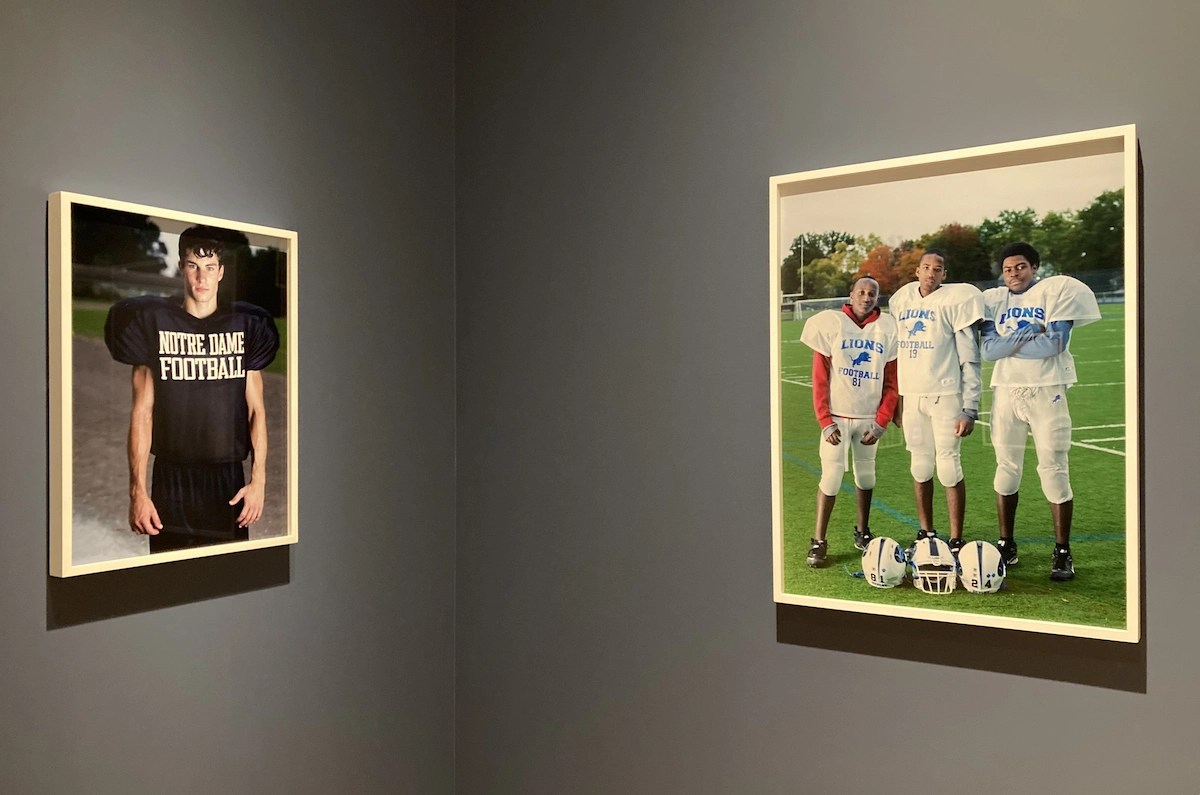
Felicity Hammond: V3 Model Collapse @ the Photographers’ Gallery

The main reason for visiting the Photographers’ Gallery at the moment is to see the hugely enjoyable exhibition of wonderful photos of the 1970s society, reggae and punk rock by Dennis Morris. But if you’re there it’s worth making the effort to check out this much more challenging installation by contemporary photo-artist Felicity Hammond.

As ‘V3’ suggests this is the third of a series of four installations. They are about contemporary issues around the brave new world of digital imagery, artificial intelligence, and their real-world costs and implications.

The key concept is model collapse which has at least two meanings.

AI model collapse

In the digital realm it refers to the progressive deterioration in quality of AI outputs. First generation AI is trained on all the content of the internet (which contains plenty that is imperfect or misleading). AI then generates a new generation of content which contains all the errors it inherited and adds countless ‘hallucinations’ and errors of its own. The next generation is then trained on a totality of data which contains a large amount of errors, and in turn generates fresh errors. Thus the introduction of artificial intelligence tools will inevitably and unstoppably lead to the degradation of information on the internet.

With conscious irony, here’s a definition of model collapse generate by Google AI:

Model collapse in AI refers to the phenomenon where generative models, trained on their own or other models’ outputs (synthetic data), degrade in performance over time. This degradation manifests as reduced diversity, increased bias, and ultimately, the model producing nonsensical or repetitive outputs. Essentially, the model ‘learns’ to imitate its own errors, leading to a decline in its ability to accurately represent the original data distribution.

Environmental collapse

At the same time as the digital world is being irreversibly degraded so, of course, is the real world. Presumably everyone knows that making AI work requires enormous new datacentres, in vast air-conditioned warehouses which, of course, use up a lot of energy and a lot of water, which is an increasingly precious resource in our overheating world. But there’s also the well-known mining of rare and precious metals which are needed in our shiny digital gadgets, namely smartphones.

So ‘collapse’ has a double meaning, referring to both the collapse and degradation of quality in an AI-infested digital world, and also the environmental collapse and degradation required by our digital technologies.

As it happens there’s also a double meaning to the word ‘mining’. In the digital world, data mining refers to the process of extracting information from vast datasets (like the whole internet); but ‘mining’ also has its older meaning of referring to digging up stuff under the ground, namely the rare minerals and metals required for this technology, such as lithium.

Ditto ‘extraction’: data extraction refers, fairly obviously, to AI’s mining of the internet’s data resources, and has obviously been adapted or copied from the older real-world term which describes the extraction of actual mineral wealth…

One wall label explains that one particular form of mining exposes buried sulphides which oxidise a bright orange on contact with air, and is often washed by the water involved in mining operations into streams and rivers and lakes, creating large toxic orange swamps, obviously killing all forms of life. These toxic orange waste dumps dominate the palette of the exhibition.

Model collapse summary

To summarise, then: ‘model collapse’ is a technical term referring to the degradation of AI information, which also echoes the physical degradation of the natural environment caused by the real-world requirements of supporting the digital realm.

Model collapse depicted in art

So what about the art? Well it comes in roughly two forms: there are relatively flat images hung on walls, and then there are a couple of big installations set back from the viewer with space in front covered in mining detritus etc. The biggest one, with huge, digitally fragmented images of orange mudpools at the back and industrial scraps and sacking scattered around in the foreground, kind of speaks for itself.

But something more complex is going on with many of her images. Basically she uses digital feedback to distort, degrade and fragment the original imagery. Grasp this simple principle and you understand most of what’s going on.

Also, this being V3, it refers back to the earlier versions, V1 and V2, so here’s a brief recap.

V1. Content Aware, 24 to 27 October 2024, Brighton

Installation view of V1: Content Aware (Photoworks Weekender, Brighton, October 2024)

V1 was staged in Brighton in a shipping container, the kind used in their tens of thousands to move goods around the world. these standardised objects bear coded numbers so are part of a digital system. they criss-cross the oceans above the deep sea cables which carry all our digital data. And, seen from above and at a distance, they resemble the pixels which digital images are made out of. Hammond’s images play with all these intersections and ambiguities. So it was a kind of the investigation of the global infrastructure that supports the digital economy,

‘Content Aware’ is also the name of an image editing tool. Hammond likes these puns or multiple meanings.

The installation included cameras which recorded visitors movements and interactions.

V2. Rigged, 13 March to 15 June 2025, Derby

Installation view of V2: Rigged (QUAD Gallery, FORMAT festival, Derby, March 2025)

Rigged is another pun in the sense that a rig can refer to the enormous structures which drill for oil land gas at sea. But it’s also the term for the structures which hold cameras in a studio setting. there’s also a connotation of the game being ‘rigged’ because Hammond used images of visitors to V1 and fed them through AI algorithms to generate ‘mean’ or ‘average’ images of humans. As you might expect, these didn’t come out too well.

V3. Model Collapse gallery

So what does it all look like?

Installations

Installation view of V3 Model Collapse by Felicity Hammond @ the Photographers’ Gallery (photo by the author)

Installation consisting of a massive photo of open cast mining, surrounded by detailed photos, all presented at the back of a kind of sandbox of industrial detritus.

Installation view of V3 Model Collapse by Felicity Hammond @ the Photographers’ Gallery © Felicity Hammond

On the wall

Shards and fragments, visual representations of the fragmented outputs of AI and the environmental collapse involved in digital technology.

Installation view of V3 Model Collapse by Felicity Hammond @ the Photographers’ Gallery (photo by the author)

On a screen made up of 80 or so imperfect mirrors, further muddied by white smearing, are hung four images which were probably originally fairly straightforward self-portraits taken against Hammond’s emblematic green and orange designs, but have been distorted to represent AI degradation.

Installation view of V3 Model Collapse by Felicity Hammond @ the Photographers’ Gallery (photo by the author)

Portrait of the artist, through an AI glass, distortedly

Close-up of one of those four self-portraits showing how AI mostly captures the details of the original but with inexplicable ‘hallucinations’ and distortions.

V3 Model Collapse by Felicity Hammond @ the Photographers’ Gallery © Felicity Hammond

The video


Related links

Related reviews