Lucian Freud: Drawing into Painting @ the National Portrait Gallery

Lucian Freud (1922 to 2011) was a British painter and draughtsman, specialising in figurative art, who is known as one of England’s leading 20th-century portraitists.

Towards the end of his life, the Lucian Freud Archive was created by accumulating the artist’s personal papers, sketchbooks, and working materials over his lifetime. Spanning his long working life from about 1939 to 2011, the Archive contains over 160 childhood drawings, 47 sketchbooks containing some 600 drawings, and personal letters. In 2015 the Archive was officially acquired by the National Portrait Gallery.

Now a generous selection of images from the Archive is on display at the National Portrait Gallery. These include a wealth of early drawings and sketches, newly acquired etchings of family members which, along with Freud’s etching tools and his paintbox. As we progress through the show, we watch him evolve from his early bug-eyed cartoony style, into something more caustic and realistic, showing his development from standalone drawings into sketches which are obvious preparations for paintings, and then on to a dozen or so finished oil paintings in his mature style. The combination of all these formats is designed to showcase Freud’s skill as a draughtsman across many mediums, in

Created in close collaboration with David Dawson, Director of the Lucian Freud Archive, this is the first exhibition of Freud’s work at the National Portrait Gallery since the major painting retrospective Lucian Freud Portraits, in 2012.

Gallery

The show opens with a wall-sized blown-up image of Freud’s studio.

Wall-sized photo of Freud’s studio towards the end of his life, in ‘Lucian Freud: Drawing into Painting’ at the National Portrait Gallery (photo by the author)

There’s a selection of schoolboy drawings, for real completists.

Lucian Freud schoolboy drawings in ‘Lucian Freud: Drawing into Painting’ at the National Portrait Gallery (photo by the author)

Early style – portrait drawings from the 1940s.

Early ‘cartoon’ style in ‘Lucian Freud: Drawing into Painting’ at the National Portrait Gallery (photo by the author)

‘Girl with Roses’, painted in 1948, is a seminal early oil-on-canvas portrait by Lucian Freud, of his first wife, Kitty Garman. It depicts a tense, pregnant Kitty looking away with a stiff posture, clutching a ‘Peace’ rose while another lies in her lap.

Girl with roses / portrait of his wife (1948) in ‘Lucian Freud: Drawing into Painting’ at the National Portrait Gallery (photo by the author)

One of several display cases showing drawings from the sketchbooks.

Display case of drawings in ‘Lucian Freud: Drawing into Painting’ at the National Portrait Gallery (photo by the author)

Portraits from the 1950s – in my opinion, scrappy and inconsistent.

Wall of 1960s portraits in ‘Lucian Freud: Drawing into Painting’ at the National Portrait Gallery (photo by the author)

Forty years later, 2000s portraits: more consistent, more detailed, darker, closer up. Far more impactful.

Wall of 2000s portraits in ‘Lucian Freud: Drawing into Painting’ at the National Portrait Gallery (photo by the author)

Transitioning to his mature style i.e. naked figures, in ungainly poses, painted with a kind of brutal honesty. This relatively small work is one of a series of naked portraits of his lover Jacquetta Eliot.

Small naked portrait from 1973-4 in ‘Lucian Freud: Drawing into Painting’ at the National Portrait Gallery (photo by the author)

Preparatory sketches and final painting, in his mature style. Studying these, it struck me that the drawings have an open quality – the poses are somehow more free and suggestive – whereas the finished oil painting is much more heavy and closed. On reflection maybe part of this is because the painting has a detailed backdrop – the sofa and rumpled white sheet, depicted in great detail – whereas the bodies in the sketches float free in an abstract white space.

Preparatory sketches and final painting in his mature style in ‘Lucian Freud: Drawing into Painting’ at the National Portrait Gallery (photo by the author)

Letters and comments by friends reveal that as a boy and young man, Freud did lots of drawings of animals. The exhibition includes some of these, including a number of etchings of his whippet, Eli. Here’s one from 2002 set next to a drawing of a toy rabbit from 60 years earlier, in his early style.

Eli (2002) and Rabbit on a chair (1944) in ‘Lucian Freud: Drawing into Painting’ at the National Portrait Gallery (photo by the author)

The exhibition has a section on group portraits he made as direct homages to works by classical painters, one by Watteau (Large interior W11, 1983), a few etchings inspired by Chardin.

The last few rooms contain prime examples of both his massive full body nude paintings, alongside more ‘discreet’ portrait busts. There are famous portraits of David Hockney (2002) and Queen Elizabeth II (2001), alongside equally vivid portraits of less well-known figures, and a couple of his really vivid self portraits.

Thoughts

In my mind I had a simple mental model of Early style – Naked style – Mature style, but this exhibition is distinguished by a lot more variety and digressions and distractions than that suggests (the school drawings, animals, Old Master homages, among many others) which you will either find enchanting (if you’re a Freud fan) or maybe a little confusing (as I think I did).

A problem with Freud is that, once you’ve seen a number of his naked portraits, especially the ones where the sitters are showing off their big, sore-looking red scrotums, it’s a little hard to expunge the shock of these images from your mind.

Sprawling naked men in ‘Lucian Freud: Drawing into Painting’ at the National Portrait Gallery (photo by the author)

In among the mix, a distinct and different theme which came over to me was the importance of Family and Friends – a recurrent theme in the sketches, drawings and paintings of his wife, his lovers, his children and grandchildren. (Freud was known for his vast, often chaotic family life, having acknowledged at least 14 children with various women.) These are ‘intimate’ in a different sense, an emotional sense.

Intimate late portraits in ‘Lucian Freud: Drawing into Painting’ at the National Portrait Gallery (photo by the author)


Related links

Related reviews

Catherine Opie: To Be Seen @ the National Portrait Gallery

Self-portrait/Nursing, 2004 © Catherine Opie, courtesy Regen Projects, Los Angeles; Lehmann Maupin, New York, Hong Kong, London, and Seoul; Thomas Dane Gallery

This is a self portrait by Catherine Opie. Born in 1961, Opie is a lesbian and one of America’s leading fine art photographers. For forty years she’s been creating photographic projects concerned with community and identity in the USA. Now the National Portrait Gallery is staging the first major museum exhibition of her work in the UK.

Half way round the show I came across a phrase which offers a handy entry to Opie’s oeuvre: a wall label refers to ‘the politics of visibility’. This was a new phrase for me, so I looked it up:

The politics of visibility is the strategic management, contestation, and control of who and what is seen, heard, or recognized within public, media, and digital spaces. It acts as a form of power that shapes social identities, recognizes marginalized groups, or enforces surveillance and exclusion.

The idea is that the community Opie belongs to – the queer or gay or lesbian community – has historically been unrepresented in Western art, photography, or just mainstream media, and so she has devoted her career to redressing this imbalance, to making her people seen, giving visibility to her community.

According to one online biography, Opie at an early age discovered the work of photographer Lewis Hine, who documented the plight of child labourers at the turn of the 20th century. Inspired by Hine’s images, she requested a camera for her ninth birthday and was given a Kodak Instamatic by her parents. She immediately began photographing her family and neighbourhood and, in a sense, has never stopped.

And hence the title of the exhibition: To Be Seen. As to this self portrait, Opie depicts herself breast-feeding her son Oliver. Her real, scarred and tattooed body proudly reclaims motherhood from depictions of pious devotion, represented through the Madonna and Child. It’s also, let’s face it, an assertion of pride in being big, heavy, as the Yanks say. I think it works in both ways, asserts two kinds of pride. It is, I think, a beautiful image of love and care and tenderness. In many ways it’s the best image in the exhibition, candid, open, unembarrassed and loving.

Projects

Being and Having (1991)

Her first major work, ‘Being and Having’ consists of 13 closely cropped portraits of Opie (as her alter ego, ‘Bo’) and her ‘leather dyke community enacting their moustachioed masculine alter-egos’. They were, apparently, inspired by court painter Hans Holbein. It was her first major artwork setting out to challenge a binary approach to gender identity. Opie says: ‘Being and Having stares right back at you – we’re women occupying a masculine space.’

Self portrait as Bo

Bo, 1994 © Catherine Opie, courtesy Regen Projects, Los Angeles; Lehmann Maupin, New York, Hong Kong, London, and Seoul; Thomas Dane Gallery

A ‘leather dyke community enacting their moustachioed masculine alter-egos’

Installation view of the exhibition Catherine Opie: To Be Seen at the National Portrait Gallery. Photo copyright © David Parry

Portraits (1993–97)

Portraits depicts her friends in the lesbian and gay community in Los Angeles, mixing traditional portrait photography with less traditional subjects.

Divinity Fudge, 1997 © Catherine Opie, courtesy Regen Projects, Los Angeles; Lehmann Maupin, New York, Hong Kong, London, and Seoul; Thomas Dane Gallery

Domestic (1995–98)

In the mid-1990s Opie embarked on an American road trip, traveling 9,000 miles over three and a half months to photograph lesbian couples and families in their homes. ‘Domestic’ was a response to the seminal exhibition ‘Pleasures and Terrors of Domestic Comfort’ at MoMA in 1991, curated by Peter Galassi. In ‘Domestic’ Opie wanted to represent her community, which was absent from the MoMA show. Using an 8 × 10 large format camera, ‘Domestic’ was Opie’s response to the absence of Queer lives in visual representations of home life.

Flipper, Tanya, Chloe & Harriet, San Francisco, California, 1995 ©Catherine Opie, courtesy Regen Projects, Los Angeles; Lehmann Maupin, New York, Hong Kong, London, and Seoul

Surfers (2003)

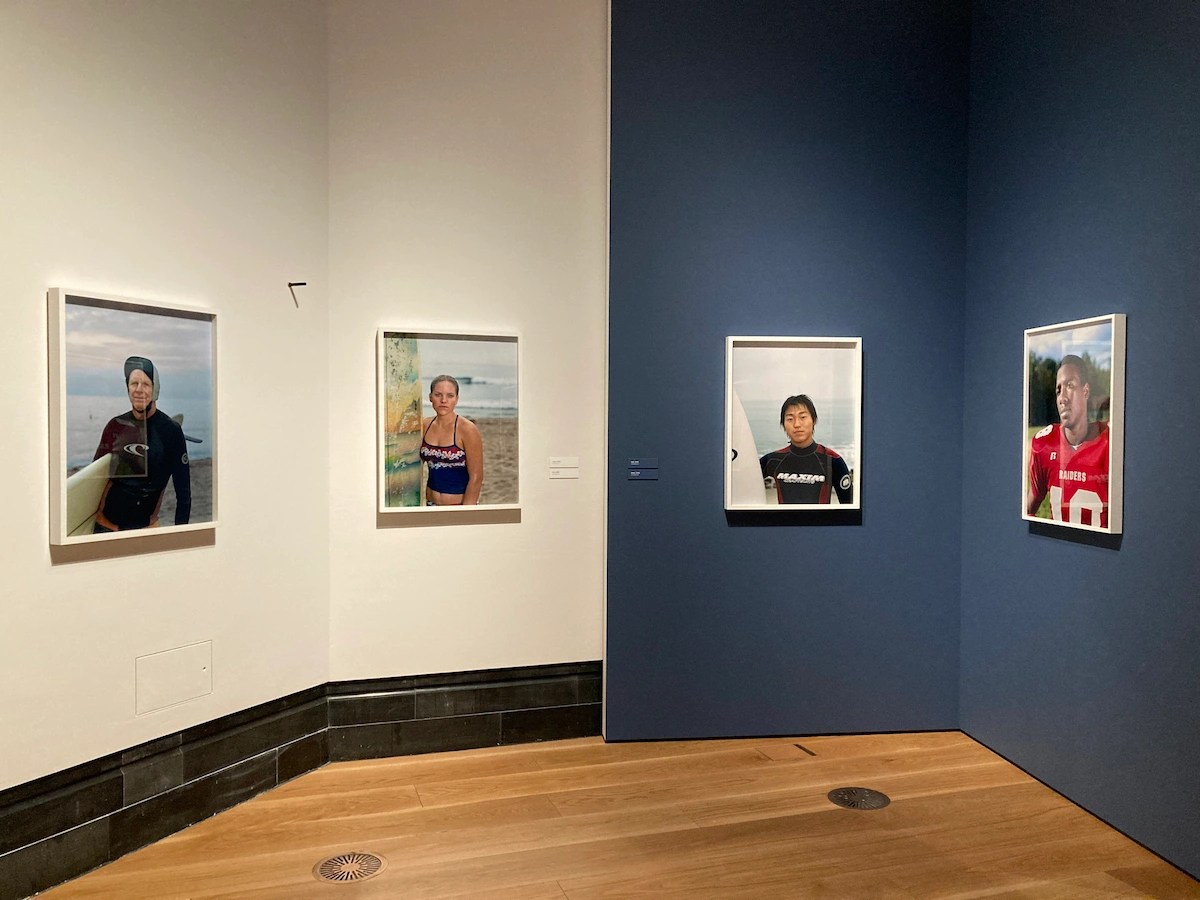
‘Surfers’ depicts the California surfing subculture. Rather than showing them riding waves, Opie portrays her surfers emerging from the sea looking unglamorously wet and cold and dazed – surprisingly British, in fact.

Installation view of Catherine Opie: To Be Seen @ the National Portrait Gallery, showing some of the ‘Surfing’ portraits’ (photo by the author)

In and Around home (2004)

In the early 2000s, Opie explored her Los Angeles neighbourhood and the domestic setting of her home. ‘Oliver in a Tutu’ from the series ‘In and Around Home’ depicts her son in a pink tutu in the kitchen doing laundry. This domestic scene is aligned with Opie’s politics of visibility against the backdrop of the continued homophobia within American culture at the time during the Bush era.

Oliver in a Tutu, 2004 © Catherine Opie, courtesy Regen Projects, Los Angeles; Lehmann Maupin, New York, Hong Kong, London, and Seoul; Thomas Dane Gallery

Doesn’t he look like a sweetheart! What a lovely image of everyday domestic happiness.

Children (2004)

For ‘Children’ Opie returned to the studio and to her signature highly focused portraits, this time of children set against bright solid colour backdrops.

Installation view of Catherine Opie: To Be Seen @ the National Portrait Gallery, showing some of the ‘Children portraits’ (photo by the author)

High School Football (2007-09)

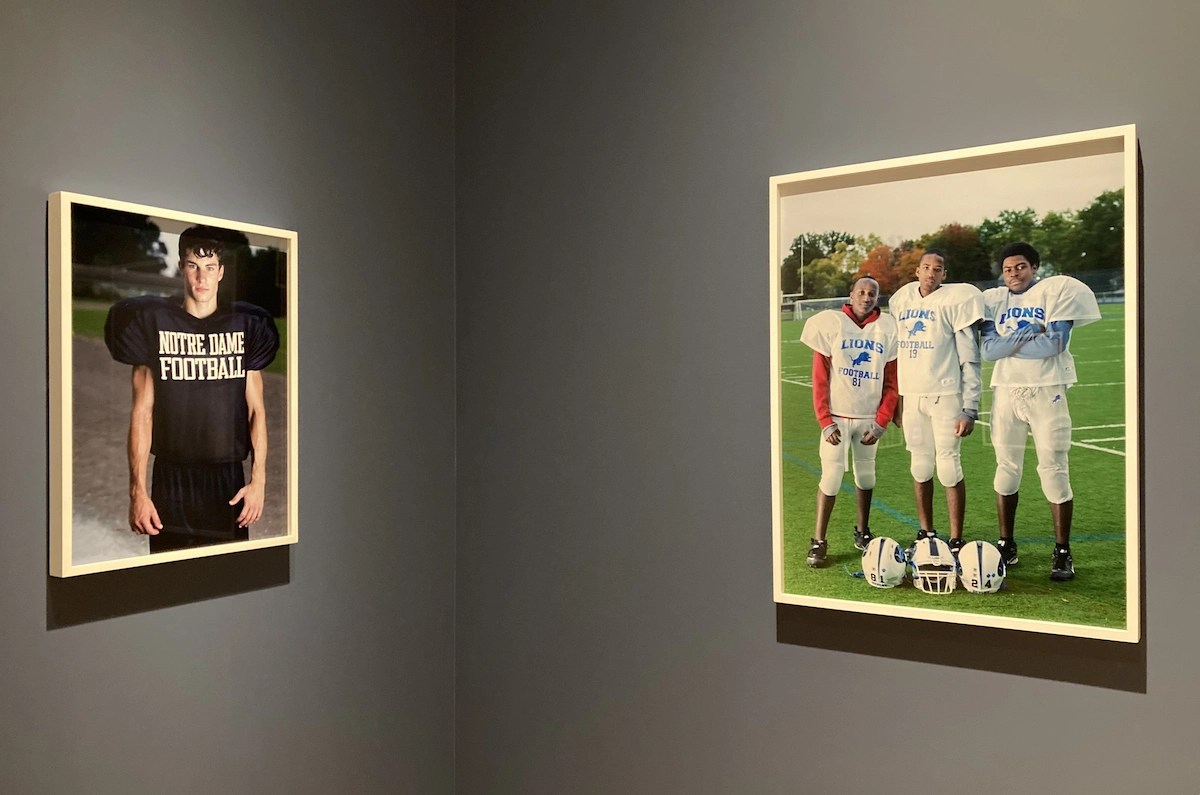
From 2007 to 2009 Opie’s continued her exploration of the American landscape through the specificity of identity as it is played out on high school football fields. Opie made portraits of high school football players across several US states, vulnerable portraits of the young men counter stereotypes of athletic masculinity at a time when the US was engaged in a war with Iraq and Afghanistan.

Installation view of Catherine Opie: To Be Seen @ the National Portrait Gallery, showing some of the ‘American football’ portraits (photo by the author)

Do these images subvert, interrogate or deconstruct masculinity? Ask the marines steaming towards the Gulf of Hormuz.

Girlfriends (2010)

A series of black-and-white portraits (1989-1999) which were first exhibited in 2010), the series continues Opie’s longstanding examination of the history of photography and her community in a different format.

Studio Portraits (2012–2018)

In the 2010s Opie used theatrical lighting against a black velvet backdrop to illuminate masterly and striking portraits. Allegorical elements allude to the political and spiritual concerns of art. They evoke Renaissance and Baroque painting, presenting her subjects in allegorical poses in front of black backgrounds, which remove the individuals from any sense of time or place.

Installation view of Catherine Opie: To Be Seen @ the National Portrait Gallery, showing some of the Baroque Studio Portraits (2012–2018) (photo by the author)

These portraits are characterized by highly staged, theatrical lighting against a black background, intended to create a painterly, intimate, and often allegorical quality. I haven’t mentioned that the exhibition space has been unusually designed into box-shaped rooms and corridors with, as here, the wall colour chosen to offset the images.

Walls, Windows and Blood (2023)

Opie’s photograph of Pope Francis, diminutive at his Vatican window amid the ‘constructed architecture of power’, is drawn from a body of work entitled ‘Walls, Windows and Blood’ (2023), made during a pandemic-era residency at the American Academy in Rome. The title of this portrait of the former head of the Catholic Church is a reference to the delayed papal acknowledgement of the deaths of Canada’s First Nation’s children under the church’s administration. It’s part of a small selection of images from larger locations which includes shots from President Obama’s inauguration, a Boy Scout Jubilee, and others.

Installation view of Catherine Opie: To Be Seen @ the National Portrait Gallery, showing some of the photos she took at the inauguration of President Obama on 20 January 2009 (photo by the author)

Comments

When you read the press material, the online promotion and the wall labels, you are given the impression that Opie is a radical political figure. But when you stroll from photo to photo you come to realise nothing could be further from the truth. Everything is very quiet and homely. Photos of friends, of her house and child, of other children, images of young surfers and football players, documentary images of the Obama inauguration or a handful of other mass events (a Boy Scouts Jubilee, some festival).

The more it went on, the blander it felt. The set of lesbians with moustaches is funny in a 1990s kind of way. The half dozen local children are sweet. The surfers look very wet. The footballers look fit. The friends posing against black backgrounds look very stagey.

But few if any of the images really stood out for me. Compare and contrast the vividly seedy colour photographs of the recently deceased Martin Parr to see what unnerving commentary colour photography is capable of. If you strip away the excited queer rhetoric, most of the Opie images seemed to me, well, OK, proficient enough, quite nice, meh.

In the end I thought the opening image of her breastfeeding her son was the one really standout image, and the one which had the most ‘political’, emotional and visual impact.


Related links

Related reviews

Stubbs: Portrait of a Horse @ the National Gallery

’Stubbs fundamentally changed the approach to depicting the horse in late 18th-century British art, combining his hard-earned knowledge and understanding of their anatomy with a desire to capture a distinct individual character.’
(Dr Mary McMahon, Associate Curator)

George Stubbs (1724 to 1806)

George Stubbs was an eighteenth century English painter, best remembered for his paintings of horses. This small but beautifully formed exhibition in one room at the National Gallery is displaying one of his horse portrait masterpieces, the only life-size horse portrait by Stubbs still in a private collection, and so rarely seen in public. It’s of ‘Scrub, a bay horse belonging to the Marquess of Rockingham’, painted in about 1762, and it dominates the room.

Scrub, a bay horse belonging to the Marquess of Rockingham by George Stubbs (about 1762) © Private Collection. Photo: The National Gallery, London

What makes the exhibition interesting is that it places this wonderfully vivid image in the context of a few of Stubbs’s other horse paintings but, more interestingly, with half a dozen of his detailed and ground-breaking anatomical drawings of horses.

The Horkstow drawings

Stubbs was born in Liverpool, the son of a currier (leather worker) and he spent his early career in the north of England, painting portraits and developing his interest in anatomy. In the later 1740s he lived in York and supplied the illustrations for a treatise on midwifery. Following a brief visit to Rome in 1754 he returned to England the following year. In 1756, working in a remote barn in Horkstow, Lincolnshire, Stubbs spent 18 months carrying out meticulous dissections of horses. Stubbs carefully removed layers of skin and muscle, recording every detail as he went. It was the most thorough study of the anatomy of horses for over a hundred years and resulted in the greatest images of the subject ever recorded in Britain.

Finished study for ‘The First Anatomical Table of the Muscles, Fascias, Ligaments, Nerves, Arteries, Veins, Glands, and Cartilages of the Horse’ by George Stubbs (1756-1758) © Royal Academy of Arts, London

In 1759 Stubbs came down to London looking to further his career and bringing his drawings. But despite making influential contacts like Joshua Reynolds, Stubbs couldn’t get his drawings published. As a result he set out to teach himself how to make engravings. Over the next seven years he carefully converted his meticulous drawings to etchings and these were finally published in his major treatise, ‘The Anatomy of the Horse’ (1766).

The book was a contribution both to art and science and was an immediate success, translated into French and receiving praise across Europe.

The Anatomy Of The Horse

The exhibition includes a) a display case showing an original copy of Stubbs’s treatise whose full eighteenth century name was:

The Anatomy Of The Horse, (Including A particular Description of the Bones, Cartilages, Muscles, Fascias, Ligaments, Nerves, Arteries, Veins, and Glands. In Eighteen Tables, all done from Nature)

Alongside this are b) six of Stubbs’s original working drawings and finished studies. (I was interested to learn that the book and drawings are all on loan from the Royal Academy of Arts just up the road, which owns 42 surviving drawings.)

Display case showing the Royal Academy’s copy of ‘The Anatomy Of The Horse, (Including A particular Description of the Bones, Cartilages, Muscles, Fascias, Ligaments, Nerves, Arteries, Veins, and Glands. In Eighteen Tables, all done from Nature)’ by George Stubbs in Stubbs: Portrait of a Horse at the National Gallery (photo by the author)

Rockingham

Joshua Reynolds introduced Stubbs to his own roster of rich patrons and this included Charles Watson-Wentworth, 2nd Marquess of Rockingham (1730 to 1782). Rockingham was an eminent politician and served as Prime Minister from 1765 to 1766. He was also a keen collector of antique sculpture and active in horse breeding and horse racing and so commissioned the man who was emerging as the best horse painter in Britain.

Whistlejacket

Having processed the information in Room 1, visitors are recommended to walk a hundred yards through the Gallery to Room 34 where they can see probably Stubbs’s most famous masterpiece, Whistlejacket. The two equine portraits were painted in the same year for Rockingham, who owned them both.

Whistlejacket by George Stubbs (about 1762) as currently displayed in Room 34 of the National Gallery, London (photo by the author)

A retired racehorse, Whistlejacket was the second Marquess of Rockingham’s stud horse, used for breeding. Stubbs depicts the stallion on a scale more usual for a group portrait or historical painting. Whistlejacket rises in the levade position, a movement in dressage and featured in heroic equestrian portraiture.

The connection between the two portraits: George III

‘Whistlejacket’ was to be the basis for a commissioned portrait of George III (who had succeeded to the throne in October 1760) to hang in the Great Hall at Wentworth Woodhouse (as a pendant to an equestrian portrait of George II). Stubbs would to the horse and then other painters would paint in a) the royal rider and b) the rural background.

But once the portrait of Whistlejacket was completed, it was thought so striking that Rockingham (possibly with Stubbs) decided it should remain without a rider or background. So Rockingham then decided to have another picture painted for the king to be sitting on and Stubbs began a fresh painting with the bay colt Scrub as the subject.

But before Stubbs finished ‘Scrub’, Rockingham had resigned his post as Lord of the Bedchamber (1762) and decided not to buy it, apparently abandoning his plans for an equestrian portrait of the king.

And so Stubbs retained ‘Scrub’ for some twenty years, before finally selling it to William Wynne Ryland, a picture dealer, engraver and forger who tried – unsuccessfully – to have it sold in India. Damaged at sea, the painting was returned to Stubbs was sold in the studio sale after his death, and has remained in private hands ever since.

The horse alone

There had, of course, been tens of thousands of representations of horses in Western art, but nearly always being ridden by a human or taking part in human activities. Thus, in typical equestrian portraits, horses feature in a supporting role to the human figures, and this had been interpreted for centuries as depicting nature brought under the control of a skilful rider.

Stubbs’s importance as a painter of horses was not only that he introduced a new level of anatomical accuracy, but for the first time gave them a sense of individuality and character. Stubbs’ pictures are genuine portraits, of specific individual horses. This represented a radical shift in the representation of the horse and was an innovation that influenced all subsequent painters of horses.

Stubbs and Wright

This FREE exhibition makes a nice pendant or accompaniment to the ticketed exhibition just 50 yards away on the first floor of the National Gallery, which is devoted to the marvellous light paintings of Joseph Wright of Derby. Together they make up a deep dive into the art and culture of mid-eighteenth century England, and an insight into how closely aligned Science and Art were in that gentlemanly age.


Related links

Related reviews

Konrad Mägi @ Dulwich Picture Gallery

Konrad Mägi (1878 to 1925) was a pioneer of Estonian modernism. Renowned in his home country for his avant-garde, unique colouristic style, he is widely considered the greatest Estonian artist of his generation. I’d never heard of him before which is why Dulwich Picture Gallery are doing us a service by presenting this, the first major exhibition of Mägi’s works ever held in the UK. The exhibition brings together 61 paintings, mostly landscapes or portraits, many of which have never been seen outside of Estonia.

Norwegian Landscape by Konrad Mägi (1909) Courtesy of the Art Museum of Estonia

Four or five themes come over very strongly:

  1. Different styles Mägi’s style was unstable and variable. The first room contains works done in three or four completely different styles which could be by completely different artists.
  2. Self-taught This was partly because, after a brief spell at art school in St Petersburg, Mägi was largely self-taught. This explains the way other styles and influences appear throughout his career, with successive works showing the influence of Impressionism, Art Nouveau, Symbolism, Pointillism, Post-Impressionism and Expressionism, with some of his later works from the 1920s showing the sudden arrival of cubism in his style.
  3. Heavy All the paintings dark and heavy. Dark blues, dark greens, dark reds predominate. These feel a bit heavy and louring in the flesh but I was surprised how well they reproduce on the posters and postcards in the shop.
  4. Clouds In the fourth and final room I realised the importance of clouds in his paintings: of the 45 landscapes not one has a clear blue sky. Maybe this reflects the climate of Estonia but, in the final room, it also feels connected with his mental illness.
  5. Mental illness Mägi suffered from mental illness throughout his life. As a struggling young artist he lived in poverty and ‘despair’, and was afflicted with recurring feelings of Angst and futility. At the end of his life he suffered a breakdown, started destroying his paintings until students intervened to stop him, and he was admitted to a mental asylum where he died. This knowledge affects your reception, if not of all the works, then certainly the ones in the final, cloud-oppressed paintings.

The show is divided into four rooms, each addressing a specific period or theme.

Room 1. Norwegian landscapes

Room 1 contains 14 paintings on the wall and 3 in a display case. The curators tell us that Mägi started his working life in 1896 when he joined a furniture factory where he specialised in decorative carving, and where he took drawing classes organised for the factory workers. He was athletic, enjoyed wrestling, and co-founded a youth society in 1897 for the improvement of the body and mind.

In 1903, at the age of 24, Mägi decided to study at the Stieglitz Art School in St Petersburg. During this time he encountered numerous exhibitions, museums and visual art. Following the pivotal period after the Revolution in 1905, many Estonian intellectuals travelled abroad to experience other cultures, a trend inspired by the founding of the Noor-Eesti movement (Young Estonia) and their motto ‘Let us remain Estonians, but let us also become Europeans’.

In 1907 he was in Paris, living in great poverty but soaking up the new art movements of the day. But apparently it was only when Mägi scraped together the money to visit Norway in 1908, that his style crystallised, sort of, and he started to produce landscapes which found an audience. Room 1 room contains good examples of these, but also demonstrates the variability of Mägi’s style.

  • There are three or four paintings in a nice impressionist style, notably Field of Flowers with a Little House.
  • There’s the extraordinary Norwegian Landscape with a Pine Tree, which I joked to my wife looked like Mordor from Lord of the Rings but maybe reveals the influence of the great Norwegian painter, Edvard Munch.
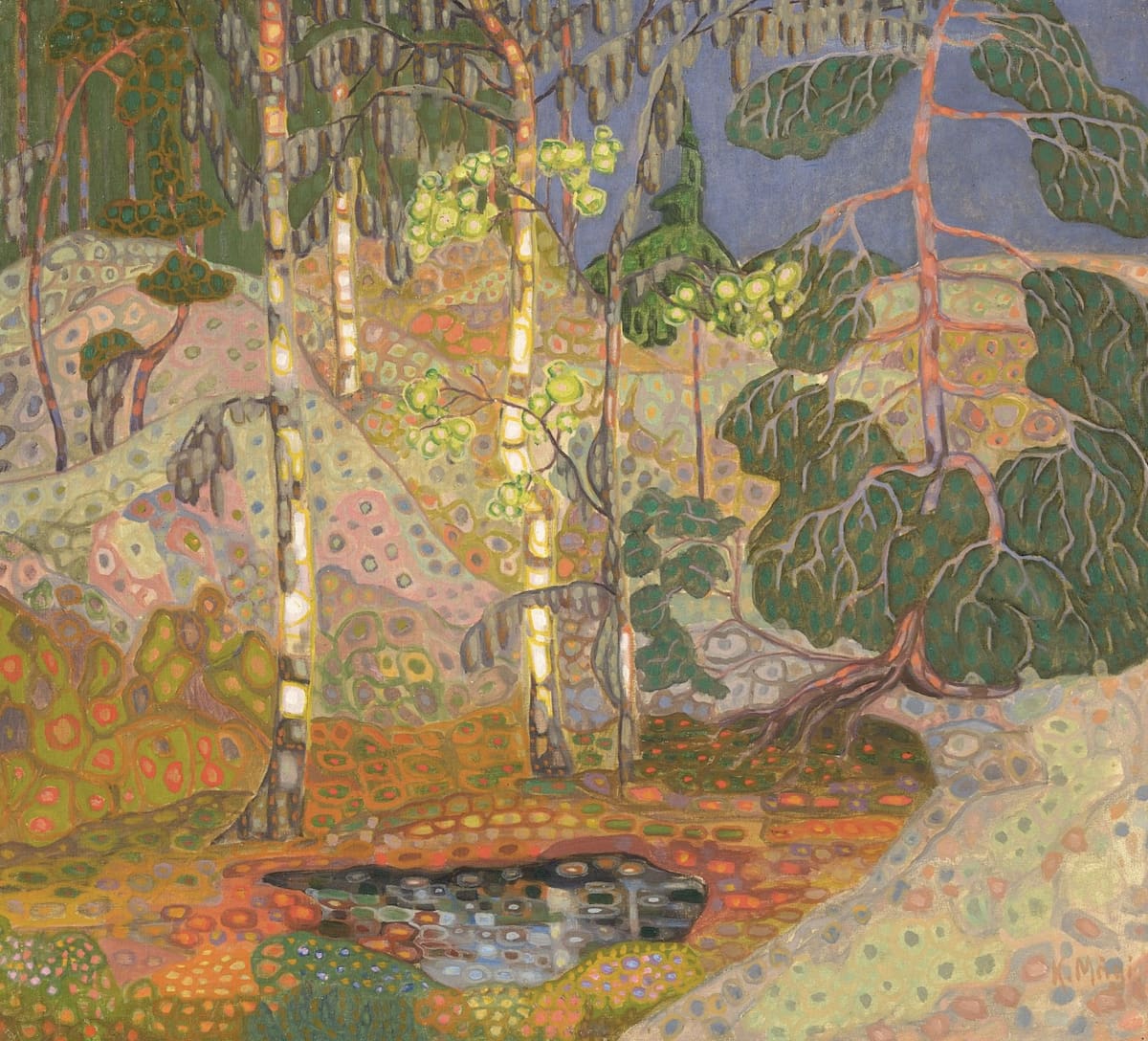
  • The Mordor painting is just the most extreme of the style he developed which combines the garishness of symbolism with the use of blobs of pure colour derived from pointillism. My favourite example was the bog painting (below). It’s figurative in the sense that you can make out the silver birch trees, but what’s happening on the ground isn’t remotely an effort to be realistic, but the use of brightly coloured blobs, lozenges and organic shapes (‘cellular structures’) which are more decorative than realistic. In the flesh, this painting is much more colourful and vibrant than this reproduction.

Norwegian Landscape: Bog Landscape by Konrad Mägi (1908-1910) Courtesy of the Art Museum of Estonia

  • Beside these were more realistic, less abstract landscapes, but still using a big blob pointillist style, such as the Norwegian lake at the top of this review.
  • And then, next door to all these stylised, sort-of-pointillist works, were some landscapes from Norway done in a completely different style, where instead of blobs, the paint has been applied in smooth brushstrokes, so the paintings appear much more traditionally figurative; such as Norwegian Landscape (Winter Landscape).

Room 2. Portraits

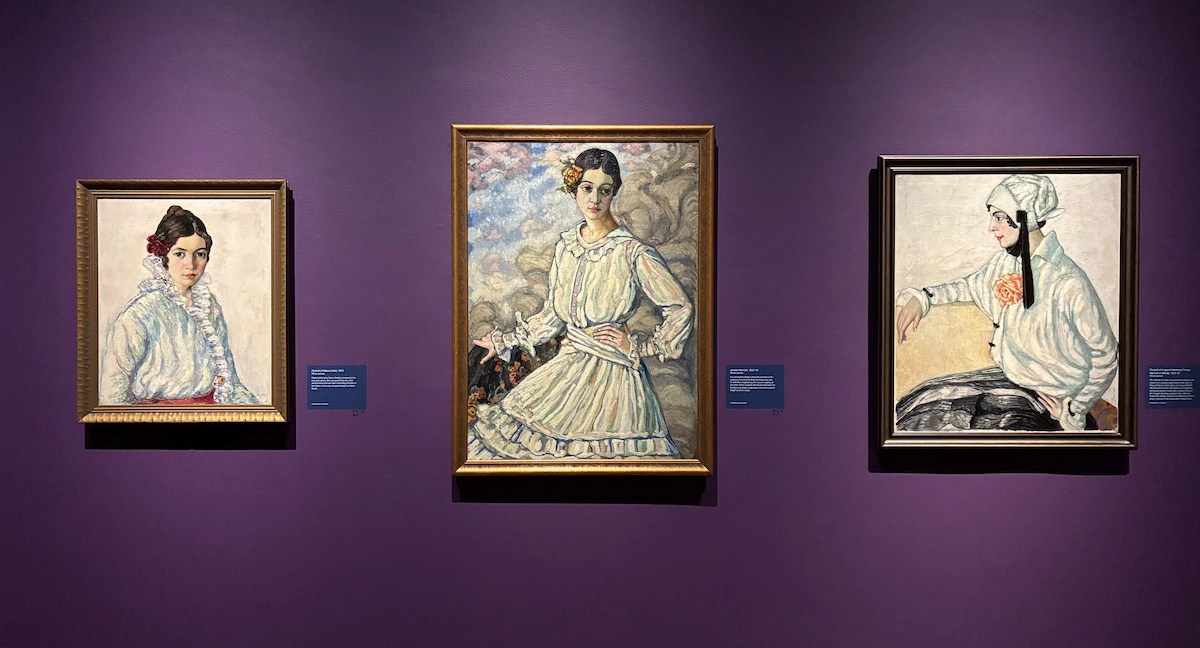
In 1912 Mägi returned to Tartu and, from spring 1913, began accepting portrait commissions for considerable sums of money, largely of wealthy women who were known to him through his cultural and political associations. Room 2 contains 17 of these generally large oil portraits. They showcase a stylised approach to the human face. They’re not unrecognisably distorted as in cubism, just simplified and done with deliberately unnaturalistic colouring. Mostly. But again, there’s a variety of styles. The ones I liked most had a hard angularity and used dark greens and blues to achieve an effect akin to German Expressionism.

Portrait of a Woman by Konrad Mägi (1918–1921) in Konrad Mägi @ Dulwich Picture Gallery

At the other end of the spectrum are some portraits of women whose cartoon, doe-eyed faces seem strangely at odds with the stylised backdrops, such as Portrait of Alvine Käppa from 1919.

Installation view of Konrad Mägi at Dulwich Picture Gallery showing three female portraits (photo by the author)

Somewhere in the middle were maybe the most attractive ones, which combined realistic faces with stylised backgrounds, the outstanding example being another ‘Portrait of a Lady’, below. Note the use of green to indicate shadowing on the skin.

Portrait of a Lady by Konrad Mägi (1916–1917) in Konrad Mägi @ Dulwich Picture Gallery

Room 3. The Baltic

Room 3 contains 16 landscapes from Mägi’s extended stays on the Baltic coast during the summers of 1913 and 1914. The paintings depict the landscape around Saaremaa and Vilsandi and, according to the curators, represented an artistic breakthrough for Mägi. The paintings here are certainly more consistent in style.

As if to demonstrate this, the centrepiece is a rare series by this artist, a set of 6 paintings depicting the same view of the lighthouse at Vilsandi. Three of these show the exact same view at different times towards the end of the day, as the (ever-present) clouds turn deeper shades of pink. the more I looked, the more I liked these three linked works.

Installation view of Konrad Mägi at Dulwich Picture Gallery showing three views of the Vilsandi lighthouse at different times of day (photo by the author)

As to the others, two things struck me:

  1. Lightless Although they are seascapes, and the curators tell us the Estonian coast is flat and open, Mägi’s paintings of it convey very little sense of light. His skies are always full of clouds and the terrain is depicted in thick heavy shapes.
  2. Botany Which is connected to the other thing which is that, although the bits of land he includes are busy with shapes and colours, giving an impression of luxuriant growth – and although the curators tell us that Mägi had an enduring fascination with the unique botanical species of his landscape, including its flora and fauna – there is precious little detail. In the garlands painted by Michaelina Wautier, currently on show at the Royal Academy, I spent some time trying to identify every species of flower. No point trying to do that with Mägi’s coastal paintings which are liberal with elements but all done in his familiar, blobby, stylised manner. Can you identify the plants in this picture?

Vilsandi Motif by Konrad Mägi (1913-14) Courtesy of the Art Museum of Estonia

Room 4. Southern Estonia

The walls of the fourth and final room are painted deep purple and this is an appropriate background for the 11 landscapes on display here, which I found heavy and louring. (I’ve just looked up ‘louring’ to check I’m using it in the right sense. The dictionary defines it as meaning ‘a dark, gloomy, or threatening appearance, usually referring to overcast weather, or a forbidding atmosphere.’ Seems about right.)

The landscapes are from Southern Estonia, from the last decade of his life. Note how the ‘blobby’ technique I’ve mentioned so many times has largely disappeared. Instead the pain is applied more smoothly but several other things are new.

One: the natural elements of the composition (the trees, the bushes, the outline of the lake) are heavily defined in black. Everything has a strong black outline, something I personally, always warm to.

Two: the clouds, the clouds! Look at the swirling, moiling, dark and threatening clouds coming to getcha!

Three: taken together these features indicate how much the landscape is actually an expression of the artist’s inner turmoil. This is the room whose wall label informs us that, after a lifetime struggling against mental illness, in 1924 Mägi suffered some kind of mental collapse and had to be placed in an institution for his own protection. Does that knowledge affect how you feel about this picture?

Lake Kasaritsa by Konrad Mägi (1915-17) Courtesy of the Art Museum of Estonia

As a footnote, not all the 11 works in this final room are as dark and ominous. In fact a couple of them right at the very end work with a much lighter palette and use light square blocks to create a landscape, completely opposite to the heavy, blobby, organic style which dominated so many of his central works. The curators tell us that here, right at the end of his working life, he was experimenting with the kind of Futuro-Cubism which was being used by radical Soviet artists of the 1920s.

Installation view of Konrad Mägi at Dulwich Picture Gallery showing three of the landscapes in the fourth and final room – note the cloud-congested skies (photo by the author)


Related links

Related reviews

Rose Wylie @ the Royal Academy

It’s not often I’m this flummoxed at an art exhibition but I thought this was rubbish, rubbish on an epic scale. English painter Rose Wylie was born in 1934 so she is now 92 years old. She is known as a ‘late bloomer’ who only gained significant recognition in her 70s and 80s. She was famously described by Germaine Greer as ‘Britain’s hottest new artist’ in 2010 when she was 76.

In 2014 (when she was 80) the Royal Academy voted her a full Academician i.e. she could put the initials RA after her name. So this exhibition, held in the Academy’s enormous main galleries, amounts to celebrating one of their own (a mere 12 years after she joined the gang).

It is also, scandalously, the first full, major solo retrospective of a woman artist in the RA’s main galleries since the Academy was founded 260 years ago!

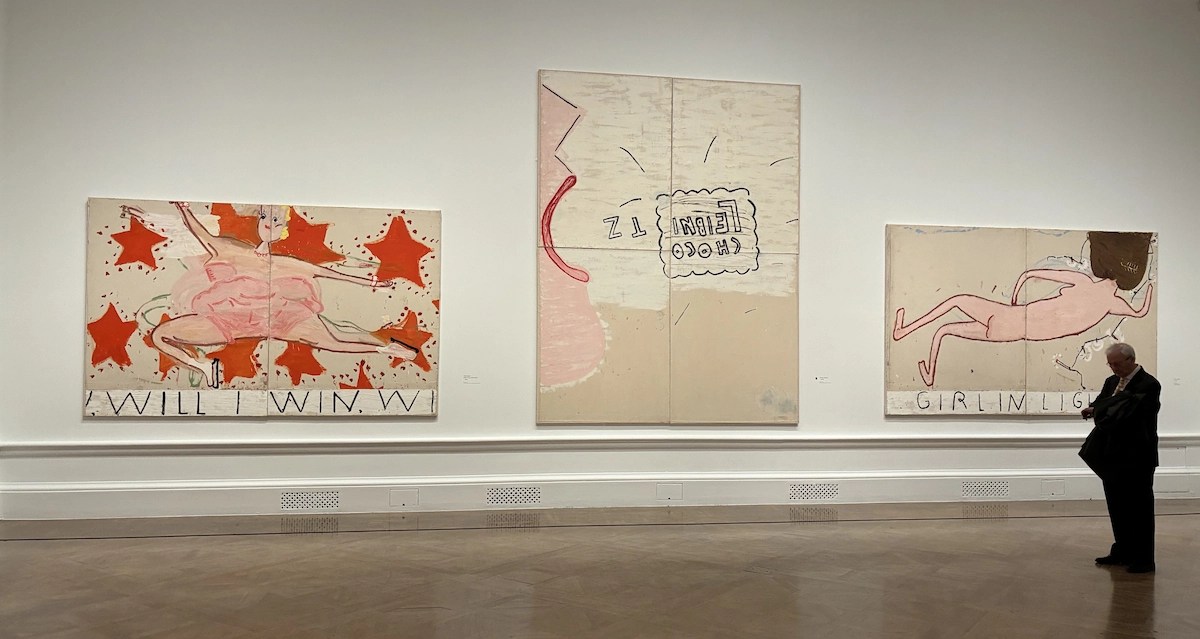
It’s still rubbish. The Academy’s press release and a few of the articles/reviews I’ve glimpsed lead with the idea that Wylie is (God help us) one of art’s great ‘rebels’… Really? Having lived through the artistic rebellions of the 60s and 70s, land art, conceptual art, dressing up buildings in fabric art, not to mention the YBAs putting sharks in formaldehyde or making sculptures out of human blood, tanks full of oil, and endless reels of video art, to stroll through galleries packed with these enormous, childishly terrible paintings is a colossal letdown, anticlimax. Bathetic. Pathetic.

The promotional material assures us this is the biggest exhibition ever held of Wylie’s work and that it brings together some of her most ‘iconic’ artworks, along with brand-new and previously unseen paintings! According to the puff, Wylie ‘has cemented her place as a cultural icon.’

Really? According to the dictionary, iconic ‘describes a famous person, place, or thing that is widely recognized, admired, and acts as a symbol for a specific idea, era, or culture’. Here are half a dozen of my photos of the show – wave your hand when you spot her most widely recognised, admired and era-defining works.

Gallery

The Royal Academy supplies press photos of the exhibition but, presented in the abstract, in a blog like this, often read on a smartphone, it’s difficult to gauge their size and they are all enormous.

So in the photos which follow, I’ve only featured images which happened to capture some of my fellow gallery visitors – primarily to give you a sense of scale, although also to provide something interesting to look at 🙂

Installation view of Rose Wylie at the Royal Academy

According to the curators, ‘Wylie’s work is alive with references to cinema, celebrities, literature, and ancient civilisations. Her cast of characters—primarily women—includes Elizabeth I, Nicole Kidman, Marilyn Monroe, Serena Williams, and Snow White. These cultural and historical references rub alongside her own experiences, such as living through the Blitz as a young girl.’

Installation view of Rose Wylie at the Royal Academy

I can see the tragically crap depictions of fighter planes in the one above – but if her paintings are so ‘alive’ with references to famous women, see if you can spot them in the images which follow.

Installation view of Rose Wylie at the Royal Academy

Each of these paintings depicts three animals. Can you tell what they are? If so, we’ll consider letting you leave.

Installation view of Rose Wylie at the Royal Academy

Spot the famous women in these three works?

Installation view of Rose Wylie at the Royal Academy

My old man was a boy during the Blitz in London, then a few years later when the doodlebugs came over. Sure, Wylie was a herself girl at the same time, but I find the clumsy ineptness of these images patronising; in fact verging on insulting to the memory of the men, women and children who lived through that ordeal. Sixty years later, is this how they’d like it to be memorialised?

Installation view of Rose Wylie at the Royal Academy

Women standing round looking at an image of women stranding round, and me taking a photo of both. The most impressive thing in this image is the gallery attendant, with his stylish hair and snazzy shoes.

Installation view of Rose Wylie at the Royal Academy

I’m guessing the images below are depictions of a vulva. Compare and contrast much the same view by another woman artist, Ithell Colquhoun, recently on show at Tate Britain: style, class and humour versus crass incompetence.

Installation view of Rose Wylie at the Royal Academy

People have been predicting the death of painting for well over a century, but this exhibition suggests that Rose Wylie is where the great tradition of Western art finally crawled into a corner, curled up, and died.


Related links

Women art reviews

Royal Academy reviews

Michaelina Wautier @ the Royal Academy

The Royal Academy in Piccadilly is a rabbit warren of a building with numerous galleries large and small, on various floors, at the back and front. Currently the huge main galleries are taken up with the blockbuster Rose Wylie exhibition (which, I’m afraid to say, I think is tripe). Meanwhile, up two flights of stairs (or via the shiny glass and steel lift) are the much smaller, more intimate, Jillian and Arthur M. Sackler Wing of Galleries.

These are currently hosting a lovely three-room exhibition of little-known 17th century woman painter, Michaelina Wautier (1604 to 1689). It is based on one simple idea: active in Brussels in the middle of the 17th century, Michaelina Wautier was a leading painter of her time, certainly one of the most eminent female painters of her day, but soon after her death her reputation went into eclipse and for the last 300 years or so she has been written out of the art history books by a male art history establishment, with most of her work attributed to contemporary male painters, most notably her brother Charles who was also a successful painter.

In the last few decades, feminist scholars have been rediscovering Wautier; art experts have been using forensic techniques to reattribute works to her and even to identify parts of paintings previously attributed to her brother, to her (all the evidence suggests that they shared and worked together in the same studio).

This exhibition presents the most comprehensive survey of Wautier’s work to date, bringing together 25 paintings from across her career.

Room 1. Historical context

Room 1 contains 11 paintings and a print. To my surprise, of these 11 paintings only 5 were by Michaelina. I don’t think it’s anywhere explicitly stated but after studying them all I came to realise the aim was to place Wautier in her artistic and historical context. In art historical terms, this explains the presence of a 1638 self portrait by Peter Paul Rubens. Among other things this is used to contrast the way Rubens presents himself sumptuously dressed in black in the manner of a courtier or diplomat, with none of the attributes of his own profession – unlike Wautier who, in the large self portrait here, depicts herself at the easel.

Self-portrait by Michaelina Wautier (around 1650) Private collection

For historical context there are portraits of:

The overall effect of this room is to lower your expectations. Not many paintings in it are real humdingers; most are OK, some feel poor, meaning they are gawky compositions or fail to be persuasively realistic.

Room 2. Historical subjects

The wall labels make a very big deal of the fact that Wautier was a woman artist, repeatedly emphasising the sexism, prejudice and discrimination she had to put up with and work against. The highest genre of art was considered historical or allegorical painting and women were supposed to restrict themselves to the much more lowly subjects of portraits and flowers. The point of historical and religious paintings was to display the artist’s skill at composition, at the arrangement of figures, the effects of light, details of fabric and so on – and it was widely believed that women lacked the imagination and intellect to create such complex images (!).

So this room displays some very big historical/allegorical paintings which she was either wholly or partly responsible for, as emphatic disproof of this ludicrously sexist opinion.

It contains 8 generally pretty large oil paintings, 5 by Michaelina, three by brother Charles, with scholars debating whether she did, or didn’t contribute some elements to Charles’s ones. Here’s one which was for centuries attributed to Charles but has, in recent decades, now been at least partially reassigned to Michaelina. As the curators put it: ‘The extent to which Michaelina Wautier may have collaborated with her brother on large commissions such as this is still uncertain, but it has been suggested that the boy with the book and Christ may have been painted by her.’

The Calling of St Matthew by Charles and Michaelina Wautier (1650-60)

The trouble is the face of Christ is easily the worst/least realistic thing about this painting. The boy’s face is good and does feel somehow different from the three older characters. But after staring at the whole for a while, I came to realise the thing which gave me the most visual pleasure was the vivid realism of the array of objects on the table, the bag, coins, little box, penholder, book and notes. these are marvellously rendered.

Detail of The Calling of St Matthew by Charles and Michaelina Wautier (1650-60)

In the same way, I didn’t like the other large paintings in this room:

Or the education of the Virgin. They’re good, very goo, but there are always details, generally about the faces, which are jarringly unrealistic, unnaturalistic, fail the test of full believability, such as the old boy’s face in the Education, below. So many of the details – the composition, the hands, the light on the fabrics – are superb, and yet, and yet…

The Education of the Virgin by Michaelina Wautier (1656) Private collection, by courtesy of the Hoogsteder Museum Foundation

(Incidentally, if you think the Annunciation looks like a completely different style, you’d be right. The curators explain that it is far more ‘baroque’, meaning the figures are more smoothed out and simplified than in almost all her other work, which is more ruggedly naturalistic. It’s thought this must have been deliberate catering to a rich patron who wanted a work in the new ‘smooth’ style.)

What I did find myself increasingly attracted to was her portraits of old men. There’s a pair of portraits of St Joachim Reading and St Joseph, and I found these character studies of wrinkled old men persuasive and moving, particularly Joseph’s odd pose, turning loftily away from the frame. For some reason he reminded me of Tolstoy. Old men she’s good at, and books: books and old men.

Room 3. Senses and Bacchus

The third and final room contains some of her best works which have been displayed here as showstoppers.

1. The senses

Along one wall is the set of five paintings of boys depicted in actions which represent the five senses (sight, hearing, smell, taste, and touch). These are light and playful and charming.

Installation view of Michaelina Wautier at the Royal Academy showing the Five Senses

There’s a simple piece of fun to be had here which is to choose your favourite from the five. My friend’s favourite was second from right, the boy wrinkling his nose because he’s just cut himself with a knife (touch). For me the obvious winner is the one in the middle, smell, showing a boy holding his nose having just opened a rotten egg. It struck me as technically perfect in every way, so much so that it reminded me of the later, sentimental paintings of boys and girls and dogs by John Everett Millais.

Smell by Michaelina Wautier (1650) Rose-Marie and Eijk Van Otterloo Collection

2. The Triumph of Bacchus

Assigned pride of place on the end wall of this final room, and thus the climax of the entire show, is an enormous scene from the classical world, The Triumph of Bacchus.

The Triumph of Bacchus by Michaelina Wautier (1655–59) Kunsthistorisches Museum Vienna, Picture Gallery. Photo: © KHM-Museumsverband

I don’t generally like these kinds of works, even when they’re done by masters of the genre such as Rubens, because they’re generally such dog’s dinners. What I mean is that – I dare say we’re meant to be admiring the masterly treatment of the subject, disposition of the figures and so on – but my eye tends to go straight to the elements which are sub-par and fail the basic test of verisimilitude.

And so in this huge painting, after registering the overall flow of the shapes, I notice that Bacchus’s head is too small, and at an anatomically improbably angle; the boy sitting on the ram on the far right, his head is too small and his face is that of a 4-year-old on a 10-year-old’s body. The face of the central figure holding the grapes over Bacchus’s mouth is poor. The head of the boy behind his bottom looks deformed, and so on.

That said, the central figure of the bog old muscular tanned satyr holding the handles of the wheelbarrow contraption Bacchus is sprawled in, his half naked body, shoulders and head are all very well done.

The woman on the right is, according to the curators, a self-portrait of Wautier herself. This is sort of interesting but when you survey this huge painting in the flesh, her face looks as if it’s been badly Photoshopped onto someone else’s body. Also, maybe I shouldn’t say this, but she doesn’t have any boobs. My boobs are bigger than the one on show here.

Then again, the curators note this point and speculate whether she was trying to achieve an androgynous effect?

In her most famous painting, she painted herself as a pagan bacchante in monumental scale, looking squarely at the viewer and confidently asserting her position as the maker.

Or is it just a bad bit of a patchy painting. Anyway, the scale and ambition are very impressive and it makes a fitting climax.

Details

Here, as in all the other large paintings, it was particular details which struck me. In Bacchus, it’s the goat, brilliantly painted, not totally convincing, unnerving

Detail of The Triumph of Bacchus by Michaelina Wautier (1655–59) Kunsthistorisches Museum Vienna, Picture Gallery. Photo: © KHM-Museumsverband

The same applies to a pair of flower paintings she did. Still life paintings of flowers are a super-abundant genre in Old Master painting. Here the flowers aren’t in vases, as per the cliché, but a little more interestingly arranged in garlands such as Wautier might have seen on classical urns and vases. But the thing which caught my eye was the ox skulls, yes, the skulls of dead oxes, placed at each edge of the painting and bisected i.e. you only see half of each skull. These, I thought, were brilliantly painted, and vividly weird.

Detail of Flower Garland with a Dragonfly by Michaelina Wautier (1652)

In the same spirit, there’s another painting of boys blowing bubbles, which is good but, again, doesn’t totally convince, I think because the boy on the right’s face is not quite… there’s just something subtly ‘off’ about it. And yet when you go closer and look at the details – the incredible texture of the old wrinkled book, the skull, the boy’s cuff and buttons, the bubble itself, the hand and the scallop shell it’s holding – these are breath-taking.

Detail of Boys Blowing Bubbles by Michaelina Wautier (about 1650-1655)

Summary

This is a really good exhibition, lovingly staged, carefully explained, in the good cause of restoring an unjustly neglected master artist – all redolent of civilisation, intelligence and skill. If many of her large-scale religious or historical paintings didn’t – as total compositions – really do it for me, lots and lots of details from those paintings are awe-inspiring.


Related links

Women art reviews

Related reviews


Beatriz González @ the Barbican Gallery

Beatriz González (1932 to 2026) was born and worked in Colombia, South America, where she became a major artistic force. She is known for transforming images people encounter every day – newspaper and magazine photos and imagery on everyday products – into big brightly coloured and ‘naive’ or simply designed paintings.

Installation view of Beatriz González @ the Barbican, showing two works from her early mothers-and-children series (photo by the author)

Now the Barbican is hosting the first major UK retrospective of her work. It is big and bold, with over 150 works in a range of media – not only paintings and drawings, but wallpapers, an extensive selection of her ‘furniture works’, fabric curtains printed with her trademark images, and immense hangings. It’s physically dramatic and exciting to walk around.

González was an outsider three times over: as a woman 1) in a traditionally male society and 2) in a male-dominated art world. But the really important outsiderness was 3) being outside the European and American artistic mainstream. The last 50 years have seen enormous change in this respect, with artists from outside Europe and America finding their voices and places and becoming more fashionable.

Back when she started out, though, there was a strong sense of being far from the metropolitan centres of art, in Paris or New York. This anxiety or self consciousness explains why her earliest works take classics of the European tradition and transform them into the ‘naive’, blocky highly coloured style she developed almost from the start of her career. Hence images by Vermeer, Velázquez and other Old Masters given the colour block treatment. It’s a way of reimagining and to some extent repossessing the Old Master tradition which she continued throughout her career and which is most dramatically embodied in the enormous, double-wall height hanging showing her version of Manet’s famous Dejeuner sur L’Herbe, all 12 metres of it, dominating the downstairs gallery and titled ‘Telón De La Móvil Y Cambiante Naturaleza’ (Backdrop of a Mobile and Changing Nature) from 1978. It’s really very big.

Installation view of Beatriz González @ the Barbican, showing her enormous remaking of Manet’s Dejeuner sur l’Herbe as ‘Backdrop of a Mobile and Changing Nature’ (1978) (photo by the author)

So Latin Americanising the classics was one, early, strand. Alongside this González developed a fascination with newspaper and magazine photos. There are rooms and rooms of these. The wall labels go into detail about this or that news story but it’s obvious that certain particular images stood out from the daily blizzard of news photos, for some reason struck enough of a chord with her to justify devoting days and weeks to making big painted versions of them.

Los suicidas del Sisga (The Sisga Suicides) (1965) is one such. It reinterprets a newspaper photograph of a tragic story of a double suicide. Three vivid paintings – rarely displayed together but reunited here in a dedicated gallery – translate the original black and white newspaper photo into flat planes of saturated colour.

Installation view of Beatriz González @ the Barbican, showing ‘The Sisga Suicides’ (photo by the author)

Highly coloured, stylised reversioning of images found in the popular media: all this is highly reminiscent of the Pop Art movement, widespread in Europe and America in the 1960s, which turned its back on High Art and rejoiced in the ephemera of everyday life, as in the work of Andy Warhol, Richard Hamilton or Peter Blake. The exhibition includes four or five display cases showing the wide range of newspapers, magazines, postcard and other sources which González kept in her huge archive.

Installation view of Beatriz González @ the Barbican, showing one of the half dozen display cases containing the newspaper or magazine photos she used as the basis of her highly stylised images (photo by the author)

Except that González never used photos or collage as the First World Popsters did. Instead everything is heavily focused on her blocky, high coloured imagining of the human figure. Human beings are central.

This all has lots of fun, poppy aspects. In 1968 a friend sent her a postcard from London with a picture of the Queen on it and this prompted González to find other images of the British Royal Family and redo them in her trademark style.

Installation view of Beatriz González @ the Barbican, showing images of the British Queen Elizabeth II from 1968 (photo by the author)

It’s also related to the ‘furniture works’ she developed in the 1970s, where she took everyday pieces of furniture – beds, cupboards, jewellery boxes, dressing tables, old-style televisions, wardrobes – and painted on to them jokey González-style figures. Some of them are classic icons of the time, such as US presidents Kennedy and Johnson. Others reimagined images of Jesus and Bible scenes such as the Last Supper redone in her trademark blocky dayglo style. And continuing her theme of reimagining / repossessing the classics, there’s a wardrobe with a primitive copy of the Mona Lisa painted onto it.

Installation view of Beatriz González @ the Barbican, showing examples of her furniture paintings – a tea tray, a fake TV, a basket, a jewellery box, all painted with simplified images, and on the right a blocky copy of the Mona Lisa painted over a dresser mirror (photo by the author)

In the early 1980s the Revolutionary Armed Forces of Colombia or FARC, founded back in the 1960s and deriving from groups of peasants fighting against violence and exploitation, had become large enough and well armed enough to start a military campaign against the state security services and army which developed into a kind of civil war.

As a result, during the 1980s life in Colombia became more violent and perilous. Some of the newspaper images she painted in the 1970s concerned murders or suicides but in the 1980s these became more ubiquitous and oppressive. There’s a room of works devoted to one particular murder, of one particular woman, one among so many thousands of what are nowadays called ‘femicides’, men murdering women. González memorialised this victim not only in painting but in a big printed fabric which is laid out on display here.

Installation view of Beatriz González @ the Barbican, showing different versions of ‘Murdered woman at a lodging’ (1985) (photo by the author)

These later works are quite a bit more sombre and tragic. She switched to a conscious decision to ‘bear witness’ and a series of works on the ground floor memorialises the ever-growing number of the dead and, increasingly, focuses on the womenfolk who weep and bury their men. Hence the extensive series Las Delicias (1996–8) featuring compositions based on images of weeping women published in newspapers.

Installation view of Beatriz González @ the Barbican, showing some of the ‘Las Delicias’ series (photo by the author)

Or Entierro en el Museo Nacional (Burial at the National Museum) (1991) in which she began collaging images from different news sources into surreal, almost mythical, scenes of violence, rendered in an uncanny colour palette – sickly greens, luminous yellows, and glowing blues.

Installation view of Beatriz González @ the Barbican (photo by the author)

Alongside the weeping women, she produced vivid satirical stylised images of the men in charge, the classic sunglasses-wearing authoritarian presidents and army leaders assembled in meeting places or round tables.

Los papagayos (The Parrots) by Beatriz González (1987) Collection Pérez Art Museum Miami, gift of Jorge M. Pérez. Credit © Beatriz González. Photo by Oriol Tarridas

Decoración de interiores (Interior Decoration) (1981), is just part of a 140-metre-long curtain printed with an image of then-Colombian President Julio César Turbay Ayala at a party. The party was organised to celebrate the military officer who passed the security law that caused Colombian writer Gabriel Garcia Márquez and others into exile and González was struck by the ‘grotesque’ contrast between this cultivated image of exuberant frivolity and the violence of his regime.

Installation view of Beatriz González @ the Barbican, showing ‘Interior Decoration’ (1981) (photo by the author)

I haven’t mentioned the wallpapers yet. Three or four rooms feature entire walls covered in her trademark acid-coloured and stylised figures. Thematically, the biggest and most sombre is also the final work in the exhibition, A Posteriori (2022). This installation  derives from Anonymous Auras (2007–09) González’s major site-specific intervention at the Central Cemetery in Bogotá. When she and colleagues learned that six neoclassical mausoleums were going to be pulled down, she intervened to save them, and then to full the niches with the repeated silhouettes of cargueros, the porters who carry the never-ending dead. Devoting a room to just this wall covering, and placing a stark bench in the middle, converts it into a chapel of memorial and remembrance.

Installation view of Beatriz González @ the Barbican, showing ‘A Posteriori’ (2022) (photo by the author)

That’s a good enough overview. There are other striking works, such as the massive reimagining she made of Picasso’s Guernica, painted onto 100 or so wall tiles and taking up an entire long wall.

Installation view of Beatriz González @ the Barbican, showing her reversioning of Picasso’s Guernica, titled ‘Mural for a Socialist Factory’ (1981) (photo by the author)

Did I actually like any of these works? Well, I admired the way she developed an early style and then worked it through, I admired her branching out into furniture, fabrics and wallpaper, all very inventive. But the images themselves, with a handful of exceptions, no, I didn’t really like, not really, sorry. Whenever I visit a gallery I play a simple game which is, once I’ve finished crawling round reading all the labels and processing all the facts, I then saunter back through the whole thing looking again at the works choosing one piece from each room which, if I was rich, I’d buy and take home.

In this entire big, vivid, comprehensive, thorough, beautifully laid out and respectful exhibition, I saw only a handful of things I’d really want to have around me and, as it happens, neither of them were paintings, the medium González is known for. They were these charming totem poles or sculptures, made from readymade objects, repainted and arranged. One was a plaster statue of Jesus placed on top of a tower of painted car tyres. Nearby was a little tower of pre-Colombian masks, painted in striking black and red, arranged to make a totem pole. These are completely unlike anything else in the show but, I’m afraid, were the only things which really pulled my daisy.

Installation view of Beatriz González @ the Barbican, showing some of her totems (photo by the author)


Related links

Related reviews

Chiharu Shiota: Threads of Life @ the Hayward Gallery

‘Everyone’s different. Everyone’s connected.’
(Chiharu Shiota)

‘While we live our lives separately, we are, at the same time, deeply connected’

This is a weird and wonderful, beguiling and genuinely ‘immersive’ exhibition. Japanese artist Chiharu Shiota was born in Osaka in 1972 but has lived and worked in Berlin, Germany since 1996. ‘Threads of Life’ is her first major solo exhibition in a London public gallery. As a retrospective it includes examples of:

  • drawings
  • early performance videos
  • photographs

But the blockbuster items are the three big gallery-sized installations in which thousands of yards of woollen thread have been intricately woven into dazzling webs and cocoons, strange disorientating mazes which eerily incorporate everyday objects such as shoes, keys, beds, chairs and dresses. The show includes other, less dramatic works, but let’s look at the three big showstoppers first.

1. Threads of Life (2026)

‘Threads that bind us to life, to others, the complex ties that not only bind us to one another and to the world, but also to the memories that are always shaping the cycle of life. networks of relationships and meaning…’

In the Hayward’s biggest upstairs gallery, thousands of yards of bright red wool have been intertwined to create an enormously complicated web of fine filaments covering the whole ceiling and coming down the walls of this big gallery, and from this mesh dangle what the visitor assistant told me is no fewer than 20,000 old keys. And there, abandoned in the middle of this strange entanglement, is the frame of an old wooden, double door, set partly open.

Installation view of Chiharu Shiota at the Hayward Gallery showing the largest installation, ‘Threads of Life’ (photo by the author)

Curators talk a lot about ‘immersive experiences’ but because it comes down from the ceiling at you, and covers the walls and intrudes onto the floorspace it really did feel ‘immersive’. Also the sheer redness, unadulterated, uninterrupted, unrelieved red, the gallery lights shining through the intricate web and turning everything red, red, red. It felt like something urgent and important was happening. What does Shiota herself say?

‘I believe that people are connected by an invisible thread. Some call this ‘the red string of fate,’ but I use red thread because it also resembles the colour of blood. Like threads, human relationships can be tight, loose, dense, cut, or knotted…’

And the keys? Twenty thousand rusty old, second-hand worn keys. What do they symbolise except 20,000 precious locations, places people wanted to keep secure and private – homes, rooms, cupboards, trunks and boxes, safe spaces, protected spaces, locations of experiences and memories and values. And now deracinated, removed from their sources and meanings, from their previous owners, and now dangling from blood red skeins. Why?

Installation view of Chiharu Shiota at the Hayward Gallery showing some of the 20,000 keys hanging by intricate webs of red thread from the ceiling (photo by the author)

And the doors, the double doors, ajar enough for visitors to walk through – what are you walking into? And out of? What happens when you walk through the door? As when Alice stepped through the looking glass. Doors can mark the boundary between the public and private, the known and unknown, the past and the future. Interestingly, lot of visitors were walking round and round the room but very few walking through the obvious opening, as if daunted. Unafraid, I walked self-consciously through the parted portals and nothing happened… or did it?

Installation view of Chiharu Shiota at the Hayward Gallery showing the open doors at the centre of ‘Threads of Life’ (photo by the author)

Another thing: these doors had a lock so the obvious questions arises: which of the 20,000 keys unlocked these doors? As in a fairy story, as in a fable. If I’d been visiting with my young children I’d have asked them to suggest which key was The Key, the Key To The Door and set them off hunting. As Shiota puts it:

‘Although each of our lives is different, we all hold a key in our hands, and with that key, you feel anything is possible. It secures your home, but it can also open the door to new opportunities. My work offers the chance to experience something different from ordinary life: the chance to enter another realm and see the red threads that are invisible in the [real] world, but are impossible to live without.’

2. Letters of Thanks (2026)

Into the next gallery and a variation on the theme: instead of tangled skeins we have thousands of small-gauge ropes , dyed the identical same primary red as in the key room, but this time hanging directly down from the high ceiling until just above the floor. But once again that’s not all, there is another component: as the key room enmeshed thousands of keys, so these hanging threads are interspersed with hundreds and hundreds of sheets of paper, folding, curled, suspended in mid-flutter, frozen in space and time as they appear to fall from the white ceiling.

Installation view of Chiharu Shiota at the Hayward Gallery showing ‘Letters of Thanks’ (photo by the author)

What are they? Thank you letters. Shiota tells us that she wanted to convey her gratitude to her father, who worked so hard for his family but fond it easiest to do in a letter and this prompted thoughts about how it’s often easiest to bare deep emotions in the objective form of writing than by saying them.

And so the genesis of this iterative work: every time the work is exhibited, Shiota invites people to share their own thank you letters, and she proceeds to embed them in the next iteration. This the work includes, in tumbling mid-flight, letters from Brazil, Austria, Germany, Denmark, Japan, and now London.

And clearly the cosmopolitan nature of contemporary art, and Shiota’s many destinations, themselves weave a kind of invisible web of connections. You can imagine a thread following the airplanes she takes round the world, weaving red threads round the globe. And then you could kind of dig deeper, look closer, and imagine the hundreds, probably thousands of thank you letters she’s received and embedded in the work, and the myriad connections those make out to their loved ones, parents, partners, children and so on. Macro and micro meshes.

This exhibition reflects the often-hidden connections between us, with each thread becoming a trace of our shared existence, weaving visible forms from the invisible threads of life. Through my work, I try to make sense of life and its uncertainties; each installation has grown from personal experiences, such as losing my father, facing death and questioning what it means to be human. With this exhibition, I want to highlight the marvellous aspects of ordinary existence.’

3. During Sleep (2026)

The third blockbuster installation is in another big gallery space and consists of half a dozen basic metal beds, such as you might find in an army barracks, laid out in an orderly pattern so you can walk up one aisle, round the end and back out of the gallery – but the point is that these banal objects are enmeshed in an even more invasive, consuming cocoon of thousands and thousands of internetted threads, this time coloured minatory black.

Installation view of Chiharu Shiota at the Hayward Gallery showing ‘During Sleep’ (photo by the author)

The red key room felt wonderful, liberating and life-enhancing whereas, presumably because of the colour black, and the stark contrast between the black thread and the white sheets and pillows and metal frames of the bed – black and white – this space felt both colder and more claustrophobic and downright spooky. Shiota provides a detailed explanation:

‘When I moved to Germany I moved nine times in three years. Every time I changed where I slept, I’d wake up unable to recognise where I was. While sitting in bed, I picked up some yarn and started weaving it around my body, desperate to create a space of my own. It was like painting in the air. The black threads enveloped the bed just like a cocoon.’

So for her the thing appears to have a comforting, protective motivation but I must say it worked the opposite for me. I am scared of spiders and this made me feel like I was entering an enormous spider’s web with a barely suppressed feeling of panic that somewhere, lurking just out of sight, must be an enormous spider. It reminded me of the horrible scene in ‘Lord of the Rings’ where Frodo and Sam find themselves in the pitch black caves of the giant spider, Shelob, monster of nightmares. Or other old-timers like me might remember the famous Dr Who episode from the 1960s where a monster takes over the London Underground and spins a horrifying cocoon of sticky webs which trap its victims.

Well, Shiota’s aim is nothing like that. She goes on to explain that, as part of the exhibition, on certain days, performers are going to get into the beds and lie there for a time, impressing the beds with their weight and shape and warmth.

‘At certain times during the exhibition, performers sleep in the beds. I like the shape of the sheets after someone has slept in them. Each person leaves a different one and I can see their former existence in those traces. A sleeping person occupies the gap between dreaming and reality. To me, death might be the perfect sleep. It represents a new state of existence within the cycle of life, one that moves towards a larger universe.’

Very restful, calm and civilised. I could see the outlines in the beds and sheets where these performers had already slept and I understand the intention. Shiota intends the work to depict a kind of haunting of the real world by ghostly absences. But I couldn’t get past my own sense of uncanny, spooky and barely-suppressed horror.

Installation view of Chiharu Shiota at the Hayward Gallery showing ‘During Sleep’ (photo by the author)

Another web work

State of Being (Dress) (2025)

Between the huge key room and the narrow dangling help note room is what looks like a vitrine, large enough to hold what looks like a white wedding dress, but engulfed in an amazingly intricate web of black thread. Again, total black against total white. Maybe white purity occluded by the thousand striations of real life. Or the purity of the dram world or ideal life, imprisoned in ten thousand compromises and preventions.

Installation view of Chiharu Shiota at the Hayward Gallery showing ‘State of being: Dress’ (photo by the author)

As usual my response is more intense (and negative) than Shiota’s etherial intention:

‘In my work, I use found objects that I come across in my daily life. These items represent an absent person whose story I can never truly know, yet they help me feel connected to universal human experiences. Clothing, in particular, reflects this idea. When we wear our clothes, the fabric accumulates our feelings and memories. It is like a second skin. In the absence of the body, a shell of our existence remains – a state of our being. Piling up layer upon layer of threads creates the entirety of the universe bound within this framed space. When I can no longer trace a single line with my eye, the sculpture is complete. At that point, I feel as if I am able to glimpse what lies beyond, and touch the truth.’

Non-web works

These four web-and-thread works are all relatively recent. As you proceed into the exhibition you go back in time to earlier works from Shiota’s career, specifically to three earlier and non-thread-based pieces.

Video: Wall (2010)

On the stairs to the upstairs gallery you come across a video screen showing all 3 minutes and 39 seconds of ‘Wall’. In this video 38-year-old Shiota is lying naked on a white floor and is covered with a spaghetti tangle of white plastic tubing. As the video proceeds in flickering time-lapse jumps, we discover the tubes are hollow because one by one they fill with a red liquid, red the colour of blood, slowly spurting through all the tubes until a tangle of white tubes has become a tangle of red ones.

Installation view of Chiharu Shiota at the Hayward Gallery showing ‘Wall’ (photo by the author)

Surprisingly, this started from a meditation on the concept of walls:

‘I had wanted to create a work around the theme of walls for a long time. I took photographs of the Berlin Wall and the Western Wall in Jerusalem, but I decided to focus instead on the ‘walls’ within our bloodstream: family, nationality, religion, and other boundaries to do with the human condition. These walls give us comfort and a sense of identity, yet they can also strangle us. In Wall, my body is entangled in red tubes resembling blood vessels, as if the body has been turned inside out, revealing everything that is carried in our blood on the outside.’

I haven’t yet mentioned that there is an audio track on the film which is a slow human heartbeat:

‘The heartbeat of a fetus inside the womb forms the soundtrack, encapsulating my sense of the many things I have experienced over the years – such as illness, pregnancy, miscarriage, and childbirth.’

Try and Go Home (1997)

This feels very basic and entry-level compared to the mature sophistication of the web works. It simply consists of six black and white photos depicting a performance. According to her own account, Shiota moved to Germany in 1996 and enrolled in the University of Fine Arts in Hamburg. Here she took a course with performance artist Marina Abramović who told them to write down one word. ‘Japan’ immediately came to Shiota’s mind.

Her account then jumps to the idea that she went out to the countryside and dug a hollow in the ground. She proceeded to take off all her clothes and performed the attempt to crawl back to the place she wanted to go home to. Again and again she tried, again and again she couldn’t get very far into the cave and rolled back down the slope, obviously becoming more dirty and muddy with every attempt.

Which is why the exhibition presents us with these six photos, presumably taken by a colleague and partner in the performance, of her naked body in various parts of the burrow-and-roll process.

Installation view of Chiharu Shiota at the Hayward Gallery showing six photos from ‘Try and Go Home’ (photo by the author)

This is so far removed from the webworks as to feel like the works of a completely different artist. On the other hand, it is obviously linked to the video by Shiota’s willingness to get naked, to photograph and film herself naked, and to display herself naked in a public gallery for tens of thousands of visitors to look at. Make of that what you will.

The Trainee (2023 to 2024)

Much more recent is another work which, initially, seems completely unrelated to the web works. In the early 2020s Shiota was asked to create illustrations for a novel. Yoko Tawada’s novel ‘The Trainee’ is set in Germany in the 1980s and follows a young woman who works at a book distribution company. It draws from Yoko’s own experience of moving to Germany around the same time, where she felt like she was starting a second life.

The novel was serialised in the Japanese newspaper Yomiuri Shimbun and Shiota created pictures to accompany its daily publication. It was a case of trial and error. Her first illustrations derived from underlining words and transforming them into pictures but when she saw them in print they felt too dark. So she developed a new approach which was to use coloured wrapping and origami paper and interweave them with her trademark red thread. Aha! Return of the threads!

The final result was nearly 400 watercolour and charcoal drawings and collages, each stitched with her signature red threads and they are all exhibited here in one wall-length display.

Installation view of Chiharu Shiota: Threads of Life. Drawings for Yoko Tawada’s Praktikantin (The Trainee) Photo by Mark Blower. Courtesy of the Hayward Gallery © DACS, London, 2026 and Chiharu Shiota

To be honest, I was still so dazzled by the big web rooms that I found it difficult to readjust my sense of scale and response to these relatively small and detailed works. Especially as I had no idea what the plot of the novel was that they’re illustrating. And especially since there are so many of them. To my mind they required a completely different sense of scale and attention than the big web rooms which had completely bowled me over.

Video of Shiota at work and explaining


Related links

Related reviews

Yin Xiuzhen: Heart to Heart @ Hayward Gallery

This is a fun and funny exhibition. I’ve read some critics being snooty about it but on the day I went there were quite a few families with toddlers running in and out of the room-sized heart, marvelling at the models of cities in suitcases, pointing at the fabric bookshelves, climbing into the concertina minibus and generally enjoying themselves.

Yin Xiuzhen: Heart to Heart @ the Hayward Gallery (photo by the author)

Yin Xiuzhen

Yin Xiuzhen was born in Beijing, China in 1963. This means she grew up during the Cultural Revolution which lasted from 1966 to 1976, with its high ideals and practical chaos. You wouldn’t really have known this from her work which, far from declaiming high political ideals, is the opposite: it feels highly personal, sweet, domestic and above all, fun.

In particular Yin is known for her inventive use of worn clothing as a material, thinking of clothes as a kind of ‘second skin’ which retain ghostly memories of all their wearers. The curators tell us that Yin’s mother worked in a clothing factory and as a result Yin developed an intimate and industrial relationship with textiles.

‘I feel that clothes are like a second skin; they have their own expressive language, and are connected with their times and therefore with history.’

Hence variations on the theme or method of stitched-together fabrics, from the small-scale – sealing her own clothes in cement – to the massive – building a huge model jet airliner from old clothes and, even more striking, a room-sized heart made from discarded clothes dyed red and paintstakingly stitched together. And what do people carry their clothes around in? Suitcases. Hence the unexpected recurrence of suitcases, trunks and boxes throughout the show.

The exhibition starts in the present, with her biggest, funnest works including some made specially for this exhibition, and then moves back in time, becoming a bit more earnest and serious.

International Flight and Portable Cities

The biggest and most recent work fills the very first gallery. This is a mock-up of an airport luggage carousel. It appears to emerge from one wall of the gallery, curve round the central space before exiting through another wall. Looking closely you can see that the black plastic of the carousel is itself made of stitched fabric but the obvious thing is that this carousel is carrying models of major world cities, made out of fabric and made to a scale which fits neatly into an open suitcase.

The fabric model of an airport conveyor belt carrying portable cities in by Yin Xiuzhen (2026) in Heart to Heart @ the Hayward Gallery (photo by the author)

This is a great fun idea, it’s fun to inspect each city model looking for landmarks of the ones you know. They are New York (of course), Hamburg, Melbourne, Seoul, Dunhuang, Brussels, Shenzhen, and Yin has added a new model, of London, specially for this exhibition.

A fabric model of London by Yin Xiuzhen (2026) in Heart to Heart @ the Hayward Gallery (photo by the author)

Looming over the whole thing is a huge model of a jet airliner except that, instead of being made of sleek dominating metal, it is constructed from her trademark second-hand clothes and fabrics. This obviously softens its whole presence, making the entire space feel warm and humorous.

A fabric model of airliner by Yin Xiuzhen (2026) in Heart to Heart @ the Hayward Gallery (photo by the author)

There is a more serious side if you like seriousness. You could take a work like this as a reference to globalisation and the constant movement of people and goods around the world, to the fundamental fact that during her lifetime China transformed itself into the factory of the world, a major hub of global production and export.

And the cities made of fabric point towards the idea that cities are, in the end, made from the people that live in them, the soft bodies and their warm clothes, their activities and relationships and memories, rather than the huge buildings of concrete and steel which have shot up all around us. An impression emphasised when we learn that Yin made these cities out of clothes collected from each city’s inhabitants.

Heart to Heart (2025)

Up the ramp to the second gallery space where you encounter one of the show’s showcase exhibits, a model of a heart made from a metal frame on which have been stretched a huge patchwork of fabrics in a range of red and red-related colours. And crucially, not only can you walk around and admire its size and presence (reflected in the wall of mirrors next to it) but you can go inside where you find bean bags to sprawl on and fun portholes to look out of.

‘Heart to Heart’ by Yin Xiuzhen @ the Hayward Gallery (photo by the author)

According to Yin, Heart to Heart is grounded in the Chinese philosophy of xin meaning ‘heart-mind’, where thought and feeling are inseparable. I laughed when I read the wall label saying:

‘I invite people to enter and come into direct contact with the heart itself, inviting deep and meaningful conversations.’

For a start, this is London and these are the English, who travel the Tube in their millions every morning in total silence. Talking to strangers is a sacking offence. I did try to strike up a conversation with a middle-aged woman in the heart but she made the shortest possible reply and hurriedly moved away. So much for inviting ‘deep and meaningful conversation’.

I circled round past it three or four times and every time there were toddlers running in and out, peering out the porthole, enjoying themselves. Children’s laughter better than deep and meaningful conversations, anytime.

Bookcases

Sharing this gallery are half a dozen bookcases stuffed with books which – you might have guessed by now – are made of fabric. On closer examination you realise these are themed, with a red bookcase, a blue bookcase, and a sort of tartan one.

Fabric bookshelves by Yin Xiuzhen in Heart to Heart @ the Hayward Gallery (photo by the author)

These are funny and striking in their own right but, if you accept the premise of fabrics as bearing the ghostly imprint of their wearers, then they suggest the kind of secondary meanings which books possess – containing not only the words of their authors, but also, in some imaginary space, all the responses of their countless readers, all the emotions and insights and feelings they’ve ever prompted.

Collective Subconscious (Blue)

You go downstairs into the third big gallery of the show and this is dominated by another big striking installation. This is a beaten up old minivan which Yin has extended to five times its normal length using her metal frame and fabric technique.

‘Collective Subconscious’ by Yin Xiuzhen in Heart to Heart @ the Hayward Gallery (photo by the author)

These minibuses were known as a xiao mian or ‘little loaf of bread’. Yin recalls that in the 1990s owning one meant ‘you had a happy life that everyone would covet.’

But the first and overwhelming impact is funny and, as with the big heart, you are encouraged to climb inside and crawl along its length and exit at the back door. Or maybe stay for a deep and meaningful conversation.

The wall label tells us that Yin used over four hundred pieces of clothing she collected herself, the idea being, as with the plane and the heart, that by gathering the experiences of different individuals into one work through their clothes, she created a kind of collective subconscious, ghostly memories hovering around the everyday metal object.

From a speaker somewhere inside the caterpillared van is playing a very mellow, soul-style song, which turns out to be Beijing Beijing by Chinese pop star Wang Feng. Remember we’re looking into a deeply foreign culture here. Yin tells us that when Beijingers see the minibus and hear the song, they will remember that certain period of idealism in the nineties and think about where they see themselves now. Maybe a little like our Britpop and excitement about the New Labour government, then.

It’s ironic that she’s chosen this song as part of her plaint for the loss of traditional Chinese spaces and cultures, given that it is a complete copy of Western adult-oriented rock at its blandest. Still surprisingly effecting, isn’t it?

This rather sad nostalgia for many of the old buildings and spaces Chinese cities lost during their extraordinary spurt of growth in the 1990s and 2000s is the theme of this gallery. In chronological order:

Dress Box (1995)

Remember what I’ve said about clothes and trunks? ‘Dress Box’ consists of a wooden trunk which has been filled with a careful arrangement of clothes and cement. It’s accompanied by a 21-minute video.

‘Dress Box’ by Yin Xiuzhen in Heart to Heart @ the Hayward Gallery (photo by the author)

The themes are time and memory. The idea is that these are clothes Yin wore 30 years previously, bearing the ghost imprint of her back then, her experiences and memories.

Referencing her mother again, Yin tells us that she and her mother sewed together the seams of clothes from her childhood to adulthood. She stacked a selection of them into a dress box made by my father, before sealing them in concrete.

Why concrete? Well, concrete is (obviously enough) the basic material for modern buildings, the key component of Chinese cities’ extraordinary growth. But in a metaphorical way, Yin’s clothes are her building materials, the clothes – and family action and work – which built her.

Concrete is hard and cold but the clothes are soft and evoke ideas of warmth and closeness.

And, at a pinch, although this isn’t stated anywhere in the labels, concrete is masculine – representing the hard, commercial, technological future – while the clothes are feminine – representing the soft, intimate, family-based past.

Ruined city (1996)

In the other corner of this room is Ruined City. This is an installation of tiles, some random furniture and, most strikingly, dark grey cement powder stacked in cones.

‘Ruined City’ by Yin Xiuzhen in Heart to Heart @ the Hayward Gallery (photo by the author)

To quote Yin:

Day by day, I watched Beijing’s collective memory be dismantled and I felt a profound sense of loss. Everywhere you looked you saw the character chai (meaning ‘to be demolished’) written on buildings. There was a desire for modernisation, but we had no power to preserve our traditional way of living in the process, so I used artistic methods to articulate my grief.

I collected materials from demolished buildings; roof tiles, abandoned furniture, and the cement dust that constantly filled the air. These materials carry the traces of lost stories and express our shared sadness and indignation, transforming the debris into a portrait of the era.

And, poignantly:

I’d ride my bike to work in the morning, and the old houses would still be there, but on my way back in the afternoon, they would be gone.

Beijing Opera (2001)

In a room of its own is Beijing Opera (2001). The entire room is covered with blown-up photos of nice looking squares and spaces with old Chinese folk sitting around chatting. Again, there’s a soundscape, but this time of traditional Chinese popular music, harder for my western ears to understand, make out melody or harmonies…

‘Beijing Opera’ by Yin Xiuzhen in Heart to Heart @ the Hayward Gallery (photo by the author)

Again the point is loss. From the late 1980s into the 2000s, Beijing experienced unprecedented development that profoundly altered every aspect of city life. Vast highways, factories, and high-rise housing replaced networks of siheyuans (courtyards) and communal neighbourhoods. Again, Yin’s own account is best:

I would often pass by the neighbourhood of Houhai in Beijing, an area where many retired elders gather to play games, take part in liu niao (bringing caged birds to parks), or sing Peking Opera songs. These operatic melodies primarily draw from Chinese history, folklore and classical literature, and were once highly popular.

I found their activities very touching and they would say, ‘Come and sing something.’ I had to say: ‘I don’t know how!’ Even between this generation and my own, the old ways are dying out. The rapidly changing life of the modern city has eroded away the traditional way of living and left them at the margins of society.

Welcome to the capitalist world.

Summary

Fun, imaginative and genuinely thought provoking, Yin Xiuzhen creates bulletins from the other side of the world, from a China which has changed at a dazzling and in some ways destructive speed which we in the West probably can’t imagine – but, as you can see, she’s done it with humour and warmth, and with children running in and out and laughing. Lovely.


Related links

  • Yin Xiuzhen continues at the Hayward Gallery until 3 May 2026

Related reviews

Theatre Picasso at Tate Modern

From a hurried glance at the exhibition title and web page, I mistakenly assumed this was an exhibition about Picasso’s involvement in the theatre i.e. a detailed look at the succession of plays and ballets he did set or costume design for. This turns out to be completely wrong. There is one, relatively small, display case about his theatre, ballet (and film) work, but it’s a relatively small part of this exhibition. No, to explain it, we have to start from a different position.

2025 marked the centenary of the painting of one of Tate’s strongest Picasso possessions, The Three Dancers. Instead of doing the usual chronological overview of his career, Tate invited a couple of guest curators, contemporary artist Wu Tsang and author and curator Enrique Fuenteblanca, to review the entirety of Tate’s Picasso collection and come up with a new and inventive way of presenting it.

The Three Dancers by Pablo Picasso (1925) Tate

Performance

So, after some research and thought, the two guest curators came up with the idea that Performance was a central aspect of Picasso’s work and persona. Many of his works depict performances, not only onstage, but in the many paintings and drawings he did of bullfights, circus performers, acrobats and so on.

Portraits You can consider portraiture as a sort of performance, by both artist and sitter, in which both are playing a part. What else does the sitter do but pose? And so the exhibition contains a dozen or so portraits in different styles. What is being scripted, dramatised and performed in this picture?

Nude woman in a red armchair by Pablo Picasso (1932) Tate

Studio as theatre In which case, the studio is a kind of theatre in which the artistic performance takes place – so there are photos of his studio, paintings of the studio, and a particularly poignant late painting of an empty studio made in tribute to his friend and rival Henri Matisse a year after his death.

The Studio by Pablo Picasso (1955) Tate

Performing for the camera Picasso was always shrewdly aware of his image and loved performing for the cameras – so we have a short film of him dressed up as Carmen! photos of him posing on the beach wearing a fake bull’s head, and even a sound recording of him reading his own poems (all dwarfed by him performing in the documentary about him, see below).

Pablo Picasso wearing a cow's head mask at the beach, Pablo Picasso, Photography, 1949 : r/Art

Picasso wearing a bull’s head used for the training of bullfighters in La Californie, Cannes (1959) Courtesy Gagosian Photograph by Gjon Mili/Time and Life, in ‘Picasso Theatre’ at Tate Modern

Ballet and theatre And, as mentioned above, he was involved in costume and set design for a number of plays, operas and ballets so there are several display cases showing photos, designs and programs connected to productions of, for example Pulcinella, Parade, Mercure. He even wrote directed his own play, ‘Desire Caught by the Tail’, in 1941.

So as you can see, the exhibition takes Performance in the broadest sense as being the central thread or theme of Picasso’s life and art and then works through its implications.

Staged

First among these is the fact that the exhibition itself is conceived as a show and a sort of performance.

Behind the scenes This approach explains why 1) the first thing you see (before you get into the dark room) is a metal fence with random works tied to it and then 2) the passageway you walk along to get into the dark room is designed to look like the back of a stage set i.e. rude, unfinished wooden slatting supporting the fancy audience-facing facade on the other side. We are behind the scenes in a theatre, about to walk into the darkened performance area.

A gallimaufrey of Picasso works grouped together under the theme of Transgression (brothels and naked women) at ‘Theatre Picasso’ at Tate Modern (photo by the author)

Darkened space Normal exhibitions are divided into distinct whitewalled rooms. By contrast this one is a) set in a darkened space with black walls, and b) amounts to one main central space with temporary partition walls scattered about to support the works. It feels far more open, loose and walk-aroundable than most formal exhibitions.

Installation view of ‘Theatre Picasso’ at Tate Modern showing the black walls, darkened layout, mixed display (on the immediate left are the display cases showing photos and programmes from theatre and ballet productions he did. On the right is the ramp down to the audience viewing area, explained below (photo by the author)

A performance space This perspective explains another massive design aspect of this exhibition which is that the main space, the main display area for paintings, drawings, sculptures, photos and so on, is raised and framed by curtains as if it was itself a theatre, and the second space visitors walk into is on a lower level with a bench for you to sit and look through a prosceniun arch fringed by curtains at all the other visitors as if they’re on a stage. Yes, the curators have turned their own exhibition into a performance.

Visitors watching other visitors ‘onstage’ ie through a curtain-edged proscenium arch, in ‘Picasso Theatre’ at Tate Modern (photo by the author)

And here’s a view of the viewing room (which itself contains three fairly large works, notably The Painter and His Model (1926) on the right. Note the girl sitting on the floor drawing the scene; arguably she’s the one with the right idea: don’t watch, do).

Reverse view of visitors watching other visitors ‘onstage’ ie through a curtain-edged proscenium arch, incidentally showing a couple more late-period works, in ‘Picasso Theatre’ at Tate Modern (photo by the author) You can see how excited they are by the whole thing

The Mystery of Picasso

And finally, by far the most dominant feature of the whole show is a massive cinema screen onto which is projected in its entirety a 1956 French documentary film titled ‘The Mystery of Picasso’, directed by Henri-Georges Clouzot, which shows Picasso at work creating some 20 drawings. This is a huge installation, it is dynamic, it has lots of movement and colour, and it has a soundtrack by the avant-garde composer Georges Auric which is also very loud, varied and dramatic.

The size, the colour, the movement and the loud music totally dominate the entire space. So much so that the curators have installed tiered rows of benches for people to settle down on and watch the entire thing which runs to 75 minutes! On a rainy Sunday morning I settled down leaned back and watched the entire film, savouring the way the great man starts by creating simple marker drawings in black and white before progressing to full-scale collages and oil paintings.

The entire film is available to watch online. This appears to be the most complete version if not the best picture quality.

Comment on the film

One thing which comes over really, really, really strongly from the film is that, without exception, he overdoes it. All of the images start with a few simple lines and then he adds in more details and shading so that you magically see the image coming to life before your eyes. However, in almost all cases it reaches a kind of perfection of lightness and deftness but he doesn’t stop. He keeps on adding heavier and heavier washes of colour and ink, obliterating the airy lightness of the original under swamps of murky blues and thick black lines, until they feel utterly ruined.

Mixing it up

One last point. Having done all this, the curators take one more step which is not to present the 50 or so other works (paintings, drawings, fabric, sculpture, collage, cartoons, photos, set designs, theatre programs and so on) in boring chronological order. No, no, they take their inspiration from the first retrospective of his work which Picasso himself supervised, in 1932, where he went out of his way to mix it up, to place works from completely different periods and styles side by side. And so that’s what the curators do here, pairing up works from completely different periods by virtue of their theme or the aspect of performance which they demonstrate.

A nice mix of Picasso works from across his periods and styles in ‘Theatre Picasso’ at Tate Modern (photo by the author)

Thoughts

I’m not sure whether I like Picasso. I can appreciate that he was a genius who revolutionised art etc but that doesn’t mean I particularly warm to any of his individual works. He’s certainly not my favourite modern artist, I like scores of 20th century artists more than him, Paul Klee, Kandinsky, Schiele, Wyndham Lewis, Epstein, Nevinson, Spencer, Pollock, Riley, Saville, loads.

I like the lightness of some of his works, like the woman in a red armchair. But I actively dislike the pre-cubist portraits and I find the cubist stuff deadly dull – bottles of wine and fragments of Figaro, seen a couple and you’ve seen thousands. I can appreciate that the 1920s tubular women running along beaches is an achieved style, and I suppose I ought to admire the 1930s weeping women biting their fingernails etc. And ought to be moved by Guernica et al. The first time you see one of his dove sketches you think Wow, but after you’ve seen 20 or 30 the effect wears off.

I’m ranging over his different styles like this because that’s what this exhibition does, showcasing good examples of each of Picasso’s styles and periods, as well as demonstrating his range of materials or formats, such as painting, drawing, etching, woodcut, lithograph, print, fabric, sculpture and the aforementioned set and costume designs. It’s a very varied and impressive selection, and I could see that much of it is very good, but none of it touched me.

When I was a student I liked the Minotaur prints, in fact a girlfriend bought me a book of them I liked them so much, but I’ve gone off them too. They feel too fussy and too amateurish. Silly poses, cartoon faces, monotonous subject matter.

In fact wandering round the show I realised I’ve slowly gone off Picasso’s entire masculine ethos, the obsession with bulls and bullfighting and bullheaded men has come to seem steadily more ridiculous to me. Living in a culture where gay and lesbian and gender fluid ideas have become more prevalent, most of Picasso’s masculinist posing now seems not just dated but ludicrous. As you wander round this striking and ambitious exhibition, dominated by the big loud central film, you can’t help thinking: what a lot of naked women; what a lot of bulls.


Related links

Related reviews

Picasso

Tate