Catherine Opie: To Be Seen @ the National Portrait Gallery

Self-portrait/Nursing, 2004 © Catherine Opie, courtesy Regen Projects, Los Angeles; Lehmann Maupin, New York, Hong Kong, London, and Seoul; Thomas Dane Gallery

This is a self portrait by Catherine Opie. Born in 1961, Opie is a lesbian and one of America’s leading fine art photographers. For forty years she’s been creating photographic projects concerned with community and identity in the USA. Now the National Portrait Gallery is staging the first major museum exhibition of her work in the UK.

Half way round the show I came across a phrase which offers a handy entry to Opie’s oeuvre: a wall label refers to ‘the politics of visibility’. This was a new phrase for me, so I looked it up:

The politics of visibility is the strategic management, contestation, and control of who and what is seen, heard, or recognized within public, media, and digital spaces. It acts as a form of power that shapes social identities, recognizes marginalized groups, or enforces surveillance and exclusion.

The idea is that the community Opie belongs to – the queer or gay or lesbian community – has historically been unrepresented in Western art, photography, or just mainstream media, and so she has devoted her career to redressing this imbalance, to making her people seen, giving visibility to her community.

According to one online biography, Opie at an early age discovered the work of photographer Lewis Hine, who documented the plight of child labourers at the turn of the 20th century. Inspired by Hine’s images, she requested a camera for her ninth birthday and was given a Kodak Instamatic by her parents. She immediately began photographing her family and neighbourhood and, in a sense, has never stopped.

And hence the title of the exhibition: To Be Seen. As to this self portrait, Opie depicts herself breast-feeding her son Oliver. Her real, scarred and tattooed body proudly reclaims motherhood from depictions of pious devotion, represented through the Madonna and Child. It’s also, let’s face it, an assertion of pride in being big, heavy, as the Yanks say. I think it works in both ways, asserts two kinds of pride. It is, I think, a beautiful image of love and care and tenderness. In many ways it’s the best image in the exhibition, candid, open, unembarrassed and loving.

Projects

Being and Having (1991)

Her first major work, ‘Being and Having’ consists of 13 closely cropped portraits of Opie (as her alter ego, ‘Bo’) and her ‘leather dyke community enacting their moustachioed masculine alter-egos’. They were, apparently, inspired by court painter Hans Holbein. It was her first major artwork setting out to challenge a binary approach to gender identity. Opie says: ‘Being and Having stares right back at you – we’re women occupying a masculine space.’

Self portrait as Bo

Bo, 1994 © Catherine Opie, courtesy Regen Projects, Los Angeles; Lehmann Maupin, New York, Hong Kong, London, and Seoul; Thomas Dane Gallery

A ‘leather dyke community enacting their moustachioed masculine alter-egos’

Installation view of the exhibition Catherine Opie: To Be Seen at the National Portrait Gallery. Photo copyright © David Parry

Portraits (1993–97)

Portraits depicts her friends in the lesbian and gay community in Los Angeles, mixing traditional portrait photography with less traditional subjects.

Divinity Fudge, 1997 © Catherine Opie, courtesy Regen Projects, Los Angeles; Lehmann Maupin, New York, Hong Kong, London, and Seoul; Thomas Dane Gallery

Domestic (1995–98)

In the mid-1990s Opie embarked on an American road trip, traveling 9,000 miles over three and a half months to photograph lesbian couples and families in their homes. ‘Domestic’ was a response to the seminal exhibition ‘Pleasures and Terrors of Domestic Comfort’ at MoMA in 1991, curated by Peter Galassi. In ‘Domestic’ Opie wanted to represent her community, which was absent from the MoMA show. Using an 8 × 10 large format camera, ‘Domestic’ was Opie’s response to the absence of Queer lives in visual representations of home life.

Flipper, Tanya, Chloe & Harriet, San Francisco, California, 1995 ©Catherine Opie, courtesy Regen Projects, Los Angeles; Lehmann Maupin, New York, Hong Kong, London, and Seoul

Surfers (2003)

‘Surfers’ depicts the California surfing subculture. Rather than showing them riding waves, Opie portrays her surfers emerging from the sea looking unglamorously wet and cold and dazed – surprisingly British, in fact.
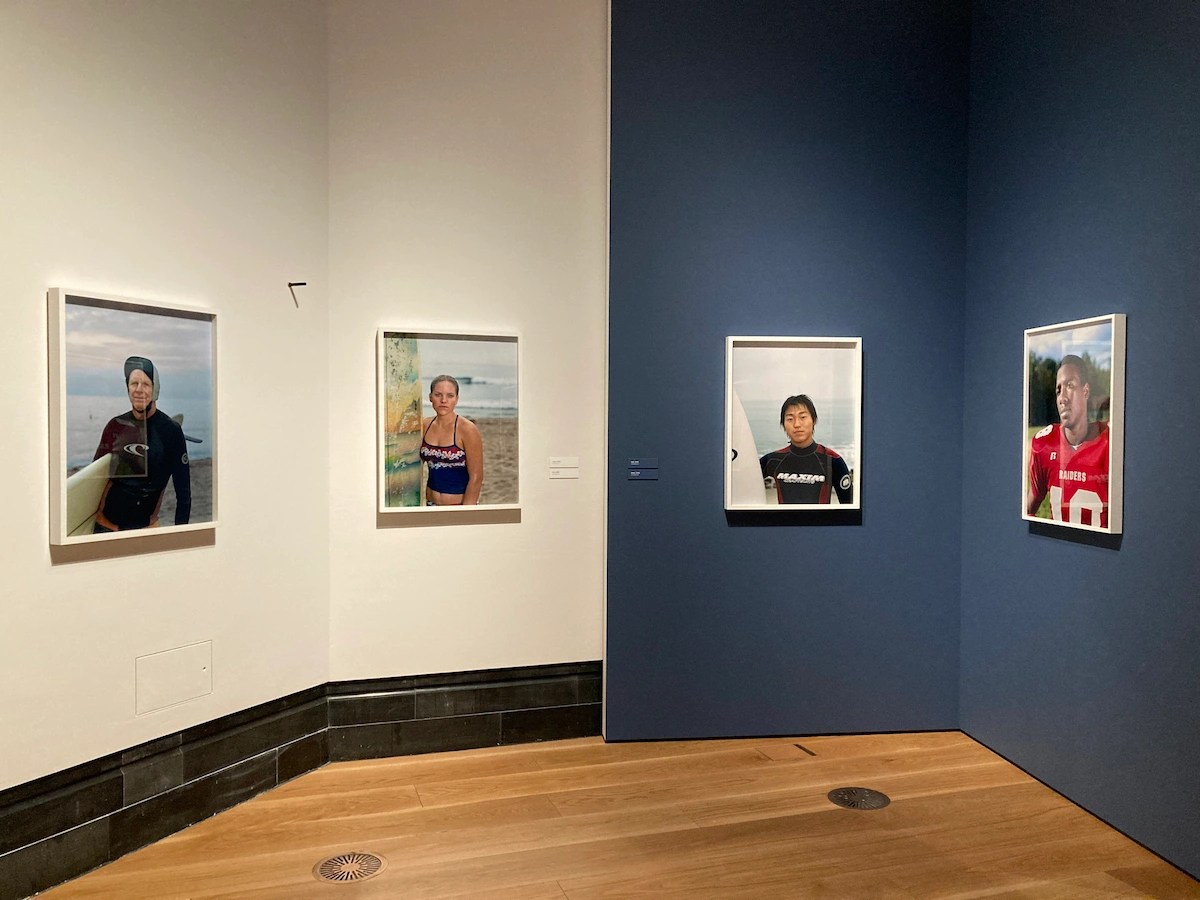
Installation view of Catherine Opie: To Be Seen @ the National Portrait Gallery, showing some of the ‘Surfing’ portraits’ (photo by the author)

In and Around home (2004)

In the early 2000s, Opie explored her Los Angeles neighbourhood and the domestic setting of her home. ‘Oliver in a Tutu’ from the series ‘In and Around Home’ depicts her son in a pink tutu in the kitchen doing laundry. This domestic scene is aligned with Opie’s politics of visibility against the backdrop of the continued homophobia within American culture at the time during the Bush era.

Oliver in a Tutu, 2004 © Catherine Opie, courtesy Regen Projects, Los Angeles; Lehmann Maupin, New York, Hong Kong, London, and Seoul; Thomas Dane Gallery

Doesn’t he look like a sweetheart! What a lovely image of everyday domestic happiness.

Children (2004)

For ‘Children’ Opie returned to the studio and to her signature highly focused portraits, this time of children set against bright solid colour backdrops.

Installation view of Catherine Opie: To Be Seen @ the National Portrait Gallery, showing some of the ‘Children portraits’ (photo by the author)

High School Football (2007-09)

From 2007 to 2009 Opie’s continued her exploration of the American landscape through the specificity of identity as it is played out on high school football fields. Opie made portraits of high school football players across several US states, vulnerable portraits of the young men counter stereotypes of athletic masculinity at a time when the US was engaged in a war with Iraq and Afghanistan.
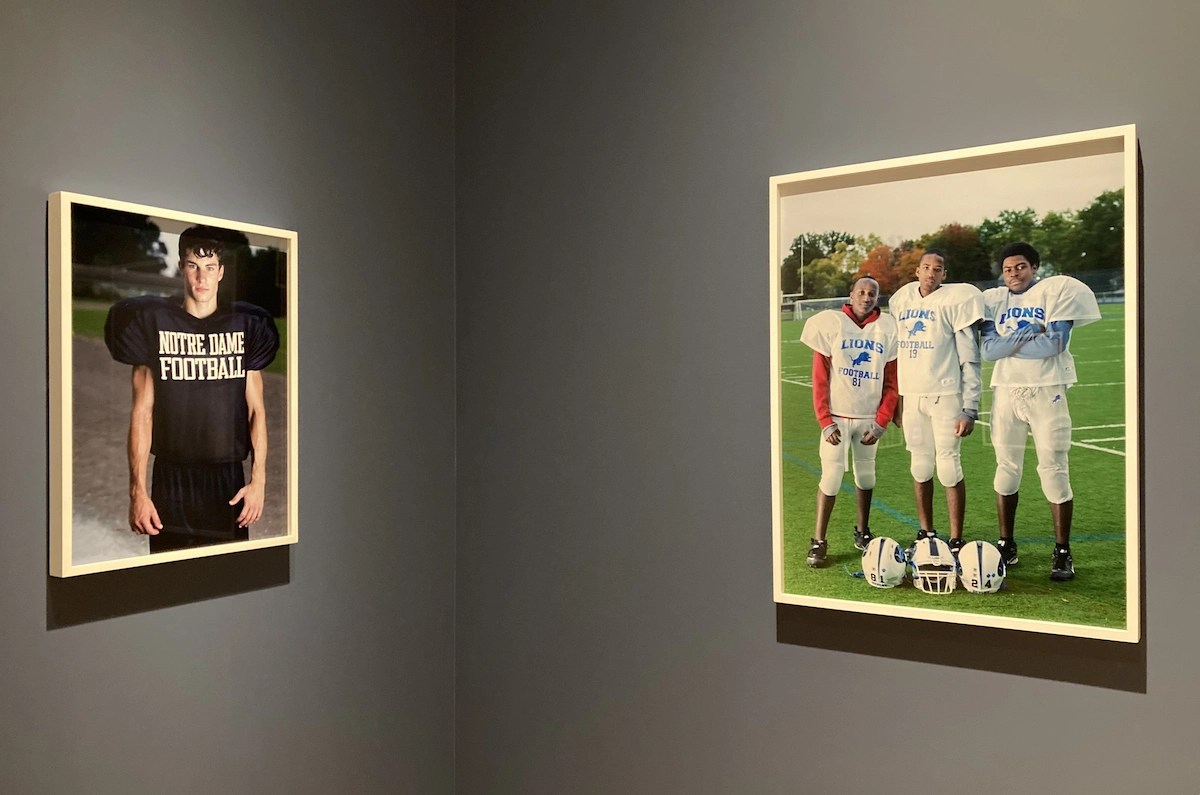
Installation view of Catherine Opie: To Be Seen @ the National Portrait Gallery, showing some of the ‘American football’ portraits (photo by the author)

Do these images subvert, interrogate or deconstruct masculinity? Ask the marines steaming towards the Gulf of Hormuz.

Girlfriends (2010)

A series of black-and-white portraits (1989-1999) which were first exhibited in 2010), the series continues Opie’s longstanding examination of the history of photography and her community in a different format.

Studio Portraits (2012–2018)

In the 2010s Opie used theatrical lighting against a black velvet backdrop to illuminate masterly and striking portraits. Allegorical elements allude to the political and spiritual concerns of art. They evoke Renaissance and Baroque painting, presenting her subjects in allegorical poses in front of black backgrounds, which remove the individuals from any sense of time or place.

Installation view of Catherine Opie: To Be Seen @ the National Portrait Gallery, showing some of the Baroque Studio Portraits (2012–2018) (photo by the author)

These portraits are characterized by highly staged, theatrical lighting against a black background, intended to create a painterly, intimate, and often allegorical quality. I haven’t mentioned that the exhibition space has been unusually designed into box-shaped rooms and corridors with, as here, the wall colour chosen to offset the images.

Walls, Windows and Blood (2023)

Opie’s photograph of Pope Francis, diminutive at his Vatican window amid the ‘constructed architecture of power’, is drawn from a body of work entitled ‘Walls, Windows and Blood’ (2023), made during a pandemic-era residency at the American Academy in Rome. The title of this portrait of the former head of the Catholic Church is a reference to the delayed papal acknowledgement of the deaths of Canada’s First Nation’s children under the church’s administration. It’s part of a small selection of images from larger locations which includes shots from President Obama’s inauguration, a Boy Scout Jubilee, and others.

Installation view of Catherine Opie: To Be Seen @ the National Portrait Gallery, showing some of the photos she took at the inauguration of President Obama on 20 January 2009 (photo by the author)

Comments

When you read the press material, the online promotion and the wall labels, you are given the impression that Opie is a radical political figure. But when you stroll from photo to photo you come to realise nothing could be further from the truth. Everything is very quiet and homely. Photos of friends, of her house and child, of other children, images of young surfers and football players, documentary images of the Obama inauguration or a handful of other mass events (a Boy Scouts Jubilee, some festival).

The more it went on, the blander it felt. The set of lesbians with moustaches is funny in a 1990s kind of way. The half dozen local children are sweet. The surfers look very wet. The footballers look fit. The friends posing against black backgrounds look very stagey.

But few if any of the images really stood out for me. Compare and contrast the vividly seedy colour photographs of the recently deceased Martin Parr to see what unnerving commentary colour photography is capable of. If you strip away the excited queer rhetoric, most of the Opie images seemed to me, well, OK, proficient enough, quite nice, meh.

In the end I thought the opening image of her breastfeeding her son was the one really standout image, and the one which had the most ‘political’, emotional and visual impact.


Related links

Related reviews

Design Discoveries: Towards a Design Museum Japan @ Japan House

For decades Japan has been well known for its stylish modern design, across all kinds of products, machines and devices, but surprisingly it has no national design museum. In recent years curators and leading designers have embarked on a project to select and research products and objects which reflect the best of Japanese design, a kind of design museum of the imagination. So far some 19 leading designers have taken part, each selecting items which demonstrate their design tastes and ideals.

This lovely FREE exhibition at Japan House in Kensington is a selection of seven of these designers, from filmmakers to architects. Each has been allotted a stand or area displaying items they would put into a permanent collection of design treasures, ranging from 5,000-year-old Jōmon pottery to bang up-to-date sportswear, from electronic musical instruments to cartoon festival figures.

Installation view of ‘Design Discoveries: Towards a Design Museum Japan’ at Japan House © Japan House (photo by Jérémie Souteyrat)

The seven displays are each accompanied by a video documenting each creator’s research process – where they went, what they saw, and explaining the design principles behind the objects they chose – produced by NHK, Japan’s equivalent of the BBC.

In the process the exhibition raises broader questions about the nature and purpose of ‘design’: What is design? What is it for? Why do we need it? How do we know when design is good or bad?

The exhibition features an entire wall where visitors can answer the question ‘What does design mean to you?’ on (stylishly designed) sheets of paper, with the pencils provided, and then stick them onto the wall. The wall was already covered with hundreds of visitor ideas and comments by the time I arrived (you can see glimpses of it in section 5 below).

Seven Japanese designers

1. Tagawa Kinya

Tagawa Kinya is a design engineer and co-founder of international design agency Takram. For his project he explored the design process of a master of Japanese product design, Yanagi Sori (1915 to 2011). Sori had a long, wide ranging and distinguished career; Tagawa chose to explore Yanagi’s design principles by examining the numerous designs he developed for his cutlery collections.

Installation view of Yanagi spoons at ‘Design Discoveries: Towards a Design Museum Japan’ showing designer spoons at Japan House (photo by the author)

I enjoyed reading Yanagi’s thoughts about ideal cutlery. According to him any imperfection in cutlery affects the palate i.e. our perception of what we’re eating. As touch is the most sensitive of the five senses it follows that cutlery we put in our mouths not have even the slightest blemish or imperfection. Which explains why his cutlery, especially the spoons on display here, are all made from single strips of metal or wood.

2. Tsujikawa Kōichirō

Tsujikawa Kōichirō is a film-maker. He chose and researched the design of wooden spinning tops from Hyōgo because ‘a toy is the first designed object a human comes into contact with’. He explored tops in the collection of the Japan Toy Museum in Himeji, Hyogo Province.

Installation view of spinning tops at ‘Design Discoveries: Towards a Design Museum Japan’ at Japan House (photo by the author)

Toys nurture a child’s five sense and the primal desires to touch, see and hear. As such, they embody design in its most basic form. Spinning tops are one of the earliest and simplest types of toy with examples being found in 6th century sites in Japan. Possibly they originated as artifacts in religious ceremonies and might have been types of talisman. Obviously now, as documented at the Japan Toy Museum, although bounded by the original circular design and spinning functionality, they come in a world of designs and patterns.

It was a shame, I thought, that we couldn’t play with them, that there was no-one demonstrating how to spin them for the entertainment of the numerous kids and toddlers who were visiting. And for big kids like me.

3. Morinaga Kunihiko

Morinaga Kunihiko is a Fashion designer who works for the ANREALAGE brand. He chose to research the tradition of haburagin clothes. These are talismanic patchwork garments which were worn over 500 years ago by the noro village priestesses from the island of Amami Oshima in Kagoshima Province. The garments are thought to have been worn by 12 and 13 year old trainees. Since both good and bad spirits were present at these rituals the patchwork composition of the haburagin clothes was meant to ward off evil spirits and protect the girls.

Installation view of a haburagin jacket and explanatory video at ‘Design Discoveries: Towards a Design Museum Japan’ at Japan House (photo by the author)

Haburagin were made from cuttings from the kimonos of many people. Habura is the local word for butterfly or moth and referred here to floating spirits of the dead. The garment was a patchwork of triangles, each representing a butterfly or moth, and hence a coat that called on the combined powers of the spirit world to protect its wearer.

Decorative futameotoshi stitching was often used for the Haburagin. The alternation between long and short stitches was thought to exorcize evil spirits. It was particularly applied to openings such as the collar and sleeves where spirits were more likely to gain entrance. As Morinaga points out, ‘The detail is small but held enormous power and significance.’

4. Sudō Reiko

Sudō Reiko is one of Japan’s most influential textile designers, now president of textile design firm Nuno Co. She chose the shirts created by the Goldwin company for the Japanese rugby team for the 2019 Rugby World Cup. These used cutting edge 3D moulding techniques in which the fabric is created three dimensionally and shaped to the players’ bodies using heat. The result is that the shirts fit the body exactly, following the contours of the body and fitting like a membrane. They are tear-resistant, dry quickly and are extremely light. Believe it or not the shirts’ designer was inspired to develop the technique from a lifelong interest in the 3D lanterns which feature in the annual Tsuwaya Yokata Andon festival in Oyabe City.

Installation view of ‘Design Discoveries: Towards a Design Museum Japan’ at Japan House showing the 2019 Rugby World Cup shirts (photo by the author)

5. Hirokawa Tamae

Hirokawa Tamae is a fashion designer. Her Skin Series used the technology of no-sew knits to produce the experience of putting on a second skin. Work from the series attracted global attention after being worn by Lady Gaga and became part of the permanent collection of the New York Museum of Modern Art (MoMa) in 2017. In 2021, she collaborated with ASICS to produce the podium jackets for the Tokyo 2020 Olympic and Paralympic Games. She chose the 700-year-old Hakata Gion Yamakasa Festival in Fukuoka.

Installation view of ‘Design Discoveries: Towards a Design Museum Japan’ at Japan House showing yamakasa decorations (photo by the author)

The Hakala Gion Yamakasa Festival has been in existence for 700 years. Hakala Gion Yamakasa is a rite centred on the Hakala district’s tutelary Kushida Shrine. It has been suggested that in a time of pestilence, the townspeople are carried the priest Shoichi Kokushi, founder of the Jotenji temple, on a dais to calm the hungry spirits by sprinkling holy water through the streets.

From this derives the word Yamakasa which describes the portable shrines carried through the streets during the festival. Some used to be as much as 16 meters tall, but the installation of overhead wiring made that impractical in the modern era and the old Yamakasa have been replaced by the enormous but stationary Kazari Yamakasa and smaller Kaki Yamakasa floats, which are still paraded through town.

The Kaki Yamakasa portable floats can still weigh as much as 1 ton and be carried by more than twenty people. The base structures are held together by joinery and hemp ropes. The decorative themes cover a broad range from traditional symbols to contemporary cartoon characters which are all carefully crafted by local doll with a new batch created each year. It’s examples of these figures and figurines which are features in the display. The wall labels explain how design, shape, subject and colouring all bear symbolic meanings.

Installation view ‘Design Discoveries: Towards a Design Museum Japan’ at Japan House showing yamakasa decorations (note the wall covered in comments left by visitors, as described above) (photo by the author)

6. Mizuguchi Tetsuya

Mizuguchi Tetsuya is an architect and ex-Sega videogame designer. He chose the ‘transacoustic piano’ designed by Shizuoka, in which an embedded speaker creates a sonic experience that can be felt through the entire body.

Installation view of ‘Design Discoveries: Towards a Design Museum Japan’ at Japan House showing the TransAcoustic Piano: note the two electronic transducers outlined in blue (photo by Jérémie Souteyrat)

In an acoustic piano, sound is normally produced by striking the strings with the hammers extending from the keys. The resulting vibrations are amplified by the soundboard. The instrument has about 230 strings and a cast-iron frame which in turn are connected to a wooden soundboard.

By contrast, the TransAcoustic Piano resonates sound with the aid of transducers, devices fitted to the soundboard to convert the audio signals into vibrations. This construction makes the whole piano resonate, creating the sensation of being enveloped by sound. It is an unique design enabling the listener to experience sound through the whole body.

7. Tane Tsuyoshi

Architect Tane Tsuyoshi chose earthenware from the Jōmon Period which sheds light on people’s daily living situations in Iwate over 10,000 years ago and how this still impacts design today.

Installation view of ‘Design Discoveries: Towards a Design Museum Japan’ at Japan House showing 5,000-year-old artifacts from Jamon Village © Japan House (photo by Jérémie Souteyrat)

The Goshono Jamon Museum is part of the Goshono archaeological site, in the city of lchinohe, Iwate prefecture. Excavations there commenced in 1989 and revealed the first-known Jamon Period mud-roofed pit-houses in Japan. The remains of more than 800 pit-houses have been found so far.

At the museum they’ve reconstructed a dozen or so mud-roofed pit-houses as scholars think they would have looked. As people made the shift from the nomadic lifestyle to fixed settlements they developed designs that gave concrete shape to the soil, fire and other vital resources. The Jamon people designed based on a ring system. The structure of village society was a ring and for over 800 years other huts were added to the central ring.

The display includes anthropomorphic clay figurines (dogū) and earthenware vessels from 5,000 years ago, roughly contemporary with Stonehenge. Fascinating.

Summary

From state of the art musical instruments and cutting edge sports kit through to ancient villages and religious figurines, the exhibition is light and airy but has tremendous range. Above all, like the brilliant Ainu people exhibition which preceded it, this exhibition gives you a real sense of the astonishing diversity of peoples and traditions who inhabit the place most of us in the West thing of us as simply ‘Japan’. They reveal that ‘Japan’ is a whole cultural world of its own.

Map

Map of Japan showing locations of the seven designers’ chosen objects.

Map of Japan showing the locations of the seven design projects featured at ‘Design Discoveries: Towards a Design Museum Japan’ at Japan House © Japan House (photo by Jérémie Souteyrat)

Last call

It’s FREE. It’s beautiful, elegant and fascinating. Take the Tube to High Street Kensington, turn right and it’s less than a hundred yards away. Simple as spinning a top.

Installation view of ‘Design Discoveries: Towards a Design Museum Japan’ at Japan House showing colourfully-designed whipping tops © Japan House (photo by Jérémie Souteyrat)


Related link

Related reviews