Hyakkō: 100+ Makers from Japan @ Japan House

Like all Japan House exhibitions, Hyakkō is beautifully laid out, designed and explained. It is a celebration of Japan’s contemporary arts and craft landscape, meaning it is an assembly of over 2,000 items – teapots, bowls, cups and mugs, plates and cutlery, made from materials such as clay, glass, wood, leather, bamboo and raffia, bronze, iron and steel – humble everyday objects but beautifully designed and handmade by 123 Japanese craftspeople.

Part of the display in ‘Hyakkō: 100+ Makers from Japan’ @ Japan House (photo by the author)

How can you fit so many objects into the relatively small exhibition space under Japan House (the Japan House gallery space is downstairs from the main shop which is just 50 yards from Kensington High Street tube station)?

You can fit them all in because 1) they are all relatively small, some of them very small – and 2) by arranging them tastefully and beautifully and compactly, in clusters or sets of pieces by each of the 120 or so designers.

Showing how pieces are grouped by maker in ‘Hyakkō: 100+ Makers from Japan’ @ Japan House (photo by the author)

The exhibition derives from the quest by its curator, Nagata Takahiro, to investigate the state of contemporary craft in Japan, a quest which took her to all parts of the country and to meet over 120 craftspeople. And hence the title. Hyakkō literally means ‘a hundred makers’ but can be taken metaphorically to mean ‘lots of makers’. This is an exhibition of ‘lots of [contemporary Japanese] makers’.

History and context

Japan has long been associated with a rich culture of craft, with many practices such as urushi (lacquerware) and metalwork being passed down through generations, often as the result of strict apprenticeships. Historically, the expensive products of many of these more formal crafts were out of reach for most and were often created more as objects to be admired rather than to actually be used.

In the 1920s, the mingei (folk craft) movement turned people’s attention to the crafts of the people, focusing on the beauty of hand-crafted, utilitarian objects. Integral to this philosophy was the perceived anonymity of the craftspeople – the emphasis being on the item rather than its maker.

Bronzeware by Urukami Yōsuke in ‘Hyakkō: 100+ Makers from Japan’ @ Japan House (photo by the author)

Philosophy

As always at Japan House, there’s some Zen-flavoured philosophy, this time concerning the making of pots and bowls and plates. The wise words of four leading designers are quoted at length in wall posters. Why?

The Japanese word kōgei (‘craft’) spans a wide range of contexts, including Mingei (‘folk craft’), antiques, art and design. Its depth is immeasurable and even among makers it is not uncommon to pause and ask, ‘What does this term truly mean?’

Hence the thoughts on the subject of the four leading figures, namely:

  • Kurata Takashi, philosopher
  • Nakamura Masahiro, Assistant Professor of Design
  • Nakamura Yuta, Artist
  • Sakamoto Dai, Gallerist

Nearby, in the entrance foyer, there’s a list of 32 Japanese terms which are applied to native crafts, first the Japanese word and then a paragraph-length explanation of its meaning.

The wall of terms in ‘Hyakkō: 100+ Makers from Japan’ @ Japan House (photo by the author)

Here are a few to give you a flavour:

tsukurite: maker: a maker is someone who engages directly with materials and shapes them with their hands. This term includes not only artists but artisans and craftspeople whose lives and relationships with the land are reflected in their work.

fukanzensa: imperfection: in Japanese craftsmanship and aesthetics, beauty and richness are felt more in imperfection than perfection. The irregularities of natural materials and handcrafted work are valued for their uniqueness, stimulating the user’s imagination and affection for the object.

shizukesa: more than simply the absence of sound, shizukesa conveys a sense of clarity and composure. the serenity felt in a Japanese garden or tea room highlights the beauty of objects and spaces, linking spiritual fulfilment with aesthetic experience.

dezain: design: more than the refining of form or function, design generates new value and relationships in daily life and society as a whole. In Japan, design has historically prioritised an approach that harnesses the inherent properties of materials and seeks harmony between people and nature, rather than focusing solely on decoration or superficiality. It has developed through the integration of craft and architecture in everyday life.

And at the end of the foyer a wall-sized bookshelf housing 45 or so lovely hardback art books covering various aspects of the crafts or individual designers.

Bookshelves containing some 45 books about Japanese craft in ‘Hyakkō: 100+ Makers from Japan’ @ Japan House (photo by the author)

The pieces

All very enlightening but the point is the objects themselves and these are exquisite, wonderful. Who knew there could be quite so many types and styles and designs and materials for making plates, bowls, cups and mugs, glasses and cutlery?

The grouping by designer allows 6 to 10 pieces per person and this turns out to be just enough to showcase more than just a technique but an entire worldview in miniature.

Iwata Tetsuhiro

Clayware by Iwata Tetsuhiro in ‘Hyakkō: 100+ Makers from Japan’ @ Japan House (photo by the author)

Okihara Saya

Wooden cutlery by Okihara Saya in ‘Hyakkō: 100+ Makers from Japan’ @ Japan House (photo by the author)

Nishikawa Satoshi

Bowls and teapots by Nishikawa Satoshi in ‘Hyakkō: 100+ Makers from Japan’ @ Japan House (photo by the author)

Isihara Toshihisa

Comic figures by Isihara Toshihisa in ‘Hyakkō: 100+ Makers from Japan’ @ Japan House (photo by the author)

Sasakawa Kenichi

Glassware by Sasakawa Kenichi in ‘Hyakkō: 100+ Makers from Japan’ @ Japan House (photo by the author)

Abe Hitomi

Stones wrapped in bamboo by Abe Hitomi in ‘Hyakkō: 100+ Makers from Japan’ @ Japan House (photo by the author)

Seki Kenichi

Lacquerware by Seki Kenichi in ‘Hyakkō: 100+ Makers from Japan’ @ Japan House (photo by the author)

Yoshikawa Kazuto

Plates and spoons by Yoshikawa Kazuto in ‘Hyakkō: 100+ Makers from Japan’ @ Japan House (photo by the author)

Otani Tetsuna

Ceramics by Otani Tetsuna in ‘Hyakkō: 100+ Makers from Japan’ @ Japan House (photo by the author)

Tokuda Masami

Vases made from raw wood by Tokuda Masami in ‘Hyakkō: 100+ Makers from Japan’ @ Japan House (photo by the author)

Yamada Yōji

Patterned bowls by Yamada Yōji in ‘Hyakkō: 100+ Makers from Japan’ @ Japan House (photo by the author)

Hidaka Naoko

Decorated ceramics by Hidaka Naoko in ‘Hyakkō: 100+ Makers from Japan’ @ Japan House (photo by the author)

Ninjō Ikkei

Astonishingly smooth and gracefully bowls by Ninjō Ikkei in ‘Hyakkō: 100+ Makers from Japan’ @ Japan House (photo by the author)

Moriguchi Shinichi

Thrillingly ribbed wooden trays by Moriguchi Shinichi in ‘Hyakkō: 100+ Makers from Japan’ @ Japan House (photo by the author)

Jōji Yoshimichi

Beautifully moulded and frilled bowls by Jōji Yoshimichi in ‘Hyakkō: 100+ Makers from Japan’ @ Japan House (photo by the author)

Merch

Works from over 30 of the featured makers are available to buy in the shop on the ground floor. They’re expensive, of course, but they’re exquisite. The risk is that, once you’d loosened your wallet, you wouldn’t be able to stop.

Worlds of exquisiteness in ‘Hyakkō: 100+ Makers from Japan’ @ Japan House (photo by the author)


Related links

Related reviews

Tirzah Garwood: Beyond Ravilious @ Dulwich Picture Gallery

This is a lovely, lovely, heart-warming, domestic, very English and quietly strange and wonderful exhibition.

Context

Many art lovers have heard of the English printmaker Eric Ravilious (1903 to 1942) and would certainly recognise his work if they saw it. You can buy umpteen books of his art as well as calendars, jigsaws and all the usual merch.

Quite a lot less well-known is the life and career of Ravilious’s wife, Tirzah Garwood (1908 to 1951). This beautiful exhibition at Dulwich Picture Gallery aims to correct this oversight and to establish Garwood as an artist, designer and printmaker in her own right.

This is the first retrospective ever dedicated to Garwood, bringing together lots of works held in private collections to reveal the full extent of her small but diverse output. It provides a rare opportunity to view more than 80 of Garwood’s works, including most of her existing oil paintings, almost all of which are drawn from private collections. As they so often say, it really is a once-in-a-lifetime opportunity o see all these works together in one place, and to see many of them at all.

Biography

Born Eileen Lucy Garwood, she was nicknamed ‘Tirzah’ when her two older siblings misheard ‘Tertia’ (or ‘the third’ child) and the nickname suited her lively, unconventional character. When she was sixteen Garwood attended the Eastbourne School of Art where Ravilious was a tutor and taught her wood engraving. Her career falls into four or so parts, or has four components or media she worked in.

Early wood prints

First, under the influence of Ravilious, she was a talented woodprint maker. A quick learner, Garwood was soon exhibiting with The Society of Wood Engravers. The works in show here include amusing prints to illustrate calendars plus sets depicting her family, a recurring subject. One series includes a comic depiction of Ravilious as a gangster in a marrow patch and a middle-aged lady whose fallen asleep in a chair while reading a book.

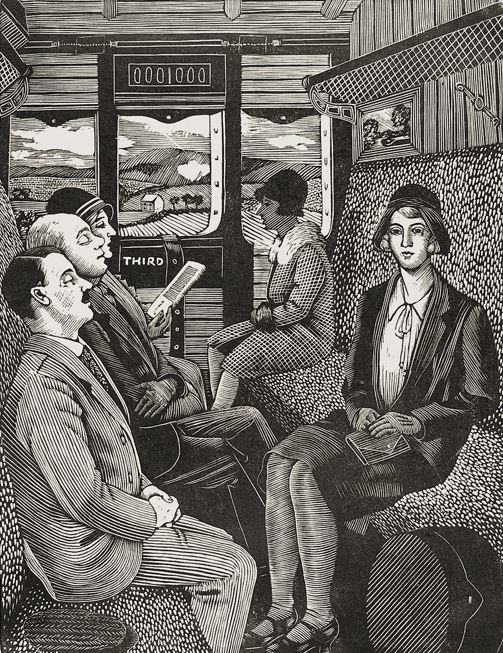
‘Train Journey’ by Tirzah Garwood (1929) wood engraving, 1929. Private collection

But her career doing this was relatively brief, from 1927 or so until, in 1930, she married Ravilious. In 1931 the couple moved to rural Essex, at first lodging with artist friends Edward Bawden and his wife Charlotte in the village of Great Bardfield. The couple moved into their own house and had three babies in quick succession, John, James, and Anne.

Garwood found herself the mother of three small children and having to do almost all the household management herself. The result was to put her woodprint work on hold and she never really returned to it, something she later regretted.

Marbled paper

Instead, she was inspired by Charlotte Bawden to experiment with marbled paper and became an expert at this specialised technique, gaining a growing artistic and commercial reputation which saw her commissioned to create her unique designs for book publishers, interior design shops and private clients. According to the curators she pioneered a distinctive decorative style, layering delicate repeat patterns to create harmonious designs that were unlike anything being made in Europe.

Here style chimed with the 1930s resurgence in arts-and-crafts interiors and Garwood fulfilled orders of fifty or more papers at a time for London design shops, publishers and private clients, making special curved designs for lampshades and becoming adept at cutting and pasting papers for specific decorative needs.

As you walk into the second room of the show you pass between three big examples of these abstract marbled designs on either side of you and the effect is magical. Who would have thought that patterned papers could be so wonderful, entrancing and lovely.

Four of the 12 marbled paper designs in ‘Tirzah Garwood: Beyond Ravilious’ at Dulwich Picture Gallery (photo by the author)

Trauma and autobiography

In 1942 Garwood experienced two life-changing events. In March she had a mastectomy for breast cancer, then 6 months later, Ravilious was killed while on active service as a war artist. The same year she began writing what would become her autobiography, published as Long Live Great Bardfield.

Oil paintings

At the same time she developed a wonderfully distinctive style of oil painting. She adopted a deliberately naive, direct style with a pronounced on traditional children’s toys, creating works that are straightforward yet strange. A series of paintings show a sophisticated creative mind at play, including highlights Horses and Trains (1944), Etna (1944) and, slightly later, The Old Soldier (1947).

‘Etna’ (the name of the old Victorian toy train) by Tirzah Garwood (1944) Oil on canvas. Image courtesy of Fleece Press/Simon Lawrence

House models

In 1946 Garwood married BBC Producer Henry Swanzy and around the time developed a new genre, house models. These three-dimensional paper and card constructions were inspired by the kind of things her children were making at school, but also influenced by the post-war Pictures for Schools exhibitions.

They are 3D models but stylised so as to be only a couple of inches deep. One of the wall labels explains that they are housed in butterfly display cases i.e. wooden frames with glass covers but only 2 inches or so deep. This allowed her to perfect a style of doing shallow models of houses, which give a stylised impression of depth. There are about 10 of these in the exhibition and they are all wonderful. They have a lovely charming handmade amateurish feel about them. They incorporate disparate elements such as paper, fabrics, lace, corduroy, cardboard and even filigree metalwork, along with bits cut out of magazines.

‘Baker’s Shop in Daren’ by Tirzah Garwood (1946) in the bottom third window pane you can just see a little girl asking the baker to buy a bun (photo by the author)

The ‘best’ one might be the elaborate model of a village baker’s shop, with tiny model loaves and buns in the window and, just visible inside, a small depiction of her daughter asking the baker to buy a bun. The others are of different designs of houses and front gardens, presumably based on models from the villages round her in Essex. My (bad) photo might give the impression that this is a flat painting but in fact, if you removed the glass, you’d be able to put your hands into the model, move the model loaves and buns around in the window or rehang the bunting at the top left. It’s a two-and-a-half D model.

One of them has a little stream running between the front fence and the house itself, represented by a little inch wide strip of fabric with little model ducks attached to it. This had been constructed so that there’s a little handle sticking out the front of the box and if you turn the handle, the stream-strip moves along, giving the impressions of ducks moving on the water.

These like everything else in the exhibition, the house models convey a lovely sense of a quiet, unspoilt rural England, not only innocent in itself, but seen from a child’s point of view, seen from the point of view of her three young children.

Last room, last works

In 1948 Garwood’s cancer returned and by the summer of 1950 she was increasingly confined to bed. In the last year or so of her life she painted works which excelled in a kind of quiet understated mystery, brightly coloured but odd visions of nature, Victorian toys and dolls’ house set amid flowers and insects.

The curators have made the simple but excellent decision to fill the final room with 16 of these small but powerful and strange oil paintings. As you progress round them, you feel yourself entering a wonderful, strange and mysterious zone.

‘Hornet and Wild Rose’ by Tirzah Garwood (1950) Oil on canvas. Towner Art Gallery, Eastbourne. Image courtesy of Fleece Press/Simon Lawrence

The style owes something to the tradition of ‘naive’ painting which grew up in the twentieth century alongside the loud gimmicks of modernism, but mixed with her interest in antique Victorian toys and dolls, and then something else again – a quirky interest in the small-scale world of insects among the flowers and grass. ‘Surrealism’ like any other art history label is too strong to convey the subtle blend of flavours and styles which make these last works so calm, quiet and mysterious.

For me the best work in the show was ‘Hide and Seek’ from her last year. This doesn’t have the spooky model trains or dolls which feature in so many of the other last paintings. What it does have is a fuzzy blurred effect of the paint which makes it wonderfully entrancing and mysterious. You feel yourself drawn in, partly to find all the children who are hiding in it (can you see all of them?) but then to be drawn deeper into something else, some deeper mystery of gardens and childhood and lost magic.

‘Hide and Seek’ by Tirzah Garwood (1950) Private collection

Should they have included Ravilious?

Tirzah’s (first) husband, Eric Ravilious, was far better known in their lifetimes and his light and airy, cartoon-style depictions of the rolling southern countryside have gone on to adorn any number of calendars, posters books and so on. He is arguably a bit over-exposed. This isn’t a major criticism at all, just a thought, but I wondered whether it was wise of the curators to include no fewer than ten Ravilious pictures in this exhibition.

I can see why. They place them next to paintings of the same subject by Garwood, to show how they influenced each other and, in a couple of instances, to try and prove that Garwood, the younger artist, the female artist, at one stage his student, nonetheless influenced his ideas about composition. Well and good.

But any Ravilious picture tends to dominate the room it’s in, bathes the eye and mind in a soothing bubble bath of niceness, loveliness and reassurance. So I’m not sure it was such a good idea to include quite so many alongside the Garwood pictures. They inevitably distract you. Garwood isn’t so immediately accessible. Her works – whether prints, oil paintings or house models – are more quirky and flavoursome, it takes a bit more effort to acquire their strange taste.

This is another reason I said I liked the way the last room was devoted solely to her last oil paintings. Partly because, taken together, they powerfully convey a strange and mysterious world. But also, it’s a relief that this last room doesn’t contain any Ravilious works because they would have been too light and easy, would have punctured the dark strangeness of her mysterious world.

Other elements

– There’s a display case showing photos of her and Ravilious, which also contains some wonderful sketches she did of her small children.

– There are two portraits of Garwood, one by Phylis Dodd, one by Duffy Ayers.

– And in the mausoleum space which separates the two runs of galleries, loudspeakers project extensive passages from her autobiography, ‘Long Live Great Bardfield’, read by the actress Tamsyn Greig.

It’s a really beautifully holistic show which gives you a very strong flavour of all aspects of Garwood life and output, and soaks you in the calm and understated, but all the more beautiful and moving magic of her imagination. I didn’t think I’d especially like it but the longer I stayed, the more entranced I became, and I’m going to definitely go back for a second visit before it closes, probably during the Christmas holidays because it felt like such a lovely treat.

The promotional video


Related link

Related reviews

Design Discoveries: Towards a Design Museum Japan @ Japan House

For decades Japan has been well known for its stylish modern design, across all kinds of products, machines and devices, but surprisingly it has no national design museum. In recent years curators and leading designers have embarked on a project to select and research products and objects which reflect the best of Japanese design, a kind of design museum of the imagination. So far some 19 leading designers have taken part, each selecting items which demonstrate their design tastes and ideals.

This lovely FREE exhibition at Japan House in Kensington is a selection of seven of these designers, from filmmakers to architects. Each has been allotted a stand or area displaying items they would put into a permanent collection of design treasures, ranging from 5,000-year-old Jōmon pottery to bang up-to-date sportswear, from electronic musical instruments to cartoon festival figures.

Installation view of ‘Design Discoveries: Towards a Design Museum Japan’ at Japan House © Japan House (photo by Jérémie Souteyrat)

The seven displays are each accompanied by a video documenting each creator’s research process – where they went, what they saw, and explaining the design principles behind the objects they chose – produced by NHK, Japan’s equivalent of the BBC.

In the process the exhibition raises broader questions about the nature and purpose of ‘design’: What is design? What is it for? Why do we need it? How do we know when design is good or bad?

The exhibition features an entire wall where visitors can answer the question ‘What does design mean to you?’ on (stylishly designed) sheets of paper, with the pencils provided, and then stick them onto the wall. The wall was already covered with hundreds of visitor ideas and comments by the time I arrived (you can see glimpses of it in section 5 below).

Seven Japanese designers

1. Tagawa Kinya

Tagawa Kinya is a design engineer and co-founder of international design agency Takram. For his project he explored the design process of a master of Japanese product design, Yanagi Sori (1915 to 2011). Sori had a long, wide ranging and distinguished career; Tagawa chose to explore Yanagi’s design principles by examining the numerous designs he developed for his cutlery collections.

Installation view of Yanagi spoons at ‘Design Discoveries: Towards a Design Museum Japan’ showing designer spoons at Japan House (photo by the author)

I enjoyed reading Yanagi’s thoughts about ideal cutlery. According to him any imperfection in cutlery affects the palate i.e. our perception of what we’re eating. As touch is the most sensitive of the five senses it follows that cutlery we put in our mouths not have even the slightest blemish or imperfection. Which explains why his cutlery, especially the spoons on display here, are all made from single strips of metal or wood.

2. Tsujikawa Kōichirō

Tsujikawa Kōichirō is a film-maker. He chose and researched the design of wooden spinning tops from Hyōgo because ‘a toy is the first designed object a human comes into contact with’. He explored tops in the collection of the Japan Toy Museum in Himeji, Hyogo Province.

Installation view of spinning tops at ‘Design Discoveries: Towards a Design Museum Japan’ at Japan House (photo by the author)

Toys nurture a child’s five sense and the primal desires to touch, see and hear. As such, they embody design in its most basic form. Spinning tops are one of the earliest and simplest types of toy with examples being found in 6th century sites in Japan. Possibly they originated as artifacts in religious ceremonies and might have been types of talisman. Obviously now, as documented at the Japan Toy Museum, although bounded by the original circular design and spinning functionality, they come in a world of designs and patterns.

It was a shame, I thought, that we couldn’t play with them, that there was no-one demonstrating how to spin them for the entertainment of the numerous kids and toddlers who were visiting. And for big kids like me.

3. Morinaga Kunihiko

Morinaga Kunihiko is a Fashion designer who works for the ANREALAGE brand. He chose to research the tradition of haburagin clothes. These are talismanic patchwork garments which were worn over 500 years ago by the noro village priestesses from the island of Amami Oshima in Kagoshima Province. The garments are thought to have been worn by 12 and 13 year old trainees. Since both good and bad spirits were present at these rituals the patchwork composition of the haburagin clothes was meant to ward off evil spirits and protect the girls.

Installation view of a haburagin jacket and explanatory video at ‘Design Discoveries: Towards a Design Museum Japan’ at Japan House (photo by the author)

Haburagin were made from cuttings from the kimonos of many people. Habura is the local word for butterfly or moth and referred here to floating spirits of the dead. The garment was a patchwork of triangles, each representing a butterfly or moth, and hence a coat that called on the combined powers of the spirit world to protect its wearer.

Decorative futameotoshi stitching was often used for the Haburagin. The alternation between long and short stitches was thought to exorcize evil spirits. It was particularly applied to openings such as the collar and sleeves where spirits were more likely to gain entrance. As Morinaga points out, ‘The detail is small but held enormous power and significance.’

4. Sudō Reiko

Sudō Reiko is one of Japan’s most influential textile designers, now president of textile design firm Nuno Co. She chose the shirts created by the Goldwin company for the Japanese rugby team for the 2019 Rugby World Cup. These used cutting edge 3D moulding techniques in which the fabric is created three dimensionally and shaped to the players’ bodies using heat. The result is that the shirts fit the body exactly, following the contours of the body and fitting like a membrane. They are tear-resistant, dry quickly and are extremely light. Believe it or not the shirts’ designer was inspired to develop the technique from a lifelong interest in the 3D lanterns which feature in the annual Tsuwaya Yokata Andon festival in Oyabe City.

Installation view of ‘Design Discoveries: Towards a Design Museum Japan’ at Japan House showing the 2019 Rugby World Cup shirts (photo by the author)

5. Hirokawa Tamae

Hirokawa Tamae is a fashion designer. Her Skin Series used the technology of no-sew knits to produce the experience of putting on a second skin. Work from the series attracted global attention after being worn by Lady Gaga and became part of the permanent collection of the New York Museum of Modern Art (MoMa) in 2017. In 2021, she collaborated with ASICS to produce the podium jackets for the Tokyo 2020 Olympic and Paralympic Games. She chose the 700-year-old Hakata Gion Yamakasa Festival in Fukuoka.

Installation view of ‘Design Discoveries: Towards a Design Museum Japan’ at Japan House showing yamakasa decorations (photo by the author)

The Hakala Gion Yamakasa Festival has been in existence for 700 years. Hakala Gion Yamakasa is a rite centred on the Hakala district’s tutelary Kushida Shrine. It has been suggested that in a time of pestilence, the townspeople are carried the priest Shoichi Kokushi, founder of the Jotenji temple, on a dais to calm the hungry spirits by sprinkling holy water through the streets.

From this derives the word Yamakasa which describes the portable shrines carried through the streets during the festival. Some used to be as much as 16 meters tall, but the installation of overhead wiring made that impractical in the modern era and the old Yamakasa have been replaced by the enormous but stationary Kazari Yamakasa and smaller Kaki Yamakasa floats, which are still paraded through town.

The Kaki Yamakasa portable floats can still weigh as much as 1 ton and be carried by more than twenty people. The base structures are held together by joinery and hemp ropes. The decorative themes cover a broad range from traditional symbols to contemporary cartoon characters which are all carefully crafted by local doll with a new batch created each year. It’s examples of these figures and figurines which are features in the display. The wall labels explain how design, shape, subject and colouring all bear symbolic meanings.

Installation view ‘Design Discoveries: Towards a Design Museum Japan’ at Japan House showing yamakasa decorations (note the wall covered in comments left by visitors, as described above) (photo by the author)

6. Mizuguchi Tetsuya

Mizuguchi Tetsuya is an architect and ex-Sega videogame designer. He chose the ‘transacoustic piano’ designed by Shizuoka, in which an embedded speaker creates a sonic experience that can be felt through the entire body.

Installation view of ‘Design Discoveries: Towards a Design Museum Japan’ at Japan House showing the TransAcoustic Piano: note the two electronic transducers outlined in blue (photo by Jérémie Souteyrat)

In an acoustic piano, sound is normally produced by striking the strings with the hammers extending from the keys. The resulting vibrations are amplified by the soundboard. The instrument has about 230 strings and a cast-iron frame which in turn are connected to a wooden soundboard.

By contrast, the TransAcoustic Piano resonates sound with the aid of transducers, devices fitted to the soundboard to convert the audio signals into vibrations. This construction makes the whole piano resonate, creating the sensation of being enveloped by sound. It is an unique design enabling the listener to experience sound through the whole body.

7. Tane Tsuyoshi

Architect Tane Tsuyoshi chose earthenware from the Jōmon Period which sheds light on people’s daily living situations in Iwate over 10,000 years ago and how this still impacts design today.

Installation view of ‘Design Discoveries: Towards a Design Museum Japan’ at Japan House showing 5,000-year-old artifacts from Jamon Village © Japan House (photo by Jérémie Souteyrat)

The Goshono Jamon Museum is part of the Goshono archaeological site, in the city of lchinohe, Iwate prefecture. Excavations there commenced in 1989 and revealed the first-known Jamon Period mud-roofed pit-houses in Japan. The remains of more than 800 pit-houses have been found so far.

At the museum they’ve reconstructed a dozen or so mud-roofed pit-houses as scholars think they would have looked. As people made the shift from the nomadic lifestyle to fixed settlements they developed designs that gave concrete shape to the soil, fire and other vital resources. The Jamon people designed based on a ring system. The structure of village society was a ring and for over 800 years other huts were added to the central ring.

The display includes anthropomorphic clay figurines (dogū) and earthenware vessels from 5,000 years ago, roughly contemporary with Stonehenge. Fascinating.

Summary

From state of the art musical instruments and cutting edge sports kit through to ancient villages and religious figurines, the exhibition is light and airy but has tremendous range. Above all, like the brilliant Ainu people exhibition which preceded it, this exhibition gives you a real sense of the astonishing diversity of peoples and traditions who inhabit the place most of us in the West thing of us as simply ‘Japan’. They reveal that ‘Japan’ is a whole cultural world of its own.

Map

Map of Japan showing locations of the seven designers’ chosen objects.

Map of Japan showing the locations of the seven design projects featured at ‘Design Discoveries: Towards a Design Museum Japan’ at Japan House © Japan House (photo by Jérémie Souteyrat)

Last call

It’s FREE. It’s beautiful, elegant and fascinating. Take the Tube to High Street Kensington, turn right and it’s less than a hundred yards away. Simple as spinning a top.

Installation view of ‘Design Discoveries: Towards a Design Museum Japan’ at Japan House showing colourfully-designed whipping tops © Japan House (photo by Jérémie Souteyrat)


Related link

Related reviews

The Rossettis @ Tate Britain

This is a spectacular exhibition, by turns absorbing, inspiring, fascinating and deeply educational about the individuals, their lives and their times. Not all the work on display is good, some is positively poor, but there are good things throughout, and it’s huge – featuring over 150 paintings and drawings as well as photography, design, wallpapers, furniture, rare books, printed and spoken poetry and more. And then, in the last few rooms, it turns into a spectacular celebration of Dante Gabriel Rossetti’s huge, sumptuous paintings of stunning pre-Raphaelite women, an orgy of masterpieces to leave you reeling. More than just an exhibition it feels like a sustained immersion in their lives and times.

I thought the exhibition might disintegrate into a general splurge about the extended network of artists and models which made up the Pre-Raphaelite Brotherhood – surely, the most written-about subject in British art – the gift shop is heaving with books about the Pre-Raphaelites.

But I was wrong. The exhibition remains very, very focused on the Rossetti family and, above all, on the favoured son, Gabriel. (Only in adult life did Gabriel move his middle name, Dante, to the front of his three names – maybe partly to catch up with triple-barrelled friends like John Everett Millais and William Holman Hunt – but the curators refer to him as Gabriel throughout and so shall I.)

Firsts

Tate owns a lot of Pre-Raphaelite paintings and drawings so it’s surprising to learn that this is the first retrospective of Rossetti ever held at Tate, and the largest exhibition of his iconic pictures in two decades. Less surprising to learn that this is also the most comprehensive exhibition of Elizabeth Siddal’s work for 30 years, featuring rare watercolours and important drawings, because most of us have never hear of her.

The rooms devoted to them show how Gabriel and Elizabeth’s relationship and works intertwined and reflected each other. If you like reading about the lives of great artists, then this deep dive into biographical minutiae will be right up your street.

Immigrants

First of all, they were immigrants. Gabriele Rossetti (1783 to 1854) arrived in London in 1824, as a political refugee from Italy. More than that he was an Italian nobleman, poet, constitutionalist, scholar, and founder of the secret society, the Carbonari. A noted Dante scholar he secured the post of Professor of Italian at King’s College London from 1831 as well as teaching Italian at King’s College School. He and his wife Frances Polidori Rossetti had four children, two sons and two daughters. Raised in a home drenched in poetry and literature, all four children went on to become artists or writers in their own right. They were: the writer Maria Francesca Rossetti (1827 to 76); poet, artist and designer Gabriel Charles Dante Rossetti (1828 to 1882); artist and critic William Michael Rossetti (1829 to 1919); and poet Christina Rossetti (1830 to 1894).

The curators add into this gang of four the figure of Elizabeth Siddal, model, artist and poet, who posed for many of the Pre-Raphaelites (most famously as Ophelia in the classic painting by John Everett Millais) but who enjoyed a lengthy relationship with Gabriel, in which they drew and painted the same subjects, copying and learning from each other. They married in 1860 at which point she became Elizabeth Rossetti and this, from a naming point of view, justifies her inclusion in the exhibition.

Christina Rossetti

The curators do something genuinely bold and interesting which is to start a major art exhibition with a room devoted almost entirely to poetry. Never seen that before. They are mostly by Christina Rossetti and are not only printed directly onto the walls in very large font size but, if you stand in places marked by signs on the floor, you can hear the poems being recited by what must be very cleverly focused loudspeakers, which seem to be addressing you and you alone.

Installation view of ‘The Rossettis’ at Tate Britain, showing Room One which features just three paintings because it is devoted to the poetry of Christina Rossetti, which are reproduced on all the walls. Photo by Madeleine Buddo © Tate

All four Rossetti children were artistic and wrote and drew from early ages, but it was Christina who had the earliest success, having a volume of 42 poems published when she was just 16, some of which were written when she was as young as 11!

Remember by Christina Rossetti

Remember me when I am gone away,
Gone far away into the silent land;
When you can no more hold me by the hand,
Nor I half turn to go yet turning stay.
Remember me when no more day by day
You tell me of our future that you plann’d:
Only remember me; you understand
It will be late to counsel then or pray.
Yet if you should forget me for a while
And afterwards remember, do not grieve:
For if the darkness and corruption leave
A vestige of the thoughts that once I had,
Better by far you should forget and smile
Than that you should remember and be sad.

This bold start does two things. One, it fulfils Tate’s feminist aims of promoting women, bringing women out from the shadow of more famous men, giving women more of a voice etc (as the promotion of Elizabeth Siddal later in the show also does). Two, it vividly demonstrates the extraordinary combination of sensitivity and sensuality which, arguably, were to be distinguishing features of the family, and especially the arch-sensualist, Gabriel.

Christina’s talent peaked with the volume containing her most famous poem, Goblin Market, of 1859. During her career she published over 900 poems, a phenomenal output. Taking five minutes to read all the works written on the walls here, and let them alter and direct your thoughts towards her strange combination of Victorian piety, with astonishing sensuality, is a rare and lovely experience.

Early sketches

The narrow but scholarly depth of the exhibition’s focus is established in the second room which contains 30 or so very early drawings and sketches by the boy Gabriel, alongside some by his sister, and two by his brother William. They demonstrate his precocious skill and his enthusiasm for original voices like William Blake and Edgar Allan Poe. Gabriel was an early devotee of the small cult of Blake, who didn’t become widely known until the 1860s. And he did numerous illustrations of Edgar Allen Poe stories and poems, notably The Raven.

The Raven by Dante Gabriel Rossetti (1848) © Victoria and Albert Museum, London

These are very uneven: some have great verve but many of them are cranky and cramped. So I suppose the idea of a progression of beautiful young girl ghosts, on the left, is well done, but nothing about the figure on the right is good, his tangled legs, the odd posture of his hands. But they’re all very interesting in a dry, scholarly way. You rarely get to see the early beginnings of a major painter in such detail and for this reason alone I found myself taking the time to study each of the sketches. I liked two sketches drawn with thick black lines which reminded me of Goya, but these were exceptions.

Man with a Woman Wearing Trousers by Dante Gabriel Rossetti (1844)

To buck the curators a bit, possibly the best things in this room are two marvellous charcoal and white chalk drawings by brother William, studies of Yarmouth beach. These far exceed in sophistication, depth and technique anything by Gabriel. And they are outdoors, giving them an airiness and lightness unlike anything by brother Gabriel. I can’t find them anywhere on the internet 😦

Gabriel’s unevenness

Maybe it’s worth making the point now, early on, that Gabriel Rossetti is strangely patchy or uneven as an artist. Many of these sketches are positively poor. What I mean is their depiction of the human frame is awkward and cranky. Gabriel’s figures are often bent at improbable or at least uncomfortable angles. His faces are sometimes smooth and angelic but sometimes angular and amateurish.

Later on there’s a room devoted to the period he spent living and working with Elizabeth Siddal, originally a model but, as this exhibition goes to great lengths to demonstrate, an artist in her own right. The curators place sketches, drawings and small paintings by Gabriel and Siddal alongside each other but I had the same experience as in Room 2 i.e. a lot of both of their work seemed to me poor, amateurish, ungainly, badly modeled figures and badly drawn faces.

The sketches introduce another theme which is how cramped and confined so much of Gabriel’s art is. At one point the curators point out that The Artist In His Study was a recurring theme of Gabriel’s work, but it’s not just the artist trapped indoors. In sketch after drawing after painting, the subject (always people, never landscapes or still lifes) has to bend over, lean in, wry their neck into the claustrophobic confines of the framing space. Almost all of his people are indoors and in a very cluttered, cramped and confined indoors at that.

All these qualities are on display in Ecce Ancilla Domini. It’s indoors; in a very cramped narrow room, emphasised by the vertical line of the narrow bed and, of course, the standing figure. Look how tightly frame it is with the picture edge right up against the left side of the angel’s gown and the red stand on the right, and the terrified woman pressed up tight against the hard cold whitewashed wall. I can barely breathe.

Ecce Ancilla Domini (The Annunciation) by Dante Gabriel Rossetti (1850)
© Tate

What’s so odd as to be barely believable is that the artist who produced these small cramped images, up to and beyond his Pre-Raphaelite phase in the late 1840s and 50s, then blossomed into the artist of the big, lush, sensual masterpieces of the 1870s and 1880s. It’s as if they were two completely different people.

The Pre-Raphaelite Brotherhood (the PRBs)

The exhibition has to cover Gabriel’s involvement with the Pre-Raphaelite Brotherhood which he founded in 1848 along with soul mates William Holman Hunt, John Everett Millais, James Collinson, Frederic George Stephens and Thomas Woolner, but it keeps it under control, as it were, not splurging but maintaining its focus on Gabriel (and to a lesser extent Christina).

This room is the one place where the curators bring in other works, by Millais and Hunt in particular, in order to explain the shared aims of the group. The idea was to reject the shadowy forms and stylised poses of the Italian Mannerist artists who succeeded Raphael and Michelangelo. The PRBs believed the classical poses and elegant compositions of Raphael, in particular, had been a corrupting influence on the academic teaching of art, hence their ambition to go back before Raphael to recapture the clean, detailed and precise style of artists who preceded the High Renaissance.

This led to a kind of super-realism where you can make out every hair on the head of the figures, where the background isn’t shady and blurred to indicate distance, but everything is seen in full detail, sparkling with a kind of universal light. This is one of the 3 or 4 paintings that the curators include as examples of the early, radical style of the Pre-Raphaelite Brotherhood, a typical selection of a medieval subject by William Holman Hunt. Note the hallucinatory clarity of every detail, of the flowers at bottom centre, the hair of the horseman on the right, the loving detail of the light reflecting on all the armour.

Rienzi vowing to obtain justice for the death of his young brother, slain in a skirmish between the Colonna and the Orsini factions by William Holman Hunt (1849) Private collection of Mrs E. M. Clarke

Realists and rebels – or inventors of a new form of escapism

A comment on the wall caption made me smile. The curators state that ‘The men and women in the Pre-Raphaelites’ circle wanted to express themselves authentically, with art and poetry based on lived experience and nature.’ Elsewhere they talk about the PRB’s commitment to depict the life of their times, and imply that this or that painting is a piercing critique of Victorian sexism, social inequality, poverty and so on. And indeed some, a very small number of paintings and drawings, can be interpreted in this way.

But a wider truth is conveyed in the wall label’s very next sentence: ‘Their paintings and writings explored stories from the Bible and medieval books that resonated with their modern lives.’ That’s closer to the mark because what comes over is the PRB’s commitment to flee the social realities of their time. The curators themselves point out how Gabriel, his family and friends sought inspiration in anything but their own time, in stories from the Bible, fairy tales, folk tales, Greek myths and legends and, above all, by escaping into a beautifully rendered and idealised version of the Middle Ages.

The Decameron, The Canterbury Tales, The Roman de la Rose, the Arthurian legends and, above all of them, a lifelong obsession the 14th century Dante Alighieri – all this was about as far away as you could possibly get from the political, economic or social life of their times.

The PRB’s speciality was escapism, and in this they followed the other poets of their day who mined John Keats’s lush sensuality to produce the medievalising monologues of Robert Browning but above all the tremulous emissions of the presiding poet of the era, Alfred Lord Tennyson. Take Browning’s poem ‘Pippa Passes’, allegedly written ‘to speak for the masses … cuffed and huffed from morn to midnight’. but whose subject, Pippa, is a silkworker who walks through the medieval Italian town of Asolo, singing and inspiring good. Or Tennyson’s log work the ‘Idylls of the King’, the king in question being King Arthur. While the British army subjugated more and more parts of the world, Britain’s poets vapoured about knights and damsels. And the Rossettis? Well, could they have made more drawings, sketches and paintings of knights in armour and damsels in distress?

Arthur’s Tomb by Dante Gabriel Rossetti (1860) © Tate

No, for actual lived experience of the mid-Victorian period the Rossettis and Pre-Raphaelites are the very last source you would consult. You would look in the novelists – the poet laureate of London, Dickens, to a lesser extent Thackeray, or the gritty novels of Mrs Gaskell with their harrowing accounts of working class life.

So taken at face value the notion that the PRBs were radicals who sought ‘authenticity’ and to depict life  with a new realism in defiance of the conventions of the society around them and of the artistic establishment represented by the Royal Academy seems nonsensical.

But maybe I’m missing the point. I think PRB fans would point out that the realism and authenticity they were seeking was an emotional and psychological realism. In the subjects of their art they fled the reality of their times to Greek legends and medieval stories in order to capture complex, fleeting, intense and evanescent emotions which the banality of day-to-day living in industrialising London seemed to crush and stifle.

Thus Gabriel’s very strange painting of Arthur’s Tomb, above, is radical in the sense that it rejects the entire tradition of Salon art, of the huge Grand Historical or Mythological Subjects promoted by the founder of the Royal Academy, Sir Joshua Reynolds, with their grand gestures and beautiful finish. Instead the characteristically cramped and claustrophobic composition, the sense that both figures are being squashed by the tee above, the awkward bending of Lancelot, Guinevere’s hand fending him off – the cramped awkwardness of the entire thing conveys a very modern, complex psychological moment, fraught with tensions.

So the flight into the Middle Ages which is enacted in painting after painting, was it a flight from contemporary reality – or was it the adoption of distant subjects the more easily to convey complex modern psychological states? Discuss.

Elizabeth Siddal

Following new research, Elizabeth Siddal’s surviving watercolours are shown in a two-way dialogue with contemporary works by Gabriel, exploring modern love in jewel-like medieval settings. As a working­ class artist who was largely self-taught, Elizabeth’s work was highly original and inventive, but has often been overshadowed by her mythologisation as a tragic muse (see, for example, this BBC article, The tragedy of art’s greatest supermodel).

According to the curators Siddal and Gabriel’s work together marks a turning point from Pre-Raphaelitism to the new, more imaginative and expressive Aesthetic style which emerged in the 1870s.

Lady Affixing Pennant to a Knight’s Spear by Elizabeth Eleanor Siddal (1856) © Tate

Aestheticism – Gabriel’s second revolution

There’s such a huge difference between Gabriel’s often clunky, cramped compositions of the 1850s and the huge, gorgeous flowing masterpieces of the 1870s that it’s as if they’re by two completely different people. The curators clarify that, a generation after helping found the Pre-Raphaelite Brotherhood, Rossetti was at the epicentre of a second great artistic revolution, this time the Aesthetic Movement with its credo ‘Art for Art’s Sake’.

He went on to lead a new avant-garde group even more influential than the Pre-Raphaelites: the aesthetic movement. This would change ideas, art and design around the world.

Already in 1864 the hazy light, colour and heavy symbolism of Beata Beatrix looked forward to the Aestheticism and the international Symbolist movement later in the century.

Gabriel’s portraits [in the later 1860s and 1870s] reflected the aesthetic movement’s ideals of ‘art for art’s sake’ and a new modern beauty. He adapted the likenesses of working-class women of unconventional appearance, notably model Alexa Wilding, into fantasies of enchanting femininity. Inspired by Renaissance portraiture and mythological texts, these sensual portraits suggested touch, sound and scent as well as vision. They emphasised the pleasure of form and colour, looking ahead to the abstract art of the following century.

This is the thinking behind the final two rooms which amount to an orgy of spectacular Rossetti classics.

Installation view of ‘The Rossettis’ at Tate Britain, showing Room Seven which features ten stunning paintings from Rossetti’s sensual prime. Photo by Madeleine Buddo © Tate

We learn about the art collector Frederick Leyland who owned the three paintings in the photo above plus two more which are hanging nearby. He displayed all five in the drawing room of his mansion at Princes Gate, London, and the exhibition features a contemporary photograph to prove it. Apparently it’s the first time all five paintings have been reunited in one space since Leyland’s heyday in the 1880s.

Originally from a modest background, Leyland rose to run one of the largest transatlantic shipping companies of his day. Because they see it as their job to take every opportunity to remind us of woke and feminist issues, the curators tell us that much of Leyland’s trade was based on the cotton that fed textile manufacturing in northern British towns and that the cotton came from the American South where exploitative labour continued long after the abolition of slavery.

Leyland used the money he made from his business to become a key figure in the aesthetic movement, transforming his Liverpool and London homes into palaces of modern art. It was Leyland who commissioned The Beguiling of Merlin by the Pre-Raphaelite painter Edward Burne-Jones and commissioned the architect Thomas Jeckyll and the American ‘aesthetic’ painter James McNeill Whistler to decorate his dining room, a commission which resulted in the Peacock Room, considered one of Whistler’s greatest works. A really key figure, then, and purchaser of some of Gabriel’s most stunning and sensuous portraits of beautiful, strong-jawed, thick-necked, frizzy-haired aesthetic beauties.

Monna Vanna by Dante Gabriel Rossetti (1866) © Tate

The femme fatale

Uneasy with these lush and opulent depictions of sensual, semi-erotic women, the curators take refuge in a familiar feminist trope. This is the notion that some of Gabriel’s paintings in his mature late style are of femmes fatales. This allows the curators to take refuge in familiar tropes about sexual objectifying of women and gender stereotyping and male anxiety about female sexuality, the usual shopping list.

Gabriel engaged with the idea of the dangerous, sexualised ‘fatal woman’ or the ‘femme fatale’. This usually negative figure of feminine power responded to Victorian anxieties about social change. It became a popular fantasy figure towards the end of the century, and persists in literature and art today.

Persists in literature and art today? Tut tut. And despite all the brave attempts of feminist curators to change the world. Shame. Sometimes I wonder how old art curators think their readers are. 10?

The kind of painting we’re talking about is Gabriel’s depiction of Lady Lilith. The ancient story has it that Lilith was Adam’s independent-minded first wife who he put away and replaced with Eve. In revenge, Lilith seduced and persuaded the serpent to tempt Eve which led to Adam and Eve’s expulsion from Eden’s bower and the fall of mankind. Naughty Lilith.

Lady Lilith by Dante Gabriel Rossetti (1866 to 1868) Delaware Art Museum, Samuel and Mary R. Bancroft Memorial, 1935

If you allow yourself to get worked up about millennia-old stories this is obviously a sexist trope designed to demean and blacken independent women everywhere. For those not so easily upset, it’s a pretext for a staggeringly sensual painting, rich in details of fabric, hair and flowers. Doesn’t look much like a denizen of prehistoric Mesopotamia, does she? Desert, snake, tree? The picture could, frankly, be given the name of almost any woman from myth and legend and make as much sense.

In fact, my view would be that this is a painting about money and luxury. These are the kind of extraordinarily richly coloured, beautifully detailed, dreamily luxurious images of extremely attractive women which Gabriel sold by the cartload to mega-rich patrons like Leyland. It is a luxurious depiction of luxury for those rich enough to live in luxury.

The magic of exhibitions like this is that we poor peasants, for the hour or so that we spend strolling round masterpieces like this, are also lifted into a realm of luxury, beauty, sensuality that has never existed with this kind of other-worldly perfection but which we, for a tenner, can for fleeting moments, enter and inhabit. The scent of the roses! The texture of that silk dress! The luxury of those endless tresses!

Lilith poem

As we’ve learned, Gabriel and many of his friends and lovers often wrote poems about the subjects they were painting or painted their poems, the two art forms interpenetrating. Thus next to this amazing painting there’s a striking sonnet by Gabriel. If you stand in the right spot (on one of the signs on the carpet) you magically trigger a reading of the poem in the lugubrious tones of actor Bill Nighy.

Lilith by Dante Gabriel Rossetti

Of Adam’s first wife, Lilith, it is told
(The witch he loved before the gift of Eve,)
That, ere the snake’s, her sweet tongue could deceive,
And her enchanted hair was the first gold.

And still she sits, young while the earth is old,
And, subtly of herself contemplative,
Draws men to watch the bright web she can weave,
Till heart and body and life are in its hold.

The rose and poppy are her flowers; for where
Is he not found, O Lilith, whom shed scent
And soft-shed kisses and soft sleep shall snare?

Lo! as that youth’s eyes burned at thine, so went
Thy spell through him, and left his straight neck bent
And round his heart one strangling golden hair.

The slightly knotty syntax takes a couple of readings to get quite straight (it took me a couple of goes to understand the importance od ‘not found in the 9th line) but then, wow. You could argue the slight entanglement of the lines deliberately mimics the strangling effect of Lilith’s golden hair.  Maybe. Presumably Lilith’s hair is golden in the poem because ‘golden’ sounds good, but orange-auburn in the painting because orange is such a dramatic and deeply luxurious colour as, for example, in Frederick Leighton’s famous painting, Flaming June.

Special attractions

Curators not only need a theme or pretext with which to concoct an art exhibitions but score extra points if they can come up with rare or unique or special features that make the show extra-special. The curators of this exhibition have excelled themselves with four or five of these ‘special features’ to look out for / be impressed by.

1. The wallpaper

Dante Gabriel Rossetti’s previously unrealised work as a designer is brought to life in The Rossettis. A wallpaper he designed 160 years ago has been created for the first time especially for Tate Britain’s exhibition. Intended to decorate the home that Dante Gabriel shared with Elizabeth Siddal after their marriage, the artist sketched and described the design for this unusual wallpaper in close detail but ever, it was never put into production and only existed as a drawing until now.

Now Tate Britain has worked with illustrator and designer llyanna Kerr to bring Rossetti’s design to life. The design depicts a grove of apple trees at dusk, with stars appearing in the deep blue sky above, in a style that looks forward to the Art Nouveau movement at the end of the 19th century.

Installation view of ‘The Rossettis’ at Tate Britain, showing Room Five which showcases a wallpaper designed by Gabriel but never produced in his lifetime. Photo by Madeleine Buddo © Tate

And it’s not just wallpaper. This room also includes some big bits of furniture, namely a Rossetti-related cabinet, chair, and sofa.

Installation view of ‘The Rossettis’ at Tate Britain, showing King René’s Honeymoon Cabinet (photo by the author)

King René’s Honeymoon Cabinet (1861)

J.P. Seddon (1827 to 1906) designed this architect’s desk, including the metalwork and inlay, in 1861 for his own use. Seddon had the desk made at his father’s cabinet-making firm. He also commissioned ten painted panels depicting the Fine and Applied Arts from Morris, Marshall, Faulkner & Co. Ford Madox Brown, who also designed the panel representing ‘Architecture’, suggested the overall theme. The ‘Painting’ and ‘Sculpture’ panels were by Edward Burne-Jones, while Gabriel was responsible for ‘Music’ and ‘Gardening’. Morris designed the decorative background for each panel. (Text from the V&A article about the cabinet.)

Installation view of ‘The Rossettis’ at Tate Britain, showing chair and sofa designed and decorated by Gabriel (photo by the author)

The chair and sofa

The conspicuous consumption that characterised fashionable Victorian interior design did not suit Elizabeth and Gabriel’s ideal of a more authentic life. They sought out and adapted furniture that was basic and true to its materials and methods of making. They found beauty in handcraft rather than elaborate ornamentation and liked open, gracefully turned wood.

Gabriel collaborated with William Morris’s design firm to create rush-seated chairs like the one on display here, and this early-19th-century style sofa for his and Elizabeth’s home. On the sofa backrests are insets representing Love, the Loving or Lover, and the Beloved, painted by Gabriel.

Honeysuckle wallpaper

The big blue wallpaper isn’t the only one created specially for this exhibition. Room 8 has a wall covered in honeysuckle wallpaper made specially for this exhibition. It’s based on an embroidered hanging designed by William Morris and sewn by Jane Morris. Jane, her sister Bessie and her daughters May and Jenny played a key creative role in the making of textiles and embroideries for the family firm Morris & Co. This collective approach makes it difficult to identify individuals’ work. We know Jane was embroidering Honeysuckle around the end of Gabriel’s life. The finished embroidery was exhibited at the first Arts and Crafts exhibition in 1888.

Installation view of ‘The Rossettis’ at Tate Britain, showing the honeysuckle wallpaper in Room Eight. Photo by Madeleine Buddo © Tate

The blue wallpaper, the closet and the sofa had one overwhelming impact on me which was to get rid of them. ‘Chuck out your chintz’ as the old Ikea ad had it. This was precisely the kind of heavy, dark, wooden, over-decorated clutter which the Modernist designers of the Bauhaus had to reject in order to create the modern, clean, simple design aesthetic of the twentieth century. It has great historical interest, and kudos to Tate for recreating it, but I cordially disliked all of it.

2. A handwritten poem

A handwritten poem by Gabriel is exhibited for the first time, on loan from the University of Delaware Library, Museums and Press. Entitled The Portrait, this is believed to be one of the pages which were buried with Elizabeth Siddal’s body in Highgate Cemetery in 1862. The coffin was later exhumed in October 1869 to retrieve the pages when Gabriel was preparing to publish his first collection of poetry. The manuscript shows his frantic revisions ahead of its publication, including editing out some of the more sensual lines like ‘our hair had to be untangled when we rose’.

The poem describes the ability of a portrait painting to inspire memories of an absent lover and bring her to life. It is closely associated with Gabriel’s iconic painting of Elizabeth, Beata Beatrix, which was created at the time of the poem’s retrieval, seven years after her death. The two are now brought together in this show, and their paring is typical of the way both Gabriel and Elizabeth conceived of poems accompanying paintings and paintings made to accompany poems.

Beata Beatrix by Dante Gabriel Rossetti (1864) © Tate

3. Three Proserpines brought together

Tate’s famous Rossetti painting of Jane Morris as the mythological figure Proserpine has been brought together with two later paintings of the same subject, both on loan from private collections. They reveal the artist’s obsessive attention to detail and his fondness for revision and experimentation, developed over multiple versions spanning many years. The languid yet studied pose, and the amazing finish of the dress, went on to influence many modern artists who wanted to express emotion in art through colour and shape.

Proserpine by Dante Gabriel Rossetti (1874) © Tate

Gabriel first began depicting Jane as Proserpine around the time they became lovers in 1870. Her sadness and longing for the summer months is perhaps intended to evoke the time Jane and Dante Gabriel are not able to be together. The painting is also a study in melancholy, a subject the two often spoke about. The exhibition includes a book on the subject, Robert Burton’s famous ‘Anatomy of Melancholy’, which Dante Gabriel gave to Jane as a Christmas present in 1873. An ink drawing of her, intended for her eyes only, was hidden inside.

4. Portrait of Fanny Eaton

The exhibition is a rare opportunity to see one of Gabriel’s finest drawings. On loan from Stanford University in California, this portrait of Fanny Eaton is one of a series of portrait studies of working-class professional models whose likenesses reappear in paintings throughout the exhibition. Eaton was one of the most successful and sought-after of these models, often shown by other artists in expressive and dramatic roles, but Rossetti here depicts her in a private moment of quiet thought. It is one of the finest images in the show.

Born in 1835 in Surrey, Jamaica, probably the daughter of an enslaved mother, Eaton came to Britain after abolition and set up home with James Eaton, a coach driver. She bore him 10 children who she continued to provide for on her own after James died in his 40s. Her grave in Margravine Cemetery, Hammersmith, was finally marked with a headstone 6 months ago, followed by a blue plaque on her last home near Shepherd’s Bush.

Head of a Young Woman [Mrs. Eaton?] by Dante Gabriel Rossetti (1863 to 1865) © Cantor Arts Center, Stanford University

The Eaton study appears in a fascinating room, Room Six, which is devoted to just one painting, The Beloved.

The Beloved (‘The Bride’) by Dante Gabriel Rossetti (1866) © Tate

To quote the curators:

Gabriel’s composition for ‘The Beloved’ was inspired by Renaissance artist Titian’s painting ‘Woman with a Mirror’ (1515) conceived as a Venus figure surrounded by many mirrors. He adapted this into an image inspired by the biblical ‘Song of Solomon’, about a young woman meeting her bridegroom, surrounded by attendants. In his eyes, the seven figures represented a universal vision of female beauty’. Created at a time when Britain was more connected to the globe through travel and colonial expansion, ‘The Beloved’ is Gabriel’s only oil painting to include models of colour. The work was conceived during the American Civil War (1861 to 1865) when newspapers debated universal freedom and the liberation of Black people enslaved in the Southern US states. The figures, flowers and accessories in the painting are appropriated from cultures around the world, particularly those from Asia and North Africa. They represent an ‘orientalist’ fantasy which mis-imagined these areas as archaic, exotic and interchangeable.

There you have a good example of the censorious, scolding tone of modern art scholarship. The purpose of devoting a room to this one painting is that the curators have assembled Gabriel’s preparatory sketches for each of the six heads which appear in the finished painting. It’s in this context that the stunning Head of a Young Woman appears a study of Mrs Eaton who appears in the final work as the third head from the left, with a completely different expression.

Thus there’s also a study of the black boy at the front of the painting. We don’t know his name but, as you can imagine, the Tate curators are super-alert to all the possible negative implications of his appearance:

Little is known of this boy, a visitor to London. Gabriel met him outside a hotel. Children had few rights in Victorian times. In this case, Gabriel negotiated the boy’s modelling work with an American described as his ‘master’, suggesting he was a student, servant or born into slavery. His gaze engages the viewer strongly, but Gabriel’s main intention was aesthetic. He wanted a model with what he described as ‘pure’ African heritage to add a different skin tone to the composition [giving him a] decorative and dehumanising role…

They go on to say something which slightly puzzled me:

Little is known of the boy’s experience of sitting. Gabriel is believed to have said he was both playful and tearful, and wondered whether he missed his mother. Where the girl models were drawn clothed, the boy was required to pose partly undressed. This may have contributed to his discomfort, expressed, perhaps, in the serious gaze. For the artist, the nudity objectified his appearance, displayed his dark skin and removed him from the present to the archaic fantasy space.

The bit that puzzles me is the idea that just this one boy, because he is black, has suffered a unique and grievous crime in being removed ‘from the present to the archaic fantasy space.’ Hang on. Haven’t the other four models been just as removed ‘from the present to the archaic fantasy space’? In fact, a moment’s reflection suggests that pretty much every model who ever posed for Gabriel and his friends was removed from the gritty realities of 1860s London and magically recreated in, the generally medieval, ‘fantasy space’.

I was genuinely puzzled why this ‘removal to fantasy space’ is absolutely fine and not worthy of comment on the hundreds and hundreds of occasions when it happens to white models, but troubles the curators so much that they comment on it in two separate captions, when the subject is black.

5. Rarely seen photographs of Elizabeth Siddal’s lost drawings

After Elizabeth Siddal’s death, Gabriel collected her drawings, had them photographed, printed and pasted into albums. Three pages of these albums are on display for the first time in this exhibition, on loan from the Ashmolean Museum in Oxford. Many of the original drawings have since been lost, such as her evocative depictions of the knight’s enchantment with the femme fatale from Keats’ poem ‘La Belle Dame Sans Merci’. New research into these drawings has revealed the ‘call and response’ of ideas between Elizabeth and Gabriel, with poses she used in her work reappearing in his later work.

The inclusion of these dozen or so photos of Siddal drawings is important to the curators because it furthers their deep aim of boosting women in art, in this particular instance adding just that bit more evidence to their case for the importance of Elizabeth Siddal, as an artist in her own right, and as a creative partner with Gabriel. They’re not, to be honest, anything special, but I appreciate where the curators are coming from.

Summary

I’m not a particular fan of the PRBs nor of Rossetti but, even as a semi-sceptic, I was blown away. This is a lovingly assembled, deeply intelligent and learned exhibition, beautifully designed and laid out, which includes many fascinating digressions and diversions, before leading up to the final rooms packed with staggering masterpieces. Wonderful. Amazing.

The video


Related links

Merchandise

More Tate Britain reviews

Hilma af Klint and Piet Mondrian @ Tate Modern

‘Nature or, that which I see, inspires me, puts me, as with any painter, in an emotional state so that an urge comes about to make something, but I want to come as close as possible to the truth and abstract everything from that…’
(Piet Mondrian, 1914)

‘The more we discover the wonders of nature, the more we become aware of ourselves.’
(Hilma af Klint, 1917)

Mondrian is obviously one of the masters of modern art; most educated people would immediately recognise one of his characteristic abstract paintings. By contrast, Hilma af Klint is a lot less well-known. What they have in common, though, was that they both journeyed from late-Victorian figurative i.e. realistic art, to abstraction, albeit completely different styles of abstraction. And, as with so many pioneers of abstraction, they developed their modern abstract styles in response to surprisingly old-fashioned spiritual motivations, to deeply-held mystical and Theosophical beliefs about Nature and Truth which this excellent exhibition explores in great detail.

I didn’t expect to like this exhibition that much and, from the publicity photos had taken a little against af Klint. How wrong I was! This is a brilliant exhibition – af Klint emerges as a huge artist in her own right – and, above all, I had no idea that two artists could have produced such a range and variety of styles. There are so many different types of painting to savour and enjoy.

Landscape painters

Hilma af Klint (1862 to 1944) and Piet Mondrian (1872 to 1944) began their careers as academically trained landscape painters in the late nineteenth century, before developing radically new models of painting in the twentieth century. Although they did not know each other – or of the other’s work – the exhibition shows how they began their careers very firmly rooted in naturalistic depictions of the natural world, and how they slowly, steadily took different but parallel paths away from these roots to arrive at highly stylised abstraction.

‘The Gein: Trees along the water’ by Piet Mondrian (c.1905) Kunstmuseum Den Haag

Flowers and trees

Both artists spent a lot of time painting flowers. Room three devotes a whole wall to displaying 20 wonderfully accurate botanical watercolours done by af Klint, the kind of thing which still illustrates guides to wildflowers I’ve bought recently.

Botanical drawing by Hilma af Klint (c.1890) Courtesy of The Hilma af Klint Foundation

Marvellous, isn’t it? A whole wall of lovely paintings of buttercups, nasturtiums, stonecrop, thistle, saxifrage, apple blossom and many more. I wanted to buy the entire wall and take it home with me.

Installation view of ‘Hilma af Klint and Piet Mondrian’ at Tate Modern, showing the wall of botanical paintings by af Klint (photo by the author)

On the opposite wall are 15 flower paintings by Mondrian which are more full-bodied and intense. According to the curators:

Many of these paintings and drawings of flowers that Mondrian made in 1908 to 1909 are full of symbolism, mainly relating to Theosophy. Shortly afterwards, he moved away from symbolist representations, but continued to portray flowers until his death, selling them for income at times of financial difficulty. He repeatedly returned to the same varieties, such as chrysanthemums and arum lilies.

Some of these are really standout pieces. Take this stunning amaryllis.

‘Red amaryllis with blue background’ by Piet Mondrian (1909 to 1910) Private Collection

After staring at it for some time I realised I really liked the depiction of the bottle the flower is standing, a beautifully pure and evocative rendition, almost a piece of 1960s Pop Art.

The Ether

During their careers, new technologies such as the microscope, X-ray radiography and photography were challenging human perception. The evidence of worlds invisible to the human eye catalysed shifts across science, spirituality and the arts. These discoveries in the sciences meshed with slightly earlier schools of thought, especially the theories of Theosophy. The Theosophy Society was founded in 1875 its chief thinker, Helena Blavatsky, published works developing the theory during the 1880s and 90s.

The exhibition devotes an entire room to exploring various aspects of Theosophical belief and its impact on our two artists, and it wasn’t a peripheral impact: in 1904, af Klint joined the Stockholm lodge of the Theosophical Society and Mondrian Amsterdam Lodge in 1909. A central belief, which meshed with the science of the time, was that all living things are connected by an invisible, imperceiveable force, which they called ‘the ether’, and that’s why this gallery has been called The Ether.

One among many aspects of this was an anthropomorphised version of Darwin’s theory of evolution which lent it a spiritual aspect, optimistically hoping that all life forms were evolving and yearning towards higher spiritual truths. Hence af Klint’s series titled ‘Evolution’. Here you can see how zoomorphic shapes and botanical motifs have been simplified and stylised to form the basis of complex but abstract designs.

‘The Evolution, The WUS/Seven-Pointed Star Series, Group VI, Number 15’ by Hilma af Klint (1908) Courtesy of The Hilma af Klint Foundation

This spiritualised version of evolution attracted many writers, artists and thinkers at the turn of the century. The Great War had yet to dent, or demolish, people’s romantic faith in progress and improvement. Mondrian gave the title to a strikingly different kind of work, one depicting three highly stylised female forms.

‘Evolution’ by Piet Mondrian (1911) Kunstmuseum Den Haag – bequest Salomon B. Slijper. X83910

Mondrian wrote of this painting: ‘It’s not so bad, but I’m not there yet.’ The figures represent the stages in evolution from the physical to the spiritual realm, as promoted in Theosophy. The triangular nipples and navels of the women, which point upwards and downwards, symbolise their spiritual and earthly orientation. The central figure embodies the fulfilment of the evolutionary process, to the spiritual realm. The flowers on the left panel are symbols of purity, while those on the right symbolise tragic suffering.

Incidentally, among many other treasures in the Ether Room is the surprising inclusion of four small paintings by the famous psychotherapist and guru Carl Jung. To quote the curators:

Carl Jung’s Liber Novus is now known as ‘The Red Book’, due to the colour of its cover. It is not certain that he ever intended to publish this account and interpretation of his years of personal crisis between 1913 and 1916. The book is full of illustrations combining symbols from various religions, such as mandalas and trees encased in egg-like forms that resonate with af Klint’s work. It is regarded as the seed of the analytical psychology Jung would later develop, in which the conscious and unconscious are assimilated into the whole personality.

The four works by Jung are surprisingly powerful and certainly fit right in, in this context.

Illustration from Carl Jung’s Red Book © The Foundation of the Works of C.G. Jung

Abstraction 1. The impact of cubism

How did Mondrian arrive at his final style? In stages. He travelled to Paris in 1911 and was immediately galvanised by cubism which he reinterpreted with a spiritualist slant. He began reworking drawings and paintings of trees in the new style. the catalogue has a nifty quote from Guillaume Apollinaire assessing a small show of Mondrian’s drawing attention to the obvious cubist influence, but cannily predicting that Mondrian was using it for other ends and would probably develop his own version.

There are many cubist-era works by Mondrian on show. Here you can see cubism hitting his naturalistic depictions of flowers and trees like a freight train, taking it somewhere completely new.

‘Grey tree’ by Piet Mondrian (1911) Kunstmuseum Den Haag

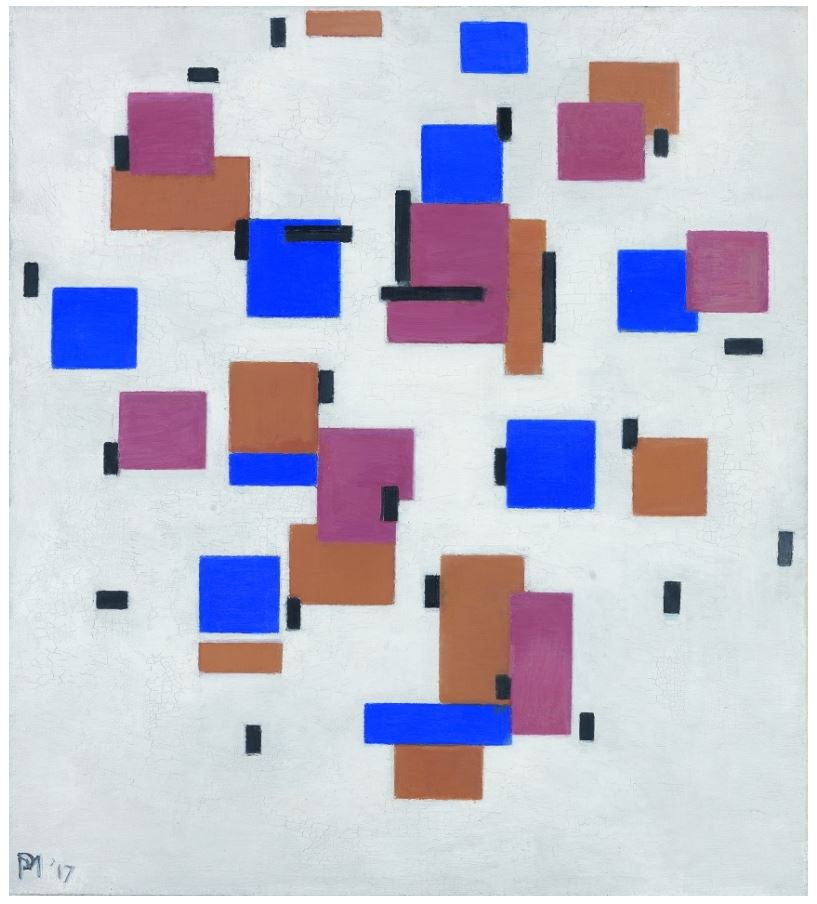
The exhibition includes examples of the many interim steps, fascinating and often beguiling abstracts in their own right, which move towards this, six years later, in the midst of the Great War, when the discrete elements of the earlier paintings have become solidified into blocks, blocks of abstract colour, floating against an empty background (or a background flooded with invisible ether, which joins the disparate entities?)

‘Composition in colour B’ by Piet Mondrian (1917) Collection Kröller-Müller Museum, Otterlo, the Netherlands

Abstraction 2. Mondrian reaches his mature style

‘By the unification of architecture, sculpture and painting a new plastic reality will be created.’ (Piet Mondrian, 1917)

Around 1920 everything came together in the new style of rectangular grids separated by thick straight black lines, a visual language of ‘pure relationships’ which he called ‘neo-plasticism’. These paintings abandoned any form of symbolism as they become irregular grids. He set out to reduce painting to its basic principles, removing individual aspects (which he called ‘tragic’) to express the ‘universal’.

In 1921 he published an essay titled ‘Le Néo-Plasticisme: Principe général de l’équivalence plastique’ which explains neo-plasticism as an approach to representing the ‘universal’ through balancing oppositions of the most basic elements of painting: position, size and colour.

‘Composition with Red, Black, Yellow, Blue and Grey’ by Piet Mondrian (1921) Kunstmuseum Den Haag

Mondrian believed that neo-plastic principles were destined to define the world around us. Some critics described the paintings as having ‘jazz rhythms’ and I’ve seen modern jazz album covers with Mondrians on them, both of them expressing something about the clean pure and yet somehow dynamic lines of modernity. The Tate bookshop includes ‘The Afterlife of Piet Mondrian’ by Nancy Troy which looks interesting, an examination of how the Mondrian style was curated, copied and publicised, of how ‘the popular appeal of Mondrian’s instantly recognizable style in fashion, graphic design, and a vast array of consumer commodities’.

One room is devoted to Mondrian’s mature style and there’s a very noticeable difference between the works from the 1920s and 30s. In both the works from the 1920s, not all the lines extend to the very edge of the canvas. Petty detail though this may seem, it makes a lot of difference, because in the next space are three classic Mondrians from the 1930s and in each instance the black lines do extend all the way to the edge. Trivial though it sounds, they look more complete, more finished, more total.

It’s a mystery to me and something the curators don’t address which is how come such rigid geometric shapes are so very pleasing to the eye and mind. they feel calming, deep, completing in a way which is hard to convey. Mondrian himself commented:

‘Vertical and horizontal lines are the expression of two opposing forces; they exist everywhere and dominate everything; their reciprocal action constitutes “life”. I recognised that the equilibrium of any particular aspect of nature rests on the equivalence of its opposites.’ (Piet Mondrian, 1937)

Not sure that helps explain why this look immediately struck everyone as clean and classic and has remained so for 80 years.

Abstraction 3. The Ten Largest

‘My mission, if it succeeds, is of great significance to humankind. For I am able to describe the path of the soul from the beginning of the spectacle of life to its end.’ (Hilma af Klint, 1917)

I thought the climax of Mondrian’s development in those three classic works from the 1930s, presented in a clean white rectangular space, would be difficult, but in the event the curators completely trump them with the last room in the exhibition. This is devoted to a set of ten enormous, huge and overwhelming canvases by af Klint, titled ‘The Ten Largest’.

The Ten Largest, Group IV, Number 7, Adulthood by Hilma af Klint (1907) Courtesy of The Hilma af Klint Foundation

These ten huge paintings represent the stages of life, with two each representing Childhood, two devoted to Youth, four to Adulthood, and the final pair to Old Age. I thought I wouldn’t like these at all but, somehow, the preceding nine rooms, showing the slow development of her style, explaining the mystical and spiritual beliefs behind it, had softened me up and prepared me. I thought they were magnificent.

The Ten Largest, Group IV, Number 3, Youth by Hilma af Klint (1907) Courtesy of The Hilma af Klint Foundation

‘The Ten Largest’ are part of ‘The Paintings for The Temple’, a body of works af Klint believed was commissioned by her spiritual guides (we have learned about her spiritual guides throughout the show). Af Klint dreamed of building a temple in the form of a spiral where her paintings could be hung together as a ‘beautiful wall covering’. To ascend through the temple would mean moving towards a higher state of being.

Installation view of ‘Hilma af Klint and Piet Mondrian: Forms of Life’ at Tate Modern showing two of the four Adulthood works.  Photo: Tate (Jai Monaghan)

It took me a while to realise that the four ages are colour coded: the Childhood pair have a lovely deep blue background, the two Childhood works have an orange background, the four Adulthood paintings the lilac colour you can see in the photo above, and the final Old Age pair have a pink background. Then I realised that the colour in each set fades and becomes paler in the second or later work in each set, as if that era’s virility fades as it prepares to transmute to the next stage of life. None of that, none of the richness or intensity of the colour, and the dramatic sense of their changing hues, comes over in these photographs.

Installation view of ‘Hilma af Klint and Piet Mondrian: Forms of Life’ at Tate Modern showing, from left to right, the second Childhood (blue), the two Youth (orange) and the four Adulthood (lilac) paintings. Photo: Tate (Jai Monaghan)

As you can see each painting consists of arrangements of completely abstract designs and patterns and yet, slowly, as you study them, you realise certain motifs recur in each set, giving them a thematic unity.

I spent a lot of time wondering why the final two paintings, the Old Age set, were the ones with the most conspicuous use of symmetry. Is it because, after the storms of life, your knowledge settles into a balanced wisdom?

And the even more puzzling fact that the very last painting is the only one to contain  a square or rectangular feature, namely a grid of squares like a chessboard. Is it because the swirling zoomorphic shapes of active life give way, in one’s last years, to a harder, adamantine, inflexible knowledge?

The Ten Largest, Group IV, Number 10, Old Age by Hilma af Klint (1907) Courtesy of The Hilma af Klint Foundation

Almost certainly not, but I was beguiled. I found myself walking round, sitting and staring, getting up and reviewing them slowly, again and again. I couldn’t tear myself away, an experience I’ve had with only a few other exhibitions – I remember not wanting to leave a room full of Monet paintings of the River Thames years ago. Same here. I found this final room completely absorbing, entrancing and didn’t want to leave.

There’s lots and lots of lovely paintings, in an amazingly wide range of styles, sizes, and intentions, throughout this wonderful show. But this final room is worth the admission price by itself.

The video


Related links

More Tate Modern reviews

A Brief Revolution @ the Photographers’ Gallery

The Architectural Review is a monthly international architectural magazine. It was founded in London in 1896 and does what its title suggests, covering all aspects of the built environment.

Manplan

Just over 50 years ago, in 8 issues from September 1969 to September 1970, the Review ran a series of eight specially commissioned reports on the state of architecture at the end of the 1960s. It was to review not just architecture in the narrow sense but the entire state of town planning, in an age when old Victorian slums were being torn down to make way for gleaming new towns made of high-rise towers, medium-rise blocks characterised by lifts and concrete walkways, subways under sweeping new ring roads, nicely laid-out grassed areas and so on.

The Review’s editors called the series of articles ‘Manplan’ and hired leading photojournalists and street photographers to address a set of eight themes, being:

  1. Frustration
  2. Travel and communication (‘Society is its contacts’)
  3. Town Workshop
  4. Education (‘The continuing community’)
  5. Religion
  6. Health and Welfare
  7. Local government
  8. Housing

The result was a series of brilliant photos shot on a 35mm camera in a spirit of photo-reportage – vivid and dramatic black-and-white works which captured a nation in the midst of great social, cultural and environmental change. To the horror of some of its contributors and readers, the magazine turned its back on large-format, heroic photography of buildings and their details, instead embracing a grainy, 35mm black-and-white reportage aesthetic, where people were as, if not more, important than the places. In the words of The Royal Institute of British Architects, publishers of the Architecture Review:

The aim was to propose an alternative and more holistic approach to urban planning, which would look at all basic human needs as a whole. The photographs illustrating the issues were created in the spirit of photo reportage and often featured people inhabiting the spaces studied by the survey, thereby shifting the focus from the architecture itself to the human element within the built environment.

So it was intended to be polemical stuff. The photographers were:

  • Ian Berry
  • Tony Ray-Jones
  • Tim Street-Porter
  • Patrick Ward

Altogether the Architectural Review published about 80 photographs. Just 16 are on display here, but every single one of them is a masterpiece; there’s no slack. Each one is a densely packed, highly charged vignette. This exhibition isn’t big but it is packed with social history, with memories and nostalgia for a time within the living memory of many but feeling evermore distant.

Design and layout

On a separate wall is a display of the actual copies of the magazine which the photo-essays appeared in, along with the words and designs of ‘Manplan’ editor Tim Rock and designers Michael Reid and Peter Baistow. This section goes into detail about how the photographs were processed, reproduced and printed (using ‘special matt black ink’) along with analysis of the layout and typography. All a bit over my head but interesting for students of design.

The photographs

Private terraced houses on the Old Kent Road opposite Camelot Street Estate, London by Tony Ray-Jones (1970) part of ‘Manplan 8: Housing’, in Architectural Review, September 1970. Courtesy Architectural Press Archive / RIBA Collections

Housing at New Ash Green, Kent by Tony Ray-Jones (1970), part of ‘Manplan 8: Housing’, in Architectural Review, September 1970. Courtesy Architectural Press Archive / RIBA Collections

Low-rise housing, Tavy Bridge, Thamesmead, Greenwich, London, 1970 by Tony Ray-Jones, part of ‘Manplan 8: Housing’, in Architectural Review, September 1970. Courtesy Architectural Press Archive/RIBA Collections

Classroom windows in a school in Wales, 1969 by unknown photographer, part of ‘Manplan 4: The continuing community (education)’, in Architectural Review, January 1970. Courtesy Architectural Press Archive / RIBA Collections

High-rise flats and multi-storey car park, Birmingham, 1970 by Peter Baistow, part of ‘Manplan 5: Religion’, in Architectural Review, March 1970. Courtesy Architectural Press Archive / RIBA Collections

Chatsworth Street school and high-rise housing block overlooking the cleared site, Liverpool, 1969 by Tom Smith, part of ‘Manplan 4: The Continuing Community (education)’ in Architectural Review, January 1970. Courtesy Architectural Press Archive / RIBA Collections

Salvation Army officers picnicking on the steps of the figure group Asia by J H Foley, Albert Memorial, Kensington Gardens, London, 1969 by Peter Baistow, part of ‘Manplan 5: Religion’, in Architectural Review, March 1970. Courtesy Architectural Press Archive/RIBA Collections

Unidentified primary school, 1969 by unknown photographer, part of ‘Manplan 4: The continuing community (education)’, in Architectural Review, January 1970. Courtesy Architectural Press Archive / RIBA Collections

Thamesmead film

To one side of the 16 framed photos on the wall, is a TV monitor showing a film from around the same time (in fact the year before the project, 1968). So far as I can tell it’s not directly connected with RIBA or the Manplan project except for the slender link that one of the 80 Manplan photos happens to cover the same subject as the film, namely the new estate being built at Thamesmead.  So it wasn’t directly related to the Manplan project but gives context to the kind of architectural and town planning thinking which was going on at the time of the Manplan project.

Directed by Jack Saward, this 25-minute public education film gives an overview of the history and construction of Thamesmead, a sort of new model suburb built down the River Thames from London on the site of the old Royal Arsenal, a site that extended over Plumstead Marshes and Erith Marshes.

Alas, to quote the introduction to the video on YouTube:

The ambition is commendable but it didn’t quite work in practise, with Thamesmead becoming a notoriously problematic estate and its architects perceived as exhibiting many of the faults of post-war planning, with communities being tinkered with from above like a real-life experiment. This is where utopia meets authoritarianism.

Hard to believe, but the planners that designed the place provided insufficient transport links with London, no way of crossing the Thames for 5 or 6 miles in either direction and – best of all – an almost complete lack of shopping facilities and banks. Lots of pretty little lakes but…nowhere to buy food. According to the label in the exhibition, the estate ‘was soon plagued by social problems caused by lack of facilities and public transport’.

The half-built estate won an unwanted fame when American film director Stanley Kubrick used parts of it as the setting for his notoriously violent 1971 movie, A Clockwork Orange, a vision of an alienated, dystopian society. Here’s the photo of it taken by the brilliant Tony Ray-Jones which provides a sort of coincidental link between the Manplan series and the film.

Thamesmead under construction, Greenwich, London, 1970 by Tony Ray-Jones in ‘Manplan 8: Housing’, Architectural Review, September 1970. Courtesy Architectural Press Archive / RIBA Collections

Which do you prefer? Which do you think is telling the truth, the film or the photo?

The Robert Elwall Photographs Collection

All the materials for the Manplan exhibition, photos and old copies of the AR magazine, come from the Robert Elwall Photographs Collection. This comprises around 1.5 million images from the earliest days of photography to the present day. The collection includes photographic archives of individual architects and practices, travel and topographic images from across the world, press photographs from major architectural journals, and large bodies of work by some of the best known architectural photographers of the 20th century. The collection includes prints, negatives, slides, transparencies, photographically illustrated books and digital files. It is itself part of the larger Royal Institute of British Architects collections.

Conclusion

Flicking through some of the text on the walls is a dispiriting experience. These 1970 writers were raging against the soulless design of modern cities, the daily struggle of commuting to work on overcrowded public transport, against air pollution, excess traffic and the destruction of the environment, against the dominance of the car over human-friendly spaces, against the dehumanising effects of modern technology, against social inequality and the lack of social housing, against the prioritising of profit over people.

It’s as if, 53 years later, nothing has changed except we all have smart phones to share our frustration about how things obstinately carry on being rubbish. The Manplan writers’ rage and frustration is captured by this, the last entry in the exhibition.

Double page spread from Manplan 1. ‘Frustration’

It’s a copy of the original magazine, open to a double page spread showing a traditional Pearly King and Queen standing in front of the typically sterile, barren waste ground surrounding a clutch of looming, threatening tower blocks. Up in the top right is a text reading: ‘The richness of East End life is replaced by monotony and inhumanity.’

Yep. that’s the world I grew up into and which punk rock, with its angry nihilism, was a direct response to. Eternal shame on England’s architects and town planners.


Related links

More Photographers’ Gallery reviews

Objects of Desire: Surrealism and Design 1924 to today @ the Design Museum

SURREALISM. Noun: Pure psychic automatism by which it is intended to express, either verbally or in writing, or otherwise, the true function of thought. Thought dictated in the absence of all control exerted by reason, and outside all aesthetic or moral considerations.
(First Manifesto of Surrealism, 1924)

Surrealism is not a new or better means of expression, not even a metaphysic of poetry; it is a means of total liberation of the mind.
(Surrealist declaration, January 1925)

Introduction to surrealism

Surrealism is ‘a philosophical and artistic approach which violently rejects the notion of the Rational Mind and all its works’. For Surrealists, the True Mind, true human nature – ‘the true function of thought’ – is profoundly irrational.

The Surrealists thought the Rational Mind formed the basis of ‘bourgeois’ society, with its moral and sexual repressiveness, its worship of work and money, its fetishisation of capitalist greed, which had led both to the stifling conformity of Western society and to a series of petty wars over colonies which had themselves led up to the unprecedented calamity of the First World War.

In the Surrealists’ opinion, this entire mindset had proved to be a ghastly mistake. The Surrealists thought that we had to reject it lock, stock and barrel by returning to the pure roots of human nature in the fundamentally irrational nature of the human mind, liberating thought from all censorship and superficial, petty morality, seeking to capture ‘the true function of thought’ and creativity through the exploration of the fortuitous and the uncontrolled, the random and the unexpected, through dreams and coincidences.

The first Surrealist magazine was titled La Révolution surréaliste (1924 to 1929) not because it espoused a communist political line, but because it proposed that Surrealist writing and art would, by its radical dysjunctions and unexpectednesses, reveal to readers and viewers the true nature of unbounded thought and lead to a great social transformation.

Cadeau by Man Ray

Massive show, massive space

This is a huge exhibition containing nearly 350 objects, an overwhelming number, a flood of objects and information in the related wall captions.

Also, the exhibition space itself is big and capacious. Roomy. This allows for the display of lots of large objects, namely furniture, lots and lots of chairs and several striking sofas, mannekins wearing dresses, some enormous sculptures and so on. Not so many tables because tables tend to be enormous, but three or four petite coffee tables or tea tables.

Gae Aulenti by Tour (1993) Manufactured by FontanaArte, Glass; bicycle wheels. Vitra Design Museum

Of course this is because this is an exhibition about design rather than art or sculpture as such. The exhibition is about how the design of objects was impacted by the Surrealist approach and ‘look’ and style and fashion. Hence the need for more than paintings and photos (though there are plenty of these); of designed products.

Chronological

Surrealism was, for its first five years or so, from 1924 to 1929, a writers’ movement, led by the self-appointed pope or bully of Surrealism, André Breton. Only in 1929 when the Catalan Wunderkind Salvador Dalí joined it, did the visual arts come to play a more important role and, eventually, dominate the movement and people’s ideas about it.

The show, like almost all exhibitions, is chronological in structure covering nearly a century of Surrealism from the earliest automatic writing to its most recent manifestation in using artificial intelligence to create artworks.

Thus we start with Surrealism’s first writings and manifestos, and then the outburst of Surreal artworks in the 1930s led by Dalí but with scores of other visual artists, and there were so many of them – Hans Arp, Hans Bellmer, Brassaï, Giorgio de Chirico, Salvador Dalí, Paul Delvaux, Max Ernst, Alberto Giacometti, Paul Klee, Wifredo Lam, René Magritte, André Masson, Joan Miró, Meret Oppenheim, Pablo Picasso, Man Ray, Yves Tanguy and many more.

The strangeness of objects

The exhibition is divided into themes and begins with the importance of everyday objects. Surrealism took the revolutionary approach of investing the most everyday of everyday objects with an aura of mystery and strangeness.

.It starts with an examination of Surrealism’s beginnings from the 1920s and considers the crucial role that Everyday objects and interiors were embraced by the movement’s early protagonists, as artists sought to capture the aura or mysterious side of ordinary household objects. Cubism had looked at everyday objects – café table, newspaper, bottle of wine – from multiple angles. Surrealism looked at them from a sur-real angle, attributing them volumes of meaning never dreamed of by ordinary people, setting them in weird juxtapositions to jar us out of our everyday doze and jerk us into awareness of the strangeness of being alive and moving through this world of images and symbols.

What could be more normal and everyday than an apple, a businessman and a cloudy sky? Or, in the way René Magritte deploys them, more disturbing?

The Son of Man by Rene Magritte (1946)

The Son of Man by René Magritte (1946)

These ideas took a while to be developed and fully expressed. It was only the ‘Second Surrealist Manifesto’ of 1929 that introduced the notion of ‘the Surreal object’ – using art or writing to reveal ‘the remarkable symbolic life of quite ordinary, mundane objects’. This inspired artists including Dalí, Magritte, Meret Oppenheim and Man Ray to experiment with an entirely new form of sculpture, by creating absurd objects from found materials and items, revealing the bizarre potential of the everyday.

Object by Meret Oppenheim (1936)

This is the point of Marcel Duchamp’s famous ‘readymades’, objects he noticed amid the bric-a-brac of ordinary life and carefully selected to be placed within a gallery setting, in an exhibition in a gallery, where they acquired completely new resonances, the cheapest of mass-manufactured objects acquiring a holy aura, its entirely practical aspects magically converted into profound and mysterious statements about shape and dynamism and meaning.

Bottle Rack (Porte-Bouteilles) by Marcel Duchamp (1914/1959)

He was to some extent mocking the idea of ‘art’ and ‘the gallery’; but he was also discovering the numinous in the quotidien which was to inspire artists ever since. But this gesture also, as the curators pithily point out, prioritised concept over craft and conceptual art has been with us ever since.

Paintings

There are cases containing manifestos and magazines, key works by Breton such as Amour fou.

There are early paintings by Dalí, Le Corbusier (who was a painter before he became an architect), the mysterious desertscapes of Yves Tanguy, a couple of weird paintings by the English artist, Leonora Carrington who came on the scene a bit later, in the 1940s.

The Old Maids by Leonora Carrington (1947) © Estate of Leonora Carrington / ARS, NY and DACS, London 2022

Photos

There are lots of photos, maybe a hundred photos, performing its two functions, as documentary record and as artwork.

Among the documents are scads of photos of the founders and early protagonists, Breton and his Parisian colleagues, then the artists. There’s records of the famous 1936 Surrealism exhibition in London, of the Surrealist pavilion (the Dream of Venus’) Dalí created for the World Fair in 1939, and so on. There’s Max Ernst at home in his apartment surrounded by African and Oceanic masks and artefacts (a lovely photo by Hermann Landshoff). And so on.

In the section about ‘sex and desire’ (every art exhibition has to have a section about sex and desire) there’s a suite of photos of Surrealists cross-dressing or being deliberately androgynous, for example photos of Marcel Duchamp dressing as his female alter ego, Rrose Sélavy, in 1921, and Claude Cahun’s calculatedly androgynous photographic self-portraits, from 1928.

There are photos of works of art, such as the still-disturbing fetishistic mannekins created by Hans Bellmer, or the room full of a mile of string created by Marcel Duchamp for a 1942 exhibition in New York.

And there are photos which are works of art, such as pretty much anything by the genius Man Ray (born Emmanuel Radnitzky in 1890 in New York but who changed his name and moved to Paris where he spent most of his career).

Le Violon d’Ingres by Man Ray (1924) © Man Ray 2015 Trust/DACS, London 2022

Films

There are four or five films. There are early black and white silent Surrealist films, such as Entre’Acte by Rene Clair (1924), winningly described by the director as ‘visual babblings’.

Oddly, they didn’t have clips from the most super-famous experimental movies by Bunuel, Luis Buñuel’s ‘subversive’ early films Un Chien Andalou and L’Age d’Or.

Later in the show there’s a few art films from a generation later:

And a much later film by an African director:

But dominating one wall, not least because it has a loud musical soundtrack, is a screen showing Destino, a short Surrealist animated film which was an unlikely collaboration between Dalí and Walt Disney. It tells the love story of Chronos – the personification of time – and a shapeshifting woman. In fact the movie was never completed because war work took precedence, and the project was only revived in the 1990s when Disney animators competed it according to the original sketches and scenario.

The significance of the film is its indication of Dalí’s success and name recognition in the USA by the 1940s, and the way in which what, on the face of it, are a sequence of nonsensical absurd events, have been assimilated enough for a mainstream producer like Walt Disney to agree to it.

Partly this is down to the instant recognition of a relatively small number of surreal images associated with Dalí. The short 7-minute animation is a collection of greatest hits such as the desert landscape setting, melting clocks, ants appearing out of cracks, human faces or bodies moving into trompe l’oeil settings to cleverly morph into something else.

Also in America during the war, Dalí designed shop windows for the Bonwit Teller department story. Frederick Kiesler designed a new gallery for rich art collector Peggy Guggenheim in a Surrealist style with curving walls. Emerging designers like Ray Eames and Isamu Noguchi used the zoomorphic curves found in Surrealism to design more moulded products, such as chairs (Eames) and a chess table and baby monitor (Noguchi).

Was it during the war, when so many European artists were exiled in America, that Surrealism’s pre-war radicalism was neutralised and converted into one more among many styles and fashions?

Sculpture

There are some sculptures, especially from the early period, but not many and this is because of the focus of the exhibition which is not on art, per se, but on design. Therefore, instead of abstract art sculptures, what the rooms are full of is designed furniture.

Classic Surrealist furniture

If the 1930s was the decade when there was an explosion of Surrealist art and the movement broke through into the general consciousness via a series of well-publicised exhibitions (and carefully staged scandals and press events, such as Dalí attending the opening of the London exhibition wearing a deep-sea diver’s outfit) it was in the 1940s that designers began to incorporate elements of the style into their work.

The Surrealists themselves had led the way. If they started out by invoking the weirdness of everyday objects and thoroughly explored this in paintings, sculptures and photos throughout the 1930s, some had applied their deliberately, provocatively bizarre way of seeing to create bizarre household objects, tables, chairs, lamps.

The most florid early examples come from the joint venture between Dalí and the English collector and patron, Edward James. James had Dalí create an entirely Surrealist interior for his home at Monkton House, West Dean in Sussex, notably the famous sofa designed in a cartoon imitation of the lips of Hollywood actress Mae West.

Mae West’s Lips sofa by Salvador Dalí and Edward James (c. 1938) Royal Pavilion & Museums Trust, Brighton and Hove. © Salvador Dalí, Fundació Gala-Salvador Dalí, DACS 2022

Also on display is the famous lobster telephone, alongside less well-known objects such as the standard lamp made out of brass casts of a stack of champagne glasses (which ‘subverts’ the Victorian notion of a standard lamp); and, most obviously humorous, a carpet with human footprints cut out of it. These, we are told, were the footprints of his wife, the dancer Tilly Losch. When Tilly danced right out of his life, James commissioned a new carpet with the footprints of his dog in it, the dog making, he dryly remarked, ‘a more faithful friend’.

Other rich people commissioned Surrealist interiors:

  • Swiss architect Le Corbusier was commissioned by eccentric millionaire Carlos de Beistegui to design his Paris apartment in a style which combined fantastical elements with clean cut modern lines
  • clean Le Corbusier-designed furniture was included in Dali’s house in Portlligat, Spain
  • aristocrats Charles and Marie-Laure de Noailles commissioned Man Ray to shoot a Surrealist film at their modernist pad on the Riviera

By the late 1930s the new surreal style of interior design had been given a name, Fantasy Modernism.

This suite of objects amount to some of the greatest hits of first wave surrealism but they weren’t alone. Meret Oppenheim produced equally imaginative and talismanic sets of surreal objects such as the fur cup and saucer mentioned above, and her birds-leg tables.

Occasional table (1939) by Meret Oppenheim

Occasional table (1939) by Meret Oppenheim

Modern Surrealist furniture

Once you turn the corner into the post-war period, you encounter two big rooms full of more contemporary interpretations of surrealist furniture, by designers from the 1960s, 70s, 80s and through on to the present day. These include lamps, chandeliers, some tables, but above all a lot of weird, wacky, and humorous chairs.

Hand Chair by Pedro Friedeberg (about 1962; this version 1965) Vitra Design Museum

I find it very revealing that this chair started life as a throwaway, joking remark of Friedeberg’s to a carpenter. He thought it would be funny to try and make a chair shaped on a human hand. For me this little anecdote is symptomatic of the way Surrealism stopped being subversive and became a type of visual joke, more like a branch of comedy than an art movement.

There’s:

  • a chair made out of burned carbon i.e. has been burned to a crisp – Smoke Thonet chair number 209 by Maarten Baas (2019)
  • Capitello chair by Studio65, a chair shaped like the capital of a classical column only made of comfy styrofoam instead of marble
  • Ruth Francken’s Man Chair (1971), shaped like a man’s body, the legs the shape of real legs, the arms effigies of two real arms
  • a chair made out of two thick jagged slabs of grass held together by thick steel springs
  • La Momma, a feminist piece by Gaetano Pesce (1973), the ball and chain referencing the oppression of women in a patriarchal society
  • Due Più by Nanda Vigo (1971)
  • Conquest by Nina Saunders (2017)

There’s a chair by Sara Lucas, characteristically lowering the tone (not necessarily a bad thing) with its two boobs made of lots of cigarettes glued together. What I noticed was a) that’s a really basic, anonymous, institutional chair, the kind you get at a school or college, and b) the cigarettes are really nicely arranged, not just bodged together but arranged in a neat concentric circles which bring out what a visually pleasing thing a cigarette is, with its nice alternation between white tube and sandy brown filter; the brown matching the wood brown of the chair seat and back i.e. it’s a funny gag, ha ha, but it’s also a nice ensemble to look at, aesthetically.

Cigarette Tits [Idealized Smokers Chest II] by Sarah Lucas (1999) © Sarah Lucas. Courtesy of Sadie Coles HQ, London

Picking up on the sofa theme set by Mae West, there’s a bang up-to-date piece, wherein a classic Chesterfield sofa, covered in trademark buttons, has been ‘released’, set free, and ‘melted’ out of shape and over the floor, in the manner of Dali’s melting watches – Pools and Poof! by Robert Stadler (2019).

There are several chandeliers, including this striking piece by Ingo Maurer. It immediately made me think of Cornelia Parker‘s famous exploding works, and made me wonder which came first.

Porca Miseria by Ingo Maurer (2019 edition of 1994 design) Vitra Design Museum

And dominating one of the rooms, a life-sized model of a horse, cast in black plastic and with an everyday lamp coming out of its head.

Horse Lamp by Front Design (2006), manufactured by Moooi BV, Breda /Niederlande, Plastic; metal. Vitra Design Museum

When you learn that this comes in a suite of animal furniture including a rabbit lamp and a pig table, you realise the original impulse has become washed out into a kind of homely humour. It’s become about as ‘radical’ as Ikea.

Fashion

One of the most high profile aspects of design is fashion, which holds shows around the world on an annual basis at which dress and clothes designers compete feverishly to outdo each other with new and outlandish ways to ornament the (tall, skinny) female body.

The world of Surrealism overlapped the vast ocean of fashion design, events and, above all, magazines, from the start of the 1930s when, as I’ve described, the visual side of the movement took over from the purely literary.

Thus several surrealist artists also worked as fashion photographers, including Lee Miller and Man Ray. Some, like Dalí and de Chirico, created covers for fashion magazines such as Vogue (some are included here). The exhibition includes fashion photographs and vintage copies of fashion magazines to highlight these connections

Dalí’s collaboration with the French fashion designer Elsa Schiaparelli (who set up her haute couture house in 1927) resulted in several ground-breaking designs. Their first collaborative piece, the Telephone Dial Powder Compact of 1935, became very popular and was copied and bootlegged for the mass market.

Over in a side room is a dais with five shop-window mannekins sporting classic surrealist designs. One applies Schiaparelli’s signature pink to a minidress contoured to look like the chest and stomach of a very buff man. Another is a modern reworking of iconic Skeleton Dress. There’s a dress by contemporary designer Mary Katrantzou which, when you look closely, uses elements of a typewriter.

Typewriter’ Printed Silk Dress by Mary Katrantzou (2018) Courtesy of Mary Katrantzou

Alongside other designs by Maria Grazia Chuiri, Christian Dior, Iris van Herpen and emerging Afro-surrealist inspired fashion designer Yasmina Atta.

These are funny conceits well executed but I couldn’t help thinking they’ve reduced Surrealism to a gag, a gif, a meme, a one-liner. ‘Did you see the typewriter dress?’ ‘Yes, Wasn’t it funny?’

Generally, by the time something reaches the world of fashion its disruptive energy has, by definition. been neutered, for example punk. Nothing is disturbed. Everything remains in place, but with lolz for a million Zoolander clones.

From communism to consumerism

At around this point in the exhibition, where I encountered the absorption of the Surrealist impulse into the world of international jet-setting fashion, I began to have my doubts.

Breton wanted Surrealism to trigger a genuine revolution in society and perception. He thought bourgeois society could be smashed apart by ripping a great tear through reality and letting out deeper realities. He talked about ‘convulsive beauty’, he wanted a kind of stricken, epileptic aesthetic.

Breton and many other Surrealists became card-carrying communists during the wartorn 1930s. Their movement was a protest against a bourgeois industrial society which had reached the end of its useful life and needed to be torn down to create a free-er, fairer world.

Ironic, then to see the entire movement, the impetus for revolutionary change, utterly absorbed, neutralised, defanged, neutered and then absorbed into the world of the international haute bourgeoisie in the form of high fashion. For me high fashion is the acme of consumer capitalism with its relentless drive for novelty and new product to keep the profits rolling in.

Fashion is not only a forward post of consumer capitalism but at the cutting edge of unnecessary consumption, the epitome of built-in obsolescence whereby you simply have to buy this season’s must-have items and junk last year’s hideously out of date clothes, handbags etc. Epitome of the compulsive need to keep up, to buy the new thing, which we now know, without any ambiguity, is using up the earth’s finite resources and destroying the planet.

Nothing I say, do or write can dent the huge power of the destructive urge to buy buy buy ever-new stuff, but I despise it and, in a way, fear it, this hysterical need to use up all the planet’s resources in the neurotic pursuit of novelty. What will our grandchildren make of the urge to fly round the world from fashion show to fashion show, seeking endless novelty, encouraging the throwing away and junking of what we have, burning up the planet at an ever-increasing rate.

Is Surrealism dated?

Putting aside my antipathy to the world of fashion, by the end of the exhibition the plethora of objects had raised another, pretty basic question, which is: Does any of this shock and surprise any more, cause the kind of frisson of fear, unnerve the viewer, let the unconscious erupt from the conscious mind with shocking force etc, as the Breton’s manifestos hoped it would?

The short answer is, of course: No. No, it doesn’t. Surely Surrealism has been completely assimilated into our bourgeois, neo-liberal, consumer capitalist society. The famous icons, the lobster phone, the Mae West sofa, every painting by Dali, these have been around for nearly 90 years, and you see images of them in any number of art books or postcards in what my kids call bougie (pronounced ‘boozhee’) shops.

Take the series of plates by Piero Fornasetti which run variations on a wonderfully blank, idealised portrait of the Victorian opera singer Lina Cavalieri. I suppose if you were actually eating off one of these, then it might give you a frisson to scrape away at the mashed potato and slowly reveal an eye looking at you. But as an image and idea I feel I’ve seen this hundreds of times and, indeed, almost 400 variations exist, of which seven are on display in an appealing little set hanging on the wall.

Wall plates no. 116 from the series Tema e Variazioni by Piero Fornasetti (after 1950) Fornasetti Archive

In other words, surely most Surrealist art, these days, instead of conveying ‘the shock of the new’ is the precise opposite – reassuring and familiar. We smile or laugh when we see the lobster phone and go ‘oh yes’ with a pleasant feeling of recognition.

Art changes nothing. All art is swiftly assimilated into bourgeois society and loses the ability to shock or even make the viewer think. The simple act of being displayed in a gallery neutralises art, makes it into a mental commodity, to be discussed in highbrow conversations or namedropped to make you seem swanky. Or into an actual commodity, which can be safely hung on the walls of any investment banker or corporate lawyer, or bought by Arab or Russian billionaires and salted away in a vault in Switzerland as part of their diversified investment portfolio.

Thus, for example, the exhibition includes black and white photos recording the Surrealist display Dali created for the 1939 New York World’s Fair. Apparently you entered the suite of bizarrely decorated rooms by walking between models of a woman’s open legs and through a wall-sized vulva into a ‘womb’ containing a predictable congeries of Freudian imagery, complete with numerous scantily clad models arranged in alcoves or sprawling on a bed amid unlikely ‘Surreal’ bric a brac. Looking at these photos now, they seem like a standard chorus girl show with added lobsters.

A lot of the exhibition, in other words, feels warm and nostalgic, pretty much the opposite of what Breton et al originally had in mind.

Up-to-date exhibits

The curators promise, and the exhibition title indicates, a review from the 1920s up to the present day i.e. covering just about a century of Surrealism, and nearly a third of the objects on show are from the past 50 years.

Thus there are a lot of works from more recent times, the 80s, 90s, noughties, generally by artists I’d never heard of. This is particularly true of the big items of furniture, mostly chairs, which dominate the last few rooms or sections of the show, including:

  • Gae Aulenti’s Tour (1993), a table made from a glass top supported by four bicycle wheels set in chrome forks
  • Jasper Morrison’s ‘readymade’ Handlebar Table (1982)
  • Roberto Matta’s amusing MagriTTA Chair, a sofa style chair which is filled with an enormous green apple, obviously a nod to Magritte’s apple paintings
  • the cartoon chair of Fernando and Humberto Campana from 2007, a basic wide-angle modernistic chair which is then infested with cuddly toys based on Disney characters
  • Sella (1957), by brothers Achille and Pier Giacomo Castiglioni, which is composed of a bicycle saddle mounted on a post fixed into a hemispherical base, blurring the boundary between furniture and art
  • video of how contemporary designers Ronan and Erwan Bouroullec use an intuitive, automatic drawing process to discover new imagery and forms
  • sketch furniture which is created using motion capture cameras to capture the movements of a designer’s hand in the air, save this as a digital file and then use 3D printing technology to print out the object the designer originally sketched out in the air; there’s a video of the process and an actual life-sized chair designed and created using this approach

Or simpler things, Surrealist objects like this absurdist hairbrush spouting hair, worthy of Magritte.

Beauty Hairbrush by BLESS (2019 edition of 1999 design) Vitra Design Museum

Maybe I’m being unfair, maybe I lack taste or sympathy, but I found most of the works in the second half of the show, from the 1960s onwards, far less engaging than the material from the first, classic, era. Take three examples from towards the end of the exhibition.

Björk

The famous musician, composer, performer, singer, songwriter etc Björk, is represented by videos of three fairly recent tracks. Visitors pop on swish earphones and listen to the track while you watch the video. They are:

Well, they’re very well made indeed, both the music and the videos – deliberately different, eschewing visual and musical clichés, consciously innovative and imaginative. And yet…and yet…Björk Guðmundsdóttir, born in 1965, has been Björking for 40 years now (her first single was in 1983). She has become a byword in the pop/fashion/music video businesses for her wildly inventive outfits and compellingly original videos etc. Her oeuvre demonstrates the strengths and weaknesses of being a lifelong innovator in pop music. But whatever you think of her exactly, she doesn’t tear the veil of bourgeois convention from the world because thousands of pop and rock musicians and video makers have been doing similar or comparable things for decades.

Tilda Swinton

Over by the fashion mannekins are some photos of famous and award-winning actress Tilda Swinton wearing some bizarre / surreal jewellery.

Same as with Björk, Tilda, born in 1960, feels over familiar. She has been doing her brave androgynous schtick since she first appeared in Derek Jarman’s films in the mid-1980s i.e for nearly 40 years. Far from disturbing me, tearing the veil from my mad unconscious urges, Tim Walker’s photos of Swinton looked like standard Sunday supplement fashion shoot any time in the past 30 years, just with a particularly ‘arty’ kink.

Sarah Lucas

I went to the original Sensation exhibition at the Royal Academy of Arts back in 1997 and it was a genuinely transformative experience, to see so much vibrantly exciting and innovative artworks, all by a young generation of artists reflecting the ‘modern’ world, all in one place. But it’s been some time now since Damian Hirst’s sharks in a glass tank stopped being subversive or world-shattering and became a kind of joke, common enough knowledge to be used in popular cartoons.

Sarah Lucas never reached Hirst-like levels of fame and notoriety, because she kept (I think) her visual metaphors to a much more modest scale and her works reek of laddish, pub culture, and schoolboy (or girl) jokes. Hence her cheap and cheerful work, Cigarette Tits.

Cigarette Tits by Sarah Lucas (1999)

Compare and contrast with Lucas’s fried eggs t-shirt which has become a popular postcard in the kind of bougie shops I mentioned earlier.

When has an art movement run its course?

This all raises the question: when do you recognise that – or admit that – a style has run its course, is worn out, has become pedestrian – has, in fact, become a cliché?

It’s a more relevant question for Surrealism than maybe any other art movement in history because Surrealism set out to be more shockingly subversive than any other art movement in history (with the possible exception, I suppose, of its parent, Dada).

So where are you, what are you to make of it, when the most deliberately bourgeois-bating, consciously ‘subversive’ art movement of the 20th century has long since arrived on the front of colour supplements, inspires high fashion dresses, is reduced to jokes and cartoons, has been done to death in TV, movies, comedy, in every channel of output, only to feature in calm and sedate and scholarly exhibitions like this one?

The curator’s view

Kathryn Johnson, the exhibition’s main curator, optimistically claims that:

“If you think Surrealism fizzled out in the 1960s, think again. This exhibition shows that it is still alive and well and that it never really went away. The early Surrealists were survivors of the First World War and the 1918 influenza pandemic, and their art was in part a reaction to those horrors. Today, in the context of dizzying technological change, war and another global pandemic, Surrealism’s spirit feels more alive than ever in contemporary design.”

Hmm. Are we in the midst of dizzying technological change? I mean, isn’t your laptop this year, or your smartphone, pretty much like the one you had one or five years ago? Maybe you can do a few more tricks on it, but isn’t it basically the same? And did the COVID-19 pandemic produce shattering changes in social structure and values? Not really. I don’t think so. And has the war in Ukraine turned Britain upside down, decimated a generation of young men, traumatised the western world? No, not really, not at all.

Like all curators, Johnson is paid to make the most powerful possible case for her show, and you can see how she’s roping in these adventitious historical events to try and do so, but…she doesn’t persuade me.

Did Surrealism have any impact on twentieth century design?

For the entire time I was at the gallery I was beguiled by the objects on display and spent all my mental energy reading the main wall labels, and then the many captions for each of the individual pieces. A labour of love or a fool’s errand, depending on your point of view.

It was only on the Tube home that something really struck me. The curators claim that Surrealism had a major impact on 20th century design but I’m not sure they prove it in this exhibition. They have gathered nearly 350 Surrealist exhibits, hundreds of which demonstrate how striking and powerful individual Surrealist objects, furniture, photos, films and so on can be. No doubt about it.

But whether Surrealist principles, the Surrealist aesthetic, actually impacted the broad range of 20th century design, that’s a lot less clear and the more I thought about it the less plausible it seemed.

Sure there were striking Surrealist chairs and lamps and chandeliers and some ‘Surreal dresses’, but…these are all one-offs. No-one is going to buy the melted Chesterfield sofa or the chair made out of two jagged slabs of glass, or the lamp sticking out of a horse (well, one or two wealthy people might).

My point is that pretty much all the designed objects in the show are one-offs, inspiring, amusing luxury artefacts or art objects, but…could any of them be mass produced and sold in significant numbers? Not really (the one notable exception is the Fornasetti plates, which have been mass produced).

The fad for adding Surreal elements to interior design was christened ‘Fantasy Modernism’ in the late 1930s, but how many homes did it every apply to? The curators name four. Not a large number, is it?

Compare and contrast with the impact of Art Nouveau or Art Deco. A glance at articles about them show that they mainly existed as styles of design: of lovely stained glass and furniture for cafes and restaurants for Art Nouveau; as an entire look in the 1930s which affected everything from blocks of flats to ocean liners.

Or take the impact of the Bauhaus. Without a shadow of a doubt the Bauhaus aesthetic of stripping away Victorian decoration to reveal the clean, geometric functional lines of everything from teapots to high rise buildings massively influenced mid-20th century design of everything, having a world-changing impact on, for example, the design of buildings all around the world for 50 years or so, from the 1930s to the 1980s. Nobody can doubt the profound impact the Bauhaus’s design principles had on all aspects of twentieth century design.

But Surrealism’s impact on design? Look around you. Is anything you can see in your house – interior design, table, chairs, sofa, workbench, laptop, sink, kettle, cups, or outside, the design of cars or bikes or buildings – does anything anywhere around you betray the slightest impact of the Surrealist impulse to yoke together the bizarre and the weird and the absurd? I don’t really think so.

Sure, there are a lot of Surreal works of art. Certainly a contemporary photographer or fashion designer can invoke or reference some aspects of the visual language worked out by Surrealist painters and photographers all those years ago. Movies can have Surreal dream sequences etc. But design? Mass market, mass produced, widely available objects which everyone could have in their house, mass produced styles of car design or architecture? No. Not at all.

Is the entire concept of design the opposite of Surrealism?

There’s a related point: designing anything and then converting the design into an actual object, especially an object produced through industrial manufacturing, obviously takes a lot of time, effort, precision of design and co-ordination of the manufacturing process.

Surrealism was committed to automatic writing, bizarre juxtapositions, spontaneous eruptions of the unconscious, savage breaks in reality. How could the weird, dissociative effects aimed at by Surrealism be reconciled with the careful calculation required of designing anything?

I wonder whether, by bombarding the visitor with 350 examples of Surrealist art works, photos, magazine covers, sculptures, paintings and so on, the curators somehow dodge the central point at issue. ‘Objects of Desire: Surrealism and Design 1924 to Today’ is a magnificent assembly of Surrealist works in all formats, and includes a lot of interesting, intriguing and amusing pieces from its origins right up to the present day. But does it make its case for the widespread influence of the Surrealist way of thinking on 20th century design. I was left wondering…

Top ten exhibits

The curators made a handy selection of top ten items. I might as well share it with you.

1. Lobster telephone by Salvador Dalí

One of the exhibition’s most iconic works and a key moment in Surrealism’s transition from art to design. Dalí designed it for the collector Edward James, and in the show it is positioned next to a Mae West sofa to bring to mind an image of James’ wild interiors. It is a fully functioning telephone, designed to give the impression that its user is kissing the lobster when speaking into the receiver. Dalí saw both lobsters and telephones as erotic objects, and his first designs for this object were titled the ‘Aphrodisiac Telephone.’

Lobster Telephone by Salvador Dalí (1938) Photo West Dean College of Arts and Conservation. © Salvador Dalí, Fundació Gala-Salvador Dalí, DACS 2022

2. Destino by Salvador Dalí

The cartoon animation collaboration with Walt Disney described above.

3. Porte-Bouteilles by Duchamp

A 1964 re-edition of Duchamp’s 1914 original Porte-Bouteilles or bottle rack. A ready-made sculpture, the original was bought at a department store in Paris. Duchamp didn’t think to keep it, and it was only when the piece became famous later on that he got an identical rack from the same store and remade it. Placing this mass-produced, industrial object in an artistic context was a hugely important gesture. It emphasised concept over craft, one of several gestures by Duchamp which in effect created ‘conceptual art’ which has been hugely influential ever since.

Bottle rack by Marcel Duchamp

4. Look 6 Haute Couture by Schiaparelli

Maison Schiaparelli’s shocking pink dress features a trompe-l’œil pattern embroidered by glass tubes, following the contours of a muscular (male?) body. This silhouette is echoed across Maison Schiaparelli’s Spring Summer 21 collection, and is modelled on Elsa Schiaparelli’s 1930s wooden mannequins – a pair called Pascal and Pascaline – that she showed in her shop window in Paris.

Look 6 Haute Couture by Schiaparelli (Spring/Summer 2021) Courtesy of Schiaparelli

5. Hay by Najla El Zein

Created by contemporary designer and sculptor El Zein, this is a piece of porcelain with hay inserted into the holes it to give the impression that it is growing out of the stone. Part of a series called ‘Sensorial Brushes’, this work plays with the transition between familiar and unfamiliar. El Zein’s imaginative use of materials, and the call to her audience to experience the world differently, places her firmly within the Surrealist canon.

6. Fur bracelet by Méret Oppenheim

Méret Oppenheim designed a fur-covered bracelet for Elsa Schiaparelli and reportedly wore the prototype when meeting up with fellow artists Pablo Picasso and Dora Maar at a Parisian café. They played with the idea that anything might be covered in fur, and Oppenheim soon afterwards created her widely celebrated Surrealist work ‘Luncheon in Fur / Object’ – a fur covered cup and saucer (see above) which ‘disrupts expectations’ by combining the domestic with the uncanny.

Fur bracelet by Meret Oppenheim

7. Cadeau by Man Ray

One of the first works you see in the show is called ‘Cadeau’ or ‘Gift’ by Man Ray. The story goes that Man Ray was on his way to one of the first Surrealist exhibitions in 1921 and needed to make a piece on the hoof to show. He went into an ironmonger and bought a flat iron and some nails, before proceeding to stick the nails to the flat iron with glue. Not only does it make the iron completely dysfunctional, it also has this aggressive, proto-punk edge. Instead of being a domestic tool for pressing clothes neatly, it becomes a weapon that could rip your clothes.

Cadeau by Man Ray

8. Sketch Chair by Front Studio

This ‘Sketch Chair’ is designed by literally sketching in mid-air with hand gestures. These gestures are captured using motion capture technology, then translated into 3D printed works. The 3D form captures the spontaneity and messiness of human movement in a functional piece of furniture.

It connects with Picasso’s light drawings, photographed by Gjon Mili, from 1949, shown in a photograph beside the Sketch Chair.

9. Photographs by Tim Walker

Tim Walker is known for using Surrealist imagery in his fashion photography. Both photographs in the exhibition featuring Tilda Swinton as a model are from a shoot for W magazine titled ‘Stranger than Paradise’. Walker and Swinton went to Mexico, to the architectural folly La Pazas, created by Edward James – the man who commissioned the lobster telephone and Mae West Lips sofa from Dalí.

They used the folly as a set for a fashion shoot inspired by Surrealist artists, referencing works by painters like Leonora Carrington and Leonor Fini. In the exhibition the photos are placed next to original paintings by Carrington (‘The old maids’, ‘The house opposite’) and Fini. Walker’s photography also features jewellery by Vicki Beamon, namely jewel-encrusted lips reminiscent of Dalí imagery.

10. Kosmos in Blue collection by Yasmina Atta

Working in the spirit of the rapidly expanding Afrosurrealist movement, Yasmina Atta’s Kosmos in Blue – from her graduate collection – derives from the confluence of different cultures, including the designer’s Nigerian heritage and her interest in Japanese manga and Gundam girls.

The piece on display here is a set of embellished leather wings that move intermittently. The foam harness attaching the wings to the wearer’s body has an intentionally DIY-feel, as it was made in Atta’s studio over COVID lockdown when her access to materials was limited. She wanted the final product to reflect this experience of constriction, and as a result the wings represent a more personal and ready-made brand of couture.


Related links

Other Design Museum review

Dóra Maurer @ Tate Modern

This is a lovely FREE exhibition on the third floor of Tate Modern. It is the first UK survey to celebrate Dóra Maurer’s five-decade career, bringing together 35 works, ranging from:

  • her conceptual photographic series
  • the experimental films
  • her colourful graphic works
  • and the striking large geometric paintings

Potted biography

Dóra Maurer was born in 1937 in Budapest, capital of Hungary. She was a child during the Second World War and grew up in a society dominated by the Soviet-supported Communist Party. She came to adulthood just after the failed Hungarian Rising of 1956 led to Russian tanks being sent in to repress the uprising and demands for greater democracy.

It was during the 1960s that Maurer emerged as part of a generation of neo-avant-garde Hungarian artists who produced highly experimental work in parallel to the ‘official’ art system of the socialist regime.

Photographs

She trained as a graphic artist and printmaker in the 1950s and quickly began pushing the medium to its limits in her early works. She had an eye informed by questions of design and layouts.

From early on her main interest was in movement, displacement, perception and transformation. The exhibition includes a set of photographs she and a colleague took of each other across the courtyard of a tenement building as they moved along the gallery thus creating a series of variations. Another set shows a series of hand gestures: same hand, infinite variation of gestures, titled, in a suitably technocratic way, Reversible and Changeable Phases of Movements No.6.

She was interested in taking shapes and patterns and subjecting them to set changes and transformations, a fascination which resulted in probably her best known work, Seven Twists.

Seven Twists V (1979) by Dóra Maurer © Dóra Maurer

Experimental films

One room is devoted to five of her experimental films. This short clip gives you a feel.

She’d wanted to experiment with films since the late 1960s but didn’t have access to the equipment. Then in 1973 the state film organisation made its facilities available to artists and, voom! she was off.

Again she is playing with repetition, variation, and displacement. Relative Swingings splices together three separate strands of film to create a dizzying disorientation, shot in her own flat, some of the scenes more or less static, others made by lying on the floor and swinging the camera back and forth to create a blurred image of the ceiling.

Repetition with distortions

In 1974 she placed a coil of wire under a thin metal printing plate and pressed down so that it left a mark on the plate. The plate was inked and a print was made. The coil was then placed under the same plate and pressed down and a new print was made. Doing this in succession recorded what she called ‘phases of displacement’.

Traces of a Circle (1974) by Dóra Maurer. Tate

As her work became more geometric and abstract, Maurer explored system-based painting and the way in which geometric forms are affected by colour and perception. Some of these were exercises set for her students for she was now teaching in the Creativity Exercises Circle.

The third room explores her large-scale experiments with repetition and distortion. The most striking example is a set of four rectangular wooden panels suspended from the ceiling and part covered in mirrors, with a distinct gap between them, titled 4 out of 3. It’s the four panels hanging in mid-air at the right of this photo.

Installation view of Dóra Maurer at Tate Modern. Photo by Matt Greenwood

As you walk around, or as you observe other people walking round, they enter the reflective surface of the mirrors and leave them. It’s a simple, unpretentious and beguiling invention. Note its relationship with the coloured squares hanging on the wall behind it (5 out of 4), which clearly show the way Maurer takes a pattern and then subjects it to variations and displacements.

The Schloss Buchberg commission

In 1983 Maurer was awarded a commission for a site-specific project at Schloss Buchberg, near Vienna. For this she needed to think big, big spaces to cover, and an opportunity to play with colour. As she covered corners, curves and vaulted ceilings she began to appreciate the three-dimensional visual distortions they created on two-dimensional designs.

In the late 1970s Maurer had developed personal rules and techniques for producing varied shapes (such as 5 out of 4 and 4 out of 3, above) which included the strict use of just eight specific colours.

The Schloss Buchberg commission prompted her to expand her colour palette and experiment with three-dimensional affects, playing with perspective and perception. Thus some of her new works in the 1980s require the visitor to stand in just the right place in order to appreciate the optical illusion being created. In this respect she reminds me a bit of Bridget Riley’s Op Art.

Installation view of Dóra Maurer at Tate Modern. Photo by the author

The huge colour shapes

The show culminates in the fifth room with a display of Maurer’s most recent works, half a dozen enormous bright colour paintings with no frames, which are just coloured shapes mounted on the walls.

These are, quite simply, marvellous. Who would have thought there was still the scope to create objects which are, in a sense, so simple, but yet so inspiring. They are entirely flat – the impression of curving, of shape and shadow is created by varying the colours.

Stage II (2016) by Dóra Maurer. Photo by the author

Somewhere there’s a reference to Matisse’s late cutouts, but Maurer has reached this point entirely by herself, and by following a fascinating evolution through successive theories and experiments with shape and variation, with pattern and displacement, which the exhibition has traced so well.

Dora is still alive and producing new work at the ripe age of 82. May she long continue to do so. This is a really fascinating exhibition which leads to a completely unexpected and uplifting conclusion. Lovely!

Promotional video


Related links

More Tate Modern reviews

Natalia Goncharova @ Tate Modern

This is the UK’s first ever retrospective of the Russian avant-garde artist Natalia Goncharova. It’s huge, bringing together over 160 international loans which rarely travel, including works from Russia’s State Tretyakov Gallery which houses the largest collection of Goncharova’s work.

The exhibition is imaginatively laid out with some lovely rooms, and it certainly gives you a good sense of her range of styles, not only in painting, but in lithographs, fashion and costume design, especially for modern ballet, posters, pamphlets and much more. But it also leaves you with a few nagging questions…

Peasants Picking Apples by Natalia Goncharova (1911) State Tretyakov Gallery, Moscow © ADAGP, Paris and DACS, London 2019

Fabric design

Goncharova was born in Russia in 1881. She grew up on her family’s country estates in Tula province, 200 miles from Moscow. Her family were impoverished aristocrats who made their fortune through textiles, in fact the name of Goncharova’s family estate, Polotnianyi Zavod, means ‘cloth factory’. From early childhood, Goncharova witnessed the rhythms the farmers’ lives – working the land, planting and harvesting – and also became deeply familiar with all the stages of textile production, from shearing sheep to weaving, washing and decorating the fabric.

Hence two threads to her artistic practice:

  1. fabric design, which ran through the 1910s and led to her wonderful designs for the Ballets Russes in the 1920s and 30s, as well as commissions from fashion houses
  2. a profound feel for the rhythms of agricultural labour, which she depicted in a number of early paintings (like Peasants picking apples, above)

The first room epitomises both threads with several paintings showing agricultural labourers, in a highly modernist style, alongside a display case containing an example of the kind of traditional costume worn by the peasant women on Goncharova’s estate.

Installation view of Natalia Goncharova at Tate Modern

Cubo-futurism

What comes over is Goncharova’s very quick artistic development from about 1908, when she was doing stylised but essentially traditional paintings of peasant subjects, to 1911 when she had transformed herself into one of the leading lights of the Moscow avant-garde.

Her swift development was helped by two Moscow industrialists – Ivan Morozov and Sergei Shchukin – who had built up extensive art collections of leading European artists such as Cézanne, Gauguin, Picasso and Derain, and made their collections accessible to the public. These French works had an electrifying effect on young Russian avant-garde artists, which was accentuated by news of the new movement of Italian Futurism, which they could read about in international art magazines.

Goncharova swallowed both influences whole and became the leader of what contemporaries came to call Russian ‘cubo-futurism’. Various contemporaries are quoted commenting that she was the leader of the younger generation, not only in painting, but in self-presentation, creating an avant-garde ‘look’, as well as happenings, given walking through Moscow’s streets wearing stylised tribal markings on her face, or involved in volumes of avant-garde poetry published just before the Great War.

A work like Linen from 1913 seems to be a straight copy of Picasso-style cubism, cutting up an everyday domestic scene into fragments and pasting in some text, as if from a newspaper or advertising hoarding. The main differences from a cubist work by Picasso or Braques is that the text is in Russian, and the bright blue is completely unlike the cubist palette of browns and greys.

Linen (1913) by Natalia Goncharova. Tate © ADAGP, Paris and DACS, London 2019

The 1913 exhibition and ‘everythingism’

This exhibition feels logical and well designed, and features at least two particularly striking rooms. The first one is dedicated to recreating the landmark retrospective Goncharova was given in September 1913 at the Mikhailova Art Salon in Moscow. The 19193 show included more than 800 works (!) and was the most ambitious exhibition given to any Russian avant-garde artist up to that date. Goncharova was thirty-two years old.

The curators have brought together thirty big paintings which featured in the 1913 show and created a central column in the style of those circular bulletin boards you get in Paris, on which they have plastered copies of some of the posters and reviews of the original exhibition.

Here we learn that Goncharova’s fellow artist and long-time partner, Mikhail Larionov, invented the term ‘everythingism’ to describe her openness to diverse styles and sources, the way her paintings invoke all kinds of sources from the folk designs of her family farm, through to the latest ideas from Paris and Rome.

Thus the thing which comes over from the 30 or so works in this room is their tremendous diversity. There’s a striking female nude which reminded me of something similar by Matisse, there’s a pipe smoker at a table, a motif familiar from Cézanne, there’s a surprising work which looks like a dappled impressionist painting. It really is a little bit of everything and so ‘everythingism’ seems an accurate label.

You could claim this is as a positive achievement, indeed one of the wall labels praised the lack of ‘hierarchy’ in Goncharova’s diverse styles and I understood what they were getting at. There was the implication that it is somehow masculine to want to be the leader of the avant-garde, at the cutting edge, always one step ahead: and somehow a slave of capitalist or consumer culture to need to create a unique brand or style.

By contrast, Goncharova is praised for her more easygoing, unmasculine and uncapitalist stance – allowing herself to be open and receptive to all kinds of visual approaches, mixing Cézanne with Russian icons, or cubism with peasant designs, or futurism as applied to distinctly Russian cityscapes. She was presented as ‘a universal artist’.

You can see how, at the time, she seemed to contemporaries to be a one-woman explosion of all the latest visual breakthroughs and trends because she was covering so much territory.

The drawback of this approach is that Goncharova risks, in retrospect, appearing to be a Jill of all trades but a mistress of none. Lots of the works in this room were interesting but you found yourself thinking, ah, that’s the cubist influence, that’s the futurism, that’s a touch of Cézanne, and so on. They all had her mark, but not so many seemed entirely her, if that makes sense.

For me the most distinctive work in the room was the series of paintings she called Harvest, which was originally made up of nine large works which were designed to be hung together. Two have gone missing but Tate have hung the other seven together on one wall and the effect is stunning.

Harvest: Angels Throwing Stones on the City (1911) by Natalia Goncharova. State Tretyakov Gallery, Moscow © ADAGP, Paris and DACS, London 2019

The palette of red, orange and tan runs across all seven paintings and gives them a tremendous visual unity. Also note the highly stylised, almost child-like depiction of the human figure, with simplified arms and legs and big simple eyes. The same big wide white eyes with huge jet black irises which appear in Peasants picking apples. This is maybe her core visual style.

Harvest uses Christian motifs. It was inspired by popular prints and the frescoes in Russian cathedrals and takes its images from the Book of Revelation in which the end of the world is presented as a symbolic harvest with the grapes of human souls being gathered and thrown into the winepress of God’s anger.

All in all, surprisingly religious, unironically religious, for an avant-garde artist. It comes as no surprise to discover that room six of the exhibition is devoted to just her religious paintings, featuring half a dozen enormous works she did on Christian subjects, notably four tall narrow full-length portraits of the four evangelists. I can see the way she has applied her distinctive cubo-futurist style to a very traditional Russian subject – I note her characteristic way with big white eyes – but I didn’t really warm to them.

The Four Evangelists by Natalia Goncharova (1911)

Fashion and design

Room four picks up the theme of Goncharova the fashion designer, showing work commissioned from her by the couturier to the Imperial court, Nadezhda Lamanova, in 1911 to 1912. This room also includes work commissioned from Goncharova after the war by Marie Cuttoli, whose design house Myrbor showcased carpets and fashion designs by famous contemporary artists.

There’s a series of sketches from the 1920s, haute couture-style sketches which make the women subjects look as tubular as a Fairy Liquid bottle, with no hips or waist or bust, which were utterly unlike her modernist paintings, and looked more or less like any other fashion sketches for stick-thin flappers from the Jazz Age.

But on the opposite wall was a piece which I thought might be my favourite from the whole show, a study Goncharova did for a textile design in the later 1920s. I loved the vibrancy of the colours and the primitiveness of the design. In fact it’s only one of a series she did using bird motifs but, to me, it was a standout piece.

Design with birds and flowers: Study for textile design for House of Myrbor 1925 to 1928 by Natalia Goncharova. State Tretyakov Gallery, Moscow © ADAGP, Paris and DACS, London 2019

The Great War

In April 1914, Goncharova and Larionov were invited to Paris by the famous ballet impresario Sergei Diaghilev to work on designs for his opera-ballet The Golden Cockerel. This was presented in Paris to great acclaim and the pair followed it up with an exhibition. But then the Great War broke out, and both were forced to return to Moscow. Larionov was called up for military service and sent to the front line, was wounded within weeks and invalided out of the army.

Goncharova responded to the crisis by creating a series of prints titled Mystical Images of War which brought together symbols Britain, France and Russia together with images from the Book of Revelation and Russian medieval verse. They use her trademark stylisation of the human face and eyes, and throw in the religious iconography which we’ve by now realised was a big part of her psyche.

The fourteen or so prints on display in room five are a really interesting mix of modern warfare and traditional Orthodox iconography, featuring angels wrestling biplanes, the Virgin Mary mourning fallen soldiers, and the Pale Horse from the Apocalypse. She chose to create prints in order to reach a broad popular audience with what are, essentially, patriotic rallying cries, which also feature patriotic heroes who defended Mother Russia against invaders.

‘Angels and Aeroplanes’ from Mystical Images of War by Natalia Goncharova (1914) © ADAGP, Paris and DACS, London 2019

Books and photos

Room seven is a narrow corridor between the conventionally-shaped rooms six and eight. As in other exhibitions, this corridor makes a good space not to hang works of art, but to place books, pamphlets, photos, prints and posters related to the artist under review, in the long rack of display cases lining the wall.

For this exhibition the curators have displayed artist manifestos, exhibition catalogues and a number of books of poetry which Goncharova was involved in writing or designing or illustrating. The later part of the case displays the ephemera she produced for a series of artists’ balls in Paris, including posters, tickets and programmes. There’s a speaker on the wall from which comes a Russian voice reciting some of the avant-garde poetry included in the pamphlets on display. (It is, apparently zaum or ‘transrational’ poetry, from ‘World Backwards’ by Alexey Kruchenykh and Velimir Khlebnikov, and Vzorval or ‘Explodity’ also by Kruchenykh.)

Cubo-futurism

Room eight is devoted to another series of cubo-futurist works, highlighting classic Modernist-style depictions of factories and machines and cars and bicycles, all those implements of power and speed which were fetishised by the Italian founder of Futurism, Marinetti.

There are some great pieces here, classic Futurist depictions of machines and factories, a big painting of a bicyclist, another titled Aeroplane over a Train, and a vivid depiction of rowers on the river (which reminded me of the similar treatment given the same subject by Cyril Powers, the British printmaker, twenty years later, as featured in the current exhibition of the Grosvenor School of Modern Art at Dulwich Picture Gallery).

Cyclist (1913) by Natalia Goncharova (1881 to 1962) State Russian Museum © ADAGP, Paris and DACS, London 2019

Admirable though many of these paintings were, I began to be nagged or puzzled by something. Usually in a major retrospective, you are shown samples of the artist’s work throughout their career. Goncharova was established as a leader of the Russian avant-garde by the time of her huge exhibition in 1913, and lived on until 1962, producing works well into the 1950s.

So where are they? Where are all the later works? Here we are in room eight of ten and we are still… only at 1913?

The first eight rooms of this ten-room survey have all hovered around the years 1910 to 1914. Nowhere does the exhibition say so explicitly, but are we to conclude from this lack of later content that her golden years were a brilliant but brief period, from 1911 to 1914 or 1915?

Goncharova in Paris

Only in this, the ninth and penultimate room, do we learn what happened to Goncharova as a result of the Russian Revolution, namely that she and Larionov were on a tour with Diaghilev’s Ballets Russes through Switzerland, Italy and Spain when the October Revolution broke out. The revolution, and then the civil war, prevented them from returning home, and in 1919 Goncharova moved into a flat in Paris that would remain her home for the rest of her life.

This penultimate room contains half a dozen works from the 1920s during which Goncharova received more commissions for ballet costume, some from fashion houses (as mentioned earlier) and a few funky commissions for interior design, including an impressive painted screen made in 1928 for the American patron Rue Winterbotham Carpenter. She did the interior designs for the Paris house of Serge Koussevitsky, exploring the motif of the Spanish Lady on a monumental scale.

When she had accompanied the Ballet Russe in Spain, Goncharova had become fascinated by the clothes of the Spanish women she saw, and ‘the Spanish woman’ became a recurring motif in her inter-war years, maybe because the vividness and ethnic distinctiveness of the outfits reminded her of the Russian peasant look she knew so well.

By far the most impressive work was a huge abstract work titled Bathers from 1922. It is immense, at least fifteen feet across, and reminded me of all kinds of other modernist abstract painters though I couldn’t quite put my fingers on who. First time it’s ever been exhibited in the UK and a coup for the exhibition organisers.

Bathers by Natalia Goncharova (1922)

Ballet designs

Anyway, the point remains – why isn’t there more of her work from the 1920s, 30s, 40s and 50s? You might have expected the last room in the show to cover the later part of her career but, instead, the exhibition takes an unexpected detour to make this final room, arguably the best in the exhibition.

It is a big space which has been specially darkened to create an atmospheric setting in which to review Goncharova’s work for the ballet and the theatre. Lining the walls are drawings and sketches for costumes Goncharova designed for productions of The Golden Cockerel (Rimsky-Korsakoff) and Les Noces (Stravinsky). There are some videos of her costumes and backdrops being used in revivals of the ballets, The Golden Cockerel footage is a silent but colour film of a production dressed in Goncharova’s costumes which toured Australia in the late 1930s.

But the highlights of the room are four or five of the actual costumes themselves, the costumes Goncharova designed for these classic ballet productions, which are featured in display cases around the room. They are all wonderfully bright and imaginative, drawing on the (to us) exotic and fanciful traditions of Russian legend and folklore.

Theatre costume for Sadko (1916) by Natalia Goncharova. Victoria and Albert Museum, London © ADAGP, Paris and DACS, London 2019

And, last but not least, the room is filled with music, with clips from the famous ballet scores in question, wonderful Russian melodies filling the air as you stroll from wonderful costume to fascinating set designs, or stop to watch footage of actual performances using Goncharova’s colourful and vivid costumes.

The music, the darkened atmosphere, the videos of performances, and the glass cases of costumes – all make this room completely unlike the previous nine and a very evocative space to be in.

Summary

This is a major exhibition by a leading Russian artist who, for a period before the Great War, epitomised the avant-garde for her compatriots. She produced a lot of striking paintings, as well as pioneering designs for ballet costumes and sets, and a wealth of prints and posters and pamphlets and poetry books.

And yet I was left with two nagging questions: first, from such a profusion of images and designs, not that much really rang my bell. A lot of it was striking and thought-provoking and interesting – but possibly only the design with birds and flowers really set me alight.

The stylised human figures with those big eyes is the nearest Goncharova comes to having a recognisable ‘look’ and I liked it, but only up to a point. I actively disliked its application to the icons and evangelists and wasn’t, at the end of the day, that taken with the Great War prints, either.

Comparison with Käthe Kollwitz

Great War prints by a woman artist made me think of the epic prints created by the German woman artist Käthe Kollwitz. These are infinitely more powerful. Comparing the two made me think that maybe Goncharova was held back by her attachment to the Russian Orthodox tradition and its Christian iconography. Kollwitz, by contrast, has broken free of all traditional or religious straitjackets in order to create spartan images of humanity under stress which still speak to us today with horrifying force.

The Survivors by Käthe Kollwitz (1923)

Then again, maybe I’m comparing apples and oranges. Goncharova’s works were created at the very start of the war, when it was thought of as a religious crusade, and everyone thought it would be over by Christmas. Whereas Kollwitz’s haunting images were made nearly ten years later after not only bitter defeat, but collapse of the German state and descent into semi-civil war. So it’s not a fair comparison at all. But you can see why, if you set the two side by side – as we latecomers a hundred years later are able to – Kollwitz’s images are vital, a necessary record of a horrifying period; whereas Goncharova’s are an interesting and nice inclusion in a retrospective of her work, but have nowhere near the same importance or force.

Where is the later work?

And second, where was the work from the later years? Are we to deduce from its almost complete absence from this exhibition, that the curators consider Goncharova’s work from the 1930s, 40s and 50s to be poor or sub-standard? Or is it for some reason hard to borrow and assemble for an exhibition like this?

As far as I could see, the only work dating from either the 1940s or 1950s was one medium-size set design for Stravinsky’s ballet The Firebird, which Goncharova drew in 1954.

Set design for the final scene of The Firebird by Natalia Goncharova (1954) Victoria and Albert Museum, London © ADAGP, Paris and DACS, London 2019

I thought this was brilliant, vivid and fun, in a completely different style from everything which preceded it, like a highly stylised illustration for a children’s book. So is this what Goncharova’s work from the 1950s looked like?

Having devoted eight or so rooms to going over with a fine tooth comb the intricacies of her output from 1911 to 1915 or so, it’s a shame we didn’t get at least one room telling us what happened to her style in the entire last thirty years of her career.

Video

‘Visiting London Guide’ produce handy two-minute video surveys of all London’s major exhibitions. I include them in my blog because they give you an immediate sense of what the exhibition looks like.


Related links

More Tate Modern reviews

Pierre Bonnard: The Colour of Memory @ Tate Modern

This is the first major UK exhibition of Pierre Bonnard’s work in 20 years. It brings together over 100 paintings, sketches and drawings, photos and some rare film footage of the great man, many being loans from galleries abroad so that, for fans, this is a once-in-a-generation opportunity to revel in Bonnard’s strange, entrancing art, and for those of us who are less familiar with his work, an opportunity to educate ourselves.

Dining Room in the Country (1913) by Pierre Bonnard © Minneapolis Institute of Art

Dining Room in the Country (1913) by Pierre Bonnard © Minneapolis Institute of Art

The key facts that come over are:

Colour

Although born in 1867, and a successful painter by the 1890s, it was only in 1912 that Bonnard undertook a major overhaul of his style, placing far more emphasis on colour and becoming much more relaxed about composition – hence this exhibition concentrates on the period 1912 to 1947.

Memory

Although there are some very early, tiny photographs of himself and his partner naked, back around 1900, and one or two later on which he used to help him with composition – the key thing to bear in mind is that Bonnard worked from memory, recreating scenes in his mind.

Long working

This is related to the way he worked on paintings over very long periods of time, sometimes decades; the commentary picks out works which were painted, then repainted, then worked over, then reconfigured, for years and years (he started Young Woman in the Garden in 1921 but revisited it in 1946, repainting a large section of it was was working on it at his death)

Domestic

Bonnard’s subject matter is unremittingly low key and domestic, homely and interior: about four subjects dominate the works – looking out an open door or window into a garden; people round a dining room table; his wife in the bath or washing in a tub; a naked woman reflected in a mirror

Nude in an Interior (c. 1935) © National Gallery of Art, Washington, USA

Nude in an Interior (c. 1935) © National Gallery of Art, Washington, USA

Overcoming your prejudices

If writing this blog has taught me anything about myself it is that I like disegno, the art of drawing, the magical creation of shapes and forms and depth and weight on two-dimensional paper or canvas through the use of confident, incisive lines.

Therefore, I had to make a conscious effort not to judge Bonnard by what I like, but to relax and try and let him show me new ways to make painting. What I mean is, Bonnard is the opposite of my usual taste. There isn’t a straight line or regular geometric shape in sight. Instead the lines and frames are there in order to let the colour run riot.

If you look at Dining Room in the Country (1913) there are, in fact, quite a few geometric objects which ought to have straight lines – the door frame and open door, the window frame and open window. But quite obviously he is not interested in photographic accuracy – all the lines are there in order to create an illusion of three dimensional space, in which something else is going on.

I always listen to the audioguides at exhibitions. Sometimes they are bossy, sometimes briskly authoritative. I found the commentary on Bonnard’s paintings by curator Matthew Gale struck just the right note of hesitancy: something is quite clearly going on, but it regularly takes quite a lot of looking to figure out precisely what.

Gale tells us it is a characteristic of Bonnard’s paintings that the more you look, the more you begin to notice half-buried details. It’s not as if any of these provide the key, as if they were Renaissance works packed with arcane symbolism. The opposite. Nothing is arcane about them. A woman is lying in a bath. Not very difficult to parse or understand. And yet… her head is at an inconvenient angle compared to the rest of her body. Her right leg is unrealistically straight with, apparently, no knee. The tiles beside the bath display an amazing richness of colour, an embarrassment of gold and orange, and then the tiles beneath the bath have stopped being accurate representations of an actual floor and have become a pattern of turquoise squares with a pattering of gold towards the right.

Nude in the Bath (1936-8) by Pierre Bonnard © Musée d'Art moderne de la Ville de Paris/ Roger-Viollet

Nude in the Bath (1936 to 1938) by Pierre Bonnard © Musée d’Art moderne de la Ville de Paris/ Roger-Viollet

Should you be put off the painting by the apparently ‘bad’ draughtsmanship of the human body? Or should you let yourself be dazzled by the gorgeousness of the colour and the entrancing half-abstract design?

That is the question I found myself asking again and again as I faced paintings with almost deliberately poor drawing and composition – and yet dazzling displays of gorgeous colour.

Possibly it could be put as an equation: where colour triumphs you are prepared to overlook dodgy elements in the design; but in other compositions the poor draughtsmanship predominates and so, on balance, I didn’t like.

Here’s an example which hangs in the balance, Coffee from 1915. Various elements are – judged purely by their accuracy, their verisimilitude, their anatomical or perspectival correctness – less than good, for example the right arm of the person putting something on the table, let alone his or her hand. Yuk. Clumsy. Gauche. The dog is sweet but not that well done. What’s happened to the woman in yellow’s left hand?

Coffee (1915) by Pierre Bonnard © Tate

Coffee (1915) by Pierre Bonnard © Tate

And yet… clearly this is a strong and powerful painting. it makes a big impression, for maybe two reasons: dominant is the red and white pattern of the tablecloth which sets slightly slapdash tone, in which colour and vividness is more important than accuracy; and then it is obviously catching a mood, the dog and the woman – although badly drawn – nonetheless conveying a calming, homely, domestic mood. These are the kind of paintings which led to him being called an ‘Intimist’.

So I think Coffee supports my thesis that, in Bonnard’s best paintings, colour and mood overcome weaknesses in depiction. And then there is that other element, which I quoted Matthew Gale referring to, the way that. The more you look at it, the more you become aware of odd details, the more drawn in you find yourself. Thus in the commentary for this painting, Gale candidly tells us that ‘no-one knows’ what the band of design down the right hand side of the canvas is: it doesn’t look like it represents anything ‘in’ the picture space; is it purely decorative?

Many of the paintings are cut off at edges like this, clipped at the edges and sides, creating the sense of something overheard and accidentally seen, helping to shape that sense of closeness and intimacy.

Mysterious moments in time

The dominance of colour and visual impact over strict, literal accuracy, brings us to the notion that Bonnard was interested in capturing moments in time, moments like (to describe the four paintings above) a woman looking in at an open window, a woman glimpsed fixing up her hair, lying in a leisurely cooling bath, or sipping a cup of coffee while the dog sits up at the table.

Certainly this notion, of intimate moments captured and then meditated on, turned over in the painter’s memory and converted, over a long period of time, into essays in colour and composition, fits the many, many paintings of naked women, and the recurring themes of – naked woman in front of mirror, naked woman in bath, dressed woman at table.

Nude before a mirror by Pierre Bonnard (1923)

Nude before a mirror by Pierre Bonnard (1923)

Psychologising

And it’s about here that you need to know that Bonnard had a small but turbulent love life. For most of his life his partner was Marthe de Méligny. They lived together for thirty or so years before marrying in 1925. So far, so idyllic. But for the two years before the marriage Bonnard had been having an affair with Renée Monchaty, who sometimes modelled for him. They visited Rome together in 1921, an experience memorialised in several paintings. He even proposed to her in 1923, but then broke off the engagement. When Renée learned that Bonnard had married de Méligny, she killed herself. Hmm. Not quite so idyllic as it all first seemed.

And then we learn that de Méligny herself suffered from a number of psychological illnesses, some biographers interpreting it as a form of paranoia. Certainly she was reclusive and disliked company. Bonnard wrote to a friend in 1930:

For quite some time now I have been living a very secluded life as Marthe has become completely anti-social and I am obliged to avoid all contact with other people.

So the theme of domestic intimacy, of just the one figure in so many of the paintings, takes on a slightly more troubled tone.

Moreover, as part of the treatment for her complaints, or maybe a symptom of her compulsions, Marthe took baths and washed herself several times a day.

Ah. Now the countless paintings of a woman in a bath or a woman naked in front of a mirror fiddling with her hair take on a new and maybe troubling significance. Without much effort you can to interpret the mirrors as symbolic of a divided self, of a mind split into unhappy fragments, all the more so because of Bonnard’s habit of cropping the mirrors themselves (so you rarely see the entire mirror) and of showing the reflected image as itself cropped and ‘mutilated’.

So the scope is there, if you like psychological interpretations, to make quite a lot out of the ‘cramped’ interiors’, the woman divided against herself, the woman as passive object of the male gaze in the bath tub, and so on. (You might even notice, as I did, that more often than not the nude woman is wearing white high-heeled shoes. Everyone to their own fetish.)

But, in the painting above, Nude before a mirror, seeing it in the flesh, much more vibrant and garish than in this flattened reproduction, what grabbed my attention was the black circles drawn on the curtains at the top right. And it took me a while to realise that the green rectangle half way up the right of the picture is the end of a bed, and that the other colourful patches must be clothes placed on the bed.

In other words, once I had gotten over a) my standard heterosexual response to seeing a naked woman with a slender shapely bare legs and bum, and b) once I’d got over the unhappy squat shape of her head, and stopped worrying about the stumpy depiction of her left arm and hand (i.e. Bonnard’s shortcomings as a draughtsman) – then I was ready c) to take in the whole image as an exercise in colour, laid out in strange and beguiling composition (the picture is, once you start looking, really cluttered with angles and objects and stuff, which become slowly more puzzling and beguiling the longer you look at it.)

In other words, if you make the effort to overlook some shortcomings, if you suspend judgement, if you slow your mind right down, you find yourself becoming absorbed in the play of colour and composition, drawn in, absorbed and, if you really let go… entranced.

Gardens

But it wasn’t all baths and mirrors; Bonnard also painted gardens, of his home in the village of Vernonnet in Normandy and at his mother’s home at le Grand-Lemps in the Daupiné in south-east France then, from 1926, at the house he bought in the village of Le Cannet. From this date onwards he spent more and more time in the south, depicting the explosive impact of the Mediterranean light.

Take this work from late in his life, The Garden 1936. It is a dazzling explosion of colour and, once again, as Matthew Gale suggested, repays prolonged looking. As to trivial details, can you see the two pairs of pigeons, two brown at the back of the path, two white at the front? But it’s really the purely painterly elements, like the vertical tree trunk on the right contrasted with the green diagonal plant stem, or the strange almost square chunk of sand at the top right decorated with orange blobs. Words (as you can tell) can’t really convey the richness of the visual impact.

The Garden (1936) by Pierre Bonnard © Musée d'Art moderne de la Ville de Paris/ Roger-Viollet

The Garden (1936) by Pierre Bonnard © Musée d’Art moderne de la Ville de Paris/ Roger-Viollet

Other themes

Because it is so comprehensive the exhibition has space to explore other themes (i.e. show a number of paintings of other subjects in other styles).

Self portraits

These include three or more of his later self-portraits which are sombre and grim, very unlike the blazing colour of the domestic interiors and gardens.

War and crowd scenes

There’s also a roomful of works from the Great War, showing a ruined village and some crowd scenes from Paris, which I thought were complete fails – where the drabness of the colours (brown and black) failed to compensate for his bad or ugly draughtsmanship. They have a room to themselves designed to show that he was more than just bathrooms and gardens: but they don’t really convince. When Bonnard goes wrong he really goes wrong.

The Fourteenth of July 1918 by Pierre Bonnard. Private collection

The Fourteenth of July 1918 by Pierre Bonnard. Private collection

Bonnard isn’t consistently brilliant. Each painting needs to be looked at and absorbed on its ow merit, and since there’s over 100 pictures and sketches and photos, that’s a lot of time and a lot of attention required.

Half a dozen of them really made me stop, sit down, and just stare… and the more I looked, the more entranced I became. It is easy to criticise Bonnard’s weak points, but it’s harder to put into words the really powerful, strong, sucking impact the best of his paintings have.

Balcony at Vernonnet by Pierre Bonnard

Balcony at Vernonnet by Pierre Bonnard

I found that Bonnard’s paintings did something which virtually all curators claim for their artists but which few ever really do: they made me see in a whole new way; see, think and feel about paintings in a more open, receptive and joyful way than I’m used to. The best of them – the gardens, baths, open windows and women at mirrors – made me feel like I was seeing, experiencing colour and the world around me – an a completely new way.

I was converted.

Video

I’m getting into the habit of seeking out the video reviews made by Visiting London Guide. They are always longer (two and a half minutes) than the galleries’ official promotional videos (generally thirty seconds) and, with their hand-held style, they give you a better idea of not just what the pictures look like, but of the overall hang and the arrangement of the rooms.


Related links

More Tate Modern reviews