The Decay of Lying: An Observation by Oscar Wilde (1891)

‘The aim of the liar is simply to charm, to delight, to give pleasure. He is the very basis of civilized society.’

Originally published as a magazine article in 1889, Wilde substantially rewrote this essay for inclusion in his volume of four long critical essays, Intentions (1891). In De Profundis Wilde refers to it as ‘the first and best of all my dialogues’ (Selected Letters of Oscar Wilde edited by Rupert Hart-Davis, page 157).

The dialogue form

It is in dialogue form, harking back to the Platonic dialogues Wilde would have studied for his Classics degree, and signalling Wilde’s embryonic interest in drama – and his realisation that his ‘ideas’ were maybe less amusing than his taste for paradox, for surprising reversals of expectations, for sudden bon mots and witty phrases – all of which are easier to engineer in dialogue form. Dialogue allows:

  • quick fire interchange
  • one person to develop an idea at length until it is in danger of becoming boring, at which point – the other person interrupts with a deflating remark or a witty summary of the argument so far; this means that:
  • treatment of individual notions can be pages long or made in a throwaway one-liner; and
  • the case of the proponent can itself subjected to irony and satire by the interlocutor – Wilde can parody or ironise his own argument

His earlier essay, The Soul of Man Under Socialism, is a straightforward essay, no dialogue, so Wilde has to go a long distance in his own voice and strains a bit to make a consistent ‘argument’. The digressions and cul-de-sacs are there for all to see. In Lying, as soon as the dramatic lead (Vivian) tires of one line of witty sophistry, his foil (Cyril) can interrupt – not understanding, or pooh-poohing the idea, or asking for clarification, thus neatly ending one line of thought and setting up the next one.

The Argument

All Art is lying, wonderful imaginative lying.

Lying, the telling of beautiful untrue things, is the proper aim of Art.

However, in Wilde’s time more and more artists were determined to drag the ‘real world’ into their art, making it ‘relevant’, addressing ‘issues’ and thus showing a tragic misunderstanding of what Art is and is for, and – the great crime in Wilde’s eyes – destroying their individuality – so that all the writers end up sounding like Parliamentary reports and all the artists end up creating works which are grim and depressing.

Now, everything is changed. Facts are not merely finding a footing place in history, but they are usurping the domain of Fancy, and have invaded the kingdom of Romance. Their chilling touch is over everything. They are vulgarising mankind.

Art is a form of lying, of rejecting the banality of ‘reality’ and creating something marvellous from our imaginations. Wilde must have had notebooks packed with sentences starting ‘Art is…’:

The object of Art is not simple truth but complex beauty.

Art itself is really a form of exaggeration; and selection, which is the very spirit of art, is nothing more than an intensified mode of overemphasis.

The proper school to learn art in is not Life but Art.

Art never expresses anything but itself. This is the principle of my new aesthetics; and it is this, more than that vital connection between form and substance, on which Mr. Pater dwells, that makes music the type of all the arts.

Taking this as his point of departure, the entire essay enjoys contradicting the popular view of the day (Wordsworth, Ruskin, Morris), that we must somehow get ‘back to Nature’, that Nature is a cure for modern industrial society. Quite the opposite:

What Art really reveals to us is Nature’s lack of design, her curious crudities, her extraordinary monotony, her absolutely unfinished condition… Art is our spirited protest, our gallant attempt to teach Nature her proper place. As for the infinite variety of Nature, that is a pure myth. It is not to be found in Nature herself. It resides in the imagination, or fancy, or cultivated blindness of the man who looks at her.

If Nature had been comfortable, mankind would never have invented architecture, and I prefer houses to the open air. In a house we all feel of the proper proportions. Everything is subordinated to us, fashioned for our use and our pleasure. Egotism itself, which is so necessary to a proper sense of human dignity’ is entirely the result of indoor life. Out of doors one becomes abstract and impersonal. One’s individuality absolutely leaves one.

And then Nature is so indifferent, so unappreciative. Whenever I am walking in the park here, I always feel that I am no more to her than the cattle that browse on the slope, or the burdock that blooms in the ditch. Nothing is more evident than that Nature hates Mind.

Provocation 1. The incongruous

Wilde enjoys provoking his reader, which takes at least two forms: one is the witty application of homely phraseology in an unexpected way, to create a humorously incongruous effect.

Nature has good intentions, of course, but, as Aristotle once said, she cannot carry them out…Art is…our gallant attempt to teach Nature her proper place.

A great artist invents a type, and Life tries to copy it, to reproduce it in a popular form, like an enterprising publisher.

Thus, as he endeavours to show his friend Cyril how far lying has decayed, the protagonist Vivian makes a humorous survey of the professions, all on the witty assumption that they are and have been professed liars, so that he is in the witty position of lamenting the decay of lying in professions which most Victorians would assume to have been the bedrock of British honesty and probity:

CYRIL. Lying! I should have thought that our politicians kept up that habit.

VIVIAN. I assure you that they do not. They never rise beyond the level of misrepresentation, and actually condescend to prove, to discuss, to argue [!]…Something may, perhaps, be urged on behalf of the Bar. The mantle of the Sophist has fallen on its members. Their feigned ardours and unreal rhetoric are delightful…They…have been known to wrest from reluctant juries triumphant verdicts of acquittal for their clients, even when those clients, as often happens, were clearly and unmistakably innocent [!]. But they are briefed by the prosaic, and are not ashamed to appeal to precedent. In spite of their endeavours, the truth will out. Newspapers, even, have degenerated. They may now be absolutely relied upon [!]. One feels it as one wades through their columns…

Many a young man starts in life with a natural gift for exaggeration which, if nurtured in congenial and sympathetic surroundings, or by the imitation of the best models, might grow into something really great and wonderful. But, as a rule, he comes to nothing. He either falls into careless habits of accuracy…or takes to frequenting the society of the aged and the well-informed. Both things are equally fatal to his imagination! and in a short time he develops a morbid and unhealthy faculty of truth telling, begins to verify all statements made in his presence, has no hesitation in contradicting people who are much younger than himself, and often ends by writing novels which are so like life that no one can possibly believe in their probability.

Later, he manages to include journalists in his list of the lying professions. The same journalists who would hound him into prison and cackle around his fallen corpse.

Lying for the sake of a monthly salary is of course well known in Fleet Street, and the profession of a political leader writer is not without its advantages. But it is said to be a somewhat dull occupation, and it certainly does not lead to much beyond a kind of ostentatious obscurity.

Provocation 2. Anti-England

Like any man of feeling or imagination, Wilde is depressed by the small-minded, xenophobic, philistine culture of England (something which has always driven our best writers abroad, to escape our stifling conformity and seek out a wider world). An attitude given bite by the fact that he was, of course, Irish and saw himself, as so many literary men of the Modern period (1890s onwards), as an outsider.(1)

Thinking is the most unhealthy thing in the world, and people die of it just as they die of any other disease. Fortunately, in England at any rate, thought is not catching. Our splendid physique as a people is entirely due to our national stupidity.

Nonetheless, one trembles when one reads his casual insults of England and the English. For, as we know, the English were going to have their total and humiliating revenge on Wilde and to drag all his witty paradoxes down into the lowest mud.

A thoughtful young friend of ours once told us that it reminded him of the sort of conversation that goes on at a meat tea in the house of a serious non-comformist family, and we can quite believe it. Indeed it is only in England that such a book could be produced. England is the home of lost ideas.

But in the English Church a man succeeds, not through his capacity for belief but through his capacity for disbelief. Ours is the only church where the sceptic stands at the altar, and where St. Thomas is regarded as the ideal apostle.

The solid stolid British intellect lies in the desert sands like the Sphinx in Flaubert’s marvellous tale, and fantasy La Chimere, dances round it, and calls to it with her false, flute-toned voice.

The contemporary scene

Wilde gives a fascinating summary of the contemporary literary scene, of which he laments: ‘the modern novelist presents us with dull facts under the guise of fiction.’

He is to be found at the Librairie Nationale, or at the British Museum, shamelessly reading up his subject. He has not even the courage of other people’s ideas, but insists on going directly to life for everything’ and ultimately, between encyclopaedias and personal experience, he comes to the ground, having drawn his types from the family circle or from the weekly washerwoman, and having acquired an amount of useful information from which never, even in his most meditative moments, can he thoroughly free himself. The loss that results to literature in general from this false ideal of our time can hardly be overestimated.

In his way Wilde is echoing Robert Louis Stevenson’s essay on Romance, a conscious revolt against the Gradgrindish obsession with facts, a wish to escape, to soar on the wings of free imagination. Although Stevenson is first in line to be criticised:

  • Mr Robert Louis Stevenson… is tainted with this modern vice [of realism]… There is such a thing as robbing a story of its reality by trying to make it too true, and The Black Arrow is so inartistic as not to contain a single anachronism to boast of, while the transformation of Dr. Jekyll reads dangerously like an experiment out of the Lancet.
  • Mr. Rider Haggard, who really has, or had once, the makings of a perfectly magnificent liar, he is now so afraid of being suspected of genius that when he does tell us anything marvellous, he feels bound to invent a personal reminiscence, and to put it into a footnote as a kind of cowardly corroboration.
  • Mr. Henry James writes fiction as if it were a painful duty, and wastes upon mean motives and imperceptible ‘points of view’ his neat literary style, his felicitous phrases, his swift and caustic satire.
  • Mr George Meredith! Who can define him ? His style is chaos illumined by flashes of lightning. As a writer he has mastered everything except language: as a novelist he can do everything, except tell a story: as an artist he is everything, except articulate.
  • Mr. Hall Caine, it is true, aims at the grandiose, but then he writes at the top of his voice. He is so loud that one cannot hear what he says.
  • Mr. James Payn is an adept in the art of concealing what is not worth finding. He hunts down the obvious with the enthusiasm of a shortsighted detective.
  • The horses of Mr. William Black‘s phaeton do not soar towards the sun. They merely frighten the sky at evening into violent chromolithographic effects.
  • Mrs. Oliphant prattles pleasantly about curates, lawn tennis parties, domesticity, and other wearisome things.
  • Mr. Marion Crawford has immolated himself upon the altar of local colour. He is like the lady in the French comedy who keeps talking about ‘le beau ciel d’Italie.’ Besides, he has fallen into a bad habit of uttering moral platitudes. He is always telling us that to be good is to be good, and that to be bad is to be wicked. At times he is almost edifying.
  • ‘Robert Elsmere’ is of course a masterpiece – a masterpiece of the ‘genre ennuyeux,’ the one form of literature that the English people seem to thoroughly enjoy. It is only in England that such a book could be produced.
  • As for that great and daily increasing school of novelists for whom the sun always rises in the East End, the only thing that can be said about them is that they find life crude, and leave it raw.

Wilde prided himself of his knowledge of French culture – their poetry and painting vastly more advanced than their English counterparts. But he is equally as damning of the new French realist school:

  • M. Guy de Maupassant, with his keen mordant irony and his hard vivid style, strips life of the few poor rags that still cover her, and shows us foul sore and festering wound. He writes lurid little tragedies in which everybody is ridiculous; bitter comedies at which one cannot laugh for very tears.
  • M. Zola is determined to show that, if he has not got genius, he can at least be dull. And how well he succeeds!.. The author is perfectly truthful, and describes things exactly as they happen. What more can any moralist desire? We have no sympathy at all with the moral indignation of our time against M. Zola. It is simply the indignation of Tartuffe on being exposed. M. Zola’s characters have their dreary vices, and their drearier virtues. The record of their lives is absolutely without interest. Who cares what happens to them? In literature we require distinction, charm, beauty, and imaginative power. We don’t want to be harrowed and disgusted with an account of the doings of the lower orders.
  • M. Daudet is better. He has wit, a light touch, and an amusing style. But he has lately committed literary suicide… The only real people are the people who never existed, and if a novelist is base enough to go to life for his personages he should at least pretend that they are creations, and not boast of them as copies. The justification of a character in a novel is not that other persons are what they are, but that the author is what he is. Otherwise the novel is not a work of art.
  • What is interesting about people in good society – and M. Bourget rarely moves out of the Faubourg St. Germain, except to come to London – is the mask that each one of them wears, not the reality that lies behind the mask. It is a humiliating confession, but we are all of us made out of the same stuff. In Falstaff there is something of Hamlet, in Hamlet there is not a little of Falstaff. The fat knight has his moods of melancholy, and the young prince his moments of coarse humour. Where we differ from each other is purely in accidentals: in dress, manner, tone of voice, religious opinions, personal appearance, tricks of habit, and the like. The more one analyses people, the more all reasons for analysis disappear. Sooner or later one comes to that dreadful universal thing called human nature. Indeed, as any one who has ever worked among the poor knows only too well, the brotherhood of man is no mere poet’s dream, it is a most depressing and humiliating reality!

But he likes Balzac:

  • Balzac was a most wonderful combination of the artistic temperament with the scientific spirit. The latter he bequeathed to his disciples: the former was entirely his own. The difference between such a book as M. Zola’s L’Assommoir and Balzac’s Illusions Perdues is the difference between unimaginative realism and imaginative reality… A steady course of Balzac reduces our living friends to shadows, and our acquaintances to the shadows of shades. His characters have a kind of fervent fiery-coloured existence. They dominate us, and defy scepticism… But Balzac is no more a realist than Holbein was. He created life, he did not copy it.

Art does not express the world, Good Lord no! It expresses the individuality, the genius, of the artist.

Art should be quite detached, quite useless

Where Morris the Marxist argued that Art in an ideal world would be the results of happy men expressing their creativity, especially in decorating the everyday objects of our lives, so that everything a happy fulfilled worker makes is Art – Wilde the hyper aesthete argues that all Art should be quite useless, quite irrelevant to our everyday lives and concerns: that is its point.

The only beautiful things, as somebody once said, are the things that do not concern us. As long as a thing is useful or necessary to us, or affects us in any way, either for pain or for pleasure, or appeals strongly to our sympathies, or is a vital part of the environment in which we live, it is outside the proper sphere of art. To art’s subject matter we should be more or less indifferent. We should, at any rate, have no preferences, no prejudices, no partisan feeling of any kind…

I do not know anything in the whole history of literature sadder than the artistic career of Charles Reade. He wrote one beautiful book, The Cloister and the Hearth, a book as much above Romola as Romola is above Daniel Deronda, and wasted the rest of his life in a foolish attempt to be modern, to draw public attention to the state of our convict prisons, and the management of our private lunatic asylums. Charles Dickens was depressing enough in all conscience when he tried to arouse our sympathy for the victims of the poor law administration; but Charles Reade, an artist, a scholar, a man with a true sense of beauty, raging and roaring over the abuses of contemporary life like a common pamphleteer or a sensational journalist, is really a sight for the angels to weep over.

Life imitates Art

So far, so plausible. Wilde has moved beyond outraging the bourgeoisie to establish his main point: Art is a wonderful kind of lying which, in his age, was everywhere in danger of being hobbled by the mania for Realism. But the essay goes to another level when Wilde pushes the conceit further to say that, not only is dull and vulgar Life bad for Art, but that Life itself actually copies Art.

Paradox though it may seem, it is none the less true that Life imitates art far more than Art imitates life. We have all seen in our own day in England how a certain curious and fascinating type of beauty, invented and emphasised by two imaginative painters [the Pre-Raphaelites Rossetti and Burne-Jones], has so influenced Life that whenever one goes to a private view or to an artistic salon one sees, here the mystic eyes of Rossetti’s dream, the long ivory throat, the strange squarecut jaw, the loosened shadowy hair that he so ardently loved, there the sweet maidenhood of The Golden Stair, the blossom-like mouth and weary loveliness of the Laus Amoris, the passion-pale face of Andromeda, the thin hands and lithe beauty of the Vivien in Merlin’s Dream.

And it has always been so. A great artist invents a type, and Life tries to copy it, to reproduce it in a popular form, like an enterprising publisher. Neither Holbein nor Vandyck found in England what they have given us. They brought their types with them, and Life, with her keen imitative faculty, set herself to supply the master with models.

As it is with the visible arts, so it is with literature. The most obvious and the vulgarest form in which this is shown is in the case of the silly boys who, after reading the adventures of Jack Sheppard or Dick Turpin, pillage the stalls of unfortunate apple-women, break into sweet shops at night, and alarm old gentlemen who are returning home from the city by leaping out on them in suburban lanes, with black masks and unloaded revolvers… The boy burglar is simply the inevitable result of life’s imitative instinct. He is Fact, occupied as Fact usually is with trying to reproduce Fiction.

And, he goes on:

  • Schopenhauer has analysed the pessimism that characterises modern thought, but Hamlet invented it. The world has become sad because a puppet was once melancholy.
  • The Nihilist, that strange martyr who has no faith, who goes to the stake without enthusiasm, and dies for what he does not believe in, is a purely literary product. He was invented by Tourgenieff, and completed by Dostoieffski.
  • Robespierre came out of the pages of Rousseau as surely as the People’s Palace rose out debris of a novel. Literature always anticipates life. It does not copy it, but moulds it to its purpose.
  • The nineteenth century, as we know it, is largely an invention of Balzac. Our Luciens de Rubempre, our Rastignacs, and De Marsays made their first appearance on the stage of the Comedie Humaine. We are merely carrying out, with footnotes and unnecessary additions, the whim or fancy or creative vision of a great novelist.

Wilde doesn’t say there is a tendency to copy art: he thinks it is an absolute rule:

Life imitates Art far more than Art imitates Life, and I feel sure that if you think seriously about it you will find that it is true. Life holds the mirror up to Art, and either reproduces some strange type imagined by painter or sculptor, or realizes in fact what has been dreamed in fiction. Scientifically speaking, the basis of life – the energy of life, as Aristotle would call it – is simply the desire for expression, and Art is always presenting various forms through which this expression can be attained. Life seizes on them and uses them, even if they be to her own hurt. Young men have committed suicide because Rolla did so, have died by their own hand because by his own hand Werther died. Think of what we owe to the imitation of Christ, of what we owe to the imitation of Caesar.

This anticipates Raymond Chandler’s 1930s comments about his hoodlums and gangsters modeling themselves on the movies, a sentiment echoed by Alistair MacLean in his thrillers of the 1960s, and of what I know of Auden and his circle modelling their posing, the way they lit and held cigarettes, on the movie stars of the 1930s. It seems to me a very persuasive argument indeed that Art gives us the models and then people enthusiastically set about copying them – except that Wilde probably wouldn’t call movies, TV and pop videos Art: but they are what provide contemporary humanity with our models for behaving and talking.

Nature imitates Art

And Wilde’s comic style, his essential humour, combines wonderfully when Vivian is goaded by Cyril to go one step further and suggest that Nature imitates Art – the precise opposite of what most of the nineteenth century has been telling itself:

Where, if not from the Impressionists, do we get those wonderful brown fogs that come creeping down our streets, blurring the gas lamps and changing the houses into monstrous shadows ? To whom, if not to them and their master, do we owe the lovely silver mists that brood over our river, and turn to faint forms of fading grace curved bridge and swaying barge ? The extraordinary change that has taken place in the climate of London during the last ten years is entirely due to this particular school of Art.

Nature is no great mother who has borne us. She is our creation. It is in our brain that she quickens to life. Things are because we see them, and what we see, and how we see it, depends on the Arts that have influenced us.

To look at a thing is very different from seeing a thing. One does not see anything until one sees its beauty. Then, and then only, does it come into existence. At present, people see fogs, not because there are fogs, but because poets and painters have taught them the mysterious loveliness of such effects. There may have been fogs for centuries in London. I dare say there were. But no one saw them, and so we do not know anything about them. They did not exist till Art had invented them.

Now, it must be admitted, fogs are carried to excess. They have become the mere mannerism of a clique, and the exaggerated realism of their method gives dull people bronchitis. Where the cultured catch an effect, the uncultured catch cold.

And so, let us be humane, and invite Art to turn her wonderful eyes elsewhere. She has done so already, indeed. That white quivering sunlight that one sees now in France, with its strange blotches of mauve, and its restless violet shadows, is her latest fancy, and, on the whole, Nature reproduces it quite admirably. Where she used to give us Corots and Daubignys, she gives us now exquisite Monets and entrancing Pisaros. Indeed there are moments, rare, it is true, but still to be observed from time to time, when Nature becomes absolutely modern. Of course she is not always to be relied upon.

The fact is that she is in this unfortunate position. Art creates an incomparable and unique effect, and, having done so, passes on to other things. Nature, upon the other hand, forgetting that imitation can be made the sincerest form of insult, keeps on repeating this effect until we all become absolutely wearied of it. Nobody of any real culture, for instance, ever talks nowadays about the beauty of a sunset. Sunsets are quite old fashioned. They belong to the time when Turner was the last note in art. To admire them is a distinct sign of provincialism of temperament.

But I don’t want to be too hard on Nature… That she imitates Art, I don’t think even her worst enemy would deny now. It is the one thing that keeps her in touch with civilized man.

Art doesn’t reflect its society and times – it creates them

In the same spirit, Wilde rejects another cliché, that Art reflects the society and times it was created in. Wrong, says Wilde; the precise opposite: Art doesn’t reflect: Art creates the style and look of its times.

No great artist ever sees things as they really are. If he did, he would cease to be an artist. Take an example from our own day. I know that you are fond of Japanese things. Now, do you really imagine that the Japanese people, as they are presented to us in art, have any existence ? If you do, you have never understood Japanese art at all. The Japanese people are the deliberate self-conscious creation of certain individual artists. If you set a picture by Hokusai, or Hokkei, or any of the great native painters, beside a real Japanese gentleman or lady, you will see that there is not the slightest resemblance between them. The actual people who live in Japan are not unlike the general run of English people; that is to say, they are extremely commonplace, and have nothing curious or extraordinary about them. In fact the whole of Japan is a pure invention. There is no such country, there are no such people.

The Japanese people are, in fact, simply a mode of style, an exquisite fancy of art. And so, if you desire to see a Japanese effect, you will not behave like a tourist and go to Tokio. On the contrary, you will stay at home, and steep yourself in the work of certain Japanese artists, and then, when you have absorbed the spirit of their style, and caught their imaginative manner of vision, you will go some afternoon and sit in the Park or stroll down Piccadilly, and if you cannot see an absolutely Japanese effect there, you will not see it anywhere.

The fact is that we look back on the ages entirely through the medium of Art, and Art, very fortunately, has never once told us the truth.

A new world

The essay ends, with a witty call for a revival of lying at all levels of society, beginning in the nursery and extending through school and into the higher professions. In a kind of satire on the millennial, revolutionary rhetoric of this decade of revolutionaries and nihilists and anarchists, Wilde looks forward to the overthrow of the present dull world of facts and the rebirth of a wonderful world of lying and imagination:

The solid stolid British intellect may not hear the voice of fantasy now, but surely some day, when we are all bored to death with the commonplace character of modern fiction, it will hearken to her and try to borrow her wings. And when that day dawns, or sunset reddens how joyous we shall all be! Facts will be regarded as discreditable, Truth will be found mourning over her fetters, and Romance, with her temper of wonder, will return to the land.

The very aspect of the world will change to our startled eyes. Out of the sea will rise Behemoth and Leviathan and sail round the high-pooped galleys, as they do on the delightful maps of those ages when books on geography were actually readable. Dragons will wander about the waste places, and the phoenix will soar from her nest of fire into the air. We shall lay our hands upon the basilisk, and see the jewel in the toad’s head. Champing his gilded oats, the Hippogriff will stand in our stalls, and over our heads will float the Blue Bird singing of beautiful and impossible things, of things that are lovely and that never happened, of things that are not and that should be. But before this comes to pass we must cultivate the lost art of Lying.

Three principles

And the essay winds up with some more generalisations from Wilde’s books of sentences about Art.

1. Art never expresses anything but itself. It has an independent life, just as Thought has, and develops purely on its own lines. It is not necessarily realistic in an age of realism, nor spiritual in an age of faith. So far from being the creation of its time, it is usually in direct opposition to it, and the only history that it preserves for us is the history of its own progress.

2. All bad art comes from returning to Life and Nature, and elevating them into ideals. Life and Nature may sometimes be used as part of Art’s rough material, but before they are of any real service to art they must be translated into artistic conventions. The moment Art surrenders its imaginative medium it surrenders everything… It is only the modern that ever becomes old-fashioned. M. Zola sits down to give us a picture of the Second Empire. Who cares for the Second Empire now? It is out of date. Life goes faster than Realism, but Romanticism is always in front of Life.

3. The third doctrine is that Life imitates Art far more than Art imitates Life. This results not merely from Life’s imitative instinct, but from the fact that the self-conscious aim of Life is to find expression, and that Art offers it certain beautiful forms through which it may realize that energy.

It is a revealing moment when Wilde jokingly says that society must return to its ‘lost leader’, the skilled liar. Mostly this is paradoxical wit – but the phrase ‘lost leader’, by 1891, already referred to Charles Stewart Parnell, whose affair with a married woman split the Irish Parliamentary Party of which he was leader, and, arguably, set back the cause of Irish independence by a generation. Wilde’s oblique reference to a man hounded to his death by the British establishment because of his private life has a terrible reverberation for us who know what Wilde’s fate was to be.


Related links

Related reviews

Hilma af Klint and Piet Mondrian @ Tate Modern

‘Nature or, that which I see, inspires me, puts me, as with any painter, in an emotional state so that an urge comes about to make something, but I want to come as close as possible to the truth and abstract everything from that…’
(Piet Mondrian, 1914)

‘The more we discover the wonders of nature, the more we become aware of ourselves.’
(Hilma af Klint, 1917)

Mondrian is obviously one of the masters of modern art; most educated people would immediately recognise one of his characteristic abstract paintings. By contrast, Hilma af Klint is a lot less well-known. What they have in common, though, was that they both journeyed from late-Victorian figurative i.e. realistic art, to abstraction, albeit completely different styles of abstraction. And, as with so many pioneers of abstraction, they developed their modern abstract styles in response to surprisingly old-fashioned spiritual motivations, to deeply-held mystical and Theosophical beliefs about Nature and Truth which this excellent exhibition explores in great detail.

I didn’t expect to like this exhibition that much and, from the publicity photos had taken a little against af Klint. How wrong I was! This is a brilliant exhibition – af Klint emerges as a huge artist in her own right – and, above all, I had no idea that two artists could have produced such a range and variety of styles. There are so many different types of painting to savour and enjoy.

Landscape painters

Hilma af Klint (1862 to 1944) and Piet Mondrian (1872 to 1944) began their careers as academically trained landscape painters in the late nineteenth century, before developing radically new models of painting in the twentieth century. Although they did not know each other – or of the other’s work – the exhibition shows how they began their careers very firmly rooted in naturalistic depictions of the natural world, and how they slowly, steadily took different but parallel paths away from these roots to arrive at highly stylised abstraction.

‘The Gein: Trees along the water’ by Piet Mondrian (c.1905) Kunstmuseum Den Haag

Flowers and trees

Both artists spent a lot of time painting flowers. Room three devotes a whole wall to displaying 20 wonderfully accurate botanical watercolours done by af Klint, the kind of thing which still illustrates guides to wildflowers I’ve bought recently.

Botanical drawing by Hilma af Klint (c.1890) Courtesy of The Hilma af Klint Foundation

Marvellous, isn’t it? A whole wall of lovely paintings of buttercups, nasturtiums, stonecrop, thistle, saxifrage, apple blossom and many more. I wanted to buy the entire wall and take it home with me.

Installation view of ‘Hilma af Klint and Piet Mondrian’ at Tate Modern, showing the wall of botanical paintings by af Klint (photo by the author)

On the opposite wall are 15 flower paintings by Mondrian which are more full-bodied and intense. According to the curators:

Many of these paintings and drawings of flowers that Mondrian made in 1908 to 1909 are full of symbolism, mainly relating to Theosophy. Shortly afterwards, he moved away from symbolist representations, but continued to portray flowers until his death, selling them for income at times of financial difficulty. He repeatedly returned to the same varieties, such as chrysanthemums and arum lilies.

Some of these are really standout pieces. Take this stunning amaryllis.

‘Red amaryllis with blue background’ by Piet Mondrian (1909 to 1910) Private Collection

After staring at it for some time I realised I really liked the depiction of the bottle the flower is standing, a beautifully pure and evocative rendition, almost a piece of 1960s Pop Art.

The Ether

During their careers, new technologies such as the microscope, X-ray radiography and photography were challenging human perception. The evidence of worlds invisible to the human eye catalysed shifts across science, spirituality and the arts. These discoveries in the sciences meshed with slightly earlier schools of thought, especially the theories of Theosophy. The Theosophy Society was founded in 1875 its chief thinker, Helena Blavatsky, published works developing the theory during the 1880s and 90s.

The exhibition devotes an entire room to exploring various aspects of Theosophical belief and its impact on our two artists, and it wasn’t a peripheral impact: in 1904, af Klint joined the Stockholm lodge of the Theosophical Society and Mondrian Amsterdam Lodge in 1909. A central belief, which meshed with the science of the time, was that all living things are connected by an invisible, imperceiveable force, which they called ‘the ether’, and that’s why this gallery has been called The Ether.

One among many aspects of this was an anthropomorphised version of Darwin’s theory of evolution which lent it a spiritual aspect, optimistically hoping that all life forms were evolving and yearning towards higher spiritual truths. Hence af Klint’s series titled ‘Evolution’. Here you can see how zoomorphic shapes and botanical motifs have been simplified and stylised to form the basis of complex but abstract designs.

‘The Evolution, The WUS/Seven-Pointed Star Series, Group VI, Number 15’ by Hilma af Klint (1908) Courtesy of The Hilma af Klint Foundation

This spiritualised version of evolution attracted many writers, artists and thinkers at the turn of the century. The Great War had yet to dent, or demolish, people’s romantic faith in progress and improvement. Mondrian gave the title to a strikingly different kind of work, one depicting three highly stylised female forms.

‘Evolution’ by Piet Mondrian (1911) Kunstmuseum Den Haag – bequest Salomon B. Slijper. X83910

Mondrian wrote of this painting: ‘It’s not so bad, but I’m not there yet.’ The figures represent the stages in evolution from the physical to the spiritual realm, as promoted in Theosophy. The triangular nipples and navels of the women, which point upwards and downwards, symbolise their spiritual and earthly orientation. The central figure embodies the fulfilment of the evolutionary process, to the spiritual realm. The flowers on the left panel are symbols of purity, while those on the right symbolise tragic suffering.

Incidentally, among many other treasures in the Ether Room is the surprising inclusion of four small paintings by the famous psychotherapist and guru Carl Jung. To quote the curators:

Carl Jung’s Liber Novus is now known as ‘The Red Book’, due to the colour of its cover. It is not certain that he ever intended to publish this account and interpretation of his years of personal crisis between 1913 and 1916. The book is full of illustrations combining symbols from various religions, such as mandalas and trees encased in egg-like forms that resonate with af Klint’s work. It is regarded as the seed of the analytical psychology Jung would later develop, in which the conscious and unconscious are assimilated into the whole personality.

The four works by Jung are surprisingly powerful and certainly fit right in, in this context.

Illustration from Carl Jung’s Red Book © The Foundation of the Works of C.G. Jung

Abstraction 1. The impact of cubism

How did Mondrian arrive at his final style? In stages. He travelled to Paris in 1911 and was immediately galvanised by cubism which he reinterpreted with a spiritualist slant. He began reworking drawings and paintings of trees in the new style. the catalogue has a nifty quote from Guillaume Apollinaire assessing a small show of Mondrian’s drawing attention to the obvious cubist influence, but cannily predicting that Mondrian was using it for other ends and would probably develop his own version.

There are many cubist-era works by Mondrian on show. Here you can see cubism hitting his naturalistic depictions of flowers and trees like a freight train, taking it somewhere completely new.

‘Grey tree’ by Piet Mondrian (1911) Kunstmuseum Den Haag

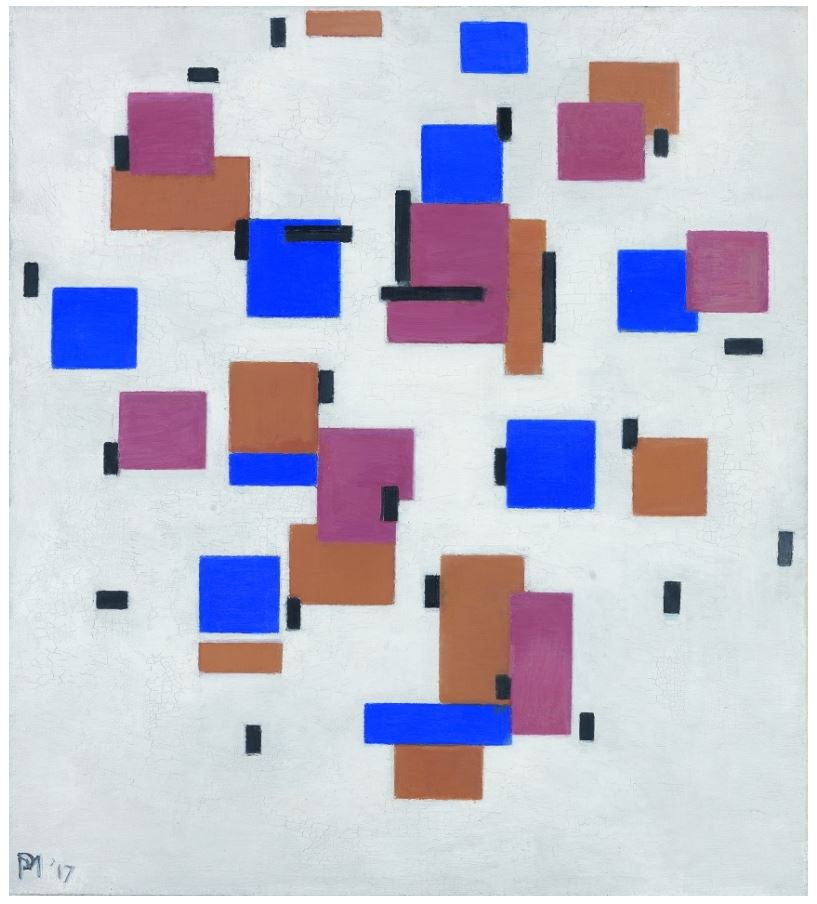
The exhibition includes examples of the many interim steps, fascinating and often beguiling abstracts in their own right, which move towards this, six years later, in the midst of the Great War, when the discrete elements of the earlier paintings have become solidified into blocks, blocks of abstract colour, floating against an empty background (or a background flooded with invisible ether, which joins the disparate entities?)

‘Composition in colour B’ by Piet Mondrian (1917) Collection Kröller-Müller Museum, Otterlo, the Netherlands

Abstraction 2. Mondrian reaches his mature style

‘By the unification of architecture, sculpture and painting a new plastic reality will be created.’ (Piet Mondrian, 1917)

Around 1920 everything came together in the new style of rectangular grids separated by thick straight black lines, a visual language of ‘pure relationships’ which he called ‘neo-plasticism’. These paintings abandoned any form of symbolism as they become irregular grids. He set out to reduce painting to its basic principles, removing individual aspects (which he called ‘tragic’) to express the ‘universal’.

In 1921 he published an essay titled ‘Le Néo-Plasticisme: Principe général de l’équivalence plastique’ which explains neo-plasticism as an approach to representing the ‘universal’ through balancing oppositions of the most basic elements of painting: position, size and colour.

‘Composition with Red, Black, Yellow, Blue and Grey’ by Piet Mondrian (1921) Kunstmuseum Den Haag

Mondrian believed that neo-plastic principles were destined to define the world around us. Some critics described the paintings as having ‘jazz rhythms’ and I’ve seen modern jazz album covers with Mondrians on them, both of them expressing something about the clean pure and yet somehow dynamic lines of modernity. The Tate bookshop includes ‘The Afterlife of Piet Mondrian’ by Nancy Troy which looks interesting, an examination of how the Mondrian style was curated, copied and publicised, of how ‘the popular appeal of Mondrian’s instantly recognizable style in fashion, graphic design, and a vast array of consumer commodities’.

One room is devoted to Mondrian’s mature style and there’s a very noticeable difference between the works from the 1920s and 30s. In both the works from the 1920s, not all the lines extend to the very edge of the canvas. Petty detail though this may seem, it makes a lot of difference, because in the next space are three classic Mondrians from the 1930s and in each instance the black lines do extend all the way to the edge. Trivial though it sounds, they look more complete, more finished, more total.

It’s a mystery to me and something the curators don’t address which is how come such rigid geometric shapes are so very pleasing to the eye and mind. they feel calming, deep, completing in a way which is hard to convey. Mondrian himself commented:

‘Vertical and horizontal lines are the expression of two opposing forces; they exist everywhere and dominate everything; their reciprocal action constitutes “life”. I recognised that the equilibrium of any particular aspect of nature rests on the equivalence of its opposites.’ (Piet Mondrian, 1937)

Not sure that helps explain why this look immediately struck everyone as clean and classic and has remained so for 80 years.

Abstraction 3. The Ten Largest

‘My mission, if it succeeds, is of great significance to humankind. For I am able to describe the path of the soul from the beginning of the spectacle of life to its end.’ (Hilma af Klint, 1917)

I thought the climax of Mondrian’s development in those three classic works from the 1930s, presented in a clean white rectangular space, would be difficult, but in the event the curators completely trump them with the last room in the exhibition. This is devoted to a set of ten enormous, huge and overwhelming canvases by af Klint, titled ‘The Ten Largest’.

The Ten Largest, Group IV, Number 7, Adulthood by Hilma af Klint (1907) Courtesy of The Hilma af Klint Foundation

These ten huge paintings represent the stages of life, with two each representing Childhood, two devoted to Youth, four to Adulthood, and the final pair to Old Age. I thought I wouldn’t like these at all but, somehow, the preceding nine rooms, showing the slow development of her style, explaining the mystical and spiritual beliefs behind it, had softened me up and prepared me. I thought they were magnificent.

The Ten Largest, Group IV, Number 3, Youth by Hilma af Klint (1907) Courtesy of The Hilma af Klint Foundation

‘The Ten Largest’ are part of ‘The Paintings for The Temple’, a body of works af Klint believed was commissioned by her spiritual guides (we have learned about her spiritual guides throughout the show). Af Klint dreamed of building a temple in the form of a spiral where her paintings could be hung together as a ‘beautiful wall covering’. To ascend through the temple would mean moving towards a higher state of being.

Installation view of ‘Hilma af Klint and Piet Mondrian: Forms of Life’ at Tate Modern showing two of the four Adulthood works.  Photo: Tate (Jai Monaghan)

It took me a while to realise that the four ages are colour coded: the Childhood pair have a lovely deep blue background, the two Childhood works have an orange background, the four Adulthood paintings the lilac colour you can see in the photo above, and the final Old Age pair have a pink background. Then I realised that the colour in each set fades and becomes paler in the second or later work in each set, as if that era’s virility fades as it prepares to transmute to the next stage of life. None of that, none of the richness or intensity of the colour, and the dramatic sense of their changing hues, comes over in these photographs.

Installation view of ‘Hilma af Klint and Piet Mondrian: Forms of Life’ at Tate Modern showing, from left to right, the second Childhood (blue), the two Youth (orange) and the four Adulthood (lilac) paintings. Photo: Tate (Jai Monaghan)

As you can see each painting consists of arrangements of completely abstract designs and patterns and yet, slowly, as you study them, you realise certain motifs recur in each set, giving them a thematic unity.

I spent a lot of time wondering why the final two paintings, the Old Age set, were the ones with the most conspicuous use of symmetry. Is it because, after the storms of life, your knowledge settles into a balanced wisdom?

And the even more puzzling fact that the very last painting is the only one to contain  a square or rectangular feature, namely a grid of squares like a chessboard. Is it because the swirling zoomorphic shapes of active life give way, in one’s last years, to a harder, adamantine, inflexible knowledge?

The Ten Largest, Group IV, Number 10, Old Age by Hilma af Klint (1907) Courtesy of The Hilma af Klint Foundation

Almost certainly not, but I was beguiled. I found myself walking round, sitting and staring, getting up and reviewing them slowly, again and again. I couldn’t tear myself away, an experience I’ve had with only a few other exhibitions – I remember not wanting to leave a room full of Monet paintings of the River Thames years ago. Same here. I found this final room completely absorbing, entrancing and didn’t want to leave.

There’s lots and lots of lovely paintings, in an amazingly wide range of styles, sizes, and intentions, throughout this wonderful show. But this final room is worth the admission price by itself.

The video


Related links

More Tate Modern reviews

Berthe Morisot: Shaping Impressionism @ Dulwich Picture Gallery

This is a lovely exhibition, the first major UK exhibition of the leading French Impressionist Berthe Morisot’s work since 1950, but it’s also much more than that.

At the Ball by Berthe Morisot (1875) © Musée Marmottan Monet, Paris

It is also a sustained comparison of Morisot’s work with the 18th century artists she knew and loved, which means that about a third of the paintings on display (about 15 out of a total 45 or so) are not by Morisot at all, but by eighteenth century classics, such as Watteau, Fragonard, Boucher and, surprisingly, the Brits Joshua Reynolds and Thomas Gainsborough.

A collaboration

How did this come about? Well, the Musée Marmottan Monet is ‘the world’s leading research centre for the work of Berthe Morisot’ and it turns out that Morisot was very influenced by eighteenth century art – the French eighteenth century work of Fragonard and Watteau and Boucher, but also the English eighteenth century art which she saw on her honeymoon to England in 1875.

And Dulwich Picture Gallery houses a celebrated collection of 18th century painting. So this exhibition is by way of being a collaboration between these two galleries – The Musée Marmottan Monet providing nine key examples of Morisot’s work (along with prime examples from international collections) and these are then juxtaposed with French and English eighteenth century paintings from the Dulwich collection and elsewhere – with the aim of demonstrating Morisot’s debt to the previous century, both in subject matter and aspects of her painting style.

Berthe Morisot potted biography

Berthe Marie Pauline Morisot (1841 to 1895) was a French painter and a founding member of Impressionism. In 1864, she exhibited for the first time in the highly esteemed Salon de Paris. Her work was selected for exhibition in six subsequent Salons until, in 1874, she joined the ‘rejected’ Impressionists in the first of their own exhibitions, a show which included Cézanne, Degas, Monet, Pissarro, Renoir and Sisley. Morisot went on to participate prominently in seven of the eight Impressionist exhibitions between 1874 and 1886 (she missed one in 1878, having just given birth to her daughter, Julie). In 1894 the art critic Gustave Geffroy as one of ‘les trois grandes dames’ of Impressionism, alongside Marie Bracquemond and Mary Cassatt.

Morisot was well connected. She came from an affluent family who secured her painting lessons, first copying works in the Louvre, and then as a pupil to landscape painter Camille Corot, who taught her to make swift outdoor sketches.

She married Eugène Manet, brother of her friend and colleague Édouard Manet. Her sister, Edma, was also a painter. The Symbolist poet Stephane Mallarmé was a family friend. She was a member of the haut bohemien.

Room one

The exhibition is in four rooms. The first room contains eight paintings, designed partly to give you an introduction to her light and airy style, but almost all of the captions also draw attention to the fact that, even at the time, many critics spotted her closeness in spirit to eighteenth century painting.

Installation view of Room 1 of ‘Berthe Morisot: Shaping Impressionism’ at Dulwich Picture Gallery

What they meant was that something in the lightness and airiness of her style, something in the domestic intimacy of her subjects (almost entirely women), and even in her use of shades of white and silver, related directly back to the mood and tone of French Rococo painting.

‘Woman at her Toilette’ by Berthe Morisot (1875 to 1880). Image courtesy of The Art Institute of Chicago, Stickney Fund

Take ‘Woman at her Toilette’. To quote the curators:

With its silvery palette and fluent brushwork, the painting appears as ephemeral as a mirror reflection. Reviewing it at the Fifth Impressionist exhibition in 1880, art critic Paul Mantz noted: ‘everything floats, nothing is formulated […] there is here a finesse like that found in Fragonard.’

Or:

The genius of the eighteenth century, but not its debauchery, lives again in these familiar and select images, which are animated by a kind of airy voluptuousness.’ (Henri Focillon)

Or take the painting at the start of this review, ‘At the Ball’. The woman in evening dress is holding an eighteenth-century fan, opened to display a picture-within-the-picture, a scene of outdoor courtship known as a fête galante, a genre invented by the eighteenth-century artist Watteau. (The fan belonged to Morisot and is included in the exhibition so we can admire its civilised 18th century style.)

Morisot was fond of making this kind of allusion to eighteenth-century visual culture and the connection proved attractive to collectors. The curators tell us that Rococo art had gone into a long period of neglect after the French Revolution but that, in Morisot’s generation, it underwent a revival. Exhibitions reintroduced eighteenth-century French art to the public and the Louvre opened new rooms devoted to the era.

So when Renoir declared her ‘the last elegant and “feminine” artist that we have had since Fragonard’ and Paul Girard, reviewing her summary exhibition in 1896 commented that her work was ‘the eighteenth century modernised’, it showed that she was very much on trend, and it was reflected in her sales. ‘At the Ball’ was bought from the Second Impressionist Exhibition in 1876 by art collector Georges de Bellio, to complement his existing collection of eighteenth-century art, and many of her works were sold to collectors with similar tastes.

Room two

The second room has the highest proportion of non-Morisot to Morisot, 8 or so works by other artists to her four. This is the room where the curators show a number of eighteenth century works and explore Morisot’s relationship to them. This turns out to be quite complicated, in the sense that she had a multi-levelled relationship with the artists of the preceding century, which evolved over time.

Engaging the classics

In her late teens and early twenties she had undergone supervised training which consisted of copying classic works at the Louvre. Over 20 years later, she returned to the Louvre to engage with the classics, no longer copying them but translating them into her own, loose, rough, late-impressionist style.

In her forties and fifties, Morisot engaged directly with grand mythological paintings in museum collections, translating elements of their compositions into her own Impressionist language. Unlike the copies that formed part of her own early training, these are original interpretations by a confident, mature artist.

Thus the exhibition shows us (a photo of) Apollo revealing his divinity to the shepherdess Issé by the great Rococo painter François Boucher:

‘Apollo revealing his divinity to the shepherdess Issé’ by François Boucher (1750)

And then shows us Morisot’s interpretation or translation or reinvention of the two embracing young women at the bottom left of the painting into her own hazy, light, unfinished style:

‘Apollo revealing his divinity to the shepherdess Issé, after François Boucher’ by Berthe Morisot (1892) © Musée Marmottan Monet, Paris

Now this raises all kinds of questions. On the face of it, I prefer the Boucher, as I consistently preferred all the 18h century originals to Morisot’s ‘interpretations’ when they were laid side by side. There’s more depth, more perspective, more (wonderful) painting technique, more detail and more visual pleasure to be had by the works by Fragonard, Boucher and Watteau on show here. They look and feel like the luxury objects they were intended to be.

And yet, Morisot’s work is doing something different: its looseness, its rough finish, its lack of interest in realistic perspective or twinkly detail are the result of something else. There’s a lot of experimentation going on in the technique, namely the long, blunt, wide brushstrokes which can be seen in the green reeds. (And it’s fascinating to learn that Monet very much liked this feature of Morisot’s later style, and went on to use a similar combination of short and longer sinewy brushstrokes and pastel colouring in his paintings of water lilies.)

But, arguably, there’s also a psychological dimension at play. In the Boucher work, the embracing women are yet more examples of the kind of sumptuous sensuality which floods the painting. In Morisot’s version they’re still naked, and we can see the outlines of their bodies, and yet these bodies are being dissolved into or drowned or clambered over by the powerful green reeds, powerful green reeds which, on the left, swirl and curve, leading the viewer’s eyes into a background which isn’t magically alluring but is more unadorned and bleak. Humanless and troubling.

The female gaze

Something similar can be said of another direct comparison the show gives us. First, look at this characteristically sensual and saucy painting by Fragonard of a woman reclining, all pink nipples and soft porn confection:

‘Young Woman Sleeping’ by François Boucher. Fondation Jacquemart-André – Institut de France, Domaine de Chaalis, Fontaine- Chaalis

Pretty obviously this painting, and this entire genre of painting, was designed to please and titillate its male audience with what T.S. Eliot called the ‘promise of pneumatic bliss’. And here is Morisot’s reinterpretation:

‘Resting’ by Berthe Morisot (1892) Private Collection

Same subject i.e. head and shoulders of a topless young woman reclining on an ornamental sofa or bed and yet…the Morisot comes from a different world, both artistically and psychologically. On the painterly level, the Bouchard buries the outlines of the subject in a realistic depiction i.e. you see more or less what you would see in real life, maybe a little Photoshopped and improved, but the outlines are soft a gentle.

On the contrary, the Morisot makes a point of emphasising outlines. Note the strong green lines shaping her hair, particularly as it tumbles onto her shoulder, the outline of her right shoulder against the pillow, the outlines of her right boob and forearm and left handing resting on it.

This painting isn’t interested in realism; it is making a statement about the artificiality of painting itself. In this respect, several of her later (this is from 1892) works reminded me of Gauguin, who had long ago ceased bothering about ‘realism’ and become interested in simplifying patterns and designs using heavy outlines, shapes which refer back to objects in the real world but take them a long way towards a kind of primitive abstraction.

Morisot isn’t Gauguin, but I thought some of her later works had moved just as far beyond impressionism, but in her own distinctive way. Another vivid example is ‘Julie Manet and her Greyhound Laertes’ from right at the end of her life (1893 – she died in 1895)

The straight-on face and the black, very loosely painted dress, reminded me of Edvard Munch more than Renoir or the other classic-era impressionists.

And this brings me to the other aspect of the work, which is its psychological impact. The Bouchard woman, a sleek airbrushed imago, has been painted for male viewing pleasure. The Morisot picture for other reasons altogether. As discussed, it is, on one level, an exercise in painterly technique, in exploring the world beyond pure realism. But on a psychological level it is just as complex. This woman doesn’t exist to give any man pleasure. This isn’t painted for the controlling male gaze. She comes across as a real individual, with idiosyncratic hair, colouring, non-male-fantasy boobs; like a painting of a woman who happens not to be wearing a top.

And, as well, there is some kind of power radiating from t, a sense of psychological depth. She reminds me of the heroines of late Victorian fiction, of Hardy or Zola or Henry James, of women whose every transient thought and emotion and response is annotated and analysed in vertiginous detail over three or four hundred pages novels.

There are a lot of paintings of women in the exhibition but, in my opinion, there is quite a big gulf between Morisot’s pretty-pretty, dressed-up Victorian women from the 1870s and 1880s, which are often variation on Renoir’s delightful dancing ladies – and these later depictions, which are something altogether different. They anticipate the much blunter honesty and psychological complexity of much early twentieth century portraiture.

Working in pastel

Room three also contains a useful contrast in the medium of pastel. From the 18th century we have a stunningly beautiful portrait of an unknown man by Jean-Baptiste Perronneau. This is the kind of work that has to be seen in the flesh to be appreciated. A reproduction like this flattens and smooths it out. In the flesh you can see the amazing amount of work that’s gone into the pastelwork, for example the way repeated layerings of broad blue crayon create a rich sensual impression like you could reach out and touch it, whereas, the wall label tells us, the intricate detail of his neckerchief was achieved with a fine-nibbed pen. It looks pretty good in this reproduction, but it’s a wonder to stand in front of.

Portrait of a Man, Thought to be Louis Journu, Known as Montagny by Jean-Baptiste Perronneau (1757 to 1758)

And so, placed next to it is a very good pastel portrait of her daughter Julie by Morisot:

Girl carrying a basket by Berthe Morisot (1891)

Again, the Morisot doesn’t have the astonishing finish or visual depth of the Perronneau. And yet, in its very sketchiness, it indicates an infinitely more modern consciousness, a proto-modern sensibility made of gaps and fragments, the strange ellipses and leaps of consciousness which modernist literature was about to start exploring about a decade later (I’m thinking about the earliest works of Kafka and Joyce).

The French eighteenth century

So, as mentioned above, the exhibition is worth visiting to see not just works by Morisot, but also (an admittedly small) number of works by French eighteenth century masters. There’s a pretty poor portrait of a young girl by Fragonard but a dazzling work by Watteau:

Les Plaisirs du bal by Antoine Watteau (1715 to 1717) Courtesy Dulwich Picture Gallery

Completely different in style from those guy’s frothy confections and commedia dell’arte whimsy, there’s a lovely piece by the master of eighteenth century realism, Jean-Baptiste-Siméon Chardin, The Scullery Maid, a characteristically humble domestic scene of a serving maid getting eggs out of a jug surrounded by beautifully depicted bowls and servant-level bric-a-brac.

This leads off in another direction because it turns out that Morisot’s sister, Edma, was also an artist and she is represented here by just one work, a beautiful landscape in the manner of Jean-Baptiste-Camille Corot who both girls had studied under. These are all delights.

Landscape by Edma Morisot (1860s) D. and J. Waller

The English connection

But back to the English. The exhibition explains that Morisot spent her honeymoon (with Manet’s brother, Eugène) on a trip which took in the joys of the Isle of Wight and then London. In London she saw the huge collection amassed by Sir Richard Wallace, Marquess of Hertford, which has been preserved for the nation as the Wallace Collection.

It was here that she was introduced to the works of 18th century English masters such as Joshua Reynolds, Thomas Gainsborough and George Romney. The exhibition takes a little detour to explain the different styles of these three men, and discuss some key works by each of them, and then how their styles or motifs found their way into Morisot’s work.

Gainsborough is the most obviously close to Morisot because of his light, feathery, sketchy approach, which drew criticism from the more grand and finished Reynolds, yet was precisely the quality that attracted the quick, sketchy Frenchwoman.

Installation view of ‘Berthe Morisot: Shaping Impressionism’ at Dulwich Picture Gallery, setting ‘Mrs Mary Robinson’ by George Romney (1781, on the left) against ‘Winter, or Woman with a Muff’ by Berthe Morisot (1880)

Summary

Not all of Morisot’s work is great. The fourth and final room contains only works by her and I have to admit I didn’t like most of them.

Installation view of Room 4 of ‘Berthe Morisot: Shaping Impressionism’ at Dulwich Picture Gallery

Worthy depictions of domestic interiors, of her growing daughter, intimate portraits of women outside in the Bois de Boulogne or out in a boat or resting on divans (clearly a full-time occupation for many Victorian ladies), I often found their style either washed-out (several of the supposedly sweet and intimate studies of her daughter gave her such a yellow-pale face she looked like a corpse, for example, ‘Children with a basin‘) or so quick and sketchy as to feel amateurish.

Very good amateurish, but in many of her paintings the multiple clumsinesses wherever I looked just stopped me really enjoying them, giving in, surrendering, saying Yes.

‘Eugène Manet on the Isle of Wight’ by Berthe Morisot (1885) © Musée Marmottan Monet, Paris

By contrast, I was enraptured by almost all the eighteenth century works (except for the ghastly, ugly Fragonard in room one), by her sister’s one work, and also by the massive work by a painter I haven’t mentioned yet, her contemporary James Tissot (The Ball on Shipboard), included because Tissot moved from Paris to London and made a great success of his career, so much so that, on her honeymoon trip, Morisot seriously considered doing the same and moving to London.

Even the 18th century ‘cartoons’ or preliminary sketches for big works like by Boucher (‘Vulcan’s Forge) delighted and enchanted with a depth and finish and wonderful technique, in a way that most of the Morisot didn’t.

For this reason I hardly think it the scandal of the century that Morisot isn’t as well known as many of the other impressionists. To be blunt, I don’t think she’s as good. Or definitely not on the strength of the works presented here, a handful of which are really good, some are pretty good, and some are positively poor.

But then again, it depends on your aesthetic. Did my general preference for the 18th century works indicate that I’m a peasant, a man of poor taste, a liker of pretty pictures and chocolate box art, who doesn’t appreciate more demanding (and hardly that demanding) art?

Here’s a test. Here’s the bold, take-no-prisoners self-portrait which the curators open the show with.

Self-portrait by Berthe Morisot (1885) © Musée Marmottan Monet, Paris

I get that she’s a strong independent woman, and that this comes over not only in the directness of her gaze but in the super-confidence with which she didn’t finish it. The French have an expression, ‘je-m’en-foutisme’, which translates as ‘I don’t give a damn-ism’ (or ruder, four-letter equivalents).

So, is the scrappy finish and the lack of immediate visual appeal outweighed by the strength of character and psychological depth of a painting like this? Your answer will determine whether you like Morisot, or at least the selection of 30 or so Morisot paintings to be found in this small but incredibly stimulating and hugely enjoyable exhibition.

The merch

I’ve made the point in previous reviews of Impressionist exhibitions, but one reason for the ongoing popularity of the Impressionists is simply that their paintings transfer so well onto posters and mugs and tea towels and jigsaws and the whole world of merchandise. Painting which, large and in the flesh feel half finished and scrappy, when reduced to the size of a coffee cup or tea tray, suddenly look finished, light and attractive. Never ceases to amaze me. As you can see from the full range of Morisot merchandise on sale at the Dulwich Picture Gallery shop:

The promotional video


Related links

Related reviews

More Dulwich Picture Gallery reviews

The Big City @ the Guildhall Art Gallery

What’s the largest painting you know? What’s the biggest picture you can think of? Monet’s huge water lilies? Mark Rothko’s Seagram murals at Tate Modern? Juan Miro’s huge canvases of biomorphic shapes? These canvases are so big that if you ever find yourself sitting on an exhibition bench in front of a trio of them, as I have done with Monet and Miro, you realise entire field of vision is filled with them. It is an immersive experience. You are in Miroworld or Monetland.

Is size important? When it comes to art? Does a big painting really do a lot more than a medium-sized one? What, exactly? At what size does a big painting become an immersive one? Have psychologists or art colleges done research into viewers’ psychological and aesthetic responses to size? Is there a recognised point at which a painting goes from ‘big’ to ‘massive’ or is it subjective i.e according to the viewer’s physical size and visual range?

Do artists, collectors or galleries categorise paintings by size? Have there been fashions for huge canvases? Or historical periods particularly associated with them? Are there particular artists famous for their monster canvases? Is there a record for the biggest painting ever made? By who? Why?

These are some of the questions raised by ‘The Big City’, an exhibition at the little known but well-worth-a-visit Guildhall Art Gallery, a hop, skip and a jump from Bank tube station.

The gallery is owned by the Corporation of London, which possesses some 4,500 works of art. Fifty or so of these are on display in the gallery’s permanent exhibition, itself packed with gems, and then the gallery runs rotating exhibitions of selections of the others, alongside exhibitions of new, original art works.

The Big City

This exhibition is titled ‘The Big City’. It is housed in three rooms, respectively small, medium and large. The small room, the third one you come to, houses a display which comes first in terms of chronology:

Sir James Thornhill

Sir James Thornhill (1676 to 1734) was the premier exponent of the Italian Baroque style in Britain in the early 1700s. Much of this took the form of site-specific allegorical murals for public or grand buildings. He supervised large painting schemes in the dome of St Paul’s, in the hall of Blenheim Palace, at Chatsworth House.

In the early 1720s Thornhill was commissioned to create an Allegory of London for the ceiling of the council chamber at the Guildhall where the Lord Mayor and aldermen held their meetings. He used the established style of Baroque allegory to create a central image of London, represented by a topless woman, being advised by the goddess of wisdom, Pallas Athena, and women symbolising Peace and Plenty. It features putti or podgy winged toddlers who often flit around Baroque paintings. Here they are depicted at the bottom right among images of: the City insignia, the sword bearer’s fur cap, a pearl sword and the City mace.

Allegory of London by Sir James Thornhill (1725) © Guildhall Art Gallery, City of London

This oval painting was fixed in the middle of the ceiling and was accompanied by four smaller pieces, one in each corner of the ceiling, depicting flying cherubs or putti representing the four cardinal virtues: Temperance, Prudence, Fortitude and Justice.

We know what the whole design looked like because there’s a painting of the room by John Philipps Emslie showing how it looked in 1886. The story is that the centrepiece and four smaller parts were dismantled and stored during the Second World War. The building was damaged in the Blitz and the original decorative scheme destroyed but these individual pieces were saved, along with some preparatory sketches by Thornhill. All of this is on display here.

It would be easy to say the figures ‘looked down’ on the City officials meeting below but a glance at the image shows they’re not looking down at all, they are tied up in their own conversations in their own world.

The piece’s content, size and position are obviously connected with values – moral and social values. The size not so much of the individual elements, but the way they were arranged over the entire roof, were designed to act as a constant reminder to the officials below, of the longevity and depth of the values associated with the City and its officials and business. This is what we stand for: commerce and prosperity, bringing justice and peace.

So the images aren’t instructive, they are aspirational. It wasn’t a case of the gods looking down but of ordinary mortals looking up and, whenever they did, being reminded of the traditions and values they were meant to be aspiring to. (Also, a point often not made about Baroque painting – they’re quite playful.)

Prudence from The Allegory of London by Sir James Thornhill (1725) © Guildhall Art Gallery, City of London

Grand occasions

Before you get to the Thornhill room you walk through the medium-sized first room in the show. This has a completely different look and feel. It contains nine big paintings of ceremonies associated with the City of London from the late Victorian period through to the 1960s. They depict lots of old white men wearing formal clothes, gowns and regalia, chains of office, wigs and so on.

The paintings depict different types of event which the curators usefully itemise: civic, royal, state, ceremonial, funeral.

They are big, and their size is more obviously connected to notions of power than the relatively benign Thornhill. By power I don’t mean images of solders or Big Brother looming threateningly, not direct power. But the soft power implicit in grand occasions which serve to bolster and underpin ideas of hierarchy. The pictures are big because the event was big.

Take ‘Queen Victoria at St. Paul’s Cathedral on Diamond Jubilee Day 22 June 1897’ by Andrew Carrick Gow, completed in 1899. The painting was commissioned to capture the magnificence and the magnificence is exemplified in the extraordinary scene of the packed steps of St Paul’s. Not just packed but, as you look closer, you realise arranged in a highly structured way, as was the event, to include representatives of the army, the Church, politicians and academics, arranged in groups and hierarchies. The crème de la crème, the top figures in all the important fields of state.

Queen Victoria at St. Paul’s Cathedral on Diamond Jubilee Day 22 June 1897 by Andrew Carrick Gow (1899) © Guildhall Art Gallery, City of London Corporation

The curators point out that a massive royal state occasion like this transformed the centre of London into a stage, a set on which the thousands of figures here, and lining the route of the royal procession to the cathedral, were arranged – and which the painter then has to capture as best he can. Put this way I sympathise with the scale of the challenge the artist faced. He had to be in complete control of the old values of structured composition and extremely detailed naturalism.

There’s another super-simple way to categorise the paintings on display here, which is: inside or outside. The Gow is a good example of outdoor magnificence; ‘The Coronation Luncheon to Her Majesty Elizabeth II in the Guildhall, London, 12 June 1953’ by Terence Cuneo is a good example of magnificence in an indoors setting.

The Coronation Luncheon to Her Majesty Queen Elizabeth II in the Guildhall, London, 12 June 1953 by Terence Cuneo. © Guildhall Art Gallery, City of London Corporation. Image © Terence Cuneo

Once again the size of the painting is an attempt to match the scale of the actual event and, as you can see here, the size of the actual banqueting hall which is, as it is intended to be, awesome. And, leaving aside the ostensible splendour of the occasion, it’s hard not to be awed by the photographic realism of Cuneo’s painting. There’s a ‘Where’s Wally’ element to looking closely at the hundred or more individual guests, how they’re sitting, what they’re going (eating, talking, turning to their neighbour and so on).

(It might be worth pointing out that the word ‘magnificence’, like so many English words used to describe this kind of thing, has a Latin root, and so carries with it the connotation of learning and cultural capital which Latinate words always bestow. It derives from magnus meaning big or great [the Roman general Gnaeus Pompeius Magnus is translated into English as Pompey the Great] and facere meaning ‘to make or do’. So at its root ‘magnificence’ means ‘to make big’. At its origin, it is about size. During 2,000 years of evolution through medieval Latin, French and into English it has come to mean ‘splendour, nobility and grandeur’, themselves all Latinate words.)

Terence Cuneo OBE (1907 to 1996) was a prolific English painter noted for his scenes of railways, horses and military actions. He was the official artist for the coronation of Queen Elizabeth II in 1953 and the Queen’s favourite portraitist. Including ceremonial occasions he painted her no fewer than 17 times. He’s represented by two works here, the coronation lunch (above) and:

Frank O. Salisbury (1874 to 1962) was an English artist who specialised in portraits, large canvases of historical and ceremonial events, stained glass and book illustration. In his heyday he made a fortune on both sides of the Atlantic and was known as ‘Britain’s Painter Laureate’. He painted over 800 portraits (!) and painted Churchill more times than any other artist.

What you’ll have realised by now is that most of these works are, by modern standards, barely what we’d call art at all. Sure they’re well composed, efficiently worked paintings, but they are in a style that was old fashioned by 1900 and completely moribund by the 1960s.

In this respect, despite their size and detail and polish, they epitomise the opposite of what was intended; rather than impressing with awe and magnificence they tend, to the modern viewer, to emphasise how remote and out of touch these figures of power were with the wider world of the 40s, 50s and 60s.

You could argue that the grand old panelled rooms in which they suited old boys had their gala dinners protected and insulated them from a world moving beyond their grasp and even their understanding.

Churchill, who features in two of the paintings here (one alive, one dead) fought the Second World War to preserve the empire. Fifteen short years later he lived to see it being dismantled and the influx of immigrants from the former colonies who would bring new voices and new perspectives to Britain. None of that historic change is even hinted at in these old-fashioned depictions of old-fashioned institutions carrying out their time-honoured ceremonies.

There are some older paintings on the same type of subject. These, as it were, have permission to be dated, or are easier to take ‘straight’ because they are in styles appropriate to their day.

In this latter painting, apparently Paton, a noted painter of maritime scenes and naval occasions, did the composition and painted the main scene while Wheatley, famous for a series of paintings called ‘The Cries of London‘, did the figures in the foreground.

Contemporary art

The third and biggest room contains the biggest variety of paintings and the biggest single works. Size is not the only factor for their inclusion here, since each of the paintings also has a specific setting or story and these to some extent represent different aspects of life in the city.

I counted 18 paintings in this big room. I won’t list them all but will select some highlights and themes.

Ken Howard’s ‘Cheapside 10.10 am. 10 February 1970‘ is big and sludgy. It shows the north side of Cheapside looking west on the kind of cold overcast February morning typical of London. This reproduction softens the impact of the paint which Howard has laid on in thick dollops, makes it look a much cleaner, slicker object than it is in real life. A reproduction also brings out instantly what is less obvious in the flesh, which is the fact that it’s a painting about a mirror, namely the way St Mary le Bow church on the left is reflected in a shop window on the right.

Howard is quoted as saying that urban landscapes give more scope for an artist interested in shape, tone and colour than the countryside. This is exemplified in the next work, which is a splendid depiction of Fleet Street in the 1930s.

Fleet Street, London, 1930s by unknown artist © Guildhall Art Gallery, City of London

There’s quite a backstory to this painting. It was commissioned by Viscount Rothermere, owner of the Evening Standard and Daily Mail, to depict the hustle and bustle of Fleet Street, then centre of Britain’s newspaper industry. But the artist intended to include portraits of real Fleet Street luminaries down at the bottom right, and one of the first to be completed was a portrait of Rothermere’s rival press baron, Lord Beaverbrook, owner of the Express group. At which point Rothermere took the painting from the artist, which explains why, if you look closely, you realise it is unfinished, many of those figures without faces and some little more than ghosts. Which in its own way, makes the image quite haunting.

What is finished is the central vista along the ‘Street of Shame’ and, in particular, the gleaming Art Deco glass and steel building on the left. This was the newly opened Daily Express building (1932) which features, thinly disguised, in Evelyn Waugh’s great satire on the 1930s newspaper industry, Scoop.

What does size have to do with it? Well, at 2.13 metres tall this is a big painting, but clearly the scale doesn’t aim to do the same as the Thornhill (embody inspiring moral values) or the civic paintings we saw earlier (impress the viewer with rank and hierarchy).

I suggest its implicit aim is to do with modernism whose fundamental driver is excitement about life in the modern city, in this instance the new technologies and new designs and new architecture represented by Art Deco. It is an image of hustle and bustle and energy. Since it was commissioned by a multi-millionaire media baron I suppose you could also say it represents a capitalist’s, a plutocrat’s view of the city, full of folk hustling and bustling to make him money for him, his class, society at large. It is a celebration of the system.

This enjoyable work was succeeded by a sequence of paintings which I didn’t like at all, in fact actively disliked.

1. Walk by Oliver Bevan (1995) is certainly big (2.29m high, 2.13 m wide). It is a depiction of the pedestrian crossing in front of the Barbican tube station. Apparently Bevan specialises in the depiction of ‘non-personal urban spaces’. Actually, the tiny reproduction I’ve linked to makes it look a lot better than it does in real life. Confronting the 2 metre high thing in real life makes you all too aware of the crudity of the painting and the unsatisfying randomness of the arrangement of the people. I know people mill about randomly all the time but this has been carefully arranged to look gauche and clumsy.

I’m guessing the intention of doing such a humdrum scene on such a large scale is somehow democratic, to say that size isn’t limited to the high and mighty but that any moment in our everyday lives is worthy of record and depiction, can be made ‘monumental’ in scale and implication.

Maybe. But in this instance the size of the piece did the exact opposite of almost all the earlier works, which was impress me with its graceless lack of design and poor finish. Its size worked against it.

2. Jock McFadyen is represented by a work called Roman (1993). McFadyen depicts scenes around his flat and studio in Bethnal Green. This murky painting is of a block of flats in Roman Road nearby. It’s horrible. Again, the tiny online reproduction intensifies and clarifies the image. In reality it’s 2 metres square and an offence to the eye. Everything possible has been done to make it feel shitty. The left vertical of the flats is wonky, which is upsetting. The flats themselves are depicted with wobbly lines which completely fail to capture the hard geometric shape of such blocks which is their only redeeming feature. The human figure on a balcony is poorly drawn. The red VW in the street is appallingly badly drawn. And the decision to paint railings across the bottom spoils the entire composition even more and made me turn away quickly. I actively like scenes of urban devastation, graffiti and whatnot. But this just felt shoddy and amateurish.

3. Worse is to come. Flyover St Peter’s (1995) by Paul Butler is a whacking 2.74 metres wide and a big donkey turd of a painting. Regular readers of my blog know I actively like pictures or sculptures to be textured or incorporate detritus like dirt, wood, glass or whatever (see Hepher, below); but that I fiercely dislike the paintings of Frank Auerbach and Leon Kossof with their inch-deep sludges of filthy puddle-coloured oils.

They seem to me to do dirt on the entire idea of painting. They deny clarity, structure, composition, delicacy, skill, light, everything which makes painting worthwhile. The Ken Howard painting, earlier on in this room, was well on the way to achieving Auerbach levels of sludge, but Butler goes full throttle and annihilates the human spirit in a disgusting refuse tip of stricken oil spillage. Again, the reproduction you’re looking at flattens and clarifies the image so that it almost becomes appealing. In the flesh it’s like someone has spent a year blowing their nose and menstruating on a canvas to produce a thick layer of rotting mucus and menses. Yuk.

(All three of these works, plus a few others nearby, are, in their different ways, poor. This in itself is quite interesting. Most exhibitions you pay to go to in London represent the best of the best – tip-top Surrealist works at the Design Museum or Cezanne’s greatest hits at Tate Modern. You don’t often get to see a collection of art works that are average or plain bad, and it was interesting to dwell on what made all these works so sub-standard or actively objectionable.)

Anyway, this little set of poor works contrast dramatically with the series of paintings on the opposite wall, which are much cleaner, airier panoramas of London. Indeed, the canvas of London as seen from the top of the Shell Centre by David Thomas (1968) is the widest painting in the show, at a whopping 4.88 metres.

London from the top of the Shell Centre by David Thomas (1968) © Guildhall Art Gallery, City of London Corporation. Image © David Thomas

But it’s not this that impresses; it’s the lightness and the clarity of the image, which was like walking out of a dark room (Bevan, McFadyen, Butler) into the light and clarity of a lovely spring day. The painting feels wonderfully lucid, with all the buildings lining the Thames in central London depicted with thrilling geometric accuracy, almost like an architect’s conspectus come to life.

For people who like a bit of gossip or social history with their art, the label tells us that the picture shows at the centre bottom the Royal Festival Hall – the most enduring legacy of the 1951 Festival of Britain – to its right the daring Hayward Gallery which had just opened, and to the right of Waterloo Bridge a brown open space which had just been cleared to make way for construction of the new National Theatre.

What size does here is introduce the notion of the panorama, a particular genre of art which has reappeared in urban centres over the centuries. It embodies the pleasure of being up at a viewing platform looking over a city we mostly only get to see from ground level. The same kick which has people queuing up to buy tickets to the (disappointing) London Eye.

It begins a little series of urban panoramas which include a view over Clerkenwell by Michael Bach. The thrill or bite in something like this has to come from the architectural accuracy of the depiction. Bach, like Thomas’s, is very accurate and it’s big (2 metres wide) but…something (for me) is lacking.

Possibly that something is demonstrated in a much older work, the classic ‘Heart of Empire’ by Niels Moeller Lund. Though born in Denmark (hence the name) Lund grew up in Newcastle-upon-Tyne before moving to Paris to study painting. He is best known for his impressionistic paintings of England, particularly London and the North-East and ‘The Heart Of The Empire’ is his best-known painting.

The Heart of the Empire by Niels Moeller Lund (1904) © Guildhall Art Gallery, City of London Corporation

The view is taken from the roof of the roof of the Royal Exchange looking west across London. There are several obvious points to be made: I suppose the most obvious one is that panoramas over cities taken from up high, like this, give the viewer a sense of freedom, as if we can fly, as if we are gods flying above the mob and the crowd, freed from the cramped dictates of the busy streets, the traffic, the jostling with strangers, flying free. There’s a kind of psychological release.

Second and allied with it is some kind of sense of power. I don’t mean direct power like we’ve been elected president, I mean a kind of psychological empowerment, a sense of somehow owning what we survey. We know we don’t but it feels like it. This is my city with all its awesome hustle and bustle, its millions of lives, its buying and selling and wealth and poverty.

Why, then, do I get that feeling about this painting but not when looking at the view from the Shell building or over Clerkenwell? It’s something to do with the composition and, especially, the style. Lund’s work is described as ‘impressionist’ though it’s nowhere near as hazy as the classic French impressionists.

What he achieves is a soft focus, gauzy effect. The light isn’t champagne-clear as in Thomas’s bright somewhat clinical treatment; it creates a softening, blurring effect. This is evidenced in numerous ways, for example the buildings shimmer and face into the distance.

And after looking at it for a while I noticed the smoke issuing from chimneys across the vista and especially in the foreground. These may or may not be contributing to the blurry hazy effect, but they epitomise another aspect of the painting which is that it is anecdotal. What I mean is there are things going on in the painting. To be precise, note the flight of white birds (presumably pigeons) in front of the neo-classical Mansion House in the lower left. Once you’ve seen them your eye is drawn past them to the blurry throng of horses and carts and red omnibuses below.

The life of the city is dramatised. Because I happen to have watched the Robert Downey movie recently, it makes me think of Sherlock Holmes and a million details of late Victorian London life. When I look at the Thomas painting I get absolutely no sense whatever of the life of London 1968, there don’t appear to be any people in it at all.

So these are preliminary suggestions about how the same type of painting – the big urban panorama – can have dramatically different impact on the viewer depending on the sense of composition and painterly style.

David Hepher

I’ve left the best thing about the exhibition till last. The main room in the exhibition space is a kind of atrium in the sense that the ceiling has been removed to create a hole which lets you see into the floor above. Or, conversely, the floor above requires a modern glass railing to stop people falling down into the floor below, a railing which allows them to look down into the room below and view the artworks from above.

Anyway the point is that this removed ceiling has allowed the curators to place here a big wooden block supporting the three biggest paintings in the exhibition, three fabulous and very big paintings depicting modern brutalist blocks of flats by artist David Hepher.

Born in 1935, over the past 40 years Hepher has established a reputation for painting inner city estates of the 1960s and 70s. The three works here are 3 metres high. They’ve been attached to a wooden display stand to create an enormous triptych which dominates the room and is the biggest and most convincing thing in the exhibition. It’s worth making the journey to the gallery just to see this.

Gordon House East Face; Gordon House Nocturne; Gordon House West by David Hepher (2013) © Guildhall Art Gallery, City of London Corporation. Image © David Hepher

I loved these works for half a dozen reasons. For a start this it the real London, the appalling 70s tower blocks which millions of Londoners are forced to live in every day and which enables London’s intense population density: one seventh of the UK’s population lives in London, the most populous city in Europe, which has a population density of 145,000 per square mile, and it feels like it.

Secondly, tower blocks, like much modern architecture, is a fantastic subject for composition, because it comes ready-made with grids, squares, geometric shapes, which can either be dealt with in an arty modernist style (for example, photographs of their many motifs from unexpected angles as in lots of 20s and 30s photography) or dealt with straight-on, as here. They are just thrilling artefacts – or thrilling to those of us who like lines, symmetries, geometric regularities and angles.

Thirdly, there’s a fabulously dystopian vibe to them. You don’t need to be familiar with J.G. Ballard’s depictions of urban collapse and psychic displacement (Crash, Concrete Island and High Rise‘) to see, realise and feel concrete tower blocks as powerful symbols of social collapse and anomie. You don’t need to know much about the Grenfell Tower disaster to learn that tower blocks have become the cheap, under-maintained dumping ground for the poor, immigrants and the powerless.

They’re real world equivalents of the tower atop Mount Doom in Lord of the Rings, real world sentinels of poverty and deprivation. The broken lifts and urine-stained stairwells and broken pavements littered with dog turds and broken glass, the whole ensemble liberally decorated with impenetrable graffiti create an overwhelming sense of a society which has given up on itself.

The people who designed, built and shunted the poor into these cheap, shoddy death traps are obviously war criminals but in a special kind of war, a kind of below-the-radar class war which has been going on for decades and has become increasingly mixed up with institutional racism and the war on refugees to produce a toxic, and at Grenfell fatal, brew.

In their betrayal of the art, design and architectural utopianism of the 50s, 60s and 70s, in their magical transformation into symbols of social apartheid, exemplifying the scapegoating of the poorest in society, tower blocks like this are absolutely central to the urban experience in cities all around the western world.

The logistics of their size meant they had to be placed in the centre of the atrium, but the positioning also has a deeply symbolic meaning: all the other images, swish modernism of the 1930s, of flyovers and pedestrian crossings, of slick aerial panoramas, are all spokes rotating round the axle of these monster images.

To zero in on the works, another crucial and thrilling aspect of them is that they aren’t just paintings. Hepher has incorporated all the tricks of modern painting to make them rough textured objects. They aren’t flat paintings, they use wood and PVA to give texture to the surface. The graffiti symbols have genuinely been spraypainted over the images. He has dripped green slime down the front of the images to represent the unstoppable decay, concrete cancer and dilapidation which turned out to be a central aspect of these buildings. And most importantly of all he’s used actual concrete to produce rough-hewn, raw grey sections to either side of the central images. I couldn’t resist touching it, as cold and unyielding, as thrillingly alien as the raw concrete in the National Theatre or Barbican centre, as cold as the touch of the devil.

These three huge paintings strike me as classics of their type, of their subject matter and style. On the wall nearby is the Lund ‘Heart of Empire’ painting which I also really liked for its depth and evocative power. It seemed to me they form two ends of a spectrum: London traditional and London modern, London as romantic fantasy and as brutal reality, bourgeois London and chav London, the sublimely uplifting and the sordidly degraded, flying and falling.

I felt a kind of electrical energy crackling between the two completely different imaginative spaces they inhabit which was utterly thrilling. I found it hard to leave. I kept walking back into the room, walking round the stand, viewing these great looming canvases from different angles, drawn back to their thrilling, angry, visionary dystopian energy.


Related links

Other Guildhall Art Gallery reviews

Heath Robinson’s Shakespeare Illustrations @ the Heath Robinson Museum

“Playing on pipes of corn, and versing love to amorous Phillida”. Published in A Midsummer Night’s Dream, London, Constable & Co (1914) The William Heath Robinson Trust

The Heath Robinson Museum in Pinner north-west London is my favourite small gallery in London. It’s only half an hour by tube from Oxford Circus (change at Baker Street onto the Metropolitan line for Pinner). It is a small but beautifully formed exhibition space and always  source of delight and enjoyment.

The museum hosts a steady series of fascinating little exhibitions in its one-room gallery which is big enough to hang 50, 60, 70 prints, illustrations and paintings. Sometimes they’re portmanteau exhibitions featuring a number of artists, for example, the fabulous one about neo-Romantic book illustrators, or the one about the Beardsley Generation.

This one is simpler and more focused; it features just one artist, Heath Robinson himself, with a selection of about 70 of his illustrations for luxury editions of Shakespeare’s plays.

Exhibition contents

The exhibition consists of:

1. 30 large prints of individual drawings or watercolours, hung on the walls.

2. About 7 framed collections which each contain up to a dozen smaller, black and white illustrations, each taken from pairs of plays, for example Macbeth and Julius Caesar (see below).

3. The four display cases each contain original copies of the luxury editions of the Shakespeare plays which Heath Robinson (HR) illustrated, alongside examples of similar volumes by contemporaries, being:

  • case 1: three original copies of the 1908 HR edition of Twelfth Night
  • case 2:
    • a 1914 edition of HR’s Midsummer Night’s Dream
    • 1908 edition of Midsummer Night’s Dream illustrated by Arthur Rackham
    • 1898 edition of Midsummer Night’s Dream illustrated by Robert Anning Bell
  • case 3: three old editions of The Tempest open to lovely illustrations
    • 1901 version illustrated by Robert Anning Bell
    • 1908 version illustrated by Edmund Dulac
    • 1908 version illustrated by Paul Woodroffe
  • case 4: four photocopies of comical illustrations HR made of Jacques’ Seven Ages of Man speech (from As You Like It) for the Bystander magazine in 1905

4. Finally, a slideshow of illustrations for Midsummer Night’s Dream for which the original artwork wasn’t available, projected onto the white gallery wall. There are 37 of these blown-up line drawings and it is quite mesmeric watching the sequence appear on the white wall. It has the effect of really bringing out the compositional clarity of HR’s black and white designs.

As to the 30 or so framed images hung round the walls of the gallery, they are divided into three groups, being selections of the illustrations HR made for:

  1. Twelfth Night
  2. A Midsummer Night’s Dream
  3. The Cape Shakespeare

1. Twelfth Night (1908)

In 1908 Hodder and Stoughton published Twelfth Night with forty coloured plates by Heath Robinson. It was the first time he had had the opportunity to illustrate a complete volume in colour. He didn’t attempt to provide a literal record of the action but, like a composer writing incidental music for a play, set out to capture the mood.

There are six framed originals. The first one is a wonderfully detailed, naturalistic study of a tall woman swathed in a full dress done in pencil (“Sir, my name is Mary”); the other five are richly coloured, deeply evocative, hugely impressive watercolours.

Duke Orsino: “So full of shapes is fancy.” Published in Twelfth Night by Hodder and Stoughton (1908). The William Heath Robinson Trust

Two things are obviously important about these. One is the architecture. There’s a person and what appears to be a squadron of ghostly cherubs in the picture but the real star is the buildings. The flagstones, the column he’s standing by and then the beautifully detailed colonnade across the square or atrium. It is thrillingly precise and accurate.

Second thing is the gloominess of the image, a night-time vibe which is emphasised when you see the daylight shining on the wall opposite and the top, and realise it is actually daytime. This has all been carefully crafted to capture the melancholy mood of the play’s male protagonist, Duke Orsino, who has plunged himself into a theatrically melancholy love for the aloof Countess Olivia:

If music be the food of love, play on;
Give me excess of it, that, surfeiting,
The appetite may sicken, and so die.

In the scene as written the duke is, of course, surrounded by courtiers, but this is what Heath Robinson meant by capturing the mood or feel of the play, because in his mind Orsino is a lovesick loner and this beautiful illustration very powerfully conveys that.

These are the darkest of all the works, in fact one of them, “Present mirth hath present laughter”, is so dark it’s difficult to make out what’s going on. In these illustrations Heath Robinson took a very painterly approach to composition, blurring his usually crisp clear lines to create an almost impressionistic effect. His genius for the comic is almost completely absent. Some of the paintings are reminiscent of the Turner at his most misty sunset moments.

You can see what I mean by going to this blog about HR’s Twelfth Night images:

A Midsummer Night’s Dream (1914)

In 1913 Heath Robinson, at the height of his career, suggested to his publisher, Constable, that he illustrate a luxury edition of A Midsummer Night’s Dream. The end result was a combination of 12 coloured plates and 40 pen and ink illustrations. The pictures fall, like the play, into two groups, the serious business of the aristocrats, among the temples and columned buildings of Athens, and the fantastical goings on among the fairies and ‘rude mechanicals’ in the woods.

Compared to the sombre impressionistic Twelfth Night pictures, the Midsummer Night’s Dream ones could almost be by a different artist. They are all much more clear and crisp, combining a taste for clean outlines with the fantastical element of the many goblins, sprites, elves and pixies and the down-to-earth comedy of the working class characters.

I opened this review with an image which combines the tremendous architectural precision of the temple depicted at the top with a characteristic stream of rather grotesque goblins and whatnot flowing top left to bottom right. The young man tootling his pipes at bottom right evokes the Edwardian fascination with the Greek god Pan, but what I really love about this image is the way he’s resting on a fallen column. At the top is the official world of a complete functioning temple but as your eye follow the trail of flying goblins you descend into a jungle which has overgrown the world of reason and commerce and law till you arrive at a definitive image of the collapse of law and order and reason, the fallen column, leaning on which is the god of mischief and pranks making merry music. It’s an incredibly symbolic, charged image.

Alongside the fantastical ones, are pictures which show the rude mechanicals, the comic working class characters Quince, Snug, Bottom, Flute and Starveling. Here they all are in an ensemble illustration:

Bottom: “I will move storms, I will condole in some measure.” Published in A Midsummer Night’s Dream, Constable and company (1914). The William Heath Robinson Trust

The most obvious thing is the space, the completely white top and bottom of the composition, relieved only by the single pot of drink. Amazing how the simple use of space creates drama and energy, makes the humdrum scene of half a dozen village idiots sitting on a bench seem supercharged with life.

This blog seems to have a good selection if not all of the Midsummer illustrations. You can see the clarity of the lines and the importance of architecture, straight columns, and angular steps in picture after picture:

Some of the colour illustrations, done in watercolour, retain the misty impressionism of the Twelfth Night set. I was particularly struck by a picture of a woman standing in the woods and at the top, instead of Heath Robinson’s detailed way with leaves (especially his favourite horse chestnut leaves) the painting dissolves into washes of green sprinkled with magic fairy lights which is impressionist in feel, almost like one of Monet’s lily pond studies.

Helena: “I’ll follow thee and make a heaven of hell, To die upon the and I love so well.” Pen and watercolour. Published in A Midsummer Night’s Dream by Constable and company (1914)

The Cape Shakespeare

The First World War effectively put an end to the market for sumptuous illustrated gift books. But in 1921 Heath Robinson received a commission from the newly established publishing house of Jonathan Cape to provide over 400 drawings to illustrate a new edition of the complete works of Shakespeare. He completed all 400 by June 1922 but, either though lack of fund for this particular project, or the general decline in the market for luxury books, the edition was never published. Amazingly, it was only in 1991 when Cape moved offices that this treasure trove of illustrations came to light and they are included in the exhibition courtesy of Penguin Random House, their present owner.

The colour illustrations

They’re fascinating for several reasons, first the large watercolour illustrations. The figures are bigger and more central than in the Midsummer Night’s Dream illustrations. They are more front and centre and dramatic.

Lear: “Blow, winds, and crack your cheeks! rage! blow!” (King Lear).

Next, the colouring is much clearer and cleaner than in either the Twelfth Night or Midsummer illustrations. Maybe it was the war, maybe it was a natural development, but Heath Robinson has consciously left behind the Turneresque, impressionist vagueness I mentioned about the earlier paintings. Here the backgrounds are plainer and the figures more sharply delineated.

And the faces, they’re much more gargoyly. They have bog bulging eyes under heavy brows. Both Lear and the fool’s eyes look unnaturally enlarged, almost bulging. Compare and contrast with the discreet, almost invisible eyes in all the earlier illustrations. The conscious change in the treatment of eyes is symptomatic of the far wider range of dramatic moods to be found in the Cape illustrations and the need (and ability) to convey this with more than physical posture, but with a lot more detailed facial description.

The black and white illustrations

Because they were never separated to make printing blocks the freestanding black and white illustrations, often relatively small, have been brought together into ‘sheets’ i.e. 7, 8 or 9 of them presented in the same frame. These combine images from different but linked plays, for example, Henry IV part two and the Merry Wives of Windsor, or Julius Caesar and Macbeth.

It was the latter sheet which really grabbed me. Quite obviously the previous two projects had concerned comedies. Here Heath Robinson was called on to illustrate tragedy, violence, horror, fear. He does it in part by really simplifying down his designs. The hundreds of leaves and flowers and cascades of goblins from the Midsummer Night’s Dream period are all eliminated. Instead Heath Robinson develops a new approach which is to eliminate all unnecessary detail, reduce the number of lines, simplify the figures, and use large pools of solid black to give bite and drama.

A sheet of illustrations for Julius Caesar and Macbeth by William Heath Robinson

These images just don’t have the same impact on a small screen as they did to me in the gallery (the top reason for going to any art gallery is that the impact of a work of art is always massively bigger in the flesh). I know some of the images, like the bloke with the shield, may be a little on the cartoon side. But the more I looked at the image of the assassination of Julius Caesar, the more uncanny it felt.

Illustration for Julius Caesar by William Heath Robinson

Heath Robinson using the big white space we saw used to comic effect in the Dream and applied it to an intensely dramatic moment. There is nothing comic or frivolous about the murder of Julius Caesar and so all the figures involved are depicted in the simplest manner with as few lines as possible. But what a stroke of genius to not do it close-up, to not show the agony and the spurting blood. But to depict it far in the background as possible. Somehow it makes it all the more ominous and horrible and distant and detached and gruesome.

And then – who is the bearded man at the bottom right? Is it the soothsayer who said ‘Beware the ides of March’? Why is he so very distant from the action, barely in the picture, is he hastily exiting the terrible scene? But look at his shadow? It’s like a Rorschach blot, it’s like an abstract swirl, it adds to the sense of disorientation.

The more I looked at this, the more spooked I grew. And the more it seemed to capture the terrible world-historical consequences of the deed, namely another thirteen years of civil war which eventually led to the overthrow of the Roman Republic. The weird kissing black aliens in the bottom… I felt more and more spooked.

Something similar with some of the Macbeth illustrations on the same sheet, especially the raddled old figure at the bottom right, almost entirely in ink-black silhouette and shadow. Or the long thin silhouette of the the weird sisters at top right. The more I looked, the more uncanny and powerful they all became.

Obviously they’re to some extent meant to be shadows of the characters but these flowing pools of jet black are done in a style which approaches a Japanese woodcut level of abstraction. The tendency is strikingly evident in a standalone illustration of the dead Cleopatra. For a moment Heath Robinson has travelled back in time 20 years and become Aubrey Beardsley. The simple lines and languid posture are 1890s, but it’s really the liquid shape of the jet black shadows which reveals the influence. Looking at the shadow of her arm and the folds in the bed (?), I wondered whether their serpentine shape was meant to hint at the slinking asps which, according to legend, she killed herself with.

Cleopatra by Heath Robinson

As I mentioned, some of these b&w illustrations are very funny. There are quite a few comic illustrations of Falstaff and the other characters from Henry IV and the Merry Wives. But it was the uncanny images from Caesar and Macbeth which I kept coming back to. In only 15 years his style had travelled a long, way from the brilliantly naturalistic drawing which started the exhibition, “Sir, my name is Mary.” Although he remained, at the exact same time as doing this commission, a brilliant comic illustrator, some of these Shakespeare images seemed to me to break through to a completely new understanding of the stark, brutal forces at large in the world, unlike anything else in his oeuvre.

Illustrations for Henry VI and Richard III by William Heath Robinson, commissioned by Jonathan Cape in 1921. Unpublished. On long-term loan from Penguin Random House archive.


Related links

More Heath Robinson Museum reviews

Scene Through Wood: A Century of Modern Wood Engraving @ the Heath Robinson Museum

The British Society of Wood Engravers (SWE) was founded just over 100 years ago, in 1920, by leading artists including Lucien Pissarro and John Nash. Its aim was to promote wood engraving for modern artists.

This lovely exhibition, ‘Scene Through Wood’, was first shown at Oxford’s Ashmolean Museum in 2020 to commemorate the Society’s centenary. Now, a few years later, it has come to the small but beautifully formed Heath Robinson Museum in Pinner, north west London and you really should go and see it.

‘Scene Through Wood’ brings together about 70 wood engravings, from the 19th and 20th centuries, from the Society of Wood Engravers’ collection as well as private collections, and by artist engravers around the world, including Britain, Europe, Russia, Canada, the USA, China and Japan. It is curated by noted engraver and artist Anne Desmet (RA).

The exhibition amounts not only to a visual feast of some of the finest wood engravings from the past 100 years, but introduces you to some 50 not-so-well-known artists who have specialised in this format. And, as you slowly patiently make your way round the exhibits, you begin to get a feel of the great variety of styles and approaches which are possible in this monochrome format.

‘The Cyder Feast’ by Edward Calvert (1828)

Sections

The exhibition is arranged into a number of sections and so is my review.

1. Beginnings

‘Beginnings’ starts with by far the earliest piece in the exhibition, ‘Christ in Limbo’ by Albrecht Dürer from 1510. Dürer was one of the first European artists to use printmaking and produced produced around 346 woodcuts during his career.

But woodcuts are different from wood engravings, and wood engraving, apparently, has the distinction of being one of the only art forms to have been invented in Britain. By the 1770s Thomas Bewick was engraving end-grain boxwood using bespoke tools. His ‘invention’ quickly spread around the industrialised world and was adapted for a variety of purposes, commercial and fine arts. The first display case contains a selection of steel engraving tools, and a roundel of end-grain boxwood the surface of which has been ground perfectly smooth and level and ready for engraving.

Put very simply, the artist etches a design into the hardwood which is then inked. The wood which has remained etched takes the ink and this part is printed on paper when the inked block is applied to it. The parts of the wood which have been gouged, striated, etched or scratched do not take the ink and thus show up white in the print.

Early experimenters included the prolific poet-artist, William Blake, Edward Calvert and the wonderful painter Samuel Palmer, all represented here. When I was a teenager I read the Complete William Blake, memorised the Songs of Innocence and Experience, devoted many hours to memorising Blake’s convoluted personal mythology. But later, in my 30s, I found myself warming very much to the delicate, mysterious magic of Samuel Palmer’s paintings. ‘Harvesters under a Crescent Moon’ is the only wood engraving Palmer ever made and it’s tiny.

‘Harvesters under a Crescent Moon’ by Samuel Palmer (1826)

Size matters

This brings me to a general point about the exhibition as a whole, which is size. It would be easy for your initial impression of the exhibition to be that all the works are a bit samey. Almost all the exhibits are black and white. And they also tend to be on the small size, A4 size or so. Half a dozen are strikingly bigger than this but plenty are smaller and some are minuscule.

Hence the gallery supplies a number of magnifying glasses because the thing about wood prints, as a general rule, is that you really have to lean and and study them. Oil paintings and watercolours can afford to be on a huge scale and make great sweeping gestures of colour which immediately leap out and grab you. Almost all these wood engravings, by contrast, require you to lean in and pay attention.

2. A sense of scale

In fact the second section in the exhibition is called ‘A sense of scale’ and explores the question of size, exploring the range of sizes possible with wood engravings, juxtaposing the tiny Samuel Palmer with the biggest thing in the show, ‘Mirage I’ (2014) by the Chinese artist Shi Lei. From a distance the Shi Lei piece looks like the face of a man wearing glasses regarding us with a withering look, except that the entire image appears to be bubbling and melting, maybe some post-nuclear holocaust atrocity.

‘Mirage I’ by Shi Lei (2014)

Only when you look closely do you realise that a) it’s a composite image which has been created out of nine separate blocks and then stuck together, and b) that the overall image is, rather in the style of Salvador Dali, itself made up of figures of writhing naked bodies. Because of the uneasy, rather sickening effect, this was by far my least favourite image in the exhibition.

David Gentleman

In fact, talking of size and scale, arguably both the largest and the smallest engravings cited in the show were produced by the same artist, David Gentleman (born 1930), one of the most successful commercial artists of his day. Because among his huge range of work are:

1. Postage stamps commissioned by Royal Mail, in this case a 9p Christmas stamp from 1977 showing a partridge in a pear tree.

Christmas stamp by David Gentleman (1977)

2. And the huge mural lining the platforms at Charing Cross underground station in London. I doubt if many other wood engravings have been reproduced at such scale.

Mural at Charing Cross underground station by David Gentleman (1979)

3. The theatre of life

This is followed by a wall of images all falling under the loose heading ‘The theatre of life’. This brings together images of types of people or human activities, such as:

  • Peter Blake’s engravings of four characters from a circus (1974 to 78)
  • dark and powerful images from the 1930s depicting the Great Depression in America Clare Leighton
  • images of ‘Bowlplayers in Sunlight’ by Gwendolen Raverat (1922), the first woman engraver to come to prominence

Comparing and contrasting these figures made you realise that engraving does best when it goes with the tendency to stylisation intrinsic in the form. Trying to achieve the sinuous curves and slow of organic objects is a big ask for an art form which works with chisels and incising tools, and so I thought a piece like Point-to-Point by Rachel Reckitt (1936) didn’t really work. Or I didn’t like the way it worked. By contrast in Le Sporting Bar (1929), it seemed to me that Ian Macnab had worked with the grain of the form to create a kind of semi-geometric stylisation which I enjoyed. But then I love Wyndham Lewis, the Vorticists and all varieties of geometric modernism.

The standout piece in this section was a much more recent work, ‘Fallen Angel’ (2006) by Hilary Paynter, not particularly geometric, certainly not a thing of hard edges and angles, a showcase of how soft and mysterious and rather wonderful a wood engraving can be.

Fallen Angel’ by Hilary Paynter (2006)

4. Construction and destruction

Following on from this is a section titled ‘Construction and destruction’. If we’ve just been looking at human recreation, sports and leisure time, here are people at war, or coping with fires and floods. It includes:

  • ‘Minesweeping Gear’ by James Taylor Dolby (1947)
  • ‘Northern Waters’ (1942) and ‘Sharp Attack’ (1944) by Geoffrey Wales
  • ‘Mill Fire’ (1997) and ‘Deluge’ (2000) by Ian Corfe-Stephens
  • ‘Shot’ (2010) by Chris Pig where ambulancemen and bystanders crowd round someone lying on a stretcher who has, apparently, just been shot

For me the standout piece, and one which typifies many of the strengths of wood engraving, is a marvellous piece by Hilary Paynter, titled ‘Tree with a Long Memory’ (2003).

Tree with a Long Memory’ by Hilary Paynter (2003)

This is a classic example of the need to lean in and look closer at a wood engraving. The more I looked, the more the piece delivered up its wonders. For a start it took me a few moments to realise that the shape of the image represents the trunk of a mature tress which has been sliced across, as when a tree is cut down with a chainsaw revealing the rings of growth for you to count.

Anyway, only when I really peered into the image did I realise that it contains a wonderful set of symbols of humanity’s achievements over the past 3,000 years or so, namely Stonehenge, the Parthenon and a Roman amphitheatre (at the bottom), what might be a Renaissance encampment such as the Field of the Cloth of Gold hanging upside down in the middle, on the left rows and rows of white crosses as in a First World War cemetery, in the top left a jet plane looping the loop, and on the top right the sinewy shape of a 6-lane motorway snaking into the distance. And on the lower right-hand side the timeless labour of working the land, ploughing and sowing which was once done by horse-drawn ploughs, now by diesel-driven machinery, but the eternal round of sowing and reaping which is the basis of all civilisation, the row upon row of furrows echoing the growth lines of the tree.

5. The built environment

Next up is a section titled ‘The built environment’. Given the form’s predisposition to angles and edges, buildings, rooftops, windows, streets of terraced houses and so on are tailor made subjects for engraving. Thus I loved the very first piece in this section, ‘Yorkshire’ (1920) by the noted Modernist artist Edward Wadsworth.

‘Yorkshire’ by Edward Wadsworth (1920)

This section is dominated by an impressive set of unusually large engravings of a view of the Brooklyn Bridge in New York, each coloured differently, by the exhibition curator, Anne Desmet. Desmet is on record as saying the sequence was in part inspired by Monet’s set of paintings of the facade of Rouen Cathedral at different times of day. They can be viewed on Desmet’s website.

This section also contains some interesting technical experiments by Desmet. ‘Babel Tower Revisited’ (2018) is round and uses slightly convex glass cover so give the impression the image is bulging out into the room. ‘Fires of London’ (2015) in which slender prints of engravings of the Great Fire have been cut out to form narrow tall images and glued onto 18 razor shells.

It also contains the striking (and tinted) ‘Petra I’ by Geri Waddington (2004).

‘Petra I’ by Geri Waddington (2004)

6. Storytelling (books)

Wood engraving is nowadays both an independent, creative art form and a versatile medium for commercial images. A display case demonstrates how the tendency to simplify and abstract subject matter can result in very striking images which can be used for book illustration. There are illustrations of Coleridge’s Ancient Mariner (by Garrick Palmer, 1994) and Goblin Market (Hilary Paynter, 2003).

More commercially, editions of J.K. Rowling’s Harry Potter books have been printed with dramatic wood engraved front covers by Andrew Davidson (2013). And, best of all, the fabulous engravings produced by Chris Wormell for Philip Pullman’s ‘His Dark Materials’ sequence of novels, which are outstanding.

‘La Belle Sauvage.’ Cover illustration for ‘The Book of Dust’ by Philip Pullman (2017) based on a wood engraving by Chris Wormell

This section also contains:

  • ‘The Crucifixion’ (1927) by the famous poet-artist David Jones
  • ‘The Entombment’ (1930) by Claughton Pellew
  • ‘The Adventures of the Black Girl in Her Search for God’ (1932) by John Farleigh, for George Bernard Shaw
  • Illustrations for ‘The Famous Tragedy of the Rich Jew of Malta’ (1933) by Eric Ravilious
  • a vivid scene from ‘Moby Dick’ (1974) by Garrick Palmer
  • Illustrations for ‘Erewhon’ (1932) by Blair Hughes-Stanton

And another series or set of images (cf Desant’s Brooklyn Bridge), this time a set of 9 highly detailed studies of a bust of the Roman emperor ‘Marcus Aurelius’, depicted with the opposite of abstraction, with astonishing photographic accuracy by Simon Brett (2002).

Another part of the display tells us that wood engravings have been used to create entirely text-free books of illustration, where the reader is free to verbalise a sequence of images, exemplified by the work of the Belgian artist, Franz Masereel, whose text-free books of narrative images – such as ‘The Idea’ and ‘Story Without Words’, both on display here – were very popular, especially in Germany, during the era of silent movies, and can be counted among the forerunners of modern graphic novels.

I’d never really given it much thought but those labels you get which you can write your name on and stick in the front page of good quality books, bookplates, often feature exquisite miniature wood engravings. Examples included here are by Joan Hassall, 1946, Vladimir Kortovitch, 1990, and Grigory Babitch, 2004.

7. Abstraction and detail

This section is dominated by a work by a very distinctive artist who produced woodcuts and engravings of wonderful, beguiling and mind-bending visual puzzles, the Dutch artist Maurits Cornelis Escher.

‘Fish and Scales’ by Maurits Cornelis Escher (1959)

8. The natural world

This is the biggest section, with the most examples, and so a fascinating opportunity to analyse and compare the very wide range of wood engraving styles available. There’s a ‘Stonehenge’ from 1962 by Gertrude Hermes which looks as if the sky is made out of angrily cross-hatched icebergs.

By complete contrast is ‘Dead Trees – Sheppey’ by Monica Poole (1976) where the trees look as if they’re touching a sky which is like an inverted pond, with dynamic ripples spreading out from the trees’ touch in a surreal manner which echoes Paul Nash in the 1930s.

There are also two different artist’s views of a car headlights at night illuminating a road scene through the windscreen, ‘Through the Windscreen’ (1929) by Gertrude Hermes and ‘The Night Drive’ (1937) by Joan Hassall.

Probably my favourite work was ‘Long-tailed Duck and Whiting’ by Colin See-Paynton (1988), possibly because the fish look identical to the fish in Tintin and the Red Sea Sharks. Aren’t the ducks extraordinarily realistic? From that level of precise naturalistic detail to another large and pleasing, semi-abstract image, in the slightly mysterious Paul Nash style:

‘Under water’ by Monica Poole (1986)

Go see and enjoy this lovely, fascinating, eye-opening and deeply pleasurable exhibition.

The video (6’24”)

Anne Desmet RA is one of only three wood engravers to be elected as Academicians in the Royal Academy’s nearly 250-year history. In this video she takes us through each step in creating a wood engraving, from tracing the original drawing through to printing a first proof.


Related links

More Heath Robinson Museum reviews

Pornography, simile and surrealism in The Atrocity Exhibition and Crash

WARNING: This review contains quotations and images of an extremely brutal and/or sexually explicit nature.

The Atrocity Exhibition (1970) is packed with deviant sexual activity, described with a cold clinical detachment, and Crash (1973) is notorious for being one of the most pornographic ‘serious’ novels of the post-war period, not just pornographic but deliberately and studiedly perverse, in that the story is about how the lead characters – both men and women – become fixated on the erotic potential of car crashes.

All this can easily appear gratuitous, designed purely to shock, or to generate publicity and sales.

But apart from all the external arguments we can invoke to defend Ballard, there are arguments in the works themselves which go some way to explaining their extremity.

In particular, one of the recurring characters in The Atrocity Exhibition, the psychiatrist Dr Nathan, is given several speeches where he explains the reason behind the lead character’s obsession with sex – and with extreme, fetishistic sex of the kind Ballard describes in these two books. These two or three speeches explain Ballard’s motivation, contain interesting insights about modern society, and unwittingly shed light on Ballard’s broader approach and technique.

1. Perverse sex resists the trivialisation and commercialisation of sexuality

During the 1960s sex came out of the closet and into all forms of art and media, advertising, music and movies, the mini-skirt, the pill. Ballard’s shock novels both became possible because of this swift liberalisation of social attitudes, but they are also in some measure a reaction against the modern ubiquity of sex:

‘Now that sex is becoming more and more a conceptual act, an intellectualization divorced from affect and physiology alike, one has to bear in mind the positive merits of the sexual perversions. Talbert’s library of cheap photo-pornography is in fact a vital literature, a kindling of the few taste buds left in the jaded palates of our so-called sexuality.’

The argument is that, as the imagery of sex becomes more ubiquitous in advertising and popular culture, our personal enactments of it unavoidably repeat images, positions, postures, maybe even words and phrases, which we have all seen in the tide of increasingly ‘liberated’ movies and TV dramas. So how can we escape from the sense of simply going through motions done much better on the silver screen by glamorous movie stars, or detailed in a thousand ‘How To Have Better Sex’ books and magazine articles, or in the highly sexualised fiction that we can now read? How can we escape from the nagging feeling that our sex lives have been colonised and occupied by the mass media?

By doing things ‘normal people’ would never dream of.

Thus, at a basic level – level 1 – the characters’ obsession with perverse sex is to some extent justifiable as a rejection of the safe, tame, commercially packaged and sanitised sex lives which are increasingly pushed on us from all directions.

(The irony of David Cronenberg making a glossy movie out of Crash was that he was incorporating into film a glaring example of a work which was trying to rebel against being incorporated into film. Hollywood eats everything. Turns everything into two-hour glamorisation and trivialisation, converts the weird and uncanny into a tried and trusted set of gestural and facial clichés. Which is why I loathe film as a medium.)

2. Car crashes are sexually liberating

But not only is extreme fetishistic sex a way of escaping the stifling ‘norms’ of how-to guides in magazines and on daytime TV – Dr Nathan goes on to assert that there is something specifically exciting and arousing about car crashes.

‘Talbot’s belief – and this is confirmed by the logic of the scenario – is that automobile crashes play very different roles from the ones we assign them. Apart from its ontological function, redefining the elements of space and time in terms of our most potent consumer durable, the car crash may be perceived unconsciously as a fertilizing rather than a destructive event – a liberation of sexual energy – mediating the sexuality of those who have died with an intensity impossible in any other form: James Dean and Miss Mansfield, Camus and the late President.’

Think how vital car crashes are to Hollywood movies, both comedies and catastrophes. Think of the orgasmic pleasure it gave hundreds of millions of cinema-goers to watch the whole world blow up in an orgy of crashing cars, airplanes and tube trains in the blockbuster Armageddon movie 2012, and all the many others like it.

Disaster movies are just a shallow, celluloid re-enactment of something much darker and fiercer in human nature: that we revel in destruction. Ballard is just taking this meme – embedded in countless examples of the most popular popular culture – and pushing it to one absolute limit.

The notion that witnessing car crashes allows the release of sexual energy among onlookers lies behind the semi-satirical ‘survey’s which make up the last sections of The Atrocity Exhibition. These assure us, in the po-faced language of questionnaires and social science, that witnesses of car crashes experience a sharp increase in their libido and report marked increases of sexual activity with their partners in the weeks that follow. Car crashes are hot!

3. Car crash sex is one way into a new form of sexuality

If you combine the two ideas above – 1. that fetishistic sex is a way of avoiding the commercialisation of our own sex lives, and 2. that car crashes are exciting – then you move towards a conclusion, a third idea: that car crash sexual fetishisation may be the gateway into a brand new form of human sexuality.

The deformed body of the crippled young woman, like the deformed bodies of the crashed automobiles, revealed the possibilities of an entirely new sexuality.

This view is repeated again and again in Atrocity Exhibition and Crash, that humans are evolving new relationships with their brutal built environment and with each other, and that the combination of the two – of concrete motorways and shopping precincts and multi-story car parks – is creating a new, dissociated, alienated psychology which is giving rise to a new, hard-edge psychology of sex.

4. Car crashes are telling us something

But then there is a fourth level of meaning: beneath the (normally forbidden and repressed) sexual elements which are liberated (in Ballard’s view) by car crashes, there is another, much deeper level of significance. For while we consciously deplore the loss of life etc, we are nonetheless attracted, compulsively attracted, to the scene of car crashes and to re-enact them over and over again. Why?

For Ballard, the assassination of President Kennedy forms a kind of religious apotheosis of the theme: and God knows American culture, from Oliver Stone to Don DeLillo, has been compelled to replay that moment in Dealey Plaza over and over again, picking at the scar, endlessly hoping the psychological devastation of that one fateful moment can be forced to reveal its true secret, to unfold the real conspiracy which led to the president’s death.

The fruitless investigations and countless personal obsessions with the Kennedy assassination are all trying to do the same thing – to get to the bottom, to find the truth about the world. For it all to make sense.

This is a fourth way of interpreting the meaning of car crashes: they are a weird and perverse emblem of humanity’s obsessive need to make sense of the world.

Dr Nathan, in The Atrocity Exhibition, describes one of the other characters as attempting to restage the Kennedy assassination but this time ‘so it makes sense’, and in the annotations he later wrote for the book, Ballard is (as usual) totally candid about the importance of the JFK assassination to the entire book.

Kennedy’s assassination presides over The Atrocity Exhibition, and in many ways the book is directly inspired by his death, and represents a desperate attempt to make sense of the tragedy, with its huge hidden agenda. The mass media created the Kennedy we know, and his death represented a tectonic shift in the communications landscape, sending fissures deep into the popular psyche that have not yet closed.

For all the characters in Crash, the crashes they’ve been involved and the systems of scars and scar tissue left woven into their bodies are telling them something, are codes whose code books have been lost, ciphers of some meaning trembling just beyond reach.

If you think this sounds eccentric or exaggerated, just cast your mind back to the public reaction to Princess Diana’s death in a car crash: it was epic, it was awesome, the entire nation came to a halt, vast crowds gathered outside Kensington Palace and queued for days to sign the book of condolence. And then her funeral. Every commentator at the time highlighted the sense of excess, that the nation seemed to be traumatised far more than the facts of the matter seemed to justify. My own interpretation was that it was us we were grieving for, for all our lost illusions, dreams and hopes which this fairytale princess had come to symbolise.

And then consider the conspiracy theories about the role of the driver, and the pursuing cars, and the role of MI6 or the Royal Family in ‘assassinating’ her, or was it the Russians or… or… Anything, no matter how far-fetched, in order to give meaning, purpose, shape and coherence to what was, in fact, just a stupid pointless car crash, like so many hundreds of thousands of others.

Well, it is the same forlorn, doomed quest for the elusive meaning at the heart of the violent confrontation between man and machine, for the sense of any meaning at the heart of our lives, which the characters of Crash are condemned to pursue, right up to the book’s logical and senseless climax.

5. Car crashes are examples of Ballard’s obsession with junctures and juxtapositions

But these four interpretations of car crash sex – the sexual and the psychological and the ontological – themselves overlay an even deeper level of meaning: for in The Atrocity Exhibition in particular we come to realise that the protagonist’s obsession with sex is in fact a sub-set of a much deeper obsession – an obsession with the way things are put together – with the modern world of junctions and conjunctions.

Seen from this perspective, sex is just the most garish and compelling avatar of a far deeper and more abstract structure which exists throughout the world as we know it, which is the joining together of disparate parts.

The Primary Act. As they entered the cinema, Dr Nathan confided to Captain Webster, ‘Talbert has accepted in absolute terms the logic of the sexual union. For him all junctions, whether of our own soft biologies or the hard geometries of these walls and ceilings, are equivalent to one another. What Talbert is searching for is the primary act of intercourse, the first apposition of the dimensions of time and space. In the multiplied body of the film actress – one of the few valid landscapes of our age – he finds what seems to be a neutral ground. For the most part the phenomenology of the world is a nightmarish excrescence. Our bodies, for example, are for him monstrous extensions of puffy tissue he can barely tolerate. The inventory of the young woman is in reality a death kit.’ Webster watched the images of the young woman on the screen, sections of her body intercut with pieces of modern architecture. All these buildings. What did Talbert want to do – sodomize the Festival Hall?

This passage explains in a flash the bizarre linkage of sex and architecture which runs throughout The Atrocity Exhibition and recurs in Crash, in its fetishisation of concrete motorways and multi-story car parks.

Modern brutalist architecture reveals the junctions of floors and ceilings, uprights and flats, struts and pillars, with crushing candour – and it is not altogether irrational to see the brutal slotting of concrete floors into concrete stanchions, stark geometric arrangements of prefabricated parts slotted together to create complicated cantilevered structures – with even the most basic sexual positions; even the missionary position, seen from outside, is quite an unwieldy network of limbs arranged in funny and strikingly geometric angles, four arms, four legs, bearing weights or bent at strange angles – all to arrange for the slotting of a vertical member into an oval orifice.

Seen – just seen – actually observed with no moral or sentimental framework whatsoever – sex is a complicated assemblage of moving parts for dubious ends.

Above all, the interest in angles, angles of entry or penetration, the rectilinear arrangements and poses of the human body, can be quite easily made to seem half-abstract.

The identification of splayed human bodies with the splayed metal plates of cars which have been in catastrophic crashes is not, in the end, that far-fetched.


Modern art and angles

This fetishistic approach seems less exceptional when taken out of the context of novels and literature altogether, and placed in the tradition of modern art.

Remember Ballard was very interested indeed in modern art, confessed in interviews to wanting to have been an artist, and litters his stories with art references. In these respects – exploring sexual perversion, and the geometric aspect of the human body – art was waaaaay ahead of written literature, having discovered the geometry beneath the skin of human beings fifty years before Ballard was writing his rude books.

Nude Descending a Staircase by Marcel Duchamp (1912)

Indeed, Duchamp’s famous painting Nude Descending a Staircase is directly referenced in The Atrocity Exhibition, in The Great American Nude chapter:

Koester parked the car outside the empty production offices. They walked through into the stage. An enormous geometric construction filled the hangar-like building, a maze of white plastic convolutions. Two painters were spraying pink lacquer over the bulbous curves. ‘What is this?’ Koester asked with irritation. ‘A model of A/ 3 1 ?’ Dr Nathan hummed to himself. ‘Almost,’ he replied coolly. ‘In fact, you’re looking at a famous face and body, an extension of Miss Taylor into a private dimension. The most tender act of love will take place in this bridal suite, the celebration of a unique nuptial occasion. And why not? Duchamp’s nude shivered her way downstairs, far more desirable to us than the Rokeby Venus, and for good reason.’

‘Far more desirable to us than the Rokeby Venus’? Discuss.

Bellmer and fetish dolls

Ballard was particularly attracted by the Surrealists, and The Atrocity Exhibition references a dozen or so Surrealist paintings and artists, and the idea of bodies regarded as weird fragments, taken to pieces and reassembled to make bizarre new biologies, was one of Surrealism’s basic strategies.

This is most crudely obvious in the obscene and disturbing mannequins made by the German Surrealist artist and photographer Hans Bellmer (1902 to 1975). Bellmer made his first recombined ‘dolls’ in 1933, was forced to flee to the Nazis, was welcomed to France by the Surrealists, and after the war continued to produce a stream of erotic drawings, etchings, sexually explicit photographs, paintings and prints, often – the transgressive little tinker – of pubescent girls.

Plate from La Poupée (1936) by Hans Bellmer

This is not just like Ballard, it virtually is the Ballard of The Atrocity Exhibition and Crash, in which men fetishise parts of the female body, pose women in awkward and anti-romantic positions, imagine women’s bodies as multiple fragments or as specific zones blown up to the size of billboard hoardings.

Bellmer explained his thinking thus:

What is at stake here is a totally new unity of form, meaning and feeling: language-images that cannot simply be thought up or written up … They constitute new, multifaceted objects, resembling polyplanes made of mirrors … As if the illogical was relaxation, as if laughter was permitted while thinking, as if error was a way and chance, a proof of eternity.

This could be Ballard talking.

Or take the surprise final work by Marcel Duchamp, the notorious (for the tiny number of people who have heard of it) Étant donnés, which Duchamp laboured over (allegedly) from 1946 to 1966 in his Greenwich Village studio, and which was only discovered after his death.

It consists of a common-or-garden wooden door which contains a peephole through which you see a brutal photo of a nude woman lying on her back with her face hidden, legs spread, and one hand holding a gas lamp against a landscape backdrop.

Étant donnés: 1° la chute d’eau / 2° le gaz d’éclairage (Given: 1. The Waterfall, 2. The Illuminating Gas) by Marcel Duchamp (1946 to 1966)

Shocked? You’re meant to be. Puzzled? Ditto.

Ballard and the French tradition of épatant la bourgeoisie

In fact, the more you think about it, the more ‘traditional’ Ballard’s two extreme books seem – just not in the well-mannered English tradition.

The Atrocity Exhibition and Crash have nothing in common with the polite and subtle novels about upper-middle-class life of an Anthony Powell from this period, or the works of the so-called Angry Young Men (John Osborne, Kingsley Amis), or the kitchen-sink dramas which came in in the early 1960s (Saturday Night and Sunday Morning et al).

But they are entirely in the tradition, the very long tradition, of French literary attempts to ‘épater la bourgeoisie’ or shock the middle classes.

This French tradition goes back at least as far as the self-consciously decadent poets and writers of the 1890s, or further back to Arthur Rimbaud writing in the 1870s or further back to Baudelaire’s poems about hashish and prostitutes, Les Fleurs du Mal in 1857, or maybe all the way back to the Marquis de Sade and works like The Hundred Days of Sodom (1785) which set out to scientifically catalogue every kind of sexual position and perversion conceivable to the mind of man.

By 1924 when André Breton published his Surrealist Manifesto France had had seventy years or so of ‘radical’ artists determined to use sex and obscenity to disrupt what they saw as the placid banality of bourgeois life.

Courbet scandalised the bourgeoisie with his Realism, Flaubert with the ‘immorality’ of Madame Bovary. Monet scandalised the bourgeoisie with his naked women at a picnic, the Impressionists with their shapeless ‘daubs’. Zola scandalised the bourgeoisie with his blunt Naturalism and frank depictions of Paris prostitutes (in Nana). The Decadents scandalised the bourgeoisie with their over-ripe dreams of drugs and unmentionable perversions. The Cubists scandalised the bourgeoisie with their collages and geometric shapes. The Surrealists shocked the bourgeoisie with their revelation of the sexual perversions lurking just beneath the surface of human consciousness. And so on…

In other words, in France, there is a very well-established and totally assimilated tradition of artists, novelists and playwrights doing their best to shock the bourgeoisie. Seen from this perspective Ballard is hardly a pioneer, more of a late-comer which, I think, sometimes explains the rather bloodless and placid feel of even his most ‘scandalous’ novels. Even when I first read them in the 1970s I had the sense that I’d somehow already read them and now, 40 years later, I think that’s because he was in fact channelling well-established tropes and notions (albeit from the Continental tradition) and simply updating them for the age of helicopters, napalm and multi-story car parks.

Surrealism, the art of juxtaposition and Ballard

At the core of Surrealist practice was the idea of the jarring juxtaposition of completely disparate elements.

It was while reading Les Chants de Maldoror, published in 1869 by Isidore-Lucien Ducasse under the pseudonym the Comte de Lautréamont, that the godfather of the French surrealists, André Breton, discovered the phrase that became foundational to the surrealist doctrine of objective chance:

as beautiful as the chance encounter of a sewing machine and an umbrella on an operating table.

Striking juxtapositions are a core element of the Surrealist aesthetic.

Thus when Ballard makes systematic, obsessive and repeated comparisons between the splayed bodies of naked women and a) the hard angles of brutalist concrete architecture, and b) the splayed metal and shattered windscreens of car crashes, he is following the Surrealist aesthetic to a T.

Although our imaginations are bombarded with adverts, films and novels encouraging us to think of sex as a smooth and sensual affair, not very different from eating a Cadburys Flake, anybody who’s actually had sex knows that it can also be quite energetic and brutal, that it contains elements of aggression and domination, compliance and submission which are hovering on the brink of possibility, waiting to be isolated and encouraged.

Since Fifty Shades of Grey became the fastest-selling novel of all time, we as a culture have become much more open about aspects of bondage or BDSM as it is now known and marketed in High Street sex shops, leading to a great deal more sexual experimentation of the kind Ballard describes in his books.

The identification of sex with car crashes was deeply shocking in the repressed 1960s, and upsets the simple-minded to this day, but both visually and conceptually, I am persuaded by Ballard that it is born of a deep, latent similarity between the two events.

Similes and Surreal juxtapositions

This gesture, the idea of the unexpected linking together of disparate elements, echoes some of the points I made in my essay about the importance of similes in Ballard’s writing.

Ballard uses similes a lot. So do other writers, but from his earliest novels Ballard as a writer is notable for the striking and outré comparisons he makes: a woman’s eyes are like dragonflies, wrecked cars look like Saurian lizards, high rise buildings tower overhead like glass coffins.

Ballard’s mind is always making comparisons and correlations, moving from the real concrete thing being described to often wild and unlikely analogies so that when you read a Ballard text you are not only reading about things themselves but are continually projected or flung into the full flood of his uncanny imaginarium.

This is another way to understand the obsession with geometry, planes and angles in The Atrocity Exhibition. It is like the technique of simile but converted into the language of geometry. You can think of all the references to angles and geometry as like being structural containers for similes, but without the actual content. Lines from the draft of a painting waiting to be filled in.

Looked at from this point of view, the linkage of porno sex to car crashes, and the various angles and shapes made by women’s bodies to the architectural shapes of concrete flyovers or modernist hotels, is in a sense only taking the metaphor-making tendency intrinsic in all Ballard’s fiction to extremes.

Ballard himself acknowledges the weirdness and extremity of some of his analogies at various points in the text:

This can be carried to remarkable lengths – for example, the jutting balconies of the Hilton Hotel have become identified with the lost gill-slits of the dying film actress, Elizabeth Taylor.

Extremes of disgust, in some critics’ minds; but extremes of delirious insight and extraordinary beauty, in my opinion. I am particularly haunted by his obsessive use of the idea that human faces contain implicit lines and planes which project outwards, forming complex three-dimensional geometries.

His eyes stared at Travis, their focus sustained only by a continuous effort. For some reason the planes of his face failed to intersect, as if their true resolution took place in some as yet invisible dimension

The planes of their lives interlocked at oblique angles, fragments of personal myths fusing with the commercial cosmologies.

The planes of his cheekbones and temples intersected with the slabs of rainwashed cement, together forming a strange sexual modulus.

For English readers in 1970 this was weird and revolutionary stuff and it still has the power to stun and disorient today. But deep down, is it anything more than a putting into words of the visual effects created by about ten thousand cubist portraits from fifty years earlier?

Young Man in a Gray Sweater (1914) by Diego Rivera

Ballard’s fundamental strategy in these two shattering books is to contrast the soft and (for most people) precious and sentimental idea of the human body, especially its most sensitive, erogenous and private zones – breast and pubis, penis and vulva – and juxtapose them with the most public, hard-edged, angular and manufactured objects of the modern world – cars, roads, brutalist buildings.

Although the books contain hundreds of individually brilliant similes and metaphors, I couldn’t help thinking that underlying most of them and the deeper structures of the books’ themes and ideas, were the profoundly disruptive and innovative strategies of early 20th century Modernist art.


Reviews of J.G. Ballard’s books

Novels

Short story collections

Other Surrealism reviews

Into the Night: Cabarets and Clubs in Modern Art @ Barbican

This is a fabulous exhibition, packed with wonderful paintings, photos, films, drawings, posters and all kinds of memorabilia connected with a dozen or so avant-garde and trend-setting nightclubs around the world from the 1880s to the 1960s, And as well as all the lovely works and ideas and stories, it raises a number of questions, which I’ll address at the end of this review…

First the clubs and their stories. The Barbican exhibition space is laid out not as ‘rooms’ but as successive alcoves or spaces running off the first floor gallery, from which you look down onto the ground floor which can be divided up into various areas, or opened up to make one through-space (as they did for the Lee Krasner exhibition).

There are eight of these room-sized alcoves upstairs, and in this exhibition each one tells the story of one or two famous nightclubs which became a focus for artists, or was designed and decorated by artists, in various countries from the 1880s onwards…

Paris

The Chat Noir nightclub was the most famous of the new generation of nightclubs which opened in the Montmartre region of Paris in the 1880s. The darkened interior combined Gothic, Neo-Classical and Japanese features, in fact it contained so many artworks some people nicknamed it the Louvre of Montmartre.

Reopening of the Chat Noir Cabaret by Théophile-Alexandre Steinlen (1896) © Victoria and Albert Museum, London

In 1885 a shadow theatre was installed on the Chat Noir’s third floor in a room hung with drawings by Edgar Degas, Monet and Toulouse-Lautrec. Here artist Henri Riviere and collaborators staged what ended up being a series of 40 increasingly elaborate shadow plays. The exhibition features photos and drawings of the Chat Noir, along with some fabulous posters, and a big display case of some of the elaborately designed zinc silhouettes used in the plays, explaining how they were made, what characters they represent, along with some of the books, kind of novelisations of the plays they staged, including music and illustrations

The shadow theatre’s owner Rodolphe Salis took it on an international tour in the 1890s, inspiring a generation if avant-garde artists.

Meanwhile, the strange and dramatic dances of Loïe Fuller staged at the Folies Bergère in the 1890s were trail-blazing experiments in costume, light and movement. Fuller held long sticks attached to swathes of fabric to enormously increase the swirling effects of her dances. She was a real innovator who set up a laboratory to experiment with spectacular effects.

Henri de Toulouse-Lautrec captured her performances in a series of delicately hand-coloured lithographs, she inspired early film-makers like Edison and Lumiere brothers, and the alcove devoted to her also has a set of huge and very evocative posters by the great poster-maker of the era, Jules Chéret.

Folies Bergers by Jules Chéret

Vienna

The Cabaret Fledermaus was opened in Vienna in 1907 by the Wiener Werkstätte. It is a total art work in which every element – chairs, tables, light hanging, stairs and the brightly coloured tiled walls – each tile featuring a unique fantastical motif – were designed to create an overwhelming effect. Joseph Hoffmann designed the overall concept and commissioned the Wiener Keramik workshop to produce the tiles. The club hosted satirical plays, poetry readings, avant-garde dance and a variety of musical events, including a performance of The Speckled Egg by the 21-year-old Oskar Kokoschka, a puppet show based on an Indian folk tale – the exhibition includes the fragile, original hand-made puppets.

Postcard showing the Interior view of the bar at the Cabaret Fledermaus (1907) Collection of Leonard A. Lauder

London

Not to be left behind, some London artists banded together to set up The Cave of the Golden Calf in 1912, an underground haunt in Soho set up by Frida Uhl Strindberg. It was located in ‘a dingy basement below a cloth merchant’s warehouse just off Regent Street, where her artist friends Spencer Gore, Jacob Epstein, Wyndham Lewis, and Eric Gill contributed to the futurist and Russian ballet-inspired art that covered the club’s interiors. It was also, apparently, possibly the first ‘gay bar’ in the modern sense and was certainly conceived by its creator, as an avant-garde and artistic venture.

This section included designs for the interior by British artists Spencer Gore and Eric Gill, as well as Wyndham Lewis’s highly stylised programmes for the eclectic performance evenings. I came across Wyndham Lewis at school and have never stopped loving his savage angular art, either satirising English society or brutally conveying the reality of the Great War, which he saw from the front as a bombardier. For me his programme designs were the best thing in this section.

Study for a mural decoration for the Cave of the Golden Calf by Spencer Gore (1912) © Tate, London 2019

Zurich

Zurich during the war is famous as the birthplace of the Cabaret Voltaire (1916), which in its short existence (February to July 1916) hosted far-out Dada events and happenings in a deliberately absurdist environment. The exhibition includes samples of absurdist sound poetry and fantastical masks that deconstruct body and language, as used in the anarchic performances of original Dadaists Hugo Ball, Emmy Hennings and Marcel Janco. Later Jean Arp recalled ‘pandemonium in an overcrowded, flamboyant room’ with works by Picasso or Arp hanging on the wall while Hennings sang anti-war songs there were puppet shows, improvised dances, African drums, and booming ‘poetry without words’ was yelled through a megaphone by people wearing silly costumes. This is a 1960s reconstruction:

Rome

The curators select two clubs from the post-war period in Rome which demonstrated the hold of the dynamic new art movement of Futurism in Italy in the 1920s.

In 1921 Futurist artist Giacomo Balla was commissioned by Ugo Paladini to create a Futurist nightclub and the result was Bal Tic Tac, which used Futurist angular design to create a wonderfully colour-saturated designs for the club’s interior. The exterior of the building was sensible neo-classical, the interior deliberately undermined this with brightly coloured interlacing shapes meant to capture the movement of dancers. It was one of the first places in Rome to promote the new American jazz music. A sign on the door read, ‘If you don’t drink champagne – go away!’

Also in the same room is a display devoted to drawings and furnishings for Fortunato Depero’s spectacular inferno-inspired Cabaret del Diavolo (1922) which occupied three floors representing heaven, purgatory and hell. Depero’s flamboyant tapestry writhes with dancing demons, expressing the club’s motto ‘Tutti all’inferno!!! (Everyone to hell!!!)’.

Black and White Little Devils: Dance of the Devils by Fortunato Depero (1922) © DACS 2019. Archivo Depero, Rovereto. Courtesy Mart  Archivio Fotografico e Mediateca

Weimar Germany

After Paris in the Belle Epoque, probably the most famous era of nightclubs was in Weimar Germany between the wars, the exhibition doesn’t disappoint, with a selection of paintings and drawings of decadent German nightclubs by the likes of George Grosz, Otto Dix and Max Beckmann, Grosz – as usual – for me at any rate, emerging as the star among the men.

But, living in the era when we do, the exhibition goes out of its way to promote the work of ‘often overlooked female artists’, such as Jeanne Mammen and Elfriede Lohse-Wächtler.

Jeanne Mammen is really good. Her drawings and paintings are recognisably from the same time and place as the guys, but feel a little softer, more rounded, her figures are a little more like humans and less like the porcine animals of Grosz or Dix. Also her use of colour, particularly watercolour, the colours washing or dribbling or spilling over to create colour and life and action and depth. She depicted almost only women, many set in overtly lesbian nightclubs, in fact some of the wonderful pictures here were illustrations to a 1931 book titled A Guide To Depraved Berlin.

She Represents by Jenna Mammen (1928) published in Simplicissimus magazine Volume 32, Number 47

One of the most purely beautiful paintings in the exhibition is Karl Hofer’s iconic portrait of a couple of Tiller Girls, the Tiller Girls being dancers who did high-precision, high-kicking routines.

Tiller Girls by Karl Hofer (before 1927) Kunsthalle Emden – Stiftung Henri und Eske Nannen © Elke Walford, Fotowerkstatt Hamburg

Interestingly, a social theorist write in the same year this was painted, 1927, that the uncanny precision and interchangeability of the girls mirrored the large-scale mechanical methods of manufacturing which were then coming in and capturing people’s imaginations: ‘the hands of the factory correspond to the legs of the Tiller Girls’.

Strasbourg

Meanwhile in Strasbourg, Theo van Doesburg, Hans Arp and Sophie Taeuber-Arp worked together to create the L’Aubette (1926–28), conceived as the ultimate ‘deconstruction of architecture’, a highly modernist, strict, functional design, with bold geometric abstraction as its guiding principle. The vast building housed a cinema-ballroom, bar, tearoom, billiards room, restaurant and more, each designed as immersive environments.

The Ciné-bal at Café L’Aubette, Strasbourg, designed by Theo van Doesburg (1926 to 1928) Image: Collection Het Nieuwe Instituut

Harlem

During World War One a Great Migration began of African-Americans from the Deep South to escape segregation, poverty and violent racism. They came north, to northern cities like Chicago and New York, and brought with them new music and sounds, specifically jazz. In New York many settled in the uptown Harlem district which underwent a great artistic flowering of music, poetry, dance, art and more, which eventually became known as the Harlem Renaissance.

The exhibition includes a fascinating street map of Harlem (by E. Simms Campbell) which shows all the different nightclubs and the types of jazz to be found there. The most evocative thing here is the movie made around Duke Ellington’s jazz suite, Symphony In Black, which was intended to convey a panorama of African-American life.

All the static artefacts struggle to compete with the evocativeness of a) the music and b) some of the scenes from the movie. But what comes close is the fabulous silhouette art of Aaron Douglas who is represented by paintings and prints and illustrations to a book of blues lyrics by Langston Hughes. Vivid, beautifully crisp and rhythmic, it’s no wonder the curators chose one of his images as the exhibition poster.

Dance by Aaron Douglas (1930) © Heirs of Aaron Douglas/VAGA at ARS, NY and DACS, London 2019

I’d like to know a lot more about Douglas, every one of the half dozen or so images on show here are excellent. They also made me realise the black and white silhouette art of Kara Walker, the contemporary Afro-American artists, is not as original as I thought it was.

So far all these settings and stories and artists have been European and American, part of a familiar narrative of Euro-American modernism which most of us are pretty familiar with. But this huge exhibition has a few surprises in store. First, the non-Western subjects.

Mexico City

Two and a half thousand miles south of New York City is Mexico City. Here, in the aftermath of the prolonged Mexican Revolution, in the early 1920s, a radical new art movement emerged named Estridentismo which sought to overthrow established bourgeois modes and create a new poetry which combined the folk fiction of the peasants with the reality of urban life in the big cities. How to unite rural peasants and urban workers – it was Lenin’s problem, Mao’s problem, Guevara’s problem, and the founders of the movement – Ramón Alva de la Canal, Manuel Maples Arce and Germán Cueto – discussed this and much more at the Café de Nadie (Nobody’s Café) in Mexico City.

One of them came up with the characteristically inane motto: ‘Chopin to the electric chair!’ (characteristic for the post-war era of anti-bourgeois rhetoric)

Well, the twentieth century was to send many poets, painters, composers and musicians to the gulag, to the death camp and the execution cell, so in a roundabout way they got their wish.

El Café de Nadie by Ramón Alva de la Canal (c. 1970) © DACS, 2019. Courtesy Private Collection

Later in the 1920s, some of the group plus new members set up the ¡30-30! group (named after a popular rifle cartridge) with a socialist agenda of bringing art to the masses, and they organised lots of exhibitions and events in 1928 to 30. In January 1929 they staged an ambitious interactive exhibition-cum-event in a large carpa or low-cost tent used for travelling circuses. The Carpa Amaro event featured many woodprints, a deliberately cheap, affordable form.

The exhibition includes photos of these young firebrands, alongside a case of handmade masks made by German Cueto, and then a wall of thirty or so of the woodcuts which featured in the carpa exhibition by artists such as Gabriel Fernandez Ledesma and Fermin Revueltas Sanchez, ranging in subject matter from revolutionary leaders to suckling pigs via many portraits of working people.

Viva el 30-30 by Fernando Leal (1928)

Nigeria

Then, to my surprise, there is a whole section about Nigeria, specifically about the highly influential Mbari Artists and Writers Club, founded in the early 1960s in Nigeria.

The exhibition focuses on two of the club’s key locations, in Ibadan and Osogbo, describing how they were founded as laboratories for postcolonial artistic experimentation, providing a platform for a dazzling range of activities – including open-air dance and theatre performances, featuring ground breaking Yoruba operas by Duro Ladipo and Fela Kuti’s Afro-jazz; poetry and literature readings; experimental art workshops; and pioneering exhibitions by African and international artists such as Colette Omogbai, Twins Seven-Seven, Ibrahim El-Salahi and Uche Okeke.

There were some striking paintings here, I appreciated the swirling designs of Twins Seven-Seven but was drawn to the three works by Ibrahim (later discovering these are talismanic pieces of post-colonial African art).

Self-Portrait of Suffering by Ibrahim El-Salahi (1961) Iwalewa-Haus, University of Bayreuth, Germany © Ibrahim El-Salahi

There was a very interesting film playing, Art In A Changing Society made back in 1964 by Francis Speed and Ulli Beier, which was a TV documentary-style introduction to the art and architecture, design and dance and music of post-colonial Nigeria but which I cannot, alas, find on the internet.

Tehran

Lastly, and most unexpected of all, we come to Tehran in 1966 where the club Rasht 29 emerged as a creative space for avant-garde painters, poets, musicians and filmmakers to meet and discuss. There were spontaneous performances and works by artists like Parviz Tanavoli and Faramarz Pilaram hung in the lounge while a soundtrack including Led Zeppelin and the Beatles played constantly.

Best of the works here were the three or four works by Parviz Tanalovi, who incorporated industrial leftovers and detritus into picture sculptures i.e picture sized and shaped objects, which hang on a wall, but which come out of the picture frame into three dimensions. Apparently many of his works incorporate a grille which looks to me like the symbol of a prison but apparently refers to the traditional design of a saqqakhaneh, the ‘sacred commemorative water fountains’ which gave their name to the artistic movement they all belonged to Saqqakhaneh.

Heech and Hands by Parviz Tanavoli (1964) Collection Parviz Tanavoli © Parviz Tanavoli


1. Including the non-Western clubs

As you can see, it’s a lot to take in. I find it hard to keep in mind all of the aspects of Modernism across Europe and the States – bringing in new non-Western countries is a brave and admirable move – it is good to learn about Ibrahim El-Salahi and Parviz Tanalovi, in particular.

But it begs quite a few questions:

1. Why do we get to see so very little non-Western art in all our major art galleries. Mexico, Nigeria, Iran – these are all major countries with huge populations and long cultural heritages. Yet you only rarely hear anything about them.

2. Do they really fit into this exhibition? Not only was the Western stuff unified by coming from a common European artistic heritage, but it was unified in date as well, showing the flow of thought from the late-nineteenth century through the Great War and into the inter-war period: it covers the period roughly described as Modernism. Whereas the Nigeria and Tehran stuff suddenly leaps into the 1960s, a completely different period with a completely different vibe.
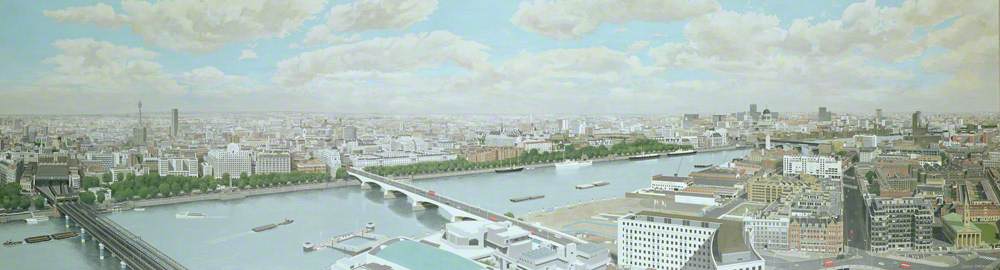
So not only do I know next to nothing about Nigerian or Persian traditional art, but I am not told anything about Nigerian or Iranian art of the 1900s, 20s, 30s, 40s or 50s to help put the sudden focus in the clubs of the 1960s in focus.

2. Recreating the nightclub vibe

There is one massive aspect of the show I haven’t mentioned yet – which is that, having processed through the historical exhibition and display up on the balcony, the visitor then goes back down to the ground floor and discovers that, in the central gallery space, the curators have recreated some of the art clubs which we’ve been reading about. Specifically, there is:

  • Chat Noir a white room with 7 or 8 of the big metal stencils fromt he Chat Noir hanging from the ceiling and slowly rotating in the mild breeze and throwing shadows on the wall, all to the contemporaneous music of Debussy and Satie – a very calm, peaceful, meditative room
  • Cabaret Fledermaus a striking reconstruction of the Viennese nightclub in which the walls and bar are studded with brightly coloured tiles

Recreation of the Cabaret Fledermaus, Vienna, 1907

  • L’Aubette a reconstruction of L’Aubette, the semi-industrial, architectural complex in Strasbourg, complete with cinema projection running a series of contemporary films, including Modern Times by Charlie Chaplin and Metropolis

Recreation of the cinema-ballroom L’Aubette by Theo van Doesburg, Hans Arp and Sophie Taeuber-Arp

  • Mbari Clubs and a nice space set off from the corridor by a barrier or wall made out of sculpted patterns in a Nigerian style, inside which was playing a video of Nigerian youths dancing

You can see that a great deal or time, trouble and expense has gone into recreating each of these ‘zones’. But.. The most obvious thing about most nightclubs is, or was, that they were traditionally subterranean, smoky, often very noisy and very cramped and packed environments, in which people are drinking too much and laughing and joking and often having to shout over the very loud music, and laughing and going off to the bogs or stopping for a snog on the stars or chatting up the barmaid or barman, and asking someone for a light. They are/were places of intense hectic human interaction.

It was an ambitious, maybe quixotic notion, to try and recreate all that human bustle, noise, sweat and booziness in… the uniquely silent, white, perfectly scrubbed and essentially sterile environment of the modern art gallery. Nothing could really have been more dead than the Mbari Clubs little zone, completely empty when I walked in, admired the Yoruba wall paintings, and walked out again. Or the loving recreation of the Cabaret Fledermaus, beautiful coloured tiles and all, and utterly empty and utterly silent when I walked through it.

Conclusions

This is a fascinating insight into an enduringly interesting subject, a subject which has inspired all manner of artists across numerous countries and periods.

In fact, maybe you could think of The Nightclub as being an entire genre, a very twentieth century genre, as The Nude or The Landscape were for previous centuries.

And I admire the way the curators have made it so multinational, showing the same impulse at work across multiple cultures and continents.

Like previous Barbican shows it is so packed as to be overwhelming, bringing together over 350 works rarely seen in the UK, including paintings, drawings, prints, photographs, films and archival material.

And yet I was really perplexed by the recreations. The young woman who took my ticket explained that they have been having music evenings, with live bands playing. Maybe that helps, maybe that lifts it a bit. But it was eerie walking through perfect recreations of places which were meant to be temples to human interaction in all its smelly, sweaty, boozy, smoke-ridden, music-drowned glory but were now empty and silent – turned, quite literally, into museum pieces.


Related links

Other Barbican reviews

Pushing paper contemporary drawing from 1970 to now @ the British Museum

‘Learn to draw, learn to see.’
(Established artist Eugène Boudin to the up-and-coming young Monet)

A travelling show

The British Museum houses the national collection of Western prints and drawings, in the same way as the National Gallery and Tate hold the national collection of paintings. It is one of the top three collections of its kind in the world, and houses approximately 50,000 drawings and over two million prints dating from the beginning of the fifteenth century up to the present day.

Of these 50,000 drawings, some 1,500 are by contemporary or modern artists. From this 1,500, the museum has worked with curators from other galleries around the country to make a selection of 56 drawings for this exhibition, which:

  1. highlight the range and diversity of contemporary drawings
  2. are designed to show how the entire concept of ‘drawing’ has been subjected to radical experiments and redefinitions during this key period, 1970 to the present

The idea is that after a couple of months on display in London, the exhibition will travel to the partner museums around the country, which will add works from their own collections to the display, thus creating a unique combination at each venue.

You can see how this will a) make the works accessible to audiences round the country and b) create a network of curators who are interested and informed about drawings, which could lead to who knows what consequences in the future.

What is a drawing?

Here’s one of the first works you encounter, Untitled by Grayson Perry, featuring an early outing by his transvestite alter-ego, Clare (note what seems to be a dog’s tail coming out the back of her skirt). So far, so gender-bending.

What’s really going on here, though, is the extreme stress Perry is applying to the concept of the ‘drawing’. It clearly contains elements of collage, with stereotypical photos from magazines tacked onto it, plus the diagonal colour washes and diagonal bands of glitter. Is it a drawing at all?

Untitled (1984) by Grayson Perry © The Trustees of the British Museum

That is the question which echoes through the rest of the show. Some works are old-style figurative depictions of some real object in the world, for example this attractive portrait by Jan Vanriet (although I was a little puzzled whether this was a drawing or a watercolour. Is it a drawing which has been watercoloured? Is that still a drawing?)

Ruchla by Jan Vanriet (2011) © The Trustees of the British Museum

It turns out to be one of a series developed from portrait photos of the Jews deported from one particular location in Belgium to concentration camps where they were all murdered. Kind of changes your attitude to the image, doesn’t it?

Drawing also contains the genre of satire or caricature or political cartoon, here represented by Philip Guston‘s unforgiving image of American president Richard Nixon, whose face seems to have turned into a penis and scrotum. To his left what I initially thought was his body is in fact a caricature of Vice President Spiro Agnew, who was addicted to playing golf, hence the clutter of golf clubs and balls. And the crab-like glasses on the right reference Nixon’s adviser Henry Kissinger.

Untitled by Philip Guston (1971) © The Trustees of the British Museum

(This caricature is a reminder to younger viewers that there’s nothing new about Donald Trump: America has a long, long, long track record of scumbag, murdering, lying presidents. Why, then, do the arbiters of culture give America so much weight and respect?)

And then there are what you could call artistic ‘deformations’ of real objects, specifically the human body, subjected to stylisation, morphing into abstract patterns, as in this drawing by Gwen Hardie, the tiggerish striping of the torso counterpointed by the stylisation of what are presumably female sex organs, the leaning-back posture a cross between a cave painting and a Henry Moore sculpture. Gwen is a woman artist ‘who has a longstanding preoccupation with the body and its perception’.

Untitled (1962) by Gwen Hardie © The Trustees of the British Museum

A striking ‘deformation of the actual’ is this work by Hew Locke, a British artist of Guyanese descent. According to the wall label, Locke takes the view that the Queen has been party to countless secrets during her record-breaking reign, and that this nightmarish image captures the corroding and corrupting effect all these secrets and lies have had on her, by the look of it, transforming her face into a mask of eyes against a backdrop of scores of little wiggly lime-green skulls. The image ‘asks us to question the Queen as a symbol of nationhood , as well as the power and history which she embodies.’

Sovereign 3 by Hew Locke (2005) © The Trustees of the British Museum

For those of us who were around during the punk Summer of Hate of 1977 – 42 years ago – this is nothing new. Taking the piss out of the Queen is an extremely old activity, in fact it made me feel quite nostalgic.

Sex Pistols album cover (1977)

According to the curators, the period from 1970 to the present saw a resurgence of interest in drawing. Previously it had mostly been seen as a format in which you practiced life studies, or prepared for work in a more demanding medium such as painting. The 1960s opened the box on this (as on so many other genres and practices) and freed up artists to be as playful and experimental as they could imagine. Thus:

Drawings in the exhibition encroach on territories traditionally associated with mediums including sculpture, land art and even performance.

‘Drawing’ spills out all over the place.

Five themes

The exhibition groups the works into five themes, ‘examining’:

  • Identity
  • Place and Space
  • Time and Memory
  • Power and Protest
  • Systems and Process

Personally, I felt these ‘themes’ rather limited and directed and forced your responses to works which often had nothing at all in common, and could each have stood by themselves. Except for the last one, that is: because a lot of the works genuinely are interested in systems and processes.

For example, there’s a yellow square by Sol LeWitt which is just one of countless of works the American artist generated from algorithms, from sets of rules about geometry, shapes and colours, which he created and then followed through to produce thousands of variations.

There’s a drawing of the tiles on a floor by Rachel Whiteread which comes with quite an extensive label explaining that a) she has always been interested in floors which are the most overlooked parts of a room or building and b) that it’s a heavily painted drawing, done in thick gouache onto graph paper, which points forward, or hints at, the vast casts of rooms and entire buildings which she was soon to create.

There’s a work by Fiona Robinson which juxtaposes two sets of vibrating lines which she created while listening to the music of John Cage, and then of Johann Sebastian Bach.

Related to these, insofar as it’s black and white and made of abstract patterns, is this charming drawing by Richard Deacon.

Some Interference 14.01.06 (2006) by Richard Deacon © The Trustees of the British Museum

I found a lot of these ‘abstract’ works a lot more appealing than many of the rather obvious ‘messages’ in the ‘Power and Protest’ section. But maybe you’d prefer the latter. Different strokes. The whole point is, the exhibition has been designed to showcase the immense variety of images, formats and materials which can go into the making of ‘a drawing’.

The artists

What is a drawing? Well, this exhibition presents an impressive roll call of major contemporary artists all giving answers to that question, including:

  • Edward Allington
  • Phyllida Barlow
  • Louise Bourgeois
  • Stuart Brisley
  • Pablo Bronstein
  • Glenn Brown
  • Jonathan Callan
  • Judy Chicago
  • Adel Daoud
  • Richard Deacon
  • Tacita Dean
  • Michael Ditchburn
  • Peter Doig
  • Tracey Emin
  • Ellen Gallagher
  • Philip Guston
  • Maggi Hambling
  • Richard Hamilton
  • Gwen Hardie
  • Claude Heath
  • David Hockney
  • Andrzej Jackowski
  • Anish Kapoor
  • Anselm Kiefer
  • Minjung Kim
  • Marcia Kure
  • Micah Lexier
  • Liliane Lijn
  • Hew Locke
  • Nja Mahdaoui
  • Bahman Mohassess
  • David Nash
  • Cornelia Parker
  • Seb Patane
  • A R Penck
  • Grayson Perry
  • Frank Pudney
  • Imran Qureshi
  • Gerhard Richter
  • Fiona Robinson
  • Hamid Sulaiman
  • Jan Vanriet
  • Hajra Waheed
  • Rachel Whiteread
  • Stephen Willats

Apart from anything else, it’s a fascinating cross-section of the artistic practices and concerns of some of the most important artists of the last 50 years.

Mountain by Minjung Kim (2009) © The Trustees of the British Museum

Pushing Paper is in room 90, which is right at the back of the British Museum and up several flights of stairs, in the Drawings and Print Department. It is varied and interesting and thought-provoking, and it is FREE.


Related links

  • Pushing Paper continues at the British Museum until 12 January 2020

Other British Museum exhibitions

Frank Bowling @ Tate Britain

‘Just throw the paint, Spencer!’
(Frank Bowling to his assistant, Spencer Richards, as told by Richards on the exhibition’s visitor audioguide)

This is a really good exhibition. Bowling isn’t a genius – this show doesn’t compare with the van Gogh exhibition downstairs at Tate Britain – but he is a consistently interesting and experimental artist, who has produced a steady stream of big, colourful and absorbing paintings. I found it hard to finally leave, and kept going back through the rooms to look again at the best paintings in the show.

Frank Bowling

Frank Bowling is a black British artist. He is still going strong, painting every day at the impressive age of 85.

Frank Bowling. Photo by Alastair Levy

Bowling was born in Guyana in 1934 and moved to England with his parents in 1950, when he was 15. After experimenting with poetry, and doing his National Service, Bowling decided to pursue a career in art and studied at the Royal College of Art. His contemporaries were David Hockney, Derek Boshier, Allen Jones, R. B. Kitaj and Peter Phillips. In fact, at graduation in 1962, Hockney was awarded the gold medal while Bowling was given the silver.

Back in those early years he was caught up in the expectation that he would be a ‘black’ artist and concern himself with colonial and post-colonial subjects – an expectation, he admits in modern interviews, that he at first played along with, doing a painting of African politician Patrice Lumumba and in 1965 at the First World Festival of Negro Arts, held in Senegal, winning the Grand Prize for Contemporary Arts.

It was only when he moved to New York in the mid-1960s that Bowling discovered the light and space and artistic freedom of contemporary American art. Encouraged by American critics, he changed his style, adopting the prevailing mode of abstract art, alongside the likes of Mark Rothko, Jackson Pollock and Barnett Newman.

As Bowling’s assistant, Spencer Richards, tells us on the visitor’s audioguide: ‘he didn’t want to be hemmed in by race and origins and that kind of stuff.’

This is the first major retrospective ever held of Bowling’s work in Britain. The gallery says it is ‘long overdue’ and seeing that he was elected a member of the Royal Academy of Arts in 2005 and awarded an OBE as long ago as 2008, it does seem extraordinary that this is the first major retrospective devoted to his work.

Nine rooms

The exhibition is in straightforward chronological order. It is divided into nine rooms each of which addresses a particular phase or style. But as I’ll explain later, in fact the show can be divided into two halves – flat surfaces, and gunky, gooey, three-D surfaces.

Room 1. Early work

This selection of early paintings includes works heavily influenced by Francis Bacon, the number one British artist in the early 1960s. Blurred figures trapped in cages look as if they’ve just been blasted by radiation.

Other early works use geometric patterns, referencing the Op Art (i.e. the playful use of geometric shapes) of Bridget Riley.

This room features some examples from a series he did using the motif of a swan, its neck and head realistic, but its body exploding, as it were, into abstraction, set against neat geometrical figures – note the orange and green concentric circles which have kind of melted, to the right of the swan’s body. If you look closely you can see that Bowling has mashed real bird feathers into the bloody, messy splurge of pain on the right. Unsettling.

Swan 1 (1964) by Frank Bowling © Frank Bowling

Room 2. Photographs into paintings

It was the Swinging Sixties. The room contains the original Observer magazine front cover of a Japanese model in a Mary Quant dress typical of the period.

Cover Girl (1966) by Frank Bowling © Frank Bowling. All rights reserved DACS 2019

Very reminiscent of David Hockney’s kind of ‘wrecked Pop Art’ of the period i.e. taking images from fashion and pop culture and kind of smearing and subverting them. More obvious is the ghostly outline of the house at the top. What is that? It is based on a photo of the big house which contained the Bowling family business (Bowling’s Variety Store) back in his home town of New Amsterdam, Guyana.

A friend sent Bowling the photo (the original is on display in one of the several display cases devoted to notes and letters and magazines and other ephemera which shed light on his career) and he used it obsessively in a whole series of paintings which contain the house motif superimposed on maps and abstract shapes. We can guess that this obsessive repetitiveness derives from a psychological need on the part of the artist to revisit the house, and by extension, the land of his parents. On the other hand – maybe it is just a powerful image or motif which he was interested in placing in different paintings, juxtaposing with other images to create the dynamism and energy of any collage.

Room 3. The map paintings

These are enormous. Suddenly we are in a huge white room on the walls of which are hung some truly enormously huge paintings. They are made of acrylic paint on flat canvas. In the second half of the 1960s Bowling was in New York and liberated by the scale and ambition of American painting, especially the abstract expressionists like Mark Rothko, Barnett Newman and Clyfford Still.

Just like them, the works are enormous and almost abstract, covered in great washes of paint, to create dynamic forcefields of colour.

Installation View of Frank Bowling at Tate Britain. Photo by Matt Greenwood

The gallery guide points out that almost all of them contain maps and that they mark ‘Bowling’s rejection of the western-centric cartography of many world maps’. I think this is wrong, and a typical attempt to shoehorn politically correct sentiment into the art. It stands to reason that many of the paintings feature a map of South America. Bowling is from Guyana which is in South America. And some of the others feature the ghostly stencilled outline of Africa. Ultimately he is of African heritage.

But quite a few of the others – like Dog Daze (1971, on the left in the photo above) feature a map of the entire world, laid out according to standard convention, exactly as you see it in any atlas or poster – with the Americas at the left, then the Atlantic, then Eurasia with Africa dangling down. Not subverting or rejecting anything in particular. I bought the audioguide to the exhibition and this contains quite a few quotes from the man himself, and Bowling makes it perfectly clear time and again, that his art is not about a ‘subject’.

Art is to do with painting colour and structure

If there are maps in the huge map paintings it is not to make the kind of politically correct, left-wing, political point which the curators want him to make. It is because they offer a motif around which the art can constellate and come into being. It enables the art. Its force is not political, it is imaginative.

For sure maps can be given meanings. I can paint an outline of Africa and declare it is ‘about’ slavery. Or empire and colonialism. Or oppression. Or poverty. Or the fight for independence. or about war. Or about dance and music. Or about anything I want it to ‘mean’. Then again, maps may just be shapes and patterns which are interesting and stimulating, as shapes, as a well-remembered shapes from schooldays, but which carry precisely as much freight and meaning as the viewer wishes to give them.

Some of these works are stunning, comparable to the Rothko room at Tate Modern, big enough for the visitor to fall into, to meditate on, to create a mood of profound calm and wonder.

At one end of the room is a stunning work titled Polish Rebecca, dating from 1971. You can make out the stencilled shape of South America at the centre and the wall label tells us that the Rebecca in question was a Polish Jewish friend of Bowling’s, and that the work is a meditation on the shared history of the African and Jewish diaspora – revealing ‘Bowling’s interest in the way identities are shaped by geo-politics and displacement’.

To me this is reading the liberal political concerns of 2019 back into a painting from 48 years ago. Maybe it is so. Maybe not. What’s not in doubt is that it is a stunning composition, dominated all the tints and shades of purple, the strange beguiling white feathering effect spreading up the west coast of South America, and the random swishes of green, blue and orange paint. In the flesh this enormous painting is utterly entrancing.

Polish Rebecca (1971) by Frank Bowling. Courtest of the Dallas Museum of Art © Frank Bowling

Room 4. The poured paintings

As if to prove that Bowling is more interested in art than in bien-pensant, liberal, progressive political theory, the next room is devoted to paintings with absolutely no figurative content. He set up a tilting platform that allowed him to pour paint from heights of up to two metres. As the paint hit the canvas it cascaded down in streams of mingling colour.

Ziff (1974) by Frank Bowling. Private collection, London, courtesy of Jessica McCormack © Frank Bowling. All Rights Reserved, DACS 2019

Structured accident, not unlike the spatter paintings of Jackson Pollock and then the hundreds of random spurting spattering throwing flicking shooting artists of the experimental 1960s and 70s. The titles also became less meaningful, more accidental, referencing people who were in his thoughts or events during the day, totally random.

Room 5. Cosmic Space

Each new room has been marked by technical experimentation. In this once are works from the later 1970s where he began a set of further experiments. He began using ammonia and pearlessence, and applied splotches of paint by hand, producing marbling effects. He embraced accidents, which sometimes hardened into mannerisms. For example it was at this time that he took to leaving buckets of pain on the surface of the wet canvas, creating a circular ridge.

In Ah Susan Whoosh Bowling added water, turpentine and ammonia to the acrylic paint to create complicated chemical reactions. He poured the paint directly onto the canvas and then manipulated it with a squeegee. The technique forced him to work quickly, making strategic decisions to exploit the random combination of elements. It’s testimony to his skill that so many of these works, created under demanding conditions, with little or no planning, come out looking so haunting and powerful.

Ah Susan Whoosh (1981) by Frank Bowling. Private Collection, London

No reproduction can convey the shiny metallic tint of many of the colours, the sparkle on the surface of the paintings, which changes as you walk around them.

Three D

This brings me to the big divide in Bowling’s career which I mentioned at the start. The first four or five rooms are full of works where the paint lies more of less flat on the canvas. But in latter part of his career, from about 1980, and certainly in the last four rooms, Bowling’s canvases become thick and clotted three-dimensional artefacts.

He started using acrylic gel to create waves and ridges of colour and goo. And he started embedding objects in the paint. At first he used acrylic foam, cut into long strips, creating zoomorphic swirls and spirals.

In fact the ribbed nature of this foam reminded me a bit of fish skeletons, and the way some of these skeletal ruins emerge from a thick goo of paint, reminded me sometimes of the movie Alien. According to the wall labels:

Bowling also started to use a range of other materials and objects in his work. He applied metallic pigments, fluorescent chalk, beeswax and glitter to his densely textured surfaces. In several works, found objects such as plastic toys, packing material, the cap of a film canister and oyster shells are embedded within the paint. These items are rarely fully visible but add to the complexity and mysterious quality of the work.

Spreadout Ron Kitaj (1984 to 1986) by Frank Bowling. Tate © Frank Bowling. All Rights Reserved, DACS 2019

Spreadout Ron Kitaj is so named because the artist Ron Kitaj saw an exhibition of Bowling’s works in 1986 and got in touch. Bowling describes the strips of acrylic foam he embeds in the surface of works like that as ‘the ribs of the geometry from which I work.’ The painting also includes shredded plastic packing material, plastic jewellery, toys and oyster shells. It’s not one of the best works here – its effect is too dark and dingy for me – but it’s very typical of his modus operandi.

Room 7. Water and Light

In 1989 Bowling went back to his childhood home in Guyana, accompanied by one of his sons. He immediately noticed the quality of the light in South America.

‘When I looked at the landscape in Guyana, I understood the light in my pictures is a very different light. I saw a crystalline haze, maybe an East wind and water rising up into the sky. It occurred to me for the first time, in my fifties, that the light is about Guyana. It is a constant in my efforts’ (1992).

As you might expect, the trip resulted in works which try to capture the effect, using Bowling’s (by now) trademark effects of acrylic gel swept into ridges, themselves arranged in very loose box or square shapes.

Sacha Jason Guyana Dreams 1989 Tate © Frank Bowling. All Rights Reserved, DACS 2019

From the later 1960s Bowling had studios in London and New York. His London studio is in East London and here he has made a series of paintings titled Great Thames which do just that – reference the mighty river Thames, invoking the long line of landscape painters who Bowling is well aware of – Gainsborough, Turner and John Constable.

In the way they adapt his by now trademark use of gel to create boxes and ridges, scattered with metallic pigments, scored and indented with all manner of objects found around the studio and pressed into the surface – nonetheless, the Great Thames paintings on display here prompt comparisons with Monet – not so much in technique or even in aim, but in the shimmering evocativeness of the finished product.

Great Thames IV (1989 to 1989) by Frank Bowling. Arts Council Collection, South Bank Centre © Frank Bowling. All rights reserved DACS 2019

Room 8. Layering and stitching

In the 1990s, Bowling continued to work with acrylic paint and gel and continued to experiment with incorporating different materials and objects into his paintings. He experimented with stitching canvases together and attaching the main canvas to brightly-coloured strips of secondary canvas, to create a distinct border to the work.

He took this further by cutting up earlier canvases, and stapling sections together, juxtaposing different paint applications and colours. Like the many found objects embedded in the gloop, this stitching is very evident and all tends towards emphasising the materiality of the work of art. And, in some sense, its contingency. It is like this. But it needn’t have been like this. Meditate not only on the work. But on the arbitrariness and contingency which leads to the work.

Girls in the City (2017) by Frank Bowling © Frank Bowling

Girls in the City was made by stitching together seven individually stretched canvases. You can still see the vaguely square, ‘brick’-like shapes he creates using raised ridges of acrylic gel. But to that element of boxness, is added a more literal boxiness created by the piece’s assemblage from smaller parts. He is quotes as saying the works from this period were ‘organised in the way people structure themselves, in the way we are’ – presumably, assembled from lots of disparate elements.

Room 9. Explosive experimentation

This last room is devoted to works made over the past ten years. My first reaction was I didn’t like them so much. Nowadays confined to a sitting position, Bowling has used assistants to help him, and has continued his experimentation. He uses washes of thin paint, poured paint, blotched paint, stencilled applications, the use of acrylic gels, the insertion of found objects, and stitching together of different sections of canvas.

This results in what, for me, are rather a departure from the work of the previous three or so rooms. In a work like Iona Miriam’s Christmas Visit To and From Brighton the stitching is very much on display, in the sense that the canvas with the great pink crescent on it has been roughly chopped in half and stitched onto another canvas underneath, which appears to consist of a regular pattern of coloured stripes which provide a striking ‘interval’ between the top and bottom halves, and also, when you come to look at it, a frame around the ‘main’ canvas. And that’s before you get round to processing the complicated imagery, the vibrant colours and the scoring and striking into the surface, which characterise the ‘main’ image.

Iona Miriam’s Christmas Visit To and From Brighton (2017) by Frank Bowling. Courtesy Frank Bowling and Hales Gallery, Alexander Gray Associates and Marc Selwyn Fine Art © Frank Bowling. All rights reserved DACS 2018

I think that I was still too in thrall to the box or square gel ridge shapes of the earlier works, still processing the effect of them, to really appreciate these more recent works. Maybe you need to visit the exhibition several times to really absorb Bowling’s variety and inventiveness. These last works seem to be going somewhere completely new. I hope he lives long enough to show us where.

Summary

The works in the first part of the show are interesting and good, but often feel very much of their time like the Swinging Sixties cover girl and other works which feel like mash-ups of Hockney, Bacon, Kitaj with patches of Op Art thrown in.

The enormous map paintings – some of them over seven yards long – riffing off the abstract expressionists, are very powerful and absorbing in their own right.

The poured paintings reminded me a bit of school art projects. An interesting idea but the results weren’t that great.

It is only when Bowling starts working with acrylic gel and metallic tints, and embedding foam and then all kinds of objects into the surfaces of his paintings, that something weird and marvellous happens to his works.

Words cannot convey the rich and strange results of these experiments. The dense gloop, the metallic tints, and the strange clotted surfaces, alive with all sorts of half-buried objects, create enticing effects. I walked back and forth through the show half a dozen times or more and each time one particular painting stood out more and more strongly – spoke to me.

Philoctetes’ Bow (1987) by Frank Bowling. Courtesy the Artist and Hales Gallery © Frank Bowling

This reproduction in no way conveys the richness of the colour of this huge painting (it is 1.8 metres tall by 3.6 metres wide; it would cover most of the wall of an average sitting room).

And also doesn’t convey the way the long curve along the bottom which dominates it, actually sits proud of the surface. It is a characteristic slice of acrylic foam which also looks like a long, thin strip of corrugated cardboard. It not only creates the composition, but it projects it forward off the wall, and into your imagination. I kept being drawn back to look at it again and again, to sit in the bench placed in front of it precisely so the visitor can let it permeate every cell of your imagination.

Wow! What an amazing body of work.

Demographics

When I arrived at 10.30 the exhibition was almost empty. When I walked slowly through it at 12.30, there were 38 visitors, including me – 12 men and 26 women. There were no black or Asian people at all. The only people of colour were two of the Tate ‘visitor assistants’. There were half a dozen or so teenagers who seemed to be on a school trip, and one or two 20-somethings. The rest of us were white, middle-aged, grey-haired old types. Which reinforces the impression I’ve gained from reviewing some 150 art exhibitions: the gallery-going public in London is overwhelmingly white, middle-class, old or retired, and predominantly female.

The promotional video


Related links

More Tate Britain reviews