Hammond Innes reviews

Hammond Innes (1913 to 1998) was a British thriller writer novelist who wrote over 30 novels. His protagonists tend to be ordinary men thrust into perilous situations, often in extreme locations or situations. In fact in many of his novels the exotic locations are as – if not more – important than the human protagonists. I’ve always admired the fact that he was a very organised writer, spending six months travelling to settings around the world, doing thorough location research, followed by six months of writing.

Best one?

When I read them, I thought The Wreck of the Mary Deare was the best one, but years later it’s the unforgiving frozen landscape of the Antarctic in The White South which has stayed with me.

Innes’ novels

1940 The Trojan Horse Barrister Andrew Kilmartin gets involved with an Austrian Jewish refugee engineer whose discovery of a new lightweight alloy which will make lighter, more powerful aircraft engines reveals an extensive and sinister Nazi network which reaches to the highest places in the land; features a nailbiting chase through the sewers of London and a last-minute battle on the Nazi ship.

1940 Wreckers Must Breathe Journalist Walter Craig stumbles across a secret Nazi submarine base built into a ruined tin mine on the Cornwall coast and, along with local miners and a lady journalist, fights his way out of captivity and defeats the Nazis.

1941 Attack Alarm Wartime thriller set during the Battle of Britain, drawing heavily on Hammond Innes’s own experience as an anti-aircraft gunner. Barry Hanson is a former journalist now serving on an RAF airfield gun crew in 1940 who comes to believe a network of Nazi fifth columnists is planning to sabotage the airfield ahead of a major German attack, but none of his superiors believe him.

—Second World War—

1946 Dead and Alive A short post-war thriller divided into two halves. It begins on the Cornish coast, where ex–Royal Navy officer David Cunningham, emotionally adrift after the war, helps salvage a stranded landing craft with fellow veteran McCrae. They refit it as a small commercial venture, planning to trade goods in post-war Italy. A newspaper article about their efforts brings a letter from a French woman asking them to find her missing daughter, Monique, who was sent to Italy during the war. When they sail to Naples they profit from selling goods but become entangled in local criminal networks after McCrae angers a powerful figure.

1947 The Killer Mine Army deserter Jim Pryce discovers dark family secrets at a ruined Cornish mine which is being used as a base by a father-and-son team of smugglers who blackmail him into doing some submarine rock blasting, with catastrophic results.

1947 The Lonely Skier Writer Neil Blair is hired to visit the Dolomite mountains in Italy, supposedly to write a script for film producer Derek Engles, in reality to tip him off when key players in a hunt for Nazi gold arrive at the ski hut in the mountains where – they all think – the missing treasure is buried.

1947 Maddon’s Rock Corporal Jim Vardin, convicted of mutiny at sea and imprisoned in Dartmoor, breaks out to clear his name and seek revenge on the captain and crew who pretended to sink their ship, the Trikkala, but in fact hid it in order to steal its cargo of silver bullion.

1948 The Blue Ice Mineralogist and industrialist Bill Gansert sails to Norway to discover the truth about the disappearance of George Farnell, a friend of his who knew something about the discovery of a rare metal ore – an investigation which revives complicated enmities forged in Norway’s war-time Nazi occupation.

1949 The White South Narrator Duncan Craig becomes mixed up in the disaster of the whaling ship Southern Star, witnessing at first hand the poisonous feuds and disagreements which lead a couple of its small whalecatcher boats to get caught in pack ice, fatally luring the vast factory ship to come to their rescue and also becoming trapped. It then has to evacuate over 400 men, women and children onto the pitiless Antarctic ice where Craig leads his strife-torn crew to safety.

1950 The Angry Mountain Engineering salesman Dick Farrell’s wartime experiences come back to haunt him as he is caught up in a melodramatic yarn about a Czech spy smuggling industrial secrets to the West, with various people from his past pursuing him across Italy towards Naples and Mount Vesuvius, which erupts to form the dramatic climax to the story.

1951 Air Bridge Bomber pilot fallen on hard times, Neil Fraser, gets mixed up with Bill Saeton and his obsession with building a new type of diesel aero-engine based on a prototype looted from wartime Germany. Saeton is helped by partner Tubby Carter, hindered by Tubby’s sex-mad wife Diana, and spied on by Else, the embittered daughter of the German who originated the designs. The story moves to Germany and the Berlin airlift where Saeton’s obsession crosses the line into betrayal and murder.

1952 Campbell’s Kingdom Bruce Campbell, given only months to live by his doctors, packs in his boring job in London and emigrates to Canada to fulfil the dream of his eccentric grandfather, to find oil in the barren patch of the Canadian Rockies known as ‘Campbell’s Kingdom’.

1954 The Strange Land Missionary Philip Latham is forced to conceal the identity of the man who replies to an advert to come and be doctor to a poor community in the south of Morocco. Instead of curing the sick, he finds himself caught up in a quest for an ancient silver mine, a quest which brings disaster to the impoverished community where it is set.

1956 The Wreck of the Mary Deare Yacht skipper John Sands stumbles across the wreck of the decrepit steamer Mary Deare and into the life of its haggard, obsessive captain, Patch, who is determined to clear his reputation by revealing the conspiracy to sink his ship and claim the insurance.

1958 The Land God Gave To Cain Engineer Ian Ferguson responds to a radio plea for help received by his amateur radio enthusiast father, and sets off to the wilds of Labrador, north-east Canada, to see if the survivors of a plane crash in this barren country are still alive – and what lies behind the conspiracy to try and hush the incident up.

1960 The Doomed Oasis Solicitor George Grant helps young tearaway David Thomas travel to Arabia to find his biological father, the legendary adventurer and oilman Colonel Charles Whitaker, and becomes embroiled in a small Arab war which leads to a siege in an ancient fortress where the rivalry between father and son reaches a tragic conclusion.

1962 Atlantic Fury Painter Duncan Ross is eyewitness to an appalling naval disaster on an island of the Outer Hebrides. But intertwined with this tragedy is the fraught story of his long-lost brother who has stolen another man’s identity. Both plotlines lead inexorably to the bleak windswept island of Laerg.

1965 The Strode Venturer Ex-Merchant Navy captain Geoffrey Bailey finds himself drawn into the affairs of the Strode shipping company which aggressively took over his father’s shipping line, thereby ruining his family and driving his father to suicide. Now, 30 years later, he is hired to track down the rogue son of the family, Peter Strode, who has developed an obsession with a new volcanic atoll in the middle of the Indian Ocean, whose mineral wealth might be able to help the Maldive Islanders whose cause he champions.

1971 Levkas Man Merchant seaman Paul goes to find his father, eccentric archaeologist Pieter Van der Voort, another typical Innes obsessive, this time one convinced he can prove his eccentric theories about the origin of Man, Ice Age sea levels, the origin of Atlantis and so on. Much sailing around the Aegean, feelingly described by Innes, before the climax in a vast subterranean cavern covered in prehistoric rock paintings, in an atmosphere heavy with timeless evil, where his father admits to being a murderer.

1973 Golden Soak Alec Falls’ mining business in Cornwall goes bust so he fakes his own death and smuggles himself out to Australia to take up the invitation to visit from a rancher’s daughter he’d met. He finds himself plunged into the mystery and intrigue which surrounds the struggling Jarra Jarra ranch and its failed mine, Golden Soak, a mystery which leads him on a wild chase out into the desolate hell of the Gibson desert where Alec discovers the truth about the mine and the persistent rumours of a vast hill of copper, and witnesses archetypal tragedies of guilt and expiation, of revenge and parricide.

1974 North Star One-time political agitator and seaman Michael Randall tries and fails to escape his complex past as he finds himself embroiled in a plot to blow up a North Sea oil rig, a plot which is led by the father he thought had died decades earlier.

1977 The Big Footprints TV director Colin Tait finds himself caught up in the one-man war of grizzled African hunter and legendary bushman Cornelius van Delden against his old friend, Alex Kirby-Smith, who is now leading the Kenyan government’s drive to cull the country’s wildlife, especially its elephants, to feed a starving population and clear the way for farmers and their cattle, all tied up with Tait’s obsessive quest to find a remote mountain where neolithic man was said to have built the first city in the world.

1980 Solomon’s Seal Property valuer Roy Slingsby prices the contents of an old farmhouse in the Essex countryside and is intrigued by two old albums of stamps from the Solomon Islands. He takes up the offer of a valuing job in Australia and finds himself drawn into the tragic history of the colonial Holland family, the last surviving son of which is running machine guns to be used in the coup and bid for independence of Bougainville Island. Though so much of the detail is calm, rational, business-like, the final impression is of an accursed family and a fated ancestral house which burns down at the novel’s climax.

1982 The Black Tide When his wife dies blowing up an oil tanker which has gone aground near their Cornwall home, ex-merchant seaman Trevor Rodin goes searching for the crew he thinks deliberately ran her aground. His search takes him to Lloyd’s of London, to the Nantes home of the lead suspect and then on to the Persian Gulf, where he discovers several ‘missing’ tankers are in fact being repurposed by terrorists planning to create a devastating environmental disaster somewhere on the coast of Europe. With no money or resources behind him, and nobody believing his far-fetched tale, can Rodin prevent the catastrophe in time?

1985 The High Stand When gold millionaire Tom Halliday and his wife Miriam go missing, their staid Sussex solicitor Philip Redfern finds himself drawn to the old gold mine in the Canadian Rockies which is the basis of the Halliday fortune, and discovers that the illegal felling of the timber planted around the mine is being used as a front for a gang of international drug smugglers, with violent consequences.

1988 Medusa Former smuggler turned respectable ex-pat businessman, Mike Steele, finds his idyllic life on the pretty Mediterranean island of Minorca turning very nasty when he gets mixed up with mercenaries running guns onto the island to support a violent separatist movement and military coup.

1991 Isvik Wood restorer Peter Kettil gets caught up in a crazy scheme to find an old Victorian frigate allegedly spotted locked in the Antarctic ice by a glaciologist before his death in a flying accident. His partners are the nymphomaniac Latino wife of the dead glaciologist, Iris Sunderby, a bizarre Scottish cripple, Iain Ward, and a mysterious Argentine who may or may not have been involved in atrocities under the military junta.

1993 Target Antarctica Booted out of the RAF for his maverick behaviour, pilot Michael ‘Ed’ Cartwright is hired by Iain Ward, the larger-than-life character at the heart of the previous novel, Isvik, to rescue a C-130 Hercules plane off a damaged runway on the Antarctic ice shelf. It takes a lot of shenanigans, not least with a beautiful Thai woman who is pursued by the Khmer Rouge (!), before in the last few pages we realise the whole thing is a scam to extract diamonds from the shallow seabed, diamonds like the ones the survivor of the frigate found in the previous novel.

1996 Delta Connection An astonishing dog’s dinner of a story which starts out reasonably realistically following the adventures of Paul Cartwright, scrap metal consultant, in Romania during the chaotic days leading up to the overthrow of the communist ruler Nicolae Ceaușescu, before moving on to Pakistan and the Khyber Pass where things develop into a violent thriller with car chases and shoot-outs – before jettisoning any attempt at realism and turning into a sort of homage to Rider Haggard’s boys adventure stories as Cartwright and his gay, ex-Army mentor, battle their way through blizzards into the idyllic valley of Nirvana, where they meet the secret underground descendants of Vikings who long ago settled this land, before almost immediately participating in the palace coup which overthrows the brutal ruler and puts on the throne the young woman who Paul fell in love with as a boy back in Romania, where the narrative started.

Essays

Ubu Enchained by Alfred Jarry

Executive summary of the Ubu plays

Alfred Jarry’s trilogy of absurdist, scatological plays about the grotesque cartoon figure, Père or Father or Pa Ubu, scandalised theatre-goers at the time (the later 1890s) but were to be revived and lionised by the Surrealists in the 1920s and ’30s, and to become a reference point for the Theatre of the Absurd long after Jarry’s premature death in 1907 at the age of just 34

Introduction

In his introduction to the 1968 Methuen edition of the three Ubu plays, translator Simon Watson Taylor makes the point that, whereas the first two Ubu plays (Ubu Roi and Ubu Cocu) derived from the stories Alfred Jarry and his friends wrote at school, Ubu enchaîné (‘Ubu Enchained’) was the product of a more experienced 26-year-old playwright and so feels like a more detached and consciously controlled exposition of his ‘ideas’. By this time Jarry had had the experience of having two plays staged so had a much better feel for the shape and design of a stage play. In other words, there’s more structure and shape to the nonsense.

What Taylor doesn’t mention but I noticed is that the characters now have a history to live up to and this changes the vibe completely. When you’re just making characters up and inventing preposterous things to happen to them, you can do anything. But when you’ve established some characters, their appearance, their catchphrases, even their tendency to behave madly becomes predictable. Although the ostensible events of ‘Ubu Enchained’ are new, the characters’ general behaviour, mannerisms and multiple catchphrases (‘By my green candle!’) have become formulaic.

This fact is acknowledged in the very first scene of ‘Ubu Enchained’ which has Ubu giving a recap of his and Ma’s adventures in the preceding plays as if by invoking them Jarry can free himself from them. But the effect is the opposite.

Act 1

Scene 1: After the sea voyage at the end of Ubi Cocu they ended up safe and sound here in Paris. Ma Ubu says that if he’s just say the word, Pa would be appointed Minister of Phynances. But Pa Ubu points out that ‘just saying the word’ didn’t prevent…and then launches into a long recap of all their misadventures in Ubu Roi. If he won’t say the word how are they going to survive? He’ll become a slave.

Scene 2: The parade ground with three free men. These soldiers insist that the nature of freedom means they must disobey all orders, march out of step, disobey all orders. This comprises their freedom drill.

Scene 3: Pa is looking for someone to offer his services to just as the Three Free Men pass by.

Scene 4: Ubu slips in among the free men as they do their drills using a toilet brush instead of a rifle. The corporal stops them to ask who it is who is doing the drills properly, for the first time ever. Ubu tells them his experience and that he wants to be a slave. The corporal’s name is Corporal Pissweet.

Scene 5: New characters, canteen girl Eleutheria and her uncle Pissale, who got her the job in the canteen of the Free Men. Every day he takes her to work, worried that the Free Men may take advantage of her. It is (apparently) the custom in this land for the free to go naked but uncle has managed to limit this to Eleutheria’s feet. We learn that she is engaged to the Marquis of Grandmeadow.

Scene 6: Abandoning the Free Men as possible employers Ubu approaches Eleutheria and her uncle offering free foot polishing.

Scene 7: Ubu asks Ma to fetch him his special foot polishing kit. When she points out that Eleutheria isn’t wearing shoes, he says nothing will prevent him carrying out his slavish duties, although old catchphrases keep slipping from his lips (‘Killemoff, debrain!’).

Scene 8: Eleutheria and uncle pass out and, while telling himself he is performing his slavish duty, Ubu steals their wallets. This theme of FREEDOM is belaboured in a variety of ways, for example now the coins Ubu’s stealing have a female figure on one side denoting Freedom. Eleutheria comes round and they call a horse and carriage to make their getaway in.

Act 2

Scene 1: In the coach Eleutheria regains consciousness as Ubu presses his services on her. When she says she never does anything without her uncle’s consent, Ubu pulls her uncle’s corpse out of the carriage boot and Eleutheria faints again.

Ubu considers ravishing Eleutheria but decides against as Ma Ubu is riding on the box just outside and will eviscerate him if she finds him misbehaving. Instead he will take Eleutheria home and imprison her in the confines of his undying service. ‘Hooray for slavery!’

Scene 2: In Uncle Pissale’s house Pa and Ma Ubu have made themselves at home. The bell is being rung, presumably by Eleutheria, but Ubu refuses to answer till he and Ma have eaten all the scoff they can. The ringing continues so Ma Ubu says maybe his mistress needs something to drink. Very angry Ubu stomps down to the wine cellar and comes back carrying numerous bottles. Ma is surprised since she thought she drank the wine cellar dry which Ubu confirms by saying if they scrape the last dregs form each bottle maybe there’ll be a glassfull for his mistress.

Scene 3: In the bedroom of Eleutheria who’s been locked in with the corpse of her uncle. She bewails the way Pa and Ma Ubu have moved in and taken over. She is lamenting her dead uncle when he suddenly sits up, she shrieks and faints.

When she comes round Uncle Pissale says playing dead was just an extension of his method of following her round as unobtrusively as possible. She asks him to eject the ghastly Ubu from their home but uncle says, on the contrary, he is an excellent servant which is why he’s invited Ubu to attend their big party tonight to announce all the guests.

Scene 4: In the hallway Ma points out the front doorbell is ringing. Ubu asks whether she’s balanced the vase full of poo over the front door fir anyone rude enough to want to visit.

Scene 5: The front door is smashed down and, it turns out, by Corporal Pissweet. He is surprised to discover the soldier who marched with his men earlier on. Pissweet says it is an excellent opportunity to try out his theory of indiscipline and gets out a bullwhip to thrash Ubu with. Ubu is delighted because being whipped only proves what a slave he has become!

In the event Ubu is so obese and covered by his ‘strumpot’ that Pissweet exhausts himself whipping him, then demands to be announced to his mistress. In the surreal inversion of values the play keeps harping on about, Ubu insists that in this household only slaves are free enough to give orders.

When Pissweet says that Eleutheria is his mistress, he is her slave, Ubu says that only he can be a slave in that household, in which case Eleutheria is his mistress, in which case he’s going to ravish her and Ubu runs upstairs hotly pursued by Pissweet and Ma.

Scene 6: Cut to that evening’s ball in full swing. Ubu is walzing with Eleutheria. Ma Ubu runs up and tells him he’s a fat pig who’s guzzled all the food and now is dancing with the mistress of the house under his arm. Ubu ignores her and tells Eleutheria that he saved her lots of time by not letting any other guests in, and fulfilled his slavish duties by dancing with her.

Scene 7: Pissweet and the Free Men burst in. the corporal orders them not to arrest Ubu so, to show how free they are, they arrest him and drag him off to prison with Ma Ubu running along behind, determined to share in what (with the inversion of values) she calls his good luck.

Act 3

Scene 1: Pa and Ma are in prison but, with the inversion of values, consider this a great achievement. Ubu congratulates himself on how thick and solid the walls are, how the doors are barred so they’re not subject to endless irritating visitors, and how convenient it is to be served two nourishing meals a day.

Scene 2: A travesty of a trial in the Great Hall of Justice. We learn Ma and Pa’s first names (Victorine and Francis), there’s some jokey counterpointing of the prosecuting and defence counsels who are handling Ubu’s prosecution for abducting Eleutheria.

But then Pa interrupts in order to give another recap of his career (as I said the history of the character hangs heavy by now), emphasising all his crimes and ending up by saying how much he deserves the ultimate punishment of condemnation to the galleys.

And indeed the judge condemns Pa to the galleys. He will be chained by the leg and sent off to the Sultan of Turkey. Ma and Pa go ‘Hurray for slavery!’ Pissweet delivers what could be the motto of the whole play:

PISSWEET: So there really are people who can’t stand the idea of being free! [paging Professor Sartre]

Scene 3: Enter Pa and Ma dragging the iron balls they’re attached to. Pa rejoices in wearing shackles. Ma calls him an idiot so Pa starts treading on her feet.

Scene 4: Cut to two old maids in a room at the academy (the Academie Francaise?) recapping the way a fat old gentleman (Ubu) arrived in this country (France) swearing that he intends to be everyone’s servant.

Scene 5: Brother Bung arrives in this scene to bed charity for prisoners and in particular Pa Ubu, who has barricaded himself into prison where he is enjoying manicuring his nails and eating 12 meals a day.

The two maids say they certainly won’t give any charity to such a slob but Brother Bung warns them that others are coming after him who won’t be so gentle. And indeed he is followed by policemen and wreckers who smash the room to pieces, cart away all the furniture, replace it with straw and generally turn it into a prison cell. Which is the setting for:

Scene 6: In this cell Ubu mocks Pissweet who is soon to marry Eleutheria, telling him how cosy his cell is, how he loves the ball and chain on his leg. Pissweet threatens to grab Ubu by the scruff of the neck and drag him out of the prison, but Ubu says no can do, as his shackles are glued to the wall.

Scene 7: One line, the gaoler announcing ‘Closing time’.

Scene 8: Cut to the Sultan’s palace in Istanbul where the Vizier tells the Sultan that the free Country (France) is ready to send the tribute it has long promised, namely 200 convicts, among whom is the celebrated Pa Ubu and his notorious wife.

The Sultan objects that Ubu eats pig meat and pisses standing up. The Vizier counters that he’s versed in the art of navigation. Good, says the Sultan, then he’ll row all the better in the galleys!

Act 4

Scene 1: The joke or conceit about the Free Men continues. The corporal told them not to bother turning up to parade so, to prove how free they are, they now all turn up for parade exactly on time. Similarly they’ve been told not to show up for sentry duty so they now do so like clockwork. Is this just a joke or making a more serious point that what many people call ‘freedom’ is just an obstinate or perverse inversion of slavery. It’s just as formulaic, ordered and unpredictable.

Scene 2: A caricature English milord, Lord Cornholer, and his valet Jack. They’ve arrived outside the big stone building the Free Men are guarding and ask them whether the King is in. One of the Free Men suggests that truth dictates they tell the English lord that their country has no king, but the second Free Man says I will take no orders ‘even from truth itself’ and so (lyingly) assures the milord that, yes, the king is at home. He gets his valet to knock on the door

Scene 3: The gaoler opens the door for this, it turns out, is the prison Pa Ubu is in. He tells them no entry. Lord Cornholer wonders whether the king can be persuaded to come to the door and greet him. There’s a good tip for anyone who can arrange this. One of the Free Men says, tell him we don’t have a king and the people inside aren’t allowed to come out. So the other Free Man tells Lord Cornholer the exact opposite, that the king regularly comes to the door to greet visitors.

Jolly good, says the Lord, orders his valet to rustle up some corned beef and settles down to wait. We can see the way this is going…

Scene 4: Inside the prison yard the prisoners cheer for Pa Ubu and for slavery. Ubu complains to Ma that his chains are in danger of breaking or slipping off and then he will lose the fine position he’s achieved after so much effort.

Ubu reminisces about the battle in the Ukraine which features in the first play, Ubu Roi, but then the gaolers come to take him and the other assigned convicts off on their journey to the galleys of the Sultan of Turkey. Ma Ubu bids him a fond farewell.

Scene 5: Front of the prison where Lord Cornholer, his valet and the three Free Men. The gaoler elaborately undoes all the locks and the drunkest of the Free Men begins cheering the king (there is no king) because he wants to get some of the tips Lord Cornholer has been freely mentioning.

Scene 6: Pa Ubu steps through the open prison door and is bemused to be greeted with cheers of Long live the king. It reminds him eerily of being back in Poland. Lord Cornholer approaches and asks through his valet for Ubu’s autograph. Ubu tells them all to shut up and piss off and so the other characters respectfully back away.

Scene 7: While this is happening the other convicts exit the prison and surround Ubu and start chanting Long live the king! Ubu tells them to knock it off but the leader of the convicts says his name will always be linked with kingship and they are demonstrating their love of his glorious past.

Touched, Ubu hands out a set of imaginary positions in his imaginary government, matching notorious criminals to various government offices, before appointing all the other convicts ‘gallant craptains’ in his Pshittanarmy.

Act 5

Scene 1: A bunch of the other characters led by Pissweet who makes the pseudo-philosophical speech bringing out the paradox which, as we’ve seen, underlies the whole play:

PISSWEET: We are free to do what we want, even to obey. We are free to go anywhere we choose, even to prison! Slavery is the only true freedom!

He rallies his followers to break into the prisons and ‘abolish freedom’. Is this the kind of satire on abstract philosophical concepts which only a French intellectual could make?

Scene 2: Inside the prison Pissweet and his followers find Ma Ubu in her cell. The gaoler won’t let them free her. Free Men debate whether to break her cell door down. Meanwhile, the reappearance of Eleutheria who we haven’t seen for a while and appears to be in the cell next door. She complains that she’s tugging the bell-rope but no servants have come (which she was doing in her uncle’s house when we last saw her, so this has a dreamlike and comic effect).

Eleutheria reaches through her cell bars, grabs a stone jug and bashes her Uncle Pissale on the head, splitting him in two (!) The two Pissales speak in unison and reassure her that they’ll protect her, come what may.

Ma Ubu emerges but her cell door slams shut trapping her ball and chain. Eleutheria cuts the chain with a pair of nail scissors.

Scene 3: Cut to the convoy of convicts walking across a place called Slaveonia. Ubu asks the guards to tighten his shackles.

Scene 4: The gaoler from the earlier scenes runs up and tells Pa Ubu that the Masters have revolted, the Free Men have become slaves, and Ma Ubu set free. He then brings up Ma Ubu’s iron ball in a wheelbarrow to prove it. The gaoler continues to explain that the Masters have invaded the arsenals and are fitting iron balls to their legs. All the guards cheer and announce that they, too, want to become slaves. All the convicts give in to the guards’ demands to be handed the former’s balls and chains.

A noise offstage signals the arrival of the Masters who wheel cannons onstage to surround the action.

Scene 5: Pissweet commanding the Free Men demands that Ubu throws off his chains. Ubu says ‘try and catch me’ but runs off. The Free Men try to fire their artillery but discover they have no cannonballs because they’ve attached all the balls to their legs in their ‘newly-won slavery’.

Ubu reappears and throws Ma Ubu’s ball at Pissweet, scoring a direct hit. Then he massacres the other Free Men by swinging a line of chained guards at them. The Free Men run off dragging their chains pursued by the now unencumbered convicts. From time to time Ubu amuses himself by yanking on the chain and making them all fall over.

At the back of the stage appears the Grand Sultan and his retinue.

Scene 6: In the Sultan’s Palace. The Vizier tells the Sultan he’s taken delivery of not 200 slaves, as promised by the Free Country (France) but 2,000 heads, all demanding to be sent to the galleys. Pa Ubu is furious that he’s been deprived of his ball and chain and is currently smashing up the galleys from sheer obesity.

The Sultan says he has been so impressed by Ubu’s ‘noble air and majestic presence’ that he made some enquiries and came to the astonishing revelation that Ubu is the Sultan’s long-lost brother who was kidnapped by French pirates, kept in various prisons but worked himself up to become King of Aragon and then of Poland.

The Sultan tells the Vizier to treat Ubu with respect but get him on the soonest possible ship out of the country. If he gets wind of his true identity he’ll overthrow the Sultan and gobble up all Turkey’s wealth.

Scene 7: P and Ma Ubu are being herded on board a ship. Ma points out that he wasn’t much good as a slave, nobody wanted to be his master. But Pa announces he will henceforth be slave of his own ‘strumpot’, a word which has appeared in all the plays and seems to refer to his stomach.

Scene 8: Cut to a galley slave where all the characters from the play are chained to their benches as galley slaves. Pa Ubu rhapsodises to Ma about the beautiful scenery. The galley slaves sing a song. Ma Ubu says they sound funny. The gaoler explains that he’s replaced the slaves’ muzzles with kazoos.

The gaoler asks Ubu if he’d like to give any orders. Ubu says no, he is determined to remain Ubu Enchained, Ubu the slave, and goes on, in the paradoxical manner which has characterised the whole play.

PERE UBU: I’m not giving any orders ever again. That way people will obey me all the more promptly.

Ma Ubu worries that they’re heading further away from France. Pa Ubu tells her not to worry her pretty little head as they have been granted such honour that the trireme they’re travelling in has four banks of oars not three!

And on that inconsequential notes the play, and the trilogy, ends!

Thoughts

Recap of the points I made at the start. The first two plays were schoolboy nonsense blown up to theatrical proportions. This third play is far more considered insofar as it is underpinned by a thesis, a proposition about freedom and slavery, although it’s a little difficult to say what the thesis is. Is it that there is no difference between freedom or slavery? Or that slavery is the only freedom? Certainly all this playing around with the notion of freedom kept reminding me of Jean-Paul Sartre who devoted his career to explicating notions of human freedom.

Second and more interestingly, the legacy of the preceding two plays acts to force meaning, or the appearance of meaning, onto the third play. It demonstrates how difficult it is to achieve the truly random and absurd. The human mind is constructed to find meaning in everything we say or hear or do or that happens. We blame cars, toasters, uneven paving stones, the weather for accidents and misfortunes; pretty much everything we encounter, we attribute meaning or agency to. Our minds are meaning-finding machines.

And I think that’s demonstrated in this third play. Pa and Ma Ubu were virgin figures when we first encountered them but after two long plays we now have a very good sense of what to expect from them. They have acquired a meaning, a depth and weight which I don’t think their creator intended simply by dint of having been around in our imaginations so long and having carried out so many actions and said so many things.

They have settled down to become as ‘real’ as the characters in fairy tales or nonsense poems or (as the literary scholars prefer to point out) the Renaissance classic ‘Gargantua and Pantagruel’. If impossible things happen in the narrative, the reader accommodates them by simply switching genre, by reading it as fantasy, dream fiction and fairy tale.

In other words, the Ubu plays demonstrate the near impossibility of writing genuinely random, absurdist narratives.

Ubu’s fatness

PISSWEET: That fat slab of galley-fodder, Pa Ubu…

PISSWEET: Fire on that big barrel of cowardice!

Ubu attracts top talent

Ubu has always attracted high calibre producers and associates. Jarry collaborated with the noted post-impressionist painter Pierre Bonnard on the ‘Illustrated Ubu Almanach’ which was published in 1899. You can search for Bonnard’s distinctive cartoon illustrations from this page.

A note tells us that Ubu enchaîné wasn’t performed until 1937, when the sets were designed by Max Ernst. Wow. Ernst had already created sketches and paintings of Ubu, whose absurd character suited the artist’s bizarre vision.

Ubu Imperator by Max Ernst (1923) Georges Pompidou Center, Paris, France

Exactly 30 years later, in 1967, the translation I read, by Simon Watson Taylor, was staged in Edinburgh, with Miriam Margolyes as Ma Ubu, with set design by Gerald Scarfe, and music provided by The Soft Machine. Wow again.

The Polish avant-garde composer Krzysztof Penderecki wrote a 2-hour opera based on Ubu Roi and titled ‘Ubu Rex’, which was premiered by the Bavarian State Opera on 6 July 1991, a valiant attempt to capture the play’s absurdity in music.

And rock music fans should have heard of the splendid American industrial band, Pere Ubu, formed in 1975 and highly influential in the later ’70s and ’80s. They combine fairly standard, if inventive, rock grooves with the witch-doctor madness of front man David Thomas. Remember how the first words of the first Ubu play, Ubu Roi – in effect its declaration of intent – are ‘Merdra, merdra’ – well, they’re refrain of maybe Pere Ubu’s best song.

Thus in hundreds of ways, obvious and more arcane, the influence of Jarry’s comic creation has echoed through the arts over the century since his birth.


Credit

I read ‘Ubu Enchained’ in the 1965 translation by Cyril Connolly, included in ‘The Ubu Plays’, first published by Methuen World Classics in 1968 and republished in a new paperback edition in 1993.

Related links

Related reviews

Ubu Roi by Alfred Jarry (1896)

Executive summary of the Ubu plays

Alfred Jarry’s trilogy of absurdist, scatological plays about the grotesque cartoon figure, Père or Father or Pa Ubu, scandalised theatre-goers at the time (the later 1890s) but were to be revived and lionised by the Surrealists in the 1920s and ’30s, and to become a reference point for the Theatre of the Absurd long after Jarry’s premature death in 1907 at the age of just 34.

Introduction

Starting as a fairly sensible Symbolist writer when the movement was at its peak in the early 1890s, Jarry announced his own bizarre take on the movement in the 1895 play ‘Caesar Antichrist’ before departing the movement altogether, in 1896, with the work that made him immortal, Ubu Roi.

Since ‘roi’ is the French word for ‘king’ the title easily translates as ‘King Ubu’ but a lot of the rest of the play doesn’t translate easily at all. Its language is a unique mix of slang code-words, puns and near-gutter vocabulary, set to strange speech patterns. The tone is established in the very first words of the play – ‘Merdra merdra’ – which aren’t French words at all. They’re distortions of the French word ‘merdre‘ which means ‘shit’.

With its scatological language, its studied disrespect for all conventional language, and its wild absurdist plot studded with atrocities and mass murders, you can see why the first night of Ubu Roi resulted in uproar, the audience (allegedly) coming to blows between supporters and outraged opponents.

Schoolboy origins and puppet performances

Eventually the Ubu oeuvre would end up as three plays and a version with music and songs but it began as schoolboy jokes. In 1888 the 15-year-old Alfred Jarry arrived at the lycée in Rennes and became friends with another boy, Henri Morin. He discovered Henri was part of a group which took the mickey out of the heir well-meaning, but obese and incompetent physics teacher Physics teacher, Monsieur Hébert, known variously as P.H., Pére Heb, Ebé and other nicknames. Henri and his older brother had gone to the trouble of writing a short satire, ‘The Poles’, in which the cartoon figure of le Pere Ebé became King of Poland only to suffer various misfortunes and indignities.

Jarry threw himself into this fictional world and adapted it as a play for marionettes which was performed first at the Morin house then in the Jarry household. Jarry developed some of the themes and characters into a play entirely of his own, Onésime ou les Tribulations de Priou featuring ‘le PH’.

In 1891 the 18-year-old Jarry left Rennes and moved to Paris to attend the Lycée Henri IV to prepare for admission to the École Normale Supérieure. Here he carried on developing the material, rewriting the Morin brothers’ Polish play and his own Onésime, which became Ubu Roi and Ubu Cocu, respectively. These plays he performed with schoolfriends at his Paris lodgings and it was now that the chief protagonist’s name settled as ‘le Père Ubu’. But by now Jarry had his eye set on a literary career.

In 1893 young Jarry managed to get fragments of the plays published in a literary journal. Jarry was becoming known for his poems and short prose pieces. In October 1894 some of these were published in his first book, the ultra-symbolist Minutes de Sable Mémorial. At the end of the year Jarry was briefly called up for military service but his short stature caused ridicule and he was discharged for medical reasons. A year after Minutes his second book was published, César-Antéchrist (1895).

In January 1896 Jarry was introduced to the theatre director Aurélien-Marie Lugné-Poe. In June Lugné-Poe invited Jarry to become a writer-secretary at his theatre and in the same month the text of Ubu Roi was published. Then Ubu Roi had its first stage performance on 10 December 1896, to the accompaniment of shouting, screaming, cheers and jeers and fighting among the audience.

The controversy was picked up in the papers and journals and Jarry became a celebrity overnight. His friends took to jokingly calling him Père Ubu and he copied the manner and ambling walk of his character for their amusement.

As we’ve seen the plays always had a puppet version or equivalent right from their inception as a schoolboy prank. Jarry had it performed as a marionette play at his friend’s and his own house. What’s surprising that this puppet version lived on into the ‘adult’ world. In 1898 a performance by marionettes was given of Ubu Roi at a small theatre owned by none other than the artist Pierre Bonnard.

At this time Jarry finished a new version of Ubu Cocu but failed to find a publisher for it. In fact neither version of Ubu Cocu was published or performed during his lifetime. It was only half a century later, in 1944, that the second version was published. The English essayist and editor Cyril Connolly was the first to publish an English version, in his magazine Horizon in 1945 and went on to become a great promoter of Jarry’s work.

During 1899 Jarry worked on the third play, Ubu Enchaíné (‘Ubu in Chains’). Although published in 1900 this, also, wasn’t to be performed for a long time, not until 1937.

In 1899 and 1901 Jarry published the ‘Illustrated Almanac of Père Ubu’, illustrated by his friend Pierre Bonnard. He also devoted time to rewriting Ubu Roi as a two-act musical with songs. This version mutated sufficiently to be considered the fourth in the series, Ubu sur la Butte. Once again the puppet theme surface because this version was first performed by the marionettes of the Théâtre Guignol des Gueules de Bois in November 1901, although it wasn’t published until 1906, the year before his death.

As the summary shows, after the first scandal of the Roi premier wore off Jarry struggled to get his works either published or performed. He wasn’t exactly a one-hit wonder, because he did have novels, stories and a three-volume fictionalised autobiography published, and he was working all the time as a poet, journalist and literary and art critic. he was a busy bee. He also became a fixture of avant-garde circles, acting as a kind of court jester becoming increasingly reliant on alcohol to fuel his performances.

His other famous achievement was developing the nonsense science of pataphysics, which he defined as the ‘science of imaginary solutions’ which ‘will examine the laws governing exceptions and will explain the universe supplementary to this one’. References to this anti-science cropped up in various works and was given full bizarre expression in Exploits and Opinions of Dr. Faustroll, Pataphysician. But this, also, didn’t see the light of day till after his death, not being published till 1911.

King Ubu

Any prose summary can’t convey how absurd, nonsensical and caricature-like the characters and action are. The best short summary is to think of it as a kind of puppet parody of Macbeth, in which a lazy army officer is encouraged by his scheming wife to assassinate the King of Poland, usurp the throne, and then behave with appalling and wanton cruelty, butchering entire classes before declaring war on Russia.

Act 1

Scene 1: Ubu says he’s content with his position of captain of the dragoons and aide de camp to King Wenceslas while his wife (Ma Ubu) encourages him to assassinate the king and all his heirs and make himself king, plonk his bum on the throne and scoff as many bangers as he wants.

Scene 2: Dining room laid out for a feast. Ma Ubu tells him to wait till the guests arrive but greedy Ubu can’t stop himself tucking into the chicken then the veal.

Scene 3: Captain MacNure and his men arrive for the feast which, Ma Ubu explains, includes ‘Jerusalem fartichokes and cauliflower à la pschitt’. There’s not actually much to eat so Ubu exits and returns holding a toilet brush which he flings at the soldiers. Some of them taste it and collapse from poisoning (or poosening). He then forces all the soldiers out by throwing bison ribs at them.

Scene 4: After the scatological pleasantries:

PA UBU: Well, captain, how did you enjoy your dinner?
CAPTAIN MACNURE: Very much, sir, except for the pschitt.
PA UBU: Oh I didn’t think the pschitt was too bad.

Ubu asks the captain to join his conspiracy to overthrow the king. The captain enthusiastically signs up, revealing he is a mortal enemy of the king. Ubu promises to make him Duke of Lithuania.

Scene 5: A messenger arrives from the king requesting Ubu’s presence and he and Ma panic, thinking their conspiracy has been discovered. ‘Oh pschitt!’

Scene 6: Ubu at court, the king surrounded by his three sons and courtiers, in fact doesn’t suspect a thing, in fact he’s called him in to appoint him Count of Sandomir. Overwhelmed with gratitude (and relief) Ubu gives the king a fine decorated kazoo! The king gives it to his son Boggerlas and invites Ubu to the Grand Review tomorrow. As he turns to go Ubu trips and falls and the king helps him up. Won’t stop him from being ‘liquidated’ Ubu mutters.

Scene 7: A meeting of the conspirators discussing how to kill the king. Ubu suggests they lace his food with arsenic. Captain McNure suggests he cleaves the king from head to toe with his sword. Ubu is momentarily tempted to turn the conspirators in and claim a reward but they all boo so he suggests another plan. He’ll tread on the king’s foot, yell PSCHITT and that will be the signal for the conspirators to attack. Ubu makes them swear an oath.

Act 2

Scene 1: The day of the Grand Review. His queen and eldest son Boggerlas warn him against Ubu but the king insists he’s his most loyal servant. The queen describes a dream she had of the king being killed and thrown into the River Vistula. Irritated, the king says he will attend to the Grand Review without sword or breastplate to prove them wrong and sweeps out with his other sons. The queen and Boggerlas go to the chapel to pray.

Scene 2: The Grand Review. After a few preliminary comments Ubu treads on the king’s foot, shouts pschitt, and the conspirators attack him. Ubu grabs the crown and the king’s two sons flee.

Scene 3: From a balcony the queen and Boggerlas watch all the soldiers chasing the two sons and striking them dead.

Scene 4: The conspirators break into the chapel and confront the queen and Boggerlas. The latter defies them and kills quite a few of them. In face of this Ubu is a terrified coward but inches towards Boggerlas who takes a sword slash at him then escapes with the queen through a hidden passage.

Scene 5: A cave in the mountains where Boggerlas and the queen have retreated. She laments the death of her husband and sons and then collapses dead from grief. Then appear ghosts of the king, his brothers, and the founder of their dynasty (Lord Matthias of Königsberg) who tells Boggerlas to be brave and hands him an immense sword. It’s only during this scene that we’re told that Boggerlas is only 14 years old.

Scene 6: Ubu is now crowned in the king’s stateroom. He is arguing with Ma and the captain. They’re saying he must distribute largesse to the masses or they’ll overthrow him in his turn. He vehemently refuses till the captain explains that with no money the masses won’t pay their taxes. At which point Ubu orders the distribution of millions of gold pieces and the roasting of 50 oxen to feed the mob.

Scene 7: From his balcony King Ubu throws gold to the cheering mob. Captain Macnure suggests organising a race, which they promptly do, the winder winning a chest of gold pieces, the mob cheering and racing and falling over each other in their glee. Bread and circuses.

Act 3

Scene 1: In the palace Ma Ubu reminds Pa Ubu he promised to ennoble the captain. Ubu replies the captain can whistle for his dukedom and Boggerlas can go jump in a lake. Ma Ubu says he’s making a big mistake underestimating his enemies, so Ubu threatens to chop her into little pieces and chases her offstage.

Scene 2: Ubu calls together all the nobles of the land into the Great Hall of the palace and announces that he is going to liquidate them all and confiscate all their wealth. One by one they come forward, identify themselves and Ubu pushes them with a boathook through a trapdoor down into the bleed-pig chambers from where they’ll be led to the cash-room and debrained.

Ubu interrogates four or so, pushing each into the trapdoor, before having his own numerous titles proclaimed. Ma Ubu warns him he is being too brutal. Next he proposes to stop paying the judges and, when they protest, has them all pushed through the hole too, telling Ma Ubu that he will administer justice. Then he proposes a new range of taxes. When the financiers protest he has them all thrown down the hole.

MA UBU: Come, come, Lord Ubu, kings aren’t supposed to behave like that. You’re butchering the whole world.
PA UBU: So pschitt!

Scene 3: In a peasant’s house the peasants exchange the news that the old king’s been murdered, Pa Ubu is king. One of them has just come from Cracow where he saw the bodies of 300 nobles and 500 magistrates that Ubu had killed. At that moment there’s a great banging on the door and Ubu announces he’s come to collect their taxes.

Scene 4: Ubu enters the peasant’s house with ‘an army of moneygrubbers’ then orders his Lords of Phynance (a word which recurs throughout the Ubu oeuvre) to wheel in the phynancial wheelbarrow.

PA UBU: I’ve had it announced in the official gazette that all the present taxes have to be paid twice over, and all those I may think up later on will have to be paid three times over. With this system I’ll soon make a fortune, then I’ll kill everyone in the world and go away.

Goaded beyond endurance the peasants rebel but Ubu has his men massacre them all and burn the village to the ground.

Scene 5: Ubu visits Macnure who he’s had thrown in prison (specifically, ‘the casemate of Thorn’) for raising a rebellion against him. Macnure tells him that in just five days Ubu has more crimes than would damn all the saints in paradise but Ubu mocks him and warns him that the rats at night are very hungry.

Scene 6: Cut to the palace of the Tsar in Moscow. Somehow Macnure escaped the casemate of Thorn and has ridden for five days and five nights to beg the Tsar to come to the aid of the people of Poland. He offers his sword and a map of the city of Thorn. The Tsar accepts him into his service.

Scene 7: Ubu announces to his council that his plans to get rich are working. In every direction are vistas of burning villages and people suffering under his extortions. Now he is going to share a plan he’s conceived to keep rain at bay and bring good weather. Ma Ubu mutters that he’s gone mad and Ubu threatens her.

A messenger enters with a message from Macnure which announces that he is in the service of the Tsar and is going to invade Ubu’s land alongside Boggerlas. Ubu is thrown into a cowardly panic but Ma Ubu counsels war and all his advisers start chanting war war war.

Scene 8: The army camp outside Warsaw. Ubu’s soldiers cheer for him. He puts on a set of complicated armour pieces until he looks like an armour-plated pumpkin. He’s far too fat to get on a small horse and when they lead in a giant horse he keeps falling off. Ubu makes a series of bragging boasts then clatters off. Ma Ubu says that now that overstuffed dummy is out of the way she can kill Boggerlas and get her hands on the treasure herself.

Act 4

Scene 1: Ma Ubu is in the crypt of the kings of Poland in Warsaw cathedral searching for buried treasure. She eventually opens a tomb to find old bones and gold all mixed together and begins extracting it when ghostly sounds and then a voice from the dead terrifies her into running offstage.

Scene 2: In the main square in Warsaw Boggerlas has rallied the surviving nobles and the people to overthrow Ubu. Ma Ubu emerges with her guards and there’s a massive fight. During this her ‘Palcontent’, Gyron (who Jarry specified should be played by a Black man) at first wreaks havoc in the crowd and then is brought down. As the crowd makes to grab Ma Ubu she escapes.

Scene 3: Ubu at the head of his army which has been marching through the Ukraine seeking the Russian army. Ubu is so ludicrously over-armoured that even the big horse couldn’t carry him so he’s been walking and leading it by the reins. A messenger arrives to tell him that, in his absence, there’s been a rebellion in Warsaw, Gyron is killed and Ma Ubu fled to the mountains.

Now his army sights the Russians. Ubu issues fairly reasonable instructions for the order of battle based on the notion that the Polish army will remain on the hilltop and wait for the Russians to come up towards them at which point they’ll cut them down with their artillery. But, nonsensically, as it’s 11 o’clock, instructs the army to have lunch, saying the Russians won’t attack. At that moment a cannon ball goes whizzing by, crashing into the nearby windmill.

Scene 4: Confused melee of the battle in which Ubu is shot, thinks he’s dead but gets up again, while Captain Macnure enters cutting a swathe through the Polish troops till he comes face to face with Ubu. Ubu again shows his cowardice by thinking he’s been hit by another cannonball but Macnure laughs that it was just a cap pistol. Infuriated, Ubu tears him to pieces!

Encouraged by his lead general, General Laski, Ubu throws himself on the Tsar and they have a fierce hand-to-hand fight which the Tsar wins and proceeds to chase Ubu across the battlefield. There’s a trench and Ubu jumps over it while the Tsar falls in.

TSAR: Now I’m in the soup!

Ubu describes the scene of the Tsar getting massacred by Ubu’s soldiers and does it in an elaborately formal and periphrastic style quite unlike anything, deployed for comic or incongruous effect. He then admires his own eloquence. Despite this the Russian soldiers rescue their Tsar and pursue Ubu and his army off-stage.

Scene 5: Finds Ubu holed up in a cave in the mountains with a category of companions called ‘the palcontents’ and humorously named Head and Tails. They mock the way Ubu cowardly fled the battlefield while Ubu describes himself as the hero of the battle, struggling manfully against overwhelming odds.

Scene 6: A bear comes into the cave and attacks Tails while Heads attacks the bear. Ubu, obviously, climbs up a rock out of the way but says he is high-mindedly (and absurdly) offering a prayer to him. Heads and Tails finally overcome and kill the bear as Ubu comes down from his rock delivering another long pompous speech about how he saved the day with his prayers. He sends Tails off to fetch wood and orders Heads to carve up the bear, making sure he himself remains safely distant.

Throughout all this Heads and Tails have been muttering comments about Ubu’s cowardice and now, when he demands a share of the cooked meat, they come out into the open and call him a fat pig, saying he won’t get anything to eat unless he shares in the work.

Deprived of food Ubu beds down and goes to sleep. The other two wonder whether the rumours are true that Ma Ubu was overthrown, and decide to slip off and head for home while Ubu’s asleep.

Scene 7: Ubu talks in his sleep delivering a stream-of-consciousness monologue which includes elements of everything which has happened in the play up to and including the bear fight.

Act 5

Scene 1: It’s night time in the same cave and Ma Ubu enters, not noticing her husband asleep in the corner. She delivers a long monologue recapping her adventures since Ubu left Warsaw, namely: rummaging about in the kings’ crypt; exiting to discover Boggerlas leading rebels in the main square; the resulting fight in which her lover, the Black Gyron was cut down; how she made it to the River Vistula but all the bridges were guarded so she swam across; how she barely escaped the baying mob; how she has trudged through the snow for four days and arrived, starving, at this cave.

With allowance for some of the delivery, this isn’t absurd at all but is the language of the contemporary adventure novel.

At which point Ubu stirs and starts mumbling half awake, obviously starting Ma Ubu who quickly realises who it is, and then decides to take advantage of the situation, puts on a booming voice and pretends to be the archangel Gabriel! She then embarks on the comic enterprise of having the angel Gabriel tell Ubu what a beautiful, charming woman his wife is, an ‘absolute saint’, while Ubu, predictably and to comic effect, rebuts her at every point, describing her as a sexless old hag.

Ma Ubu goes on to tell Ubu he must forgive her for stealing a little bit of his money, but this backfires as it only confirms what Ubu suspected. Moreover dawn is coming up and it’ll soon be light enough in the cave for him to see and recognise her.

And that’s what happens. Ma Ubu tries to brazen it out but Ubu realises it’s her. He asks what happened back in Warsaw and she tells him about the rebellion and how she had to run away from the Poles. Ubu counters that he had to run away from the Russians, just goes to prove what they say, that ‘great minds think alike’.

MA UBU: They can say that if they want, but my great mind thinks it’s just met a pea-brained idiot.

Enraged Ubu throws the bear’s body over her which a) makes Ma Ubu scream that she’s being attacked, and the way her movements seem to be animating the bear b) makes Ubu scream that the bear’s come back to life.

When they both realise they’re wrong she launches a tirade of abuse at him which makes him jump over, force her to her knees, list the tortures he’s about to subject her to, and then start to tear her in pieces when…there’s a loud noise at the entrance to the cave.

Scene 2: Enter Polish soldiers led by Boggerlas who orders them to surrender. Instead Ma and Pa Ubu reply with volleys of abuse and start attacking him, the Polish soldiers attack them and it’s another general melee.

At which point there’s a cry of ‘Long live Pa Ubu’ and Heads, Tails and other Ubuists run into the cave, turning it into a real free-for-all. The Ubuists get the better of it, wounding Boggerlas. Two Poles are guarding the entrance to the cave but Ubu knocks them down with the bear corpse and they escape outside.

Scene 3: Just four lines long as Ma and Pa Ubu struggle across the snow-covered landscape, concluding that Boggerlas has given up chasing them and gone back to Warsaw to be crowned.

Scene 4: Suddenly we are aboard a ship in the Baltic. Pa Ubu makes a nonsensical little speech about the ‘knots’ a ship’s speed is measured in. The sea kicks up and the ship begins leaning. the captain issues sensible orders but Ubu insists on taking over himself and issues a stream of nonsensical, garbled orders to the sailors. In fact his orders are so nonsensical that some of the sailors literally die of laughter.

Several great waves break over the ship as Ubu continues his nonsense. In the last few lines Ma and Pa, Heads and tails all illogically say how they’re looking forward to returning to their native France, Spain, Paris, Germany, only for Pa to conclude.

PA UBU: Beautiful though [Germany] may be, it’s not a patch on Poland. Ah gentlemen, there’ll always be a Poland. Otherwise there wouldn’t be any Poles!

And with this inconsequential thought, the play ends.

Literary references

To augment the mock heroic vibe and absurdity the play contains a surprising number of references to ‘serious’ works of literature. The respected general overthrowing his own king and ruling like a tyrant comes from Macbeth. The various armies traipsing back and forth are reminiscent of Hamlet, a reference which is made explicit when, in the last scene, the ship rounds the Cape of Elsinore (where Hamlet is set). The involvement of a bear could be referencing the famous bear in The Winter’s Tale.

And behind all these smaller references looms the title, which echoes the primary tragedy in all European literature, Sophocles’ play ‘Oedipus Rex’ which translates into French as ‘Œdipe Roi’. This conforms to the very common view, at the end of the nineteenth century and which also informed the first modernists, that the present day is a pathetic echo of the greatness of the past, as Ezra Pound put it, a beer bottle on a pediment.

Thoughts

Well, it’s quite funny in parts and I enjoyed the schoolboy humour but:

1. ‘Ubu Roi’ shows how difficult it is to sustain absurdity. What struck me is how unabsurd most of it is. I mean there’s lots of swearing and made-up words and Ubu is made to sound like a megalomaniacal imbecile and the scenes with the bear and Ma pretending to be the angel Gabriel are farcical enough – but the basic narrative of 1) a coup, 2) the usurper leading an army against the neighbouring country, 3) a counter-coup in the capital city in his absence… Far from being absurd this sounds like the history of too many countries during the twentieth century and of too many post-colonial nations since independence. In other words, many passages of it felt all too realistic.

2. Unfortunately, Jarry’s vision of pointless barbarism was very much overtaken by the events of the twentieth century. Assassinations and coups and the coming to power of brutal tyrants who massacre their own subjects were dwarfed by the horrific regimes of Hitler and Stalin in the mid-century. But as I read the descriptions of Ubu combining real ignorance with terrifying brutality, I couldn’t help thinking of many of the African dictators I was reading about last year, specifically the terrifyingly stupid, cunning and sadistic Idi Amin.

Compared to the real world the Ubu plays come over as what they began as, schoolboy pranks.

Ukraine

Eerie that at the centre of the play is war in Ukraine, then, as now, contested borderlands. Ukraine was destined to be the scene of unbearable suffering in the first half of the twentieth century, long before its present tragedy unfolded.

Influences

I list a few of the artists, musicians and composers who’ve engaged with the Ubu texts in my review of the third play. But here I should mention the splendid American industrial band, Pere Ubu, formed in 1975 and highly influential in the later ’70s and ’80s. They combined fairly standard, if colourful rock grooves with the witch-doctor madness of front man David Thomas. Remember that the first words of Ubu Roi are ‘Merdra, merdra’? Well, they’re refrain of what is maybe Pere Ubu’s best song, Modern Dance (1978).


Credit

I read ‘Ubu Roi’ in the 1968 translation by Cyril Connolly and Simon Watson Taylor, included in ‘The Ubu Plays’, first published by Methuen World Classics in 1968, republished in a new edition in 1993.

Related links

Related reviews

The Big City @ the Guildhall Art Gallery

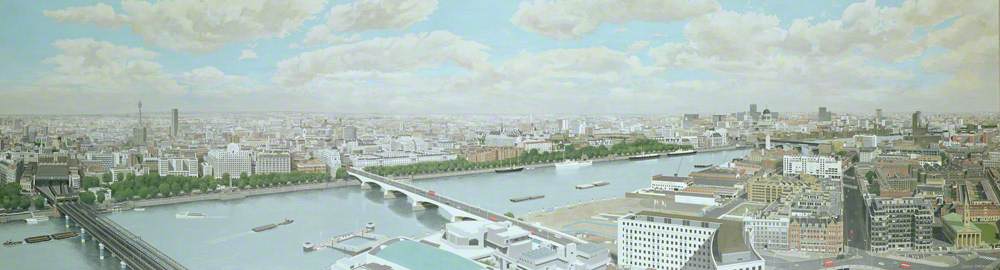
What’s the largest painting you know? What’s the biggest picture you can think of? Monet’s huge water lilies? Mark Rothko’s Seagram murals at Tate Modern? Juan Miro’s huge canvases of biomorphic shapes? These canvases are so big that if you ever find yourself sitting on an exhibition bench in front of a trio of them, as I have done with Monet and Miro, you realise entire field of vision is filled with them. It is an immersive experience. You are in Miroworld or Monetland.

Is size important? When it comes to art? Does a big painting really do a lot more than a medium-sized one? What, exactly? At what size does a big painting become an immersive one? Have psychologists or art colleges done research into viewers’ psychological and aesthetic responses to size? Is there a recognised point at which a painting goes from ‘big’ to ‘massive’ or is it subjective i.e according to the viewer’s physical size and visual range?

Do artists, collectors or galleries categorise paintings by size? Have there been fashions for huge canvases? Or historical periods particularly associated with them? Are there particular artists famous for their monster canvases? Is there a record for the biggest painting ever made? By who? Why?

These are some of the questions raised by ‘The Big City’, an exhibition at the little known but well-worth-a-visit Guildhall Art Gallery, a hop, skip and a jump from Bank tube station.

The gallery is owned by the Corporation of London, which possesses some 4,500 works of art. Fifty or so of these are on display in the gallery’s permanent exhibition, itself packed with gems, and then the gallery runs rotating exhibitions of selections of the others, alongside exhibitions of new, original art works.

The Big City

This exhibition is titled ‘The Big City’. It is housed in three rooms, respectively small, medium and large. The small room, the third one you come to, houses a display which comes first in terms of chronology:

Sir James Thornhill

Sir James Thornhill (1676 to 1734) was the premier exponent of the Italian Baroque style in Britain in the early 1700s. Much of this took the form of site-specific allegorical murals for public or grand buildings. He supervised large painting schemes in the dome of St Paul’s, in the hall of Blenheim Palace, at Chatsworth House.

In the early 1720s Thornhill was commissioned to create an Allegory of London for the ceiling of the council chamber at the Guildhall where the Lord Mayor and aldermen held their meetings. He used the established style of Baroque allegory to create a central image of London, represented by a topless woman, being advised by the goddess of wisdom, Pallas Athena, and women symbolising Peace and Plenty. It features putti or podgy winged toddlers who often flit around Baroque paintings. Here they are depicted at the bottom right among images of: the City insignia, the sword bearer’s fur cap, a pearl sword and the City mace.

Allegory of London by Sir James Thornhill (1725) © Guildhall Art Gallery, City of London

This oval painting was fixed in the middle of the ceiling and was accompanied by four smaller pieces, one in each corner of the ceiling, depicting flying cherubs or putti representing the four cardinal virtues: Temperance, Prudence, Fortitude and Justice.

We know what the whole design looked like because there’s a painting of the room by John Philipps Emslie showing how it looked in 1886. The story is that the centrepiece and four smaller parts were dismantled and stored during the Second World War. The building was damaged in the Blitz and the original decorative scheme destroyed but these individual pieces were saved, along with some preparatory sketches by Thornhill. All of this is on display here.

It would be easy to say the figures ‘looked down’ on the City officials meeting below but a glance at the image shows they’re not looking down at all, they are tied up in their own conversations in their own world.

The piece’s content, size and position are obviously connected with values – moral and social values. The size not so much of the individual elements, but the way they were arranged over the entire roof, were designed to act as a constant reminder to the officials below, of the longevity and depth of the values associated with the City and its officials and business. This is what we stand for: commerce and prosperity, bringing justice and peace.

So the images aren’t instructive, they are aspirational. It wasn’t a case of the gods looking down but of ordinary mortals looking up and, whenever they did, being reminded of the traditions and values they were meant to be aspiring to. (Also, a point often not made about Baroque painting – they’re quite playful.)

Prudence from The Allegory of London by Sir James Thornhill (1725) © Guildhall Art Gallery, City of London

Grand occasions

Before you get to the Thornhill room you walk through the medium-sized first room in the show. This has a completely different look and feel. It contains nine big paintings of ceremonies associated with the City of London from the late Victorian period through to the 1960s. They depict lots of old white men wearing formal clothes, gowns and regalia, chains of office, wigs and so on.

The paintings depict different types of event which the curators usefully itemise: civic, royal, state, ceremonial, funeral.

They are big, and their size is more obviously connected to notions of power than the relatively benign Thornhill. By power I don’t mean images of solders or Big Brother looming threateningly, not direct power. But the soft power implicit in grand occasions which serve to bolster and underpin ideas of hierarchy. The pictures are big because the event was big.

Take ‘Queen Victoria at St. Paul’s Cathedral on Diamond Jubilee Day 22 June 1897’ by Andrew Carrick Gow, completed in 1899. The painting was commissioned to capture the magnificence and the magnificence is exemplified in the extraordinary scene of the packed steps of St Paul’s. Not just packed but, as you look closer, you realise arranged in a highly structured way, as was the event, to include representatives of the army, the Church, politicians and academics, arranged in groups and hierarchies. The crème de la crème, the top figures in all the important fields of state.

Queen Victoria at St. Paul’s Cathedral on Diamond Jubilee Day 22 June 1897 by Andrew Carrick Gow (1899) © Guildhall Art Gallery, City of London Corporation

The curators point out that a massive royal state occasion like this transformed the centre of London into a stage, a set on which the thousands of figures here, and lining the route of the royal procession to the cathedral, were arranged – and which the painter then has to capture as best he can. Put this way I sympathise with the scale of the challenge the artist faced. He had to be in complete control of the old values of structured composition and extremely detailed naturalism.

There’s another super-simple way to categorise the paintings on display here, which is: inside or outside. The Gow is a good example of outdoor magnificence; ‘The Coronation Luncheon to Her Majesty Elizabeth II in the Guildhall, London, 12 June 1953’ by Terence Cuneo is a good example of magnificence in an indoors setting.

The Coronation Luncheon to Her Majesty Queen Elizabeth II in the Guildhall, London, 12 June 1953 by Terence Cuneo. © Guildhall Art Gallery, City of London Corporation. Image © Terence Cuneo

Once again the size of the painting is an attempt to match the scale of the actual event and, as you can see here, the size of the actual banqueting hall which is, as it is intended to be, awesome. And, leaving aside the ostensible splendour of the occasion, it’s hard not to be awed by the photographic realism of Cuneo’s painting. There’s a ‘Where’s Wally’ element to looking closely at the hundred or more individual guests, how they’re sitting, what they’re going (eating, talking, turning to their neighbour and so on).

(It might be worth pointing out that the word ‘magnificence’, like so many English words used to describe this kind of thing, has a Latin root, and so carries with it the connotation of learning and cultural capital which Latinate words always bestow. It derives from magnus meaning big or great [the Roman general Gnaeus Pompeius Magnus is translated into English as Pompey the Great] and facere meaning ‘to make or do’. So at its root ‘magnificence’ means ‘to make big’. At its origin, it is about size. During 2,000 years of evolution through medieval Latin, French and into English it has come to mean ‘splendour, nobility and grandeur’, themselves all Latinate words.)

Terence Cuneo OBE (1907 to 1996) was a prolific English painter noted for his scenes of railways, horses and military actions. He was the official artist for the coronation of Queen Elizabeth II in 1953 and the Queen’s favourite portraitist. Including ceremonial occasions he painted her no fewer than 17 times. He’s represented by two works here, the coronation lunch (above) and:

Frank O. Salisbury (1874 to 1962) was an English artist who specialised in portraits, large canvases of historical and ceremonial events, stained glass and book illustration. In his heyday he made a fortune on both sides of the Atlantic and was known as ‘Britain’s Painter Laureate’. He painted over 800 portraits (!) and painted Churchill more times than any other artist.

What you’ll have realised by now is that most of these works are, by modern standards, barely what we’d call art at all. Sure they’re well composed, efficiently worked paintings, but they are in a style that was old fashioned by 1900 and completely moribund by the 1960s.

In this respect, despite their size and detail and polish, they epitomise the opposite of what was intended; rather than impressing with awe and magnificence they tend, to the modern viewer, to emphasise how remote and out of touch these figures of power were with the wider world of the 40s, 50s and 60s.

You could argue that the grand old panelled rooms in which they suited old boys had their gala dinners protected and insulated them from a world moving beyond their grasp and even their understanding.

Churchill, who features in two of the paintings here (one alive, one dead) fought the Second World War to preserve the empire. Fifteen short years later he lived to see it being dismantled and the influx of immigrants from the former colonies who would bring new voices and new perspectives to Britain. None of that historic change is even hinted at in these old-fashioned depictions of old-fashioned institutions carrying out their time-honoured ceremonies.

There are some older paintings on the same type of subject. These, as it were, have permission to be dated, or are easier to take ‘straight’ because they are in styles appropriate to their day.

In this latter painting, apparently Paton, a noted painter of maritime scenes and naval occasions, did the composition and painted the main scene while Wheatley, famous for a series of paintings called ‘The Cries of London‘, did the figures in the foreground.

Contemporary art

The third and biggest room contains the biggest variety of paintings and the biggest single works. Size is not the only factor for their inclusion here, since each of the paintings also has a specific setting or story and these to some extent represent different aspects of life in the city.

I counted 18 paintings in this big room. I won’t list them all but will select some highlights and themes.

Ken Howard’s ‘Cheapside 10.10 am. 10 February 1970‘ is big and sludgy. It shows the north side of Cheapside looking west on the kind of cold overcast February morning typical of London. This reproduction softens the impact of the paint which Howard has laid on in thick dollops, makes it look a much cleaner, slicker object than it is in real life. A reproduction also brings out instantly what is less obvious in the flesh, which is the fact that it’s a painting about a mirror, namely the way St Mary le Bow church on the left is reflected in a shop window on the right.

Howard is quoted as saying that urban landscapes give more scope for an artist interested in shape, tone and colour than the countryside. This is exemplified in the next work, which is a splendid depiction of Fleet Street in the 1930s.

Fleet Street, London, 1930s by unknown artist © Guildhall Art Gallery, City of London

There’s quite a backstory to this painting. It was commissioned by Viscount Rothermere, owner of the Evening Standard and Daily Mail, to depict the hustle and bustle of Fleet Street, then centre of Britain’s newspaper industry. But the artist intended to include portraits of real Fleet Street luminaries down at the bottom right, and one of the first to be completed was a portrait of Rothermere’s rival press baron, Lord Beaverbrook, owner of the Express group. At which point Rothermere took the painting from the artist, which explains why, if you look closely, you realise it is unfinished, many of those figures without faces and some little more than ghosts. Which in its own way, makes the image quite haunting.

What is finished is the central vista along the ‘Street of Shame’ and, in particular, the gleaming Art Deco glass and steel building on the left. This was the newly opened Daily Express building (1932) which features, thinly disguised, in Evelyn Waugh’s great satire on the 1930s newspaper industry, Scoop.

What does size have to do with it? Well, at 2.13 metres tall this is a big painting, but clearly the scale doesn’t aim to do the same as the Thornhill (embody inspiring moral values) or the civic paintings we saw earlier (impress the viewer with rank and hierarchy).

I suggest its implicit aim is to do with modernism whose fundamental driver is excitement about life in the modern city, in this instance the new technologies and new designs and new architecture represented by Art Deco. It is an image of hustle and bustle and energy. Since it was commissioned by a multi-millionaire media baron I suppose you could also say it represents a capitalist’s, a plutocrat’s view of the city, full of folk hustling and bustling to make him money for him, his class, society at large. It is a celebration of the system.

This enjoyable work was succeeded by a sequence of paintings which I didn’t like at all, in fact actively disliked.

1. Walk by Oliver Bevan (1995) is certainly big (2.29m high, 2.13 m wide). It is a depiction of the pedestrian crossing in front of the Barbican tube station. Apparently Bevan specialises in the depiction of ‘non-personal urban spaces’. Actually, the tiny reproduction I’ve linked to makes it look a lot better than it does in real life. Confronting the 2 metre high thing in real life makes you all too aware of the crudity of the painting and the unsatisfying randomness of the arrangement of the people. I know people mill about randomly all the time but this has been carefully arranged to look gauche and clumsy.

I’m guessing the intention of doing such a humdrum scene on such a large scale is somehow democratic, to say that size isn’t limited to the high and mighty but that any moment in our everyday lives is worthy of record and depiction, can be made ‘monumental’ in scale and implication.

Maybe. But in this instance the size of the piece did the exact opposite of almost all the earlier works, which was impress me with its graceless lack of design and poor finish. Its size worked against it.

2. Jock McFadyen is represented by a work called Roman (1993). McFadyen depicts scenes around his flat and studio in Bethnal Green. This murky painting is of a block of flats in Roman Road nearby. It’s horrible. Again, the tiny online reproduction intensifies and clarifies the image. In reality it’s 2 metres square and an offence to the eye. Everything possible has been done to make it feel shitty. The left vertical of the flats is wonky, which is upsetting. The flats themselves are depicted with wobbly lines which completely fail to capture the hard geometric shape of such blocks which is their only redeeming feature. The human figure on a balcony is poorly drawn. The red VW in the street is appallingly badly drawn. And the decision to paint railings across the bottom spoils the entire composition even more and made me turn away quickly. I actively like scenes of urban devastation, graffiti and whatnot. But this just felt shoddy and amateurish.

3. Worse is to come. Flyover St Peter’s (1995) by Paul Butler is a whacking 2.74 metres wide and a big donkey turd of a painting. Regular readers of my blog know I actively like pictures or sculptures to be textured or incorporate detritus like dirt, wood, glass or whatever (see Hepher, below); but that I fiercely dislike the paintings of Frank Auerbach and Leon Kossof with their inch-deep sludges of filthy puddle-coloured oils.

They seem to me to do dirt on the entire idea of painting. They deny clarity, structure, composition, delicacy, skill, light, everything which makes painting worthwhile. The Ken Howard painting, earlier on in this room, was well on the way to achieving Auerbach levels of sludge, but Butler goes full throttle and annihilates the human spirit in a disgusting refuse tip of stricken oil spillage. Again, the reproduction you’re looking at flattens and clarifies the image so that it almost becomes appealing. In the flesh it’s like someone has spent a year blowing their nose and menstruating on a canvas to produce a thick layer of rotting mucus and menses. Yuk.

(All three of these works, plus a few others nearby, are, in their different ways, poor. This in itself is quite interesting. Most exhibitions you pay to go to in London represent the best of the best – tip-top Surrealist works at the Design Museum or Cezanne’s greatest hits at Tate Modern. You don’t often get to see a collection of art works that are average or plain bad, and it was interesting to dwell on what made all these works so sub-standard or actively objectionable.)

Anyway, this little set of poor works contrast dramatically with the series of paintings on the opposite wall, which are much cleaner, airier panoramas of London. Indeed, the canvas of London as seen from the top of the Shell Centre by David Thomas (1968) is the widest painting in the show, at a whopping 4.88 metres.

London from the top of the Shell Centre by David Thomas (1968) © Guildhall Art Gallery, City of London Corporation. Image © David Thomas

But it’s not this that impresses; it’s the lightness and the clarity of the image, which was like walking out of a dark room (Bevan, McFadyen, Butler) into the light and clarity of a lovely spring day. The painting feels wonderfully lucid, with all the buildings lining the Thames in central London depicted with thrilling geometric accuracy, almost like an architect’s conspectus come to life.

For people who like a bit of gossip or social history with their art, the label tells us that the picture shows at the centre bottom the Royal Festival Hall – the most enduring legacy of the 1951 Festival of Britain – to its right the daring Hayward Gallery which had just opened, and to the right of Waterloo Bridge a brown open space which had just been cleared to make way for construction of the new National Theatre.

What size does here is introduce the notion of the panorama, a particular genre of art which has reappeared in urban centres over the centuries. It embodies the pleasure of being up at a viewing platform looking over a city we mostly only get to see from ground level. The same kick which has people queuing up to buy tickets to the (disappointing) London Eye.

It begins a little series of urban panoramas which include a view over Clerkenwell by Michael Bach. The thrill or bite in something like this has to come from the architectural accuracy of the depiction. Bach, like Thomas’s, is very accurate and it’s big (2 metres wide) but…something (for me) is lacking.

Possibly that something is demonstrated in a much older work, the classic ‘Heart of Empire’ by Niels Moeller Lund. Though born in Denmark (hence the name) Lund grew up in Newcastle-upon-Tyne before moving to Paris to study painting. He is best known for his impressionistic paintings of England, particularly London and the North-East and ‘The Heart Of The Empire’ is his best-known painting.

The Heart of the Empire by Niels Moeller Lund (1904) © Guildhall Art Gallery, City of London Corporation

The view is taken from the roof of the roof of the Royal Exchange looking west across London. There are several obvious points to be made: I suppose the most obvious one is that panoramas over cities taken from up high, like this, give the viewer a sense of freedom, as if we can fly, as if we are gods flying above the mob and the crowd, freed from the cramped dictates of the busy streets, the traffic, the jostling with strangers, flying free. There’s a kind of psychological release.

Second and allied with it is some kind of sense of power. I don’t mean direct power like we’ve been elected president, I mean a kind of psychological empowerment, a sense of somehow owning what we survey. We know we don’t but it feels like it. This is my city with all its awesome hustle and bustle, its millions of lives, its buying and selling and wealth and poverty.

Why, then, do I get that feeling about this painting but not when looking at the view from the Shell building or over Clerkenwell? It’s something to do with the composition and, especially, the style. Lund’s work is described as ‘impressionist’ though it’s nowhere near as hazy as the classic French impressionists.

What he achieves is a soft focus, gauzy effect. The light isn’t champagne-clear as in Thomas’s bright somewhat clinical treatment; it creates a softening, blurring effect. This is evidenced in numerous ways, for example the buildings shimmer and face into the distance.

And after looking at it for a while I noticed the smoke issuing from chimneys across the vista and especially in the foreground. These may or may not be contributing to the blurry hazy effect, but they epitomise another aspect of the painting which is that it is anecdotal. What I mean is there are things going on in the painting. To be precise, note the flight of white birds (presumably pigeons) in front of the neo-classical Mansion House in the lower left. Once you’ve seen them your eye is drawn past them to the blurry throng of horses and carts and red omnibuses below.

The life of the city is dramatised. Because I happen to have watched the Robert Downey movie recently, it makes me think of Sherlock Holmes and a million details of late Victorian London life. When I look at the Thomas painting I get absolutely no sense whatever of the life of London 1968, there don’t appear to be any people in it at all.

So these are preliminary suggestions about how the same type of painting – the big urban panorama – can have dramatically different impact on the viewer depending on the sense of composition and painterly style.

David Hepher

I’ve left the best thing about the exhibition till last. The main room in the exhibition space is a kind of atrium in the sense that the ceiling has been removed to create a hole which lets you see into the floor above. Or, conversely, the floor above requires a modern glass railing to stop people falling down into the floor below, a railing which allows them to look down into the room below and view the artworks from above.

Anyway the point is that this removed ceiling has allowed the curators to place here a big wooden block supporting the three biggest paintings in the exhibition, three fabulous and very big paintings depicting modern brutalist blocks of flats by artist David Hepher.

Born in 1935, over the past 40 years Hepher has established a reputation for painting inner city estates of the 1960s and 70s. The three works here are 3 metres high. They’ve been attached to a wooden display stand to create an enormous triptych which dominates the room and is the biggest and most convincing thing in the exhibition. It’s worth making the journey to the gallery just to see this.

Gordon House East Face; Gordon House Nocturne; Gordon House West by David Hepher (2013) © Guildhall Art Gallery, City of London Corporation. Image © David Hepher

I loved these works for half a dozen reasons. For a start this it the real London, the appalling 70s tower blocks which millions of Londoners are forced to live in every day and which enables London’s intense population density: one seventh of the UK’s population lives in London, the most populous city in Europe, which has a population density of 145,000 per square mile, and it feels like it.

Secondly, tower blocks, like much modern architecture, is a fantastic subject for composition, because it comes ready-made with grids, squares, geometric shapes, which can either be dealt with in an arty modernist style (for example, photographs of their many motifs from unexpected angles as in lots of 20s and 30s photography) or dealt with straight-on, as here. They are just thrilling artefacts – or thrilling to those of us who like lines, symmetries, geometric regularities and angles.

Thirdly, there’s a fabulously dystopian vibe to them. You don’t need to be familiar with J.G. Ballard’s depictions of urban collapse and psychic displacement (Crash, Concrete Island and High Rise‘) to see, realise and feel concrete tower blocks as powerful symbols of social collapse and anomie. You don’t need to know much about the Grenfell Tower disaster to learn that tower blocks have become the cheap, under-maintained dumping ground for the poor, immigrants and the powerless.

They’re real world equivalents of the tower atop Mount Doom in Lord of the Rings, real world sentinels of poverty and deprivation. The broken lifts and urine-stained stairwells and broken pavements littered with dog turds and broken glass, the whole ensemble liberally decorated with impenetrable graffiti create an overwhelming sense of a society which has given up on itself.

The people who designed, built and shunted the poor into these cheap, shoddy death traps are obviously war criminals but in a special kind of war, a kind of below-the-radar class war which has been going on for decades and has become increasingly mixed up with institutional racism and the war on refugees to produce a toxic, and at Grenfell fatal, brew.

In their betrayal of the art, design and architectural utopianism of the 50s, 60s and 70s, in their magical transformation into symbols of social apartheid, exemplifying the scapegoating of the poorest in society, tower blocks like this are absolutely central to the urban experience in cities all around the western world.

The logistics of their size meant they had to be placed in the centre of the atrium, but the positioning also has a deeply symbolic meaning: all the other images, swish modernism of the 1930s, of flyovers and pedestrian crossings, of slick aerial panoramas, are all spokes rotating round the axle of these monster images.

To zero in on the works, another crucial and thrilling aspect of them is that they aren’t just paintings. Hepher has incorporated all the tricks of modern painting to make them rough textured objects. They aren’t flat paintings, they use wood and PVA to give texture to the surface. The graffiti symbols have genuinely been spraypainted over the images. He has dripped green slime down the front of the images to represent the unstoppable decay, concrete cancer and dilapidation which turned out to be a central aspect of these buildings. And most importantly of all he’s used actual concrete to produce rough-hewn, raw grey sections to either side of the central images. I couldn’t resist touching it, as cold and unyielding, as thrillingly alien as the raw concrete in the National Theatre or Barbican centre, as cold as the touch of the devil.

These three huge paintings strike me as classics of their type, of their subject matter and style. On the wall nearby is the Lund ‘Heart of Empire’ painting which I also really liked for its depth and evocative power. It seemed to me they form two ends of a spectrum: London traditional and London modern, London as romantic fantasy and as brutal reality, bourgeois London and chav London, the sublimely uplifting and the sordidly degraded, flying and falling.

I felt a kind of electrical energy crackling between the two completely different imaginative spaces they inhabit which was utterly thrilling. I found it hard to leave. I kept walking back into the room, walking round the stand, viewing these great looming canvases from different angles, drawn back to their thrilling, angry, visionary dystopian energy.


Related links

Other Guildhall Art Gallery reviews

The Doomed Oasis by Hammond Innes (1960)

‘Come to the point,’ said Gorde impatiently.
(the Doomed Oasis, page 151)

This is Hammond Innes’ longest novel to date, 336 pages in the Collins paperback edition. It is a slow-burning tale of oil prospecting on the politically sensitive border between sheikdoms in the Empty Quarter of Arabia, given flavour by the soap opera theme that the young man who travels out to Arabia and triggers the narrative is the bastard son by a Welsh serving girl of the posh Arab expert and obsessive oil prospector, Colonel Charles Whitaker.

The story is a first-person narrative told by the Welsh solicitor, George Grant, who sets out to investigate the young man’s subsequent death and who becomes the reluctant eyewitness to the story’s key developments and tragic denouement.

The plot

Like many a movie, the book opens in a court where staid solicitor George Grant is called on to give the evidence which will decide the fate of the man in the dock, a ‘national hero’, a ‘global figure’, who is on trial for murder. So what led up to this scene?… cue shimmering film effects and travelling-back-in-time music…

1. Escape to Saraifa

Well, it all began four years earlier when Grant is called to a house in Swansea where he finds that a 19-year-old boy, David Thomas, who’s escaped from Borstal, has returned to the family home and hit his father so severely that he’s caused a fatal stroke. It quickly emerges that the assault took place because the boy has discovered he’s not the man’s son at all; all this time both his ‘parents’ have lied to him – and he is actually the bastard son of the legendary adventurer and oil prospector in Arabia, Colonel Charles Whitaker, who they used to refer to as ‘Uncle Charles’.

Grant has been called in because his firm handles the monthly payments that come from Whitaker’s bank in Bahrain to the mother’s account – maintenance, or guilt money. When the ‘father’ dies as a result of his blows, David is arrested – but promptly escapes police custody to arrive, wet and injured, in Grant’s office where, against his better judgment and all his professional training, Grant helps the boy stow away on a ship bound for Arabia.

Old Captain Griffiths likewise takes pity on this intense, unhappy young man, allowing him passage on his ship and helping smuggle him ashore in Arabia, where he’s collected by his father’s men. The last Grant hears is a letter saying that David’s met his scary father, Colonel Whitaker (beak nose, patch over one eye, feared by his men, close confederate of the sheikh) and is beginning courses in oil drilling, with a view to helping him with his prospecting.

2. Enquiries of an executioner

Three years later Grant is shocked to receive a letter saying David is missing, presumed dead, in the Empty Quarter of Arabia. During that time Grant had become the UK solicitor for Colonel Whitaker, receiving funds from all kinds of business and sheikhs, before disbursing them to buy the equipment for a major oil prospecting expedition. Whitaker is obsessed with the quixotic idea that the profitable Saudi oil seams carry on into the small sheikdom of Saraifa. The shocking news that David is dead is confirmed by an obituary in The Times. And then Captain Griffiths turns up in Grant’s office with a package a harassed David had given him before his fateful, final mission, to be delivered to Grant by hand.

Is David really dead? How did he die? Was he murdered? Was he about to make a great discovery? Who was he working for? —- Trying to answer these questions is the motor of the plot driving Grant to meet and interview as many people connected with the events as possible for the middle 200 pages of the book.

The package contains a last will and testament – for David senses he will die on his last prospecting mission – along with a pledge to drill in specified locations on the Saraifa-Hadd border, which David hopes Grant can force the CEO of the oil company he and his father work for – GODCO – to sign. To make that happen Grant will have to fly to Arabia…

3. The Empty Quarter

Grant flies out to Bahrain and encounters various players including the cool, calculating Erkhard, MD of GODCO in his high-rise office. Tricky and evasive, he nonetheless convinces Grant that the company did everything it could to mount a search & rescue operation for David, but found nothing. Grant goes on to the hospital to meet David’s twin sister, Susan, a nurse working out there. He meets an Italian journalist Ruffini, who is rooting round looking for a story. He meets Sir Philip Gorde, the GODCO boss, who refuses to sign David’s document requesting drilling at key locations, which Grant has been instructed to present to him.

To explain why, Gorde flies Grant over the desert to see the locations, to show him they are on the politically sensitive border between Saraifa and Hadd, players in a centuries old blood feud. But to Gorde’s own surprise, from the plane they see a team drilling illegally and land on a gravel stretch of desert to quiz them. The drilling is being led by one Entwistle, who had met and respected David and now is, unofficially, following up David’s hunch about the oil on the border.

Grant’s dialogue with Entwistle is made up of characteristic Innes evasions.

Entwistle hesitated… ‘It isn’t easy to explain,’… he hesitated… Entwistle hesitated… He hesitated… unable, apparently, to put it into words… Again the hesitation… (pp.149-50)

When Grant gets to ask Entwistle whether he thinks David is still alive there is more evasion.

He hesitated… ‘What are you suggesting?’ I asked. ‘He hesitated…. ‘I don’t rightly know,’ he muttered… (p.153)

4. The doomed oasis

To Grant’s horror, Gorde flies off leaving Grant with Entwistle and his drilling crew in the middle of the desert, and five minutes later they’re attacked by armed bedouin. They flee in the Land Rover and drilling lorry and, after an arduous journey across desert sand and gravel, arrive at the much-mentioned Saraifa oasis, where they are promptly arrested by the ruler, sheikh Makhmud. He is very angry that they’ve been drilling on the border as it could trigger a war with the neighbouring Emir of Hadd. A tense counsel of the bedou elders is interrupted when one of the precious water pipes to the village, the falajes, fails and Entwistle makes a quick getaway in the Land Rover. Should Grant go with him?

‘I don’t know’, I said. I didn’t know anything for certain… He hesitated. (p.166)

Grant meets Khalid, the son of sheikh Makhmud and, as usual, the encounter is marked by hesitation, non-communication, evasion.

There were many things I wanted to ask him but this didn’t seem the moment. (p.170)

There was a moment then when he hesitated as though about to tell me something…. he replied ‘I don’t know.’… before I could question him he had drawn back… (p.172)

And then, finally, he meets the mysterious and legendary Charles Whitaker. He lives in a few rooms in a large empty mansion in the village and, it turns out, has the same conversational style as every other Innes character.

He didn’t say anything… He made no comment… He shrugged… the silence between us hung heavy as the thick night air… ‘It’s not easy to explain. You don’t understand the situation.’

What is clear is that: the little sheikdom of Saraifa, a castle and village based in an oasis, is under constant attack from the sands of the desert. It is only protected by a line of thorn trees and it only produces dates and rice etc thanks to an ancient system of falajes or water pipes, bringing water some thirty miles from the mountains. There used to be dozens but they have fallen into disrepair, now there are only six, and the men from Hadd are sabotaging these last ones, threatening to destroy all of them and, with them, Saraifa itself, if the illegal drilling continues.

There is a confusing scene where Erkhard flies in and appears to agree with Whitaker that the company will drill the disputed location – this leads sheikh Makhmud to organise a massive celebration feast, described in detail. But then Gorde arrives and, in front of everyone, tears the agreement up. In light of the blowing up of the falaj and some other violent exchanges, Gorde says neither his company nor any other will take the risk of triggering a war. He stalks out and the atmosphere turns very ugly as the jubilant Arabs give vent to their frustration. Whitaker returns to his half-empty palace. Grant returns to the isolated turret room the sheikh had allotted him. Crowds gather in the village square and are harangued by hotheads, and appear to go off and blow up one of the westerner’s airplanes. Grant is afraid.

5. The Quicksands of Umm al Samim

Now GODCO has definitively sworn off drilling on the border, Whitaker tells Grant he wants to liquidate all his assets in the UK and do the drilling out on the border himself as a freelance – although he knows he risks being murdered by Hadd’s men. Grant gets into a Land Rover driven by Whitaker’s servant to leave Saraifa but they reach the village square only to be blocked by armed men and Grant is returned all over again to his room in the turret.

In this tense atmosphere Grant is brought before the sheikh’s son, Khalid, who tells him David is alive. David’s mysterious disappearance/death was a set-up. The previous 200 pages, and all of Grant’s investigations so far, have been for nothing, based on a false premise.

Before that can sink in Khalid’s bodyguards whisk Grant into a Land Rover and they set off on a journey to Whitaker’s oil drilling rig thirty miles south. Here they learn that Whitaker has ordered his team to pack up and set off to drill on the dangerous border (leaving this reader to ask: why didn’t they quiz Whitaker about this back in Saraifa? Why don’t they simply order the drilling crew not to move?).

From there they drive at speed to a friendly village, Dhaid, and have barely been greeted by the hairy old sheik and his ragamuffin crew, before Khalid receives the message that the men of Hadd are massing for an attack on Saraifa, the doomed oasis. Khalid must return to his father – but he insists that Grant must change into native garb and be taken by a guide who doesn’t speak English into the remote quicksands of Umm al Samim, for this is where David is hiding out. Crikey.

Why did David fake his own death?

Khalid explains that he and David cooked up the idea of David’s disappearance for the publicity, to get it reported in the press, to bring pressure to bear on the oil company to drill in the contentious locations and encourage the British government to secure the disputed territory for Saraifa. (What a silly plan.) But it has completely failed: Gorde, the head of the oil company has expressly banned the drilling, war with the men of Hadd now looks inevitable, and the British government is (wisely) refusing to get involved – the exact opposite of everything David hoped for.

Khalid tells Grant he must go on this mission to find David and a) bring him back to be reunited with his father, to persuade him to call off the drilling b) then go to the British Political representative in Bahrain and beg for men and guns to defend Saraifa from the men of Hadd and their allies.

— Innes’ description of Grant’s journey through the desert and then across the treacherous quagmire of Umm al Samim is powerfully evocative. Around this stage of the book the longeurs which had dogged Grant’s quest for David begin to be replaced by more frequent and vivid descriptions of the desert, the harshness of bedouin life, a mounting sense of violence and impending tragedy.

Disaster

And then – very quickly, in the space of twenty pages – the situation and mood are turned upside down. As David and Grant ride their slow camels back towards Saraifa they learn that the men of Hadd have already attacked the doomed oasis. First they find the neighbouring village, Dhaid, full of woebegone refugees cowering behind the walls. Then they come to Saraifa itself, where all the falajes have been blocked, there is no drinking water, and the desert sands are blowing freely across the date gardens.

They ride out to the first watering hole where they discover the wreckage of a battlefield. Here Khalid and his men were ambushed by the men of Hadd and massacred, rusty old rifles against modern automatic weapons. All the bodies have been half-eaten by hyenas. David finds Khalid’s body, buries it with tears in his eyes, then swears vengeance on the men of Hadd.

They ride on past scattered corpses and out into the desert until they come upon Whitaker who is setting up his mobile drilling at the contentious locations, regardless of the consequences. Grant witnesses the reunion between son and the father who thought he was dead, and it is not a happy one. David is mystified as to why Whitaker is bothering to drill at all since, in David’s mind, the drilling was always about generating oil revenue to pay to restore the falajas and save the oasis. He is appalled to realise that for Whitaker it is just about confirming his lifelong theory that the oil is here, and about money. He has done a deal with the Emir of Hadd, got his approval to drill, and will pay him a commission.

David, thirsting for revenge, begs his father for men to help him carry out an attack on Hadd but Whitaker (sensibly) refuses. Whitaker asks Grant to help him make David see sense. In his turn, David asks Grant to come with him and help with his attack. Almost without realising it, Grant agrees with the latter and, along with four Arabs, they set off on camel-back for Hadd. —More evocative descriptions of the desert by day and night. And an atmosphere of real threat and tension.

The small team arrive at Hadd by night. David blows up its three wells (ha! revenge for Saraifa!) then they climb the old fort which backs onto the town. The battle – or more accurately, siege – which forms the climax of the novel, has begun.

6. Fort Jebel al-Akhbar

By this stage the novel has become gripping. Maybe it’s the introductoin of the visceral excitement of war and bloodshed – but it’s also the sense that the various strands of the plot are reaching a climax: Grant’s long association with David, which gives their relationship its depth; and David’s enmity with his father; all overlaid by his thirst for revenge for the killing of Khalid and the strangling of Saraifa, the doomed oasis.

David, Grant and their Arabs hold out in the commanding tower for days. They snipe at anyone trying to fix the wells. They successfully repulse every attack, sometimes with grenades. Three Land Rovers arrive with boastful Arab warriors and they immediately destroy two of them.

Under cover of dark, David encourages Grant to escape, blacked out, dressed as a bedouin, hiding against rocks as another wave of attackers climb the hillside. Grant stumbles across the attackers’ camels, steals one and heads west in the hope of coming across the tracks to Whitaker’s camp. —More convincing, and terrifying, descriptions of the pitiless desert.

By fluke, Grant makes it to Whitaker’s camp and his news angers the old man: he has helped set the Emir against him just as his dreams of drilling were coming true. Whitaker is torn between grief at the inevitable death of his son and hatred of him for scuppering his lifelong ambition.

The incident has been reported and one Colonel George for the British Army drops by to ensure Whitaker and his men are alright. He is accompanied by Ruffini, the snooping Italian journalist Grant first met in Bahrain. Lucky. Grant briefs Ruffini who flies out with Colonel George and manages to smuggle the story out to the British press. The next day it is dominating the national papers and a question is asked of the Foreign Secretary in the House. David’s siege has become an international incident. Over the next few days David is cast, by a jingoistic press, as a national hero. Grant watches all these developments with amazement.

Colonel George had radioed one of his patrols, led by a Captain Berry, to collect Grant and take him back to Bahrain but they divert to the border with Hadd and then, after a few days, the fuss in the press not going away, they are ordered to proceed to Jebel al-Akhbar to broker a deal.

Captain Berry and Grant are given safe passage by the Emir up the hill to the fort and meet David, more dead than alive, wounded and parched with thirst. He refuses to leave. He doesn’t trust the Emir not to assassinate him, and he thinks with a few more days holdout the British government will be forced to intervene and save Saraifa. Berry and Grant leave him some water and bandages and return to keeping a watching brief with their platoon of troops on the Saraifa-Hadd border.

Next thing they see a posse of the Emir’s men ride by in the direction of Whitaker’s drilling – then several hours later, riding back with Whitaker. The Emir is forcing Whitaker to confront his son and make him surrender.

Hours later Berry and Grant and the men hear a single shot ring out from the distant hill. They receive radio instructions that the government is brokering David’s surrender and a helicopter flies into the mountain top to bring him out. Ruffini the journalist is there to record the scene as the semi-conscious David is brought down to Berry’s camp, just enough time to whisper hello to Grant, before being flown on to hospital in Bahrain.

The Emir rides out to the camp in the dignity and simplicity of bedouin dress on a camel and harangues the British troops: they care nothing for the deaths of innumerable Arabs, but maybe they will mind the death of a white man. And one of his Land Rovers roars up and deposits the body of Colonel Whitaker onto the sand, shot in the face.

Did David shoot him? Is he a national hero or a national disgrace? Ruffini promises to write up a version that the Emir’s men treacherously murdered Whitaker, and Grant is full of hope. But Whitaker’s old friend and sparring partner, Sir Philip, says it is Grant’s fault for smuggling David out here in the first place, a dockside water-rat, a criminal wanted by the police, a rough illegitimate boy who had vowed to kill his father, one of the finest Arabists of his generation, a legend in the Peninsula, and a hero. It is all Grant’s fault.

Which is true? Which version will prevail?

Back in court

And so the narrative returns to the opening scene, a court room where Grant has been called to give evidence for the prosecution against David Thomas. The preceding 300 pages amount to a summary of his evidence, what he saw and experienced and witnessed. What will the court decide…?

Innes’ ‘secrets’

The ‘secrets’ at the core of these Innes novels of the later 1950s are often pretty trivial:

  • In The Wreck of The Mary Deare the crew were ordered to sink the ship as part of an insurance scam, but the captain managed to keep her afloat and beach her on rocks near the Scillies. That’s it. But it takes the narrator about 200 pages of painful obstructions and evasive conversations to prise this out of the ship’s captain.
  • In The Land God Gave To Cain three engineers survive crash landing in the wilds of Labrador, where one goes mad and tries to kill the other two, one of whom just about survives, escapes and hushes it all up. The narrator, a radio ham in England, picks up a radio signal from the murderer, left out in the wastes, a week after he was officially dead – that’s the puzzle or mystery – and it takes him 200 pages of interviewing innumerable evasive and obstructive company officials and eyewitnesses before he gets to the (unsatisfyingly simple) truth.

Innes only manages to spin 200-page novels out of these thin scenarios by having everyone in them appear slow on the uptake and have long, fruitless conversations in which they refuse to ‘spit it out’. Everyone is evasive about everything. In the 1950s this might have passed for the creation of ‘pace, tension and intrigue’ but tastes have changed. We expect a modern thriller to be cleverer than the reader, to outwit us with multiple levels of deceit, layers of duplicity which are slowly peeled away to reveal something truly shocking or dazzling.

Instead, for the majority of this book, as in the previous two, I experienced a growing sense of frustration as every conversation consisted of evasions and hesitations. Not for any cunning and clever reasons but simply for Innes to create a false sense of tension and spin things out.

It’s made worse because the real explanation is obvious so early on in the novel – when David’s death is reported I thought it was a bit pat and convenient, so it came as no surprise 200 pages later to realise he isn’t dead at all. The only thing that puzzled me was, Why? And the revelation that it was a publicity stunt to push the company into signing a legal commitment to drill at the contentious locations just seems ludicrous, a ludicrous failure to understand how multinational oil companies work.

Evasions and frustrations

A classic example is the conversation between the solicitor Grant and David’s twin sister, Susan, out in Arabia. Almost every one of her replies for about five pages of dialogue is hesitant, evasive, reluctant – and, doubling the frustration, part of it is her recounting a conversation with her brother in which he had been hesitant and evasive.

But since we, the readers, know that the plot boils down to David and his father disobeying oil company policy and drilling for oil in a politically sensitive region, the evasions seem unnecessary, willed and wilful, only there to delay and retard the plot, to inject a factitious sense of intrigue into a situation which is relatively simple.

She paused there… ‘Dedicated to what?’ I asked… but she couldn’t tell me… she gave a slight shrug… she didn’t answer for a moment… she hesitated… She paused, at a loss for words… I asked her what it meant but all she said was… ‘I don’t know,’ she said… she didn’t answer for a while… she shrugged… ‘I don’t know’… She didn’t seem to want to talk about it, for I had to drag it out of her… She admitted it reluctantly… she hesitated.. ‘I can’t explain’… she couldn’t put it into words… ‘He wouldn’t tell me anything’… ‘Now?’ She shook her head. ‘I don’t know…’ she shook her head… she shrugged… ‘I don’t know…’ (pages 123-130)

Similarly, when Grant meets David, blackened and seared by six weeks hiding out in the desert, you’d have thought he’d be desperate to explain the situation and find out what’s happened in his absence. But the scene is marred by Innes’ characteristic slowness and evasiveness.

His voice faded and once more he was staring out into the void… He didn’t say anything for a long time, sitting there lost in thought… He said it with deep bitterness and afterward was silent for a long time… (pp.233-235)

‘What happened?’ I asked him.
‘Nothing,’ he replied tersely. And after that he sat for a long time without saying a word. (p.251)

If Raymond Chandler is the king of quickfire repartee, Innes is the master of long, slow, slack, evasive and frustratingly inconclusive dialogue. How I wish I had a pound for every time a character shrugs, or hesitates, or says ‘I don’t know’.

Shellfish

There’s a physical concomitant to these evasions which is the tendence of all the characters to perform the same psychological act of turning in on themselves, withdrawing from the conversation, or looking off into the distance. It’s something I noticed a lot in The Land God Gave To Cain and it’s here in spades. This would be fine if there was anything interesting they were pondering or looking at – but they aren’t.

He had withdrawn into his own thoughts. (p.178)

He didn’t say anything. He seemed suddenly to have withdrawn into himself. (p.181)

Colour

On the other hand, Innes is good at local colour. As the plot becomes more Arab, as the westerners get left behind and Grant enters the world of the desert Arabs, the ‘plot’ may be spurious, but the text of the novel really picks up pace and intensity from Innes’ vivid description of Arab clothes and appearances, speech and customs, and the changing face of the vast and terrifying desert.

We travelled all that night without a break. The moon turned the desert to a bleak, bone white, and in the early hours a mist came up and it was cold. By then I was too tired to care where I was going and only the pain of the saddle chafing the inside of my thighs, the ache of unaccustomed muscles, kept me awake. The dawn brought a searing wind that whipped the mist aside and flung a moving cloud of sand in our faces. Lightning flashed in the gloom behind us, but no rain fell – just the wind and the driving sand particles. (p.225)

His prose is clear and functional, isn’t it? Devoid of the class-conscious grammatical correctness of Graham Greene’s prose, it is lucid and easy to read. There are no obstacles to quick comprehension and it is this ease of absorption, it is the speed you can read it at, which compensates, especially in the final section of the novel, for the frustrations of the first half of the plot.

As you put the book down it is the quick vivid descriptions of battle in the desert, along with the gathering sense of danger as Grant gets sucked into the siege on the hill, which ultimately outweigh the shortcomings of the earlier human interactions, so that overall I found it a rewarding, memorable and moving book. But I can see why nobody tried to make it into a film. And also why, like so many other Innes books, it is now largely unread.


Related links

Hammond Innes reviews