The Big City @ the Guildhall Art Gallery

What’s the largest painting you know? What’s the biggest picture you can think of? Monet’s huge water lilies? Mark Rothko’s Seagram murals at Tate Modern? Juan Miro’s huge canvases of biomorphic shapes? These canvases are so big that if you ever find yourself sitting on an exhibition bench in front of a trio of them, as I have done with Monet and Miro, you realise entire field of vision is filled with them. It is an immersive experience. You are in Miroworld or Monetland.

Is size important? When it comes to art? Does a big painting really do a lot more than a medium-sized one? What, exactly? At what size does a big painting become an immersive one? Have psychologists or art colleges done research into viewers’ psychological and aesthetic responses to size? Is there a recognised point at which a painting goes from ‘big’ to ‘massive’ or is it subjective i.e according to the viewer’s physical size and visual range?

Do artists, collectors or galleries categorise paintings by size? Have there been fashions for huge canvases? Or historical periods particularly associated with them? Are there particular artists famous for their monster canvases? Is there a record for the biggest painting ever made? By who? Why?

These are some of the questions raised by ‘The Big City’, an exhibition at the little known but well-worth-a-visit Guildhall Art Gallery, a hop, skip and a jump from Bank tube station.

The gallery is owned by the Corporation of London, which possesses some 4,500 works of art. Fifty or so of these are on display in the gallery’s permanent exhibition, itself packed with gems, and then the gallery runs rotating exhibitions of selections of the others, alongside exhibitions of new, original art works.

The Big City

This exhibition is titled ‘The Big City’. It is housed in three rooms, respectively small, medium and large. The small room, the third one you come to, houses a display which comes first in terms of chronology:

Sir James Thornhill

Sir James Thornhill (1676 to 1734) was the premier exponent of the Italian Baroque style in Britain in the early 1700s. Much of this took the form of site-specific allegorical murals for public or grand buildings. He supervised large painting schemes in the dome of St Paul’s, in the hall of Blenheim Palace, at Chatsworth House.

In the early 1720s Thornhill was commissioned to create an Allegory of London for the ceiling of the council chamber at the Guildhall where the Lord Mayor and aldermen held their meetings. He used the established style of Baroque allegory to create a central image of London, represented by a topless woman, being advised by the goddess of wisdom, Pallas Athena, and women symbolising Peace and Plenty. It features putti or podgy winged toddlers who often flit around Baroque paintings. Here they are depicted at the bottom right among images of: the City insignia, the sword bearer’s fur cap, a pearl sword and the City mace.

Allegory of London by Sir James Thornhill (1725) © Guildhall Art Gallery, City of London

This oval painting was fixed in the middle of the ceiling and was accompanied by four smaller pieces, one in each corner of the ceiling, depicting flying cherubs or putti representing the four cardinal virtues: Temperance, Prudence, Fortitude and Justice.

We know what the whole design looked like because there’s a painting of the room by John Philipps Emslie showing how it looked in 1886. The story is that the centrepiece and four smaller parts were dismantled and stored during the Second World War. The building was damaged in the Blitz and the original decorative scheme destroyed but these individual pieces were saved, along with some preparatory sketches by Thornhill. All of this is on display here.

It would be easy to say the figures ‘looked down’ on the City officials meeting below but a glance at the image shows they’re not looking down at all, they are tied up in their own conversations in their own world.

The piece’s content, size and position are obviously connected with values – moral and social values. The size not so much of the individual elements, but the way they were arranged over the entire roof, were designed to act as a constant reminder to the officials below, of the longevity and depth of the values associated with the City and its officials and business. This is what we stand for: commerce and prosperity, bringing justice and peace.

So the images aren’t instructive, they are aspirational. It wasn’t a case of the gods looking down but of ordinary mortals looking up and, whenever they did, being reminded of the traditions and values they were meant to be aspiring to. (Also, a point often not made about Baroque painting – they’re quite playful.)

Prudence from The Allegory of London by Sir James Thornhill (1725) © Guildhall Art Gallery, City of London

Grand occasions

Before you get to the Thornhill room you walk through the medium-sized first room in the show. This has a completely different look and feel. It contains nine big paintings of ceremonies associated with the City of London from the late Victorian period through to the 1960s. They depict lots of old white men wearing formal clothes, gowns and regalia, chains of office, wigs and so on.

The paintings depict different types of event which the curators usefully itemise: civic, royal, state, ceremonial, funeral.

They are big, and their size is more obviously connected to notions of power than the relatively benign Thornhill. By power I don’t mean images of solders or Big Brother looming threateningly, not direct power. But the soft power implicit in grand occasions which serve to bolster and underpin ideas of hierarchy. The pictures are big because the event was big.

Take ‘Queen Victoria at St. Paul’s Cathedral on Diamond Jubilee Day 22 June 1897’ by Andrew Carrick Gow, completed in 1899. The painting was commissioned to capture the magnificence and the magnificence is exemplified in the extraordinary scene of the packed steps of St Paul’s. Not just packed but, as you look closer, you realise arranged in a highly structured way, as was the event, to include representatives of the army, the Church, politicians and academics, arranged in groups and hierarchies. The crème de la crème, the top figures in all the important fields of state.

Queen Victoria at St. Paul’s Cathedral on Diamond Jubilee Day 22 June 1897 by Andrew Carrick Gow (1899) © Guildhall Art Gallery, City of London Corporation

The curators point out that a massive royal state occasion like this transformed the centre of London into a stage, a set on which the thousands of figures here, and lining the route of the royal procession to the cathedral, were arranged – and which the painter then has to capture as best he can. Put this way I sympathise with the scale of the challenge the artist faced. He had to be in complete control of the old values of structured composition and extremely detailed naturalism.

There’s another super-simple way to categorise the paintings on display here, which is: inside or outside. The Gow is a good example of outdoor magnificence; ‘The Coronation Luncheon to Her Majesty Elizabeth II in the Guildhall, London, 12 June 1953’ by Terence Cuneo is a good example of magnificence in an indoors setting.

The Coronation Luncheon to Her Majesty Queen Elizabeth II in the Guildhall, London, 12 June 1953 by Terence Cuneo. © Guildhall Art Gallery, City of London Corporation. Image © Terence Cuneo

Once again the size of the painting is an attempt to match the scale of the actual event and, as you can see here, the size of the actual banqueting hall which is, as it is intended to be, awesome. And, leaving aside the ostensible splendour of the occasion, it’s hard not to be awed by the photographic realism of Cuneo’s painting. There’s a ‘Where’s Wally’ element to looking closely at the hundred or more individual guests, how they’re sitting, what they’re going (eating, talking, turning to their neighbour and so on).

(It might be worth pointing out that the word ‘magnificence’, like so many English words used to describe this kind of thing, has a Latin root, and so carries with it the connotation of learning and cultural capital which Latinate words always bestow. It derives from magnus meaning big or great [the Roman general Gnaeus Pompeius Magnus is translated into English as Pompey the Great] and facere meaning ‘to make or do’. So at its root ‘magnificence’ means ‘to make big’. At its origin, it is about size. During 2,000 years of evolution through medieval Latin, French and into English it has come to mean ‘splendour, nobility and grandeur’, themselves all Latinate words.)

Terence Cuneo OBE (1907 to 1996) was a prolific English painter noted for his scenes of railways, horses and military actions. He was the official artist for the coronation of Queen Elizabeth II in 1953 and the Queen’s favourite portraitist. Including ceremonial occasions he painted her no fewer than 17 times. He’s represented by two works here, the coronation lunch (above) and:

Frank O. Salisbury (1874 to 1962) was an English artist who specialised in portraits, large canvases of historical and ceremonial events, stained glass and book illustration. In his heyday he made a fortune on both sides of the Atlantic and was known as ‘Britain’s Painter Laureate’. He painted over 800 portraits (!) and painted Churchill more times than any other artist.

What you’ll have realised by now is that most of these works are, by modern standards, barely what we’d call art at all. Sure they’re well composed, efficiently worked paintings, but they are in a style that was old fashioned by 1900 and completely moribund by the 1960s.

In this respect, despite their size and detail and polish, they epitomise the opposite of what was intended; rather than impressing with awe and magnificence they tend, to the modern viewer, to emphasise how remote and out of touch these figures of power were with the wider world of the 40s, 50s and 60s.

You could argue that the grand old panelled rooms in which they suited old boys had their gala dinners protected and insulated them from a world moving beyond their grasp and even their understanding.

Churchill, who features in two of the paintings here (one alive, one dead) fought the Second World War to preserve the empire. Fifteen short years later he lived to see it being dismantled and the influx of immigrants from the former colonies who would bring new voices and new perspectives to Britain. None of that historic change is even hinted at in these old-fashioned depictions of old-fashioned institutions carrying out their time-honoured ceremonies.

There are some older paintings on the same type of subject. These, as it were, have permission to be dated, or are easier to take ‘straight’ because they are in styles appropriate to their day.

In this latter painting, apparently Paton, a noted painter of maritime scenes and naval occasions, did the composition and painted the main scene while Wheatley, famous for a series of paintings called ‘The Cries of London‘, did the figures in the foreground.

Contemporary art

The third and biggest room contains the biggest variety of paintings and the biggest single works. Size is not the only factor for their inclusion here, since each of the paintings also has a specific setting or story and these to some extent represent different aspects of life in the city.

I counted 18 paintings in this big room. I won’t list them all but will select some highlights and themes.

Ken Howard’s ‘Cheapside 10.10 am. 10 February 1970‘ is big and sludgy. It shows the north side of Cheapside looking west on the kind of cold overcast February morning typical of London. This reproduction softens the impact of the paint which Howard has laid on in thick dollops, makes it look a much cleaner, slicker object than it is in real life. A reproduction also brings out instantly what is less obvious in the flesh, which is the fact that it’s a painting about a mirror, namely the way St Mary le Bow church on the left is reflected in a shop window on the right.

Howard is quoted as saying that urban landscapes give more scope for an artist interested in shape, tone and colour than the countryside. This is exemplified in the next work, which is a splendid depiction of Fleet Street in the 1930s.

Fleet Street, London, 1930s by unknown artist © Guildhall Art Gallery, City of London

There’s quite a backstory to this painting. It was commissioned by Viscount Rothermere, owner of the Evening Standard and Daily Mail, to depict the hustle and bustle of Fleet Street, then centre of Britain’s newspaper industry. But the artist intended to include portraits of real Fleet Street luminaries down at the bottom right, and one of the first to be completed was a portrait of Rothermere’s rival press baron, Lord Beaverbrook, owner of the Express group. At which point Rothermere took the painting from the artist, which explains why, if you look closely, you realise it is unfinished, many of those figures without faces and some little more than ghosts. Which in its own way, makes the image quite haunting.

What is finished is the central vista along the ‘Street of Shame’ and, in particular, the gleaming Art Deco glass and steel building on the left. This was the newly opened Daily Express building (1932) which features, thinly disguised, in Evelyn Waugh’s great satire on the 1930s newspaper industry, Scoop.

What does size have to do with it? Well, at 2.13 metres tall this is a big painting, but clearly the scale doesn’t aim to do the same as the Thornhill (embody inspiring moral values) or the civic paintings we saw earlier (impress the viewer with rank and hierarchy).

I suggest its implicit aim is to do with modernism whose fundamental driver is excitement about life in the modern city, in this instance the new technologies and new designs and new architecture represented by Art Deco. It is an image of hustle and bustle and energy. Since it was commissioned by a multi-millionaire media baron I suppose you could also say it represents a capitalist’s, a plutocrat’s view of the city, full of folk hustling and bustling to make him money for him, his class, society at large. It is a celebration of the system.

This enjoyable work was succeeded by a sequence of paintings which I didn’t like at all, in fact actively disliked.

1. Walk by Oliver Bevan (1995) is certainly big (2.29m high, 2.13 m wide). It is a depiction of the pedestrian crossing in front of the Barbican tube station. Apparently Bevan specialises in the depiction of ‘non-personal urban spaces’. Actually, the tiny reproduction I’ve linked to makes it look a lot better than it does in real life. Confronting the 2 metre high thing in real life makes you all too aware of the crudity of the painting and the unsatisfying randomness of the arrangement of the people. I know people mill about randomly all the time but this has been carefully arranged to look gauche and clumsy.

I’m guessing the intention of doing such a humdrum scene on such a large scale is somehow democratic, to say that size isn’t limited to the high and mighty but that any moment in our everyday lives is worthy of record and depiction, can be made ‘monumental’ in scale and implication.

Maybe. But in this instance the size of the piece did the exact opposite of almost all the earlier works, which was impress me with its graceless lack of design and poor finish. Its size worked against it.

2. Jock McFadyen is represented by a work called Roman (1993). McFadyen depicts scenes around his flat and studio in Bethnal Green. This murky painting is of a block of flats in Roman Road nearby. It’s horrible. Again, the tiny online reproduction intensifies and clarifies the image. In reality it’s 2 metres square and an offence to the eye. Everything possible has been done to make it feel shitty. The left vertical of the flats is wonky, which is upsetting. The flats themselves are depicted with wobbly lines which completely fail to capture the hard geometric shape of such blocks which is their only redeeming feature. The human figure on a balcony is poorly drawn. The red VW in the street is appallingly badly drawn. And the decision to paint railings across the bottom spoils the entire composition even more and made me turn away quickly. I actively like scenes of urban devastation, graffiti and whatnot. But this just felt shoddy and amateurish.

3. Worse is to come. Flyover St Peter’s (1995) by Paul Butler is a whacking 2.74 metres wide and a big donkey turd of a painting. Regular readers of my blog know I actively like pictures or sculptures to be textured or incorporate detritus like dirt, wood, glass or whatever (see Hepher, below); but that I fiercely dislike the paintings of Frank Auerbach and Leon Kossof with their inch-deep sludges of filthy puddle-coloured oils.

They seem to me to do dirt on the entire idea of painting. They deny clarity, structure, composition, delicacy, skill, light, everything which makes painting worthwhile. The Ken Howard painting, earlier on in this room, was well on the way to achieving Auerbach levels of sludge, but Butler goes full throttle and annihilates the human spirit in a disgusting refuse tip of stricken oil spillage. Again, the reproduction you’re looking at flattens and clarifies the image so that it almost becomes appealing. In the flesh it’s like someone has spent a year blowing their nose and menstruating on a canvas to produce a thick layer of rotting mucus and menses. Yuk.

(All three of these works, plus a few others nearby, are, in their different ways, poor. This in itself is quite interesting. Most exhibitions you pay to go to in London represent the best of the best – tip-top Surrealist works at the Design Museum or Cezanne’s greatest hits at Tate Modern. You don’t often get to see a collection of art works that are average or plain bad, and it was interesting to dwell on what made all these works so sub-standard or actively objectionable.)

Anyway, this little set of poor works contrast dramatically with the series of paintings on the opposite wall, which are much cleaner, airier panoramas of London. Indeed, the canvas of London as seen from the top of the Shell Centre by David Thomas (1968) is the widest painting in the show, at a whopping 4.88 metres.
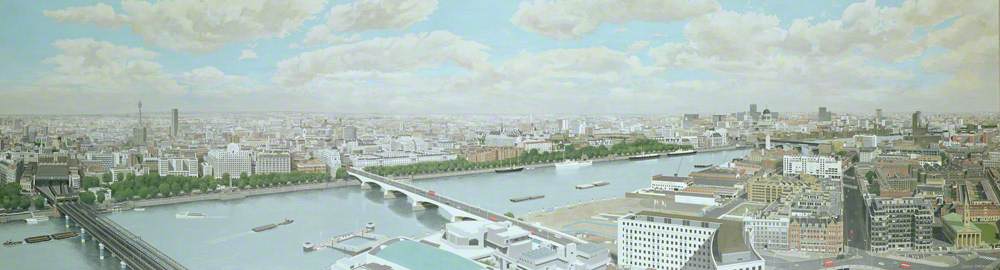
London from the top of the Shell Centre by David Thomas (1968) © Guildhall Art Gallery, City of London Corporation. Image © David Thomas

But it’s not this that impresses; it’s the lightness and the clarity of the image, which was like walking out of a dark room (Bevan, McFadyen, Butler) into the light and clarity of a lovely spring day. The painting feels wonderfully lucid, with all the buildings lining the Thames in central London depicted with thrilling geometric accuracy, almost like an architect’s conspectus come to life.

For people who like a bit of gossip or social history with their art, the label tells us that the picture shows at the centre bottom the Royal Festival Hall – the most enduring legacy of the 1951 Festival of Britain – to its right the daring Hayward Gallery which had just opened, and to the right of Waterloo Bridge a brown open space which had just been cleared to make way for construction of the new National Theatre.

What size does here is introduce the notion of the panorama, a particular genre of art which has reappeared in urban centres over the centuries. It embodies the pleasure of being up at a viewing platform looking over a city we mostly only get to see from ground level. The same kick which has people queuing up to buy tickets to the (disappointing) London Eye.

It begins a little series of urban panoramas which include a view over Clerkenwell by Michael Bach. The thrill or bite in something like this has to come from the architectural accuracy of the depiction. Bach, like Thomas’s, is very accurate and it’s big (2 metres wide) but…something (for me) is lacking.

Possibly that something is demonstrated in a much older work, the classic ‘Heart of Empire’ by Niels Moeller Lund. Though born in Denmark (hence the name) Lund grew up in Newcastle-upon-Tyne before moving to Paris to study painting. He is best known for his impressionistic paintings of England, particularly London and the North-East and ‘The Heart Of The Empire’ is his best-known painting.

The Heart of the Empire by Niels Moeller Lund (1904) © Guildhall Art Gallery, City of London Corporation

The view is taken from the roof of the roof of the Royal Exchange looking west across London. There are several obvious points to be made: I suppose the most obvious one is that panoramas over cities taken from up high, like this, give the viewer a sense of freedom, as if we can fly, as if we are gods flying above the mob and the crowd, freed from the cramped dictates of the busy streets, the traffic, the jostling with strangers, flying free. There’s a kind of psychological release.

Second and allied with it is some kind of sense of power. I don’t mean direct power like we’ve been elected president, I mean a kind of psychological empowerment, a sense of somehow owning what we survey. We know we don’t but it feels like it. This is my city with all its awesome hustle and bustle, its millions of lives, its buying and selling and wealth and poverty.

Why, then, do I get that feeling about this painting but not when looking at the view from the Shell building or over Clerkenwell? It’s something to do with the composition and, especially, the style. Lund’s work is described as ‘impressionist’ though it’s nowhere near as hazy as the classic French impressionists.

What he achieves is a soft focus, gauzy effect. The light isn’t champagne-clear as in Thomas’s bright somewhat clinical treatment; it creates a softening, blurring effect. This is evidenced in numerous ways, for example the buildings shimmer and face into the distance.

And after looking at it for a while I noticed the smoke issuing from chimneys across the vista and especially in the foreground. These may or may not be contributing to the blurry hazy effect, but they epitomise another aspect of the painting which is that it is anecdotal. What I mean is there are things going on in the painting. To be precise, note the flight of white birds (presumably pigeons) in front of the neo-classical Mansion House in the lower left. Once you’ve seen them your eye is drawn past them to the blurry throng of horses and carts and red omnibuses below.

The life of the city is dramatised. Because I happen to have watched the Robert Downey movie recently, it makes me think of Sherlock Holmes and a million details of late Victorian London life. When I look at the Thomas painting I get absolutely no sense whatever of the life of London 1968, there don’t appear to be any people in it at all.

So these are preliminary suggestions about how the same type of painting – the big urban panorama – can have dramatically different impact on the viewer depending on the sense of composition and painterly style.

David Hepher

I’ve left the best thing about the exhibition till last. The main room in the exhibition space is a kind of atrium in the sense that the ceiling has been removed to create a hole which lets you see into the floor above. Or, conversely, the floor above requires a modern glass railing to stop people falling down into the floor below, a railing which allows them to look down into the room below and view the artworks from above.

Anyway the point is that this removed ceiling has allowed the curators to place here a big wooden block supporting the three biggest paintings in the exhibition, three fabulous and very big paintings depicting modern brutalist blocks of flats by artist David Hepher.

Born in 1935, over the past 40 years Hepher has established a reputation for painting inner city estates of the 1960s and 70s. The three works here are 3 metres high. They’ve been attached to a wooden display stand to create an enormous triptych which dominates the room and is the biggest and most convincing thing in the exhibition. It’s worth making the journey to the gallery just to see this.

Gordon House East Face; Gordon House Nocturne; Gordon House West by David Hepher (2013) © Guildhall Art Gallery, City of London Corporation. Image © David Hepher

I loved these works for half a dozen reasons. For a start this it the real London, the appalling 70s tower blocks which millions of Londoners are forced to live in every day and which enables London’s intense population density: one seventh of the UK’s population lives in London, the most populous city in Europe, which has a population density of 145,000 per square mile, and it feels like it.

Secondly, tower blocks, like much modern architecture, is a fantastic subject for composition, because it comes ready-made with grids, squares, geometric shapes, which can either be dealt with in an arty modernist style (for example, photographs of their many motifs from unexpected angles as in lots of 20s and 30s photography) or dealt with straight-on, as here. They are just thrilling artefacts – or thrilling to those of us who like lines, symmetries, geometric regularities and angles.

Thirdly, there’s a fabulously dystopian vibe to them. You don’t need to be familiar with J.G. Ballard’s depictions of urban collapse and psychic displacement (Crash, Concrete Island and High Rise‘) to see, realise and feel concrete tower blocks as powerful symbols of social collapse and anomie. You don’t need to know much about the Grenfell Tower disaster to learn that tower blocks have become the cheap, under-maintained dumping ground for the poor, immigrants and the powerless.

They’re real world equivalents of the tower atop Mount Doom in Lord of the Rings, real world sentinels of poverty and deprivation. The broken lifts and urine-stained stairwells and broken pavements littered with dog turds and broken glass, the whole ensemble liberally decorated with impenetrable graffiti create an overwhelming sense of a society which has given up on itself.

The people who designed, built and shunted the poor into these cheap, shoddy death traps are obviously war criminals but in a special kind of war, a kind of below-the-radar class war which has been going on for decades and has become increasingly mixed up with institutional racism and the war on refugees to produce a toxic, and at Grenfell fatal, brew.

In their betrayal of the art, design and architectural utopianism of the 50s, 60s and 70s, in their magical transformation into symbols of social apartheid, exemplifying the scapegoating of the poorest in society, tower blocks like this are absolutely central to the urban experience in cities all around the western world.

The logistics of their size meant they had to be placed in the centre of the atrium, but the positioning also has a deeply symbolic meaning: all the other images, swish modernism of the 1930s, of flyovers and pedestrian crossings, of slick aerial panoramas, are all spokes rotating round the axle of these monster images.

To zero in on the works, another crucial and thrilling aspect of them is that they aren’t just paintings. Hepher has incorporated all the tricks of modern painting to make them rough textured objects. They aren’t flat paintings, they use wood and PVA to give texture to the surface. The graffiti symbols have genuinely been spraypainted over the images. He has dripped green slime down the front of the images to represent the unstoppable decay, concrete cancer and dilapidation which turned out to be a central aspect of these buildings. And most importantly of all he’s used actual concrete to produce rough-hewn, raw grey sections to either side of the central images. I couldn’t resist touching it, as cold and unyielding, as thrillingly alien as the raw concrete in the National Theatre or Barbican centre, as cold as the touch of the devil.

These three huge paintings strike me as classics of their type, of their subject matter and style. On the wall nearby is the Lund ‘Heart of Empire’ painting which I also really liked for its depth and evocative power. It seemed to me they form two ends of a spectrum: London traditional and London modern, London as romantic fantasy and as brutal reality, bourgeois London and chav London, the sublimely uplifting and the sordidly degraded, flying and falling.

I felt a kind of electrical energy crackling between the two completely different imaginative spaces they inhabit which was utterly thrilling. I found it hard to leave. I kept walking back into the room, walking round the stand, viewing these great looming canvases from different angles, drawn back to their thrilling, angry, visionary dystopian energy.


Related links

Other Guildhall Art Gallery reviews

The Renaissance Nude @ the Royal Academy

In this review I intend to make three points:

  1. This exhibition is without doubt a spectacular collection of outstanding Renaissance treasures, gathered into fascinating groups or ‘themes’ which shed light on the role of the body in Renaissance iconography.
  2. It confirms my by-now firm conviction/view/prejudice that I don’t really like Italian Renaissance art but adore North European late-medieval and Renaissance art.
  3. Despite being spectacular and full of treasures, the exhibition left me with a few questions about the underlying premise of the show.

1. Spectacular Renaissance treasures

The exhibition brings together works by many of the great masters of the Renaissance, including Titian, Raphael, Michelangelo, Leonardo da Vinci, Donatello, Dürer and Cranach. The small sketch by Raphael of the three graces is seraphic, the two pages of anatomical drawings by Leonardo da Vinci are awe-inspiring and the Venus Rising by Titian is wonderful full scale and in the flesh.

Venus Rising from the Sea (‘Venus Anadyomene’) by Titian (1520) National Galleries of Scotland

However, it isn’t just a parade of greatest hits. The exhibition includes works by lots of less-famous figures such as Perugino, Pollaiuolo and Gossaert, and lots of minor works or works which aren’t striving for greatness at all.

Indeed, there are quite a few rather puzzling or perplexing prints and images, like Dürer’s woodcut of naked men in a bath-house, or a battle scene from the ancient world where all the axe-wielding men are naked. The exhibition is more notable for its diversity and range than its concentration on well-known names.

And it is far from all being paintings. There are also large numbers of prints and engravings, alongside drawings and sketches, statuettes in metal and wood, some bronze reliefs, and fifteen or so invaluable books of the time, propped open to display beautiful medieval-style, hand-painted illustrations.

There’s even a case of four or five large circular plaques from the period, showing the patron’s face on one side and nude allegorical figures on the other. There are some 90 works in total.

In other words, this exhibition brings together pieces from across the widest possible range of media, and by a very wide range of artists, famous and not so famous, in order to ponder the role of the naked human body in Renaissance art, showing how the depiction of the nude in art and sculpture and book illustration changed over the period from 1400 to 1530.

A Faun and His Family with a Slain Lion (c. 1526) by Lucas Cranach the Elder. The J. Paul Getty Museum, Los Angeles

It does this by dividing the works into five themes.

1. The nude and Christian art

Medieval art had been concerned almost exclusively with depicting either secular powers (kings and emperors) or religious themes. For the most part the human figure had been covered up. So a central theme in the exhibition is documenting the increasing ‘boldness’ or confidence with which artists from the period handled subjects involving nudity, and the increasing technical knowledge of the human body which gave their images ever-greater anatomical accuracy.

You can trace this growing confidence in successive depictions of key Christian stories such as the countless depictions of Adam and Eve in the Garden of Eden, probably the locus classicus of nudity in the whole Christian canon.

This version by Dürer seems more motivated by the artist showing off his anatomical knowledge and skill at engraving (and learnèd symbolism) than religious piety.

Adam and Eve by Albrecht Dürer (1504) Los Angeles County Museum of Art

Of course the Christian Church still ruled the hearts and imaginations of all Europeans and the Pope’s blessing or anathema was still something to be hoped for or feared. From top to bottom, society was dominated by Christian ideology and iconography. And so alongside Adam and Eve there are quite a few versions of of other subjects which provided an opportunity for nudity, such as Christ being scourged or crucified, or the large number of Last Judgements with naked souls being cast down into Hell.

In fact for me, arguably the two most powerful pictures in the entire show were the images of damned souls being stuffed down into Hell by evil demons, by the two Northern painters Hans Memling and Dirk Bouts.

The Fall of The Damned by Dirk Bouts (1450)

In these images the fact that the men and women have been stripped naked is an important part of their message. It symbolises the way they have been stripped of their dignity and identity. They have become so much human meat, prey for demons to torture and even eat. Paintings like this always remind me of descriptions of the Holocaust where the Jews were ordered to strip naked, men and women and children, in front of each other, and the pitiful descriptions I’ve read of women, in particular, trying to hang on to their last shreds of dignity before being murdered like animals. The stripping was an important part of the psychological degradation which reduced humans to cowed animals which were then easier to shepherd into the gas chambers.

2. Humanism and the expansion of secular themes

Humanism refers to the growth of interest in the legacy of the classical world which began to develop during the 1400s and was a well-established intellectual practice by the early 1500s.

Initially, humanism focused on the rediscovered writings of the Greeks and especially the Romans, promoting a better understanding of the Latin language and appreciation of its best authors, notably the lawyer and philosopher Cicero.

But study of these ancient texts went hand in hand with a better understanding of the classical mythology which informed them. In the 1500s advanced thinkers tried to infuse the ancient myths with deeper levels of allegory, or to reconcile them with Christian themes.

Whatever the literary motivation, the movement meant that, in visual terms, the ancient gods and goddesses and their numerous myths and adventures became increasingly respectable, even fashionable, subjects for the evermore skilful artists of the Renaissance.

In addition, classical figures also became a kind of gateway for previously unexpressed human moods and feelings. For some painters a classical subject allowed the expression of pure sensual pleasure, as in the Titian Venus above.

In this wonderful drawing by Raphael something more is going on – there is certainly a wonderful anatomical accuracy, but the drawing is also expressing something beyond words about grace and gracefulness, about eloquence of gesture and poise and posture, something quite wonderful. It’s relatively small, but this little drawing is among the most ravishing works in the exhibition.

The Three Graces by Raphael (1517 to 1518) Royal Collection Trust © Her Majesty Queen Elizabeth II 2019

The replacement of sex by desire in artspeak

About half way round the exhibition, I began to notice that the words ‘sex’ or ‘sexy’ do not appear anywhere in the wall labels or on the audioguide. This began to seem increasingly odd because some of the paintings are deliberately sexy and sensual, blatant pretexts for the artists to show off their skill at conveying the contours and light and shade of naked human bodies, often deliberately designed to arouse and titillate.

The word ‘sex’ was completely absent from both the wall labels and the audioguide. You get the strong impression that in curatorland it is banned, swept under the carpet. Art scholars prefer to use the vague and willowy term ‘desire’. Not only that, but you also get the strong impression that ‘same-sex desire’ is the optimum form of this, especially when it comes to men. After a good couple of hours you begin to realise that ‘same sex desire’ is preferred to ‘desire’ and wonder if it’s because (predominantly women) art curators and scholars are more comfortable dealing with women’s desire and same-sex desire, than with heterosexual male ‘desire’.

Not just in this exhibition, but in any other you attend nowadays, any way in which a straight man can look at a woman is, certainly in modern art scholarship, immediately brought under the concept of the wicked, controlling, shaping, exploitative, objectifying, judgmental and misogynistic Male Gaze.

The English language possesses many other words to describe these feelings and activities surrounding sex but I was struck how they are all banned from the chaste world of artspeak. Here’s an example:

Within humanist culture, much art created around the nudes was erotic, exploring themes of seduction, the world of dreams, the power of women and same-sex desire.

‘The power of women and same-sex desire.’ These are very much the values promoted by art institutions and art scholars in most of the art exhibitions I go to, and the values which the narrow world of contemporary art scholarship projects back onto all of history.

The sexy or horny male has been quietly and subtly elided from the picture.

I don’t even really disagree with this view, as such; up with empowering women, bully for same-sex male desire. It’s more the narrowness of perception I’m complaining about: the sense that the world of legitimised responses has narrowed down to the same constricted interpretations and carefully limited vocabulary.

For me art is about opening up – perceptions, possibilities; it’s about expanding my sense of visual and conceptual possibility, new ideas, strange feelings. Whereas the repetitive, stock, predictable use of a handful of approved ideas and buzzwords limits and closes down analysis and discussion and enjoyment. It’s not the vocabulary itself, it’s its limitedness and endless repetition which I find depressing.

Saint Sebastian

A good example of the unashamed sensuality of Renaissance art is the image the Academy has chosen for the posters for the exhibition, Saint Sebastian by Agnolo Bronzino.

Saint Sebastian by Agnolo Bronzino (1533) Museo Nacional Thyssen-Bornemisza, Madrid

Saint Sebastian was an early Christian convert who was killed by Roman soldiers by being shot to death with arrows (around the year 288 AD, according to legend). There are four or five depictions of the arrow-peppered saint in the exhibition and what comes over powerfully in all of them is the way that the supposedly tortured saint is obviously experiencing absolutely no pain whatsoever. In fact, in the hands of Renaissance painters, the subject has become an excuse to display their prowess at painting (or sculpting) beautiful, lean, muscular, handsome young men, often seeming to undergo a sexual rather than religious experience.

Bronzino’s painting takes this tendency – the conversion of brutal medieval legend into Renaissance sensuality – to an extreme. The audioguide points out that the unusually large ears and distinctive big nose of this young man suggest it is a portrait from life, maybe the gay lover of Bronzino’s patron?

Whatever the truth behind this speculation, this painting is quite clearly nothing at all to do with undergoing physical agony, torture and dying in excruciating pain in order to be closer to the suffering of our saviour. Does this young man look in agony? Or more as if he’s waiting for a kiss from his rich sugar daddy? It is easy to overlook the arrow embedded deep in his midriff in favour of his hairless sexy chest, his big doe eyes, and Bronzino’s show-off depiction of the red cloak mantled around him.

It is a stunningly big, impactful, wonderfully executed image – but it also epitomises a kind of slick superficiality which, in my opinion, is typical of Italian Renaissance art – a point I’ll come back to later.

3. Artistic theory and practice

This is a scholarly room which explains how Renaissance artists began to submit the human body to unprecedented levels of systematic study and also to copy the best of classical precedents. We see examples of the sketches and sculptures made by Renaissance artists copying newly discovered classical statues, such as the Laocoön and the Boy with a Thorn in his Foot.

At the start of the period covered (1400) life drawing was unheard of, which is why so much medieval art is stylised and distorted and sometimes dismissed as rather ‘childish’. By the end of the period (1530) drawing from life models was standard practice in all reputable artists’ workshops.

It is in this section of the exhibition that we see the enormous guide to anatomy, the Vier Bucher von menschlicher Proportion created by Albrecht Dürer, in a display case, and two examples of Leonardo da Vinci’s extraordinarily detailed drawings of human anatomy (in the example below, of a man’s shoulder).

The Anatomy of the Shoulder and Neck by Leonardo da Vinci (1510 to 1511) Royal Collection Trust © Her Majesty Queen Elizabeth II

It was a fleeting idea, but it crossed my mind that there is something rather steampunk about Leonardo’s drawings, in which intimately depicted human figures are almost turning into machines.

4. Beyond the ideal nude

This small section examines images of the human body being tortured and humiliated. The founding motif in this subject in the Western tradition is of Christ being stripped, whipped, scourged, stoned, crucified and stabbed with a spear as per the Gospel accounts of his interrogation, torture and execution.

There is an exquisite little book illustration in the Gothic style of a Christ naked except for a loincloth tied to the pillar and being scourged. If you can ignore the half naked man being scourged within an inch of his life at the centre, the detail on the faces and clothes and the pillar and architecture are all enchanting.

The Flagellation by Simon Bening (1525–1530)

This room is dominated by a vast depiction of the legend of the ten thousand martyrs who were (according to Christian legend) executed on the orders of the Emperor Hadrian by being spitted and transfixed on thorn bushes. The odd thing about images like this is the apparent indifference of those being skewered and tortured, but there is no denying the sadism of the torturers and, by implication, the dark urges being invoked in the viewer.

Here again, I felt that modern art scholarship, fixated as it is on ‘desire’ and, in particular, determined to focus on women’s desire or the ‘safe’ subject of ‘same-sex desire’, struggles to find the words to describe human sadism, brutality and cruelty.

I had, by this stage, read quite a few wall labels referring to the subtle sensuality and transgressive eroticism and same-sex desire of this or that painting or print. But none of them dwelt on what, for me, is just as important a subject, and one much in evidence in these paintings – the human wish to control, conquer, subjugate, dominate, punish, and hurt.

Reflecting the civilised lives lived by art scholars, wafting from gallery to library, immersed in images of erotic allure and same-sex desire, art criticism tends to underestimate the darker emotions, feelings and drives which exist out here in the real world. The universal use of the bluestocking word ‘desire’ instead of the cruder words which the rest of the English-speaking word uses for the same kind of thing, is a small token of this sheltered worldview.

These thoughts were prompted by the scenes of hell, the numerous battle scenes and the images of martyrdoms and whippings on display in this room. They were crystallised by this image, which was the first one to make me really disagree with the curators’ interpretations.

This is Hans Baldung Grien’s etching of a Witches’ Sabbath. The curators claim the image represents ‘male anxiety’ at the thought of ‘powerful women’ and ‘presents women as demonic nudes, rather than as beauties to be desired’. (Note the buzz word ‘desire’ being shoehorned into the unlikely context of even this dark image.)

Witches’ Sabbath by Hans Baldung Grien (1510)

Anyway, the curators’ interpretation is so bedazzled by feminist ideology as to misread this image in at least two ways.

Number one

Is it really the women’s nudity which is so scary? No. It is the thought that these are humans who have wilfully given themselves to the power of the devil, to Satan, and become his agents on earth to wreak havoc, blighting harvests, infecting the healthy, creating chaos and suffering. That was a terrifying thought to folk living in a pre-scientific age where everyone was utterly dependent on a good harvest to survive. The nudity is simply a symbol of the witches’ rejection of conventional notions of being respectably clothed. The fact that the curators completely miss the religious threat and complexities of the picture in order to focus on the ‘power’ of naked women typifies everything about the shallowness , body obsession and unimaginativeness of their worldview.

Number two

The nudity is surely the least interesting thing in the entire image. Surely the print is packed full of arcane and fascinating symbolism: what are the two great streams issuing up the left-hand side, and ending in what looks like surf? Are they some kind of wind, or actual waves of water? And why does the lower one contain objects in it? Are they both issuing from the pot between the woman’s legs and does the pot bear writing of some sort around it, and if so, in what language and what does it say? Why is the woman riding the flying ram backwards and what is in the pot held in the tines of her long wooden fork? What is lying on the plate held up in the long scraggy arm of the hag in the middle? Is it just a cooked animal or something worse (i.e. a human body part)? Are those animal bones and remains at the witches’ feet? What is the pot at the left doing and what are hanging over another wooden hoe or fork, are they sausages or something more sinister?

Feminist art criticism, by always and immediately reaching for a handful of tried-and-trusted clichés about ‘male anxiety’ or ‘the male gaze’ or ‘the patriarchy’ or ‘toxic masculinity’, all-too-often fails to observe the actual detail, the inexplicable, puzzling and marvellous and weird which is right in front of their eyes. Sometimes it has very interesting things to say, but often it is a way of smothering investigation and analysis under a blanket of tired clichés and corporate buzz words.

5. Personalising the nude

During the Renaissance individual patrons of the arts became more rich and more powerful. Whereas once it had only been Charlemagne and the Pope who could commission big buildings or works of art, by 1500 Italy was littered with princes and dukes and cardinals all of whom wanted a whole range of works to show off how fabulous, rich, sophisticated and pious they were, from palaces and churches, to altarpieces and mausoleums, from frescos and murals to coins and plaques, from looming statues to imposing busts and big allegorical paintings and small, family portraits.

Thus it is that this final room includes a selection of works showing the relationship between patrons and artists, especially when it came to commissioning works featuring nudity.

The most unexpected pieces were a set of commemorative medals featuring the patron’s face on one side and an allegorical nude on the other.

Next to them was a big ugly picture by Pietro Perugino titled The Combat Between Love and Chastity. Apparently, Isabella d’Este, Marchioness of Mantua, was one of the few female patrons of her time and commissioned a series of allegorical paintings for her studiolo, a room designated for study and contemplation.

Isabella gave the artist detailed instructions about what must be included in the work, including portraits of herself as the goddesses Pallas Athena (left, with spear) and Diana (centre, with bow and arrow), as well as various scenes from Ovid’s Metamorphoses which have been chucked into the background (for example, in the background at centre-left you can see what appears to be Apollo clutching the knees of the nymph Daphne who is turning into a laurel tree.)

The Combat Of Love And Chastity Painting by Pietro Perugino (1503)

Maybe the curators included this painting an example of the way nudity had become fully normalised in Western painting by about 1500, but it is also an example of how misguided devotion to ‘the classics’ can result in a pig’s ear of a painting. And this brings me to my second broad point.

I prefer northern, late-medieval art to Italian Renaissance art

Why? Because of its attention to sweet and touching details. Consider The Way To Paradise by Dirk Bouts, painted about 1450. This reproduction in no way does justice to the original which is much more brightly coloured and dainty and gay.

In particular, in the original painting, you can see all the plants and flowers in the lawn which the saved souls are walking across. You can see brightly coloured birds perching amid the rocks on the left. You can even see some intriguingly coloured stones strewn across the path at the bottom left. There is a loving attention to detail throughout, which extends to the sumptuous working of the angel’s red cloak or the lovely rippled tresses of the women.

The Way to Paradise by Dirk Bouts (1450)

So I think one way of expressing my preference is that paintings from the Northern Renaissance place their human figures within a complete ecosystem – within a holistic, natural environment of which the humans are merely a part.

The people in these northern paintings are certainly important – but so are the flowers and the butterflies and the rabbits scampering into their holes. Paintings of the Northern Renaissance have a delicacy and considerateness towards the natural world which is generally lacking in Italian painting, and which I find endlessly charming.

Take another example. In the centre of the second room is a two-sided display case. Along one side of it is a series of Christian allegorical paintings by the Netherlandish painter, Hans Memling. I thought all of them were wonderful, in fact they come close to being the best things in the exhibition for me. They included this image of Vanity, the age-old trope of a woman looking in a mirror.

Vanity by Hans Memling (1485)

I love the sweet innocence of the central figure, untroubled by Leonardo da Vinci’s scientific enquiries into human anatomy, undisfigured by flexed tendons or bulging musculature.

And I like the little doggy at her feet and the two whippets lounging further back. And I really like the plants at her feet painted with such loving detail that you can identify a dandelion and a broad-leaved plantain and buttercups. And I love the watermill in the background and the figure of the miller (?) coaxing a donkey with a load on its back towards the little bridge.

The other side of this display case shows a series of allegorical paintings by the famous Italian artist Giovanni Bellini, titled Allegories of Fortune (below).

In the image on the left, of a semi-naked figure in a chariot being pulled by putti, you can see the direct influence of ancient Roman art and iconography which infused all Bellini’s work. It is learnèd and clever and well-executed.

But my God, isn’t it dull! The figures are placed in generic settings on generic green grass with generic mountains in the distance. All the enjoyment of the life, the loving depiction of natural detail, has – in my opinion – been eliminated as if by DDT or Agent Orange. Unless, maybe, you find the little putti sweet and charming, but I don’t. Compared to the delicacy of medieval art, I find Renaissance putti revolting.

Thinking about these pesky little toddlers gives me another idea. They are sentimental. Northern gargoyles and kids and peasants and farmers and figures are never sentimental in the same way these Italian bambini are. There is something a bit rotten about the Italian paintings, they have the official dullness of those packs of Medici Christmas cards you get in charity shops. Sterile. Dead.

Four Allegories by Giovanni Bellini (1490)

In my opinion, by embracing the pursuit of a kind of revived classicism, many Renaissance paintings lost forever the feel for the decorative elements of the natural world and a feel for the integration of human beings into the larger theatre of nature, which medieval and Northern Renaissance art still possesses.

Reservations about the basic theme of the exhibition

This is without doubt a wonderful opportunity to see a whole range of masterpieces across all forms of media and addressing or raising or touching on a very wide range of topics related to the iconography of nudity.

The curators make lots of valid and interesting points about nudity: they invoke the revival of classical learning, the example of classical sculpture, they describe the importance of nudity in Christian iconography, the way the almost-nudity of Christ on the cross was deliberately echoed in depictions of the almost-nudity of countless saints who are shown being tortured to death.

The curators discuss nudity as symbolic, nudity as allegorical, nudes which appear to be portraits of real people (often the belovèd of the patrons paying the painter), nudes which warn against the evils of sin, nudes which revel in the beauty of the naked male or female body, nude old women acting as allegorical reminders of the passage of Time, nude witches exemplifying ‘male anxiety’ at the uncontrolled nakedness of women – all these points and more are made by one or other of the numerous exhibits, and all are worth absorbing, pondering and reflecting on.

And yet the more varied the interpretations of the nude and naked human form became, the more I began to feel that it was all about everything. Do you know the tired old motto you hear in meetings in big corporations and bureaucracies – ‘If everything is a priority, then nothing is a priority’? Well, I began to feel that if the nude can be made to mean just about anything you want to, maybe it ends up meaning nothing at all.

According to the exhibition, nude bodies can represent:

  • the revival of classical learning – and yet also the portrayal of Christian heroes
  • the scientific study of anatomy – and yet also unscientific, medieval terrors
  • clarity and reason and harmony – and yet also the irrational fears of witches and devils
  • key moments in the Christian story – but also key moments in pagan myth
  • warnings against lust and promiscuity – but also incitements to lust and promiscuity
  • warnings against the effects of Time and old age – and celebrations of beautiful young men and women in their prime

Nakedness can be associated with Christ or… with witches. With the celebration of sexy, lithe young men… or with stern images of torture and sacrifice. With suffering martyrs… or with smirking satyrs tastefully hiding their erections.

In other words, by the end of the exhibition, I felt that nudity in fact has no special or particular meaning in Western art, even in the limited art of this period 1400 to 1530.

The opposite: by the end the exhibition has suggested that nudity had an explosion of meanings, a tremendous diversity of symbols and significances which artists could explore in multiple ways to the delight of their many-minded patrons, and which we are left to puzzle and ponder at our leisure. Nudity, in other words, could be made to mean almost anything an artist wanted it to.

When is a nude not a nude?

There is another, glaringly obvious point to be made, which is that a lot of the figures in the exhibition are not nudes.

  • The Bronzino Saint Sebastian is not nude, he is wearing a cloak which obscures his loins.
  • Christ is always shown wearing a loincloth, never naked.
  • Adam and Eve are held up as examples of the nude but they are, of course, almost never depicted nude but, as in the Dürer woodcut, wearing strategically placed loincloths. 
  • None of the figures in Dirk Bouts’s Way to Paradise is actually nude.
  • In fact one of the several medieval illustrations of Bathsheba shows her fully dressed except that she’s pulled up her dress a bit to reveal some of her thighs. That’s not nude.

So I became, as I worked my way round, a little puzzled as to how you can have an exhibition titled The Renaissance Nude in which quite a few of the figures are not, in fact… nude.

The more you look, the more you realise that something much more subtle is going on in the interplay between fully dressed, partially dressed and completely naked figures, and I felt the full complexities of the interrelationships between total nudity and the various forms of dress and bodily covering to be found in the pictures wasn’t really touched on or investigated as much as it could have been.

Take the Perugino painting, The Combat Of Love And Chastity. I count sixteen figures in the foreground (not counting the irritating cupids). Of these sixteen no fewer than eight are fully dressed, two are partially dressed and only six are nude. So this is not a study in the naked human body. It is a far more subtle study of the interplay between dressed, partially dressed, and fully nude figures, each of these statuses drenched in complex meanings and symbolism.

Again, I wondered whether the curators’ modish obsession with sensuality and desire and ‘the erotic’, and their requirement to assert that this period saw The Rise of the Daring Naughty Nude as a genre, has blinded them to other, far more subtle and interesting interplays between nudity and clothing, which are going on in many of these works.

Summary

This is a fascinating dance around the multiple meanings of nakedness and (near) nudity in Renaissance iconography, and a deeply rewarding immersion in the proliferation of new techniques and new belief systems which characterised the period 1400 to 1530.

But, in the end, as always, the visitor and viewer is left to dwell on with what they like and what they don’t like.

For me, the Renaissance marked a tragic break with the gloriously detailed and eco-friendly world-view of the high Middle Ages, a world (in its iconography) which often achieved a lovely delicacy and innocence.

This late-medieval world is represented in the exhibition by the works by Memling and Bouts which I’ve mentioned, but also by a clutch of exquisite, tiny, illuminated illustrations from a number of medieval books of hours which, we learn, continued to be made and illuminated well into the period of the High Renaissance (around 1500).

So I marvelled, as I am supposed to, at the skill of Bronzino and his sexy Saint Sebastian, at the subtle use of shadow to model the face and torso, at the way the artist shows off his ability to paint the complex folds of the red cloak which sets off the young man’s sexy, hairless chest, and so on.

But I got more genuine pleasure from studying the tiny illuminations in these books of hours, including this wonderful image by Jean Bourdichon, showing the Biblical figure of Bathsheba having her famous bath (in the Bible story she is ‘accidentally’ seen by King David who proceeds to take her to bed).

Yes but note the details – the apples on the tree in the centre and the cherries (?) on the tree on the right. And the flowers on the hedge of bushes across the middle, and the careful detailing of the lattice-work fence. The filigree work of the cloth hanging out the window where King David appears. And the shimmering gold of Bathsheba’s long, finely-detailed tresses as they fall down her back.

‘Bathsheba Bathing’ from the Hours of Louis XII by Jean Bourdichon (1498) The J. Paul Getty Museum, Los Angeles

Compare and contrast the modesty and sweetness of Bourdichon’s image with the big, grandiose, heavy, dark and foreboding symbolism of a classic Italianate Renaissance painting like this one.

Allegory of Fortune by Dosso Dossi (c. 1530) The J. Paul Getty Museum, Los Angeles

The final room is dominated by this enormous painting by Dosso Dossi, the kind of sombre, portentous allegory you could, by the mid-1500s, order by the yard from any number of artists’ workshops, the kind of thing you can nowadays find cluttering up the walls of countless stately homes all across England, helping to make dark, wood-panelled rooms seem ever darker. I find this kind of thing heavy, stuffy, pretentious, dark and dull. The triumph of soulless perfectionism.

But that’s just my personal taste. You may well disagree. Go and see this fabulous exhibition – it is packed with wonders – and decide for yourself.

Curators

The exhibition is curated by Thomas Kren, Senior Curator Emeritus at the J. Paul Getty Museum, in collaboration with Per Rumberg, Curator at the Royal Academy of Arts.


Related links

More Royal Academy reviews