Conclusion by Walter Pater

Walter Pater

Walter Pater was born in 1839 in the East End of London where his father was a doctor. At the age of 14 he was sent to private school in Canterbury where he was influenced by the soaring beauty of the cathedral and the stylish art criticism of John Ruskin. Aged 19 he went up to Oxford where he took a degree in Literae Humaniores in 1862. Within a few years he began writing essays about poets and artists, including ground-breaking essays about Leonardo da Vinci (1869), Sandro Botticelli (1870) and Michelangelo (1871). He gathered these in his 1873 volume, Studies in the History of the Renaissance.

The Renaissance had a big impact on the literary world because of 1) the length and thoroughness of the essays and 2) the exquisitely sensitive prose they were written in, prose which delicately describes the psychological impact of interacting with great works of art.

It is also a goldmine of literary quotes, for example the Leonardo essay contains the famous line that the Mona Lisa is ‘older than the rocks among which she sits’. The essay on ‘The School of Giorgione’, originally published in 1877 and added to the third edition of The Renaissance (in 1888), features Pater’s much-quoted saying that: ‘All art constantly aspires towards the condition of music.’

The Conclusion

Studies in the History of the Renaissance ended with a so-called Conclusion. As Pater’s biographer Michael Levey points out in his edition of Pater’s novel, ‘Marius the Epicurean’, the Conclusion is not really a conclusion at all, certainly not to a book of essays about the Renaissance. It is a free-standing essay in its own right.

The Conclusion is a miniature work of philosophy which takes as its starting point the swirl of impressions which make up the conscious mind: a drift of perceptions, feelings, thoughts and memories, reduced to impressions ‘unstable, flickering, inconstant’, ‘ringed round for each one of us by that thick wall of personality’ and ‘with the passage and dissolution of impressions…a continual vanishing away, that strange, perpetual weaving and unweaving of ourselves’.

Having described the weaving and unweaving of sensory information for a couple of paragraphs, Peter goes on to propose an ideal for living. Given the never-ending flux of sense data and the perceptions which they prompt in us and the impossibility of bursting through this flux to find any permanent structures or resting places, then it makes sense to live this life of sensations to the max: to seek to live where ‘the greatest number of vital forces unite in their purest energy’.

He uses half a dozen phrases to describe the same basic idea – the quest to live and experience the most vivid sensations possible, but the one that is most quoted is To burn always with this hard, gemlike flame, to maintain this ecstasy, is success in life.

We should seek to have a ‘quickened, multiplied consciousness’ and the best way to achieve this is through a life of artistic appreciation, ‘the desire of beauty, the love of art for its own sake‘.

Quite obviously this is a deeply amoral and asocial idea. For most of recorded history, art and literature have been created with deeply moral messages in mind, reinforcing the values and norms of the society which produced it. The literature of ancient Greece and ancient Rome was fiercely judged by critics in terms of its social and moral impact and so was every literature up to and including the Victorians.

Pater’s very short essay is proposing a radical alternative, that art has no moral or social message whatsoever, and that the best way to live is simply to enjoy art for its own sake, enjoy beauty for beauty’s sake alone.

Here’s the full text of the Conclusion. I have added to it my own numbered headings and the bold (neither are in Pater’s original text) mainly to help me remember the structure and key points of the argument.

The Conclusion by Walter Pater (1868)

1. The external life

To regard all things and principles of things as inconstant modes or fashions has more and more become the tendency of modern thought. Let us begin with that which is without – our physical life. Fix upon it in one of its more exquisite intervals, the moment, for instance, of delicious recoil from the flood of water in summer heat. What is the whole physical life in that moment but a combination of natural elements to which science gives their names? But those elements, phosphorus and lime and delicate fibres, are present not in the human body alone: we detect them in places most remote from it. Our physical life is a perpetual motion of them – the passage of the blood, the waste and repairing of the lenses of the eye, the modification of the tissues of the brain under every ray of light and sound – processes which science reduces to simpler and more elementary forces. Like the elements of which we are composed, the action of these forces extends beyond us: it rusts iron and ripens corn. Far out on every side of us those elements are broadcast, driven in many currents; and birth and gesture and death and the springing of violets from the grave are but a few out of ten thousand resultant combinations. That clear, perpetual outline of face and limb is but an image of ours, under which we group them – a design in a web, the actual threads of which pass out beyond it. This at least of flamelike our life has, that it is but the concurrence, renewed from moment to moment, of forces parting sooner or later on their ways.

2. The internal world

Or if we begin with the inward world of thought and feeling, the whirlpool is still more rapid, the flame more eager and devouring. There it is no longer the gradual darkening of the eye, the gradual fading of colour from the wall – movements of the shore-side, where the water flows down indeed, though in apparent rest – but the race of the mid-stream, a drift of momentary acts of sight and passion and thought. At first sight experience seems to bury us under a flood of external objects, pressing upon us with a sharp and importunate reality, calling us out of ourselves in a thousand forms of action. But when reflexion begins to play upon these objects they are dissipated under its influence; the cohesive force seems suspended like some trick of magic; each object is loosed into a group of impressions – colour, odour, texture – in the mind of the observer. And if we continue to dwell in thought on this world, not of objects in the solidity with which language invests them, but of impressions, unstable, flickering, inconsistent, which burn and are extinguished with our consciousness of them, it contracts still further: the whole scope of observation is dwarfed into the narrow chamber of the individual mind. Experience, already reduced to a group of impressions, is ringed round for each one of us by that thick wall of personality through which no real voice has ever pierced on its way to us, or from us to that which we can only conjecture to be without. Every one of those impressions is the impression of the individual in his isolation, each mind keeping as a solitary prisoner its own dream of a world. Analysis goes a step farther still, and assures us that those impressions of the individual mind to which, for each one of us, experience dwindles down, are in perpetual flight; that each of them is limited by time, and that as time is infinitely divisible, each of them is infinitely divisible also; all that is actual in it being a single moment, gone while we try to apprehend it, of which it may ever be more truly said that it has ceased to be than that it is. To such a tremulous wisp constantly re-forming itself on the stream, to a single sharp impression, with a sense in it, a relic more or less fleeting, of such moments gone by, what is real in our life fines itself down. It is with this movement, with the passage and dissolution of impressions, images, sensations, that analysis leaves off – that continual vanishing away, that strange, perpetual weaving and unweaving of ourselves.

3. Philosophy as observation

‘Philosophiren,’ says Novalis, ‘ist dephlegmatisiren, vivificiren.’ The service of philosophy, of speculative culture, towards the human spirit, is to rouse, to startle it to a life of constant and eager observation. Every moment some form grows perfect in hand or face; some tone on the hills or the sea is choicer than the rest; some mood of passion or insight or intellectual excitement is irresistibly real and attractive to us – for that moment only. Not the fruit of experience, but experience itself, is the end. A counted number of pulses only is given to us of a variegated, dramatic life. How may we see in them all that is to be seen in them by the finest senses? How shall we pass most swiftly from point to point, and be present always at the focus where the greatest number of vital forces unite in their purest energy?

4. Therefore, we must burn with ecstatic perceptions

To burn always with this hard, gemlike flame, to maintain this ecstasy, is success in life. In a sense it might even be said that our failure is to form habits: for, after all, habit is relative to a stereotyped world, and meantime it is only the roughness of the eye that makes any two persons, things, situations, seem alike. While all melts under our feet, we may well grasp at any exquisite passion, or any contribution to knowledge that seems by a lifted horizon to set the spirit free for a moment, or any stirring of the senses, strange dyes, strange colours, and curious odours, or work of the artist’s hands, or the face of one’s friend. Not to discriminate every moment some passionate attitude in those about us, and in the very brilliancy of their gifts some tragic dividing of forces on their ways, is, on this short day of frost and sun, to sleep before evening. With this sense of the splendour of our experience and of its awful brevity, gathering all we are into one desperate effort to see and touch, we shall hardly have time to make theories about the things we see and touch. What we have to do is to be for ever curiously testing new opinions and courting new impressions, never acquiescing in a facile orthodoxy of Comte, or of Hegel, or of our own. Philosophical theories or ideas, as points of view, instruments of criticism, may help us to gather up what might otherwise pass unregarded by us. ‘Philosophy is the microscope of thought.’ The theory or idea or system which requires of us the sacrifice of any part of this experience, in consideration of some interest into which we cannot enter, or some abstract theory we have not identified with ourselves, or of what is only conventional, has no real claim upon us.

5. The aim of life is not to ‘learn’ or ‘mature’ or find The Truth, but to cram as many sensations as possible into our short span, purely for their own sake

One of the most beautiful passages of Rousseau is that in the sixth book of the Confessions, where he describes the awakening in him of the literary sense. An undefinable taint of death had clung always about him, and now in early manhood he believed himself smitten by mortal disease. He asked himself how he might make as much as possible of the interval that remained; and he was not biased by anything in his previous life when he decided that it must be by intellectual excitement, which he found just then in the clear, fresh writings of Voltaire. Well! we are all condamnés, as Victor Hugo says: we are all under sentence of death but with a sort of indefinite reprieve – ‘les hommes sont tous condamnés a mort avec des sursis indefinis‘ – we have an interval, and then our place knows us no more. Some spend this interval in listlessness, some in high passions, the wisest, at least among ‘the children of this world’, in art and song. For our one chance lies in expanding that interval, in getting as many pulsations as possible into the given time. Great passions may give us this quickened sense of life, ecstasy and sorrow of love, the various forms of enthusiastic activity, disinterested or otherwise, which come naturally to many of us. Only be sure it is passion – that it does yield you this fruit of a quickened, multiplied consciousness. Of such wisdom, the poetic passion, the desire of beauty, the love of art for its own sake, has most. For art comes to you proposing frankly to give nothing but the highest quality to your moments as they pass, and simply for those moments’ sake.

******************

Upon the essay’s publication, four things happened:

1) Pater was a tutor at Oxford and this slender essay was adopted as a manifesto and a creed by some of his students and their friends and quickly ramified out into the doctrine and critical theory known as Art for Art’s Sake which was then also christened ‘Aestheticism’.

2) This produced a backlash in Oxford’s authorities and Pater was deprived of a promised position as proctor of Balliol (although more recent scholarship suggests this was as a result of a scandal caused when a student handed over to the authorities homosexual love letters between Pater and a student).

3) Pater himself was dismayed by the impact his essay had on the rising generation (and on his career) and adopted radio silence. For the next 12 years he published nothing except a few discreet essays. And in the second edition of Studies in the History of the Renaissance he quietly omitted the Conclusion altogether, hoping nobody would notice.

4) But, also, Pater grew up. He came to think of the fervid promotion of a life of sensations as immature. He calmed down. He came to see life more as a question of carefully perceiving and distinguishing between perceptions rather then feverishly cramming in as many sensations as you can manage. When you think about it this is rather a schoolboy-let-loose-in-a-sweetshop philosophy of life. This maturity and sobriety may have mirrored a movement in his personal beliefs from an apparent amoral epicureanism back towards the Christian faith of his pious boyhood.

Whatever precisely it was that prompted the long silence, Pater finally broke it when, in 1885 he published a long novel, ‘Marius the Epicurean’. In the same year he published a new, third edition of The Renaissance, as he now called his collection of essays, and this time he allowed the Conclusion to be reincluded, but with a note:

This brief ‘Conclusion’ was omitted in the second edition of this book, as I conceived it might possibly mislead some of those young men into whose hands it might fall. On the whole, I have thought it best to reprint it here, with some slight changes which bring it closer to my original meaning. I have dealt more fully in Marius the Epicurean with the thoughts suggested by it.

Does ‘Marius the Epicurean’ deal more fully with the issues raised in the Conclusion? Sounds like an A-level English question. Read my review of ‘Marius the Epicurean’ (which I’m publishing on Wednesday) to find out.


Related links

Flaming June @ the Royal Academy

Well, this was disappointing. ‘Flaming June’ is one of the most important and famous works by Frederic, Lord Leighton (1830 to 1896) President of the Royal Academy from 1878 to 1896. It was originally exhibited at the Royal Academy in 1895. However, due to the vagaries of the art market it has for some time been owned by the Museo de Arte de Ponce, in Puerto Rico of all places.

Now, for a whole year, it is on an extended loan back to the Academy where it was first exhibited, by one of its most famous luminaries, almost 128 years ago. Here she is, flaming away:

Flaming June by Frederic Leighton (1895) Museo de Arte de Ponce. Luis A. Ferré Foundation, Inc.

The curators promise that ‘Flaming June’ is being shown alongside other popular works from the RA Collection, including:

  • other works by Leighton
  • works by his contemporaries
  • works which inspired him (including Michaelangelo’s Taddei Tondo)
  • works which he in turn influenced

Which fired me up to expect an orgy of masterpieces, not least by Leighton’s fellow Olympians who specialised in diaphanously dressed Roman and Greek ladies draped over marble benches playing ancient lyres or scattered with rose petals. Critics often describe it as late-Victorian soft porn.

Well, apart from June herself, there’s absolutely none of that here and the display is a big disappointment.

Confusing

For a start it’s been put on in the Collections Gallery, which already hosts a couple of absolutely vast Renaissance murals and some hefty Renaissance statues which dwarf the Leighton and confused me about where the Leighton display ended and the works on permanent display started. Off to one side, on the way to the small temporary exhibition room, was Michelangelo’s ‘Taddei Tondo’. This is the only carving by Michelangelo in the UK and was part of the RA Collection during Leighton’s presidency so… is it part of this display or not?

No good paintings

Second, there are none of the large sensual depictions of the ancient world I was looking forward to, none. Instead there are only two other paintings:

1. A crappy portrait of Leighton by G.F. Watt which has none of the lightness and wonder of June.

2. A less well-known work by fellow Olympian, Lawrence Alma-Tadema, ‘The Way to the Temple‘ (1882) which – bizarrely and perversely given that the whole point of ‘Flaming June’ is the combination of shimmering sea and Mediterranean light and female sensuality – is a picture of a woman hiding in the shadows of ancient buildings while, in a narrow sliver, you can see a few people in some ancient procession marching by in the sunlight. Yes the redness of her pre-Raphaelite hair and shawl, yes the detail of the bronze brazier, the architectural reliefs in the background and so on – but really, could they possibly have selected a less appropriate work to compare June with? The wall label make the most tenuous connection imaginable by pointing out that the female figure in this painting is holding…what? Can you see what she’s holding? It’s a votive statue – so the curators are able to shoehorn this inappropriate work into their overarching theme of sculpture and painting and sculpture in painting.

So the ‘paintings by contemporaries’ turn out to be a bit rubbish.

Sculpture versus painting

Instead, all there really is to look at is some pretty technical, art school stuff about the contrast between sculpture and painting, illustrated with drab, black-and-white preparatory sketches.

The first wall label tells us that the debate about which art form was superior goes back to Leonardo and Michelangelo. It then goes on to explain Leighton’s process, which was to make sketches on paper with squares on, trying out this or that composition, until he had it right and was then able to transfer the small (A4 size) sketch up to the much larger scale of the finished painting (in Flaming June’s case, 47 inches by 47 inches).

There’s a sketch and a model made to model the figures in his painting The Garden of the Hesperides. As you can see, the figure on the left is wearing pretty much the same colour dress as June and is also sculpted to have a great haunch of thigh.

There are some small dark sketches he made in preparation for his painting Perseus and Andromeda (1891), these are the ones on squared paper. God if only they’d been able to include the finished paintings of Hesperides and Perseus what a different feel the display would have had!

The Sluggard

Oh yes, on the way in to the Collections Room they’ve placed an impressive sculpture by Leighton, The Sluggard, dominating the entrance and, I suppose, announcing the curator’s theme of ‘sculpture versus painting’ or ‘how Leighton incorporated sculpture into painting’. I’d say this was worth going to see except that it belongs just a mile or two up the road at Tate where it’s regularly on public display, so not much of a treat either.

The Sluggard by Leighton

There’s another sculpture, the ‘reduced’ i.e. preliminary version of ‘Athlete struggling with a python.’ I think we can safely say that this lacks the scale and finish of the final version and so contributes, somehow, to the second-hand, shabby feel of the whole display, as if they couldn’t afford the real thing. A Tescos exhibition.

Academic

Frankly, this would all have been better in an academic textbook where it could have been more fully explained with more examples and more discussion. Instead: June herself, two inferior paintings from the period, a good Leighton sculpture, half a dozen sketches, some preparatory masques, and that’s your lot.

Some learnings

Well, at least there’s a bench to plonk yourself down on in front of ‘Flaming June’ and give it a damn good looking at. Some points emerge:

The sea Fool that I am, I hadn’t, from the hundreds of reproductions I’ve seen, quite realised that the  horizontal band just above her head is a view over the shimmering sea, with the vast sun just out of sight.

The foot For some reason I’d never really noticed the model’s left foot poking out at you from under her right knee; it’s there in all the reproductions but somehow, in the flesh, appeared more prominent.

The body This foot had the effect of transforming the image which I had previously considered as an almost abstract design – with the line of the neck and head almost aligned with that of the enormous slab-like thigh to create a sort of abstract pattern – anyway the foot brought out the reality of the human model more than reproductions do, and I began to connect up all her limbs, the right hand hooked into the left arm etc.

Happy accident Now, given how the curators go on about Leighton’s worship of Michelangelo and the entire display makes a big deal of sculpture I was expecting the model’s striking pose to be the result of detailed study of the arcana of Michelangelo’s sketches or sculpture etc etc; instead, the wall label informs us that the entire pose, in all its famous combination of hugeness and sensual abandonment, was completely accidental – according to Leighton the model curled up and went to sleep in that pose and he thought Eureka!

Sculpture and painting The point of including The Sluggard is to demonstrate Leighton’s terrific fluency with both painting and sculpture and how experiments with posing the human body in one medium influenced the other. The rather more obvious point is that, like June, it’s an image of tremendous sensuality, caught in a moment of relaxed intimacy and quite unlike the heroic Greek and Roman statues it derives from. The ‘expressive dynamism’ of figures like this led Leighton and friends to be labelled as the New Sculpture Movement.

Michelangelo The one useful thing the curators say about Michelangelo is pointing out that the great sculptor became fascinated with seeing how much he could convey in very compacted compositions and cite the compact, almost circular composition of Leda and the Swan as an example. As soon as you see this, you realise its influence on Leighton’s composition of June. And go on to realise that the composition is the opposite of The Sluggard. Whereas The Sluggard is thin and vertical, is long, is about height and stretch – June is all about monumental compaction and compression.

Embarrassing

If I was the head of the Puerto Rican gallery which loaned ‘Flaming June’, the Museo de Arte de Ponce, and flew over with my assistants to see what the world famous Royal Academy had done with their priceless painting, I’d have been furious. And seen from this perspective, I think this shabby, half-arsed display is an embarrassment.


Related links

Related reviews

Pesellino: A Renaissance Master Revealed @ the National Gallery

The Renaissance artist Fancesco Pesellino (about 1422 to 1457) was successful and famous in his day. Whether producing commissions for Florence’s ruling Medici family or working collaboratively with leading artists of the Italian Renaissance, Pesellino’s talents were hugely sought after during his lifetime.

However, Pesellino died young and this, combined with the difficulty of attributing works (many have been attributed to collaborators or to his grandfather, who had the same name) has meant that his legacy has been largely overlooked, making him ‘one of the greatest Renaissance painters that few people have heard of’.

This FREE exhibition at the National Gallery aims to rectify this neglect. It brings together 20 or so of Pesellino’s works across a range of media, including altarpieces, chest decorations, sketches and illuminations.

Central to the exhibition (all held in just one dazzling room) are two masterpieces from the National Gallery collection: the Pistoia Trinity altarpiece (1455 to 1460), and the newly restored ‘Stories of David’ cassone panels (about 1445 to 1455).

The Pistoia Santa Trinità Altarpiece by Francesco Pesellino, Fra Filippo Lippo and Workshop (1455 to 1460) © The National Gallery, London. Royal Collection Trust / © His Majesty King Charles III 2022

The curators write:

The ‘Pistoia Trinity Altarpiece’ is one of only two large-scale altarpieces Pesellino is known to have produced. Left unfinished at his death, it was completed in the workshop of Filippo Lippi, for whom Pesellino had completed a predella for the Novitiate chapel in Santa Croce 15 years earlier and who added the predella, or base. This is the earliest pala (an altarpiece with a single main panel) in the National Gallery.

The altarpiece is an ambitious depiction of the Trinity, the Christian doctrine of one God in three persons, the Father, Son and Holy Spirit (represented as a dove). Pesellino designed and partly painted the main panel. In the 18th century, the altarpiece was sawn up to make independent paintings for sale. Individual pieces arrived in Britain incrementally and were later acquired and reassembled by the National Gallery. The lower right section is a modern reconstruction.

Biography

Francesco di Stefano was born into a family of painters in Florence in about 1422. ‘Pesellino’ is a diminutive of his grandfather’s nickname, Pesello (‘the pea’). His grandfather was a specialist in banners and festive ephemera who taught him the rudiments of painting. Pesellino likely received further training from leading masters in the city. Early in his career, Pesellino often worked in collaboration, both with established painters on major commissions and on smaller projects alongside his peers. By his late twenties he was already undertaking commissions for high-ranking clergy and Florence’s ruling elite.

Pesellino devised lucrative profit-making schemes in partnerships with fellow artists and set his sights
on becoming a specialist in painting altarpieces. The exhibition includes templates of popular subjects he created for other artists to copy, such as the Madonna and child.

His ambitions were cut short in the hot summer of 1457, when Florence was ravaged by plague. He died leaving his most ambitious work to date, the Pistoia Trinity altarpiece, unfinished. It was eventually completed by his elder contemporary and one-time collaborator, Fra Filippo Lippi.

Narrative paintings

The show emphasises Pesellino’s skill at narrative or storytelling in paint. His range is indicated by some of the painting titles (the first four are scenes painted at the base of the Pistoia Santa Trinità Altarpiece, above):

  • Saint Mamas in Prison thrown to the Lions*
  • The Beheading of Saint James the Great*
  • Saint Zeno exorcising the Daughter of the Emperor Gallienus*
  • Saint Jerome and the Lion*
  • The Stigmatism of Saint Francis and Miracle of the Black Leg
  • A Miracle of Saint Silvester

Obviously, most of these paintings are religious in tenor, depicting scenes from the Old Testament, New Testament or Legends of the Saints. An example of the legend category is the striking painting of ‘King Melchior Sailing to the Holy Land’.

King Melchior Sailing to the Holy Land by Francesco Pesellino (1445 to 1450) © Sterling and Francine Clark Art Institute, Williamstown, Massachusetts

The curators explain:

A fleet of vessels carrying colourfully dressed crews navigates an impossibly short stretch of water, the shorelines dotted with walled cities. The seascape is fantastical, but with carefully observed naturalistic details like the foamy spray around the boats and pink undersides of the clouds at sunrise. Enthroned at the stern of the largest ship, Melchior travels to pay homage to the new-born Jesus, bringing a casket of gold. The panel was part of a series Pesellino made in collaboration with other artists. Some of the faces reveal the hand of another painter.

Three things struck me about this painting. One was the childlike clumsiness and lack of perspective. The main ship is much too huge for the tiny bit of sea it’s wedged into, the little rowboat in front of it looks silly, the dog at bottom right is poorly done, the tiny monk hiding in the rock at the bottom is a bit absurd.

Second was the extraordinary simplicity of the landscape: the rocks at the bottom and bottom right, the headlands and hill further up, are ridiculously simplified; they look like the polystyrene rocks from an episode of Star Trek.

But what really his me is how bright and vivid the colours are. The red and yellow striped awnings over the stern of each ship look like children’s sweet wrappers. Almost everyone’s clothes are painted in super-vivid shades of blue, green and red. The whole affect is almost day-glo.

Compare and contrast with a work which has a completely different feel, a diptych (two paintings in adjacent frames) of The Annunciation.

Diptych: The Annunciation by Francesco Pesellino (about 1450 to 1455) The Courtauld, London. Photo by the author

This feels completely different from the Melchior painting: the perspective is accurate and effectively conveys the sense of the colonnade on the left and room on the right. And the realistic depiction of the folds of the angel’s and the virgin’s cloaks. But above all the subtle use of shading, on the cloaks and on the walls (e.g. behind the virgin) give it a completely different feel from the Melchior. It feels warm and intimate and sophisticated.

Illuminations

Off to one side and easy to miss is a set of three beautiful illuminations Pesellino made for a book.

Three illuminations from the De Bellum Poenicum of Silius Italicus by Francesco Pesellino (1447) being: Allegory of Carthage, Mars in a Chariot and Nicholaus V Pontifex-Maximus, courtesy of the State Hermitage Museum St Petersburg, the Biblioteca Marciana Venice, and the State Hermitage Museum, respectively

As the curators explain:

A milestone in Pesellino’s career was the illuminated manuscript he made for Pope Nicholas V. He again worked in collaboration, this time with the established miniaturist Zanobi Strozzi, a fellow Florentine. The partnership was probably a calculated means of advancing his reputation. Together they produced a lavish volume of the Roman poet Silius Italicus’s epic about the Second Punic War (218 to 201 BCE).

Pesellino’s full-page illuminations show allegorical figures, ancient generals, the Roman god Mars and a portrait of Pope Nicholas himself. With their exuberant colour and animated drawing, these miniatures embody his aptitude for grandeur and dynamism on a small scale. They also indicate the heights that Pesellino had reached by the age of just 25. Whether commissioned by Nicholas himself, or perhaps given to him by a member of the Florentine elite, the volume was apparently a successful calling card. Pesellino subsequently received further commissions from the papal court.

Restoration of David

The Pistoia Santa Trinità Altarpiece is the biggest thing in the show – it is huge and dominates the whole room – but it’s not really the centrepiece. That role falls to the two wide, narrow panels depicting the ‘Stories of David.’ In fact, from what I can make out, it’s the recent completion of conservation work on the panels which provided the peg for this whole display.

The Story of David and Goliath: panel 1 by Francesco Pesellino (about 1445 to 1455) © The National Gallery, London

To quote Wikipedia: ‘A cassone or marriage chest is a rich and showy Italian type of chest, which may be inlaid or carved, prepared with gesso ground then painted and gilded.’

Pesellino created two of these cassoni and both are given the full treatment here. They are displayed next to each other along with picture labels which explain the origin and purpose of the paintings, and then identify individual people and elements in each painting.

The panels illustrate the Old Testament story of David and Goliath. The first panel shows three successive episodes in the same frame, something which takes a moment to get used to. Over on the left young David is leaning over to select a stone for his sling. Just right of centre, right of the prancing white horse, he is shooting the sling at big Goliath who dominates the right-hand side. And then in the centre, just below the prancing white horse, is depicted David gruesomely sawing Goliath’s head off.

The second panel shows the triumphant procession of David, accompanied by a boisterous entourage, bearing Goliath’s head back to his local town where he is greeted by elders and a clutch of toothsome young ladies (far right).

The Story of David and Goliath: panel 2 by Francesco Pesellino (about 1445 to 1455) © The National Gallery, London

There are hundreds of talking points but four things stood out for me.

1) How incredibly packed and dense they are, huge crowds, scores of people and animals in all kinds of poses. Their arrangements have dramatic and psychological impact. For example, silly though it sounds, I really liked the scene on the right of panel 2 where half a dozen fresh-faced young men are being welcomed back to the town by a group of lovely young women. They both, young men and women, look so happy, so young and fresh and full of life. It gave me a moment of pure loveliness.

2) As the commentary points out, Pesellino very obviously tested his technical abilities by depicting, especially animals, in unusual poses; hence several horses with their bottoms towards us (for example, next to the fallen Goliath in panel 1) and the dogs facing away from us in panel 2.

3) As regular readers of my blog know I rather dislike the Italian Renaissance. This is based primarily on the feeling the drought-ridden, barren rocky backdrops give me, bereft of plants, flowers or life. I much prefer the contemporaneous art of the Northern Renaissance. A good example of this sterile barrenness is the simple-minded ‘landscape’ of the Melchior painting. By complete contrast, these panels show in great detail the grass everyone is treading on, and that it is sprinkled with flowers. It has the lovely feel for nature I associate with more northern paintings. For this reason alone I loved it.

4) Lastly, the gold! An extraordinary amount of the picture has been painstakingly gilded with gold leaf. Off to one side of the panels is a TV monitor showing a 4-minute video which is hugely instructive. Silent, using close-ups and written captions, it takes you into the secrets which were revealed during the panels’ extensive restoration work. Above everything they showcase the ubiquity in every part of the paintings of gold leaf – X-ray photography shows that about a third of the images is golden. But the video also showcases the astonishing attention to detail given to every feather, every head-dress and countless pieces of armour.  I was dazzled by the use of splashes of tiny dots which create a shimmering highlight on the golden sections.

Pesellino carefully applied gold and silver leaf, sometimes in tiny pieces, to describe items as small as horse shoes. These details were then burnished, incised, punched and sometimes glazed to create shimmering effects.

The display cases feature magnifying glasses to help you pick out the thousand and one details and marvel at the intricacy of the metalwork. Amazing.

Detail from The Story of David and Goliath: panel 2 by Francesco Pesellino. Note 1) the dogs done from an odd perspective 2) young men and women on the right and 3) intricately worked gold everywhere © The National Gallery, London

It’s 50 years since the David panels were displayed side by side like this and it’s a marvel and a delight. They emphatically demonstrate ‘the depth and breadth of Pesellino’s talents as a painter of complex narratives, ceremonial splendour, animals and intricate detail,’ just as the curators claim.

Thoughts

I wasn’t expecting to enjoy loads of religious paintings very much but was entranced. The annunciation and the illuminations are lovely, but I got really absorbed in the David panels, especially after watching the video which opened my eyes to the gilding technique and the amazing detailing throughout. The more you look, the more you see.

Giorgio Vasari, the Renaissance artist and biographer, included Pesellino in his Lives of Artists, writing that, ‘From what we know of him, if he had lived longer, he would have achieved much more than he did’. One of art history’s great might-have-beens.


Related links

More National Gallery reviews

The genius of nature botanical drawings by Jacques Le Moyne de Morgues @ the British Museum

As well as its entrance fee-charging blockbuster exhibitions, the British Museum always has 3 or 4 or 5 much smaller, free displays on the go. There are always two or three at the back of the Museum, up on the third floor, in the print rooms. Currently there are no fewer than four separate little exhibitions on display here. This is the first of four reviews of each of them.

The genius of nature botanical drawings by Jacques Le Moyne de Morgues

Le Moyne was one of the most gifted botanical artists of his age. He created remarkable watercolours of plants, flowers, fruit and vegetables.

Milk thistle and dragonfly, probably a mosaic darner by Jacques Le Moyne (1585) Le Moyne often used insects to dramatise portraits of flowers and plants

Biography

Jacques Le Moyne de Morgues lived from about 1533 to 1588. He was raised a Protestant in mostly Catholic France. The Protestant community, during the course of the 16th century, came to be known as ‘Huguenots‘.

As a young man of 30 or so, Le Moyne was chosen to accompany a French expedition to North America in 1564 to 1565, which planned to settle new Protestant colonies in Florida. The mission itself was unsuccessful but Le Moyne’s work as cartographer and artist is thought to have included some of the earliest Western images of the peoples and customs of Florida.

On his return to France he found it engulfed by the Wars of Religion and Protestant Le Moyne fled to London around 1580. He settled in Blackfriars, among a large community of fellow Huguenots.

It was here that he attracted the attention of a fellow explorer of North America, the poet and courtier Sir Walter Raleigh. It was probably Raleigh who introduced Le Moyne to other figures at the Elizabethan court, including Lady Mary Sidney, mother of the poet Sir Philip Sidney.

Apart from their striking verisimilitude, maybe the most striking thing about Le Moyne’s botanical drawings is the lack of fuss. The Renaissance in Britain and France was a period when art overflowed with symbolism, meaning and allegory. Le Moyne seems so fresh and contemporary because he had a much more modern, almost scientific approach. According to the curators this reflected the growing interest in Western Europe in scientific classification and identification.

Studies of insects and shells by Jacques Le Moyne (1585)

Although the album’s emphasis is on botanical study, Le Moyne also included numerous studies of insects among his plants. This sheet is the only page from the album devoted to insects and shows, clockwise from top left: a tiger moth, a small tortoiseshell butterfly, a female great green bush-cricket, a caterpillar of the leopard moth, a brown-lipped snail shell, an unidentified snail shell, a sawfly larva, a small grey snail shell, a caterpillar of the swallowtail butterfly, and a caterpillar of the tiger moth.

The images

The British Museum possesses 50 botanical drawings by Le Moyne. They derive from an album of illustrations the Museum bought in 1962. This small display presents a selection of 12 bright and detailed watercolours which look like they were painted yesterday. Isolated against blank backgrounds, surrounded by rectilinear painted frames, these images of plants, flowers and insects have, as the curators point out, the individuality of portraits.

Medlars (Mespilus germanica) by Jacques Le Moyne (1585) Medlars were a popular medieval and Renaissance fruit. Closely related to the apple they were often eaten with cheese or made into jelly. This apparently simple composition in fact allows the fruit to be seen from three different angles.

Le Moyne at the Victoria and Albert Museum

This British Museum display comes just two years after a much more comprehensive exhibition of Le Moyne watercolours which ran at the Victoria and Albert Museum from December 2020 to August 2021.

The V&A owns a different album of Le Moyne’s work. It acquired its album as long ago as 1856, mainly because of the exquisite quality of the 16th century book binding. On the web page below you can view every illustration in the V&A’s album.


Related link

More British Museum reviews

Rubens and Women @ Dulwich Picture Gallery

This is a stunning exhibition bringing together over 40 paintings by one of the most famous names from the classic period of western art, Peter Paul Rubens (1577 to 1640). It brings together masterpieces from international and private collections, many of which are appearing in the UK for the first time i.e. it represents a unique opportunity for lovers of classic Old Master art. There are some really stunning paintings and a suite of exquisitely crafted chalk drawings on display. It is a feast for the eyes and mind and imagination.

Questioning the Rubenesque

However, it cannot be emphasised too strongly that it is very much a themed exhibition. It really is about Rubens and women.

The stereotypical view of Rubens is as a painter of ample, fleshly, nude women, hence the adjective ‘Rubenesque’, which the Collins dictionary defines as:

‘of, characteristic of, or like the art of Rubens; colourful, sensual, opulent, etc. 2. full and shapely; voluptuous; said of a woman’s figure.’

This exhibition very much sets out to question that stereotype and to show that Rubens painted a much broader range of female characters, in a far greater range of postures, poses and compositions, than the stereotype suggests. Which explains why the poster for the show is very much not of a plump scantily clad woman but of the impeccably buttoned-up Marchesa Maria Serra Pallavicino (see below).

Strong independent women

Not only that but, in line with contemporary feminist ideology, the exhibition is keen to emphasise that many of these women were far from being passive victims of the male gaze, but in all kinds of ways were, in real life, and in the iconography of the paintings, strong independent women possessed of that key quality of feminist theory, agency.

Portrait of a Lady (about 1625) by Peter Paul Rubens. Courtesy Dulwich Picture Gallery

Thus almost all the 40 or so pictures here are of women, with men playing only peripheral or negligible roles, if they appear at all.

There are paintings of women members of his family, rich influential female patrons, lovely chalk sketches of naked women, key women figures from Christian iconography, and the show builds to a tremendous climax with a final room showing four enormous oil paintings of women figures from classical mythology.

There are some men in some of the paintings, but they are always playing a secondary or negligible role. In the words of the press release:

‘The exhibition will be the first to challenge the popular assumption that Rubens painted only one type of woman, providing instead a more nuanced view of the artist who painted more portraits of his wives and children than almost any other, even Rembrandt. The exhibition reveals the varied and important place occupied by women, both real and imagined, in his world.’

Rubens’ changing style

In a more specialist, art history kind of way:

‘A further theme follows the evolution of the female nude in Rubens’s art. It demonstrates how Rubens’s early nudes were quite different in style from those he became famous for, tracing how he arrived at his preferred form through an engagement with sculpture, careful study of antique models and observation from life.’

Room 1. Introduction

Room one contains eight wonderful oil paintings. One is an early self portrait to introduce the man himself, and then, in line with the exhibition theme, seven portraits of women. First, some historical background:

‘Early in his career Rubens realised that his extraordinary ability to paint portraits could open doors. In May 1600, aged 22, he left Antwerp for Italy, where he stayed until 1608, employed by Vincenzo I Gonzaga, Duke of Mantua. This position afforded him opportunities to travel to Spain, Venice, Florence, Rome and to Genoa, where his qualities as a portraitist became fully apparent. Rubens’s dazzling and innovative portraits of noblewomen revolutionised the genre and cemented his relationships with wealthy and powerful patrons.’

The first room is dominated by an enormous, sumptuous and commanding full-length portrait of the Marchesa Maria Serra Pallavicino. No reproduction can convey the scintillating, dazzling richness of the oil paint which makes up this awesome, luxury portrait. It is deliberately placed to dominate the first room and announce Rubens’s supreme skill as a painter of power, money and women.

Marchesa Maria Serra Pallavicino by Peter Paul Rubens (1606) National Trust Collections, Kingston Lacy (The Bankes Collection)

Once you’ve gotten over the visual shock of this huge masterpiece, you can move on to process the six other paintings of women. There’s a further portrait of a powerful woman, Isabel Clara Eugenia, Infanta of Spain, though depicted in the outfit of a nun, a member of the Order of Poor Clares, reminding us that this was the period of heightened Catholic religiosity referred to as the Counter Reformation.

There’s a series of portraits of ‘unknown women’, resplendent in 17th century dresses, whose luxury fabrics are depicted with loving precision, obviously well-off though not aristocrats.

But maybe the most affecting paintings is the set of ‘intimate’ portraits depicting Rubens’ family, namely his first wife Isabella Brant (1591 to 1626) and eldest daughter, Clara Serena (1611 to 1623), both of whom died relatively young, his daughter at just 12.

Clara Serena Rubens, the Artist’s Daughter by (1620 to 1623) Private Collection

Room 2. Figuring Faith

The second room is a long corridor shape and contains paintings and drawings of a religious nature. Working for the Catholic rulers of Antwerp, Rubens was commissioned to create works designed to promote the Counter-Reformation, the Europe-wide movement to revive and reinvigorate Catholic faith, theology, institutions, and project the power of the Catholic monarchs who defended it.

However, in line with the exhibition’s theme of women, the 20 or so works on display here are for the most part not huge, grand, overpowering and religiose images; most of them are relatively modest in scale but what they do have in common is the curators’ wish to foreground Rubens’s treatment of women in the Christian stories.

The Virgin in Adoration before the Christ Child by Peter Paul Rubens (1616 to 1619) KBC Bank, Antwerp, Museum Snyders & Rockox House

It is quite drily funny how, no matter what the subject depicted, the curators insist that the female figures in them are the real stars, the real centres of attention, exercising agency and power in the way every 21st century feminist would approve of.

There’s a wall-sized digital print of an adoration of the Virgin, printed out and plastered on the wall, in which the Virgin is quite obviously receiving her dues from an array of grovelling men.

In a depiction of the Flight into Egypt, it is Mary who taking the ‘heroic’ role of protecting the baby Jesus.

‘Despite the sense of foreboding, and the shadowy rider visible on the horizon, Mary radiates calm.’

There’s an Ascension of Mary which features lots of men in 17th century clerical dress (actually the apostles) but all they can do is stare upwards in amazement at the Virgin taking off into the sky.

There’s two long narrow portrayals of women accompanied by skinny clerics and these turn out to be portraits of two women saints, Walburga and Catherine of Alexandria, strong independent saints.

There’s a study of Saint Barbara fleeing from her father, who has his sword drawn ready to kill her. Typical toxic patriarchy.

By now seeing everything through the eyes of the curators what we notice in a depiction of the ‘The Lamentation’ is that:

‘it is the women who model how we are to respond to this heart-breaking sight. Gazing at Christ, Mary Magdalen pulls at her hair in distress. The Virgin cradles Christ’s body and tenderly closes his eyes. At his feet are The Three Maries (Holy Women from the Bible).’

And at the centre of all this fuss, a dead white man, the best kind.

The Lamentation by Peter Paul Rubens (1614) Kunsthistorisches Museum Vienna, Gemäldegalerie

Denying the Rubenesque

The curators are at pains to emphasise that Rubens’ women are no more voluptuous than those of his predecessors. They are simply more life-like, their skin more convincingly elastic and believably warm. Rubens’ nudes aren’t plumper or more fleshly, they insist, just better painted.

It’s an interesting claim, and I suppose you couldn’t assess it for yourself without reviewing hundreds more works by Rubens and as many by his contemporaries. But the evidence of your eyes tends to suggest that the most striking of Rubens’ women, the climax of his development as displayed in the stunning final room, are chubby, well covered, however you want to express it. See room 4, below.

Room 3. Stone Made Flesh

‘The female nude was a subject of fascination and constant evolution within Rubens’s art. In Italy, Rubens intensively studied ancient sculptures, memorising their forms and postures. He also drew on the Renaissance artist Michelangelo who was similarly informed by ancient art. Recording observations in his notebook, Rubens devised a new type of vigorous, monumental, female nude.’

This room is the most scholarly of the three, an exploration of how Rubens’ modelling of the female figure evolved, especially after a visit to Rome early in his career. This includes a series of studies, finished paintings, a classical marble sculpture, a silverware design, sketches of classical statues, and one large finished oil painting, of Adam and Eve, to demonstrate his early handling of the female nude – all demonstrating his changing approach.

‘Rubens’s nudes became increasingly dynamic and lifelike throughout the 1620s and 1630s.’

All of these works are relatively small and require quite a bit more study and historical knowledge than the bigger, more attractive, finished oil paintings, certainly for an amateur like me.

Alongside these scholarly specimens are eight or so lovely chalk studies of female nudes. I love chalk or charcoal sketches of nudes, male or female. After all these years I still find something magical in the way the human form and shape, the lifeliness of a human body, its warmth and shape, the beauty and pathos of the bare forked animal, can be conveyed by lines of chalk on flat paper when crafted by a master.

All of them were, obviously, really good, but one in particular stood out for me and, despite the blare of the bigger, finished paintings, might have been my favourite thing in the show. After I’ve finished walking slowly through an exhibition, weighed down by the duty of reading the wall captions, I always turn around and walk back, liberated from facts and figures and free to like whatever takes my fancy.

I often play a game where I ask myself, if I can choose just one work from each room, which would it be? This is the one work I’d want to own from the whole exhibition. Scholars think it might be a study for Mary Magdelene, maybe leaning down to wash the feet of Jesus.

What grabbed me is the immense skill of the shading and cross-hatching, the use of black and white chalk, leaving most of the surface untouched and so parchment colour standing in for fleshtone, and how this technique, this skill, can make a person of flesh and blood appear in front of you. The depiction of her lower back, the curve of her bottom, the shading of the thighs and the shadow where her calves are tucking up under her thighs, the creases in the sole of her foot, the five little pinkies. The delicacy, the skill and the exactitude never cease to pluck my heart, make me gasp.

Study for Mary Magdalen by Peter Paul Rubens (1610s) British Museum, London

Room 4. Goddesses of Peace and Plenty

In line with their feminist slant the curators emphasise that:

‘The women Rubens depicts are not simply passive figures to be observed but active agents of their own destiny. Nowhere is this clearer than in the dramatic mythological narratives that he loved to paint. Inspired by the Renaissance paintings of Titian and the ancient stories of Ovid and Virgil, in these scenes the goddesses Venus, Juno and Diana are presented as strong and intelligent. It is no coincidence that Rubens’s depictions of powerful, peace-making women were created at a time when his homeland was ravaged by the Eighty Years’ War (1568 to 1648).’

Hence it is that the fourth and final room contains four huge and awe-inspiring paintings with mythological themes and reputedly depicting these active agents of their own destiny, namely:

  • Venus, Mars and Cupid (c. 1614) from Dulwich Picture Gallery’s own collection
  • Diana Returning from the Hunt (1615) from Staatliche Kunstsammlungen Dresden
  • The Birth of the Milky Way (1636 to 1638) from the Museo del Prado, Madrid, on display in the UK for the first time
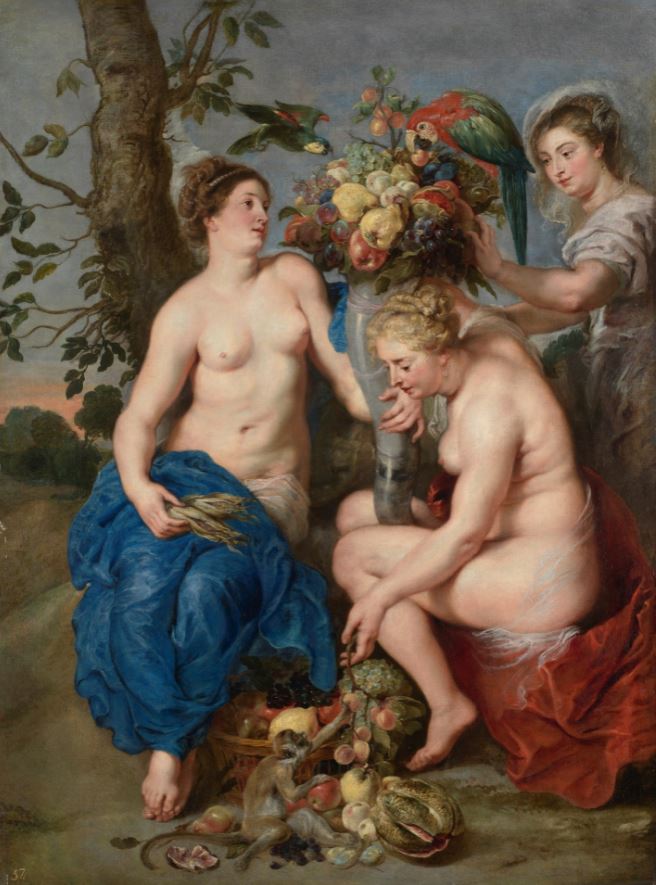
  • Three Nymphs with a Cornucopia (1625 to 1628) Museo Nacional del Prado, Madrid

The thing is that, although the curators try their best to claim that these women are not subject to the male gaze, but are strong independent women overflowing with agency, that’s not really how they actually look.

In my opinion this one, ‘Three Nymphs with a Cornucopia’ can be taken as a test case. It depicts the horn of plenty overflowing with the good things of life, namely a grocer’s shop full of ripe plump juicy fruit, so ripe and juicy that it has attracted the attention of scavenging parrots and a cheeky monkey, to add drama and narrative to a classical allegorical scene.

Is it just me or are the two naked women depicted as extensions of this vision of youthful fertile juicy fruitfulness?

I think they are. Far from asserting anyone’s agency, I’d have thought this picture epitomises the reverse: surely these women are totally objectified, depicted  in all their youthful sexiness as direct extensions of the world of fruit and fecundity.

This is one of eight paintings Rubens took to Spain as a gift from his patron, the Archduchess Isabel Clara Eugenia, to King Philip IV, to butter him up. Made by a man to flatter a king, far from being a rebuttal it strikes me as being a kind of triumph of the male gaze – sexy topless fruitful babes designed to decorate on the walls of the most powerful man in Europe.

Three Nymphs with a Cornucopia by Peter Paul Rubens (1625 to 1628) Museo Nacional del Prado, Madrid

More interesting to me, more persuasive and touching, is the information that Juno, in this huge representation of ‘The Birth of the Milky Way’ resembles Helena Fourment, Rubens’s second wife.

According to the curators, it is thought that his happy second marriage to Helene inspired his increasingly sensuous presentation of women during the 1630s. That seems to me a plausible and happy explanation of the plump sensuality of the nudes he painted in his final decade, just as Rembrandt’s love for his wife shine through his later paintings. I’m not sure anybody portrayed in a painting, male or female, has any ‘agency’. In my opinion they’re all trapped by composition, design, treatment, by the artist’s aims and whims, and all subject to the human gaze of us, centuries later, completely cut off from the value systems in which these works were created.

But paintings very much can convey tenderness and love. And that’s what I found in this small room full of magnificent works of art. The milk of human kindness. Motherly love. The pure, naked, redemptive love we all wish, deep down, we could recapture.

The Birth of the Milky Way by Peter Paul Rubens (1636 to 1638) © Photographic Archive, Museo Nacional del Prado, Madrid

Happily ever after

In fact this final wall caption made me realise that mention of Rubens’ second wife had been seeded throughout the show, starting with early mention of how, after the early death of his first wife, in 1630 Rubens married his second and much younger wife, Helena Fourment (1614 to 1673).

‘Their blissful marital state in the final decade of his life, during which time they had five children, provided a wellspring of love and an increased interest in sensual mythological themes.’

In a world afflicted with terrible pain and suffering it cheered me up to learn that this great artist was blessed with a long, happy, rewarding marriage. Good for him! And these images, painted late in his life, at the peak of his experience of art and life, however others may wish to interpret them, struck me as wonderfully accepting celebrations of beauty, humanity and love.

Rubens among his peers

I was struck by a quote from co-curator Dr Ben van Beneden which gives a pithy summary of three of Western Art’s Golden Greats:

‘If Raphael endowed his female figures with grace, and Titian with beauty, Rubens gave them veracity, energy and soul.’

Strong independent parrots

I noticed that one of the most powerful paintings in the final room, the Cornucopia, featured some beautifully vivid parrots pecking away at the fruit flowing from the horn, and this reminded me that the awesome painting of the Marchesa Maria Serra Pallavicino in the first room also features a parrot perched on her grand chair and bending down, twisting its neck in that inquisitive parrot way.

It occurred to me that maybe Dulwich’s next exhibition should be about ‘Parrots in Painting’. It could bring together depictions of a variety of strong, independent parrots who resist the human gaze to insist on their psittacine agency.

The video


Related links

Related reviews

The Ugly Duchess: Beauty and Satire in the Renaissance @ the National Gallery

‘The Ugly Duchess: Beauty and Satire in the Renaissance’ is a one-room, free display at the National Gallery in London. Go in the main entrance, up the stairs to the mezzanine level, then turn right and up more stairs to room 46.

It’s amazing how much you can cram into one room in a gallery, in this case ten or so paintings, 4 or 5 drawings and several sculptures which, taken together, open up whole imaginative worlds and intellectual vistas. Amazing how much you can extrapolate from one work of art, about an entire era’s attitudes to men and women, ageing, its sense of humour, its fear of the supernatural.

The Ugly Duchess

It all starts by considering one of the best-known faces in the National Gallery: Quinten Massys’s early 16th-century depiction of an old woman, popularly known as ‘The Ugly Duchess’. Made in Antwerp in about 1513, it is an extremely striking image.

An Old Woman (‘The Ugly Duchess’), about 1513 by Quinten Massys © Photo: The National Gallery, London

Ugly

Quite obviously this is an exaggerated and grotesque caricature. Focusing just on the features, you’d have thought it was the face of an old man, but the closer you look you realise all kinds of things are going on in this picture. The most obvious element is probably the woman’s mannish, ugly face but you quickly move o to notice the very low-cut dress revealing her ample but wrinkled bosom.

It’s obviously a satire or caricature of the stock standard Renaissance portrait, which, of course, showed the sitter to best advantage, flattering them by smoothing out wrinkles and omitting blemishes. Quite obviously this painting is doing the exact opposite, packing in as many unflattering details as possible – big ears, stubby nose, disappeared lips, as many wrinkles as the human neck can cope with, a huge expanse of neck and bosom revealing the mannish solidity of her shoulders and the wrinkled bust.

The ‘philtrum’ is the technical name for the groove which runs between nose and lips, but it’s not only this which is long but the entire space or stretch of face from nose to mouth which is as huge as possible, almost giving her the prognathous appearance of a chimpanzee.

So there’s an implicit contrast with the genre of the standard Renaissance flattering portrait. But there’s another contrast worth mentioning, which is the contrast between the gargoyle grotesqueness of the face and body and the immaculately naturalistic detailing of the headdress and cascading wimple.

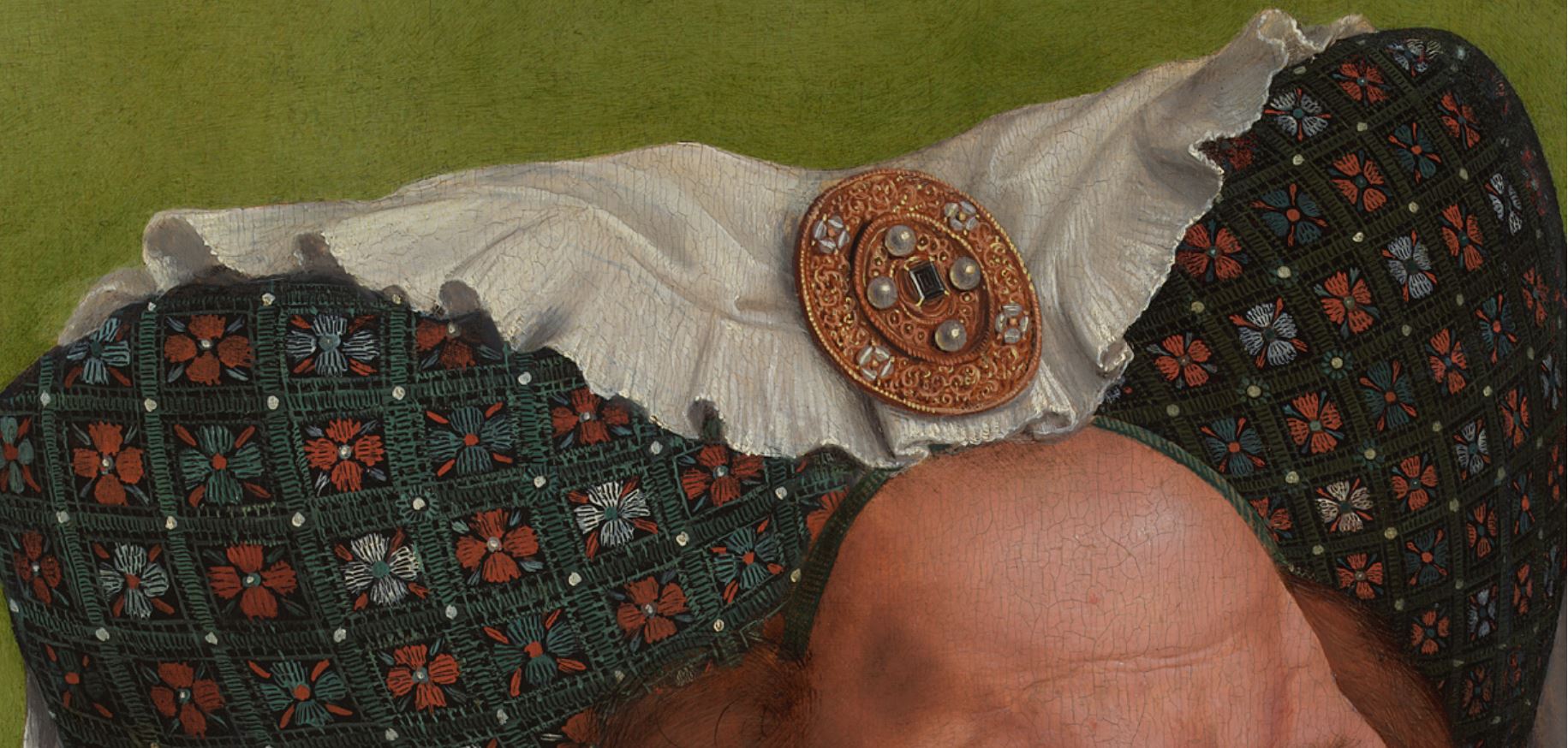
Detail of An Old Woman (‘The Ugly Duchess’), about 1513 by Quinten Massys © Photo: The National Gallery, London

Seeing a painting like this in the flesh allows you to go right up to it and marvel at the extreme detailing of the fabric of the headdress – you can virtually see each thread of the fabric, the detail of each one of the embroidered flowers; to marvel at the intricate working of the diadem or broach including the glints of light on the lovingly crafted pearls – which are, when you look really closely, echoed by the pearls studding the ring she’s wearing on her right forefinger.

So, to put it crudely, there’s another contrast at work here, between the deliberate grotesqueness of the face and the breath-taking filigree detail of the setting (headdress, broach, and amazing depiction of light and shade in the folds of the linen wimple).

Talking of her finger, there’s one last relevant detail which is the flower. In her right hand, between finger and thumb, she is delicately holding the flower of a rose which hasn’t yet opened. This is a traditional symbol of budding love i.e. a visual signal appropriate for a very young woman, a teenage virginal girl. Here it works as another element emphasising the grotesqueness of the portrait and satirising the entire genre.

Her husband

Mention of the rose leads us to the next factor, which is her partner. The exhibition has obtained on loan from a private collection in America the painting which originally partnered the duchess, namely Massys’s portrait of an old man.

An Old Man, about 1513 by Quinten Massys. Photo © Evan Read, Department of Paintings Conservation, The Metropolitan Museum of Art

Sexism and unfairness

Now, you don’t have to be an art scholar to notice that, although it isn’t exactly flattering, although he too has a lugubrious nose and plentiful wrinkles, the husband portrait isn’t in the same class of grotesque as the old woman. Feminists interpret this as unfairness: why is the old man acceptable but the old woman grotesque?

One way of answering this is to say, with feminists, that Western society has always been sexist and patriarchal, with continuous misogynist tendencies. That age in women was treated far more harshly, seen as far more negative, than in men, and that an older man’s efforts to dress well and make the most of himself was respected whereas the same behaviour in an older woman was derided.

Artistic licence

But there’s another way of thinking about the issue, regarded as an artistic problem or genre. This is that ‘the old woman’, as subject, afforded Renaissance painters opportunities for invention, play and satire that portraits of more ‘normal’ people didn’t allow. As the curators put it, the ‘unruly bodies’ of older women, no longer smooth and supple as in standardised models of beauty, can be seen as metaphors for social disorder, for the topsy-turvey world which attracted medieval and Renaissance culture as much as its hierarchies of order.

There is undeniable joy in beholding ‘the Ugly Duchess’ trample beauty standards, social conventions and gender expectations.

Flower and fur

Back to the husband, and art scholars debate whether the posture of his right hand is politely rejecting the budding rose which the duchess is offering him.

Away and above these debates about symbolism is a simpler fact about this work which is the amazing depiction of the fur around his neck. Again it isn’t so clear in a reproduction, but in the flesh, standing in front of the actual painting, you can really see the difference between the depiction of the fur lining his coat and what appears to be the black velvet of the coat itself. it’s stunningly sensual and alive.

Contemporary couples

There’s a number of reasons why I strongly prefer the art of the Northern Renaissance to the Italian Renaissance. One is the rocky barrenness of the settings of so many Italian paintings, compared with the lush grass, flowers and verdure of northern paintings. I like the flowers and animals, the little rabbits and whatnot you tend to get in the background of northern Renaissance art.

Portraits like this don’t have animals and pastures in them, but they exemplify two other aspects of northern art I like. One is the extraordinary fine detailing of fabric, embroidery, jewellery and so on. The other is the ugliness of the people. Italian Renaissance paintings capture the handsomeness of Italian people, but I live in grotty northern Europe among people who are, by and large, not fashion models. Therefore I like the frank depiction of non-beautiful people. The exhibition gives an example of an older couple by a contemporary of Massys, Jan Gossaert.

An Elderly Couple, about 1520 by Jan Gossaert © The National Gallery, London

It’s hard to think your way into the mindset of the man on the left who probably paid a lot for this painting and was presumably, happy enough to pay for this pretty unflattering depiction. It bespeaks a mindset different from the Italian Renaissance, one which prioritises honesty at all costs. For me it’s something to do with the northern Protestant, or even Puritan, spirit. Truth over gloss. Epitomised by the arch Puritan Oliver Cromwell telling his portrait painter to depict him ‘warts and all’. It is the humanist tradition, accepting of human weakness, frailty and imperfection.

As to its relevance to the Ugly Duchess, this painting epitomises some of the conventions of double portraits which the Duchess flouts. The older woman is modestly dressed (her clothes covering her up to the neck). Her eyes are modestly cast down. And, crucially, she is standing behind and on the left side of her husband.

Left and right

In double portraits of couples like this, it was the convention to depict the man standing on the right, the hierarchically superior position, our left as we look at it. Therefore the duchess’s position on the right hand side of her husband (in the world of the picture) is another way in which the composition subverts or mocks conventional standards of portraiture.

Leonardo, the source

But talking of the Italian Renaissance links to the rather surprising presence of Leonardo da Vinci in the exhibition. Why? Because among his multifarious other interests, Leonardo had a well-attested interest in ‘the grotesque’. His notebooks contain page after page filled with sketches of a spectrum of non-attractive people, ranging from old and gnarly, through ‘ugly’ people and then beyond the bounds of plausibility to monsters who could have come from the island of Dr Moreau.

Grotesque caricature heads of five men and two women by Leonardo da Vinci © The Trustees of the British Museum

Leonardo’s grotesques were surprisingly popular. Many copies were made of his sketches and distributed around art workshops all over Europe. Thus Massys’s image, which I take to be quintessentially north European, turns out to derive almost directly from a sketch by the quintessentially Italian artist, Leonardo.

The debt owed by Massys to Leonardo isn’t trivial. Although the Leonardo original has disappeared, the exhibition includes copies of a Leonardo grotesque woman which, as you can see, are the direct source of Massys’s painting. Hardly anything about the Massys version is original except precisely the aspects I like, the fantastic detailing.

Bust of a grotesque old woman (1510 to 1520) by Francesco Melzi, after Leonardo. Royal Collection Trust © His Majesty King Charles III 2023

May – December couples

Western societies have often found the notion of the old and decrepit vaunting their attractiveness and flirting as if they’re still teenagers worthy of satire. ‘Mutton dressed as lamb’, as the proverbial saying has it. In fact, like everything else, the Middle Ages codified this into a genre, calling it the May-December relationship. To my surprise, a few seconds on Google show me that this term is still widely used to describe:

‘an amorous relationship between two people with a considerable age difference. The months symbolize the seasons, with spring representing youth and winter representing old age.’

In medieval art and literature the unequal relationship of an older man and a younger woman was often mocked (as, maybe, in our day, the marriage between Rupert Murdoch at the age of 85 to former model, Jerry Hall, or the references I keep reading about Leonardo de Caprio’s alleged penchant for much younger girlfriends). Less often described (and mocked) was the pairing of an older woman and a younger man (in our day and age, often referred to as a toy boy’). In medieval literature Chaucer’s Wife of Bath is one such older woman who takes a young male lover for explicitly sexual reasons.

Mention of the theme, as a popular one of the day, allows the curators to include a visual illustration, The Unequal Couple by by Israhel van Meckenem which shows an older woman (left) being cosied up to by a handsome young blade. The way he is reaching out to touch the bag of coins she is jealously guarding very heavily conveys the satirical thrust of the picture, that this kind of relationship is ‘against nature’ and could only exist because the May partner wants to get their hands on December’s money.

The Unequal Couple, about 1490 by Israhel van Meckenem, after the Master of the Housebook © Ashmolean Museum, University of Oxford

Feminist interpretation

You won’t be surprised to learn that there is a revisionist feminist interpretation of the painting. Feminist art scholars agree that it can be read as a cruel joke in which the viewer is invited to laugh at this woman’s pathetic attempts to appear young and sexy, so we are being invited to mock her implied self-delusion.

But there is an alternative way to read the painting, which is as depicting an old woman who refuses to accept either the biological facts of aging or the social conventions which define what a woman, of any age, may or may not wear, and how she may or may not think of herself. If she regards herself as a winsome beauty, shyly offering her man a symbol of her budding love, then…why not?

To echo what I wrote above, a feminist interpretation sees a duchess who is also subversive of standard notions of beauty, defiantly flouting the conventions of her day.

Witches

But old women have been, for much of recorded history, quite ambivalent figures. (In fact, arguably any category of human being can be ambivalent. A young man may be smooth and debonair like Romeo or a thuggish killer like Edmund in King Lear. Humans have many sides, stereotypes, avatars, expectations.)

Anyway, old women have can be mocked for their pretensions (as the duchess appears to be) respected for their wisdom or even feared as uncanny figures. This fear can go to the extreme of thinking they have uncanny supernatural powers, in other words, are witches.

And it’s in order to highlight the similarities and differences in Renaissance iconography of older women – between an old woman satirised and an old woman feared – that the display includes an iconic image of a witch, made by Albrecht Dürer around the same time as Massys was doing his entertaining grotesque.

A Witch Riding Backwards on a Goat, about 1500 by Albrecht Dürer © Victoria and Albert Museum, London

As with most Dürer this image is packed with symbolism representing the inversion of traditional values and decorum. The woman is naked but not in the sexy manner of Renaissance nudes; the naked body of an older woman is seen as repellent and disgusting. The broom between her legs and her grip on a goat’s horn suggest the uncontrolled and inappropriate nature of lust in an older woman. She is rising the goat backwards but her hair is flowing in the wrong direction, into rather than with the wind. It is an image of reversal and chaos. Whereas the Massys painting was made for comedy and entertainment, the Dürer takes some of the same themes and treats them with horror, repulsion and fear.

Alice

Even this inclusion of witches hasn’t exhausted the ramifications and connections unravelling from this one painting. I think I knew but had forgotten an important fact about it which is that Massys’s portrait directly inspired the figure of the Duchess in ‘Alice in Wonderland’, as portrayed in Sir John Tenniel’s classic illustrations.

Alice, the Duchess, and the Baby by Sir John Tenniel (1865)

Here, in a sense, the Ugly Duchess found her spiritual home. As a painting she was only available for centuries to a handful of viewers. Even hung up in the National Gallery she was only seen by a small number of people. But as published in the Alice books and very widely distributed, she entered a kind of rogues’ gallery of all the other fantastical characters dreamed up by Lewis Carroll. Beyond fear or ridicule she is transformed into an object of pure, delightful entertainment.

Video

In this 10 minute long video National Gallery restorer Britta New discusses the conservation treatment of ‘The Ugly Duchess’, describing discoveries made during the conservation process, and the painting’s connection to sketches by Leonardo da Vinci and John Tenniel’s illustrations.


Related links

More National Gallery reviews

De republica by Cicero (54 BC)

The best possible political constitution represents a judicious blend of these three types: monarchy, aristocracy and democracy.
(De republica by Cicero, fragment of Book 2)

De republica was written by the Roman lawyer, orator, politician and philosophical populariser Marcus Tullius Cicero between 54 and 51 BC. It is variously translated into English as The Republic, A Treatise on the Commonwealth, On the state or On government.

Cicero was not himself a philosopher or political theorist of note. This work was one among nearly twenty in which he translated the best of Greek philosophy into Latin, pulling various Greek theories together into new texts and introducing or inventing Latin terms to translate Greek ideas. Because of the purity and eloquence of his Latin many of these texts were preserved throughout the Middle Ages as teaching aids, and were revived during the Renaissance. In this way Cicero’s works played a central role in preserving the philosophical, moral and political ideas of the ancient world into the modern era and shaping their revival.

The Republic is cast as a dialogue, the form immortalised by Plato (427 to 327 BC). Unlike a manifesto or treatise a dialogue isn’t a straightforward statement of views. Having a number of people debate various opinions makes it more of a teaching or heuristic form. Students can be asked to study the work, then to describe which viewpoint they support and why.

As with Cicero’s other dialogues, The Republic studiously avoided controversy by being set in the past among long dead characters. It is set in the country villa of Publius Cornelius Scipio Africanus Aemilianus (185 to 129 BC), known as Scipio Aemilianus or Scipio Africanus the Younger. Scipio was a Roman general and statesman who led the third and final war against Carthage, personally overseeing its siege, capture and utter destruction, as vividly described in Richard Miles’s history of Carthage. Scipio also restored order after assassination of Tiberius Gracchus in 133 BC and mediated between the political factions.

The Republic takes place in Scipio’s estate over three consecutive days. Each day is described in two books, with an introduction by Cicero preceding the dialogue of each book, making six books in all.

  • Book 1 – Scipio outlines the three types of government (monarchy, aristocracy, democracy) and asserts the best type is a mix of all three
  • Book 2 – Scipio gives quite a detailed outline of early Roman history in order to show the evolution of the Roman constitution
  • Book 3 – Philus and Laelius engage in a set-piece debate about whether pragmatic injustice (Philus) or ideal justice (Laelius) are intrinsic to politics
  • Book 4 – is a discussion of education
  • Book 5 – considers the qualities of the ideal citizen in government
  • Book 6 – considers the character of the ideal ruler

The Republic survives only in fragments. Large parts of the text are missing. Books one to 3 survive in significant chunks, but the from the fourth and fifth books only minor fragments survive, and all the other books have a distressing number of missing passages.

The only part of the sixth book which survives is the final section, a relatively short passage in which Scipio tells his guests about a dream in which he was whirled up into space and shown the structure of the universe. This has survived because it was the subject of a commentary by the neoplatonist philosopher Macrobius and this part of the text, along with Macrobius’s commentary, became very popular during the Middle Ages and the Renaissance, with their profound interest in astrology and astronomy.

The best preserved parts of the text discuss constitutions and political theory but it is important to realise that this was only part of Cicero’s aim. The discussion of constitutions fills only a third of the book. For Cicero ‘politics’ wasn’t a narrow profession but a branch of philosophy which dealt in a broader way with human nature and ethics as demonstrated in societies. This explains why the treatise deals with different types of constitution early on in order to get on to the more important subjects of what kind of citizen and what kind of ruler are required to create a perfect state. The best kind of state is not a dry technical question, comparable to modern debates about different voting procedures: the best kind of state produces the best kinds of citizens and the best kinds of rulers (optimus civis) and so must be considered in the broadest context.

The characters

The discussions take place between no fewer than nine named individuals who are given speaking parts.

Scipio was maybe the most pre-eminent figure in mid-second century BC Rome, a very successful general who, however, a) did not abuse his power as later generals such as Marius, Sulla, Pompey and Caesar did and b) was a noted patron of artists and writers such as the Greek historian Polybius. You can see why Cicero hero worshiped him.

Other characters

  • Gaius Laelius: close friend and associate of Scipio, consul in 140 BC, promoter of the study of literature and philosophy, practical and down to earth.
  • Lucius Furius Philus: consul 136 BC, orator, a man of great personal rectitude who takes on the defence of injustice, in book 3, for the sake of the debate
  • Manius Manilius: consul in 149 BC, a venerable legal expert.
  • Quintus Mucius Scaevola: Laelius’s son-in-law, a legal scholar and patron of the young Cicero.
  • Spurius Mummius: conservative and anti-democrat.
  • Quintus Aelius Tubero: Scipio’s nephew, tribune c. 129 BC. Legal scholar dedicated to Stoicism.
  • Gaius Fannius: consul in 122 BC, follower of Stoicism, historian and orator. Son-in-law to Laelius.
  • Publius Rutilius Rufus: a politician admired for his honesty, dedicated to Stoicism.

Book One

Missing its preface, the text we have starts in mid sentence and mid argument. Cicero is arguing against the Epicurean belief that the educated man should hold aloof from politics in order to preserve his calm. On the contrary, Cicero argues that the highest form of moral activity and of virtue consists of the practical application of morality in the practice of statecraft.

Then Cicero the narrator hands over to the supposed discussion held at Scipio’s house where his guests ask Scipio’s opinions.

The conversation starts with one of his visitors talking about the rare phenomenon of two suns being seen in the sky. But Scipio repeats the Greek idea (Aristotle) that there is little we can know about the workings of the cosmos whereas we very much can study human beings, how they behave, morality, epistemology and so on, and that’s what we ought to do.

Scipio follows his Greek predecessors in claiming that human beings seem to have an innate compulsion to live together in communities i.e. we are not a solitary species (Book I, section 39). When this happens there are three ways communities of humans organise their power: monarchy, aristocracy and democracy. Each has its merits:

Kings attract us by affection, aristocracies by good sense, and democracies by freedom. (I, 55)

Each has a dark side, when it becomes corrupt. Monarchy becomes despotism, aristocracy becomes oligarchy and democracy becomes mob rule (I, 44).

Personally, Scipio thinks a careful mixture of all three is best (I, 69), but if he had to pick just one it would be monarchy. This is because there is only one king god in heaven, Jupiter (I, 57). Every family has only one father and a king is like the father of his subjects (I, 54). There can be only one ruling element in the human mind, which is sovereign over all the other passions, and this is Reason (I, 60). Only one person can run a household, only one person can be in charge of a ship, only one person can treat us for illness. And when people are deprived of a just king they are like orphans.

But the weakness of rule by a king is that when they go wrong, they go really wrong and become tyrants. Therefore the most stable and also the most ‘just’ form of government is one which permits a balance of power between the different classes and so is ‘equally just to all ranks of society’ (II, 55). He thinks this has best been achieved by the Roman constitution with its balance between the powers of a king (vested for one year only in the role of the consuls), the moderating influence of the aristocracy (embodied by the wisdom and experience of the senate and a voting system heavily skewed towards the rich and ‘best’ in society) and the voice of the people (expressed in the office of tribune of the plebs and the voting power of the people’s assemblies).

Book two

Scipio/Cicero come to the bold conclusion that the best possible political constitution in the world is the one created by their Roman forebears and handed down to himself and his contemporaries, the inheritance of Rome, ‘the greatest State of all’!

This is as laughably self-centred as the great German philosopher Hegel pondering deeply and concluding that the best possible way to organise a society was…the constitution of the Prussian state of his day! Or the booming confidence of late Victorians that the British Empire with its constitutional monarchy was the best imaginable form of government.

He gives a deeply traditional and patriotic account of the founding of Rome by the wise and godlike Romulus and the cumulative constitutional innovations of the traditional and legendary seven kings of Rome, dwelling on each of them at some length and the great virtues of the Roman people:

The Roman people became strong, not by chance, but through their own good sense and their firm system of values… (II, 30)

The underlying point of book two is that the Roman constitution wasn’t created by one wise lawgiver (cf Lycurgus of Sparta or Solon of Athens) but developed and evolved over a long period, with successive rules adding processes, creating the complex voting procedures, organising the population into tribes but also, for voting purposes, into centuries, and setting up assemblies where they could debate. What struck me is how close this is to the justification of English traditionalists for the English constitution, which is nowhere written down but amounts to a tangle of precedents and traditions.

This is sort of interesting but it is history not philosophy or political theory, history with occasional comments. The notes to the Oxford University Press translation point out where Scipio differs from the more comprehensive account given by Titus Livius (Livy) in his history of Rome written 10 or 15 years later, which is indicative of the way the account of sort of interesting but mainly of academic interest.

At the same time as the thinking is fairly simplistic there’s also something hyperbolical and exaggerated about Scipio’s diction:

As soon as this king turned to a mastery less just than before, he instantly became a tyrant, and no creature more vile or horrible than a tyrant, or more hateful to gods and men, can be imagined ; for, though he bears a human form, yet he surpasses the most monstrous of the wild beasts in the cruelty of his nature. (II, 49)

The underlying thought is as simple minded as a fairy story, but the language has the vehemence of a rabble-rousing political speech. Either way, it often has neither the depth or sober objective language you might expect from ‘philosophy’.

In section 54 Scipio makes explicit why he is reviewing early Roman constitutional history in such detail: it is to point to examples of the wise men who created new and useful innovations. Publius Valerius emerges as a notable example, the man who demonstrated his wisdom by: moving house from the top of the Velian Hill where the kings had lived; passing a law forbidding a Roman citizen from being flogged or put to death without appeal; had a colleague elected as co-ruler, to be called consuls, and decided that they would rule on alternate months and be guarded by lictors only for that month.

This brings out something he’d mentioned earlier which is the aim of this discourse is not to debate the theoretical nature of an ideal state, as Plato did in his Republic, but to describe the practical reality of such a state and, especially, the qualities required of the Ideal Stateman to run it.

Towards the end of book 2 Scipio recapitulates:

I defined the three commendable types of States and the three bad types which are their opposites. Next I demonstrated that no single one of these types is the ideal, but that a form of government which is an equal mixture of the three good forms is superior to any of them by itself. As for my using our own State as a pattern, I did so, not to help me to define the ideal constitution (for that could be done without using any pattern at all), but in order to show, by illustrations from the actual history of the greatest State of all, what it was that reason and speech were striving to make clear.

The ideal statesman:

He should be given almost no other duties than this one (for it comprises most of the others) – of improving and examining himself continually, urging others to imitate him, and by the splendour of his mind and conduct offering himself as a mirror to his fellow citizens. (II, 69)

Here you can see how, lacking any knowledge of economics or class or social or technological developments, no financial theory and no knowledge of the vast amounts of data we have been collecting about ‘society’ since the industrial revolution and which underpin all modern politics – in this huge vacuum of knowledge Cicero, like Sallust and Plutarch, conceives of politics as being predominantly about individuals and, this being so, overly obsess about the character of the Ideal Statesman, completely omitting the proficiency in economics, law, and statistics which modern politics call for, and the way the huge structure of the state bureaucracy measures outcomes by data: inflation, unemployment, GDP, health outcomes and so on.

By contrast with the vast complexity of the modern state, Cicero’s image of the Ideal Ruler is closer to fairy tale than modern political theory: ‘…by the splendour of his mind and conduct offering himself as a mirror to his fellow citizens.’

I suppose it represents an enormous shift from a theory based on morality and ethics to one based entirely on utilitarian values: does it work, is it good for the economy, for most people, is it good for my core voters, these are the questions a modern politicians asks.

And the absence of the huge body of theory and statistical information which forms the basis of modern politics explains why political ‘philosophy’ from Plato, through the Dark Ages, Middle Ages, Renaissance and well into the modern era relied on analogies rather than data. They had nothing else to go on. So they compared the ideal state to a well-ordered mind, or to the human body where all the parts have to co-operate, or to the harmonious movements of the celestial bodies through the heaves; or compared Reason’s control over the mind to a father’s control over his sons or a master’s control over his slaves (III, 37) etc etc. Analogy rather than data.

All this is sweet and lovely but like a child’s colouring book compared to the complex technocracy of the modern state. Immersing yourself in a text like this continually reminds the reader of children’s books and fairy tales.

Book three

Fragments in which Cicero explains that despite our failings, humans have inside us the divine fire of Reason. He briefly sketches the invention of language (interesting) and maths before moving onto teachers or truth and moral excellence blah blah which, when put into practice, leads to the art of governing.

Comparison of philosophers, who teach moral excellence and best conduct through words alone, and statesmen, who promote moral excellence and best conduct through actions and laws. Clearly the latter are more effective and important (III, 7).

The 12 or so pages of fragments we have of book 3 indicate that it was conceived as a debate between Laelius and Philus about whether injustice is a necessary part of political rule, whether it is inevitable and unavoidable. What gives ancient books like this their flavour is the inclusion of myths and legends and fanciful imagery which, to repeat myself, are more like fairy tales than political analysis. Thus Philus kicks off his presentation of the case that injustice is an inevitable and necessary part of politics by asking his audience to imagine they are flying in a chariot of winged snakes:

If one could visit many diverse nations and cities and examine them, travelling about in Pacuvius’ famous ‘chariot of winged snakes’ one would see first of all in Egypt, a land which has escaped change more successfully than any other, and which preserves in written records the events of countless centuries, a bull, which the Egyptians call Apis, is deemed a god, and many other monsters and animals of every sort are held sacred as divine. (III, 14)

When he gets going, Philus makes a persuasive argument that there is no such thing as natural justice, nature does not implant justice in the human mind, there are no universal laws. On the contrary, the point of his metaphor of flying over the countries of the Mediterranean is to survey just how varied and irreconcilable all their laws, and customs and religions are with each other. QED: there is no one universal law or notion of justice.

No fewer than 80 leaves of book 3 are missing. From references and summaries in other, later authors we know some of the contents. Apparently Philus makes the anti-Roman point that empire is nothing but stealing other people’s lands and goods. Romans hold aggressive generals to be epitomes of valour and excellence (‘He advanced the bounds of empire’ is their highest compliment) when they are, of course, the same as all other aggressive conquerors of all other nations. The fact that the Romans have priests formally declare war just shows their hypocrisy in dressing up greed and criminality in fancy words.

When we come back to the actual text Philus makes the simple (and, to the modern mind, sympathetic) argument that the kind of mixed constitution supported by Scipio doesn’t derive from Virtue and Wisdom but from the simple fact that each rank (or class) fears the power of the others and so seeks to check it (a proto-Hobbesian view, maybe). The mother or justice is not nature or virtue but weakness and fear.

The good life is based, not on virtue, justice and selflessness, but on looking out for yourself and your family, on practical assessments of what will bring you most benefit. And as with families so with states: dress it up how you like, statecraft and international affairs are based on brute assessments of power and self interest. And they should be (III, 28).

This is thrilling stuff and the editor of the OUP edition (Niall Rudd) notes that, once Philus has finished his case, Laelius, who follows and argues the contrary case, can’t really rebut his analysis and so ignores his points to argue something slightly different, which is the importance of the notion of justice for the administration of a state.

It is symptomatic of the conservatism and narrow-mindedness of Roman thought that this negative, cynical and so unpopular point of view is attributed to a foreigner, a Greek, the philosopher Carneades and that when Laelius speaks, he roundly attacks it for its immorality and calls Carneades ‘a filthy scoundrel’ (III, 32).

Laelius proceeds to give a positive but very naive definition of law as a Platonic fact of nature, eternal and unchanging, which all men must obey, which sounds magnificent and is obvious tripe:

True law is right reason in agreement with nature. It is of universal application, unchanging and everlasting. It summons to duty by its commands, and averts from wrongdoing by its prohibitions… It is a sin to try to alter this law, nor is it allowable to attempt to repeal any part of it, and it is impossible to abolish it… We cannot be freed from its obligations by senate or people, and we need not look outside ourselves for an expounder or interpreter of it. And there will not be different laws at Rome and at Athens, or different laws now and in the future, but one eternal and unchangeable law will be valid for all nations and all times, and there will be one master and ruler, that is, God who is the author, proposer and interpreter of that law. (III, 33)

Laelius appears to go on to describe how this eternal law was embodied and followed by specific Romans from history, but we have only fragments.

Then Scipio comes back in as the main speaker, recapitulating his idea of the three types of government, asking which one is the ‘true’ meaning of a republic. The text breaks off abruptly just as the speakers were going to address the merits of the uncorrupted versions of the three types.

Book four

The subject of book four is clearly intended to be Education and address the question: what kind of education is best for citizens of the ideal state? As with the other books, Cicero does not proceed from philosophical first principles, as per Plato, but ranges far and wide through Roman and Greek history, comparing practices and laws. But the book is in, to quote Rudd’s words, ‘a pitiful state’, barely four pages of fragments. The longest fragment is where a speaker is made to explain at length why poets and playwrights should not be allowed to pillory statesmen and generals (IV, 11 to 12).

This, in my opinion, is the problem with all theories which start out by defining Virtue and Morality and The Good and so on – they always lead to strict definitions, which themselves inevitably lead to very strict rules about encouraging said Virtue and Suppressing Vice or anything which demeans or criticises Virtue or encourages Vice.

And so, by a few easy steps, these arguments all-too-often arrive, with the ‘noblest’ of intentions, at state censorship: the censorship of Cromwell’s England, revolutionary France, Stalin’s Russia, Hitler’s Germany, Taliban Afghanistan and any number of authoritarian regimes in between. Anyone who sets out to define or justify Absolute Values ends up defending absolutist states. (Discuss)

Book five

This was evidently meant to address the character of the Ideal Statesman but is even more fragmentary than book four, with only sections 3, 5, 6 and 7 surviving (each book originally had up to 100 sections) and a handful of scraps barely making up 3 pages of a modern book.

What we have is a lament that in the olden days Rome was ruled by Great Men, Excellent Men, Men of Virtue who knew how to rule wisely, but the present age is ruled by the selfish and greedy who have let the excellent institutions they inherited decay and collapse.

What we have is a lament that in the olden days Rome was ruled by Great Men, Excellent Men, Men of Virtue who knew how to rule wisely, but the present age is ruled by the selfish and greedy who have let the excellent institutions they inherited decay and collapse. Where are the great men of yesteryear? This developed into a stereotyped genre or topic during the Middle Ages which was given its own name, the ubi sunt (‘where are they?’) topos.

Long before living memory our ancestral way of life produced outstanding men, and those excellent men preserved the old way of life and the institutions of our forefathers. (V, 1)

But:

What remains of those ancient customs on which he said the state of Rome stood firm? We see them so ruined by neglect that not only do they go unobserved, they are no longer known. (V, 2)

Oh woe. But then every generation feels it is living in a uniquely degraded era when the great institutions it inherited from the past are collapsing and where are the Great Leaders of yesteryear and the end times are upon us. But they never are. We muddle through and 20 years later people look back to that time as a golden age.

I spent most of the 1990s ashamed of living under the government of the bumbling poltroon John Major – and yet now I regularly read articles which look back to the 90s as a golden age. Plus ca change…

Book six

In even worse state than book 5, with barely a page and a half of disconnected fragments. What does survive intact is the passage which was intended to conclude the entire book. In current editions this is numbered sections 9 to 29. It is the concluding passage in which the main speaker, Scipio, tells his companions about a dream he had. In this dream he is whirled up into heaven and sees a) the structure of the solar system and the universe and b) the smallness of the earth and the littleness of human existence. This passage has survived because the 4th century AD Roman grammarian and philosopher Macrobius wrote an extensive commentary about it. This commentary became very popular during the Middle Ages, helping to define the medieval view of the cosmos and surviving in multiple copies. So, in this roundabout manner, these 20 sections of Cicero’s book survive.

In the Dream Scipio describes how his adoptive grandfather comes to him and predicts the future, namely that he will be elected consul, destroy Carthage and be given a triumph in Rome, before being sent to end the war in Spain and serving as consul a second time.

But this is just the beginning. He is introduced to the spirit of his father, Paulus, who explains how souls are derived from the stars (they are now standing in the middle of the sky among the stars) before being consigned to a body down there on earth. How can you escape from the body and join the other spirits? Here is the point of the vision and the climax of the book’s entire consideration of political theory: you get to heaven by doing your patriotic duty.

Respect justice and do your duty. That is important in the case of parents and relatives, and paramount in the case of one’s country. That is the way of life which leads to heaven and to the company, here, of those who have already completed their lives. (VI, 16)

Cicero shows his difference from the Greek philosophers he copied in his very Roman emphasis on the practical. After all the fine talk about constitutions and justice and the character of the statesman, what matters is doing your patriotic duty.

There is a kind of path for noble patriots leading to the gate of heaven… (VI, 26)

The true part of a man is his mind, not his body. The mind is immortal, godlike. The best way to employ this godlike mind is in activity for the safety of one’s country. Minds which have devoted themselves to this cause will fly more quickly to heaven (VI, 29). If Cicero was standing to attention saluting the flag with tears running down his face while the national anthem played, the intended conclusion of his book could hardly be more sentimentally patriotic.

Which makes sense because this is precisely how the entire book opens. The very first sentence reads: ‘Had it not been for his sense of patriotic duty […] would not have delivered our country…’ (I, 1) and goes on to assert:

I simply state this as a basic fact: nature has given to mankind such a compulsion to do good, and such a desire to defend the well-being of the community, that this force prevails over all the temptations of pleasure and ease. (I, 1)

So it might rope in a number of other subjects along the way, but De republica is fundamentally a work of Roman patriotism.

Thoughts

I found The Republic hard to read for two reasons. It really is very fragmented – the text is continually breaking off mid-sentence with parentheses telling you that 2 or 4 or 80 (!) pages are missing, so that you resume reading a lot further along in the original text, when the characters are discussing a completely different subject. It’s like listening to an old-style LP of a classical symphony that is so scratched that you barely get 20 seconds of melody before it skips 20 seconds or several minutes. Very disconnected. Snippets.

But there’s a deeper problem with the book which is its lack of sophistication, which makes it, ultimately, boring. The best preserved passage in Book One tells us there are three forms of government and each has a debased version, which makes for a neat, schematic table but is, ultimately, useless for our current needs, in Britain, in 2022.

When Scipio argues that monarchy is the best of the three types because there’s only one king of the gods, only one person can be in charge of a household, and only one element, Reason, which controls the mind…well, these are quaint ways of thinking – using child-like analogies rather than data, as I explained above – which have a sort of historical interest, but they’re not ideas anyone alive today would waste their time espousing.

And most of the contents are like that. Of antiquarian interest but nothing much to make you sit up and think. The actual history of the late republic, when Cicero was writing, is much more thought-provoking than this essay.

I appreciate that Cicero was writing a kind of abstract, a pedagogical text designed to raise the standard of political discourse in his own time – but in actual fact, nothing he wrote affected the fate of the Roman Republic in the slightest, and it is highly symbolic that the head that conceived these highfalutin ideas and the hands that wrote them were chopped off by Mark Antony’s bounty hunters. That was the utterly unscrupulous, deeply, immoral and justice-free reality of Roman politics.

A list of analogies

Once I’d realised that Cicero’s thought is guided more by analogies than data or statistics (of which he has almost no concept, apart from election results and the size of armies), it amused me to collect analogies from the last few books, although too late to compile a definitive list.

The mind rules over the body like a king over his subjects or a father over his children. The mind rules over its desires like a master over his slaves. (III, 37)

The sun is the mind and regulator of the universe. (VI, 17)

As the god who moves the universe is immortal, so the soul which moves the body is immortal (VI, 26)

Niall Rudd’s translation

A word of praise for this Oxford University Press edition. I described, probably at too much length, how strongly I disliked the prose styles and odd attitudes of A.J. Woodman, who translated Sallust, and Carolyn Hammond, who translated Caesar’s Gallic War, both for OUP, so that I abandoned reading both their translations. This edition restored my faith in OUP editions of the classics.

The introduction, mostly written by Jonathan Powell, is a model of lucidity, useful and to the point, as are the extensive notes, scholarly and interesting. There is a useful list of names and also an appendix giving a handy summary of the sometimes confusing Roman constitution.

The translation is by Professor Niall Rudd (1927 to 2015) and was first published in 1998. It is clear and unaffected – you feel you are engaging directly with the text. I cannot judge its fidelity to the source Latin, but it makes for a lucid, engaging read, as I hope you can tell from the many quotations I take from it. All round, it is a gold standard edition.


Credit

The Republic and The Laws by Cicero, translated by Niall Rudd with introduction and notes by Jonathan Powell and Niall Rudd, was published by Oxford University Press in 1998. All references are to the 2008 paperback edition.

Related links

Roman reviews

The legacies of Rome

At the start of Mary Beard’s comprehensive but pedestrian history of ancient Rome she gives some examples of the ‘legacy’ of Rome as reasons why people should know more about ancient Rome and read her book. I critiqued her reasons for being arbitrary, superficial and not really justifying her case. Nonetheless it does broach an interesting subject: just what should be included in the legacies left by Ancient Rome to later ages and the present day? Over the week it took to read Beard’s book, I began to make a list of aspects of the legacy of Rome which live on in the modern world. Can you add any more to my list?

Roman Catholicism, the religion of power

Surely the biggest legacy is the Roman Catholic church, founded and spread across the eastern Mediterranean but given its definitive organisational and liturgical form after it was decriminalised by the Emperor Constantine in 313 and then made the official state religion of the empire by the emperor Theodosius I in 380.

The language of the Latin Mass, Christian theology and practices, and the organisational structure of the church, which dominated the religious lives of everyone in the West till the Reformation, and still dominate Western Catholics and huge numbers of peoples living in countries colonised by Catholic Spain and Portugal to this day.

Apparently there are some 1.34 billion Catholics in the world today. Their spiritual lives, personalities and imaginations are shaped by concepts and terms crystallised in the series of church councils supervised by the Roman authorities, by a hierarchy based in Rome, almost every detail of which is based on Roman words for officials. Pope. Saint (‘sanctus’). Vatican. Mass. ‘Deus’ (Latin for God) used in countless phrases.

Moral exemplars and great lives

From the Middle Ages through to the Enlightenment it was possible to argue that Latin was the universal language of scholarship, of philosophy, science and law. As part of the rise of nationalism in the nineteenth century, and the promotion by various national groups of their national languages, this became steadily less and less true. It was possible to argue that the study of Latin disciplined the mind.

But modern justifications for studying Latin tend to overlook three aspects of the content of Latin literature:

  • the supposedly moral teachings embedded in Latin literature
  • examples of characters from literature
  • examples of characters from history

The moral teachings are straightforward. Roman moralists explicitly praised honesty, civic duty and heroism. Similarly, most Roman literature is moralistic in the sense that it embodies these values, it shows how true heroes followed their sense of duty and patriotism, maybe the most obvious example being Aeneas who turns his back on the chance of true love with Dido of Carthage in order to obey the orders of the gods, sail to Italy and found the predecessor of Rome.

But there are also the non-fictional real people from Roman history. A lot of figures from Roman history were used as examples of (mostly heroic) behaviour to later generations. The Romans themselves began this tradition, projecting back onto 5th and 4th century figures the stern devotion to civic duty they valued in their own 1st century society. But many of these figures continued to play a role in literary, philosophical, moral and political debates for centuries after the fall of Rome.

The story of Horatio holding the bridge single-handed against the Gauls is a typical example of straightforward patriotic heroism, which schoolboys from Cicero’s time down to the present day are taught to emulate. There are other Roman heroes, for example Lucius Quinctius Cincinnatus, a legendary 5th century character, who was chosen to save Rome when it was threatened by neighbouring tribes and, once they had been defeated, retired back to his modest life on a farm (in a year traditionally dated 458 BC).

The early years of the French Revolution were packed with the imagery of Republican Rome, with paintings, frescos, badges and mottos of the families who overthrew the last Roman King, Tarquin the Arrogant, and of heroes of republican virtue.

More complex are what you might call the ‘debatable’ figures, huge and impressive figures from the historic era whose lives and fates became examples and talking points to later generations. The most obvious example is Julius Caesar: was he a military genius set to save the republic from civil war or was he poised to become an autocratic dictator? Were the assassins right to murder him?

Beginning during the Roman period itself and for the subsequent 2,000 years, Roman historical figures  have been used as guides to contemporary behaviour and politics all across the developed world.

Latin, the language of power

Throughout the middle ages and Renaissance, Latin was the language of scholarship and intellectual authority. I’m not sure exactly when that can be said to have come to an end (during the eighteenth century?)

Scholarly works on any subject are no longer written in Latin as they were in the 17th and 18th centuries. But academics, journalists and other types of authors still signal their superior education (and, by implication, superior wisdom) by deploying Latin tags, little phrases which signal membership of, or exclusion from, the club of the well educated. Wikipedia has a comprehensive list of Latin tags which is intimidatingly long. More fun is this list of 50 common Latin tags. But a few points emerge from reading both, which is the different types of tag, depending on source and context.

Latin quotes

‘Veni, vidi, vici’ is just a famous quote, comparable to ‘We shall fight them on the beaches’.

Latin terms from philosophy

Philosophy and the law, two of the most conservative subject areas, still use Latin to name key concepts. Thus ‘ad hominem’ is a technical term from philosophy, describing a particular type of argument (in this case meaning, ‘at the man’, meaning it’s an attack on the speaker not their argument). Here’s a handy list of philosophical fallacies which all have Latin names.

Legal Latin

And, of course, the Law is packed with legal jargon, much of which, to this day, remains in Latin, the language of power – see this list of Latin legal terms. Forbiddingly long, isn’t it?

Latin mottos

Countless hundreds of thousands of business and organisations around the world adopt Latin mottos because it makes them sound smart. It is a tiny contribution to their authority, to their reason for existing. Members of organisations can be rallied round mottos as much as around flags or brands. If you search the list of Latin phrases for ‘motto’ (click control and f, then type motto into the search box) you get 659 results. At the end of my road where I grew up was a memorial to the Royal Air Force so I read ‘per ardua ad astra’ (‘through adversity to the stars’) every day to and from school. ‘E pluribus unum’ (‘out of many, one’) is on most American coins and bank notes.

Winnie the Pooh loquitur latine (speaks Latin)

This meme from the Mondly web page instantly indicates why people like using Latin tags. Swank , defined as ‘behaviour, talk, or display intended to impress others’.

Comic meme indicating how using a Latin tag is a cheap way to impress (source: Mondly.com)

English words derived from Latin

A staggeringly high number.

About 80 percent of the entries in any English dictionary are borrowed, mainly from Latin. Over 60 percent of all English words have Greek or Latin roots. In the vocabulary of the sciences and technology, the figure rises to over 90 percent. About 10 percent of the Latin vocabulary has found its way directly into English without an intermediary (usually French). (Dictionary.com)

Latin discrimination

There’s a handy Wikipedia article about the Latin influence in English. It ends with a section explaining the thesis that familiarity with longer Latinate words associated with education and the professions and a range of specialisms gives children confident in reading and handling these kinds of words a measurable educational advantage.

David Corson in The Lexical Bar (1985) defended the thesis that academic English, due to its large portion of Greco-Latinate words, explains the difficulties of working class children in the educational system. When exposed at home mainly to colloquial English (the easier, shorter, Anglo-Saxon words), the differences with children who have more access to academic words (longer, more difficult, Greco-Latinate) tend not to become less by education but worse, impeding their access to academic or social careers.

Romance languages derive from Latin

Apparently, some 900 million people speak a Romance language, being Spanish (543 million), Portuguese (258 million), French (267 million), Italian (68 million), and Romanian (24 million). Regional Romance languages also exist, including Catalan, Occitan and Sardinian.

The ideas, words, phrases and concepts these people use to identify themselves and operate in the world derive from the language of a small town in central Italy.

Roman architecture of power

The United States Capitol

Nations round the developed world adopted the architectural language of power perfected by the Romans. Sure it was copied from the ancient Greeks, but the enormous reach of the Roman Empire a) brought a consistency of look and design b) spread it from Carlisle to Egypt. It has been used to make politicians feel powerful and important and to intimidate populations since we regained the ability to build such imposing edifices i.e. the last 200 years or so (the US Capitol was constructed in the early 1800s).

Roman statues of power

Statues by the ancient Greeks tried to capture the idealised version of their gods and heroes. By contrast Roman statuary, particularly portrait busts, really focus on capturing the individuality of the subject. The Greeks depicted horses (as on the frieze of the Parthenon) and men riding horses, but the Romans made this subject into an important symbol of power and leadership. Not many equestrian statues survive from ancient Rome, but the ones that do became models for medieval and especially Renaissance sculptors to create three dimensional icons of power and authority. Cities round the developed world are littered with variations of these metal men on horseback.

Bronze copy of the ancient Roman statue of the emperor Marcus Aurelius, in the Palazzo Nuovo in Rome

Senates

Take the idea of a ‘senate’ as the upper house of a bicameral legislature. The name comes from the ancient Roman Senatus, derived from senex meaning ‘old man’, indicating an assembly said to be experienced and wise and therefore qualified to review and amend legislation sent through from a purely elected chamber. Apparently, 63 modern nations have a senate and senators.

Censuses

From the Latin census, from censere meaning ‘to estimate’. The census played a crucial role in Roman administration because it determined what class a citizen belonged to for both military and tax purposes. Beginning in the middle republic, it was usually carried out every five years and supplied a register of citizens and their property from which their duties and privileges could be listed.

Censuses to establish facts about the population began to be reintroduced to western countries during the nineteenth century (although the sweeping review of the country he’d just conquered which was ordered by William of Normandy and which resulted in the Domesday Book was obviously a striking example of a medieval census).

Roman calendar

On page 104 Beard makes the simple point that the calendar we all use and take for granted was invented by the Romans. This may be, literally, their most workaday legacy. On page 292 she explains that fixing the antiquated Roman calendar was just one of Julius Caesar’s many reforms.  The fundamental problem all early calendar makes have is that the two obvious natural systems of timekeeping are out of synch– the twelve lunar months add up to just over 354 days whereas the solar years lasts 365 and  a quarter days. Using know-how he had picked up in Alexandria, Caesar established a year with 365 days with an extra day added to the end of January every four years. Although the words day, month and year are of Germanic origin (Old English dæg, monað and gear in which the g is pronounced as a y) the names of the months themselves are resolutely Roman:

  • January is named after the Roman god Janus who had two faces so he could see the future and the past
  • February is named after an ancient Roman festival of purification called Februa
  • March is named after Mars, the Roman god of war
  • April takes its name from the Latin word aperire meaning ‘to open’, just like flowers do in spring
  • May is named after the Greek goddess Maia
  • June is named after the Roman goddess Juno, goddess of marriage and childbirth and the wife of Jupiter, king of the gods
  • July is named after the Roman reformer of the calendar, Julius Caesar
  • August is named after the first emperor, Augustus
  • September is named for the Roman number seven as it was originally the seventh month, before July and August were added
  • October was the eighth month before July and August were added
  • November was the ninth month
  • December was the tenth month

(Source: British Museum blog)


Credit

SPQR: A History of Ancient Rome by Mary Beard was published in 2015 by Profile Books. All references are to the 2016 paperback edition.

Roman reviews

Labyrinths by Jorge Luis Borges (1962)

The metaphysicians of Tlön do not seek for the truth or even for verisimilitude, but rather for the astounding.

There is no pleasure more complex than that of thought.

In the course of a life dedicated to letters and (at times) to metaphysical perplexity…

Borges wrote a surprising amount (some 70 books in Spanish) and yet he is principally known in the Anglo-Saxon world for just one work published 60 years ago, Labyrinths, a breath-taking collection of 40 mind-bending short stories, short essays, and ‘parables’, all of which reference, quote and play with a multitude of obscure and arcane texts and ideas derived from philosophy, theology and mysticism.

Penguin went on to publish a flotilla of four or five other volumes by Borges, but none of them hold a candle to Labyrinths which is one of the most important volumes of short stories in English in the second half of the 20th century. It is a scandal that, to this day, only a fraction of Borges’s output has been translated into English.

Adventures among books and ideas

Labyrinths consists of 23 ficciones, ten essays and eight ‘parables’. All the stories were written and first published in Borges’s native Spanish in Argentine literary magazines between 1941 and 1956. The first 13 stories are taken from a previous collection, Ficciones, published in 1945, which was expanded in successive editions, and the remaining ten were published in a collection titled The Aleph, published in 1949, and also added to in later editions. That’s a long time ago but when you look at individual stories it’s striking to see that most of them were first published in literary magazines much earlier, most of them at the very end of the 1930s, during the Second World War and in the immediate post-war years. Although he carried on writing into the 1980s, his greatest hits were composed in the 1940s.

Before I exhaust myself giving brief summaries of each of the pieces, let me make a simple point which is that, rereading Borges’s stories made me realise that possibly his major discovery was that, for the purposes of writing a short fiction, you can replace plot with ideas.

What I mean is that the best stories discuss philosophical and metaphysical or mystical ideas and, in doing so, refer to scores of obscure Latin and Greek, or Christian or Islamic texts and sources – and that it is this, rather than plots, character or dialogue, which fills his stories.

Most adventures are, almost by definition, about people, about named characters. Borges’s short fictions are adventures whose protagonists are ideas, ideas characterised by their multi-layered bookishness and whose explanation requires multiple references to all manner of arcane texts – and whose ‘adventure’ consists in the logical unfolding of far-fetched premises to even more-mind-boggling conclusions: such as the man who discovers he is a dream created by someone else; or that the entire universe is made up of an infinite library; or that all human activity is determined by a secret lottery; and so on.

It is immensely characteristic of this preference for ideas over psychology or emotions or feelings that, when the narrator of Tlön, Uqbar, Orbis Tertius stumbles across an encyclopedia purporting to catalogue the fictitious planet of Tlön, he experiences a moment of delirious happiness i.e. emotion, feeling – but quickly stifles it:

I began to leaf through [the encyclopedia] and experienced an astonished and airy feeling of vertigo which I shall not describe, for this is not the story of my emotions but of Uqbar and Tlön and Orbis Tertius.

In fact various emotions do occur in the stories, there are characters and events, but this moment can stand as a symbol of the way that fiction’s traditional concerns for character and emotion and plot are, on the whole, in Borges’s stories, repressed or sidelined in order to make way for the adventures of ideas and books.

Borges’s bookishness is not for everyone

And I suppose there’s a point that’s so obvious that it’s easy to miss which is that you have to be fairly learnèd and scholarly, or at least fairly well-read, in order to really enjoy these works. On the first page alone of Deutsches Requiem Borges mentions Brahms and Schopenhauer and Shakespeare and Nietzsche and Spengler and Goethe and Lucretius. Now I not only know who these guys all are, but I have read some or much of all of them (a lot of Shakespeare and Nietszche, a book of Schopenhauer’s, some Goethe and Spengler) and so the mental edifice which invoking their names creates, the structure and framework of the story, are all entirely familiar to me and so I can enjoy how Borges plays with their names and references.

But I suppose there will be many readers who haven’t read (or listened to, in the case of Brahms) these authors and composers, and so might have to stop and Google each of them and, I suppose, this might well put off a lot of potential readers. It’s not that the stories are intrinsically ‘difficult’ (though sometimes they juggle with ideas on the edge of comprehension) so much as that the entire atmosphere of intense bookishness and scholarly whimsy which they evoke might well deter as many unbookish readers as it fanatically attracts fans and devotees among the literary-minded.

Contents – Fictions

Tlön, Uqbar, Orbis Tertius (1940)

Uqbar is a mythical land which the narrator and friends find mentioned in a ‘pirated’ edition of Volume XLVI of the Anglo-American Cyclopaedia, but can find referred to nowhere else, despite ransacking the reference books of numerous libraries. The article explains that the literature of Uqbar was one of fantasy, featuring epics and legends set in two imaginary regions, Mlejnas and Tlön. In part 2 of the story we learn that Tlön is less an imaginary realm than an entire ‘planet’.

At first it was believed that Tlön was a mere chaos, an irresponsible license of the imagination; now it is known that it is a cosmos and that the intimate laws which govern it have been formulated, at least provisionally

Once he has posited the existence of this ‘planet’, the narrator goes on to recount the dizzying nature of its language and its many schools of philosophy:

  • one of the schools of Tlön goes so far as to negate time: it reasons that the present is indefinite, that the future has no reality other than as a present hope, that the past has no reality other than as a present memory
  • another school declares that all time has already transpired and that our life is only the crepuscular and no
    doubt falsified and mutilated memory or reflection of an irrecoverable process
  • another, that the history of the universe — and in it our lives and the most tenuous detail of our lives — is the scripture produced by a subordinate god in order to communicate with a demon
  • another, that the universe is comparable to those cryptographs in which not all the symbols are valid and that only what happens every three hundred nights is true
  • another, that while we sleep here, we are awake elsewhere and that in this way every man is two men

This is what makes Borges’s stories so phenomenally packed and mind-bending: that each individual sentence is capable of introducing to an entirely new way of thinking about the world.

The postscript to the story describes the narrator stumbling on a letter which purports to summarise the process whereby magi in the early 17th century decided to invent a country, how the idea was handed down as the texts proliferate, till an early Victorian American decided they needed to be more ambitious and describe an entire planet. In 1914 the last volume of a projected 40-volume encyclopedia of Tlön was distributed to the cabal of experts. It is estimated it will become the Greatest Work of Mankind, but it was decided this vast undertaking would itself be the basis of an even more detailed account which was provisionally titled the Orbus Tertius. Slowly, the narrator claims, mysterious objects from Tlön have appeared in our world. This last part is set two years in the future and describes a world in which news of Tlön has become widespread and artefacts from the imaginary planet are appearing all over the world and beginning to replace our own.

The contact and the habit of Tlön have disintegrated this world…Already the schools have been invaded by the (conjectural) “primitive language” of Tlön; already the teaching of its harmonious history (filled with moving episodes) has wiped out the one which governed in my childhood; already a fictitious past occupies in our memories the place of another, a past of which we know nothing with certainty — not even that it is false… A scattered dynasty of solitary men has changed the face of the world. Their task continues. If our forecasts are not in error, a hundred years from now someone will discover the hundred volumes of the Second Encyclopedia of Tlön. Then English and French and mere Spanish will disappear from the globe. The world will be Tlön.

So it is, on a fairly obvious level, a kind of science fiction disaster story in which our world will eventually be taken over and/or destroyed by the imaginary creation of the cabal.

The Garden of Forking Paths (1941)

A story which opens with a book and is about a book. Its first sentence is:

On page 22 of Liddell Hart’s History of World War I you will read that an attack against the Serre-Montauban line by thirteen British divisions (supported by 1,400 artillery pieces), planned for the 24th of July, 1916, had to be postponed until the morning of the 29th….

The story is the account of Dr. Yu Tsun, former professor of English at the Hochschule at Tsingtao, a spy acting for the Germans, based in England, in Staffordshire, but is rumbled by a British officer, Captain Madden, so makes his way by train to the village of Ashgrove and the house of one Dr Stephen Albert, who describes the efforts of Yu’s ancestor, ‘Ts’ui Pên who was governor of Yunnan and who renounced worldly power in order to write a novel that might be even more populous than the Hung Lu Meng and to construct a labyrinth in which all men would become lost’. The story reveals that this labyrinth is metaphorical: it actually stands for the scattered manuscript of an incomplete book. The garden of forking paths is the novel promised by never completed. But the nature of the fragments is deliberate:

The Garden of Forking Paths is an incomplete, but not false, image of the universe as Ts’ui Pên conceived it. In contrast to Newton and Schopenhauer, your ancestor did not believe in a uniform, absolute time. He believed in an infinite series of times, in a growing, dizzying net of divergent, convergent and parallel times. This network of times which approached one another, forked, broke off, or were unaware of one another for centuries, embraces all possibilities of time.

So it’s about a book which encompasses all time, and all possible permutations of time.

The Lottery in Babylon (1941)

Tells the story of the development of a hyper-complex lottery run by the all-powerful ‘Company’ in a fictional version of ‘Babylon’, which ends up becoming the basis for everything which happens, for every event in everybody’s lives.

Pierre Menard, Author of the Quixote (1939)

This purports to be a brief article by a follower of the now deceased writer Pierre Menard. It starts by listing the complete works of the defunct writer, some 19 in all, thus establishing the hyper-bookish context; then goes on to describe the unprecedented attempt by Pierre Menard to rewrite (sections of) Don Quixote as if by himself, as if for the first time, as if written by a 20th century author, and the complexity and strangeness of the result.

The Circular Ruins (1940)

The unnamed man arrives in a canoe from the south, beaches it in the mud and climbs to the ancient ruins.

The purpose which guided him was not impossible, though it was supernatural. He wanted to dream a man: he wanted to dream him with minute integrity and insert him into reality

He devotes years to dreaming, piece by piece, a perfect young man, who he then teaches in his dreams and who then finally becomes a real entity in the real world, who can pass painlessly though fire. But when a forest fire rages towards the ruins where he has been living the man walks boldly towards them – only not to feel a thing and to realise, that he himself is a dream-man who has been dreamed, in his turn, by someone else.

The Library of Babel (1941)

The narrator lives inside a library so huge, made up of infinite levels and extending through infinite galleries of hexagonal rooms, that he and all the other inhabitants regard it as the known universe. From this perspective, of an inhabitant of the infinite library, he shares with us the discoveries and/or theories of various other inhabitants who, through the centuries, have explored deeper into the infinite library, made discoveries and come up with theories as to its origin and purpose, for example the theories of the idealists (‘the hexagonal rooms are a necessary form of absolute space’) or the mystics (‘The mystics claim that their ecstasy reveals to them a circular chamber containing a great circular book, whose spine is continuous and which follows the complete circle of the walls’) origin stories (‘Man, the imperfect librarian, may be the product of chance or of malevolent demiurgi’), those who have given up trying to find meaning (‘I know of an uncouth region whose librarians repudiate the vain and superstitious custom of finding a meaning in books and equate it with that of finding a meaning in dreams or in the chaotic lines of one’s palm’).

Five hundred years before his birth the momentous discovery was made that the library contains all possible combinations of their language’s 25 symbols, in other words, contains all human knowledge, and much more, contains the history and future of everyone. This led to a wave of optimism and pride. This gave rise to a category of men named inquisitors who travel far and wide in search of these phantom volumes which will explain everything, and are named the Vindications. This was followed by the depressing realisation that, although these books certainly exist, in a library infinitely large anyone’s chances of finding them are infinitely small. Which gave rise to a semi-religious movement of nihilists, the Purifiers, who set out to examine and destroy all books which are not Vindications. But even their senseless destruction of millions of books made little difference in a library which is infinite in size.

The knowledge that everything has already been written has had a negative effect. Some have become religious hysterics. Suicides have become more common. The population of the hexagonal rooms has been depleted. He wonders whether the human species will be extinguished.

Funes the Memorious (1942)

Ireneo Funes was a dark, Indian-looking man from Uruguay. He died in 1889. The author of this piece is contributing a memoir of him to a volume to be published in his honour. Funes was a perfectly ordinary young man till a horse threw him aged 19. From that point onwards, he remembers everything which happens to him, every single impression, sight, sound and smell which his senses register, is recorded in the fine instrument of his memmory.

The two projects I have indicated (an infinite vocabulary for the natural series of numbers, a useless mental catalogue of all the images of his memory) combine in this dazzling idea. Not just memory, he notices everything.

He was the solitary and lucid spectator of a multiform, instantaneous and almost intolerably precise world

And the ‘story’, really an essay based on a fictional premise, explores what it would mean to live in this state.

To think is to forget differences, generalize, make abstractions. In the teeming world of Funes, there were only details, almost immediate in their presence.

The Shape of the Sword (1942)

Not a bookish brain-teaser, this is a much more straightforward story. The narrator, who is referred to as Borges, is forced when travelling in the North to stay in the house of a man who has a reputation as a martinet and occasional drunk who is disfigured by a half-moon-shaped scar on his forehead. The man treats Borges to dinner then they get talking and finally the man tells him his story: how he was a fighter with the IRA during the Irish Civil War, and helped mentor and protect a vehement young recruit, one John Vincent Moon, a committed communist who shut down every discussion with his fervent ideology. On a patrol they were caught by a guard who shot and nicked Moon’s shoulder. They break into the abandoned house of an old Indian officer, to hide out. When the town they were hiding in was taken by the Black and Tans, he returned to the house to overhear Moon betraying him to the authorities on the promise of his own safe passage, whereupon he chased Moon round the house brandishing one of the swords belonging to its absent owner until he caught him and branded his face with the half moon with a sword.

All through the story you’d been led to believe the narrator was the strong man. Only at the end does he break down and confess that it was he who was the betraying coward, John Vincent Moon. And hence the scar cut into his face.

Theme of the Traitor and the Hero (1944)

A very short story which foregrounds its own fictiveness, as Borges admits it’s an idea for a story which could be set anywhere, then arbitrarily settles on Ireland where, he says, a man named Ryan is researching the famous assassination of an eminent Irish patriot, his great-grandfather, Fergus Kilpatrick, in a theatre in 1824. His researches show him that Kilpatrick’s assassination shared many details with that of Julius Caesar, the parallels so eerie that for a while he develops a theory of ‘the existence of a secret form of time, a pattern of repeated lines’, and invokes the theories of Condorcet, Hegel, Spengler and Vico to back him up.

But then a stranger reality emerges. He discovers the oldest and closest of Kilpatrick’s companions, James Alexander Nolan, had translated the main plays of Shakespeare back in 1814. Finally the story that emerges is this: the conspirators kept being betrayed to the police so Kilpatrick had tasked his oldest comrade, Nolan, with identifying the traitor. At a secret meeting of the patriots Nolan announced that it was Kilpatrick himself. The great patriot admitted it. They discussed how to deal with him. They came up with a drama, a play, a theatrical event, which would ensure Kilpatrick’s punishment and death, and yet if he was said to have been assassinated at the theatre, people’s illusions about him, and the Cause in general, would be preserved. And so Nolan, the Shakespeare translator, arranged it all, even borrowing certain events (the unheeded warning) in order to make the ‘assassination’ more melodramatic and memorable.

And also, his disillusioned great grandson and biographer speculates, to leave messages to posterity. Some of the allusions were pretty crass. Maybe he, Ryan, was intended to discover the truth. After weighing the pros and cons, Ryan decides to suppress what he has learned, and write a straightforward biography climaxing in the great man’s tragic assassination. Maybe that, too, was part of the plan.

Death and the Compass (1942)

This is a murder mystery of a particularly arch and contrived tone, but reading it makes you realise Borges’s debt to the English yarn tellers of the 1890s, to Robert Louis Stevenson and especially Conan Doyle. We are introduced to Erik Lönnrot, another in the long line of hyper-intellectual freelance detectives with a taste for paradox and irony i.e. an entirely literary creation, who also, as per the tradition, plays off a phlegmatic police inspector, Franz Treviranus.

At the Third Talmudic Congress held in the Hotel du Nord, Rabbi Marcel Yarmolinsky goes to bed one night and his body is found dead, stabbed in the chest, the next morning. The dead man, of course, had a number of rare and arcane books of theology in his room. Which Lönnrot takes away and reads:

One large octavo volume revealed to him the teachings of Israel Baal Shem Tobh, founder of the sect of the Pious; another, the virtues and terrors of the Tetragrammaton, which is the unutterable name of God; another, the thesis that God has a secret name, in which is epitomized (as in the crystal sphere which the Persians ascribe to Alexander of Macedonia) his ninth attribute, eternity — that is to say, the immediate knowledge of all things that will be, which are and which have been in the universe…

Books books books. But then more bodies turn up dead – small-time crook Daniel Simon Azevedo, then the kidnapping and murder of one Gryphius. We know the three murders are linked because at the scene three sentences are written, ‘The first letter of the Name has been uttered’, and the second and the third.

After the third the police are anonymously sent a letter sent by ‘Baruch Spinoza’ asserting that a fourth murder will not be carried out. But Lönnrot has seen through all this. He Dandy Red Scharlach set out

to weave a labyrinth around the man who had imprisoned my brother. I have woven it and it is firm: the ingredients are a dead heresiologist, a compass, an eighteenth-century sect, a Greek word, a dagger, the diamonds of a paint shop.

The Secret Miracle (1943)

Hladik had rounded forty. Aside from a few friendships and many habits, the problematic exercise of literature constituted his life…

Jaromir Hladik is an author of, among others, an unfinished drama entitled The Enemies, of Vindication of Eternity (which discusses immutable Being of Parmenides, the modifiable Past of Hinton, and the idealist philosopher, Francis Bradley) and of a study of the indirect Jewish sources of Jakob Böhme, he has translated the Sepher Yezirah and published studies of the work of Böhme, of Ibn Ezra, and of Fludd. He is another of Borges’s hyper-bookish heroes.

The Nazis take Prague and seize Hladik who is identified as a Jewish author and condemned to death. The story deals with the feverishly philosophical ideas which flood his mind during the days and nights he spends in his prison cell leading up to his sentence of death by firing squad, in which he discusses with himself various aspects of time and reality and God, and has a dream that God’s word is vouchsafed to him through a random book in a library, and in which he goes through the elaborate plot of his verse drama, The Enemies, which is itself a drama about reality and illusion. He begs God for a year to finish the work in order to justify himself and Him.

Finally he is led out to the shabby yard where the soldiers are hanging round bored, are rallied by their sergeant and line up to shoot him but, just as the order is given, time freezes, completely, but Hladik’s consciousness continues, observing the frozen world about him from his frozen body, at first in panic, and then realising that God heard his plea and has given him a year to complete his drama. And the final page of the drama describes how he does that, not needing food or water or bodily functions, but devoting a year of time to bringing the verse drama to complete perfection, And as the last phrase of it is completed in his mind, the world resumes, the firing squad fires, and Hladik slumps, dead.

Three Versions of Judas (1944)

Borges’s fiction is above all hyper-bookish, made out of references to arcane philosophical or theological texts from the Middle Ages or Antiquity. Most (if not quite all) the ‘stories’ mimic the style and approach of an old-fashioned scholarly article, not least in having textual footnotes which cite other scholarly volumes or references.

Instead of a description of a city or house or street or natural location, a time of day, or the physical appearance of a protagonist, Borges’s fictions set their scene amid books and references.

In Asia Minor or in Alexandria, in the second century of our faith, when Basilides disseminated the idea that the cosmos was the reckless or evil improvisation of deficient angels, Nils Runeberg would have directed, with singular intellectual passion, one of the Gnostic conventicles. Dante would have assigned him, perhaps, a fiery grave; his name would extend the list of lesser heresiarchs, along with Satornilus and Carpocrates; some fragment of his preachings, embellished with invective, would survive in the apocryphal Liber adversus omnes haereses or would have perished when the burning of a monastery library devoured the last copy of the Syntagma. Instead, God afforded Runeberg the twentieth century and the university town of Lund. There, in 1904, he published the first edition of Kristus och Judas and, in 1909, his major book, Den hemlige Frälsaren. (Of the latter there is a German translation, made in 1912 by Emil Schering; it is called Der heimliche Heiland.)

Amid a dense forest of allusions to obscure works of theology and scores of beliefs held by the orthodox and heretical, Borges articulates the three theories developed by Danish theologian, namely:

  1. In his book Kristus och Judas, Runeberg asserts that Judas was a kind of ‘reflection’ of Jesus in the human world; just as Jesus was sent from heaven, so Judas took up the burden of being human in order to pave the way for Jesus to take the path to the crucifixion and salvation of humanity.
  2. Meeting fierce criticism from fellow theologians, Runeberg rewrites the book to assert that it was Judas who sacrificed more than Jesus, mortifying his spirit for the greater good.
  3. Then in his final book, Den hemlige Frälsaren, Runeberg develops this idea to its logical conclusion, which is that it was Judas not Jesus who made the ultimate sacrifice and truly laid down his life for humanity. Jesus hung on the cross for 6 hours but then he was translated to heaven, whereas Judas committed suicide, taking upon himself not only an eternal reputation for treachery and betrayal, but condemning his own soul to eternity in hell. Which one made the greater sacrifice? Therefore, Runeberg asserts, it was Judas who was the true incarnation of a God determined to make the most complete identification with humanity possible, even to the uttermost depths of human depravity and damnation.

The Sect of the Phoenix (1952)

Those who write that the sect of the Phoenix had its origin in Heliopolis and derive it from the religious restoration following upon the death of the reformer Amenophis IV, cite texts from Herodotus, Tacitus and the monuments of Egypt, but they ignore, or prefer to ignore, that the designation ‘Phoenix’ does not date before Hrabanus Maurus and that the oldest sources (the Saturnales of Flavius Josephus, let us say) speak only of the People of the Custom or of the People of the Secret.

Repeatedly the stories invoke the same kind of imaginative world, a world of arcane books and abstruse learning, which revolves not so much around pure philosophy – the academic subject of Philosophy which concerns rather mundane discussions of language or ethics which bothered Plato and Locke – but the swirling multi-coloured world of abstruse theologies and mystical visions of the divinity and cults and lost texts, of heresiarchs (‘the founder of a heresy or the leader of a heretical sect’) and patriarchs, sectarians and mystagogues, Talmudists and Confucians, Gnostics and alchemists, adepts in secret rituals and concealed knowledge, and which has adherents down to the present day such as the heretical theologian Nils Runeberg from The Three Versions of Judas or the learned Rabbi Marcel Yarmolinsky in Death and The Compass, intense bookish eccentric figures who carry the convoluted world of medieval theology into obscure corners of our workaday world.

This brief story is an ostensible short scholarly essay by a narrator who claims:

I have collated accounts by travelers, I have conversed with patriarchs and theologians… I have attained on three continents the friendship of many devotees of the Phoenix

And so is in a position to know that devotees of ‘the sect of the Phoenix’ are everywhere, of all creeds and colours, speaking all languages, often not even realising it themselves. I think the essay is an answer to the question, What if there was a religion so widespread that its adherents didn’t even realise they followed it?

The Immortal (1949)

A princess (!) buys a second hand edition of Alexander Pope’s translation of The Iliad off a book dealer, Joseph Cartaphilus, in London and later finds in the leaves of the last volume a manuscript, which then makes up the body of the story. It is a first person narrative by Marcus Flaminius Rufus, military tribune of one of Rome’s legions, who hears rumours of a land to the West where sits the City of the Immortals and so sets off with a troop of 200 soldiers and sundry mercenaries all of whom desert him in the face of all kinds of adversity, until he comes to consciousness in a settlement of speechless troglodytes before staggering on, exhausted, hungry, thirsty towards a high rocky plateau on which is built a mysterious city, but when he finally gains entrance he discovers it is not only abandoned and deserted, but built with an excess of useless passages and windows and balconies and details amid he becomes lost and then overwhelmed by its size and complexity and horrifying pointlessness.

When he emerges he discovers one of the speechless troglodytes has followed him like a loyal dog. He nicknames him Argos after Odysseus’s loyal dog and over the next few weeks tries to teach him to speak. Then, one day, there is a ferocious downpour of rain, and Argos suddenly speaks, responds to the name, recognises the classical allusion and, to the narrator’s astonishment, reveals that he is Homer, author of the Iliad and the Odyssey and that the other haggard, grimy, speechless troglodytes, they are the Immortals, who long ago wrecked their beautiful city, rebuilding it as a surrealist testament to the unknown and irrational forces which control our fates, and withdrew to the caves and lives of inarticulate resignation.

Because he has drunk of the river that runs past the troglodytes’ caves he is now immortal and the narrative briefly covers his wandering life for the following centuries, until in 1929 he drinks from a stream in Eritrea and realises, with enormous relief, that it has restored his mortality.

The Theologians (1947)

An orgy of theological minutiae describing the academic rivalry between two sixth century theologians, Aurelian of Aquileia and John of Pannonia, who compete with each other in refuting the heresy of the so-called Monotones (namely that history is cyclical and all people and events recur again and again), which twists via a dense undergrowth of theological quotes and references to a climax in which Aurelian witnesses John being burned at the stake for the very heresy he had set out to refute, and then the two rival theologians meet up in heaven where, in true Borgesian fashion, they are revealed to be two aspects of the same person.

Story of the Warrior and the Captive (1940)

Droctulft was an eighth century Lombard warrior who, during the siege of Ravenna, left his companions and died defending the city he had previously attacked. Borges imagines this pallid denizen of the pagan forests and the boar hunt arriving at a city, his dazzlement at the order and clarity and architecture and gardens, and suddenly throwing in his lot with the citizens, fighting against his former comrades.

And this reminds him of his grandmother who was from England. She lived out on the borderlands. One day she was introduced to a young woman Indian who, it transpires, was English, from Yorkshire, her parents emigrated and were killed in an Indian raid and she was stolen away and married to a chieftain who she has already borne two children. Borges’s grandmother offers to take her away, to return her to civilisation, but the Englishwoman-gone-native refuses. She, like Droctulft, has made a deep choice.

Emma Zunz (1948)

Emma’s father commits suicide because he was swindled out of his share of the factory he set up. She vows to be revenged on the swindler, Aaron Loewenthal (all the characters in this story are Jewish) and, a shy 19, dresses up, goes hanging round in bars, in order to lose her virginity to some rough foreigner. This is to nerve her for the assassination, when she presents herself to Loewenthal in the guise of a stoolpigeon for the ringleaders of the disgruntled workers in the factory but, when he rises to fetch her a glass of water, impulsively shoots him, though she’s not very good at it and takes three shots. She then calls the police and pleads a story that Lowenthal tried to rape and outrage her, which, Borges says, is true, in spirit if not in detail, and her genuine outrage and sense of shame and hate secures her an acquittal at her subsequent trial.

The House of Asterion (1947)

The world seen from the perspective of the Minotaur. (The idea is related to the brief one-page summary Borges gives of a story he planned to write about the world seen from the point of view of Fafnir, the gold-guarding dragon in the Nibelung legend. You can see how you could quickly generate a list of stories ‘from the point of’ figures from myth and legend.)

Deutsches Requiem (1946)

Otto Dietrich zur Linde is a Nazi and a devout follower of Schopenhauer and his doctrine that nothing that happens to us is accidental (it is a happy coincidence that I’ve recently been reading Samuel Beckett, who was also very influenced by Schopenhauer, in particular by his attitude of quietism).

As the Second World War breaks out Otto Dietrich zur Linde is involved in a shootout which leads to the amputation of one of his legs. As a good Nazi he is eventually rewarded by being made, in 1941, subdirector of the concentration camp at Tarnowitz.

When the wonderful Jewish poet David Jerusalem is sent to the camp, zur Linde sets about systematically destroying him because, by doing so, he is destroying the compassion in his own soul which keeps him down among ordinary humans, prevents him from becoming Nietzsche’s Overman.

As the tide of war turns against the Germans, zur Linde speculates why and what it means before realising that Germany itself must be destroyed so that the New Order it has helped to inaugurate can come fully into being. This short text turns into quite a disturbing hymn to Nazism:

Many things will have to be destroyed in order to construct the New Order; now we know that Germany also was one of those things. We have given more than our lives, we have sacrificed the destiny of our beloved Fatherland. Let others curse and weep; I rejoice in the fact that our destiny completes its circle and is perfect.

Averroes’ Search (1947)

A classic example of Borges’s fascination with the byways of medieval mystical theology, and his ability to spin narratives out of it.

Abulgualid Muhammad Ibn-Ahmad ibn-Muhammad ibnRushd (a century this long name would take to become Averroes, first becoming Benraist and Avenryz and even Aben-Rassad and Filius Rosadis) was writing the eleventh chapter of his work Tahafut-ulTahafut (Destruction of Destruction), in which it is maintained, contrary to the Persian ascetic Ghazali, author of the Tahafut-ulfalasifa (Destruction of Philosophers), that the divinity knows only the general laws of the universe, those pertaining to the species, not to the individual…

It is a complex text, woven with multiple levels of references, which revolves round a dinner party attended in the then-Muslim city of Cordoba in Muslim Spain by the great medieval Muslim commentator on the ancient Greek philosopher, Aristotle, and some colleagues and friends including one who claims to have travelled as far as the fabled land of Sin (China). When he was there he recounts being taken to a large hall with tiered banks of seats where many people on a raised platform acted out events. The other diners agree how ridiculous this sounds and we learn that, apparently, the traditions and culture of Islam did not have or understand the entire concept of the theatre and the drama.

The essay focuses on the way this conversation was relevant for Averroes because he was that day working on a translation of Aristotle and puzzled by two words he had come across, ‘tragedy’ and ‘comedy’ which have no parallel in the world of Islam.

This is all fascinating and beautifully described amid the gardens and roses and civilised calm of the Muslim city, but on the last half page Borges twists the story onto a different level altogether by intruding himself as the author and declaring he only told this story as an attempt to describe a certain kind of failure to imagine something, and that, as the story progressed, he, Borges, realised that he was failing to imagine his own story, thus the story and the writing of the story, both addressed the same subject, in a kind of duet.

I felt, on the last page, that my narration was a symbol of the man I was as I wrote it and that, in order to compose that narration, I had to be that man and, in order to be that man, I had to compose that narration, and so on to infinity. (The moment I cease to believe in him, ‘Averroes’ disappears.)

Wow.

The Zahir (1947)

Clementina Villar was a model and celebrity, always appearing at the right place at the right time dressed in the height of fashion. She dies in a slummy suburb and Borges attends her wake. Decomposition makes her look younger. On the rebound from his grief he drops into a neighbourhood bar, orders a brandy and is given the Zahir among his change. The Zahir is an everyday coin but:

people (in Muslim territories) use it to signify ‘beings or things which possess the terrible property of being unforgettable, and whose image finally drives one mad.’

He can’t stop looking at it, he takes it home, he turns it over and over, it obsesses his sleep, eventually he gets lots in a maze of streets, slips into another bar and pays for a drink handing the coin over, goes home and has his first good night’s sleep in weeks.

The Waiting (1950)

An unnamed man checks into a boarding house in a suburb of Buenos Aires and tries to lead a completely anonymous life while he waits for his assassins to track him down and kill him.

The God’s Script

The story is told by Tzinacán, magician of the pyramid of Qaholom, an Aztec priest whose city was conquered and burned down by the conquistador Pedro de Alvarado who tortured and mangled him to try and extract the secret of where all the native gold and treasure was hidden. Now he lies in a dungeon where he has been subsisting for years, but it is a strange prison because on the other side of the wall is kept a jaguar which paces up and down in his cell. Only at certain hours of the day, when the light is right, can Tzinacán see it. Over the years Tzinacán becomes obsessed with the idea that his god Qaholom must have foreseen the disaster which overcame his people,

The god, foreseeing that at the end of time there would be devastation and ruin, wrote on the first day of Creation a magical sentence with the power to ward off those evils. He wrote it in such a way that it would reach the most distant generations and not be subject to chance. No one knows where it was written nor with what characters, but it is certain that it exists, secretly, and that a chosen one shall read it.

So it is another story about a kind of secret knowledge, known only to adepts, occult and hidden. To cut a long story short, Tzinacán has a revelation which is indistinguishable from going mad, as he ponders the nature of this message from the gods, as he ponders at length what the language of a god would be like, how it would contain the whole world, not even in a sentence, but in one infinite word, and he suddenly perceives it in the shape of an infinite wheel, on all sides of him, made of fire and water, the secret of the world is contained in fourteen words of forty syllables, if he said them out loud the prison would disappear and he would be master of the land of Moctezuma – but he never will because he has ceased to be Tzinacán, he has ceased to have his concerns or aims, and therefore he knows the secret of divine power, but the very knowledge of it means he never has to use it.

Essays

The Argentine Writer and Tradition (1951)

The problems of national identity and literary heritage faced by the writer in Argentina are not something most of us have spent much time worrying about. Reading Borges’s essay on the subject mostly confirms that I know nothing whatsoever about Latin American literature. For my generation this meant entirely the magical realism school pioneered by Gabriel Garcia Marquez and a cluster of related writers such as Mario Vargas Llosa and, fashionable among feminists, Isabel Allende. I’m fairly well read but I’d never heard of any of the names or works Borges refers to, for example I had no idea the great Argentine epic poem is El gaucho Martín Fierro by Jose Hernandez which is, apparently, packed with gaucho colloquialisms.

Initially the essay dwells on obscure questions about the relative merits of ‘gauchesque’ poetry (which he takes to be the contrived nationalistic poetry of literary circles of Buenos Aires) vis-a-vis the poetry of payadas (improvised musical dialogues on philosophical themes which reveal their true nationalism precisely by the absence of localising dialect) but both of which are almost meaningless to me since I can’t read Spanish and had never heard of Martín Fierro. (Borges had published in 1950 a study of the gauchesque, Aspectos de la literatura gauchesca and in 1953 an essay on Martín Fierro.)

But slowly emerges his main point which is more comprehensible, namely that ‘national’ poetry or literature does not at all need to limit itself to local colour and national subjects: witness Shakespeare who wrote about Italians and Danes, and Racine whose works are entirely set in the world of Greek myth. Thus:

The idea that Argentine poetry should abound in differential Argentine traits and Argentine local colour seems to me a mistake.

In Borges’s opinion, there are other elements of the Argentine character which distinguish their literature, among which he mentions: ‘ the Argentine’s reticence, his constraint’, ‘Argentine reserve, distrust and reticence, of the difficulty we have in making confessions, in revealing our intimate nature’. In demonstrating the unnecessity of having local colour, he cites the fact (observed by Gibbon) that there are no references to camels in the Koran. This is because Mohammed, as an Arab, so lived in the culture of camels that he didn’t even have to mention them. That is how local colour should be conveyed – by the subtlety of its absence. Thus when Borges reads Argentine nationalists prescribing that Argentine writers should write about the Argentine national scene using local colour and local words, he thinks they are dead wrong.

He goes on to speculate about the role of the Jews in European literature, and the Irish in English literature, both of which are over-represented, and it’s because they are outsiders and so not tied by tradition; they can be innovators.

For that reason I repeat that we should not be alarmed and that we should feel that our patrimony is the universe; we should essay all themes, and we cannot limit ourselves to purely Argentine subjects in order to be Argentine; for either being Argentine is an inescapable act of fate — and in that case we shall be so in all events — or being Argentine is a mere affectation, a mask.

(In Labyrinths this appears as rather a one-off work, but in fact Borges wrote extensively throughout his career on Argentine subject matter, including Argentine culture (‘History of the Tango’, ‘Inscriptions on Horse Wagons’), folklore (‘Juan Muraña’, ‘Night of the Gifts’), literature (‘The Argentine Writer and Tradition’, ‘Almafuerte’, ‘Evaristo Carriego’), and national concerns (‘Celebration of the Monster’, ‘Hurry, Hurry’, ‘The Mountebank’, ‘Pedro Salvadores’).

The Wall and the Books

A meditation on the fact that the Chinese emperor, Shih Huang Ti, who commissioned the building of the Great Wall but also ordered the burning of all the books and libraries. It allows Borges one of his characteristic series of dreamy speculations. It is recorded that Shih Huang Ti’s mother was a libertine whom he banished. Maybe burning the books was a symbolically Freudian attempt to abolish the entire past which contained his personal shame. Maybe the wall was a psychological wall to keep out his guilt. He also forbade death to be mentioned and sought an elixir for immortality, so maybe fire and wall were to keep death at bay. If he ordered the building of the wall first then the burning of the books, we have the image of an emperor who set out to create, gave up, and resigned himself to destroying; if the order is reverse, we have the image of an emperor who set out to destroy everything, gave up, and dedicated himself to endless building. Dreamy speculations:

Perhaps the wall was a metaphor, perhaps Shih Huang Ti sentenced those who worshiped the past to a task as immense, as gross and as useless as the past itself. Perhaps the wall was a challenge and Shih Huang Ti thought: “Men love the past and neither I nor my executioners can do anything against that love, but someday there will be a man who feels as I do and he will efface my memory and be my shadow and my mirror and not know it.” Perhaps Shih Huang Ti walled in his empire because he knew that it was perishable and destroyed the books because he understood that they were sacred books, in other words, books that teach what the entire universe or the mind of every man teaches. Perhaps the burning of the libraries and the erection of the wall are operations which in some secret way cancel each other.

A lazy Sunday afternoon of perhapses. The essay ends with a thunderclap, the notion that the way these two contrasting facts seem about to deliver some kind of revelation which never, in fact, arrives, the sense of a great meaning, which is never made clear:

this imminence of a revelation which does not occur is, perhaps, the aesthetic phenomenon.

The Fearful Sphere of Pascal

‘It may be that universal history is the history of a handful of metaphors.’ In which case he is examining one particular metaphor, that of the infinite sphere whose centre is nowhere, and pursues it through the works of Xenophanes of Colophon, Plato, Parmenides, Empedocles, Alain de Lille, the Romance of the Rose, Rabelais, Dante, Copernicus, Giordano Bruno, John Donne, John Milton, Glanville, Robert South, Pascal.

This very brief trot through the different expressions of the same metaphor suggest very strongly a sense of the rise and rise in optimism in human thought up to a kind of breakthrough in the Renaissance, summed up in Bruno’s attitude, which then crumbles into the sense of fear and isolation expressed by Pascal. I.e. this tiny essay gives a powerful sense of the changing moods and contexts of Western civilisation.

Partial Magic in the Quixote

It starts by asserting that Cervantes set out to write an utterly disenchanted account of the sordid reality of the Spain of his day yet certain moments of magic and romance nonetheless intrude; but this fairly simple point then unfolds into something much stranger as Borges zeroes in on the fact that in part two of Don Quixote the characters have read part one and comment on their own existence as characters. Borges then lists a number of other examples of fictions which appear within themselves such the Ramayana of Valmiki which, late on, features an appearance of the Ramayana of Valmiki as a major part of the plot. Similarly, on the 602nd night of the Thousand and One Nights, Scheherezade summarises the history of the king which includes his encounter with her and her telling of the stories which make up the nights, including the telling of the 602nd night, which includes the telling of the king’s own story, which includes his meeting with her and her telling of all the stories over again, including the telling of the 602nd night, and so on, forever.

What is it that intrigues and disturbs us about these images of infinite recursion?

I believe I have found the reason: these inversions suggest that if the characters of a fictional work can be readers or spectators, we, its readers or spectators, can be fictitious.

Valéry as Symbol

This brief note appears to be an obituary for the French poet Paul Valéry who died in 1945. Borges takes the surprising tack of comparing the French poet with the American poet Walt Whitman. On the face of it no two figures could be more different, Whitman loud, brash, confident, chaotic, contradictory, is morning in America, while Valéry, careful, sensitive, discreet, reflects the ‘delicate twilight’ of Europe. What they have in common is they created fictional images of themselves, made themselves symbolic of particular approaches.

Paul Valéry leaves us at his death the symbol of a man infinitely sensitive to every phenomenon and for whom every phenomenon is a stimulus capable of provoking an infinite series of thoughts.. Of a man whose admirable texts do not exhaust, do not even define, their all-embracing possibilities. Of a man who, in an age that worships the chaotic idols of blood, earth and passion, preferred always the lucid pleasures of thought and the secret adventures of order.

Kafka and His Precursors

A sketch at identifying precursors of Kafka’s ‘atrocious thought’, Borges finds precursors in Zeno’s paradoxes; in the ninth century Chinese writer, Han Yu; Kierkegaard; a poem by Browning; a short story by Léon Bloy; and one by Lord Dunsany. We would never have noticed the Kafkaesque in all these texts had Kafka not created it. Thus each author modifies our understanding of all previous writing.

The fact is that every writer creates his own precursors. His work modifies our conception of the past, as it will modify the future.

Avatars of the Tortoise

There is a concept which corrupts and upsets all others. I refer not to Evil, whose limited realm is that of ethics; I refer to the infinite.

He tells us that he once meditated a Biography of the Infinite but it would have taken forever to write. (Borges did in fact publish Historia de la eternidad in 1936.) Instead he gives us this fragment, a surprisingly thorough and mathematically-minded meditation on the second paradox of Zeno, the tortoise and Achilles. It is an intimidating trot through philosophers from the ancient Greek to F.H. Bradley and Bertrand Russell, in each one finding reformulations of the same problem in logic and various ways round it.

Only in the concluding paragraph does it become a bit more accessible when Borges brings out the meaning of Idealistic philosophy, that the world may be entirely the product of our minds and, as so often, ends on a bombshell of an idea:

We (the undivided divinity operating within us) have dreamt the world. We have dreamt it as firm, mysterious, visible, ubiquitous in space and durable in time; but in its architecture we have allowed tenuous and eternal crevices of unreason which tell us it is false.

In this view, Zeno’s paradoxes are among a putative small collection of problems or paradoxes or unnerving insights which are like cracks in the surface of the world we have made, cracks which gives us a glimpse of the utterly fictitious nature of ‘reality’.

The Mirror of Enigmas

A note on the verse from the Bible, First Letter to the Corinthians 13:12 in which Saint Paul writes: ‘For now we see through a glass, darkly; but then face to face: now I know in part; but then shall I know even as also I am known.’ He considers half a dozen meditations on it by the author Léon Bloy which I found obscure. I preferred the final passage where he describes the thinking underlying the intellectual activity of the Cabbalists:

Bloy did no more than apply to the whole of Creation the method which the Jewish Cabalists applied to the Scriptures. They thought that a work dictated by the Holy Spirit was an absolute text: in other words, a text in which the collaboration of chance was calculable as zero. This portentous premise of a book impenetrable to contingency, of a book which is a mechanism of infinite purposes, moved them to permute the scriptural words, add up the numerical value of the letters, consider their form, observe the small letters and capitals, seek acrostics and anagrams and perform other exegetical rigours which it is not difficult to ridicule. Their excuse is that nothing can be contingent in the work of an infinite mind

A Note on (toward) Bernard Shaw

A book is more than a verbal structure or series of verbal structures; it is the dialogue it establishes with its reader and the intonation it imposes upon his voice and the changing and durable images it leaves in his memory. This dialogue is infinite… Literature is not exhaustible, for the sufficient and simple reason that no single book is. A book is not an isolated being: it is a relationship, an axis of innumerable relationships…

I didn’t quite understand the thrust of this essay which begins by refuting the notion that literature is purely a game, and asserts that it involves and tone of voice and relationship with a reader, and then seems to go on to say that this is in some measure proven by the works of George Bernard Shaw whose philosophy may be derivative (Butler and Schopenhauer) but whose prolific invention of character is unprecedented in his time. The sardonic Irishman is an odd choice for the sly Argentinian to single out for praise.

A New Refutation of Time

Consists of two essays written in the 1940s. They are complex and hard to follow but I think he begins with the philosophical doctrine of Idealism which claims the human mind consists of a succession of sense perceptions and doesn’t require there to be a ‘real world’ out there, behind them all. Borges is, I think, trying to go one step further and assert that there need not be a succession of sense perceptions, there is no logical necessity for these impressions to be in the series which we call time. There is only the present, we can only exist in the present, therefore there is no time.

Parables

A series of very short thoughts, images, moments or insights which inspire brief narratives pregnant with meaning or symbolism. Kafka, of course, also wrote modern parables, parables with no religious import but fraught with psychological meaning.

Inferno, 1, 32

God sends a leopard kept in a cage in late 13th century Italy a dream in which he explains that his existence, his life history and his presence in the zoo are all necessary so that the poet Dante will see him and place him at the opening of his poem, The Divine Comedy.

Paradiso, XXXI, 108

Who of us has never felt, while walking through the twilight or writing a date from his past, that something infinite had been lost?

Maybe the mysterious thing which St Paul and the mystics saw and could not communicate appears to all of us every day, in the face of the street lottery ticket seller. Perhaps the face of Jesus was never recorded so that it could become the face of all of us.

Ragnarök

He has a dream. He was in the School of Philosophy and Letters chatting with friends when a group breaks free from the mob below to cries of ‘The gods! The gods’ who take up their place on the dais after centuries of exile. But during that time they have become rough and inhuman, they cannot actually talk but squeak and grunt.

Centuries of fell and fugitive life had atrophied the human element in them; the moon of Islam and the cross of Rome had been implacable with these outlaws. Very low foreheads, yellow teeth, stringy mulatto or Chinese moustaches and thick bestial lips showed the degeneracy of the Olympian lineage. Their clothing corresponded not to a decorous poverty but rather to the sinister luxury of the gambling houses and brothels of the Bajo. A carnation bled crimson in a lapel and the bulge of a knife was outlined beneath a close-fitting jacket. Suddenly we sensed that they were playing their last card, that they were cunning, ignorant and cruel like old beasts of prey and that, if we let ourselves be overcome by fear or pity, they would finally destroy us. We took out our heavy revolvers (all of a sudden there were revolvers in the dream) and joyfully killed the Gods.

Parable of Cervantes and the Quixote

How could Miguel de Cervantes ever have guessed that his attempt to mock and undermine the glorious myths of the Age of Chivalry in his fictitious character, Don Quixote, would itself become a larger-than-life myth? (Well, anyone who has studied a bit of human nature and knows that humans are the myth-making species, constantly rounding out narratives, creating stories which explain everything in which larger-than-life figures either cause all evil or all good.)

The Witness

Borges imagines the last pagan Anglo-Saxon, the last eye-witness of the sacrifices to the pagan gods, living on into the new age of Christianity. What memories and meanings will be lost at his death? Which makes him reflect on what will be lost when he himself dies.

A Problem

A very abstruse problem: Cervantes derives Don Quixote from an Arab precursor, the Cide Hamete Benengeli. Imagine a scrap of manuscript is discovered in which his knightly hero discovers that in one of his fantastical conflicts he has actually killed a man. How would Quixote respond? And Borges imagines four possible responses.

Borges and I

The narrator, Borges, speculates about the other Borges. On a first reading I take this to be the Borges of literature, the Borges who both writes the stories and is conjured into existence by the stories, who is not the same as the flesh and blood Borges who walks the streets.

Little by little, I am giving over everything to him, though I am quite aware of his perverse custom of falsifying and magnifying things

Everything and Nothing

A moving and beautiful meditation on the life of William Shakespeare which paints him as a hollow man, plagued by his own emptiness, who seeks to fill it with books, then with sex with an older woman (marriage to Anne Hathaway), moving to the big city, and involvement in about the most hurly-burly of professions, acting, before someone suggests he writes plays as well as acting in them, and he fills his soul with hundreds of characters, giving them undreamed-of speeches and feelings, before, an exhausted middle aged man he retires back to his provincial birthplace, and renounces all poetry for the gritty reality of lawsuits and land deals before dying young.

In a fantastical coda, he arrives in heaven and complains to God that all he wants is to have an identity, to be a complete man instead of a hollow man, but God surprises him with his reply.

After dying he found himself in the presence of God and told Him: ‘I who have been so many men in vain want to be one and myself.’ The voice of the Lord answered from a whirlwind: ‘Neither am I anyone; I have dreamt the world as you dreamt your work, my Shakespeare, and among the forms in my dream are you, who like myself are many and no one.’


Labyrinths

A labyrinth is a structure compounded to confuse men; its architecture, rich in symmetries, is subordinated to that end. (The Immortal)

The choice of this word for the title of the volume is no accident. The metaphor of the labyrinth, referring to endless tangles of intellectual speculation, crops up in most of the stories and many of the essays. It is a founding metaphor of his work.

  • Tlön is surely a labyrinth, but it is a labyrinth devised by men, a labyrinth destined to be deciphered by men.
  • Haslam has also published A General History of Labyrinths
  • I have some understanding of labyrinths: not for nothing am I the great grandson of that Ts’ui Pên who was governor of Yunnan and who renounced worldly power in order to write a novel that might be even more populous than the Hung Lu Meng and to construct a labyrinth in which all men would become lost.
  • I thought of a labyrinth of labyrinths, of one sinuous spreading labyrinth that would encompass the past and the future and in some way involve the stars
  • Once initiated in the mysteries of Baal, every free man automatically participated in the sacred drawings, which took place in the labyrinths of the god every sixty nights (Babylon)
  • Another [book] (very much consulted in this area) is a mere labyrinth of letters (Babel)
  • He is rescued from these circular labyrinths by a curious finding, a finding which then sinks him into other, more inextricable and heterogeneous labyrinths (Theme of the Traitor and the Hero)
  • I felt that the world was a labyrinth, from which it was impossible to flee… (Death and the Compass)
  • On those nights I swore by the God who sees with two faces and by all the gods of fever and of the mirrors to weave a labyrinth around the man who had imprisoned my brother (Death and the Compass)
  • Meticulously, motionlessly, secretly, he wrought in time his lofty, invisible labyrinth (The Secret Miracle)
  • Intolerably, I dreamt of an exiguous and nitid labyrinth: in the center was a water jar; my hands almost touched it, my eyes could see it, but so intricate and perplexed were the curves that I knew I would die before reaching it. (The Immortal)
  • There were nine doors in this cellar; eight led to a labyrinth that treacherously returned to the same chamber; the ninth (through another labyrinth) led to a second circular chamber equal to the first. (The Immortal)
  • You are not lighting a pyre, you are lighting a labyrinth of flames. (The Theologians)

The most labyrinthine story is The Garden of Forking Paths in which the word occurs 18 times.

The labyrinth is a metaphor for the mind and the way it never stops speculating, creating unending streams of interpretation, of our lives, of the world, of each other, of everything, each more entrancing and futile than the one before (among which are ‘the intimate delights of speculative theology’). Thus many of his ‘stories’ feature hardly any characters, events or dialogue – all the energy goes toward capturing the beguiling, phosphorescent stream-of-ideas of an extremely learned, religio-philosophical, fantastical mind:

I thought that Argos and I participated in different universes; I thought that our perceptions were the same, but that he combined them in another way and made other objects of them; I thought that perhaps there were no objects for him, only a vertiginous and continuous play of extremely brief impressions. I thought of a world without memory, without time; I considered the possibility of a language without nouns, a language of impersonal verbs or indeclinable epithets. (The Immortal)

And this endless stream of ideas reflects the way a mature world is full of infinite iterations of any given object. Looking at a coin in his hand:

I reflected that every coin in the world is a symbol of those famous coins which glitter in history and fable. I thought of Charon’s obol; of the obol for which Belisarius begged; of Judas’ thirty coins; of the drachmas of Laï’s, the famous courtesan; of the ancient coin which one of the Seven Sleepers proffered; of the shining coins of the wizard in the 1001 Nights, that turned out to be bits of paper; of the inexhaustible penny of Isaac Laquedem; of the sixty thousand pieces of silver, one for each line of an epic, which Firdusi sent back to a king because they were not of gold; of the doubloon which Ahab nailed to the mast; of Leopold Bloom’s irreversible florin; of the louis whose pictured face betrayed the fugitive Louis XVI near Varennes. (The Zahir)

And:

Money is abstract, I repeated; money is the future tense. It can be an evening in the suburbs, or music by Brahms; it can be maps, or chess, or coffee; it can be the words of Epictetus teaching us to despise gold; it is a Proteus more versatile than the one on the isle of Pharos. It is unforeseeable time, Bergsonian time, not the rigid time of Islam or the Porch.

Everything relates to everything else. Everything is a symbol of everything else, including the most profound categories of thought, hundreds, thousands of which have been dreamt up by the centuries full of metaphysicians and mystics. Anything can stand for anything else and that is, or should be, the freedom of literature, showing us how the infinite nature of human thought can liberate us, at every moment.

Tennyson once said that if we could understand a single flower, we should know what we are and what the world is. Perhaps he meant that there is no fact, however insignificant, that does not involve universal history and the infinite concatenation of cause and effect. Perhaps he meant that the visible world is implicit in every phenomenon, just as the will, according to Schopenhauer, is implicit in every subject… (The Zahir)

Or perhaps something else again, and something else again, and on forever, as long as we breathe, as long as we have consciousness, which consists of impressions, connections, moods, feelings and thoughts endlessly unfurling. Hence his interest in The Infinite, which is the subject of many of the stories (The Library of Babel) and the essay on Achilles and the tortoise which examines the infinitely recursive nature of intelligence. Speaking of the paradox, he writes:

The historical applications do not exhaust its possibilities: the vertiginous regressus in infinitum is perhaps applicable to all subjects. To aesthetics: such and such a verse moves us for such and such a reason, such and such a reason for such and such a reason…

And so on, forever.

Labyrinths as a labyrinth

I began to note how certain names and references recur in many of the stories, for example the name and works of Kafka or the paradox of Achilles and the tortoise, Schopenhauer’s notion of the world as a fantasy, Spinoza’s that all things long to persist as themselves – when it occurred to me that these references and motifs which recur across so many stories and essays themselves create a matrix or web which links the texts subterraneanly, so to speak, and themselves create a kind of labyrinth out of the text of Labyrinths. That the totality of the book Labyrinths is itself a labyrinth.

And, rereading that definition – ‘A labyrinth is a structure compounded to confuse men’ – maybe the enjoyment of this awesome book comes from savouring pleasurable confusions; maybe it is about entering a world of carefully controlled and contrived intellectual bewilderments.

The Borgesian

There’s an adjective, apparently, Borgesian, which means: ‘reminiscent of elements of Borges’ stories and essays, especially labyrinths, mirrors, reality, identity, the nature of time, and infinity’.

In his preface, André Maurois, in an attempt to convey the sense Borges’s stories give us of a vast erudition, says that Borges has read everything, but this isn’t quite true. His fictions very cannily give the impression that he has read widely, but it becomes clear fairly quickly that he has read widely in a very particular kind of text, in a certain kind of semi-mystical philosophy and metaphysics, often venturing from the fairly reputable works of Berkeley or Hume or Schopenhauer out into the arcane and mysterious byways of Christian and Islamic and Judaic theology, with the occasional excursion into the wisdom of Chinese magi.

These attributes – the combination of reputable Western philosophers with obscure religious mystics, and the casual mingling of Western texts with dicta from the Middle East or China – are exemplified in probably most famous of all Borges’s stories, Tlön, Uqbar, Orbis Tertius. Here’s a complete list of all the books and ideas referred to in just this one short essay:

Books

  • The Anglo-American Cyclopaedia (New York, 1917)
  • Ritter’s Erdkunde
  • Justus Perthes’ atlases
  • Silas Haslam: History of the Land Called Uqbar (1874)
  • Silas Haslam: A General History of Labyrinths
  • Lesbare und lesenswerthe Bemerkungen über das Land Ukkbar in Klein-Asien (1641) by Johannes Valentinus Andreä
  • Thomas De Quincey (Writings, Volume XIII)
  • Bertrand Russell: The Analysis of Mind (1921)
  • Schopenhauer: Parerga und Paralipomena (1851)
  • Hydriotaphia, Urn Burial, or a Discourse of the Sepulchral Urns lately found in Norfolk by Sir Thomas Browne (1658)

References

  • the Gnostic philosophers’ belief that the world is a pale parody of the real Creation
  • the Islamic tradition of the marvellous Night of Nights
  • David Hume’s comments on the philosophy of George Berkeley
  • Meinong’s theory of a subsistent world
  • Spinoza’s attribution to the Almighty of the attributes of time and extension
  • a heresiarch of the eleventh century
  • Zeno’s paradoxes
  • The Tao Te Ching
  • The 1001 Nights
  • hermetic philosophy

And then there are the hoaxes for which Borges acquired quite a reputation. Silas Haslam does not exist, is merely a fictional author and, scattered throughout these 40 texts, among the pedantic footnotes citing genuine works of philosophy or theology, are scattered other fictional authors, thinkers and ideas. In Borges’s hands the worlds of fiction and ‘reality’ meet and mingle on equal terms. They are, after all, situated in the realm of discourse, and can there be anything more imaginary than that?


Related links

Borges reviews

The Renaissance Nude @ the Royal Academy

In this review I intend to make three points:

  1. This exhibition is without doubt a spectacular collection of outstanding Renaissance treasures, gathered into fascinating groups or ‘themes’ which shed light on the role of the body in Renaissance iconography.
  2. It confirms my by-now firm conviction/view/prejudice that I don’t really like Italian Renaissance art but adore North European late-medieval and Renaissance art.
  3. Despite being spectacular and full of treasures, the exhibition left me with a few questions about the underlying premise of the show.

1. Spectacular Renaissance treasures

The exhibition brings together works by many of the great masters of the Renaissance, including Titian, Raphael, Michelangelo, Leonardo da Vinci, Donatello, Dürer and Cranach. The small sketch by Raphael of the three graces is seraphic, the two pages of anatomical drawings by Leonardo da Vinci are awe-inspiring and the Venus Rising by Titian is wonderful full scale and in the flesh.

Venus Rising from the Sea (‘Venus Anadyomene’) by Titian (1520) National Galleries of Scotland

However, it isn’t just a parade of greatest hits. The exhibition includes works by lots of less-famous figures such as Perugino, Pollaiuolo and Gossaert, and lots of minor works or works which aren’t striving for greatness at all.

Indeed, there are quite a few rather puzzling or perplexing prints and images, like Dürer’s woodcut of naked men in a bath-house, or a battle scene from the ancient world where all the axe-wielding men are naked. The exhibition is more notable for its diversity and range than its concentration on well-known names.

And it is far from all being paintings. There are also large numbers of prints and engravings, alongside drawings and sketches, statuettes in metal and wood, some bronze reliefs, and fifteen or so invaluable books of the time, propped open to display beautiful medieval-style, hand-painted illustrations.

There’s even a case of four or five large circular plaques from the period, showing the patron’s face on one side and nude allegorical figures on the other. There are some 90 works in total.

In other words, this exhibition brings together pieces from across the widest possible range of media, and by a very wide range of artists, famous and not so famous, in order to ponder the role of the naked human body in Renaissance art, showing how the depiction of the nude in art and sculpture and book illustration changed over the period from 1400 to 1530.

A Faun and His Family with a Slain Lion (c. 1526) by Lucas Cranach the Elder. The J. Paul Getty Museum, Los Angeles

It does this by dividing the works into five themes.

1. The nude and Christian art

Medieval art had been concerned almost exclusively with depicting either secular powers (kings and emperors) or religious themes. For the most part the human figure had been covered up. So a central theme in the exhibition is documenting the increasing ‘boldness’ or confidence with which artists from the period handled subjects involving nudity, and the increasing technical knowledge of the human body which gave their images ever-greater anatomical accuracy.

You can trace this growing confidence in successive depictions of key Christian stories such as the countless depictions of Adam and Eve in the Garden of Eden, probably the locus classicus of nudity in the whole Christian canon.

This version by Dürer seems more motivated by the artist showing off his anatomical knowledge and skill at engraving (and learnèd symbolism) than religious piety.

Adam and Eve by Albrecht Dürer (1504) Los Angeles County Museum of Art

Of course the Christian Church still ruled the hearts and imaginations of all Europeans and the Pope’s blessing or anathema was still something to be hoped for or feared. From top to bottom, society was dominated by Christian ideology and iconography. And so alongside Adam and Eve there are quite a few versions of of other subjects which provided an opportunity for nudity, such as Christ being scourged or crucified, or the large number of Last Judgements with naked souls being cast down into Hell.

In fact for me, arguably the two most powerful pictures in the entire show were the images of damned souls being stuffed down into Hell by evil demons, by the two Northern painters Hans Memling and Dirk Bouts.

The Fall of The Damned by Dirk Bouts (1450)

In these images the fact that the men and women have been stripped naked is an important part of their message. It symbolises the way they have been stripped of their dignity and identity. They have become so much human meat, prey for demons to torture and even eat. Paintings like this always remind me of descriptions of the Holocaust where the Jews were ordered to strip naked, men and women and children, in front of each other, and the pitiful descriptions I’ve read of women, in particular, trying to hang on to their last shreds of dignity before being murdered like animals. The stripping was an important part of the psychological degradation which reduced humans to cowed animals which were then easier to shepherd into the gas chambers.

2. Humanism and the expansion of secular themes

Humanism refers to the growth of interest in the legacy of the classical world which began to develop during the 1400s and was a well-established intellectual practice by the early 1500s.

Initially, humanism focused on the rediscovered writings of the Greeks and especially the Romans, promoting a better understanding of the Latin language and appreciation of its best authors, notably the lawyer and philosopher Cicero.

But study of these ancient texts went hand in hand with a better understanding of the classical mythology which informed them. In the 1500s advanced thinkers tried to infuse the ancient myths with deeper levels of allegory, or to reconcile them with Christian themes.

Whatever the literary motivation, the movement meant that, in visual terms, the ancient gods and goddesses and their numerous myths and adventures became increasingly respectable, even fashionable, subjects for the evermore skilful artists of the Renaissance.

In addition, classical figures also became a kind of gateway for previously unexpressed human moods and feelings. For some painters a classical subject allowed the expression of pure sensual pleasure, as in the Titian Venus above.

In this wonderful drawing by Raphael something more is going on – there is certainly a wonderful anatomical accuracy, but the drawing is also expressing something beyond words about grace and gracefulness, about eloquence of gesture and poise and posture, something quite wonderful. It’s relatively small, but this little drawing is among the most ravishing works in the exhibition.

The Three Graces by Raphael (1517 to 1518) Royal Collection Trust © Her Majesty Queen Elizabeth II 2019

The replacement of sex by desire in artspeak

About half way round the exhibition, I began to notice that the words ‘sex’ or ‘sexy’ do not appear anywhere in the wall labels or on the audioguide. This began to seem increasingly odd because some of the paintings are deliberately sexy and sensual, blatant pretexts for the artists to show off their skill at conveying the contours and light and shade of naked human bodies, often deliberately designed to arouse and titillate.

The word ‘sex’ was completely absent from both the wall labels and the audioguide. You get the strong impression that in curatorland it is banned, swept under the carpet. Art scholars prefer to use the vague and willowy term ‘desire’. Not only that, but you also get the strong impression that ‘same-sex desire’ is the optimum form of this, especially when it comes to men. After a good couple of hours you begin to realise that ‘same sex desire’ is preferred to ‘desire’ and wonder if it’s because (predominantly women) art curators and scholars are more comfortable dealing with women’s desire and same-sex desire, than with heterosexual male ‘desire’.

Not just in this exhibition, but in any other you attend nowadays, any way in which a straight man can look at a woman is, certainly in modern art scholarship, immediately brought under the concept of the wicked, controlling, shaping, exploitative, objectifying, judgmental and misogynistic Male Gaze.

The English language possesses many other words to describe these feelings and activities surrounding sex but I was struck how they are all banned from the chaste world of artspeak. Here’s an example:

Within humanist culture, much art created around the nudes was erotic, exploring themes of seduction, the world of dreams, the power of women and same-sex desire.

‘The power of women and same-sex desire.’ These are very much the values promoted by art institutions and art scholars in most of the art exhibitions I go to, and the values which the narrow world of contemporary art scholarship projects back onto all of history.

The sexy or horny male has been quietly and subtly elided from the picture.

I don’t even really disagree with this view, as such; up with empowering women, bully for same-sex male desire. It’s more the narrowness of perception I’m complaining about: the sense that the world of legitimised responses has narrowed down to the same constricted interpretations and carefully limited vocabulary.

For me art is about opening up – perceptions, possibilities; it’s about expanding my sense of visual and conceptual possibility, new ideas, strange feelings. Whereas the repetitive, stock, predictable use of a handful of approved ideas and buzzwords limits and closes down analysis and discussion and enjoyment. It’s not the vocabulary itself, it’s its limitedness and endless repetition which I find depressing.

Saint Sebastian

A good example of the unashamed sensuality of Renaissance art is the image the Academy has chosen for the posters for the exhibition, Saint Sebastian by Agnolo Bronzino.

Saint Sebastian by Agnolo Bronzino (1533) Museo Nacional Thyssen-Bornemisza, Madrid

Saint Sebastian was an early Christian convert who was killed by Roman soldiers by being shot to death with arrows (around the year 288 AD, according to legend). There are four or five depictions of the arrow-peppered saint in the exhibition and what comes over powerfully in all of them is the way that the supposedly tortured saint is obviously experiencing absolutely no pain whatsoever. In fact, in the hands of Renaissance painters, the subject has become an excuse to display their prowess at painting (or sculpting) beautiful, lean, muscular, handsome young men, often seeming to undergo a sexual rather than religious experience.

Bronzino’s painting takes this tendency – the conversion of brutal medieval legend into Renaissance sensuality – to an extreme. The audioguide points out that the unusually large ears and distinctive big nose of this young man suggest it is a portrait from life, maybe the gay lover of Bronzino’s patron?

Whatever the truth behind this speculation, this painting is quite clearly nothing at all to do with undergoing physical agony, torture and dying in excruciating pain in order to be closer to the suffering of our saviour. Does this young man look in agony? Or more as if he’s waiting for a kiss from his rich sugar daddy? It is easy to overlook the arrow embedded deep in his midriff in favour of his hairless sexy chest, his big doe eyes, and Bronzino’s show-off depiction of the red cloak mantled around him.

It is a stunningly big, impactful, wonderfully executed image – but it also epitomises a kind of slick superficiality which, in my opinion, is typical of Italian Renaissance art – a point I’ll come back to later.

3. Artistic theory and practice

This is a scholarly room which explains how Renaissance artists began to submit the human body to unprecedented levels of systematic study and also to copy the best of classical precedents. We see examples of the sketches and sculptures made by Renaissance artists copying newly discovered classical statues, such as the Laocoön and the Boy with a Thorn in his Foot.

At the start of the period covered (1400) life drawing was unheard of, which is why so much medieval art is stylised and distorted and sometimes dismissed as rather ‘childish’. By the end of the period (1530) drawing from life models was standard practice in all reputable artists’ workshops.

It is in this section of the exhibition that we see the enormous guide to anatomy, the Vier Bucher von menschlicher Proportion created by Albrecht Dürer, in a display case, and two examples of Leonardo da Vinci’s extraordinarily detailed drawings of human anatomy (in the example below, of a man’s shoulder).

The Anatomy of the Shoulder and Neck by Leonardo da Vinci (1510 to 1511) Royal Collection Trust © Her Majesty Queen Elizabeth II

It was a fleeting idea, but it crossed my mind that there is something rather steampunk about Leonardo’s drawings, in which intimately depicted human figures are almost turning into machines.

4. Beyond the ideal nude

This small section examines images of the human body being tortured and humiliated. The founding motif in this subject in the Western tradition is of Christ being stripped, whipped, scourged, stoned, crucified and stabbed with a spear as per the Gospel accounts of his interrogation, torture and execution.

There is an exquisite little book illustration in the Gothic style of a Christ naked except for a loincloth tied to the pillar and being scourged. If you can ignore the half naked man being scourged within an inch of his life at the centre, the detail on the faces and clothes and the pillar and architecture are all enchanting.

The Flagellation by Simon Bening (1525–1530)

This room is dominated by a vast depiction of the legend of the ten thousand martyrs who were (according to Christian legend) executed on the orders of the Emperor Hadrian by being spitted and transfixed on thorn bushes. The odd thing about images like this is the apparent indifference of those being skewered and tortured, but there is no denying the sadism of the torturers and, by implication, the dark urges being invoked in the viewer.

Here again, I felt that modern art scholarship, fixated as it is on ‘desire’ and, in particular, determined to focus on women’s desire or the ‘safe’ subject of ‘same-sex desire’, struggles to find the words to describe human sadism, brutality and cruelty.

I had, by this stage, read quite a few wall labels referring to the subtle sensuality and transgressive eroticism and same-sex desire of this or that painting or print. But none of them dwelt on what, for me, is just as important a subject, and one much in evidence in these paintings – the human wish to control, conquer, subjugate, dominate, punish, and hurt.

Reflecting the civilised lives lived by art scholars, wafting from gallery to library, immersed in images of erotic allure and same-sex desire, art criticism tends to underestimate the darker emotions, feelings and drives which exist out here in the real world. The universal use of the bluestocking word ‘desire’ instead of the cruder words which the rest of the English-speaking word uses for the same kind of thing, is a small token of this sheltered worldview.

These thoughts were prompted by the scenes of hell, the numerous battle scenes and the images of martyrdoms and whippings on display in this room. They were crystallised by this image, which was the first one to make me really disagree with the curators’ interpretations.

This is Hans Baldung Grien’s etching of a Witches’ Sabbath. The curators claim the image represents ‘male anxiety’ at the thought of ‘powerful women’ and ‘presents women as demonic nudes, rather than as beauties to be desired’. (Note the buzz word ‘desire’ being shoehorned into the unlikely context of even this dark image.)

Witches’ Sabbath by Hans Baldung Grien (1510)

Anyway, the curators’ interpretation is so bedazzled by feminist ideology as to misread this image in at least two ways.

Number one

Is it really the women’s nudity which is so scary? No. It is the thought that these are humans who have wilfully given themselves to the power of the devil, to Satan, and become his agents on earth to wreak havoc, blighting harvests, infecting the healthy, creating chaos and suffering. That was a terrifying thought to folk living in a pre-scientific age where everyone was utterly dependent on a good harvest to survive. The nudity is simply a symbol of the witches’ rejection of conventional notions of being respectably clothed. The fact that the curators completely miss the religious threat and complexities of the picture in order to focus on the ‘power’ of naked women typifies everything about the shallowness , body obsession and unimaginativeness of their worldview.

Number two

The nudity is surely the least interesting thing in the entire image. Surely the print is packed full of arcane and fascinating symbolism: what are the two great streams issuing up the left-hand side, and ending in what looks like surf? Are they some kind of wind, or actual waves of water? And why does the lower one contain objects in it? Are they both issuing from the pot between the woman’s legs and does the pot bear writing of some sort around it, and if so, in what language and what does it say? Why is the woman riding the flying ram backwards and what is in the pot held in the tines of her long wooden fork? What is lying on the plate held up in the long scraggy arm of the hag in the middle? Is it just a cooked animal or something worse (i.e. a human body part)? Are those animal bones and remains at the witches’ feet? What is the pot at the left doing and what are hanging over another wooden hoe or fork, are they sausages or something more sinister?

Feminist art criticism, by always and immediately reaching for a handful of tried-and-trusted clichés about ‘male anxiety’ or ‘the male gaze’ or ‘the patriarchy’ or ‘toxic masculinity’, all-too-often fails to observe the actual detail, the inexplicable, puzzling and marvellous and weird which is right in front of their eyes. Sometimes it has very interesting things to say, but often it is a way of smothering investigation and analysis under a blanket of tired clichés and corporate buzz words.

5. Personalising the nude

During the Renaissance individual patrons of the arts became more rich and more powerful. Whereas once it had only been Charlemagne and the Pope who could commission big buildings or works of art, by 1500 Italy was littered with princes and dukes and cardinals all of whom wanted a whole range of works to show off how fabulous, rich, sophisticated and pious they were, from palaces and churches, to altarpieces and mausoleums, from frescos and murals to coins and plaques, from looming statues to imposing busts and big allegorical paintings and small, family portraits.

Thus it is that this final room includes a selection of works showing the relationship between patrons and artists, especially when it came to commissioning works featuring nudity.

The most unexpected pieces were a set of commemorative medals featuring the patron’s face on one side and an allegorical nude on the other.

Next to them was a big ugly picture by Pietro Perugino titled The Combat Between Love and Chastity. Apparently, Isabella d’Este, Marchioness of Mantua, was one of the few female patrons of her time and commissioned a series of allegorical paintings for her studiolo, a room designated for study and contemplation.

Isabella gave the artist detailed instructions about what must be included in the work, including portraits of herself as the goddesses Pallas Athena (left, with spear) and Diana (centre, with bow and arrow), as well as various scenes from Ovid’s Metamorphoses which have been chucked into the background (for example, in the background at centre-left you can see what appears to be Apollo clutching the knees of the nymph Daphne who is turning into a laurel tree.)

The Combat Of Love And Chastity Painting by Pietro Perugino (1503)

Maybe the curators included this painting an example of the way nudity had become fully normalised in Western painting by about 1500, but it is also an example of how misguided devotion to ‘the classics’ can result in a pig’s ear of a painting. And this brings me to my second broad point.

I prefer northern, late-medieval art to Italian Renaissance art

Why? Because of its attention to sweet and touching details. Consider The Way To Paradise by Dirk Bouts, painted about 1450. This reproduction in no way does justice to the original which is much more brightly coloured and dainty and gay.

In particular, in the original painting, you can see all the plants and flowers in the lawn which the saved souls are walking across. You can see brightly coloured birds perching amid the rocks on the left. You can even see some intriguingly coloured stones strewn across the path at the bottom left. There is a loving attention to detail throughout, which extends to the sumptuous working of the angel’s red cloak or the lovely rippled tresses of the women.

The Way to Paradise by Dirk Bouts (1450)

So I think one way of expressing my preference is that paintings from the Northern Renaissance place their human figures within a complete ecosystem – within a holistic, natural environment of which the humans are merely a part.

The people in these northern paintings are certainly important – but so are the flowers and the butterflies and the rabbits scampering into their holes. Paintings of the Northern Renaissance have a delicacy and considerateness towards the natural world which is generally lacking in Italian painting, and which I find endlessly charming.

Take another example. In the centre of the second room is a two-sided display case. Along one side of it is a series of Christian allegorical paintings by the Netherlandish painter, Hans Memling. I thought all of them were wonderful, in fact they come close to being the best things in the exhibition for me. They included this image of Vanity, the age-old trope of a woman looking in a mirror.

Vanity by Hans Memling (1485)

I love the sweet innocence of the central figure, untroubled by Leonardo da Vinci’s scientific enquiries into human anatomy, undisfigured by flexed tendons or bulging musculature.

And I like the little doggy at her feet and the two whippets lounging further back. And I really like the plants at her feet painted with such loving detail that you can identify a dandelion and a broad-leaved plantain and buttercups. And I love the watermill in the background and the figure of the miller (?) coaxing a donkey with a load on its back towards the little bridge.

The other side of this display case shows a series of allegorical paintings by the famous Italian artist Giovanni Bellini, titled Allegories of Fortune (below).

In the image on the left, of a semi-naked figure in a chariot being pulled by putti, you can see the direct influence of ancient Roman art and iconography which infused all Bellini’s work. It is learnèd and clever and well-executed.

But my God, isn’t it dull! The figures are placed in generic settings on generic green grass with generic mountains in the distance. All the enjoyment of the life, the loving depiction of natural detail, has – in my opinion – been eliminated as if by DDT or Agent Orange. Unless, maybe, you find the little putti sweet and charming, but I don’t. Compared to the delicacy of medieval art, I find Renaissance putti revolting.

Thinking about these pesky little toddlers gives me another idea. They are sentimental. Northern gargoyles and kids and peasants and farmers and figures are never sentimental in the same way these Italian bambini are. There is something a bit rotten about the Italian paintings, they have the official dullness of those packs of Medici Christmas cards you get in charity shops. Sterile. Dead.

Four Allegories by Giovanni Bellini (1490)

In my opinion, by embracing the pursuit of a kind of revived classicism, many Renaissance paintings lost forever the feel for the decorative elements of the natural world and a feel for the integration of human beings into the larger theatre of nature, which medieval and Northern Renaissance art still possesses.

Reservations about the basic theme of the exhibition

This is without doubt a wonderful opportunity to see a whole range of masterpieces across all forms of media and addressing or raising or touching on a very wide range of topics related to the iconography of nudity.

The curators make lots of valid and interesting points about nudity: they invoke the revival of classical learning, the example of classical sculpture, they describe the importance of nudity in Christian iconography, the way the almost-nudity of Christ on the cross was deliberately echoed in depictions of the almost-nudity of countless saints who are shown being tortured to death.

The curators discuss nudity as symbolic, nudity as allegorical, nudes which appear to be portraits of real people (often the belovèd of the patrons paying the painter), nudes which warn against the evils of sin, nudes which revel in the beauty of the naked male or female body, nude old women acting as allegorical reminders of the passage of Time, nude witches exemplifying ‘male anxiety’ at the uncontrolled nakedness of women – all these points and more are made by one or other of the numerous exhibits, and all are worth absorbing, pondering and reflecting on.

And yet the more varied the interpretations of the nude and naked human form became, the more I began to feel that it was all about everything. Do you know the tired old motto you hear in meetings in big corporations and bureaucracies – ‘If everything is a priority, then nothing is a priority’? Well, I began to feel that if the nude can be made to mean just about anything you want to, maybe it ends up meaning nothing at all.

According to the exhibition, nude bodies can represent:

  • the revival of classical learning – and yet also the portrayal of Christian heroes
  • the scientific study of anatomy – and yet also unscientific, medieval terrors
  • clarity and reason and harmony – and yet also the irrational fears of witches and devils
  • key moments in the Christian story – but also key moments in pagan myth
  • warnings against lust and promiscuity – but also incitements to lust and promiscuity
  • warnings against the effects of Time and old age – and celebrations of beautiful young men and women in their prime

Nakedness can be associated with Christ or… with witches. With the celebration of sexy, lithe young men… or with stern images of torture and sacrifice. With suffering martyrs… or with smirking satyrs tastefully hiding their erections.

In other words, by the end of the exhibition, I felt that nudity in fact has no special or particular meaning in Western art, even in the limited art of this period 1400 to 1530.

The opposite: by the end the exhibition has suggested that nudity had an explosion of meanings, a tremendous diversity of symbols and significances which artists could explore in multiple ways to the delight of their many-minded patrons, and which we are left to puzzle and ponder at our leisure. Nudity, in other words, could be made to mean almost anything an artist wanted it to.

When is a nude not a nude?

There is another, glaringly obvious point to be made, which is that a lot of the figures in the exhibition are not nudes.

  • The Bronzino Saint Sebastian is not nude, he is wearing a cloak which obscures his loins.
  • Christ is always shown wearing a loincloth, never naked.
  • Adam and Eve are held up as examples of the nude but they are, of course, almost never depicted nude but, as in the Dürer woodcut, wearing strategically placed loincloths. 
  • None of the figures in Dirk Bouts’s Way to Paradise is actually nude.
  • In fact one of the several medieval illustrations of Bathsheba shows her fully dressed except that she’s pulled up her dress a bit to reveal some of her thighs. That’s not nude.

So I became, as I worked my way round, a little puzzled as to how you can have an exhibition titled The Renaissance Nude in which quite a few of the figures are not, in fact… nude.

The more you look, the more you realise that something much more subtle is going on in the interplay between fully dressed, partially dressed and completely naked figures, and I felt the full complexities of the interrelationships between total nudity and the various forms of dress and bodily covering to be found in the pictures wasn’t really touched on or investigated as much as it could have been.

Take the Perugino painting, The Combat Of Love And Chastity. I count sixteen figures in the foreground (not counting the irritating cupids). Of these sixteen no fewer than eight are fully dressed, two are partially dressed and only six are nude. So this is not a study in the naked human body. It is a far more subtle study of the interplay between dressed, partially dressed, and fully nude figures, each of these statuses drenched in complex meanings and symbolism.

Again, I wondered whether the curators’ modish obsession with sensuality and desire and ‘the erotic’, and their requirement to assert that this period saw The Rise of the Daring Naughty Nude as a genre, has blinded them to other, far more subtle and interesting interplays between nudity and clothing, which are going on in many of these works.

Summary

This is a fascinating dance around the multiple meanings of nakedness and (near) nudity in Renaissance iconography, and a deeply rewarding immersion in the proliferation of new techniques and new belief systems which characterised the period 1400 to 1530.

But, in the end, as always, the visitor and viewer is left to dwell on with what they like and what they don’t like.

For me, the Renaissance marked a tragic break with the gloriously detailed and eco-friendly world-view of the high Middle Ages, a world (in its iconography) which often achieved a lovely delicacy and innocence.

This late-medieval world is represented in the exhibition by the works by Memling and Bouts which I’ve mentioned, but also by a clutch of exquisite, tiny, illuminated illustrations from a number of medieval books of hours which, we learn, continued to be made and illuminated well into the period of the High Renaissance (around 1500).

So I marvelled, as I am supposed to, at the skill of Bronzino and his sexy Saint Sebastian, at the subtle use of shadow to model the face and torso, at the way the artist shows off his ability to paint the complex folds of the red cloak which sets off the young man’s sexy, hairless chest, and so on.

But I got more genuine pleasure from studying the tiny illuminations in these books of hours, including this wonderful image by Jean Bourdichon, showing the Biblical figure of Bathsheba having her famous bath (in the Bible story she is ‘accidentally’ seen by King David who proceeds to take her to bed).

Yes but note the details – the apples on the tree in the centre and the cherries (?) on the tree on the right. And the flowers on the hedge of bushes across the middle, and the careful detailing of the lattice-work fence. The filigree work of the cloth hanging out the window where King David appears. And the shimmering gold of Bathsheba’s long, finely-detailed tresses as they fall down her back.

‘Bathsheba Bathing’ from the Hours of Louis XII by Jean Bourdichon (1498) The J. Paul Getty Museum, Los Angeles

Compare and contrast the modesty and sweetness of Bourdichon’s image with the big, grandiose, heavy, dark and foreboding symbolism of a classic Italianate Renaissance painting like this one.

Allegory of Fortune by Dosso Dossi (c. 1530) The J. Paul Getty Museum, Los Angeles

The final room is dominated by this enormous painting by Dosso Dossi, the kind of sombre, portentous allegory you could, by the mid-1500s, order by the yard from any number of artists’ workshops, the kind of thing you can nowadays find cluttering up the walls of countless stately homes all across England, helping to make dark, wood-panelled rooms seem ever darker. I find this kind of thing heavy, stuffy, pretentious, dark and dull. The triumph of soulless perfectionism.

But that’s just my personal taste. You may well disagree. Go and see this fabulous exhibition – it is packed with wonders – and decide for yourself.

Curators

The exhibition is curated by Thomas Kren, Senior Curator Emeritus at the J. Paul Getty Museum, in collaboration with Per Rumberg, Curator at the Royal Academy of Arts.


Related links

More Royal Academy reviews