Mickalene Thomas: All About Love @ the Hayward Gallery

Mickalene and Linder

A word of explanation. The Hayward Gallery is currently hosting two exhibitions, one of the radical British feminist artist Linder, one of the radical Black queer American feminist artist, Mickalene Thomas. When I got there I mistakenly thought they shared the same main gallery space, with Mickalene downstairs and Linder upstairs. This was my mistake. Although you buy a joint ticket to both of them, the two exhibitions are completely distinct and you enter them by different doors. The Mickalene is situated in the Hayward’s main gallery with its huge rooms, while you enter the Linder by a different entrance into a series of smaller, more intimate rooms along the ground floor. This is a review of the Mickalene Thomas show. I’ve written a separate review of the Linder show.

Mickalene Thomas: All About Love

‘The central place of my work, and my art, is from a loving space’

This is an outstanding exhibition, I heartily recommend it. Mickelene Thomas’s paintings, collages, photomontages, videos and installations start big and become huge, filling the cavernous spaces at the Hayward Gallery with bold colours, delirious patterns, glitter and glamour. And then there’s a soundtrack, a continual loop of chilled soul and jazz classics drifting through the gallery which makes the whole thing a lovely Saturday morning experience. And, for me personally, I got chatting to several of the (female) visitor assistants who answered my questions, drew my attention to all kinds of details, and significantly deepened my understanding and enjoyment of the show (see below).

Afro Goddess Looking Forward by Mickalene Thomas (2015) © Mickalene Thomas

A reproduction like this gives no sense of the scale of the original, which is nearly 3 yards wide and 2 yards high, completely filling a gallery wall, towering over you and, as you get closer, enfolding in its bright, warm, welcoming designs.

Theory or beauty, issues or love

Born in 1971, Thomas is a Black, queer woman and proud as hell of it. This is catnip to the world of straight white women curators who write lots of wall captions claiming that her work subverts all the usual stereotypes (gender, ethnicity, identity), questions social norms, interrogates the blah blah blah. Thomas is well aware of this, and freely draws on the tenets of Black feminist and queer theory. In fact the title of the exhibition derives from bell hooks’ 2000 book ‘All About Love: New Visions’. Thus every wall label sounds like this:

Thomas work challenges societal norms and provides a powerful counter-narrative to mainstream depictions of beauty and identity…

It may well do all of that, and you can certainly immerse yourself in a critical theory-level response to her art – but what that style of writing doesn’t convey is how beautiful her work is. It’s big and bold and stunning and full of LIFE, full of lovely details and full of LOVE. Don’t need no theory to understand that.

Mickalene Thomas biography

From her Wikipedia article:

Mickalene Thomas (born January 28, 1971) is a contemporary African-American visual artist best known as a painter of complex works using rhinestones, acrylic, and enamel. Thomas’s collage work is inspired from popular art histories and movements, including Impressionism, Cubism, Dada, the Harlem Renaissance, and selected works by the Afro-British painter Chris Ofili. Her work draws from Western art history, pop art, and visual culture to examine ideas around femininity, beauty, race, sexuality, and gender.

From the press release:

Thomas is a trailblazer of portraiture and collage, widely renowned for her large-scale paintings of Black women posed against boldly patterned backgrounds embellished with rhinestones. As an artist who fearlessly transcends creative boundaries, her artworks have also adorned album covers (Solange’s EP True, 2013) and emblazoned fashion runways (Dior, 2023).

Love, leisure, and joy

All true, but much nearer the point is the first sentence of the first big wall label:

Mickalene Thomas’s art is an exploration of love, leisure, and joy.

This is certainly the keynote for the works on the ground floor of this two-floor exhibition. They are big and bold and depict friends and lovers and family in a candid, open, vivid and delightful way. Here’s a portrait of her beloved mother, a former fashion model named Sandra Bush, fondly known as Mama Bush.

Mama Bush: (Your Love Keeps Lifting Me) Higher and Higher by Mickalene Thomas (2009) © Mickalene Thomas

Now clearly half a dozen things are going on in this piece so let’s try to unpick them one by one.

Family

Thomas’s paintings depict family, friends and (women) lovers.

‘My gaze is the gaze of a Black woman unapologetically loving other Black women.’

There are some installations based on her childhood home (see below). As you read about this in the wall labels, as you see the sweet furnishings of the family rooms, as your heart rate goes down to match the smooth jazz soundtrack. It all creates a sense of warmth and love.

Based on photos

Thomas’s creative process begins by photographing her muses in a variety of sets created in her Brooklyn studio. These photos then form the basis of paintings in oil, acrylic and enamel paint which are inlaid with lustrous multi-coloured rhinestones. Originally chosen by the artist as affordable substitutes for oil paints, these materials have since become her signature.

Fabrics

After I’d got over the size, and the bold design and colour, and the use of shiny rhinestones, I began to notice the role of fabric and fabric-style patterning in the works. The figures are almost secondary to the dazzling collage of fabrics of starkly clashing colours and designs.

Installation view of Mickalene Thomas ‘All About Love’. ‘Din avec la main dans le miroir et jupe rouge’ (2023). Photo by Mark Blower. Courtesy the artist and the Hayward Gallery

The overall effect is dramatic but each of the works repays going up close to enjoy the detail of each of these fabrics.

Detail from ‘Naughty Girls Need Love Too’ (2009) by Mickalene Thomas in ‘All About Love’ at the Hayward Gallery

As mentioned above, the wall labels overflow with references to queer Black theory, and yet the exhibition can, sort of, be considered an adventure among fabrics. My wife knits, sews, crochets and is fascinated by fabrics and yarns and so, quite oblivious to all the critical theory, spent ages looking very closely at all these fabric designs.

Collage

According to the Tate website:

Collage describes both the technique and the resulting work of art in which pieces of paper, photographs, fabric and other ephemera are arranged and stuck down onto a supporting surface.

Quite clearly, then, the pictures are massive examples of collage in which the photos of friends and family form just the base layer over which she drapes patterned fabrics, cuts and rearranges imagery using the papier collé technique, and studs them with patterns of glittering rhinestones.

‘Collage is how I create form and composition. It’s a way to edit, disrupt, and dismantle – creating a space that is complex, by deconstructing the depth of the field of illusion.’

The wall labels reference a number of influences and even I could see the legacy of Henri Matisse’s cutouts in the more seaweed-shaped designs. But there are plenty of other influences including the Black woman artist Faith Ringgold, whose work we recently saw at the Serpentine Gallery.

The male gaze

‘My gaze is the gaze of a Black woman unapologetically loving other Black women.’

Before we move on to the other rooms, let’s address an issue which cropped up in the opening rooms with their enormous portraits, not least because it is mentioned ten or more times in the wall labels, our old friend The Male Gaze.

This concept crops up in more or less every exhibition about or which includes women artists. It is a standard accompaniment to any women’s art which includes depictions of female figures.

The male gaze was first articulated by British feminist film theorist Laura Mulvey in her 1975 essay, ‘Visual Pleasure and Narrative Cinema’, so it’s 50 years old this year. According to the Wikipedia page:

The male gaze is the act of depicting women and the world in the visual arts and in literature from a masculine, heterosexual perspective that presents and represents women as sexual objects for the pleasure of the heterosexual male viewer… thus reinforcing a patriarchal visual narrative.

With the explosion of feminist and critical theory over the past 50 years, the male gaze is now detected in every medium whenever women are portrayed, in not just classical painting, but advertising, films and TV, social media, all forms of literature, you name it.

I get it and I agree with it. What I don’t understand so readily is how all these paintings of scantily-clad young women, generally exposing their breasts, can be said to subvert the male gaze. Surely – without wanting to – they cater to it.

Portrait of Marie by Mickalene Thomas (2015) © Mickalene Thomas

Now one of the reasons I enjoyed my trip so much was because I got into conversations with several of the (female) visitor assistants, who were extremely knowledgeable and very perceptive. I benefited a lot from their insights.

One of these visitor assistants was giving periodic tours of the exhibition. When she’d finished, genuinely puzzled, I asked her how lots of images of scantily-clad, attractive young women with their boobs out was meant to subvert the male gaze. Speaking as a heterosexual male, they seem to me to encourage the male gaze by playing up to every expectation of women as a) beautiful b) lounging on sofas and beds c) half dressed. The visitor assistant made the following three points:

1. Thomas starts a lot of her works with photographs then paints and assembles collages of materials over them. The relevance of this is that her sitters only pose for a few hours i.e. not for days and days on end. I.e. the relationship between artist is less hierarchical, less dominating and demanding.

2. This lack of a male-female power imbalance extends to collaboration. After discussing a backdrop and a pose and what to wear, the subjects then help decide which poses and shots are best, which ones they feel most comfortable with. So, again, less of a male master and woman servant relationship, more a collaboration of equals, and of women equals.

3. She went on to make the rather more obvious point how so much Western art of the beautiful-woman-half-dressed-on-a-divan type was commissioned by rich men to adorn their walls. Many examples of rich men commissioning titillating images of scantily-clad young women to decorate their homes, or even assemble semi-pornographic collections of them in private rooms, where they could be enjoyed (i.e. leched over) by other creepy men. In all of this the woman model had no control whatsoever but was paid a pittance to be converted into a sex object.

Now I understood all these points, and they deepened my understanding of the concept of the male gaze and how women artists depicting the female body operate in a different atmosphere with different aims, and of Thomas’s anti-male gaze ethic. But the assistant didn’t really address my core point which is… they’re still images of half-naked women. To paraphrase Taylor Swift, ‘Male gazers will malely gaze’ and how, in practical terms, are you gong to stop them?

But maybe I’m misunderstanding. Maybe this isn’t about changing society as a whole (stopping men malely gazing) and a much more limited term, an art world term, restricted to describing certain works by certain women artists.

Women at rest

Another apparent contradiction intrigued me. At several points the commentary deprecated the old male art tradition of showing women lying around on beds or divans, thus creating a sexualised boudoir atmosphere for easily aroused male viewers. There are so many paintings like this in the western tradition that it is a genre unto itself, the Odalisque.

The odalisque not only presents women as sexual objects but plays to the gender stereotype which associates The Male with Activity and The Female with Passivity. Active men doing things, bursting with agency. Utterly passive women lying around half-dressed like pets or sex objects, existing solely to please their male owners.

And that’s bad. OK. I get it. The contradiction comes in as you realise that so many of Thomas’s huge paintings show women, er, lying around on beds or divans, half undressed. Why is it sexism and misogyny when painted by men but the exact same subject, with the exact same visual result, is not only ‘reclaimed’ from the male gaze, but is actively liberating, when painted by a woman? Here’s how the curators put it:

Thomas’ celebratory and glamorous portraits put Black women front and centre. Their poses are restful, but filled with power, meeting our gaze and staring right back with regal force.

Or:

These works centre on repose, rest and leisure which, in Thomas’s handling, are shown to be radical acts.

You can see what the curators are trying to do here – to get round the contradiction by rewriting the terms, by changing the vocabulary, by asserting that these works by a woman artists are different from a male depiction of the same subject. But it does it fit the reality of what you actually see? Here’s one of the most notorious odalisques in western art, Olympia by Édouard Manet (1863).

Olympia by Édouard Manet (1863)

Is Olympia not ‘meeting our gaze and staring right back’? Whether or not with ‘regal force’ is for the viewer to decide, but the ‘meeting our gaze and staring right back’ is an undeniable fact. So the ‘meeting our gaze and staring right back’ does not distinguish Thomas’s works from the male work she is meant to be ‘subverting’. The real difference lies elsewhere.

Is it in a certain spirit of defiance in the expressions of (some of) the women sitters? Something in their pose and their expressions is markedy, definably different from the passive acquiescent expressions of the classic odalisque? Maybe I’m missing something obvious and you can help me. Anyway, I only dwell on it at such length because 1) this type of pose is the core subject matter of all the works on the ground floor, and 2) the make gaze and how Thomas undermines and subverts it is mentioned in more or less every wall label i.e. it’s a central feature of the curators’ commentary.

A Moment’s Pleasure #2 by Mickalene Thomas (2008) © Mickalene Thomas

Living rooms

Moving on, if you know the Hayward, you know that you then walk up a gently sloping ramp to the second main downstairs space. Here there are a few more massive rhinestone paintings, including her reworking of The Sleep, a painting by French artist Gustave Courbet, given the Thomas treatment. (Later on we meet a big bright reworking of Le Déjeuner sur l’herbe by Eduard Manet. What with the visual references to Matisse’s cutouts, we are learning that Thomas has a fondness for modern nineteenth century French art.)

But more dramatically, here you find a couple of big installations. These are mock-ups or reconstructions of family living rooms Thomas remembers from her childhood. They are designed to transport visitors back to domestic settings of the artist’s 1970s and 1980s childhood. On the left is a room from the late 1970s during Thomas’s early childhood in New Jersey, a homage to her late grandmother.

Installation view of ‘I was born to do great things’, room 1, by Mickalene Thomas (2014) Photo by the author

Of these she says:

‘I created domestic settings primarily for fellow Black women – my muses – to spend time and have new experiences in familiar surroundings, perhaps resembling their mother’s or grandmother’s living rooms.’

Inside the installation are two artworks from early in Thomas’s career. The green one at the back is ‘Portrait of Mickalena’, a painted self-portrait in which Thomas performs her childhood alter ego, Quanikah. On the wall on the left is a photographic triptych of her mother from 2003, in which Sandra Bush poses in the style of actor Pam Grier, star of 1970s Blaxploitation cinema

One of the visitor assistants I spoke to was mixed race and she said the rooms triggered warm memories of her childhood. They feel sweet and comfortable and at least part of this is because is this is the source of the mellow soul and jazz music which permeates the ground floor, emanating from a genuine old-school record player and hi fi unit, with ageing record covers by The Supremes and such like, leaning against it at the bottom left.

This hi fi unit is in the second room which recreates a room from Thomas’s teenage years in the 1980s, a completely different vibe from the previous one, this is all shagpile grey carpet and Art Deco lampshades.

Installation view of ‘I was born to do great things’, room 2, by Mickalene Thomas (2014) Photo by the author

As to the curators’ commentary:

‘The living room is where we see black imagination made visual’, writes poet Elizabeth Alexander in The Black Interior. She suggests that the home holds a sacred significance for African Americans who have grappled with the impermanence of place perpetrated by enslavement, segregation and gentrification.

Remember what I was saying about the importance of fabrics, of Thomas collaging together wildly varying and disparate fabrics and patterns? When you look more closely you realise every piece of furniture in room 1 is made of crazy collages of fabrics, patched together, sometimes with very overt stitching. Is this something to do with relative poverty, with having to make do and mend? Or a purely aesthetic statement, in fact it’s a style statement. The visitor assistant I was chatting to made the point that none of the fabrics really ‘go’ with each other and yet, at the same time, because everything is made out of crazy patching, it all, somehow, does go. It makes a Gestalt.

Installation view of ‘I was born to do great things’, room 1, by Mickalene Thomas (2014) Photo by the author

Off to one side of the room is another installation, smaller, dinky, filled with bedroom bric-a-brac, reminding me of my teenage daughter’s bedroom. Takes as a whole the shape is reminiscent of a shrine and it is, in fact, titled Shrine. I’m guessing it is a shrine to her teenage self.

Installation view of Shrine by Mickalene Thomas (2024) Photo by the author

It’s packed with interesting and charming details. There’s a fridge magnet-style motto which reads: ‘I’m not opinionated, I’m just always right.’ Books by Black and queer authors. And I noticed, underneath a classic photo of Black activist Angela Davies, a picture frame which holds a list of names.

Detail of Shrine by Mickalene Thomas (2024) Photo by the author

Recognise the names?

  • Frida Kahlo, the Mexican painter and feminist icon
  • Kara Walker, the contemporary Black political and feminist artist
  • Georgia O’Keefe, woman painter of big bold flowers and scenes of the desert south-western USA

And she’s added her name to the list. Her lineage. Her heroines and herself.

Music

By far the majority of exhibitions I go to are staged in empty, church-like silence, a deadening white-walled sterility as antiseptic as an operating theatre which intimidates visitors into whispering or intimidated silence. The dozen or so sexy, soul music tracks, smooth jazz and soul classics, which play on a loop went a long way to taking the frozen edge off the gallery space and making it a nice place to be.

It made me feel warm and fuzzy about her art, about the rooms she grew up in, about her mum and friends and lovers, it made the whole thing feel warm and welcoming. It made a significant different. Here’s the track list:

Upstairs

Upstairs there are five more rooms, some big, some enormous, more installations, and a wider range of her works, including straight (no pun intended) photography, video installations, and more overtly political works.

The water lilies room

The biggest room features her largest collage to date, an absolutely massive work covering one huge wall (on the left here), in which are embedded ten or more smaller collage pictures. This towers over a lot of plastic rubber plants arranged in a grid pattern on a huge rectangular mirror.

Installation view of La Maison de Monet by Mickalene Thomas at the Hayward Gallery. Photo by the author

I think this is titled ‘La Maison de Monet’ and dates from 2022. In 2011, Thomas took part in a summer residency at Claude Monet’s house and studio located at Giverny, in northern France. Giverny provided Thomas with the opportunity to reflect on Monet’s iconic depictions of gardens and the vibrant domestic spaces that he designed as places of inspiration and leisure. The grid of plastic pot plants represents the famous water lilies in Monet’s garden pond, the lily pond he painted so many times at the end of his life.

On the opposite wall are two more standard-sized works. These are noticeably different from the earlier works in two respects: although they still use jagged-edged collage the elements are mostly plain colour washes instead of intricately decorated fabrics. And no rhinestones. The one on the right reminded me of a record cover from the 1980s, though I can’t remember which one. Can anyone remind me?

Installation view of Mickalene Thomas: All About Love at the Hayward Gallery. Photo by the author

A note on laminated flooring

It was only after I’d strolled around the room and looked at the massive wall collage a few times that I began to appreciate the importance of wood in it. On the left you can see photos of a number of wooden shelving units such as you might find at Habitat, while on the bottom right are black and white photos of what looks like laminated wood flooring. Hold that thought…

The wrestling room

Beyond the water lily room is the wrestling room. Here are half a dozen rhinestone and jagged collage-style images of two Black women in various wrestling poses. To quote the curators:

Thomas created her series of Wrestlers to explore multiple sides of herself. All the figures depicted in the paintings are representations of Thomas, featuring the artist Kalup Linzy as her twin. The paintings reveal only one face – the artist’s. The artist considers the series a form of self-portraiture, embodying internal conflicts between our multiple selves within society.

The figures, locked in an embrace, blur the boundaries between erotic pleasure and pain, struggle and affection, dominance and submission, all expressions of desire. The tiger and zebra print leotards worn by the wrestlers can be seen as a critique of the stereotypical and exploitative portrayals of Black women’s strength and sensuality.

Well, as I’ve said in my comments about the male gaze, does dressing Black women in jungle animal leotards (tiger and zebra) ‘critique’ stereotypes about Black women… or subtly confirm them? You, the viewer, decide.

Installation view of the wresting room at Mickalene Thomas: All About Love at the Hayward Gallery. Photo by the author

I chatted with the visitor assistant about the bean bags. On the two times I visited the room nobody was sitting on them. Remember I mentioned the wooden shelf units and laminated flooring in the previous room? Well look at the walls here! The stripped varnished pine walls make it feel a bit like a shop, quite a clinical vibe.

Also, you only want to throw yourself on a bean bag if there’s something you really want to spend some time looking at and, I hate to say it, but these were probably the weakest set of works in the show.

But the visitor assistant, as so often, pointed out something I hadn’t noticed, which was the colour red. The bean bags are dark red because all the wrestling images who the two figures wrestling on a dark red blanket. Aha! More like interior decorating than art, the bean bags are visually tied in to the surrounding paintings.

Lastly, most visitors to most of the exhibitions I go to are old. Lots of grey-haired old men and women. I imagine no-one was using the bean bags because pretty much every visitor would struggle to get back to their feet. They’re appropriate to a younger crowd at a younger show and with something to really look at. (I vividly remember the beanbags in a projection room at the Victoria and Albert Museum show about So You Say You Want A Revolution, where you plumped down in a bag to watch excerpts from the rock movie, Woodstock.)

‘Me as Muse’

Round the corner from the lily pond room is a smaller installation, visually tied to it by the present of another clump of rubber plants and titled ‘Me as Muse’. It’s a multimedia video installation meaning there’s a bench and you sit on this and face

Installation view of ‘Me as Muse’ (2016) at Mickalene Thomas: All About Love at the Hayward Gallery. Photo by the author

Now what I noticed first about this was the way the bench was made of Thomas’s characteristic patched fabrics. I really liked the bench, vivid and colourful. The wall is covered by a massive montage of mostly black-and-white photos of woods and forest, which are complimented, I suppose, by the rubber plants.

But obviously the centre of attention is the 12 TV monitors. What appears on these screens is a little complicated. The core image is a self portrait of Thomas lying naked on a divan, the classic odalisque pose which prompted all those questions about the male gaze and the history of art and so on, on the ground floor.

What happens then is that different monitors cut to other images, not all at the same time but so that fragments of images are juxtaposed against each other. These other images include two classic odalisque paintings from western art, one by Jean-Auguste-Dominique Ingres, a more modernist one by Amedeo Modigliani. I think the point is to contrast the representation of Black or ‘exotic’ women in classical male art, with the body of a real Black woman (Thomas herself).

This process goes a step further when the monitors show us a photographic image of Sarah Baartman (1789 to 1815), a Khoikhoi woman from southwestern Africa who was displayed in colonial exhibitions across Europe in the 19th century. This obviously deepens things from just being an art history issue to showing its relationship to the wider world and to historic issues of colonialism, dehumanisation and so on.

So far, so very like an A-level exercise in gender and racial politics. Intercut with all this are clips from a BBC interview with Eartha Kitt in which the famous singer (apparently) speaks candidly about the abuse, suffering and racism she experienced throughout her life. This would have been more powerful if I could have heard anything she said. Maybe there were headphones or a QR code to use on my phone or something, but none of the other visitors who were in this area at the same time as me were listening to anything. Then again maybe the images of a Black woman talking but muted and silenced, were – in a presumably unintentional way – more powerful than hearing her words.

And it’s a collage, isn’t it, just in a different format (video instead of picture). Like the paintings, and the furniture, its basic idea is cutting up and juxtaposing elements from strikingly different sources.

This view shows the geographical relationship between the lily pond room and the TV room (in this photo you can see the Modigliani odalisque on the TV screens), and also shows how the rubber plants – and now I look closely, I can see how the use of black and white stripes and squares – bind the two pieces together. In fact it was only when reviewing my own photos that I realised that immediately behind the monitors are photos of… water lilies in a pond! Surely, they must be shots of Monet’s lily pond. In which case the two installations are really tied together.

Installation view of the upstairs rooms at Mickalene Thomas: All About Love at the Hayward Gallery. Photo by the author

Eartha Kitt sings Angelitos Negros

Eartha Kitt crops up in another work, another multiple screen installation just along the corridor. It consists of four much bigger screens, each one divided into three sub-screens. On them we see face shots of several Black women all singing the same song. The singing feels notably non-professional i.e. like you or me singing in the shower, and it sounds like several voices singing together at once though not in any kind of professional unity or harmony.

Installation view of Angelitos Negros by Mickelene Thomas at the Hayward Gallery. Photo by the author

It’s only when you read the wall caption that you realise one of the screens is showing Black singer and actress Eartha Kitt performing her 1953 song Angelitos Negros. In this the singer implores artists to paint Black angels in their religious paintings. ‘You paint all our churches, and fill them with beautiful angels,’ the song laments, ‘but you never do remember, to paint us a Black angel.’ As far as I can tell, in that original video Kitt starts crying so the tone of the music is obviously tearful, if not tragic.

So the other faces and voices are all of Thomas herself singing along. So that explains why there’s a kind of core track which sounds good (Eartha) accompanied by an impassioned by amateur rendition (Mickalene).

What I assume to be several takes of her doing this are cut and pasted into the different channels shown by the monitors, which continually change angle and distance. So it’s yet another example of Thomas’s use of collage, reusing, repurposing, juxtaposing original source material into new combinations.

In a way more striking than the piece itself is the fact that in front of it is something like the living room installations downstairs, a collection of armchairs place on a big carpet, with side tables piled with classics of Black and queer literature.

Installation view of Angelitos Negros by Mickelene Thomas at the Hayward Gallery. Photo by the author

Note 1) the way all the furniture is made of patchwork fabric, like the bench in the other TV room, like the furniture in the two living room installations, echoing the intense use of fabric patterns in her rhinestone paintings. 2) Note the use of fake wood laminated tiles, such as you see in flooring shops, visually linking this to the images of cheap wooden furnishing and flooring in the previous installations. And 3) our old friends, the pot plants, also linking this with the other upper gallery installations. It’s not only paintings that can have recurring motifs, but installations too.

The sly way all these displays are tied together by these motifs is enjoyable to decipher and savour. Clever. Very clever, and fun. In the manner of all good art, you feel all these linkages are saying something, something important and meaningful, but can’t work out what. But that’s fine. Art isn’t a scientific thesis. Hints and echoes and implications are what it’s good at. Very clever. Echoes and re-echoes.

Incidentally, the paintings on the wall in the background of this photo are a departure from everything we’ve seen so far. They’re portraits of people right enough, but painted on big mirrors. In fact here on the upper floor there’s a much greater variety of works, a greater range of paintings plus a corridor of simple (i.e. uncollaged) colour photographs, nicely staged and shot.

A note on James Baldwin

The Black American author James Baldwin (1924 to 1987) is frequently encountered in the art world. Why? Because he’s Black, queer and a writer. I’m not being sarcastic or snarky when I say he ticks all the boxes. We live in a liberal culture which is concerned to tick all the boxes – literally in the case of many organisations’ legally binding commitments to diversity and inclusion. In a thoroughly feminist culture like the art world most straight white men are frowned on and excluded. In a backlash against thousands of years of white heteronormative domination, there is currently a wave of exhibitions by Black artists, and an ever-growing number of exhibitions by queer artists.

Baldwin’s writings often address his challenges with identity. When he came of age in the 1940s a man was meant to be white and manly, Clark Gable or John Wayne. Being Black exposed him to the massive race discrimination in 1940s USA, but being queer made him doubly an outsider, especially in his own Black community which was just as homophobic as the white world, if not more so.

After facing years of everyday racism and homophobia, despite the support of other Black writers who spotted his talent, Baldwin in the end fled America, travelling to France in 1948 where he lived for the rest of his life.

It’s not just that Baldwin ticks the boxes, he’s not just an empty figurehead. It’s that he wrote so eloquently about the challenges and complexities of juggling his multiple identities: American, man, Black, gay.

So it is no surprise that in our times, when progressive politics, art and literature are more than ever before concerned with questions of gender and identity, Baldwin is not just a symbol of these issues, but his often very eloquent expressions of them find themselves being quoted again and again, in texts, in documentaries and in countless exhibitions.

When I visited the contentious Masculinities exhibition at the Barbican, supposedly a comprehensive survey of art from around the world about masculinity, no surprise that the massive quotation written in big letters on the wall right at the start of the exhibition was by Baldwin. Not a British writer, a white writer or a straight writer. To define masculinity, to set the keynote in their huge exhibition about masculinity, the curators chose the writing of a gay Black American man.

Not long ago I was at the Photographer’s Gallery in Soho and discovered quotes from Baldwin being used in their exhibition of queer photos. And here in the Mickalene show, Baldwin is 1) referenced in the wall captions, specifically the one for the Money installation which aligned Baldwin’s flight to France with Mickalene’s stay there 60 years later. 2) In the Shrine and here in this Earth Kitt installation, when there are little piles of books to make the place look more homely, you can bet your house they’ll include works by Baldwin and guess what? They do. 3) And photos of him appear in Thomas’s series celebrating Black politics, ‘Resist’. He’s everywhere.

I’m not mocking. I’m pointing out that particular periods or eras in history are defined by their economic and technological substructure, and the cultures they produce are marked by particular anxieties and means of expression. So that in an era saturated in issues to do with race and gender, it’s almost inevitable that Baldwin’s eloquent descriptions of the interplay of these issues – not that commercially successful in his own time (the 1950s, 60, 70s) – have come into their own. This goes some way to explaining why his words or image keep cropping up in so many exhibitions I visit.

Sorry for this long digression.

The Black Lives Matter room

The last room I arrived at, the room beyond the Eartha Kitt room, is a cul-de-sac, a comparatively small space and the most ‘political’ room. It contains just three works and these are completely unlike the homespun, family-oriented, bright and joyful vibe of the rhinestone works. They all address the dire state of race relations in contemporary America. They’re examples of a series of works gathered under the collective title ‘Resist’, being:

  • Resist #12: Power to the People
  • Resist #6: Say Their Names
  • Resist #7: Guernica detail

Rather than rewrite them, I’ll quote the curators’ own words:

While Thomas’s art is fundamentally and radically political, this recent series of paintings is explicitly so, centring on Civil Rights activism from the 1960s to the present.

The central painting serves as a memorial to Black men and women who have lost their lives at the hands of U.S. law enforcement or while in custody, urging the viewer to remember the names of countless victims.

The two flanking paintings explore the central role of Black women within civil rights activism from the 1960s onwards. Thomas finds echoes of the past in the present, layering archival images from the Civil Rights era with images from recent protests and uprisings related to Black Lives Matter and other social justice movements.

Here’s that central work, the ‘memorial to Black men and women who have lost their lives at the hands of U.S. law enforcement or while in custody’.

Installation view of ‘Say Their Names (Resist #6)’ (2021) by Mickalene Thomas in Mickalene Thomas: All About Love’ at the Hayward Gallery. Photo by the author

If you pull back from the specific names and focus on the dark grey outlines you can see that they echo or in fact repeat the shapes of the animals in Pablo Picasso’s famous painting, Guernica. As in her copies, pastiches of and homages to classic paintings by Ingres, Manet and Modigliani, you can see 1) her fundamental principle of collage at work, cutting and pasting and incorporating materials from other sources into her own art; and 2) in these particular instances, taking classic works from the canon and rewriting them for her own, modern purposes, to address contemporary social and political issues.

This is a very powerful room and you only have to start thinking about the long, dire history of race relations in America, about American slavery, the civil war, the Jim Crow era, the miserable segregation and racism Afro-Americans suffered for most of the twentieth century, the long battles of the Civil Rights Movement, the assassination of Martin Luther King, through various race riots of the 1960, ’70s’, ’80s and up to the present day with its ongoing litany of Black people killed by white cops and the vast numbers of Black men imprisoned in America’s incarceration complex, to feel yourself completely overwhelmed by the scale and horror of this terrible history and these ongoing horrible realities.

All of which has an undermining effect on the smooth jazz vibe of the ground floor, with its atmosphere of proud women and domestic happiness. This small room casts a long shadow over everything which came before it… But then, we are grown-ups and have to deal with the fact that the world is a troubled, complex and riven place. There’s really very little I can do to influence the community policies of most American police forces. But all the more reason to value the love, leisure and joy which she described at the very start of the show and which those first big collages convey so wonderfully.

Take-home

It’s big, colourful, inspiring, inventive, dark and troubling, all at the same time, all in one big complex feast. Go and see it.


Related links

Related reviews

Rubens and Women @ Dulwich Picture Gallery

This is a stunning exhibition bringing together over 40 paintings by one of the most famous names from the classic period of western art, Peter Paul Rubens (1577 to 1640). It brings together masterpieces from international and private collections, many of which are appearing in the UK for the first time i.e. it represents a unique opportunity for lovers of classic Old Master art. There are some really stunning paintings and a suite of exquisitely crafted chalk drawings on display. It is a feast for the eyes and mind and imagination.

Questioning the Rubenesque

However, it cannot be emphasised too strongly that it is very much a themed exhibition. It really is about Rubens and women.

The stereotypical view of Rubens is as a painter of ample, fleshly, nude women, hence the adjective ‘Rubenesque’, which the Collins dictionary defines as:

‘of, characteristic of, or like the art of Rubens; colourful, sensual, opulent, etc. 2. full and shapely; voluptuous; said of a woman’s figure.’

This exhibition very much sets out to question that stereotype and to show that Rubens painted a much broader range of female characters, in a far greater range of postures, poses and compositions, than the stereotype suggests. Which explains why the poster for the show is very much not of a plump scantily clad woman but of the impeccably buttoned-up Marchesa Maria Serra Pallavicino (see below).

Strong independent women

Not only that but, in line with contemporary feminist ideology, the exhibition is keen to emphasise that many of these women were far from being passive victims of the male gaze, but in all kinds of ways were, in real life, and in the iconography of the paintings, strong independent women possessed of that key quality of feminist theory, agency.

Portrait of a Lady (about 1625) by Peter Paul Rubens. Courtesy Dulwich Picture Gallery

Thus almost all the 40 or so pictures here are of women, with men playing only peripheral or negligible roles, if they appear at all.

There are paintings of women members of his family, rich influential female patrons, lovely chalk sketches of naked women, key women figures from Christian iconography, and the show builds to a tremendous climax with a final room showing four enormous oil paintings of women figures from classical mythology.

There are some men in some of the paintings, but they are always playing a secondary or negligible role. In the words of the press release:

‘The exhibition will be the first to challenge the popular assumption that Rubens painted only one type of woman, providing instead a more nuanced view of the artist who painted more portraits of his wives and children than almost any other, even Rembrandt. The exhibition reveals the varied and important place occupied by women, both real and imagined, in his world.’

Rubens’ changing style

In a more specialist, art history kind of way:

‘A further theme follows the evolution of the female nude in Rubens’s art. It demonstrates how Rubens’s early nudes were quite different in style from those he became famous for, tracing how he arrived at his preferred form through an engagement with sculpture, careful study of antique models and observation from life.’

Room 1. Introduction

Room one contains eight wonderful oil paintings. One is an early self portrait to introduce the man himself, and then, in line with the exhibition theme, seven portraits of women. First, some historical background:

‘Early in his career Rubens realised that his extraordinary ability to paint portraits could open doors. In May 1600, aged 22, he left Antwerp for Italy, where he stayed until 1608, employed by Vincenzo I Gonzaga, Duke of Mantua. This position afforded him opportunities to travel to Spain, Venice, Florence, Rome and to Genoa, where his qualities as a portraitist became fully apparent. Rubens’s dazzling and innovative portraits of noblewomen revolutionised the genre and cemented his relationships with wealthy and powerful patrons.’

The first room is dominated by an enormous, sumptuous and commanding full-length portrait of the Marchesa Maria Serra Pallavicino. No reproduction can convey the scintillating, dazzling richness of the oil paint which makes up this awesome, luxury portrait. It is deliberately placed to dominate the first room and announce Rubens’s supreme skill as a painter of power, money and women.

Marchesa Maria Serra Pallavicino by Peter Paul Rubens (1606) National Trust Collections, Kingston Lacy (The Bankes Collection)

Once you’ve gotten over the visual shock of this huge masterpiece, you can move on to process the six other paintings of women. There’s a further portrait of a powerful woman, Isabel Clara Eugenia, Infanta of Spain, though depicted in the outfit of a nun, a member of the Order of Poor Clares, reminding us that this was the period of heightened Catholic religiosity referred to as the Counter Reformation.

There’s a series of portraits of ‘unknown women’, resplendent in 17th century dresses, whose luxury fabrics are depicted with loving precision, obviously well-off though not aristocrats.

But maybe the most affecting paintings is the set of ‘intimate’ portraits depicting Rubens’ family, namely his first wife Isabella Brant (1591 to 1626) and eldest daughter, Clara Serena (1611 to 1623), both of whom died relatively young, his daughter at just 12.

Clara Serena Rubens, the Artist’s Daughter by (1620 to 1623) Private Collection

Room 2. Figuring Faith

The second room is a long corridor shape and contains paintings and drawings of a religious nature. Working for the Catholic rulers of Antwerp, Rubens was commissioned to create works designed to promote the Counter-Reformation, the Europe-wide movement to revive and reinvigorate Catholic faith, theology, institutions, and project the power of the Catholic monarchs who defended it.

However, in line with the exhibition’s theme of women, the 20 or so works on display here are for the most part not huge, grand, overpowering and religiose images; most of them are relatively modest in scale but what they do have in common is the curators’ wish to foreground Rubens’s treatment of women in the Christian stories.

The Virgin in Adoration before the Christ Child by Peter Paul Rubens (1616 to 1619) KBC Bank, Antwerp, Museum Snyders & Rockox House

It is quite drily funny how, no matter what the subject depicted, the curators insist that the female figures in them are the real stars, the real centres of attention, exercising agency and power in the way every 21st century feminist would approve of.

There’s a wall-sized digital print of an adoration of the Virgin, printed out and plastered on the wall, in which the Virgin is quite obviously receiving her dues from an array of grovelling men.

In a depiction of the Flight into Egypt, it is Mary who taking the ‘heroic’ role of protecting the baby Jesus.

‘Despite the sense of foreboding, and the shadowy rider visible on the horizon, Mary radiates calm.’

There’s an Ascension of Mary which features lots of men in 17th century clerical dress (actually the apostles) but all they can do is stare upwards in amazement at the Virgin taking off into the sky.

There’s two long narrow portrayals of women accompanied by skinny clerics and these turn out to be portraits of two women saints, Walburga and Catherine of Alexandria, strong independent saints.

There’s a study of Saint Barbara fleeing from her father, who has his sword drawn ready to kill her. Typical toxic patriarchy.

By now seeing everything through the eyes of the curators what we notice in a depiction of the ‘The Lamentation’ is that:

‘it is the women who model how we are to respond to this heart-breaking sight. Gazing at Christ, Mary Magdalen pulls at her hair in distress. The Virgin cradles Christ’s body and tenderly closes his eyes. At his feet are The Three Maries (Holy Women from the Bible).’

And at the centre of all this fuss, a dead white man, the best kind.

The Lamentation by Peter Paul Rubens (1614) Kunsthistorisches Museum Vienna, Gemäldegalerie

Denying the Rubenesque

The curators are at pains to emphasise that Rubens’ women are no more voluptuous than those of his predecessors. They are simply more life-like, their skin more convincingly elastic and believably warm. Rubens’ nudes aren’t plumper or more fleshly, they insist, just better painted.

It’s an interesting claim, and I suppose you couldn’t assess it for yourself without reviewing hundreds more works by Rubens and as many by his contemporaries. But the evidence of your eyes tends to suggest that the most striking of Rubens’ women, the climax of his development as displayed in the stunning final room, are chubby, well covered, however you want to express it. See room 4, below.

Room 3. Stone Made Flesh

‘The female nude was a subject of fascination and constant evolution within Rubens’s art. In Italy, Rubens intensively studied ancient sculptures, memorising their forms and postures. He also drew on the Renaissance artist Michelangelo who was similarly informed by ancient art. Recording observations in his notebook, Rubens devised a new type of vigorous, monumental, female nude.’

This room is the most scholarly of the three, an exploration of how Rubens’ modelling of the female figure evolved, especially after a visit to Rome early in his career. This includes a series of studies, finished paintings, a classical marble sculpture, a silverware design, sketches of classical statues, and one large finished oil painting, of Adam and Eve, to demonstrate his early handling of the female nude – all demonstrating his changing approach.

‘Rubens’s nudes became increasingly dynamic and lifelike throughout the 1620s and 1630s.’

All of these works are relatively small and require quite a bit more study and historical knowledge than the bigger, more attractive, finished oil paintings, certainly for an amateur like me.

Alongside these scholarly specimens are eight or so lovely chalk studies of female nudes. I love chalk or charcoal sketches of nudes, male or female. After all these years I still find something magical in the way the human form and shape, the lifeliness of a human body, its warmth and shape, the beauty and pathos of the bare forked animal, can be conveyed by lines of chalk on flat paper when crafted by a master.

All of them were, obviously, really good, but one in particular stood out for me and, despite the blare of the bigger, finished paintings, might have been my favourite thing in the show. After I’ve finished walking slowly through an exhibition, weighed down by the duty of reading the wall captions, I always turn around and walk back, liberated from facts and figures and free to like whatever takes my fancy.

I often play a game where I ask myself, if I can choose just one work from each room, which would it be? This is the one work I’d want to own from the whole exhibition. Scholars think it might be a study for Mary Magdelene, maybe leaning down to wash the feet of Jesus.

What grabbed me is the immense skill of the shading and cross-hatching, the use of black and white chalk, leaving most of the surface untouched and so parchment colour standing in for fleshtone, and how this technique, this skill, can make a person of flesh and blood appear in front of you. The depiction of her lower back, the curve of her bottom, the shading of the thighs and the shadow where her calves are tucking up under her thighs, the creases in the sole of her foot, the five little pinkies. The delicacy, the skill and the exactitude never cease to pluck my heart, make me gasp.

Study for Mary Magdalen by Peter Paul Rubens (1610s) British Museum, London

Room 4. Goddesses of Peace and Plenty

In line with their feminist slant the curators emphasise that:

‘The women Rubens depicts are not simply passive figures to be observed but active agents of their own destiny. Nowhere is this clearer than in the dramatic mythological narratives that he loved to paint. Inspired by the Renaissance paintings of Titian and the ancient stories of Ovid and Virgil, in these scenes the goddesses Venus, Juno and Diana are presented as strong and intelligent. It is no coincidence that Rubens’s depictions of powerful, peace-making women were created at a time when his homeland was ravaged by the Eighty Years’ War (1568 to 1648).’

Hence it is that the fourth and final room contains four huge and awe-inspiring paintings with mythological themes and reputedly depicting these active agents of their own destiny, namely:

  • Venus, Mars and Cupid (c. 1614) from Dulwich Picture Gallery’s own collection
  • Diana Returning from the Hunt (1615) from Staatliche Kunstsammlungen Dresden
  • The Birth of the Milky Way (1636 to 1638) from the Museo del Prado, Madrid, on display in the UK for the first time
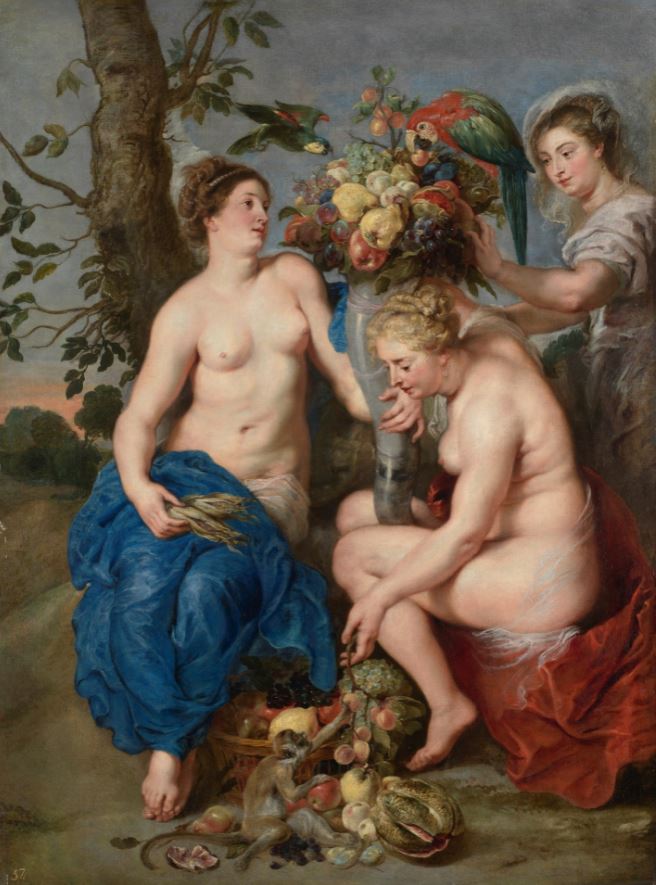
  • Three Nymphs with a Cornucopia (1625 to 1628) Museo Nacional del Prado, Madrid

The thing is that, although the curators try their best to claim that these women are not subject to the male gaze, but are strong independent women overflowing with agency, that’s not really how they actually look.

In my opinion this one, ‘Three Nymphs with a Cornucopia’ can be taken as a test case. It depicts the horn of plenty overflowing with the good things of life, namely a grocer’s shop full of ripe plump juicy fruit, so ripe and juicy that it has attracted the attention of scavenging parrots and a cheeky monkey, to add drama and narrative to a classical allegorical scene.

Is it just me or are the two naked women depicted as extensions of this vision of youthful fertile juicy fruitfulness?

I think they are. Far from asserting anyone’s agency, I’d have thought this picture epitomises the reverse: surely these women are totally objectified, depicted  in all their youthful sexiness as direct extensions of the world of fruit and fecundity.

This is one of eight paintings Rubens took to Spain as a gift from his patron, the Archduchess Isabel Clara Eugenia, to King Philip IV, to butter him up. Made by a man to flatter a king, far from being a rebuttal it strikes me as being a kind of triumph of the male gaze – sexy topless fruitful babes designed to decorate on the walls of the most powerful man in Europe.

Three Nymphs with a Cornucopia by Peter Paul Rubens (1625 to 1628) Museo Nacional del Prado, Madrid

More interesting to me, more persuasive and touching, is the information that Juno, in this huge representation of ‘The Birth of the Milky Way’ resembles Helena Fourment, Rubens’s second wife.

According to the curators, it is thought that his happy second marriage to Helene inspired his increasingly sensuous presentation of women during the 1630s. That seems to me a plausible and happy explanation of the plump sensuality of the nudes he painted in his final decade, just as Rembrandt’s love for his wife shine through his later paintings. I’m not sure anybody portrayed in a painting, male or female, has any ‘agency’. In my opinion they’re all trapped by composition, design, treatment, by the artist’s aims and whims, and all subject to the human gaze of us, centuries later, completely cut off from the value systems in which these works were created.

But paintings very much can convey tenderness and love. And that’s what I found in this small room full of magnificent works of art. The milk of human kindness. Motherly love. The pure, naked, redemptive love we all wish, deep down, we could recapture.

The Birth of the Milky Way by Peter Paul Rubens (1636 to 1638) © Photographic Archive, Museo Nacional del Prado, Madrid

Happily ever after

In fact this final wall caption made me realise that mention of Rubens’ second wife had been seeded throughout the show, starting with early mention of how, after the early death of his first wife, in 1630 Rubens married his second and much younger wife, Helena Fourment (1614 to 1673).

‘Their blissful marital state in the final decade of his life, during which time they had five children, provided a wellspring of love and an increased interest in sensual mythological themes.’

In a world afflicted with terrible pain and suffering it cheered me up to learn that this great artist was blessed with a long, happy, rewarding marriage. Good for him! And these images, painted late in his life, at the peak of his experience of art and life, however others may wish to interpret them, struck me as wonderfully accepting celebrations of beauty, humanity and love.

Rubens among his peers

I was struck by a quote from co-curator Dr Ben van Beneden which gives a pithy summary of three of Western Art’s Golden Greats:

‘If Raphael endowed his female figures with grace, and Titian with beauty, Rubens gave them veracity, energy and soul.’

Strong independent parrots

I noticed that one of the most powerful paintings in the final room, the Cornucopia, featured some beautifully vivid parrots pecking away at the fruit flowing from the horn, and this reminded me that the awesome painting of the Marchesa Maria Serra Pallavicino in the first room also features a parrot perched on her grand chair and bending down, twisting its neck in that inquisitive parrot way.

It occurred to me that maybe Dulwich’s next exhibition should be about ‘Parrots in Painting’. It could bring together depictions of a variety of strong, independent parrots who resist the human gaze to insist on their psittacine agency.

The video


Related links

Related reviews

RE/SISTERS: A Lens on Gender and Ecology @ the Barbican

This is a huge, stunning, world-bestriding exhibition of some 250 photographs (and some films and video installations) on the subject of women and the environment, a wide-ranging survey of the multiple ways the planet is being exploited and degraded, how women too often bearing the brunt of environmental destruction, and the scores of ways women artists and activists are fighting back. At least that’s the exhibition’s aim.

A review in six parts

My review is in six parts. In part one I summarise the hyper-feminist premises or assumptions which underlie this very text-heavy and theory-driven exhibition.

In part two I give a selection of some of the feminist theory and critical theory keywords which abound in the wall captions and which were new to me.

In part three I go through the exhibition itself, quoting in full the wall labels for the introduction and the six themes or categories into which the exhibition is divided, to give you a good flavour of the text-heavy, theory-rich discourse surrounding it. Under each theme I show one or two works from that section, mostly photographs, accompanied by the complete wall caption for the relevant artist and work.

My aim is to show not only how text-heavy the show is but also how parti pris, propagandist and chauvinist the curators’ commentary is. ‘Parti pris’ means ‘preconceived, prejudiced or biased’. ‘Chauvinist’ means ‘displaying excessive or prejudiced support for one’s own cause or group’. This may sound unfair or itself biased as you read it here, which is why I’m going to quote the curators at such length, to back up this opinion and so you can judge for yourself.

Part four lists all the participating artists a) for your information and b) to show that, despite the curators’ fine words about empowering artists from the developing world or Indigenous communities, a full 40% of the artists on display are, of course, from America, home of rapacious capitalism, international finance, the biggest industrial-capitalist complex in the world, and proud birthplace of Donald Trump. So the show has a kind of inbuilt irony between its radical aspirations for diversity, and its all-too-familiar reliance on American voices and perspectives.

Part five briefly mentions some of the other recent big art exhibitions on the subject of the environment, global warming etc, as a comparison.

Part six gives my own responses, to the subject of eco-activism, to the art works and to the feminist discourse which dominates the exhibition. I wouldn’t blame you if you skip this bit. I’m not sure how much of it I myself fully believe. I spoke to two strangers at the exhibition and both of them were finding it as challenging to process the sheer amount of information, the range of issues, and the fiercely feminist perspective of the exhibition, as I was.

Why the extensive quotes

The sweeping generalisations in part one are as much as possible based on the curators’ own words. They may seem extreme or satirical to begin with but: a) I base the summary on quotes from the exhibition press release or wall labels or catalogue and have indicated quotations by single speech marks; and b) as you read on into the section quoting all the wall labels, I hope you’ll see that wild though they at first seem, they simply reflect the spirit and rhetoric of the show.

This is one of the most text-heavy exhibitions I’ve ever been to. There are six themes or categories and about 50 artists, each of whom gets a long explanatory wall caption and then additional ones for many of the works. There are maybe 80 wordy captions in total.

Not only that, but the captions come straight out of contemporary feminist and critical theory and are dense with jargon, using terms I’d never come across before (which is why I select some of these terms for consideration in part 2).

The sheer number and length of the captions means that if you read all them (as I did) Re/Sisters is like being trapped inside a book, a degree-level textbook on feminist theory, ecofeminism and post-colonial theory. I had to take a ten-minute break after doing the ground floor before going up to the first floor rooms because my brain was reeling.

I’m going to quote the introductions to each of the six sections in full to give you a sense of a) how long they are and b) how densely laden with the assumptions and jargon of feminist and critical theory.

And I’m question lots of it. Just because it’s written on a gallery wall doesn’t mean it can’t be pondered, questioned and, sometimes, rejected.

Part 1. The feminist premises of the exhibition

In the feminist discourse of this exhibition all women are fabulous. All women are creative. All women have an instinctive feel for nature and mother earth. All women are nurturing and caring and so, obviously, all women are environmentalists. No women drive cars, fly in planes, buy wasteful consumer goods or run companies and corporations which contribute to pollution and ecocide. No woman is responsible for in any way harming any part of the environment. Only men do any of these wicked things, only men run ‘the mechanical, patriarchal order that is organised around the exploitation of natural resources’ and deploy the ‘masculine cultural imperialism’ that underpins it.

‘Terms such as Capitalocene, Plantationocene and Anthropocene act as cultural-geological markers that make clear that the violent abuses inflicted upon our ecological processes are inherently gendered, and shine a light on the toxic combination of globalised corporate hegemony and destructive masculinities that characterise the age of capitalism.’ (Catalogue page 16)

‘The violent abuses inflicted upon our ecological processes are inherently gendered’ and that gender is male.

Men are not only destroying the planet but, in the process, oppressing all women everywhere and all Indigenous peoples everywhere, via ‘the oppression of “othered” bodies’. There is a direct link between men’s degradation of the planet and men’s oppression of women and men’s oppression of Indigenous societies.

Battling against oppressive men and their destruction of the planet are brave women activists and artists all around the world. They practice ‘a radical and intersectional brand of eco-feminism that is diverse, inclusive, and decolonial’. They celebrate the fact that merely by being born a woman means you are morally, spiritually and environmentally superior.

This exhibition, ‘RE/SISTERS: A Lens on Gender and Ecology’, celebrates the women (or gender non-conforming) artists and the women activists who are fighting against male oppression and male capitalism, against the cis-heteronormative patriarchy, against masculinist capitalism, against phallogocentrism to save the planet.

RE/SISTERS brings together 50 international female (and gender non-conforming) artists to ‘show how women are regularly at the forefront of advocating and caring for the planet’.

The curators claim that environmental and gender justice are indivisible parts of a global struggle for equality and justice. Art exhibitions can ‘address existing power structures that threaten our increasingly precarious ecosystem’.

Shanay Jhaveri, Head of Visual Arts at the Barbican, is quoted as saying:

‘In this era of deepening ecological crisis, we are proud to present RE/SISTERS which interrogates the disproportionate detrimental effects of extractive capitalism on women and in particular Global Majority groups.’

In other words, the planet is being destroyed – women and minorities suffer most.

So the exhibition includes not just women but artists from ‘the Global Majority and Indigenous peoples’ because these peoples are even more intrinsically sympathetic to the environment than women are, and even more the victims of heteropatriarchal global capitalism. Including Indigenous peoples in this way offers ‘a vision of an equitable society wherein people and planet alike are venerated and treated fairly’.

It’s usually about this point in the press release that you learn that the exhibition was sponsored by BP or the Sackler family and burst out laughing. Not this time. Big art galleries have finally cleaned up their acts. This exhibition was sponsored by environmentally-friendly companies such as the Vestiaire Collective:

‘Our mission is to transform the fashion industry for a more sustainable future. As the world’s first B Corp fashion resale platform, we champion the circular fashion movement as an alternative to overproduction, overconsumption and the wasteful practices of the fashion industry. Our philosophy is simple: Long Live Fashion.’

And the Helen Frankenthaler Foundation, which sponsors the Frankenthaler Climate Initiative (FCI). In the gallery bookshop there’s a space where you can donate your ‘pre-loved’ clothing to the Vestiaire Collective.

Part 2. New words

Here’s some quotes from the exhibition catalogue to get you in the zone, and also so you can check how up-to-speed you are with the latest terminology from feminist, eco-feminist, post-colonial and critical theory.

The infrastructural gaze, as in:

‘[Sim Chi Yin’s] works juxataposes the aestheticisation of the “infrastructural gaze” with the human gaze’.

Heteropatriarchal, as in:

‘Operating at the nexus of race, gender, urban ecological infrastructure, systemic injustice, environmental racism and heteropatriarchal capitalism, LaToya Ruby Frazier’s striking series “Flint is Family” exposes the segregation and racism that persists in the contemporary American landscape.’

Or:

‘In stark contrast to the received dualistic, heteropatriarchal value system of the Global North that views nature and culture as fundamentally opposed ways of being, Caycedo’s work advocates an interspecies politics that recognises nature as having agency.’

The heteropatriarchal gaze, as in:

‘Directly refuting the freighted position that men are producers of culture and that women are synonymous with nature and are therefore objects, subjects and products to be dominated by the heteropatriarchal gaze, Kruger’s searing, defiant and radical work opens our eyes and minds to the possibility of a third way, a new mode of being in our womanist bodies, freed from the shackles of masculine cultural imperialism while embracing non-separability from our ecological community.’

Cis-heteropatriarchal, as in:

‘Today, with climate catastrophe breathing ever more oppressively down our necks (egged on, of course, by the murderous white-supremacist, colonial and cis-heteropatriarchal systems that are its enablers), dealing with these questions seems all the more pressing.’

Other-than-human as an adjectival phrase as in ‘other-than-human entities’, ‘other-than-human organisms’, ‘other-than-human habitats’, ‘other-than-human communities’ and so on.

Raced, as in:

‘Understanding the body as situated, raced, gendered and sexed is not a novel idea, but the muscular geographies of petropolitics, and the populist narratives of masculinity and extraction, are rarely attended to as subjective geosocial practices that need to be undone before new earth geographies can take hold.’

Or:

‘As Esperanza makes clear, exploitation within these geophysics of extraction is intersectional, that is, it is raced and gendered. In the mine, race and gender intersect as a stratigraphic relation that becomes a mode of governance.’

Extractivism, as in:

‘These interventions gesture towards a broader understanding of how extraction – rather than extractivism, which becomes a specifically geologically-inflected formation – functions as an ideological undercurrent to colonial dispossession, racial subjection and gendered violence.’

Or:

‘I am, first, reminded not to draw easy – and, as [curator Lindsay] Nixon emphasises, colonising – equivalences between Indigenous women’s and nonbinary people’s struggles for land and life, and the movements that have expressed, in various ways, my own situated feminist and queer opposition to capitalism, colonialism, militarism and extractivism, which began in the 1980s and continues, albeit in much-changed form, into the present.’

Masculinism, as in:

‘Ecofeminist scholars have long critiqued feminised constructions of “nature” while challenging patriarchy, the masculinism of capitalism, and colonial abuses against nature, women and marginalised communities.’

Phallogocentric as in:

‘Caycedo’s photographs of rivers and waterfalls are remixed into pulsating, fractal, perception-shifting images that invite the viewer to reflect on the fluidity of bodies of water, which consistently resist the phallogocentric logic of extraction.’

Speciesism, as in:

‘As Greta Gaard notes: “Most provocative is her [Carolyn Merchant]’s intersectional linkage of racism, speciesism, sexism, colonialism, capitalism, and the mechanistic model of science–nature via the historical co-occurrence of the racist and colonialist “voyages of discovery” that resulted in appropriating indigenous peoples, animals, and land.’

Survivance, as in:

‘[Zina Saro-Wiwa] asks complex questions about Ogoni survivance that are unique to the people and place and that resist incorporation into Eurowestern narratives of environmental and climate politics.’

Eurowestern, as in:

‘Extraction as abstraction works as a representational genre precisely because within a Eurowestern context we are visually trained in the colonial (then modernist) optics that present a disembodied, planimetric view from above.

Or:

‘In this same light, then, I must also make a clear distinction between the works in RE/SISTERS that echo and amplify the Chipko women’s embodied protests as part of a contemporary network of Indigenous feminist and nonbinary activisms, and a framework emerging from more current Eurowestern discursive formations that might fold these embodied actions into queer, trans or even multispecies feminist ecological projects.’

Positionality, as in:

‘This view demands of Eurowestern environmentalists, including ecofeminists, a deep reckoning with our own positionalities, philosophies and politics.’

Part 3. The exhibition

  • features about 250 works by 50 artists
  • includes work from emerging and established artists in the specific fields of photography, film and installation
  • after an initial introduction, is organised into six categories or themes

Introduction

‘RE/SISTERS surveys the relationship between gender and ecology to highlight the systemic links between the oppression of women and Black, trans and Indigenous communities, and the degradation of the planet. It comes at a time when gendered and racialised bodies are bending and mutating under the stresses and strains of planetary toxicity, rampant deforestation, species extinction, the privatisation of our common wealth, and the colonisation of the deep seas. RE/SISTERS shines a light on these harmful activities and underscores how, since the late 1960s, women and gender-nonconforming artists have resisted and protested the destruction of life on earth by recognising their planetary interconnectedness.

‘Emerging in the 1970s and 1980s, ecofeminism joined the dots between the intertwined oppressions of sexism, racism, colonialism, capitalism, and a relationship with nature shaped by science. Ecofeminist scholars have long critiqued feminised constructions of ‘nature’ while challenging patriarchal and colonial abuses against our planet, women and marginalised communities. Increasingly, feminist theorists recognise that there can be no gender justice without environmental justice, and ecofeminism is being reclaimed as a unifying platform that all women can rally behind.

‘Uniting film and photography by over 50 women and gender-nonconforming artists from across different decades, geographies, and aesthetic strategies, the exhibition reveals how a woman-centred vision of nature has been replaced by a mechanistic, patriarchal order organised around the exploitation of natural resources, alongside work of an activist nature that underscores how women are often at the forefront of advocating for and maintaining our shared earth.

‘Exploring the connections between gender and environmental justice as indivisible parts of a global struggle to address the power structures that threaten our ecosphere, the exhibition addresses the violent politics of extraction, creative acts of protest and resistance, the labour of ecological care, the entangled relationship between bodies and land, environmental racism and exclusion, and queerness and fluidity in the face of rigid social structures and hierarchies. Ultimately, RE/SISTERS acknowledges that women and other oppressed communities are at the core of these battlegrounds, not only as victims of dispossession, but also as comrades, as protagonists of the resistance.’

This is the first work in the exhibition:

Untitled (We won’t play nature to your culture) by Barbara Kruger

‘In Barbara Kruger’s seminal work “Untitled (We won’t play nature to your culture)” a close-cropped image, likely culled from a 1950s fashion magazine, shows a glamorous white woman lying against a grassy background with her eyes gently covered by leaves, entangling woman and nature in a symbiotic whole. With the woman’s face sandwiched between the title’s liberatory feminist message, which serves as a jarring reminder of women’s historical role in society, the work signals how women have been straitjacketed in the West by reductive Cartesian dualisms and dichotomies – culture/nature, male/female, mind/body – and a hierarchically ordered worldview. Directly refuting the freighted position that men are producers of culture and women are synonymous with nature and are therefore objects, subjects and products to be dominated by the heteropatriarchal gaze, Kruger’s searing, defiant and radical work opens our eyes and minds to the possibility of a third way, a new mode of being in our womanist bodies, freed from the shackles of masculine cultural imperialism while embracing non-separability from our ecological community.’

Untitled (We won’t play nature to your culture) by Barbara Kruger (1983) Courtesy of Glenstone Museum, Potomac, Maryland

Theme 1. Extractive Economies / Exploding Ecologies

‘Extractivism is the exploitation, removal or exhaustion of natural resources on a massive scale. Rural, coastal, riverine, and Indigenous communities are disproportionately impacted by mining and other extractive industries, resulting in severe negative consequences on local livelihoods, community cohesion and the environment. Women often face the worst impacts of a violent politics of such practices, and yet they are leading the resistance against extractivism and stepping outside of traditional gender roles to champion movements fighting these destructive tendencies.

 ‘Over the past century rivers, forests, deserts and other natural environments have been subject to multiple forms of extraction, domestication, enclosure, erasure and pollution on an unprecedented global scale. This has entailed the profound transformation of the flow of rivers and the disappearance of once lush, fertile land, raising questions about ecological justice for the communities that rely on these environments.

‘Through their work Carolina Caycedo, Sim Chi Yin, Mabe Bethonico, and Talo Havini survey the material impact of extractive activities on rivers and dams, from Colombia to Vietnam, that support both human and more-than-human life in their nourishing embrace.

‘Meanwhile Simryn Gill, Otobong Nkanga, Chloe Dewy Matthews, and Mary Mattingly investigate the effects of industrial scale mining on landscapes and communities, from Australia to Namibia. Ultimately the works gathered here consider how extractivism operates as a material process underpinned by a pervasive colonial-capitalist mindset towards the exploitation of disempowered bodies and land.’

From the series Caspian: The Elements by Chloe Dewe Matthews (2010)

‘From images of bodies coated in the prized, thick brown crude oil found in the semi-desert region of Azerbaijan, to worshippers on pilgrimage to Shakpak-Ata, believed to have been home to a goddess of fertility and womanhood, Chloe Dewe Matthews’s photographs of the countries that border the Caspian Sea bear witness to the sticky entanglement of their geologic material realities, industrial scale extraction, and the myths, folklore and traditions that have shaped the contours of their individual cultures.

‘Over the course of six years, Dewe Matthews travelled across Azerbaijan, Iran, Kazakhstsan, Russia and Turkmenistan, photographing the diversity of the region’s cultures, their unique connection to the land, and these countries’ ever-increasing economic reliance on global petropolitics, something that threatens to destroy and already fragile ecological landscape.

‘From dramatic images of the eternally burning gas crater known as the Door to Hell in the Karakum Desert in Turkmenistan to elaborate mausoleums built to service a generation newly rich on oil, Dewe Matthews’s striking series reminds the viewer of the ecological, corporeal and cultural cost of energy politics.’

Of this specific image:

‘A young woman bathes in crude oil at the sanatorium town of Naftalan. This ‘miracle oi’ is found exclusively in the semi-desert region of central Azerbaijan, and it is claimed that bathing in it for ten minutes a day has medicinal benefits.’

From the series Caspian: The Elements by Chloe Dewe Matthews (2010) Courtesy of the artist

Multiple clitoris by Carolina Caycedo (2016)

‘Part of her multidisciplinary project Be Dammed, which critiques the “mechanics of flow and control of dams and rivers” to address “the privatisation of waterways and the social and environmental impact of extractive, large-scale infrastructural projects”, Carolina Caycedo’s Water Portraits (2015 –) float across gallery spaces, suspended from ceilings and cascading along walls.

‘Printed on silk, cotton or canvas, Caycedo’s photographs of rivers and waterfalls are remixed into pulsating, fractal, perception-shifting images that invite the viewer to reflect on the fluidity of bodies of water, which resist the phallogocentric logic of extraction.

‘Ultimately, Caycedo’s work encourages us to view these bodies of water as life-sustaining, life-embracing, other-than-human living organisms and not just as resources for human extraction. A portrait of the water that powerfully carves through the long, narrow chasm known as Garganta del Diablo (Devil’s Throat) – a canyon in the Iguazú Falls, on the border between Argentina and Brazil – Caycedo’s vibrantly coloured Multiple Clitoris evokes the feminist, orgasmic energy of our “corporeally connected aqueous community”.’

Installation view of ‘Multiple clitoris’ by Carolina Caycedo (2016) (Photo by the author)

Theme 2. Mutation: Protest and Survive

‘Women have a long history of protesting ecological destruction – from creative acts of civil disobedience and non-violent protest to armed resistance and climate legislation. Pamela Singh’s photographs of the Chipko movement document women resisting the felling of trees in northern India, while Format Photographers and JEB (Joan E. Biren) captured the women-led anti-nuclear peace movements of the 1980s in the UK and US, respectively.

‘Susan Schuppli’s film reflects on the right of ice to remain cold, as advocated by the Inuk activist Sheila Watt-Cloutier. Offering insights into the connections between patriarchal domination and the violence perpetrated against women and nature, the works in this section highlight the intertwined relationship between the survival of women and the struggle to preserve nature and life on earth.

‘Critical of the term “revolution”, in 1974 the French ecofeminist Françoise D’Eaubonne proposed the term “mutation”, which, she argued, would enact a “great reversal” of man-centred power. This grand reversal of power does not imply a simple transfer of power from men to women, instead it suggests the radical “destruction of power” by women – the only group capable of executing a successful systemic change, one that could liberate women as well as the planet.

‘Artists such as LaToya Ruby Frazier, Format Photographers, JEB, Pamela Singh and Poulomi Basu explore how communities of women – from web weavers to tree huggers and water defenders – have joined forces to combat violence against their bodies and land.’

Greenham Common Women’s Peace Camp: Embrace the Base action 12/12/1982 by Maggie Murray

Greenham Common Women’s Peace Camp: Embrace the Base action 12/12/1982 by Maggie Murray (1982) © Maggie Murray / Format Photographers Archive at Bishopsgate Institute Courtesy of Bishopsgate Institute

Chipko Tree Huggers of the Himalayas #74 by Pamela Singh

‘Pamela Singh’s powerful black-and-white documentary photographs of the Chipko movement depict women from the villages of the Garhwal Hills in Himalayas in Uttarakhand, northern India, calmly and peacefully clinging onto and embracing trees to save them from state- and industry-sanctioned loggers. Positioning themselves as human shields, with their arms interlocked around tree trunks, the women of this successful nonviolent protest became emblematic of an international ecofeminist movement eager to showcase the subordination of women and nature by global multinationals while underscoring women’s environmental consciousness.

‘The women were directly impacted by the rampant deforestation, which led to a lack of firewood as well as water for drinking and irrigation; by successfully opposing the planned fate of the trees, the women gained control of the means of production and the resources necessary for their daily lives, demonstrating the entangled relationship between the material needs of the women and the necessity to protect nature from domination and oppression.’

Chipko Tree Huggers of the Himalayas #74 by Pamela Singh (1994) © Pamela Singh Courtesy of sepiaEYE

Cold Rights by Susan Schuppli (2020)

Theme 3. Earth Maintenance

‘The practice of earth maintenance and the labour of ecological care stand in direct opposition to the masculinist value system of the capitalist economy. In the late 1970s and early 80s, feminist artists such as Mierle Laderman Ukeles and Helène Aylon practiced earth care as a form of resistance, linking classed, racialised and gendered struggles to ecological justice.

‘Further, the works assembled here make clear the link between maintenance work in the domestic sphere, which was traditionally defined as “women’s work”, and the undervalued labour required to care for the planet.

‘From 1979 to 1980, Mierle Laderman Ukeles set out to make visible the overlooked yet fundamental work of New York’s sanitation workers, the caretakers of the city who repeatedly cleaned up the refuse and waste polluting its environment. Around the same time, Helène Aylon politicised earth care by gathering toxic soil from nuclear military sites, placing it inside pillowcases and carrying the soil to institutions of power in her “Earth Ambulance”.

‘Seeking new modes of earth maintenance and protest against the continuous exploitation of nature, through the mid-1990s Fern Shaffer performed private rituals at locations in need of healing. melanie bonajo’s film Nocturnal Gardening (2016), part of their series Night Soil Trilogy (2014 to 2016), positions women as agents of political and social change by studying how communities come together to forge alternative ways of living in harmony with the land. The audio installation The Grindmill Songs Project, from the People’s Archive of Rural India, brings into the gallery the collective singing of women from central India who are typically silenced while their daily existence is absorbed into a local and global system of value creation from which they do not benefit.’

A Draught of the Blue by Minerva Cuevas (2013)

Nine Year Ritual of Healing: April 9 1998 by Fern Shaffer

‘Over the course of nine years at locations across North America, Fern Shaffer performed private healing rituals at sites affected by the industrial-agricultural complex and impending extinction. Shaffer performed these self-designed spiritual performances at places including Big Sur, on California’s Pacific Coast; a cornfield outside Mineral Point in Wisconsin; on the summit of the Blue Ridge Mountain in Virginia; and at the Cache River basin in Illinois, among others. Photographed by her collaborator Othello Anderson in sequential images, Shaffer is pictured twisting and twirling in a handmade garment that conceals her bodily form and face, rejecting a human-centred and individualistic relationship to nature.’

Nine Year Ritual of Healing: April 9 1998 by Fern Shaffer (1998) Photo by Othello Anderson Courtesy of the artist

Theme 4. Performing Ground

‘For women artists in the 1970s and 80s, to locate the body as part of the natural world was to perform a highly politically charged act. At a time when even the countercultural “return” to nature was bound up in the discourse of patriarchy, picturing and performing the body as ecologically entangled carried with it radical feminist potential. Entwined, cocooned, or concealed, artists such as Laura Aguilar, Tee A. Corinne, Ana Mendieta, Fina Miralles, and Francesca Woodman blurred the boundaries between body and ground, undoing the distinction between human and more-than-human in their merging of animal, vegetal, and mineral. By deploying camouflage strategies, the artists gathered here resist demands for gendered and racialised bodies to be contained by settler–colonial politics or extractive logics, and rather forge mutual relationships with their environments.

‘To “perform ground” is to deliberately and strategically locate the self not merely in the world, but of it. It asks us to rethink established hierarchies of relations between the human and the more-than-human. In contrast with much Land art, which has staged large-scale and controlled interventions into the natural environment predominantly by men, the ecologically oriented works presented here by women artists place the body in communion with the land.

‘Judy Chicago, The Neo Naturists, and Xaviera Simmons heighten the visibility of their bodies in relation to the more-than-human world by painting themselves in vivid colours and patterns or using paint to critique racial stereotypes. In doing so, these artists explore how the representation of women and nature has always been an act entangled in history, power, and agency.’

Immolation from Women and Smoke, performed by Faith Wilding, photographed by Judy Chicago (1972)

‘In Immolation Chicago captures the performance artist Faith Wilding sitting cross-legged in the desert, enveloped in orange smoke. This work referenced the ongoing Vietnam War, the self-immolation of Buddhist monks, and similar acts by people in the United States, who were setting themselves alight to protest the war and advocate for peace, while the orange smoke alludes to Agent Orange, the herbicide that was sprayed to devastating effect in Vietnam.’

Immolation from Women and Smoke. Fireworks performance Performed by Faith Wilding in the California Desert by Judy Chicago (1972) © Judy Chicago/Artists Rights Society (ARS), New York Photo courtesy of Through the Flower Archives Courtesy of the artist; Salon 94, New York; and Jessica Silverman Gallery, San Francisco

The Body Covered with Straw by Fina Miralles (1975)

‘Fina Miralles’s conceptual photo-performance works from the 1970s embody a return to a profound relationship with nature. As she wrote in 1983 following a transformative five-month journey travelling through Argentina, Bolivia and Peru: “I am abandoning bourgeois culture and embracing Indigenous culture. The World Soul, Mother Earth and the protective and creative Pachamama.”

‘Read through this lens, Miralles’s series Relating the Body and Natural Elements, in which the artist cocoons herself in straw, as seen here, or surrenders her body to sand or grass until she disappears, her body merging with the land, illustrates Donna Haraway’s concept of “becoming with” and offers a metaphysics grounded in connection, challenging the illusion of separation – the erroneous belief that it is somehow possible to exempt ourselves from earth’s ecological community.’

Relationship: The Body’s Relationship with Natural Elements. The Body Covered with Straw by Fina Miralles (1975) Courtesy of MACBA

Nature Self-Portrait #5 by Laura Aguilar (1996)

‘For Laura Aguilar, photography was instrumental in visualising her identity, and in the mid-1990s she began creating powerful black-and-white nude self-portraits in nature. In contrast to the heteropatriarchal settler-colonial tradition of landscape photography, Aguila’s portraiture homes in on her identity as a large-bodied, working class, queer Chicana woman. Mirroring the natural forms of the rocky desert landscape of the American Southwest, in her Nature Self-portrait series, Aguilar inserts herself into a “racially stratified landscape” to become a boulder or perform as a tree.

‘As Macarena Gomez-Barris notes, Aguilar seems to want us to “trespass into the territory that feminists have long considered taboo by considering a profound relationship between the body and territory, one that provides a possibility for ecology of being in relation to the natural world. In that sense, her self-portraits provide a way to foreground modes of seeing that move away from capitalism, property and labour altogether, into a more unifying relationality that allows for haptic and sensuous relations with the natural world.”

‘Ultimately, by affiliating her body with the natural beauty of the landscape, Aguilar’s work both empowers and transcends the various categories of her identification.’

Of this specific photo:

‘In these works, Aguilar photographs herself resting beside large boulders that seem to echo her curvaceous bodily form. Facing away from the camera, and folding inward, her body emulates the cracks and dents of the boulders while the shadows cast from her body intensify the affinity with the stones before her. In a sense she has “grounded” herself in a landscape that oscillates with “the largeness of her own body”.’

Nature Self-Portrait #5 by Laura Aguilar (1996) © Laura Aguilar Trust of 2016

Isis in the Woods by Tee A. Corinne (1986)

The Isis series photoshop large close-ups of a human vulva into traditional landscape compositions creating surreal and disturbing juxtapositions.

Isis in the Woods by Tee Corinne (1986)

Theme 5. Reclaiming the Commons

‘Reclaiming the Commons considers the power dynamics of capitalist land ownership, environmental racism, and environmental memory, while reflecting on who has access to our common land, who owns the land and how earth-beings – both human and more-than-human – move through our increasingly enclosed natural world. Notions of ‘the commons’ are grounded in forms of egalitarian land stewardship in which members of a community have access to common land for pasturing animals, growing crops, and foraging, with feminists arguing that the commons are also social and economic sites that are crucial for female empowerment.

‘Questions of access to land are considered in Fay Godwin’s photographic series Our Forbidden Land (1990), which tracks how the long history of enclosures in Britain has shaped a sinister landscape in which fields and pathways are emptied of people through physical barriers, legal measures, and acts of dispossession. Diana Thater’s work RARE (2008) investigates the effects of enclosures from an interspecies perspective, focusing on the disappearing habitats of endangered species in the iSimangaliso Wetland Park in KwaZulu-Natal, South Africa. In Al río/To the River (2016 to 2022), Zoe Leonard uses photography to testify to the weaponisation of landscapes through the transformation of waterways such as the Río Bravo/Rio Grande from a source of life and means of migration to a militarised border.

‘Environmental racism and memory are explored in the work of Ingrid Pollard, Dionne Lee, Mónica de Miranda, and Xaviera Simmons, who variously interrogate the racialised histories of settler–colonial and plantation landscapes. Their photographs – which are often manipulated with embroidery, collage, hand-tinting, and more – call into question the heteropatriarchal tradition of landscape photography and draw attention to the entwined struggles of decolonisation and the healing of our planet.’

Karikpo Pipeline by Zina Saro-Wiwa

Theme 6. Liquid Bodies

‘Liquid Bodies explores the relationships between the human cultures of gender and sexuality and the world of water. The works assembled here imagine a relationship between human animals and the non-human world that rejects the dualisms of ‘natural and unnatural’, ‘alive and not alive’, or ‘human and non-human’ – colonial ways of seeing that divide the world into humans and everything else. Rather, the artists in this section start from a simple point of departure: we, too, are water. They look to the potential of this natural resource to destabilise a binary sense of gender and the categorisation of the world into neat taxonomies that shape conventional Western ideas of the human experience.

‘Ideas of watery immersion, submersion, and transformation unite the work of Nadia Huggins, Anne Duk Hee Jordan, Josèfa Ntjam, Ada M. Patterson, and Uýra. Cross-species becoming is explored in the Indigenous queer artist Uýra’s arresting photo-performances, in which the artist fuses with Amazonian plants, creating what she describes as hybrids of human, animal, and plant. Nadia Huggins’ striking self-portraits depict her becoming one with the corals that hug the coast of her Caribbean home. Playing out in the vast continuum of oceanic space, Anne Duk Hee Jordan’s film Ziggy and the Starfish (2018) depicts marine life as powerfully sensual. Bobbing along to a soundtrack culled from vintage erotic films and underwater sounds, it considers the porous boundaries of multispecies kinship that is presented as endlessly subversive. Colonial, mythic, and queer histories of water are further addressed in Josèfa Ntjam’s installation that considers Black being in the afterlives of Atlantic slaver.’

Ziggy and the Starfish by Anne Duk Hee Jordan (2018)

‘Taking its name from Ziggy Stardust, the androgynous, extraterrestrial rock star persona that musician David Bowie personified in the early 1970s , Anne Duk Hee Jordan’s sculptural video environment that houses the film Ziggy and the Starfish (2018) celebrates the fluidity of marine sexuality. The film pictures the sexual exploits of various ocean creatures with an exuberance and playful excitement, recalling the earlier work of the French photographer and filmmaker of marine life, Jean Painlevé. The effects of human-made climate change on the hydrosphere have become a key factor impacting the reproductive lives of marine animals, and by focusing on this aspect of the ecosphere Jordan underscores our deep entwinement with our fellow earthly inhabitants. In response to the present ecological crisis, the work offers a portal into the vivid world of our nonhuman cohabitors and looks to their colourful erotic lives as an example of how not only to think against binary dualisms, but to desire the seductively plural.’

Looking for ‘Looking for Langston’ by Ada M. Patterson (2021)

‘Looking for “Looking for Langston” by Ada M. Patterson is both inspired by and directly references Isaac Julien’s eponymous 1989 film, which offers a meditation on the life of the queer poet Langston Hughes and the wider cultural scene of the Harlem Renaissance in 1920s New York. As the title of the work suggests, Patterson, whose quest to learn more about the film ended in failure, constructs her own response that borrows from Hughes’s poetic imaginary as well as fragments she’s gleaned about Julien’s film. The result is a surreal and phantasmagoric exploration of Blackness and desire, using symbols such as the sailor and the sea to explore the fluidity of queerness. Patterson’s film also incorporates allusions to the histories of colonialism extant not only in Barbados (the artist’s birthplace and where this film was mostly shot) but also in Hughes’s United States and Julien’s United Kingdom. The film pays homage to these forebears, connected through oceanic bodies, legacies of Blackness and queerness, and the forever speculative pursuit of desire.’

Looking for ‘Looking for Langston’ by Ada M. Patterson (2021) Courtesy of Maria Korolevskaya and Copperfield

Mud by Uýra (2018)

‘Uýra is an indigenous artist, biologist and educator from Brazil who works in and around the riverine communities of the Amazon region. In these photo-performances, Uýra transforms into multi-species characters, fluidly merging the human and non-human by adorning herself with organic matter. Borrowing from the aesthetic language of drag, and its ability to disrupt the stasis of gender-normativity, Uýra exuberantly shows how other binaries, such as the one between human and nature, can also be understood to be fluid states that are performatively constructed. As an educator, Uýra also uses her works as pedagogical tools to uncover different forms of knowledge about the land that have been suppressed by the logic of Western extractive capitalism. In doing so, the works call for a material and spiritual restoration of the ravaged ecologies to which we belong.’

Lama (Mud) by Uýra (2018) Courtesy of the artist

Part 4. Participating artists

The curators claim that ‘at its core, the exhibition seeks to platform the work of artists from the Global South and Indigenous communities’, but does it? Here’s a full list of the contributors in alphabetical order:

  • Laura Aguilar (US)
  • Hélène Aylon (US)
  • Poulomi Basu (India)
  • Mabe Bethônico (Brazil)
  • JEB (Joan E Biren) (US)
  • melanie bonajo (The Netherlands)
  • Carolina Caycedo (Columbia)
  • Judy Chicago (US)
  • Tee Corinne (US)
  • Minerva Cuevas (Mexico)
  • Agnes Denes (US)
  • FLAR (Feminist Land Art Retreat) (US)
  • Format Photography (UK)
  • LaToya Ruby Frazier (US)
  • Gauri Gill (India)
  • Simryn Gill (Malaysia)
  • Fay Godwin (UK)
  • Laura Grisi (Italy)
  • Barbara Hammer (US)
  • Taloi Havini (Bougainville / Australia)
  • Nadia Huggins (St Vincent & the Grenadines)
  • Anne Duk Hee Jordan (Korea/Germany)
  • Barbara Kruger (US)
  • Dionne Lee (US)
  • Zoe Leonard (US)
  • Chloe Dewe Mathews (UK)
  • Mary Mattingly (US)
  • Ana Mendieta (Cuba)
  • Fina Miralles (Spain)
  • Mónica de Miranda (Angola/Portugal)
  • Neo Naturists (Christine Binnie / Jennifer Binnie / Wilma Johnson) (UK)
  • Otobong Nkanga (Nigeria)
  • Josèfa Ntjam (France)
  • Ada M. Patterson (Jamaica)
  • PARI (People’s Archive of Rural India) (India)
  • Ingrid Pollard (UK)
  • Zina Saro-Wiwa (Nigeria)
  • Susan Schuppli (Canada)
  • Seneca Women’s Encampment for the Future of Peace and Justice (US)
  • Fern Shaffer (US)
  • Xaviera Simmons (US)
  • Pamela Singh (India)
  • Gurminder Sikand (India)
  • Uýra (Brazil)
  • Diana Thater (US)
  • Mierle Laderman Ukeles (US)
  • Andrea Kim Valdez (UK)
  • Francesca Woodman (US)
  • Sim Chi Yin (Singapore)

As you can see, in this list of 49 artists, 19 (39%) are from the USA, heartland of rapacious global capitalism. 5% of the global population; 40% of global art. And it’s always a pleasure to have Americans lecturing the rest of us about the environment. Compare with the American activists lecturing the visitor at the Hayward Gallery’s recent ‘Dear Earth’ exhibition. The full score is:

  • US – 19
  • UK – 6
  • India – 5
  • Brazil – 2
  • Nigeria – 2
  • Angola/Portugal – 1
  • Bougainville / Australia – 1
  • Canada – 1
  • Columbia – 1
  • Cuba – 1
  • France – 1
  • Italy – 1
  • Korea/Germany – 1
  • Malaysia – 1
  • Mexico – 1
  • The Netherlands – 1
  • Singapore – 1
  • Spain – 1
  • St Vincent & the Grenadines – 1

US and UK participants number 25 or just over half the total. If you add in another 5 or 6 from Canada, Australia and Europe that makes roughly 30 out of 49. Whether having 60% of the contributors come from Europe and America equals platforming ‘the work of artists from the Global South and Indigenous communities’ is open to question.

Part 5. Other environmental art reviews

Artists have been worrying about the environment for decades but it’s only recently that exhibitions on the subject have broken through into the mainstream i.e. the big London galleries. RE/SISTERS is just the latest of a clutch of high profile eco-art exhibitions in London:

There is, as you might expect, some overlap: the work of Agnes Denes appears in both Dear Earth and RE/SISTERS, specifically her Agnes Denes’s ‘iconic’ 1982 work ‘Wheatfield: A Confrontation’, where she planted 8,000 square meters of wheat at Battery Park Landfill within sight of the Twin Towers in New York. I reviewed Mónica de Miranda’s recent exhibition at Autograph ABP. Here she’s represented by a piece I liked, Salt Island, five photographs into which have been sewn fine green threads hanging from the surface like the lianas of a tropical forest. They feel genuinely ‘chill’ as my son would say.

Installation view of ‘Salt Island’ by Mónica de Miranda. What you can’t see is the gossamer-fine green silk threads dangling from the foliage

What makes this exhibition sharply and distinctively different from the Hayward and Royal Academy shows is the fierce and unforgiving feminism which colours every aspect of it and every word of every caption.

Part 6. My responses

It’s a huge exhibition. The more you study it, the bigger and wider, the more confrontational or thought-provoking the issues become.

As to the actual subjects and images, a lot of these are very familiar: the ravages of open-cast mining, the oil spills which destroy rivers and lakes, the destruction of the rainforests, I feel like I’ve been reading about these all my life. How me and my friends thrilled to the film ‘Koyaanisqatsi’ with its vision of a world being heedlessly destroyed, and that was back in 1982!

In fact there are two ways of processing a huge, text-heavy like this. Or maybe three. 1) One is to read the captions and focus on the environmental and pollution aspect. On this perspective, although I felt I knew about a lot of the topics already – knew about the destructive effects of oil and mining, that we’re killing the oceans, I knew young women who actually took part in the Greenham Common protests, and so on. On the other hand, I’d never heard about the very bad effects of sand extraction documented by Sim Chi Yin, and about many of the other resistance movements in the developing world, such as the People’s Liberation Guerrilla Army in India.

2) Second way is to react to the hyper-feminism of the captions, nod approvingly, rise to the bait, or be immediately struck by the illogic or contradictions of various parts of it. Rather than comment, I’ve quoted the wall captions at such great length so you can make up your own mind.

3) Third way is like my friend Andrew the gay designer. He prides himself on rarely if ever reading the wall captions at any exhibition, and instead reacting purely to the works themselves, liking them, disliking them (or making a note to pinch good ideas). Andrew avoids the captions because they almost always create a barrier between visitors and works. More and more often these days, as in this exhibition, they dispense a polemical discourse designed to coerce you into responding to all the works in an officially approved and constraining way. He hates that.

In contrast, I read every single caption, was appalled by a whole series of terrible environmental degradations they described, was irritated by the sanctimonious and misandric tone of most of them, and generally let my head be filled up with caption clutter which stopped me seeing what was actually in front of me. I need to be more like Andrew: stop reading the captions – just respond to the work.

Feminist discourse

Feel free to skip this bit. I’m not even 100% sure I completely believe what I’m writing. I’m just trying to work through my responses to the very strong feminist point of view shouting from every caption on every wall of this show:

In my review of Women, Art and Society by Whitney Chadwick (2012) I develop a sustained critique of this feminist theory way of thinking and writing. In brief, it feels like feminism has personally empowered hundreds and hundreds of millions and girls and women to feel more empowered and confident in their lives, which is an unqualified good thing. But that at the same time, on a purely political level, a weird dialectic is playing out in which feminist discourse – which has overrun and saturates all academic study of the humanities, art studies, media studies, film studies, feminist, gender and queer studies, history, literature etc etc, as it becomes more powerful, dense with theory and new terminology – has, at the same time and quite obviously, withdrawn from the real world. It has become the discourse of an academic elite, or of an intensely committed but very restricted membership.

Inside this group of university-educated middle-class women, of professors and lecturers of feminist studies, gender studies, queer studies and of generations of their students who have gone out into the world to make films, make art, make documentaries, write novels, become journalists and commentators – the zeal of the committed to their cause is matched only by the dazzling virtuosity of their jargon and the fierce extremity of their beliefs (which is why I’ve quoted the wall captions at such length, so you can see what I’m talking about).

Inside the cause, once you’ve accepted its basic premises (‘women’ are wonderful and have nothing to do with capitalism or environmental destruction; all men are toxic, are entirely responsible for the industrial revolution, for capitalism and raping the planet, are perpetrators of everyday sexism, sexual harassment, sexual abuse, mansplaining, manspreading, the manosphere etc etc) then everything makes sense and every event in the news, every word said by any man anywhere, every news story about some powerful man abusing his position, confirms this self-reinforcing worldview.

And the sustained bombardment of this exhibition’s captions work hard to cajole or coerce you into this looking glass world where all men are toxic capitalists and all women are heroic artists and activists.

It’s only when you step outside the bubble and shake your head, pinch yourself and awake from the dream, that you return to the real world, a world in which women in positions of supreme power are nothing like the portrait of ‘women’ created by the exhibition. Not long ago Liz Truss was Prime Minister of the UK and Priti Patel was Home Secretary. Today Suella Braverman is Home Secretary and the UK Environment Secretary is Thérèse Coffey. Both have acquiesced in Rishi Sunak’s rolling back of climate commitments. At least 5 million women voted for Boris Johnson’s Conservative Party, around 7 million women voted for Brexit. All this without going into women who voted for Donald Trump in the US. It’s a lovely statistic, though contested, that some 53% of white women voted for Trump in the 2016 Presidential election.

The precise figures don’t particularly matter. I’m just making the obvious point about the drastic disconnect between the rhetoric of this exhibition, and of so much feminist rhetoric, which:

  • claims to speak for all women, which uses the word ‘women’ as if all women agree with radical feminism, when they quite obviously do not
  • and claims that radical feminists are making ‘radical’ changes to the world, reshaping the world, overthrowing the cis-heteropatriarchy and so on when, in the real actual world that we live in, the exact opposite is happening; the forces of anti-feminism seem to be triumphing everywhere

Denying responsibility

Deep down, I think feminist exhibitions like this and the rhetoric which accompanies them (not the actual artists and certainly not the often brave and resourceful activists whose efforts shine through the miasma of jargon) are really about trying to escape blame, trying to place yourself on the side of the saints and martyrs, identifying with the nobility and righteousness of the cause.

After all, if you can blame everything terrible in the world on masculinist capitalism, on toxic masculinity, on extractivism and phallogocentrism, on the patriarchy, and on the heteropatriarchy and on the cis-heteropatriarchy, then you can escape blaming yourself.

(As a digression, note the inflation in terminology. The term ‘patriarchy’ no longer gives members of the tribe the same psychological kick that it used to, so it’s been escalated to become the ‘heteropatriarchy’ (i.e. rule of straight men); but maybe that is no longer enough to get the same kick and buzz so the dose has been increased to cis-heteropatriarchy. I understand that the people who coined these terms would say they are needed to the capture new insights into non-binary and gender-fluid identities of the younger generation. Nonetheless, at the same time, my view is that the the clear rhetorical escalation epitomised by the expansion of the original boo word ‘patriarchy’, also function as a form of magic: this increasingly hyperbolic jargon comes more and more to resemble chants and incantations designed to bind together the faithful and ward off the outside world. In this context, of global ecocide, to resist acceptance of your own responsibility; they are spells to help you deny that you too are completely embedded within the extractive capitalist economy.)

The exhibition’s section about extractivism tells us that the US military is the largest user of precious metals such as cobalt which are mined by virtual slave labour with disastrous ecological consequences in places like the Congo. Fine. But nowhere does it mention the well-known fact that the same kinds of rare metals, also ravaged out of the earth by forced labour in the poorest places, are also used in domestic smart phones, laptops, Alexa boxes and all the other digital accoutrements of modern life.

If you have a smart phone in your hand – and everyone I saw going round this exhibition did have a smart phone in their hand – then you’re guilty, you’re part of the extractive economy. No amount of railing against the patriarchy, or the heteropatriarchy, or the cis-heteropatriarchy, gets you off the hook.

My personal view is that all of us in ‘the West’, men and women, are guilty and that we should start from this frank acknowledgement of our mutual responsibility. The streams of complex jargon-laden discourse reeling at the visitor from every direction are, in my opinion, designed to hide this one fundamental truth because they continually exonerate ‘women’ i.e. half the population, as in some way magically not responsible. If all women are artists and activists resisting the destruction, then it follows that no women can be to blame.

My position is that all of us, men as well as women, are in the same boat, facing the same peril, and must work together to try and find solutions. Privileging all women and denigrating all men i.e. sowing division and recrimination, feels like the last thing we need to be doing right now. We should be building bridges and finding allies and forming coalitions to try and force major change.

In my view, everyone in the western world needs to drastically alter their lives in order to reduce their carbon footprint and to keep their involvement in environmental destruction to an absolute minimum. That means not having a car, never flying again, having few if any digital gizmos, as well as going vegetarian, if possible dairy free and vegan, and try to reorganise your finances to support environmentally friendly banks, insurance and pension companies. The same prospectus outlined by Christiana Figueres 5 or 6 years ago. On a political front, lobby your council or MP to take green and environmentally friendly policies wherever possible. Vote for the parties most likely to carry out green policies, which in the UK, at the next election, means Labour, since any Green vote risks splitting the anti-Conservative vote, as at the recent Uxbridge by-election.

The mindset of an exhibition like this which tells all its female visitors that all the bad stuff can be blamed on men, and that simply being a woman automatically qualifies you for membership of the sisterhood of artists and activists, allows you to deny your guilt and your complicity in the extractivist systems this exhibition so vividly depicts.

Revolutionary rhetoric without the revolution

To take another angle, so much of this kind of rhetoric, the ‘radical’ rhetoric shouting from every picture caption, is just right-on revolutionary posing without the slightest intention of doing anything ‘revolutionary’.

In this respect hardly anything has changed since Tom Wolfe’s 1970 essay ‘Radical chic’ satirised the haute bourgeoisie gathered for an evening at Leonard Bernstein’s New York apartment to lionise members of the revolutionary Black Panther Party, who were simply too too adorable for words! So radical, darling.

Something similar can be felt here in texts which flirt with the rhetoric of revolution without the slightest intention of upsetting the cosy worlds of the Barbican Friends and Corporate Sponsors who have gathered to cheer this marvellous exhibition and applaud the curators for their wonderful work.

This thought occurred at the moments when the texts occasionally reverted to pure, old school Marxist rhetoric, revealing the ancient communist assumptions which underpin them. Thus the catalogue, when describing the achievement of the tree huggers of Chipko, praises them for regaining ‘control of the means of production’.

This is of course a straight quote from The Communist Manifesto and the millions of communist books, pamphlets, lectures which repeated it all around the world for the subsequent 140 years (1848 to 1988) with, in the end, zero effect. How many countries in the world currently implement the Marxist-Leninist social and economic policies of which this used to be a central plank? None.

The exhibit which most repeatedly invokes the word ‘revolutionary’ is the series of Poulomi Basu’s photographs which capture (very vividly) members of the People’s Liberation Guerrilla Army who are actually fighting, with actual guns, against the activities of mining companies in south central India and the Indian security forces. They describe themselves as a revolutionary force. A panel in the catalogue is devoted to ‘Comrade Matta Rattakka’ who died a ‘martyr’ to the cause. This is the rhetoric of the old Soviet Union and its satellites and Cold War guerrilla movements. These are phrases I haven’t read, delivered straight, with no irony, for decades.

Untitled from the series Centralia (2010 to 2020) by Poulomi Basu

On one level Basu’s work is gripping photojournalism of a real conflict. But its inclusion in this exhibition incorporates it into what is, in practice, revolutionary chic without the slightest possibility of a revolution. Because revolutions are difficult, violent and, even if they initially triumph, we now know, over the long term, degrade and collapse.

What the godly revolution in Britain in the 1640s and the French revolution in the 1790s and the Russian revolution in the 1910s and the Iranian revolution in the 1970s all demonstrated is that it’s relatively easy to overthrow a tyrannical regime and seize power. But it is then fiendishly difficult, if not impossible, to impose your revolutionary values on the vast majority of the population who don’t share them and never will share them. On the whole, revolutions can only it can only be carried forward with large scale repression of and execution of the classes which oppose you, more often than not, the bien-pensant liberal bourgeoisie. The liberals tend to be first up against the wall in any revolution. I.e. exactly the kind of people who attend exhibitions about revolutions.

The beautiful thing, for its exponents and their followers, about this kind of feminist rhetoric about ‘revolutions’ and overthrowing masculinism and abolishing the patriarchy and rebelling against the military-industrial complex, the summaries of Françoise D’Eaubonne’s theory of a ‘great reversal’ of man-centred power, and countless thousands of variations on the theme – the great thing about it is that they will never happen.

Feminists get to thrill in the writing or reading of extensive urgent texts bravely declaring radical change and revolutionary overthrow and interrogating gender stereotypes and all the rest of it, all the time confident in the knowledge that any actual revolution, any genuinely transformative overthrow of the existing structures of power, won’t actually ever happen.

It’s bourgeois play acting. It’s bourgeois posing with the rhetoric of ‘revolution’ with absolutely no intention of ever carrying it out. Because if anything like it ever was carried out, the revolutionary feminists would make the same discovery as the Puritans in the 1640s, the Jacobins in the 1790s, the Bolsheviks in the 1920s and the Party of God in the 1980s, that the majority of the population they would find themselves governing don’t share your values and don’t want your revolution.

That’s what I mean by saying that this kind of bourgeois feminism exists in an academic dreamland, will never be tested against reality, and so its followers will be able to live their entire lives without ever having to experience the disillusions of real power, instead enjoying a pleasing sense of righteousness to the end of their days.

Non humans

The exhibition does have interesting things to say about non-humans. All of these struck me as being more interesting and more true than just blaming men for everything. Quite obviously humans of all sexes are the problem. The world would be better off without us and, at moments in the show, this basic truth peeped through, struggling against the curators’ aim of redeeming and absolving women. But no humans are free of guilt. Eurowestern liberals like the curators like to fetishise the lifestyles of Indigenous peoples, whether in the Amazon or Australia, but they kill animals, they burn the bush, they poo in the rivers, there are just a lot, lot fewer of them. Given modern medicine to help them survive, they also breed quickly, overfill their ecosystems, start degrading everything. By trying to exculpate and valorise women the exhibition seeks to hide the bleaker truth: If you want to overthrow something, you shouldn’t be bothering with the cis-heteropatriarchy, you should be trying to overthrow the tyranny of Homo sapiens over all the organisms of the world.

Saving the environment?

Lastly, do exhibitions like this do anything at all for ‘the environment’? No. Like all art exhibitions, they preach to the converted, to the white liberal bourgeois bien-pensant converted who I saw strolling round snapping everything with their latest model camera-phones, white, middle-aged, university-educated women who are already signed up to ‘the revolution’, chat confidently about the complete transformation of masculinist society, discuss how ghastly cis-heteropatriarchal capitalism is, before rushing off to their next viewing, clutching their phones and their designer bags, before catching the plane back to New York.

At the press launch I heard the American accents of some of the American artists and journalists who’d flown over to cover it. Maybe when they drive their big American cars or take their plane trips to Australia or Amazonia, planet earth realises that they’re feminist flyers and drivers and so their carbon dioxide, magically, doesn’t count. In my opinion we have to stop, we all have to stop, men, women and every other gender. The era of cheap foreign holidays and long road trips, of commuting by car and taking weekend city breaks to the continent, the era of new gizmos every Christmas, buying new clothes to be in the fashion, of steaks and burgers and unlimited meat, of vast hecatombs of slaughtered pigs and cattle and chickens taking up huge resources, pumped full of antibiotics, their chemical waste poisoning drinking water, the era of boundless mindless consumption is drawing to a close, even if most people haven’t realised it yet.

Well, I’ve given you enough visual and textual evidence. What do you think?


Related links

Related reviews

Women’s art book reviews

Magdalena Abakanowicz: Every Tangle Of Thread And Rope @ Tate Modern

‘I am interested in the feeling when confronted by the woven object. I am interested in the motion and waving of the woven surfaces. I am interested in every tangle of thread and rope and every possibility of transformation.’
(Magdalena Abakanowicz, 1971)

Magdalena Abakanowicz (1930 to 2017) was one of Poland’s most famous modern artists. This fairly big (6 room) exhibition at Tate Modern aims to give a comprehensive overview of her career. It follows a simple chronological order, showing the artists evolving steadily through a series of explorations and innovations.

Abakanowicz began her career more interested in weaving and fabric design than in painting or sculpture. She graduated from the Academy of Plastic Arts in Warsaw with a specialization in weaving in 1954. Weaving was encouraged because it was the kind of ‘craft’ or ‘folk art’ which the communist regime supported.

Room 1

This displays a number of early works from the start of the 1960s, flat woven tapestries in abstract patterns, using dark colours, generally shades of brown. They reminded me of American 1950s Abstract Expressionism. Reproduced as flat images, as below, they remind me of 1950s modern jazz album covers.

Brown Textile 21 by Magdalena Abakanowicz (1963) © Fundacja Marty Magdaleny Abakanowicz Kosmowskiej i Jana Kosmowskiego, Warsaw

Except that they’re not paintings and they’re not flat, they’re lumpy, bumpy woven fabrics. Anyway, mildly interesting though this first room is, it’s just preliminary work, preparing for you what comes next.

Room 2

This becomes a bit clearer in room 2, which features really massive tapestries but now made out of very coarse-woven fabric and with 3-D bulges and folds and joins. Tapestry as proto-sculpture.

Helena 1 by Magdalena Abakanowicz (1965) © Fundacja Marty Magdaleny Abakanowicz Kosmowskiej i Jana Kosmowskiego, Warsaw

During the mid to late 1960s Abakanowicz first emerged as a leader of the ‘New Tapestry’ movement in Europe. Artists associated with the movement began to claim fibre as a valid medium for the creation of art. Her interest in the tactility of fabric, in its potential for emerging from the flat plane, its ability to have fold and seams and wrinkles, is clearer in this example.

Installation view of Magdalena Abakanowicz @ Tate Modern (photo by the author)

Room 3. The Abakans

But it’s only when you walk into room 3 that you get the full Monty, the impact of her innovation, the riotous new form which made her reputation. For it took about a decade for Abakanowicz’s art to evolve into its full flourishing as enormous, three-dimensional sculptures made out of thick, heavy, coarsely woven fabric (sisal, sometimes incorporating wool and horsehair) created and hung in a variety of strange, portentous shapes.

Installation view of Magdalena Abakanowicz @ Tate Modern (photo by the author)

Suddenly these are objects to walk among, to wander between and around and enjoy their strange, heavy, ragged shape and heft and mystery, which is why the curators call this room ‘the fibrous forest’. This was still the 1960s and critics didn’t know how to categorise or even name these pieces. In 1964 one critic, Elżbieta Żmudzka, suggested the term ‘Abakan’ to describe them, a term the artist happily accepted and incorporated into her practice. Altogether, there are 26 of these massive, looming, strange shapes in the exhibition.

‘The Abakans were a kind of bridge between me and the outside world. I could surround myself with them; I could create an atmosphere in which I somehow felt safe because they were my world.’

Abakanowicz began to exhibit internationally and win recognition and prizes: in 1965 she won a gold medal for applied art at the São Paulo Biennial and, on the back of this, was appointed professor of weaving at the Poznań art academy, where she taught until.

But the thing about these big international expos is that is you are brought into contact with a wide variety of gallery spaces and installation possibilities. The sheer size of the Abakans, and the way they can be arranged in patterns or shapes, to make mini-mazes naturally lent themselves to creating relationships or ‘situations’ within the gallery. She was one among many 1960s artists who paved the way for modern installation art. The exhibition includes photos of some dramatic examples.

Artist in front of Bois le Duc, Provinciehuis van Noord-Brabant, ’s-Hertogenbosch, the Netherlands (1972) © Abakanowicz Arts and Culture Charitable Foundation. Photographer: Jan Nordahl

The curators emphasise that, just as she refused to be limited by conventional ideas of weaving and fabric, so she refused to be bound by the specifics of the time and place where she happened to have been born, namely the repressive communist regime in Poland, but was determined to become an international figure and travel as widely as possible. In fact she went on to cross the Iron Curtain more than any other Eastern Bloc artist and took part in hundreds of exhibitions worldwide.

The forests of childhood

About here is where you realise the importance to her of Abakanowicz’s childhood and youthful memories. For Abakanowicz was the daughter of an aristocratic family and was brought up in a manor house deep in the Polish forest deep (near the village of Krępa, 140 kilometres from Warsaw). For her, then, the natural world was a mysterious forest of enormous trees, of strange shapes looming through the mist, none of which scare her, all of which, years later as an adult in Warsaw, she remembered as comforting and healing presences.

‘Strange powers dwelled in the woods and the lakes that belonged to my parents. Apparitions and inexplicable forces had their laws and their spaces…’.

The Abakans, therefore, are not monsters but healing, if strange and mysterious, presences.

The artist conveying how the Abakans have a protective, reassuring, hide-and-seek quality

And:

‘The Abakans were my escape from categories in art. They could not be classified…Larger than me, they were safe like the hollow trunk of the old willow I could enter as a child in search of hidden secrets.’

Worth mentioning, maybe, that I really really wanted to touch and stroke the coarse, nubbly surface of these huge objects and, where there was an opening, slip inside like a naughty child playing hide and seek. Needless to say, not only are you not allowed to hide in the Abakans, you are not allowed to even touch them – I was ticked off by a gallery attendant for just leaning quite close to one – which kind of undermines all her claims for the Abakans as being warm and comforting presences. In the modern gallery, curators ensure that they are cold and clinical and aloof, bringing out their spectacular side but stifling the warmth and comfort which the artist talks about so much.

For these childhood memories developed into a deep reverence for nature, and an identification of her artistic practice – strands and fibres and weaving – with the basic elements of the natural world.

‘I see fibre as the basic element constructing the organic world on our planet… It is from fibre that all living organisms are built, the tissue of plants, leaves and ourselves… our nerves, our genetic code, the canals of our veins, our muscles… We are fibrous structures.’

Room 4. Abakans and beyond

The next room is even more dramatic, with half a dozen huge works, which have abandoned the brown and ochre earth hues of the previous work for bold gold and red. The examples here seem much more distinctive and characteristic than in the previous room, that’s to say they have far more individual character, although their titles tend to be as minimal as possible, for example ‘Abakan red’ and ‘Abakan orange’.

Installation view of Magdalena Abakanowicz @ Tate Modern (photo by the author)

Rope

The room also contains specific sub-genres or sets of other types of fabric sculpture which spun off from her main concern. Several of these involved rope, which became a more important material for her in the 1970s. I love art made from found objects, I love the Arte Povera movement from the same period (the early 1970s) in Italy, and so I warmed to her description:

‘Along the Vistula River one could find old, discarded ropes. They had their own history. They became my material. I pulled out thread, washed and dyed them on our gas stove.’

According to the wall label:

The work shown here is a total ‘situation’ devised by the artist, combining a pair of giant garment-like, hanging forms that have been created from industrially woven cloth and ropes that spill out onto the floor. The hollow ‘garments’ evoke a protective shell or coat, while the entwined fibres of rope suggest the complexities of the nervous system.

‘Set of Black Organic Forms’ by Magdalena Abakanowicz (1974) (photo by the author)

These several works interested me because I just happen to have seen the exhibition of work by Barbara Chase-Riboud at Serpentine North which is very much about cascades of fabric and ropes, some unspooling from the main sculpture across the floor. Exactly as here.

On the whole I liked the Chase-Riboud more because her ropes and plaits dangle from large, abstract metallic pelmets. These are interesting in their own right as metal sculptures, but the juxtaposition of hard angular metal with flowing plaited fabric creates a very powerful dynamic effect. Compared with the Chase-Riboud, I found some of the Abakanowicz a bit, well, weak. The two huge black ones, above, looked like enormous coat hangers to me. Others were more powerful.

Abakan Yellow by Magdalena Abakanowicz (1970) © Fundacja Marty Magdaleny Abakanowicz Kosmowskiej i Jana Kosmowskiego, Warsaw

It’s a mild irony throughout the exhibition that Abakanowicz is cited as saying she is not a very eloquent explainer of her work and that she leaves it to others to define and describe, and yet, whenever she is quoted describing her work, she is in fact wonderfully eloquent:

‘The rope to me is like a petrified organism, like a muscle devoid of activity. Moving it, changing its position and arrangement, touching it, I can learn its secrets and the multitude of its meaning…It carries its own story within itself, it contributes this to its surroundings.’

Like everything she did, this use of rope was applied on an often large scale, in one-off installations, leading visitors around the works and sometimes even connecting different buildings. For example, at the 1972 Edinburgh International Festival she deployed a long stretch of painted red cable winding throughout the city.

The more you read, the more you realise how a lot of her work was very site-specific, created for particular exhibitions or events. What we’re seeing in this Tate Modern exhibition is only a fragment of the hundreds of pieces and installations she created in different galleries and cities across half a century.

Room 5. Abakany, the movie

In 1969 Abakanowicz collaborated with the avant-garde film director Jarosław Brzozowski and experimental composer Bogusław Schäffer to create the film Abakany. Alas, I can’t find this anywhere on the internet. There’s an alcove or viewing area at the exhibition, set off to one side where you can sit and watch the entire thing.

It was filmed at the sand dunes of Slowiński National Park in Łeba on the Baltic coast of Poland. The artist planted Abakans in the sand, supported by wooden armatures. The film captures the effect of the fibres blowing in the wind. It is a typical memento if its time, youthful and exuberant and optimistic. The beach scenes are interspersed with indoor sequences showing Abakanowicz working in her studio and gallery space.

The abstract modernist soundtrack prompted a thought. The wall labels are continually telling us how important the natural world and natural imagery was to Abakanowicz. Well, how cool it would have been to have included soundscapes in the exhibition. If, especially in the section of big shaggy hanging shapes which they call the ‘fibrous forest’, they had played an ambient recording of an actual Polish forest, the sounds of wind, distant bird calls, maybe occasional patters of rain on leaves. That would have helped it feel a little less cold and sterile.

Invented anatomy – Embryology

One corner of the coloured Abakan room is taken up with a distribution of fabric bags or sacks, of all sizes, the big ones poo-shaped, the smaller ones like smooth pebbles or rocks. A rummage, a spill of rough fabric containers, creating a rubble of soft boulders. A soft rockery

Installation view of Magdalena Abakanowicz showing ‘Embryology (1978 to 80) @ Tate Modern (photo by the author)

These are from the 1980s. By then Abakanowicz was bored of being labelled a ‘fibre-artist’ and began to use other materials to make increasingly figurative sculptures. In 1978 she made a new series of ambiguous forms titled Embryology, made from a combination of fabrics and fibres bundled and bound into rounded, organic masses. 800 of these forms were originally shown together at the Venice Biennale in 1980, when Abakanowicz was invited to exhibit in the Polish national pavilion. The curators quote another one of her eloquent explanations:

‘The contents, the inside, the interior of soft matter fascinated me… By ‘soft’, I meant organic, alive. What is organic? What makes it alive? In which region of throbbing begins the individuality of matter, its independent existence? …They were completing my physical need to create bellies, organs, an invented anatomy. Finally, a soft landscape of countless pieces related to each other.’

Embryology is the title of this specific work but also the name she gave to a wider idea she felt she was exploring. As the curators put it:

Although Abakanowicz did not identify herself as a feminist, her woven sculptures have been seen by curators and writers as emblematic of powerful female imagery and art-making. Birth, life, vulnerability, and decay are suggested by forms that resemble nests, wombs and eggs.

As it happens I’ve been reading about gender essentialism, the umbrella term given to the notion that gender differences are rooted in nature and biology. My understanding is that this – the notion that women are somehow more intrinsically associated with reproduction, giving birth, nurturing and so on – is deprecated in modern feminist theory. My understanding is that in modern feminist theory ‘gender’ is regarded as something which is socially constructed and therefore can be changed. In the eyes of leading theorists such as Judith Butler ‘gender’ has a performative aspect i.e. we create our gender through our behaviour. This is obviously a variation on existentialist notions that our destinies are not foretold and that we create who we are through our actions, and indeed the basic idea of the social construction of gender is routinely traced back to Simone de Beauvoir who, as long ago as 1949, summed it up in a famous quote, ‘One is not born, but rather becomes, a woman’.

I know all this mainly because my daughter, the Sociology student, has drummed it into me in repeated conversations. Regarded from this perspective, Abakanowicz’s deep interest in wombs, fertility and so on seems rather dated, rather conservative. (Discuss.)

Room 6. Timeline of Abakanowicz’s career

The two big rooms showing these colourful Abakans and the Embryology pieces are the centrepiece of the exhibition, full of dramatic masterworks. The final room, number 6, initially seems to be something of an anti-climax. It is much smaller, narrower, and almost entirely consists of texts on the wall, lots of photos and a couple of videos. There’s only one art work, radically different from everything before as it contains no fabric but is made of wood and metal.

It took a while for me to realise what was happening, to realise that this exhibition, all the stuff we’ve seen in the first 5 or 6 rooms and alcoves, only covers the first half of her career. It only takes us up to the 1980s, whereas Abakanowicz carried on working and producing till the end of her life in 2017, over thirty years later.

This final room is by way of being a timeline or chronology of her entire career, up to and including the 1980s, but then covering the final 30 years which the main exhibition doesn’t. From it we learn a lot more about her life which sheds life on what we’ve just seen. For example, fresh out of art school she found work in industry and took part in state-organised design exhibitions. Hmm. You can see how this experience would feed into her own confidence about creating large-scale installations and ‘environments’ a decade later.

The chronology brings out her extraordinary international success. In the 1970s she has 21 solo shows and participates in over 75 group exhibitions in Poland and worldwide. As early as 1973 she began moving beyond the Abakans, with a series of works titled Heads, Seated Figures and Backs. Insofar as these are obviously figurative works they mark quite a departure from what had gone before.

Exhibition view of Abakanowicz at Museum of Contemporary Art, Chicago, showing Heads (1973 to 1975) and Seated Figures (1974 to 1979) Photo © Artur Starewicz/East News (1982)

In 1981 the communist Polish government declared martial law and this seems to have marked a darkening of her worldview or certainly of her work. In 1985 she began a series of anonymous, headless figures she called the Crowd series, and which she continued adding to until 2014. In 1987 she began a series she titled War Games (which she continued until 1995) where she used felled trees in the Masurian Lake District of Poland to create a total of 21 huge forms that suggest both weapons and bodies.

(It’s one of this series, Anasta, which is the sole piece included in this last, chronology room, but it isn’t really given the space for you to engage with or enjoy it, and now I understand why. All these later works were designed to be outdoors, in huge spaces, to breathe and interact with each other. This one feels cramped and confined.)

In their medium and design and purpose, these all feel completely different from the fabrics and Abakans which came before. During the 1990s she became increasingly interested in trees and forests, the medium they’re made out of (wood) and their ecological and spiritual meaning. In 1992 she began a series titled Hand-like Trees.

In 1998 she created Space of Unknown Growth, a massive land art project near Vilnius, Lithuania, consisting of 22 concrete ovoid forms. Of the half dozen or so large-scale projects which are captured by photographs in this room, this one was my favourite.

‘Space of Unknown Growth’, Europos Parkas, Vilnius, Lithuania. Photo © Abakanowicz Arts and Culture Charitable Foundation. Photographer: Norbert Piwowarczyk. (1998)

But by now I’d realised why the exhibition is so oddly skewed towards the first half of her career and why nothing from the second half is on display here. It’s because the works from these last 30 years are, without exception, huge site-specific installations which cannot be moved and so cannot brought into a gallery space. All we can have of them is photos and descriptions on a wall.

Thus the wall labels tells us that in her late career Abakanowicz undertook major commissioned public sculptures around the world, each one of which responded to the unique landscape and history of each site. Thus:

  • Katarsis, 33 figures in bronze at the Giuliano Gori Collection, Santomato di Pistoia, Italy (1985)
  • Negev at the Billy Rose Sculpture Garden, Jerusalem, seven ten-ton wheels carved from the local limestone and dramatically positioned along the edge of a precipice (1987)
  • Space of Dragon, ten massive bronze animal heads created as a permanent public work for the Seoul Olympic Games (1988)
  • Sarcophagi in Glass Houses, giant wooden forms used for casting engines which she encased in a glass greenhouse-like structure, now permanently sited Storm King Art Center, Mountainville, New York (1994)
  • Hand-like Trees, an installation of huge bronze sculptures at the Yorkshire Sculpture Park (1994)
  • Unrecognized, 112 headless, two-meter tall iron figures, each striding off in their own individual direction, situated in Park Cytadela, Poznań (2002)
  • Agora for Grant Park, Chicago, 106 headless figures, each nine-feet tall and cast in iron; begun in 2003 and completed in 2006 this was Abakanowicz’s largest – and last – permanent public project

OK, these bodiless legs have been cast with the fissured texture of tree bark, giving them an organic vibe, but you can see how very far she had come from any sense of the weaving and abstract shapes which dominated the first half of her career and which, in the shape of the 26 Abakans, dominate this exhibition.

Agora, 106 iron cast figures installed at Grant Park, Chicago. Photo: Kenneth E. Tanaka (2006)

The video


Related links

More Tate Modern reviews

More reviews of women artists

Artspeak key words

Modern Couples was a enormous exhibition held at the Barbican in the winter of 2018/19, which examined the role played by couples, women, lesbians, gay men and transgender people in the avant-garde art and literary movements of the early twentieth century.

Beginning by describing the working relations of no fewer than 40 (mostly heterosexual) artistic couples, the exhibition went on to examine a variety of other forms of artistic collaboration – between same-sex partners, between trios of artists, ménages à trois, and among larger groupings and movements, such as the Surrealists. The exhibition was a polemical one designed to show that:

  1. not only was the core of the Modernist movement based around radical new ideas about love, sex and eroticism, but also that:
  2. Modernism was the result of an unprecedented number and variety of types of artistic collaboration

With over 80 named artists and some 600 objects and artworks on show, the exhibition was an overwhelming bombardment of information and took a lot of time and several visits to really absorb.

Key words of contemporary artspeak

Above all, it was a very wordy exhibition, with over 40 lengthy wall labels, totalling some 100 paragraphs of densely factual text, plus extensive quotations from the writings, letters, diaries and so on of the numerous artists and authors featured.

As I read through these labels I became more and more aware of the repetition of key words and phrases and the recurrence of key themes and ideas. Eventually I began to wonder what it would be like it I cut and pasted together all the phrases which used one or more of these keywords; to see what picture would emerge from this textual collage.

A collage of quotes

So: this blog post is intended as a collage of the keywords (and, therefore, the key themes) from the exhibition. After all, collage – cutting up and re-arranging words and images – was a distinctive invention of the Modern movement.

I’m not sure what conclusions to draw. On a purely logical level, the repetition of a small set of closely related terminology to do with love, sex, desire and gender suggests the narrowness of the concepts underpinning the exhibition and the tremendous limitedness of the curators’ concepts and vocabulary.

But, on another level, the repetitions may have a sort of incantatory quality: like the holy words and phrases repeated by Christians and other religions at their weekly services, annual festivals, rites of passage, baptisms, christenings and deaths. In Christianity these would be keywords like God, love, Father, Son, sin, forgiveness, love, atonement, saviour, saint. In the jargon of modern artists and curators the keywords are bourgeois, challenge, desire, erotic, gender, practice, queer, sex, subvert, same-sex desire, transgressive and unconventional. If religion concerns things of the spirit, modern art is all about the body.

Repetition and faith

Repetition performs a number of functions for a believer: it grounds them in their beliefs; the reassuring litany of familiar words and ideas binds you to the community of the faithful; repetition drums home key terms and concepts with a brainwashing function which eventually makes independent thought impossible. To the initiate, the litany is a quick introduction to the value system of the ideology.

In much same way, the following keywords are central elements in the modern secular religion of critical theory, touching on notions of identity politics, LGBTQ+ activism, feminist theory, and a kind of watered-down Marxism – the key elements which dominate modern art jargon.

Their purpose is not to explain anything but to create a sense of identity and community among believers, to identify the enemy, rally the faithful, and endlessly repeat the key dogmas which the true believer must hold in order to be saved.

A dictionary of received ideas

Viewed another way, this post invokes the spirit of Gustave Flaubert’s Dictionary of Received Ideas. This was:

A short satirical work assembled from notes compiled by Gustave Flaubert during the 1870s, lampooning the clichés endemic to French society under the Second French Empire.

For his own amusement Flaubert assembled notes towards ‘a dictionary of automatic thoughts and platitudes’, where a platitude is defined as:

A remark or statement, especially one with a moral content, that has been used too often to be interesting or thoughtful… A trite, meaningless, or prosaic statement, often used as a thought-terminating cliché… The statement may be true, but its meaning has been lost due to its excessive use.

Note how a key aspect of a platitude is that it has lost its meaning due to repetition. That’s my point about these artspeak ideas. They may seem radical and shake your world the first time you read them, when you’re 17 or so. But just in this exhibition the same ideas are repeated 10, 15, 20 times, which makes them start to lose their power. And if you visit 10 exhibitions which feature the same basic ideas, rephrased 10 or so time, you’ll have read the same ideas about art ‘subverting bourgeois norms’ 100 times. And if you’ve visited hundreds of art exhibitions then you’ll have seen this same handful of ideas expressed in all possible permutations, thousands of times.

Over time repetition makes them go from exciting and mind-opening, to familiar and comfortable, and then on to threadbare empty. Incessant repetition turns them into platitudes and clichés.

So I am both a) lampooning the clichés of contemporary artspeak, using the texts available at this particular show and b) showing how endless, brainless repetition of the same handful of ideas and phrases eventually empties them of all meaning.

The list of keywords

In what follows I give three elements:

  1. the keyword
  2. the attitude any self-respecting, progressive follower of intellectual fashion should adopt towards it (in italics) – that’s the bit which is most a homage to Flaubert’s dictionary of platitudes and stock attitudes
  3. then quotes from the wall labels at the Modern Couples exhibition, which illustrate how the keyword is used by curators

N.B. I’ve punctuated the list with illustrations of images from the exhibition.

Bourgeois

Bourgeois morality. Bourgeois conformity. Bourgeois conception of marriage. Awful. Stifling. Must be combated and overthrown.

‘Toyen and Štyrský believed in the political nature of eroticism, convinced that desire could transform human consciousness, fight bourgeois conformity, assault the hypocritical status quo, while opening up a liberated space unfiltered by aesthetic and moral constraints.’ (Hannah Höch and Raoul Hausmann)

‘In Hausmann’s eyes, Höch needed to free herself from the bonds of bourgeois morality and as he wrote to her, ‘kill the father in yourself’.’ (Hannah Höch and Raoul Hausmann)

‘Inspired in part by their friend and collaborator Vladimir Mayakovsky’s 1921 assertion that henceforth “the streets shall be our brushes, the squares our palettes“, bourgeois representation was to be eliminated and photography and design were to be valued equally with painting and sculpture.’ (Varvara Stepanova and Alexander Rodchenko)

‘[Mayakovsky, Osip and Lilya Brik’s] unconventional relationship placed friendship, love and creativity at the centre of a way of life that paid no heed to the bourgeois conception of marriage.’ (Lilya Brik, Osip Brik and Vladimir Mayakovsky)

Alexander Rodchenkom Lilya Brik and Vladimir Mayakovsky

Alexander Rodchenko, Lilya Brik and Vladimir Mayakovsky

Challenge

All good art ‘challenges’ bourgeois conformity, popular conceptions, gender stereotypes and everything else bad.

‘Within the same photographs, polarities such as poetry and violence; submission and agency; and male and female are challenged.’ (Lee Miller and Man Ray)

‘Throughout the 1920s, Cahun and Moore pursued a project of theatrical camera play that yielded hundreds of photographic images, mostly featuring Cahun in a variety of roles that challenged the established repertoire of gender stereotypes.’ (Claude Cahun and Marcel Moore)

‘Stieglitz interpreted O’Keeffe’s early paintings as embodying female sexuality and O’Keeffe, perhaps in an attempt to counter such an interpretation, began painting New York City, challenging the popular perception of urban motifs being essentially masculine territory.’ (Georgia O’Keeffe and Alfred Stieglitz)

Georgia O'Keeffe by Alfred Stieglitz (1918)

Georgia O’Keeffe by Alfred Stieglitz (1918)

Desire

This is polite curatorspeak for sexual attraction, lust, sex, sex drive, libido, carnality, lasciviousness, all of which are banned. ‘Desire’ is the very broad term which covers all of this. Heterosexual ‘desire’ is deprecated. The best form of ‘desire’ is same-sex desire, preferably female. Purer, more refined.

‘Toyen and Štyrský believed in the political nature of eroticism, convinced that desire could transform human consciousness, fight bourgeois conformity, assault the hypocritical status quo, while opening up a liberated space unfiltered by aesthetic and moral constraints.’ (Hannah Höch and Raoul Hausmann)

‘The exhibition begins on the Lower Level where all the principal themes that gave rise to Modernism and underpin Modern Couples are introduced: desire, agency, transgression, liberation, activism, collaboration and the urgent pulse of experiment.’ (Introduction)

‘In her confident embrace of female same-sex relationships, Sackville-West engendered desire in Woolf that then permeated her writing…’ (Vita Sackville-West and Virginia Woolf)

‘The relationship [with Vita] gave rise to Woolf’s Orlando (1929), a transformation of desire into writing.’ (Vita Sackville-West and Virginia Woolf)

‘Zürn shared Bellmer’s fascination with mapping desires and fears onto the female body. Eyes, limbs and breasts, often entangled with hybrid animal forms are recurrent motifs in her work.’ (Unica Zürn and Hans Bellmer)

‘For Bellmer, Zürn was a living incarnation of his Poupée and so he played out his desires on her body in a number of works that are powerful but undeniably shocking.’ (Unica Zürn and Hans Bellmer)

‘Klimt was one of Austria’s most acclaimed artists, who put the female form centre-stage, celebrated desire and the human psyche and created luxurious canvases, murals and mosaics.’ (Emilie Flöge and Gustav Klimt)

‘Male homosexuality was illegal in the United States when the American photographer George Platt Lynes was active from the mid-1930s until his death, and yet he trailblazed defiantly homoerotic works that celebrate male desire.’ (George Platt Lynes, Glenway Wescott and Monroe Wheeler)

George Platt Lynes, Stoneblossom (c. 1941) by PaJaMa. Collection Jack Shear

George Platt Lynes, Stoneblossom (c. 1941) by PaJaMa. Collection Jack Shear

Erotic

Just as same-sex desire is the best form of desire, so the optimum form of eroticism is homoeroticism. Both are based on the universal if unspoken disapproval shared by women and gay art curators of heterosexual male sexuality.

‘More than any of his contemporaries, the French sculptor Auguste Rodin knowingly placed eroticism at the centre of his work.’ (Camille Claudel and Auguste Rodin)

‘The, inanimate, naked figure sprawled on a bed of twigs and only visible through a peephole was cast from her body, the result of a long artistic and erotic dialogue between the two artists.’ (Maria Martins and Marcel Duchamp)

‘Saint Sebastian became one of [Lorca and Dali’s] coded signs, the preferred mascot for their different aesthetics. The saint’s historical association with male homoeroticism and sado-masochism may also have been on their minds.’ (Federico García Lorca and Salvador Dalí)

‘Male homosexuality was illegal in the United States when the American photographer George Platt Lynes was active from the mid-1930s until his death, and yet he trailblazed defiantly homoerotic works that celebrate male desire.’ (George Platt Lynes, Glenway Wescott and Monroe Wheeler)

‘Homophobic views were rife in post-war America when PaJaMa – an acronym for the collective formed by Paul Cadmus, Jared French and Margaret French in 1937 – began taking their homoerotically charged photographs.’ (PaJaMa: Paul Cadmus, Jared French and Margaret French)

‘Erotically charged photographs of these dolls were celebrated in Surrealist circles and remain extraordinary relics of a “mad love”.’ (Unica Zürn and Hans Bellmer)

‘Together [Lee Miller and Man Ray] made the darkroom and studio a place of shared photographic and erotic experiment.’ (Lee Miller and Man Ray)

Lee Miller with a cast of her torso, Downshire Hill, London, England 1940 by Roland Penrose © Roland Penrose Estate, England 2018. The Penrose Collection

Lee Miller with a cast of her torso, Downshire Hill, London, England 1940 by Roland Penrose © Roland Penrose Estate, England 2018. The Penrose Collection

Gender

‘Gender’ is possibly the central concept of modern art theory. What all modern art is about. What all contemporary art curators are obsessed with. The best art subverts, interrogates, undermines etc bourgeois gender stereotypes, expectations etc.

Gender indeterminacy, sexual empowerment and the fight for safe spaces of becoming were part of the avant-garde currency.’ (Lili Elbe and Gerda Wegener)

‘Capturing Picasso with his eyes closed and wearing only his bathing trunks while holding a bull’s skull, Maar makes Picasso’s famous machismo her subject. In a turnaround of gender expectations, Picasso becomes Maar’s muse.’ (Dora Maar and Pablo Picasso)

‘In 1934 [Toyen and Jindrich Štyrský] founded the Czech Surrealist Group that was known for rejecting notions of gender entirely.’ (Toyen and Jindřich Štyrský)

‘[Toyen]’s use of phallic imagery is a rare example of a female artist humorously commenting on the standard erotic language of the time and subverting gender expectations.’ (Toyen and Jindřich Štyrský)

‘Born Maria Cerminova, Toyen chose an ungendered pseudonym, which she claimed, came from the French word for citizen “citoyen”.’ (Toyen and Jindřich Štyrský)

‘With new inspiration Hannah Höch continued to comment on the battle of the sexes, gender and the ‘new woman’ as an engine of social renewal.’ (Til Brugman and Hannah Höch)

‘Throughout the 1920s, Cahun and Moore pursued a project of theatrical camera play that yielded hundreds of photographic images, mostly featuring Cahun in a variety of roles that challenged the established repertoire of gender stereotypes.’ (Claude Cahun and Marcel Moore)

Suzanne Malherbe/Marcel Moore (1928) by Claude Cahun. Courtesy of Jersey Heritage Collections

Suzanne Malherbe/Marcel Moore (1928) by Claude Cahun. Courtesy of Jersey Heritage Collections

Practice

Blanket term for what any artist actually does.

‘The photograms have solely been attributed to László, yet a double portrait of both artists is evidence enough of their collaborative practice.’ (Lucia Moholy and László Moholy-Nagy)

‘[Sonia]’s practice soon impregnated all aspects of life, experimenting with domestic interiors, dress, theatre designs and textiles in parallel with the chromatic fireworks found in Robert’s painting.’ (Sonia Delaunay and Robert Delaunay)

‘Taeuber-Arp’s puppets for King Stag show the importance of performance and dance within her practice.’ (Sophie Taeuber-Arp and Jean Arp)

‘[Natalia Goncharova and Mikhail Larionov] were prolific and versatile, engaging in a Russian form of expressionist practice known as Neo-Primitivism.’ (Natalia Goncharova and Mikhail Larionov)

‘The American photographer Margrethe Mather was instrumental in the development of her fellow countryman Edward Weston’s practice as a photographer.’ (Margrethe Mather and Edward Weston)

Edward Weston and Margrethe Mather (1922) by Imogen Cunningham. George Eastman Museum © Imogen Cunningham Trust

Edward Weston and Margrethe Mather (1922) by Imogen Cunningham. George Eastman Museum © Imogen Cunningham Trust

Queer

Hugely important concept. Far larger than the art world, ‘queer’ is a central part of the campaign throughout the humanities and beyond to overthrow traditional bourgeois notions of gender stereotyping and heterosexual convention. See ‘Queer Studies’.

‘Many of their images were taken on the beaches of Fire Island, Nantucket and Provincetown, offering a record of a long standing LGBTQ community in the United States, as Fire Island especially, was – and still is – a sanctuary for queer freedom.’ (PaJaMa: Paul Cadmus, Jared French and Margaret French)

‘With Orlando [Virginia Woolf] craftily weaved together one of the most important queer texts of the 20th century.’ (Chloe liked Olivia)

‘These lively, cultural spaces attracted a variety of creative queer women such as the female modern dandy, the Symbolist inspired femme-fatale and the androgyne.’ (Chloe liked Olivia)

Virginia Woolf and Vita Sackville-West

Virginia Woolf and Vita Sackville-West

Sex

Generally disapproved-of word because mostly (but not always) associated with male sexuality, toxic masculinity, heteronormativity, gender stereotyping, gender conventions, bourgeois conformity and everything bad. Meaning men, basically. Thus Rodin’s ‘sexual prowess’ and Klimt’s ‘sexual exploits’ are disapproved of.

Broadly speaking, men have the rather disgusting ‘sex‘ while women, gay men and lesbians have the far more spiritual and superior ‘desire‘.

‘Dating from when Claudel and Roding first met, Je suis belle (1882) pairs two previously existing works and expresses the older artist’s feelings of sexual prowess with characteristic bravura.’ (Camille Claudel and Auguste Rodin)

‘Duchamp made sexual union the focus of much of his conceptually oriented work.’ (Maria Martins and Marcel Duchamp)

‘The Erotic Objects became sexually charged keepsakes for Duchamp.’ (Maria Martins and Marcel Duchamp)

‘With “Chloe liked Olivia” Virginia Woolf’s A Room of One’s Own made a thinly veiled reference to female like-with-like sexuality for those looking out for it.’ (Chloe liked Olivia)

‘She was close to the Dadaists and Surrealists and was known for her sexually liberated relationships with artists and writers, including Louis Aragon, Aldous Huxley and Ezra Pound.’ (Nancy Cunard and Henry Crowder)

‘The extent of Dali and Lorca’s sexual relationship is unclear, although Dalí made a pointed reference to it in his later autobiography.’ (Federico García Lorca and Salvador Dalí)

‘This adventurous ménage à trois escaped the intolerance of American society for Paris and Villefranche-sur-Mer where they met a diverse artistic and largely sexually liberated community. (George Platt Lynes, Glenway Wescott and Monroe Wheeler)

‘Klimt was well known for his sexual exploits and illegitimate children, but his relationship with Flöge was respectful and mutually enabling.’ (Emilie Flöge and Gustav Klimt)

The Bride by Gustav Klimt (1918)

The Bride by Gustav Klimt (1918)

‘The decidedly cool and precise evocation of the hawk in the story reflects Westcott’s own struggles with aging and sexual frustration.’ (George Platt Lynes, Glenway Wescott and Monroe Wheeler)

‘The three first met at the Art Students League of New York, where Paul and Jared were lovers. Jared married Margaret in 1937, after which he sustained a sexual relationship with both partners.’ (PaJaMa: Paul Cadmus, Jared French and Margaret French)

‘Hausmann also upheld that a sexual liberation would enable a life unconstrained by monogamy and so was happy to maintain a relationship with Höch while still married to his wife.’ (Hannah Höch and Raoul Hausmann)

Subvert

The key central aim of all modern and contemporary art is to ‘subvert’ bourgeois convention and gender stereotyping and all bad things. Can be used interchangeably with ‘challenge.’

‘They also subverted the Greek myth of Narcissus (the tale of a young man who falls in love with his own reflection) to celebrate queer desire and refute historical ideas of feminine vanity.’ (Claude Cahun and Marcel Moore)

‘[Toyen]’s use of phallic imagery is a rare example of a female artist humorously commenting on the standard erotic language of the time and subverting gender expectations.’ (Toyen and Jindřich Štyrský)

Drawing 18 from the cycle '21' by Toyen (1938)

Drawing 18 from the cycle ’21’ by Toyen (1938) Subverting gender expectations?

Same-sex desire

The best kind of desire because it doesn’t involve horrible heterosexual men.

‘In her confident embrace of female same-sex relationships, Sackville-West engendered desire in Woolf that then permeated her writing.’ (Vita Sackville-West and Virginia Woolf)

‘Woolf’s activism and advocacy for same-sex love echoed what was happening on Paris’s more tolerant Left Bank.’ (Chloe liked Olivia)

Transgressive

The main aim of modern artists is to ‘transgress’ all the terrible conventions of bourgeois / conventional / racist / sexist / homophobic society by producing fabulously transgressive art. Use with the verbs ‘challenge’ and ‘subvert’.

‘Perceived as transgressive in the racist context of the 1920s and 1930s, the relationship [of Nancy Cunard and Henry Crowder] was a source of profound enrichment for both of their careers and opened Cunard’s eyes to the segregation in the United States as well as introducing her to Black American culture.’ (Nancy Cunard and Henry Crowder)

‘It was their shared belief in the transgressive and poetic potential of erotic imagery that had the biggest impact on surrealism.’ (Lee Miller and Man Ray)

‘By all accounts, Zurn and Bellmer were magnetically drawn to each other and the intense and transgressive nature of their relationship is starkly evident in their respective works.’ (Unica Zürn and Hans Bellmer)

One of many iterations of 'the Doll' by Hans Bellmer

One of many iterations of ‘the Doll’ by Hans Bellmer

Unconventional

The modern artist is desperately unconventional. He, she and they aim to transgress and subvert and challenge as many artistic and social conventions as possible in order to attain a peak of unconventionality. Conventions are for ‘normies’. Bourgeois conventions were made to be transgressed, challenged and subverted by artists who dared to be unconventional.

‘Mather made several portraits of Weston and others, employing unconventional cropping. In a number of intimate nude portraits of Mather, Weston did the same.’ (Margrethe Mather and Edward Weston)

‘Their unconventional relationship placed friendship, love and creativity at the centre of a way of life that paid no heed to the bourgeois conception of marriage.’ (Lilya Brik, Osip Brik and Vladimir Mayakovsky)

‘From 1910 onwards, the year of their marriage, Sonia and Robert Delaunay sought to break loose from conventional approaches to painting’ (Sonia Delaunay and Robert Delaunay)

‘Most notable, was their adoption of face painting as a means of upsetting established conventions and celebrating what they considered the multi-dimensional and magical qualities of modernity.’ (Natalia Goncharova and Mikhail Larionov)

Natalia Goncharova and Mikhail Larionov, Moscow, 1913

Natalia Goncharova and Mikhail Larionov, Moscow, 1913


Related link

More art reviews