Five Little Pigs by Agatha Christie (1943)

‘Correct me if I am wrong, Mr Poirot, but I think you are interested in—character, shall we say?’
Poirot replied: ‘That, to me, is the principal interest of all my cases.’

Hercule Poirot had the gift of listening…

‘Murder is a drama. The desire for drama is very strong in the human race.’

‘You are at least right in this – not to take what has been written down as necessarily a true narrative. What has been written may have been written deliberately to mislead.’

‘I want to show you, mademoiselle, that even in a small unimportant matter, I am something of a magician. There are things I know without having to be told.’

Three points about ‘Five Little Pigs’:

  1. It’s another nursery rhyme story
  2. It’s a cold case
  3. It’s a closed circle mystery

1. Nursery rhyme

Quite obviously this is another of the detective stories Christie concocted from, or constructed in order to parallel, a nursery rhyme (compare ‘Pocket full of Rye’, ‘Crooked House’, ‘Five Little Pigs’, ‘Hickory Dickory Dock’, ‘One, Two, Buckle my Shoe’, ‘Three Blind Mice’). It has five main suspects who correlate exactly to the five pigs in the rhyme:

This little piggy went to market.
This little piggy stayed at home.
This little piggy had roast beef.
And this little piggy had none.
And this little piggy cried wee wee wee all the way home.

2. Cold case

Poirot is called in to solve a murder which took place sixteen years earlier. Back then beautiful Caroline Crase was convicted of poisoning her husband, the high-living artist Amyas Crale and sentenced to life imprisonment. In the end she served just a year before dying in prison.

The motive for the crime was that Amyas was openly having an affair with a beautiful 20-year old woman, Elsa Greer, and just the day before, Elsa had openly taunted Caroline, claiming Amyas was going to divorce her and how soon the family home would be hers (Elsa’s). Various witnesses overheard Caroline saying that would never happen, that she would kill her husband first; and then, later, she was heard having a stand-up row with Amyas, in which she said she would kill him rather than let him run off with another woman.

The means was a poison called coniine, extracted from the plant spotted hemlock. This coniine was the product of a neighbour of the Crales’s, a man named Meredith Blake who had spent years experimenting with herbs, plant extracts and home-brewed medicines. The day before the death, this Meredith, along with his brother Philip, had come over to the Crales’ house for tea, and had delivered quite a monologue about his hobby, and about this poison in particular.

Next day Meredith discovered that his bottle containing coniine (a volatile poisonous compound found in hemlock and other plants) was suddenly half empty. After the death, a bottle with traces of coniine in was found in Caroline’s room. Her story was that, after hearing about its deadly properties, she had stolen some from Meredith’s laboratory, with a view to killing herself if the divorce went ahead. But what clinched her conviction was that this poison was discovered in a bottle of beer she personally brought and served to her husband as he painted a portrait of Elsa in the garden, and which the doctors quickly established as the painter’s cause of death.

Sixteen years later, her daughter, Carla Lemarchant, who was 5 at the time, and was taken away and looked after by relatives in Canada, comes of age (21) whereupon the family solicitor gives her a letter written by her mother claiming that she (Caroline) was innocent, and didn’t murder her father.

Whereupon Carla tracks down Hercule Poirot, meets and hires him to find the identity of the real killer and so clear her mother’s name. As Poirot explains for the umpteenth time, this kind of case suits him because all the forensic clues have long since disappeared and so it is a question almost entirely of psychology, of meeting and questioning the suspects, finding out about their lives and motives, and slowly figuring out who had the character and personality to be the murderer.

Poirot said placidly:
‘One does not, you know, employ merely the muscles. I do not need to bend and measure the footprints and pick up the cigarette ends and examine the bent blades of grass. It is enough for me to sit back in my chair and think. It is this’ – he tapped his egg-shaped head – ‘this that
functions!’
(Chapter 1)

And, less obviously, he always needs to know about the personality of the murderee.

‘Have you ever reflected, Mr Blake, that the reason for murder is nearly always to be found by a study of the person murdered?’
‘I hadn’t exactly – yes, I suppose I see what you mean.’
Poirot said:
‘Until you know exactly what sort of a person the victim was, you cannot begin to see the circumstances of a crime clearly.’
He added:
‘That is what I am seeking for – and what you and your brother have helped to give me – a reconstruction of the man Amyas Crale.’

More about psychology, below.

3. Closed circle

According to Google AI:

A ‘closed circle mystery’ is a subgenre of detective fiction where a crime, usually a murder, occurs within a limited group of suspects who are isolated from the outside world. The core concept is that the perpetrator must be one of the individuals present, and the detective’s task is to identify the killer from this select group.

Thus Poirot quickly finds out that on the day of Amyas Crale’s death, there were five people at the couple’s home (Alderbury) who he proceeds, whimsically, to nickname the five little pigs.

The five little pigs

  1. Philip Blake – the pig who went to market – the younger Blake brother, stockbroker, lives at St. George’s Hill, ‘a prosperous, shrewd, jovial looking man – slightly running to fat’ – ‘a well-fed pig who had gone to market – and fetched the full market price’
  2. Meredith Blake – the pig who stayed at home – the older Blake brother who inherited the estate , a basic huntin’, shootin’ fishin’ squire but who has amused himself with amateur dabbling in herbalism and chemistry – he ‘resembled superficially every other English country gentleman of straitened means and outdoor tastes. A shabby old coat of Harris tweed, a weather-beaten, pleasant, middle-aged face with somewhat faded blue eyes, a weak mouth, half hidden by a rather straggly moustache’
  3. Elsa Greer – the pig who ate roast beef, Amyas’s painting model and the woman he was planning to leave his wife for – ‘a superb, slim, straight creature, arrogant, her head turned, her eyes insolent with triumph’ – ‘They’ve fed her meat all right,’ he [Depleach] said. ‘She’s been a go-getter. She’s had three husbands since then. In and out of the divorce court as easy as you please. And every time she makes a change, it’s for the better. Lady Dittisham – that’s who she is now. Open any Tatler and you’re sure to find her.’
  4. Miss Cecilia Williams – the piggy who had none – Angela’s governess, a small, elderly lady in a neat shabby dress, living in very straitened circumstances in a one-room flat, but buoyed up by her Victorian sense of duty and feminist loathing of men
  5. Angela Warren – the piggy who went wee wee wee – Caroline’s younger half-sister who, as a child, she threw a paperweight at and blinded in one eye (!) – has turned out a very distinguished woman: ‘traveller to weird places. Lectures at the Royal Geographical Society’

Schematic

Christie’s early novels are chaotic harum-scarum adventures. In the later 1920s and 1930s they become more structured. Murder on the Orient Express is a classic example of her taste for clarity and logical structure, with a chapter each devoted to the testimony of all the witnesses. ‘Five Little Pigs’ as another of the same type, its contents laid out with the clarity and logic of an official report, feeling almost like an engineer or architect’s schematic design for a novel.

Thus in book one, Poirot goes to interview the key figures form the trial 16 years earlier, the counsel for the defence, for the prosecution, a young solicitor involved in the trial, and the Crase family solicitor. Then he goes to see each of the five key suspects, in the same order as the nursery rhyme. He not only interviews them (with the thin excuse that he is involved in a book which is being written about the murder) but asks each of them to write their own account of what happened and why. And it is the five written statements by the five little pigs which make up part two of the book.

And then in part three, Poirot uses everything he’s learned in order to, as usual, create a detailed reconstruction of the crime which, at various points seems to incriminate every one of the piggies, before, of course, revealing the actual murderer with a flourish!

Book One

  1. Counsel for the Defence
  2. Counsel for the Prosecution
  3. The Young Solicitor
  4. The Old Solicitor
  5. The Police Superintendent
  6. This Little Pig Went to Market [Philip Blake]
  7. This Little Pig Stayed at Home [Meredith Blake]
  8. This Little Pig Had Roast Beef [Elsa Greer]
  9. This Little Pig Had None [Cecilia Williams]
  10. This Little Pig Cried ‘Wee Wee Wee’ [Angela Warren]

Book Two

  • Narrative of Philip Blake
  • Narrative of Meredith Blake
  • Narrative of Lady Dittisham
  • Narrative of Cecilia Williams
  • Narrative of Angela Warren

Book Three

  1. Conclusions
  2. Poirot Asks Five Questions
  3. Reconstruction
  4. Truth
  5. Aftermath

Christie makes it neat by attributing part of the schematic, diagrammatic layout of the text to Poirot’s own, well-known symmetry obsessive compulsive disorder (OCD). Thus towards the end, in part 3 chapter 2, we find Poirot telling himself he doesn’t really need to interview Miss Williams, but…

Really, when he came to think of it, he did not want to ask Angela Warren any questions at all. The only question he did want to ask her could wait… No, it was really only his insatiable passion for symmetry that was bringing him here. Five people – there should be five questions! It was neater so. It rounded off the thing better.

Cast

As well as the five little pigs, additional characters are:

  • Hercule Poirot
  • Carla Lemarchant – daughter of Caroline and Amyas Crale – named Caroline after her mother, her first and last names were changed when she was sent to Montral, Canada, to live with her aunt and uncle when her mother was sent to prison
  • John Rattery – Carla’s fiancé, a ‘ tall, square-jawed young man with the steady grey eyes’
  • Sir Montague Depleach – council for the defence i.e. defended Caroline Crase 16 years ago – ‘force, magnetism, an overbearing and slightly bullying personality. He got his effects by a rapid and dramatic change of manner. Handsome, urbane, charming one minute—then an almost magical transformation, lips back, snarling smile—out for your blood’
  • Quentin Fogg, K.C. – ‘thin, pale, singularly lacking in what is called personality. His questions were quiet and unemotional —but steadily persistent. If Depleach was like a rapier, Fogg was like an auger. He bored steadily. He had never reached spectacular fame, but he was known as a first-class man on law. He usually won his cases’
  • George Mayhew – junior solicitor in the firm representing Caroline
  • Edmunds – managing clerk of Mayhew’s firm of solicitors
  • Mr Caleb Jonathan – senior solicitor in the Crale family firm, retired to Essex
  • Ex-Superintendent Hale – leading officer on the Crale murder investigation

Locations

The three main properties are on the south Devon coast.

  • Handcross Manor – home of the Blake family, inherited home of Meredith Blake – just a short row across a creek from…
  • Alderbury – home of Amyas and Caroline Crale
  • Ferriby Grange – home of Lady Tressillian, where Angela is sent after Amyas’s death
  • Montreal, Canada – home of Uncle Simon and Aunt Louise Lemarchant, where 5-year-old Carla was sent to live after her mother went to prison

The psychology book

‘What is the meaning of all this nonsense?’ demanded Miss Williams.
‘It is to show you that it is the eyes of the mind with which one really sees…’

When he sets off to interview the five little pigs, Poirot needs a cover story. Saying he’s actively investigating a 16-year-old crime would raise lots of questions. So he comes up with the more plausible notion that he has been commissioned to write a book about classic crimes. The sales angle is that he’ll give the crimes a modern, psychological interpretation.

‘It is proposed to rewrite the stories of certain bygone crimes – from the psychological angle. Psychology in crime, it is my speciality.’

As Poirot explains to Philip Blake, in the olden days the interest in crimes often focused on ‘romance’, about love triangles and so on. Nowadays, psychology is in the ascendant, and the reading public want to hear all about complexes and traumas etc. (This, by the way, is flatly disproved by Christie’s own works, which include very occasional references to actual psychology, to Freud, complexes and so on – but are still heavily reliant on love triangles, affairs, adultery, jealousy and so on.)

Obviously this handily chimes with Poirot’s own genuine interest in psychology and in the psychology of the five main suspects, so his cover story fits neatly with his actual interests.

‘My success, let me tell you, has been founded on the psychology – the eternal why? of human behaviour. That, Mr Blake, is what interests the world in crime today.’

Poirot uses his outsiderness

In previous novels we’ve seen Poirot consciously deploy his foreignness, his outsiderness, when it suits him, when it gives him a tactical advantage. In this novel he several times lays it on with a trowel, deliberately playing up his foreignness in order to play to his interviewees’ prejudices and lull them. For example when trying to inveigle himself with hale-fellow-well-met Philip Blake.

‘Of course you are. We all know that. The famous Hercule Poirot!’ But his tone held a subtly mocking note. Intrinsically, Philip Blake was too much of an Englishman to take the pretensions of a foreigner seriously.

So:

Hercule Poirot shrugged his shoulders. He was at his most foreign today. He was out to be despised but patronized.

Whereas with the other Blake brother, Meredith, the piggy who stayed at home and is a more traditional country squire:

Hercule Poirot prided himself on knowing how to handle an ‘old school tie’. It was no moment for trying to seem English. No, one must be a foreigner – frankly a foreigner – and be magnanimously forgiven for the fact. ‘Of course, these foreigners don’t quite know the ropes. Will shake hands at breakfast. Still, a decent fellow really…’

Poirot imagines Meredith Blake’s view of him:

Really a most impossible person – the wrong clothes – button boots! – an incredible moustache! Not his – Meredith Blake’s – kind of fellow at all. Didn’t look as though he’d ever hunted or shot – or even played a decent game. A foreigner.

But by playing up to this stereotype, Poirot lulls his interviewees into thinking he is stupid, they are clever, and so gets more information out of them.

Everyday sexism

The case, at least to start with, appears to be entirely about the eternal triangle, a married couple broken up by a young woman seducing the husband, and the murderous jealousy of the wronged wife. Which just triggers, in my mind, the tired conclusion: Humans, and their complete inability to manage their relationships! Why on earth are they called ‘adults’? How on earth do they think they can run a planet when they can’t even run their own relationships?

Anyway, the focus on sexual relationships means the novel lends itself to more than the usual quota of casual generalisations about the sexes, with the majority of them – rather inevitably – being unflattering comments about ‘women’.

Poirot said: ‘With women, love always comes first.’
‘Don’t I know it?’ said Superintendent Hale with feeling.
Men,’ continued Poirot, ‘and especially artists—are different.’

FOGG: ‘Very good looking, hard-boiled, modern. To the women in the court she [Elsa] stood for a type – type of the home-breaker. Homes weren’t safe when girls like that were wandering abroad. Girls damn full of sex and contemptuous of the rights of wives and mothers.’

Superintendent Hale said: ‘Oh, you know what women are! Have to get at each other’s throats.’

‘The girl [Elsa] was a good looker, all right,’ said Hale. ‘Lots of make-up and next to no clothes on. It isn’t decent the way these girls go about. And that was sixteen years ago, mind you. Nowadays one wouldn’t think anything of it. But then – well, it shocked me. Trousers and one of those canvas shirts, open at the neck – and not another thing, I should say!’

Philip Blake said: ‘I don’t know that there was much subtlety about it. It was a pretty obvious business. Crude female jealousy, that was all there was to it.’

Women will always see a private detective! Men will tell him to go to the devil.’ (Poirot)

‘There was Mrs Crale, there was Miss Williams, there was a housemaid. It is a woman’s job to pack—not a man’s.’ (Poirot)

And much more in the same vein, scores of casual generalisations about the character of all women, or all men, which have, maybe, become unacceptable in our time…

Countered by feminism

‘She was a great feminist and disliked men.’
(Angela Warren on Miss Williams)

The sweeping generalisations about ‘women’ made by pretty much all the men in the story are given a strong counter in the character of the impoverished old governess, Miss Williams, who is described more than once as a ‘feminist’.

For a brief moment you think Christie is fighting back against these sexist stereotypes. But then you realise that Miss Williams is herself a stereotype, a caricature of the dried-up old spinster, impoverished and bitterly anti-male. Poirot is interviewing her:

‘He was devoted to her as she was to him?’
‘They were a devoted couple. But he, of course, was a man.’
Miss Williams contrived to put into that last word a wholly Victorian significance.
‘Men—’ said Miss Williams, and stopped.
As a rich property owner says ‘Bolsheviks’ – as an earnest Communist says ‘Capitalists!’ – as a good housewife says ‘Blackbeetles’ – so did Miss Williams say ‘Men!’
From her spinster’s, governess’s life, there rose up a blast of fierce feminism. Nobody hearing her speak could doubt that to Miss Williams Men were the Enemy!

And Christie shows that feminists are just as capable of stereotyping and judging men as the chauvinist men are of stereotyping women.

‘Oh, I dare say you are a sentimentalist like most men—’
Poirot interrupted indignantly:
‘I am not a sentimentalist.’

It is of course a woman writing all this. And it’s worth making the point that all the ‘feminists’ in Christie’s novels are liable to be mocked. According to her biographer, Laura Thompson, Christie had no time for feminism. She associated it very much with anti-men i.e. misandrist attitudes (misandrist: ‘a person who dislikes, despises, or is strongly prejudiced against men’) and this is precisely the attitude she attributes to Miss Williams. Christie thought it was as absurd for feminists to be anti-men as it was for what she called woman haters (what we nowadays call misogynists) to be anti-women. For her, the two extremes were equally as ridiculous.

Christie and stereotypes

But more broadly, the flagrancy of Miss Williams’ character reminds you all over again that Christie’s novels are made out of stereotypes. Certain ones – the stereotyping of women and, occasionally, of ethnic minorities, in Christie’s works – are what leap out to us because, a hundred years later, they are (still) the hot button topics of our day, drilled as we are at work and in all public spaces with the mantras of diversity and inclusion.

But Christie deploys stereotypical ‘wisdom’ or tropes about pretty much every human type and category. This reliance on stereotypical characters expressing stereotypical views is what makes her novels genre fiction and nowhere near ‘literature’.

Thus characters all make sweeping generalisations not only about men, women and numerous sub-types of men and women, but about servants, butlers, the police, lawyers, the entire criminal justice system, about children and teenagers, and many more…

Artists are usually careless about money matters…

Even Poirot sums up all the suspects as ‘types’ – for a start, describing them as ‘little pigs’ isn’t that flattering, is it? He thinks of Meredith as a typical country squire, of Philip Blake as a typical affluent stockbroker, of Miss Williams as a typical spinster, and so on.

And, of course, Poirot is very fond of making sweeping generalisations about criminals, about ‘the criminal mind’, murderers, and so on.

From one perspective Christie’s texts amount to a kind of battle or conflict between rival generalisations: Superintendent Hale’s generalisations about women or murder being rebutted by Poirot’s countervailing generalisations, all the characters sharing their prejudices about artists and ‘the artistic temperament’. In a sense every single conversation can be seen as a conflict of generalisations.

He looked a bit ashamed of himself. Men do when women pin them down in a corner.
(Philip Blake describing Amyas)

Then he calmed down a little and said women had no sense of proportion.
(Philip on Amyas again)

‘I have to admit that she looked incredibly beautiful that afternoon. Women do when they’ve got what they want.’
(Philip Blake)

‘It made him appear at a disadvantage, and men do not like appearing at a disadvantage. It upsets their vanity.’
(Miss Williams)

A study of Christie’s novels makes you realise just how much human conversation is made up of dodgy generalisations, very often based on a person’s own anecdotal evidence, or ‘someone told me x or y’ – or just picked up from the culture at large.

And realise just how much a person’s character can, in a sense, be defined by the generalisations or mental axioms they operate with. Most people’s generalisations aren’t meant to be taken in a statistically significant, scientific or logical way. They are just ways of expressing character, or mood. In a sense a person’s character is the totality of the generalisations they harbour. When Elsa says the following to Amyas:

‘I think you’re right about Spain. That’s the first place we’ll go to. And you must take me to see a bullfight. It must be wonderful. Only I’d like the bull to kill the man—not the other way about. I understand how Roman women felt when they saw a man die. Men aren’t much, but animals are splendid.’

That final axiom has no meaning or value whatsoever as objective information about the world. It is entirely an expression of her character and attitude, which are young and selfish, thoughtlessly cynical, conventionally rebellious. Meredith Blake, who gives us this quote, draws the correct conclusion:

I suppose she was rather like an animal herself – young and primitive and with nothing yet of man’s sad experience and doubtful wisdom.

But this is because he is a puppet in his creator’s hands. The supposed quote from Elsa, along with its sweeping generalisation, is entirely meant to characterise her, and Meredith’s comment is just an elaboration of the same point: a repetition of it in a different mode.

But since Elsa never existed, in fact none of these people ever existed, these kinds of generalisations should be seen as simply one of the techniques by which Christie creates the distinctions between the characters she’s inventing. Empty of intrinsic value or meaning, they are just rhetorical strategies associated with the textual entities referred to as characters.

Summary

In all my summaries of Christie’s novels I’ve broken off before the final act and never revealed whodunnit. I won’t here, either – except to say that the big reveal and explanation of whodunnit in lots of them, by far the majority, is often ridiculously contrived and complicated and often unbelievable. ‘Five Little Pigs’ has a claim to be one of the best of her novels because the revelation, when it comes, is not only not too preposterously contrived, but psychologically believable and convincingly bleak.


Credit

‘Five Little Pigs’ by Agatha Christie was published by the Collins Crime Club in January 1943.

Related links

Related reviews

Noel Coward and imagination

Reflections on Noel Coward’s plays ‘Hay Fever’, ‘Private Lives’ and ‘Easy Virtue’.

We live in an age obsessed with gender, vide the ongoing furore about trans women, the ubiquity of feminist discourse, the prominence of LGBTQ+ activism, Pride Week etc etc. It floods the zone.

Much of this has been developed in academia over the past 50 years or slow and slowly spread outwards as graduates in various branches of critical theory progress to become artists, novelists, film-makers or take control of artistic institutions and media channels.

Queer theory

One sub-set of this has been the rise of Queer Studies as a degree subject in academia. According to Google AI:

Queer Studies is an interdisciplinary academic field that examines the social construction of gender and sexuality, challenging traditional and normative categories. It explores the diverse experiences of lesbian, gay, bisexual, transgender, and queer individuals, as well as exploring how gender and sexuality intersect with other social categories like race, class, and ability.

This has led over the last few decades to the application of Queer Theory, with is basic attitude of ‘challenging traditional and normative categories’, to all and every conceivable work of art or literature. Even if the author, artist or the subject aren’t explicitly queer, queer theory (like feminist theory, like structuralist and post-structuralist and semiotic and deconstructionist theory, like all the other critical theories) will find a way.

Coward was gay and since most of his work is about the troubled relations between the sexes, it is relatively easy to apply Queer Theory to all and everything he wrote, deconstructing and rewriting the overt characters and plots in his plays to accommodate the notion that they ‘challenge traditional and normative categories’. Predictably enough, the Wikipedia article on Private Lives feels obliged to include queer theory interpretations of the play:

In a 2005 article, Penny Farfan analyses the play from the point of view of queer theory, arguing that ‘the subversiveness of [Coward’s] sexual identity is reflected in his work’, and that Private Lives questions ‘the conventional gender norms on which compulsory heterosexuality depends’. Positing that the leading characters’ portrayal as equals is evidence in support of this theory, Farfan instances the famous image of [Noel] Coward and [Gertrude] Lawrence as Elyot and Amanda smoking and ‘posing as mirror opposites’… John Lahr in a 1982 study of Coward’s plays writes, ‘Elyot and Amanda’s outrageousness is used to propound the aesthetics of high camp – an essentially homosexual view of the world that justifies detachment.’

So far, so obvious and inevitable, and dated. Note how Lahr’s not very interesting suggestion that the two protagonists dramatise a form of high camp is over 40 years old, and Farfan’s flagging of its ‘subversiveness’ is 20 years old. These are old ideas.

The imaginative versus the dull

For the sake of argument, though, I am positing that the chief binary in his work was not between straight and gay; that Coward was not concerned with ‘questioning conventional gender norms’. That aim, as anyone who reads my art reviews knows, is pretty much the stock, standard and utterly predictable interpretation imposed by all art curators, and countless literary critics, on any artwork which deals even remotely with gender or in any way includes women.

Instead my reading of Coward prioritises what I see as the far more central and fundamental binary in his work, which is that between the Imaginative and the Dull.

Easy Virtue

‘Easy Virtue’ may well subvert this or that gender stereotype (yawn), interrogate this or that patriarchal trope (snore) but what on my reading, what it’s really about is the confrontation between a funny, confident, imaginative woman (Larita) and the appallingly slow, dull, dense and conventional Whittaker family. The play leads up to Larita’s extraordinarily fierce and sustained denunciation of the Whittakers for their narrow-minded, blinkered bigotry and prurient hypocrisy.

Hay Fever

In the same way, in ‘Hay Fever’, the four members of the Bliss family, despite their appalling behaviour, are each dominated by their penchant for imaginative fancies, the son and daughter and husband just as much as the obvious dominating figure, the melodramatic actress Judith. And their actorish imaginativeness, their exaggeration, speaking for effect, and liability to drop into actually acting out scenes from a play, remains almost incomprehensible to their guests (apart, admittedly, for the savvy Myra Arundel, who has their number).

Private Lives

And the same in ‘Private Lives’. A structuralist critic may point to the very neat structuring and mirroring of the plot, whereby the two couples act out almost the same scenes. A queer critic may point to the subversion of heteronormative conventions, or the way the play undermines (indeed blows apart) conventional notions of married fidelity.

But to me the leading binary is between Elyot and Amanda’s imaginative playfulness and the stiff, dim, unimaginativeness of their two new spouses. In fact the two main poles of the play are not so much Elyot and his former spouse, Amanda – but Elyot, given to free-associating whimsy at the drop of a hat, and Victor, who literally doesn’t understand what he’s talking about.

Elyot has a big stand-off scene criticising Victor’s obtuseness, but it’s more effectively left to the secondary figure of Sibyl to pinpoint Victor’s weakness:

VICTOR: Making stupid rotten jokes!
SIBYL: I thought what Elyot said was funny!
VICTOR: Well, all I can think is, is that you must have a very warped sense of humour!
SIBYL: That’s better than having none at all!
VICTOR: I fail to see what humour there is in incessant trivial flippancy!
SIBYL: You couldn’t be flippant if you tried until you were blue in the face!~
VICTOR: I shouldn’t dream of trying!
SIBYL: You must be awfully sad, not to be able to see any fun in anything!

‘It must be awfully sad not to be able to see the fun in anything.’ I take this to be Coward’s central position. He, in his glory years egged on by his collaborator and conspirator Gertrude Lawrence, wanted to have fun, let his imagination run riot, in frolics and fantasies, comic songs, revues and sketches, plays which didn’t care about realism or plausibility in their desire to make an impact and have an effect.

The queer sub-texts are there, often in plain sight. And no doubt he was subverting umpteen different conventions, we know he was because contemporary critics pointed it out: it’s obvious that showing women on the stage smoking, talking smut and getting drunk (‘Fallen Angels’) did breach contemporary conventions; that showing an unnaturally close mother and son (‘The Vortex’) did make a lot of contemporary audiences feel uncomfortable, that revealing a leading character to be a cocaine addict (‘The Vortex’ again) did shock audiences.

Yet to my mind, the fundamental position which underpins these individual assaults on the conventions of his day, was that of the Imaginative against the dull and narrow and conventional and conservative and conformist. On my reading ‘Easy Virtue’, although not one of the most popular and not often revived, is the central play, because all the other subversions the critics list (gender, queer, etc) are subsumed by or encompassed by the much bigger, more fundamental issue of the eternal struggle of the clever and sophisticated and imaginative against all the forces in society which try to keep them down. As Amanda says in ‘Private Lives’:

AMANDA: It wasn’t an innocent girlish heart, it was jagged with sophistication. I’ve always been sophisticated, far too knowing.

That is the problem Coward’s lead characters face: not that they’re straight or gay, but they’re just too damned clever, imaginative and sophisticated for the dull, narrow, hidebound society which surrounds them, is scared of them, and wants to stifle them.

So my contention boils down to this: the gay issue may for all I know have been very big, very important to Coward, and doubtless the plays abound in queer sub-texts often bubbling very close to the surface. But much bigger, much more obvious, much more defining, was his repeated depiction of the triumph of the liberated, unconventional imagination and the defeat of society’s stupid, unimaginative conventions.


Noel Coward reviews

Three Guineas by Virginia Woolf (1938)

Almost the same daughters ask almost the same brothers for almost the same privileges. Almost the same gentlemen intone the same refusals for almost the same reasons.
(The eternal patriarchy, skewered by Woolf in Three Guineas, page 147)

I think this long essay is Virginia Woolf’s most important book 1) for the subject matter itself 2) because it is a key which explains the attitudes and experiences of so many of the female characters in her novels.

First the basic fact that this long essay or pamphlet was originally conceived as an integral part of an experimental fiction. Wikipedia tells us that:

Although ‘Three Guineas’ is a work of non-fiction, it was initially conceived as a ‘novel–essay’ which would tie up the loose ends left in her earlier work, ‘A Room of One’s Own’ (1928). The book was to alternate between fictive narrative chapters and non-fiction essay chapters, demonstrating Woolf’s views on war and women in both types of writing at once. This unfinished manuscript was published in 1977 as ‘The Pargiters’. When Woolf realised the idea of a ‘novel–essay’ wasn’t working, she separated the two parts. The non-fiction portion became ‘Three Guineas’. The fiction portion became Woolf’s most popular novel during her lifetime, ‘The Years’, which charts social change from 1880 to the year of publication through the lives of the Pargiter family. It was so popular, in fact, that pocket-sized editions of the novel were published for soldiers as leisure reading during World War II.

‘Three Guineas’ is 127 pages long in the 2015 Oxford University Press version, compared to ‘A Room of One’s Own’s 83 pages i.e. half as long again. It is a far more serious, structured and well-argued book than its predecessor. It is also far more mocking and scornful of the many forms of sexism, chauvinism and misogyny current in 1920s and ’30s British society. It is far more angry and, in the final, third, section, far more radical.

Woolf did a lot of reading and research for it. Whereas ‘A Room of One’s Own’ has only a dozen or so footnotes, ‘Three Guineas’ has an entire section at the end devoted to extensive notes, references and quotations which make up 36 tightly printed pages in the OUP edition, some 124 notes in total, some as much as a page long.

These notes are well worth reading, in fact in one way they are more rewarding than the text itself. This is because they are extremely focused and to-the-point, whereas the text tends to demonstrate Woolf’s weaknesses: these include her own deliberate foregrounding of her own amateurishness and haphazard research; her temptation to wander off into lyrical passages, to paint a picture and populate her essays with fictional characters.

Most importantly, the overall premise of the essay (which is that she’s answering a series of letters from people who’ve written asking donations to their causes) and its structure – the way answering a pacifist’s request for her support leads into an extended and impassioned defence of women’s rights – these are sometimes hard to follow and can feel a little cranky. By contrast, her extended footnotes present the range, extent and impact of the anti-women animus of the patriarchy of her day with shocking clarity.

The essay is in three parts. Each part purports to answer a correspondent who’s written to Woolf asking for a donation to a good cause. After very extended, discursive and sometimes baffling arguments, Woolf ends each section by agreeing to give a guinea to their cause, but only on the basis of the conditions which she’s spent the section exploring. There are three parts, three causes and so three guineas. Neat.

Part 1. Women’s education

The master letter which gets the whole thing rolling and to which she returns throughout all three sections is a letter she’s received from a gentleman of her own class, a barrister, writing to ask Woolf ‘how can war be prevented?’

What the unnamed correspondent can’t have expected was that this apparently straightforward question would trigger this vast screed about the historic oppression of women throughout English history, described in such boggling details, and Woolf’s outraged calls for sweeping reform.

To kick off, Woolf explains that you can’t even begin to think about answering this question (‘how can war be prevented?’) until she has considered her place as one of a class and gender in a society which still restricts the education and life opportunities of millions of women like her.

First of all Woolf establishes the completely different ways of approaching and thinking about the issue  taken by men and women, which is caused by the enormous discrepancies in their life experiences. She points out that all the men of their (her and the letter-writer’s) class have enjoyed expensive private educations topped off at the universities of Oxford or Cambridge, whereas both these (private school, Oxbridge) have been denied all through history to all women of her class.

While the men of her class enjoyed what she jokingly refers to as Arthur’s Education Fund (AEF), the daughters were given little if any formal education. Their plight is symbolised by the ethnographer, writer and explorer Mary Kingsley (1862 to 1900) who complained that she received no education whatsoever except a little bit of instruction in German. Woolf quotes a letter:

‘I don’t know if I ever revealed to you the fact that being allowed to learn German was all the paid-for education I ever had. Two thousand pounds was spent on my brother’s…’

(As in ‘A Room of One’s Own’, these initial ideas or quotes, fairly innocuous or random the first time you read them – in this instance the contrast between the fortunes English middle class families lavished on ‘Arthur’s Education Fund’ and the pitiful amount grudgingly spent on Mary Kingsley – will be repeated again and again, until they acquire a kind of mythic status, coming to symbolise the grotesque gender inequalities of English society.)

So – Woolf explains to her correspondent – it’s because of this and countless other differences in upbringing, education and opportunity between the sexes that her response will be different from an educated man’s. She thinks this massive difference in educational opportunities and women’s exclusion from all-male institutions explain why an educated woman’s response to calls for patriotism, and to the patriotic cliché of calling England ‘the home of freedom’, will be very different from a man’s. It’s for the simple reason that most women, through most of English history, have been radically, drastically unfree.

Her correspondent’s suggested ways of opposing war

Woolf tells us that the (unnamed) writer of the letter to her has suggested three ways of opposing war:

  1. sign a letter to the newspapers
  2. join a pacifist society
  3. donate to the society’s funds

These seem laughably ineffectual to us, but Woolf takes them seriously and they in fact provide a structure for the whole essay.

Woolf’s blistering descriptions of the patriarchy

Possibly the main strength of the essay derives not from its sometimes confused, circular and even contradictory arguments (I try to give a critique of these shortcomings at the end of this review), but from Woolf’s vivid depictions of the plight of women, the numerous concrete examples she gives of women’s exclusion from so many elements of a patriarchal society, in the Victorian era through to her own day.

She starts by giving her innocent letter writer a basic explanation of women’s condition in 1930s England.

You [her male interlocutor], of course, could once more take up arms – in Spain, as before in France – in defence of peace. But that presumably is a method that having tried you have rejected. At any rate that method is not open to us; both the Army and the Navy are closed to our sex. We are not allowed to fight. Nor again are we allowed to be members of the Stock Exchange. Thus we can use neither the pressure of force nor the pressure of money. The less direct but still effective weapons which our brothers, as educated men, possess in the diplomatic service, in the Church, are also denied to us. We cannot preach sermons or negotiate treaties. Then again although it is true that we can write articles or send letters to the Press, the control of the Press – the decision what to print, what not to print – is entirely in the hands of your sex. It is true that for the past twenty years we have been admitted to the Civil Service and to the Bar; but our position there is still very precarious and our authority of the slightest. Thus all the weapons with which an educated man can enforce his opinion are either beyond our grasp or so nearly beyond it that even if we used them we could scarcely inflict one scratch. If the men in your profession were to unite in any demand and were to say: ‘If it is not granted we will stop work’, the laws of England would cease to be administered. If the women in your profession said the same thing it would make no difference to the laws of England whatever. Not only are we incomparably weaker than the men of our own class; we are weaker than the women of the working class. If the working women of the country were to say: ‘If you go to war, we will refuse to make munitions or to help in the production of goods,’ the difficulty of war-making would be seriously increased. But if all the daughters of educated men were to down tools tomorrow, nothing essential either to the life or to the war-making of the community would be embarrassed. Our class is the weakest of all the classes in the state. We have no weapon with which to enforce our will.

And:

Your class possesses in its own right and not through marriage practically all the capital, all the land, all the valuables, and all the patronage in England. Our class possesses in its own right and not through marriage practically none of the capital, none of the land, none of the valuables, and none of the patronage in England… Though we see the same world, we see it through different eyes.

Vivid and repeated descriptions of the extent, depth and power of the patriarchy in England.

Within quite a small space are crowded together St Paul’s, the Bank of England, the Mansion House, the massive if funereal battlements of the Law Courts; and on the other side, Westminster Abbey and the Houses of Parliament. There, we say to ourselves, pausing, in this moment of transition on the bridge [where she imagines herself standing], our fathers and brothers have spent their lives. All these hundreds of years they have been mounting those steps, passing in and out of those doors, ascending those pulpits, preaching, money-making, administering justice. It is from this world that the private house (somewhere, roughly speaking, in the West End) has derived its creeds, its laws, its clothes and carpets, its beef and mutton.

And from all of which, all women, through all of English history, have been excluded.

Shortcoming 1. Lack of analysis of the causes of war

However, quite early on you become aware of various shortcomings in her approach. One is that the entire essay is triggered by that question, ‘how can war be prevented?’, but Woolf gives no analysis of the causes for the momentum towards war in the 1930s. No attempt to describe the triumph of fascism in Italy and, especially, Nazism in Germany. She gives no sense of the economic and social causes of the war i.e. the crushing of the German economy after the Great War and the confiscation of so much German territory by the Allies, which undermined the viability of the Weimar Republic and led so many Germans to vote for extreme populist parties offering magical solutions to their impoverishment and humiliation.

War is seen as some great looming threat (which it obviously was in 1938) but her analysis almost entirely omits the fact that the threat comes from abroad, in order to focus on the role of the patriarchy in England. That’s what I meant by saying that her blistering account of women’s suppression sometimes sits oddly with the essay’s nominal subject.

Men, status and silly costumes

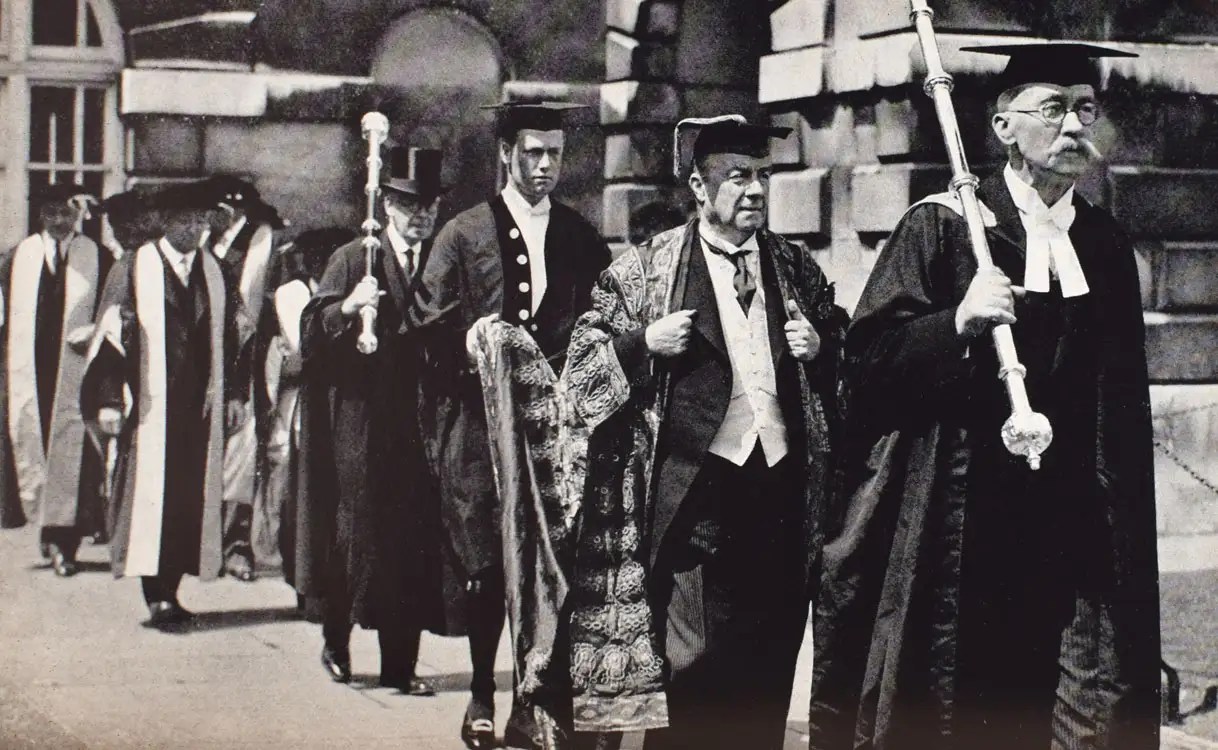
Nothing that intellectual. Instead Woolf digresses into a long and amusing passage about the ludicrous ceremonial outfits which many men wear on formal occasions or as part of their ceremonial roles (judges, Chelsea pensioners, officials in Parliament) and the medals and titles men give each other. In her opinion these are all designed to flaunt their superiority over others. The book includes four contemporary photos of contemporary men dressed in regalia at formal ceremonies and very silly they look, too.

A university procession, from ‘Three Guineas’

She makes a simple point: men down the ages have ridiculed women for being so concerned about their clothes and dress; well, just look at these preposterous old buffers in their wigs and gowns and cloaks and gaiters.

But there’s also a serious point which is germane to her war theme: for she suggests that it is this flaunting of hierarchy and status, this cursed male wish to be superior, which is one of the roots of war. And so she thinks a good way to prevent war would be to attack this cause at the root and refuse to accept honours (as she did) or take part in silly ceremonies (a point developed at length in section 3).

Shortcoming 2. Over-reliance on biography as her primary evidence

The limitations of her education partly explain Woolf’s over-reliance on biography as evidence. She shows little sign of having read much history, economics, science or engineering, philosophy, psychology or sociology – some, but not much, and when she cites history books it’s rarely for the economic or social data.

Instead, what she does rely on to an overwhelming extent is biographies: all the damning evidence she assembles to demonstrate British society’s engrained misogyny and the power of the patriarchy is rarely drawn from history or sociology but relies exclusively on biographies and autobiographies and letters. The phrase you get in so many book titles, ‘Lives and Letters’, sums it up exactly. As an indication of her reliance on biography, here are quotes from just on one page:

  • ‘The witness of biography — that witness which any one who can read English can consult on the shelves of any public library…’
  • ‘Biography proves this in two ways…’
  • ‘Of this, too, there is ample proof in biography…’
  • ‘The study of biography… proves…’
  • ‘Perhaps the greatest testimony to the value of education with which biography provides us is…’
  • ‘You will find, if you consult biography…’

No need to consult facts and figures, assess data, decipher manuscripts, spend years in the archives. Again and again she takes the biography of an eighteenth century bluestocking or a nineteenth century hack writer like Mrs Oliphant off the shelf, and finds and pastes into her narrative their complaints about their limited lives and the dire condition of women in their time, which suit her argument.

(She does mention some histories but, when you look closely you see that she picks out of her historical sources the lives and opinions of her women witnesses: in other words, she selects the biographical elements of history and ignores the statistics, data, political history and so on.)

Late in the essay, rather as she does with her claims to be an amateur, untrained in academic enquiry, she turns an apparent weakness on its head. She tells us that she relies so much on (a very limited view of) history, on biography and newspapers, because they are the only sources of information open to a woman who has been denied a better, higher education, because of her sex; for:

history, biography, and… the daily paper [are] the only evidence that is available to the ‘daughters of educated men’.

Her very lack of scholarly rigour is itself an indictment of the patriarchal oppression which kept her excluded from the higher education her brothers and millions of men had benefited from.

And newspapers

She regards newspapers as ‘history and biography in the raw’. The excellent introduction by Anna Snaith tells us that Woolf kept three scrapbooks in which she gathered evidence for this book. It is striking how many of these snippets and excerpts are taken from newspaper articles or magazines, not the most in-depth kind of research. Newspapers are, by their nature, selective and biased and superficial. They sensationalise in order to sell copies. They are, in other words, the opposite of academic research into history, sociology and so on. This is a weakness in her evidence base.

On the other hand, newspapers are topical and up to date and give her useful snapshot of contemporary opinion – which makes them very interesting for the causal reader, 90 years later. Here’s a sample of the sources, taken from the numbered list of references at the back, which shows the combination of biography and newspaper cuttings which she overwhelmingly relies on as evidence.

  1. ‘Personal Reminiscences of a Great Crusade’ / a cutting from The Herald
  2. a cutting from The Listener / ‘Reflections and Memories’ by Sir John Squire
  3. ‘The Life of Sophia Jex-Blake’ by Margaret Todd
  4. Letter to The Times
  5. Debretts
  6. ‘Life of Sir Ernest Wild, K.C.’ by R.J. Rackham
  7. Lord Baldwin, speech reported in The Times
  8. ‘Life of Charles Gore’ by G.L. Prestige
  9. ‘Life of Sir William Broadbent’ edited by his daughter
  10. ‘The Lost Historian, a Memoir of Sir Sidney Low’ by Desmond Chapman-Huston
  11. ‘Thoughts and Adventures’ by Winston Churchill
  12. Speech at Belfast by Lord Londonderry, reported in The Times

You get the picture: her main sources are lives, letters and newspapers.

The second letter: funding a women’s college

Since the essay is in three parts and the introduction says it addresses three letters, I thought it would be a part per letter, so I was surprised when the second letter pops up at the end of part one. It is from a women-only college writing to ask Woolf to contribute to their fund raising. Anna Snaith’s excellent notes tell us it was a real letter Woolf received from Joan Strachey, Principal of the women-only Newnham College in Cambridge, asking for a donation to renovate the college buildings.

Woolf shows with some doleful quotations and examples, how petty-minded, snobbish and fierce for their stupid rules and regulations the existing (men-only) universities are. She harks back to the notorious incident of being kicked off the grass by the beadle early in ‘A Room of One’s Own’, which clearly still rankles.

Therefore, she replies to this letter that she will consider contributing to a women-only college but only if it is drawn up on a completely different basis from the male colleges. She proceeds to lay out the principles for an experimental college, one which will eschew all competition and exams, be open to the poor, and teach the humanities in a spirit of openness and collaboration:

A place where society was free; not parcelled out into the miserable distinctions of rich and poor, of clever and stupid; but where all the different degrees and kinds of mind, body and soul merit cooperated. Let us then found this new college; this poor college; in which learning is sought for itself; where advertisement is abolished; and there are no degrees; and lectures are not given, and sermons are not preached…

She warns that if the women-only colleges model themselves along male lines, with all the snobbery and competition and status-seeking and petty rankings that entails… those are precisely the kinds of habits of thought, the endless seeking superiority, which create the war mentality and she will not contribute to it.

And no chapels. She is as vehemently against the all-women colleges having chapels as she is violently against the engrained misogyny of the Church of England.

No to teaching English literature

She has a fierce passage execrating the teaching of English literature and its packaging into classes and exams, which she describes as ‘vain and vicious’. This is why Woolf herself refused to accept honorary degrees or prizes, despite being offered many in the later part of her life, and turned down offers to lecture (the exception which proves the rule being the lectures which formed the basis of ‘A Room of One’s Own’).

Woolf explains women’s war patriotism as an escape from domestic oppression

In a wonderfully irrational peroration she thinks that it can only have been delirious joy at being released from the narrow, cramped, uneducated lives forced upon Victorian daughters and spinsters which explained the huge outburst of patriotic enthusiasm among women at the outbreak of the Great War in 1914.

So profound was her unconscious loathing for the education of the private house with its cruelty, its poverty, its hypocrisy, its immorality, its inanity, that she would undertake any task however menial, exercise any fascination however fatal that enabled her to escape. Thus consciously she desired ‘our splendid Empire’; unconsciously she desired our splendid war.

This is splendid rhetoric but it’s a symptomatic of her failure to understand the causes of war, her failure to understand the psychology of crowds and societies embarking on war, her failure to understand genuine feelings of patriotism or national pride which are such big motivators for large numbers of people in any country – in a nutshell, her failure to understand anyone outside her own narrow upper-middle-class milieu.

Shortcoming 3. Ignorance of the wider world

I think her failure to understand the patriotic zeal which accompanied the start of World War One is indicative of her broader failure to understand the range and complexities of human nature, of all human nature across all of society.

Of the narrow little world of upper-middle-class women whose lives are supported by fleets of nameless servants which allow them to pursue their tedious obsession with art and poetry, of this tiny privileged world, she was a brilliant painter.

Of the big wide world, of the thousands of occupations, jobs and livelihoods, in finance, business, economics, trade, law, science, technology and engineering, of the lives of the working classes with their labour in coal mines and iron works, building ships, sailing the oceans, building trains and cars, laying down telegraph cables – in other words, in almost all the wide world and its billions of inhabitants, she has little or no interest and makes no effort to understand.

As an artist, as a writer, it doesn’t matter. Her novels focus on her chosen terrain and are masterpieces. As an essayist, claiming to gather evidence in order to analyse large social issues, it is, to say the least, problematic.

Giving a guinea

Out of this rather convoluted flow of arguments, Woolf concludes that she ought to give a guinea to the building of the women’s college, because it was entrapment in the family home that led so many women to explode with patriotism upon the outbreak of war. Building a college for the public education of the same class will prevent that and so materially contribute to the prevention of war which, if you recall, was the aim proposed right at the start of the essay.

Part 2. The professions

How can we enter the professions and yet remain civilized human beings, human beings who discourage war?

Woolf says a woman like her has only one weapon at her command to use against war, ‘the weapon of independent opinion based upon independent income.’ Now she will try to use this to sway the men in the professions.

The pretext is another letter she has received, from a society supporting women in the professions, asking for another donation, this time to the support of hard-up professional ladies. For Woolf it begs the question why, 20 years after women were admitted to the professions (1919) so few have risen to the top rank and so many are hovering round the bottom.

Woolf’s answers are convoluted and involve replies to other letters and lengthy addresses to her fictional interlocutor, they but boil down to:

  • women have much shorter traditions of thriving in the professions and so lack the centuries-old networks of male patronage and preferral
  • there are no limits to educated men churned out by the public schools and major universities, whereas there are far fewer schools for girls, only four or five colleges for women, and even the numbers admitted to these are severely restricted (only 500 women students were permitted at Cambridge in her day)
  • exams in the professions advantage those who have spent their lives taking exams, i.e. privileged, privately-educated men, and bar women who have (as she shows) vastly less access to private education
  • the nearly universal sexism and misogyny found at all levels of English society

Sexism and misogyny

As mentioned above, the flow of Woolf’s arguments is sometimes hard to follow, especially when it feels like she’s twisting the flow in order to fit her broader feminist critique to fit the essay’s ostensible subject of how to prevent war – but what the essay indisputably does do is powerfully convey the deeply entrenched tentacles of the patriarchy in contemporary 1930s England. She presents a wealth of facts and figures about the systematic prevention of women being educated, getting jobs, entering the professions and so on.

In this second part, the essay builds up into a devastating demonstration of English society’s hair-raising sexism and misogyny. In the main text but especially in the extensive notes which illustrate it, Woolf gives extended quotes from a wide range of men in powerful positions expressing the most hair-raising prejudices and slurs. I can’t give brief quotations, you have to read the notes, and the extended stories she gives, of awful politicians, judges, professionals, writers and commentators taking every opportunity to demean and limit women.

Fascists and Nazis

Woolf cranks up the temperature a lot by comparing several terrible British chauvinists who pontificate that a woman’s place is in the home, with a quote from none other than Adolf Hitler saying the exact same kind of thing.

Herr Hitler and Signor Mussolini have both often in very similar words expressed the opinion that ‘There are two worlds in the life of the nation, the world of men and the world of women’; and proceeded to much the same definition of the duties.

The juxtaposition of the two explains in a flash why Woolf is so resistant to all male talk about patriotism and ‘our country’. In what possible sense is it ‘her country’ when the Archbishop of Canterbury and the editor of the Daily Telegraph hold identical views about women’s place in society as Adolf Hitler? The same point is made in one of the long notes:

‘My husband insists that I call him “Sir”,’ said a woman at the Bristol Police Court yesterday, when she applied for a maintenance order. ‘To keep the peace I have complied with his request,’ she added. ‘I also have to clean his boots, fetch his razor when he shaves, and speak up promptly when he asks me questions.’ In the same issue of the same paper Sir E. F. Fletcher is reported to have ‘urged the House of Commons to stand up to dictators.’ (Daily Herald, 1 August 1926.)

Why, Woolf asks, all this fuss about opposing dictators abroad when every level of British society supports domestic tyrants at home?

Pay for housework

Men work in the public realm and get paid, sometimes a small fortune, often for jobs of dubious worth. Women labour in the home to raise families and manage households and care for the elderly, all unpaid. So: women’s domestic work should be paid.

The work of an archbishop is worth £15,000 a year to the State; the work of a judge is worth £5,000 a year; the work of a permanent secretary is worth £3,000 a year; the work of an army captain, of a sea captain, of a sergeant of dragoons, of a policeman, of a postman – all these works are worth paying out of the taxes, but wives and mothers and daughters who work all day and every day, without whose work the State would collapse and fall to pieces, without whose work your sons, sir, would cease to exist, are paid nothing whatever.

I wonder who first originated this call? Mary Wollstonecraft in ‘A Vindication of the Rights of Woman’ (1792)? Certainly Friedrich Engels mentions it in his 1884 book ‘The Origin of the Family, Private Property and the State’. Anyway, Woolf makes a sustained case for it over many pages, 30 years before the issue was revived by second-wave feminists in the 1970s:

Note: I was a househusband for eight years. I did all the childcare, running children round to nurseries, playgroups, parties, doing all the shopping, cooking and cleaning, changing thousands of nappies, giving bedtime baths and so on, while my wife earned the family income. So I have lived experience of issues like this. It’s this lived experience which feeds into my scepticism about feminism, not as a theory (fine and dandy) but in practice (complicated and compromised). I met plenty of women who were extremely happy to pack in office work and become full-time mums and housewives, who loved looking after their young children, dressing them up, holding parties, dropping them at nurseries or infant school and going to meet girlfriends for lunch or coffee.

Then again, some didn’t. Some felt trapped and needed support, would have welcomed free or cheap childcare, or just wanted to go back to work which they found more fulfilling than hanging round playgrounds or hosting rooms full of screaming kids.

I had many conversations with scores of mums about how the state should provide cheap childcare, or if only companies would allow more flexible work based around school hours, if only housework was recognised and paid for like other forms of work, and so on and so on. Hundreds of conversations on these and related subjects, over years and years.

So my scepticism about feminism is not ideological or temperamental. It’s based on the lived experience of being a housekeeper and child-rearer myself, and talking to hundreds of women in the same situation. The problem is not the top-level slogans and demands, anyone can come up with catchy slogans and carry banners – “Wages for Housework” – it’s figuring out the practical policies and application: where would the money come from? How would it be paid out? Who defines ‘housework’? Like child benefit would it go to anyone caring for a child or be subject to conditions? How would you prove that you do the housework and don’t sub-contract this or that part to cleaners or nannies? etc etc.

The procession

Back to the Woolf on the professions. She gives a vivid description of the processions of all the professions through London’s streets to the centres of law, finance and so on and asks her women readers: do we, in fact, want to be part of this procession? Do we want to do the same jobs but for less pay and more condescension? Or do we want to strike out on our own and lead our lives differently?

The facts… seem to prove that the professions have a certain undeniable effect upon the professors. They make the people who practise them possessive, jealous of any infringement of their rights, and highly combative if anyone dares dispute them. Are we not right then in thinking that if we enter the same professions we shall acquire the same qualities? And do not such qualities lead to war? In another century or so if we practise the professions in the same way, shall we not be just as possessive, just as jealous, just as pugnacious, just as positive as to the verdict of God, Nature, Law and Property as these gentlemen are now?

She gives a number of quotes from lawyers, clerics and politicians complaining they lead a dog’s life, and have sacrificed all their pleasures and family time to their work. Do modern women want to rush into exactly the same kind of wage slavery?

Woolf wonders if we can turn to the lives of nineteenth century women in the professions to help us find a more humane way to have one of these high-powered jobs and live properly? No, because there weren’t any women in the nineteenth century professions. They weren’t allowed. Instead:

We find, between the lines of their husbands’ biographies, so many women practising – but what are we to call the profession that consists in bringing nine or ten children into the world, the profession which consists in running a house, nursing an invalid, visiting the poor and the sick, tending here an old father, there an old mother? – there is no name and there is no pay for that profession; but we find so many mothers, sisters and daughters of educated men practising it in the nineteenth century that we must lump them and their lives together behind their husbands’ and brothers’.

The validity of housework and child-rearing, again, and the long buried, unrecorded of the scores of millions of women who spent their entire lives doing it.

Giving the second guinea

All these arguments have been contained, rather confusingly, in a very long letter replying to the letter she received asking for financial aid for impoverished women professionals. Woolf sums up her position by saying she will send the letter-writer one guinea ‘on condition that you help all properly qualified people, of whatever sex, class or colour, to enter your profession’, and in addition ensure that women:

  • must earn enough to be independent
  • must not prostitute their brain to their profession
  • must refuse all prizes, medals and awards, and be content with obscurity
  • must rid themselves of religious pride, college pride, school pride, family pride, sex pride and those unreal loyalties that spring from them

These are obviously very strict, probably utopian conditions, as with her demand for a completely different type of college which ended section 1. But:

If you agree to these terms then you can join the professions and yet remain uncontaminated by them; you can rid them of their possessiveness, their jealousy, their pugnacity, their greed. You can use them to have a mind of your own and a will of your own. And you can use that mind and will to abolish the inhumanity, the beastliness, the horror, the folly of war.

Antigone saying No to male tyranny

Part two rises to a very powerful invocation of Sophocles’ play, Antigone. Woolf studied this when young and it stayed with her all her life as a powerful story of female resistance to male tyranny. In the era of Hitler and Mussolini it was more than ever relevant. She comes back to it later.

No risk because of exclusion

Woolf ends part 2 with a grand fanfare of irony, saying there is no immediate risk of women professionals losing their souls and working themselves to shreds so long as the laws of England hold their nationality so lightly, prevent them from working in many professions, limit the numbers who can attend university, and ensure that so many women continue to live in the tradition of neglect and contempt, living gruelling lives of unpaid work in dark patriarchal homes.

Part 3. The Outsider Society

The sarcasm and irony which have been present throughout the essay rise to a real anger and bitterness in this, the longest of the three parts.

Woolf reverts back to the original letter she was sent, the one from the unnamed male correspondent asking her how they can prevent a war, and she repeats his three suggestions, namely that we should:

  1. sign a manifesto pledging ourselves ‘to protect culture and intellectual liberty’
  2. join a certain society, devoted to certain measures whose aim is to preserve peace
  3. should subscribe to that society which like the others is in need of funds

Failure of the universities

She addresses these points one by one. First she is satirical about this idea of ‘protecting culture and intellectual liberty’. Isn’t this what the Great Universities have said they were devoting themselves to for centuries, the ones which have been teaching men these values and brutally excluding their sisters and daughters? Is the fact that these values now need such support from society an admission that all those centuries of learning have failed? And if they’ve failed, why should the impoverished, life-opportunity-deprived daughters and sisters suddenly rush to the help of their oppressors?

What is ‘culture and liberty’?

Anyway, what is this ‘culture and liberty’ the letter writer refers to? She knows what it isn’t. Characteristically, she turns to biography and uses the life of an author like Mrs Margaret Oliphant (1828 to 1897) who, after her husband died, churned out meretricious romances to support her children. Was this intellectual liberty? No, this was intellectual prostitution and Woolf angrily takes it as typical of the intellectual prostitution forced on so many women writers and artists who had to sell their souls and prostitute their art because of the patriarchy’s refusal to let them earn a living any other way.

So she mocks the letter writer’s suggestion that women, victims of centuries of repression, should suddenly rush to help the poor privileged men in their time of need. He wants her to join his pacifist society, does he? Well, no. The very word ‘society’ denotes the systematic exclusion of women from education and influence and power and money, so screw society.

The very word ‘society’ sets tolling in memory the dismal bells of a harsh music: shall not, shall not, shall not. You shall not learn; you shall not earn; you shall not own; you shall not – such was the society relationship of brother to sister for many centuries.

The Outsiders Society

She’s not going to join any boys’ club. Instead she proposes setting up a separate organisation, for women of her class and (lack of) education. It would be called The Outsiders Society. It would consist of educated men’s daughters working through their own class and by their own methods for liberty, equality and peace. Members would:

  • not fight
  • not work in munitions factories or nurse the injured
  • not encourage men to go and fight but maintain an attitude of neutrality, as fighting is a ‘sex characteristic which she cannot share’

She rises to real bitterness:

She will find that she has no good reason to ask her brother to fight on her behalf to protect ‘our’ country. ‘”Our country,”‘ she will say, ‘throughout the greater part of its history has treated me as a slave; it has denied me education or any share in its possessions. “Our” country still ceases to be mine if I marry a foreigner. “Our” country denies me the means of protecting myself, forces me to pay others a very large sum annually to protect me, and is so little able, even so, to protect me that Air Raid precautions are written on the wall [i.e. women are defenceless against modern warfare]. Therefore if you insist upon fighting to protect me, or “our” country, let it be understood, soberly and rationally between us, that you are fighting to gratify a sex instinct which I cannot share; to procure benefits which I have not shared and probably will not share; but not to gratify my instincts, or to protect either myself or my country. For,’ the outsider will say, ‘in fact, as a woman, I have no country. As a woman I want no country. As a woman my country is the whole world.’

Wow. Very powerful. Furthermore, The Outsider will cultivate complete indifference to male nonsense about patriotism, war and fighting. On the contrary, she will:

  • take no part in patriotic demonstrations
  • not take part in patriotic praise
  • absent herself from military displays, tournaments, tattoos, prize-givings and all such ceremonies as encourage the desire to impose ‘our’ civilization or ‘our’ dominion upon other people

The idea is that this ‘indifference’ will damp down patriotic fervour in those around her and thus, in a tiny way, help to avoid war.

All this makes a sort of sense. But it feels like twisting logic when Woolf goes on to assert a link between these anti-war steps and the positive demands of her feminist programme. The connection feels tenuous and forced. Because she now switches to say that in order for their opinion or actions to matter, the outsiders must push for a raft of feminist requirements, being:

  • they must earn their own livings
  • they must press for a living wage in their professions
  • they must create new professions in which they can earn a living wage
  • they must press for press for a money wage for the unpaid worker in her own class – the daughters and sisters of educated men
  • they must press for a wage to be paid by the State to the mothers of educated men

Make the state pay for housework

This last is vital because until she has complete financial independence, a wife is dependent on her husband for money and will follow his opinions and men are for war. Therefore, in order to create an influential bloc of educated women who are against war, this class must be given financial, and so intellectual, independence. Women must be paid by the State for their work as mothers.

And she tells her male interlocutor that this step – paying women for their housework – would also liberate husbands, because by sharing the burden of earning an income they would no longer be wage slaves, slaves to the rat race. It would have an enlightening and life-enhancing effect all round.

I gave my thoughts on this proposal earlier. It sounds great, and you can see her logic – that women can only be truly independent and free if they have their own income, separate from their father’s or husband’s – but how would it be implemented in practice?

I’ll just make the additional point that its recurrence here is characteristic of how key themes and suggestions recur throughout the essay, building up power through repetition and echoes, not unlike her technique in her novels.

Outsider demands

But she hasn’t finished with her demands. The Outsiders would:

  • not only earn their own livings but become so expert that their threat to down tools would have power and influence
  • when they have earned enough to live on they would earn no more i.e. not pile up obscene wealth
  • they would reject any profession hostile to freedom such as the arms trade
  • they would refuse to take office in any institution which pretends to respect liberty but actually restricts it, such as Oxford and Cambridge

Outsiders will eschew all the stupid costumes and ceremonies so beloved by men (see the section about silly ceremonials in part 1).

Outsiders will eschew ‘the coarse glare of advertisement and publicity’ and prefer to work in honest obscurity.

The secret society already exists

Wandering into thriller territory, Woolf suggests that this Outsider Society already exists but is secret and underground in its activities. Her very dubious evidence for this far-fetched claim is a clutch of newspaper reports of various women officials making comments against war, opposing arms manufacture and the like. From random quotes and newspaper clippings she based the existence of a secret society operating across English society. Is this an example of her sometimes utopian or far-fetched argumentation – or an example of her dry sense of humour? Difficult to tell.

Against the Church of England

Outsiders will:

  • fearlessly investigate and criticise public institutions they are forced to contribute to, such as the universities, but especially the Church of England
  • by criticizing religion they would attempt to free the religious spirit from its present servitude and would help, if need be, to create a new religion based it might well be upon the New Testament, but, it might well be, very different from the religion now erected upon that basis

Woolf’s attitude to the Church of England had already been indicated in the passage about cited above about Antigone where she writes that ‘Antigone’s five words are worth all the sermons of all the archbishops’, those five Greek words (they total 11 in the English translation) being:

‘Tis not my nature to join in hating, but in loving.’

Pages 196 to 202 give a scathing account of how Jesus Christ’s own admonition that his followers are equal which promised equality between men and women was denied by St Paul, who invented the idea that women must be veiled in church and not speak. This bigotry hardened over the centuries into a church which forbids any positions of power or influence in the most powerful and prestigious organisation in the land, to women.

With the result that the salary of an archbishop is £15,000, the salary of a bishop is £10,000 and the salary of a dean is £3,000. But the salary of a deaconess is £150; and as for the ‘parish worker’, who ‘is called upon to assist in almost every department of parish life’, whose ‘work is exacting and often solitary…’ and who is most likely to be a woman, she is paid from £120 to £150 a year.

It’s a pattern mirrored in all the other professions and walks of life: women excluded from all the prestigious, well-paid higher positions, and forced to undertake the most menial and poorly-paid jobs.

Psychoanalysis, anger and fear

One of Anna Snaith’s excellent notes tells us that ‘Woolf’s brother Adrian [Stephen] and his wife Karin were trained psychoanalysts and were crucial in disseminating Freud’s work in England.’ This is relevant because Woolf quotes at length from the Archbishops’ Commission on the Ministry of Women (1936) and in particular from the appendix written by Professor Grensted, the Nolloth Professor of the Philosophy of the Christian Religion in the University of Oxford.

This professor concluded that there is no reason in theology (Christ’s teachings) why there should not be women priests, but there were strong objections to women priests among the clergy. Digging deeper he uses Freudian terminology to suggest the deep conviction held by many men of men’s superiority and women’s inferiority.

The causes are obscure but the outcome is obvious: that whenever a conversation lights on the topic of equality for women and women holding roles up till now reserved for men, many man become angry and many women become fearful. This imbalance leads women not to raise, mention or discuss the issue which, as a result, goes underground.

The infantile fixation

Woolf takes from Grensted the notion of the ‘infantile fixation’. I didn’t quite understand this and I didn’t see her defining it anywhere. Instead she gives three examples of what she means (taken, inevitably, from biographies), namely the wildly irrational anger and jealousy triggered in three classic Victorian fathers when their daughters asked permission to get married or (worse than that) to get a job. The fathers being:

  • Mr Barrett (father of Elizabeth who wanted to marry the poet Robert Browning)
  • the Reverend Patrick Brontë (father of Charlotte who wanted to marry)
  • Mr Jex-Blake (father of Sophia who was offered a small sum for tutoring mathematics to a friend)

By contrast, to show the impact of a father’s liberality, she gives the story of Mr Leigh Smith. It’s worth quoting at length because the impact is in all the details. Smith had a daughter, Barbara, who he loved.

When Barbara came of age in 1848 he gave her an allowance of £300 a year. The results of that immunity from the infantile fixation were remarkable. For ‘treating her money as a power to do good, one of the first uses to which Barbara put it was educational.’ She founded a school; a school that was open not only to different sexes and different classes, but to different creeds; Roman Catholics, Jews and ‘pupils from families of advanced free thought’ were received in it. ‘It was a most unusual school,’ an outsiders’ school. But that was not all that she attempted upon three hundred a year. One thing led to another. A friend, with her help, started a cooperative evening class for ladies ‘for drawing from an undraped model’. In 1858 only one life class in London was open to ladies. And then a petition was got up to the Royal Academy; its schools were actually, though as so often happens only nominally, opened to women in 1861; next Barbara went into the question of the laws concerning women; so that actually in 1871 married women were allowed to own their property; and finally she helped Miss Davies to found Girton. When we reflect what one father who was immune from infantile fixation could do by allowing one daughter £300 a year we need not wonder that most fathers firmly refused to allow their daughters more than £40 a year with bed and board thrown in.

The difference just one liberal father made. What if all Victorian fathers had been like that.

Sexist science

There follows a passage giving some examples of how even contemporary science is twisted to prove the inferiority of women. To be honest this section is neither very compendious nor persuasive. She doesn’t really go into the most basic accusation against women, that their bodies are designed for childbirth and child-rearing and this explains why their minds are limited to domestic subjects and childish logic. (I’m not saying this, I’m repeating the sexist, misogynist accusation.)

This is a failing but I think reflects the limitations of Woolf’s knowledge and education. Of science she knows next to nothing and so is simply incapable of unpacking all the biological and psychological aspects of woman-hating. She is much more at home in her comfort zone of education and literature, the lives of women writers.

She cites Bertrand Russell pointing out the sheer sadism of much medical science towards women (the medical profession’s reluctance to provide painkillers to women in childbirth) or the twisting of scientific knowledge to justify male superiority – but not as amply as this huge subject demands.

Cleons

Instead she reverts to literature again, and her obsession with Antigone. In the play the oppressive father is Cleon, the archetype for the Victorian paterfamilias and the modern fascist. Here is Cleon speaking dictator-talk:

‘Whomsoever the city may appoint, that man must be obeyed, in little things and great, in just things and unjust… disobedience is the worst of evils… We must support the cause of order, and in no wise suffer a woman to worst us… They must be women, and not range at large. Servants, take them within.’

Order and the oppression of women, Mr Barrett and Mussolini.

The personal and the private

In the essay’s last pages she brings things together by (rightly) saying that she has shown how male tyranny in the personal, domestic realm and in the public realm, are intimately linked:

that the public and the private worlds are inseparably connected; that the tyrannies and servilities of the one are the tyrannies and servilities of the other.

Despite the strangeness of the letter-answering structure and the oddly digressive, rambling flow of the argument, by the end she has presented a devastating barrage of evidence, as well as making a host of demands and suggestions.

The third guinea

So she refuses to sign the form her correspondent had sent her. She refuses to sign up to his society because of her opposition to all such male bodies, but she will send him a guinea to support it.

Their aims are the same, to oppose the tyrants in the name of Justice and Equality and Liberty. But, as this amazing book has explained, as a woman, as the patchily educated ‘daughter of educated men’, as someone with completely different life experiences and, consequently, utterly different perspectives from the male sender of the letter, she shares the same aim but insists that she will try to bring it about using, not the old male forms and words, but new words and new ideas appropriate for women.

Magnificent

For all its faults, ‘Three Guineas’ is a magnificent, powerful and very persuasive piece of work. Her assembly of a very wide range of evidence, facts and figures really bring home the historical endurance, depth and wide range of the legal, financial and cultural oppression of women throughout English history and the stupid, patronising and misogynist attitudes and opinions deployed to maintain that oppression.

The notion of the Outsiders Society is the crystallisation of the massive theme which emerges repeatedly throughout the text, the idea that women – not because of any biological or psychological differences – but purely because of the legal, financial, professional and cultural apartheid they have suffered for centuries, bring to the table a different perspective from men across a whole range of issues.

I think it’s a magnificent example of a polemical essay, of an impassioned political pamphlet.

Criticisms

There are a number of problems or issues with Woolf’s way of arguing. Initially I included them in my review where they occurred but they cluttered up the flow of my review, and gave an unduly negative opinion too early on. I mentioned three earlier on. Here are a few more.

Shortcoming 4. Woolf’s intellectual confusions

Periodically throughout the text Woolf freely admits to own intellectual shortcomings: for example, right at the start she admits being bewildered that there seems to be a wide range of opinions about whether war is good or inevitable. She herself tells us that the more she reads, the more opinions she discovers, the more confused she becomes. But… is that not the point of being an intellectual: to read all the opinions, weigh the evidence, and develop your own line of argument, based on the evidence you uncover and reacting to other people’s arguments?

This activity, intellectual activity, always puzzles and confuses Woolf. In ‘A Room of One’s Own’ there’s the section where she orders up some books in the British Museum and opens them up, expecting to discover The Truth staring her in the face.

Sometimes this is part of her general mocking irony, mocking the pretensions of pretty much all male activity, including the grand Pursuit of Truth. But at other times it can give you the worrying sense that she doesn’t really understand what intellectual enquiry is.

Her intellectual confusion as evidence of her case

In the opening and then at various transition moments, Woolf explicitly tells us that she struggles to marshal the evidence, is embarking on something too big for her abilities, and wonders if she’d be better off abandoning it. After a while I realised that maybe these passages are designed to dramatise the issue of women’s exclusion from formal education by using herself as an example.

Woolf’s brothers went to top private schools and Oxbridge whereas she more or less had to educate herself at home and mostly taught herself by browsing through her father’s extensive library. In other words, every time she shares how confused by the evidence or daunted by the challenge of answering big question she is, she is demonstrating the effect of the grotesquely unequal education of the genders, how women have been the victims of ‘tradition, poverty and ridicule’, and showing the reader how she (and we) are suffering for it.

Maybe that’s why she flaunts her own intellectual limitations so much: the intellectual inability she frequently laments is the result of her exclusion from higher education. It makes her case for her.

Shortcoming 5. Her analysis is restricted to a (relatively) small class

Her lack of real confidence in her own research, and her need to make her feminist points as categorical and powerful as possible, explain why Woolf makes the strategic decision of restricting her analysis to a relatively small class, to women like herself, to ‘the daughters of educated men’, as she describes them. As she puts it:

Our ideology is still so inveterately anthropocentric that it has been necessary to coin this clumsy term – ‘educated man’s daughter’ – to describe the class whose fathers have been educated at public schools and universities. Obviously, if the term ‘bourgeois’ fits her brother, it is grossly incorrect to use it of one who differs so profoundly in the two prime characteristics of the bourgeoisie – capital and environment.

She makes it quite clear on page one that she is only discussing upper-middle-class women, women like herself, women with immaculate manners who are used to managing servants and know which of the many forks and spoons to use at a formal dinner.

In order to avoid the confusions, contradictions and conflicting evidence I mentioned above, in order for her analysis to work, she has to reject the vast majority of the population (the working class and lower classes, of both sexes) and identify her cause with just this numerically small and limited class of posh ladies.

It isn’t just me pointing this out. The Wikipedia article about Three Guineas tells us that the noted academic Q.D. Leavis wrote a scathing review of ‘Three Guineas’ soon after it was published:

She denounces the essay because it is only concerned with ‘the daughters of educated men’, seeing Woolf’s criticisms as irrelevant to most women because her wealth and aristocratic ancestry means she is ‘insulated by class’.

And Anna Snaith’s notes in the Oxford University Press edition tell us that Woolf received letters from working class women readers who complained about being left out of her analysis, notably a long semi-autobiographical one from a working class woman named Agnes Smith.

This is closely related to what I called shortcoming 3, ignorance of the wider world. But it’s also a decision. She found it hard enough gathering the evidence for the sexist discrimination against her own type and class of woman. If she opened it up to the broader middle and working classes she’d never have finished it.

2025: the perils of intersectionality

Many of these criticisms are mentioned in Anna Snaith’s introduction to the Oxford University Press edition. Here she indicates the larger cultural and political problems the essay falls foul of. This is that there are, nowadays, so many grievances, so many groups claiming to be victims, so many communities and identities who feel that they, too, have been subjected to centuries of oppression, that it is hard to focus on just one, and it is especially hard to focus on the group Woolf defines as the ‘daughters of educated men’.

As you read Snaith’s account of Woolf’s life and social circle, with so many friends among England’s political and cultural elite, the idea of her as a persecuted outsider feels more and more ludicrous. She wasn’t a Jew in Hitler’s Germany, a Black in the American South, a kulak in Stalin’s Russia, an Aborigine in Australia, she grew up in a house full of books which she was actively encouraged to read and went on to become a centre of London’s literary and artistic elite.

This doesn’t invalidate any of the points she makes in the book or detract from the essay’s tremendous power. It’s just to say that the struggle for women’s equality takes its place among quite a few other struggles. I’ve a book about the Irish Civil War on my desk and Irish nationalists have quite a story to tell about 1,000 years of British oppression. Her husband was a Jew who had his own story about the legal and financial persecution of Jews. Something similar could be said of England’s Roman Catholics, prevented by law from holding official positions. Or – a group close to my heart – England’s non-conformists, banned by law from holding any positions of authority for 300 years after the civil war. Citizens from India or any of the colonies we ruled for centuries might have a thing or two to say about Britain’s oppression of their peoples and cultures.

Being a modern academic, Snaith is contractually obliged to drag in slavery – the progressive topic par excellence – to her discussion of ‘Three Guineas’, on the rather tenuous basis that guineas were, apparently, first used as currency in the British slave trade. Don’t know what Virginia would have made of that scholarly leap of imagination.

To repeat – this little digression about the modern over-abundance of historical grievances is not entirely my view but simply expanding points made by the book’s editor, Anna Snaith, in her introduction.

All these other issues don’t invalidate any of the points Woolf makes in the book but they place it in a much larger, real world context. If you’re a feminist, you can insist that your cause and your history of oppression is the real one, the big one, the important one and, convinced of your righteousness, overlook or downplay the grievances of all the other groups I’ve mentioned. In a sense, to get anything done, you have to focus on your issues and grievances; nobody can represent the issues of the whole world. You have to pick your battles. And this explains why Woolf realised that, in order to get her book written, she had to concentrate just on relatively privileged upper-middle-class women like herself, on ‘the daughters of educated men’.

Conclusion

It’s a very powerful book. Very. To repeat what I said at the start, from one point of view it may be her most important work. It’s a bit of a struggle, a bit meandering, a bit puzzling in places, her proposals such as for the Outsider Society are a bit eccentric – and yet so many of her main points drive right home, and the evidence gathered in the notes at the end is searing, blistering, eye-opening. It shook this old cynic. It materially changed my views about feminism. I strongly recommend it.


Credit

‘Three Guineas’ by Virginia Woolf was first published by the Hogarth Press in 1938. Page references are to the 2015 Oxford University Press paperback edition, edited and annotated by Anna Snaith, although the text is easily available online.

Related links

Related reviews

Orlando: A Biography (1928) by Virginia Woolf

First and foremost ‘Orlando’ is a joke, a jeu d’esprit. Who knew that the author of the essentially tragic novels ‘Jacob’s Room’, ‘Mrs Dalloway’ and ‘To The Lighthouse’ (key figures die in all of them) had a funny bone.

But here she is, creating the comic biography of a fantastical figure, a person who lives from the later years of Queen Elizabeth I (the 1580s) right through to the last pages, set in 1928, some 340 years later.

The comic biographer

Several aspects become clear early on. One is our old friend the intrusive narrator, presenting, displaying and commenting on their presentation of the characters and events. The narrator appears as the gently mocked figure of The Good Biographer, mocking her own role:

Happy the mother who bears, happier still the biographer who records the life of such a one!

And so, mounting up the spiral stairway into his brain–which was a roomy one–all these sights, and the garden sounds too, the hammer beating, the wood chopping, began that riot and confusion of the passions and emotions which every good biographer detests…

Directly we glance at eyes and forehead, we have to admit a thousand disagreeables which it is the aim of every good biographer to ignore.

And the biographer should here call attention to the fact that this clumsiness is often mated with a love of solitude.

Here, indeed, we lay bare rudely, as a biographer may, a curious trait in him…

And so on. From the get-go, the entire concept of a biography is mocked and lampooned from within, so to speak.

Mockery and comic exaggeration

As to the content, this also is lampooned in a number of styles. It is mildly mocking to write something like:

His fathers had been noble since they had been at all. They came out of the northern mists wearing coronets on their heads.

But it is deliberately absurd to write that, from the hilltop in the family park Orlando could see nineteen English counties, on a clear day, thirty or perhaps forty; that you could sometimes see the English Channel in one direction, London off to the east, and away on the horizon Mount Snowdon. This is mockery of the braggadocio of Elizabethan literature, gross exaggeration in the spirit of Rabelais. It is reinforced when we are told that from one side to the other of the family house is five acres! Or that the Billiard Table Court is half a mile away on the south side of the house! That Orlando’s country home could house a thousand men and two thousand horses! Or that in the two years since coming to manhood, he had written ‘no more than’ twenty tragedies, a dozen histories and a score of sonnets!

So early on you realise the book features 1) a humorously intrusive and self-mocking narrator and 2) a stance of Rabelaisian hyperbole.

Sex?

Sex was conspicuous by its complete absence in ‘Jacob’s Room’, ‘Mrs Dalloway’ and ‘To The Lighthouse’. Woolf and her characters are far too well bred to refer to such an ignoble and degrading aspect of human existence. Which makes it all the more surprising that it seems to rear its head here, albeit in comic and slightly puzzling ways.

The first chapter is dominated by the figure of the antique, arthritic, bent and smelly figure of Queen Elizabeth I, shrouded in layers of musty clothing, not, admittedly, at first sight, a very sexy figure. But sex appears to be what she fancies Orlando for.

For the old woman loved him. And the Queen, who knew a man when she saw one, though not, it is said, in the usual way, plotted for him a splendid ambitious career.

‘Not in the usual way’? What might that mean? Vividly but coyly:

At the height of her triumph when the guns were booming at the Tower and the air was thick enough with gunpowder to make one sneeze and the huzzas of the people rang beneath the windows, she pulled him down among the cushions where her women had laid her (she was so worn and old) and made him bury his face in that astonishing composition–she had not changed her dress for a month–which smelt for all the world, he thought, recalling his boyish memory, like some old cabinet at home where his mother’s furs were stored. He rose, half suffocated from the embrace. ‘This’, she breathed, ‘is my victory!’–even as a rocket roared up and dyed her cheeks scarlet.

Hmm, is the rocket that soared up and reddened the old queen’s cheeks a euphemism for something?

Historical fantasia

But these are aspects. The central aim of the text is an opportunity for Woolf to let rip on a personal review of British history without being serious, to pile up exaggerated caricatures of the Elizabethan age, the Augustan era, the nineteenth century, without worrying about accuracy, dates, facts or narrative.

And so it is that pretty quickly in section 1, Orlando is heading off to the darkest dives of dockland and hearing outrageous stories of pirates and buccaneers! The queen had already spied him, through a half open door, kissing a waiting woman, and smashed a mirror in her jealous rage. Now Orlando appears to sleep with common trulls down at the docks.

But when he gets bored and returns to court, magically years have passed, it is now the court of King James and we for the first time realise how time is going to skate by for our young hero. At the Jacobean court Orlando has affairs with three ladies, being Clorinda, Favilla, Euphrosyne, and writes them all poems. Poems and poetry are, we realise, going to be a big deal for Orlando, a lifelong obsession.

The Great Frost comes and freezes the Thames solid. At about this point, 30 pages in, I began to notice the absence of dialogue. Woolf enjoys piling description on description of comically exaggerated Horrible Histories aspects of each era, but there is no real plot and no real incidents. Nothing detailed and specific enough happens to warrant dialogue.

Love inevitably

All this sounds promising but there has been a fatality, a thumping inevitability about the Edwardian novels I’ve read over the past few months, the novels of H.G. Wells, E.M. Forster, D.H. Lawrence and now Virginia Woolf – which is that they’ve all been about LOVE. LURV. Relations between the sexes. Mating.

As ornately written and psychologically penetrating as they may be, in the end they all rotate around the same theme as a corny Richard Curtis movie: Love Actually or Bridget Jones’s Diary. And so it is here, love love love dominates what passes for a plot on ‘Orlando’

And so it is that the coming of the Great Frost is only the backdrop for Orlando falling for the (comically named) Princess Marousha Stanilovska Dagmar Natasha Iliana Romanovitch and they have an affair.

Androgyny

Literary academics, especially feminist ones, have been obsessed by sex and gender for generations, since when? the 1960s? Earlier? So for 60 years or more ‘Orlando’ has been a goldmine for lecturers in feminist studies, women’s literature, queer studies and so on. The reason is that, instead of a decent plot which develops and ramifies over the three centuries the book covers (a notion which has all kinds of science fiction possibilities), instead ‘Orlando’ really only contains one event – half way through it, Woolf has her protagonist change gender, from man to woman, a dazzling transformation which completely overshadows the book’s feeble attempts at a plot.

Orlando was a man till the age of thirty; when he became a woman and has remained so ever since.

The way had been prepared for this surprise by some (admittedly only a handful) of moments when the protagonist of her book questions the gender of the people he falls in love with. Thus he is initially unsure about the gender of the Russian he is attracted to:

He beheld, coming from the pavilion of the Muscovite Embassy, a figure, which, whether boy’s or woman’s, for the loose tunic and trousers of the Russian fashion served to disguise the sex, filled him with the highest curiosity… When the boy, for alas, a boy it must be–no woman could skate with such speed and vigour–swept almost on tiptoe past him, Orlando was ready to tear his hair with vexation that the person was of his own sex, and thus all embraces were out of the question. But the skater came closer. Legs, hands, carriage, were a boy’s, but no boy ever had a mouth like that; no boy had those breasts; no boy had eyes which looked as if they had been fished from the bottom of the sea.

This is his first sighting and falling lust with the Princess Marousha Stanilovska Dagmar Natasha Iliana Romanovitch, which serves to introduce the theme of androgyny or gender ambiguity. And there’s some sex, maybe, described with the same vagueness as the Queen Elizabeth scenes:

Hot with skating and with love they would throw themselves down in some solitary reach, where the yellow osiers fringed the bank, and wrapped in a great fur cloak Orlando would take her in his arms, and know, for the first time, he murmured, the delights of love. Then, when the ecstasy was over and they lay lulled in a swoon.

But it’s the big switcheroo from male to female on page 87 which has excited gender-obsessed academics, commentators and critics from Virginia’s day to our own.

London

Love is a boring subject, love and marriage and affairs and infidelity – after the first few thousand novels centred on love and marriage you wonder whether writers can imagine any other subject. And the sex-changing androgyny at the centre of this book may get leather-jacketed academics hot and bothered but is, in the end, surprisingly dull, surprisingly underdeveloped.

Instead I preferred to think that maybe for the first hundred pages until Orlando changes sex, what the book is really about is London. London is, after all, the unnamed star of ‘Mrs Dalloway’ and here, again, it is a central character. The notion of a whistlestop tour through history from Elizabethan times allows Woolf to write long passages describing London dressed for various historical pageants and carnivals, which are very enjoyable.

The historic scenery of London:

It was an evening of astonishing beauty. As the sun sank, all the domes, spires, turrets, and pinnacles of London rose in inky blackness against the furious red sunset clouds. Here was the fretted cross at Charing; there the dome of St Paul’s; there the massy square of the Tower buildings; there like a grove of trees stripped of all leaves save a knob at the end were the heads on the pikes at Temple Bar. Now the Abbey windows were lit up and burnt like a heavenly, many-coloured shield (in Orlando’s fancy); now all the west seemed a golden window with troops of angels (in Orlando’s fancy again) passing up and down the heavenly stairs perpetually. (p.30, compare p.144)

The historical people of London:

By this time Orlando and the Princess were close to the Royal enclosure and found their way barred by a great crowd of the common people, who were pressing as near to the silken rope as they dared. Loth to end their privacy and encounter the sharp eyes that were on the watch for them, the couple lingered there, shouldered by apprentices; tailors; fishwives; horse dealers, cony catchers; starving scholars; maid-servants in their whimples; orange girls; ostlers; sober citizens; bawdy tapsters; and a crowd of little ragamuffins such as always haunt the outskirts of a crowd, screaming and scrambling among people’s feet–all the riff-raff of the London streets indeed was there, jesting and jostling, here casting dice, telling fortunes, shoving, tickling, pinching… (p.31)

You get the picture. Or rather series of pictures. Maybe the book is like leafing through a series of historical tableaux – the ice and skating of this particular passage reminded me of the winter scenes of countless Dutch painters.

Cheesy pulp

At the same time, quite often it reads like the cheesiest kind of historical melodrama, a ripping historical yarn by Robert Louis Stevenson or any number of his copyists. Here is Orlando planning to meet up with his mistress and escape from London!

The darkness then became even deeper than before. Orlando looked to the wicks of his lantern, saw to the saddle girths; primed his pistols; examined his holsters; and did all these things a dozen times at least till he could find nothing more needing his attention. Though it still lacked some twenty minutes to midnight, he could not bring himself to go indoors to the inn parlour, where the hostess was still serving sack and the cheaper sort of canary wine to a few seafaring men… The darkness was more compassionate to his swollen and violent heart. He listened to every footfall; speculated on every sound. Each drunken shout and each wail from some poor wretch laid in the straw or in other distress cut his heart to the quick, as if it boded ill omen to his venture. (p.33)

‘As if it boded ill omen to his venture.’ Woolf is letting her hair down. Having worked so hard at capturing the ever-changing moods of her characters in ‘Jacob’s Room’, ‘Mrs Dalloway’ and ‘To The Lighthouse’, this is a holiday. Let’s write a historical fantasia in the melodramatic cod Elizabethan!

So what about the plot?

Chapter 1. Elizabeth I and James I

Orlando comes of age in the court of Queen Elizabeth I. She makes him a favourite of hers and they have one or two close encounters till she sees him kissing a waiting lady in some corridor so he hides out in the pubs and stews of docklands. By the time Orlando tires of this, King James I is on the throne and so Orlando attends court. He is betrothed to Lady Margaret O’Brien O’Dare O’Reilly Tyrconnel who he writes a sonnet sequence for. But he falls in love with the Princess Marousha Stanilovska Dagmar Natasha Iliana Romanovitch (from Russia) who he calls Sasha. It is the winter of the Great Frost and they ice skate on the frozen Thames. He arranges to elope with her one dark and stormy night (in order to run away from his engagement to Lady Margaret) but she never shows up and, at dawn, he sees that the frost has thawed and the Thames is flowing again. Riding downstream Orlando sees that the previously ice-bound ships are now all free, and sees on the horizon the ship of the Ambassador from Muscovy which has sailed, with Sasha onboard. Oh well.

Chapter 2. From Charles I to Charles II

As mentioned, the narrative enjoys mocking the figure of The Biographer:

The biographer is now faced with a difficulty which it is better perhaps to confess than to gloss over. Up to this point in telling the story of Orlando’s life, documents, both private and historical, have made it possible to fulfil the first duty of a biographer, which is to plod, without looking to right or left, in the indelible footprints of truth; unenticed by flowers; regardless of shade; on and on methodically till we fall plump into the grave and write finis on the tombstone above our heads. (38)

So Orlando goes home to his country estate and sleeps for a week solid. When he awakes he can barely remember his former self, which gives rise to some Woolfian comedy:

Has the finger of death to be laid on the tumult of life from time to time lest it rend us asunder? Are we so made that we have to take death in small doses daily or we could not go on with the business of living? And then what strange powers are these that penetrate our most secret ways and change our most treasured possessions without our willing it? Had Orlando, worn out by the extremity of his suffering, died for a week, and then come to life again? And if so, of what nature is death and of what nature life? Having waited well over half an hour for an answer to these questions, and none coming, let us get on with the story.

I was hoping something would happen but nothing much does. Instead, alas, all that Woolf can think to do with her character is make him bookish, like her, like her family, like her Bloomsbury circle. It feels like a lamentable failure of imagination.

And so it turns out young Orlando is addicted to reading and, with thumping inevitability, also to writing. The narrator jokes about it a bit and so with the standard comic exaggeration ‘the biographer’ claims that before the age of 25 Orlando has already written some forty-seven plays, histories, romances, poems; some in prose, some in verse; some in French, some in Italian; all romantic, and all long’ (p.45). As far as it goes that’s sort of funny but… a bookish writer making the hero of her book a bookish writer… It feels like a failure of imagination.

There follows a mock epic, tongue-in-cheek description of Orlando the poet’s great struggles with Memory and Composition but you can’t help being disappointed that he is (alas) trying to write about ‘love’. Around page 50 I began to wonder whether I could be bothered to finish this increasingly laboured joke.

In the ‘Oxen of the Sun’ chapter of his famous modernist novel, ‘Ulysses’, James Joyce pastiches the evolution of the English language, its syntax, grammar and vocabulary, from Old English through to the 19th century. Woolf’s attempts to pastiche Elizabethan and Jacobean prose are nowhere next to Joyce’s genius. It might have been interesting if Woolf had indicated the passing years by a slowly evolving prose style matching each era, but she doesn’t. It’s quite obvious she’s not capable of such precision. Instead the prose is just a feeble cod-Elizabethan which often gives way to just bad historical bodice-ripper prose, which is not particularly convincing.

Take a sentence from the quote above:

Has the finger of death to be laid on the tumult of life from time to time lest it rend us asunder?

This is more Victorian than Elizabethan: ‘rend us asunder’ is from the age of Tennyson not Shakespeare, and indicates the fundamental Victorian basis of all Woolf’s prose.

Back to the plot or what there is of it: Orlando invites a supposed poet, Nicholas Greene, for dinner. But instead of the inspired words of fire which Orlando is naively made to expect, Greene actually regales Orlando with a list of his physical ailments, complains how poorly poetry pays, and rattles off reasons for despising Shakespeare, Marlowe and Donne (although he likes Ben Jonson). Apparently, they are all money-minded drunkards who scribbled down snatches of verse on the back of laundry lists.

The Biographer tells us that Nicholas told a thousand and one witty anecdotes about these great names but, unfortunately, none of them are repeated here and the reader can’t help feel very badly cheated. Can’t Woolf make up even one little tale? No. Not a flicker of interest.

Orlando feels for Greene ‘a strange mixture of liking and contempt, of admiration and pity’ and I couldn’t help feeling the same for Woolf. All the effort that went into this long farrago, all the posh people she consulted and she names in a swanky two-page Acknowledgements section. And yet not a single laugh in the entire work. Sad face.

Greene repays Orlando’s hospitality by returning to his chaotic house in London and rattling off a biting satire of the Orlando and his mansion (‘Visit to a Nobleman in the Country’), which includes quotations from Orlando’s favourite tragedy (which he generously shared with him), and becomes very popular. When shown a copy, Orlando orders it to be buried in a midden and orders a flunky to travel to Norway and bring back a batch of elk hounds, for, in his disgust, he has done with the world of men.

And so Orlando takes to walking round his beautiful park enjoying nature and the changing seasons. Though on all these long walks he is still troubled by the tritest of questions: what is love? what is friendship? what is truth?

In a couple of paragraphs Woolf throws away one of the two or three premises of the book, explaining that clock time and the time we experience are often at odds or even contradict each other – as if nobody else had ever noticed this before or it had never been written down and analysed by plenty of cleverer minds.

Her hero vapours on about Love and Truth and Poetry for page after page. As I struggled through this piffle I remembered that Woolf, born in 1882, was fully formed during the late-Victorian era i.e. was 18 when Queen Victoria finally died, and still, in 1927, was whiffling on about essentially Victorian issues and using a Victorian reading list. She tells us that Orlando goes on ‘thinking’ but, unfortunately, doesn’t give him anything to think about, except Love and Truth and Poetry. Elizabethan literature has a kind of intellectual virility about it at the same time as its astonishing sensuality. ‘Orlando’ has neither. The resolutely sexless Woolf emasculates everything she touches. Orlando’s thoughts and occasional verse sound like John Keats on a very off day.

Very casually, in a throwaway sentence, we learn that Orlando has mooned about his park for the entire Civil War, the execution of Charles I, the Commonwealth of Oliver Cromwell, and now a new king (Charles II) has been restored (p.65). Well, that is a massive opportunity missed, the most dramatic events in British history glossed over in preference for Orlando’s worthless vapourings about love, pages and pages of stuff like this:

And he despaired of being able to solve the problem of what poetry is and what truth is and fell into a deep dejection.

Orlando decides to renovate his comically vast mansion (with its three hundred and sixty-five bedrooms and 52 staircases) and the author gives us a plethora of details, claiming the list of repairs ran to 99 pages.

The arrival of lists and numbers prompted the thought that the book had turned into a sort of cod historical version of Flaubert’s masterpiece, Bouvard and Pecuchet (1881), in which a pair of half-educated dolts set out to make themselves masters of all human knowledge. Orlando sets about renovating his mansion with much the same encyclopedic attention to detail. Or like Joris-Karl Huysmans’ famous novel, Against the Grain (1884), in which a jaded nobleman locks himself away in his country house to savour the exquisite products of decadence. ‘Orlando’ has the same sense of Woolf working through a list of topics in a mechanical, plodding way. Except that it entirely lacks the style and wit of the two French novels. Wit relies on precision; instead Woolf has airy whimsy, a completely different quality. Woolf is always vague and explicitly celebrates the vagueness of her female protagonists (Clarissa Dalloway, Mrs Ramsay, Eleanor Pargiter).

So Orlando completely renovates his vast mansion and then, noticing how cold and empty it feels, embarks on a mad course of entertainment, such that the 365 bedrooms are always full and the 52 staircases always thronged, for which he is rewarded with many accolades and honours from local and national worthies and, of course, numerous poems written about him etc.

One day out of the blue appears in the inner courtyard a very tall woman on a horse. It is the Archduchess Harriet Griselda of Finster-Aarhorn and Scand-op-Boom in the Roumanian territory. (Clearly Woolf thinks that giving her women characters cumbrously long names is side-splittingly funny.)

Griselda titters and haw haws uncontrollably. On a further visit she stoops down to attach a piece of armour to Orlando’s leg and our hero suddenly feels the pangs of love, because this is, apparently, the only plot subject Woolf can think of.

Intellectual arguments about religion or politics from the great century of political and religious upheaval, about the advent of the New Science, the founding of the Royal Society, the new fashion for experimental science? No. Love actually.

In fact, surprisingly, it might also have something to do with LUST. If I’m reading the euphemistic roundabout way she describes it, I think the sight of a pretty woman kneeling in front of him triggers a natural physical reaction in Orlando, which the narrator melodramatically figures in allegorical form as a filthy vulture, perching on our hero’s shoulder.

And so Orlando does what any self-respecting gentleman would do under the circumstances, which is he goes to see King Charles (II) and asks to be sent as ambassador to Constantinople. The random arbitrariness of this is a bit funny.

Chapter 3. Constantinople and a sex change

Woolf starts the chapter with another jocose lampoon of the figure of the well-meaning biographer. I suppose this is a pastiche of Restoration or Augustan prose.

It is, indeed, highly unfortunate, and much to be regretted that at this stage of Orlando’s career, when he played a most important part in the public life of his country, we have least information to go upon. We know that he discharged his duties to admiration–witness his Bath and his Dukedom. We know that he had a finger in some of the most delicate negotiations between King Charles and the Turks–to that, treaties in the vault of the Record Office bear testimony. But the revolution which broke out during his period of office, and the fire which followed, have so damaged or destroyed all those papers from which any trustworthy record could be drawn, that what we can give is lamentably incomplete. Often the paper was scorched a deep brown in the middle of the most important sentence. Just when we thought to elucidate a secret that has puzzled historians for a hundred years, there was a hole in the manuscript big enough to put your finger through. We have done our best to piece out a meagre summary from the charred fragments that remain; but often it has been necessary to speculate, to surmise, and even to use the imagination. (p.74)

I.e. it’s a fiction and she’s making most of this up, we get it. The joke is wearing a bit thin.

The narrator gives a caricature exaggeration of the elaborate court ceremonial which has to be performed in each of a dizzying succession of rooms in the Sultan’s palace. This reminded me of the elaborate fictions of Jorge Luis Borges whose first short stories were published only a decade after ‘Orlando’.

There is a very great deal to be said about the legacy of Byzantium, the history of the Ottoman Empire, and the intricacy of British relations with the Sublime Porte – none of which Woolf mentions. Instead she reverts to the only subject she can think of, and has Orlando slipping off at night to mingle with the common people or withdraw to his rooms in order to write poetry. Ah poetry. Yes, poetry. About love, Love, LOVE!

While in Istanbul, Orlando is awarded the Order of the Bath and made a Duke, ceremonies the narrator tells in facetious fragments supposedly written by eye-witnesses (John Fenner Brigge, an English naval officer, and Miss Penelope Hartopp). The narrator excitedly tells us that rumour has it that at the very end of the evening a local woman was hoisted by a rope to his quarters. Next morning his servants find Orlando fast asleep in bed beside a marriage contract to a Rosina Pepita, a dancer, father unknown, but reputed a gipsy, mother also unknown but reputed a seller of old iron in the market-place over against the Galata Bridge.

But what happens next is the Grand Transformation: the real point of these events is that Orlando sleeps for a whole week, sleeps right through a rebellion against the Sultan which Woolf completely fails to describe because she is just not that kind of writer. Instead the text turns into a half-arsed masque featuring the allegorical figures the Lady of Purity, our Lady of Chastity and our Lady of Modesty.

Not only is the supposed poetry of the masque speeches poor, but it feels like it’s from the wrong period. Allegorical masques were all the rage in the court of Charles I, in the later 1620s and 1630s. If we’re in the Restoration era then the fashion is for John Dryden‘s heroic couplets or the acid wit of the Restoration dramatists. But as I’ve made clear, Woolf wasn’t interested in historical accuracy or intellectual precision.

Anyway, when Orlando wakes up after this farrago, he stands naked and is revealed – as a woman! It’s a simple fact: Orlando was a man till the age of thirty, when he became a woman, and has remained so ever since. The narrator comments:

Let other pens treat of sex and sexuality

And they have, Virginia, they have.

You might have thought this transition from male to female would have a fairly big psychological impact on the person in question but Woolf, in a massive own goal, ignores it completely, her heroine takes her transformation utterly in her stride. She’s a woman now, oh well. All the physical changes and any psychological changes are simply unremarked, go completely unexplored. It feels like a massive wasted opportunity.

Instead Orlando decides… to run away to join the gypsies. Seriously. She smuggles herself out of Constantinople and joins a gypsy band based in Thessaly. Even here she doesn’t reflect on the strange turn her life has taken but is soon thinking about ‘Love, Friendship, Poetry’, the only subjects Woolf cares about. We are told that Orlando writes a long blank verse poem about the beauty of nature though, characteristically, we don’t see a line of it.

Orlando takes to rambling about the landscape, glorying in nature but when she tells the gypsies about her huge mansion in England, that her family is 4 or 5 hundred years old and features many dukes and lords, all this alienates the gypsies from her and some of the young ones plan to kill her. But even this doesn’t give rise to any exciting writing, romantic escape etc. Instead one day Orlando simply has a vision of England’s green and pleasant countryside and announces she’s going back to England. So she packs her things and catches a ship home.

Chapter 4. Back to England in the age of Queen Anne

It’s only on the ship back to England that Orlando starts to ponder the differences between men and women. Becoming a woman means she now has to 1) protect her chastity from endless male attention and 2) spend a huge amount of time becoming a woman i.e. dressing, looking and smelling nice to please male preconceptions. It’s a thin yield to such a seismic plot twist. Is this going to be it? Half a page of feminist clichés?

London has changed. It’s been rebuilt since the Great Fire, starring Christopher Wren’s St Paul’s cathedral. She discovers that in her absence relatives have taken out lawsuits against her.

Orlando goes back to her country seat where she’s welcomed by her loyal staff who don’t care whether she’s a man or a woman (again this curious air of complete indifference). She is revisited by the tiresome the Archduchess Harriet Griselda of Finster-Aarhorn and Scand-op-Boom in the Roumanian territory, the one who caused her to flee England in the first place but there is a bit of a surprise: the Archduchess now sheds her dresses and reveals herself as… a man! (p.114) Henceforth to be known as Archduke Harry.

Harry explains that he only dressed up as a woman because Orlando was a man and he was in love with him. He explains that now that Orlando is a woman (which he accepts with as little interest as everyone else) he can reveal his true self and declare he is in love, love being the only subject the narrative knows (well, love and poetry).

So Harry insists on visiting every day, to woo her, to make love to her, to talk about marriage – until Orlando finally manages to drive him away by letting herself be caught cheating at cards.

Sexist stereotypes

Woolf is not just a feminist icon but a queer icon for the lesbian love affair she had with Vita Sackville-West for whom she wrote this farrago. In a way the funniest thing about ‘Orlando’ is the way that, despite its gender-swapping central event, it is in fact deeply conservative in what it says about men and women. It is premised on the notion of fixed gender identities. It is not a hymn to the modern woke idea of gender fluidity: the precise opposite. Woolf conceives of Men having certain fixed and predictable attributes and Women having certain fixed and predictable attributes. What makes her book novel (up to a point) is the notion of her protagonist transitioning from one sex to the other, but the sexes in question remain fixed points, indeed the very notion of there being just two sexes indicates how very old-fashioned the book’s gender politics are.

Thus, as I say, some of the best comedy in the book is entirely unintentional and derives from savouring Woolf’s surprisingly reactionary gender stereotyping.

Her modesty as to her writing, her vanity as to her person, her fears for her safety all seems to hint that what was said a short time ago about there being no change in Orlando the man and Orlando the woman, was ceasing to be altogether true. She was becoming a little more modest, as women are, of her brains, and a little more vain, as women are, of her person.

The truth is that when we write of a woman, everything is out of place–culminations and perorations; the accent never falls where it does with a man… (p.204)

She would burst into tears on slight provocation. She was unversed in geography, found mathematics intolerable, and held some caprices which are more common among women than men, as for instance that to travel south is to travel downhill…

Incidentally, this trope of women being dim occurs in all the Woolf novels I’ve read. Compare and contrast Mrs Ramsay in ‘To The Lighthouse’ who knows nothing about maths or philosophy and has such poor general knowledge that she doesn’t know where the equator is; or the superficial cultural smattering of Mrs Dalloway who can never remember what subject her husband’s select committees are so fussed about.

Anyway, Orlando takes a coach up to her father’s big house in Blackfriars, an area of London. She has come to London looking for ‘life and a lover’ which really does seem to be the only subject Woolf can give her protagonist to think about.

The chauvinism of the novelist

At one point Woolf writes that historians don’t know anything about history. Only the poets and novelists can be trusted to convey a historical period.

To give a truthful account of London society at that or indeed at any other time, is beyond the powers of the biographer or the historian. Only those who have little need of the truth, and no respect for it – the poets and the novelists – can be trusted to do it, for this is one of the cases where the truth does not exist. (p.123)

This is garbage. Poets and novelists really can not be trusted to convey the truth of a society. That is what historians do. Woolf justifies this gibberish by saying that there is no truth in a spirit which would make Donald Trump or Vladimir Putin beam with delight. Well, no, there is a truth, or more precisely, it is worthwhile striving towards a truthful, or less lying and less inaccurate account of a society’s history, and that is what western historians strive to do. Their work should be respected and not dismissed by a flippertigibbet novelist. Woolf’s opinions are starting to strike me as not just debatable, but idiotic.

1712

Suddenly it is 1712 and the reign of Queen Anne. Orlando is bored because she cannot find love, the only subject which Woolf, in a rather patronising sexist kind of way, can give her heroine.

Tell, don’t show

In ‘To The Lighthouse’ all the characters are made to agree that Mr Ramsay is a Great Man, a Great Thinker, an Eminent Philosopher, fiercely clever. And yet he nowhere in the entire book actually says or even thinks anything clever or even interesting. Instead he comes over as a bad-tempered domestic tyrant, a bully with a fondness for stupid jokes.

Similarly, on almost every page of this tedious book we are shown Orlando with pen in hand, Orlando having great thoughts, Orlando writing plays and sonnets, Orlando revising his boyhood poem about an oak tree, Orlando thinking about poetry, and the narrator won’t shut up about Poetry and Love and Poetry and Life and yet… we are not shown a single line of Orlando’s poetry and he or she never, at any point, says anything interesting or funny.

In the Queen Anne section we are told that Orlando ‘wrote some very pleasant, witty verses and characters in prose’ (p.136) but we are not shown them. Why not? You can only conclude it’s because Woolf couldn’t write them or daren’t show us her efforts.

It’s exactly the same way the section featuring Nick Greene tells us he was simply overflowing with wonderful anecdotes about Shakespeare, Marlowe and Ben Jonson, so funny! did all their voices! knew so many hilarious stories! and yet… the book doesn’t contain a single one, in fact has nothing of interest to say about them (or, indeed, any of the many other classics of English literature from later eras which it cheerfully namedrops).

The book is full of promise and hype and absolutely empty of content. It is all mouth and no trousers. One short story by Oscar Wilde has more wit, more intelligence and acuity than these 200 laboured pages. Here is Orlando taking a coach ride with the famous poet Alexander Pope and realising he’s not that funny after all.

A disillusionment so complete as that inflicted not an hour ago leaves the mind rocking from side to side. Everything appears ten times more bare and stark than before. It is a moment fraught with the highest danger for the human spirit. Women turn nuns and men priests in such moments. In such moments, rich men sign away their wealth; and happy men cut their throats with carving knives. (p.130)

This is just bombastic empty verbiage, as is most of ‘Orlando’.

In exactly the same way, Orlando is admitted to a small friendship group of prostitutes – Nell and Prue and Kitty and Rose – ‘and many were the fine tales they told and many the amusing observations they made’ and do you think we hear any of these many fine tales? Not a sausage. It’s so disappointing, this could have been such an enjoyable historical romp. Instead it only serves to reveal Woolf’s imaginative shortcomings.

Back to the plot: the narrator tells us that Orlando took to wearing the clothes of either sex and enjoying the benefits of both genders, ‘and enjoyed the love of both sexes equally’.

So then one may sketch her spending her morning in a China robe of ambiguous gender among her books; then receiving a client or two (for she had many scores of suppliants) in the same garment; then she would take a turn in the garden and clip the nut trees–for which knee-breeches were convenient; then she would change into a flowered taffeta which best suited a drive to Richmond and a proposal of marriage from some great nobleman; and so back again to town, where she would don a snuff-coloured gown like a lawyer’s and visit the courts to hear how her cases were doing,–for her fortune was wasting hourly and the suits seemed no nearer consummation than they had been a hundred years ago; and so, finally, when night came, she would more often than not become a nobleman complete from head to toe and walk the streets in search of adventure. (p.142)

I suppose it’s vaguely interesting that she wears different clothes to reflect her mood, but it’s not really a plot. Right at the end of part 4 Orlando looks out the window on a fine night, thinking how much cleaner and safer the streets are in 18th century London than the narrow dangerous alleys of Elizabethan London. But when the clocks start to toll midnight a big black cloud gathers over St Paul’s and spreads over all of London. The nineteenth century has arrived!

Chapter 5. The nineteenth century

Ignoring the American Revolution, the French Revolution, the Industrial Revolution, the Napoleonic Wars, the consolidation of the British Empire and the rise of the working class, Woolf instead focuses on the issue of damp.

With no evidence except her own whimsy, she declares that at the start of the nineteenth century the country suddenly became damp. Clothes became thicker, furniture was covered up, men grew thick whiskers to cope with the damp. Not just clothes but words and concepts became more thickly wrapped. ‘Love, birth, and death were all swaddled in a variety of fine phrases.’ The sexes were forced wide apart. ‘Sentences swelled, adjectives multiplied, lyrics became epics, and little trifles that had been essays a column long were now encyclopaedias in ten or twenty volumes.’

This summary of the heaviness of the Victorian era is possibly the funniest passage in the book because it is the most acute. She is satirising the Victorian values of her own parents.

Back to the massive mansion Orlando goes and there, to my surprise, Woolf does finally share with us some lines of verse Orlando has written.

I am myself but a vile link
Amid life’s weary chain,
But I have spoken hallow’d words,
Oh, do not say in vain!

Will the young maiden, when her tears,
Alone in moonlight shine,
Tears for the absent and the loved,
Murmur– (p.154)

Not good, even as pastiche.

Orlando becomes aware that the new spirit of the age (the nineteenth century) is all for marriage. She feels crushed by Queen Victoria’s famous uxoriousness. She feels she has to give in to the times and take a husband.

Incidentally, the text tells us Orlando has by now been alive some 300 years but is aged only ‘a year or two past thirty’. This premise has such promise for a science fiction or fantasy novel, and yet is so badly let down in the execution of this narrative.

Orlando goes for a walk through her enormous park, decides she is in love with nature, with the moor, the grass, the sky, trips and breaks her ankle. As she’s lying there communing with nature a horse rides up and a gentleman jumps off to help her. It is Marmaduke Bonthrop Shelmerdine, Esquire (this is a book of silly names) and a few minutes later they are engaged!

There is a peculiar moment when they both panic that the other is not of the sex they claim i.e. she is a man and he is a woman, but they emerge unscathed and he tells her loads of tales of adventure on the high seas which are told in such a flippant way as not to be remotely funny.

Orlando gets letters declaring all the law cases she’s been involved in since returning from Constantinople are ended and that she is 1) legally a woman 2) the legal owner of the estate. There was never really any jeopardy of this not being the result, and it wouldn’t have mattered if it hadn’t. It’s a whimsical fantasy drowning in its own inconsequentiality. Nothing matters.

A fantastical passage describes Orlando and Marmaduke’s days of mooning around the park and how they use different nicknames to indicate different moods. I suppose this, as when Orlando wears different clothes to indicate different moods (and even genders) is introducing the notion that we all contain multiple identities.

Until one afternoon as they’re lazing about and leaves start falling on them and, as in a fairy tale, they both jump up and run straight to the chapel and insist that old Mr Dupper the chaplain married them at once. So Orlando is married, ludicrously, inconsequentiality.

Chapter 6.

Almost immediately Marmaduke rides off in a storm to captain a boat round the Cape of Good Hope. Orlando goes inside and finds herself writing another verse:

And then I came to a field where the springing grass
Was dulled by the hanging cups of fritillaries,
Sullen and foreign-looking, the snaky flower,
Scarfed in dull purple, like Egyptian girls:–

Bad, isn’t it? Clunky rhythm.

There’s a short passage which is maybe an attempt to justify the way Woolf has covered 300 years of British history without mentioning any history, instead giving a tedious account of her subject’s supposed ‘loves’.

When we are writing the life of a woman, we may, it is agreed, waive our demand for action, and substitute love instead. Love, the poet has said, is woman’s whole existence.

We know that Woolf was a fierce feminist and so presumably this is intended to be ironical or satirical – except that the irony is undercut by the fact that her entire published works tend to reinforce the stereotype that women’s main concern is love, emotions, marriage and children – it’s true not only of this book but of ‘Mrs Dalloway’ and ‘To The Lighthouse’ where the majority of the woman protagonist’s existence and thinking is taken up by endlessly circling thoughts about old loves, new loves, lost loves, found loves, marriage, family and children. We have the evidence of her own novels.

Alternatively, maybe the mind-numbingly narrow subject matter of ‘Orlando’ is itself a sort of satire on the reader’s sexist expectations, gently mocking the readers’ sexist expectations of what a woman’s concerns will be – but I don’t think so. ‘Orlando’ seems, to me, to embody and propagate those very sexist stereotypes, that a sensitive woman has few if any interests beyond love and poetry. What happens at the end of the book? Orlando goes shopping then spends the afternoon wandering round a lovely National Trust property. And this book is claimed to smash gender stereotypes?

Take the fact that Orlando hasn’t noticed the invention of the steam engines or trains. When she asks the servants to prepare a coach to take her to London, they tell her to catch the 11.15 train for Charing Cross station and have to explain the concept of the ‘railway’. Railways have arrived and Orlando hasn’t noticed. Orlando’s complete indifference to history, society, science and technology, engineering, politics, empire, wars and new customs are a badge of pride. Can’t help thinking it reflects the attitude of her creator is, likewise, proud of her ignorance of the practicalities of modern life.

Once Orlando is in London there’s a moderately interesting passage describing how the clean 18th century London she knew has been transformed into the bustling metropolis full of people shouting and the incessant traffic in every direction. As I mentioned at the start, the most profitable way of reading the book might be to just read the passages describing London through the ages and skip all the brain-dead guff in between about Love and Life and Poetry.

In Victorian London Orlando bumps into her old friend Nick Greene, who is now a plump and successful professor of literature. Woolf mocks his kind of mentality by having him still makes the same complaints he made in the Elizabethan era, namely that the golden era of literature is over and the moderns are just shabby hirelings. There is also some satire on contemporary publishing, with Nick giving savvy advice about royalties and buttering up the critics – but surely this is only amusing for readers who think that writers writing books satirising writers writing books is what the world was crying out for, in either 1928 or 2025.

Anyway, Orlando gives Nick the manuscript of the long poem he’s been working on for the last 300 years, about an oak tree, Nick promises to get it published and leaves. So then Orlando wanders the streets of London very, very much as Clarissa Dalloway does in the novel named after her. She is amazed at the concept of a bookshop and the funny blocks of thin paper covered in card, compared to the manuscripts she herself handled and still owns. Books, that is Woolf’s central subject and fascination. Hardly anything else in 300 years of British history registers.

Sort of justifying this, there’s a passage which repeats the central idea of ‘Mrs Dalloway’ and ‘To The Lighthouse’ which is that rational thought about anything doesn’t matter, is irrelevant, can be ignored, because all that counts is Life, the sensation of living which, in practice, means a never-ending stream of consciousness of sensations and perceptions.

It is not articles by Nick Greene on John Donne nor eight-hour bills nor covenants nor factory acts that matter; it’s something useless, sudden, violent; something that costs a life; red, blue, purple; a spirit; a splash; like those hyacinths (she was passing a fine bed of them); free from taint, dependence, soilure of humanity or care for one’s kind; something rash, ridiculous, like my hyacinth, husband I mean, Bonthrop: that’s what it is – a toy boat on the Serpentine, ecstasy – it’s ecstasy that matters. (p.188)

This feels very much like a rationalisation for Woolf’s own mind, with its utter disinterest in politics, history, society, and its endlessly narcissistic obsession with the beauty of its own perceptions, enabled by a small world of servants and lackeys, the butler, the footman, the maid, the cook, the cleaner, the gardener and so on.

It is hard not to read it as Woolf defending her upper middle-class privilege, and justifying her ‘technique’, her entire fictional strategy, which is to gift everything she sees with special value and significance, and to absorb it into the endless flow of her writing.

So here we are at Kew, and I will show you to-day (the second of March) under the plum tree, a grape hyacinth, and a crocus, and a bud, too, on the almond tree; so that to walk there is to be thinking of bulbs, hairy and red, thrust into the earth in October; flowering now; and to be dreaming of more than can rightly be said, and to be taking from its case a cigarette or cigar even, and to be flinging a cloak under (as the rhyme requires) an oak, and there to sit, waiting the kingfisher, which, it is said, was seen once to cross in the evening from bank to bank.

One thing, then another thing, then another, each bright as jewels in the sun, a stream of images washed clean of any thoughts.

Orlando has a baby, a boy though we are given no details or emotion, not a dicky bird about how it feels to either give birth, or the emotions of being a mother. Maybe this is because Woolf never had heterosexual sex and, of course, never had a child. No point attempting a subject area she knows nothing whatsoever about.

There follows an enjoyable sequence of science fiction-like intensity which depicts the passage of the years noticeably speeding up. It happens as Orlando is looking out the window of her Park Lane house and sees a carriage not drawn by horses i.e. a new petrol omnibus. Then she sees the new king draw up, Edward VII. Then she looks again and notices how thin ladies have become, the flapper. And electric lights: now you can see into everybody’s rooms as dusk falls and privacy has been abolished. Men have shed their Victorian whiskers and become clean shaven. Families are tiny.

The speeded-up vividness of this is as good as the long passage about damp setting the tone for the entire Victorian era. They are the two best things in the book.

1928

Then the clock in the room chimes and it is the present day, 11 October 1928! (p.195) Orlando runs outside, jumps into her little car, presses the self-starter, and off she zooms down Park Lane, shouting abuse at drivers who don’t indicate or people who step into the road without looking, till she parks outside her favourite department store, Marshall & Snelgrove’s, and bustles in with a long list of shopping. Here again Woolf celebrates her heroine’s superior ignorance, just as she celebrated Mrs Dalloway’s ignorance and Mrs Ramsay’s vagueness.

In the eighteenth century we knew how everything was done; but here I rise through the air; I listen to voices in America; I see men flying – but how it’s done I can’t even begin to wonder. So my belief in magic returns. (p.196)

She has become Clarissa Dalloway. She has become a lady who lunches. She is 36 (p.198). With her shopping done, she jumps back into her car and hurries off, driving across Westminster Bridge to the Old Kent Road, along it and out into the countryside.

Fragmentation of the self

There follows a very quotable passage about how all of us contain scores of ‘selves’, 60, 70 ‘selves’, associated with all manner of memories, perceptions, neural networks. It’s a stretch to ever say ‘I’. Which ‘I’?

How many different people are there not – Heaven help us – all having lodgment at one time or another in the human spirit?… Come, come! I’m sick to death of this particular self. I want another. Hence, the astonishing changes we see in our friends…These selves of which we are built up, one on top of another, as plates are piled on a waiter’s hand, have attachments elsewhere, sympathies, little constitutions and rights of their own, call them what you will (and for many of these things there is no name) so that one will only come if it is raining, another in a room with green curtains, another when Mrs Jones is not there, another if you can promise it a glass of wine–and so on; for everybody can multiply from his own experience the different terms which his different selves have made with him… (p.201)

Fragmentation of the self, a very modernist trope.

And then there’s an even more quotable passage, a page and a half long, in which Woolf records the internal monologue of Orlando as a dozen or more selves and voices compete with each other, interrupting each other’s thoughts and sentences, competing to be the dominant voice.

Reading this it’s impossible not to remember that its author suffered all her life from severe mental illness which is nowadays diagnosed as bipolar disease. This thought unavoidably dominated my response to the extended passage about the voices squabbling in her head. It is in this hallucinatory state that Orlando walks into the huge park of her beloved country mansion.

And not just the voices in her head, but even the objects in the outside world begin to morph into each other. Everything becomes everything else.

The ferny path up the hill along which she was walking became not entirely a path, but partly the Serpentine; the hawthorn bushes were partly ladies and gentlemen sitting with card-cases and gold-mounted canes; the sheep were partly tall Mayfair houses; everything was partly something else, as if her mind had become a forest with glades branching here and there; things came nearer, and further, and mingled and separated and made the strangest alliances and combinations in an incessant chequer of light and shade. (p.212)

Is this art or madness? Or the artful incorporation of the perceptions of mental illness into narrative form? Does it matter? Is the best response just to go with it?

The last six or seven pages are a long description of Orlando walking through the rooms of her country mansion and all the commentaries tell us that the mansion is identical with Knole, the massive stately home of Vita Sackville-West, Woolf’s lesbian lover who the whole book was inspired by and is dedicated to. So it ends up being a tribute to her lover’s house.

The final long rhapsodic passage also recapitulates many of the memories and moments from throughout the narrative, a pretty stock manoeuvre and, as such, it’s hard to resist its sentimental appeal. Endings are always sad. Most of the way through I hated this book but couldn’t help being moved by the lyrical ending.

Servants

Pretty bored with the endless witterings about love of the main protagonist, I kept myself amused by collecting the names of the servants. I have absolutely no doubt that if I had lived in any of these historical eras, I would not have been a fine lord or lady in smart clothes with a vast unearned income – as most readers of historical fiction and watchers of costume dramas fancy they would have been. No, I’m confident I would have been the lowliest servant at everyone’s beck and call, and so I always sympathise with the often unnamed and always taken-for-granted servants in these bourgeois novels. This one features:

Mrs Grimsditch, the housekeeper

Mr Dupper, the chaplain

Mrs Stewkley

Mrs Field

Old Nurse Carpenter

The little laundry maids and scullery maids, the Judys and the Faiths

The Blackamoor whom they called Grace Robinson by way of making a Christian woman of her

Basket, the butler

Bartholomew, the housekeeper

Louise the housekeeper who spots the holes in the sheets of the royal bed which sends Orlando off to Marshall & Snelgrove’s

The shop assistant at Marshall & Snelgrove’s

Stubbs the gardener

Joe Stubbs the carpenter

Basket the butler has the best name. He sounds like a far more interesting character than the boring null Orlando.

Thoughts

Lacking any psychological depth, any attempt at narrative realism, any historical or political content, it is as an entertainment that ‘Orlando’ must be judged, and on this criterion it utterly fails. For long stretches it is very tiresome indeed. There is no plot to speak of, and few if any insights into anything. Instead you feel like you are drowning in a sea of third-rate pastiche of English prose of its respective eras, and pointless verbiage. All that talk about love and poetry and not a single insight or line worth remembering.

I liked the two passages about damp in the nineteenth century and the speeded-up scene in Park Lane, they had real juice. And then only at the very end, in the passages about multiple selves, did the book really feel like it has anything to say about anything, about the fragmentation of the self which may or may not be a distinctive aspect of modern life, and also hovered between being an artful expression of the modernist sensibility or symptoms of severe mental illness. It’s about the only piece of meat to actually chew on.

Everyone should read ‘Mrs Dalloway’ and ‘To The Lighthouse’ which are masterpieces of the form. I’d  advise you to cross the road to avoid reading this box of tripe.


Credit

‘Orlando: A Biography by Virginia Woolf’ by Virginia Woolf was first published by the Hogarth Press in 1928. Page references are to the 2004 Vintage paperback edition, although the text is easily available online.

Related links

Related reviews

Mickalene Thomas: All About Love @ the Hayward Gallery

Mickalene and Linder

A word of explanation. The Hayward Gallery is currently hosting two exhibitions, one of the radical British feminist artist Linder, one of the radical Black queer American feminist artist, Mickalene Thomas. When I got there I mistakenly thought they shared the same main gallery space, with Mickalene downstairs and Linder upstairs. This was my mistake. Although you buy a joint ticket to both of them, the two exhibitions are completely distinct and you enter them by different doors. The Mickalene is situated in the Hayward’s main gallery with its huge rooms, while you enter the Linder by a different entrance into a series of smaller, more intimate rooms along the ground floor. This is a review of the Mickalene Thomas show. I’ve written a separate review of the Linder show.

Mickalene Thomas: All About Love

‘The central place of my work, and my art, is from a loving space’

This is an outstanding exhibition, I heartily recommend it. Mickelene Thomas’s paintings, collages, photomontages, videos and installations start big and become huge, filling the cavernous spaces at the Hayward Gallery with bold colours, delirious patterns, glitter and glamour. And then there’s a soundtrack, a continual loop of chilled soul and jazz classics drifting through the gallery which makes the whole thing a lovely Saturday morning experience. And, for me personally, I got chatting to several of the (female) visitor assistants who answered my questions, drew my attention to all kinds of details, and significantly deepened my understanding and enjoyment of the show (see below).

Afro Goddess Looking Forward by Mickalene Thomas (2015) © Mickalene Thomas

A reproduction like this gives no sense of the scale of the original, which is nearly 3 yards wide and 2 yards high, completely filling a gallery wall, towering over you and, as you get closer, enfolding in its bright, warm, welcoming designs.

Theory or beauty, issues or love

Born in 1971, Thomas is a Black, queer woman and proud as hell of it. This is catnip to the world of straight white women curators who write lots of wall captions claiming that her work subverts all the usual stereotypes (gender, ethnicity, identity), questions social norms, interrogates the blah blah blah. Thomas is well aware of this, and freely draws on the tenets of Black feminist and queer theory. In fact the title of the exhibition derives from bell hooks’ 2000 book ‘All About Love: New Visions’. Thus every wall label sounds like this:

Thomas work challenges societal norms and provides a powerful counter-narrative to mainstream depictions of beauty and identity…

It may well do all of that, and you can certainly immerse yourself in a critical theory-level response to her art – but what that style of writing doesn’t convey is how beautiful her work is. It’s big and bold and stunning and full of LIFE, full of lovely details and full of LOVE. Don’t need no theory to understand that.

Mickalene Thomas biography

From her Wikipedia article:

Mickalene Thomas (born January 28, 1971) is a contemporary African-American visual artist best known as a painter of complex works using rhinestones, acrylic, and enamel. Thomas’s collage work is inspired from popular art histories and movements, including Impressionism, Cubism, Dada, the Harlem Renaissance, and selected works by the Afro-British painter Chris Ofili. Her work draws from Western art history, pop art, and visual culture to examine ideas around femininity, beauty, race, sexuality, and gender.

From the press release:

Thomas is a trailblazer of portraiture and collage, widely renowned for her large-scale paintings of Black women posed against boldly patterned backgrounds embellished with rhinestones. As an artist who fearlessly transcends creative boundaries, her artworks have also adorned album covers (Solange’s EP True, 2013) and emblazoned fashion runways (Dior, 2023).

Love, leisure, and joy

All true, but much nearer the point is the first sentence of the first big wall label:

Mickalene Thomas’s art is an exploration of love, leisure, and joy.

This is certainly the keynote for the works on the ground floor of this two-floor exhibition. They are big and bold and depict friends and lovers and family in a candid, open, vivid and delightful way. Here’s a portrait of her beloved mother, a former fashion model named Sandra Bush, fondly known as Mama Bush.

Mama Bush: (Your Love Keeps Lifting Me) Higher and Higher by Mickalene Thomas (2009) © Mickalene Thomas

Now clearly half a dozen things are going on in this piece so let’s try to unpick them one by one.

Family

Thomas’s paintings depict family, friends and (women) lovers.

‘My gaze is the gaze of a Black woman unapologetically loving other Black women.’

There are some installations based on her childhood home (see below). As you read about this in the wall labels, as you see the sweet furnishings of the family rooms, as your heart rate goes down to match the smooth jazz soundtrack. It all creates a sense of warmth and love.

Based on photos

Thomas’s creative process begins by photographing her muses in a variety of sets created in her Brooklyn studio. These photos then form the basis of paintings in oil, acrylic and enamel paint which are inlaid with lustrous multi-coloured rhinestones. Originally chosen by the artist as affordable substitutes for oil paints, these materials have since become her signature.

Fabrics

After I’d got over the size, and the bold design and colour, and the use of shiny rhinestones, I began to notice the role of fabric and fabric-style patterning in the works. The figures are almost secondary to the dazzling collage of fabrics of starkly clashing colours and designs.

Installation view of Mickalene Thomas ‘All About Love’. ‘Din avec la main dans le miroir et jupe rouge’ (2023). Photo by Mark Blower. Courtesy the artist and the Hayward Gallery

The overall effect is dramatic but each of the works repays going up close to enjoy the detail of each of these fabrics.

Detail from ‘Naughty Girls Need Love Too’ (2009) by Mickalene Thomas in ‘All About Love’ at the Hayward Gallery

As mentioned above, the wall labels overflow with references to queer Black theory, and yet the exhibition can, sort of, be considered an adventure among fabrics. My wife knits, sews, crochets and is fascinated by fabrics and yarns and so, quite oblivious to all the critical theory, spent ages looking very closely at all these fabric designs.

Collage

According to the Tate website:

Collage describes both the technique and the resulting work of art in which pieces of paper, photographs, fabric and other ephemera are arranged and stuck down onto a supporting surface.

Quite clearly, then, the pictures are massive examples of collage in which the photos of friends and family form just the base layer over which she drapes patterned fabrics, cuts and rearranges imagery using the papier collé technique, and studs them with patterns of glittering rhinestones.

‘Collage is how I create form and composition. It’s a way to edit, disrupt, and dismantle – creating a space that is complex, by deconstructing the depth of the field of illusion.’

The wall labels reference a number of influences and even I could see the legacy of Henri Matisse’s cutouts in the more seaweed-shaped designs. But there are plenty of other influences including the Black woman artist Faith Ringgold, whose work we recently saw at the Serpentine Gallery.

The male gaze

‘My gaze is the gaze of a Black woman unapologetically loving other Black women.’

Before we move on to the other rooms, let’s address an issue which cropped up in the opening rooms with their enormous portraits, not least because it is mentioned ten or more times in the wall labels, our old friend The Male Gaze.

This concept crops up in more or less every exhibition about or which includes women artists. It is a standard accompaniment to any women’s art which includes depictions of female figures.

The male gaze was first articulated by British feminist film theorist Laura Mulvey in her 1975 essay, ‘Visual Pleasure and Narrative Cinema’, so it’s 50 years old this year. According to the Wikipedia page:

The male gaze is the act of depicting women and the world in the visual arts and in literature from a masculine, heterosexual perspective that presents and represents women as sexual objects for the pleasure of the heterosexual male viewer… thus reinforcing a patriarchal visual narrative.

With the explosion of feminist and critical theory over the past 50 years, the male gaze is now detected in every medium whenever women are portrayed, in not just classical painting, but advertising, films and TV, social media, all forms of literature, you name it.

I get it and I agree with it. What I don’t understand so readily is how all these paintings of scantily-clad young women, generally exposing their breasts, can be said to subvert the male gaze. Surely – without wanting to – they cater to it.

Portrait of Marie by Mickalene Thomas (2015) © Mickalene Thomas

Now one of the reasons I enjoyed my trip so much was because I got into conversations with several of the (female) visitor assistants, who were extremely knowledgeable and very perceptive. I benefited a lot from their insights.

One of these visitor assistants was giving periodic tours of the exhibition. When she’d finished, genuinely puzzled, I asked her how lots of images of scantily-clad, attractive young women with their boobs out was meant to subvert the male gaze. Speaking as a heterosexual male, they seem to me to encourage the male gaze by playing up to every expectation of women as a) beautiful b) lounging on sofas and beds c) half dressed. The visitor assistant made the following three points:

1. Thomas starts a lot of her works with photographs then paints and assembles collages of materials over them. The relevance of this is that her sitters only pose for a few hours i.e. not for days and days on end. I.e. the relationship between artist is less hierarchical, less dominating and demanding.

2. This lack of a male-female power imbalance extends to collaboration. After discussing a backdrop and a pose and what to wear, the subjects then help decide which poses and shots are best, which ones they feel most comfortable with. So, again, less of a male master and woman servant relationship, more a collaboration of equals, and of women equals.

3. She went on to make the rather more obvious point how so much Western art of the beautiful-woman-half-dressed-on-a-divan type was commissioned by rich men to adorn their walls. Many examples of rich men commissioning titillating images of scantily-clad young women to decorate their homes, or even assemble semi-pornographic collections of them in private rooms, where they could be enjoyed (i.e. leched over) by other creepy men. In all of this the woman model had no control whatsoever but was paid a pittance to be converted into a sex object.

Now I understood all these points, and they deepened my understanding of the concept of the male gaze and how women artists depicting the female body operate in a different atmosphere with different aims, and of Thomas’s anti-male gaze ethic. But the assistant didn’t really address my core point which is… they’re still images of half-naked women. To paraphrase Taylor Swift, ‘Male gazers will malely gaze’ and how, in practical terms, are you gong to stop them?

But maybe I’m misunderstanding. Maybe this isn’t about changing society as a whole (stopping men malely gazing) and a much more limited term, an art world term, restricted to describing certain works by certain women artists.

Women at rest

Another apparent contradiction intrigued me. At several points the commentary deprecated the old male art tradition of showing women lying around on beds or divans, thus creating a sexualised boudoir atmosphere for easily aroused male viewers. There are so many paintings like this in the western tradition that it is a genre unto itself, the Odalisque.

The odalisque not only presents women as sexual objects but plays to the gender stereotype which associates The Male with Activity and The Female with Passivity. Active men doing things, bursting with agency. Utterly passive women lying around half-dressed like pets or sex objects, existing solely to please their male owners.

And that’s bad. OK. I get it. The contradiction comes in as you realise that so many of Thomas’s huge paintings show women, er, lying around on beds or divans, half undressed. Why is it sexism and misogyny when painted by men but the exact same subject, with the exact same visual result, is not only ‘reclaimed’ from the male gaze, but is actively liberating, when painted by a woman? Here’s how the curators put it:

Thomas’ celebratory and glamorous portraits put Black women front and centre. Their poses are restful, but filled with power, meeting our gaze and staring right back with regal force.

Or:

These works centre on repose, rest and leisure which, in Thomas’s handling, are shown to be radical acts.

You can see what the curators are trying to do here – to get round the contradiction by rewriting the terms, by changing the vocabulary, by asserting that these works by a woman artists are different from a male depiction of the same subject. But it does it fit the reality of what you actually see? Here’s one of the most notorious odalisques in western art, Olympia by Édouard Manet (1863).

Olympia by Édouard Manet (1863)

Is Olympia not ‘meeting our gaze and staring right back’? Whether or not with ‘regal force’ is for the viewer to decide, but the ‘meeting our gaze and staring right back’ is an undeniable fact. So the ‘meeting our gaze and staring right back’ does not distinguish Thomas’s works from the male work she is meant to be ‘subverting’. The real difference lies elsewhere.

Is it in a certain spirit of defiance in the expressions of (some of) the women sitters? Something in their pose and their expressions is markedy, definably different from the passive acquiescent expressions of the classic odalisque? Maybe I’m missing something obvious and you can help me. Anyway, I only dwell on it at such length because 1) this type of pose is the core subject matter of all the works on the ground floor, and 2) the make gaze and how Thomas undermines and subverts it is mentioned in more or less every wall label i.e. it’s a central feature of the curators’ commentary.

A Moment’s Pleasure #2 by Mickalene Thomas (2008) © Mickalene Thomas

Living rooms

Moving on, if you know the Hayward, you know that you then walk up a gently sloping ramp to the second main downstairs space. Here there are a few more massive rhinestone paintings, including her reworking of The Sleep, a painting by French artist Gustave Courbet, given the Thomas treatment. (Later on we meet a big bright reworking of Le Déjeuner sur l’herbe by Eduard Manet. What with the visual references to Matisse’s cutouts, we are learning that Thomas has a fondness for modern nineteenth century French art.)

But more dramatically, here you find a couple of big installations. These are mock-ups or reconstructions of family living rooms Thomas remembers from her childhood. They are designed to transport visitors back to domestic settings of the artist’s 1970s and 1980s childhood. On the left is a room from the late 1970s during Thomas’s early childhood in New Jersey, a homage to her late grandmother.

Installation view of ‘I was born to do great things’, room 1, by Mickalene Thomas (2014) Photo by the author

Of these she says:

‘I created domestic settings primarily for fellow Black women – my muses – to spend time and have new experiences in familiar surroundings, perhaps resembling their mother’s or grandmother’s living rooms.’

Inside the installation are two artworks from early in Thomas’s career. The green one at the back is ‘Portrait of Mickalena’, a painted self-portrait in which Thomas performs her childhood alter ego, Quanikah. On the wall on the left is a photographic triptych of her mother from 2003, in which Sandra Bush poses in the style of actor Pam Grier, star of 1970s Blaxploitation cinema

One of the visitor assistants I spoke to was mixed race and she said the rooms triggered warm memories of her childhood. They feel sweet and comfortable and at least part of this is because is this is the source of the mellow soul and jazz music which permeates the ground floor, emanating from a genuine old-school record player and hi fi unit, with ageing record covers by The Supremes and such like, leaning against it at the bottom left.

This hi fi unit is in the second room which recreates a room from Thomas’s teenage years in the 1980s, a completely different vibe from the previous one, this is all shagpile grey carpet and Art Deco lampshades.

Installation view of ‘I was born to do great things’, room 2, by Mickalene Thomas (2014) Photo by the author

As to the curators’ commentary:

‘The living room is where we see black imagination made visual’, writes poet Elizabeth Alexander in The Black Interior. She suggests that the home holds a sacred significance for African Americans who have grappled with the impermanence of place perpetrated by enslavement, segregation and gentrification.

Remember what I was saying about the importance of fabrics, of Thomas collaging together wildly varying and disparate fabrics and patterns? When you look more closely you realise every piece of furniture in room 1 is made of crazy collages of fabrics, patched together, sometimes with very overt stitching. Is this something to do with relative poverty, with having to make do and mend? Or a purely aesthetic statement, in fact it’s a style statement. The visitor assistant I was chatting to made the point that none of the fabrics really ‘go’ with each other and yet, at the same time, because everything is made out of crazy patching, it all, somehow, does go. It makes a Gestalt.

Installation view of ‘I was born to do great things’, room 1, by Mickalene Thomas (2014) Photo by the author

Off to one side of the room is another installation, smaller, dinky, filled with bedroom bric-a-brac, reminding me of my teenage daughter’s bedroom. Takes as a whole the shape is reminiscent of a shrine and it is, in fact, titled Shrine. I’m guessing it is a shrine to her teenage self.

Installation view of Shrine by Mickalene Thomas (2024) Photo by the author

It’s packed with interesting and charming details. There’s a fridge magnet-style motto which reads: ‘I’m not opinionated, I’m just always right.’ Books by Black and queer authors. And I noticed, underneath a classic photo of Black activist Angela Davies, a picture frame which holds a list of names.

Detail of Shrine by Mickalene Thomas (2024) Photo by the author

Recognise the names?

  • Frida Kahlo, the Mexican painter and feminist icon
  • Kara Walker, the contemporary Black political and feminist artist
  • Georgia O’Keefe, woman painter of big bold flowers and scenes of the desert south-western USA

And she’s added her name to the list. Her lineage. Her heroines and herself.

Music

By far the majority of exhibitions I go to are staged in empty, church-like silence, a deadening white-walled sterility as antiseptic as an operating theatre which intimidates visitors into whispering or intimidated silence. The dozen or so sexy, soul music tracks, smooth jazz and soul classics, which play on a loop went a long way to taking the frozen edge off the gallery space and making it a nice place to be.

It made me feel warm and fuzzy about her art, about the rooms she grew up in, about her mum and friends and lovers, it made the whole thing feel warm and welcoming. It made a significant different. Here’s the track list:

Upstairs

Upstairs there are five more rooms, some big, some enormous, more installations, and a wider range of her works, including straight (no pun intended) photography, video installations, and more overtly political works.

The water lilies room

The biggest room features her largest collage to date, an absolutely massive work covering one huge wall (on the left here), in which are embedded ten or more smaller collage pictures. This towers over a lot of plastic rubber plants arranged in a grid pattern on a huge rectangular mirror.

Installation view of La Maison de Monet by Mickalene Thomas at the Hayward Gallery. Photo by the author

I think this is titled ‘La Maison de Monet’ and dates from 2022. In 2011, Thomas took part in a summer residency at Claude Monet’s house and studio located at Giverny, in northern France. Giverny provided Thomas with the opportunity to reflect on Monet’s iconic depictions of gardens and the vibrant domestic spaces that he designed as places of inspiration and leisure. The grid of plastic pot plants represents the famous water lilies in Monet’s garden pond, the lily pond he painted so many times at the end of his life.

On the opposite wall are two more standard-sized works. These are noticeably different from the earlier works in two respects: although they still use jagged-edged collage the elements are mostly plain colour washes instead of intricately decorated fabrics. And no rhinestones. The one on the right reminded me of a record cover from the 1980s, though I can’t remember which one. Can anyone remind me?

Installation view of Mickalene Thomas: All About Love at the Hayward Gallery. Photo by the author

A note on laminated flooring

It was only after I’d strolled around the room and looked at the massive wall collage a few times that I began to appreciate the importance of wood in it. On the left you can see photos of a number of wooden shelving units such as you might find at Habitat, while on the bottom right are black and white photos of what looks like laminated wood flooring. Hold that thought…

The wrestling room

Beyond the water lily room is the wrestling room. Here are half a dozen rhinestone and jagged collage-style images of two Black women in various wrestling poses. To quote the curators:

Thomas created her series of Wrestlers to explore multiple sides of herself. All the figures depicted in the paintings are representations of Thomas, featuring the artist Kalup Linzy as her twin. The paintings reveal only one face – the artist’s. The artist considers the series a form of self-portraiture, embodying internal conflicts between our multiple selves within society.

The figures, locked in an embrace, blur the boundaries between erotic pleasure and pain, struggle and affection, dominance and submission, all expressions of desire. The tiger and zebra print leotards worn by the wrestlers can be seen as a critique of the stereotypical and exploitative portrayals of Black women’s strength and sensuality.

Well, as I’ve said in my comments about the male gaze, does dressing Black women in jungle animal leotards (tiger and zebra) ‘critique’ stereotypes about Black women… or subtly confirm them? You, the viewer, decide.

Installation view of the wresting room at Mickalene Thomas: All About Love at the Hayward Gallery. Photo by the author

I chatted with the visitor assistant about the bean bags. On the two times I visited the room nobody was sitting on them. Remember I mentioned the wooden shelf units and laminated flooring in the previous room? Well look at the walls here! The stripped varnished pine walls make it feel a bit like a shop, quite a clinical vibe.

Also, you only want to throw yourself on a bean bag if there’s something you really want to spend some time looking at and, I hate to say it, but these were probably the weakest set of works in the show.

But the visitor assistant, as so often, pointed out something I hadn’t noticed, which was the colour red. The bean bags are dark red because all the wrestling images who the two figures wrestling on a dark red blanket. Aha! More like interior decorating than art, the bean bags are visually tied in to the surrounding paintings.

Lastly, most visitors to most of the exhibitions I go to are old. Lots of grey-haired old men and women. I imagine no-one was using the bean bags because pretty much every visitor would struggle to get back to their feet. They’re appropriate to a younger crowd at a younger show and with something to really look at. (I vividly remember the beanbags in a projection room at the Victoria and Albert Museum show about So You Say You Want A Revolution, where you plumped down in a bag to watch excerpts from the rock movie, Woodstock.)

‘Me as Muse’

Round the corner from the lily pond room is a smaller installation, visually tied to it by the present of another clump of rubber plants and titled ‘Me as Muse’. It’s a multimedia video installation meaning there’s a bench and you sit on this and face

Installation view of ‘Me as Muse’ (2016) at Mickalene Thomas: All About Love at the Hayward Gallery. Photo by the author

Now what I noticed first about this was the way the bench was made of Thomas’s characteristic patched fabrics. I really liked the bench, vivid and colourful. The wall is covered by a massive montage of mostly black-and-white photos of woods and forest, which are complimented, I suppose, by the rubber plants.

But obviously the centre of attention is the 12 TV monitors. What appears on these screens is a little complicated. The core image is a self portrait of Thomas lying naked on a divan, the classic odalisque pose which prompted all those questions about the male gaze and the history of art and so on, on the ground floor.

What happens then is that different monitors cut to other images, not all at the same time but so that fragments of images are juxtaposed against each other. These other images include two classic odalisque paintings from western art, one by Jean-Auguste-Dominique Ingres, a more modernist one by Amedeo Modigliani. I think the point is to contrast the representation of Black or ‘exotic’ women in classical male art, with the body of a real Black woman (Thomas herself).

This process goes a step further when the monitors show us a photographic image of Sarah Baartman (1789 to 1815), a Khoikhoi woman from southwestern Africa who was displayed in colonial exhibitions across Europe in the 19th century. This obviously deepens things from just being an art history issue to showing its relationship to the wider world and to historic issues of colonialism, dehumanisation and so on.

So far, so very like an A-level exercise in gender and racial politics. Intercut with all this are clips from a BBC interview with Eartha Kitt in which the famous singer (apparently) speaks candidly about the abuse, suffering and racism she experienced throughout her life. This would have been more powerful if I could have heard anything she said. Maybe there were headphones or a QR code to use on my phone or something, but none of the other visitors who were in this area at the same time as me were listening to anything. Then again maybe the images of a Black woman talking but muted and silenced, were – in a presumably unintentional way – more powerful than hearing her words.

And it’s a collage, isn’t it, just in a different format (video instead of picture). Like the paintings, and the furniture, its basic idea is cutting up and juxtaposing elements from strikingly different sources.

This view shows the geographical relationship between the lily pond room and the TV room (in this photo you can see the Modigliani odalisque on the TV screens), and also shows how the rubber plants – and now I look closely, I can see how the use of black and white stripes and squares – bind the two pieces together. In fact it was only when reviewing my own photos that I realised that immediately behind the monitors are photos of… water lilies in a pond! Surely, they must be shots of Monet’s lily pond. In which case the two installations are really tied together.

Installation view of the upstairs rooms at Mickalene Thomas: All About Love at the Hayward Gallery. Photo by the author

Eartha Kitt sings Angelitos Negros

Eartha Kitt crops up in another work, another multiple screen installation just along the corridor. It consists of four much bigger screens, each one divided into three sub-screens. On them we see face shots of several Black women all singing the same song. The singing feels notably non-professional i.e. like you or me singing in the shower, and it sounds like several voices singing together at once though not in any kind of professional unity or harmony.

Installation view of Angelitos Negros by Mickelene Thomas at the Hayward Gallery. Photo by the author

It’s only when you read the wall caption that you realise one of the screens is showing Black singer and actress Eartha Kitt performing her 1953 song Angelitos Negros. In this the singer implores artists to paint Black angels in their religious paintings. ‘You paint all our churches, and fill them with beautiful angels,’ the song laments, ‘but you never do remember, to paint us a Black angel.’ As far as I can tell, in that original video Kitt starts crying so the tone of the music is obviously tearful, if not tragic.

So the other faces and voices are all of Thomas herself singing along. So that explains why there’s a kind of core track which sounds good (Eartha) accompanied by an impassioned by amateur rendition (Mickalene).

What I assume to be several takes of her doing this are cut and pasted into the different channels shown by the monitors, which continually change angle and distance. So it’s yet another example of Thomas’s use of collage, reusing, repurposing, juxtaposing original source material into new combinations.

In a way more striking than the piece itself is the fact that in front of it is something like the living room installations downstairs, a collection of armchairs place on a big carpet, with side tables piled with classics of Black and queer literature.

Installation view of Angelitos Negros by Mickelene Thomas at the Hayward Gallery. Photo by the author

Note 1) the way all the furniture is made of patchwork fabric, like the bench in the other TV room, like the furniture in the two living room installations, echoing the intense use of fabric patterns in her rhinestone paintings. 2) Note the use of fake wood laminated tiles, such as you see in flooring shops, visually linking this to the images of cheap wooden furnishing and flooring in the previous installations. And 3) our old friends, the pot plants, also linking this with the other upper gallery installations. It’s not only paintings that can have recurring motifs, but installations too.

The sly way all these displays are tied together by these motifs is enjoyable to decipher and savour. Clever. Very clever, and fun. In the manner of all good art, you feel all these linkages are saying something, something important and meaningful, but can’t work out what. But that’s fine. Art isn’t a scientific thesis. Hints and echoes and implications are what it’s good at. Very clever. Echoes and re-echoes.

Incidentally, the paintings on the wall in the background of this photo are a departure from everything we’ve seen so far. They’re portraits of people right enough, but painted on big mirrors. In fact here on the upper floor there’s a much greater variety of works, a greater range of paintings plus a corridor of simple (i.e. uncollaged) colour photographs, nicely staged and shot.

A note on James Baldwin

The Black American author James Baldwin (1924 to 1987) is frequently encountered in the art world. Why? Because he’s Black, queer and a writer. I’m not being sarcastic or snarky when I say he ticks all the boxes. We live in a liberal culture which is concerned to tick all the boxes – literally in the case of many organisations’ legally binding commitments to diversity and inclusion. In a thoroughly feminist culture like the art world most straight white men are frowned on and excluded. In a backlash against thousands of years of white heteronormative domination, there is currently a wave of exhibitions by Black artists, and an ever-growing number of exhibitions by queer artists.

Baldwin’s writings often address his challenges with identity. When he came of age in the 1940s a man was meant to be white and manly, Clark Gable or John Wayne. Being Black exposed him to the massive race discrimination in 1940s USA, but being queer made him doubly an outsider, especially in his own Black community which was just as homophobic as the white world, if not more so.

After facing years of everyday racism and homophobia, despite the support of other Black writers who spotted his talent, Baldwin in the end fled America, travelling to France in 1948 where he lived for the rest of his life.

It’s not just that Baldwin ticks the boxes, he’s not just an empty figurehead. It’s that he wrote so eloquently about the challenges and complexities of juggling his multiple identities: American, man, Black, gay.

So it is no surprise that in our times, when progressive politics, art and literature are more than ever before concerned with questions of gender and identity, Baldwin is not just a symbol of these issues, but his often very eloquent expressions of them find themselves being quoted again and again, in texts, in documentaries and in countless exhibitions.

When I visited the contentious Masculinities exhibition at the Barbican, supposedly a comprehensive survey of art from around the world about masculinity, no surprise that the massive quotation written in big letters on the wall right at the start of the exhibition was by Baldwin. Not a British writer, a white writer or a straight writer. To define masculinity, to set the keynote in their huge exhibition about masculinity, the curators chose the writing of a gay Black American man.

Not long ago I was at the Photographer’s Gallery in Soho and discovered quotes from Baldwin being used in their exhibition of queer photos. And here in the Mickalene show, Baldwin is 1) referenced in the wall captions, specifically the one for the Money installation which aligned Baldwin’s flight to France with Mickalene’s stay there 60 years later. 2) In the Shrine and here in this Earth Kitt installation, when there are little piles of books to make the place look more homely, you can bet your house they’ll include works by Baldwin and guess what? They do. 3) And photos of him appear in Thomas’s series celebrating Black politics, ‘Resist’. He’s everywhere.

I’m not mocking. I’m pointing out that particular periods or eras in history are defined by their economic and technological substructure, and the cultures they produce are marked by particular anxieties and means of expression. So that in an era saturated in issues to do with race and gender, it’s almost inevitable that Baldwin’s eloquent descriptions of the interplay of these issues – not that commercially successful in his own time (the 1950s, 60, 70s) – have come into their own. This goes some way to explaining why his words or image keep cropping up in so many exhibitions I visit.

Sorry for this long digression.

The Black Lives Matter room

The last room I arrived at, the room beyond the Eartha Kitt room, is a cul-de-sac, a comparatively small space and the most ‘political’ room. It contains just three works and these are completely unlike the homespun, family-oriented, bright and joyful vibe of the rhinestone works. They all address the dire state of race relations in contemporary America. They’re examples of a series of works gathered under the collective title ‘Resist’, being:

  • Resist #12: Power to the People
  • Resist #6: Say Their Names
  • Resist #7: Guernica detail

Rather than rewrite them, I’ll quote the curators’ own words:

While Thomas’s art is fundamentally and radically political, this recent series of paintings is explicitly so, centring on Civil Rights activism from the 1960s to the present.

The central painting serves as a memorial to Black men and women who have lost their lives at the hands of U.S. law enforcement or while in custody, urging the viewer to remember the names of countless victims.

The two flanking paintings explore the central role of Black women within civil rights activism from the 1960s onwards. Thomas finds echoes of the past in the present, layering archival images from the Civil Rights era with images from recent protests and uprisings related to Black Lives Matter and other social justice movements.

Here’s that central work, the ‘memorial to Black men and women who have lost their lives at the hands of U.S. law enforcement or while in custody’.

Installation view of ‘Say Their Names (Resist #6)’ (2021) by Mickalene Thomas in Mickalene Thomas: All About Love’ at the Hayward Gallery. Photo by the author

If you pull back from the specific names and focus on the dark grey outlines you can see that they echo or in fact repeat the shapes of the animals in Pablo Picasso’s famous painting, Guernica. As in her copies, pastiches of and homages to classic paintings by Ingres, Manet and Modigliani, you can see 1) her fundamental principle of collage at work, cutting and pasting and incorporating materials from other sources into her own art; and 2) in these particular instances, taking classic works from the canon and rewriting them for her own, modern purposes, to address contemporary social and political issues.

This is a very powerful room and you only have to start thinking about the long, dire history of race relations in America, about American slavery, the civil war, the Jim Crow era, the miserable segregation and racism Afro-Americans suffered for most of the twentieth century, the long battles of the Civil Rights Movement, the assassination of Martin Luther King, through various race riots of the 1960, ’70s’, ’80s and up to the present day with its ongoing litany of Black people killed by white cops and the vast numbers of Black men imprisoned in America’s incarceration complex, to feel yourself completely overwhelmed by the scale and horror of this terrible history and these ongoing horrible realities.

All of which has an undermining effect on the smooth jazz vibe of the ground floor, with its atmosphere of proud women and domestic happiness. This small room casts a long shadow over everything which came before it… But then, we are grown-ups and have to deal with the fact that the world is a troubled, complex and riven place. There’s really very little I can do to influence the community policies of most American police forces. But all the more reason to value the love, leisure and joy which she described at the very start of the show and which those first big collages convey so wonderfully.

Take-home

It’s big, colourful, inspiring, inventive, dark and troubling, all at the same time, all in one big complex feast. Go and see it.


Related links

Related reviews

The Woman Who Rode Away and Other Stories by D.H. Lawrence (1928)

A Penguin paperback edition of 12 short stories by D.H. Lawrence.

  • A Modern Lover (1910?)
  • Strike Pay (1913)
  • The Border-Line (1924)
  • Jimmy and the Desperate Woman (1924)
  • The Last Laugh (1924)
  • Smile (1924)
  • The Woman Who Rode Away (1925)
  • Two Blue Birds (1926)
  • Glad Ghosts (1926)
  • In Love (1927)
  • None of That
  • Sun (1928)

The 1981 Penguin edition has a 4-page introduction written by Lawrence’s friend and critic, Richard Aldington. He gives dates of composition for the stories so I’ve rearranged them according to his chronology. Aldington’s introduction concludes with the point that:

Lawrence was quite aware that as a writer of short stories he was completely out of touch with the popular and high-paying magazines of the 1920s. Instead of trying to conform, he preferred to write newspaper articles for bread and butter, and to write his stories in his own way.

In Aldington’s view the stories fall into several groups. 1) The first two are pre-Great War, Edwardian. ‘Strike Pay’ is one of the belongs to the group of studies of West Midlands coal miners. 2) ‘A Modern Lover’ is the first embodiment of a theme Lawrence returned to in later stories, of the jilting lover who returns to his jilted love only to find she has gone off with another man. 3) There are four gruesome and uncanny stores:

  • ‘Smile’ – Matthew travels to the death bed of his wife, Ophelia
  • ‘The Border Line’ – the ghost of a woman’s first husband, killed in the Great War, takes her from her second husband
  • ‘The Last Laugh’ – the demonic appearance of the god Pan in mid-winter London
  • ‘Glad Ghosts’ – the ghost of a spurned wife haunts the inhabitants of a country mansion

Aldington relates the uncanny stories to Lawrence being persuaded by his wife to return from their ranch in New Mexico to England in late 1923. He rediscovered his hatred for England and its superannuated class system but, during the trip, went to stay with an artist versed in the occult, Frederick Carter. Maybe this influenced these four supernatural stories, which are a strange eruption in Lawrence’s oeuvre.

A Modern Lover (1910?)

The first embodiment of a theme Lawrence returned to, of the jilting lover who returns to his jilted love only to find she has gone off with another man.

Young Cyril Mersham returns to the Midlands countryside where he grew up after two years away in the big city to the south. Some of the nature description is lovely but, even for Lawrence, it’s generally overwritten, overdone.

Surely, surely somebody could give him enough of the philtre of life to stop the craving which tortured him hither and thither, enough to satisfy for a while, to intoxicate him till he could laugh the crystalline laughter of the star, and bathe in the retreating flood of twilight like a naked boy in the surf, clasping the waves and beating them and answering their wild clawings with laughter sometimes, and sometimes gasps of pain.

Cyril arrives at the farm where he used to be such a frequent visitor three years ago, and is greeted by the farm wife, the father, the two sons who’ve just come back from a day at the coal mines and strip and wash, and the daughter of the house, Muriel. He is invited to stay for dinner but nowadays he talks in the received pronunciation of the South, careful and ironic statements, and the more he talks the more he alienates the entire family from him. He is not the local man he was. After eating he is out of the way in the busy kitchen with men walking backwards and forwards with hot water and whatnot, so Muriel tells him to go and wait in the parlour.

In the parlour Cyril sits in the old chair, observes the watercolour paintings of his on the wall and photos of him on the mantlepiece. In among them he notices a photo of a stranger he doesn’t know. He remembers all the books he and Muriel read and discussed, but it is all over-egged.

There, by that hearth, they had threshed the harvest of their youth’s experience, gradually burning the chaff of sentimentality and false romance that covered the real grain of life.

Cyril priggishly pontificates at her, who is all hesitancy. Their manner of speaking is quite hard to follow but what comes over is how supercilious and patronising he is. Then there’s the sound of a bicycle bell and a different male voice outside. She looks at Cyril and he instantly divines it is her new boyfriend. Muriel tells him that he told her to find someone else and, well… she has.

Sound of the interloper’s voice in the kitchen, talking easily to the brothers. Obviously he’s quite at home. Then a brother tells him Muriel’s in the parlour and he walks in to confront Cyril, the former lover.

He is Tom Vickers. He’s some kind of electrical engineer at the mine. He crushes Cyril’s hand in his handshake. But Cyril is unquenchably superior. Fencing and sizing each other up. In his internal monologue, Cyril cites literary authors to make himself feel superior and affects a lazy drawl. But he has lost.

Lawrence’s weakest area is sometimes his dialogue: it feels like he’s trying to be witty and sharp but this isn’t his metier so that this would-be witty dialogue feels weak and contrived; in trying to portray Cyril as witty and dazzling, it mostly comes over as clumsy and pretentious. I take the point that that is precisely the character of Cyril that he’s trying to portray. As with a lot of dialogue in old books, I wonder if this is actually how people spoke 100 years ago…

Lawrence is better at describing the curdling atmosphere of the scene and describing Mersham’s stealthy method of bringing up old songs and subjects with Muriel and so slowly stealing her sympathies back from the interloper.

They both leave at ten and walk the cobbled track to the barn where Vickers has parked his bike. In a way, the most memorable thing about the entire story is learning that in those days, a bicycle lamp wasn’t electrical but was an actual flame, in a lamp, with a wick, which had to be carefully lit and the glass clicked shut.

Cyril admires the other man’s confident movements, as when he leans down to pump up his tyres. He fools himself that this is the kind of man a wife gets bored of after a while, but has to admit he’s attractive. Cyril waves goodbye as Vickers cycles off.

He goes back into the parlour and asks Muriel if she’d like to walk him part of the way back to his path home. Her father looks disapproval but that doesn’t affect to young couple. Outside it is the dark night and, because he is more restrained, Lawrence is more effective.

There was a strangeness everywhere, as if all things had ventured out alive to play in the night, as they do in fairy-tales; the trees, the many stars, the dark spaces, and the mysterious waters below uniting in some magnificent game. They emerged from the wood on to the bare hillside. She came down from the wood-fence into his arms, and he kissed her, and they laughed low together. Then they went on across the wild meadows where there was no path.

They have reignited their old flame. He even says they could get married, although he has no money. He seems to suggest that she will ‘come to him again’, suggesting sex. As if they’d made love before. But doesn’t want to seem to be coaxing of forcing. but she points out how it (sex) is different for girls. Very unreasonably, he gets angry at her reluctance. He claims to have given her ‘books’ – presumably about contraceptive techniques?

When she points out how they’d have to creep about in corners, suddenly all the magic and glamour of it disappears, and he just feels tired, and a gap opens between them which she, of course senses, and begs him not to feel cross with her. Robbed of the possibility of sex, he finds himself deflated and empty. He hasn’t the energy to kiss her goodbye or say anything fancy. She turns and walks away without saying a word, her white face disappearing into the gloom.

How many billions of men must have felt this rebuff, the woman they’re wooing’s definitive refusal of sex, which bursts their balloon, evaporating all their energy or interest – and how many billions of women must have spoken sensibly and wisely and then been heart-broken when their man abruptly went cold and walked away. The story gets better as it progresses and the further it gets from Lawrence’s cack-handed dialogue. In one sense it’s a trite scenario, but the final walk through the night woods creates a mood which makes the ending genuinely moving.

Strike Pay (1913)

One of his studies of the West Midlands miners he grew up among. A lot of information is packed into just six pages. The miners are on strike. The Union agent hands out strike pay to a roomful of miners who are in a boisterous bantering mood, joking about how much they each get paid. They go into town and join the other colliers loitering around. then four of them decide to walk to Nottingham, nine miles away, to watch the Nottingham versus Aston Villa football match.

On the way they stop at each village pub for a round. They come to a field where some of the pit ponies they work with have been liberated from toiling underground (for the duration of the strike). The more adventurous of the miners round them up and mount and ride them, larking about, falling off, getting on again. Eventually they resume their trek to Nottingham. But at the next pub Ephraim Wharmby, a shy young lad, realises he’s lost his half-sovereign (a sovereign = one pound sterling, so half a sovereign was ten shillings or modern 50p). They all rifle through his clothes and boots and go back to the pony field but can’t find it. Being good chaps they all pitch in and give him two shillings each of their pay (10p) and he doesn’t have to buy the next round.

The match is good and the lads go on to more pubs, along with thousands of other colliers, but Ephraim is miserable and opts to go home. When he arrives home there is a scene with his domineering mother, Mrs Marriott, who asks where the devil he’s been, while they’ve made lunch, and tea and dinner for him, all to wait and then be cleared away. Sheepishly Ephraim hands over all he has (4 shillings sixpence, after ha paid for his football ticket) which makes Mrs Marriott angrily ask if he thinks that’s enough room and board to support him and his wife, Maud. Under the haranguing, Ephraim turns from meek and apologetic to furious, and demands his tea. Mrs Marriott order her daughter (Maud) to refuse and flounces out, but she quietly gets her man his tea, he is her man, after all.

The Border-Line (1924)

Katherine Farquhar is another avatar of Frieda Lawrence, a handsome full-bodied woman of forty, twice married with two grown-up children.

Daughter of a German Baron she was, and remained, in her own mind and body, although England had become her life-home. And surely she looked German, with her fresh complexion and her strong, full figure.

Full of confidence, she is in Paris boarding the train to take her to visit relatives in Baden-Baden and to see her second husband, Philip, a journalist currently working in Germany. She remembers her first husband, father of her two grown-up children, Alan Anstruther, son of a Scottish baronet, and captain in a Highland regiment. They fought. Alan was obstinate. After ten years they ceased to live together.

Alan had a good friend, Philip Farquar, trained for the bar, went into journalism, small and dark with an air of knowing all the secrets, attractive to women. Philip is in awe of Alan’s solidity. ‘He is the only real man, what I call a real man, that I have ever met.’

Then the Great War broke out and Alan marched bluffly off to war. In spring of 1915 he was reported missing and never reappeared. Katherine didn’t mourn. Philip stayed in England working as a journalist and was a source of consolation and strength. In 1921, aged 38, she married him.

It was lovely at first but then a sense of loss and degradation afflicted her. Philip is clever and reassures her but she feels trapped. Sometimes the face of Alan, ‘the bony, hard, masterful, but honest face of Alan would come back’ to her. She sensed him with her on the cross-Channel ferry and his memory made her happy in Paris, where the story opens.

So she takes the train East, heading into Germany, and:

As she looked unseeing out of the carriage window, suddenly, with a jolt, the wintry landscape realized itself in her consciousness. The flat, grey, wintry landscape, ploughed fields of greyish earth that looked as if they were compound of the clay of dead men. Pallid, stark, thin trees stood like wire beside straight, abstract roads. A ruined farm between a few more wire trees. And a dismal village filed past, with smashed houses like rotten teeth between the straight rows of the village street. With sudden horror she realized that she must be in the Marne country, the ghastly Marne country, century after century digging the corpses of frustrated men into its soil. The border country, where the Latin races and the Germanic neutralize one another into horrid ash. (p.94)

She is travelling across the borderline. The train arrives at Nancy. She has to change here and catch a different train on in the morning. A German porter escorts her to her hotel, where she has dinner. Then she fancies seeing the cathedral. She gets lost and has to ask a French policeman the way, for Alsace is now occupied by the French. She used to love seeing it but now she experiences the cathedral as a huge looming mass, and is terrified by the sense that behind it ‘lurks the great blood-creature waiting, implacable and eternal.’

As she turns to leave the square she sees a man waiting by the post office and realises it is her first husband, Alan. As she goes to pass, he puts his hand on her arm. He says nothing, doesn’t look at her.

She knew that she was walking with his spirit. But that even did not trouble her. It seemed natural. And there came over her again the feeling she had forgotten, the restful, thoughtless pleasure of a woman who moves in the aura of the man to whom she belongs.

She realises nothing comes close to the fulfilment of being with your man:

As she walked at his side through the conquered city, she realized that it was the one enduring thing a woman can have, the intangible soft flood of contentment that carries her along at the side of the man she is married to. It is her perfection and her highest attainment… No matter what the man does or is, as a person, if a woman can move at his side in this dim, full flood of contentment, she has the highest of him, and her scratching efforts at getting more than this, are her ignominious efforts at self-nullity. (p.97)

She knows he is a spirit returned from hell but all the fear and dread you might imagine someone having when encountering a ghost are absent. Instead Lawrence envisions the whole thing solely in terms of fulfilling a woman’s primal need.

Now that she was walking with a man who came from the halls of death, to her, for her relief. The strong, silent kindliness of him towards her, even now, was able to wipe out the ashy, nervous horror of the world from her body. She went at his side still and released, like one newly unbound, walking in the dimness of her own contentment.

And the word ‘contentment’ is repeated throughout the passage.

At the bridge-head he came to a standstill, and drew his hand from her arm. She knew he was going to leave her. But he looked at her from under his peaked cap, darkly but kindly, and he waved his hand with a slight, kindly gesture of farewell and of promise, as if in the farewell he promised never to leave her, never to let the kindliness go out in his heart, to let it stay hers always.

She goes back to her hotel and undresses for bed, trying not to break the spell of completion.

If a man could come back out of death to save her from this, she would not ask questions of him, but be humble, and beyond tears grateful.

Next morning she goes out into the defeated and occupied town but it is hard and cold. So she catches the connecting train on into Germany proper. She crosses the Rhine, huge, sluggish and weary of race struggle. It is a profound geographical borderline between the Celtic and Germanic races. At the actual border, at Kehl, she feels that ‘the two races neutralized one another, and no polarity was felt, no life–no principle dominated.’ Lawrence gives brilliant descriptions of the watery, frozen landscape. After another long delay:

At last they set off, northwards, free for the moment, in Germany. It was the land beyond the Rhine, Germany of the pine forests. The very earth seemed strong and unsubdued, bristling with a few reeds and bushes, like savage hair. There was the same silence, and waiting, and the old barbaric undertone of the white-skinned north, under the waning civilization. The audible overtone of our civilization seemed to be wearing thin, the old, low, pine-forest hum and roar of the ancient north seemed to be sounding through. At least, in Katherine’s inner ear. (p.101)

At last the train arrives at Oos and her husband, Philip, is there to meet her. He is obviously ill and complains of being cold. And she, after her transformative experience at Nancy, the deep sense of completion she felt with the ghost of her first husband, finds Philip trivial.

As she looked at him she felt for the first time, with curious clarity, that it was humiliating to be married to him, even in name. She was humiliated even by the fact that her name was Katherine Farquhar. Yet she used to think it a nice name! ‘
Just think of me married to that little man!’ she thought to herself. ‘Think of my having his name!’
It didn’t fit. She thought of her own name: Katherine von Todtnau; or of her married name: Katherine Anstruther. The first seemed most fitting. But the second was her second nature. The third, Katherine Farquhar, wasn’t her at all. (p.101)

Also waiting there is her sister, Marianne, and they immediately gang up on Philip, denigrating him in German and bursting into giggle.

Both sisters stood still and laughed in the middle of the street. ‘The little one’ was Philip.
‘The other was more a man,’ said Marianne. ‘But I’m sure this one is easier. The little one! Yes, he should be easier,’ and she laughed in her mocking way.
‘The stand-up-mannikin!’ said Katherine, referring to those little toy men weighted at the base with lead, that always stand up again.
‘Yes! Yes!’ cried Marianne. ‘I’m sure he always comes up again! Prumm!’ She made a gesture of knocking him over. ‘And there he rises once more!’ She slowly raised her hand, as if the mannikin were elevating himself.
The two sisters stood in the street laughing consumedly. (p.102)

Which I’m sure Philip, feeling cold and ill, thoroughly appreciated. So they settle in, tea, dinner, chats. Marianne is five years older than Katherine. Her husband also was killed in the war but she has reached a place of equanimity and detachment.

She had now ceased to struggle for anything at all. She was a woman who had lived her life. So at last, life seemed endlessly quaint and amusing to her. She accepted everything, wondering over the powerful primitiveness of it all, at the root-pulse. ‘I don’t care any more at all what people do or don’t do,’ she said. ‘Life is a great big tree, and the dead leaves fall. But very wonderful is the pulse in the roots! So strong, and so pitiless.’
It was as if she found a final relief in the radical pitilessness of the Tree of Life.

This comes close to my view, or is the standpoint I would like to arrive at. Philip plays up to being weak and ill. To some extent it had always been his schtick, his brand. From his point of view, he saw the strong, manly, defiant types be exterminated by the million in the war while he kept his head down, and so he survived and won Katherine’s hand. ‘When the lion is shot, the dog gets the spoil.’

From Katherine’s point of view his weakness and dependency made a welcome change after Alan’s manly expectation of being obeyed and worshipped. But here, in defeated abject Germany, Philip comes over as abject and defeated and she realises she despises him, ‘the whimpering little beast’.

Katherine sees the abject poverty of the townspeople. In the evening they queue to get water from a hot spring since so many of them can’t afford coal or wood to warm their homes and she despises Philip for his self-pitying shivering. Let him shiver!

She goes for big bracing walks in the wild woods, deep in snow and feels the presence of her manly first husband, she wants to hug the big firm pine trees. But Philip staggers along beside her, short and sick and whining. God, how she despises him! Over there, in the reddish rocks, she is sure Alan is waiting for her but… She has to turn and take the panting Philip back to his sick bed.

Philip becomes so ill he is bed-ridden but Katherine continues her long walks in the woods. One day Alan simply walks out from among the rocks, striding proudly in his kilt, and puts his arm round her, and leads her to a secluded place, and makes love to her.

She yielded in a complete yielding she had never known before. And among the rocks he made love to her, and took her in the silent passion of a husband, took a complete possession of her. (p.104)

Obviously the word ‘possession’ has a double meaning, in the contexts of ghosts and spirits. I suppose it raises the question of whether Alan’s appearances to Katherine are ‘real’ or her hallucinations.

On her return she finds Philip really ill. She doesn’t care but out of duty stays with him and tends him. Next day she can feel Alan waiting among the rocks but Philip becomes hysterical at the thought of him leaving her and so she stays, sullen and resentful. As evening approaches it grows colder and colder and:

A very powerful flow seemed to envelop her in another reality. (p.105)

Alan is calling her, Alan has hold of her soul which a force which grows by the hour. She stays with Philip who goes downhill fast, at midnight rolling his eyes, and he begs her to hold him in his arms ‘in pure terror of death’.

And as she reluctantly works her arm down around his shoulders, on the bed, the door opens and Alan walks silently in. He walks to the bed and loosens the sick man’s arms from around Katherine’s neck and places his (Philip’s) hands on his chest. And Philip has last convulsions and dies.

But Alan ignores all that and draws her over to the other bed, where he makes love to her again:

But Alan drew her away, drew her to the other bed, in the silent passion of a husband come back from a very long journey. (p.105)

Commentary

Obviously a story like this drives a coach and horses through our modern notions of feminism and gender. Lawrence’s obsession with the notion of Man and Woman, and Husband and Wife, and the primeval power they exercise over each other, seem like they’re from the stone age. Certainly the story’s notion that a woman must submit to a strong manly husband would make any feminist throw up.

In my opinion, the best thing to do with this, as with most old literature, is to suspend judgement and give yourself to the experience, submit to the text’s descriptions, ‘ideas’, obsessions and opinions, no matter how contrary to modern belief.

There’s something to outrage a feminist or progressive reader on every page, yet it would be odd to balk at these ancient attitudes but swallow whole the bigger issue here, the idea that there are ghosts, there are spirits, that ghosts of the dead come back to visit us.

In fact this itself is contested within the story. an see that this is contested. The fundamental question is, Is the ghost of Alan real or Katherine’s (very powerful) hallucination and my opinion is, It doesn’t matter. The text is what it is.

If, for the duration of the story, you buy into the (obviously nonsensical) idea that the spirits of the dead come back to haunt us, why not buy into all the story’s other nonsensical or objectionable aspects and opinions?

Reading any literature is, in an obvious sense, submitting to someone else’s worldview for a while. What’s the point of doing it if that worldview isn’t different from ours, uncanny, alien, other, enlightening, illuminating and takes us to strange places, showing us actions and opinions we wouldn’t countenance for a second in our real lives? And so judging it by the value of our real lives is a problematic, arguably a blinkered and self-censoring, approach.

On this view, the more a text breaches modern morality, or vividly depicts old opinions, different worldviews, the better, as this exercises the muscles of the imagination and helps keep our minds open, open to the millions of things human beings have believed and valued.

Jimmy and the Desperate Woman (1924)

Jimmy plunged out into the gulfing blackness of the Northern night, feeling how horrible it was, but pressing his hat on his brow in a sense of strong adventure. He was going through with it.

A satire on the type of the squirming Oxford intellectual, a type Lawrence detested.

Jimmy Frith is 35. He’s just been divorced by his ‘very charming and clever wife’ of ten years, Clarissa. Jimmy is the editor of a high-class, rather high-brow, rather successful magazine, the Commentator, and his candid editorials bring him shoals of admiring acquaintances. Plus he’s handsome. The result? He meets loads of clever, sophisticated women when what he wants is to meet the ‘real’ people, the simple, genuine, direct spontaneous, unspoilt souls. In the opinion of his men friends, he was a grinning faun or Pan-person. In his own opinion, he was a martyred Saint Sebastian with the mind of Plato. He sought some unspoilt, unsophisticated, wild-blooded woman, to whom he would be a sort of Solomon of wisdom, beauty and wealth. She would need to be in reduced circumstances to appreciate his wealth, which amounted to the noble sum of three thousand pounds and a little week-ending cottage in Hampshire.

Then his magazine is sent a short vivid poem and accompanying letter from a woman in the North. He asks for another and a correspondence ensues. To his enquiries she explains that she is married to a coal miner who has a mistress, so is alone and misunderstood. She used to be a teacher. Now she writes poetry to relieve her heart. She is Mrs Emilia Pinnegar, 31, with a child of 8.

All these facts are by way of setting the scene for the meat of the story. This is that, after some correspondence, Jimmy decides to go and visit this woman. So he takes a train to Yorkshire, then undertakes a harrowing walk through a coal-mining town as dusk falls, eventually arriving at her poor cottage where she answers to his knock.

Mrs Pinnegar is not a pretty woman. She is tall, with a long face and a haggard defiant expression. Life has been hard to her. In his semi-realistic, semi-visionary style, Lawrence depicts Jimmy overcoming all the drawbacks, in his own internal thoughts, and then rashly inviting her to run away, to come and live with him in his house in St John’s Wood. Lawrence depicts the strange and visionary in the everyday.

He lifted his face, his eyes still cast in that inturned, blind look. He looked now like a Mephistopheles who has gone blind. With his black brows cocked up, Mephistopheles, Mephistopheles blind and begging in the street.

She is astonished by this mad invitation but he insists and she begins to accept it. She suggests he waits around to meet the man of the house, which he reluctantly accepts. The husband is on the afternoon shift at the mine and arrives home soon after 9pm, dirty and reeking of underground

Maybe that’s what all the fol-de-rol of the plot was for: to arrive at this confrontation between the bookish Oxford intellectual and the dirty but proud coalminer. He strips to the waist and washes himself, then his wife washes his back, then towels him dry. They both perform this daily ritual completely ignoring Jimmy who sits in a corner, noting the husband’s thin muscular physique.

Then the wife brings his dinner and Pinnegar sits and eats, at a right angle to Jimmy. He asks why Jimmy’s here and so begins a long, tense dialogue, which includes the blunt admission:

‘She’s told you I’ve got another woman?’
‘Yes.’
‘And I’ll tell you for why. If I give in to the coal face, and go down the mine every day to eight hours’ slavery, more or less, somebody’s got to give in to me.’ (p.122)

The husband and wife argue over his other woman, but when she says she wants to go with Jimmy, he visibly strips himself of all emotion, and agrees. It’s late. Jimmy leaves to take up the reluctant offer of the local pub, to sleep on their sofa.

Next morning, he returns to the cottage. In the daylight he sees how bad the woman’s skin is and bluntly thinks, ‘however am I going to sleep with that woman?’ but determines that he will. The husband is there, in a corner, reading the paper. He asks her to come with him now, but she refuses, saying she has things to sort out, she’ll come on Monday. Now she goes out with the child, leaving Jimmy alone with the surly husband.

They talk frankly, about the new government (‘something has to change’) and then the woman. The miner says something had to change and he regards Jimmy as the instrument of that change. Jimmy knows the cold, hard miner is dominating him and hates it.

On the train home, Jimmy at first feels exultant, like he’s had a great adventure. Back in London he goes to see his friend, Severn, who thinks he’s been an idiot. This prompts Jimmy to write a last-minute letter on Sunday night asking Emily to reconsider: does she really want to come (which, of course, signals his own reluctance)?

But the only reply is confirmation she’ll be taking the train next morning. Next morning Jimmy goes to Marylebone station taut with nerves. In the cab to his house he can more than sense the presence of the other man on her, he can feel him. It will be a battle. So the story ends:

As he sat in the taxi, a perverse but intense desire for her came over him, making him almost helpless. He could feel, so strongly, the presence of that other man about her, and this went to his head like neat spirits. That other man! In some subtle, inexplicable way, he was actually bodily present, the husband. The woman moved in his aura. She was hopelessly married to him. And this went to Jimmy’s head like neat whisky. Which of the two would fall before him with a greater fall–the woman, or the man, her husband? (p.130)

On a rational level, it is wildly improbable and doesn’t make any sense. But on the irrational, unconscious level Lawrence operates on, it is magnificent.

Two Blue Birds (1926)

This is a very high-spirited, amused, ironic story. A man and woman, in their thirties, are married and love each other but for the past four years or so can’t bear to be in each other’s company. So they live apart, he in London, she in the south of France with her latest lover. He has a secretary, Miss Wrexall, who adores him, would do anything for him. The wife thinks the arrangement is fine, she suggested she go to France, she’s the one having the ‘gallant little affairs’ but the thought of his dutiful and common little secretary is like grit in her eye.

Then he has his secretary’s mother and sister move in. They’re of the servant class: the mother is an excellent cook and the sister functions as a maid and valet de chambre. When the wife comes back from France she is horrified at how well the new household functions, and himself cock of the walk.

He had that air of easy aplomb and good humour which is so becoming to a man, and which he only acquires when he is cock of his own little walk, made much of by his own hens.

The servants are all flattery and submission and what would you like for dinner, Mrs Gee, but she hates them.

Spring visit

So on her next visit she needles him. Maybe being so well provided for might be bad for his work (for he is a workaholic)? But the narrative hovers at a generalised level, about their feelings, especially her conflicted feelings: loving him but not wanting to be with him; having affairs but not caring about the other men; hating the happy little domestic situation he’s arranged for himself.

She is Mrs Gee, ‘a broad, strong woman’ just turned 40. She schemes. Her hardness is brilliantly conveyed.

The garden was full of flowers: he loved them for their theatrical display. Lilac and snowball bushes, and laburnum and red may, tulips and anemones and coloured daisies. Lots of flowers! Borders of forget-me-nots! Bachelor’s buttons! What absurd names flowers had! She would have called them blue dots and yellow blobs and white frills. Not so much sentiment after all! There is a certain nonsense, something showy and stagey about spring, with its pushing leaves and chorus-girl flowers, unless you have something corresponding inside you. Which she hadn’t. (p.19)

This is the funniest Lawrence text I’ve read. Laugh-out-loud funny. The wife comes across him dictating an article to the secretary in the garden and is infuriated: is there nowhere to escape their happy little domesticity?

He was dictating a magazine article about the modern novel. ‘What the modern novel lacks is architecture.’ Good God! Architecture! He might just as well say: What the modern novel lacks is whalebone, or a teaspoon, or a tooth stopped. (p.19)

It is an article on ‘The Future of The Novel’, precisely the kind of thing Virginia Woolf wrote by the dozen but here, taken as the epitome of fatuousness.

The wife spies on the man complacently dictating to the compliant secretary when she notices two blue tits fighting at his feet. He notices, too, and waves them away, then the wife steps forward and there’s a tense scene, with the wife making ironic catty remarks to the secretary. Then stalks off, in her rather wolfish way.

Tea time arrives and the wife reappears as the sister serves the tea things. She asks the secretary (who was about to leave) to stay, and tell her sister (the maid) to bring another cup. Miss Wrexall runs off to change (for tea) into a chicory blue dress of the same shade as Mrs Gee’s except the latter’s is very expensive and fine. Two birds in blue fighting over their man. Like the two blue tits. And the two birds of the title. Humans becoming, and behaving like, animals, as in the novella The Fox.

Mrs Gee taunts them both, suggesting Miss Wrexall is not just the most perfect secretary but that maybe she writes the husband’s novels for him? Mrs Gee taunts the secretary for being so competent and proficient at shorthand and so on. The husband bridles. Miss Wrexall becomes agitated.

Sticking the knife in, Mrs Gee tells Cameron (the first time we’ve heard his name) that maybe he takes too much from Miss Wrexall. Her aim is to stain and sully their simple working relationship. Miss Wrexall bridles and says there is nothing inappropriate between them. Trying to reconcile, Miss Wrexall says there’s no need for Mrs Gee to feel left out.

‘Thank you, my dear, for your offer,’ said the wife, rising, ‘but I’m afraid no man can expect two blue birds of happiness to flutter round his feet, tearing out their little feathers!’ (p.26)

And with that parting shot she gets up and leaves. And that’s it. It’s an absolutely brilliant depiction of its subject matter, of the very complicated currents involved in marriage, separation, relationships, all tied up with the simple metaphor of the two birds.

The Woman Who Rode Away (1925)

The unnamed young American woman who’s the protagonist, a Californian girl from Berkeley, at 23 marries a little, wiry, twisted fellow from Holland, who’s made his fortune setting up and running silver mines in northern Mexico, in Chihuahua state.

It’s a bleak isolated location. Ten years pass. She bears him two children. The Great War knocks the bottom out of the silver market and the mines are abandoned while the Dutchman tries to switch to agriculture. They have occasional white guests (i.e. non Spanish or Mexican). One of these asks what lies beyond the hills that surround the ranch and the Dutchman explains about the neighbouring Indians: about the wandering tribes, resembling the Navajo, who were still wandering free, and the Yaquis of Sonora, and the different groups in the different valleys of Chihuahua State.

This conversation lights a flame in the woman’s soul. Her husband goes away for a few days to Torreon so the woman gets her servants to saddle up a horse, packs some food and – rejecting offers to help or accompany her – sets off for the hills.

To cut a longish story short, after a while she bumps into three Indians. When she tells them she has rejected the white man’s God and wants to find out more about their gods, they nod to each other: this was prophesied; the white man has triumphed over the Indian because the sun and the moon are out of balance, but the wise men predict that when a white woman offers herself as a sacrifice, then the sun and the moon will be realigned.

So she agrees to travel back to their village where she is put up in a house without windows and, over the course of weeks and maybe months, we see her being subjected to various rituals, stripped and anointed, redressed in native costume, allowed to watch native dances and ceremonies, and above all, plied with a sweet drink which gives her hallucinations, makes her forget herself and instead see phantasmagorias and become acutely sensitive to sights and sounds.

Lawrence prepares us for the ending by having her think, repeatedly, ‘I have died, my old self is dead, I have died to my old life etc’. So she is perfectly prepared when the shortest day of midwinter arrives, and the Indians ritually strip, wash, anoint, redress her and lead her up to a sacred cave behind an imposing sheet of ice and there, as the sun moves slowly round to shine through the ice and illuminate the cave, they sacrifice her to their gods.

The actual act isn’t described. The story stops just at the moment before she is sacrificed, with a great sense of suspense.

They were anxious, terribly anxious, and fierce. Their ferocity wanted something, and they were waiting the moment. And their ferocity was ready to leap out into a mystic exultance, of triumph. But still they were anxious.

Only the eyes of that oldest man were not anxious. Black, and fixed, and as if sightless, they watched the sun, seeing beyond the sun. And in their black, empty concentration there was power, power intensely abstract and remote, but deep, deep to the heart of the earth, and the heart of the sun. In absolute motionlessness he watched till the red sun should send his ray through the column of ice. Then the old man would strike, and strike home, accomplish the sacrifice and achieve the power.

The mastery that man must hold, and that passes from race to race. (p.81)

In Lawrence’s later novels I noticed his frequent use of words he’s coined and ‘exultance’ is one of them. Standard English isn’t deep or vivid enough to convey the depth he wants to express.

The Last Laugh (1925)

E.M. Forster wrote stories about Pan, the mischievous Greek god of nature, associated with spring, fertility, merriment and sex but they were set in sunny Greece or a summer’s day in the English countryside. Lawrence has the bright idea of relocating all this to Hampstead, in north London, in the depths of winter.

So it’s a cold winter’s night when a slight man with a red beard says goodbye to two friends, a man and a woman, who are visiting, shuts his door and they go down into the street. When the woman calls goodbye Lorenzo’, we know this is a brief, sly self-portrait of Lawrence himself.

On into the snowy street go the man in his bowler hat and the young woman. She is Miss James (referred to simply as ‘James’) and is deaf. We learn this when the man says he can hear someone laughing. This prompts James to get out her listening machine, an elaborate device which needs to be switched on, and puts on her headphones. She can’t hear any laughter but then thinks she sees something in a little park with big black holly trees and old, ribbed, silent English elms, ‘a dark face among the holly bushes, with the brilliant, mocking eyes.’

They’re loud talking brings over a tall, clean-shaven young policeman. None of them can hear the laughter but they all feel… rejuvenated, enlivened. The girl finds herself attracted to the fit young policeman and starts to feel frisky:

She seemed to stretch herself, to stretch her limbs free. And the inert look had left her full soft cheeks. Her cheeks were alive with the glimmer of pride and a new dangerous surety… The second of ancient fear was followed at once in her by a blithe, unaccustomed sense of power.

This is something new for the girl:

Having held herself all her life intensely aloof from physical contact, and never having let any man touch her, she now, with a certain nymph-like voluptuousness, allowed the large hand of the young policeman to support her

Meanwhile the man in the bowler hat:

His voice, with curious delight, broke into a laugh again, as he stood and stamped his feet on the snow, and danced to his own laughter, ducking his head.

He thinks he sees something moving and sets off at a run down the hill. He comes to a halt in front of a house just as the front door opens and a woman comes down the path. She asks if he just knocked at her door and he says no. Mysteriously, magically, seductively, she says she’s always listening for that knock at the front door because you always hope… you always hope something wonderful will happen. She makes eyes at him and invites him in and he needs no second invitation. For some reason Lawrence makes her a Jewess. Maybe that is to emphasise her exotic, slightly unenglish sexiness. Into her house disappears the man with the bowler hat.

James and the policeman watch then turn away and walk towards the tube station. She feels a tremendous sense of exultation and power, so much so that she feels she could kill the policeman.

She was surprised herself at the strong, bright, throbbing sensation beneath her breasts, a sensation of triumph and rosy anger. Her hands felt keen on her wrists. She who had always declared she had not a muscle in her body! Even now, it was not muscle, it was a sort of flame. (p.139)

And then, making it absolutely plain that this is about the god:

Voices were calling. In spite of her deafness she could hear someone, several voices, calling and whistling, as if many people were hallooing through the air: ‘He’s come back! Aha! He’s come back!’ (p.139)

There’s a flash of lightning and she sees the face right in front of her. She and the policeman walk on towards her house, which is a little one in side street near a church but as they approach the church she sees the front door is open. From inside come more voices crying ‘He is back’, then piece of paper are whirled past them on the wind and then the big white sheet of the altar cloth. In case the reader hasn’t got it yet, Lawrence writes:

There came a bit of gay, trilling music. The wind was running over the organ-pipes like pan-pipes, quickly up and down. Snatches of wild, gay, trilling music, and bursts of the naked low laughter. (p.141)

The policeman is so scared by all this that he asks if he can come into her house to warm himself up. She says OK and he can make a fire in the grate but he mustn’t come upstairs, which is where she goes.

Cut to the next morning, and James in her studio looking at her paintings. She finds them ludicrous. The servant comes to ask if she wants breakfast and is surprised when James says there’s no need to shout i.e. she can hear. In fact everything feels different the morning after.

The air all seemed rare and different. Suddenly the world had become quite different: as if some skin or integument had broken, as if the old, mouldering London sky had crackled and rolled back, like an old skin, shrivelled, leaving an absolutely new blue heaven. (p.142)

The serving woman reminds her that there’s a man downstairs, the policeman. James is surprised that he didn’t let himself out the night before.

Now she thinks of Marchbanks. This is a young man she’s been jolly good friends with for two years. Not lovers, mind; none of that dirty stuff. Now, in her new world eyes, she thinks how ridiculous it is, all this man-woman nonsense and, to her surprise, she hears the low laughter, as if agreeing with her.

Only now is it made explicit that this Marchbanks is the man in the bowler hat she was with last night. Now she sees him coming down the side street to the house then entering. It’s their habit for him to come to breakfast. He asks him about staying his night with the Jewess. He left at dawn. She tells him not to shout when he speaks and he thinks she’s joking, doesn’t realise she can hear. She is, in fact, cured.

James now has the confidence to mock Marchbanks who doesn’t like it. She tells him she saw the face again, closer up, last night, and heard the laughter, but can’t tell him any more.

They go down to see the policeman and the story for the first time topples over into being a ghost story. The policeman hasn’t left because he has gone lame. James asks him to take his socks off and they discover that his foot has become deformed, curled itself up like the paws of an animal. Of course. He has started turning into a satyr. In her ear James hears the creepy laughter and then Marchbanks reels back as if he’s been shots.

She started round again as Marchbanks gave a strange, yelping cry, like a shot animal. His white face was drawn, distorted in a curious grin, that was chiefly agony but partly wild recognition. He was staring with fixed eyes at something. And in the rolling agony of his eyes was the horrible grin of a man who realises he had made a final, and this time fatal, fool of himself.

‘Why,’ he yelped in a high voice, ‘I knew it was he!’ And with a queer shuddering laugh he pitched forward on the carpet and lay writhing for a moment on the floor. Then he lay still, in a weird, distorted position, like a man struck by lightening. (p.146)

And the story ends abruptly with ‘faint smell of almond blossom in the air.’

This is a horror story, isn’t it? not a genre you associate with Lawrence.

Aldington suggests that Lawrence’s placing of himself at the start of the story somehow implies that he is a wizard capable of deploying the occult powers that follow. This includes deforming ‘his natural enemy’, the policeman (to understand this you need to know about the terrible persecution Lawrence suffered from the authorities and the police during the First World War; see the novel Kangaroo) and striking dead a personal enemy.

Smile (1926)

A very short story, 5 pages. The third-person narrator describes a man on a train south. He’s had a telegram announcing that a woman he is attached to somehow, Ophelia, is critically ill. She is in a hospice run by the Blue Sisters, in Italy. Unable to stay up all night at her bedside, he sits up all night on the sleeper train from France into Italy, as penance. He has a Christian frame of mind, in fact:

His dark, handsome, clean-shaven face would have done for Christ on the Cross, with the thick black eyebrows tilted in the dazed agony.

But by the time he gets to the hospice, the following evening, the Mother Superior tells him Ophelia is dead. She leans towards him sympathetically, but he recoils. When she places a hand on his arm he notices how shapely it is. When she stands he sees how full-bodied she is. She calls for a young nun to come and accompany him to see the body and he notices how shapely her hand is, too. So he’s taken to see the body. In the room is another nun. When she stands he notices her fine white hand against her bosom. Obviously he is super-aware of their femininity.

When Matthew (only now are we told his name) sees the body (we are only now told it is his wife), gives a grunt and then smiles. The three women (Mother Superior, a senior nun, the junior nun) are scandalised but smiles are infectious and one by one, they smile too.

The smile fades and he looks back over his marriage. Ten years during which she became restive and left him numerous times, only to crawl back. There are no children. The whole thing was a disaster. he’s filled with bottomless sadness.

Inexplicably he feels the dead woman digging him in the ribs, tempting him to laugh. To quell it he turns to the Mother Superior and snarks ‘Mea culpa’. The nuns step back from this strange angry man. But even as he makes for the door he has to hold back the smile and, as he passes her, is smitten by voluptuous feelings for the mature nun.

When he’s left the three sisters move closer, bend over the body and notice, they think, the ghost of a smile on the dead woman’s face. Did she see him? Did she catch the smile that infected them all?

Glad Ghosts (1926)

Long, 40 pages. It was the first fictional work he began after what proved to be his final trip to Europe, in the autumn 1925.

It’s a surprisingly accessible, chatty first-person narrator tells this long ghost story. It’s all about his friendship with the Honourable Carlotta Fell. They met when they were both at school together. She was attracted to him because he had a real feel for the thing, for It, but they were never lovers, never anything like. She affected to hate her own class but like all posh young people, got over it and married into it, to a Lord Lathkill, very handsome, officer in a Guards regiment. He sees them soon after they’re engaged when Lathkill jokes about ‘the Lathkill bad luck’.

They see each other now and then but then the war comes. Afterwards, he sees them again, learns that Lathkill was wounded in the throat, now his voice is husky. They have twins. The narrator visits and sees them asleep in their cots. How sweet. Then a little girl.

He travels. Then he hears about the disasters. The twins were killed in a car crash along with their aunt. A few months later the little girl dies of an illness. He’s abroad when he gets the news and toys with writing, but what could he say? Some time later he returns to England and sends a letter. Carlotta replies inviting him to their place in Derbyshire. He counter-replies asking to see her in London. Here he sees for himself the lines of suffering in her face, and how the stuffing’s been knocked out of her.

She really presses him to visit them in Derbyshire so he acquiesces. Lathkill meets him at the station and drives him to their dark, lifeless mansion. Here things kick up a notch. For the first time we learn the narrator’s name, Mark Morier (distantly echoing the Paul Morel of Sons and Lovers).

More to the point, we learn two key facts: this house has a ghost, a woman ghost, who is meant to bring good luck (unlike the bad luck which has so far blighted the couple) but this ghost is rarely if ever seen. And 2) that Lathkill’s elderly mother holds seances and that in one of these the medium unambiguously stated that the Lathkill ghost would return as and when a friend of theirs with two Ms returned. Lathkill and Carlotta both think ‘Mark Morier’.

That evening he attends an awesomely frigid and stony dinner: Carlotta and Lathkill, along with his witchy mother, and two other guests: a yellow liverish colonel, and his terrified silent wife, Mrs Hale. The stoniness of the dinner is magnificently conveyed.

Then the women retired and the men go to the drawing room to smoke and drink spirits. Here the terrified Colonel tells his story. He married young, a woman named Lucy who was 28 to his 20. She bore him three children who grew up and married, but then she died. And then she reappeared to him after death. She badgered him to remarry and even suggested the bride, one of their daughters’ friends, 28, the same age Lucy was. And yet after the second marriage, she has haunted him angrily denouncing him for betraying her, terrifying him away from sleeping with the new Mrs Hale. Hence the extraordinary frigidity of the couple at dinner time, the fear and sterility in Mrs Hale.

Then they go up to join the women for coffee and more stilted conversation. In the midst of it, the man suggest putting some records on and dancing, so they clear the furniture out of the way and there’s an extended description of the dance, of the narrator’s feelings of dancing with old Carlotta, and then with terrified Mrs Hale.

In the midst of the dancing they feel the room become very cold. Presumably it is the ghost. The Colonel had gone to bed but now he reappears in his pyjamas, saying the ghost of Lucy has reappeared to admonish him. This triggers a diatribe from Lathkill. He explains that he realises he has been living bloodlessly, like a ghost, he and Carlotta are both ghosts, the house is dead and sterile. But this evening he has realised they have to live while they are still alive.

He sits next to Mrs Hale and presses her hand to his breast. And he tells the Colonel that the only way to appease the spirit of Lucy is to take her to his heart and warm her. Did they have much sex when they were married? No, the Colonel admits; he didn’t think she wanted it and so had affairs with other women but left her alone. Now Lathkill, in his raised visionary state, tells him to open his chest to her, and the Colonel indeed undoes his dressing gown, unbuttons his pyjamas and exposes his chest. He delivers an astonishing paean to his mother, thanking her for creating him, a man of flesh and blood.

If this was a ghost story, a genre story, we’d meet the ghost. But it isn’t, it’s Lawrence delivering a sermon. The sermon is, unsurprisingly, about the importance of physical love i.e. sex but delivered by Lathkill, who’s gone into visionary overdrive:

We’ve almost become two ghosts to one another, wrestling. Oh, but I want you to get back your body, even if I can’t give it to you. I want my flesh and blood, Carlotta, and I want you to have yours. We’ve suffered so much the other way. And the children, it is as well they are dead. They were born of our will and our disembodiment. Oh, I feel like the Bible. Clothe me with flesh again, and wrap my bones with sinew, and let the fountain of blood cover me. (p.192)

The women react to these speeches in the same bizarre spirit, Carlotta bursting into tears, Mrs Hale sticking by Lathkill.

Eventually this bizarre and surreal scene comes to an end and Lathkill walks the narrator to his guest room. Here he strips and imagines stiff unhappy Carlotta stripping down the hall and fantasises about worshipping her with his body. Instead he remains chaste. Then he goes to sleep and has a visionary dream, a long fantasia which involves meeting the ghost in the heart of oblivion. Here’s what he dreams.

Women were not unknown to me. But never before had woman come, in the depths of night, to answer my deep with her deep. As the ghost came, came as a ghost of silence, still in the depth of sleep. I know she came. I know she came even as a woman, to my man. But the knowledge is darkly naked as the event. I only know, it was so. In the deep of sleep a call was called from the deeps of me, and answered in the deeps, by a woman among women. Breasts or thighs or face. I remember not a touch, no, nor a movement of my own. It is all complete in the profundity of darkness. (p.201)

There is no embarrassing next morning, he just gets up and leaves, Lathklill shaking his hand, Carlotta saying ‘At last it was perfect!’

What this means is made clear in the last page of the story, which consists of a letter Lathkill writes some time later to the narrator who is once again abroad. In the letter Lathkill announces that Carlotta has had a baby, with yellow hair, while just a few days later, Mrs Hale had a baby with black hair.

So what I think ‘happened’ is that the evening ended with Lathkill impregnating Mrs Hale and the narrator impregnating Carlotta. The three alienated and sterile people (Lathkill, Carlotta, Mrs H) were all rejuvenated and brought back to life, in real flesh-and-blood bodies. Colonel Hale was exorcised of his guilt and has gone off to farm pigs. Even spooky Lady Lathkill has, apparently, abandoned the other side and committed to ‘this side’, to life in the here and now. With the result that the dead house where the narrator noticed everyone spoke in hushed whispers, has been restored to life. And Lathkill loves his life and his home again.

Sex is the cure.

According to notes, Lawrence really struggled with this story, starting and finishing others while he wrestled with it and you can see why. Like so many of his works it falls into two halves: the opening is amazingly fresh and realistic, sounding like a normal writer, and even up to the frigid dinner party it makes sense. It’s when the Colonel confesses how he is haunted by the ghost of his first wife that the story crosses over to the other side of fantasy. The sudden cooling of the room as if a spirit had entered, the increasingly frenetic dancing, the men swapping their dancing partners as they are to swap sexual partners, and Lathkill’s visionary speeches to the Colonel, Carlotta and his mother, before plunging into the strange ending where the narrator appears to have sex in a dream. Or is he just repressing the reality of sleeping with another man’s wife? I prefer the dream opinion because that’s what Lawrence presents in his text, that’s what’s on the page, and that is what is such a weird and giddy escape from the banal world of adultery.

Social history note: Here as in other stories from the period, Lawrence talks about them putting some jazz on the gramophone. Imagine how evocative it would be if he only told us the precise track.

In Love (1927)

12 pages. A light comedy.

Two sisters: Henrietta and Hester. Hester, the eldest, 25, is due to get married in just a month’s time. Henrietta, the younger, is just 21. Hester looks worried about going to spend a weekend with her fiancé, Joe, on his farm in Wiltshire but she goes anyway.

Here she spends the day helping with the chores, helping the cook serve dinner etc, then the servants wash up an leave. Six months earlier Hester would have been comfortable with Joe, they’ve been friends for donkey’s years. But now there’s a constraint between themselves because he’s made the mistake of falling in love with her. He wants to cuddle and ‘pet’ and all that stuff, which she finds repellent. Wishes it had never happened, now. For some reason I’ve found more humour in this selection of Lawrence stories than in all his novels put together.

He was extremely competent at motor-cars and farming and all that sort of thing. And surely she, Hester, was as complicated as a motorcar! Surely she had as many subtle little valves and magnetos and accelerators and all the rest of it, to her make-up! If only he would try to handle her as carefully as he handled his car! She needed starting, as badly as ever any automobile did. Even if a car had a self-starter, the man had to give it the right twist. Hester felt she would need a lot of cranking up, if ever she was to start off on the matrimonial road with Joe. And he, the fool, just sat in a motionless car and pretended he was making heaven knows how many miles an hour. (p.151)

After enduring some ‘cuddling’ on the sofa, Hester asks Joe to play the piano for her and while he plays she slips out of the bungalow. She feels an immense relief to be out in the cool night under the moon but then the playing stops and she, on impulse, shimmies up into the weeping willow which hangs over the stream. Joe comes calling for her, but quietly and pathetically, making her despise him even more. More comedy:

She began to cry, and fumbling in her sleeve for her hanky, she nearly fell out of the tree. Which brought her to her senses.

She worries that she must be abnormal. All the other girls love this love stuff. Suddenly there’s the sound of a car which pulls up at the gate to Joe’s place. Hesta scrambles down out of the tree and runs over. It’s none other than sister Henrietta, and the car is driven by Joe’s brother, Donald, and in the back is Teddy, a second cousin.

They all swear they don’t want to interrupt the love birds, they’ve come to stay on an adjoining farm, but Hester insists they come in. When Henrietta and Hester enter Joe is, of course, furious, which the innocent younger sister doesn’t understand. Hester wants them all to stay but Henrietta can see they’re not wanted and, after warming her hands at the fire.

In front of her Hester and Joe have a flaring row. Joe wants to know why Hester just walked out like that and Hester claims she has a very good reason so… What is it, asks naive Henrietta. The impatient boys out in the car toot their horn. Henrietta yells out the door for them to wait half a minute and turns back to the couple who are at daggers drawn. Finally Hester spits it out:

Her face flew into sudden strange fury. ‘Well, if you want to know, I absolutely can’t stand your making love to me, if that’s what you call the business… I couldn’t possibly marry him if he kept on being in love with me.’ She spoke the two words with almost snarling emphasis… ‘Nothing can be so perfectly humiliating as a man making love to you,’ said Hester. ‘I loathe it.’ (p.159)

Joe goes red with fury then pale with shock. The girls comment on horrible men:

‘I don’t believe I could stand that sort of thing, with any man. Henrietta, do you know what it is, being stroked and cuddled? It’s too perfectly awful and ridiculous.’
‘Yes!’ said Henrietta, musing sadly. ‘As if one were a perfectly priceless meat-pie, and the dog licked it tenderly before he gobbled it up. It is rather sickening, I agree.’
‘And what’s so awful, a perfectly decent man will go and get that way. Nothing is so awful as a man who has fallen in love,’ said Hester.
‘I know what you mean, Hester. So doggy!’ said Henrietta sadly. (p.159).

To be precise, the sisters agree that men are awful. But then in a comic twist Joe announces that he never lover her either. He only proposed and did all the lovey-dovey stuff because it was expected of him. All of which he says with a sneer. Is he sincere, or just recovering from being rejected. Hester is surprised but Henrietta is appalled.

And he realises what a pig he’s been and repents, And Hester for the first time sees:

the honest, patient love for her in his eyes, and the queer, quiet central desire. It was the first time she had seen it, that quiet, patient, central desire of a young man who has suffered during his youth, and seeks now almost with the slowness of age. A hot flush went over her heart. She felt herself responding to him. (p.161)

So she decides to stay and Henrietta slips out to let the love birds alone. Moral: love is a complicated thing.

None of That

22 pages. First-person narrative. The unnamed narrator meets Luis Colmenares in Venice. He’s a Mexican painter in exile. Surprisingly their conversation is all about a world-famous bullfighter from Mexico, Cuestra, who retired when an American woman, Ethel Cane, left him half a million dollars, and who Colmenares saw the other day swimming in the Lido.

Colmenares says he knew Ethel Cane in Paris before the war, when she knew ‘everybody’, was married to a painter (who wasn’t darling?) and had a mania for collecting antique furniture. Then she came to Mexico, attracted by the violence of the revolution, and hooked up with Colmenares, as someone she’d know in Paris. She came in search of a special man but her can-do energy and independence put off Mexican men, who were used to respect and obedience. They danced with her and expected her to become their mistress but she had a catchphrase: ‘I’m having none of that!’

So she became bored and insulted Mexico, saying it was nothing but little boys with guns.

She had an imaginary picture of herself as an extraordinary and potent woman who would make a stupendous change in the history of man. Like Catherine of Russia, only cosmopolitan, not merely Russian. And it is true, she was an extraordinary woman, with tremendous power of will, and truly amazing energy, even for an American woman. She was like a locomotive-engine stoked up inside and bursting with steam, which it has to let off by rolling a lot of trucks about. But I did not see how this was to cause a change in the tide of mortal affairs. It was only a part of the hubbub of traffic. She sent the trucks bouncing against one another with a clash of buffers, and sometimes she derailed some unfortunate item of the rolling-stock. (p.210)

(Cf the comic comparison of Hester with a car in ‘In Love’.) Colmenares was in thrall to her and flattered by her attention but she never had any intention of becoming an item. She used him for his information about Mexican history and society etc. Colmenares explains that he sometimes thought she wanted to be made love to, but realised that was only with her external self. Deep inside she despised men (‘she was always hating men, hating all active maleness in a man. She only wanted passive maleness’), and only used them to try and ‘start something’, to be at the centre of something, to make something happen. He knew if he gave in to becoming her lover he would be chewed up and spat out and then the subject of humiliating stories told to others. So he felt a physical repulsion from her.

Anyway, the narrator prompts Colmenares to move things along and the painter comes to the bit where Ethel Cane meets the world-famous bullfighter, Cuesta. Well Colmenares took her to a bullfight. At first she was disgusted by the blood and killing but then Cuesta came on and performed like a god. When he kills a particularly demanding bull, Ethel goes mad and joins the rest of his intoxicated admirers. She cheers and he catches her eye and it visibly affects him, he is so distracted Colmenares worries he might make a mistake and be injured.

But he isn’t. Instead, later, Ethel asks whether Colmenares knows Cuesta (yes) and asks for an introduction. So Colmenares arranges for him to call round, dressed in his best, wearing a ponytail. He doesn’t speak any other language; Ethel speaks in French, which Colmenares translates. It’s a brief call but Cuesta takes to calling round regularly. He just sits there talking to the translator he brings, staring at Ethel all the time. He’s a pig, he’s an animal, when alone with Colmenares, he refers to Ethel in the crudest physical terms. He has no brains, no imagination, nothing fires him. Colmenares he’s not really even human.

Nevertheless Ethel is infatuated and asks Colmenares endlessly for his opinion. Suddenly she starts talking about killing herself. Mad with infatuation she doesn’t want her body to triumph over her imagination.

‘If my body is stronger than my imagination, I shall kill myself,’ she said… If my body was under the control of my imagination, I could take Cuesta for my lover, and it would be an imaginative act. But if my body acted without my imagination, I–I’d kill myself… If I can’t get my body on its feet again, and either forget him or else get him to make it an imaginative act with me–I–I shall kill myself.’ (p.220)

Colmenares tries to persuade both these people to walk away, Ethel to get on a train to New York and forget, Cuesta to stop tormenting her. But she is infatuated and Cuesta 1) thinks of her as a dish he wants to eat and 2) learns that she is rich, really rich, very, very rich. But neither of them want to be physical. Ethel takes herself too seriously to be so vulgar and Cuesta actually finds her pale whiteness repulsive.

Cuesta always goes to her house early in the evening, and for half an hour at most, claiming to be busy in the evening. But on his last visit, when Ethel asks why can’t he visit her for a full evening, he tells her she is welcome to come to her house at 11, when his evening business is finished. She is embarrassed and acts surprised that he is available so late. ‘If it’s a special occasion,’ he replies.

‘Come, then, at night–come at eleven, when I am free,’ he said, with supreme animal impudence, looking into her eyes.

A few days later Colmenares hears Ethel is ill. A day or two later it is announced she is dead. It was all hushed up but Colmenares knows she poisoned herself. In her will, she had left half her fortune to Cuesta. The will had been made some ten days before her death but it was allowed to stand and so he took the money.

The narrator complacently concludes that ‘Her body had got the better of her imagination, after all’ but Colmenares says it was worse than that. When Ethel and Cuesta retired to Cuesta’s bedroom, he handed over to a gang of his cronies who gang-raped her, telling them to be careful not to leave bruises or marks. The doctors at the inquest still found puzzling bruises but then another revolution broke out and the whole affair was overshadowed by larger violence. Mexico.

Sun (1928)

18 pages. Maurice and Juliet are Americans. They live in New York (East Forty-Seventh Street) where Maurice runs his own unspectacular but efficient business. He wears dark grey suits and parts his hair neatly. Since they had a little boy, Juliet has changed, becoming increasingly upset at her stifling life. The doctors recommend a break, in the sun, so she and her little boy take ship across the grey Atlantic and on to Italy.

Here she settles into a villa with a few servants. After a few weeks of lying dressed in the sunshine, she makes the decision to sunbathe naked and, after a little scouting round, finds a sheltered rocky place among cacti where she won’t be overseen. Lawrence describes her first occasion bathing quite naked and the wonderful feeling of coming back to life it awakens in her.

She slid off all her clothes, and lay naked in the sun, and as she lay she looked up through her fingers at the central sun, his blue pulsing roundness, whose outer edges streamed brilliance. Pulsing with marvellous blue, and alive, and streaming white fire from his edges, the Sun! He faced down to her with blue body of fire, and enveloped her breasts and her face, her throat, her tired belly, her knees, her thighs and her feet.

Back at the villa she tells her little boy to strip and, reluctant and scared at first, he quickly gets used to scampering round in the nude.

‘He shall not grow up like his father,’ she said to herself. ‘Like a worm that the sun has never seen.’

A month or more passes (January through February) with Juliet sunbathing every day. She turns golden brown. She takes her boy with him to the secret place. There are a few minor incidents, like the time she realises he is standing before a snake and has to very carefully make him back away, while the snake disappears.

Then one day, walking naked among the bushes she comes across the peasant from the next-door podere tying wood to his donkey. He straightens and sees her and they make eye contact.

Then his eyes met hers, and she felt the blue fire running through her limbs to her womb, which was spreading in the helpless ecstasy. Still they looked into each other’s eyes, and the fire flowed between them, like the blue, streaming fire from the heart of the sun. And she saw the phallus rise under his clothing, and knew he would come towards her.
‘Mummy, a man! Mummy!’ The child had put a hand against her thigh. ‘Mummy, a man!’
She heard the note of fear and swung round.
‘It’s all right, boy!’ she said, and taking him by the hand, she led him back round the rock again, while the peasant watched her naked, retreating buttocks lift and fall.

She slips her grey shift on and goes back to the villa, lies on her bed and fantasises about him. Next day she is down at the secret rocky place when the villa’s ancient housemaid, Marinina, shouts down to her. Her husband is here, all the way from New York. Then she shows Maurice down the secret path to the sheltered sun terrace.

He looks immaculate in a dark grey suit and she realises what a totally indoor man he is. He for his part is shocked to see her standing completely naked and averts his eyes as he walks forward. They don’t embrace or touch, but discuss practicalities. The little boy sees his Dad and isn’t that moved. When Maurice takes him in his arms, the boy demands that he removes his jacket.

Juliet announces she’s never going back to New York, she couldn’t bear it. He hesitantly acquiesces then, for politeness’ sake, she asks if he can come out here. To her disappointment he says yes, he can probably manage a month.

She ended on an open note. But the voice of the abrupt, personal American woman had died out, and he heard the voice of the woman of flesh, the sun-ripe body. He glanced at her again and again, with growing desire and lessening fear.

They have lunch. Now Juliet had noticed that the peasant had lunch at the same time every day, at the house over on the next podere or terrace. He has it now, with his wife dressed in black. Juliet arranges their lunch so that Maurice sits with his back to the view while Juliet can see across to the peasant and his heavy wife. Juliet fantasies about sex with him, to be taken and drenched in sunlight with such an elemental force, and then part without all that tedious talking and engagement, just being uplifted and transported. Whereas, her husband! She looks at him over the lunch table.

There was a gleam in his eyes, a desperate kind of courage of desire to taste this new fruit, this woman with rosy, sun-ripening breasts tilting within her wrapper. And she thought of him with his blanched, etiolated little city figure, walking in the sun in the desperation of a husband’s rights.

God. Suddenly she realises white worm-like Maurice will make love to her and she will get pregnant again with his child and bear it and be trapped in the same sunless place. When all she longed for was to be transformed by wonderful sun-drenched sex with the solid, silent man of the earth.

And the story ends with this bitter note of her being trapped.

Note: the phallus

Interestingly, there seem to be two significantly different versions of this story. The online version includes several mentions of the peasant’s ‘phallus’, namely when she stumbles across him silently working in a little gully and he turns round and sees her naked and she sees his intense eyes but then notices his ‘phallus’ growing erect in his trousers. And ends with Juliet comparing the peasant’s big penis favourably with her husband’s ‘little, frantic penis’. Whereas the words phallus and penis don’t appear in the Penguin paperback version. There’s no mention of this in Aldington’s introduction and no notes, so I’m guessing that even in 1981, Penguin had to be careful and chose to print a bowdlerised version of the story, maybe that Lawrence himself toned down to secure publication. But that the Planet Gutenberg online version, created in 2004, felt free to use the uncensored version.

In the Penguin version it’s only at the very end that we learn of Juliet’s sun-filled infatuation with the peasant, or the idea of the peasant, and it felt to me like it came out of the blue, though was quite a powerful bombshell to end on. In the online version the incident in the gully with the phallus occurs earlier and so establishes the theme of sex-with-the-peasant much earlier, which is then reprised at the end. We are more prepared for Juliet’s sense of lust lost at the end.

Both ‘work’ but to produce different flavours. If I was forced to choose, I’d prefer the censored Penguin version. This is because the effects of the sun on Juliet’s body and consciousness are reasonably subtle, as is the interplay of her with her little boy and how he gets used to playing naked. But when you read of a phallus engorging, let alone the comparison of two men’s penises, it doesn’t exactly move things into the realm of pornography, but it does undermine the subtlety of the other perceptions and descriptions. I think the censored version is slightly crippled in shape by having the sexual impact of the gully episode played down; but the benefit is that you pay more attention to Juliet’s changing feelings.


Credit

‘The Woman Who Rode Away and Other Stories’ by D.H. Lawrence was published in 1928 by Martin Secker. References are to the 1981 Penguin Classics paperback edition, though most of the stories are available online.

Related links

The Planet Gutenberg version of this collection has slightly different stories, in a different order.

Related reviews

Women in Love by D.H. Lawrence (1920)

‘I do think,’ he said, ‘that the world is only held together by the mystic conjunction, the ultimate unison between people — a bond. And the immediate bond is between man and woman.’
(Rupert Birkin, sounding like his creator, Women in Love, page 169)

‘Instead of chopping yourself down to fit the world, chop the world down to fit yourself.’
(More Birkin wisdom)

‘One must be free, above all, one must be free. One may forfeit everything else, but one must be free.’
(Gudrun, voicing Lawrence’s fundamental position)

‘The Rainbow’ and ‘Women in Love’ are not so much novels as overwhelming, mind-blowing experiences.

Originally Lawrence conceived of ‘The Rainbow’ and ‘Women in Love’ as one massive novel which would have been as long as War and Peace. It was his publisher, Methuen, who persuaded him to break it into two (still very long) works of 500 or so pages each. In the event, what with the negative reviews and then the official banning of ‘The Rainbow’, Methuen chose not to publish the sequel, in fact Lawrence had trouble placing it until the American publisher Martin Secker brought it out, in a privately subscribed edition, in 1920.

‘The Rainbow’ is a masterpiece at least in part because the first half describes the lives of farmers in their part of the West Midlands in a kind of timeless, elemental style, making the figures almost like mythical figures who live close to the land, and this legendary power is carried over into the more modern, mundane life of the final figure in the novel, Ursula Brangwen, who carries echoes and shades of the murky ancestors with her.

‘Women in Love’, by contrast, starts in the recognisable modern world of cars and collieries, trains and trams and work, making its lead figures, the two oldest Brangwen sisters, Ursula and Gudrun, thoroughly modern women, at home in the world of universities, art school, managers, cities, trains, London and Paris. So it lacks the mythical depth and resonance of the first novel.

It starts some years after ‘The Rainbow’ ends because Ursula has been teaching at Willey Green grammar school ‘for some years’ (p.9), whereas she hadn’t started that job at the end of ‘The Rainbow’, and Gudrun is back from three years art school in London, whereas she hadn’t left in ‘The Rainbow’.

Ursula is 26, Gudrun is 25. They are wondering what to do with their lives and the novel opens with them having a half-hearted conversation about marriage.

They decide to visit a wedding they know is taking place that morning. The walk to the church through the ugly industrial town places them class-wise, because they have to walk through working class miners’ areas where the miners’ wives stare at the pair in their bright fashionable clothes, and children shout abuse. They are both a class above their setting.

The wedding introduces us to three more key characters: firstly to the two young men the sisters fancy, being:

Gerald Crich who Gudrun passionately fancies. He is heir to the local mining business, a commanding man and presence – ‘fair, good-looking, healthy, with a great reserve of energy. He was erect and complete, there was a strange stealth glistening through his amiable, almost happy appearance’.

Rupert Birkin who Ursula fancies:

She craved for Rupert Birkin. When he was there, she felt complete, she was sufficient, whole… If only Birkin would form a close and abiding connection with her, she would be safe during this fretful voyage of life. He could make her sound and triumphant, triumphant over the very angels of heaven.

Rupert is one of the school-inspectors of the county.

What’s a little surprising about both these men is we aren’t shown the girls first meeting them, bumping into them again, getting to know them and so on. The novel opens with both girls fully committed to their crushes on both men.

The third character is the dashing, fashionable, tall, slow, reluctant woman with a weight of fair hair and a pale, long face, named Hermione Roddice, a friend of the Criches.

She was the most remarkable woman in the Midlands. Her father was a Derbyshire Baronet of the old school, she was a woman of the new school, full of intellectuality, and heavy, nerve-worn with consciousness. She was passionately interested in reform, her soul was given up to the public cause. But she was a man’s woman, it was the manly world that held her.

And:

a tall queer, frightening figure, with her heavy fair hair slipping to her eyes.

The plot revolves around an apparently endless number of meetings, conversations and debates between these five central characters.

Lawrence’s hyperbole

A terrible storm came over her, as if she were drowning. She was possessed by a devastating hopelessness.

As with ‘The Rainbow’, the characters’ feelings are portrayed as evanescent, ever-changing and, crucially, extreme. They flash from one extreme to another even as we watch:

Birkin’s eyes were at the moment full of anger. But swiftly they became troubled, doubtful, then full of a warm, rich affectionateness and laughter.

Or cohabit in extremes of contradiction.

A wonderful tenderness burned in him, at the sight of her quivering, so sensitive fingers: and at the same time he was full of rage and callousness. (p.346)

She could not believe—she did not believe. Yet she believed, triumphantly (p.372)

Gudrun looked at Ursula with steady, balancing eyes. She admired and despised her sister so much, both! (p.493)

The simplest argument can lead to characters hating each other.

He could feel violent waves of hatred and loathing of all he said, coming out of her. It was dynamic hatred and loathing, coming strong and black out of the unconsciousness. (p.116)

Some event or conversation leaves a character so tortured she wants to die. Hermione listens to Birkin explaining why he’s copying the design of a Chinese vase and her reaction is way over the top:

She suffered the ghastliness of dissolution, broken and gone in a horrible corruption. And he stood and looked at her unmoved. She strayed out, pallid and preyed-upon like a ghost, like one attacked by the tomb-influences which dog us. And she was gone like a corpse… (p.99)

Ursula bursts into tears and doesn’t know whether from joy or misery. Rupert and Gerald sometimes love, sometimes hate, sometimes admire and sometimes despise each other, neither of them, nor the reader, can predict their ever-changing moods.

‘Gerald,’ Birkin said, ‘I rather hate you.’
‘I know you do,’ said Gerald.

Of course he had been loving Gerald all along, and all along denying it. (p.231)

Hermione loves Birkin but at the same time:

She hated him in a despair that shattered her and broke her down, so that she suffered sheer dissolution like a corpse, and was unconscious of everything save the horrible sickness of dissolution that was taking place within her, body and soul.

In fact the Italian Contessa staying with Hermione, explicitly points this out after dinner:

‘Look,’ said the Contessa, in Italian. ‘He is not a man, he is a chameleon, a creature of change.’ (p.103)

Nobody has any control over their feelings. Nobody has the smooth detachment, the stiff upper lip, the gift for under-statement which was supposed to characterise the English. Lawrence’s metier is over-statement. I noticed early on that the most recurring emotion is fear.

If only Birkin would form a close and abiding connection with her, she would be safe during this fretful voyage of life. He could make her sound and triumphant, triumphant over the very angels of heaven. If only he would do it! But she was tortured with fear, with misgiving.

This kind of hyperbole occurs on every page.

Suddenly [Ursula] started. She saw, in the shaft of ruddy, copper-coloured light near her, the face of a man. It was gleaming like fire, watching her, waiting for her to be aware. It startled her terribly. She thought she was going to faint. All her suppressed, subconscious fear sprang into being, with anguish.

Sometimes she [Ursula] had periods of tight horror, when it seemed to her that her life would pass away, and be gone, without having been more than this.

Gudrun went on her way half dazed. If this were human life, if these were human beings, living in a complete world, then what was her own world, outside? She was aware of her grass-green stockings, her large grass-green velour hat, her full soft coat, of a strong blue colour. And she felt as if she were treading in the air, quite unstable, her heart was contracted, as if at any minute she might be precipitated to the ground. She was afraid.

Hermione and Ursula look at some luxury shirts but when Hermione comes near her, Ursula panics:

Hermione came near, and her bosom writhed, and Ursula was for a moment blank with panic. And for a moment Hermione’s haggard eyes saw the fear on the face of the other… overcome with dread… (p.104)

Why? Because this is how all Lawrence’s characters feel, constantly overwhelmed, falling into panics or despairs, tortured by the never-ending intensity of their feelings.

There are other feelings, lots of them, I just noticed how often fear dominated. One of the few criticisms I’d make of Lawrence is I dislike it when this hyperbole makes him use the word ‘insane’. He does mean feeling something to an extent which is almost deranged but use of the word makes me draw up short, and realise how preposterous he’s being.

The result was a nasty and insane scene with Halliday on the fourth evening.

Why not just say ‘The result was a nasty scene with Halliday on the fourth evening’? Most of Lawrence’s hyperbole I can take, but his references to insanity and madness grated.

The book’s worldview

By chapter 4 I began to realise that every chapter (more or less) contains at its core an argument, two or more characters getting into a debate about something or other. Characters in other novels have conversations which move the plot along, but in Lawrence – certainly in this book – very often they start talking purely in order to have a 6th form debate about a Big Issue. The five central characters are all very opinionated and at the drop of a hat start arguing.

The fundamental premise of Lawrence’s worldview seems to be that God is dead and so people have to make their own values, figure out how to live their own lives. The God is dead premise is obviously key but only made explicit once, by Birkin, the Lawrence avatar.

‘And you mean if there isn’t the woman, there’s nothing?’ said Gerald.
‘Pretty well that – seeing there’s no God.’ (p.64)

Part of the statement’s impact is its throwaway nature. In the later nineteenth century hundreds of novels and autobiographies featured Great Debates about the existence of God or the devil, the protagonists’ agonising about their Loss of Faith etc. But here, around 1915, is Lawrence simply dismissing all of that. It’s a non-subject. Junk. Thus freed, we have to get on with living our best lives.

Mind you, Birkin goes quite a long way beyond a sensible atheist humanism. Lawrence gives him extreme views, regularly positing the end of humanity. With characteristically Lawrentian contempt, he wonders if humanity’s time has come? It would be a good thing.

Birkin looked at the land, at the evening, and was thinking: ‘Well, if mankind is destroyed, if our race is destroyed like Sodom, and there is this beautiful evening with the luminous land and trees, I am satisfied. That which informs it all is there, and can never be lost. After all, what is mankind but just one expression of the incomprehensible. And if mankind passes away, it will only mean that this particular expression is completed and done. That which is expressed, and that which is to be expressed, cannot be diminished. There it is, in the shining evening. Let mankind pass away — time it did. The creative utterances will not cease, they will only be there. Humanity doesn’t embody the utterance of the incomprehensible any more. Humanity is a dead letter. There will be a new embodiment, in a new way. Let humanity disappear as quick as possible.’

An opinion which is repeated right at the end of the novel. But this is just one character’s opinion, Birkin, the most negative of the quartet: ‘His dislike of mankind, of the mass of mankind, amounted almost to an illness.’ (p.66)

Gerald’s worldview is less vivid and memorable because he lives it; he is the embodiment of masculinity, virile and in control, a manifesto in action. It’s easy to quote Birkin as if he represents Lawrence’s view, but really the book’s worldview is generated by the dialectic between Birkin the gloomy theoriser and Gerald the confident man of action; and that’s before you bring in Ursula, Gudrun and Hermione, who all contribute to its complex weft of opinions. The difference between a lecture or manifesto, and a work of art, is complexity and ambiguity.

Chapter 1. Sisters

Introducing Ursula and Gudrun Brangwen, sitting chatting about whether they’ll ever get married before they set off walking through their ugly industrial town to see an actual wedding. This features the two men they fancy, coalmine owner Gerald Crich and county school inspector Rupert Birkin. The groom is late and there’s an odd moment when he arrives, sees, his bride on the path to the church, and then makes a mad dash to try and beat her to the door.

Chapter 2. Shortlands

The wedding reception is held at the Criches’ family home, Shortlands, where we see Gerald confidently hosting the party (his father retires ill) and see him and Birkin interacting with guests, notably the breezily confident Hermione Roddice. Gerald, Rupert and Hermione have a three-way argument about race and nationality:

‘Do you think race corresponds with nationality?’ she asked musingly…

Chapter 3. Class-room

Ursula at work teaching children about the structure of catkins. She is startled by the arrival of Birkin and then, unexpectedly, Hermione. Hermione and Birkin have an argument, she saying education makes children too conscious and stops them behaving spontaneously.

‘Isn’t the mind—’ she said, with the convulsed movement of her body, ‘isn’t it our death? Doesn’t it destroy all our spontaneity, all our instincts? Are not the young people growing up today, really dead before they have a chance to live?’
‘Not because they have too much mind, but too little,’ he said brutally.
‘Are you sure?’ she cried. ‘It seems to me the reverse. They are over-conscious, burdened to death with consciousness.’
‘Imprisoned within a limited, false set of concepts,’ he cried.

So far, every chapter has featured a kind of central debate or argument. I wonder if this is the pattern for the book.

Chapter 4. Diver

Ursula and Gudrun go for a walk to the local lake, Willey Water, come to a lake and see a naked man run off a jetty and dive in. It is confident Gerald. They’re both jealous of men’s freedom.

‘God, what it is to be a man!’ [Gudrun] cried.
‘What?’ exclaimed Ursula in surprise.
‘The freedom, the liberty, the mobility!’ cried Gudrun, strangely flushed and brilliant. ‘You’re a man, you want to do a thing, you do it. You haven’t the thousand obstacles a woman has in front of her.’

Ursula tells Gudrun the terrible story of Gerald accidentally shooting his brother dead with a rusty old gun when they were boys. Then they comes across Hermione out for a walk with Laura. After Hermione greets, converses a bit then wanders off, Gudrun says how much she admires her, but Ursula is dead set against her.

The two sisters were like a pair of scissors, snipping off everything that came athwart them; or like a knife and a whetstone, the one sharpened against the other. (p.56)

The sisters jokily tell each other that they are a thousand times more intelligent and beautiful than Hermione, let alone the masses in the street.

‘Strut,’ said Ursula. ‘One wants to strut, to be a swan among geese.’
‘Exactly,’ cried Gudrun, ‘a swan among geese.’

Chapter 5. In the Train

Birkin has to go to London by train. On the platform he bumps into Crich and they’re more or less obliged to travel together. As in every preceding chapter there is a debate. Gerald has been reading a newspaper leader which argues that ‘there must arise a man who will give new values to things, give us new truths, a new attitude to life, or else we shall be a crumbling nothingness in a few years, a country in ruin’. This triggers Birkin to say all such announcing of plans is just playing; what we need to do is tear up society, starting by tearing up ourselves. Lawrence’s characters’ opinions are always vehement but often don’t really make sense:

‘We are such dreary liars. Our one idea is to lie to ourselves. We have an ideal of a perfect world, clean and straight and sufficient. So we cover the earth with foulness; life is a blotch of labour, like insects scurrying in filth, so that your collier can have a pianoforte in his parlour, and you can have a butler and a motor-car in your up-to-date house, and as a nation we can sport the Ritz, or the Empire, Gaby Deslys and the Sunday newspapers.’ (p.60)

Disappointingly this morphs into Birkin asserting that the meaning of life is love, that he wants the finality of a definitive love.

‘The old ideals are dead as nails – nothing there. It seems to me there remains only this perfect union with a woman – sort of ultimate marriage – and there isn’t anything else.’

It’s on this journey that Birkin expresses his dislike of people and his contentment if all of humanity were wiped out, quoted above.

He tells Gerald he stays with a man in Soho, Halliday, and mixes with a Bohemian crowd. Interesting to read how little the profile of this type has changed in the last hundred years:

‘Painters, musicians, writers – hangers-on, models, advanced young people, anybody who is openly at outs with the conventions, and belongs to nowhere particularly. They are often young fellows down from the University, and girls who are living their own lives, as they say.’

The most significant changes would be that nowadays such a crowd would be 1) diverse and multicultural and 2) LGBTQ+ and gender fluid.

Chapter 6. Crème de Menthe

Later the same day Gerald meets Rupert in a Bohemian cafe. The latter is chatting to Minette (Minny) Darrington, small, bobbed hair, with a lisp, nicknamed ‘the Pussum’.

Her ex-boyfriend, Halliday, an old Etonian, turns up. He chucked her and told her to go to the countryside when he learned that she’s pregnant but she refuses. Others join the table, Maxim Libidnikov and Julius who Lawrence has Minette rather unnecessarily tell us is a Jew.

Gerald is more and more attracted to her wanton behaviour and sits pressed up against her in the taxi they get to Halliday’s house (the flat where Birkin bunks down when in London) where they are surprised by the illiterate Arab servant he’s taken in off the streets. Bohemia, darling.

Chapter 7. Totem

Next morning in the same apartment, Gerald wakes up. Going into the main room he is surprised to find Halliday and Maxim naked in front of the fire. Bohemia. Rubert has his bath and, after he’s followed, Gerald adopts the manners of the house and comes out naked. He goes into the bedroom where he obviously slept with Minette. Her eyes are chaotic. She is like ‘a violated slave’ which arouses Gerald all over again but he realises he has to separate himself from her.

They go about their business for the day, and all reassemble to go to a music hall that evening, then back to Halliday’s flat. Gerald hangs on for two more days but the group become more fractious until Halliday provokes Gerald one evening and Gerald is on the verge of punching his face in before he turns and leaves.

Thus Minette achieves her aim, which was to make Halliday jealous and make him love her again and, hopefully, get him to marry her. This she has achieved by the time Gerald leaves.

Chapter 8. Breadalby

Breadalby was a Georgian house with Corinthian pillars, standing among the softer, greener hills of Derbyshire, not far from Cromford. It is Hermione Roddice’s family home, set in landscaped ground. She invites Ursula and Gudrun to stay. Also staying are Birkin, a young Italian Contessa, young athletic-looking Miss Bradley, Sir Joshua, a dry Baronet of fifty, and a woman secretary, a Fräulein März, young and slim and pretty. Later arrive Hermione’s brother, tall debonaire Alexander Roddice, a Liberal MP, who arrives along with Gerald Crich.

Edwardian lunch presented by servants under the lovely old elm tree in the garden while the characters witter about education. Tea and a walk round the grounds. Hermione loves Birkin but realises that he’s come to hate her and a break is coming.

Gorgeous dinner with all the ladies wearing fashionable dress. Followed the staging of an impromptu ballet in the style of the Russian Ballet of Pavlova and Nijinsky, the servants bringing down Hermione’s gorgeous Oriental costumes, Alexander playing the piano.

Next morning they go skinny dipping in the ponds in the grounds, except Ursula and Gudrun and Birkin. Gerald gets his kit off at the drop of a hat. He knows how handsome and male he looks. After lunch a discussion about whether the old social values have collapsed in which case, what news ones are emerging? Gerald thinks people should and will be defined by the role in society, their job. Their private lives will remain private. Birkin objects that there is no social equality. Birkin feels people are as different and self sufficient as stars.

Later, he goes to Hermione’s boudoir, feeling he had been rude. He sits quietly and reads while she writes letters but in fact she is flooded by a vast wave of hatred, suddenly she realises Birkin is standing in her way and only eliminating him can she be free. So she takes a lapis lazuli paperweight and cracks it down on his skull with all her might. Fortunately her fingers get in the way masking a lot of the blow. She raises it again but Birkin ducks under his book and crabs out of the room.

Instead of going looking for medical help he walks out of the house across the grounds and into a wood where he strips naked and rolls in the grass and flowers then walks through a young pine wood deliberately letting the needles sting him, experiencing an epiphany of the post-human world. Is he mad? Who cares.

He climbed out of the valley, wondering if he were mad. But if so, he preferred his own madness, to the regular sanity. He rejoiced in his own madness, he was free. He did not want that old sanity of the world, which was become so repulsive. He rejoiced in the new-found world of his madness. It was so fresh and delicate and so satisfying.

Eventually, dressed again, he staggers to the railway station and catches a train home where he is laid up in bed with concussion.

Chapter 9. Coal-dust

Two scenes. In the first Ursula and Gudrun go for a walk to the coalminers’ town, are delayed at a closed level crossing while a long train shunts by and up rides Gerald Crich on a horse, a beautiful mare, which panics at the very loud noise of the clanging carts and rears and bucks and terrifies the sisters while Gerald enjoys mastering the poor terrified beast.

The second half describes Gudrun’s addiction to walking the working class colliers quarters, especially in Friday night when they get paid and get pissed in the pubs. She pairs off with an electrician named Palmer, a fairly educated man, they promenade, go to the movies, but are never really an item.

Chapter 10. Sketch-book

The sisters go to a remote part of Willey Water to sketch. Who should appear but a rowing boat rowed by Gerald containing Hermione. Domineering Hermione asks to have a look at Gudrun’s sketchbook but bickers with Gerald and the book falls into the lake, Gerald reaching out and into the water to retrieve it. Hermione makes a dramatic show of being sorry, while Gudrun wants the book back, and Gerald a) despises Hermione b) is taken with Gudrun’s pride. And this incident establishes a link between them. it establishes Gudrun’s ascendancy over Gerald.

Chapter 11. An Island

Meanwhile Ursula has wandered along a stream which feeds the lake up to a big mill pond where she finds Birkin trying to fix a punt. Only leaking a little the punt bears him and Ursula out to a muddy little island. Here Birkin lets rip with his nihilistic misanthropy.

‘I abhor humanity, I wish it was swept away. It could go, and there would be no absolute loss, if every human being perished tomorrow. The reality would be untouched. Nay, it would be better. The real tree of life would then be rid of the most ghastly, heavy crop of Dead Sea Fruit, the intolerable burden of myriad simulacra of people, an infinite weight of mortal lies.’
‘So you’d like everybody in the world destroyed?’ said Ursula.
‘I should indeed.’
‘And the world empty of people?’
‘Yes truly.’

Ursula stands up for the importance of love (alas) while Birkin rudely dismisses it as just another human emotion, appropriate in some situations not in others. She starts to dislike and even to hate him, ‘priggish and detestable’.

Birkin says he’s renting rooms at the mill which is empty. If he could he’d chuck in his job (school inspector) and live there by himself like a hermit, away from the mankind he loathes so much. Hermione’s threatened to furnish the rooms for him. He tells Ursula it’s over between him and Hermione, not that there was anything anyway. Ursula tells him she hates Hermione anyway.

Chapter 12. Carpeting

Still at the mill they find Gerald and Hermione in the building itself. Hermione offers to help Birkin measure the rooms and then offers him a valuable carpet which he tries to reject. He hates being dominated and owned by her. Neither of them mention her attacking him with the paperweight.

The landlady of the mill, Mrs Salmon, makes tea for them all. Over tea Ursula brings up Gerald’s beastly behaviour to the mare at the level crossing which triggers a debate about whether animals have lives of their own or exist solely to serve human purposes.

Birkin comes in with the idea that horses have two wills, one which wants to submit utterly to man, another which rebels and wants to be completely free. Not uncontroversially, he goes on to say the same about women.

Hermione and Ursula wander of while the men bicker about horses, and agree that they both dislike Birkin’s anatomising and botanising, he’s always opening and dissecting rather than leave life be.

Chapter 13. Mino

The Mino is Birkin’s cat. Following their ‘clicking’ at the watermill, Ursula goes to visit Birkin at his flat. They almost immediately start arguing. Birkin insists he doesn’t believe in love but in something much deeper, in penetrating to your essential self and making a primeval bond with another essential self.

The argument is interrupted when Birkin’s tom cat goes through the French windows into the garden to confront a wild she-cat and cuffs her. Ursula yells at it to stop being a bully but Birkin sympathises with his cat’s wish to create a stability.

‘It is the desire to bring this female cat into a pure stable equilibrium, a transcendent and abiding rapport with the single male. Whereas without him, as you see, she is a mere stray, a fluffy sporadic bit of chaos.’

Back in their flat, they carry on their argument, Birkin demanding something far beyond love, Ursula unable to see it and saying he’s being obstinate and obtuse. Eventually she wins, beating him down and getting him to say ‘I love you’ in the classic style, embracing and kissing her.

Chapter 14. Water-party

The Criches hold a big midsummer party on the lake, with a motor launch and some rowing boats, all sporting lights and lanterns, the launch letting off fireworks, people laughing aboard the boats or strolling through the grounds or sitting in groups. The water side of things is being hosted by manly Gerald.

Ursula and Gudrun attend, walking there with their mother and father (Will and Anna from The Rainbow). They are intimidated by all these strangers and ask Gerald for a hamper and a canoe and paddle far away from the crowds. They beach it in a hidden spot, strip off and skinny dip, finally emerging, drying themselves. Then Ursula sings while Gudrun performs a eurhythmic dance.

Ursula interrupts this by pointing out some cattle have approached but undaunted Gudrun confronts them, dancing, outfaces them and makes them run off. At this point Gerald and Rupert appear, having tracked them down. Gerald and Gudrun go up the hillside in pursuit of the cattle leaving Ursula and Rupert to fall deeper in love.

Up the hill Gerald tells Gudrun that it’s dangerous to drive the Highland bullocks, she says ‘I suppose you think I’m afraid of you and your cattle, don’t you?’, Gerald asks her ‘why’ and, for answer, she hit him round the face. These passionate Bohemians.

Back at the lakeside the quartet clamber into two dinghies to head back and are laughing and joking when they hear shouts across the water. It’s quite dark now and someone has fallen overboard the launch. Gerald makes Gudrun row fast to the place, the skipper of the launch tells him about where the girl went overboard. She was followed by her young doctor boyfriend who jumped in to save her. Gerald strips down and jumps into the freezing water.

In brief, he dives again and again till he’s exhausted but can’t find them. Birkin pulls him out and rows him to the jetty, where he can barely stand. Gerald apologises to his father who’s appeared, and orders Birkin to drain the lake. So Rupert sets off with Ursula to the lock-keeper’s cottage where he gets the key to the sluices and laboriously opens them, releasing the lakes water into overflow channels. Slowly the levels sink.

Walking back, Birkin explains to Ursula his odd ideas about death, about needing to escape this life, slough it off like an old shell etc.

Unexpectedly in the middle of the road he stops and gives her exquisitely gentle and sensitive bunny kisses. A bit further down the road, not to be outdone, she pulls him towards her and gives him more traditional passionate kisses. They both experience an efflorescence of lust.

Then she goes home and Birkin goes back to the lake to find Gerald still supervising the search and the scouring of the water. He says he can’t sleep till they find the bodies which they eventually do. The young woman, Diana Crich, had panicked and thrown her arms round the boy’s neck so tight it choked him, and so they both drowned.

A page describes how, on that Sunday morning, word spreads throughout the colliery community and all the working class men, women and children are abuzz with the tragedy, imagining the feelings of the people at Shortlands, ‘the high home of the district.’

Chapter 15. Sunday Evening

All that day and into the evening Ursula waits for Birkin to come. She is now fully in love with him. But he doesn’t and as dusk comes she sinks into a deep depression, really deep, page after page thinking about dying and death and what comes after death, thus:

How beautiful, how grand and perfect death was, how good to look forward to. There one would wash off all the lies and ignominy and dirt that had been put upon one here, a perfect bath of cleanness and glad refreshment, and go unknown, unquestioned, unabased. After all, one was rich, if only in the promise of perfect death. It was a gladness above all, that this remained to look forward to, the pure inhuman otherness of death.

Eventually, at the children’s bedtime, he arrives, coming in out of the rain. He helps Ursula get a few of the younger children ready for bed. Then her mum and dad return from church. She is furious with him and gets into an argument about him neglecting his body, making it poorly (i.e. neglecting the battery by Hermione). When he finally leaves she is overcome by hatred of him. See what I mean by Lawrence characters veering from burning love to virulent hatred, from snogging Birkin on Sunday morning to hating his guts by Sunday night.

When he was gone Ursula felt such a poignant hatred of him, that all her brain seemed turned into a sharp crystal of fine hatred. Her whole nature seemed sharpened and intensified into a pure dart of hate. She could not imagine what it was. It merely took hold of her, the most poignant and ultimate hatred, pure and clear and beyond thought. She could not think of it at all, she was translated beyond herself. It was like a possession. She felt she was possessed. And for several days she went about possessed by this exquisite force of hatred against him. It surpassed anything she had ever known before, it seemed to throw her out of the world into some terrible region where nothing of her old life held good. She was quite lost and dazed, really dead to her own life.

Chapter 16. Man to Man

Birkin has a recurrence of illness. He lies in bed which allows Lawrence to give him a great fantasia of wild thoughts. Birkin hates lots of things. He hates the idea of married love, ‘horrible privacy of domestic and connubial satisfaction’. He hates sex because it is so limiting, it makes the sexes dependent on each other. He hates women’s need:

always so horrible and clutching, she had such a lust for possession, a greed of self-importance in love. She wanted to have, to own, to control, to be dominant.

In the ideology of love and sex men and women are considered fragments who can only be made whole by the other. Birkin dreams of a world where men and women are always whole and voluntarily associate as entirely whole.

Gerald comes to visit. The death of the young couple triggers a discussion about death, about the impact on Gerald’s family, then on whether the youngest daughter, Winifred, should be sent away to school.

Both men feel such a closeness that Birkin, bubbling with silly ideas, suggests they swear Blutbruderschaft like the old German knights used to, to swear to love each other all their lives. The novel is titled ‘Women in Love’ but the complicated love between Birkin and Gerald is just as central.

Birkin floats the idea of Gudrun being hired as a private tutor to young Winifred. Aha.

Chapter 17. The Industrial Magnate

After experiencing such closeness, Gerald now fades out of Gudrun’s mind. She dreams of getting away from England. She writes to friends in Munich and Petersburg to see if they could help or put her up.

Ursula and Gudrun visit a working woman who makes honey, ‘Mrs Kirk, a stout, pale, sharp-nosed woman, sly, honied, with something shrewish and cat-like beneath.’

Mrs Kirk was also a wet nurse to the Crich children and remembers what a little devil Gerald was. Any normal person might find this sweet and funny but Gudrun, with Lawrentian melodrama, has a fit, is overcome with rage, and wants the woman ‘ taken out at once and strangled’. Sometimes you feel like telling Lawrence’s characters to calm down, take a breath, count to 10 and everything will be better. But there’s no point. Everything about his world is ramped up to maximum. The spectacular insights into complex human nature, the moments of intense feeling, as well as the staggering nature poetry, all are part of the same package.

Up at Shortlands Mr Crich the patriarch, Thomas Crich, is slowly dying and Lawrence describes his retreat from the world and his own life. He had always treated his workers well, considering them as superior to him, closer to God. But in this had to fight his wife, Christiana, ‘like one of the great demons of hell’. Specifically, he encourages the poor to come and claim charity while Christiana, filled with hatred, drives them away like a witch. Something like hatred and terror exists between them (!)

The dying father’s last thoughts are to secure the wellbeing of Winifred, his youngest, favourite child, several pages on her wilful, anarchistic character. Meanwhile, as his father dies, Gerald feels more and more exposed. He’s managed the business well with his father as mentor and protector. Once he’s gone, Gerald will be fully exposed. We learn what wasn’t obvious up to now, which is that the last few months have changed Gerald: under the influence of 1) the death of Diana 2) Birkin’s visions and 3) Gudrun’s love he’s ceased to be a mechanical old Tory, doors have opened in his mind, he’s become confused.

The chapter goes back to describe Gerald’s boyhood, education, wanderlust, off to uni in Germany, serving in the war, exploring in the Amazon, before returning to take up the family business. He sees the world as instrumental to the will of man. This is the exact opposite of Birkin, who fantasises about nature freed by the complete extermination of man.

Man was the archgod of earth. His mind was obedient to serve his will. Man’s will was the absolute, the only absolute. (p.251)

Lawrence describes industrial strife, the colliers striking for more pay which led to lockouts which led to marches, riots, and soldiers being sent to the most troublesome pit, Whatmore, shots fired, a miner shot dead. This broke old Man Crich’s heart but excited Gerald, who was a boy.

In brief: as Gerald takes over the business he reforms it from top to bottom, sacking all the old managers, bringing in new professionals and equipment from America, scrapping all the perks and charities his father had introduced, overhauling it and making it a modern profitable business.

Lawrence presents it in moralising, general terms, as the triumph of the modern machine ethic over the old organic one. The triumph of Gerald’s heartless Fordian mechanical efficiency over his dying father’s old-fashioned Christian Victorian paternalism.

Chapter 18. Rabbit

Mr Crich agrees for Gudrun to come to Shortlands regularly as an art tutor for Winifred. The latter expects her to be yet another servant but quickly learns they are to be equals. They sketch Einnie’s Pekinese dog, Looloo. Gerald turns up after a few days and they realise they are both in love. The strange incident of them getting out the family’s huge pet rabbit from its hutch. It’s called Bismarck and is a monster, going into a frenzy wherein it badly scratches both Gudrun and Gerald before they get it to a courtyard with grass where it settles down to feed.

Chapter 19. Moony

Birkin goes to recuperate in the South of France leaving Ursula bereft.

She despised and detested the whole show. From the bottom of her heart, from the bottom of her soul, she despised and detested people, adult people.

She takes a walk up to the mill pond as night is falling and sees the big moon reflected in the water. Then it is smashed by someone throwing a stone in, and another, repeatedly breaking the moon into fragments. It is, of course, Birkin, who has come back without telling anyone.

She makes themselves known and they have a hell of an argument because she simply wants him to say I love you while he has a difficult-to-understand, rarefied theory of two people existing together without needy things like ‘I love you’ etc, he wants ‘the paradisal unknowing’. He mocks it as her war cry.

But then she reaches out her hand to his and their bodies take over. They kiss again and again and Birkin gives in and says ‘I love you’.

Next day Birkin has doubts about his entire attitude. It’s connected with a 2-page meditation on the truth revealed by the African sculptures in Halliday’s flat, some truth cold northerners have reached. Suddenly he knows he must propose to Ursula so goes to Beldover. She’s out so he explains his intentions to her father, Will Brangwen.

This goes badly. While they wait, Brangwen and Birkin get into an argument. Brangwen has raised his children Christian like him and doesn’t want to see the girls throw themselves away. Birkin is nettled by all of this. When Ursula arrives from the library it’s her father who tells her Birkin is there to propose, reducing Birkin to inaudible mumbling. This inauspicious manner leads Ursula to bridle and then accuse them both of trying to railroad her, at which Birkin gets up and leaves.

Over the next few days Ursula and Gudrun are very close and dissect Birkin’s character, a preacher. But then there’s a reaction against her sister and she finds herself pondering what kind of love she wants from Birkin.

She wanted unspeakable intimacies. She wanted to have him, utterly, finally to have him as her own, oh, so unspeakably, in intimacy. To drink him down—ah, like a life-draught… But only on condition that he, her lover, loved her absolutely, with complete self-abandon.

This is a central crux so worth lingering on:

She believed that love far surpassed the individual. He said the individual was more than love, or than any relationship. For him, the bright, single soul accepted love as one of its conditions, a condition of its own equilibrium. She believed that love was everything.

Birkin has a model of the self where love is one among many attributes which bring out and complete the self. For Ursula, love is bigger than all individuals and we must submit ourselves to it.

Chapter 20. Gladiatorial

The famous chapter describing Rupert and Gerald wrestling in front of the fire. Straight after walking out of Ursula’s house after the proposal fiasco, Birkin walks up to Shortlands, to find Gerald standing in front of the fire in his drawing room, bored to tears.

They get talking about how to alleviate boredom: there’s work, intoxicants, women or… Birkin suggests fighting. Gerald says he shared a house with a Japanese wrestling expert in Heidelberg and offers to show Birkin jiu-jitsu. So Gerald gets the butler to bring sandwiches and soda, to close the door and leave them undisturbed.

And so they strip naked and wrestle. Modern sensibilities look for the homoerotic in the scene, which may well be there, but Lawrence is primarily concerned with the spiritual or psychological aspects. The actual wrestling lasts just four paragraphs. In the fifth one Gerald lies back on the carpet exhausted, faints and Birkin passes out over his body. When Birkin comes to, he props himself up and his hand accidentally touches Gerald’s, who seizes it. A strong male clasp. Gerald asks if this was the Bruderschaft Birkin wanted. It’s certainly something.

They get dressed (Gerald nips upstairs to dress in a luxury dressing gown) before settling in front of the fire to eat the sandwiches the butler brought. Birkin tells him he came hotfoot from proposing to Ursula. He loves her. Which triggers them to discuss the nature of love and for Gerald to worry that he might never find it.

Chapter 21. Threshold

Gudrun goes to London to attend a show of her artwork. On her return Winifred has a bouquet for her. Gudrun goes to sit with the dying old man. He arranges for a stable to be converted into a studio for Winifred and Gudrun to work in.

Birkin arrives driving his car to collect Winifred, Gudrun and Gerald. The two latter sit in the back and ripely satirise Birkin’s ideas about an association of man and woman which leaves them separate and distinct, as stars. Gudrun and Gerald agree they want passionate love between committed partners. (Gudrun gives her opinion of marriage being a purely social form – ‘Marriage is a social arrangement, I take it, and has nothing to do with the question of love’ – which I imagine was shocking in the late 1910s.)

Chapter 22. Woman to Woman

Only at this point do we learn Birkin was driving Gerald to the railway station, then taking the other two on to his place for tea before disappearing off somewhere. Hermione turns up and she and Ursula have a long dissection of Birkin’s character, Hermione strongly advising Ursula not to marry him.

Like the rabbit in his chapter, the star of this one is Rupert’s cat which Hermione feeds cream and speaks to in Italian. Hermione is of that class of gentlewoman who know Italy, and Florence in particular, so exquisitely well. Her dear mama died in Florence. (Cf A Room with a View.)

Chapter 23. Excurse

Next day is a half holiday at the school so Birkin calls by in his car and takes Ursula for a spin. He hands her a tissue which turns out to be full of rings he’s giving her. But this has the unintended consequence of making her feel like she’s being bought, making her very angry and she launches into pages and pages criticising him, calling him a perverse death-eater (p.346) before getting him to stop the car, throwing the rings at him, getting out and walking off. He stoops to pick the rings out of the mud and acknowledges some of her criticisms are true.

Then she comes back. She asks for the rings again. Everything which made the fight, disappears and now they are both soppily in love and do lots of kissing. Get back in the car and drive to Southwell, home of Southwell Minster and have a grand high tea at The Saracens Head. Here, in a scene which would be easy to over-interpret, she kneels on the hearth

And she was drawn to him strangely, as in a spell. Kneeling on the hearth-rug before him, she put her arms round his loins, and put her face against his thigh. Riches! Riches! She was overwhelmed with a sense of a heavenful of riches.
‘We love each other,’ she said in delight.
‘More than that,’ he answered, looking down at her with his glimmering, easy face.
Unconsciously, with her sensitive fingertips, she was tracing the back of his thighs, following some mysterious life-flow there. She had discovered something, something more than wonderful, more wonderful than life itself. It was the strange mystery of his life-motion, there, at the back of the thighs, down the flanks. It was a strange reality of his being, the very stuff of being, there in the straight downflow of the thighs. It was here she discovered him one of the sons of God such as were in the beginning of the world, not a man, something other, something more.

There’s more than a page of her kneeling and tracing the outline of his loins and feeling his primal power. Very easy to give a sexual interpretation to. Utterly entranced, he decides they must both quit their jobs and travel. In a mad enthusiasm they both write letters to their bosses quitting with immediate notice. Birkin posts hers first so they don’t arrive at the same time. I smell trouble.

Then back into the car and touring the lanes absolutely transformed by total love. He feels like an Egyptian Pharaoh. They end up driving through Sherwood Forest, then stop at a circle of grass near a stream. It is darkest night. He throws down a rug, they strip off and make love, the first sex in the book, described in high mystical magical terms.

She had her desire of him, she touched, she received the maximum of unspeakable communication in touch, dark, subtle, positively silent, a magnificent gift and give again, a perfect acceptance and yielding, a mystery, the reality of that which can never be known, vital, sensual reality that can never be transmuted into mind content, but remains outside, living body of darkness and silence and subtlety, the mystic body of reality. She had her desire fulfilled. He had his desire fulfilled. For she was to him what he was to her, the immemorial magnificence of mystic, palpable, real otherness. (p.361)

Chapter 24. Death and Love

Old Thomas Crich is a long time a-dying. And the impact on his son, Gerald? Characteristically Lawrentian hyperbole.

Day by day he felt more and more like a bubble filled with darkness, round which whirled the iridescence of his consciousness, and upon which the pressure of the outer world, the outer life, roared vastly.

He takes to hanging round the studio watching Gudrun. One day he asks her to stay on into the evening for dinner. As he explains how he is suffering, the void his father’s illness makes him feel, she feels powerfully attracted. A strong soldierly type obviously suffering brings out the mothering instinct.

Interlude when Gerald’s cold mother comes down, tells him not to take it all on himself, then departs. Gerald insists on walking Gudrun down the drive to the gates. He puts his arms round her and draws her near and she melts. Under the railway bridge, where the colliers snog their sweethearts, they kiss:

So she relaxed, and seemed to melt, to flow into him, as if she were some infinitely warm and precious suffusion filling into his veins, like an intoxicant. Her arms were round his neck, he kissed her and held her perfectly suspended, she was all slack and flowing into him, and he was the firm, strong cup that receives the wine of her life…

But then she checks herself, as all women do; you don’t want to be thought ‘too easy of winning’.

How much more of him was there to know? Ah much, much, many days harvesting for her large, yet perfectly subtle and intelligent hands upon the field of his living, radio-active body. Ah, her hands were eager, greedy for knowledge. But for the present it was enough, enough, as much as her soul could bear. (p.375)

Gudrun doesn’t come next day because she has a cold. The day after, Gerald is sitting by his father’s bed when the old man gasps and arches and coughs up a gout of blood and dies. The mother makes a weird speech, telling her children none of them must look so beautiful and young on their deathbeds. Next day Gudrun goes to Winifred and the studio where Gerald pays a meek visit and shares their coffee.

The funeral is barely described. Instead the three horrible days when Gerald feels like a prisoner chained over an abyss of darkness. On the third evening he can’t bear it any more and goes for a vast walk in the darkness, which eventually brings him to the graveyard where his father’s grave is, and then he conceives a mad notion of seeing Gudrun. She is the only one who can save him.

So he asks directions from a drunk miner emerging from the town pub at chucking-out time (10pm) and makes his way to the Brangwen house. In a coincidence he arrives just as Birkin and Ursula step out, and hides from them in the shadows. Then he sneaks into the house – father William is asleep in the living room, his wife is in their bedroom – sneaks on tiptoe upstairs. There’s a comic digression when he figures he has the right room, sneaks over to the bedroom only to find the sleeping form of a boy, one of the brothers and has to tiptoe back out onto the landing.

Long story short, he finds Gudrun’s bedroom, wakes her. At first terrified, she locks her door, makes him take off his wet things and lets him have sex with her. He falls deeply asleep, as men do, while she lays for hours in the dark wondering what has just happened, what it means, remembering all her life up to this point.

She waits till the church bell rings 5 o’clock, then wakes him and urges him to go. In fact she has a nausea of him, needs him to be gone.

Chapter 25. Marriage or Not

Birkin has taken out a marriage licence but Ursula keeps delaying. She is in the third week of notice to the school. Christmas is coming. Gerald jokes that maybe he and Gudrun should hurry up so they can make it a joint wedding. Birkin isn’t sure marriage will suit Gerald.

Gerald and Birkin compare theories of marriage. For Birkin it is a social convention which denotes the partnership of free and equal lovers. Gerald has a more fatal view.

Marriage was not the committing of himself into a relationship with Gudrun. It was a committing of himself in acceptance of the established world, he would accept the established order, in which he did not livingly believe, and then he would retreat to the underworld for his life. (p.398)

Chapter 26. A Chair

Birkin and Ursula go to the flea market. They buy a beautiful old wooden chair but then argue about whether the present is accursed (Birkin) or the past was just as crudely materialistic (Ursula). This triggers Birkin into expressing Lawrence’s dogma of never having a home, of permanent travel.

‘The truth is, we don’t want things at all,’ he replied. ‘The thought of a house and furniture of my own is hateful to me.’
This startled her for a moment. Then she replied:
‘So it is to me. But one must live somewhere.’
‘Not somewhere – anywhere,’ he said. “One should just live anywhere – not have a definite place. I don’t want a definite place. As soon as you get a room, and it is complete, you want to run from it. Now my rooms at the Mill are quite complete, I want them at the bottom of the sea. It is a horrible tyranny of a fixed milieu, where each piece of furniture is a commandment-stone… You must leave your surroundings sketchy, unfinished, so that you are never contained, never confined, never dominated from the outside.’

Ursula had earlier noticed a working class couple, the woman heavily pregnant, sifting through the junk on display. On an impulse she decides to give them the chair they’ve just bought. Lawrence dwells on the pair’s working class appearance, the woman short and stocky, the man thin like a rat. The repeated word is ‘slinking’. In fact this is the longest description of working class people in the book. Gerald takes direction from a drunk miner. Working class women mock Ursula and Gudrun on their way to the wedding. There are the servants, of course. This is the longest description of proles and the key words are ‘slinking’ and ‘rat’.

Our couple find the whole place grim and miserable and low and wretched, ‘cold, somehow small, crowded, and like the end of the world.’ They catch a tram and agree that they need to get away, to wander the world.

‘And we will wander about on the face of the earth,” he said, “and we’ll look at the world beyond just this bit.’ (p.408)

Chapter 27. Flitting

At dinner, Ursula tells her family she’s getting married tomorrow. Her father is furious at not being told, not being given any notice. She says it’s her life, he says she owes her family and her parents the information. She defies him, makes him furious and he smacks her. She leaves the room, goes upstairs, packs her bags, comes downstairs, says goodbye, marches out of the house, down to the station, catches a train to where Birkin is staying, walks past his landlady into his room. (Birkin appears to be living in rented rooms as well as sometimes at the Mill which Hermione so wanted to decorate for him, thus retaining her hold over him.)

Rupert is non-plussed but reckons something like this was inevitable, embraces her and tells her he loves her. That is the reassurance she needs, but she can’t really see how deeply she is rescuing him from the fallen world, from his own doubts and incompleteness. They marry the next day (p.417). The wedding ceremony is not described in the slightest because it doesn’t matter to Rupert, Gudrun or Lawrence.

A few days at the Mill, while Rupert is away, Gerald and Ursula discuss marriage. He says she looks well on it. He asks her whether he should propose to Gudrun. They both have their doubts. Later when Rupert comes home, they agree that Gudrun is more the mistress type than the wife type, and Gerald a born lover rather than faithful husband. But Gerald floats the idea that they should all go away somewhere, somewhere abroad, as a foursome, which Ursula loves.

The Brangwen family have moved out of the house in Beldover. Will Brangwen needed to move to Nottingham for his work. They leave Ursula’s belongings behind for her to collect. She and Ursula walk over one afternoon. They’re both appalled by how bleak the empty house is. Birkin shows up with his car and shares the general horror at the bleak empty rooms.

Birkin drives Ursula back to the Mill with him, dropping Gudrun at the cottage she’s now renting in Willey Green. She watches them go, haunted by their happiness. Next day she goes to the Mill and finds Ursula alone, asks if she doesn’t think Gerald’s suggestion they all go away together is a cheek. Gudrun thinks the menfolk are treating her like a chattel, like a type (French for ‘trollop’).

Chapter 28. Gudrun in the Pompadour

The trip abroad begins. Gudrun and Gerald, being ready first, set off via London and Paris to Innsbruck, where they would meet Ursula and Birkin. In London they stayed one night. They went to the music-hall, and afterwards to the Pompadour Café. Gudrun hates this place because all the tight little groups of artists and bohemians hang out here.

Minette is there, the girl from chapter 6 who was pregnant and slept with Gerald in order to get back her target, Halliday. She comes over from a group of the gang and asks him to join them but he suavely refuses. She says just enough to indicate to Gudrun that she’s one of his mistresses.

The bohemian set (Halliday, Maxim, Julian and Minette) start slagging off Birkin, then Halliday finds a letter to him written by Rupert, full of his ripest pontificating, and reads it out loud to general ridicule. Gudrun is worked into a frenzy by their mockery, gets up, walks over to their table, politely asks if she may read the letter, takes it, turns and walks out of the cafe. The others can’t believe what is happening then start to boo. This makes her walk all the slower and more superior. Outside she hails a cab as Gerald catches up with her, thinking her magnificent. Gudrun thinks they are ‘dogs’ and calls Rupert a fool ‘to give himself away to such canaille.’

(According to Anthony Burgess’s biography of Lawrence, this scene is closely based on fact. The setting was the Café Royal where Lawrence’s enemy Philip Heseltine, started reading out Lawrence’s poems from the volume Amore in a mocking voice, and so infuriated Katherine Mansfield that she snatched the book out of his hands and stormed out, followed by her embarrassed husband, John Middleton Murray, Burgess page 97.)

Chapter 29. Continental

By far the longest chapter, 60 pages long, almost a novella.

Description of Birkin and Ursula’s voyage across the Channel, curled up in the prow of the ship in the absolute darkness. They disembark in Ostend by night. In a dream they take their bags through customs to the railway station, grab a sandwich and horrible coffee (nothing changes) then onto the train which travels through Bruges, Ghent, Brussels, through Luxembourg, through Alsace-Lorraine, through Metz, arriving at Basle. Overnight in a hotel, then another train to Zürich and then their final destination, Innsbruck.

They catch an open sleigh to the hotel where they see Gudrun. Ursula and Gudrun go to her hotel room to gossip, talking about mutual friends in Paris. Then everyone dresses and comes down for dinner where they agree how wonderful it is to be out of England, a country with the damper permanently on.

Next morning they take a small train to Hohenhausen, up in the snow, and then take sledges higher, higher into the snowy mountains, arriving at another, more remote hotel. In the hotel room, Gudrun is overcome, looking out the window at the snowy landscape and mountains she cries and Gerald embraces her.

They go down for coffee and cake, delicious. There are ten other guests, all German. They are introduced to the group who are listening to an odd man-child give a performance of the Cologne accent. When he’s finished Ursula is invited to sing the song, Annie Lowrie, with Gudrun accompanying her on the piano.

After dinner Ursula wants to go out into the darkness. She is intoxicated by the wonderful cold and the primal scenery. When they return to the hotel lounge, the Reunionsaal, they discover the other guests dancing the Schuhplatteln, the Tyrolese dance of the clapping hands and tossing the partner in the air at the crisis, with jumping and clapping, to the music of three zithers.

To no-one’s surprise, Gerald quickly learns the steps and becomes a demon. He dances with the Professor’s youngest daughter who is incandescent with awe at this Real Man holding and twirling her. Gudrun is lusted after by one of the young men who is to shy to ask to dance with her. Twas ever thus.

In their bedroom, Gudrun has a panic attack about Gerald, is completely alienated from him. Luckily he doesn’t notice. She mocks his dancing with the young girl, he doesn’t understand her. They sleep separately and she wakes superior to him. Looking at him asleep, she realises he can solve any practical problem, all challenges fall before his will. She imagines marrying him, supporting him as he becomes a Conservative MP, goes into politics, becomes Prime Minister.

But then she mocks her own girlish dreams. Who cares about politics? It’s all so old. And somehow, through this interior monologue, she becomes convinced to marry him. She wakes him with kisses, telling him he’s convinced her and he doesn’t know what she’s talking about.

The first days passed in an ecstasy of physical motion, sleighing, skiing, skating, moving in an intensity of speed and white light that surpassed life itself, and carried the souls of the human beings beyond into an inhuman abstraction of velocity and weight and eternal, frozen snow. (p.473)

Loerke

One day they’re snowed in. Gudrun and Ursula get to know Loerke, the puny little sculptor, who tells them his backstory, a broken home and deprived background, hitching to Italy, learning to sculpt the hard way. Now he is a professional with well-paid commissions and is working on a frieze in granite for a new factory in Germany. He gives an impassioned defence of art beautifying new industrial buildings that has a Bauhaus ring. Anyway, it puts Gudrun’s funny little clay models in the shade.

Lawrence’s antisemitism

Gerald and Rupert both dislike Loerke and the girls’ interest in him. Birkin, as always the most virulent and malicious, gives an extended slagging of Loerke which ends up with an unexpected, unnecessary and dismaying antisemitism. I could leave it at that but I’ll quote the entire passage so you can see for yourself the vehemence of Lawrence’s dislike and racism.

‘What do the women find so impressive in that little brat?’ Gerald asked.
‘God alone knows,’ replied Birkin, ‘unless it’s some sort of appeal he makes to them, which flatters them and has such a power over them.’
Gerald looked up in surprise.
‘Does he make an appeal to them?’ he asked.
‘Oh yes,’ replied Birkin. ‘He is the perfectly subjected being, existing almost like a criminal. And the women rush towards that, like a current of air towards a vacuum.’
‘Funny they should rush to that,’ said Gerald.
‘Makes one mad, too,’ said Birkin. ‘But he has the fascination of pity and repulsion for them, a little obscene monster of the darkness that he is.’
Gerald stood still, suspended in thought.
‘What do women want, at the bottom?’ he asked.
Birkin shrugged his shoulders.
‘God knows,’ he said. ‘Some satisfaction in basic repulsion, it seems to me. They seem to creep down some ghastly tunnel of darkness, and will never be satisfied till they’ve come to the end.’
Gerald looked out into the mist of fine snow that was blowing by. Everywhere was blind today, horribly blind.
‘And what is the end?’ he asked.
Birkin shook his head.
‘I’ve not got there yet, so I don’t know. Ask Loerke, he’s pretty near. He is a good many stages further than either you or I can go.’
‘Yes, but stages further in what?’ cried Gerald, irritated.
Birkin sighed, and gathered his brows into a knot of anger.
‘Stages further in social hatred,’ he said. ‘He lives like a rat, in the river of corruption, just where it falls over into the bottomless pit. He’s further on than we are. He hates the ideal more acutely. He hates the ideal utterly, yet it still dominates him. I expect he is a Jew—or part Jewish.’
‘Probably,’ said Gerald.
‘He is a gnawing little negation, gnawing at the roots of life.’
‘But why does anybody care about him?’ cried Gerald.
‘Because they hate the ideal also, in their souls. They want to explore the sewers, and he’s the wizard rat that swims ahead.’ (p.481)

Not a good look, as the Yanks say.

So Loerke is also a sculptor. As she looks at his pieces and hears his stories, Gudrun is beguiled. Loerke shows them a photo of a sculpture of a young girl sitting on a horse. Ursula says the horse is oddly distorted which triggers a little harangue.

‘It is a work of art, it is a picture of nothing, of absolutely nothing. It has nothing to do with anything but itself, it has no relation with the everyday world of this and other, there is no connection between them, absolutely none, they are two different and distinct planes of existence, and to translate one into the other is worse than foolish, it is a darkening of all counsel, a making confusion everywhere. Do you see, you must not confuse the relative work of action, with the absolute world of art. That you must not do.’ (p.484)

They all have different reactions. Gudrun agrees on the difference between the artist and the work, but Ursula insists the horse and the girl are reflections of the artist’s horrible personality. Gerald strolls up, takes a look at the photo and, characteristically, says he likes the look of the girl, Gudrun saying ‘wouldn’t he just’. But in a further development, when Loerke tells them the girl was an art student Gudrun immediately leaps to the conclusion that she was a naive and innocent young girl from a good family exploited and used by her wicked male teacher. #metoo. The sisterhood. As outraged by masculine abuse in 1920 as 2020.

But there’s more. Loerke freely admits he had to regularly smack and hit the girl before she’d sit still in this pose. And then, to make himself even more despicable, says that he only likes his models young:

‘I don’t like them any bigger, any older. Then they are beautiful, at sixteen, seventeen, eighteen – after that, they are no use to me.’

Furious, Ursula goes out into the snowy night and suddenly realises she hates it. Five pages back, they were all snow gods and snow artists, now, with Lawrentian abruptness, she’s shifted to the other extreme. She wants to go south to warmth and olive groves. She goes back into the hotel and finds Birkin in their room, reading and tells him. He laughingly agrees.

Next day they tell the other couple and can tell Gerald and Gudrun are relieved to hear of their departure. The men have been riling each other a bit. The two genders have last meetings. When Ursula explains that she and Birkin want to continue moving on, into new freedoms, Gudrun irritates her by saying that wherever you go you’ll always be with the same person, ‘only to secure oneself in one’s illusions.’

The men chat and Birkin asks Gerald when he’ll leave and Gerald replies maybe never. Maybe he’ll never go back to England. The sledge arrives, picks up Birkin and Ursula and off they go, leaving Gerald and Gudrun dwindling in the snow, waving.

Chapter 30. Snowed Up

The second longest chapter at 38 pages. Taken together, the two ‘abroad’ chapters make about 100 pages.

Left to themselves, Gudrun and Gerald fall into a fierce and bitter war for supremacy. They rage and argue. She moves into a separate bedroom. They fight all the time. She begs him to tell her he loves her. He feels like he has been ripped open. He has fantasies of murdering her. They both go mad.

While Gerald’s off skiing, Gudrun become friendlier with Loerke over their shared aesthetic, particularly the basic principle that the artist and the art exist in different realms.

The suggestion of primitive art was their refuge, and the inner mysteries of sensation their object of worship. Art and Life were to them the Reality and the Unreality.

One time Gerald is bullying Loerke in argument like an arrogant Englishman and when Loerke turns to her for appeal, she angrily tells him to stop calling her Mrs Crich. She is not Mrs Crich. She is not married. A light goes on in Loerke’s eye and Gerald is mortified.

Perversely he is so self contained about this insult that she loves him and goes to his bedroom that night to have sex, gladly. ‘And she had extreme pleasure of him.’ But she withholds her soul. Any couple eventually reach the end of fleshly pleasure and everything is just repetition. Gudrun unconsciously knows that the next step, for her, is alliance with Loerke. Loerke is very patient and encourages long conversations about Mozart and Goethe et al, to win her over.

She and Gerald have a massive argument when Gerald asks her what on earth she sees in Loerke and she bluntly tells him the little German understands women and is not a fool. Stunned, Gerald asks if that is the end of their relationship. She says either of them are free to leave at any time. For some reason the bluntness of all this arouses Gerald, she sees it, is disgusted, and walks out.

And so on. After a long campaign Loerke subtly suggests that she might go with him to his studio in Dresden. Not to be his mistress. But because he admires her company and her intelligence. She is flattered though a little chagrined that he doesn’t flatter her beauty.

Gerald is out all day skiing, feeling king of the mountains up in the high slopes. He doesn’t want to come back to the hotel and people. As soon as he sees Gudrun he fantasises about murdering her, the sheer pleasure of strangling the life out of her. They dine and later, in his room, she says the experiment is over. They gave it a try and it failed. Why, he asks. Because you cannot love, and I could never love you.

At this Gerald feels the pure desire to kill go down his arms and into his hands and turns towards he but, sensing his rage, she nips out the room, across to hers and locks the door. Cue pages of her pondering her whole life and above all the patheticness of men, of Gerald, Birkin, all of them, of the mining business with all its managers. Babies, all of them. And the sheer tedium of doing the same thing day after day. Gerald stays up all night reading, mortally afraid of lying sleepless in the dark.

Next morning over breakfast she announces she’ll be leaving the following day. Gerald says he’ll make the necessary arrangements then goes out for a day’s skiing. Gudrun feels wonderfully empowered. The long vigil and pondering her life situation has clarified everything. She lets Loerke take her out tobogganing even though he looks like a ridiculous pixie. He doesn’t take the tobogganing very seriously which she finds an immense relief from Gerald’s intense seriousness about all activities. Lightness and irony are what she needs.

At the end of the day he crashes them in the snow, laughing, then produces a coffee thermos, some Schnapps and biscuits. They are merrily discussing where Gudrun will go the next day – she doesn’t know and doesn’t care – when Gerald looms whitely up out of the snow.

Crack! Gerald punches Loerke aside, then punches him again. Gudrun brings her fist down on his face and chest which prompts him to turn and, finally, fulfil his deepest wish, to strangle her to death. His hands grip her throat and strangle the life out of her as she thrashes and then starts to go limp which is the moment when Loerke comes to himself and makes one of his sarcastic remarks, in French: ‘Monsieur! Quand vous aurez fini –’ ‘Sir, when you have quite finished…’ and the mockery of it brings Gerald back to his senses.

Not in horror, but futility. What is he doing? Who cares if this silly woman lives or dies? Oh what’s the point? And he drops Gudrun, looks round in a daze, then stumbles off into the snow. He has had enough. He wants to sleep. He wants it to end. He climbs higher and higher into the land of sheer cliffs and rockslides. He slips in a snowslide but that doesn’t wake his daze. Onwards and upwards. He comes across a crucifix almost buried in the snow and is overcome with terror that he is going to be murdered, looking all round him in his fear, raising his arm to ward off the blow. And thus walking he slips over the edge of a deep bowl,

surrounded by sheer slopes and precipices, out of which rose a track that brought one to the top of the mountain. But he wandered unconsciously, till he slipped and fell down, and as he fell something broke in his soul, and immediately he went to sleep. (p.533)

Chapter 31. Exeunt

Gerald died. They bring the body back to the hotel. Next morning they bring the body back to the hotel. A woman comes to tell Gudrun. She is amazed by how cold and unaffected she is. Like Mersault and his mother. She finds Loerke in the main room but he is not pleased to see her. She telegrams to Birkin and Ursula who arrive the next day but she is cold with them. In fact after five minutes the sisters have nothing to say to each other.

The final pages focus on Birkin. He makes all the practical arrangements and deals with the authorities. He visits the frozen corpse then treks up the hill to the snowy bowl where Gerald dies, then comes back to the hotel and confronts the corpse again. This time he breaks down in hysterical tears, and Ursula sees him. Birkin is distraught that Gerald didn’t love him. He says he offered him his love but he didn’t take it. He remembers their hands clutching each other as they came round from the famous wrestling scene. If only that moment had lasted, if only Gerald had loved him, maybe he would still be alive.

Birkin and Ursula and one of Gerald’s brothers accompany the body back to England where the family insists he be buried. Ursula and Birkin remove to the Mill and live very quietly. (Gudrun has gone to Dresden and ‘writes no particulars of herself.’)

On the last pages of this vast book, Ursula and Birkin argue. She says, Aren’t I enough for you and he says, No. You are all women to me but I wanted something more, I wanted a male kind of love, I wanted one true friend, and I had him but he rejected me. Ursula says she doesn’t believe Birkin’s notion of an eternal love between men, ‘It’s an obstinacy, a theory, a perversity’ and he replies ‘I don’t believe that’ and that’s the end of the book.

A war novel?

Lawrence rewrote the novel to achieve its final form, between 1915 and 1917, the central years of the First World War. In his foreword to the American edition, he said he wanted to the timeline of the novel to be unfixed. But critics at the time and ever since have pointed out the tremendous bitterness observable in many of the characters – most extreme in Birkin’s visions of exterminating humanity altogether – radiate the bitterness and anger and disillusionment which Lawrence was hardly the only one to experience during these years. If Birkin repeatedly express this, it is Gerald who in a sense acts it out, overcome with psychopathy at the novel’s bitter end. And the carrying of the body of a young Englishman, killed abroad, back to his home in England was, of course, something experienced by hundreds of thousands of families.

Lawrence at one point considered titling the book Dies Irae, Days of Anger.

Flouting conventional morality

‘The old ideals are dead as nails – nothing there. It seems to me there remains only this perfect union with a woman – sort of ultimate marriage – and there isn’t anything else.’
‘And you mean if there isn’t the woman, there’s nothing?’ said Gerald.
‘Pretty well that – seeing there’s no God.’ (Chapter 5, on the train to London)

Just to note the obvious:

1. None of the characters seem to believe in God, Christian teaching or Christian morality. The girls’ father, William, tells Birkin he expects it of his daughters, but nobody else even mentions it.

2. None of the quartet are bothered by pre-marital sex in the slightest. There’s nothing about sin, hell and damnation, nothing at all. It’s assessed solely on whether it is right for the individual and their relationship i.e. the ‘modern’ view.

3. Even marriage, which they all enter into, none of them really care about much. It’s a purely social convention which cements what has already been agreed between free individuals.

GUDRUN: ‘Marriage is a social arrangement, I take it, and has nothing to do with the question of love.’ (Chapter 21)

BIRKIN: ‘I’m not interested in legal marriage, one way or another. It’s a mere question of convenience.’ (p.396)

In fact Birkin has a violent objection to traditional ideas of marriage.

‘Marriage in the old sense seems to me repulsive. Égoïsme à deux is nothing to it. It’s a sort of tacit hunting in couples: the world all in couples, each couple in its own little house, watching its own little interests, and stewing in its own little privacy—it’s the most repulsive thing on earth.’ (p.397)

In fact, you can easily misread him to be attacking the institution of marriage which, of course, for conservatives then and now, was sacred:

‘You’ve got to take down the love-and-marriage ideal from its pedestal. We want something broader. I believe in the additional perfect relationship between man and man – additional to marriage.’
‘I can never see how they can be the same,’ said Gerald.
‘Not the same – but equally important, equally creative, equally sacred, if you like.’ (p.397)

4. And experimentation. Why not go whole hog? Here’s Gudrun fired up by the wild dancing in the Reunionsaal at the Tyrolese inn:

They might do as they liked – this she realised as she went to sleep. How could anything that gave one satisfaction be excluded? What was degrading? Who cared? Degrading things were real, with a different reality. And he [Birkin] was so unabashed and unrestrained. Wasn’t it rather horrible, a man who could be so soulful and spiritual, now to be so – she balked at her own thoughts and memories: then she added – so bestial? So bestial, they two! – so degraded! She winced. But after all, why not? She exulted as well. Why not be bestial, and go the whole round of experience? She exulted in it. She was bestial. How good it was to be really shameful! There would be no shameful thing she had not experienced. Yet she was unabashed, she was herself. Why not? She was free when she knew everything, and no dark shameful things were denied her. (p.464)

You can see how old-fashioned moralists and social guardians would be outraged. For all these reasons Lawrence couldn’t find a publisher for the book in the UK and when it was, finally, published in the US, in 1920, it was to subscribers only. Such was the threat and illegality of what to us now appear completely harmless, indeed anodyne, opinions.

Summary of people and places

Ursula Brangwen

26, class teacher at Willey Green Grammar School. Always a bit flustered, always rushing in too soon. Greenish eyes. Pairs with Rupert Birkin. Favourite phrase: why not? which drives her father mad.

Gudrun Brangwen

25, artist and model. Dark hair. In London at art school she got to know the extended networks of Bohemia. The more conventionally beautiful of the two. Calm and confident on top, profoundly restless underneath. Ursula’s nickname for her is ‘Prune’. Pairs with Gerald Crich.

Rupert Birkin

‘Instead of chopping yourself down to fit the world, chop the world down to fit yourself.’ (p.230)

School inspector. Tall, thin, tired misanthrope. Wishes all humanity could be exterminated. Prophet of individualism (someone should write a book comparing Wilde and Lawrence as proponents of unflinching absolute individualism.) An inveterate lecturer and preacher:

‘He isn’t sympathetic, he wants to dictate.’ (p.367)

Here’s Maxim slagging him off in chapter 27:

‘He is a megalomaniac, of course, it is a form of religious mania. He thinks he is the Saviour of man.’ (p.433)

An emotional chameleon, ‘he is so changeable and unsure of himself’ or, as Ursula puts it late on:

‘He says he wants me to accept him non-emotionally, and finally – I really don’t know what he means. He says he wants the demon part of himself to be mated – physically – not the human being. You see he says one thing one day, and another the next – and he always contradicts himself – ‘
‘And always thinks about himself, and his own dissatisfaction,’ said Hermione slowly. (p.330)

Rupert is generally agreed to be a self portrait by Lawrence in which case he was painfully aware of his own shortcomings. Here’s Hermione dissecting him:

‘He is so uncertain, so unstable — he wearies, and then reacts. I couldn’t tell you what his reactions are. I couldn’t tell you the agony of them. That which he affirms and loves one day — a little latter he turns on it in a fury of destruction. He is never constant, always this awful, dreadful reaction. Always the quick change from good to bad, bad to good.’ (p.332)

At the start of the novel Birkin is going out with Hermione, under her thumb. Takes a long time to shake her off. The growing attraction between him and Ursula entails prolonged rivalry between Ursula and Hermione. After much arguing they finally surrender to each other and, on page 360, have sex in Sherwood Forest.

Gerald always feels a bit superior and protective towards him, thinks him ‘amazingly clever, but incurably innocent’. They stay in the London Soho flat together. They wrestle naked together (chapter 20).

Gerald Crich

31, coalmine owner, superb physical specimen, fair hair and moustache, blue eyes. His ‘gleaming blondness.’ Imperious, ‘very good-looking and self-contained.’ Former officer in the Army till he resigned his commission. Explored the Amazon so occasionally tells stories about the Indians. Compelled to become head of the family coalmining business as his father falls ill, Gerald clings onto his boyhood dreams of being Odysseus. In his imagination:

The world was really a wilderness where one hunted and swam and rode. He rebelled against all authority. Life was a condition of savage freedom.

Tries to quell the mare he’s riding as the colliery train goes by, to Ursula and Gudrun’s horror. Wrestles naked with Rupert in front of the library fire (chapter 20).

Hermione Roddice

A friend of the Criches, ‘a tall, slow, reluctant woman with a weight of fair hair and a pale, long face.’ Upper class and used to dismissing people when she’s lost interest. Flat bosom. Long, grave, downward-looking face. Heavy, drugged, shadowy eyelids. Grey eyes. Her musing sing-song voice. Needs to dominate men: ‘It was always the same, this joy in power she manifested, peculiarly in power over any male being.’ (p.337)

The book starts with her going out with her partnered with Birkin, who is restless to escape her domination but it takes half the book for him to become free enough to commit to Ursula.

Beldover

The small colliery town in the Midlands where the Brangwen family live. Gudrun, fresh back from living in London, is repelled by its ‘amorphous ugliness’, the high street ‘part shops, part dwelling-houses, utterly formless and sordid,’, ‘the whole sordid gamut of pettiness, the long amorphous, gritty street’, ‘this shapeless, barren ugliness’, ‘the insufferable torture of these ugly, meaningless people, this defaced countryside’. In chapter 9 Lawrence gives a vivid depiction:

This was the world of powerful, underworld men who spent most of their time in the darkness. In their voices she could hear the voluptuous resonance of darkness, the strong, dangerous underworld, mindless, inhuman. They sounded also like strange machines, heavy, oiled. The voluptuousness was like that of machinery, cold and iron.

And the party atmosphere on Friday nights:

It was dark, the market-place was hot with kerosene flares, which threw a ruddy light on the grave faces of the purchasing wives, and on the pale abstract faces of the men. The air was full of the sound of criers and of people talking, thick streams of people moved on the pavements towards the solid crowd of the market. The shops were blazing and packed with women, in the streets were men, mostly men, miners of all ages. Money was spent with almost lavish freedom.

Gudrun perceives Gerald as ‘her escape from the heavy slough of the pale, underworld, automatic colliers.’

Shortlands

Home of the Crich family. ‘It was a long, low old house, a sort of manor farm, that spread along the top of a slope just beyond the narrow little lake of Willey Water. Shortlands looked across a sloping meadow that might be a park, because of the large, solitary trees that stood here and there, across the water of the narrow lake, at the wooded hill that successfully hid the colliery valley beyond, but did not quite hide the rising smoke. Nevertheless, the scene was rural and picturesque, very peaceful…’

‘The panting and rattling of the coal mines could always be heard at Shortlands…’ (p.249) The drive is a mile long. ‘The dark drive that ran between close-cut hedges through sloping meadows’ (p.370).

Willey Water

‘The narrow little lake of Willey Water’, where Diana Crich and her lover drown at the annual water party (Chapter 14).

Based on real people

Publication of ‘Women in Love’ was delayed not only because publishers feared prosecution under the obscenity laws which ‘The Rainbow’ fell foul of, but also because of the threats of libel actions by people who thought they had been included and, generally, mocked in the novel.

1. In the version we read, the young woman Gerald sleeps with in Soho is named Minette. She was originally named ‘the Pussum’. This was because the Lawrence’s friend, Philip Heseltine (who appears as Halliday) had a mistress who was nicknamed the Puma’. Changing her name to Minette, and a payment of £50, staved off a libel case.

(Anthony Burgess’s entertaining biography of Lawrence tells us that Heseltine was very young when he came into Lawrence’s orbit. Under the name Peter Warlock he was to become a noted writer of classical songs. Coincidentally, he died in the same year as Lawrence, 1930.)

2. More important was Lady Ottoline Morrell who was furious that the rather pompous, opinionated and superior character of Hermione Roddice was based on her.

a woman of the new school, full of intellectuality, and heavy, nerve-worn with consciousness. She was passionately interested in reform, her soul was given up to the public cause. But she was a man’s woman, it was the manly world that held her.

Hermione’s country house, Breadalby, is Lady Ottoline’s Oxford house, Garsington Manor, transplanted to Derbyshire. Not only her aloofness and cloying clinging to Birkin, but the scene where she attacks him with a paperweight, intending to kill him… No wonder she threatened to sue.

3. One of her lunch parties features ‘a learned, dry Baronet of fifty, who was always making witticisms and laughing at them heartily in a harsh, horse-laugh’. This is Bertrand Russell.

4. The notion of a quartet of two couples might be based on the attempt by Lawrence and Frieda to live in a joint household in Cornwall with the writers, John Middleton Murray and Katherine Mansfield. Murray is nothing like Gerald but Mansfield does have some similarities with Gudrun, an artist expert at working in miniatures, her loyalty: and also the fact that she was unfaithful to Murray, having an affair with the artist Mark Gertler who was, apparently, partly the basis for Loerke, both being German-Jewish.

5. Thomas Crich, owner and patriarch of the coalmine, is clearly modelled on Thomas Barber of Barber Walker Company in Eastwood, Nottinghamshire, whose mines Lawrence’s father, Arthur, worked in.

Reviews

Anthony Burgess tells us the novel was met with review headlines including ‘A Book The Police Should Ban’ and ‘Loathsome Study of Sex Depravity Leading Youth to Unspeakable Disaster’ (Burgess, page 101). The stupidity, imaginative incapacity, and the obsession with sex in the crudest, most literal sense remain signs of the philistine mind to this day.

The rationale of Lawrence’s travels

At several points Birkin reiterates Lawrence’s own view about ‘settling down’ in a ‘nice little home’, namely that it’s death of the soul.

‘One should avoid this home instinct. It’s not an instinct, it’s a habit of cowardliness. One should never have a home.’ (p.397)

So as soon as the war was over and he was able to leave wretched little England, Lawrence was off!


Credit

‘Women in Love’ by D.H. Lawrence was published in 1921 by Martin Secker. References are to the 1970 reprint of the 1960 Penguin Classics paperback edition.

Related links

Related reviews

The 80s: Photographing Britain @ Tate Britain

Linton Kwesi Johnson

Johnson isn’t mentioned anywhere in this exhibition but thinking about the 1980s made me dig up favourite playlists, and I ended up writing most of this review listening to his great 1979 album, ‘Forces of Victory’.

Introduction

Sometimes you wonder whether exhibitions at the Tate galleries are really about art at all any more, but aren’t more like polemically woke sociology lectures, with art, photography, sculpture and other evidence used merely as illustrations for a familiar set of well-worn, ‘radical’ themes.

This exhibition contains rooms or sections devoted to immigration, race, race riots, racism, the Black Experience, the Black Body, the Queer Black Body, feminism, identity, gender, colonialism, imperialism, immigration, sectarianism, pollution and environmentalism. As you can see, these look like the topic tabs on the Guardian website or a list of fashionable humanities subjects at any modern university.

As to the lived experiences of anyone not a left-wing activist, not a feminist, not Black or Asian, and not gay or lesbian during the 1980s, these are less in evidence than the subjects I’ve just listed and where they do appear, it’s mainly to be mocked and ridiculed.

I visited with a friend and we loved the first room because it is packed with a Greatest Hits selection of political issues from the 1980s: photos of anti-racism demonstrations (by Syd Shelton and Paul Trevor), of Rock Against Racism gigs, of the Miners Strike (by John Harris and Brenda Prince), of Greenham Common (by Format Photographers), protests about Section 28 and AIDS, all leading up to the Poll Tax riots – yes, all the usual suspects, shot in vivid black and white, which took us both back to our heady student days.

But as the exhibition progressed her enthusiasm turned to puzzlement and then irritation and, by the end, she was so fed up with being lectured about identity and gender and race and queer Black bodies that she gave up. She described it as the worst exhibition we’ve been to this year and I came to agree. If you read all the wall captions (as I’m addicted to doing), it felt like being trapped in a lift full of woke humanities lecturers all talking at the same time.

‘No title’ from the series Strictly by Jason Evans (1991) Tate © Jason Evans

The central problem with this exhibition

I naively thought the exhibition would be a portrait of the 1980s, that the curators would make an honest attempt to give a balanced account of this troubled decade and the wide range of social and cultural changes it witnessed, as captured in photography – that it would be a visual history of the decade.

Very wrong. What the curators have done is to make a personal selection of just the radical photographers from the period who covered what they think are the important issues (then, as now), the disruptors, the radicals, the subversives. And, as mentioned, although they initially touch on many of the obvious issues of the time (the Winter of Discontent, Thatcher, Miners Strike, unemployment, inequality, Greenham Common, poll tax) this is not where the curators’ hearts lie.

The curators are far more concerned with contemporary woke issues of gender and ethnicity than with genuinely trying to reach back and understand what it was like to live through the 1980s, as my friend and I (and, obviously, scores of millions of other Brits) did.

The result is an exhibition which feels top heavy with the woke curatorial concerns of our own day – gender, race, colonialism, immigration, inequality – but feels like it misses out important aspects of the decade in they’ve chosen to cover.

While the wall labels are fairly neutral and factual about the political history (Callaghan government; winter of discontent; days lost to strikes; Thatcher elected; deindustralisation; working class poverty; anti-nuclear protests) the actual exhibits are utterly one-sided, with a plethora of photos, pamphlets and posters decrying the authorities, the police, the government, for their racism, lack of concern for the poor, inequality, tax and regulation changes to benefit business and the middle classes, and so on.

While all these criticisms are true, they fail to take account of the key fact of the decade which is that Mrs Thatcher was, and continued to be, phenomenally popular with about 40% of the population. Here’s how many voted for her three Conservative administrations.

  • 1979: 13,697,923 (44%)
  • 1983: 13,012,316 (42%)
  • 1987: 13,760,583 (42%)

Lots and lots of people thought Britain had gone down the drain in the 1970s, thought the Labour governments of Wilson and Callaghan were in hock to the trade unions who, despite all their promises, seemed to be continuously on strike, while all manner of public services collapsed – that Britain was becoming a failed state or Third World country.

In this narrative, Thatcher not only saved Britain from endless decline under Labour, but went on to remodel the entire economy, letting unprofitable nationalised industries go to the wall while privatising other state monopolies in order to enable international investment (for example, modernising the dire railway network or allowing greater innovation in telecoms). The deregulation of the City of London allowed British banks and investment companies to compete more aggressively around the world and become phenomenally successful. Selling council houses to their owners (as per the 1980 Housing Act) allowed millions of poor people to feel the pride and security of owning their own home for the first time. And, on the patriotic front, her staunch attitude in the Falklands War and victory against quite daunting odds, allowed tens of millions of Brits to feel proud about their country again.

I personally disagree with a lot of this or can point out the obvious criticisms of most of these policies – but 40% of the population enthusiastically agreed with it, saw the world this way, voted for her, and hero-worshipped her.

And my point is simple: None of that is in this exhibition. This is an exhibition of radical feminists, Black and Asian civil rights marchers, gay rights activists, of campaigners against race hate and misogyny and unemployment and nuclear weapons etc. It is like a collection of all the fringe groups you find at a Labour Party conference vying for the attention of those in power who are always too busy to listen, today as 40 years ago.

The large number of people who were relieved by the breaking of union power, the end of permanent strikes, the people who made fortunes in the City or found their pay doubling in newly privatised companies or suddenly owned a home for the first time in their lives or felt the government was (unlike labour) seriously backing them in the war against the IRA, all the people who benefitted from the booming North Sea oil industries in Aberdeen or working on the rigs, all the people who were encouraged by the new spirit of entrepreneurism to set up their own business and prospered – none of them are here.

To be clear, and to bend over backwards for the curators, the main wall labels which introduce each room and give the historical facts behind each theme are broadly objective historical summaries, albeit of the predominantly leftish issues they’ve chosen to discuss. It’s the selection of photos and objects which are unrelentingly one-sided, tendentious and biased and it is, of course, these which make the main impact on the visitor.

For example, the exhibition includes a photo by Anna Fox of this jokey cutout of Mrs Thatcher which has been splattered with orange or something. But to really convey the atmosphere of the decade it should have included many more images of Thatcher, including some of the terrifying ones of her at her most domineering. Now I think about it, the show could have had an entire section devoted just to images of Mrs Thatcher, showcasing all the photographic and image manipulation styles of the day, from adoring Conservative posters to satirical photomontages by Peter Kennard or photos of the Spitting Image puppet of her. That would have been interesting, funny and thought provoking but no. Just this image of the cutout spattered with soup. Disappointing. Missed opportunity. Photos of the woman who dominated a decade.

Friendly Fire, target (Margaret Thatcher) by Anna Fox 1989 © Anna Fox

The relentlessly left-wing perspective of the curators quickly comes to feel so narrow. Can it really be true that every single photographer, photographic studio or collective during the entire 1980s was vehemently left wing, concerned only with radical causes, with ‘pushing boundaries’ and ‘subverting’ all the usual suspects (gender norms, heteronormative stereotypes, racist myths etc)? Can the entire decade‘s photographic output really have been so narrow, repetitive and obsessed with the same handful of left-wing themes and issues?

Facts about the exhibition

This is a vast show: ten rooms, 16 themes, over 70 ‘lens-based artists and collectives’ are represented by over 550 art works and archive items: lots of ‘radical’ photography magazines such as Ten.8 and Camerawork; lots of posters, leaflets, handouts, Greenham Common posters and flyers and badges, anti-racism pamphlets, posters etc. It is massive. Prepare to be overwhelmed and exhausted.

No reasonable human being can be expected to fully process and assess 550 photos and objects at one go – so the curators are either assuming people will go back a second time (probably a good idea) or will hop from one section to another, or will skim through and not give anything enough attention (all too likely).

The negative affect of this jumble-sale overcrowding is exemplified by the sections devoted to the black-and-white documentary photography of two photographers I revere, Tish Murtha and Chris Killip. I raved about their depictions of dirt-poor working class communities when I first saw them in shows at the Photographer’s Gallery entirely devoted to their work, when they had a devastating impact on me. Tish Murtha, in particular, was a photographer of genius.

But here, half a dozen of their (outstanding) photos are wedged in between 6 by someone else, 9 by someone else, 4 by someone else, 7 by someone else, a section about Asian identity, another about the Black Experience, some stuff about pollution in Devon, a sequence of seaside snaps… and so on and so on until the whole thing becomes a blur. They both deserve a better environment and more respect.

Critch’ and Sean by Chris Killip (1982) Tate © Chris Killip

It’s the difference between walking through a landscape, stopping to give every tree and plant time and attention – and driving through the same landscape in a car, noticing the occasional standout feature against the general blur.

Chronological slippage

The exhibition is so huge that it overflows its own boundaries. It is everywhere referred to as ‘The 80s’ and yet the first photo dates from 1976 and the last one from 1993. That’s a 17-year spread, not a ten-year one. It feels bloated chronologically as well as content-wise.

Exhibition structure

At one point I drafted a long section comparing my own lived experience of the 1980s (including going on protest marches as a student, then living in the Brixton depicted in some of these photos, clubbing, protesting, walking through one of the Brixton riots etc) with the depictions given here but it got too long and irrelevant. Instead here is a boiled-down version of Tate’s own exhibition guide (which you can read in full here).

As you can see, the opening sections tick all the boxes, contain interesting facts and seem set fair to give you an interesting historical overview of the decade. It’s only slowly that the curators’ obsession with race and gender become more prominent and you begin to wonder, and then become irritated by, the absence of so many other things.

First a list of what is in the exhibition. Then my list of what, in my opinion, has been omitted.

1. Documenting the decade

Protests and riots from the 1976 Grunwick strike through the Miners Strike, National Front rallies met with anti-racist demonstrations, the Clash playing their famous Rock Against Racism gig in Victoria Park, the election of Mrs Thatcher and the ideology of Thatcherism, Greenham Common (obviously), the poll tax riots.

Paul Simonon of the Clash at a Rock Against Racism concert, Victoria Park, East London, April 1978, photo by Syd Sheldon/White Riot, in The 80s: Photographing Britain at Tate Britain

2. Anti-racist movements

The 1948 British Nationality Act allowed everyone born in Britain or its Empire to become a ‘Citizen of the United Kingdom and Colonies’ and tens of thousands came to fill job vacancies. Regrettably, sometimes tragically, this triggered hostility and racial discrimination, marking the beginning of decades of racist rhetoric, rioting and civil rights activism. 1968 Enoch Powell’s river of blood speech. By the mid-1970s, the far-right, anti-immigration National Front was England’s fourth largest political party. So the show has many photos of their rallies and protests by opponents (and posters, badges and flyers), including quite a few about the so-called Battle of Lewisham which took place on 13 August 1977.

Darcus Howe addressing the anti-racist demonstrators, Lewisham, 13 August 1977 by Syd Shelton (1977) Tate © Syd Shelton

Was 1977 in the 1980s? No. Why is it in the exhibition? Because this isn’t an exhibition about the 1980s: it is an exhibition about radical causes the curators support, and which had their origins in the 1970s.

Also, a bit of digging revealed that quite a few of the black-and-white protest photos in this first room are loans from the National Portrait Gallery a mile up the road. Handy. And they’re not just dusty old photos from the archive but are, in fact, star entries in the National Portrait Gallery’s Schools Hub. This includes the Darcus Howe photo and the photo of Jayaben Desai by David Mansell.

3. The Miners’ strike

In March 1984, the National Coal Board announced plans to close 20 collieries, putting 20,000 jobs at risk. The National Union of Mineworkers, led by Arthur Scargill, responded with a series of year-long strikes. Observed across England, Scotland and Wales, the strikes put industrial issues and workers’ rights on the national agenda. Many dramatic photos including the famous one of a mounted policeman wielding a baton against photographer Lesley Boulton at the Battle of Orgreave, 1984.

4. Greenham Common

On 5 September 1981, a group of women marched from Cardiff to the Royal Air Force base at Greenham Common in Berkshire. The site was common land, loaned to the US Air Force by the British Government during the Second World War and never returned. The group called themselves Women for Life on Earth. They were challenging the decision to house nuclear missiles at the site. When their request for a debate was ignored, they set up camp and the site became a women-only space. The camp lasted for 19 years although it was after only 6 years, in 1987, that Soviet President Mikhail Gorbachev and US President Ronald Reagan signed a treaty which paved the way for the removal of cruise missiles from Greenham.

Greenham Common, 14 December 1985 by Melanie Friend (1985) reprinted 2023. © Melanie Friend, Format Photographers

I smiled when the curators proudly explained that Gorbachev subsequently paid tribute to the role ‘Greenham women and peace movements’ played in this historic agreement as if they, the curators, were partly responsible for its achievements. And I also liked the implication that you should always believe what a Russian politician says.

The massive political exhibition which filled the same Tate Britain galleries before this, Women In Revolt! Art and Activism in the UK 1970 to 1990, also featured an entire room about Greenham Common. My friend jokingly suggested that maybe every Tate exhibition should have a section devoted to Greenham Common: The Pre-Raphaelites and Greenham Common. Victorian sculpture and Greenham Common.

5. Poll Tax

The community charge, commonly known as the ‘poll tax’, was introduced by Margaret Thatcher’s Conservative government in 1989 in Scotland, and 1990 in England and Wales. This flat-rate tax on every adult replaced previous taxation based on property value. The tax was accused of benefitting the rich and unfairly targeting the poor. The national anti-poll tax movement began on the streets of Glasgow and led to a series of anti-poll tax actions across the UK. Many demonstrations saw clashes between police and protestors, and resulted in rioting. The fallout from the tax triggered leadership challenges against the prime minister and, in 1990, Thatcher resigned. In 1991, following vehement national opposition, John Major’s Conservative government announced the poll tax would be replaced by council tax.

So news photos of anti-poll tax marches, some of which turned into riots, ‘ordinary people’ carrying placards, burning cars in Trafalgar Square. Ah, those were the days.

Nidge and Laurence Kissing by David Hoffman (1990) © David Hoffman

6. The Gay Rights Movement

In 1967, the Sexual Offences Act partially decriminalised sexual acts between two men. It was the result of decades of campaigning but did nothing to address the discrimination gay and lesbian communities continued to face. So photos of LGBTQ+ people protesting for equal rights.

In 1981 the UK saw its first identified cases of AIDS. By 1987 the HIV/AIDS epidemic was a global health crisis. The public focus was largely on gay men who were being infected in much greater numbers than the general population, fuelling anti-gay rhetoric in politics and the press. Queer activists organised in opposition to the resulting homophobia, as well as Conservative ‘family values’ campaigns. Do you remember some media labelling it the gay plague? Bigotry on a national scale. Lots of photos of anti-homophobia and AIDS awareness marches.

7. (Political) Landscapes

This is the first and, as it turns out, pretty much the only section which isn’t about political protest, gender awareness and Black issues. But don’t imagine it’s pretty photos of the British Isles. It, also, takes a heavily ‘theoretical’ i.e. politicised approach to its subject.

This section points out how the entire concept of ‘landscape’ is socially, culturally and politically constructed, and how the British tendency to see the countryside as cosy and reassuring often conceals the way the land has been a battlefield for rights to common land and to roam.

Also, in line with the gloomy focus elsewhere in the show, there’s an emphasis on landscapes as places of deindustrialisation and ruins, and as degraded by pollution and fly tipping.

That said this room contained some of the best sets of images, neither part of the obvious political issues of the first few rooms nor of the gender and race obsession of the second half of the exhibition. Having walked through the whole exhibition twice I found myself gravitating towards this room for the understated, sometimes elusive quality of its photos.

For example, I liked the red river sequence by Jem Southam, a set of 12 colour photos of the country around a stream in west Cornwall. None of them individually are ‘great’ photos but the fact there’s 12 of them collectively creates a great sense of location and strangeness. And the dramatic black-and-white study of a standing stone on Orkney by Albert Watson.

Orkney Standing Stones by Albert Watson (1991) © Albert Watson. Courtesy Hamilton Gallery

But the pull of politics is unavoidable. Nearby are upsetting images from the Troubles in Northern Ireland, namely The Walls by Willie Doherty, and the disturbing series Sectarian Murder by Paul Seawright. This records the sites where murdered bodies were found, after the bodies had been removed and they had returned to their normal, litter-strewn banality.

Even this apparently bucolic image by Paul Graham contains the tiny detail of a Union Jack high up in the tree which, in its little way, throws the shadow of 800 years of history across the green fields and blue sky.

Union Jack Flag in Tree, Country Tyrone by Paul Graham (1985) © Paul Graham

8. Remodelling history

Extensive coverage of radical feminist photographers Jo Spence and Maud Sulter who set out to ‘challenge photography’s sexist and colonial past’, and its relationship to class politics.

Remodelling Photo History: Revisualization by Jo Spence (1982) Tate © The Jo Spence Memorial Archive

There’s a surprising amount about these two figures, Spence and Sulter, including a separate section on Spence’s collaboration with artist Rosy Martin to develop photo-therapy. As with other Tate exhibitions, maybe there’s so much of it simply because Tate owns their archive and needs a pretext to display a decent amount of their work. (We’ll see the same is true of the unexpected prominence given to an American photographer, Lyle Ashton Harris, at the end of the show. Tate owns them so this is a prime opportunity to dust them off and display them.)

9. Black women

There’s a separate section devoted to Maud Sulter who’s quoted as saying, ‘Black women’s experience and Black women’s contribution to culture is so often erased and marginalised’, and so set about rectifying this in series of photos of her dressed up in period costume looking like an extra from Bridgerton.

Zabat, Terpsichore, 1989 from Zabat by Maud Sulter (1989) © Estate of Maud Sulter. All rights reserved, DACS/Artimage 2023. Image courtesy of Street Level Photoworks, Glasgow

10. Image and Text

A section on the use of text in photos, texts designed to amplify or undermine the central image. There is much citing of the artist and theorist Victor Burgin who, the curators tell us, was very influential during this period. He’s represented by some of his series of large, poster-sized photos which include ironical texts, titled ‘UK 76‘. 1976? But I thought this was an exhibition of photography from the 1980s? No. As with all the photos of anti-National Front marches, the Battle of Lewisham and so on, the curators bend their own rules and boundaries when it suits them. (As with the Jason Evans photo at the top of this review, and Albert Watson’s Orkney Standing Stones, both from 1991 and so spilling over the other end of the boundary.)

This section also included some big poster-sized images of rubbish new townscapes with official-sounding quotes from brochures pasted on top (which I liked very much). And it’s the section with the satirical images of office workers by Anna Fox (with mockingly ironic text) and Kroll’s sequence of posh chaps in private clubs (with mockingly ironic text) which I’ll describe below.

10. Reflections of The Black Experience

This is the biggest room in the exhibition. It takes its name from ‘Reflections of the Black Experience’ which was an exhibition held at Brixton Art Gallery in 1986, commissioned by the Greater London Council’s Race Equality Unit. It was followed by D-MAX: A Photographic Exhibition in Bristol.

Both exhibitions played an important role in the development of the Association of Black Photographers, which is now called Autograph ABP. Established in 1988, Autograph’s mission was to advocate for the inclusion of ‘historically marginalised photographic practices’. Working from a small office in Brixton, the agency delivered an ambitious programme of exhibitions, publications and events. Autograph is now one of my favourite small galleries in London, which I’ll discuss below.

There’s lots in this big room, including photos of Brixton from the later 1980s, when I lived there. The display that made the most impact on me was the brilliant series of Handsworth self portraits. This project was set up by Derek Bishton, Brian Homer and John Reardon in which they set up a makeshift studio in Handsworth, a multicultural part of Birmingham, and invited people to take self portraits of themselves. Over 500 people took part and the joy of people messing about, as solo shots, in pairs or larger family groups, is infectious. Once again, though, as throughout the show, works are included from outside the nominal time range because, well, they’re good.

Ting A Ling, from Handsworth Self Portrait, 1979 © Derek Bishton, Brian Homer and John Reardon

11. (Political) Self portraiture

You might have thought this would feature a fascinating range of self portraits by people across society throughout the ten years of the 1980s but no, this is Tate and so only a handful of social groups really count, namely radical feminists, Black activists and LGBTQ+ people. In the curators’ words:

In the nineteenth century, photography was a valuable tool for colonial powers. Ethnographic images of Indigenous Peoples and landscapes were distributed through postcards and magazines. They ‘othered’ subjects and created racist stereotypes that legitimised the mission of empire. The photographs on display here challenge this colonial gaze. They present nuanced, multi-dimensional representations of Black and Asian British selfhood.

So the self portraits in this section are entirely concerned with subverting imperialist, colonialist stereotypes. They link up with the series in the last room by Grace Lau of him or herself dressing up as types from the decade in order to subvert gender norms etc.

From the series ‘Interiors’ by Grace Lau © Grace Lau 1986

Black activists or gender activists. Little attempt to consider the myriad other types of self portrait taken outside these areas, by anybody else, at any other part of the decade.

12. Community

This room hosts series from half a dozen photographers who went to live with communities around the UK to share their experiences and create accurate depictions. Most are in black and white with a 100% left-wing focus on poverty, crappy housing, unemployment, aggressive policing and racial stereotypical. It includes outstanding photos by Chris Killip which, for some reason, didn’t hit me as hard as when I saw his one-man show at the Photographers’ Gallery. I think being set next to the work of 3 or 4 other photographers (for example, the equally as good Sirkka-Liisa Konttinen) doing more or less the same, attenuated all of them.

13. Colour photography

A room full of big, blaring, gaudy colour photos. Apparently, Britain’s first exhibition of photography taken on colour film was Peter Mitchell’s 1979 show at Impressions Gallery in York. During the 1980s technological developments continually improved the quality of colour photography and this room brings together sequences of giant colour photographs by Martin Parr, Paul Reas and Tom Wood. Because they are almost entirely very unflattering photos of very ordinary white people I came to think of it as the Chav Room or the White Trash Room (fuller explanation below).

14. Black bodyscapes

In case you didn’t get enough Blackness in the opening room about anti-racist protests, in the room about Black women or the massive room about The Black Experience, here is a room devoted to the Black Queer Experience. The assembled photographs of Rotimi Fani-Kayode, Ajamu X and Lyle Ashton Harris ‘explore masculinity, sexuality and Blackness’.

Fani-Kayode was described by Ajamu X as ‘the most visible, out, Black, queer photographer’ of the 1980s’. Ajamu X’s desire to document ‘the whole of Black queer Britain’ has been dubbed ‘Pleasure Activism’. Harris describes his photographs as a celebration of ‘Black beauty and sensuality’. The photos of Ajamu (black and white) and Fani-Koyode (moody, shadowy colour) are, in their different ways, staggeringly impactful.

Body Builder in Bra by Ajamu X (1990) Tate © Ajamu X

15. Celebrating subculture

The final room. You might have thought that a documentary look at the ‘subcultures of the 1980s’ might have covered some of the movements closely associated with ever-changing fashions of pop music such as post-punk, industrial music, Goths, New Romantics, synthpop and, later, Madchester, acid house, raves and so on. These affected how people dressed, thought about themselves, danced, partied, affected not just styles of music but graphics, album art, posters and many other types of visual content.

But no. None of that is here. Tate curators only know two subjects, race and sex, gender and ethnicity, and so they ignore all the pop cultures I’ve listed. Instead, at the mention of ‘subculture’ their thoughts immediately go to gender issues, to LGBTQ+, and to the furore surrounding the notorious Section 28 of the Local Government Act.

The wall labels go into great detail about how Section 28 prohibited local authorities from ‘promoting homosexuality’ and triggered a wave of protest from gay and lesbian communities. They tell us how Section 28 forced many LGBT groups to disband and saw literature depicting gay life removed from schools and libraries, but that it also galvanised the Gay Rights movement. People took to the streets in a series of marches and so, with thumping predictability, the exhibition ends with lots of photographs of people protesting, marches, banners etc, very much as in the first room, or the Greenham Common room, or the Black Experience room.

If you’re maybe a little bored by the subject of gay activism, tough, because not far away there’s photos by Tessa Boffin who ‘subversively reimagines literary characters as lesbians’, while nearby Grace Lau ‘documents members of various fetishist sub-cultures’.

To be crystal clear, none of this is ‘bad’ in itself, some of it is very good. It’s just that by this stage the visitor who’s been reading all the wall labels is exhausted by the curators’ obsessive harping on just the same two or three subjects to the exclusion of everything else.

End of exhibition summary

I suppose I could stop here, having given you a good summary of what there is to see and my own negative response to it. And you might be wise to stop reading here. But several things triggered me so much I needed to work them through in print.


Omitted subjects

As explained, my friend and I got increasingly frustrated as we looked for evidence of the other, non-political, non-woke aspects of the 1980s which we and millions like us like us experienced. Without trying too hard I made a list of the domestic and international events, music, style and commercial changes which I associate the decade with.

Take sport. There’s nothing about sport at all. Apparently there was no sport during the 1980s and no sports photography. Even if you wanted to ‘keep it Tate’ and make sport as political as possible, they could have mentioned the disastrous Bradford City stadium fire, the legislation which followed forcing all football grounds to become all-seated, and the resulting accusations that the sport was losing its working class fanbase and becoming embourgeoisified. And there were lots of other sporting events, highlights and scandals. But not a hint here.

Pop music. There’s one photo of The Clash performing at a Rock Against Racism gig in Victoria Park and that’s it. Nothing else: no industrial rock, post-punk, synth pop, New Romantics, no Smiths and, at the end of the decade, no Madchester, no ecstasy, no raves, no ambient music. There’s a wall of style magazines at the end, sections on the impact of, for example, i-D magazine, but somehow the curators’ focus purely on design manages to omit the extraordinary output of a decade many consider the greatest era in British pop history. Where’s Wham for God’s sake?

This was the decade when MTV arrived in the UK (1981) and its reliance on pop videos changed the dynamic of how people consumed pop. Same with cable TV generally, and the arrival of Sky TV (1984) with its crazy aerials. I appreciate these aren’t photographic but someone must have taken photographs of them and of this huge transformation of the cultural and visual landscape. Not here.

No jazz. No classical music. None. They didn’t exist during the 1980s or if they did, no one took any photos of them. Whereas I remember in the early 1980s transitioning away from pop music altogether and listening to the likes of Courtney Pine, Loose Tubes or Andy Shepherd. OK they’re not photographers, but it felt like a big cultural shift at the time and surely someone took photos of them.

World music same. Lots of young people got fed up with boring old rock music and sought new sounds from around the world. WOMAD (World of Music, Arts and Dance) was founded in 1980 and the first WOMAD festival was held in Shepton Mallet 1982. Nothing here.

Live Aid, remember that, Saturday, 13 July 1985? Not here, not a whisper, not so much of the event itself, but as the invention of really epic mass charity events which it invented. It was based around images because of Bob Geldof’s response to Michael Buerk’s reporting of the Ethiopia famine. I know that’s TV reporting, but there were lots of photographs of it (of the famine and of the concert). Why is Greenham Common included but Live Aid, which was a vastly bigger event and, arguably, more socially transformative, not? All curators are feminists. 39 iconic photos of Live Aid at London’s Wembley Stadium

Fashion photography? No. None. There’s a wall about style magazines but this is chiefly about the magazine design itself: I saw nothing recording the drastic new looks which appeared in the early 1980s, the New Romantics, Blitz nightclub, big hair, big shoulder pads which became crazy fashionable. According to this exhibition, never happened. 38 Iconic ’80s Fashion Photos.

The royal wedding On Wednesday 29 July 1981 Prince Charles married Lady Diana Spencer. It was a huge social and media event. If you think about it, royal photography is a specialised area or genre all to itself. As with Mrs Thatcher, the curators could have done an intellectually reputable section on how royal images are created, curated, marketed and disseminated, mocked and satirised. 70 Rare Photos From Princess Diana’s Wedding.

The Brighton bombing on 12 October 1984. See the relevant photos by brilliant photojournalist John Downing.

Architecture The 1980s was the great decade of postmodernism in architecture with its flagship building, Lloyds of London. Surely there were photographers specialising in the built environment across the UK and in particular this completely new look which swept across Britain? Not according to this exhibition. A Spotter’s Guide to Post-Modern Architecture.

Foreign reporting? Live Aid was of course a response to the Ethiopian famine and, in particular, the work of photojournalist Mohamed Amin, but there is no photography of events outside the UK in this exhibition. I take the point that the curators decided to limit their scope to the UK, but images of the major foreign stories of the decade were published in the UK and many taken by British photographers. So why aren’t they included here? How Mo Amin Inspired Change in Ethiopia

Chernobyl? No. No British photography of any aspect of it.

The Mujahideen in Afghanistan? Signature images of the decade were the reports on the evening news by some BBC or ITV journalist wearing a keffiyeh or pakol hat while Islamic freedom fighters fired off a Stinger missile in the background. Did no British photographers take any photos of this ten-year war? If they did, why are they excluded from this exhibition? To take one example from hundreds, the Afghan War photos of Scottish photographer David Pratt.

The fall of the Berlin Wall, 9 November 1989. That was a massive, world historic event with photos and footage beamed into every home. The curators can quote Gorbachev when it suits their agenda, when he’s praising the Greenham women, but on none of the other vast issues of the 1980s, namely the collapse of communism and the Soviet Union in which he was the prime actor.

Photos linked to film and theatre, glitz, actors, red carpets – forget Hollywood, just here in the UK? No. Didn’t happen during the 1980s. None here.

One of the biggest domestic stories of the decade was the deregulation of the City of London, nicknamed the Big Bang, which transformed the worlds of finance, banking and insurance, and made lots of people very rich, with far-reaching consequences for the British and maybe global economies. There’s text about it in the room labels but not a single image. Surely someone took photos of the changing culture in the City of London? No? Why not?

North Sea oil? Nada. Did no British photographer take photos of oil workers, Aberdeen, the creation of the refining infrastructure in that boom town? No photographer made a project of recording all this?

And what about The Falklands War (2 April to 14 June 1982) which had a seismic impact on British society and politics – footage of ships setting sail, news photos of battles, muddy paratroopers yomping through the long grass, looking shattered after a firefight, guarding nervous Argentinian captives, the celebrations when the ships arrived back in Portsmouth or Southampton? Even, if you are a Tate curator and insist on taking a left-wing view of the war, surely there was a world of anti-war photos, posters, and what not. Here are 30 Photographs From The Falklands Conflict they could have borrowed from the Imperial War Museum. But no, nothing, zip. Zilch.

Summary

Can you see why I became increasingly dismayed, and then irritated, by how many issues, events, music and fashion styles, new industries and technological innovations that were absolutely central to the 1980s the Tate curators left out because they didn’t fit their handful of woke concerns?

Omitted ethnic groups

As I’ve shown there is plenty of stuff about Black photographers, Black resistance, Black identity, Black photographic practice, Black selfhood, Black representation and much more and yet there are other ethnic groups in the UK – where are they?

From the series Revival, London by Roy Mehta (1989 to 1993) Courtesy of the artist and L A Noble Gallery

It’s not that extensive coverage of Black issues is ‘wrong’, it’s that the curators’ monomaniacal obsession feels like it comes at the neglect of all the other issues, types of people, professions and experiences alive in 1980s UK. Here are some wall labels to recreate the experience:

Frustrated by the misrepresentation of Black people in British mainstream media of the period, Zak Ové used his camera to challenge this visual discourse.

Dave Lewis‘s photographs of Black British communities in South London emphasise the diversity of experiences within these communities.

Marc Boothe‘s photographs sought to challenge traditional documentary practices and introduce viewers to a ‘Black aesthetic’.

Suzanne Rodan‘s candid shots capture moments of everyday life within Black and South Asian communities in 1980s London.

In Impressions Passing Roshini Kempadoo manipulates photographic prints to reflect how racist imagery is perpetuated in modern media.

Ajamu‘s portrait photographic series Black Bodyscapes focuses on intimate sexual desires.

Autoportrait is a series of nine self-portraits which challenge the under-representation of Black women in British fashion and beauty magazines.

Magenta Dress with Pink Tulips by Joy Gregory (1984) Courtesy of the Artist © Joy Gregory. All rights reserved, DACS

To be fair, there’s also quite a lot in the early rooms about the Asian experience, starting with the very first photos of the 1976 Grunwick strike which was triggered by Asian women walking out of the Grunwick Film Processing Laboratories in Dollis Hill. In that first room there are photos of Asians protesting about racism, against police violence (again, from the 1970s). The ‘Representing the Black Experience’ room also contains images of many Asians. The Communities room has some quieter photos celebrating Asian communities, religious festivals and so on.

Outside police station, Bethnal Green Road, London E2, 17 July 1978. Sit down protest against police racism, 1978 by Paul Trevor © Paul Trevor

I smiled when I saw the section devoted to Indian-born Canadian photographer Sunil Gupta. Gupta also has a wall dedicated to him at the Barbican exhibition of contemporary Indian art, and had no fewer than three sections dedicated to him in the Barbican’s epic exhibition about Masculinity.

Why is Sunil Gupta so popular with art curators? Because he is Asian and gay and so ticks two boxes in the curator’s diversity and inclusion checklist. No exhibition of 1980s or ’90s photography dare be without its Sunil Guptas. Now, you may love Gupta’s work but I found the photos at the Barbican and again, here, very meh. He is represented by ‘Pretended Family Relationships which juxtaposes portraits of queer couples with the legislative wording of Section 28 in order to subvert the blah blah bah. They seemed very average to me, but they are gay activism, so he’s in!

Anyway, despite the Asian presence in many of the photos, the word ‘Asian’ appears precisely once in the exhibition guide while the word ‘Black’ appears 27 times. Draw your own conclusion.

And were they any other ethnic groups in the UK in the 1980s? Apparently not. I tell you a word which doesn’t appear anywhere in the exhibition, which is ‘Jew’. Apparently there were no Jewish photographers in Britain during the 1980s and no Jews to photograph. In the ‘Community’ room there are (inevitably) Black communities, Asian communities and working class communities, but no Jewish community. Didn’t exist or no one bothered to photograph it.

In the same spirit of omission, there are no photos by or of Chinese, Arabs or Muslims. They either didn’t take photographs during the 1980s or have been omitted by the curators. Why? Hispanic communities, all the Brazilians in Stockwell, or European immigrants like the Poles, or the Somalis of Streatham, just to mention ethnic communities I live near? No. Nada.

Because feminism, Black and queer is where the money is. It’s where the academic courses and academic careers are. When I flicked through the exhibition catalogue and saw chapters titled ‘Feminist praxis’ and ‘Challenging colonialism’ I couldn’t help laughing. That’s where the money is, kids. Specialise in those areas and you’ll never be unemployed. Unlike being a trawlerman or a steel worker, being an expert in feminist praxis or post-colonial theory is a career for life.

Underground Classic (John Taylor) by Zak Ové (1986) © Zak Ové

Why Yanks?

Remember I was irritated by the lack of coverage of central events of the 1980s like Chernobyl, Afghan War, the fall of the Berlin Wall and so on while it seemed fine to have stuff about strikes or race riots from the 1970s? You could argue that those pivotal events are omitted because they’re in some sense foreign / happened abroad – which is why I was irritated by the presence of an American photographer, Lyle Ashton Harris, in the exhibition.

Why, you might well ask, are nine photos by American photographer Lyle Ashton Harris (born and works in New York) of American subjects – including one titled ‘Miss America’ – included in an exhibition about Britain and British photographers in the 1980s? Why is one entire wall devoted to four massive self portraits of the American photographer wearing bits of ballet costume?

Constructs 10 to 13 by Lyle Ashton Harris (1989) Tate

Because 1) Harris is Black and queer and, with Tate curators, Black or Queer trumps all other considerations, including the criteria of their own exhibition.

Because 2) America is like heroin to art curators. Everything ends up being about America.

And because 3) it turns out, after a bit of digging, that Tate owns these big Lyle Ashton Harris photos and so, like the room devoted to extensive coverage of Jo Spence and Maud Sulter – whose archives Tate also owns – it’s a good example of the way exhibitions are created around what a gallery already owns, or what curators can cheaply get their hands on, rather than an accurate, objective exploration of the nominal subject matter.

Conclusion

I hope you can see now why I told you this is very much not a photographic history of Britain in the 1980s – it is a selection of ‘radical’ left-wing, feminist, politically committed Black and Asian or LGBTQ+ photographers who were working from the late 1970s through to the early 1990s, some of whose work touches on social or political issues from the time, but a lot simply doesn’t. Unless you consider gay pride or feminism or anti-racism as uniquely 1980s phenomena – which, of course, they very much weren’t and aren’t.

Photos of the white working class

Amid the radical deconstructions of colonialism and the subverting of heteronormative stereotypes and celebrations of the Black Queer Body, there are some powerful photos of British working class life. Two of the best photography exhibitions I’ve ever been to were of Tish Nurtha and Chris Killip at the Photographers’ Gallery in Soho, and both are represented here by half a dozen or so photos of supernatural power. In this vast show they were, however, swamped by so many other images along similar lines, and so neither of them had the devastating power of their Photographers’ Gallery shows.

There’s a set of vividly squalid colour photos by Paul Graham of the unemployed waiting like souls in hell in smelly 1980s job centres. Ken Grant took grim photos of working class people in and around Liverpool. There’s an excellent set of black-and-white photos of working class white people on the Meadow Wall Estate in North Shields taken by Finnish photographer Sirkka-Liisa Konttinen.

Apparently it was in the 1980s that the phrase poverty porn was first used and, somehow, having so many series of stark black-and-white photos of poor people living in squalid or sad circumstances, demonstrated the law of diminishing returns. They began to seem rather samey. Again, this feels like an example of poor curatorship.

Photos of the white middle class

And what about the middle class people, the political, cultural and demographic centre of the United Kingdom? Not just the 13 million who consistently voted for Mrs Thatcher but all the people who made up the bulk of the population: the accountants or lawyers, doctor and dentists, people running family businesses or working at big corporations, the police and fire and ambulance services, people who worked in local government, the social services, in thousands of care homes, in the hundreds of thousand of charities, ordinary people? Not Black or gay or radical feminists or horribly impoverished Brits, but run-of-the-mill, ordinary people like the hundreds I saw visiting this exhibition, people like you or me?

Well, it was hard to not to conclude that these kinds of people, what you could call the white bourgeoisie, appear in this exhibition solely to be mocked and ridiculed. Anna Fox is represented by a series titled Work Stations which satirises people working in London offices. These are horribly vivid colour shots of ordinary office workers captured in the most awkward and unflattering poses, accompanied by ironic captions pinched from business articles and magazines in order to take the piss out of them and their values. Here’s a prime example. The text under the photo reads ‘Fortunes are being made that are in line with the dreams of avarice’, from Business magazine 1987.

Work Stations, Café, the City. Salesperson by Anna Fox (1988) © Anna Fox. The Hyman Collection, Courtesy of the Centre for British Photography

Next to Fox is the Old Master of colour photodocumentary, Martin Parr, represented by works from his ‘Cost of Living’ series (1986 to 1989). Parr felt the kind of people he mixed with, the comfortably-off middle class, had been systematically under-represented by 1970s and ’80s photography, so he set out to depict them. So he simply went along to art gallery openings, garden parties, Conservative party fetes, and photographed the people he saw. Because it’s Parr deploying his customary, unforgiving colour technique, all these people come out looking extraordinarily awkward and ugly, just like the people in the Anna Fox series.

The mere fact that an expert on contemporary photography believed that this huge tranche of the British population, the middle classes, the inhabitants of Middle England, was under-represented in his medium speaks volumes about the narrow ideological focus of the photography of his day. And the way both Fox and Parr’s photos are described as ‘satirical’ confirms how this huge class of people have become, as pictorial subjects, almost an outsider group in their own country.

Installation view of the ‘satirising the white bourgeoisie’ corner at ‘The 80s: Photographing Britain’ at Tate Britain, with the Anna Fox sequence at the back, Martin Parr on the right. Photo © Tate (Jai Monaghan)

Near to the Parr ‘mocking the middle classes’ photos is a selection of 9 photos from the 26 in the famous series Gentlemen by Karen Knorr. Knorr was given permission to photograph the very posh members of the most exclusive gentlemen’s clubs in London’s St James’s district. Beautifully staged and shot, she then ironically undercut the images with texts taken from news reports and parliamentary speeches (just as Fox had done with her office workers). Again, the aim is to mock and satirise.

It’s hard to avoid the conclusion that all of the depictions of the English middle classes in this exhibition are associated with irony and satire. Now, nobody takes the mickey out of the Black or Asian or women subjects – they are all portrayed as dignified or joyous or righteously angry. But posh white people? Look at the ugly, rich, privileged wankers air kissing, answering phones, stuffing their faces!

The Colour Photography room gives interesting explanations of the technological developments which made colour photography cheaper and better – but it, also, flays its white subjects mercilessly. It includes another series by Parr, his famous seaside scenes, The Last Resort, in which everyone is captured in bright colour with unforgiving candour.

Next to them are half a dozen similarly merciless photos of very ordinary people in Welsh supermarkets by Paul Reas. Like Parr’s photos, like Fox’s series, these seem so pitilessly unflattering as to be actively cruel. The Photography of Cruelty. Or maybe just mockery. Look at the poor white chavs.

Hand of Pork, Caerphilly, South Wales by Paul Reas (1988) © Paul Reas. Martin Parr Foundation

White trash, Black gods

The humiliation of white chavs and poshos in Parr and Fox and Wood’s photos is emphasised by the way that, in the rooms directly before and after them, Black people are depicted in stylish black-and-white photos which make them look dignified, noble or even godlike.

In the room before the white chavs is this set of serious, searching portraits made by Pogus Caesar. They were taken on an Ilford HP 5 camera using 35mm film to achieve a rich grainy effect as he travelled round the country taking shots of people in the street, as far as I can see, solely Black people. They’re really good. Stylish and atmospheric, they dignify and enrich their subjects.

Installation view of ‘The 80s: Photographing Britain’ at Tate Britain showing ‘Into the Light’ by Pogus Caesar (1985 to 89) (photo by the author)

The room after the white trash room is the one titled ‘Black Bodyscapes’, the one featuring photos by Rotimi Fani-Kayode, Ajamu X and Lyle Ashton Harris, photos which ‘explore masculinity, sexuality and Blackness’. I dare say these are important issues to the curators but to the ordinary visitor what you see is a set of spectacularly buff Black male bodies. Wow! Gorgeous, hunky men in prime physical condition, what’s not to lust after?

The Golden Phallus by Rotimi Fani-Kayode (1989) © Rotimi Fani-Kayode / Autograph ABP. Courtesy of Autograph ABP

(I first encountered both Rotimi Fani-Kayode and Ajamu X at the drolly titled A Hard Man is Good to Find! exhibition at the Photographers’ Gallery, and loved them both. I dare say they’re exploring this issue and subverting that stereotype but they are also extraordinarily sexy pictures of beautiful male bodies.)

Anyway, it’s impossible to miss the stark contrast between the dignified Black people in Pogus Caesar, the stunning Black nudes of Fani-Kayode and Ajamu X, and the 15 or so images of the pale, pasty, fat, badly dressed white people captured by Wood, Parr and Reas in the Chavs Room. Step into the Black room to be thrilled. Then back into the white room to be appalled. This isn’t a contrived comparison. The two rooms are right next to each other. They make for an unavoidable and extremely powerful visual contrast.

Autograph ABP versus Tate

Autograph ABP in Hoxton specialises in photography by Black photographers from around the world and is maybe my favourite small gallery in London. Everything I’ve ever seen there has been outstanding. It is a centre of photographic excellence and I was interested to read about its history in the ‘Representing the Black Experience’ room here in this show.

But it also made me wonder, why do I love Black photography at ABP but bridle at the exact same work when it is shown here in Tate Britain? Three reasons. 1) The attitude of the curators. At ABP it is taken for granted that the work is by Black photographers. There may be some stuff about combatting racism, if relevant, but quite often the labels just explain the specifics of the particular project. The ABP curators treat their artists and visitors with respect, as if they’re grown-ups.

Whereas Tate curators can’t stop haranguing their visitors about the horrors of racism and colonialism and the white gaze, as if we’re first year arts students who need to have all the evils of the world explained to us in a tearing hurry. The photographers’ Blackness or queerness becomes the primary thing about them.

This is what I meant be saying the Tate curators treat their artists and works as specimens in extended lectures on their handful of woke topics, about the evils of capitalism and colonialism and racism and sexism, explaining all these issues in words of one syllable or less as if it’s the first time their visitors had ever heard of such things.

So I’m not bridling at the photographers or their works. In other contexts I’ve really loved many of them. I’m reacting very negatively to the patronising tone of Tate’s curators.

2) Individually, many of the works here are great but something negative happens when a load of works by different photographers are all bunched together in a room demonstrating a thesis. So, for example, when I first saw Rotimi Fani-Kayode’s photos, I read the captions about the queer sensibility and undermining stereotypes of Black male sexuality etc, but I also responded to their plain weirdness. To what they look like. These are strange, disconcerting, haunting images which trigger responses beyond the verbal or easily expressed. They did what all good art does which is take you to strange places in the imagination, open doors you didn’t know were there.

But here, lumped together in one room, they feel subservient to the curators’ concerns to lecture us all about the Black Queer Body. This is what I mean by turning art into specimens, pinned like butterflies to a board to make a point.

3) Bulk. Volume. Sheer number. Same point I made about Tish Murtha and Chris Killip. Seen by themselves, their work felt seismic. Bundled together with half a dozen photographers working on the same subject (dirt-poor white communities), and making the same point (Thatcherism, inequality, poverty = bad), a lot of the power and individuality leached out of them.

Message to the curators

  1. Less is more.
  2. If you’re going to group lots of artists together, doing it by their most obvious feature (feminists, Black, queer, working class) tends to diminish their individuality and impact. Think of more imaginative, left-field ways of arranging them. Try to create surprises.
  3. If you claim your exhibition is about a subject, please make an effort to make it fully and adequately about that subject and don’t just restrict it to the handful of woke subjects dear to your hearts plus chucking in some archives you happen to own. Make it about the world, not just the same three curator obsessions (gender, ethnicity, class).

Yet another conclusion

So you can see why, by the end, I was fed up of being lectured about the wonders of queerness and feminism and the Black body and post-colonial identity, and deeply disappointed that so much of the actual history of the 1980s, the global incidents or – just to restrict it to the UK – the key social and media events, and the changing face of technology, music and style which meant so much to me personally, had simply been left out.

This is why the friend I went with thought it was the worst exhibition we’d visited all year: because of its glaring omissions of loads of the things we liked and remembered about the 1980s, because of its systematic rewriting of cultural history to be only about radical left-wing artist-activists, because of its flagrant political bias, because of its mockery of the white middle class which (I’m afraid) I belong to (just like everyone else I saw visiting this show) but, above all, because of its terrible, terrible narrowness of vision.

Well, I’ve given you a strong flavour of my own negative reaction to the thing, but I’ve also tried to give an accurate summary of the exhibition structure, objective summaries of all the rooms, and a good selection of the images, along with the curators’ own words.

This is a massive, exhausting and deeply problematic exhibition – but there’s lots of very good stuff in it and maybe you’ll have a completely different response. Go along and make your own mind up.


Related links

Related reviews

Expressionists: Kandinsky, Münter and the Blue Rider @ Tate Modern

This is an outstanding exhibition, a massive review of one of the great movements of modern art, with plenty of fascinating cultural context, some questionable digressions, and three novel ‘immersive’ rooms.

The exhibition is titled ‘Expressionism’ but really focuses on a subset of that broad German art movement. A quick skim through any article about Expressionism tells you that arguably the first Expressionist group was Die Brücke (The Bridge), formed in Dresden in 1905 by Fritz Bleyl, Erich Heckel, Ernst Ludwig Kirchner and Karl Schmidt-Rottluff, later joined by Emil Nolde, Max Pechstein, and Otto Mueller. None of these artists appear in, or are mentioned, in this exhibition.

Instead the Tate show focuses on the second circle of artists associated with the term, the group based around Russian lawyer-turned-artist Wassily Kandinsky who, in 1909 set up the New Artists’ Association of Munich (NKVM), and in 1911 published an artistic manifesto in the shape of The Blue Rider Almanac and so came to be called the Blue Rider group. (The story used to go that this was named after a 1903 painting of the same name by Kandinsky, although there’s an alternative story that BR co-founder Franz Marc liked horses and Kandinsky liked riders [specifically, knights on horseback] and they both found the colour blue deeply symbolic.)

Tiger by Franz Marc (1912) Lenbachhaus Munich, Donation of the Bernhard and Elly Koehler Foundation 1965

Both groups had 15 or so members but this exhibition focuses on a handful of them, namely:

  • Wassily Kandinsky
  • Gabriele Münter
  • Franz Marc
  • Marianne von Werefkin
  • August Macke
  • Lyonel Feininger
  • Alexej von Jawlensky
  • Paul Klee

The first four, in particular (Kandinsky, Münter, Marc, von Werefkin) form the core of the show, works by them appearing in virtually every room.

The exhibition’s ten big rooms are in loose chronological order so one aspect of strolling through them is to watch the development of these major artists. The two central figures are very clearly Kandinsky and Münter, the earliest members and most powerful presences.

Wassily Kandinsky (1866 to 1944)

The leading figure by number of works is Kandinsky and the exhibition allows us to watch his evolution as an artist through a series of extraordinary masterpieces. Kandinsky needs little commentary, he is one of the great wonders of early modern art. We start with the beautiful, fairy tale richness of ‘Riding Couple’:

Riding Couple by Wassily Kandinsky (1906-1907) Lenbachhaus Munich, Donation of Gabriele Münter, 1957

Then see works which are increasingly ‘abstract’ but in which you can still just about make out the subject, such as The Cow (1910):

Installation view of ‘Expressionists Kandinsky, Munter and the Blue Rider’ at Tate Modern 2024 showing ‘The Cow’ by Wassily Kandinsky. Photo © Tate (Larina Fernandes)

And then onto the works in which he slips the shackles of realism and creates a new kind of painting in which the colours are designed to reflect spiritual truths, human feelings, triggering and capturing new emotions.

‘Improvisation Deluge’ by Wassily Kandinsky (1913) Lenbachhaus Munich, Donation of Gabriele Münter, 1957

What I noticed this time round is that there is an OCD business about his paintings. Whether it’s the magical pointillism of the early works or the abstraction of the last ones in the show, a Kandinsky painting is always busy, with lots of lines and colours and dabs and lines.

Gabriele Münter (1877 to 1962)

Kandinsky is closely followed in the number of works included by Gabriele Münter. In fact if you count her photographs (see ‘Ethnicity’ below) she is the most represented artist here.

Münter’s style feels well established from the start. This picture, ‘Listening’, captures one of the many evenings the friends spent sitting round, drinking, smoking and talking about art and spirituality to the early hours.

‘Listening (Portrait of Jawlensky)’ by Gabriele Münter (1909) Lenbachhaus Munich, Donation of Gabriele Münter, 1957 © DACS 2024

In the caption to it, Münter is quoted as saying:

‘Those who look at my paintings with close attention, will discover the draftswoman in them. Despite their colourfulness, they boast a firm graphic framework. Mostly, I draw my paintings with a black brush onto the board or canvas before I add the colours.’

This was pretty obvious already, but this quote really drives it home and explains the strikingly clear, almost stark outlines which characterise all her work, for example in one of the best images of the show, her portrait of the ubiquitous Marianne von Werefkin (strong black outlines, coloured in).

Portrait of Marianne von Werefkin by Gabriele Münter (1909) Lenbachhaus Munich, Donation of Gabriele Münter 1957 © DACS 2024

Münter lived to a ripe old age and in the 1950s gave interviews cheerfully describing the lives of these friends and innovators, what they talked about, how they developed their theories and so on. In particular, she gives a quote which gets to the heart of the entire movement.

‘After a short period of agony, I took a great leap forward, from copying nature – in a more or less impressionist style – to feeling the contents of things, abstracting, conveying an essence.’

There you have it: the Great Leap Forward from the Old World (copying nature in an Impressionist manner) to the Brave New World (trying to convey not what is there, not what you see, but how what you see makes you feel).

The quote made me realise that the word ‘abstract’ has numerous meanings. As an adjective, it means not relating to concrete or specific things in the world and so is a category of thought, and it’s in this sense that it’s used to describe the various schools of ‘abstract’ painting i.e. not depicting anything in the real world. But the phrasing of this quote made me realise that it is also a verb, that ‘to abstract’ something means to extract or remove something – and that this connotation hovers over Münter’s words. By using primary colours in an unnaturalistic way, her paintings remove or extract from a scene its deeper meaning or feeling.

Münter (as far is this exhibition is concerned) never took the last, bold step into total abstraction, which Kandinsky did and which is why he is the more important figure in art history. She continued to paint (on the evidence here) easily recognisable landscapes and people. But what The Great Leap Forward meant for her is that she ceased worrying about painting what was in front of her looked like, and liberated herself to paint how what was in front of her made her feel. The result is a stream of works which are less flashily dramatic than either Kandinsky or Marc but every bit as wonderful. I just loved this piece to bits because, to my mind, you can feel the excitement of an artist set free from the old constraints. A new way of feeling.

Jawlensky and Werefkin by Gabriele Münter (1909) Lenbachhaus Munich, Donation of Gabriele Münter 1957 © DACS 2024

Franz Marc (1880 to 1916)

Marc isn’t as present as either Kandinsky or Münter in the first half of the exhibition but comes into his own in the big Room 8 which is packed with masterpieces. In particular it features his breath-takingly masterful images of animals, including The Tiger (at the start of this review), the image of a doe hunkering down in a rainstorm, and this wonderful, lovely, life-affirming painting of happy cows. The world needs more happy cows.

Cows, Red, Green, Yellow by Franz Marc (1911) Lenbachhaus Munich

The joy comes through partly in the unlikely image of the dancing cow but mostly in the uninhibited use of the boldest most vibrant colours. (Also note the absence of the strong black outlines which characterise all of Münter. In this respect, I suppose there’s a heavy squat thereness about Münter’s paintings, whereas the lack of strong outlines, the way Marc just leaves it to the colours themselves to define objects, contributes to his sense of wonderful lightness and energy.)

Modern sensibilities: gender and race

If I am always going on about gender and ethnicity in my exhibition reviews it’s simply because modern curators make them the central issues of their exhibitions, so I am simply reflecting what I read (see the slavery show at the Royal Academy, the feminist exhibitions Women in Revolt and Now You See Us at Tate Britain and Judy Chicago at Serpentine North, the post-colonial works of Yinka Shonibare CBE at Serpentine South, and so on and so on).

Thus some visitors might be surprised that the wall labels of the first three rooms contain so many references to ‘gender’ and ‘race’:

Room 1 displaying photographs Münter took on a visit to America:

In other photographs she reflects on social subjects including gender, racial tension in the southern USA, and economic inequalities.

Room 2 describing the group which was to form the Blue Rider:

The collective included women artists and those exploring their gender identities.

The painting belongs to a series featuring Sacharoff in crossdress, exploring gender fluidity through art and performance.

The strong facial features, direct assertive gaze and use of bold colours [in Werefkin’s self portrait] play with traits associated with masculinity employed to confront gender stereotypes of the time.

And that the exhibition goes on to feature entire rooms devoted to gender fluidity, post-colonial criticism, and cultural appropriation.

But this is where we are now. Contemporary art discourse is soaked in concepts and terms derived from sociological discourse around gender, race and ethnicity, colonialism and imperialism, and all aspects of ‘identity’.

Art, even art of the past, is no escape from these contemporary ideologies. The reverse: all art exhibitions and their curators nowadays not only have to take account of old-style feminism (pretty old hat by now), but:

  1. of new-style concerns about gender stereotypes, gender binaries, gender roles, gender fluidity, non-binary identity, heteronormativity, the male gaze and more
  2. have to be sensitive to all the concerns and terminology generated by decades of post-colonial theory the easiest of which to grasp is ‘racism’, accompanied by newer terms like Eurocentrism and the Eurocentric gaze
  3. have to be sensitive to accusations of cultural appropriation, which means that if you paint anything that is not from your own exact culture you run the risk of being accused – as the Blue Riders are accused here – of being patronising and exploiting folk craftspeople and of cultural appropriation

Since the curators repeatedly invoke these ideas, and devote an entire room to gender identity, I am simply reporting what is here. Let’s look at these three topics more closely.

1. Gender

Here’s the curator’s introduction to Room 5, ‘Performing Gender’. As usual I quote the curators’ words at length so you can capture for yourself every nuance of their meaning and it’s not filtered through my words or interpretation:

Traditionally, theatre and performance offered safe environments for the exploration of sexuality and gender. Performers could switch gender and power roles, and engage with transgressive themes. Artist and patron [Marianne von] Werefkin was attracted to the free arts of street theatre and popular entertainment for their freedom of expression and potential to disrupt the highly regulated social structures women were confined to.

Werefkin experimented with expressionist painting while also grappling with questions of identity. This included navigating the legal and social barriers of gender inequality. Her privileged upbringing and financial independence allowed Werefkin to assume a position of power, acting as patron and supporter of the arts – a field traditionally monopolised by men. In this period, such women were given the pejorative label ‘manwoman’ to denote their being ‘unnatural’, members of a ‘third sex’. This perspective was critically explored in the writing of contemporary philosopher and minority rights activist Johannes Holzmann.

Resenting gender binaries, Werefkin stated: ‘I am not a man, I am not a woman, I am I.’ She shared affinities with artists challenging traditional gender roles. This is reflected in her support of performer Sacharoff. Presenting androgynously both on and off stage, Sacharoff explored gender fluidity through new styles of performance that activated form through free movement. Believing that dance resembled music or painting, Sacharoff said: ‘In the art of dance the body must be an elaborate instrument capable of expressing the soul. In this sense, it must be as valid as the word, the sound and the colour’. Performance was central to both Werefkin and Sacharoff’s investigations and constructions of self-identity.

The room features three big photographs of Sacharoff dancing, plus a display case of Werefkin’s notebooks, and then Werefkin’s big blue painting of Sacharoff.

‘The Dancer, Alexander Sacharoff’ by Marianne von Werefkin (1909) Fondazione Marianne Werefkin, Museo Comunale d’Arte Moderna, Ascona

Of this painting the curators write:

Sacharoff entranced audiences with ground-breaking free-movement performances, radically disrupted gender norms by performing in women’s or gender-fluid outfits. Sacharoff also assumed an androgynous off-stage and in social life. Werefkin’s portrait of the dancer in the role of Salome is a powerful celebration of the body, transgressing the sexualisation of the male gaze. Rejecting both traditional and modernist modes of bodily representation, she presents an empowering image of that challenges the turn-of-the-century’s societal norms and expectations.

When I was young, men dressing as women, or adopting sexually ambivalent personas, especially in the worlds of ballet and dance, were well known enough and casually accepted by anyone sympathetic to the arts. Not long ago I went to an exhibition about David Bowie, whose debt to dancer Lindsay Kemp was freely acknowledged back in the 1970s. The adjective ‘androgynous’ was routinely applied to Bowie in the early 70s i.e. 40 years ago.

What feels completely new is the curators making such an immense song-and-dance about it, as if this Russian guy dressing as a woman, sporting a woman’s haircut and makeup, was such a centrally important part of the Blue Rider movement that it requires a room of its own to celebrate it.

This struck me as evidence of contemporary curators’ concerns (obsessions) rewriting and reprioritising what you could call ‘the facts’ of the historical record. For example, later in the show they mention the intense spiritual and religious concerns of Kandinsky and Marc, but don’t properly explore them. If you read other accounts, the diaries and letters of the group, you discover that they spent all their time debating a whole range of spiritual and religious issues, from theosophy to Buddhism. The curators mention these interests but don’t give them anything like the centrality they had to the actual artists.

Instead, what lights their fire are the modern turbo-charged issues of gender stereotypes, gender binaries, gender roles, gender fluidity, non-binary identity, subverting gender stereotypes and societal conventions. Thus in the third paragraph of the curator text for the ‘Performing Gender’ room, you’ll notice they include a quote from Sacharoff himself, saying:

‘In the art of dance the body must be an elaborate instrument capable of expressing the soul. In this sense, it must be as valid as the word, the sound and the colour’.

The key word in this quote is soul but you can see how the curators skip over this, don’t pick up on it, and instead surround it with no fewer than eight references to their own concern, gender issues. The Blue Rider artists’ concern with spirituality isn’t concealed – it’s mentioned in half a dozen places – it is merely eclipsed by the power and charge of the new ideology.

I’m not really bothered by this – as an old member of the Campaign For Homosexual Equality I’ve been a lifelong supporter of the kind of gender liberations they’re talking about. What I find fascinating is the way this intense focus on ‘identity’ (not just sexual but racial, too) has become the central concern of progressive artists, curators, academics and commentators and eclipses all other issues.

Also I’m not that bothered because this is the way culture works. Each new generation has it own concerns and interprets the record of the past (not just the artistic record but the immense record of all human events which we call ‘history’) in the light of these new concerns, and each new generation of scholars, academics and curators reads the past, and projects onto the past, the concerns of the present.

What fascinates me so much about the Tate curators’ editorial decisions and the wall labels justifying them. is that they make this generational, cultural shift so evident.

For me, as an old lefty, it feels like the worldview I grew up in which was concerned with inequality, extremes of wealth and poverty, economic exploitation, which routinely deployed a lexicon of rhetoric around socialism, communism, revolution, nationalisation, trade unions, redistribution and so on, has been completely superseded by this new progressive lexicon concerned with 1) gender stereotypes, gender binaries, gender roles, gender fluidity, non-binary identity, and 2) parallel concerns with race and ethnicity, tied to the red button topics of immigration and refugees.

So to summarise, for me, when I read wall labels like this, I don’t think I’m learning much new about the ostensible subject (one of the members of the Blue Rider group was a Russian dancer who liked dressing as a woman) but I am experiencing a kind of generational shift in discourse and political concerns, away from the hard political and economic concerns of the 1970s and 80s into the new world, the world we now inhabit, which is drenched in super-sophisticated terminology about gender and identity to such an extent that it overshadows or completely eclipses all the other issues raised by the subject, even the ones which the artists themselves said were central to their lives and thinking.

Back to the art: Werefkin

I didn’t like Werefkin’s paintings. I thought they were crude and amateurish next to the works of the big three (Kandinsky, Munter, Marc). When you compare the photos of Sacharoff with this painting, you see how poor it is – not vividly inventive and visually revolutionary like the Big Three’s work, but just scrappy and amateurish.

Nonetheless, Werefkin features very heavily in the exhibition, is references more than Paul Klee, Lyonel Feininger and August Macke put together. So many of her works are included maybe because 1) she was a consistent organising presence in the group, partly as a rich patron. But also because 2) this exhibition is consciously downplaying the male members and deliberately foregrounding and emphasising the women members of the group (see below). And further, because 3) Werefkin pushes all the up-to-the-minute buttons about gender fluidity, trans men and so on. Here’s another of her paintings.

Self-portrait I by Marianne von Werefkin (about 1910) Lenbachhaus Munich

Actually this one is rather good, but most of her other works here aren’t as successful. Go and make your own mind up.

2. Ethnicity and colonialism

To my surprise Room 4 is nothing to do with art or painting but entirely devoted to photos taken by Münter on an extended trip she and Kandinsky made together to Tunisia.

Münter’s Tunisian photographs were taken during her and Kandinsky’s trip to North Africa in December 1904 to March 1905. During French colonial occupation (1881 to 1956), Tunisia became a popular tourist destination for Europeans. Following established routes, Münter produced her second largest group of photographic works. Marking the start of a period of active artistic experimentation, she explored new forms of expression using traditional media (painting, embroidery and reverse glass painting) alongside new technologies (photography and linocut prints).

Münter’s architectural imagery demonstrates her interest in depicting the simplified, abstracted essence of a scene. They also reveal her occasional engagement with the established European visual culture of orientalism. This genre of painting and photography tended to depict places and people in North Africa and West Asia in reductive, stereotypical and exoticised terms.

Some images reflect Münter’s broader curiosity and engagement with modern Tunisia as an outsider. She captures a range of scenes including photographs of women in different roles – as mothers, travellers, camel riders and active participants in city life. These photographs counter the orientalist trope of women as odalisques – sexualised depictions of enslaved women. They also reveal the complexities of a colonial capital in a way that doesn’t appear in contemporary orientalist paintings.

This seemed a very odd decision. None of these photos really feed into her subsequent paintings, which are overwhelmingly portraits or landscapes of German rural scenes. Choosing to devote an entire room to Münter’s photographs felt to me designed to hit two nails on the head: One is the modern feminist curator’s compulsion to restore women to the narrative of art history. I wouldn’t be surprised if this trip to Tunisia features in standard biographies of Kandinsky and so the curators chose to tell it, but from the point of view of the woman. This obviously fits with the same feminist, restore-women-artists-to-the-record imperative at work in Women in Revolt and Now You See Us at Tate Britain.

But the room also goes out of its way to introduce questions of colonialism, exploitation and race into the exhibition which, otherwise, I don’t think would really crop up, for why would they in a show about a handful of Bohemian artists living in rural German towns quietly painting the scenery? None of them made a habit of painting oriental odalisques so this room felt like an odd digression, fuelled solely by the modern curator’s need to say something about colonialism and racism.

This motive, concern (or obsession) explains the rather odd final paragraph introducing Room 3 which is supposedly setting the historical context of turn-of-the-century Munich where the Blue Rider artists first met. Its ostensible purpose is to give a background to the government of newly unified Germany in the 1870s and 80s.

The government embraced imperial and colonial ambitions including the exploitation of people and resources overseas. Public fascination with world cultures was underpinned by racist narratives and cultural and ethnic hierarchies of imperialism. These perspectives were reinforced by staged public ‘ethnographic exhibitions’ and displays at museums across Germany.

I don’t think we particularly need to know any of this in order to understand the Blue Rider artists, but the curators very obviously need to tell us. It’s part of the new ideology in which even the slightest hint of imperial or colonial involvement must be dragged into the full light of day, described at length, and utterly condemned by curators concerned to tick every box on their Diversity and Inclusion checklist. You can almost see the boxes being ticked off, one by one. Deplore gender inequality, tick. Support trans people, tick. Condemn imperialism, tick. Outraged by racism, tick. (I’m not being that satirical. I work at a big government agency. We have Diversity and Inclusion checklists and mandatory diversity and inclusion courses we have to go on.)

As to Münter’s photos, they’re OK, some of them are pretty good, but nothing to write home about. It’s revealing that the press office don’t included any in their press pack and none of them are on the exhibitions web pages. No – because people have come to see the paintings. The main impression I got from them was how little has, apparently changed. Some of them looked like they could have been taken yesterday.

3. Cultural appropriation

‘Room’ 7 is the name given to the narrow corridor in the Tate Modern layout linking small Room 5 (Performing Gender) and the massive Room 8, the one containing masterpieces by Marc and Kandinsky, in particular. This narrow passage is tailor-made for display cases more than pictures hanging on a wall, and here it is used to display half a dozen examples of the kind of naive folk art from the rural regions around Munich, specifically the idyllic market town of Murnau where Kandinsky and Münter lived from 1909 to 1911 and and which they, especially Münter, liked to include in their paintings, especially still lives.

Thus there’s a still life by Münter, ‘Madonna with Poinsettia‘ (1911) alongside the actual wooden statuette of the Madonna which features in the painting. Cool. And the other cases contain other craft objects which feature in various of their works.

However, these days no work of art goes unpunished and so the curators use this mildly interesting and, you’d have thought, fairly harmless little display, to spank both the artists and, by implication, the naughty gallery goer who just likes this kind of thing without asking the difficult questions required by their post-colonial studies tutor. Because the artists’ habit of collecting objects made by local craftsmen turns out to be far from innocent:

Objects produced by local and international artists and craftspeople who were not academically trained were perceived by European modernists as ‘unspoiled’ and ‘authentic’. When shown in modernist exhibitions and illustrated in publications these works were often presented anonymously and removed from their original context. They were showcased purely for their stylistic qualities, artistry and boldness of colour.

The curators don’t use the phrase ‘cultural appropriation’ but they don’t have to. Torn from their cultural context, unattributed to the people who made them, patronised as ‘unspoilt’, these objects now have to be regarded through the half century of post-colonial discourse which nowadays throngs the humanities.

If you haven’t completed your reading list of post-colonial theory, tut tut, why not?

The Tate family of galleries provide an outstanding service, all round the country, of curating, presenting, and introducing the best of world art in beautiful settings, with all manner of helpful introductory videos and tours and books and so on. But you can’t help feeling that very often visiting one of their exhibitions is like walking through a series of Guardian editorials or walking into a sociology seminar at university to discover you’re the only white male in the room and everyone is looking at you accusingly. In the old days you visited an exhibition to be informed. Nowadays you are more likely to be lectured.

Evidence from Amazon

I was toying with buying the exhibition catalogue on Amazon (£35 at the exhibition, £22 on Amazon) when I was struck by several things which confirm the interpretation I’ve just given. One is that the brief book summary provided by the publisher mentions Alexander Sacharoff’s freestyle dancing and Gabriele Münter’s photographs before any actual painting, and doesn’t mention Kandinsky, the central figure in the movement, at all.

Then I was gratified by the comments of a couple of people who’d bought and read the book and shared my impression of the obtrusive, obstructive nature of the curators’ concerns:

“I bought the book for the reproductions and, unlike the previous reviewer, I am happy with them. However, the texts dwell heavily on all the usual 21st century concerns and issues in an attempt to force the art of the Blue Rider group to relate to them. But the artists concerned lived in a different era with different concerns. It would be more enlightening to try to understand them in their own context.”

And:

“Very good illustrations of work from all The Blue Rider group but the essays seem to want to impose today’s values on a group working over a 110 years ago.”

Exactly.

Other figures

There were about 20 members of the NKVM and 15 of the Blue Rider group but it felt, to me, as if almost all of them were marginalised in order to focus on the previously unknown photography of Gabriele Münter and the gender-fluid issues surrounding von Werefkin.

Thus there were a few bright and colourful abstracts by Robert Delaunay who exhibited with the Rider group, and an article about him appeared in the Almanac – he was more rooted in Paris and associated with the colour experiments of the movement Apollinaire named Orphism, but I would have liked to have seen more of his light and happy works.

Circular Shapes, Moon no. 1 by Robert Delaunay (1913) Lenbachhaus Munich and Gabriele Münter and Johannes Eichner Foundation, Munich

Sonia Delaunay is represented by an interesting experimental work, ‘Prose on the Trans-Siberian Railway and of Little Jehanne of France 1913’, which is a long scroll or parchment hanging which combines, on the left, a series of her abstract paintings designed to accompany or illustrate or interact with a long prose poem by French poet Blaise Cendrars printed down the right-hand side. The pair called this format a ‘simultaneous book’ whose aim was to ‘bring together text and design to express spoken words through colour’.

August Macke is represented by some wood cuttings, a portrait of his wife, and a handful of very distinctive scenes of urban life, of the urban bourgeoisie out for a stroll on a Sunday afternoon. His figures have a characteristic tube shape, elongated and willowy, while his trees and leaf canopies are converted into semi-abstract curves.

Promenade by Auguste Macke (1913) Lenbachhaus Munich, Donation of Bernhard and Elly Koehler 1965

Macke appears to have been an eminently sane man, who wrote:

‘work for me means a thorough enjoyment of nature, the blazing sun and trees, shrubs, human beings, animals, plants and pots, tables, chairs, mountains, water of illuminated becoming. I immerse myself in the snow-drop’s friendly nodding, in the rhythm of the bird-laden twigs swaying in the sun…’

Erma Bossi was born in the Austro-Hungarian Empire in 1875. She met Kandinsky and Münter in Munich after moving there from the multicultural city of Trieste. She was drawn to Werefkin’s circle and became a member of the NKVM. She is represented by a portrait of Werefkin in her role as founder and host of the artistic and intellectual salon, and by this lively painting of the circus.

‘Circus’ by Erma Bossi (1909) Lenbachhaus Munich, on permanent loan from the Gabriele Münter and Johannes Eichner Foundation, Munich

Maria Franck-Marc, born in 1876, was an artist and member of the Blue Rider collective. Born in Berlin, she moved to Munich to study at the Ladies’ Academy of the Royal School of Art. It was here that she met Franz Marc. An active participant in the Blue Rider group, she took part in conversations around the Almanac concept and content. She also exhibited at the second Blue Rider exhibition.

Franck met Marc in 1905. The couple broke social conventions by moving in together before marrying several years later, in 1913. There’s an (uncharacteristically dull) portrait of her by her husband, and three of her own paintings which reveal her interest in children and childhood as a subject.

‘Girl with Toddler’ by Maria Franck-Marc (about 1913) Lenbachhaus Munich © Legal succession of the artist

Another artist I could have done with seeing a lot more of was Lyonel Feininger, born in 1871 in America to German parents who returned to the Fatherland in 1887. He is notable for a very distinctive sort of vertical cubism, in which fairly straightforward buildings are transformed into tall, thin Vorticist apparitions as if from a science fiction future. He only has two paintings here, including ‘Behind the Church‘ (1916), and I’d have liked to have seen a lot more of his stuff.

It seemed odd that artists like Feininger (2 paintings), Robert Delaunay (3), Sonia Delaunay (1), Elizabeth Epstein (1), even the great Paul Klee (2 paintings) and quite a few others, feel very under-represented, while Gabriele Münter has not only a dozen or more paintings but an entire room devoted to her 20 or so pretty average holiday snaps. But then, you’ve read my reasons why I think the curators have distorted or re-oriented their reading of the past, in order to conform to modern concerns.

Three immersions

Exhibition organisers are always keen to diversify and jazz up their shows with something inventive and the curators of this one have excelled themselves.

1. Colours and prisms

There’s a room devoted to the Blue Rider artists’ interest in colour theory. This concerns the visual and psychological impact of every colour and shade of colour, added to which a painted like Kandinsky attributed to colours powerful spiritual vibrations (as explained in his book ‘Concerning the Spiritual in Art’). I’ve been to several exhibitions devoted to this subject, for example Making Colour at the National Gallery, and read several books and, in the end, find it extremely dull. Not least because every artist has a different theory and palette and these quickly become confusing. But mostly because, while they’re explaining the colour theory of Newton or Goethe or Monet or van Gogh, these books ignore the elephant in the room which is the supersaturation of modern life with visual elements drenched in the cunning use of colour which would probably provide more useful and up-to-date examples we could all relate to.

But it’s in this room that the curators have set up small prisms on two stands through which visitors are intended to view Franz Marc’s masterpiece Deer in the Snow II by Franz Marc (1911). The idea is that when you look through the prism you should notice how the colours faintly overlap. These overlapping edges either produce a neutral grey, signifying complementary colours, or coloured edges. signifying uncomplementary ones. (In case it doesn’t work for you, or there’s a queue for the prisms, there’s a big reproduction on the wall showing the blurred effect you’re striving for.)

Expressionists Kandinsky, Munter and the Blue Rider installation view at Tate Modern 2024. Photo © Tate (Larina Fernandes)

This was, I’m afraid, a little underwhelming.

2. White light

A bit better is the room off to one side which contains another experiment. Tate asked contemporary artist Olafur Eliasson to explore the impact of changed lighting conditions on our reading of Kandinsky’s abstracts, specifically hanging a work titled ‘Improvisation Gorge’ in a room lit by a very bright overhead fluorescent lamp.

‘Improvisation Gorge’ by Wassily Kandinsky (1914) Lenbachhaus Munich, Donation of Gabriele Münter, 1957

The aim is to show how a different quality of light from that encountered in the rest of the gallery, changes our reading of the painting. To be honest, it just made the painting look a bit washed out to me, and quite quickly the very bright white light made me feel uncomfortable. Reminded me too much of the overbright open plan office where I work.

Installation view of ‘Expressionists Kandinsky, Munter and the Blue Rider’ at Tate Modern 2024 showing ‘Improvisation Gorge’ by Wassily Kandinsky (1914) in the Olafur Eliasson room. Photo © Tate (Larina Fernandes)

3. Schoenberg and atonalism

On 2 January 1911, Kandinsky and Marc attended a concert of works by the experimental composer Arnold Schönberg. A few days later Kandinsky created his work ‘Impression III (Concert)’ as a visual response. Like the Riders, Schönberg wanted to create a new, spiritual art which broke free of traditional forms and constraints. His great achievement was to jettison notions of melody, harmony and all the great forms of repetition (sonata, fugue etc) and instead to create music which exists in the present. In writings and conversation Schönberg associated musical tones with colours and the mixing of instruments, timbres and musical effects with an artist’s mixture of composition and colour. He even made paintings of his own which were considered good enough to be included in Rider exhibitions.

For their part, several members of the Blue Rider were professionally trained musicians: Kandinsky was a skilled cellist and Klee and Feininger were serious violinists and so could perform Schönberg’s compositions.

Kandinsky’s intense interest in the relationship between colour and sound naturally led to an interest in the condition known as synaesthesia, where a person experiences one sense through another, such as perceiving sound as colour and vice versa.

Schönberg contributed to the Almanac with an essay, ‘The Relationship to the Text’, which explored the abstract nature of poetry as it relates to sound.

This immersive room focuses on these themes. A display case shows the book he created which combined free verse and woodcuts and which he called Klänge or ‘Sounds’, published in 1913. In a cool bit of digital technology, the entire book has been digitised and you can skim through the pages and select ones to blow up to full size on a monitor.

But the ‘immersive’ aspect of the room is that while one wall is devoted to displaying ‘Impression III (Concert)’, hidden speakers play some of the Schönberg pieces which inspired the painting, namely his breakthrough pieces, the Second String Quartet in F Sharp Minor opus 10, and the Three Piano Pieces, opus 11.

This is very successful although not, it turns out, particularly novel. The same thing was done at the Arnold Schoenberg Center in Vienna in 2000 and, I imagine, at other art centres, too.

Still, the non-sequitur nature of Schönberg’s pieces, in which musical events follow each other unpredictably, without reference to previous moments or traditional structures, correlates closely to the Kandinsky piece in which different colours and tones and shapes exist in themselves, in their own right, unconstrained by the requirement to refer to anything in the world. All this is summed up in a famous letter Kandinsky wrote to Schönberg, in which he describes ‘the particular destinies, the autonomous paths, the lives of individual voices’ of the latter’s compositions. These, he stated, ‘are precisely what I have been looking for in pictorial form.’

This is a nice installation, well worth sitting on the bench, in the darkened room, calming right down from the packed exhibition rooms, slowing right down to appreciate every colour and nuance of the painting, alongside the ‘autonomous paths’ and unexpected moments of this strange, beguiling music. If only they could lay on tea and snacks I’d have closed my eyes and let my imagination provide colours and patterns to match Schönberg’s free-running tones.

The promotional video


Related links

Related reviews

Revelations by Judy Chicago @ Serpentine North

Judy Chicago is an American art celebrity, a feminist superstar, a ‘trailblazing artist, author, educator, cultural historian’, a godmother of modern American feminist art.

Born Judith Cohen in 1939, Chicago struggled against the patriarchal condescension of the art world in the mid-1960s and eventually made a number of drastic decisions. The most striking was, in 1970, changing her name to adopt the city of her birth, thus erasing the gender-controlling aspects of going by either her father or husband’s names. She assembled collectives of women artists and founded the first feminist art program in the United States at California State University, Fresno.

The Dinner Party

Her most famous work is ‘The Dinner Party’ which she began in 1974 and can be said to summarise many of her concerns and practices.

‘The Dinner Party’ is not a painting or sculpture but an installation made of multiple elements: most obviously it consists of a large triangular table on which are 39 elaborate place settings for 39 mythical and historical famous women such as Sojourner Truth, Eleanor of Aquitaine, Empress Theodora of Byzantium, Virginia Woolf and so on.

So it is 1) an unconventional object, not painting, sculpture or quite installation, 2) setting out to address one of Chicago’s central concerns, which is the erasure and omission of eminent women from history, secular history, religious history, art history, all of it created and written by men.

It’s also a characteristic piece in that it was 3) a collaboration which required a lot of assistance from collaborating artists and assistants. Over the 8 years of its creation some 400 women worked on it, mostly volunteers.

Participants gather in The Dinner Party studio, Santa Monica, CA, 1978. Courtesy the Judy Chicago Visual Archive, Betty Boyd Dettre Library and Research Center, the National Museum of Women in the Arts.

‘The Dinner Party’ is also characteristic in that 4) it confronts women’s sexuality head-on by having all of the 39 plates being vulvar in shape i.e. based on the shape and pattern of a woman’s genitals, a pattern she came to call ‘butterfly-vagina’ imagery. Broadly speaking, this is consists of a vertical oval representing the vaginal opening, with the folds of skin surrounding it (the labia minoria, labia majora and so on [according to the anatomy diagram I’m consulting]) represented in different ways, from folds of fabric to entirely schematic geometric patterns. Each of the 39 plates is a variation on the butterfly-vagina motif but vulvar imagery re-occurs frequently throughout Chicago’s oeuvre.

Hildegarde of Bingen plate line drawing from ‘The Dinner Party’ (1977) by Judy Chicago © Judy Chicago/Artists Rights Society (ARS), New York. Photo © Donald Woodman/ARS, NY Exhibition prints courtesy of the artist

‘The Dinner Party’ is also typical of Chicago’s work 5) in emphasising crafts, such as crockery and the needlework and fabrics which ornament the table, in foregrounding crafts which have traditionally, in the male-dominated art world, been relegated to a position inferior to painting and sculpture.

It is also characteristic in yet another way, in that 6) it went on tour, rather like a rock band, being shown in 16 venues in six countries on three continents to a viewing audience of 15 million. The very fact that the publicity around it emphasises these stats indicates the showbiz, world tour aspect of Chicago’s practice and reputation.

In this exhibition at Serpentine North ‘The Dinner Party’ has an alcove to itself, which, alas, doesn’t show the table itself (which has come to rest as a permanent installation at the Centre for Feminist Art at the Brooklyn Museum, New York) but displays various resources about it. So there are print versions of the designs on each plate, along with early colour studies of the banners used in the finished work and sketchbooks that reveal the working process and components that led up to it. There are three video screens showing interviews with members of the studio, documentary footage and a film that takes visitors on a tour of the work led by Chicago herself.

Installation view of ‘Judy Chicago: Revelations’ at Serpentine North showing the alcove containing sketches and videos relating to ‘the Dinner Party’ © Judy Chicago/Artists Rights Society (ARS), New York. Photo: Jo Underhill. Courtesy Judy Chicago and Serpentine

Maybe the last way in which ‘the Dinner Party’ is characteristic of Chicago’s work is that 7) it was made a long time ago, begun in 1974, half a century ago. Arguably, it speaks to a particular time and place and stage in the development of feminism as an ideology or collection of positions which have been eclipsed and superseded. Far from being occluded from history, nowadays you can’t go into a bookshop, turn on TV or radio, without encountering books, plays, films, documentaries and no end of other information about women in history, science, the arts and every other sphere of human activity. Which doesn’t detract from its power as a concept and a work and as a piece of feminist art history.

It’s interesting to read The Dinner Party Wikipedia article for the contemporary critical response among women critics and artists and then among Black women, to get a feel for how endlessly contentious these subjects are, and how the fiercest opposition often comes, not from the famous Patriarchy, but from members of your own movement.

Atmospheres

Talking of art from a long time ago, the second of Serpentine North’s ‘alcoves’ (or brick-lined passages) is devoted to an even older piece, or concept for multiple pieces, the use of coloured smoke.

Between 1968 and 1974, Chicago explored the male-dominated field of pyrotechnics and carried out a series of immersive, site-specific performances collectively known as ‘Atmospheres’. In these works Chicago moved right outside conventional artistic boundaries to use smoke as a medium to create expansive drawings in space. According to the curators:

Chicago saw ‘Atmospheres’ as a “gesture of liberation” that marked the release of colour previously contained within the “rigid structures” of her drawings and paintings and freed her from societal expectations.

She used smoke machines, fireworks, road flares and dry ice to ‘transform and soften the landscape’ and, crucially, to introduce ‘a feminine impulse into the environment.’ This would later become a central concern.

By their nature ephemeral, Chicago documented the smoke pieces through video and photography which is why a dozen or so photos and several videos projected onto hanging screens record the performances.

Installation view of ‘Judy Chicago: Revelations’ at Serpentine North showing the alcove/passage devoted to ‘Atmospheres’ © Judy Chicago/Artists Rights Society (ARS), New York. Photo: Jo Underhill. Courtesy Judy Chicago and Serpentine

Apparently, 40-plus years later, Chicago was invited to recreate or develop the idea of pyrotechnic art so that alongside the 70s footage there are films of much more recent events where, in what look like big festival-style events, she set off smoke displays and what look like pretty standard firework displays, at night, in American and European cities, to the whoops and cheers of delighted crowds.

Comparing these movies from 2019 and 2020 with the original small-scale, delicate and evocative films from the 1960s shows you how far American or Western culture has fallen, how so much that was novel or strange has been sucked into show business at VIP prices, with little or no space for strange, eccentric, individual gestures and thoughts.

The footage of naked young women painted red and green dancing in the desert holding smoke canisters in their hands are powerful not only because of their youth and beauty, but because their mysterious gestures, designed to invoke women-only rites and rituals, along with the very grainy quality of the old 16mm footage, hark back to a lost age of innocence and optimism.

Then (sweet, amateurish and interesting)

‘Smoke Bodies’ from ‘Women and Smoke’ by Judy Chicago (1972) Fireworks performance performed in the California Desert © Judy Chicago/Artists Rights Society (ARS), New York Photo courtesy of Through the Flower Archives Courtesy of the artist; Salon 94, New York; and Jessica Silverman Gallery, San Francisco

Now (slick, professional and boring)

‘Purple Poem for Miami’ by Judy Chicago (2019) Fireworks performance commissioned by the Institute of Contemporary Art Miami in conjunction with the exhibition Judy ‘Chicago: A Reckoning, 2018 to 2019’© Judy Chicago/Artists Rights Society (ARS), New York Photo © Donald Woodman/ARS, New York Courtesy of the artist; Salon 94, New York; and Jessica Silverman Gallery, San Francisco

‘Turning rebellion into money’ as the Clash predicted, 50 years ago.

Revelations

But despite The Dinner Party’s central place in Chicago’s oeuvre and biography, this exhibition is not about it. The exhibition is titled ‘Revelations’ because this is the title of a book Chicago started working on in the early 70s and added to throughout the period of the creation of ‘The Dinner Party’, but which only now, 50 years later, is finally being published.

The idea is that this book expressed fundamental feminist and religious beliefs which have underpinned Chicago’s practice ever since (at one stage it was titled ‘Revelations of the Goddess’). We are told that only recently has she found the time to revise and complete the book as a kind of illustrated manuscript, a little in the style of William Blake’s self-illustrated books. To quote the blurb:

‘Revelations’ draws on Chicago’s extensive research into goddess worship and women’s history, offering readers a radical retelling of mythological creation and sharing Chicago’s lifelong vision of a just and equitable world.

Installation view of ‘Judy Chicago: Revelations’ at Serpentine North showing a display case containing pages from the illuminated edition of ‘Revelations’ © Judy Chicago/Artists Rights Society (ARS), New York (photo by the author)

Not only did she complete it, but got it published. This exhibition is timed and designed to coincide with the official publication of ‘Revelations’ by quality art publisher Thames & Hudson. Which explains why the show a) displays selected pages from the final book b) is laid out according to the central concepts of feminist theology which Chicago develops in the book and c) of course, copies are stacked high for visitors to buy in the exhibition shop (or on Amazon).

Apparently, if you download the app using the QR code supplied on the wall labels, you can listen to Chicago reading excerpts from the book which vary as you walk around the gallery.

Feminist theology

‘Feminist theology’ I hear you ask? Yes, for although Chicago rejects the patriarchy and man-centric male control of the art world, of politics and the world in general, she nonetheless appears to believe in God.

As far as I could tell, this god is female. God is a woman. In this respect her thinking amounts to a mirror image of male theology: there is a God, but she is a woman and therefore created Woman first and Man simply to be her clumsy helpmate. Crucially – and a point she comes back to again and again – the most fundamental act of creation is female because it is giving birth. Only women give birth, in a shattering and dangerous and exhilarating process which has been both ignored, suppressed, rarely mentioned and never portrayed in patriarchal art. Addressing this glaring omission explains why the exhibition includes series of works addressing God the (Female) Creator and why the entire exhibition opens with a big, a really, really big wide frieze depicting the creation myth according to Judy, complete with text explaining the all-female creation of the universe in cod Biblical phraseology.

Installation view of ‘Judy Chicago: Revelations’ at Serpentine North showing ‘In the Beginning’, her feminist creation myth (1982) © Judy Chicago/Artists Rights Society (ARS), New York (photo by the author)

This focus on the true, female nature of creation also explains why, later in the show, there’s a series of works depicting childbirth – not in realistically messy detail, not in blood-spattered photographs – but stylised into the mythological cartoon style Chicago developed and perfected in the later 1970s and 80s. This series is titled ‘The Birth Project’ and includes a number of finished works alongside preparatory drawings and sketches. Pretty much all of them show the act of birth from the business end, facing directly between a woman’s legs so as to see the parted thighs, the opening vulva and anus, with the breasts like two hills in the distance and, often, no head in sight.

Installation view of ‘Judy Chicago: Revelations’ at Serpentine North showing ‘The Crowning’ (1983) © Judy Chicago/Artists Rights Society (ARS), New York (photo by the author)

The correlation between the female body and landscape is no accident – in this vision, women make the world and so are the landscape.

Evolution from abstract to cartoon style

The exhibition actually starts back before ‘The Dinner Party’ or ‘Atmospheres’ with a set of her earliest works, which are far more conventional drawings on paper consisting of lightly drawn geometric shapes shaded with pastel colours.

These are very soothing and calming. They reminded me a bit of the Hilma af Klimt abstracts shown at Tate Modern last year, or of the visionary drawings of Emma Kunz shown here at the Serpentine 5 years ago but much lighter and less cluttered than either. Simpler, airier. Maybe more like Agnes Martin.

Installation view of ‘Judy Chicago: Revelations’ at Serpentine North showing early drawings from the late 1960s) © Judy Chicago/Artists Rights Society (ARS), New York (photo by the author)

Placed next to them are drawings from just a few years later which demonstrate a far more assertive use of colour, with the structure of the shapes more obviously defined, using bolder colours and with the grading of the colours from intense to pale, creating a more dynamic effect.

Installation view of ‘Judy Chicago: Revelations’ at Serpentine North showing early drawings from the early and mid-1970s © Judy Chicago/Artists Rights Society (ARS), New York (photo by the author)

The curators make the point that the entire exhibition has a strong emphasis on Chicago’s drawings and sketches, maybe half the pieces here are drawings, and this is also the pretext for some quotes by Chicago on the centrality of drawing to her practice, before she gets near to the later, larger, more finished works.

Anyway I’m sharing these early pieces to highlight the next step in her development which is to treat human beings in much the same abstract shadow style, showing only the silhouette emphasised by dark shadowing, and using bold colours which shade away into pastel hues, which has the effect of making the images dynamic and, at the same time, simplified and cartoony.

‘Wrestling with the Shadow for Her Life’ from ‘Shadow Drawings’ (1982) by Judy Chicago © Judy Chicago/Artists Rights Society (ARS), New York; Photo © Donald Woodman/ARS, NY Courtesy of the artist

There are a dozen or so images like this and I liked them, probably because I like cartoons, I like strong defined outlines which is why, for example, I worship Degas. The flexible distorted postures of the human figures also appealed because they reminded me of both Matisse and Picasso who, in different ways, did something similar to the human body, turning it into bendy dancing outlines (for example Matisse’s The Dance, 1910). Probably there’s a strong feminist message to this image, as to all the others, but after a while I stopped reading the wall captions and just enjoyed the pictures.

There’s a subset of these which appear to address how horrible men are, a series titled ‘PowerPlay’ (1982 to 1987) which, as the curators put it, ‘interrogate notions of power, social conditioning, and the construct of masculinity’ – or, as a normal person might put it, are entertainingly comic cartoons.

So, for example, we have an imagine of a muscly man grasping a steering wheel which has morphed out of a version of planet earth which is going up in flames – presumably showing how toxic masculinity has instrumentalised the earth and is driving it down the road to ruin.

There’s a comic image of one of her shadow silhouette man with his willy hanging between his legs, letting rip a flow of yellow pee onto the earth. Yes folks, toxic men pissing all over nature (presumably because women don’t pee or, if they do, it’s in a discreet, non-toxic and environmentally friendly kind of way).

Installation view of ‘Judy Chicago: Revelations’ at Serpentine North showing shadow drawings of toxic men from the early 1980s © Judy Chicago/Artists Rights Society (ARS), New York (photo by the author)

Simplistic images conveying a simplistic message: man bad. Destroy environment. Woman good. Save planet.

The environmental turn

Which goes to show that, like many older artists, half-way through her career Chicago’s work began to incorporate environmental and green concerns. Probably it was there from the start, as the green movement was born around the same time as feminism and was part of the studenty-60s counterculture rebellion climate which Chicago came out of. But whatever the history of her engagement with the issue, this exhibition goes on from the cartoon men to show work in which she consciously focuses on green issues.

One wall holds 13 or so smallish prints, from 2013 and 2014, of endangered animals outlined in white on a jet black background, and each one is given a text, written in Chicago’s characteristic cursive script, pleading with us to save the planet.

‘Stranded’ by Judy Chicago in ‘Judy Chicago: Revelations’ at Serpentine North © Judy Chicago/Artists Rights Society (ARS), New York

These, we are told, are all part of the #CreateArtForEarth campaign which Chicago set up along with the artist Swoon and Jane Fonda (of all people) who, apparently already runs an environmental campaign called Fire Drill Fridays.

Judge for yourself but these images all seemed to me to be, well, er, a little amateurish. At about this point in the exhibition the thought occurred that a lot of Chicago’s mid-period and later art depends quite heavily on the worthiness of the cause as much as, or more than, its aesthetic quality.

A tell-tale indicator of this is the increasing presence – you might say dominance – of text in the images. By the 2010s many, if not most, of the works here contain texts which ‘educate’ – or hector and harangue – the viewer, depending on taste.

Anyway, you too can contribute to #CreateArtForEarth just by posting on social media using the hashtag. You can upload anything, paintings, photos, sculptures, writings, poems, symbols, every little helps, and you can see how this matches the collaborative and co-operational mindset which I pointed out 35 years earlier in the heady ‘Dinner Party’ days.

I don’t want to come over as unduly cynical but as I read all this it did strike me as a prime example of ‘slacktivism’, whose dictionary definition is: ‘the practice of supporting a political or social cause by means such as social media or online petitions, characterized as involving very little effort or commitment.’ Uptick ‘Save the planet’. Like ‘End consumption’. There. That’s my contribution.

Anyway, the shadow cartoon style I highlighted earlier is combined with the environmentalism in one of the most successful pieces here, ‘Rainbow Warrior’ from 1980, named after Greenpeace’s activist ship. Another of her stylised naked women, apparently giving birth to the creatures of the sea. (The ‘rainbow warrior’ is, apparently, an ocean goddess from Inuit mythology, so it’s not just a whimsical image but an ethnographically accurate one.)

‘Rainbow Warrior – for Greenpeace’ by Judy Chicago (1980) in ‘Judy Chicago: Revelations’ at Serpentine North. Collection of Paul and Rhonda Gerson © Judy Chicago/Artists Rights Society (ARS), New York. Photo © Donald Woodman/ARS, New York

Digression: 1930s posters

As I processed all these images of the human form simplified down to stylised silhouettes with the heavy use of shading and often multiple outlines as if echoing or mirroring the central one, plus the use of slogans or good causes – I knew I’d seen something similar before. It took me a while to realise they were reminding me of a certain type of poster from the 1930s, generally depicting armed struggle, the classical examples being from the Spanish Civil War, but sometimes Nazi Germany or Stalin’s USSR.

It tickled me that these images of muscle-bound, toxic male warriors are pretty much the last thing in the world Chicago would want to be associated with, but hopefully you can see the stylistic similarities. Not suggesting any kind of indebtedness, just the visual similarity.

Snapshot from Google Images showing cartoon figures relying on strong outlines, shadow, ‘echoes’ of silhouettes and simple colour palettes

What if women ruled the world?

The exhibition builds up to a finale in the very big, interactive and collaborative piece, ‘What if women ruled the world?’

The main product of this is a massive quilted banner covered in images and text, lots of text. It was a highly collaborative piece. Chicago formulated 10 or so ancillary questions to the main central one, such as [if women ruled the world] ‘Would men and women be equal?’, ‘Would buildings resemble wombs?’ and so on.

Rather mind-bogglingly the first person to answer all 11 questions ‘during a call to action at the ICA Miami in December 2022’ was Nadya Tolokonnikova, founding member of the all-women Russian punk band, Pussy Riot. Her prompt and enthusiastic response resulted in her being recruited by Chicago, an inveterate collaborator, in this new project.

In the end thousands of people replied, from all round the world, and these responses were ‘digitally threaded’ together to create the finished tapestry. Here’s my photo of it in the Serpentine which shows how it is made out of panels. At the centre sits an embroidered portrait-shaped rectangle containing the master question. If you look closely you can see how scattered around the rest of the quilt are long narrow ‘letterbox’ panels, which contain the 10 ancillary questions. And all the rest of the quilt is made up of smaller, letter-shaped panels containing answers contributed by respondents around the world, most of whom are represented by photos of themselves.

Installation view of ‘Judy Chicago: Revelations’ at Serpentine North showing ‘What if women ruled the world?’ © Judy Chicago/Artists Rights Society (ARS), New York (photo by the author)

You can see it in more detail, read more and watch the video, on the dedicated What if women ruled the world? website. (If you hover your cursor over the main image of the quilt it magnifies the individual panels so you can read the contributions and comments woven into it).

The exhibition here at the Serpentine includes, next to the main quilt, a set of decorated prints of each of the questions written out in Chicago’s attractive, cursive script.

A last-minute change

And with that you have completed your tour of the exhibition – laid out in Serpentine’s usual four long narrow galleries and 2 walk-through alcoves – and have arrived back at the massive frieze depicting her mythological depiction of the Female Goddess giving birth to the universe, which greeted us as we walked in the door.

But there is one last wrinkle. On the wall next to the quilt, Chicago has created a piece specially for this show. It uses what had, by the 1980s become her characteristic rainbow palette, using her trademark Prismacolor pens, across which is written a text in her (just as characteristic) cursive hand saying: ‘And God Created Life.’

Beneath this is a normal-sized print depicting God as a hermaphrodite, displaying the primary and secondary characteristics of both a woman and a man (i.e. a vulva and a penis).

Installation view of ‘Judy Chicago: Revelations’ at Serpentine North showing ‘And God Created Life?’ (2023) © Judy Chicago/Artists Rights Society (ARS), New York (photo by the author)

What??? Right next door is the huge frieze saying that God is a woman and created the universe using female techniques, body parts and substances (breast milk becoming rivers etc) and asserting that the fundamental act of creation, suppressed by millennia of patriarchy, is the unique ability of women to give birth. God. Woman. Universe.

But now, according to the curators:

Foregrounding a shift in the artist’s perspective from an inherently female position to an all-encompassing view, the exhibition culminates in ‘And God Created Life’ (2023). This is Chicago’s most recent work included in the exhibition and calls for an expanded and inclusive concept of God, one that is neither distinctly male or female.

Here, right on the very last wall, as it were on the last page of the book, in the last frame of the movie, with no further explanation, Chicago appears to revise and contradict pretty much everything the entire previous 50 years of her art was premised on. After spending 40 years telling us God is a woman now she’s telling us that…maybe our religious thinking should transcend the simplistic binary of male or female, for something less divisive and more inclusive…

It’s a weird curveball to throw right at the very end of the entire show and begs loads of questions which remain completely unanswered.

If you like vexatious questions about feminist mythology, God and the universe you can go away and worry about this puzzling turn of events at length. Or if, like me, you like pretty pictures and enjoy seeing how an artist’s style and ideas change and develop over time, then this a stimulating, often very beautiful, sometimes funny, sometimes a bit meh, but always interesting exhibition – with a mysterious sting in the tail!

‘And God Created Life’ by Judy Chicago (2023) © Judy Chicago/Artists Rights Society (ARS) New York. Photo: © Donald Woodman/ARS, New York. Courtesy of the artist

And like all the shows at the two Serpentine galleries – it’s FREE! Go and enjoy, be inspired and, maybe, a little puzzled.


Related links

Other London exhibitions which featured Chicago

More Serpentine reviews

Feminist reviews