The Years by Virginia Woolf (1937)

‘What could be more ordinary?’ she said. ‘A large family, living in a large house…’
(Rose Pargiter, thinking back on her childhood, page 161)

He looked clean, he looked starched and ironed like his robes. But what did he mean by what he was saying? She gave it up. Either one understood or one did not understand, she thought. Her mind wandered.
(Typical behaviour from one of Woolf’s female protagonists [in this case, Delia], detached from male discourse and dreamily drifting into her own world)

Her mind was a perfect blank for a moment. Where am I? she wondered. What am I doing? Where am I going? Her eyes fixed themselves on the dressing-table; vaguely she remembered some other room, and some other time when she was a girl…
(Kitty Malone expressing the dissociation and bewilderment typical of so many Woolf women)

The Years is Woolf’s longest novel. The strange thing is how this big and traditional novel punctuated her run of much shorter, much more experimental works, coming after the run of Jacob’s Room (1922), Mrs Dalloway (1925), To The Lighthouse (1927) and before her last, normal-length work, Between The Acts (1941).

It’s a sad and mournful book, lyrical and nostalgic. I like the suggestion by Nuala Casey (see below) that it’s a sort of ghost story, the ghosts being Woolf’s own family who the Pargiter family are clearly based on.

‘The Years’ and ‘Three Guineas’

‘The Years’ had a long, complicated and painful gestation. It was intimately tied up with the long feminist essays which became Three Guineas. According to Wikipedia:

Although Three Guineas is a work of non-fiction, it was initially conceived as a ‘novel–essay’ which would tie up the loose ends left in her earlier work, A Room of One’s Own (1929). The book was to alternate between fictive narrative chapters and non-fiction essay chapters, demonstrating Woolf’s views on war and women in both types of writing at once. This unfinished manuscript was published in 1977 as The Pargiters. When Woolf realised the idea of a ‘novel–essay’ wasn’t working, she separated the two parts. The non-fiction portion became Three Guineas. The fiction portion became Woolf’s most popular novel during her lifetime, The Years, which charts social change from 1880 to the time of publication through the lives of the Pargiter family. It was so popular, in fact, that pocket-sized editions of the novel were published for soldiers as leisure reading during World War Two.

The soldiers’ version

Regarding its popularity and the publication of a pocket edition for soldiers, as I read through The Years I came to understand why. It is gentle and beautiful, sad and nostalgic. Each of the book’s 11 sections opens with a description of the English countryside or the busy London streets, in winter and in summer, in rain and shine, and these slowly build up into a composite portrait of the country those soldiers were fighting for.

And you can put The Years down and pick it up at any point, on any page, without worrying about forgetting the plot, because there is no plot. The characters waft around London in the same lyrical, detached, dreamlike state for hundreds of pages.

Similarly, although we know Woolf was incensed by the oppression of women by the patriarchy of her day, and although her fury is hinted at at various points in the narrative, ironically it is the very exclusion of women from education, the professions and public life, from activities of most kinds, which permits the novel’s lazy, hazy, dreamy tone.

The person who emerges as the central protagonist, Eleanor Pargiter, is the one who suffers most from patriarchal exclusion, finding herself obliged to stay at home to look after her widowed father, never benefiting from a proper school let alone university education, excluded from all the professions and any kind of paid employment. No wonder she grows up into the detached, dreamy, forgetful woman she’s depicted as – what alternative was there for women of her era and class?

There is also a pleasing irony that the great pamphlet The Years grew out of, Three Guineas, is furiously against war and against the entire patriarchal, masculinist system of hierarchy, competition and militarism which encourages it, and yet the fiction which evolved alongside it was mass published to help and succour… soldiers, becoming, in its particular way, part of the vast machinery of war which Woolf claimed to hate so much.

‘Three Guineas’ feminism

As explained, The Years was originally conceived to be interspersed with factual chapters detailing the oppression of women in England during the period covered (1880 to 1937). Eventually Woolf realised the two books had to be separated out and from her factual material created the great pamphlet, Three Guineas.

Three Guineas is a powerful feminist polemic. Reading it changed my opinions, shifting me to a markedly more feminist point of view of English social history and in particular the literature of this period, the late Victorian and Edwardian era. It is more difficult to read but, in the end, much more powerful than the shorter, more popular A Room of One’s Own.

Three Guineas is a searing indictment of all aspects of the patriarchal system developed during the Victorian era, which Woolf felt still strangled women’s aspirations in the 1930s. One aspect of this is her compelling portrait of the classic Victorian family home as a prison for daughters. Middle-class daughters were deprived of the private education given to their brothers, prevented from going to university, prevented by law from entering any of the professions, prevented from earning money and having any kind of financial or personal independence. Instead they were trapped in the prison of the Victorian family home ‘like slaves in a harem’, subject to the tyrannical whims of an all-powerful paterfamilias and, more often than not, confined to tending family members, especially if they were sick. Millions of women were forced to squander their talents, living lives blighted by endless legal, financial and cultural restrictions. This boredom crops up throughout the opening chapters.

‘I’ve nothing whatever to do,’ [Delia] said briefly. ‘I’ll go.’

This, then, is why the young women of Woolf’s day obsess about marriage and spend so much time fantasising about the young men they meet at this or that party or reception. Because marriage represents the only means of escape from the stifling family home. Deprived by law and tradition from all other channels of expression and achievement, pursuit of the perfect marriage is the only ‘profession’ allowed them.

She [Eleanor] wished Milly did not always bring the conversation back to marriage. And what do they know about marriage? she asked herself. They stay at home too much, she thought; they never see anyone outside their own set. Here they are cooped up, day after day… (p.31)

My reading of Three Guineas heavily influenced my reading of The Years, the weight of Woolf’s angry critique of Victorian oppression of women hanging very heavily over the text of the novel.

The character of the damaged, angry, unpredictable Colonel Pargiter is straight out of the essay, as is the permanent gloom caused by their mother’s long illness, the heavy curtains, the sense of trapment and stasis. Then, after the mother dies, Eleanor finds herself even more trapped in the role of her father’s carer and household manager, while all the time she watches the boys of the family go off to their private schools, then to Oxbridge colleges, and then on to professions in the army, academia or the law. All forbidden to the daughters of the family.

Presumably the dominance of this factual or even political agenda is one reason why the novel is so unlike her experimental ones, so much more conventional, much closer to the big novels about family dynasties which were so popular in the Edwardian era (for example, the series of novels by John Galsworthy making up The Forsyte Saga published 1906 to 1921).

Structure

How do you ‘chart social change? Well, Woolf picked a series of specific years, like snapshots in a family scrapbook. Hence the structure, the chapter titles and title of the novel as a whole.

  1. 1880 (82 pages)
  2. 1891 (37 pages)
  3. 1907 (15 pages)
  4. 1908 (12 pages)
  5. 1910 (29 pages)
  6. 1911 (20 pages)
  7. 1913 (8 pages)
  8. 1914 (52 pages)
  9. 1917 (20 pages)
  10. 1918 (3 pages)
  11. Present Day (123 pages)

Curious to see if the section lengths indicated any sort of pattern, I turned them into a graph. No particular pattern emerges except the obvious fact that the first and last chapters are the longest, with the final chapter as long as all the short ones put together. The book is heavily weighted towards the ‘Present Day’

The Waves and The Years

Each of the 11 sections starts with a paragraph or so describing the time of the year and the weather, giving lyrical natural descriptions before the text zooms in onto the human characters. This tactic of natural setting followed by human interaction is very similar to the structure of The Waves, in which each of the sections is preceded by a description of the passage of the sun through the sky and the effect of the changing light, wind and weather on the sea beneath it – before moving on to focus on the lives of the characters. Not quite identical but a very similar idea.

And it’s not just using an introductory section about the weather that both novels have in common. The idea of following half a dozen or so characters, from childhood through to adulthood by giving snapshots of particular moments or events scattered over a period of 40 or more years, this is exactly the method of The Waves.

The similarity extends to the tactic of giving the children a couple of childhood events or moments, and then having these same events be remembered in each successive section, so that they slowly build up significance and resonance. Thus it was with the childish incident of Jinny kissing Louis in The Waves which gains significance as the various characters remember it throughout their lives. Here it is incidents like defiant little Rose sneaking out of the house to run along to Lamley’s shop or Maggie’s memory of the cheap necklace Eleanor bought for the Colonel to give her (Maggie) on her birthday.

1880. The Pargiter family at Abercorn Terrace wait for their mother to die (82 pages)

It was an uncertain spring. The weather, perpetually changing, sent clouds of blue and of purple flying over the land…

Colonel Abel Pargiter is in his 50s. He served in India where he lost two fingers during the Mutiny of 1857. He lives in a comfortable family home in Abercorn Terrace, off the Bayswater Road, north of Hyde Park.

An online article by Nuala Casey tells me that:

The Pargiter family home in Abercorn Terrace is a replica of 22 Hyde Park Gate where Woolf grew up with her father, the Victorian biographer Leslie Stephen, her mother Julia, a former Pre-Raphaelite model, her siblings Vanessa, Thoby and Adrian and step-siblings Stella, Gerald and George Duckworth.

The colonel’s wife is dying of some slow wasting illness, so he has taken a mistress, Mira, who lives in a dingy house near Westminster Abbey. Mira herself is no longer young, being about 40 and with a daughter at school.

Back at the family home wait the Colonel’s children – Milly, Delia (‘his favourite daughter’), Rose, Eleanor and Martin. They are all terrified of his bad moods. Eleanor, in her early twenties, is already the household manager and accounts keeper. Martin is 12, Rose is 10.

There are several servants. The main housekeeper is named Crosby, silent and efficient. The butler is named Hiscock, rarely talks, always mumbles.

Morris is another son but is old enough (after his private education) (in his early 20s) to have a job, as a junior in a barristers chambers (‘devilling for Sanders Curry’).

Cut to rooms in an Oxford college. Here we meet Edward Pargeter and his two friends, hulking great Gibbs and more effete Ashley. They’re not really friends, they don’t get along. When he’s got rid of them Edward hears laughter from the Lodge of the college and wonders who’s there with young Kitty who, presumably, he has a thing for.

Cut to the Malone household. Father is a don, Dr Malone. The interest is on young Miss Kitty Malone. She’s spent the day showing Mrs Fripp, the wife of American tourists, round Oxford. At the end of the day she undresses to go to bed. She’s a large girl who’s self conscious about her size.

Next morning she gets up and goes to see her tutor, Miss Craddock who’s tutoring her in history. Miss C is very harsh and says a child of ten could have written Kitty’s latest essay. We don’t even find out that the subject of the essay is, before their hour is up and Kitty goes on to visit the Robson family in Prestwich Terrace.

She despises their bad taste, their rooms cluttered with pretentious junk, and they’re all so small, until the son of the house, Jo, comes in from the back garden where he’s been repairing a hen coop. Kitty fancies him; she’d like him to kiss her. Jo thinks she’s a ‘stunner’.

She returns to the Lodge and sits with her mother as the latter reads The Times. Then a note arrives to say that cousin Rose has died. This is obviously Mrs Pargiter. Mrs Malone remembers sitting with Rose out on the moors in Yorkshire when young Abel Pargiter rode up from his barracks to propose to her (Rose).

Cut to the house in London, in Abercorn Terrace. it is dark and full of wreaths. The coffin containing their mother’s body is carried out. Rose’s funeral is seen through the eyes of Delia who loved and hated her. Delia feels excluded by her father and brothers who manage everything.

1891. Eleanor goes to watch brother Morris in the law courts, Colonel Pargiter visits his brother, Sir Digby Pargiter. Death of Parnell (37 pages)

The autumn wind blew over England. It twitched the leaves off the trees, and down they fluttered, spotted red and yellow, or sent them floating, flaunting in wide curves before they settled…

It is October. Kitty has married Lord Lasswade, has a little boy, lives at his grand house in the North of England. Milly has married Edward’s student friend, big Hugh Gibbs. She is pregnant. Edward is an academic at Oxford, in Classics. Morris is a barrister walking through the Inns of Court.

Eleanor, now in her early 30s, still lives at home with her father, still does the household accounts, as well as running round taking part in various committees and managing the family’s other properties, dingy rented houses called Rigby Cottages, dealing with dishonest traders; plus buying a last-minute present for her father to take to Aunt Eugénie for her little girl, Magdalena (Maggie)’s, birthday.

After a morning of chores and lunch with her father, Eleanor hurries off to the Law Courts to watch Morris prosecute a case. On the way she reads a letter from Martin who is 23 and serving in India. She rendezvous with Morris’s small, cat-faced wife in furs, Celia Chinnery.

I read the scene of Morris in court through the prism of Three Guineas. Woolf’s fierce condemnation of the way the patriarchy excluded women from all the professions brings out the outsiderness of Eleanor, excluded from a good education, prevented from attending university, she views proceedings as an outsider. She notes the palliness of all the barristers, their awe of the judge, but without following any of it, her head full of her own impressions and memories. All this makes a lot more sense if you bear in mind Three Guineas explanation of women’s exclusion from every aspect of public life.

Out in the busy Strand she reads a newspaper announcement that Charles Stewart Parnell, the Irish independence leader, is dead (6 October 1891). Her sister, Delia, was a supporter of Home Rule so she takes a cab out to the squalid square where Delia lives, but she’s not there.

Cut to Colonel Pargiter visiting Aunt Eugénie in her house in Browne Street. She is married to his younger brother, Sir Digby Pargiter, and her two young daughters, (Sara and Magdalena) are playing in the garden round a bonfire of autumn leaves. Sir Digby arrives, 5 years younger than the Colonel, though the Colonel has more money. After some chat and chaffing the children, the brothers have no more to say to each other, so the Colonel leaves.

En route to their house he’d read a letter to him from his old mistress, Mira, who’s now in her 50s and fat. She had gone off with some other chap who has now, predictably, dumped her and she wants money from him. The Colonel had wanted to tell Eugénie about her, Mira, to unburden himself of his secret life but the moment never occurs, and he leaves, frustrated.

1907. Digby and Eugénie attend a party then come home to their daughter, Sara (15 pages)

It was midsummer; and the nights were hot. The moon, falling on water, made it white, inscrutable, whether deep or shallow…

Each chapter opens with a bird’s eye description of London or the countryside. This one opens with a long description of all the carts of agricultural produce lumbering along roads into London towards Covent Garden (compare and contrast Oscar Wilde’s description of the same thing in Lord Arthur Saville’s Crime and D.H. Lawrence’s description in Aaron’s Rod).

Eugénie and Digby and their older daughter, Magdalena (Maggie) are riding in a coach through Hyde Park towards a party. Back in their house in Browne Street their teenage daughter Sara is too young to attend, so has been left behind. She’s trying to sleep but is kept awake by the waltz music from a nearby party. She opens a present from her cousin Edward, the Oxford Classics scholar, his own translation of Sophocles’ Antigone.

We know from Three Guineas that the Antigone was very, very important to Woolf. Of more than personal importance, it had a polemical, political significance, because Antigone stands for all women everywhere who stand up to dictators and tyrants as Antigone stood up to her tyrannical uncle, Creon. This carried not only an immense significance in the 1930s of the fascist dictators but, in Three Guineas, Woolf makes a direct link between the public tyranny of the dictators and the private tyranny of the Victorian paterfamilias. Even Antigone’s eventual fate was highly symbolic, not just being executed but being buried alive just like the daughters of the upper-middle-class like Woolf and her generation, were buried alive in the dark, curtained mausoleum of the patriarchal home. So this isn’t a casual reference.

Identities and selves

Anyway, the parents return and Maggie visits Sara in her room. Their conversation winds round to the central Woolf theme of identity, not in any profound ore worked-through way, just in a kind of girlish throwaway:

‘Would there be trees if we didn’t see them?’ said Maggie.
What’s ‘I’?…’I’…’ She stopped. She did not know what she meant. She was talking nonsense.
‘Yes,’ said Sara. ‘What’s ‘I’?’ She held her sister tight by the skirt, whether she wanted to prevent her from going, or whether she wanted to argue the question.
‘What’s ‘I’?’ she repeated.

As we know from the last chapter of Orlando, Woolf had evolved to a position where the whole idea of identity was problematical, where she imagines the so-called ‘I’ being made up of scores or even hundreds of ‘selves’. (This theme is picked up in the 1910 chapter, see below.)

Their mother comes into the room and there’s a lovely scene of mother-and-daughters warmth as they chat about the party. The girls (both now in their twenties) persuade their mother to show them how she used to dance, holding her Edwardian skirt out like a partner. Until Sir Digby calls her to come down and lock up, angrily, and when Maggie tiptoes downstairs it’s because there have been burglaries in the street, and Digby told Eugénie to get a new lock fitted and she’s forgotten. The sweet Edwardian mother and the angry Edwardian father.

1908. Martin views the Digby house then visits Eleanor looking after their father (12 pages)

It was March and the wind was blowing. But it was not ‘blowing’. It was scraping, scourging…

It’s March the following year and we learn that Eugénie died a year ago (can that be right? if she was going to parties in October the previous year?) and Digby is dead too. The family house in Browne Street has been put up for sale, and has been sold, as Martin (now in his 40s) discovers when he arrives to view it. The Malone children used to come here all the time. Martin is upset at the loss of this setting of his childhood.

So Martin pops round to the family home. Old Crosby opens the door. The Colonel’s had a stroke and is slow. Eleanor, now in her 50s, is still looking after him. Martin finds a newspaper obituary for Sir Digby among the cuttings that the Colonel nowadays has Eleanor cut for him, which leads to a mild disagreement about whether they preferred him or Eugénie.

(And there’s a joke. Woolf started in the 1930s collecting newspaper cuttings into scrapbooks, many of them to be used in Three Guineas. So it’s a sly joke against herself when Woolf has Eleanor think, about her father: ‘That was a sign that he had grown very old, Eleanor thought—wanting newspaper cuttings kept,’ p.143)

Martin goes to play chess with their father and Eleanor reflects that he, Martin, was right to quit the army.

Martin notes that Eleanor is reading a book by the French historian Ernest Renan. Left by herself Eleanor reflects that she knows so little, is so ignorant of so much. This, of course, is an understated reference to the way she (and so many women her age) were denied any formal education.

There’s a knock at the front door and their sister Rose arrives. She is in her 40s, lives in Northumberland, and is a well-established eccentric, giving to muttering quotes from poems and songs. Eleanor was expecting her to arrive on the 18th but Rose says this is the 18th and both she and Martin laugh at Eleanor for thinking it’s the 11th, for getting her dates mixed up, for being so forgetful and ditzy. (A lot later Woolf tells us ‘She could never do sums in her head at the best of times’ and ‘She never could remember names’.)

This is a trope familiar to Woolf readers, who often goes out of her way to describe the ignorance and lack of education and general ditziness of her central woman protagonists (Mrs Dalloway in the book of the same name, Mrs Ramsay in To The Lighthouse). Woolf describes their practical shortcomings in order to emphasise that it doesn’t matter so long as their heart is in the right place, and because they love life.

All this has much more meaning to me after reading Three Guineas in which Woolf is so angry about the exclusion from all forms of education of women of her class. It made me rethink these women characters as not so much feebly dim but as victims of patriarchal laws and traditions designed to exclude them from education and public life – to be blunt, to keep them ditzy and distracted with trivia.

This adds bite to the way that, as Martin goes to leave, he mentions that he’s dining out that night, again, and Eleanor is jealous that he dines out every night and meets all sorts of people, and here she is trapped at home with a dying old man. Again, reading Three Guineas gives a powerful feminist, political bite to all these simple events and thoughts.

We learn that Rose is very politically engaged and has been making speeches ahead of the 1907 general election. It is nowhere mentioned, but the OUP editors assume she is a suffragette.

1910. Rise visits Sara and Maggy, Kitty goes to the opera, death of Edward VII (29 pages)

In the country it was an ordinary day enough; one of the long reel of days that turned as the years passed from green to orange; from grass to harvest. It was neither hot nor cold, an English spring day…

A lyrical portrait of busy London leads into a description of eccentric Rose catching a bus south of the river to visit her cousins Maggie and Sally at a place called Hyams Place, near Waterloo. After both their parents died and the Browne Street house was sold off, Maggie and Sara had to fend for themselves.

Rose is dismayed by how shabby and poor their house is. When they try to make conversation about the old times she feels like she’s two different people (the Multiple selves theme).

They talked as if they were speaking of people who were real, but not real in the way in which she felt herself to be real. It puzzled her; it made her feel that she was two different people at the same time; that she was living at two different times at the same moment. She was a little girl wearing a pink frock; and here she was in this room, now (p.159)

Rosie persuades Sara to go with her to a meeting. Eleanor is already there taking notes and then Kitty Malone, now Lady Lasswade, arrives, inappropriately dressed in opera wear. We don’t learn what the meeting is about, and since half the people arguing are men I assume it’s not a suffragette meeting. Wikipedia says it’s just ‘one of Eleanor’s philanthropic meetings’.

The meeting breaks up and Kitty, Lady Lasswade offers Eleanor a lift in her magnificent chauffeur-driven car. She drops her where she wants to be dropped then continues on to the Opera. There’s a tasty description of the embarrassment of her and all the other posh types who are wearing evening dress, heels, cloaks and furs in the middle of the day because they are attending a matinee performance, dodging between the Covent Garden workers.

The opera is Siegfried by Wagner and Woolf gives a description. Lady Lasswade/Kitty is in a box with Edward and another young man, very in-the-know. She and they observe that the Royal Box is empty.

Cut back to Sara and Maggie back in their dingy home in the squalid street near Waterloo. There’s a pub just on the corner, children shouting in the street, a geezer yelling for any old iron. A drunk is thrown out of the pub and comes battering on the front door of the neighbouring door. Then along comes a man selling the evening paper and yelling that the king is dead. (King Edward VII was declared dead on 6 May 1010.) So that’s how the characters find out, one set at the Royal Opera, the other in their dingy digs.

1911. Eleanor visits Morris and Celia in Wittering (20 pages)

The sun was rising. Very slowly it came up over the horizon shaking out light. But the sky was so vast, so cloudless, that to fill it with light took time…

August, the holiday season. We learn that every year Eleanor comes to stay at Morris’s house on the south coast, at Wittering. There’s a nice description of the little town in the blistering August sun. We learn that old Colonel Pargiter has died and therefore the London house is locked up.

Morris is the barrister we saw in the courtroom scene where Eleanor soon lost interest in proceedings. Eleanor is greeted by Morris’s wife, Celia, who explains they’re all of a tizzy because other guests have only just left and yesterday they held a bazaar with a little play, a scene from Shakespeare, in support of the local church spire. Characteristically for a Woolf woman, Celia can’t remember which Shakespeare play it was. Because they don’t work – are barred from most work – Woolf’s women are notoriously indifferent about details and precision: everything is a drift and blur.

Eleanor washes herself and changes in the room she’s been given (the blue room). She’s been on a big trip abroad, maybe her first freedom after her father’s death, which included Naples, the Acropolis and, lastly, Spain – Granada and Toledo. Her skin is notably brown (though nobody uses the word ‘tanned’; they say burned; the concept of a suntan must have appeared later in the century. According to the internet the first use of ‘suntan’ as a commercial name for a light-brown skin colour was in 1937. The OED’s earliest evidence for the word ‘suntanning’ is from 1946).

Eleanor is 55. This is the first time the age of any of the Pargiters is mentioned. From it we can deduce that she was already 24 when the novel opened in 1880.

She went on this grand tour with her brother, Edward, the Classics scholar. Another guest is staying for the weekend, a man named Dubbin who they’ve known since they were children. He is now a balding old buffer called Sir William Whatney. He’s been out in India, ruling a province the size of Ireland ‘as they always said’.

Having read Three Guineas I detect the bite behind all this. Whatney and Eleanor’s brothers Edward and Morris have had careers, gone places, had responsibilities, competed over their achievements and status. From this, like all women of her class, Eleanor has been excluded by the entire system of patriarchy which condemned her to live at home with her father managing the household accounts.

She isn’t really jealous, just indifferent, so as Sir William tells another story about India in her booming voice Eleanor, like all the Woolf women, loses interest, drifts away, notices inconsequential details of the room around her, wonders about the passage of time etc.

More bite in the fact that, when Morris and Whatney start talking about politics, Celia takes that as a signal to ‘leave the gentlemen to their politics’, and to take Eleanor and the children out onto the terrace for coffee. Here we learn that 1) Rose is in court, again, for throwing a brick, so presumably she is a suffragette and 2) Maggie has got married to a Frenchman, René.

Morris and Celia have two teenaged children, Peggy and North. The daughter of this house, Peggy, is excited because they see an owl every evening at the same time and her excitement spreads to Eleanor. Celia wants Whatney to come and live somewhere close because he’s so good for Morris.

In the top floor of the house lives old Mrs Chinnery, Celia’s mother, a very ancient 90 years old. Her nurse brings her downstairs in her wheeled chair and Eleanor goes through the rigmarole of politely kissing her and trying to make conversation. As you strongly suspect Woolf did in these situations (because so many of her characters do), Eleanor finds herself going through the motions and acting the part of the dutiful guest.

Eleanor goes to bed and can hear old Whatney huffing and puffing round in the room next door. His life is over (he’s retired) while hers – liberated from caring for her father – is only just beginning. Where should she go? What should she do?

1913. The family home is locked up and Crosby moves to Richmond (8 pages)

It was January. Snow was falling; snow had fallen all day. The sky spread like a grey goose’s wing from which feathers were falling all over England…

It’s a snowy January and Eleanor is escorting an estate agent, Mr Grice, round the now-empty family house at Abercorn Terrace. All the furniture’s been removed, leaving empty spaces, stains on the walls. The point is it’s Crosby’s last day. She’s served the family for 40 years. Showing the estate agent round, Eleanor for the first time realises how low and dingy the cellar was where she spent those 40 years, and feels ashamed. Crosby cries as Eleanor sees her into the carriage which will take her and her dog, Rover off to a one-room apartment in Richmond.

So off Crosby goes to her new home in Richmond, sharing the house with Mr Bishop and Mrs Burt, But Rover doesn’t like the change, sickens and dies.

Crosby catches the Tube to Ebury Street and walks to the bachelor pad of Martin, I wasn’t sure from the text why. The Wikipedia article tells me it’s because she’s still doing his laundry.

Martin is now about 45 and still a bachelor. He is uneasy around servants, tries to sympathise when Crosby tells him about Rover. As he clumsily says his goodbyes to her, he reflects on the tradition of telling lies in their wretched family. After the Colonel died they discovered a batch of letters to him from Mira i.e. that he had a mistress. We’ve seen how the Victorian family house was a prison for girls, but Martin has just as negative a view.

It was an abominable system, he thought; family life; Abercorn Terrace. No wonder the house would not let. It had one bathroom, and a basement; and there all those different people had lived, boxed up together, telling lies. (p.212)

1914. Martin goes to the City, Hyde Park, then to a party (52 pages)

It was a brilliant spring; the day was radiant. Even the air seemed to have a burr in it as it touched the tree tops…

‘Martin, standing at his window, looked down on the narrow street’ (see my section on Windows, below). He heads off towards the City and bumps into Sara/Sally, now in her 40s, outside St Paul’s. He invites her for lunch at a chop house and is angry when the waiter tries to steal some of the change from the bill. They walk back along Fleet Street and catch a bus to Hyde Park. Here the beautiful sunshine gives him a transcendent moment, which revives the ‘multiple selves’ theme.

The sun dappling the leaves gave everything a curious look of insubstantiality as if it were broken into separate points of light. He too, himself, seemed dispersed. His mind for a moment was a blank. (p.230)

He’s accompanying Sara to meet her sister, Maggie – who’s gotten married (to René, a Frenchman) and recently had a baby – at the Round Pond in Kensington Gardens. I like reading about London because I myself stroll around these places; only a few months ago I went to an exhibition at the Serpentine Gallery then strolled along to the Round Pond then down to Kensington High Street where I popped into the Japan House. So all these London placenames aren’t vague abstractions but places where I myself have walked and strolled at different seasons, following in the footsteps of so many of Woolf’s characters.

Sara and the baby fall asleep and Martin finally gets to tell Maggie that his father had a mistress. It seems so silly and petty now, that he bothered to hide it. But this leads him on to ask Maggie if she thinks her mother, Eugénie, was in love with his father, the Colonel, her brother-in-law.

I know there are many readers for whom love – who in a novel is in love with whom, and who having affairs with whom, who is being unfaithful etc etc – is a subject of inexhaustible interest. For me it is a subject of ineffable boredom. But at the same time, I have to accept that this narrow, dull subject – the love lives of the bourgeoisie – is what this art form, the novel, is more often than not about.

Sara wakes up and breaks the odd intimacy he and Maggie had enjoyed. He leaves the sisters. A few hours later he’s wearing evening dress and riding in a carriage to a party in Grosvenor Square. It is hosted by Kitty, Lady Lasswade. It is dazzling how utterly indifferent Woolf is to dialogue. Martin is assigned a young women, Ann Hillier, to escort for the evening (to dinner) and their conversation is quite dazzling in its dullness and banality. One page of dialogue by Oscar Wilde outshines all the conversations in every novel Woolf ever wrote. She has a very poor sense of the difference between people. All her characters have the same dreamy inconsequentiality.

Kitty takes a train to her castle in the north

To our surprise Kitty is impatient for her guests to leave because, as soon they do (soon after 11pm) she rushes upstairs, gets changed into the clothes her maid has laid out, runs downstairs and into the car which the chauffeur drives fast to the station (Euston? King’s Cross?) and she just makes it onto her train, is shown to her sleeper compartment, undresses, lies in the narrow bed and sleeps.

Kitty wakes the next morning, looks out the train window, arrives in a northern station, alights with her bags, is collected by another chauffeur (in the new car) and is driven to the family castle, where she changes for breakfast.

This is an unusual bit of energy and excitement for a Woolf novel, but also serves to highlight the complete absence of plot. She is, after all, just travelling from her London home to the family castle in the North. The entire novel is the record of its half a dozen posh characters coming and going. This sequence is notable because it’s a rare passage set outside London, so Woolf shows off with a description of a train journey and the colder, harder landscape of the North.

1917. Eleanor goes to dinner with Renny and Maggie, there’s an air raid (20 pages)

A very cold winter’s night, so silent that the air seemed frozen, and, since there was no moon, congealed to the stillness of glass spread over England…

Eleanor goes to dinner with Renny and Maggie who have fled France to live in a shabby house in one of the obscure little streets under the shadow of the Abbey. Here she is introduced to a dark foreigner, Nicholas, talkative and philosophical.

Then Maggie’s sister, Sara arrives. Sara has always been portrayed as on the edge of madness, and she infects this dinner party with a kind of delirium. The characters talk and mention things but it’s hard to make sense of the conversation, it seems more a series of random observations. They argue but it’s hard to know what about.

This inconsequential conversation is interrupted by a German air raid. They all go down to the damp cellar while the sound of bombs gets slowly, closer, is overhead, then passes on.

Back in the living room, the meandering conversation turns to Nicholas and Eleanor talking vaguely about the future, about whether there will be a better world.

When, she wanted to ask him, when will this new world come? When shall we be free? When shall we live adventurously, wholly, not like cripples in a cave?

But Sara pours cold water on all this by pointing out the way that people always say the same thing: Nicolas always says ‘Oh, my dear friends, let us improve the soul!’, Eleanor agrees with everything, Maggie says nothing just sits and darns a sock, and Renny angrily says ‘What damned rot!’

Sara surprises the reader by saying Nicholas is gay. To be precise, she jokes that he ought to be in prison:

‘Because he loves,’ Sara explained. She paused. ‘—the other sex, the other sex, you see.’

Eleanor feels a moment of repulsion and then realises it doesn’t matter, at all. She likes him. She reacts like so many Woolf characters do, in so many situations, by going to the window and looking soulfully out.

She got up. She went to the window and parted the curtains and looked out. All the houses were still curtained. (p.284)

1918. Crosby and the armistice (3 pages)

A veil of mist covered the November sky; a many folded veil, so fine-meshed that it made one density. It was not raining, but here and there the mist condensed on the surface into dampness and made pavements greasy…

The last four years have aged old Crosby, the Pargiter family servant. She talks to herself, grumbling and complaining about the other occupants of the house near Richmond Green, especially a Belgian refugee from the war who calls himself a count and spits on the side of the bath, which Crosby has to clean up.

She hears guns bombing and a siren wailing. Woolf in her Woolfian way, tells us what Crosby sees, a man up a ladder painting windows, a woman walking by carrying a loaf of bread wrapped in paper. Someone in a shop queue tells her the war is over.

This is a classic example of Woolf’s technique of indirection and disassociation which can be interpreted in several ways.

  1. Modernism: modernism was all about rejecting Victorian pomp and circumstance and addressing a subject in an obvious and relatable way; instead tackling everything obliquely and ironically.
  2. Woolfian dissociation: in all her mature novels, characters tend to be dissociated and detached from events, even ones directly affecting them. How much more detached they are from supposedly big public events. Compare and contrast the oblique way King Edward VII’s death, though Kitty’s visit to the opera.
  3. Woolfian feminism: the complete indifference of a muttering old lady to the Armistice exemplifies my reading of Three Guineas, which is centrally concerned with the question How to avoid war, and drips with mocking sarcasm about men’s obsession with competition, priority, hierarchy and status which she sees as one of the roots of war. Muttering old Crosby doesn’t give a monkeys about your war or peace or politics or diplomacy and maybe she is right to do so.

Present day (123 pages)

It was a summer evening; the sun was setting; the sky was blue still, but tinged with gold, as if a thin veil of gauze hung over it, and here and there in the gold-blue amplitude an island of cloud lay suspended…

As explained, each section opens with a description of the time of year and weather which largely sets the tone for what follows. As you can see this, the longest, section, opens with an image of mellow contentment, high summer gold, a thin veil, an island of cloud etc. So what’s become of our characters? And when is the present day?

Eleanor back from India, North back from Africa

Eleanor has just returned from a trip to India, brown skinned and white haired. She now in her 70s. She’s just had visitors at her little flat, including her nephew North, son of her brother Morris. North is back from years ‘in Africa’. (Characteristically, the narrative doesn’t tell us what he was doing there. We have to deduce from scattered references that he was a farmer and now he’s sold the farm.)

Eleanor shows North her jazzy new shower. He drives off in his nifty little sports car. He’s going for lunch with Sara, his aunt, now in her 50s i.e. 20 years or so older than him. He parks in a dingy street and has the characteristic Woolf experience of forgetting who he is or what he’s doing:

He mounted slowly and stood on the landing, uncertain which door to knock at. He was always finding himself now outside the doors of strange houses. He had a feeling that he was no one and nowhere in particular…

He knocks and enters Sara’s dingy house:

‘And you—’ she said, looking at him. It was as if she were trying to put two different versions of him together; the one on the telephone perhaps and the one on the chair. Or was there some other? This half knowing people, this half being known, this feeling of the eye on the flesh, like a fly crawling—how uncomfortable it was, he thought…

The uncomfortableness of being observed reminds me of Jean-Paul Sartre’s novels.

She’s on the phone to a man he met at Eleanor’s, the philosophical foreigner we first met in the previous chapter, ‘that very talkative man, her friend Nicholas Pomjalovsky, whom they called Brown for short.’ He is meant to be a great intellectual but the grandest thing he’s said, so momentous it’s repeated several times, is: ‘if we don’t know ourselves how can we know other people,’ which feels mundane and limp.

Come down in the world

A serving girl serves them undercooked mutton which bleeds. A theme in the last few chapters is how all the Pargiter siblings have come down in the world compared to the grand family home they lived in as children, paralleled by the warm Digby household at Browne. The children of both houses find themselves, in the modern world, living in dingy houses and pokey flats. Only their cousin Kitty Malone has done well for herself, marrying Lord Lasswell.

North and Sara have a dingy dinner, but the thing about their encounter is its staginess: he seems to be egging her on to perform her lines rather than have a conversation. Only from the notes did I learn that they were actually reading from a play.

Eleanor rings. She’s having dinner with her niece Peggy. Thus, by phone, two pairs of this extended family communicate. In their part of the narrative, Peggy thinks how old and forgetful Eleanor’s become but then we know she’s always been vague and easily distracted.

Eleanor loves hot water and electric lights but is not so keen on motor cars – one nearly ran her over the other day – and hates the wireless.

Eleanor sees a newspaper with the face of one of the dictators on it, Hitler or Mussolini, and swears and tears it in half, to the shock of her niece. The pair catch a cab to her sister, Delia’s house, who’s having a party. Which is an opportunity for Woolf to slip in a description of travelling into central London, Oxford Street by night etc.

Cut back to North and Sara reading this play, him egging her on to read her lines. I didn’t realise they were reading a play because Sara’s always been a bit cracked, much given to randomly (mis)quoting poems and plays.

Cut back to Eleanor and Peggy arriving at Delia’s party.

Cut back to North with Sara. Again they are creating a kind of joint fantasy, describing living on a desert island, when they’re interrupted by the arrival of Sara’s sister, Maggie, and her husband Renny. They’re all going to Delia’s party.

Cue Maggie, Miss Margaret Pargiter, being announced at the party and going to sit with deaf old Uncle Patrick, Delia’s husband.

The big party scene

I’ve seen commentary to the effect that this big long party scene is a sort of reprise of the big party which ends Mrs Dalloway, and to some extent of the big warm family meal at the end of part 1 of To The Lighthouse, with the implication of themes and variations across her career. What I take from it is how very little Woolf has to offer in terms of incident or plot. Characters wander round London, meeting up for lunch or dinner or attending parties, and that’s more or less it.

One way of reading her novels is as records of almost asphyxiating dullness. There was so little to do. In the real world people spend a lot of time at work, go and watch sports or take part in them, or amateur theatricals, have hobbies, tinker with their cars, go on cycling or walking holidays. Absolutely none of those worlds are in Woolf at all. Instead the trip to the opera house and Kitty’s train journey to the north are the only scenes with any life or colour in them, the only scenes outside the endless rounds of lunch and dinner, walks through the park, cab journeys here or there, the crushing mundaneness of life. I suppose the scene of the family taking shelter in the cellar during a German bombing raid in 1917 ought to be another example but somehow Woolf manages to downplay the danger, focus on the characters’ trivial conversations and make it sound very run-of-the-mill

So the climax of this long novel is this party at which various Pargiter relatives meet up and chat. It’s as excruciatingly boring as the kind of family do’s I had to go to as a boy. I wanted to run a mile from the feelings of claustrophobia, embarrassment and boredom, only leavened by the occasional nice conversation or moment of connection with a random relative. So why would I want to read 130 pages of characters expressing pretty much the same negative feelings? Although it’s the longest, it’s by far the worst chapter in the book and the only one which felt like a chore to read.

Facts: Rose is now ‘stout’ and deaf. Peggy is a doctor which is mentioned everso casually but, from the Three Guineas perspective, is a massive thing, a very big deal that women of her generation were allowed to study medicine at university, qualify and practice as doctors. Yet it is slipped very casually into the narrative. In fact Peggy is her Uncle Martin’s physician. He’s petrified of getting cancer.

Peggy is bored or impatient and, in the archetypal Woolf gesture, looks out the window (see below) and sees Maggie, North, Renny and Sara arriving. Up they come. Points of view alternate between the perceptions of Eleanor, North and Peggy who all experience more or less of the classic Woolf feeling of alienation and unreality.

North is bored he is as he interacts with all the members of his family. Milly is there with his big fat husband, Hugh Gibbs. North is appalled by how married couples learn to walk and talk like each other.

Eleanor falls asleep, then wakes up feeling rejuvenated, feeling that ‘life has been a perpetual discovery, my life, a miracle.’ She doesn’t want North to go back to Africa. He tells them he made four or five thousand from the sale of his farm.

Someone puts a record on the gramophone, they move the carpet out of the way and the young people dance. Peggy, finding herself marooned by the bookshelves, plucks a book at random. Eleanor calls her over and asks her, as a doctor, what dreams mean. Maggie and Renny appear and Eleanor candidly says that if she’d been younger she would have fallen in love with him.

Eleanor insists she is happy but Peggy, characteristically hard and pessimistic, wonders how anyone can be happy in such a world of poverty, depression, mass unemployment and the threat of war. Then again, she wishes she could just stop thinking all the time. Oh for a life of dreams. The conversation stumbles awkwardly and without wishing to, she finds herself being quite critical of her brother, North, critical of him writing book after book instead of ‘living’.

The moment is eclipsed when Aunt Milly appears, telling them everyone’s going downstairs to eat. Kitty, Lady Lasswade appears in the doorway looking majestic. North takes an instant dislike to her. She is widowed now. Everyone heads downstairs. North and Peggy recall childhood exploits but it’s to paper over the fact they now feel very antagonistic to each other.

Delia makes a big deal about getting spoons for everyone to eat the soup. We see inside her head and how she’s always loved bringing people together at parties like this. This is exactly the thinking of Mrs Dalloway, supervising her party.

North finds himself bunched up with Lady Lasswade and Uncle Patrick (husband of Delia who’s hosting the party). They all wonder why he came back from Africa and for the umpteenth time he explains that he’d had enough. The conversation drifts onto the threadbare topic of whether the present is better than the old days. Old Patrick thinks everything’s gone to the dogs, specially in Ireland where he’s from. Kitty on the other hand, welcomes women’s liberation; she remembers the old days when women weren’t allowed to do anything.

Delia lets North escape her pontificating husband but where to? He’s been out the country, he knows nobody. Woolf gives him the latest of several passages where she gently despises the young men of today (the 1930s) obsessed with talking politics but really just saying ‘I, I, I’.

He bumps into Edward, the thin, dried-out scholar of Sophocles. North feels like he’s being interviewed by the headmaster, when Eleanor, that ‘impulsive, foolish old woman’, calls them over. North admires the way the old brother and sister are at ease with each other, and Edward’s grace and precision.

Nicholas thumps a fork on the table to make a speech, which brings Rose to his side to support him but Martin mocks her and Eleanor intervenes, telling them to stop arguing. it takes a while for this family welter to die down and Nicholas to have another go at a drunken speech but they interrupt him again.

‘How can one speak when one is always interrupted?’ (p.404)

That’s what I always dislike about big family do’s, everyone interrupts everyone else so that nothing is ever finished. But this, arguably, is what the book is all about, all of Woolf’s books, maybe: about interruptions and things never completed, about absences and things that might have been, wistful dreamy memories and perceptions of people and events which always escape our understanding.

And so it is here, with the other siblings over-riding Nicholas who abandons his attempt, and the others toast Rose for having the courage of her convictions, smashing a window for the suffragettes and going to prison.

The music starts up in the room above and all the young people head upstairs, leaving the ruck of the Pargiter family to carry on remembering, blundering, talking at cross-purposes. According to the notes, one of the working titles for the novel was ‘Here and Now’, and here on the last few pages Eleanor has thoughts which use that phrase and would, in that case, have been the clear statement of its meaning. Here brother Edward says something to her nephew North but the end of his sentence is masked by someone else laughing and she is a little frustrated. Life is always like that.

There must be another life, she thought, sinking back into her chair, exasperated. Not in dreams; but here and now, in this room, with living people. She felt as if she were standing on the edge of a precipice with her hair blown back; she was about to grasp something that just evaded her. There must be another life, here and now, she repeated. This is too short, too broken. We know nothing, even about ourselves. We’re only just beginning, she thought, to understand, here and there. She hollowed her hands in her lap, just as Rose had hollowed hers round her ears. She held her hands hollowed; she felt that she wanted to enclose the present moment; to make it stay; to fill it fuller and fuller, with the past, the present and the future, until it shone, whole, bright, deep with understanding. (p.406)

Then something weird happens. It’s very late, in fact the sky is lightening for dawn, when Delia brings two small shy children into the room. She cuts them slices of cake. they are the caretakers’ children. Martin offers them sixpence to sing and if Woolf were fully sentimental, they’d sing some reassuring children’s song to round off this book of creams. But instead they sing in unison incomprehensible words in a tuneless screech. The dysjunction between their sweet innocent appearance and the horrible screech which comes out of their ears appals the middle-class listeners. Martin gives them their sixpences and off they toddle, leaving the Pargiter family, and the reader, perplexed.

Dawn is coming. In Woolf’s characteristic gesture, Delia steps to the window and opens the curtains. The party is over. Nicholas asks Maggie to wake her sister, Sara, and as Sara wakes, she has a monetary vision, of the Pargiter siblings all gathered in the window like a frieze.

‘How strange,’ she murmured, looking round heir, ‘…how strange…’
There were the smeared plates, and the empty wine-glasses; the petals and the bread crumbs. In the mixture of lights they looked prosaic but unreal; cadaverous but brilliant. And there against the window, gathered in a group, were the old brothers and sisters.
‘Look, Maggie,’ she whispered, turning to her sister, ‘Look!’ She pointed at the Pargiters, standing in the window.
The group in the window, the men in their black-and-white evening dress, the women in their crimsons, golds and silvers, wore a statuesque air for a moment, as if they were carved in stone. Their dresses fell in stiff sculptured folds. Then they moved; they changed their attitudes; they began to talk. (p.411)

For the most part Woolf eschews obvious symbolism so this feels like an unusually overt move, it feels fittingly beautiful, consciously beautiful, a very beautiful, understated and realistic climax to this long lovely novel. The siblings offer each other lifts and remember the last time they parties till dawn and so amid friendly chat and memories, the novel sweetly and beautifully ends.

Now it was summer. The sky was a faint blue; the roofs were tinged purple against the blue; the chimneys were a pure brick red. An air of ethereal calm and simplicity lay over everything.


Family members

Pargiter family

Live in Abercorn Terrace.

Colonel Pargiter is married to Rose, Mrs Pargiter, who has a long-term illness then dies.

  • Eleanor, remains single
  • Morris, becomes a barrister, marries Celia Chinnery, has three children:
    • North
    • Peggy
    • Charles (who we never see, is mentioned once as having died in the war)
  • Milly, marries Edward’s university friend Gibbs
  • Delia, marries Patrick, hosts the party in the final chapter
  • Edward, remains single, turns into a silver-haired, dignified Classics don
  • Martin
  • Rose, the activist suffragette who goes to prison for her views and ages into a stout spinster

Digby family

Live in Browne Street.

Sir Digby Pargiter is the Colonel’s younger brother. He is married to the beautiful Eugénie — which makes them Uncle Digby and Aunt Eugénie to the Colonel’s children.

  • Magdalena (Maggie) marries the Frenchman René
  • Sara (Sally) becomes increasingly eccentric

Malone family

They are related because Kitty is a cousin of Edward’s, though I can’t figure out whether on her mother or father’s side. They live at the Lodge of an Oxford college.

  • Kitty Malone – marries the wealthy Lord Lasswade, becoming mistress of both his swanky London house, where she hosts a party, and his castle in the north

Seeing life through a window

My only contribution to Virginia Woolf scholarship would be to point out how regularly her characters stare out of windows, day-dreaming, or observing people in the street, avoiding dialogue and interaction with other people in the room, retreating to their own little worlds. I’ll be publishing a blog post on the subject.

Disassociation

Forever seeing life through windows is one example of the way the entire narrative, long though it is, feels beautifully detached from real life. Women in Woolf are not only – as she furiously points out in Three Guineas – legally and financially debarred from the wide world of the professions, of the British Empire, trade, finance, industry, and from the whole world of work – they are temperamentally or psychologically detached too.

At all the dinners and set-piece conversations (posh dinner at Lady Lasswade’s, dinner at Digby and Celia’s in Wittering, the cheap meal at Maggie and Renny’s) the female protagonist starts off by paying attention to the conversation but soon loses interest, loses track, drifts away, focusing on irrelevant details of the cutlery or the furnishings or what people are wearing, drifting off into a world of their own.

He [Morris the lawyer] looked clean, he looked starched and ironed like his robes. But what did he mean by what he was saying? She [Delia] gave it up. Either one understood or one did not understand, she thought. Her mind wandered…

Or, in the final chapter, Peggy the doctor, a bit more aggressively:

Why must I think? She did not want to think. She wished that there were blinds like those in railway carriages that came down over the light and hooded the mind. The blue blind that one pulls down on a night journey, she thought. Thinking was torment; why not give up thinking, and drift and dream?… I will not think, she repeated; she would force her mind to become a blank and lie back, and accept quietly, tolerantly, whatever came… She did not want to move, or to speak. She wanted to rest, to lean, to dream.

‘She wanted to dream.’ A Virginia Woolf novel is like a beautiful, lyrical, dreamy painting of the world with almost everything which makes up the real world – all the work and effort, the organisations, the companies, trade and labour, the practicalities and the hard thinking – taken out, excised, surgically removed – to leave a dream world through which her sensitive heroines waft in their long, trailing Victorian dresses.

The effect is very restful. The equanimity of Woolf’s calm, lyrical style, the lack of modernist tricks and tactics, the absence of any events liable to worry or disturb the reader, the absence of any plot and the deep sense of the whole thing being a beautiful dream, makes this by far the most readable and enjoyable of the six Woolf novels I’ve read.


Credit

‘The Years’ by Virginia Woolf was first published by the Hogarth Press in 1937. Page references are to the 2004 Oxford Classics paperback edition, although the text is easily available online.

Related links

Related reviews

Three Guineas by Virginia Woolf (1938)

Almost the same daughters ask almost the same brothers for almost the same privileges. Almost the same gentlemen intone the same refusals for almost the same reasons.
(The eternal patriarchy, skewered by Woolf in Three Guineas, page 147)

I think this long essay is Virginia Woolf’s most important book 1) for the subject matter itself 2) because it is a key which explains the attitudes and experiences of so many of the female characters in her novels.

First the basic fact that this long essay or pamphlet was originally conceived as an integral part of an experimental fiction. Wikipedia tells us that:

Although ‘Three Guineas’ is a work of non-fiction, it was initially conceived as a ‘novel–essay’ which would tie up the loose ends left in her earlier work, ‘A Room of One’s Own’ (1928). The book was to alternate between fictive narrative chapters and non-fiction essay chapters, demonstrating Woolf’s views on war and women in both types of writing at once. This unfinished manuscript was published in 1977 as ‘The Pargiters’. When Woolf realised the idea of a ‘novel–essay’ wasn’t working, she separated the two parts. The non-fiction portion became ‘Three Guineas’. The fiction portion became Woolf’s most popular novel during her lifetime, ‘The Years’, which charts social change from 1880 to the year of publication through the lives of the Pargiter family. It was so popular, in fact, that pocket-sized editions of the novel were published for soldiers as leisure reading during World War II.

‘Three Guineas’ is 127 pages long in the 2015 Oxford University Press version, compared to ‘A Room of One’s Own’s 83 pages i.e. half as long again. It is a far more serious, structured and well-argued book than its predecessor. It is also far more mocking and scornful of the many forms of sexism, chauvinism and misogyny current in 1920s and ’30s British society. It is far more angry and, in the final, third, section, far more radical.

Woolf did a lot of reading and research for it. Whereas ‘A Room of One’s Own’ has only a dozen or so footnotes, ‘Three Guineas’ has an entire section at the end devoted to extensive notes, references and quotations which make up 36 tightly printed pages in the OUP edition, some 124 notes in total, some as much as a page long.

These notes are well worth reading, in fact in one way they are more rewarding than the text itself. This is because they are extremely focused and to-the-point, whereas the text tends to demonstrate Woolf’s weaknesses: these include her own deliberate foregrounding of her own amateurishness and haphazard research; her temptation to wander off into lyrical passages, to paint a picture and populate her essays with fictional characters.

Most importantly, the overall premise of the essay (which is that she’s answering a series of letters from people who’ve written asking donations to their causes) and its structure – the way answering a pacifist’s request for her support leads into an extended and impassioned defence of women’s rights – these are sometimes hard to follow and can feel a little cranky. By contrast, her extended footnotes present the range, extent and impact of the anti-women animus of the patriarchy of her day with shocking clarity.

The essay is in three parts. Each part purports to answer a correspondent who’s written to Woolf asking for a donation to a good cause. After very extended, discursive and sometimes baffling arguments, Woolf ends each section by agreeing to give a guinea to their cause, but only on the basis of the conditions which she’s spent the section exploring. There are three parts, three causes and so three guineas. Neat.

Part 1. Women’s education

The master letter which gets the whole thing rolling and to which she returns throughout all three sections is a letter she’s received from a gentleman of her own class, a barrister, writing to ask Woolf ‘how can war be prevented?’

What the unnamed correspondent can’t have expected was that this apparently straightforward question would trigger this vast screed about the historic oppression of women throughout English history, described in such boggling details, and Woolf’s outraged calls for sweeping reform.

To kick off, Woolf explains that you can’t even begin to think about answering this question (‘how can war be prevented?’) until she has considered her place as one of a class and gender in a society which still restricts the education and life opportunities of millions of women like her.

First of all Woolf establishes the completely different ways of approaching and thinking about the issue  taken by men and women, which is caused by the enormous discrepancies in their life experiences. She points out that all the men of their (her and the letter-writer’s) class have enjoyed expensive private educations topped off at the universities of Oxford or Cambridge, whereas both these (private school, Oxbridge) have been denied all through history to all women of her class.

While the men of her class enjoyed what she jokingly refers to as Arthur’s Education Fund (AEF), the daughters were given little if any formal education. Their plight is symbolised by the ethnographer, writer and explorer Mary Kingsley (1862 to 1900) who complained that she received no education whatsoever except a little bit of instruction in German. Woolf quotes a letter:

‘I don’t know if I ever revealed to you the fact that being allowed to learn German was all the paid-for education I ever had. Two thousand pounds was spent on my brother’s…’

(As in ‘A Room of One’s Own’, these initial ideas or quotes, fairly innocuous or random the first time you read them – in this instance the contrast between the fortunes English middle class families lavished on ‘Arthur’s Education Fund’ and the pitiful amount grudgingly spent on Mary Kingsley – will be repeated again and again, until they acquire a kind of mythic status, coming to symbolise the grotesque gender inequalities of English society.)

So – Woolf explains to her correspondent – it’s because of this and countless other differences in upbringing, education and opportunity between the sexes that her response will be different from an educated man’s. She thinks this massive difference in educational opportunities and women’s exclusion from all-male institutions explain why an educated woman’s response to calls for patriotism, and to the patriotic cliché of calling England ‘the home of freedom’, will be very different from a man’s. It’s for the simple reason that most women, through most of English history, have been radically, drastically unfree.

Her correspondent’s suggested ways of opposing war

Woolf tells us that the (unnamed) writer of the letter to her has suggested three ways of opposing war:

  1. sign a letter to the newspapers
  2. join a pacifist society
  3. donate to the society’s funds

These seem laughably ineffectual to us, but Woolf takes them seriously and they in fact provide a structure for the whole essay.

Woolf’s blistering descriptions of the patriarchy

Possibly the main strength of the essay derives not from its sometimes confused, circular and even contradictory arguments (I try to give a critique of these shortcomings at the end of this review), but from Woolf’s vivid depictions of the plight of women, the numerous concrete examples she gives of women’s exclusion from so many elements of a patriarchal society, in the Victorian era through to her own day.

She starts by giving her innocent letter writer a basic explanation of women’s condition in 1930s England.

You [her male interlocutor], of course, could once more take up arms – in Spain, as before in France – in defence of peace. But that presumably is a method that having tried you have rejected. At any rate that method is not open to us; both the Army and the Navy are closed to our sex. We are not allowed to fight. Nor again are we allowed to be members of the Stock Exchange. Thus we can use neither the pressure of force nor the pressure of money. The less direct but still effective weapons which our brothers, as educated men, possess in the diplomatic service, in the Church, are also denied to us. We cannot preach sermons or negotiate treaties. Then again although it is true that we can write articles or send letters to the Press, the control of the Press – the decision what to print, what not to print – is entirely in the hands of your sex. It is true that for the past twenty years we have been admitted to the Civil Service and to the Bar; but our position there is still very precarious and our authority of the slightest. Thus all the weapons with which an educated man can enforce his opinion are either beyond our grasp or so nearly beyond it that even if we used them we could scarcely inflict one scratch. If the men in your profession were to unite in any demand and were to say: ‘If it is not granted we will stop work’, the laws of England would cease to be administered. If the women in your profession said the same thing it would make no difference to the laws of England whatever. Not only are we incomparably weaker than the men of our own class; we are weaker than the women of the working class. If the working women of the country were to say: ‘If you go to war, we will refuse to make munitions or to help in the production of goods,’ the difficulty of war-making would be seriously increased. But if all the daughters of educated men were to down tools tomorrow, nothing essential either to the life or to the war-making of the community would be embarrassed. Our class is the weakest of all the classes in the state. We have no weapon with which to enforce our will.

And:

Your class possesses in its own right and not through marriage practically all the capital, all the land, all the valuables, and all the patronage in England. Our class possesses in its own right and not through marriage practically none of the capital, none of the land, none of the valuables, and none of the patronage in England… Though we see the same world, we see it through different eyes.

Vivid and repeated descriptions of the extent, depth and power of the patriarchy in England.

Within quite a small space are crowded together St Paul’s, the Bank of England, the Mansion House, the massive if funereal battlements of the Law Courts; and on the other side, Westminster Abbey and the Houses of Parliament. There, we say to ourselves, pausing, in this moment of transition on the bridge [where she imagines herself standing], our fathers and brothers have spent their lives. All these hundreds of years they have been mounting those steps, passing in and out of those doors, ascending those pulpits, preaching, money-making, administering justice. It is from this world that the private house (somewhere, roughly speaking, in the West End) has derived its creeds, its laws, its clothes and carpets, its beef and mutton.

And from all of which, all women, through all of English history, have been excluded.

Shortcoming 1. Lack of analysis of the causes of war

However, quite early on you become aware of various shortcomings in her approach. One is that the entire essay is triggered by that question, ‘how can war be prevented?’, but Woolf gives no analysis of the causes for the momentum towards war in the 1930s. No attempt to describe the triumph of fascism in Italy and, especially, Nazism in Germany. She gives no sense of the economic and social causes of the war i.e. the crushing of the German economy after the Great War and the confiscation of so much German territory by the Allies, which undermined the viability of the Weimar Republic and led so many Germans to vote for extreme populist parties offering magical solutions to their impoverishment and humiliation.

War is seen as some great looming threat (which it obviously was in 1938) but her analysis almost entirely omits the fact that the threat comes from abroad, in order to focus on the role of the patriarchy in England. That’s what I meant by saying that her blistering account of women’s suppression sometimes sits oddly with the essay’s nominal subject.

Men, status and silly costumes

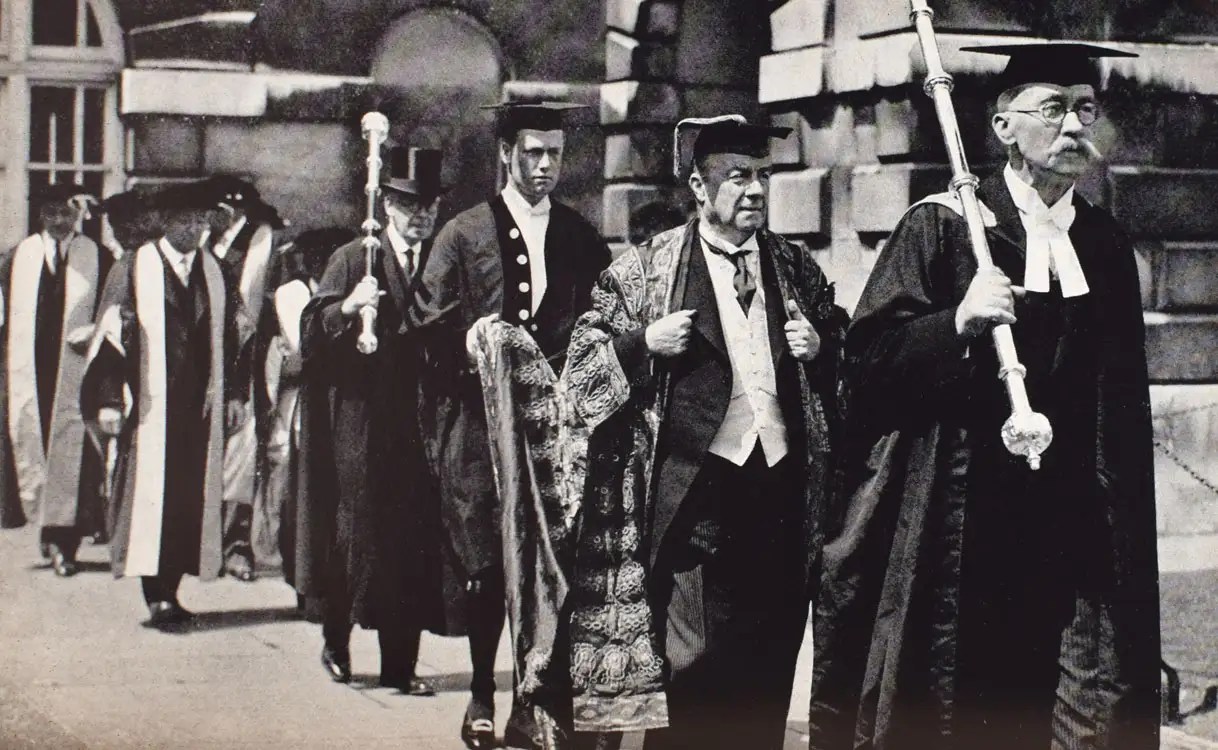
Nothing that intellectual. Instead Woolf digresses into a long and amusing passage about the ludicrous ceremonial outfits which many men wear on formal occasions or as part of their ceremonial roles (judges, Chelsea pensioners, officials in Parliament) and the medals and titles men give each other. In her opinion these are all designed to flaunt their superiority over others. The book includes four contemporary photos of contemporary men dressed in regalia at formal ceremonies and very silly they look, too.

A university procession, from ‘Three Guineas’

She makes a simple point: men down the ages have ridiculed women for being so concerned about their clothes and dress; well, just look at these preposterous old buffers in their wigs and gowns and cloaks and gaiters.

But there’s also a serious point which is germane to her war theme: for she suggests that it is this flaunting of hierarchy and status, this cursed male wish to be superior, which is one of the roots of war. And so she thinks a good way to prevent war would be to attack this cause at the root and refuse to accept honours (as she did) or take part in silly ceremonies (a point developed at length in section 3).

Shortcoming 2. Over-reliance on biography as her primary evidence

The limitations of her education partly explain Woolf’s over-reliance on biography as evidence. She shows little sign of having read much history, economics, science or engineering, philosophy, psychology or sociology – some, but not much, and when she cites history books it’s rarely for the economic or social data.

Instead, what she does rely on to an overwhelming extent is biographies: all the damning evidence she assembles to demonstrate British society’s engrained misogyny and the power of the patriarchy is rarely drawn from history or sociology but relies exclusively on biographies and autobiographies and letters. The phrase you get in so many book titles, ‘Lives and Letters’, sums it up exactly. As an indication of her reliance on biography, here are quotes from just on one page:

  • ‘The witness of biography — that witness which any one who can read English can consult on the shelves of any public library…’
  • ‘Biography proves this in two ways…’
  • ‘Of this, too, there is ample proof in biography…’
  • ‘The study of biography… proves…’
  • ‘Perhaps the greatest testimony to the value of education with which biography provides us is…’
  • ‘You will find, if you consult biography…’

No need to consult facts and figures, assess data, decipher manuscripts, spend years in the archives. Again and again she takes the biography of an eighteenth century bluestocking or a nineteenth century hack writer like Mrs Oliphant off the shelf, and finds and pastes into her narrative their complaints about their limited lives and the dire condition of women in their time, which suit her argument.

(She does mention some histories but, when you look closely you see that she picks out of her historical sources the lives and opinions of her women witnesses: in other words, she selects the biographical elements of history and ignores the statistics, data, political history and so on.)

Late in the essay, rather as she does with her claims to be an amateur, untrained in academic enquiry, she turns an apparent weakness on its head. She tells us that she relies so much on (a very limited view of) history, on biography and newspapers, because they are the only sources of information open to a woman who has been denied a better, higher education, because of her sex; for:

history, biography, and… the daily paper [are] the only evidence that is available to the ‘daughters of educated men’.

Her very lack of scholarly rigour is itself an indictment of the patriarchal oppression which kept her excluded from the higher education her brothers and millions of men had benefited from.

And newspapers

She regards newspapers as ‘history and biography in the raw’. The excellent introduction by Anna Snaith tells us that Woolf kept three scrapbooks in which she gathered evidence for this book. It is striking how many of these snippets and excerpts are taken from newspaper articles or magazines, not the most in-depth kind of research. Newspapers are, by their nature, selective and biased and superficial. They sensationalise in order to sell copies. They are, in other words, the opposite of academic research into history, sociology and so on. This is a weakness in her evidence base.

On the other hand, newspapers are topical and up to date and give her useful snapshot of contemporary opinion – which makes them very interesting for the causal reader, 90 years later. Here’s a sample of the sources, taken from the numbered list of references at the back, which shows the combination of biography and newspaper cuttings which she overwhelmingly relies on as evidence.

  1. ‘Personal Reminiscences of a Great Crusade’ / a cutting from The Herald
  2. a cutting from The Listener / ‘Reflections and Memories’ by Sir John Squire
  3. ‘The Life of Sophia Jex-Blake’ by Margaret Todd
  4. Letter to The Times
  5. Debretts
  6. ‘Life of Sir Ernest Wild, K.C.’ by R.J. Rackham
  7. Lord Baldwin, speech reported in The Times
  8. ‘Life of Charles Gore’ by G.L. Prestige
  9. ‘Life of Sir William Broadbent’ edited by his daughter
  10. ‘The Lost Historian, a Memoir of Sir Sidney Low’ by Desmond Chapman-Huston
  11. ‘Thoughts and Adventures’ by Winston Churchill
  12. Speech at Belfast by Lord Londonderry, reported in The Times

You get the picture: her main sources are lives, letters and newspapers.

The second letter: funding a women’s college

Since the essay is in three parts and the introduction says it addresses three letters, I thought it would be a part per letter, so I was surprised when the second letter pops up at the end of part one. It is from a women-only college writing to ask Woolf to contribute to their fund raising. Anna Snaith’s excellent notes tell us it was a real letter Woolf received from Joan Strachey, Principal of the women-only Newnham College in Cambridge, asking for a donation to renovate the college buildings.

Woolf shows with some doleful quotations and examples, how petty-minded, snobbish and fierce for their stupid rules and regulations the existing (men-only) universities are. She harks back to the notorious incident of being kicked off the grass by the beadle early in ‘A Room of One’s Own’, which clearly still rankles.

Therefore, she replies to this letter that she will consider contributing to a women-only college but only if it is drawn up on a completely different basis from the male colleges. She proceeds to lay out the principles for an experimental college, one which will eschew all competition and exams, be open to the poor, and teach the humanities in a spirit of openness and collaboration:

A place where society was free; not parcelled out into the miserable distinctions of rich and poor, of clever and stupid; but where all the different degrees and kinds of mind, body and soul merit cooperated. Let us then found this new college; this poor college; in which learning is sought for itself; where advertisement is abolished; and there are no degrees; and lectures are not given, and sermons are not preached…

She warns that if the women-only colleges model themselves along male lines, with all the snobbery and competition and status-seeking and petty rankings that entails… those are precisely the kinds of habits of thought, the endless seeking superiority, which create the war mentality and she will not contribute to it.

And no chapels. She is as vehemently against the all-women colleges having chapels as she is violently against the engrained misogyny of the Church of England.

No to teaching English literature

She has a fierce passage execrating the teaching of English literature and its packaging into classes and exams, which she describes as ‘vain and vicious’. This is why Woolf herself refused to accept honorary degrees or prizes, despite being offered many in the later part of her life, and turned down offers to lecture (the exception which proves the rule being the lectures which formed the basis of ‘A Room of One’s Own’).

Woolf explains women’s war patriotism as an escape from domestic oppression

In a wonderfully irrational peroration she thinks that it can only have been delirious joy at being released from the narrow, cramped, uneducated lives forced upon Victorian daughters and spinsters which explained the huge outburst of patriotic enthusiasm among women at the outbreak of the Great War in 1914.

So profound was her unconscious loathing for the education of the private house with its cruelty, its poverty, its hypocrisy, its immorality, its inanity, that she would undertake any task however menial, exercise any fascination however fatal that enabled her to escape. Thus consciously she desired ‘our splendid Empire’; unconsciously she desired our splendid war.

This is splendid rhetoric but it’s a symptomatic of her failure to understand the causes of war, her failure to understand the psychology of crowds and societies embarking on war, her failure to understand genuine feelings of patriotism or national pride which are such big motivators for large numbers of people in any country – in a nutshell, her failure to understand anyone outside her own narrow upper-middle-class milieu.

Shortcoming 3. Ignorance of the wider world

I think her failure to understand the patriotic zeal which accompanied the start of World War One is indicative of her broader failure to understand the range and complexities of human nature, of all human nature across all of society.

Of the narrow little world of upper-middle-class women whose lives are supported by fleets of nameless servants which allow them to pursue their tedious obsession with art and poetry, of this tiny privileged world, she was a brilliant painter.

Of the big wide world, of the thousands of occupations, jobs and livelihoods, in finance, business, economics, trade, law, science, technology and engineering, of the lives of the working classes with their labour in coal mines and iron works, building ships, sailing the oceans, building trains and cars, laying down telegraph cables – in other words, in almost all the wide world and its billions of inhabitants, she has little or no interest and makes no effort to understand.

As an artist, as a writer, it doesn’t matter. Her novels focus on her chosen terrain and are masterpieces. As an essayist, claiming to gather evidence in order to analyse large social issues, it is, to say the least, problematic.

Giving a guinea

Out of this rather convoluted flow of arguments, Woolf concludes that she ought to give a guinea to the building of the women’s college, because it was entrapment in the family home that led so many women to explode with patriotism upon the outbreak of war. Building a college for the public education of the same class will prevent that and so materially contribute to the prevention of war which, if you recall, was the aim proposed right at the start of the essay.

Part 2. The professions

How can we enter the professions and yet remain civilized human beings, human beings who discourage war?

Woolf says a woman like her has only one weapon at her command to use against war, ‘the weapon of independent opinion based upon independent income.’ Now she will try to use this to sway the men in the professions.

The pretext is another letter she has received, from a society supporting women in the professions, asking for another donation, this time to the support of hard-up professional ladies. For Woolf it begs the question why, 20 years after women were admitted to the professions (1919) so few have risen to the top rank and so many are hovering round the bottom.

Woolf’s answers are convoluted and involve replies to other letters and lengthy addresses to her fictional interlocutor, they but boil down to:

  • women have much shorter traditions of thriving in the professions and so lack the centuries-old networks of male patronage and preferral
  • there are no limits to educated men churned out by the public schools and major universities, whereas there are far fewer schools for girls, only four or five colleges for women, and even the numbers admitted to these are severely restricted (only 500 women students were permitted at Cambridge in her day)
  • exams in the professions advantage those who have spent their lives taking exams, i.e. privileged, privately-educated men, and bar women who have (as she shows) vastly less access to private education
  • the nearly universal sexism and misogyny found at all levels of English society

Sexism and misogyny

As mentioned above, the flow of Woolf’s arguments is sometimes hard to follow, especially when it feels like she’s twisting the flow in order to fit her broader feminist critique to fit the essay’s ostensible subject of how to prevent war – but what the essay indisputably does do is powerfully convey the deeply entrenched tentacles of the patriarchy in contemporary 1930s England. She presents a wealth of facts and figures about the systematic prevention of women being educated, getting jobs, entering the professions and so on.

In this second part, the essay builds up into a devastating demonstration of English society’s hair-raising sexism and misogyny. In the main text but especially in the extensive notes which illustrate it, Woolf gives extended quotes from a wide range of men in powerful positions expressing the most hair-raising prejudices and slurs. I can’t give brief quotations, you have to read the notes, and the extended stories she gives, of awful politicians, judges, professionals, writers and commentators taking every opportunity to demean and limit women.

Fascists and Nazis

Woolf cranks up the temperature a lot by comparing several terrible British chauvinists who pontificate that a woman’s place is in the home, with a quote from none other than Adolf Hitler saying the exact same kind of thing.

Herr Hitler and Signor Mussolini have both often in very similar words expressed the opinion that ‘There are two worlds in the life of the nation, the world of men and the world of women’; and proceeded to much the same definition of the duties.

The juxtaposition of the two explains in a flash why Woolf is so resistant to all male talk about patriotism and ‘our country’. In what possible sense is it ‘her country’ when the Archbishop of Canterbury and the editor of the Daily Telegraph hold identical views about women’s place in society as Adolf Hitler? The same point is made in one of the long notes:

‘My husband insists that I call him “Sir”,’ said a woman at the Bristol Police Court yesterday, when she applied for a maintenance order. ‘To keep the peace I have complied with his request,’ she added. ‘I also have to clean his boots, fetch his razor when he shaves, and speak up promptly when he asks me questions.’ In the same issue of the same paper Sir E. F. Fletcher is reported to have ‘urged the House of Commons to stand up to dictators.’ (Daily Herald, 1 August 1926.)

Why, Woolf asks, all this fuss about opposing dictators abroad when every level of British society supports domestic tyrants at home?

Pay for housework

Men work in the public realm and get paid, sometimes a small fortune, often for jobs of dubious worth. Women labour in the home to raise families and manage households and care for the elderly, all unpaid. So: women’s domestic work should be paid.

The work of an archbishop is worth £15,000 a year to the State; the work of a judge is worth £5,000 a year; the work of a permanent secretary is worth £3,000 a year; the work of an army captain, of a sea captain, of a sergeant of dragoons, of a policeman, of a postman – all these works are worth paying out of the taxes, but wives and mothers and daughters who work all day and every day, without whose work the State would collapse and fall to pieces, without whose work your sons, sir, would cease to exist, are paid nothing whatever.

I wonder who first originated this call? Mary Wollstonecraft in ‘A Vindication of the Rights of Woman’ (1792)? Certainly Friedrich Engels mentions it in his 1884 book ‘The Origin of the Family, Private Property and the State’. Anyway, Woolf makes a sustained case for it over many pages, 30 years before the issue was revived by second-wave feminists in the 1970s:

Note: I was a househusband for eight years. I did all the childcare, running children round to nurseries, playgroups, parties, doing all the shopping, cooking and cleaning, changing thousands of nappies, giving bedtime baths and so on, while my wife earned the family income. So I have lived experience of issues like this. It’s this lived experience which feeds into my scepticism about feminism, not as a theory (fine and dandy) but in practice (complicated and compromised). I met plenty of women who were extremely happy to pack in office work and become full-time mums and housewives, who loved looking after their young children, dressing them up, holding parties, dropping them at nurseries or infant school and going to meet girlfriends for lunch or coffee.

Then again, some didn’t. Some felt trapped and needed support, would have welcomed free or cheap childcare, or just wanted to go back to work which they found more fulfilling than hanging round playgrounds or hosting rooms full of screaming kids.

I had many conversations with scores of mums about how the state should provide cheap childcare, or if only companies would allow more flexible work based around school hours, if only housework was recognised and paid for like other forms of work, and so on and so on. Hundreds of conversations on these and related subjects, over years and years.

So my scepticism about feminism is not ideological or temperamental. It’s based on the lived experience of being a housekeeper and child-rearer myself, and talking to hundreds of women in the same situation. The problem is not the top-level slogans and demands, anyone can come up with catchy slogans and carry banners – “Wages for Housework” – it’s figuring out the practical policies and application: where would the money come from? How would it be paid out? Who defines ‘housework’? Like child benefit would it go to anyone caring for a child or be subject to conditions? How would you prove that you do the housework and don’t sub-contract this or that part to cleaners or nannies? etc etc.

The procession

Back to the Woolf on the professions. She gives a vivid description of the processions of all the professions through London’s streets to the centres of law, finance and so on and asks her women readers: do we, in fact, want to be part of this procession? Do we want to do the same jobs but for less pay and more condescension? Or do we want to strike out on our own and lead our lives differently?

The facts… seem to prove that the professions have a certain undeniable effect upon the professors. They make the people who practise them possessive, jealous of any infringement of their rights, and highly combative if anyone dares dispute them. Are we not right then in thinking that if we enter the same professions we shall acquire the same qualities? And do not such qualities lead to war? In another century or so if we practise the professions in the same way, shall we not be just as possessive, just as jealous, just as pugnacious, just as positive as to the verdict of God, Nature, Law and Property as these gentlemen are now?

She gives a number of quotes from lawyers, clerics and politicians complaining they lead a dog’s life, and have sacrificed all their pleasures and family time to their work. Do modern women want to rush into exactly the same kind of wage slavery?

Woolf wonders if we can turn to the lives of nineteenth century women in the professions to help us find a more humane way to have one of these high-powered jobs and live properly? No, because there weren’t any women in the nineteenth century professions. They weren’t allowed. Instead:

We find, between the lines of their husbands’ biographies, so many women practising – but what are we to call the profession that consists in bringing nine or ten children into the world, the profession which consists in running a house, nursing an invalid, visiting the poor and the sick, tending here an old father, there an old mother? – there is no name and there is no pay for that profession; but we find so many mothers, sisters and daughters of educated men practising it in the nineteenth century that we must lump them and their lives together behind their husbands’ and brothers’.

The validity of housework and child-rearing, again, and the long buried, unrecorded of the scores of millions of women who spent their entire lives doing it.

Giving the second guinea

All these arguments have been contained, rather confusingly, in a very long letter replying to the letter she received asking for financial aid for impoverished women professionals. Woolf sums up her position by saying she will send the letter-writer one guinea ‘on condition that you help all properly qualified people, of whatever sex, class or colour, to enter your profession’, and in addition ensure that women:

  • must earn enough to be independent
  • must not prostitute their brain to their profession
  • must refuse all prizes, medals and awards, and be content with obscurity
  • must rid themselves of religious pride, college pride, school pride, family pride, sex pride and those unreal loyalties that spring from them

These are obviously very strict, probably utopian conditions, as with her demand for a completely different type of college which ended section 1. But:

If you agree to these terms then you can join the professions and yet remain uncontaminated by them; you can rid them of their possessiveness, their jealousy, their pugnacity, their greed. You can use them to have a mind of your own and a will of your own. And you can use that mind and will to abolish the inhumanity, the beastliness, the horror, the folly of war.

Antigone saying No to male tyranny

Part two rises to a very powerful invocation of Sophocles’ play, Antigone. Woolf studied this when young and it stayed with her all her life as a powerful story of female resistance to male tyranny. In the era of Hitler and Mussolini it was more than ever relevant. She comes back to it later.

No risk because of exclusion

Woolf ends part 2 with a grand fanfare of irony, saying there is no immediate risk of women professionals losing their souls and working themselves to shreds so long as the laws of England hold their nationality so lightly, prevent them from working in many professions, limit the numbers who can attend university, and ensure that so many women continue to live in the tradition of neglect and contempt, living gruelling lives of unpaid work in dark patriarchal homes.

Part 3. The Outsider Society

The sarcasm and irony which have been present throughout the essay rise to a real anger and bitterness in this, the longest of the three parts.

Woolf reverts back to the original letter she was sent, the one from the unnamed male correspondent asking her how they can prevent a war, and she repeats his three suggestions, namely that we should:

  1. sign a manifesto pledging ourselves ‘to protect culture and intellectual liberty’
  2. join a certain society, devoted to certain measures whose aim is to preserve peace
  3. should subscribe to that society which like the others is in need of funds

Failure of the universities

She addresses these points one by one. First she is satirical about this idea of ‘protecting culture and intellectual liberty’. Isn’t this what the Great Universities have said they were devoting themselves to for centuries, the ones which have been teaching men these values and brutally excluding their sisters and daughters? Is the fact that these values now need such support from society an admission that all those centuries of learning have failed? And if they’ve failed, why should the impoverished, life-opportunity-deprived daughters and sisters suddenly rush to the help of their oppressors?

What is ‘culture and liberty’?

Anyway, what is this ‘culture and liberty’ the letter writer refers to? She knows what it isn’t. Characteristically, she turns to biography and uses the life of an author like Mrs Margaret Oliphant (1828 to 1897) who, after her husband died, churned out meretricious romances to support her children. Was this intellectual liberty? No, this was intellectual prostitution and Woolf angrily takes it as typical of the intellectual prostitution forced on so many women writers and artists who had to sell their souls and prostitute their art because of the patriarchy’s refusal to let them earn a living any other way.

So she mocks the letter writer’s suggestion that women, victims of centuries of repression, should suddenly rush to help the poor privileged men in their time of need. He wants her to join his pacifist society, does he? Well, no. The very word ‘society’ denotes the systematic exclusion of women from education and influence and power and money, so screw society.

The very word ‘society’ sets tolling in memory the dismal bells of a harsh music: shall not, shall not, shall not. You shall not learn; you shall not earn; you shall not own; you shall not – such was the society relationship of brother to sister for many centuries.

The Outsiders Society

She’s not going to join any boys’ club. Instead she proposes setting up a separate organisation, for women of her class and (lack of) education. It would be called The Outsiders Society. It would consist of educated men’s daughters working through their own class and by their own methods for liberty, equality and peace. Members would:

  • not fight
  • not work in munitions factories or nurse the injured
  • not encourage men to go and fight but maintain an attitude of neutrality, as fighting is a ‘sex characteristic which she cannot share’

She rises to real bitterness:

She will find that she has no good reason to ask her brother to fight on her behalf to protect ‘our’ country. ‘”Our country,”‘ she will say, ‘throughout the greater part of its history has treated me as a slave; it has denied me education or any share in its possessions. “Our” country still ceases to be mine if I marry a foreigner. “Our” country denies me the means of protecting myself, forces me to pay others a very large sum annually to protect me, and is so little able, even so, to protect me that Air Raid precautions are written on the wall [i.e. women are defenceless against modern warfare]. Therefore if you insist upon fighting to protect me, or “our” country, let it be understood, soberly and rationally between us, that you are fighting to gratify a sex instinct which I cannot share; to procure benefits which I have not shared and probably will not share; but not to gratify my instincts, or to protect either myself or my country. For,’ the outsider will say, ‘in fact, as a woman, I have no country. As a woman I want no country. As a woman my country is the whole world.’

Wow. Very powerful. Furthermore, The Outsider will cultivate complete indifference to male nonsense about patriotism, war and fighting. On the contrary, she will:

  • take no part in patriotic demonstrations
  • not take part in patriotic praise
  • absent herself from military displays, tournaments, tattoos, prize-givings and all such ceremonies as encourage the desire to impose ‘our’ civilization or ‘our’ dominion upon other people

The idea is that this ‘indifference’ will damp down patriotic fervour in those around her and thus, in a tiny way, help to avoid war.

All this makes a sort of sense. But it feels like twisting logic when Woolf goes on to assert a link between these anti-war steps and the positive demands of her feminist programme. The connection feels tenuous and forced. Because she now switches to say that in order for their opinion or actions to matter, the outsiders must push for a raft of feminist requirements, being:

  • they must earn their own livings
  • they must press for a living wage in their professions
  • they must create new professions in which they can earn a living wage
  • they must press for press for a money wage for the unpaid worker in her own class – the daughters and sisters of educated men
  • they must press for a wage to be paid by the State to the mothers of educated men

Make the state pay for housework

This last is vital because until she has complete financial independence, a wife is dependent on her husband for money and will follow his opinions and men are for war. Therefore, in order to create an influential bloc of educated women who are against war, this class must be given financial, and so intellectual, independence. Women must be paid by the State for their work as mothers.

And she tells her male interlocutor that this step – paying women for their housework – would also liberate husbands, because by sharing the burden of earning an income they would no longer be wage slaves, slaves to the rat race. It would have an enlightening and life-enhancing effect all round.

I gave my thoughts on this proposal earlier. It sounds great, and you can see her logic – that women can only be truly independent and free if they have their own income, separate from their father’s or husband’s – but how would it be implemented in practice?

I’ll just make the additional point that its recurrence here is characteristic of how key themes and suggestions recur throughout the essay, building up power through repetition and echoes, not unlike her technique in her novels.

Outsider demands

But she hasn’t finished with her demands. The Outsiders would:

  • not only earn their own livings but become so expert that their threat to down tools would have power and influence
  • when they have earned enough to live on they would earn no more i.e. not pile up obscene wealth
  • they would reject any profession hostile to freedom such as the arms trade
  • they would refuse to take office in any institution which pretends to respect liberty but actually restricts it, such as Oxford and Cambridge

Outsiders will eschew all the stupid costumes and ceremonies so beloved by men (see the section about silly ceremonials in part 1).

Outsiders will eschew ‘the coarse glare of advertisement and publicity’ and prefer to work in honest obscurity.

The secret society already exists

Wandering into thriller territory, Woolf suggests that this Outsider Society already exists but is secret and underground in its activities. Her very dubious evidence for this far-fetched claim is a clutch of newspaper reports of various women officials making comments against war, opposing arms manufacture and the like. From random quotes and newspaper clippings she based the existence of a secret society operating across English society. Is this an example of her sometimes utopian or far-fetched argumentation – or an example of her dry sense of humour? Difficult to tell.

Against the Church of England

Outsiders will:

  • fearlessly investigate and criticise public institutions they are forced to contribute to, such as the universities, but especially the Church of England
  • by criticizing religion they would attempt to free the religious spirit from its present servitude and would help, if need be, to create a new religion based it might well be upon the New Testament, but, it might well be, very different from the religion now erected upon that basis

Woolf’s attitude to the Church of England had already been indicated in the passage about cited above about Antigone where she writes that ‘Antigone’s five words are worth all the sermons of all the archbishops’, those five Greek words (they total 11 in the English translation) being:

‘Tis not my nature to join in hating, but in loving.’

Pages 196 to 202 give a scathing account of how Jesus Christ’s own admonition that his followers are equal which promised equality between men and women was denied by St Paul, who invented the idea that women must be veiled in church and not speak. This bigotry hardened over the centuries into a church which forbids any positions of power or influence in the most powerful and prestigious organisation in the land, to women.

With the result that the salary of an archbishop is £15,000, the salary of a bishop is £10,000 and the salary of a dean is £3,000. But the salary of a deaconess is £150; and as for the ‘parish worker’, who ‘is called upon to assist in almost every department of parish life’, whose ‘work is exacting and often solitary…’ and who is most likely to be a woman, she is paid from £120 to £150 a year.

It’s a pattern mirrored in all the other professions and walks of life: women excluded from all the prestigious, well-paid higher positions, and forced to undertake the most menial and poorly-paid jobs.

Psychoanalysis, anger and fear

One of Anna Snaith’s excellent notes tells us that ‘Woolf’s brother Adrian [Stephen] and his wife Karin were trained psychoanalysts and were crucial in disseminating Freud’s work in England.’ This is relevant because Woolf quotes at length from the Archbishops’ Commission on the Ministry of Women (1936) and in particular from the appendix written by Professor Grensted, the Nolloth Professor of the Philosophy of the Christian Religion in the University of Oxford.

This professor concluded that there is no reason in theology (Christ’s teachings) why there should not be women priests, but there were strong objections to women priests among the clergy. Digging deeper he uses Freudian terminology to suggest the deep conviction held by many men of men’s superiority and women’s inferiority.

The causes are obscure but the outcome is obvious: that whenever a conversation lights on the topic of equality for women and women holding roles up till now reserved for men, many man become angry and many women become fearful. This imbalance leads women not to raise, mention or discuss the issue which, as a result, goes underground.

The infantile fixation

Woolf takes from Grensted the notion of the ‘infantile fixation’. I didn’t quite understand this and I didn’t see her defining it anywhere. Instead she gives three examples of what she means (taken, inevitably, from biographies), namely the wildly irrational anger and jealousy triggered in three classic Victorian fathers when their daughters asked permission to get married or (worse than that) to get a job. The fathers being:

  • Mr Barrett (father of Elizabeth who wanted to marry the poet Robert Browning)
  • the Reverend Patrick Brontë (father of Charlotte who wanted to marry)
  • Mr Jex-Blake (father of Sophia who was offered a small sum for tutoring mathematics to a friend)

By contrast, to show the impact of a father’s liberality, she gives the story of Mr Leigh Smith. It’s worth quoting at length because the impact is in all the details. Smith had a daughter, Barbara, who he loved.

When Barbara came of age in 1848 he gave her an allowance of £300 a year. The results of that immunity from the infantile fixation were remarkable. For ‘treating her money as a power to do good, one of the first uses to which Barbara put it was educational.’ She founded a school; a school that was open not only to different sexes and different classes, but to different creeds; Roman Catholics, Jews and ‘pupils from families of advanced free thought’ were received in it. ‘It was a most unusual school,’ an outsiders’ school. But that was not all that she attempted upon three hundred a year. One thing led to another. A friend, with her help, started a cooperative evening class for ladies ‘for drawing from an undraped model’. In 1858 only one life class in London was open to ladies. And then a petition was got up to the Royal Academy; its schools were actually, though as so often happens only nominally, opened to women in 1861; next Barbara went into the question of the laws concerning women; so that actually in 1871 married women were allowed to own their property; and finally she helped Miss Davies to found Girton. When we reflect what one father who was immune from infantile fixation could do by allowing one daughter £300 a year we need not wonder that most fathers firmly refused to allow their daughters more than £40 a year with bed and board thrown in.

The difference just one liberal father made. What if all Victorian fathers had been like that.

Sexist science

There follows a passage giving some examples of how even contemporary science is twisted to prove the inferiority of women. To be honest this section is neither very compendious nor persuasive. She doesn’t really go into the most basic accusation against women, that their bodies are designed for childbirth and child-rearing and this explains why their minds are limited to domestic subjects and childish logic. (I’m not saying this, I’m repeating the sexist, misogynist accusation.)

This is a failing but I think reflects the limitations of Woolf’s knowledge and education. Of science she knows next to nothing and so is simply incapable of unpacking all the biological and psychological aspects of woman-hating. She is much more at home in her comfort zone of education and literature, the lives of women writers.

She cites Bertrand Russell pointing out the sheer sadism of much medical science towards women (the medical profession’s reluctance to provide painkillers to women in childbirth) or the twisting of scientific knowledge to justify male superiority – but not as amply as this huge subject demands.

Cleons

Instead she reverts to literature again, and her obsession with Antigone. In the play the oppressive father is Cleon, the archetype for the Victorian paterfamilias and the modern fascist. Here is Cleon speaking dictator-talk:

‘Whomsoever the city may appoint, that man must be obeyed, in little things and great, in just things and unjust… disobedience is the worst of evils… We must support the cause of order, and in no wise suffer a woman to worst us… They must be women, and not range at large. Servants, take them within.’

Order and the oppression of women, Mr Barrett and Mussolini.

The personal and the private

In the essay’s last pages she brings things together by (rightly) saying that she has shown how male tyranny in the personal, domestic realm and in the public realm, are intimately linked:

that the public and the private worlds are inseparably connected; that the tyrannies and servilities of the one are the tyrannies and servilities of the other.

Despite the strangeness of the letter-answering structure and the oddly digressive, rambling flow of the argument, by the end she has presented a devastating barrage of evidence, as well as making a host of demands and suggestions.

The third guinea

So she refuses to sign the form her correspondent had sent her. She refuses to sign up to his society because of her opposition to all such male bodies, but she will send him a guinea to support it.

Their aims are the same, to oppose the tyrants in the name of Justice and Equality and Liberty. But, as this amazing book has explained, as a woman, as the patchily educated ‘daughter of educated men’, as someone with completely different life experiences and, consequently, utterly different perspectives from the male sender of the letter, she shares the same aim but insists that she will try to bring it about using, not the old male forms and words, but new words and new ideas appropriate for women.

Magnificent

For all its faults, ‘Three Guineas’ is a magnificent, powerful and very persuasive piece of work. Her assembly of a very wide range of evidence, facts and figures really bring home the historical endurance, depth and wide range of the legal, financial and cultural oppression of women throughout English history and the stupid, patronising and misogynist attitudes and opinions deployed to maintain that oppression.

The notion of the Outsiders Society is the crystallisation of the massive theme which emerges repeatedly throughout the text, the idea that women – not because of any biological or psychological differences – but purely because of the legal, financial, professional and cultural apartheid they have suffered for centuries, bring to the table a different perspective from men across a whole range of issues.

I think it’s a magnificent example of a polemical essay, of an impassioned political pamphlet.

Criticisms

There are a number of problems or issues with Woolf’s way of arguing. Initially I included them in my review where they occurred but they cluttered up the flow of my review, and gave an unduly negative opinion too early on. I mentioned three earlier on. Here are a few more.

Shortcoming 4. Woolf’s intellectual confusions

Periodically throughout the text Woolf freely admits to own intellectual shortcomings: for example, right at the start she admits being bewildered that there seems to be a wide range of opinions about whether war is good or inevitable. She herself tells us that the more she reads, the more opinions she discovers, the more confused she becomes. But… is that not the point of being an intellectual: to read all the opinions, weigh the evidence, and develop your own line of argument, based on the evidence you uncover and reacting to other people’s arguments?

This activity, intellectual activity, always puzzles and confuses Woolf. In ‘A Room of One’s Own’ there’s the section where she orders up some books in the British Museum and opens them up, expecting to discover The Truth staring her in the face.

Sometimes this is part of her general mocking irony, mocking the pretensions of pretty much all male activity, including the grand Pursuit of Truth. But at other times it can give you the worrying sense that she doesn’t really understand what intellectual enquiry is.

Her intellectual confusion as evidence of her case

In the opening and then at various transition moments, Woolf explicitly tells us that she struggles to marshal the evidence, is embarking on something too big for her abilities, and wonders if she’d be better off abandoning it. After a while I realised that maybe these passages are designed to dramatise the issue of women’s exclusion from formal education by using herself as an example.

Woolf’s brothers went to top private schools and Oxbridge whereas she more or less had to educate herself at home and mostly taught herself by browsing through her father’s extensive library. In other words, every time she shares how confused by the evidence or daunted by the challenge of answering big question she is, she is demonstrating the effect of the grotesquely unequal education of the genders, how women have been the victims of ‘tradition, poverty and ridicule’, and showing the reader how she (and we) are suffering for it.

Maybe that’s why she flaunts her own intellectual limitations so much: the intellectual inability she frequently laments is the result of her exclusion from higher education. It makes her case for her.

Shortcoming 5. Her analysis is restricted to a (relatively) small class

Her lack of real confidence in her own research, and her need to make her feminist points as categorical and powerful as possible, explain why Woolf makes the strategic decision of restricting her analysis to a relatively small class, to women like herself, to ‘the daughters of educated men’, as she describes them. As she puts it:

Our ideology is still so inveterately anthropocentric that it has been necessary to coin this clumsy term – ‘educated man’s daughter’ – to describe the class whose fathers have been educated at public schools and universities. Obviously, if the term ‘bourgeois’ fits her brother, it is grossly incorrect to use it of one who differs so profoundly in the two prime characteristics of the bourgeoisie – capital and environment.

She makes it quite clear on page one that she is only discussing upper-middle-class women, women like herself, women with immaculate manners who are used to managing servants and know which of the many forks and spoons to use at a formal dinner.

In order to avoid the confusions, contradictions and conflicting evidence I mentioned above, in order for her analysis to work, she has to reject the vast majority of the population (the working class and lower classes, of both sexes) and identify her cause with just this numerically small and limited class of posh ladies.

It isn’t just me pointing this out. The Wikipedia article about Three Guineas tells us that the noted academic Q.D. Leavis wrote a scathing review of ‘Three Guineas’ soon after it was published:

She denounces the essay because it is only concerned with ‘the daughters of educated men’, seeing Woolf’s criticisms as irrelevant to most women because her wealth and aristocratic ancestry means she is ‘insulated by class’.

And Anna Snaith’s notes in the Oxford University Press edition tell us that Woolf received letters from working class women readers who complained about being left out of her analysis, notably a long semi-autobiographical one from a working class woman named Agnes Smith.

This is closely related to what I called shortcoming 3, ignorance of the wider world. But it’s also a decision. She found it hard enough gathering the evidence for the sexist discrimination against her own type and class of woman. If she opened it up to the broader middle and working classes she’d never have finished it.

2025: the perils of intersectionality

Many of these criticisms are mentioned in Anna Snaith’s introduction to the Oxford University Press edition. Here she indicates the larger cultural and political problems the essay falls foul of. This is that there are, nowadays, so many grievances, so many groups claiming to be victims, so many communities and identities who feel that they, too, have been subjected to centuries of oppression, that it is hard to focus on just one, and it is especially hard to focus on the group Woolf defines as the ‘daughters of educated men’.

As you read Snaith’s account of Woolf’s life and social circle, with so many friends among England’s political and cultural elite, the idea of her as a persecuted outsider feels more and more ludicrous. She wasn’t a Jew in Hitler’s Germany, a Black in the American South, a kulak in Stalin’s Russia, an Aborigine in Australia, she grew up in a house full of books which she was actively encouraged to read and went on to become a centre of London’s literary and artistic elite.

This doesn’t invalidate any of the points she makes in the book or detract from the essay’s tremendous power. It’s just to say that the struggle for women’s equality takes its place among quite a few other struggles. I’ve a book about the Irish Civil War on my desk and Irish nationalists have quite a story to tell about 1,000 years of British oppression. Her husband was a Jew who had his own story about the legal and financial persecution of Jews. Something similar could be said of England’s Roman Catholics, prevented by law from holding official positions. Or – a group close to my heart – England’s non-conformists, banned by law from holding any positions of authority for 300 years after the civil war. Citizens from India or any of the colonies we ruled for centuries might have a thing or two to say about Britain’s oppression of their peoples and cultures.

Being a modern academic, Snaith is contractually obliged to drag in slavery – the progressive topic par excellence – to her discussion of ‘Three Guineas’, on the rather tenuous basis that guineas were, apparently, first used as currency in the British slave trade. Don’t know what Virginia would have made of that scholarly leap of imagination.

To repeat – this little digression about the modern over-abundance of historical grievances is not entirely my view but simply expanding points made by the book’s editor, Anna Snaith, in her introduction.

All these other issues don’t invalidate any of the points Woolf makes in the book but they place it in a much larger, real world context. If you’re a feminist, you can insist that your cause and your history of oppression is the real one, the big one, the important one and, convinced of your righteousness, overlook or downplay the grievances of all the other groups I’ve mentioned. In a sense, to get anything done, you have to focus on your issues and grievances; nobody can represent the issues of the whole world. You have to pick your battles. And this explains why Woolf realised that, in order to get her book written, she had to concentrate just on relatively privileged upper-middle-class women like herself, on ‘the daughters of educated men’.

Conclusion

It’s a very powerful book. Very. To repeat what I said at the start, from one point of view it may be her most important work. It’s a bit of a struggle, a bit meandering, a bit puzzling in places, her proposals such as for the Outsider Society are a bit eccentric – and yet so many of her main points drive right home, and the evidence gathered in the notes at the end is searing, blistering, eye-opening. It shook this old cynic. It materially changed my views about feminism. I strongly recommend it.


Credit

‘Three Guineas’ by Virginia Woolf was first published by the Hogarth Press in 1938. Page references are to the 2015 Oxford University Press paperback edition, edited and annotated by Anna Snaith, although the text is easily available online.

Related links

Related reviews

The Longest Journey by E.M. Forster (1907)

He was not an inquisitive boy; but as he leant against the tree he wondered what it was all about, and whether he would ever know.
(E.M. Forster’s milksop protagonist limply pondering in The Longest Journey, page 137)

Forster’s second novel, The Longest Journey, is the diametric opposite of his first, Where Angels Fear To Tread. Angels is short (160 pages), focused, and its main narrative moves at speed. Journey is long (290 pages), slow, digressive and self indulgent. It opens abruptly and a bit confusingly, with a series of scenes depicting Frederick ‘Rickie’ Elliott as an undergraduate at Cambridge, having jokey philosophical debates with his close friends led by the boy they all look up to, Stewart Ansell, before – confusingly – going into a flashback describing Rickie’s earlier life and how he ended up at Cambridge.

Rickie has a deformed foot which gives him a pronounced limp and requires him to wear specially adjusted shoes. As a boy he came to realise that his parents never loved each other; then they both died within 11 days of each other, leaving him an orphan. He inherited a tidy sum of money and was sent to live with a family called the Silts, ‘needy cousins of his father’s’. He had already begun at a public school as a day boy and continued there till he passes his exams to go up to Cambridge and it is here that we catch up with the scenes depicted in the opening pages.

What’s missing from Forster

The first 50 or 60 pages prompted a Big (negative) Thought which dominated the rest of my reading. This that the book contains many, many, many conversations about life and human nature and so on but, placed in a historical context, all these conversations are rendered moot, or even worthless, by their ignorance of everything we, a hundred years later, now know about human nature, science and society…

A few years after the book was published came the Great War which triggered a complete disillusion with the values of previous generations, then the Bolshevik revolution which swept away previous socialist rhetoric and replaced it with a much more militant model of violent revolution and anti-bourgeois terror. There followed the Jazz Age decade of amoral hedonism, short skirts, wild dances and the advent of Fascism in Italy. At the end of the decade, a worldwide economic collapse encouraged the spread of communist belief across the West, which helped the rise to power of the genocidal Nazi movement, all of which led up to the most destructive conflagration in human history. This climaxed with the dropping of the two atom bombs which ushered in the atomic age and generations of fear that the entire human race might be wiped out in a nuclear holocaust. Alongside this, in the post-war years, went the decolonisation which ended the European empires and led to the rise of what we call the Third World, often characterised by ruinous civil wars and/or famines, which recur across Africa to this day. From the 1960s onwards women’s liberation, gay rights and so on have transformed our attitudes to sex, sexuality and gender identity.

By the time I came along, as a schoolboy in the 1970s, all this history was the basic, entry-level materials of serious discussion. As earnest 6th formers our debates about politics or the meaning of life weren’t based on the ancient Greeks or the Renaissance but were informed by the horrors of twentieth century history. Entry-level debate was aware that any line of thought about, say, trying to improve society by scientific means, risked raising eugenics and the Nazis; arguments about trying to enforce a fairer society sooner or later invoked the dire example of Stalin and the gulags; anyone promoting belief in could easily be refuted by the atom bomb, and so on.

Debate about the big issues was both a) informed by the extreme political, social and scientific experiments of the 20th century and b) hemmed in by the way so many of these experiments had ended in utter disaster.

My point is that Forster and his characters know none of this. Everything which makes up the backdrop, the atmosphere, of serious modern debate on almost every issue (politics,economics, socialism, imperialism, feminism, the environment, multicultural society, science and technology, art and aesthetics, you name it) hadn’t happened yet, was invisible, didn’t exist. Although Edwardian people were as clever, canny, passionate, loving, cruel etc as you or me, they lived and thought and acted in a world Before The Fall.

This explains several things about Forster’s novels and our feeling about the Edwardian period as a whole. The obvious one is an idealised nostalgia for a much simpler, more innocent world. This explains the popularity of the Merchant Ivory dramatisations of his novels, especially ‘A Room With A View’, and the tremendous popularity of ‘Downton Abbey’ on the telly.

But the reason I’ve described all this is that, for me, the vast absence of knowledge drums home the boring triteness of the characters’ supposedly ‘serious’ conversations.

Forster’s novels regularly pause while the characters discuss the nature of Truth or Beauty or Love, ‘the Spirit of Truth’, ‘real Life’ and so on, in an embarrassingly callow, undergraduate way – but to our jaded modern eye i.e. to anyone born After the Fall, after the calamitous twentieth century, these conversations, recorded in loving detail and clearly intended to indicate important differences between characters’ beliefs and attitudes, come across as vapid, naive and irrelevant. Basically, who can care for these characters when they’re all so dim and ignorant of everything the 20th century revealed to us about human nature?

This is particularly problematic in ‘The Longest Journey’ because it is a Bildungsroman, the German term for ‘a novel dealing with one person’s formative years or spiritual education’. It is the story of the development of a mind and personality (Rickie’s) – but before most of the issues which form modern minds and personalities even existed.

To take the subject of Art which the characters waste lots of breath talking about, Forster’s novels were written before Modern Art existed or, more precisely, had become known in Britain. The full force of Symbolism across northern Europe, Cubism and the Fauves in France, the Expressionists in Germany, the first stirrings of Futurism in Italy and Vorticism in England – all these are completely absent from Forster’s texts and endless conversations about Art. His and his characters’ notions of Beauty with a capital B are almost unbearably simple-minded. They are late-Victorian, bourgeois clichés about Masterpieces of the Renaissance and the most stiflingly conventional of British salon art.

Mr. Elliot [Rickie’s father] had not one scrap of genius. He gathered the pictures and the books and the flower-supports mechanically, not in any impulse of love. He passed for a cultured man because he knew how to select, and he passed for an unconventional man because he did not select quite like other people. In reality he never did or said or thought one single thing that had the slightest beauty or value.

These people’s one aesthetic idea is that ITALY is the venerated location of Life and Beauty and, above all, the treasures of Renaissance Art, which anyone who aspires to be anyone has to know and remember, down to the finest detail of the obscurest painting in the remotest Tuscan chapel.

These axioms explain how the characters can talk the most almighty guff about the same three subjects (Beauty, Art, Italy) over and over again, in complete ignorance of the worlds of art and philosophy and politics (and communism and existentialism, feminism and environmentalism) which were to colour modern, 20th century, conversations. What I’m trying to explain is the oppressive feeling of painfully limited horizons, petty provincial opinions, naivety and simple-mindedness, which hamper and limit every conversation, character and the overall the narration.

The worship of the Renaissance is tied up with the way Rickie and his friends’ intellectual life is cabined and confined by The Classics. Top subject at the school Rickie joins is Classics. The teachers dream of editing Sophocles. In the British Museum Ansell and Widdrington marvel at how immature they are against a background of Grecian friezes. Ansell, trapped in the Classics perspective, compares everyone and everything to Greek personages and philosophy. So does Rickie, who comments on one of his fellow teachers, Mr Jackson, that:

‘He cheers one up. He does believe in poetry. Smart, sentimental books do seem absolutely absurd to him, and gods and fairies far nearer to reality. He tries to express all modern life in the terms of Greek mythology, because the Greeks looked very straight at things, and Demeter or Aphrodite are thinner veils than ‘The survival of the fittest’, or ‘A marriage has been arranged,’ and other draperies of modern journalese.’

A lot later, commenting on Stephen’s fondness for getting drunk, the narrator says:

Drink, today, is an unlovely thing. Between us and the heights of Cithaeron the river of sin now flows. Yet the cries still call from the mountain, and granted a man has responded to them, it is better he respond with the candour of the Greek. (p.266)

The very same Classics and ancient world which forms the foundation and perspective of almost all these characters’ thought and which they consider an escape from the brutality of British commercial culture, to the modern mind seems more like an incredibly constricted prison-house they can’t escape.

Forster is a subtle, intricate writer but he is writing about a tiny world, a small pond of terribly nice chaps, their paramours and maiden aunts, all displaying exquisite feelings about trivia. Seven years after the book was published they would all be marched off to the meadows of Flanders and blown to pieces in their millions, exposing their naive vapourings about Art or Beauty for the childish posturing it was, for its pitiful inadequacy to the catastrophic possibilities of life.

The Wikipedia article about ‘The Longest Journey’ quotes the critic Gilbert Adair saying that the greatest weaknesses for readers is the book’s ‘unrelenting intellectuality’, which struck me as hilariously wrong. The greatest drawback for readers is the book’s unrelenting dimness. It may often be emotionally subtle, but it is intellectually bereft. And this is important, in fact it’s vital, because the book sets out to be a description of the intellectual journey of the central character.

The plot

The book is divided into three sections which have symbolic meanings associated with the three key locations in Rickie’s life:

He was extremely sensitive to the inside of a house, holding it an organism that expressed the thoughts, conscious and subconscious, of its inmates. He was equally sensitive to places. He would compare Cambridge with Sawston, and either with a third type of existence, to which, for want of a better name, he gave the name of ‘Wiltshire’.

1. Cambridge obviously symbolises Rickie’s callow student days, more generally the life of the mind, intellect etc, and his revered friend Ansell.

2. Sawston becomes associated with his career as a teacher, work, his adult life with Agnes, supervised by her father, Mr Pembroke.

3. Wiltshire stands apart as symbolising the pagan countryside, Rickie’s malicious aunt and his stupid, virile half-brother Stephen.

Part 1. Cambridge

Frederick ‘Rickie’ Elliot has inherited his father and grandfather’s deformed foot, which makes him walk with a limp. His father is quite heartless to him, nicknaming him ‘Rickie’ as short for ricketty. His parents are well-off enough to send him to public school as a day boy. When he’s 15 his father dies and shortly afterwards so does his mother so he is passed to the care of cousins. His only friends from boyhood is the Pembroke family.

Rickie goes up to Cambridge where he makes like-minded friends (Ansell, Widdrington, Tilliard). Handily the Pembroke family son, Herbert, is there and is involved in some scenes. His little band are intellectuals or at least self-consciously aware that they are not sporty types, what later generations would call Jocks or hearties. Rickie is in awe of / worships Ansell, a philosophy student who his little group all think is the real thing although, as always with books like this, there is absolutely no evidence whatsoever of his philosophical abilities.

In the vacation Rickie goes to stay with the Pembroke family where he observes young Miss Pembroke, Agnes, engaged to a hearty a year or so older than him, Gerald Dawes. Something really weird happens to the narration whereby the narrator describes the couple in visionary terms almost as Greek gods, writing paragraphs of purple prose about how the sight of them inspires him to lyrical paeans.

This is all the odder because, once the narration comes back down to earth, it turns out that Gerald was at school with Rickie and sadistically and systematically bullied him. I found it impossible to understand how Rickie the character combines terrorised memories of Gerald with such overblown idealisation of the couple. Maybe it’s meant to indicate how young and callow he is, but it just comes over as weird.

Anyway, shortly afterwards Gerald dies (in a football match, the details are left vague and completely unconvincing). To nobody’s surprise this clears the way for Rickie’s lyrical feelings to spill over into Miss Pembroke and a few short years later he is introducing her to his Cambridge friends as his fiancée.

The minute-by-minute subtleties of interaction between Rickie and his friends, the descriptions of his parents and their tense household, the strange descriptions of Gerald and Miss Pembroke (Agnes), his debates about Love and Art with his best friend Ansell, his visit back to the old school, all the other little interactions with his relatives or friends at uni or his bedder or Miss Pembroke’s chaperone (Mrs Lewin) – I register all the micro-discriminations embedded in the text but just didn’t care. His depiction of Cambridge stinks of the kind of incestuous pretentiousness where everyone talks about each other having a ‘first rate mind’, being a genius, being fearfully bright etc. The Bloomsbury style of navel-gazing much of which, to us, sounds like children.

Rickie: ‘Doing right is simply doing right.’
Agnes: ‘I think that all you say is wonderfully clever.’ (p.143)

Anyway, his best friend Ansell takes against Agnes and thinks they are badly mismatched. He thinks ‘she is happy because she has conquered; he is happy because he has at last hung all the world’s beauty on to a single peg’ but, in Ansell’s view, they are both deluded.

So: sensitive young man goes to Cambridge, falls in love with schoolfriend’s fiancée, his best friend disapproves, he hopes to become a writer but his ambitions are disappointed yadda yadda.

Mrs Failing in Wiltshire

The happy couple go to visit his closest living relative, his aunt, his father’s sister, Mrs Emily Failing who lives in a grand grey house, Cadover, with a farm in flat Wiltshire (‘From the distance it showed as a grey box, huddled against evergreens’).

Aunt Emily is a distracting character, a widow deliberately taunting her staff and in particular a beefy young man Agnes’ and Rickie’s age who’s staying with her, named Stephen Wonham, who is remarkably stupid and earthy. She has a gift for making everyone uncomfortable. She makes Rickie go for a horse ride he doesn’t want to and then is tiresome and contrary with Agnes who she takes on a walk to her arbour. She nastily insists on calling Stephen a ‘hero’ for belittling and mocking Rickie.

Anyway, one day on a walk out to a barrow near her land Miss Failing deliberately shocks and upsets Rickie by telling him the family secret that Stephen is his half-brother. Rickie is so shocked he faints. When he tells Agnes she is repelled but cross at Miss Failing. She confronts her and the latter admits she did it partly to shock Rickie. She reassures Agnes that she hasn’t told Stephen himself. They fob the poor dolt (Stephen) off, in a bizarre way, by giving him a few sovereigns and telling him to go for a walk down to the sea (a journey which will take several days) and off he lumbers into the night.

If I may hazard an interpretation, the two brothers symbolise opposites, like Cain and Abel. Where Rickie is effete, over-intellectual callowness, Stephen is under-brained and earthy. Spirit versus matter. Soul versus body, etc etc.

Oddly, with the odd change of perspective and unexpected events which you wouldn’t have expected, the narrator very casually tells us that Rickie found this news so traumatic that he took to his bed for a year. During this period he tried to get his eight or nine little short stories published. When we are told they are tales of paganism in England and he has titled the volume ‘Pan Pipes’ we realise this is very close to Forster’s own short stories which are unexpectedly strange and visionary tales of paganism in England.

(Agnes is justifiably sceptical about Rickie’s chances as a writer: ‘she had always mistrusted the little stories, and now people who knew agreed with her. How could Rickie, or any one, make a living by pretending that Greek gods were alive, or that young ladies could vanish into trees?’ p.156.)

Rickie goes to see the editor of Holborn magazine who is supportive but unfortunately can’t publish any of his stories, saying they are good in parts but need to be good throughout (p.149). He meets Agnes in a London restaurant:

‘Can’t you try something longer, Rickie?’ she said; ‘I believe we’re on the wrong track. Try an out-and-out love story.’
‘My notion just now,’ he replied, ‘is to leave the passions on the fringe. She nodded, and tapped for the waiter: they had met in a London restaurant. ‘I can’t soar; I can only indicate…’

Is that a self portrait, Forster’s deprecating view of his own fiction? Or, more probably, a view he once and sometimes held, attributed to this ambitious but ineffectual young character? If so it’s ironic that so much of this novel is strange and visionary – in other words, does soar.

Anyway, the (unnamed) editor suggests that Rickie try to see a little more of Life. All very well but as he takes a cab through the London streets, Rickie wonders where you find this Life.

As he rumbled westward, his face was drawn, and his eyes moved quickly to the right and left, as if he would discover something in the squalid fashionable streets some bird on the wing, some radiant archway, the face of some god beneath a beaver hat. He loved, he was loved, he had seen death and other things; but the heart of all things was hidden. There was a password and he could not learn it, nor could the kind editor of the Holborn teach him. He sighed, and then sighed more piteously.

Alack-a-day.

2. Sawston

Part two describes how Agnes’s weak-willed schoolmaster father, Mr Pembroke, in need of help, suggests to his daughter Agnes that she and Rickie get married, come and live and work at the school. (There is a comic digression when Mr Pembroke proposes to his kindly old friend Miss Orr, who has the good sense to turn him down.) Agnes thinks it’s a great idea and sets about persuading him, using the argument that there’ll be long holidays to write in, and it’s an altruistic profession with lots of opportunities to do good. Which triggers a typically naive effusion from Rickie:

To do good! For what other reason are we here? Let us give up our refined sensations, and our comforts, and our art, if thereby we can make other people happier and better. The woman he loved had urged him to do good! With a vehemence that surprised her, he exclaimed, ‘I’ll do it.’ (p.156)

So Rickie and Agnes move into the free accommodation arranged by her father and he is paid to become a trainee teacher, learning about the gown, the timetable, how to manage the boys, the other members of staff. He is supervised and supported by Agnes’ brother, Herbert, who had been with him at Cambridge and has gone on to follow his father into teaching. Slyly, Forster shows us how Rickie finds himself being manipulated and used in the tiny but fiercely fought micro politics of the staff room, specifically by Herbert whose drawbacks Rickie slowly comes to realise.

Rickie and Agnes get married

They all get married, don’t they, the young characters in novels by Forster, H.G. Wells and Arnold Bennett? In one sense it’s all they can do with their lives, it’s the only interest in them as characters. Rickie’s marriage to Agnes is treated as an anti-climax. The ceremony isn’t described, instead the way they settle into their new roles as man and wife both living at Sawston school. Agnes dislikes emotion and turmoil and quite quickly Rickie gets used to not discussing his deeper feelings.

Remember the rather ludicrous vision Rickie had of Agnes and Gerald as Greek gods when he saw them embracing? Now that turns out to be playing a sort of structural role for Rickie, because it turns out he is destined never again to see Agnes with the same intensity.

In such a bustle, what spiritual union could take place? Surely the dust would settle soon: in Italy, at Easter, he might perceive the infinities of love. But love had shown him its infinities already. Neither by marriage nor by any other device can men insure themselves a vision; and Rickie’s had been granted him three years before, when he had seen his wife and a dead man clasped in each other’s arms. She was never to be so real to him again. (p.171)

They settle into a frank good fellowship.

Ansell and Widdrington

Ansell is in the British Museum studying for his second dissertation. Tellingly, his first one failed. I think the novel is dramatising the discovery that real life turns out not to be the glamorous cakewalk we think it’ll be when we’re carefree students.

Widdrington is a mutual friend of his and Rickie’s. He went to see the newly married couple at Sawston and discovered two things: 1) he doesn’t like Agnes, who he finds stony and abrupt, no soul; and 2) Rickie is unhappy. This is due to something which the narrator told us about earlier and I didn’t really understand, but which this character Widdrington explains with admirable clarity. It is that the school where Rickie’s teaching was established as a private school for day boys from the locality. However the more ambitious head master and teachers want to expand the number of boarders because 1) more money 2) posher, like a proper public school. But this will reduce the places available for day boys and so there is quite a fierce debate going on between two factions of the staff but also with angry parents of day boys who feel their being bilked. Ansell says he couldn’t care less. He and Rickie now have nothing in common and describes Agnes as ‘that ghastly woman’.

Back at school

Back at Sawston School Rickie has realised he is not cut out to be a teacher, that Agnes doesn’t respect him and he was ceasing to love her. The boys despise Rickie and hate Agnes’s strictness. Oh dear, we’re on page 186 of 288. Will he find another love or will he soldier on becoming more lonely and sad? In one sense it’s a portrait of the many men who were relieved by the outbreak of the First World War because it liberated them from lives of quiet despair.

The daughter

Agnes gets pregnant and in due course goes into labour. As was the custom Rickie wasn’t even told, just a tap at the door of the prep class he’s taking and Herbert takes him into the corridor to deliver the news. He has a daughter but she is lame, much lamer than him, will only walk with crutches. Everyone is very nice but Rickie is stricken. After just a week the poor mite dies.

Varden

Another bad thing happens. The weakest member of the house he’s in charge of, Varden, is set upon by virtually the entire class one night after school, pushing him down onto the floor, rubbing his nose in the dirt and yanking his ears. Herbert hears and breaks it up but Varden is injured and has to have an operation before being taken out of the school by his parents. Herbert can’t understand how his young men could be so beastly but the narrator has an explanation:

What had come over his boys? Were they not gentlemen’s sons? He would not admit that if you herd together human beings before they can understand each other the great god Pan is angry, and will in the end evade your regulations and drive them mad.

Forster genuinely seems to believe in his rather limp-wristed form of paganism. In the complete absence of Freud, Jung and modern psychology, this kind of literature-based – and Classical literature-based – theory of human nature appears to be all Forster had.

Agnes has gotten over the dead daughter (‘She had got over the tragedy: she got over everything.’) She tells Rickie he needs to make up the argument he had with Aunt Emily. In a flash he perceives it’s because Agnes is after Aunt Emily’s money and they have a big quarrel, their first big fight. Agnes despises him for thinking in poetic terms; he is desperately disappointed she is so mundane and mercenary. He is learning wisdom = the disillusionments of life.

He perceived more clearly the cruelty of Nature, to whom our refinement and piety are but as bubbles, hurrying downwards on the turbid waters. They break, and the stream continues.

In a strange and wildly improbable development it turns out that this wretched bullied boy Varden had been sending letters to a variety of people, public and private, asking for their help and prayers, many of whom had charitably replied. What’s improbable is that the boy had somehow managed to write to Stephen, Rickie’s half-brother, who had written a semi-illiterate reply. This is a wild improbability but it is here so that Rickie can be plunged into a crisis about his life, filled with anger and despair that his half-brother, in his sturdy peasant illiteracy, is the one who will survive and flourish.

Forster’s narrators are surprisingly intrusive, explaining, judging, leaping gaps in the narrative and generally showing us round. Just such a passage ends a horrible sleepless night of dreams and nightmares when the narrator baldly tells us:

Henceforward he deteriorates. Let those who censure him suggest what he should do. He has lost the work that he loved, his friends, and his child. He remained conscientious and decent, but the spiritual part of him proceeded towards ruin. (p.197)

In a department store in London the pair bump into Maud Ansell, Stewart’s sister. She informs them that Stewart failed his dissertation a second time. Now he will never be a don, never have a Cambridge career, everything they scrimped and saved for has been wasted. Agnes is patronising to her; Maud gets angry.

A digression in which Forster, to be fair, tells us Agnes has her own tragedy. She realises her marriage has failed but refuses to be sentimental about it. She wishes her husband was taller, richer, more domineering. Ho hum. Life goes on.

But this is prelude to a big family fight. At dinner with Agnes and Herbert when the post arrives. First a small surprise, that Mr Jackson, a teacher in the rival ‘progressive’ faction has invited them to dinner. This is because, slightly incomprehensibly, Jackson is playing host to Stuart Ansell who has invited himself down to the school but not wanting to stay with Rickie, who he has been so long estranged from.

But another letter is from Aunt Emily and it’s this that triggers the bitter argument. Rickie knows that Agnes has been to visit Aunt Emily several times. Now a letter comes with the upshot of these visits which is that Emily is dismissing Stephen from staying with her and sending him off to a colony to make his own way. Rickie is outraged to learn that Agnes has been using his name to blacken Stephen in his aunt’s eyes and lets slip the secret fact that his father ‘strayed’ i.e. Stephen is his half-brother.

Rickie’s anger against his wife not surprisingly makes Herbert rise to the defence of his sister but also because Herbert doesn’t like disorder and wants to calm any argument. He backs up her accusation that the Elliots are an odd family, that Aunt Emily has behave badly, that Stephen is a monster best out of the country etc. Rickie could weep with frustration at not being able to make him see what Agnes has done wrong and how manipulative she’s being. For a moment brother and sister are very close in their wrong-headedness. Then the narrator goes on to editorialise.

There are moments for all of us when we seem obliged to speak in a new unprofitable tongue. One might fancy a seraph, vexed with our normal language, who touches the pious to blasphemy, the blasphemous to piety. The seraph passes, and we proceed unaltered. (p.210)

Whether you like this kind of rhetoric and diction will determine whether you like this book. I understand its delicate poetic intent. I understand it is a metaphor. But in the difficult lives we are faced with I find it neither really insightful nor a practical help.

Ansell visits

I haven’t mentioned that Aunt Emily’s deceased husband, Anthony Failing (‘He loved poetry and music and pictures, and everything tempted him to live in a kind of cultured paradise, with the door shut upon squalor’), left a volume of essays (titled ‘What We Want’) to which she wrote a little introduction and which has now been published. Ansell, the failed philosopher is reading and annotating it in the garden of Sawton School.

The passage he’s reading is on the difference between coarseness and vulgarity (coarseness, revealing something; vulgarity, concealing something). This is an example of the useless, superficial diddling which passes for ‘thought’ among these people. It’s more a question of manners and etiquette than any kind of serious structural analysis. No wonder England was considered the unintellectual country all across the Continent.

Anyway Ansell is quietly seething because at dinner the night before, old Mr Pembroke and his daughter, Agnes, had both commiserated in a way which made it clear they consider him a failure. His reflections are interrupted when someone throws a clod of earth at his back and he gets into a ridiculous fight with Stephen Wonham although it takes him a moment, and the narrator quite a long time, to confirm his identity. When you’re a hammer, everything looks like a nail. Ansell is oversoaked in late-Victorian fetish for all things ancient Greek and so is struck that Stephen is like…an ancient Greek.

He gave the idea of an animal with just enough soul to contemplate its own bliss. United with refinement, such a type was common in Greece. It is not common today (p.216)

Because this is such an obvious thought the narrator tries to dress it up in fancy syntax.

Was it only a pose to like this man, or was he really wonderful? He was not romantic, for Romance is a figure with outstretched hands, yearning for the unattainable. Certain figures of the Greeks, to whom we continually return, suggested him a little. (p.217)

Anyway Stephen tells the story of how Aunt Emily, backed up by the old retainers, kicked him out, giving him £100 and throwing a packet at him which contained the documents proving he is Rickie’s half-brother. He’s been travelling rough across country to the school to tell Rickie (not realising that Rickie already knows). At this point, the maid comes to call Stephen into the house for an interview with Mrs Elliot (not Rickie). Ansell fantasises that the menfolk will have gone up to dress for dinner not realising what a bombshell was bursting downstairs and, characteristically, sees it through the prism of ancient Greek drama.

The irony of the situation appealed to him strongly. It reminded him of the Greek Drama, where the actors know so little and the spectators so much. (p.221)

Part one of the denouement is Stephen and Mrs Elliot (Agnes). She invites him in for an interview and immediately gets down to business offering him £2 if he will sign a contract swearing to keep silent forever about being Rickie’s brother. it takes him some minutes to understand what is going on which Agnes takes for playing hard to get. Once he understands he stands up, outraged or disgusted, and simply walks out.

Part two of the denouement comes when Agnes, Rickie and Herbert call Ansell to come into the hall because it is now dinner time. The hall is full of their boys and servants bringing in the meal. It is in front of all these that Ansell deliberately humiliates Rickie by telling him he has a brother he doesn’t know about, and that his wife has hidden from him. Much gasping among the boys, and some prefects stand as if to make a physical defence but Ansell ploughs on to accuse Rickie of being the one who’s passed on accusations about Stephen and so caused his brother to be turned out of his home and sent to be a tramp. It’s hard to imagine a more ruinous accusation and in front of Rickie’s entire House.

But Rickie compounds the situation by admitting he had a philanderer for a father and a dark horse for a brother. In front of all the boys. Who will go home and tell their parents. Who will threaten to withdraw their boys from the school. But it’s then that Ansell drops the real bombshell which none of us expected: Stephen is not the son of his philandering father but of his unfaithful mother! Rickie faints and has to be carried from the hall. Pandemonium. The gossip is broadcast throughout the school within the hour.

Part 2 ends with a page of Forster editorialising which I will include in its entirety as a chunk of his style and thought. I understood all the words and read it twice but still don’t know what it means.

The soul has her own currency. She mints her spiritual coinage and stamps it with the image of some beloved face. With it she pays her debts, with it she reckons, saying, ‘This man has worth, this man is worthless.’ And in time she forgets its origin; it seems to her to be a thing unalterable, divine. But the soul can also have her bankruptcies.

Perhaps she will be the richer in the end. In her agony she learns to reckon clearly. Fair as the coin may have been, it was not accurate; and though she knew it not, there were treasures that it could not buy. The face, however beloved, was mortal, and as liable as the soul herself to err. We do but shift responsibility by making a standard of the dead.

There is, indeed, another coinage that bears on it not man’s image but God’s. It is incorruptible, and the soul may trust it safely; it will serve her beyond the stars. But it cannot give us friends, or the embrace of a lover, or the touch of children, for with our fellow mortals it has no concern. It cannot even give the joys we call trivial – fine weather, the pleasures of meat and drink, bathing and the hot sand afterwards, running, dreamless sleep. Have we learnt the true discipline of a bankruptcy if we turn to such coinage as this? Will it really profit us so much if we save our souls and lose the whole world?

If we start from the position that there is no soul and no God then surely these 250 words are literally meaningless. They may have value as a metaphor but like so many of Forster’s metaphors are such hard work for so little reward that it’s not worth the effort.

I liked the Great Scene of Ansell denouncing his old friend because it was dramatic, and the entire storyline of the disreputable relative carries the whiff of Victorian melodrama at its most garish. Think of Pip discovering the truth about Magwitch in Great Expectations. But the comparison also highlights Forster’s limp-wristed diffuseness. He has regular moments of great perspicuity and imagines his characters in great detail – but at the same time he drowns them in half-hearted treacle about The Greek Spirit and the Great God Pan and the currency of the soul.

Part 3. Wiltshire

I was expecting Rickie to quit being a schoolmaster, maybe separate from Agnes, and retire injured to Aunt Emily’s estate where, maybe, he finds his true self amid the pagan countryside… Maybe someone has to die or commit suicide to give it the real oomph that a serious novel of his time aspired to…

But the book commences a new part because it denotes a change not only of scenery but of time. It took me a few pages to realise what was going on, but the entire narrative ups sticks and flashes back twenty years or more, to an account of How Mrs Elliot, Rickie’s Mother, Ran Off With a Farmer i.e. how Stephen the half-brother was conceived.

Basically a farmer named Robert fell hopelessly in love with Mrs Elliot on first meeting her at Tony and Emily Failing’s house when Mr and Mrs Elliott are visiting. Tony Failing gets wind of it and escorts him off the premises but not too sharply since he is the author of those whimsical essays about vulgarity and whatnot and so tolerates Robert’s visits on condition they are squeaky clean. Typically, Tony’s confused moral position is expressed in classical metaphor:

For he remembered that sensual and spiritual are not easy words to use; that there are, perhaps, not two Aphrodites, but one Aphrodite with a Janus face. (p.233)

And so Robert nurses his love but remains outwardly clean, polite and civil for six long years until one day he calls and finds Mrs Elliot alone and, in his blunt country way, declares his love for her. She tells him to leave this instant but Mr Elliot returns at this point and is much more civil and suave. This turns out to be a mistake because it breaches the emotional defences against Robert which Mrs Elliot was just about holding together and next thing you know… they have run off to Stockholm!

Tony and Emily Failing get a letter from her from Stockholm, debate what to do, then set off to Stockholm to confront her. However, by the time they arrive, Robert has drowned. A landsman, he had never swum in the sea before and didn’t know about tides, got carried away and drowned. (You can’t help feeling Forster has a very casual way with his characters’ lives.) So the lover is conveniently out of the way but not before impregnating Mrs Elliot. The Mrs and Mrs Elliot manage to reconcile but Mrs Elliot remains abroad in order to conceal her pregnancy and giving birth: she returns to England with him, giving out that he is the baby of a family friend. Everything about her elopement and having another man’s baby is covered up.

She comes to dislike her forgiving husband but, strangely, to love both her boys. Love for Stephen, who’s the spitting image of his father, rough and strong and blunt, makes her love Rickie the more. When Mr Elliot dies in middle age, his wife looks forward to the autumn of her years raising her two boys but fate had other plans and she herself dies shortly afterwards.

So there’s the backstory – how Rickie has a half-brother of a completely different characters – all neatly explained. The next chapter describes the growth of young Stephen. Actually it jumps straight to his young manhood when he wanders like a pagan god among the rolling farmland of Wiltshire. The deaths in quick succession of Mr Failing who was looking after him, Mr Elliot and then Mrs Elliot who was always kind to him (because she was, unknown to him, his mother) means none of them had had time to make a will or leave him any money. Instead he falls into the care of Mrs Failing, Aunt Emily, who maliciously thinks it will be comical to keep the two boys apart and in ignorance of their true relationship.

Jump back to the present and the scene we left, with Stephen blundering out of Sawston school. Ansell goes running round looking for Stephen but the latter has hidden under a railway archway. He heads into London and gets a job for a few weeks with a removal company. He holds a horse for a man who overtips him. He sends some of the money to Cadover to pay for the windows he smashed after being kicked out by Mrs Failing. Then, unable to stay away, he gets blind drunk and makes his way back to Sawston where he announces his presence by throwing a brick through a window and breaking down the front door, waking up Rickie, Herbert and Ansell.

So. There are 40 pages of the novel left and we are in a pickle. What can possibly happen next? What happens is next day Stephen is full of contrition while Rickie, Herbert and Agnes have to go about their days’ duties. Once Stephen’s woken up from his hangover sleep, Rickie has an interview with him which goes wrong because Stephen is pagan simplicity and refuses to fit into Rickie’s bourgeois preconceptions and concerns.

Above all, Stephen realises that Rickie’s wish to have him (Stephen) stay at Sawston isn’t based on a true understanding of his personality, but because Stephen reminds him of his mother who he has never stopped loving. Stephen rejects all this sentimental tripe and tears up the photo of their mother which Rickie hands him, steps outside into the fog and then… asks Rickie to come with him! It is a key decision point. Rickie looks back at the house containing Herbert, an average scheming teacher who sides against him, and his wife who despises him and… what the hell! goes running off into the fog with Stephen.

Rickie set free

I was hoping the two half-brothers would roam like swaggering vagabonds across the south of England but this is a Forster novel, timid and fearful like its author. So Rickie and Steven end up going to stay with the Ansells in some village. Agnes quickly learns that Rickie’s gone there, she and Herbert try to persuade him to come home but he isn’t interested.

There’s some chaff about this but the last big action of the novel comes when Aunt Emily invites Rickie to visit her at Cadover. Again. So off he sets. Just for a lark, Stephen at the last minute jumps into the train in order to come with him, despite all Rickie’s protestations. He’s grown to like his straightforward, undeceitful brother, even if they all disapprove of his new penchant for heavy drinking.

There follows a surprisingly prolonged description of Rickie’s railway journey towards Salisbury. During it Rickie extracts a promise from Stephen that he’ll remain sober for the duration of their two or three-day stay. Then he gets a pony and trap out to Mrs Failings’ house. Rickie forbids Stephen from accompanying him so Stephen instead goes to the local pub, The Antelope.

The title phrase and homosexuality

The phrase ‘the longest journey’ comes from Percy Bysshe Shelley’s poem Epipsychidion. Rickie reads this section of the poem aloud when he’s in Wiltshire.

I never was attached to that great sect
Whose doctrine is, that each one should select
Out of the crowd a mistress or a friend,
And all the rest, though fair and wise, commend
To cold oblivion, though it is in the code
Of modern morals, and the beaten road
Which those poor souls with weary footsteps tread,
Who travel to their home among the dead
By the broad highway of the world, and so
With one chained friend, perhaps a jealous foe,
The dreariest and longest journey go.

I’m not completely certain what it means or what its relevance is to the narrative. Does it imply that Rickie is one of ‘those poor souls’ who condemns himself to travelling the ‘longest journey’ (of life?) ‘with one chained friend, perhaps a jealous foe’? In which case, who precisely is this chained friend and jealous foe? Is it Stephen, the half-brother who haunts his respectable life? Or his heartless wife, Agnes?

The phrase is repeated again, right at the end of the book, when Stephen has come along with Rickie on his visit to Aunt Emily. Before Rickie goes on to visit the aunt the pair play like schoolboys in a stream, lighting paper lanterns which float down the stream, rather beautifully. Rickie is caught wondering what his life has been about.

Romantic love is greater than this. There are men and women — we know it from history — who have been born into the world for each other, and for no one else, who have accomplished the longest journey locked in each other’s arms. But romantic love is also the code of modern morals, and, for this reason, popular. Eternal union, eternal ownership—these are tempting baits for the average man. He swallows them, will not confess his mistake, and — perhaps to cover it — cries ‘dirty cynic’ at such a man as Stephen. (p.271)

Again, I didn’t really follow this. As Rickie follows Stephen’s instructions for making the lanterns, he feels transformed.

Rickie obeyed, though intent on the transfigured face. He believed that a new spirit dwelt there, expelling the crudities of youth. He saw steadier eyes, and the sign of manhood set like a bar of gold upon steadier lips. Some faces are knit by beauty, or by intellect, or by a great passion: had Stephen’s waited for the touch of the years?

Is this gay? The scene is set at dusk in a country stream and the mood is of tremendous acceptance and affection between the brothers. It’s a lyrical scene and all the better for not being saddled with one of Forster’s heavy classical references, just being itself.

But is the obscurity of phrasing because Forster feels in his heart a gay or queer connection between them? He’s feeling the love that dare not speak its name and so is censoring himself and so it comes out in this cryptic mode?

Dinner and the pub

Rickie goes on to have dinner with Aunt Emily. She advises him to go back to Agnes but he seems to have made his mind up to devote his life to literature. Some friends have encouraged him to write and also advise him to go to Italy (as Forster himself did). Anyway, he’s not going back to Agnes.

And in a far bigger ‘anyway’, he is now obsessed with Stephen. He replays the scene at dusk in the stream during dinner and, afterwards, asks Aunt Emily’s youngish manservant, Leighton, if he wants to accompany him to the village to find Stephen. When they get to the pub where Stephen’s staying, Rickie asks Leighton to go in, to ask if Stephen wants to come for a walk (Rickie is scared of going into a pub. That’s what a ‘milksop’ he is). Meanwhile Rickie’s feelings about Stephen are blossoming.

Stephen was a hero. He was a law to himself, and rightly. He was great enough to despise our small moralities. He was attaining love. This evening Rickie caught Ansell’s enthusiasm, and felt it worth while to sacrifice everything for such a man. (p.278)

But Leighton discovers that Stephen’s been drinking, in fact he’s so drunk he can’t stand. Rickie is outraged that Stephen has broken his promise but then directs his disillusionment against himself. He was foolish to trust him, to believe in people i.e. a typically immature over-reaction.

The brutal shock ending

It’s worth portraying Rickie’s state of mind just before he dies.

He leant against the parapet and prayed passionately, for he knew that the conventions would claim him soon. God was beyond them, but ah, how far beyond, and to be reached after what degradation! At the end of this childish detour his wife awaited him, not less surely because she was only his wife in name. He was too weak. Books and friends were not enough. Little by little she would claim him and corrupt him and make him what he had been; and the woman he loved would die out, in drunkenness, in debauchery, and her strength would be dissipated by a man, her beauty defiled in a man. She would not continue. That mystic rose and the face it illumined meant nothing. The stream — he was above it now — meant nothing, though it burst from the pure turf and ran for ever to the sea. The bather, the shoulders of Orion-they all meant nothing, and were going nowhere. The whole affair was a ridiculous dream.

You feel there could be no arguing for a young man who was so immature and melodramatic. Leighton goes back to the pub to reason with Stephen only to be told Stephen left a while ago to follow them. Puzzled they arrive at the railway level crossing as a slow goods strain is approaching, to see Stephen drunkenly sprawled across the rails. Rickie runs forward and throw his drunken brother free of the rails, but is too slow himself. It’s worth quoting the entire scene in full, mostly because of the abrupt and brutal, throwaway treatment of the event, but also because it demonstrates Forster’s peculiar way with language and psychology. I’ve reread it numerous times and don’t really understand exactly how or why it happens.

He wandered a little along the Roman road. Again nothing mattered. At the level-crossing he leant on the gate to watch a slow goods train pass. In the glare of the engine he saw that his brother had come this way, perhaps through some sodden memory of the Rings, and now lay drunk over the rails. Wearily he did a man’s duty. There was time to raise him up and push him into safety. It is also a man’s duty to save his own life, and therefore he tried. The train went over his knees. He died up in Cadover, whispering, ‘You have been right,’ to Mrs Failing.

‘It is also a man’s duty to save his own life, and therefore he tried,’ what does that mean? What does he mean ‘tried’. If he was stone cold sober surely there was time to nip out of the train’s way. But why is it phrased like this, ‘It is also a man’s duty to save his own life’? Is the implication that he is so, so tired and disillusioned that, although consciously aware of this ‘duty’, he is only half-hearted? But the text says ‘he tried’? Maybe it’s me but I find Forster’s psychology, I mean the way he depicts the minds and feelings of all his characters, very often bewilderingly obtuse.

Coda

What’s surprising is that, after this ‘random’ brutal killing of his protagonist, Forster gives us a final chapter of six more pages. In this Stephen has established himself as a farmer, and is discussing the posthumous publication of Rickie’s stories in a volume to be titled Pan’s Pipes, with Mr Pembroke, who is now a clergyman. They are arguing, Stephen is supplying 10 of Rickie’s stories to the clergyman’s 4, and demands a similar percentage of the royalties. Disgruntled, the clergyman leaves in a pony and trap.

Stephen is now married and has a three-year-old daughter so this must be 4 years (?) later. Now, as dusk falls, he wraps his little girl up and insists, despite his wife calling, that they go and sleep out on the Downs, in the warm evening. After opening with the silly conversation of the over-educated Cambridge undergraduates, the novel closes with the man of the soil Stephen, refusing his wife’s womanly entreaties to stay home, and insisting on wrapping up his small daughter and taking her to commune with the earth. From spirit to body. From air to earth. This ending has a surprisingly D.H. Lawrence primitivism, despite that the face the Lawrence hadn’t yet published a word.


Rickie the intellectual midget

He was only used to Cambridge, and to a very small corner of that. He and his friends there believed in free speech. But they spoke freely about generalities. They were scientific and philosophic. They would have shrunk from the empirical freedom that results from a little beer.

Ludwig Wittgenstein arrived in Cambridge in autumn 1911 and came to loathe it for its intellectual provincialism, its idiocy and its smug air of self congratulation. This novel helps you understand why. I found the self-satisfied triteness about ‘morality’ and ‘the Good’ and ‘the True’ unbearable, stuff like:

The sense of purity is a puzzling and at times a fearful thing. It seems so noble, and it starts as one with morality. But it is a dangerous guide, and can lead us away not only from what is gracious, but also from what is good. (p.144)

You can argue that Rickie, his friends and girlfriend are meant to be immature, silly, callow, and that this is the novel’s deliberate aim. But this is the narrator speaking, this is the narrative voice, which interchanges quite easily with the characters. It’s only when Rickie arrives in Sawston that the narrator comes clean about his limitations:

Rickie’s intellect was not remarkable. He came to his worthier results rather by imagination and instinct than by logic. An argument confused him, and he could with difficulty follow it even on paper. (170)

But by then it was too late for me, I was irrevocably put off the book by its undergraduate callowness. W.H. Auden has a line in ‘To a writer on his birthday’, looking back on himself and Isherwood as two sniggering students, declaring that ‘all the secrets we discovered were extraordinary and false.’ All the great ‘intellectual’ and ‘moral’ findings in this novel strike me in the same way.

Purple patches

With a canvas twice the long as his first book, Forster lets himself go and I don’t like it.

The rain tilted a little from the south-west. For the most part it fell from a grey cloud silently, but now and then the tilt increased, and a kind of sigh passed over the country as the drops lashed the walls, trees, shepherds, and other motionless objects that stood in their slanting career. At times the cloud would descend and visibly embrace the earth, to which it had only sent messages; and the earth itself would bring forth clouds — clouds of a whiter breed — which formed in shallow valleys and followed the courses of the streams. It seemed the beginning of life. Again God said, ‘Shall we divide the waters from the land or not? Was not the firmament labour and glory sufficient?’ At all events it was the beginning of life pastoral, behind which imagination cannot travel.

I’m afraid I think this is rubbish, on every possible level, as either literal description or as insight into Rickie’s supposed state of mind; and the casual invocation of the kind of meek God that suits Forster made me barf. There’s a lot, lot more written in the same overblown style. Here’s Rickie in love:

She had been a goddess both in joy and sorrow. She was a goddess still. But he had dethroned the god whom once he had glorified equally. Slowly, slowly, the image of Gerald had faded. That was the first step. Rickie had thought, ‘No matter. He will be bright again. Just now all the radiance chances to be in her.’ And on her he had fixed his eyes. He thought of her awake. He entertained her willingly in dreams. He found her in poetry and music and in the sunset. She made him kind and strong. She made him clever. (p.71)

Masquerading as Significant Thought, there are repeated passages saying what frail insects we are on the huge indifferent earth etc etc, which just feel banal and obvious:

Ah, the frailty of joy! Ah, the myriads of longings that pass without fruition, and the turf grows over them! Better men, women as noble — they had died up here and their dust had been mingled, but only their dust. These are morbid thoughts, but who dare contradict them? There is much good luck in the world, but it is luck. We are none of us safe. We are children, playing or quarrelling on the line, and some of us have Rickie’s temperament, or his experiences, and admit it. So he mused, that anxious little speck, and all the land seemed to comment on his fears and on his love…

He had lost all sense of incident. In this great solitude — more solitary than any Alpine range — he and Agnes were floating alone and for ever, between the shapeless earth and the shapeless clouds. An immense silence seemed to move towards them. A lark stopped singing, and they were glad of it. They were approaching the Throne of God. The silence touched them; the earth and all danger dissolved.

It feels like Thomas Hardy without Hardy’s rich lugubriousness. Then again, is all this a sly game? Is it over-written and shallow like this to indicate Rickie’s immaturity and callowness?

Name-dropping

The characters move in a miasma of artistic and literary references. I don’t think a single one of these does anything to move the story forwards. As far as I can tell they are there solely to signal the educated class the characters come from and the book is aimed at and, more practically, to flatter the bourgeois reader by dispensing cultural references easy enough for us to recognise and feel smug about:

He thought of Renan, who declares that on the Acropolis at Athens beauty and wisdom do exist, really exist, as external powers.

Suddenly she stopped, not through any skill of his, but because she had remembered some words of Bacon: ‘The true atheist is he whose hands are cauterized by holy things.’ (p.97)

Having changed her dress and glanced at the poems of Milton, she went to them, with uplifted hands of apology and horror. (p.97)

And when Rickie and Stewart exchange letters criticising each other’s worldview:

Read poetry – not only Shelley. Understand Beatrice, and Clara Middleton, and Brunhilde in the first scene of Gotterdammerung. Understand Goethe when he says ‘the eternal feminine leads us on.’ (p.87)

Understand Xanthippe, and Mrs. Bennet, and Elsa in the question scene of Lohengrin. Understand Euripides when he says the eternal feminine leads us a pretty dance. (p.87)

Even Mrs Failing’s two horses are named Dido and Aeneas, ho ho.

Again he spoke of old Em’ly, and recited the poem, with Aristophanic variations.

In the scene between Mr Wonham and the soldier you can feel the way the narrator’s deployment of cultural references like this is not an amplification of lived experience but an old maid escape, a denial or rejection of life. Books are safer than life, an attitude Forster embodies and lightly satirises in the character of the intellectual eunuch, Ansell. But although his story mocks Ansell the text itself subscribes to Ansell’s bookish values.

There may be moments of insight and clever psychology in such a long baggy monster, but overall I didn’t enjoy this book.

Gay

What makes all the purple patches about heterosexual love so funny is that Forster was gay, homosexual, queer. In 1914 he wrote ‘Maurice’, a novel about a gay love affair which he kept secret and wasn’t published until after his death, in 1971. I’m afraid knowledge of his lifelong homosexuality completely undermined my belief in the scores of passages where Rickie waxes lyrical about his beloved Agnes being a goddess, a spirit, a divine being etc.

Obviously the main intention of these passages is to flag Rickie’s hopeless immaturity but it’s hard to avoid the suspicion that Forster was also overdoing it, overcompensating, replacing the subtleties and edginess of real love (gay or straight) with great dollops of Victorian romanticism, and doing it for security reasons. In order to be safe and avoid the slightest accusation of homosexuality. He was writing just ten years after the Oscar Wilde case. Everyone was scared. Lilia’s infatuation with Gino and Philip’s obsession with Miss Abbott in his previous novel, ‘Where Angels Fear To Tread’ both felt more convincing (relatively speaking).

The passages at the very end, from the train journey Rickie and Stephen share and especially the lovely description of lighting the paper lanterns on the stream, and the lyrical mood it puts Rickie in, is this all queer love, Rickie’s gay love for lovely rough and manly Stephen? And is this why Rickie has to die? Partly because, as a character, he’s pretty much played out? But mostly because the love that dare not speak its name needs to be censored out of existence?


Credit

The Longest Journey by E.M. Forster was first published in 1907 by Blackwood. References are to the 1982 Penguin paperback edition.

Related links

Related reviews

Ubu Roi by Alfred Jarry (1896)

Executive summary of the Ubu plays

Alfred Jarry’s trilogy of absurdist, scatological plays about the grotesque cartoon figure, Père or Father or Pa Ubu, scandalised theatre-goers at the time (the later 1890s) but were to be revived and lionised by the Surrealists in the 1920s and ’30s, and to become a reference point for the Theatre of the Absurd long after Jarry’s premature death in 1907 at the age of just 34.

Introduction

Starting as a fairly sensible Symbolist writer when the movement was at its peak in the early 1890s, Jarry announced his own bizarre take on the movement in the 1895 play ‘Caesar Antichrist’ before departing the movement altogether, in 1896, with the work that made him immortal, Ubu Roi.

Since ‘roi’ is the French word for ‘king’ the title easily translates as ‘King Ubu’ but a lot of the rest of the play doesn’t translate easily at all. Its language is a unique mix of slang code-words, puns and near-gutter vocabulary, set to strange speech patterns. The tone is established in the very first words of the play – ‘Merdra merdra’ – which aren’t French words at all. They’re distortions of the French word ‘merdre‘ which means ‘shit’.

With its scatological language, its studied disrespect for all conventional language, and its wild absurdist plot studded with atrocities and mass murders, you can see why the first night of Ubu Roi resulted in uproar, the audience (allegedly) coming to blows between supporters and outraged opponents.

Schoolboy origins and puppet performances

Eventually the Ubu oeuvre would end up as three plays and a version with music and songs but it began as schoolboy jokes. In 1888 the 15-year-old Alfred Jarry arrived at the lycée in Rennes and became friends with another boy, Henri Morin. He discovered Henri was part of a group which took the mickey out of the heir well-meaning, but obese and incompetent physics teacher Physics teacher, Monsieur Hébert, known variously as P.H., Pére Heb, Ebé and other nicknames. Henri and his older brother had gone to the trouble of writing a short satire, ‘The Poles’, in which the cartoon figure of le Pere Ebé became King of Poland only to suffer various misfortunes and indignities.

Jarry threw himself into this fictional world and adapted it as a play for marionettes which was performed first at the Morin house then in the Jarry household. Jarry developed some of the themes and characters into a play entirely of his own, Onésime ou les Tribulations de Priou featuring ‘le PH’.

In 1891 the 18-year-old Jarry left Rennes and moved to Paris to attend the Lycée Henri IV to prepare for admission to the École Normale Supérieure. Here he carried on developing the material, rewriting the Morin brothers’ Polish play and his own Onésime, which became Ubu Roi and Ubu Cocu, respectively. These plays he performed with schoolfriends at his Paris lodgings and it was now that the chief protagonist’s name settled as ‘le Père Ubu’. But by now Jarry had his eye set on a literary career.

In 1893 young Jarry managed to get fragments of the plays published in a literary journal. Jarry was becoming known for his poems and short prose pieces. In October 1894 some of these were published in his first book, the ultra-symbolist Minutes de Sable Mémorial. At the end of the year Jarry was briefly called up for military service but his short stature caused ridicule and he was discharged for medical reasons. A year after Minutes his second book was published, César-Antéchrist (1895).

In January 1896 Jarry was introduced to the theatre director Aurélien-Marie Lugné-Poe. In June Lugné-Poe invited Jarry to become a writer-secretary at his theatre and in the same month the text of Ubu Roi was published. Then Ubu Roi had its first stage performance on 10 December 1896, to the accompaniment of shouting, screaming, cheers and jeers and fighting among the audience.

The controversy was picked up in the papers and journals and Jarry became a celebrity overnight. His friends took to jokingly calling him Père Ubu and he copied the manner and ambling walk of his character for their amusement.

As we’ve seen the plays always had a puppet version or equivalent right from their inception as a schoolboy prank. Jarry had it performed as a marionette play at his friend’s and his own house. What’s surprising that this puppet version lived on into the ‘adult’ world. In 1898 a performance by marionettes was given of Ubu Roi at a small theatre owned by none other than the artist Pierre Bonnard.

At this time Jarry finished a new version of Ubu Cocu but failed to find a publisher for it. In fact neither version of Ubu Cocu was published or performed during his lifetime. It was only half a century later, in 1944, that the second version was published. The English essayist and editor Cyril Connolly was the first to publish an English version, in his magazine Horizon in 1945 and went on to become a great promoter of Jarry’s work.

During 1899 Jarry worked on the third play, Ubu Enchaíné (‘Ubu in Chains’). Although published in 1900 this, also, wasn’t to be performed for a long time, not until 1937.

In 1899 and 1901 Jarry published the ‘Illustrated Almanac of Père Ubu’, illustrated by his friend Pierre Bonnard. He also devoted time to rewriting Ubu Roi as a two-act musical with songs. This version mutated sufficiently to be considered the fourth in the series, Ubu sur la Butte. Once again the puppet theme surface because this version was first performed by the marionettes of the Théâtre Guignol des Gueules de Bois in November 1901, although it wasn’t published until 1906, the year before his death.

As the summary shows, after the first scandal of the Roi premier wore off Jarry struggled to get his works either published or performed. He wasn’t exactly a one-hit wonder, because he did have novels, stories and a three-volume fictionalised autobiography published, and he was working all the time as a poet, journalist and literary and art critic. he was a busy bee. He also became a fixture of avant-garde circles, acting as a kind of court jester becoming increasingly reliant on alcohol to fuel his performances.

His other famous achievement was developing the nonsense science of pataphysics, which he defined as the ‘science of imaginary solutions’ which ‘will examine the laws governing exceptions and will explain the universe supplementary to this one’. References to this anti-science cropped up in various works and was given full bizarre expression in Exploits and Opinions of Dr. Faustroll, Pataphysician. But this, also, didn’t see the light of day till after his death, not being published till 1911.

King Ubu

Any prose summary can’t convey how absurd, nonsensical and caricature-like the characters and action are. The best short summary is to think of it as a kind of puppet parody of Macbeth, in which a lazy army officer is encouraged by his scheming wife to assassinate the King of Poland, usurp the throne, and then behave with appalling and wanton cruelty, butchering entire classes before declaring war on Russia.

Act 1

Scene 1: Ubu says he’s content with his position of captain of the dragoons and aide de camp to King Wenceslas while his wife (Ma Ubu) encourages him to assassinate the king and all his heirs and make himself king, plonk his bum on the throne and scoff as many bangers as he wants.

Scene 2: Dining room laid out for a feast. Ma Ubu tells him to wait till the guests arrive but greedy Ubu can’t stop himself tucking into the chicken then the veal.

Scene 3: Captain MacNure and his men arrive for the feast which, Ma Ubu explains, includes ‘Jerusalem fartichokes and cauliflower à la pschitt’. There’s not actually much to eat so Ubu exits and returns holding a toilet brush which he flings at the soldiers. Some of them taste it and collapse from poisoning (or poosening). He then forces all the soldiers out by throwing bison ribs at them.

Scene 4: After the scatological pleasantries:

PA UBU: Well, captain, how did you enjoy your dinner?
CAPTAIN MACNURE: Very much, sir, except for the pschitt.
PA UBU: Oh I didn’t think the pschitt was too bad.

Ubu asks the captain to join his conspiracy to overthrow the king. The captain enthusiastically signs up, revealing he is a mortal enemy of the king. Ubu promises to make him Duke of Lithuania.

Scene 5: A messenger arrives from the king requesting Ubu’s presence and he and Ma panic, thinking their conspiracy has been discovered. ‘Oh pschitt!’

Scene 6: Ubu at court, the king surrounded by his three sons and courtiers, in fact doesn’t suspect a thing, in fact he’s called him in to appoint him Count of Sandomir. Overwhelmed with gratitude (and relief) Ubu gives the king a fine decorated kazoo! The king gives it to his son Boggerlas and invites Ubu to the Grand Review tomorrow. As he turns to go Ubu trips and falls and the king helps him up. Won’t stop him from being ‘liquidated’ Ubu mutters.

Scene 7: A meeting of the conspirators discussing how to kill the king. Ubu suggests they lace his food with arsenic. Captain McNure suggests he cleaves the king from head to toe with his sword. Ubu is momentarily tempted to turn the conspirators in and claim a reward but they all boo so he suggests another plan. He’ll tread on the king’s foot, yell PSCHITT and that will be the signal for the conspirators to attack. Ubu makes them swear an oath.

Act 2

Scene 1: The day of the Grand Review. His queen and eldest son Boggerlas warn him against Ubu but the king insists he’s his most loyal servant. The queen describes a dream she had of the king being killed and thrown into the River Vistula. Irritated, the king says he will attend to the Grand Review without sword or breastplate to prove them wrong and sweeps out with his other sons. The queen and Boggerlas go to the chapel to pray.

Scene 2: The Grand Review. After a few preliminary comments Ubu treads on the king’s foot, shouts pschitt, and the conspirators attack him. Ubu grabs the crown and the king’s two sons flee.

Scene 3: From a balcony the queen and Boggerlas watch all the soldiers chasing the two sons and striking them dead.

Scene 4: The conspirators break into the chapel and confront the queen and Boggerlas. The latter defies them and kills quite a few of them. In face of this Ubu is a terrified coward but inches towards Boggerlas who takes a sword slash at him then escapes with the queen through a hidden passage.

Scene 5: A cave in the mountains where Boggerlas and the queen have retreated. She laments the death of her husband and sons and then collapses dead from grief. Then appear ghosts of the king, his brothers, and the founder of their dynasty (Lord Matthias of Königsberg) who tells Boggerlas to be brave and hands him an immense sword. It’s only during this scene that we’re told that Boggerlas is only 14 years old.

Scene 6: Ubu is now crowned in the king’s stateroom. He is arguing with Ma and the captain. They’re saying he must distribute largesse to the masses or they’ll overthrow him in his turn. He vehemently refuses till the captain explains that with no money the masses won’t pay their taxes. At which point Ubu orders the distribution of millions of gold pieces and the roasting of 50 oxen to feed the mob.

Scene 7: From his balcony King Ubu throws gold to the cheering mob. Captain Macnure suggests organising a race, which they promptly do, the winder winning a chest of gold pieces, the mob cheering and racing and falling over each other in their glee. Bread and circuses.

Act 3

Scene 1: In the palace Ma Ubu reminds Pa Ubu he promised to ennoble the captain. Ubu replies the captain can whistle for his dukedom and Boggerlas can go jump in a lake. Ma Ubu says he’s making a big mistake underestimating his enemies, so Ubu threatens to chop her into little pieces and chases her offstage.

Scene 2: Ubu calls together all the nobles of the land into the Great Hall of the palace and announces that he is going to liquidate them all and confiscate all their wealth. One by one they come forward, identify themselves and Ubu pushes them with a boathook through a trapdoor down into the bleed-pig chambers from where they’ll be led to the cash-room and debrained.

Ubu interrogates four or so, pushing each into the trapdoor, before having his own numerous titles proclaimed. Ma Ubu warns him he is being too brutal. Next he proposes to stop paying the judges and, when they protest, has them all pushed through the hole too, telling Ma Ubu that he will administer justice. Then he proposes a new range of taxes. When the financiers protest he has them all thrown down the hole.

MA UBU: Come, come, Lord Ubu, kings aren’t supposed to behave like that. You’re butchering the whole world.
PA UBU: So pschitt!

Scene 3: In a peasant’s house the peasants exchange the news that the old king’s been murdered, Pa Ubu is king. One of them has just come from Cracow where he saw the bodies of 300 nobles and 500 magistrates that Ubu had killed. At that moment there’s a great banging on the door and Ubu announces he’s come to collect their taxes.

Scene 4: Ubu enters the peasant’s house with ‘an army of moneygrubbers’ then orders his Lords of Phynance (a word which recurs throughout the Ubu oeuvre) to wheel in the phynancial wheelbarrow.

PA UBU: I’ve had it announced in the official gazette that all the present taxes have to be paid twice over, and all those I may think up later on will have to be paid three times over. With this system I’ll soon make a fortune, then I’ll kill everyone in the world and go away.

Goaded beyond endurance the peasants rebel but Ubu has his men massacre them all and burn the village to the ground.

Scene 5: Ubu visits Macnure who he’s had thrown in prison (specifically, ‘the casemate of Thorn’) for raising a rebellion against him. Macnure tells him that in just five days Ubu has more crimes than would damn all the saints in paradise but Ubu mocks him and warns him that the rats at night are very hungry.

Scene 6: Cut to the palace of the Tsar in Moscow. Somehow Macnure escaped the casemate of Thorn and has ridden for five days and five nights to beg the Tsar to come to the aid of the people of Poland. He offers his sword and a map of the city of Thorn. The Tsar accepts him into his service.

Scene 7: Ubu announces to his council that his plans to get rich are working. In every direction are vistas of burning villages and people suffering under his extortions. Now he is going to share a plan he’s conceived to keep rain at bay and bring good weather. Ma Ubu mutters that he’s gone mad and Ubu threatens her.

A messenger enters with a message from Macnure which announces that he is in the service of the Tsar and is going to invade Ubu’s land alongside Boggerlas. Ubu is thrown into a cowardly panic but Ma Ubu counsels war and all his advisers start chanting war war war.

Scene 8: The army camp outside Warsaw. Ubu’s soldiers cheer for him. He puts on a set of complicated armour pieces until he looks like an armour-plated pumpkin. He’s far too fat to get on a small horse and when they lead in a giant horse he keeps falling off. Ubu makes a series of bragging boasts then clatters off. Ma Ubu says that now that overstuffed dummy is out of the way she can kill Boggerlas and get her hands on the treasure herself.

Act 4

Scene 1: Ma Ubu is in the crypt of the kings of Poland in Warsaw cathedral searching for buried treasure. She eventually opens a tomb to find old bones and gold all mixed together and begins extracting it when ghostly sounds and then a voice from the dead terrifies her into running offstage.

Scene 2: In the main square in Warsaw Boggerlas has rallied the surviving nobles and the people to overthrow Ubu. Ma Ubu emerges with her guards and there’s a massive fight. During this her ‘Palcontent’, Gyron (who Jarry specified should be played by a Black man) at first wreaks havoc in the crowd and then is brought down. As the crowd makes to grab Ma Ubu she escapes.

Scene 3: Ubu at the head of his army which has been marching through the Ukraine seeking the Russian army. Ubu is so ludicrously over-armoured that even the big horse couldn’t carry him so he’s been walking and leading it by the reins. A messenger arrives to tell him that, in his absence, there’s been a rebellion in Warsaw, Gyron is killed and Ma Ubu fled to the mountains.

Now his army sights the Russians. Ubu issues fairly reasonable instructions for the order of battle based on the notion that the Polish army will remain on the hilltop and wait for the Russians to come up towards them at which point they’ll cut them down with their artillery. But, nonsensically, as it’s 11 o’clock, instructs the army to have lunch, saying the Russians won’t attack. At that moment a cannon ball goes whizzing by, crashing into the nearby windmill.

Scene 4: Confused melee of the battle in which Ubu is shot, thinks he’s dead but gets up again, while Captain Macnure enters cutting a swathe through the Polish troops till he comes face to face with Ubu. Ubu again shows his cowardice by thinking he’s been hit by another cannonball but Macnure laughs that it was just a cap pistol. Infuriated, Ubu tears him to pieces!

Encouraged by his lead general, General Laski, Ubu throws himself on the Tsar and they have a fierce hand-to-hand fight which the Tsar wins and proceeds to chase Ubu across the battlefield. There’s a trench and Ubu jumps over it while the Tsar falls in.

TSAR: Now I’m in the soup!

Ubu describes the scene of the Tsar getting massacred by Ubu’s soldiers and does it in an elaborately formal and periphrastic style quite unlike anything, deployed for comic or incongruous effect. He then admires his own eloquence. Despite this the Russian soldiers rescue their Tsar and pursue Ubu and his army off-stage.

Scene 5: Finds Ubu holed up in a cave in the mountains with a category of companions called ‘the palcontents’ and humorously named Head and Tails. They mock the way Ubu cowardly fled the battlefield while Ubu describes himself as the hero of the battle, struggling manfully against overwhelming odds.

Scene 6: A bear comes into the cave and attacks Tails while Heads attacks the bear. Ubu, obviously, climbs up a rock out of the way but says he is high-mindedly (and absurdly) offering a prayer to him. Heads and Tails finally overcome and kill the bear as Ubu comes down from his rock delivering another long pompous speech about how he saved the day with his prayers. He sends Tails off to fetch wood and orders Heads to carve up the bear, making sure he himself remains safely distant.

Throughout all this Heads and Tails have been muttering comments about Ubu’s cowardice and now, when he demands a share of the cooked meat, they come out into the open and call him a fat pig, saying he won’t get anything to eat unless he shares in the work.

Deprived of food Ubu beds down and goes to sleep. The other two wonder whether the rumours are true that Ma Ubu was overthrown, and decide to slip off and head for home while Ubu’s asleep.

Scene 7: Ubu talks in his sleep delivering a stream-of-consciousness monologue which includes elements of everything which has happened in the play up to and including the bear fight.

Act 5

Scene 1: It’s night time in the same cave and Ma Ubu enters, not noticing her husband asleep in the corner. She delivers a long monologue recapping her adventures since Ubu left Warsaw, namely: rummaging about in the kings’ crypt; exiting to discover Boggerlas leading rebels in the main square; the resulting fight in which her lover, the Black Gyron was cut down; how she made it to the River Vistula but all the bridges were guarded so she swam across; how she barely escaped the baying mob; how she has trudged through the snow for four days and arrived, starving, at this cave.

With allowance for some of the delivery, this isn’t absurd at all but is the language of the contemporary adventure novel.

At which point Ubu stirs and starts mumbling half awake, obviously starting Ma Ubu who quickly realises who it is, and then decides to take advantage of the situation, puts on a booming voice and pretends to be the archangel Gabriel! She then embarks on the comic enterprise of having the angel Gabriel tell Ubu what a beautiful, charming woman his wife is, an ‘absolute saint’, while Ubu, predictably and to comic effect, rebuts her at every point, describing her as a sexless old hag.

Ma Ubu goes on to tell Ubu he must forgive her for stealing a little bit of his money, but this backfires as it only confirms what Ubu suspected. Moreover dawn is coming up and it’ll soon be light enough in the cave for him to see and recognise her.

And that’s what happens. Ma Ubu tries to brazen it out but Ubu realises it’s her. He asks what happened back in Warsaw and she tells him about the rebellion and how she had to run away from the Poles. Ubu counters that he had to run away from the Russians, just goes to prove what they say, that ‘great minds think alike’.

MA UBU: They can say that if they want, but my great mind thinks it’s just met a pea-brained idiot.

Enraged Ubu throws the bear’s body over her which a) makes Ma Ubu scream that she’s being attacked, and the way her movements seem to be animating the bear b) makes Ubu scream that the bear’s come back to life.

When they both realise they’re wrong she launches a tirade of abuse at him which makes him jump over, force her to her knees, list the tortures he’s about to subject her to, and then start to tear her in pieces when…there’s a loud noise at the entrance to the cave.

Scene 2: Enter Polish soldiers led by Boggerlas who orders them to surrender. Instead Ma and Pa Ubu reply with volleys of abuse and start attacking him, the Polish soldiers attack them and it’s another general melee.

At which point there’s a cry of ‘Long live Pa Ubu’ and Heads, Tails and other Ubuists run into the cave, turning it into a real free-for-all. The Ubuists get the better of it, wounding Boggerlas. Two Poles are guarding the entrance to the cave but Ubu knocks them down with the bear corpse and they escape outside.

Scene 3: Just four lines long as Ma and Pa Ubu struggle across the snow-covered landscape, concluding that Boggerlas has given up chasing them and gone back to Warsaw to be crowned.

Scene 4: Suddenly we are aboard a ship in the Baltic. Pa Ubu makes a nonsensical little speech about the ‘knots’ a ship’s speed is measured in. The sea kicks up and the ship begins leaning. the captain issues sensible orders but Ubu insists on taking over himself and issues a stream of nonsensical, garbled orders to the sailors. In fact his orders are so nonsensical that some of the sailors literally die of laughter.

Several great waves break over the ship as Ubu continues his nonsense. In the last few lines Ma and Pa, Heads and tails all illogically say how they’re looking forward to returning to their native France, Spain, Paris, Germany, only for Pa to conclude.

PA UBU: Beautiful though [Germany] may be, it’s not a patch on Poland. Ah gentlemen, there’ll always be a Poland. Otherwise there wouldn’t be any Poles!

And with this inconsequential thought, the play ends.

Literary references

To augment the mock heroic vibe and absurdity the play contains a surprising number of references to ‘serious’ works of literature. The respected general overthrowing his own king and ruling like a tyrant comes from Macbeth. The various armies traipsing back and forth are reminiscent of Hamlet, a reference which is made explicit when, in the last scene, the ship rounds the Cape of Elsinore (where Hamlet is set). The involvement of a bear could be referencing the famous bear in The Winter’s Tale.

And behind all these smaller references looms the title, which echoes the primary tragedy in all European literature, Sophocles’ play ‘Oedipus Rex’ which translates into French as ‘Œdipe Roi’. This conforms to the very common view, at the end of the nineteenth century and which also informed the first modernists, that the present day is a pathetic echo of the greatness of the past, as Ezra Pound put it, a beer bottle on a pediment.

Thoughts

Well, it’s quite funny in parts and I enjoyed the schoolboy humour but:

1. ‘Ubu Roi’ shows how difficult it is to sustain absurdity. What struck me is how unabsurd most of it is. I mean there’s lots of swearing and made-up words and Ubu is made to sound like a megalomaniacal imbecile and the scenes with the bear and Ma pretending to be the angel Gabriel are farcical enough – but the basic narrative of 1) a coup, 2) the usurper leading an army against the neighbouring country, 3) a counter-coup in the capital city in his absence… Far from being absurd this sounds like the history of too many countries during the twentieth century and of too many post-colonial nations since independence. In other words, many passages of it felt all too realistic.

2. Unfortunately, Jarry’s vision of pointless barbarism was very much overtaken by the events of the twentieth century. Assassinations and coups and the coming to power of brutal tyrants who massacre their own subjects were dwarfed by the horrific regimes of Hitler and Stalin in the mid-century. But as I read the descriptions of Ubu combining real ignorance with terrifying brutality, I couldn’t help thinking of many of the African dictators I was reading about last year, specifically the terrifyingly stupid, cunning and sadistic Idi Amin.

Compared to the real world the Ubu plays come over as what they began as, schoolboy pranks.

Ukraine

Eerie that at the centre of the play is war in Ukraine, then, as now, contested borderlands. Ukraine was destined to be the scene of unbearable suffering in the first half of the twentieth century, long before its present tragedy unfolded.

Influences

I list a few of the artists, musicians and composers who’ve engaged with the Ubu texts in my review of the third play. But here I should mention the splendid American industrial band, Pere Ubu, formed in 1975 and highly influential in the later ’70s and ’80s. They combined fairly standard, if colourful rock grooves with the witch-doctor madness of front man David Thomas. Remember that the first words of Ubu Roi are ‘Merdra, merdra’? Well, they’re refrain of what is maybe Pere Ubu’s best song, Modern Dance (1978).


Credit

I read ‘Ubu Roi’ in the 1968 translation by Cyril Connolly and Simon Watson Taylor, included in ‘The Ubu Plays’, first published by Methuen World Classics in 1968, republished in a new edition in 1993.

Related links

Related reviews

Freud on art and literature

Note: to avoid misunderstanding, I believe Freud is a figure of huge cultural and historical importance, and I sympathise with his project of trying to devise a completely secular psychology building on Darwinian premises. Many of his ideas about sexuality as a central motive force, about the role of the unconscious in every aspect of mental life, how repressing instinctual drives can lie behind certain types of mental illness, his development of the talking cure, these and numerous other ideas have become part of the culture and underlie the way many people live and think about themselves today. However, I strongly disapprove of Freud’s gender stereotyping of men and women, his systematic sexism, his occasional slurs against gays, lesbian or bisexuals and so on. Despite the revolutionary impact of his thought, Freud carried a lot of Victorian assumptions into his theory. He left a huge and complicated legacy which needs to be examined and picked through with care. My aim in these reviews is not to endorse his opinions but to summarise his writings, adding my own thoughts and comments as they arise.

***

In the realm of fiction we find the plurality of lives which we need.
(Thoughts on War and Death, Pelican Freud Library volume 12, page 79)

Introduction

Volume 14 of the Freud Pelican Library pulls together all of Sigmund Freud’s essays on art and literature.

From my point of view, as a one-time student of literature, one of the most obvious things about all Freud’s writings, even the most ostensibly ‘scientific’, is that he relies far more on forms of literature – novels, folk tales, plays or writers’ lives – than on scientific data, data from studies or experiments, to support and elaborate his theories.

In my day job I do web analytics, cross-referencing quantitative data from various sources, crunching numbers, using formulae in spreadsheets, and assigning numerical values to qualitative data so that it, too, can be analysed in numerical terms, converted into tables of data or graphical representation, analysed for trends, supplying evidence for conclusions, decisions and so on.

So far as I can tell, none of this is present at all in Freud’s writings. A handful of diagrams exist, scattered sparsely through the complete works to indicate the relationship of superego, ego and id, or representing the transformation mechanisms of wishes which take place when they’re converted into dream images, repressed, go on to form the basis of compromise formations, and so on. But most of Freud is void of the kind of data and statistics I associate with scientific writing or analysis.

Instead Freud relies very heavily indeed on works of fiction and literature, folk tales and fairy tales, the myths and legends of Greece and Rome, anecdotes and incidents in the lives of great writers or artists (Goethe, Leonardo).

Right from the start Freud’s writings provided a new model for literary, artistic and biographical interpretation and so it’s no surprise that psychoanalytical theory caught on very quickly in the artistic and literary communities, and then spread to the academic teaching of literature and art where it thrives, through various reversionings and rewritings (Lacan, feminist theory) to this day.

It’s probably too simplistic to say psychoanalysis was never a serious scientific endeavour; but seems fair to say that, in Freud’s hands, it was always an extremely literary one.

What follows is my notes on some, not all, of the essays contained in Volume 14 of the Freud Pelican Library.

1. Delusions and Dreams in Jensen’s ‘Gradiva’ (1907)

It was Jung, a recent convert to psychoanalysis, who brought this novel, Gradiva, by the German novelist Wilhelm Jensen, published 1903, to Freud’s attention. It is the story of an archaeologist, Norbert Hanold, who comes across an ancient bas-relief of a girl who is walking with a distinctive high-footed step. He names her ‘Gradiva’, which is Latin for ‘light-tripping’, and becomes obsessed with the image.

Cast relief of ‘Gradiva’​ (​1908​), which, as a result of Freud’s essay on the novel, he bought and hung on his study wall

It comes into Hanold’s head that the relief is from Pompeii and that he will somehow meet the girl who is the model for it if he goes there. So off to Pompeii he goes and, one summer day, walking among the ruins, comes across an apparition, a hallucination, of the self-same girl!

They talk briefly and then she disappears among the ruins but not before displaying the unique walk depicted in the frieze. A second time he meets her and their talk clears his muddled mind. Over subsequent meetings and conversations it becomes clear that she is the girl who lives across the road from him in Berlin, named Zoe Bertgang, and whom he loved playing with as a boy.

What happened is that, at puberty, Hanold became obsessed with archaeology and, in his pursuit of it, rejected normal social activity, including with the opposite sex. He repressed and forgot his childhood love for Zoe, redirecting his energies, sublimating them, into an abstract love of Science. But, despite the best efforts, the repressed material returned, but in a garbled censored form, as his irrational unaccountable obsession with this carving.

Over the course of their meetings, Zoe slowly pulls him out of what is clearly some kind of nervous breakdown, eliminating all the voodoo and hallucinatory significances which he had accumulated around the relief; makes him realise she is just an ordinary girl, but one he has continued to be in love with.

Through her long and patient conversations, through talking through his odd symptoms and obsessions, he is slowly returned to ‘normality’, ‘reality’, and to a conventional loving relationship with a young woman. And so they get engaged.

This novel could almost have been written expressly to allow Freud to deploy his favourite themes. For a start it contains many of Hanold’s, dreams which Freud elaborately decodes, thus reaffirming the doctrine that dreams are ‘the royal road to the unconscious’. Confirming the theories put forward in The Interpretation of Dreams that during sleep the censorship of feelings and complexes which are rigorously repressed during conscious waking life, is relaxed, allowing deep wishes to enter the mind, albeit displaced and distorted into often fantastical imagery.

It allows Freud to reiterate his theory that the mind is comprised of two equal and opposite forces which are continually in conflict – the Pleasure Principle which wants, wishes and fantasises about our deepest desires coming true, sometimes in dreams, sometimes in daydreams or fantasies, sometimes in neurotic symptoms and mental disturbances – because it is continually struggling to get past the repressing force of the Reality Principle.

Dreams, like the symptoms of the neurotic and obsessive patients Freud had been treating since the 1980s, are compromises between these two forces. Thus the hero of the novel, Norbert Hanold, is a timid man whose profession of archaeologist has cut him off from the flesh and blood world of real men and women.

This division between imagination and intellect destined him to become an artist or a neurotic; he was one of those whose kingdom was not of this world.

But, in Freudian theory, the unconscious wishes often return from the place where they are most repressed, at the point of maximum defence. Hence it was precisely – and only – from the dry-as-dust, academic world of archaeology, where he had fled from the real world, that the repressed feelings could return in the form of a two thousand year-old relief – that Hanold’s real passion for the flesh-and-blood girl who lives across the road, can emerge.

There is a kind of forgetting which is distinguished by the difficulty with which the memory is awakened even by a powerful external summons, as though some internal resistance were struggling against its revival. A forgetting of this type has been given the name of repression in psychopathology.

Norbert seeks for Gradiva in Pompeii, driven there by increasingly delusive fantasies. Freud explains these as the last desperate attempts of the Censor to flee the unconscious wish to sexually possess the girl he has loved since his childhood, but, fearing her sexuality, fearing his own untrammeled sexuality, has blocked, repressed and sublimated into a love for his passionless, ‘scientific’ profession’, archaeology. The repressed always returns. You can run but you can’t hide.

It is an event of daily occurrence for a person – even a healthy person – to deceive himself over the motives for an action and to become conscious of them only after the event…

[Hanold]’s flight to Pompeii was a result of his resistance gathering new strength after the surge forward of his erotic desires in the dreams [Norbert is plagued by obscure passionate dreams which Freud analyses as sex-dreams]. It was an attempt at flight from the physical presence of the girl he loved. In a practical sense, it meant a victory for repression…

Except that it is precisely in Pompeii, with a kind of dreamy, Expressionistic logic, that Hanold runs into the very girl he’s gone all that way to escape, and who initially presents herself as the living incarnation of the 2,000 year-old relief.

Only slowly does the truth dawn on Norbert (and the reader) and his secret desires become revealed to him, even as he slowly realises this is a real flesh-and-blood girl and not some spirit, a girl who reveals her name to be Zoe, Greek for ‘life’.

The entire novel turns, in Freud’s hands, into another one of his case studies: Hanold is an obsessive neurotic suffering from bad dreams and delusions; Zoe is in the unique position of being both his repressed love-object and his psychoanalyst. She practises the ultimate ‘cure through love’ by tenderly returning Hanold to a correct understanding of Reality, of who he is, who she is, and the true nature of his feelings for her.

How was Hanold able to go along in the grip of his powerful delusions for so long?

It is explained by the ease with which our intellect is prepared to accept something absurd provided it satisfies powerful emotional impulses

After all, Freud writes, in one of the many, many comparisons with religious beliefs and ways of thinking which litter his writings:

It must be remembered too that the belief in spirits and ghosts and the return of the dead which finds so much support in the religions to which we have all been attached, at least in our childhood, is far from having disappeared among educated people, and that many who are sensible in other respects find it possible to combine spiritualism with reason.

The Gradiva story allows Freud to elaborate on the link between but contrast between belief and delusion:

If a patient believes in his delusion so firmly, this is not because his faculty of judgement has been overturned and does not arise from what is false in the delusion. On the contrary there is a grain of truth concealed in every delusion, there is something in it which really deserves belief, and this is the source of the patient’s conviction, which is therefore to this extent justified.

This true element, however, has long been repressed. If eventually it is able to penetrate into consciousness, this time in a distorted form, the sense of conviction attaching to it is overintensified as though by way of compensation and is now attached to the distorted substitute for the repressed truth, and protects it from any critical attacks.

The conviction is displaced, as it were, from the unconscious truth on to the conscious error that is linked to it, and remains fixated there precisely as a result of this displacement.

The method described here whereby conviction arises in the case of a delusion does not differ fundamentally from the method by which a conviction is formed in normal cases. We all attach our conviction to thought-contents in which truth is combined with error and let it extend from the former over into the latter. It becomes diffused, as it were, from the original truth over onto the error associated with it, and protects the latter.

So in Gravida the dry, repressed Norbert is awakened from his dream-delusion of worship for a stone relief he has named Gradiva, into the reality of his long-lost childhood love for the flesh-and-blood woman Zoe:

The process of cure is accomplished in a relapse into love, if we combine all the many components of the sexual instinct under the term ‘love’; and such a relapse is indispensable, for the symptoms on account of which the treatment has been undertaken are nothing other than the precipitates of earlier struggles connected with repression or the return of the repressed, and they can only be resolved and washed away by a fresh high tide of the same passions. Every psychoanalytic treatment is an attempt at liberating repressed love which has found a meagre outlet in the compromise of a symptom.

So influential was Freud’s essay on Gradiva as suggesting and exemplifying a whole new way of reading and thinking about literature, that it became a cult, many of the early psychoanalysts carried round small models of the Gradiva relief and Freud had a full-scale replica hanging in his office (still viewable at the Freud Museum).

2. Psychopathic stage characters (1906)

Art allows for the vicarious participation of the spectator. When we read a poem we feel spiritually richer, subtler, nobler than we are. When we watch a play we escape from the confines of our dull cramped lives into a heroic career, defying the gods and doing great deeds. The work of art allows the spectator an increase, a raising of psychic power.

Lyric poetry serves the purpose of giving vent to intense feelings of many sorts – just as was once the case with dancing. Epic poetry aims chiefly at making it possible to feel the enjoyment of a great heroic character in his hour of triumph. But drama seeks to explore emotional possibilities more deeply and to give an enjoyable shape even to forebodings of misfortune; for this reason it depicts the hero in his struggles and, with masochistic satisfaction, in his defeats.

For Freud, crucially, human nature is based on rebellion:

[Drama] appeases, as it were, a rising rebellion against the divine regulation of the universe, which is responsible for the existence of suffering. Heroes are first and foremost rebels against God or against something divine.

We like to watch the hero rise, as a thrilling personification of the resentment we all feel against the limitations of Fate – and then to fall, after a brief heroic career, because their fall restores order and justifies our own craven supineness in relation to the world.

Freud likes the Greek dramatists because they openly understood and acknowledged the power of this: life is a tragic rebellion against Fate. The Greek view of life, essentially tragic – from Homer to Aeschylus – contrasted with the essentially rounded, optimistic view of the theisms, Judaism and Christianity, in which suffering may be pushed to its limit – Job, Jesus – but brings with its new understanding and even salvation.

Christianity takes an essentially comic, non-tragic view of the world; Jesus came to save us, to fulfil the Law, and in his torture, crucifixion and death we partake of a Divine Comedy of despair and renewal. With his resurrection the circle is complete. But there is no renewal in Greek tragedy. Neither Oedipus nor Thebes are renewed or improved.

The two worldviews deal with the same subject matter, and overlap in the middle, but from fundamentally opposed viewpoints.

Freud likes the Greeks because of their acknowledgment of the tragic fate of man: his later writings are loaded with references to Ananke and Logos, the twin gods of Necessity and Reason by which we must lead our lives.

Freud dislikes Christianity because it sets out to conceal this truth, to offer redemption, eternal life, Heaven, the punishment of the guilty and the salvation of the Good. It offers all the infantile compensations and illusions he associates with the weakest of his patients. It is intellectually and emotionally dishonest. It says the greatest strength is in submission to the Will of God, turning the other cheek, loving your neighbour as yourself.

As a good Darwinian Freud acknowledges that these standards may be morally admirable but, alas, unattainable for most, if not all of us mortals. In his view Christianity forced its adherents into guilt-ridden misery or to blatant hypocrisy. (Interestingly, it was actually Jung who, in their correspondence, called the Church ‘the Misery Institute’.)

Freud moves on to outline an interesting declension in the subject matter of drama:

Greek tragedy must be an event involving conflict and it must include an effort of will together with resistance. This precondition finds its first and grandest fulfilment in the struggle against divinity. A tragedy of this sort is one of rebellion, in which the dramatist and the audience takes the side of the rebel.

The less belief there comes to be in divinity, the more important becomes the human regulation of affairs; and it is this which, with increasing insight, comes to be held responsible for suffering. Thus the hero’s next struggle is against human society and here we have the class of social tragedies.

Yet another fulfilment of the necessary precondition is to be found in a struggle between individual men. Such are tragedies of character which display all the excitement of a conflict and are best played out between outstanding characters who have freed themselves from the bond of human institutions….

After religious drama, social drama and the drama of character we can follow the course of drama into the realm of psychological drama. Here the struggle that causes the suffering is fought out in the hero’s mind itself – a struggle between different impulses which have their end not in the extermination of the hero but in the victory of one of the impulses; it must end, that is to say, in renunciation…

For the progression religious drama, social drama, drama of character and psychological drama comes to a conclusion with psychopathological drama, hence the title of the essay. Psychological drama is where the protagonist struggles in his mind with conflicting goals, desires, often his personal love clashing with social values etc. Psychopathological drama is one step further, where the conflict takes place within the hero’s mind, but one side or aspect or impulse is repressed. It is the drama of the repressed motive, in which the protagonist demonstrates the symptoms Freud had written about in neurotic, namely that they are in the grip of fierce compulsions or anxieties but don’t know why.

The first of these modern dramas is Hamlet in which a man who has hitherto been normal becomes neurotic owing to the peculiar nature of the task by which he is faced, a man, that is, in whom an impulse that has been hitherto successfully repressed endeavours to make its way into action [the Oedipus impulse].

The essay repeats the interpretation Freud first gave of Hamlet in The Interpretation of Dreams, namely that the reason for Hamlet’s long delay in carrying out vengeance against his uncle is because his uncle has acted out Hamlet’s Oedipal dream – he has murdered his (Hamlet’s) father and bedded his (Hamlet’s) mother. This is the deep sexual fantasy which Freud posits at the core of the development of small boys and labelled the Oedipus complex, and Claudius has done it for Hamlet; he has lived out Hamlet’s deeply repressed Oedipal fantasy, and this is why Hamlet can’t bring himself to carry out the revenge on his uncle which his conscious mind knows to be just and demanded by social convention: it’s because his uncle has carried out Hamlet’s repressed Oedipal fantasy so completely as to have become Hamlet, on the voodoo level of the unconscious to be Hamlet. To kill his uncle would be to kill the oldest, most deeply felt, most deeply part of his childhood fantasy. And so he can’t do it.

I studied Hamlet at A-level and so know it well and know that Freud’s interpretation, although it initially sounds cranky and quite a bit too simplistic and glib – still, it’s one of the cleverest and most compelling interpretations ever made of the play.

Anyway, in this theoretical category of psychopathological drama, the appeal to the audience is that they, too, understand, if dimly, the unexpressed, repressed material which the protagonist is battling with. If in the tragic drama of the ancients the hero battles against the gods, at this other end of the spectrum, in modern psychopathological drama, the hero fights against the unexpressed, unexpressible, repressed wishes, urges, desires, buried beyond recall in his own unconscious.

3. Creative writers and daydreams (1907)

In this notorious essay Freud tries to psychoanalyse the foundation of creative writing but he’s notably hesitant. It’s a big subject and easy to look foolish next to professional critics and scholars. Hence Freud emphasises that he is only dealing with the writers of romances and thrillers i.e. anything with a simple hero or heroine or, to put it another way, which are simple enough for his psychoanalytical interpretation to be easily applied.

So: A piece of creative writing is a continuation into adulthood of childhood play. (The English reader may be reminded of Coleridge’s comment that the True Poet, as exemplified by his friend Wordsworth, is one who carries the perceptions of childhood into the strength of maturity.)

A piece of creative writing, like a day-dream, is a continuation of, and a substitute for, what was once the play of childhood.

Children play by recombining elements of the outside world into forms and narratives which suit their needs. As we grow up we stop overtly playing but Freud suggests that we never give up a pleasure once experienced and so we replace physically real playing with a non-physical, purely psychical equivalent, namely fantasising.

Childhood play is public and open but most people fantasise in private, in fact they’re more willing to admit to doing wrong than to confessing their fantasies. The child more often than not wants to be ‘grown up’; whereas many adults’ fantasies are childish in content or expression.

Now Freud steps up a gear and begins to treat fantasies as if they were dreams, in that he insists that ‘every single fantasy is the fulfilment of a wish, a correction of unsatisfying reality’. Each fantasy refers back to a childhood wish, attaches it to images or experiences in the present, and projects it into a future where it is fulfilled.

A work of art gathers its creative strength from the power of childhood recollections, for example Gradiva, centred on dreams and delusions powered by childhood erotic experiences.

At about this point it becomes clear that these ‘fantasies’ have a very similar structure to the dreams which Freud devoted such vast effort to interpreting in his book of the same title. Which is why everyday language in its wisdom also calls fantasies ‘day dreams’. So ‘day’ dreams and ‘night’ dreams are very similar in using imagery provide by the events of the day to ‘front up’ unexpressed, often repressed wishes.

Thoughts

The big flaw in this theory is, How do you deal with the fact that most of the literature of the ancients and of the Middle Ages consists of recycled stories, metaphors, even repeated lines i.e. are not the packaging of anyone’s childhood recollections but traditional narratives?

Freud says:

  1. the artist still makes decisions about how to order his material and these decisions are susceptible to psychoanalysis
  2. folk tales and myths i.e. recurrent stories, may themselves be seen as the wishful fantasies or the distorted childhood reminiscences of entire nations and peoples and be psychoanalysed accordingly

(Regarding the origin of myths, in a letter to his confidant Wilhelm Fliess, in 1897, Freud had written: ‘Can you imagine what endopsychic myths are? They are the offspring of my mental labours. The dim inner perception of one’s own psychical apparatus stimulates illusions of thought, which are naturally projected outwards and characteristically onto the future and the world beyond. Immortality, retribution, life after death, are all reflections of our inner psyche… psychomythology.)

The ‘voyeuristic theory’ outlined by Freud in Psychopathic Stage Characters, and this essay, would say the libidinal satisfaction to be achieved through watching or reading the literary work remains the same – the vested interest of the reader\spectator in vicariously rising above their dull every day lives – regardless of formal considerations. But there’s still a substantial objection which is, Why do we prefer some versions of a traditional story over others?

Freud is forced to concede the existence of a ‘purely formal – that is, aesthetic – yield of pleasure’ about which psychoanalysis can say little in itself.

The writer softens the character of his egoistic daydreams by altering and disguising it, and he bribes us by the purely formal – that is, aesthetic – yield of pleasure which he offers us in the presentation of his phantasies. We give the name of fore-pleasure to a yield of pleasure such as this which is offered to us so as to make possible the release of still greater pleasure arising from deeper psychic sources.

In my opinion all the aesthetic pleasure which a creative writer affords us has the character of a fore-pleasure of this kind, and our actual enjoyment of an imaginative work proceeds from a liberation of tensions in our minds.

Thus he has divided literary pleasure into two parts:

  • fore-pleasure ‘of a purely formal kind’, ‘aesthetics’
  • the deeper pleasure of psychic release, the cathartic release of libidinal energy

This is very similar in structure to his theory of jokes (as laid out in the 1905 work ‘Jokes and Their Relation to the Unconscious’). In this aesthetic, formal fore-pleasure – the structure of a limerick, the shape of a joke – is a pretext for the joke’s real work – the release of frustration, pent-up pressure, libido.

Critics argue that claiming the core purpose of art to be libidinal release – if the basic point of all art is some kind of psychosexual release – fails to acknowledge that the main thing people talk about when they discuss art or plays or books, the plot and characters and language, are secondary ‘aesthetic’ aspects. It is precisely the artfulness, the creative use the writer makes of traditional material, which is of interest to the critic and to the informed reader, upon which we judge the author, and it is this very artfulness which Freud’s theory leaves untouched. Which is to say that Freudianism has little to do with pure literary criticism.

Freudian defenders would reply that psychoanalysis helps the critic to elucidate and clarify the patterns of symbolism and imagery, the obsessions and ideas, which are crafted into the work of art. This clearly applies most to modern artists who think they have a personal psychopathology to clarify (unlike, say, Chaucer or Shakespeare, who focused on reworking their traditional material).

In practice, literary critics, undergraduates and graduate students by the millions have, since the publication of this essay, gone on to apply Freudian interpretations to every work of art or literature ever created, precisely be applying Freudian decoding to the formal elements of narratives which Freud himself, in his own essays, largely overlooked.

4. Leonardo da Vinci and a memory of his childhood (1910)

Leonardo could never finish anything. Freud says this was because he was illegitimate i.e. abandoned by his rich father and left with his peasant mother for years. This prompted two things: a sublime sense of the total possession of his mother without the rivalry of Daddy which is captured in his best art, for example the Mona Lisa; and a restless curiosity about where he came from.

These latter childhood sexual enquiries were sublimated into his scientific work, into his wonderful studies of Nature and its workings. But also explains why ,whenever he tried to do a painting, he ended up trying to solve all the technical problems it raised, and these problems raised others, and so on.

A good example is his trying to devise a way of doing frescoes with oil. It was his botched technical experiments in this medium which means the famous Last Supper has slowly fallen to pieces.

Observation of men’s daily lives shows us that most people succeed in directing very considerable portions of their sexual instinctual forces to their professional activity. The sexual instinct is particularly well-fitted to make contributions of this kind since it is endowed with a capacity for sublimation: that is, it has the power to replace its immediate aim by other aims which may be valued more highly and which are not sexual.

Freud turns Leonardo into a paradigmatic homosexual: a boy abandoned by his father and left too long under the influence of his mother who, in repressing his love for his mother, takes her part, introjects her into his psyche, identifies wholly with her and comes to look upon love-objects as his mother would i.e. looks for young boys whom he can love as his mother loved him. In a sense a return to auto-eroticism or narcissism.

Freud then uses his theory of Leonardo’s homosexuality to interpret the later figures in his paintings (for example, John the Baptist) as triumphs of androgyny, reconciling the male and female principles in a smile of blissful self-satisfaction.

Freud speculates that Mona Lisa re-awakened in Leonardo the memory of his single mother, hence the ineffable mystery of her smile – and Leonardo’s inability to finish the painting, which was never delivered to the patron, Mona’s husband, and so he ended up taking to the French court, where it was bought by King Francis I which is why it ended up hanging in the Louvre.

So Leonardo’s actual artistic technique, the extraordinary skill which produced the Mona Lisa smile, is merely a fore-pleasure, a pretext, a tool to draw us into what Freud sees as the real purpose of art, the libidinal release, in this case drawing us into sharing the same infantile memory of erotic bliss, of total possession of mummy, that Leonardo was expressing.

At the heart of this long essay is a dream Leonardo recorded in a notebook.

Leonardo dreamed that a vulture came into his room when he was a child and stuck its tail into his mouth. Freud says Leonardo would have known that the vulture was the Egyptian hieroglyph for ‘Mother’ and so the dream represents a deep memory of his infantile happiness at the total possession of his Mummy.

The only problem with this, as Peter Gay and the editors of the Freud Library point out, is that the word ‘vulture’ is a mistranslation in the edition of Leonardo’s notebooks which Freud read; the original Italian word means kite, a completely different kind of bird.

So a central plank on which Freud had rested a lot of his argument in this long essay is destroyed in one blow. But Freud never acknowledged the mistake or changed the passage and so it’s hard to avoid the conclusion that this is simple charlatanry, that Freud, here as in many other places, could not change mistakes because they were vital means which enabled him to project the powerful personal obsession which he called psychoanalysis out onto the real world. That, somehow, it was all or nothing. No gaps or retractions were possible lest the entire edifice start to crumble.

Leonardo is important to Freud because he was the first natural scientist since the Greeks. If Authority is the Father and Nature the Mother, then his peculiar fatherless upbringing also helps to explain Leonardo’s refusal to rely on ‘authorities’, and his determination to wrest the mysteries of Nature for himself, a rebellion against father and quest for total possession of mother which has clear Oedipal origins.

His later scientific research with all its boldness and independence presupposed the existence of infantile sexual researches uninhibited by the father…

This is an illuminating insight. But when, a few pages later, Freud says dreams of flying are all connected with having good sex, and Leonardo was obsessed with birds and flying machines because scientific enquiry stems from our infantile sexual researches, you begin to feel Freud is twisting the material to suit his ends.

This is even more the case in Freud’s treatment of Leonardo’s father. First we are told that not having a Dad helped Leonardo develop a scientific wish for investigation; then that having a father was vital to his Oedipal ‘overthrowing’ of Authority and received wisdom; then that Leonardo both overcame his father who was absent in his infancy and became like him insofar as he tended to abandon his artistic creations half-finished, just like Ser Piero (his dad) had abandoned him.

Freud is trying to have it all ways at once. A feeling compounded by moments of plain silliness: for example when Freud claims his friend Oskar Pfister found the outline of a vulture in the painting of St Ann with Jesus, or when Freud points out that a sketch of a pregnant woman from the notebook has wrong-way round feet, thus suggesting… homosexuality! In the notes we are told the feet look odd because they were, in fact, added in by a later artist. The net result of all these errors and distortions is that, by now, Freud is looking like a fool and a charlatan. The whole thing is riddled with errors.

Conclusion

Freud is like a novelist who scatters insights around him concerning the tangles, complexities, repressions and repetitions of human life with which we are all familiar – now that Freud has pointed them out to us. But whenever he tries to get more systematic, more ‘scientific’, he gets more improbable.

The insights into Leonardo’s psychology are just that, scattered insights. But when he tries to get systematic about infantile sexual inquiry or the origins of homosexuality, you feel credulity stretched until it snaps. It comes as no surprise to learn that the whole extended vulture-dream argument, which reeks of false scholarship and cardboard schematicism, has been shown to be completely wrong.

All the same, no less an authority than art historian Kenneth Clark said that, despite its scholarly errors, Freud’s essay was useful in highlighting the difference, the weirdness of Leonardo. This is the eerie thing about Freud: even when he’s talking bollocks, even when he’s caught out lying, his insights and his entire angle of vision, carry such power, ring bells or force you to rethink things from new angles, and shed fresh light.

5. The theme of the three caskets (1913)

This is an odd little essay on the three-choices theme found in many folk-tales, myths and legends. Freud concentrates on its manifestation in the Shakespeare plays, The Merchant of Venice and King Lear.

The Prince in Merchant wisely picks lead, rather than silver or gold, and thus wins the hand of Portia. Lear foolishly picks worldly things – Goneril and Regan’s sycophancy – and rejects Cordelia’s true love.

What Freud can now ‘reveal’ is that Cordelia and Lear really symbolise DEATH! By refusing his own death – i.e. his inevitable fate – Lear wreaks havoc on the natural order: a man must accept his death.

For the three caskets are symbols of the fundamental three sisters, the Norns of Norse, and the Fates of Greek mythology. The third Fate is Atropos or Death and so picking the third, the least attractive of three choices, is, in fact, to pick death.

Hang on, though: what about the classical story of the judgement of Paris? Paris gives the apple to Aphrodite, goddess of Love. Freud raises this objection only to smoothly deal with it: it’s because Man’s imagination, in rebellion against Fate, converts, in the Paris-myth, the goddess of Death into the goddess of Love, unconsciously turning the most hateful thing into the most loveful thing: it is one more example of the unconscious reversing polarities and making opposites meet.

The Fates were created as a result of the discovery that warned man that he too is a part of nature and therefore subject to the immutable law of death. Something in man was bound to struggle against this subjection, for it is only with extreme unwillingness that he gives up his claim to an exceptional position.

Man, as we know, makes use of his imaginative activity in order to satisfy the wishes that reality does not satisfy. So his imagination rebelled against the recognition of the truth embodied in the myth of the Fates and constructed instead, the myth derived from it, in which the goddess of Death is replaced by the goddess of Love.

This essay is a brilliant example of the weird, perverse persuasiveness of Freud’s imagination and a deliberate addition to the variety of strategies psychoanalysis has for literature:

  • to the psychoanalysis of plot: Gradiva
  • the psychoanalysis of artist’s character: Leonardo (above), Dostoyevsky (below)
  • the psychoanalysis of myth-symbolism: the three caskets
  • the psychoanalysis of the act of creation itself, what it does, what it’s for: Creative Writers and Daydreaming
  • the psychoanalysis of the history of a genre: Psychopathic stage characters (above)

When you list them like this you realise the justice of Freud’s self-description as a conquistador. He deliberately set out to conquer all aspects of all the human sciences – art, literature, anthropology, sociology, history – to which his invention could possibly be applied, and he was successful.

6. The Moses of Michelangelo (1914)

It has traditionally been thought that Michelangelo’s imposing statue of Moses in the church of San Pietro in Vincoli depicts the leader of the Israelites having come down from the mountain with the tablets of the commandments only to see the Israelites dancing round the Golden Calf and to be about to leap up in wrath.

Michelangelo’s statue of Moses in the church of St Peter In Chains in Rome

Freud completely reverses this view. Freud turns this Moses into a model of Freud’s idea of self-overcoming or the Mastery of Instinct:

The giant figure with its tremendous physical power becomes only a concrete expression of the highest mental achievement that is possible in a man, that of struggling successfully against an inward passion for the sake of a cause to which he has devoted himself.

This essay was written in 1914 just after the split with Freud’s disciples, Carl Jung and Alfred Adler, leaving Freud feeling bitter and angry. They thought they were rebelling against a stifling father figure who insisted on blind obedience to his theory and diktats. He thought he had given them a world of new insights, as well as personal help and support, only to watch them distort and pervert his findings for their own ends, to further their own careers.

You don’t have to be a qualified psychiatrist to speculate that there might be a teeny-weeny bit of self-portraiture in Freud’s interpretation of Moses: a heroic passionate man, founder of a whole new way of seeing the world, much-wronged by those he cared for, heroically stifling his justifiable feelings of anger and revenge. There is much in Moses for Freud to identify with.

Overcoming, this is Freud’s perennial theme: civilised man’s continual attempt to master his animal nature. It’s at its clearest here in his interpretation of Moses’ superhuman restraint but it runs like a scarlet thread through his work, eventually blossoming into full view in Civilisation and Its Discontents.

On the way to achieving the heroic self-denial which we call ‘civilisation’ the poor human animal takes many wrong turns and false steps: these are the illnesses, the neuroses, the hysterias and perversions which Freud spent the early part of his career discussing (see in particular, Three Essays On Sexuality 1905).

But even when you have achieved self-mastery, even if your development works out well and you rid yourself of your neuroses and arrive at a mature, adult morality, disenchanted from willful illusions like religious belief and personal superstition, all this heroic self-mastery only brings you face-to-face with a bigger problem: Fate and Death. How can you cope with this final insult to the narcissistic self-love which, despite all your conscious better intentions, nonetheless guides your actions?

Freud suggests a variety of strategies:

  1. falling ill: the ‘flight into illness’ identified as early as 1895 in his book on hysteria
  2. killing yourself: the superego’s rage against the failure of the ego to master reality
  3. rebellion against fate: as epitomised by all the heroes of myth and legend, which Freud identifies the core subject of heroic (Greek) tragedy
  4. sublimating unconscious panic-fear into its opposite, exaggerated submission and masochistic greeting of the blows of Fate (as in some types of submissive religious belief)
  5. outstaring Death with a calm rational stoicism (Freud’s view of himself)

But art, too, has a place among these responses. Art either:

  • provides parables and models which help us come to terms with illness and death and Fate (as Gradiva is a model of the psychoanalytic cure; the three caskets are fairy tales which help us, unconsciously, to accept the inevitable)
  • or helps us to rise emotionally above our narrow, cramped lives (as explained in Creative Writers and Psychopathic stage characters)

Or:

  • is the product of compulsions, obsessions and neuroses on the part of the artist (for example, Leonardo) for whom art acts as therapy and whose purely personal solutions to these problems may appeal to our own situation, and in some way reconcile us to our own fate
  • or simply evoke pleasant unconscious memories, for example the blissful mood conveyed by the smiles of the Mona Lisa or St John the Baptist

Art may leave us with a tantalising sense of mystery and transcendence; or it may thrill us with the spectacle of an artist grappling with feelings he barely understands, feelings and struggle which the art work makes us feel and sympathise with.

9. A childhood recollection from Dichtung Und Wahrheit (1917)

Dichtung Und Wahrheit was the title of the autobiography of Johann Wolfgang von Goethe, the great German poet, playwright, novelist, scientist, statesman, theatre director, and critic. Goethe was Freud’s lifelong favourite writer and Freud is liable to drop a Goethe quote into any of his essays at the drop of a hat.

One of the first anecdotes in Goethe’s autobiography describes the little poet, aged about three, throwing all the crockery in the house out into the street and chuckling as it smashed.

Freud shows, by citing comparable stories told by his patients, that this was an expression of Goethe’s jealousy and hatred of his new young brother who had just been born and threatened to supplant him in his mother’s affections. The brother later died and Goethe was, unconsciously, happy. So, in Freud’s hands, this inconsequential anecdote turns out to be a vital key to Goethe’s personality:

I raged for sole possession of my mother – and achieved it!

As with Moses, the autobiographical element in Freud is large. As he says in his own autobiography:

A man who has been the indisputable favourite of his mother keeps for life the feeling of a conqueror, that confidence of success which often induces real success.

Compare with the way the ‘secret’ of Leonardo turned out to be the unquenchable if unconscious bliss he kept all his life of having possessed his mother’s love, undiluted by the absent father. The fact that so many of Freud’s insights turn out so nakedly to be repetitions of key aspects of his own personality prompts the $64,000 question: Are Freud’s insights into human nature the revelation of universal laws? Or a mammoth projection onto all mankind of his own idiosyncratic upbringing and personality?

10. The Uncanny (1919)

This is the first of these essays to be written under the influence of Freud’s second, post-Great War, theory of psychoanalysis. The new improved version was a great deal more complicated than earlier efforts.

This essay is an attempt to apply the symbolic mode of interpretation to the E.T.A Hoffman story of ‘Olympia and the Sandman’ in which several ‘doubles’ appear, creating an ‘uncanny’ effect.

For post-war Freud the human psyche is dominated by a compulsion to repeat: this is the secret of the anxiety dreams of shell-shock victims, or of the child’s repetitive games, discussed at such length in Beyond The Pleasure Principle, 1920.

An aspect of this profound human tendency to repeat is the idea of ‘doubles’. Beginning with the notion of the ‘soul’ – the Christian idea that we are made of two things, a body and a soul – doubles in various forms litter human culture.

Freud speculates that the role of doubles is to:

  • stave off death: you have a secret double fighting on your behalf, a good fairy, a good angel etc
  • underpin ideas of free will, of alternative actions which you could, but didn’t take
  • become, by reversal, objects of aggression and fear, doubles which return as harbingers of doom in fairy stories and in neurotic hallucinations

After this little detour Freud gets to the point: the uncanny is the feeling prompted by the return of the childish belief in the omnipotence of thoughts.

For example, you think of someone and the next minute the phone rings and it’s them on the line. You experience an ‘uncanny’ sensation because, for a moment, you are back in the three year old’s narcissistic belief that the universe runs according to your wishes.

And the eruption into your tamed adult conscious of this primitive, long-repressed idea prompts a feeling of being ‘spooked’, unsettled – the Uncanny.

When someone has an ‘uncanny’ knack of doing something it’s the same: it makes us feel weird because their consistent success reminds us of our infantile fantasies of immediate wish-fulfilment and gratification; the powerful wish to be able to do something effortlessly and easily which possessed us as children but which we had to painfully smother and put behind us in order to cope with the crushingly ungratifying nature of reality.

In the broadest sense the uncanny is the return of the repressed: the Oedipus Complex, the omnipotence of thoughts, the obsession with doubles, even return to the womb feelings: they are strange, disturbing, but ultimately not terrifying because we have felt them before.

11. A seventeenth century demonological neurosis (1923)

Freud’s interest in witchcraft, possession and allied phenomena was of longstanding, possibly stimulated by his trip to the Salpetriere Hospital to study under Charcot in 1885.

Freud’s ‘Report’ on his trip mentions that Charcot paid a great deal of attention to the historical aspects of neuroses i.e. to tales of possession and so on.

The series of lectures of Charcot’s which Freud translated into German includes discussion of the hysterical nature of medieval ‘demono-manias’ and an account of a sixteenth century case of demonic possession.

It is recorded that in 1909 Freud spoke at length to the Vienna Society on the History of the Devil and of the psychological composition of belief in the Devil.

In mentioning ‘the compulsion to repeat’ in The Uncanny (a phenomenon dealt with at length in Beyond The Pleasure Principle and vitally important for understanding Freud’s later theory) Freud says:

It is possible to recognise the dominance in the unconscious mind of a ‘compulsion to repeat’ proceeding from the instinctual impulses and probably inherent in the very nature of the instincts – a compulsion powerful enough to overcome the pleasure principle, lending to certain aspects of the mind their demonic character, and still very clearly expressed in the impulses of young children, a compulsion too which is responsible for the course taken by the analyses of neurotic patients.’

Here we have the first glimmerings of the set of ideas which were to crystallise around the new concept of the superego, namely that it is the agent of the death drive, the fundamental wish of all organisms to return to an inorganic state of rest.

The superego channels this drive through the introjection (or internalisation) of the infantile image of our demanding parents, who continue to demand impossible standards all our lives and, when we fail to live up to them, harry us, persecute us, make us feel guilty, anxious, or depressed, filled with self-hatred and self-loathing.

One aspect of this is what earlier ages called ‘possession’, when people heard voices or seemed impelled to do what they didn’t want to. This impelling comes from the id, from our dumb, voiceless instincts – but the self-reproaches for having stepped out of line come from the superego, which, in some circumstances, exaggerates the fairly common guilt at our ‘sinfulness’ into florid ideas of demonic possession.

The essay is a psychoanalysis, using these new concepts, of the historical case of one Christopher Haizmann, a painter in the seventeenth century who fell into a melancholy at the death of his father and then claimed to the authorities that he had signed a pact with the Devil. The historical sequence of events is that he eventually renounced his pact and was looked after for a while by the Christian Brothers.

Freud diagnoses Haizmann as Grade A neurotic. Upon his father’s death he was prompted to review his life and realised he was a failure, a good-for-nothing. The pacts he reports himself as making, bizarrely, ask the Devil to take him as His son. Haizmann is transparently looking for a father-substitute who will punish him for his perceived failure.

More subtly, then, Haizmann is inflating the punitive superego (based on infantile memories of his father) into the grand figure of Devil, the bad or punitive father.

Unfortunately, upon re-entering the world, Haizmann suffered a relapse. He claimed to be the victim of an earlier pact he signed with the Devil and, for some reason, forgot about. Once more he renounced it upon being readmitted to life with the Christian Brothers, but this time he renounced the world also and spent the rest of his life with them.

The devil is the bad side of the father i.e. the child’s projection of his ambivalent feelings onto an ego-ideal. Sociologically speaking, in the history of religion, ‘devils’ were old gods who we have overcome and onto whom we then project all our suppressed lust and violence. So Baal was a perfectly decent Canaanite god until the Israelites overthrew the Canaanites in the name of their god, Yahweh, at which point the Israelites projected onto Baal him all the wickedness and lust in their own hearts. Satan, in Christian doctrine, was originally the brightest and best of God’s angels, before a similar process of overthrow and then being scapegoated with all our worst imaginings. So the devil is the father-figure we have overcome in fantasy, but onto whom we then project all the vilest wickedness in our own rotten hearts.

12. Humour (1927)

By the early 1920s Freud had devised a radical new tripartite picture of the psyche as consisting of the ego, id and superego, and had posited the existence in the psyche of a powerful death drive. He had done this in order to explain the compulsion to repeat which he saw enacted in situations as varied as shell-shocked soldiers obsessively repeating their dreams of war and a young child’s game of repeatedly throwing a toy away and reclaiming it.

Freud was in a position to apply his new structure and psychology to various literary and psychological phenomena.

Different from jokes or wit, ‘humour’ is what we call irony and is endemic among the British. When the condemned man is walking towards the gallows and he looks up at the sunshine and remarks, ‘Well, the week’s certainly getting off to a pleasant start’ it is his superego making light of the dire situation his ego finds itself in.

Like neuroses or drugs, humour is a way of dealing with the harsh reality we find ourselves in. It is like our parents reassuring us how silly and inconsequential is the big sports game we’ve just lost is, so it doesn’t matter anyway.

As you might expect if you’ve read this far and have been noticing the key themes which emerge in Freud, it turns out that humour, like tragedy, like so much else in Freud, is an act of rebellion:

Humour is not resigned; it is rebellious.

Once again the image of rebellion, whether it’s in art, or vis-a-vis the authorities, or against the smothering restrictions of religion, or, most fundamentally, against the dictates of fate and death themselves, God-less Man’s fundamental posture is one of rebellion and revolt. This feels to me close if not identical to the position of the secular humanist, Camus.

In this brief, good-humoured essay the superego appears in a good light for once, as an enlightening and ennobling faculty, instead of the punitive father-imago which he elsewhere claims underlies secular guilt and depression.

13. Dostoyevsky and parricide (1928)

Which is how he appears here. Burdened with an unnaturally powerful, bisexual ambivalence towards his sadistic father, Dostoyevsky never recovered from the crushing sense of guilt when his unconscious hatred and death-wishes against his father were fulfilled when his father was murdered in a street when Fyodor was 18.

Dostoyevsky’s fanatical gambling and spiritual masochism were aspects of his need to punish himself for his suppressed parricidal death-wishes…which came true!

Freud claims that another aspect of Dostoyevsky’s self-punishment were his epileptic attacks. When he managed to get sent to a prison-camp in Siberia i.e. was sufficiently punished by the outside world, his attacks stopped. He had managed to make the father-substitute, the Czar, punish him in reality, and therefore the attacks from inside his own mind, the psychosomatic epilepsy, could cease.

In amongst these psychological speculations comes Freud’s final word on the individual work of literature which, above all others, was crucial to his philosophy:

It can scarcely be owing to chance that three of the masterpieces of literature of all time – the Oedipus Rex of Sophocles, Shakespeare’s Hamlet and Dostoyevsky’s The Brothers Karamazov – should all deal with the same subject, parricide. In all three, moreover, the motive for the deed, sexual rivalry for a woman, is laid bare.

He goes on to say that the essence of this master plot has been attenuated as civilisation has done its repressive work to try and conceal it, i.e. what Oedipus does openly and explicitly (murder his father and sleep with his mother) is later carried out by unconsciously envied representatives (by Claudius in Hamlet). But the continuity is certainly suggestive…

And it is in the course of this essay that Freud makes the key remark that the essence of morality is renunciation, the closest he comes to talk about the content of ‘morality’ in the conventional sense, as opposed to a technical approach to its psychological origins and development.

One conclusion among many

If you’ve read through all of this you’ll maybe agree that Freud’s way of seeing things was so distinctive and powerful that, even though much of his claims and arguments may be factually disproved, even if he can be shown to be actively lying about some things, nonetheless, in a strange, uncanny way, it doesn’t stop you beginning to see the world as he does. It’s a kind of psychological infection; or a process of being moved into an entirely new worldview.

Hence the strong feeling he and his followers generated that the psychoanalytic movement he founded wasn’t just a new branch of psychology but an entirely new way of seeing the world, a worldview which gave rise to ‘disciples’ and ‘followers’ in a sense more associated with a religious movement than a simple scientific ‘school’.

Freud was so obsessed with religions because he was founding a new one, and so obsessed with Moses because he identified with him as a fellow founder of a new belief system.


Credit

The history of the translation of Freud’s many works into English forms a complicated subject in its own right. The works in this review were translated into English between 1959 and 1961 as part of The Standard Edition of the Complete Psychological Works of Sigmund Freud. All references in this blog post are to the versions collected into Volume 14 of the Pelican Freud Library, ‘Art and Literature’, published in 1985.

More Freud reviews

On Old Age by Cicero (44 BC)

‘Of what immense worth is it for the soul to be with itself, to live, as the phrase is, with itself, discharged from the service of lust, ambition, strife, enmities, desires of every kind!’
(On old age by Cicero)

Cicero wrote De senectute or ‘Of old age’ to disabuse people of their negative stereotypes about old age, to defend old age, to make it less feared. It’s a relatively short treatise by Cicero’s standards. It is dedicated to his good friend Titus Pomponius (who gave himself the nickname ‘Atticus’ because he loved Athens so much).

Cicero sets it, like De republica and De amitia, back in the time of Scipio Aemilianus, about 130 BC, and has the characters in the dialogue be Scipio, his friend Caius Laelius, and the stern moralist Cato the Elder, who lived a very long life (234 to 149 BC) and so was eminently qualified to talk about age.

In De senectute Cicero, like the defence lawyer he was, mounts a defence of the state of old age against its alleged disadvantages. He has Cato tell Scipio and Laelius how foolish general attitudes to old age are. The best way to live is to ‘follow and obey Nature, the surest guide, as if she were a god,’ (which my recent reading has taught me to see as pure Stoicism). Hence the Stoic insistence on Virtue:

CATO: “The best-fitting defensive armour of old age, Scipio and Laelius, consists in the knowledge and practice of the virtues, which, assiduously cultivated, after the varied experiences of a long life, are wonderfully fruitful, not only because they never take flight, not even at the last moment, — although this is a consideration of prime importance, — but because the consciousness of a well-spent life and a memory rich in good deeds afford supreme happiness.”

Those who criticise old age are often simply projecting their own vices and shortcomings onto an inevitable part of life.

About a quarter of the way into the text, after this fictional Cato has given us profiles and anecdotes about quite a few eminent Romans of his time, he gets round to tabulating the four main criticisms people make of old age.

“One, that it calls us away from the management of affairs; another, that it impairs bodily vigour; the third, that it deprives us to a great degree of sensual gratifications; the fourth, that it brings one to the verge of death.”

The essay consists of him examining and refuting each of these claims in turn:

1. Old age withdraws us from active pursuits

It’s true old age prevents activities which are appropriate for youth and strength of body. But there are many activities appropriate to maturity and statesmanship, and he gives a list of eminent Romans who played decisive roles at key moments of Roman history:

The old man does not do what the young men do; but he does greater and better things. Great things are accomplished, not by strength, or swiftness, or suppleness of body, but by counsel, influence, deliberate opinion, of which old age is not wont to be bereft, but, on the other hand, to possess them more abundantly…Unless these were the characteristics of seniors in age, our ancestors would not have called the supreme council the Senate.

The word senate derives from senex, the Latin for old man, implying that with age comes wisdom and decision.

If you see fit to read or hear the history of foreign nations, you will find that states have been undermined by young men, but maintained and restored by old men.

Rashness, indeed, belongs to youth; prudence, to age.

Indeed, the crowning glory of old age is authority.

Old age, especially when it has filled offices of high public trust, has so much authority, that for this alone it is worth all the pleasures of youth.

Old men are said to forget, but Cato insists this is only true among those who do not exercise their memory or were slow-minded to begin with. No, old men remember everything that they care about and:

Old men have their powers of mind unimpaired when they do not suspend their usual pursuits and their habits of industry.

Examples of men who excelled at their craft well into old age include Sophocles, Homer, Hesiod, Simonides, Stesichorus, Isocrates, Gorgias, Pythagoras and Democritus, Plato, Xenocrates, Zeno and Cleanthes and so on. Did these men not continue working at the top of their bent till the end of their lives?

Some say old age is repellent to the young, but it need not be so if is considered with respect to the wisdom age has to offer:

As wise old men are charmed with well-disposed youth, so do young men delight in the counsels of the old, by which they are led to the cultivation of the virtues.

And so another of the benefits of age is the respect of the young and he details the respect afforded successful elder statesmen, such as being saluted in the morning, grasped by the hand, received by the rising of those present, escorted to the Forum, escorted home, asked for advice.

What pleasures of body are to be compared with the prerogatives of authority?

2. Old age makes the body weaker

It is becoming to make use of what one has, and whatever you do, to do in proportion to your strength

But the eloquence that becomes one of advanced years is calm and gentle, and not infrequently a clear-headed old man commands special attention by the simple, quiet elegance of his style

You can at least help others by your counsel; and what is more pleasant than old age surrounded by young disciples? Must we not admit that old age has sufficient strength to teach young men, to educate them, to train them for the discharge of every duty? And what can be more worthy of renown than work like this?

If you know someone stronger than you, does that make them better than you? No, each of us has the strength appropriate to our bodies and exercise, so:

Provided one husbands one’s strength, and does not attempt to go beyond it, one will not be hindered in one’s work by any lack of the requisite strength.

Accept the course of nature.

Life has its fixed course, and nature one unvarying way; each age has assigned to it what best suits it, so that the fickleness of boyhood, the sanguine temper of youth, the soberness of riper years, and the maturity of old age, equally have something in harmony with nature.

But do what you can to remain fit.

Exercise and temperance, then, can preserve even in old age something of one’s pristine vigour.

Live a healthy life.

Old age, like disease, should be fought against. Care must be bestowed upon the health; moderate exercise must be taken; the food and drink should be sufficient to recruit the strength, and not in such excess as to become oppressive. Nor yet should the body alone be sustained in vigour, but much more the powers of mind; for these too, unless you pour oil into the lamp, are extinguished by old age. Indeed, while overexertion tends by fatigue to weigh down the body, exercise makes the mind elastic.

Cato lists the intimidating roster of activities he is undertaking in his 84th year, including:

  • he is writing a history
  • he is collecting memorials of older times
  • he is writing out the speeches he gave in all his law cases
  • he is treating of augural, pontifical, civil law
  • to exercise his mind he recalls every evening whatever he has said, heard or done during the day
  • he often appears in court on behalf of friends
  • he attends the senate and still has motions he wants to propose

These are the exercises of the mind; these, the race-ground of the intellect.

If you remain alert and active:

One who is always occupied in these studies and labours is unaware when age creeps upon him. Thus one grows old gradually and unconsciously,

3. Old age deprives us of almost all physical pleasures

This is a positive thing, considering that the lure of physical pleasure is one of the most harmful things to youth. He quotes a violent speech against pleasure by Archytas of Tarentum:

“There is no form of guilt, no atrocity of evil, to the accomplishment of which men are not driven by lust for pleasure. Debaucheries, adulteries, and all enormities of that kind have no other inducing cause than the allurements of pleasure.

“Still more, while neither Nature nor any god has bestowed upon man aught more noble than mind, nothing is so hostile as pleasure to this divine endowment and gift. Nor while lust bears sway can self-restraint find place, nor under the reign of pleasure can virtue have any foothold whatever.”

If reason is the greatest gift of the gods and the highest faculty of man, and if indulgence in physical pleasure overrides or extinguishes it, then thank God for old age if it means all these harmful forces leave you.

For pleasure thwarts good counsel, is the enemy of reason, and, if I may so speak, blindfolds the eyes of the mind, nor has it anything in common with virtue.

Plato called pleasure ‘the bait of evil’, and so:

It is not only no reproach to old age, but even its highest merit, that it does not severely feel the loss of bodily pleasures.

It is said that old men have less intensity of sensual enjoyment. So I believe; but there is no craving for it. You do not miss what you do not want.

Sophocles very aptly replied, when asked in his old age whether he indulged in sensual pleasure, “May the gods do better for me! I rejoice in my escape from a savage and ferocious tyrant.”

So one can feel grateful for it:

I am heartily thankful to my advanced years for increasing my appetency for conversation, and diminishing my craving for food and drink.

Speaking personally, I’m glad I’m middle aged. When I was a young man I felt I had a raging fire burning in my mind which could only be extinguished by intoxicants and inebriants, I hurtled round London feeling like I might explode at any moment. Now the fires of testosterone have banked right down and I am content to read literature and tend my garden, like the best of the ancients. It is an enormous relief not to be young any more.

it is to Solon’s honour that he says, in the verse which I just now quoted, that as he advanced in age he learned something every day, — a pleasure of the mind than which there can be none greater.

He then has a passage about the joys of what he calls agriculture, but is nearer to horticulture, with an extended description of the joy of growing grapes and watching the vines grow and spread.

What can I say of the planting, upspringing, and growth of vines? It is with insatiable delight that I thus make known to you the repose and enjoyment of my old age.

I know what he means. This year I have planted seven trees, set up 10 trellises and planted five climbers to grow up them, and sown wild flowers seed along 20 metres of border. There is no pleasure like the calm pleasure of planning, planting, watering and tending your own garden.

He introduces some further accusations against old men 1) that they are morose, uneasy, irritable and hard to please, 2) that they become avaricious with age.

But these are faults of character, not of age itself.

He defends (some) old men from being uneasy and irritable because this is, in fact, a justified response to the way they are sometimes treated – when they are scorned, despised, mocked. Who can blame old people from being grumpy about being badly treated and neglected.

Also, if you have a weaker body, sometimes undermined by chronic health problems, then any cause of vexation is felt more keenly. But such infirmities of temper should be corrected by good manners and liberal culture.

As to old men becoming greedy, he can’t understand it at all. With less of life to live, why bother devoting your energies to acquiring wealth you won’t have time to spend. Better to cultivate a calm but active mind.

4. Old age is liable to excessive solicitude and distress because death is so near

But one of the key achievements of wisdom is to overcome your fear of death and learn to despise it. There are, after all, only two scenarios: either the soul / mind ceases to exist at death (in which case there is nothing to worry about) or we pass to an immortal realm (which is highly desirable). Win-win, either way.

In fact, young people are more liable to fatal incidents than old people: young people commit suicide, are killed in car or motorbike crashes, in fights or murders and, in Cicero’s time, in battle, much more than old people.

Young people hope to live to a ripe old age. An old person should rejoice because he has achieved that wish.

Each one should be content with such time as it is allotted to him to live.

In order to give pleasure to the audience, the actor need not finish the play; he may win approval in whatever act he takes part in; nor need the wise man remain on the stage till the closing plaudit. A brief time is long enough to live well and honourably.

But if you live on, you have no more reason to mourn over your advancing years, than the farmers have, when the sweet days of spring are past, to lament the coming of summer and of autumn.

What can be more natural than to die old. It is those who die young who are the tragic waste. Dying old is part of the natural cycle of things.

Old men die as when a spent fire goes out of its own accord, without force employed to quench it…This ripeness of old age is to me so pleasant, that, in proportion as I draw near to death, I seem to see land, and after a long voyage to be on the point of entering the harbour.

And:

Because old age has no fixed term, one may fitly live in it so long as one can observe and discharge the duties of his station, and yet despise death.

Old age, fearless of death, may transcend youth in courage and in fortitude.

As to the actual pain of dying:

There may be, indeed, some painful sensation in dying, yet for only a little while, especially for the old; after death there is either desirable sensation or none at all.

It is possible to have had enough, to have lived well and done everything one wanted so as to reach a stage of being ready for death:

satiety of life, as it seems to me, creates satiety of pursuits of every kind. There are certain pursuits belonging to boyhood; do grownup young men therefore long for them? There are others appertaining to early youth; are they required in the sedate period of life which we call middle age? This, too, has its own pursuits, and they are not sought in old age. As the pursuits of earlier periods of life fall away, so in like manner do those of old age. When this period is reached, satiety of life brings a season ripe for death.

Cato ends by sharing his personal thoughts about the soul. He believes, with the Pythagoreans, that each human soul is a fragment of the Divine Mind forced, for a while, into the prison of an earthly habitation. Indivisible and immortal, human souls knew things before we were born (as per Plato).

The wise soul knows it will live on after death:

Since men of the highest wisdom die with perfect calmness, those who are the most foolish with extreme disquiet, can you doubt that the soul which sees more and farther perceives that it is going to a better state, while the soul of obtuser vision has no view beyond death?

Cato is looking forward to meeting the great men he knew in life, as well as legendary figures from earlier days. And so, after a lifetime of toil for his nation, Cato is ready to move on for a better place, the abode of bliss and the company of heroes:

I depart from life, as from an inn, not as from a home; for nature has given us here a lodging for a sojourn, not a place of habitation. O glorious day, when I shall go to that divine company and assembly of souls, and when I shall depart from this crowd and tumult!

Thoughts

Unlike Cicero’s treatise on friendship, which was impossibly high-minded and deformed by Cicero’s obsession with Stoic philosophy, his insistence on spelling out the belief in God which underlies his belief in a God-given Human Nature and therefore God-given Moral Laws – this essay is far less theoretical, and therefore a genuinely useful, insightful guide to how to age gracefully and well.

Once or twice he mentions the Stoic nostrum that virtue can fortify the mind against all vicissitudes, but the philosophy is tamped right down in favour of the many practical, real world examples of fellow Romans who Cato has known or whose grace and wisdom and ongoing energy in old age offer genuinely inspiring examples, both to him and to anybody who reads it.


Related link

Roman reviews

Catastrophe by Samuel Beckett (1982)

Catastrophe is a very short play by Samuel Beckett, written in French in 1982 at the invitation of the Association Internationale de Défense des Artistes and first produced in the Avignon Festival on 21 July 1982.

Unlike most of Beckett’s plays or works, which are notably apolitical and even asocial in their studiedly abstract, experimental and often very solipsistic focus, Catastrophe is something like a political play, an impression Beckett fostered by dedicating it to the Czech playwright and political reformer, Václav Havel who was, at the time, imprisoned by the Czech communist regime.

That said, the play is still very late-Beckettian in at least three respects:

  1. It is really very short – the Beckett Project production clocks in at just five and a half minutes
  2. It is very claustrophobic, small and confined and, as so often, only has two speaking parts, in this instance a bossy theatre director and his assistant
  3. As mention of the characters suggests, it isn’t set in a prison or concentration camp or dictator’s courtroom or party meeting or hideout of rebels and freedom fighters or any other overtly political setting that the word ‘political’ implies –instead it is set in a theatre

Mise-en-scène

As so often, Beckett’s stage directions convey half the information or impact of the piece. As so often there are only 2 speaking roles. As so often they and the two non-speaking roles don’t even have names but are assigned only initials.

Director (D).
His female assistant (A).
Protagonist (P).
Luke, in charge of the lighting, offstage (L).

Rehearsal. Final touches to the last scene. Bare stage. A and L have just set the lighting. D has just arrived.
D in an armchair downstairs audience left. Fur coat. Fur toque to match. Age and physique unimportant.
A standing beside him. White overall. Bare head. Pencil on ear. Age and physique unimportant.
P midstage standing on a black block 18 inches high. Black wide-brimmed hat. Black dressing-gown to ankles. Barefoot. Head bowed. Hands in pockets. Age and physique unimportant.
D and A contemplate P.
Long pause.

It is, in its telegraphese, prosey way, a kind of poem.

The plot

We are in a theatre. A haughty director snaps and bosses around a female assistant as they put the finishing touches to some kind of ‘last scene’ of some kind of dramatic presentation. This appears to consist entirely of one man, called The Protagonist, standing stock still on a plinth on the stage while the director and assistant circle him considering his dress, posture and so on.

In this respect – two characters animatedly discussing a third who does not move or speak – it is identical to Rough For Theatre II where two characters, A and B, discuss the character and case of a third figure, C, who stands in the open window, unmoving and unspeaking.

The Assistant has arranged the Protagonist atop the 18-inch-high black block and draped him in a ‘black dressing gown’ down to his ankles and wearing a ‘black wide-brimmed hat’. The action of the play consists of the irritable, domineering Director over-riding her presentation and fussing about innumerable details of the Protagonist’s posture, his hands, the hat, his face, telling the assistant to take off the Protagonist’s coat and roll up the trousers of his old grey pyjamas.

His irritability is symbolised by the way his big Director’s cigar keeps going out and he keeps snapping at the Assistant to provide him a light.

When he has got the Assistant to largely strip the Protagonist, she points out that he is now shivering. The Director doesn’t care. Or worse, he pretends (to himself) to care, saying ‘Bless his heart,’ but not changing his behaviour at all. He’s only interested in achieving his great creative effect, and also mentions that he’s late for a meeting (which he refers to by the unusual term of a ‘caucus’).

Throughout, whenever the Director makes a more general suggestion, the Assistant replies with the unusual phrase ‘I make a note’, rather than ‘I will make a note’ or ‘I’ll take a note’ or make sure it’s done’ or any of a  number of possible phrases. No. ‘I make a note’ has a surprisingly large impact in making the dialogue, and consequently the entire setup, appear strangely brittle and unnatural.

When the Director withdraws to the stalls to get a proper view of his handiwork, the Assistant flops down in an empty theatre seat, but only for a moment. She springs right back up and wipes the seat vigorously, as if to avoid contamination, before reseating herself.

In the last minute they call on Luke, the lighting technician, who has two lines, though he doesn’t appear, and who obeys the Director’s imperious instructions about changing the light on the Protagonist in order to create the most dramatic possible tableau. It is at this point that the title of the piece appears. When Luke adjusts the lighting so it falls solely on the Protagonist’s face, the Director goes into raptures.

D: [Pause.] Good. There’s our catastrophe. In the bag. Once more and I’m off… Terrific! He’ll have them on their feet. I can hear it from here…

‘In the bag’. Good. And with that the Director is ready to whisk off to his ‘caucus’. But it’s in the last 30 seconds that the piece acquires its bite. For in these last seconds, the Protagonist, who has been standing stock still, with his head down, submitting to all these indignities, finally raises his head and looks the audience directly in the eye, and the audience, which has been acquiescing in this bullying and humiliation, is slowly shamed into silence.

P raises his bead, fixes the audience. The applause falters, dies. Long pause

Beckett, whose every utterance was, by this late stage of his life, taken down and recorded for the use of future scholars, apparently told American theatre critic Mel Gussow that:

‘it was not his intention to have the character make an appeal… He is a triumphant martyr rather than a sacrificial victim… and it is meant to cow onlookers into submission through the intensity of his gaze and stoicism.’

Interpretations

Aristotle

In Aristotle’s seminal work of literary criticism, the Poetics, the Greek philosopher defines the catastrophe of a play as the moment when the tragic hero pulls down ruin and pain on himself and his society, when Oedipus blinds himself, when Pentheus is torn to pieces by the Maenads. More broadly, it is:

the final resolution in a poem or narrative plot, which unravels the intrigue and brings the piece to a close. (Wikipedia)

Catastrophe is obviously nothing like Aeschylus or Sophocles. It is muted and boring, the only real interest being the character of the thuggish, bullying male director, a character who could have walked directly from the accusations of the #metoo movement.

And yet the word ‘catastrophe’ is deliberately uttered by the key character, and he appears to be using it in its correct technical sense.

D: [Pause.] Good. There’s our catastrophe. In the bag.

The Director is satisfied that this tableau, of the protagonist stripped down to his undergarments and lit just so will provide just the right climax to whatever drama has preceded it.

There is, then, a tremendous irony in the way the play then proceeds, in the final 30 seconds, to enact Beckett’s ‘catastrophe’, the one whereby the Protagonist lifts his face to confront the audience and cow them into silence and shame.

This catastrophe doesn’t bring tragic recognition and ruin in the classic sense, but it does transform the figure from utterly passive object, rudely talked about, to a man who is fighting back, defying his owners and manipulators.

Thus the concept of the ‘catastrophe’ is correctly used twice at the end of the play, but to highlight the fact that it contains two narratives – the play-within-a-play whereby the Director achieves his effect – and the wider play, the Beckett play which the audience is watching, which achieves its catastrophe in an entirely different way. Or is working to a completely different aesthetic. Or to a completely different set of moral values.

For such a short piece, it’s quite a dense and complex effect.

Politics

If it hadn’t been dedicated to Havel, a world-famous dissident and political reformer, it might not have been easy to see Catastrophe as a ‘political’ play at all. But in the event, Beckett was involved in several of the productions around the West and left some pretty explicit comments about his intentions in this regard. Most notably, in answer to a reviewer who claimed that the ending was ambiguous, Beckett replied angrily:

‘There’s no ambiguity there at all. He’s saying, you bastards, you haven’t finished me yet.’

So quite obviously Catastrophe is about a figure who is poked and prodded and reified or objectified and reduced to a wordless mannequin to suit the whims of the Director. But who at the last minute asserts his freedom and agency.

Whether you think this rather slender ‘plot’, and the fairly tame and super-familiar setting (a rehearsal for a play, or part thereof) is sturdy enough to bear the heavy freight of political symbolism which the play has been loaded with, is a judgement call. In the febrile world of the theatre and the glib world of literary criticism it can easily be made to pass for one.

The Beckett on Film production

The Beckett on Film project set out, at the turn of the century, to produce high quality, filmed productions of all 19 of Beckett’s plays. The producers approached leading directors and actors, but not always with happy results.

To direct Catastrophe they chose acclaimed American playwright and director David Mamet, cast playwright and Beckett enthusiast Harold Pinter to play the Director and, in a great coup, secured acclaimed Shakespearian actor Sir John Gielgud as the Protagonist. It was Gielgud’s last role and he died only a few weeks after filming it.

Which makes it all the more of a shame that Mamet seems to have made quite a balls-up of the piece. Mamet made his name as the author of a series of plays about hairy, testosterone-fuelled toxic American men such as Sexual Perversity in Chicago (1974), and American Buffalo (1975), Glengarry Glen Ross (1984) and Speed-the-Plow (1988).

If you’re familiar with Mamet’s attraction to strong, unpleasant male characters, often depicted in exploitative relationships with younger women, it comes as no surprise that his production devotes all its attention to the domineering figure of the Director, played by a characteristically offensive, barkingly pukka, alpha male Harold Pinter, and his bullying relationship with the (very attractive) Assistant.

Re, this Assistant, it is notable that, whereas, in the stage directions the Assistant wears shapeless ‘White overall. Bare head. Pencil on ear. Age and physique unimportant.’ in Mamet’s production, she is a) very attractive b) wearing the smart and shapely outfit of a briskly willing secretary, as per the Hollywood BDSM movie, The Secretary.

All subtlety whatsoever is scorched away from the piece. It has been turned into Sexual Perversity in Theatreland.

It doesn’t help your sense that Beckett’s original intentions have been left far behind when you learn that the actress playing A, Rebecca Pidgeon, is a) American – which helps to explain what is subtly wrong about her posh English accent – and b) is, um, married to David Mamet. Aha. People talk, these days, about crony capitalism. Maybe there’s such a thing as crony thespianism.

All of which is getting on for tragic because of the criminal under-use of one of the greatest English actors of all time, Sir John Gielgud, who stands out of vision for almost the entire piece.

Now, you can understand why they keep his figure peripheral for the scripted part of the play – it is in order to raise the tension and expectation so that when the Big Reveal comes it will be all the more dramatic. Reasonable idea.

And yet, when the Big Reveal does come, the moment which the entire interpretation of the piece as a political play hangs on, the notion that his final facial expression conveys the Protagonist’s revolt and defiance and cows and shames the audience which has acquiesced in his humiliation into embarrassed silence – well, Mamet muffs it big time and makes Gielgud look exactly like Gollum from the Lord of the Rings movies.

Instead of a look of defiance designed to shame the audience which has tamely acquiesced in his torment, Gielgud is made to look like a grinning goblin. It’s a travesty. A travesty of a mockery of a sham.

Mamet’s mangling of this subtle play is a good piece of evidence for the broader argument that Americans simply can’t understand European culture because they have never been invaded, overrun, defeated, cowed and crushing into submission, as almost the entire continent of Europe was from 1939 to 1945.

And then that, while half of Europe groaned under communist tyranny for decades after the Second World War, and their intellectuals agonised about communism and decolonisation, Americans were enjoying a bubblegum postwar boom, driving bigger and bigger cars, building bigger and bigger houses equipped with swimming pools and ever-more convenient domestic appliances, and ogling pneumatic pinup girls. Brainless consumerism.

So, in my opinion, Mamet completely misses what so many critics take to be the play’s central importance, namely the way the dominating Director functions as a symbol of the thoughtless, bullying authority which forms the basis of most repressive regimes.

But not only this, Mamet also completely omits the artistic subtlety of the piece – the Beckettian overtones, the weird, abstracted, formalised armature to be found in so many of Beckett’s plays, the oddities of language and phrasing (the way the Assistant says ‘I take a note’ and the Director keeps saying, ‘Come on. Say it’) the language oddly off kilter, which alert the viewer or reader that we are in a strange and unusual place, in Beckettland.

No, Mamet and Pinter conspire to make this piece all about cocky, swaggering masculinity, about a big swinging theatrical dick, so that the subtlety of language, the oddity of the action, and the ghosts of Europe’s history of oppression and struggle, are all utterly erased.

In the theatre

In several other reviews I’ve pointed out a basic fact of much of Beckett’s prose, which is that it can be seen as consisting of narrators who pose, position and direct other characters.

Take Ill Seen Ill Said which I’ve just reviewed. There is very little plot in the ordinary sense; what there is, is a narrator who is trying to arrange the disparate elements of the situation into some kind of order and, in doing so, he frequently stops to comment on his own efforts, wonders whether he should pose the old lady protagonist in this, that or the other position even, at one point, stops arranging the action altogether in order to wonder whether his approach is correct or valid.

In other words, in a lot of Beckett prose pieces the narrator behaves like a theatrical director, getting his characters to do things or say things over and over again, with multiple variations, as he struggles to achieve the desired effect (the desired effect often explicitly being described as ‘finishing’, completing the task, achieving the closure which, however, the texts forever hold out of reach of all concerned, both characters and author).

In this respect Catastrophe brings this situation up out of the shadows of the (often hard to read) prose pieces and makes it explicit.

1. It is one thing to read the play as a political allegory, with the Director as a heartless and ruthless brute treating people like objects to achieve a satisfying result, whether fascist, communist or any other way tyrannical…

2. But Catastrophe is obviously also a simple and straightforward account of what bastards theatrical directors can be, treating people like meat, forcing them to undergo humiliating actions, costumes and poses in order to achieve the desired effect.

3. And not very far behind that, is the even simpler interpretation, of what utter bastards writers can be – on the one hand, playing havoc with people in real life, exploiting their names and characters and lives and stories and mannerisms regardless of the consequences, in order to create the all-important ‘work of art’; and then subjecting their fictional characters to a vast array of humiliations, fiascos, tortures and death, in order to entertain and amuse their readers.

Writers of fiction like to tell themselves they are educating the nation and firing the imagination and liberating people’s minds and striking blows for freedom and justice and all the rest of the standard boilerplate. But when you compare this rhetoric with most of the works of fiction that are actually published in a year – the slushy romances, the thrillers and cop novels, and the vast number of fantasy, sword and sorcery novels in which endless legions are hacked, stabbed, burned and eviscerated to death, you realise what a weak and self-serving argument that is.

Being a writer of fiction is a profoundly morally compromised activity, and it is the way this realisation is one of the three or four layers of meaning packed into Catastrophe – much more than the supposed ‘political’ interpretation – which is what I take away from this incredibly short but amazingly dense and multi-levelled piece of drama.


Related link

Samuel Beckett’s works

An asterisk indicates that a work was included in the Beckett on Film project, which set out to make films of all 19 of Beckett’s stage plays using leading actors and directors. The set of 19 films was released in 2002 and most of them can be watched on YouTube.

The Second World War 1939 to 1945

*Waiting For Godot 1953 Play

Awarded the Nobel Prize for Literature 1969