Three Guineas by Virginia Woolf (1938)

Almost the same daughters ask almost the same brothers for almost the same privileges. Almost the same gentlemen intone the same refusals for almost the same reasons.
(The eternal patriarchy, skewered by Woolf in Three Guineas, page 147)

I think this long essay is Virginia Woolf’s most important book 1) for the subject matter itself 2) because it is a key which explains the attitudes and experiences of so many of the female characters in her novels.

First the basic fact that this long essay or pamphlet was originally conceived as an integral part of an experimental fiction. Wikipedia tells us that:

Although ‘Three Guineas’ is a work of non-fiction, it was initially conceived as a ‘novel–essay’ which would tie up the loose ends left in her earlier work, ‘A Room of One’s Own’ (1928). The book was to alternate between fictive narrative chapters and non-fiction essay chapters, demonstrating Woolf’s views on war and women in both types of writing at once. This unfinished manuscript was published in 1977 as ‘The Pargiters’. When Woolf realised the idea of a ‘novel–essay’ wasn’t working, she separated the two parts. The non-fiction portion became ‘Three Guineas’. The fiction portion became Woolf’s most popular novel during her lifetime, ‘The Years’, which charts social change from 1880 to the year of publication through the lives of the Pargiter family. It was so popular, in fact, that pocket-sized editions of the novel were published for soldiers as leisure reading during World War II.

‘Three Guineas’ is 127 pages long in the 2015 Oxford University Press version, compared to ‘A Room of One’s Own’s 83 pages i.e. half as long again. It is a far more serious, structured and well-argued book than its predecessor. It is also far more mocking and scornful of the many forms of sexism, chauvinism and misogyny current in 1920s and ’30s British society. It is far more angry and, in the final, third, section, far more radical.

Woolf did a lot of reading and research for it. Whereas ‘A Room of One’s Own’ has only a dozen or so footnotes, ‘Three Guineas’ has an entire section at the end devoted to extensive notes, references and quotations which make up 36 tightly printed pages in the OUP edition, some 124 notes in total, some as much as a page long.

These notes are well worth reading, in fact in one way they are more rewarding than the text itself. This is because they are extremely focused and to-the-point, whereas the text tends to demonstrate Woolf’s weaknesses: these include her own deliberate foregrounding of her own amateurishness and haphazard research; her temptation to wander off into lyrical passages, to paint a picture and populate her essays with fictional characters.

Most importantly, the overall premise of the essay (which is that she’s answering a series of letters from people who’ve written asking donations to their causes) and its structure – the way answering a pacifist’s request for her support leads into an extended and impassioned defence of women’s rights – these are sometimes hard to follow and can feel a little cranky. By contrast, her extended footnotes present the range, extent and impact of the anti-women animus of the patriarchy of her day with shocking clarity.

The essay is in three parts. Each part purports to answer a correspondent who’s written to Woolf asking for a donation to a good cause. After very extended, discursive and sometimes baffling arguments, Woolf ends each section by agreeing to give a guinea to their cause, but only on the basis of the conditions which she’s spent the section exploring. There are three parts, three causes and so three guineas. Neat.

Part 1. Women’s education

The master letter which gets the whole thing rolling and to which she returns throughout all three sections is a letter she’s received from a gentleman of her own class, a barrister, writing to ask Woolf ‘how can war be prevented?’

What the unnamed correspondent can’t have expected was that this apparently straightforward question would trigger this vast screed about the historic oppression of women throughout English history, described in such boggling details, and Woolf’s outraged calls for sweeping reform.

To kick off, Woolf explains that you can’t even begin to think about answering this question (‘how can war be prevented?’) until she has considered her place as one of a class and gender in a society which still restricts the education and life opportunities of millions of women like her.

First of all Woolf establishes the completely different ways of approaching and thinking about the issue  taken by men and women, which is caused by the enormous discrepancies in their life experiences. She points out that all the men of their (her and the letter-writer’s) class have enjoyed expensive private educations topped off at the universities of Oxford or Cambridge, whereas both these (private school, Oxbridge) have been denied all through history to all women of her class.

While the men of her class enjoyed what she jokingly refers to as Arthur’s Education Fund (AEF), the daughters were given little if any formal education. Their plight is symbolised by the ethnographer, writer and explorer Mary Kingsley (1862 to 1900) who complained that she received no education whatsoever except a little bit of instruction in German. Woolf quotes a letter:

‘I don’t know if I ever revealed to you the fact that being allowed to learn German was all the paid-for education I ever had. Two thousand pounds was spent on my brother’s…’

(As in ‘A Room of One’s Own’, these initial ideas or quotes, fairly innocuous or random the first time you read them – in this instance the contrast between the fortunes English middle class families lavished on ‘Arthur’s Education Fund’ and the pitiful amount grudgingly spent on Mary Kingsley – will be repeated again and again, until they acquire a kind of mythic status, coming to symbolise the grotesque gender inequalities of English society.)

So – Woolf explains to her correspondent – it’s because of this and countless other differences in upbringing, education and opportunity between the sexes that her response will be different from an educated man’s. She thinks this massive difference in educational opportunities and women’s exclusion from all-male institutions explain why an educated woman’s response to calls for patriotism, and to the patriotic cliché of calling England ‘the home of freedom’, will be very different from a man’s. It’s for the simple reason that most women, through most of English history, have been radically, drastically unfree.

Her correspondent’s suggested ways of opposing war

Woolf tells us that the (unnamed) writer of the letter to her has suggested three ways of opposing war:

  1. sign a letter to the newspapers
  2. join a pacifist society
  3. donate to the society’s funds

These seem laughably ineffectual to us, but Woolf takes them seriously and they in fact provide a structure for the whole essay.

Woolf’s blistering descriptions of the patriarchy

Possibly the main strength of the essay derives not from its sometimes confused, circular and even contradictory arguments (I try to give a critique of these shortcomings at the end of this review), but from Woolf’s vivid depictions of the plight of women, the numerous concrete examples she gives of women’s exclusion from so many elements of a patriarchal society, in the Victorian era through to her own day.

She starts by giving her innocent letter writer a basic explanation of women’s condition in 1930s England.

You [her male interlocutor], of course, could once more take up arms – in Spain, as before in France – in defence of peace. But that presumably is a method that having tried you have rejected. At any rate that method is not open to us; both the Army and the Navy are closed to our sex. We are not allowed to fight. Nor again are we allowed to be members of the Stock Exchange. Thus we can use neither the pressure of force nor the pressure of money. The less direct but still effective weapons which our brothers, as educated men, possess in the diplomatic service, in the Church, are also denied to us. We cannot preach sermons or negotiate treaties. Then again although it is true that we can write articles or send letters to the Press, the control of the Press – the decision what to print, what not to print – is entirely in the hands of your sex. It is true that for the past twenty years we have been admitted to the Civil Service and to the Bar; but our position there is still very precarious and our authority of the slightest. Thus all the weapons with which an educated man can enforce his opinion are either beyond our grasp or so nearly beyond it that even if we used them we could scarcely inflict one scratch. If the men in your profession were to unite in any demand and were to say: ‘If it is not granted we will stop work’, the laws of England would cease to be administered. If the women in your profession said the same thing it would make no difference to the laws of England whatever. Not only are we incomparably weaker than the men of our own class; we are weaker than the women of the working class. If the working women of the country were to say: ‘If you go to war, we will refuse to make munitions or to help in the production of goods,’ the difficulty of war-making would be seriously increased. But if all the daughters of educated men were to down tools tomorrow, nothing essential either to the life or to the war-making of the community would be embarrassed. Our class is the weakest of all the classes in the state. We have no weapon with which to enforce our will.

And:

Your class possesses in its own right and not through marriage practically all the capital, all the land, all the valuables, and all the patronage in England. Our class possesses in its own right and not through marriage practically none of the capital, none of the land, none of the valuables, and none of the patronage in England… Though we see the same world, we see it through different eyes.

Vivid and repeated descriptions of the extent, depth and power of the patriarchy in England.

Within quite a small space are crowded together St Paul’s, the Bank of England, the Mansion House, the massive if funereal battlements of the Law Courts; and on the other side, Westminster Abbey and the Houses of Parliament. There, we say to ourselves, pausing, in this moment of transition on the bridge [where she imagines herself standing], our fathers and brothers have spent their lives. All these hundreds of years they have been mounting those steps, passing in and out of those doors, ascending those pulpits, preaching, money-making, administering justice. It is from this world that the private house (somewhere, roughly speaking, in the West End) has derived its creeds, its laws, its clothes and carpets, its beef and mutton.

And from all of which, all women, through all of English history, have been excluded.

Shortcoming 1. Lack of analysis of the causes of war

However, quite early on you become aware of various shortcomings in her approach. One is that the entire essay is triggered by that question, ‘how can war be prevented?’, but Woolf gives no analysis of the causes for the momentum towards war in the 1930s. No attempt to describe the triumph of fascism in Italy and, especially, Nazism in Germany. She gives no sense of the economic and social causes of the war i.e. the crushing of the German economy after the Great War and the confiscation of so much German territory by the Allies, which undermined the viability of the Weimar Republic and led so many Germans to vote for extreme populist parties offering magical solutions to their impoverishment and humiliation.

War is seen as some great looming threat (which it obviously was in 1938) but her analysis almost entirely omits the fact that the threat comes from abroad, in order to focus on the role of the patriarchy in England. That’s what I meant by saying that her blistering account of women’s suppression sometimes sits oddly with the essay’s nominal subject.

Men, status and silly costumes

Nothing that intellectual. Instead Woolf digresses into a long and amusing passage about the ludicrous ceremonial outfits which many men wear on formal occasions or as part of their ceremonial roles (judges, Chelsea pensioners, officials in Parliament) and the medals and titles men give each other. In her opinion these are all designed to flaunt their superiority over others. The book includes four contemporary photos of contemporary men dressed in regalia at formal ceremonies and very silly they look, too.
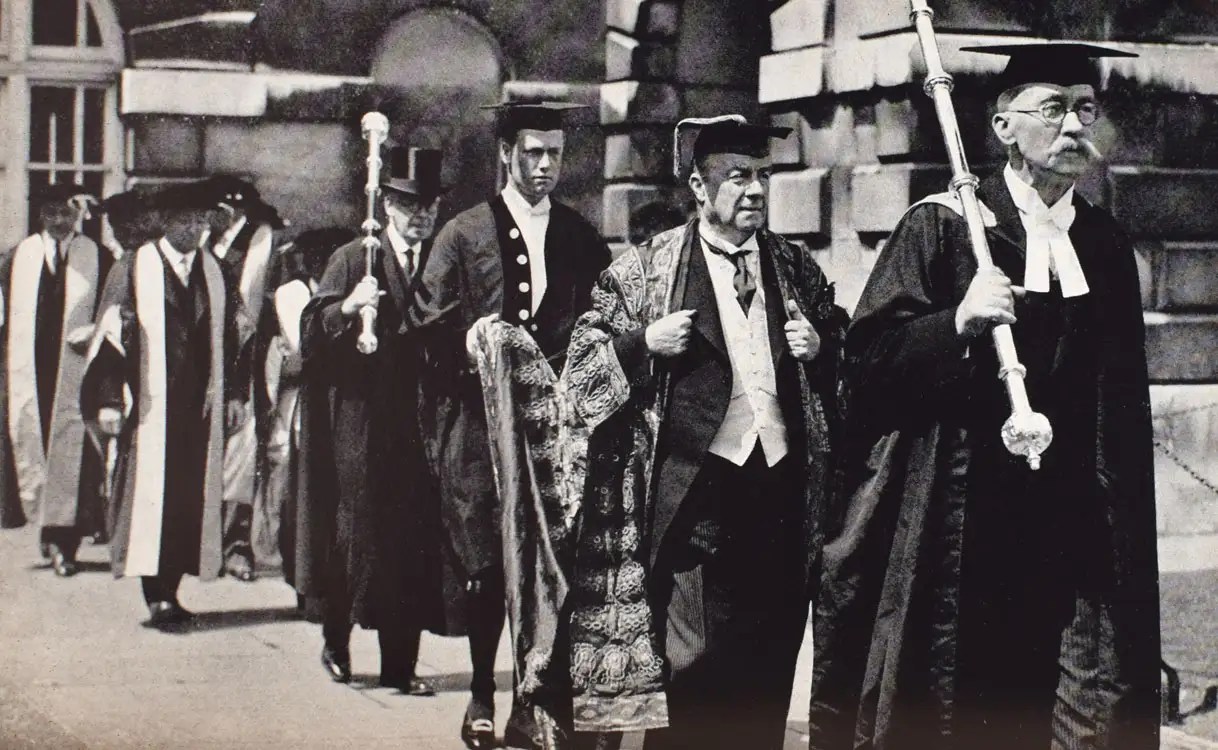
A university procession, from ‘Three Guineas’

She makes a simple point: men down the ages have ridiculed women for being so concerned about their clothes and dress; well, just look at these preposterous old buffers in their wigs and gowns and cloaks and gaiters.

But there’s also a serious point which is germane to her war theme: for she suggests that it is this flaunting of hierarchy and status, this cursed male wish to be superior, which is one of the roots of war. And so she thinks a good way to prevent war would be to attack this cause at the root and refuse to accept honours (as she did) or take part in silly ceremonies (a point developed at length in section 3).

Shortcoming 2. Over-reliance on biography as her primary evidence

The limitations of her education partly explain Woolf’s over-reliance on biography as evidence. She shows little sign of having read much history, economics, science or engineering, philosophy, psychology or sociology – some, but not much, and when she cites history books it’s rarely for the economic or social data.

Instead, what she does rely on to an overwhelming extent is biographies: all the damning evidence she assembles to demonstrate British society’s engrained misogyny and the power of the patriarchy is rarely drawn from history or sociology but relies exclusively on biographies and autobiographies and letters. The phrase you get in so many book titles, ‘Lives and Letters’, sums it up exactly. As an indication of her reliance on biography, here are quotes from just on one page:

  • ‘The witness of biography — that witness which any one who can read English can consult on the shelves of any public library…’
  • ‘Biography proves this in two ways…’
  • ‘Of this, too, there is ample proof in biography…’
  • ‘The study of biography… proves…’
  • ‘Perhaps the greatest testimony to the value of education with which biography provides us is…’
  • ‘You will find, if you consult biography…’

No need to consult facts and figures, assess data, decipher manuscripts, spend years in the archives. Again and again she takes the biography of an eighteenth century bluestocking or a nineteenth century hack writer like Mrs Oliphant off the shelf, and finds and pastes into her narrative their complaints about their limited lives and the dire condition of women in their time, which suit her argument.

(She does mention some histories but, when you look closely you see that she picks out of her historical sources the lives and opinions of her women witnesses: in other words, she selects the biographical elements of history and ignores the statistics, data, political history and so on.)

Late in the essay, rather as she does with her claims to be an amateur, untrained in academic enquiry, she turns an apparent weakness on its head. She tells us that she relies so much on (a very limited view of) history, on biography and newspapers, because they are the only sources of information open to a woman who has been denied a better, higher education, because of her sex; for:

history, biography, and… the daily paper [are] the only evidence that is available to the ‘daughters of educated men’.

Her very lack of scholarly rigour is itself an indictment of the patriarchal oppression which kept her excluded from the higher education her brothers and millions of men had benefited from.

And newspapers

She regards newspapers as ‘history and biography in the raw’. The excellent introduction by Anna Snaith tells us that Woolf kept three scrapbooks in which she gathered evidence for this book. It is striking how many of these snippets and excerpts are taken from newspaper articles or magazines, not the most in-depth kind of research. Newspapers are, by their nature, selective and biased and superficial. They sensationalise in order to sell copies. They are, in other words, the opposite of academic research into history, sociology and so on. This is a weakness in her evidence base.

On the other hand, newspapers are topical and up to date and give her useful snapshot of contemporary opinion – which makes them very interesting for the causal reader, 90 years later. Here’s a sample of the sources, taken from the numbered list of references at the back, which shows the combination of biography and newspaper cuttings which she overwhelmingly relies on as evidence.

  1. ‘Personal Reminiscences of a Great Crusade’ / a cutting from The Herald
  2. a cutting from The Listener / ‘Reflections and Memories’ by Sir John Squire
  3. ‘The Life of Sophia Jex-Blake’ by Margaret Todd
  4. Letter to The Times
  5. Debretts
  6. ‘Life of Sir Ernest Wild, K.C.’ by R.J. Rackham
  7. Lord Baldwin, speech reported in The Times
  8. ‘Life of Charles Gore’ by G.L. Prestige
  9. ‘Life of Sir William Broadbent’ edited by his daughter
  10. ‘The Lost Historian, a Memoir of Sir Sidney Low’ by Desmond Chapman-Huston
  11. ‘Thoughts and Adventures’ by Winston Churchill
  12. Speech at Belfast by Lord Londonderry, reported in The Times

You get the picture: her main sources are lives, letters and newspapers.

The second letter: funding a women’s college

Since the essay is in three parts and the introduction says it addresses three letters, I thought it would be a part per letter, so I was surprised when the second letter pops up at the end of part one. It is from a women-only college writing to ask Woolf to contribute to their fund raising. Anna Snaith’s excellent notes tell us it was a real letter Woolf received from Joan Strachey, Principal of the women-only Newnham College in Cambridge, asking for a donation to renovate the college buildings.

Woolf shows with some doleful quotations and examples, how petty-minded, snobbish and fierce for their stupid rules and regulations the existing (men-only) universities are. She harks back to the notorious incident of being kicked off the grass by the beadle early in ‘A Room of One’s Own’, which clearly still rankles.

Therefore, she replies to this letter that she will consider contributing to a women-only college but only if it is drawn up on a completely different basis from the male colleges. She proceeds to lay out the principles for an experimental college, one which will eschew all competition and exams, be open to the poor, and teach the humanities in a spirit of openness and collaboration:

A place where society was free; not parcelled out into the miserable distinctions of rich and poor, of clever and stupid; but where all the different degrees and kinds of mind, body and soul merit cooperated. Let us then found this new college; this poor college; in which learning is sought for itself; where advertisement is abolished; and there are no degrees; and lectures are not given, and sermons are not preached…

She warns that if the women-only colleges model themselves along male lines, with all the snobbery and competition and status-seeking and petty rankings that entails… those are precisely the kinds of habits of thought, the endless seeking superiority, which create the war mentality and she will not contribute to it.

And no chapels. She is as vehemently against the all-women colleges having chapels as she is violently against the engrained misogyny of the Church of England.

No to teaching English literature

She has a fierce passage execrating the teaching of English literature and its packaging into classes and exams, which she describes as ‘vain and vicious’. This is why Woolf herself refused to accept honorary degrees or prizes, despite being offered many in the later part of her life, and turned down offers to lecture (the exception which proves the rule being the lectures which formed the basis of ‘A Room of One’s Own’).

Woolf explains women’s war patriotism as an escape from domestic oppression

In a wonderfully irrational peroration she thinks that it can only have been delirious joy at being released from the narrow, cramped, uneducated lives forced upon Victorian daughters and spinsters which explained the huge outburst of patriotic enthusiasm among women at the outbreak of the Great War in 1914.

So profound was her unconscious loathing for the education of the private house with its cruelty, its poverty, its hypocrisy, its immorality, its inanity, that she would undertake any task however menial, exercise any fascination however fatal that enabled her to escape. Thus consciously she desired ‘our splendid Empire’; unconsciously she desired our splendid war.

This is splendid rhetoric but it’s a symptomatic of her failure to understand the causes of war, her failure to understand the psychology of crowds and societies embarking on war, her failure to understand genuine feelings of patriotism or national pride which are such big motivators for large numbers of people in any country – in a nutshell, her failure to understand anyone outside her own narrow upper-middle-class milieu.

Shortcoming 3. Ignorance of the wider world

I think her failure to understand the patriotic zeal which accompanied the start of World War One is indicative of her broader failure to understand the range and complexities of human nature, of all human nature across all of society.

Of the narrow little world of upper-middle-class women whose lives are supported by fleets of nameless servants which allow them to pursue their tedious obsession with art and poetry, of this tiny privileged world, she was a brilliant painter.

Of the big wide world, of the thousands of occupations, jobs and livelihoods, in finance, business, economics, trade, law, science, technology and engineering, of the lives of the working classes with their labour in coal mines and iron works, building ships, sailing the oceans, building trains and cars, laying down telegraph cables – in other words, in almost all the wide world and its billions of inhabitants, she has little or no interest and makes no effort to understand.

As an artist, as a writer, it doesn’t matter. Her novels focus on her chosen terrain and are masterpieces. As an essayist, claiming to gather evidence in order to analyse large social issues, it is, to say the least, problematic.

Giving a guinea

Out of this rather convoluted flow of arguments, Woolf concludes that she ought to give a guinea to the building of the women’s college, because it was entrapment in the family home that led so many women to explode with patriotism upon the outbreak of war. Building a college for the public education of the same class will prevent that and so materially contribute to the prevention of war which, if you recall, was the aim proposed right at the start of the essay.

Part 2. The professions

How can we enter the professions and yet remain civilized human beings, human beings who discourage war?

Woolf says a woman like her has only one weapon at her command to use against war, ‘the weapon of independent opinion based upon independent income.’ Now she will try to use this to sway the men in the professions.

The pretext is another letter she has received, from a society supporting women in the professions, asking for another donation, this time to the support of hard-up professional ladies. For Woolf it begs the question why, 20 years after women were admitted to the professions (1919) so few have risen to the top rank and so many are hovering round the bottom.

Woolf’s answers are convoluted and involve replies to other letters and lengthy addresses to her fictional interlocutor, they but boil down to:

  • women have much shorter traditions of thriving in the professions and so lack the centuries-old networks of male patronage and preferral
  • there are no limits to educated men churned out by the public schools and major universities, whereas there are far fewer schools for girls, only four or five colleges for women, and even the numbers admitted to these are severely restricted (only 500 women students were permitted at Cambridge in her day)
  • exams in the professions advantage those who have spent their lives taking exams, i.e. privileged, privately-educated men, and bar women who have (as she shows) vastly less access to private education
  • the nearly universal sexism and misogyny found at all levels of English society

Sexism and misogyny

As mentioned above, the flow of Woolf’s arguments is sometimes hard to follow, especially when it feels like she’s twisting the flow in order to fit her broader feminist critique to fit the essay’s ostensible subject of how to prevent war – but what the essay indisputably does do is powerfully convey the deeply entrenched tentacles of the patriarchy in contemporary 1930s England. She presents a wealth of facts and figures about the systematic prevention of women being educated, getting jobs, entering the professions and so on.

In this second part, the essay builds up into a devastating demonstration of English society’s hair-raising sexism and misogyny. In the main text but especially in the extensive notes which illustrate it, Woolf gives extended quotes from a wide range of men in powerful positions expressing the most hair-raising prejudices and slurs. I can’t give brief quotations, you have to read the notes, and the extended stories she gives, of awful politicians, judges, professionals, writers and commentators taking every opportunity to demean and limit women.

Fascists and Nazis

Woolf cranks up the temperature a lot by comparing several terrible British chauvinists who pontificate that a woman’s place is in the home, with a quote from none other than Adolf Hitler saying the exact same kind of thing.

Herr Hitler and Signor Mussolini have both often in very similar words expressed the opinion that ‘There are two worlds in the life of the nation, the world of men and the world of women’; and proceeded to much the same definition of the duties.

The juxtaposition of the two explains in a flash why Woolf is so resistant to all male talk about patriotism and ‘our country’. In what possible sense is it ‘her country’ when the Archbishop of Canterbury and the editor of the Daily Telegraph hold identical views about women’s place in society as Adolf Hitler? The same point is made in one of the long notes:

‘My husband insists that I call him “Sir”,’ said a woman at the Bristol Police Court yesterday, when she applied for a maintenance order. ‘To keep the peace I have complied with his request,’ she added. ‘I also have to clean his boots, fetch his razor when he shaves, and speak up promptly when he asks me questions.’ In the same issue of the same paper Sir E. F. Fletcher is reported to have ‘urged the House of Commons to stand up to dictators.’ (Daily Herald, 1 August 1926.)

Why, Woolf asks, all this fuss about opposing dictators abroad when every level of British society supports domestic tyrants at home?

Pay for housework

Men work in the public realm and get paid, sometimes a small fortune, often for jobs of dubious worth. Women labour in the home to raise families and manage households and care for the elderly, all unpaid. So: women’s domestic work should be paid.

The work of an archbishop is worth £15,000 a year to the State; the work of a judge is worth £5,000 a year; the work of a permanent secretary is worth £3,000 a year; the work of an army captain, of a sea captain, of a sergeant of dragoons, of a policeman, of a postman – all these works are worth paying out of the taxes, but wives and mothers and daughters who work all day and every day, without whose work the State would collapse and fall to pieces, without whose work your sons, sir, would cease to exist, are paid nothing whatever.

I wonder who first originated this call? Mary Wollstonecraft in ‘A Vindication of the Rights of Woman’ (1792)? Certainly Friedrich Engels mentions it in his 1884 book ‘The Origin of the Family, Private Property and the State’. Anyway, Woolf makes a sustained case for it over many pages, 30 years before the issue was revived by second-wave feminists in the 1970s:

Note: I was a househusband for eight years. I did all the childcare, running children round to nurseries, playgroups, parties, doing all the shopping, cooking and cleaning, changing thousands of nappies, giving bedtime baths and so on, while my wife earned the family income. So I have lived experience of issues like this. It’s this lived experience which feeds into my scepticism about feminism, not as a theory (fine and dandy) but in practice (complicated and compromised). I met plenty of women who were extremely happy to pack in office work and become full-time mums and housewives, who loved looking after their young children, dressing them up, holding parties, dropping them at nurseries or infant school and going to meet girlfriends for lunch or coffee.

Then again, some didn’t. Some felt trapped and needed support, would have welcomed free or cheap childcare, or just wanted to go back to work which they found more fulfilling than hanging round playgrounds or hosting rooms full of screaming kids.

I had many conversations with scores of mums about how the state should provide cheap childcare, or if only companies would allow more flexible work based around school hours, if only housework was recognised and paid for like other forms of work, and so on and so on. Hundreds of conversations on these and related subjects, over years and years.

So my scepticism about feminism is not ideological or temperamental. It’s based on the lived experience of being a housekeeper and child-rearer myself, and talking to hundreds of women in the same situation. The problem is not the top-level slogans and demands, anyone can come up with catchy slogans and carry banners – “Wages for Housework” – it’s figuring out the practical policies and application: where would the money come from? How would it be paid out? Who defines ‘housework’? Like child benefit would it go to anyone caring for a child or be subject to conditions? How would you prove that you do the housework and don’t sub-contract this or that part to cleaners or nannies? etc etc.

The procession

Back to the Woolf on the professions. She gives a vivid description of the processions of all the professions through London’s streets to the centres of law, finance and so on and asks her women readers: do we, in fact, want to be part of this procession? Do we want to do the same jobs but for less pay and more condescension? Or do we want to strike out on our own and lead our lives differently?

The facts… seem to prove that the professions have a certain undeniable effect upon the professors. They make the people who practise them possessive, jealous of any infringement of their rights, and highly combative if anyone dares dispute them. Are we not right then in thinking that if we enter the same professions we shall acquire the same qualities? And do not such qualities lead to war? In another century or so if we practise the professions in the same way, shall we not be just as possessive, just as jealous, just as pugnacious, just as positive as to the verdict of God, Nature, Law and Property as these gentlemen are now?

She gives a number of quotes from lawyers, clerics and politicians complaining they lead a dog’s life, and have sacrificed all their pleasures and family time to their work. Do modern women want to rush into exactly the same kind of wage slavery?

Woolf wonders if we can turn to the lives of nineteenth century women in the professions to help us find a more humane way to have one of these high-powered jobs and live properly? No, because there weren’t any women in the nineteenth century professions. They weren’t allowed. Instead:

We find, between the lines of their husbands’ biographies, so many women practising – but what are we to call the profession that consists in bringing nine or ten children into the world, the profession which consists in running a house, nursing an invalid, visiting the poor and the sick, tending here an old father, there an old mother? – there is no name and there is no pay for that profession; but we find so many mothers, sisters and daughters of educated men practising it in the nineteenth century that we must lump them and their lives together behind their husbands’ and brothers’.

The validity of housework and child-rearing, again, and the long buried, unrecorded of the scores of millions of women who spent their entire lives doing it.

Giving the second guinea

All these arguments have been contained, rather confusingly, in a very long letter replying to the letter she received asking for financial aid for impoverished women professionals. Woolf sums up her position by saying she will send the letter-writer one guinea ‘on condition that you help all properly qualified people, of whatever sex, class or colour, to enter your profession’, and in addition ensure that women:

  • must earn enough to be independent
  • must not prostitute their brain to their profession
  • must refuse all prizes, medals and awards, and be content with obscurity
  • must rid themselves of religious pride, college pride, school pride, family pride, sex pride and those unreal loyalties that spring from them

These are obviously very strict, probably utopian conditions, as with her demand for a completely different type of college which ended section 1. But:

If you agree to these terms then you can join the professions and yet remain uncontaminated by them; you can rid them of their possessiveness, their jealousy, their pugnacity, their greed. You can use them to have a mind of your own and a will of your own. And you can use that mind and will to abolish the inhumanity, the beastliness, the horror, the folly of war.

Antigone saying No to male tyranny

Part two rises to a very powerful invocation of Sophocles’ play, Antigone. Woolf studied this when young and it stayed with her all her life as a powerful story of female resistance to male tyranny. In the era of Hitler and Mussolini it was more than ever relevant. She comes back to it later.

No risk because of exclusion

Woolf ends part 2 with a grand fanfare of irony, saying there is no immediate risk of women professionals losing their souls and working themselves to shreds so long as the laws of England hold their nationality so lightly, prevent them from working in many professions, limit the numbers who can attend university, and ensure that so many women continue to live in the tradition of neglect and contempt, living gruelling lives of unpaid work in dark patriarchal homes.

Part 3. The Outsider Society

The sarcasm and irony which have been present throughout the essay rise to a real anger and bitterness in this, the longest of the three parts.

Woolf reverts back to the original letter she was sent, the one from the unnamed male correspondent asking her how they can prevent a war, and she repeats his three suggestions, namely that we should:

  1. sign a manifesto pledging ourselves ‘to protect culture and intellectual liberty’
  2. join a certain society, devoted to certain measures whose aim is to preserve peace
  3. should subscribe to that society which like the others is in need of funds

Failure of the universities

She addresses these points one by one. First she is satirical about this idea of ‘protecting culture and intellectual liberty’. Isn’t this what the Great Universities have said they were devoting themselves to for centuries, the ones which have been teaching men these values and brutally excluding their sisters and daughters? Is the fact that these values now need such support from society an admission that all those centuries of learning have failed? And if they’ve failed, why should the impoverished, life-opportunity-deprived daughters and sisters suddenly rush to the help of their oppressors?

What is ‘culture and liberty’?

Anyway, what is this ‘culture and liberty’ the letter writer refers to? She knows what it isn’t. Characteristically, she turns to biography and uses the life of an author like Mrs Margaret Oliphant (1828 to 1897) who, after her husband died, churned out meretricious romances to support her children. Was this intellectual liberty? No, this was intellectual prostitution and Woolf angrily takes it as typical of the intellectual prostitution forced on so many women writers and artists who had to sell their souls and prostitute their art because of the patriarchy’s refusal to let them earn a living any other way.

So she mocks the letter writer’s suggestion that women, victims of centuries of repression, should suddenly rush to help the poor privileged men in their time of need. He wants her to join his pacifist society, does he? Well, no. The very word ‘society’ denotes the systematic exclusion of women from education and influence and power and money, so screw society.

The very word ‘society’ sets tolling in memory the dismal bells of a harsh music: shall not, shall not, shall not. You shall not learn; you shall not earn; you shall not own; you shall not – such was the society relationship of brother to sister for many centuries.

The Outsiders Society

She’s not going to join any boys’ club. Instead she proposes setting up a separate organisation, for women of her class and (lack of) education. It would be called The Outsiders Society. It would consist of educated men’s daughters working through their own class and by their own methods for liberty, equality and peace. Members would:

  • not fight
  • not work in munitions factories or nurse the injured
  • not encourage men to go and fight but maintain an attitude of neutrality, as fighting is a ‘sex characteristic which she cannot share’

She rises to real bitterness:

She will find that she has no good reason to ask her brother to fight on her behalf to protect ‘our’ country. ‘”Our country,”‘ she will say, ‘throughout the greater part of its history has treated me as a slave; it has denied me education or any share in its possessions. “Our” country still ceases to be mine if I marry a foreigner. “Our” country denies me the means of protecting myself, forces me to pay others a very large sum annually to protect me, and is so little able, even so, to protect me that Air Raid precautions are written on the wall [i.e. women are defenceless against modern warfare]. Therefore if you insist upon fighting to protect me, or “our” country, let it be understood, soberly and rationally between us, that you are fighting to gratify a sex instinct which I cannot share; to procure benefits which I have not shared and probably will not share; but not to gratify my instincts, or to protect either myself or my country. For,’ the outsider will say, ‘in fact, as a woman, I have no country. As a woman I want no country. As a woman my country is the whole world.’

Wow. Very powerful. Furthermore, The Outsider will cultivate complete indifference to male nonsense about patriotism, war and fighting. On the contrary, she will:

  • take no part in patriotic demonstrations
  • not take part in patriotic praise
  • absent herself from military displays, tournaments, tattoos, prize-givings and all such ceremonies as encourage the desire to impose ‘our’ civilization or ‘our’ dominion upon other people

The idea is that this ‘indifference’ will damp down patriotic fervour in those around her and thus, in a tiny way, help to avoid war.

All this makes a sort of sense. But it feels like twisting logic when Woolf goes on to assert a link between these anti-war steps and the positive demands of her feminist programme. The connection feels tenuous and forced. Because she now switches to say that in order for their opinion or actions to matter, the outsiders must push for a raft of feminist requirements, being:

  • they must earn their own livings
  • they must press for a living wage in their professions
  • they must create new professions in which they can earn a living wage
  • they must press for press for a money wage for the unpaid worker in her own class – the daughters and sisters of educated men
  • they must press for a wage to be paid by the State to the mothers of educated men

Make the state pay for housework

This last is vital because until she has complete financial independence, a wife is dependent on her husband for money and will follow his opinions and men are for war. Therefore, in order to create an influential bloc of educated women who are against war, this class must be given financial, and so intellectual, independence. Women must be paid by the State for their work as mothers.

And she tells her male interlocutor that this step – paying women for their housework – would also liberate husbands, because by sharing the burden of earning an income they would no longer be wage slaves, slaves to the rat race. It would have an enlightening and life-enhancing effect all round.

I gave my thoughts on this proposal earlier. It sounds great, and you can see her logic – that women can only be truly independent and free if they have their own income, separate from their father’s or husband’s – but how would it be implemented in practice?

I’ll just make the additional point that its recurrence here is characteristic of how key themes and suggestions recur throughout the essay, building up power through repetition and echoes, not unlike her technique in her novels.

Outsider demands

But she hasn’t finished with her demands. The Outsiders would:

  • not only earn their own livings but become so expert that their threat to down tools would have power and influence
  • when they have earned enough to live on they would earn no more i.e. not pile up obscene wealth
  • they would reject any profession hostile to freedom such as the arms trade
  • they would refuse to take office in any institution which pretends to respect liberty but actually restricts it, such as Oxford and Cambridge

Outsiders will eschew all the stupid costumes and ceremonies so beloved by men (see the section about silly ceremonials in part 1).

Outsiders will eschew ‘the coarse glare of advertisement and publicity’ and prefer to work in honest obscurity.

The secret society already exists

Wandering into thriller territory, Woolf suggests that this Outsider Society already exists but is secret and underground in its activities. Her very dubious evidence for this far-fetched claim is a clutch of newspaper reports of various women officials making comments against war, opposing arms manufacture and the like. From random quotes and newspaper clippings she based the existence of a secret society operating across English society. Is this an example of her sometimes utopian or far-fetched argumentation – or an example of her dry sense of humour? Difficult to tell.

Against the Church of England

Outsiders will:

  • fearlessly investigate and criticise public institutions they are forced to contribute to, such as the universities, but especially the Church of England
  • by criticizing religion they would attempt to free the religious spirit from its present servitude and would help, if need be, to create a new religion based it might well be upon the New Testament, but, it might well be, very different from the religion now erected upon that basis

Woolf’s attitude to the Church of England had already been indicated in the passage about cited above about Antigone where she writes that ‘Antigone’s five words are worth all the sermons of all the archbishops’, those five Greek words (they total 11 in the English translation) being:

‘Tis not my nature to join in hating, but in loving.’

Pages 196 to 202 give a scathing account of how Jesus Christ’s own admonition that his followers are equal which promised equality between men and women was denied by St Paul, who invented the idea that women must be veiled in church and not speak. This bigotry hardened over the centuries into a church which forbids any positions of power or influence in the most powerful and prestigious organisation in the land, to women.

With the result that the salary of an archbishop is £15,000, the salary of a bishop is £10,000 and the salary of a dean is £3,000. But the salary of a deaconess is £150; and as for the ‘parish worker’, who ‘is called upon to assist in almost every department of parish life’, whose ‘work is exacting and often solitary…’ and who is most likely to be a woman, she is paid from £120 to £150 a year.

It’s a pattern mirrored in all the other professions and walks of life: women excluded from all the prestigious, well-paid higher positions, and forced to undertake the most menial and poorly-paid jobs.

Psychoanalysis, anger and fear

One of Anna Snaith’s excellent notes tells us that ‘Woolf’s brother Adrian [Stephen] and his wife Karin were trained psychoanalysts and were crucial in disseminating Freud’s work in England.’ This is relevant because Woolf quotes at length from the Archbishops’ Commission on the Ministry of Women (1936) and in particular from the appendix written by Professor Grensted, the Nolloth Professor of the Philosophy of the Christian Religion in the University of Oxford.

This professor concluded that there is no reason in theology (Christ’s teachings) why there should not be women priests, but there were strong objections to women priests among the clergy. Digging deeper he uses Freudian terminology to suggest the deep conviction held by many men of men’s superiority and women’s inferiority.

The causes are obscure but the outcome is obvious: that whenever a conversation lights on the topic of equality for women and women holding roles up till now reserved for men, many man become angry and many women become fearful. This imbalance leads women not to raise, mention or discuss the issue which, as a result, goes underground.

The infantile fixation

Woolf takes from Grensted the notion of the ‘infantile fixation’. I didn’t quite understand this and I didn’t see her defining it anywhere. Instead she gives three examples of what she means (taken, inevitably, from biographies), namely the wildly irrational anger and jealousy triggered in three classic Victorian fathers when their daughters asked permission to get married or (worse than that) to get a job. The fathers being:

  • Mr Barrett (father of Elizabeth who wanted to marry the poet Robert Browning)
  • the Reverend Patrick Brontë (father of Charlotte who wanted to marry)
  • Mr Jex-Blake (father of Sophia who was offered a small sum for tutoring mathematics to a friend)

By contrast, to show the impact of a father’s liberality, she gives the story of Mr Leigh Smith. It’s worth quoting at length because the impact is in all the details. Smith had a daughter, Barbara, who he loved.

When Barbara came of age in 1848 he gave her an allowance of £300 a year. The results of that immunity from the infantile fixation were remarkable. For ‘treating her money as a power to do good, one of the first uses to which Barbara put it was educational.’ She founded a school; a school that was open not only to different sexes and different classes, but to different creeds; Roman Catholics, Jews and ‘pupils from families of advanced free thought’ were received in it. ‘It was a most unusual school,’ an outsiders’ school. But that was not all that she attempted upon three hundred a year. One thing led to another. A friend, with her help, started a cooperative evening class for ladies ‘for drawing from an undraped model’. In 1858 only one life class in London was open to ladies. And then a petition was got up to the Royal Academy; its schools were actually, though as so often happens only nominally, opened to women in 1861; next Barbara went into the question of the laws concerning women; so that actually in 1871 married women were allowed to own their property; and finally she helped Miss Davies to found Girton. When we reflect what one father who was immune from infantile fixation could do by allowing one daughter £300 a year we need not wonder that most fathers firmly refused to allow their daughters more than £40 a year with bed and board thrown in.

The difference just one liberal father made. What if all Victorian fathers had been like that.

Sexist science

There follows a passage giving some examples of how even contemporary science is twisted to prove the inferiority of women. To be honest this section is neither very compendious nor persuasive. She doesn’t really go into the most basic accusation against women, that their bodies are designed for childbirth and child-rearing and this explains why their minds are limited to domestic subjects and childish logic. (I’m not saying this, I’m repeating the sexist, misogynist accusation.)

This is a failing but I think reflects the limitations of Woolf’s knowledge and education. Of science she knows next to nothing and so is simply incapable of unpacking all the biological and psychological aspects of woman-hating. She is much more at home in her comfort zone of education and literature, the lives of women writers.

She cites Bertrand Russell pointing out the sheer sadism of much medical science towards women (the medical profession’s reluctance to provide painkillers to women in childbirth) or the twisting of scientific knowledge to justify male superiority – but not as amply as this huge subject demands.

Cleons

Instead she reverts to literature again, and her obsession with Antigone. In the play the oppressive father is Cleon, the archetype for the Victorian paterfamilias and the modern fascist. Here is Cleon speaking dictator-talk:

‘Whomsoever the city may appoint, that man must be obeyed, in little things and great, in just things and unjust… disobedience is the worst of evils… We must support the cause of order, and in no wise suffer a woman to worst us… They must be women, and not range at large. Servants, take them within.’

Order and the oppression of women, Mr Barrett and Mussolini.

The personal and the private

In the essay’s last pages she brings things together by (rightly) saying that she has shown how male tyranny in the personal, domestic realm and in the public realm, are intimately linked:

that the public and the private worlds are inseparably connected; that the tyrannies and servilities of the one are the tyrannies and servilities of the other.

Despite the strangeness of the letter-answering structure and the oddly digressive, rambling flow of the argument, by the end she has presented a devastating barrage of evidence, as well as making a host of demands and suggestions.

The third guinea

So she refuses to sign the form her correspondent had sent her. She refuses to sign up to his society because of her opposition to all such male bodies, but she will send him a guinea to support it.

Their aims are the same, to oppose the tyrants in the name of Justice and Equality and Liberty. But, as this amazing book has explained, as a woman, as the patchily educated ‘daughter of educated men’, as someone with completely different life experiences and, consequently, utterly different perspectives from the male sender of the letter, she shares the same aim but insists that she will try to bring it about using, not the old male forms and words, but new words and new ideas appropriate for women.

Magnificent

For all its faults, ‘Three Guineas’ is a magnificent, powerful and very persuasive piece of work. Her assembly of a very wide range of evidence, facts and figures really bring home the historical endurance, depth and wide range of the legal, financial and cultural oppression of women throughout English history and the stupid, patronising and misogynist attitudes and opinions deployed to maintain that oppression.

The notion of the Outsiders Society is the crystallisation of the massive theme which emerges repeatedly throughout the text, the idea that women – not because of any biological or psychological differences – but purely because of the legal, financial, professional and cultural apartheid they have suffered for centuries, bring to the table a different perspective from men across a whole range of issues.

I think it’s a magnificent example of a polemical essay, of an impassioned political pamphlet.

Criticisms

There are a number of problems or issues with Woolf’s way of arguing. Initially I included them in my review where they occurred but they cluttered up the flow of my review, and gave an unduly negative opinion too early on. I mentioned three earlier on. Here are a few more.

Shortcoming 4. Woolf’s intellectual confusions

Periodically throughout the text Woolf freely admits to own intellectual shortcomings: for example, right at the start she admits being bewildered that there seems to be a wide range of opinions about whether war is good or inevitable. She herself tells us that the more she reads, the more opinions she discovers, the more confused she becomes. But… is that not the point of being an intellectual: to read all the opinions, weigh the evidence, and develop your own line of argument, based on the evidence you uncover and reacting to other people’s arguments?

This activity, intellectual activity, always puzzles and confuses Woolf. In ‘A Room of One’s Own’ there’s the section where she orders up some books in the British Museum and opens them up, expecting to discover The Truth staring her in the face.

Sometimes this is part of her general mocking irony, mocking the pretensions of pretty much all male activity, including the grand Pursuit of Truth. But at other times it can give you the worrying sense that she doesn’t really understand what intellectual enquiry is.

Her intellectual confusion as evidence of her case

In the opening and then at various transition moments, Woolf explicitly tells us that she struggles to marshal the evidence, is embarking on something too big for her abilities, and wonders if she’d be better off abandoning it. After a while I realised that maybe these passages are designed to dramatise the issue of women’s exclusion from formal education by using herself as an example.

Woolf’s brothers went to top private schools and Oxbridge whereas she more or less had to educate herself at home and mostly taught herself by browsing through her father’s extensive library. In other words, every time she shares how confused by the evidence or daunted by the challenge of answering big question she is, she is demonstrating the effect of the grotesquely unequal education of the genders, how women have been the victims of ‘tradition, poverty and ridicule’, and showing the reader how she (and we) are suffering for it.

Maybe that’s why she flaunts her own intellectual limitations so much: the intellectual inability she frequently laments is the result of her exclusion from higher education. It makes her case for her.

Shortcoming 5. Her analysis is restricted to a (relatively) small class

Her lack of real confidence in her own research, and her need to make her feminist points as categorical and powerful as possible, explain why Woolf makes the strategic decision of restricting her analysis to a relatively small class, to women like herself, to ‘the daughters of educated men’, as she describes them. As she puts it:

Our ideology is still so inveterately anthropocentric that it has been necessary to coin this clumsy term – ‘educated man’s daughter’ – to describe the class whose fathers have been educated at public schools and universities. Obviously, if the term ‘bourgeois’ fits her brother, it is grossly incorrect to use it of one who differs so profoundly in the two prime characteristics of the bourgeoisie – capital and environment.

She makes it quite clear on page one that she is only discussing upper-middle-class women, women like herself, women with immaculate manners who are used to managing servants and know which of the many forks and spoons to use at a formal dinner.

In order to avoid the confusions, contradictions and conflicting evidence I mentioned above, in order for her analysis to work, she has to reject the vast majority of the population (the working class and lower classes, of both sexes) and identify her cause with just this numerically small and limited class of posh ladies.

It isn’t just me pointing this out. The Wikipedia article about Three Guineas tells us that the noted academic Q.D. Leavis wrote a scathing review of ‘Three Guineas’ soon after it was published:

She denounces the essay because it is only concerned with ‘the daughters of educated men’, seeing Woolf’s criticisms as irrelevant to most women because her wealth and aristocratic ancestry means she is ‘insulated by class’.

And Anna Snaith’s notes in the Oxford University Press edition tell us that Woolf received letters from working class women readers who complained about being left out of her analysis, notably a long semi-autobiographical one from a working class woman named Agnes Smith.

This is closely related to what I called shortcoming 3, ignorance of the wider world. But it’s also a decision. She found it hard enough gathering the evidence for the sexist discrimination against her own type and class of woman. If she opened it up to the broader middle and working classes she’d never have finished it.

2025: the perils of intersectionality

Many of these criticisms are mentioned in Anna Snaith’s introduction to the Oxford University Press edition. Here she indicates the larger cultural and political problems the essay falls foul of. This is that there are, nowadays, so many grievances, so many groups claiming to be victims, so many communities and identities who feel that they, too, have been subjected to centuries of oppression, that it is hard to focus on just one, and it is especially hard to focus on the group Woolf defines as the ‘daughters of educated men’.

As you read Snaith’s account of Woolf’s life and social circle, with so many friends among England’s political and cultural elite, the idea of her as a persecuted outsider feels more and more ludicrous. She wasn’t a Jew in Hitler’s Germany, a Black in the American South, a kulak in Stalin’s Russia, an Aborigine in Australia, she grew up in a house full of books which she was actively encouraged to read and went on to become a centre of London’s literary and artistic elite.

This doesn’t invalidate any of the points she makes in the book or detract from the essay’s tremendous power. It’s just to say that the struggle for women’s equality takes its place among quite a few other struggles. I’ve a book about the Irish Civil War on my desk and Irish nationalists have quite a story to tell about 1,000 years of British oppression. Her husband was a Jew who had his own story about the legal and financial persecution of Jews. Something similar could be said of England’s Roman Catholics, prevented by law from holding official positions. Or – a group close to my heart – England’s non-conformists, banned by law from holding any positions of authority for 300 years after the civil war. Citizens from India or any of the colonies we ruled for centuries might have a thing or two to say about Britain’s oppression of their peoples and cultures.

Being a modern academic, Snaith is contractually obliged to drag in slavery – the progressive topic par excellence – to her discussion of ‘Three Guineas’, on the rather tenuous basis that guineas were, apparently, first used as currency in the British slave trade. Don’t know what Virginia would have made of that scholarly leap of imagination.

To repeat – this little digression about the modern over-abundance of historical grievances is not entirely my view but simply expanding points made by the book’s editor, Anna Snaith, in her introduction.

All these other issues don’t invalidate any of the points Woolf makes in the book but they place it in a much larger, real world context. If you’re a feminist, you can insist that your cause and your history of oppression is the real one, the big one, the important one and, convinced of your righteousness, overlook or downplay the grievances of all the other groups I’ve mentioned. In a sense, to get anything done, you have to focus on your issues and grievances; nobody can represent the issues of the whole world. You have to pick your battles. And this explains why Woolf realised that, in order to get her book written, she had to concentrate just on relatively privileged upper-middle-class women like herself, on ‘the daughters of educated men’.

Conclusion

It’s a very powerful book. Very. To repeat what I said at the start, from one point of view it may be her most important work. It’s a bit of a struggle, a bit meandering, a bit puzzling in places, her proposals such as for the Outsider Society are a bit eccentric – and yet so many of her main points drive right home, and the evidence gathered in the notes at the end is searing, blistering, eye-opening. It shook this old cynic. It materially changed my views about feminism. I strongly recommend it.


Credit

‘Three Guineas’ by Virginia Woolf was first published by the Hogarth Press in 1938. Page references are to the 2015 Oxford University Press paperback edition, edited and annotated by Anna Snaith, although the text is easily available online.

Related links

Related reviews

The 80s: Photographing Britain @ Tate Britain

Linton Kwesi Johnson

Johnson isn’t mentioned anywhere in this exhibition but thinking about the 1980s made me dig up favourite playlists, and I ended up writing most of this review listening to his great 1979 album, ‘Forces of Victory’.

Introduction

Sometimes you wonder whether exhibitions at the Tate galleries are really about art at all any more, but aren’t more like polemically woke sociology lectures, with art, photography, sculpture and other evidence used merely as illustrations for a familiar set of well-worn, ‘radical’ themes.

This exhibition contains rooms or sections devoted to immigration, race, race riots, racism, the Black Experience, the Black Body, the Queer Black Body, feminism, identity, gender, colonialism, imperialism, immigration, sectarianism, pollution and environmentalism. As you can see, these look like the topic tabs on the Guardian website or a list of fashionable humanities subjects at any modern university.

As to the lived experiences of anyone not a left-wing activist, not a feminist, not Black or Asian, and not gay or lesbian during the 1980s, these are less in evidence than the subjects I’ve just listed and where they do appear, it’s mainly to be mocked and ridiculed.

I visited with a friend and we loved the first room because it is packed with a Greatest Hits selection of political issues from the 1980s: photos of anti-racism demonstrations (by Syd Shelton and Paul Trevor), of Rock Against Racism gigs, of the Miners Strike (by John Harris and Brenda Prince), of Greenham Common (by Format Photographers), protests about Section 28 and AIDS, all leading up to the Poll Tax riots – yes, all the usual suspects, shot in vivid black and white, which took us both back to our heady student days.

But as the exhibition progressed her enthusiasm turned to puzzlement and then irritation and, by the end, she was so fed up with being lectured about identity and gender and race and queer Black bodies that she gave up. She described it as the worst exhibition we’ve been to this year and I came to agree. If you read all the wall captions (as I’m addicted to doing), it felt like being trapped in a lift full of woke humanities lecturers all talking at the same time.

‘No title’ from the series Strictly by Jason Evans (1991) Tate © Jason Evans

The central problem with this exhibition

I naively thought the exhibition would be a portrait of the 1980s, that the curators would make an honest attempt to give a balanced account of this troubled decade and the wide range of social and cultural changes it witnessed, as captured in photography – that it would be a visual history of the decade.

Very wrong. What the curators have done is to make a personal selection of just the radical photographers from the period who covered what they think are the important issues (then, as now), the disruptors, the radicals, the subversives. And, as mentioned, although they initially touch on many of the obvious issues of the time (the Winter of Discontent, Thatcher, Miners Strike, unemployment, inequality, Greenham Common, poll tax) this is not where the curators’ hearts lie.

The curators are far more concerned with contemporary woke issues of gender and ethnicity than with genuinely trying to reach back and understand what it was like to live through the 1980s, as my friend and I (and, obviously, scores of millions of other Brits) did.

The result is an exhibition which feels top heavy with the woke curatorial concerns of our own day – gender, race, colonialism, immigration, inequality – but feels like it misses out important aspects of the decade in they’ve chosen to cover.

While the wall labels are fairly neutral and factual about the political history (Callaghan government; winter of discontent; days lost to strikes; Thatcher elected; deindustralisation; working class poverty; anti-nuclear protests) the actual exhibits are utterly one-sided, with a plethora of photos, pamphlets and posters decrying the authorities, the police, the government, for their racism, lack of concern for the poor, inequality, tax and regulation changes to benefit business and the middle classes, and so on.

While all these criticisms are true, they fail to take account of the key fact of the decade which is that Mrs Thatcher was, and continued to be, phenomenally popular with about 40% of the population. Here’s how many voted for her three Conservative administrations.

  • 1979: 13,697,923 (44%)
  • 1983: 13,012,316 (42%)
  • 1987: 13,760,583 (42%)

Lots and lots of people thought Britain had gone down the drain in the 1970s, thought the Labour governments of Wilson and Callaghan were in hock to the trade unions who, despite all their promises, seemed to be continuously on strike, while all manner of public services collapsed – that Britain was becoming a failed state or Third World country.

In this narrative, Thatcher not only saved Britain from endless decline under Labour, but went on to remodel the entire economy, letting unprofitable nationalised industries go to the wall while privatising other state monopolies in order to enable international investment (for example, modernising the dire railway network or allowing greater innovation in telecoms). The deregulation of the City of London allowed British banks and investment companies to compete more aggressively around the world and become phenomenally successful. Selling council houses to their owners (as per the 1980 Housing Act) allowed millions of poor people to feel the pride and security of owning their own home for the first time. And, on the patriotic front, her staunch attitude in the Falklands War and victory against quite daunting odds, allowed tens of millions of Brits to feel proud about their country again.

I personally disagree with a lot of this or can point out the obvious criticisms of most of these policies – but 40% of the population enthusiastically agreed with it, saw the world this way, voted for her, and hero-worshipped her.

And my point is simple: None of that is in this exhibition. This is an exhibition of radical feminists, Black and Asian civil rights marchers, gay rights activists, of campaigners against race hate and misogyny and unemployment and nuclear weapons etc. It is like a collection of all the fringe groups you find at a Labour Party conference vying for the attention of those in power who are always too busy to listen, today as 40 years ago.

The large number of people who were relieved by the breaking of union power, the end of permanent strikes, the people who made fortunes in the City or found their pay doubling in newly privatised companies or suddenly owned a home for the first time in their lives or felt the government was (unlike labour) seriously backing them in the war against the IRA, all the people who benefitted from the booming North Sea oil industries in Aberdeen or working on the rigs, all the people who were encouraged by the new spirit of entrepreneurism to set up their own business and prospered – none of them are here.

To be clear, and to bend over backwards for the curators, the main wall labels which introduce each room and give the historical facts behind each theme are broadly objective historical summaries, albeit of the predominantly leftish issues they’ve chosen to discuss. It’s the selection of photos and objects which are unrelentingly one-sided, tendentious and biased and it is, of course, these which make the main impact on the visitor.

For example, the exhibition includes a photo by Anna Fox of this jokey cutout of Mrs Thatcher which has been splattered with orange or something. But to really convey the atmosphere of the decade it should have included many more images of Thatcher, including some of the terrifying ones of her at her most domineering. Now I think about it, the show could have had an entire section devoted just to images of Mrs Thatcher, showcasing all the photographic and image manipulation styles of the day, from adoring Conservative posters to satirical photomontages by Peter Kennard or photos of the Spitting Image puppet of her. That would have been interesting, funny and thought provoking but no. Just this image of the cutout spattered with soup. Disappointing. Missed opportunity. Photos of the woman who dominated a decade.

Friendly Fire, target (Margaret Thatcher) by Anna Fox 1989 © Anna Fox

The relentlessly left-wing perspective of the curators quickly comes to feel so narrow. Can it really be true that every single photographer, photographic studio or collective during the entire 1980s was vehemently left wing, concerned only with radical causes, with ‘pushing boundaries’ and ‘subverting’ all the usual suspects (gender norms, heteronormative stereotypes, racist myths etc)? Can the entire decade‘s photographic output really have been so narrow, repetitive and obsessed with the same handful of left-wing themes and issues?

Facts about the exhibition

This is a vast show: ten rooms, 16 themes, over 70 ‘lens-based artists and collectives’ are represented by over 550 art works and archive items: lots of ‘radical’ photography magazines such as Ten.8 and Camerawork; lots of posters, leaflets, handouts, Greenham Common posters and flyers and badges, anti-racism pamphlets, posters etc. It is massive. Prepare to be overwhelmed and exhausted.

No reasonable human being can be expected to fully process and assess 550 photos and objects at one go – so the curators are either assuming people will go back a second time (probably a good idea) or will hop from one section to another, or will skim through and not give anything enough attention (all too likely).

The negative affect of this jumble-sale overcrowding is exemplified by the sections devoted to the black-and-white documentary photography of two photographers I revere, Tish Murtha and Chris Killip. I raved about their depictions of dirt-poor working class communities when I first saw them in shows at the Photographer’s Gallery entirely devoted to their work, when they had a devastating impact on me. Tish Murtha, in particular, was a photographer of genius.

But here, half a dozen of their (outstanding) photos are wedged in between 6 by someone else, 9 by someone else, 4 by someone else, 7 by someone else, a section about Asian identity, another about the Black Experience, some stuff about pollution in Devon, a sequence of seaside snaps… and so on and so on until the whole thing becomes a blur. They both deserve a better environment and more respect.

Critch’ and Sean by Chris Killip (1982) Tate © Chris Killip

It’s the difference between walking through a landscape, stopping to give every tree and plant time and attention – and driving through the same landscape in a car, noticing the occasional standout feature against the general blur.

Chronological slippage

The exhibition is so huge that it overflows its own boundaries. It is everywhere referred to as ‘The 80s’ and yet the first photo dates from 1976 and the last one from 1993. That’s a 17-year spread, not a ten-year one. It feels bloated chronologically as well as content-wise.

Exhibition structure

At one point I drafted a long section comparing my own lived experience of the 1980s (including going on protest marches as a student, then living in the Brixton depicted in some of these photos, clubbing, protesting, walking through one of the Brixton riots etc) with the depictions given here but it got too long and irrelevant. Instead here is a boiled-down version of Tate’s own exhibition guide (which you can read in full here).

As you can see, the opening sections tick all the boxes, contain interesting facts and seem set fair to give you an interesting historical overview of the decade. It’s only slowly that the curators’ obsession with race and gender become more prominent and you begin to wonder, and then become irritated by, the absence of so many other things.

First a list of what is in the exhibition. Then my list of what, in my opinion, has been omitted.

1. Documenting the decade

Protests and riots from the 1976 Grunwick strike through the Miners Strike, National Front rallies met with anti-racist demonstrations, the Clash playing their famous Rock Against Racism gig in Victoria Park, the election of Mrs Thatcher and the ideology of Thatcherism, Greenham Common (obviously), the poll tax riots.

Paul Simonon of the Clash at a Rock Against Racism concert, Victoria Park, East London, April 1978, photo by Syd Sheldon/White Riot, in The 80s: Photographing Britain at Tate Britain

2. Anti-racist movements

The 1948 British Nationality Act allowed everyone born in Britain or its Empire to become a ‘Citizen of the United Kingdom and Colonies’ and tens of thousands came to fill job vacancies. Regrettably, sometimes tragically, this triggered hostility and racial discrimination, marking the beginning of decades of racist rhetoric, rioting and civil rights activism. 1968 Enoch Powell’s river of blood speech. By the mid-1970s, the far-right, anti-immigration National Front was England’s fourth largest political party. So the show has many photos of their rallies and protests by opponents (and posters, badges and flyers), including quite a few about the so-called Battle of Lewisham which took place on 13 August 1977.

Darcus Howe addressing the anti-racist demonstrators, Lewisham, 13 August 1977 by Syd Shelton (1977) Tate © Syd Shelton

Was 1977 in the 1980s? No. Why is it in the exhibition? Because this isn’t an exhibition about the 1980s: it is an exhibition about radical causes the curators support, and which had their origins in the 1970s.

Also, a bit of digging revealed that quite a few of the black-and-white protest photos in this first room are loans from the National Portrait Gallery a mile up the road. Handy. And they’re not just dusty old photos from the archive but are, in fact, star entries in the National Portrait Gallery’s Schools Hub. This includes the Darcus Howe photo and the photo of Jayaben Desai by David Mansell.

3. The Miners’ strike

In March 1984, the National Coal Board announced plans to close 20 collieries, putting 20,000 jobs at risk. The National Union of Mineworkers, led by Arthur Scargill, responded with a series of year-long strikes. Observed across England, Scotland and Wales, the strikes put industrial issues and workers’ rights on the national agenda. Many dramatic photos including the famous one of a mounted policeman wielding a baton against photographer Lesley Boulton at the Battle of Orgreave, 1984.

4. Greenham Common

On 5 September 1981, a group of women marched from Cardiff to the Royal Air Force base at Greenham Common in Berkshire. The site was common land, loaned to the US Air Force by the British Government during the Second World War and never returned. The group called themselves Women for Life on Earth. They were challenging the decision to house nuclear missiles at the site. When their request for a debate was ignored, they set up camp and the site became a women-only space. The camp lasted for 19 years although it was after only 6 years, in 1987, that Soviet President Mikhail Gorbachev and US President Ronald Reagan signed a treaty which paved the way for the removal of cruise missiles from Greenham.

Greenham Common, 14 December 1985 by Melanie Friend (1985) reprinted 2023. © Melanie Friend, Format Photographers

I smiled when the curators proudly explained that Gorbachev subsequently paid tribute to the role ‘Greenham women and peace movements’ played in this historic agreement as if they, the curators, were partly responsible for its achievements. And I also liked the implication that you should always believe what a Russian politician says.

The massive political exhibition which filled the same Tate Britain galleries before this, Women In Revolt! Art and Activism in the UK 1970 to 1990, also featured an entire room about Greenham Common. My friend jokingly suggested that maybe every Tate exhibition should have a section devoted to Greenham Common: The Pre-Raphaelites and Greenham Common. Victorian sculpture and Greenham Common.

5. Poll Tax

The community charge, commonly known as the ‘poll tax’, was introduced by Margaret Thatcher’s Conservative government in 1989 in Scotland, and 1990 in England and Wales. This flat-rate tax on every adult replaced previous taxation based on property value. The tax was accused of benefitting the rich and unfairly targeting the poor. The national anti-poll tax movement began on the streets of Glasgow and led to a series of anti-poll tax actions across the UK. Many demonstrations saw clashes between police and protestors, and resulted in rioting. The fallout from the tax triggered leadership challenges against the prime minister and, in 1990, Thatcher resigned. In 1991, following vehement national opposition, John Major’s Conservative government announced the poll tax would be replaced by council tax.

So news photos of anti-poll tax marches, some of which turned into riots, ‘ordinary people’ carrying placards, burning cars in Trafalgar Square. Ah, those were the days.

Nidge and Laurence Kissing by David Hoffman (1990) © David Hoffman

6. The Gay Rights Movement

In 1967, the Sexual Offences Act partially decriminalised sexual acts between two men. It was the result of decades of campaigning but did nothing to address the discrimination gay and lesbian communities continued to face. So photos of LGBTQ+ people protesting for equal rights.

In 1981 the UK saw its first identified cases of AIDS. By 1987 the HIV/AIDS epidemic was a global health crisis. The public focus was largely on gay men who were being infected in much greater numbers than the general population, fuelling anti-gay rhetoric in politics and the press. Queer activists organised in opposition to the resulting homophobia, as well as Conservative ‘family values’ campaigns. Do you remember some media labelling it the gay plague? Bigotry on a national scale. Lots of photos of anti-homophobia and AIDS awareness marches.

7. (Political) Landscapes

This is the first and, as it turns out, pretty much the only section which isn’t about political protest, gender awareness and Black issues. But don’t imagine it’s pretty photos of the British Isles. It, also, takes a heavily ‘theoretical’ i.e. politicised approach to its subject.

This section points out how the entire concept of ‘landscape’ is socially, culturally and politically constructed, and how the British tendency to see the countryside as cosy and reassuring often conceals the way the land has been a battlefield for rights to common land and to roam.

Also, in line with the gloomy focus elsewhere in the show, there’s an emphasis on landscapes as places of deindustrialisation and ruins, and as degraded by pollution and fly tipping.

That said this room contained some of the best sets of images, neither part of the obvious political issues of the first few rooms nor of the gender and race obsession of the second half of the exhibition. Having walked through the whole exhibition twice I found myself gravitating towards this room for the understated, sometimes elusive quality of its photos.

For example, I liked the red river sequence by Jem Southam, a set of 12 colour photos of the country around a stream in west Cornwall. None of them individually are ‘great’ photos but the fact there’s 12 of them collectively creates a great sense of location and strangeness. And the dramatic black-and-white study of a standing stone on Orkney by Albert Watson.

Orkney Standing Stones by Albert Watson (1991) © Albert Watson. Courtesy Hamilton Gallery

But the pull of politics is unavoidable. Nearby are upsetting images from the Troubles in Northern Ireland, namely The Walls by Willie Doherty, and the disturbing series Sectarian Murder by Paul Seawright. This records the sites where murdered bodies were found, after the bodies had been removed and they had returned to their normal, litter-strewn banality.

Even this apparently bucolic image by Paul Graham contains the tiny detail of a Union Jack high up in the tree which, in its little way, throws the shadow of 800 years of history across the green fields and blue sky.

Union Jack Flag in Tree, Country Tyrone by Paul Graham (1985) © Paul Graham

8. Remodelling history

Extensive coverage of radical feminist photographers Jo Spence and Maud Sulter who set out to ‘challenge photography’s sexist and colonial past’, and its relationship to class politics.

Remodelling Photo History: Revisualization by Jo Spence (1982) Tate © The Jo Spence Memorial Archive

There’s a surprising amount about these two figures, Spence and Sulter, including a separate section on Spence’s collaboration with artist Rosy Martin to develop photo-therapy. As with other Tate exhibitions, maybe there’s so much of it simply because Tate owns their archive and needs a pretext to display a decent amount of their work. (We’ll see the same is true of the unexpected prominence given to an American photographer, Lyle Ashton Harris, at the end of the show. Tate owns them so this is a prime opportunity to dust them off and display them.)

9. Black women

There’s a separate section devoted to Maud Sulter who’s quoted as saying, ‘Black women’s experience and Black women’s contribution to culture is so often erased and marginalised’, and so set about rectifying this in series of photos of her dressed up in period costume looking like an extra from Bridgerton.

Zabat, Terpsichore, 1989 from Zabat by Maud Sulter (1989) © Estate of Maud Sulter. All rights reserved, DACS/Artimage 2023. Image courtesy of Street Level Photoworks, Glasgow

10. Image and Text

A section on the use of text in photos, texts designed to amplify or undermine the central image. There is much citing of the artist and theorist Victor Burgin who, the curators tell us, was very influential during this period. He’s represented by some of his series of large, poster-sized photos which include ironical texts, titled ‘UK 76‘. 1976? But I thought this was an exhibition of photography from the 1980s? No. As with all the photos of anti-National Front marches, the Battle of Lewisham and so on, the curators bend their own rules and boundaries when it suits them. (As with the Jason Evans photo at the top of this review, and Albert Watson’s Orkney Standing Stones, both from 1991 and so spilling over the other end of the boundary.)

This section also included some big poster-sized images of rubbish new townscapes with official-sounding quotes from brochures pasted on top (which I liked very much). And it’s the section with the satirical images of office workers by Anna Fox (with mockingly ironic text) and Kroll’s sequence of posh chaps in private clubs (with mockingly ironic text) which I’ll describe below.

10. Reflections of The Black Experience

This is the biggest room in the exhibition. It takes its name from ‘Reflections of the Black Experience’ which was an exhibition held at Brixton Art Gallery in 1986, commissioned by the Greater London Council’s Race Equality Unit. It was followed by D-MAX: A Photographic Exhibition in Bristol.

Both exhibitions played an important role in the development of the Association of Black Photographers, which is now called Autograph ABP. Established in 1988, Autograph’s mission was to advocate for the inclusion of ‘historically marginalised photographic practices’. Working from a small office in Brixton, the agency delivered an ambitious programme of exhibitions, publications and events. Autograph is now one of my favourite small galleries in London, which I’ll discuss below.

There’s lots in this big room, including photos of Brixton from the later 1980s, when I lived there. The display that made the most impact on me was the brilliant series of Handsworth self portraits. This project was set up by Derek Bishton, Brian Homer and John Reardon in which they set up a makeshift studio in Handsworth, a multicultural part of Birmingham, and invited people to take self portraits of themselves. Over 500 people took part and the joy of people messing about, as solo shots, in pairs or larger family groups, is infectious. Once again, though, as throughout the show, works are included from outside the nominal time range because, well, they’re good.

Ting A Ling, from Handsworth Self Portrait, 1979 © Derek Bishton, Brian Homer and John Reardon

11. (Political) Self portraiture

You might have thought this would feature a fascinating range of self portraits by people across society throughout the ten years of the 1980s but no, this is Tate and so only a handful of social groups really count, namely radical feminists, Black activists and LGBTQ+ people. In the curators’ words:

In the nineteenth century, photography was a valuable tool for colonial powers. Ethnographic images of Indigenous Peoples and landscapes were distributed through postcards and magazines. They ‘othered’ subjects and created racist stereotypes that legitimised the mission of empire. The photographs on display here challenge this colonial gaze. They present nuanced, multi-dimensional representations of Black and Asian British selfhood.

So the self portraits in this section are entirely concerned with subverting imperialist, colonialist stereotypes. They link up with the series in the last room by Grace Lau of him or herself dressing up as types from the decade in order to subvert gender norms etc.

From the series ‘Interiors’ by Grace Lau © Grace Lau 1986

Black activists or gender activists. Little attempt to consider the myriad other types of self portrait taken outside these areas, by anybody else, at any other part of the decade.

12. Community

This room hosts series from half a dozen photographers who went to live with communities around the UK to share their experiences and create accurate depictions. Most are in black and white with a 100% left-wing focus on poverty, crappy housing, unemployment, aggressive policing and racial stereotypical. It includes outstanding photos by Chris Killip which, for some reason, didn’t hit me as hard as when I saw his one-man show at the Photographers’ Gallery. I think being set next to the work of 3 or 4 other photographers (for example, the equally as good Sirkka-Liisa Konttinen) doing more or less the same, attenuated all of them.

13. Colour photography

A room full of big, blaring, gaudy colour photos. Apparently, Britain’s first exhibition of photography taken on colour film was Peter Mitchell’s 1979 show at Impressions Gallery in York. During the 1980s technological developments continually improved the quality of colour photography and this room brings together sequences of giant colour photographs by Martin Parr, Paul Reas and Tom Wood. Because they are almost entirely very unflattering photos of very ordinary white people I came to think of it as the Chav Room or the White Trash Room (fuller explanation below).

14. Black bodyscapes

In case you didn’t get enough Blackness in the opening room about anti-racist protests, in the room about Black women or the massive room about The Black Experience, here is a room devoted to the Black Queer Experience. The assembled photographs of Rotimi Fani-Kayode, Ajamu X and Lyle Ashton Harris ‘explore masculinity, sexuality and Blackness’.

Fani-Kayode was described by Ajamu X as ‘the most visible, out, Black, queer photographer’ of the 1980s’. Ajamu X’s desire to document ‘the whole of Black queer Britain’ has been dubbed ‘Pleasure Activism’. Harris describes his photographs as a celebration of ‘Black beauty and sensuality’. The photos of Ajamu (black and white) and Fani-Koyode (moody, shadowy colour) are, in their different ways, staggeringly impactful.

Body Builder in Bra by Ajamu X (1990) Tate © Ajamu X

15. Celebrating subculture

The final room. You might have thought that a documentary look at the ‘subcultures of the 1980s’ might have covered some of the movements closely associated with ever-changing fashions of pop music such as post-punk, industrial music, Goths, New Romantics, synthpop and, later, Madchester, acid house, raves and so on. These affected how people dressed, thought about themselves, danced, partied, affected not just styles of music but graphics, album art, posters and many other types of visual content.

But no. None of that is here. Tate curators only know two subjects, race and sex, gender and ethnicity, and so they ignore all the pop cultures I’ve listed. Instead, at the mention of ‘subculture’ their thoughts immediately go to gender issues, to LGBTQ+, and to the furore surrounding the notorious Section 28 of the Local Government Act.

The wall labels go into great detail about how Section 28 prohibited local authorities from ‘promoting homosexuality’ and triggered a wave of protest from gay and lesbian communities. They tell us how Section 28 forced many LGBT groups to disband and saw literature depicting gay life removed from schools and libraries, but that it also galvanised the Gay Rights movement. People took to the streets in a series of marches and so, with thumping predictability, the exhibition ends with lots of photographs of people protesting, marches, banners etc, very much as in the first room, or the Greenham Common room, or the Black Experience room.

If you’re maybe a little bored by the subject of gay activism, tough, because not far away there’s photos by Tessa Boffin who ‘subversively reimagines literary characters as lesbians’, while nearby Grace Lau ‘documents members of various fetishist sub-cultures’.

To be crystal clear, none of this is ‘bad’ in itself, some of it is very good. It’s just that by this stage the visitor who’s been reading all the wall labels is exhausted by the curators’ obsessive harping on just the same two or three subjects to the exclusion of everything else.

End of exhibition summary

I suppose I could stop here, having given you a good summary of what there is to see and my own negative response to it. And you might be wise to stop reading here. But several things triggered me so much I needed to work them through in print.


Omitted subjects

As explained, my friend and I got increasingly frustrated as we looked for evidence of the other, non-political, non-woke aspects of the 1980s which we and millions like us like us experienced. Without trying too hard I made a list of the domestic and international events, music, style and commercial changes which I associate the decade with.

Take sport. There’s nothing about sport at all. Apparently there was no sport during the 1980s and no sports photography. Even if you wanted to ‘keep it Tate’ and make sport as political as possible, they could have mentioned the disastrous Bradford City stadium fire, the legislation which followed forcing all football grounds to become all-seated, and the resulting accusations that the sport was losing its working class fanbase and becoming embourgeoisified. And there were lots of other sporting events, highlights and scandals. But not a hint here.

Pop music. There’s one photo of The Clash performing at a Rock Against Racism gig in Victoria Park and that’s it. Nothing else: no industrial rock, post-punk, synth pop, New Romantics, no Smiths and, at the end of the decade, no Madchester, no ecstasy, no raves, no ambient music. There’s a wall of style magazines at the end, sections on the impact of, for example, i-D magazine, but somehow the curators’ focus purely on design manages to omit the extraordinary output of a decade many consider the greatest era in British pop history. Where’s Wham for God’s sake?

This was the decade when MTV arrived in the UK (1981) and its reliance on pop videos changed the dynamic of how people consumed pop. Same with cable TV generally, and the arrival of Sky TV (1984) with its crazy aerials. I appreciate these aren’t photographic but someone must have taken photographs of them and of this huge transformation of the cultural and visual landscape. Not here.

No jazz. No classical music. None. They didn’t exist during the 1980s or if they did, no one took any photos of them. Whereas I remember in the early 1980s transitioning away from pop music altogether and listening to the likes of Courtney Pine, Loose Tubes or Andy Shepherd. OK they’re not photographers, but it felt like a big cultural shift at the time and surely someone took photos of them.

World music same. Lots of young people got fed up with boring old rock music and sought new sounds from around the world. WOMAD (World of Music, Arts and Dance) was founded in 1980 and the first WOMAD festival was held in Shepton Mallet 1982. Nothing here.

Live Aid, remember that, Saturday, 13 July 1985? Not here, not a whisper, not so much of the event itself, but as the invention of really epic mass charity events which it invented. It was based around images because of Bob Geldof’s response to Michael Buerk’s reporting of the Ethiopia famine. I know that’s TV reporting, but there were lots of photographs of it (of the famine and of the concert). Why is Greenham Common included but Live Aid, which was a vastly bigger event and, arguably, more socially transformative, not? All curators are feminists. 39 iconic photos of Live Aid at London’s Wembley Stadium

Fashion photography? No. None. There’s a wall about style magazines but this is chiefly about the magazine design itself: I saw nothing recording the drastic new looks which appeared in the early 1980s, the New Romantics, Blitz nightclub, big hair, big shoulder pads which became crazy fashionable. According to this exhibition, never happened. 38 Iconic ’80s Fashion Photos.

The royal wedding On Wednesday 29 July 1981 Prince Charles married Lady Diana Spencer. It was a huge social and media event. If you think about it, royal photography is a specialised area or genre all to itself. As with Mrs Thatcher, the curators could have done an intellectually reputable section on how royal images are created, curated, marketed and disseminated, mocked and satirised. 70 Rare Photos From Princess Diana’s Wedding.

The Brighton bombing on 12 October 1984. See the relevant photos by brilliant photojournalist John Downing.

Architecture The 1980s was the great decade of postmodernism in architecture with its flagship building, Lloyds of London. Surely there were photographers specialising in the built environment across the UK and in particular this completely new look which swept across Britain? Not according to this exhibition. A Spotter’s Guide to Post-Modern Architecture.

Foreign reporting? Live Aid was of course a response to the Ethiopian famine and, in particular, the work of photojournalist Mohamed Amin, but there is no photography of events outside the UK in this exhibition. I take the point that the curators decided to limit their scope to the UK, but images of the major foreign stories of the decade were published in the UK and many taken by British photographers. So why aren’t they included here? How Mo Amin Inspired Change in Ethiopia

Chernobyl? No. No British photography of any aspect of it.

The Mujahideen in Afghanistan? Signature images of the decade were the reports on the evening news by some BBC or ITV journalist wearing a keffiyeh or pakol hat while Islamic freedom fighters fired off a Stinger missile in the background. Did no British photographers take any photos of this ten-year war? If they did, why are they excluded from this exhibition? To take one example from hundreds, the Afghan War photos of Scottish photographer David Pratt.

The fall of the Berlin Wall, 9 November 1989. That was a massive, world historic event with photos and footage beamed into every home. The curators can quote Gorbachev when it suits their agenda, when he’s praising the Greenham women, but on none of the other vast issues of the 1980s, namely the collapse of communism and the Soviet Union in which he was the prime actor.

Photos linked to film and theatre, glitz, actors, red carpets – forget Hollywood, just here in the UK? No. Didn’t happen during the 1980s. None here.

One of the biggest domestic stories of the decade was the deregulation of the City of London, nicknamed the Big Bang, which transformed the worlds of finance, banking and insurance, and made lots of people very rich, with far-reaching consequences for the British and maybe global economies. There’s text about it in the room labels but not a single image. Surely someone took photos of the changing culture in the City of London? No? Why not?

North Sea oil? Nada. Did no British photographer take photos of oil workers, Aberdeen, the creation of the refining infrastructure in that boom town? No photographer made a project of recording all this?

And what about The Falklands War (2 April to 14 June 1982) which had a seismic impact on British society and politics – footage of ships setting sail, news photos of battles, muddy paratroopers yomping through the long grass, looking shattered after a firefight, guarding nervous Argentinian captives, the celebrations when the ships arrived back in Portsmouth or Southampton? Even, if you are a Tate curator and insist on taking a left-wing view of the war, surely there was a world of anti-war photos, posters, and what not. Here are 30 Photographs From The Falklands Conflict they could have borrowed from the Imperial War Museum. But no, nothing, zip. Zilch.

Summary

Can you see why I became increasingly dismayed, and then irritated, by how many issues, events, music and fashion styles, new industries and technological innovations that were absolutely central to the 1980s the Tate curators left out because they didn’t fit their handful of woke concerns?

Omitted ethnic groups

As I’ve shown there is plenty of stuff about Black photographers, Black resistance, Black identity, Black photographic practice, Black selfhood, Black representation and much more and yet there are other ethnic groups in the UK – where are they?

From the series Revival, London by Roy Mehta (1989 to 1993) Courtesy of the artist and L A Noble Gallery

It’s not that extensive coverage of Black issues is ‘wrong’, it’s that the curators’ monomaniacal obsession feels like it comes at the neglect of all the other issues, types of people, professions and experiences alive in 1980s UK. Here are some wall labels to recreate the experience:

Frustrated by the misrepresentation of Black people in British mainstream media of the period, Zak Ové used his camera to challenge this visual discourse.

Dave Lewis‘s photographs of Black British communities in South London emphasise the diversity of experiences within these communities.

Marc Boothe‘s photographs sought to challenge traditional documentary practices and introduce viewers to a ‘Black aesthetic’.

Suzanne Rodan‘s candid shots capture moments of everyday life within Black and South Asian communities in 1980s London.

In Impressions Passing Roshini Kempadoo manipulates photographic prints to reflect how racist imagery is perpetuated in modern media.

Ajamu‘s portrait photographic series Black Bodyscapes focuses on intimate sexual desires.

Autoportrait is a series of nine self-portraits which challenge the under-representation of Black women in British fashion and beauty magazines.

Magenta Dress with Pink Tulips by Joy Gregory (1984) Courtesy of the Artist © Joy Gregory. All rights reserved, DACS

To be fair, there’s also quite a lot in the early rooms about the Asian experience, starting with the very first photos of the 1976 Grunwick strike which was triggered by Asian women walking out of the Grunwick Film Processing Laboratories in Dollis Hill. In that first room there are photos of Asians protesting about racism, against police violence (again, from the 1970s). The ‘Representing the Black Experience’ room also contains images of many Asians. The Communities room has some quieter photos celebrating Asian communities, religious festivals and so on.

Outside police station, Bethnal Green Road, London E2, 17 July 1978. Sit down protest against police racism, 1978 by Paul Trevor © Paul Trevor

I smiled when I saw the section devoted to Indian-born Canadian photographer Sunil Gupta. Gupta also has a wall dedicated to him at the Barbican exhibition of contemporary Indian art, and had no fewer than three sections dedicated to him in the Barbican’s epic exhibition about Masculinity.

Why is Sunil Gupta so popular with art curators? Because he is Asian and gay and so ticks two boxes in the curator’s diversity and inclusion checklist. No exhibition of 1980s or ’90s photography dare be without its Sunil Guptas. Now, you may love Gupta’s work but I found the photos at the Barbican and again, here, very meh. He is represented by ‘Pretended Family Relationships which juxtaposes portraits of queer couples with the legislative wording of Section 28 in order to subvert the blah blah bah. They seemed very average to me, but they are gay activism, so he’s in!

Anyway, despite the Asian presence in many of the photos, the word ‘Asian’ appears precisely once in the exhibition guide while the word ‘Black’ appears 27 times. Draw your own conclusion.

And were they any other ethnic groups in the UK in the 1980s? Apparently not. I tell you a word which doesn’t appear anywhere in the exhibition, which is ‘Jew’. Apparently there were no Jewish photographers in Britain during the 1980s and no Jews to photograph. In the ‘Community’ room there are (inevitably) Black communities, Asian communities and working class communities, but no Jewish community. Didn’t exist or no one bothered to photograph it.

In the same spirit of omission, there are no photos by or of Chinese, Arabs or Muslims. They either didn’t take photographs during the 1980s or have been omitted by the curators. Why? Hispanic communities, all the Brazilians in Stockwell, or European immigrants like the Poles, or the Somalis of Streatham, just to mention ethnic communities I live near? No. Nada.

Because feminism, Black and queer is where the money is. It’s where the academic courses and academic careers are. When I flicked through the exhibition catalogue and saw chapters titled ‘Feminist praxis’ and ‘Challenging colonialism’ I couldn’t help laughing. That’s where the money is, kids. Specialise in those areas and you’ll never be unemployed. Unlike being a trawlerman or a steel worker, being an expert in feminist praxis or post-colonial theory is a career for life.

Underground Classic (John Taylor) by Zak Ové (1986) © Zak Ové

Why Yanks?

Remember I was irritated by the lack of coverage of central events of the 1980s like Chernobyl, Afghan War, the fall of the Berlin Wall and so on while it seemed fine to have stuff about strikes or race riots from the 1970s? You could argue that those pivotal events are omitted because they’re in some sense foreign / happened abroad – which is why I was irritated by the presence of an American photographer, Lyle Ashton Harris, in the exhibition.

Why, you might well ask, are nine photos by American photographer Lyle Ashton Harris (born and works in New York) of American subjects – including one titled ‘Miss America’ – included in an exhibition about Britain and British photographers in the 1980s? Why is one entire wall devoted to four massive self portraits of the American photographer wearing bits of ballet costume?

Constructs 10 to 13 by Lyle Ashton Harris (1989) Tate

Because 1) Harris is Black and queer and, with Tate curators, Black or Queer trumps all other considerations, including the criteria of their own exhibition.

Because 2) America is like heroin to art curators. Everything ends up being about America.

And because 3) it turns out, after a bit of digging, that Tate owns these big Lyle Ashton Harris photos and so, like the room devoted to extensive coverage of Jo Spence and Maud Sulter – whose archives Tate also owns – it’s a good example of the way exhibitions are created around what a gallery already owns, or what curators can cheaply get their hands on, rather than an accurate, objective exploration of the nominal subject matter.

Conclusion

I hope you can see now why I told you this is very much not a photographic history of Britain in the 1980s – it is a selection of ‘radical’ left-wing, feminist, politically committed Black and Asian or LGBTQ+ photographers who were working from the late 1970s through to the early 1990s, some of whose work touches on social or political issues from the time, but a lot simply doesn’t. Unless you consider gay pride or feminism or anti-racism as uniquely 1980s phenomena – which, of course, they very much weren’t and aren’t.

Photos of the white working class

Amid the radical deconstructions of colonialism and the subverting of heteronormative stereotypes and celebrations of the Black Queer Body, there are some powerful photos of British working class life. Two of the best photography exhibitions I’ve ever been to were of Tish Nurtha and Chris Killip at the Photographers’ Gallery in Soho, and both are represented here by half a dozen or so photos of supernatural power. In this vast show they were, however, swamped by so many other images along similar lines, and so neither of them had the devastating power of their Photographers’ Gallery shows.

There’s a set of vividly squalid colour photos by Paul Graham of the unemployed waiting like souls in hell in smelly 1980s job centres. Ken Grant took grim photos of working class people in and around Liverpool. There’s an excellent set of black-and-white photos of working class white people on the Meadow Wall Estate in North Shields taken by Finnish photographer Sirkka-Liisa Konttinen.

Apparently it was in the 1980s that the phrase poverty porn was first used and, somehow, having so many series of stark black-and-white photos of poor people living in squalid or sad circumstances, demonstrated the law of diminishing returns. They began to seem rather samey. Again, this feels like an example of poor curatorship.

Photos of the white middle class

And what about the middle class people, the political, cultural and demographic centre of the United Kingdom? Not just the 13 million who consistently voted for Mrs Thatcher but all the people who made up the bulk of the population: the accountants or lawyers, doctor and dentists, people running family businesses or working at big corporations, the police and fire and ambulance services, people who worked in local government, the social services, in thousands of care homes, in the hundreds of thousand of charities, ordinary people? Not Black or gay or radical feminists or horribly impoverished Brits, but run-of-the-mill, ordinary people like the hundreds I saw visiting this exhibition, people like you or me?

Well, it was hard to not to conclude that these kinds of people, what you could call the white bourgeoisie, appear in this exhibition solely to be mocked and ridiculed. Anna Fox is represented by a series titled Work Stations which satirises people working in London offices. These are horribly vivid colour shots of ordinary office workers captured in the most awkward and unflattering poses, accompanied by ironic captions pinched from business articles and magazines in order to take the piss out of them and their values. Here’s a prime example. The text under the photo reads ‘Fortunes are being made that are in line with the dreams of avarice’, from Business magazine 1987.

Work Stations, Café, the City. Salesperson by Anna Fox (1988) © Anna Fox. The Hyman Collection, Courtesy of the Centre for British Photography

Next to Fox is the Old Master of colour photodocumentary, Martin Parr, represented by works from his ‘Cost of Living’ series (1986 to 1989). Parr felt the kind of people he mixed with, the comfortably-off middle class, had been systematically under-represented by 1970s and ’80s photography, so he set out to depict them. So he simply went along to art gallery openings, garden parties, Conservative party fetes, and photographed the people he saw. Because it’s Parr deploying his customary, unforgiving colour technique, all these people come out looking extraordinarily awkward and ugly, just like the people in the Anna Fox series.

The mere fact that an expert on contemporary photography believed that this huge tranche of the British population, the middle classes, the inhabitants of Middle England, was under-represented in his medium speaks volumes about the narrow ideological focus of the photography of his day. And the way both Fox and Parr’s photos are described as ‘satirical’ confirms how this huge class of people have become, as pictorial subjects, almost an outsider group in their own country.

Installation view of the ‘satirising the white bourgeoisie’ corner at ‘The 80s: Photographing Britain’ at Tate Britain, with the Anna Fox sequence at the back, Martin Parr on the right. Photo © Tate (Jai Monaghan)

Near to the Parr ‘mocking the middle classes’ photos is a selection of 9 photos from the 26 in the famous series Gentlemen by Karen Knorr. Knorr was given permission to photograph the very posh members of the most exclusive gentlemen’s clubs in London’s St James’s district. Beautifully staged and shot, she then ironically undercut the images with texts taken from news reports and parliamentary speeches (just as Fox had done with her office workers). Again, the aim is to mock and satirise.

It’s hard to avoid the conclusion that all of the depictions of the English middle classes in this exhibition are associated with irony and satire. Now, nobody takes the mickey out of the Black or Asian or women subjects – they are all portrayed as dignified or joyous or righteously angry. But posh white people? Look at the ugly, rich, privileged wankers air kissing, answering phones, stuffing their faces!

The Colour Photography room gives interesting explanations of the technological developments which made colour photography cheaper and better – but it, also, flays its white subjects mercilessly. It includes another series by Parr, his famous seaside scenes, The Last Resort, in which everyone is captured in bright colour with unforgiving candour.

Next to them are half a dozen similarly merciless photos of very ordinary people in Welsh supermarkets by Paul Reas. Like Parr’s photos, like Fox’s series, these seem so pitilessly unflattering as to be actively cruel. The Photography of Cruelty. Or maybe just mockery. Look at the poor white chavs.

Hand of Pork, Caerphilly, South Wales by Paul Reas (1988) © Paul Reas. Martin Parr Foundation

White trash, Black gods

The humiliation of white chavs and poshos in Parr and Fox and Wood’s photos is emphasised by the way that, in the rooms directly before and after them, Black people are depicted in stylish black-and-white photos which make them look dignified, noble or even godlike.

In the room before the white chavs is this set of serious, searching portraits made by Pogus Caesar. They were taken on an Ilford HP 5 camera using 35mm film to achieve a rich grainy effect as he travelled round the country taking shots of people in the street, as far as I can see, solely Black people. They’re really good. Stylish and atmospheric, they dignify and enrich their subjects.

Installation view of ‘The 80s: Photographing Britain’ at Tate Britain showing ‘Into the Light’ by Pogus Caesar (1985 to 89) (photo by the author)

The room after the white trash room is the one titled ‘Black Bodyscapes’, the one featuring photos by Rotimi Fani-Kayode, Ajamu X and Lyle Ashton Harris, photos which ‘explore masculinity, sexuality and Blackness’. I dare say these are important issues to the curators but to the ordinary visitor what you see is a set of spectacularly buff Black male bodies. Wow! Gorgeous, hunky men in prime physical condition, what’s not to lust after?

The Golden Phallus by Rotimi Fani-Kayode (1989) © Rotimi Fani-Kayode / Autograph ABP. Courtesy of Autograph ABP

(I first encountered both Rotimi Fani-Kayode and Ajamu X at the drolly titled A Hard Man is Good to Find! exhibition at the Photographers’ Gallery, and loved them both. I dare say they’re exploring this issue and subverting that stereotype but they are also extraordinarily sexy pictures of beautiful male bodies.)

Anyway, it’s impossible to miss the stark contrast between the dignified Black people in Pogus Caesar, the stunning Black nudes of Fani-Kayode and Ajamu X, and the 15 or so images of the pale, pasty, fat, badly dressed white people captured by Wood, Parr and Reas in the Chavs Room. Step into the Black room to be thrilled. Then back into the white room to be appalled. This isn’t a contrived comparison. The two rooms are right next to each other. They make for an unavoidable and extremely powerful visual contrast.

Autograph ABP versus Tate

Autograph ABP in Hoxton specialises in photography by Black photographers from around the world and is maybe my favourite small gallery in London. Everything I’ve ever seen there has been outstanding. It is a centre of photographic excellence and I was interested to read about its history in the ‘Representing the Black Experience’ room here in this show.

But it also made me wonder, why do I love Black photography at ABP but bridle at the exact same work when it is shown here in Tate Britain? Three reasons. 1) The attitude of the curators. At ABP it is taken for granted that the work is by Black photographers. There may be some stuff about combatting racism, if relevant, but quite often the labels just explain the specifics of the particular project. The ABP curators treat their artists and visitors with respect, as if they’re grown-ups.

Whereas Tate curators can’t stop haranguing their visitors about the horrors of racism and colonialism and the white gaze, as if we’re first year arts students who need to have all the evils of the world explained to us in a tearing hurry. The photographers’ Blackness or queerness becomes the primary thing about them.

This is what I meant be saying the Tate curators treat their artists and works as specimens in extended lectures on their handful of woke topics, about the evils of capitalism and colonialism and racism and sexism, explaining all these issues in words of one syllable or less as if it’s the first time their visitors had ever heard of such things.

So I’m not bridling at the photographers or their works. In other contexts I’ve really loved many of them. I’m reacting very negatively to the patronising tone of Tate’s curators.

2) Individually, many of the works here are great but something negative happens when a load of works by different photographers are all bunched together in a room demonstrating a thesis. So, for example, when I first saw Rotimi Fani-Kayode’s photos, I read the captions about the queer sensibility and undermining stereotypes of Black male sexuality etc, but I also responded to their plain weirdness. To what they look like. These are strange, disconcerting, haunting images which trigger responses beyond the verbal or easily expressed. They did what all good art does which is take you to strange places in the imagination, open doors you didn’t know were there.

But here, lumped together in one room, they feel subservient to the curators’ concerns to lecture us all about the Black Queer Body. This is what I mean by turning art into specimens, pinned like butterflies to a board to make a point.

3) Bulk. Volume. Sheer number. Same point I made about Tish Murtha and Chris Killip. Seen by themselves, their work felt seismic. Bundled together with half a dozen photographers working on the same subject (dirt-poor white communities), and making the same point (Thatcherism, inequality, poverty = bad), a lot of the power and individuality leached out of them.

Message to the curators

  1. Less is more.
  2. If you’re going to group lots of artists together, doing it by their most obvious feature (feminists, Black, queer, working class) tends to diminish their individuality and impact. Think of more imaginative, left-field ways of arranging them. Try to create surprises.
  3. If you claim your exhibition is about a subject, please make an effort to make it fully and adequately about that subject and don’t just restrict it to the handful of woke subjects dear to your hearts plus chucking in some archives you happen to own. Make it about the world, not just the same three curator obsessions (gender, ethnicity, class).

Yet another conclusion

So you can see why, by the end, I was fed up of being lectured about the wonders of queerness and feminism and the Black body and post-colonial identity, and deeply disappointed that so much of the actual history of the 1980s, the global incidents or – just to restrict it to the UK – the key social and media events, and the changing face of technology, music and style which meant so much to me personally, had simply been left out.

This is why the friend I went with thought it was the worst exhibition we’d visited all year: because of its glaring omissions of loads of the things we liked and remembered about the 1980s, because of its systematic rewriting of cultural history to be only about radical left-wing artist-activists, because of its flagrant political bias, because of its mockery of the white middle class which (I’m afraid) I belong to (just like everyone else I saw visiting this show) but, above all, because of its terrible, terrible narrowness of vision.

Well, I’ve given you a strong flavour of my own negative reaction to the thing, but I’ve also tried to give an accurate summary of the exhibition structure, objective summaries of all the rooms, and a good selection of the images, along with the curators’ own words.

This is a massive, exhausting and deeply problematic exhibition – but there’s lots of very good stuff in it and maybe you’ll have a completely different response. Go along and make your own mind up.


Related links

Related reviews

The White Man’s Burden: Why the West’s Efforts to Aid the Rest Have Done So Much Ill and So Little Good by William Easterly (2006)

This book will offer plenty more suggestions for experimental improvements to Western assistance, but don’t expect a Big Plan to reform foreign aid. The only Big Plan is to discontinue the Big Plans. The only Big Answer is that there is no Big Answer.
(The White Man’s Burden, page 26)

The dynamism of the poor at the bottom has much more potential than plans at the top.
(p.94)

William Easterly (born 1957) is an American economist, specialising in economic development. He is a professor of economics at New York University, joint with Africa House, and co-director of NYU’s Development Research Institute. Surprisingly for an American academic, he’s only written three books, all of them about development economics.

  • The Elusive Quest for Growth: Economists’ Adventures and Misadventures in the Tropics (2001)
  • The White Man’s Burden: Why the West’s Efforts to Aid the Rest Have Done So Much Ill and So Little Good (2006)
  • The Tyranny of Experts: Economists, Dictators, and the Forgotten Rights of the Poor (2014)

This was the second one and established him, as the title suggests, as a robust critic of the entire ideology of western aid to the developing world.

Background

Right at the end of 2005 the doyen of US development economists, Jeffrey Sachs, wrote a book called ‘The End of Poverty’, an optimistic clarion call whose introduction by globally famous rock singer Bono helped propel it into the bestseller list. The book was timed to precede the G8 conference and summit held in Scotland in July 2005. The G8 leaders pledged to double 2004 levels of aid to poor nations from $25 billion to $50 billion by 2010, with half the money going to Africa

This book by William Easterly is by way of being a refutation of Sachs’s one. Very crudely, Sachs said we must give more aid, lots more aid to Africa – and Easterly says ‘oh no we shouldn’t’.

Easterly thinks the messianic save-the-world attitude of people like Sachs is perilously close to the old colonial assumption that We Know Best what to do for the natives.

Right at the start of the book he distinguishes between two types of foreign aid donors: ‘Planners’, who believe in imposing generalised, top-down, big plans on poor countries, and ‘Searchers’, who look for bottom-up solutions to specific needs. Planners are portrayed as utopian romantics while Searchers are more realistic because they focus on piecemeal interventions.

Planners and Searchers

The basic binary or dichotomy idea is repeated countless times:

Planners announce good intentions but don’t motivate anyone to carry them out; Searchers find things that work and get some reward.

Planners raise expectations but take no responsibility for meeting them; Searchers accept responsibility for their actions.

Planners determine what to supply; Searchers find out what is in demand.

Planners apply global blueprints; Searchers adapt to local conditions.

Planners at the top lack knowledge of the bottom; Searchers find out what the reality is at the bottom.

Planners never hear whether the planned got what it needed; Searchers find out if the customer is satisfied.

A Planner thinks he already knows the answers; he thinks of poverty as a technical engineering problem that his answers will solve. A Searcher admits he doesn’t know the answers in advance; he believes that poverty is a complicated tangle of political, social, historical, institutional, and technological factors. A Searcher hopes to find answers to individual problems only by trial and error experimentation.

A Planner believes outsiders know enough to impose solutions. A Searcher believes only insiders have enough knowledge to find solutions, and that most solutions must be homegrown.

Searchers have better incentives and better results.

Searchers could find ways to make a specific task—such as getting medicines to dying children—work if they could concentrate on that task instead of on Big Plans. They could test whether a specific task had a high payoff for the poor, get rewarded for achieving high payoffs, and be accountable for failure if the task didn’t work.

Foreign aid has been dominated by the Planners.

The War on Terror

The new military interventions are similar to the military interventions of the cold war, while the neo-imperialist fantasies are similar to old-time colonial fantasies.

Military intervention in and occupation of a developing country show a classic Planner’s mentality: applying a simplistic external answer from the West to a complex internal problem in a non-western country. Iraq. Afghanistan.

The aid-financed Big Push is similar to the rationale behind the invasion of Iraq = we in the West know best, we’re going to show you how to run your country. With all the disastrous consequences Easterly’s book predicts for top down, Planner solutions.

Politico-philosophical traditions

Early on Easterly claims that his binary reflects the most basic one in politics, between Utopian revolutionaries and pragmatic reformers. The French Revolution epitomises the first, with its grand Plan to introduce liberty, equality and fraternity. Edmund Burke, father of modern conservatism, epitomises the latter, believing society is best improved by targeting specific identifiable abuses and implementing limited, focused solutions. Ad hoc reforms.

In practice, the latter is how all western democracies work, overflowing with Acts and Bills and Laws fixing this, that or the other issue unaddressed by the vast quantities of previous legislation on the subject. Incremental, reformist.

Capitalism versus communism

And then he related it to another world-size binary, that between capitalism and communism.

Communists believed top-down Big Planning would deliver utopia. Capitalists believe in bottom-up, ad hoc solutions, called businesses, markets. Following on from this is his description of the often overlooked but vital quality of economic freedom which we in the West enjoy without really being aware of it.

Economic freedom is one of mankind’s most underrated inventions, much less publicised than its cousin political freedom. Economic freedom just means unrestricted rights to produce, buy, and sell. Each of us can choose the things we want and not have somebody else decide what is best for us. We can also freely choose what we are going to sell and what occupation to choose, based on our inside knowledge of what we are best at and most like doing.

Easterly overflows with fluent, articulate ways of expressing really big ideas.

The conditions for markets

Property rights, contract enforcement, rule of law, corporate accountability.

On one level, as Easterly makes abundantly clear, he is defending free market capitalist solutions to poverty. But it’s more than that, because he is very well aware that free market capitalism, pure and simple, far from delivers utopia – witness America, the most capitalist society on earth and also the most inequitable (not to mention its vast prison population and violent crime levels).

No, once he’s delivered his broadside against Planners and for Searchers, against communism and for capitalism, Easterly very interestingly goes on to describe the complex matrix of prerequisites necessary for a functioning market and productive economy and the many, many ways these can fall short, be corrupted or undermined.

To put it another way, Easterly launches into a sequence of explanations of what is required to make democratic capitalist society work and these turn out to be numerous and complicated.

No cheating

There are a myriad ways for people to cheat each other in market exchanges. The avoidance of cheating requires a certain amount of social capital or, to put it more simply, trust. He cites studies which have shown a correlation between income and trust i.e. better off people are more trustworthy; poor people are likely to cheat. Hence well off, equal societies like the Scandinavian countries have high median incomes and very high levels of trust. By comparison Mexico is a ‘low trust’ country.

Social norms also seem to be stronger among rich people than among poor people, as a rich person loses more economic opportunities and income from social disgrace.

In better off countries people can rely on the law to enforce norms of honesty although, as anyone knows who’s been to law, it is still i) very expensive ii) tardy and slow iii) has an element of randomness involved, principally in the quality of your solicitor or barrister.

The poorer the country, the less able the majority of citizens are to go to law, and the more likely aspects of corruption will creep in.

Trust networks

There are two tried and tested ways to ensure standards of trust and honesty, working within family or ethnic groups. Family is obvious and the basis of networks of trade and business around the world. Within many societies specialisation in trading is particularly prominent in minority ethnic groups.

In pre-industrial Europe, it was the Jews. In East Africa, it’s the Indians. (Indians own almost all businesses in Kenya, although they make up only 1 percent of the population.) In West Africa, it is the Lebanese. In southern Africa, it is whites and Indians. Among indigenous African groups, often one dominates trading—the Bamileke in Cameroon, the Luba in the Democratic Republic of the Congo, the Hausa in West Africa, the Igbo in Nigeria, and the Serahule in the Gambia. In Southeast Asia, the overseas Chinese (the “bamboo network”) play this role.

It’s overflowing with concepts like this which he illustrates with detailed and fascinating examples, which entertain and shed light, expanding your understanding of the world we live in.

Mafias

Unfortunately, the down side of strong ethnic networks is they often have their own systems of enforcement, which easily slip into intimidation. The mafia we know about, also the triads which figure largely in Chinese business networks. Drug lords in Jamaica, the farflung Russian mafia. Most societies have criminal networks which enforce their own systems of justice, outside official systems.

Property rights

If you own property you can mortgage it or borrow against it to raise money to invest in business. My shaky understanding of the rise of western capitalism is that we pioneered unique and innovative concepts of property, developed over centuries of adaptation and common law, which enabled the development of the money-making machine we call capitalism.

One aspect of this was the invention of the limited liability company and the corporation, a type of entity. Obviously this takes you into a vast area of history of the evolution of companies, company law, and company law-breaking. Easterly gives some examples but doesn’t go into detail because all he needs is to demonstrate his basis thesis, that:

Property law in the United States, as with many other kinds of law, evolved as piecemeal solutions to deal with particular problems as they arose.

Meanwhile, ‘Poorer societies define land ownership more by oral tradition, customary arrangements, or informal community agreement than by formal titles’. He gives a detailed description of land ‘ownership’, among the Luo tribe in western Kenya.

The traditional system among the Luo was a complicated maze of swapping plots among kin and seasonal exchanges of land for labor and livestock. There were both individual and family rights in cultivated fields and free-grazing rights for the community after the harvest. Each household’s claim to land included many plots of different soils and terrains, on which many different crops grew – not a bad system with which to diversify risk in an uncertain climate. The traditional land patron (weg lowo) would often give temporary land rights to the client (jodak). There were seasonal exchanges of ploughs and draft animals for land, or land for labour.

These may work in the context of their cultures but not many of them approach the objectivity and impersonality found in western concepts of property and companies. It’s small-time, localised.

Britain versus France

Interpreting everything in the light of his binary he applies it to the European traditions of law which he divides into two opposites. Britain good:

The common-law tradition originated in England and spread to British colonies. In this tradition, judges are independent professionals who make rulings on cases based on precedents from similar cases. The principles of the law evolve in response to practical realities, and can be adapted to new situations as they arise.

France bad:

The modern civil-law tradition originated under Napoleon, in France, and spread to French and Spanish colonies. (Spain was under the control of Napoleon at the time.) In this tradition, laws are written from the top down by the legislature to cover every possible situation. Judges are glorified clerks just applying the written law. This system of law lacks bottom-up feedback of the common law that comes from having cases determine law. As a result, the law is less well adapted to reality on the ground and has trouble adapting to new situations as technology and society change.

So:

The United States, Australia, Canada, New Zealand, Pakistan and Uganda are examples of former British colonies that have well-developed property rights protection for their level of income. Algeria, Colombia, Haiti, and Nicaragua are examples of former French or Spanish colonies that have poor property rights protection for their level of income.

Surely Easterly could add in the whole of South America, repeating the centuries-old comparison between the poverty and political instability of the Hispanic south and central America and the (relative) stability and astounding economic success of Anglophone North America. (In fact he rolls on into a section on the dire financial mismanagement of Mexico in the 1990s and makes very interesting points about the limitations of Latin American societies and economies throughout the book.)

The failure to westernise Russia

At the collapse of communism in Russia, in 1991, scads of western economists and consultants descended on Moscow with the aim of showing them commies how it’s done and helping them transition to western-style democracy and capitalism in one ‘Big Push’. Planner behaviour par excellence.

One example of how not to do it is having Western lawyers and accountants rewrite the legal code overnight from the top down, as the West tried in Eastern Europe after 1990. In Eastern Europe, chief recipients of foreign aid were the Big Six accounting firms in the West. 43 who drafted new laws for Eastern Europe and trained thousands of locals in Western law. Eastern European legislatures passed the Western-drafted laws, satisfying aid conditions for the West, but the new laws on paper had little effect on actual rules of conduct.

You can pass all the laws you like for the establishment of democracy and free markets but if the population they’re imposed on has no experience of either they will continue to behave according to the old ways, via networks of identity and obligation, through widespread ‘corruption’ and nepotism i.e. favouring family, tribe, clan, ethnicity and religious group first. Economic theorist Avinash Dixit’s research:

may help explain why the transition from communism to capitalism in the former Soviet Union was such a disaster, and why market reforms in Latin America and Africa were disappointing. Even with severely distorted markets, the participants had formed networks of mutual trades and obligations that made the system functional at some level. Trying to change the rules all at once with the rapid introduction of free markets disrupted the old ties, while the new formal institutions were still too weak to make free markets work well.

The Russian people, especially managers of businesses and state industries, carried on ignoring the new capitalist rules in much the same way as they had ignored and circumvented the old communist rules. The Russian economy continued to be ineffective and corrupt. What keeps the Russian economy afloat is its huge reserves of oil and gas. In its dependence on a handful of basic commodities to sell to the rest of the world Russia is more like the petrostates of the Middle East and Africa than like a diversified, productive western economy.

Bad government

Anybody who wants to know about bad government in developing countries, particularly in Africa, should look no further than The Looting Machine by Tom Burgis (2015) and Dictatorland: The Men Who Stole Africa by Paul Kenyon (2018).

Democracy works, but imposing democracy from the outside doesn’t.

Trying to impose it quickly failed in Russia, failed in Iraq, failed in most Arab countries after the Arab Spring, and has failed in most African countries where it has been imposed.

This is because democracy doesn’t start with elections every four or five years, but is the end point of a long, complex evolution of social norms and standards of behaviour. These standards are still undermined and not adhered to in many western countries; look at shameful recent events in the UK and America i.e. the Trump presidency and the hilarious incompetence of the Conservative Party. ‘Democracy’ is a kind of Platonic ideal which no individual country actually lives up to.

It is awfully hard to get democracy working well (p.128)

Thus the development of democracy, like that of free markets, in Easterly’s view, is something that evolves slowly over decades, centuries, to address specific social needs.

Just like markets, the functioning of democracy depends on the slow and bottom-up evolution of rules of fair play.

Democracy is an intricate set of arrangements that is far more than just holding elections.

Social norms may be the most difficult part of building a democracy – many poor countries are far from such norms. A staple of elections in many poor countries is to harass and intimidate the opposition so that they don’t vote.

What his account hints at but never quite states is that democracy might just never be the appropriate form of rule for most countries in the world. He hints as much in the section about oligarchies which explains that oligarchies i.e. the rule of a small class, generally a wealthy elite, will be economically effective for a certain period but will inevitably lead to stagnation. At some point an oligarchy realises that it has to make concessions to democracy i.e. the people, the majority of the population, in order to allow change and development, often driven by changing technologies and new economic patterns. Oligarchies stagnate and eventually acknowledge the need for change but the crux of the matter is the terms on which the oligarchy will concede power to the demos. The basis one is that it doesn’t want to give away too much of its power and too much of its money.

This explains the history of South America. All those countries were settled on the Spanish model of economic inequality – silver mines which required huge peasant labour, sugar plantations which required huge slave workforces, vast latifundia worked by big peasant workforces, with a small oppressed proletariat in the cities. A century or more of this established rule by a landed elite, that is their social model or norm.

Perpetual oligarchy is more likely in unequal agrarian or mineral societies than in more equal industrial societies, as Latin America demonstrated for most of the nineteenth and twentieth centuries. (p.109)

But societies, technology, cultures and economies change and so Latin American societies see the recurrent pattern of repressive rule by an elite, which is eventually overthrown in a violent revolution which gives hope to the majority of social change and economic redistribution, which the oligarchies permit, up to a point, at which there is a violent counter-revolution i.e. military coup.

The Mexican revolution typifies one part of this see-saw, being a broad social rebellion against the entrenched rule of a narrow elite. The military coup against Allende in Chile represents the opposite end of the cycle, as the forces of money and privilege stepped in when Allende threatened to take away their money and power. South America’s challenge is getting beyond these violent mood swings to achieve the kind of middle class, social democrat stability epitomised by the Scandinavian countries, but this will always be hampered by the legacy of a large, poor, rural peasant class and, these days, by the huge numbers of the poor in the countries’ teeming slums.

Security from violence

This, of course, is a prerequisite for the development of any economy. Western aid will not do much good in a country mired in civil war. Violence is part of the human condition, well, the male human condition. One of the key causes of conflict in the past 70 years since the war has, of course, been ethnic, religious or tribal difference. All the conditions listed above for the development of either markets or democracy are void if your country is mired in conflict, worst of all a civil war.

Reasons why good government may not take hold

  • conflict
  • elite manipulation of the rules of the political game
  • landed wealth
  • weak social norms
  • the curse of natural resources
  • high inequality
  • corruption
  • ethnic nationalism and hatreds

Part 2. Aid in practice

What I’ve summarised so far is ‘Part 1: Why Planners cannot bring Prosperity’. Part 2 of the book, titled ‘Acting out the burden’ applies these ideas to the actual practice of administering foreign aid, finding the same sorts of conclusions. Easterly very frankly describes himself as one of the hordes of bureaucrats the by-now bloated aid industry:

We bureaucracies will devote effort more to activities that are more observable and less to activities that are less observable. By the same token, we bureaucrats will perform better when we have tangible, measurable goals, and less well when we have vague, ill-defined dreams. We will perform better when there is a clear link from effort to results, and less well when results reflect many factors besides effort. We will perform better when we have fewer objectives, and worse when we have many objectives. We will perform better when we specialize in particular solvable problems, and less well when we try to achieve utopian goals. We will perform better when there is more information about what the customers want, and less well when there is confusion about such wants. We will perform better when agents at the bottom are motivated and accountable, and less well when everything is up to the managers at the top. (p.157)

You need to set narrow, achievable targets. You need to listen to feedback from your customers, the poor.

Aid agencies are rewarded for setting goals, not for achieving them. Aid agencies and transnational organisations publish plethoras of reports every year. Incestuous and narcissistic these reports rarely feature the voices of the poor in the developing world. Instead they proliferate aims and goals and targets like bunnies, the vaguer the better. It actually has a name: ‘goal proliferation’.

The UN Millennium Project developed a framework in 2005 with the help of 250 development experts, commissioning thirteen reports from ten task forces. All this helped the project to come up with its framework, with its eighteen indicative targets for the eight MDGs, its ten key recommendations (which are actually thirty-six recommendations when you count all the bullet points), “a bold, needs-based, goal-oriented investment framework over 10 years,” seventeen Quick Wins to be done immediately, seven “main investment and policy clusters,” and ten problems to be solved in the international aid system. (p.164)

Western countries all too often make aid conditional on the promise it will be spent on donor country products and services. Or dependent on the recipient country’s aid in, for example, the War on Terror.

Chapter 6. Bailing out the Poor

A chapter describing the origins, aims and achievements of the World Bank and the International Monetary Fund.

The IMF needs to shed its excessive self-confidence that it knows in detail what is best for the poor, based on an analysis of the whole economy that shares the presumptions of utopian planning.

Easterly uses a fair amount of data and graphs. Here he assembles data showing that countries the IMF and World Bank have heavy involvement in tend to have disastrous political and economic records. Of course, you could argue this is because it’s precisely struggling or failing states which they ought to get involved in.

Chapter 7. The Healers: Triumph and Tragedy

A chapter on AIDS which, like everything else he discusses, Easterly fits into the terms of his primal binary:

The breakdown of the aid system on AIDS…reflects how out of touch were the Planners at the top with the tragedy at the bottom, another sign of the weak power of the intended beneficiaries. It shows how ineffective Planners are at making foreign aid work. (p.213)

Among a blizzard of facts it contains the riveting statistic that money spent educating prostitutes to be hygienic and insist on condoms can save between 100 and a thousand times more lives than money spent on (very expensive) retroviral drugs once people have contracted HIV (p.227) and both are eclipsed by oral rehydration therapy which can save babies dying of diarrhea or vaccinating against measles.

Aid, like all political-economics, is about choices and trade-offs. Easterly thinks western governments and aid agencies are unduly influenced by high profile, image-led, televisable results, what he calls ‘the bias towards observability’ (p.322). Thus a statistic like ‘number of retroviral drugs sent to Uganda to treat x number of AIDS patients’ eclipses ‘number of children vaccinated against measles thus preventing a measles outbreak and saving an unknown number of children’.

Part 3. The White Man’s Army

When I worked on Channel 4’s international affairs programme I met pundits and theorists who discussed the need for a new imperialism i.e. many developing countries just can’t run themselves and that was in the late 1980s, over 30 years ago.

A decade later it had become a fashionable idea. In Empire Lite (2003) Michael Ignatieff said the West needed to have the courage of its convictions and take control of failing states for the good of their citizens. In Colossus (2004) Niall Ferguson says America should face up to its position as sole superpower and formalise its financial and military control, claiming that there is:

‘such a thing as liberal imperialism and that on balance it was a good thing…in many cases of economic ‘backwardness,’ a liberal empire can do better than a nation-state.’

Senior British diplomat Robert Cooper wrote an article advocating for more western intervention in failing states, thinking which influenced Tony Blair’s famous Chicago speech, a set of ideas which explain his enthusiastic support of George Bush’s plan to invade Iraq and overthrow the evil dictator Saddam Hussein.

Leaving aside the vast culture wars-style furore this would cause, there’s a simpler problem with this superficially attractive idea, which is that the Iraq fiasco proved that the West isn’t, in fact, up to the job.

One reason for this is clearly stated by Rory Stewart and various other commentators on the Iraq and Afghan debacles, namely that the old imperial powers were in it for the long term. Their administrators stayed for decades, got to know and love the local languages and cultures, probably exploited the locals and their resources, but also built schools, roads, railways, abolished slavery, tried to help women (banned suttee etc).

The commentators and analysts he cites talk about ‘postmodern imperialism’. Whatever it’s called, it reeks of the same top down, Planner mentality which came to ruin in Iraq and no just ruin, but laughable, ridiculous ruin.

As he says:

One thing today’s nation-builders could learn from their colonial predecessors: once you get in, it’s very hard to constructively get out.

See America’s 20 year, one-trillion-dollar involvement in Afghanistan which reverted to Taliban rule before the last US troops had even left.

I found Easterly’s chapter on the legacy of European colonialism fascinating because its focus is on colonial incompetence rather than malice. The imperialists undermined traditional societies, imposed outside rulers, exacerbated tribal rivalries and drew preposterous borders mainly out of ignorance and stupidity. His detailed examples of blundering interference, destroying local cultures and rulers, embedding conflicts many of which are still with us today, are far more powerful and shaming than the  cheap and easy blanket accusation of ‘racism’.

This emphasis is, of course, because Easterly wants to draw the comparison with modern-day aid agencies, western governments, NGOs and so on who he accuses of comparable amounts of ignorance and outside interference ignoring the wishes and complex realities of the natives. So he presents an entertaining survey of imperial mistakes and cock-ups.

There are three different ways that Western mischief contributed to present day grief in the Rest. 1) First, the West gave territory to one group that a different group already believed it possessed. 2) Second, the West drew boundary lines splitting an ethnic group into two or more parts across nations, frustrating nationalist ambitions of that group and creating ethnic minority problems in two or more resulting nations. 3) Third, the West combined into a single nation two or more groups that were historical enemies.

He describes a detailed analysis he did with academic colleagues. They examined the percentage of the population that belongs to ethnic groups that the borders split between adjacent countries.

Former colonies with a high share of partitioned peoples do worse today on democracy, government service delivery, rule of law, and corruption. Highly partitioned countries do worse on infant mortality, illiteracy, and specific public services such as immunisation against measles, immunisation for diphtheria-pertussis-tetanus, and supply of clean water.

They then did something interesting and amusing, which is calculate a value for how wiggly a state’s borders are, on the assumption that long straight borders indicate they were drawn on a map by ignorant colonial bureaucrats, whereas wiggly borders indicate older or more ethnically aligned borders.

We found that artificially straight borders were statistically associated with less democracy, higher infant mortality, more illiteracy, less childhood immunisation, and less access to clean water – all measured today. The straight hand of the colonial mapmaker is discernible in development outcomes many decades later.

Easterly gives extended descriptions of Congo, Palestine and the broader Middle East (Syria, Iraq), India and Sudan, in each case going into much detail to show how ruinous western involvement in each country was.

Chapter 9. Invading the Poor

This brings us up to date with the US invasion of Iraq in 2003 and then the Coalition Provisional Authority’s attempt to turn Iraq overnight into a free market capitalist system. Cheerleader of neo-liberal capitalism and post-modern imperialism, Niall Ferguson, is quoted again:

The United States should be devoting a larger percentage of its vast resources to making the world safe for capitalism and democracy…the proper role of an imperial America is to establish these institutions where they are lacking, if necessary…by military force…Imposing democracy on all the world’s “rogue states” would not push the U.S. defence budget much above 5 percent of GDP. There is also an economic argument for doing so, as establishing the rule of law in such countries would pay a long-run dividend as their trade revived and expanded…

But Easterly then goes back before the Iraq adventure, back before the fall of communism to look at two case studies of American intervention during the Cold War, in Nicaragua and Angola, a country of ‘spectacular misery’ (p.277). He demonstrates how the West and America in particular never really understood the local history, culture and political dynamics of either country, and how their interventions (supporting the murderous Contra opposition to the communist Sandanista government in Nicaragua, and the psychopath Jonas Savimbi against the Marxist MPLA government in Angola) resulted in decades of misery, extreme violence, unnecessary deaths and economic ruin.

This is yet another area where the Planners’ utopian goals—universal peace, democracy, human rights, and prosperity—substitute for modest tasks that may be more doable by Searchers, such as rescuing innocent civilians from murderous attacks.

So, to summarise:

The pre-cold war, cold war, and post-cold war record on intervening militarily to promote the more ambitious goals of political and economic development yields a cautionary lesson – don’t.

Chapter 10. Homegrown development

By contrast with the sorry record of weak states created by uninformed western bureaucrats, ruled by colonial exploiters and then abandoned to their fate in the 1960s, Easterly contrasts a series of nations which have done very well economically, rising to and sometimes superseding western levels of economic development and which were never colonised. The highest per capita growth rates in the world 1980 to 2002 were enjoyed by South Korea, China, Taiwan, Singapore and Thailand. What they have in common is they were never colonised but also, more Easterly’s point, found their own paths to economic success and had little or no western aid and intervention.

Most of the recent success in the world economy is happening in Eastern and Southern Asia, not as a result of some global plan to end poverty but for homegrown reasons.

Whereas the bottom ten countries in the per capita growth league are all in Africa, are all former colonies, are all the recipients of massive amounts of western aid, which doesn’t seem to have helped them at all.

He has sections about two of the home-grown high-growth success stories, Singapore and Hong Kong, analysing the reasons for their success. Both were, in fact, British colonies but, crucially, ones where the British authorities were wise enough to leave the local merchants and businessmen to their own devices.

He then goes on to the two giants of Asia, China and India. China’s story is simple. It stopped being a backward country, and took a huge leap forward as soon as the ruling communist party replaced Mao’s repressive, ruinous tyranny with measured, controlled form of Chinese-style capitalism.

In the mid-2000s I worked at the UK Department for International Development for 18 months. On the first day, as I was being shown round, my guide made the frank and disconcerting point that over the past 20 years nearly half a billion people had been lifted out of poverty and it was absolutely nothing to do with western aid; it was entirely down to China adopting capitalism.

You could argue that China has developed a strange hybrid version of capitalism:

It is an unconventional homegrown success, failing to follow any Western blueprint for how to be modern. It combines lack of property rights with free markets, Communist Party dictatorship with feedback on local public services, and municipal state enterprises with private ones. (p.310)

But that plays right into Easterly’s thesis, which is that each country has to work out its own way to economic success, precisely by not having identikit western models (à la World Bank and IMF) forced on them.

After China and India, Easterly gives us 3 or 4 page summaries of the success of Turkey, Botswana and, surprisingly, Chile. I quote his conclusion at length because it’s an important, succinct summary of his position.

The success of Japan, China, the East Asian Tigers, India, Turkey, Botswana, and Chile is turning into a comic relic the arrogance of the West. Americans and Western Europeans will one day realise that they are not, after all, the saviours of ‘the Rest.’

Even when the West fails to ‘develop’ the Rest, the Rest develops itself. The great bulk of development success in the Rest comes from self-reliant, exploratory efforts, and the borrowing of ideas, institutions, and technology from the West only when it suits the Rest to do so.

Again, the success stories do not give any simple blueprint for imitation. Their main unifying theme is that all of them subjected their development searching to a market test, using a combination of domestic and export markets. Using the market for feedback and accountability seems to be necessary for success. But we have seen in chapter 3 that creating free markets is itself difficult, and the success stories certainly don’t all fit some pristine laissez-faire ideal.

We know that gross violations of free markets and brutal self-aggrandizing autocrats usually preclude success. Beyond that breathtakingly obvious point, there is no automatic formula for success, only many political and economic Searchers looking for piecemeal improvements that overcome the many obstacles described in chapters 3 and 4.

Bottom-up, diverse, culture-specific, exploratory, open-minded, experimental, market-driven, are the characteristics of economic success in developing countries. Piecemeal solutions to defined problems. NOT the top-down, highly planned, centralised, vague and unspecific utopian visions of western aid donors.

Chapter 11. The Future of Western Assistance

When you are in a hole, the top priority is to stop digging. Discard your patronising confidence that you know how to solve other people’s problems better than they do. Don’t try to fix governments or societies. Don’t invade other countries, or send arms to one of the brutal armies in a civil war. End conditionality. Stop wasting our time with summits and frameworks. Give up on sweeping and naive institutional reform schemes. The aim should be to make individuals better off, not to transform governments or societies.

Aid cannot achieve the end of poverty. Only homegrown development based on the dynamism of individuals and firms in free markets can do that. Shorn of the impossible task of general economic development, aid can achieve much more than it is achieving now to relieve the sufferings of the poor.

Put the focus back where it belongs: get the poorest people in the world such obvious goods as the vaccines, the antibiotics, the food supplements, the improved seeds, the fertilizer, the roads, the boreholes, the water pipes, the textbooks, and the nurses. This is not making the poor dependent on handouts; it is giving the poorest people the health, nutrition, education, and other inputs that raise the payoff to their own efforts to better their lives.

He then gives examples of ground-up, localised interventions which have improved the lives of poor people, especially children, in Mexico, Kenya and India. He does a survey of small-scale interventions and also new methods of evaluation which he thinks could be replicated. Then a list of 6 basic principles which, again, I quote in their entirety so as to share the ideas and knowledge:

  1. Have aid agents individually accountable for individual, feasible areas for action that help poor people lift themselves up.
  2. Let those agents search for what works, based on past experience in their area.
  3. Experiment, based on the results of the search.
  4. Evaluate, based on feedback from the intended beneficiaries and scientific testing.
  5. Reward success and penalize failure. Get more money to interventions that are working, and take money away from interventions that are not working. Each aid agent should explore and specialize further in the direction of what they prove good at doing.
  6. Make sure incentives in (5) are strong enough to do more of what works, then repeat step (4). If action fails, make sure incentives in (5) are strong enough to send the agent back to step (1). If the agent keeps failing, get a new one.

And a restatement of his core position:

Aid won’t make poverty history, which Western aid efforts cannot possibly do. Only the self-reliant efforts of poor people and poor societies themselves can end poverty, borrowing ideas and institutions from the West when it suits them to do so. But aid that concentrates on feasible tasks will alleviate the sufferings of many desperate people in the meantime. Isn’t that enough?

If we can’t sort our own countries out, how can we expect to sort out other peoples’?

Since the turn of the century inequality has increased in all western countries, as the rich get richer, public services collapse, and the middle and working classes get poorer.

If we cannot ‘abolish poverty’ in our own countries, what kind of deluded hubris makes us think we can solve it in countries completely unlike ours, with wildly different cultures and traditions?

The fallacy is to assume that because I have studied and lived in a society that somehow wound up with prosperity and peace, I know enough to plan for other societies to have prosperity and peace.

Western social scientists don’t begin to comprehend fully the complex process of state formation and rule of law in the West, so they shouldn’t be too quick to predict how it will work anywhere else.

The rules that make markets work reflect a complex bottom-up search for social norms, networks of relationships, and formal laws and institutions that have the most payoff.

To make things worse, these norms, networks, and institutions change in response to changed circumstances and their own past history. Political philosophers such as Burke, Popper, and Hayek had the key insight that this social interplay was so complex that a top-down reform that tried to change all the rules at once could make things worse rather than better.

In the section titled ‘You can’t plan a market’, he writes:

Introducing free markets from the top down is not so simple. It overlooks the long sequence of choices, institutions, and innovations that have allowed free markets to develop in the rich Western economies.

Markets everywhere emerge in an unplanned, spontaneous way, adapting to local traditions and circumstances, and not through reforms designed by outsiders. The free market depends on the bottom-up emergence of complex institutions and social norms that are difficult for outsiders to understand, much less change…Planners underestimated how difficult it is to get markets working in a socially beneficial way.

But, as Easterly indicates, the arrogance never stops, and each new generation of politicians wants to strut and swank upon the world stage, and pledge billions to ‘aid’ and ‘poverty reduction’, commissioning the same kinds of Grand Plan, which will spend hundreds of millions on western consultants and experts and advisers and banks and planners with, in the end, little or no permanent effect on most of the inhabitants of the poorest countries.

Conclusion about the book

It might be 15 years old but ‘The White Man’s Burden’ is like an encyclopedia of ideas and arguments, every page exploding with explanations and concepts told in a clear, punchy, often humorous style. It’s hugely enjoyable and massively enlightening.

Thoughts about the West

Easterly’s book, written in 2004 and 2005, comes from a position of confident superiority – I mean it takes for granted that the West is rich and has an obligation to sort out ‘the Rest’ i.e. the Third World, the developing world or the Global South, whatever the latest term is for the poorest countries.

But nearly 20 years later it feels to me like the whole picture has changed. I can’t speak for America but the fact that Donald Trump might be re-elected president tells you all you need to know about the state of its ‘democracy’ and its deeply divided society.

But as for the country I live in, Britain no longer feels like a rich country. For thirteen years it has been mismanaged by a Conservative party in thrall to the neoliberal mirage that Britain can ever be like America, that – if only the state could be reduced to a bare minimum, all state-provided services slashed to the bone, personal and corporate taxes significantly cut – then the British people’s inner capitalist would be set free, Free Enterprise would flourish and Britain would become a high-education, high-tech, 21st century economy like the Asian Tigers (Hong Kong, Singapore, South Korea, and Taiwan).

In pursuit of this grandiose delusion the Conservative Party has undermined all Britain’s social services,  sold off our utilities, privatised state industries, making Britain a poorer, dirtier, more polluted and miserable place for most of its inhabitants to live in, with most public services on the verge of collapse (English town halls face unprecedented rise in bankruptcies, council leaders warn).

Easterly takes it for granted that the West is rich and will continue to be rich, and is democratic and will continue to be democratic, so that we can continue to intervene in other countries from a position of stable superiority. But what if this assumption is wrong?

Easterly’s book amounts to a long list of all the elements which need to be in place to secure wealth and democracy and, the longer the list went on, the more nervous I became about its viability. Democracy seems so unnatural, so against human nature, requires such a concerted effort to maintain and, in the 15 years since the book was published, so many forces have arisen, within western countries themselves and her enemies abroad (Russia, to some extent China), which seek to actively undermine it, not least the forces of the authoritarian, nationalist right.

And then there’s global warming. Severe weather conditions are coming which threaten to permanently damage food and water supplies, make parts of the planet uninhabitable and uproot billions.

The net effect of this book was to terrify me at the fragility and uncertainty of western wealth and democracy. What if Vladimir Putin is correct and liberal democracy is doomed? Personally, I don’t think  he is, Putin said that for propaganda effect. On the other hand, it’s fairly clear that liberal democracy is in trouble. Easterly’s book is nominally about our obligation to save the poorest countries in the world. But what if we can’t even save ourselves?


Credit

The White Man’s Burden: Why the West’s Efforts to Aid the Rest Have Done So Much Ill and So Little Good by William Easterly was published by Penguin Books in 2006. All references are to the 2007 Oxford University Press paperback.

Related links

More Africa reviews