Ian Fleming reviews

Ian Fleming (1908 to 1964) was a British writer, best known for his post-war James Bond series of spy novels which were made into hit movies and went on to become a worldwide cultural phenomenon. Fleming wrote 14 James Bond books, 12 novels and two short-story collections, published between 1953 and 1966.

1953 Casino Royale Bond takes on Russian spy Le Chiffre at baccarat then is gutted to find the beautiful assistant sent by London to help him and who he falls in love with – Vesper Lynd – is herself a Russian double agent.

1954 Live and Let Die Bond is dispatched to find and defeat Mr Big, legendary king of America’s black underworld, who uses Voodoo beliefs to terrify his subordinates, and who is smuggling 17th century pirate treasure from an island off Jamaica to Florida and then on to New York, in fact to finance Soviet spying, for Mr Big is a SMERSH agent. Along the way Bond meets, falls in love with, and saves, the beautiful clairvoyant, Solitaire.

1955 Moonraker An innocent invitation to join M at his club and see whether the famous Sir Hugo Drax really is cheating at cards leads Bond to discover that Drax is in fact a fanatical Nazi determined on taking revenge for the Fatherland by targeting an atom-bomb-tipped missile – the Moonraker – at London.

1956 Diamonds Are Forever Bond’s mission is to trace the route of a diamond smuggling ‘pipeline’, which starts in Africa, comes to London and then to follow it on to New York, and further to the mob-controlled gambling town of Las Vegas, where he wipes out the gang, all the while falling in love with the delectable Tiffany Case.

1957 From Russia with Love Bond is lured to Istanbul by the promise of a beautiful Russian agent who says she’ll defect and bring along one of the Soviets’ precious Spektor coding machines, but only for Bond in person. The whole thing is an improbable trap concocted by head of SMERSH’S execution department, Rosa Klebb, to not only kill Bond but humiliate him and the Service in a sex-and-murder scandal.

1958 Dr No Bond is dispatched to Jamaica (again) to investigate the mysterious disappearance of the station head, which leads him to meet up with the fisherman Quarrel (again), do a week’s rigorous training (again) and set off for a mysterious island (Crab Key this time) where he meets the ravishing Honeychile Rider and the villainous Chinaman, Dr No, who sends him through a gruelling tunnel of pain which Bond barely survives, before killing No and triumphantly rescuing the girl.

1959 Goldfinger M tasks Bond with finding out more about Auric Goldfinger, the richest man in England. Bond confirms the Goldfinger is smuggling large amounts of gold out of the UK in his vintage Rolls Royce, to his factory in Switzerland, but then stumbles on a much larger conspiracy to steal the gold from the US Reserve at Fort Knox. Which, of course, Bond foils.

1960 For Your Eyes Only (short stories) Four stories which started life as treatments for a projected US TV series of Bond adventures and so feature exotic settings (Paris, Vermont, the Seychelles, Venice), ogre-ish villains, shootouts and assassinations and scantily-clad women – but the standout story is Quantum of Solace, a conscious homage to the older storytelling style of Somerset Maugham, in which there are none of the above, and which shows what Fleming could do if he gave himself the chance.

1961 Thunderball Introducing Ernst Blofeld and his SPECTRE organisation who have dreamed up a scheme to hijack an RAF plane carrying two atomic bombs, scuttle it in the Caribbean, then blackmail Western governments into coughing up $100,000,000 or get blown up. The full force of every Western security service is thrown into the hunt, but M has a hunch the missing plane headed south towards the Bahamas, so it’s there that he sends his best man, Bond, to hook up with his old pal Felix Leiter, and they are soon on the trail of SPECTRE operative Emilio Largo and his beautiful mistress, Domino.

1962 The Spy Who Loved Me An extraordinary experiment: an account of a Bond adventure told from the point of view of the Bond girl in it, Vivienne ‘Viv’ Michel, which opens with a long sequence devoted entirely to her childhood in Canada and young womanhood in London, before armed hoodlums burst into the motel where she’s working on her own, and then she is rescued by her knight in shining armour, Mr B himself.

1963 On Her Majesty’s Secret Service Back to third-person narrative, and Bond poses as a heraldry expert to penetrate Blofeld’s headquarters on a remote Alpine mountain top, where the swine is carrying out a fiendish plan to use germ warfare to decimate Britain’s agriculture sector. Bond smashes Blofeld’s set-up with the help of the head of the Corsican mafia, Marc-Ange Draco, whose wayward daughter, Tracy, he has fallen in love with, and in fact goes on to marry – making her the one great love of his life – before she is cruelly shot dead by Blofeld, who along with the vile Irma Bunt had managed to escape the destruction of his base.

1964 You Only Live Twice Shattered by the murder of his one-day wife, Bond goes to pieces with heavy drinking and erratic behaviour. After 8 months or so M sends him on a diplomatic mission to persuade the head of the Japanese Secret Service, ‘Tiger’ Tanaka to share top Jap secret info with us Brits. Tiger agrees on condition that Bond undertakes a freelance job for him, and eliminates a troublesome ‘Dr Shatterhand’ who has created a gruesome ‘Garden of Death’ at a remote spot on the Japanese coast. When Bond realises that ‘Shatterhand’ is none other than Blofeld, murderer of his wife, he accepts the mission with gusto.

1965 The Man With The Golden Gun Brainwashed by the KGB, Bond returns from Japan to make an attempt on M’s life. When it fails he is subjected to intense shock therapy at ‘The Park’ before returning fit for duty and being dispatched to the Caribbean to ‘eliminate’ a professional assassin, Scaramanga, who has killed half a dozen of our agents as well as being at the centre of a network of criminal and political subversion. The novel is set in Bond and Fleming’s old stomping ground, Jamaica, where he is helped by his old buddy, Felix Leiter, and his old secretary, Mary Goodnight, and the story hurtles to the old conclusion – Bond is battered and bruised within inches of his life – but defeats the baddie and ends the book with a merry quip on his lips.

1966 Octopussy Three short stories in which Bond uses the auction of a valuable Fabergé egg to reveal the identity of the Russians’ spy master in London; shoots a Russian sniper before she can kill one of our agents escaping from East Berlin; and confronts a former Security Service officer who has been eaten up with guilt for a wartime murder of what turns out to be Bond’s pre-war ski instructor. This last short story, Octopussy, may be his best.

Dennis Morris: Music + Life @ the Photographers’ Gallery

This is a fabulous exhibition by a pioneer Black British photographer who started out recording the Windrush generation of Black immigrants, branched out into photojournalism about Asians in Southall and documentary photography of white life in the shabby 1970s, before having a fabulous stroke of luck in getting permission to photograph Bob Marley on his 1973 UK tour, snapping iconic photos which turned him into one of rock’s most successful photographers, a reggae connection which gave him an entrée into the circle of the Sex Pistols whose agenda-setting tours he documented, before going on to produce iconic images of numerous other bands and performers throughout the 1980s and ’90s.

It’s a delight and a pleasure because the subject matter (the rock, pop, punk and reggae music of my youth) is so easy to process and enjoy – and because Morris is such a brilliant photographer, producer of numerous iconic photos for press, magazine and record covers.

Growing Up Black

Part of the Windrush generation, Morris and his mother immigrated from Jamaica to Britain in the early 1960s. He was given his first camera at the age of 8 and became around his East End neighbourhood as Mad Dennis, due to his preference for photography over football. After inadvertently stumbling across a demonstration by the PLO one Sunday, savvy young Dennis snapped the march then took his photos to a photo agency on Fleet Street which promptly sold it to the Daily Mirror for £16. He was just 11 years old!

He had made pocket money by taking photos of christenings and birthday parties but now he realised it could pay. He rigged up a studio in his flat (which consisted of hanging a sheet up on the wall) and started doing portraits of the community. There are ten or so of these really early portraits here and they show both his commitment but juvenile technique – subjects are a bit out of focus or not properly framed.

But he was soon branching out into street photography in the style of the great photographers he read about in photography magazines, men like Robert Capa, Henri Cartier-Bresson and Don McCullin.

This evolved into the project titled ‘Growing Up Black’, which includes Black immigrants in a variety of activities, shopping, cooking, kids on the street, dressing up, singing in a choir, licking a lolly – as well as the underground sound system culture strongly connected with reggae, and shots of the Black House in north London run by the controversial Michael X as a hostel for disaffected Black youth.

Count Shelley Sound System, 1970s by Dennis Morris © Dennis Morris

Southall

Having mastered the art of gaining people’s trust in his own community, Morris made the bold decision to investigate the Asian community in Southall, west London. He succeeded spectacularly, the trust he won and the access he gained and the candour and intimacy of the shots he took of Asian life are very powerful.

Man with his two daughters and his most prized possession, Southall, 1976 by Dennis Morris © Dennis Morris

The curators, as is their wont, tend to focus on the ethnicity and multiculturalism of the photos, but what gets me is the poverty and the shabbiness of so many people’s lives. If you didn’t live through the 1970s you can’t really know how rundown and derelict everything felt, and how people put up with extremely low standards of accommodation, hygiene, food and culture. Morris’s photos of Black, Asian and White life all bring back the sights and smells and sounds and the terrible narrowness of life at that time.

The curators single out the way Morris was impressed by the ‘resilience’ of Asian kids who came home from school and went straight to work in their parents’ shops. Well, I did the same. I still remember the Great Day when the register in my parents’ shop where you had to push down the money keys, as on a big clunky typewriter, to make big price labels appear behind the glass screen at the top, was replaced by a zippy new electric till where you lightly tapped the keys and the sums were shown on a digital display. Revolutionary!

This Happy Breed

Having done Black and Asian life, Morris turned his camera on the indigenous white population. If Blacks and Asians can talk about their communities and their people, then this section is about my people, lower middle class and working class white people. Morris would roam the streets with his camera, looking for subjects. A favourite destination was Hyde Park Corner with its guaranteed cohort of eccentrics.

The exhibition includes wonderfully candid shots of barbers with all their old paraphernalia and cheap scents, greengrocers filled with crates of fresh fruit and veg – I can smell the aromas of wilting cabbage and over-ripe tomatoes, I can hear the matey laughter of the shopkeeper. These are wonderfully vivid, alive, varied and beautifully shot images.

There’s a Darby and Joan club, football supporters, Pearly Kings, a gurning competition (if anyone remembers those) and that old stalwart, that reliable old subject which always shows the English at their embarrassing worst, the seaside.

On a school trip to Woolacombe in 1974, Morris took this photo of two of his teachers and won the prize in his school’s photo competition © Dennis Morris

The title is obviously a reference to the 1939 play of the same name by Noel Coward which was made into a classic British movie. As it happens I’ve read and reviewed it recently, and here’s the link if you want to find out more.

Enter Bob Marley

In a much-told story, Morris read that his reggae hero Bob Marley was going to play some gigs at the Speakeasy club on Margaret Street in Soho and so, aged just 14, he bunked off school and hung around outside the club all day hoping to meet his hero. And he did, Marley was taken by the keen young snapper and let him into the club and to take photos of the band and the performance.

Thus began a lifelong friendship and collaboration with Marley right up to the singer’s untimely death in 1981. Of their lifelong partnership, he said ‘It was much more than just taking the photos. It was a teaching, a learning, a growing’ and this comes over in the sheer number of photos on display here.

Here’s a wall of shots showing the great man lying in bed, playing ping-pong, sitting under a tree in his garden, looking over his shoulder in a taxi, and generally exuding effortless class and charisma. In Morris’s words, ‘he just radiated grace.’

A wall of Bob Marley photos in Dennis Morris at the Photographers’ Gallery (photo by the author)

Pre-eminent are three big colour prints of the shots he took at the famous 1975 concert at the Lyceum Theatre in London, one of which was used for the cover of the live album.

Some of the Bob Marley room showing colour stills from the legendary 1977 Rainbow gig, on the wall, with a display case of New Musical Express and Melody Maker covers featuring shots by Morris, in Dennis Morris at the Photographers’ Gallery (photo by the author)

What really comes over is how extravagantly photogenic Marley was, how handsome and cool and charismatic, whatever his mood, in whatever pose.

It was the 1975 Lyceum shots which made Morris’s career. In 1973 he was little known but by 1975 he was emerging as a superstar and also a figurehead for an entire genre of music. Lots of photographers went but only Morris had the access due to his established friendship. He got the best shots and sold them to all the cool mages, the New Musical Express, Melody Maker, and Time Out. From now on he was able to sell his photos not only of Marley but of a new generation of London musicians just hitting the street.

The Sex Pistols

After the Sex Pistols signed to Virgin Records in May 1977, Johnny Rotten approached Morris personally and asked him to photograph them. Morris spent the next year with the Pistols, documenting their onstage and offstage antics in depth, taking hundreds of classic shots of the band. The only photographer to put the Sex Pistols fully at ease in front of the lens, Dennis’ work with the band established, not only their public image, but also Dennis’ position as one of the most exciting and striking music photographers in the country. In the wall of Pistols, below, note especially:

  • second column, second down – the classic shot of guitarist Steve Jones (which he used as the cover of his autobiography)
  • fourth column, top – Johnny Rotten in classic pose
  • fourth column, second down – the three front men in classic pose

The wall of Sex Pistols photos in Dennis Morris at the Photographers’ Gallery (photo by the author)

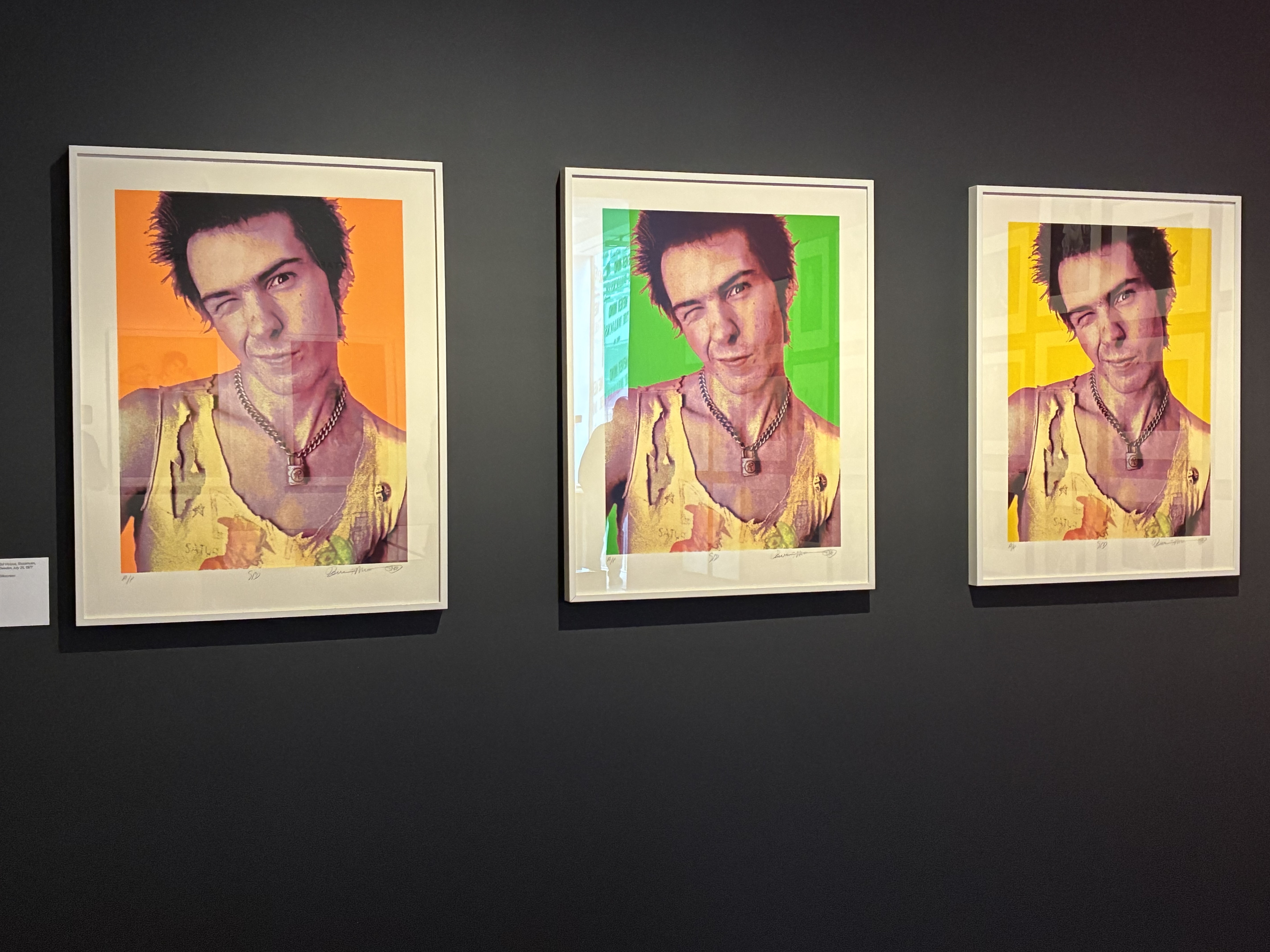
Another wall has a set of images of Sid Vicious given the Andy Warhol-Marilyn Monroe silk screen treatment.

Sid Vicious given the Marilyn silk screen treatment in Dennis Morris at the Photographers’ Gallery (photo by the author)

Here’s a reminder of what we’re talking about:

Public Image Ltd

In 1978, as the Pistols broke up, Virgin boss Richard Branson invited Morris to accompany him on a talent-spotting trip to Jamaica and Morris persuaded Virgin that Rotten (now reverting to his given name of John Lydon) should accompany them. Quite apart from the reggae talent that Morris helped bring to Virgin’s attention, the reggae sound of performers like Lee Perry, the Abyssinians, Big Youth and U Roy made a deep impression on Lydon as he was assembling his post-punk band, Public Image Limited. PiL were to pioneer a distinctive sound mixing the experimental Krautrock-inspired guitar of Keith Levene with the heavy dub bass of Jah Wobble. The more you listen, the more fascinating Levene’s unconventional guitar patterns become.

Morris played a key role in not just photographing the new band, in a deliberately post-punk, anti-punk style – but crafting their public image. He created the PiL logo and designed the innovative Metal Box album packaging – as documented in a wall of images and display case here.

The Public Image Limited wall, showing stylised portraits of (top left to right) guitarist Keith Levene, drummer Jim Walker, and John Lydon looking like a choirboy – with at the far right an early version of the band’s logo: in the display case are more photos and a copy of the metal box LP – all in Dennis Morris at the Photographers’ Gallery (photo by the author)

After punk

There’s more, lots more. The story of how Morris got the image for the cover of Marianne Faithfull’s 1979 solo album, Broken English.

This was part of his work as art director of Island Records which saw him design album covers for Linton Kwesi Johnson, Marianne, Marley and many others. Downstairs is a gallery of his LP covers, as well as other rock memorabilia depicting his photos or designs (t-shirts, lighters, cigarette papers etc).

Display of LP album covers which Morris contributed images and design for, in Dennis Morris at the Photographers’ Gallery (photo by the author)

During this period Morris replaced Don Letts as vocalist of Basement 5, a reggae punk fusion band. He created their logo, image, photography and graphics and gained a recording contract with Island Records.

Subsequently he did photo shoots with a series of icons: from 1970s rock artists like Patti Smith and Grace Jones, through Prince’s heyday in the 1980s and on into the 1990s, the era of the Stone Roses, Oasis, Primal Scream and much more.

At the same time he maintained his close connection with reggae artists and the exhibition features a slideshow projected on a wall of a pantheon of reggae stars including The Gladiators, the Mighty Diamonds and many more.

And he promoted Black British performers such as Steel Pulse, Aswad, often photographing them and taking a hand in designing and styling their images and record artwork. It was Morris who persuaded Island records to sign the great Linton Kwesi Johnson, for which act alone he deserves a medal.

Summary

What range, from the poor streets of Hackney and Southall, to hobnobbing with music royalty, from the Sex Pistols to Steel Pulse, from white punk rock to the blackest of hard-core reggae, and then on to a galaxy of top pop stars. But it’s maybe those early shots, from Hackney, Southall and white working class lives from the 1970s, which linger longest in the memory…

The Trot, Southall Horse Market from This Happy Breed © Dennis Morris


Related links

Related reviews

Noël Coward: A Biography by Philip Hoare (1995)

Philip Hoare’s hefty 1995 biography of Noel Coward is vast, encyclopedic and immensely enjoyable. It feels like it tells you every detail you ever wanted about The Master’s life and yet manages at the same time to be brisk and pacey and immensely readable.

The central take home is Coward’s awesome drive from the earliest age to be a star, a success, to take London’s theatreland then New York’s Broadway by storm, and how this fed his relentless drive to network, know everybody, work the room, schmooze and socially climb climb climb, baby. One minute he’s occupying the poky attic in his mother’s Pimlico boarding house, the next he’s hobnobbing with the greats of British theatre, dining with Somerset Maugham, hanging with Tallulah Bankhead, his understudy is John Gielgud, and then it’s off across the Atlantic to party with Douglas Fairbanks and Mary Pickford, get to know Ben Hecht and Katherine Hepburn, then a luxury liner back across the pond during which he charms Earl Mountbatten and his notoriously promiscuous wife, Edwina. (Hoare has a gossipy page about the scandal caused by her libel case against People magazine which accused her of having an affair with the Black actor Paul Robeson.) He writes a musical with Ivor Novello and his breakthrough play is turned into a film by Alfred Hitchcock, he performs with a young Laurence Olivier, becoming such good friends with him and his wife that there is speculation to this day about whether they had a homosexual fling. Olivier is on the record as saying emphatically not.

And all this culled from just a few years in the mid-1920s. But Coward’s career was to last another 40 years, as he mined a new historical vein in the 1930s (Cavalcade), then made the great patriotic movies of the 1940s (In Which We Serve, This Happy Breed), then reinvented himself as a cabaret star after the war. At each stage, on every page, we meet a host of characters from each era, from Ivor Novello, Cecil Beaton and Michael Arlen, Rebecca West and Virginia Woolf in the 1920s, to his bizarrely close friendships with both Marlene Dietrich and Greta Garbo in the ’30s, and so on and so on, in a never-ending carnival of high grade showbiz gossip.

Coward’s life is like a silver thread guiding us through the glittering worlds of music and entertainment, theatre and film, of his era, as well as the gay underworld scenes in London, New York and select spots around the Mediterranean (Capri, Algiers) and Hoare treats us to and endless supply of fascinating and often hilarious anecdotes. I laughed out loud at the story of American producer Jed Harris in England to cast a production of The Green Bay Tree and going to loads of Shakespeare productions, claiming he was getting very tired of seeing English kings being played by English queens (p.195).

And this is just the socialising and the gossip, before you get to the actual work. Coward’s work ethic was phenomenal and his output prodigious. If this or that play was a disaster, don’t worry darling, there’s always another revue or musical or operetta just round the corner, or a new hit song about to take the gramophone and radio by storm, or a new movie just about to hit the screens, and then there are his books of short stories. And the novel.

He was a phenomenon, able to act, dance, write ravishing musicals, smash hit songs and era-defining plays, and then the great wartime movies. I don’t think genius is quite the right word, but man of phenomenal, extraordinary talents and, above all, the burning, quenchless drive to succeed succeed succeed. As his friend Esme Wynne said, he was:

‘frightfully ambitious… He was full of determination and willpower’ (p.43)

Or as he archly put it in his autobiography:

‘It was a matter of pressing urgency… that I should become as rich and successful as soon as possible.’ (quoted p.63)

Distinctive speech

When a girl, his mother, Violet (1863 to 1954), developed a fever which left her with poor hearing in one ear. This was one reason he developed such an idiosyncratic manner of speech, clearly enunciating every syllable of every word, for her benefit.

Closeness to mother

Violet’s first child, a boy, Russell, died at the age of 6 from spinal meningitis, and this made her especially protective of her second child, Noel (p.10). She cosseted him, and dressed him nicely, and danced attendance. He grew up emotionally spoiled, though not materially, for the family was poor.

Distance from father

Noel’s father, Arthur (1856 to 1937), was a failure. After a series of jobs he became a piano salesman which took him away from home a lot, so was absent during Noel’s boyhood. He was also ineffectual. Eventually he dwindled down to being a sort of servant at the boarding house Violet ended up running.

Suburban

Noel was born in Teddington but the family moved a lot, sometimes out as far as Chobham, living for a while in the Battersea/Clapham area of London, settling in Ebury Street in Pimlico, just north of Victoria Station. I was struck by the fact that next door lived the Evans family, whose daughter, Edith, was to become a dame of the theatre.

He was always aware of his origins in the impoverished lower middle class. Hoare quotes Gertrude Lawrence after they had danced a number in his 1922 review London Calling, standing in the wings and listening to the loud applause and excitedly saying: ‘That’s for us, the two kids from the suburbs. We’ve definitely arrived’ (quote p.119).

Noel

He was named Noel because he was born on 15 December i.e. close to Christmas.

Poverty

When his father’s work petered out, Violet was forced to turn their house in Pimlico into a boarding house, with Alfred helping with the serving and chores. Whenever he made money Noel was quick to pay off the family debts and never lapsed in his attachment to his mother.

But their poverty was easily used as a slur by anyone who wanted to hurt or denigrate him. Before meeting Noel, Cecil Beaton was told his mother was a charlady (p.123). (Compare the universal snobbery against H.G. Wells whose mother was housekeeper at a grand country seat.) For me, it’s this unashamed loyalty to his mother and humble roots which I found the most winning element in Noel’s character, far richer than the so-called wit.

Precocity

What really comes over very quickly is how precocious Noel was and how extraordinarily determined to succeed. He started acting at the age of five and his mother was taking him to auditions and local amateur talent shows before he was 10. At home in Clapham he made a toy theatre and spent the day writing plays for the little puppet figures he made to act out. His first professional engagement was in 1911 at the age of 14, where he appeared in the children’s play The Goldfish in London. By the time he hit his teens he had acted, danced and sung onstage and had a vivid sense of his own potential. He wanted to be a star.

Vicars and sex

He was put off religion by several groping vicars he encountered as a boy. Last year the Archbishop of Canterbury was forced to resign after admitting to not doing enough to sanction or report a paedophile vicar. It is a long tradition within the Church of England but also, of course, within the Catholic Church. Noel never respected either.

Homosexuality

He had homosexual experiences before heterosexual ones. Girls were so much more closely chaperoned and protected whereas boys were encouraged to play, share rooms, go camping etc together. And all without the heart-stopping risk of the life-ruining risk of getting pregnant.

(The ever-present threat of pregnancy is echoed a lot later in the book, when Hoare describes Coward meeting the man who was to be the love of his life, Graham Payn, towards the end of the Second World War. Payn had previously been heterosexual and had numerous affairs with chorus girls. But after the third abortion – ‘and they cost £75 in those days’ – he’d had enough and was ready for a change of orientation, p.358. Compare and contrast Kingsley Amis’s horrible depictions of abortion in his early novels, and the squalid abortion scenes in the 1966 movie, Alfie. Gays were well out of the whole thing. )

Uranians

The Uranians was one of numerous names given to late-nineteenth century associations of homosexuals in the arts who wrote about the love of adolescent boys.

Young Noel was introduced to this world when still a boy via the figure of the painter, Bohemian and prominent Uranian Philip Streatfeild. One version of the story goes that Noel’s mother, Violet, was working as a cleaner, cleaning Streatfeild’s Chelsea studios and one day brough along her 14-year-old son. With his eye for adolescent boy beauty, Streatfeild was taken with Noel and asked him to sit for him. Streatfeild introduced to other artists and performers in his circle (which included Robbie Ross, Alfred Douglas and other survivors from the Wilde circle of the 1890s).

Then, in 1914, Streatfeild asked Violet’s permission to take the boy on holiday with him to Cornwall. Knowing Streatfeild and obviously trusting him, and also concerned for her son’s ongoing health issues in the polluted London air, Violet gave her permission and young Noel was whisked off to Cornwall to meet more stylish gay artists who probably included the distinguished painter of young men Henry Scott Tuke. Here he could sunbathe and swim nude, and be worshipped by older men.

Nobody knows whether he had sex with any of these men but it must have shown the impressionable young boy that homosexuality and the wonderfully sybaritic lifestyle these men led, was possible, was a lifestyle option. Here’s a photo of Streatfeild and Noel.

Philip Streatfeild

Photo of Philip Streatfeild and a teenage Noel Coward

They were in Cornwall when war broke out in August 1914. Coward just seemed to have a magic touch when it came to making contacts. As soon as the war broke out Coward was sent back to London in the charge of a friend of the group, the novelist Hugh Walpole.

Streatfeild enlisted and died a year later from tuberculosis contracted in the army. He was just 35 (p.44). But not before he’d introduced Noel to other members of his regiment, especially the gay officers, who took part in what sound like orgiastic parties (p.36). Thus began Coward’s lifelong attraction to men in uniform and comfortableness around members of the forces of all classes and all sexual persuasions.

Hambleton Hall

Coward’s social ascendancy began thanks to Streatfeild who, before his death, asked wealthy socialite Mrs Julia Astley Cooper to take Coward under her wing. Mrs Astley Cooper continued to encourage her late friend’s protégé, who remained a frequent guest at her estate, Hambleton Hall in Rutland (pages 39 to 43). Among her guests were notables like CK Montcrieff, the translator of Proust, the conductor Malcolm Sargent, the diarist James Lee Milne and so on.

But young Noel not only met and learned how to talk to high-powered members of the literati, but was also trained in the rhythms and decorum of country house living, numerous details of which were crucial to his plays of the 1920s. Mrs Astley Cooper even claimed, a lot later, that he had a little black notebook with him and took down remarks and whole conversations between the Bohemian members of her family and that these turned up wholesale in plays like Hay Fever and The Young Idea. Hoare says his experiences there were ‘pivotal to Coward’s progress’ (p.43).

Penetrative sex

As to sex with any of these Uranians, his close friend throughout his boyhood, Esmé Wynne, decades later insisted that Noel was not homosexually active as a boy. In fact Hoare broadens this out to the claim that he had a lifetime aversion to penetrative sex (p.34). Much later in the book I laughed at the story that he and American producer Jed Harris were having a late night conversation about sex and when Jed asked him if he’d ever slept with a woman, Noel replied: ‘It would be like going to bed with a porpoise’ (p.195). Well, I dare say porpoises can be sexy 🙂

Saki

At Hambleton Hall Noel picked up from Proust as a name to drop (he later named a cat Proust) but the real revelation was the writings of the camp humourist Saki, real name Hector Hugh Munro. Saki’s humorous contempt for the values of the older generation, his worship of camp young men, yet all drenched with a sentimental fondness for the English countryside and the quirks of English life, all of these were things Noel would adopt wholesale. He never got to meet his hero because Munro was killed in the trenches in November 1916, when Noel was just 17.

Esmé Wynne

Noel had a deep boyhood and adolescent friendship with Esmé Wynne (1898 to 1972). They met at child auditions and in 1914 both appeared in the first production of Clifford Mills’ Where the Rainbow Ends. Soon after Wynne attended Coward’s 12th birthday party and their friendship blossomed. In 1912 Wynne had her first writing success at the age of 13 when her first play The Prince’s Bride was put on for one night by Charles Hawtree at the Savoy, including Coward in the cast. From then on they were inseparable, spending time together whenever possible and writing to each other constantly. In 1915 they were part of the cast which undertook a lengthy British tour of Brandon Thomas’s play Charley’s Aunt.

Between acting appointments collaborated on sketches and songs together and wrote a number of one-act plays under the joint pen-name of Esnomel; Ida Collaborates (The Last Chapter) (staged 1917), To Have and To Hold (not staged) and Women and Whisky (staged 1918). They also got up to teenage pranks.

A very naughty boy…

As an adolescent Noel got into all kinds of trouble. He bit teachers, answered back.

He was addicted to shoplifting, pulling off amazing feats of theft, one time simply walking out of Fortnum and Mason with a suitcase, strolling along to Piccadilly to Hatchards, filling it with books and walking out (p.48). On numerous occasions he nearly got caught and had to leg it. This kind of behaviour associates him much more with the urban tearaways of the working class than the soignée upper classes he realised he wanted to move among.

On page 202 Hoare has a passage describing how Noel, arguably, never really grew up, from the childish tantrums he threw in the theatre or with his ‘family’, to his impish subversive sense of humour, his quickness to ridicule royalty, church of state. Kenneth Tynan is quoted as saying he was never entrapped by maturity (p.202). And Hoare thinks Private Lives shows its protagonists having endless wildish tantrums (p.223).

No education

An important point is that he had little or no formal education. He was educated briefly at a choir school and later received dance lessons, but more or less left school at 11 and had no formal schooling thereafter. Forget university, he didn’t get anywhere near finishing secondary school. Instead The Theatre was his education and his teachers and his life. To this lack may fairly obviously be attributed the legendary thinness of his plays and their almost complete lack of depth or meaning beyond the hour and a half’s distraction they provide.

When he published his first volume of autobiography, Present Indicative, in 1937 the novelist St John Ervine was staggered at its shallowness: ‘I was amazed and disturbed at the slenderness of his intellectual resources. [I wonder if he has] ever read a great book, seen a fine picture or a notable play, listened to music of worth, observed a piece of sculpture, or taken any interest in the commonplaces of a cultured man’s life.’ (quoted, p.276)

Piano

He learned some good striking chords with which to open almost any song to get the audience’s attention (p.54). Although he never learned to play the piano very well. I was struck when he himself admits he was only comfortable in three keys, E flat, B flat and A flat. He joked that the sight of sharps on sheet music threw him into a tizzy (p.14).

First World War

In 1918, Coward was conscripted into the Labour Corp. He bribed his way to a day pass and spent it tracking down every contact he’d made via Streatfeild or Mrs Cooper and eventually persuaded a sympathetic officer to phone the CO and get him transferred to the Artists Rifles. But he was useless. Having not attended school since 1918 he had no sense of discipline and esprit de corps. He developed headaches and insomnia, fell and cracked his head and was sent to a hospital in Camberwell mostly filled with shell shock victims. Esme thought he was malingering and even here he made influential friends, and discovered a way of escaping for evenings back in the West End. In June 1918 he was discharged from hospital and sent back to the Artists Rifles camo in Essex where he was given light duties such as cleaning the latrines. Not surprisingly, he developed psychosomatic symptoms again and again was sent to hospital. This one includes lots of epileptic patients and Noel briefly worried that he was one too. Weeks passed and he drafted a bad novel. Eventually, in August 1918 he was given a discharge. He was free to resume his career in his beloved theatre.

In the 1930s Coward wrote as flippantly as possibly about his period in the army, exaggerating for comic effect the extent to which he had faked his symptoms to escape service. This came back to bite him very hard when the Second World War kicked off, not only among his enemies in Britain but also in the States, where his endless foreign travel in the war’s first few years drew extensive criticism.

Elsie April

In 1922 he met Elsie April who worked with many composers to improve and orchestrate their compositions. She was prodigiously gifted. She had perfect pitch. If someone hummed a tune to her in a noisy rehearsal room she was able to notate, harmonise and transcribe it on the spot. Her biographer credits her with introducing ‘the unusual key changes and poignant angularities of phrase’ to be found in Coward’s mature music. I think I know what he means. If you listen to the songs in Conversation Piece it’s rare that a song stays in the same key for more than two lines and the vocal line often jumps dramatically. Although the orchestration is sickeningly sweet, the actual vocal lines are often strikingly jarring and angular.

Burning ambition

He had an extraordinary commitment to becoming successful and famous. In his discussion of heroin and cocaine a propos of The Vortex, Hoare gives the impression that, although mixing in circles which took drugs, he never did himself. He was not the sort. He never lost control. He was always watching and alert and driven.

He devoted himself to making contacts and social climbing while still a teenager. There isn’t space to describe the extraordinary range of artists, writers, poets, playwrights, producers, designers, directors, other actors, as well as aristocrats and even royalty that he met. On a trans-Atlantic liner he managed to get on first name terms with the Earl Mountbatten and his wife. He became so friendly with the dissolute brother of the Prince of Wales that people speculate to this day whether they had a gay affair!

The family

Noel early gathered around him a coterie of friends and collaborators who became known jokily as ‘the family’. One of the earlier members was the actress Lorne Lorraine who became his devoted secretary for 40 years, and is captured as the long-suffering secretary Monica Reid in Present Laughter, and later friends such as his assistant Cole Lesley (recruited when he was working as a shop assistant in Kent, p.272), and his life partner Graham Payn.

‘Bubbers’ is what he called his sacred afternoon nap.

Backchat and bickering

I was astonished when I first read Noel Coward’s plays at the almost complete absence of the famous wit and humour I’d heard so much about. Instead I discovered almost nothing but argument and bickering rising, from time to time, to really angry exchanges and even, in Private Lives, physical attacks.

This view felt a bit like blasphemy against the great man, and I worried I had profoundly misread him, so it’s reassuring to have Hoare quote so many, many critics and contemporaries who entirely agree with my own reading.

The swift, hard, rattling farcical-comedy, at which he aimed so many shots, is brought to glittering perfection in Private Lives. It is technically a masterpiece – not of writing plays but of writing Noel Coward plays. For, as I think we have discovered by now, Mr Coward’s plot is the contrast between brilliant cosmopolitanism and stodgy Anglo-Saxondom, his standby is Infidelity and his device of stagecraft is the Bicker… (author and critic A.G. MacDonnell, quoted p.213)

The Times wrote of Private Lives that the dialogue ‘which might seem in print a trickle of inanities’ became onstage ‘a perfectly times and directed interplay of nonsense.’

The Observer found the play superficial and that the characters’ ‘style is mainly in their clothes; as conversationalists they are mere back-chatterers‘. Looking up back-chat I find it defined as ‘To respond in a disputative, often sarcastic manner’, ‘rude or cheeky remarks made in reply to someone in authority’, ‘the act of answering back, especially impudently.’

Brooks Anderson: the playwright ‘has nothing to say and says it with competent agility for three acts.’

New York Review: ‘They are only adults under the skin. They are really adolescents on long legs.’ (p.229)

But what did Noel care what the critics said? That year (1930) he was declared the highest paid author in the world. Nothing succeeds like success.

Fame and extraordinary output

The Vortex, written in 1923, performed in late 1924, shot him to fame. Hoare cites contemporaries recording that young people started to dress like him, affect his clipped speech, attempted never to be seen without a cigarette or a cocktail in one hand, wore Cowardesque dressing gowns. Like the earlier fad for Valentino and later crazes over Sinatra, Elvis, the Beatles.

The mass media – with the arrival of ever-increasing numbers of newspapers, magazines, radio and silent movies – demands stars and celebrities to write about and he basked in dizzy fame from the premier of The Vortex in November 1924.

And it was followed by a giddy rush of productions, plays, reviews, musicals and some silent movie adaptations of the plays. Old plays he’d written were dusted off and eagerly sought by producers. He turned out new plays at a dizzying rate, alongside songs and music, as well as working on screenplays. It’s a dizzyingly record of work and achievement.

Plays

  • Sirocco (1921) (Revised in 1927)
  • The Young Idea (1922)
  • The Better Half (1922)
  • The Queen Was in the Parlour (1922) (first Produced in 1926)
  • The Vortex (1923) (first Produced November 1924)
  • Easy Virtue (1924) (first Produced in 1925)
  • Fallen Angels (1925)
  • Hay Fever (1925)
  • Semi-Monde (1926) (too rude to be licensed in Britain; first produced in 1977)
  • This Was a Man (1926)
  • The Marquise (1927)
  • Home Chat (1927)

Musicals

  • London Calling! (1922, 1923)
  • Weatherwise (1923) (first produced in 1932)
  • On With the Dance (1924, 1925)

Songs

He wrote lots of songs for the musicals including some wonderful hits, namely:

Failures

But there were failures too. In fact it seemed for a moment like there was a steady decline: after the runaway rave success of The Vortex (1924) and Hay Fever (1925) came two plays which did OK, Easy Virtue (1926) and The Marquise (1927) had been modestly successful. And then two disasters, Home Chat (25 October 1927) and Sirocco (November 1927).

Regarding Home Chat, the Illustrated London News called the play ‘an amusing little trifle on the whole – but it is thin in its material and there are signs about it of hasty and careless composition’.

In the Observer St John Ervine took a similar view: ‘Had Mr Coward spent another week in writing his play it would have been a much wittier one than it is.’

This is very much the view I took of even his most successful plays. Knocked off in a matter of weeks or even days, they all show it in their thinness of plot and characterisation and astonishing lack of wit, of funny or quotable lines. Instead, as I’ve said in my reviews, even his most famous plays basically rely on people getting angry and shouting abuse at each other (true of Hay Fever, Easy Virtue, Fallen Angels, Private Lives).

Anyway, Sirocco did even worse. The first night was a famous theatrical disaster, the worst night of Coward’s professional career, 24 November 1927, pretty much three years to the day after the barnstorming success of The Vortex (25 November 1924). The audience booed and hissed. When he went out the stage door he was spat at. The reviews were uniformly disastrous.

But Hoare draws an interesting point. Coward, he says, realised a great truth from this experience. The media, the press, like to build up celebrities and then knock them down but this isn’t because the press is particularly malevolent. It’s just stupid. In the popular press everything is either black or white, good or bad. You’re either up or down. Coward had had several years of being The New Thing, super-fashionable, adored by his fans. But in the moron press it doesn’t take much to tip you over and as soon as you’re not at the top, you’re at the bottom. Black or white. Up or down. And so it was that just a couple of so-so plays led to excoriating notices and the critics (and some of his cattier friends) saying it was all over, Noel was a busted flush (p.189).

Of course he wasn’t, as the next 45 years (he died in 1973) were to show.

Cavalcade

Philip Hoare sees the 1932 extravaganza Cavalcade as a turning point in Coward’s ideas, that he consciously moved on from the provocative and controversial attitudes of the 1920s plays, with their incessant references to cocktails and cocaine, with their clever riffs on infidelity and sexual immorality. Cavalcade‘s sentimental patriotism inaugurated a new feeling of respect and avoidance of controversy. Those bastions of conservative conformism and backward-looking philistinism, the Daily Mail for the lower middle classes and the Telegraph for the pompous upper middle classes, praised it and the Mail even serialised the script/book.

In 1932 Coward was at the height of his success with Cavalcade making a mint with provincial tours of Private Lives and Bitter Sweet all contributing to the coffers. He bought a mews cottage, Burton Mews in Belgravia, and had it gutted into a huge space appropriate for big parties of the great and the good from the worlds of theatre, movies, aristocracy and even royalty.

I laughed when I read, on page 254, Virginia Woolf writing to her nephew Quentin Bell, complaining that she had to go to dinner with Coward, whose work she ‘despised’. Good old Virginia. His ubiquity as a celebrity turned her against him. And Hoare goes on to quote her quoting Aldous Huxley at some dinner describing Coward as beating an omelette with no eggs: beating and beating and beating, but with nothing there, just the action of the beating. That actually gets close to Coward’s essence: a kind of quintessence of pure ambition, with all the plays and songs and revues merely tools, expedients, to raise their author to that level of superstardom. But when you look at the works closely: nothing there except the frantic beating. The subtext of all of them isn’t Queer, it’s Burning Ambition.

E.M. Forster dined with Coward at Lady Colefax’s, a pushy society hostess, and reported that he spent the entire time talking the most awful drivel. You can easily see how, from Forster’s cultured perspective, this would be true. Hoare entertainingly says that for all their differences in style and depth, Forster and Coward were both middle-class mummies boys.

Second World War

The Second World War came at a good time for Noel Coward. After the madcap Twenties and bleak Thirties, the war redefined Britishness and served as an antidote to the disillusion and decadence of the inter-war period. Its revival of the values of empire and Britain’s greatness was congenial to Coward: the quality of fortitude required (and mythologised) by the war neatly coincided with the fortitude displayed by Noel… the values he espoused dovetailed with the Dunkirk / Blitz / ‘Britain can take it’ spirit and he was able to exploit them fully. Cavalcade had announced his patriotism; the films, plays and concert tours of the early 1940s helped cement his image in the hearts and minds of the British public. (p.329)

In fact it was quite a bit more complicated than that and Hoare gives a fascinating account of how unpopular Coward became in the first few years of the war. He was quickly involved in spying combined with morale boosting trips to France, then America several times, then as far afield as Australia and New Zealand. I was struck to learn that he met President Roosevelt not once but twice, on charm offensives to persuade him to support embattled Britain.

But these busy trips don’t seem to have had much practical outcome and mainly generated critical articles in the press and even questions in the House from MPs asking why he was gallivanting round the globe at public expense. Hoare shows how the deliberate misreporting of his activities and hostile press conferences steadily put him off the small-minded, carping tone of British public life, especially the vendetta against him pursued by the Beaverbrook newspapers, namely the Daily and Sunday Express. Coward got his own back by having a scene in ‘In Which We Serve’ when, after the ship is sunk by Germans, we see a copy of the Daily Express float by with the headline ‘No War This Year’. Lord Beaverbrook was incensed.

There was also an anti-queer undertone. Hoare quotes Joyce Grenfell of all people lamenting in a letter to her mother that Britain should be represented abroad by someone everyone knew was ‘queer’ (p.313) and other commentators, less party to theatrical insider knowledge, still criticised a figure most associated with dainty young things in dressing gowns and slippers mocking all their parents’ values. ‘God, what enemies I must have,’ he wrote in his diary.

When his lovely mews house was bombed out he moved into the Savoy, widely thought to be safe because constructed of steel girders. He overheard a street seller and promptly knocked out the song ‘London Pride’, a popular hit with the people who didn’t read or care about gossip columns and querulous MPs. According to Hoare, a ‘soundtrack to Coward’s war, banal but touching.’

He met Churchill on a number of occasions, lobbying to be given more intelligence work. He was frustrated when Churchill told him not to but to go and sing and entertain the troops i.e. to do what he did best, to entertain and raise morale.

Blithe Spirit

He had been mulling over a comedy about a haunted house, went to stay at Portmeirion in Wales on a brief holiday with Joyce Cary, and wrote Blithe Spirit in just seven days (!). It quickly went into production, opened in the West End on 2 July 1941 and proceeded to break box office records, running for a record 1,997 performances.

In Which We Serve

Soon after Blithe Spirit was premiered Coward was introduced to the producer Anthony Havelock-Allan who was working for Two Cities Films. This company was set up by two Italians, Filippo Del Giudice and Mario Zampi. Two Cities played an important role in British wartime films, producing a series of classics which helped bolster morale including adaptations of Coward’s plays ‘This Happy Breed’ and ‘Blithe Spirit’, along with ‘The Way Ahead’, Laurence Olivier’s ‘Henry V’, ‘The Way to the Stars’.

Noel was asked for a scenario and drew on the recent incident of his friend Louis Mountbatten, captain of a ship that was sunk. This became the germ of the wartime classic movie ‘In Which We Serve’ where the sinking of the ship becomes a pretext for flashbacks to their civilian lives of a cross-section of the crew, and thereby of British society.

Coward was introduced to the established cameraman Ronald Neame, and the editor and wannabe director David Lean, then 33. He brought with him his loyal set and costume designer, Gladys Calthrop.

On the writing front it’s amusing to learn that Coward’s initial idea of a screenplay, starting off in the Far East and featuring a huge cast, would have ended up with a film 7 or 8 hours long. He had to learn what worked and didn’t work on the job.

On the gossip front, I was a bit amazed to learn that during the production Coward had a passionate affair with the glamorous male actor, Michael Wilding, nine years his junior. Reading a book like this makes you wonder whether any of the actors from the classic era were not gay.

In ‘Which We Serve’ premiered in September 1942. In 1943 Coward was awarded an Academy Award for ‘outstanding production achievement’.

After the film was launched, he embarked on a provincial tour playing his three most recent plays – Present Laughter, This Happy Breed and Blithe Spirit – in a package titled ‘Play Parade’. During the day they visited munitions factories and hospitals. When the plays arrived back in London they were triumphant.

Wartime tours

Of the Middle East, then to America for radio broadcasts and to meet Roosevelt (again), a pit stop in Jamaica which he fell in love with, then back to North Africa and then a tour of South Africa, with piano accompaniment from Norman Hackforth and valet and dogsbody by a new employee, the frank and often foul-mouthed Bert Lister. Then is invited by his old friend Mountbatten to tour the Far East, which he does dutifully and exhausts himself, eventually having collapsing and taking R&R in Ceylon.

The film of ‘Blithe Spirit’ opened in April 1945. Coward hated what David Lean had done to it, but it was a box office success.

Post-war

The hectic pace of Coward’s work life doesn’t let up in the immediate post-war years which saw a constant round of revivals of his plays in London, New York and Paris, interspersed with the writing of another musical and a steady stream of new works, which pass almost in a blur.

Jamaica The standout fact is that he fell in love with Jamaica and bought a plot of land on the island’s fashionable north coast, just down the road from Ian Fleming, and had a house built there which was named Blue Harbour. Ironically it was, according to all the guests who stayed, uncomfortable and unhygienic but Coward loved it. The food was, by all accounts, terrible. Said John Pringle:

‘The food was awful, always covered in pickled walnuts… The deserts looked like they’d been made in toilet seat moulds.’ (p.397).

Nudity was almost compulsory, especially round the swimming pool, which some guests found bracing.

The King and I He was offered but turned down the part in The King and I which was then given to Yul Brynner.

Ace of Clubs His musical, Ace of Clubs, was a flop. Hoare implies because his musical director, the immensely talented, Elsie April, had died (1950) and she was the secret ingredient of all his musicals.

Farewell Jack Wilson He finally severed business relations with his former lover Jack Wilson, who had for decades represented him in the US but had become an alcoholic and presided over a run of failed productions.

The Astonished Heart 1950: the film version of ‘The Astonished Heart’, in which he starred, was panned. He had asked Michael Redgrave to play the lead, as the psychiatrist who finds himself torn between wife and lover and ends up committing suicide. But when, in late 1949, Coward saw the rushes, he thought Redgrave was doing it all wrong and squeezed him out of the production. Nonetheless it failed. The original one-act play moves so fast you don’t notice the basic implausibility but stretched to nearly three times the length, the play’s thinness of characterisation became obvious. Variety magazine accurately summarised: ‘While film has a clever veneer, yarn lacks the more basic quality of credibility due to insufficient motivation of the central character.’

Relative Values The next genuine hit was Relative Values (1951), a satire on the Labour government and the new ideas of social equality which the war had seen triumph. It was ten years since he’d written Blithe Spirit. Reviews were mixed but many critics just didn’t like the monologue where the lead character mocks dreams of equality.

Joke Although people go on and on about his tremendous wit, there is in this biography, as in the plays, not a lot of evidence of it. One slight anecdote made me laugh. Walking across Leicester Square with a friend, Coward saw the hoarding for a new film starring Dirk Bogarde and Michael Wilding called ‘The Sea Shall Not Have Them’. ‘I don’t see why not.’ Noel said to his friend, ‘Everyone else has.’

Ann Rothermere Interesting that Ian Fleming’s mistress, who he subsequently married, Ann Rothermere, was a real aristocrat, and so quite disdainful of Noel with his airs and graces and painful reminders that he was on first name terms with various Royals. Trying too hard. Arriviste. On the other hand, what do you expect from a boy from Battersea who would never have the genuine, bred-in-the-bone aristocratic hauteur. Coward attended Ian and Ann’s wedding.

Musicals In 1946 his musical, Pacific 1860, had not been a success. In 1951 another musical, The Globe Review, starring his boyfriend Graham Payn, opened to good reviews. Whereas the next play, Quadrille (1952), was panned.

Churchill visited and they spent time painting together for painting, we now learn, had been a hobby of his since boyhood (p.398). He painted local Black men, looking muscular (p.399). You can see quite a few of them on the Noel Coward website.

Cabaret In October 1951 he undertook an experiment, to perform a solo show of songs at the Café de Paris. This was the start of a new type of career. Over the coming years he slipped in more runs of these kinds of performances before, of course, succumbing to the lure of America.

Apple Cart In 1952 he was persuaded to star in a revival of Shaw’s political satire, The Apple Cart (p.400). The musical After The Ball (1953) was badly directed and performed (p.404).

The coronation He watched the coronation of Queen Elizabeth II (2 June 1953) on television. It was the occasion of his most famous quip. As the carriages of visiting dignitaries rolled past one came into view bearing the huge Queen of Tonga beside a small man. When someone asked who the little man sitting beside the queen was, Noel quipped ‘her lunch.’ The only snag with this bon mot is that Coward himself denied actually saying it. He said it was David Niven (p.401).

Nude with Violin He was working on Nude with Violin, a satire on contemporary art which thinks it is all a hoax. It was 30 years since The Vortex and he had become a crusty old reactionary (p.402). Hoare makes the sweeping and controversial statement that Coward might well have been a run-of-the-mill entertainer and playwright if it wasn’t for his outsider status as a homosexual. It was this outsiderness which gave everything he wrote its edge (p.402). Really? What this book shows is just how many other playwrights, novelists, artists and actors were gay as well starting, for example, with Somerset Maugham and Ivor Novello. If it was his gayness which gave him his ‘edge’, why didn’t the other two popular entertainers have the same ‘edge’? No. As a theory or explanation for Coward’s style it’s a non-starter.

One thing which didn’t change was his amazing facility. He wrote Nude with Violin in just over three weeks.

Autobiographies The second instalment of his autobiography, Future Indefinite was published in 1954. There’s a puzzle here. Coward wrote three volumes of autobiography but they left big gaps. Present Indicative (1937) ends in 1931 while Future Indefinite (1954) starts in 1939 and only goes up to 1945. Why the big gap in the ’30s? He was maybe attempting to fill it with the third volume, Past Conditional, which he left unfinished at his death and which only covers 1931 and 1932.

Violet His beloved mother, Violet, died, aged 91. She had been his uncomplaining rock.

Idiotic I noticed this word recurring in ‘Blithe Spirit’ and then noticed it cropping up in quotes from Coward’s diaries or reported speech, in this biography. I think ‘idiotic’ may have been his favourite word.

  • ‘This week has been fairly idiotic.’
  • ‘I have made one of the most sensational successes of my career and to pretend that I am not absolutely delighted would be idiotic.’
  • In 1956 in Paris he met the Duke of Windsor, now deaf, who he found ‘completely idiotic’.
  • He was in Jamaica during the filming of ‘Dr No’ which was ‘enjoyable but idiotic’.
  • When he learned that half of Hollywood was having Dr Niehans’s rejuvenating injection of goat placenta, he commented ‘They can’t all be idiotic!’

Marijuana We learn that when Laurence Olivier visited Coward, he sought out a neighbour, Morris Cargill and demanded the best ganja. Who knew that Laurence Olivier smoked dope? (p.408)

Jamaica II He moved to a new retreat at a place called Firefly Hill, on the ruin of a lookout tower built by the pirate Captain Morgan (p.397), with a magnificent view of the Blue Mountains sweeping down to the sea, and a sandy beach. He commissioned a local architect to design it but it turned out as ugly as Blue Harbour. According to Ian Fleming its walls all leaked resulting in permanent damp.

Local Jamaican politics inspired him to start what turned into a satirical comic novel, ‘Pomp and Circumstance’ (p.409).

Las Vegas American producers came calling, with offers for salaried writing jobs in Hollywood etc but he didn’t want to be tied down. Instead he opted for a 3-week run of performances in Las Vegas, as his friend Marlene Dietrich had done. His usual accompanist was forbidden a visa so he took up Dietrich’s suggestion of using her accompanist, Peter Matz. According to Hoare, Matz rearranged many of Coward’s songs, giving them a more American swing and arrangement. Coward’s success in Vegas owed a lot to Matz (p.410). $15,000 a week. A bit like the Beatles, his set only lasted half an hour, but was enough to wow the crowd with his presence and charisma. The concerts were recorded and edited into the record Noel Coward in Las Vegas.

He was persuaded to play a cameo part in the movie Around The World In Eighty Days in exchange for a Bonnard painting valued at £4,500.

He rehearsed and performed live on TV a musical special, despite fierce arguments with the crass American sponsors (Ford).

Exile His tax affairs became more and more complicated, with him paying tax in Britain, plus supertax, and tax in America as well sometimes. Now that his mother was dead, his last real tie with the home country, his accountant and tax advisers told him to leave. So he sold up everything, the London house and Goldenhurst in Kent, resigned all his positions, and moved permanently to Bermuda. This was because it was in the sterling zone but had different tax laws. In reality he was to spend more and more time in America, especially Hollywood.

1956 ‘South Sea Bubble’ was one of the three works set in his fictional Pacific country of Samola. It is a comedy built around a strong Diana Cooper-Edwina Mountbatten type figure. As long ago as 1950 Coward had asked Vivien Leigh to play it, and in April 1956 she did, to very good reviews. In September he saw the premiere of ‘Nude with Violin’ in Dublin and was, as usual, sniffy about John Gielgud’s performance, but then Gielgud was sniffy about the play.

But the press continued very anti-Coward, publishing cartoons lampooning the great tax avoider and accusing him of unpatriotism – all of which confirmed Noel in his decision to leave the country and made him more reluctant than ever to return. It depressed him but he was cheered up by publication of the ‘Theatrical Companion to Coward’, latest in a series which had covered Shaw and Maugham.

Osborne The first night of John Osborne’s ‘Look Back in Anger’ on 8 May 1956 sounded the death knell of the old school of drama. It was as radical a breath of fresh air as Coward’s ‘The Vortex’ had been 32 years earlier. The future lay with the Angry Young Men and kitchen sink dramas.

Volcano Coward was working on ‘Volcano’, a play about the storm and stress of a problem marriage, largely based on Ian and Ann Fleming’s marriage with infidelities on both sides.

Bill Traylor He had a disastrous love affair with young actor Bill Traylor who he cast, against advice, in the Broadway run of ‘Nude with Violin’. The play bombed and such as Coward’s insensate pursuit of Traylor that the young actor tries to commit suicide with an overdose of sleeping pills, a scandal which was only just kept out of the papers. Coward was miserably unhappy for months, first at lowering his ferocious self-discipline and then worrying that he would never find true love.

1958 He was tired of Bermuda and thought Jamaica was on the turn. He travelled to France and visited Switzerland, realising he wanted to settle in Europe, in a temperate climate.

Cuba He agreed to a bit part in Carol Reed’s film of Graham Greene’s novel ‘Our Man in Havana’. He had Alec and Merula Guinness to stay first, then they all flew to Havana. Here they met Graham Green and Ernest Hemingway. Namedropping doesn’t get much better. Hemingway hated Noel’s affected manner and endless theatre gossip. Quelle surprise.

Switzerland He finally bought a house overlooking Lac Leman. It was to become his final home. It was dubbed Chalet Coward or, amusingly, the Shilly Chalet.

‘Our Man in Havana’ was released on 30 December 1959 and his role was praised. This opened the door for more cameo roles which were to become a useful source of income (p.453).

Meanwhile his attempt at a serious ballet ‘London Morning’, completely flopped, the music and scenario completely out of date. And his play ‘Look After Lulu’, a translation of a Feydeau farce, also bombed, despite starring Vivien Leigh.

1960 His refusal to exercise, give up smoking or eat sensibly began to catch up with him, as he was stricken with various ailments including phlebitis.

Pinter Surprisingly when he saw The Caretaker in 1960 he was thrilled by it and when he met its author, Harold Pinter, they both realised they had a lot in common: the use of incomplete patter or banter as a style; more deeply, a feel for the theatre not as the expression of the self but as an objective medium for expressing any given situation to the full. In 1963 he put up some of the money to finance a movie version.

Waiting in the Wings about a home for ageing actresses, opened in August 1960. It was savaged by the critics, much to Coward’s anger. The times really had changed and he was de trop.

Pomp and Circumstance His novel was published in November 1960. It wasn’t intended to be literature but entertainment and was reviewed as such. I wonder what it’s like.

Sail Away Hoare describes the immense amount of effort which went into not just writing but staging and funding a lavish musical called ‘Sail Away’ which he hoped would compete with the classic American musicals and provide a tidy pension. it did not. Despite bringing in the same choreographer who’d done West Side Story (1957) and the larger-than-life Elaine Strich. It opened to packed houses in London but was similarly panned. By now Coward loathed theatre critics.

  • The Girl Who Came To Supper
  • High Spirits, a musical version of Blithe Spirit – ran for 373 performances and became one of the smash hit musicals of the season

In the mid to late 1960s his work underwent a revival and a reconsideration. Hay Fever and Private Lives were successfully revived, the National Theatre and then the BBC staged Coward seasons.

He was finally awarded a knighthood in 1970. Apparently Harold Wilson was not too keen, largely because of his brush with the law over tax evasion, but the Royal Family insisted. He was on very friendly terms with Elizabeth, Margaret and their mother.

His health steadily deteriorated. Eventually he could barely walk. He retreated to Firefly on Jamaica where he was looked after by a Black man named Miguel (married, not gay). He suffered from stomach pains, variously diagnosed as cancer or kidney stones. He died one night, collapsing on the bathroom floor, being carried to his bed by Miguel and passing with just this illiterate Black man for company.

Turned out that burial in England was out of the question because of the legal and tax implications. After worrying and consulting friends, Lesley Cole and Graham Payn decided to have him interred in the grounds at Firefly. Later there was a memorial service at the actor’s church in Covent Garden. Several years later a tablet was placed on Poets Corner in Westminster Abbey.

He worried about being forgotten but Coward is still very much remembered. His best songs endure and his best plays are regularly revived. He lived on as he would have wanted to. As to soul and an afterlife and all the rest of it, he despised Christian belief. When he left the stage, he left it, and that was that.

Quips

He found it difficult rehearsing with Claudette Colbert for a TV production of Blithe Spirit, leading to several good jokes. When she apologised for fluffing her lines and said she knew them backwards the night before, Noel said ‘and that’s the way you’re speaking them this morning.’

Colbert was sensitive about having a short neck, so took umbrage when Noel quipped to someone else that ‘if she had a neck he’d wring it.’

When asked on the Ed Murrow show to describe the style of his painting (he’d brought one along to show) Noel joked that it was ‘erratic’. In fact his friends called it his ‘Touch and Gauguin’ style.

Omissions

This is an excellent biography and its thoroughness helps it weigh in at an impressive 605 pages long. It seems churlish to say it, then, but in the last hundred pages I had an increasing sense of how much had been left out. Not about Coward himself, but about the context around him. I realised this when Hoare mentioned the premiere of John Osborne’s play ‘Look Back in Anger’ in 1956, and later mentioned Harold Pinter’s The Caretaker (1960). Later he mentions Coward reading Waiting for Godot. Of course Hoare has to stick to his brief of describing Coward’s life, the writing and production of his musicals and plays, his relations with umpteen producers, directors and actors and backers for them all, and then, of course, developments in his private life – mother dies, lovers come and go.

I think it’s that in the first 400 pages of the biography, up to and including the patriotic films he was involved in during and just after the war, there’s an assumption that Coward in some sense represented the wider times, was the new young thing, represented the febrile 1920s, and popular theatre of the 1930s and then managed to strike a national patriotic mood during the war. Working with David Lean and Laurence Olivier represented the peak of his timeliness.

Then some time during the 1950s he loses it. Play after play, musical and ballet, fail or underwhelm. And then, only very casually and in passing, Hoare mentions Osborne, Beckett and Pinter and we suddenly realise, with a jolt, that the outside world has moved on light years beyond Coward’s light cocktail entertainments.

But this had been going on all the time. For example, his close neighbour and friend in Jamaica, Ian Fleming first appears on page 328, during the war, and Coward knows him from 1948 onwards. But it’s only on page 473, and 13 years later, that Hoare even mentions the James Bond books. Yes the first of these had been published back in 1953 and so the success of the almost annual new Bond book must have transformed their relationship. And yet it isn’t mentioned until the biography is almost over.

What I’m getting at is that at moments like this you realise with a bit of a shock how very narrowly and parochially and blinkeredly the biography has focused entirely on Coward. God knows he was so hard working and prolific there’s easily enough material to fill the 600 pages but it’s here, in the closing passages, that you realise that while we’ve been locked in the Coward bunker, the real world outside has been changing at tremendous speed. (Incidentally, Coward had been offered the role of playing Dr No in the movie, but turned it down. Imagine if he’d said yes!)

Best moment

There are lots of memorable moments but the best one must be the scene of the 66-year-old Noel and the Queen Mother singing a duet of ‘My Old Man Said Follow The Van’ at Sandringham. Hard to beat.


Credit

‘Noël Coward: A Biography’ by Philip Hoare was published by Sinclair-Stevenson in 1995. References are to the 1996 Mandarin paperback edition.

Related links

Related reviews

The Wonderful Story of Henry Sugar and Six More by Roald Dahl (1977)

And what marvellous exciting fun it was!
(Lucky Break)

This 1977 collection of Roald Dahl short stories is, as one of his schoolboys might say, a bit of a swizz because, out of the seven texts in this collection only four of are actually short stories – the last two are autobiographical sketches about the war and ‘The Mildenhall Treasure’ is a factual article from way back in 1946, all three of which had been previously published elsewhere.

  1. The Boy Who Talked With Animals (story)
  2. The Hitch-Hiker (story)
  3. The Mildenhall Treasure (article)
  4. The Swan (story)
  5. The Wonderful Story of Henry Sugar (story)
  6. Lucky Break (memoir)
  7. A Piece of Cake (memoir)

They’re all children’s stories, even the war memoirs – not for small children, exactly; probably for younger teens. It’s indicative that the edition I read was published by Puffin, Penguin’s imprint for children. One of aspects of the children-y approach is the gleeful hyperbole found throughout the pieces:

  • As a matter of fact, he told himself he was now almost certainly able to make money faster than any other man in the entire world. (page 144)
  • ‘You will be the richest man on earth.’ (p.156)

Another minor verbal tic which indicates their target audience is the liberal use of Dahl’s favourite words, ‘marvellous’ and ‘fantastic’, both of which, of course, appear in the titles of two of his most popular children’s books.

And now, very quickly, there began to come to him the great and marvellous idea that was to change everything. (Henry Sugar, page 153)

The Boy Who Talked with Animals (23 pages)

A strange and eerie story told by a narrator who’s gone on holiday to Jamaica. The taxi driver taking him to the hotel spooks him with stories of weird voodoo stuff which still goes on in the mountains. Then when he arrives at the hotel it’s perfectly pleasant and yet it gives him a bad vibe. And then the maid tells him all about a guest, a Mr Wasserman who was taking a photo of the sunset from the beach when a huge coconut fell on his head and knocked him dead. Although all this is quite serious it has a comic-book simplicity about it.

Anyway, the main action kicks off when the narrator, idling sitting on his balcony one day, hears a great hubbub from a crown of guests assembling on the beach.

This is a first-person fiction piece of medium-length writing. The narrator, on advice from friends, decides to vacation in Jamaica. One night, a sea turtle, ancient and huge, is caught by a group of fishermen. Rich people want to buy it, while the manager of a nearby hotel wants to make turtle soup out of it, but both plans are foiled when a little boy appears and shames the crowd for their cruelty. His parents explain that he has a deep affinity for animals, and even talks to them. The boy’s father pays off the fisherfolk and hotel manager, and the turtle is set free. The next day, the boy is missing, and the fisherfolk reveal that they have seen the child riding on the back of the sea turtle into the distance.

A turtle has landed on a resort beach in Jamaica and everyone wants to kill it for the meat and its shell. A small boy David becomes hysterical and tries to save the turtle. His parents explain that he is very sensitive to animals and they volunteer to buy the turtle from the resort owner. While they are haggling over the price, David talks to the turtle and tells it to swim away. During the night the boy himself disappears and next day two local fishermen come back with a crazy story – they have seen David riding the turtle out in the middle of the ocean!

The Hitch-Hiker (15 pages)

That rare thing, a Roald Dahl story with a happy ending, no revenge or poisoning or murder in sight.

The narrator is driving up to London in his brand new BMW 3.3 Li when he spots a hitchhiker. As the man gets in the narrator observes his rat-like features and long white hands, his drab grey coat which makes him look even more rattish. They talk about the model of car the narrator’s driving and when the narrator boasts that its top speed is 129 mph, the hitch-hiker encourages him to put the manufacturer’s claims to the test. So the narrator puts his foot down, 80, 90, 100, 105, 110, 115 miles an hour. Just as they get into the 120s they both hear a police siren go off and realise a police motor cycle is after them.

The traffic cop is strict, unbending and sarcastic. He takes his time and is rude and officious to both of them before writing out a ticket and hinting that breaking the limit by such a whopping margin will definitely result in a big fine and maybe even a prison sentence. With that threat he motors off leaving the narrator to resume his journey at a sensible law abiding speed.

The narrator frets over the doom awaiting him and so the hitchhiker sets about cheering him up. He challenges the narrator to guess his true profession. As a clue he starts to reveal various items from the narrator’s person starting off, improbably enough, with his belt, before going on to reveal the narrator’s wallet, watch and even shoelace.

Gobsmacked, the narrator calls the hitchhiker a pickpocket but the latter is a bit miffed and insists on being called a ‘fingersmith’ – just as a goldsmith has mastered gold, so he has mastered the adept use of his long and silky fingers, which he refers to as his ‘fantastic fingers’.

After his initial amazement at his friend’s abilities the narrator relapses back into gloom at the prospect of being charged, fined and maybe even imprisoned for his moment of madness. At which point, in a dazzling conclusion to the story, the hitchhiker reveals that he has stolen both of the police officer’s notebooks, which contain the cop’s copies of the tickets he gave them and the details of their offence.

Delighted, the narrator pulls over and he and the hitchhiker gleefully make a little bonfire of the policeman’s notebooks. A rare example of a Dahl story with a joyful ending.

The Mildenhall Treasure (1946: 27 pages)

Not a short story at all, but a factual article.

A modern preface explains that Dahl was unmarried and living with his mother when he read about the discovery of the Mildenhall treasure. He motored over to interview the hero of the story, Gordon Butcher, a humble ploughman, and this 27-page text is a kind of dramatisation of events.

Put simply, in January 1942 the owner of some farmland in Suffolk contracted one Sydney Ford to plough his fields for him and Ford sub-contracted the job to Gordon Butcher. Butcher was ploughing away when his plough struck something. When he investigated he found the edge of a big metal disc. Not sure what to do he went to see Ford who accompanied him back to the field and the pair dug out over thirty pieces of obviously man-made metal objects. As they did it snow began to fall and eventually the hole was covered in snow and Butcher’s extremities had gone numb with cold so he was happy enough when Ford told him to go home to his wife and a roaring fire and forgot all about it.

Meanwhile Ford took the treasure home in a sack and, over the following weeks and months, used domestic metal cleaner to clean off the tarnish and reveals the objects for what they were, the most impressive hoard of buried Roman treasure ever found in Britain.

Now all this took place during wartime, and from Ford’s house he could hear Allied bombers taking off to pound German cities and many of the norms and conventions of civilian life had been suspended. On the face of it, according to law, Butcher and Ford should have reported the find; it would have been claimed in its entirety by His Majesty’s government but Butcher, as the first finder, would have been eligible for the full market value of the trove, which Dahl gives as over half a million pounds.

But neither man reported it, in breach of English law. The digging in the increasingly heavy snowfall is the first significant or dramatic scene. The next one comes when Dahl describes the mounting excitement of Ford as he uses ordinary domestic cleaner to slowly work off the centuries of grime and reveal the sparkling silver underneath.

The third one comes when Ford has an unexpected visitor, Dr Hugh Alderson Fawcett, a keen and expert archaeologist who used, before the war, to visit Ford once a year to assess whatever finds Ford had made for, as the text explains, old arrowheads and minor historical debris often crop up in the fields of Suffolk which were, in the Dark Ages, the most inhabited part of Britain.

Anyway, by some oversight Ford kept most of the treasure under lock and key but had left out two beautiful silver spoons, which each had the name of a Roman child on them and so were probably Roman Christening spoons. The most dramatic moment in the story comes when Ford welcomes Fawcett into his living room but then realises the spoons are on the mantlepiece, in full sight. He tries to distract the doctor’s attention but eventually Fawcett sees them, asks what they are, and, upon examining them, almost has a heart attack as he realises their cultural importance and immense value.

Ford reluctantly confesses to when he found them and even more reluctantly admits there are more. When he unlocks his cupboard and shows the hoard to Fawcett the latter nearly expires with excitement.

In a way the most interesting moment comes when Dahl, showing the insight of a storyteller, admits that the most interesting part of the tale, all the dramatic bits, are over. Now it’s just the bureaucracy and administration. The hoard is reported to the police and packed off to the British Museum. In July 1946 a hearing is held under the jurisdiction of a coroner but it’s a jury which decides to award both Ford and Butcher £1,000, a lot of money but nowhere near the half million Butcher might have got if Ford had told him to report the find immediately.

You can read up-to-date information about the treasure on the Mildenhall Treasure Wikipedia page, including a reference to what Wikipedia calls Dahl’s ‘partly fictional account’.

The Swan (25 pages)

His lazy truck driver Dad buys thick, loutish Ernie, a .22 rifle for his 15th birthday. He and his mate Raymond go straight out on this fine May morning and start taking potshots at songbirds, stringing their bodies up from a stick Ernie carries over his shoulder. Then they come across school swot, weedy bespectacled 13-year-old Peter Watson.

At which point commences the main body of the story in which these two thugs really seriously bully Peter. First of all they march him to the nearby train line where they truss him hand and foot and then tie him to the sleepers. It is genuinely tense as Peter lies there trying to work out how low a train’s undercarriage is, and systematically moving his head and feet back and forth to try and dig deeper into the gravel. Dahl gives a tremendously vivid description of the express train suddenly appearing like a rocket, and roaring over Peter’s head till he feels like he’s been swallowed by a screaming giant.

But he survives, dazed and in shock. The bullies have watched from the nearby verge and now stroll down and untie Peter but keep his hands trussed. They push him ahead of them as they set off for the lake. Here they spot a duck and, despite Peter’s heartfelt please, shoot it. At which Ernie has the bright idea of treating Peter as their retriever, forcing him to wade into the water and bring back the corpse of the duck.

Next they spot a swan, a beautiful swan sitting regally atop a nest in the reeds. Peter begs them, tells them it’s illegal, tells them that swans are the most protected birds in the country, they’ll be arrested etc, but these guys are idiots as well as hooligans and Ernie raises his gun and shoots the swan dead. Then they threaten to kick and beat Peter unless he wades into the reeds and fetches the body.

It’s at this stage that things start to take a turn for the macabre or gruesome or possibly surreal. Peter loses all restraint and accuses Ernie of being a sadist and a brute at which point Ernie has another of his brainwaves and asks if Peter would like to see the swan come back to life, flying happily over the lake?

Peter asks what the devil he’s talking about, but then Ernie asks Ray for his pocket knife and sets about sawing off one of the swan’s wings. He then cuts six sections from the ball of string he always carries in his jacket and then…tells Peter to stretch out his arm. While Peter says he’s mental, Ernie proceeds to tie the swan’s wing tightly to Peter’s arm. Then he cuts off the other wing and ties it to Peter’s other arm. Now Peter has two swan’s arms attached to his arms.

So far so weird, but now the story moves towards a line or threshold, for Ernie now insists that Peter climbs a weeping willow growing by the lakeside, climbs right to the top and then ‘flies’. Peter seizes the opportunity of escaping from the bullies and makes the best of struggling up through a willow tree while encumbered with two whopping great swan wings, but eventually reaches the highest branch capable of bearing his weight, some 50 feet above the ground.

If he thought he could escape the bullies he was mistaken for they have stepped back to have clear sight of him, and Ernie proceeds to shout at him, telling him to fly. What madness, Peter thinks and doesn’t budge. At which point Ernie tells him he must fly or he will shoot. Peter doesn’t budge. Then Ernie says he’ll count to ten. He gets to ten and fires, deliberately shooting wide, in order to scare Peter who still doesn’t budge. Then, getting cross, Ernie shoots him in the thigh.

Now, at this pivotal moment, Dahl interjects a bit of editorialising. he tells us that there are two kinds of people, people who crumble and collapse under stress, pressure and danger or the smaller number of people who abruptly flourish and triumph. This, we take it, is experience garnered during his service in the war. But it also serves to paper over the crack, the red line, where the narrative crosses over from weird but plausible into wholly new realm of magical realism.

For, transformed by rage and frustration, Peter spreads his swan’s wings and…flies! The bullet in his leg knocked both his feet from under him but instead of plummeting to earth he sees a great white light shining over the lake, beckoning him on, and spreads the great swan wings and goes soaring up into the sky.

The narrative cuts to the eye witnesses in the village who see a boy with swan wings flying overhead and then cuts to Peter’s mother, doing the washing up in the kitchen sink when she sees something big and white and feathered land in her garden and rushes out to find her beloved little boy, to cut him free from the wings and start to tend the wound in his leg.

The transcendence of this, the tying on of wings and a boy’s transformation into a bird, remind me of the several J.G. Ballard short stories which depict men obsessed with flying like birds, in particular the powerful 1966 story Storm-bird, Storm-dreamer.

The Wonderful Story of Henry Sugar (71 pages)

By far the longest of Dahl’s short stories, this tale is more accurately described as a novella, whose length justifies the compilation and naming of the book around it. Having just finished it I can see that it could possibly have been a book in its own right, padded out with illustrations to book length. Instead the publishers padded it out to book length by adding a couple of other stories and some already-published war memoirs.

It’s an odd production, firstly in that it contains lengthy stories nested within each other, as you’ll see. We start with an extended introduction to the character of Henry Sugar who is painted as a thoroughly despicable person. He has inherited great wealth, is lazy and idle and spends most of his time, like many of his class, gambling on anything that moves.

Sugar goes to stay with a posh lord (Sir William Wyndham at his house near Guildford) and when his friends set up a game of canasta he draws the short straw and is the odd man out, so he wanders disconsolately into the library and mooches around till he finds an old exercise book in which is written the second story, the story-within-a-story.

For the exercise book turns out to be an account written by a British doctor in India in 1934. It is titled ‘A Report on an Interview with Imhrat Khan, The Man Who Could See Without Eyes, by Dr John Cartwright, Bombay, India, December 1934’.

This is a long, detailed account in its own right. This Cartwright is sitting with others in the Doctors Rest Room in Bombay Hospital when an Indian comes in. He calmly explains that he can see without using his eyes. After their initial mockery the doctors test him by putting a temporary sealant on his eyes, covering them with bread dough, then cotton wool, then bandaging them thoroughly. But, to their astonishment, the man heads out into the corridor, avoids other people, manages the stairs just fine, walks out the building, gets onto a bicycle and cycles out into the roaring traffic all without the use of his eyes.

It turns out that this fellow makes his living as part of a travelling circus where he’s one among many gifted performers such as a prodigious juggler, a snake charmer and a sword swallower. Dr Cartwright finds this out when he goes to see the circus that evening (at the Royal Palace Hall, Acacia Street). He then goes backstage to Khan’s dressing room and asks if he can interview him about his amazing powers. He will write up the account and try to get it published in something like the British Medical Journal. Khan agrees so Cartwright takes him to a restaurant and over curry Khan tells him his story.

So this is the third account, a story-within-a-story-within-a-story, which switches to a first-person narrative. Khan explains that he had a lifelong fascination with magic. When he was 13 a conjurer came to his school. He was so entranced that he followed him to Lahore where he became his assistant. but is disillusioned when he discovers it is all trickery and not real magic. He learns about the yogi, holy men who develop special skills. While looking for one he joins a travelling theatre company to make a living. Then he learns that the greatest yogi in India is Mr Banerjee, so he sets off to find him. He tracks him down to the jungle outside Rishikesh where he hides and witnesses the great man praying and levitating. When he steps forward to introduce himself Banerjee is furious at being spied on and chases Khan away. But the boy returns day after day and his persistence wears Banerjee down. Eventually he agrees to talk, says he never takes disciples, but recommends a colleague, Mr Hardwar.

Hardwar takes him on and thus begins a series of challenging physical and mental exercises, for three years. Eventually he needs to earn a living and rejoins a travelling show where he performs conjuring tricks. In Dacca he comes across a crowd watching a man walk on fiery coals and, when volunteers are requested, he goes forward and walks on burning coals himself.

He has heard tell that the ultimate test of a yogi’s powers is to see without using your eyes and so sets his heart on achieving this skill. (p.123). Slowly he realises that our senses have two aspects, the outer obvious one, and the inner version of that sense. He cultivates his inner sense of sight and the narrative form allows Dahl to convince us that Khan slowly slowly acquires the ability to see objects with his eyes closed.

By 1933 when he is 28 he can read a book with his eyes closed. He explains to Cartwright that the seeing is now done by any part of his body and demonstrates it by placing himself behind a door except for his hand which he sticks round the door. Then he proceeds to read the first book Cartwright takes off the shelf with his hand. Cartwright is staggered.

It is now late and time for Khan to go to bed. Cartwright thanks him and drives him home, then goes back to his own place but can’t sleep. Surely this is one of the greatest discoveries ever made! If this skill can be taught then the blind could be made to see and the deaf to hear! Cartwright gets a clean notebook and writes down every detail of what Khan has told him.

Next morning Cartwright tells all to a fellow doctor and they agree to go to the performance that evening and afterwards take Khan away from the tacky world of travelling performers and set him up somewhere safe where scientists can study him.

But when they get to the Royal Palace Hall something is wrong, there is no crowd and someone has written ‘Performance cancelled’ across the poster. When Cartwright asks he is told that ‘The man who can see without eyes’ died peacefully in his sleep. At one point in his long narration, Khan had made a point of telling him that a good yogi is sworn to secrecy and is punished for divulging his secrets. Well, this is the handy narrative contrivance Dahl has used to eliminate his wonder-worker. He told his secrets, he died.

Cartwright is devastated, finishes writing up his account with this sad coda, signs it and…40 or so years later, this is the old exercise book which Henry Sugar has just randomly picked up and read in the library of Sir William Wyndham!

Sugar has read it alright but the only thing he took from it was one throwaway remark by Khan that he could read the value of playing cards from behind because he could see through playing cards. As an inveterate gambler Sugar is dazzled by the possibilities of this power. He steals the notebook and sets about copying the exercises detailed in it. Months pass and he thinks he’s beginning to acquire the ability to empty his mind and visualise.

At the end of one year of hard training to focus and visualise Sugar tests himself and discovers that he can see through the back of a playing card to see its value, although it takes about four minutes to do so. A month later he can do it in 90 seconds, six months later he’s got it down to 20 seconds. But thereafter it gets harder, and it takes another eight months before he gets it down to 10 seconds. By now he has developed phenomenal powers of concentration but getting his reading time down to his target of four seconds takes another whole year, making three years and three months in total.

Then commences the real core of the story. In a sense all the preliminary matter about the Indian yogi is so much guff; conceivably it could have been a scientific inventor coming up with the discovery or any other kind of pretext or excuse which gets the protagonist to this point, namely, Being able to see the value of concealed cards at a casino.

For on the evening of the day when he finally visualises a card in 4 seconds, Henry puts on a dinner jacket and catches a cab to one of the most exclusive casinos in London, Lord’s House. Here he discovers he can predict which number is going to come up at roulette, bets £100 and wins at odds of 36 to 1. (I was surprised at this because all the effort of the preceding narrative has been about seeing what’s there with his eyes shut whereas this, his first trick in a casino, is entirely about predicting the future, which is a completely different ability altogether.)

What makes these children’s stories, but very effective children’s stories, is their vivid exaggeration. Everyone and everything is always the best in the world:

[The cashier] had arithmetic in his fingers. But he had more than that. He had arithmetic, trigonometry and calculus and algebra and Euclidean geometry in every nerve of his body. He was a human calculating-machine with a hundred thousand electric wires in his brain. (p.145)

Also the simplicity of the thoughts, and of the layout which emphasises that simplicity. The following should be a paragraph but isn’t, it is laid out like this because it is catering to children:

And what of the future?
What was the next move going to be?
He could make a million in a month.
He could make more if he wanted to.
There was no limit to what he could make.

Anyway, the surprising thing is that Henry is not thrilled by his staggering winnings. A few years earlier such a win would have knocked his socks off and he would have gone somewhere and splashed the cash on champagne and partying. Not now. To his surprise Henry feels gloomy. He is realising the great truth, that ‘nothing is any fun if you can get as much of it as you want’ (p.148).

Bored and a bit depressed Henry stands at the window of his Mayfair flat and, out of boredom, lets one of the £20 notes of his winnings be taken away by the breeze. An old man picks it up. He lets another go and a young couple get it. A crowd begins to form under his window. Eventually Henry throws his entire winnings of thousands of pounds into the street which, predictably, causes a small riot and blocks the traffic.

A few minutes later a very angry policeman knocks on his apartment door and tells him not to be such a blithering idiot. Where did he get the money from etc and Henry gives details of the casino, but what strikes home is the copper says if you want to chuck money away, why not give it to somewhere useful like an orphanage.

This gives Henry a brainwave. After thinking it through a bit he decides he will devote his life to charity. he will move from city to city, fleecing the casinos for huge sums before moving on to the next. And he will use all the money he makes to set up orphanages in each country.

He’ll need someone to handle the money side so he goes to see his accountant, a cautious man named John Winston. Winston doesn’t believe him so Henry a) tells him the values of cards laid face down on his table b) wins a fortune in matchsticks from a little game of blackjack they have in his office c) takes him to a casino that evening (not the Lord’s House) where he wins £17,500.

Winston agrees to be his partner but points out that the kind of revenue he’s suggesting will all be taken by the taxman. He suggests they set up the business in Switzerland so Henry gives him the £17,500 to organise the move, set up a new office, move his wife and children out there.

A year later Henry has sent the company they’ve set up £8 million and John has used it to set up orphanages. Over the next seven years he wins £50 million. Eventually, as in all good stories, things go wrong and trigger the climax. Henry is foolish enough to win $100,000 at three Las Vegas casinos owned by the same mob. Next morning the bellhop arrives to tell him some dodgy men are waiting in the foyer. The bellhop explains that, for a price, he’ll let Henry use his uniform to get away. But he must tie the bellhop up to make it look kosher. This he does, tucks a grand under the carpet as payment, and makes his escape dressed as a bellhop.

He catches a plane to Los Angeles because the use of a disguise has given him an idea. He goes to see the best makeup artist in Hollywood, Max Engelman. He explains his special powers and asks if he wants to earn $100,000 a year. Max joins him and together they travel the casinos of the world appearing at each one in disguise. The story has now become a full-on children’s story, revelling in the sheer pleasure of dressing up in ever-more preposterous identities, using faked passports and id cards.

Eventually the story ends when Henry Sugar dies. The narrator tots up the figures. Henry died aged 63. He had visited 371 major casinos in 21 different countries or islands. During that period he made £144 million which was used to set up 21 well-run orphanages around the world, one in each country he visited.

In the last few pages Dahl gives a children’s style version of how he came to write the book, namely John Winston rang him up, invited him to come and meet him and Max, showed him Cartwright’s notebook, and commissioned him to write a full account. Which is what he’s just done. No matter how absurd and fantastical the story, it is treated with Dahl’s trademark clear, frank limpidity.

Lucky Break

This is a non-fictional account of how Dahl became a writer, condensing material from his two autobiographical books, ‘Boy and ‘Going Solo’. It highlights key events from his childhood, school days and early manhood up to the publication of his first story.

A Piece of Cake (1946)

From Wikipedia:

An autobiographical account of Dahl’s time as a fighter pilot in the Second World War. It describes how Dahl was injured and eventually forced to leave the Mediterranean arena. The original version of the story was written for C. S. Forester so that he could get the gist of Dahl’s story and rewrite it in his own words. Forester was so impressed by the story (Dahl at the time did not believe himself a capable writer) that he sent it without modification to his agent, who had it published (as ‘Shot Down Over Libya’) in The Saturday Evening Post, thereby initiating Dahl’s writing career. It appeared in Dahl’s first short story collection ‘Over to You’, published in 1946.


Credit

The Wonderful Story of Henry Sugar and Six More by Roald Dahl was published by Jonathan Cape in 1977. References are to the 2001 Puffin paperback edition.

Related links

Roald Dahl reviews

Soulscapes @ Dulwich Picture Gallery

Landscape painting is associated with the classical tradition, with nostalgic views of often idealised landscapes (in England, by painters such as Gainsborough and Reynolds in the 18th century, via Constable in the 19th, and onto 20th century artists as varied as Ravilious or David Hockney). Above all it is associated with white, male, historical artists, and Dulwich Picture Gallery is home to numerous works by masters of landscape painting, in Britain and Europe.

And so the thought naturally arises: why not gather together works by non-white artists, by contemporary living artists who, in a host of different ways, can offer new and interesting perspectives on a well-worn subject? Hence this exhibition, ‘a contemporary retelling of landscape by artists from the African Diaspora.’

It sounds like a simple enough proposition but raises a surprising number of questions and issues, problems and perplexities, which I try to address through the course of this review.

Scope

‘Soulscape’ features about 33 works (20 paintings, 2 textiles, 10 photos and 2 videos and a video installation) by 21 contemporary Black artists. The works include large-scale pieces, a site-specific installation, and a big new painting commission from Michaela Yearwood-Dan. They cover a wide variety of media including photography, film, tapestry and collage. And they are all very 21st century. The oldest work is from 2012 but that’s an outlier, most are much more recent. I counted five a piece from 2020, 2022 and 2023. It’s up-to-the-minute stuff.

Some of the artists I’d heard of before, namely the film-maker Isaac Julien, photographers Marcia Michael and Mónica de Miranda because I’ve been to exhibitions of their work at the Black gallery, Autograph ABP (and de Miranda also features in Tate Britain’s current Women in Revolt! exhibition). But most of the rest were, to my shame, completely new to me.

As you might expect the show goes way beyond traditional limited interpretations of ‘landscape’ to bring in a host of weighty themes and ideas. Dulwich Picture Gallery is a relatively small space, made up of four consecutive galleries (with a small broom cupboard of a mausoleum at the break between rooms 2 and 3) and the rooms have each been assigned themes or topics, being: belonging, memory, joy and transformation.

1. Belonging

Room one is arguably the best room in the show. It contains just four big works, but I liked them all. They have been selected to illustrate the theme of belonging. I’m going to quote the curators’ introduction in full:

Belonging is fundamental to the human experience. It is intrinsically linked with our relationship to landscape and our place in the world. We can feel an emotional affinity to a place through shared histories, as well as being rooted somewhere through a collective identity.

Each artist here offers a unique perspective in the way their work draws links between self and nature. They reflect on the intersections of felt experience and the traditional understanding of belonging, often against the backdrop of colonial history, migration, and the complexities of disputed territories.

‘Limestone Wall’ (2020) is a large-scale painting by Hurvin Anderson, which depicts the tropical foliage of Jamaica and explores the artist’s relationship to his ancestral homeland. The curators write:

Anderson is the youngest of eight children born to Jamaican parents, the only one born in England. His work reflects an attempt to reconcile his inherited and imagined knowledge of Jamaica with his own limited experience of the landscape. ‘Limestone Wall’ invites us to consider the liminality of belonging through a landscape that was inspired by photographs taken on a visit to Jamaica.

Limestone Wall by Hurvin Anderson (2020) © Hurvin Anderson. Courtesy the artist and Thomas Dane Gallery. Photo by Richard Ivey

‘The liminality of belonging’. For those not familiar with curatorspeak, liminality means ‘the quality of being in between two places or stages, on the verge of transitioning to something new’. It’s a term taken from anthropology where it indicates ‘the quality of ambiguity or disorientation that occurs in the middle stage of a rite of passage, when participants no longer hold their pre-ritual status but have not yet begun the transition to the status they will hold when the rite is complete’ (Wikipedia).

This is, as you can see, a big and complex idea to attach to a painting of what looks like some kind of terrace (of a café, maybe?) set against a lush green tropical jungle.

The idea that immigrants, emigrants, the children of people who have emigrated from one society to settle in another and who remain, in some sense, between two worlds, and two identities, is a Central Issue of Our Times, and runs like a thread through all the rooms in the exhibition.

The question which this first room raised for me was not the one the curators intended, about belonging or identity etc, but more like: Does the knowledge about the artist’s family background and immigration status (I apologise if this is insensitive phrasing, all I mean is knowledge of whether the artist comes from a family which has emigrated from an African country to somewhere in the West, Europe or America), does and should this knowledge affect our appreciation of their art?

On one level it doesn’t matter at all to me, I don’t care where any artist comes from or what their ethnic background is. I’ve come to an art gallery, I’m looking at 30 or so paintings (and a couple of videos) and deciding which ones I like purely on the basis of how they look and how they make me feel. But it matters a lot to the curators. It’s the curators who’ve made it an issue, because it’s the curators who include this ‘immigration information’ in almost every wall label, as well as in the articles which accompany the show in the Dulwich Gallery magazine.

This is the room which hosts the pieces by Marcia Michael and Mónica de Miranda. Of the Miranda triptych of photos, the curators write:

De Miranda, a Portuguese artist with Angolan ancestry, explores the poetry of belonging throughout her work. This piece, from the series ‘The sun does not rise in the north’, investigates the physical and mental concept of borders and migration. Depicting landscapes that witness hope, de Miranda examines the complexity of migrant histories in Europe in relation to the politics of land. The three figures, standing amid breaking waves, lead us to consider the limitations of belonging.

Sun rise (detail) by Mónica de Miranda (2023) Courtesy of the artist and Sabrina Amrani Gallery, Madrid

She’s also represented by ‘When words escape, flowers speak’, massive digital photos of twin Angolan sisters standing in the seemingly natural but carefully constructed landscape of the botanical gardens of Floresta da Ilha (Island Forest) in Angola’s capital city, Luanda. The curators describe this city, Luanda, as bearing ‘a history of colonial presence’. Well, yes, Luanda ‘bears’ quite a bit more than that, since Angola gained independence in November 1975 and was immediately plunged into a devastating civil war which lasted, with interludes, until 2002, leaving up to 800,000 dead and the country’s economy and infrastructure in ruins. See my reviews of:

As so often, as in Tate Modern’s excellent exhibition of African photography, the (white liberal) curators bang on at great length about the evils of the colonial period, and simply ignore the 60 years of civil wars, military coups, famines and kleptocratic dictatorships which have ravaged Africa since the end of the colonial era.

On the big wall facing the entrance is Marcia Michael‘s 2022 work, ‘Ancestral Home 45’, from the series ‘The Object of My Gaze’. It’s a photograph of a jungle scene which has been mirrored vertically and horizontally to create a dazzling image of a tropical landscape.

Kaleidoscopic and mesmerising, this photographic work is a meditation on the sense of belonging that can be evoked through immersion in nature. It was created from a series of images captured by Michael on a visit to her late mother’s homeland in Jamaica.

2. Memory

Room two is devoted to memory. The curators, again, make a number of sweeping claims:

Landscapes have the power to unlock feelings that only a particular place can activate. Sometimes these memories are nourishing and affirming and at other times they are challenging, making us feel unwelcome or excluded. The artists in this section explore the space in between these extremes. 

Do landscapes ‘have the power to unlock feelings that only a particular place can activate’? Maybe. It’s a big claim, a big thought.

This room contains the most works, with 8 or so paintings and fabrics, 6 photos, plus a video and a still from a video.

The video is by Harold Offeh, is titled ‘Body Landscape Memory. Symphonic Variations on an African Air’ (2019) and is 20 minutes long. It consists of very calm, quiet shots of one, two or three Black people sitting on log benches in what looks like a typical (and typically boring) English park. There’s no dialogue or interaction. The calm scenes are accompanied by music from the early twentieth-century Black British composer Samuel Coleridge-Taylor. There’s a web page which gives more explanation, stills and a clip from the video.

The curators give an explanation which is presumably the artist’s, namely that:

These figures are liberated from any racialised notions of victimisation, or suffrage, to reimagine the inclusive possibilities of this romanticised environment.

The complete lack of action or dialogue is the point, and I (think I) understand the political or polemical aim, to show Black people in a nice park, with none of the melodrama or negative stereotypes which usually accompany Black people in TV dramas or movies. Bit boring, though.

In a similar vein, of normalising Black figures in non-urban settings, are two big digital photos by Jermaine Francis.

‘A Pleasant Land J, Samuel Johnson, & the Spectre of Unrecognised Black Figures’ by Jermaine Francis (2023) Courtesy of Artist Jermaine Francis

According to the curators Francis:

considers the issues that arise out of interactions with our everyday environments, positioning the Black figure in rural settings to instigate conversations around power, identity and the history of the English Landscape.

‘Conversations around power, identity and the history of the English Landscape.’ These are hefty topics, walloping great ideas, to simply mention and then leave hanging. For me they are like lead weights which have been hung on the photos, which drag down your response, which channel whatever initial response you have to them as works of art, into an urgent-sounding, political-sounding straitjacket.

And the ideas are just too big to engage with. Am I meant, somehow, to review the entire history of the English landscape based on just these two photographs?

I mentioned Isaac Julien. He’s represented by a big colour photograph, a still from a 2015 film installation Julien made titled ‘Onyx Cave (Stones Against Diamonds)’. The film aimed to celebrate the beauty of natural elements. The sequence the still is from was filmed in the rarely accessible ice caves in the Vatnajökull region of Iceland. It shows a Black figure standing in a beautiful ice-white and azure cave. It is accentuated by the presence of the onyx figure, dwarfed by the magnificence of the backdrop.

Onyx Cave (Stones Against Diamonds) by Isaac Julien (2015) © Isaac Julien / private collection, London

But this beautiful, awesome image isn’t enough. Again the curators corral it into one of their polemical concerns about Black inclusion/exclusion from the tradition of landscape art.

Historically, these depictions of cold-climates excluded the Black figure, so its presence here challenges notions of belonging and memory.

Obviously this is an idea implicit in the image, if you choose to read it this way. But if Julien really did intend his piece to be first and foremost a celebration of the beauty of nature, I wonder how he feels about this broad aim being straitjacketed into yet another discussion about Black figures in art. It made me wonder what any of these 21 artists thought about being chosen for this exhibition primarily for the colour of their skin rather than the quality of their work.

Interlude: the Mausoleum

It’s a quirk of Dulwich Picture Gallery that half way through, between rooms 2 and 3, off to one side, there’s a smallish circular room which is actually the mausoleum of three of the founders of the gallery. It is shaped to recall a funeral monument, with urns atop the building on the outside, sarcophagi above the doors and sacrificial altars in the corners.

The back wall is flat and it’s onto this wall that Phoebe Boswell has created a ‘site-specific installation’, namely a big door-shaped projection of a video titled ‘I Dream of a Home I Cannot Know’ (2019). This is a kind of visual collage depicting everyday activities of (Black) people in a beach in Zanzibar. It’s happy and innocent and lovely, with a low soundtrack of laughter and conversation and chat as holiday makers and day trippers runs, skip, play, go swimming, handle fishing boats etc. There are four attractive stools carved from a gnarly old tree because they contain gaps and holes, for visitors to sit on and be nicely lulled. It’s more or less the only piece in the show which really does convey a sense of the happiness and relaxing quality of being out of doors. However, the curators rope it back into their concern with migration, disaporas and the artist’s multi-country identity:

The work is a reflection on belonging, community, freedom, and migration. Boswell is informed by her own history, which spans various geographies and landscapes, and her work navigates the spaces between.

3. Joy

Room 3 is devoted to the theme of Joy. It contains nine works.

The joy that that comes from connecting with nature is a deeply personal and emotional experience. Whether experienced in solitude or socially with others, this feeling is often underlined by the nourishment and release that arises from being at one with the natural world.

The artists here invite us to join with them in sharing this moment of euphoria. For some, this is conveyed through evoking the sensory delight that comes from an immersion in the beauty of nature; the smell of fresh flowers, the feel of petals between one’s fingers. For others, depicting scenes of familial joy that place Black figures into classical pastoral scenes is a way of expanding the possibility for Black bodies to experience true ease and freedom.

‘…expanding the possibility for Black bodies to experience true ease and freedom’ rather begs the question: Do Black bodies currently not experience true ease and freedom? Anywhere? What would it take for Black bodies to experience true ease and freedom? The wall labels begged loads of questions which I found worried and distracted me from the art.

Anyway, I’m afraid I found most of the pieces in this room pretty meh. After strolling through the four rooms four or five times, I came to the settled conviction that I only really liked about ten, about a third of the 33 or so works. Some I found so horrible that I could barely look at them. It would be invidious to single out the really bad ones, but here are some I thought were very average.

‘Unforeseen Journey of Self-Discovery’ by Kimathi Mafafo (2020). The medium is interesting – it’s a hand- and machine-embroidered fabric so that when you get up close, you can see the individual threads and appreciate the extraordinary amount of time and patience it must have taken to make. I just didn’t like the final image very much. Maybe you do. Tastes vary.

‘Unforeseen Journey of Self-Discovery’ by Kimathi Mafafo (2020) Image courtesy of the artist / Kristin Hjellegjerde Gallery

However the curators load the work with some rather scary issues.

Mafafo explores the joyous embrace of nature as an act of resistance. The woman emerging from a cocooned veil of white muslin peers out with an air of excitement and wonder. The veil, once a sanctuary of peace and introspection, billows around her playfully as she rediscovers her world, uplifted by the natural beauty that defies the weight of patriarchy and racism.

Looking at the image cold, was your first response be that it is an act of resistance to patriarchy and racism? Maybe it was. But these struck me as being huge, troubling issues to load onto what (I think) is intending to be an image of innocence and natural beauty.

Another work which didn’t light my fire was a set of four paintings by Kimathi Donkor from her ‘Idyl’ series (2016 to 2020).

‘On Episode Seven’ by Kimathi Donkor (2020) Courtesy of the Artist and Niru Ratnam, London. Photo by Kimathi Donkor

These depict:

The concept of Black joy is a central theme of Donkor’s Idyll series. The figures in his painting display gestures of ease, relaxation and shared play between friends and family members. The pleasures of public green space and balmy weather are celebrated as precious gifts of nature, available to uplift us all.

‘Black joy’? Is this a lot different from white joy? Chinese joy? Latinx joy? Asian joy? Then comes then the polemical kicker:

For Black communities, this joy is also a form of resistance against being excluded, silenced or classed as victims.

OK, if this picture is something as serious and politically committed as ‘a form of resistance…for Black communities’, am I even allowed to have a view of whether I like it or not? The other three in the series were all in the same style and, well, I just didn’t like them very much.

On the plus side, the room contained two very good works. Njideka Akunyili Crosby’s lush multimedia piece, ‘Cassava Garden’ (2015), layers images from fashion magazines, pictures of Nigerian pop stars, and samplings from family photo albums to represent a hybrid cultural identity.

‘Cassava Garden’ by Njideka Akunyili Crosby (2015) © Njideka Akunyili Crosby. Courtesy the artist, Victoria Miro, and David Zwirner. Photo by Robert Glowacki

I always like collage, whether in its 1910s Cubism, 1920s Weimar or 1960s Pop guides, so I straightaway liked this. But I just responded to the size and feel of this work, it’s big and striking. I liked the way the repeated face of the women embedded in the fabric on the right is at right angles to the picture plane. You can’t really see them in this reproduction but in the two big green leaves at the top are embedded (from left to right) the faces of an African woman and man and they are both stunningly vivid and realistic. Maybe they’re photos somehow worked into the piece. If they were painted they’re extraordinary. And the off-centre positioning of the stalk of what is, presumably, the cassava plant. It all combines to make this one of my favourite pieces from the show. According to the curators:

The Nigerian-born American artist Njideka Akunyili Crosby uses an abstracted collage to engage with the idea of memory. The main feature is the cassava plant, whose broad leaves extend across the canvas and are layered with photographic images of the artist’s family life.

The collage is a reflection on Njideka Akunyili Crosby’s childhood trips to her ancestral land which were marked in her memory by the presence of cassava plants. She also references traditional West African material and patterns, signifying the duality of her cultural identity since making a new life in the USA.

Nearby are two more really good pieces, ‘The Climber’ (2022) and ‘Moonlight Searchers’ (2022) by Che Lovelace which depict the flora, fauna, figures, landscapes and rituals of the Caribbean. Again this catered to my slightly Asperger’s taste for squares and geometric shapes. I immediately responded to the way it consists of four rectangles bolted together, each signalling a different perspective or colour palette on the main composition. And then I liked the rather Cézanne-like way the two naked women are turning into geometric shapes or geometric shapes are emerging from their bodies, beginning to schematise or diagrammatise them. And I liked the colours, especially the green fronds of the palm tree leaves on the left.

‘Moonlight Searchers’ by Che Lovelace (2022) private collection. Courtesy of the artist, Corvi-Mora, Various Small Fires and Nicola Vassell Gallery

According to the curators:

Lovelace reflects on the loving embrace of the landscapes found in his homeland, Trinidad. His depictions of the rhythms of life on the Caribbean island are informed by his rootedness there. The result is a complex and nuanced expression of his sense of identity, as well as an exploration of postcolonialism, resistance, freedom and joy. The division of the canvases into quadrants reflects the interactions between different cultures on Trinidad. Both works show bodies at ease with nature, exploring and connecting with their surroundings.

Once again the wall label raised questions in my mind: Is this painting ‘an exploration of postcolonialism, resistance, freedom and joy’? Or are those just fashionable words thrown at these paintings, combined and recombined in an impressive number of ways but, at bottom, representing just a handful of ideas, none of which actually is actually ‘explored’. Are these terms like confetti thrown at a wedding, bouncing off the central figures and then lying around on the floor till swept up and thrown away?

4. Transformation

The Gallery often reserves the fourth and final room for Big works, acting as a climax to what came before and this exhibition is no exception, the fourth room containing four big, big paintings. The curators explain the theme of transformation thus:

Nature can be a powerful force that changes the way we see the world and its history, as well as equipping us with tools for healing physical and emotional wounds.

This begs so many questions, it left me dizzy. Is nature ‘a powerful force’? What does that mean, exactly? Surely we are part of ‘nature’, every organic thing, plus the geographical and geological environment, surely these are all part of nature? So what does it mean to say that ‘nature’ can change ‘the way we see the world’? How are these terms, ‘nature’ and ‘world’ different? Is it because the curators are assuming that ‘world’ gestures more towards the world of humans the world of culture and technology we surround ourselves with?

And what does it mean to say that ‘nature’ can change ‘the way we see…history’? How, exactly? Does walking through a park change my view of the French Revolution or the Rwanda genocide? I don’t really see the connection?

And these are all implications of just the first half of that sentence. the second half goes on to make the huge claim that ‘nature’ equips us ‘with tools for healing physical and emotional wounds’. Does it? What tools? How?

So I found myself hugely distracted by this simple couple of sentences, my mind buzzing with an explosion of implications and issues, so it took quite a while to settle down and actually look at the works in the room.

These include the one specially commissioned for the show, by Michaela Yearwood-Dan, ‘Another rest in peace – from a holy land in which we came’. It’s a huge landscape-shaped canvas filled with swirling paints, with ceramic petals and other matter stuck to the surface, and I actively disliked it. It looked like an abortion on a canvas and had absolutely no healing impact on me.

Next to it is an equally huge painting of a tropical rainforest which appears to be hanging over a river, although the paint is handled in such a way that it looks like it is melting into the river, an uncomfortable image of distortion, reminding me of the cover art for a science fiction book where some horrible radioactive disaster has struck the world. the grey blobs on the right, from a certain angle, looked like distorted skulls.

‘There Is Water at the Bottom of the Ocean’ by Ravelle Pillay (2023)

This is ‘There Is Water at the Bottom of the Ocean’ by Ravelle Pillay (2023) and, according to the curators:

In this moody and evocative painting, Pillay explores the legacies of colonialism and transformation of painful colonial histories alongside the conflicting nature of historical memory. The lush shoreline sits against the backdrop of a jungle made up of palm trees that appear weighted and changed by the histories they have witnessed. The water seems to hold spectral energy. The artist allows us to consider the way history can affect a landscape and reveal wounds that call for healing and change.

None of that was obvious to me. I just found it huge, overpowering and depressing. Maybe you think differently.

And, finally, a pair of enormous paintings, dominated by orange and browns, by Christina Kimeze, namely ‘Wader (Lido Beach)’ and ‘Interior I’, both painted in 2022. Here’s a link to the Wader, and to the Interior on Kimeze’s website. Actually, in small reproduction they scrub up quite well, the orange palette coming across very powerfully. Also, on the internet you can see installation shots of exhibitions with lots of her works together, which I imagine give a strong cumulative effect.

But here, the context of two other huge and not very appealing works dragged my reaction down into negativity. In the ‘Interior’ I found the space (is it inside a hut?) offputtingly square and rigid, and the depiction of the woman’s shape or outline disconcertingly clumsy and unappealing.

The figure of the pregnant woman in ‘The Wader’ is a lot more appealing, as is the liberal use of purple marking or strokes but, in the flesh, huge and oppressive in a small room, I found both these works the exact opposite of healing or transformative. I couldn’t wait to get away from their looming presence.

Summary

After carefully reading the 40 or so wall labels which repeatedly invoke troubling social and political issues around racism, ethnicity, migration, identity, Black oppression, Black suffering, Black exclusion and Black exploitation, I felt anything but soothed and healed by nature. I felt very troubled and anxious about some of the hottest hot-button issues in modern society. The labels of almost every work have the harassing, hectoring tone of a Guardian article lecturing you about your white privilege and asking what you are going to do for the Black Lives Matter movement. Quite stressful.

As to the healing, joyous and transformative power of nature which the main room captions repeatedly invoke, one minute in the lovely gardens surrounding Dulwich Picture Gallery, amid the deckchairs and playing children and picnicking families, was more instantly and deeply healing and calming than anything I saw in the challenging hour I spent in this difficult and very uneven exhibition.

Exhibiting artists

  • Njideka Akunyili Crosby
  • Hurvin Anderson
  • Michael Armitage
  • Phoebe Boswell
  • Kimathi Donkor
  • Jermaine Francis
  • Ebony G. Patterson
  • Alain Joséphine
  • Isaac Julien
  • Christina Kimeze
  • Che Lovelace
  • Kimathi Mafafo
  • Marcia Michael
  • Mónica de Miranda
  • Harold Offeh
  • Nengi Omuku
  • Sikelela Owen
  • Ravelle Pillay
  • Alberta Whittle
  • EVEWRIGHT
  • Michaela Yearwood-Dan

Promotional video


Related link

  • Soulscapes continues at Dulwich Picture Gallery until June 2024

Related reviews

The White Man’s Burden: Why the West’s Efforts to Aid the Rest Have Done So Much Ill and So Little Good by William Easterly (2006)

This book will offer plenty more suggestions for experimental improvements to Western assistance, but don’t expect a Big Plan to reform foreign aid. The only Big Plan is to discontinue the Big Plans. The only Big Answer is that there is no Big Answer.
(The White Man’s Burden, page 26)

The dynamism of the poor at the bottom has much more potential than plans at the top.
(p.94)

William Easterly (born 1957) is an American economist, specialising in economic development. He is a professor of economics at New York University, joint with Africa House, and co-director of NYU’s Development Research Institute. Surprisingly for an American academic, he’s only written three books, all of them about development economics.

  • The Elusive Quest for Growth: Economists’ Adventures and Misadventures in the Tropics (2001)
  • The White Man’s Burden: Why the West’s Efforts to Aid the Rest Have Done So Much Ill and So Little Good (2006)
  • The Tyranny of Experts: Economists, Dictators, and the Forgotten Rights of the Poor (2014)

This was the second one and established him, as the title suggests, as a robust critic of the entire ideology of western aid to the developing world.

Background

Right at the end of 2005 the doyen of US development economists, Jeffrey Sachs, wrote a book called ‘The End of Poverty’, an optimistic clarion call whose introduction by globally famous rock singer Bono helped propel it into the bestseller list. The book was timed to precede the G8 conference and summit held in Scotland in July 2005. The G8 leaders pledged to double 2004 levels of aid to poor nations from $25 billion to $50 billion by 2010, with half the money going to Africa

This book by William Easterly is by way of being a refutation of Sachs’s one. Very crudely, Sachs said we must give more aid, lots more aid to Africa – and Easterly says ‘oh no we shouldn’t’.

Easterly thinks the messianic save-the-world attitude of people like Sachs is perilously close to the old colonial assumption that We Know Best what to do for the natives.

Right at the start of the book he distinguishes between two types of foreign aid donors: ‘Planners’, who believe in imposing generalised, top-down, big plans on poor countries, and ‘Searchers’, who look for bottom-up solutions to specific needs. Planners are portrayed as utopian romantics while Searchers are more realistic because they focus on piecemeal interventions.

Planners and Searchers

The basic binary or dichotomy idea is repeated countless times:

Planners announce good intentions but don’t motivate anyone to carry them out; Searchers find things that work and get some reward.

Planners raise expectations but take no responsibility for meeting them; Searchers accept responsibility for their actions.

Planners determine what to supply; Searchers find out what is in demand.

Planners apply global blueprints; Searchers adapt to local conditions.

Planners at the top lack knowledge of the bottom; Searchers find out what the reality is at the bottom.

Planners never hear whether the planned got what it needed; Searchers find out if the customer is satisfied.

A Planner thinks he already knows the answers; he thinks of poverty as a technical engineering problem that his answers will solve. A Searcher admits he doesn’t know the answers in advance; he believes that poverty is a complicated tangle of political, social, historical, institutional, and technological factors. A Searcher hopes to find answers to individual problems only by trial and error experimentation.

A Planner believes outsiders know enough to impose solutions. A Searcher believes only insiders have enough knowledge to find solutions, and that most solutions must be homegrown.

Searchers have better incentives and better results.

Searchers could find ways to make a specific task—such as getting medicines to dying children—work if they could concentrate on that task instead of on Big Plans. They could test whether a specific task had a high payoff for the poor, get rewarded for achieving high payoffs, and be accountable for failure if the task didn’t work.

Foreign aid has been dominated by the Planners.

The War on Terror

The new military interventions are similar to the military interventions of the cold war, while the neo-imperialist fantasies are similar to old-time colonial fantasies.

Military intervention in and occupation of a developing country show a classic Planner’s mentality: applying a simplistic external answer from the West to a complex internal problem in a non-western country. Iraq. Afghanistan.

The aid-financed Big Push is similar to the rationale behind the invasion of Iraq = we in the West know best, we’re going to show you how to run your country. With all the disastrous consequences Easterly’s book predicts for top down, Planner solutions.

Politico-philosophical traditions

Early on Easterly claims that his binary reflects the most basic one in politics, between Utopian revolutionaries and pragmatic reformers. The French Revolution epitomises the first, with its grand Plan to introduce liberty, equality and fraternity. Edmund Burke, father of modern conservatism, epitomises the latter, believing society is best improved by targeting specific identifiable abuses and implementing limited, focused solutions. Ad hoc reforms.

In practice, the latter is how all western democracies work, overflowing with Acts and Bills and Laws fixing this, that or the other issue unaddressed by the vast quantities of previous legislation on the subject. Incremental, reformist.

Capitalism versus communism

And then he related it to another world-size binary, that between capitalism and communism.

Communists believed top-down Big Planning would deliver utopia. Capitalists believe in bottom-up, ad hoc solutions, called businesses, markets. Following on from this is his description of the often overlooked but vital quality of economic freedom which we in the West enjoy without really being aware of it.

Economic freedom is one of mankind’s most underrated inventions, much less publicised than its cousin political freedom. Economic freedom just means unrestricted rights to produce, buy, and sell. Each of us can choose the things we want and not have somebody else decide what is best for us. We can also freely choose what we are going to sell and what occupation to choose, based on our inside knowledge of what we are best at and most like doing.

Easterly overflows with fluent, articulate ways of expressing really big ideas.

The conditions for markets

Property rights, contract enforcement, rule of law, corporate accountability.

On one level, as Easterly makes abundantly clear, he is defending free market capitalist solutions to poverty. But it’s more than that, because he is very well aware that free market capitalism, pure and simple, far from delivers utopia – witness America, the most capitalist society on earth and also the most inequitable (not to mention its vast prison population and violent crime levels).

No, once he’s delivered his broadside against Planners and for Searchers, against communism and for capitalism, Easterly very interestingly goes on to describe the complex matrix of prerequisites necessary for a functioning market and productive economy and the many, many ways these can fall short, be corrupted or undermined.

To put it another way, Easterly launches into a sequence of explanations of what is required to make democratic capitalist society work and these turn out to be numerous and complicated.

No cheating

There are a myriad ways for people to cheat each other in market exchanges. The avoidance of cheating requires a certain amount of social capital or, to put it more simply, trust. He cites studies which have shown a correlation between income and trust i.e. better off people are more trustworthy; poor people are likely to cheat. Hence well off, equal societies like the Scandinavian countries have high median incomes and very high levels of trust. By comparison Mexico is a ‘low trust’ country.

Social norms also seem to be stronger among rich people than among poor people, as a rich person loses more economic opportunities and income from social disgrace.

In better off countries people can rely on the law to enforce norms of honesty although, as anyone knows who’s been to law, it is still i) very expensive ii) tardy and slow iii) has an element of randomness involved, principally in the quality of your solicitor or barrister.

The poorer the country, the less able the majority of citizens are to go to law, and the more likely aspects of corruption will creep in.

Trust networks

There are two tried and tested ways to ensure standards of trust and honesty, working within family or ethnic groups. Family is obvious and the basis of networks of trade and business around the world. Within many societies specialisation in trading is particularly prominent in minority ethnic groups.

In pre-industrial Europe, it was the Jews. In East Africa, it’s the Indians. (Indians own almost all businesses in Kenya, although they make up only 1 percent of the population.) In West Africa, it is the Lebanese. In southern Africa, it is whites and Indians. Among indigenous African groups, often one dominates trading—the Bamileke in Cameroon, the Luba in the Democratic Republic of the Congo, the Hausa in West Africa, the Igbo in Nigeria, and the Serahule in the Gambia. In Southeast Asia, the overseas Chinese (the “bamboo network”) play this role.

It’s overflowing with concepts like this which he illustrates with detailed and fascinating examples, which entertain and shed light, expanding your understanding of the world we live in.

Mafias

Unfortunately, the down side of strong ethnic networks is they often have their own systems of enforcement, which easily slip into intimidation. The mafia we know about, also the triads which figure largely in Chinese business networks. Drug lords in Jamaica, the farflung Russian mafia. Most societies have criminal networks which enforce their own systems of justice, outside official systems.

Property rights

If you own property you can mortgage it or borrow against it to raise money to invest in business. My shaky understanding of the rise of western capitalism is that we pioneered unique and innovative concepts of property, developed over centuries of adaptation and common law, which enabled the development of the money-making machine we call capitalism.

One aspect of this was the invention of the limited liability company and the corporation, a type of entity. Obviously this takes you into a vast area of history of the evolution of companies, company law, and company law-breaking. Easterly gives some examples but doesn’t go into detail because all he needs is to demonstrate his basis thesis, that:

Property law in the United States, as with many other kinds of law, evolved as piecemeal solutions to deal with particular problems as they arose.

Meanwhile, ‘Poorer societies define land ownership more by oral tradition, customary arrangements, or informal community agreement than by formal titles’. He gives a detailed description of land ‘ownership’, among the Luo tribe in western Kenya.

The traditional system among the Luo was a complicated maze of swapping plots among kin and seasonal exchanges of land for labor and livestock. There were both individual and family rights in cultivated fields and free-grazing rights for the community after the harvest. Each household’s claim to land included many plots of different soils and terrains, on which many different crops grew – not a bad system with which to diversify risk in an uncertain climate. The traditional land patron (weg lowo) would often give temporary land rights to the client (jodak). There were seasonal exchanges of ploughs and draft animals for land, or land for labour.

These may work in the context of their cultures but not many of them approach the objectivity and impersonality found in western concepts of property and companies. It’s small-time, localised.

Britain versus France

Interpreting everything in the light of his binary he applies it to the European traditions of law which he divides into two opposites. Britain good:

The common-law tradition originated in England and spread to British colonies. In this tradition, judges are independent professionals who make rulings on cases based on precedents from similar cases. The principles of the law evolve in response to practical realities, and can be adapted to new situations as they arise.

France bad:

The modern civil-law tradition originated under Napoleon, in France, and spread to French and Spanish colonies. (Spain was under the control of Napoleon at the time.) In this tradition, laws are written from the top down by the legislature to cover every possible situation. Judges are glorified clerks just applying the written law. This system of law lacks bottom-up feedback of the common law that comes from having cases determine law. As a result, the law is less well adapted to reality on the ground and has trouble adapting to new situations as technology and society change.

So:

The United States, Australia, Canada, New Zealand, Pakistan and Uganda are examples of former British colonies that have well-developed property rights protection for their level of income. Algeria, Colombia, Haiti, and Nicaragua are examples of former French or Spanish colonies that have poor property rights protection for their level of income.

Surely Easterly could add in the whole of South America, repeating the centuries-old comparison between the poverty and political instability of the Hispanic south and central America and the (relative) stability and astounding economic success of Anglophone North America. (In fact he rolls on into a section on the dire financial mismanagement of Mexico in the 1990s and makes very interesting points about the limitations of Latin American societies and economies throughout the book.)

The failure to westernise Russia

At the collapse of communism in Russia, in 1991, scads of western economists and consultants descended on Moscow with the aim of showing them commies how it’s done and helping them transition to western-style democracy and capitalism in one ‘Big Push’. Planner behaviour par excellence.

One example of how not to do it is having Western lawyers and accountants rewrite the legal code overnight from the top down, as the West tried in Eastern Europe after 1990. In Eastern Europe, chief recipients of foreign aid were the Big Six accounting firms in the West. 43 who drafted new laws for Eastern Europe and trained thousands of locals in Western law. Eastern European legislatures passed the Western-drafted laws, satisfying aid conditions for the West, but the new laws on paper had little effect on actual rules of conduct.

You can pass all the laws you like for the establishment of democracy and free markets but if the population they’re imposed on has no experience of either they will continue to behave according to the old ways, via networks of identity and obligation, through widespread ‘corruption’ and nepotism i.e. favouring family, tribe, clan, ethnicity and religious group first. Economic theorist Avinash Dixit’s research:

may help explain why the transition from communism to capitalism in the former Soviet Union was such a disaster, and why market reforms in Latin America and Africa were disappointing. Even with severely distorted markets, the participants had formed networks of mutual trades and obligations that made the system functional at some level. Trying to change the rules all at once with the rapid introduction of free markets disrupted the old ties, while the new formal institutions were still too weak to make free markets work well.

The Russian people, especially managers of businesses and state industries, carried on ignoring the new capitalist rules in much the same way as they had ignored and circumvented the old communist rules. The Russian economy continued to be ineffective and corrupt. What keeps the Russian economy afloat is its huge reserves of oil and gas. In its dependence on a handful of basic commodities to sell to the rest of the world Russia is more like the petrostates of the Middle East and Africa than like a diversified, productive western economy.

Bad government

Anybody who wants to know about bad government in developing countries, particularly in Africa, should look no further than The Looting Machine by Tom Burgis (2015) and Dictatorland: The Men Who Stole Africa by Paul Kenyon (2018).

Democracy works, but imposing democracy from the outside doesn’t.

Trying to impose it quickly failed in Russia, failed in Iraq, failed in most Arab countries after the Arab Spring, and has failed in most African countries where it has been imposed.

This is because democracy doesn’t start with elections every four or five years, but is the end point of a long, complex evolution of social norms and standards of behaviour. These standards are still undermined and not adhered to in many western countries; look at shameful recent events in the UK and America i.e. the Trump presidency and the hilarious incompetence of the Conservative Party. ‘Democracy’ is a kind of Platonic ideal which no individual country actually lives up to.

It is awfully hard to get democracy working well (p.128)

Thus the development of democracy, like that of free markets, in Easterly’s view, is something that evolves slowly over decades, centuries, to address specific social needs.

Just like markets, the functioning of democracy depends on the slow and bottom-up evolution of rules of fair play.

Democracy is an intricate set of arrangements that is far more than just holding elections.

Social norms may be the most difficult part of building a democracy – many poor countries are far from such norms. A staple of elections in many poor countries is to harass and intimidate the opposition so that they don’t vote.

What his account hints at but never quite states is that democracy might just never be the appropriate form of rule for most countries in the world. He hints as much in the section about oligarchies which explains that oligarchies i.e. the rule of a small class, generally a wealthy elite, will be economically effective for a certain period but will inevitably lead to stagnation. At some point an oligarchy realises that it has to make concessions to democracy i.e. the people, the majority of the population, in order to allow change and development, often driven by changing technologies and new economic patterns. Oligarchies stagnate and eventually acknowledge the need for change but the crux of the matter is the terms on which the oligarchy will concede power to the demos. The basis one is that it doesn’t want to give away too much of its power and too much of its money.

This explains the history of South America. All those countries were settled on the Spanish model of economic inequality – silver mines which required huge peasant labour, sugar plantations which required huge slave workforces, vast latifundia worked by big peasant workforces, with a small oppressed proletariat in the cities. A century or more of this established rule by a landed elite, that is their social model or norm.

Perpetual oligarchy is more likely in unequal agrarian or mineral societies than in more equal industrial societies, as Latin America demonstrated for most of the nineteenth and twentieth centuries. (p.109)

But societies, technology, cultures and economies change and so Latin American societies see the recurrent pattern of repressive rule by an elite, which is eventually overthrown in a violent revolution which gives hope to the majority of social change and economic redistribution, which the oligarchies permit, up to a point, at which there is a violent counter-revolution i.e. military coup.

The Mexican revolution typifies one part of this see-saw, being a broad social rebellion against the entrenched rule of a narrow elite. The military coup against Allende in Chile represents the opposite end of the cycle, as the forces of money and privilege stepped in when Allende threatened to take away their money and power. South America’s challenge is getting beyond these violent mood swings to achieve the kind of middle class, social democrat stability epitomised by the Scandinavian countries, but this will always be hampered by the legacy of a large, poor, rural peasant class and, these days, by the huge numbers of the poor in the countries’ teeming slums.

Security from violence

This, of course, is a prerequisite for the development of any economy. Western aid will not do much good in a country mired in civil war. Violence is part of the human condition, well, the male human condition. One of the key causes of conflict in the past 70 years since the war has, of course, been ethnic, religious or tribal difference. All the conditions listed above for the development of either markets or democracy are void if your country is mired in conflict, worst of all a civil war.

Reasons why good government may not take hold

  • conflict
  • elite manipulation of the rules of the political game
  • landed wealth
  • weak social norms
  • the curse of natural resources
  • high inequality
  • corruption
  • ethnic nationalism and hatreds

Part 2. Aid in practice

What I’ve summarised so far is ‘Part 1: Why Planners cannot bring Prosperity’. Part 2 of the book, titled ‘Acting out the burden’ applies these ideas to the actual practice of administering foreign aid, finding the same sorts of conclusions. Easterly very frankly describes himself as one of the hordes of bureaucrats the by-now bloated aid industry:

We bureaucracies will devote effort more to activities that are more observable and less to activities that are less observable. By the same token, we bureaucrats will perform better when we have tangible, measurable goals, and less well when we have vague, ill-defined dreams. We will perform better when there is a clear link from effort to results, and less well when results reflect many factors besides effort. We will perform better when we have fewer objectives, and worse when we have many objectives. We will perform better when we specialize in particular solvable problems, and less well when we try to achieve utopian goals. We will perform better when there is more information about what the customers want, and less well when there is confusion about such wants. We will perform better when agents at the bottom are motivated and accountable, and less well when everything is up to the managers at the top. (p.157)

You need to set narrow, achievable targets. You need to listen to feedback from your customers, the poor.

Aid agencies are rewarded for setting goals, not for achieving them. Aid agencies and transnational organisations publish plethoras of reports every year. Incestuous and narcissistic these reports rarely feature the voices of the poor in the developing world. Instead they proliferate aims and goals and targets like bunnies, the vaguer the better. It actually has a name: ‘goal proliferation’.

The UN Millennium Project developed a framework in 2005 with the help of 250 development experts, commissioning thirteen reports from ten task forces. All this helped the project to come up with its framework, with its eighteen indicative targets for the eight MDGs, its ten key recommendations (which are actually thirty-six recommendations when you count all the bullet points), “a bold, needs-based, goal-oriented investment framework over 10 years,” seventeen Quick Wins to be done immediately, seven “main investment and policy clusters,” and ten problems to be solved in the international aid system. (p.164)

Western countries all too often make aid conditional on the promise it will be spent on donor country products and services. Or dependent on the recipient country’s aid in, for example, the War on Terror.

Chapter 6. Bailing out the Poor

A chapter describing the origins, aims and achievements of the World Bank and the International Monetary Fund.

The IMF needs to shed its excessive self-confidence that it knows in detail what is best for the poor, based on an analysis of the whole economy that shares the presumptions of utopian planning.

Easterly uses a fair amount of data and graphs. Here he assembles data showing that countries the IMF and World Bank have heavy involvement in tend to have disastrous political and economic records. Of course, you could argue this is because it’s precisely struggling or failing states which they ought to get involved in.

Chapter 7. The Healers: Triumph and Tragedy

A chapter on AIDS which, like everything else he discusses, Easterly fits into the terms of his primal binary:

The breakdown of the aid system on AIDS…reflects how out of touch were the Planners at the top with the tragedy at the bottom, another sign of the weak power of the intended beneficiaries. It shows how ineffective Planners are at making foreign aid work. (p.213)

Among a blizzard of facts it contains the riveting statistic that money spent educating prostitutes to be hygienic and insist on condoms can save between 100 and a thousand times more lives than money spent on (very expensive) retroviral drugs once people have contracted HIV (p.227) and both are eclipsed by oral rehydration therapy which can save babies dying of diarrhea or vaccinating against measles.

Aid, like all political-economics, is about choices and trade-offs. Easterly thinks western governments and aid agencies are unduly influenced by high profile, image-led, televisable results, what he calls ‘the bias towards observability’ (p.322). Thus a statistic like ‘number of retroviral drugs sent to Uganda to treat x number of AIDS patients’ eclipses ‘number of children vaccinated against measles thus preventing a measles outbreak and saving an unknown number of children’.

Part 3. The White Man’s Army

When I worked on Channel 4’s international affairs programme I met pundits and theorists who discussed the need for a new imperialism i.e. many developing countries just can’t run themselves and that was in the late 1980s, over 30 years ago.

A decade later it had become a fashionable idea. In Empire Lite (2003) Michael Ignatieff said the West needed to have the courage of its convictions and take control of failing states for the good of their citizens. In Colossus (2004) Niall Ferguson says America should face up to its position as sole superpower and formalise its financial and military control, claiming that there is:

‘such a thing as liberal imperialism and that on balance it was a good thing…in many cases of economic ‘backwardness,’ a liberal empire can do better than a nation-state.’

Senior British diplomat Robert Cooper wrote an article advocating for more western intervention in failing states, thinking which influenced Tony Blair’s famous Chicago speech, a set of ideas which explain his enthusiastic support of George Bush’s plan to invade Iraq and overthrow the evil dictator Saddam Hussein.

Leaving aside the vast culture wars-style furore this would cause, there’s a simpler problem with this superficially attractive idea, which is that the Iraq fiasco proved that the West isn’t, in fact, up to the job.

One reason for this is clearly stated by Rory Stewart and various other commentators on the Iraq and Afghan debacles, namely that the old imperial powers were in it for the long term. Their administrators stayed for decades, got to know and love the local languages and cultures, probably exploited the locals and their resources, but also built schools, roads, railways, abolished slavery, tried to help women (banned suttee etc).

The commentators and analysts he cites talk about ‘postmodern imperialism’. Whatever it’s called, it reeks of the same top down, Planner mentality which came to ruin in Iraq and no just ruin, but laughable, ridiculous ruin.

As he says:

One thing today’s nation-builders could learn from their colonial predecessors: once you get in, it’s very hard to constructively get out.

See America’s 20 year, one-trillion-dollar involvement in Afghanistan which reverted to Taliban rule before the last US troops had even left.

I found Easterly’s chapter on the legacy of European colonialism fascinating because its focus is on colonial incompetence rather than malice. The imperialists undermined traditional societies, imposed outside rulers, exacerbated tribal rivalries and drew preposterous borders mainly out of ignorance and stupidity. His detailed examples of blundering interference, destroying local cultures and rulers, embedding conflicts many of which are still with us today, are far more powerful and shaming than the  cheap and easy blanket accusation of ‘racism’.

This emphasis is, of course, because Easterly wants to draw the comparison with modern-day aid agencies, western governments, NGOs and so on who he accuses of comparable amounts of ignorance and outside interference ignoring the wishes and complex realities of the natives. So he presents an entertaining survey of imperial mistakes and cock-ups.

There are three different ways that Western mischief contributed to present day grief in the Rest. 1) First, the West gave territory to one group that a different group already believed it possessed. 2) Second, the West drew boundary lines splitting an ethnic group into two or more parts across nations, frustrating nationalist ambitions of that group and creating ethnic minority problems in two or more resulting nations. 3) Third, the West combined into a single nation two or more groups that were historical enemies.

He describes a detailed analysis he did with academic colleagues. They examined the percentage of the population that belongs to ethnic groups that the borders split between adjacent countries.

Former colonies with a high share of partitioned peoples do worse today on democracy, government service delivery, rule of law, and corruption. Highly partitioned countries do worse on infant mortality, illiteracy, and specific public services such as immunisation against measles, immunisation for diphtheria-pertussis-tetanus, and supply of clean water.

They then did something interesting and amusing, which is calculate a value for how wiggly a state’s borders are, on the assumption that long straight borders indicate they were drawn on a map by ignorant colonial bureaucrats, whereas wiggly borders indicate older or more ethnically aligned borders.

We found that artificially straight borders were statistically associated with less democracy, higher infant mortality, more illiteracy, less childhood immunisation, and less access to clean water – all measured today. The straight hand of the colonial mapmaker is discernible in development outcomes many decades later.

Easterly gives extended descriptions of Congo, Palestine and the broader Middle East (Syria, Iraq), India and Sudan, in each case going into much detail to show how ruinous western involvement in each country was.

Chapter 9. Invading the Poor

This brings us up to date with the US invasion of Iraq in 2003 and then the Coalition Provisional Authority’s attempt to turn Iraq overnight into a free market capitalist system. Cheerleader of neo-liberal capitalism and post-modern imperialism, Niall Ferguson, is quoted again:

The United States should be devoting a larger percentage of its vast resources to making the world safe for capitalism and democracy…the proper role of an imperial America is to establish these institutions where they are lacking, if necessary…by military force…Imposing democracy on all the world’s “rogue states” would not push the U.S. defence budget much above 5 percent of GDP. There is also an economic argument for doing so, as establishing the rule of law in such countries would pay a long-run dividend as their trade revived and expanded…

But Easterly then goes back before the Iraq adventure, back before the fall of communism to look at two case studies of American intervention during the Cold War, in Nicaragua and Angola, a country of ‘spectacular misery’ (p.277). He demonstrates how the West and America in particular never really understood the local history, culture and political dynamics of either country, and how their interventions (supporting the murderous Contra opposition to the communist Sandanista government in Nicaragua, and the psychopath Jonas Savimbi against the Marxist MPLA government in Angola) resulted in decades of misery, extreme violence, unnecessary deaths and economic ruin.

This is yet another area where the Planners’ utopian goals—universal peace, democracy, human rights, and prosperity—substitute for modest tasks that may be more doable by Searchers, such as rescuing innocent civilians from murderous attacks.

So, to summarise:

The pre-cold war, cold war, and post-cold war record on intervening militarily to promote the more ambitious goals of political and economic development yields a cautionary lesson – don’t.

Chapter 10. Homegrown development

By contrast with the sorry record of weak states created by uninformed western bureaucrats, ruled by colonial exploiters and then abandoned to their fate in the 1960s, Easterly contrasts a series of nations which have done very well economically, rising to and sometimes superseding western levels of economic development and which were never colonised. The highest per capita growth rates in the world 1980 to 2002 were enjoyed by South Korea, China, Taiwan, Singapore and Thailand. What they have in common is they were never colonised but also, more Easterly’s point, found their own paths to economic success and had little or no western aid and intervention.

Most of the recent success in the world economy is happening in Eastern and Southern Asia, not as a result of some global plan to end poverty but for homegrown reasons.

Whereas the bottom ten countries in the per capita growth league are all in Africa, are all former colonies, are all the recipients of massive amounts of western aid, which doesn’t seem to have helped them at all.

He has sections about two of the home-grown high-growth success stories, Singapore and Hong Kong, analysing the reasons for their success. Both were, in fact, British colonies but, crucially, ones where the British authorities were wise enough to leave the local merchants and businessmen to their own devices.

He then goes on to the two giants of Asia, China and India. China’s story is simple. It stopped being a backward country, and took a huge leap forward as soon as the ruling communist party replaced Mao’s repressive, ruinous tyranny with measured, controlled form of Chinese-style capitalism.

In the mid-2000s I worked at the UK Department for International Development for 18 months. On the first day, as I was being shown round, my guide made the frank and disconcerting point that over the past 20 years nearly half a billion people had been lifted out of poverty and it was absolutely nothing to do with western aid; it was entirely down to China adopting capitalism.

You could argue that China has developed a strange hybrid version of capitalism:

It is an unconventional homegrown success, failing to follow any Western blueprint for how to be modern. It combines lack of property rights with free markets, Communist Party dictatorship with feedback on local public services, and municipal state enterprises with private ones. (p.310)

But that plays right into Easterly’s thesis, which is that each country has to work out its own way to economic success, precisely by not having identikit western models (à la World Bank and IMF) forced on them.

After China and India, Easterly gives us 3 or 4 page summaries of the success of Turkey, Botswana and, surprisingly, Chile. I quote his conclusion at length because it’s an important, succinct summary of his position.

The success of Japan, China, the East Asian Tigers, India, Turkey, Botswana, and Chile is turning into a comic relic the arrogance of the West. Americans and Western Europeans will one day realise that they are not, after all, the saviours of ‘the Rest.’

Even when the West fails to ‘develop’ the Rest, the Rest develops itself. The great bulk of development success in the Rest comes from self-reliant, exploratory efforts, and the borrowing of ideas, institutions, and technology from the West only when it suits the Rest to do so.

Again, the success stories do not give any simple blueprint for imitation. Their main unifying theme is that all of them subjected their development searching to a market test, using a combination of domestic and export markets. Using the market for feedback and accountability seems to be necessary for success. But we have seen in chapter 3 that creating free markets is itself difficult, and the success stories certainly don’t all fit some pristine laissez-faire ideal.

We know that gross violations of free markets and brutal self-aggrandizing autocrats usually preclude success. Beyond that breathtakingly obvious point, there is no automatic formula for success, only many political and economic Searchers looking for piecemeal improvements that overcome the many obstacles described in chapters 3 and 4.

Bottom-up, diverse, culture-specific, exploratory, open-minded, experimental, market-driven, are the characteristics of economic success in developing countries. Piecemeal solutions to defined problems. NOT the top-down, highly planned, centralised, vague and unspecific utopian visions of western aid donors.

Chapter 11. The Future of Western Assistance

When you are in a hole, the top priority is to stop digging. Discard your patronising confidence that you know how to solve other people’s problems better than they do. Don’t try to fix governments or societies. Don’t invade other countries, or send arms to one of the brutal armies in a civil war. End conditionality. Stop wasting our time with summits and frameworks. Give up on sweeping and naive institutional reform schemes. The aim should be to make individuals better off, not to transform governments or societies.

Aid cannot achieve the end of poverty. Only homegrown development based on the dynamism of individuals and firms in free markets can do that. Shorn of the impossible task of general economic development, aid can achieve much more than it is achieving now to relieve the sufferings of the poor.

Put the focus back where it belongs: get the poorest people in the world such obvious goods as the vaccines, the antibiotics, the food supplements, the improved seeds, the fertilizer, the roads, the boreholes, the water pipes, the textbooks, and the nurses. This is not making the poor dependent on handouts; it is giving the poorest people the health, nutrition, education, and other inputs that raise the payoff to their own efforts to better their lives.

He then gives examples of ground-up, localised interventions which have improved the lives of poor people, especially children, in Mexico, Kenya and India. He does a survey of small-scale interventions and also new methods of evaluation which he thinks could be replicated. Then a list of 6 basic principles which, again, I quote in their entirety so as to share the ideas and knowledge:

  1. Have aid agents individually accountable for individual, feasible areas for action that help poor people lift themselves up.
  2. Let those agents search for what works, based on past experience in their area.
  3. Experiment, based on the results of the search.
  4. Evaluate, based on feedback from the intended beneficiaries and scientific testing.
  5. Reward success and penalize failure. Get more money to interventions that are working, and take money away from interventions that are not working. Each aid agent should explore and specialize further in the direction of what they prove good at doing.
  6. Make sure incentives in (5) are strong enough to do more of what works, then repeat step (4). If action fails, make sure incentives in (5) are strong enough to send the agent back to step (1). If the agent keeps failing, get a new one.

And a restatement of his core position:

Aid won’t make poverty history, which Western aid efforts cannot possibly do. Only the self-reliant efforts of poor people and poor societies themselves can end poverty, borrowing ideas and institutions from the West when it suits them to do so. But aid that concentrates on feasible tasks will alleviate the sufferings of many desperate people in the meantime. Isn’t that enough?

If we can’t sort our own countries out, how can we expect to sort out other peoples’?

Since the turn of the century inequality has increased in all western countries, as the rich get richer, public services collapse, and the middle and working classes get poorer.

If we cannot ‘abolish poverty’ in our own countries, what kind of deluded hubris makes us think we can solve it in countries completely unlike ours, with wildly different cultures and traditions?

The fallacy is to assume that because I have studied and lived in a society that somehow wound up with prosperity and peace, I know enough to plan for other societies to have prosperity and peace.

Western social scientists don’t begin to comprehend fully the complex process of state formation and rule of law in the West, so they shouldn’t be too quick to predict how it will work anywhere else.

The rules that make markets work reflect a complex bottom-up search for social norms, networks of relationships, and formal laws and institutions that have the most payoff.

To make things worse, these norms, networks, and institutions change in response to changed circumstances and their own past history. Political philosophers such as Burke, Popper, and Hayek had the key insight that this social interplay was so complex that a top-down reform that tried to change all the rules at once could make things worse rather than better.

In the section titled ‘You can’t plan a market’, he writes:

Introducing free markets from the top down is not so simple. It overlooks the long sequence of choices, institutions, and innovations that have allowed free markets to develop in the rich Western economies.

Markets everywhere emerge in an unplanned, spontaneous way, adapting to local traditions and circumstances, and not through reforms designed by outsiders. The free market depends on the bottom-up emergence of complex institutions and social norms that are difficult for outsiders to understand, much less change…Planners underestimated how difficult it is to get markets working in a socially beneficial way.

But, as Easterly indicates, the arrogance never stops, and each new generation of politicians wants to strut and swank upon the world stage, and pledge billions to ‘aid’ and ‘poverty reduction’, commissioning the same kinds of Grand Plan, which will spend hundreds of millions on western consultants and experts and advisers and banks and planners with, in the end, little or no permanent effect on most of the inhabitants of the poorest countries.

Conclusion about the book

It might be 15 years old but ‘The White Man’s Burden’ is like an encyclopedia of ideas and arguments, every page exploding with explanations and concepts told in a clear, punchy, often humorous style. It’s hugely enjoyable and massively enlightening.

Thoughts about the West

Easterly’s book, written in 2004 and 2005, comes from a position of confident superiority – I mean it takes for granted that the West is rich and has an obligation to sort out ‘the Rest’ i.e. the Third World, the developing world or the Global South, whatever the latest term is for the poorest countries.

But nearly 20 years later it feels to me like the whole picture has changed. I can’t speak for America but the fact that Donald Trump might be re-elected president tells you all you need to know about the state of its ‘democracy’ and its deeply divided society.

But as for the country I live in, Britain no longer feels like a rich country. For thirteen years it has been mismanaged by a Conservative party in thrall to the neoliberal mirage that Britain can ever be like America, that – if only the state could be reduced to a bare minimum, all state-provided services slashed to the bone, personal and corporate taxes significantly cut – then the British people’s inner capitalist would be set free, Free Enterprise would flourish and Britain would become a high-education, high-tech, 21st century economy like the Asian Tigers (Hong Kong, Singapore, South Korea, and Taiwan).

In pursuit of this grandiose delusion the Conservative Party has undermined all Britain’s social services,  sold off our utilities, privatised state industries, making Britain a poorer, dirtier, more polluted and miserable place for most of its inhabitants to live in, with most public services on the verge of collapse (English town halls face unprecedented rise in bankruptcies, council leaders warn).

Easterly takes it for granted that the West is rich and will continue to be rich, and is democratic and will continue to be democratic, so that we can continue to intervene in other countries from a position of stable superiority. But what if this assumption is wrong?

Easterly’s book amounts to a long list of all the elements which need to be in place to secure wealth and democracy and, the longer the list went on, the more nervous I became about its viability. Democracy seems so unnatural, so against human nature, requires such a concerted effort to maintain and, in the 15 years since the book was published, so many forces have arisen, within western countries themselves and her enemies abroad (Russia, to some extent China), which seek to actively undermine it, not least the forces of the authoritarian, nationalist right.

And then there’s global warming. Severe weather conditions are coming which threaten to permanently damage food and water supplies, make parts of the planet uninhabitable and uproot billions.

The net effect of this book was to terrify me at the fragility and uncertainty of western wealth and democracy. What if Vladimir Putin is correct and liberal democracy is doomed? Personally, I don’t think  he is, Putin said that for propaganda effect. On the other hand, it’s fairly clear that liberal democracy is in trouble. Easterly’s book is nominally about our obligation to save the poorest countries in the world. But what if we can’t even save ourselves?


Credit

The White Man’s Burden: Why the West’s Efforts to Aid the Rest Have Done So Much Ill and So Little Good by William Easterly was published by Penguin Books in 2006. All references are to the 2007 Oxford University Press paperback.

Related links

More Africa reviews

An Alternative History of Photography: Works from the Solander Collection @ the Photographers Gallery

The Solander Collection

OK, so what is the Solander Collection? In its own words:

Dedicated to the enjoyment and understanding of photographic art in all its forms, the Solander Collection has a special emphasis on international traditions, under-represented and forgotten artists, ethnic diversity, and women. The aim of the collection is to broaden the understanding of photography as inclusive and democratic.

Nearly all works are vintage (made within a few years of the negative) and include many rarities and ‘firsts’. It is a working collection, intended to be shared through exhibitions and publications. The collection is based in Oregon and California and is available to view by appointment, when it is not on public view. (About the Solander Collection)

It’s named after the Solander Box, the cloth-covered black box that museums use to store flat works in.

This exhibition

This exhibition at the Photographers’ Gallery displays over 130 works from the Solander Collection. They’ve been selected to make visitors “look again at well-known works by major artists, alongside forgotten greats, regional champions and unknown artists”. Here are curators Graham Howe and Phillip Prodger explaining.

Keywords are:

“feminist photography…connections between things that don’t always get connected…more inclusive, more welcoming…never meant to be a chronology…pockets of thought, ways of seeing, ways of thinking of photography…you’re meant to feel how organic everything is and the connections that exist between different time periods…a wider view, a more diverse pluralistic approach to looking at photography…as rich and diverse and interesting as the people of the world…”

Does it match up?

Does this exhibition match up to these brave words about diversity and inclusiveness? Well, yes and no. On the No side:

Still chronological

Although the curators claim to be eschewing chronology, the exhibition is still very chronological in feel. It starts with works from the very dawn of photography in the 1840s, when people used photos as the basis for fine art and painted over prints, or used the camera lucida as an aid to drawing, or when subjects were chosen to match the subjects of fine art and sculpture, for example the striking male nude included here by Charles Nègre.

It starts with the usual early pioneers such as William Henry Fox Talbot, Julia Margaret Cameron, Roger Fenton and Eadweard Muybridge. And then moves slowly forward through the decades of the nineteenth century before arriving at the explosion of Modernism around the time of the Great War.

So this is all reassuringly chronological and follows the same timeline as umpteen other history of photography exhibitions I’ve been to. The very fact that the curators feel compelled to call the exhibition ‘An alternative history‘ indicates how far they are from throwing off the shackles of chronology and arranging works by some other method. Why not call it ‘Selection from the Solander Collection’ and arrange the pieces in a genuinely non-linear, themed, or free associative manner?

Still very American-centric

Of the 130 or so pieces I counted 24 by American photographers, or about a fifth. There are also a lot from Europe, obvz, and then only a handful each from China, Japan, a few each from some south American countries, and about a dozen in total from Africa. So it may be more geographically diverse than your standard history of photography, but not as diverse as the actual world, the real world out there beyond Galleryland. In the real world the top half dozen nations are currently ordered by population thus:

  1. China 1.5 billion
  2. India 1.4 billion
  3. Africa 1.3 billion
  4. America 335 million
  5. Indonesia 280 million
  6. Pakistan 240 million

So, to be strictly ‘representative’, there ought to be four times as many photos by Chinese, Indian or African photographers as Americans. Another statistic is that America makes up 4.25% of the total world population so to be utterly ‘representative’ exhibitions of global art like this ought to have that amount of representation – whereas, of course, it’s nothing like that. America, with the imperial reach of its technological and commercial supremacy, is still the single most represented country.

The fact that Americans think it is an impressive achievement to feature handfuls of photographers from other countries tells you just how deep-grained American parochialism and chauvinism is, and how slavish the obeisance of British art and culture gatekeepers to American culture is that they unquestioningly, enthusiastically go along with America’s ongoing dominance.

Obscure photographers?

Well, yes, up to a point but maybe a third of the 100 exhibits were by famous photographers – the Victorians ones I’ve mentioned above, plus ‘legends’ like Ansel Adams, Diane Arbus, Robert Frank, Man Ray, Edward Weston, Rodchenko, and the fairly well known African studio photographer, Malick Sidibé.

On the Yes side:

More nationalities

Yes, there are works from Poland, Uzbekistan, Mali, Cameroon, as well as East Germany, Australian, Chile, Jamaica, Mexico, Singapore, Ukraine – nations you rarely see represented in any Anglo art exhibition. It does feel as if more nationalities are represented, albeit in nothing like the proportions they ought to be.

More obscure works

There are a number of anonymous works (particularly from the early period), odd or unexpected works like the studies using native peoples of John William Lindt; and, in the later part of the show, quite a few photos from what feel like obscure and overlooked photographers, from the under-represented countries mentioned above, Poland, Mali and so on.

The Western Gaze

More important/significant/telling is the curators’ inability to escape Anglocentric or Western notions of beauty or quality or the notion of ‘interest’ which they mention in the video. On my trips to Muslim countries, in my engagement with Chinese or Indian or Japanese art, I’ve realised that many other regions of the world have traditions and definitions and canons of ‘art’ utterly different, alien from, the Christian, white western ones I was brought up in.

Feminist curators and critics go on rather a lot about ‘the male gaze’. The phrase often appears on wall labels of numerous exhibitions. But I’m not sure I’ve read so much about ‘the Western gaze’, the way all western people bring very Western values and aesthetics and judgements to bear on all the art forms – music, sculpture, photography – we encounter outside our culture. Often it’s not even clear whether it is art, as we understand it; or some part of what we’d categorise as religious artifacts or cultural traditions or traditional practices.

The mindset whereby we want to take objects from their original location and categorise and label them and put them behind glass cases in antiseptic museums and galleries, that’s quite a Western way of thinking, specific to certain locations and times in Europe then America, and not necessarily fund in other cultures. (Rooms 1 to 5 at the British Museum, the long wood-panneled room on the right of the big central atrium, are devoted to describing the invention of the Western tradition of collecting, categorising and displaying precious artefacts. Visually, it’s the least sexy part of the British Museum but conceptually, maybe the most important: it’s an exploration of the origins of the entire concept of The Museum and The Collection.

In my opinion the curators of this exhibition have obviously made an effort, and have included works from a few more countries than you might expect; but they have come nowhere near throwing off the shackles of the Western Gaze and Western aesthetics, and so barely engaged with other ways of seeing.

The narrowing effect of photography

Then again, when it comes to photography, this may be because the technology and the form themselves such Western creations. Cameras, film and all the rest of the paraphernalia were invented, developed and improved in the advanced industrial nations of Europe and America (and Japan), and exported to other countries.

Maybe photography itself is an imperialist form, colonising the minds of everyone who uses it, co-opting them into modes of observation, alienation, categorisation and detached gazing, which are intrinsically Western.

Maybe to pick up a camera (or a phone with a camera in it i.e. pretty much every smartphone in the world) is to adopt an entirely Western technology and take on Western blinkers. Maybe, on this reading, it’s impossible for photography to be truly ‘diverse’ because, even though the person taking the photograph may be from Jakarta or Kinshasa or Shanghai, or an aborigine or native American, as soon as they pick up a camera they are infected, taken over, co-opted, colonised by the Western controlling, objective, alienating way of seeing. Just a thought…

Commentaries

Arguably, the single most important thing about this exhibition is the commentaries. The Solander Collection maintains a network of contributors in countries around the world, photographers but also critics and writers, and well over half (not all) of the photos in the exhibition are accompanied by fairly long wall labels, four or five thick paragraphs long, short essays –giving detailed information about how each photo was made, the photographer, the subject matter and so on.

if you read all of these commentaries it makes progressing around the two rooms which host the exhibition quite a slow business.

Selected works

So what did I like or what stood out for me? I’ll make a personal selection i.e. create my own networks of connections through the very varied corpus or body of work they’ve selected. To give it some structure I’ll base it on topic or subject matter.

African studio photography

Several African studio photographers are represented including the famous Malick Sidibé from Mali. Apparently the golden age of studio photography in West Africa was during the 1960s and early 70s i.e. the decade following independence from colonial rule.

Studio photographers used the conventions inherited from the West (the very idea of a studio; deeper than that, the very idea of a photograph) but gave it a style and swing, matching the newfound confidence of young urban types dressing according to new Africanised forms of fashion.

I’ve selected a pic by the less well-known Michel Kameni (1935 to 2020) from Cameroon. Apparently his photos are that bit less flamboyant than Sidibé’s, which you can see in the exhibition where examples of each guy’s work are place side by side. This example uses technical tricks to create a mirror image of the same woman, momentarily appearing as her own twin. Thus it is more mysterious and strange than Sidibé’s generally cool and confident but straightforward portraiture. What is the woman looking at us thinking? She’s a kind of African Mona Lisa.

Double Portrait by Michel Kameni (1966) © Studio Kameni

Constructed photography

Oscar Gustave Rejlander (1813 to 1875) spent much of his own life in poverty and set out to document the lives of the poorest in society. But that’s not the most interesting thing here. The interesting thing is that this photo was constructed. Not just staged – as the girl in the foreground standing on a suspiciously clean street sweeping broom is – no, the entire backdrop, a waybill publicising an 1871 rally in Trafalgar Square against the match industry – was added to the photo of the girl. Or the photo of the girl was superimposed onto the background. Fascinating that right from the start photographs were subject to artificial intervention.

Match Girl, 1871 by Oscar Gustave Rejlander

Documentary photography

Meaning recording the lives and practices of ordinary people. Or as the Tate website puts it:

a style of photography that provides a straightforward and accurate representation of people, places, objects and events, and is often used in reportage.

This is an apparently simple documentary photograph taken by Emilio Amero (1901 to 1976) recording a moment in a wedding celebration in Mexico. But this is a carefully curated photograph so it has depths which become clearer the longer you look.

Obviously, the woman is beautiful with a beguiling spiritual beauty which becomes more entrancing the more you look. But her dress is wonderful too, particularly the concatenation of metal necklace, pendant and ear-rings. And the bracelets on her right wrist. How beautiful she looks! And then – this is all happening in the street, far different from an English wedding in a crabbed and constricted English church. This is happening outside and, you realise, there seem to be loads of people in the background, some milling about but a row of figures on the left sitting down. Are all of these people here just for her wedding? How wonderful and sociable! How communal and shared and happy it looks. Which makes the look of concentration and seriousness on the young bride’s face all the more sweet, touching, foreboding, intense and magical.

A Bride Dances by Emilio Amero (about 1937) © Estate of the Artist

Ethnographic photography

John William Lindt (1845 to 1926) was an interesting character (Wikipedia article). Born in Germany he travelled to Australia where he built a reputation as ‘a landscape and ethnographic photographer, early photojournalist, and portraitist’. This is one of 31 photos Lindt took of Gumbaynggirr and Bundjalung people in a book titled ‘Australian Aboriginals’ in 1874. There are all kinds of things going on in this charged image. Most obvious is the clash or tension between the staged background and props and the vivid presence of the woman and child. And cross-threading against that, the similarity to the great Christian image of the madonna and child which he’s posed them in.

The early photographers saw the technology as a way to copy, re-enact, reproduce the poses and subject matter of the fine arts, of the Old Masters of the European visual tradition. One of the most interesting things about photography is how long it took for its practitioners to realise it could represent the world in ways not limited to fine art precedents, it could depict the world as it is, and then the development by Modernist practitioners of realising photography was susceptible to techniques which broke with reality altogether to create forms unique to the technology, such as photomontage, solarisation and so on.

Young Woman with Sleeping Child, Clarence Valley (1870 to 1873) by John William Lindt

Feminist photography

The whole point of ‘feminist photography’ is it has many strands and many meanings. Here are two quotes which indicate what they have in common, namely the quest to overthrow gendered stereotypes and expectations.

Feminist photographers turned a medium used traditionally to reinforce gender norms into a powerful tool of transformation and emancipation, reimagining not only the possibilities of photographic self-expression, but also the kinds of subjects and environments thought to be deserving of aesthetic representation.
(Beyond the Male Gaze: Photography and Feminist Theory)

Photography became an important tool of second-wave feminism to critique the established visual conventions through which gender, sexual, racial, and class identities have been constructed.
(Women and photography)

This pair of photos by German photographer Annegret Soltau (b.1946) were made in 1975 and have no written commentary, leaving us free to interpret or make up our own meanings. I’d have thought the place to start is the way the myriad fine threads covering her face in the left-hand picture have been snapped in the one on the right. But it’s not as if this has been caused by her, for example, opening her eyes to symbolise awakening from her heteronormative slumber or opening her mouth to break the silence and express her truth etc. It’s less predictable than that. Something has snapped, but what has caused it, and what it means remain suggestive but mysterious.

Self by Annegret Soltau (1975). Diptych of gelatin silver prints © Annegret Soltau, courtesy Richard Saltoun Gallery

Glum photography

Not exactly a happy couple, but the main thing about this photograph is that it was hand coloured, which explains the bright but somehow aged and faded tone of the pink shawl and yellow blouse. In one way this image links to the studio photos of the Africans, Malick Sidibé and Michel Kameni, displayed on the wall opposite – but it also links to the painted photo of the maharajah with tiger (see below) raising interesting questions about tradition and continuity.

Portrait of a Couple 1970s by Ram Chand. Hand-coloured gelatin silver print © Ram Chand, courtesy Christophe Prebois

Happy photography

‘Laugh, and the world laughs with you.’ Hard not to find these girls’ innocent mirth infectious. People from sometime in the 1970s and yet you feel an immediate deep contact with them, they could be a couple of girls giggling in gallery right next to me. Photography can do that, make unnerving links with people you know are long dead in places and cultures which have long ago vanished. If you’re feeling robust this can be wonderfully life-enhancing, expanding your sense of humanity. If you’re feeling tragic, it can give you a bad case of Weltshchmerz and loss. Où sont the giggling girls of yesteryear?

Two girls in Kingston, Jamaica by Unknown, possibly Ernesto Bavastro (1870s to 1880s)

Historic photography

This is the first known photograph of a Chinese police unit, which began serving in Hong Kong shortly after its establishment as a British colony in 1841. The tut-tutting wall label reminds us that colonial police forces like this were strictly hierarchical, with British officers in charge, then Indians who could serve as sergeants or inspectors, then local, in this case Chinese people who could serve as constables or sergeants but weren’t allowed to rise higher.

This wasn’t a one-off by the photographer, Lai Fong (1839 to 1890). Lai “created a body of work that laid the foundation for the art of photography in China”. The wall label optimistically declares the Lai “offered a window into the pictorial traditions, history and social structures of the late Qing dynasty” but it’s not obvious that there’s anything particularly Chinese about this photo: the staging of the men and the draped curtains to either side strongly suggest the European, semi-classical visual conventions. This is what I meant, above, when I said that, possibly, photography is an intrinsically imperialist form. If Lai indeed did lay the foundations for photography in China he appeared to do so by importing entirely Western visual conventions.

A Group of Hong Kong Native Police, 1870s, by Lai Fong

Humorous photography

This piece by Austrian artist Valie Export (b.1940) is the biggest thing in the show and more or less the only one which made me laugh. I suppose it’s straight satire, 1970s satire on the identification of women with housework, using the cut-up collage techniques which people like George Grosz pioneered in the 1920s. Obviously it’s taking the mickey out of a thousand renaissance paintings which show a Madonna holding the Christ child, satirically replacing the baby with a hoover, symbol of 1970s women’s greatest care/oppression.

Expectation (1976) unique photomontage by Valie Export © Valie Export 2022

It is an example of photomontage which wasn’t that represented in the show. I can imagine a section of it could have been devoted to this technique, alongside works by Grosz or John Heartfield or other photomontageurs from other traditions making political/satirical points.

Or, at the same time or alternatively, it’s also possibly an example of ‘sculptural photography’ because the silhouetted 70s woman and hoover aren’t laid flat on the surface of the painting but are attached so as to be raised and physically distinct from the backdrop. Which is why the thing requires not a flat frame but more like a glass case to cater for the depth of the effect created.

Anyway, the classical painting in the background is Botticelli’s ‘Madonna of the Pomegranate’ (1487).

Modernist photography

Double exposure became a standard Modernist device. Mark Neven DuMont (1892 to 1959) was born in Germany but emigrated to England. His friend, the avant-garde painter and provocateur George Grosz, was a leading exponent of photomontage so the curators reckon that’s where DuMont got the idea to experiment with it himself. The wall label tells us that photomontage – using two or more camera negatives to create a composite image – is as old as photography; but the striking make-up of the female model and the geometric shape of the palm tree give it a very modernist, Art Deco feel.

Patricia by Mark Neven DuMont (1930s)

If modernist visual forms (sculpture, painting, drawing as well as photography) have one thing in common it’s a love of sharp lines and geometric shapes. In contrast with gauzy impressionism, gloomy symbolism or scratchy expressionism, modernism loves slick lines and sharp angles. Almost everything in this photograph by the Brazilian photographer German Lorca (1922 to 2021) is precise and geometric: from the tiny regular squares of the paving to the straight seams of the concrete wall behind the two figures; the neatly pressed seams of the two men’s suits to the super-precise outline of the shadows behind them thrown by the hot tropical sun. It’s part of the hyper-modern effect that we don’t see the men’s face, which are turned away or hidden behind a newspaper, thus increasing the sense that this sidewalk drama is not about people but about the lines and energies of the modern city.

Looking for a job by German Lorca (1948)

Motion photography

Eadweard Muybridge (1830 to 1904) is the famous pioneer of ‘motion photography’ which caught the imagination of artists and scientists around the (developed) world. In his studio he set up series of cameras in the same position or staggered along the course of the action he wanted to record, and then fired them off at intervals, experimenting with doing it closer or further apart.

The result was his famous sets of photos showing successive stages in dramatic actions. Once he’d nailed the technique he went mad and, between 1884 and 1886, produced 781 new sequences! The art of fencing is peculiarly suited to this process because it involves dramatic gestures and physical postures while the body itself doesn’t actually change position very much.

Fencing by Eadweard Muybridge (1887) collotype

Naked photography

Lots of women artists and photographers in the 1970s and 80s thought it was a radical and subversive act to take their clothes off and stage happenings or interventions or performances featuring themselves naked, and record themselves for posterity. No doubt this was a radical, subversive and so on gesture in Russian-controlled communist Poland back in 1980. Forty-three years later it looks like a naked young woman in heels confronting a woman cop. What’s not to love?

It is a little disappointing, then, to learn that this scene never took place, but that the piece is in fact a photomontage, combining a shot Ewa Partum (b.1945) took of herself nude in the studio, superimposed on a straightforward snap of a cop in the street.

Döppelgängers always fascinate us and so we are taken by the dualistic oppositions suggested here, between the naked and the clothed, between authority and submission, between the ‘authenticity’ of the artistic naked woman with nothing to hide and the overdress authority figure encumbered with all the rigmarole of legal and physical repression (radio, handcuffs, baton, gun?)

(I appreciate this photo could also come under ‘feminist photography’ or ‘political photography’. But I’m enjoying making up frivolous headings and my own connections.)

Self and policewoman by Ewa Partum (1980)

Nature photography

Possibly my favourite photo of the 130 on display. I myself have taken lots of photos of trees, flowers, plants, lichen on stones and so on, but trees are special. I think trees are talking to us but so slowly, so very slowly, that we can’t slow down enough to hear what they’re saying. And so we chop them down and burn them, over vast areas, and will end up burning the entire planet in the process. Tant pis.

Meanwhile, this is just one of many studies the American photographer Paul Strand (1890 to 1976) took of driftwood, showing a profound feel for the shapes and twists and knots and gnarls which are created by this most beautiful of life forms. Although hyper-naturalistic in feel, capturing every fibre of the gnarled old wood, Strand’s studies like this at the same time suggest flowing zoomorphic forms and, if you’ve smoked a little dope, are gateways almost into another world, enabling the viewer to immerse themselves in the non-human world around us. Entirely naturalistic they are also like meditative states of mind.

Driftwood, Gaspé, Quebec, 1928 by Paul Strand © Paul Strand Archive/ Aperture Foundation

Painted photography

Believe it or not this is a photo, taken about 1890 by an unknown photographer. It looks like a painting because the entire surface has been covered with a thick layer of pigment, so it is a painting: a photo-painting. Apparently this kind of embellishment or overwriting of a factual photographic base with an extravagantly idealised and Romantic backdrop and details was very common. It has a floridness we don’t associate with the European tradition and feels genuinely ‘other’.

This image links to the portrait of a couple from the 1970s shown above. Was this a distinctively Indian approach to photography? Did other cultures do the same kind of thing? Does it persist to this day? Be interesting to know more.

Maharaja with Tiger, possibly Duleep Singh, after a hunt (about 1890) vintage gelatin silver print with hand painting. Maker unknown (India)

Soviet photography

In the heyday of the 1920s and early 1930s Soviet artists made some of the boldest, most radical art of the century in the name of the new society they were building. Alexander Rodchenko (1891 to 1956) specialised in taking photos from experimental and unconventional angles. This was called rakurs in Russian. The most powerful, impactful of these is looking up at the subject from below. This conveys a string sense of dynamism and energy which, when combined or attached to an image of a youth, conveyed just the sense of forward-looking, visionary, striding-into-the-future energy which Stalin and his commissars wanted. As the commentator points out, it also makes the figure look monumental, a photographic equivalent of all those huge statues of working men and women striding boldly into the brave Soviet future which used to litter communist cityscapes.

Pioneer girl (1930) by Alexander Rodchenko

Street photography

Harold Cazneaux (1878 to 1953) became known for naturalistic studies of children, often taken outdoors. During and after the war there was an explosion of technical experimentation associated with modernism, plus a great surge in popular magazines which relied on evermore photos. Thus this photo was taken for a spread in The Home magazine. It’s what you could call soft modernism or popular modernism, in the sense that a) the focus is on the children’s faces, not the ostensible subject (the Punch and Judy show); b) it’s taken from a relatively low angle, a characteristic modernist trait, but not actually down on the ground. So it’s assimilated enough modernist tricks to be considered ‘modern’ and not rattle any cages.

Punch and Judy (1930) by Harold Cazneaux

The promotional video


Related links

More Photographers’ Gallery reviews

Notes on William Congreve

This short post consists of the interesting points from the introduction to the 1985 Penguin edition of Congreve’s plays, introduced and edited by Eric S. Rump. (I’m afraid I find it funny that a man who edited a book full of smutty jokes was called Rump.)

Congreve was born in the West Riding of Yorkshire in 1670. His family moved to Ireland where he was educated at Kilkenny College – where he met fellow student Jonathan Swift, b.1667 – and at Trinity College in Dublin.

Aged 19, in 1689, Congreve left Ireland to travel to London and make his fortune as a wit. Aged 22 he published a novel titled Incognita: or, Love and Duty reconcil’d, whose title sounds like a play.

He befriended John Dryden, the leading literary figure of the age, who supported him through the rest of his career, writing rave reviews and introductions to his plays.

A year later his first comedy, The Old Bachelor, was performed. In all, Congreve write just four comedies, and in a relatively short career of seven years. They are:

  • The Old Bachelor (1693)
  • The Double Dealer (1693)
  • Love for Love (1695)
  • The Way of the World (1700)

And one tragedy:

  • The Mourning Bride (1697)

Congreve abandoned the stage for good in 1700, just as he turned 30.

A ‘good’ run for a play in those days was fourteen nights. Thus The Old Bachelor was a runaway success and played for… fourteen nights! A failure ran for three nights, the bare minimum required to cover its costs, a fact referred to in several of the plays themselves. William Wycherley’s second play, Love In A Wood, was not a success, ran for just 6 nights, and was never revived in his lifetime.

The Old Bachelor is, according to Rump:

A play in which a young, talented writer is content to re-explore the comic territory earlier mapped out by writers such as Etherege and Wycherley, but in doing so, is able to bring to the material a freshness and distinctiveness of accent that makes his first play something more than merely routine. (Introduction, p.11)

The Old Bachelor is also notable for the skill with which Congreve gives each character their own speech rhythms. Some critics claim you could be given any bit of dialogue from any of his four plays and be able to identify the character solely from their speech rhythms and idiolect. Rump thinks that’s pushing it a bit, but the fact people suggest this shows the care Congreve took to give each character their own distinctive speech patterns.

Congreve’s fourth and final play, the Way of The World, followed a gap of five years and was much-anticipated. It opened to great expectation and was presented by an all-star cast – but it was a relative failure. Why?

Well, it was by 1700 twelve years since the Glorious Revolution had swept away the Stuart kings and their world of carefree aristocratic hedonism. The new queen, Mary II, was more like Queen Victoria. She was not amused by the stage’s persistent attacks on marriage and conventional morality.

The times had changed. The overthrow of James II in 1688 represented not just a change in monarch but the triumph of the new mercantile class over the libertine aristocrats of Charles’s court.

Did Congreve intend to cease writing for the stage after The Way of the World bombed? He was certainly stung by the criticism of his plays included in the detailed critique of the stage written by Jeremy Collier (A Short View of the Immorality and Profaneness of the English Stage), so much so that he wrote a long reply, Amendments of Mr. Collier’s False and Imperfect Citations.

But Collier was merely reflecting what many people felt by the late 1690s. The Society for the Reformation of Manners had been founded in 1692 and began to bring lawsuits against playwrights for outraging public morality. So did Congreve abandon the stage with an aristocratic flourish of disdain? No.

The record shows that Congreve continued his association with the stage after The Way. He shared with Vanbrugh the management of the new Queen’s Theatre in the Haymarket; he wrote the libretto for an opera, Semele, set first by Eccles and a lot later by Handel. He translated the works of Molière, and produced over the next ten years a trickle of poetry and translations of Latin classics for various collections – in other words he continued to be active in the theatre and in literature and letters. But he never again wrote a play.

In 1714, on the accession of the Whig Hanoverian King George, Congreve was given financial security with the award of a sinecure, Secretary to the island of Jamaica. He never married but had dalliances with several aristocratic ladies, most notably Henrietta Godolphin, second Duchess of Marlborough, daughter of the famous general, John Churchill, first Duke of Marlborough. They probably met some time before 1703 and the duchess subsequently had a daughter, Mary, who was believed to be his child. Upon his death, Congreve left his entire fortune to the Duchess of Marlborough.

William Congreve died in London in January 1729 and was buried in Poets’ Corner in Westminster Abbey.


Reviews of William Congreve

Reviews of other Restoration comedies

Pre-Raphaelite Sisters @ the National Portrait Gallery

The Pre-Raphaelite Brotherhood

The Pre-Raphaelite Brotherhood (PRB) was an art movement set up initially by three idealistic young art students (John Everett Millais, Dante Gabriel Rossetti and William Holman Hunt) in 1848 and lasted in its first form until 1853.

However, the initial founders were joined by followers, including the young disciples William Morris and Edward Burne-Jones, who evolved a style of medievalising, idealising and spiritualising art which endured till the end of the nineteenth century. In the latters’ hands many of the PRB values evolved into the Arts and Crafts Movement which went on to influence craftspeople across the country and abroad.

Possibly the most memorable style associated with the original Pre-Raphaelites is the depiction of long-gowned, long-necked beautiful women with cupid lips and frizzy hair, brought to perfection in the later paintings of one of the founders and central figures, Dante Gabriel Rossetti.

Proserpine by Dante Gabriel Rossetti (1877) The model is Jane Burden, daughter of a stableman, who married William Morris, became the iconic beauty of the movement, and for whom Rossetti developed an unhealthy obsession during the 1870s

The Pre-Raphaelite World

Reading about the Pre-Raphaelite Brotherhood often reminds me of the the Bloomsbury Group, the group of writers, artists, critics, historians and economists which loosely associated before, during and after the Great War. The two groupings were:

  • a complex matrices of artists, writers, critics, friends and extended families, and wives and lovers, who all bring with them the complicated stories of their intertwined adulteries and affairs
  • many of the wives or children or grandchildren or greatgrandchildren capitalised on their connection to write biographies or memoirs, which helped to add to the ‘legend’ of the group as a whole

Both are characterised by the very pukka English trait of everyone in the group thinking that everyone else – their friends and partners and lovers – was a genius.

Of course this was partly because they all suffered from attacks by the brutal English critics and, quite naturally, sprang to the defence of the paintings / designs / poems / novels or whatever else, produced by their close friends, or bothers, or sisters, or lovers.

The result is that entering the PRB world, like entering the Bloomsbury world, is to quickly become aware of the legends and well-told stories surrounding each of them, of the way the commented on and supported each other’s work, and of a small industry of secondary and tertiary artworks and criticism and writing devoted to them, with a number of descendants working alongside devoted scholars, to pour out a never-ending stream of PRB-related material.

When you go into the shop (which you have to walk through on the way out, just as you have to walk through the shop on the way out of V&A or British Museum exhibitions) you realise that, in any case, this or that new book about the PRBs – in fact all scholarly or biographical writing about the PRBs – forms only a small subset of the wider merchandising surrounding the movement. Alongside the many biographies and memoirs are the posters and prints, reproductions, cards and label pins, fridge magnets, tote bags, scarves, pillowslips and duvet covers, and much more, much more, extending out to the huge range of William Morris-inspired designs you can buy at Liberty’s for wallpapers and carpets and tapestries and so on.

And that’s before you get to the talismanic geographical locations you can visit connected with the group, such as William Morris’s house in Hammersmith, the William Morris museum in Walthamstow, the Red House (now a National Trust property) in Bexleyheath, the remnants of the Morris and Co fabric factory at Merton Abbey Mills, the restaurant at the Victoria & Albert Museum decorated by Arts & Crafts designers, and so on.

So to engage with one or other of the Pre-Raphaelites is not just to go and see a bunch of paintings, it is to enter a large and complex and multifaceted imaginative world. I think this is part of what draws the PRB devotees: the fact that the PRB world is so large, so complex, there were so many of them, who produced so many works, that once you’re in, you can forget all about the actual world we live in and never come out again.

Georgiana Burne -Jones, long-suffering wife of adulterous Edward Burne-Jones, with her children Philip and Margaret in the background, painted by Edward Burne-Jones (1883)

The Pre-Raphaelite Women

As you might expect, many of the women connected to the Pre-Raphaelites – their wives and lovers and models and muses – have been extensively written about, and even had films made about them (for example, a quick search on Amazon shows that the first woman in this exhibition, the model Effie Gray, has had two books written about her, plus a 2015 movie based on her life).

But, rather surprisingly, this big show at the National Portrait Gallery appears to be the first exhibition ever devoted to putting the female point of view of all the women connected with the Pre-Raphaelite Movement, as a whole, as a group.

Specifically, the exhibition showcases the lives and works of twelve Pre-Raphaelite woman, bringing out the extent to which many of them were not passive models or wives-in-the-background, but were studio managers, businesswomen, promoters, mothers, sisters, lovers and muses, as well as – and this is the key revelation of the exhibition – often being notable artists in their own right.

Having pondered how to convey this information, I’ve fallen back on the actual layout of the exhibition as being the most objective, least subjective way of presenting it. The main NPG exhibition space is divided into 12 rooms or parts of rooms, each devoted to one of the twelve women they are showcasing. These are thumbnail portraits of the women’s biographies and achievements:

1. Effie Gray Millais (1828 to 1897) Model, wife and businesswoman

Euphemia (‘Effie’) Gray married the art critic John Ruskin in 1848. She was very beautiful and John Everett Millais used her as the model for the woman in The Order of Release painted during the movement’s first period, in 1852. This hangs as the centrepiece of the first room and we are drawn to the unusual realism of Effie’s face.

The Order of Release 1746 (1852 to 1853) by John Everett Millais

Millais went on a trip to Scotland with the Ruskins, during which Effie’s profound unhappiness became clear. The exhibition includes sketches made of the couple by other guests on the holiday. While Ruskin was totally absorbed in writing up the notes to his masterpiece about architecture. The Stones of Venice, Millais and Effie fell in love. In 1854, supported by her family, she brought a case to annul her marriage, and the following year married Millais. She became his business partner, helping with research, production and marketing of his artworks, researching locations, sourcing costumes, cultivating clients etc. She became Lady Ruskin in 1885 when her husband was made a baronet and there is a painting of her looking very haughty indeed.

2. Christina Rossetti (1830 to 1894) Poet

Christina was sister to the leading Pre-Raphaelite poet and painter, Dante Gabriel Rossetti, and another brother, the critic Michael Rossetti. They were all brought up in an intensely religious atmosphere which is conveyed, here, by the painting of the Annunciation which Dante made in 1850. In 1858 she started working in a home for girls thought to be sexually at risk, an experience which (apparently) inspired her most famous poem, Goblin Market, with its ripe sublimated sexual imagery.

Christina went on to publish three volumes of adult poetry, verse for children and devotional works, was recognised and admired in her time. Fans who gave her good reviews and promoted her works included Tennyson and Browning. (Hmm. You read that and think – ‘So all those times I read about the Victorian patriarchy repressing women and silencing their voices…’ – Here is an example where that is simply not true.)

Beside portraits of her by others, the exhibition includes some of her own drawings and illustrations, her notebook containing a sonnet on Elizabeth Siddal – In an Artist’s Studio – plus a funny cartoon by her brother of Christina having one of her famous ‘rages’, in the cartoon she is smashing up a Victorian living room with an axe.

There appear to be at least six biographies of Christina, plus umpteen editions of her verse and critical studies

3. Annie Miller (1835 to 1925) Model and muse

The daughter of a soldier, Annie grew up in poverty in the backstreets of Chelsea, close to the studio of William Holman Hunt, one of the three founders of the RB movement and, arguably, the most conventionally Christian. He was introduced to her and used her as a model for the woman in his astonishing painting, The Awakening Conscience.

The Awakening Conscience by William Holman Hunt (1853)

Hunt paid for her to be taught to read and write and good manners and deportment, with a view to marrying her. But then he went off to Palestine for two years (1854-6) to paint meticulously realistic Biblical paintings in the actual scenery of the Holy Land, and while he was away Annie also modelled for Millais, Rossetti, Arthur Hughes and others. On his return Hunt was disillusioned by her character which had become, he thought, lazy and addicted to luxury. He broke off the engagement and offered to send her overseas, but she preferred to stay in London and pursue a career in modelling.

By the early 1860s she had found herself an eligible husband, Thomas Thompson, a cousin of Lord Ranelagh, who she married. They moved to Richmond, had children, and in later life Annie was at pains to play down her association with disreputable bohemian artists.

There appear to be no books specifically about Annie.

4. Elizabeth Siddal (1829 to 1862) Model, artist and poet

The working class daughter of a cutler whose shop was in Southwark, Lizzie Siddal was plucked from the street to model for another Victorian painter, before gravitating into the circle of the PRBs and especially Dante Gabriel Rossetti to whom she became a passionate muse. Her most famous commission was as Ophelia in John Everett Millais’s awesome painting of her floating in full dress amid flowers.

But Lizzie was also an artist. She was the only woman exhibitor in an 1857 PRB exhibition which was held in America, the producer of a series of watercolours taking Tennyson and medieval legends as her subject. She also wrote poetry and the exhibition includes a manuscript of her poem, At Last.

After a long and stormy courtship Siddal finally married Rossetti in 1860, but the next year she had a stillborn son, and was lunged into such a deep depression that she committed suicide by poison. Distraught, Rossetti placed the manuscript of his poems in her coffin. A year later he was reluctantly persuaded to re-excavate the coffin, open it, and retrieve the poems, a taboo actions which oppressed him for the rest of his life.

5. Fanny Cornforth (1835 to 1909) Model and lover

Born plain Sarah Cox into a blacksmiths family in Sussex Fanny took her name from her sister who died in infancy. She encountered Rossetti, Ford Maddox Brown and Millais in the Surrey Pleasure Gardens in London and quickly began posing as a model for various paintings.

In 1860 when Rossetti married Siddal, Fanny married Timothy Cornforth, but it appears to have been a holding operation because, when Lizzie killed herself, Fanny moved in with the distraught Rossetti.

For over a decade she sat for many of Rossetti’s mature paintings of the classic pre-Raphaelite look – willowy dresses, long neck, strong jawline, cupid lips, billowing tressed hair, such as one included in the exhibition, The Blue Bower.

The Blue Bower by Dante Gabriel Dante Gabriel Rossetti (1865) The model is Fanny Cornforth, famed not only for her strong pre-Raphaelite jawline, but her sumptuous, tressed, blonde hair

Half-time thoughts

The obvious point about the exhibition so far is that, with the outstanding exception of Christina Rossetti, a notable poet in her own right, and maybe Effie Millais for her efforts as a businesswoman on her husband’s behalf, the women covered so far

  1. mostly do conform to the limited stereotype of model and ‘muse’
  2. are extremely well-known, having been on the receiving end of one or more biographies and even films, and featured in at least two BBC TV dramatisations of the lives of the PRBs

So that you begin to wonder a bit in what way this exhibition is overturning any preconceptions.

It’s in the second half that the show – or its polemical purpose – lifts off, with a raft of women who were clearly notable artists in their own right, and/or had much more to them than

6. Joanna Boyce Wells (1831 to 1861) Artist

Joanna was encouraged to paint by her businessman father, artist brother and sister. (Hmm. You read that and think – ‘So all those times I read about the Victorian patriarchy repressing women and silencing their voices…’ here is another example where that is simply not true.)

Her father paid for her to study art and her first exhibited piece was shown at the Royal Academy in 1855.

Elgiva by Joanna Boyce Wells (1855)

There are half a dozen other paintings and drawing by Joanna in her section, including The Boys Crusade and Head of a Mulatto Woman. Some of them are marvellous, some of them a bit more run of the mill. Difficult to get worked up about this head of an angle. It’s the kind of rather second-rate image you get on umpteen Christmas cards.

Thou Bird of God by Joanna Boyce Wells (1861)

Joanna married Henry Wells during a visit to Italy in 1857 to 1858, and set up a joint a artistic partnership when they returned to England, Lizzie Siddal being quoted approvingly commenting that Joanna was very much the head of the firm’. It was a tragedy when she died aged just 30 from complications of childbirth.

Up till now the exhibition had featured little more than paintings and drawings. Here for the first time was an object, the exact dress which Joanna wore for a portrait of her done by her husband, Henry. This was a fascinating object in itself, with asymmetrical patterns and the jet black Victorian exterior fitted inside with bright scarlet trim.

The presence of objects in the second half of the exhibition made it feel much more interested and rounded – with a dress, a pair of shoes, a handbag, medallions and so on giving a much fuller sense of the times, and of the range of artistic channels which were available.

7. Fanny Eaton (1835 to 1924) Model

Possibly the most striking revelation of the whole exhibition was the life of Fanny Eaton. She was black, born in Jamaica, came to England with her mother in the 1850s and married working class carter and cabman James Eaton.

By 1859 she had been discovered as a model and sat for Rebecca and Simeon Solomon and Albert Moore. She had a thin face and frizzy hair and one of the best things about this exhibition is the way it’s pulled together half a dozen paintings by different artists which use her as a model, along with her biography and a simply stunning pencil drawing of her by Simeon Solomon.

Fanny Eaton by Joanna Boyce Wells (1861)

8. Georgiana Burne-Jones (1840 to 1920) Wife and model

Georgiana is one of the core figures of the PRB myth. She was one of five MacDonald sisters who all went on to achieve fame and eminence, one of her sister’s sons, for example, going on to become the Prime Minister Stanley Baldwin.

Her main role in the mythology is a) long-suffering wife who b) suppressed her own talent in devotion to her husband. At the age of fifteen she was engaged to Edward Burne-Jones, who gave her craft and engraving lessons, and then was apprenticed to Ford Madox Brown.

She married Burne-Jones and moved into the core of the movement, getting to know Jane Morris and Lizzie Siddel, between them they discussed plans to publish a volume of illustrated fairy tales.

But the birth of her daughter Margaret put a temporary end to her own artistic aspirations. She was then dismayed by her husband’s very public infatuation with the artist Maria Zambaco. While he painted ever more torrid and sensual pictures featuring Maria as model, Georgiana found herself sidelined into the fate of motherhood, managing her husband’s studios and business, and Being There to comfort him when he returned from a series of infatuations and affairs.

A classic example of the wife as Mother and Martyr.

9. Maria Zambaco (1843 to 1914) Model, muse and sculptor

Maria Cassavetti was born to a wealthy Anglo-Greek businessman based in London, with patron connections with the PRBs. In 1861 she married a Paris-based doctor but the marriage failed and she returned to London with their children. Here she began modelling for Burne-Jones, an activity which quickly developed into ‘an intense love affair’.

Burne-Jones described her as ‘primeval’ and the siting of Maria’s section right next to Georgiana’s beings out Georgiana’s dowdy, proper Victorian demeanour and helps you understand why the uninhibited Greek beauty must have swept Burne-Jones into a new realm.

Georgiana Burne-Jones, née MacDonald (c.1882) photographed by Frederick Hollyer

Now compare and contrast the naked body of Maria, modelling for B-J’s astonishing painting The Tree of Forgiveness.

The Tree of Forgiveness by Edward Burne-Jones (1882)

This is one of three massive paintings which fill the end wall of the exhibition, the other two being Burne-Jones’ The Beguiling of Merlin, which also features Maria as model, and Proserpine by Rossetti. If you love PRB painting this is one wall with its trio of massive paintings are worth kneeling and praying to. They make you realise that at their peak, the works of Millais, Burne-Jones and Rossetti were of an other-worldly brillance in the sense that they are consummate exampes of the art of painting, but also that they successfully create an Otherworld of the imagination, vastly more rich and sumptuous and perfect and wonderful than the actual fallen world, in which Burne-Jones looked like a kindlier version of Rasputin and his wife looks like a tired childminder.

The world they all aimed to create utterly transcended this one to take us into a world of perfect bodies, perfect colours and shades, and uplifting stories of noble figures from the Bible, the Middle Ages of Greek legend.

Anyway, after the affair with Burne-Jones ended, Maria became a sculptor, studying with Alphonse Legros in London and Rodin in Paris. She produced figurines (none of which, alas, are in the exhibition) and also became an expert at portrait medallions and there are four spirited examples of portraits set in circular medallions. Apparently, most of them have been lost, these four survive because Maria presented them to the British Museum soon after they were exhibited at the Royal Academy.

Exhibited at the Royal Academy? I thought the nineteenth century was the age of the patriarchy when all women were forbidden from practising art or writing… apparently not.

10. Jane Morris (1839 to 1914) Model, muse and craftsperson

Jane Burden grew up in poverty and was destined for domestic service until she met the young Pre-Raphaelites who were undertaking a commission to paint a mural at the Oxford Union. Rossetti painted her as a tall elegant noble Queen Guinevere and Morris married her in 1859. She became his partner in what became Morris and Co., managing the embroidery commissions, and a close friend of the Burne-Jones family, whose children called her Auntie Janey. Henry James called her a ‘grand synthesis of all the Pre-Raphaelite paintings ever made’ and photographs of her as a young woman confirm that she had the super-strong features, the strong jaw, cupid lips and tressed hair beloved by the male painters.

Jane Morris at Tudor House (1865) photographed by John Robert Parsons

In 1868 she resumed modelling for Rossetti and they began an affair which lasted until his nervous breakdown in 1876, and inspired a series of his major mature works like Proserpine, above.

Jane was a renowned needlewoman, who also experimented with bookbinding and calligraphy and the exhibition features an evening bag sweetly designed and stitched by her.

11. Marie Spartali Stillman (1844 to 1927) Model and artist

Born, like Maria Zambaco, into the Anglo-Green community in London, Marie’s sister was painted by James Whistler and Marie herself was then asked to pose for the note Victorian woman photographer Julia Margaret Cameron. The famous Victorian woman photographer. (Hmm. You read that and think – ‘So all those times I read about the Victorian patriarchy repressing women and silencing their voices and preventing them expressing themselves…’ here is an example of that simply not being true.)

Spartali decided to become a painter and studied with Ford Madox Brown, who became a lifelong mentor and her first paintings were exhibited in 1867. (So she’s supported by her male father, by her male mentor, given an exhibition by a male gallery owner, and taken up by a male dealer.)

She married an American and went with him to Italy and Greece on business, painting all the while, for her male husband supported her career. She developed a particular style, ‘notable for colour harmony and evocative atmosphere’, depicting late medieval scenes from Chaucer, Dante or Petrarch.

The First meeting of Petrarch and Laura by Marie Spartali Stillman (1889) Note: this work has never been public displayed before so this is a rare opportunity to see it in the flesh

If this painting is anything to go by, her paintings are detailed, colourful and take colourful historical subjects. But they feel weak and underpowered. All the characters are limp-wristed and so are their poses, and the colouring, which is vague and wishy-washy on outline.

Sorry to be predictable, but compare and contrast with The Tree of Forgiveness by Edward Burne-Jones, which has a tremendous dynamism, and a pictorial excitement, by which I mean he has total command over the medium of oil paints to create a wonderfully dynamic and involving image.

Back in the Jane Burden section there’d been a painting of Kelmscott Manor, the Oxfordshire home of William Morris, painted by Marie and which, it seemed to me, suited her style more than human compositions – a landscape as if on a rather misty morning, the house and garden a little foggy and unclear, making it all the more poignant and expressive.

Kelmscott Manor by Marie Spartali Stillman

Apparently her landscapes like this sold well, particularly in America, where you can imagine them providing exactly the kind of idealised view of a picture postcard Cotswold England which rich American collectors warmed to.

Objects: The exhibition includes a pair of evening shoes designed and stitched by Spartali, who was an accomplished seamstress.

12. Evelyn de Morgan (1855 to 1919) Artist

Evelyn was born into an aristocratic family, the great-grand-daughter of the Earl of Leicester, her uncle was the Pre-Raphaelite artist J.R. Spencer Stanhope. She was a prize-winning student at the Slade School of Art. (Hmm. You read that and think: ‘So all those times I read about the Victorian patriarchy repressing women and silencing their voices and preventing them expressing themselves…’ here is another example of that simply not being true.)

She exhibited alongside Marie Spartali and others at the Grosvenor Gallery (hang on, I thought the Victorian patriarchy prevented women from expressing themselves, becoming artists or selling their work) before in 1887 marrying the noted ceramicist William de Morgan. Together they built a close professional and personal relationship, her art sales subsidising his pottery production.

She came a generation after the first PRBs and her style shows a kind of off-shoot of the style. There are several large paintings by her here and their obvious quality is a kind of cartoon simplification of the PRB style.

Night and Sleep by Evelyn De Morgan (1878)

This huge painting, Night and Sleep, is done with consummate skill, the figures, the faces and the drapery all extremely good. And yet, overall, the composition lacks a certain… vigour? Life? I can’t quite put it into words, but – placed amid so many other masterpieces – it didn’t quite do it for me.

Conclusions

1. The art

None of the women artists shown here are as good as the best of the male artists.

Maria Zambaco, Marie Spartali, Evelyn de Morgan and Maria Boyce Wells are often good, sometimes very good – but nothing they made matches the tip-top best of Rossetti, Burne-Jones or Millais. We could argue about this for a long time, but for me, walking from the pallid rather lifeless pictures of de Morgan back to the big works by Rossetti and Burne-Jones was to move from the alright, quite nice, so-so, to supersonic masterpieces.

The exhibition allows you to size up de Morgan’s painting of a dryad:

The Dryad by Evelyn de Morgan (1885)

And then stroll 20 yards back through the gallery to Burne-Jone’s Tree of Forgiveness, above, in order ot make a direct comparison of their treatments of a nearly identical subject.

It was obviously her artistic choice to treat the subject like this, but de Morgan’s painting seems to me thin and cartoony. Good, but… empty and undemanding. Almost naive art. Whereas the Burne-Jones painting has tremendous, muscular energy which lifts you up into the action, like a movie, like a good book.

BUT – all that said – the exhibition DOES work in showing us that these women were not just ciphers and sidekicks. Many of them really were good and notable artists in their own rights and, as new overviews and histories are written, hopefully their achievements will receive a more coverage and understanding.

AND it brings together into one place works that have either never been seen before like The First meeting of Petrarch and Laura by Marie Spartali Stillman or have not been seen in public for 25 years like Thou Bird of God by Wells, and the cumulative effect – especially in the more artist-focused second part of the exhibition – is to create a kind of communal critical mass where you realise that there were a lot of them, they were very talented, and they did have a lot to say.

2. The lives

In a different direction, the exhibition fleshes out the lives and achievements of the women it is easy to dismiss or overlook as ‘simply’ wives or models. Thus, even though they were only, in the end, quite small sections about each of them, I nonetheless got a much better feel for the lives, hopes, aspirations, achievements and frustrations of figures who had often been only names to me (not being a PRB or Arts & Craft completist) such as:

  • Annie Miller and Fanny Cornforth
  • Jane Burden and Lizzie Siddel
  • and a sad feel for the quiet mournful figure of Giorgiana MacDonald.

And the complete revelation of the character and importance of the black model, Fanny Eaton, whose life story is presented here for the first time.

The exhibition curator Dr Jan Marsh, writes:

When people think of Pre-Raphaelitism they think of beautiful women with lustrous hair and loose gowns gazing soulfully from the picture frame or in dramatic scenes painted in glowing colours. Far from passive mannequins, as members of an immensely creative social circle, these women actively helped form the Pre-Raphaelite movement as we know it. It is time to acknowledge their agency and explore their contributions.

I suspect people will continue for a long time to associate Pre-Raphaelitism with ‘beautiful women with lustrous hair and loose gowns gazing soulfully from the picture frame or in dramatic scenes painted in glowing colours’ – simply because that’s what the best of their paintings depict and are famous for depicting and nothing is going to change that any time soon.

If you’re already a fan of the PRB and the later Arts & Crafts movement this will already be a must-see exhibition. But even if you’re not, it turns into quite an eye-opening revelation as to the roles and work and achievements of many of the women who have only hovered on the periphery of the stories up till now. I don’t think it will turn the average person’s view of the movement upside down… but this exhibition marks a distinct shift of the dial.


Related links

Related reviews

Reviews of other National Portrait Gallery exhibitions

Bury the Chains: The British Struggle to Abolish Slavery by Adam Hochschild (2005)

In all of human experience there was no precedent for such a campaign. (p.97)

Executive summary

The abolition of slavery took place in two parts:

  1. abolishing the slave trade (1807)
  2. abolishing slavery itself (1834)

1. Abolishing the slave trade 

After a whole century when anybody suggesting that African slavery be banned would have been considered a mad eccentric, the issue suddenly exploded into public consciousness in the years 1788 to 1793 when there was an extraordinary eruption of pamphlets, articles, petitions from every town and city in Britain, plays and polemics and debates in parliament, calling for the abolition of the slave trade.

It suddenly became the topic of the day and Hochschild is able to quote diarists and letter writers saying how heartily sick they are of every single dinner party or coffee house conversation being about nothing but abolitionism.

And then, just as the cause of abolition had become so unstoppable that it seemed poised to succeed in Parliament, the French Revolution broke out which led to two major events which set back the cause of abolition by a decade:

  1. The outbreak of the largest slave rebellion anywhere, in the French sugar colony of St Domingue, led by Toussaint L’Ouverture, in November 1791. This is a long story, in which both the French and the British sent armies which were eventually defeated or, more accurately, abandoned the war in the face of deaths from tropical sickness and the slaves’ successful guerrilla tactics. But reports of the brutality on both sides of the conflict had undermined the image which abolitionists tried to foster, of slaves as helpless, saintly victims.
  2. The French revolutionaries executed Louis XVI in January 1793 and declared war on Britain in February 1793. War always halts reforms. A nationwide outburst of patriotism was accompanied by repressive laws banning seditious writings and political meetings. Abolitionism became ‘tainted’ by association with some of the wilder English Jacobins, who included it in general calls to overthrow the monarchy, the House of Lords, please for universal male suffrage and so on.

The movement which might have led to the end of the slave trade in just four or five years from its inception in 1788, because of the interruption of the French revolutionary wars, ended up taking nearer to 20 years.

The movement’s representative in parliament, the short, correct and conservative MP William Wilberforce, introduced an abolition bill into each new sitting of parliament from 1788 onwards, but they were always swamped by the pressing urgency of measures to deal with the war and the eruption of other crises throughout the British Empire.

It was only after the Peace of Amiens of 1802 led to a pause in the war with France, that the abolitionists were able to rally. Although war with France resumed in 1803, a new burst of campaigningy led to the final abolition of the slave trade in 1807. It became forbidden for British ships to carry slaves. Soon the Royal Navy was instructed to stop all ships carrying slaves of whatever nation, and confiscate them.

2. Abolishing slavery

There was then a long lull as Britain focused its energies on defeating Napoleon, first in 1814, then all over again in 1815 after he escaped from St Helena. The period 1815 to 1820 was characterised by immense social unrest in Britain caused by the mass unemployment of huge numbers of men who’d been serving in the army and navy simply being dumped back on the market, and also the social disruption of the industrial revolution.

The government responded with a whole series of repressive measures. Paul Foot’s biography of the poet Percy Shelley is a surprisingly thorough account of the repressive laws enacted during this period, as well as a doleful record of the many working class activists who were arrested, convicted, hanged or shipped off to the new penal colony in Australia.

It was only in the 1820s with a new government in place, with better harvests damping down rural protest, with working people finding more work, that the sense of crisis eased, and a new wave of young abolitionists took up the struggle, this time to abolish slavery altogether.

In 1823, the Anti-Slavery Society was founded in London, its members including Joseph Sturge, Thomas Clarkson, William Wilberforce, Henry Brougham, Thomas Fowell Buxton with the women Elizabeth Heyrick, Mary Lloyd, Jane Smeal, Elizabeth Pease, and Anne Knight.

The most interesting aspect of the story, in Hochschild’s telling, is that most of the running of this second phase was made by the women. William Wilberforce was still there in Parliament. Thomas Clarkson was still the great collector of facts and information. The Quaker networks provided the basis of publicity and campaigning. But they all took a cautious, gradualist approach. By contrast, a number of the women and women’s groups pressed for immediate abolition. Most notable was Elizabeth Heyrick.

During the 1790s the first generation of abolitionists had organised a sugar boycott i.e. they stopped buying and using sugar. Heyrick went one further and went to grocers shops asking them not to stock it at all.

Again the cause became entangled with a much bigger issue – in the 1790s it had been the French Revolution, in the late 1820s it was the titanic struggle to pass the Reform Act of 1832 to reform Britain’s ludicrously out-of-date electoral system.

Abolitionists realised this was their cause too, and put their energy into this struggle, and it was only after a reformed parliament had been elected in 1833, that direct campaigning for abolition continued and almost immediately was a success.

The Slavery Abolition Act 1833 abolished slavery throughout the British Empire BUT even then, it was in two phases: as of 1834 only slaves below the age of six were freed, all adult slaves had to continue working for their masters as ‘apprentices’.

Full and complete abolition – i.e. full and complete emancipation of all British slaves – had to wait until midnight on 1 August 1838. Hochschild amply describes the celebrations.


Bury the Chains

This is a long, detailed, very readable and profoundly moving account of the movement to abolish slavery in Britain.

Some of Hochschild’s most interesting points are made in the introduction, namely:

  1. In the 1780s, when the abolition movement got going, not just African slaves but maybe as many as three quarters of the world’s population was unfree.
  2. The abolition movement was the first mass civil society movement, not the product of a particular class or particular special interest group or trade – it joined all classes, all genders, all ages and all occupations across all the regions of Britain (‘Something new and subversive was making its first appearance: the systematic mobilisation of public opinion across the class spectrum.’ p.138)
  3. It was the first such campaign in human history that was not motivated by self-interest; none of the campaigners stood to gain anything and they, and the British population as a whole, stood to lose out economically – but nonetheless the righteousness of the cause outweighed self-interest.
  4. The abolition movement invented, or brought to perfection, a whole range of campaigning tactics which are still used around the world.

An unfree world

The first stirrings of the abolitionist movement occurred during the American War of Independence (1775-1783), around 1780. This is where Hochschild begins his narrative (although some strands require stepping back a bit in time to explain the background and development of slavery, and of specific elements in the story, such as a brief history of the Quakers.)

Anyway, I found it riveting that the first few pages are devoted to explaining that most human beings in the world at that age, in 1780, were not free.

When native Americans fought each other they often took captives prisoner as slaves. The Aztec and Inca empires had seized conquered peoples as slaves. Then the Spanish turned the entire population into peons to work for their European masters. But slavery was widespread in African kingdoms, too, and existed long before the Europeans touched the coast in the late 1400s.

For centuries before that there had been a) a slave trade taking African slaves north to serve in Muslim countries of the Mediterranean, and particularly to the heart of the Ottoman Empire in the Middle East, and b) victorious African rulers routinely enslaved their defeated enemies.

The condition of slavery, selling of slaves, slave trails and slave entrepots were established well before the Europeans arrived.

The enormous landmass of Russia was characterised by serfhood where illiterate peasants were tied to land, and bought and sold along with it. In most of the rest of Europe illiterate peasants were similarly virtually the property of their lords and masters. In India and other parts of Asia, tens of millions of people were in outright slavery (‘tens of millions’, p.2), while tens of millions more lived in a form of debt bondage which tied them to specific owners.

Hochschild doesn’t mention China, but millions of Chinese peasants lived in various forms of servitude.

Even in the most ‘civilised’ parts of Western Europe and north America, there was a deeply engrained social hierarchy, by which everyone deferred to those above them, and the aristocracy and landowners could use, whip, beat, punish and abuse their servants and staff, almost at will.

It is chastening, sobering, terrifying to read Hochschild’s convincing account of how most people for most of the past, have not been free. Count your blessings.

18th century violence

Not only were most people either not-free, or lower down the pecking order of deferentiality, but the 18th century world was one of quite staggering brutality. When you don’t know much you sort of think that the disgusting brutality meted out to slaves was uniquely bestial. But violence of every sort existed quite freely far beyond the slave world. Ordinary men and women could be punished for simple misdemeanours with public whipping or even the death penalty. As James Walvin’s book on slavery highlights, and as Hochschild repeats, deaths among the crew members of slave ships were, proportionately higher than deaths among the slaves.

And then there was the British tradition of press-ganging. Any halfway fit man walking the streets of London, Portsmouth, Bristol and any other major port city was liable to be bought drinks till he was legless, or simply seized by the notorious press gangs, carted off to serve on a slave or Royal Navy ship, for years at a time, with no legal redress.

Alan Taylor, in  American Revolutions: A Continental History, 1750-1804, describes some atrocity happening in the 1700s and ironically remarks, ‘all this took place in the supposed “Age of Enlightenment”‘.

But the whole point of the Age of the Enlightenment is that it was a movement to try and reform a fundamentally brutal, backward, obscurantist and reactionary society. It was light amid darkness, profound darkness. Of course the Age of Enlightenment was often brutal; that’s precisely what the relatively small number of philosophers, thinkers, poets, writers, artists and enlightened citizens were struggling against.

Execrable Human Traffick, or The Affectionate Slaves by George Morland (1789)

Execrable Human Traffick, or The Affectionate Slaves by George Morland (1789), according to Hochschild, the first painting depicting the slave trade

The Quakers

This makes Britain’s 20,000 Quakers stand out all the more remarkably from all the other social and belief systems of the Western world. For the Quakers believed that all people are equal – and put their belief into practice. They didn’t use any linguistic forms of deference, refused to say Mr or Sir or Your worship, insisted on only saying ‘thee’ and ‘thou’ since these were the non-deferential versions. They refused to fight in wars. They refused to take vows to any monarch or magistrate. They insisted their only allegiance was to God the Creator of All. (p.107)

And they believed not only that all men, but that all people are equal. Thus, with ramrod logic, Quakers were the only one of the countless religious denominations anywhere in the New World who spoke out against slavery in the 18th century. They refused to own slaves. If they came into possession of slaves through land deals, they promptly liberated their slaves and, in some cases, Hochschild says, paid them compensation.

Compare and contrast with the Church of England which not only failed in its duty to speak out against slavery, but was itself a large owner of slaves through various companies and committees, notably the Society for the Propagation of the Gospel in Foreign Parts.

Among other properties the Church owned the Codrington estate, the second largest slave estate on Jamaica. On the governing board of the Society for the Propagation etc, and therefore aware of their slave profits, were the Regius Professors of Divinity at Oxford and Cambridge and the Archbishop of Canterbury.

All slaves working for the Society had the word SOCIETY branded into their chests with a red hot iron. Disgusting, eh?

It was Quakers who, in 1783, set up the first committee to lobby for the end of slavery. They got nowhere because they were ignored as cranks. It was only when Anglican luminaries came on board that the powers that be were inclined to listen. The most important was the Divinity student Thomas Clarkson, who, at the age of 25, underwent what amounted to a religious conversion, deciding to devote his life to the abolitionist cause.

Still, it was symptomatic that when a new committee for abolition was formed in 1787, nine of the twelve members were Quakers.

Thomas Clarkson

For Hochschild the central character of the entire story is Thomas Clarkson, 6 feet tall, red haired, who was converted to the evils of slavery aged 25 and became an indefatigable campaigner and investigator.

It was the investigations that mattered. In London, Bristol and Liverpool Clarkson spent months befriending slave ship captains, crews and merchants (where possible – many became firm enemies; on more than one occasion Clarkson’s life was threatened). He visited all the main posts gathering eye witness accounts of the brutality of the trade.

Using figures freely available from the authorities of the slave ports, Clarkson assembled statistics showing the appalling loss of life among the white crews of slave ships. As a proportion, more white sailors died on a slave journey, than slaves.

His aim was to refute one of the central the pro-slavery arguments, that the crews of slave ships provided a kind of rough apprenticeship for the Royal Navy. On the contrary, Thompson proved that most slave ship crews were press ganged, desperate to flee the ships, and only kept in place by punishments every bit as savage as those meted out to the slaves. He assembled copious testimony testifying to the way white sailors were flogged, sometimes to death, put in chains, tied to the deck or thrown into tiny spaces belowships, and died like flies on these long voyages.

Clarkson aimed to assemble the broadest possible case, showing that the slave trade degraded and brutalised everyone who came in touch with it. When he came across ship’s chandlers in Bristol or Liverpool openly selling chains, shackles and thumbscrews – implements of torture – he bought them as exhibits to show on his lecture tours, he sent accounts of them to the Times and to Parliament.

All this testimony and equipment, all the statistics existed and were publicly available, but nobody had ever set out to assemble all the evidence, to buy and display the implements of torture, to assemble all the statistic, to do the basic investigative groundwork which could then be recycled into articles, pamphlets, books and speeches.

Clarkson and colleagues listed the negative arguments against slavery, but also tried to formulate arguments emphasising the positive results that would stem from ending it.

One of these was the attempt to prove that free trade with African nations and peoples would yield larger profits than slavery; that the slave trade was not only morally reprehensible, degrading, lethal to ships crews, but that it was preventing the development of more profitable free trade with African countries.

To prove his point, on his visits to the slave ports, Clarkson came across products from Africa and began collecting them into what became known as ‘Clarkson’s box’. These included carved ivory and woven cloth, along with produce such as beeswax, palm oil and peppers.

Clarkson could see the craftsmanship and skill that went to produce many of the items and used them to refute the notion that blacks were savages, little more than animals. Quite clearly they were not, they were craftsmen and women of great skill. The idea that such imaginative and talented designers and craftsmen could be kidnapped and enslaved was horrifying.

Official Medallion of the British Anti-Slavery Society (1795) by Josiah Wedgwood and William Hackwood

Official Medallion of the British Anti-Slavery Society (1795) by Josiah Wedgwood and William Hackwood

Campaign tactics

How did the abolitionists achieve all this?

It’s a long story which first of all requires a good sense of the nature of British society in the 1770s and 1780s, which is why it takes a book to tell how various strands of social, religious and moral thought came together.

But Hochschild also points out how the abolitionists pioneered campaigning techniques which have endured to this day:

  • posters
  • pamphlets
  • lecture tours
  • investigative journalism designed to stir people to action
  • books and book tours
  • mass petitions
  • targeting individual MPs
  • lobbying parliament
  • organising boycotts of sugar

Hochschild devotes a couple of pages to the origin of one of the most powerful icons of the movement and what he calls ‘one of the most widely reproduced political graphics of all time’.

The chairman of an abolitionist branch Clarkson had set up in Plymouth sent Clarkson a diagram of the slave ship Brooks which he had come across at the owners’ offices. It showed the optimal way to cram the ship full of African slaves. Clarkson seized on the diagram’s importance and worked with the committee’s publisher and designer to expand and fine tune it.

Diagram of the slave ship Brooks (1814 version)

Diagram of the slave ship Brooks (1814 version)

The slave packing diagram quickly began appearing in newspapers, magazines, books and pamphlets. The abolitionists and thousands of other supporters around the country hung it on their walls as a constant reminder. To this day it has the power to harrow and shock.

Morality trumped self interest

The British decision to abolish slavery was taken against the economic interest of Britain.

Not only this, but many communities and economic sectors which stood to be specifically damaged by the decision, nonetheless supported abolition. Towns whose wealth was based on slave imports nonethless produced lengthy petitions against slavery. It was, therefore, a decision taken on moral and religious principles, and these trumped economic self interest.

Scholars estimate that abolishing the slave trade and then slavery cost the British people 1.8 per cent of their annual national income over more than a century, many times the percentage most wealthy countries today give in foreign aid. (p.5)

Why 1788?

Hochschild lists the precursors, describes the events leading up to the formation of the abolition committee and gives accounts of the personal conversions to anti-slavery of key personnel. But it might still have remained an eccentric fringe group. Why did the cause suddenly catch fire, and become a country-wide phenomenon in 1788-89?

In 1780, if you had suggested banning slavery, everyone would have thought you were mad. Nobody discussed it, it didn’t appear in newspapers, magazines, parliamentary debates or coffee house conversations.

By 1788 Britain was aflood with a tsunami of anti-slavery propaganda. Petitions flooded Parliament as never before, thirteen thousand signed one in Glasgow, 20,000 one in Manchester; books and pamphlets flooded from the press, lectures and sermons were given about it, newspaper and magazine articles poured forth – it was everywhere, the burning topic of conversation, it was like the Brexit of its day.

But why? Why did the campaign to abolish slavery spread like wildfire and unite all classes, regions, towns and cities so suddenly? And why in Britain and Britain only? After all, France, Spain, Portugal, Denmark, Holland and Sweden all owned colonies in north or south America which employed large numbers of slaves. There was no movement to abolish slavery in any of those six other European nations. Why not?

Hochschild gives a list of secondary causes, before he unleashes what he thinks is the prime and main cause (pp. 213-225).

The secondary causes amount to a thorough profile of British late-eighteenth century society and indicators of it economic, technological, social and political advancement beyond all its European neighbours.

  • massive investment in well-kept toll roads which made widespread travel easier in Britain than anywhere else in Europe
  • the world’s best postal service
  • more newspapers than any other country, and more provincial newspapers which passed on developments and debates in the capital to the remotest provinces
  • the coffeehouse, a British institution in every city and town, which had up to date copies of all the magazines and newspapers, and where news and issues of the day could be debated
  • more than half the population of Britain was literate because Protestantism insists that each individual can read the Bible in their own language
  • libraries in every town and city, with over a hundred in London alone
  • well over a thousand bookstores, which often offered hsopitality while you sat and read
  • no censorship; anyone could set up a printing press and publish what they liked compare with, for example, the 178 censors who censored everything written in France before it was published
  • debating societies which became widespread during the 1770s

So although fewer than 5% of the population could vote, an extraordinary number of people knew what was being debated and discussed by parliament, read and understood the issues of the day, and created a ‘public opinion’ which couldn’t be ignored by the country’s rulers.

  • The rule of law. Unlike most continental nations, Britain had age-old common law which had been continually influenced and modified by trial by a jury. Obviously the law was weighted towards the rich, towards aristocrats and landowners. But in theory at least, a labourer could take a lord to court and win. After the Somerset case of 1772, the leading abolitionist Granville Sharp helped a number of slaves take their masters to court – and won.

These are all mighty fine aspects of British society circa 1790, but none of these by themselves amount to a sufficient cause.

The primary cause, Hochschild thinks, is the uniquely British institution of press-ganging.

He gives four or five pages describing in some detail the mind-blowing examples of the powers of the press gang to kidnap any man whatsoever between about 14 and 40 and whisk them off to a life of brutally hard work and vicious discipline aboard the Royal Navy’s vast fleet.

Grooms could be kidnapped at the altar, in front of bride, vicar and congregation, and whisked off. Some gangs were so large they fought pitched battles with customs officials or soldiers. The pages he devotes to press-ganging are quite an eye-opener.

But his point is that many Britons had experienced, or knew of, a form of slavery themselves; knew an institution whereby perfectly free young men could be kidnapped and sold into a life little better than slavery, subject to appallingly brutal punishments, with a fair certainty of death from disease, rotten food or combat.

Alongside all its positive aspects, British society also contained this brutal institution – and it had led over the decades to a widespread sense of grievance and resentment. It was this feeling (among others) which the abolitionists were able to tap into.

Personally, I find this theory a bit far-fetched. I would have thought there were several other social trends which Hochschild mentions elsewhere but not in his list of causes, which were far more important than press-ganging.

Chief among these would be the Great Religious Awakening from the 1750s onwards, which led to the rise of non-conformist sects, chief among them the Methodists. This movement converted people rich and poor to the belief that society at large only paid lip service to Christian values, and that individuals really had to experience the grace of God for themselves to be born again into a purer, more devout, more moral Christian life.

It was to these newly awakened consciences that much abolitionist propaganda appealed, and it is notable that non-conformists – building on the heroic work of the Quakers – were at the forefront of disseminating and spreading the movement.

Fascinating and eminently readable though his book is, I don’t think Hochschild quite drills down into the immense spirituality and religiosity of the era, and how that influenced every thought and feeling of millions and millions of Brits.

Summary

This is an absolutely vast subject, because the campaign, in total, stretched across fifty years, and was hugely affected by two great historical events: the French Revolution and the twenty years war it led to; and then the immense struggle to pass the 1832 Reform Act – not to mention acknowledging the huge social changes caused by the industrial revolution which was trundling along in the background throughout the period.

Vast as it is, this really brilliant book probably comes as close to doing the subject matter justice as one volume can.

Despite the horror of much of the content, Bury the Chains manages somehow to be a humane and uplifting story, because it shows how evil can be conquered, and it shows how even when a wicked system or institution is in place, millions and millions of good-hearted people can rise above their own self interest to organise and work for its overthrow. And succeed.

The British are often damned for perfecting the Atlantic slave trade and making vast fortunes from it. But they should also be praised for rising up in their millions and forcing their government to change its policies and then to spend a lot of money policing the seas to try and eradicate this truly evil trade.


Related links

Related reviews

Other posts about slavery / American history