
This is a fabulous exhibition by a pioneer Black British photographer who started out recording the Windrush generation of Black immigrants, branched out into photojournalism about Asians in Southall and documentary photography of white life in the shabby 1970s, before having a fabulous stroke of luck in getting permission to photograph Bob Marley on his 1973 UK tour, snapping iconic photos which turned him into one of rock’s most successful photographers, a reggae connection which gave him an entrée into the circle of the Sex Pistols whose agenda-setting tours he documented, before going on to produce iconic images of numerous other bands and performers throughout the 1980s and ’90s.
It’s a delight and a pleasure because the subject matter (the rock, pop, punk and reggae music of my youth) is so easy to process and enjoy – and because Morris is such a brilliant photographer, producer of numerous iconic photos for press, magazine and record covers.
Growing Up Black
Part of the Windrush generation, Morris and his mother immigrated from Jamaica to Britain in the early 1960s. He was given his first camera at the age of 8 and became around his East End neighbourhood as Mad Dennis, due to his preference for photography over football. After inadvertently stumbling across a demonstration by the PLO one Sunday, savvy young Dennis snapped the march then took his photos to a photo agency on Fleet Street which promptly sold it to the Daily Mirror for £16. He was just 11 years old!
He had made pocket money by taking photos of christenings and birthday parties but now he realised it could pay. He rigged up a studio in his flat (which consisted of hanging a sheet up on the wall) and started doing portraits of the community. There are ten or so of these really early portraits here and they show both his commitment but juvenile technique – subjects are a bit out of focus or not properly framed.
But he was soon branching out into street photography in the style of the great photographers he read about in photography magazines, men like Robert Capa, Henri Cartier-Bresson and Don McCullin.
This evolved into the project titled ‘Growing Up Black’, which includes Black immigrants in a variety of activities, shopping, cooking, kids on the street, dressing up, singing in a choir, licking a lolly – as well as the underground sound system culture strongly connected with reggae, and shots of the Black House in north London run by the controversial Michael X as a hostel for disaffected Black youth.

Count Shelley Sound System, 1970s by Dennis Morris © Dennis Morris
Southall
Having mastered the art of gaining people’s trust in his own community, Morris made the bold decision to investigate the Asian community in Southall, west London. He succeeded spectacularly, the trust he won and the access he gained and the candour and intimacy of the shots he took of Asian life are very powerful.

Man with his two daughters and his most prized possession, Southall, 1976 by Dennis Morris © Dennis Morris
The curators, as is their wont, tend to focus on the ethnicity and multiculturalism of the photos, but what gets me is the poverty and the shabbiness of so many people’s lives. If you didn’t live through the 1970s you can’t really know how rundown and derelict everything felt, and how people put up with extremely low standards of accommodation, hygiene, food and culture. Morris’s photos of Black, Asian and White life all bring back the sights and smells and sounds and the terrible narrowness of life at that time.
The curators single out the way Morris was impressed by the ‘resilience’ of Asian kids who came home from school and went straight to work in their parents’ shops. Well, I did the same. I still remember the Great Day when the register in my parents’ shop where you had to push down the money keys, as on a big clunky typewriter, to make big price labels appear behind the glass screen at the top, was replaced by a zippy new electric till where you lightly tapped the keys and the sums were shown on a digital display. Revolutionary!
This Happy Breed
Having done Black and Asian life, Morris turned his camera on the indigenous white population. If Blacks and Asians can talk about their communities and their people, then this section is about my people, lower middle class and working class white people. Morris would roam the streets with his camera, looking for subjects. A favourite destination was Hyde Park Corner with its guaranteed cohort of eccentrics.
The exhibition includes wonderfully candid shots of barbers with all their old paraphernalia and cheap scents, greengrocers filled with crates of fresh fruit and veg – I can smell the aromas of wilting cabbage and over-ripe tomatoes, I can hear the matey laughter of the shopkeeper. These are wonderfully vivid, alive, varied and beautifully shot images.
There’s a Darby and Joan club, football supporters, Pearly Kings, a gurning competition (if anyone remembers those) and that old stalwart, that reliable old subject which always shows the English at their embarrassing worst, the seaside.

On a school trip to Woolacombe in 1974, Morris took this photo of two of his teachers and won the prize in his school’s photo competition © Dennis Morris
The title is obviously a reference to the 1939 play of the same name by Noel Coward which was made into a classic British movie. As it happens I’ve read and reviewed it recently, and here’s the link if you want to find out more.
Enter Bob Marley
In a much-told story, Morris read that his reggae hero Bob Marley was going to play some gigs at the Speakeasy club on Margaret Street in Soho and so, aged just 14, he bunked off school and hung around outside the club all day hoping to meet his hero. And he did, Marley was taken by the keen young snapper and let him into the club and to take photos of the band and the performance.
Thus began a lifelong friendship and collaboration with Marley right up to the singer’s untimely death in 1981. Of their lifelong partnership, he said ‘It was much more than just taking the photos. It was a teaching, a learning, a growing’ and this comes over in the sheer number of photos on display here.
Here’s a wall of shots showing the great man lying in bed, playing ping-pong, sitting under a tree in his garden, looking over his shoulder in a taxi, and generally exuding effortless class and charisma. In Morris’s words, ‘he just radiated grace.’

A wall of Bob Marley photos in Dennis Morris at the Photographers’ Gallery (photo by the author)
Pre-eminent are three big colour prints of the shots he took at the famous 1975 concert at the Lyceum Theatre in London, one of which was used for the cover of the live album.

Some of the Bob Marley room showing colour stills from the legendary 1977 Rainbow gig, on the wall, with a display case of New Musical Express and Melody Maker covers featuring shots by Morris, in Dennis Morris at the Photographers’ Gallery (photo by the author)
What really comes over is how extravagantly photogenic Marley was, how handsome and cool and charismatic, whatever his mood, in whatever pose.
It was the 1975 Lyceum shots which made Morris’s career. In 1973 he was little known but by 1975 he was emerging as a superstar and also a figurehead for an entire genre of music. Lots of photographers went but only Morris had the access due to his established friendship. He got the best shots and sold them to all the cool mages, the New Musical Express, Melody Maker, and Time Out. From now on he was able to sell his photos not only of Marley but of a new generation of London musicians just hitting the street.
The Sex Pistols
After the Sex Pistols signed to Virgin Records in May 1977, Johnny Rotten approached Morris personally and asked him to photograph them. Morris spent the next year with the Pistols, documenting their onstage and offstage antics in depth, taking hundreds of classic shots of the band. The only photographer to put the Sex Pistols fully at ease in front of the lens, Dennis’ work with the band established, not only their public image, but also Dennis’ position as one of the most exciting and striking music photographers in the country. In the wall of Pistols, below, note especially:
- second column, second down – the classic shot of guitarist Steve Jones (which he used as the cover of his autobiography)
- fourth column, top – Johnny Rotten in classic pose
- fourth column, second down – the three front men in classic pose

The wall of Sex Pistols photos in Dennis Morris at the Photographers’ Gallery (photo by the author)
Another wall has a set of images of Sid Vicious given the Andy Warhol-Marilyn Monroe silk screen treatment.
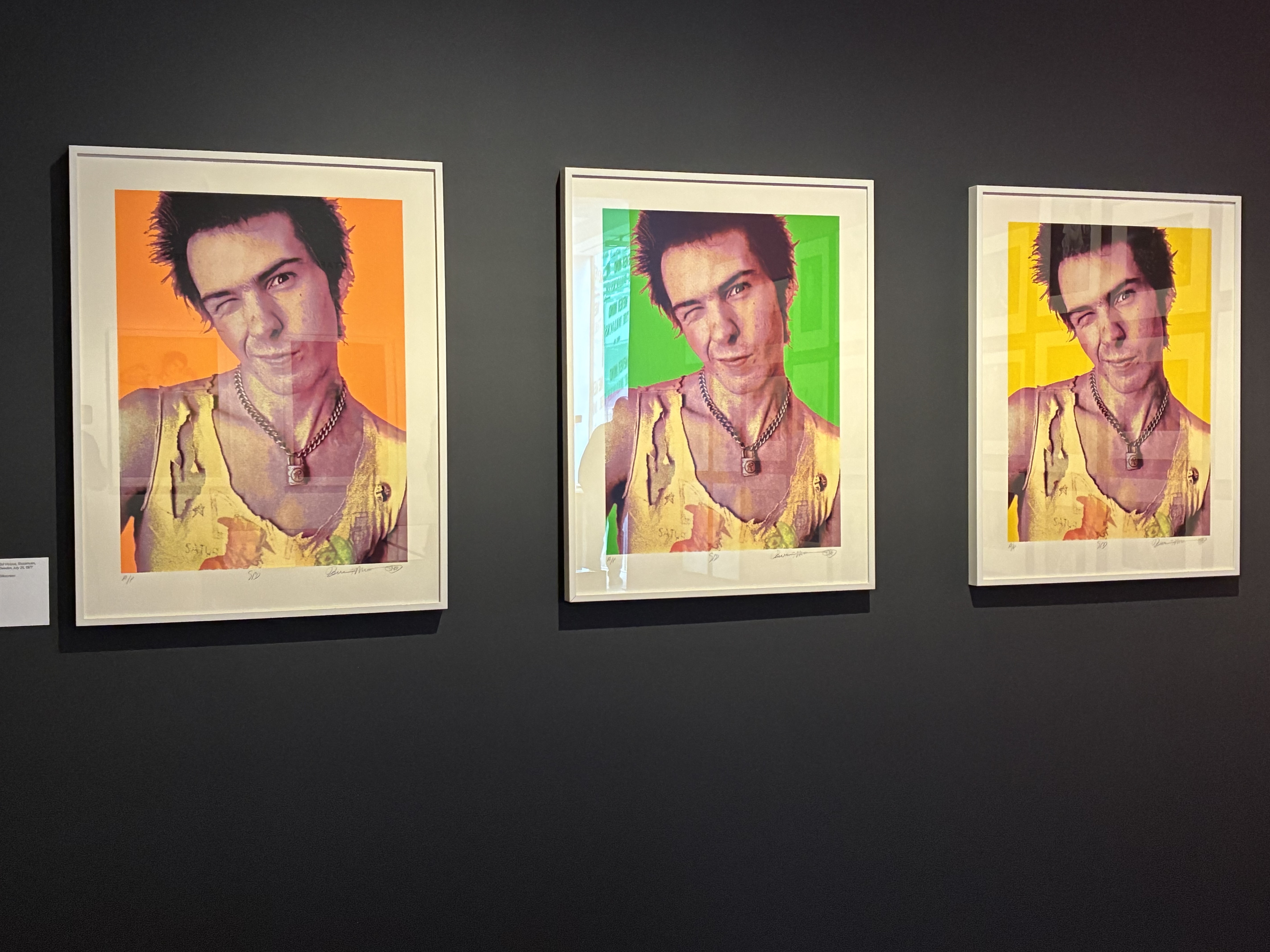
Sid Vicious given the Marilyn silk screen treatment in Dennis Morris at the Photographers’ Gallery (photo by the author)
Here’s a reminder of what we’re talking about:
Public Image Ltd
In 1978, as the Pistols broke up, Virgin boss Richard Branson invited Morris to accompany him on a talent-spotting trip to Jamaica and Morris persuaded Virgin that Rotten (now reverting to his given name of John Lydon) should accompany them. Quite apart from the reggae talent that Morris helped bring to Virgin’s attention, the reggae sound of performers like Lee Perry, the Abyssinians, Big Youth and U Roy made a deep impression on Lydon as he was assembling his post-punk band, Public Image Limited. PiL were to pioneer a distinctive sound mixing the experimental Krautrock-inspired guitar of Keith Levene with the heavy dub bass of Jah Wobble. The more you listen, the more fascinating Levene’s unconventional guitar patterns become.
Morris played a key role in not just photographing the new band, in a deliberately post-punk, anti-punk style – but crafting their public image. He created the PiL logo and designed the innovative Metal Box album packaging – as documented in a wall of images and display case here.

The Public Image Limited wall, showing stylised portraits of (top left to right) guitarist Keith Levene, drummer Jim Walker, and John Lydon looking like a choirboy – with at the far right an early version of the band’s logo: in the display case are more photos and a copy of the metal box LP – all in Dennis Morris at the Photographers’ Gallery (photo by the author)
After punk
There’s more, lots more. The story of how Morris got the image for the cover of Marianne Faithfull’s 1979 solo album, Broken English.
This was part of his work as art director of Island Records which saw him design album covers for Linton Kwesi Johnson, Marianne, Marley and many others. Downstairs is a gallery of his LP covers, as well as other rock memorabilia depicting his photos or designs (t-shirts, lighters, cigarette papers etc).

Display of LP album covers which Morris contributed images and design for, in Dennis Morris at the Photographers’ Gallery (photo by the author)
During this period Morris replaced Don Letts as vocalist of Basement 5, a reggae punk fusion band. He created their logo, image, photography and graphics and gained a recording contract with Island Records.
Subsequently he did photo shoots with a series of icons: from 1970s rock artists like Patti Smith and Grace Jones, through Prince’s heyday in the 1980s and on into the 1990s, the era of the Stone Roses, Oasis, Primal Scream and much more.
At the same time he maintained his close connection with reggae artists and the exhibition features a slideshow projected on a wall of a pantheon of reggae stars including The Gladiators, the Mighty Diamonds and many more.
And he promoted Black British performers such as Steel Pulse, Aswad, often photographing them and taking a hand in designing and styling their images and record artwork. It was Morris who persuaded Island records to sign the great Linton Kwesi Johnson, for which act alone he deserves a medal.
Summary
What range, from the poor streets of Hackney and Southall, to hobnobbing with music royalty, from the Sex Pistols to Steel Pulse, from white punk rock to the blackest of hard-core reggae, and then on to a galaxy of top pop stars. But it’s maybe those early shots, from Hackney, Southall and white working class lives from the 1970s, which linger longest in the memory…

The Trot, Southall Horse Market from This Happy Breed © Dennis Morris
Related links
- Dennis Morris: Music + Life continues at the Photographers’ Gallery until 28 September 2025
- Dennis Morris website
 Books & Boots