Jean-Paul Sartre reviews

Jean-Paul Sartre (1905 to 1980) was a French philosopher, playwright, novelist, screenwriter, political activist, biographer, literary critic and, eventually, cultural icon. He was a defining figure in the Continental philosophy of existentialism and is widely considered a leading figure in 20th-century French philosophy and Marxism.

At school we studied ‘Les Mains Sales’ for French A-level so I read all the other Sartre books I could get my hands on for context, and they had a profound and very negative effect on me. Forty years later I’m able to revisit his works with a much more objective and dispassionate eye.

Jean-Paul Sartre reviews

  • The Flies (1943) A play retelling the Greek myth of Orestes to dramatise Sartre’s existentialist ideas about freedom, responsibility, and guilt, written during the Nazi occupation of France.
  • Huis Clos (1944) Sartre’s most famous play: three characters are locked in a room in hell – there are no tortures, flames etc but they cannot leave the room. Gradually the character reveal the cowardly or cruel actions that led them there and realise that they are trapped not to be physically tortured, but to torment one another indefinitely through judgment, accusation, desire, and emotional dependence.
  • The Age of Reason (1945) First novel in ‘Roads To Freedom’ trilogy, a third-person narrative set in Paris in 1938 which focuses on two days in the life of Mathieu Delarue, a 34-year-old, tall, gangly philosophy teacher who spends a lot of time mooching round the streets of Paris feeling sorry for himself, worrying about his pregnant mistress and his radical friends.
  • The Reprieve (1945) Second novel in the ‘Roads To Freedom’ trilogy, a long, panoramic account of the lives of some 130 characters during the week in September 1938 of the Munich Crisis, twice as long as the first one, fragmented and experimental, a riveting read.
  • Existentialism is a Humanism (1945) Text of a public lecture Sartre gave in 1945 to explain his theory of existentialism and rebut various criticisms.
  • The Respectful Prostitute (1946) A slight play set in the American South, demonstrating that country’s appalling racism and a testament to the vitriolic anti-Americanism of 1950s French intellectuals.
  • Dirty Hands (1948) The longest and most satisfying of the Sartre plays I’ve reviewed, it’s set in a fictional Balkan country in the late stages of the war and dramatises the agonising of Hugo Barine, an idealistic communist, about whether or not to assassinate the leader of the national communist party, Hoederer, who he idolises but becomes persuaded is about to betray the movement. Just to complicate things. Hugo has an intelligent strong-willed wife, Jessica, who falls in love with the leader leading to impassioned arguments about freedom, commitment and so on.
  • Iron In The Soul (1949) Third novel in the ‘Roads To Freedom’ trilogy, covering far fewer characters than its predecessor, over four intense days at the end of the Battle of France i.e. the German invasion, in June 1940, leading up to a dramatic last-ditch battle in a French town where the central figure, Mathieu Delarue, appears to be killed.
  • The Last Chance (1) The Roads To Freedom trilogy was originally intended to comprise four novels but Sartre only published a few chapters of the fourth one before abandoning it. Only in the 1980s were these published in France in a scholarly edition with introduction and notes, and only in 2009 was this given an English translation. This first blog post is a comprehensive summary of all the apparatus surrounding the texts, including context, introductions and interviews.
  • The Last Chance (2) This second blog post is a plot summary of the two parts of the unfinished novel: in the first we meet Brunet, Schneider and thousands of other French POWs imprisoned in a German prison camp in freezing winter conditions in January 1941 (much as Sartre was himself) before they make a bid to escape. In the second fragment we are reunited with Mathieu Delarue who we thought died at the end of the third book, but turns out to have survived.

Context

Konrad Mägi @ Dulwich Picture Gallery

Konrad Mägi (1878 to 1925) was a pioneer of Estonian modernism. Renowned in his home country for his avant-garde, unique colouristic style, he is widely considered the greatest Estonian artist of his generation. I’d never heard of him before which is why Dulwich Picture Gallery are doing us a service by presenting this, the first major exhibition of Mägi’s works ever held in the UK. The exhibition brings together 61 paintings, mostly landscapes or portraits, many of which have never been seen outside of Estonia.

Norwegian Landscape by Konrad Mägi (1909) Courtesy of the Art Museum of Estonia

Four or five themes come over very strongly:

  1. Different styles Mägi’s style was unstable and variable. The first room contains works done in three or four completely different styles which could be by completely different artists.
  2. Self-taught This was partly because, after a brief spell at art school in St Petersburg, Mägi was largely self-taught. This explains the way other styles and influences appear throughout his career, with successive works showing the influence of Impressionism, Art Nouveau, Symbolism, Pointillism, Post-Impressionism and Expressionism, with some of his later works from the 1920s showing the sudden arrival of cubism in his style.
  3. Heavy All the paintings dark and heavy. Dark blues, dark greens, dark reds predominate. These feel a bit heavy and louring in the flesh but I was surprised how well they reproduce on the posters and postcards in the shop.
  4. Clouds In the fourth and final room I realised the importance of clouds in his paintings: of the 45 landscapes not one has a clear blue sky. Maybe this reflects the climate of Estonia but, in the final room, it also feels connected with his mental illness.
  5. Mental illness Mägi suffered from mental illness throughout his life. As a struggling young artist he lived in poverty and ‘despair’, and was afflicted with recurring feelings of Angst and futility. At the end of his life he suffered a breakdown, started destroying his paintings until students intervened to stop him, and he was admitted to a mental asylum where he died. This knowledge affects your reception, if not of all the works, then certainly the ones in the final, cloud-oppressed paintings.

The show is divided into four rooms, each addressing a specific period or theme.

Room 1. Norwegian landscapes

Room 1 contains 14 paintings on the wall and 3 in a display case. The curators tell us that Mägi started his working life in 1896 when he joined a furniture factory where he specialised in decorative carving, and where he took drawing classes organised for the factory workers. He was athletic, enjoyed wrestling, and co-founded a youth society in 1897 for the improvement of the body and mind.

In 1903, at the age of 24, Mägi decided to study at the Stieglitz Art School in St Petersburg. During this time he encountered numerous exhibitions, museums and visual art. Following the pivotal period after the Revolution in 1905, many Estonian intellectuals travelled abroad to experience other cultures, a trend inspired by the founding of the Noor-Eesti movement (Young Estonia) and their motto ‘Let us remain Estonians, but let us also become Europeans’.

In 1907 he was in Paris, living in great poverty but soaking up the new art movements of the day. But apparently it was only when Mägi scraped together the money to visit Norway in 1908, that his style crystallised, sort of, and he started to produce landscapes which found an audience. Room 1 room contains good examples of these, but also demonstrates the variability of Mägi’s style.

  • There are three or four paintings in a nice impressionist style, notably Field of Flowers with a Little House.
  • There’s the extraordinary Norwegian Landscape with a Pine Tree, which I joked to my wife looked like Mordor from Lord of the Rings but maybe reveals the influence of the great Norwegian painter, Edvard Munch.
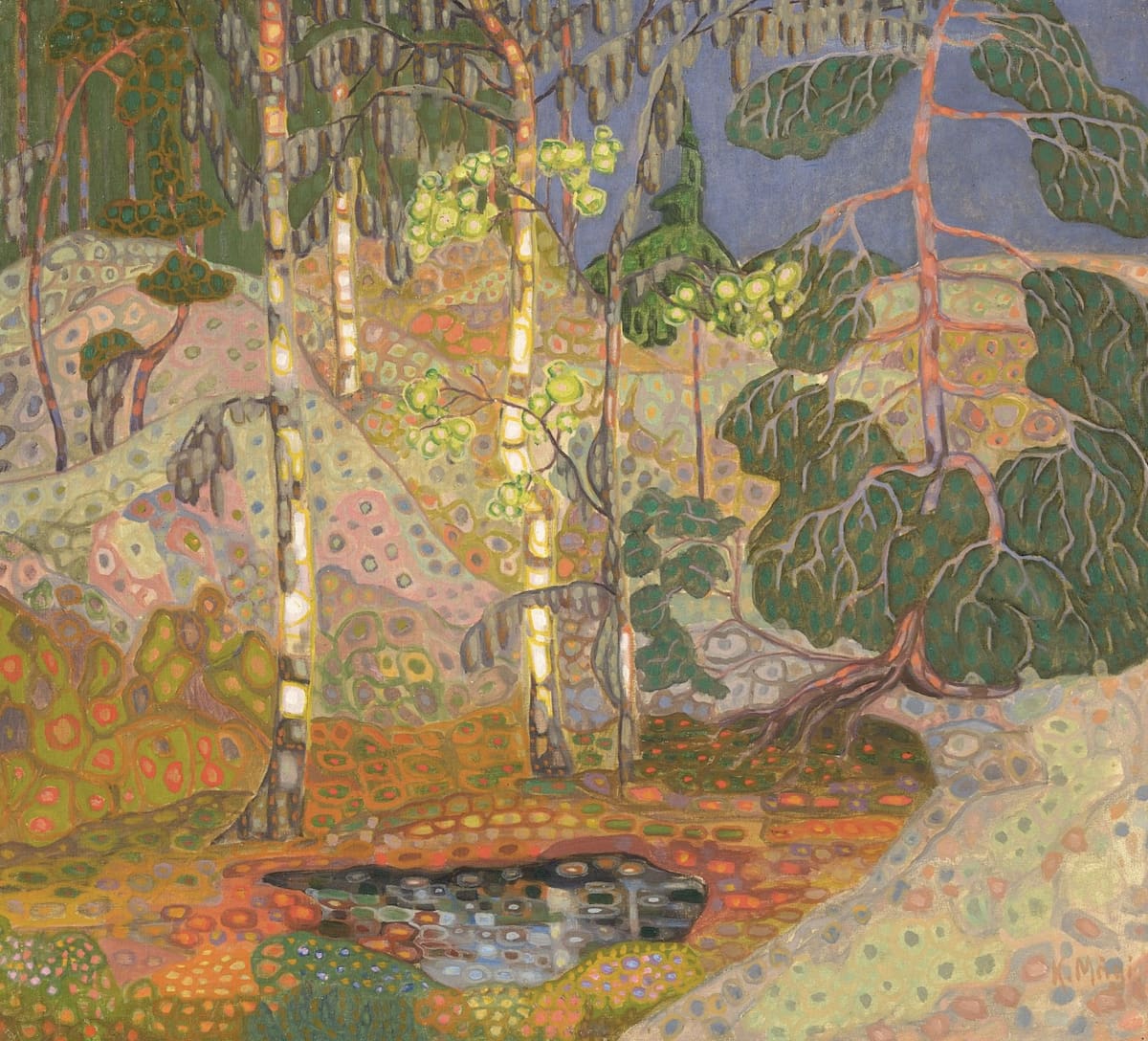
  • The Mordor painting is just the most extreme of the style he developed which combines the garishness of symbolism with the use of blobs of pure colour derived from pointillism. My favourite example was the bog painting (below). It’s figurative in the sense that you can make out the silver birch trees, but what’s happening on the ground isn’t remotely an effort to be realistic, but the use of brightly coloured blobs, lozenges and organic shapes (‘cellular structures’) which are more decorative than realistic. In the flesh, this painting is much more colourful and vibrant than this reproduction.

Norwegian Landscape: Bog Landscape by Konrad Mägi (1908-1910) Courtesy of the Art Museum of Estonia

  • Beside these were more realistic, less abstract landscapes, but still using a big blob pointillist style, such as the Norwegian lake at the top of this review.
  • And then, next door to all these stylised, sort-of-pointillist works, were some landscapes from Norway done in a completely different style, where instead of blobs, the paint has been applied in smooth brushstrokes, so the paintings appear much more traditionally figurative; such as Norwegian Landscape (Winter Landscape).

Room 2. Portraits

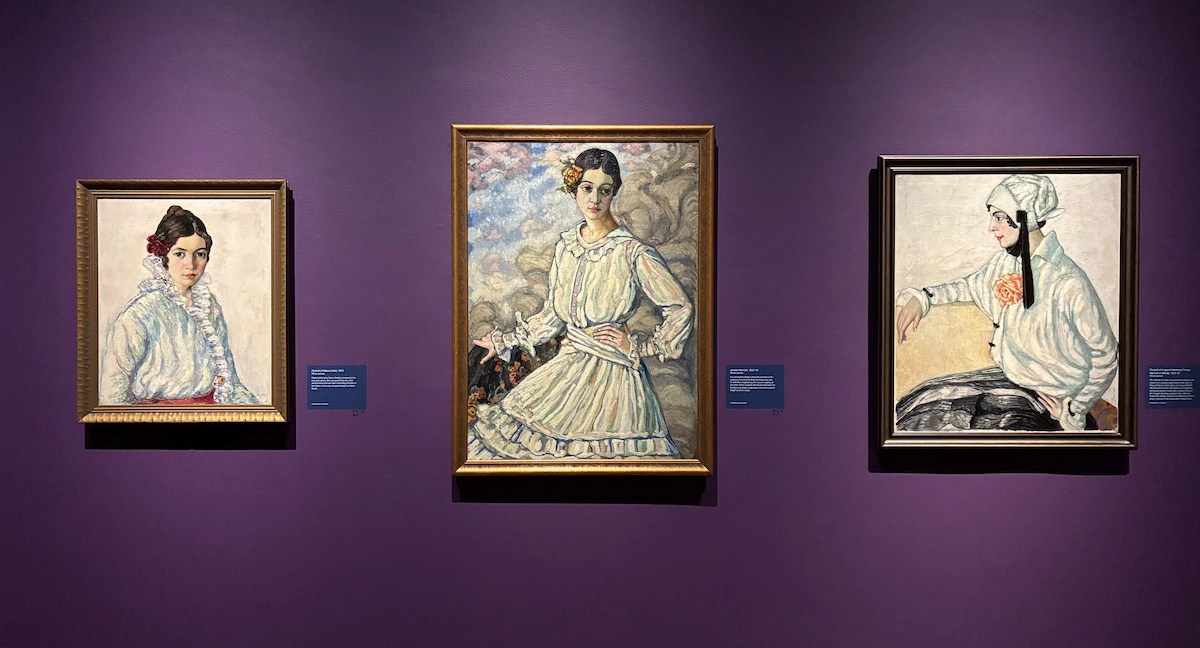
In 1912 Mägi returned to Tartu and, from spring 1913, began accepting portrait commissions for considerable sums of money, largely of wealthy women who were known to him through his cultural and political associations. Room 2 contains 17 of these generally large oil portraits. They showcase a stylised approach to the human face. They’re not unrecognisably distorted as in cubism, just simplified and done with deliberately unnaturalistic colouring. Mostly. But again, there’s a variety of styles. The ones I liked most had a hard angularity and used dark greens and blues to achieve an effect akin to German Expressionism.

Portrait of a Woman by Konrad Mägi (1918–1921) in Konrad Mägi @ Dulwich Picture Gallery

At the other end of the spectrum are some portraits of women whose cartoon, doe-eyed faces seem strangely at odds with the stylised backdrops, such as Portrait of Alvine Käppa from 1919.

Installation view of Konrad Mägi at Dulwich Picture Gallery showing three female portraits (photo by the author)

Somewhere in the middle were maybe the most attractive ones, which combined realistic faces with stylised backgrounds, the outstanding example being another ‘Portrait of a Lady’, below. Note the use of green to indicate shadowing on the skin.

Portrait of a Lady by Konrad Mägi (1916–1917) in Konrad Mägi @ Dulwich Picture Gallery

Room 3. The Baltic

Room 3 contains 16 landscapes from Mägi’s extended stays on the Baltic coast during the summers of 1913 and 1914. The paintings depict the landscape around Saaremaa and Vilsandi and, according to the curators, represented an artistic breakthrough for Mägi. The paintings here are certainly more consistent in style.

As if to demonstrate this, the centrepiece is a rare series by this artist, a set of 6 paintings depicting the same view of the lighthouse at Vilsandi. Three of these show the exact same view at different times towards the end of the day, as the (ever-present) clouds turn deeper shades of pink. the more I looked, the more I liked these three linked works.

Installation view of Konrad Mägi at Dulwich Picture Gallery showing three views of the Vilsandi lighthouse at different times of day (photo by the author)

As to the others, two things struck me:

  1. Lightless Although they are seascapes, and the curators tell us the Estonian coast is flat and open, Mägi’s paintings of it convey very little sense of light. His skies are always full of clouds and the terrain is depicted in thick heavy shapes.
  2. Botany Which is connected to the other thing which is that, although the bits of land he includes are busy with shapes and colours, giving an impression of luxuriant growth – and although the curators tell us that Mägi had an enduring fascination with the unique botanical species of his landscape, including its flora and fauna – there is precious little detail. In the garlands painted by Michaelina Wautier, currently on show at the Royal Academy, I spent some time trying to identify every species of flower. No point trying to do that with Mägi’s coastal paintings which are liberal with elements but all done in his familiar, blobby, stylised manner. Can you identify the plants in this picture?

Vilsandi Motif by Konrad Mägi (1913-14) Courtesy of the Art Museum of Estonia

Room 4. Southern Estonia

The walls of the fourth and final room are painted deep purple and this is an appropriate background for the 11 landscapes on display here, which I found heavy and louring. (I’ve just looked up ‘louring’ to check I’m using it in the right sense. The dictionary defines it as meaning ‘a dark, gloomy, or threatening appearance, usually referring to overcast weather, or a forbidding atmosphere.’ Seems about right.)

The landscapes are from Southern Estonia, from the last decade of his life. Note how the ‘blobby’ technique I’ve mentioned so many times has largely disappeared. Instead the pain is applied more smoothly but several other things are new.

One: the natural elements of the composition (the trees, the bushes, the outline of the lake) are heavily defined in black. Everything has a strong black outline, something I personally, always warm to.

Two: the clouds, the clouds! Look at the swirling, moiling, dark and threatening clouds coming to getcha!

Three: taken together these features indicate how much the landscape is actually an expression of the artist’s inner turmoil. This is the room whose wall label informs us that, after a lifetime struggling against mental illness, in 1924 Mägi suffered some kind of mental collapse and had to be placed in an institution for his own protection. Does that knowledge affect how you feel about this picture?

Lake Kasaritsa by Konrad Mägi (1915-17) Courtesy of the Art Museum of Estonia

As a footnote, not all the 11 works in this final room are as dark and ominous. In fact a couple of them right at the very end work with a much lighter palette and use light square blocks to create a landscape, completely opposite to the heavy, blobby, organic style which dominated so many of his central works. The curators tell us that here, right at the end of his working life, he was experimenting with the kind of Futuro-Cubism which was being used by radical Soviet artists of the 1920s.

Installation view of Konrad Mägi at Dulwich Picture Gallery showing three of the landscapes in the fourth and final room – note the cloud-congested skies (photo by the author)


Related links

Related reviews

Alan Furst reviews

Alan Furst (born 1941) is an American author of historical spy novels. He published a few novels in the 1970s but hit paydirt in the late 1980s when he had the idea of setting his spy thrillers 50 years earlier, back in the 1930s, and in Europe, particularly Eastern Europe, in the murky, threatening years leading up to the Second World War.

The first of these historical spy novels was ‘Night Soldiers’, which follows a Soviet spy across war-threatened Europe and which has given its name to the entire series, published from 1988 to the most recent one in 2019. Because of the 1930s settings, Furst has been called the ‘heir to the tradition of Eric Ambler and Graham Greene’ who both, of course, actually wrote ominous thrillers in the 1930s. As the series progressed, Furst sometimes deploys recurring characters and settings (notably the Brasserie Heininger in Paris, which appears in all 15 novels) to bind the stories together and please fans (like me).

List of my reviews

List with plot summaries

1988 Night Soldiers An epic narrative which starts with a cohort of recruits to the NKVD spy school of 1934 and then follows their fortunes across Europe, to the Spain of the Civil War, to Paris, to Prague and Switzerland, to the gulags of Siberia and the horrors of the Warsaw ghetto, in a Europe beset by espionage, conspiracy, treachery and murder.

1991 Dark Star The story of Russian Jew André Szara, foreign correspondent for Pravda, who finds himself recruited into the NKVD and entering a maze of conspiracies, based in Paris but taking him to Prague, Berlin and onto Poland – in the early parts of which he struggles to survive in the shark-infested world of espionage, to conduct a love affair with a young German woman, and to help organise a network smuggling German Jews to Palestine; then later, as Poland is invaded by Nazi Germany, finds himself on the run across Europe. (390 pages)

1995 The Polish Officer A long, exhausting chronicle of the many adventures of Captain Alexander de Milja, Polish intelligence officer who carries out assignments in Nazi-occupied Poland and then Nazi-occupied Paris and then, finally, in freezing wintertime Poland during the German attack on Russia.

1996 The World at Night A year in the life of French movie producer Jean Casson, commencing on the day the Germans invade in June 1940, following his ineffectual mobilisation into a film unit which almost immediately falls back from the front line, his flight, and return to normality in occupied Paris where he finds himself unwittingly caught between the conflicting claims of the Resistance, British Intelligence and the Gestapo. (304 pages)

1999 Red Gold Sequel to the World At Night, continuing the adventures of ex-film producer Jean Casson in the underworld of occupied Paris and in various Resistance missions across France. (284 pages)

2000 Kingdom of Shadows Hungarian exile in Paris, Nicholas Morath, undertakes various undercover missions to Eastern Europe at the bidding of his uncle, Count Janos Polanyi, a kind of freelance espionage controller in the Hungarian Legation. Once more there is championship sex, fine restaurants and dinner parties in the civilised West, set against shootouts in forests, beatings by the Romanian police, and fire-fights with Sudeten Germans, in the murky East.

2003 Blood of Victory Russian émigré writer, Ilya Serebin, gets recruited into a conspiracy to prevent the Nazis getting their hands on Romania’s oil, though it takes a while to realise who’s running the plot – Count Polanyi – and on whose behalf – Britain’s – and what it will consist of – sinking tugs carrying huge turbines at a shallow stretch of the river Danube, thus blocking it to oil traffic. (298 pages)

2004 Dark Voyage In fact numerous voyages made by the tramp steamer Noordendam and its captain Eric DeHaan, after it is co-opted to carry out covert missions for the Allied cause, covering a period from 30 April to 23 June 1941. Atmospheric and evocative, the best of the last three or four. (309 pages)

2006 The Foreign Correspondent The adventures of Carlo Weisz, an Italian exile from Mussolini living in Paris in 1938 and 1939, as Europe heads towards war. He is a journalist working for Reuters and co-editor of an anti-fascist freesheet, Liberazione, and we see him return from Civil War Spain, resume his love affair with a beautiful German countess in Nazi Berlin, and back in Paris juggle conflicting requests from the French Sûreté and British Secret Intelligence Service, while dodging threats from Mussolini’s secret police.

2008 The Spies of Warsaw The adventures of Jean Mercier, French military attaché in Warsaw between autumn 1937 and spring 1938, during which he has an affair with sexy young Anna Szarbek, helps two Russian defectors flee to France, is nearly murdered by German agents and, finally, though daring initiative, secures priceless documents indicating German plans to invade France through the Ardennes – which his criminally obtuse superiors in the French High Command choose to ignore!

2010 Spies of the Balkans The adventures of Costa Zannis, senior detective in the northern Greek port of Salonika, who is instrumental in setting up an escape route for Jews from Berlin through Eastern Europe down into Greece and then on into neutral Turkey. The story is set against the attempted Italian invasion of Greece (28 October 1940) through to the German invasion (23 April 1941).

2012 Mission to Paris The adventures of Hollywood movie star Fredrick Stahl, who travels to Paris to make a movie and becomes embroiled in increasingly sinister Nazi attempts to bully, blackmail and intimidate him into making pro-German or at least pacifist statements, and then gets caught up in actual espionage with more and more at stake.

Celtic Dawn: A Portrait of the Irish Literary Renaissance by Ulick O’Connor (1984)

We will show that Ireland is not the home of buffoonery and easy sentiment, as it has been represented, but the home of ancient idealism.
(Prospectus for the Irish Literary Theatre drafted by Lady Gregory, 1897; page 188)

This is a much more substantial work than O’Connor’s 1975 history of the Easter Rising. That was a slender pocket-sized 180 pages, this is a bigger format 416-page book complete with hefty index, 17-page bibliography and all. But like the earlier book, it’s still very much a personal account, and based on biography and anecdote rather than more scholarly history.

O’Connor (1928 to 2019) wrote a lot but he was neither a professional historian nor literary critic. He was more an erudite and impassioned amateur. And so this isn’t a scholarly or historically profound account, more an attempt, in his own words, ‘to convey the energy and elation of an era on Europe’s last island, perhaps the last in a series of renaissances which flourished in different countries since the Italian one in the fourteenth century’.

As with the earlier book, O’Connor is not shy about describing his own connections with the various settings and people involved, which makes for sweet anecdotes which, however, tend to bring out its rather home-made feel.

I was led to believe it’s a group biography of the key figures of the Celtic renaissance but, as you can see from my summary (below), it’s more like an interlocking series of biographies of all the Irish writers of the time, plus a fair few political figures.

One by one O’Connor introduces them to us and gives pen portraits. (I double checked I was using this phrase correctly. A pen portrait is ‘a brief, vivid and written description of a person, providing a “snapshot” of their character, lifestyle, and key traits, rather than just objective data’, which seems accurate enough.)

First of all we’re introduced to the key figures in chronological order and then, as they begin to work together, write for each other’s magazines or theatres, introduce each other to new ideas etc, the stories overlap and intertwine to build up a mosaic portrait of a major literary movement. At key moments when the central players, Griffiths, Yeats, Lady Gregory, AE, Edward Martyn, see their vision for a mature national Irish literature come to fruition, it can be very moving. And the figure of George Moore, the mocking dandy novelist, weaves in and out of the story like Puck, helping, mocking and memoiring.

The key players are:

Standish O’Grady (1846 to 1928)

Son of a Church of Ireland minister, O’Grady retained his aristocratic Unionist beliefs till the end of his life, but he played a pivotal role in the Celtic Renaissance by researching, writing, publishing and publicising the ancient legends of Ireland. His academic works – ‘History of Ireland: Heroic Period’ (1878–81) and ‘Early Bardic Literature of Ireland’ (1879) – didn’t sell so he realised he needed to dramatise them and romanticise Irish legends in a series of historical novels including ‘Finn and his Companions’ (1891), ‘The Coming of Cuculain’ (1894), ‘The Chain of Gold’ (1895), ‘Ulrick the Ready’ (1896) and ‘The Flight of the Eagle’ (1897). His insistence that the ancient Irish legends ranked with the tales of Homer inspired Yeats and others, leading to the title ‘Father of the Celtic Revival’. A lot later Yeats wrote: ‘whatever is Irish in me he kindled to life’ (p.25).

Douglas Hyde (1860 to 1949)

Son of a Church of Ireland rector, Hyde was home schooled among gillies and labourers, where he heard Gaelic spoken and started to study it. He began transcribing folk songs and discovered the people of Connacht remembered courtly songs and poems, which he translated and published. It was his poems published between 1890 and 1894 that inspired Yeats and Lady Gregory to realise the folk culture could be the basis for a national revival.

Around 1880 Hyde joined the Society for the Preservation of the Irish Language. Between 1879 and 1884 he published more than a hundred pieces of Irish verse under the pen name An Craoibhín Aoibhinn.

In 1886 Hyde met and became close friends with W.B. Yeats (then 21). They often met and discussed each other’s poetry.

In 1892 Hyde helped establish the Gaelic Journal, and wrote a manifesto called ‘The necessity for de-anglicising the Irish nation’ arguing that Ireland should follow its own traditions in language, literature, and dress. O’Connor sees it as a pivotal moment (p.165) because it led to…

In 1893 he helped found Conradh na Gaeilge (the Gaelic League) to encourage the preservation of Irish culture, music, dance and language. Ten years later there were 600 branches with a membership of 50,000. The next generation of Irish republicans (including Pádraig Pearse, Éamon de Valera, Michael Collins) became politicised through their involvement in Conradh na Gaeilge.

In the same year he published ‘Love Songs of Connacht’. The book had Gaelic poems on one page and prose and verse translations on the other. O’Connor thinks it ‘set the style of the literary renaissance’ (p.170).

Charles Stewart Parnell (1846 to 1891)

1875: Charles Stewart Parnell elected MP for Meath. O’Connor thinks the crucial fact of his life was that his other was American, from a family of heroes who fought against the British. By 1880 Parnell had succeeded Isaac Butt as leader of the Irish Party. In 1888 he was vindicated by an enquiry into his role in the Phoenix Park Murders (which Skin-the-Goat in James Joyce’s ‘Ulysses’ was meant to be the getaway driver for). Here and in his Easter Rising book, O’Connor thinks Parnell’s achievement was to bring together land reformers, constitutionalists and physical force advocates into one party to win the electoral success which gave them 70 or so seats in the London House of Commons and so made them the decisive force in British politics during the 1880s.

Parnell generated an energy which fuelled the elation unleashed in the national being.

Parnell had been having an affair with Katherine ‘Kitty’ O’Shea, a married woman, lived with her and fathered two children by her, when her husband, Captain O’Shea, brought a divorce suit against her, citing Parnell as co-respondent. The case came to court in November 1890 causing a scandal. The Catholic hierarchy turned against him, Gladstone was forced to criticise him. His closest associates in his own party deserted him to form the Irish National federation. The alliance of nationalist forces he had carefully assembled fragmented, and Irish nationalism was set back by a generation.

The following year he died of tuberculosis in Hove, aged just 45. His body was brought back to Dublin and given the biggest funeral procession ever seen. Yeats wrote several poems about it. So did the 9-year-old James Joyce, who went on to dramatise the bitterness surrounding his fall in the famous Christmas dinner scene in ‘A Portrait of the Artist as a Young Man’.

O’Connor thinks Parnell united the Anglo-Irish and the Gaelic Irish into the new identity of the nationalist Irish. (O’Connor nowhere really tackles the more obvious divide between Protestant and Catholic.)

Yeats believed part of the inspiration for the Irish Literary Renaissance was that the people’s creative energies were turned away from politics by Parnell’s fall and sought alternative outlets: folk stories, pagan religion, poetry and drama.

Lady Gregory (1852 to 1932)

Isabelle Augusta Persse, Lady Gregory was the 14th of 18 children! From a Protestant low church background but had a Catholic nanny who told her rebel stories. Met and married Sir William Gregory, recently retired as governor of Ceylon, 62 to her 28. Engaged in political campaigns. Affair with Wilfrid Blunt, the explorer, adventurer, poet and anti-imperialist. Jailed for chairing an anti-eviction meeting in Galway. Husband Sir William died in 1892 aged 74, leaving Augusta aged 40, mistress of Coole Park. She needed income so set about writing, and turning the Park into a venue for Irish nationalist writers. Her momentous meeting with 31 year-old Years was in 1896.

Agreed to create an Irish Literary Theatre for him, to be funded by Edward Martyn.

Studied Gaelic and collected folktales in west of Ireland, heading towards ‘Visions and Beliefs in the West of Ireland’, published in 1920 with notes and two essays by W.B. Yeats.

Memorably wrote: ‘I defy anyone to study Irish history without getting a dislike and distrust of England’ (p.201).

By the later 1890s Coole Park was recognised as a meeting place for writers, with Yeats often there, and AE, Douglas Hyde, Martin. George Bernard Shaw visited and John Masefield. When she heard Irish literature being condemned by Trinity College academics it inspired her to devote two years to retelling the stories from O’Grady’s History of Ireland but in her own style which she had developed over years of translating. The result was ‘Cuchulainn of Muirthemne: The Story Of The Men of the Red Branch Of Ulster arranged and put into English by Lady Gregory, with a preface by W. B. Yeats’, published in 1902. The book is a centrepiece of the literary renaissance. It was well reviewed, and Yeats later used stories in it as the basis for no fewer than five plays, and Synge based his last play, Deirdre, on it.

George Moore (1852 to 1933)

Irish novelist, short-story writer, poet, art critic, memoirist and dramatist. Moore came from a landed family of Catholics who lived at Moore Hall in Carra, County Mayo. The estate had 12,000 acres and his father had not only a stables but a full scale racecourse built on the model of Aintree racecourse in Liverpool.

Moore’s father wanted him to go into the Army but young George wanted to be a painter and so went to Paris in 1873 to study art. There, he befriended many of the leading French artists such as Manet (who painted his portrait) and Degas, and writers such as Villiers de l’Isle-Adam and Mallarmé. Failing as a painter he had a go at poetry but was bad at that, too. At which point he commenced writing prose fiction which turned out to be his metier. He wrote in the naturalist style pioneered by Émile Zola. According to Richard Ellmann, his writings influenced the early James Joyce.

In 1880 he heard his estate was in trouble and so returned. The 1879 harvest had been as bad as the potato famine years and tenants were refusing to pay rents. Moore toured the estate and was shocked at their abject poverty. Having sorted out new, lower rents in order to maintain the estate, he moved to London and started writing at a prodigious rate:

  • A Modern Lover, 1883
  • A Mummer’s Wife, 1885 – Kate Ede, bored housewife in the Potteries, runs away to join a troupe of travelling actors
  • A Drama in Muslin, 1886 – satire on the annual season at Dublin Castle
  • A Mere Accident, 1887
  • Parnell and His Island, 1887 – factual often scathing essays and portraits
  • Confessions of a Young Man, 1888
  • Modern Painting, 1893 – factual book introducing the French Impressionists
  • Esther Waters, 1894 – portrait of a serving girl
  • Celibates, 1895 – three characters explore love, sex and social conventions
  • Evelyn Innes, 1898

He had a love-hate relationship with his country, writing in the factual book ‘Parnell and His People‘ that Ireland was ‘a primitive country and barbarous people’, and:

Ireland is a bog, and the aborigines are a degenerate race — short, squat little men — with low foreheads and wide jaws.

Fifteen years later he would write about the British Empire and its administrators in much the same terms. O’Connor quotes Martyn saying Moore observed himself, his actions and beliefs with the detached attitude of a scientist.

Edward Martyn (1859 to 1923)

Another landlord of a large estate and urban property except that Martyn’s family was Catholic. He was cousin and boyhood friend with George Moore: George the sensualist and Edward the ascetic. They visited Bayreuth together.

Tulira Castle Martyn was eccentric. He comprehensively renovated the family property, the Gothic Tulira Castle, but chose to live in a spartan bedroom. He was a connoisseur of church music. Tulira was and is only 4 or so miles from Coole Park, home of Lady Gregory.

Music He was a fine musician in his own right, giving memorable performances for guests on an organ he had installed at Tullira.

Cultural sponsor Martyn used his wealth to benefit Irish culture. His activities and sponsorships included:

  • 1897: co-founder and endowing of the Feis Ceoil
  • 1903: foundation of the Palestrina Choir (the resident choir at the St Mary’s Pro-Cathedral, Dublin)
  • funding and direction of St. Brendan’s Cathedral, Loughrea
  • president of Na hAisteoirí, the Irish-language drama group
  • sponsored and guided An Túr Gloine, Ireland’s first stained-glass workshop
  • sponsored the Irish Theatre

Martyn was reportedly pivotal in introducing William Butler Yeats and Lady Gregory to each other in 1896. The three founded the Irish Literary Theatre, for whom Martyn wrote his best and most popular plays ‘The Heather Field’ and ‘A Tale of a Town’. He covered the costs of the company’s first three seasons, which proved crucial to establishing the company and the future of the Abbey Theatre.

Irish republicanism He became involved with the political work of Maud Gonne and Arthur Griffith. He was a vocal opponent of the visit of Queen Victoria to Ireland in 1897 and of Edward VII in 1903, this time as chairman of the People’s Protection Committee.

He became close friends with Griffith and funded the publication of his tract ‘The Resurrection of Hungary in 1904’ which publicised Griffith’s abstentionist strategy i.e. non-cooperation with every aspect of the British administration.

From 1905 to 1908 he was the first president of Sinn Féin (the party only taking that name in the latter year). In 1908, he resigned from the party and politics in general to concentrate on writing and his other activities.

He was on close personal terms with Thomas MacDonagh, Joseph Mary Plunkett and Patrick Pearse and mourned their executions in the aftermath of the Easter Rising. A parish hall and church that he founded at Labane, near Tullira, were burned by the Black and Tans. In ‘A Terrible Beauty’ O’Connor quotes the letter Yeats wrote to the Times protesting this.

John Butler Yeats (1839 to 1922)

From an Anglo-Irish = Protestant family, he studied at Trinity College, briefly pursued the law before switching to painting. He became a prolific portrait painter but was not a good businessman, so he and his family were always hard up and regularly moved. ‘In a material sense he had been a hopeless parent’ (p.110).

In 1863 he married Susan Pollexfen (1841 to 1900) daughter of a Sligo merchant and shipowner. She was dismayed when he abandoned the law. They had six children: three sons and three daughters, the oldest son being the Nobel Prize winning poet and dramatist William Butler Yeats. The two daughters most mentioned are Lily and Elizabeth, known as Lolly. Apparently, Susan went slowly mad.

Surprisingly, in 1907 at the age of 68, he travelled to New York aboard the RMS Campania with his daughter Lily and never returned to Ireland, dying in a boarding house in New York.

William Butler (W.B.) Yeats

J.B. was an atheist materialist, a follower of Comte and Darwin. His son, Willie, reacted against this into his Celtic Dawn love of fairies and spiritualism, describing himself as ‘a voice of the revolt of the soul against the intellect’ (p.150). In reaction against his Victorian materialist father, from his teenage years onwards Yeats subscribed to every spiritualist fad available, setting up the Hermetic Society with a friend, meeting Madame Blavatsky and getting into Theosophy, studying ancient Indian texts etc.

In the 1880s father John moved the family to London, to Bedford Park, introducing young Willie to Oscar Wilde among others. One day in June 1889, Maud Gonne turned up on their doorstep. She was already a legend and said to be the most beautiful women in Europe.

Yeats joined the Order of the Golden Dawn led by Mcgregor Mathers. He took to Rosicrucianism as an ideal synthesis of Christianity and paganism. In 1889 he had published his first book of poems, ‘The Wanderings of Oisin and other poems’, supported by the Fenian John O’Leary.

In 1890 Yeats along with Welsh poet Ernest Rhys founded The Rhymers’ Club which met at the London pub ‘Ye Olde Cheshire Cheese’ in Fleet Street.

Later Yeats and others glamorised members of the club as the ‘doomed generation’ because so many died of poverty, alcoholism or disease. Hmm. This is a typical example of literary types’ self-mythologisation. Compare the peace and plenty they enjoyed with the experience of the generation who reached manhood as the First World War broke out; who were the real doomed generation?

The most notable of the Rhymesters was Arthur Symons who wrote an excellent book ‘The Symbolist Movement in Literature’; read to Yeats from French and Latin poetry; and gave Yeats introductions to key literary figures in Paris (Verlaine, d’Adam) when he went to visit the French capital.

1894 production of his first play, ‘The Land of Heart’s Desire’ in London. In it a young woman about to be married is lured into the otherworld by a fairy. George Moore attended and was put off Yeats by his posing in a big black cloak and walking up and down the back of the dress circle wearing a ridiculous sombrero. He had a pathological dislike of Ibsen and issue-led theatre, thus profoundly disliked Shaw’s plays.

Hard up, in autumn 1894 Yeats went to stay out in Sligo with his uncle George Pollexfen. Although a successful merchant, George was also into mysticism and a member of the Hermetic Dawn. He was single, living alone apart from a serving girl he was convinced had second sight.

In 1896 Yeats, aged 30, moved to rented rooms at 18 Woburn Buildings in London where he would live for the next 15 years.

In August the same year, Edward Martyn invited Yeats and Arthur Symons to visit him at Tulira. The visitors asked if they could take a boat to the Isles of Aran, the most remote and unspoiled part of Ireland, which they did for five days. During the visit Lady Gregory invited them to nearby Coole Park. This was the decisive visit which began their collaboration. Amusingly, Symons witnessed their conversation and instantly realised that she would seduce Yeats away from lyric poetry. He ever afterwards referred to her as ‘the witch’ (p.182).

In 1897 Yeats went for another stay with Martyn. While Martyn was elsewhere Yeats was left with Lady Gregory, lamenting that there was nowhere for him to get his plays produced in a Dublin dominated by plays and entertainments imported from England. Within an hour she had mapped out a scheme to set up an Irish national theatre. She would call on her connections via her dead husband with establishment figures and ask them all to cough up £25 for three years to fund the thing. When Martyn rejoined them and heard the plan, he immediately signed up.

In 1898 Yeats, exhausted by his unrequited love for Gonne, came back to Coole. Lady Gregory let him rest in bed, created a daily timetable, had his food sent up, let him walk through the grounds and round the lake where he got to know the wild swans. For the next 20 years she was to be his rock and support until he married in 1917, and she had a hand in arranging that.

George Russell (A.E.) (1867 to 1935)

Met Yeats at art school. The Russell and Yeats families lived near each other. Professional seer of visions which he depicted in his drawings, sacred mountains, druids, the Hindu and Irish gods were related. He did a painting of a divine being and, wondering what to call it, heard the word ‘aeon’ being whispered to him, a few weeks later opening a book about the Gnostics and discovering ‘aeon’ was the name they gave to the first order of beings created by the Divine Mind. From that moment till his dying day he signed his works AE and the brand stuck. He used to go to the esplanade at Bray and hold forth to passersby about the glories of the ancient religion of mankind. Standish O’Grady heard him and was impressed.

In the late 1880s he gave up painting and got a job as a draper’s assistant during the day, so as to be free to practice mystical mind exercises at night.

Despite all this he had a practical side: at Yeats’s suggestion, Horace Plunkett appointed Russell assistant secretary of the Irish Agricultural Organisation Society (IAOS), an agricultural co-operative society Plunkett founded in 1894. He was responsible for developing the credit societies and establishing Co-operative Banks in the south and west of the country.

From 1905 to 1923 he was editor of the influential Irish Homestead, the journal of the IAOS.

O’Connor quotes a good thing A.E. said to a Catholic friend who was twitting him about his mystical beliefs: ‘Like all Irish Catholics you are an atheist at heart’ (quoted page 157).

Sir William Wilde (1815 to 1876)

From a Protestant family, Wilde was an ophthalmologic surgeon and the author of significant works on medicine, archaeology and folklore, particularly concerning his native Ireland. Also, the father of Oscar Wilde.

Wilde was a founder member of the Irish nationalist Home Government Association, established by his Trinity College Dublin colleague Isaac Butt as the precursor to the Irish Parliamentary Party.

In 1851 Wilde married the poet Jane Francesca Agnes Elgee, who wrote and published under the name of Speranza. The couple had two sons, William (Willie) and Oscar, and a daughter, Isola Francesca, who died in childhood.

He was knighted in 1864, mostly for his help conducting a census in Ireland.

Wilde was promiscuous (‘Sir William had a name as a lecher’, p.101). He fathered three children by two women before he married Jane. In 1864 his reputation was damaged by the Travers libel trial. There’s a good summary in the Irish Times:

Wilde is important for O’Connor because he a) spoke Irish like a native and b) collected folklore from his estate in the west of Ireland.

Jane Francesca Agnes Elgee Wilde (Speranza) (1821 to 1896)

From a prosperous Protestant family in Dublin. The plaque on the grave of her husband describes her as ‘Speranza of The Nation, writer, translator, poet and nationalist, author of works on Irish folklore, early advocate of equality for women, and founder of a leading literary salon’.

Speranza As a young woman in the 1840s, Elgee wrote for the Young Ireland movement, publishing patriotic ballads in The Nation under the pseudonym of Speranza, calling for Irish independence and anti-British. Charles Gavan Duffy was the editor when ‘Speranza’ wrote commentary calling for armed revolution in Ireland as a result of which the authorities at Dublin Castle shut down the paper and brought Charles Duffy to court but he refused to name the person who had written the offending article.

Marriage In 1851 Elgee married the successful society doctor and ophthalmologist, William Wilde, thus becoming Jane Wilde. When he was knighted in 1864, she became Lady Wilde.

Folklore When Wilde died in 1876, the family discovered that he was virtually bankrupt. Lady Wilde joined her sons in London in 1879, living with Willie in poverty, supplementing their meagre income by writing for fashionable magazines. She wrote several books based on the research of her late husband into Irish folklore, notably ‘Ancient legends, mystic charms, and superstitions of Ireland’ (1887). O’Connor thinks it ‘contains some of the most beautiful folk tales in existence’ (p.100), although he tells us that the expert, Douglas Hyde, was sceptical about them, given that Jane didn’t actually speak Gaelic. Yeats on the other hand thought they were so good he didn’t care if Lady Jane had embellished them or not (p.115). There’s an obvious study to be done comparing Jane’s folk stories and her son Oscar’s fairy stories…

Feminist Jane was an early advocate of women’s rights, and campaigned for better education for women. She invited the suffragist Millicent Fawcett to her home to speak on female liberty. She praised the passing of the Married Women’s Property Act of 1882, which prevented a woman from having to enter marriage ‘as a bond slave, disenfranchised of all rights over her fortune’.

Oscar Wilde (1854 to 1900)

Yeats’s father moved the family to London and introduced young Willie to Oscar, who he knew through his parents. Wilde was ten years older than Willie and tried to help the young poet. Willie was impressed by Oscar’s attempt to make every aspect of his life beautiful but he deprecated the older man’s sloth. O’Connor points out that when Oscar toured the USA for almost the whole of 1882, he was feted among Irish audiences as much for being the son of the nationalist Speranza as for being a London aesthete. George Bernard Shaw, 2 years older than Oscar, thought him ‘a very Irish Irishman’.

John O’Leary (1830 to 1907)

An Irish separatist and a leading Fenian. He studied both law and medicine but did not take a degree. For his involvement in the Irish Republican Brotherhood, he was imprisoned for five years in England. He spent time in Paris among other political exiles and developed a strong sense of the importance of having a national culture in order to promote independence. He’s important to this narrative because he got to see W.B. Yeats debate and orate and came to believe he was the national poet Ireland was waiting for.

O’Leary was on the Supreme Council of the Irish Republican Brotherhood and inducted Yeats into it. Yeats was to remain involved for the rest of his life. The IRB would regard Yeats as ‘their man’ in the literary movement. Later Yeats would say ‘to him I owe everything I set my hand to’. O’Leary arranged for the publication of Yeats’s first volume, and introduced him to folklorists who supplied the material for his books ‘

Maud Gonne MacBride (1866 to 1953)

Born of an English mother and father in the army, brought up in the barracks, lived with the family in Austria and the south of France, attended the 1886 season at Dublin Castle, attended balls and was presented to the Prince of Wales. But Maud rebelled against her upbringing to become a firebrand Irish nationalist and suffragette.

In 1889 she was introduced to W.B. Yeats who was driven mad with love for her, but she refused to become his lover a) because she was already having an affair with a Frenchman Lucien Millevoye, later b) because she later fell in love with and married (in 1903) the nationalist activist John MacBride (one of the leaders of the Easter Rising, executed by the British in 1916).

William Morris (1834 to 1896)

English textile designer, poet, artist, writer, and socialist activist associated with the British Arts and Crafts movement. In the late 1880s and 90s he was for a while an idol of Yeats’s (‘one of the few men he ever really worshipped’, p.138), who visited him at Kelmscott House and attended meetings of his Socialist League. When Yeats’s collection of essays, ‘the Celtic Twilight’ was published in 1893, the Morris group hailed it as the Irish equivalent of their own pre-Raphaelite movement. What they had in common was a rejection of Victorian pragmatism, mercantilism and science in favour of romantic worlds of faerie. But O’Connor suggests the difference was that the pre-Raphaelites were nostalgic for a vanished English past whereas Yeats was trying to instil the folk culture of Ireland in the here and now.

Eventually they split after Yeats sat through a socialist meeting consisting of attacks on religion before getting to his feet and insisting that only through religion and imagination could the revolution come, before being told to desist and sit down. He never attended another meeting.

George Bernard Shaw (1856 to 1950)

Of Protestant Anglo-Irish descent, Bernard Shaw was a playwright, critic, polemicist and political activist. His father was an alcoholic corn merchant, but his mother, Lucinda, was a noted opera singer, she sang at the Castle and was congratulated by the Lord Lieutenant. Shaw grew up in a household saturated with classical music which is why he was able to become a music critic when he moved to London in 1876. This was encouraged by the mentorship of George Lee who formed a sort of menage with the Shaw household and organised classical concerts. He was also a Catholic who introduced young George to Irish nationalism.

He wrote more than sixty plays, including major works such as Man and Superman (1902), Pygmalion (1913) and Saint Joan (1923). He worshipped Ibsen for confronting the middle classes with truths they’d prefer to ignore.

His first success was Arms and The Man, first staged in 1894. It was funded by Shaw’s lover, Florence Farr and staged alongside Yeats’s first play ‘The Land of Heart’s Desire’. Wilde wrote to congratulate Shaw.

John Millington Synge (1871 to 1909)

Another protestant, from a wealthy Anglo-Irish background, Synge went to Paris to study music. Realising he was not going to become a composer, he met Yeats on a visit to the capital, who advised him to go to the Aran Islands (which Yeats had visited only months before) to learn from the peasants. Two years later, in May 1898, Synge did just that. He made five visits over the next few years. By the end he was fluent in Gaelic. It helped that he was a fine violinist and picked up many airs and tunes which he played for the locals.

(In between these trips he spent five successive summers at Coole Park, collecting stories and folklore, perfecting his Irish, but living in Paris for most of the rest of each year.)

Then he set about writing the half a dozen plays that he is remembered as a key figure of the Irish Literary Revival.

Horace Plunkett (1854 to 1932)

Phenomenally posh, Plunkett was born in Sherborne, Gloucestershire, the third son of Admiral Edward Plunkett, the 16th Baron of Dunsany, of Dunsany Castle, Dunsany, near Dunshaughlin, County Meath, and the Honourable Anne Constance Dutton (daughter of John Dutton, 2nd Baron Sherborne).

Raised in County Meath, Plunkett was Anglo-Irish, raised in the Church of Ireland, educated at Eton College and University College, Oxford.

However, he appears in this story because he went to Wyoming in America to try and cure his incipient tuberculosis, spending ten years there and turning out to have a talent for running ranches at a profit. And when he returned to Ireland, in 1891, he ended up, through a series of initiatives, becoming a pioneer of agricultural cooperatives. In 1894 he set up the Irish Agricultural Organisation Society (IAOS).

Among many other appointments, he heard about Lady Gregory’s good works in Galway and went down to visit. Here he met Yeats who he initially thought an ass until he heard him address a meeting of local farmers and realised there was more to him than first appeared. Plunkett needed an organiser to tour the west of Ireland. Yeats recommended his friend AE who had developed practical experience working for his draper’s company. After years on the road, in 1901 he became editor of the co-op’s magazine, The Irish Homestead.

Irish Literary Theatre

The first plays staged in the theatre’s first season, in 1899, were:

  1. Yeats’s The Countess Cathleen, first published in 1892: is set during a famine in Ireland, where the noblewoman Countess Cathleen sells her soul to demons to save the starving peasantry.
  2. Edward Martyn’s The Heather Field: Carden Tyrrell, a visionary landowner, becomes obsessed with reclaiming a barren, heather-covered field and transforming it into fertile pasture, mortgaging his estate and ignoring his family’s needs, causing conflict with his practical wife, Grace; as the project fails, Tyrrell withdraws into madness.

O’Connor gives a humorous account of the runup to the productions, which Yeats got George Moore to help with, and he was a tyrant who enraged everyone, writing a letter to Martyn so offensive that the latter threatened to withdraw his play.

The famous thing is that the Catholic hierarchy and traditional nationalists got wind of the plot and decided it was a libel on Irish peasantry and Irish womanhood etc. A claque of students attended the first night to yell abuse and boo, but they were combated with cheers. George Moore had played a vital role in securing appropriate actors and directing them. He now sent London critics over to Dublin who loved it. So he had a big hand in launching the theatre.

A celebration dinner was held for all involved at the Shelborne Hotel. Moore described it in his Autobiography:

Yeats rose, and a beautiful commanding figure he seemed at the end of the table, pale and in profile, with long nervous hands and a voice resonant and clear as a silver trumpet. He drew himself up and spoke against Trinity College, saying that it had always taught the ideas of the stranger, and the songs of the stranger, and the literature of the stranger, and that was why Ireland had never listened and Trinity College had been a sterile influence. The influences that had moved Ireland deeply were the old influences that had come down from generation to generation, handed on by the story-tellers that collected in the evenings round the fire, creating for learned and unlearned a communion of heroes.

The second season was staged in 1900 at the Gaiety Theatre and featured two plays by Edward Martyn – Maeve, The Tale of a Town – and The Last of the Fianna by Alice Milligan. The mere fact that these were successfully staged at the 1,200 seat Gaiety and not the 500-seat Antient Common Rooms, showed how the theatre was becoming a commercial as well as cultural success.

Arthur Griffith (1871 to 1922)

Griffith was a key but complicated figure. He was an Irish writer, newspaper editor and politician who founded the political party Sinn Féin. He led the Irish delegation at the negotiations that produced the 1921 Anglo-Irish Treaty, and served as the president of Dáil Éireann from January 1922 until his death that August.

But back in the period O’Connor is covering Griffith is important because he articulated an entirely new strategy for achieving independence. Parnell thought he could do it in the English Parliament; physical force revolutionaries thought they could do it through targeted assassinations and taking on the British Army of occupation. Griffith suggested a third way which was for the Irish to retire entirely from British politics – the policy of ‘abstentionism’ – and instead set up their own administration entirely separate from the British: for the MPs elected in the (British defined) constituencies to not only not go to London, but to set up their own Parliament (the Dail), giving everything Irish Gaelic names, to create their own laws, their own budget, their own courts and system of justice, to create a parallel and independently Irish administration at all levels. Hence the name of his organisation, Sinn Fein which means ‘ourselves alone’.

This was a compelling new idea which caught everyone’s imagination (it’s even mentioned several times in James Joyce’s ‘Ulysses’).

Yeats’s anti-Britishness

1898 – elected president of the committee to celebrate the centenary of the 1798 uprising.

1899 – October, second Boer War broke out and Yeats, Gonne and Martyn became members of the Transvaal Committee protesting Britain’s treatment of the Boers.

1900 – April, the same group plus others formed a committee to protest a planned visit of Queen Victoria to Dublin. (The old queen was 81). (Here as in his Easter rising book, O’Connor tells us that Maud Gonne’s future husband, John Macbride, was in South Africa leading a brigade of Boers against the British.)

O’Connor quotes a letter by Yeats to the Daily Express on 3 April 1900 which gives you a real feeling of his anti-British republicanism. Speaking of Victoria, he writes:

She is the official head and symbol of an empire that is robbing the South African republics of their liberty, as it robbed Ireland of hers. Whoever stands by the roadway cheering for Queen Victoria cheers for that empire, dishonours Ireland, and condones a crime. But whoever goes tomorrow night to the meeting of the people and protests within the law against the welcome of that Unionists and time-servers will have given this English Queen, honours Ireland and condemns a crime.

Moore moves back to Dublin

The Boer War prompted George Moore to revise his opinions of England and Ireland. He began to hate the former and romanticise the latter, forgetting all about his amusingly insulting opinions of 15 years earlier. Strikingly, he is quoted saying he has come to hate the English language and wants to flee the English country and English people (p.282).

He moved back to Dublin in 1901. He’s in this account a) because he was an important novelist in his own right but b) because of his close relationship with the founders of the Literary Theatre, which extended, as O’Connor shows, to a major rewrite of one of Edward Martyn’s plays, which infuriated his old friend. It must be said, his droll insouciance and wit make him one of the most attractive characters in the book. O’Connor devotes quite a few pages to just comic anecdotes from his own autobiography and other people’s reminiscences.

O’Connor gives a comic account of Moore and Yeats struggling to collaborate on a play based on the legend of Diarmuid and Grania, Moore’s attitude is priceless. He was then chosen to direct a production of Douglas Hyde’s play ‘The Twisting of the Rope’ but resigns after 3 weeks. Hyde himself played the lead role of Hanrahan the poet and turned out to be sprightly and antic onstage, completely the opposite of his sober, scholarly everyday persona. The two plays were performed in October 1901. Grania wasn’t a success whereas ‘The Twisting of the Rope’ was the first play to be performed in Irish and was joyously received by nationalists. The audience sang patriotic songs. The audience mobbed Yeats at the stage door. In the audience was John Millington Synge, who saw the language and imagery he had been collecting on the Aran Isles come to life onstage. Within a few months he’d written his first play and within a year the first of his five masterpieces.

Joyce

Joyce loathed these productions and wrote a savage indictment of their success titled ‘The Day of the Rabblement’. He thought Yeats and Co were catering to the low, debased tastes of the Irish people by sinking themselves deeper into the mire of illiterate peasant superstition, whereas Joyce wanted to join and become a star in the great European tradition. Which is why he had to leave Ireland altogether.

Joyce walked across Dublin one night to AE’s house and waited till the established writer returned at midnight. They talked till 4 in the morning. Easy-going AE was impressed and wrote to Lady Gregory warning him about this ‘spectre of fastidiousness’ (p.296). When Joyce left Ireland for Paris in 1904, Lady Gregory gave him money.

The Fays and the Abbey Theatre

The origins of the famous Abbey Theatre in the work of two brothers, William and Frank Fay. In the 1890s, William had worked with a touring company in Ireland, Scotland and Wales while Frank was heavily involved in amateur dramatics in Dublin. After William returned, the brothers began to stage productions in halls around the city. O’Connor gives his usual pen portrait and explains how Frank asked AE permission to use a play which he, AE, had written solely for literary interest, ‘Deirdre’. Discovering it wouldn’t fill a whole evening they approached Yeats for a short filler and he gave them ‘Cathleen Ni Houlihan’ and suggested Maud Gonne play the lead role. Amazingly, she agreed. The brothers hired the cramped St Theresa’s Hall on Clarendon Street for the production. Opening night was 2 April 1902. Deirdre was well received but the Yeats play is about the allegorical figure of Ireland depicted as a long-suffering old crone, who is transformed into a beautiful queen by the sacrifice of a young man. There were cheers throughout and, at the end, a standing ovation. Partisans like Arthur Griffith saw it as the start of a national revival. I’ll now quote from Wikipedia because the events surrounding the foundation of the Abbey Theatre are a bit convoluted and not fully explained by O’Connor:

Encouraged by the St Theresa’s Hall success, Yeats, Lady Gregory, Æ, Martyn, and John Millington Synge founded the Irish National Theatre Society in 1903 with funding from Annie Horniman. Horniman was a middle-class Englishwoman with previous experience in theatre production, having been involved in the presentation of George Bernard Shaw’s Arms and the Man in London in 1894. An acquaintance of Yeats from London circles, including the Order of the Golden Dawn, she came to Dublin in 1903 to act as Yeats’ unpaid secretary and to make costumes for a production of his play ‘The King’s Threshold’. They were joined by actors and playwrights from Fay’s company.

At first, they staged performances in the Molesworth Hall. When the Mechanics’ Theatre in Lower Abbey Street and an adjacent building in Marlborough Street became available after fire safety authorities closed it, Horniman and William Fay agreed to buy and refit the space to meet the society’s needs.

On 11 May 1904, the Society formally accepted Horniman’s offer of the use of the building. As Horniman did not usually reside in Ireland, the royal letters patent required were granted in the name of Lady Gregory, although paid for by Horniman. The founders appointed William Fay theatre manager, responsible for training the actors in the newly established repertory company. They commissioned Yeats’ brother Jack to paint portraits of all the leading figures in the society for the foyer, and hired Sarah Purser to design stained glass for the same space.

On 27 December 1904, the curtains went up on opening night. The bill consisted of three one-act plays, ‘On Baile’s Strand’ and ‘Cathleen Ní Houlihan’ by Yeats, and ‘Spreading the News’ by Lady Gregory. On the second night, ‘In the Shadow of the Glen’ by Synge replaced the second Yeats play. These two bills alternated over a five-night run.

In addition to providing funding, Horniman’s chief role with the Abbey over the coming years was to organise publicity and bookings for their touring productions in London and provincial England.

‘The Shadow of the Glen’ caused a furor. I have written a separate blog post about it.

Codas

Towards the end of the book, O’Connor deals increasingly briskly with his charges.

Joyce He portrays Joyce leaving for the continent, helped with cash from Lady Gregory, and even Yeats who met him at Euston station, bought him breakfast and helped him catch the boat train to Paris. In O’Connor’s portrait Joyce comes over as fiercely arrogant, angry, bitter and determined. In Paris he met Synge but the two didn’t get on at all. He’d only been there a few months when his father telegraphed him to return to Dublin because his mother was dying. It was then that occurred the famous occasion when Joyce refused to kneel and pray for his mother, letting her die distraught that her son was an atheist, leaving him gnawed with guilt which provides a central thread to ‘Ulysses’, where he grandly renames it ‘agenbite of inwit’. It was on 16 June 1904 that he had a second date with an uninhibited Galway girl who kissed him and touched his willy through his trousers, thus persuading the highly sexed Joyce that she was the girl for him, and indeed they spent the rest of their lives together, and she was the rock which enabled him to write his masterpieces.

Lady Gregory Having been midwife to numerous plays, Lady Gregory now started writing her own. Amazingly, she ended up writing about 100, and many were very popular. Her best works are probably ‘The Rising of the Moon’ and ‘The Workhouse Ward’. It was seeing plays like these on the Abbey Theatre’s first tour of America, which apparently inspired American playwright Eugene O’Neill to write his first plays. In the 1920s, when finances were tight, she persuaded the new Free State government to give the Abbey Theatre a stipend, making it the first state-sponsored theatre in the world.

Climax and aftermath

It turns out that those 1904 productions are the climax of O’Connor’s book. The precursor to the Abbey Theatre had been created and Yeats, Gregory, AE had seen their vision of a native Irish theatre based on native Irish legends and themes come true. From left-field came J.M. Synge whose Aran Island-inspired plays would expand and consolidate the genre.

So instead of continuing to take things forward at the slow incremental pace he’d used up till now, rather surprisingly O’Connor leaps forward to the first night of Sean O’Casey’s ‘The Plough and the Stars’ in 1926. After a vivid description of the protests and catcalling which forced Yeats to call in the police, again, O’Connor relaxes on the final pages of his book and turns into lists. The renaissance was underway and he lists the next generation of playwrights which came through along with a sudden interest in painting, which had until these last few pages only received passing mention in reference to John Yeats. Now there’s a sudden list of Irish painters who flourished in the 00s, 10s and 20s. The outstanding art collector Hugh Lane left his collection to the Dublin Art Gallery. In less than a page he skips over the East Rising and civil war to the creation of the Irish Free State, and then the last 3 or 4 pages concern the afterlives of his central characters.

Edward Martyn broke with the Abbey Theatre founders, founded his own rival theatre, died in 1924.

George Moore argued with everyone in the movement and, in 1912, left Ireland a second time, reverting to his initial contempt for his homeland. He died in 1933. He always felt James Joyce had plagiarised his ‘Confessions of a Young Man’ in his ‘A Portrait of the Artist as a Young Man’, and stole his famous short story ‘The Dead’ from the end of his novel ‘Vain Fortune’. But the pair met in Paris in 1929 when Joyce was eager to conciliate the older man and they got on surprisingly well.

Lady Gregory stopped writing plays in the 1920s, negotiated a government subsidy for the Abbey Theatre in 1925. Her son Robert was killed serving in the air force in 1918. Coole Park had to be sold off, along with its wild swans and the tree she had her famous writers carve their names into. She died in 1932.

W.B. Yeats came to be recognised as one of the greatest poets of the age, receiving the Nobel Prize in 1924. He was made a senator in the new Free State. In 1928 he entered a late flowering period of creativity with ‘The Tower’. He died in the south of France in 1939.

Douglas Hyde was installed as president of Ireland in 1938. He had faded out of public life after refusing to let his Gaelic League get involved in politics. The decision to bring him out of retirement paid homage to his work as a young man in rescuing the Celtic language and its stories.

O’Connor ends with a charming story, of how the following year, when war broke out, coal became scarce, so Hyde opened the coal cellars of the Viceregal Lodge to the population of Dublin. Instead he had turf brought from the countryside so that the grand dinning, ball and state rooms of the palace, which had echoed to the social life of the conqueror for so many years, were now filled with the aromatic smoke betokening authentic Irish peasant life.

Firesides

O’Connor is a romantic, sometimes sentimental author. Peasants are noble. Aristocrats are noble. All his upper class characters are fine riders and excellent shots. He takes a heroic view of Irish patriots. One aspect of this is his fondness for ‘firesides’ as a symbol of authenticity, especially, of course, the firesides of the people and peasants.

[Henry Grattan]’s speech at the inauguration [of the 1782 parliament] would become a hymn of nationalism recited around the firesides of nationalist Ireland in the nineteenth century. (p.15)

Under the name of Speranza [Francesca Elgee] wrote patriotic ballads about the Fenians and English misrule, like ‘The Famine Year’ which was recited around firesides throughout the country. (p.100)

Soon [Synge] had mastered the Irish jigs and reels and slow airs, and he would sit at night near the firelight in the cottages and play his airs for the dancing boys and girls. (p.191)

This [lines from a Yeats poem] could be from the court of Aquitaine; or that its sentiment is a trifle extravagant, the address of a Cavalier. Least of all does one think of it as a poet’s address to his country in one of the traditional names which were used for Ireland in the seventeenth century, and that this was perfectly understood by the people when it was sung for them round their firesides or in the fields. (p.214)

[Of ‘In the Shadow of the Glen’] It was, after all, a daring theme for those days to depict a wife leaving a husband, however aged, for a tramp travelling the roads. The fact that it was based on an Irish folk tale told around the firesides of the west would not make it any more palatable when it would be acted out in front of urban audiences who would lack the Rabelaisian acceptance of farmyard life. (p.333)

The story of how Cuchulain inadvertently kills his own son whom he had had (unknown to him) by a Scottish princess, Aoife, was still told around the country firesides in the west. (p.352)

Documentary

There are many documentaries on the subject. This one is an easy-going complexity-free example, bolstered by extensive interviews with the eminent academic Fintan O’Toole. Most interesting for me was the section about Patrick Pearse’s objections to the movement which he said ought to be ‘strangled at birth’. He thought Yeats and Lady Gregory, Protestants both, were denying the Catholic faith of the peasants they depicted, and Ireland as a whole, in order to promote their own personal vision of a pagan Ireland, the Ireland of the myths and legends they collected and they promoted.

There was also a class aspect, because the revivalists’ plays focused on peasants or aristocrats, itself an ancient binary, with no space for the majority population of working and middle class. In this sense, their vision was utterly unrepresentative of Ireland’s realities. (Just one reason for James Joyce’s complete rejection of their vision and aesthetic, although the movement was, eventually, to be large enough for the working class dramas of Sean O’Casey.)


Credit

‘Celtic Dawn: A Portrait of the Irish Literary Renaissance’ by Ulick O’Connor was published by Hamish Hamilton in 1984.

Related reviews

  • Irish reviews

Ulysses by Hugh Kenner (1980)

The more we know of someone, the harder it is to say what he is about, he is about so many things…
(page 21)

Few writers have been more intensely, intimately autobiographical.
(p.171)

Hugh Kenner

Hugh Kenner (1923 to 2003) was a Canadian academic who spent his time teaching at universities in the United States and writing a series of critical books about modernist literature. I read his masterpiece, ‘The Pound Era’ (1971), in the late 1970s and it changed my life. It gave me a deep grounding in the modernism of Ezra Pound, T.S. Eliot, Wyndham Lewis and the rest of them, providing handy background info for my English A-level reading of T.S. Eliot’s Four Quartets, and helping me to ace my university entrance exams. ‘The Pound Era’ is not just a dazzling overview in the mindset of the modernist moment just before the Great War, packed with insights and arcane learning, but immerses you in a whole new way of seeing the world and books.

Although Kenner did his PhD thesis on James Joyce, published as a book in 1956, he only wrote about him periodically thereafter. This book was published in 1980 as part of the then-new Unwin General Library shortly after the publication of another Joyce book by him, ‘Joyce’s Voices’ – I wonder how much overlap there is between the two.

The Unwin General Library volumes were intended as study aids but Kenner’s book is every bit as opinionated and eccentrically informative as his other works. From the blizzard of digressions and divagations, here are the bits which stood out for me, starting with the obvious and moving on to the arcane and inspired.

Learnings

Bloomsday ‘Ulysses’ is set over the course of one long day, from 8am on Thursday 16 June to the early hours of the following morning, Friday 17 June, 1904. The book’s millions of fans long ago christened 16 June ‘Bloomsday’, and celebrations are held in Dublin and elsewhere every year.

Victorian It’s worth stopping right there to reflect that although the novel was published in 1922 and had a huge impact on between-the-wars literature, it in fact depicts a world which was barely even Edwardian, was in fact late-Victorian in culture, economics and mindset (Queen Victoria died on 22 January 1901; the Boer War had only just ended, May 1902).

Let’s go back to ‘Ulysses’ prequel, ‘A Portrait of the Artist as a Young Man’, and reflect that almost its entire action takes place in the reign of Queen Victoria. For example, the scene where Stephen Dedalus watches a girl on the beach is supposed to take place in 1898. Only the very last scenes in the book are not Victorian, as Kenner reckons the scenes where Stephen prepares to quit Ireland take place in 1902. So although it became a totem of the Jazz Age, all the music in ‘Ulysses’, the clothes, the culture, the political and social mood, are late-Victorian.

Daylength An awful lots happens in the minds of the protagonists of ‘Ulysses’ but then they have a lot of time. At the latitude of Dublin, the sun rises at 3.33 am and sets at 8.27 pm. The action of the novel actually starts at 8am on top of the Martello Tower at Dalkey on Dublin Bay and continues until 3am the following morning.

Mourning Both the book’s male protagonists, Stephen Dedalus and Leopold Bloom, are dressed in mourning black for the entirety of the novel, Stephen mourning his recently deceased mother, Bloom in black to attend Paddy Dignam’s funeral. It is a novel about two men in mourning, or two Men in Black.

Locations Joyce began writing ‘Ulysses’ in Trieste sometime in 1914 and continued for the next 8 years, in Zurich (during the Great War) then Paris (after the war). It was published in Paris on 2 February 1922, the author’s fortieth birthday. It was promptly banned by the authorities in Britain and the USA, where it was only allowed to be published in 1936, and 1933 respectively. (It was never banned in Ireland because the authorities new they didn’t need to; no respecting publisher dared publish it or bookshop sell it.)

Modernist peers Of Joyce’s three great modernist peers:

  • T.S. Eliot admired what he called ‘the mythic method’ of basing the novel on Homer’s Odyssey, welcoming it as a whole new way of ordering ‘the panorama of anarchy and futility that is the contemporary world’ (‘Ulysses, Order and Myth’, 1923)
  • Ezra Pound, on the contrary, dismissed the mythic method but welcomed the novel as an encyclopedia of contemporary stupidity, a kind of grotesque continuation of the realism of Flaubert’s Bouvard and Pecuchet (‘James Joyce et Pechuchet’, 1922)
  • Wyndham Lewis saw it as a sign of how the modernism he’d helped inspire with Vorticism had gone off course, into trivia and technique, dismissing the use of interior monologue as a simple extension of Charles Dickens’s Alfred Jingle (‘Time and Western Man’, 1927)

Sui generis Kenner considers ‘Ulysses’ one of the small number of great modernist works which created a new genre for themselves, much as ‘The Waste Land’, ‘The Cantos’ and Molloy did. Personally, surveying the literary output of the 2020s and earlier, it feels like the modernist moment was a great digression or diversion. Much was learned and much fanfare was made about the revolutionising of the novel but with a decade novels, by and large, settled back into a 20th century version of the traditional mould (Waugh, Orwell, Greene).

Thoms For the geography of Dublin, Joyce in exile relied very heavily on ‘Thom’s Official Directory of the United Kingdom of Great Britain and Ireland’ published in 1904.

Chiasmus Joyce is fondness for chiasmus, the ‘a rhetorical device where grammatical structures or ideas in a sentence are repeated in reverse order, creating a mirrored or X-shaped pattern (A-B-B-A)’. Here’s a not quite perfect example.

An ecstasy of flight made radiant his eyes and wild his breath and tremulous and wild and radiant his windswept limbs. (‘A Portrait’)

Kenner points out that the overall structure of ‘A Portrait’ is chiasmic in the sense that it both opens and closes with fragments (p.68).

Technology Ulysses is notably more mechanical than ‘Portrait’ in the sense that there is more modern technology in it. Stephen takes an electric tram into the city centre, the newspaper office has enormous printing machines, people use typewriters, telephones. In ‘A Portrait’ all transport is horse-drawn. Reflecting the sweeping technological innovations which came in between completing ‘Portrait’ in 1914 and writing ‘Ulysses’ in the later teens.

Performance Much can be made of the opening sentences:

Stately, plump Buck Mulligan came from the stairhead, bearing a bowl of lather on which a mirror and a razor lay crossed. A yellow dressinggown, ungirdled, was sustained gently behind him on the mild morning air. He held the bowl aloft and intoned:
Introibo ad altare Dei.

Mulligan is an actor Kenner makes two points: 1) Mulligan is acting, he is prancing and performing for his own pleasure; 2) and he is performing a mockery of the Catholic Mass, a mockery Kenner goes so far as to say is like an invocation of the Satanic Black Mass. This feels unlikely to me, it feels more like youthful high spirits. But I agree with Kenner’s diagnosis that it 1) introduces the entire novel as an enormous performance and 2) is a cultural critique, suggesting that Ireland and Irishmen are all playing a part, cheerfully and humorously, but somehow alienated from their true selves.

Inside, outside and in-between The narrative never gives Mulligan free indirect speech from his point of view because he has no inside. He is all performance, a mummer, a mocker, a clown. In this he is in stark contrast to Stephen who is almost entirely inside, and whose stream-of-consciousness thoughts reach an early peak in chapter 3. So Stephen and the Buck are yin and yang, chalk and cheese. From this perspective, Bloom comes along, in chapter 4, as a synthesis of opposites, a happy balance of the internal (psychological) and external (sensual) worlds. Very neat. Although in later chapters, this simple model is itself superseded (p.45).

Divisions The division of the book into three parts, of 3, 12 and 3 chapters each, is clear for everyone to read in its table of contents. Kenner suggests it’s also in two parts: the first ten or so chapters are all done in a roughly similar stream-of-consciousness style: Kenner calls them ‘the naturalistic episodes’ (p.53) and tells us that Joyce himself referred to them being in ‘the initial style’ (p.62). From ‘Sirens’ onwards however, each individual chapter has not only a style, but a format of its own. And a possible reason for this? Because between chapters 11 and 12 Boyle sleeps with Molly. Up to then all the chapters are a sort of anticipation and show Bloom in what Kenner insists is virtually a state of shock; afterwards, they become extremely idiosyncratic.

Bloom’s Jewishness Kenner points out that Jewish affiliation is passed down through the mother but Bloom’s mother was Ellen Higgins, herself the daughter of Fanny Hegarty i.e. no Jewish female inheritance there. Moreover, his (Jewish) father converted to Protestantism in which Leopold was raised, and Poldy himself converted to Catholicism before marrying Marion Tweedy. So he is doubly an outsider: although he played with Jewish friends as a boy, and although he has a Jewish name and appearance, he is not part of Dublin’s small Jewish community (p.43). But although he has been baptised a Catholic, on the one occasion he briefly pops into a church, there is plenty of time to make clear that he’s never taken communion, so he is also an outsider to Dublin’s cradle Catholic culture (p.71). ‘Most readers never realise that Bloom by Jewish standards isn’t Jewish’ (p.152).

Narrative skips Despite bombarding us with ‘its din of specificity’, ‘Ulysses’ is oddly silent about key facts. I was puzzled in chapter 4 by the way we get Bloom giving milk to his cat and popping out to buy a pork kidney and then having a poo in his out-house – but we do not get a description of him running, getting into or out of his bath, although he refers to having had a bath many times later on. It is oddly omitted. Far more significant is how Bloom comes to know that Blazes Boylan is popping round to plook his wife at 4pm. He knows and all the commentators know, but how? He doesn’t take a sneaky peek at Boylan’s letter, and in fact it is weirdly absent from the entire final colloquy between Bloom and Molly before he leaves the house for the day. For all its bombardment with facts, many key aspects of the narrative are mysteriously glossed over. (p.49)

Where’s Blazes? The more commentary you read, the more central the event of Boylan shagging Molly becomes, and yet not only is this central scene not described, but Boylan himself is barely even a fleeting presence in the novel, only briefly glimpsed on a couple of occasions (chatting up girls in ‘Wandering Rocks’ and ‘Sirens’). His, also, is a deliberate and glaring absence (p.53).

Timetable of Stephen’s day

  • 8am: Stephen gets up ‘displeased and sleepy’, having been kept awake by Haines raving about shooting a black panther. Since Haines actually has a gun and Stephen is wearing black in mourning for his mother, he is justified in feeling anxious. He refuses to bathe in the sea with Buck and Haines, and makes a date to meet Mulligan at the Ship pub at 12.30.
  • 9 to 10.30am: walks to his school in Dalkey and gives a history lesson, then has the interview with the school’s head, Mr Deasy, who gives him a letter to take to the newspaper.
  • 10.30 to 12 noon: tram to Haddington Road where he toys with going to see his Aunt Sara to ask if he can stay the night with her but instead goes for a walk on Sandymount Strand.
  • 12 to 12.30pm: decides not to meet Mulligan and sends a telegram telling him so. Instead walks across the river to the offices of the Evening Telegraph.
  • 12.30 to 1pm: delivers Deasy’s letter to the newspaper editor.
  • 1 to 1.30pm: drops into Mooney’s bar a few doors down from the Ship.
  • 1.30 to 4pm moves onto another bar then goes to deliver another copy of Deasy’s letter to A.E. at the Irish Homestead where he is (probably) told the A.E. is in the National Library. So Stephen goes to find him there which is where the narrative finds him again in chapter 9 trying to impress A.E. and John Eglinton with his Shakespeare theory. Leaves the Library with Mulligan, bumps into an Italian acquaintance who tells him he should become a professional singer, bumps into his impoverished young sister Dilly but doesn’t give her any money. Given to highfalutin’ rhetoric about Irish nationalism and escaping nets, he lacks charity or fellow feeling for his own family.

Stephen’s plight Kenner sums up Stephen’s situation by 4pm, the cardinal hour when Boylan is plooking Molly: Stephen has nowhere to stay, barely has a job and no prospects, has given it his best shot to impress Dublin’s literary elite and failed miserably. It is flashy superficial Mulligan who will be going that night to George Moore’s gathering of ‘the best wits in town’. His is the bitterness of the outsider. Very depressed, he decides to carry on drinking, accepting his fate as his fluent but shiftless father’s son. We don’t meet him again till 10pm, at the maternity hospital, by which time, having been drinking all day and eaten no lunch, he is shitfaced.

David Hayman and The Arranger Kenner says the critic David Hayman was the first to nail Ulysses’ main technical innovation which was the irruption half-way through the book into the text of a voice which belongs to none of the characters nor to any narrator, but just intrudes. For example, the 63 newspaper captions in ‘Aeolus’, who is ‘saying’ that? No-one. And as the narrative continues, you realise that, yes yes yes we are getting the famous ‘stream-of-consciousness’ thoughts of the leading characters, but that there is another voice who adds phrases in among the characters’ thoughts. Hayman gives it a name, calling it The Arranger and Kenner devotes a whole chapter to describing its effects.

Parallax Parallax means viewing the same thing from different positions. Kenner explains that thousands of details, moments, perceptions, scraps of speech occur multiple times in ‘Ulysses’, but often seen from two or more angles, described hundreds of pages apart. No one reading can spot all these repetitions, but each rereading leads you deeper into the vast labyrinth of correspondences and correlations Joyce has constructed, building up the impression of infinite interconnection.

Delays Classic detective stories delay the explanation until the end, when Holmes or Poirot make everything clear in One Big Reveal which shows how all the pieces of the puzzle are connected. One Big Revelation explains everything. In ‘Ulysses’, by contrast, there are thousands of little revelations, repetitions and correlations which shed a little light on this or that mystery from earlier in the text. Not one big reveal but thousands and thousands of small reveals because ‘Joyce is all trivia’ (p.76) so no individual one of them transforms our reading, but taken together all immeasurably deepen the experience.

Songs performed in Sirens The primary songs performed or mentioned in the ‘Sirens’ chapter, in chronological order of their appearance or performance:

  • The Bloom is on the Rye, hummed or thought of by Bloom as he watches the barmaids
  • ‘Love and War’, a duet performed by Ben Dollard (bass) and Father Cowley (tenor) shortly after Bloom enters the dining room
  • ‘Tutto è sciolto’ (from Bellini’s La Sonnambula), whistled by Richie Goulding as he and Bloom sit in the dining room
  • ‘M’appari’ (from Flotow’s Martha): the emotional centre of the episode, sung by Simon Dedalus at the piano
  • ‘The Croppy Boy’: a nationalist ballad performed by Ben Dollard toward the end of the episode as Bloom prepares to leave
  • ‘Love’s Old Sweet Song’: although not fully performed in the bar, its melody and lyrics recur throughout the episode in Bloom’s thoughts and are associated with Molly Bloom and Blazes Boylan
  • other musical pieces referred to or hummed include ‘Those Lovely Seaside Girls’ and various motifs from operas like ‘Don Giovanni’ (specifically the minuet played by Father Cowley)

Circe After long trying days, both Stephen and Bloom need purging. According to Aristotle’s classical theory, the form which purges emotions is the drama, the play, so a play is needed to purge his characters. And both men need to confront their ghosts so this shall be a ghost play, wherein Stephen  will confront the accusing ghost of his mother and Bloom will see the ghost of his dead baby, now grown to be an 11-year-old boy. These themes were first mooted when Stephen himself dwelled at length on the nature of theatre in his long disquisition about Hamlet and Shakespeare at the National Library

The nightmare of history Kenner makes one really big point about ‘Circe’. You remember Stephen’s famous declaration to the Unionist headmaster Deasy, which is often quoted out of context, that: ‘History is a nightmare from which I’m trying to awake’? Well, maybe ‘Circe’ can be seen as a dramatisation of the nightmare of history, with its trials and revolutions and politics and crowning of kings and burning at the stake and haunted terrors. Maybe it is the nightmare of history come to life.

THE REVEREND MR HAINES LOVE: (Raises high behind the celebrant’s petticoat, revealing his grey bare hairy buttocks between which a carrot is stuck.) My body.

John F. Taylor and the Gaelic revival It was a commonplace of Irish nationalism to equate the small oppressed Irish nation with their its subaltern language and zealous about its religion struggling to be free, with the Israelites in Egypt, small in number, with their own minority language, struggling to be free. This comparison did all kinds of things, giving the struggle for Irish independence the authority of the Bible, guaranteeing that each generation’s independence leader would be dubbed the ‘Irish Moses’, and so on. In the area of language it supported calls for the revival of Gaelic to accompany campaigns for independence.

On 24 October 1901 the lawyer, orator and man of letters John F. Taylor delivered a speech to the Law Students Debating Society pointing out that if Moses had given in to reason, learned Egyptian and aspired to a high place in the Egyptian administration, we’d have never had the ten commandments, Judaism or Christianity. Well, it is this speech which Professor MacHugh recreates in the office of the Freeman’s Journal in ‘Aeolus’.

Gaelic and Hebrew In questions 98 and 99 of ‘Ithaca’ this topic is treated to debunking irony when Bloom and Stephen try to demonstrate their ancestral languages (Hebrew and Gaelic) to each other and it turns out they can both only manage a few lines of songs, and then scrawl down a handful of characters, of their supposed ancestral tongues. Comedy of mutual ignorance.

Ithacan program Kenner usefully pulls together the thoughts scattered in Ithaca’s question and answer format to clarify that Bloom has parental fantasies about Stephen. Bloom fantasises that he will:

  • become a permanent lodger at Eccles Road
  • pay rent
  • take singing lessons from Molly in return for which he’ll tutor her in Italian
  • distract her from Boylan
  • pass evenings of civilised conversation with him, Bloom
  • become a successful and profitable tenor in Bloom’s travelling troupe of singers
  • in time fall in love with and marry Bloom’s daughter, Milly
  • and produce a little light literature on the side

It’s quite the package, then, for a drunk, depressed young man completely adrift in life, the offer for him to become a son-in-law for Bloom and a replacement for Bloom’s dead son, Rudy. But when you list all the elements like that, you can also see it’s a trap, closing off all of Stephen’s ambitions. When it’s put like this you can see why Stephen politely walks away.

Is Bloom Jewish?

For:

  • he has a Jewish name
  • almost everyone treats him as Jewish i.e. with antisemitic slurs
  • in ‘Cyclops’ he becomes angry and says persecution of ‘his people’ is going on right here, right now
  • and the chapter climaxes with him yelling at the Citizen that ‘Christ was a Jew like me’
  • he owns some of the paraphernalia of Jewish ceremonies inherited from his father and grandfather
  • in ‘Eumaeus’ he delivers a defence of the Jews to Stephen

Against:

  • he is uncircumcised (Nausicaa)
  • nowhere is a bar mitzvah mentioned
  • the novel opens with him buying and eating as pork i.e. no-kosher kidney
  • his mother wasn’t Jewish but Irish and so was his grandmother (Ithaca)
  • he has received not one but two Christian baptisms (as a Protestant and a Catholic)
  • crucially he rolls back from his shouted taunt at the Citizen, in Eumaeus telling Stephen: ‘I mean Christ, was a jew too and all his family like me though in reality I’m not.’
  • and in ‘Ithaca’ question 68:
    • What, reduced to their simplest reciprocal form, were Bloom’s thoughts about Stephen’s thoughts about Bloom and about Stephen’s thoughts about Bloom’s thoughts about Stephen? is answered thus:
    • He thought that he thought that he was a jew whereas he knew that he knew that he knew that he was not.

So in a religious (christenings) and biological (mother and grandmother) and dietary and ceremonial way, Bloom is not a Jew. And yet in a cultural and self-identifying kind of way Bloom clearly still identifies with ‘his people’, his ‘race’, feels their persecution (and experiences it for himself), stands up for them whenever he can. So yes and no.

Molly’s lovers Question 275 in ‘Ithaca’ asks ‘What preceding series?’ and the answer proceeds to list 25 men. For 40 years or more these were taken at face value as a list of Molly’s lovers. Only in the 1970s was the list reinterpreted and came to be seen as anyone who had given Bloom any cause at all to be jealous, and since jealousy can be completely irrational it explains why the list includes a priest (her confessor), her doctor, Simon Dedalus (a drinker not a swiver), and others of the same ilk. And so the list is nowadays reinterpreted as anyone who got close to sexy Molly and triggered jealousy in young Bloom, and so Molly’s reputation has been completely rehabilitated. Scholars have returned Blazes Boylan to his rightful place as the only man Molly has been unfaithful with which also, of course, makes far more sense of why it’s such a big deal for Bloom (p.143).

Bloom’s books ‘Ithaca’ contains a number of catalogues or lists. Kenner notes that the list of (23) books on Bloom’s shelf (in answer to question 292) shows that he does not own a copy of The Odyssey.

Archaeology In a characteristic stretch, Kenner associates the list of memorabilia Bloom finds in his drawers with archaeology. Archaeology reached a golden age in the late nineteenth century; it was in the 1870s that Schliemann excavated Troy in Turkey, capturing the public imagination. Kenner points out that the detailed inventory ‘Ithaca’ makes of the contents of Bloom’s house, in one way treats it as an archaeological site.

Sherlock A little more obvious is the fact that the list of Bloom’s books contains one by Conan Doyle (The Stark-Munro Letters) which makes us think of Sherlock Holmes, and the rather more obvious idea that ‘Ulysses’ is, as well as everything else, a book which is packed with clues which we are meant to find and decipher, starting with the way the parts and chapters of the book are deliberately left unnamed. Whether this world of clues in the end reveals anything beyond the astonishing ingenuity of its own creation – well, that’s a different type of question.

The acme of naturalism Kenner ends with some high-level meditations. In one way ‘Ulysses’ took the late-nineteenth century passion for naturalism (think Émile Zola) to a logical conclusion in a novel where very little happens but we are overloaded with thousands upon thousands of details. The line of thinking anticipated by Ezra Pound.

Eternal recurrence Joyce gets his characters to mull over whether life is predestined and fated, a question of eternal recurrence. Odysseus returns, maybe everything returns.

Picasso, Einstein, Joyce They’re often grouped together because they all removed the distance between the observer and the observed, and so demolished he old-fashioned notion of ‘reality’.

Art: Picasso’s works are rarely and barely ‘about’ the subject (still lives, women in his studio, bullfighters) in the old way that the artist painted a separate reality: the cubist works in particular declare that the subject of the work of art is the work of art itself; the interesting thing is the style and the treatment. (Which explains what, in my opinion, is Picasso’s boring poverty of subject matter, the same half dozen subjects again and again – because the interest is in the style and treatment.)

Physics: In Newtonian physics the observer walked through a fixed, mechanical universe and the two (observer and universe) were completely separate. In Einstein’s view, the observer, their position and speed, create the world. The classical separation between observer and observed is eliminated.

Joyce: in the traditional novel the author writes about something, they are separate from the world and depicting it. Joyce takes late-nineteenth century realism and pushes it to the max and beyond, in a text which became notorious for his pedantic attention to detail, for verifying every aspect of the Dublin of June 1904. But in doing so, he created a text which doesn’t depict the world so much as become a world.

And following from that thought is the idea that at just the moment that the novel reached a peak of naturalism, in Joyce’s idiosyncratic hands, it became an utterly verbal construct. The reader may think they’re reading about the street layout or businesses of Dublin but that world of details’ deeper purpose is to create an encyclopedic system of self-referencing verbal nodes – a vast system of references and clues which no reader can hope to encompass and decipher in just one reading, which demands multiple readings, at each of which the reader notices new details and makes new connections. Each reader writes their own version of ‘Ulysses’.

Somehow it manages to be a vast concordance of objective facts and a Rorschach test of subjective responses, at the same time.

Key books about Ulysses

In a useful appendix, Kenner lists and summarises the main scholarly books written about ‘Ulysses’ in the decades between its publication (1922) and this one (1980).

1920: Joyce sent a schema of ‘Ulysses’ i.e. the Homeric title and parallels for each chapter, along with what happens in each, they style and other structural aspects, to Carlo Linati to help him prepare a lecture. In 1921 Joyce sent a comparable schema to Valery Larbaud for a book he was writing. The key thing is that the two schemas differed in many details.

1930: James Joyce’s Ulysses by Stuart Gilbert: helped by Joyce himself, this was a semi-official guide to the book. It revealed an intensely detailed schema Joyce claimed to have worked to, which showed not only the hour-by-hour events of the day, but revealed that they all take place under a specific Symbol, Colour, Bodily Organ, Art and so on, plus the Homeric parallels. So for a while it set everyone looking for systems and structures.

1931: Axel’s Castle by Edmund Wilson set ‘Ulysses’ in the wider context of late nineteenth century European symbolism and modernism. Wilson was puzzled by the aspects which wouldn’t yield to ‘a naturalistic-psychological interpretation’.

1934: James Joyce and the making of Ulysses by Frank Budgen, an ex-sailor and painter, a non-literary type which is why Joyce liked him. Budgen took a more down-to-earth approach, making Bloom an ordinary everyman, the centre of the narrative. It contains accounts of many conversations Joyce had with Budgen about his book as he wrote it in Zurich during the years 1918 to 1920.

1937: Word index to James Joyce’s Ulysses by Miles L. Hanley: meticulously lists and locates every word in James Joyce’s novel ‘Ulysses’, acting as a foundational reference for understanding its complex vocabulary and linguistic patterns.

1939: James Joyce: The Definitive Biography by Herbert Gorman: a modest account, heavily edited by Joyce himself who wanted to present himself as a visionary martyr to art.

1941: James Joyce by Harry Levin: Levin was able to take account of the recent publication of ‘Finnegan’s Wake’, which made ‘Ulysses’ no longer the climax of Joyce’s oeuvre but a way station on the road to something even bigger and weirder.

1947: Fabulous Voyager by Richard M. Kain: used both the Word Index and Thom’s Directory to showcase Ulysses’ amazing amount of local fact and detail, and link these with the book’s larger themes.

1958: Joyce among the Jesuits by Kevin Sullivan: analyzing James Joyce’s early life, education and writings, focusing on the profound impact of his Jesuit schooling (at Clongowes Wood and Belvedere College) on his works, particularly ‘A Portrait of the Artist as a Young Man’, exploring themes of faith, rebellion, and the Catholic tradition he later rejected.

1959: James Joyce by Richard Ellmann: transformed Joyce studies with its scale and detail (it contains 50% more words than ‘Ulysses’). In the context of this immense biography, the works shifted from being standalone masterpieces to being episodes in Joyce’s heroic life.


Credit

‘Ulysses’ by Hugh Kenner was published by George Allen and Unwin in 1980.

Joyce reviews

Selected Stories by Katherine Mansfield – 3

‘I feel as though I were living in a world of strange beings—do you?’
(Edna speaking for all of us, in ‘Something Childish but Very Natural’)

And years passed. Perhaps the war is long since over—there is no village outside at all—the streets are quiet under the grass. I have an idea this is the sort of thing one will do on the very last day of all—sit in an empty café and listen to a clock ticking until—.
(Vision of the end)

This is the third of three blog posts dealing with the Oxford University Press volume, ‘Selected Stories by Katherine Mansfield’. In posts one and two I summarised the stories (stories 1 to 15 in post one, 16 to 33 in post 2). In this third blog post I look at some themes and images which recur throughout the stories.

Skies

Mansfield likes skies. No matter where they’re set (New Zealand, London, Paris), and whether she’s among the posh upper classes or farm hands or the shabby genteel, all her stories include some reference to, some description of, the sky. After a while I looked out for the sky description in each story and came to wonder why they were so ubiquitous. Maybe Mansfield was always looking up to the sky and wishing to escape the dreary human scene. Or it’s a symbol of wishing to escape the fragility of her increasingly ill body into something eternal and transcendent.

All that day the heat was terrible. The wind blew close to the ground; it rooted among the tussock grass, slithered along the road, so that the white pumice dust swirled in our faces, settled and sifted over us and was like a dry-skin itching for growth on our bodies… Hundreds of larks shrilled; the sky was slate colour, and the sound of the larks reminded me of slate pencils scraping over its surface.

It was half-past two in the afternoon. The sun hung in the faded blue sky like a burning mirror, and away beyond the paddocks the blue mountains quivered and leapt like sea.
(Millie)

Although it was so brilliantly fine – the blue sky powdered with gold and great spots of light like white wine splashed over the Jardins Publiques – Miss Brill was glad that she had decided on her fur. The air was motionless, but when you opened your mouth there was just a faint chill, like a chill from a glass of iced water before you sip, and now and again a leaf came drifting–from nowhere, from the sky
(Miss Brill)

The train had flung behind the roofs and chimneys. They were swinging into the country, past little black woods and fading fields and pools of water shining under an apricot evening sky.

Behind the rotunda the slender trees with yellow leaves down drooping, and through them just a line of sea, and beyond the blue sky with gold-veined clouds.
(Miss Brill)

Out of the smudgy little window you could see an immense expanse of sad-looking sky, and whenever there were clouds they looked very worn, old clouds, frayed at the edges, with holes in them, or dark stains like tea.
(Ma Parker)

It had been raining all the morning, late summer rain, warm, heavy, quick, and now the sky was clear, except for a long tail of little clouds, like duckings, sailing over the forest.
(Mr and Mrs Dove)

When he looked up again there were fields, and beasts standing for shelter under the dark trees. A wide river, with naked children splashing in the shallows, glided into sight and was gone again. The sky shone pale, and one bird drifted high like a dark fleck in a jewel.
(Marriage à la Mode)

Posh people

Katherine was born into a socially prominent, upper-middle class New Zealand family. Distant relatives included novelists and painters. She was sent to an elite school. All this explains the confidently upper middle-class tone, settings and characters of many of her stories.

‘My word, Laura, you do look stunning!’ said Laurie. ‘What an absolutely topping hat!’
(The Garden Party)

But at the same time, this privileged world is subject to all kinds of underminings, velleities and subtleties. Although the incidents described appear, on the face of it, very straightforward, they are always subtly undermined by, inflected by… by what exactly? By the hidden depths of life, of sensibility, of meanings which are sometimes only hinted at or, in some of the most delirious stories, often don’t make sense.

Working class people

But in other stories she just as confidently captures the speech rhythms of the servant class. Something that interested me was how a servant in 1890s New Zealand (in, say, ‘Prelude’) sounds just like a servant sounds in Virginia Woolf 30 years later, or in Noel Coward’s plays which include working class characters (like Cavalcade or This Happy Breed). Did the working classes all across the white Empire have the same stock phraseology and rhythm? Did they all sound the same?

Here’s Mansfield impersonating the voice of Alice the serving girl. I’ve highlighted in bold the working class locutions.

Oh, Alice was wild. She wasn’t one to mind being told, but there was something in the way Miss Beryl had of speaking to her that she couldn’t stand. Oh, that she couldn’t. It made her curl up inside, as you might say, and she fair trembled.

Is this how the proles actually spoke? Or how they speak in books i.e. was it a convention? I suspect it is the phraseology and tone they used because it’s the same in all the talkies from the 1930s and ’40s. Unless that, also, is a convention?

Short sentences

Tackling Mansfield’s prose style is too massive a task for me. I’ll just register the importance of short sentences in (some of) her stories. On the whole her sentences are not long and incantatory like Conrad or compiled into long, repetitive paragraphs like Lawrence. Quite the opposite: they are mostly to-the-point and practical, sometimes deliberately curt.

An awkward little silence fell. Mrs Sheridan fidgeted with her cup.

Should she go back even now? No, too late. This was the house. It must be.

Not all the sentences are this short, of course. But it’s often these short sentences which anchor the texts. They are like rivets. Bolts. Nailing the fleeting perceptions down like canvas in a wind.

Like painting

Often Mansfield’s prose consists of individual lines which are like individual brushstrokes, like elements of a painting, and of a very post-impressionist painting at that. She takes realistic subjects but does them with wild colouring, as if by the German Expressionists or the French Fauves.

Here is just one paragraph from ‘An Indiscreet Journey’, which I’ve split up into its separate sentences so you can see how distinct and freestanding each sentence is, each one like a broad vivid brushstroke.

Through an open door I can see a kitchen, and the cook in a white coat breaking eggs into a bowl and tossing the shells into a corner.

The blue and red coats of the men who are eating hang upon the walls. Their short swords and belts are piled upon chairs.

Heavens! what a noise. The sunny air seemed all broken up and trembling with it.

A little boy, very pale, table to table, taking the orders, and poured me out a glass of purple coffee.

Ssssb, came from the eggs. They were in a pan.

The woman rushed from behind the counter and began to help the boy. Toute de suite, tout’ suite! she chirruped to the loud customers.

There came a clatter of plates and poppop of corks being drawn.

The purple coffee feels very Fauve, as do the blue and red and white coats. They remind me of the big broad vivid brushstrokes of the extravagantly anti-realist German Expressionists.

Self-Portrait with a Model by Ernst Ludwig Kirchner (1907)

There are many, many, many other descriptions where you notice the presence of colour. They’re generally bright primary colours, although this is partly a function of the limitation of the English language. English has hundreds of words or phrases for colours, but most writers use only a handful, only ten or so. Which is a bit boring. But Mansfield consistently embeds these ten or so colours in wonderfully vivid phraseology.

There was a lovely pink light over everything. He saw it glowing in the river, and the people walking towards him had pink faces and pink hands.

Sound effects

Note, also, in the extract I broke up into individual sentences, Mansfield’s sensitivity to sounds: Ssssb go the eggs, poppop go the corks. And the accumulated noise is so loud that it makes the air break up and tremble with it. So as well as colour, in all her stories Mansfield is very alert to sounds and noises.

The clock ticked to a soothing lilt, C’est cac’est ca. In the kitchen the waiting-boy was washing up. I heard the ghostly chatter of the dishes.

And the point of the following paragraph is the way it leads up to the onomatopoeic description of the train sound at the end.

Outside, stars shone between wispy clouds, and the moon fluttered like a candle flame over a pointed spire. The shadows of the dark plume-like trees waved on the white houses. Not a soul to be seen. No sound to be heard but the Hsh! Hsh! of a far-away train, like a big beast shuffling in its sleep.
(An Indiscreet Journey)

Same happens in this paragraph:

It had been nice in the Ladies’ Cabin. The stewardess was so kind and changed her money for her and tucked up her feet. She lay on one of the hard pink-sprigged couches and watched the other passengers, friendly and natural, pinning their hats to the bolsters, taking off their boots and skirts, opening dressing-cases and arranging mysterious rustling little packages, tying their heads up in veils before lying down. Thud, thud, thud, went the steady screw of the steamer.
(The Little Governess)

Transcribing sounds

She doesn’t just describe sounds but goes to some lengths to enact them, to directly transcribe them into language. As in the first of these sentences in ‘The Man without a Temperament’:

‘Hoo-e-zip-zoo-oo!’ sounded the lift. The iron cage clanged open. Light dragging steps sounded across the hall, coming towards him…

Or:

Over a bed of scarlet waxen flowers some big black insects ‘zoom-zoomed‘.

And as the man without a temperament comes across some old Italian women in his walk:

At a fountain ahead of him two old hags were beating linen. As he passed them they squatted back on their haunches, stared, and then their ‘A-hak-kak-kak!’ with the slap, slap, of the stone on the linen sounded after him.

And the sound of the landscape itself:

Ah-Aah!’ sounded the sleepy sea. And from the bush there came the sound of little streams flowing, quickly, lightly, slipping between the smooth stones, gushing into ferny basins and out again; and there was the splashing of big drops on large leaves, and something else–what was it?–a faint stirring and shaking, the snapping of a twig and then such silence that it seemed some one was listening.

For the duration of reading one of her stories, you become as sensitised to light, colour and sound as she evidently was, and it’s marvellous.

Pings

Mansfield likes the word ‘ping’. In ‘Mr and Mrs Dove’ the protagonist goes for a walk after the rain.

It had been raining all the morning, late summer rain, warm, heavy, quick, and now the sky was clear, except for a long tail of little clouds, like ducklings, sailing over the forest. There was just enough wind to shake the last drops off the trees; one warm star splashed on his hand. Ping!

In ‘Psychology’, the tense encounter between the passionate friends who are trying to ignore their physical attraction is expressed in pregnant silences during which inanimate objects make ironic noises, including the tell-tale ping:

The clock struck six merry little pings and the fire made a soft flutter.

Listen to these sounds in ‘The Daughters of the Colonel’:

The blinds were down, a cloth hung over the mirror, a sheet hid the bed; a huge fan of white paper filled the fireplace. Constantia timidly put out her hand; she almost expected a snowflake to fall. Josephine felt a queer tingling in her nose, as if her nose was freezing. Then a cab klop-klopped over the cobbles below, and the quiet seemed to shake into little pieces.

A perfect fountain of bubbling notes shook from the barrel-organ, round, bright notes, carelessly scattered.

Some little sparrows, young sparrows they sounded, chirped on the window-ledge. Yeep–eyeep–yeep. But Josephine felt they were not sparrows, not on the window-ledge. It was inside her, that queer little crying noise. Yeep–eyeep–yeep. Ah, what was it crying, so weak and forlorn?

In ‘An Indiscreet Journey’:

I ran down the echoing stairs—strange they sounded, like a piano flicked by a sleepy housemaid.

In ‘Prelude’:

She rolled herself up into a round but she did not go to sleep. From all over the house came the sound of steps. The house itself creaked and popped. Loud whispering voices came from downstairs. Once she heard Aunt Beryl’s rush of high laughter, and once she heard a loud trumpeting from Burnell blowing his nose.

And:

A blow-fly buzzed, a fan of whitey steam came out of the kettle, and the lid kept up a rattling jig as the water bubbled. The clock ticked in the warm air, slow and deliberate, like the click of an old woman’s knitting needle, and sometimes–for no reason at all, for there wasn’t any breeze–the blind swung out and back, tapping the window.

Mansfield’s world is alive with wonderful, subtle sounds.

Silence

Sound is often contrasted with absolute silence, to the intensification of both:

In waves, in clouds, in big round whirls the dust comes stinging, and with it little bits of straw and chaff and manure. There is a loud roaring sound from the trees in the gardens, and standing at the bottom of the road outside Mr. Bullen’s gate she can hear the sea sob: “Ah! . . . Ah! . . . Ah-h!” But Mr. Bullen’s drawing-room is as quiet as a cave.
(The Wind Blows)

Something similar in ‘At the Bay’:

Ah-Aah! sounded the sleepy sea. And from the bush there came the sound of little streams flowing, quickly, lightly, slipping between the smooth stones, gushing into ferny basins and out again; and there was the splashing of big drops on large leaves, and something else–what was it?–a faint stirring and shaking, the snapping of a twig and then such silence that it seemed some one was listening.

Voices

And human voices, of course, are included in this world of sounds, of strange sounds, of common sounds which have become strange, alien and intensified:

Her voice was quite calm, but it was not her voice any more. It was like the voice you might imagine coming out of a tiny, cold sea-shell swept high and dry at last by the salt tide…
(Je ne parle pas francais)

Their laughing voices charged with excitement beat against the glassed-in verandah like birds, and a strange saltish smell came from the basket.
(The Man without a Temperament)

Or the other, non-verbal sounds that people make:

Wheeling, tumbling, swooping, the laughter of the Honeymoon Couple dashed against the glass of the verandah.
(The Man without a Temperament)

At last [Fenella] was inside [her bedclothes], and while she lay there panting, there sounded from above a long, soft whispering, as though some one was gently, gently rustling among tissue paper to find something. It was grandma saying her prayers…
(The Voyage)

Smells

Once you become aware of it, you realise that all the senses are intensified in Mansfield’s stories. Along with vividly coloured sights and dramatic sounds go strongly flavoured smells.

From the corner by the gate there came the smell of swedes, a great stack of them, wet, rank coloured.

Frau Brechenmacher’s wedding reeks of beer. Cafés smell of cooked cabbage. Rooms are musty. Flowers have powerful aromas. Women’s hair smells of shampoo. Smell is maybe the most fragile sense and the one most overlooked in fiction but Mansfield is as alert to smells, scents and aromas as she is to the world of sounds.

She was softer than a bed and she had a nice smell—a smell that made you bury your head and breathe and breathe it.
(Pearl Button)

The café slowly filled. It grew very warm. Blue smoke mounted from the tables and hung about the haymaker’s hat in misty wreaths. There was a suffocating smell of onion soup and boots and damp cloth.
(An Indiscreet Journey)

I leaned over the table smelling the violets, until the little corporal’s hand closed over mine.
(An Indiscreet Journey)

But Kezia edged up to the storeman. He towered beside her big as a giant and he smelled of nuts and new wooden boxes.
(Prelude)

The drawing-room was full of sweet smelling, silky, rustling ladies and men in black with funny tails on their coats—like beetles.
(Sun and Moon)

How strong the jonquils smelled in the warm room.
(Bliss)

Her room, a Bloomsbury top-floor back, smelled of soot and face powder and the paper of fried potatoes she brought in for supper the night before.
(Picture)

It had been raining—the first real spring rain of the year had fallen—a bright spangle hung on everything, and the air smelled of buds and moist earth.
(Feuille d’Album)

He leaned towards her, and she smelled the warm, stinging scent of the orange peel.
(Dill Pickle)

He began to imagine a series of enchanting scenes which ended with his latest, most charming pupil putting her bare, scented arms round his neck, and covering him with her long, perfumed hair.
(Mr. Reginald Peacock’s Day)

God isn’t the ‘stinging scent’ of the orange peel brilliant? She had a Shakespearian ability for amazing perceptions expressed in astonishingly vivid phrases.

Personifications

Mansfield is restrained in her use of them but many of the stories have at least one telling instance of personification, when an object is given the quality of a person or being.

A shout from the card-players made him turn sharply, and crash! over went the bottle, spilling on the table, the floor—smash! to tinkling atoms. An amazed silence. Through it the drip-drip of the wine from the table onto the floor. It looked very strange dropping so slowly, as though the table were crying.
(An Indiscreet Journey)

She stared at Miss Moss, and the dirty dark red rose under the brim of her hat looked, somehow, as though it shared the blow with her, and was crushed, too.
(Pictures)

There was the great blind bed, with his coat flung across it like some headless man saying his prayers.

The train seemed glad to have left the station. With a long leap it sprang into the dark.
(The Little Governess)

The train began to slow down. The engine gave a long shrill whistle. They were coming to a town. Taller houses, pink and yellow, glided by, fast asleep behind their green eyelids, and guarded by the poplar trees that quivered in the blue air as if on tiptoes, listening.
(The Little Governess)

They sat outside the house in long chairs under coloured parasols. Only Bobby Kane lay on the turf at Isabel’s feet. It was dull, stifling; the day drooped like a flag.

‘Cyril says his father is still very fond of meringues, father dear.’
‘Eh?’ said Grandfather Pinner, curving his hand like a purple meringue-shell over one ear.

Pat the handy-man sprawled in his little room behind the kitchen. His sponge-bag, coat and trousers hung from the door-peg like a hanged man.

A little less dramatically:

Here and there on a rounded wood-pile, that was like the stalk of a huge black mushroom, there hung a lantern, but it seemed afraid to unfurl its timid, quivering light in all that blackness; it burned softly, as if for itself.

All the world comes alive around her, dancing, smelling, dropping, in vivid colours and a huge variety of subtle sounds.

Brilliant phrases

And then there are just scores and scores of brilliant phrasing you want to wrap up and carry around with you forever.

There was the gardener’s cottage, with the dark ilex-tree beside it. A wet, blue thumb of transparent smoke hung above the chimney. It didn’t look real.

Rain was falling, and with the rain it seemed the dark came too, spinning down like ashes. There was a cold bitter taste in the air, and the new-lighted lamps looked sad. Sad were the lights in the houses opposite. Dimly they burned as if regretting something.

Away we jolted and rattled like three little dice that life had decided to have a fling with.

Mansfield was a very great writer indeed, far greater, in my opinion, than Virginia Woolf whose stream-of-consciousness technique is highly advanced but whose actual phrase-making is often quite boring. Mansfield had an ability to wrap an endless number of brilliantly acute perceptions in staggeringly inventive new phrases, in paragraph after paragraph, that exceeds most of the writers I’ve ever read.


Credit

‘Selected Stories’ by Katherine Mansfield was published by Oxford University Press in 2002. I read the 2008 reissued edition.

Related links

Related reviews

Very Good, Jeeves by P.G. Wodehouse (1930)

‘The tie, if I might suggest it, sir, a shade more tightly knotted. One aims at the perfect butterfly effect. If you will permit me⁠—’
‘What do ties matter, Jeeves, at a time like this? Do you realize that Mr Little’s domestic happiness is hanging in the scale?’
‘There is no time, sir, at which ties do not matter.’

‘Great Scott, Jeeves, you seem to know everything.’
‘Thank you very much, sir.’

‘What earthly use do you suppose you are without Jeeves, you poor ditherer?’ (Aunt Dahlia)

This is the third collection of P.G. Wodehouse’s Jeeves short stories, bringing together 11 which had been published in the later 1920s.

  1. Jeeves and the Impending Doom (December 1926)
  2. The Inferiority Complex of Old Sippy (April 1926)
  3. Jeeves and the Yule-tide Spirit (December 1927)
  4. Jeeves and the Song of Songs (September 1929)
  5. Episode of the Dog McIntosh (October 1929)
  6. The Spot of Art (December 1929)
  7. Jeeves and the Kid Clementina (January 1930)
  8. The Love That Purifies (November 1929)
  9. Jeeves and the Old School Chum (February 1930)
  10. Indian Summer of an Uncle (March 1930)
  11. The Ordeal of Young Tuppy (April 1930)

They feature empty-headed posh boy Bertram ‘Bertie’ Wooster and revolve around the supernatural ability of his impeccably dressed, supremely clever and always-in-command valet, Jeeves, to solve the problems faced by Bertie and his posh boy pals. The stories are almost all narrated by Bertie in his upbeat, slang-rich, posh boy tones which are quite candid about his own shortcomings.

If you ask my Aunt Agatha, she will tell you⁠—in fact, she is quite likely to tell you even if you don’t ask her⁠—that I am a vapid and irreflective chump. Barely sentient, was the way she once described me: and I’m not saying that in a broad, general sense she isn’t right.

The formula

Early on in each story Bertie or a posh young pal of his is faced with a tricky social problem, mostly revolving around entanglements with unsuitable young ladies, or social commitments foisted on them by their aunts which they are trying to wriggle out of. In every instance Bertie calls in Jeeves who comes up with a cunning plan to solve the situation. But there is always a kind of second climax or double take, whereby the initial plan often goes awry but Jeeves is revealed as having anticipated this and put in place an even better, more all-encompassing plan B, so that every story invariably ends with ‘Well done, Jeeves’.

Jeeves and Bertie’s eternal battle over clothes

When I read the earliest stories I thought Jeeves’s insistence on telling Bertie what to wear was one among many foibles, but I came to realise it plays a central role, for at least two reasons. The obvious one is to demonstrate the comic principle that Jeeves is always right and Bertie is always wrong. About everything.

But the deeper reason is that the argument about a piece of clothing which Bertie is frightfully proud of buying but which Jeeves thinks is beyond the pale, these arguments often top and tail the stories, providing a structure and an added layer of comic plot. So that:

  1. The story opens with the pair behaving frostily towards each other over such a squabble with Bertie insisting on his independence and how he is the master and how he will never cave in to Jeeves’s taste; then…
  2. We have the entire central plot of saving Bertie or a buddy from a fate worse than death, and after that’s all sorted out…
  3. The narrative returns to the silly squabble about a tie or a shirt or a pair of spats and Bertie, awed by Jeeves’s triumph at solving the central problem, caves in.

1. It’s part of the comic formula that Bertie starts every story insisting he’s going to show the true Wooster mettle:

  • ‘I mean to say, where does a valet get off, censoring vases…’
  • ‘I mean to say, one has got to take a firm stand from time to time. The trouble with Jeeves is that he tends occasionally to get above himself…’

Bertie’s tone, the comic over-assertion of the man who knows he’s going to lose, is typified by the spat over his moustache in the Hard-Boiled Egg:

I was sorry if Bicky was in trouble, but, as a matter of fact, I was rather glad to have something I could discuss freely with Jeeves just then, because things had been a bit strained between us for some time, and it had been rather difficult to hit on anything to talk about that wasn’t apt to take a personal turn. You see, I had decided—rightly or wrongly—to grow a moustache, and this had cut Jeeves to the quick. He couldn’t stick the thing at any price, and I had been living ever since in an atmosphere of bally disapproval till I was getting jolly well fed up with it. What I mean is, while there’s no doubt that in certain matters of dress Jeeves’s judgement is absolutely sound and should be followed, it seemed to me that it was getting a bit too thick if he was going to edit my face as well as my costume. No one can call me an unreasonable chappie, and many’s the time I’ve given in like a lamb when Jeeves has voted against one of my pet suits or ties; but when it comes to a valet’s staking out a claim on your upper lip you’ve simply got to have a bit of the good old bulldog pluck and defy the blighter…

2. Then there’s the main story in all its complexity, and complete with the double ending I’ve pointed out.

3. And then the comic punchline as Bertie, yet again, gives in to Jeeves’s silent disapproval. At the end of the Hard Boiled Egg adventure, Bertie considers that Jeeves himself didn’t make enough out of the adventure and then… proceeds to give in on the moustache issue.

‘I fancy Mr Bickersteth intends—I judge from his remarks—to signify his appreciation of anything I have been fortunate enough to do to assist him, at some later date when he is in a more favourable position to do so.’
‘It isn’t enough, Jeeves!’
‘Sir?’
It was a wrench, but I felt it was the only possible thing to be done.
‘Bring my shaving things.’
A gleam of hope shone in the man’s eye, mixed with doubt.
‘You mean, sir?’
‘And shave off my moustache.’
There was a moment’s silence. I could see the fellow was deeply moved.
‘Thank you very much indeed, sir,’ he said, in a low voice.

In previous collections Jeeves has interfered to stop Bertie wearing:

  • a rather sprightly young check suit – ‘Jeeves Takes Charge’ (1916)
  • a blue suit with the faint red stripe – ‘The Artistic Career of Corky’ (1916)
  • a moustache – ‘Jeeves and the Hard-Boiled Egg’ (1917)
  • purple socks – ‘Bertie Changes His Mind’ (1922)
  • a cummerbund – ‘Aunt Agatha Takes the Count’ (1922)
  • soft-fronted shirts with dress-clothes – in their very first story, ‘Jeeves Takes Charge’ (1916)
  • coloured spats – ‘Without the Option’ (1925)

In this volume Jeeves triumphs in the matter of:

  • the new vase – ‘The Inferiority Complex of Old Sippy’
  • Bertie’s bright new plus-fours – ‘Jeeves and the Kid Clementina’

Holiday battles

Also worth mentioning that this battle of wills also extends to holiday destinations, as when Jeeves is disappointed when Bertie cancels their plan to spend Christmas in Monte Carlo and go, instead, to his Aunt Dahlia’s but how, by orchestrating a sequence of unfortunate events, Jeeves manages to get his way in the end.

Or in ‘Jeeves and the Spot of Art’, Jeeves is disappointed when Bertie turns down the offer of a yacht cruise with Aunt Agatha but engineers everything so that they do, as a result of the story’s main adventure, end up going on it.

Psychology

I noted in the novels of Agatha Christie the slow spread through the 1920s of ideas and terms from Freud and his followers. So it’s striking that there’s an entire story here, from 1926, entirely based on the concept of the ‘inferiority complex’, the depth psychology term which is also most used in Christie’s novels. Maybe, for some reason, it struck a chord in popular psychology and culture although, like a lot of the Freudian ideas, it is used in a crude, inaccurate, popularised kind of way.

1. Jeeves and the Impending Doom (1926)

Bertie rescues a politician from a swan.

Bertie is invited by his dreaded Aunt Agatha to go and stay at her place, Woollam Chersey, in Hertfordshire. Here he finds his old school chum Bingo Little has been hired to tutor Aunt A’s difficult son, Thomas. Bingo anxiously tells Bertie to pretend not to know him because Agatha has such a low opinion of Bertie that if she learns Bingo is his friend, she’ll sack him.

But the centre of the story is that Aunt Agatha is also entertaining a very important guest, a Cabinet Minister named A.B. Filmer.

The Right Hon. was a tubby little chap who looked as if he had been poured into his clothes and had forgotten to say “When!”

Aunt A has tasked Bingo with making sure her difficult son, Thomas, doesn’t cause trouble.

As a result Bingo is super-stressed. Both Bertie and Jeeves tell him he simply mustn’t let the little rascal out of his sight, which is perfectly sensible, until it comes to the afternoon of the tennis tournament. Bingo is nuts about tennis and becomes so immersed in the games he loses all track of Thomas. When rain stops play and everyone troops inside, they realise the VIP Filmer is missing.

Jeeves informs Bertie that Filmer took a rowing boat across the large lake to the island in the middle to explore, but the dastardly Thomas rowed after him and untied his boat, which drifted off, leaving the politician marooned.

Rather heroically, Bertie and Jeeves rush down to the lake, take another boat and row out to the island. Here Bertie discovers the hapless politician is being terrorised by a wild swan and so has taken refuge on the roof of the mock Greek temple. Bertie is just sizing up the situation when the swan goes for him, too, so he also scrambles up onto the temple roof.

They call to Jeeves who saves the day, throwing Bertie’s raincoat over the swan and using a boathook to hoist him into the undergrowth, at which point Bertie and Filmer scramble down and everyone legs it back to the boats.

Later on, as Bertie is having a bath and recovering, Jeeves surprises him by telling him that he (Jeeves) has just told Aunt Agatha that it was Bertie who unmoored the minister’s boat. At first sight Jeeves seems to have dropped Bertie in the soup. But Jeeves goes on to explain that he overheard Aunt Agatha planning to get Bertie a job as Filmer’s secretary, something he would have hated. Therefore, what at first sight appears a floater by Jeeves turns out to be a stroke of genius.

This is what I meant when I referred, above, to the way the stories so often have a second comic climax, or Plan B, a kind of encore to the main action.

Anyway, Jeeves suggests Bertie avoids recriminations from his aunt by getting dressed, shimmying down the drainpipe and Jeeves will be waiting in the car to spirit him away.

2. The Inferiority Complex of Old Sippy (1926)

Bertie helps his old chum overcome his shyness about proposing to his girlfriend and standing up to his old headmaster.

The story opens with one of those arguments over taste which I mentioned above. usually Bertie and Jeeves fall out over clothes, but this is over a vase which Bertie loves and Jeeves hates.

Having established the bookend theme, Bertie goes to visit his old friend Sippy, who we first met as a freelance writer but who is now the editor of a journal, which he is finding dashed hard work. Bertie arrives for a visit and observes him being bullied by a horrible older man, who forces an unsuitable article on him and, when he’s left, turns out to be his old headmaster, Mr Waterbury. In the same visit Sippy explains that he is in love with the poet Gwendolen Moon.

Back home Bertie runs all this past Jeeves and expounds his theory that Sippy is suffering from an inferiority complex. Bertie comes up with a wizard wheeze which is to place a bag of flour over the entrance to Sippy’s offices so that next time the bullying headmaster visits, he will be doused in flour and Sippy, upon seeing him so humiliated, will lose his fear of him – and this will give him the confidence he needs to finally propose to his lady love, Miss Moon.

At present this head master bloke, this Waterbury, is trampling all over Mr Sipperley because he is hedged about with dignity, if you understand what I mean. Years have passed; Mr Sipperley now shaves daily and is in an important editorial position; but he can never forget that this bird once gave him six of the juiciest. Result: an inferiority complex. The only way to remove that complex, Jeeves, is to arrange that Mr Sipperley shall see this Waterbury in a thoroughly undignified position.

Jeeves doesn’t like the plan. He thinks they should do things in the opposite order – help Sippy pluck up the courage to propose to Gwendolen so that her acceptance gives him the boost and confidence to outface horrible old Waterbury.

But Bertie pushes on with his flour plan, popping round to the offices and perching the flour bomb on a partly ajar door when no-one is around. Then he goes for a walk round the block to let Waterbury get caught in the trap. But when he returns an hour or so later, there is no sign of a floured Waterbury but there is a Sippy wreathed in smiles because Jeeves has arranged everything.

Jeeves explains that he invited Sippy round to Bertie’s flat and, when his back was turned, whacked him with a golf club, then phoned Miss Moon and told her Sippy had had a bad accident. She immediately came rushing round and swooned at the sight of her beloved injured, tended him and he finally proposed and she joyfully said yes. Success!

How did he explain away the whacking? Well, he gave the excuse that Bertie’s vase fell on is head. This had the added virtue, for Jeeves, of smashing said vase.

All is well but Bertie realises he’s forgotten his hat so nips back into the offices, goes through the wrong door and triggers the pound-and-a-half of flour falling on his head.

So Jeeves fixes everything, gets rid of the detested vase, and Bertie gets roundly humiliated into the bargain.

Inferiority complex

‘The whole trouble being, Jeeves, that he has got one of those things that fellows do get⁠—it’s on the tip of my tongue.’
‘An inferiority complex, sir?’
‘Exactly. An inferiority complex. I have one myself with regard to my Aunt Agatha. You know me, Jeeves. You know that if it were a question of volunteers to man the lifeboat, I would spring to the task. If anyone said, ‘Don’t go down the coal-mine, daddy,’ it would have not the slightest effect on my resolution⁠—’
‘Undoubtedly, sir.’
‘And yet⁠—and this is where I want you to follow me very closely, Jeeves⁠—when I hear that my Aunt Agatha is out with her hatchet and moving in my direction, I run like a rabbit. Why? Because she gives me an inferiority complex.’

3. Jeeves and the Yule-tide Spirit (December 1927)

The hot water bottle fiasco.

Christmas is approaching and Lady Wickham invites Berties to her place, Skeldings, for the festive season. This disappoints Jeeves who thought they were going to Monte Carlo.

Aunt Agatha phones to warn him that his nemesis, the loony-doctor Sir Roderick Glossop, will be there too. Bertie confides in Jeeves that the reason he’s come is to get revenge on one Tuppy Glossop, the chap who humiliated him at the club by making him swing from hoops above the swimming pool for a bet, but tied the last one to the wall so Bertie was obliged to drop into the pool and swim back to the side.

Now Bobbie suggests a scheme for revenge involving a long stick, a darning needle, and a hot water bottle. Bertie tells Jeeves to get a long stick and tie a darning needle to the end of it. Then, as per Bobbie’s plan, he sneaks into Tuppy’s room in the dead of night, infiltrates the stick under the covers of the sleeping figure, locates the hot water bottle, and gently punctures it.

However, it’s at that moment that the bedroom door, which Bertie had carefully left ajar, is caught by a gust of wind and slams shut, waking the inhabitant of the bed like a shot. Bertie turns and runs but his dressing gown gets caught in the door and he is apprehended by the room’s inhabitant who… turns out to be Sir Roderick!! He and Tuppy have swapped rooms because Roderick doesn’t like sleeping on upper floors.

Sir Roderick drags Bertie back into the room where they both observe his hot water bottle leaking all over the bed, at which point Sir Roderick says he will sleep in Bertie’s bed and leaves our hero to decide not to try the now soaking wet bed, but instead fall asleep in the armchair… where, come the morning, he is awoken by Jeeves with a reviving cup of tea.

There then follows one of those comic double takes or double endings which I’ve mentioned, the kind where Jeeves first appals Bertie, before going on to give the deeper, reassuring, explanation.

In this case, Bertie is astounded to learn that it was Jeeves who betrayed him: Sir Roderick told Jeeves he was changing rooms but Jeeves didn’t pass on the message thus guaranteeing Bertie’s humiliation. BUT next second, Jeeves goes on to clarify that he did it to avoid Bertie falling into the clutches of Roderick’s daughter, Honoria Glossop. He had overheard Sir Roderick musing that Bertie might still make her a good wife.

Bertie makes the objection that Sir Roderick might, over time, come to realise the hot water bottle thing was just youthful hi-jinks, when Jeeves points out there was a second incident in the night, namely that someone crept into Bertie’s old bedroom, where Sir Roderick was sleeping, and punctured his hot water bottle using the stick and needle technique.

Dim Bertie thinks this is an extraordinary coincidence, two chaps having the same bright idea on the same night. Not really, Jeeves explains. For he overheard Bobbie Wickham giving Tuppy the idea, same as she gave Bertie the idea. In other words, she arranged for them both to sneak into each others’ rooms and puncture each others’ hot water bottles!

Bertie had been showing signs of softening to Bobbie. Now Jeeves’s revelation of her treachery makes him see her in a whole new light. Meanwhile Jeeves has seen Sir Roderick this morning who is gunning for Bertie. Jeeves thinks the best course of action would be to shin down the drainpipe and do a runner from the house to the nearest village where he can hire a car to take him back to London. Jeeves will pack up his stuff and bring it back in their motor car.

And, in order to escape Aunt Agatha’s wrath maybe get out of England altogether. Probably to Monte Carlo which is where Jeeves wanted to head all along.

‘I would not take the liberty of dictating your movements, sir, but as you already have accommodation engaged on the Blue Train for Monte Carlo for the day after to-morrow ‘
‘But you cancelled the booking?’
‘No, sir.’
‘I thought you had.’
‘No, sir.’
‘I told you to.’
‘Yes, sir. It was remiss of me, but the matter slipped my mind.’
‘Oh?’
‘Yes, sir.’
‘All right, Jeeves. Monte Carlo ho, then.’
‘Very good, sir.’

A textbook example of how Jeeves always gets his way in the end.

4. Jeeves and the Song of Songs (September 1929)

Jeeves ends Tuppy Glossop’s inappropriate engagement to opera singer Cora Bellinger.

Bertie is in the bath when Tuppy Glossop calls round to announce he’s madly in love with an opera singer named Cora Bellinger. Tuppy’s called round for two reasons. 1) To invite Bertie to have lunch with him and Cora; 2) to ask him not to mention the practical joke where he bet Bertie he couldn’t swing from bars above a swimming pool which resulted in Bertie falling into said pool.

Bertie is reluctant as he is still mulling over some fierce revenge he can take for the swimming pool incident but instead finds himself hosting lunch for his enemy. When Cora arrives, Bertie is winningly rude about her:

I can’t say I exactly saw eye to eye with young Tuppy in his admiration for the Bellinger female. Delivered on the mat at one-twenty-five, she proved to be an upstanding light-heavyweight of some thirty summers, with a commanding eye and a square chin which I, personally, would have steered clear of. She seemed to me a good deal like what Cleopatra would have been after going in too freely for the starches and cereals.

Cora performs a few songs.

The Bellinger, at Tuppy’s request, had sung us a few songs before digging in at the trough, and nobody could have denied that her pipes were in great shape. Plaster was still falling from the ceiling.

After lunch Cora has to leave. Only then can Tuppy relax, have a drink and explain that, in her presence, he’s having to put on a serious and earnest facade. For example he’s given up drinking booze (in her presence).

He also explains what turns out to be the comic core of the story: that he’s planning to demonstrate what a serious type of chap he is by inviting her along to an East End Boys club run by a mutual pal of his and Bertie’s (‘Beefy Bingham who was at Oxford with us’) to show off his social conscience. More, Tuppy will impress her with his musical talent by singing ‘Sonny Boy’. (This is the 1928 song which had been a massive hit for Al Jolson the year before the story was published.)

Jeeves announces that Bertie’s Aunt Dahlia is on her way round and Tuppy disappears. She is a large impressive lady.

 Aunt Dahlia is one of those big, hearty women. She used to go in a lot for hunting, and she generally speaks as if she had just sighted a fox on a hillside half a mile away. ‘Bertie,’ she cried, in the manner of one encouraging a platoon of hounds to renewed efforts,

Everything is always very tightly plotted in a Wodehouse story, and Tuppy’s disappearance is directly linked to Aunt Dahlia. Turns out she has a daughter, Angela, who Tuppy left for Cora, which explains why he is in her bad books and why he ran off so quickly. Aunt Dahlia wants Tuppy to get back together with Angela and orders Bertie to get his man Jeeves on the case. She’ll call back tomorrow to find out their plan.

So Jeeves comes up with a cunning plan. He proposes that Bertie does a turn at this East End boys club and sings ‘Sonny Boy’ before Tuppy goes on, so that by the time Tuppy sings it, the audience will have heard it and it will make no impression. And then, if Tuppy goes down badly with the audience, Jeeves argues, Cora will cease to like him:

‘I think, therefore, that, should Miss Bellinger be a witness of Mr Glossop appearing to disadvantage in public, she would cease to entertain affection for him. In the event, for instance, of his failing to please the audience on Tuesday with his singing.’

Bertie is none too pleased at having to sing ‘Sonny Boy’ in public but he reluctantly agrees to go ahead if it means saving his old mucker Tuppy from an inappropriate liaison.

At the club Bertie points out that if Tuppy hears him sing ‘Sonny Boy’, he obviously won’t sing it himself. Jeeves reassures Bertie that Tuppy, on Jeeves’ advice, has gone for a drink to settle his nerves and won’t be back until it’s time to perform. He then suggests a similar stiffener for Bertie, who accordingly nips round to the local pub and has a couple of whisky and sodas, becoming a little inebriated.

Back at the venue, Bertie manages to get through the song, giving what he thinks is a good performance though puzzled at the audience’s lack of appreciation, at which Jeeves drops the bombshell that the previous two turns before Bertie had also sung ‘Sonny Boy’! No wonder the audience was restive.

Which explains why, when Tuppy takes the stage, ignorant of all his predecessors, he is only half way through the song when the audience revolts, first making boos and catcalls, and then starting to throw things, starting with a squishy banana, so Tuppy eventually gives up and beats a retreat.

It is now that the story follows the general shape of having the First Setback followed by the Ultimate Triumph. The setback is that it’s only after Tuppy runs offstage that we learn that Cora is running late and didn’t hear Tuppy sing – the whole ordeal has been for nothing. Disheartened, Bertie says he’s off to the club for a drink, while Jeeves says he’ll stay and watch the rest.

But then comes the Ultimate Triumph: later that night, back at his flat, Bertie is visited by Tuppy who is sporting an impressive black eye and announcing that he doesn’t think Cora is the girl for him, and perhaps someone with a sweeter temperament would be more suitable such as Bertie’s cousin Angela. He leaves and Jeeves arrives, to explain all.

It was Cora who gave Tuppy his black eye. This is because, when she arrived late and finally went on and performed, Jeeves asked her to sing ‘Sonny Boy’ as a favour to Tuppy. She was upset to be received with boos and raspberries, but furious to learn that several performers before her had sung the same song and drew the conclusion that she was the victim of an elaborate practical joke. Which is when she punched Tuppy in the eye. Which is why he’s rather gone off her.

As usual, complete triumph for Jeeves.

5. Jeeves and the Dog McIntosh (October 1929)

Bobbie Wickham gives Aunt Agatha’s dog to the American impresario Blumenfeld and Bertie has to get him back.

Bertie is looking after his Aunt Agatha’s West Highland terrier, McIntosh for five weeks. Aunt A returns and expects her dog back. In the meantime Roberta ‘Bobbie’ Wickham asks Bertie to give her lunch and specifically requests pudding, ice cream and chocolates. When she turns up she explains this is because a boy, a child, is coming to lunch. She goes on to explain that 1) her mother has dramatised one of her own novels 2) she (Bobbie) is in bad odour with her mother because she smashed up the car and a few other things and so 3) when she met an American theatrical impresario she thought she’d effect a reconciliation with her mother by 4) promoting the play to him; specifically, she has asked the impresario along to Bertie’s flat for a reading of the play. So she’s invited him along, and his son.

As she tells all this Bertie realises he knows the man: it’s Blumenfeld who he and we encountered in an earlier story, set in New York, ‘Jeeves and the Chump Cyril’ (1918). Bertie violently objected to Blumenfeld’s horrible son and now vows to avoid the lunch altogether. He bounds for his coat and legs it to the stairs. Unfortunately the taxi the Blumenfeld father and so is just pulling up and they spot him but he waves a cheery hello and legs it to his club.

Many hours later he returns to his flat, having phoned ahead to check the Americans have left. Jeeves reports that Miss Wickham was well pleased with the reading and, when he phones her, she confirms this, confirms that the boy was well stuffed with ice cream, his Dad liked the play, they’ve gone off to catch a movie and she’s to report to their suite at the Savoy at 5.30 to sign the contract.

Just one catch. During the lunch the little boy took a fancy to Aunt Agatha’s dog and so, er, she gave him (the dog) to him (the boy). Bertie reels at his end of the phone. He’s had a message that Aunt Agatha is arriving home from her trip abroad today. She’ll eviscerate him when she discovers her precious dog has been given away to an American brat.

Jeeves suggests a plan: if Miss Wickham has been invited to the Americans’ suite, if she arrives early and is let in, then she can open the door moments later to Bertie who can swipe the dog, and all before the Yanks get there from their movie. A quick call to Bobbie confirms this is the arrangement. Jeeves has one more suggestion: it is that Bertie douses his trouser bottoms in aniseed on the principle that dogs go mad for it. Slightly disbelieving, Bertie legs it to a chemist’s shop, buys and bottle, and whistles back, douses his trouser bottoms as instructed, then catches a cab to the Savoy.

Everything works like a dream: Bobbie opens the Americans’ room door to Bertie, the dog smells the aniseed and comes bounding out, snuffling his trousers, following him as he legs it downstairs, out into the street and into a cab home.

Barely is he home before Jeeves announces that Blumenfeld has rung up in a rage about Bertie kidnapping his goddam’ dog. There’s no time to leg it so Bertie hides behind the sofa as Blumenfeld storms in and rants and rages at an impassive Jeeves. Jeeves plays a blinder by persuading Blumenfeld that Bertie is eccentric, even dangerous – he is particularly triggered by fat men, such as Blumenfeld. That’s why he excused himself from the lunch and they saw him running off; he wasn’t sure if he’d be able to control himself.

Bertie hears all the vigour going out of Blumenfeld’s voice as he becomes hesitant and then scared. When Jeeves offers to wake Bertie who, he says, is taking his usual nap behind the sofa, Blumenfeld blinks and then says, No, just get him out of this madhouse alive! and Jeeves sees him off the premises.

But this isn’t all. There’s always the second comic climax. For Jeeves tells a startled Bertie that, before he left, Jeeves gave Blumenfeld the dog! But wasn’t that the whole point of the whole beastly exercise, to keep the wretched dog?!

Oh no, not that dog Jeeves explains. The one he bought in Bond Street earlier that afternoon and looks exactly like McIntosh. This way Blumenfeld’s boy gets a dog, Bobbie Wickham gets her mother’s play performed, and Aunt Agatha can be reunited with her precious mutt in just a few hours’ time.

Jeeves is a genius! Everyone is, as Bertie puts it, ‘on velvet’.

6. Jeeves and the Spot of Art (December 1929)

Over dinner, Bertie tells Aunt Dahlia that he will not, now, be able to take up her kind offer of accompanying her on a yachting cruise of the Mediterranean because he has fallen in love with Gwladys Pendlebury. She is an artist and has painted his portrait which he just this morning hung in his flat. Jeeves (of course) doesn’t like it. Anyway, Bertie daren’t leave her alone in London because he has a love rival, one Lucius Pim.

But Bertie gets home from this lunch to discover that Gwladys called round but left rather distressed because she had a car accident outside the apartment block, specifically she hit a pedestrian and fractured his tibia; more specifically still, it was none other than the dreaded rival, Lucius Pim.

And to his horror, Bertie discovers that the doctor they called advised that Pim be accommodated in Bertie’s flat, in his spare room, and be accorded full rest and recovery. Also: his sister (Mrs Slingsby) is arriving in London and she must on no account discover that it was Gwladys who ran him over. Bertie must agree with the cover story that he was hit by an unknown driver who drove on.

Knowing that the sister is going to pay a visit the following day, Bertie decides to make himself scarce and motors down to Brighton for the day. However, on his return he is horrified to learn that not only did Gwladys visit for four hours – suggesting she is doing that womanly thing of caring for a poor invalid – but Mrs Slingsby was made furious with Bertie when Lucius told her that it was Bertie who ran him over – and that he was a bit drunk at the time!!

Pim is offensively calm about it, agrees it is a cheek, admits his sister is furious with him (Bertie). Not only this, her husband is an American businessman who might be so angry about it, there’s a risk he might take Bertie to court. So Pim suggests Bertie sends her a nice big bouquet of roses and a card with apologies.

Bertie does this but next thing is that the husband appears, demands his way into the flat, and starts accusing Bertie – not of running over his wife’s brother, but of having an affair with his wife! He thinks the swags of roses Bertie sent her indicated romantic tendencies. At that moment Mrs Slingsby arrives at the flat and her appearance triggers Slingsby to charge out of his chair as if to assault Bertie except that…. he slips on the golf ball Bertie had been toying with before he arrived, flies in the air and lands painfully on his back.

This gives Bertie the opportunity of legging it out the room, grabbing his coat and hat, just time to tell Jeeves to meet him at Victoria with some packed bags because he’s going to nip over to Paris till the coast clear, leaving last instructions to Jeeves to do whatever it takes to calm Slingsby down.

Weeks later Bertie ventures to return and, arriving in London, discovers that it is plastered with his image on enormous posters for Slingsby’s Super Soups. Slingsby has only gone and done a commercial deal with Gwladys to use Bertie’s image from the portrait of him she did.

Jeeves explains that he did as instructed and set about mollifying Slingsby by suggesting he use the image from the portrait. Gwladys secured a good deal, brokered by Pim acting not only as her agent but in his new-found role as her fiancé.

Well 1) that puts Bertie right off Gwladys and 2) right off the portrait (which Jeeves always disliked) and 3) in order to escape London and the ridicule the use of his image exposes him to, Jeeves suggests no better resort than to accept Aunt Dahlia’s kind invitation to the yacht cruise. As he, Jeeves, had wanted all along. Game, set and match to Jeeves.

7. Jeeves and the Kid Clementina (January 1930)

Bertie tries a cunning way of returning an AWOL schoolgirl to her school.

Bertie travels to Bingley-on-Sea to take part in the annual golf tournament. One day he confesses he’s nervous because Bingley is where a friend of his dreaded Aunt Agatha – Miss Mapleton – runs a school for girls, St Monica’s.

The clothes complication: Jeeves doesn’t like the vivid plus-fours Bertie has chosen to play golf in. What are plus-fours?

One day Bertie’s knocked out of the competition early and has met Jeeves on the promenade when they both spot his ex-girlfriend Bobbie Wickham approaching. At the start of the story, Bertie had horrified Jeeves by announcing Bobbie had invited him to go and stay with a party of Bobbie’s in Antibes in the south of France.

Now she bounces up and announces that she’s down from London to visit her friend Clementina who’s at school nearby and to take her for dinner on her birthday. More precisely, to ask Bertie to take them both out for dinner. Bobbie will then jump into her own motor and tootle back to London, leaving Bertie to deliver Clem back to her school…

When they pitch up for dinner, Clementina turns out to be a well-behaved 13-year-old. All goes well till Bobbie jumps into her car and is about to shoot off when she casually reveals that Clementina didn’t have permission to leave school. She had been sent to her room early for putting sherbet in the inkwells.

Obviously Bertie can’t just roll up and hand her in at the front door as she will get into trouble and he will be the subject of a vitriolic letter to Aunt Agatha. So Bobbie outlines a cunning plan: get some string, break into the grounds, go to the greenhouse, gather some pots, attach string to pots, climb the nearby tree; when coast is clear pull string pulling pots down onto greenhouse with great shattering. Door opens as teachers sally out to discover what’s going on. Insert Clementina through open door, she makes her way to her room, Bertie legs it.

When he explains all this to Jeeves the latter is appalled but Bertie insists they proceed. In the event he’s only just climbed up the tree when he’s startled by the flashlamp of a policeman who tells him to climb down and explain himself. Oops.

Things are getting dicey when Jeeves magically appears and intervenes. He says he and Bertie were on a visit when they saw suspicious figures in the grounds. He, Jeeves, has knocked at the servants door and asked to see the headmistress, Miss Mapleton. (Later, he explains to Bertie that while the servant was getting her, Jeeves quietly let Clementina run in through the open back door and make her own way to her bedroom.) Then told the headmistress the fake story about alleged intruders, made Bertie out to be a hero who had gone looking for them.

Jeeves takes Bertie and the copper to meet Miss Mapleton who confirms all this is true, so the policeman is obliged, reluctantly, to acquiesce and let Bertie off. There is then the comic second climax, when they all hear the flower pot Bertie had precariously balanced, crash down into the glasshouse, as originally planned. But Miss Mapleton says this only confirms Jeeves’s story that there are intruders loose in the grounds and tells the policeman to go and do his job.

The clothes conclusion: having started the story insisting on keeping the plus-fours, Bertie ends it giving in to Jeeves. As always.

8. Jeeves and the Love That Purifies (November 1929)

Bertie gets involved in a competition between two boys as to which can be the best behaved.

It is August, the month when Jeeves gets a summer holiday and decamps off to Bognor ‘for the shrimping’.

Bertie is invited to go and stay at his Aunt Dahlia’s at Brinkley Court in Worcestershire. Here he discovers that the little terror Thomas Gregson, the son of Bertie’s Aunt Agatha, has been dumped on poor Dahlia while Agatha goes abroad. Now Dahlia has a son of her own about the same age as Thomas, Bonzo, and Bertie further discovers that another guest of his aunt’s is an old boy named Mr Anstruther, who is notoriously sensitive and given to nervous collapses. So when Anstruther realised the house contained two boisterous young boys he did a clever thing and invited them to take part in a competition as to who could be the best-behaved boy, winner getting £5! Not only this but, as Anstruther explains to Bertie, he has instituted a points system and assigns the boys points on a daily basis based on their behaviour.

But Aunt Dahlia quickly informs Bertie that this is just the start: for also staying at the house are Lord and Lady Jane Snettisham and they are gamblers and they have bet on which of the two boys will break first and behave badly. And Aunt Dahlia has joined the betting, betting her legendary cook, Anatole, against Jane Snettisham’s kitchen-maid!

Now, she tells Bertie, she suspects the Snettishams (‘the opposition’) will play dirty and place unwonted temptations in Bonzo’s way, so Bertie has to help her do the same to young Thomas. After a few failed attempts, Thomas is pulling ahead in the stakes. On one notable occasion Thomas walks 3 miles to the nearest station and 3 miles back again to fetch Bertie a copy of the Sporting Times. When he hears about this Anstruther gives Thomas bonus points.

So Aunt Dahlia insists Bertie contacts Jeeves and asks him to cut short his holiday in order to come and help. Jeeves suggests they invite young Sebastian Moon, young brother of Gwendolen Moon, to stay. He has such lovely blonde curls that any self-respecting thug like Thomas will find it impossible not to beat him up. But at first all goes badly; Thomas goes out of his way to be friendly to Sebastian and very conspicuously gives him a piggy-back when Sebastian has a painful nail in his shoe.

Then Jeeves makes the crucial breakthrough: he engages Thomas in casual conversation and discovers that the boy is besotted with the movie star Greta Garbo and, like many an idealistic adolescent, he wants to make himself worthy for her by doing good deeds. Leading Bertie to make the age-old lament:

‘The motion-pictures, Jeeves,’ I said, ‘are the curse of the age.’

This is the key which brings the story to a sudden climax because all Jeeves now has to do is tell irritating young Sebastian to insult Greta Garbo to Thomas’s face. A few hours later the boys are playing down in the stables when Jeeves and Bertie both hear a piercing scream. Round the corner comes Sebastian running, pursued by Thomas carrying a big stables bucket of water. The ‘insult Greta Garbo’ strategy has obviously worked a treat.

Anstruther had been dozing in a deckchair till the scream woke him up. He leaped to his feet just as Sebastian drew near him so that the boy dodged behind him and Thomas, egged on by the momentum of his run, let loose his big bucket of water which, of course, completely misses Sebastian but drenches old Anstruther.

Anstruther seizes a nearby stick and lashes out at Thomas who turns and flees, pursued by angry old man – Victory!

The Kiss (1929)

Greta Garbo in her last silent movie, The Kiss (1929)

9. Jeeves and the Old School Chum (February 1930)

Bingo Little’s marriage is imperilled when a friend of his wife’s, Laura Pyke, visits and enforces a health and vegetarian regime.

Bertie’s friend Bingo Little inherits a nice country house in Norfolk, about 30 miles from Norwich. Here Bertie has a jolly stay before being dragged off to Harrogate to accompany his Uncle George on one of his many rest cures.

After a week or so he manages to slip away but discovers the atmosphere at the Littles’ place much changed. Because Bertie’s old school friend, Laura Pyke, has come to stay and she is a health food fanatic. She immediately starts criticising everything Bingo eats, insisting they switch to pretty much vegetarian meals, and strongly disapproves of lunch.

Bertie goes so far as to imagine that it’s affecting the Little marriage, as the wife, Rosie, sees her husband being mocked on a daily basis. Bingo begs him to get Jeeves to help somehow. In the end the solution is this: they all go to the nearby Lakenham races in two cars – Bingo and Rosie in one, Bertie, Jeeves and Laura in the other. Beforehand Bingo had stood over the cook to make sure he packs a small feast of tasty sandwiches in the hamper.

However when they arrive at the races, disaster has struck: someone forgot to pack the bally hamper! Laura is jubilant, saying that no-one needs a big lunch anyway and Rosie, as she has taken to doing, agrees with everything Laura says.

Luckily Bertie had instructed Jeeves to pack a few more sandwiches for himself and the three men make excuses about seeing bookies in order to sneak off behind a hedge and share out Jeeves’s sandwiches. It is here that Jeeves drops the bombshell that it was he who omitted packing the hamper. So many of the stories follow this shape – Jeeves does something which appears inexplicably awful to Bertie, until he explains its deeper significance. Now Jeeves explains that his aim was to force the ladies to go hungry and put their money where their mouth is. Bertie is sceptical because, as he explain to Jeeves, the modern woman is happy enough to skip lunch but adamant about having tea and buttered toast.

The races end and, as Bingo wants to stay on a little, Rosie asks Bertie to drive her and Laura home. Just as they’ve got to the complete back of beyond the car stutters and rolls to a halt. There’s some comic business as the two women (Rosie and Laura) send Bertie to an isolated house they see half a mile away to get some petrol but when he bangs on the door it is opened by an infuriated man who has only just managed to get his baby off to sleep, and who refuses to give petrol.

After some more business they see a light approaching along the now dark road and Bertie runs toward it to flag it down and discovers it is Bingo and Jeeves. Bingo jumps out, tells Jeeves to wait five minutes, and walks up the road with Bertie. This is so they can secretly listen to Rosie and Pyke who, lacking their afternoon tea, have begun to bicker and argue. Their argument grows in intensity till Laura insults Rosie’s latest book!

After five minutes Jeeves drives up and Laura, furious with Rosie, demands that Jeeves drives her home.

Rosie is thrilled that Bingo has arrived to rescue her but a little cross with him for not filling the car up. Bingo insists he did and says the real fault is some car mechanic stuff (which he’s clearly made up on the spot in order to blind her with manly car know-how:

‘What’s wrong is probably that the sprockets aren’t running true with the differential gear. It happens that way sometimes. I’ll fix it in a second.’

Meanwhile he also assuages her longing for ‘tea’ by taking Rosie to the nearby house – despite Bertie’s warnings that the inhabitant is a beast – and intimidating the man into giving Rosie tea, impressing Rosie, restoring her faith in her husband which is the point of the entire exercise.

She turned for an instant to Bingo, and there was a look in her eyes that one of those damsels in distress might have given the knight as he shot his cuffs and turned away from the dead dragon. It was a look of adoration, of almost reverent respect. Just the sort of look, in fact, that a husband likes to see.

While she is inside, Bertie and Bingo refuel the car with the petrol tin they brought with them so they can retrieve Rosie after she’s refreshed by tea and all toddle home. It had been Jeeves’s idea to almost empty the tank, ensuring the ladies broke down in the middle of nowhere confident that, having had no lunch and now being deprived of tea, they would have a big fight. And then arranged for Bingo to turn up like a knight in shining armour and play the hero to his wife. Well done, Jeeves!

‘He’s a marvel.’
‘A wonder.’
‘A wizard.’
‘A stout fellow,’

10. Indian Summer of an Uncle (March 1930)

Aunt Agatha tasks Bertie with breaking up the relationship between his Uncle George and a young waitress.

Fat Uncle George, whose full title is Lord Yaxley, falls in love with a waitress named Miss Rhoda Platt and is threatening to marry her. Jeeves knows all about it, of course, and that the girl is a waitress who lives in East Dulwich. Aunt Agatha storms in and orders Bertie to go to East Dulwich straightaway and offer the girl £100 to cancel the engagement. Bertie drives down to the girl’s place, Wistaria Lodge, and encounters her stout, imposing aunt, who tells him Rhoda is in bed with the flu. There’s some comic business when she at first takes Bertie to be a doctor and asks him to examine his knee. Once that’s sorted out, Bertie loses his nerve and can’t bring himself to raise the subject with the aunt or offer her the money.

He returns to his flat where Aunt Agatha is waiting and she is furious at his failure. At this point he calls in Jeeves who, of course, fixes things. Jeeves suggests they invite Uncle George for lunch to meet the girl’s stout aunt: once he sees her and learns that she will move in if he marries the girl, it will put him off the match. Aunt Agatha ridicules this suggestion and insists that Bertie continues with the money option but, once she’s left, Bertie tells Jeeves to arrange the lunch.

When Bertie asks how Jeeves knows about Rhoda, Jeeves replies that a friend of his, another valet, named Smethurst (valet to a Colonel Mainwaring-Smith), wants to marry this Rhoda and had an ‘understanding’ with her, until she met Uncle George. Now she is torn between love for Smethurst, a man of her own station in life, and the opportunity of marrying a man with a title.

Next morning Bertie awakes with a sense of impending doom. At lunchtime Rhoda’s aunt, Mrs Wilberforce, arrives. In casual chat she stuns Bertie by telling him how she used to work as a barmaid at the Criterion. Now the thing is, as backstory earlier on, Bertie had told Jeeves (and the reader) that Uncle George had done this kind of thing – falling for a member of the lower classes – once before, years ago – with a barmaid at the Criterion, and had only just been talked out of it by the family. Could this be the self-same barmaid? Well, this is a comic story so the answer is, of course, Yes!

Panic-stricken, Bertie tells Jeeves to call Uncle George and cancel lunch but it’s too late because he arrives at just that moment, enters the drawing room and is astonished and delighted to encounter his beloved of all those years ago, immediately using their old pet names:

‘Piggy?’
‘Maudie!’

Bertie doesn’t hang around to see any more but legs it off to his club, the Drones Club. Here he gets a call from Aunt Agatha who, to his surprise, sounds happy. She explains this is because Uncle George has told her he’s called off the plan to marry Miss Rhoda and instead is going to marry a Mrs Wilberforce, a woman closer to his own age. The comic point is that Aunt Agatha mistakenly believes Mrs Wilberforce belongs to an aristocratic family.

‘I wonder which Wilberforces that would be. There are two main branches of the family — the
Essex Wilberforces and the Cumberland Wilberforces. I believe there is also a cadet branch somewhere in Shropshire.’

Bertie dare not point out her mistake, returns to his flat and confronts Jeeves. Surely this is a disaster! But Jeeves smoothly puts him right. He explains that 1) Smethurst asked him to break up Rhoda and Uncle George and that 2) Mrs Wilberforce might actually be a good match for Uncle George: he keeps going off the rails because he is an unsupervised bachelor. Even during lunch she was commenting on his overweight and recommending a healthier regime. She might be a blessing in disguise.

As to Aunt Agatha who will, no doubt, be furious, maybe a little trip abroad?

11. The Ordeal of Young Tuppy (April 1930)

Every year aristocratic households live in fear of who Bertie will go and stay with for Christmas. This year it’s Sir Reginald Witherspoon, Bart, of Bleaching Court, Upper Bleaching, Hampshire. A consideration is that Tuppy Glossop will be there and Bertie is still brooding his revenge after the swimming pool humiliation.

But plans are interrupted by the arrival of Aunt Agatha with news that Tuppy appears to be reneging on his engagement to Angela, Aunt Dahlia’s daughter, in favour of some ‘dog girl’ he’s met at this place Bleaching Court. Dahlia tells Bertie to tell Jeeves to sort it out.

So Bertie and Wooster motor down there, coming across Tuppy mooning over the girl en route. Once arrived and unpacking, Tuppy bounces in to explain the meaning of the telegram he sent Bertie. In it he asks him to bring 1) his football boots and 2) an Irish water-spaniel spaniel. The dog was designed to impress the girl and her parents (Bertie didn’t bring one). The football boots (which Bertie did bring) are to enable Tuppy to take part in the annual village football match between Upper Bleaching and Hockley-cum-Meston.

Jeeves tells Bertie that this football match is no mere sporting event but a primitive affair of great violence between two villages who hate each other. Bertie visits both villages and is horrified at the bloodthirsty language being bandied about. But when he warns Tuppy, the latter rejects it all, saying this is his big opportunity to impress the lovely Miss Dalgleish.

Wodehouse describes the match, which is in fact a form of barbarian rugby, with brilliant comic verve. Before the match Bertie had concocted a scheme whereby Jeeves would send a telegram purporting to come from Aunt Dahlia and telling Tuppy to return to London because Angela is ill and calling for him – but when he goes to deliver it to Tuppy, he realises he’s left it in the pocket of his other coat!00 It doesn’t matter, though, because, with a kind of comic inevitability, once his blood is up, Tuppy turns out to be a ferocious player, takes revenge on a red-haired player who’s been persecuting him and even scores a try!

Bertie gets back to his room at Bleaching Court and confides to Jeeves that he thinks the case is lost: he failed to deliver the telegram and Tuppy was the star of the game. However, at that moment Tuppy enters, still covered in mud, but a broken man. He explains that the lovely Miss Dalgleish wasn’t there and so didn’t see his heroic play! Apparently someone rang her from London claiming to have an Irish water-spaniel they wanted to sell her so she scorned the chance of seeing Tuppy risk his life for her and motored off to the capital, only to discover it was the wrong kind of spaniel after all.

He is gutted – disappointed in Miss Dalgliesh, what kind of life partner would she make! – and disillusioned with women as a sex.

Bertie mentions Angela but Tuppy crossly remembers the argument about her hat they had which led to them breaking up. it is now, at the perfect psychological moment, that Bertie retrieves the telegram he and Jeeves faked and hands it to Tuppy. When he reads that Angela in her delirium is calling his name, Tuppy melts, tells Bertie what a wonderful woman she is, asks to borrow his car so he can motor off to her bedside hot foot. And so he exits.

Just as Jeeves re-enters with the drink he ordered. By this stage even dim Bertie realises that it must have been Jeeves who made the mystery phone call to Miss Dalgliesh inviting her to London to see the phantom Irish water-spaniel, and Jeeves admits as much. But what will happen when Tuppy arrives in London and finds Angela very much not ill in bed and feverishly calling Tuppy’s name? Jeeves has phoned Aunt Dahlia and told her to manage the situation.

And thus concludes the eleventh and final short story in the collection.

Cast

  • Bertie Wooster
  • Jeeves
  • Aunt Agatha aka Mrs Gregson – ‘on the occasions when my Aunt Agatha is perturbed strong men dive down drain-pipes to get out of her way’ – rudely referred to as ‘the Family Curse’
  • Spenser Gregson – Aunt Agatha’s (first) husband, big on the Stock Exchange, ‘recently cleaned up to an amazing extent in Sumatra Rubber’
  • Cousin Thomas – Agatha’s mischievous son
    • Purvis – their butler
  • Mr A.B. Filmer – cabinet minister, president of the Anti-Tobacco League, in Bertie’s view a ‘superfatted bore’, character in ‘Jeeves and the Impending Doom’
  • Bingo Little – old pal of Bertie’s from school, always getting into trouble
  • Rosie M. Banks – married to Bingo, celebrated authoress of romantic tripe
  • Oliver ‘Sippy’ Sipperly – old pal of Bertie’s, currently ‘editor of a weekly paper devoted to the interests of the lighter Society’
  • Waterbury – Sippy’s old headmaster – ‘a large, important-looking bird with penetrating eyes, a Roman nose, and high cheekbones. Authoritative’
  • Miss Gwendolen Moon – authoress of ‘Autumn Leaves,’ ‘ ’Twas on an English June,’ and other works, beloved of Sippy
  • Sir Roderick Glossop – nerve specialist aka the ‘loony doctor’
  • Tuppy Glossop – nephew of Sr Roderick, who played the wicked trick on Bertie at a swimming pool, who he conspired to humiliate by bursting his hot water bottle in ‘Jeeves and the Yule-tide Spirit’ but who he helps dump an unsuitable opera singer girlfriend, Cora Bellingham, in ‘Jeeves and the Song of Songs’
  • Cora Bellingham – large opera singer who dumps Tuppy
  • Miss Roberta ‘Bobbie’ Wickham – red-haired girl who Bertie fancies until she is revealed as a prankster in ‘Jeeves and the Yule-tide Spirit’
  • Blumenfeld – the American theatrical impresario in ‘Jeeves and the Dog McIntosh’ – ‘A large, round, fat, overflowing bird, who might quite easily, if stirred, fall on a fellow and flatten him to the carpet’
  • Blumenfeld fils – brattish son
  • Gwladys Pendlebury – artist who Bertie thinks he’s in love with in ‘Jeeves and the Spot of Art’
  • Lucius Pim – artist and rival for the affections of Gwladys Pendlebury
  • Mrs Slingsby – Pim’s sister, who blames Bertie for running Lucius over
  • Mr Slingsby – her husband, a pushy American who threatens to assault Bertie
  • Miss Mapleton – Aunt Agatha’s friend who runs a girls’ school in Bingley
  • Clementina – Bobbie’s 13-year-old cousin who attends St. Monica’s school for girls
  • Lady Wickham
  • Anstruther – an old friend of Aunt Dahlia’s late father, prone to nervous collapses
  • Lord ‘Jack’ Snettisham
  • Lady Jane Snettisham
  • Bonzo Travers – son of Aunt Dahlia
  • Mrs Wilberforce – the waitress Rhoda’s aunt, who turns out to be the waitress Uncle George fell in love with a generation earlier, in ‘Indian Summer of an Uncle’

Bertie’s character

As Aunt Agatha puts it, addressing Bertie:

‘Mr Filmer is a serious-minded man of high character and purpose, and you are just the type of vapid and frivolous wastrel against which he is most likely to be prejudiced.’

And again:

‘I have always known that you were an imbecile, Bertie,’ said the flesh-and-blood, now down at about three degrees Fahrenheit, ‘but I did suppose that you had some proper feeling, some pride, some respect for your position.’

And:

‘Bertie,’ said Aunt Dahlia, with a sort of frozen calm, ‘You are the Abysmal Chump… It’s simply because I am fond of you and have influence with the Lunacy Commissioners that you weren’t put in a padded cell years ago…’

As Bertie himself puts it.

Those who know Bertram Wooster best are aware that in his journey through life he is impeded and generally snootered by about as scaly a collection of aunts as was ever assembled.

I explained as much to the fair cargo and received in return a ‘Tchah!’ from the Pyke that nearly lifted the top of my head off. What with having a covey of female relations who have regarded me from childhood as about ten degrees short of a half-wit, I have become rather a connoisseur of ‘Tchahs,’ and the Pyke’s seemed to me well up in Class A, possessing much of the timbre and brio of my Aunt Agatha’s.

And:

Every year, starting about the middle of November, there is a good deal of anxiety and apprehension among owners of the better-class of country-house throughout England as to who will get Bertram Wooster’s patronage for the Christmas holidays. It may be one or it may be another. As my Aunt Dahlia says, you never know where the blow will fall.

All compared with Jeeves’s omniscience:

‘There are very few things in this world, Aunt Agatha,’ I said gravely, ‘that Jeeves doesn’t know all about.’

Slang

The last time I had seen old Sippy, you must remember, he had had all the appearance of a man who didn’t know it was loaded.

He looked as if he had been taking as much as will cover a sixpence every morning before breakfast for years.

The fixture was scratched owing to events occurring which convinced the old boy that I was off my napper.

It seemed to me that things were beginning to look pretty scaly.

He [Jeeves] has a nasty way of conveying the impression that he looks on Bertram Wooster as a sort of idiot child who, but for him, would conk in the first chukka.

How any doom or disaster could lurk behind the simple pronging of a spot of dinner together, I failed to see.

‘Take it from me, Aunt Agatha, I’ve studied human nature and I don’t believe there’s a female in the world who could sec Uncle George fairly often in those waistcoats he wears without feeling that it was due to her better self to give him the gate.’

An unseen hand without tootled on the bell, and I braced myself to play the host. The binge was on.

I slid away. The last I saw of them, Uncle George was down beside her on the Chesterfield, buzzing hard.

It was — what’s the word I want? — it was plausible, of course, but still I shook the onion.

‘Bertie,’ said Aunt Dahlia — and I could see her generous nature was stirred to its depths — ‘one more crack like that out of you, and I shall forget that I am an aunt and hand you one.’
I became soothing. I gave her the old oil.

‘We must put a bit of a jerk in it and save young Tuppy in spite of himself.’

I thought ‘tuning out’ was a modern idiom, maybe dating from the 1960s. Apparently not. In ‘Indian Summer of an Uncle’, Jeeves embarks on a long explanation and Bertie comments:

I saw that this was going to take some time. I tuned out.

Bertie’s cheerful philistinism

As Shakespeare says, if you’re going to do a thing you might just as well pop right at it and get it over.

‘You want time to think, eh?’
‘Yes, sir.’
‘Take it, Jeeves, take it. You may feel brainier after a night’s sleep. What is it Shakespeare calls sleep, Jeeves?’
‘Tired Nature’s sweet restorer, sir.’
‘Exactly. Well, there you are, then.’

‘Remember what the poet Shakespeare said, Jeeves.’
‘What was that, sir?’
‘”Exit hurriedly, pursued by a bear.” You’ll find it in one of his plays. I remember drawing a picture of it on the side of the page, when I was at school.’

‘Yes, sir. Smethurst — his name is Smethurst — would consider it a consummation devoutly to be
wished.’
‘Rather well put, that, Jeeves. Your own?’
‘No, sir. The Swan of Avon, sir.’

Actually, reading them in chronological order, it feels like there are more and more literary references in the stories, played for laughs of course, but increasingly evident. For example ‘Indian Summer of an Uncle’ contains several references to Shakespeare, and to Robert Burns and Tennyson, and others are liberally scattered about:

JEEVES: ‘An invalid undoubtedly exercises a powerful appeal to the motherliness which exists in every woman’s heart, sir. Invalids seem to stir their deepest feelings. The poet Scott has put the matter neatly in the lines — ‘Oh, Woman in our hours of case uncertain, coy, and hard to please… When pain and anguish rack the brow.’
I held up a hand.
‘At some other time, Jeeves,’ I said, ‘I shall be delighted to hear you your piece, but just now I am
not in the mood.’

Memorable moments

‘Are wives often like that? Welcoming criticism of the lord and master, I mean?’
‘They are generally open to suggestions from the outside public with regard to the improvement of their husbands, sir.’
‘That is why married men are wan, what?’
‘Yes, sir.’

I heard Aunt Agatha rumble like a volcano just before it starts to set about the neighbours, but I did not wilt.

The stupid narrator

Literary critics and writers themselves have long known about the so-called ‘unreliable narrator’, who tells the story but you slowly realise is giving you a biased account. There’s a moment in ‘Indian Summer of an Uncle’ when Bertie is being more than usually obtuse, when the reader has realised the family he’s visiting has mistaken him for a doctor but it takes Bertie five minutes longer than the reader to realise this, while all the time he describes himself as being sharp and alert and quick to spot things.. A bit belatedly (like Bertie himself) I realised that, in Bertie Wooster, we are dealing with the stupid narrator, a narrator whose dimness has been laid on for our comic amusement.

And at the same moment I realised there’s a family resemblance with Captain Hastings whose obtuseness is exaggerated in order to promote the suave cleverness of Hercule Poirot in Agatha Christie’s detective novels.

(There’s actually a real world connection here, because the lovely character actor, Jonathan Cecil, played Captain Hastings to Peter Ustinov’s Hercule Poirot in three Agatha Christie TV adaptations in the 1980s, and he also recorded audiobooks of a number of the Jeeves books. According to Wikipedia ‘He might have been more strongly identified with narration of the series than any other actor.’ He was eminently qualified to do so, having himself attended Eton and New College Oxford.)

P.G. Wodehouse and Sherlock Holmes

It’s amazing how large the shadow of Sherlock Holmes loomed, for generations after his invention. I’ve pointed out in my Agatha Christie reviews that almost every single one of her detective novels features at least one reference to the master detective; and that the relationship between dim Captain Hastings and super-smart Hercule Poirot echoes or is built on the template of slow Dr Watson and the omniscient Holmes. Well, same here. I’m hardly the first to point out that the relationship between incredibly dim Bertie Wooster and super-smart Jeeves is based on the same basic structure.

Wodehouse nowhere mentions Holmes by name but this thought was triggered by the way each of these stories is actually very like one of Holmes’s cases, with a knotty problem set out at the beginning, Bertie following a number of false leads, only for Jeeves to dazzlingly solve it in the end.

And this notion of ‘cases’ is made explicit in ‘The Ordeal of Young Tuppy’:

‘You remember the trouble we had when he ran after that singing-woman.’
I recollected the case. You will find it elsewhere in the archives.

This use of ‘case’, and also the reference to ‘the archives’, are very reminiscent of the way Dr Watson refers to his files of Holmes cases.

Alas, the times

BERTIE: ‘Twice during dinner tonight the Pyke said things about young Bingo’s intestinal canal which I shouldn’t have thought would have been possible in mixed company even in this lax post-War era.’

BERTIE: ‘You tell me that Sebastian Moon, a stripling of such tender years that he can go about the place with long curls without causing mob violence, is in love with Clara Bow?”
JEEVES: ‘And has been for some little time, he gave me to understand, sir.’
BERTIE: ‘Jeeves, this Younger Generation is hot stuff.’
JEEVES: ‘Yes, sir.’

BERTIE: ‘What do you think about it yourself?’
RHODA’S AUNT: ‘Oh, it doesn’t matter what I think. There’s no doing anything with girls these days, is there?’
BERTIE: ‘Not much.’
RHODA’S AUNT: ‘What I often say is, I wonder what girls are coming to. Still, there it is.’
BERTIE: ‘Absolutely.’

And mocking contemporary fiction. There are a surprising number of writers in the Jeeves stories, although somehow disguised by the poshboy banter. Bingo Little has married an author of ladies romances such as Mervyn Keene, Clubman, and Only A Factory Girl, leading Bertie to ponder:

I shouldn’t wonder if right from the start Mrs. Bingo hasn’t had a sort of sneaking regret that Bingo isn’t one of those strong, curt, Empire-building kind of Englishmen she puts into her books, with sad, unfathomable eyes, lean, sensitive hands, and riding-boots. You see what I mean?’
‘Precisely, sir.’

Freud

If you’ve read my Agatha Christie reviews, you’ll know I’m interested in the spread of references to Freud or Freudian ideas in popular fiction of the 1920s. There are several references scattered among the Jeeves short stories, not least because one of the recurring characters, Sir Roderick Glossop, is a nerve specialist or psychiatrist. Here’s another one, from ‘Jeeves and the Old School Chum’ published in 1930, made humorous by the stock contrast between Jeeves’s intellectual fluency and Bertie’s dimness.

‘Precisely, sir. You imply that Miss Pyke’s criticisms will have been instrumental in moving the
hitherto unformulated dissatisfaction from the subconscious to the conscious mind.’
‘Once again, Jeeves?’ I said, trying to grab it as it came off the bat, but missing it by several yards.
He repeated the dose.
‘Well, I daresay you’re right,’ I said.


Related links

Related reviews

P.S. Plans

I won’t draw a plan, because my experience is that, when you’re reading one of those detective stories and come to the bit where the author draws a plan of the Manor, showing room where body was found, stairs leading to passageway, and all the rest of it, one just skips. I’ll simply explain in a few brief words.

Clouds of Witness by Dorothy L. Sayers (1926)

‘Lord Peter Wimsey in the witness-box—very distressin’ to feelin’s of a brother. Duke of Denver in the dock—worse still. Dear me! We’l, I suppose one must have breakfast.’

‘Wimsey would be one of the finest detectives in England if he wasn’t lazy.’
(The opinion of his friend, Detective Parker, Chapter 2)

‘Well, well,’ he said, ‘there’s no accounting for a man like Cathcart, no accounting at all. Brought up in France, you know. Not at all like a straight-forward Englishman.’
(Colonel Marchbanks on damn foreigners!)

‘If only I’d been at Riddlesdale none of this would have happened. Of course, we all know that he wasn’t doing any harm, but we can’t expect the jurymen to understand that. The lower orders are so prejudiced.’
(The Dowager Duchess’s attitude)

Lord Peter was awake, and looked rather fagged, as though he had been sleuthing in his sleep.

‘I’m awfully sorry,’ said Parker. ‘Can’t think why I said that—rotten bad form—beg pardon, old man.’
(Comedy posh boys)

‘The Sherlock Holmes of the West End’
(Popular newspaper’s description of Wimsey)]

‘…a series of unheard-of coincidences…’
(Sir Impey aptly describes the plot)

‘In the majority of cases of this kind the evidence is confused, contradictory; here, however, the course of events is so clear, so coherent, that had we ourselves been present to see the drama unrolled before us, as before the all-seeing eye of God, we could hardly have a more vivid or a more accurate vision of that night’s adventures.’

Introduction

‘Clouds of Witness’ is the second Lord Peter Wimsey novel. It is longer than the first and even more convoluted. It has a long subtitle which reads: ‘The solution of the Riddlesdale mystery with a report of the trial of the Duke of Denver before the House of Lords for murder’ and it is just that.

Right at the start, there is a really long verbatim account of the inquest held on the death of one Captain Denis Cathcart which sets the whole story in motion. And right at the end of the narrative, the trial of Peter Wimsey’s brother, the sixteenth Duke of Denver, in the House of Lords (a duke can only be tried by a jury of his peers i.e. other lords) stretches over several chapters.

In this and other ways the Wimsey stories feel verbose and windy, littered with set pieces which are described at some length. Compare and contrast with her rival, Agatha Christie, whose works and prose style got steadily more pithy and focused.

Setup

Wimsey is 33. After the tribulations of the case described in book one, about the body in the bath, he went for a three month holiday on Corsica, living the simple life. He’s en route back to Blighty and has only just checked into a hotel in Paris, when his man servant, Bunter, reads the paper and discovers that his brother, Gerald, the 16th Duke of Denver, has been arrested for murder! Bunter books them onto the first flight leaving Paris for London.

On the flight they read a detailed account of the inquest, which allows Sayers to insert a detailed account of the events surrounding the alleged murder.

It’s a country house murder and also a closed circle murder, in the classic style. Gerald had invited half a dozen friends to a shooting lodge he’d hired for the summer (Riddlesdale Lodge). In the inquest these guests are called one by one to give their version of events but a fairly clear narrative emerges: one of the guests was a Captain Denis Cathcart who had been engaged for eight months to Gerald and Peter’s sister, Lady Mary ‘Polly’ Denver (five years younger than Peter).

All went well with the normal round of breakfast, walks, spot of shooting, big dinner etc until the night in question (Wednesday 13 October into Thursday 14 October). Late on this night the other guests overheard Gerald and Cathcart having a flaring row, Cathcart stomping off through the house’s french windows into the night and the pouring rain, while Gerald went up to his bedroom and banged his door in a fury, ignoring the couple of other chaps who’d come out into the hallway to ask him what all the fuss was about.

At the inquest Gerald explains that that evening he’d received a letter from an old chum from Oxford who’s now working out in Egypt, Tommy Freeborn. This Freeborn had only just read about Lady Mary’s engagement to Cathcart (he’s working as an engineer far up the Nile) and was writing to say that once, on holiday in Paris, he’d met this Cathcart and from others in his circle learned that he was notorious for cheating at cards. Now this might not bother you or me very much (I assume all card games are a cheat of a sort) but this accusation, in this posh class, was the greatest insult a man could receive, at this time.

So Gerald goes straight up to Cathcart’s bedroom, knocks, and is struck straightaway by Cathcart’s own distracted attitude and filthy mood. Quite obviously something is bothering him as well (what the something is, we will only learn right at the end of the book). Anyway, Gerald’s accusations about cheating trigger a rant from Cathcart who says he won’t stay under this roof another minute etc etc and storms down the landing, down the stairs, across the living room, through the french windows and out into the pouring rain, with Gerald yelling after him before storming back into his own bedroom and slamming the door.

So that’s part one of the scene. Next part is that in the wee small hours, about 3am, some people hear creaking of doors and footsteps and, at the inquest, Gerald admits, with huge implausibility, that he felt like going for a bit of a stroll, in the rain, at 3am.

This is important because the next thing the guests know there’s the sound of a gunshot and when several of them go downstairs, they find Gerald bending over a body just outside the french windows, a body which turns out to be Cathcart, shot through the lungs.

When the police arrive and do a search of the grounds they find a little way away, in a clearing, the revolver which shot Cathcart, a handkerchief and lots of blood. And it is Denver’s revolver which, he tells the cops, he usually keeps lying around in his desk drawer.

But here the inquest throws up contradictory information because the Lodge’s gamekeeper, John Hardraw, explicitly says he heard a shot about 10 to midnight, 3 hours before the one Lady Mary claims woke her up.

So did Wimsey’s angry brother shoot Colonel Cathcart dead? Why did the witnesses claim to have heard two different gunshots at widely separate times? And if Gerald didn’t do it, who did? And why?

Reading the detailed account of the inquest which conveys all these facts covers the time it takes Wimsey to fly from Paris to London, catch a train to wherever in the country this posh house is (Riddlesdale, nearest station Northallerton), get a taxi, and then make a dramatic entrance! Having read it all, Wimsey sums it up to the surprised house party guests in his best honking Bertie Wooster impersonation:

‘I say, Helen, old Gerald’s been an’ gone an’ done it this time, what?’

Developments

Evidence of a mystery man Parker and Wimsey thoroughly explore the grounds of the Lodge and come across evidence that a tall man broke into the grounds, probably shot Cathcart and for reasons unknown dragged his body up to the house before running back to the wall surrounding the estate, climbing up and over spiked railings where he cut himself and left half his belt snagged on the spike. In the shrubbery where the police found the gun, Wimsey notices a little cat-shaped piece of jewellery on the ground.

Motorcycle There are the tracks of a motorcycle and sidecar and, separately, a local vicar has reported to the police that his motorcycle plates have been stolen. Parker and Wimsey nickname this unknown man Number 10 on the basis of his large footprints.

Grider’s Hole and Mr Grimethorpe So Parker and Wimsey split up: Wimsey goes exploring the surrounding villages, in the course of which he visits a place called Grider’s Hole and comes across the extremely disagreeable Mr Grimethorpe who keeps bullies and dogs to guard his land and terrorises his (beautiful) wife and child. Why? What have they got to do with anything?

Paris Meanwhile, Parker travels to Paris to check out Cathcart’s flat – interviewing his concierge and neighbour in St. Honoré – interview his bank manager and review his accounts (which tell a familiar story of pre-war affluence which gradually declines during the war, until Cathcart reports generating income from unknown sources – gambling?).

But his breakthrough comes when he signs of sleuthing and goes to do some underwear shopping for his sad spinster sister and finds himself looking in the window of a jewellers shop and recognising the spitting image of the little cat jewellery they found in the ground of Riddlesdale Lodge.

He makes detailed enquiries within – Monsieur Briquet’s in the Rue de la Paix – and establishes that only 20 were made, and makes them go through their records till he establishes the one he’s interested in was bought in February, sold to an Englishman accompanied by a dazzling blonde. Now Parker knows from their background research on Cathcart that Lady Mary was in Paris at this exact time. Surely the Englishman who bought it for his girlfriend was Cathcart, and the girlfriend Lady Mary.

Back in London Wimsey and Parker are reunited, swap notes and generate new hypotheses for what might have happened on the fatal night. Then a) Wimsey goes off to see the Head of Scotland Yard while b) Parker waits for him. Two things happen:

Lady Mary confesses Parker’s wait stretches on and on and then the doorbell rings and he’s surprised at the arrival of Lady Mary arrives. For the past week or so she had taken to her bed at the Lodge claiming to be sick with a high temperature. So he’s very surprised to see her well and vehement. She gives a full confession to Parker leading up to the stunning revelation that she shot Cathcart – which he in fact refuses to believe, although she insists on it.

Wimsey is shot After his meeting with the Scotland Yard boss concludes, Peter is accosted by old friend Miss Tarrant, a loud Socialist, who hauls him off to the Soviet Club in Soho where, she says, there’s going to be a speech by Mr Coke, the Labour party leader, about converting the forces to communism. Over dinner there, there’s some light satire on contemporary literature, which namedrops Joyce and D.H. Lawrence, before Mary tells him all about a Mr Goyles, one of their leading young speakers, and goes on to make the revelation that this was the man Lady Mary was in a relationship with and all their friends expected them to get married. Wimsey is able to explain his side, which is he’d vaguely heard about all this while he was off at the war, but his family stepped in and broke up the match as completely unsuitable, which is why she became engaged to posh bounder Cathcart on the rebound.

At that moment Mr Goyles enters the club, Miss Tarrant spots him and goes over to introduce him. Wimsey notes that Goyles is tall and wearing a glove, maybe to hide an injured hand, so maybe he’s Number 10, the man whose traces in the grounds of Riddlesdale Lodge he and Parker detected.

As if to confirm his suspicions, Goyle takes a look in Wimsey’s direction, panics and bolts for the door of the club. Wimsey chases him out, and it turns into a chase through Soho alleyways, until Goyle turns and shoots Wimsey (in the shoulder). Wimsey is knocked sideways onto a nearby disused bedstead that’s outside a rag and bone shop and passes out.

Wimsey bounces back Next morning Wimsey is back in his Piccadilly apartment having spent the night in hospital (the Charing Cross Hospital) and been bandaged up and sedated. He’s feeling right as rain and holds court to Bunter, Parker, the Duchess (his rambling mother) and Lady Mary who now, finally, spills the beans. Mary (or Polly as Wimsey calls her) explains that 1) she had come to dislike Cathcart and had broken off the engagement; 2) on the night in question, she had made an arrangement to rendezvous with Goyle, elope and get married to him, she’d packed a bag and everything, which is why she was first on the scene of Gerald kneeling down over Cathcart’s body.

The gunshot she claimed she heard at 3am was pure fiction, made up on the spot to explain what she was doing out of bed, which was contradicted by everyone else at the inquest, her confusion and distress all explaining why she went back to bed and pretended to be ill (putting the thermometer in her hot water bottle when no-one was looking in order to fool the local doctor that she had a dangerous temperature, that kind of thing…)

Grimethorpe A big breakthrough in the story relates to the horrible domestic tyrant Grimethorpe. Wimsey had been puzzled why his wife emerged from the shadows of his dark kitchen when Grimethorpe went off to call his men and get his dogs set on Wimsey; his wife emerged terribly flustered and telling him to leave quickly, then changed her tune when she saw Wimsey in the lamplight, as if she initially mistook him for someone else. Now Wimsey speculates that Cathcart was having an affair with this lower class woman, that Grimethorpe had got wind of it – and broke into the grounds of Riddlesdale Lodge in order to kill Cathcart in revenge!!

This fits some of the facts: it renders both Goyle and Lady Mary (and Gerald, still languishing in prison awaiting trial) innocent of Cathcart’s murder. But can you see how contrived and awkward it is? Why would a man like Grimethorpe break in anywhere, why not confront Cathcart in full daylight somewhere, in one of the local villages, or make an official visit to the Lodge and humiliate him in front of all the other guests?

George Goyle’s story After the police put out an alert, Goyles was captured at Folkestone trying to leave the country and brought back to London. Wimsey, Parker and Mary go to interview him. His story is simple: he and Mary planned to elope, he told her to be ready at 3am in the grounds with a suitcase; it had to be that time because he was making a speech at a local Labour club and it would take a few hours to drive over. He broke into the Lodge grounds and was tiptoeing towards the house when he tripped over a body, feeling it, realised it was cold and dead. This panicked him, he turned and ran through the undergrowth and hoisted himself over the palings, cutting his hand and leaving his belt caught in the spikes, as Parker and Wimsey found.

So that is a believable version of events, although it puts Mary off Goyle for being such a coward (and for being so sullen and aggressive towards Wimsey who has graciously agreed not to pursue an action against him for shooting him), so that she formally returns his engagement ring.

Parker, Mary and Wimsey go on to lunch at the solicitor, Mr Murbles, where we have an extended description of the clever and successful barrister, Sir Impey Biggs in action. But the next step is for Wimsey to return to Yorkshire and do some more investigating of the horrible man Grimethrope, who they are all now suspecting of murdering Cathcart. They need a full confession in order to get Gerald off the hook…

In Yorkshire Wimsey and Bunter trawl the pubs of the market town nearest to Riddlesdale Lodge, namely Stapley. This takes a while, and includes comic portraits of various local yokel characters. Their aim is to build up an account of the movements of the horrible Mr Grimethorpe on the night of the murder, and it certainly becomes suspicious with Grimethorpe coming into town to do some business but then disappearing from his pub late at night, only to reappear in the early hours covered in mud, compatible with him having travelled to Riddlesdale, broken in, killed Cathcart in a struggle, and straggled back to his Strapley pub.

Groot They also learn of a man named Groot who claimed to see a man wandering over the fell late that night, so they decide to go an interview him and get a carter to give them a lift out to the track leading to Groot’s cottage.

The fog and the bog Basically they don’t get much out of this Groot, and decide to walk the not great distance to Grider’s Hole to confront Grimethorpe himself. What they hadn’t counted on is that they are no longer in Piccadilly – they are on a high fell in Yorkshire late on a November day. A thick fog suddenly descends, they get hopelessly lost and blunder into a bog where Wimsey gets trapped and starts to be sucked down. Bunter manager to carefully slide forward on solid tufts of grass and hold Wimsey arms as they both yell for help. Eventually out of the fog emerge three men who rescue them.

At Grimethorpe’s They turn out to Be Grimethorpe’s men who take him to the angry man’s house, who tries to turn them away, but his men point out the cops will clobber him if the men (Bunter and Wimsey) come a cropper, so they’re forced to take them in, clean and feed and give them a bed for the night, in fact Grimethorpe’s own bed in the marital bedroom.

The letter In the morning, while Bunter gets hot water to shave in from the kitchen, Wimsey idly takes a wad of paper stuffed in the sash of the window to stop it rattling, and is astonished to discover it is the missing letter from Tommy Freeborn. It can only possibly have gotten here if Gerald himself brought it here and used it as a window stopper.

Gerald has been there himself!! Hang on. Suddenly Wimsey sees the light. His brother Gerald was having an affair with Grimethorpe’s beautiful wife!!! That’s where he slipped out to on the night of the murder, that’s why he was coming back to the Lodge at 3am very suspiciously, that’s why he refuses to account for his movements: he is chivalrously protecting Mrs Grimethorpe (whose husband would murder her if he found out) as well as his own and his family’s reputation (Gerald is married, to Lady Helen (who no-one seems to like)).

Wimsey feverishly tries to persuade Mrs Grimethorpe to give evidence in Gerald’s trial but she is absolutely terrified for her life and at that moment Grimethorpe comes into the room, angry and suspicious as always.

So I think the reader now knows what happened: on the night in question:

  1. Gerald slipped out of the Lodge and across the moors to Gride’s Hole (two and a half miles away) where he had sex with Grimethorpe’s wife (!) taking advantage of the fact that Grimethorpe is away from home, staying the night in Stapley. When he tries to slip quietly into the Lodge he is astonished to trip over a corpse.
  2. Grimethorpe, strongly suspecting Gerald was sleeping with his wife, leaves the pub in Stapley and travels cross country to Riddesdale Lodge, breaks in and somehow confronts Cathcart, presumably mistaking him for Wimsey, and shoots him, panics and foots it back across country.
  3. Meanwhile, in a completely different storyline, young Goyles has arranged to elope with Lady Mary and she indeed comes down to the french windows with her suitcase packed but instead finds her brother kneeling over a dead body and, for a moment, thinks Gerald has killed Goyles – before she recovers and realises the body is Cathcart’s.

OK, but there are still holes, like: how did a revolver belonging to Gerald end up being used to shoot Cathcart? Grimethorpe had no access to it. So, how?

Gerald’s trial Bunter and Wimsey return to London and we are treated to an extended account of Gerald’s trial in the House of Lords (during which we learn it is set in the year 1920). In fact before that kicks off Wimsey has a revelation based on some old blotting paper he found in Gerald’s room which makes him race off to Paris, obviously something to do with Cathcart, who lived there – before returning breathlessly, hassling the American ambassador for an emergency visa to the States, and then, with mad implausibility, takes ship from Liverpool to America!

So we get a day of trial proceedings with various witnesses being cross-examined them, on I think the third day, the defence barrister, Sir Impey, asks for an adjournment because Wimsey has cabled to say he is flying back across the Atlantic with vital evidence! The press was already covering the trial of a duke, a great rarity, but now they go bananas about the mercy dash across the Atlantic with headlines like ‘Peer’s Son Flies Atlantic’, ‘Brother’s Devotion’, ‘Will Wimsey Be in Time?’

What evidence? What took him to Paris, then to America?

But while Wimsey is off gallivanting in New York, there’s a radical new development when Grimethorpe’s wife turns up, arriving at midnight at the London apartment of Mr Murbles, the defence solicitor, and when being admitted, saying she is ready to testify to save Gerald’s life, that he was with her for the crucial early hours of the fateful October night – even though she knows her husband may track her down and kill her for it.

A conference of Murbles, Parker and Lady Mary are torn because they want her evidence but are horrified at the danger she’s placed herself in. In the event, the next day she is kept in a separate room at the court (which is being held in the old hall in Parliament) to be held in reserve in case needed.

Later that morning Wimsey makes a dramatic entrance into the great hall, before the serried ranks of British aristocracy, marches up to the bar and presents his Big Piece of Evidence. This is a love letter Cathcart wrote to the Great Love of His Life bidding her adieu and saying that, since she dumped him for an American millionaire, life has no meaning and so he is going to commit suicide!

(This lover was the woman Wimsey realised was the statuesque blonde who the Paris jewellers sold the little cat mascot which Lady Mary swore she’d never seen before, the blonde accompanying Cathcart when he bought it. In Paris he managed to establish her name – Mademoiselle Simone Vonderaa – and then discovered that she had taken up with American millionaire – a Mr Cornelius Van Humperdinck – and that they’d both returned to New York. Which is where Wimsey tracked her down and, after much pleading, persuaded her to surrender Cathcart’s last letter, in effect a suicide note, which is now read out with dramatic impact to the audience of assembled peers of the realm.

Now you might have thought (or hoped) that this would be the end of the trial and the story, but you would be very much mistaken indeed. There are three more chunky chapters still to go and the trial itself barely falters.

I’m quite shagged out writing this much, so I won’t give away the end of the story and the final revelations. The whole thing is available online (see link below).

Cast

  • Lord Peter Wimsey
    • Bunter – his valet
  • Gerald ‘Jerry’ Denver, 16th Duke of Denver
    • James Fleming – his man
  • Helen, Duchess of Denver – wife of Gerald Wimsey, and so Lady Mary Wimsey’s sister-in-law and Lord Peter Wimsey’s sister-in-law – ‘whose misfortune it was to become disagreeable when she was unhappy’
  • Lady Mary Wimsey – sister of the Duke, ‘a very objectionable specimen of the modern independent young woman’
    • Ellen – her maid
  • The Dowager Duchess of Denver – ‘She was a long-necked, long-backed woman, who disciplined her hair and her children. She was never embarrassed, and her anger, though never permitted to be visible, made itself felt the more’
  • Captain Denis Cathcart – fiancé of Lady Mary, found shot dead after a furious row with Gerald
  • Miss Lydia Cathcart – the captain’s aunt, disapproved of him and his Parisian ways
  • Colonel Marchbanks
  • Mrs Marchbanks
  • Mr Theodore Pettigrew-Robinson – a county magistrate
  • Mrs Pettigrew-Robinson
  • Riddlesdale Lodge – a roomy, two-storied house, built in a plain style, and leased to Lord Denver for the season by its owner, Mr Montague, who has gone to the States
    • Ellen – the housemaid
  • The Honourable Freddy Arbuthnot – posh and dim
  • John Hardraw – the gamekeeper
  • Dr Thorpe
  • Inspector Craikes from Stapley
  • Detective-Inspector Parker of Scotland Yard, lives in a flat in Great Ormond Street
  • Mr Murbles – the solicitor
    • Simpson – his man-servant
  • Mr Foulis – local parson
  • Sir Impey Biggs – barrister, ‘the handsomest man in England, and no woman will ever care twopence for him’ – 38 and a bachelor
  • Dr Lubbock – the ‘analytical gentleman’ i.e. forensics
  • Monsieur Briquet – owner of jewellers shop in Paris
  • His shop assistant who sold the jewelled cat
  • Sir Andrew Mackenzie – the Chief of Scotland Yard who Wimsey goes to visit about his brother, before bumping into…
  • Miss Tarrant – ‘a good Socialist’ – ‘a cheerful young woman with bobbed red hair, dressed in a short checked skirt, brilliant jumper, corduroy jacket, and a rakish green velvet tam-o’-shanter’ – takes Wimsey to the Soviet Club
  • George Goyles – tall fair revolutionary who Wimsey chases through Soho before he turns and shoots him – turns out to have planned to elope with Lady Mary
  • Wilkes – under-gardener at Riddlesdown
  • Grimethorpe – surly, angry, violent owner of Grider’s Hole farmhouse
  • Mrs Grimethorpe – his stunningly beautiful wife who, it turns out, was having an affair with Gerald Denver
  • Greg Smith – landlord of the Bridge and Bottle
  • Mr Timothy Watchett – landlord of the Rose and Crown – ‘a small, spare, sharp-eyed man of about fifty-five, with so twinkling and humorous an eye and so alert a cock of the head that Lord Peter summed up his origin the moment he set eyes on him’ i.e. he’s a Londoner
  • Bet – barmaid at the Rose and Crown
  • Jem – ostler at the Rose and Crown
  • Sir Wigmore Wrinching – the Attorney-General
  • the Lord High Steward
  • Mr. Glibbery – assistant lawyer to Sir Impey Biggs
  • Grant – the pilot who flies Wimsey across the Atlantic
  • Mr Cornelius van Humperdinck – very rich and stout and suspicious
  • Mademoiselle Simone Vonderaa
    • Adèle – her maid, ‘thin-lipped and wary-eyed, denying everything’

Biographical trivia

Peter Wimsey was a Major in the army and had a breakdown before the end of the Great War. He has occasional flashbacks, PTSD.

Wimsey is five foot nine tall, Parker is 6 foot. Parker attended Barrow-in-Furness Grammar School (quite a contrast from Eton).

  • ‘Narrow grey eyes’
  • ‘Wimsey’s long, flexible mouth and nervous hands…’

Wimsey’s motivation:

Although he had taken to detecting as he might, with another conscience or constitution, have taken to Indian hemp—for its exhilarating properties—at a moment when life seemed dust and ashes, he had not primarily the detective temperament. (Chapter 4)

Achievements:

He was a respectable scholar in five or six languages, a musician of some skill and more understanding, something of an expert in toxicology, a collector of rare editions, an entertaining man-about-town, and a common sensationalist. (Chapter 4)

Cane:

His favourite stick—a handsome malacca, marked off in inches for detective convenience, and concealing a sword in its belly and a compass in its head. (Chapter 11)

Sir Impey

Charismatic leading barrister, Sayers gives him some satirical observation about lawyers.

‘I am doing my very best to persuade him, Duchess,’ said Sir Impey, ‘but you must have patience. Lawyers enjoy a little mystery, you know. Why, if everybody came forward and told the truth, the whole truth, and nothing but the truth straight out, we should all retire to the workhouse.’ (Chapter 3)

‘Damn it all, we want to get at the truth!’
‘Do you?’ said Sir Impey drily. ‘I don’t. I don’t care twopence about the truth. I want a case.’ (Chapter 10)

Or the object of jokes:

‘I fear we may have to wait a few moments for Sir Impey,’ said Mr. Murbles, consulting his watch. ‘He is engaged in Quangle & Hamper v. Truth, but they expect to be through this morning—in fact, Sir Impey fancied that midday would see the end of it. Brilliant man, Sir Impey. He is defending Truth.’
‘Astonishin’ position for a lawyer, what?’ said Peter.
‘The newspaper,’ said Mr. Murbles… (Chapter 10)

Oscar

Sayers has a few pokes at the aristocracy. To my mind, these kinds of deprecating jokes made by aristocratic types about their own class always sound like Oscar Wilde.

‘It is possible, my lord, if your lordship will excuse my saying so, that the liveliness of your lordship’s manner may be misleading to persons of limited—’
Be careful, Bunter!’
‘Limited imagination, my lord.’
‘Well-bred English people never have imagination, Bunter.’
‘Certainly not, my lord. I meant nothing disparaging.’

Bookish connoisseur

The loving descriptions of books, attributed to bookish characters, are obviously by a connoisseur i.e. Sayers herself.

Cathcart’s books here consist of a few modern French novels of the usual kind, and another copy of Manon with what the catalogues call ‘curious’ plates.

Opposite the fireplace stood a tall mahogany bookcase with glass doors, containing a number of English and French classics, a large collection of books on history and international politics, various French novels, a number of works on military and sporting subjects, and a famous French edition of the Decameron with the additional plates.

All this stuff about the ‘plates’ – specialist knowledge.

Elsewhere Sayers mocks her own bookishness in the random stream-of-consciousness of the Dowager Duchess, where you can play Spot the Literary Reference.

‘What oft was thought and frequently much better expressed, as Pope says—or was it somebody else? But the worse you express yourself these days the more profound people think you—though that’s nothing new. Like Browning and those quaint metaphysical people, when you never know whether they really mean their mistress or the Established Church, so bridegroomy and biblical—to say nothing of dear S. Augustine—the Hippo man, I mean, not the one who missionized over here, though I daresay he was delightful too, and in those days I suppose they didn’t have annual sales of work and tea in the parish room, so it doesn’t seem quite like what we mean nowadays by missionaries—he knew all about it—you remember about that mandrake—or is that the thing you had to get a big black dog for? Manichee, that’s the word. What was his name? Was it Faustus? Or am I mixing him up with the old man in the opera?’ (Chapter 9)

Literariness

Wimsey is given to making literary references but then so is Charles Parker. The latter has an amateur interest in theology, so both men might make Biblical or scholarly references. This gives them a distinctive flavour, a bit off-putting for the general reader, you’d have thought.

‘There are many difficulties inherent in a teleological view of creation,’ said Parker placidly. (Chapter 3)

After which he went to bed, and read himself to sleep with a commentary on the Epistle to the Hebrews. (Chapter 5)

Wimsey quotes ‘The Merchant of Venice’:

From such a ditch as this,
When the soft wind did gently kiss the trees
And they did make no noise, from such a ditch
Our friend, methinks, mounted the Troyan walls,
And wiped his soles upon the greasy mud.

Refers to Sir Walter Scott’s ‘The Lay of the Last Minstrel’ and quotes lots of other songs and folk poems. He quotes a clerihew in its entirety.

‘What I like about Clive
Is that he is no longer alive—
There is a great deal to be said
For being dead.’

And music

As in the first book, Wimsey is depicted as knowledgeable about classical music.

He leaned on the wall and began whistling softly, but with great accuracy, that elaborate passage of Bach which begins ‘Let Zion’s children’. (Chapter 3)

Here he revived sufficiently to lift up his voice in ‘Come unto these Yellow Sands‘. Thence, feeling in a Purcellish mood, he passed to ‘I Attempt from Love’s Fever to Fly.’

The self-consciousness of detective fiction

‘Hitherto,’ said Lord Peter, as they picked their painful way through the little wood on the trail of Gent’s No. 10’s, ‘I have always maintained that those obliging criminals who strew their tracks with little articles of personal adornment—here he is, on a squashed fungus—were an invention of detective fiction for the benefit of the author. I see that I have still something to learn about my job.’ (Chapter 3)

‘Trouble?’ she said. ‘Why, you silly old Peter, of course I’m in trouble. Don’t you know they’ve killed my man and put my brother in prison? Isn’t that enough to be in trouble about?’ She laughed, and Peter suddenly thought, ‘She’s talking like somebody in a blood-and-thunder novel.’

I’m amazed that, just like Agatha Christie, Sayers apparently feels compelled to namecheck Sherlock Hlmles in every novel. He is like a ghost that every detective story has to raise in order to exorcise it – not once, but five times! Here’s Wimsey’s mother, the Dowager Duchess:

‘I think my mother’s talents deserve a little acknowledgment. I said so to her, as a matter of fact, and she replied in these memorable words: ‘My dear child, you can give it a long name if you like, but I’m an old-fashioned woman and I call it mother-wit, and it’s so rare for a man to have it that if he does you write a book about him and call him Sherlock Holmes.’ (Chapter 6)

Here’s Parker waiting for Wimsey when he hears the door open and:

His first thought was that Wimsey must have left his latchkey behind, and he was preparing a facetious greeting when the door opened—exactly as in the beginning of a Sherlock Holmes story—to admit a tall and beautiful young woman, in an extreme state of nervous agitation… (Chapter 7)

Here’s Wimsey arguing with his brother:

‘I wish you’d jolly well keep out of it,’ grunted the Duke. ‘Isn’t it all damnable enough for Helen, poor girl, and mother, and everyone, without you makin’ it an opportunity to play Sherlock Holmes?’ (Chapter 11)

And the garrulous landlord of the xxx pub:

He smacked open a Daily Mirror of a fortnight or so ago. The front page bore a heavy block headline: THE RIDDLESDALE MYSTERY. And beneath was a lifelike snapshot entitled, ‘Lord Peter Wimsey, the Sherlock Holmes of the West End, who is devoting all his time and energies to proving the innocence of his brother, the Duke of Denver.’

Wimsey versus Poirot

Poirot is head and shoulders above Wimsey. I quite enjoyed reading some of the Wimsey novels but have two big objections:

1. Wimsey’s caricature poshboy speech becomes really irksome really quickly. And I don’t really believe in it either, don’t believe someone relatively clever could come across as such an upper-class twit.

2. Somehow this, and Wimsey’s general verbosity, feel like they get in the way of the story. In the two Wimsey novels I’ve read, I felt I didn’t follow the logic of numerous developments, something you rarely experience with Christie whose exposition is often clarity itself. For example, I didn’t follow why Wimsey went to visit Grimethorpe. It feels like numerous clues and elements in the plot are forced and contrived, while at the same time you’re trying to penetrate the fog of Wimsy’s silly manner. Here, for example, is the first time he comes to Gride’s Hole and finds one of Grimethorpe’s men blocking the big gate to the house. This is how Wimsey addresses him when he confirms that Grimethorpe lives in this house:

‘No, does he now?’ said Lord Peter. ‘To think of that. Just the fellow I want to see. Model farmer, what? Wherever I go throughout the length and breadth of the North Riding I hear of Mr. Grimethorpe. ‘Grimethorpe’s butter is the best’; ‘Grimethorpe’s fleeces Never go to pieces’; ‘Grimethorpe’s pork Melts on the fork’; ‘For Irish stews Take Grimethorpe’s ewes’; ‘A tummy lined with Grimethorpe’s beef, Never, never comes to grief.’ It has been my life’s ambition to see Mr. Grimethorpe in the flesh. And you no doubt are his sturdy henchman and right-hand man. You leap from bed before the breaking-day, To milk the kine amid the scented hay. You, when the shades of evening gather deep, Home from the mountain lead the mild-eyed sheep. You, by the ingle’s red and welcoming blaze, Tell your sweet infants tales of olden days! A wonderful life, though a trifle monotonous p’raps in the winter. Allow me to clasp your honest hand.’

Surely the gritty Yorkshire farm hand he’s addressing would be fully justified in punching Wimsey in the face, the patronising toff.

By contrast with all this, Christie is wonderfully crisp and clear in the presentation of her cases. More, Poirot feels like a kind of walking expression of the detecting principle; somehow, he epitomises the stories themselves. The stereotypical scenes where he brings all the suspects together in one room and goes through their stories one by one are not only fictionally effective, but feel like they penetrate to the essence of the detective story as a genre. They feel like X-rays through the body of the murder mystery genre. In this way Poirot is a profound figure, something approaching an archetype.

Wimsey is not. He is often an irritating pillock. The stories are OK, but the clutter of detail is not clarified by Wimsey in the same way that Poirot so acutely picks out details to help the reader. Instead it feels like quite hard work trying to pierce through Wimsey’s silly mannerisms and posh bluster to find out what’s going on.

I’ve mentioned Wimsey’s bookishness, his expertise in old editions and his endless dropping of literary and poetic quotes and tags and references. On the one hand you could say this is a cause of readerly enjoyment i.e. it adds to the multitextual feel, and it certainly gives him an Oxford literary vibe. But in a different mood, you could see it as more of the verbiage and clutter which obscures the stories.

Adventure

On the plus side, I suppose you can put the visceral thrills of some parts of the narrative. The scene where Wimsey and Bunter stumble into the swamp and Wimsey starts to get sucked down into it is, despite being corny as hell, thrilling and exciting. And you can see how the vivid description of Wimsey’s flight in a single-propellor plane across the Atlantic in a storm (broken into two parts by a chapter of the trial coming in the middle; piloted by a world-famous aviator named simply ‘Grant’) is also intended to be as thrilling as possible.

In other words, Sayers threw into her stories a good dollop of Bulldog Drummond / Sexton Blake thrills and spills that Poirot, fastidiously brushing an invisible speck of dust off his shiny spats, couldn’t be further from. I wonder if there’ll be similar thrills and spills episodes in the subsequent books…


Credit

‘Clouds of Witness’ by Dorothy L. Sayers was published in 1926 by T. Fisher Unwin.

Related links

Related reviews

  • 1920s reviews
  • Detective novels
  • Dorothy L Sayers

Andreas Gursky @ White Cube

White Cube is an extremely swish, commercial art gallery, with two branches in London, one each in New York, Paris and Seoul.

Currently showing at their Mason’s Yard gallery, just off Piccadilly, is a characteristically slick, antiseptic display of recent megaphotos by art photography superstar, Andreas Gursky. Let’s quote his Wikipedia article:

Born in Leipzig in 1955, Gursky is known for his large-scale colour photographs of architecture, landscapes and contemporary life—crowds, consumer goods and the infrastructures of global capitalism—combining methodical observation with digital construction to achieve an all-over, hyper-detailed image field. His works reach some of the highest prices in the art market. His photograph Rhein II was sold at Christie’s for $4,338,500 on 8 November 2011. At the time it was the most expensive photograph ever sold at auction, and it remains the most expensive photograph by a living photographer. (In 2022 it was overtaken by Man Ray’s surrealist masterpiece Le Violin d’Ingres, which sold for $12.4 million.)

All of which tends to confirm that modern art, before everything else, is about money. As Depeche Mode put it 42 years ago, ‘everything counts in large amounts’ and of few things is this more true than the billionaires’ investment category formerly known as ‘art’.

Here’s one of the pieces on display. This enormous image, over four years wide, is meant to be a lament for Germany’s endangered steel industry but maybe it could be retitled, ‘Multimillionaire artist sympathises with the working class’.

Glowing steel ingot in Thyssenkrupp, Duisburg, 2025 © Andreas Gursky / DACS 2025. Courtesy White Cube

In the main ground-floor gallery I counted 4 enormous photos and 1 merely large one.

  • Harry Styles on stage (enormous)
  • Eco camp in trees (enormous)
  • umbrellas under some kind of glass roof (enormous)
  • 5 people standing in front of coloured boards on the wall (very big)
  • toddler wearing a wolf t-shirt and wolf mask (large)

On the stairs towards the downstairs gallery, 2 large ones.

  • full moon through mackerel clouds (large)
  • woman holding a baby (large)

Downstairs in the lobby by the lifts, one massive one and 2 large.

  • abstract black and chrome (massive)
  • 2 of a woman creating a tower from Jenga bricks in a living room while wearing a cardboard box on her head (large)

In the main downstairs gallery 8 photos, 5 enormous and 3 merely large.

  • footpath up a mountain (enormous)
  • glacier curving between mountains (enormous)
  • slab of hot metal in a factory furnace (enormous)
  • modern curving office block (enormous)
  • wide shot of a long 1960s style apartment block (enormous)
  • gas cooker (large)
  • electric cooker (large)
  • towel in water (large)

Eighteen in total. Here’s the one depicting eco protestors who’d made a base in the woods.

Protestors in Lüzerath, 2023 © Andreas Gursky / DACS 2025. Courtesy White Cube

Little and large

The fundamental thing to note is the differences in size. With the merely big photos you have to lean in to see the detail; with the supersized ones you have to step back to take in the overall composition and, once you’ve assimilated the sheer scale and shape, then probably go back close-up to appreciate the details. Here’s the massive one in the lift lobby space downstairs. I’ve no idea what it depicts.

Komori by Andreas Gursky © Andreas Gursky / DACS 2025. Courtesy White Cube

Variety and similarity

The next thing to notice is the great variety of subject matter. A towel. A winding path up a mountain. A gas cooker. A modern office block. The moon through clouds. A woman in her front room.

It’s hard to avoid the sense of a very carefully, artfully staged randomness. A meticulous absence of themes or topics. Here’s the underwater towel. Gursky claims that someone dropped it in the bath and it made such a pretty image, with little bubbles of air escaping into the water, that he grabbed his camera and snapped it. A likely story! Nothing Gursky does is casual or contingent; everything is extensively (over)planned.

The underwater towel © Andreas Gursky / DACS 2025. Courtesy of the artist and White Cube

Maybe it was the austere and antiseptic setting of White Cube itself but, regardless of the ostensible subject matter, what all the images really conveyed to me was complete detachment. Clinical. It was like walking into an operating theatre of the imagination. Everything that enters Gursky’s field of composition is stripped of human feeling or overtone to become a kind of lesson or sermon. About what? Nothingness.

Installation view of Andreas Gursky @ White Cube showing (left) Harry Styles onstage and (right) the eco protest photo

And maybe not operating theatre. Maybe the lobby of a very expensive modern hotel, the kind which looks and feels identical, whether it’s in London, Paris, Beijing, Seoul. Completely spic and span antiseptic settings for vast, modern, soulless images, as transnational muzak plays in the background, oligarchs and oil sheikhs check in, as arms dealers and cartel bosses check take a coffee before their next business meeting.

Kunstakademie Düsseldorf

Between 1981 and 1987 Gursky studied at the Kunstakademie Düsseldorf, where he was a student of Bernd Becher. Bernd was one half of the influential husband and wife duo credited with founding the Düsseldorf school of photography, apparently the biggest art movement in Germany since Bauhaus. The Bechers encouraged their students to bring a detached, dispassionate perspective to documentary photography – with the aim of creating a dis-enchanted vision of post-war Germany’s industrial landscapes and architecture.

And I think the calculated detachment of his style would have suited those early industrial subjects, once. But now, 40 years later, it feels like an incredibly professional, digitally-enhanced emptiness. It has become a slick mannerism.

Installation view of Andreas Gursky @ White Cube showing the curving modern office building (left) next to a winding glacier (right)

In many ways this display of enormous works reminded me of the Gilbert and George exhibition of enormous works which I recently went to at the Hayward Gallery. Gursky is 70, Gilbert is 82, George is 83. Curators kid themselves this is still ‘subversive’ or ‘innovative’ art. No it isn’t. It’s old white guy art, now.

Commentary on individual works

Harry Styles

I’ve mentioned the enormous image of Harry Styles onstage, shot from behind and wearing a striking outfit made of what looks like Christmas tree tinsel (it is, in fact, an outfit designed by Gucci, natch) so that his enormous silhouette at first glance blends in with the vast sea of faces in front of him.

It’s only when you look closer that you realise that every face in the crowd is defined with digital precision in a way that a normal photo would be incapable of. This is due to the way they’re made. These enormous photos are not, in fact, one photograph but a whole set of photographs of the same subject taken from different angles and stitched together. The planning, photographing and stitching take a long time. On average, Gursky finishes just three o these megaphotos a year.

Also, when you’re really close up, it hits you how the thousands of members of the audience are super-real, over-finished. Suddenly I wondered whether the whole thing was done by AI – or might as well have been.

Wife

Apparently Gursky’s been experimenting with taking photos with an iPhone. Wow. Down with the kids. That explains the presence, among the megaphotos, of the half dozen much more modest, sensibly-sized works here. For example, the paired images of his wife at home adding a piece to a tower of Jenga blocks, with a cardboard box on her head.

Installation view of Andreas Gursky @ White Cube showing the two photos of his wife making a tower of Jenga bricks (photo by the author) © Andreas Gursky

The domestic scene is banal. The cardboard box feels limply surreal, the kind of surrealism which was revived in the 1960s. It feels very dated, very so what. To be blunt all the smaller images were very meh. Like the nice but so what photo of the full moon in a sky of mackerel clouds.

Installation view of Andreas Gursky @ White Cube showing a full moon in a sky of mackerel clouds (photo by the author) © Andreas Gursky

iPhone, schmy-phone. It feels like his metier is the striking megaphotos. He invented these and no-one does them as well as him. The smaller (still pretty large) works, in my opinion, undermined and weakened the impact of the megaphotos by their banality.

Paris apartment block

Montparnasse II by Andreas Gursky (2025) © Andreas Gursky / DACS 2025

This is an image of a 1960s apartment block in Paris. It has no fewer than with 1,122 windows. It was shot in winter, in a series of photographs of segments of the building shot from the hotel opposite then spliced together.

As I mentioned above, you have to step back and be quite a distance away to take in the scale and scope of the image. Then, when you move closer, you can see lots, hundreds, of details. The curators point out that many of the windows are open and you can see into hundreds of little lives. But what struck me is how unpeopled it is. There are, in fact, if you look closely, a dozen or so human beings pottering around the base of the building but they are irrelevant mannequins, tokens, like an architect’s models. The building and its environs have been dehumanised.

Same goes for the striking image of a steep rocky hillside which, you learn from the catalogue, is the Klausen Pass in the Swiss Alps. First you have to step back to take in the total composition. It’s only when you lean forwards that you realise that on the right-hand size there’s a narrow path winding up towards the rocky peak and, again, only if you look closer still do you realise there are hikers on it. Human beings, but reduced to near invisibility by the scale.

Klausen Pass II by Andreas Gursky (2025) © Andreas Gursky / DACS 2025

In the 3 or 4 images like this I felt that Gursky was depicting vast scales in which individual lives barely register and certainly don’t count.

Then and now

In the name of providing full information, I need to explain that a number of these images are returns to subjects he photographed some time ago.

Thus a stylishly blank antiseptic shot of a gas cooker, which was one of his first successful images back in 1980, has been redone using the same blank style but of an electric cooker hob.

The piece above is titled Klausen Pass II because it marks a return to the same location which he originally photographed in the 1980s.

Same with the huge sinuous glacier depicted four of five photos above, it’s a return to an Alpine glacier he first shot in 1993. The aim of reprising the landscape is to show the accelerating impact of climate change. Well OK but somehow his aesthetic of utter detachment makes it hard to care. And you wouldn’t have known or suspected this if you hadn’t read the accompanying catalogue and notes. It would just have been another huge landscape.

Comparison with Edward Burtyinski

In fact reading the catalogue section about documenting the effects of climate change jogged my memory and reminded me think of the awesome exhibition of almost equally supersized landscape photos by Edward Burtynski at the Saatchi Gallery. These are in a different class from Gursky’s because 1) they are genuinely polemical, systematically recording the devastation inflicted on landscapes around the world by all manner of 21st century over-farming, extraction and pollution; and 2) at the same time they are dazzlingly visually inventive, combining eco politics with a real feel for the abstract patterns to be seen in nature at scale. Here’s an example.

Salinas #2, Cádiz, Spain (2013) photo © Edward Burtynsky, courtesy Flowers Gallery, London

Now we’re motoring! In my view, the Burtynski displays a higher order of aesthetic creativity and taste than Gursky’s deliberately blank, numb, dull, affectless images.

Yoko graffito

In the alleyway out of Mason’s Yard someone has created a Banksy-style life-sized graffito depicting Yoko Ono by a ladder. For me, this had more life and humanity and visual interest than all the Gurskies put together.

Yoko Ono graffito on the way out of Mason’s Yard (photo by the author)

Conclusion

This exhibition is free. Go and see it. Make up your own mind. But I didn’t like it.


Related links

Related reviews

Lee Miller @ Tate Britain

This is a quite amazing exhibition, a complete eye-opener not only regarding Lee Miller’s extraordinary range and ability as a photographer and her staggering achievement in so many different fields – but at the same time a portrait of an astonishingly blessed and yet, in parts, harrowing life.

This is the largest retrospective of Miller’s work ever staged and easily fills 11 decent-sized rooms. It features 230 vintage and modern prints, many (especially her wonderful Second World War shots) on show for the first time. You might think that’s a lot of items to take in but if anything it’s not enough. I could easily have lapped up more.

The show also includes a wide range of supporting material, including original copies of the many magazines her work appeared in, numerous copies of Vogue as well as wartime publications.

Quick overview

A quick overview would refer to Miller’s success as:

  • a fashion model
  • a muse and icon for avant-garde photographers
  • an actor in an avant-garde film
  • a core member of French surrealism
  • a collaborator with the great Man Ray
  • a travel photographer in the Middle East
  • a fashion photographer for Vogue in the 1930s and through the first years of the Second World War
  • a war photographer, at first in Britain among air crews and suchlike, before being early on the scene at the D-Day landings and at the liberation of Buchenwald and Dachau concentration camps
  • in post-war life hosting her artist friends at the country house in Sussex she shared with husband Roland Penrose
  • a late-blooming interest in cordon bleu cookery

In room after room, in one area after another, the visitor comes across amazing photos in a wide range of genres. It’s a staggering achievement and this is a thrilling, mind-boggling exhibition.

The exhibition

As I mentioned the exhibition is in 11 rooms. I’ll give a quick summary of each, with an indication of favourite photos.

Room 1. Fashion model

Miller was born in 1907 in Poughkeepsie, New York State. Her father was a keen amateur photographer and she posed frequently for him from early childhood. She began modelling professionally in New York City in 1926 (aged 18) while studying painting at the Art Students League. In March 1927, aged just 19, she appeared on the covers of British and American Vogue, drawn in pearls and furs against a glittering city skyline. She was photographed by celebrated figures like Cecil Beaton and Edward Steichen and room 1 is full of wonderfully atmospheric 1920s photo shoots.

Installation photo of Lee Miller at Tate Britain showing Miller in 1920s cloche hat and furs © Lee Miller Archives, England 2025. All rights reserved. Photo © Tate (Sonal Bakrania)

The photos bring out her height, her strikingly long neck, the rather big nose which gives her a slightly tomboy, androgynous look, which perfectly suited the 1920s era of slender flappers.

The experience of being a model inspired her to become a photographer herself, declaring she would ‘rather take a picture than be one.’ Not only that, but she wanted to be at the cutting edge of photography, which was Europe. So in 1929 she moved to Paris.

Room 2. Association with Man Ray

With extraordinary courage, ambition and chutzpah, Miller tracked down Paris’s leading avant-garde photographer, (the American) Man Ray and announced that she was to be his new student. ‘I told him boldly I was his new student. He said he didn’t take students and anyway he was leaving Paris for his holiday. I said, I know, I’m going with you – and I did.’

Impressed by her looks, confidence and evident ability, Man Ray took her not as a student but as an active collaborator, both a model for many of his most famous photos and a photographer in her own right, and then lover.

The famous photo of a woman’s bottom as she kneels forward, revealing her feet, that’s Miller, along with scores of other striking and iconic images.

This room explains how they jointly stumbled across the process of solarisation, the process where a negative or print is partially re-exposed to light during development, leading to a tone reversal effect where bright areas become dark and vice versa. You can see an example on the left in this photo.

Installation photo of Lee Miller at Tate Britain © Lee Miller Archives, England 2025. All rights reserved. Photo © Tate (Sonal Bakrania)

The Blood of a Poet

Very quickly Miller was established at the centre of Paris’s surrealism circle. In her role as model, she was invited by Jean Cocteau to star in his ground-breaking surrealist film, Le Sang d’un poète, 1930. In it she appears as a classical statue which comes to life. In a darkened room off to one side, you can watch a 3-minute excerpt.

Room 3. The surreal streets of Paris

By the early 1930s, Miller was fully embedded in Paris’s avant-garde circles, in particular befriending artists associated with surrealism, the movement that rebelled against convention and advocated an aesthetic of chance, randomness and the uncanny.

Having established her own studio, Miller took to photographing the City of Light and created a dazzling series of images. Using the avant-garde strategies of photographing everything from above, from an angle, incorporating disorientating reflections – she rendered everyday sights in the city mysterious and surreal.

My favourites were a pair of bird cages set against the ornate metalwork of a shop window. Or the really surreal one of a woman reaching her hand up and behind her to touch her hairdo in a hairdressers’ but which makes the hand look like an alien creature. Tate press give us this one to use, of a sheet of semi-congealed tar oozing across the pavement towards a pair of anonymous feet. All of them weird and wonderful and inspiring.

Untitled, Paris 1930 by Lee Miller. Lee Miller Archives © Lee Miller Archives, England 2025. All rights reserved. leemiller.co.uk

Returning to New York in 1932, she set up Lee Miller Studios Inc. and opened her first solo exhibition. In both the United States and Europe, Miller exhibited regularly alongside fellow pioneers of modern photography and her work was published in numerous artistic journals and magazines.

Room 4. Egypt and other destinations

By 1934 Miller had spent two years running a commercial studio in Depression-era New York and felt burnt out by the repetitive demands of high-profile clients and brands. In that year she met the Egyptian businessman and engineer Aziz Eloui Bey, who had come to New York City to buy equipment for the Egyptian National Railways, and they were married.

At first Miller renounced photography entirely. thanks to her rich husband she no longer needed to earn a living. But a trip to Jerusalem in 1935 reignited her creative spark, and she returned to the camera as a tool of experiment and exploration. Over the next four years, Miller made regular expeditions across remote Egyptian deserts, as well as through Syria, Palestine, Lebanon, Cyprus, Romania and Greece.

This room contains lots of stunning images from these trips, images of the desert, tracks in the sand, decrepit cars, a pile of sandals made from car tyres, the strange and disorientating architecture of the desert world.

Portrait of Space, Al Bulwayeb near Siwa 1937 by Lee Miller. Lee Miller Archives © Lee Miller Archives, England 2025. All rights reserved. leemiller.co.uk.

In Cairo Miller took a photograph of the desert near Siwa that Magritte saw and used as inspiration for his 1938 painting Le Baiser. Miller also contributed an object to the Surrealist Objects and Poems exhibition at the London Gallery in 1934. There’s a great one of bleached snail shells on an old tree.

The room also includes striking black-and-white images of peasants in Greece, Albania and the other ‘exotic’ countries she visited during this period. All of them are good, some are outstanding. I particularly liked the one with the three Albanian peasants and their two bears.

By 1937, Miller had grown bored with her life in Cairo. She returned to Paris and went to a party the day she arrived, where she reconciled with Man Ray, and met the British surrealist painter and curator Roland Penrose who she would marry in May 1947.

Room 5. Arty friends

Charismatic, creative and intelligent, Miller befriended many of the leading artists and intellectuals of her day and throughout her carer created striking, candid, intimate portraits of them.

‘It takes time to do a good portrait … [and] find out what idea of himself or herself he has in mind.’

There’s a set of entertaining ones of Charlie Chaplin, who claimed the shoot was one of the most entertaining days of his life, and best of which appeared in a popular French cinema magazine as well as in modernist photography exhibitions on both sides of the Atlantic.

With Picasso Miller had a long and fruitful relationship, taking over 1,000 photos of him during their lives.

Having returned to Paris in 1937, she took intimate portraits of the surrealists in the troubled period of the late-30s, many of them jolly snaps of larky group holidays. These include Eileen Agar, Max Ernst, Paul Eluard, Leonora Carrington and many more.

Room 6. Vogue and war

Miller moved back from Paris to London to join her lover, Roland Penrose, in September 1939, just as World War Two kicked off.

As a US citizen, Miller was ineligible for war work in the UK and so she offered her services to British Vogue. Before long, with more established figures tied up, she was the magazine’s leading photographer, and this room contains some of her wonderful, inspired photoshoots in wartime London, including shots of the editorial staff busking it after the offices were Blitzed.

Room 7. Photographing the Blitz and women’s war

From 7 September 1940 to 11 May 1941 London was blanket bombed by the Germans. Some 30,000 people were killed during the Blitz but Miller wasn’t the only one to notice the bizarre and surreal imagery produced by intensive bombing of urban landscapes. Placing pristine, beautifully dressed models in tailored outfits against the rubble created jarring but striking images. The Blitz was a whole new look.

Model Elizabeth Cowell wearing Digby Morton suit, London 1941 by Lee Miller. Lee Miller Archives © Lee Miller Archives, England 2025. All rights reserved. leemiller.co.uk

All aspects of wartime life inspired Miller, from a documentary news-style photo like:

To consciously surreal compositions like:

Fire Masks by Lee Miller (1941) Lee Miller Archives © Lee Miller Archives, England 2025. All rights reserved. leemiller.co.uk

And a great one of a melted typewriter, titled Remington Silent to jokily echo the Remington typewriter company’s advertising claim that their typewriters were very quiet. Well, this one’s never going to bother anyone again.

Her sense of humour was never far away.

David E. Scherman dressed for war, London 1942 by Lee Miller. Lee Miller Archives © Lee Miller Archives, England 2025. All rights reserved. leemiller.co.uk

Many of Miller’s Blitz photographs were published as a book, Grim Glory: Pictures of Britain Under Fire (1941). Although intended primarily for a US audience, it proved highly popular on both sides of the Atlantic, and there are several copies open to various pages here in a display case.

At least ten of her photographs were also included in ‘Britain at War’, an influential exhibition at the Museum of Modern Art in New York. Touring North and South America over the next three years, these works shaped international perceptions of the Blitz.

Women’s war

Several walls here hold photos describing women’s lives in war. British women, conscripted for the first time from 1941, poured into the workplace. Miller took inspiration photos of women working as mechanics, journalists and searchlight operators, a striking photo of a woman fighter pilot in her cockpit, her photos were a vital contributions to the war effort.

Room 8. In warzones

Once the USA had joined the war (Japan. Germany and Italy declared war on the United States on December 11, 1941) Miller was able to apply to become an accredited war correspondent with the US Army. This she did in late 1942. She continued to take photos of war work in Britain. it was only after the Normandy landings of June 1944, that she – like most correspondents – was able to follow the army into combat.

This room contains vivid photos of the Normandy beaches still littered with wreckage, and then a series depicting the claustrophobic lamplit environment of army field hospitals, and then photos of sometimes grossly injured soldiers in their makeshift beds.

Most of these stories were produced for Vogue with whom she’d kept all her contacts. She produced a regular supply of not only photos but reporting to accompany them. Up till now she hadn’t written much but she proved a natural journalist, producing vivid first-hand descriptions of what she saw as she followed the US Army in its fiercely contested progress across Europe.

Installation photo of Lee Miller at Tate Britain showing the case containing Miller’s war correspondent uniform and, at the left hip, her lightweight Rolleiflex camera (photo by the author)

She turned out to have the journalist’s fundamental skill, being in the right place at the right time. In France, Belgium, Luxembourg, Germany, Denmark, Austria, Hungary and Romania she produced a range of images: some, as mentioned, of field hospitals, others artillery exploding on nearby buildings. In many of them she drew on the surrealist aesthetic to bring out the absurdity as well as the stupid cruelty of war.

Room 9. The Holocaust

The war thread reaches a peak of horror in room 9. This displays the photos Miller took after entering Buchenwald concentration CAMP on 16 April 1945, soon after it had been liberated. Two weeks later, on 30 April, she visited Dachau, a concentration camp near Munich. Thirty-five years later I went to Dachau.

Most of these photos have never been seen before. They show piles of bones or prisoners so starved they were little more than skin and bones.

The trains pulling cattle wagons which used to be packed full of victims, now bestilled in the summer heat with just a few corpses lying around on the gravel. There’s a sequence showing Nazi camp guards who have been soundly thrashed. And one which really stuck in my mind, a discomfortingly idyllic one of a dead German camp guard floating in a ditch or canal – a kind of mid-twentieth century version of Millais’s Ophelia, which hangs not far away in Tate Britain.

Miller’s Rolleiflex camera had no zoom lens and so, in order to get the shots, she had to get very close to the subjects, to all those piles of corpses, to the starved inmates dying of disease in the barracks. Up close with the worst evil in history.

This is a devastating subject, Miller captured images with her usual skill and eye for detail, but the experience marked her for life.

Months later, she was among the first to reach Hitler’s weekend retreat at Berchtesgarten just as American GIs began to loot it. In images overflowing with historical irony, she and her war photographer comrade David E. Scherman photographed each other taking baths in Hitler’s own personal bath The sight of the enemy cavorting in the most private inner sanctum of the great Leader rammed home the message of total defeat. It also represented the par washing off the filth and grime of months living through the apocalypse which the deranged leader started. And, for Scherman who was Jewish, a particularly sweet and apposite revenge on the Antisemite-In-Chief.

Unbeknown to Miller and Scherman as they set up these shots, just a few hours later Hitler and Eva Braun would commit suicide in their bunker in Berlin and the war in Europe would soon be over.

Room 10. War’s aftermath

But the suffering wasn’t over, not for tens of millions of people, not by a long chalk. The war left unthinkable devastation all across Europe.

Miller continued photographing and reporting into 1946 and recorded how the euphoria of liberation gave way to disillusionment. Her images and writing show people facing mass displacement, starvation and disease. Much of this is covered in Keith Lowe’s harrowing history of the war’s aftermath:

She travelled in eastern Europe, capturing the poverty of really dirt-poor peasants. There’s an extraordinary photo of the public execution of László Bárdossy, the fascist ex-Prime Minister of Hungary, on 10 January 1946.

Throughout she maintained her eye for the surreal detail, the sur- in the real.

She went out of her way to photograph children, believing they represented the future everyone now had to build towards, but this quote shows her acrid realism:

‘I’m taking a lot of kid pictures, because they are the only ones for whom there is any hope … And also we might as well have a look at who we’re going to fight twenty years from now.’

Room 11. At home in Sussex

Happily married Finally it was over, Miller quit being a correspondent and returned to England. After she discovered she was pregnant by her long-time lover, the artist Roland Penrose, she divorced her Egyptian husband Bey and, on 3 May 1947, married Penrose. Their only son, Antony Penrose, was born on 9 September 1947.

Happy home In 1949 the couple bought Farley Farm House in Chiddingly, East Sussex. During the 1950s and 1960s Farley Farm became a popular resort for visiting artists such as Picasso, Man Ray, Oskar Kokoschka, Henry Moore, Eileen Agar, Jean Dubuffet, Dorothea Tanning, Max Ernst, Yves Tanguy, Humphrey Jennings and many more…

Cookery In the 1950s Miller drifted away from photography and became increasingly interested in cordon bleu cookery, developing her own eccentric and humorous recipes. But her mental health was problematic. What she’d seen so close-up during the war cast a shadow over the rest of her life.

In this final room are many of the photos she took of the artistic giants of the twentieth century who were also her friends, as well as a charming display case showing magazine features about her staid, domestic home life.

Installation photo of Lee Miller at Tate Britain showing a photospread in a 1973 edition of Home and Gardens featuring the interior of her Sussex home complete with some of her cooking (photo by the author)

Sometimes Miller claimed that her photographic archive had been destroyed. The true extent of her work was only discovered after her death in 1977. The roughly 60,000 negatives, prints, journals and ephemera uncovered in the family attic now form the basis of the Lee Miller Archives and this exhibition represents a dazzling opportunity to delve into those archives and savour their countless treasures.

Summary

What an amazing life! What a prodigious, multifaceted talent! And what a brilliant exhibition!

Promo video


Related links

Related reviews