Celtic Dawn: A Portrait of the Irish Literary Renaissance by Ulick O’Connor (1984)

We will show that Ireland is not the home of buffoonery and easy sentiment, as it has been represented, but the home of ancient idealism.
(Prospectus for the Irish Literary Theatre drafted by Lady Gregory, 1897; page 188)

This is a much more substantial work than O’Connor’s 1975 history of the Easter Rising. That was a slender pocket-sized 180 pages, this is a bigger format 416-page book complete with hefty index, 17-page bibliography and all. But like the earlier book, it’s still very much a personal account, and based on biography and anecdote rather than more scholarly history.

O’Connor (1928 to 2019) wrote a lot but he was neither a professional historian nor literary critic. He was more an erudite and impassioned amateur. And so this isn’t a scholarly or historically profound account, more an attempt, in his own words, ‘to convey the energy and elation of an era on Europe’s last island, perhaps the last in a series of renaissances which flourished in different countries since the Italian one in the fourteenth century’.

As with the earlier book, O’Connor is not shy about describing his own connections with the various settings and people involved, which makes for sweet anecdotes which, however, tend to bring out its rather home-made feel.

I was led to believe it’s a group biography of the key figures of the Celtic renaissance but, as you can see from my summary (below), it’s more like an interlocking series of biographies of all the Irish writers of the time, plus a fair few political figures.

One by one O’Connor introduces them to us and gives pen portraits. (I double checked I was using this phrase correctly. A pen portrait is ‘a brief, vivid and written description of a person, providing a “snapshot” of their character, lifestyle, and key traits, rather than just objective data’, which seems accurate enough.)

First of all we’re introduced to the key figures in chronological order and then, as they begin to work together, write for each other’s magazines or theatres, introduce each other to new ideas etc, the stories overlap and intertwine to build up a mosaic portrait of a major literary movement. At key moments when the central players, Griffiths, Yeats, Lady Gregory, AE, Edward Martyn, see their vision for a mature national Irish literature come to fruition, it can be very moving. And the figure of George Moore, the mocking dandy novelist, weaves in and out of the story like Puck, helping, mocking and memoiring.

The key players are:

Standish O’Grady (1846 to 1928)

Son of a Church of Ireland minister, O’Grady retained his aristocratic Unionist beliefs till the end of his life, but he played a pivotal role in the Celtic Renaissance by researching, writing, publishing and publicising the ancient legends of Ireland. His academic works – ‘History of Ireland: Heroic Period’ (1878–81) and ‘Early Bardic Literature of Ireland’ (1879) – didn’t sell so he realised he needed to dramatise them and romanticise Irish legends in a series of historical novels including ‘Finn and his Companions’ (1891), ‘The Coming of Cuculain’ (1894), ‘The Chain of Gold’ (1895), ‘Ulrick the Ready’ (1896) and ‘The Flight of the Eagle’ (1897). His insistence that the ancient Irish legends ranked with the tales of Homer inspired Yeats and others, leading to the title ‘Father of the Celtic Revival’. A lot later Yeats wrote: ‘whatever is Irish in me he kindled to life’ (p.25).

Douglas Hyde (1860 to 1949)

Son of a Church of Ireland rector, Hyde was home schooled among gillies and labourers, where he heard Gaelic spoken and started to study it. He began transcribing folk songs and discovered the people of Connacht remembered courtly songs and poems, which he translated and published. It was his poems published between 1890 and 1894 that inspired Yeats and Lady Gregory to realise the folk culture could be the basis for a national revival.

Around 1880 Hyde joined the Society for the Preservation of the Irish Language. Between 1879 and 1884 he published more than a hundred pieces of Irish verse under the pen name An Craoibhín Aoibhinn.

In 1886 Hyde met and became close friends with W.B. Yeats (then 21). They often met and discussed each other’s poetry.

In 1892 Hyde helped establish the Gaelic Journal, and wrote a manifesto called ‘The necessity for de-anglicising the Irish nation’ arguing that Ireland should follow its own traditions in language, literature, and dress. O’Connor sees it as a pivotal moment (p.165) because it led to…

In 1893 he helped found Conradh na Gaeilge (the Gaelic League) to encourage the preservation of Irish culture, music, dance and language. Ten years later there were 600 branches with a membership of 50,000. The next generation of Irish republicans (including Pádraig Pearse, Éamon de Valera, Michael Collins) became politicised through their involvement in Conradh na Gaeilge.

In the same year he published ‘Love Songs of Connacht’. The book had Gaelic poems on one page and prose and verse translations on the other. O’Connor thinks it ‘set the style of the literary renaissance’ (p.170).

Charles Stewart Parnell (1846 to 1891)

1875: Charles Stewart Parnell elected MP for Meath. O’Connor thinks the crucial fact of his life was that his other was American, from a family of heroes who fought against the British. By 1880 Parnell had succeeded Isaac Butt as leader of the Irish Party. In 1888 he was vindicated by an enquiry into his role in the Phoenix Park Murders (which Skin-the-Goat in James Joyce’s ‘Ulysses’ was meant to be the getaway driver for). Here and in his Easter Rising book, O’Connor thinks Parnell’s achievement was to bring together land reformers, constitutionalists and physical force advocates into one party to win the electoral success which gave them 70 or so seats in the London House of Commons and so made them the decisive force in British politics during the 1880s.

Parnell generated an energy which fuelled the elation unleashed in the national being.

Parnell had been having an affair with Katherine ‘Kitty’ O’Shea, a married woman, lived with her and fathered two children by her, when her husband, Captain O’Shea, brought a divorce suit against her, citing Parnell as co-respondent. The case came to court in November 1890 causing a scandal. The Catholic hierarchy turned against him, Gladstone was forced to criticise him. His closest associates in his own party deserted him to form the Irish National federation. The alliance of nationalist forces he had carefully assembled fragmented, and Irish nationalism was set back by a generation.

The following year he died of tuberculosis in Hove, aged just 45. His body was brought back to Dublin and given the biggest funeral procession ever seen. Yeats wrote several poems about it. So did the 9-year-old James Joyce, who went on to dramatise the bitterness surrounding his fall in the famous Christmas dinner scene in ‘A Portrait of the Artist as a Young Man’.

O’Connor thinks Parnell united the Anglo-Irish and the Gaelic Irish into the new identity of the nationalist Irish. (O’Connor nowhere really tackles the more obvious divide between Protestant and Catholic.)

Yeats believed part of the inspiration for the Irish Literary Renaissance was that the people’s creative energies were turned away from politics by Parnell’s fall and sought alternative outlets: folk stories, pagan religion, poetry and drama.

Lady Gregory (1852 to 1932)

Isabelle Augusta Persse, Lady Gregory was the 14th of 18 children! From a Protestant low church background but had a Catholic nanny who told her rebel stories. Met and married Sir William Gregory, recently retired as governor of Ceylon, 62 to her 28. Engaged in political campaigns. Affair with Wilfrid Blunt, the explorer, adventurer, poet and anti-imperialist. Jailed for chairing an anti-eviction meeting in Galway. Husband Sir William died in 1892 aged 74, leaving Augusta aged 40, mistress of Coole Park. She needed income so set about writing, and turning the Park into a venue for Irish nationalist writers. Her momentous meeting with 31 year-old Years was in 1896.

Agreed to create an Irish Literary Theatre for him, to be funded by Edward Martyn.

Studied Gaelic and collected folktales in west of Ireland, heading towards ‘Visions and Beliefs in the West of Ireland’, published in 1920 with notes and two essays by W.B. Yeats.

Memorably wrote: ‘I defy anyone to study Irish history without getting a dislike and distrust of England’ (p.201).

By the later 1890s Coole Park was recognised as a meeting place for writers, with Yeats often there, and AE, Douglas Hyde, Martin. George Bernard Shaw visited and John Masefield. When she heard Irish literature being condemned by Trinity College academics it inspired her to devote two years to retelling the stories from O’Grady’s History of Ireland but in her own style which she had developed over years of translating. The result was ‘Cuchulainn of Muirthemne: The Story Of The Men of the Red Branch Of Ulster arranged and put into English by Lady Gregory, with a preface by W. B. Yeats’, published in 1902. The book is a centrepiece of the literary renaissance. It was well reviewed, and Yeats later used stories in it as the basis for no fewer than five plays, and Synge based his last play, Deirdre, on it.

George Moore (1852 to 1933)

Irish novelist, short-story writer, poet, art critic, memoirist and dramatist. Moore came from a landed family of Catholics who lived at Moore Hall in Carra, County Mayo. The estate had 12,000 acres and his father had not only a stables but a full scale racecourse built on the model of Aintree racecourse in Liverpool.

Moore’s father wanted him to go into the Army but young George wanted to be a painter and so went to Paris in 1873 to study art. There, he befriended many of the leading French artists such as Manet (who painted his portrait) and Degas, and writers such as Villiers de l’Isle-Adam and Mallarmé. Failing as a painter he had a go at poetry but was bad at that, too. At which point he commenced writing prose fiction which turned out to be his metier. He wrote in the naturalist style pioneered by Émile Zola. According to Richard Ellmann, his writings influenced the early James Joyce.

In 1880 he heard his estate was in trouble and so returned. The 1879 harvest had been as bad as the potato famine years and tenants were refusing to pay rents. Moore toured the estate and was shocked at their abject poverty. Having sorted out new, lower rents in order to maintain the estate, he moved to London and started writing at a prodigious rate:

  • A Modern Lover, 1883
  • A Mummer’s Wife, 1885 – Kate Ede, bored housewife in the Potteries, runs away to join a troupe of travelling actors
  • A Drama in Muslin, 1886 – satire on the annual season at Dublin Castle
  • A Mere Accident, 1887
  • Parnell and His Island, 1887 – factual often scathing essays and portraits
  • Confessions of a Young Man, 1888
  • Modern Painting, 1893 – factual book introducing the French Impressionists
  • Esther Waters, 1894 – portrait of a serving girl
  • Celibates, 1895 – three characters explore love, sex and social conventions
  • Evelyn Innes, 1898

He had a love-hate relationship with his country, writing in the factual book ‘Parnell and His People‘ that Ireland was ‘a primitive country and barbarous people’, and:

Ireland is a bog, and the aborigines are a degenerate race — short, squat little men — with low foreheads and wide jaws.

Fifteen years later he would write about the British Empire and its administrators in much the same terms. O’Connor quotes Martyn saying Moore observed himself, his actions and beliefs with the detached attitude of a scientist.

Edward Martyn (1859 to 1923)

Another landlord of a large estate and urban property except that Martyn’s family was Catholic. He was cousin and boyhood friend with George Moore: George the sensualist and Edward the ascetic. They visited Bayreuth together.

Tulira Castle Martyn was eccentric. He comprehensively renovated the family property, the Gothic Tulira Castle, but chose to live in a spartan bedroom. He was a connoisseur of church music. Tulira was and is only 4 or so miles from Coole Park, home of Lady Gregory.

Music He was a fine musician in his own right, giving memorable performances for guests on an organ he had installed at Tullira.

Cultural sponsor Martyn used his wealth to benefit Irish culture. His activities and sponsorships included:

  • 1897: co-founder and endowing of the Feis Ceoil
  • 1903: foundation of the Palestrina Choir (the resident choir at the St Mary’s Pro-Cathedral, Dublin)
  • funding and direction of St. Brendan’s Cathedral, Loughrea
  • president of Na hAisteoirí, the Irish-language drama group
  • sponsored and guided An Túr Gloine, Ireland’s first stained-glass workshop
  • sponsored the Irish Theatre

Martyn was reportedly pivotal in introducing William Butler Yeats and Lady Gregory to each other in 1896. The three founded the Irish Literary Theatre, for whom Martyn wrote his best and most popular plays ‘The Heather Field’ and ‘A Tale of a Town’. He covered the costs of the company’s first three seasons, which proved crucial to establishing the company and the future of the Abbey Theatre.

Irish republicanism He became involved with the political work of Maud Gonne and Arthur Griffith. He was a vocal opponent of the visit of Queen Victoria to Ireland in 1897 and of Edward VII in 1903, this time as chairman of the People’s Protection Committee.

He became close friends with Griffith and funded the publication of his tract ‘The Resurrection of Hungary in 1904’ which publicised Griffith’s abstentionist strategy i.e. non-cooperation with every aspect of the British administration.

From 1905 to 1908 he was the first president of Sinn Féin (the party only taking that name in the latter year). In 1908, he resigned from the party and politics in general to concentrate on writing and his other activities.

He was on close personal terms with Thomas MacDonagh, Joseph Mary Plunkett and Patrick Pearse and mourned their executions in the aftermath of the Easter Rising. A parish hall and church that he founded at Labane, near Tullira, were burned by the Black and Tans. In ‘A Terrible Beauty’ O’Connor quotes the letter Yeats wrote to the Times protesting this.

John Butler Yeats (1839 to 1922)

From an Anglo-Irish = Protestant family, he studied at Trinity College, briefly pursued the law before switching to painting. He became a prolific portrait painter but was not a good businessman, so he and his family were always hard up and regularly moved. ‘In a material sense he had been a hopeless parent’ (p.110).

In 1863 he married Susan Pollexfen (1841 to 1900) daughter of a Sligo merchant and shipowner. She was dismayed when he abandoned the law. They had six children: three sons and three daughters, the oldest son being the Nobel Prize winning poet and dramatist William Butler Yeats. The two daughters most mentioned are Lily and Elizabeth, known as Lolly. Apparently, Susan went slowly mad.

Surprisingly, in 1907 at the age of 68, he travelled to New York aboard the RMS Campania with his daughter Lily and never returned to Ireland, dying in a boarding house in New York.

William Butler (W.B.) Yeats

J.B. was an atheist materialist, a follower of Comte and Darwin. His son, Willie, reacted against this into his Celtic Dawn love of fairies and spiritualism, describing himself as ‘a voice of the revolt of the soul against the intellect’ (p.150). In reaction against his Victorian materialist father, from his teenage years onwards Yeats subscribed to every spiritualist fad available, setting up the Hermetic Society with a friend, meeting Madame Blavatsky and getting into Theosophy, studying ancient Indian texts etc.

In the 1880s father John moved the family to London, to Bedford Park, introducing young Willie to Oscar Wilde among others. One day in June 1889, Maud Gonne turned up on their doorstep. She was already a legend and said to be the most beautiful women in Europe.

Yeats joined the Order of the Golden Dawn led by Mcgregor Mathers. He took to Rosicrucianism as an ideal synthesis of Christianity and paganism. In 1889 he had published his first book of poems, ‘The Wanderings of Oisin and other poems’, supported by the Fenian John O’Leary.

In 1890 Yeats along with Welsh poet Ernest Rhys founded The Rhymers’ Club which met at the London pub ‘Ye Olde Cheshire Cheese’ in Fleet Street.

Later Yeats and others glamorised members of the club as the ‘doomed generation’ because so many died of poverty, alcoholism or disease. Hmm. This is a typical example of literary types’ self-mythologisation. Compare the peace and plenty they enjoyed with the experience of the generation who reached manhood as the First World War broke out; who were the real doomed generation?

The most notable of the Rhymesters was Arthur Symons who wrote an excellent book ‘The Symbolist Movement in Literature’; read to Yeats from French and Latin poetry; and gave Yeats introductions to key literary figures in Paris (Verlaine, d’Adam) when he went to visit the French capital.

1894 production of his first play, ‘The Land of Heart’s Desire’ in London. In it a young woman about to be married is lured into the otherworld by a fairy. George Moore attended and was put off Yeats by his posing in a big black cloak and walking up and down the back of the dress circle wearing a ridiculous sombrero. He had a pathological dislike of Ibsen and issue-led theatre, thus profoundly disliked Shaw’s plays.

Hard up, in autumn 1894 Yeats went to stay out in Sligo with his uncle George Pollexfen. Although a successful merchant, George was also into mysticism and a member of the Hermetic Dawn. He was single, living alone apart from a serving girl he was convinced had second sight.

In 1896 Yeats, aged 30, moved to rented rooms at 18 Woburn Buildings in London where he would live for the next 15 years.

In August the same year, Edward Martyn invited Yeats and Arthur Symons to visit him at Tulira. The visitors asked if they could take a boat to the Isles of Aran, the most remote and unspoiled part of Ireland, which they did for five days. During the visit Lady Gregory invited them to nearby Coole Park. This was the decisive visit which began their collaboration. Amusingly, Symons witnessed their conversation and instantly realised that she would seduce Yeats away from lyric poetry. He ever afterwards referred to her as ‘the witch’ (p.182).

In 1897 Yeats went for another stay with Martyn. While Martyn was elsewhere Yeats was left with Lady Gregory, lamenting that there was nowhere for him to get his plays produced in a Dublin dominated by plays and entertainments imported from England. Within an hour she had mapped out a scheme to set up an Irish national theatre. She would call on her connections via her dead husband with establishment figures and ask them all to cough up £25 for three years to fund the thing. When Martyn rejoined them and heard the plan, he immediately signed up.

In 1898 Yeats, exhausted by his unrequited love for Gonne, came back to Coole. Lady Gregory let him rest in bed, created a daily timetable, had his food sent up, let him walk through the grounds and round the lake where he got to know the wild swans. For the next 20 years she was to be his rock and support until he married in 1917, and she had a hand in arranging that.

George Russell (A.E.) (1867 to 1935)

Met Yeats at art school. The Russell and Yeats families lived near each other. Professional seer of visions which he depicted in his drawings, sacred mountains, druids, the Hindu and Irish gods were related. He did a painting of a divine being and, wondering what to call it, heard the word ‘aeon’ being whispered to him, a few weeks later opening a book about the Gnostics and discovering ‘aeon’ was the name they gave to the first order of beings created by the Divine Mind. From that moment till his dying day he signed his works AE and the brand stuck. He used to go to the esplanade at Bray and hold forth to passersby about the glories of the ancient religion of mankind. Standish O’Grady heard him and was impressed.

In the late 1880s he gave up painting and got a job as a draper’s assistant during the day, so as to be free to practice mystical mind exercises at night.

Despite all this he had a practical side: at Yeats’s suggestion, Horace Plunkett appointed Russell assistant secretary of the Irish Agricultural Organisation Society (IAOS), an agricultural co-operative society Plunkett founded in 1894. He was responsible for developing the credit societies and establishing Co-operative Banks in the south and west of the country.

From 1905 to 1923 he was editor of the influential Irish Homestead, the journal of the IAOS.

O’Connor quotes a good thing A.E. said to a Catholic friend who was twitting him about his mystical beliefs: ‘Like all Irish Catholics you are an atheist at heart’ (quoted page 157).

Sir William Wilde (1815 to 1876)

From a Protestant family, Wilde was an ophthalmologic surgeon and the author of significant works on medicine, archaeology and folklore, particularly concerning his native Ireland. Also, the father of Oscar Wilde.

Wilde was a founder member of the Irish nationalist Home Government Association, established by his Trinity College Dublin colleague Isaac Butt as the precursor to the Irish Parliamentary Party.

In 1851 Wilde married the poet Jane Francesca Agnes Elgee, who wrote and published under the name of Speranza. The couple had two sons, William (Willie) and Oscar, and a daughter, Isola Francesca, who died in childhood.

He was knighted in 1864, mostly for his help conducting a census in Ireland.

Wilde was promiscuous (‘Sir William had a name as a lecher’, p.101). He fathered three children by two women before he married Jane. In 1864 his reputation was damaged by the Travers libel trial. There’s a good summary in the Irish Times:

Wilde is important for O’Connor because he a) spoke Irish like a native and b) collected folklore from his estate in the west of Ireland.

Jane Francesca Agnes Elgee Wilde (Speranza) (1821 to 1896)

From a prosperous Protestant family in Dublin. The plaque on the grave of her husband describes her as ‘Speranza of The Nation, writer, translator, poet and nationalist, author of works on Irish folklore, early advocate of equality for women, and founder of a leading literary salon’.

Speranza As a young woman in the 1840s, Elgee wrote for the Young Ireland movement, publishing patriotic ballads in The Nation under the pseudonym of Speranza, calling for Irish independence and anti-British. Charles Gavan Duffy was the editor when ‘Speranza’ wrote commentary calling for armed revolution in Ireland as a result of which the authorities at Dublin Castle shut down the paper and brought Charles Duffy to court but he refused to name the person who had written the offending article.

Marriage In 1851 Elgee married the successful society doctor and ophthalmologist, William Wilde, thus becoming Jane Wilde. When he was knighted in 1864, she became Lady Wilde.

Folklore When Wilde died in 1876, the family discovered that he was virtually bankrupt. Lady Wilde joined her sons in London in 1879, living with Willie in poverty, supplementing their meagre income by writing for fashionable magazines. She wrote several books based on the research of her late husband into Irish folklore, notably ‘Ancient legends, mystic charms, and superstitions of Ireland’ (1887). O’Connor thinks it ‘contains some of the most beautiful folk tales in existence’ (p.100), although he tells us that the expert, Douglas Hyde, was sceptical about them, given that Jane didn’t actually speak Gaelic. Yeats on the other hand thought they were so good he didn’t care if Lady Jane had embellished them or not (p.115). There’s an obvious study to be done comparing Jane’s folk stories and her son Oscar’s fairy stories…

Feminist Jane was an early advocate of women’s rights, and campaigned for better education for women. She invited the suffragist Millicent Fawcett to her home to speak on female liberty. She praised the passing of the Married Women’s Property Act of 1882, which prevented a woman from having to enter marriage ‘as a bond slave, disenfranchised of all rights over her fortune’.

Oscar Wilde (1854 to 1900)

Yeats’s father moved the family to London and introduced young Willie to Oscar, who he knew through his parents. Wilde was ten years older than Willie and tried to help the young poet. Willie was impressed by Oscar’s attempt to make every aspect of his life beautiful but he deprecated the older man’s sloth. O’Connor points out that when Oscar toured the USA for almost the whole of 1882, he was feted among Irish audiences as much for being the son of the nationalist Speranza as for being a London aesthete. George Bernard Shaw, 2 years older than Oscar, thought him ‘a very Irish Irishman’.

John O’Leary (1830 to 1907)

An Irish separatist and a leading Fenian. He studied both law and medicine but did not take a degree. For his involvement in the Irish Republican Brotherhood, he was imprisoned for five years in England. He spent time in Paris among other political exiles and developed a strong sense of the importance of having a national culture in order to promote independence. He’s important to this narrative because he got to see W.B. Yeats debate and orate and came to believe he was the national poet Ireland was waiting for.

O’Leary was on the Supreme Council of the Irish Republican Brotherhood and inducted Yeats into it. Yeats was to remain involved for the rest of his life. The IRB would regard Yeats as ‘their man’ in the literary movement. Later Yeats would say ‘to him I owe everything I set my hand to’. O’Leary arranged for the publication of Yeats’s first volume, and introduced him to folklorists who supplied the material for his books ‘

Maud Gonne MacBride (1866 to 1953)

Born of an English mother and father in the army, brought up in the barracks, lived with the family in Austria and the south of France, attended the 1886 season at Dublin Castle, attended balls and was presented to the Prince of Wales. But Maud rebelled against her upbringing to become a firebrand Irish nationalist and suffragette.

In 1889 she was introduced to W.B. Yeats who was driven mad with love for her, but she refused to become his lover a) because she was already having an affair with a Frenchman Lucien Millevoye, later b) because she later fell in love with and married (in 1903) the nationalist activist John MacBride (one of the leaders of the Easter Rising, executed by the British in 1916).

William Morris (1834 to 1896)

English textile designer, poet, artist, writer, and socialist activist associated with the British Arts and Crafts movement. In the late 1880s and 90s he was for a while an idol of Yeats’s (‘one of the few men he ever really worshipped’, p.138), who visited him at Kelmscott House and attended meetings of his Socialist League. When Yeats’s collection of essays, ‘the Celtic Twilight’ was published in 1893, the Morris group hailed it as the Irish equivalent of their own pre-Raphaelite movement. What they had in common was a rejection of Victorian pragmatism, mercantilism and science in favour of romantic worlds of faerie. But O’Connor suggests the difference was that the pre-Raphaelites were nostalgic for a vanished English past whereas Yeats was trying to instil the folk culture of Ireland in the here and now.

Eventually they split after Yeats sat through a socialist meeting consisting of attacks on religion before getting to his feet and insisting that only through religion and imagination could the revolution come, before being told to desist and sit down. He never attended another meeting.

George Bernard Shaw (1856 to 1950)

Of Protestant Anglo-Irish descent, Bernard Shaw was a playwright, critic, polemicist and political activist. His father was an alcoholic corn merchant, but his mother, Lucinda, was a noted opera singer, she sang at the Castle and was congratulated by the Lord Lieutenant. Shaw grew up in a household saturated with classical music which is why he was able to become a music critic when he moved to London in 1876. This was encouraged by the mentorship of George Lee who formed a sort of menage with the Shaw household and organised classical concerts. He was also a Catholic who introduced young George to Irish nationalism.

He wrote more than sixty plays, including major works such as Man and Superman (1902), Pygmalion (1913) and Saint Joan (1923). He worshipped Ibsen for confronting the middle classes with truths they’d prefer to ignore.

His first success was Arms and The Man, first staged in 1894. It was funded by Shaw’s lover, Florence Farr and staged alongside Yeats’s first play ‘The Land of Heart’s Desire’. Wilde wrote to congratulate Shaw.

John Millington Synge (1871 to 1909)

Another protestant, from a wealthy Anglo-Irish background, Synge went to Paris to study music. Realising he was not going to become a composer, he met Yeats on a visit to the capital, who advised him to go to the Aran Islands (which Yeats had visited only months before) to learn from the peasants. Two years later, in May 1898, Synge did just that. He made five visits over the next few years. By the end he was fluent in Gaelic. It helped that he was a fine violinist and picked up many airs and tunes which he played for the locals.

(In between these trips he spent five successive summers at Coole Park, collecting stories and folklore, perfecting his Irish, but living in Paris for most of the rest of each year.)

Then he set about writing the half a dozen plays that he is remembered as a key figure of the Irish Literary Revival.

Horace Plunkett (1854 to 1932)

Phenomenally posh, Plunkett was born in Sherborne, Gloucestershire, the third son of Admiral Edward Plunkett, the 16th Baron of Dunsany, of Dunsany Castle, Dunsany, near Dunshaughlin, County Meath, and the Honourable Anne Constance Dutton (daughter of John Dutton, 2nd Baron Sherborne).

Raised in County Meath, Plunkett was Anglo-Irish, raised in the Church of Ireland, educated at Eton College and University College, Oxford.

However, he appears in this story because he went to Wyoming in America to try and cure his incipient tuberculosis, spending ten years there and turning out to have a talent for running ranches at a profit. And when he returned to Ireland, in 1891, he ended up, through a series of initiatives, becoming a pioneer of agricultural cooperatives. In 1894 he set up the Irish Agricultural Organisation Society (IAOS).

Among many other appointments, he heard about Lady Gregory’s good works in Galway and went down to visit. Here he met Yeats who he initially thought an ass until he heard him address a meeting of local farmers and realised there was more to him than first appeared. Plunkett needed an organiser to tour the west of Ireland. Yeats recommended his friend AE who had developed practical experience working for his draper’s company. After years on the road, in 1901 he became editor of the co-op’s magazine, The Irish Homestead.

Irish Literary Theatre

The first plays staged in the theatre’s first season, in 1899, were:

  1. Yeats’s The Countess Cathleen, first published in 1892: is set during a famine in Ireland, where the noblewoman Countess Cathleen sells her soul to demons to save the starving peasantry.
  2. Edward Martyn’s The Heather Field: Carden Tyrrell, a visionary landowner, becomes obsessed with reclaiming a barren, heather-covered field and transforming it into fertile pasture, mortgaging his estate and ignoring his family’s needs, causing conflict with his practical wife, Grace; as the project fails, Tyrrell withdraws into madness.

O’Connor gives a humorous account of the runup to the productions, which Yeats got George Moore to help with, and he was a tyrant who enraged everyone, writing a letter to Martyn so offensive that the latter threatened to withdraw his play.

The famous thing is that the Catholic hierarchy and traditional nationalists got wind of the plot and decided it was a libel on Irish peasantry and Irish womanhood etc. A claque of students attended the first night to yell abuse and boo, but they were combated with cheers. George Moore had played a vital role in securing appropriate actors and directing them. He now sent London critics over to Dublin who loved it. So he had a big hand in launching the theatre.

A celebration dinner was held for all involved at the Shelborne Hotel. Moore described it in his Autobiography:

Yeats rose, and a beautiful commanding figure he seemed at the end of the table, pale and in profile, with long nervous hands and a voice resonant and clear as a silver trumpet. He drew himself up and spoke against Trinity College, saying that it had always taught the ideas of the stranger, and the songs of the stranger, and the literature of the stranger, and that was why Ireland had never listened and Trinity College had been a sterile influence. The influences that had moved Ireland deeply were the old influences that had come down from generation to generation, handed on by the story-tellers that collected in the evenings round the fire, creating for learned and unlearned a communion of heroes.

The second season was staged in 1900 at the Gaiety Theatre and featured two plays by Edward Martyn – Maeve, The Tale of a Town – and The Last of the Fianna by Alice Milligan. The mere fact that these were successfully staged at the 1,200 seat Gaiety and not the 500-seat Antient Common Rooms, showed how the theatre was becoming a commercial as well as cultural success.

Arthur Griffith (1871 to 1922)

Griffith was a key but complicated figure. He was an Irish writer, newspaper editor and politician who founded the political party Sinn Féin. He led the Irish delegation at the negotiations that produced the 1921 Anglo-Irish Treaty, and served as the president of Dáil Éireann from January 1922 until his death that August.

But back in the period O’Connor is covering Griffith is important because he articulated an entirely new strategy for achieving independence. Parnell thought he could do it in the English Parliament; physical force revolutionaries thought they could do it through targeted assassinations and taking on the British Army of occupation. Griffith suggested a third way which was for the Irish to retire entirely from British politics – the policy of ‘abstentionism’ – and instead set up their own administration entirely separate from the British: for the MPs elected in the (British defined) constituencies to not only not go to London, but to set up their own Parliament (the Dail), giving everything Irish Gaelic names, to create their own laws, their own budget, their own courts and system of justice, to create a parallel and independently Irish administration at all levels. Hence the name of his organisation, Sinn Fein which means ‘ourselves alone’.

This was a compelling new idea which caught everyone’s imagination (it’s even mentioned several times in James Joyce’s ‘Ulysses’).

Yeats’s anti-Britishness

1898 – elected president of the committee to celebrate the centenary of the 1798 uprising.

1899 – October, second Boer War broke out and Yeats, Gonne and Martyn became members of the Transvaal Committee protesting Britain’s treatment of the Boers.

1900 – April, the same group plus others formed a committee to protest a planned visit of Queen Victoria to Dublin. (The old queen was 81). (Here as in his Easter rising book, O’Connor tells us that Maud Gonne’s future husband, John Macbride, was in South Africa leading a brigade of Boers against the British.)

O’Connor quotes a letter by Yeats to the Daily Express on 3 April 1900 which gives you a real feeling of his anti-British republicanism. Speaking of Victoria, he writes:

She is the official head and symbol of an empire that is robbing the South African republics of their liberty, as it robbed Ireland of hers. Whoever stands by the roadway cheering for Queen Victoria cheers for that empire, dishonours Ireland, and condones a crime. But whoever goes tomorrow night to the meeting of the people and protests within the law against the welcome of that Unionists and time-servers will have given this English Queen, honours Ireland and condemns a crime.

Moore moves back to Dublin

The Boer War prompted George Moore to revise his opinions of England and Ireland. He began to hate the former and romanticise the latter, forgetting all about his amusingly insulting opinions of 15 years earlier. Strikingly, he is quoted saying he has come to hate the English language and wants to flee the English country and English people (p.282).

He moved back to Dublin in 1901. He’s in this account a) because he was an important novelist in his own right but b) because of his close relationship with the founders of the Literary Theatre, which extended, as O’Connor shows, to a major rewrite of one of Edward Martyn’s plays, which infuriated his old friend. It must be said, his droll insouciance and wit make him one of the most attractive characters in the book. O’Connor devotes quite a few pages to just comic anecdotes from his own autobiography and other people’s reminiscences.

O’Connor gives a comic account of Moore and Yeats struggling to collaborate on a play based on the legend of Diarmuid and Grania, Moore’s attitude is priceless. He was then chosen to direct a production of Douglas Hyde’s play ‘The Twisting of the Rope’ but resigns after 3 weeks. Hyde himself played the lead role of Hanrahan the poet and turned out to be sprightly and antic onstage, completely the opposite of his sober, scholarly everyday persona. The two plays were performed in October 1901. Grania wasn’t a success whereas ‘The Twisting of the Rope’ was the first play to be performed in Irish and was joyously received by nationalists. The audience sang patriotic songs. The audience mobbed Yeats at the stage door. In the audience was John Millington Synge, who saw the language and imagery he had been collecting on the Aran Isles come to life onstage. Within a few months he’d written his first play and within a year the first of his five masterpieces.

Joyce

Joyce loathed these productions and wrote a savage indictment of their success titled ‘The Day of the Rabblement’. He thought Yeats and Co were catering to the low, debased tastes of the Irish people by sinking themselves deeper into the mire of illiterate peasant superstition, whereas Joyce wanted to join and become a star in the great European tradition. Which is why he had to leave Ireland altogether.

Joyce walked across Dublin one night to AE’s house and waited till the established writer returned at midnight. They talked till 4 in the morning. Easy-going AE was impressed and wrote to Lady Gregory warning him about this ‘spectre of fastidiousness’ (p.296). When Joyce left Ireland for Paris in 1904, Lady Gregory gave him money.

The Fays and the Abbey Theatre

The origins of the famous Abbey Theatre in the work of two brothers, William and Frank Fay. In the 1890s, William had worked with a touring company in Ireland, Scotland and Wales while Frank was heavily involved in amateur dramatics in Dublin. After William returned, the brothers began to stage productions in halls around the city. O’Connor gives his usual pen portrait and explains how Frank asked AE permission to use a play which he, AE, had written solely for literary interest, ‘Deirdre’. Discovering it wouldn’t fill a whole evening they approached Yeats for a short filler and he gave them ‘Cathleen Ni Houlihan’ and suggested Maud Gonne play the lead role. Amazingly, she agreed. The brothers hired the cramped St Theresa’s Hall on Clarendon Street for the production. Opening night was 2 April 1902. Deirdre was well received but the Yeats play is about the allegorical figure of Ireland depicted as a long-suffering old crone, who is transformed into a beautiful queen by the sacrifice of a young man. There were cheers throughout and, at the end, a standing ovation. Partisans like Arthur Griffith saw it as the start of a national revival. I’ll now quote from Wikipedia because the events surrounding the foundation of the Abbey Theatre are a bit convoluted and not fully explained by O’Connor:

Encouraged by the St Theresa’s Hall success, Yeats, Lady Gregory, Æ, Martyn, and John Millington Synge founded the Irish National Theatre Society in 1903 with funding from Annie Horniman. Horniman was a middle-class Englishwoman with previous experience in theatre production, having been involved in the presentation of George Bernard Shaw’s Arms and the Man in London in 1894. An acquaintance of Yeats from London circles, including the Order of the Golden Dawn, she came to Dublin in 1903 to act as Yeats’ unpaid secretary and to make costumes for a production of his play ‘The King’s Threshold’. They were joined by actors and playwrights from Fay’s company.

At first, they staged performances in the Molesworth Hall. When the Mechanics’ Theatre in Lower Abbey Street and an adjacent building in Marlborough Street became available after fire safety authorities closed it, Horniman and William Fay agreed to buy and refit the space to meet the society’s needs.

On 11 May 1904, the Society formally accepted Horniman’s offer of the use of the building. As Horniman did not usually reside in Ireland, the royal letters patent required were granted in the name of Lady Gregory, although paid for by Horniman. The founders appointed William Fay theatre manager, responsible for training the actors in the newly established repertory company. They commissioned Yeats’ brother Jack to paint portraits of all the leading figures in the society for the foyer, and hired Sarah Purser to design stained glass for the same space.

On 27 December 1904, the curtains went up on opening night. The bill consisted of three one-act plays, ‘On Baile’s Strand’ and ‘Cathleen Ní Houlihan’ by Yeats, and ‘Spreading the News’ by Lady Gregory. On the second night, ‘In the Shadow of the Glen’ by Synge replaced the second Yeats play. These two bills alternated over a five-night run.

In addition to providing funding, Horniman’s chief role with the Abbey over the coming years was to organise publicity and bookings for their touring productions in London and provincial England.

‘The Shadow of the Glen’ caused a furor. I have written a separate blog post about it.

Codas

Towards the end of the book, O’Connor deals increasingly briskly with his charges.

Joyce He portrays Joyce leaving for the continent, helped with cash from Lady Gregory, and even Yeats who met him at Euston station, bought him breakfast and helped him catch the boat train to Paris. In O’Connor’s portrait Joyce comes over as fiercely arrogant, angry, bitter and determined. In Paris he met Synge but the two didn’t get on at all. He’d only been there a few months when his father telegraphed him to return to Dublin because his mother was dying. It was then that occurred the famous occasion when Joyce refused to kneel and pray for his mother, letting her die distraught that her son was an atheist, leaving him gnawed with guilt which provides a central thread to ‘Ulysses’, where he grandly renames it ‘agenbite of inwit’. It was on 16 June 1904 that he had a second date with an uninhibited Galway girl who kissed him and touched his willy through his trousers, thus persuading the highly sexed Joyce that she was the girl for him, and indeed they spent the rest of their lives together, and she was the rock which enabled him to write his masterpieces.

Lady Gregory Having been midwife to numerous plays, Lady Gregory now started writing her own. Amazingly, she ended up writing about 100, and many were very popular. Her best works are probably ‘The Rising of the Moon’ and ‘The Workhouse Ward’. It was seeing plays like these on the Abbey Theatre’s first tour of America, which apparently inspired American playwright Eugene O’Neill to write his first plays. In the 1920s, when finances were tight, she persuaded the new Free State government to give the Abbey Theatre a stipend, making it the first state-sponsored theatre in the world.

Climax and aftermath

It turns out that those 1904 productions are the climax of O’Connor’s book. The precursor to the Abbey Theatre had been created and Yeats, Gregory, AE had seen their vision of a native Irish theatre based on native Irish legends and themes come true. From left-field came J.M. Synge whose Aran Island-inspired plays would expand and consolidate the genre.

So instead of continuing to take things forward at the slow incremental pace he’d used up till now, rather surprisingly O’Connor leaps forward to the first night of Sean O’Casey’s ‘The Plough and the Stars’ in 1926. After a vivid description of the protests and catcalling which forced Yeats to call in the police, again, O’Connor relaxes on the final pages of his book and turns into lists. The renaissance was underway and he lists the next generation of playwrights which came through along with a sudden interest in painting, which had until these last few pages only received passing mention in reference to John Yeats. Now there’s a sudden list of Irish painters who flourished in the 00s, 10s and 20s. The outstanding art collector Hugh Lane left his collection to the Dublin Art Gallery. In less than a page he skips over the East Rising and civil war to the creation of the Irish Free State, and then the last 3 or 4 pages concern the afterlives of his central characters.

Edward Martyn broke with the Abbey Theatre founders, founded his own rival theatre, died in 1924.

George Moore argued with everyone in the movement and, in 1912, left Ireland a second time, reverting to his initial contempt for his homeland. He died in 1933. He always felt James Joyce had plagiarised his ‘Confessions of a Young Man’ in his ‘A Portrait of the Artist as a Young Man’, and stole his famous short story ‘The Dead’ from the end of his novel ‘Vain Fortune’. But the pair met in Paris in 1929 when Joyce was eager to conciliate the older man and they got on surprisingly well.

Lady Gregory stopped writing plays in the 1920s, negotiated a government subsidy for the Abbey Theatre in 1925. Her son Robert was killed serving in the air force in 1918. Coole Park had to be sold off, along with its wild swans and the tree she had her famous writers carve their names into. She died in 1932.

W.B. Yeats came to be recognised as one of the greatest poets of the age, receiving the Nobel Prize in 1924. He was made a senator in the new Free State. In 1928 he entered a late flowering period of creativity with ‘The Tower’. He died in the south of France in 1939.

Douglas Hyde was installed as president of Ireland in 1938. He had faded out of public life after refusing to let his Gaelic League get involved in politics. The decision to bring him out of retirement paid homage to his work as a young man in rescuing the Celtic language and its stories.

O’Connor ends with a charming story, of how the following year, when war broke out, coal became scarce, so Hyde opened the coal cellars of the Viceregal Lodge to the population of Dublin. Instead he had turf brought from the countryside so that the grand dinning, ball and state rooms of the palace, which had echoed to the social life of the conqueror for so many years, were now filled with the aromatic smoke betokening authentic Irish peasant life.

Firesides

O’Connor is a romantic, sometimes sentimental author. Peasants are noble. Aristocrats are noble. All his upper class characters are fine riders and excellent shots. He takes a heroic view of Irish patriots. One aspect of this is his fondness for ‘firesides’ as a symbol of authenticity, especially, of course, the firesides of the people and peasants.

[Henry Grattan]’s speech at the inauguration [of the 1782 parliament] would become a hymn of nationalism recited around the firesides of nationalist Ireland in the nineteenth century. (p.15)

Under the name of Speranza [Francesca Elgee] wrote patriotic ballads about the Fenians and English misrule, like ‘The Famine Year’ which was recited around firesides throughout the country. (p.100)

Soon [Synge] had mastered the Irish jigs and reels and slow airs, and he would sit at night near the firelight in the cottages and play his airs for the dancing boys and girls. (p.191)

This [lines from a Yeats poem] could be from the court of Aquitaine; or that its sentiment is a trifle extravagant, the address of a Cavalier. Least of all does one think of it as a poet’s address to his country in one of the traditional names which were used for Ireland in the seventeenth century, and that this was perfectly understood by the people when it was sung for them round their firesides or in the fields. (p.214)

[Of ‘In the Shadow of the Glen’] It was, after all, a daring theme for those days to depict a wife leaving a husband, however aged, for a tramp travelling the roads. The fact that it was based on an Irish folk tale told around the firesides of the west would not make it any more palatable when it would be acted out in front of urban audiences who would lack the Rabelaisian acceptance of farmyard life. (p.333)

The story of how Cuchulain inadvertently kills his own son whom he had had (unknown to him) by a Scottish princess, Aoife, was still told around the country firesides in the west. (p.352)

Documentary

There are many documentaries on the subject. This one is an easy-going complexity-free example, bolstered by extensive interviews with the eminent academic Fintan O’Toole. Most interesting for me was the section about Patrick Pearse’s objections to the movement which he said ought to be ‘strangled at birth’. He thought Yeats and Lady Gregory, Protestants both, were denying the Catholic faith of the peasants they depicted, and Ireland as a whole, in order to promote their own personal vision of a pagan Ireland, the Ireland of the myths and legends they collected and they promoted.

There was also a class aspect, because the revivalists’ plays focused on peasants or aristocrats, itself an ancient binary, with no space for the majority population of working and middle class. In this sense, their vision was utterly unrepresentative of Ireland’s realities. (Just one reason for James Joyce’s complete rejection of their vision and aesthetic, although the movement was, eventually, to be large enough for the working class dramas of Sean O’Casey.)


Credit

‘Celtic Dawn: A Portrait of the Irish Literary Renaissance’ by Ulick O’Connor was published by Hamish Hamilton in 1984.

Related reviews

  • Irish reviews

Ithell Colquhoun @ Tate Britain

The Tate Colquhoun archive

A few years ago the National Trust handed over to Tate a large trove of work by the mystical Surrealist female artist Ithell Colquhoun (1906 to 1988) which significantly added to Tate’s existing archive. As far as I can tell, this exhibition is by way of showcasing the new expanded archive and sets out to demonstrate the impressive length, breadth and variety of Colquhoun’s career. As the Tate blurb puts it:

This landmark exhibition of over 140 artworks and archival materials traces Colquhoun’s evolution, from her early student work and engagement with the surrealist movement, to her fascination with the intertwining realms of art, sexual identity, ecology and occultism.

1. Variety of style

Thus the exhibition displays seven or eight completely different visual styles or approaches which Colquhoun developed over her long life, many of which are very attractive. In doing so the curators have to convey quite a lot of information – they have to explain to us the sheer range of Colquhoun’s purely artistic techniques or approaches to art-making, including the ones she copied or adapted from the European Surrealists during her Surrealist phase (1930s and 40s).

2. Esoteric knowledge

But the really striking and distinctive feature of the exhibition is the extraordinary range and depth of Colquhoun’s interests in esoteric wisdom. Almost every painting or drawing requires a hefty label explaining how it relates to ancient theories of magic and mysticism which she moulded and adapted to create a strikingly wide and diverse range of styles and pictures.

3. Eroticism

Then there’s the sex. Plenty of esoteric traditions attribute magical, mystical powers to our sexuality, assigning particular attributes to the male or female ‘principles’, discussing the union of male and female in sexual congress or in mystical figures where male and female actually become one, and so on.

Throughout her career Colquhoun was very interested in the many overlaps between esoteric traditions and sensual and sexual imagery. None of the paintings or sketches is pornographic, most of them are not even what you’d call particularly sensual, but a good number of them, maybe half, deal with sex as described in various mystical traditions.

This includes some of her best and most striking works, such as the lovely ‘Drawing of a red and yellow couple conjoined’, a small ink and watercolour work on delicate tracing paper, which I kept coming back to. Of its kind, perfect.

Drawing of a red and yellow couple conjoined by Ithell Colquhoun © Tate

Thoughts

I’ll give you my opinion now, before itemising some of the traditions and techniques in more detail. My opinion is that Colquhoun is a minor but very attractive figure. By minor I mean that she didn’t establish a school or have followers. If she innovated numerous techniques and approaches these have disappeared into art school practice i.e. are not particularly attributed to her.

Also she didn’t really produce any knock-down masterpieces, pictures which take your breath away. Maybe that’s another definition of a ‘major’ figure. There are only a handful of large, standout, finished pictures. The most striking one is ‘Scylla’, which is why it’s on the poster and all the promotional material.

Scylla (méditerranée) by Ithell Colquhoun (1938) Tate © Spire Healthcare © Noise Abatement Society © Samaritans

But instead of big knockout numbers, there are lots of smaller, not quite finished, not quite perfect, but still very attractive images, which become more appealing the more you read up about her mystical views and beliefs.

There are images to admire in every room and over time it took to wander round, immersing myself in her personality and interests and approaches, well, I came to like her and her work more and more. In particular to admire her restless drive to experiment. The sheer range of styles and approaches is as impressive as any of the actual works.

Artistic styles

  1. Narrative paintings / murals
  2. Art school William Blake
  3. Botanical paintings
  4. Cutout book
  5. de Chirico Surrealism
  6. Dali Surrealism and the double image
  7. Automatic painting
  8. Enamel drip (Taro)

1. Narrative paintings / murals

At the Slade she painted a number of large narrative paintings, especially of biblical subjects with fantastic architectural settings. There’s a death of the Virgin Mary in which the figures kneeling by her bedside are all in modern dress. Judith Showing the Head of Holofernes (1929). Judgement of Paris (1930), Aaron meeting Moses (1932). She remained a member of the Society of Mural Painters into the 1940s.

2. William Blake figures

These early works depict highly stylised human figures, positioned so as to fill the picture plane to overflowing, with a strong outline of the schematic and stylised figures, the exaggerated drawing in of the forehead, and the highly stylised eyes. All this reminded me of William Blake’s highly stylised, moulded and sculpted human figures, drawn with strong defining outlines, only amped up with 1920s modernism, with Art Deco features.

Song of Songs by Ithell Colquhoun (1933) © Tate

3. Botanical paintings

Completely different from these historical subjects, Colquhoun developed a different line, painting flowers and plants in a figurative style, inflected by 1920s modernism to produce what in the German art of the time was referred to as ‘magic realism’. At the same time, you can see how the stylisation of the flowers points towards her interest in surrealism, at the same times as the flowers are becoming symbols.

Water-Flower by Ithell Colquhoun (1938) Arts University Plymouth © Spire Healthcare © Noise Abatement Society © Samaritans

4. Cut-out book, Bonsoir, 1939

One entire wall is devoted to 40 or so small black and white photos and photomontages she created as the storyboard for an unmade surrealist film titled ‘Bonsoir’, which was never made.

The curators point out that the storyline appears to be a lesbian love story, moving from a woman in a cab with a man in a top hat, on towards scenes where two women are lying together in bed, scantily clad and kissing. On the wall opposite are sketches of a woman she apparently had a lesbian affair with, Andromaque Kazou, and the curators quote from ‘Lesbian Shore’, a lesbian text she wrote but which was never published. What I take from this is that Colquhoun was bisexual, or gender fluid, highly and sensual and completely unembarrassed about expressing it in her paintings.

Surrealism

Colquhoun had come across Surrealism in 1931 when she briefly lived in Paris. The 1936 London International Exhibition of Surrealism bowled her over and for some years she submitted entirely to the Surrealist influence, contributing to English Surrealist magazines, exhibiting with fellow British Surrealists. On the evidence here the influence can be divided into several distinct styles.

5. de Chirico surrealism

Next to the ‘Bonsoir’ cut-outs is a very finished and complete painting of a church, with no people in it and a few coloured ribbons or flows of some liquid leaking over the steps. This has the architectural precision but unpeopled ominousness of a de Chirico painting.

6. Dali surrealism

More common is the influence of Salvador Dalí. Colquhoun was very taken with Dalí’s concept of the ‘double image’, of the immaculately painted image of one thing which, on closer examination, can also be another. This is why the Scylla painting is so central to this period of her work. On the face of it, it is a depiction of two large rocks emerging from the sea, with the prow of a yacht coming round behind one of them. Look closer, and you realise it is also a portrait of the artist’s thighs rising out of the water of a bath, with the kelp or seaweed at the bottom representing her pubic hair. As the exhibition progresses there is to be quite a lot of pubic hair…

7. Automatic painting

The Surrealists rejected the world of reason and logic and business and politics which had led to the catastrophic First World War. Inspired by Freud’s theories of the human unconscious – i.e. that the unconscious mind is the large and determining part of our personalities – the Surrealists developed a range of techniques designed to access the unconscious or, alternatively, to startle the conscious mind out of its settled habits. Hence their new aesthetic ideas such as ‘convulsive beauty’ and so on.

Back in the early 1920s the founders of Surrealism, notably André Breton, had developed ‘automatic writing’ i.e. writing down the first random thoughts that came into your head then elaborating them. Later in the 1920s, as the movement became more art-based and visual, various members developed the notion of automatic painting. Colquhoun took this up with a passion. She developed different ways of making the picture creating process random.

She published an influential essay, ‘The Mantic Stain’, in 1949. This explored the spiritual possibilities of automatism and she compared the automatism to divination, the perception of future events or forces beyond our earthly senses.

The exhibition presents a group of paintings made using the decalcomania technique. This involved pressing together two surfaces covered with paint to create a mirror image produced without the intentional use of the artist’s hand i.e. a kind of automatism – to produce a messy gloopy shape (this is what she meant by ‘stain’ in the phrase ‘Mantic Stain’). Which she then worked up into a more elaborate and finished work.

So here’s an initial decalcomianac paint pressing, or what she called the ‘peel’.

Counterpart for Gorgon by Ithell Colquhoun (around 1946) © Tate

And here’s the finished, highly worked-over painting:

Gorgon by Ithell Colquhoun ( 1946) Private Collection © Spire Healthcare © Noise Abatement Society © Samaritans

Note the use of very Dalí-like eggs. But they are placed in a fantastical landscape which is not really like Dalí at all, more like the fantastical highly coloured worlds of Max Ernst or Yves Tanguy. But the gorgeous vibrant colour palette is very distinctive. Lots of her works are very attractively bright and colourful.

She also worked with:

  • écrémage – dipping paper into water with oily ink on the surface
  • fumage – the smoke from a candle or lamp on a surface like paper or canvas
  • parsemage – submerging paper in water sprinkled with powdered charcoal or chalk

Then, in each case, overpainting the random, automatic, ‘spiritual’ images which result.

8. Enamel drip (Taro)

A lot later, and on display in the final room, Colquhoun developed a technique for dripping vibrant paints onto enamel surfaces. She used this in her full set of Tarot cards, created in the 1970s. These are included in their entirety and cover a wall. I know and care nothing about the names and mystical significances of the cards, but I was struck by the abstract beauty of the patterns, almost always a multi-layered blot at the centre of the card but amazing how many variations on the same idea were possible.

The Lord of the Hosts of the Mighty from Taro: Major Arcana by Ithell Colquhoun (1977) Tate Archive TGA 201913. Photo © Tate Photography (Kathleen Arundell)

Esoteric knowledge

While still a student Colquhoun began to be interested in esoteric literature and occult sects and it became a lifelong interest which heavily influenced her art but it was in the early 1940s, sort of emerging from her initial enthusiasm for Surrealism, that she began to base paintings and drawings on esoteric knowledge. From this point onwards barely a wall label goes by without mentioning the influence of one or other of the classics of esoteric thought. These include:

  • alchemy
  • ancient Egyptian religion
  • the Divine Androgyne
  • animism
  • astrology
  • Buddhist Tantra
  • Christian mysticism
  • fertility cults
  • the Hermetic Order of the Golden Dawn
  • Hindu Tantra
  • Jewish kabbala
  • magic
  • mysticism
  • the occult
  • the Philosopher’s Stone
  • shakti, the feminine force in Hindu mysticism which combines spiritual and earthly worlds
  • spiritualism
  • tantra
  • the Quest Society
  • theorhythm
  • theosophy
  • yoga

She had a particularly feminist or female take on all these belief systems, incorporating them into her own bisexual or gender-fluid values, producing numerous images reflecting on the interaction on male and female principles, exploring the idea of a divine feminine power. Take the idea, central to alchemy, that the male and female forms can be merged to create an androgynous whole.

The curators tell us Colquhoun produced work in sets or series which explored various aspects of these esoteric theories, often using particular techniques for particular ideas. As I’ve mentioned, I really liked some of the smaller, more intimate images created from watercolour and ink on delicate tracing paper. Take this attractively schematic watercolour from 1940, ‘The Thirteen Streams of Magnificent Oil’.

The Thirteen Streams of Magnificent Oil by by Ithell Colquhoun (1940) © Tate

The curators explain that in Jewish mysticism the Supreme Being has a beard divided into 13 strands from which flow streams of divine oil which illuminate the earthly world. Colquhoun explored how this substance might enter the human body via different openings, twelve into men’s twelve openings, but women have thirteen openings, can therefore receive all 13 flows, and are therefore superior beings.

But that’s not all. In the writing on the paper Colquhoun refers to the key text of Theosophy, Madame Blavatsky’s ‘The Secret Doctrine’ which makes a connection between the streams of oil and the Tree of Life. The numbers next to each stream indicates the Tree’s ten sephiroth or energy points.

That’s just one wall label. There are a hundred or so like this, quite densely packed with arcane and esoteric learning underpinning the great majority of Colquhoun’s works and series.

Colquhoun the author

Talking of texts, Colquhoun wrote and published a number of essays and books. She described and explained her approach to automatic painting in two important texts, ‘The Mantic Stain’ (1949) and Children of the Mantic Sun’ (1951).

Later, once she’d moved to Cornwall, she wrote a number of works about the mystical landscape including ‘The Living Stones: Cornwall’ (1957).

Cornwall

Colquhoun moved to Cornwall in the late 1940s, where her interest in automatism and the esoteric became combined. She was an acknowledged authority on the occult, and her writing ranged from contributions to such periodicals as Prediction, to Surrealist texts gathered together and published as ‘The Goose of Hermogenes’ (1961).

Colquhoun’s understanding of the world as a connected spiritual cosmos brought her to Cornwall from the early 1940s, where she was inspired by the region’s ancient landscape, Celtic mythologies, and neolithic monuments.

She bought a studio in Lamorna on the Penwith peninsula in 1949 before settling in the nearby village of Paul. She published extensively: essays, surrealist novels and atmospheric travelogues including ‘The Living Stones: Cornwall’ in 1957.

Colquhoun’s fascination with the psychic histories of Celtic lands is evident in visionary works of sacred sites and standing stones in Cornwall and Brittany. This part of the show features the exhibition’s largest works, enormous oil paintings such as such as ‘Landscape with Antiquities’ (1950), the enormous ‘La Cathédrale Engloutie‘ (1940) or ‘Dance of the Nine Opals’ (1942).

You can see how they combine a semi-figurative approach to landscape which is subsumed by a more schematic, diagrammatic imagination which is itself strongly influenced by the still very strong Surrealist influence.

Dance of the Nine Opals by Ithell Colquhoun (1942) The Sherwin Family Collection permanently housed at The Hepworth Wakefield (Wakefield, UK) © Spire Healthcare © Noise Abatement Society © Samaritans

Second conclusion

I liked many of the images here, from whichever period, in whichever style, using whichever technique, and exploring whichever of the many mystical teachings she immersed herself in. Lots of them are just very visually appealing.

Here’s one of the gorgeously rich and Symbolism-heavy paintings created using the decalcomania technique. The curators point out that it combines 1) an automatic origin, with 2) a Surrealist finish, in which 3) lingers the figurative idea of a magical cave, which is also – and very characteristically – 4) a sort of stylised depiction of female genitalia.

Alcove by Ithell Colquhoun (1946) Private Collection © Spire Healthcare © Noise Abatement Society © Samaritans

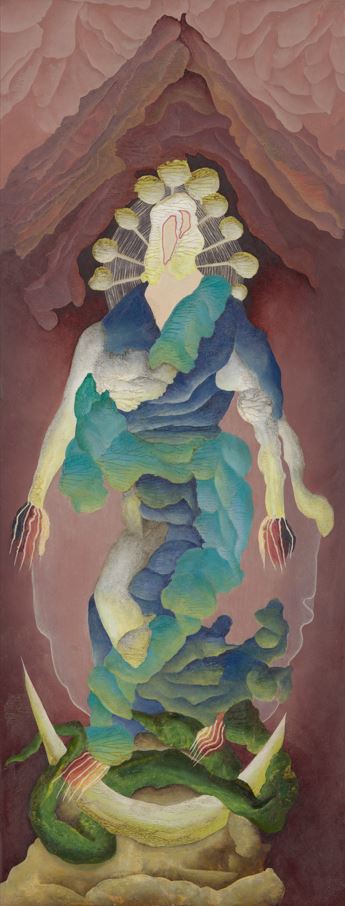
Compare and contrast that with one of the double images, not really in the full Dalí mode but nonetheless a recognisably human figure made entirely out of, well, what? Clouds? Bits of fabric? And what are those hands made out of? All wrapped up in esoteric symbolism of the crescent moon, at the bottom of the image.

Attributes of the Moon by Ithell Colquhoun ( 1947) Tate, presented by the National Trust 2016 © Tate. Photo © Tate (Matt Greenwood)

And in a different style again, here is another overtly erotic work from the extensive ‘Diagrams of Love’ sequence, 20 or so examples of which cover one wall, along with the short elliptical poems she wrote to accompany the series. I think you can see the rude elements without my commentary but what I enjoyed was the spangles scattered over the torso, and the delicate blue of the figure’s wings, tinged with pink and yellow.

Diagrams of Love: The Bird or the Egg? by Ithell Colquhoun (circa 1940) Tate Archive, TGA 929/4/17/3. Photo © Tate Photography (Lucy Green)

It’s full of images like this. The more I looked, the more I liked.


Related links

Related reviews

Oscar Wilde’s London by Wolf von Eckardt, Sander L. Gilman and J. Edward Chamberlin (1987)

A large format, 284-page coffee-table book most notable for its many contemporary illustrations (all in black and white).

This is not an academic book – it is a popular social history or review of the cultural life of London over the period between Oscar Wilde’s first arrival in London – having graduated from Oxford, in 1879 – to May 1897 when he was released from Pentonville prison and took the night train to Dieppe, never to return. Twenty years, quite a long time, a generation.

The introduction is a collection of clichés and stereotypes about the period, telling us the end of the nineteenth century was a time of immense social, economic, technological and cultural change etc – not only more people but more technological inventions (photography, electric lighting, telegraph, telephone, early motor car), more newspapers, journals and magazines, publishing more facts and figures and stories and photographs and illustrations than ever before, intellectual ferment Darwin, Arts and Crafts, the peak of Empire, Victoria’s jubilees etc etc – the kind of thing you read in absolutely every introduction to the period and quickly becomes over-familiar.

But when you get into the chapters on specific topics these get quite interesting on a whole range of topics, from the electrification of the first streets, public buildings and theatres to details about football, rugby and cricket, the rise of bicycling, various forms of religion and so on, all accompanied by jolly contemporary illustrations. A notable feature is extended quotes from interesting sources such as Wilde’s trial, police reports, WT Stead’s articles, T.S. Eliot’s obituary of Marie Lloyd and so on. These are interesting tasters, incentivising the reader to go searching for fuller texts online…

By way of a ‘review’ I thought it would be fun to give a brief summary and one image from each chapter.

1. Art and Life

Rapid expansion. The Underground. More train lines led to huge expansion of new suburbs.

From Pentonville Road looking west evening, 1884 by John O’Connor © Museum of London

Aestheticism already existed (Rossetti, Swinburne) but Wilde set out to make himself its apostle, peacock feathers and sunflowers. Mocked in Gilbert and Sullivan’s operetta Patience. Wilde’s lecture tour of America accompanying a tour of the opera.

Wilde lived with the painter Frank Miles who moved to an Aesthetic house at 1 Tite Street, where Wilde was later to move, in 1884 after he married Constance Lloyd (neighbours to James Whistler and John Singer Sergeant). They had the place redesigned by Edward Godwin. The interior decoration described by his son Vyvyan. The salon his wife, Constance, established.

Three or four page discussion of the overlap between Aestheticism and the Arts and Crafts movement, with its serious commitment to improving the surroundings and lives of the population with beautiful architecture, furnishings etc. Ruskin and Morris’s serious political commitment, and Wilde’s take on it in his essay The Soul of Man Under Socialism.

2. Lilies and Sunflowers

The Arts and Crafts Movement, William Morris, Burne-Jones. The Kelmscott Press. The vegetal style i.e. the sinuous line based on lilies which spread across Europe in Art Nouveau, the Jugendstil etc (p.41). The fashion for Japanisme.

Ruskin thought ornament was the basis of architecture. Morris thought ornament was the basis of civilised society (p.32). This explains why Arts and Crafts interiors, wallpaper and furniture were so heavy, cluttered and dark.

Acanthus wallpaper by William Morris

Libertys. The Kelmscott Press. Ruskin and Morris were populist, Whistler and Wilde were elitists. The Ruskin versus Whistler libel trial. The fashion for Japanoiserie. The rise and rise of home decoration and furnishing in lots of new magazines. Wilde’s American lecture which explains the two types of beauty epitomised y the sunflower and the lily (p.41).

The PRB artists: Burne-Jones, Millais, Waterhouse. Aubrey Beardsley’s illustrations for the Yellow Book and Wilde’s play, Salome. Beardsley’s self presentation was every bit as calculating and immaculate as Wilde’s but in a different mode.

Aubrey Beardsley photographed by Frederick Hollyer (Victoria and Albert Museum)

3. The Call of the Stage

In October 1881 Richard D’Oyly Carte opened the New Savoy Theatre on the Strand, the first building in London to be lit by electricity, specifically 1,200 electric arc lamps and 715 stage lamps. D’Oyly Carte had already produced:

  • Trial by Jury (1875)
  • The Sorcerer (1877)
  • HMS Pinafore (1878)
  • The Pirates of Penzance (1879)
  • Patience or Bunthorne’s Bride (1881)
  • Iolanthe (1882)
  • Princess Ida (1884)
  • The Mikado (1885)
  • Ruddigore; or, The Witch’s Curse (1887)
  • The Yeomen of the Guard (1888)
  • The Gondoliers (1889)
  • Utopia, Limited (1893)
  • The Grand Duke (1896)

Leading actors of the later 1870s and 1880s Henry Irving and Ellen Terry who appeared together in an 1885 Hamlet.

Ellen Terry

Playwrights before Wilde, namely Arthur Wing Pinero, author of ‘The Second Mrs Tanqueray’ (1892) the latest of umpteen ‘Woman with a Past’ stories (the premise used by Wilde in, for example, ‘Lady Windermere’s Fan’).

Mrs Patrick Campbell

Mrs Patrick Campbell is from the next generation of actresses, starting her career in ‘The Second Mrs Tanqueray’. She kept up a spirited correspondence with the young new playwright George Bernard Shaw, whose first production was ‘Widowers Houses’ (1892). Notes on Wilde’s run of four social comedies:

  • Lady Windermere’s Fan (1892)
  • A Woman of No Importance (1893)
  • An Ideal Husband
  • The Importance of Being Earnest (1895)

The influence of Henrik Ibsen, his various translators and adapters. Popular theatre, Sadlers Wells, pantomime and penny gaffs.

4. Readers and Writers

The proliferation of outlets for the reading public; bookshops, kiosks, railway shops; newspapers, magazines from The Labour Prophet to The Yellow Book. The yellow press (‘newspapers that use eye-catching headlines and sensationalized exaggerations’). Proliferation of literary magazines (p.83) but also pulp, penny dreadfuls, shilling shockers.

Magazine seller at Ludgate Circus

Tennyson (d.1892)’s anxiety about progress and materialism. Robert Browning (d.1889)’s dramatic monologues, mostly from history. New kid on the block Rudyard Kipling’s poems and stories. Inevitably the authors quote from his poem The White Man’s Burden, about empire, everyone always does.

Meanwhile…Socialism! The Socialist League of Hammersmith. The Fabians, Beatrice and Sidney Webb. 1886 riots in the West End.

New science inspired Robert Louis Stephenson (d. 1894) but also, with huge impact, H.G. Wells. Both of them and many other authors were associated with the new mystique of cities – fogs, mysteries, doppelgangers. The well-known story about American publisher J. M. Stoddart inviting Oscar Wilde and Arthur Conan Doyle for dinner and commissioning the second Sherlock Holmes novel and The Picture of Dorian Gray which triggers quotes from reviews of Dorian, particularly the famous one by Charles Whibley which accused it of immorality (p.94).
One literary feature of the fin-de-siecle was the Rhymers Club meeting at the Cheshire Cheese pub in the Strand, including Ernest Dowson, Lionel Johnson, Francis Thompson, Richard Le Gallienne, Arthur Symons with Wilde attending meetings that were held in private homes.

Wilde’s death in 1900 coincided with the date W.B. Yeats thinks the whole fin-de-siecle thing evaporated. As he wrote in the introduction to his (quirky) Oxford Book of Modern Verse.

Then in 1900 everybody got down off his stilts; henceforth nobody drank absinthe with his black coffee; nobody went mad; nobody committed suicide; nobody joined the Catholic church; or if they did I have forgotten.

5. London’s Growth

‘It was a turbulent time.’ New buildings and boulevards. Electric lighting spread quickly. Creation of the Embankment and ongoing extension of the Underground. Regent Street. Trafalgar Square. Horses and carts and hansom cabs. Traffic jams on the Strand.

Regent Street Quadrant at Night by Francis Forster (Museum of London)

The pong of horse poo. Drinking troughs. Crossing sweepers. Thick fogs.

Horse bus outside the Shard Arms on Peckham Park Road, circa 1895

Accents of different parts of London which is the basis for Shaw’s play ‘Pygmalion’. Crooked property developers and ramshackle tenements. The fourth Earl of Bedford’s Covent Garden development of the 1630s became a model or sorts. The financial motivation for all those tall narrow Georgian houses facing squares (p.113).

The army of domestic servants. In Wilde’s day London houses as many as a million and a quarter domestic servants. Many, maybe most female servants were subjected to sexual harassment. If they were caught or got pregnant they were fired without a reference. This forced most into a life of prostitution, hence the vast numbers in London.

The Season began as a method of getting marriageable young daughters up from their country estates to find husbands at a packed series of parties and public events. By Wilde’s time it was also a market for industrialists and financiers and men with money to acquire a pedigree by marrying into aristocratic families. By Wilde’s time there was a growing influx of American heiresses looking for posh husbands, a type he mocks in essays and in the character of Hester Worsley in ‘A Woman of No Importance’ (1893).

The vast army of dressmakers and seamstresses who supported these well-dressed women during the Season, as many as 20,000. Middle class consumption, more shops, more manufactured goods. The new big department stores: Harrods, Whiteleys. Huge new restaurants and grill rooms.

6. …and London’s Shame

The poverty of the East End and other slum quarters. Workers slaved long hours in the ‘stink industries’ like soap, rubber, tar, glue, fertiliser made from blood and matches. Sweatshops which were, in fact, freezing cold in winter.

Fore Street, Lambeth

Dr Barnardo’s Home for Working and Destitute Lads. Wilde was notoriously dismissive of charity which he thought applied sticking plasters to a system which needed to be completely overthrown. At least that’s what he said in the Soul of Man Under Socialism.

Vast armies of prostitutes, dolly mops (promiscuous servant girls) including the boy renters Wilde frequented. Conscription to the army during the Boer War (1899 to 1902) not only revealed the wretched physical state of working class men but that a large percentage had sexually transmitted infections (20% of the army, more in the Navy).

The armies of the poor were continually replenished by immigrants, notably Jews from East Europe who suffered periodic antisemitic riots when times were hard, but also Chinese and lascars. Nine pages about the Jack the Ripper murders 1888 to 1891 i.e. as Wilde wrote his best essays and Dorian Gray (pages 130 to 139).

New architecture. The later Victorians rebelled against the straitlaced classicism of Georgian architecture and exploded in a plethora of wild styles, including all manner of Gothic covered with decoration and ornament e.g. St Pancras station by Gilbert George Scott. Plus the Law Courts, Piccadilly Circus,

The suburbs were built partly for political goals. Lord Shaftsbury said ‘If the working man has his own house. I have no fear of revolution’. And hence an 1883 Cheap Trains Act forcing the railway companies to offer cheap fares for those commuting in and out of the centre. Developers packed suburban terraces so that architectural critics complained about their sameyness. Certainly the case in South London where I live and you can cycle through Streatham, Tooting and on down to Morden seeing the same type of 1900s terraced houses in street after street.

The Golden Age of the London Pub with plenty of gilt and mirrors. Somehow this segues into testimony from the Oscar Wilde trial from one of the many young men Wilde paid to have sex with.

7. The Lower Classes

The population grew from 3,215,000 in 1870 to 4,211,000 in 1890, from two sources: immigration from the countryside; immigration of Jews from Eastern Europe. the long recession 1873 to 1893 led to unemployment as did cheaper better imports coming from America then Germany.

‘The Bitter Cry Of Outcast London: An Inquiry Into The Condition Of The Abject Poor’ by Andrew Mearns (1883). ‘In Darkest England and the Way Out’ by William Booth (1890). The Salvation Army.

Victorian street kids

Life expectancy in the country 51, in London 28. Armies of rough sleepers. Long quote of Beatrice Webb’s eye witness account of a steamer arriving carrying refugee Jews from the East. The great hero Dr Barnardo. Phos girls who lacked jaws or fingers, eaten away by phosphorus as they made matches.

The work of Henry Labouchère, MP, social reformer, best known for his campaign to stamp out ‘vice’ which led to the Labouchère Amendment (Section 11 of the Criminal Law Amendment Act 1885) which for the first time criminalised ‘gross indecency’ meaning any type of male homosexual activity in Britain and was the law Wilde was convicted under.

1888 article in the Fortnightly Review detailing the unfair conditions domestic servants labour under.

8. Religion, Spirits and Hosanna

Religious belief declined steadily through the second half of the nineteenth century. Some posh people defected to the Roman Catholic church (as Wilde did on his deathbed). But allegiance to the Church of England slowly steadily declined. Wilde has several comic churchmen, notably the Reverend Canon Chasuble in The Importance of Being Earnest.

My sermon on the meaning of the manna in the wilderness can be adapted to almost any occasion, joyful, or, as in the present case, distressing. [All sigh.] I have preached it at harvest celebrations, christenings, confirmations, on days of humiliation and festal days. The last time I delivered it was in the Cathedral, as a charity sermon on behalf of the Society for the Prevention of Discontent among the Upper Orders. The Bishop, who was present, was much struck by some of the analogies I drew.

The central importance of Darwinism (On The Origin of Species 1859, The Descent of Man, and Selection in Relation to Sex, 1871). In fact Darwinism was mostly known through various popularisations of it the most damaging of which was Herbert Spencer’s Social Darwinism which preached that the weak in society deserve to go under.

Upper and middle class dimwits were taken in by Theosophy, spiritualism and so on (as Wilde’s wife, Constance, was). Occultism, mesmerism, seances, clairvoyancy.

Charles Bradlaugh’s defiant refusal, as an atheist, to take the oath of allegiance when he was elected MP. Controversy around Sabbatarianism i.e. whether shops or anything could open on a Sunday. Bradlaugh helped organise the National Sunday League.

9. The Sounds of London

Music high and low. Gilbert and Sullivan. Religious music by Villiers Stanford and Herbert Parry. The astonishing popularity of the oratorio as a form, ‘the dull centre’ of Victorian music. The widespread popularity of choral societies around the country. George Bernard Shaw’s very funny mockery of all this English earnestness. Henry Wood’s Promenade Concerts began in 1895, the year of Wilde’s conviction.

Serious music had to be imported from abroad, Italy, France and especially Germany. The cult of Wagner among aesthetes and students.

Truer to English culture was the music hall, first one opened in 1852 by 1860 there were 250 in London. I’ve always admired Kipling for immediately grasping, on arriving in London, that music hall was the true voice of the capital and basing his Barrack Room Ballads (1890) on them. The authors give an extended quote from an 1891 article in Harper’s New Monthly Magazine describing the different kinds of music hall in London and their audiences and content (pages 186 to 192).

Stars of music hall such as Marie Lloyd and Harry Champion. The fashion for ‘coon’ songs sung by minstrel troupes.

Quote from T.S. Eliot’s obituary of Lloyd:

The working-man who went to the music-hall and saw Marie Lloyd and joined in the chorus was himself performing part of the work of acting; he was engaged in that collaboration of the audience with the artist which is necessary in all art and most obviously in dramatic art. He will now go to the cinema, where his mind is lulled by continuous senseless music and continuous action too rapid for the brain to act upon, and he will receive, without giving, in that same listless apathy with which the middle and upper classes regard any entertainment of the nature of art. He will also have lost some of his interest in life.

Which carries on with some prophetic words:

Perhaps this will be the only solution. In a most interesting essay in the recent volume of Essays on the Depopulation of Melanesia the great psychologist W.H.R. Rivers adduces evidence which has led him to believe that the natives of that unfortunate archipelago are dying out principally for the reason that the “Civilization” forced upon them has deprived them of all interest in life. They are dying from pure boredom. When every theatre has been replaced by 100 cinemas, When every musical instrument has been replaced by 100 gramophones, when every horse has been replaced by 100 cheap motor cars, when electrical ingenuity has made it possible for every child to hear its bed-time stories through a wireless receiver attached to both ears, when applied science has done everything possible with the materials on this earth to make life as interesting as possible, it will not be surprising if the population of the entire civilized world rapidly follows the fate of the Melanesians.

Others lamented the crudity and vulgarity of the music hall and preferred the imagined purity of folk song, such as Herbert Parry at the inauguration of the Folk Song Society in 1898.

10. Virtues of Sport

The English upper and middle classes worshipped sport. The public schools put more onus on sporting prowess than intelligence as the history of the British Army indicates. Football. Cricket. The MCC founded 1787. The Football Association founded 1863. Rugby left The Football Association in 1863 and, in 1895, split between rugby union and rugby league. The first lawn tennis championship was held at Wimbledon in 1881.

The authors do not hesitate to quote Vitaï Lampada by Sir Henry Newbolt as absolutely everybody writing a book like this has to. It was written in 1892, the year Wilde’s first play was produced.

Bicycling became a craze in the 1890s. In a sense it was a middle class equivalent of the aristocratic habit of riding horses. The bicycle had an impact on women’s liberation because women could, quite simply, travel further and associate with more people, friends and young men.

1890s cycling women

Cycling became involved in the movement for women to wear more rational i.e. practical and flexible clothing. Wilde wrote articles about more sensible clothing for women and his wife became very involved in the movement.

The modern Olympic games were established by Baron de Coubertin in 1896.

Mountain climbing: Judge Alfred Wallis who sentenced Wilde to two years hard labour was the author of one of the best mountaineering books of the nineteenth century, Wandering Among The High Alps.

Boxing was still illegal and notoriously corrupt. The Marquess of Queensberry’s rules had been drafted as long ago as the 1860s but were only really accepted in the 1890s.

Horse racing was the sport of kings, for owners, but had a large working class following among the gambling classes. In 1874 there were 130 race courses in Britain; a decade later there were half that number, all bigger and more professional.

Rise of the sporting press and specialist journals devoted to each sport and activity. And in the 1890s the first ever filming of sporting events took place…

11. Jumbo and Sundry Diversions

Freak shows, peep shows, theatrographs, dancing bears, Astley’s Theatre at the south end of Westminster Bridge. The story of Jumbo the popular trained elephant who was sold to the American showman P.T. Barnum in 1882 but refused to leave. The story of Jumbo gets nearly as much space as Jack the Ripper and maybe rightly so.

Pubs. Londoners liked drinking, many till they became fighting drunk. Hence the Temperance Movement with its pamphlets and sermons. These emphasised grisly stories of wife beating and child abuse caused by drunkenness.

Drug addition: cocaine and the opium dens of the East End docks. Detailed description of a visit to an opium den by George Augustus Sala.

At the opposite end of the social scale, the world of gentlemen’s clubs such as the Carlton, the reform, the Garrick, the Marlborough, the Guards, the Army and Navy, and the Albemarle which Wilde was a member of. Comic account of election to a club, again by Sala.

Dancing as described in The Diary of a Nobody in 1889. Magic and magicians. Street corner Houdinis.

Public trials. The Darwinian zoologist brought a prosecution against American medium Henry Slade (1876). Whistler sued Ruskin for libel in 1877. Several adultery cases in which the Prince of Wales was scandalously compelled to appear. the 1889 prosecution of a male brothel keeper in Cleveland Street (p.259). The two trials of Oscar Wilde in 1895.

12. Juliets of a Night

Pornography and prostitution. This chapter opens with photographs of nude underage girls which, if I tried to search them online let alone included in this review, would, I think, get me arrested.

The cult of ‘the little girl’, most notoriously associated with Lewis Carroll.

The authors quote Arthur Symons, Rossetti and Wilde justifying sex with prostitutes. Visitors to London could buy guides listing locations for strip tease, prostitutes, rooms to rent, ‘introducing houses’, brothels and so on. It was a major industry.

The same territory covered in immense detail in Ronald Pearsall’s huge study ‘The Worm in the Bud’ (1969) which has lots about Victorian orgies, prostitution and fetishism. The authors give a lengthy quote explaining the situation by General Booth, founder of the Salvation Army. Excerpt from a police report of officers trying to round up prostitutes, especially children.

Commentators in politics and the Church warned that young women were corrupted by their reading hence the importance of jumping on all immoral reading matter such as the novels of Thomas Hardy or the Oscar Wilde. This was twaddle then as it is now: what propels women into prostitution is poverty, desperation and drugs, or violent coercion.

It was the famous series of articles in the Pall Mall Gazette of 1885 by William Thomas Stead titled ‘The Maiden Tribute of Modern Babylon’ that led to the raising of the age of consent from 13 to 16 under The Criminal Law Amendment Act 1885 (the same act which included the Labouchère Amendment). The authors give an extended quote.

Surprisingly the European centre of child prostitution was Brussels.

Many stolen, kidnapped or betrayed English girls of 12 to 15 years were sold to Brussels brothels. (p.248)

Sometimes history just doesn’t bear thinking about. Anyway – the London Society for the Protection of Young Females founded in 1853. Quotes from evidence given to an 1881 House of Lords enquiry on the subject. Beatrice Webb’s experience going undercover among the poor.

All this segues into descriptions of the two Wilde trials with full-page illustrations from the Illustrated Police News.

Oscar Wilde’s arrest and trial from Illustrated Police News (1895)

13.Epilogue

The three-page epilogue is in the form of a summary of the debate between Tennyson and the Liberal Prime Minister William Gladstone. In 1886 Tennyson published a poem, Locksley Hall Sixty Years After, in which he claimed, in the manner of all depressed aristocrats, that the country had gone to the dogs.

Gladstone took exception to this and wrote an article for the magazine Nineteenth Century magazine in which he set out to refute every one of Tennyson’s charges, point by point, and asserting that in very measurable way – economic, social and moral, life expectancy, working hours, support for the unemployed and so on – society was vastly superior, improved and advanced to what it had been in their youths i.e. the 1830s. A choice of temperaments. An interesting conclusion to a fact-packed but popular and entertaining book.


Related reviews

Hilma af Klint and Piet Mondrian @ Tate Modern

‘Nature or, that which I see, inspires me, puts me, as with any painter, in an emotional state so that an urge comes about to make something, but I want to come as close as possible to the truth and abstract everything from that…’
(Piet Mondrian, 1914)

‘The more we discover the wonders of nature, the more we become aware of ourselves.’
(Hilma af Klint, 1917)

Mondrian is obviously one of the masters of modern art; most educated people would immediately recognise one of his characteristic abstract paintings. By contrast, Hilma af Klint is a lot less well-known. What they have in common, though, was that they both journeyed from late-Victorian figurative i.e. realistic art, to abstraction, albeit completely different styles of abstraction. And, as with so many pioneers of abstraction, they developed their modern abstract styles in response to surprisingly old-fashioned spiritual motivations, to deeply-held mystical and Theosophical beliefs about Nature and Truth which this excellent exhibition explores in great detail.

I didn’t expect to like this exhibition that much and, from the publicity photos had taken a little against af Klint. How wrong I was! This is a brilliant exhibition – af Klint emerges as a huge artist in her own right – and, above all, I had no idea that two artists could have produced such a range and variety of styles. There are so many different types of painting to savour and enjoy.

Landscape painters

Hilma af Klint (1862 to 1944) and Piet Mondrian (1872 to 1944) began their careers as academically trained landscape painters in the late nineteenth century, before developing radically new models of painting in the twentieth century. Although they did not know each other – or of the other’s work – the exhibition shows how they began their careers very firmly rooted in naturalistic depictions of the natural world, and how they slowly, steadily took different but parallel paths away from these roots to arrive at highly stylised abstraction.

‘The Gein: Trees along the water’ by Piet Mondrian (c.1905) Kunstmuseum Den Haag

Flowers and trees

Both artists spent a lot of time painting flowers. Room three devotes a whole wall to displaying 20 wonderfully accurate botanical watercolours done by af Klint, the kind of thing which still illustrates guides to wildflowers I’ve bought recently.

Botanical drawing by Hilma af Klint (c.1890) Courtesy of The Hilma af Klint Foundation

Marvellous, isn’t it? A whole wall of lovely paintings of buttercups, nasturtiums, stonecrop, thistle, saxifrage, apple blossom and many more. I wanted to buy the entire wall and take it home with me.

Installation view of ‘Hilma af Klint and Piet Mondrian’ at Tate Modern, showing the wall of botanical paintings by af Klint (photo by the author)

On the opposite wall are 15 flower paintings by Mondrian which are more full-bodied and intense. According to the curators:

Many of these paintings and drawings of flowers that Mondrian made in 1908 to 1909 are full of symbolism, mainly relating to Theosophy. Shortly afterwards, he moved away from symbolist representations, but continued to portray flowers until his death, selling them for income at times of financial difficulty. He repeatedly returned to the same varieties, such as chrysanthemums and arum lilies.

Some of these are really standout pieces. Take this stunning amaryllis.

‘Red amaryllis with blue background’ by Piet Mondrian (1909 to 1910) Private Collection

After staring at it for some time I realised I really liked the depiction of the bottle the flower is standing, a beautifully pure and evocative rendition, almost a piece of 1960s Pop Art.

The Ether

During their careers, new technologies such as the microscope, X-ray radiography and photography were challenging human perception. The evidence of worlds invisible to the human eye catalysed shifts across science, spirituality and the arts. These discoveries in the sciences meshed with slightly earlier schools of thought, especially the theories of Theosophy. The Theosophy Society was founded in 1875 its chief thinker, Helena Blavatsky, published works developing the theory during the 1880s and 90s.

The exhibition devotes an entire room to exploring various aspects of Theosophical belief and its impact on our two artists, and it wasn’t a peripheral impact: in 1904, af Klint joined the Stockholm lodge of the Theosophical Society and Mondrian Amsterdam Lodge in 1909. A central belief, which meshed with the science of the time, was that all living things are connected by an invisible, imperceiveable force, which they called ‘the ether’, and that’s why this gallery has been called The Ether.

One among many aspects of this was an anthropomorphised version of Darwin’s theory of evolution which lent it a spiritual aspect, optimistically hoping that all life forms were evolving and yearning towards higher spiritual truths. Hence af Klint’s series titled ‘Evolution’. Here you can see how zoomorphic shapes and botanical motifs have been simplified and stylised to form the basis of complex but abstract designs.

‘The Evolution, The WUS/Seven-Pointed Star Series, Group VI, Number 15’ by Hilma af Klint (1908) Courtesy of The Hilma af Klint Foundation

This spiritualised version of evolution attracted many writers, artists and thinkers at the turn of the century. The Great War had yet to dent, or demolish, people’s romantic faith in progress and improvement. Mondrian gave the title to a strikingly different kind of work, one depicting three highly stylised female forms.

‘Evolution’ by Piet Mondrian (1911) Kunstmuseum Den Haag – bequest Salomon B. Slijper. X83910

Mondrian wrote of this painting: ‘It’s not so bad, but I’m not there yet.’ The figures represent the stages in evolution from the physical to the spiritual realm, as promoted in Theosophy. The triangular nipples and navels of the women, which point upwards and downwards, symbolise their spiritual and earthly orientation. The central figure embodies the fulfilment of the evolutionary process, to the spiritual realm. The flowers on the left panel are symbols of purity, while those on the right symbolise tragic suffering.

Incidentally, among many other treasures in the Ether Room is the surprising inclusion of four small paintings by the famous psychotherapist and guru Carl Jung. To quote the curators:

Carl Jung’s Liber Novus is now known as ‘The Red Book’, due to the colour of its cover. It is not certain that he ever intended to publish this account and interpretation of his years of personal crisis between 1913 and 1916. The book is full of illustrations combining symbols from various religions, such as mandalas and trees encased in egg-like forms that resonate with af Klint’s work. It is regarded as the seed of the analytical psychology Jung would later develop, in which the conscious and unconscious are assimilated into the whole personality.

The four works by Jung are surprisingly powerful and certainly fit right in, in this context.

Illustration from Carl Jung’s Red Book © The Foundation of the Works of C.G. Jung

Abstraction 1. The impact of cubism

How did Mondrian arrive at his final style? In stages. He travelled to Paris in 1911 and was immediately galvanised by cubism which he reinterpreted with a spiritualist slant. He began reworking drawings and paintings of trees in the new style. the catalogue has a nifty quote from Guillaume Apollinaire assessing a small show of Mondrian’s drawing attention to the obvious cubist influence, but cannily predicting that Mondrian was using it for other ends and would probably develop his own version.

There are many cubist-era works by Mondrian on show. Here you can see cubism hitting his naturalistic depictions of flowers and trees like a freight train, taking it somewhere completely new.

‘Grey tree’ by Piet Mondrian (1911) Kunstmuseum Den Haag

The exhibition includes examples of the many interim steps, fascinating and often beguiling abstracts in their own right, which move towards this, six years later, in the midst of the Great War, when the discrete elements of the earlier paintings have become solidified into blocks, blocks of abstract colour, floating against an empty background (or a background flooded with invisible ether, which joins the disparate entities?)

‘Composition in colour B’ by Piet Mondrian (1917) Collection Kröller-Müller Museum, Otterlo, the Netherlands

Abstraction 2. Mondrian reaches his mature style

‘By the unification of architecture, sculpture and painting a new plastic reality will be created.’ (Piet Mondrian, 1917)

Around 1920 everything came together in the new style of rectangular grids separated by thick straight black lines, a visual language of ‘pure relationships’ which he called ‘neo-plasticism’. These paintings abandoned any form of symbolism as they become irregular grids. He set out to reduce painting to its basic principles, removing individual aspects (which he called ‘tragic’) to express the ‘universal’.

In 1921 he published an essay titled ‘Le Néo-Plasticisme: Principe général de l’équivalence plastique’ which explains neo-plasticism as an approach to representing the ‘universal’ through balancing oppositions of the most basic elements of painting: position, size and colour.

‘Composition with Red, Black, Yellow, Blue and Grey’ by Piet Mondrian (1921) Kunstmuseum Den Haag

Mondrian believed that neo-plastic principles were destined to define the world around us. Some critics described the paintings as having ‘jazz rhythms’ and I’ve seen modern jazz album covers with Mondrians on them, both of them expressing something about the clean pure and yet somehow dynamic lines of modernity. The Tate bookshop includes ‘The Afterlife of Piet Mondrian’ by Nancy Troy which looks interesting, an examination of how the Mondrian style was curated, copied and publicised, of how ‘the popular appeal of Mondrian’s instantly recognizable style in fashion, graphic design, and a vast array of consumer commodities’.

One room is devoted to Mondrian’s mature style and there’s a very noticeable difference between the works from the 1920s and 30s. In both the works from the 1920s, not all the lines extend to the very edge of the canvas. Petty detail though this may seem, it makes a lot of difference, because in the next space are three classic Mondrians from the 1930s and in each instance the black lines do extend all the way to the edge. Trivial though it sounds, they look more complete, more finished, more total.

It’s a mystery to me and something the curators don’t address which is how come such rigid geometric shapes are so very pleasing to the eye and mind. they feel calming, deep, completing in a way which is hard to convey. Mondrian himself commented:

‘Vertical and horizontal lines are the expression of two opposing forces; they exist everywhere and dominate everything; their reciprocal action constitutes “life”. I recognised that the equilibrium of any particular aspect of nature rests on the equivalence of its opposites.’ (Piet Mondrian, 1937)

Not sure that helps explain why this look immediately struck everyone as clean and classic and has remained so for 80 years.

Abstraction 3. The Ten Largest

‘My mission, if it succeeds, is of great significance to humankind. For I am able to describe the path of the soul from the beginning of the spectacle of life to its end.’ (Hilma af Klint, 1917)

I thought the climax of Mondrian’s development in those three classic works from the 1930s, presented in a clean white rectangular space, would be difficult, but in the event the curators completely trump them with the last room in the exhibition. This is devoted to a set of ten enormous, huge and overwhelming canvases by af Klint, titled ‘The Ten Largest’.

The Ten Largest, Group IV, Number 7, Adulthood by Hilma af Klint (1907) Courtesy of The Hilma af Klint Foundation

These ten huge paintings represent the stages of life, with two each representing Childhood, two devoted to Youth, four to Adulthood, and the final pair to Old Age. I thought I wouldn’t like these at all but, somehow, the preceding nine rooms, showing the slow development of her style, explaining the mystical and spiritual beliefs behind it, had softened me up and prepared me. I thought they were magnificent.

The Ten Largest, Group IV, Number 3, Youth by Hilma af Klint (1907) Courtesy of The Hilma af Klint Foundation

‘The Ten Largest’ are part of ‘The Paintings for The Temple’, a body of works af Klint believed was commissioned by her spiritual guides (we have learned about her spiritual guides throughout the show). Af Klint dreamed of building a temple in the form of a spiral where her paintings could be hung together as a ‘beautiful wall covering’. To ascend through the temple would mean moving towards a higher state of being.

Installation view of ‘Hilma af Klint and Piet Mondrian: Forms of Life’ at Tate Modern showing two of the four Adulthood works.  Photo: Tate (Jai Monaghan)

It took me a while to realise that the four ages are colour coded: the Childhood pair have a lovely deep blue background, the two Childhood works have an orange background, the four Adulthood paintings the lilac colour you can see in the photo above, and the final Old Age pair have a pink background. Then I realised that the colour in each set fades and becomes paler in the second or later work in each set, as if that era’s virility fades as it prepares to transmute to the next stage of life. None of that, none of the richness or intensity of the colour, and the dramatic sense of their changing hues, comes over in these photographs.

Installation view of ‘Hilma af Klint and Piet Mondrian: Forms of Life’ at Tate Modern showing, from left to right, the second Childhood (blue), the two Youth (orange) and the four Adulthood (lilac) paintings. Photo: Tate (Jai Monaghan)

As you can see each painting consists of arrangements of completely abstract designs and patterns and yet, slowly, as you study them, you realise certain motifs recur in each set, giving them a thematic unity.

I spent a lot of time wondering why the final two paintings, the Old Age set, were the ones with the most conspicuous use of symmetry. Is it because, after the storms of life, your knowledge settles into a balanced wisdom?

And the even more puzzling fact that the very last painting is the only one to contain  a square or rectangular feature, namely a grid of squares like a chessboard. Is it because the swirling zoomorphic shapes of active life give way, in one’s last years, to a harder, adamantine, inflexible knowledge?

The Ten Largest, Group IV, Number 10, Old Age by Hilma af Klint (1907) Courtesy of The Hilma af Klint Foundation

Almost certainly not, but I was beguiled. I found myself walking round, sitting and staring, getting up and reviewing them slowly, again and again. I couldn’t tear myself away, an experience I’ve had with only a few other exhibitions – I remember not wanting to leave a room full of Monet paintings of the River Thames years ago. Same here. I found this final room completely absorbing, entrancing and didn’t want to leave.

There’s lots and lots of lovely paintings, in an amazingly wide range of styles, sizes, and intentions, throughout this wonderful show. But this final room is worth the admission price by itself.

The video


Related links

More Tate Modern reviews

Marc by Susanna Partsch (1991)

Another of Taschen’s coolly laid out, large format, coffee-table-sized but light and handy paperback introductions to key artists and movements, this one devoted to Franz Marc.

Generally described as an Expressionist, Marc (b.1880) is most associated with the ‘Blue Rider’ art movement in Munich 1911 to 1913, before being killed, tragically young, in the Great War, in 1916.

Marc and animals

Marc is best known for his animal paintings. Partsch devotes a chapter to analysing their origins and development. Basically, he preferred animals to humans, who he found repellent. As he wrote to his wife, Maria Franck, during the war:

I think a lot about my own art. My instincts have so far guided me not too badly on the whole, even though my works have been flawed. Above all I mean the instinct which has led me away from people to a feeling of animality, for ‘pure beasts’. The ungodly people around me (particularly the men) did not arouse my true feelings, whereas the undefiled vitality of animals called forth everything good in me… I found people ‘ugly’ very early on; animals seemed to me more beautiful, more pure. (quoted page 39)

He not only theorised about animals, he loved them in real life. He was brought up with dogs and when he did a year’s military service in 1899, he spent it in the cavalry where he acquired a lifelong love of horses. By the time he was settled with a place of his own, in the 1910s, Marc owned a dog, two cats and – his pride and joy – two pet deer which he named Schlick and Hanni!

Note how schematic the animal forms are. And how stylised the background of zoomorphic snow, highlighted by blue and green shadows. From the same period comes a loving portrait of his pet dog, Russi.

The sense of depth and shape is created by shading which is (when you look closely) quite angular, and yet the overall feel is sensuous and lush.

Some thoughts

1. Brilliant draughtsman

Marc was a brilliant draughtsman right from the start, with a tremendous gift for depicting the natural world in oil paint even in his earliest works. Here he is aged 21 demonstrating the academic style he was being taught at Munich art school, delicately painting every leaf onto each of the trees in this landscape.

Just a few years later he was painting in a far more free and expressive manner, but the draughtsmanship is still awesome – note the fluff of feathers at the dead bird’s throat.

Not only is his figuration a joy to see, but the palette of browns contributes to the picture’s unity. In some other artists the early pictures are things you skim over to get to the mature works, but all of the early works shown here are marvellous.

The confidence of his broad brush-strokes is exhilarating, the light and shade on the right-hand woman’s dress, or the decorative squiggles on the left-hand dress – how cool and confident!

2. Marc’s short career allows in-depth analysis

Marc’s friend and mentor Wassily Kandinsky lived to the age of 78 and so the 90-page book I’ve just read about him had to pace itself and skim over various periods.

The exact opposite is true of this account of Marc. Because he really flourished for just four intense years the book can go into much more detail about this period, following the month-by-month changes in his art and ideas, quoting extensively from his letters, diaries and published writings, and from his friends’ and wife’s accounts, in order to drill deep down into these precious years.

For example, there is space to devote several pages to explaining Marc’s use of a prism to ascertain the purity of colour he used in the portrait of his dog in the snow (above), and to relate this to his evolving theories of colour. (Briefly, Marc believed that blue was the colour of masculine dominance and spirituality, yellow was the colour of feminine comfort, gentle and sensuous, red was the colour of brutal earth, and so on.)

Like so many of the rest of the avant-garde right across Europe (from his friend Kandinsky to Matisse) he was thinking and theorising about colour and its role in painting in a completely new way.

For Marc, as for many artists of his generation, the subject of a painting was becoming almost irrelevant – colour itself was to be the subject and most important element in a painting.

That said, and interesting to read though this kind of thing is, you can’t help noticing the number of times he ignored his own ‘theories’ and painted what looked best. Seen in this pragmatic light, it’s possible to think of the writings as more like transient offshoots of whatever look and style he was experimenting with during his brief, intense heyday, rather than cast iron rule.

Thus his schematic colour scheme doesn’t seem to apply at all to:

where the blue mane, red horse, and yellow field are quite obviously painted to achieve a vibrant dynamic affect rather than for any symbolic purpose.

3. The animal paintings

His animal style probably peaked in the depictions of blue horses around 1911, and it’s certainly this period of work which became hugely popular after the Great War and carried on being a bestseller in poster form (a picture of horses in a field fetched £12 million at Sothebys in 1908 – God knows what they’d fetch in today’s over-inflated market).

In her chapter on the animal paintings, Partsch quotes at length Marc’s views on how we need to stop painting animals from the outside, from a strictly instrumental human perspective, but imagine the world from the animal’s point of view.

How does a horse see the world, how does an eagle, a deer or a dog? How impoverished and soulless is our convention of placing animals in a landscape familiar to our own eyes rather than transporting ourselves into the soul of an animal in order to divine its visual world. (quoted page 38)

There’s much more like this. His friend and mentor, Kandinsky, was deeply immersed in the esoteric and spiritualist teachings of his age, becoming a Theosophist and studying Joachim of Fiore but to the modern reader, Marc comes over as by far the deeper and more instinctive visionary – the experience of reading the book right the way through is to experience the almost hallucinatory intensity of his intuition.

The Kandinsky book is interesting and delightful, but this book on Marc is genuinely powerful.

What does the deer have in common with the world we see? Does it make any reasonable or even artistic sense to paint the deer as it appears on our retina, or in the manner of the Cubists because we feel the world should be cubistic? Who says the deer feels the world to be cubistic? It feels as a deer, and thus the landscape must also be deer. (quoted page 39)

Hence:

And we feel the world to be deer with him.

And it wasn’t just deer: the book includes fabulous colour reproductions of paintings of horses, cats, dogs, bulls, cows, donkeys, foxes, monkeys, tigers, birds, mandrills, wild pigs and many more. Animal planet.

4. Prismatic – cubist – futurist

Many fans and buyers stop at Marc’s colourful animal phase in 1911, the poster-popular period.

But the really interesting thing about Marc is that he didn’t stop developing, in fact he sped up. the final chapter shows him developing an increasingly intense cubo-futurist style and actually making the breakthrough into utterly abstract works when — the Great War breaks out.

Thus only a few months after some of the prettiest animal pictures, he is creating paintings which suddenly take on board the full impact of the Futurists’ characteristic diagonal ‘lines of force’.

Not only animals but people are present in these paintings but in a completely new visual style, dominated by the fragmentation of the object.

Many critics then and now claimed this was due to the influence of Cubism, still a stunning new way of seeing in 1912. Maybe so. But as I flicked through these final paintings I couldn’t help remembering his reference to the prism, and I thought of those toys you buy children, circles of clear plastic (or glass, in the expensive version) which have been shaped to have multiple facets across the surface, like big diamonds which have been cut with as many faces as possible. The idea is to hold the prism close to the eye and see the world divided up into a bewildering variety of facets; to rotate it, move it up and down, whatever takes your fancy, in order to see ‘reality’ as a jagged mosaic of ever-changing angular facets.

Suddenly, in 1913, that’s what all Marc’s paintings look like, all shards and fragments:

Compare and contrast with the extreme simplicity and clarity of the dog or deer in the snow from only two years before! We are in a different, and much more complex, visual world, one which is more dynamic, fractured along strong striating lines, intensely scissored and segmented.

My favourite of these last works is Deer in the woods II, in essence an almost child-like portrait of a family of deer, but fractured by strong lines into cubes, squares, circles.

And it is these lines – rather than the actual anatomy of the deer, their ‘real’ appearance – which determines the colour scheme so that colours spill across the bodies of the deer rather than being contained by them.

5. The break through into abstraction

Right at the end of 1913 Marc began painting the first of a series of small compositions which were utterly abstract in form, with no subject.

Over the next eight months he painted more of these small compositions as well as a series titled Happy forms, Playing forms, Fighting forms and Broken forms.

In some of these works animals might just about be discerned, and he continued creating some dense Futurist animal paintings at the same time. But it is absolutely clear that in the other works he had stepped over a line into pure abstraction, just a few years after his friend and mentor Kandinsky.

Marc was working on these abstracts, as well as making plans to edit a second Blue Rider almanac, as well as painting a series of murals and writing more essays about colour and form – when the Great War broke out on 1 August 1914 and he was called up. What would have happened next?

He continued to sketch and sent copious letters to his wife in which he continued to develop his ideas about colour and form, but there was no time to paint in the army. On 4 March 1916 Franz Marc was killed by shellfire while carrying out a reconnaissance mission in a French village.

What a beautiful body of work. What an intense and fascinating trajectory he travelled in those four brief years. What a terrible, terrible waste.


Related links

Related reviews