Ithell Colquhoun @ Tate Britain

The Tate Colquhoun archive

A few years ago the National Trust handed over to Tate a large trove of work by the mystical Surrealist female artist Ithell Colquhoun (1906 to 1988) which significantly added to Tate’s existing archive. As far as I can tell, this exhibition is by way of showcasing the new expanded archive and sets out to demonstrate the impressive length, breadth and variety of Colquhoun’s career. As the Tate blurb puts it:

This landmark exhibition of over 140 artworks and archival materials traces Colquhoun’s evolution, from her early student work and engagement with the surrealist movement, to her fascination with the intertwining realms of art, sexual identity, ecology and occultism.

1. Variety of style

Thus the exhibition displays seven or eight completely different visual styles or approaches which Colquhoun developed over her long life, many of which are very attractive. In doing so the curators have to convey quite a lot of information – they have to explain to us the sheer range of Colquhoun’s purely artistic techniques or approaches to art-making, including the ones she copied or adapted from the European Surrealists during her Surrealist phase (1930s and 40s).

2. Esoteric knowledge

But the really striking and distinctive feature of the exhibition is the extraordinary range and depth of Colquhoun’s interests in esoteric wisdom. Almost every painting or drawing requires a hefty label explaining how it relates to ancient theories of magic and mysticism which she moulded and adapted to create a strikingly wide and diverse range of styles and pictures.

3. Eroticism

Then there’s the sex. Plenty of esoteric traditions attribute magical, mystical powers to our sexuality, assigning particular attributes to the male or female ‘principles’, discussing the union of male and female in sexual congress or in mystical figures where male and female actually become one, and so on.

Throughout her career Colquhoun was very interested in the many overlaps between esoteric traditions and sensual and sexual imagery. None of the paintings or sketches is pornographic, most of them are not even what you’d call particularly sensual, but a good number of them, maybe half, deal with sex as described in various mystical traditions.

This includes some of her best and most striking works, such as the lovely ‘Drawing of a red and yellow couple conjoined’, a small ink and watercolour work on delicate tracing paper, which I kept coming back to. Of its kind, perfect.

Drawing of a red and yellow couple conjoined by Ithell Colquhoun © Tate

Thoughts

I’ll give you my opinion now, before itemising some of the traditions and techniques in more detail. My opinion is that Colquhoun is a minor but very attractive figure. By minor I mean that she didn’t establish a school or have followers. If she innovated numerous techniques and approaches these have disappeared into art school practice i.e. are not particularly attributed to her.

Also she didn’t really produce any knock-down masterpieces, pictures which take your breath away. Maybe that’s another definition of a ‘major’ figure. There are only a handful of large, standout, finished pictures. The most striking one is ‘Scylla’, which is why it’s on the poster and all the promotional material.

Scylla (méditerranée) by Ithell Colquhoun (1938) Tate © Spire Healthcare © Noise Abatement Society © Samaritans

But instead of big knockout numbers, there are lots of smaller, not quite finished, not quite perfect, but still very attractive images, which become more appealing the more you read up about her mystical views and beliefs.

There are images to admire in every room and over time it took to wander round, immersing myself in her personality and interests and approaches, well, I came to like her and her work more and more. In particular to admire her restless drive to experiment. The sheer range of styles and approaches is as impressive as any of the actual works.

Artistic styles

  1. Narrative paintings / murals
  2. Art school William Blake
  3. Botanical paintings
  4. Cutout book
  5. de Chirico Surrealism
  6. Dali Surrealism and the double image
  7. Automatic painting
  8. Enamel drip (Taro)

1. Narrative paintings / murals

At the Slade she painted a number of large narrative paintings, especially of biblical subjects with fantastic architectural settings. There’s a death of the Virgin Mary in which the figures kneeling by her bedside are all in modern dress. Judith Showing the Head of Holofernes (1929). Judgement of Paris (1930), Aaron meeting Moses (1932). She remained a member of the Society of Mural Painters into the 1940s.

2. William Blake figures

These early works depict highly stylised human figures, positioned so as to fill the picture plane to overflowing, with a strong outline of the schematic and stylised figures, the exaggerated drawing in of the forehead, and the highly stylised eyes. All this reminded me of William Blake’s highly stylised, moulded and sculpted human figures, drawn with strong defining outlines, only amped up with 1920s modernism, with Art Deco features.

Song of Songs by Ithell Colquhoun (1933) © Tate

3. Botanical paintings

Completely different from these historical subjects, Colquhoun developed a different line, painting flowers and plants in a figurative style, inflected by 1920s modernism to produce what in the German art of the time was referred to as ‘magic realism’. At the same time, you can see how the stylisation of the flowers points towards her interest in surrealism, at the same times as the flowers are becoming symbols.

Water-Flower by Ithell Colquhoun (1938) Arts University Plymouth © Spire Healthcare © Noise Abatement Society © Samaritans

4. Cut-out book, Bonsoir, 1939

One entire wall is devoted to 40 or so small black and white photos and photomontages she created as the storyboard for an unmade surrealist film titled ‘Bonsoir’, which was never made.

The curators point out that the storyline appears to be a lesbian love story, moving from a woman in a cab with a man in a top hat, on towards scenes where two women are lying together in bed, scantily clad and kissing. On the wall opposite are sketches of a woman she apparently had a lesbian affair with, Andromaque Kazou, and the curators quote from ‘Lesbian Shore’, a lesbian text she wrote but which was never published. What I take from this is that Colquhoun was bisexual, or gender fluid, highly and sensual and completely unembarrassed about expressing it in her paintings.

Surrealism

Colquhoun had come across Surrealism in 1931 when she briefly lived in Paris. The 1936 London International Exhibition of Surrealism bowled her over and for some years she submitted entirely to the Surrealist influence, contributing to English Surrealist magazines, exhibiting with fellow British Surrealists. On the evidence here the influence can be divided into several distinct styles.

5. de Chirico surrealism

Next to the ‘Bonsoir’ cut-outs is a very finished and complete painting of a church, with no people in it and a few coloured ribbons or flows of some liquid leaking over the steps. This has the architectural precision but unpeopled ominousness of a de Chirico painting.

6. Dali surrealism

More common is the influence of Salvador Dalí. Colquhoun was very taken with Dalí’s concept of the ‘double image’, of the immaculately painted image of one thing which, on closer examination, can also be another. This is why the Scylla painting is so central to this period of her work. On the face of it, it is a depiction of two large rocks emerging from the sea, with the prow of a yacht coming round behind one of them. Look closer, and you realise it is also a portrait of the artist’s thighs rising out of the water of a bath, with the kelp or seaweed at the bottom representing her pubic hair. As the exhibition progresses there is to be quite a lot of pubic hair…

7. Automatic painting

The Surrealists rejected the world of reason and logic and business and politics which had led to the catastrophic First World War. Inspired by Freud’s theories of the human unconscious – i.e. that the unconscious mind is the large and determining part of our personalities – the Surrealists developed a range of techniques designed to access the unconscious or, alternatively, to startle the conscious mind out of its settled habits. Hence their new aesthetic ideas such as ‘convulsive beauty’ and so on.

Back in the early 1920s the founders of Surrealism, notably André Breton, had developed ‘automatic writing’ i.e. writing down the first random thoughts that came into your head then elaborating them. Later in the 1920s, as the movement became more art-based and visual, various members developed the notion of automatic painting. Colquhoun took this up with a passion. She developed different ways of making the picture creating process random.

She published an influential essay, ‘The Mantic Stain’, in 1949. This explored the spiritual possibilities of automatism and she compared the automatism to divination, the perception of future events or forces beyond our earthly senses.

The exhibition presents a group of paintings made using the decalcomania technique. This involved pressing together two surfaces covered with paint to create a mirror image produced without the intentional use of the artist’s hand i.e. a kind of automatism – to produce a messy gloopy shape (this is what she meant by ‘stain’ in the phrase ‘Mantic Stain’). Which she then worked up into a more elaborate and finished work.

So here’s an initial decalcomianac paint pressing, or what she called the ‘peel’.

Counterpart for Gorgon by Ithell Colquhoun (around 1946) © Tate

And here’s the finished, highly worked-over painting:

Gorgon by Ithell Colquhoun ( 1946) Private Collection © Spire Healthcare © Noise Abatement Society © Samaritans

Note the use of very Dalí-like eggs. But they are placed in a fantastical landscape which is not really like Dalí at all, more like the fantastical highly coloured worlds of Max Ernst or Yves Tanguy. But the gorgeous vibrant colour palette is very distinctive. Lots of her works are very attractively bright and colourful.

She also worked with:

  • écrémage – dipping paper into water with oily ink on the surface
  • fumage – the smoke from a candle or lamp on a surface like paper or canvas
  • parsemage – submerging paper in water sprinkled with powdered charcoal or chalk

Then, in each case, overpainting the random, automatic, ‘spiritual’ images which result.

8. Enamel drip (Taro)

A lot later, and on display in the final room, Colquhoun developed a technique for dripping vibrant paints onto enamel surfaces. She used this in her full set of Tarot cards, created in the 1970s. These are included in their entirety and cover a wall. I know and care nothing about the names and mystical significances of the cards, but I was struck by the abstract beauty of the patterns, almost always a multi-layered blot at the centre of the card but amazing how many variations on the same idea were possible.

The Lord of the Hosts of the Mighty from Taro: Major Arcana by Ithell Colquhoun (1977) Tate Archive TGA 201913. Photo © Tate Photography (Kathleen Arundell)

Esoteric knowledge

While still a student Colquhoun began to be interested in esoteric literature and occult sects and it became a lifelong interest which heavily influenced her art but it was in the early 1940s, sort of emerging from her initial enthusiasm for Surrealism, that she began to base paintings and drawings on esoteric knowledge. From this point onwards barely a wall label goes by without mentioning the influence of one or other of the classics of esoteric thought. These include:

  • alchemy
  • ancient Egyptian religion
  • the Divine Androgyne
  • animism
  • astrology
  • Buddhist Tantra
  • Christian mysticism
  • fertility cults
  • the Hermetic Order of the Golden Dawn
  • Hindu Tantra
  • Jewish kabbala
  • magic
  • mysticism
  • the occult
  • the Philosopher’s Stone
  • shakti, the feminine force in Hindu mysticism which combines spiritual and earthly worlds
  • spiritualism
  • tantra
  • the Quest Society
  • theorhythm
  • theosophy
  • yoga

She had a particularly feminist or female take on all these belief systems, incorporating them into her own bisexual or gender-fluid values, producing numerous images reflecting on the interaction on male and female principles, exploring the idea of a divine feminine power. Take the idea, central to alchemy, that the male and female forms can be merged to create an androgynous whole.

The curators tell us Colquhoun produced work in sets or series which explored various aspects of these esoteric theories, often using particular techniques for particular ideas. As I’ve mentioned, I really liked some of the smaller, more intimate images created from watercolour and ink on delicate tracing paper. Take this attractively schematic watercolour from 1940, ‘The Thirteen Streams of Magnificent Oil’.

The Thirteen Streams of Magnificent Oil by by Ithell Colquhoun (1940) © Tate

The curators explain that in Jewish mysticism the Supreme Being has a beard divided into 13 strands from which flow streams of divine oil which illuminate the earthly world. Colquhoun explored how this substance might enter the human body via different openings, twelve into men’s twelve openings, but women have thirteen openings, can therefore receive all 13 flows, and are therefore superior beings.

But that’s not all. In the writing on the paper Colquhoun refers to the key text of Theosophy, Madame Blavatsky’s ‘The Secret Doctrine’ which makes a connection between the streams of oil and the Tree of Life. The numbers next to each stream indicates the Tree’s ten sephiroth or energy points.

That’s just one wall label. There are a hundred or so like this, quite densely packed with arcane and esoteric learning underpinning the great majority of Colquhoun’s works and series.

Colquhoun the author

Talking of texts, Colquhoun wrote and published a number of essays and books. She described and explained her approach to automatic painting in two important texts, ‘The Mantic Stain’ (1949) and Children of the Mantic Sun’ (1951).

Later, once she’d moved to Cornwall, she wrote a number of works about the mystical landscape including ‘The Living Stones: Cornwall’ (1957).

Cornwall

Colquhoun moved to Cornwall in the late 1940s, where her interest in automatism and the esoteric became combined. She was an acknowledged authority on the occult, and her writing ranged from contributions to such periodicals as Prediction, to Surrealist texts gathered together and published as ‘The Goose of Hermogenes’ (1961).

Colquhoun’s understanding of the world as a connected spiritual cosmos brought her to Cornwall from the early 1940s, where she was inspired by the region’s ancient landscape, Celtic mythologies, and neolithic monuments.

She bought a studio in Lamorna on the Penwith peninsula in 1949 before settling in the nearby village of Paul. She published extensively: essays, surrealist novels and atmospheric travelogues including ‘The Living Stones: Cornwall’ in 1957.

Colquhoun’s fascination with the psychic histories of Celtic lands is evident in visionary works of sacred sites and standing stones in Cornwall and Brittany. This part of the show features the exhibition’s largest works, enormous oil paintings such as such as ‘Landscape with Antiquities’ (1950), the enormous ‘La Cathédrale Engloutie‘ (1940) or ‘Dance of the Nine Opals’ (1942).

You can see how they combine a semi-figurative approach to landscape which is subsumed by a more schematic, diagrammatic imagination which is itself strongly influenced by the still very strong Surrealist influence.

Dance of the Nine Opals by Ithell Colquhoun (1942) The Sherwin Family Collection permanently housed at The Hepworth Wakefield (Wakefield, UK) © Spire Healthcare © Noise Abatement Society © Samaritans

Second conclusion

I liked many of the images here, from whichever period, in whichever style, using whichever technique, and exploring whichever of the many mystical teachings she immersed herself in. Lots of them are just very visually appealing.

Here’s one of the gorgeously rich and Symbolism-heavy paintings created using the decalcomania technique. The curators point out that it combines 1) an automatic origin, with 2) a Surrealist finish, in which 3) lingers the figurative idea of a magical cave, which is also – and very characteristically – 4) a sort of stylised depiction of female genitalia.

Alcove by Ithell Colquhoun (1946) Private Collection © Spire Healthcare © Noise Abatement Society © Samaritans

Compare and contrast that with one of the double images, not really in the full Dalí mode but nonetheless a recognisably human figure made entirely out of, well, what? Clouds? Bits of fabric? And what are those hands made out of? All wrapped up in esoteric symbolism of the crescent moon, at the bottom of the image.
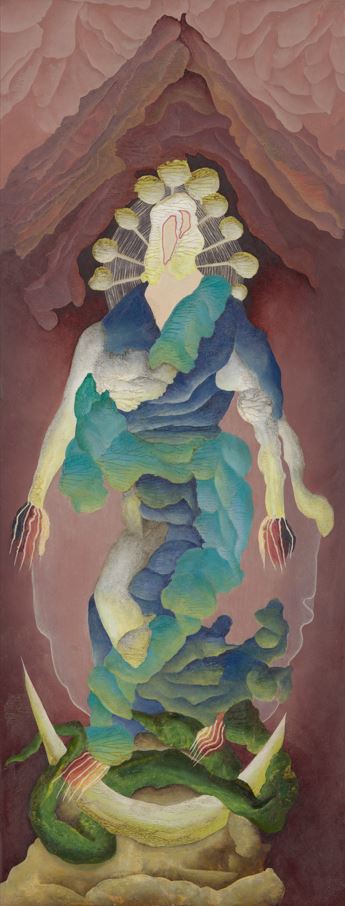
Attributes of the Moon by Ithell Colquhoun ( 1947) Tate, presented by the National Trust 2016 © Tate. Photo © Tate (Matt Greenwood)

And in a different style again, here is another overtly erotic work from the extensive ‘Diagrams of Love’ sequence, 20 or so examples of which cover one wall, along with the short elliptical poems she wrote to accompany the series. I think you can see the rude elements without my commentary but what I enjoyed was the spangles scattered over the torso, and the delicate blue of the figure’s wings, tinged with pink and yellow.

Diagrams of Love: The Bird or the Egg? by Ithell Colquhoun (circa 1940) Tate Archive, TGA 929/4/17/3. Photo © Tate Photography (Lucy Green)

It’s full of images like this. The more I looked, the more I liked.


Related links

Related reviews

Axël by Villiers de L’Isle-Adam (1890)

Villiers de L’Isle-Adam (1838 to 1889) had a long disastrously unsuccessful career, living in poverty for much of the time, despite churning out numerous plays, novels, stories and articles. A hard core of friends and supporters relished his heavily Symbolist and Decadent stories but the general public never did, during his lifetime. Only in the last few years of his life did he enjoy some success, specifically on publication of his volume of 27 Cruel Tales in 1883 and its follow-up volumes.

Villiers began work on Axël around 1869 after a meeting with his hero, Richard Wagner, who advised him to create an ideal world rather than describe the real one. He continued to work on it for the next 20 years and, although excerpts were published in 1885, it was still unfinished when he died in 1889. After his death the play was edited by his friends, the poet Stéphane Mallarmé and the novelist Joris-Karl Huysmans, and published posthumously in 1890.

Axël is a long play, a philosophical drama designed to be read rather than staged. Villiers considered it his masterpiece although critical opinion places far higher value on his fiction. It was in 1885 and 1886 that the word ‘symbolism’ came to be used to describe the group of young writers led by Mallarme, Verlaine and Villiers and Axel came to be regarded by Villiers and his friends as a peak expression of their views, subject and methods. In the translator’s foreword, Marilyn Gaddis Rose says Axel is the Symbolist play par excellence and yet, by using every possible Symbolist theme and cranking them all up to maximum, she says Villiers defeated his object. It became so top heavy with symbols that it collapses under its own weight. Rose says it is more like an academic demonstration piece than a play.

The play is in four parts with several sub-divisions:

Part 1. The Religious World

  1. And compel them to come in
  2. The Renunciatrix

Part 2. The Tragic World

  1. Watchmen of the Sovereign Secret
  2. The Story of Herr Zacharias
  3. The Exterminator

Part 3. The Occult World

  1. At the Threshold
  2. The Renunciator

Part 4. The Passional World

  1. Trial by Gold and Love
  2. The Supreme Option

There are two central characters, representing the male and female principles, Axël and Sara.

Act 1. The Religious World (31 pages)

Act 1 (The Religious World) describes in minute detail the preparations in the darkened chapel of a Catholic convent in Flanders for the ordination of Sara, a 23-year-old foundling, her official initiation into the sorority of nuns. (Her full and highly symbolic name is Eve Sara Emmanuele, Princess of Maupers, p.27.)

Long speeches by the Abbess reveal various facts including that Sara is set to inherit much wealth which will come to the convent if she formally joins; but that she has proven difficult and obstinate. These doubts about her are fully justified when, after a vast amount of verbiage from the Abbess and ceremonial Latin from the Archdeacon, at the first point where she has to indicate her willingness to join, Sara utters the single word ‘No’ (p.31).

The entire convent is thrown into chaos, the Abbess wailing, her fellow nuns lamenting. When they’ve exited the Archdeacon unleashes long speeches about how she must renounce the flesh in order to become one with God etc and opens the vault of the founder where, he implies, she ought to be locked in to ponder her sins, but instead Sara seizes a huge axe, placed in the chapel as a votive offering and forces the old man down into the vault, then slams the stone lids shot in him. Opens the chapel windows so that wind and snow blow in, extinguishing the holy lamps. She tears a long pall into two strips, ties one end of it to a bar across the window, then climbs out, lowering herself down the pall out of sight, and so escapes the convent.

This is the rejection of religious commitment.

In Act 2. The Tragic World (77 pages)

I was expecting the ‘play’ to continue in the same overwrought, intense, religiose atmosphere of the first act, so Act 2 comes as a surprise. It opens to reveal that we are in the hall of a grand castle in Germany, somewhere in the Black Forest and introduces us to three of Axel’s loyal retainers (Gotthold, Miklaus, Hartwig who lost an arm in the wars), tall old men, some wearing old military uniforms bearing the Iron Cross. They are tidying up the grand hall, bickering, joking, reminiscing and giving us the backstory to their master, the central figure of the play.

This is that their master, the Count Axël of Auersperg, German prince, inherited the castle and estates when his father, Count Gherard of Auersperg, died just after the end of the Napoleonic wars i.e. 1815. The very day of Gherard’s death, a relative named Janus arrived and, when the will was read, it turned out that this Janus was given the baby Axel to raise (p.49). Now, 20 years have passed (so it’s about 1835) and the young Count, still supervised by the spookily unageing Janus, has recently been visited by a guest, Commander Kaspar.

At this precise moment, as Act 2 starts, Axël is out hunting, although the three retainers point out the sky clouding over and a storm blowing in. The three old men are interrupted by the arrival of Axël’s young servant, Ukko, who ought to be accompanying their lord. He says Axël is fine and has taken shelter from the storm in a cave. He’s mainly concerned to tell them that out in the woods he came across a pretty maiden, Luisa, who turns out to the daughter of Hans Glück the ranger, he wooed her, asked her father for her hand, and they are now engaged (p.53).

Barely has he finished his excitable account of all this before tall, lordly Commander Kaspar enters, very tall, very noble, about 43. The others pay their respects and exit leaving the Commander to survey the table laid for him and browse Axël’s bookshelves. He soliloquises and what emerges is that he believes his young cousin is falling into bad habits, locked up in this remote place he is taking an unhealthy interest in the occult, Hermeticism, Kabbalism and suchlike (p.56). He needs to be taken in hand, will prove malleable, will make a splash if presented at court where he’d be a hit with the ladies and ‘could win for me with the king certain influences’ (p.57).

Key fact: Kaspar has been staying at the caste for 8 days and this evening, after dinner, plans to leave, to ride 8 miles or so to a nearby village, overnight there, and catch a coach to Berlin the next morning.

The story of Herr Zacharias

He is musing how to manage Axël’s chamberlain, Herr Zacharias, when the latter enters and declares he has an important revelation to make. With a great deal of historical detail he tells the mystery of Axël’s father who, when the French invaded the German states during the Napoleonic War, was put in charge of a military convoy assigned to carry the nation’s wealth in gold ingots (‘eighty munitions wagons of the National Bank of Frankfurt, 400 casks of coin and gold bars, caissons of precious stones) to a safe place in the country. The conventional account has it that they were ambushed by the French and killed but Zacharias has a new, conspirator version, which is that the father decoyed the convoy deep into the Black Forest round this castle and buried it in a secret underground chamber. It was as he and his fellow officers were rejoining the convoy that they were ambushed and killed. But Zacharias himself was here, at the castle, when Count Gherard appeared suddenly, to visit his pregnant wife, Countess Lisvia of Auersperg, for a hurried kiss and farewell, before he rode off to his death. So somewhere near the castle is untold wealth which, due to complicated legal matters which he goes into, no longer belongs to anyone. I.e. finders keepers.

He revealed all this to his master, Lord Axël, but the latter made him and the others with him at that moment, all swear an oath of silence on the matter, and that was three years ago.

Enter Axël

Commander Kaspar is just about to enquire more when the protagonist of the play, Axël, finally makes his appearance. The servants reappear and serve Kaspar and Axël a sumptuous dinner. Over this meal (wild boar with red pepper and vanilla) Kaspar starts to make the pitch which is, as I understand it, the heart of this act, namely to persuade him to leave his self-imposed exile and return with Kaspar to the Court with its ‘merriment, luxury and love’. Kaspar goes on to describe the pleasure of having affairs at court, specifically how half the fun of ‘conquering’ a woman is knowing that her husband is driven mad with jealousy. Axël is visibly disgusted with all this.

(A notable aspect of the play is the use of asides. I’m used to this from Shakespearian and Restoration drama but it’s odd encountering it here, in a supposedly modern play. Thus the Commander is continually indicated as making asides [To himself]. I might be mistaken but I think that in one of these he implies that, as they ride together through the dark forest, he will shoot Axël and so inherit his estate and wealth. Another obvious aspect of these sometimes very long asides, is that the other characters have to hang around waiting while the character delivers their long aside, pretending they can neither near nor see them doing so. Bringing out what a very undramatic playwright Villiers was.]

So if Act 1 centred on the Archdeacon’s extended speeches using a variety of arguments to prove the value of the religious life, the servants now leave these two men alone and Kaspar embarks on a panoply of arguments to draw Axël from his reclusive life, studying esoteric knowledge under the mysterious Mater Janus, and instead:

‘Imitate me. Seize life…without illusions and without weakness,’ (p.82)

He gives a few more illustrations of how rewarding life at court is, before he decides to reveal what Herr Zacharias has revealed to him about the supposedly buried treasure. He calmly confesses that he himself is penniless but if they hire workers to dig in the castle grounds he will be happy to split the treasure when they find it 50/50.

Axël calls Herr Zacharias and very solemnly accuses him of breaking his oath and telling.

Next, to my astonishment, Axël calls his page, Ukko, and tells him to fetch the three old servants and bring two swords. Then, while Kaspar is still rambling on about h is dreams of sudden wealth and life of pleasure at court, Axël announces that Kaspar has mortally insulted him and he is challenging him to a duel. He ceases to be a guest in his home, this big hall will make a fair duelling ground, he indicates parchment and quill which he can use to write his will and that one of them will not leave the hall alive.

Kaspar is as amazed and surprised as the audience. Initially he thinks, like us, that it’s some kind of joke but it isn’t He sarcastically suggests that all guests to the castle be warned of the fatal consequences of staying there, but no jokes, pleas or expressions of outrage deter Axël and so they prepare to fight a duel. For full Gothic effect the storm has picked up again and the fight is illuminated by lightning and thunder.

BUT…some of the Commander’s words strike a chord with Axël’s servants. He sees them hesitate and so…in a move much criticised by all the play’s audiences and readers. Villiers has Axël put down his sword and launch a very long defence of his actions and the text turns into something more like a courtroom scene than an action movie.

For now Axël speaks at very great length, for well over 20 pages, to a series of accusations:

  • he refutes the Commander’s accusation that he wants to keep the gold for himself, claiming that a) he doesn’t know where it is b) he doesn’t want it or need it
  • the Commander accused him of keeping it from the State but Axël says it was the ‘State’ which sent his father to his doom and whose official histories accused his father of ineptness and dereliction of duty; he owes the Sate nothing

There is an interesting passage about language in which Axël says that the words they use are avatars or epitomes of their users and so the words Kaspar uses are gross and base like their speaker and so have nothing in common with the way Axël uses the same words. Can’t help thinking that would be fertile matter for poets like Mallarmé and Valéry.

The final 4 or 5 pages take a surprisingly martial turn for a character who is, I thought, intended to be so otherworldly and spiritual. He surprises the Commander by saying that if the State did send a force against him they would be massacred. He commands the loyalty of all the villages round and all the fit young men (20,000 foresters) who would fight for him. The rough terrain with its close-packed trees would block the advance of any army while his guerrillas picked it off. The crenellations of his castle are designed to host 48 cannon which would massacre any forces coming within two leagues. If a smaller force was sent they would be ripped to shred by his pack of psychotic Ulm hounds. He even declares the miners of the region are loyal to him and still very resentful of the forced conscription which sent them to war and so some of them would happily undertake a mission to assassinate the king. After a couple of such assassinations ‘the State’ would call off its attack on Axël.

So you can see why I was very surprised that the character I thought was going to be a mimsy aesthete and sensitive poet turns out to be a touchy, aggressive warlord who dreams of midnight attacks on the sleeping army which would result in ‘simple, thorough slaughter’ (p.114). He would set the forest on fire to roast an attacking army. In winter he would use landslides and the release of cunningly placed boulders. Survivors and deserters would be picked off one by one before they managed to escape the forest. At which point Axël’s forces would storm out of the forest and attack the nearest towns, thus triggering a civil war right across Germany. It’s an extraordinarily apocalyptic vision.

Or, they could leave this mild eccentric alone to his studies. But now he gestures to the Commander to pick up his sword. By this point, after this long rhodomontade, Kaspar, like the audience, knows that Axël isn’t kidding.

So they sword fight and Villiers describes it in some detail, the lights flashing off the blades etc, in a very cinematic style, Kaspar doing all the attacking, Axël impassively defending, till the latter sees an opening and with one quick thrust, runs Kaspar through the heart. He falls to the floor and dies without a word. Axël thanks his retainers for their faith, and orders them to take the body down to the vaults to bury.

At this moment, the mystery figure of Axël’s mentor, Master Janus, tall, 50, silver-haired, appears at the top of the steps at the back of the hall, a hieratic figure with a face like an Assyrian relief.

Comment

Axël’s very long speech which makes up the second half of this act and forms a long hiatus between the challenge to a duel and the duel itself, has led to much criticism. The translator, Marilyn Rose, describes it as possibly the most boring second act in all drama while even W.B. Yeats, a fan who tried to get the work staged in London, admitted in his preface to the 1924 translation that the second act ‘dragged greatly’.

I found this true of the first part which consists of a legalistic defence Axël’s right to the supposed treasure in which he gives various definitions of ‘the State’ and its obligations or lack thereof to him and his family – but I found his description of the castle’s defences against any form of attack, which escalates into the vision of launching a countrywide civil war, completely unexpected and surprisingly vivid. Much more practical and imaginable than the tedious religiosity of Act 1.

It’s taken quite a long time, but this act amounts to the rejection of the world, of fleshly pleasure, gold and power.

In Act 3. The Occult World (17 pages)

In line with the highly staged and schematic nature of the work, Act 3 consists entirely of a dialogue in which the Magus, Master Janus, lectures Axël on how to escape the world of Becoming into the world of Being. It follows immediately from the previous scene and starts with the voodoo idea that the vapour from Kaspar’s blood, which is still lying on a pool on the floor of the hall, has enveloped Axël, he has breathed it in along with the worldly instincts of its owner, and it has revived his worldly feelings and dragged him back to earth. He feels curious about the Gold which he hasn’t done for years.

In his ten page lecture Master Janus uses all manner of metaphors and occult language. Some of this made sense to me, some of it seemed like wordy gibberish, a few thoughts or phrases really struck home. Here’s an example of the boilerplate, stock, standard rhetoric of the mystic of all philosophies and religions, echoing the sentiments of the Stoics as summarised by Cicero or Marcus Aurelius:

‘The Law is the energy of beings! It is the living, free, substantial Notion in which the realms of the Seen and the Unseen moves, animates, immobilises or transforms the totality of all becoming…You originate in the Immemorial.’ (p.128)

Elsewhere he says something which resonated with me:

‘If what passes or changes worth remembering? What would you like to remember?’ (p.125)

I have plenty of regrets. I fantasise about the Buddhist ideal of achieving total release from all worldly ties and attachments. If only…. A little later Janus says:

‘He alone is free who has opted forever, that is, who can no longer be tempted and is no longer compelled to hesitate.’ (p.129)

At school we endlessly discussed existentialism, Catholicism, Kierkegaard, Hesse, Eastern philosophies, the leap of faith. The Sartrean idea that you are absolutely free to make your choices and your choices decide who you are, trumped by the notion of many faiths that once you have committed everything becomes clear and simple. No further agonising required. The Act is full of ideas like this.

As to the stagecraft, something pretty dramatic happens halfway through which is that the storm which has been rumbling along in the background, and intensified during the duel scene, suddenly leaps in intensity, as a bold of lightning crashes through a window and streaks across the hall as a sheet of flame, darting past the arms hanging on the old medieval wall until it strikes the fireplace and carves a furrow in it. Pretty impressive if this could be staged. As impossible as some of Wagner’s stage directions.

Anyway, this doesn’t have the shattering effect on the two protagonists as you might imagine, not least because Master Janus goes over to the shattered window, opens it and, as if by magic, the storm calms, the air clears, the night becomes serene as if ‘under a calm enchantment.’

Anyway Master Janus’s long mystical lecture reaches a climax when he asks Axël whether he accepts ‘Light, Hope and Life’ to which Axël, like Sara in the parallel moment in Act 1, replies quietly with one little word, No.

This is the rejection of the world of the occult.

Janus has half a page saying that Axël therefore commits to becoming more ensnared in earthly chains before being superseded because Gotthold enters to say that two of the other servants encountered a stagecoach on the road to the castle, found its occupant to be a young woman dressed in mourning, and that she is even now being taken to a spare bedroom.

Now, back at the start of Act 3 Janus had confided a prediction to the audience:

‘The Hour has come – she too is going to come, she who renounced ideal Divinity for the secret of the Gold…here then face to face the final duality of the two races I chose from the depths of the ages that simple and virginal humanity might conquer the twofold illusion of Gold and Love – that is, to found in a point of Becoming the virtue of a new Sign.’ (p.124)

Well, now she (Sara) has arrived and in fact is seen progressing along the back of the stage following a servant carrying a candle, while Janus closes the act with these portentous words:

‘The Veil and the Mantle, both renunciators, have intersected: the Work nears fulfilment.’ (p.139)

Ah. All is as foretold. Jolly good.

Act 4. The Passional World (32 pages)

Act four moves scene to be set in the vast castle vault, packed with statues of the family dead, with a hanging censer. The servants have buried Kaspar and are just preparing a cross for him. As at the start of Act 2, the atmosphere is lightened with some banter between the three old retainers (Gotthold, Hartwig, Miklaus) who have some respect for the dead Kaspar, and young Ukko who is so dismissive and disrespectful it makes the old men angry.

Enter Axël in travelling clothes. He tells the retainers he is leaving early the next morning and they react with incredulity and tears, especially young Ukko, who he astonishes by saying that, if he doesn’t return, the estate will be his. Tears and laments but then they slowly exit the vault leaving Axël alone and he forbids them to return. When you think about it, this is odd. Surely he should go to bed or some such. Leaving him down in the vault feels very staged to allow Axël not to leave but (in the event) to do away with himself.

What happens first is that while Axël is pondering he hears footsteps, hides, and sees Sara enter the vault. She goes over to the big escutcheon at one end and applies the point of the dagger she’s holding. As in hundreds of movies about secret treasure, at the touch of the dagger in the right spot the entire wall starts to sink and reveals a long ark vault and…a huge treasure of diamonds and other jewels, along with gold coins, comes flowing and tumbling over her and into the hall.

Axël emerges from hiding and makes to approach her, but quick as a flash she pulls two pistols from her belt, Lara Croft style, and shoots at him, twice, he dodges so her bullets only graze his chest.

Axël continues on towards her, grabs her hand with the dagger and is on the verge of stabbing her when he sees her face for the first time and hesitates. Huh. I thought the play was going to be a love story of sorts but it turns out nothing like it. 1) These two characters spend most of the play apart and only meet for these last 20 pages and 2) their first reaction is to try to shoot or stab each other.

In that voodoo Liebestod manner patented by Wagner, they don’t talk about love but about death, about trying to kill each other, how only one of them can survive etc in a quite psychopathic way.

‘From now on, my senses tell me, knowing you are alive would keep me from living! That is why I crave the sight of your lifeless body. And, whether or not you understand, I am going to become your executioner…’ (p.154)

However Sara deflects this by unleashing a torrent of erotic rhetoric at which Axël melts, sits her on the ebony sofa, kneels at her feet.

‘I know the secret of infinite pleasures and delectating cries, the secret of voluptuous sensations where every hope expires.’ (p.155)

‘Beneath your night-hued hair you are like an ideal lily, blooming in tenebrae. What quiverings rise at the right of you, my love?’

Sara tells Axël she grew up in a convent where she was mistreated and miserable and he immediately vows to raze it to the ground so she has to talk him out of that.

Sara tells Axël the story of plucking a rose from a rose bush in the winter snows, a story designed to evoke the Rosicrucians, very popular at the time.

Then Sara spends 3 or 4 pages giving exotic orientalising descriptions of exotic destinations around the Mediterranean and into the Far East which they could visit together.

The windows of the vault lighten as dawn comes, at the same time they hear Axël’s retainers singing a sad song about their master leaving.

But then Axël is stricken with an insight. He startles Sara by saying none of her visions will happen because they have just fulfilled them by imagining them. How could any reality live up to the ecstatic visions of this wonderful night?

‘If we accepted life now, we would commit a sacrilege against ourselves. As for living, our servants will do that for us.’ (p.170)

So this famous quote comes in the context of Axël realising that Reality can never live up to their ecstatic imaginings of it.

‘Satiated for all eternity, let us rise from the table and in all justice let us leave to ordinary mortals whose ill-fated nature can measure the value of realities only by sensation, the task of picking up the banquet crumbs. I have thought too much to stoop to act.’

From this he goes on to ask whether they want to experience all the maladies that ordinary mortals do, growing old and disappointment, old age and boredom. Sara realises he is justifying suicide, to cease now, at their moment of highest ecstasy and anticipation.

All the wonderful exotic places she listed? In reality they are piles of rubble and paupers.

‘You have thought them? That is enough, do not look at them. The earth…is swollen like a brilliant bubble with misery and deceit…Let us get away from her, completely! Violently!’ (p.171)

Sara hesitates and gives half a dozen reasons not to die which Axël (rather unconvincingly) refutes. So the tips the poison granules from the emerald ring she wears into a jewel-encrusted goblet Axël brings her, then he takes it up to a window and (rather impractically) captures the morning dew in it.

Then, as they hear the Chorus of the Woodsmen celebrating the arrival of dawn (as in an opera). Alongside it they hear the marriage song of young Ukko marrying the ranger’s daughter and Axël asks Sara to give the young couple their blessing. Then with a last few lyrical words, the pair drink from the goblet and die in each other’s arms, as the sun finally rises and we hear:

distant murmurs of the wind in the forest vastness, vibrations of the awakening of space, the surge of the plain, the hum of life. (p.175)

Thoughts

Obviously it’s a long, wordy, undramatic, wild farrago of ideas and images. Only at a few isolated moments does it become something like a believable depiction of human beings: in some of the early exchanges between the Abbess and Archdeacon, but most of all in the banter between the three old retainers at the start of acts 2 and 4. Kaspar’s disbelief when Axël abruptly challenges him to a duel suddenly has a human dimension. And Axël’s long description of the military precautions he’d taken to defend the castle, although over the top, is at least understandable.

For the rest it is very like the hieratic, static, stagey, work of symbolic drama of legend. Axël and Sara are both allegorical figures and symbols of something. This doesn’t trouble me. At university I studied allegories such as Gawayne and the Green Knight, Piers Plowman and the Pilgrim’s Progress. From that perspective, Axël is not allegorical enough. In acts 1 and 3, I felt the presentation of Christian theology and the mystical doctrines of the occult were not presented powerfully enough. The speeches of the Archdeacon and of Master Janus were just that, speeches made up of tissues of doctrine and rhetoric, rather than actions which fully dramatised the worldviews which Sara and Axël, respectively, reject.

Similarly, I was surprised that the section devoted to Commander Kaspar talking about life at court was so short, that Axël interrupted him fairly quickly by telling him how much he had insulted him (Axël) and challenging him to a duel. Surprised because I thought there would be more, in a Decadent play, about the life of the senses, about sensual pleasure, that it would be more fully worked out and detailed, than Kaspar simply saying it’s a lot of fun to seduce people’s wives at court.

I think what I’m saying is that, although all the acts are very wordy, they somehow fail to really bring out the essence of the three worldviews Villiers is schematically depicting. He accumulates arguments into great diatribes rather than selecting the key one or two, which would have been more focused, more dramatic.

In passing, I was expecting from summaries and references to the play, that the two protagonists, Axël and Sara, engage in an extended love affair, that the play is about their love but, as you can see from my summary, this is far from being the case. Sara only has one word to say in the first 31 pages and then disappears for 118 pages, only reappearing on page 149. It’s only in the last 20 or so pages that they are together on stage.

Obviously, the way they go from cheerfully wanting to murder each other to becoming besottedly in love with each other, unable to leave each other, so saturatedly in love that Axël comes to realise the rest of their lives can only be a pitiful anticlimax after this night of intense union, is so off-the-scale unreal as to be beyond comical and into the realm of high-pitched music-drama, Wagnerian opera which there’s no point applying common sense to, which is intended to sweep you up into a world of primal emotions beyond logic or sense, and I think it successfully does this.

Lastly, looking just at the end, it is thought provoking how this entire approach – rejecting religion, worldly pleasure, sex, wealth and success, and then the lures of occult mystical philosophy – leaves the characters, in the end, with only one option, to do away with themselves and leave the world altogether. In the darkened world of the auditorium, stunned by a succession of melodramatic scenes, special effects, weeping nuns, murdered soldiers and sheets of lightning, I can imagine this working, in dramatic context i.e. under the spell of everything which came before.

But at the same time, when the play ends, you emerge out into the light of day, blinking and dazed, and realise it has nothing to do with your life, with anyone’s life. That is both its strength, as a piece of achingly contrived artifice, a deliberate rejection of every aspect of tedious everyday existence, and its obvious weakness, because a suicide pact is not really a very practical philosophy of life.

As Axël deploys his case for suicide I couldn’t help thinking of Albert Camus’s famous book-length argument against suicide, The Myth of Sisyphus, written almost exactly fifty years later (1890/1942). I don’t really know enough about the full breadth of French literature, but I wonder if you could say that Camus, in part, answering the question de L’Isle-Adam put half a century earlier.

Finally, I’ve been reading the quotation, ‘As for living, our servants will do that for us’ for 40 years or more, and have finally got round to reading it in context. For all that time I imagined it expressed the splendid confidence of an Oscar Wilde-type character, drolly, ironically, aristocratically superior. Comic. Now I see it is something quite different. It is the almost contemptuous, disdainful comment of a character arguing the case for joint suicide. Not so comically droll after all. They are the words of someone who’s become fanatically convinced that the only way forward is to kill himself. Not at all what I’ve believed all these years…

The translation

If the work is a masterpiece of French Symbolist prose that doesn’t come over one little bit in this translation, which captures the overwrought vocabulary but without the slightest trace of magic. All too often the translation has only half removed from the original French, retaining the original syntax so as to appear thoroughly foreign in word order and rhythm.

However, by what so advantageous subjects of idle conversation do you so often replace the interest which these other subjects, perhaps, encompass…

Really, however insignificant the object of my favourite studies might be in your judgement, one can hardly see in what respect I have gained in exchange this evening by listening to you. (p.91)

Whether it’s Villiers, Rose or both to blame, a lot of the translation is clunky, clumsy and, because of this, unmemorable and sometimes hard to follow.


Credit

I read ‘Axël’ in the translation by Marilyn Gaddis Rose published by the Soho Book Company in 1986.

Related links

Related reviews