Hawaiʻi: a kingdom crossing oceans @ the British Museum

I didn’t read the press and publicity stuff closely enough so I vaguely thought this would be a general exhibition about historical Hawaiian art and culture – but I was wrong. It’s far more structured, nuanced and focused than that.

Featherwork and ornaments that evoke a gathering of ali‘i (chiefs) on display in ‘Hawaiʻi: a kingdom crossing oceans’ at the British Museum © The Trustees of the British Museum (photo by MKH)

A meeting of kings

The centrepiece of the show is that 200 years ago, in 1824, King Kamehameha II and Queen Kamāmalu became the first Hawaiian monarchs to visit the UK. It took them and ten of their courtiers 5 months (November 1823 to May 1824) to sail here on a Royal Navy ship and when they arrived they were treated with the courtesy and respect according any visiting monarch.

They met with the recently crowned British monarch, King George IV (crowned July 1821), and exchanged gifts: they gave our king beautiful hand-made cloaks, and received in return a silver teapot and a watch, among other luxury objects. They were dressed in the latest fashions, had their portraits painted by the court painter John Hayter, went to the theatre, were even the subject of the usual scathing regency satirical cartoons.

Portraits, cartoons and sumptuous gifts are all included here, along with a map of their route (they stopped at Buenos Aires along the way, and handed out gifts there, too).

Portrait of King Kamehameha II (left) and Queen Kamāmalu (right). Hand-coloured lithographs by John Hayter © The Trustees of the British Museum

Tragically – disastrously – after a few weeks, the handsome young king and queen both caught measles and died from it. Their courtiers returned to Hawaiʻi with the gifts but without a king, who was promptly replaced by his younger brother Kauikeaouli, who became King Kamehameha III and went on to reign for 30 years (June 1825 to December 1854).

It is this extraordinary event which provides the centrepiece of this exhibition. The show can be divided into the following parts:

1. Background facts

It opens with a brief recap of the history of Hawaii, complete with maps. Here’s a summary:

Hawaiʻi consists of 137 volcanic islands spanning 1,500 miles that make up almost the entire Hawaiian archipelago (the exception is Midway Atoll).

The eight main islands, from northwest to southeast, are Niʻihau, Kauaʻi, Oʻahu, Molokaʻi, Lānaʻi, Kahoʻolawe, Maui, and Hawaiʻi, after which the state is named. The last is often called the Big Island or Hawaiʻi Island to avoid confusion with the state or archipelago.

The archipelago was settled between 1000 and 1200 by Polynesian seafarers navigating by the stars and following the flight of migratory birds. Over the centuries, the islands became the seats of numerous independent chiefdoms.

In 1778, British explorer James Cook was the first known non-Polynesian to arrive at the archipelago (he was to go on to be killed here, after a tragic cultural misunderstanding). The early British influence is reflected in the Hawaiian state flag, which contains a Union Jack.

King Kamehameha I, also known as Kamehameha the Great, unified the Hawaiian Islands by force and diplomacy, establishing the Kingdom of Hawaiʻi in 1795 and completing unification by 1810, creating a single, powerful monarchy from separate chiefdoms.

It was his son, Kamehameha II, who succeed Kamehameha in 1819, who undertook the journey to Britain. the backstory is that in April 1822, English missionary William Ellis arrived with a schooner, the Prince Regent, to add to the King’s growing collection of ships (!). It was a gift from George IV the King of Great Britain and Kamehameha II wrote to thank him, requesting closer diplomatic ties. It was from this gesture and this correspondence that the idea was born for the royal court to journey to the other side of the planet to meet the British king.

Display of Akua hulu manu (feathered gods) in ‘Hawaiʻi: a kingdom crossing oceans’ at the British Museum © The Trustees of the British Museum (photo by MKH)

Language and pronunciation

The Hawaiian language is referred to as Ölelo Hawali and terms and phrases from it are used throughout the exhibition.

Apparently, the correct pronunciation of Hawaiʻi is to insert a glottal stop before the final ‘e’ sound. What is a glottal stop? Imagine saying in a broad Cockney accent, the following phrase: ‘Wotta lotta little bottles’ so that it sounds like ‘Wo’a lo’a ‘li’el bo’els’, where you don’t voice the t sound. Same with Hawa [glottal stop] ee.

2. Hawaiʻi culture, beliefs and crafts

Having painted in this background, the exhibition then devotes the first big space to giving an overview of the gods, traditional beliefs, arts and crafts of the Hawaiian people at around the time of the royal visit. (Here we discover, amid much else, that the British Museum holds one of the largest collections of Hawaiian objects in the world outside of Hawaiʻi.)

Wooden ki‘i (images) that embody kua (gods) in ‘Hawaiʻi: a kingdom crossing ocean’ at the British Museum © The Trustees of the British Museum (photo by MKH)

Highlights include:

  • a nine-foot kiʻi (image) of the god Kū, the god of warfare and governance, dressed with a contemporary loincloth and standing atop a pole
  • a magnificent ʻahu ʻula (feathered cloak) sent in 1810 by the first king of unified Hawaiʻi, Kamehameha I, to King George III, the largest known example of its kind

There are striking statues of wooden gods (see above), wooden bowls, plumed hats, gorgeous cloaks made from bird feathers, and a wall of coloured barkcloths.

kapa (barkcloth) pieces on display in Hawaiʻi: a kingdom crossing oceans at the British Museum © The Trustees of the British Museum (photo by MKH)

Barkcloth: Kapa (barkcloth) is made from the inner bark (bast) of the paper mulberry and other plant fibres. As a medium, kapa is a connector between the land, the people and the gods. Different forms of kapa had many uses, from everyday life to ritual practice, including as chiefly garments, spacial dividers, blankets and wrappings for bones.

HelmetsMahiole (helmets) were worn in battle and in ceremonial contexts, often together with ʻahu ʻula (feathered cloaks and capes). The head has particular significance in Hawaiʻi as one of three centres in the body where the aumākua (deified ancestors) hover. Each helmet is unique and identifies the bearer as a chief. The structure is woven from the aerial roots of a climbing plant called ʻieʻie and is often adorned with feathers.

Gods: Origin stories tell that the islands were birthed by the gods. High chiefs were manifestations of the gods on earth. Through rituals, chefs could protect the people and ensure the land’s abundance. In turn, the people revered their chiefs and cultivated the land, gathering materials and nurturing resources. Craftspeople created precious items that honoured their chief.

Kū and Lono: Kū is a Hawaiian god whose realm includes warfare and governance and that in the Hawaiian ritual calendar, the season of Kū begins in January-February and ends in October-November. At that point Ku is replaced by Lono, a deity associated with harvest, peace and recreation. (So we are currently in the season of Kū.)

Here’s one of the exhibition’s carved wooden artefacts, which experts thinks depicts a chief, as indicated by the loincloth round his waist and the feathered headdress.

ʻUmeke kiʻi (bowl with figure) © The Trustees of the British Museum

In addition, there are feathered cloaks worn by chiefs, powerful shark-toothed weapons, spears and clubs, and much more.

3. The meeting of kings

As described above, this is the centrepiece of the show and includes displays of ceremonial cloaks, lithographs of the king and queen, portraits and pictures of them at the theatre, the silver teapot, the silver watch and a couple of satirical cartoons depicting a lecherous King George groping a buxom native queen, in the comically gross style of Regency cartoons.

Installation view of ‘Hawaiʻi a kingdom crossing oceans’ at the British Museum showing the gallery devoted to the royal visit © The Trustees of the British Museum (photo by MKH)

Red

The exhibition displays a large Hawaa’ian feathered cloak near to George IV’s coronation surcoat and this triggers fascinating thoughts about a) the persistence of monarchy and king worship across the most diverse societies, b) the need these have for grand costumes and regalia, and c) the importance of the colour red. In fact red, as you can see from the images, is the really dominant colour of the exhibition: you can see for yourself that the cloaks in particular include yellow and black patterning, but it’s almost always against a core background colour of red.

King George IV’s coronation surcoat (left) and a cloak belonging to King Kamehameha II (right) displayed so you can make a direct comparison of size, shape, colour and impact, in Hawaiʻi: a kingdom crossing oceans @ the British Museum (photos by the author)

4. Alliance with Britain

Having established the close connection between Great Britain and Hawaiʻi which existed from its discovery by the West, the exhibition then explains that for 70 or so years after the 1824 visit, the two countries maintained close relations. When a zealous Royal Navy officer, Captain Lord George Paulet of HMS Carysfort, in 1843 illegally occupied Hawaiʻi and tried to formally annex the kingdom for Britain, King Kamehameha III wrote to the British government who recalled Paulet and assured the King of ongoing Hawaiian independence.

Negotiations were already underway which led in November of the same year (1843) to Great Britain and France signing the Anglo-Franco Proclamation, a joint declaration that formally recognized the independence and sovereignty of the Kingdom of Hawaiʻi. This agreement committed both nations to never take possession of Hawaiian territory, either directly or as a protectorate.

There’s a copy of the Proclamation in the exhibition, on loan from The National Archives and the curators tell us that the precise date, 28 November 1843, is still celebrated in Hawai’i today as Lā Kū’oko’a (Independence Day).

5. Annexation by the US

However, as we progress through the exhibition, the next key moment in the nation’s history came when America annexed Hawaiʻi. Like all historical events, this was more complex and fraught than it is now presented, with a background of political problems within Hawaiʻi exacerbated by the commercial interests of European and American businesses which owned extensive sugar and pineapple plantations. In 1893 a group of Western businessmen persuaded the local American agent to allow US marines to take part in the (peaceful) overthrow of the native government and to establish the Republic of Hawaii; and then lobbied Congress and the Senate to formally annex the islands, which the United States did 5 years later, in 1898. (Just worth reminding ourselves that the nearest part of the Hawaiian archipelago is 2,000 miles from the American mainland.)

The Hawaiian monarch, Queen Liliʻuokalani, protested against the coup but, when weapons were found in the palace which might have been used by loyalist forces, was placed under house arrest. She appealed to the British government, invoking the Anglo-Franco Proclamation but, to our shame, and as so often, we did nothing to defend the monarchy we had so enthusiastically hosted in 1824. Instead, in 1895 Queen Liliʻuokalani was forced to abdicate, thus ending the Hawaiian monarchy.

Even at the time, there was a great deal of debate in America, among politicians and the press, about the rights and wrongs of the coup and President Grover Cleveland opposed annexation. However, he was replaced by President William McKinley who pushed for annexation, which formally took place in July 1898. There then followed the inevitable sequence of assimilation whereby, first of all, in February 1900, the Hawaiian Islands became a US ‘incorporated territory’; and then in August 1959, the territory was officially declared America’s 50th state.

(For comparison, the contemporaneous Spanish-American war of 1898 ended with the Treaty of Paris (1898) whereby Spain ceded 1) Puerto Rico, 2) Guam and 3) the Philippines to the United States. The Philippines were a US colony from 1898 until given independence in 1946 whereas Guam and Puerto Rico remain to this day parts of the US as self-governing, ‘unincorporated territories’, meaning people born there are US citizens, they use US currency and passports, but residents can’t vote in presidential elections and have limited representation in Congress.)

And then, just as inevitably, came the modern attack of imperial guilt and in 1993 the US Congress passed the Apology Resolution, apologising for America’s role in the illegal annexation of the Hawaiian nation, which was signed by President Bill Clinton.

Throughout the annexation process the majority of Hawaiians wished to remain independent and this is signalled here in the exhibition by a picture of ʻAuʻa Haunani-Kay Trask (1949 to 2021). Trask was ‘a prominent Native Hawaiian activist, scholar, author and poet who was a leading figure in the Hawaiian sovereignty movement. She was known for her fierce advocacy against US imperialism, the illegal occupation of the Hawaiian Kingdom, and the commodification of Hawaiian culture by the tourism industry.’

Trask is quoted, on the centenary of the annexation in 1993, making the simple statement: ‘We are not American’ and this is the text you see running in lines across this striking portrait, part of a series of 108 photographic portraits of Kānaka Oiwi (Native Hawaiians) made by Hawaiian artist Kapulani Landgraf.

Photo of ʻAuʻa Haunani-Kay Trask in ‘Hawaiʻi: a kingdom crossing oceans’ at the British Museum © Kapulani Landgraf 2025

All of which makes for a thought-provoking read in light of President Trump’s ongoing threats to annex Greenland against the wishes of its (57,000) population…

6. Contemporary Hawaii

After this striking photo of Trask, we enter the final part of the exhibition, which focuses on contemporary Hawaiʻi.

Contemporary arts

I haven’t yet found space to mention that throughout the show, right from the start, the older objects have been interspersed with contemporary works made in the traditional style but made by contemporary Kānaka ʻŌiwi (Native Hawaiian) artists. These include:

Statue: A statue of historical figure Kekuaokalani, Liholiho’s cousin, who rebelled against the King’s decision to overturn the ‘ai kapu religious system. He was defeated and killed by Liholiho’s forces at the battle of Kuamo’o. The statue was made by contemporary carver Rocky Ka’iouliokahihikolo’Ehu Jensen after the traditional manner of articulated figures depicted in early drawings of Ahu’ena, defender of Hawaiian gods and faith.

Drum: Right at the start of the exhibition there’s a pahu or drum. Drums were thought to have been brought to Hawaiʻi by one of the first ancestors, named Laamaikahiki. The ancestors travelled from a place they called Kahiki, possibly in the Society or Marquesas Islands. But the point is that the drum in question isn’t an antique but was hand-carved by contemporary Native Hawaiian artist Dennis Kanale Keawe.

Akeanaliʻi by Dennis Kanaʻe Keawe (b. 1944). Made of kamani wood, shark skin, ʻaha (coconut cordage), carbon black soot coating, 2020

Contemporary videos

In the same spirit, sprinkled throughout the show are four or five short videos which show contemporary living practitioners of traditional arts and crafts explaining their practice. Take the drum, above – there’s a 90-second clip of La’akna Perry performing a mele or chant using the drum. Elsewhere:

  • Barkcloth: Hina Kneubuhl, a contemporary maker of kapa (Hawaiian barkcloth), explains how barkcloth is created and decorated, and how contemporary artists draw inspiration from ancestral works.
  • Hula: La’akea Perry, a Hawaiian kumu hula (dance master teacher), explains the importance of hula as a living practice and how it is taught today. He is filmed dancing with a newly made version of a ‘ulī’ulī (dance rattle), next to an historic example.

There’s also a general soundscape which floats across the displays, featuring the sound of waves breaking over lava beds and the sound of wind blowing through a coconut grove. All very soothing given that outside the Museum, the rain was pouring down in the gritty streets of central London.

Contemporary problems

No doubt there are all kinds of issues and ideas and things which could be written about contemporary Hawaii. The exhibition has selected a handful of areas where the state faces severe challenges and highlights how locals are trying to address them. these are mostly deep environmental issues which made for depressing reading.

1. Birds: Many of the mea kupuna or ancestral treasures on display in the exhibition – the many cloaks and other objects like coronets – were made from feathers taken from native birds. They were gathered sustainably – meaning the feathers were plucked in moderation from live birds which were then released – from species like the ‘ō’o, which was prized for its bright yellow plumage.

Today, many of Hawai’i’s unique bird species are extinct, including the ‘o’o. Those that survive are critically endangered. Avian diseases introduced from overseas have had a devastating effect, while natural habitats have been impacted by intensifying human activity. The art of featherwork continues but makers mostly use feathers from other bird species, often dyed.

2. The sea: There are almost one hundred Hawaiian fish hooks in the British Museum’s collection, reflecting the longstanding importance of fishing in Hawai’i, and also indicating the close interaction between early British crews and local fishing communities. There’s a display showing hooks with different shapes and materials designed to snare particular species of fish; the largest hook on show here was used to catch sharks.

Again, the contemporary situation is dire. Commercial overfishing in Hawaiian waters has led to a significant decline in fish populations and contributed to food insecurity for local people.

Fishing hooks in ‘Hawaiʻi: a kingdom crossing oceans’ at the British Museum (photo by the author)

3. Agriculture: Kalo (taro) is such an important crop in Hawai’i that it is described as an ancestor in origin stories. Its tuber is pounded to make a dish called poi. But over the century of American occupation much of Hawai’i’s agricultural land was turned into monoculture plantations of sugar cane and pineapples. Some communities are now reclaiming land, aiming to restore the environment by planting crops like kalo, but they’ve a mountain to climb.

7. Ownership

Quite often at these sorts of exhibitions the curators have to apologise for the fact that lots of the artefacts were looted or stolen from their original owners – so it’s nice to visit an exhibition where both sides were surprisingly polite and respectful. All the artefacts in the royal visit section are well attested as gifts from the royal delegation and many of the other arts and crafts objects are on loan from museums in Hawaii. The relatively small number of objects which were possibly stolen by naval officers or missionaries are all carefully marked and indicated.

Indeed the Museum goes out of its way to explain that the entire show was assembled in collaboration with Native Hawaiian stewards. Apparently this extended to an opening ceremony on the day it opened which started with a native Hawaiian ceremony to greet the sunrise, and then progressed to blessing this space which contains so many objects crafted by the ancestors.

And, as my summary indicates, wherever possible the curators have used terms and phrases from the ʻōlelo Hawaiʻi (Hawaiian language) alongside the English captions. The entire thing radiates respect and sensitivity.

8. Hope

Is there any hope for the future? Well, obviously not, but in order to live we all have to pretend there is. And so the exhibition ends with the projection onto a wall of a video showing four young Hawaiian students reciting a poem of hope for the future written by Hawaiian poet Brandy Nälani McDougall. The pattern and rhythm echo a traditional chant we heard earlier in the exhibition, another example of the way the curators, and their Hawaiian advisers, have tried to tie ancient and modern together into a living fabric.

Wall-sized video of students from Kamehameha School reciting the poem by Brandy Nälani McDougall in ‘Hawaiʻi: a kingdom crossing oceans’ at the British Museum (photo by the author)


Related links

Related reviews

Ithell Colquhoun @ Tate Britain

The Tate Colquhoun archive

A few years ago the National Trust handed over to Tate a large trove of work by the mystical Surrealist female artist Ithell Colquhoun (1906 to 1988) which significantly added to Tate’s existing archive. As far as I can tell, this exhibition is by way of showcasing the new expanded archive and sets out to demonstrate the impressive length, breadth and variety of Colquhoun’s career. As the Tate blurb puts it:

This landmark exhibition of over 140 artworks and archival materials traces Colquhoun’s evolution, from her early student work and engagement with the surrealist movement, to her fascination with the intertwining realms of art, sexual identity, ecology and occultism.

1. Variety of style

Thus the exhibition displays seven or eight completely different visual styles or approaches which Colquhoun developed over her long life, many of which are very attractive. In doing so the curators have to convey quite a lot of information – they have to explain to us the sheer range of Colquhoun’s purely artistic techniques or approaches to art-making, including the ones she copied or adapted from the European Surrealists during her Surrealist phase (1930s and 40s).

2. Esoteric knowledge

But the really striking and distinctive feature of the exhibition is the extraordinary range and depth of Colquhoun’s interests in esoteric wisdom. Almost every painting or drawing requires a hefty label explaining how it relates to ancient theories of magic and mysticism which she moulded and adapted to create a strikingly wide and diverse range of styles and pictures.

3. Eroticism

Then there’s the sex. Plenty of esoteric traditions attribute magical, mystical powers to our sexuality, assigning particular attributes to the male or female ‘principles’, discussing the union of male and female in sexual congress or in mystical figures where male and female actually become one, and so on.

Throughout her career Colquhoun was very interested in the many overlaps between esoteric traditions and sensual and sexual imagery. None of the paintings or sketches is pornographic, most of them are not even what you’d call particularly sensual, but a good number of them, maybe half, deal with sex as described in various mystical traditions.

This includes some of her best and most striking works, such as the lovely ‘Drawing of a red and yellow couple conjoined’, a small ink and watercolour work on delicate tracing paper, which I kept coming back to. Of its kind, perfect.

Drawing of a red and yellow couple conjoined by Ithell Colquhoun © Tate

Thoughts

I’ll give you my opinion now, before itemising some of the traditions and techniques in more detail. My opinion is that Colquhoun is a minor but very attractive figure. By minor I mean that she didn’t establish a school or have followers. If she innovated numerous techniques and approaches these have disappeared into art school practice i.e. are not particularly attributed to her.

Also she didn’t really produce any knock-down masterpieces, pictures which take your breath away. Maybe that’s another definition of a ‘major’ figure. There are only a handful of large, standout, finished pictures. The most striking one is ‘Scylla’, which is why it’s on the poster and all the promotional material.

Scylla (méditerranée) by Ithell Colquhoun (1938) Tate © Spire Healthcare © Noise Abatement Society © Samaritans

But instead of big knockout numbers, there are lots of smaller, not quite finished, not quite perfect, but still very attractive images, which become more appealing the more you read up about her mystical views and beliefs.

There are images to admire in every room and over time it took to wander round, immersing myself in her personality and interests and approaches, well, I came to like her and her work more and more. In particular to admire her restless drive to experiment. The sheer range of styles and approaches is as impressive as any of the actual works.

Artistic styles

  1. Narrative paintings / murals
  2. Art school William Blake
  3. Botanical paintings
  4. Cutout book
  5. de Chirico Surrealism
  6. Dali Surrealism and the double image
  7. Automatic painting
  8. Enamel drip (Taro)

1. Narrative paintings / murals

At the Slade she painted a number of large narrative paintings, especially of biblical subjects with fantastic architectural settings. There’s a death of the Virgin Mary in which the figures kneeling by her bedside are all in modern dress. Judith Showing the Head of Holofernes (1929). Judgement of Paris (1930), Aaron meeting Moses (1932). She remained a member of the Society of Mural Painters into the 1940s.

2. William Blake figures

These early works depict highly stylised human figures, positioned so as to fill the picture plane to overflowing, with a strong outline of the schematic and stylised figures, the exaggerated drawing in of the forehead, and the highly stylised eyes. All this reminded me of William Blake’s highly stylised, moulded and sculpted human figures, drawn with strong defining outlines, only amped up with 1920s modernism, with Art Deco features.

Song of Songs by Ithell Colquhoun (1933) © Tate

3. Botanical paintings

Completely different from these historical subjects, Colquhoun developed a different line, painting flowers and plants in a figurative style, inflected by 1920s modernism to produce what in the German art of the time was referred to as ‘magic realism’. At the same time, you can see how the stylisation of the flowers points towards her interest in surrealism, at the same times as the flowers are becoming symbols.

Water-Flower by Ithell Colquhoun (1938) Arts University Plymouth © Spire Healthcare © Noise Abatement Society © Samaritans

4. Cut-out book, Bonsoir, 1939

One entire wall is devoted to 40 or so small black and white photos and photomontages she created as the storyboard for an unmade surrealist film titled ‘Bonsoir’, which was never made.

The curators point out that the storyline appears to be a lesbian love story, moving from a woman in a cab with a man in a top hat, on towards scenes where two women are lying together in bed, scantily clad and kissing. On the wall opposite are sketches of a woman she apparently had a lesbian affair with, Andromaque Kazou, and the curators quote from ‘Lesbian Shore’, a lesbian text she wrote but which was never published. What I take from this is that Colquhoun was bisexual, or gender fluid, highly and sensual and completely unembarrassed about expressing it in her paintings.

Surrealism

Colquhoun had come across Surrealism in 1931 when she briefly lived in Paris. The 1936 London International Exhibition of Surrealism bowled her over and for some years she submitted entirely to the Surrealist influence, contributing to English Surrealist magazines, exhibiting with fellow British Surrealists. On the evidence here the influence can be divided into several distinct styles.

5. de Chirico surrealism

Next to the ‘Bonsoir’ cut-outs is a very finished and complete painting of a church, with no people in it and a few coloured ribbons or flows of some liquid leaking over the steps. This has the architectural precision but unpeopled ominousness of a de Chirico painting.

6. Dali surrealism

More common is the influence of Salvador Dalí. Colquhoun was very taken with Dalí’s concept of the ‘double image’, of the immaculately painted image of one thing which, on closer examination, can also be another. This is why the Scylla painting is so central to this period of her work. On the face of it, it is a depiction of two large rocks emerging from the sea, with the prow of a yacht coming round behind one of them. Look closer, and you realise it is also a portrait of the artist’s thighs rising out of the water of a bath, with the kelp or seaweed at the bottom representing her pubic hair. As the exhibition progresses there is to be quite a lot of pubic hair…

7. Automatic painting

The Surrealists rejected the world of reason and logic and business and politics which had led to the catastrophic First World War. Inspired by Freud’s theories of the human unconscious – i.e. that the unconscious mind is the large and determining part of our personalities – the Surrealists developed a range of techniques designed to access the unconscious or, alternatively, to startle the conscious mind out of its settled habits. Hence their new aesthetic ideas such as ‘convulsive beauty’ and so on.

Back in the early 1920s the founders of Surrealism, notably André Breton, had developed ‘automatic writing’ i.e. writing down the first random thoughts that came into your head then elaborating them. Later in the 1920s, as the movement became more art-based and visual, various members developed the notion of automatic painting. Colquhoun took this up with a passion. She developed different ways of making the picture creating process random.

She published an influential essay, ‘The Mantic Stain’, in 1949. This explored the spiritual possibilities of automatism and she compared the automatism to divination, the perception of future events or forces beyond our earthly senses.

The exhibition presents a group of paintings made using the decalcomania technique. This involved pressing together two surfaces covered with paint to create a mirror image produced without the intentional use of the artist’s hand i.e. a kind of automatism – to produce a messy gloopy shape (this is what she meant by ‘stain’ in the phrase ‘Mantic Stain’). Which she then worked up into a more elaborate and finished work.

So here’s an initial decalcomianac paint pressing, or what she called the ‘peel’.

Counterpart for Gorgon by Ithell Colquhoun (around 1946) © Tate

And here’s the finished, highly worked-over painting:

Gorgon by Ithell Colquhoun ( 1946) Private Collection © Spire Healthcare © Noise Abatement Society © Samaritans

Note the use of very Dalí-like eggs. But they are placed in a fantastical landscape which is not really like Dalí at all, more like the fantastical highly coloured worlds of Max Ernst or Yves Tanguy. But the gorgeous vibrant colour palette is very distinctive. Lots of her works are very attractively bright and colourful.

She also worked with:

  • écrémage – dipping paper into water with oily ink on the surface
  • fumage – the smoke from a candle or lamp on a surface like paper or canvas
  • parsemage – submerging paper in water sprinkled with powdered charcoal or chalk

Then, in each case, overpainting the random, automatic, ‘spiritual’ images which result.

8. Enamel drip (Taro)

A lot later, and on display in the final room, Colquhoun developed a technique for dripping vibrant paints onto enamel surfaces. She used this in her full set of Tarot cards, created in the 1970s. These are included in their entirety and cover a wall. I know and care nothing about the names and mystical significances of the cards, but I was struck by the abstract beauty of the patterns, almost always a multi-layered blot at the centre of the card but amazing how many variations on the same idea were possible.

The Lord of the Hosts of the Mighty from Taro: Major Arcana by Ithell Colquhoun (1977) Tate Archive TGA 201913. Photo © Tate Photography (Kathleen Arundell)

Esoteric knowledge

While still a student Colquhoun began to be interested in esoteric literature and occult sects and it became a lifelong interest which heavily influenced her art but it was in the early 1940s, sort of emerging from her initial enthusiasm for Surrealism, that she began to base paintings and drawings on esoteric knowledge. From this point onwards barely a wall label goes by without mentioning the influence of one or other of the classics of esoteric thought. These include:

  • alchemy
  • ancient Egyptian religion
  • the Divine Androgyne
  • animism
  • astrology
  • Buddhist Tantra
  • Christian mysticism
  • fertility cults
  • the Hermetic Order of the Golden Dawn
  • Hindu Tantra
  • Jewish kabbala
  • magic
  • mysticism
  • the occult
  • the Philosopher’s Stone
  • shakti, the feminine force in Hindu mysticism which combines spiritual and earthly worlds
  • spiritualism
  • tantra
  • the Quest Society
  • theorhythm
  • theosophy
  • yoga

She had a particularly feminist or female take on all these belief systems, incorporating them into her own bisexual or gender-fluid values, producing numerous images reflecting on the interaction on male and female principles, exploring the idea of a divine feminine power. Take the idea, central to alchemy, that the male and female forms can be merged to create an androgynous whole.

The curators tell us Colquhoun produced work in sets or series which explored various aspects of these esoteric theories, often using particular techniques for particular ideas. As I’ve mentioned, I really liked some of the smaller, more intimate images created from watercolour and ink on delicate tracing paper. Take this attractively schematic watercolour from 1940, ‘The Thirteen Streams of Magnificent Oil’.

The Thirteen Streams of Magnificent Oil by by Ithell Colquhoun (1940) © Tate

The curators explain that in Jewish mysticism the Supreme Being has a beard divided into 13 strands from which flow streams of divine oil which illuminate the earthly world. Colquhoun explored how this substance might enter the human body via different openings, twelve into men’s twelve openings, but women have thirteen openings, can therefore receive all 13 flows, and are therefore superior beings.

But that’s not all. In the writing on the paper Colquhoun refers to the key text of Theosophy, Madame Blavatsky’s ‘The Secret Doctrine’ which makes a connection between the streams of oil and the Tree of Life. The numbers next to each stream indicates the Tree’s ten sephiroth or energy points.

That’s just one wall label. There are a hundred or so like this, quite densely packed with arcane and esoteric learning underpinning the great majority of Colquhoun’s works and series.

Colquhoun the author

Talking of texts, Colquhoun wrote and published a number of essays and books. She described and explained her approach to automatic painting in two important texts, ‘The Mantic Stain’ (1949) and Children of the Mantic Sun’ (1951).

Later, once she’d moved to Cornwall, she wrote a number of works about the mystical landscape including ‘The Living Stones: Cornwall’ (1957).

Cornwall

Colquhoun moved to Cornwall in the late 1940s, where her interest in automatism and the esoteric became combined. She was an acknowledged authority on the occult, and her writing ranged from contributions to such periodicals as Prediction, to Surrealist texts gathered together and published as ‘The Goose of Hermogenes’ (1961).

Colquhoun’s understanding of the world as a connected spiritual cosmos brought her to Cornwall from the early 1940s, where she was inspired by the region’s ancient landscape, Celtic mythologies, and neolithic monuments.

She bought a studio in Lamorna on the Penwith peninsula in 1949 before settling in the nearby village of Paul. She published extensively: essays, surrealist novels and atmospheric travelogues including ‘The Living Stones: Cornwall’ in 1957.

Colquhoun’s fascination with the psychic histories of Celtic lands is evident in visionary works of sacred sites and standing stones in Cornwall and Brittany. This part of the show features the exhibition’s largest works, enormous oil paintings such as such as ‘Landscape with Antiquities’ (1950), the enormous ‘La Cathédrale Engloutie‘ (1940) or ‘Dance of the Nine Opals’ (1942).

You can see how they combine a semi-figurative approach to landscape which is subsumed by a more schematic, diagrammatic imagination which is itself strongly influenced by the still very strong Surrealist influence.

Dance of the Nine Opals by Ithell Colquhoun (1942) The Sherwin Family Collection permanently housed at The Hepworth Wakefield (Wakefield, UK) © Spire Healthcare © Noise Abatement Society © Samaritans

Second conclusion

I liked many of the images here, from whichever period, in whichever style, using whichever technique, and exploring whichever of the many mystical teachings she immersed herself in. Lots of them are just very visually appealing.

Here’s one of the gorgeously rich and Symbolism-heavy paintings created using the decalcomania technique. The curators point out that it combines 1) an automatic origin, with 2) a Surrealist finish, in which 3) lingers the figurative idea of a magical cave, which is also – and very characteristically – 4) a sort of stylised depiction of female genitalia.

Alcove by Ithell Colquhoun (1946) Private Collection © Spire Healthcare © Noise Abatement Society © Samaritans

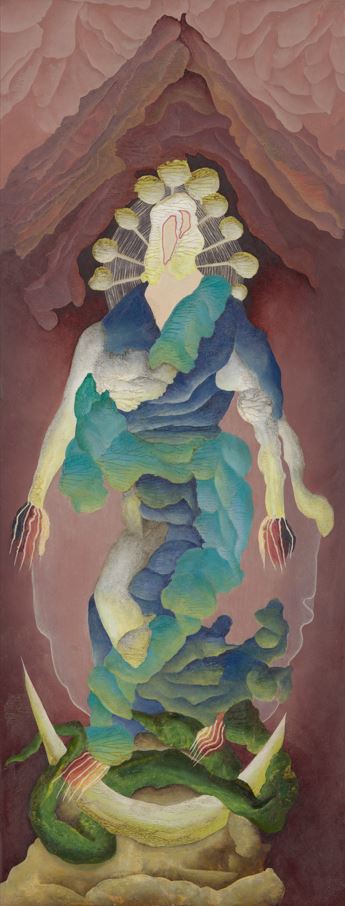
Compare and contrast that with one of the double images, not really in the full Dalí mode but nonetheless a recognisably human figure made entirely out of, well, what? Clouds? Bits of fabric? And what are those hands made out of? All wrapped up in esoteric symbolism of the crescent moon, at the bottom of the image.

Attributes of the Moon by Ithell Colquhoun ( 1947) Tate, presented by the National Trust 2016 © Tate. Photo © Tate (Matt Greenwood)

And in a different style again, here is another overtly erotic work from the extensive ‘Diagrams of Love’ sequence, 20 or so examples of which cover one wall, along with the short elliptical poems she wrote to accompany the series. I think you can see the rude elements without my commentary but what I enjoyed was the spangles scattered over the torso, and the delicate blue of the figure’s wings, tinged with pink and yellow.

Diagrams of Love: The Bird or the Egg? by Ithell Colquhoun (circa 1940) Tate Archive, TGA 929/4/17/3. Photo © Tate Photography (Lucy Green)

It’s full of images like this. The more I looked, the more I liked.


Related links

Related reviews

Tokyo Station by Martin Cruz Smith (2002)

The plot

It is Tokyo, December 1941, and Harry Niles is a fast-talking, streetwise American nightclub owner, one-time American movie importer, gambler and fixer with friends in low – and high – places. He was brought by his parents (Roger and Harriet Niles) to Japan soon after the First World War. They were Southern Baptist missionaries who came to convert the Japanese and left young 10- and 11-year-old Harry in charge of drunk Uncle Orin while they went off for long journeys around the country.

So while uncle was off drinking, Harry grew up speaking fluent Japanese and running wild in the red-light district of Asakusa. The book opens with a scene of the boy Harry being chased by his Japanese schoolboy friends as they re-enact an ancient Samurai legend (which requires an inordinate amount of fighting with bamboo sticks), running through the streets till they tumble through a building, and up against a closed door which, under pressure of their fighting bodies, springs open and lands Harry and the most aggressive of his native Japanese pursuers, Gen, suddenly into the dressing room of a small theatre, the Folies.

Harry and Gen become friends with the manager, with a camp artist Kato who hangs around the theatre and draws and sketches the clientele, and some of the showgirls at the theatre, and are quickly running errands for them and gaining all kinds of new insights into adult life. He develops a crush on the beautiful actress and sometime geisha Oharu, who is fond and kind to him in return.

This is all set in 1922 in the opening chapter of the book, and the narrative for the first half of the book alternates chapters between grown-up Harry, ‘now’, in 1941, and boy Harry, ‘then’, back in 1922, giving us more of Harry’s childhood memories, which explain his character, and also relationships with some of the central adult characters.

But the ‘now’ of 1941 is where most of the narrative takes place and which entirely takes over the second half of the story. It is December 1941, in December. Tension between Japan and America is becoming intense. America has long since imposed an oil ban on Japan, along with a ban on a wide range of modern textiles and produce, but it’s the oil ban that’s hit hardest, with the result that all cars are having to be propelled by charcoal-burning stoves set up in their rears.

All the talk is of conflict, and most of the Americans who can leave Tokyo have already done so. But Harry remains, a puzzle to his acquaintances, happy-go-lucky, blessed with an intimate knowledge of Tokyo, not so lucky in his mistress, Michiko, a fervent communist who he rescued from being beaten up by the ferocious Tokyo police after a protest march some two years earlier, and who latched onto him ever since. He has installed him as the Record Girl in his bar, standing by the jukebox, changing records and mouthing along to the words, dressed in a dinner jacket and sexy stockings. Give the place sex appeal. Encourages the male clientele to buy more drinks. Unfortunately, Michiko is fiercely almost insanely jealous, continually threatening either to shoot Harry or kill herself. Yes, she is quite a strain to be with.

The last plane to leave Tokyo is scheduled to take off on Monday December 8. Unfortunately, as we the readers know, the Japanese launch their surprise attack on Pearl Harbour on 7 December, so we know the plane will probably be cancelled and Harry trapped. Ooops.

So the book follows Harry through three or so days of feverish, against the backdrop of mounting war hysteria, as half a dozen or more complicated plotlines meet and clash to provide a complex plot and mounting tension. Among these are:

Eight months earlier Gen, now a lieutenant in the Japanese Navy, introduced Harry to a man in the back of the geisha house opposite Harry’s Bar who turns out to be Admiral Yamamoto. As a notorious con-man Harry is taken to see the experiments of a certain Dr Ito to turn water into oil. These are impressively staged with lots of electric arcs and sparking, but Harry immediately sees it is a confidence trick and helps Gen expose it.

Now, eight months later, Harry repeatedly makes it clear to anyone who will listen that any coming war will be entirely decided by access to oil. America has vast supplies of it, not least from its own Texas oil ranges. Japan has no oil in its territory but will have to invade and conquer the oil-producing islands of the Dutch East Indies. Hence the willingness of the desperate High Command to believe in the ridiculous Dr Ito and his experiments.

Now we discover that Harry has been involved in falsifying the shipment papers of American oil tankers coming to Japan, to the harbour of Yokahama. He makes it look as if they set off with ten thousand barrels of oil and arrive with only one thousand. Where do they stop off? Hawaii and the naval base of Pearl Harbour. So Harry’s fiddling with the accounts seems to imply that the Americans are building up stocks of oil in secret oil storage tanks somewhere at the harbour. But are they?

Why is Harry bothering to do this? We learn that nobody is paying him to. In fact, he is definitely persona no grata with the American authorities, a position he consolidates by making an outrageously anti-American speech at the Chrysanthemum Club, the club for Tokyo’s most important businessmen and politicians. Here Harry makes a big speech explaining why there is no need for a war. This is because he genuinely doesn’t want there to be a war, but it has the effect of setting both the American and powerful British community against him as a traitor.

As a sideline, there is the thread of Willie Stauber, a German emigre, fully paid-up Nazi, but who Harry worked with in Nanking four years earlier, and who returned from China with a Chinese bride in tow. He is desperate to get out of Tokyo but to make sure his Chinese bride can accompany him. At odd moments, in the midst of his other concerns, we see Harry purposefully working to try and help Willie, eventually by securing faked official documents, into which he, Harry, writes an official text declaring Iris a fit person to travel, sealed with an official seal which he himself makes and stamps, using one of his many underworld skills, this time as a forger.

Colonel Ishigama 1

But the central driving force of the narrative is definitely is the fact that, right from the start of the book, Harry is being hunted by a certain Colonel Ishigama, who has vowed to kill him. Why?

Their paths have crossed twice before. Once, back in 1922, the artist Kato had asked Harry to deliver a fine print to a client. Harry had already taken several to the tall severe figure inside an opulent-looking house. This time he wants to see a new movie so asks his friend Gen to take it. Bad mistake. Hours later, when Gen has not returned, Harry goes to the house and is invited in by the forbidding owner. He finds gen lying sideways on a large pillow with an odd look on his face, while the owner proceeds to show Harry his collection of antique swords, and then to demonstrate samurai moves with it. Eventually, he ushers both boys out of his house, giving Gen a white chrysanthemum as he leaves.

Back at Kato’s studio, the artist explains that this is because Colonel Ishigama (for this is the man’s name) has deflowered Gen, taken his homosexual virginity. This is why he had wanted Harry to take the print; Harry is too ugly for a connoisseur like Ishigama to be attracted to. Now he has spoilt everything.

Kato and Oharu

In fact Kato is so disappointed with Harry that he decides, on the spot, to sever friendship with him, to see him no more. Harry is devastated. the past few months have given him a wonderful insight into art and adult life, and wonders and mysteries. But Kato is unbending and Harry is kicked out to wander the streets in tears.

That night boy Harry tracks down Kato to a walled garden. Sneaking over the wall Harry is transfixed to discover that Kato is sketching Harry’s beloved actress Oharu being fucked in various positions by one of the comedians from the Folies theatre. Having become drenched in Japanese aesthetic values Harry is able to appreciate the subtlety of the positions, and the rapid way Kato sketches lines and form, writing scribbled notes in the margins indicating what colours later to use when he works them up to prints in his studio.

But a sudden flash of lightning reveals Harry standing in the garden watching the scene. Quick as a flash he turns and leaps back over the garden wall, scampering way through the alleyways of Asakusa in the pouring rain back to the house where he’s meant to be supervised by drunk Uncle Orin, but where he is, as usual, alone, and hunkers down into his bed cold and wet and miserable. Except that, a few minutes later, Oharu knocks meekly at the door, comes sits by the bed and apologises. ‘It was only sex, Harry,’ she says, voicing the very different attitude the Japanese take to copulation from us shame-filled Westerners. it was just poses and positioning for her friend the artists, Kato, nothing more. She strokes his head. He is cold and feverish. She insists on getting him out of his wet things. She climbs in behind him and Harry feels her nipples hardening. She takes his hand and guides it between her legs. In short, she guides him through the mysteries of sex, and takes his boyish virginity.

All novels are, at some level, wish fulfilment. The wish fulfilment and fantasy is nearer the surface in ‘genre’ fiction. What man reading this could not be transported and wish this was how he lost his virginity.

Unfortunately, Harry is just falling asleep in Oharu’s arms when the light is brutally turned on to reveal Harry’s parents standing over them, unexpectedly returned from a long missionary tour, accompanied by the bleary-eyed and mortally embarrassed Uncle Orin.

Harry’s father brutally yanks Oharu by the hair out of Harry’s bed and when Harry protests belts him so he reels across the room. He would have pushed Oharu naked out into the street, except that his wife points out the neighbours will see, the humiliation etc, so they let her hurriedly dress in her kimono before kicking her out then Roger Niles takes his belt to Harry and beats him till he bleeds.

Suffice it to say this experience crystallises Harry’s love for everything fine, refined and Japanese and his contempt for everything big, blundering and brutal about America. Within days they are on a boat sailing back to the States. A few months later Tokyo is devastated by the vast earthquake and firestorm known as the Great Kanto earthquake, an appalling disaster in which some 144,000 people lost their lives in the unimaginable holocaust of out of control firestorms. Harry later learns that Kato died trying to protect his prints, and nothing was heard of Oharu: like so many other she simply disappeared, burned without trace.

Colonel Ishigama 2

Anyway, it is only two-thirds of the way into the book that we discover the cause of Ishigama’s ire and why Harry has been trying to evade him for the first 300 pages, in a prolonged flashback. The story is actually told by the German Willie Staub. Four years earlier Willie had been in China when the Japanese invaded. He had been in the capital Nanking when the Japanese arrived and began their reign of fear. They gang raped all the women they could find. they rounded up men and shot them in squads of up to a hundred. NCOs arranged for the still raw recruits to use live Chinese as bayonet practice in order to perfect their technique.

In the midst of this holocaust Willie and the handful of other Europeans tries to set up a safe quarter of town to protect the Chinese fleeing there. From nowhere appears an American who can speak fluent Japanese and becomes Willie’s driver. He tells several stories about how Harry used his con-man confidence to interrupt executions and gang rapes.

Best technique was to muscle through the Japanese soldiers holding down the woman, take out a stethoscope and examine her groin (having first gotten the Japanese penis removed) and announce confidently that she had venereal disease, reminding the soldiers that they don’t want to infect themselves and bring this pollution back to their wives and sweethearts. The Japanese desisted. Harry and Willie took the traumatised woman to their lorry, to join all the others, and, once the lorry was full, be driven back to the (relative) safety of the European zone.

Anyway, one day on their tour of the atrocities, they come across a crowd of soldiers surrounding a line of ten Chinese civilians who have their hands tied behind their backs and have been made to kneel in a line. At the end of the line is Colonel Ishigama. Harry recognises him instantly. And recognises the beautifully crafted, infinitely sharp samurai sword he is holding. He is about to see if he can behead ten people in a row in under 60 seconds. As he flexes his wiry forearms, and as his aide de camp prepares the bucket of water and cloth with which he will wipe the sword between strikes, Harry grabs all the cash he and Willie have in the cash box in the lorry, jumps down and walks confidently into the ring of soldiers, yelling that he will give Ishigima 100 yen and every man in the watching soldiers ten yen each, if Ishigama can behead them all in under thirsty seconds, those left unbeheaded to walk free. The soldiers cheer for the money and Ishigama reluctantly agrees (refusing would lose face) and Smith then describes the grisly decapitation of the first five civilians, with Ishigama losing time because he’s flustered, because the aide de camp drops the wiping cloth, accidentally hitting his own aide de camp on one backswing: the upshot is that Ishigama only manages five before the thirty seconds is up.

The crowd of soldiers roar, Harry gives them the huge bundle of yen to distribute and hustles the surviving five civilians – including a 13-year-old boy who has pooed and peed himself – into the back of the lorry alongside the raped women, and they carefully reverse, through the cheering soldiers and drive off before Ishigama can do anything.

This is why, when Harry hears, right at the start of the story, that Ishigama is back from China in Tokyo, it fills his mind with anxiety and drives the narrative.

Ishigama’s revenge

There are a lot of other plot strands. Harry meets with his mistress (Lady Alice Beechum – wife of Sir Arnold, the British ambassador), tries to hide the fact from Michiko, runs his bar, the Happy Paris, makes his speech at the Chrysanthemum Club, meets other friends Japanese and American, for drinks and gossip, is present at the small group for drinks where Willie tells the story about Ishigama, meets his schoolboy friend and nemesis Lieutenant Gen, now in the Japanese Navy, for conversations about oil or lack thereof for the Japanese war effort.

In a separate plotline he is being investigated and followed by Sergeant Shozo of the Special Higher Police, also known as the Thought Police, and his goon assistant Corporal Go. They have been tipped off about his involvement in the Magic Oil experiments of Dr Ito, and turn up at the Yokohama dockside offices of one of the oil companies whose books Harry is fiddling to make it look like oil is being offloaded in Hawaii.

Also we run into several of Harry’s small gang of boyhood Japanese friends, and discover how they’ve turned out. One is a sumo wrestler, Taro, twin of Jiro, who had joined the navy and been killed and who, in a series of scenes, Harry promises to accompany to the office where they collect his ashes and official war box (containing the ashes, military citation and so on) to be given to the dead hero’s family.

Plus involvements with various local gamblers and a strand where Harry swaps all the cash he has for gold from a friendly pawnbroker.

Altogether, these intertwining plotlines and strands form a wonderful fabric, a tapestry of stories and adventures and scams, each of them shedding light on different aspects of Japanese culture, and tradition, building up a persuasive sense of life in Japan of the period.

But it is only in the last 100 pages or so that Ishigama finally catches up with Harry. It is in the willow house, a geisha house opposite his bar. Harry has returned from various meetings and adventures to discover his own bar dark and locked up. Unusual. He didn’t give instructions for this. And the willow house opposite is strangely quiet. It is unlocked. He takes his shoes off and tiptoes along the hall until he hears a voice calling his name.

In a genuinely bizarre scene, he discovers Colonel Ishigama quietly kneeling at a traditional Japanese table with his immense super-sharp samurai sword lying on it, attended by an immaculately painted geisha girl. Harry knows everything about Japanese culture and so this scene is stuffed with facts about geishas and the intricacy with which they are painted, their social and cultural role, as well as lots of information about Ishigama’s background.

Ishigama is infinitely polite and solicitous. He asks the geisha for hot sake. They drink each other’s health. Harry knows that if he makes one false move or says something wrong, Ishigama will whip up the sword and behead him faster than he can move.

It is the standout scene in a novel full of strikingly vivid, beautifully imagined scenes. Ishigama calmly and politely informs Harry that he (Harry) owes him (Ishigama) five heads, the five heads he never got to take off back in China. Of course Harry’s will be last, but he, Harry, will select the identities of the other four. Harry’s mind races…

At which point one of Harry’s acquaintances, Al DeGeorge, a journalist with the Christian Science Monitor, knocks on the door. He is drunk as a skunk. He stumbles inside shouting Harry’s name wanting to know why his bar isn’t open. He makes it right up to the entrance of the back room when Ishigama abruptly swoops to his feet, with one stride is at the doorway, and with one enormous sweep of the sword cleaves DeGeorge from shoulder blade to belly button. the dying man grunts a last syllable and falls in two halves.

Neither Harry nor the geisha has moved. As I say, powerful scene. In the event it slowly dawns on Harry, to his amazement, that the geisha is none other than his fierce lover, Michiko. All kinds of speculation goes through his mind. Was she always a geisha on the side. Who painted her so elaborately, every geisha needs an assistant? Was it Ishigama, a psychopath famed for his aesthetic abilities? In which case, did she service the brutal sadist?

Harry’s mind is swimming while he all the time makes no movement as Ishigama ritually cleans his sword and returns to the kneeling position opposite Harry at the low table. More sake! And the three toast each other as if nothing had happened. Then suddenly Michiko has a small dagger at Ishigama’s throat. She makes him put down the sword and Harry grabs both it and the smaller ceremonial sword from Ishigama’s sash.

Ishigama is neutralised. He smiles. Now he knows Michiko’s true relationship with Harry. Then he stands up and, of course, Michiko can’t bring herself to stab him. Before they can stop him he leaps through the paper wall of the room and is into the garden and beyond. Harry collects up the swords, grabs Michiko’s hand and they run back across the road towards his bar, letting themselves in, locking the door, Harry fumbling for the pistol he has hidden under the floorboards.

Then Harry is picked up by the Thought Police and taken to a prison where he sees the manager of one of the oil companies whose records he had faked, bound to a table and beaten senseless with bamboo rods. Sergeant Shozo is very polite, offers him a cigarette, says this will happen to him unless he tells them what he knows about the secret oil tanks at Pearl Harbour. They only beat Harry a little and eventually (and a bit inexplicably, to me) they let him go.

Harry makes his way back to central Tokyo and spends the remaining 100 or so pages of the book in increasingly desperate attempts to inform the American ambassador, and then his mistress, Lady Beechum, that he is now convinced a Japanese attack is coming very soon. The ambassador, cornered at a swish Japanese golf course, simply pretends to ignore him. Lady Beechum tells him noone will believe him; he is the most discredited man in Tokyo.

Then there is another encounter with Ishigama, in the street which is interrupted by news announcers blaring from every streetside loudspeaker – that Japan has launched a surprise attack on the American fleet and utterly destroyed it. People stream out of their houses, cheering. Ishigama is lost in the torrent of people. All the plotlines come together. Harry drives through the throng to the American embassy only to discover, amid scenes of panic as all the embassy staff gather and burn all their secret information, that Harry’s name is not on the list of Americans who will be repatriated. His old schoolboy friend Hooper explains it is partly because he is persona non grata with both the American and British ex-pat community. But more because the Japanese want him.

Finally Ishigama catches up with him, helped by his oldest schoolboy frenemy, Gen, giving rise to a prolonged chase through shops and back alleyways until Harry finds himself, unwittingly, tumbling once again through the door into the dressing room of the Theatre Folies, where he had tumbled all those years ago. Now it is dusty and abandoned and now, on its empty stage, the last gruesome scene of the novel takes place.

You will not be surprised to learn that heads roll. But I think you should read this immensely enjoyable to find out whose.

Cast

Whites

Lady Alice Beechum – wife of Sir Arnold, British ambassador, Harry’s sexually athletic mistress, who has also worked in the British code room for two years, very well informed about international affairs

Sir Arnold Beechum – purple faced blimp who knows full well Harry is having an affair with his wife and, late on in the novel, ambushes Harry with a cricket bat, knocking him unconscious, as if Harry didn’t have enough to worry about already

Willie Staub – member of the Nazi Party, former managing director of China Deutsche-Fon – who was with Harry back in Nanking, China, then married Iris, a Chinese woman, who he is desperate to help get away with him back to Europe

Al DeGeorge – sceptical journalist for the Christian Science Monitor

Japanese

Agawa – keeper of a local pawnshop who exchanges Harry’s cash for small gold ingots

Corporal Go of the Thought Police, a grinning sadist

Goro – reformed pickpocket friend of Harry’s, gone straight and married the owner of a stationery shop he once tried to rob

Haruko – waitress at Harry’s bar, the Happy Paris

Ishigami – the young army officer who deflowers the boy Gen, and gives him and Harry a display of samurai swordsmanship, who Harry cheats out of his Chinese beheadings in Nanking, and then pursues Harry implacably through the second half of the novel like an avenging Fury

Kato – artist and printmaker, who teaches Harry (and the reader) the aesthetics of Japanese prints and design; after Harry lets Gen take a print to Lieutenant Ishigama – who seduces him – Kato drops Harry as unreliable

Kondo – bartender at the Happy Paris

Michiko Funabashi – young woman communist who Harry saves from a riot, sleeps with and thereupon becomes his fiercely jealous mistress, she serves as the Record Girl in his bar, and pops up unexpectedly painted as a geisha girl in the central scene with Colonel Ishigama

Oharu – actress in the theatre who wipes the boy Harry’s face when he tumbles into the changing room, and becomes his muse, and who later takes his virginity: lost in the great earthquake of 1922

Sergeant Shozo of the Special Higher Police – thoughtful and playful officer who unwaveringly pursues Harry to find out if he was lying about the oilfields at Hawaii

Taro – sumo wrestler, twin of Jiro, who joins the navy and is killed, whose ashes Taro receives on the main day

Tetsu – one of their boyhood gang who becomes a yakuza and is covered in tattoos

Gen – the leader of their gang when they were boys, now a lieutenant in the Japanese navy

Admiral Yamomoto – head of the Imperial Japanese Navy who Harry is introduced to by a nervous Lieutenant Gen eight months earlier, whose trust Harry wins by playing poker with him, and who then asks for Harry to come and watch the conman Dr Ito perform his fraud of supposedly turning spring water into oil

Cruz Smith’s prose

Cruz Smith’s writing has two obvious pleasures: one is that he really transports you to his locations, making you feel and smell and breathe them. The bustling, noisy cityscape of 1940s Tokyo is vividly conveyed, from the pomp of the British Embassy, via the top businessmen at the Chrysanthemum Club, to the umpteen bars and pawnshops and sumo training gyms and artists studios which Harry’s numerous interests take us to.

Second is the way he can make language jive and shimmy. I’ve just read a couple of thrillers by the Englishman Robert Harris, which are written in clear efficient journalistic prose, the text’s ‘grip’ deriving from the mounting tension implicit in the increasingly fraught situations he describes. Harris’s prose is meant to be transparent as a reporter’s to let the fraught scenarios snag the reader.

By contrast Cruz Smith is a poet. He can make the language jive and shimmy in totally unexpected ways. You know the old archive footage where an artist like Picasso draws a couple of lines onto paper and… it is a bull! Same with Cruz Smith. A couple of ordinary words are arranged in a novel combination which opens up an entirely new idea or sensation. He’s magic!

In this way, not only are the novels exciting and informative but they also supply a steady stream of moments when the prose leaps up and performs tricks for you. I’m not saying he’s Shakespeare. Just that he can do in a phrase what other authors need a paragraph to do, and then injects something extra.

For example, here is Tokyo as the loudspeakers at every road corner blare the news that Japan has launched and won the Pacific war.

Each radio report began with the opening bars of the ‘Warship March’, and with every account, Tokyo seemed to rise farther above sea level. (p.407)

When Harry is planning to ditch Michiko in order to be on the last plane out of Tokyo sitting next to his mistress, Lady Beechum, he thinks:

He’d garb his betrayal with small decencies… (p.233)

Lady Beechum is all-too-aware of Harry’s crooked shortcomings, as she sums up in a Wildeish paradox:

‘Harry, it’s a fantasy. You and I were not meant to be with anyone. it’s sheer incompatibility that keeps us together.’ (p.172)

Sometimes it’s more in the zone of American street smarts, descended from a long line of pulp writers, and crafted to reflect Harry’s own rueful self-awareness.

A crow trudged up the road and shared a glance with Harry, one wiseguy to another. (p.330)

It was one of those moments, Harry thought, when your life was put on the scale and the needle didn’t budge. (p.342)

But at others, it’s poetry, moments when you see a new aspect of human behaviour.

The man spoke with such intensity that it took Harry a moment to find the air to answer. (p.191)

Sometimes it’s the poetry of description.

Every few minutes a fighter plane would pass overhead, towing its shadow across the baseball diamond and up over the slope to the airfield across the road. (p.130)

This immediately and vividly made me recall all the times an airplace shadow has passed over or near me. I was there.

Maybe my favourite is the moment when the boy Harry pops over the wall into the garden of the house where he is to discover Ohasu having sex and being sketched by Kato, in a heavy summer downpour of rain, and:

The house was larger than it had appeared from the street, with a side garden not of flowers but of large stones set among raked pebbles. In a brief illumination of lightning, Harry saw the garden as it was meant to be contemplated, as small islands in a sea of perfect waves. The pebbles chattered in the rain. (p.250)

‘The pebbles chattered in the rain.’ Not show-offy, witty or paradoxical. Only six common little words. But which convey the moment perfectly, the garden of Japanese pebbles glistening and minutely jostled by the heavy downpour. You are there. With Harry. At the heart of the story. And Cruz Smith does this again and again with acute details and snappy phrases. His books are not only gripping and thoroughly researched, but deliver a really verbal, literary pleasure.


Related reviews