Catherine Opie: To Be Seen @ the National Portrait Gallery

Self-portrait/Nursing, 2004 © Catherine Opie, courtesy Regen Projects, Los Angeles; Lehmann Maupin, New York, Hong Kong, London, and Seoul; Thomas Dane Gallery

This is a self portrait by Catherine Opie. Born in 1961, Opie is a lesbian and one of America’s leading fine art photographers. For forty years she’s been creating photographic projects concerned with community and identity in the USA. Now the National Portrait Gallery is staging the first major museum exhibition of her work in the UK.

Half way round the show I came across a phrase which offers a handy entry to Opie’s oeuvre: a wall label refers to ‘the politics of visibility’. This was a new phrase for me, so I looked it up:

The politics of visibility is the strategic management, contestation, and control of who and what is seen, heard, or recognized within public, media, and digital spaces. It acts as a form of power that shapes social identities, recognizes marginalized groups, or enforces surveillance and exclusion.

The idea is that the community Opie belongs to – the queer or gay or lesbian community – has historically been unrepresented in Western art, photography, or just mainstream media, and so she has devoted her career to redressing this imbalance, to making her people seen, giving visibility to her community.

According to one online biography, Opie at an early age discovered the work of photographer Lewis Hine, who documented the plight of child labourers at the turn of the 20th century. Inspired by Hine’s images, she requested a camera for her ninth birthday and was given a Kodak Instamatic by her parents. She immediately began photographing her family and neighbourhood and, in a sense, has never stopped.

And hence the title of the exhibition: To Be Seen. As to this self portrait, Opie depicts herself breast-feeding her son Oliver. Her real, scarred and tattooed body proudly reclaims motherhood from depictions of pious devotion, represented through the Madonna and Child. It’s also, let’s face it, an assertion of pride in being big, heavy, as the Yanks say. I think it works in both ways, asserts two kinds of pride. It is, I think, a beautiful image of love and care and tenderness. In many ways it’s the best image in the exhibition, candid, open, unembarrassed and loving.

Projects

Being and Having (1991)

Her first major work, ‘Being and Having’ consists of 13 closely cropped portraits of Opie (as her alter ego, ‘Bo’) and her ‘leather dyke community enacting their moustachioed masculine alter-egos’. They were, apparently, inspired by court painter Hans Holbein. It was her first major artwork setting out to challenge a binary approach to gender identity. Opie says: ‘Being and Having stares right back at you – we’re women occupying a masculine space.’

Self portrait as Bo

Bo, 1994 © Catherine Opie, courtesy Regen Projects, Los Angeles; Lehmann Maupin, New York, Hong Kong, London, and Seoul; Thomas Dane Gallery

A ‘leather dyke community enacting their moustachioed masculine alter-egos’

Installation view of the exhibition Catherine Opie: To Be Seen at the National Portrait Gallery. Photo copyright © David Parry

Portraits (1993–97)

Portraits depicts her friends in the lesbian and gay community in Los Angeles, mixing traditional portrait photography with less traditional subjects.

Divinity Fudge, 1997 © Catherine Opie, courtesy Regen Projects, Los Angeles; Lehmann Maupin, New York, Hong Kong, London, and Seoul; Thomas Dane Gallery

Domestic (1995–98)

In the mid-1990s Opie embarked on an American road trip, traveling 9,000 miles over three and a half months to photograph lesbian couples and families in their homes. ‘Domestic’ was a response to the seminal exhibition ‘Pleasures and Terrors of Domestic Comfort’ at MoMA in 1991, curated by Peter Galassi. In ‘Domestic’ Opie wanted to represent her community, which was absent from the MoMA show. Using an 8 × 10 large format camera, ‘Domestic’ was Opie’s response to the absence of Queer lives in visual representations of home life.

Flipper, Tanya, Chloe & Harriet, San Francisco, California, 1995 ©Catherine Opie, courtesy Regen Projects, Los Angeles; Lehmann Maupin, New York, Hong Kong, London, and Seoul

Surfers (2003)

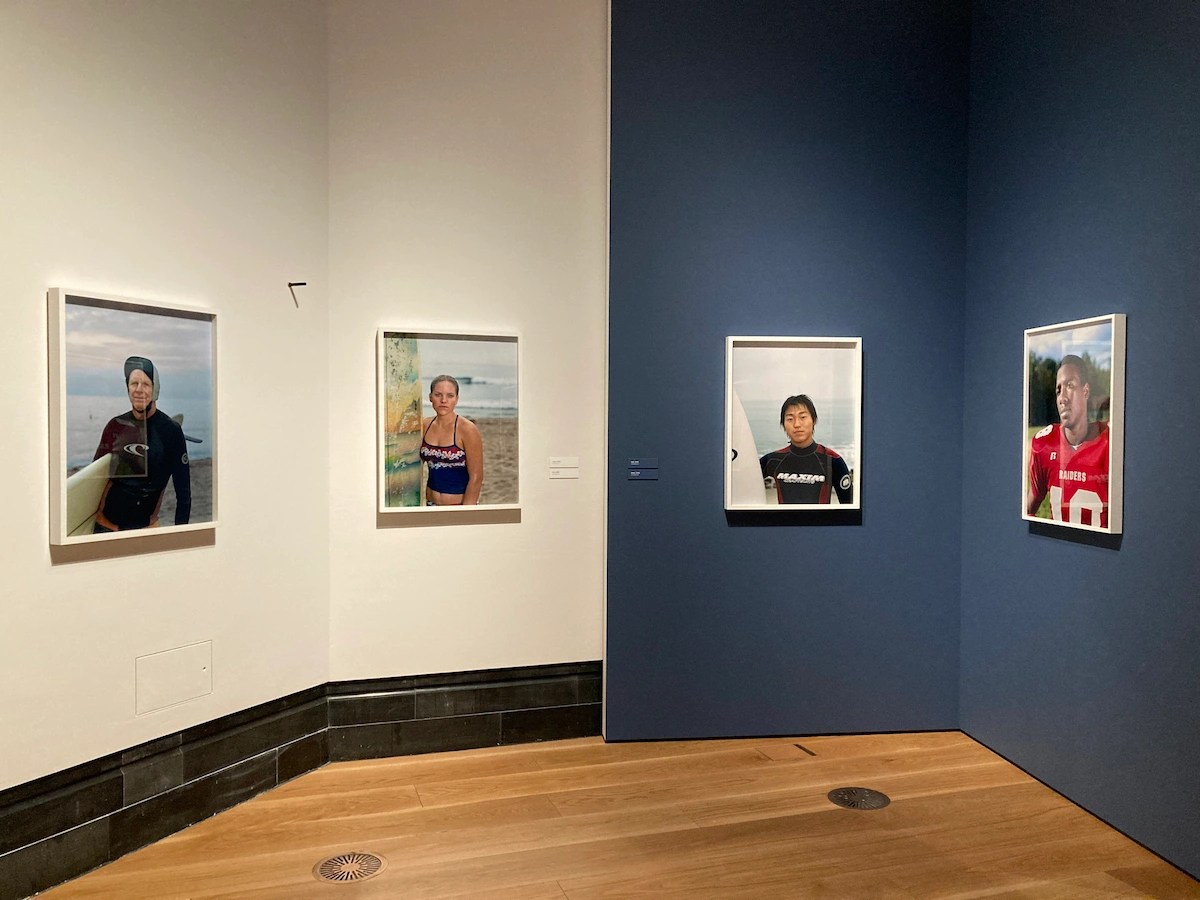
‘Surfers’ depicts the California surfing subculture. Rather than showing them riding waves, Opie portrays her surfers emerging from the sea looking unglamorously wet and cold and dazed – surprisingly British, in fact.

Installation view of Catherine Opie: To Be Seen @ the National Portrait Gallery, showing some of the ‘Surfing’ portraits’ (photo by the author)

In and Around home (2004)

In the early 2000s, Opie explored her Los Angeles neighbourhood and the domestic setting of her home. ‘Oliver in a Tutu’ from the series ‘In and Around Home’ depicts her son in a pink tutu in the kitchen doing laundry. This domestic scene is aligned with Opie’s politics of visibility against the backdrop of the continued homophobia within American culture at the time during the Bush era.

Oliver in a Tutu, 2004 © Catherine Opie, courtesy Regen Projects, Los Angeles; Lehmann Maupin, New York, Hong Kong, London, and Seoul; Thomas Dane Gallery

Doesn’t he look like a sweetheart! What a lovely image of everyday domestic happiness.

Children (2004)

For ‘Children’ Opie returned to the studio and to her signature highly focused portraits, this time of children set against bright solid colour backdrops.

Installation view of Catherine Opie: To Be Seen @ the National Portrait Gallery, showing some of the ‘Children portraits’ (photo by the author)

High School Football (2007-09)

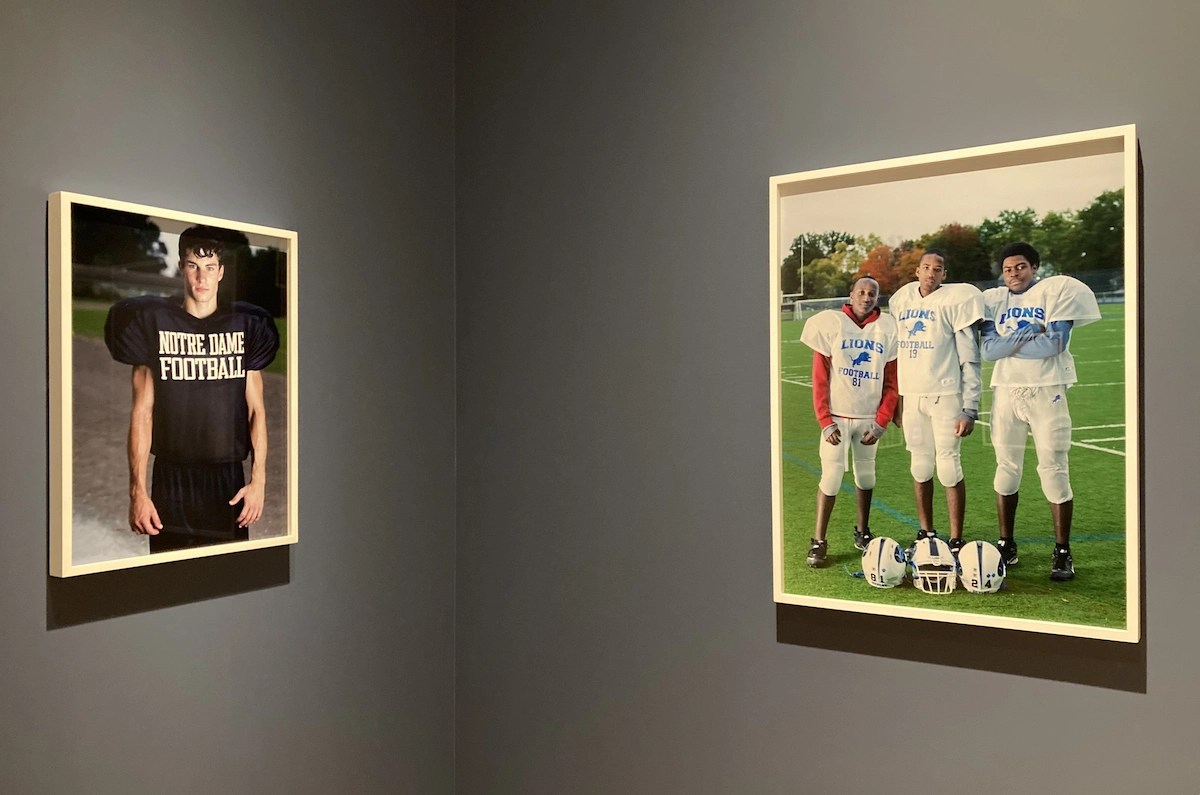
From 2007 to 2009 Opie’s continued her exploration of the American landscape through the specificity of identity as it is played out on high school football fields. Opie made portraits of high school football players across several US states, vulnerable portraits of the young men counter stereotypes of athletic masculinity at a time when the US was engaged in a war with Iraq and Afghanistan.

Installation view of Catherine Opie: To Be Seen @ the National Portrait Gallery, showing some of the ‘American football’ portraits (photo by the author)

Do these images subvert, interrogate or deconstruct masculinity? Ask the marines steaming towards the Gulf of Hormuz.

Girlfriends (2010)

A series of black-and-white portraits (1989-1999) which were first exhibited in 2010), the series continues Opie’s longstanding examination of the history of photography and her community in a different format.

Studio Portraits (2012–2018)

In the 2010s Opie used theatrical lighting against a black velvet backdrop to illuminate masterly and striking portraits. Allegorical elements allude to the political and spiritual concerns of art. They evoke Renaissance and Baroque painting, presenting her subjects in allegorical poses in front of black backgrounds, which remove the individuals from any sense of time or place.

Installation view of Catherine Opie: To Be Seen @ the National Portrait Gallery, showing some of the Baroque Studio Portraits (2012–2018) (photo by the author)

These portraits are characterized by highly staged, theatrical lighting against a black background, intended to create a painterly, intimate, and often allegorical quality. I haven’t mentioned that the exhibition space has been unusually designed into box-shaped rooms and corridors with, as here, the wall colour chosen to offset the images.

Walls, Windows and Blood (2023)

Opie’s photograph of Pope Francis, diminutive at his Vatican window amid the ‘constructed architecture of power’, is drawn from a body of work entitled ‘Walls, Windows and Blood’ (2023), made during a pandemic-era residency at the American Academy in Rome. The title of this portrait of the former head of the Catholic Church is a reference to the delayed papal acknowledgement of the deaths of Canada’s First Nation’s children under the church’s administration. It’s part of a small selection of images from larger locations which includes shots from President Obama’s inauguration, a Boy Scout Jubilee, and others.

Installation view of Catherine Opie: To Be Seen @ the National Portrait Gallery, showing some of the photos she took at the inauguration of President Obama on 20 January 2009 (photo by the author)

Comments

When you read the press material, the online promotion and the wall labels, you are given the impression that Opie is a radical political figure. But when you stroll from photo to photo you come to realise nothing could be further from the truth. Everything is very quiet and homely. Photos of friends, of her house and child, of other children, images of young surfers and football players, documentary images of the Obama inauguration or a handful of other mass events (a Boy Scouts Jubilee, some festival).

The more it went on, the blander it felt. The set of lesbians with moustaches is funny in a 1990s kind of way. The half dozen local children are sweet. The surfers look very wet. The footballers look fit. The friends posing against black backgrounds look very stagey.

But few if any of the images really stood out for me. Compare and contrast the vividly seedy colour photographs of the recently deceased Martin Parr to see what unnerving commentary colour photography is capable of. If you strip away the excited queer rhetoric, most of the Opie images seemed to me, well, OK, proficient enough, quite nice, meh.

In the end I thought the opening image of her breastfeeding her son was the one really standout image, and the one which had the most ‘political’, emotional and visual impact.


Related links

Related reviews

Trouble for Lucia by E.F. Benson (1939)

‘I won’t give up the morning shopping. Besides, one learns all the news then. Why, it would be worse than not having the wireless! I should be lost without it.’
(Georgie Pillson, like all the Mapp and Lucia characters, gaga for gossip)

Only a few minutes ago some catastrophic development seemed likely, and Tilling’s appetite for social catastrophe was keen…
(The endless thirst for gossip)

Her eye had that gimlet-like aspect, which betokened a thirst for knowledge.
(What happened? Any news? What’s the latest?)

Endless interpretations could be put on this absorbing incident…
(Summary of Benson’s technique)

Lucia… went down to the High Street for her marketing. Her mind resembled a modern army attended by an air force and all appliances. It was ready to scout and skirmish, to lay an ambush, to defend or to attack an enemy with explosives from its aircraft or poison gas.
(The unrelenting battle for social supremacy which is the books’ subject)

‘There’s nothing that stings so much as contemptuous oblivion. I have often found that.’
(Lucia’s revenge)

‘Trouble for Lucia’ is a 1939 comic novel written by E.F. Benson. It is the sixth and final novel in the ever-popular Mapp and Lucia series. As you know by now, the novels are set in the town of Tilling, a thinly disguised version of Rye on the Sussex coast where Benson himself lived (and, like his fictional heroine Lucia, served as mayor).

The novels give minute descriptions of the petty rivalries and jealousies among a tiny cohort of characters, the comedy deriving from the discrepancy between the intense triviality of the tiny events described, and the po-faced earnestness of Benson’s treatment. It struck me this could be symbolised by the rich Wyses’ who own an enormous Rolls Royce complete with chauffeur but only ever use it to drive the 50 yards from their house to Lucia’s house, or the 100 yards down to the High Street to go shopping.

The lead characters are Mrs Emmeline ‘Lucia’ Lucas, her long-time friend, lieutenant and piano duet partner, Georgie Pillson, and her bitter rival for supremacy of Tilling’s social scene, Elizabeth Mapp. At one point Georgie says of Lucia that:

That was her real métier, to render the trivialities of life intense for others.

in a phrase which could be Benson describing his own subject matter.

Cast

  • Emmeline ‘Lucia’ Lucas, now Pillson (since she married Georgie, in the preceding novel)
    • Grosvenor – her maid
    • Chapman – her chauffeur (I was puzzled whether this was a mistake; the chauffeur is called Cadman in all the other novels)
    • Mrs Simpson – the lady she hires to be her secretary
  • Georgie Pillson – her camp husband, ‘He and his petit point, and his little cape, and his old-maidish ways…’
    • Foljambe – his peerless parlour-maid and valet
  • Elizabeth Mapp-Flint – Lucia’s longstanding enemy
  • Major Benjamin ‘Benjy’ Mapp-Flint – Elizabeth’s long-suffering husband, plays golf every day, given to sneaking off to have a few whiskeys whenever his wife’s back is turned
  • Godiva ‘Diva’ Plaistow – along with gay Irene, the only single woman in the set; speaks in telegraphese: ‘Lovely to see you after all this long time. Tea going on. A few friends’ or ‘Two of your councillors here just now. Shillings. Didn’t charge them. Advertisement’; during the course of this novel she sets up a successful tea rooms
    • Janet – her maid
    • Paddy – her Irish terrier
  • ‘quaint’ Irene Coles – the unshockable lesbian painter – I was staggered to learn in this novel for the first time that she is only 25 years old! (page 196) I thought she was middle-aged like all the others…
    • Lucy, her 6-foot-tall maid
  • Mr Algernon’s Wyse – rich, owner of a Rolls Royce
  • Mrs Susan Wyse MBE – fat, her ‘immense bulk’, ‘Susan’s great watery smile spread across her face’
  • Amelia, Contessa di Faraglione – Algernon’s sister, married an Italian count, makes occasional flying visits to Tilling where she’s always hugely amused by the tittle tattle
  • The Reverend Kenneth Bartlett – vicar, addicted to speaking a weird combination of Highland Scots and Elizabethan English so as to be barely comprehensible
  • Evie Bartlett – his mousey wife; ‘Evie emitted the mouse-like squeak which denoted intense private amusement’
  • Olga Bracely – the internationally renowned opera singer, ‘a dream of beauty with her brilliant colouring and her high, arched eyebrows’, who appeared in the first and third novels but has been on a world tour; in those books Georgie was deeply in love with her
  • Cortese – the Italian composer
  • Dorothy – Cortese’s English wife
  • Lady ‘Poppy’ Sheffield – owner of rundown Sheffield Castle, the cause of so much trouble in the final part of the novel, develops an amusing crush on Georgie
  • Miss Susan Leg – real name of the world-famous novelist, Rudolph da Vinci
  • Mr Rice – the poulterer
  • Mr Twistevant – the grocer
  • Mr McConnell – editor of the Hampshire Argus in which a lot of these shenanigans are reported
  • Mr Fergus – the dentist
  • Inspector Morrison – of the Tilling police

Plots and storylines

‘Trouble for Lucia’ takes up very soon after where its predecessor left off. To the reader’s amazement, in the preceding novel, ‘Lucia’s Progress’, the forceful widow Mrs Emmeline ‘Lucia’ Lucas had married her long-time friend, lieutenant and piano duet partner, Georgie Pillson, thus becoming Mrs Pillson.

She had also made herself the most eminent person in the town of Tilling through a string of charitable donations, to the local church, the local hospital, the cricket and football clubs, until she was finally nominated first woman Mayor of Tilling. (For the biographically minded, Benson himself served as Mayor of Rye between 1934 and 1937 so a lot of the detail of council business and formal costume is presumably based on first-hand knowledge.)

This final novel opens at this point: it is October and Lucia’s nomination to Mayor is confirmed but she hasn’t yet taken up office, she’s due to do that in a month’s time. So she’s fussing about related problems. When she’s mayor should she continue to do her own shopping in the high street?

She shares with Georgie her plans: to make Tilling a centre of intellectual and artistic activity, to help the poor, to clear away the old slums, an end to overcrowding, pasteurisation of milk, strict censorship of films, benches in sunny corners, flower boxes in windows, affordable concerts of first-rate music. All very admirable.

Meanwhile, Georgie is offended that no place might be found for him at her inaugural dinner, which is usually restricted to the Corporation, the aldermen, other councillors and so on; until Lucia comes up with a seating suggestion for him. He has bought a red velvet jacket specially, to mark his new status. Lucia has engaged a shorthand and typewriting secretary, a Mrs Simpson, in readiness for her mayoral work.

Today’s gossip: Diva wants to convert her house into a café; Iris has been refused permission by the council to cover her house with a fresco depicting an immense naked woman standing on shell representing motherhood; Susan Wyse has sat on her own pet budgerigar and squashed it flat.

Everyone Lucia and Georgie meet in the High Street asks who she is going to choose to be her Mayoress, and all the usual suspects are soon vying for the post, appealing directly like Diva or getting their partners to send begging letters. This wave of appeals coincides with a dinner and bridge evening Lucia holds at which the different parties make their pitches.

Typically muted comedy as Georgie, immensely proud of the new red velvet jacket he’s ordered, is dismayed to find Mr Wyse turning up in a similar velvet jacket but of sapphire blue. As Diva puts it:

‘Aren’t the Tilling boys getting dressy?’

But Lucia has decided. She will have Elizabeth as her mayoress and invites her round to tell her so. Within an hour Elizabeth has told everyone. Her version is that Lucia begged her to take the post. Lucia doesn’t lower herself to tell the truth which is that Elizabeth had been loitering round her house all day, gagging for the job. And the reality is that Lucia, although she doesn’t put it like this, would, in Lyndon B. Johnson’s words, rather have Elizabeth inside the tent pissing out, than outside the tent pissing in.

Irene’s photo

Irene is outside her house enjoying the sun and making sketches for her fresco when Elizabeth hoves into view, fresh from Lucia telling her she’ll be her mayoress. Flush with enthusiasm she happily adopts a silly pose for Irene to sketch and take a photo of. But when she goes on to boast of how Lucia begged her to take the role, Irene (a passionate fan of Lucia) knows she’s lying and despises her. When Lucia comes by later on, and tells the true account of the interview, Irene’s suspicions are confirmed and she tells Lucia she will send the photo of Elizabeth in a silly pose to the newspaper, the Hampshire Argus, purporting to be a serious image of the new mayoress.

When the paper uses the disrespectful photo of Elizabeth in their story about the mayoress appointment, Liz and husband Major Flint are furious and Flint sets off for the newspaper offices with a riding-whip which he promises his wife he’ll horsewhip the editor with. But 1) while he waits he has a few nips of the newspaper’s hospitality scotch and 2) the editor turns out to be an imposingly massive man. Combine the two and the result is that a tipsy major not only ends up having a nice chat with Mr McConnell, but brings him home to Grebe (the cottage where Elizabeth and Benjy live) for dinner!

But the repercussions haven’t finished. Drunk Benjy Flint left his riding-whip at the newspaper offices so Elizabeth calls by to collect it. On the way home she stops at Diva’s place, where Diva is testing her tea offering on a few guests (Evie, the Padre and Georgie). Here she 1) puts a brave face on the Benjy-visiting-the-Chronicle story (claiming not to have seen the silly photo of herself, though all present know she has). But 2) she puts the riding-whip down for the duration and it is swiftly grabbed by Diva’s dog Paddy who (unseen by everyone) takes it outside and chews it to pieces. So that when Elizabeth rises to leave she can’t find it anywhere, searches high and low and leaves in high dudgeon. Only later does Diva spot the shiny silver cap of the riding-whip in her garden, attached to some chewed remains and realise her dog has destroyed it. So she guiltily buries the silver cap in her back garden and hopes the whole thing will blow over.

This is typical of how Benson takes the most trivial incidents and spools them into low-key, mildly amusing but very endearing comedy. It’s too low-key to be called farce (which is frantic and extreme), it’s more like charming amusement. And in this particular case, it’s not over yet because the issue of the riding-whip is destined to crop up later in the book…

Mayoring day

The great day arrives and Lucia is inducted as mayor of Tilling amid much pomp and ceremony. Later on she takes the first tea at Diva’s new tea rooms although, as she insists, purely in a personal capacity, as Mrs Pillson – mustn’t lower the dignity of her high office! After tea she and her friends repair to the back room to play bridge (which the characters are all addicted to) while actual paying customers arrive in the front.

Then the mayoral banquet in the evening. Not all the local dignitaries attend, but Lucia makes a fine speech and even gets to play her signature tune, the slow movement from Beethoven’s Moonlight Sonata, on the piano, to respectful applause. That night she tells a tired Georgie she is determined that a new era in Tilling’s history is about to begin.

The new era

Lucia plunges into teaching herself about planning regulations and zoning policy and scads of other local government concerns. She becomes ‘excruciatingly didactic’, insisting on sharing every particle of her new knowledge with Georgie whose eyes glaze over. Elizabeth is a pest, phoning her bright and early every day: ‘Anything I can do for you, dear Worship?’ she asked. ‘Always at your service.’

She takes to referring to Lucia as ‘dear Worship’, to her face and to all their friends, to the latter’s intense irritation.

The new parsimony

Now that Lucia is mayor, she believes she needs to set an example of frugality and restraint. She orders her maid Grosvenor to prepare more humble meals at home (mutton hash and treacle tart). And decides to set an example to the general population by giving up gambling in the form of the little bets she and her friends have on their bridge games (threepence per hundred points).

In both these Puritan moves she is, of course, under the delusion that anybody in the general population either knows or cares what she does in her private life, but the bridge decision, in particular, upsets her friends. The harmless little stakes they place on their bridge games are what give them their zest and they resent Lucia’s high-handedness. As Diva puts it:

‘She may be Mayor but she isn’t Mussolini.’

The unintended consequences of Lucia ceasing to play bridge for money are 1) all the games when she invites guests round at a stroke become boring and flat, and so 2) the others start inviting Georgie alone to their games, without killjoy Lucia, because he resists Lucia’s new rule and continues to gamble. All of a sudden he finds himself invited everywhere without Lucia. In addition, 3) the group as a whole finds it most congenial to go to Diva’s for tea then cards afterwards. None of the bother of hosting and providing refreshments, and everyone pays their own way. Thus Diva’s cafe becomes a new social haunt, not only for the bridge set but with the town at large, and she’s soon coining it.

The council election

An election approaches for a vacancy on the town council. I don’t understand how, but apparently Elizabeth can stand for this as well as being mayoress. So Lucia persuades Georgie that he must stand against her (Elizabeth). The campaign is briskly described and then the announcement from the steps of the town hall in a howling gale: Elizabeth got 805 votes, Georgie is humiliated with just 421. It is universally seen as a humiliation for Lucia.

Budgie spirituality

I mentioned that right at the start there was gossip about whether large Susan Wyse accidentally sat on her pet budgerigar and squashed it to death. Answer: yes. I neglected to mention that, in a ghoulish development, she attached the wings and body to a hat as decoration (you have to remember how ornate many ladies’ hats were in the 1920s and ’30s). But this theme persists because Susan becomes convinced that she is in touch with the spirit of the dead bird and starts to have budgie séances.

The twist is that, on the afternoon before Lucia is invited to such a séance, Mr Wyse himself appears at her door, explains how his wife is becoming obsessed with the séances, has lost interest in all other activities, and spends hours mulling over the voluminous automatic writings which are generated at each session. Now since the sessions focus round a little shrine to the dead (and reassembled and stuffed) budgie placed on the séance table, Mr Wyse has gone to the subterfuge of stealing the bird when his wife was otherwise busy, wrapping it up, and has brought it to Lucia to hide. Which she agrees to do.

Cut to that evening when Lucia and Georgie arrive at the Wyse house, Starling Cottage. It is of course all ludicrous. Susan is a large lady and is wearing a white dress and a wreath in her hair so she looks like an immense Ophelia. The lights are low and the room is full of incense. In the event Lucia decides to play along, saying the can feel the little bird’s wings fluttering against her cheek and then, just before Susan goes to open the shrine, declares she feels an immense manifestation: ‘Blue Birdie has left us altogether!’ Which is just what Susan discovers when she opens the doors of the little ‘shrine’: the bird has gone. Lucia piles on the deceit, claiming that the bird has spent enough time in the temporal plane and has now decided to depart forever to the spiritual plane and what a good thing that is, leaving Susan puzzled and sad at the loss of her new hobby.

Bicycling

Talking of hobbies, Lucia and Georgie take up a new one, bicycling. They get trainers from the bicycle shop to jog along beside them holding the bicycles upright until they’ve gained enough confidence. Then they feel confident enough to go for trial runs along the flat wet sand of the beach, which has wide enough space for turning, until they’ve mastered that manoeuvre.

And so the grand day comes when they are ready to cycle in unison down to the High Street. Here they encounter the seven or eight people in their circle who are all dazzled by their skills and cycling quickly becomes the new fad of the town. The comic climax comes when Lucia and Georgie decide to be adventurous and cycle out from the town to the country, which first entails going down the steep Landgate Street. Lucia quickly hits such speed that she panics and, instead of pulling her brake rings her bell. When a policeman steps out in front to block the way she’s going far too fast to stop and so, in the manner of an Ealing Comedy, at the last minute he has to leap out of the way. She only narrowly makes the gap between a van and a pedestrian and runs along the flat for some way before finally trundling to a halt.

Next day the Inspector of Police calls to say that one of his officers spotted a female riding a bike at dangerous speed and the bicycle shop confirmed it had recently been sold to her address. Lucia confesses straightaway, insists on signing a summons issued to herself. At the next court sessions she tries a couple of cases with fellow magistrates, before announcing that she needs to take her place in the court, and coming before them as a plaintiff. She pleads guilty to dangerous cycling and is fined 20 shillings. Far from triggering the public shame which Elizabeth hoped for, this little scandal has the opposite effect, with the people of Tilling quietly proud to have such a spirited female mayor, and cycling becomes even more fashionable. Very sweetly:

It became fashionable to career up and down the High Street after dark, when traffic was diminished, and the whole length of it resounded with tinkling bells and twinkled with bicycle lamps.

It’s notable that fat rich Susan Wyse buys a grown-up tricycle, making her an amusing figure, trundling up and down the high street.

Olga Braceley

Back in the first novel in the series, ‘Queen Lucia’, we met the opera singer Olga Bracely who visited and then, for a season, moved into the novel’s setting, the village of Riseholme. She popped up again in ‘Lucia in London’, on both occasions ruffling Georgie’s gay heart and making him fall head-over-heels in love with her.

Now Georgie receives a letter saying she is back again, after an extensive world tour performing in the modern opera Lucrezia composed by the Italian composer Cortese, and she is writing to invite him and Lucia to Covent Garden Opera House for a gala performance.

The trouble is that Lucia has arranged a series of public lectures, starting and ending with ones given by herself, and one of these clashes with the gala night. For once, the worm turns. Georgie has gotten fed up with her municipal obsessions, and insists he will go to the gala night, with or without Lucia which gives Lucia pause.

Public lectures

Back to Lucia’s plan to raise the tone with a series of public lectures. It’s quietly amusing that none of the celebrities she improbably invited (John Gielgud, Sir Henry Wood) can attend and, in fact, not even many Tillingites buy tickets, so she ends up having to give out hundreds of ‘complimentary’ tickets.

Lucia gives the first lecture, on Shakespearian drama, using Lady Macbeth’s soliloquy to demonstrate the simplicity of Shakespeare, no sets, hardly any props, just extreme force of personality and situation. It’s effective, as well as comic moments (the torch she intends to place under her face once the house lights go out, fails to work first time).

The saga of the Major’s riding-whip

Major Flint’s lecture is all about shooting tigers in India, with some tigerskins dramatically hanging on the wall. But remember I mentioned the riding-whip earlier, now it recurs. Because Elizabeth and Benjy have had the leather goods man in town create a new one. This is due to a sequence of small farcical events, namely:

  • Georgie offers to help Diva plant tulip bulbs for the spring and as he is digging a hole for the third or fourth one digs up the silver head of the famous riding-whip; realising what it is, he quietly pockets it and gets on with his gardening
  • for the next few days he carries it round in his jacket pocket pondering how it got reduced from whip to silver caps
  • one day he is rooting around in his pockets and accidentally spills it onto the table where neither he nor Lucia notices it (‘It fell noiselessly on the piece of damp sponge which Mrs Simpson always preferred to use for moistening postage-stamps, rather than the less genteel human tongue.’)
  • later the same day Elizabeth comes for a visit to Mallards, spots the cap lying on Lucia’s the stamp sponge and quickly pockets it, taking it home and is just as puzzled as Georgie was as to a) how it got reduced to just the cap and b) what it’s doing in Lucia’s house when she thought she’d left it at Diva’s

But Elizabeth determines to puzzle her enemies and this is why she gets the leather goods man to knock up a complete replica of the original riding-whip and then has Major Flint very visibly brandish it during his lecture and even make it the centrepiece of one of his stories about biffing a fearsome tiger with it. To the great puzzlement of Lucia, Georgie and Diva.

Irene’s allegorical painting

Meanwhile, remember that when Elizabeth came swanning past Irene on the way from Lucia having told her she was going to choose her to be her mayoress, and that Irene made her pose in a boisterous pose (like a skater with one arm stretched in front of her and the other stretched out behind)? And how she sent the photo to the newspaper which published it and made Irene a laughing stock?

Well, Irene continued on to use this photo of Elizabeth as the model for a sort of parody of Botticelli’s Birth of Venus, updated to mock the Victorians, with large Miss Map, dressed in Victorian costume, as Venus, with a parody of Major Flint, in full uniform, lounging in the clouds and blowing a great gale of wind which is propelling Elizabeth across the waves towards Tilling in the distance. Well Irene finishes this satirical masterpiece and sends it to the Royal Academy of Art annual competition, no less, which is not only chosen to be included in, but becomes the hit of the season! Irene’s painting is reproduced in a number of national newspapers, including The Times and the Daily Mirror!

Mapp and Benjy go up to London and see it 3 times in one day and come back glowing with fame. Lucia is bitterly jealous and wishes now that it was she who Irene had satirised, seeing as how it’s brought Elizabeth national fame!

More of the Major’s riding-whip

To partly get her own back, Lucia hatches a plan to do with the famous riding-whip. Like Diva and Georgie Lucia was mystified how the Major produced his riding-whip onstage when they knew it had been reduced to a silver cap and buried in Diva’s garden. So Lucia hatches a slightly bizarre plan. She goes to the leather goods shop and asks the man to make a perfect replica of the Major’s riding-whip, using the silver cap, which he hands over a day or two later. Lucia then wedges it in the climbers outside her window in order to weather it, where it will be assailed by wind and rain and birds and insects and generally weathered and aged.

When she thinks it’s looking worn and used, she extracts it, wraps it up and takes it with her to the next bridge session at Diva’s place. She gets there earlier than the others and, while Diva’s off serving customers, slips it behind the crockery cupboard in the bridge room. There follows a long game of bridge during which tempers (as usual) fray, not least because of Lucia’s barely concealed jealousy of Elizabeth’s great Painting Triumph.

But when the game is finally concluded and everyone is getting their things to leave, she says she can’t find her umbrella and gets Georgie to agree that maybe it fell behind the crockery cupboard and together they pull the wardrobe forward and… out falls the Major’s missing riding-whip!! This plunges Diva into even deeper confusion as well as embarrassing but also puzzling Elizabeth and the Major.

Georgie is as puzzled as anyone by this mysterious turn of events, as well he might be, but when, on the way home, he asks Lucia to let him into the secret meaning of her hiding the fake Benjy riding-whip in Diva’s house, she refuses to tell him and this makes Georgie genuinely cross.

‘You’re too tarsome,’ said Georgie crossly. ‘And it isn’t fair. Diva told you how she buried the silver cap, and I told you how I dug it up, and you tell us nothing. Very miserly!’

For the first time dawned on me that, what with his frustration at her endless yakking about municipal affairs, what with her mysterious behaviour in this and other incidents, what with the reappearance of his old flame Olga — is Benson setting us up for Georgie to leave Lucia?

Chapter 8. To London

Regarding Olga’s gala concert, Lucia gives in to Georgie and rearranges the schedule of public lectures. So Lucia and Georgie go up to London 1) to see Irene’s famous picture at the Academy, and then 2) on to Covent Garden Opera House to see Olga sing in Lucrezia.

(In an interesting aside, on page 155, the narrator tells us it was only three years ago that Georgie met and fell in love with Olga Bracely, as described in the first novel in the series, ‘Queen Lucia’. Since that novel was published in 1920 and this one was published a generation later, in 1939, the narrative asks us to accept the rather ludicrous notion that all the events which have occurred in the intervening 4 novels – 19 years apart – have taken place in just three years. I’m betting Benson never meant people to take this literally, it’s merely a gesture towards explaining why, despite the passage of so much time ‘in the real world’, his characters don’t appear to age.)

That night, in bed in his London hotel room, Georgie can’t get Olga out of his head and for the first time admits that he feels trapped in Tilling and by marriage to Lucia.

Next day he goes to meet Olga for lunch at the Ritz. She adores him and he is thrilled but then Lucia arrives and kills the spirit. The lunch is also attended by the same ‘your grace’ as the night before, who Olga casually introduces as ‘Poppy Sheffield’ and who affably chats. Olga tells them she is going down to Riseholme for a week and invites them to come and stay with her. When Lucia says she is far too busy infuriates Georgie so much that she is forced to concede that maybe she could spare a short weekend. But it isn’t the only thing that angers Georgie. When the Italian composer arrives at the end of dinner, Lucia, terrified of being humiliated all over again (by having it shown that she can speak hardly any Italian), insists that she and Georgie are busy and must leave. Georgie acquiesces but is furious at being forced to leave the lunch and the company of the woman he still carries a torch for.

Next evening Lucia meets up with the ladies for bridge and milks her London experiences. During the opera, a large grand lady (‘a large lady, clad in a magnificent tiara, but not much else’) and diminutive escort had been introduced into their box (the box reserved for guests of the main singer i.e. Olga) by the attendant who referred to her as ‘Your Grace’. This woman held completely aloof from Lucia, in fact the latter only finds out her name (Lady Sheffield) by asking the attendant after the show.

But the presence of Lady Sheffield in her box is reported in the next day’s edition of The Times so that by the time Lucia holds a bridge party the following evening (for ‘Mr. Wyse and Diva, (Susan being indisposed) the Mapp-Flints and the Padre and Evie’) they are dying to know more. This allows Lucia to skate dismissively quickly over seeing Irene’s famous painting at the Academy and tell outrageous lies about how she is on first-name terms with Lady Sheffield (‘poor Poppy Sheffield’), knows all about her little foibles (‘she simply lives off dressed crab and black coffee’), awing the Tilling ladies with her snobbish showing-off. But once again, Georgie is not impressed.

Back to Riseholme

Next morning Georgie and Lucia drive to Riseholme. In many ways it’s a shock to be back here. Lucia left it behind in the fourth novel, ‘Mapp and Lucia’, but it feels like an age ago. And for some reason, I’d forgotten how genuinely patronising and condescending she could be. It’s as if simply stepping out the car in Riseholme transforms her back to the painful snob she was in the early books.

Olga gave a garden-party in her honour in the afternoon, and Lucia was most gracious to all her old friends, in the manner of a Dowager Queen who has somehow come into a far vaster kingdom, but who has a tender remembrance of her former subjects, however humble, and she had a kind word for them all.

When everyone’s left, Lucia loftily dismisses the place as a vegetating backwater, but Georgie bristles and delivers a summary of the exciting developments in the place, providing a neat summary of most of the charming old characters we haven’t heard of for three books. (I always liked deaf old Mrs Antrobus who wielded an ear trumpet and had to be pushed everywhere in a bath-chair. I’d like to be pushed everywhere in a bath-chair. All this walking around under your own steam is much over-rated.)

Lucia infuriates Georgie and Olga with her endlessly boasting and humblebragging about how much work she has to do as mayor, but how rewarding it is to serve. But when Olga announces that the Italian composer Cortese will be coming tomorrow night, with his lovely wife, Lucia is struck with terror that, once again, she will be found out and humiliated. Benson puts it more bluntly than I’ve seen in any of the previous books, having Lucia admit to herself that she can’t speak Italian and knows next to nothing about music.

‘If only I could bring myself to say that I can neither speak nor understand Italian, and know nothing about music!’ thought Lucia. ‘But I can’t after all these years. It’s wretched to run away like this, but I couldn’t bear it.’

This has never been so explicitly stated before, nor has Lucia’s voice been so bluntly referred to as ‘her superior, drawling voice.’

Anyway, to escape the looming humiliation of meeting Cortese, Lucia tells Olga she must leave on Sunday evening to return to Tilling. But when Olga begs Georgie to stay, he simply says yes. Lucia wasn’t expecting him to say this, but Georgie is fed up of being bossed around by the impossible woman.

Chapter 9. The Lady Sheffield fiasco

There then follows something approaching real farce in its complexity.

For a start, ten minutes before she sets off for Tilling Cortese arrives and it turns out that his wife is English and has told him to speak only in English so he can learn it. In other words, Lucia would not have been humiliated and so she need not have fled so precipitately.

Not only that, but Cortese has arrived with the first act of his new opera, for Olga to try out. So Lucia is missing this incredible private world premiere opportunity.

And not only that but it turns out that Cortese’s English wife, Dorothy, is cousin to Lady Sheffield and, half an hour after Lucia’s left, Lady Sheffield phones up and invites cousin, Cortese, Olga and all to drive over to her place, Sheffield Castle, the next evening for dinner and stay the night. During the call there is a misunderstanding because the cousin tells Lady Sheffield that a guest of Olga’s is the mayor of Tilling, and the old lady mistakenly thinks this refers to Georgie, who she remembers meeting at Covent Garden, then for lunch at the Ritz, and took rather a fancy to, him and his stylish Van Dyck beard.

So next morning Georgie phones Lucia in Tilling and tells her the exciting news that they’ve all been invited to Lady Sheffield’s castle (‘A Norman tower. A moat. It was in Country Life not long ago’). Lucia is thrilled for him, and pleased when he goes out of h is way to explain that Lady Sheffield was pleased at the thought of seeing the Mayor of Tilling again (both of them misunderstanding Lady Sheffield’s misunderstanding that the Mayor is Georgie). But, as Lucia’s day wears on, and she has little if any work to do, she is bitten by the desire to join the party. What’s more, won’t it be a lovely surprise for everyone if she just turns up out of the blue and unannounced!

And so she asks her deputy to stand in for her, gives her secretary Mrs Simpson the rest of the day off (making sure to tell her why i.e. she’s going to stay at Lady Sheffield’s, with the result that the news spreads like wildfire around Tilling). After lunch she packs her things, brings the car round and is about to set off when there’s a phone call. It’s a servant from Sheffield Castle phoning ‘the mayor’ to tell her that her Grace has been taken ill and has cancelled the party. Lucia thinks quickly and wheedles the woman on the phone, telling her she still wants to come, not for dinner but just to check that Her Grace is alright. The servant goes away to convey this to her Ladyship, and returns with the reply that Her Grace would be delighted to see the Mayor, but the rest of the party has been cancelled. Neither of them realise the old lady is mistaking ‘the Mayor’ for Georgie.

She puts down the phone and finalises her packing. Just as she’s leaving the phone rings again but, scared that it will be Lady S ringing to cancel, she ignores it. What she doesn’t realise it that it’s Georgie phoning to say that, since the party has been cancelled, he and Olga are going to motor back to Tilling, for Olga to stay a few days.

So on the same afternoon that Lucia sets off for the long drive across England to Castle Sheffield on a doomed mission, Georgie and Olga are driving in exactly the opposite direction, from the heart of England to the South Coast. Both are to be surprised.

When Lucia finally arrives at Sheffield Castle she is, of course, surprised to find it dark and not lit up as for a party. A reluctant servant shows her into the courtyard and the first disappointment is that the whole place is overgrown, dirty and weed infested. The second one is that Lady Sheffield is dozing on a bench and when she awakes, asks who Lucia is. When Lucia answers ‘the mayor of Tilling’ Lady S says ‘No you’re not’ and Lucia realises her mistake. All along Lady Sheffield just wanted to spend some solo time with Georgie, who she’d taken a fancy to!

Lady Sheffield makes it crystal clear that she was looking forward to a quiet evening with a handsome male companion, not a middle-aged snobbish woman. She is most disappointed. This really is a test of Lucia’s mettle and she rises to the occasion. She persuades Lady Sheffield to show her round her home, snapping away on the camera she’s brought with her to record the heady social party which turns out not to exist.

But after barely an hour of this (in fact 45 minutes) Lady Sheffield is visibly tired and escorts Lucia to the door, shaking her hand, thanking her for coming and politely but firmly getting rid of her. What to do? It is still the middle of the evening. She toys with staying at the local inn but realises Foljambe, the maid who’s come with her, would give her away. Best to brazen it out and return to Tilling. So they have dinner at the inn and then set off on the long drive home, arriving at 10.30m back at Mallards. Reflecting on what a busy day she’s had, Benson has Lucia make an uncharacteristically up-to-date literary reference:

‘Quite like that huge horrid book by Mr. James Joyce, which all happens in one day,’ she reflected, as she stepped out of the car.

The Olga surprise

As she steps out of the car, Lucia is astonished to hear the sound of piano and of Olga singing in her house. She waits till she’s finished and then enters the garden room. Georgie is astonished but, strange to say, relieved. Having spent to long with Olga he was troubled by his old feelings for her. Lucia’s return will help him to return to superficial politeness. Olga, for her part, is tickled by Lucia’s absence and return: she finds Lucia a hilarious person. When Lucia in her pompous superior way goes on to congratulate her for her performance of the Prayer from Lucrezia, Olga restrains herself from saying she was actually singing some Berlioz.

It was only by strong and sustained effort that Olga restrained herself from howling with laughter.

So they chat gaily, have a few sandwiches and then, it being well past 11, they all go to bed.

The affair misapprehension

But the ramifications are far from complete. Because the next morning everyone in Tilling sees Georgie proudly squiring round town the gorgeous, lipsticked Olga. Heads turn and tongues wag. Soon everyone knows that he had her to stay at Mallards the second Lucia was away. Surprisingly, people aren’t moralistic but nod in sympathy. Diva goes so far as to say it must be hard for Georgie, living among so many ‘old hags’. To their surprise, the ladies of Tilling see Georgie in a new light, as a red-blooded Lothario.

Unaware of the impact all this has had, Lucia (who, as we saw, came home the previous evening i.e. there was never any hanky panky) phones round her friends, strongly gives the impression she has only just returned from Sheffield Castle, and invites everyone to dinner that evening.

The beauty fad

Olga is so ravishing and cosmopolitan that the old ladies (or ‘hags’ as Diva calls them) set about beautifying themselves with comic results, trying to hide from each other the little packets they set about buying in the chemist’s shop, and turning up at Lucia’s dinner looking grotesque (p.191). Here’s an extensive quote, to give the full comic effect.

Evie’s finger nails looked as if she had pinched them all, except one, in the door, causing the blood to flow freely underneath each. She had forgotten about that one, and it looked frost-bitten. Elizabeth and Benjy came next: Elizabeth’s cheeks were like the petals of wild roses, but she had not the nerve to incarnadine her mouth, which, by contrast, appeared to be afflicted with the cyanosis which precedes death. Diva, on the other hand, had been terrified at the aspect of blooming youth which rouge gave her, and she had wiped it off at the last moment, retaining the Cupid’s bow of a vermilion mouth, and two thin arched eyebrows in charcoal. Susan, wearing the Order of the British Empire, had had her grey hair waved, and it resembled corrugated tin roofing: Mr. Wyse and Georgie wore their velvet suits. It took them all a few minutes to get used to each other, for they were like butterflies which had previously only known each other in the caterpillar or chrysalis stage, and they smiled and simpered like new acquaintances in the most polite circles, instead of old and censorious friends.

Olga, when she appears, effortlessly outclasses them all. Over dinner they all babble to get her attention. There is no bridge, but Lucia insists Georgie does a little dance with her to Olga’s accompaniment and when she turns she sees all of them staring at her with their tongues hanging out like dogs that want to go for a walk, and so she gives in and sings for them.

Chapter 10. The Poppy and Olga crisis

The fad for wearing make-up endures. Lucia commissions Irene to paint her portrait. To my astonishment Irene tells her she is 25 years old! (page 196)

But when Irene says how much she admired Lucia for being so daring and so modern as to spend the night away (at Lady Sheffield’s) in order to give her husband and her lover (Georgie and Olga) a night of passion together, Lucia is genuinely horrified at how everyone must be interpreting those events. She realises she has to put the record straight. She has to confess to Irene that she did not spend the night at Sheffield Castle but, having driven all the way there, found Lady Sheffield unwell, had some tea and a little tour, and then drove home, arriving in time to find Olga serenading Georgie. And then everyone went off to their own bedrooms. Irene is disappointed:

‘Darling, what a disappointment!’ said Irene. ‘It would have been so colossal of you. And what a comedown for poor Georgie. Just an old maid again.’

Soon the disappointing news is spread all round town and Tillingites feel let down. ‘Everything had been so exciting and ducal and compromising, and there was really nothing left of it…’ As Mapp puts it:

‘Worship let it be widely known that she was staying the night with Poppy, and then she skulks back, doesn’t appear at all next morning to make us think that she was still away–‘

The annual Tilling art exhibition

The annual Tilling art exhibition comes round and all the characters donate works typical of them (Elizabeth and Georgie’s rival watercolours). Since you ask, they are:

  • Elizabeth – ‘A misty morning on the Marsh’ she likes mist because the climatic conditions absolutely prohibited defined draughtsmanship
  • Georgie – ‘A sunny morning on the Marsh’ with sheep and dykes and clumps of ragwort very clearly delineated
  • Mr Wyse – one of his still-life studies of a silver tankard, a glass of wine and a spray of nasturtiums
  • Diva – a still life of two buns and a tartlet on a plate
  • Susan Wyse – a mystical picture of a budgerigar with a halo above its head and rays of orange light emanating from its wings

But the show is, of course, dominated by Irene’s famous allegory of Elizabeth and Benjy and her new portrait of Lucia. She has depicted Lucia in her home, with the piano, an art set, municipal boxes of papers and various other adjuncta of her character. Unfortunately it makes her look like the auctioneer at a jumble sale. Lucia tries to grandiosely donate it to the Council to hang in the town hall but Elizabeth is now a councillor (as well as mayoress) and she sways the other councillors (who can’t make head or tail of it) not to.

But Elizabeth doesn’t have it her own way because Irene, reviewing her allegory, decides it is too pale and insipid, especially given the Tilling ladies new penchant for wearing make-up. And so after the first hang, Irene adds some rouge and a line of lipstick to Elizabeth’s portrait, scandalising Miss Mapp. She goes round to beg Lucia use her influence on Irene to get her to remove the additions.

August rents and the arrival of Miss Leg

August comes round again, the season when all our characters rent out their homes and move into smaller properties to turn a little profit. Miss Mapp rents hers out to a Miss Susan Leg, who turns out to be none other than the world-famous novelist, Rudolph da Vinci. (Elizabeth and Benjy have temporarily moved into the house of the vicar who has gone with his wife on holiday to Scotland.)

Immediately Mapp and Lucia start fighting over who will own and influence Miss Legg and Elizabeth gets a good head start since Leg is renting her property, showing her round town, introducing everyone (with her own comments) and then hosting a dinner where she comprehensively rubbishes her rival.

However, the tide turns as Miss Leg turns out not to be so obliging. She fiercely dislikes the famous Botticelli portrait but, ironically, raves over the Lucia portrait. She offends half the people Mapp proudly introduces her to as being pushy and vulgar. When Elizabeth rings up Lucia to ask her to get access (in the town hall) to the Corporation plate and let Miss L sign the visitors’ book, Lucia apologises but says it’s impossible. Suddenly Elizabeth finds she’s hitched her wagon to a falling star.

And by the same token, it dawns on Miss Leg that she might have made a mistake. After a few days she draws the conclusion that maybe the Lucia that Elizabeth has spent so much time defaming is, in fact, the key to Tilling, and so she pays Lucia a solo visit. Lucia expected this and is set up with Georgie to receive her, playing the piano, art works on display, and so on, in order to create the best impression. Miss Leg perceives Lucia’s snobbery and artistic pretensions but can also see she is the Top Dog of Tilling and so likely to provide the best copy for a writer like herself.

Lucia lays on tea and buns and then plays a trump card, ringing up the town hall and instructing the Serjeant on duty to get the corporate plate and visitors’ book out for Miss Leg to sign, thus demonstrating her clout. Then she invites her to dinner with the gang, carefully excluding Elizabeth and Benjy, so that Miss Leg is shown who runs the Real Tilling. Miss L has a delightful evening, by the end of which she and Lucia are on first name terms (her name is Susan).

Chapter 11. More blows

1. Georgie and Olga leave This is a surprise. The narrative doesn’t follow them, but Georgie and Olga go for a week’s holiday at Le Touquet (on the north French coast). The tongues which wagged about their (erroneous) night of passion together, wag all over again.

2. The council reject Lucia’s portrait Second shock is that the council art committee chaired by Elizabeth decides not to buy the portrait of Lucia done by Irene and not to hang it in the town hall. This is a real blow to Lucia’s pride and prestige, and she goes home grinding with envy that the Mapp Botticelli painting is going on display at a big London gallery and then is likely to be bought by an American millionaire, while the portrait of her will simply come home to her house, with the same kind of status as Diva’s wretched watercolours.

3. Lady Sheffield publicly doesn’t know who Lucia is The third blow is that she sets off down the hill to put a brave face on the portrait debacle when who should she almost bump into getting into her posh car, but Lady Sheffield. But it’s bad, very bad, because 1) although Lucia goes to shake her hand, Lady Sheffield has no idea who she is and has to be elaborately reminded, and even then reveals out loud that she only met invited Lucia to her castle because she thought she was handsome Georgie. But worse, 2) Elizabeth is with her, Elizabeth witnesses first hand this excruciating encounter, and double worse, her Grace has just emerged from Diva’s tearooms where Elizabeth will have manipulated the situation to make it perfectly plain to all her Tilling friends that Lady S had no idea who Lucia was, and she was the opposite of a bosom friend.

Lucia is fearless as ever and invites her Grace up to her simple abode to view the photographs she took, but it turns out that her ladyship is also catching the ferry across the Channel, planning to go and stay with Georgie and Olga. Lucia squeezes in an invitation for her to come and stay on her way back. Maybe. Please. And her Ladyship climbs into her car and is gone, leaving Lucia standing distraught with smirking Elizabeth.

Lucia is committed and so has to go on, into the tea rooms, and face all the ladies who’ve just witnessed Lady Sheffield’s complete ignorance of her. She puts on her very best face, and braves their sarcasm, but she is mortally wounded.

Making her tea as brief as possible, Lucia returns home a stricken animal and this is new. Suddenly Lucia acquires something like actual depth. In all of these novels she and the other characters have been comic mannequins, puppets put through never-ending series of humiliations which they outface with heroic chutzpah but this novel is the first one which has anything like depth. For the first time you feel genuinely sorry for Lucia, something the reader never has before. And she feels sorry for herself.

Surely some malignant Power, specially dedicated to the service of her discomfiture, must have ordained the mishaps (and their accurate timing) of this staggering afternoon: the malignant Power was a master of stage-craft. Who could stand up against a relentless tragedian? Lucia could not, and two tears of self-pity rolled down her cheeks. She was much surprised to feel their tickling progress, for she had always thought herself incapable of such weakness, but there they were. The larger one fell on to her blotting-pad, and she dashed the smaller aside.

She pulls herself together, of course, but it’s a very rare moment of something like psychological realism. For a moment we glimpse the Samuel Beckett bleakness which is lurking beneath the endless backbiting and rivalry.

And then, finally, a break. She is playing the piano when the phone rings and guess who it is? Lady Sheffield! She missed her boat, will catch the one tomorrow, and remembers Lucia’s hurried invitation, and now wants to take her up on it: may she come and stay the night? To say Lucia is overwhelmed with relief is an understatement. She rings for Grosvenor and they hurriedly get the place ready, and Lady S does indeed arrive, have a little supper, spend the night, then get up early the next morning and leave.

Lucia can’t wait till marketing hour, when all the ladies mingle in the High street, but she is down there as soon as possible, and very calmly tells Elizabeth who came to stay last night. Elizabeth immediately pops into Diva’s tearoom, tells her but ridicules the whole thing as a desperate attempt to save face.

As it happens, Elizabeth and Benjy have invited Lucia to dine with them that evening. She goes but doesn’t understand why they keep changing the subject whenever she mentions Poppy Sheffield, but there you go, they’re odd people, and after dinner they play bridge as usual. It’s only on her walk home that the truth hits her: they don’t believe her. All her ‘friends’ think she made up the entire story of Poppy coming to stay. Indeed, seen one way, her coming late and leaving early and being seen by no-one is worse than if she’d never come at all.

Once again Lucia is plunged into real ‘misery’ and once again the reader is struck. These ‘troubles’ are the real thing, are really biting into her character.

Quite suddenly Lucia knew that she had no more force left in her. She could only just manage a merry laugh.

Chapter 12. Lucia’s low point

Very unlike her, Lucia is so demoralised that she can’t face going out the next morning. The day after is Sunday and she attends church and puts on a brave face but again, after the service, confronts Elizabeth’s scepticism and for once, and very unlike her, Lucia loses her temper and delivers a series of cutting ripostes to each of her ‘friends’.

At that precise moment there took possession of Lucia an emotion to which hitherto she had been a stranger, namely sheer red rage. In all the numerous crises of her career her brain had always been occupied with getting what she wanted and with calm triumph when she got it, or with devising plans to extricate herself from tight places and with scaring off those who had laid traps for her. Now all such insipidities were swept away; rage at the injustice done her thrilled every fibre of her being, and she found the sensation delicious.

Georgie returns

Next morning she drives to Seaport (presumably a fictional name) to meet Georgie off the boat back from Le Touquet. She is delighted to see him but so is the reader; in his absence she hasn’t been herself at all. All this plunging into misery and tears of vexation are very unlike her and threaten the rationale of the whole series, which is how comically unsinkable she is, the comedy lies in her ability to bounce back from every kind of humiliation and setback.

With Georgie’s return we enter the final end phases of the narrative. Lucia tells Georgie everything that has happened, in full unvarnished detail and Georgie refreshes her with his sympathy and support. In exchange Georgie tells us that Poppy Lady Sheffield was a pain at Le Touquet. She insisted on sitting right next to Georgie on the sofa and at meal times touching his hand and generally coming on to him. Olga thought it was hilarious, which wasn’t much help.

At which point he springs the news that Poppy said she’d like to stop over at Lucia’s for a couple of days on her way back. Lucia leaps out of her chair. Salvation! Yes! If Lady Sheffield stays for a few days, then all her friends will be poked in the eye. They’ll have to admit it’s true. And at that moment a telegram arrives confirming the request.

Georgie is horrified. If Poppy’s coming he’ll leave but Lucia begs him not to go and he reluctantly acquiesces.

Lucia’s revenge

And so Lucia has her revenge. Poppy Lady Sheffield does indeed come to stay with her the following evening and the next day Lucia makes quite sure to take her for a stroll through Tilling at marketing hour. Lucia and Georgie debate whether to invite her friends for tea or dinner. Georgie is all for ignoring them both nights but Lucia ponders and concludes that the best revenge would be to rise above all the slights and sarcasm she’d received and invite them as if nothing had happened.

‘There’s nothing that stings so much as contemptuous oblivion. I have often found that.’

She will adopt a policy of what Benson amusing calls ‘vindictive forgiveness’. Although she doesn’t lower herself to call them in person, She gets Foljambe to ring them all to apologise for the short notice and ask if they’d like to pop round for dinner that evening. The last little burst of comedy comes from the way all of them had other appointments, often with each other, and how they all worm out of them with weasel words, but then all arrive at Lucia’s realising how they’d lied to each other.

Poppy is late coming down and all the guests have arrived and are trying to control their excitement at meeting a real live Duchess. For a moment I thought Benson might pull one last comic trick and have her having expired in Lucia’s spare bedroom, but nothing that dramatic happens in Benson (well, not very often) and instead Lady Sheffield makes a modest but dramatic entrance and the evening is a great success. The last touch of comedy is that Poppy still fancies Georgie, insists on sitting next to him, touching his hand more than necessary and tries, after dinner, to go for a walk with him in the garden until Lucia hastens to Georgie’s rescue and fetches them both back indoors. But overall:

A most distinguished suavity prevailed, and though the party lacked the gaiety and lightness of the Olga-festival, its quality was far more monumental.

And so, after the genuine trials and tribulations of the last few chapters, the novel, and the series, ends on a quiet but firm note of Lucia triumphant.

Thoughts

This one feels different from the previous five M&L novels. Long though they all are, the preceding five stick to the same superficial equable tone throughout. Lots happens – the novels, after all, consist of long series of events, often fairly disconnected, one incident after another with rarely what you’d call an overarching ‘plot’ – but the tone rarely varies from one of amused and charming social satire.

But as I’ve indicated, all that changes in this one. In the last few chapters, Lucia is genuinely humiliated, experiences real ‘misery’ and, for the one and only time in all six novels, loses her temper. For the 30 or 40 pages in question, the novel hints at something like real psychological depth, more depth and ‘realism’ than we’ve previously seen before, as I’ve summarised, ending abruptly with Lucia’s unqualified triumph. But you’re left wondering how deliberate this was. Did Benson even know he was doing it, giving his character, right at the end of her history, more depth and genuine feeling than in the previous 1,000 pages? It feels not because the ending, when it comes, when Lucia is redeemed in those last few pages, feels incredibly abrupt. It just ends.


Credit

‘Trouble for Lucia’ by E.F. Benson was published by Hutchinson in 1939. Page references are to the 1992 Black Swan paperback edition.

Related links

Mapp and Lucia reviews

Unnatural Death by Dorothy L. Sayers (1927)

‘Pardon my Stevensonian manner.’

‘Begin right at the beginning, if you will, please. I have a very trivial mind. Detail delights me. Ramifications enchant me. Distance no object. No reasonable offer refused…’
(Wimsey’s rambling manner)

‘I sleuth, you know. For a hobby. Harmless outlet for natural inquisitiveness, don’t you see, which might otherwise strike inward and produce introspection an’ suicide. Very natural, healthy pursuit—not too strenuous, not too sedentary; trains and invigorates the mind.’ (Chapter 4)

‘You’re a noticing one, aren’t you?’ said Mrs Cropper. ‘Make a good waiter, you would—not meaning any offence, sir, that’s a real compliment from one who knows.’
(Chapter 10)

Plot summary

This is the third Lord Peter Wimsey novel by Dorothy L. Sayers. It is a very long, convoluted story about a will which involves understanding a complex family tree which goes back to the late eighteenth century.

It opens with Wimsey and his good friend, Detective Charles Parker, having a meal in a cheap Soho restaurant and arguing about the behaviour of a doctor in a murder case. Their argument prompts a chap dining alone at the next table to introduce himself as a doctor who has had a similar experience and Wimsey promptly asks him to tell his story.

He was physician to an elderly lady dying of cancer who’d had several operations. She was attended by a nurse who he fell in love with and he thought the old girl had months left to live. But then the woman’s great-niece dismissed the nurse, and two servants, replaced her with a new nurse and took over full-time care of her herself. Suddenly and unexpectedly, the old lady died, leaving everything to her great-niece.

The physician was, understandably, suspicious and insisted on a post-mortem and full inquest. However, both found no evidence of foul play and his conscientiousness rebounded on him as the small village community closed ranks to defend the great-niece and accuse him of meddling, throwing in the idea that he had neglected caring for the lady because of his affair with her first nurse. His clients started to drop him and eventually he was forced to sell the practice altogether which is why he finds himself unemployed in a cheap restaurant in Soho.

Wimsey is immediately grabbed by this (to be frank) boring and banal story and won’t let it go. The unnamed physician finishes his story and leaves without introducing himself or giving the names of any of the people in his tale.

So Wimsey gets in touch with a new character, a spinster lady named Miss Alexandra Katharine Climpson, to investigate, by going to Somerset House and searching for deaths which match these circumstances. (It is typical of Wimsey, and Sayers’ sense of humour, that Wimsey pranks his friend Detective Parker by inviting him to come and meet old Miss Climpson in phrases which make it seem as if he has taken a mistress and set her up in a swanky flat, which Parker believes until the door to the flat in question is opened by a sweet little old lady, and he turns to see Wimsey’s face beaming at him.

After a lot of sifting Miss C identifies the participants as follows: the old lady who died was Miss Agatha Dawson; her great-niece is Mary Whittaker; the doctor who talked to them in the restaurant is Dr Edward Carr; the nurse he fell in love with and who was then dismissed is a Miss Philliter; the two servants who were dismissed are Bertha and Evelyn Gotobed. The small town where this all took place is Leahampton in Hampshire.

Wimsey then instructs Miss C to go down to Leahampton, take a room somewhere and make enquiries among the old gossips of the town about the Agatha Dawson affair – which she promptly does, taking a room with Mrs Budge of ‘Fairview’, and attending tea parties with the vicar, Mr Tredgold and his charming wife, and meeting such village luminaries as Miss Murgatroyd, Mrs Peasgood and so on. ‘Gossip’ is the word the characters themselves use.

‘It really is terrible, living in a little town like this,’ went on Miss Findlater, ‘so full of aspidistras, you know, and small gossip. You’ve no idea what a dreadfully gossipy place Leahampton is, Miss Climpson.’ (Chapter 5)

Miss C writes back to Wimsey that there’s no sense of foul play or no more than circulates in any circle of gossipy old ladies. At the same tea party she meets Miss Whittaker and is immediately impressed:

The first impression which Miss Climpson got of Mary Whittaker was that she was totally out of place among the tea-tables of S. Onesimus. With her handsome, strongly-marked features and quiet air of authority, she was of the type that ‘does well’ in City offices. She had a pleasant and self-possessed manner, and was beautifully tailored—not mannishly, and yet with a severe fineness of outline that negatived the appeal of a beautiful figure. (Chapter 5)

Miss C discovers that clever Miss Whittaker has a fan, an acolyte, the devoted Miss Findley who is encouraging her plan to quit Leahampton and set up a chicken farm where they can both live close to the soil (!)

Despite Parker pointing out that there is no evidence of any crime being committed, Wimsey is intrigued and decides to put a ‘fishing’ advert in the press to see what happens. It reads:

Bertha and Evelyn Gotobed, formerly in the service of Miss Agatha Dawson, of ‘The Grove,’ Wellington Avenue, Leahampton, are requested to communicate with J. Murbles, solicitor, of Staple Inn, when they will hear of SOMETHING TO THEIR ADVANTAGE.’

What happens is that a few days later the dead body of Bertha Gotobed turns up in undergrowth in Epping Forest. The local cops think she died of a heart attack since there are no marks on the body, no sign of foul play. But Wimsey is galvanised. He is now convinced that someone murdered Miss Dawson and is now covering their tracks by bumping off any witnesses.

Bertha’s landlady is called in to identify the body and confirms that the other Gotobed sister, Evelyn, got married and moved to Canada with her husband.

In a tree nearby Wimsey finds a very posh ham sandwich wrapped in paper, posher than Bertha’s class, alongside a bottle of Bass beer. And in her handbag a £5 note, again much above her station. In those days you could trace notes and the cops identify this one as one of a series paid out to a Mrs Forrest, living in South Audley Street.

So off Wimsey and Parker go to question her, Wimsey frivolously posing under the pseudonym Mr Templeton. Mrs Forrest is rich and self-possessed and explains that she is in the process of divorcing her husband and has an active lover. Wimsey makes a fuss about fixing drinks for them (behind a fashionable screen) and takes the opportunity of secreting a glass she’s handled out the window in order to retrieve it later and get her fingerprints and see if there are any fingerprints on the beer bottle: there aren’t…

Parker is still puzzled why Wimsey cares so much about the case and Wimsey explains that he has an entire library of books about murders and murderers, but they are only about the ones we know about. What about the thousands and thousands who get away with it because no crime is even suspected? This may be one of those. He is interested in it:

‘Because I believe this is the case I have always been looking for. The case of cases. The murder without discernible means, or motive or clue.’ (Chapter 8)

The plot is long and convoluted and long before the end I was wondering why I was bothering. Suffice to say it is about the old girl’s money, about the will she left, and involves her very extended family in so convoluted a manner that the book requires an extensive and confusing family tree of the Dawson family to help you understand…

Cast

  • Lord Peter Wimsey
  • Mervyn Bunter – his faithful man servant (served under him in the Great War)
  • Detective-Inspector Parker of Scotland Yard – ‘He’s the one who really does the work’, a ‘restraining presence’ on Wimsey’s over-exuberant impetuosity – ‘When he worked with Wimsey on a case, it was an understood thing that anything lengthy, intricate, tedious and soul-destroying was done by Parker’
  • Dr Edward Carr – doctor to Miss Agatha Dawson
  • Agatha Dawson – old lady dying of cancer, had had several operations, was reckoned to last another 6 months or so, but her great-niece dismissed her nurse, and two carers, the Gotobed sisters, and then Miss D suddenly dies
  • Miss Whittaker – the niece
  • Miss Findlater – devoted fan of Miss Whittaker, ‘a slight, fair girl, with a rather sentimental look—plump and prettyish’ – a ‘very gushing and really silly young woman’
  • Nurse Philliter – original nurse and carer for Miss Dawson, fell in love with Dr Carr, became engaged, was then dismissed
  • Miss Katherine Climpson – ‘a thin, middle-aged woman, with a sharp, sallow face and very vivacious manner. She wore a neat, dark coat and skirt, a high-necked blouse and a long gold neck-chain with a variety of small ornaments dangling from it at intervals, and her iron-grey hair was dressed under a net, in the style fashionable in the reign of the late King Edward’
  • Sir Andrew Mackenzie – Chief of Scotland Yard
  • Mr John Murbles – solicitor and friend of Wimsey, featured in ‘Clouds of Witness’, resident at Staples Inn
  • Superintendent Walmsley – officer in charge of the scene of Bertha’s body
  • Dorcas Gulliver – landlady of the murdered Bertha Gotobed
  • John Ironsides – was to have married Miss Bertha, a clerk on the Southern Railway
  • Mrs Forrest, living in South Audley Street – classy lady one of whose five pound notes was found in Bertha’s purse, getting divorced and has a lover yet inexplicably tries to seduce Wimsey
  • Mrs Piggin – landlady of the Fox and Hounds in Crofton
  • Jim Piggin – husband and landlord
  • Ben Cobling – 87, Miss Clara Whittaker’s groom for forty years
  • Mrs Cobling – 85, ‘a delightful old lady, exactly like a dried-up pippin’
  • Mr Probyn – Miss Whittaker’s solicitor and managed all Miss Dawson’s business in Croftover Magna, now retired to the Villa Bianca, Fiesole
  • Bishop Lambert of the Orinoco Mission
  • the Rev. Hallelujah Dawson – ‘an elderly West Indian of… humble and inoffensive… appearance’
  • Esmeralda – Cockney street urchin who protects Wimsey’s parked car for half a crown
  • Mr Towkington of Gray’s Inn – expert on property law – ‘a large, square man with a florid face and a harsh voice’
  • J. F. Trigg – solicitor in Bedford Row
  • Mrs Marion Mead – false name Mary Whittaker gives to the lawyer Trigg when she invites him to the empty house in Hampstead
  • Sir James Lubbock – scientist consulted by Wimsey in the research for his book, ‘The Murderer’s Vade-Mecum, or 101 Ways of Causing Sudden Death’
  • Sir Charles Pillington – Chief Constable of Hampshire
  • Mr Andrews – local photographer roped in to take photos of the body of Vera Findlater
  • local doctor – a ‘tutster’ who examines the body of Vera Findlater
  • Dr Faulkner – sent by Scotland Yard to double check the local man’s verdict, ‘a lean, grey badger of a man, business-like and keen-eyed’
  • Mr Stanniforth – Sacristan of the church of Saint Onesimus
  • Dewsby – head of the fingerprint department at Scotland Yard

Wimsey trivia

Wimsey is 37 (Chapter 15).

In the first book Wimsey very much smoked a pipe. Now he smokes stylish cigarettes, Sobranes. And cigars. Parker smokes a well-worn briar pipe.

Lord Peter paused, in the very act of ringing the bell. His jaw slackened, giving his long, narrow face a faintly foolish and hesitant look, reminiscent of the heroes of Mr P.G. Wodehouse. (Chapter 6)

Wimsey has bought a new car:

‘The new Daimler Twin-Six,’ said Lord Peter, skimming dexterously round a lorry without appearing to look at it. ‘With a racing body.’

Wimsey’s blether

In a characteristically arcane literary reference, Wimsey nicknames his new car ‘Mrs Merdle’ because it is very quiet or ‘makes no row’, and Mrs Merdle, in Charles Dickens’ novel ‘Little Dorrit’, is an arriviste i.e. newly rich, and causes a minor scandal by very noisily taking his seat in the theatre and his wife tells him to stop making a row. To be honest, this reference is so obscure I don’t really understand it…

But that may be part of the point of Wimsey’s countless fleeting cultural references, part of the point is the speed with which he drops them and races on, leaving most of his interlocutors thinking he’s mad.

‘It’s quite all right,’ he said apologetically, ‘I haven’t come to sell you soap or gramophones, or to borrow money or enroll you in the Ancient Froth-blowers or anything charitable. I really am Lord Peter Wimsey—I mean, that really is my title, don’t you know, not a Christian name like Sanger’s Circus or Earl Derr Biggers. I’ve come to ask you some questions, and I’ve no real excuse, I’m afraid, for butting in on you—do you ever read the News of the World?’
Nurse Philliter decided that she was to be asked to go to a mental case, and that the patient had come to fetch her in person. (Chapter 4)

Or else talks in elliptical telegraphese as here when he summarises his theory about Bertha Gotobed’s demise:

Said Wimsey: ‘We suggested shock, you know. Amiable gentleman met at flat of friendly lady suddenly turns funny after dinner and makes undesirable overtures. Virtuous young woman is horribly shocked. Weak heart gives way. Collapse. Exit. Agitation of amiable gentleman and friendly lady, left with corpse on their hands. Happy thought motor-car; Epping Forest; exeunt omnes, singing and washing their hands. Where’s the difficulty?’ (chapter 8)

Or just general-purpose facetiousness, as here when he rings up Dr Carr:

‘Hullo! hullo—ullo! oh, operator, shall I call thee bird or but a wandering voice?… Not at all, I had no intention of being rude, my child, that was a quotation from the poetry of Mr Wordsworth… well, ring him again… thank you, is that Dr Carr?… Lord Peter Wimsey speaking… oh, yes… yes… aha!… not a bit of it… We are about to vindicate you and lead you home, decorated with triumphal wreaths of cinnamon and senna-pods…’

Presumably this is intended to be funny and endearing but well before I was halfway through this novel I’d concluded that Wimsey really is a tiresome berk and to give up reading any more.

‘Be thou as chaste as ice and have a license as pure as snow, thou shalt not escape calumny. I am not a dangerous driver. Buck up and get your leave. The snow-white horsepower foams and frets and the blue bonnet—black in this case—is already, in a manner of speaking, over the border.’ (Chapter 11)

‘Sorrow vanquished, labour ended, Jordan passed. Buzz off, my lad. No, Charles, I will not wait while you put on a Burberry. Back and side go bare, go bare, hand and foot go cold, so belly-god send us good ale enough, whether it be new or old.’

He often sounds a bit like the Fool in King Lear i.e. so arcane and scatter-brained as to sound mad.

‘Well, well—we’ll have a spot of lunch and write a letter to Mr Probyn and another to my good friend Bishop Lambert of the Orinoco Mission to get a line on Cousin Hallelujah, Smile, smile, smile. As Ingoldsby says: ‘The breezes are blowing a race, a race! The breezes are blowing—we near the chase!’ Do ye ken John Peel? Likewise, know’st thou the land where blooms the citron-flower? Well, never mind if you don’t—you can always look forward to going there for your honeymoon.’ (Chapter 12).

Or:

‘Well now, as to the medical problem—the means. I must say that up to now that appears completely insoluble. I am baffled, Watson (said he, his hawk-like eyes gleaming angrily from under the half-closed lids). Even I am baffled. But not for long! (he cried, with a magnificent burst of self-confidence). My Honour (capital H) is concerned to track this Human Fiend (capitals) to its hidden source, and nail the whited sepulchre to the mast even though it crush me in the attempt! Loud applause. His chin sank broodingly upon his dressing-gown, and he breathed a few guttural notes into the bass saxophone which was the cherished companion of his solitary hours in the bathroom.’
Parker ostentatiously took up the book which he had laid aside on Wimsey’s entrance.
‘Tell me when you’ve finished,’ he said, caustically.

It’s almost as if he’s brain damaged.

Wimsy’s flippancy

Sayers loses no opportunity to make Wimsey frivolous and flippant. He is given to extended comic fantasias, satirically quoting poems, adverts, newspapers headlines, in youthful high spirits, while his interlocutors have to wait until he’s quite finished before they can get a word in. And the reader, also, has to wait before he gets to the point.

This can get tiresome. Take this reply to Parker who says there’s nothing to the death of this old lady, to which Wimsey is saying that, on the contrary, he suspects there is. But this is how he puts it

‘You’ve got an official mind, Charles,’ replied his friend. ‘Your official passion for evidence is gradually sapping your brilliant intellect and smothering your instincts. You’re over-civilised, that’s your trouble. Compared with you, I am a child of nature. I dwell among the untrodden ways beside the springs of Dove, a maid whom there are (I am shocked to say) few to praise, likewise very few to love, which is perhaps just as well.’ (Chapter 6)

All of which is a humorous misapplication of a famous poem by William Wordsworth, She dwelt among the untrodden ways if, humorous, that is, you find this kind of long-winded, literary byplay humorous. In the same way that the following quote is a humorous reference to Edgar Allen Poe’s poem, ‘The Raven’.

‘I wish you wouldn’t keep on saying the same thing, Charles. It bores me so. It’s like the Raven never flitting which, as the poet observes, still is sitting, still is sitting, inviting one to heave the pallid bust of Pallas at him and have done with it.’ (Chapter 14)

Bookishness

Like Agatha Christie, Sayers has her characters repeatedly make references to books, crime stories, murder mysteries and so on, thus emphasising the artificiality of the entire story.

‘Oh, by one of those native poisons which slay in a split second and defy the skill of the analyst. They are familiar to the meanest writer of mystery stories.’

‘Outlet,’ said Wimsey, energetically, ‘hi! taxi!… outlet—everybody needs an outlet—97A, St. George’s Square—and after all, one can’t really blame people if it’s just that they need an outlet. I mean, why be bitter? They can’t help it. I think it’s much kinder to give them an outlet than to make fun of them in books—and, after all, it isn’t really difficult to write books. Especially if you either write a rotten story in good English or a good story in rotten English, which is as far as most people seem to get nowadays.’ (Chapter 3)

‘That’s so. Well, there’s only one thing that could prevent that happening, and that’s—oh, lord! old son. Do you know what it works out at? The old, old story, beloved of novelists—the missing heir!’ (Chapter 11)

‘[She] gets the said minions to polish her off before she can do any mischief.’
‘Yes, but how?’
‘Oh, by one of those native poisons which slay in a split second and defy the skill of the analyst. They are familiar to the meanest writer of mystery stories.’ (Chapter 11)

Or references to specific books:

At intervals the patient Bunter unpacked himself from the back seat and climbed one of these uncommunicative guides to peer at its blank surface with a torch—a process which reminded Parker of Alan Quartermain trying to trace the features of the departed Kings of the Kukuanas under their calcareous shrouds of stalactite. (Chapter 12)

Epigraphs

Of course the most bookish thing about this novel is the epigraphs. Each of the 23 chapters is prefaced by epigraphs from a deliberate and show-off range of sources, including half a dozen or more from Shakespeare, George Chapman, Beaumont and Fletcher, Don Quixote, Samuel Butler, Tennyson, Dickens, Elizabeth Barrett Browning, Thomas Lovell Beddoes, as well as outliers such as Jean Anthelme Brillat-Savarin, the popular novelists Gilbert Frankau and Edmund Pearson, the 17th century jurist Sir Edward Coke, the statesman Edmund Burke, 18th century playwright Richard Brinsley Sheridan.

As you can see, this is an ostentatiously eclectic and showy selection.

Sherlock

This bookish referentiality is epitomised by repeated references to Sherlock Holmes, as if invoking his name somehow lays his ghost, whereas it tends to do the opposite and trigger comparisons of the present novel with Conan Doyle’s masterpieces, against which it mightily suffers.

‘Good gracious!’ cried Charles, ‘it’s perfectly obvious—’
‘Shut up, Sherlock,’ said his friend,

‘Anyhow, curious cases are rather a hobby of mine. In fact, I’m not just being the perfect listener. I have deceived you. I have an ulterior motive, said he, throwing off his side-whiskers and disclosing the well-known hollow jaws of Mr Sherlock Holmes.’ (Chapter 2)

‘I told you I’d be turnin’ up again before long,’ said Lord Peter, cheerfully. ‘Sherlock is my name and Holmes is my nature.’ (Chapter 4)

‘I must say that up to now that appears completely insoluble. I am baffled, Watson (said he, his hawk-like eyes gleaming angrily from under the half-closed lids).’
(Chapter 19)

Lesbians?

Delving deeper into the Dawson family, Wimsey and Parker discover that old Agatha lived for many years with Clara Whittaker, a fierce, mannish rider to hounds. Is there any hint that they were lesbians? Or was two unmarried women living together for many years taken at face value a hundred years ago?

Lord Peter and Parker looked with considerable interest at the rather grim old woman sitting so uncompromisingly upright with the reins in her hand. A dour, weather-beaten old face, but certainly handsome still, with its large nose and straight, heavy eyebrows. And beside her, smaller, plumper and more feminine, was the Agatha Dawson whose curious death had led them to this quiet country place. She had a sweet, smiling face—less dominating than that of her redoubtable friend, but full of spirit and character. Without doubt they had been a remarkable pair of old ladies. (Chapter 11)

And here’s her devoted old groom remembering her:

‘Straight as a switch, with a fine, high colour in her cheeks and shiny black hair—just like a beautiful two-year-old filly she was. And very sperrited. Wonnerful sperrited. There was a many gentlemen as would have been glad to hitch up with her, but she was never broke to harness. Like dirt, she treated ’em. Wouldn’t look at ’em, except it might be the grooms and stablehands in a matter of ’osses. And in the way of business, of course. Well, there is some creatures like that…. The Lord makes a few on ’em that way to suit ’Is own purposes, I suppose. There ain’t no arguin’ with females.’

And his wife’s view:

‘Often she used to say to me, ‘Betty,’ she said, ‘I mean to be an old maid and so does Miss Clara, and we’re going to live together and be ever so happy, without any stupid, tiresome gentlemen.’ And so it turned out, sir, as you know…’

And the Chief Constable’s:

He put his hand down behind the cushions of the car and pulled out an American magazine—that monthly collection of mystery and sensational fiction published under the name of The Black Mask.
‘Light reading for the masses,’ said Parker.
‘Brought by the gentleman in the yellow boots, perhaps,’ suggested the Chief Constable.
‘More likely by Miss Findlater,’ said Wimsey.
‘Hardly a lady’s choice,’ said Sir Charles, in a pained tone.
‘Oh, I dunno. From all I hear, Miss Whittaker was dead against sentimentality and roses round the porch, and the other poor girl copied her in everything. They might have a boyish taste in fiction.’

The female perspective

Old spinster Mrs Climpson is given a number of insights or perceptions about the female experience. Early on she has a sad piece of autobiography about the severe limitations placed on women of her generation, which reminded me of Virginia Woolf’s powerful feminist polemic, Three Guineas.

‘A dear old friend of mine used to say that I should have made a very good lawyer,’ said Miss Climpson, complacently, ‘but of course, when I was young, girls didn’t have the education or the opportunities they get nowadays, Mr Parker. I should have liked a good education, but my dear father didn’t believe in it for women. Very old-fashioned, you young people would think him…

‘My dear father would be surprised to find his daughter so business-like. He always said a woman should never need to know anything about money matters, but times have changed so greatly, have they not?’ (Chapter 3)

And other miscellaneous insights from an ageing spinster’s point of view:

With her long and melancholy experience of frustrated womanhood, observed in a dreary succession of cheap boarding-houses, Miss Climpson was able to dismiss one theory which had vaguely formed itself in her mind. This was no passionate nature, cramped by association with an old woman and eager to be free to mate before youth should depart. That look she knew well—she could diagnose it with dreadful accuracy at the first glance, in the tone of a voice saying, ‘How do you do?’ (Chapter 5)

And:

Miss Findlater has evidently quite a ‘pash’ (as we used to call it at school) for Miss Whittaker, and I am afraid none of us are being flattered by such outspoken admiration. I must say, I think it rather unhealthy—you may remember Miss Clemence Dane’s very clever book on the subject?—I have seen so much of that kind of thing in my rather WOMAN-RIDDEN existence! It has such a bad effect, as a rule, upon the weaker character of the two… (Chapter 8)

And:

‘If Mary Whittaker were to marry, she would marry a rabbit.’ (Miss Climpson’s active mind quickly conjured up a picture of the rabbit—fair-haired and a little paunchy, with a habit of saying, ‘I’ll ask the wife.’ Miss Climpson wondered why Providence saw fit to create such men. For Miss Climpson, men were intended to be masterful, even though wicked or foolish. She was a spinster made and not born—a perfectly womanly woman.)

Miss Climpson had little difficulty in reconstructing one of those hateful and passionate “scenes” of slighted jealousy with which a woman-ridden life had made her only too familiar. “I do everything for you—you don’t care a bit for me—you treat me cruelly—you’re simply sick of me, that’s what it is!” And “Don’t be so ridiculous. Really, I can’t stand this. Oh, stop it, Vera! I hate being slobbered over.” Humiliating, degrading, exhausting, beastly scenes. Girls’ school, boarding-house, Bloomsbury-flat scenes. Damnable selfishness wearying of its victim. Silly schwärmerei swamping all decent self-respect. Barren quarrels ending in shame and hatred.

Miss Findlater the feminist

She talks to Miss Findlater who is a feminist:

‘If you only knew what a stupid lot they are! Anyway, I’ve no use for men!’ Miss Findlater tossed her head. ‘They haven’t got any ideas. And they always look on women as sort of pets or playthings. As if a woman like Mary wasn’t worth fifty of them! You should have heard that Markham man the other day—talking politics to Mr Tredgold, so that nobody could get a word in edgeways, and then saying, ‘I’m afraid this is a very dull subject of conversation for you, Miss Whittaker,’ in his condescending way. Mary said in that quiet way of hers, ‘Oh, I think the subject is anything but dull, Mr Markham.’ But he was so stupid, he couldn’t even grasp that and said, ‘One doesn’t expect ladies to be interested in politics, you know. But perhaps you are one of the modern young ladies who want the flapper’s vote.’ Ladies, indeed! Why are men so insufferable when they talk about ladies?’

‘I mean to be an old maid, anyhow,’ retorted Miss Findlater. ‘Mary and I have quite decided that. We’re interested in things, not in men.’

‘Men’s friendships—oh yes! I know one hears a lot about them. But half the time, I don’t believe they’re real friendships at all. Men can go off for years and forget all about their friends. And they don’t really confide in one another. Mary and I tell each other all our thoughts and feelings. Men seem just content to think each other good sorts without ever bothering about their inmost selves.”
Probably that’s why their friendships last so well,’ replied Miss Climpson. ‘They don’t make such demands on one another.’

‘I cannot help feeling that it is more natural—more proper, in a sense—for a man and woman to be all in all to one another than for two persons of the same sex. Er—after all, it is a—a fruitful affection,’ said Miss Climpson, boggling a trifle at this idea, ‘and—and all that, you know, and I am sure that when the right MAN comes along for you—’

‘Bother the right man!’ cried Miss Findlater, crossly. ‘I do hate that kind of talk. It makes one feel dreadful—like a prize cow or something. Surely, we have got beyond that point of view in these days.’

The male view

‘We talked for some time, Inspector, and I will not conceal from you that I found Miss Grant a very interesting personality. She had an almost masculine understanding. I may say I am not the sort of a man who prefers women to be brainless. No, I am rather modern in that respect. If ever I was to take a wife, Inspector, I should wish her to be an intelligent companion.’

Or our boys being more conventionally sexist:

‘When a woman is wicked and unscrupulous,’ said Parker, sententiously, ‘she is the most ruthless criminal in the world—fifty times worse than a man, because she is always so much more single-minded about it.’
‘They’re not troubled with sentimentality, that’s why,’ said Wimsey, ‘and we poor mutts of men stuff ourselves up with the idea that they’re romantic and emotional. All punk, my son. Damn that ’phone!’

Or Mrs Piggin, landlady of The Fox and Hounds in Crofton:

‘They don’t make them like that nowadays. Not but what these modern girls are good goers, many of them, and does a lot of things as would have been thought very fast in the old days,’

Newspapers

Christie mocks newspapers, giving her fictional newspapers satirical names. Mind you, so did lots of comic authors. In Evelyn Waugh’s novel Scoop, William Boot works for the ‘The Daily Beast’. Anyway, in this story Detective Parker reads his news in the Daily Yell. Less humorous alternatives are the ‘Evening Views’ and the ‘Evening Banner’.

It girls

Never had he met a woman in whom ‘the great It’, eloquently hymned by Mrs Elinor Glyn, was so completely lacking.

Elinor Glyn was a bestselling author of popular romances which were often a trifle racy. She popularized the concept of the ‘It girl’, and had tremendous influence on early 20th-century popular culture ‘


Credit

‘Unnatural Death’ by Dorothy L. Sayers was published in 1927.

Related links

Related reviews

  • 1920s reviews

The Moving Finger by Agatha Christie (1943)

Just for a moment I hated Lymstock and its narrow boundaries, and its gossiping whispering women.
(Chapter 2)

‘I hope you find the devil who writes these soon. She murdered my wife as surely as if she’d put a knife into her.’
(Mr Symmington in Chapter 3 – Criminals in Christie are always maniacs, devils or fiends, or a ‘dangerous lunatic’, Chapter 5, or ‘A crafty, determined lunatic killer’, Chapter 7)

Nash nodded sympathetically. ‘Yes, it isn’t very pleasant to look upon these fellow creatures one meets as possible criminal lunatics.’
(Ditto, Chapter 6)

‘What kind of place is this for a man to come to to lie in the sun and heal his wounds? It’s full of festering poison, this place, and it looks as peaceful and as innocent as the Garden of Eden.’
(Jerry Burton appalled by what he is discovering)

‘But people have such evil minds. Yes, alas, such evil minds!’
(Miss Ginch)

‘It’s the first murder we’ve ever had in Lymstock. Excitement is terrific.’
(Hearty Aimée Griffith expressing the comic view which is never far away in Christie)

‘The Moving Finger’ is Agatha Christie’s third Miss Marple novel.

Synopsis

Jerry Burton

It’s a first-person narrative told by Jerry Burton. A fit young man, he was badly injured in a flying accident and, once he’d recovered, his doctor advised going somewhere very quiet for rest and recuperation. So he and his sister Joanna rented a cottage called Little Furze in the village of Lymstock, ‘a little provincial market town’. The charming old Victorian lady who owned it, Miss Emily Barton, moved into rooms in Lymstock.

Small town gossip

Having just finished reading some of E.F. Benson’s Mapp and Lucia novels, I was struck by the similarities, not of tone, style or intent – but of setting. A provincial village with a set of stock characters, even down to the way that morning is the time for everyone to head off to the High Street, bump into each other and have a good gossip.

‘That ought to give you time to pass the time of day with everyone in Lymstock.’
‘I have no doubt,’ I said, ‘that I shall have seen anybody who is anybody by then.’
For morning in the High Street was a kind of rendezvous for shoppers, when news was exchanged.

Just as in Lucia’s Riseholme where the catchphrase is ‘Any news?’ – as Inspector Nash explains about tiny little village communities:

‘Anything’s news in a place like this. You’d be surprised. If the dressmaker’s mother has got a bad corn everybody hears about it!’ (Chapter 5)

And here’s Aimée Griffith’s view:

‘Oh, I dare say you don’t hear all the gossip that goes around. I do! I know what people are saying. Mind you, I don’t for a minute think there’s anything in it – not for a minute! But you know what people are – if they can say something ill-natured, they do!’… Aimée Griffith gave her jolly laugh. ‘You’re shocked, Mr Burton, at hearing what our gossiping little town thinks. I can tell you this – they always think the worst!’

I was struck when I came across Mr Pye using the expression ‘village Parliament’ to describe the daily morning meeting of villages in the high street to exchange gossip:

‘Not joining our village Parliament? We are all agog over the news. Murder! Real Sunday newspaper murder in our midst!’

Because it echoes Benson’s novel, Queen Lucia, in which characters refer half a dozen time to exactly the same morning meeting of villagers on their green as ‘the morning parliament’, ‘the parliament on the green’ and so on. Coincidence of not just concept but precise terminology.

Poison pen letters

As to the plot, first of all we are introduced to the middle class inhabitants of the village and some of their servants, in an enjoyably leisurely way, about 15 named characters in all. Fairly early on Jerry receives an anonymous poison pen letter claiming his sister, Joanna, is not his sister at all and that he’s living in sin with his mistress masquerading as his sister. Jerry shows it to Joanna, they have a laugh and then burn it in the fireplace.

But over the next few chapters they learn that almost everyone in the village has received one of these letters – a type-written envelope containing a message made entirely from words cut out of an old textbook and pasted into paper to make poisonous accusations, nearly all of a sexual nature.

Suicide

So far, so shedding an unexpected light on the dark underside of a small tightly-knit rural community. What drastically changes the narrative is when the querulous wife of the village’s dried-up solicitor, Mrs Symmington, commits suicide. The note she left suggests it was in response to the accusations contained in one of these letters and when the letter she’d scrunched up into a ball is examined, it claims that the second of her two children by the lawyer is not in fact his i.e. that she had an affair.

The cops

So the police, in the form of Superintendent Nash, are called in and Nash requests help from a specialist in these kinds of letters, an Inspector Graves who comes down from London specially. Suddenly all the nice characters we’ve met to date acquire a nimbus of suspicion.

Megan Hunter?

There’s a fairly big red herring or storyline which is that the Symmingtons have a step-daughter – Megan Symmington was Mrs Symmington’s daughter by her first marriage, by a Captain Hunter who was a wrong ‘un and quickly despatched leaving her holding the baby who would grow up to become Megan Symmington, 20-years-old at the time of the narrative. Megan is tall and clumsy, gauche, unhappy and angry because she knows she is simply not wanted in the Symmington household.

Jerry and Joanna feel sorry for her and so, in the aftermath of her mother’s suicide, they step in and offer to look after her, leaving the Symmington household’s governess, the stunningly attractive but commonplace Elsie Holland, to concentrate on looking after the bereaved husband and their two boys.

Earlier in the story, Jerry had bumped into her in the street and they’d walked for a bit and Megan had confessed that she hates everyone, because of her profound sense of alienation and unwantedness. Could the poison pen writer be her?

Miss Barton?

Later Jerry has a slight argument with old Miss Barton who’s rented them the cottage they’re staying in. Remember how in Murder Is Easy, the killer turned out a harmless little old lady, well… Miss Barton tells Jerry that she’s never received one of these horrid letters but later on the police inspector tells Jerry this was a lie…

Miss Ginch?

And then he goes to the estate agents about his rental and discovers that Mr Symmington’s dried-up 40-year-old secretary, Miss Ginch, has quit her job with him to work at the estate agents and seems to take a gleeful delight in the mayhem being caused by the letters. So maybe she wrote them!?

Elsie Holland?

The Symmingtons employ a stunningly beautiful young woman, Elsie Holland, as a governess to their two boys, Colin and Brian.

Dr Griffiths

That nice young but harassed Dr Griffiths. At first Jerry likes him, he is a widely read and interesting young chap, but then comes to realise that he also has more access to people’s secrets than anyone else in the village. And behaves increasingly nervously as if he knows something or has done something…

The second death

So far so entertainingly puzzling and challenging as the reader shares in Jerry’s conversations with all the different characters, picking out throwaway remarks, wondering whodunnit. But the plot thickens considerably when there is a second death and this time it is no accident, this time it is murder!

A maid at Symmington’s house, Agnes Woddell, rings up her former superior and mentor, Partridge, who is housekeeper at Little Furze, in a tizzy and wanting help. Partridge can’t get out of her what the problem is and agrees to meet her but Agnes never turns up. Next day she is found brutally murdered and stuffed into the broom cupboard under the stairs. Jerry and the cops quickly conclude that she must have seen who delivered the fatal letter by hand to the Symmingtons house, which pushed Mrs Symmington over the brink into suicide – she’d come to connect someone she knew walking up the path and delivering something at the letter box (everyone else was out of the house at the time) – and that person – the Poison Pen writer must themselves have realised that Agnes knew and could identify her (everyone thinks it’s a woman), and so snuck back a week later, when the rest of the household was out, and murdered her!

At which point the atmosphere thickens and everyone becomes a suspect, quizzed by the police about their whereabouts at the time of the murder, with Jerry kept informed by the police superintendent of developments, who also asks if Jerry could keep his ear open and quiz villagers, with a view to turning up more evidence.

In other words, following the Hercule Poirot rulebook, which is to get people talking and keep them talking, until they slip up. Combined with that other Poirot technique, which is finding psychological consistency, identifying the kind of person who would write these letters and then go on to kill to protect themselves…

So life goes on in this harmless little village with a new tinge of paranoia, which verges slightly on the realm of horror:

There was a half-scared, half-avid gleam in almost everybody’s eye. Neighbour looked at neighbour… Somewhere, then, in Lymstock, walking down the High Street, shopping, passing the time of day, was a person who had cracked a defenceless girl’s skull and driven a sharp skewer home to her brain. And no one knew who that person was. As I say, the days went on in a kind of dream. I looked at everyone I met in a new light, the light of a possible murderer.

Enter Miss Marple

And it’s only here, on page 180 of this 250-page book, that Miss Marple enters, a guest invited to tea by the vicar, along with jerry, who is introduced to her for the first time… And after a few pages demonstrating her fondness for making analogies to characters in her own village, she drops out of the narrative altogether for the next 30 pages. Only 25 pages or so from the end does she reappear, after the police have arrested the person they think responsible.

And it now, in the final stretches, that Miss Marple, of course, proves everybody wrong, organising an elaborate hoax which the police stake out in order to catch the murderer red-handed.

Miss Marple dazzlingly solves the case, and the novel ends with the baddie caught and arrested, a flurry of engagements, and quite a funny joke in the last line. Very slick and enjoyable entertainment all round.

Cast

  • Jerry Burton – narrator, severe back injury in a flying accident and so ‘an invalid hobbling about on two sticks’
  • Joanna Burton – his sister, suave, independent, fond of brief love affairs, blonde
  • Old Miss Emily Barton – permanently pink and excited like Dresden China
    • Florence Elford – Miss Barton’s faithful parlour-maid, ‘a tall, raw-boned, fierce-looking woman’
    • Partridge – Miss Barton’s maid
    • Beatrice – the daily help
    • Old Adams – the gardener
  • Mr Richard Symmington the lawyer, thin and dry
    • old Miss Ginch – his lady clerk – ‘forty at least, with pince-nez and teeth like a rabbit’ – ‘She had frizzy hair and simpered’
    • Agnes Woddell – maid
    • Rose – the cook, ‘a plump pudding-faced woman of forty’
  • Mrs Mona Symmington – his querulous bridge-playing wife; he is her second husband after she divorced the not-to-be-mentioned Captain Hunter – ‘a small anaemic woman, fadedly pretty, who talked in a thin melancholy voice of servant difficulties and her health’ – ‘That anaemic middle-aged prettiness concealed, I thought, a selfish, grasping nature’
  • Megan Hunter – Symmington’s step-daughter – ‘a tall awkward girl, and although she was actually
    twenty, she looked more like a schoolgirlish sixteen. She had a shock of untidy brown hair, hazel-green eyes, a thin bony face, and an unexpectedly charming one-sided smile. Her clothes were drab and unattractive and she usually had on lisle-thread stockings with holes in them’
  • Elsie Holland – the Symmingtons’ nursery governess – stunningly beautiful
    • Colin and Brian, Symmington’s two young boys
  • Dr Owen Griffith – the dark, melancholy doctor – ‘dark, ungainly, with awkward ways of moving and deft, very gentle hands. He had a jerky way of talking and was rather shy’
  • Aimée Griffith – his sister who was big and hearty – runs the Girl Guides – ‘had all the positive assurance her brother lacked. She was a handsome woman in a masculine weather-beaten way,
    with a deep voice’
  • the Reverend Caleb Dane Calthrop – the vicar – a scholarly absent-minded elderly man, ‘s a being more remote from everyday life than anyone I have ever met. His existence was in his books and in his study’
  • Mrs Maud Dane Calthrop – his erratic eager-faced wife, ‘quite terrifyingly on the spot. Though she seldom gave advice and never interfered, yet she represented to the uneasy consciences of the village the Deity personified’ – ‘her startling resemblance to a greyhound’
  • Mr Pye of Prior’s End – rich dilettante – ‘an extremely ladylike plump little man, devoted to his petit point chairs, his Dresden shepherdesses and his collection of period furniture’ – gay?
    • Prescott – his cook
    • Mrs Prescott – his house parlour-maid
  • Mrs Mudge – the butcher’s wife
  • Jennifer Clark – barmaid at the ‘Three Crowns’
  • young Fred Rendell from the fish shop
  • Sergeant Parkins – village cop
  • Bert Rundle – the village constable
  • Mrs Cleat – the village witch – ‘Likes to show off. Goes out to gather herbs and things at the full of the moon and takes care that everybody in the place knows about it’
  • Colonel Appleby – ‘that awful old bore’
  • Miss Jane Marple – ‘That’s my expert,’ said Mrs Dane Calthrop. ‘Jane Marple. Look at her well. I tell you, that woman knows more about the different kinds of human wickedness than anyone I’ve ever known’

The police

  • Superintendent Nash – ‘I liked him at first sight. He was a top quality criminal investigator. Tall, with a military way, he looked tranquil and objective, besides being very simple’
  • Inspector Graves – an expert on anonymous letter cases, come down from London to help the local police

In London

  • Marcus Kent – Jerry’s doctor, who told him to go to some little place in the country to rest and recover
  • Mirotin – Joanna’s dressmaker – ‘Mirotin is, in the flesh, an unconventional and breezy woman of forty-five, Mary Grey’

Feminism

In most of the Christie books I’ve read to date, her feminist characters are figures of fun. Not here. Aimée Griffith is given some fiercely feminist lines that instantly reminded me of the furious denunciations on Virginia Woolf’s Three Guineas.

‘I should have said Megan is at the age when a girl wants to enjoy herself – not to work.’
Aimée flushed and said sharply, ‘You’re like all men – you dislike the idea of women competing. It is incredible to you that women should want a career. It was incredible to my parents. I was anxious to study for a doctor. They would not hear of paying the fees. But they paid them readily for Owen. Yet I should have made a better doctor than my brother.’
‘I’m sorry about that,’ I said. ‘It was tough on you. If one wants to do a thing–’
She went on quickly.
‘Oh, I’ve got over it now. I’ve plenty of willpower. My life is busy and active. I’m one of the happiest people in Lymstock. Plenty to do. But I go up in arms against the silly old-fashioned prejudice that woman’s place is always the home.’
‘I’m sorry if I offended you, I said. I had had no idea that Aimée Griffith could be so vehement.

Theology

Despite having created countless vicars, and dwelling on death at great length, and endlessly invoking the concept of ‘evil’, and despite Christie herself being a Church of England Christian, her books contain surprisingly little theology. That made Jerry Burton’s little outburst stick out the more. Here he is getting cross with old Miss Barton as they discuss the author of the poison pen letters and Miss Barton says maybe they were sent by Providence to punish the villagers.

‘No, no, Mr Burton, you misunderstand me. I’m not talking of the misguided creature who wrote them – someone quite abandoned that must be. I mean that they have been permitted – by Providence! To awaken us to a sense of our shortcomings.’
‘Surely,’ I said, ‘the Almighty could choose a less unsavoury weapon.’
Miss Emily murmured that God moved in a mysterious way.
‘No,’ I said. ‘There’s too much tendency to attribute to God the evils that man does of his own free will. I might concede you the Devil. God doesn’t really need to punish us, Miss Barton. We’re so very busy punishing ourselves.’
(Chapter 3)

Class in England

‘I shouldn’t have thought one of these bucolic women down here would have had the brains,’ I said.
Graves coughed. ‘I haven’t made myself plain, I’m afraid. Those letters were written by an educated woman.’
‘What, by a lady?’
The word slipped out involuntarily. I hadn’t used the term ‘lady’ for years. But now it came automatically to my lips, re-echoed from days long ago, and my grandmother’s faint unconsciously arrogant voice saying, ‘Of course, she isn’t a lady, dear.’
Nash understood at once. The word lady still meant something to him.
‘Not necessarily a lady,’ he said. ‘But certainly not a village woman. They’re mostly pretty illiterate down here, can’t spell, and certainly can’t express themselves with fluency.’
(Chapter 3)

The slow impoverishment of the rentier class

Late Victorian and Edwardian fiction is full of posh ladies who live off unearned income deriving from trust funds or investments in government ‘consols’. See the novels of E.M. Forster or my little philippic against the rentier class in my review of Mrs Craddock by Somerset Maugham (1902).

The point is that the Great Depression dealt this whole lifestyle a blow and began the process whereby all those lucrative stocks and shares and annual incomes began to decline and the carefree, arty lifestyle along with it – plus the kicker of higher taxes. Here’s old Miss Emily’s loyal servant, Florence, complaining about it, starting with Joanna Burton saying Miss Barton put her house on the market.

‘Well, Miss Barton wanted to let the house. She put it down at the house agents.’
‘Forced to it,’ said Florence. ‘And she living so frugal and careful. But even then, the government can’t leave her alone! Has to have its pound of flesh just the same.’ [i.e. increased taxes]
I shook my head sadly.
‘Plenty of money there was in the old lady’s time,’ said Florence. ‘And then they all died off one after another, poor dears. Miss Emily nursing of them one after the other. Wore herself out she did, and always so patient and uncomplaining. But it told on her, and then to have worry about money on top of it all! Shares not bringing in what they used to, so she says, and why not, I should like to know? They ought to be ashamed of themselves. Doing down a lady like her who’s got no head for figures and can’t be up to their tricks.’
‘Practically everyone has been hit that way,’ I said, but Florence remained unsoftened.
‘It’s all right for some as can look after themselves, but not for her. She needs looking after, and as long as she’s with me I’m going to see no one imposes on her or upsets her in any way. I’d do anything for Miss Emily.’

This, in a little village mode, is the same process of impoverishment of the old leisured class which Evelyn Waugh laments in Brideshead Revisited.

Mr Symmington, too, was a very clever lawyer, and had helped Miss Barton to get some money back from the Income Tax which she would never have known about.

Incidentally, neither Jerry nor his sister appear to have jobs. They just live a charmed and pleasant life, attended by servants catering to all their needs, without lifting a finger – an amount of pure leisure time we 21st century wage slaves can only dream of.

NB Christie’s lament for the loss of the old leisured life, and her resentment at the postwar Labour government and its introduction of ruinously high taxes, are all given full expression in her 1948 novel, ‘Taken at the Flood’.

Rise of the unconscious

I’ve mentioned many times how I’ve noticed a slow but steady increase in references to Freudian notions of the unconscious and the unconscious mind in Christie’s novels as the 1920s and ’30s progressed, matching the spread of Freudian ideas through the wider culture. More of the same, here:

Somewhere behind my conscious mind, a queer uneasiness was growing. It was connected in some way with the phrase that Joanna had used, ‘a week exactly’. I ought, I dare say, to have put two and two together earlier. Perhaps, unconsciously, my mind was already suspicious. Anyway, the leaven was working now. The uneasiness was growing – coming to a head.

I think that even then, there were pieces of the puzzle floating about in my mind. I believe that if I had given my mind to it, I would have solved the whole thing then and there. Otherwise why did those fragments tag along so persistently?

How much do we know at any time? Much more, or so I believe, than we know we know! But we cannot break through to that subterranean knowledge. It’s there, but we cannot reach it… I lay on my bed, tossing uneasily, and only vague bits of the puzzle came to torture me. There was a pattern, if only I could get hold of it….

Later, Jerry shares some more bucket psychiatry, of the kind you read in magazines in GP waiting rooms.

‘She’s rather ‘queer’ in some ways – a grim spinster – the sort of person who might have religious mania.’
‘This isn’t religious mania – or so you told me Graves said.’
‘Well, sex mania. They’re very closely tied up together, I understand. She’s repressed and respectable, and has been shut up here with a lot of elderly women for years.’

The central idea, which became so popular, that it’s bad to ‘repress’ strong urges because if you try, they come out in other, generally bad, ways.

Later, as it happens, Christie uses the name Freud for, I think, the first time in her oeuvre:

I closed my eyes. I considered the four people, these strangely unlikely people, in turn: Gentle, frail little Emily Barton? What points were there actually against her? A starved life? Dominated and repressed from early childhood? Too many sacrifices asked of her? Her curious horror of discussing anything ‘not quite nice’? Was that actually a sign of inner preoccupation with just these themes? Was I getting too horribly Freudian? (Chapter 6)

Gay

Homosexuality was, of course, illegal, so authors had to find coded ways to refer to gay or lesbian characters. Quite a few mannish women crop up in Christie’s novels who she may have been implying were lesbians. Fewer gay men. Is the following passage about homosexuality? Joanna and Jerry are discussing the gender of the poison pen writer.

‘They are sure it is a woman, aren’t they?’
‘You don’t think it’s a man?’ I exclaimed incredulously.
‘Not – not an ordinary man – but a certain kind of man. I’m thinking, really, of Mr Pye.’
‘So Pye is your selection?’
‘Don’t you feel yourself that he’s a possibility? He’s the sort of person who might be lonely – and unhappy – and spiteful. Everyone, you see, rather laughs at him. Can’t you see him secretly hating all the normal happy people, and taking a queer, perverse, artistic pleasure in what he was doing?’
‘Graves said a middle-aged spinster.’
‘Mr Pye,’ said Joanna, ‘is a middle-aged spinster.’
‘A misfit,’ I said slowly.
‘Very much so. He’s rich, but money doesn’t help. And I do feel he might be unbalanced. He is, really, rather a frightening little man.’
(Chapter 5)

And police inspector Nash’s view:

‘I don’t think men wrote the letters – in fact, I’m sure of it – always excepting our Mr Pye, that is to say, who’s got an abnormally female streak in his character…’

Bookish

In novels, I have noticed, anonymous letters of a foul and disgusting character are never shown, if possible, to women. It is implied that women must at all cost be shielded from the shock it might give their delicate nervous systems. I am sorry to say it never occurred to me not to show the letter to Joanna. I handed it to her at once.

‘She despised them, you know, for not getting married, and yet so arranged their lives that it was practically impossible for them to meet anybody. I believe Emily, or perhaps it was Agnes, did have some kind of affair with a curate. But his family wasn’t good enough and Mamma soon put a stop to that!’
It sounds like a novel,’ said Joanna.

Presently Nash said that he was going to interview Rose once more. I asked him, rather diffidently, if I might come too. Rather to my surprise he assented cordially.
‘I’m very glad of your co-operation, Mr Burton, if I may say so.’
‘That sounds suspicious,’ I said. ‘In books when a detective welcomes someone’s assistance, that someone is usually the murderer.’
(Chapter 5)

Slang

‘It’s funny, isn’t it?’ she said. ‘Some people have lots of looks and absolutely no S.A. That girl hasn’t. It seems such a pity.’

As in previous novels, SA stands for Sex Appeal, a phrase first used in the early 1900s but which became much more common with the spread of moving pictures in the 1920s, as well as the tremendous growth in advertising which, from that day to this, routinely relies on associating a product with youth and vitality and sexiness.


Credit

‘The Moving Finger’ by Agatha Christie was published by the Collins Crime Club in June 1943.

Related links

Related reviews

Ithell Colquhoun @ Tate Britain

The Tate Colquhoun archive

A few years ago the National Trust handed over to Tate a large trove of work by the mystical Surrealist female artist Ithell Colquhoun (1906 to 1988) which significantly added to Tate’s existing archive. As far as I can tell, this exhibition is by way of showcasing the new expanded archive and sets out to demonstrate the impressive length, breadth and variety of Colquhoun’s career. As the Tate blurb puts it:

This landmark exhibition of over 140 artworks and archival materials traces Colquhoun’s evolution, from her early student work and engagement with the surrealist movement, to her fascination with the intertwining realms of art, sexual identity, ecology and occultism.

1. Variety of style

Thus the exhibition displays seven or eight completely different visual styles or approaches which Colquhoun developed over her long life, many of which are very attractive. In doing so the curators have to convey quite a lot of information – they have to explain to us the sheer range of Colquhoun’s purely artistic techniques or approaches to art-making, including the ones she copied or adapted from the European Surrealists during her Surrealist phase (1930s and 40s).

2. Esoteric knowledge

But the really striking and distinctive feature of the exhibition is the extraordinary range and depth of Colquhoun’s interests in esoteric wisdom. Almost every painting or drawing requires a hefty label explaining how it relates to ancient theories of magic and mysticism which she moulded and adapted to create a strikingly wide and diverse range of styles and pictures.

3. Eroticism

Then there’s the sex. Plenty of esoteric traditions attribute magical, mystical powers to our sexuality, assigning particular attributes to the male or female ‘principles’, discussing the union of male and female in sexual congress or in mystical figures where male and female actually become one, and so on.

Throughout her career Colquhoun was very interested in the many overlaps between esoteric traditions and sensual and sexual imagery. None of the paintings or sketches is pornographic, most of them are not even what you’d call particularly sensual, but a good number of them, maybe half, deal with sex as described in various mystical traditions.

This includes some of her best and most striking works, such as the lovely ‘Drawing of a red and yellow couple conjoined’, a small ink and watercolour work on delicate tracing paper, which I kept coming back to. Of its kind, perfect.

Drawing of a red and yellow couple conjoined by Ithell Colquhoun © Tate

Thoughts

I’ll give you my opinion now, before itemising some of the traditions and techniques in more detail. My opinion is that Colquhoun is a minor but very attractive figure. By minor I mean that she didn’t establish a school or have followers. If she innovated numerous techniques and approaches these have disappeared into art school practice i.e. are not particularly attributed to her.

Also she didn’t really produce any knock-down masterpieces, pictures which take your breath away. Maybe that’s another definition of a ‘major’ figure. There are only a handful of large, standout, finished pictures. The most striking one is ‘Scylla’, which is why it’s on the poster and all the promotional material.

Scylla (méditerranée) by Ithell Colquhoun (1938) Tate © Spire Healthcare © Noise Abatement Society © Samaritans

But instead of big knockout numbers, there are lots of smaller, not quite finished, not quite perfect, but still very attractive images, which become more appealing the more you read up about her mystical views and beliefs.

There are images to admire in every room and over time it took to wander round, immersing myself in her personality and interests and approaches, well, I came to like her and her work more and more. In particular to admire her restless drive to experiment. The sheer range of styles and approaches is as impressive as any of the actual works.

Artistic styles

  1. Narrative paintings / murals
  2. Art school William Blake
  3. Botanical paintings
  4. Cutout book
  5. de Chirico Surrealism
  6. Dali Surrealism and the double image
  7. Automatic painting
  8. Enamel drip (Taro)

1. Narrative paintings / murals

At the Slade she painted a number of large narrative paintings, especially of biblical subjects with fantastic architectural settings. There’s a death of the Virgin Mary in which the figures kneeling by her bedside are all in modern dress. Judith Showing the Head of Holofernes (1929). Judgement of Paris (1930), Aaron meeting Moses (1932). She remained a member of the Society of Mural Painters into the 1940s.

2. William Blake figures

These early works depict highly stylised human figures, positioned so as to fill the picture plane to overflowing, with a strong outline of the schematic and stylised figures, the exaggerated drawing in of the forehead, and the highly stylised eyes. All this reminded me of William Blake’s highly stylised, moulded and sculpted human figures, drawn with strong defining outlines, only amped up with 1920s modernism, with Art Deco features.

Song of Songs by Ithell Colquhoun (1933) © Tate

3. Botanical paintings

Completely different from these historical subjects, Colquhoun developed a different line, painting flowers and plants in a figurative style, inflected by 1920s modernism to produce what in the German art of the time was referred to as ‘magic realism’. At the same time, you can see how the stylisation of the flowers points towards her interest in surrealism, at the same times as the flowers are becoming symbols.

Water-Flower by Ithell Colquhoun (1938) Arts University Plymouth © Spire Healthcare © Noise Abatement Society © Samaritans

4. Cut-out book, Bonsoir, 1939

One entire wall is devoted to 40 or so small black and white photos and photomontages she created as the storyboard for an unmade surrealist film titled ‘Bonsoir’, which was never made.

The curators point out that the storyline appears to be a lesbian love story, moving from a woman in a cab with a man in a top hat, on towards scenes where two women are lying together in bed, scantily clad and kissing. On the wall opposite are sketches of a woman she apparently had a lesbian affair with, Andromaque Kazou, and the curators quote from ‘Lesbian Shore’, a lesbian text she wrote but which was never published. What I take from this is that Colquhoun was bisexual, or gender fluid, highly and sensual and completely unembarrassed about expressing it in her paintings.

Surrealism

Colquhoun had come across Surrealism in 1931 when she briefly lived in Paris. The 1936 London International Exhibition of Surrealism bowled her over and for some years she submitted entirely to the Surrealist influence, contributing to English Surrealist magazines, exhibiting with fellow British Surrealists. On the evidence here the influence can be divided into several distinct styles.

5. de Chirico surrealism

Next to the ‘Bonsoir’ cut-outs is a very finished and complete painting of a church, with no people in it and a few coloured ribbons or flows of some liquid leaking over the steps. This has the architectural precision but unpeopled ominousness of a de Chirico painting.

6. Dali surrealism

More common is the influence of Salvador Dalí. Colquhoun was very taken with Dalí’s concept of the ‘double image’, of the immaculately painted image of one thing which, on closer examination, can also be another. This is why the Scylla painting is so central to this period of her work. On the face of it, it is a depiction of two large rocks emerging from the sea, with the prow of a yacht coming round behind one of them. Look closer, and you realise it is also a portrait of the artist’s thighs rising out of the water of a bath, with the kelp or seaweed at the bottom representing her pubic hair. As the exhibition progresses there is to be quite a lot of pubic hair…

7. Automatic painting

The Surrealists rejected the world of reason and logic and business and politics which had led to the catastrophic First World War. Inspired by Freud’s theories of the human unconscious – i.e. that the unconscious mind is the large and determining part of our personalities – the Surrealists developed a range of techniques designed to access the unconscious or, alternatively, to startle the conscious mind out of its settled habits. Hence their new aesthetic ideas such as ‘convulsive beauty’ and so on.

Back in the early 1920s the founders of Surrealism, notably André Breton, had developed ‘automatic writing’ i.e. writing down the first random thoughts that came into your head then elaborating them. Later in the 1920s, as the movement became more art-based and visual, various members developed the notion of automatic painting. Colquhoun took this up with a passion. She developed different ways of making the picture creating process random.

She published an influential essay, ‘The Mantic Stain’, in 1949. This explored the spiritual possibilities of automatism and she compared the automatism to divination, the perception of future events or forces beyond our earthly senses.

The exhibition presents a group of paintings made using the decalcomania technique. This involved pressing together two surfaces covered with paint to create a mirror image produced without the intentional use of the artist’s hand i.e. a kind of automatism – to produce a messy gloopy shape (this is what she meant by ‘stain’ in the phrase ‘Mantic Stain’). Which she then worked up into a more elaborate and finished work.

So here’s an initial decalcomianac paint pressing, or what she called the ‘peel’.

Counterpart for Gorgon by Ithell Colquhoun (around 1946) © Tate

And here’s the finished, highly worked-over painting:

Gorgon by Ithell Colquhoun ( 1946) Private Collection © Spire Healthcare © Noise Abatement Society © Samaritans

Note the use of very Dalí-like eggs. But they are placed in a fantastical landscape which is not really like Dalí at all, more like the fantastical highly coloured worlds of Max Ernst or Yves Tanguy. But the gorgeous vibrant colour palette is very distinctive. Lots of her works are very attractively bright and colourful.

She also worked with:

  • écrémage – dipping paper into water with oily ink on the surface
  • fumage – the smoke from a candle or lamp on a surface like paper or canvas
  • parsemage – submerging paper in water sprinkled with powdered charcoal or chalk

Then, in each case, overpainting the random, automatic, ‘spiritual’ images which result.

8. Enamel drip (Taro)

A lot later, and on display in the final room, Colquhoun developed a technique for dripping vibrant paints onto enamel surfaces. She used this in her full set of Tarot cards, created in the 1970s. These are included in their entirety and cover a wall. I know and care nothing about the names and mystical significances of the cards, but I was struck by the abstract beauty of the patterns, almost always a multi-layered blot at the centre of the card but amazing how many variations on the same idea were possible.

The Lord of the Hosts of the Mighty from Taro: Major Arcana by Ithell Colquhoun (1977) Tate Archive TGA 201913. Photo © Tate Photography (Kathleen Arundell)

Esoteric knowledge

While still a student Colquhoun began to be interested in esoteric literature and occult sects and it became a lifelong interest which heavily influenced her art but it was in the early 1940s, sort of emerging from her initial enthusiasm for Surrealism, that she began to base paintings and drawings on esoteric knowledge. From this point onwards barely a wall label goes by without mentioning the influence of one or other of the classics of esoteric thought. These include:

  • alchemy
  • ancient Egyptian religion
  • the Divine Androgyne
  • animism
  • astrology
  • Buddhist Tantra
  • Christian mysticism
  • fertility cults
  • the Hermetic Order of the Golden Dawn
  • Hindu Tantra
  • Jewish kabbala
  • magic
  • mysticism
  • the occult
  • the Philosopher’s Stone
  • shakti, the feminine force in Hindu mysticism which combines spiritual and earthly worlds
  • spiritualism
  • tantra
  • the Quest Society
  • theorhythm
  • theosophy
  • yoga

She had a particularly feminist or female take on all these belief systems, incorporating them into her own bisexual or gender-fluid values, producing numerous images reflecting on the interaction on male and female principles, exploring the idea of a divine feminine power. Take the idea, central to alchemy, that the male and female forms can be merged to create an androgynous whole.

The curators tell us Colquhoun produced work in sets or series which explored various aspects of these esoteric theories, often using particular techniques for particular ideas. As I’ve mentioned, I really liked some of the smaller, more intimate images created from watercolour and ink on delicate tracing paper. Take this attractively schematic watercolour from 1940, ‘The Thirteen Streams of Magnificent Oil’.

The Thirteen Streams of Magnificent Oil by by Ithell Colquhoun (1940) © Tate

The curators explain that in Jewish mysticism the Supreme Being has a beard divided into 13 strands from which flow streams of divine oil which illuminate the earthly world. Colquhoun explored how this substance might enter the human body via different openings, twelve into men’s twelve openings, but women have thirteen openings, can therefore receive all 13 flows, and are therefore superior beings.

But that’s not all. In the writing on the paper Colquhoun refers to the key text of Theosophy, Madame Blavatsky’s ‘The Secret Doctrine’ which makes a connection between the streams of oil and the Tree of Life. The numbers next to each stream indicates the Tree’s ten sephiroth or energy points.

That’s just one wall label. There are a hundred or so like this, quite densely packed with arcane and esoteric learning underpinning the great majority of Colquhoun’s works and series.

Colquhoun the author

Talking of texts, Colquhoun wrote and published a number of essays and books. She described and explained her approach to automatic painting in two important texts, ‘The Mantic Stain’ (1949) and Children of the Mantic Sun’ (1951).

Later, once she’d moved to Cornwall, she wrote a number of works about the mystical landscape including ‘The Living Stones: Cornwall’ (1957).

Cornwall

Colquhoun moved to Cornwall in the late 1940s, where her interest in automatism and the esoteric became combined. She was an acknowledged authority on the occult, and her writing ranged from contributions to such periodicals as Prediction, to Surrealist texts gathered together and published as ‘The Goose of Hermogenes’ (1961).

Colquhoun’s understanding of the world as a connected spiritual cosmos brought her to Cornwall from the early 1940s, where she was inspired by the region’s ancient landscape, Celtic mythologies, and neolithic monuments.

She bought a studio in Lamorna on the Penwith peninsula in 1949 before settling in the nearby village of Paul. She published extensively: essays, surrealist novels and atmospheric travelogues including ‘The Living Stones: Cornwall’ in 1957.

Colquhoun’s fascination with the psychic histories of Celtic lands is evident in visionary works of sacred sites and standing stones in Cornwall and Brittany. This part of the show features the exhibition’s largest works, enormous oil paintings such as such as ‘Landscape with Antiquities’ (1950), the enormous ‘La Cathédrale Engloutie‘ (1940) or ‘Dance of the Nine Opals’ (1942).

You can see how they combine a semi-figurative approach to landscape which is subsumed by a more schematic, diagrammatic imagination which is itself strongly influenced by the still very strong Surrealist influence.

Dance of the Nine Opals by Ithell Colquhoun (1942) The Sherwin Family Collection permanently housed at The Hepworth Wakefield (Wakefield, UK) © Spire Healthcare © Noise Abatement Society © Samaritans

Second conclusion

I liked many of the images here, from whichever period, in whichever style, using whichever technique, and exploring whichever of the many mystical teachings she immersed herself in. Lots of them are just very visually appealing.

Here’s one of the gorgeously rich and Symbolism-heavy paintings created using the decalcomania technique. The curators point out that it combines 1) an automatic origin, with 2) a Surrealist finish, in which 3) lingers the figurative idea of a magical cave, which is also – and very characteristically – 4) a sort of stylised depiction of female genitalia.

Alcove by Ithell Colquhoun (1946) Private Collection © Spire Healthcare © Noise Abatement Society © Samaritans

Compare and contrast that with one of the double images, not really in the full Dalí mode but nonetheless a recognisably human figure made entirely out of, well, what? Clouds? Bits of fabric? And what are those hands made out of? All wrapped up in esoteric symbolism of the crescent moon, at the bottom of the image.

Attributes of the Moon by Ithell Colquhoun ( 1947) Tate, presented by the National Trust 2016 © Tate. Photo © Tate (Matt Greenwood)

And in a different style again, here is another overtly erotic work from the extensive ‘Diagrams of Love’ sequence, 20 or so examples of which cover one wall, along with the short elliptical poems she wrote to accompany the series. I think you can see the rude elements without my commentary but what I enjoyed was the spangles scattered over the torso, and the delicate blue of the figure’s wings, tinged with pink and yellow.

Diagrams of Love: The Bird or the Egg? by Ithell Colquhoun (circa 1940) Tate Archive, TGA 929/4/17/3. Photo © Tate Photography (Lucy Green)

It’s full of images like this. The more I looked, the more I liked.


Related links

Related reviews

Blithe Spirit by Noel Coward (1941)

‘There are more things in heaven and earth than are dreamed of in your philosophy, Mrs Condomine.’
(Madame Arcati the medium, humorously quoting Hamlet in Blithe Spirit, Act 2, scene 2)

Blithe Spirit, first staged in 1941, has turned out to be one of Noel Coward’s most popular and regularly revived plays. From my reading of half a dozen of the others I’d hazard a guess that this is because it’s actually about something. ‘Hay Fever’, ‘Easy Virtue’, ‘Private Lives’, ‘Design for Living’, ‘Present Laughter’ – if they’re about anything, it’s farcical arguments and misunderstandings based around people’s fractious love lives; whereas Blithe Spirit has an interesting and genuinely comic premise.

This is that a medium, one Madame Arcati, who a group of cynical upper middle-class types have invited round to hold a séance amid much joking and banter, turns out to everyone’s amazement to be real. There is an afterlife, the spirits of the dead do live on there, and people called mediums can get in touch with them.

But the comic premise goes further than that. The lead male character – witty, cynical Charles Condomine who hosts the séance – lost his first wife, Elvira, seven years ago (to be clear: she died: in a comic detail we are told she laughed so hard at a BBC radio programme that she dropped dead of a heart attack).

He has subsequently married the fragrant and sensible Ruth. But when the medium, Madame Arcati, succeeds in getting in touch with the ‘other world’, guess who’s waiting there to transmit a message to the living? His first wife, Elvira!

His first hint of it is when the medium’s ‘contact’, a girl called Daphne, insists on picking out the record of an Irving Berlin song, ‘Always’, to put on the gramophone to help set the mood. Charles starts a bit, because that was one of Elvira’s favourite songs. But then, once the lights are turned low and Madame Arcati has gone into a trance, Charles insists that he can hear Elvira talking to him, even though no-one else can.

This freaks him out so much that he leaps up and turns the lights on, to reveal Madame Arcati unconscious and flat on her back. To backtrack a bit and explain the plot more fully:

Brief synopsis

Act 1

Scene 1. Setup and arrival of the guests

Charles Condomine is a successful novelist. While dressing for dinner, he and his second wife, Ruth, discuss his first wife, Elvira, who died young, seven years earlier. They also fuss about the new maid, Edith, who is gauche and over-keen, always racing hither and thither and constantly having to be told to calm down and walk.

Charles has invited round for dinner a local couple, Dr and Mrs Bradman. When the guests assemble they make jokes about the third guest who hasn’t yet arrived, for Charles has invited a local eccentric, Madame Arcati, who claims to be a medium. He explains that he’s invited her in order to get background information and colour for a novel he’s planning to write about a fake medium. Madame Arcati arrives, all clattering ‘barbaric’ jewellery.

(As Philip Hoare points out in his excellent biography of Coward, the playwright’s lesbians are often dressed ‘barbarically’ i.e. in modernist necklaces, bangles, patterns and designs. In addition it is made to appear outlandishly eccentric that Madame A likes cycling everywhere. In addition she is given to schoolgirl pep talks: ‘mustn’t give up hope–chin up–never day die’. Coward is quoted in the Hoare biography as saying that as her part grew and grew as he thought up funnier and funnier aspects of her character.)

So now the guests are all assembled they settle down to dinner and the scene closes.

Scene 2. The séance

After dinner the characters prepare to hold the seance. The character of Madame Arcati and her preposterous profession are rich in comic details: such as how the best ‘contacts’ in the other world are children, although Indians are also good. Unless they get over-excited, in which case they go off ‘into their own tribal language’ and are unintelligible.

Madame Arcati’s contact is called Daphne and is ‘rising seven’ years old. Contacts respond well to music and Daphne has a fondness for the songs of Irving Berlin (Madame A drolly remarks that ‘She likes a tune she can hum’). Rifling through Charles’s collection, Madame comes across ‘Always’ by Berlin.

After a lot more palaver, as described above, Madame A raises the ghost of Elvira whose voice only Charles can hear. When he leaps to his feet and turns the lights on Madame A is unconscious on her back. The doctor helps bring her round and after further chat, she leaves. As she does so Elvira appears to us, onstage, dressed in grey with grey make-up on face and flesh, although not seen by anyone else. After some more sceptical chat, Dr and Mrs Bradman also leave.

So now there’s just Charles, Ruth and ghost Elvira onstage. What quickly emerges is that only Charles can see or hear Elvira. Elvira is exactly as selfish and imperious as she was in life and soon she and Charles are bickering like characters in all Coward’s other plays. The cleverness or conceit of this play is that Ruth can only hear Charles’s part of the dialogue. So when he says something rude and sharp to Elvira, Ruth thinks he’s talking to her and gets understandably upset and then cross.

So although the premise is novel enough, the actual meat of the play is like all Coward’s other plays in that the only way the characters can relate to each other is through arguing and bickering and telling each other to shut up.

  • CHARLES: Shut up.
  • CHARLES: Be quiet, Elvira.
  • RUTH: Stop talking like that, Charles.
  • CHARLES: Be quiet, she’s doing her best.
  • RUTH: Be quiet, you’ll ruin everything.
  • CHARLES: Do shut up darling, you’ll make everything worse.
  • CHARLES: Don’t be childish, Elvira.
  • ELVIRA: Don’t call me your child.
  • CHARLES: For heaven’s sake don’t snivel.
  • CHARLES: I’m sick of these insults, please go away.

ELVIRA: Oh Charles.
CHARLES: Shut up!

And Coward’s favourite word, idiotic.

  • RUTH: Charles, how can you be so idiotic?
  • RUTH: Sit down for God’s sake and don’t be idiotic.
  • CHARLES: How can I control myself in the face of your idiotic damned stubbornness?
  • CHARLES: Don’t be idiotic.
  • RUTH: And now, owing to your idiotic inefficiency, we find ourselves in the most mortifying position.

Coward is so aware of the issue that even he himself uses the word ‘bickering’ to describe everyone’s behaviour.

CHARLES: I wish you two would stop bickering for one moment.

ELVIRA: When I think what might have happened if I’d succeeded in getting you to the other world after all – it makes me shudder, it does honestly… It would be nothing but bickering and squabbling for ever and ever and ever.

And all this bickering, as in all Coward’s other plays, tends towards what I’ve called the futility point, the moment when one or both participants in the argument just give up even trying to communicate to the other.

  • RUTH: It’s no use arguing any more.
  • CHARLES: It doesn’t matter, Ruth… We’ll say no more about it.
  • CHARLES: There is nothing to be gained by continuing this discussion.

So in this early phase of Elvira’s haunting the comedy, if it works as comedy, comes from Ruth’s bewilderment at Charles’s unexplained remarks, while there is equal comedy in Charles’s frustration at his inability to make Ruth understand or believe that his first wife has returned from the dead to haunt him.

RUTH: I am not going to stay here arguing any longer.
ELVIRA: Hooray!
CHARLES: Shut up!
RUTH [incensed]: How dare you speak to me like that!
CHARLES: Listen, Ruth, please listen.
RUTH: I will not listen tom any more of this nonsense. I am going up to bed now, I’ll leave you to turn out the lights. I shan’t be asleep – I’m too upset. So you can come in and say goodnight to me if you feel like it.
ELVIRA: That’s big of her, I must say.
CHARLES: Be quiet!

From this little excerpt you can see how what I’ve described as bickering isn’t an incidental feature of the dialogue, it is absolutely central to Coward’s method, the core of his idea of drama, and, if acted correctly, the source of most of the alleged comedy.

There is another thread of comedy which is that Elvira is comically banal and under-excited about being dead or the afterlife. We get no confirmation of whether there’s a heaven or hell, or the Big Question – whether there’s a God, and his Son is Jesus etc. None of that kind of detail. This is a comedy after all. Instead she talks like a blasé Mayfair cocktail party character, can’t really remember any of the details but has gossip about various characters in the afterlife. Thus we learn that Joan of Arc is really ‘a lot of fun’ while Merlin bores everyone with the same old party tricks. So the afterlife sounds exactly like a Noel Coward 1920s cocktail party.

Elvira has only the vaguest sense of where she was and thinks she’s appeared to haunt Charles because she was ‘summoned’ though he swears to her and Ruth that he never summoned anyone. This is an important plot point which we’ll return to.

Meanwhile, Ruth refuses to believe Elvira is there, is instead convinced that Charles is drunk and storms off to bed leaving Charles to recriminate with Elvira.

Act 2

Scene 1

The next morning at breakfast Ruth tells Charles he behave abominably to her the night before and was disgustingly drunk. As you might expect, this quickly degenerates into another Coward slanging match, with both spouses dragging up stories about flings or affairs they had with other people. Charles is given speeches declaring his exasperation with women and claims Ruth is always trying to boss him around (‘You boss and bully and order me about’). This is an important theme, maybe the central theme of the play, which has given rise to predictable accusations of misogyny (see below).

They carry on the argument through and after breakfast and are sitting in armchairs when Elvira walks in through the French windows. Charles is again shocked and starts arguing with Elvira, which Ruth misinterprets as more abuse of her until… Charles persuades Elvira to prove to Ruth that she exists. She does this by moving a bowl of flowers around the room to prove her existence. Ruth thinks it must be a trick, then becomes hysterical, fearing that she’s going mad, while Elvira picks up a chair and waltzes with it. When Ruth tries to escape through the French windows Elvira slams them in her face. When Elvira smashes a vase, Ruth goes into hysterics. End of scene 1.

Scene 2

Later the same day, Ruth has invited Madame Arcati to tea. She has accepted Elvira’s existence, to the extent of casually mentioning that her husband is off driving the ghost for an outing to Folkestone.

In the midst of a lot of banter it emerges that Ruth has invited Madame Arcati round with the simple wish of wanting her to get rid of Elvira, to send her back to ‘dematerialise’ her. But when Ruth admits that Charles didn’t believe she was a real medium and only invited her round to take notes on ‘the tricks of the trade’, offended Madame Arcati leaves in a huff.

Enter Charles and ghost Elvira. Ruth accepts and understands the distinction between when Charles is talking to her (Ruth) and when he’s talking to Elvira. In fact she asks questions of Elvira directly and asks Charles to report back her answers, which he does tactfully since many of Elvira’s replies are barbed and aggressive. When Ruth reports that Madame Arcati doesn’t think she can dematerialise Elvira, the latter crows in triumph: she will spend the rest of her life with her beloved Charles!

But the conversation degenerates and Ruth says next day she’s going up to London to the Psychical Research Society to see if they can help, and if they can’t she’ll go to see the Archbishop of Canterbury, and she slams out of the room (again).

Charles and Elvira have a relatively civilised conversation and he says he’s going off to dress for dinner and exits. The scene ends with some comic business when Elvira puts the record of ‘Always’ on the gramophone and is dancing round to it when Edith the gawky maid comes in, turns the gramophone off and files the record away, at which Elvira takes it out and puts it back on the gramophone – with the result that Edith runs out the room screaming.

Worth mentioning that this is a tried and tested Coward strategy, of having one song be repeatedly played and mentioned throughout a play, so that at the end of the evening the audience would come out humming it. In this play it’s Berlin’s song ‘Always’, compare Coward’s use of his own song, ‘Someday I’ll Find You’, in Private Lives.

Scene 3

A few days later, in the same drawing room, Ruth is talking to Mrs Bradman because the doctor has popped round to have a look at Charles’s arm, which he appears to have sprained. The doctor says he’s a bit worried about Charles because during his inspection, he kept letting fly irrelevant remarks. Of course Ruth and the audience know these were aimed at Elvira, of whose existence Dr B knows nothing. Also, Edith seems to have had an accident and fallen, on the same day.

At this point Charles enters with his arm in a sling. He’s insisting he drive into Folkestone but the doctor advises against it. Ruth knows the Folkestone trip is because Elvira wants to go to the cinema. Charles sees the doctor out while Elvira teases Ruth by throwing rose stems at her from a vase.

When Charles returns Ruth tells him she’s convinced Elvira is trying to kill him. This explains the recent accidents: Edith fell down the stairs and banged her head because the whole of the top stair was covered in axle grease, while Charles had the accident on the ladder which hurt his arm because the ladder had been sawed nearly in two. Why? So Charles will pass over into the spirit world and be Elvira’s forever.

Ruth convinces Charles she’s right and they are discussing what to do, whether Madame Arcati can do anything, when Elvira sweeps in again. Charles alerts Ruth to the fact, and they change the subject. Although she still can’t see or hear Elvira, Ruth tells her off for making her husband drive her to Folkestone that evening, and storms out (again).

Charles and Elvira engage in some more banter and bickering about how poor Ruth’s taste in household furnishing is etc. This is padding to cover time because when Elvira asks Charles can’t they go into Folkestone now, he casually says no, because Ruth’s taken the car to go and see the vicar.

At this news Elvira leaps out of her chair and becomes extremely agitated, repeating ‘Oh God oh God’. Charles begins to suspect something about the car, then suddenly realises that Elvira has sabotaged it. He is just accusing her of it when the phone rings. He picks it up and we only hear his side of the conversation but it’s something about an accident down by the bridge.

And at this moment the door swings open and Elvira steps back in horror, then shields her head from blows and cries out, ‘Ruth, stop it’.

Clearly 1) Elvira did sabotage the car 2) Ruth crashed it and was killed 3) she has ‘passed over’ and now exists on the same spectral plane as Elvira where 4) she is attacking her. And on this bombshell the scene ends.

It is an important plot point that the audience, and Charles, at this point cannot see Ruth. But there’s no doubt that she’s died and come back from the dead.

Act 3

Scene 1

It is a few days later. Presumably there’s been a funeral for Ruth etc. Charles is waiting by the fire and Madame Arcati is shown in. She offers her condolences but is spookily aware that Elvira had something to do with Ruth’s death. Elvira appears – note that even Madame Arcati can’t see her and has to have Charles point out to her where she is and what she’s saying.

Part of the comedy is that Madame Arcati is as gleeful as a child that Elvira has returned. She asks for proof and Elvira blows on her ear which makes Madame A cackle with pleasure.

Elvira, for her part, is fed up, she hates Ruth being on her plane because she’s endlessly taunting her. She now wants to be exorcised or dematerialised. Charles asks Madame A to step into the dining room for a moment because he wants to talk to Elvira. This, of course, turns into an argument, with them both taunting each other with the affairs they had during their marriage, she with Guy Henderson and Captain Bracegirdle, he with Cynthia Cheviot.

As this bickering makes them both really miserable Elvira begs Charles to call Madame Arcati back into the room., She comes and there’s a lot of palaver and stage business with salt and pepper and herbs as she lays everything out for her dematerialisation. She claims to be following a formula from Edmondson’s Witchcraft and its Byways.

She puts music on the gramophone, turns off the lights and asks her contact on the other side to tap the table for messages, but the tapping gets stronger and stronger until Madame Arcati falls over, pulling the table on top of her.

When Charles switches the lights on and pulls the table off her and revives Madame Arcati, he points out that Elvira is still here, nothing happened to her, but Madame Arcati insists that something happened, and at that moment the figure of Ruth, herself as grey as Elvira, sweeps in through the French windows. I think that up till this moment she had been an unearthly presence. So I think what’s happened is that Madame Arcati’s spell has backfired and fully invoked or materialised her to the same level as Elvira.

Now Charles has two angry ex-wives to cope with. End of scene.

Scene 2

It’s a few hours later and the room is in disarray with various objects (crystal ball, Ouija board) arranged to give the impression that a variety of further spells and incantations (‘the most humiliating hocus-pocus’) have been tried and all failed. Madame Arcati is fast asleep on the sofa.

The two women ghosts are exhausted and humiliated. They complain that they’ve had to sit through no fewer than five séances and innumerable spells and have completely failed to dematerialise.

What begins to develop or become clear is the division between Charles and the two women. Elvira and Ruth have buried the hatchet and are now in league against him, joining common cause in finding him boorish and unhelpful. And he finds himself outnumbered and exasperated with him. It’s now that he delivers what in one sense is the play’s defining line (and the defining line of so many Coward plays):

CHARLES: I wish you two would stop bickering for one moment.

So the ghosts goad Charles into waking Madam Arcati up for one last try. It is that this point that a key fact is discovered: All the women (Elvira, Ruth and Madame A) have been insisting it was Charles who called them into being: the two ghost women recall answering an overwhelming call for them to appear in the Condomine house. Suddenly Madame A has a brainwave. She grabs her crystal ball and sees something white, like a bandage. She scampers round, waves a bunch of garlic, makes cabbalistic signs and chants a spell.

And into the room comes Edith, the scatty servant. Wearing a white bandage round her head. She asks Charles why he called her but of course he didn’t – Madame Arcati did! At first she pretends she can’t see the two ghosts but soon makes a slip and they realise that she can. It was her. She has the gift. She is a Natural.

Madame Arcati swiftly hypnotises Edith and tells her she knows what she has to do i.e. reverse her call to Ruth and Elvira. So Madame A gets Edith to softly sing ‘Always’ (remember what I said about Coward cannily threading a theme song throughout many of his plays?) Sensing they are about to disappear, both Ruth and Elvira hurry to get in some last messages to Charles but their voices fade and then disappear.

Hooray! Madame A wakes Edith from her trance and Charles gives her a pound for her troubles. For a split second there is a moment of naughtiness, because Edith can’t remember how she got there or what’s just happened, and for a moment she misinterprets the pound to mean that she’s been taken advantage off and she runs out the room squealing.

Charles, rather like the confirmed misogynist Henry Higgins in Pygmalion, doesn’t understand, though the audience – or some of the audience – does.

Charles is hugely relieved and is effusively thanking Madame A when she utters words of caution. She tells him to pack his bags and leave. Why on earth? And Madame A explains that… they may still be here! Even though he can’t see or hear them… the house may still be haunted. She gives him a parting warning to pack his bags and go far away (while she herself is packing up all her paraphernalia) and then she takes her leave.

Charles is alone onstage, pondering. Tempting fate, he starts to talk to Elvira and Ruth, teasing them, telling them how happy he is to be free of them, and of women generally in his life. At which the vase on the mantelpiece falls to the floor. Of course! They are still here!

So: he takes the opportunity to let rip: first he tells Elvira that he knew about her affairs all along, what she didn’t know about was him and Paula Westlake! Then he turns to Ruth and says he was faithful to her but was being alienated by her increasingly domineering behaviour and it was only a matter of time… at which the clock strikes sixteen!

He bids them both goodbye as a sofa cushion is thrown at him, ducks it and tells them they’re welcome to smash up the house as much as they like – as the curtains are pulled up and down, the gramophone lid opens and shuts, the overmantel shakes. He eggs them on, telling Ruth to give Elvira a hand, as a statuette on the bookshelf falls down, and as he makes his amused exit all hell breaks loose, with vases falling, the curtains falling, the gramophone playing ‘Always’ speeded up, the overmantel collapsing, the curtain rod crashing down and anything else the director can think of.

THE END

Misogyny

In his biography Hoare quotes a woman director as saying the play is very funny but the ending reeks of misogyny. Certainly the last couple of pages where he delights in getting rid of the two ghosts, and then taunts them, have a certain fierceness. A series of remarks about being free of women climaxes with this little peroration.

CHARLES: You said in one of your more acid moments, Ruth, that I had been hag-ridden all my life! How right you were – but now I’m free Ruth dear, not only of Mother and Elvira and Mrs Winthrop Llewellyn, but free of you too and I should like to take this farewell opportunity of saying I’m enjoying it immensely!

Not Andrew Tate, is it, but it is the conclusion of a distinct trend in the play. Why does this play and not most of his others display this tone? Maybe it comes from something in Coward’s attitude. But maybe it’s simpler, maybe it’s simply the logical conclusion of the tendency of the of the characters, implicit in the initial setup, maybe Coward followed the logic of the basic scenario and Charles’s gratitude to be rid of the two haunters is comic vehemence.

Movie version

‘Blithe Spirit’ was promptly made into a movie, released in 1945, directed by David Lean who Coward had collaborated with on another adaptation of a recent play, ‘This Happy Breed’. The film starred two of the main actors from the original stage production, namely Kay Hammond as Elvira and Margaret Rutherford as Madame Arcati. Constance Cummings played Ruth and Rex Harrison stepped into Coward’s shoes to play Charles.

Out of the country during the filming, Coward was less happy with the result than with Lean’s version of ‘This Happy Breed’, thinking it too static and stagey. Watching it, you can’t help agreeing, despite the film version’s attempts to get out of the living room at every opportunity, with several scenes driving along in a car or at Madame Arcati’s house.

The general clunkiness is driven home by the film’s drastic departure from the play’s ending. The play ends with Charles swanning off abroad, leaving the women smashing up his house in frustration. The film ends with Charles merrily driving down towards the bridge where Ruth crashed, while the ghosts watch smiling, because they’ve sabotaged the car, again. The car crashes and seconds later Charles plonks down on the bridge beside his two ex-wives. In the play, man triumphs, two women left fuming. In the film, the two women win. No doubt this sounded like a funny idea in the script conferences, but the clumsy clunkiness with which it’s shot, the lack of any punchline and the film’s abrupt ending, all leave you with an impression of clumsiness.

Coward’s negative opinion was reflected in the film’s lack of box office success – but it has subsequently come to be valued for its Technicolor photography and Oscar-winning visual effects.


Related links

Related reviews

Between the Acts by Virginia Woolf (1941)

She was given to increasing the bounds of the moment by flights into past or future; or sidelong down corridors and alley.
(Old Mrs Swithin, describing Woolf’s own technique, page 8)

She gave him an arch roguish twinkle, as if to say—but the end of that sentence was cut short.
(One of many instances of interruption and incompletion which characterise the novel at every level, p.182)

‘Bless my soul, what a dither!’
(An unknown member of the audience as it disperses at the end of the pageant which forms the centrepiece of the narrative, p.180)

Virginia Woolf killed herself before her last novel, Between the Acts, was published. She drowned herself in the River Ouse on 28 March 1941 and the novel was published on 17 July 1941.

According to her biographer, after the long, gruelling process of writing and rewriting her previous work, the long novel The Years, which covers 55 years in the lives of the extended Pargiter family, the writing of Between The Acts flowed much more easily. It stems from one simple concept: all the events are set on just one day in the summer of 1939 (p.48), on the day of the annual village pageant at Pointz Hall, at the heart of a remote and idyllic rural community in the south of England.

As usual, the narrative describes not only of events, but the thoughts and memories of half a dozen of the central characters. And the pageant itself reviews and celebrates English history just at the moment when the nation was poised on the brink of another world war, which would rewrite or even obliterate much of that history.

Shadows

Born in 1882, Woolf was approaching 50 when she wrote Between The Acts. She had been a prolific author, but had also lived a life plagued with mental illness and periodic collapses into complete madness. So the idea of a rural village pageant sounds as idyllic as can be, but the book is darkened by multiple shadows, details and themes.

So, for example, Isabella (Isa) dawdling in the library of the big house at the centre of the novel, picks up a copy of The Times and starts idly reading it. What could be more privileged and tony? Except that she finds herself reading the account of what seems to be an assault or rape case, of some British soldiers accused of luring a women into their barracks, throwing her on a bed and tearing off some of her clothing, at which point she started to slap the soldier…

This upsetting image recurs to Isa throughout the book, only a few times but enough to add a very dark thread to the fabric. Also regarding Isa, she is very obviously unhappily married to Giles, son of the village’s posh landowner, and her day is punctuated by thoughts of not just unhappiness, but active hatred for him. She tries to counter these by repeating the mantra that he is ‘the father to my children’ but it doesn’t really help.

As I say, dark shadows…

Threads and themes

So there’s this ancient house, Pointz Hall, sitting in a dip in remote and unspoilt English countryside. In it live old Mr Oliver who’s accompanied everywhere by his big Afghan hound, and his widowed sister, Mrs Swithin, who he calls Sindy though her given name was Lucy. They’re both in their 70s.

Old Oliver doesn’t understand how his sister, like him in so many ways, can believe in God, wears a big crucifix, is always off to church. a) Woolf herself, in either her novels or essays, gives no indication of understanding religion: this is another massive gap in her sense of human nature and experience, along with her timidity about sex and her inability to grasp most aspects of masculinity. b) But Oliver’s incomprehension doesn’t affect the deep affection of brother and sister. c) Which reminds me of the deep affection between the 70-something brother and sister, Eleanor and Edward, in The Years, one of the many ways that themes from the previous book spill over into this one.

Lucy / Mrs Swithin is the classic Woolfian absent-minded and dreamy older woman cf Eleanor in The Years.

Was it that she had no body? Up in the clouds, like an air ball, her mind touched ground now and then with a shock of surprise.

With Bart and Lucy lives Bart’s son, Giles Oliver, who is a stockbroker in London, and his wife, Isabella, generally called Isa. Isa is identified from the start as another typically dreamy Woolf woman, not interested in details, drifting off when people talk, preferring her dream world of disconnected thoughts and perceptions. Isa writes poetry but does so in a book disguised as an accounts book so as to hide it from her husband.

Isa is not a slip of a thing. When she takes Dodge to see the greenhouses, the narrative tells us she is ‘broad’ and ‘fairly filled the path’ (p.101).

At one point there’s a really pure expression of the dream aesthetic underlying Woolf’s entire approach, the non-human stasis and timelessness she aspires to.

Empty, empty, empty; silent, silent, silent. The room was a shell, singing of what was before time was; a vase stood in the heart of the house, alabaster, smooth, cold, holding the still, distilled essence of emptiness, silence. (p.33)

If only life, or art, could have that perfection. but things keep changing, moving on, everything is in flux, and so no record of it can be perfect.

The young people of the village – Jim, Iris, David, Jessica – are busy decorating the old stone barn where the pageant will be held. A stage has been erected at one end. They call Mrs Swithin ‘Old Flimsy’.

Enter Mrs Manresa and William Dodge

Uninvited, two people show up at the house, Mrs Manresa, 45, and her friend, William Dodge. Through Isa’s eyes we learn that Mrs Manresa is a well-known local eccentric, married to a well-off City financier, with homes in London and down here, well known for playing jazz, roaming round in unusual clothes, insisting on teaching the village girls basket weaving.

Isa affectionately mocks Mrs Manresa as ‘the wild child of nature’ but she represents enjoyment of life, what Woolf mockingly refers to as the importance of ‘the jolly human heart’. She stirs some sugar into her coffee and:

She looked before she drank. Looking was part of drinking. Why waste sensation, she seemed to ask, why waste a single drop that can be pressed out of this ripe, this melting, this adorable world? (p.51)

It is identical to the sentiment expressed several times in Mrs Dalloway, about the sheer delight in living, in being live and sensitive to everything around you, no matter how small.

The stories that never are

It was in Orlando that I realised something distinctive about Woolf: given that her characters hardly ever do anything except drift from house to house, stroll through the streets, catch buses or cabs, and attend luncheons and dinner parties – for action, for interest, to liven up conversations, they often refer to ‘stories’, are described as telling ‘stories’, remind each other of the old ‘story’ about so-and-so.

But here’s my point: we never get to hear these stories. The promised stories are never told.

This was most flagrant in Orlando where we are repeatedly told about the months Orlando spent with buccaneers and whores in the East End and the stories they told! How the knackered old playwright Nicholas Green told him story after story about his contemporaries Shakespeare and Marlowe! About his time with the Turkish gypsies who told many a fine yarn round their campfires! And here’s the point: we never hear one of these stories.

In her big long novel, The Years, characters threaten to tell each other ‘stories’ about the old days, but never do.

Partly this has a modernist feel, a deliberate strategy of indirection, reminiscent of The Waste Land or The Cantos, which are made of unfinished fragments. But it’s also, I think, because Woolf couldn’t actually tell a story; she was one of those people who doesn’t remember stories, isn’t really interested in stories; her thing is moments of being, her characters noticing luminous details, dreams. Each of her novels features a leading woman protagonist who is the first to admit how forgetful they are: Mrs Dalloway, Mrs Ramsay, Eleanor Pargiter and here’s inattentive old Mrs Swithin.

‘A bishop; a traveller;—I’ve forgotten even their names. I ignore. I forget.’ (p.64)

The never-told stories are closely connected to another phenomenon, which is something to do with incompletion. Characters start to say something that may be a story, but are interrupted, shouted down, talked over, or someone laughs and the character listening doesn’t hear the crucial part. Woolf’s narratives revel in incompletion and frustration. The classic instance is at the end of The Years when Nicholas attempts to cap the big party which forms the final section of the book with a speech, but he is interrupted once, tries again and is interrupted again, tries a third time but other people walk by, talk over him, suggest someone else makes a speech, and so it never happens.

That sense of an action, generally a narrative, of someone trying to tell a story or a speech but not being completed, left hanging, frustrated, is a fundamental aspect of Woolf’s fictions, and the same happens here in Between The Acts. Here is a typical Woolf anecdote, Mrs Manresa rattling on to the Oliver family:

On she went to offer them a sample of her life; a few gobbets of gossip; mere trash; but she gave it for what it was worth; how last Tuesday she had been sitting next so and so; and she added, very casually a Christian name; then a nickname; and he’d said—for, as a mere nobody they didn’t mind what they said to her—and ‘in strict confidence, I needn’t tell you,’ she told them. And they all pricked their ears. And then, with a gesture of her hands as if tossing overboard that odious crackling-under-the-pot London life—so—she exclaimed ‘There!…And what’s the first thing I do when I come down here?’ They had only come last night, driving through June lanes… (p.38)

What happened to the ‘story’? We are not told it. I think Mrs Manresa actually does tell it and Woolf simply doesn’t report it, though it’s not very clear. What is certainly clear is that Woolf doesn’t share it. She never does. In all these novels we never get to hear any ancillary or subsidiary stories.

Here’s another typical moment. Old Bart is telling the unexpected lunch guests, Mrs Manresa and William, about the paintings hanging in the dining room.

Dodge [said] ‘I like that picture.’
‘And you’re right,’ said Bartholomew. ‘A man—I forget his name—a man connected with some Institute, a man who goes about giving advice, gratis, to descendants like ourselves, degenerate descendants, said…said…’ He paused. They all looked at the lady. But she looked over their heads, looking at nothing. She led them down green glades into the heart of silence.
‘Said it was by Sir Joshua?’ Mrs. Manresa broke the silence abruptly.
‘No, no,’ William Dodge said hastily, but under his breath. (p.45)

And that’s it. Things move on to Mrs Manresa counting out the stones from the cherries in her tart. In other words the story, or anecdote, about the expert who assessed the Oliver paintings, is never completed.

Later, in the interval of the pageant, Mrs Manresa is tempted to tell an off-colour story, but, of course, doesn’t.

Mrs. Manresa laughed. She remembered. An anecdote was on the tip of her tongue, about a public lavatory built to celebrate the same occasion, and how the Mayor… Could she tell it? No.

No, we never get to hear this as we never get to hear hundreds of other ‘stories’ referred to but never told. Woolf conversations are full of these interruptions and incompletions, it’s her trademark move. Thus at the very end of this book, the vicar starts to make a speech but is interrupted in mid-word by a flight of airplanes overhead.

‘But there is still a deficit’ (he consulted his paper) ‘of one hundred and seventy-five pounds odd. So that each of us who has enjoyed this pageant has still an opp…’ The word was cut in two. A zoom severed it. Twelve aeroplanes in perfect formation like a flight of wild duck came overhead. That was the music. The audience gaped; the audience gazed. Then zoom became drone. The planes had passed. ‘…portunity,’ Mr. Streatfield continued, ‘to make a contribution.’

We, like the author, want things to form a unity, to be whole. But life is never whole, life is really a litany of interruptions and distractions.

‘One thing follows another’

Giles Oliver, Isa’s husband, arrives by train from London. He is nettled that they have unexpected guests i.e. Mrs Manresa has imposed on them. Giles bolts his lunch (the fish) to catch up with the others, then they take their coffee on the terrace with a view.

If his wife is a Woolfian dreamer, Giles represents a type of the Angry Man. He is angry that Mrs Manresa is breaking the family mood he came down to enjoy. This spills over into his acute awareness that war is coming and his seething frustration that all these old fogies just sit around in their deckchairs admiring the view as if nothing’s up. He instantly forms a bad opinion of Dodge and, as the coffee conversation wears on, decides he is a ****, a word he cannot say. Presumably he means gay.

The narrative meanders on. On the face of it Old Bart commences an inconsequential conversation asking why the British are so indifferent to their painters but so much more devoted to their writers (because the writers are better is the short answer). But while these middle-class types noodle on their inconsequential conversation, other things go on. The narrative ponders the subtle affiliation between cross Giles and self-professed wild child Mrs Manresa.

A thread united them—visible, invisible, like those threads, now seen, now not, that unite trembling grass blades in autumn before the sun rises. She had met him once only, at a cricket match. And then had been spun between them an early morning thread before the twigs and leaves of real friendship emerge.

Woolf isn’t interested in ‘stories’ and her novels have next to no plot because this is what interests her: the invisible threads that link people, places, memories…

Miss La Trobe

Only now, a quarter into the text, are we introduced to a figure who’s going to dominate it, Miss La Trobe, the impresario who stages the village pageant every year.

Outwardly she was swarthy, sturdy and thick set; strode about the fields in a smock frock; sometimes with a cigarette in her mouth; often with a whip in her hand; and used rather strong language…

This commanding figure has decided that the country house’s terrace would be the ideal place to perform the play. Now the lunch party (the Olivers, Giles and Isa, Mrs M etc) hear voices coming from the dip beyond the lily pond because it is here that Miss La Trobe is organising her troops for the day ahead. (Her nickname among the village actors is ‘Bossy’.)

Mr Streatfield the vicar arrives, with his ‘handsome, grizzled head’.

Rhymes

Isa is a poet so we see her continually versifying and looking for rhymes. It’s her shtick, her identifier.

‘Where we know not, where we go not, neither know nor care,’ she hummed. ‘Flying, rushing through the ambient, incandescent, summer silent…’ The rhyme was ‘air’. She put down her brush. She took up the telephone.

But somewhere, this cloud, this crust, this doubt, this dust—She waited for a rhyme, it failed her…

Here she is, taking Dodge to see the greenhouses:

‘Fly then, follow,’ she hummed, ‘the dappled herds in the cedar grove, who, sporting, play, the red with the roe, the stag with the doe. Fly, away. I grieving stay. Alone I linger, I pluck the bitter herb by the ruined wall, the churchyard wall, and press its sour, its sweet, its sour, long grey leaf, so, twixt thumb and finger…’

This fondness for rhymes is occasionally present not just in Isa but in the narrator themselves. In the first third of the book it occasionally spills over into the narrative text but once the pageant gets going, it becomes far more present (see below).

A tour of the house

There’s an odd jump cut from Miss La Trobe fussing with props to the narrative suddenly showing us Mrs Swithin showing young Mr Dodge round their house. For some reason this tour by the 70-year-old lady becomes freighted with an almost symbolical weight:

‘The nursery,’ said Mrs. Swithin. Words raised themselves and became symbolical. ‘The cradle of our race,’ she seemed to say. (p.66)

And for his part Dodge feels a sudden urge to confess his life story, to tell her he was bullied at school and that, yes, he is a **** (the word which Giles thinks can’t be mentioned, presumably poof or some such slur meaning gay) and so describes himself as a ‘half-man’.

The sound of cars in the drive reminds them that guests are arriving to watch the pageant. It is half past three on a June day in 1939.

Rows of chairs, deck chairs, gilt chairs, hired cane chairs, and indigenous garden seats had been drawn up on the terrace.

Into these the guests start fumbling and sitting. And then, without any preparation from the narrator, a child steps onstage and starts reciting, meaning the pageant has started.

The pageant 1. Elizabethan age

The pageant is surprisingly incoherent and confusing. Woolf deliberately makes it so. Thus a child comes onto the terrace/stage and starts declaiming but half the audience can’t hear. A chorus of villages comes on and sings but the audience can’t hear the words etc. It’s a continuation of the non-stories and interrupted speech theme. Nothing can get finished or completely understood. In a way, it’s like a nightmare where you’re running full pelt but not moving.

Anyway it appears to be a pageant overview of English history, starting with Chaucer and people in medieval garb miming the Canterbury pilgrims. Then a local figure, Mrs Clark, who runs the local shops (‘licensed to sell tobacco’) comes on impressively made up as Queen Elizabeth.

First play with the play

She recites some (bad) verse describing herself but is interrupted and mocked by the village idiot, Albert, skipping around, mocking her and the audience. Elizabeth introduces a play within a play. This appears to be a pastiche of an Elizabethan play with lost relatives and far-fetched coincidences but the real point is that, characteristically, it is badly explained and we don’t see it all acted out.

She bawled. They bawled. All together they bawled, and so loud that it was difficult to make out what they were saying.

First interval: tea in the barn

The play with a play is interrupted and incomplete when the Interval arrives, much to the chagrin of Miss La Trobe, yet another example of incompletion. Here is Isa’s confused response:

There was such a medley of things going on, what with the beldame’s deafness, the bawling of the youths, and the confusion of the plot that she could make nothing of it. Did the plot matter?… Don’t bother about the plot: the plot’s nothing.

You can’t help reading that as Woolf’s instructions about her own novels: ‘the plot’s nothing’.

But the other thing about the pageants is the way format of poetry, rhyme and repetition infects the narrative. At the interval all the characters and the narrator have picked up the habit of rhyming, repeating short phrases, poetic diction, as if it’s catching. Here’s how the narrative describes the audience returning to their seats. See how it’s become… what exactly? Impressionistic? Certainly with fanciful rhymes.

Feet crunched the gravel. Voices chattered. The inner voice, the other voice was saying: How can we deny that this brave music, wafted from the bushes, is expressive of some inner harmony? “When we wake” (some were thinking) “the day breaks us with its hard mallet blows.” “The office” (some were thinking) “compels disparity. Scattered, shattered, hither thither summoned by the bell. ‘Ping-ping-ping’ that’s the phone. ‘Forward!’ ‘Serving!’—that’s the shop.” So we answer to the infernal, agelong and eternal order issued from on high. And obey. “Working, serving, pushing, striving, earning wages—to be spent—here? Oh dear no. Now? No, by and by. When ears are deaf and the heart is dry.” (p.107)

At the interval everyone crowds into the ancient barn where tea and cakes are being served. Woolf takes the time to emphasise that both are disgusting, the tea tasting like ‘rust boiled in water’. There’s a great press of people all talking at the same time, overhearing each other’s fragments of speech, never finishing their sentences, a festival of inconsequentiality.

Symbolical voices they seemed to her, half hearing…. feeling invisible threads connecting the bodiless voices.

Woolf likes this kind of thing, mocking but also enjoying the hubbub and sustained inconsequentiality of banal conversation, an atmosphere of ‘scraps and fragments’ (a phrase she repeats six times). She staged the same sort of thing in Mrs Dalloway’s party which forms the climax to the novel of the same name, in the Ramsay family dinner in To The Lighthouse and in Delia’s party which forms the climax of The Years.

Thus Mrs Swithin rambles on to Mrs Manresa about the swallows which nest in the barn every year, someone comments on the King and Queen’s upcoming trip to India, someone else points out it’s actually Canada they’re going to, random voices interrupt asking for a splash more milk or another slice of cake. Isa and Dodge find themselves in a corner and jokingly quote bits of the play to each other. Dodge is an alienated outsider, the role played by North at Delia’s party. He is just thinking he’s made a bit of connection with poetry-quoting Isa when here whole expression changes and her little boy George comes running over to her, while Dodge catches sight of her husband, Giles, by the door, virile and still angry about everything.

New faces at the pageant

  • Albert, the village idiot
  • old Cobbet of Cobbs Corner, who worked out East for a while
  • Lady Haslip, of Haslip Manor
  • Mrs Parker
  • Mrs Neale who runs the village post office
  • Mrs Moore the keeper’s wife
  • Mr Pinsent with his bad leg
  • Mabel Hopkins
  • Major and Mrs Mayhew
  • Mrs Lynn-Jones who shares a house with Etty Springett, both being widows
  • Mr Page the village reporter, who is used to point out many of the above

On being gay

On a whim, Isa offers to show Dodge the greenhouses and off they wander. He knows she’s realised he’s gay.

‘And you—married?’ she asked. From her tone he knew she guessed, as women always guessed, everything. They knew at once they had nothing to fear, nothing to hope. At first they resented—serving as statues in a greenhouse. Then they liked it. For then they could say—as she did—whatever came into their heads…. ‘I’m William,’ he said, taking the furry leaf and pressing it between thumb and finger. ‘I’m Isa,’ she answered. Then they talked as if they had known each other all their lives; which was odd, she said, as they always did, considering she’d known him perhaps one hour. (p.102),

The pageant part 2. Restoration comedy

The audience drifts back to the seating in front of the terrace-stage, with much fragmented and inconsequential chatter, many of them repeating an irritatingly catchy line from the first half:

‘O sister swallow, O sister swallow,
How can thy heart be full of the spring?’

Out onto the stage steps Mabel Hodges, one of the family nannies, in costume with make-up and starts to recite more poetry about Reason but, in the classic style, the audience doesn’t catch many of her words. Behind her a troupe of villages pass to and fro among the trees chanting something which also cannot be heard, for ‘the wind blew their words away’, which itself becomes a catchphrase, repeated three times, even though Miss la Trobe furiously yells at them to chat the words louder.

Then the wind rose, and in the rustle of the leaves even the great words became inaudible; and the audience sat staring at the villagers, whose mouths opened, but no sound came.

Second play within a play: a restoration comedy

If the play within a play in the first half was from the Elizabethan era, this one is from the age of reason, and so is a Restoration comedy. It is a very bad pastiche. The point of Restoration comedy is the rapier wit, the cut and thrust of dialogue. Woolf is useless at this, as she showed in Orlando. The characters keep drifting off into Woolfian reverie, dreaming, free association. Also Restoration comedy is funny. Woolf is rarely funny.

It’s actually quite long this pastiche play, consisting of four scenes, between which we see some members of the audience clapping, shouting ‘hear hear’, commenting on the action, or Mrs Elmhurst reading out the plot summary in the programme to her deaf husband.

It’s a pastiche of a Restoration comedy in which Lady Harraden, the aunt of a pretty young virgin, Flavinda, conspires with an old gent, Sir Spaniel Lilyliver, for him to marry the virgin so that she will inherit a fortune which the old couple can divide between them, when all the time young Flavinda is, of course, in love with handsome young Valentine.

Cast of the Restoration comedy

  • Lady Asphodilla Harraden, played by Mrs Otter from the End House
  • Deb, her maid: ?
  • Sir Spaniel Lilyliver: ?
  • Flavinda, played by Millie Loder, shop assistant at Messrs. Hunt and Dicksons, drapery emporium
  • Valentine: ?

In the characteristic Woolfian way which I’ve been emphasising, one of the four scenes is missing, was never written, and the programme gives a short prose summary of it (it’s the key scene in the plot). As I’m said quite a few times, Woolf is all about incompletion and absence.

Second interval

Mrs Swithin breaks convention by going into the bushes where Miss La Trobe is supervising the actors getting dress, to congratulate her, for activating invisible strings, for waking the sense of history in her. Miss La Trobe hastily dresses Mrs Rogers and Hammond in Victorian clothes.

The pageant part 3. Victorian age

Mr Budge the publican steps on stage in the costume of a Victorian policeman directing the traffic. In his speech Woolf mocks the Victorian age, its racist assumption of white superiority, the white man’s burden to rule the world etc. Then:

There was a pause. The voices of the pilgrims singing, as they wound in and out between the trees, could be heard; but the words were inaudible. The audience sat waiting.

Inaudibility. Fragments. Incompletion.

Third play within the play

The Picnic Party. About 1860. Scene: A Lake.

Quite a few actors in Victorian dress perform the creation of a large picnic party. There’s a young couple, Edgar and Eleanor, who very earnestly discuss getting married and going out to Africa to convert the heathen. There’s a chorus of young men and a chorus of young women. It’s as big as an opera! Ladies sing a song. Mr Hardcastle leads Victorian prayers.

The picnic party pack up and leave, as Budge-as-constable returns and stands on his dais, painting a picture of the hard-working Victorian bourgeois returning to the bosom of his family, while the gramophone, offstage, plays Home Sweet Home.

Third interval

Mrs Swithin, Mrs Manresa, William, Isa and Giles witter on.

The pageant part 4. The present day

The program tells the audience that the last part of the pageant represents ‘the present day’. Obviously the use of that phrase, ‘the present day’, recalls the end of her previous novel, The Waves, the long final section of which was titled ‘Present Day’. It brings out the way the structure of all her mature novels reuse a handful of the same themes, settings or ideas.

Tick tick

I haven’t mentioned yet that during the interludes and a bit during the performances, the audience can hear the sound of the gramophone turning but not playing anything and that this sound is a ‘tick tick tick’. Obviously this is the sound of time, and the more the phrase is repeated, the more ominous and oppressive it becomes…

Only the tick of the gramophone needle was heard. The tick, tick, tick seemed to hold them together, tranced… Tick, tick, tick the machine continued…

Tick, tick, tick, the machine continued. Time was passing. The audience was wandering, dispersing. Only the tick tick of the gramophone held them together…

Tick, tick, tick, went the machine in the bushes… Tick tick tick the machine reiterated.

What is time? Why are we trapped in time? How is it that we vividly remember events from our childhood but can’t remember what we did this morning? Can we ever recapture lost time? Time is a trap.

They were all caught and caged; prisoners; watching a spectacle. Nothing happened. The tick of the machine was maddening. (p.158)

The audience becomes restive, grumbling among themselves. Cut away to Miss La Trobe and it is a deliberate strategy: nothing happens for ten minutes so the audience can experience the present moment.

After ten minutes of this, something happens. The cast come onstage holding a variety of mirrors, large and small and silver surfaces, moving around to reflect an image of the audience back at themselves, but in shimmering fragments. Hmm. Could Virginia be saying something about art? Or the novelist’s art?

Then a scene is quickly concocted, a backdrop showing a ruined wall, and some workers in front rebuilding it. It symbolises our civilisation (ruined by the Great War?) and the endless labour needed to maintain it.

Suddenly an unseen voice sets off on a long surreal and bracing accusation of the audience declaimed through a megaphone, which reminded me of W.H. Auden’s many minatory verses from the 1930s.

Let’s break the rhythm and forget the rhyme. And calmly consider ourselves. Ourselves. Some bony. Some fat. Liars most of us. Thieves too. The poor are as bad as the rich are. Perhaps worse. Don’t hide among rags. Or let our cloth protect us. Or for the matter of that book learning; or skilful practice on pianos; or laying on of paint. Or presume there’s innocency in childhood.

Then the vicar, the Reverend G. W. Streatfield, appears and delivers a speech. Characteristically, his first words are inaudible. Life, Woolf insists, is a thing of fragments and incompletion.

He says he is speaking simply as a member of the audience, as puzzled as everyone else, but he thinks one of the pageant’s meanings was that we are all one, that one person plays many parts, that there is a spirit which pervades all things. His speech is interrupted mid-word by the roaring of a flight of airplanes flying overhead, the machine, the modern world intruding into this idyll. Interruptions and fragments.

Moving on, the Reverend congratulates everyone because the pageant has raised thirty-six pounds ten shillings and eightpence towards the fund for installing electric light in the church. But a hundred and seventy-five pounds is still required so he asks everyone to give to the collection tins which come round.

Lastly he goes to offer a vote of thanks to the impresario of the afternoon’s entertainment but Miss La Trobe is nowhere to be seen. This is very like the climax of Delia’s party in The Waves, which Nicholas repeatedly tries to make a speech to provide a climax to the evening but is repeatedly interrupted and shouted down and eventually gives up. Fragments and frustration.

Similitudes

And it’s not the only repetition or echo of earlier works. Some of the characters are so similar to ones in this novel’s predecessor, The Years, as to be virtually identical.

Old Lucy Swithin, in her good-natured vagueness, is very like good-natured, vague Eleanor Pargiter.

Isa’s sharp observations remind me of critical young North. But her habit of misquoting long streams of poetry, or making up long streams of verse in more or less every situation she finds herself in, reminded me very much of the eccentric Sara or Sally, who does exactly the same in The Years.

In the event his puzzlement is ended when someone puts the National Anthem on the gramophone and everyone stands and sings along. Then that’s it. The actors are still onstage chatting to each other and the audience, a bit puzzled, start to disperse. The gramophone plays a song, first heard earlier, with the refrain ‘Dispersed are we’, and the audience disperse with four pages of what Woolf enjoys, scraps and fragments of random conversation.

Coda

The audience packs up, gets into their cars, and leaves, leaving the family as in the first quarter: old Bart, Lucy / Mrs Swithin, Mrs Manresa and William, Giles and Isa.

Lucy asks whether they oughtn’t to go and thank Miss La Trobe. Bart gruffly says she doesn’t need thanks, she’ll go to the pub with the actors and stumps off with his dog. Thank God the bloody thing’s over for another year. Lucy stays to watch the fish in the big pool and reflect on God and the unity of all things.

William Dodge casts a shadow on the fish pool as he finds Lucy and thanks her and shakes her hand.

Isa listens to the bells in the nearby church, the one the pageant has raised money to illuminate. When they stop she knows the service is starting. So presumably it’s a Sunday. She notices William Dodge making for the car park and hastening thither, discovers her husband talking up close to Mrs Manresa. She has entranced him. But at that moment (gay) William arrives, Mrs Manresa flirtatiously tells him to jump in and the car roars off.

Miss La Trobe

She avoided everyone, refused to go forward to take the vicar’s thanks, waited until everyone left, and then packed up the gramophone and records. She is an emblem of the artist, of Woolf herself and the creative agony. if only she had had more time, more money, more resources, she might have said the thing she wanted to but instead… hurry, imperfection, incompletion. She is haunted by her failure.

For what it’s worth we learn that she shares her bed with an actress and is shunned by the village women.

She was an outcast. Nature had somehow set her apart from her kind.

So I think that pretty much confirms she is a lesbian, as William Dodge is gay. Interesting that Woolf made these queer identities not exactly prominent but just notable, in her last novel.

She goes to the local pub where the talk stops when she enters because they’d been talking about her, using her nickname ‘Bossy’. She doesn’t care and doesn’t hear, orders a drink and the whole world fades out as the nurses a vision, two figures onstage by a rock at midnight, and the shape of her next project starts to come to her. She is moving onto the next work. Which we imagine is how Woolf felt as each new project began to take shape in her (troubled) mind.

The Oliver family

Everyone has gone leaving the Oliver family to have dinner (prepared, served and cleared away by the unknown servants). Bartholomew, Lucy, Giles and Isa. They discuss the play and its meaning without any great ideas, for example Bartholomew simply thinks it was too ambitious. Isa regards her husband, dressed in formal evening wear and reflects that she loves and hates him. The second post of the day is handed into the drawing room by the butler Candish. The reader is a little awed at how flat and boring their lives are.

Darkness falls deeper and deeper. The flowers close up. The windows are closed. Lucy draws her shawl tighter as she resumes reading H.G. Wells’s Outline of History (a book which also crops up in D.H. Lawrence’s novella, St Mawr).

The end

The ending may be the best thing about it. All day long there had been barely suppressed tension between Giles and Isa. Old Bart and Lucy go to bed leaving them alone and they both know a fight is coming, but after the fight what we nowadays call ‘make-up sex’. The last three paragraphs are really powerful.

The old people had gone up to bed. Giles crumpled the newspaper and turned out the light. Left alone together for the first time that day, they were silent. Alone, enmity was bared; also love. Before they slept, they must fight; after they had fought, they would embrace. From that embrace another life might be born. But first they must fight, as the dog fox fights with the vixen, in the heart of darkness, in the fields of night.

Isa let her sewing drop. The great hooded chairs had become enormous. And Giles too. And Isa too against the window. The window was all sky without colour. The house had lost its shelter. It was night before roads were made, or houses. It was the night that dwellers in caves had watched from some high place among rocks.

Then the curtain rose. They spoke.

‘As the dog fox fights with the vixen’ sounds like D.H. Lawrence, and for the only time in the seven Woolf novels I’ve read, you get a real sense of the human depths, not polite and glossed over with dreams and memories and vivid impressions, but hard and dark and brutal. Wow.

Last thought

On the subject of thematic repetitions and echoes (or the very limited plot elements that Woolf chose to work with), Mrs Dalloway follows the lives of half a dozen characters during one day in London, whereas Between The Acts follows the lives of half a dozen characters during one day in the heart of the countryside. Town and country.

Make of this what you will but my interpretation is that High Modernism was an urban phenomenon which describes the fragmentation of experience and mentality in the modern (1920s) city: The Waste LandUlyssesBerlin Alexanderplatz, these are all intensely urban works.

But 20 years later, at the end of the 1930s, the modernist wave had retreated and there was a revival of interest in life in the country: T.S. Eliot transitioned from the intense alienation of The Waste Land (1922) to the powerfully rural descriptions of Burnt Norton (1936), and Virginia Woolf transitioned from the intensely London setting of Mrs Dalloway (1925) to the intensely rural setting of Between The Acts (1941) i.e. these two great modernists travelled in the same direction.

But it was also part of a broader cultural shift. In art the movement is called Neo-romanticism which turned against the city and revived interest in depicting an idealised, stylised (sometimes nightmarish) English countryside. In her own understated way, I think Woolf’s novel was part of that general cultural shift as the bitter end of the 1930s turned into the catastrophe of the 1940s.


Cast

Posh people

Mr Rupert Haines, the old gentleman farmer, his face ravaged by time and work

Mrs Haines, the wife of the gentleman farmer

Isabella, generally called Isa, the wife of their son – she is a dreamer, a quoter of poetry, haunting the library wondering which book to read

Mr Bartholomew Oliver, of the Indian Service, retired, who owns Pointz Hall, ‘A very tall old man, with gleaming eyes, wrinkled cheeks, and a head with no hair on it.’ Referred to by servants as The Master, or when no-one’s around, ‘Bartie’.

Mr Giles Oliver, a stockbroker, Old Bartholomew’s son, Isa’s husband. They met salmon fishing in Scotland.

Mrs Giles Oliver, daughter of Sir Richard ?, wife of old Oliver’s son, herself the mother of toddler George.

Old Mrs Cindy Swithin, sister of old Mr Oliver, Cindy is a nickname for Lucy. She married a squire, now dead, and two children, one in Canada, the other, married, in Birmingham. The staff call her ‘old mother Swithin’. The young people of the village call her ‘Old Flimsy’.

Sunny the cat, nickname of Sung-Yen.

Mrs Manresa, married to Ralph Manresa, a Jew who works in City finance.

Miss La Trobe, organiser of the pageant.

Servants and suppliers

Bates the dentist (up in London)

Mitchell the fishmonger and Mitchell’s boy who delivers orders on a motorbike.

Candish, the butler, fond of ‘gambling and drinking’.

Mrs Sands the Olivers’ cook, known to friends as Trixie, ‘the thin, acid woman, red-haired, sharp and clean, who never dashed off masterpieces, it was true; but then never dropped hairpins in the soup’ as her predecessor, Jessie Pook, had done.

Jane the kitchenmaid

Unnamed ‘girls’, maids and kitchen staff e.g. ‘the scullery maid’, dismissed as silly and superstitious, believers in ghosts etc.

Gardeners.

Billy, Mrs. Sands’s nephew, apprenticed to the butcher.

Bond the cowman

The future shadowed their present, like the sun coming through the many-veined transparent vine leaf; a criss-cross of lines making no pattern.


Credit

‘Between the Acts’ by Virginia Woolf was first published by the Hogarth Press in 1941. Page references are to the 1992 Oxford World Classics paperback edition, although the text is easily available online.

Related links

Related reviews

Ann Veronica: A Modern Love Story by H.G. Wells (1909)

‘Cooped up!’ he cried. ‘Did I stand in the way of your going to college? Have I ever prevented you going about at any reasonable hour? You’ve got a bicycle!’
(Ann Veronica’s father explaining how liberal he’s been with her, page 22)

‘Ann Veronica’ is not, alas, an out-and-out comedy like ‘Mr Polly’. It is one of Wells’s first novels of ideas, the idea in this case being The New Woman, an ‘issue’ which is explored via a number of characters and situations.

The basic premise is simple enough. Ann Veronica Stanley is 21-and-a-half, the clever daughter of an upper middle-class widower. Her four older siblings have all left home and so she lives alone with her father and his sister, Aunt Mollie (aka Miss Stanley), in Morningside Park, an outlying suburb of London, something like New Malden, on the Wimbledon railway line.

Ann has had all the advantages in life that the protagonists of the social comedies (Mr Lewisham, Kipps, Mr Polly) distinctly lacked. She did excellently at school and wanted to study at Cambridge but her father refused to let her, claiming advanced study ‘unsexed’ a woman. After a lot of arguing she got a place at Tredgold Women’s College studying Biology. Understandably, she chafes against the restrictions put on her life by her father and Aunt Mollie, who both agree that Ann is too young, naive and inexperienced to be given greater freedoms.

The narrative opens when she has been invited to a fancy dress ball and to stay overnight in a hotel in London with student friends, and her father categorically forbids her to do so.

Wells sympathetically if critically depicts the characters of this father and the even more straitlaced aunt, he still hurting from the death of his beloved wife when Ann was just thirteen, the aunt engaged to a curate who died before they married – so both of them damaged by life and aware of the pain and unhappiness it can bring, something Ann has almost no idea of. By their own lights they’re trying to protect her.

The characters could be laid out in a mind map with Ann at the centre.

Peter Stanley – ‘a lean, trustworthy, worried-looking, neuralgic, clean-shaven man of fifty-three, with a hard mouth, a sharp nose, iron-gray hair, gray eyes, gold-framed glasses, and a small, circular baldness at the crown of his head’.

Aunt Mollie – Peter’s sister, at one stage engaged to a curate who died, so when Peter’s wife died, she came to live with him and look after the children.

Ann’s two sisters: the eldest, Alice, married a doctor, removed to Scotland, had lots of children and became a boring adult. Wells gives us an extended description of her wedding and wedding breakfast as seen through the child Ann’s eyes (having just read the wedding scene in Mr Polly made me think Wells has a thing for weddings).

The other sister, Gwen, ran off and married an actor, Mr Fortescue, such a shameful act that Father disowned her and when, in a few years, they started to receive letters asking for a reconciliation and then begging for money, refused to answer.

Attached to her father is a handful of business acquaintances of other male professional occupants of the snooty Avenue they live in and who he has nodding acquaintance with on the daily train up to London: Mr Ramage who Ann chats to on the train and finds her grown-up and intelligent, later revealed to be a sensualist and a libertine (p.58) and then a virtual rapist (pages 143 to 151); and Ogilvy who he lunches with at the Legal Club. Both echo and reinforce father’s fulminations about ‘young people today’, and listen to his (comic) hobby horse that it’s all the fault of modern novelists.

Attached to Aunt Mollie are two grand lady neighbours in the Avenue:

Lady Palsworthy was the widow of a knight who had won his spurs in the wholesale coal trade, she was of good seventeenth-century attorney blood, a county family, and distantly related to Aunt Mollie’s deceased curate. She was the social leader of Morningside Park, and in her superficial and euphuistic way an extremely kind and pleasant woman. With her lived a Mrs Pramlay, a sister of the Morningside Park doctor, and a very active and useful member of the Committee of the Impoverished Gentlewomen’s Aid Society.

Connected to these ladies is a Mr Hubert Manning, a 35-year-old civil servant and poet who keeps buttonholing Ann at the ladies’ garden parties. Ann can see the other guests looking at them and gossiping and realises that many consider him a very eligible catch, a pressganging she resents. With his minor poet hat on, Manning also represents another type which is the sexist man who insists on placing women on a pedestal, making them goddesses who should never descend into the sordid worlds of work or politics i.e. trapping them in a gilded cage.

In another direction, Ann is good friends with the Widgett family:

Mr. Widgett was a journalist and art critic, addicted to a greenish-gray tweed suit and ‘art’ brown ties; he smoked corncob pipes in the Avenue on Sunday morning, travelled third class to London by unusual trains, and openly despised golf. He occupied one of the smaller houses near the station. He had one son, who had been co-educated, and three daughters with peculiarly jolly red hair that Ann Veronica found adorable. Two of these had been her particular intimates at the High School…

It’s these two girls, Hetty and Constance who attend the Fadden Art School where the annual party is going to be, and who’ve invited Ann to go with them and stay overnight at the hotel with. Coming from an arty family, they hold ‘advanced’ views, i.e. are schoolgirl bohemians. They have a brother, Teddy, raised in a household of sisters and so ‘broken in to feminine society’, who nurses a puppy-like infatuation with Ann.

In an early chapter, when Ann goes round to complain about her father’s unreasonable attitude, in Hetty Widgett’s bedroom, there is also present slim, 30-year-old Miss Miniver who wears a lapel button reading VOTES FOR WOMEN and is given hard core feminist speeches which almost feel like they’ve been copied out of actual suffragette tracts:

Mrs Miniver’s beliefs

According to Miss Miniver, Women are victims of a patriarchy which runs everything and controls every aspect of their lives. The professions are all closed to women who have almost no employment opportunities (except being typists, teachers or writers) and so are trapped at home with their families, languishing until they can be married off to a suitable man. So millions of women rush rashly into marriage only to discover they have swapped prison for slavery. The only real way to get on in life is by ‘pleasing men’ who are brought up to regard women as a kind of expensive toy. ‘Women have no economic freedom because they have no political freedom.’ Hence her impassioned belief that nothing will change until women get the vote and therefore almost any crime is worth committing in order to liberate half the human race.

A final thought is that ancient society was a matriarchy, in fact going back into the animal forebears of humanity the female of the species plays the fundamental role of reproducing and males had to compete for the privilege of mating with them.

‘Among human beings, too, women to begin with were the rulers and leaders; they owned all the property, they invented all the arts. The primitive government was the Matriarchate. The Matriarchate! The Lords of Creation just ran about and did what they were told.’

Somehow, somewhere along the line, however, the female of Homo sapiens has been conned and hoodwinked into oppression…

‘Only in man is the male made the most important. And that happens through our maternity; it’s our very importance that degrades us.’

My beliefs

As you know, I’m a Darwinian materialist, unimpressed by most of humanity’s claims to superiority, astonished at fatuous conversations about ‘morality’, more impressed by our ability to enslave and kill each other and our current efforts to destroy the planet we live on.

Seen from this unsentimental perspective the truest thing Miss Miniver says is that ‘Maternity has been our undoing.’ Yes. Women are designed to bear and raise children and a certain proportion of women, throughout history, have apparently hated this plight. Men are designed to fight for territory, resources, kudos, and secure a safe habitat in which their woman or women can raise their children, and so many men have been killed in humanity’s endless wars. As far as we can tell, from all the historical records we have, this appears to have been the practice of humanity certainly since the birth of agriculture and cities, some 10,000 years ago. Miss Miniver acknowledges it without accepting that it might be the fundamental bedrock explanation for the situation she deplores and, if so, very difficult to budge. Instead she turns it into a cartoon, a theatrical stunt.

‘While we were minding the children they stole our rights and liberties. The children made us slaves, and the men took advantage of it.’

In fact the central focus of the entire novel is yet another proof of the centrality of reproduction in human affairs: Amazing how central the ‘love story’ is to the novel and to popular entertainment generally, in our day dominating pop music, movies, TV dramas and adverts. From my heavily biological point of view, this is simply explainable because the search for a mate with whom to make a nest and raise young is the prime aim of humans’ existence as of every other animals’. It is entirely predictable that these biological drives will be the central theme of virtually our entire ‘culture’. They’re certainly the central theme of all the ‘literature’ I’ve been reading. The struggle to find a mate, and the multiple mishaps and occasional disasters it triggers, is central to the Edwardian fiction I’ve been reading, to Wells’s social novels, to all E.M. Forster and to D.H. Lawrence. The struggle for money i.e. security, is central to the Agatha Christie novel I just read. It’s hard to find a TV show or movie in which the there isn’t a male and female lead who, the audience know right from the start, are destined to ‘fall in love’ i.e. pair off and mate. All of pop music is about it. Once you think clearly about this motif you realise it’s everywhere and underpins a vast amount of our contemporary and past culture.

Which is why Mrs Miniver simply wishing it wasn’t so, or her specific belief that passing this or that law in Parliament will somehow change the fundamental constitution of the human race works in the fiction, was probably admirable at the time, but looks like a tiny wave lapping against the Antarctic ice shelf in the perspective of biology and deep history.

Miss Garvice’s beliefs

Incidentally, Miss Miniver has an opposite in the novel, a Miss Garvice, ‘a tall and graceful girl of distinguished intellectual incompetence, in whom the hostess instinct seemed to be abnormally developed’. She’s one of the nine students at Imperial College who Ann meets when she returns to study there in the second half of the novel and she is against the suffragettes. She believes that ‘women lost something infinitely precious by mingling in the conflicts of life’ and:

Miss Garvice repeated again, and almost in the same words she used at every discussion, her contribution to the great question. She thought that women were not made for the struggle and turmoil of life—their place was the little world, the home; that their power lay not in votes but in influence over men and in making the minds of their children fine and splendid. ‘Women should understand men’s affairs, perhaps,’ said Miss Garvice, ‘but to mingle in them is just to sacrifice that power of influencing they can exercise now.’ (p.155)

Regardless of this as an opinion, the real point is the care with which Wells creates characters to cover off all points of view in this novel of ideas.

The plot

As you can maybe see from this summary of the dramatis personae, Ann Veronica is less a novel than a mechanism for the bringing together of a number of points of view dressed up as characters. It is designed to bring onto the stage a series of issues, and subsidiary topics, which Wells wishes to investigate, describe or discuss.

So Ann’s argument with her father about whether she can go to a fancy dress ball escalates to her being dressed up and ready to go but them actually fighting at the front door to open it. Dad wins and sends her back to her room in a rage. There’s a comic scene where she tries to climb down the drainpipe but discovers it’s not as easy to do that as a grown woman wearing fancy dress and a big cloak as it was when she was a little girl of 6 and she’s forced to spend the night in her room fuming. (It’s the kind of small psychological detail Wells captures so well, when he has her do a little dance of rage and frustration.)

Ann runs away to London

Next day, with the help of the Widgett friends, she packs a bag, smuggles it out of the house, strolls along to the station, and runs away to London. She takes a room in a cheap hotel and writes a letter to her father explaining that she’s stifling to death and needs to start a new life.

London disillusion

However, London is not all she expects. Wells writes a tour de force passage describing one long day in London, which starts with Ann arriving at Waterloo station early in the morning and experiencing a great feeling of light and space and freedom, but as the day progresses and she trudges the streets and stumbles into dirty slums thronging with very dodgy looking people, her mood drops and then, as dusk falls, she becomes aware of the sexual menace on the streets: she realises a lot of the women she’s walked past are prostitutes but, much worse, she herself is propositioned in a furtive way, by fairly decent looking men, in Piccadilly, in Mayfair, and then she’s pursued by, in effect a stalker (pages 69 to 75).

This is a) vividly and powerfully written b) fascinating because being followed, harassed and propositioned (‘the pursuit of the undesired, persistent male’) is still a highly publicised problem for women in public places today, 115 years later…

(The lost wandering through a world of vice reminded me of Dorian’s wanderings in the East End in chapter 7 of The Picture of Dorian Gray.)

People try to persuade her to return

Eventually she makes it safe and sound back to her lodgings where, over the following days, she receives a series of deputations – her father, her aunt, her brother Roddy, Mr Manning – all, in their different ways, arguing that she should go home and place herself back under her father’s supervision, a recurring theme being the social shame and stigma she’ll bring down on the family:

‘Think of what people will say!’ That became a refrain. ‘Think of what Lady Palsworthy will say! Think of what’ – So-and-so – ‘will say! What are we to tell people?… And what will Mr. Manning think?’

But she rejects them all:

‘I don’t care what any one thinks,’ said Ann Veronica. (p.83)

She is determined to start a new life. After a climactic confrontation, her father disowns her just as he disowned her disgraced sister Gwen, and exits the drawing room in the dingy hotel where she’s staying.

Mr Manning turns up and spouts his patronising view about women being Angels and Queens who the likes of him want to serve (he has, I forgot to mention, written her a long letter proposing marriage, which Ann spent a lot of time composing a calm negative reply to). She gives this Victorian bunkum short shrift.

Satire on the Fabians and ‘advanced thought’

Ann’s feminist contact, Miss Miniver, takes her to various meetings of progressives groups and societies. First a small tea party for eccentric followers of the Fabian Society:

Everybody seemed greatly concerned about the sincerity of Tolstoy. Miss Miniver said that if once she lost her faith in Tolstoy’s sincerity, nothing she felt would really matter much any more. (p.100)

Then onto an actual grand meeting featuring the leading Fabians themselves. Now Wells was himself a prominent member of the Fabians alongside George Bernard Shaw, Sidney and Beatrice Webb and many more. He refers to the others by name but gives himself the alias of ‘Mr Wilkins’. They are portrayed as fussy, high-minded, unfocused and utterly impractical. But the same goes for all the other progressive societies Miss Miniver takes Ann to, the Dress Reform Association and the Food Reform Exhibition, the Socialists and, of course, the Suffragettes. Everywhere she goes she finds high-minded people making grand speeches about how The Great Change is just around the corner, even if they all appear to want subtly different things and no-one gives any details about how the great change is going to come about. What emerges from the confusion of high-minded rhetoric is the notion that somehow, progressive or ‘advanced’ people will change the world by setting an example which all the rest of the population will be inspired to follow because of its rectitude and purity.

This implication, not only that the world was in some stupid and even obvious way WRONG, with which indeed she was quite prepared to agree, but that it needed only a few pioneers to behave as such and be thoroughly and indiscriminately ‘advanced,’ for the new order to achieve itself.

An immense emphasis on thorough-going purity of mind and body, which explains why so many were vegetarians or even vegans, and also why, although there was a ‘free love’ wing of ‘advanced’ thought, there were also many who were more strict in their morals than the Victorians, rejecting Victorian sexual hypocrisy (i.e. men could do anything as long as respectable appearances were maintained).

The more she enters into Miss Miniver’s world, the more Ann can see how all these groups feel they are trembling on the brink of some great change and yet, the more futile she realises their efforts are.

It did seem germane to the matter that so many of the people “in the van” were plain people, or faded people, or tired-looking people. It did affect the business that they all argued badly and were egotistical in their manners and inconsistent in their phrases. There were moments when she doubted whether the whole mass of movements and societies and gatherings and talks was not simply one coherent spectacle of failure protecting itself from abjection by the glamour of its own assertion.

Ann ran away from her father to gain independence, agency and self respect,

but when she heard Miss Miniver discoursing on the next step in the suffrage campaign, or read of women badgering Cabinet Ministers, padlocked to railings, or getting up in a public meeting to pipe out a demand for votes and be carried out kicking and screaming, her soul revolted. She could not part with dignity. Something as yet unformulated within her kept her estranged from all these practical aspects of her beliefs.

Ann takes a loan from Ramage

Meanwhile reality bites. Funds are running low and she discovers how little you get by pawning belongings. She goes to see nice Mr Ramage, who she met out walking and seemed so supportive, at his office. Ramage is solicitousness itself. His clerks smirk and nod when he escorts her past them out to lunch. We are left in no doubt that he is a predatory lecher and, behind his oily sympathy, he considers Ann a fine young woman to add to his list of conquests. Here, as elsewhere in the book, Wells tries to describe that odd aspect of female psychology which is that Ann senses she is being sized up but refuses to acknowledge or accept it. The result is she goes along with his invitations and plans and he, as a predator, knows exactly how to manage this kind of feminine self deception.

Anyway he runs down her employment prospects, which are very limited – does she want to become a typist? – and in the meantime offers a loan of £40 which, after some hesitation, she accepts. This, the reader understands, is all part of his powerplay but it suits her, too.

Ann resumes her study of biology

In contrast to the confused demands of suffragettes, vegetarians, socialists and the rest of them, is the calm cool biology rooms at the Central Imperial College where Ann resumes her study thanks to Ramage’s loan. Here every single element is subsumed to one purpose, to investigate the forms and structures of organic life. The leading figure in the place is a Mr Russell, a transparent pseudonym for Thomas Henry Huxley, who Wells studied under for a year in the 1890s. We don’t meet him just hear references.

The great figure of Russell, by the part he had played in the Darwinian controversies, and by the resolute effect of the grim-lipped, yellow, leonine face beneath the mane of silvery hair. (p.116)

Who the narrative does introduce us to is ‘Capes’, 32 or 3 years old, the fair-haired dissection demonstrator, who puts into practice the lessons of Russell’s daily lecture.

More advanced thought

Ann has been thrust into a world of ideas and movements. Among the many ideas she entertains the notion that the centre of a woman’s life is the problem of ‘love’ in a way it isn’t for men. She runs this by Miss Miniver who is disgusted and revolted, she espouses the high-minded puritanism of the movement, thinks men are disgusting beasts, thinks above all that sex is revolting disgusting filthy. That’s why she believes she and her people are ‘souls’, we are the pure, we are ‘advanced’ and ‘progressive’ precisely because they have left the sordid realities of the body behind. If she ever falls in love it will be utterly Platonic love.

‘Bodies! Bodies! Horrible things! We are souls. Love lives on a higher plane. We are not animals. If ever I did meet a man I could love, I should love him’ — her voice dropped again — ‘platonically.’ She made her glasses glint. ‘Absolutely platonically,’ she said.

(It’s the glinting glasses which make this so delicious, with its associations with hardness and inflexibility, dryness and sterility and, indeed, Miss Miniver is thin and wizened, not plump and procreative (unlike Flo in Mr Polly).)

The centrality of the reproductive function is forced on Ann because of her studies in biology, and the daily lectures from Darwin disciple Russel-Huxley, which harp on the central mechanism of evolution, namelyf reproduction with variation, combined with the constant battle for resources, territory and mates.

A debate about beauty

In this context Ann is puzzled by the human sense of Beauty (the obsession of late-generation Arts and Crafts puritans like Miss Miniver). This highlights a central problem with the worldview of the ‘advanced’ thinkers portrayed in novels like this, which is its lack of thought: surely a sense of Beauty can be explained in hundreds of ways and in no sense contradicts evolutionary materialism.

1) Breeding Beauty in people is obviously based on the fundamentals of breeding and fitness: Beauty is obviously culturally determined but some things seem common, in people we look for height and symmetry, not fat, old or wrinkled, a certain smooth sheen – these are obviously all based on good breeding criteria.

2) Beauty products now, in 2024, more than ever before, emphasise people’s, generally women’s, secondary sexual characteristics, high heels to create a sense of long legs and push out the buttocks (fertility), lipstick and eyeliner (to mimic sexual arousal i.e. slightly swollen lips and enlarged pupils). Our liberated times have seen a steady increase in the amount of cosmetic surgery people of both sexes are prepared to pay for.

3) The beautiful game I’ve heard plenty of sports fans talk about a ‘beautiful’ goal, a ‘beautiful’ tackle, a ‘beautiful’ game and so on, obviously in a way which isn’t directly about art and aesthetics but an appreciation of grace and proficiency and accomplishment, and anyone can see the Darwinian reasoning behind us punters being attracted towards the tallest, most handsome, most agile or skilful members of the tribe. Towards winners in every sphere.

4) Art Only a small proportion of the population spend their time discussing beauty in the sense of art and aesthetics. In 1910 I wonder if you could quantify the percentage, 10%, 5%, 1%? of the population. Certainly all the characters in E.M. Forster’s novels, which I’ve just finished reading, but how many others? I think it’s safe to say they’re not subjects which interest most people.

5) Class It’s a class thing. For most of human history art has been associated with the ruling class and great wealth. Poorer people may have made and crafted beautiful things for themselves but in the galleries and museums of the world, most of the objects were created for the rich and for rich connoisseurs, for emperors and monarchs and their courtiers. Appreciation of, let alone possession of, works of art has only percolated down to the new middle classes in, when would you say, during the nineteenth century with its newly rich industrialists? So that by the later century colonies of artists living bohemian lives could be set up and copied across (northern) Europe, groups like the pre-Raphaelites could make more affordable art for each other, and by the 1900s a group like the Bloomsburies could make and promote each other’s relatively affordable art.

But my point is snobbery. Art has always been connected with snobbery. Rich people have known they ought to appreciate art even when they have no real feel for it and art appreciation has always mixed genuine understanding with raw aristocratic aloofness. Art has always been a way for people to show off and assert their wealth or, by extension their intellectual or spiritual ‘wealth’. Witness the competitive art snobbery skewered in novels like ‘A Room with A View’ or ‘Those Barren Leaves’, or the Biggleswick section of John Buchan’s novel Mr Standfast.

In a snobbish society like England, in a society where people still quietly show off their actual wealth, or their lovely homes or second homes, their Range Rover Discoveries, their lovely little place in the country – discussing art is just another way of showing off your class, your aboveness, your specialness..

6) Art for failures. Then we descend to the social status of people like Miss Miniver and the social ‘failures’ who throng meetings of the Fabians and vegetarian societies, who’ve failed in the various obvious markers of social success (money, breeding, good family, big houses etc) but salvage their self respect with the delusory thought that they are:

a) more ‘advanced’ in their thinking about society, and thus helping to bring about the New World
b) have failed in conventional terms because they have devoted themselves to Art and the finer things in life

Thus endless, witless talk about Art and Beauty can be entirely empty of content but serve the main purpose of making the talkers feel better and giving them a spurious sense of superiority in a relentlessly competitive acquisitive society. (Compare and contrast Mrs Miniver with the character Aunt Juley in E.M. Forster’s Howards End, who is a leading figure in the Art and Literature societies of Swanage.)

Off the top of my head, those are just six ways the notion of ‘Beauty’ can be reconciled with an entirely Darwinian, materialist, sociological view of human beings and (western) society.

Ann falls in love with Capes

Anyway, thoughts of biology, burgeoning thoughts of love, exploring new ideas new freedoms, all these new sensations (unfortunately) become tangled up in Ann realising that she is falling in love with Capes the demonstrator in the lab. He is older and taller than her (tick), experienced and knowledgeable (tick), a deft demonstrator and patient explainer (tick), a good writer in the articles he’s published (tick), an all-round firm, fit love-object for a young, inexperienced, rather scared and insolvent women like Ann.

It’s disappointing. I was hoping Ann’s rebellion against the patriarchy, her exposure to all kinds of movements for social change, these would lead up to something interesting. Instead…she falls in love with an older man.

Back to discussions of ‘Beauty’ because Wells has Ann directly associate ‘beauty’ with sexual desirability which is, in my view, based on the primal need to mate.

She became aware of the modelling of his ear, of the muscles of his neck and the textures of the hair that came off his brow, the soft minute curve of eyelid that she could just see beyond his brow; she perceived all these familiar objects as though they were acutely beautiful things. They WERE, she realized, acutely beautiful things. Her sense followed the shoulders under his coat, down to where his flexible, sensitive-looking hand rested lightly upon the table. She felt him as something solid and strong and trustworthy beyond measure. The perception of him flooded her being. (p.130)

There now follow pages of her worries and anxieties and thoughts and lying awake at night while various bits of her mind try to reconcile themselves to the extremely situation which is that she wants Cape to make her his mate. Obviously she doesn’t put it like that because people don’t, people conceal the facts, the blunt facts of life behind thousands of years of guff about ‘love’.

The realization that she was in love flooded Ann Veronica’s mind, and altered the quality of all its topics…

We’re half way through the novel and we now enter the fuzzy world of love thought. It’s a moot point how much of this has ever been believed by any woman or is male projection or is Wells’s idea of what a young woman thinks.

She wanted to think of him as her beloved person, to be near him and watch him, to have him going about, doing this and that, saying this and that, unconscious of her, while she too remained unconscious of herself. To think of him as loving her would make all that different. Then he would turn his face to her, and she would have to think of herself in his eyes. She would become defensive—what she did would be the thing that mattered. He would require things of her, and she would be passionately concerned to meet his requirements.

Ramage assaults Ann

But then Ramage takes her out for an expensive dinner and on to the opera. Is it a form of sexism or misogyny or projection, or is it a plausible bit of novel writing, that Wells portrays Ann as being in radical denial of her relationship with Ramage, brushing under the carpet and repressing and ignoring every hint of a suggestion that he is seducing her and softening her up to become his mistress. She is depicted as knowing it but refusing to know it. Anyway the reader knows it so Wells is peering over the head of his characters and winking at us.

Ramage takes Ann to dinner with champagne and then onto the opera which is Tristan and Isolde, one of the great love operas, and when she comes back to her senses from being whirled away by the music, she discovers Ramage has his hand round her waist. All through dinner they discussed love and Ann thought she was having an abstract discussion and was also trying to conceal her love for Capes. She didn’t realise Ramage was making an increasingly obvious play for her.

When he finally bursts out that he loves her, worships the ground she walks on, will do anything for her, needs her, wants her etc etc, and she tries to tug her hand away and says in an urgent whisper, ‘Not here, not now, please stop talking like this’, I felt embarrassed, for them, for Wells, for the millions of men and women who have acted out the same pathetic scene, and for myself for reading this tripe. How many novels have been written about ‘love’, God help us.

The only flicker of interest is that Wells shows us just as much of Ramage, and his dialogue, to grasp what kind of man he is, but mostly the interior of Ann’s head with its immense capacity for repression (of what men are like) and self-deception (about what Ramage wants) and refuge in the threadbare phrases of the reluctant woman in this situation (‘Please. No. Not here’ etc).

Despite all this, the very next night when he begs to see her, Ann foolishly agrees. Ramage takes her to a secluded restaurant where he’s arranged a private room, with a sofa, and after dinner chatting about Wagner, closes and locks the door. It is obviously a seduction in the French manner but Ann, all unwary, doesn’t realise it, at least she doesn’t acknowledge to herself what might be happening. At least Wells tells us she isn’t acknowledging it.

At least when Ramage makes his move, grabs her and starts kissing her, Ann has had the benefit of a good education, including hockey and (Wells must have chuckled) ju-jitsu, so that she is able to punch Ramage very hard under the chin and he lets her go and staggers back. Good for her! Creepy old geezer.

Ramage’s theory of male entitlement

Ramage staggers back, they both regroup, and then he makes his position unmistakably clear. He regards the £40 he gave her not as a loan between friends but a payment upon which she became his mistress.

‘You’re mine. I’ve paid for you and helped you, and I’m going to conquer you somehow—if I have to break you to do it.’ (p.148)

When he took her for expensive meals, to the opera and then to a private room in a hotel, did she not realise these are the accepted and conventional steps towards her becoming his mistress? Of course, Ann doesn’t, because nobody has told her about this. Endless books and poems and vapid discussions of ‘Beauty’ and ‘Love’ – not one word from anyone in her life about how to handle a middle-aged man who wants to make her his mistress.

After more in the same vein, Ramage finally unlocks the door and lets her leave, and she staggers back to her lodgings, stunned. Wells is novelist enough to give Ann mixed and confused feelings about all this. She is a clever, curious if naive young woman with a scientific bent and so at first she is interested in what has taken place, it stirs up not only feelings but thoughts. Only as the evening wears on does she have an emotional reaction and start to feel disgusted and defiled, furiously trying to wipe away the feel of Ramage’s lips on hers. Nobody has ever kissed her on the lips before.

Ann’s rage against a man’s world

And she processes this into sweeping realisations about the position of women in a man’s world:

Ramage made it very clear that night that there was an ineradicable discord in life, a jarring something that must shatter all her dreams of a way of living for women that would enable them to be free and spacious and friendly with men, and that was the passionate predisposition of men to believe that the love of women can be earned and won and controlled and compelled. (p.150)

And:

For the first time, it seemed to her, she faced the facts of a woman’s position in the world — the meagre realities of such freedom as it permitted her, the almost unavoidable obligation to some individual man under which she must labour for even a foothold in the world. She had flung away from her father’s support with the finest assumption of personal independence. And here she was — in a mess because it had been impossible for her to avoid leaning upon another man. (p.153)

Ann sends Ramage’s money back

Anne goes to the post office and discovers she’s spent nearly £20 of the £40 loan. She scrapes together all the cash she can and posts it to Ramage with a promise to repay the rest. A day or so later she receives a letter back and she barely even reads the first sentence from Ramage before, in disgust, throwing it into the fire. Unfortunately it contains the £20 and before she can get it out again, the money has been burned. Well, that was stupid.

Married

From one of her fellow students at the college she receives the devastating news that Capes is married. Separated now but not actually divorced. This staggers her plans for love. (p.158)

Joining the suffragettes

The more she thinks about it the more infuriated Ann is at being trapped and cabined in a man’s world (‘savage wrath’). Also she needs a job. So she plucks up the courage to visit the suffragettes recruiting office, where she asks the usual starter questions and is shown the usual replies. Her main one is that women are economically subservient to and dependent on men, how will getting the vote change that. It’ll be a decisive start, is the reply (p.165).

There was something holding women down, holding women back, and if it wasn’t exactly man-made law, man-made law was an aspect of it.

The woman interviewing her, Miss Brett, is given quite an effective speech:

‘Oh! please don’t lose yourself in a wilderness of secondary considerations,’ she said. ‘Don’t ask me to tell you all that women can do, all that women can be. There is a new life, different from the old life of dependence, possible. If only we are not divided. If only we work together. This is the one movement that brings women of different classes together for a common purpose. If you could see how it gives them souls, women who have taken things for granted, who have given themselves up altogether to pettiness and vanity….’

The attack on Westminster

She is recruited into a squad which is sent that evening to be smuggled into Old Palace Yard from where they are to make a dash into the Palace of Westminster and try to make it through to the chamber of the House of Commons, yelling Votes for Women all the way. She is quickly intercepted, as are her comrades, by burly policemen who initially try to shoo her away but when she persists, and repeatedly strikes a copper, an inspector on horseback says she’ll have to be arrested.

According to Sylvia Hardy’s notes in the 1993 Everyman paperback edition I read, this attack on the Palace of Westminster was closely modelled on an attack carried out by the Women’s Suffrage and Political Union (WSPU) on 11 February 1908.

Ann in prison (for one month)

Wells describes the process of being held pending trial, then hustled in front of an exasperated judge who delivers the same speech as he’s given the other women before giving her a choice between being bound over to keep the peace for £40 or going to prison for a month. Since she doesn’t have any money she doesn’t have much choice.

She had vague visions of prisons as sterile houses of reform. This one is filthy. Her clothes are taken away, she’s washed in dirty water then made to put on dirty clothes reeking of their previous owner. Prison wears her down. The other inmates are scary, the food is dire, there is no privacy.

She tries to pray but knows she doesn’t have a religious bone in her body. She fantasises about Capes. She begins to repent. It dawns on her that all her behaviour has been privileged and self centred. She has made her father, aunt, brother, Teddy, Mr Manning, and Ramage unhappy and her, is she any happier? Has she discovered freedom?

She writes a letter to father asking to be forbidden and allowed to come home.

Ann returns home

Daddy relents. Aunt Mollie meets her as she leaves Canongate prison (though there is farcical comedy as both get caught up in other suffragettes being released and find themselves being hustled along to a vegetarian restaurant to take part in celebrations. It is 6 months since she ran away, 5 + 1 in prison.

The welcome home interview with her father is very frosty. She apologises. She admits to having debts but can only bring herself to mention £15 and says she borrowed from the Widgetts – telling the truth about Ramage would lead to terrible revelations.

Father even lets her resume her studies at Imperial, so no conflict there. If that had been chosen as the battleground, it would have been a bigger, more serious novel. As it was, making the trigger for her running away attendance at a fancy dress party a) makes it seem trivial and b) easy for all sides to forgive and forget.

Back at the lab

She returns to the college to find herself a heroine. Miss Klegg embraces her and shares her own determination to go to prison soon. (There’s a hint, I think, that Miss Klegg is a lesbian with a pash for Ann, p.196). Even the sceptical Miss Garvice is swayed. But most important of all is lovely Mr Capes who apologises for mocking her beliefs slightly at the last afternoon tea they all had before she went off. Everything is settled everything is happy – except she still owes Ramage and has no way of paying.

Ann gets engaged to Manning

Inexplicably – she gets engaged to her tall, mild, well-meaning fan Mr Manning. This is because, in a twisted way, she knows she loves Capes and wants to remain friends with him. When she shows Capes her engagement ring he is understandably thunderstruck.

This seems like a ludicrous development, conjured up solely to keep the plot going for another 60 pages. It doesn’t seem very like Ann though admittedly she has a wilful side. In fact what it reminds me of is of Mr Polly making his panic-stricken choice of the Larkins sisters to marry in The History of Mr Polly, the exact same sense of the character looking over the brink and diving in anyway.

Anyway, after a few pages of Mr Manning being wonderfully charming and chivalrous and promising to dedicate his life to her happiness and so on she realises he’s not listening to a word she says and she’s just a mannequin for him to hang his fine sentiments on and so she nerves herself, after a few weeks, to tell him flat, over strawberries and cream, that not only does she not love him, but that she loves another.

Manning takes this like he takes everything else about her with dramatic chivalrous sentiments, and refuses to stop adoring her, but in Ann’s mind it’s over. It’s not mentioned that she gave him his engagement ring back, presumably.

Ann declares to Capes

Having rolled back on her huge blunder of accepting Manning, Ann now has to negotiate declaring her feelings for Capes. This is more complicated and frustrating than you or I would imagine because of the Edwardian sensibilities around his marriage. After much stumbling she manages to spit it out one day in the lab and then they go for a long walk (he walks her to Waterloo station) to discuss.

Capes’s sexless marriage and affair

Capes tells Ann the story of his marriage which is that the beautiful wife he married young was (I think he’s saying) sexually reluctant or frigid, so that he had to discipline himself to a life of abnegation. Which explains why he fell in love with the wife of a good friend, who reciprocated his (sexual) passion. Here’s the passage in full so you can see how heavily it is censored and blunted, the characters themselves unable to be explicit. It’s a fascinating indication of how even two people in love, trying to be absolutely honest with each other, could not (apparently) bring themselves to be completely clear and explicit on these matters. (Or, is it an indication of the censorship applying to novels, and so an indication of the crippling constrictions placed on fiction?)

‘I married pretty young,’ said Capes. ‘I’ve got—I have to tell you this to make myself clear—a streak of ardent animal in my composition. I married—I married a woman whom I still think one of the most beautiful persons in the world. She is a year or so older than I am, and she is, well, of a very serene and proud and dignified temperament. If you met her you would, I am certain, think her as fine as I do. She has never done a really ignoble thing that I know of—never. I met her when we were both very young, as young as you are. I loved her and made love to her, and I don’t think she quite loved me back in the same way.’
He paused for a time. Ann Veronica said nothing.
‘These are the sort of things that aren’t supposed to happen. They leave them out of novels—these incompatibilities. Young people ignore them until they find themselves up against them. My wife doesn’t understand, doesn’t understand now. She despises me, I suppose…. We married, and for a time we were happy. She was fine and tender. I worshipped her and subdued myself.’
He left off abruptly. ‘Do you understand what I am talking about? It’s no good if you don’t.’
‘I think so,’ said Ann Veronica, and coloured. ‘In fact, yes, I do.’
‘Do you think of these things—these matters—as belonging to our Higher Nature or our Lower?’
‘I don’t deal in Higher Things, I tell you,’ said Ann Veronica, ‘or Lower, for the matter of that. I don’t classify.’ She hesitated. ‘Flesh and flowers are all alike to me.’
‘That’s the comfort of you. Well, after a time there came a fever in my blood. Don’t think it was anything better than fever—or a bit beautiful. It wasn’t. Quite soon, after we were married—it was just within a year—I formed a friendship with the wife of a friend, a woman eight years older than myself…. It wasn’t anything splendid, you know. It was just a shabby, stupid, furtive business that began between us. Like stealing. We dressed it in a little music…. I want you to understand clearly that I was indebted to the man in many small ways. I was mean to him…. It was the gratification of an immense necessity. We were two people with a craving. We felt like thieves. We WERE thieves…’ (p.218)

It was this inability of fiction and its characters to spit it out, to say what they meant, that it’s my understanding that D.H. Lawrence set out to address, in the process breaking the obscenity laws and eventually going into exile from a country so determined to censor the simple facts of sex and desire.

Back to the plot: they were found out and his wife demanded a separation but refused (as punishment?) to divorce him.

This explains why, although Wells shows us at least one scene which makes it perfectly clear that Capes is himself very much in love with Ann, he has, in the laboratory, been deliberately cool and standoffish toward her – because he knows that if she gets involved with him it will be difficult. So his coolness stems from chivalry and consideration for her. And this goes so far that he is cross with her for telling him she loves him. If she hadn’t, they could have gone on being good friends indefinitely. But now they have to do something about it.

He wants her to be quite clear that they won’t be allowed to be lovers in their society, in London. She can’t become the mistress of a married man. They’ll have to go away. He’ll have to chuck his job at the laboratory. She’ll have to pack in her studies. They’ll be poor. To which Ann says:

‘I want you. I want you to be my lover. I want to give myself to you. I want to be whatever I can to you.’ (p.220)

Again and again she reiterates that she places herself entirely in his hands. A week later he comes to her in the laboratory and says Now, Let’s go now, Let’s run away together. I’ve always fancies myself as a writer. I’ll chuck being a lab demonstrator and you’ll chuck being a student and we’ll run away together.’

They plan it for the end of that session or term. There’s lots of detail but the long and short of it is that they elope to Switzerland and spend the last 20 pages of the book climbing amid the beautiful scenery, telling each other how wonderful they are.

It’s a bitter disappointment that this book about a headstrong young woman who is continually infuriated at the man’s world which traps and limits her, in the end finds fulfilment in ‘a woman’s crowning experience’ of running off with the man of her dreams:

  • on a cultural level, falling back on the terrible tired old trap of defining herself by her relationship with a man
  • in their speech, falling back on terrible clichés about love beauty
  • on the biological level which I’m interested in, relapsing into being just another female animal finding its mate, looking up into his masterful face with lovelorn eyes, and talking about all the children she’s going to have (p.247)

What a letdown.

Capes delivers a manifesto on human nature, morality etc

Wells’s normal publisher turned the book down citing its immorality and it was damned by contemporary reviewers for the same reason. This was not only because of the immorality of the ending (young girl runs off with married man) but because the last 20 pages or so consist of them pondering and discussing their actions. And the point is that although they know what they’re doing is ‘wrong’, by the lights of social convention and morality and decency etc etc, nonetheless Capes, in particular, sets out to undermine all those conventions in a piece of sustained philosophising. It turns into a collection of anti-conventional or anti-social arguments:

– He claims there is an ‘instinct of rebellion’ which makes young people rebel against their parents – also thought of as a ‘home-leaving instinct’

– He doesn’t believe there’s a strong natural affection between parents and children; on the contrary, there is a ‘child -expelling instinct’, and he goes full throttle:

‘There’s no family uniting instinct, anyhow; it’s habit and sentiment and material convenience which hold families together after adolescence. There’s always friction, conflict, unwilling concessions. Always! I don’t believe there is any strong natural affection at all between parents and growing-up children. There wasn’t, I know, between myself and my father. I didn’t allow myself to see things as they were in those days; now I do. I bored him. I hated him…There are sentimental and traditional deferences and reverences, I know, between father and son; but that’s just exactly what prevents the development of an easy friendship. Father-worshipping sons are abnormal—and they’re no good. No good at all. One’s got to be a better man than one’s father, or what is the good of successive generations? Life is rebellion, or nothing.’

Capes continues, hoping for a time when the world faces the facts of human behaviour and doesn’t repress it, when the young won’t need to rebel ‘against customs and laws’, when both young and old generation are honest about their feelings, face the facts and so liberate themselves.

– And then he has a go at God and the notion of a supervising power or destiny:

It’s not a bit of good pretending there’s any Higher Truth or wonderful principle in this business. There isn’t… It was just a chance that we in particular hit against each other—nothing predestined about it. We just hit against each other, and here we are flying off at a tangent, a little surprised at what we are doing, all our principles abandoned, and tremendously and quite unreasonably proud of ourselves. (p.238)

– And then proceeds to give a biological or scientific justification for people doing as they please:

‘Men and women are not established things; they’re experiments, all of them. Every human being is a new thing, exists to do new things. Find the thing you want to do most intensely, make sure that’s it, and do it with all your might. If you live, well and good; if you die, well and good. Your purpose is done…’

No God. No morality. No family love. Instead, children in eternal rebellion against their parents. Individuals rebelling against society. People acting on impulse just as it pleases them. Anarchy!

– That’s not all. Capes goes on to speculate that human life is made up of two opposing elements, morality and adventure. Morality tells you what is right but it’s the spirit of adventure which moves people to action. Society requires morality but the individual longs for adventure. It’s a permanent opposition. Morality only makes sense insofar as it has to restrain people who want the opposite. Which leads him to a stylish paradox which would also have enraged Edwardian moralists:

‘There’s no sense in morality, I suppose, unless you are fundamentally immoral.’

Reaction

Forget any problems with the ‘free love’ plot. Surely it was this manifesto against all their social conventions which offended the central pieties of Victorian and Edwardian morality.

Now I realise why Wells gave Ann’s father, Mr Peters, several opinions. He is made to virulently dislike the Russell character (based, as I mentioned, on T.H. Huxley) for his impious atheistical beliefs and here, in Cape’s manifesto, you can easily see why. Capes attacks absolutely everything Ann’s father believes in and stands for.

Secondly, and more humorously, Wells gives Mr Peters an obsessive dislike of modern novels, modern novels precisely like this one, full of subversive opinions and rebellious characters. So the narrative internalised its critics by attributing to one of its characters the criticisms Well knew they’d make of it.

Mr Stanley was inclined to think the censorship should be extended to the supply of what he styled latter-day fiction; good wholesome stories were being ousted, he said, by ‘vicious, corrupting stuff’ that ‘left a bad taste in the mouth.’ (p.253)

But Wells couldn’t control his real-life critics and they uniformly castigated the book for its ‘immorality’.

Thoughts

I found it hard to read, probably out of boredom. It is a half-good novel on its chosen subject. Leaving to one side the imponderable question of whether Ann is or isn’t a believable portrait of a young Edwardian woman (how on earth would you judge or assess this?) it presents some very powerful spoken arguments against the terrible confinement and cramping of women during this period and dramatises these with enjoyable craft (I mean novelist’s skill) in the characters of the various men, from her controlling father to the weedy suitor Teddy, the outrageous semi-rapist Ramage who regards women as sex toys to the equally as controlling Tennysonian poet Manning who refuses to let a woman be anything but a mannequin on a pedestal.

But oh the falling-off of the ending. If he’d had the courage of his convictions, Wells would have had Ann say, ‘Blast all men’, realise her lesbian side and become an unapologetic devotee of not only suffagettism but other, maybe more important, women’s causes (changing women’s economic and legal positions etc).

Instead, he makes his heroine melt into ‘the strong embracing arms’ of her hero (p.226), ‘Capes, the magic man whose touch turned one to trembling fire’ (p.233) like the feeblest Victorian heroine. More than that, Wells paints her as becoming extremely, exaggeratedly submissive, with strong overtones of BDSM:

One of the things that most surprised him in her was her capacity for blind obedience. She loved to be told to do things… ‘I say,’ she reflected, ‘you are rather the master, you know.’ (p.242)

This feels completely out of kilter with everything we’ve learned about Ann in the preceding 240 pages and, what’s more, seems unpleasantly redolent of the master-servant flavour which Wells – according to his many lovers and biographers – deployed in his many real-life philandering relationships.

Lastly, the climax of the book is devoted to a collection of contemporary blasphemies and defiant beliefs, but they are all attributed to the male protagonist while Ann just sits and looks at her hero with lovestruck eyes.

What a dismal failure to carry through on the book’s initial premise and purpose.


Credit

Ann Veronica by H.G. Wells was published in 1909. References are to the 1993 Everyman paperback edition.

Related links

H.G. Wells reviews

Freud on art and literature

Note: to avoid misunderstanding, I believe Freud is a figure of huge cultural and historical importance, and I sympathise with his project of trying to devise a completely secular psychology building on Darwinian premises. Many of his ideas about sexuality as a central motive force, about the role of the unconscious in every aspect of mental life, how repressing instinctual drives can lie behind certain types of mental illness, his development of the talking cure, these and numerous other ideas have become part of the culture and underlie the way many people live and think about themselves today. However, I strongly disapprove of Freud’s gender stereotyping of men and women, his systematic sexism, his occasional slurs against gays, lesbian or bisexuals and so on. Despite the revolutionary impact of his thought, Freud carried a lot of Victorian assumptions into his theory. He left a huge and complicated legacy which needs to be examined and picked through with care. My aim in these reviews is not to endorse his opinions but to summarise his writings, adding my own thoughts and comments as they arise.

***

In the realm of fiction we find the plurality of lives which we need.
(Thoughts on War and Death, Pelican Freud Library volume 12, page 79)

Introduction

Volume 14 of the Freud Pelican Library pulls together all of Sigmund Freud’s essays on art and literature.

From my point of view, as a one-time student of literature, one of the most obvious things about all Freud’s writings, even the most ostensibly ‘scientific’, is that he relies far more on forms of literature – novels, folk tales, plays or writers’ lives – than on scientific data, data from studies or experiments, to support and elaborate his theories.

In my day job I do web analytics, cross-referencing quantitative data from various sources, crunching numbers, using formulae in spreadsheets, and assigning numerical values to qualitative data so that it, too, can be analysed in numerical terms, converted into tables of data or graphical representation, analysed for trends, supplying evidence for conclusions, decisions and so on.

So far as I can tell, none of this is present at all in Freud’s writings. A handful of diagrams exist, scattered sparsely through the complete works to indicate the relationship of superego, ego and id, or representing the transformation mechanisms of wishes which take place when they’re converted into dream images, repressed, go on to form the basis of compromise formations, and so on. But most of Freud is void of the kind of data and statistics I associate with scientific writing or analysis.

Instead Freud relies very heavily indeed on works of fiction and literature, folk tales and fairy tales, the myths and legends of Greece and Rome, anecdotes and incidents in the lives of great writers or artists (Goethe, Leonardo).

Right from the start Freud’s writings provided a new model for literary, artistic and biographical interpretation and so it’s no surprise that psychoanalytical theory caught on very quickly in the artistic and literary communities, and then spread to the academic teaching of literature and art where it thrives, through various reversionings and rewritings (Lacan, feminist theory) to this day.

It’s probably too simplistic to say psychoanalysis was never a serious scientific endeavour; but seems fair to say that, in Freud’s hands, it was always an extremely literary one.

What follows is my notes on some, not all, of the essays contained in Volume 14 of the Freud Pelican Library.

1. Delusions and Dreams in Jensen’s ‘Gradiva’ (1907)

It was Jung, a recent convert to psychoanalysis, who brought this novel, Gradiva, by the German novelist Wilhelm Jensen, published 1903, to Freud’s attention. It is the story of an archaeologist, Norbert Hanold, who comes across an ancient bas-relief of a girl who is walking with a distinctive high-footed step. He names her ‘Gradiva’, which is Latin for ‘light-tripping’, and becomes obsessed with the image.

Cast relief of ‘Gradiva’​ (​1908​), which, as a result of Freud’s essay on the novel, he bought and hung on his study wall

It comes into Hanold’s head that the relief is from Pompeii and that he will somehow meet the girl who is the model for it if he goes there. So off to Pompeii he goes and, one summer day, walking among the ruins, comes across an apparition, a hallucination, of the self-same girl!

They talk briefly and then she disappears among the ruins but not before displaying the unique walk depicted in the frieze. A second time he meets her and their talk clears his muddled mind. Over subsequent meetings and conversations it becomes clear that she is the girl who lives across the road from him in Berlin, named Zoe Bertgang, and whom he loved playing with as a boy.

What happened is that, at puberty, Hanold became obsessed with archaeology and, in his pursuit of it, rejected normal social activity, including with the opposite sex. He repressed and forgot his childhood love for Zoe, redirecting his energies, sublimating them, into an abstract love of Science. But, despite the best efforts, the repressed material returned, but in a garbled censored form, as his irrational unaccountable obsession with this carving.

Over the course of their meetings, Zoe slowly pulls him out of what is clearly some kind of nervous breakdown, eliminating all the voodoo and hallucinatory significances which he had accumulated around the relief; makes him realise she is just an ordinary girl, but one he has continued to be in love with.

Through her long and patient conversations, through talking through his odd symptoms and obsessions, he is slowly returned to ‘normality’, ‘reality’, and to a conventional loving relationship with a young woman. And so they get engaged.

This novel could almost have been written expressly to allow Freud to deploy his favourite themes. For a start it contains many of Hanold’s, dreams which Freud elaborately decodes, thus reaffirming the doctrine that dreams are ‘the royal road to the unconscious’. Confirming the theories put forward in The Interpretation of Dreams that during sleep the censorship of feelings and complexes which are rigorously repressed during conscious waking life, is relaxed, allowing deep wishes to enter the mind, albeit displaced and distorted into often fantastical imagery.

It allows Freud to reiterate his theory that the mind is comprised of two equal and opposite forces which are continually in conflict – the Pleasure Principle which wants, wishes and fantasises about our deepest desires coming true, sometimes in dreams, sometimes in daydreams or fantasies, sometimes in neurotic symptoms and mental disturbances – because it is continually struggling to get past the repressing force of the Reality Principle.

Dreams, like the symptoms of the neurotic and obsessive patients Freud had been treating since the 1980s, are compromises between these two forces. Thus the hero of the novel, Norbert Hanold, is a timid man whose profession of archaeologist has cut him off from the flesh and blood world of real men and women.

This division between imagination and intellect destined him to become an artist or a neurotic; he was one of those whose kingdom was not of this world.

But, in Freudian theory, the unconscious wishes often return from the place where they are most repressed, at the point of maximum defence. Hence it was precisely – and only – from the dry-as-dust, academic world of archaeology, where he had fled from the real world, that the repressed feelings could return in the form of a two thousand year-old relief – that Hanold’s real passion for the flesh-and-blood girl who lives across the road, can emerge.

There is a kind of forgetting which is distinguished by the difficulty with which the memory is awakened even by a powerful external summons, as though some internal resistance were struggling against its revival. A forgetting of this type has been given the name of repression in psychopathology.

Norbert seeks for Gradiva in Pompeii, driven there by increasingly delusive fantasies. Freud explains these as the last desperate attempts of the Censor to flee the unconscious wish to sexually possess the girl he has loved since his childhood, but, fearing her sexuality, fearing his own untrammeled sexuality, has blocked, repressed and sublimated into a love for his passionless, ‘scientific’ profession’, archaeology. The repressed always returns. You can run but you can’t hide.

It is an event of daily occurrence for a person – even a healthy person – to deceive himself over the motives for an action and to become conscious of them only after the event…

[Hanold]’s flight to Pompeii was a result of his resistance gathering new strength after the surge forward of his erotic desires in the dreams [Norbert is plagued by obscure passionate dreams which Freud analyses as sex-dreams]. It was an attempt at flight from the physical presence of the girl he loved. In a practical sense, it meant a victory for repression…

Except that it is precisely in Pompeii, with a kind of dreamy, Expressionistic logic, that Hanold runs into the very girl he’s gone all that way to escape, and who initially presents herself as the living incarnation of the 2,000 year-old relief.

Only slowly does the truth dawn on Norbert (and the reader) and his secret desires become revealed to him, even as he slowly realises this is a real flesh-and-blood girl and not some spirit, a girl who reveals her name to be Zoe, Greek for ‘life’.

The entire novel turns, in Freud’s hands, into another one of his case studies: Hanold is an obsessive neurotic suffering from bad dreams and delusions; Zoe is in the unique position of being both his repressed love-object and his psychoanalyst. She practises the ultimate ‘cure through love’ by tenderly returning Hanold to a correct understanding of Reality, of who he is, who she is, and the true nature of his feelings for her.

How was Hanold able to go along in the grip of his powerful delusions for so long?

It is explained by the ease with which our intellect is prepared to accept something absurd provided it satisfies powerful emotional impulses

After all, Freud writes, in one of the many, many comparisons with religious beliefs and ways of thinking which litter his writings:

It must be remembered too that the belief in spirits and ghosts and the return of the dead which finds so much support in the religions to which we have all been attached, at least in our childhood, is far from having disappeared among educated people, and that many who are sensible in other respects find it possible to combine spiritualism with reason.

The Gradiva story allows Freud to elaborate on the link between but contrast between belief and delusion:

If a patient believes in his delusion so firmly, this is not because his faculty of judgement has been overturned and does not arise from what is false in the delusion. On the contrary there is a grain of truth concealed in every delusion, there is something in it which really deserves belief, and this is the source of the patient’s conviction, which is therefore to this extent justified.

This true element, however, has long been repressed. If eventually it is able to penetrate into consciousness, this time in a distorted form, the sense of conviction attaching to it is overintensified as though by way of compensation and is now attached to the distorted substitute for the repressed truth, and protects it from any critical attacks.

The conviction is displaced, as it were, from the unconscious truth on to the conscious error that is linked to it, and remains fixated there precisely as a result of this displacement.

The method described here whereby conviction arises in the case of a delusion does not differ fundamentally from the method by which a conviction is formed in normal cases. We all attach our conviction to thought-contents in which truth is combined with error and let it extend from the former over into the latter. It becomes diffused, as it were, from the original truth over onto the error associated with it, and protects the latter.

So in Gravida the dry, repressed Norbert is awakened from his dream-delusion of worship for a stone relief he has named Gradiva, into the reality of his long-lost childhood love for the flesh-and-blood woman Zoe:

The process of cure is accomplished in a relapse into love, if we combine all the many components of the sexual instinct under the term ‘love’; and such a relapse is indispensable, for the symptoms on account of which the treatment has been undertaken are nothing other than the precipitates of earlier struggles connected with repression or the return of the repressed, and they can only be resolved and washed away by a fresh high tide of the same passions. Every psychoanalytic treatment is an attempt at liberating repressed love which has found a meagre outlet in the compromise of a symptom.

So influential was Freud’s essay on Gradiva as suggesting and exemplifying a whole new way of reading and thinking about literature, that it became a cult, many of the early psychoanalysts carried round small models of the Gradiva relief and Freud had a full-scale replica hanging in his office (still viewable at the Freud Museum).

2. Psychopathic stage characters (1906)

Art allows for the vicarious participation of the spectator. When we read a poem we feel spiritually richer, subtler, nobler than we are. When we watch a play we escape from the confines of our dull cramped lives into a heroic career, defying the gods and doing great deeds. The work of art allows the spectator an increase, a raising of psychic power.

Lyric poetry serves the purpose of giving vent to intense feelings of many sorts – just as was once the case with dancing. Epic poetry aims chiefly at making it possible to feel the enjoyment of a great heroic character in his hour of triumph. But drama seeks to explore emotional possibilities more deeply and to give an enjoyable shape even to forebodings of misfortune; for this reason it depicts the hero in his struggles and, with masochistic satisfaction, in his defeats.

For Freud, crucially, human nature is based on rebellion:

[Drama] appeases, as it were, a rising rebellion against the divine regulation of the universe, which is responsible for the existence of suffering. Heroes are first and foremost rebels against God or against something divine.

We like to watch the hero rise, as a thrilling personification of the resentment we all feel against the limitations of Fate – and then to fall, after a brief heroic career, because their fall restores order and justifies our own craven supineness in relation to the world.

Freud likes the Greek dramatists because they openly understood and acknowledged the power of this: life is a tragic rebellion against Fate. The Greek view of life, essentially tragic – from Homer to Aeschylus – contrasted with the essentially rounded, optimistic view of the theisms, Judaism and Christianity, in which suffering may be pushed to its limit – Job, Jesus – but brings with its new understanding and even salvation.

Christianity takes an essentially comic, non-tragic view of the world; Jesus came to save us, to fulfil the Law, and in his torture, crucifixion and death we partake of a Divine Comedy of despair and renewal. With his resurrection the circle is complete. But there is no renewal in Greek tragedy. Neither Oedipus nor Thebes are renewed or improved.

The two worldviews deal with the same subject matter, and overlap in the middle, but from fundamentally opposed viewpoints.

Freud likes the Greeks because of their acknowledgment of the tragic fate of man: his later writings are loaded with references to Ananke and Logos, the twin gods of Necessity and Reason by which we must lead our lives.

Freud dislikes Christianity because it sets out to conceal this truth, to offer redemption, eternal life, Heaven, the punishment of the guilty and the salvation of the Good. It offers all the infantile compensations and illusions he associates with the weakest of his patients. It is intellectually and emotionally dishonest. It says the greatest strength is in submission to the Will of God, turning the other cheek, loving your neighbour as yourself.

As a good Darwinian Freud acknowledges that these standards may be morally admirable but, alas, unattainable for most, if not all of us mortals. In his view Christianity forced its adherents into guilt-ridden misery or to blatant hypocrisy. (Interestingly, it was actually Jung who, in their correspondence, called the Church ‘the Misery Institute’.)

Freud moves on to outline an interesting declension in the subject matter of drama:

Greek tragedy must be an event involving conflict and it must include an effort of will together with resistance. This precondition finds its first and grandest fulfilment in the struggle against divinity. A tragedy of this sort is one of rebellion, in which the dramatist and the audience takes the side of the rebel.

The less belief there comes to be in divinity, the more important becomes the human regulation of affairs; and it is this which, with increasing insight, comes to be held responsible for suffering. Thus the hero’s next struggle is against human society and here we have the class of social tragedies.

Yet another fulfilment of the necessary precondition is to be found in a struggle between individual men. Such are tragedies of character which display all the excitement of a conflict and are best played out between outstanding characters who have freed themselves from the bond of human institutions….

After religious drama, social drama and the drama of character we can follow the course of drama into the realm of psychological drama. Here the struggle that causes the suffering is fought out in the hero’s mind itself – a struggle between different impulses which have their end not in the extermination of the hero but in the victory of one of the impulses; it must end, that is to say, in renunciation…

For the progression religious drama, social drama, drama of character and psychological drama comes to a conclusion with psychopathological drama, hence the title of the essay. Psychological drama is where the protagonist struggles in his mind with conflicting goals, desires, often his personal love clashing with social values etc. Psychopathological drama is one step further, where the conflict takes place within the hero’s mind, but one side or aspect or impulse is repressed. It is the drama of the repressed motive, in which the protagonist demonstrates the symptoms Freud had written about in neurotic, namely that they are in the grip of fierce compulsions or anxieties but don’t know why.

The first of these modern dramas is Hamlet in which a man who has hitherto been normal becomes neurotic owing to the peculiar nature of the task by which he is faced, a man, that is, in whom an impulse that has been hitherto successfully repressed endeavours to make its way into action [the Oedipus impulse].

The essay repeats the interpretation Freud first gave of Hamlet in The Interpretation of Dreams, namely that the reason for Hamlet’s long delay in carrying out vengeance against his uncle is because his uncle has acted out Hamlet’s Oedipal dream – he has murdered his (Hamlet’s) father and bedded his (Hamlet’s) mother. This is the deep sexual fantasy which Freud posits at the core of the development of small boys and labelled the Oedipus complex, and Claudius has done it for Hamlet; he has lived out Hamlet’s deeply repressed Oedipal fantasy, and this is why Hamlet can’t bring himself to carry out the revenge on his uncle which his conscious mind knows to be just and demanded by social convention: it’s because his uncle has carried out Hamlet’s repressed Oedipal fantasy so completely as to have become Hamlet, on the voodoo level of the unconscious to be Hamlet. To kill his uncle would be to kill the oldest, most deeply felt, most deeply part of his childhood fantasy. And so he can’t do it.

I studied Hamlet at A-level and so know it well and know that Freud’s interpretation, although it initially sounds cranky and quite a bit too simplistic and glib – still, it’s one of the cleverest and most compelling interpretations ever made of the play.

Anyway, in this theoretical category of psychopathological drama, the appeal to the audience is that they, too, understand, if dimly, the unexpressed, repressed material which the protagonist is battling with. If in the tragic drama of the ancients the hero battles against the gods, at this other end of the spectrum, in modern psychopathological drama, the hero fights against the unexpressed, unexpressible, repressed wishes, urges, desires, buried beyond recall in his own unconscious.

3. Creative writers and daydreams (1907)

In this notorious essay Freud tries to psychoanalyse the foundation of creative writing but he’s notably hesitant. It’s a big subject and easy to look foolish next to professional critics and scholars. Hence Freud emphasises that he is only dealing with the writers of romances and thrillers i.e. anything with a simple hero or heroine or, to put it another way, which are simple enough for his psychoanalytical interpretation to be easily applied.

So: A piece of creative writing is a continuation into adulthood of childhood play. (The English reader may be reminded of Coleridge’s comment that the True Poet, as exemplified by his friend Wordsworth, is one who carries the perceptions of childhood into the strength of maturity.)

A piece of creative writing, like a day-dream, is a continuation of, and a substitute for, what was once the play of childhood.

Children play by recombining elements of the outside world into forms and narratives which suit their needs. As we grow up we stop overtly playing but Freud suggests that we never give up a pleasure once experienced and so we replace physically real playing with a non-physical, purely psychical equivalent, namely fantasising.

Childhood play is public and open but most people fantasise in private, in fact they’re more willing to admit to doing wrong than to confessing their fantasies. The child more often than not wants to be ‘grown up’; whereas many adults’ fantasies are childish in content or expression.

Now Freud steps up a gear and begins to treat fantasies as if they were dreams, in that he insists that ‘every single fantasy is the fulfilment of a wish, a correction of unsatisfying reality’. Each fantasy refers back to a childhood wish, attaches it to images or experiences in the present, and projects it into a future where it is fulfilled.

A work of art gathers its creative strength from the power of childhood recollections, for example Gradiva, centred on dreams and delusions powered by childhood erotic experiences.

At about this point it becomes clear that these ‘fantasies’ have a very similar structure to the dreams which Freud devoted such vast effort to interpreting in his book of the same title. Which is why everyday language in its wisdom also calls fantasies ‘day dreams’. So ‘day’ dreams and ‘night’ dreams are very similar in using imagery provide by the events of the day to ‘front up’ unexpressed, often repressed wishes.

Thoughts

The big flaw in this theory is, How do you deal with the fact that most of the literature of the ancients and of the Middle Ages consists of recycled stories, metaphors, even repeated lines i.e. are not the packaging of anyone’s childhood recollections but traditional narratives?

Freud says:

  1. the artist still makes decisions about how to order his material and these decisions are susceptible to psychoanalysis
  2. folk tales and myths i.e. recurrent stories, may themselves be seen as the wishful fantasies or the distorted childhood reminiscences of entire nations and peoples and be psychoanalysed accordingly

(Regarding the origin of myths, in a letter to his confidant Wilhelm Fliess, in 1897, Freud had written: ‘Can you imagine what endopsychic myths are? They are the offspring of my mental labours. The dim inner perception of one’s own psychical apparatus stimulates illusions of thought, which are naturally projected outwards and characteristically onto the future and the world beyond. Immortality, retribution, life after death, are all reflections of our inner psyche… psychomythology.)

The ‘voyeuristic theory’ outlined by Freud in Psychopathic Stage Characters, and this essay, would say the libidinal satisfaction to be achieved through watching or reading the literary work remains the same – the vested interest of the reader\spectator in vicariously rising above their dull every day lives – regardless of formal considerations. But there’s still a substantial objection which is, Why do we prefer some versions of a traditional story over others?

Freud is forced to concede the existence of a ‘purely formal – that is, aesthetic – yield of pleasure’ about which psychoanalysis can say little in itself.

The writer softens the character of his egoistic daydreams by altering and disguising it, and he bribes us by the purely formal – that is, aesthetic – yield of pleasure which he offers us in the presentation of his phantasies. We give the name of fore-pleasure to a yield of pleasure such as this which is offered to us so as to make possible the release of still greater pleasure arising from deeper psychic sources.

In my opinion all the aesthetic pleasure which a creative writer affords us has the character of a fore-pleasure of this kind, and our actual enjoyment of an imaginative work proceeds from a liberation of tensions in our minds.

Thus he has divided literary pleasure into two parts:

  • fore-pleasure ‘of a purely formal kind’, ‘aesthetics’
  • the deeper pleasure of psychic release, the cathartic release of libidinal energy

This is very similar in structure to his theory of jokes (as laid out in the 1905 work ‘Jokes and Their Relation to the Unconscious’). In this aesthetic, formal fore-pleasure – the structure of a limerick, the shape of a joke – is a pretext for the joke’s real work – the release of frustration, pent-up pressure, libido.

Critics argue that claiming the core purpose of art to be libidinal release – if the basic point of all art is some kind of psychosexual release – fails to acknowledge that the main thing people talk about when they discuss art or plays or books, the plot and characters and language, are secondary ‘aesthetic’ aspects. It is precisely the artfulness, the creative use the writer makes of traditional material, which is of interest to the critic and to the informed reader, upon which we judge the author, and it is this very artfulness which Freud’s theory leaves untouched. Which is to say that Freudianism has little to do with pure literary criticism.

Freudian defenders would reply that psychoanalysis helps the critic to elucidate and clarify the patterns of symbolism and imagery, the obsessions and ideas, which are crafted into the work of art. This clearly applies most to modern artists who think they have a personal psychopathology to clarify (unlike, say, Chaucer or Shakespeare, who focused on reworking their traditional material).

In practice, literary critics, undergraduates and graduate students by the millions have, since the publication of this essay, gone on to apply Freudian interpretations to every work of art or literature ever created, precisely be applying Freudian decoding to the formal elements of narratives which Freud himself, in his own essays, largely overlooked.

4. Leonardo da Vinci and a memory of his childhood (1910)

Leonardo could never finish anything. Freud says this was because he was illegitimate i.e. abandoned by his rich father and left with his peasant mother for years. This prompted two things: a sublime sense of the total possession of his mother without the rivalry of Daddy which is captured in his best art, for example the Mona Lisa; and a restless curiosity about where he came from.

These latter childhood sexual enquiries were sublimated into his scientific work, into his wonderful studies of Nature and its workings. But also explains why ,whenever he tried to do a painting, he ended up trying to solve all the technical problems it raised, and these problems raised others, and so on.

A good example is his trying to devise a way of doing frescoes with oil. It was his botched technical experiments in this medium which means the famous Last Supper has slowly fallen to pieces.

Observation of men’s daily lives shows us that most people succeed in directing very considerable portions of their sexual instinctual forces to their professional activity. The sexual instinct is particularly well-fitted to make contributions of this kind since it is endowed with a capacity for sublimation: that is, it has the power to replace its immediate aim by other aims which may be valued more highly and which are not sexual.

Freud turns Leonardo into a paradigmatic homosexual: a boy abandoned by his father and left too long under the influence of his mother who, in repressing his love for his mother, takes her part, introjects her into his psyche, identifies wholly with her and comes to look upon love-objects as his mother would i.e. looks for young boys whom he can love as his mother loved him. In a sense a return to auto-eroticism or narcissism.

Freud then uses his theory of Leonardo’s homosexuality to interpret the later figures in his paintings (for example, John the Baptist) as triumphs of androgyny, reconciling the male and female principles in a smile of blissful self-satisfaction.

Freud speculates that Mona Lisa re-awakened in Leonardo the memory of his single mother, hence the ineffable mystery of her smile – and Leonardo’s inability to finish the painting, which was never delivered to the patron, Mona’s husband, and so he ended up taking to the French court, where it was bought by King Francis I which is why it ended up hanging in the Louvre.

So Leonardo’s actual artistic technique, the extraordinary skill which produced the Mona Lisa smile, is merely a fore-pleasure, a pretext, a tool to draw us into what Freud sees as the real purpose of art, the libidinal release, in this case drawing us into sharing the same infantile memory of erotic bliss, of total possession of mummy, that Leonardo was expressing.

At the heart of this long essay is a dream Leonardo recorded in a notebook.

Leonardo dreamed that a vulture came into his room when he was a child and stuck its tail into his mouth. Freud says Leonardo would have known that the vulture was the Egyptian hieroglyph for ‘Mother’ and so the dream represents a deep memory of his infantile happiness at the total possession of his Mummy.

The only problem with this, as Peter Gay and the editors of the Freud Library point out, is that the word ‘vulture’ is a mistranslation in the edition of Leonardo’s notebooks which Freud read; the original Italian word means kite, a completely different kind of bird.

So a central plank on which Freud had rested a lot of his argument in this long essay is destroyed in one blow. But Freud never acknowledged the mistake or changed the passage and so it’s hard to avoid the conclusion that this is simple charlatanry, that Freud, here as in many other places, could not change mistakes because they were vital means which enabled him to project the powerful personal obsession which he called psychoanalysis out onto the real world. That, somehow, it was all or nothing. No gaps or retractions were possible lest the entire edifice start to crumble.

Leonardo is important to Freud because he was the first natural scientist since the Greeks. If Authority is the Father and Nature the Mother, then his peculiar fatherless upbringing also helps to explain Leonardo’s refusal to rely on ‘authorities’, and his determination to wrest the mysteries of Nature for himself, a rebellion against father and quest for total possession of mother which has clear Oedipal origins.

His later scientific research with all its boldness and independence presupposed the existence of infantile sexual researches uninhibited by the father…

This is an illuminating insight. But when, a few pages later, Freud says dreams of flying are all connected with having good sex, and Leonardo was obsessed with birds and flying machines because scientific enquiry stems from our infantile sexual researches, you begin to feel Freud is twisting the material to suit his ends.

This is even more the case in Freud’s treatment of Leonardo’s father. First we are told that not having a Dad helped Leonardo develop a scientific wish for investigation; then that having a father was vital to his Oedipal ‘overthrowing’ of Authority and received wisdom; then that Leonardo both overcame his father who was absent in his infancy and became like him insofar as he tended to abandon his artistic creations half-finished, just like Ser Piero (his dad) had abandoned him.

Freud is trying to have it all ways at once. A feeling compounded by moments of plain silliness: for example when Freud claims his friend Oskar Pfister found the outline of a vulture in the painting of St Ann with Jesus, or when Freud points out that a sketch of a pregnant woman from the notebook has wrong-way round feet, thus suggesting… homosexuality! In the notes we are told the feet look odd because they were, in fact, added in by a later artist. The net result of all these errors and distortions is that, by now, Freud is looking like a fool and a charlatan. The whole thing is riddled with errors.

Conclusion

Freud is like a novelist who scatters insights around him concerning the tangles, complexities, repressions and repetitions of human life with which we are all familiar – now that Freud has pointed them out to us. But whenever he tries to get more systematic, more ‘scientific’, he gets more improbable.

The insights into Leonardo’s psychology are just that, scattered insights. But when he tries to get systematic about infantile sexual inquiry or the origins of homosexuality, you feel credulity stretched until it snaps. It comes as no surprise to learn that the whole extended vulture-dream argument, which reeks of false scholarship and cardboard schematicism, has been shown to be completely wrong.

All the same, no less an authority than art historian Kenneth Clark said that, despite its scholarly errors, Freud’s essay was useful in highlighting the difference, the weirdness of Leonardo. This is the eerie thing about Freud: even when he’s talking bollocks, even when he’s caught out lying, his insights and his entire angle of vision, carry such power, ring bells or force you to rethink things from new angles, and shed fresh light.

5. The theme of the three caskets (1913)

This is an odd little essay on the three-choices theme found in many folk-tales, myths and legends. Freud concentrates on its manifestation in the Shakespeare plays, The Merchant of Venice and King Lear.

The Prince in Merchant wisely picks lead, rather than silver or gold, and thus wins the hand of Portia. Lear foolishly picks worldly things – Goneril and Regan’s sycophancy – and rejects Cordelia’s true love.

What Freud can now ‘reveal’ is that Cordelia and Lear really symbolise DEATH! By refusing his own death – i.e. his inevitable fate – Lear wreaks havoc on the natural order: a man must accept his death.

For the three caskets are symbols of the fundamental three sisters, the Norns of Norse, and the Fates of Greek mythology. The third Fate is Atropos or Death and so picking the third, the least attractive of three choices, is, in fact, to pick death.

Hang on, though: what about the classical story of the judgement of Paris? Paris gives the apple to Aphrodite, goddess of Love. Freud raises this objection only to smoothly deal with it: it’s because Man’s imagination, in rebellion against Fate, converts, in the Paris-myth, the goddess of Death into the goddess of Love, unconsciously turning the most hateful thing into the most loveful thing: it is one more example of the unconscious reversing polarities and making opposites meet.

The Fates were created as a result of the discovery that warned man that he too is a part of nature and therefore subject to the immutable law of death. Something in man was bound to struggle against this subjection, for it is only with extreme unwillingness that he gives up his claim to an exceptional position.

Man, as we know, makes use of his imaginative activity in order to satisfy the wishes that reality does not satisfy. So his imagination rebelled against the recognition of the truth embodied in the myth of the Fates and constructed instead, the myth derived from it, in which the goddess of Death is replaced by the goddess of Love.

This essay is a brilliant example of the weird, perverse persuasiveness of Freud’s imagination and a deliberate addition to the variety of strategies psychoanalysis has for literature:

  • to the psychoanalysis of plot: Gradiva
  • the psychoanalysis of artist’s character: Leonardo (above), Dostoyevsky (below)
  • the psychoanalysis of myth-symbolism: the three caskets
  • the psychoanalysis of the act of creation itself, what it does, what it’s for: Creative Writers and Daydreaming
  • the psychoanalysis of the history of a genre: Psychopathic stage characters (above)

When you list them like this you realise the justice of Freud’s self-description as a conquistador. He deliberately set out to conquer all aspects of all the human sciences – art, literature, anthropology, sociology, history – to which his invention could possibly be applied, and he was successful.

6. The Moses of Michelangelo (1914)

It has traditionally been thought that Michelangelo’s imposing statue of Moses in the church of San Pietro in Vincoli depicts the leader of the Israelites having come down from the mountain with the tablets of the commandments only to see the Israelites dancing round the Golden Calf and to be about to leap up in wrath.

Michelangelo’s statue of Moses in the church of St Peter In Chains in Rome

Freud completely reverses this view. Freud turns this Moses into a model of Freud’s idea of self-overcoming or the Mastery of Instinct:

The giant figure with its tremendous physical power becomes only a concrete expression of the highest mental achievement that is possible in a man, that of struggling successfully against an inward passion for the sake of a cause to which he has devoted himself.

This essay was written in 1914 just after the split with Freud’s disciples, Carl Jung and Alfred Adler, leaving Freud feeling bitter and angry. They thought they were rebelling against a stifling father figure who insisted on blind obedience to his theory and diktats. He thought he had given them a world of new insights, as well as personal help and support, only to watch them distort and pervert his findings for their own ends, to further their own careers.

You don’t have to be a qualified psychiatrist to speculate that there might be a teeny-weeny bit of self-portraiture in Freud’s interpretation of Moses: a heroic passionate man, founder of a whole new way of seeing the world, much-wronged by those he cared for, heroically stifling his justifiable feelings of anger and revenge. There is much in Moses for Freud to identify with.

Overcoming, this is Freud’s perennial theme: civilised man’s continual attempt to master his animal nature. It’s at its clearest here in his interpretation of Moses’ superhuman restraint but it runs like a scarlet thread through his work, eventually blossoming into full view in Civilisation and Its Discontents.

On the way to achieving the heroic self-denial which we call ‘civilisation’ the poor human animal takes many wrong turns and false steps: these are the illnesses, the neuroses, the hysterias and perversions which Freud spent the early part of his career discussing (see in particular, Three Essays On Sexuality 1905).

But even when you have achieved self-mastery, even if your development works out well and you rid yourself of your neuroses and arrive at a mature, adult morality, disenchanted from willful illusions like religious belief and personal superstition, all this heroic self-mastery only brings you face-to-face with a bigger problem: Fate and Death. How can you cope with this final insult to the narcissistic self-love which, despite all your conscious better intentions, nonetheless guides your actions?

Freud suggests a variety of strategies:

  1. falling ill: the ‘flight into illness’ identified as early as 1895 in his book on hysteria
  2. killing yourself: the superego’s rage against the failure of the ego to master reality
  3. rebellion against fate: as epitomised by all the heroes of myth and legend, which Freud identifies the core subject of heroic (Greek) tragedy
  4. sublimating unconscious panic-fear into its opposite, exaggerated submission and masochistic greeting of the blows of Fate (as in some types of submissive religious belief)
  5. outstaring Death with a calm rational stoicism (Freud’s view of himself)

But art, too, has a place among these responses. Art either:

  • provides parables and models which help us come to terms with illness and death and Fate (as Gradiva is a model of the psychoanalytic cure; the three caskets are fairy tales which help us, unconsciously, to accept the inevitable)
  • or helps us to rise emotionally above our narrow, cramped lives (as explained in Creative Writers and Psychopathic stage characters)

Or:

  • is the product of compulsions, obsessions and neuroses on the part of the artist (for example, Leonardo) for whom art acts as therapy and whose purely personal solutions to these problems may appeal to our own situation, and in some way reconcile us to our own fate
  • or simply evoke pleasant unconscious memories, for example the blissful mood conveyed by the smiles of the Mona Lisa or St John the Baptist

Art may leave us with a tantalising sense of mystery and transcendence; or it may thrill us with the spectacle of an artist grappling with feelings he barely understands, feelings and struggle which the art work makes us feel and sympathise with.

9. A childhood recollection from Dichtung Und Wahrheit (1917)

Dichtung Und Wahrheit was the title of the autobiography of Johann Wolfgang von Goethe, the great German poet, playwright, novelist, scientist, statesman, theatre director, and critic. Goethe was Freud’s lifelong favourite writer and Freud is liable to drop a Goethe quote into any of his essays at the drop of a hat.

One of the first anecdotes in Goethe’s autobiography describes the little poet, aged about three, throwing all the crockery in the house out into the street and chuckling as it smashed.

Freud shows, by citing comparable stories told by his patients, that this was an expression of Goethe’s jealousy and hatred of his new young brother who had just been born and threatened to supplant him in his mother’s affections. The brother later died and Goethe was, unconsciously, happy. So, in Freud’s hands, this inconsequential anecdote turns out to be a vital key to Goethe’s personality:

I raged for sole possession of my mother – and achieved it!

As with Moses, the autobiographical element in Freud is large. As he says in his own autobiography:

A man who has been the indisputable favourite of his mother keeps for life the feeling of a conqueror, that confidence of success which often induces real success.

Compare with the way the ‘secret’ of Leonardo turned out to be the unquenchable if unconscious bliss he kept all his life of having possessed his mother’s love, undiluted by the absent father. The fact that so many of Freud’s insights turn out so nakedly to be repetitions of key aspects of his own personality prompts the $64,000 question: Are Freud’s insights into human nature the revelation of universal laws? Or a mammoth projection onto all mankind of his own idiosyncratic upbringing and personality?

10. The Uncanny (1919)

This is the first of these essays to be written under the influence of Freud’s second, post-Great War, theory of psychoanalysis. The new improved version was a great deal more complicated than earlier efforts.

This essay is an attempt to apply the symbolic mode of interpretation to the E.T.A Hoffman story of ‘Olympia and the Sandman’ in which several ‘doubles’ appear, creating an ‘uncanny’ effect.

For post-war Freud the human psyche is dominated by a compulsion to repeat: this is the secret of the anxiety dreams of shell-shock victims, or of the child’s repetitive games, discussed at such length in Beyond The Pleasure Principle, 1920.

An aspect of this profound human tendency to repeat is the idea of ‘doubles’. Beginning with the notion of the ‘soul’ – the Christian idea that we are made of two things, a body and a soul – doubles in various forms litter human culture.

Freud speculates that the role of doubles is to:

  • stave off death: you have a secret double fighting on your behalf, a good fairy, a good angel etc
  • underpin ideas of free will, of alternative actions which you could, but didn’t take
  • become, by reversal, objects of aggression and fear, doubles which return as harbingers of doom in fairy stories and in neurotic hallucinations

After this little detour Freud gets to the point: the uncanny is the feeling prompted by the return of the childish belief in the omnipotence of thoughts.

For example, you think of someone and the next minute the phone rings and it’s them on the line. You experience an ‘uncanny’ sensation because, for a moment, you are back in the three year old’s narcissistic belief that the universe runs according to your wishes.

And the eruption into your tamed adult conscious of this primitive, long-repressed idea prompts a feeling of being ‘spooked’, unsettled – the Uncanny.

When someone has an ‘uncanny’ knack of doing something it’s the same: it makes us feel weird because their consistent success reminds us of our infantile fantasies of immediate wish-fulfilment and gratification; the powerful wish to be able to do something effortlessly and easily which possessed us as children but which we had to painfully smother and put behind us in order to cope with the crushingly ungratifying nature of reality.

In the broadest sense the uncanny is the return of the repressed: the Oedipus Complex, the omnipotence of thoughts, the obsession with doubles, even return to the womb feelings: they are strange, disturbing, but ultimately not terrifying because we have felt them before.

11. A seventeenth century demonological neurosis (1923)

Freud’s interest in witchcraft, possession and allied phenomena was of longstanding, possibly stimulated by his trip to the Salpetriere Hospital to study under Charcot in 1885.

Freud’s ‘Report’ on his trip mentions that Charcot paid a great deal of attention to the historical aspects of neuroses i.e. to tales of possession and so on.

The series of lectures of Charcot’s which Freud translated into German includes discussion of the hysterical nature of medieval ‘demono-manias’ and an account of a sixteenth century case of demonic possession.

It is recorded that in 1909 Freud spoke at length to the Vienna Society on the History of the Devil and of the psychological composition of belief in the Devil.

In mentioning ‘the compulsion to repeat’ in The Uncanny (a phenomenon dealt with at length in Beyond The Pleasure Principle and vitally important for understanding Freud’s later theory) Freud says:

It is possible to recognise the dominance in the unconscious mind of a ‘compulsion to repeat’ proceeding from the instinctual impulses and probably inherent in the very nature of the instincts – a compulsion powerful enough to overcome the pleasure principle, lending to certain aspects of the mind their demonic character, and still very clearly expressed in the impulses of young children, a compulsion too which is responsible for the course taken by the analyses of neurotic patients.’

Here we have the first glimmerings of the set of ideas which were to crystallise around the new concept of the superego, namely that it is the agent of the death drive, the fundamental wish of all organisms to return to an inorganic state of rest.

The superego channels this drive through the introjection (or internalisation) of the infantile image of our demanding parents, who continue to demand impossible standards all our lives and, when we fail to live up to them, harry us, persecute us, make us feel guilty, anxious, or depressed, filled with self-hatred and self-loathing.

One aspect of this is what earlier ages called ‘possession’, when people heard voices or seemed impelled to do what they didn’t want to. This impelling comes from the id, from our dumb, voiceless instincts – but the self-reproaches for having stepped out of line come from the superego, which, in some circumstances, exaggerates the fairly common guilt at our ‘sinfulness’ into florid ideas of demonic possession.

The essay is a psychoanalysis, using these new concepts, of the historical case of one Christopher Haizmann, a painter in the seventeenth century who fell into a melancholy at the death of his father and then claimed to the authorities that he had signed a pact with the Devil. The historical sequence of events is that he eventually renounced his pact and was looked after for a while by the Christian Brothers.

Freud diagnoses Haizmann as Grade A neurotic. Upon his father’s death he was prompted to review his life and realised he was a failure, a good-for-nothing. The pacts he reports himself as making, bizarrely, ask the Devil to take him as His son. Haizmann is transparently looking for a father-substitute who will punish him for his perceived failure.

More subtly, then, Haizmann is inflating the punitive superego (based on infantile memories of his father) into the grand figure of Devil, the bad or punitive father.

Unfortunately, upon re-entering the world, Haizmann suffered a relapse. He claimed to be the victim of an earlier pact he signed with the Devil and, for some reason, forgot about. Once more he renounced it upon being readmitted to life with the Christian Brothers, but this time he renounced the world also and spent the rest of his life with them.

The devil is the bad side of the father i.e. the child’s projection of his ambivalent feelings onto an ego-ideal. Sociologically speaking, in the history of religion, ‘devils’ were old gods who we have overcome and onto whom we then project all our suppressed lust and violence. So Baal was a perfectly decent Canaanite god until the Israelites overthrew the Canaanites in the name of their god, Yahweh, at which point the Israelites projected onto Baal him all the wickedness and lust in their own hearts. Satan, in Christian doctrine, was originally the brightest and best of God’s angels, before a similar process of overthrow and then being scapegoated with all our worst imaginings. So the devil is the father-figure we have overcome in fantasy, but onto whom we then project all the vilest wickedness in our own rotten hearts.

12. Humour (1927)

By the early 1920s Freud had devised a radical new tripartite picture of the psyche as consisting of the ego, id and superego, and had posited the existence in the psyche of a powerful death drive. He had done this in order to explain the compulsion to repeat which he saw enacted in situations as varied as shell-shocked soldiers obsessively repeating their dreams of war and a young child’s game of repeatedly throwing a toy away and reclaiming it.

Freud was in a position to apply his new structure and psychology to various literary and psychological phenomena.

Different from jokes or wit, ‘humour’ is what we call irony and is endemic among the British. When the condemned man is walking towards the gallows and he looks up at the sunshine and remarks, ‘Well, the week’s certainly getting off to a pleasant start’ it is his superego making light of the dire situation his ego finds itself in.

Like neuroses or drugs, humour is a way of dealing with the harsh reality we find ourselves in. It is like our parents reassuring us how silly and inconsequential is the big sports game we’ve just lost is, so it doesn’t matter anyway.

As you might expect if you’ve read this far and have been noticing the key themes which emerge in Freud, it turns out that humour, like tragedy, like so much else in Freud, is an act of rebellion:

Humour is not resigned; it is rebellious.

Once again the image of rebellion, whether it’s in art, or vis-a-vis the authorities, or against the smothering restrictions of religion, or, most fundamentally, against the dictates of fate and death themselves, God-less Man’s fundamental posture is one of rebellion and revolt. This feels to me close if not identical to the position of the secular humanist, Camus.

In this brief, good-humoured essay the superego appears in a good light for once, as an enlightening and ennobling faculty, instead of the punitive father-imago which he elsewhere claims underlies secular guilt and depression.

13. Dostoyevsky and parricide (1928)

Which is how he appears here. Burdened with an unnaturally powerful, bisexual ambivalence towards his sadistic father, Dostoyevsky never recovered from the crushing sense of guilt when his unconscious hatred and death-wishes against his father were fulfilled when his father was murdered in a street when Fyodor was 18.

Dostoyevsky’s fanatical gambling and spiritual masochism were aspects of his need to punish himself for his suppressed parricidal death-wishes…which came true!

Freud claims that another aspect of Dostoyevsky’s self-punishment were his epileptic attacks. When he managed to get sent to a prison-camp in Siberia i.e. was sufficiently punished by the outside world, his attacks stopped. He had managed to make the father-substitute, the Czar, punish him in reality, and therefore the attacks from inside his own mind, the psychosomatic epilepsy, could cease.

In amongst these psychological speculations comes Freud’s final word on the individual work of literature which, above all others, was crucial to his philosophy:

It can scarcely be owing to chance that three of the masterpieces of literature of all time – the Oedipus Rex of Sophocles, Shakespeare’s Hamlet and Dostoyevsky’s The Brothers Karamazov – should all deal with the same subject, parricide. In all three, moreover, the motive for the deed, sexual rivalry for a woman, is laid bare.

He goes on to say that the essence of this master plot has been attenuated as civilisation has done its repressive work to try and conceal it, i.e. what Oedipus does openly and explicitly (murder his father and sleep with his mother) is later carried out by unconsciously envied representatives (by Claudius in Hamlet). But the continuity is certainly suggestive…

And it is in the course of this essay that Freud makes the key remark that the essence of morality is renunciation, the closest he comes to talk about the content of ‘morality’ in the conventional sense, as opposed to a technical approach to its psychological origins and development.

One conclusion among many

If you’ve read through all of this you’ll maybe agree that Freud’s way of seeing things was so distinctive and powerful that, even though much of his claims and arguments may be factually disproved, even if he can be shown to be actively lying about some things, nonetheless, in a strange, uncanny way, it doesn’t stop you beginning to see the world as he does. It’s a kind of psychological infection; or a process of being moved into an entirely new worldview.

Hence the strong feeling he and his followers generated that the psychoanalytic movement he founded wasn’t just a new branch of psychology but an entirely new way of seeing the world, a worldview which gave rise to ‘disciples’ and ‘followers’ in a sense more associated with a religious movement than a simple scientific ‘school’.

Freud was so obsessed with religions because he was founding a new one, and so obsessed with Moses because he identified with him as a fellow founder of a new belief system.


Credit

The history of the translation of Freud’s many works into English forms a complicated subject in its own right. The works in this review were translated into English between 1959 and 1961 as part of The Standard Edition of the Complete Psychological Works of Sigmund Freud. All references in this blog post are to the versions collected into Volume 14 of the Pelican Freud Library, ‘Art and Literature’, published in 1985.

More Freud reviews

Heroides by Ovid translated by Harold Isbell (1990)

Like devout incense thrown on smoking altars
like waxed torches tipped with sulphur, I
am burning with love…
(Dido to Aeneas, Letter 7)

This turns out to be an excellent and compelling translation of Ovid’s brilliantly original poems, despite the rather poor quality of some of the introductory matter.

Harold Isbell

In 1990 Penguin published this translation of Ovid’s Heroides by Harold Isbell. Isbell was a) American b) Associate Professor at Notra Dame University and c) from 1972 to 1983 director of the Continental Bank and Trust Company in Salt Lake City. His little biography proudly tells us that he also sat on the board of directors of a school, two ballet companies, and a publishing house. What’s he doing translating Ovid, then?

Doubts about his qualifications are quickly confirmed by Isbell’s introduction, 13 pages long and often very weak. The reader is continually pulled up short by his trite and banal observations:

The experience of love is a very complex emotional phenomenon. Love exists in many forms and it can be both rational and irrational.

I would suggest that it is a personality which exhibits both good and evil that is most interesting for an audience and most typical of the people with whom we, the readers, live and work.

Isbell’s often orotund prose style sounds like a banker pleased with his own importance:

It seems, however, that a critical comment more germane to the fact at hand…

Or a senior barrister’s preening presentation to a high court, rather than scholarly description and analysis. Most of his introduction is like this and very disappointing. Compared to the brisk, factual and immensely insightful introduction to Tibullus by A.M. Juster, this is very poor stuff.

Key facts

Nonetheless, a handful of hard facts emerge:

  • the Heroides are an early work by Ovid
  • they consist of 21 verse letters written by figures from ancient Greek legend
  • all the poems are about 5 or 6 Penguin pages long i.e. not brief lyrics (not like Propertius’s elegies which are mostly just a page long) but not very long either
  • the first 15 are all written by wives or female beloveds, generally in a tone of grievance at having been abandoned by the addressees of the letters, absent men whose side of the story we never hear
  • the last 6 letters – the so-called ‘double letters’ – consist of 3 sets of letters, the first in each set written by the male figure to his beloved, the second being a reply by the beloved woman to the man’s letter; they are generally agreed to be in a significantly different style from the first 15 poems and some scholars think they aren’t by Ovid at all
  • were the second set of 6 written as part of a second work, or a second book, then tacked onto the original 15? were they written by a different author and tacked on to Ovid’s 15, either explicitly or by subterfuge? nobody knows

In his later writings Ovid is very proud of having created an entirely new genre: the verse love letter.

Dramatic irony

Isbell points out that the pervasive mood of the Heroides is irony because the women (mostly) are writing to their distant menfolk a) wondering where they are and b) hoping they will return and so provide a happy ending for the letter writer. But the letter’s audience –Ovid’s contemporary readers and educated readers ever since – unlike its writer, know just what is delaying the man’s return (which is generally his infidelity or that he’s just gone off and abandoned her for good) and so, contrary to the hopes of the letter writer, knows the loved man will never return.

An aspect of this is that the letters are written at a particular moment in a narrative which contemporaries and educated audiences since know all about. The letter writer is trapped in that moment like a fly in amber: Laodamia begs Protesilaus to be careful but we know he won’t and he will die because of it; Ariadne pleads for Theseus to return to her but we know he won’t, ditto Dido to Aeneas; furiously angry Medea makes wild threats that the reader knows will eventually lead to her murdering her own children by the feckless Jason. The letters are dramatic in the sense that the reader supplies the rest of the drama.

Elegiac metre

Isbell briefly tells us he has decided to translate all the poems into the same strict metre. Ovid wrote his poems in couplets so Isbell does the same, translating all the letters into couplets which do not rhyme but in which the first line has 11 syllables and the second 9. But, weirdly, he nowhere explains why he’s chosen this form. It was only from reading the Wikipedia article about the Heroides that I learned that Isbell is copying, with his metre, the ‘elegiac metre’ used by Ovid, a metre of couplets, the first a hexameter (six ‘feet’) the second a pentameter (five ‘feet’).

Isbell doesn’t explain this basic fact or give the history of the elegiac metre, unlike the excellent introductions of A.M. Juster and Ronald Musker to their editions of Tibullus and Propertius, respectively. Those are model introductions; this one very much is not.

Mythological references

Isbell’s edition prefaces each of the letters with a 2 or 3 page introduction and follows it with 2 or 3 pages of notes. Thus the first letter, from Penelope to her husband Ulysses, is 4 pages long (there is no line numbering; why not?), is preceded by 2 pages of introduction and followed by two and a half pages of notes. So each poem is accompanied by as much or more editorial matter.

You quickly realise Isbell’s introductions to each of the letters is as weak as his general introduction. What the reader obviously needs is an explanation of the setup to each poem – who the character writing it is, who they’re writing it to, a summary of their relationship or the story up to that point i.e. the writer’s motivation for writing it – and then what happened after the moment of writing.

Having established the basic facts, then maybe the ideal editor would add a page or so considering how the poet treats their character and story, its leading themes, anything noteworthy about it.

Instead Isbell’s mini introductions go straight into the second part, not explaining the story behind the letter at all, instead going straight into commenting on the treatment and themes, all sprinkled with the kind of fatuous comments we met in the general introduction.

For example, after giving a sketchy introduction to the story of Phyllis to Demophoon, he concludes:

Yet as Phyllis here presents herself as a simple woman swept off her feet by an experienced man of the world, the reader cannot help remembering that love is blind. (p.11)

‘The reader cannot help remembering that love is blind.’ Good grief! I found this kind of trite editorialising very frustrating. All I wanted was a clear explanation of the basic facts behind each letter.

The notes following each poem are a lot better than the introductions; they do stick to the facts and explain who the umpteen different mythological and legendary figures referred to in each poem are – and there are a lot of them. To say the poems are full of myth and legend references is an understatement: it’s what the poems are made of. You have to really know the stories, in great detail, to appreciate the depth with which Ovid has dramatised them and the nuances included in almost every line.

You have to know not only who the letter writer is and the addressee is, but who their mothers, fathers, sisters and brothers are because a) they are often referred to in the poem b) they often play a key role in the events being described.

A particularly complicated example is poem 8. The letter writer, Hermione, was betrothed as a child to her cousin, Orestes, and grew to love him but now, a decade later, her father, Menelaus, off at the Trojan War, has abruptly decided she’s to be married off to the son of Achilles, Pyrrhus, in order to keep him motivated fighting in the Trojan War.

So Hermione’s grievance isn’t simply with one man, as in most of the other poems, but with her own mother and father and her uncle and aunt. To understand her feelings towards all these people you first have to get a good grasp on the family relationships and how they’ve all behaved towards her.

In this respect I should point out that the Penguin volume does have another layer of help, for at the back is a glossary of Principal Characters devoted to the really central figures in the poems, giving a page each on Achilles, Hercules, Helen, two pages on Jason and Medea, and so on.

Thus you come to realise, as you work your way through the book, that for each new letter you need to a) go to this glossary and see if the letter writer (or addressee) features in it b) read their entry c) identify the part of their biography which relates to the particular moment in their lives dramatised by the letter, d) really grasp what has happened to them up to this point and what their current feelings must be, before e) going back to the short introduction which prefaces each poem and reading that to see how the letter treats their situation (ignoring Isbell’s fatuous comments) – all this before f) you finally start reading the actual poem. Quite a lot of work.

As usual with Greek mythology, the stories have an appeal of their own and its quite easy to get lost in the notes and glossary, with their repetitions of key elements of each legend and their beguiling interconnections, so lost you almost forget about the poems. In this respect it feels like you’re not just reading a collection of poems but entering an entire world, the world of Greek mythology.

Isbell’s translations

Putting criticism of Isbell’s feeble comments to one side – his actual translations are very enjoyable. They’re good. I think it’s for a combination of two reasons:

  1. Ovid’s letters are themselves brilliant – deeply imagined, dramatic in construction, and often very moving. In effect, they’re like extended soliloquies by wounded and hurt lovers pouring their hearts out. They’re reminiscent of the soliloquies of Shakespeare characters, taking you right into the hearts and souls of these poor, wronged women. Maybe a better comparison would be with the brilliantly imagined dramatic monologues of characters from history by the Victorian poet, Robert Browning.
  2. The metre Isbell has chosen – a line of 11 syllables followed by one of 9 – is very precise and tight and this forces him to cut his use of language right back: the flabby platitudes of his introductions are just not present; instead we have very concentrated essence of Ovid.

Also, the result of Isbell’s choice of syllables to measure his lines by, is that the number of beats in the lines – which is what English readers tend to notice more than syllable count – varies quite a bit: although a line can have exactly 11 syllables it might have 5, sometimes 4, sometimes 3 beats. This has the result of keeping the rhythm of the poems unpredictable, varied and fresh.

I’ll give excerpts from each of the poems to demonstrate how effective this approach is. Isbell’s poems are very good; his introductions are poor. Maybe Penguin should have adopted the same strategy they’ve done with some other classical translations I’ve read, namely have got the translator to do the translations and gotten a proper scholar to write a separate introduction.

The 15 single letters

1. Penelope to Odysseus

Penelope writes asking why, now the Trojan War has ended and so many other heroes have returned to their homelands, her husband Odysseus still hasn’t come home to her? Has he been waylaid by some foreign lover?

In this excerpt anyone can see that the syllable count is fixed and regular (11 syllables then 9), but I’m not at all sure that I’ve put the stresses in the right place; someone else might easily read the lines in a different way. And that’s the point. Using syllabic count gives the verse regularity of length but allows considerable freedom of emphasis.

Fields of grain grow on the site of Troy, the soil (11 syllables, 5 beats?)
has been sweetened by Phrygian blood (9 syllables, 3 beats?)
while ploughs drawn peacefully by captive oxen (11 syllables, 4 beats?)
turn up the bones of buried heroes (9 syllables, 4 beats?)
and ruined palaces are covered by vines. (11 syllables, 4 beats?)
You are a victor but I am here (9 syllables, 4 beats?)
alone while you loiter in some foreign place. (11 syllables, 4 beats?)

2. Phyllis to Demophoon

Phyllis is a princess of Thrace. After she found Demophoon (son of Theseus, king of Athens) shipwrecked on her shores on the way back from the Trojan War, she gave him everything, had her men rebuild his ships, believed his wooing and went to bed with him and gave him her virginity. He eventually said he had to sail home to tell his parents he was still living and he sailed off promising to return within a month and then…nothing…and slowly she realises she has been duped.

You swore by the gods to come back to me
but even they have not brought you back.
it is quite clear to me now, not even love
will move your ship, you delay too long.
When you left this port you unfurled your white sails
and the wind blew your promise away.

Isn’t that a beautiful image? ‘The wind blew your promise away.’ Isbell’s phrasing in his translations is confident and smooth.

3. Briseis to Achilles

Early in the Trojan War the Greeks sacked all the small cities in the neighbourhood of Troy. Achilles led an attack on the city of Lyrnessus where the Greeks killed the king, all his sons, his one daughter, along with Briseis’s husband, leaving her orphaned and widowed. Achilles then took Briseis as his concubine.

Some time later, Agamemnon, being deprived of one of his own concubines, seized Briseis from Achilles. Book 1 of the Iliad describes the furious argument which ensued and ended with Achilles stomping off to his tent and refusing to come out and fight. After the Greeks are badly defeated in a series of battles, the other Greek leaders force Agamemnon to change his tune, to offer Achilles not only Briseis but a bevy of other captured women, plus various treasures to make up for the initial offence, but Achilles is obstinate, refuses to return to the fight, and even lets it be known he plans to sail home to Greece, find a well-born princess and settle down.

It’s at this point that Briseis writes her letter to Achilles, referring at various points to all these events and begging him to accept Agamemnon’s offer and take her back. Having seen her father and brothers murdered and her home destroyed, what motivates Briseis is less love than a longing for security and safety. She knows Achilles will marry a high-born princess and she, Briseis, will just be a slave, but still she wants him to take her.

Your brave men levelled the walls of Lyrnessus.
I who was part of my father’s land
have seen my dearest relatives lying dead:
the sons of my mother, three brothers,
comrades in life, are today comrades in death;
my husband writhed in the bloody dirt…

I fear nothing so much as the fear
that I will be left here behind when you sail.

Rather than be deserted again, she prefers to die:

Why should I wait for you to tell me to die?
Draw your sword, plunge it into my flesh…

Briseis’s grief and loneliness and fear are viscerally conveyed.

4. Phaedra to Hippolytus

Phaedra is the middle-aged wife of Theseus. She was daughter of King Minos of Crete (and so sister of Ariadne and half-sister of the Minotaur). After Theseus had killed the Minotaur and sailed back to Athens, he took her as wife. Here she slowly tired of Theseus’s love and watched the maturing of Theseus’s son by an earlier wife, Hyppolita. This fine young man, Hippolytus, grows up disgusted by sex, devotes his life to the virgin huntress Diana, and so refuses to take part in ceremonies to Aphrodite. In revenge, Aphrodite casts a spell on Phaedra to make her fall madly in love with Hippolytus who, as we’ve seen, is revolted by love and so spurns her.

It is at the point, high on her bewitched infatuation for her young stepson, that she writes this letter to him, confessing her semi-incestuous and illicit love for him. Ovid persuasively dwells on the way it is not a youthful love but one which has seized a mature heart and is all the deeper for it.

Because it has come late, love has come deeper.
I am on fire with love within me;
My breast is burned by an invisible wound…

When the art is learned in youth, a first
love is simple; but the love that comes after youth
always burns with a harsher passion…

There’s a passage describing how Phaedra admires Hippolytus’s physique and strength, how he reins in his high-spirited horses, the flex of his arm when he hurls a lance or grasps a hunting spear, which really do convey the force of sexual obsession.

5. Oenone to Paris

Paris was one of the many sons of Priam, king of Troy. Before he was born his mother, Hecuba, dreamed she gave birth to a firebrand which set fire to all of Troy. Soothsayers told her this meant the boy would be the ruin of Troy and so she and Priam ordered the baby to be given to a shepherd, Agelaus, to take into the mountains and abandon to his fate. The shepherd did so but when he went back a few days later found the helpless baby being suckled by a bear, which he took to be an omen, so he took the baby in and raised it as his own. Obviously the young prince grew up strong and tall etc and the mountain nymph Oenone fell in love with him, they married according to simple rustic rites and she bore a son, Corythus.

However, Paris went to take part in competitive games at Troy and, being of princely blood, won everything, much to the anger of his brothers, before finally being recognised as the long-abandoned son and taken back into the royal family. At some point (the chronology is vague) Paris had, quite separately, been asked to judge which of the three major goddesses – Juno, Minerva or Venus – was most beautiful and chose Venus because she promised him the love of the most beautiful woman in the world.

So, under her guidance, he built a small fleet and embarked on a tour of friendly Greek states which brought him to Sparta where he met and seduced Helen, wife of King Menelaus, abducted her and brought her back to Troy.

It is at this point that Oenone writes her letter, lamenting that Paris has abandoned her, with much execration of Helen:

You were a nobody when you married me;
I was the daughter of a great stream…
When you were only a poor shepherd you were
content with no one but me, your wife…

Your tears fell when you left, do not deny them.
Victims of grief, we wept together;
your arms held me closer than a clinging vine
holds the elm.

And of Helen:

I tore my clothes away from my breasts
and beat my hands against my flesh; my long nails
tore at my tear-stained cheeks and my cries
filled Ida’s holy land with their sad lament:
I took my grief to the barren rocks.
So may Helen grieve and so may she lament
when she is deserted by her love.
The pain I endure was brought by her and she
should suffer then as I suffer now.

And then criticism of the immense mistake he has made in stealing another man’s wife, and another beautiful metaphor:

Happy Andromache, Hector is faithful.
Why could you not be like your brother?
But you are lighter than dry leaves drifting on
a fitful breeze, you are even less
than the smallest tip of a spear of grain dried
in the insistent warmth of the sun.

6. Hypsipyle to Jason

Hypsipyle was queen of Lemnos, the granddaughter of Dionysus and Ariadne. In an exceptional event, the women of Lemnos killed all the males on the island, though Hypsipyle saved her father Thoas. So she was ruling Lemnos as queen when the Argonauts visited the island. She was wooed by Jason, who stayed on Lemnos for two years and had two sons by him.

However, he told her he had to sail off on his quest for the Golden Fleece and so off he went, promising to return. Now, some time later, she has learned that Jason went on to take up with the witch Medea (‘some barbarian poisoner’, ‘a barbarian slut’) before sailing on to Colchis, winning the golden fleece, and then sailing back to his home city of Iolchus, in Thessaly, with Medea as his partner. This is the moment of maximum bitterness at which the poem is written.

Where is your promised fidelity? Where are
the marriage oath, the torches that might
better be used now to light my funeral pyre?

Her long description of Medea’s witchly practices is wonderful, her contempt for her rival, magnificent.

7. Dido to Aeneas

For the plot, see my review of the Aeneid books 4 to 6. Dido’s letter is written at the dramatic moment when Aeneas has packed his men into their ships but they have not yet actually departed Carthage’s harbour, waiting for a favourable wind.

Dido very shrewdly asks Aeneas why he is pursuing his quest when she offers him everything a prince could want, a devoted queen, a new-built city and a people to rule as his own? When he arrives in Italy he will have to set about doing it all over again. Why?

If all your wishes were granted now,
without any further delay, could you find
a wife who will love you as I have loved you?

Ovid depicts her piteous pleading with moving insight:

By your former kindness to me, by that debt
which I will owe you after marriage,
give me just a little time until the sea
and my love for you have both grown calm.

8. Hermione to Orestes

Hermione is the victim of a double betrothal arranged by the menfolk in her life. Old King Tyndareius had two sons, Agamemnon and Menelaus. Hermione was the daughter of Menelaus, king of Sparta, and his wife, Helen of Troy. Prior to the Trojan War, Hermione had been betrothed by her grandfather, Tyndareus, to her cousin Orestes, son of her uncle, Agamemnon. She was just nine years old when Paris, son of the Trojan King Priam, arrived to abduct her mother, Helen.

During the Trojan war, Menelaus, desperate to curry favour with the greatest Greek fighter, Achilles and – apparently – ignorant of his father, Tyndareus’s plan for the cousins, promised Hermione to Achilles’ son, sometimes named Neoptolemus, in this poem called Pyrrhus.

After the war ended – and Achilles’ death – Menelaus sent Hermione to the city of Phthia (the home of Peleus and Achilles), where Pyrrhus was staying and the two were married. Meanwhile, Orestes has been involved in bloody adventures. His mother, Clytemnestra, had conspired with her lover Aegisthus, to murder his father, Agamemnon on his return from the war. In revenge, Orestes had murdered Aegisthus and his own mother, Clytemnestra, with the result that he is now being pursued by the Furies in punishment for his sacrilege (the sequence of events which is the subject of Aeschylus’s trilogy of plays, the Oresteia).

Hermione writes her letter to Orestes after being married off to Pyrrhus, telling Orestes she still loves him and begging him to save her from marriage to Pyrrhus.

Ovid vividly imagines what Hermione’s life must have been like: at a young age her mother was abducted (by Paris) and soon afterwards her father and all the young men of the city disappeared off to war. Therefore, he nominal engagement to Orestes was the one certain point in her young life and then even that was torn away from her. Hence the excessiveness of her please for him to come and rescue her.

My childhood knew neither father nor mother;
one was away, the other at war.
Oh my mother, you did not hear your daughter’s
childish words, you neither felt her arms
around your neck nor felt her weight on your lap;
when I was married no one prepared the bed.
When I returned I went to meet you –
I tell the truth – but I did not know fyour face.
You were the most beautiful woman
I had ever seen, you had to be Helen,
but you asked which one was your daughter.

I don’t know why, but that passage made me cry.

9. Deianira to Hercules

Deianira was Hercules’s first wife. She has learned that he has begun an affair with Iole, the daughter of Eurytus, king of Oechalia. She writes to upbraid him and ask him back. All educated audiences know that her keenness to have him back leads directly to Hercules’s death. Wikipedia:

Travelling to Tiryns, a centaur, Nessus, offers to help Deianira across a fast-flowing river while Hercules swims it. However, Nessus is true to the archetype of the mischievous centaur and tries to steal Deianira away while Hercules is still in the water. Angry, Hercules shoots him with his arrows dipped in the poisonous blood of the Lernaean Hydra. Thinking of revenge, Nessus gives Deianira his blood-soaked tunic before he dies, telling her it will ‘excite the love of her husband’.

Several years later, rumour tells Deianira that she has a rival for the love of Hercules. Deianira, remembering Nessus’ words, gives Hercules the bloodstained shirt. Lichas, the herald, delivers the shirt to Hercules. However, it is still covered in the Hydra’s blood from Hercules’ arrows, and this poisons him, tearing his skin and exposing his bones. Before he dies, Hercules throws Lichas into the sea, thinking he was the one who poisoned him (according to several versions, Lichas turns to stone, becoming a rock standing in the sea, named for him). Hercules then uproots several trees and builds a funeral pyre on Mount Oeta, which Poeas, father of Philoctetes, lights. As his body burns, only his immortal side is left. Through Zeus’ apotheosis, Hercules rises to Olympus as he dies.

Ovid, with his gift for getting to the heart of a character, imagines that the wife of Hercules would be constantly terrified that his next great challenge, that the next monster he has to fight will be his doom.

I so rarely see my lord that he is more
a guest in our house than my husband;
he is always away, pursuing wild beasts
and horrible monsters. I busy
myself, widowed and chaste, with praying at home,
tortured by my relentless fear that
some vicious foe will bring him down; my mind’s eye
is filled with snakes and boars and lions,
with three-throated hounds pursuing their quarry…

10. Ariadne to Theseus

Theseus volunteers to go on the latest shipment of 14 young Athenian men and women who are sent every nine years to be sacrificed to the Minotaur on Crete. He falls in love with the daughter of King Minos, Ariadne, and she has the bright idea of using a ball of thread to help them escape the labyrinth after Theseus has killed the half-man half-bull. He pledges his love to her and she departs in the ships of the rejoicing young Athenians back to their home city. But somewhere along the way (accounts differ) he abandons her on an unpopulated island.

So she has not only lost her love, but for him had given up all the rights and perquisites pertaining to a royal princess (of Crete). So she is double bereft.

Ovid, as usual, captures the intensity of the experience, to be abandoned, the entire fleet to sail off without her, leaving her abandoned on a desert island. How terrible!

Often I go to the couch where once we slept,
a couch that would not see us again,
and I touch the hollow left by your body –
it is all that remains – and the clothes
that once were warmed around your flesh. I lie down
on the bed wet with my tears, and I cry…

11. Canace to Macareus

Canace was the daughter of Aeolus, the lord of the winds. Canace fell in love with her own brother, Macareus, and committed incest with him, which resulted in her getting pregnant. Macareus promised to marry Canace but never did. When their child was born, Canace’s nurse tried to take the baby out of the palace in a basket, pretending to be carrying a sacrificial offering, but the baby cried out and revealed itself. Aeolus was outraged and compelled Canace to commit suicide, sending her a sword with which to stab herself. He also exposed the newborn child to its death.

The letter is written just before Canace kills herself, she holds the quill in her right hand and the sword in her left. She describes how she and her nurse used a variety of herbs to try and induce an abortion but failed. She describes how, during labour, she was close to death but Macareus brought her back, swearing to marry her. Then how her nurse tried to smuggle the baby out in a basket of fruit but it started crying, arousing Aeolus’s suspicions who rummaged in the basket and produced the baby, showing it to the assembled courtiers with howls of outrage.

As the ocean trembles at the passage of
a little breeze, as the ash tree shakes
in a warm breeze from the south, you might have seen
my whitening flesh shiver.

She describes how Aeolus ordered the screaming baby to be taken and exposed in the wild and then sends a servant with the sword and the order to kill herself. Through all this she retains a strange kind of innocence and barely reproaches Macareus, mainly reproaching Aeolus for his mad rage, but above all feeling pity for her baby son, barely a day old and condemned to die a horrible death.

My son, pitiful pledge of unholy love,
this day is both your first and your last.
I was not allowed to let my tears – the tears
that are owed to you – fall upon you;
I was not allowed to clip a lock of hair
that I might carry it to your tomb;
I was not allowed to bend over your flesh
and take a last kiss from your cold lips.

12. Medea to Jason

Jason and the Argonauts came to Medea in desperate need of her help. Venus made Medea fall in love with Jason and join the expedition. Her help was invaluable in winning the golden fleece. Jason returned and settled in Corinth but here, in a peaceful civilised state, Medea’s sorcery – and the fact she was a non-Greek ‘barbarian’ – becomes a liability. When Jason is offered the hand of Creusa, princess of Corinth and daughter of King Creon, in marriage, he takes it as she is a civilised woman, a princess, and a useful alliance. It is this betrayal that drives Medea into a frenzy of jealous rage. Wikipedia:

When Medea confronted Jason about the engagement and cited all the help she had given him, he retorted that it was not she that he should thank, but Aphrodite who made Medea fall in love with him. Infuriated with Jason for breaking his vow that he would be hers forever, Medea took her revenge by presenting to Creusa a cursed dress, as a wedding gift, that stuck to her body and burned her to death as soon as she put it on. Creusa’s father, Creon, burned to death with his daughter as he tried to save her. Then Medea killed the two boys that she bore to Jason, fearing that they would be murdered or enslaved as a result of their mother’s actions. When Jason learned of this, Medea was already gone. She fled to Athens in a chariot of dragons sent by her grandfather, the sun-god Helios.

A hymn of vengeance:

Let her laugh now and be merry at my faults
while she reclines on Tyrian purple,
soon enough she will weep as she is consumed
in a blaze that is hotter than mine.
So long as I have poison, fire and weapons
Medea’s foes will all be punished.

13. Laodamia to Protesilaus

Unlike most of the other writers, Laodamia has no grudge or grievance against her man – they are loyally married and still in love. He has simply been swept up and off to the Trojan war and her letter worries about him. The audience knows that an oracle had prophesied that the first Greek to from the invading force to set foot on Trojan land was fated to die and Protesilaus couldn’t control his enthusiasm so, as his ship beached, leapt from it and, sure enough, was cut down by the mighty Hector in the first battle, though Laodamia, as she writes her letter, doesn’t know this. Instead she pours ridicule on the whole idea of an army being raised because one man’s wife has been abducted: what an absurd over-reaction to put so many thousands of lives at risk for ‘a common slut’. Laodamia doesn’t care about ‘honour’ and ‘war’. All she wants is her beloved husband back.

How long until I hold you, safely returned;
how long until I am lost in joy?
How long before we are joined together, here
on my couch and you tell me of your deeds?

14. Hypermnestra to Lynceus

In ancient times Hypermnestra was one of the 50 daughters of Danaus. Danaus took his daughters and settled in Argos. Now Danaus had a brother, Aegyptus, who had 50 sons. Aegyptus ordered his sons to follow the Danaids to Argos and there press their suits to each marry one of the 50 daughters. Danaus strongly suspected Aegyptus’s motivation was less family solidarity than a wish to take over all Danaus’s land.

Anyway, a huge wedding party was held at which all the suitors got royally drunk, then Danaus handed out daggers to all his daughters and told them to stab to death the 50 cousins as they came to claim their conjugal rights. All the daughters did so except for Hypermnestra who spared her spouse, Lynceus. She either did this because she found herself unexpectedly in genuine love with Lynceus or maybe because Lynceus was charitable enough to spare her virginity.

Either way Hypermnestra helped Lynceus escape the palace full of his brothers’ bodies before dawn but her subterfuge was discovered, the was arrested and imprisoned. This is the moment when the letter begins. She doesn’t regret behaving ‘morally’; it is her murderous father and her sisters who are the real criminals. If she is to be punished, so be it.

Then she launches into a vivid description, told in the present tense, of the events of that bloody night. The poem is less about grievance than most of the others, it is more about presenting the moral case for her actions in defying her father. She says her family has already seen enough of bloodshed, why add more?

Only right at the end does she ask Lynceus to come and save her, but cuts the poem short saying the weight of the manacles on her wrists prevents her from writing more!

What happened next? Danaus had her brought before a court but Aphrodite intervened and saved Hypermnestra. Lynceus later killed Danaus as revenge for the death of his brothers. Hypermnestra and Lynceus’ son, Abas, would be the first king of the Danaid Dynasty.

15. Sappho to Phaon

This is an exception in the series because it is the only poem relating to an actual historical personage. Sappho is the famous archaic Greek poetess who lived from about 630 to 570 BC. She was prolific and within a few centuries came to be treated as a classic. Unfortunately, only fragments of her copious works survive. In the same kind of way her life story was subjected to speculation and invention by later generations. A particularly enduring legend was that she killed herself by leaping from the Leucadian cliffs due to her love for the ferryman, Phaon. And so this last of the 15 poems is a fictional letter from Sappho to this ferryman.

Another striking departure from the previous 14 is that neither character came of aristocratic let alone royal family. Phaon really was just a ferryman and no more.

But the poem does have in common with the others is its tone of grievance. Sappho was a lot older than Phaon. She appears to have conceived a pash for the handsome young labourer, they had a torrid affair, now he’s legged it.

What makes it quite a bit different from other poems on the same subject is that, in leaving, Phaon has not just ‘betrayed’ her yaddah yaddah yaddah – he has taken her poetic inspiration. Her identity, her sense of self, her achievement, her reputation in her society, is based on the numerous brilliant love poems she has written to young women in her circle. Hence our modern word ‘lesbian’ from the island of her birth and where this circle of gay women lived.

But now, to her dismay, Sappho discovers that, in his absence, Phaon has become an obsession. She has erotic dreams about him at night and erotic thoughts during the day and these have a) destroyed the calm and equilibrium which were once so important to her inspiration as a poet b) destroyed her feelings for other women.

I do not make songs now for a well-tuned string,
for songs are the work of carefree minds…
Yours is now the love these maids once had,
yours the face that astonished my eyes…
I wish that eloquence were mine now, but grief
kills my art and woe stops my genius.
The gift of song I enjoyed will not answer
my call; lyre and plectrum are silent.

The double letters

There are six double letters, divided into three pairs. They present several differences from the 15 single letters which precede them. For a start they’re all about twice the length.

But they’re still written by the same kind of Homeric hero as the first series, exemplified by the first pair, the letter of Paris to Helen, then Helen’s reply to Paris.

16. Paris to Helen (13 pages)

As mentioned, this poem is twice the length of previous letters. But something else, which happened a bit in previous poems, really comes to the fore in this one: which is that the moment of writing, the moment the letter is written, seems to change as it progresses.

On the first page it seems as if Paris is writing before he’s even set off for Greece, imagining the great beauty of Helen he’s heard so much about and addressing the oddity of him being in love with her without ever seeing her:

But let it not seem odd that I am in love
from so far off. With a bow so strong
the arrows of love were able to find me.
So said the Fates. You must not refuse…

But on the second page Paris describes building the ships and setting sail; on the third page he describes arriving in Sparta and being graciously hosted by Menelaus; then he describes in great detail being overwhelmed by the reality of Helen’s beauty, at successive dinners being unable to look at her without choking with love; then he describes how Menelaus has chosen this moment to leave to supervise his estates in Crete and so, how the gods are conspiring for them to run off together; and it ends with Paris using an array of arguments to beg Helen to elope with him.

So the end of the poem seems to be composed at a drastically later moment than the beginning, and the precise time of writing seems to continually shift through the course of the poem. This makes it feel very dramatic and, as it reaches the climax of begging her to run away with him, quite exciting and immediate.

17. Helen to Paris (9 and a half pages)

In the medieval courts attended by Geoffrey Chaucer, among many other literary games, there was one in which the courtiers divided up into two teams and staged a formal debate, one team proposing the merits of the flour (beautiful but transient), the other, of the leaf (dull but enduring). It was a sophisticated courtly entertainment.

I can’t help feeling a sort of echo of that here: in Paris’s letter to Helen Ovid provides the Trojan with a series of arguments for why Helen should run away with him:

  • the Fates decree it
  • Venus orders it
  • the gods are immoral and break marriage vows
  • their ancestors on both sides broke marriage vows
  • her mother, Leda, let herself be ravished (by Zeus in the form of a swan)
  • Menelaus is unworthy of her
  • his own record of bravery and his descent from gods
  • Troy is much richer than Sparta so she will be adorned with beautiful things
  • the Greeks won’t seek her back and even if they do, he is strong and he has his mighty brother Hector to fight alongside him etc.

And then Helen, in this letter, refutes Paris’s arguments and proposes her own counter-arguments.

You can imagine Ovid’s sophisticated audience enjoying not just the dramatisation of the characters, but savouring the argumentation they articulate. Roman poetry is, as I’ve pointed out half a dozen times, very argumentative. Even the love elegists – Tibullus, Propertius – make a case in each of their poems; each poem takes a proposition (women look best without makeup, women are fickle etc) and then marshals a sequence of arguments to make the case.

Anyway, Helen concedes that Paris is very beautiful (making the two of them sound like Vogue models: ‘beauty attracts you to me as me to you’). She admits that if she were unwed she would be tempted by him as a suitor. But she makes a shrewd hit when she simply refuses to believe his cock and bull story about the three most powerful goddesses in the world presenting themselves to him on some hillside! What an absurd story!

She says she us unused to the ways of adultery. She sees him writing her name in wine on the dining table and thinks he is silly. She knows she is watched. It was she who advised Menelaus to go on his journey to Crete, telling him to hurry back. Now she agrees with Paris, this has presented her an opportunity for illicit love but she hesitates, she is in two minds, she is fearful.

She’s been doing her research about Paris and knows he was married to Oenone and abandoned her. Won’t he do the same to Helen? And, the final worry of all hesitant women, what will people say? What will Sparta and all Achaia (i.e. Greece) and the people of Asia and of Troy think of her if she abandons her husband for him? And Priam? And his wife? And all his brothers?

If she abandons her legal husband and kin and adopted homeland she will have nothing, nothing. She will be entirely at the mercy of his moods and his kinfolk who, chances are, will bitterly resent her.

If he and his family become fearful of Greek revenge then every new ship coming over the horizon will trigger their paranoia and she knows men: eventually she’ll get all the blame, everyone will blame her womanly weakness instead of his insistent lechery. She knows war would follow in her footsteps.

And what about the two goddesses he didn’t choose, in his absurd story? They won’t support him, will they? They will be against him, and her. And for all his boasts that he is a warrior, he is not: he is a sensualist; his body was made for love, not war.

The letter concludes by reminding him (and the reader) that Paris has begged for a secret meeting so he can plead his cause face to face. She refuses and says she is sending this letter now, by her servants, and let that be an end. Leaving the reader to speculate about what came next: did they meet up? Did Paris finally overcome her doubts and persuade her to elope with him? Or, as some accounts say, did he drug and abduct her?

18. Leander to Hero (7 pages)

Hero (despite the name, a woman) was a priestess of Venus who lived in a tower in Sestos on the European side of the Hellespont (now generally known as the Dardanelles), and Leander was a young man from Abydos, on the opposite side of the strait. Leander fell in love with Hero and every night swam across the Hellespont to spend time with her. Hero lit a lamp at the top of her tower to guide him.

Hero wanted to remain a virgin but Leander wore her down with lover’s pleading until she gave in and they made love. Their secret love affair lasted through one long summer. They had agreed to part during winter and resume in the spring due to the turbulent nature of the strait between them.

One stormy winter night, Leander saw the torch at the top of Hero’s tower, thought it must be important and so set out to swim to her. But the winter wind blew out Hero’s light and Leander lost his way in the strong waters and drowned. When Hero saw his dead body, she threw herself over the edge of the tower to her death to be with him. Their bodies washed up on shore together in an embrace and they were buried in a lover’s tomb on the shore.

Leander’s letter is written towards the end of the summer, as autumn is coming on, as the seas are growing rougher. He is writing it to give to a ferryman to pass on to Hero. He’d come in person but everyone would see him getting into the boat and start gossiping and the pair, in their young innocence, want to keep their love a secret.

It is extremely sensuous, the text of a very young man experiencing the first thrill of sexuality. Unlike the 15 single letters, this isn’t a letter of reproach or grievance but of intoxicated young love. Brilliant description of the joy and ardour and fatigue of swimming, but his delight of seeing the light atop Hero’s tower, stepping out of the water exhausted and dripping to be greeted by his love who wraps him in a towel and dried his hair and takes him tom her chamber for a night of sensual delight.

Now, with the autumn storms coming on, Leander can sense the difficulty of the crossing and, in the final passage, imagines his own death as a sensual pleasure, imagines his beloved caressing his smooth corpse on the seashore, splashing his body with tears, all very young and idealistic and sentimental.

19. Hero to Leander (7 pages)

Hero, in her reply, begs Leander to come, inadvertently luring him to his death which, in turn, will trigger her suicide.

Hero reproaches him for spending his days and nights in manly activity while she, a woman, is unfree, confined to her room, working her spindle, with only her nurse for company. She knows the sea is becoming rough, she knows the excuses he will make – but at the same time wants him so badly. She is consumed with jealousy, wondering if he doesn’t come because he has found another woman; then acknowledges that she is being silly. There is something of Juliet’s innocent passionateness about her.

It has tremendous immediacy: Hero describes the lamp she is writing by, the way it flares up then dies down, and how she interprets that as a good omen. Come to me, swim to me, let us enfold ourselves in each other once again, she writes. Hard for any man to resist.

20. Acontius to Cydippe (9 pages)

The maiden Cydippe had gone to the temple of Diana at Delos and here a young man, Acontius, rolled an apple across the pavement in front of her with an inscription written on it. Curious, she stooped, picked it up and read the inscription aloud. It was a trap. It read: ‘I swear by this place that is sacred to Diana that I will marry Acontius.’ Before she could stop herself she had made a binding oath, which is the basis of the next two letters.

This pair of letters feel like the most complicated of the set, in the way the invoke, explore, play with ideas of oath, promise-making, faith, bonds and legal concepts. If someone makes an inadvertent promise is it still binding? Because he tricked her into it, is the oath Acontius made her read invalid? But if it was uttered in the presence of then god, does Cydippe’s assent matter? Acontius goes on to scare Cydippe with legends of the bad ends people have come to who scorned Diana.

This is the creepiest of the letters: Paris sort of had the force of destiny behind him but Acontius is just a creep bullying a helpless young woman. He jealously speculates that someone else might be kissing and holding her and becomes creepily jealous. He hangs round her closed door and buttonholes her servants. He is talking her.

It emerges that she was betrothed to another man and their wedding day is approaching, but she is incessantly ill. Acontius says this is because she is breaking her vow to him and the goddess is punishing her. The only way for her to get better is to ditch her fiancée.

Jacques Derrida would have a field day with the multi-levelled complexity of argumentation going on: the way the spoken word is meant to bind, but Acontius tells Cydippe about the primacy of the spoken word using the written word. In his writing he tries to impose a permanent meaning to words spoken by accident and ephemerally. The text goes on to create a complex web of meanings around pledges, oaths, promises and bonds.

Acontius then complexifies things even more by claiming the goddess came to him in a dream and told him to write those words on the apple: a spoken order to inscribe an oath which, when read aloud, becomes legally binding, as he is insisting, in another written text.

By what authority do promised things written come to pass? Does the mere act of writing make them happen? What extra is needed then? It feels dense with assumptions and ideas about language, speech and writing, which could have supplied Plato with an entire dialogue.

21. Cydippe to Acontius (8 and a half pages)

Cydippe’s reply rejects the idea that a trick oath has validity. But as her letter proceeds we realise that she is not utterly disgusted by Acontius’s subterfuge; in fact, she is intrigued by a man who would go to such lengths to win her, and now finds herself torn between the fiancé her father and family have chosen for her and this adventurer. Maybe he represents freedom. Certainly she enjoys having, even if only briefly, the choice.

She begins by confirming that she is ill, weak and weary, and her nurse and family all speculate why. She thinks it’s these two men fighting over her have made her ill. If this is his love, making her ill, she’d prefer his hate!

She gives a long description of the journey she, her mother and nurse made to the island of Delos where the apple incident took place.

She makes the key argument that even though the words of an oath may be read out, they are meaningless without informed consent. It is

the mind that makes an oath; and no oath ever
has been uttered by me to benefit you.
Only intention gives form to words.
Only counsel and the soul’s careful reason
can shape an oath…

Words without will mean nothing. So why is she being punished? Why is she ill? Has she offended against Diana without realising it?

She describes the unhappiness of her fiancé who visits her but she turns away, she removes his hand from her skin, he knows something is wrong. If he, Acontius, could see her now, lying sick and pale in bed, he would hurriedly take back his oath and try to drop her.

Then she comes to the point: her family have sent to the oracle at Delphi which has declared the gods are unhappy with Cydippe because some pledge has not been carried out. So it seems as if the oath she read out is binding in the eyes of the gods. At which point she stops fighting fate. She has told her mother about reading out the oath. She gives in. She will come to him. And so the letter ends.


Violence

The poems are quite varied but the cumulative impression is of the extremity of these legends, the extreme violence of the world they inhabit, and the anguish and hysteria of much of the tone. So many of the women writers have had fathers, brothers, families murdered.

  • Briseis’s entire family massacred by the Achaians
  • Agamemnon murdered by Aegisthus who is murdered by Orestes
  • Patroclus killed by Hector, swathes of Trojans massacred by Achilles, Achilles killed by Paris, Paris killed by the rival archer Philoctetes
  • Hippolytus killed by his horses
  • Hercules killed by the cloak sent by his wife
  • the Minotaur killed by Theseus
  • the women of Lemnos killed all the men on the island
  • the daughters of Danaus stabbed to death 49 of the sons of Aegyptus

And that’s just the close relatives of the characters writing the letters; behind them, their backstories contain scads of other gods who handed out, and mortals who met, very grisly ends.

Emotional extremity

Many of the women letter writers threaten to kill themselves or the addressee or the woman he’s gone off with (or she’s guessing he’s gone off with). In several cases we know these dire threats came true – Dido piteously kills herself, while Medea kills her children by Jason then disappears. It’s a paradox that the Greek philosophers have such a reputation for calm reflection while the imaginative world they inhabited reeked of emotional and physical extremity.

I long for poison, I wish that I could plunge
a sword in my heart so that my blood
could be poured out and my life would be finished.
Since you placed your arms about my neck
I should gladly tie a noose about it now.
(Phyllis to Demophoon)

You should see my face while I write this letter:
a Trojan knife nestles in my lap;
tears fall from my cheeks on its hammered steel blade
and soon it will be stained with my blood.
How fitting that this knife was your gift to me,
for death will not diminish my wealth.
My heart has already been torn by your love,
Another wound will hardly matter.
(Dido to Aeneas)

Now vicious beasts are tearing into pieces
the child’s body that my flesh produced.
I too will follow the shade of this infant,
I too will give myself the blade so that
not for long will I be known to all the world
as both grief-stricken and a mother.
(Canace to Macareus)

I admit the awful truth – I put
to your throat the blade my father gave. But dread
and piety stayed the brutal stroke…
(Hypermnestra to Lynceus)

There is a terrible, heart-tightening, stricken quality to so many of the women’s complaints that makes them genuinely moving.

Necks and breasts

Breasts are for beating

When the women are stricken and distraught they tear their robes and beat their exposed breasts.

I tore the clothes away from my breasts
and beat my hands against my flesh; my long nails
tore at my tear-stained cheeks and my cries
filled Ida’s holy land with their sad lament.
(Oenone to Paris)

Terrified, I rose from the abandoned bed,
my hands beat my breasts and tore my hair,
dishevelled as it was from my night of sleep…

Those were my words. When my voice became weak I
beat my breast and mixed my words with blows…
(Ariadne to Theseus)

my enemy rushed [my] child away from me
to the dark forests, that the fruit of my flesh
be consumed by wolves. He left my room.
I could beat at my breasts and score my poor cheeks
with my sharp nails…
(Canace to Macareus)

…I tore my cloak and beat
my breasts; I cried out and my nails tore my cheeks…
(Medea to Jason)

When I recovered grief, I beat my breast and
tore my hair and without shame I shrieked
like that loving mother who lifts to the high
funeral pyre her son’s empty body…
(Sappho to Phaon)

A discreet veil is drawn over the act of sex…

The act of sex is nowhere described. When Hero refers to making love with Leander she draws back, draws a veil, stops.

I could say more, but a modest tongue stops and
says nothing while memory delights;
words spoken now would bring a blush to my face…

Ditto Sappho to Phaon, describing the feeling but not the detail of her vivid erotic dreams:

It seems I fondle you while uttering words
that are near the truth of wakefulness
and my sensation is guarded by my lips.
I blush to say more…

…which is instead symbolised by arms round necks

Instead, when they remember making love, all the letter writers use the image of arms round the neck as a synecdoche – this one gesture standing for all the entanglements of the act of love. In this world that a man only puts his arms round a woman’s neck as a gesture of the utmost intimacy.

Since you placed your arms about my neck
I should gladly tie a noose about it now…
(Phyllis to Demophoon)

So often, it seems, I press the weight
of my neck against your arms and so often
do I place my arms beneath your neck.
I know the kisses, the tongue’s caresses which
once you enjoyed giving and getting…
(Sappho to Phaon)

Many times my arms are wearied by
the endless stroke and can hardly go on through
the endless waters. When I tell them,
‘You reward will not be poor, for you will have
the neck of my lady to embrace,’
they find strength and reach for the prize…
(Leander to Hero)

It seems that you swim nearer to me, and now
it seems your wet arms have touched my neck…
You must come to me, throwing about my neck
those arms weakened by the pounding sea.
(Hero to Leander)

Beating breasts symbolises emotional torment; arms round necks symbolise physical bliss.

Rape

A lot of women are raped in these stories or desperately flee would-be rapists. This is accepted by the characters, the narrator, the author and, presumably, his audience. But not by modern readers.

Faithful Tros, Troy’s builder, once loved me
and the secrets of his gifts ran through my hands.
We wrestled together for the prize
of my virginity, I pulled at his hair
and scratched his face with my fingernails…
(Oenone to Paris)

Has some fate come to us, pursuing our house
down the years even to my time so
that we, mothers of the line of Tantalus,
are easy prey to any rapist.
(Hermione to Orestes)

It’s a toss-up who was the biggest rapist, Jupiter or Neptune but pretty much all the male Greek gods are rapists. If ever there was a rape culture, the imaginative world of the ancient Romans was it.

Familiarity and pleasure

It’s inevitable that I enjoyed the letters by the characters I’m most familiar with because I knew enough about the ‘setup’ or backstory to the poem to really appreciate the emotional and psychological nuances, the train of thought, how Ovid has his character develop their argument. These would be:

  • Penelope to Odysseus
  • Briseis to Achilles
  • Oenone to Paris
  • Dido to Aeneas

Reflecting on that choice I realise it’s because these are characters from the epic poems, the Iliad and the Aeneid which I have known since childhood. I know about, but am less familiar with, the secondary stories of, for example, Phaedra or Deianira; and I know nothing about Phyllis, Hypsipyle, Laodamia, Hypermnestra or Sappho. For these characters I was entirely relying on the introductions to tell me who they were, what their dramatic situation was, what their grievance was and what the outcome would be – making it very frustrating that Isbell’s introductions do such a poor or patchy job.

To be fair, if you look up characters in the glossary at the back of the book, this does give the complete biographies of key players such as Helen, Paris, Jason, Medea and so on. But it requires quite a lot of juggling to read those biographies, then the wobbly introductions, and then the footnotes to each poem. It felt a lot like hard work before you could get round to the actual pleasure of reading the poems themselves.


Credit

Heroides by Ovid, translated by Harold Isbell, was published by Penguin books in 1990. All references are to the revised 2004 paperback edition.

Roman reviews