Michael Kenna: Shin Shin @ the Photographers’ Gallery

The Photographers’ Gallery Print Room

The Print Room is downstairs at the Photographers’ Gallery, next to the shop. Admission is FREE and if you’re visiting one of the paid exhibitions upstairs, you should always pop down to the basement for her they have rotating displays by one or other of the 50 or so noted photographers which the gallery represents.

It’s a commercial operation and so the large and beautifully made prints are for sale, generally for a hefty price. Currently they’re showing a dozen or so lovely black and white photos by English-born photographer Michael Kenna which start at £1,975 + VAT (£2,370).

Flock of Red Crown Cranes, Tsurui, Hokkaido, Japan by Michael Kenna (2005) Courtesy of the artist and The Photographers’ Gallery

Michael Kenna

Michael Kenna was born in England in 1953. He studied at a seminary school as a boy, intending to become a priest, and his early encounters with ritual and faith left a lasting appreciation for mystery, doubt and the unseen. In his mid-twenties he moved to the United States.

Over five decades, Kenna has developed a distinctive visual language – a dialogue between dramatic chiaroscuro and the quiet minimalism of Japan, where he has regularly photographed since 1987.

Alley of Trees, Damyang, Jeollanamdo, South Korea by Michael Kenna (2012) Courtesy of the artist and The Photographers’ Gallery

Shin Shin

The show is titled Shin Shin which is a Japanese onomatopoeia that describes the quietness or silence of falling snow. This sensory phrase captures the meditative stillness that runs through Michael Kenna’s work, and his reverence for the natural world.

Many of Kenna’s images are made at dawn or at night, often using long exposures, some lasting up to ten hours. Primarily working with a 120 mm analogue camera and printing each image by hand in the darkroom, he creates luminous silver gelatin prints that he describes as, ‘an oasis, a calm place of rest, a catalyst for imagination’.

In his black and white landscapes, snow becomes a veil that softens the world. Through nature’s quiet transformation and the precision of his practice, Kenna invites reflection on what lies beyond what we can see, know, or touch.

An opinion

Obviously they’re all very beautiful but personally, I liked the ones where the subject was placed symmetrically in the middle of the frame. Very calm and pleasing.

Royal Balcony, Peterhof, Russia by Michael Kenna (1999) Courtesy of the artist and The Photographers’ Gallery

But I noticed that having soaked up one of the nicely centred compositions added piquancy and edge when you turned to look at one of the deliberately non-symmetrical images. Having settled into a calm Zen state based on symmetry, my mind was then slightly knocked askew by the off-centre images. That they played off each other. That, in this quiet, calm, subterranean space, they set up a kind of resonance between the two types of picture, like the very faint, distant ringing of bells…

Wanaka Lake Tree, Study 2, Otago, New Zealand by Michael Kenna (2013) Courtesy of the artist and The Photographers’ Gallery


Related links

Related reviews

Wright of Derby: From the Shadows @ the National Gallery

The National Gallery uses the Sunley Rooms on the ground floor to host exhibitions which focus on a particular masterwork and place them in a broader historical and biographical context. Following a very enjoyable show about Constable and The Hay Wain comes this show, which looks in detail at Joseph Wright of Derby’s ‘candlelight’ paintings.

The show brings together two of Wright’s really big masterpieces, along with 8 or so related but smaller candlelight paintings, a dozen or so mezzotint prints showing how he had his work popularised and made accessible, and some fascinating objects – an orrery, an air pump, a model perspective. There are some 20 artefacts in all, which fascinatingly set the masterworks in their biographical, artistic and historical contexts.

Just the opportunity to see a group of Wright masterpieces hanging in the same space, to read the wall labels, go off and examine the other, lesser works, then come back to the masterpieces with a fresh eye and a deeper understanding, is a marvellous experience. Here are the two big masterpieces in chronological order:

Gallery

1766: ‘A Philosopher giving That Lecture on the Orrery in Which a Lamp Is Put in the Place of the Sun’

‘A Philosopher giving That Lecture on the Orrery in Which a Lamp Is Put in the Place of the Sun’ by Joseph Wright of Derby (exhibited 1766) © Derby Museums

1768: ‘An Experiment on a Bird in the Air Pump’

‘An Experiment on a Bird in the Air Pump’ by Joseph Wright of Derby (1768) © The National Gallery, London

Themes

Biography

Joseph Wright was born in Derby in 1734 to a respectable family of lawyers. Aged 17 and already knowing where his talents lay, he travelled to London where he became apprentice to the established society painter, Thomas Hudson (teacher of the young Joshua Reynolds), who he worked under until 1757. It was then he returned to Derby to establish himself as a portrait painter to the local wealthy clients.

All the works in this exhibition are from the crucial eight-year period between 1765 to 1773 when he made all his candelight works. In the latter year Wright set off for an extended visit to Italy which he spent concentrating on landscapes. When he returned, he moved to Bath in an effort to become a fashionable portrait painter. The spell was broken. He never regained the heights of his great candlelit works.

Science and Enlightenment

The Enlightenment is the name given to the intellectual and cultural movement in Europe during the 18th century that emphasised reason, logic, and science over faith and tradition. Also called the Age of Reason, it promoted ideals like liberty, equality and individual rights, and led to revolutionary changes in philosophy, politics, art and science. In Europe the movement is associated with names like Voltaire, Rousseau, Montesquieu and Immanuel Kant but Britain played a surprisingly large role, with leading figures of a new kind of rational, scientific, objective learning including John Locke, David Hume and Adam Smith. Towering over all of them was the great figure of Sir Isaac Newton from the previous century, who had established clear understandable laws which underpinned everything from the workings of gravity to the movements of the planets in the solar system, and the composition of white light from the colours of the spectrum.

The Midlands Enlightenment

Closer to home in the English Midlands, two of Wright’s most important patrons were Josiah Wedgwood (credited with the industrialization of pottery manufacture) and Richard Arkwright (creator of the factory system in the cotton industry). Wright also had connections with Erasmus Darwin and other members of the Lunar Society, which brought together leading industrialists, scientists and philosophers. Although meetings were held in or near Birmingham, Erasmus Darwin lived in Derby and some of Wright’s paintings were inspired by Lunar Society gatherings.

Scientific demonstrations

Advances in engineering and manufacturing made the creation of scientific devices easier and more available. Public demonstrations were held and wealthier families could buy and understand machines which worked on scientific principles. Wright’s most famous paintings depict two of these:

  • an air pump (used to pump air out of the glass bowl and so asphyxiate any create – in this case a bird – trapped in it)
  • an orrery (a mechanical model of the solar system)

The exhibition actually includes an antique air pump like the one depicted in the picture, and an antique orrery, so we can get a grasp of their size and presence.

The orrery at ‘Wright of Derby: From the Shadows’ at the National Gallery (photo by the author)

Tenebrism

BUT one of the key facts that comes over in the exhibition is that demonstrations of devices like this, either in public spaces or in private homes, usually took place during the day. A moment’s thought makes you realise it would be much easier for everyone to see what was going on in the plain light of day.

The decision to depict these wonderfully ornate inventions being put through their paces by candelight was entirely Wright’s and was an entirely artistic decision. He was very consciously (and successfully) implementing the style known as tenebrism. What is tenebrism? Google AI tells us that:

Tenebrism is a painting style characterised by extreme contrasts between light and dark, where figures are illuminated by a single, harsh light source against a predominantly dark or black background. Derived from the Italian word tenebroso meaning ‘dark’, tenebrism creates a dramatic, theatrical and intense effect by plunging most of the canvas into shadow. The style was popularized by Baroque-era painter Caravaggio (1571 to 1610) and his followers.

I’d heard of chiaroscuro, which is the use of strong contrast between light and dark to create drama; tenebrism is its more extreme cousin, chiaroscuro taken to extremes.

Wright of Derby is famous because he made extreme chiaroscuro his schtick or brand. In a competitive  art world, he quickly emerged as the master, in England, of this approach. The exhibition includes half a dozen other medium-sized works where Wright uses tenebrism to dramatic and striking effect. A couple rival the big two masterworks and are: An Academy by Lamplight (1769) and ‘Three Persons Viewing the Gladiator by Candlelight’ from 1765.

Joseph Wright ‘of Derby’, ‘Three Persons Viewing the Gladiator by Candlelight’, 1765, Private Collection. Photo © National Museums Liverpool

The source of light

Notice something about them? In all three, the light source – the lamp – is hidden. This is one element which creates a sense of mystery in the pictures. But the more obvious one is the way the single, small source of light creates a very dramatic contrast between centres of light and the surrounding darkness and this has all kinds of consequences and meanings.

The meaning of light

At its biggest, meta level, light had been associated for 1,760 years with Christianity which is rich in light metaphors. The ancient Jewish scriptures begin with God creating Light as the primal element, and the New Testament also describes Jesus as the light of the world. Building on this, countless western philosophers and writers associated light with knowledge and clarity and wisdom, contrasted with the darkness of ignorance and barbarism.

Indeed the metaphor is embedded in the very word Enlightenment which intellectuals across Europe used to describe the movement away from religious obscurantism and bigotry and towards reason and science (Aufklärung in German, éclaircissement in French).

So this is one of the things being dramatised in these paintings. The light of knowledge (of not just science as in the big two, but of aesthetic appreciation as in the gladiator and nymph paintings) is restricted to a few initiates, and beyond this magic circle is darkness and ignorance.

Wright’s painting dramatise the getting and having of knowledge. They dramatise learning and scholarship, light and reason against ignorance and darkness.

Light and sight

But the paintings also dramatise relationships among this knowledgeable elite. This can be explained most simply by thinking about the characters in the paintings as types. Thus the gladiator painting shows three different connoisseurs examining the gladiator but, to state the obvious, they are doing it from different perspectives. Even though they’re looking at the same object, they’re looking from different points of view, they are seeing different things.

The curators point out that Enlightenment philosophers were developing the notion that the mind was not the blank sheet of paper posited by the 17th century philosopher John Locke, but instead speculated that seeing is an active, creative process. The human mind is not a passive blank sheet, but proactively creates and elaborates and lends meaning to everything it sees.

So Wright’s paintings can also be seen as a dramatisation of this new idea. Different people, looking at the same object, see different things and react differently.

The ages of man

Another aspect of this is the notion that, in these paintings, Wright deliberately depicts different types and ages of people. To start simply, with the gladiator painting, the three men can be taken, from left to right, as old, middle-aged and young: wise old expert, middle-aged connoisseur, and young neophyte.

With this idea that the pictures depict types of ages in mind, look again at the air pump picture. You can now see that it’s packed with people, no fewer than ten, and that they present an almost allegorical typology of human age groups: the smallest girl, the older girl, a boy on the left, a single young man next to him (the young learner), a courting or married couple, the middle-aged expert reassuring the girls, and then the wise old natural scientist conducting the experiment. It’s a cross-section of ages and life stages.

The stages of knowledge

In fact, to go a step further, you could argue that the paintings depict different stages of knowledge. If you look again at the orrery painting, you could say that there is a kind of hierarchy of knowledge, with the two children delighted by a shiny toy, the young woman on the left knowing it’s important but puzzled (?), the young man on the right having brainy thoughts, the old master at the top and back having total control of the situation, and making observations to his experienced but subservient assistant on the left who is learned enough to take notes.

Composing with light

These paintings contain these almost allegorical levels of meaning and yet, what makes them masterpieces is the way all these figures are arranged so that the scenes feel perfectly natural. Or, more accurately, feel perfectly staged, all the figures artfully arranged so as not only to highlight the central action and the piece of scientific paraphernalia, but to maximise the play of the bright lamplight on the folds of their clothes and the contours of their faces.

The rise of sentiment

Arguably, the first half of the 18th century was the Age of Reason in art and literature. In England, poetry was dominated by the harshly satirical poems of Alexander Pope, who died in 1744, and his equivalent in the art world was William Hogarth, with his virulent satires of contemporary English society.

Wright quite obviously comes from a different generation than them. By the 1760s, when he produced his masterpieces, their pure and harsh rationalism had been replaced by a new focus on sentiment. This wasn’t as vague as it sounds. Philosophers like Jean-Jacques Rousseau (1712 to 1778) in France and David Hume (1711 to 1776) in Britain, insisted that human beings are not the passionless calculating machines of a pure rationalism, but in fact are strongly swayed by sentiment and emotion. In fact they both assign the basis of morality not to pure reason, not to a calculation of moral principles and courses of action, but to how we feel and respond emotionally to situations.

Hence the drama at the heart of the air pump painting. The girls are upset and the older one is hiding her eyes because they’ve just learned that the point of the experiment is to extract the air from the glass bowl and thus asphyxiate – kill – the bird.

The middle-aged man with his arm round her is, presumably, explaining how the machine works and the scientific principles it demonstrates and so on, but it’s not comforting the girl, is it? All she knows is the philosopher is about to kill a poor defenceless creature and that her father (?presumably) is acquiescing in this horrible deed.

Thus the painting is using tenebrism not just to make a demonstration of an air pump more dramatic – but to dramatise a fundamental issue of the day, which is the clash between scientific knowledge-reason, and the newer, gentler culture of sentiment and feeling.

Who is right? Do we have the right to kill defenceless creatures in the name of science and learning? It’s a question which resonates right down to the present day.

The new sensitivity to children

It’s fascinating to learn from the wall labels that all Wright’s sketches and notes which survive show that right from the start it was the position and posture of the girls which was central to his conception, and not the standing figure of the natural philosopher or scientist who, at first glance, appears to dominate. They are closest to, and most illuminated by, the hidden lamp.

This, also, reflected the most advanced thinking of the day. While most children in the eighteenth century lived in poverty and were sent out to earn a living from the earliest years, in the households of the enlightened, of the middle-class followers of enlightened thinking, a new way of thinking was taking hold, one which recognised that childhood is a special, vulnerable and fragile period in a person’s life.

The classic text for this is Jean-Jacques Rousseau’s Confessions (1770) which elaborated more than any writer had done before, how deeply children feel and how childhood experiences completely shape the adult we grow into.

Although written after Wright’s major paintings, in a sense Rousseau was simply giving voice to a feeling which had become widespread by the 1760s about the complex and sensitive nature of children’s feelings. The point being that the air pump painting is a classic expression of this new feeling (among the enlightened) for the validity of children’s sensitive and finer feelings.

Previous generations thought we adults had to thrash silly and wanton behaviour out of children. This new age, by complete contrast, thought we might be able to learn from the purity and innocence of children’s feelings, how to be better, more moral persons ourselves.

Again, this huge and complex debate is dramatised in the air pump painting: should we ignore a child’s naive and innocent response to some adult action we feel is necessary to carry out? Or should we acknowledge that we, the adults, have maybe lost our moral bearings and need to reconnect with our own finer feelings in order to create a better world? This, also, is still very much a live debate.

Wright’s portraiture

That’s probably enough stuff for you to take in. It was certainly an overflow of information for me to absorb as I read the wall labels of this fascinating and deeply rewarding exhibition. But I haven’t made the last, big, obvious point which is that, all these fine ideas, all these issues and debates may well be contained within the pictures, but they wouldn’t have the impact they do if it wasn’t for the fact that Wright was a painter of genius. Not just in his handling of complicated compositions and the immense skill of his tenebrism – but in  his faces.

The faces of the two men behind the orrery and of the two girls leaning towards it, are complete genius.  Beside the wall panel which explains the meaning and history of tenebrism, the exhibition places half a dozen paintings by other Old Masters who deployed, including the master, Caravaggio, of course, but also Rembrandt, famous for his use of chiaroscuro. The Rembrandt painting they choose is Belshazzar’s Feast dating from 1638.

Belshazzar’s Feast by Rembrandt van Rijn © The National Gallery, London

Now I’m sorry to be a philistine but I don’t actually like Rembrandt very much because I think he was a very poor painter of people’s faces. The overall composition, the dramatic use of dark and light, yes. But the faces of the old man, the women next to him and the king himself all look like bug-eyed cartoons.

Detail of Belshazzar’s Feast by Rembrandt van Rijn © The National Gallery, London

Compare and contrast with Wright’s faces. Wright’s people come over as extraordinarily vivid and real. You can imagine them just about to open their mouths and speak to us. I can hear the Midlands accent of the grey-haired man on the right.

Detail of ‘A Philosopher giving That Lecture on the Orrery in Which a Lamp Is Put in the Place of the Sun’ by Joseph Wright of Derby (exhibited 1766) © Derby Museums

Nowhere more obviously than in the face of the air pump lecturer, surely one of the most characterful faces in art and rightly chosen as the lead image for the exhibition and all its promotional material.

Detail of ‘An Experiment on a Bird in the Air Pump’ by Joseph Wright of Derby (1768) © The National Gallery, London

This is a supernaturally brilliant portrait and an apt motto for this wonderful, beautifully designed, richly informative and deeply pleasurable exhibition.


Related links

Related reviews

Wayne Thiebaud: American Still Life @ the Courtauld Gallery

‘The laureate of the lunch counter.’

I know. Another American artist. And a very old one. The curators tell us that American painter Wayne Thiebaud had his big stylistic breakthrough back in 1961.

Still, according to the Courtauld, Wayne Thiebaud is ‘one of the most original American artists of the 20th century’, ‘one of the major figures of 20th-century American art’ and ‘ one of America’s most beloved artists’, although it’s a little hard to believe from this relatively small (21 paintings, two rooms) but beautifully presented exhibition.

Everyday Americana

Basically Thiebaud’s schtick, his brand, was realising that everyday objects of mid-century American life – bubble gum dispensers, fruit machines, cake counters in diners – could be painted with the same seriousness as the countless vases, flowers, plates of fish and so on painted by the Old Masters of the European tradition – still lifers from Chardin to Cezanne. Why not? As he put it, in a quote you come across several times in the wall labels, ‘Each era produces its own still life.’

In the mid-1950s Wayne was painting displays of food such as you see in delicatessens or butchers shops but, as the first couple of examples in this exhibition demonstrate, in a blurred and murky style which feels like it owes a lot to Francis Bacon and other Holocaust-haunted existentialist painters.

Meat Counter by Wayne Thiebaud (1956) The Kondos Collection

Then he had a Eureka moment. According to the curators:

In 1956 Thiebaud travelled to New York to meet the avant-garde artists working there. Willem de Kooning was especially inspirational and encouraged him to find his own voice and subjects as a modern painter. Back in Sacramento [Thiebaud’s home town], he began painting commonplace objects of American life, largely from memory, and soon crystallised his unique approach, isolating his richly painted subjects against spare backgrounds.

Thiebaud’s big breakthrough was to lighten up and get happy, to paint his subjects 1) with more clarity, accuracy and precision 2) against clean white backgrounds, in order to make them stand out more, in order to make them feel more like exhibits.

Pie Rows by Wayne Thiebaud (1961) Collection of the Wayne Thiebaud Foundation © Wayne Thiebaud/VAGA at ARS, NY and DACS, London 2025. Image: Wayne Thiebaud Foundation

1961 is the key date because it was in that year that he took this body of modern still lifes to New York looking for a gallery to show them.

Having been rejected by almost all of them his last stop was at a gallery run by a young dealer, Allan Stone. Stone understood what he was doing and took him on. The following year, Thiebaud staged his first solo show at the Allan Stone Gallery, which was an overnight success, propelling him into the limelight. Important collectors and institutions, including the Museum of Modern Art, purchased works and the exhibition sold out. His career was set.

Five Hot Dogs by Wayne Thiebaud (1961) Private Collection © Wayne Thiebaud/VAGA at ARS, NY and DACS, London 2025. Image credit: John Janca

Thiebaud’s roots in graphic design

For me the key fact about Thiebaud’s art is that he began his working life as an illustrator and commercial art director. The curators tell us:

Thiebaud lived and worked almost his entire long life in Sacramento, California, and was a longstanding teacher at nearby University of California, Davis. In the 1940s and 1950s, before becoming a painter, he worked as an illustrator, cartoonist and art director, including a summer spent in the animation department of Walt Disney Studios and a role as a graphic designer for the US army as part of his military service during the Second World War.

So he spent years and years honing the ability to present commercial products to best possible advantage. This, it strikes me, has two consequences:

1) At some point he realised: all the effort and creativity devoted to designing adverts and promotions, why not transfer it into the realm of ‘high art’, ‘serious’ art? In a sense his career amounts to making that transfer, that move, from arranging everyday products for commercial photoshoots to arranging everyday products to be painted in a serious, fine art style.

2) It gave him a tremendous ‘eye’. Being a graphic designer means understanding the energy and impact of images within a frame, how to position them, how to create visual effects. Although he was not aiming for advert-level flashiness, nevertheless that eye for a product, a strong fundamental sense of design, underlies all his work.

Three Machines by Wayne Thiebaud (1963) Fine Arts Museums of San Francisco © Wayne Thiebaud/VAGA at ARS, NY and DACS, London 2025. Image: Photograph by Randy Dodson, courtesy of the Fine Arts Museums of San Francisco

Thiebaud and Pop Art

In the same year as his solo show at the Allan Stone Gallery, 1962, Thiebaud (born 1920) was included in two historic shows that established the Pop Art movement, alongside other artists of his generation like Andy Warhol (born 1928) and Roy Lichtenstein (born 1923).

Now on the face of it Thiebaud has the classic profile of a Pop artist: 1) a background in commercial design (like Warhol), 2) a belief in taking the everyday bric-a-brac of American consumer life as a subject for fine art, and 3) a predilection for presenting the objects in a sterile, formalised way, like exhibits. I.e. there are no people in them, there’s nobody serving behind his counters, there’s no crowds in the cake shop, there’s no-one pumping the fruit machines, all his objects are painted as if they’re exhibits in a sterile museum context.

BUT Thiebaud never considered himself part of the movement and the thing which sets him apart is this: most Pop Art rejoices in reproducing its objects on flat canvas, prints or silk screens, flat and slick and clean. By sharp contrast, Thiebaud’s work is painterly almost to the point of exaggeration. What this means is that he laid his paint on with a trowel. One of the main things about going to this gallery rather than just flicking through the images online is that online reproductions make them look and flat and clean whereas in the flesh you immediately realise that all the paintings are made of thick layers of paint laid on very heavily, with the brushstrokes big and heavy and deliberately visible.

Also, to emphasise the effect, instead of self-effacing matt paint, he used high shine gloss paint which, under gallery lighting, really brings out the swirl and contours of his brushstrokes. To be honest, after the first half dozen paintings of cakes, cake counters and cake displays, my mind began to glaze over a little. I found it more interesting to go really close up to the paintings and savour the thick, heavy, super-visible brushstrokes, that’s where the interest seemed to me. I took a number of close-ups to try and capture the effect. Note the thick heavy gloopy brushstrokes and the shiny gloss paint in this one.

Detail of cake by Wayne Thiebaud (photo by the author)

And the raw messiness of the paintwork in this one.

Detail of Cakes by Wayne Thiebaud (1963) (photo by the author)

This is what the critics mean by ‘painterliness’. They mean the deliberate application of the paint so as to leave each brushstroke and the squeezed out ridges between strokes as visible as possible. And it is this deliberate drawing attention to the paintedness of the works which distinguishes him from the cool, ironic and flat surfaces of all the other Pop artists.

Thiebaud and Abstract Expressionism

One last point. Remember how Thiebaud went to New York in 1956? Pop Art didn’t exist then. The dominant art movement was Abstract Expressionism, epitomised by the splat paintings of Jackson Pollock, all highly visible drips and dribbles. And the artist who encouraged him most was Willem de Kooning, a leading light of the Abstract Expressionist movement.

So you could say that Thiebaud’s achievement was to take an Abstract Expressionist sensibility and apply it to Pop Art subject matter.

Thiebaud’s limited subject matter

The curators make a deal out of how Thiebaud realised the everyday objects of American life were worthy of a high art, fine art, classical treatment, the modern-day equivalent of the great still lives of the European tradition, and they reel off a list of his subject matter: ‘quintessential modern American subjects’ such as cream cakes and meringue pies, hot dogs, candy counters, gumball dispensers and pinball machines.

Yes, but it turns out that these subjects fairly quickly pall. Seen one painting of slices of thick gooey iced cakes on a shop counter and, well, it quickly feels like you’ve seen them all. A moment’s thought makes you realise, that if you take the phrase seriously, we are absolutely surrounded by ‘everyday objects’: phones, cookers, fridge and freezers, pots and pans, tables, chairs, sofas, TVs and that’s just in the home, before you get to streets and cars and buses and taxis and advertising hoardings and street signs, phone boxes and letter boxes and so on, and that’s before you get to the huge variety of buildings you see in an urban environment. Cigarette packets. Chewing gum packets. Newspapers.

Some of this was depicted by the Pop artists or American artists of urban life but none of it is in Thiebaud, along with the other really glaring absence in his work, which is of any people. Looking round each of the two rooms it feels like a very, very restricted, self-imposed restriction of subjects. Here’s a complete list of the 21 paintings in the show:

  1. Meat counter (1956-9)
  2. Pinball machine (1956)
  3. Penny machines (1961)
  4. Cold cereal (1961)
  5. Candy counter (1962)
  6. Caged pie (1962)
  7. Pie rows (1961)
  8. Five hot dogs (1961)
  9. Cup of coffee (1961)
  10. Three cones (1964)
  11. Pie counter (1963)
  12. Boston cremes (1962)
  13. Delicatessen counter (1962)
  14. Delicatessen counter (1963)
  15. Candy counter (1969)
  16. Peppermint counter (1963)
  17. Cakes (1963)
  18. Three machines (gumball machines) (1963)
  19. Yo-yos (1963)
  20. Four pinball machines (1962)
  21. Jackpot machine (1962)

As you can see from the number of counters in this list, the smart-alec critic who called Thiebaud the ‘laureate of the lunch counter’ was actually being very accurate.

Mind you, maybe it’s an artificial uniformity created by the curators. One of the wall labels from a late-60s work (Candy counter, 1969) tells us that by the end of the decade ‘Thiebaud’s work extended beyond still life and, during his long career, he was also famed for his figure paintings and cityscapes.’

Ah. OK. None of that is here. Shame. It would probably be optimal to see the cake works in the broader context of the figures and cityscapes, in other words to have a really extensive retrospective of his career. But the gallery visitor can only judge by what is presented by the curators.

Candy Counter by Wayne Thiebaud (1969) Private Collection © Wayne Thiebaud/VAGA at ARS, NY and DACS, London 2025

American graffiti

Nostalgia. Despite all the burning political issues of the day – the Cold War, the spectre of nuclear war, Civil Rights issues and many more – America was in fact enjoying an economic boom. The 1950s saw affluence spread among the middle classes. Thiebaud’s gloopy still lives, especially the many thickly decorated cakes, convey a sense of this new post-war abundance. A kid in the Depression-era 1930s, for young Wayne all these brightly coloured cakes and candies represented boyish joy and freedom.

Now we know that all these cakes and candies have contributed to an epidemic of obesity and heart disease across the western world. Speaking as a man on a low cholesterol diet, I came to feel surfeited and then a little sickened by the sight of all this sugary poison. We know too much.

But looking at these cake counters and fruit machines and gum machines now, and pondering their provenance from the early 1960s, before (for example) the Vietnam War ruined everything, they also feel like exercises in boyish nostalgia, reminiscent of the candy-coloured nostalgia of a movie like George Lucas’s ‘American Graffiti’.

Comparison with Manet

The curators recommend that we compare and contrast Thiebaud’s arrays of treats with an older work in the Courtauld Collection, Edouard Manet’s A Bar at the Folies-Bergère, a painting Thiebaud greatly admired. If you look away from the dominant figure of the barmaid, you realise that this, too, is a depiction of a counter of treats. They’re mainly alcoholic ones in beautifully rendered bottles but seeing it through Thiebaud’s eyes made me notice for the first time the little pile of mandarin oranges in their shiny glass bowl. Yes, you can see the continuity of interests.

A Bar at the Folies-Bergère by Édouard Manet (1882) The Courtauld, London (Samuel Courtauld Trust) © The Courtauld

The most obvious difference is that, whereas the Manet is densely populated with the crowd at a popular bar and features the (rather gawky) interaction between the customer and a barmaid, the Thiebaud paintings on display here contain no human beings at all, not a trace, not in any of them.

Drawings and etchings

There are actually two exhibitions. The one of Thiebaud’s paintings is up in the third floor. A floor below (and easy to miss because of its small doorway) the small gallery devoted to drawings hosts a display of 17 prints and etchings Thiebaud made in the same period (the 1960s). It’s mostly black-and-white prints although four of them have been hand coloured. The display focuses on a portfolio of 17 prints which were published in a 1965 edition titled ‘Delights’.

Two obvious contrasts with the often fairly large paintings in the main display. 1) They’re small, generally A4 size or smaller. 2) They’re flat. They have none of the glossy, gloopy, brushstroke-dominated surface of the paintings. Instead they feel flat and chaste and restrained. Tidy. Sweet (in two senses, given the cakey subject matter).

But they’re almost all of the same very limited topics. Cakes and more cakes, mostly black and white, a few coloured in. An exciting exception is the plate of bacon and eggs.

I sort of liked them, or respected the craftsmanship. In their rather scratchy, sketchy approach they reminded me of the early drawings of David Hockney, which I don’t like very much. The one I liked most was the least characteristic because it was made using graphite i.e. had the warmth and shading of a charcoal drawing, the kind of thing I am more drawn to. It’s a depiction of salt and pepper shakers on a café table. I can’t find it anywhere online so here’s my terrible photo of it.

Installation view of Untitled (Sugar, salt and pepper) by Wayne Thiebaud @ the Courtauld Gallery (photo by the author)

For Thiebaud completists, there’s a display case containing a first edition of Delights, with a list of all the prints it contained, alongside a display of his etching tools.

Display case containing a first edition of ‘Delights’ alongside Wayne Thiebaud’s etching equipment: note his magnifying glasses at centre back @ the Courtauld Gallery (photo by the author)


Related links

Related reviews

Tirzah Garwood: Beyond Ravilious @ Dulwich Picture Gallery

This is a lovely, lovely, heart-warming, domestic, very English and quietly strange and wonderful exhibition.

Context

Many art lovers have heard of the English printmaker Eric Ravilious (1903 to 1942) and would certainly recognise his work if they saw it. You can buy umpteen books of his art as well as calendars, jigsaws and all the usual merch.

Quite a lot less well-known is the life and career of Ravilious’s wife, Tirzah Garwood (1908 to 1951). This beautiful exhibition at Dulwich Picture Gallery aims to correct this oversight and to establish Garwood as an artist, designer and printmaker in her own right.

This is the first retrospective ever dedicated to Garwood, bringing together lots of works held in private collections to reveal the full extent of her small but diverse output. It provides a rare opportunity to view more than 80 of Garwood’s works, including most of her existing oil paintings, almost all of which are drawn from private collections. As they so often say, it really is a once-in-a-lifetime opportunity o see all these works together in one place, and to see many of them at all.

Biography

Born Eileen Lucy Garwood, she was nicknamed ‘Tirzah’ when her two older siblings misheard ‘Tertia’ (or ‘the third’ child) and the nickname suited her lively, unconventional character. When she was sixteen Garwood attended the Eastbourne School of Art where Ravilious was a tutor and taught her wood engraving. Her career falls into four or so parts, or has four components or media she worked in.

Early wood prints

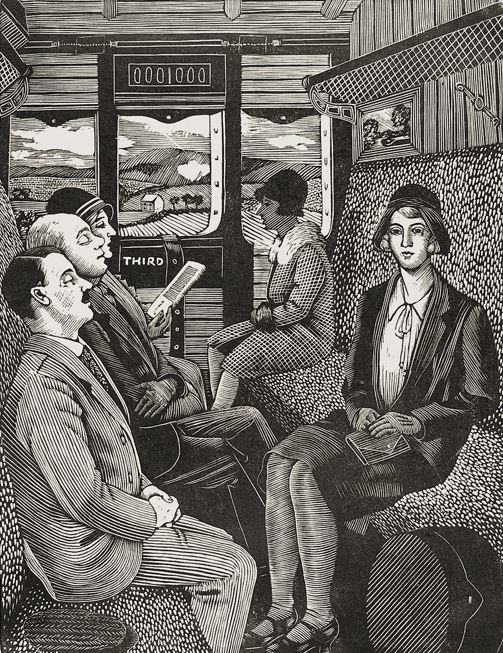
First, under the influence of Ravilious, she was a talented woodprint maker. A quick learner, Garwood was soon exhibiting with The Society of Wood Engravers. The works in show here include amusing prints to illustrate calendars plus sets depicting her family, a recurring subject. One series includes a comic depiction of Ravilious as a gangster in a marrow patch and a middle-aged lady whose fallen asleep in a chair while reading a book.

‘Train Journey’ by Tirzah Garwood (1929) wood engraving, 1929. Private collection

But her career doing this was relatively brief, from 1927 or so until, in 1930, she married Ravilious. In 1931 the couple moved to rural Essex, at first lodging with artist friends Edward Bawden and his wife Charlotte in the village of Great Bardfield. The couple moved into their own house and had three babies in quick succession, John, James, and Anne.

Garwood found herself the mother of three small children and having to do almost all the household management herself. The result was to put her woodprint work on hold and she never really returned to it, something she later regretted.

Marbled paper

Instead, she was inspired by Charlotte Bawden to experiment with marbled paper and became an expert at this specialised technique, gaining a growing artistic and commercial reputation which saw her commissioned to create her unique designs for book publishers, interior design shops and private clients. According to the curators she pioneered a distinctive decorative style, layering delicate repeat patterns to create harmonious designs that were unlike anything being made in Europe.

Here style chimed with the 1930s resurgence in arts-and-crafts interiors and Garwood fulfilled orders of fifty or more papers at a time for London design shops, publishers and private clients, making special curved designs for lampshades and becoming adept at cutting and pasting papers for specific decorative needs.

As you walk into the second room of the show you pass between three big examples of these abstract marbled designs on either side of you and the effect is magical. Who would have thought that patterned papers could be so wonderful, entrancing and lovely.

Four of the 12 marbled paper designs in ‘Tirzah Garwood: Beyond Ravilious’ at Dulwich Picture Gallery (photo by the author)

Trauma and autobiography

In 1942 Garwood experienced two life-changing events. In March she had a mastectomy for breast cancer, then 6 months later, Ravilious was killed while on active service as a war artist. The same year she began writing what would become her autobiography, published as Long Live Great Bardfield.

Oil paintings

At the same time she developed a wonderfully distinctive style of oil painting. She adopted a deliberately naive, direct style with a pronounced on traditional children’s toys, creating works that are straightforward yet strange. A series of paintings show a sophisticated creative mind at play, including highlights Horses and Trains (1944), Etna (1944) and, slightly later, The Old Soldier (1947).

‘Etna’ (the name of the old Victorian toy train) by Tirzah Garwood (1944) Oil on canvas. Image courtesy of Fleece Press/Simon Lawrence

House models

In 1946 Garwood married BBC Producer Henry Swanzy and around the time developed a new genre, house models. These three-dimensional paper and card constructions were inspired by the kind of things her children were making at school, but also influenced by the post-war Pictures for Schools exhibitions.

They are 3D models but stylised so as to be only a couple of inches deep. One of the wall labels explains that they are housed in butterfly display cases i.e. wooden frames with glass covers but only 2 inches or so deep. This allowed her to perfect a style of doing shallow models of houses, which give a stylised impression of depth. There are about 10 of these in the exhibition and they are all wonderful. They have a lovely charming handmade amateurish feel about them. They incorporate disparate elements such as paper, fabrics, lace, corduroy, cardboard and even filigree metalwork, along with bits cut out of magazines.

‘Baker’s Shop in Daren’ by Tirzah Garwood (1946) in the bottom third window pane you can just see a little girl asking the baker to buy a bun (photo by the author)

The ‘best’ one might be the elaborate model of a village baker’s shop, with tiny model loaves and buns in the window and, just visible inside, a small depiction of her daughter asking the baker to buy a bun. The others are of different designs of houses and front gardens, presumably based on models from the villages round her in Essex. My (bad) photo might give the impression that this is a flat painting but in fact, if you removed the glass, you’d be able to put your hands into the model, move the model loaves and buns around in the window or rehang the bunting at the top left. It’s a two-and-a-half D model.

One of them has a little stream running between the front fence and the house itself, represented by a little inch wide strip of fabric with little model ducks attached to it. This had been constructed so that there’s a little handle sticking out the front of the box and if you turn the handle, the stream-strip moves along, giving the impressions of ducks moving on the water.

These like everything else in the exhibition, the house models convey a lovely sense of a quiet, unspoilt rural England, not only innocent in itself, but seen from a child’s point of view, seen from the point of view of her three young children.

Last room, last works

In 1948 Garwood’s cancer returned and by the summer of 1950 she was increasingly confined to bed. In the last year or so of her life she painted works which excelled in a kind of quiet understated mystery, brightly coloured but odd visions of nature, Victorian toys and dolls’ house set amid flowers and insects.

The curators have made the simple but excellent decision to fill the final room with 16 of these small but powerful and strange oil paintings. As you progress round them, you feel yourself entering a wonderful, strange and mysterious zone.

‘Hornet and Wild Rose’ by Tirzah Garwood (1950) Oil on canvas. Towner Art Gallery, Eastbourne. Image courtesy of Fleece Press/Simon Lawrence

The style owes something to the tradition of ‘naive’ painting which grew up in the twentieth century alongside the loud gimmicks of modernism, but mixed with her interest in antique Victorian toys and dolls, and then something else again – a quirky interest in the small-scale world of insects among the flowers and grass. ‘Surrealism’ like any other art history label is too strong to convey the subtle blend of flavours and styles which make these last works so calm, quiet and mysterious.

For me the best work in the show was ‘Hide and Seek’ from her last year. This doesn’t have the spooky model trains or dolls which feature in so many of the other last paintings. What it does have is a fuzzy blurred effect of the paint which makes it wonderfully entrancing and mysterious. You feel yourself drawn in, partly to find all the children who are hiding in it (can you see all of them?) but then to be drawn deeper into something else, some deeper mystery of gardens and childhood and lost magic.

‘Hide and Seek’ by Tirzah Garwood (1950) Private collection

Should they have included Ravilious?

Tirzah’s (first) husband, Eric Ravilious, was far better known in their lifetimes and his light and airy, cartoon-style depictions of the rolling southern countryside have gone on to adorn any number of calendars, posters books and so on. He is arguably a bit over-exposed. This isn’t a major criticism at all, just a thought, but I wondered whether it was wise of the curators to include no fewer than ten Ravilious pictures in this exhibition.

I can see why. They place them next to paintings of the same subject by Garwood, to show how they influenced each other and, in a couple of instances, to try and prove that Garwood, the younger artist, the female artist, at one stage his student, nonetheless influenced his ideas about composition. Well and good.

But any Ravilious picture tends to dominate the room it’s in, bathes the eye and mind in a soothing bubble bath of niceness, loveliness and reassurance. So I’m not sure it was such a good idea to include quite so many alongside the Garwood pictures. They inevitably distract you. Garwood isn’t so immediately accessible. Her works – whether prints, oil paintings or house models – are more quirky and flavoursome, it takes a bit more effort to acquire their strange taste.

This is another reason I said I liked the way the last room was devoted solely to her last oil paintings. Partly because, taken together, they powerfully convey a strange and mysterious world. But also, it’s a relief that this last room doesn’t contain any Ravilious works because they would have been too light and easy, would have punctured the dark strangeness of her mysterious world.

Other elements

– There’s a display case showing photos of her and Ravilious, which also contains some wonderful sketches she did of her small children.

– There are two portraits of Garwood, one by Phylis Dodd, one by Duffy Ayers.

– And in the mausoleum space which separates the two runs of galleries, loudspeakers project extensive passages from her autobiography, ‘Long Live Great Bardfield’, read by the actress Tamsyn Greig.

It’s a really beautifully holistic show which gives you a very strong flavour of all aspects of Garwood life and output, and soaks you in the calm and understated, but all the more beautiful and moving magic of her imagination. I didn’t think I’d especially like it but the longer I stayed, the more entranced I became, and I’m going to definitely go back for a second visit before it closes, probably during the Christmas holidays because it felt like such a lovely treat.

The promotional video


Related link

Related reviews

Royal Academy summer exhibition 2024

The usual procedure: tens of thousands of artworks submitted by members of the public and Royal Academicians (RAs) and then reviewed and chosen by a panel of eight or so RAs. Result: twelve galleries crammed from floor to ceiling with 1,710 paintings, prints, drawings, sculptures, architectural models, hangings, mobiles, photos and videos.

So, as usual, it takes a lot of time and effort to really focus on, assess and process so very, very many works. By less than half way through I was feeling overwhelmed. Doing the whole show properly requires stamina and determination.

Each work is accompanied by a wall label which just gives the work’s number so it’s well worth investing £3.50 in the little pocket catalogue because only by referring to this can you find out the work’s name, the artist and – subject of perennial fascination – its cost, because the majority of the works on display here are on sale. As far as I could see the cheapest work cost £100, the most expensive was a room-sized installation which could be yours for just £300,000.

I think it was the Guardian who accused this year’s show of being a chaotic jumble sale, but it always feels like that to me. And despite there being few real bangers (like the life-size sculpture of a gorilla made out of coat hangers or the life-sized sculpture of a tiger covered in red and silver Tunnocks teacake wrappers from former shows) there were a lot of really good things.

There’s always a chair of the curators, or chief co-ordinator, and they choose the show’s overall theme. This year’s co-ordinator was Ann Christopher and the supposed theme is MAKING SPACE.

As I walked very slowly through the rooms I marked up on my catalogue the works I really liked or were striking for one reason or another. Here’s my selection of personal favourites. She is quoted as saying:

“I plan to explore the idea of making space, whether giving space or taking space. This can be interpreted in various ways: to make space can mean openness – making space for something or someone, also making space between things. It is my belief that the spaces in between are as important as whatever those spaces separate.”

I think it’s fair to say I didn’t notice or recognise this theme anywhere in the exhibition and you could happily walk through the whole thing without being aware of any central theme, such is the range and diversity of the plethora of works on display.

A few Big Names are represented: the ones whose names I know are Rachel Whiteread, Ron Arad, Frank Bowling, Michael Craig-Martin, Anselm Kiefer, Mick Moon, Allen Jones. The only ones whose work I recognised unprompted were Michael Craig-Martin for the four or so big schematic paintings of everyday objects in room 3, because he has such a clear and recognisable brand and Allen Jones for the sculpture in room 9 because the heads on it had his very characteristic look.

The Annenberg courtyard

In the courtyard is a monumental textile sculpture. From a distance I thought it was a concatenation of chains and was going to be yet another reference to imperialism and slavery, the top subject of our times, but I was wrong. It’s by British artist Nicola Turner and is made of found organic matter, including horsehair and wool with the tips of each of the monstrous legs ending in old-style table legs on castors.

Apparently it is based on one of Reynolds’s own paintings, The Infant Hercules Strangling the Serpents and this explains why the slender tip of what turns into this monstrous rampage of rope emanates from the tip of Sir Joshua’s paintbrush. The work ‘explores the boundaries between life, death and the liminal spaces in between’.

‘The Meddling Fiend’ by Nicola Turner (Exhibit 1)

Room 1 (63 works)

Each room or set of rooms is hung by a member of the selection committee. The first two rooms were hung by Hughie O’Donoghue RA. Not to be too harsh, but both these rooms felt grey and dreary. It’s only in room 3 that things pick up. Apparently O’Donaghue was attracted to works that ‘displayed a painter’s sensibility in which the physical process of painting and a sense of the hard-won image were evident.’ I do, in fact, see what he means and my favourite pieces in this room do just that, show the process of painting making in a way I’ve always like, using or incorporating found materials, having a strong industrial vibe.

This is most clearly demonstrated in a hug work by O’Donoghue himself, ‘Channel’, which is not only dramatic but is painted on industrial tarpaulin complete with eyelets.

Channel (oil, mixed media on tarpaulin) by Hughie O’Donoghue RA £75,000 (32)

In the same spirit I liked Considerate Construction by Lee Maelzer, mainly for the dramatic gold and orange colouring but also for its industrial vibe.
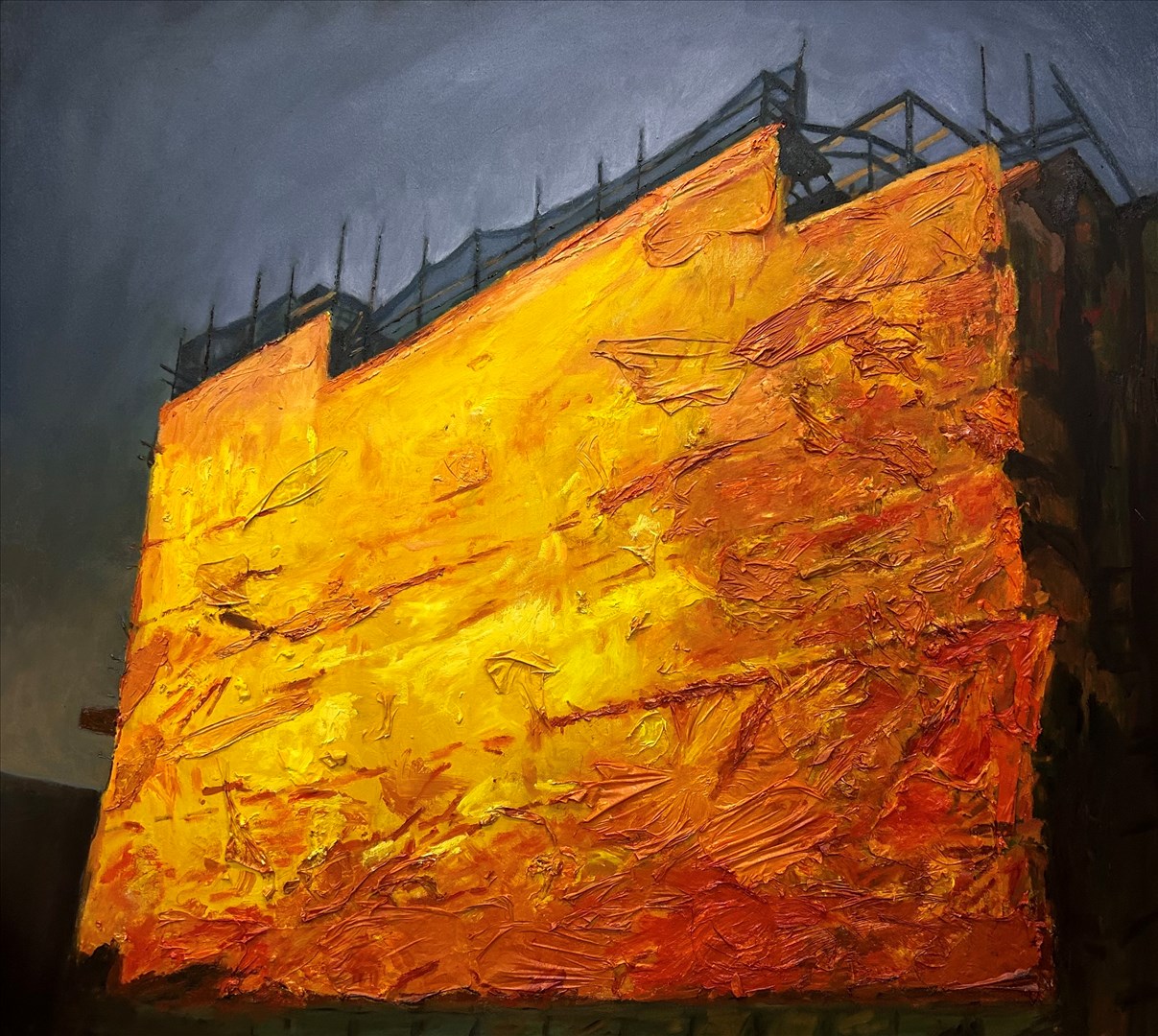
Considerate Construction (oil and latex) by Lee Maelzer £16,000 (28)

In a completely different vibe, the friend I went with liked:

Love Myself (knitting wool and cotton filling)by Chunyoung Yang £500 (42)

Room 2 (77 works)

Also hung by O’Donoghue. Amid the jumble sale disorder of so many images a number were about the sea, which emerged as a theme in both his rooms.

High and Dry (woodblock and etched lino) by Ian Burke £380 (71)

There was a little area devoted to the works of ‘the late Mick Moon RA’ including this, which I think I’ve seen at a previous show, dramatic in its size and painted on rough industrial planking so right up my street.

Outward Bound (acrylic and mixed media) by Mick Moon £30,000 (111)

The Large Weston Room (242 works)

It comes as a visual and psychological relief to emerge from the first two rooms, characterised by grey and blurred images, and into room 3. This is curated by the fabulous Cornelia Parker who has themed her room round the seven colours of the rainbow and it immediately feels like it. This is the room with the four big Michael Craig-Martins with his trademark flat colouring, and you are also struck by several works with colourful vertical strips. Big relief after the first two grey rooms.

Orchid (by Sir Michael Craig-Martin £8,600

My friend is a birdwatcher and nature lover so she liked the clever Bird Colour Wheel by Jim Moir.

Bird Colour Wheel (pigment print) by Jim Moir £1,250 (149)

There was also the first humorous offerings, including a pair of 18th century paintings spoofed by having 21st century products collaged onto them, by Toby Holmes.

A Bottle of Dog (Newkie Brown) (digital collage; giclee print) by Toby Holmes £250 (188)

I like the woodcut vibe and loveliness of this fine image (in fact a linocut).

Traitorous Trueness (linocut) by Gerard McMenamin £250 (205)

In a similar vein I liked the strong cartoon outlines of this nude.

Untitled Nude 2 (linocut) by Morag Bassinthwaite £250 (256)

At about this point it dawned on me that maybe, faced with a bombardment of images, the mind prioritises the realistic, naturalistic images. Was that why I was liking recognisable naturalistic images? Is that why I liked this one so much, where Paul Stephenson has merged an original 1820 oil painting (of John Porter by William Bradley) onto an image of the calm flat infinite sea?
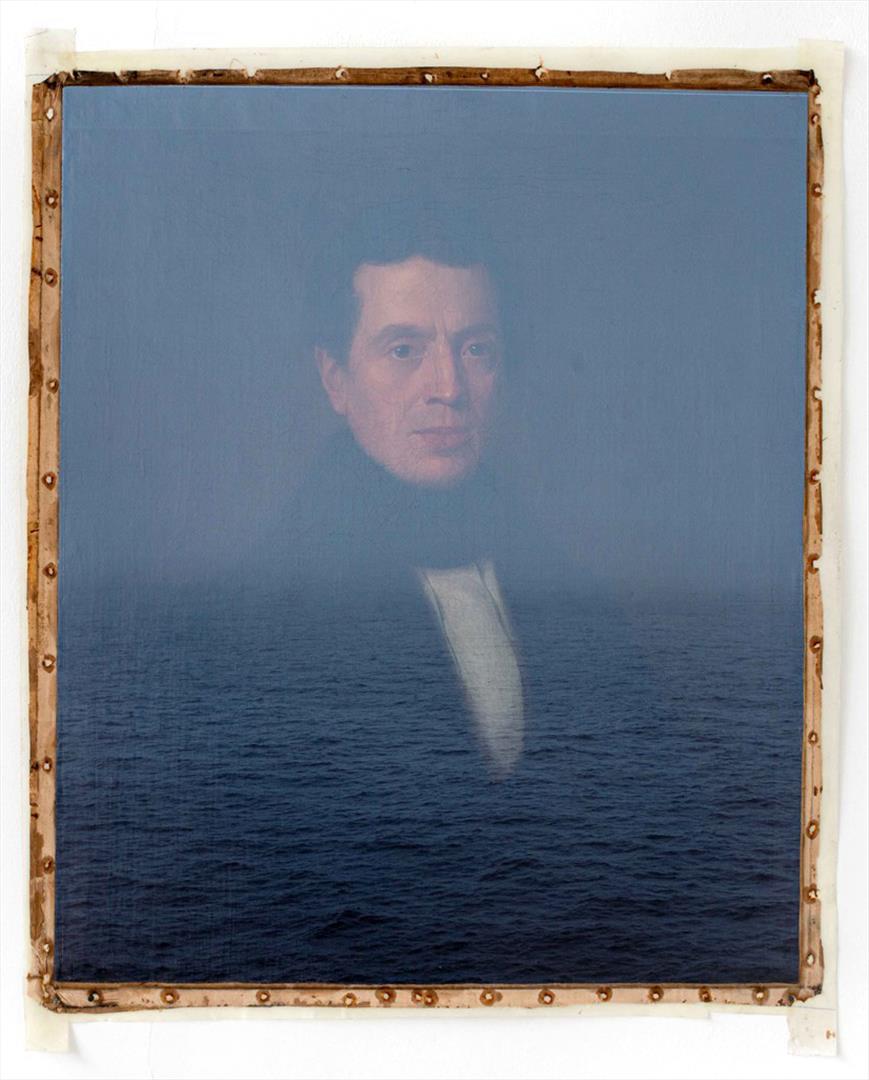
Reflets sous la pluie (ink on original oil painting) by Paul Stephenson £2,500 (211)

Remember I mentioned the tiger covered in Tunnock teacake wrappers. The famous tiger was done by David Mach (and there are a couple of smaller works in the same style in the penultimate room). Here’s a jokey hommage by Paula Martyr.

A Teacake Cat (collage) by Paula Martyr Not For Sale (NFS) (210)

When someone’s bought a print which comes in multiple editions, the gallery puts a round red adhesive label by it. I thought it telling that this Parker room has a whole stand devoted to twee and humorous images of cats and dogs which were festooned with red labels. People want art that is a) affordable b) makes you smile.

Resisting the appeal of winsome cats and dogs, I liked the casual gracefulness of this image by Julia Andrews.

In My Mind (five-later screenprint) by Julia Andrews £350 (266)

Small Weston Room (1 video)

The work in the Small Weston Room is by invited artist Carey Young. Filmed at SIGMA Corporation in Japan, ‘The Vision Machine’ captures the company’s female employees, creating a speculative fiction that suggests a lens factory run (and perhaps owned) by women. The factory is used as a metaphor for photography and cinema in a wider sense, and shows how women are framed within, and in relation to those fields. The piece pays homage to women as skilled makers and creators, whilst suggesting a female-centric vision, or perhaps a wider visual culture created by women.

There’s a page of stills from the film on her website. My friend – a woman and a feminist – walked in, watched the video for sixty seconds, and walked out again. Given our saturation with American TV and movies which are designed to grab and keep our attention for every second, it’s very difficult for any art video maker to compete.

Room 3 (63 works)

This room is massive, maybe three times the size of the previous rooms, so it needs big works to make an impression. It was hung by the exhibition’s overall co-ordinator, Ann Christopher who is a sculptor. Her aim (apparently) was to create contrasts of scale. A large collage of woodcuts by Anselm Kiefer (American), a new painting by Rose Wylie and a vibrant work on canvas by Sir Frank Bowling. Alongside are smaller works by artists such as David Remfry and Diana Armfield. Some sculptures are hung on the walls. Cornelia Parker ‘Psychobarn (Flotsam)‘ leans against a wall, while Honorary Academician El Anatsui’s intricate wall-hanging dominates one end of the gallery. I normally love Parker but didn’t react to her shed and the Anatsui is genuinely huge but left me meh. Richard Serra is ‘known for his large-scale abstract sculptures made for site-specific landscape, urban, and architectural settings’ which is why it was odd to see him represented by a painting, which admittedly had a nice Rothko-like abstract vibe (well, without the blurry edges).

Those are all big names but the actual works selected weren’t that exciting, for example a couple of drawings by Rachel Whiteread, who cares? It would have been much better to have one of her huge sculptures, specially for such a big space.

Maybe my favourite piece was the Bowling. There’s a reason why the famous guys are famous – at their best they have a certain something which lifts them above, in this case, the hundreds of other semi-abstract paintings on show. (Incidentally, I think the silver slipper is depicted in the central diamond, something which is much more obvious when you see it in the flesh, as it’s a whopping 3 metres tall.)

Silver Slipper (acrylic and acrylic gel with collaged canvas with marouflage) by Frank Bowling NFS (440)

Room 4 (71 works)

Room 4 was also curated by Christopher. I liked Horror Vacui by Paul Benney which is a digitally animated painting of a candle under a bell jar using up all the oxygen and snuffing out. There’s a slightly worrying big print of a naked man facing away from us by the famous Wolfgang Tillmans. It made me realise how relatively few nudes there were in the show and, as usual, mostly female.

Small but striking (maybe just because it reminds me of the photomontage pioneered by Peter Kennard whose show at the Whitechapel Gallery I recently visited) was this photomontage by Michelle Thompson.

Bomb (digital artwork) by Michelle Thompson £145 (520)

Room 5 (183 works)

Room 5 was hung by Hurvin Anderson and feels packed. Anderson is Black and it’s probably no coincidence that this room has the first real Black presence, for example the big (and not very good) portrait of Linton Kwesi Johnson and a multiple portrait of Bob Marley. (Having been reminded of Johnson I wrote this review listening to his 1979 album ‘Forces of Victory’.

There’s a vast messy colourful painting by Elizabeth Cope; I admired the colourfulness but not the design. My companion liked Storm Light by Leslie Dabson. Interestingly, this doesn’t reproduce at all well online; in the flesh it’s very small and compact and so gives a very strong vibe of a rainy evening in London’s Victorian terraces. One of the most vivid images is the hyper-naturalistic depiction of an abandoned car overgrown with vegetation by Geoff Archer.

440 (oil) by Geoff Archer £2,800 (631)

I really liked a couple of abstracts by Subai Zheng, 628 and 651. As far as I could tell every single one of the thousands of dots had been created by hand with a felt tip pen. The more I looked the more I was drawn into this mesmerising image.

Weaver: 30 Houses (felt tip marker and acrylic on canvas) by Subai Zheng £15,000 (651)

On the left-hand wall I surprised myself by liking Stone Pines Rome by Katharine Edwards, maybe because of its echoes of Piet Mondrian transitioning from naturalism to abstraction. Or just because I liked the design and the colours.

Stone Pines Rome (acrylic) by Katharine Edwards £4,000 (574)

On reflecton, it may also be because so many of the images have a rather dingy grey overcast feel. Maybe without realising it, the curators are biased by the simple fact of living in England to prefer works which are dingy, overcast, grey, or rainy i.e. like the English climate. Thinking about it, there are very few images depicting a fine sunny day let alone the light blue Mediterranean skies you associate with, say, the art of Raoul Dufy or Matisse.

Next to it another imagine I liked the more I looked at it was ‘Yellow Umbrella’ by Bill Jacklin. To me it felt romantic, like an illustration for an adventure novel, two huddled figures rushing through a snowstorm.

Yellow Umbrella (monotype with oil pastel) by Bill Jacklin £5,775 (623)

(See also his Sea at Night I in a later room.)

Room 6 (121 works)

Each year there’s an architecture room and I always amuse myself by calling it ‘the room of shame’. This is based on my lived experience of the vast discrepancy between the pretentious, high-falutin’ language of architects fantasising about building ecocities in Brazil or colonies on the moon, and the crappy, badly built, poorly insulated houses and flats most of us live in, the gritty streets dominated by big impersonal blocks which most of us hurry through against the gritty wind or dirty rain.

Anyway, this year exhibition co-ordinator Ann Christopher handed Room 6 over to Assemble RA with a view to making it ‘a space for making’. Who are Assemble RA?

Assemble RA is a collective based in London, who work across the fields of art, architecture and design. They began working together in 2010 and have described themselves as having between 16 and 20 permanent members. Assemble’s working practice seeks to address the typical disconnection between the public and the process by which places are made. Assemble champion a working practice that is interdependent and collaborative, seeking to actively involve the public as both participant and collaborator in the ongoing realization of the work.

And so Assemble RA transformed this room into ‘an industrial warehouse space, a creative’s store, full to the brim with an eclectic mix of models, machinery and curious objects. On the walls are photographs of interiors and artists’ workspaces, and works exploring different materials such as moss (720), 3d-printed sand and woven rush.

What with the shelves lining the walls and the shelf units displaying architects’ models etc this is the most cluttered and busy room. The standout piece for me was a set of industrial tools which have been remodelled to seem like giant metal monster claws.

Installation view of Room 6 at the Royal Academy Summer Exhibition room 6 showing Nippers (812) by James Capper (photo by the author)

Among the earnest models of sustainable blah blah were a few humorous models such as friends used to make at school.

Amorgos Monastery (plywood, painted light plaster, tree bark and tree branches) by Vasilis Politis NFS (709)

My companion liked this, Vast Seas in Green to Grey by Julie Massie which consists of hundreds of thin fragments of coloured porcelain embedded in wood to create this beautifully shaded but slightly worrying relief.

Vast Seas in Green to Grey (porcelain on wood) by Julie Massie £800 (707)

Room 7 (256 works)

Gallery 7 is the first of two adjacent rooms hung by printmaker Anne Desmet. I recently visited the big exhibition of her work at the Guildhall Art Gallery, which is still open and well worth visiting. There’s a thread of architecture and buildings running through it. But straight off I liked a couple of humorous works by Laura Beaumont who’s gotten old Observer Books, carved a square hole in them and then created tiny dioramas using model railway figures and foliage.
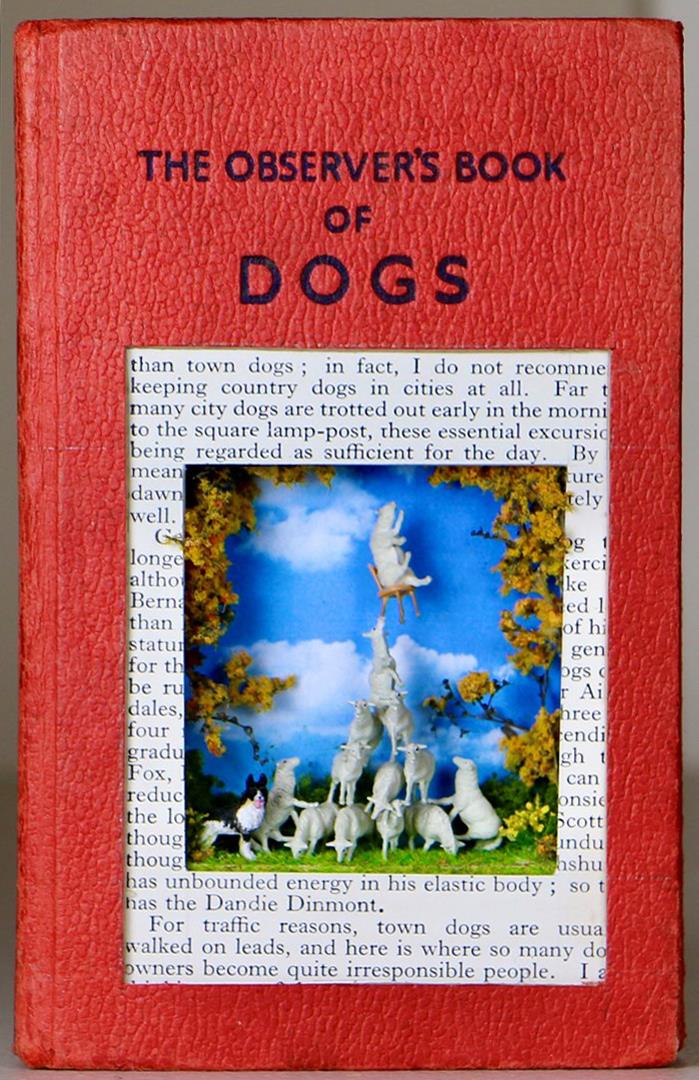
Observers Dogs by Laura Beaumont £1,500 (829)

My favourite piece in this room was hung up high and so you craned your neck, appropriately, to look up at an image of a high rise block. This reproduction doesn’t do it justice. In the exhibition the paper is set on dark brown wood and creates the impression that it’s made of weathered copper.

Cottingley Heights On Oak (Three) (acrylic on oak veneer) by Nicola Rawnsley £380 (841)

In a different mood, I liked Blueprint by Peter Lawrence, maybe because it reminds me of 1950s jazz LP covers. It also links in my mind with the wonderful prints by the Yoshida family currently on display at the Dulwich Picture Gallery.

Blueprint (wood engraving) by Peter Lawrence £175 (872)

Lovely, minimalist and clean are Ian Ritchie’s etchings of foxes (926). For me the standout work in the room was a lovely etching of the BBC offices in Langham Place, possibly because they remind me of the wonderful exhibition of 1930s linocuts at Dulwich Picture Gallery a few years ago.

W1A – BBC AND All Souls Church, Langham Place (etching) by John Duffin £795 (977)

There are lots of images of London streets and buildings which are Desmet’s own subject, in all kinds of styles. I was impressed by the realism of this image of Oxford Street through a rain-drizzled window, presumably of a bus.

Oxford Street (acrylic) by James Condon £5,200 (1015)

Honourable mention Urban Beings V (1024) by Francesco Russo.

Room 8 (259 works)

Second room hung by Anne Desmet, this had a noticeable theme of trees along one wall, with all manner of seascapes on the far wall, many of which I liked. This impressive work is an etching made on sycamore leaves, presumably commemorating the chopping down of the tee in the Sycamore Gap of Hadrian’s Wall. It’s more impressive in the flesh than this reproduction

Acer pseudoplatanus L (etching on sycamore leaves) by Emma Buckmaster and Janet French £7,500 (1132)

In line with my general preference for woodcuts and works with strong outlines, I liked this simple but effective linocut, ‘Trees Beneath a Lemon-Yellow Sky’ by Paul Hogg £750.

Trees Beneath a Lemon-Yellow Sky (linocut) by Paul Hogg £750 (1140)

Twenty of more images of the sea captured it in all its moods, from a lovely print by John Mackenzie of shallow surf over a light sandy beach, to images of waves crashing against rocks, a batch of Norman Ackroyd‘s trademark etchings of remote Scottish islands surrounded by gulls.

An Ocean to Swim (woodcut) (woodcut) by Trevor Price £580 (1189)

High up on a wall was a set of ‘London Heads’. This is small and cute in the flesh (40 x 40 cm) so doesn’t benefit from being blown up in reproduction.

London Heads by Sally Cutler £350

This might be the best room with a wide range of smaller but attractive and quality images. I liked the one of a single fern leaf, another painting of woodland floor all brambles etc. On the opposite wall were characterful images of individuals and groups. This one, also, was all the more powerful for being small (15 x 13 cm) like the illustration to an interesting novel.

Waiting For The Rain To Stop by Barbara Jackson £350

Funniest entries in the show might be the two jokey prints by Ceal Warnent.

Revolutionary by Ceal Warnants (photopolymer relief print on vintage book paper) £130

These prints had almost as many red labels on them as the cute cats and dogs in room 3 and you can see why. They would make you smile every time you look at them.

Room 9 (64 works)

Gallery 9 was hung by Ann Christopher and is dominated by the biggest piece in the show, ‘String Quartet’ by Ron Arad. This is a big carpet draped up the wall and across the floor, on which sit four chairs on which are placed the four instruments of a string quartet and over hidden loudspeakers is projected string quartet music which you can hear from the nearby galleries. It’s odd, really, how little modern art makes use of music or sounds of any sort.

The Quartet by Ron Arad (sculpture made of wood, steel, copper, silicon and cotton £300,000 (1408)

There’s another big showy work, a huge sculpture of a pair of black hands by Tim Shaw which I didn’t like at all. The curators comment ‘a pair of hands where the negative space forms part of the work’ – well, which sculpture does not create a greater or lesser space around it? On the plus side, some of the children visiting the show were enjoying pretending to shake hands with them or dancing in and around them which was fun to watch.

The Space Between (Does Not Come in a Vacuum) by Tim Shaw (sculpture of Painted foam) £35,000 (1410)

My companion the naturalist liked all images of birds throughout the show but particularly the strutting crow.

Strutting (acrylic) by Lisa Badau £645 (1384)

The Lecture Room

This room was hung by Veronica Ryan who had the bright idea of painting the wall turmeric ‘a colour inspired by the culinary spice which is known for its healing properties’. This turns out to be a very dynamic and enjoyable colour to stroll in. This room is full of sculptures, maybe it was unofficially ‘the sculpture room’ and Ryan has made the little innovation of replacing traditional white plinths with wooden shelves and trestle tables. This is cool but also brings out a strong village church jumble sale vibe as well. All kinds of things to admire. My photo of a battleship made of card shows the turmeric colour in the background.

Installation view of the Royal Academy Summer Exhibition 2024 showing ‘Worship-Warship’ by Richard Wilson and, in the background, the orange turmeric colour of the walls and the bric-a-brac vibe created by the trestle tables (photo by the author)

Maybe the most striking piece is an oriental carpet out of which a tiger’s head is mutating, like the alien bursting out of John Hurt’s stomach. It’s life size and genuinely a bit disturbing.

Brown Tiger by Debbie Lawson (sculpture made from Jesmonite, carpet and wood)

There was, maybe, an understated feminist theme in this room, with some paintings of menopause medication by Sara Gregory (1429). I liked the sculptures using an image of a mother and child printed on a metal plate and surrounded by rooster feathers to create a kind of ‘native’ African shield effect.

Female Warrior Army, Motherhood 2 by Emma McGuire (photo decal on porcelain with rooster feathers) £3,500

In a related African vibe (on the same wall) are hung a couple of big prints by Yinka Shonibare CBE (1525, 1526) whose exhibition at Serpentine South you can still visit. I quite liked a lot of things in this room but not burningly so. I suppose this is quite amusing and many of the other sculptures were in the same category: quite good, quite funny. Possibly I was just exhausted by this stage of the marathon.

The Invader by Hannah Simpson (stoneware ceramic) £1,050 (1620)

Wohl Central Hall (81 works)

The Wohl Central Hall is the last room in the show and the second of Assemble RA’s two rooms. The idea is that they’ve ‘created a studio setting and explored the creative process’. This explains why there are random swatches of paint on the walls and a clutter of props including a drafting table and a joinery bench. The plinths in the gallery have been repurposed from waste materials such as discarded slabs from an industrial estate etc. Probably there was lots of interesting and stimulating work here but I was full. My companion, blessed with more stamina than me, and also much clearer about what she likes, liked the big mosaic of ‘Hackney Birds’ and spent a minute or two checking off the ones we see in our garden.

Some Hackney Birds by Hackney Mosaic Project (wall-based glass and ceramic mosaic) NFS

Maintaining the ornithological theme I liked this – maybe because by this stage I was on my last legs and only noticing the really bright obvious pieces.

African Phoenix: Coffin for Qm Nana Yaa Asantewaa by Elsie Owusu (carved wood, paint and glazes) NFS

Thoughts

Despite all the curators’ talk of themes and issues, the experience of visiting is massive, chaotic and exhausting. That said there are hundreds and hundreds of things to like if you have the stamina, determination and patience to look carefully at everything. I wrote this review the day after visiting and was surprised to realise how many works I really liked, including many I haven’t shown here.

After a dingy start in the grey murky opening rooms, and despite the absence of any real showstoppers (apart, I suppose, from Arad’s Quartet and Shaw’s hands, and maybe Parker’s shed and El Anatsui’s wall-hanging, none of which did it for me) there are lots of smaller, sometimes very small, gems, which are worth the effort of carefully reviewing everything in the room to find and cherish and marvel, feel and chortle at.

Tunnocks Maneki-Neko by Robert Mach (kinetic sculpture with confectionary foil on plastic and wood) £1,400 (1555)


Related links

Related reviews

Yoshida: Three Generations of Japanese Printmaking @ Dulwich Picture Gallery

This is a lovely exhibition full of really lovely and enjoyable images. Often you have to work a bit in an art gallery, especially with modern art, but most of the images here are delightfully easy to process and enjoy. It’s like being in a high quality ice cream parlour and faced with an embarrassment of riches.

Kumoi Cherry Trees by Yoshida Hiroshi (1926) Courtesy Fukuoka Art Museum

The show brings together artworks by three generations of just one extraordinary family, the Yoshida family from Japan who have each worked in the Japanese tradition of woodblock print art.

The father, Yoshida Hiroshi, was a leading creator of prints from the 1920s. He is represented by one room full of wonderful prints. His wife, Yoshida Fujio, was a renowned watercolourist, painter and printmaker in her own right, and is represented by six big lovely prints of flowers.

They had two sons who followed them into the family business, Tōshi and Hodaka, but who each followed different artistic paths and engaged with American art of the 1950s and 1960s in different ways with different results.

Hodaka’s wife, Yoshida Chizuko, was also an artist, co-founder of the first group of female printmakers in Japan, and is represented by works in her own right.

The fifth and final room is entirely filled by an installation by Hodaka and Chizuko’s daughter, Yoshida Ayomi, the third generation of this remarkable dynasty of artists, whose installation is closely modelled on one of the classic prints by her grandfather, which we saw in the first room.

The patriarch: Yoshida Hiroshi (1876 to 1950)

The first room is devoted to the life and career of Yoshida Hiroshi, one of Japan’s greatest artists. In  his early career he was successful as a Western-style painter. It was only at the age of 44 that he began designing woodblock prints.

He became a leading figure in the shin hanga movement which aimed to revive traditional ukiyo-e print subjects by combining them with Western principles, techniques and aesthetic choices, resulting in a unique fusion of styles. The movement was characterised by its emphasis on naturalistic and realistic depictions, in particular in the genre of landscapes.

Hiroshi was remarkably cosmopolitan and travelled the world in the 1920s and 30s. It was his trip across America which inspired some wonderful depictions of dramatic landscape such as mountains, the Grand Canyon and so on.

El Capitan by Yoshida Hiroshi (1925) Courtesy Fukuoka Art Museum

He not only travelled the Western world but exhibited and sold his woodblock prints, gaining an international reputation in the US and Europe.

In fact there turns out to be an amazing fact which is that Hiroshi visited Dulwich Picture Gallery, way back in 1900, when he was just 23, and the room of his works displays his signature in the Gallery’s visitor book. More than a coincidence, I wonder whether it’s been a long-running ambition of the gallery to bring together works by the great man.

Hiroshi worked by creating clear black outlines of the subject and then filling them in with washes of paint. In the small side room (the Mausoleum) off to one side of the series of rooms at Dulwich, they’re showing a short film featuring interviews with Japanese craftsmen who explain the incredible care Hiroshi took with his prints. He overlaid multiple blocks of the identical same subject, sometimes as many as 20 (!), each one designed to bring out a different aspect of the design or to print different colours over each other. This helps explain the tremendous sense of depth and resonance they have, an amazing subtlety of coloration which disappears in online reproductions.

Installation view of ‘Yoshida: Three Generations of Japanese Printmaking’ at Dulwich Picture Gallery showing the video ‘Hiroshi Yoshida and his woodblock prints’ and the display case of wood print tools (photo by the author)

It also explains why he made many prints in pairs designed to convey different times of day, such as the morning and evening prints of the Acropolis in Athens (1925) or the Taj Mahal in India (1932), the Matterhorn in Switzerland (1925) or the Sphinx in Egypt (1925). The images of the Taj Mahal used fourteen blocks (!) and 55 impressions to create the desired gradation of colour or bokashi.

This video (nothing to do with the gallery) gives you a sense of the graphic accuracy, the use of distinct black outlines, but the tremendous subtlety of colour in his works.

The patriarch’s wife: Yoshida Fujio (1887 to 1987)

Yoshida Fujio was a renowned watercolourist, painter and printmaker but this is the first time any of her work has been exhibited in the UK. Fujio was married to Hiroshi and travelled with him across the USA and Europe, exhibiting her delicate watercolours of Japan to acclaim. Upon returning home in 1907, she took part in the first exhibition organised by the Japanese Academy of Arts. In 1918 she set co-founded the Shuyokai or Vermilion Leaf Society, the first association of female Japanese artists.

It was with the death of her husband, in 1950, that Fujio, inspired by the experiments of her sons with abstraction, returned to artistic practice after a 30-year gap and created an iconic series of woodblocks in flowers in the early 1950s. Six big examples are on display here. In their hyper close-up transformation of vibrant colours into semi-abstract designs, they are pretty much the opposite of her husband’s long shots of realistically captured landscapes. Apparently, she achieved the distinctive optical effects by placing the flowerheads in a fishbowl.

Yellow Iris by Yoshida Fujio (1954) Private Collection. Photograph by Mareo Suemasa

The eldest son: Yoshida Tōshi (1911 to 1995)

The eldest son, Tōshi, started off in his father’s footsteps, depicting landscapes and cityscapes with fine examples on display here. But when his father died, in 1950, he became head not only of the family but the family business, the Yoshida Studio, and began experimenting with abstract art. The result is landscapes which achieve an abstract monumental quality.

Unknown (Michi no) by Yoshida Toshi (1968) Private Collection. Photograph by Mareo Suemasa

He was responsible for maybe my favourite piece in the show, a 1964 abstract titled Abstruse. As usual an online reproduction can’t convey the shimmering and entrancing effect of the multiple layers of colour. I kept having to go back to look at it again and each time got drawn deeper and deeper.

The younger son: Yoshida Hodaka (1926 to 1995)

In a break from his family’s established style the younger son, Yoshida Hodaka, expanded upon traditional printmaking to incorporate collage and photoetching. Like his father and brother, foreign travels influenced his choice of motifs, but he was also inspired by Pop Art, Surrealism and Abstraction. Here’s a characteristic work from the 1950s where you can immediately see the influence of Western abstraction, and the curators point out the influence of Juan Miro and Paul Klee.

Profile of an Ancient Warrior by Yoshida Hodaka (1958) Courtesy Fukuoka Art Museum

In the 1960s there’s a little explosion of Pop Art with images from magazines (often of 1960s glamour models wearing bikinis) in collages and assemblies. By the 1980s he’s morphed again to create collages combining realistic images of buildings and streets, rather American-looking, with figures of people or animals pasted in front.

The son’s wife: Yoshida Chizuko (1924 to 2017)

Hodaka married Yoshida Chizuko, herself a noted artist and co-founder of the first group of female printmakers in Japan, the Women’s Print Association. Chizuko often depicted landscapes, nature, and traditional Japanese scenes but she, also, explored aspects of abstraction and repetition. Her works combine Abstract Expressionism and traditional Japanese printmaking.

Tenryuji Garden by Yoshida Chizuko (1953) Private Collection. Photograph by Mareo Suemasa

Some of her works reminded me of the covers of 1950s jazz albums I own, so I wasn’t surprised to see one of them is actually titled Jazz (1954). One of my favourite works in the whole show was the one titled Rain (1953) because it’s so evocative of that era and its design.

The grand-daughter: Yoshida Ayomi (born 1958)

The youngest member of the Yoshida printmaking family is Yoshida Ayomi, Hodaka and Chizuko’s daughter. Her practice combines traditional Japanese printmaking techniques with modern elements, often utilising organic materials.

The final room in the exhibition hosts a site-specific installation created especially for the exhibition. It is titled ‘Transient beauty’ and completely covers three walls of the final room. On the right-hand wall the outline of the cherry trees exactly match the trees seen in the Yoshida Hiroshi print in the first room, ‘Kumoi Cherry Trees’ (1926). Just about 100 years later his granddaughter has lightly drawn the outline onto grey canvas and then stuck onto it hundreds and hundreds tiny pink petals made from fabric. These stray across onto the middle wall which has a completely different vibe. Rather than one complete piece of cloth as the grey wall is, the middle one is a set of 30 or so square wooden panels, and instead of being lightly painted onto it, as per the grey wall, here the outlines have been strongly graved into the wood, maybe a reference to the wood carving tradition of her family.

Installation view of ‘Yoshida: Three Generations of Japanese Printmaking’ at Dulwich Picture Gallery showing two of the three walls which make up ‘Transient beauty’ by Yoshida Ayomi (2024) (photo by the author)

The left-hand wall was my favourite, although I only have this bad photo I took of it. I think I liked it because there was more going on: at the top the black silhouette of winter branches was, for me, far more evocative than the sketchy outlines of the trees on the right. I think most of the space is intended to convey a rainy sky with variegated stormclouds, but I read it as the surface of a pond or lake with shadows and light playing across it and dappled by a million tiny splashes of stormy raindrops. There was more to look at and enjoy in this wall-sized image than the other two.

Installation view of ‘Yoshida: Three Generations of Japanese Printmaking’ at Dulwich Picture Gallery showing part of the middle and most of the left-hand wall of ‘Transient beauty’ by Yoshida Ayomi (2024) (photo by the author)

Video

DPG have released a video showing the speeded-up creation of the installation.

Thoughts

What an amazing family! What an imaginative world their works create and what a journey you go on as you walk through them. The majority of works by Yoshida Hiroshi are on loan from the Fukuoka Art Museum in Japan and are travelling to the UK for the first and maybe only time. This is a once in a lifetime opportunity. Treat yourself.


Related links

Related reviews

Raúl Cañibano: Human Landscapes @ the Photographers’ Gallery Print Sales Room

The Photographers’ Gallery Print Sales Room

Downstairs at the Photographers’ Gallery is the Print Sales Room. It does what the name suggests and hosts temporary displays of 15 or more high quality prints for sale by a rotating roster of acclaimed photographers, some British, some foreign, some up and coming, some internationally famous. Here’s the full list of photographers they represent:

For two months or so each photographer gets a display of their work for sale and visitors to the Gallery get to see selections of outstanding work from around the world. I should mention that, unlike the rest of the Gallery, admission to Print Room (down the stairs past the shop) is FREE. And also warn you that the cost of these high quality limited edition prints by top photographers is eye-watering, generally starting at £1,500 plus VAT.

Raúl Cañibano

The Print Sales Room is currently hosting a display of 16 wonderful photos by Cuban photographer Raúl Cañibano, a dazzling overview of his 30-year-long career.

Villa Clara by Raúl Cañibano (2019) Courtesy of the artist and The Photographers’ Gallery

Born in 1961 in Havana, Cañibano received no art school education or photography training, indeed he started work as a welder. Cañibano’s photographic journey began in 1984 when he visited relatives on the eastern side of the island and met a teacher with his own dark room. The smell of the chemicals and the excitement of watching the prints develop got him hooked.

Chambas, Cuba by Raúl Cañibano (2017) Courtesy of the artist and The Photographers’ Gallery

With no formal training, Cañibano learned what he could from the art books at Cuba’s National Library and developed a style of Cuban surrealism. This is most obvious in the shots which play with scales, often contrasting extreme close-ups of foreground objects with objects in the distance. The result is everyday scenes which somehow take on a surreal and comic tone. He is quoted as saying:

‘I think Surrealism is very poetic, and perhaps for that reason my work has something of a mystical feeling.’

And so photos like this:

Habana by Raúl Cañibano (2006) Courtesy of the artist and The Photographers’ Gallery

Three other things about his work. One is his obvious feel for ordinary working class people, the class he came from. All the photos feel like he is at one with his subjects, ordinary people walking by the beach, swimming, sitting in cafés. According to the wall label, he has travelled extensively across the country, often living with his subjects for months at a time until they feel completely at ease around him.

Malecón Habanero, Cuba by Raúl Cañibano (1994) Courtesy of the artist and The Photographers’ Gallery

The second obvious thing is they’re all black and white. If you think about it for a moment, most images we see of Cuba are fabulously colourful, for example, vivid snaps of the brightly painted houses and the fabulous retro automobiles they’ve retained. Cañibano deliberately rejects this tourist approach, possibly for a number of reasons, but one of them is it makes the images more democratic. All angles, all subjects are equal. Although the most obvious aspect of using black and white is it makes your images look classic and timeless.

According to the curators, Cañibano has used both film and, more recently, digital cameras, interchangeably. There is, then, scope for a little game where you try to identify which shot is digital, and which one is analogue. But the immediate effect of all black and white photos is to create a classic effect, and evoke a sense of nostalgia for the old black-and-white world before the deluge of digital camera and smartphones drowned the world in garish images.

The third thing that comes over is Cañibano’s terrific sense of humour. A lot of these photos are very funny, and all of them have a positive, happy vibe. If you’re anywhere near Oxford Street, do yourself a favour and pop into this FREE display for ten minutes of happiness.

Dog Jumping by Raúl Cañibano (2013) Courtesy of the artist and The Photographers’ Gallery


Related link

Photographers’ Gallery reviews

Käthe Kollwitz: Portrait of the Artist edited by Frances Grady and Max Egremont (2019)

This is the catalogue to accompany the recent Käthe Kollwitz exhibition at the British Museum.

The two or three essays in the book include:

Käthe Kollwitz’s biography

Born Käthe Schmidt in 1867, left-wing upbringing, married a left-wing doctor (Karl Kollwitz) who practiced in the slums of Berlin, specialised in prints, devoted herself to left-wing subjects i.e. lives of the working poor, plus historic subjects e.g. a weavers’ rebellion, sent son off to the Great War and he was killed within weeks, decades of mourning and grief and obsession with death.

Detailed looks at Kollwitz’s major print series

  • A Weavers Revolt (1898)
  • The Peasants War (1902-8)
  • War (1922-3)
  • Death (1932-7)

A lifelong obsession with death

What comes over from the essays is Kollwitz’s obsession with death – possibly, as one essay suggests, as a result of the death of some of her siblings in infancy – definitely compounded by the poverty, sickness and death she saw all around her in the slums of Berlin.

She was unnaturally, morbidly attracted to the subject in the 1890s and 1900s, well before she made the fateful decision to help her beloved son Peter enlist into the army in the first weeks of the Great War, despite him being under age, only for him to be killed a matter of weeks later. The guilt must have been staggering.

From that point onwards, Death and the grief of mothers was to become her enduring subject.

The prints

The factual content of the book, then, is solid but not revelatory, and all the images are hedged around with an extreme of scholarly punctiliousness and accuracy. After all, this is a reference book for other scholars as much as an introduction to us lay people.

No, the reason for owning the book is not for the biography, detailed though it is – but for the quality of the reproductions, including close-ups of many of the key prints. These let you really savour the details, and make them even more powerful and moving.

Some of her images can be a bit clunky, some of the faces in the weaker pictures are less than persuasive, even though her figure drawing and composition are almost always powerful and commanding. But at her best, there’s a solid body of work of breath-taking power and depth which surely make Kollwitz one of the great artists of the twentieth century.

Self portrait 1912

Kollwitz did at least 50 self-portraits and no portraits of anyone else, hence the focus of the BM exhibition and of this book. They are no frills, no pretense records of a journey through a hard life and a gruelling era of history.

Black and white charcoal drawing of an old lady's face

Self-portrait by Käthe Kollwitz (1912) © The Trustees of the British Museum

Woman with dead child (1903)

The most finished or prominent feature is the woman’s left knee and then, perhaps, her big left foot. This isn’t a dainty Rococo woman or an air-brushed sex object. This is a cave woman, Cro-Magnon Woman. No frills or make-up, no sexuality, just blunt primeval human feeling with extraordinary power.

Black and white drawing of a primitive, almost ape-like woman clasping the body of her teenage son

Woman with Dead Child by Käthe Kollwitz (1903) © The Trustees of the British Museum

Unemployment (1909)

A large reproduction lets you see the fullness with which the baby and the children’s faces have been gently etched, and brings out the contrast between their soft child faces and the rest of the spare, scratchy, shadowy scene, the gaunt shadowed face of the exhausted mother.

Black and white drawing of an ill-looking woman tucked up in bed, holding a small baby, with several other small children asleep on the bedding, while the dark image of her husband sits and broods beside the bed

Unemployment by Käthe Kollwitz (1909) © The Trustees of the British Museum

Arming in a vault (1906)

From 1789 to 1989, the great theme of European history – terror of uncontrolled, violent revolution from below.

Very dark image of a hoard of people armed with axes and spears and halberds thronging catacombs and, on the right of the image, surging up a very steep staircase, presumably into the light of day

Arming in a Vault by Käthe Kollwitz (1906) © The Trustees of the British Museum

Call of Death (1937)

Here I come, ready or not.

Stark, primitive black and white charcoal drawing of a bald woman with an ape-like head, hear arms across her chest so you're not sure of her gender, and from the top right a veined and bony hand reaching down to touch her - the touch of Death

Call of Death by Käthe Kollwitz (1937) © The Trustees of the British Museum

This is the eighth and final image in Kollwitz’s final series of prints which was titled, simply, Death. 

In fact it’s also a self-portrait as a glance at the 1912 self-portrait confirms – but now without hair, without any attributes which identify her gender. Just raw, elemental human.

In the Death series, completed before the Blitzkrieg and Stalingrad and Warsaw, before the Holocaust and the camps, it is as if Kollwitz has plumbed the depths of human experience, not in the relatively superficial terms of despair or emotion, but reaching far deeper down than that, to a grunting, primeval, prehistoric stratum of human experience.

Tell me what you think

← Back

Thank you for your response. ✨


Related links

Piranesi drawings: visions of antiquity @ the British Museum

To mark the 300th anniversary of the Italian printmaker Giovanni Battista Piranesi, the British Museum has created a landmark FREE exhibition displaying the Museum’s complete collection of Piranesi’s drawings.

Piranesi (1720 to 1778) is often reckoned to be the greatest printmaker of the 18th century. He was extremely prolific, producing hundreds of views or veduti, of Rome in particular, focusing on its ancient ruins, sometimes portrayed as monstrously huge and elaborately decayed, in other series shown as if restored to their former glories.

Into these elaborately staged and dramatic scenes he introduced groups of vases, altars, tombs and other baroque details that were never actually present in ancient Rome, in order to produce finely detailed, elaborate and often fantastical views. (Note the very small chariot and people at the bottom centre of this amazingly cluttered composition.)

Fantastical view of the Via Appia. Engraving by Giovanni Battista Piranesi

The Enlightenment taste for ruins

It is fascinating to learn that the taste for ‘views’ of Roman ruins was growing in order to cater for the growing numbers of rich northern Europeans making the Grand Tour of classical sites. To cater for this growing market, Italian artists developed and named a new set of artistic genres, including:

  • veduta – a highly detailed print of a cityscape
  • capriccio – a whimsical aggregate of monumental architecture and ruin which never existed in real life
  • veduta ideata – idealised and larger-than-life depictions of the ancient ruins in their supposed glory
  • veduta di fantasia – architectural fantasies

As this list suggests, the taste of the times was for the fantastical, the awe-inspiring in age and size, curly-cued with fantastical details and elaborations. In fact so exaggerated were the size of many of Piranesi’s images of Roman ruins that when Northern tourists actually arrived, they were sometimes disappointed to discover the actual remains were far more modest in scale.

Goethe is mentioned as one of many Northerners who formed their ideas about Rome from Piranesi’s fabulously successful books of prints and, on finally arriving at the Eternal City, being disappointed.

Interior view of the Flavian Amphitheater, called the Colosseum (1766) by Giovanni Battista Piranesi

Antiques dealer

Although he was born and educated in Venice, Piranesi came to Rome as a young man and made his career there. Not only a frustrated architect and very successful print-maker, Piranesi was also an antiquarian and antiques dealer. He not only dealt in the large number of Roman antiques to be found in and around the city (especially Hadrian’s Villa outside the city which was being uncovered during his lifetime) but he a) incorporated these vases and sarcophagi and reliefs and other detail into his prints and b) he restored many of the antiques to his idea of how they ought to look, often adding his own elaborations.

Thus there are a couple of pieces of sculpture in the exhibition (like the enormous marble horned lion emerging from a lotus) but the commentary also recommends you drop into the Enlightenment galleries back on the Ground Floor of the Museum to check out the two Piranesi vases there.

I’m glad I did, because they are vast, twice the height of a man and so monstrously heavy that, apparently, they simply could not be moved up to the Print Rooms and, if they’d tried, would have broken the floor.

The Piranesi Vase at the British Museum. The vase was discovered at the Villa Hadrian, then restored in Piranesi’s workshop, where other monumental elements were added. It is enormous.

Elements of Piranesi’s style

From below

Architecture is most impressive if seen from below, looking up, especially if features like arches loom over the viewer’s head, as they do in most of the Imagined Prisons pictures.

From the side

Classical art and classical architecture liked to view classical buildings head on, emphasising the clarity and balance of their design, and Piranesi did just that in some of the earliest architectural drawings in this exhibition. But as he matured, Piranesi preferred to look at buildings from the side, creating a more dynamic affect. Here’s a fairly mild example, View of the Campidoglio from the Side.

View of the Campidoglio from the Side. Etching by Piranesi (1761)

You can see how the subject matter is overwhelmingly architectural. Piranesi trained as an architect and throughout his life produced huge numbers of architectural plans, some sensible, some wildly extravagant, yet only once was he actually commissioned to practice some architecture (between 1764 to 66 he carried out restoration work on the Santa Maria del Priorato Church in Rome). There are people in this print, but they’re in a rather disorganised heap at the bottom left and their main contribution is to being out the scale and monumentality of the architecture and the architectural composition.

Light in the distance

Another trick Piranesi used regularly was to make the foreground of an image dark and clotted with the middle distance light and airy. This gives the visual impression of size and scale, as if the building is rising up into a more sunlit region. It’s a trick he used in what are probably his most famous series, the Carceri d’invenzione or Imaginary Prisons, a series of 16 prints that show enormous subterranean vaults with stairs and awesome machines. (And look at the size of the tiny human figures shuffling along floor or gesticulating on various walls and platforms; it looks like an illustration for an H.G. Wells story about the distant future.)

Carceri Plate VI, The Smoking Fire by Giovanni Battista Piranesi (1745)

The Imaginary Prisons series went on to inspire the Romantics and, a lot later, the Surrealists, with their sense of mysterious but looming forces.

People are small

So obvious it barely needs mentioning, but just review how minuscule the human figures are in the Appian Way or the Colosseum or the Imaginary Prisons: this is a monumental architecture of the imagination which is intended to dwarf and overawe mere mortals, including the viewer.

Defender of Roman art

It was fascinating to learn that during the 18th century a controversy developed among critics and writers and artists about the relative merits of ancient Roman and Greek art. More was being learned about ancient Greek architecture and ideas, and its defenders claimed it had greater purity and simplicity, and accused the later Romans of copying everything that was good about Greek architecture and then blowing it up to elephantine proportions and encrusting it with unnecessary details.

By his stage Piranesi had established his reputation as one of the great illustrators of Roman buildings and art, not least via the successful four-volume series Roman Antiquities. he had been elected an Honorary Fellow of the Royal Society of Antiquarians in London, and a member of the Accademia di San Luca in Rome, so it was not, maybe surprising, that he found himself drawn into controversy with the French Hellenophile Pierre-Jean Mariette.

Piranesi defended the more advanced technology used by the Romans to build larger buildings; the awe-inspiring magnificence of their buildings; but also the Romans’ willingness to absorb motifs from other cultures: not just ancient Greek, but Etruscan and even Egyptian, creating a rich and original synthesis.

In other words, it’s fascinating to learn that his works aren’t just whims and fancies, but the putting-into-practice of a thoroughly worked-out theory of art and art history resulting in the conviction that borrowings from exotic sources and bizarre combinations are the paths to originality and creativity.

Piranesi’s drawings

All the foregoing is by way of introducing Piranesi, his main achievements, his interest in architecture and the fantastical, and his patriotic defence of Rome and its artistic legacy.

But this is not an exhibition of Piranesi’s famous prints. It is a comprehensive display of the British Museum’s entire collection of Piranesi drawings.

Throughout his career Piranesi made detailed architectural drawings, first as an apprentice draughtsman and then for all sorts of reasons: as preparations for the prints, as working sketches of antique pieces to either market them or as studies for larger compositions. Some drawings are huge and portrays vast, fantastical, imaginary scenes which he later converted into prints, while others are relatively small detailed studies of particular aspects, like the drawing here of a sword, or a vase.

The 51 drawings are placed in simple chronological order so the visitor can track Piranesi’s artistic evolution from sensible architectural draughtsman to impresario of the fantastical. Here he is in his early 20s, being sensible and factual.

A colonnaded atrium with domes by Giovanni Battista Piranesi (1740 to 1743) © The Trustees of the British Museum

Ten years later, here is the source drawing for the hyper-fantastical vision of an Appian Way that I opened this review with, a helter-skelter surfeit of impossible buildings and exotic details.

The meeting of the Via Appia and the Via Ardeatina, seen at the second milestone outside the Porta Capena by Giovanni Battista Piranesi (1750 to 1756) © The Trustees of the British Museum

If we compare this drawing with the print the differences are immediately apparent. The composition is the same but drawn with surprising freedom and vim, with multiple lines sketching out perspectives and shapes, and with a very loose colour wash creating light and shade.

This lightness of touch and freedom characterises all the drawings which have an expressive charm of their own. I particularly liked the early design for a temple he had drawn, along with careful notes on scale and aspect and then, right at the end, he thought ‘Blow it’ and added a pyramid to the composition.

‘If in doubt, add a pyramid,’ is not a bad rule for life.

When he came to Rome he adopted a yellow paper and washes (as opposed to the more factual white tonalities of his earliest Venetian work) and this palette is compounded in the many later drawings where he used red ink or crayon to really ram home the vibrancy of the composition.

A monumental staircase in a vaulted interior with columns by Giovanni Battista Piranesi (1750 to 1755) © The Trustees of the British Museum

Although the exhibition features nine prints (including the ones of the Colosseum and the Side View of the Campidoglio and several of the Imaginary Prisons) to give context and show what some of the drawings were preparatory drawings for, many of the 51 drawings weren’t preparations for prints at all, but were finished works in their own right, or studies of details.

There’s are some of the scores of drawings he did of human figures (Standing man in profile), the detailed studies of a Roman sword I mentioned above, studies of ancient vases and what are called candelabra, multi-storeyed stone confections – and countless experiments in architectural fantasy, taken from a wide range of perspectives and points of view – as well as a selection of drawings he did when he visited the newly excavated ruins of Pompeii.

View of the Strada Consulare with the Herculaneum Gate in Pompeii by Giovanni Battista Piranesi (c. 1772 to 1778) © The Trustees of the British Museum

By the time of his death Piranesi was one of the most influential interpreters of ancient Rome. His prints and treatises were popular across Europe and his grand, and grandiose, visions of the Eternal City would define the idea of Rome for generations of travellers and armchair tourists.

This exhibition is a fascinating glimpse into the engine room of his creativity, a look behind-the-scenes of the brightly finished and smooth prints at the much more creative, extempore, roughly finished and, in many ways, more exciting drawings.


Related links

More British Museum exhibition reviews

Félix Vallotton: Painter of Disquiet @ the Royal Academy

This exhibition is a revelation and a treat. Valloton made lots of immensely pleasing, teasing, entertaining, beautiful and slightly puzzling images, enough to make it hard to leave the show. Normally I have half a dozen highlights from an exhibition, but I wanted to take twenty or thirty of Vallotton’s images away with me, wanted to be able to revisit them regularly, especially the woodcuts, and so I bought the catalogue (which is currently selling at the knock-down price of £12.50).

The exhibition is in six rooms so, rather than reinvent the wheel, I might as well follow the academy’s structure, with comments and observations along the way.

Early works

Félix Vallotton was born in 1865 into a Swiss Protestant family in Lausanne. At 16 he headed off for Paris, the art capital of the world, where he showed prodigious talent. He rejected studying at the prestigious École des Beaux-Arts and enrolled in the more informal Academie Julian. His early works are realistic and figurative in a way which completely ignored the avant-garde of the day, the (by now) prevailing style of Impressionism, or the various post-Impressionist styles which were on the horizon. From the start he went his own way, and his style right to the end would be realistic and, in many ways, deeply conservative. (Note, by the way, the large plain background to this confident self portrait; we’ll come back to it later…)

Self-portrait at the age of twenty (1885) by Félix Vallotton. Musée cantonal des Beaux-Arts de Lausanne. Photo © Nora Rupp

The early Nabis years

The Nabis was a group of French painters who rejected Impressionism in favour of lofty spiritual goals, and were more aligned with the late-nineteenth century movement of Symbolism.

The Nabis (from the Hebrew and Arabic term for ‘prophets’) were a Symbolist, cult-like group founded by Paul Sérusier, who organized his friends into a secret society. Wanting to be in touch with a higher power, this group felt that the artist could serve as a ‘high priest’ and ‘seer’ with the power to reveal the invisible. The Nabis felt that as artists they were creators of a subjective art that was deeply rooted in the soul of the artist. While the works of the Nabis differed in subject matter from one another, they all ascribed to certain formal tenets – for example, the idea that a painting was a harmonious grouping of lines and colours. (from the Art Story website)

The Nabis’ most famous members were Édouard Vuillard and Pierre Bonnard. Valloton became involved with the Nabis in the early 1890s and their ideas produced a dramatic change in his style, as he experimented with non-naturalistic ways of playing with colour, pattern and form to try and convey the higher spiritual ideas the Nabis aspired to. Some of these are wonderful, for example an exquisite small stylised painting of a beach by moonlight, and a highly experimental painting of Parisians ice skating to waltz music, their gyrations throwing up sparkly fragments of ice which shimmer with multiple colours.

Waltz by Félix Vallotton (1893) Musée d’art moderne André-Malraux (MuMa), Le Havre, France. Source: Wikimedia Commons.

By far the oddest of these paintings is Bathing on a summer evening which combines all kinds of influences (from Old Master bathing scenes to the Pointillism of his contemporary Seurat, and maybe something of the naive style of Le Douanier Rousseau) to produce something very strange and ‘modern’. The curators point out the influence on many artists of this time of classic Japanese prints, which liberated Western painters from Renaissance perspective and helped them rethink the picture plane as a flat arrangement of lines and blocks of colours.

Bathing on a Summer Evening (1892 to 1893) by Félix Vallotton © Kunsthaus Zürich

However, as the exhibition progresses you realise that early works like this are the exception rather than the rule. Or maybe that they were stepping stones towards his more mature and rather mysterious style. The oddity and ‘spiritual’ aspect of these Nabis works (if that’s what it is) become subsumed into a return to realism, but of a highly stylised variety.

Woodcuts

Valloton began making woodcuts in 1891 and quickly became an acknowledged expert in the medium, which was undergoing a revival across Europe. Changes in printing technology led in the 1880s and especially 1890s to a proliferation of illustrated journals and magazines.

(It was the proliferation of literary and popular magazines in London which led to the market for, and sudden florescence of, brilliant short fiction commissioned from the likes of Oscar Wilde, Rider Haggard, Conan Doyle and Rudyard Kipling. And in fact, Vallotton was also a writer, producing three novels and eight plays. He was also heavily involved in the theatre, designed stage sets, took photographs and made sculpture. In his best-known novel, The Murderous Life, the protagonist, Jacques Verdier, has a power which causes everyone in his path to die in a tragic accident. Vallotton illustrated the novel himself in the darkly humorous style of his woodcuts. All this is reminiscent of the black humour of exactly contemporary English works like The Picture of Dorian Grey or of Aubrey Beardsley’s black and white prints.)

Valloton turned out to have a gift for woodcut as a form, being able to produce images which were entertaining, troubling, moody, artistic or humorous, as required. He became principal illustrator for the influential journal La Revue Blanche and, as such, came into contact with and befriended many of Paris’s artistic, musical and literary élite – Mallarmé, Debussy, Proust, Satie and so on.

‘This newcomer, who is not a beginner, engraved on blocks of soft pearwood various scenes of contemporary life with the candour of a sixteenth-century woodcut.’ (French critic Octave Uzanne describing Vallotton’s exceptional talent for printmaking)

The exhibition contains some forty of Vallotton’s woodcuts, arranged by series.

Paris life

I can’t find a figure for how many illustrations he created for La Revue Blanche but presumably it was lots. Included here are all kinds of street scenes including crowds caught in downpours and rioters attacking the police, schoolgirls laughing, swans in the park, a sudden downpour of rain, and so on. My favourite was a beautifully clear and precise image of a naked woman lying on her front on a highly patterned coverlet and reaching out to scratch a cat, titled Laziness.

Laziness (1896) by Félix Vallotton

Musicians

The Musicians series shows starchy Victorian ladies and gents playing the violin or piano or trumpet. The one that caught my eye was a man playing the flute but keeping a wary eye on a cat which looks like it’s about to pounce on him or his sheet music.

The Flute (1896) by Félix Vallotton

Worlds Fair

There’s a series of six woodcuts on the subject of the 1900 Paris World Fair, showing visitors gawping at jewels, having a picnic lunch, caught in a sudden rain shower, a recreation of a street scene in Algiers, a footbridge between displays, and, finally, a vivid woodcut depicting fireworks. All these illustrations are wonderfully vivid and characterful and fascinating social history.

Intimacies

Most famous is the series of ten graphic woodcuts he titled Intimacies. These portray the sexual mores of Parisians, and the moral and psychological intensity of late-Victorian affairs. Each one shows a scene fraught with sexual or psychological tension (I say ‘sexual’ – there’s no nudity; everything is implied).

Below is maybe the most striking and intriguing one, Money. What money, where? Is the man handing her money (doesn’t look like it) or offering her money verbally? For what? Sex? To buy her silence? Is she his mistress? Or an unhappy wife?

The curators point out Valloton’s striking use of black. It’s simple but extremely effective to have about two-thirds of the image, the whole right side, jet black. Thus the man doesn’t stand against a backdrop or shadow, but emerges out of the blackness. He is part of the blackness. All the others in the Intimacies series are just as strange and teasing and suggest complex psychodramas on which we are eavesdropping.

Intimacies V: Money (1898) by Félix Vallotton © Musées d’art et d’histoire, Ville de Genève, Cabinet d’arts graphiques

Vallotton’s extensive experience churning out woodcuts recording and satirising contemporary Paris life, fed over into his paintings. During this period they stopped being either the rather stiff portraits and still lifes of his first years in Paris, or the experimental paintings mentioned above like the Waltzers or Bathers, and became more like accompaniments in paint of the contemporary social themes he was depicting in the woodcuts. Especially the Intimacies theme of the complexity of male-female relations, the complex lies and deceptions of the Paris bourgeoisie as they go about their affairs and infidelities. One is titled Five O’Clock which, we learn from the wall label, was the time of day when the Parisian bourgeois left their offices and went to visit their mistresses for an hour of pleasure, before returning home to their wives and families. Another shows a naked woman curled up in a very red chair, in a sort of defensive or foetal posture. You can’t help asking why. Has something bad happened to her, has she received good or bad news, or is it her usual comforting position?

Uncertainties

This is the theme or feeling which is present in his earlier paintings but comes more and more to the fore during the 1890s – which is that, although his technique remained pretty conservative (especially if you consider what was happening around him in Paris, with Picasso and Matisse just over the horizon), nonetheless, there is a very modern sense of unease and ambiguity about his paintings from the 1890s.

A good example is The Visit from 1899. Three points: 1. What is going on in this painting? Has she just arrived? Are they dancing? Or is he pushing her towards the open door at the left which we can assume leads into a bedroom? So is it an illicit visit from a mistress?

The Visit (1899) by Félix Vallotton © Kunsthaus Zürich

2. Note the bold colours. This is what Valloton had in common with the other Nabis: it’s a figurative scene alright, but all the colours are too overbright and simplified. It is this overlit colouring which creates the unsettling mood as much as the composition.

3. As are the faces. You can see the influence of all those hundreds of popular woodcuts, which required often cartoon-like simplicity of faces, spilling over into a simplification of the faces and indeed the outlines of the bodies in his paintings. It’s a painting of a real scene but all done with overbright simplifications of colour and outline which bring to mind, say, the style of American painter Edward Hopper. The clothes and decor have changed but the mood of lassitude or ambiguity, the troubled atmosphere between a man and a woman, are very similiar and above all, conveyed by simplifying the shape and colour of the figures, and leaving their faces blurred and shadowed.

Room in New York by Edward Hopper (1932)

Marriage

In 1899 Valloton dumped the Bohemian mistress he had lived with during the 1890s, and married Gabrielle Rodrigues-Henriques. This was an excellent career move in two ways. 1. She was the widowed daughter of Alexandre Bernheim, one of the most successful art dealers in Europe, and her brothers still ran the immensely successful art dealership. 2. She was rich.

At a stroke Vallotton moved from a garret studio with a mistress into a grand city house with a wife and step-children. He entertained. He became a good bourgeois and family man.

And his style changed, too. For a start he stopped making the woodcuts which had provided his livelihood during the 1890s, and ceased working for La Revue Blanche. Freed from financial worries he concentrated all his energies on painting.

A lot of these new paintings feature his wife, in a variety of respectable family poses, on the family sofa, or at the family dinner table. These portraits show the enduring influence on him of one of his heroes, Ingres, the painter of crystal-clear nudes and women’s faces.

But alongside these respectable paintings are others, also apparently sensible and polite, which nonetheless exude a strange unease and sense of foreboding. It is as if the psychological tensions he had investigated so ably in the Intimacies woodcuts has been driven underground to become merely implicit, barely implicit, only just noticeable.

The curators single out one particular painting from this period, The Ball, which shows a little girl in a garden chasing after a ball. What could be more innocent? And yet, when you look at it in the flesh, there is something very eerie about the way the shadow is creeping across the grass from the left and onto the gravel drive – almost as if it’s reaching out for her. And the darker shadows lurking at the bottom of the shrubbery above the girl. And something a little uncanny about the two figures in the distance…

The Ball (1899) by Félix Vallotton © Musée d’Orsay

This unsettling effect is much more obvious in a brilliant painting titled simply The Pond. A realistic painting of a pond, what could be more plain and simple? And yet (once again, more in the flesh than in this flat reproduction) once you’ve noticed the way the blackness of the pond water is seeping weirdly towards you, it’s impossible not to be a little worried by it. It’s like a still from the Disney film Fantasia, it looks like the shadow of the mountain coming to life, with big devil’s horns, rearing towards you…

The Pond (1909) by Félix Vallotton

Nudes

Also, from about 1904 onwards, alongside the many fully clothed and respectable portraits of his wife and step-children, Valloton began to focus his energies on the nude, the female nude.

If you realise that Picasso and Matisse were just launching their careers at just this time, it is astonishing just how conservative and traditional Valloton’s style was. If you do a quick google search of Félix Vallotton+nude it is astonishing to discover that he did so many of them.

Many of the nudes explicitly refer to the great tradition of Old Masters from his favourite, Ingres, through to Manet’s Olympia. In all of them there is a cold, detached, calculating air. The largest of the half dozen or so on display here is the wonderful White Woman and Black Woman of 1913.

White Woman and Black Woman (1913) by Félix Vallotton © Fondation Hahnloser, Winterthour

1. The clarity There is hardly any shadow in the room. Everything is depicted in the exact crystalline light of Ingres.

2. The technical virtuosity Look at him show off his ability to paint folds of cloth, one of the litmus tests of the Old Masters stretching back to Titian.

3. Psychology In the Olympia of Manet the fully clothed black servant is bringing flowers to the naked prostitute Olympia, very obviously serving her. But what on earth is the relationship here, between the black woman who’s very casually dressed and – for God’s sake – smoking a fag!? All kinds of speculation is possible, the curators’ favourite one being that they are lesbian lovers, but it looks much more complex and weird than that.

4. The nude The depiction of the white woman’s naked body is quite simply stunning. It is a masterwork in the depiction of fleshtones, and the way they vary across the naked body, rising towards her flushed red cheeks. Why are her cheeks flushed and red?

You remember me pointing out about the first painting in this review, how the background is a flat, bare wash? Well, same here. Once I’d processed the lavish sensual appeal of the naked body in this painting, and then wondered about the relationship between the two figures, than I turned to consider a third level or avenue of approach, which is to see it purely as a composition of colours – and surely the most striking thing is the huge size of the aquamarine wall behind both figures. Against which is set the black woman’s brilliant orange headscarf. And then her bright blue wrap, for sure. If it is a virtuoso display of folds and shadows in fabric, it is also, on another level, an exercise in big blocks of colour. Once I’d noticed this fondness for slabs of colour, I began to notice it in many of his paintings, and also link it up with his decisive use of solid black in the woodcuts. It’s an entire visual approach to see things as blocks rather than broken up into the multitude of details.

Landscapes

In 1909, alongside his prodigious output of nudes, Valloton turned his attention to landscapes. As with so many of his earlier depictions of people, these were done in a simplified style which often brought out the basic shapes underlying messy nature and, as with the nude above, done in primary or elemental colours.

A good example is The Pond, above, with its radical simplification of pond, grass, shrubs and trees to create an almost cartoon-like image.

He called them composed landscapes. He had taken to using a box camera at the turn of the century and now it became a habit to take photos of a scene and then use that, once developed, to paint the scene from the simplified (black and white) photo and from memory. He dreamed, he said, ‘of a painting free from any literal respect for nature.’

The result was landscapes reduced to broad ‘zones’ or shapes of colour which recall the simplifications of the woodblock. And also hark back to the principles of the Nabis from a decade or more earlier, the idea that art needn’t be realistic, but was more a matter of finding the colours and patterns which replicated your inner feelings.

A late landscape which really got me was Last Rays painted at Honfleur where Vallotton spent many of his summers and where he made several versions of this scene of umbrella pine trees overlooking the Bay of the Seine. In its simplification and strong sense of design it subtly references the clarity of the Japanese prints which had so influenced him in the 1890s.

Last Rays (1911) by Félix Vallotton © Musée des Beaux-Arts de Quimper

A conventional artist?

But, also, looking round any of the rooms, I kept being amazed at how… conventional Vallottin is. It’s as if Impressionism or any other modern art movement had never happened. Towards the end of the exhibition, I began to realise why I’d never heard of Félix Vallotton before – because he stands so totally outside the classic narrative of Modern Art, and its core lineage from Impressionism thru Post-Impressionism, to the eruption of Picasso and Matisse, and then into Cubism, Futurism etc etc.

None of this seems to have had any impact on Vallotton, and if you look at his Wikipedia article, you do get the impression that many if not most of his paintings can be read as utterly traditional and ‘straight’.

Which set me wondering whether the curator’s attempt to rebrand Vallotton as the painter of ‘unease’ quite stacks up. There’s nothing particularly uneasy about the trees at sunset above, nor about many of the nudes which are just skillful paintings of naked women, often in not very flattering postures, but depicted with beautiful fluency.

Maybe it would be impossible just to stage an exhibition of Vallotton’s work ‘cold’ as it were; maybe it would come across as too conventional and, possibly, in some cases, kitsch, as reworkings of Ingres-style nudes and Flemish-style still lifes being painted in the 1910s.

Maybe the curators had to find an angle, some kind of modernist theme, to make him appear edgy and relevant.

The Great War

Then the Great War broke out. Vallotton was swept up in the patriotic fervour (he had become a French citizen in 1900) but was dismayed to discover he was too old (49) to enlist. Interestingly, the war sparked the decision to create a new series of woodcuts, a genre he hadn’t touched since 1900. Maybe he associated the woodcut with journalism, with the immediate depiction of a society’s life, with the everyday activities of its citizens, and so with the journalistic immediacy of the war and its horrors. In fact the images were copied from newspaper photos or articles before he worked them up into woodcuts.

The result was a series of six woodcuts, collectively titled This is War! and consisting of: The Trench, The Orgy (being a piss-up in a wine cellar), Barbed wire, In the Darkness, the Lookout, and The Civilians.

The Trench (1915) by Félix Vallotton © Bibliothèque de Lausanne / Cabinet de gravures et xylogravures

In their stylised simplification, all six are cartoon-like and almost comic. They remind me a little of the Great War cartoons of William Heath-Robinson. They certainly evince the kind of visual humour which characterised the woodcuts of the 1890s and which largely disappeared from his paintings after 1900. It’s interesting to think that it was there all along, this impish humour, but that he had consciously suppressed it in order to become ‘a serious artist’.

In 1917 Vallotton managed to secure a government commission to tour the trenches in the Champagne region, which led to paintings of the battlefields of Verdun, of ruined churches behind the lines and so on.

Haunted realism

In line with the curator’s thesis that Vallotton is the painter of quiet unease, they end with an image which combines everything we’ve learned so far. It is an astonishingly realistic depiction of peppers on a plate, summarising his prodigious gift as a draughtsman and colorist, and his reverence for the naturalistic tradition of the Old Masters. (Also, I note, the blank slablike colouring of the neutral background.)

But this dazzling work of photorealism was painted during the appalling blood-letting of the Great War, and the curators draw our attention to the knife. Nothing in the picture justifies the way the knife blade is half covered in something red. Is it blood, symbolising the immense bloodletting going on all across the once peaceful civilised continent of Europe? Or just a reflection of the peppers next to it?

Red Peppers (1915) by Félix Vallotton. Kunstmuseum Solothurn, Dübi-Müller Foundation. Photo © SIK-ISEA, Zurich

Disquiet or not?

Let’s weight the evidence.

The popular illustrative woodblocks he made for La Revue Blanche don’t display a trace of ‘disquiet’, they’re entertaining and very straightforward pictures of Parisians in parks or rain showers or at the Worlds Fair. But the Intimacies series of woodcuts are all about bourgeois guilt, hypocrisy and unease.

Some of the landscapes are just simplified landscapes stylised in the way he had made his own. But others, yes, some of the others are strange and a little… disconcerting.

And many of the paintings made during the 1890s definitely depict fully-dressed bourgeois couples in ambiguous situations. Or single individuals in rather… puzzling moods.

Of the half dozen nudes here, most are just paintings of women without their clothes on, highlighting the way women’s tummies or boobs can hang very unromantically downwards if they’re lying on their sides. But some of them hint at something a little more… mysterious and teasing…

So are the curators justified in labelling Vallotton ‘the painter of disquiet’? It’s hard to say. You’d have to review all 70 or so works on display here with this thesis in mind: maybe… And then are you allowed to review the rest of his works which are readily available online and most of which seem remarkably… un-disquieting…

All I can say with certainty is that this exhibition is a revelation of a painter I’d never heard of before – whose woodcuts are entertaining, charming and evocative – and whose range of paintings, from mysterious interiors to stunningly accurate nudes, through to the entrancing simplicity of the ‘composed landscapes’, from family portraits to slightly unnerving still lives – present an array of accessible, attractive, memorable and subtly haunting images. Wow. Very enjoyable. Well worth the price of admission.

Promotional video


Related links

Nineteenth century France reviews

More Royal Academy reviews