
The usual procedure: tens of thousands of artworks submitted by members of the public and Royal Academicians (RAs) and then reviewed and chosen by a panel of eight or so RAs. Result: twelve galleries crammed from floor to ceiling with 1,710 paintings, prints, drawings, sculptures, architectural models, hangings, mobiles, photos and videos.
So, as usual, it takes a lot of time and effort to really focus on, assess and process so very, very many works. By less than half way through I was feeling overwhelmed. Doing the whole show properly requires stamina and determination.
Each work is accompanied by a wall label which just gives the work’s number so it’s well worth investing £3.50 in the little pocket catalogue because only by referring to this can you find out the work’s name, the artist and – subject of perennial fascination – its cost, because the majority of the works on display here are on sale. As far as I could see the cheapest work cost £100, the most expensive was a room-sized installation which could be yours for just £300,000.
I think it was the Guardian who accused this year’s show of being a chaotic jumble sale, but it always feels like that to me. And despite there being few real bangers (like the life-size sculpture of a gorilla made out of coat hangers or the life-sized sculpture of a tiger covered in red and silver Tunnocks teacake wrappers from former shows) there were a lot of really good things.
There’s always a chair of the curators, or chief co-ordinator, and they choose the show’s overall theme. This year’s co-ordinator was Ann Christopher and the supposed theme is MAKING SPACE.
As I walked very slowly through the rooms I marked up on my catalogue the works I really liked or were striking for one reason or another. Here’s my selection of personal favourites. She is quoted as saying:
“I plan to explore the idea of making space, whether giving space or taking space. This can be interpreted in various ways: to make space can mean openness – making space for something or someone, also making space between things. It is my belief that the spaces in between are as important as whatever those spaces separate.”
I think it’s fair to say I didn’t notice or recognise this theme anywhere in the exhibition and you could happily walk through the whole thing without being aware of any central theme, such is the range and diversity of the plethora of works on display.
A few Big Names are represented: the ones whose names I know are Rachel Whiteread, Ron Arad, Frank Bowling, Michael Craig-Martin, Anselm Kiefer, Mick Moon, Allen Jones. The only ones whose work I recognised unprompted were Michael Craig-Martin for the four or so big schematic paintings of everyday objects in room 3, because he has such a clear and recognisable brand and Allen Jones for the sculpture in room 9 because the heads on it had his very characteristic look.
The Annenberg courtyard
In the courtyard is a monumental textile sculpture. From a distance I thought it was a concatenation of chains and was going to be yet another reference to imperialism and slavery, the top subject of our times, but I was wrong. It’s by British artist Nicola Turner and is made of found organic matter, including horsehair and wool with the tips of each of the monstrous legs ending in old-style table legs on castors.
Apparently it is based on one of Reynolds’s own paintings, The Infant Hercules Strangling the Serpents and this explains why the slender tip of what turns into this monstrous rampage of rope emanates from the tip of Sir Joshua’s paintbrush. The work ‘explores the boundaries between life, death and the liminal spaces in between’.

‘The Meddling Fiend’ by Nicola Turner (Exhibit 1)
Room 1 (63 works)
Each room or set of rooms is hung by a member of the selection committee. The first two rooms were hung by Hughie O’Donoghue RA. Not to be too harsh, but both these rooms felt grey and dreary. It’s only in room 3 that things pick up. Apparently O’Donaghue was attracted to works that ‘displayed a painter’s sensibility in which the physical process of painting and a sense of the hard-won image were evident.’ I do, in fact, see what he means and my favourite pieces in this room do just that, show the process of painting making in a way I’ve always like, using or incorporating found materials, having a strong industrial vibe.
This is most clearly demonstrated in a hug work by O’Donoghue himself, ‘Channel’, which is not only dramatic but is painted on industrial tarpaulin complete with eyelets.

Channel (oil, mixed media on tarpaulin) by Hughie O’Donoghue RA £75,000 (32)
In the same spirit I liked Considerate Construction by Lee Maelzer, mainly for the dramatic gold and orange colouring but also for its industrial vibe.
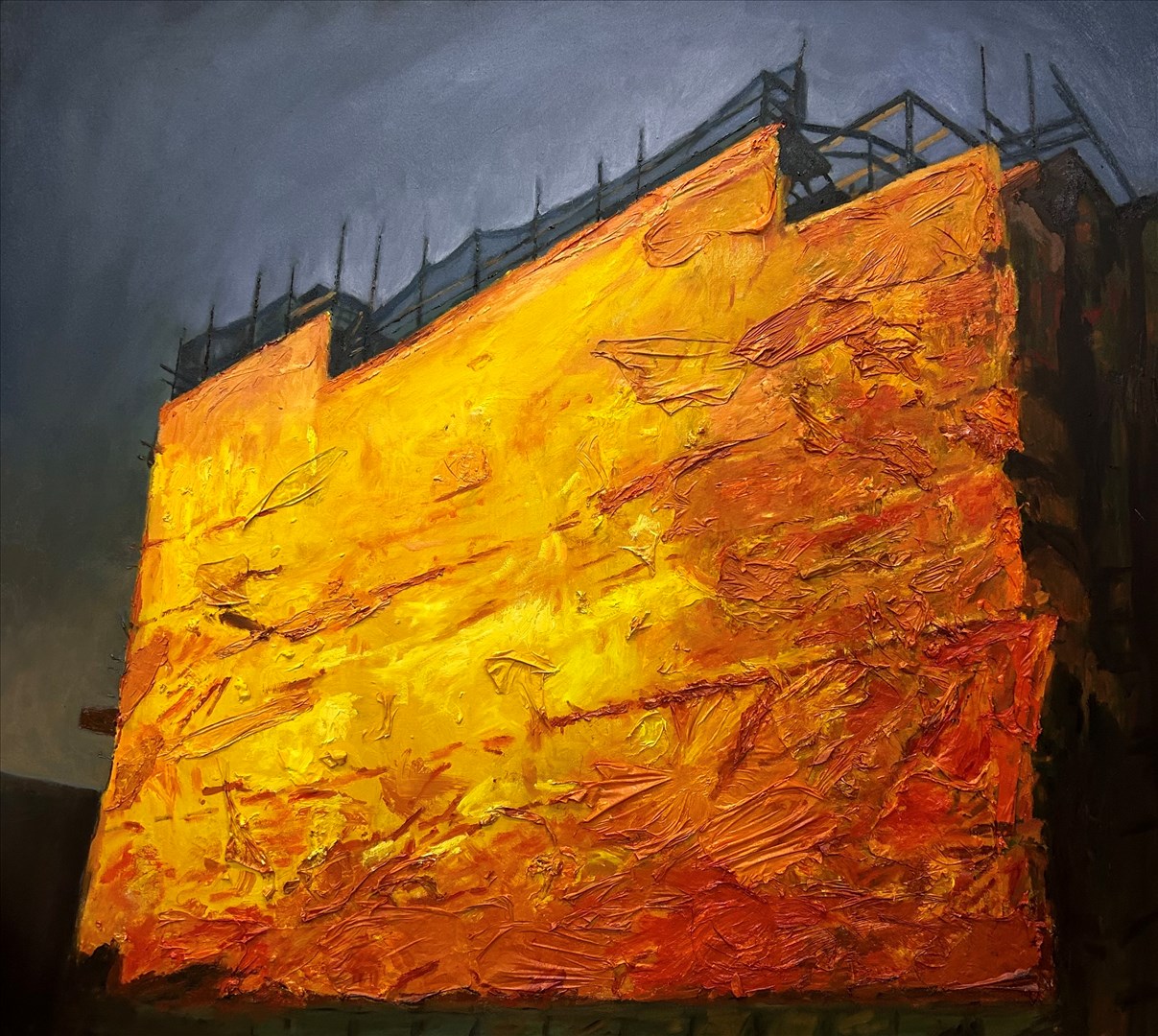
Considerate Construction (oil and latex) by Lee Maelzer £16,000 (28)
In a completely different vibe, the friend I went with liked:

Love Myself (knitting wool and cotton filling)by Chunyoung Yang £500 (42)
Room 2 (77 works)
Also hung by O’Donoghue. Amid the jumble sale disorder of so many images a number were about the sea, which emerged as a theme in both his rooms.

High and Dry (woodblock and etched lino) by Ian Burke £380 (71)
There was a little area devoted to the works of ‘the late Mick Moon RA’ including this, which I think I’ve seen at a previous show, dramatic in its size and painted on rough industrial planking so right up my street.

Outward Bound (acrylic and mixed media) by Mick Moon £30,000 (111)
The Large Weston Room (242 works)
It comes as a visual and psychological relief to emerge from the first two rooms, characterised by grey and blurred images, and into room 3. This is curated by the fabulous Cornelia Parker who has themed her room round the seven colours of the rainbow and it immediately feels like it. This is the room with the four big Michael Craig-Martins with his trademark flat colouring, and you are also struck by several works with colourful vertical strips. Big relief after the first two grey rooms.

Orchid (by Sir Michael Craig-Martin £8,600
My friend is a birdwatcher and nature lover so she liked the clever Bird Colour Wheel by Jim Moir.

Bird Colour Wheel (pigment print) by Jim Moir £1,250 (149)
There was also the first humorous offerings, including a pair of 18th century paintings spoofed by having 21st century products collaged onto them, by Toby Holmes.

A Bottle of Dog (Newkie Brown) (digital collage; giclee print) by Toby Holmes £250 (188)
I like the woodcut vibe and loveliness of this fine image (in fact a linocut).

Traitorous Trueness (linocut) by Gerard McMenamin £250 (205)
In a similar vein I liked the strong cartoon outlines of this nude.

Untitled Nude 2 (linocut) by Morag Bassinthwaite £250 (256)
At about this point it dawned on me that maybe, faced with a bombardment of images, the mind prioritises the realistic, naturalistic images. Was that why I was liking recognisable naturalistic images? Is that why I liked this one so much, where Paul Stephenson has merged an original 1820 oil painting (of John Porter by William Bradley) onto an image of the calm flat infinite sea?
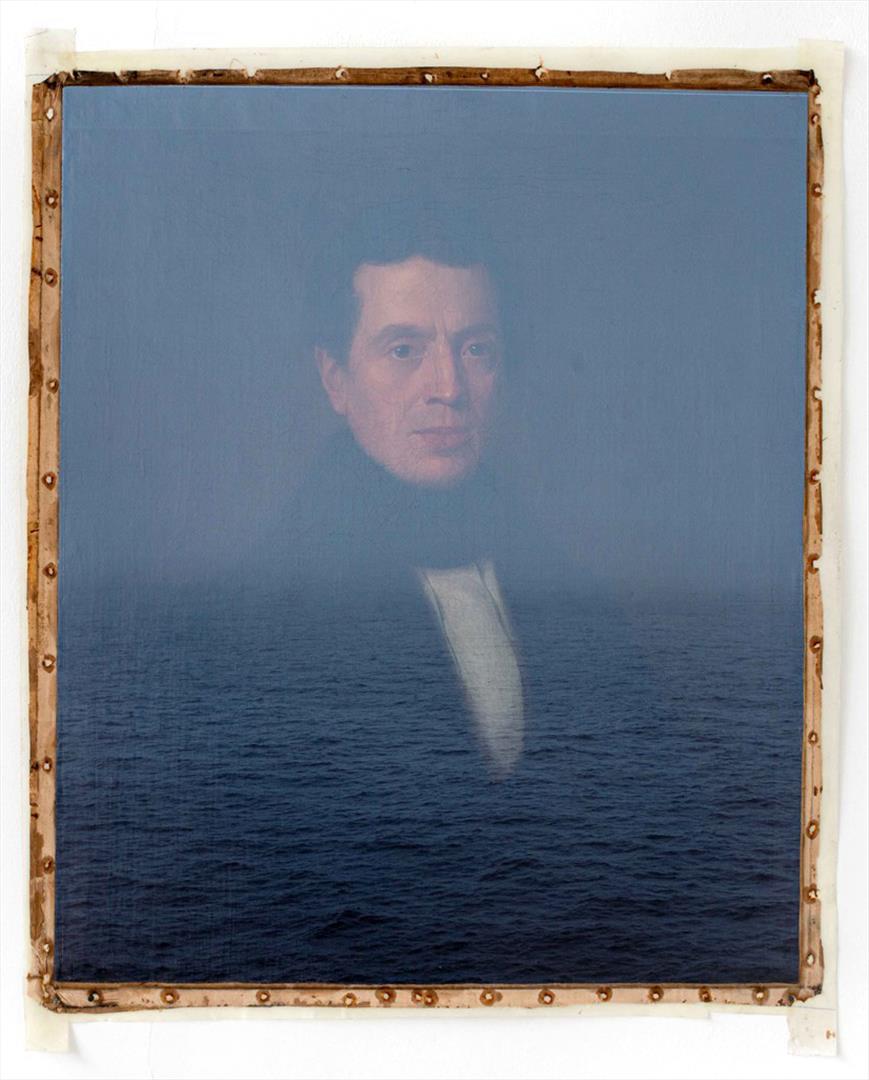
Reflets sous la pluie (ink on original oil painting) by Paul Stephenson £2,500 (211)
Remember I mentioned the tiger covered in Tunnock teacake wrappers. The famous tiger was done by David Mach (and there are a couple of smaller works in the same style in the penultimate room). Here’s a jokey hommage by Paula Martyr.

A Teacake Cat (collage) by Paula Martyr Not For Sale (NFS) (210)
When someone’s bought a print which comes in multiple editions, the gallery puts a round red adhesive label by it. I thought it telling that this Parker room has a whole stand devoted to twee and humorous images of cats and dogs which were festooned with red labels. People want art that is a) affordable b) makes you smile.
Resisting the appeal of winsome cats and dogs, I liked the casual gracefulness of this image by Julia Andrews.

In My Mind (five-later screenprint) by Julia Andrews £350 (266)
Small Weston Room (1 video)
The work in the Small Weston Room is by invited artist Carey Young. Filmed at SIGMA Corporation in Japan, ‘The Vision Machine’ captures the company’s female employees, creating a speculative fiction that suggests a lens factory run (and perhaps owned) by women. The factory is used as a metaphor for photography and cinema in a wider sense, and shows how women are framed within, and in relation to those fields. The piece pays homage to women as skilled makers and creators, whilst suggesting a female-centric vision, or perhaps a wider visual culture created by women.
There’s a page of stills from the film on her website. My friend – a woman and a feminist – walked in, watched the video for sixty seconds, and walked out again. Given our saturation with American TV and movies which are designed to grab and keep our attention for every second, it’s very difficult for any art video maker to compete.
Room 3 (63 works)
This room is massive, maybe three times the size of the previous rooms, so it needs big works to make an impression. It was hung by the exhibition’s overall co-ordinator, Ann Christopher who is a sculptor. Her aim (apparently) was to create contrasts of scale. A large collage of woodcuts by Anselm Kiefer (American), a new painting by Rose Wylie and a vibrant work on canvas by Sir Frank Bowling. Alongside are smaller works by artists such as David Remfry and Diana Armfield. Some sculptures are hung on the walls. Cornelia Parker ‘Psychobarn (Flotsam)‘ leans against a wall, while Honorary Academician El Anatsui’s intricate wall-hanging dominates one end of the gallery. I normally love Parker but didn’t react to her shed and the Anatsui is genuinely huge but left me meh. Richard Serra is ‘known for his large-scale abstract sculptures made for site-specific landscape, urban, and architectural settings’ which is why it was odd to see him represented by a painting, which admittedly had a nice Rothko-like abstract vibe (well, without the blurry edges).
Those are all big names but the actual works selected weren’t that exciting, for example a couple of drawings by Rachel Whiteread, who cares? It would have been much better to have one of her huge sculptures, specially for such a big space.
Maybe my favourite piece was the Bowling. There’s a reason why the famous guys are famous – at their best they have a certain something which lifts them above, in this case, the hundreds of other semi-abstract paintings on show. (Incidentally, I think the silver slipper is depicted in the central diamond, something which is much more obvious when you see it in the flesh, as it’s a whopping 3 metres tall.)

Silver Slipper (acrylic and acrylic gel with collaged canvas with marouflage) by Frank Bowling NFS (440)
Room 4 (71 works)
Room 4 was also curated by Christopher. I liked Horror Vacui by Paul Benney which is a digitally animated painting of a candle under a bell jar using up all the oxygen and snuffing out. There’s a slightly worrying big print of a naked man facing away from us by the famous Wolfgang Tillmans. It made me realise how relatively few nudes there were in the show and, as usual, mostly female.
Small but striking (maybe just because it reminds me of the photomontage pioneered by Peter Kennard whose show at the Whitechapel Gallery I recently visited) was this photomontage by Michelle Thompson.

Bomb (digital artwork) by Michelle Thompson £145 (520)
Room 5 (183 works)
Room 5 was hung by Hurvin Anderson and feels packed. Anderson is Black and it’s probably no coincidence that this room has the first real Black presence, for example the big (and not very good) portrait of Linton Kwesi Johnson and a multiple portrait of Bob Marley. (Having been reminded of Johnson I wrote this review listening to his 1979 album ‘Forces of Victory’.
There’s a vast messy colourful painting by Elizabeth Cope; I admired the colourfulness but not the design. My companion liked Storm Light by Leslie Dabson. Interestingly, this doesn’t reproduce at all well online; in the flesh it’s very small and compact and so gives a very strong vibe of a rainy evening in London’s Victorian terraces. One of the most vivid images is the hyper-naturalistic depiction of an abandoned car overgrown with vegetation by Geoff Archer.

440 (oil) by Geoff Archer £2,800 (631)
I really liked a couple of abstracts by Subai Zheng, 628 and 651. As far as I could tell every single one of the thousands of dots had been created by hand with a felt tip pen. The more I looked the more I was drawn into this mesmerising image.

Weaver: 30 Houses (felt tip marker and acrylic on canvas) by Subai Zheng £15,000 (651)
On the left-hand wall I surprised myself by liking Stone Pines Rome by Katharine Edwards, maybe because of its echoes of Piet Mondrian transitioning from naturalism to abstraction. Or just because I liked the design and the colours.

Stone Pines Rome (acrylic) by Katharine Edwards £4,000 (574)
On reflecton, it may also be because so many of the images have a rather dingy grey overcast feel. Maybe without realising it, the curators are biased by the simple fact of living in England to prefer works which are dingy, overcast, grey, or rainy i.e. like the English climate. Thinking about it, there are very few images depicting a fine sunny day let alone the light blue Mediterranean skies you associate with, say, the art of Raoul Dufy or Matisse.
Next to it another imagine I liked the more I looked at it was ‘Yellow Umbrella’ by Bill Jacklin. To me it felt romantic, like an illustration for an adventure novel, two huddled figures rushing through a snowstorm.

Yellow Umbrella (monotype with oil pastel) by Bill Jacklin £5,775 (623)
(See also his Sea at Night I in a later room.)
Room 6 (121 works)
Each year there’s an architecture room and I always amuse myself by calling it ‘the room of shame’. This is based on my lived experience of the vast discrepancy between the pretentious, high-falutin’ language of architects fantasising about building ecocities in Brazil or colonies on the moon, and the crappy, badly built, poorly insulated houses and flats most of us live in, the gritty streets dominated by big impersonal blocks which most of us hurry through against the gritty wind or dirty rain.
Anyway, this year exhibition co-ordinator Ann Christopher handed Room 6 over to Assemble RA with a view to making it ‘a space for making’. Who are Assemble RA?
Assemble RA is a collective based in London, who work across the fields of art, architecture and design. They began working together in 2010 and have described themselves as having between 16 and 20 permanent members. Assemble’s working practice seeks to address the typical disconnection between the public and the process by which places are made. Assemble champion a working practice that is interdependent and collaborative, seeking to actively involve the public as both participant and collaborator in the ongoing realization of the work.
And so Assemble RA transformed this room into ‘an industrial warehouse space, a creative’s store, full to the brim with an eclectic mix of models, machinery and curious objects. On the walls are photographs of interiors and artists’ workspaces, and works exploring different materials such as moss (720), 3d-printed sand and woven rush.
What with the shelves lining the walls and the shelf units displaying architects’ models etc this is the most cluttered and busy room. The standout piece for me was a set of industrial tools which have been remodelled to seem like giant metal monster claws.

Installation view of Room 6 at the Royal Academy Summer Exhibition room 6 showing Nippers (812) by James Capper (photo by the author)
Among the earnest models of sustainable blah blah were a few humorous models such as friends used to make at school.

Amorgos Monastery (plywood, painted light plaster, tree bark and tree branches) by Vasilis Politis NFS (709)
My companion liked this, Vast Seas in Green to Grey by Julie Massie which consists of hundreds of thin fragments of coloured porcelain embedded in wood to create this beautifully shaded but slightly worrying relief.

Vast Seas in Green to Grey (porcelain on wood) by Julie Massie £800 (707)
Room 7 (256 works)
Gallery 7 is the first of two adjacent rooms hung by printmaker Anne Desmet. I recently visited the big exhibition of her work at the Guildhall Art Gallery, which is still open and well worth visiting. There’s a thread of architecture and buildings running through it. But straight off I liked a couple of humorous works by Laura Beaumont who’s gotten old Observer Books, carved a square hole in them and then created tiny dioramas using model railway figures and foliage.
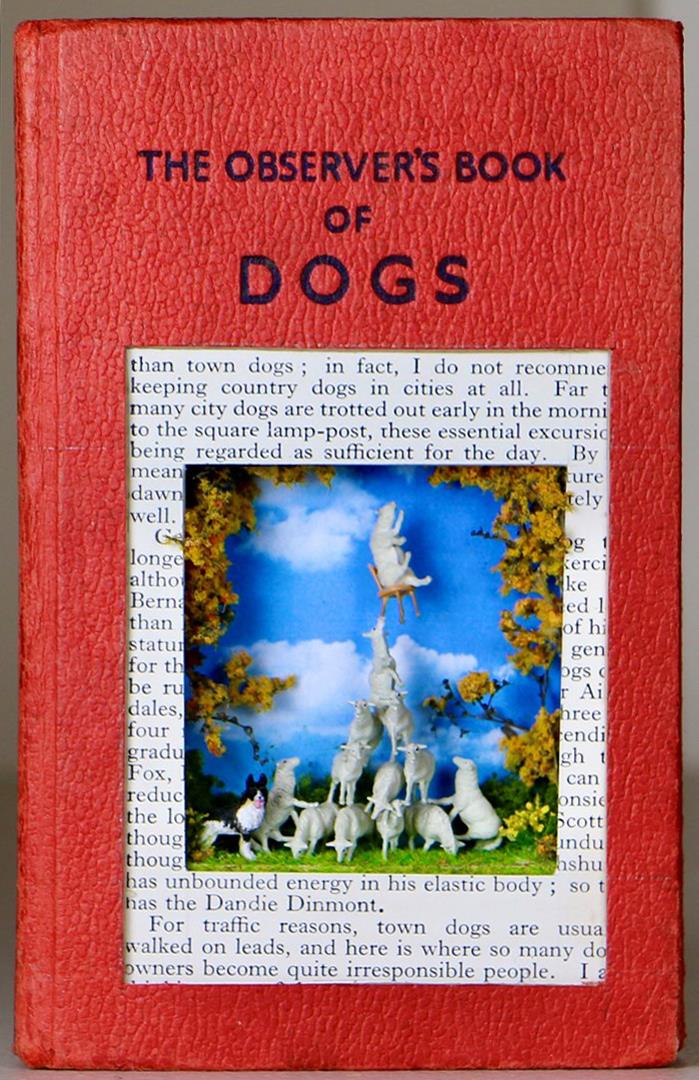
Observers Dogs by Laura Beaumont £1,500 (829)
My favourite piece in this room was hung up high and so you craned your neck, appropriately, to look up at an image of a high rise block. This reproduction doesn’t do it justice. In the exhibition the paper is set on dark brown wood and creates the impression that it’s made of weathered copper.

Cottingley Heights On Oak (Three) (acrylic on oak veneer) by Nicola Rawnsley £380 (841)
In a different mood, I liked Blueprint by Peter Lawrence, maybe because it reminds me of 1950s jazz LP covers. It also links in my mind with the wonderful prints by the Yoshida family currently on display at the Dulwich Picture Gallery.

Blueprint (wood engraving) by Peter Lawrence £175 (872)
Lovely, minimalist and clean are Ian Ritchie’s etchings of foxes (926). For me the standout work in the room was a lovely etching of the BBC offices in Langham Place, possibly because they remind me of the wonderful exhibition of 1930s linocuts at Dulwich Picture Gallery a few years ago.

W1A – BBC AND All Souls Church, Langham Place (etching) by John Duffin £795 (977)
There are lots of images of London streets and buildings which are Desmet’s own subject, in all kinds of styles. I was impressed by the realism of this image of Oxford Street through a rain-drizzled window, presumably of a bus.

Oxford Street (acrylic) by James Condon £5,200 (1015)
Honourable mention Urban Beings V (1024) by Francesco Russo.
Room 8 (259 works)
Second room hung by Anne Desmet, this had a noticeable theme of trees along one wall, with all manner of seascapes on the far wall, many of which I liked. This impressive work is an etching made on sycamore leaves, presumably commemorating the chopping down of the tee in the Sycamore Gap of Hadrian’s Wall. It’s more impressive in the flesh than this reproduction

Acer pseudoplatanus L (etching on sycamore leaves) by Emma Buckmaster and Janet French £7,500 (1132)
In line with my general preference for woodcuts and works with strong outlines, I liked this simple but effective linocut, ‘Trees Beneath a Lemon-Yellow Sky’ by Paul Hogg £750.

Trees Beneath a Lemon-Yellow Sky (linocut) by Paul Hogg £750 (1140)
Twenty of more images of the sea captured it in all its moods, from a lovely print by John Mackenzie of shallow surf over a light sandy beach, to images of waves crashing against rocks, a batch of Norman Ackroyd‘s trademark etchings of remote Scottish islands surrounded by gulls.

An Ocean to Swim (woodcut) (woodcut) by Trevor Price £580 (1189)
High up on a wall was a set of ‘London Heads’. This is small and cute in the flesh (40 x 40 cm) so doesn’t benefit from being blown up in reproduction.

London Heads by Sally Cutler £350
This might be the best room with a wide range of smaller but attractive and quality images. I liked the one of a single fern leaf, another painting of woodland floor all brambles etc. On the opposite wall were characterful images of individuals and groups. This one, also, was all the more powerful for being small (15 x 13 cm) like the illustration to an interesting novel.

Waiting For The Rain To Stop by Barbara Jackson £350
Funniest entries in the show might be the two jokey prints by Ceal Warnent.

Revolutionary by Ceal Warnants (photopolymer relief print on vintage book paper) £130
These prints had almost as many red labels on them as the cute cats and dogs in room 3 and you can see why. They would make you smile every time you look at them.
Room 9 (64 works)
Gallery 9 was hung by Ann Christopher and is dominated by the biggest piece in the show, ‘String Quartet’ by Ron Arad. This is a big carpet draped up the wall and across the floor, on which sit four chairs on which are placed the four instruments of a string quartet and over hidden loudspeakers is projected string quartet music which you can hear from the nearby galleries. It’s odd, really, how little modern art makes use of music or sounds of any sort.

The Quartet by Ron Arad (sculpture made of wood, steel, copper, silicon and cotton £300,000 (1408)
There’s another big showy work, a huge sculpture of a pair of black hands by Tim Shaw which I didn’t like at all. The curators comment ‘a pair of hands where the negative space forms part of the work’ – well, which sculpture does not create a greater or lesser space around it? On the plus side, some of the children visiting the show were enjoying pretending to shake hands with them or dancing in and around them which was fun to watch.

The Space Between (Does Not Come in a Vacuum) by Tim Shaw (sculpture of Painted foam) £35,000 (1410)
My companion the naturalist liked all images of birds throughout the show but particularly the strutting crow.

Strutting (acrylic) by Lisa Badau £645 (1384)
The Lecture Room
This room was hung by Veronica Ryan who had the bright idea of painting the wall turmeric ‘a colour inspired by the culinary spice which is known for its healing properties’. This turns out to be a very dynamic and enjoyable colour to stroll in. This room is full of sculptures, maybe it was unofficially ‘the sculpture room’ and Ryan has made the little innovation of replacing traditional white plinths with wooden shelves and trestle tables. This is cool but also brings out a strong village church jumble sale vibe as well. All kinds of things to admire. My photo of a battleship made of card shows the turmeric colour in the background.

Installation view of the Royal Academy Summer Exhibition 2024 showing ‘Worship-Warship’ by Richard Wilson and, in the background, the orange turmeric colour of the walls and the bric-a-brac vibe created by the trestle tables (photo by the author)
Maybe the most striking piece is an oriental carpet out of which a tiger’s head is mutating, like the alien bursting out of John Hurt’s stomach. It’s life size and genuinely a bit disturbing.

Brown Tiger by Debbie Lawson (sculpture made from Jesmonite, carpet and wood)
There was, maybe, an understated feminist theme in this room, with some paintings of menopause medication by Sara Gregory (1429). I liked the sculptures using an image of a mother and child printed on a metal plate and surrounded by rooster feathers to create a kind of ‘native’ African shield effect.

Female Warrior Army, Motherhood 2 by Emma McGuire (photo decal on porcelain with rooster feathers) £3,500
In a related African vibe (on the same wall) are hung a couple of big prints by Yinka Shonibare CBE (1525, 1526) whose exhibition at Serpentine South you can still visit. I quite liked a lot of things in this room but not burningly so. I suppose this is quite amusing and many of the other sculptures were in the same category: quite good, quite funny. Possibly I was just exhausted by this stage of the marathon.

The Invader by Hannah Simpson (stoneware ceramic) £1,050 (1620)
Wohl Central Hall (81 works)
The Wohl Central Hall is the last room in the show and the second of Assemble RA’s two rooms. The idea is that they’ve ‘created a studio setting and explored the creative process’. This explains why there are random swatches of paint on the walls and a clutter of props including a drafting table and a joinery bench. The plinths in the gallery have been repurposed from waste materials such as discarded slabs from an industrial estate etc. Probably there was lots of interesting and stimulating work here but I was full. My companion, blessed with more stamina than me, and also much clearer about what she likes, liked the big mosaic of ‘Hackney Birds’ and spent a minute or two checking off the ones we see in our garden.

Some Hackney Birds by Hackney Mosaic Project (wall-based glass and ceramic mosaic) NFS
Maintaining the ornithological theme I liked this – maybe because by this stage I was on my last legs and only noticing the really bright obvious pieces.

African Phoenix: Coffin for Qm Nana Yaa Asantewaa by Elsie Owusu (carved wood, paint and glazes) NFS
Thoughts
Despite all the curators’ talk of themes and issues, the experience of visiting is massive, chaotic and exhausting. That said there are hundreds and hundreds of things to like if you have the stamina, determination and patience to look carefully at everything. I wrote this review the day after visiting and was surprised to realise how many works I really liked, including many I haven’t shown here.
After a dingy start in the grey murky opening rooms, and despite the absence of any real showstoppers (apart, I suppose, from Arad’s Quartet and Shaw’s hands, and maybe Parker’s shed and El Anatsui’s wall-hanging, none of which did it for me) there are lots of smaller, sometimes very small, gems, which are worth the effort of carefully reviewing everything in the room to find and cherish and marvel, feel and chortle at.

Tunnocks Maneki-Neko by Robert Mach (kinetic sculpture with confectionary foil on plastic and wood) £1,400 (1555)
Related links
- The Royal Academy Summer exhibition continues at the Royal Academy until 18 August 2024
- Search every work in the exhibition
- Large print guide


 Books & Boots