Royal Academy Summer Exhibition 2025

Huge

The Royal Academy Summer Exhibition 2025 contains the usual overwhelming number of works of art plastered all over the walls of 12 rooms – small, medium and huge. This year’s total is 1,729 prints, paintings, photographs, drawings, sculptures, films and architecture models. Where to start and how to think about this annual jamboree except to abandon yourself to the bombardment.

‘On your marks – get set – go!’ – installation view of Gallery 2 at the Royal Academy Summer Exhibition 2025 (photo © Royal Academy of Arts / David Parry)

Go with someone

I went round once, pretty carefully, trying to look at everything, then went round a couple more times and noticed a load of items I simply hadn’t registered on a first pass. That’s why it’s best to go with friends or family, because there’s too much for one person to process and other people notice other types of things and bring them to your attention. Plus which, it’s always fun to listen to other people’s opinions: why did they love x, y or z?

Installation view of room 1 in the Royal Academy Summer Exhibition, aka the Wohl Central Hall, which is dominated by one of Ryan Gander’s big black balls (left) and a set of ostrich feather car wash wipers suspended from thick chains, ‘Body Shop’ by Alice Channer (£70,000) (photo © Royal Academy of Arts / David Parry)

Exhibition guide

The little pocket-sized exhibition guide they offer each year now costs £3.50, which is beginning to feel a bit pricey, but it is a vital piece of equipment. None of the 1,729 works have captions giving name of work or name of artist, there’s just a number on the wall next to each piece (from 1 to 1,729) so it’s absolutely vital to have the guide to hand in order to look up who the artist is, what the work is called and, because the great majority of works are for sale, the price.

It lists the works in numerical order but, since works by the same artist are sometimes scattered between different rooms, it also lists them by artist. So, for example, we learn from this index that Michael Craig-Martin has five works in the show, numbers 110, 490, 1087, 1205, 1206. Then you scan the main numerical index to discover these are hung in the Lecture Room, Gallery 7, Gallery 4, and Gallery 3.

So if you want to track down works by particular favourite artists (Norman Ackroyd, Tracey Emin, Yinka Shonibare) there’s an element of Where’s Wally or Sudoku sleuthing to find the numbers, find the gallery, and then the challenge of finding them on a wall absolutely plastered with pictures or surfaces crammed with little sculptures.

How many little sculptures can you fit onto one display table? at the Royal Academy Summer Exhibition 2025 (photo © Royal Academy of Arts / David Parry)

The digital version

One last point: most of the works are medium sized, many relatively small, and it is often difficult or even impossible to really see these because a) there are just so many of them and b) lots of them are hung high up on the walls.

This year, as every year, I discovered loads and loads of images on the RA exhibition website that I have no memory of seeing in the flesh. I think it’s reasonable to say that there are, in effect, two Royal Academy Summer exhibitions, the real life one, and the digital one.

The courtyard

As usual the exhibition starts with a big sculpture or installation in the main courtyard. This year it’s a set of huge black inflated balls by Ryan Gander RA. Each one has a gnomic question printed on it in big white letters. Apparently these were developed in collaboration with schoolkids and, well, to be a little harsh, it shows: How much is a lot? When do you know you’re right? Does abstraction have rules? Will time tell?

Courtyard of the Royal Academy Summer Exhibition 2025 showing some of Ryan Gander’s big balls (photo © Royal Academy of Arts / David Parry)

Light white walls

My immediate impression was that the show felt lighter and airier and more attractive than in the past few years, which gave me a positive feeling about the thing. After visiting several rooms it dawned on me that this is because the curators have left (most of) the walls white. Bright white walls respond well to the ambient light coming through skylights and make the place feel light and airy and happy. I was tired from the working week when I headed for the Tube but walking into the galleries was a refreshing and uplifting moment.

And if you turn left out of the Wohl Central Hall into the vast room 3, you are met by a welter of huge and impressive works, with summer light pouring through the skylight and reflected from the white walls. All very positive.

Installation view of the enormous Gallery 3, by far the best room at the Royal Academy Summer Exhibition 2025 (photo © Royal Academy of Arts / David Parry)

However, when I looked closer at the numbers I realised room 3 is pretty much the last room you’re meant to visit (if you care about doing it in order) and you’re in fact meant to turn right out of the Wohl Central Hall into the much smaller Lecture Room.

This room and the subsequent ones (galleries 9, 8, 7, 6 etc), nice and white-painted though they are, had what felt to me far fewer really standout works in them. Obviously lots and lots of goodish things, some very nice things but, as I continued round the overwhelmingly densely hung spaces, navigating the crowds of other visitors, slowly the suspicion grew on me that there were fewer really notable works than in previous years. Maybe. Possibly.

But that’s just one person’s point of view. The point is there’s such a glut of stuff to look at, consider, analyse and judge that everyone’s opinions are going to differ, at hundreds of points. I considered structuring this review by the RA’s own categories:

  • Prints
  • Painting
  • Photography
  • Drawing
  • Sculpture
  • Architecture
  • Film prints

But quickly realised this doesn’t really work. The things you like tend to be random and clustered in certain mediums. In my case, I like paintings and sculptures. I rarely pay much attention to films which a) require a lot of time b) are rarely worth it c) not least because they’re displayed on tiny monitors (poor film-makers, they must be gutted) and d) I used to work in TV where I professionally reviewed films made for the magazine format TV shows I edited, so I am used to a very high standard of image and editing and art films are, on the whole, notable for their deliberately low-fi quality.

And don’t get me started on architecture and architectural models: I regard the entire subject as a colossal fail. While international starchitects devise evermore silly and absurd projects to build dream cities in China or on Mars, the rest of us have to live in the disastrously badly planned, badly designed, badly built houses inflicted on us by previous generations of shoddy planners and cheapskate builders:

‘England boasts the highest percentage of substandard housing in Europe, with 15% of existing homes failing to meet the Decent Homes Standard. This is a higher proportion than countries like Hungary, Poland, and Lithuania.’
(England’s Housing Crisis: Among the Worst in the Developed World?)

I appreciate that architects large and small, world famous or local, have very little to do with all this, with local planning, house design, building, new developments etc, they’re all vying to build the next gherkin or shard or designing ideal communities for Utopia or, as here, Lord Forster of South Bank’s design for the new Manchester United stadium.

But in which case… if most of them have little or no say about the built environment most of us live and move in, why are we bothering to register their fantasias?

Among the numerous architect models, I was struck by this one which appeared to be made almost entirely from corrugated cardboard.

Suspense, Trans-Caucasian Trail, Armenia by Gumuchdjian Architects: number 1584:  5,000

Size matters

It sounds silly but faced with such an overwhelming number of artworks you quickly realise that size really does matter. To give a simple example, there are a number of portraits of dogs or cats which are obviously meant to be twee and sentimental and reassuring and they are nearly all small, deliberately small and intimate in scale.

A lot of them are prints which are designed to be run off in multiple editions and you often see their glass fronts festooned with little red dot stickers. This indicates how many people have bought a copy – so there’s another game you can play here, with friends or family, particularly small children, which is set them to find the most popular picture, by number of sales.

What caught my eye

Having abandoned the attempt to consider the works logically by format or size or price, I’m just going to share half a dozen of the works which really stood out for me.

Mummer

Number 177, Mummer (Irish border sculpture proposal) by Tim Shaw. Sculpture from carved and constructed wood. £150,000, standing in front of a ragged red curtain.

Mummer (Irish border sculpture proposal) by Tim Shaw (photo by the author)

Rats

101 white rat pelts lined with 22 carat gold, by Zatorski + Zatorski. Number 1,713. £85,000

101 white rat pelts by Zatorski + Zatorski. Number 1,713. £85,000 (photo by the author)

Dialogue with God

Dialogue with God by Jane Hewitt, catalogue number 1727, £1,000.

Dialogue with God by Jane Hewitt (photo by the author)

Day 3

Number 1592: Day 3 by Eleanor Lakelin – made from bleached horse chestnut burr. £78,600

Day 3 by Eleanor Lakelin (photo by the author)

Archive of Lost Memories I

Archive of Lost Memories I by Yinka Shonibare, catalogue number 105: £300,000. We’re familiar with Shonibare’s work from his solo exhibition at the Serpentine. Half of it is very post-colonial, with statues of imperial heroes decorated with colourful floral patterns, and this shelf display is a variation on that theme, with its terracotta versions of the Benin bronzes (still to be seen in the British Museum) juxtaposed with a flower-covered imperial bust. But another strand of his work is colourful portraits of African birds generally accompanied by a tribal mask, and there are three or four examples here as well.

Archive of Lost Memories I by Yinka Shonibare, catalogue number 105: £300,000 (photo by the author)

Simorgh and Solent avocet

These could be in a local village craft fair, couldn’t they? But for some reason they caught my eye, made me smile.

Simorgh and Solent avocet by Emma Christmas, numbers 1106 and 1005, £695 and £625 (photo by the author)

Touchstone

Touchstone by Neil Jeffries, number 461, £6,000

The absence of real life

It’s amazing to me how unreal art is, how utterly unlike real, everyday life, how little of most people’s average experiences are captured by art. What do most of us do, what makes up our experience of life? Surely work and commuting to and from work and worrying about work takes up half or more of life, followed by shopping for food, cooking and eating. Vast amounts of time are spent watching telly, going to the movies, taking part in sports or health activities such as simply walking or, in my case, cycling and the gym. And, of course, more or less everybody now seems to have a mobile phone and pay an enormous amount of time looking at a tiny screen.

My point is that none of this is depicted anywhere in any of the 1,729 works of art on show here. When you see it from this perspective, it is absolutely staggering the extent to which ‘art’ – presumably derived from art school, art teaching, art courses and what you could call Art Ideology – suppresses and excludes the vast majority of everyday human experience.

To be more specific, most people’s work involves sitting in front of a computer screen and yet there was just one depiction of this universal activity in the show (At The Screen by David Tindle) plus a schematic Michael Craig-Martin silhouette of a laptop. That’s it.

Driving – how many people own a car, how many hours a week do people spend driving, drive busses coaches vans Deliveroo scooters: yet there were very few depictions of this extremely common activity: some photos of picturesquely derelict old cars, a few photos or paintings of the view through what appear to be wet windscreens. But of the apparatus surrounding driving, and the vast infrastructure of motorways, service stations, A roads, B roads and so on, almost nothing. (Actually there is one picturesque gas station, but it’s in America which is generally considered by the art world to be more picturesque than shabby England, obviously.)

Instead: lots of real life as most of us experience it, there are lots of still lifes of apples, or pears, or vases of flowers, of isolated birds, of landscapes and seascapes, plus hundreds and hundreds of images which aren’t identifiable as anything specific, abstracts and semi-abstracts, vivid, beautifully executed, and all strangely detached from the world we live in…

How many pictures can you fit on a wall? at the Royal Academy Summer Exhibition 2025 (photo © Royal Academy of Arts / David Parry)

All I’m really saying is that, when you assemble nearly 2,000 of the best contemporary artworks, paintings, prints, photos, sculptures and installations by artists famous and obscure, it is really quite striking how much of contemporary lived experience is not in it.

Mr Potato Head

New World Man by Robert Mach

New World Man by Robert Mach, catalogue number 1723, £1,400.

How you’ll feel by the end

Lulu in the Sky with Diamonds Catalogue by John Humphreys (number 1661) from £120,000 (photo by the author)


Related links

Related reviews

The Master Builder by Henrik Ibsen (1892)

Act 1

The Master Builder in question is Halvard Solness. For years he worked for Knut Brovik but then the tables were turned, Brovik went bankrupt while Solness struck out on his own and established his own thriving business, hiring Brovik, and his son Ragnar, to come and work for him. So Solness is now a vigorous successful man of 40 or so while Brovik is now old and ill and bitter. The play opens with Knut and Ragnar working in Solness’s office and grumblingly revealing all this backstory. Off to one side works pretty young Kaja Fosli, who is Knut’s niece and engaged to Ragnar.

The play opens with Solness returning to the office and confronting Knut who is unhappy. In particular he wants to see his son, Ragnar, get a commission of his own and prove his worth as an architect while Solness is reluctant to let him leave. The crux of the argument is that a young couple have come to Solness asking him to build them a home. Solness in front of Knut and Ragnar dismisses the commission but when Knut then asks if his son can take it up, and mentions that Ragnar has already shown the couple some sketches, Solness reverses his position and says Ragnar can’t do it, he’ll do it.

In the middle of the argument Solness broaches the theme which is to become central to the play, namely his anxiety that a new, younger generation is knocking on the door. Solness worries that he will be forced to get out of the way, make way for younger men (p.272).

Kaja

Back in the main office Knut says he feels ill so Ragnar helps his ailing dad go home. Left by themselves Solness and Kaja reveal that they are in love. Or more precisely, young Kaja is absolutely besotted with the older man. Through slips in his dialogue, Ibsen conveys the sense that Solness is going along with her infatuation, playing up to it (‘I can’t do without you’), but chiefly because he wants Ragnar to stay in his office, and where Kaja is, there Ragnar (her official fiancé) will remain (p.276).

Like most older literature, it’s impossible to imagine modern people behaving like this. The manipulation, yes, but the idea that Ragnar and Kaja have been engaged for five years and Ragnar hasn’t noticed that his beloved is besotted with another man – and that other man is his boss – is implausible.

Anyway, three more characters have to be introduced before we have the full set and the game can begin. First to enter is Solness’s wife, a faded beauty, a tired woman named Aline. We quickly realise that she is alert to whatever’s going on between her husband and his pretty secretary, and that – after she’s popped into the room briefly to say that Dr Herder has called round then leaves – we learn that Kaja, with that woman’s sense, knows that Aline knows and is tortured with anxiety and shame. Solness tries to reassure her and packs her off home.

Dr Herder

Dr Herder is introduced and the women leave the two men alone. In a tactful way Herder tells Solness his wife suspects he’s having an affair and asks if she is justified. Solness replies that his wife’s jealousy is not unjustified but not in the way she thinks. Yes Solness is playing up to Kaja but (our suspicions are confirmed) he’s only doing so to keep Ragnar in his practice, for the young man is extremely talented and useful.

But Solness goes beyond this simple piece of manipulation to tell the doctor something more. When Kaja first presented herself at the practice wanting something or other, as soon as she explained her relationship with Ragnar, Solness saw his opportunity and wished very strongly that she would apply for a job. But he didn’t say it out loud, just wished hard. The funny thing is that she turned up the next morning ready to start work as if he’d offered her the job and yet he never had. Solness himself is puzzled. It’s as if his unspoken wishes made it happen…

Dr Herder is a rational soul and thinks all this is poppycock. Returning to the main point he asks Solness why he hasn’t explained all this to his wife. Once it was explained she’d understand. And again, Solness gives an unexpectedly perverse or spiritual answer. He doesn’t explain the real situation to his wife because he enjoys her being suspicious and jealous of him. He enjoys ‘the mortification of letting Aline do him an injustice’ (p.282).

Again the doctor doesn’t understand him but Solness sweeps on, anyway, to declare that the real problem isn’t that his wife thinks he’s unfaithful, it’s that she thinks he’s mad. And sometimes Solness agrees. Everyone (including the doctor) thinks he’s rich and successful and yet inside he’s consumed with anxiety amounting to fear. he is terrified of being swept away in the deluge of the rising generation.

SOLNESS: The turn is coming. I sense it. I can feel it getting nearer. Somebody or other is going to demand: Make way for me! And then all the others will come storming up, threatening and shouting: Get out of the way! Get out of the way! Yes, just you watch, doctor! One of these days youth is going to come here beating on the door… (p.285)

Hilde

At the height of this slightly unhinged soliloquy there’s a knock on the door and the final character enters, Hilde Wangel. She’s dressed in hiking clothes and 23 and full of life and confidence. Herder remembers that he and Solness met her amid a group of hiking ladies earlier in the summer. Now she’s come back to town on her own, with nothing but the clothes she’s standing in and a hiking pack. Rather presumptuously she asks if she can stay the night and Solness, impressed by her forthrightness, says yes and calls his wife to fix up one of the spare rooms (in fact they have three unused nursery rooms) for her.

The doctor leaves Hilde and Solness alone. First she captivates him with her insouciance – she doesn’t have any money or any plans but laughs at his offer that she come and work for him (‘not likely!’). But then she reminds him that ten years earlier, when he was in his 30s and she was just 13, he had supervised the repair of the church tower in her home town of Lysanger. Once it was completed they held a ceremony, the whole town turned out in formal dress for speeches and so on, Hilde and the other schoolgirls were wearing white dresses, and at the peak Solness climbed to the top of the scaffolding and placed a wreath on the weathercock.

Then there was a big dinner at the town club and then Solness was invited round to Hilde’s father’s house for drinks. And how when he arrived she was the only one in the reception room. And now, she reminds him, he was very kind and said that she looked like a little princess, and how she said your princess, and how Solness played along and said, yes, in ten years time he would return and sweep her off to some exciting foreign land like Spain, carry her off like a troll and make her his princess. And then, Solness claims to have completely forgotten but Hilde now reminds him, that he kissed her. Took her in his arms and bent her backwards and kissed her, several times.

At first Solness angrily denies it while Hilde stands sullenly still and silent but then, in a strange way, he talks himself into believing it, and then asserting it. And what happened next…? Nothing happened next. All the other guests came rushing into the room and that was that, Hilde says grumpily.

But now she reminds him of something else he’s forgotten. The date all this happened was 19 September and today is 19 September. It’s exactly ten years to the day since he made his promise to return and carry her off to an exotic land (p.295). Playfully she raps the table and says, Time’s up! She’s here and she expects to be carried away to a magic kingdom!

A little more realistically she asks whether he’s built any more church towers recently and when he replies no, mostly people’s homes, she asks surely everyone should have towers on their houses and Solness admits that he’s most recently building a house for himself and, yes, it is going to have a tower, and they both rhapsodise for a moment about towers stretching up to the skies.

And we realise we’re not in an exactly realistic kind of play or fiction but in something which has crossed over, somehow, into a fairy tale.

And now, unrealistically, having established this memory-fairy bond between them, Solness shares with Hilde the deep fear he also shared with the doctor, his fear about Youth coming rampaging in and sweeping him away (p.299). This he explains, is why he’s locked himself away and barred the door (he must mean metaphorically, spiritually, because we’ve seen him freely coming and going).

All this is interrupted by first the doctor then Solness’s wife, Aline, entering to say she’s fixed up one of the bedrooms. Both the doctor and Aline are surprised at how intimate Solness and Hilde have become in their absence, signalled by the fact that Solness refers to her as the familiar Hilde, not the formal Miss Wangel which he ought to use seeing as they’ve only met half an hour ago.

But Solness explains to both that he met and knew her a few years ago. ‘Did you now?’ says Aline, raising her eyebrows. It’s clear that she sees Hilde as the latest in a succession of young women attracted to her husband. But Hilde in their last moments alone had asked Solness if she could find some use for her (presumably in his business) and when Solness enthusiastically replied Yes, she clapped her hands with delight. Some kind of pact or agreement has been signed between the anxious middle-aged man and this vivacious symbol of youth.

Act 2

Solness and Alvine alone together in the family home, revealing – no surprise – that they are both bitterly unhappy. We learned in an aside in Act 1 that her parents’ family home burned down 13 or so years ago and this turns out to have devastated Aline. I also think (it’s very elliptical) that either they had children who died young or were unable to have children, either way something about children is a sore point between them. With the result that they live in a house full of secrets and repressed unhappiness (‘The emptiness is dreadful.’)

Solness tries to persuade her that everything will be better once they move into the new house but Aline’s not having it. Nothing will change.

ALINE: Build as much as you will, Halvard – you can never build another home for me! (p.303)

In quick succession Solness reveals two things: he keeps harping on about being mad; but deeper than that, he is oppressed by a crushing sense of guilt towards Aline, even though he’s never knowingly done her any wrong.

Hilde

Into this miserable conversation walks Hilde who stayed last night. Aline is happy to break off the conversation in order to offer to go and buy for Hilde bits and bobs she’ll need. There’s just enough of an exchange between them for Aline to make it quite clear she’s sceptical about Solness’s claim that Hilde is a friend from way (back), using the same dry tone she uses when addressing Kaja. Plainly she thinks he likes to surround himself with adoring young women.

Left alone Hilde and Solness’s conversation is a strange mix of artless chat and intense confession. Hilde looks over the plans recently made by Ragnar which Solness has been reviewing but this leads into her intense declaration that only he, the Master Builder, should be allowed to build anything and, unexpectedly, Solness agrees and admits this is an opinion he has secretly nurtured.

To change the subject he points out the building in scaffolding across the way and Hilde notes the big tower. That’s the new house he’s built for them. And now he’s in confessional mode he tell Hilde (and the audience) the story of his children. Aline bore twin boys. But they were only three weeks old when the house burned down. Nobody was hurt in the fire but the shock and the cold air when she was rescued from the burning house gave Aline a fever. But she insisted on carrying on breast feeding the babies because it was her duty. And so she gave them the fever and they died…

And he points out to her the terrible paradox that, although the fire was the making of him – it allowed him to design and new buildings on the large plot of land freed up by the destruction of the old house and these homes made his reputation – the paradox is that his entire career is built on creating safe, secure homes for families when he, himself, can never again have a family, will never have children, will never know a child’s love.

And he is tortured by an immense guilt, the sense that the more successful he is an architect, the more he builds lovely homes for families, the more he and those around him, somehow, have to pay a price, the terrible thought:

SOLNESS: That all this I somehow have to make up for. Pay for. Not in money, but in human happiness. And not with my own happiness alone but with other people’s too. Don’t you see that, Hilde? That’s the price my status as an artist has cost me — and others. And every single day I have to stand by and watch this price being paid for me anew. Over and over again — endlessly! (p.316)

By now we can see why Solness has repeatedly described himself as mad; this terrible anxiety and guilt are a form of mental illness. And not only that, but he feels guilty that the loss of the boys deprived Aline if her vocation, which was to raise children.

Ragnar

All this angst is interrupted by Ragnar knocking and entering to tell Solness that his father, Knut, is very ill. Ragnar asks him if he can take the message back to his Dad that Solness rates and compliments his drawings. But Solness obstinately refuses to praise them and gets cross when Ragnar persists. Why doesn’t Solness just praise them and tell Ragnar to take the praise to his dying Father? Because he is blocked and obstinate.

Ragnar reluctantly leaves and Hilde tells Solness that was mean and cruel. Their conversation resumes its strange mood. Solness shares a secret, a kind of confession, he says the whole thing came down to a crack in one of the chimneys. He noticed it and meant to do something about it for ages but something held him back. Then he goes into a kind of visionary state to explain that he saw his house being burned down, he imagined it would happen one cold day while he and Aline were out for a ride and the others had banked up the fires ready for their return. He describes it so vividly that Hilde (and the audience) are led to believe this is the route of his guilt, that the fire which led to the death of his children and the ruin of his wife was somehow his fault.

And yet at the last minute he switches tack and says it wasn’t that at all. Turns out the fire started in a cupboard somewhere else, was in no way caused by the leak he didn’t fix. And yet so intensely had he wished for the fire that he is haunted by a sense of guilt he can’t assuage.

But he still hasn’t finished. He goes on to explain his conviction that in order to achieve anything a man needs helpers and servants and, moreover, they must come to him of their own volition. This is what he was trying to explain to Dr Herder who didn’t understand at all but Hilde does understand. She tells him that she felt some strange force or compulsion to come and see him (p.323). Yes, says Solness, we both have the troll inside us.

Floating just above the realm of realism, in the realm of poetic drama, Solness tells Hilde she is like a bird of the forest and she takes the metaphor and sees herself as a powerful bird of prey. Then he switches the image and says, no, she is like the dawn, she is the quality of Youth to which he is endlessly drawn (p.325).

This leads back to the drawings by Ragnar on the table and Solness confesses some more. He admits that Ragnar is a very talented architect and that, given half a chance, he will do to Solness what Solness did to h is father, namely smash him and leave him in the dust. Nonetheless, Hilde makes him come over and sit at the desk with the drawings on and insists that they write some nice comments for Ragnar to show his dying father.

But Solness can’t concentrate and asks Hilde why, if she was obsessed with him she never wrote to him. And why she never visited sooner. And what does she want from him? And she replies, simply, she wants the kingdom which he promised her.

Aline

Mrs Solness enters with various parcels saying she’s done the shopping for Hilde, who thanks her. but she asks her to call in Kaja from the office. Kaja enters very young and intimidated. Hilde gives her Ragnar’s architect’s drawings with Solness’s comments scribbled on them and tells her to run back to Ragnar’s house and give them to him to show his father in his dying hours…

But Kaja’s joy is brutally cut short, when in front of his wife and Hilde, Solness also tells Kaja to tell the Broviks that he has no further use for them, and that goes for her too. She is appalled. He has just fired all three of them. She creeps timidly out. Aline reprimands her husband for being so brutal but goes on, with her usual pointed manner, to say Solness will probably be able to replace her pretty easily…looking at Hilde.

Hilde is not intimidated and larkily says she’d be no use behind a desk, that’s not her style. Solness tells his wife to hurry up and pack their things ready to move into the new house. This very evening they’ll have the topping-off ceremony. And Hilde butts in to ask whether Solness will climb to the top of the tower to place a wreath at the top like he did with the church in her home town. Solness is inspired by the vision and wants to but Aline is horrified and reminds him he gets terrible vertigo, he can’t even bear to go out onto their first floor balcony, he gets dizzy, it would be an accident waiting to happen.

But so bewitched is Solness by Hilde that he says he’ll do it, regardless, anything for his Princess Hilde.

And so on to Act 3 with the audience totally expecting Solness to climb the tower and fall to his death. Will he, won’t he?

Act 3

The third and final act is set outside, on a verandah of their current home but with a view over to the new one, partly swathed in scaffolding. Aline is sunning herself. Hilde comes up onto the verandah bearing flowers from the garden. They get chatting with Hilde obviously buttering Aline up and gaining her confidence enough to talk about the famous fire which burned her family home. She makes the point that it’s the little things whose loss hurts the most, like the nine dollies she’d kept since her childhood.

Enter Dr Herdal, paying a visit. With the three of them there Hilde asks if he’ll be around that evening to watch Solness climb the tower, first the doctor’s heard of it. This triggers panic fear in Aline who begs Hilde to talk her husband out of it. Impulsively Hilde throws her arms round Aline’s neck in the way nobody now does (did they ever or is this a convention from a certain era?) Aline tells the doctor she’d like to talk to him about her husband and they exit.

Followed promptly by Solness entering. Hilde tells him point blank that she wants to leave. She talks openly about them having an affair which hadn’t been explicit before. She says it’s one thing taking the man from someone you don’t know but she’s come to know and like Mrs Solness (in the matter of about 2 days!) and so, no, can’t have an affair with him and wants to leave.

Surprisingly (or maybe not, given Ibsen’s track record of hysterical characters telling each other they can’t live without the other) Solness is devastated: ‘What will happen to me after you’re gone? What will I have left to live for?’ He says Aline is dead inside ‘And here I am, chained alive to this dead woman’ (p.338)

Hilde suddenly outbursts that this life is so stupid, their not daring to reach out and lay hands upon happiness just because someone is standing in the way (i.e. Mrs Solness). But just as quickly they start joking around. Hilde says again that she is like a great forest bird, and (Solness adds) swooping down on her prey, and then Hilde declares she knows what he will build next, it will be a castle! He promised her a kingdom and all kingdoms have castles, don’t they? And they push on further into this fantasy, she telling him he’ll build her the biggest tallest mightiest castle ever, high on a hill and with a ginormous tower. Caught up in her vision, Solness asks for more and she says he will go further, her Master Builder will build her castles in the air.

Ragnar

Enter Ragnar to puncture this vision. He’s brought the wreath, the workmen gave it to him to bring over. Solness says he’ll take charge of the wreath prompting Ragnar to mockingly ask whether he is going to climb to the top of the building. Angrily Solness tells him to go home to tend his father. Too late for that, Ragnar replies, he’s had a stroke and is unconscious. Kaja is tending him. Solness tells him, nonetheless, to push off and go be with his father, and exits, walking off the balcony and over to the other building, holding the wreath.

This gives Ragnar an opportunity to tell Hilde how bitterly angry he is with Solness, for ruining his father’s life, for holding him back and all of this just to…Hilde prompts him … just to be close to Kaja. Hilde’s suspicions that Solness was in a relationship with Kaja are confirmed but she refuses to believe it. Ragnar says Kaja has just recently admitted it, that the Master Builder owns her body and soul, that he controls her thoughts, that she can never be separated from him.

Hilde refuses to believe it and now tells Ragnar her interpretation, which is that Solness only kept Kaja on because doing so kept Ragnar tied to him, stuck in his office. Ragnar admits that has a certain logic and reveals just how much Solness is afraid of him. Hilde demurs. Ragnar says she doesn’t realise yet that the Master Builder’s entire character is based on fear.

Hilde demurs and says her Master Builder is fearless, and repeats her girlhood memory of watching him climb up the tower, brave and fearless. Yes, but that’s the one and only time he ever did it, Ragnar ripostes, he’ll never do it again…

Aline

Enter Aline who asks where Solness is and when the others tell her he’s gone off with the wreath she has a panic attack. She begs Ragnar to go and fetch him back, tell him they have important visitors and so Ragnar trots off.

At which point enter the doctor to tell her that she actually does have some visitors come to see her and also to ask after Solness. Aline and Hilde have a brief exchange wondering whether Solness actually is mad as he keeps telling everyone. Aline and the doctor exit and Solness reappears.

It’s just Solness and Hilde and he confesses something to her (something more, on top of all the other confessions the play’s been full of). This is that when the fire burned down the old house and led to the death of his children, he thought God was calling him to become a master of his craft, to deprive him of all distractions so he could dedicate his life to building churches to His glory.

But then he, Solness, did something impossible. A man terrified of heights and overcome by vertigo, he nonetheless managed to climb to the top of the church tower he’d built (as seen by Hilde, as described half a dozen times already) and when he was up there, he had a word with God. He told God that he intended to be free, to do as he pleased, that never again would he build churches for God but homes for people (p.349). Defiance! Resolution!

But…but then…but now he thinks it was all for nothing. The people he built for didn’t really value their homes, he doesn’t value his achievement. So will he give up building altogether? No, there is one more thing he plans to build and he revisits what they were talking about earlier – castles in the air and tells her he can only do it with her.

Not with anyone else, she asks waspishly. Not with a certain Kaja. Solness is annoyed and, instead of flat out denying it, or explaining he only buttered up Kaja to keep Ragnar, foolishly he makes it a point of principle. He says Hilde must just trust him on this, she must believe in him. She replies she’ll believe in him when she sees him at the top of the tower.

And so Ibsen has manipulated his material round to make this climbing-of-the-tower become a great test his young would-be lover forces Solness to carry out. The tower has become a symbol within the play, symbolising Solness’s determination and something to do with his commitment to Hilde and starting a new life. But towers are also a very ancient symbol, freighted with numerous meanings to do with height and power and achievement, not forgetting the close to God element Solness made explicit in his colloquy with the Creator.

Solness pledges that he will not only climb to the top of the tower but, once there, he will have another conversation with God and this time he will assert his totalm freedom and independence:

SOLNESS: I shall say to him: Hear me, Great and Mighty Lord! Judge me as you will. But henceforth I shall build one thing only, quite the loveliest thing in the whole world…
HILDE: Yes…yes…yes!
SOLNESS: …Build it together with the princess I love…
HILDE: Yes, tell Him that! Tell Him that!
SOLNESS: Yes. And then I shall say to Him: And now I go down to take her in my arms and kiss her…
HILDE:…Many times! Say that!

Long story short: Solness dies. There’s a grand build-up, all the other characters arrive on the balcony (Mrs Solness, Hilde, Ragnar, Dr Heldar) plus some miscellaneous ladies while the set is arranged in such a way that we can see some of the crowd gathering in front of the house.

Mrs Solness is terrified and tells Solness not to do it but he reassures her that he’s just going down among his workmen. There’s an exchange between Ragnar and Hilde where he gives full vent to his frustration. Mrs Solness said how pleased she was that so many of her husband’s old apprentices had turned out to watch, but Ragnar explains it’s because Solness kept them all down, controlled them, cramped their careers, and so they all want to see him fail.

Although lots of other people ooh and aah, the core of the scene is the effect on Hilde. She watches, as in a trance, in a vision, her Master Builder clambers his way to the top of the scaffold where he does, indeed, place the wreath. And then there’s a pause which, as she explains to Ragnar, is Solness talking to God. At last, at last, she sees him ‘great and free‘. She hears a song in the air.

Then they all see Solness plummet to his death amid a wreck of scaffold and planking. But even after someone’s shouted up from the crowd that he’s definitely dead, Hilde still hears and sees the afterwaves of her vision.

HILDE: [with a kind of quiet, bewildered triumph]: But he got right to the top. And I heard harps in the air. [Waves the shawl upwards and shouts with a wild intensity.] My…my…master builder! (p.355)

Comments

Old literature is strange, that’s why I like it. It follows the rules of genres we no longer know, is influenced by the works of colleagues and contemporaries who we’ve forgotten, but most importantly, shows people behaving (we think) according to the social conventions and values of their day, many of which are so remote from us as to come from another planet. The text, the plot, the dialogue veer in and out of comprehension like someone looking through a microscope and fiddling with the focus. Sometimes it’s small details of social convention or behaviour which we find odd but often it’s major plot developments and sometimes the entire conception.

So my response to all the Ibsen plays has been very varied, thrilled, appalled, galvanised, puzzled, disappointed.

To start with the disappointment, it’s striking that three of these four plays end with the dramatic death (or mental collapse) of the protagonist: I associate this kind of melodrama with Chekhov and not in a good way.

Critics refer to the symbolism of the plays. Having just written a note about symbolism I don’t think this is quite the right concept; it’s more that the plays start with strictly plausible realism but then slowly transcend it in order to show us the characters’ psyches; and that these psyches are complex and over-wrought.

But reading these seven Ibsen plays I found the power of the conception, and the power of the conception of the central characters, steamrollers through doubts about verisimilitude, overwhelms quibbles about plausibility. They appear realistic in every detail and yet Ibsen’s plays feel like they take you to the heart of the burning furnace of human nature.


Related links

Ibsen reviews

Drama reviews

  • Play reviews

Royal Academy summer exhibition 2024

The usual procedure: tens of thousands of artworks submitted by members of the public and Royal Academicians (RAs) and then reviewed and chosen by a panel of eight or so RAs. Result: twelve galleries crammed from floor to ceiling with 1,710 paintings, prints, drawings, sculptures, architectural models, hangings, mobiles, photos and videos.

So, as usual, it takes a lot of time and effort to really focus on, assess and process so very, very many works. By less than half way through I was feeling overwhelmed. Doing the whole show properly requires stamina and determination.

Each work is accompanied by a wall label which just gives the work’s number so it’s well worth investing £3.50 in the little pocket catalogue because only by referring to this can you find out the work’s name, the artist and – subject of perennial fascination – its cost, because the majority of the works on display here are on sale. As far as I could see the cheapest work cost £100, the most expensive was a room-sized installation which could be yours for just £300,000.

I think it was the Guardian who accused this year’s show of being a chaotic jumble sale, but it always feels like that to me. And despite there being few real bangers (like the life-size sculpture of a gorilla made out of coat hangers or the life-sized sculpture of a tiger covered in red and silver Tunnocks teacake wrappers from former shows) there were a lot of really good things.

There’s always a chair of the curators, or chief co-ordinator, and they choose the show’s overall theme. This year’s co-ordinator was Ann Christopher and the supposed theme is MAKING SPACE.

As I walked very slowly through the rooms I marked up on my catalogue the works I really liked or were striking for one reason or another. Here’s my selection of personal favourites. She is quoted as saying:

“I plan to explore the idea of making space, whether giving space or taking space. This can be interpreted in various ways: to make space can mean openness – making space for something or someone, also making space between things. It is my belief that the spaces in between are as important as whatever those spaces separate.”

I think it’s fair to say I didn’t notice or recognise this theme anywhere in the exhibition and you could happily walk through the whole thing without being aware of any central theme, such is the range and diversity of the plethora of works on display.

A few Big Names are represented: the ones whose names I know are Rachel Whiteread, Ron Arad, Frank Bowling, Michael Craig-Martin, Anselm Kiefer, Mick Moon, Allen Jones. The only ones whose work I recognised unprompted were Michael Craig-Martin for the four or so big schematic paintings of everyday objects in room 3, because he has such a clear and recognisable brand and Allen Jones for the sculpture in room 9 because the heads on it had his very characteristic look.

The Annenberg courtyard

In the courtyard is a monumental textile sculpture. From a distance I thought it was a concatenation of chains and was going to be yet another reference to imperialism and slavery, the top subject of our times, but I was wrong. It’s by British artist Nicola Turner and is made of found organic matter, including horsehair and wool with the tips of each of the monstrous legs ending in old-style table legs on castors.

Apparently it is based on one of Reynolds’s own paintings, The Infant Hercules Strangling the Serpents and this explains why the slender tip of what turns into this monstrous rampage of rope emanates from the tip of Sir Joshua’s paintbrush. The work ‘explores the boundaries between life, death and the liminal spaces in between’.

‘The Meddling Fiend’ by Nicola Turner (Exhibit 1)

Room 1 (63 works)

Each room or set of rooms is hung by a member of the selection committee. The first two rooms were hung by Hughie O’Donoghue RA. Not to be too harsh, but both these rooms felt grey and dreary. It’s only in room 3 that things pick up. Apparently O’Donaghue was attracted to works that ‘displayed a painter’s sensibility in which the physical process of painting and a sense of the hard-won image were evident.’ I do, in fact, see what he means and my favourite pieces in this room do just that, show the process of painting making in a way I’ve always like, using or incorporating found materials, having a strong industrial vibe.

This is most clearly demonstrated in a hug work by O’Donoghue himself, ‘Channel’, which is not only dramatic but is painted on industrial tarpaulin complete with eyelets.

Channel (oil, mixed media on tarpaulin) by Hughie O’Donoghue RA £75,000 (32)

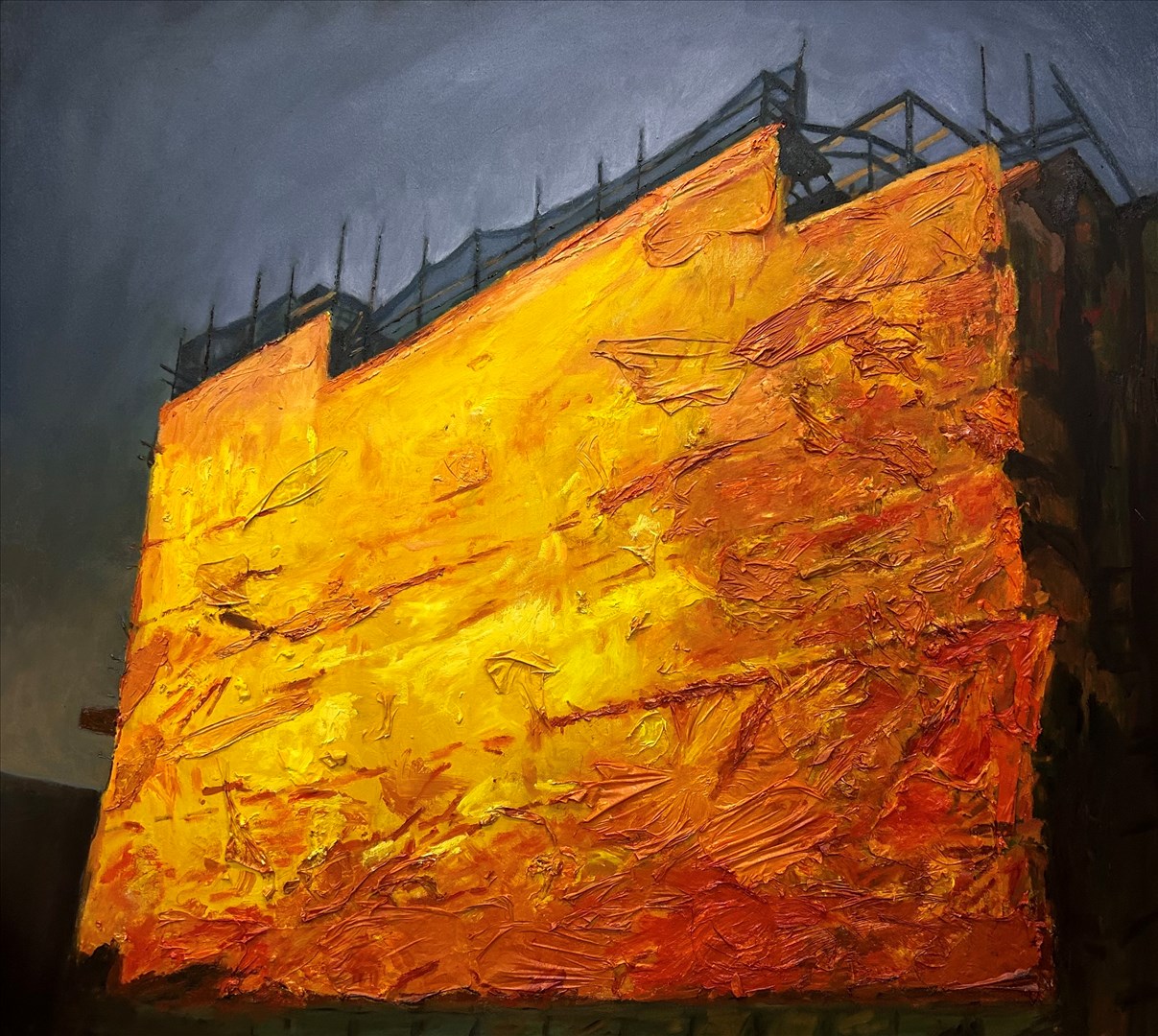
In the same spirit I liked Considerate Construction by Lee Maelzer, mainly for the dramatic gold and orange colouring but also for its industrial vibe.

Considerate Construction (oil and latex) by Lee Maelzer £16,000 (28)

In a completely different vibe, the friend I went with liked:

Love Myself (knitting wool and cotton filling)by Chunyoung Yang £500 (42)

Room 2 (77 works)

Also hung by O’Donoghue. Amid the jumble sale disorder of so many images a number were about the sea, which emerged as a theme in both his rooms.

High and Dry (woodblock and etched lino) by Ian Burke £380 (71)

There was a little area devoted to the works of ‘the late Mick Moon RA’ including this, which I think I’ve seen at a previous show, dramatic in its size and painted on rough industrial planking so right up my street.

Outward Bound (acrylic and mixed media) by Mick Moon £30,000 (111)

The Large Weston Room (242 works)

It comes as a visual and psychological relief to emerge from the first two rooms, characterised by grey and blurred images, and into room 3. This is curated by the fabulous Cornelia Parker who has themed her room round the seven colours of the rainbow and it immediately feels like it. This is the room with the four big Michael Craig-Martins with his trademark flat colouring, and you are also struck by several works with colourful vertical strips. Big relief after the first two grey rooms.

Orchid (by Sir Michael Craig-Martin £8,600

My friend is a birdwatcher and nature lover so she liked the clever Bird Colour Wheel by Jim Moir.

Bird Colour Wheel (pigment print) by Jim Moir £1,250 (149)

There was also the first humorous offerings, including a pair of 18th century paintings spoofed by having 21st century products collaged onto them, by Toby Holmes.

A Bottle of Dog (Newkie Brown) (digital collage; giclee print) by Toby Holmes £250 (188)

I like the woodcut vibe and loveliness of this fine image (in fact a linocut).

Traitorous Trueness (linocut) by Gerard McMenamin £250 (205)

In a similar vein I liked the strong cartoon outlines of this nude.

Untitled Nude 2 (linocut) by Morag Bassinthwaite £250 (256)

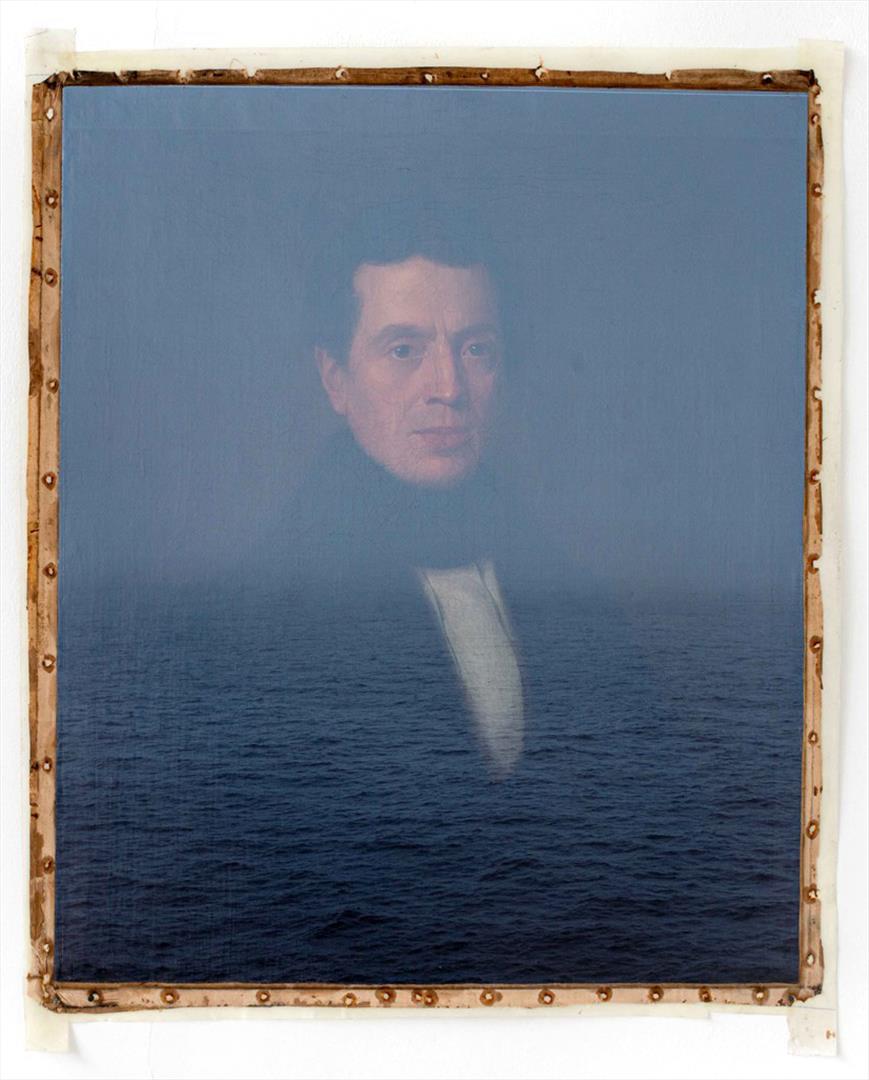
At about this point it dawned on me that maybe, faced with a bombardment of images, the mind prioritises the realistic, naturalistic images. Was that why I was liking recognisable naturalistic images? Is that why I liked this one so much, where Paul Stephenson has merged an original 1820 oil painting (of John Porter by William Bradley) onto an image of the calm flat infinite sea?

Reflets sous la pluie (ink on original oil painting) by Paul Stephenson £2,500 (211)

Remember I mentioned the tiger covered in Tunnock teacake wrappers. The famous tiger was done by David Mach (and there are a couple of smaller works in the same style in the penultimate room). Here’s a jokey hommage by Paula Martyr.

A Teacake Cat (collage) by Paula Martyr Not For Sale (NFS) (210)

When someone’s bought a print which comes in multiple editions, the gallery puts a round red adhesive label by it. I thought it telling that this Parker room has a whole stand devoted to twee and humorous images of cats and dogs which were festooned with red labels. People want art that is a) affordable b) makes you smile.

Resisting the appeal of winsome cats and dogs, I liked the casual gracefulness of this image by Julia Andrews.

In My Mind (five-later screenprint) by Julia Andrews £350 (266)

Small Weston Room (1 video)

The work in the Small Weston Room is by invited artist Carey Young. Filmed at SIGMA Corporation in Japan, ‘The Vision Machine’ captures the company’s female employees, creating a speculative fiction that suggests a lens factory run (and perhaps owned) by women. The factory is used as a metaphor for photography and cinema in a wider sense, and shows how women are framed within, and in relation to those fields. The piece pays homage to women as skilled makers and creators, whilst suggesting a female-centric vision, or perhaps a wider visual culture created by women.

There’s a page of stills from the film on her website. My friend – a woman and a feminist – walked in, watched the video for sixty seconds, and walked out again. Given our saturation with American TV and movies which are designed to grab and keep our attention for every second, it’s very difficult for any art video maker to compete.

Room 3 (63 works)

This room is massive, maybe three times the size of the previous rooms, so it needs big works to make an impression. It was hung by the exhibition’s overall co-ordinator, Ann Christopher who is a sculptor. Her aim (apparently) was to create contrasts of scale. A large collage of woodcuts by Anselm Kiefer (American), a new painting by Rose Wylie and a vibrant work on canvas by Sir Frank Bowling. Alongside are smaller works by artists such as David Remfry and Diana Armfield. Some sculptures are hung on the walls. Cornelia Parker ‘Psychobarn (Flotsam)‘ leans against a wall, while Honorary Academician El Anatsui’s intricate wall-hanging dominates one end of the gallery. I normally love Parker but didn’t react to her shed and the Anatsui is genuinely huge but left me meh. Richard Serra is ‘known for his large-scale abstract sculptures made for site-specific landscape, urban, and architectural settings’ which is why it was odd to see him represented by a painting, which admittedly had a nice Rothko-like abstract vibe (well, without the blurry edges).

Those are all big names but the actual works selected weren’t that exciting, for example a couple of drawings by Rachel Whiteread, who cares? It would have been much better to have one of her huge sculptures, specially for such a big space.

Maybe my favourite piece was the Bowling. There’s a reason why the famous guys are famous – at their best they have a certain something which lifts them above, in this case, the hundreds of other semi-abstract paintings on show. (Incidentally, I think the silver slipper is depicted in the central diamond, something which is much more obvious when you see it in the flesh, as it’s a whopping 3 metres tall.)

Silver Slipper (acrylic and acrylic gel with collaged canvas with marouflage) by Frank Bowling NFS (440)

Room 4 (71 works)

Room 4 was also curated by Christopher. I liked Horror Vacui by Paul Benney which is a digitally animated painting of a candle under a bell jar using up all the oxygen and snuffing out. There’s a slightly worrying big print of a naked man facing away from us by the famous Wolfgang Tillmans. It made me realise how relatively few nudes there were in the show and, as usual, mostly female.

Small but striking (maybe just because it reminds me of the photomontage pioneered by Peter Kennard whose show at the Whitechapel Gallery I recently visited) was this photomontage by Michelle Thompson.

Bomb (digital artwork) by Michelle Thompson £145 (520)

Room 5 (183 works)

Room 5 was hung by Hurvin Anderson and feels packed. Anderson is Black and it’s probably no coincidence that this room has the first real Black presence, for example the big (and not very good) portrait of Linton Kwesi Johnson and a multiple portrait of Bob Marley. (Having been reminded of Johnson I wrote this review listening to his 1979 album ‘Forces of Victory’.

There’s a vast messy colourful painting by Elizabeth Cope; I admired the colourfulness but not the design. My companion liked Storm Light by Leslie Dabson. Interestingly, this doesn’t reproduce at all well online; in the flesh it’s very small and compact and so gives a very strong vibe of a rainy evening in London’s Victorian terraces. One of the most vivid images is the hyper-naturalistic depiction of an abandoned car overgrown with vegetation by Geoff Archer.

440 (oil) by Geoff Archer £2,800 (631)

I really liked a couple of abstracts by Subai Zheng, 628 and 651. As far as I could tell every single one of the thousands of dots had been created by hand with a felt tip pen. The more I looked the more I was drawn into this mesmerising image.

Weaver: 30 Houses (felt tip marker and acrylic on canvas) by Subai Zheng £15,000 (651)

On the left-hand wall I surprised myself by liking Stone Pines Rome by Katharine Edwards, maybe because of its echoes of Piet Mondrian transitioning from naturalism to abstraction. Or just because I liked the design and the colours.

Stone Pines Rome (acrylic) by Katharine Edwards £4,000 (574)

On reflecton, it may also be because so many of the images have a rather dingy grey overcast feel. Maybe without realising it, the curators are biased by the simple fact of living in England to prefer works which are dingy, overcast, grey, or rainy i.e. like the English climate. Thinking about it, there are very few images depicting a fine sunny day let alone the light blue Mediterranean skies you associate with, say, the art of Raoul Dufy or Matisse.

Next to it another imagine I liked the more I looked at it was ‘Yellow Umbrella’ by Bill Jacklin. To me it felt romantic, like an illustration for an adventure novel, two huddled figures rushing through a snowstorm.

Yellow Umbrella (monotype with oil pastel) by Bill Jacklin £5,775 (623)

(See also his Sea at Night I in a later room.)

Room 6 (121 works)

Each year there’s an architecture room and I always amuse myself by calling it ‘the room of shame’. This is based on my lived experience of the vast discrepancy between the pretentious, high-falutin’ language of architects fantasising about building ecocities in Brazil or colonies on the moon, and the crappy, badly built, poorly insulated houses and flats most of us live in, the gritty streets dominated by big impersonal blocks which most of us hurry through against the gritty wind or dirty rain.

Anyway, this year exhibition co-ordinator Ann Christopher handed Room 6 over to Assemble RA with a view to making it ‘a space for making’. Who are Assemble RA?

Assemble RA is a collective based in London, who work across the fields of art, architecture and design. They began working together in 2010 and have described themselves as having between 16 and 20 permanent members. Assemble’s working practice seeks to address the typical disconnection between the public and the process by which places are made. Assemble champion a working practice that is interdependent and collaborative, seeking to actively involve the public as both participant and collaborator in the ongoing realization of the work.

And so Assemble RA transformed this room into ‘an industrial warehouse space, a creative’s store, full to the brim with an eclectic mix of models, machinery and curious objects. On the walls are photographs of interiors and artists’ workspaces, and works exploring different materials such as moss (720), 3d-printed sand and woven rush.

What with the shelves lining the walls and the shelf units displaying architects’ models etc this is the most cluttered and busy room. The standout piece for me was a set of industrial tools which have been remodelled to seem like giant metal monster claws.

Installation view of Room 6 at the Royal Academy Summer Exhibition room 6 showing Nippers (812) by James Capper (photo by the author)

Among the earnest models of sustainable blah blah were a few humorous models such as friends used to make at school.

Amorgos Monastery (plywood, painted light plaster, tree bark and tree branches) by Vasilis Politis NFS (709)

My companion liked this, Vast Seas in Green to Grey by Julie Massie which consists of hundreds of thin fragments of coloured porcelain embedded in wood to create this beautifully shaded but slightly worrying relief.

Vast Seas in Green to Grey (porcelain on wood) by Julie Massie £800 (707)

Room 7 (256 works)

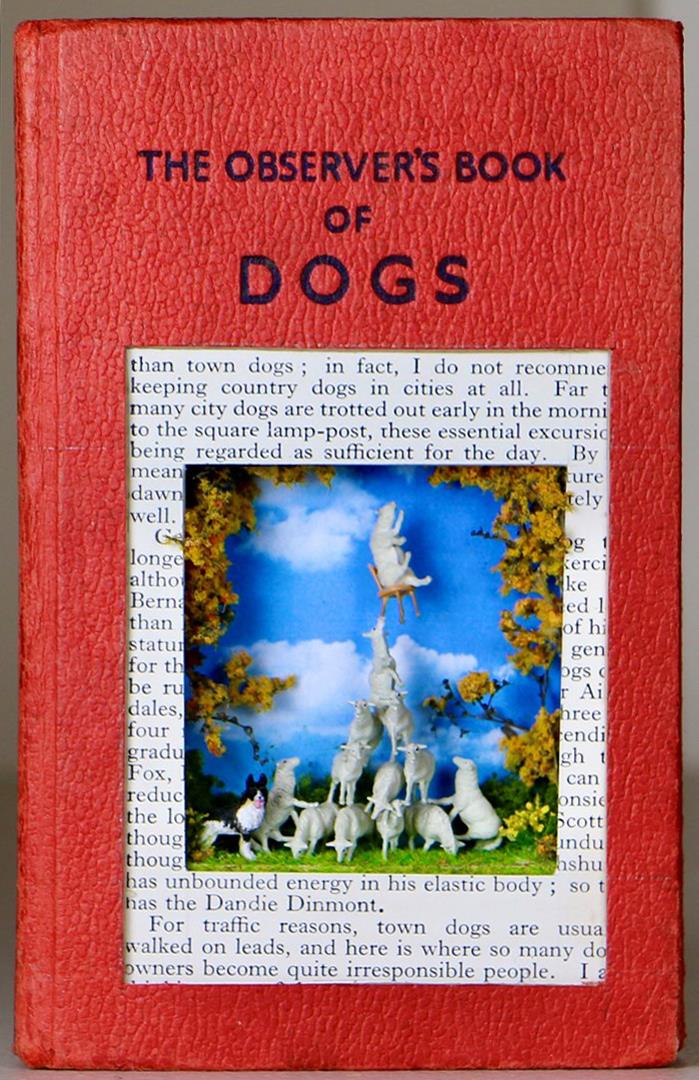
Gallery 7 is the first of two adjacent rooms hung by printmaker Anne Desmet. I recently visited the big exhibition of her work at the Guildhall Art Gallery, which is still open and well worth visiting. There’s a thread of architecture and buildings running through it. But straight off I liked a couple of humorous works by Laura Beaumont who’s gotten old Observer Books, carved a square hole in them and then created tiny dioramas using model railway figures and foliage.

Observers Dogs by Laura Beaumont £1,500 (829)

My favourite piece in this room was hung up high and so you craned your neck, appropriately, to look up at an image of a high rise block. This reproduction doesn’t do it justice. In the exhibition the paper is set on dark brown wood and creates the impression that it’s made of weathered copper.

Cottingley Heights On Oak (Three) (acrylic on oak veneer) by Nicola Rawnsley £380 (841)

In a different mood, I liked Blueprint by Peter Lawrence, maybe because it reminds me of 1950s jazz LP covers. It also links in my mind with the wonderful prints by the Yoshida family currently on display at the Dulwich Picture Gallery.

Blueprint (wood engraving) by Peter Lawrence £175 (872)

Lovely, minimalist and clean are Ian Ritchie’s etchings of foxes (926). For me the standout work in the room was a lovely etching of the BBC offices in Langham Place, possibly because they remind me of the wonderful exhibition of 1930s linocuts at Dulwich Picture Gallery a few years ago.

W1A – BBC AND All Souls Church, Langham Place (etching) by John Duffin £795 (977)

There are lots of images of London streets and buildings which are Desmet’s own subject, in all kinds of styles. I was impressed by the realism of this image of Oxford Street through a rain-drizzled window, presumably of a bus.

Oxford Street (acrylic) by James Condon £5,200 (1015)

Honourable mention Urban Beings V (1024) by Francesco Russo.

Room 8 (259 works)

Second room hung by Anne Desmet, this had a noticeable theme of trees along one wall, with all manner of seascapes on the far wall, many of which I liked. This impressive work is an etching made on sycamore leaves, presumably commemorating the chopping down of the tee in the Sycamore Gap of Hadrian’s Wall. It’s more impressive in the flesh than this reproduction

Acer pseudoplatanus L (etching on sycamore leaves) by Emma Buckmaster and Janet French £7,500 (1132)

In line with my general preference for woodcuts and works with strong outlines, I liked this simple but effective linocut, ‘Trees Beneath a Lemon-Yellow Sky’ by Paul Hogg £750.

Trees Beneath a Lemon-Yellow Sky (linocut) by Paul Hogg £750 (1140)

Twenty of more images of the sea captured it in all its moods, from a lovely print by John Mackenzie of shallow surf over a light sandy beach, to images of waves crashing against rocks, a batch of Norman Ackroyd‘s trademark etchings of remote Scottish islands surrounded by gulls.

An Ocean to Swim (woodcut) (woodcut) by Trevor Price £580 (1189)

High up on a wall was a set of ‘London Heads’. This is small and cute in the flesh (40 x 40 cm) so doesn’t benefit from being blown up in reproduction.

London Heads by Sally Cutler £350

This might be the best room with a wide range of smaller but attractive and quality images. I liked the one of a single fern leaf, another painting of woodland floor all brambles etc. On the opposite wall were characterful images of individuals and groups. This one, also, was all the more powerful for being small (15 x 13 cm) like the illustration to an interesting novel.

Waiting For The Rain To Stop by Barbara Jackson £350

Funniest entries in the show might be the two jokey prints by Ceal Warnent.

Revolutionary by Ceal Warnants (photopolymer relief print on vintage book paper) £130

These prints had almost as many red labels on them as the cute cats and dogs in room 3 and you can see why. They would make you smile every time you look at them.

Room 9 (64 works)

Gallery 9 was hung by Ann Christopher and is dominated by the biggest piece in the show, ‘String Quartet’ by Ron Arad. This is a big carpet draped up the wall and across the floor, on which sit four chairs on which are placed the four instruments of a string quartet and over hidden loudspeakers is projected string quartet music which you can hear from the nearby galleries. It’s odd, really, how little modern art makes use of music or sounds of any sort.

The Quartet by Ron Arad (sculpture made of wood, steel, copper, silicon and cotton £300,000 (1408)

There’s another big showy work, a huge sculpture of a pair of black hands by Tim Shaw which I didn’t like at all. The curators comment ‘a pair of hands where the negative space forms part of the work’ – well, which sculpture does not create a greater or lesser space around it? On the plus side, some of the children visiting the show were enjoying pretending to shake hands with them or dancing in and around them which was fun to watch.

The Space Between (Does Not Come in a Vacuum) by Tim Shaw (sculpture of Painted foam) £35,000 (1410)

My companion the naturalist liked all images of birds throughout the show but particularly the strutting crow.

Strutting (acrylic) by Lisa Badau £645 (1384)

The Lecture Room

This room was hung by Veronica Ryan who had the bright idea of painting the wall turmeric ‘a colour inspired by the culinary spice which is known for its healing properties’. This turns out to be a very dynamic and enjoyable colour to stroll in. This room is full of sculptures, maybe it was unofficially ‘the sculpture room’ and Ryan has made the little innovation of replacing traditional white plinths with wooden shelves and trestle tables. This is cool but also brings out a strong village church jumble sale vibe as well. All kinds of things to admire. My photo of a battleship made of card shows the turmeric colour in the background.

Installation view of the Royal Academy Summer Exhibition 2024 showing ‘Worship-Warship’ by Richard Wilson and, in the background, the orange turmeric colour of the walls and the bric-a-brac vibe created by the trestle tables (photo by the author)

Maybe the most striking piece is an oriental carpet out of which a tiger’s head is mutating, like the alien bursting out of John Hurt’s stomach. It’s life size and genuinely a bit disturbing.

Brown Tiger by Debbie Lawson (sculpture made from Jesmonite, carpet and wood)

There was, maybe, an understated feminist theme in this room, with some paintings of menopause medication by Sara Gregory (1429). I liked the sculptures using an image of a mother and child printed on a metal plate and surrounded by rooster feathers to create a kind of ‘native’ African shield effect.

Female Warrior Army, Motherhood 2 by Emma McGuire (photo decal on porcelain with rooster feathers) £3,500

In a related African vibe (on the same wall) are hung a couple of big prints by Yinka Shonibare CBE (1525, 1526) whose exhibition at Serpentine South you can still visit. I quite liked a lot of things in this room but not burningly so. I suppose this is quite amusing and many of the other sculptures were in the same category: quite good, quite funny. Possibly I was just exhausted by this stage of the marathon.

The Invader by Hannah Simpson (stoneware ceramic) £1,050 (1620)

Wohl Central Hall (81 works)

The Wohl Central Hall is the last room in the show and the second of Assemble RA’s two rooms. The idea is that they’ve ‘created a studio setting and explored the creative process’. This explains why there are random swatches of paint on the walls and a clutter of props including a drafting table and a joinery bench. The plinths in the gallery have been repurposed from waste materials such as discarded slabs from an industrial estate etc. Probably there was lots of interesting and stimulating work here but I was full. My companion, blessed with more stamina than me, and also much clearer about what she likes, liked the big mosaic of ‘Hackney Birds’ and spent a minute or two checking off the ones we see in our garden.

Some Hackney Birds by Hackney Mosaic Project (wall-based glass and ceramic mosaic) NFS

Maintaining the ornithological theme I liked this – maybe because by this stage I was on my last legs and only noticing the really bright obvious pieces.

African Phoenix: Coffin for Qm Nana Yaa Asantewaa by Elsie Owusu (carved wood, paint and glazes) NFS

Thoughts

Despite all the curators’ talk of themes and issues, the experience of visiting is massive, chaotic and exhausting. That said there are hundreds and hundreds of things to like if you have the stamina, determination and patience to look carefully at everything. I wrote this review the day after visiting and was surprised to realise how many works I really liked, including many I haven’t shown here.

After a dingy start in the grey murky opening rooms, and despite the absence of any real showstoppers (apart, I suppose, from Arad’s Quartet and Shaw’s hands, and maybe Parker’s shed and El Anatsui’s wall-hanging, none of which did it for me) there are lots of smaller, sometimes very small, gems, which are worth the effort of carefully reviewing everything in the room to find and cherish and marvel, feel and chortle at.

Tunnocks Maneki-Neko by Robert Mach (kinetic sculpture with confectionary foil on plastic and wood) £1,400 (1555)


Related links

Related reviews

Anne Desmet: Kaleidoscope/London Exhibition @ Guildhall Art Gallery

This is a lovely exhibition of the popular, accessible and inspiring artist Anne Desmet – imaginative, decorative, beautiful to look at, civilised, teasingly clever and FREE.

British Museum Great Court by Anne Desmet @ in Kaleidoscope/London at the Guildhall Art Gallery

From the website and the press release I hadn’t really grasped the scale of the exhibition. With over 150 works this is a major retrospective, which features series of works from as far back as 1990 right up to the present day, including 41 London-themed kaleidoscopic prints created exclusively for this new exhibition.

1. Wood carver par excellence

Born in 1964, Anne Desmet is a well-established artist and member of the Royal Academy who specializes in wood engravings, linocuts and mixed-media collages.

Desmet is a highly skilled carver in wood and creator of dazzling woodcuts. She is only the third artist to be elected to the RA for working in the medium of wood engraving. The exhibition includes a fascinating 6-minute film shot at her studio in Hackney which follows the entire process through, from starting with an endpiece bit of wood, then showing the various sharp carving tools she used to get her effects, through to rolling the print ink flat, inking the cut and then making the print.

There are also four display cases showing the raw wood piece, the tools she uses, the final engraved wood blocks, her notebooks, sketches and so on.

Display case in ‘Kaleidoscope/London’ at the Guildhall Art Gallery, showing, from left to right, a sketchbook, a virgin block of end-grain wood with some of her carving tools, and a finished engraving block (photo by the author)

Most of these woodcuts are in black and white. Some are coloured in but colour isn’t her thing: shapes and patterns are her thing. She can do astonishingly realistic depictions of Italian or London landmarks, gardens and buildings, but its the way she then mashes up these images which get her juices flowing (see below).

2. Architecture

Desmet is strongly attracted by architecture and in particular architecture with strong mathematical lines and geometric shapes. There are three rooms and the first one contains cityscapes and townscapes, depictions of Rome, rooftops of Italian provincial towns, scenes from Oxford (the Radcliffe Camera, Balliol College) and, in a surprise, a piece I really liked, a fantasia of Tudor chimney stacks as she observed them when she was, believe it or not, artist in residence in Eton, in 2016.

‘Urban Jungle’ by Anne Desmet (2016) in ‘Kaleidoscope/London’ at the Guildhall Art Gallery

3. Fantasias

As you can tell from the Eton picture, this is a fantasia made up of lots of chimneys combined together into an improbably dense and overloaded image. She does the same to her Oxford landmarks, moving beyond the obvious aesthetic appeal of the colleges and instead creating fantastical images of, for example, the Radcliffe Camera, whose mighty dome appears ten or more times in a mashed-up fantastical image.

These clear crisp but fantastical images reminded me a little of the woodcut covers Scottish artist and novelist Alisdair Gray made for the covers of his books and short stories and John Lawrence’s illustrations for some of Philip Pullman’s fantasy stories, also set in Oxford. Also, the most fantastical of them are strongly redolent of Maurits Escher‘s optical illusions.

There are a handful of works from the 1990s which are completely fantastical, showing piles of household bric-a-brac (scissors, tape measure) mingled with learned tools such as you might find in a 17th century engraving depicting science (protractors and compass), with the image of Peter Breughel’s version of the Tower of Babel in the background and, snuffling in the foreground, miniature bulldozers and tiny people.

‘Wood Engraver’s Tower’ by Anne Desmet (2020) in ‘Kaleidoscope/London’ at the Guildhall Art Gallery

This image, Breughel’s tower, recurs throughout all of her work, sometimes centre stage, sometimes cropping up as an unexpected detail. It speaks to her interest in architecture, in large buildings, but also to the passage of time, and inevitable decay and collapse. Decline and fall. Ruined cities, empty streets, abandoned buildings…

My favourites in the first room were a series of images made by cutting up original prints and remaking them as collages. In particular I liked this one which takes is inspiration from Antoine de Saint-Exupéry’s children’s story, ‘The Little Prince’, which I liked for its sci fi vibe but mainly for its shape and design and feel. Note the tiny photo of the Radcliffe Camera floating incongruously at the top right.

‘Out of This World’ by Anne Desmet (2022) in ‘Kaleidoscope/London’ at the Guildhall Art Gallery

4. Mashing

So far so fairly realistic and there’s ample evidence that Desmet she can do breath-takingly realistic renderings of buildings and views. But the central concept is that Desmet chops up her work. It is sliced and diced, filleted, repeated, duplicated and recombined in a myriad ways, and it’s these processes which create her really stunning works. I made a list of the treatments she subjects her works to:

  • basic realistic engraving
  • fantasias – Tower of Babel, Eton chimneys, multiplying Radcliffe Cameras
  • collages
  • the same scene with variations – Urban Development or St Paul’s
  • mounted on razor shells – cityscapes, Olympic buildings
  • mounted on squares – Olympic Site A to Z
  • mounted on slate – Perimeter Fence
  • tall images – the angel tower
  • sliced as by a paper shredder – the British Museum Grand Court sliced vertically, horizontally and diagonally
  • hangings – British Museum
  • cut-out illuminated by an LED light – St Paul’s
  • behind glass cubes
  • behind convex clock glass circle
  • on crockery fragments – angels
  • kaleidoscope

Kaleidoscope

The technique central to maybe half of these works is the simple but surprisingly effective technique of using a kaleidoscope.

The exhibition quote Desmet’s own explanation, which I’ll quote in full:

‘Many of the collages were made in 2022 while I was undergoing treatment for breast cancer and consequently, they reflect something of a wild scattergun of thoughts that were running through my mind at that time, such as escape, possible new worlds, and the climate crisis.

‘The framework for those thoughts was inspired by a kaleidoscope toy that I had bought at the Sir John Soane’s Museum some years ago, which breaks up whatever view you’re looking at into extraordinary triangulated repeat-patterns.

‘I set about applying a kaleidoscope lens to my London imagery to create new work for the exhibition at Guildhall Art Gallery. By seeing the city anew and with a sense of its unexpected possibilities, I hope that my work will inspire optimism and constructive thinking in our uncertain times.’

Sky Windows

And so she set about reviewing prints from her earlier wood-engravings, linocuts and hand-drawn lithographs, and kaleidoscoping them. The most comprehensive example is the piece titled ‘RA: Sky Window’. In 2017 the Royal Academy was undergoing a refurbishment and Desmet made some beautifully realistic paintings of the building.

‘RA Revolution’ by Anne Desmet (2017) in ‘Kaleidoscope/London’ at the Guildhall Art Gallery

Then, as explained, in 2023, she returned to the image armed with her kaleidoscope and realised that she could manipulate the skyline of the building so as to place the blue of the sky at the centre of a surprising variety of shapes.

Installation view of ‘Sky Windows’ by Anne Desmet (2023) in ‘Kaleidoscope/London’ at the Guildhall Art Gallery (photo by the author)

And then she realised the blue sky could itself be changed to reflect, among other things, the changing seasons. And so she made versions featuring, for example, fireworks, snowflakes, pumpkins and so on, and the thought, why stop there? Why not be frivolous and whimsical, so there are ones with a rainbow, hot air balloons and helicopters, airplanes high in the sky leaving vapour trails. Suddenly you realise how much goes on in the sky above us without our really noticing.

‘Sky Window 23: Stars and Satellites’ by Anne Desmet (2023) in ‘Kaleidoscope/London’ at the Guildhall Art Gallery (photo by the author)

There are 24 in total, building up into a beguiling, entrancing series. I realised it’s much like the idea of a theme and variations, a stock genre of classical music: first state the theme, then work through a host of inventive variations (Beethoven’s Diabelli variations. Elgar’s Enigma variations spring to mind).

So self-contained and neat is the idea and the execution that a) the entire series of 24 is assigned a room of its own off to the side of the main gallery and b) you can buy the box set!

Installation view of the Sky Windows box set in ‘Kaleidoscope/London’ at the Guildhall Art Gallery (photo by the author)

London Gardens

She does the same thing but with a different visual result in a series called ‘London Kaleidoscope’. Here she starts with totally realistic (and wonderfully vivid and detailed) engravings of a) a London garden, in fact the view from her house and b) a pub down the road with a red phone box outside.

‘QEH’ by Anne Desmet (1998) in ‘Kaleidoscope/London’ at the Guildhall Art Gallery

She collages the original prints, to include the red phone box and greenery from the garden, and then takes her kaleidoscope to the original works and comes up with a (small) set of really vivid, beautiful images, arguably the best in the exhibition. They are London but seen in an entirely new, novel, fun and beautiful way.

‘London Gardens Kaleidoscope 1’ by Anne Desmet (2023) in ‘Kaleidoscope/London’ at the Guildhall Art Gallery (photo by the author)

The same scene with variations

Depicting a scene over time. Thus one of my favourites, the lovely ‘Urban Development’, depicts the front of a London house at seven times of day, showing the sun rising and its light slowly revealing more and more details of the scene.

‘Urban Development’ by Anne Desmet (2023) in ‘Kaleidoscope/London’ at the Guildhall Art Gallery (photo by the author)

Mounted on razor shells

There are at least three pieces which consist images of buildings carefully cut out and stuck onto razor shells. These are all exquisite and the fragility of the process and the end result gives you a fantastic sense of fragility and delicacy.

Installation view of ‘Fragile Earth’ by Anne Desmet (2022) in ‘Kaleidoscope/London’ at the Guildhall Art Gallery

In this piece fragments from prints she’s made of London, Rome, New York, Venice are collaged to produce an international skyline with the natural pink/purple colouring of the shells giving the sense of sunset over this megalopolis.

As good or better is the smaller series made using images she drew, carved and printed of the build-up to the London Olympics in 2012. Here is a finely detailed view of the Olympic velodrome cut up and pasted onto six razor shells. Amazingly powerful, the exquisite detailing of the original image then cut up onto these very fragile artefacts from a fragile, damaged natural world.

‘Fragile Hope’ by Anne Desmet (2012) in ‘Kaleidoscope/London’ at the Guildhall Art Gallery (photo by the author)

The third razor shell work is ‘Fires of London’, created using 18 razor-clam shells to dramatise the many historic fires of London over the last 1,500 years. The work has just been acquired for the Guildhall’s permanent collection.

‘Fires of London’ by Anne Desmet (2012) in ‘Kaleidoscope/London’ at the Guildhall Art Gallery (photo by the author)

Mounted on squares

There’s some example of another type of mounting, chopping an image up into small, mounted squares. In this example a wood engraving of the Olympic site is collaged / mixed into the relevant A to Z map of the same location, and then diced up into 75 small squares.

Olympic Site Map Metamorphosis by Anne Desmet (2010)

I love collage, pieces and fragments and, because I live in London, the A to Z map has an additional frisson or connotation. It is also a fairly obvious meditation on the dichotomy between map and world, which always fascinated me.

Towers

A number of the works are tall and narrow, mimicking the tall chimneys or towers she’s interested in – I’ve shown the Eton chimneys, above. There’s a similar series showing a ‘tower of angels’.

‘Tower of Angels’ by Anne Desmet (2020) in ‘Kaleidoscope/London’ at the Guildhall Art Gallery

The angel tower is one of a set of works inspired by Victorian bas-relief decorative angel sculptures near the ceiling in the Royal Academy’s Gallery 3. She created individual prints, this tower, and a work in ceramics (see below). The theme of angels (sometimes used as a nickname for nurses) seemed appropriate when she was making them, during the first year of the pandemic lockdown. You can tell these are more modern works because they have more edge. In particular, in some of the works the angels are wearing protective face masks. COVID art.

‘Triptych for Our Times’ by Anne Desmet (2020) in ‘Kaleidoscope/London’ at the Guildhall Art Gallery (photo by the author)

Sliced as by a paper shredder

She feeds versions of her lovely print of the British Museum Grand Court through a shredder. One sliced vertically, one horizontally, one diagonally. This image doesn’t do it justice. Only in the flesh can you see the fineness of the very thin paper shreds, curling slightly at the corners, which convey a powerful sense of evanescent fragility, a continuous theme throughout her work.

‘British Museum Diagonals’ by Anne Desmet (2005) in ‘Kaleidoscope/London’ at the Guildhall Art Gallery

Mounted on slate

This was another of my favourites. Only 2 or 3 of the works were mounted on slate but it’s a powerful material and it seemed, to me, strongly appropriate for the subject. It’s a depiction, a dramatisation, of the forbidding metal fences erected all around the Olympic site in East London in the years while it was being built.

‘Perimeter fence’ by Anne Desmet (2012) in ‘Kaleidoscope/London’ at the Guildhall Art Gallery (photo by the author)

I went for a walk around the area during that time and was intimidated, indeed slightly scared, and irked, by the way these ‘games for the people’ involved shutting off vast areas which had previously been free to roam, for years and years. In this piece the shredding technique a) re-enacts the look of the vertical metal fences b) enacts the way you could only glimpse fragments of what was going on on the sites through the slats and c) the slate mounting conveys the adamantine, hard, take-no-prisoners high security vibe which was imposed across the whole area.

Hangings

Closely related are a couple of hangings applying the kaleidoscope technique to the British Museum Grand Court image, rearranging details into immensely pleasing geometric patterns. From a distance they look like abstract geometric shapes but when you go up close you can see the architectural details of the Museum walls and ceiling. Magical!

Two hangings by Anne Desmet (2012) in ‘Kaleidoscope/London’ at the Guildhall Art Gallery (photo by the author)

Cutout illuminated by an LED light

There’s a series of six pictures of St Paul’s cathedral, taken from the identical same sport but showing it at different times of night, and in history, so with some scenes depicting the Blitz, enemy planes overhead and searchlights.

‘St Paul’s: Dance’ by Anne Desmet (2002) in ‘Kaleidoscope/London’ at the Guildhall Art Gallery

One of these has been reworked so the white parts of the image are made translucent (by a laser, apparently) and has been attached to an LED light box so as to create a little son-et-lumiere. To be honest, this felt a bit gimmicky and was one of the very few pieces which didn’t work for me.

‘London’s Secret Stars’ by Anne Desmet (2002) in ‘Kaleidoscope/London’ at the Guildhall Art Gallery

Behind glass cubes

Like one of her engravings of the Olympic velodrome, cut into squares and smoothly rounded glass cubes set over each square.

‘Olympic Memory’ by Anne Desmet (2010) in ‘Kaleidoscope/London’ at the Guildhall Art Gallery

Interesting experiment but a bit self-defeating as it was hard if not impossible to make out the original image, which explains why it only occurs once.

Behind a convex clock glass circle

Speaking of glass, another image manipulation she’s experimented with is placing a collage or print behind a convex glass circle such as you find on the front of old grandfather clocks. An interesting idea but, in my opinion, this blunted your reading of her finely drawn, detailed images, working against her strengths and so this was the one format which didn’t really light my candle. This flat photo of one doesn’t at all convey the shiny bulbous effect of the work.

‘Constructed Space III’ by Anne Desmet (2013) in ‘Kaleidoscope/London’ at the Guildhall Art Gallery

The curators point out how the use of convex glass, as used in old-style clocks, strongly references the notion of Time, linking up with the passage of time indicated, in different ways, by other series (St Paul’s at night; Sky Windows; Urban development and so on). So a clever-clever idea, but I don’t think works in practice, as actual artefacts.

On crockery fragments

On the other hand, I love fragments, wrecks and ruins, bits of industrial detritus, which is why I love the Arte Povera movement, minimalism, the wonderful photos of Jane and Louise Wilson, the great Cornelia Parker and so on. And so I loved the handful of places where she’s laminated her lovely images into fragments of crockery, as with this striking dismantling of one of the angel images.

‘Angel Fragment 2’ by Anne Desmet (2021) in ‘Kaleidoscope/London’ at the Guildhall Art Gallery (photo by the author)

Again, this speaks to the recurrent them in her work of large buildings or neo-classical architecture or Victorian art (as here) degraded, broken, fragmented by the passage of time.

Thoughts

Delightful, inspiring, endlessly inventive, beautiful images and, in the shape of the video and the display cases, very informative about the craft of wood engraving. And it’s FREE. Go and see it.


Related links

Related reviews

Hiroshi Sugimoto: Time Machine @ the Hayward Gallery

This is an outstanding exhibition. For once all the superlatives like ‘landmark’ and ‘definitive’ are true. I massively recommend it.

Hiroshi Sugimoto

Born in 1948, Hiroshi Sugimoto is a Japanese photographer, who has also been involved in architecture and set design. He’s famous in the art world for the way that, over the past 50 years, he has created a body of carefully crafted, subtly thought-provoking and quietly subversive photographs. The central point about his photography is that it is not ‘documentary’ in the sense of recording the world as he finds it. Instead Sugimoto’s photography is proactive, creative, staged and invented. It is expressive, expressing ideas and feelings from within, in this respect more like a kind of poetry than what we usually think of as photography.

‘Usually photographers capture something. I use the camera to project my inner idea of reality.’

Staged and carefully conceptualised as his photography is, Sugimoto’s work tends to come in sets or series. He’s had scores of exhibitions but they have tended to focus on specific series. This is the first one to display key works from all the series spanning his entire career. It’s a triumph. It’s dazzling.

Time

I initially thought the exhibition title ‘Time Machine’ was a bit contrived but it turns out to be extremely accurate and apposite. Over the different series, Sugimoto explores history, prehistory, the origin of life, the power of natural forces, compresses 2 hour movies into one image, in hugely inventive ways. They really do amount to an exploration of time, light and space. In his visual universe the ancient ancestors of man come to life while talismanic modern buildings take on the aura of archaeological runs.

He is a majestically playful artist, playing with the technology of camera, our understanding of what a photograph is and what it can depict. The old cliché has it that the camera never lies. No, but it can invent and subvert and tell stories, and Sugimoto must be one of the most beguiling and mind-opening storytellers to ever use a camera.

Sugimoto is quoted as saying:

‘The camera is a time machine capable of representing the sense of time… The camera can capture more than a single moment, it can capture history, geological time, the concept of eternity, the essence of time itself… The more I think about that sense of time, the more I think this is probably one of the key factors  of how humans became humans.’

The Director of the Hayward Gallery, Ralph Rugoff, is quoted as saying:

His photographs ingeniously recalibrate our basic assumptions about the medium, and alter our sense of history, time and existence itself. Amidst all his peers, his work stands apart for its depth and striking originality of thought.

And for once this kind of hyperbole is completely true.

Big and black and white

All Sugimoto’s are big, really big, often four or five feet square. And almost all of them are in beautifully crisp black and white, except for the very last room, which forms a kind of climax to the show and where his images explode into vivid vibrant colour.

This makes them very immersive. That word is often bandied about but here it’s true. Whether it’s a huge photo of an empty movie theatre, or a vast image of the Eiffel Tower or the soothing, calming series of seascapes, the longer you look, the calmer you feel and the more you feel mesmerically drawn into the image and into its teasing, beguiling worldview.

Manatee by Hiroshi Sugimoto (1994) © Hiroshi Sugimoto, courtesy of the artist

Diorama

Shortly after arriving in New York in 1974 Sugimoto visited the American Museum of Natural History. Here he discovered an array of Victorian-era dioramas which display stuffed animals in what are effectively stage sets of their natural habitat. he was beguiled by the way the animals looked stuffed, static and fake and yet, if you stepped back and deliberately blurred your focus or took just a quick look, they seemed to come to life.

Thus began the photographic series which he was to call Dioramas. His first piece was a shot of a stuffed polar bear. Using an old large-format camera and black and white film, he set up like a Victorian photographer. He exposed the film for 20 minutes during which he made careful lighting adjustments to capture texture and tonal differences between the stuffed bear and its artificial background. Thus was born an entire approach, an entire aesthetic.

Polar Bear by Hiroshi Sugimoto (1976) © Hiroshi Sugimoto, courtesy of the artist

The Diorama photos draw attention less to the natural world than to its theatrical representation in museums. In Sugimoto’s hands what was intended by its creators to be dramatically realistic becomes eerily false. These are depictions of the unnatural world. He himself is quoted as saying these works being out a subtle fleeting sense of ‘ the fragility of existence’. They certainly give a flavour of its eeriness.

Theatres

In 1976 Sugimoto made another experiment. He set up his big old-fashioned black-and-white camera at the back of a New York movie theatre and here’s the thing – he set the exposure time not to a fraction of a second but to the length of the entire film, some two hours. The 178,000 or so frame required to project a 2-hour long movie are reduced back to one fixed image. All the dramatic action which so much work and imagination has gone into crafting is reduced to a kind of timeless essence, to a single image of radiant whiteness. Two hours of time are compressed down to the the eternity of one photographic image.

UA Playhouse, New York by Hiroshi Sugimoto (1978) © Hiroshi Sugimoto, courtesy of the artist

It’s impossible to convey, you have to see them in the flesh, but in the ten or so variations on the theme on display here the white screen at the centre of the composition glows, eerily, incandescently, ominously. Some kind of optical illusion is going on because I swear the white rectangles glowered and shimmered and seemed to overflowing the frames.

The whiteness is a kind of absence, the absence of the movie you’re used to consuming a frame at a time. But it’s also an image of excess, of the too-muchness of all those multicoloured images which have collapsed into a white glare, too much for the camera to take in, overflowing with artifice.

And, of course, on a more obvious level, the white light from the blank screens illuminates the wonderful interior architecture of these movie palaces, and part of the pleasure of the series is enjoying the different styles and decorations to be found under the one category ‘cinema’.

Drive-ins

Later the idea led to a spin-off, which was applying the same kind of prolonged exposure technique to drive-in movies. Here, while the movie is reduced to a glowing rectangle, the camera records the vapour trails of planes flying overhead and the passage of stars through the night sky. So at least three different types of time are recorded in the same image.

Union City Drive-in, Union City by Hiroshi Sugimoto (1993) © Hiroshi Sugimoto, courtesy of the artist

This in turn gave rise to a series titled ‘Opera House’ (2014) which records the fancy filigree decoration of Europe’s grand opera houses, decorative details which was copied for a long time by cinemas. And then of ‘Abandoned Theatres’ which records the many movie houses which have fallen into neglect and ruin as entertainment goes in home.

Installation view of the ‘Theatres’ series at ‘Hiroshi Sugimoto: Time Machine’ at the Hayward Gallery (photo by the author)

Portraits

In 1999 Sugimoto approached Madame Tussauds, famous home of wax portraits of the famous. The intention was similar to the Diorama series which was to imbue the utterly fake and artificial with an eerie kind of life.

Sugimoto was given permission to work at night, removing the figures from their naturalistic settings and set them against a black backdrop. He then used sophisticated studio lighting to recreate the effect of professional portrait photography, softening the reflections from the waxy skin, and highlighting the realistic fabric of their clothes.

Salvador Dalí by Hiroshi Sugimoto (1999) © Hiroshi Sugimoto, courtesy of the artist

The resulting images are not quite lifelike; they achieve an eerie state of being artificially lifelike, or lifelikely artificial, a peculiar combination of contrive stage setting, poised lighting, realistic figures, gives the whole thing an eerily real unreality. Despite claims to the contrary, the camera always lies and this is a prime example. Sugimoto says: ‘However fake the subject, once photographed, it’s as good as real.’

For some reason I wrote down the full list of people given this eerie treatment, namely: Henry VIII, Anne Boleyn, Queen Elizabeth II, Queen Victoria, the Duke of Wellington, Napoleon, Fidel Castro, Yasser Arafat, Salvador Dalí, Darcey Bussell, Oscar Wilde and Princess Diana.

Diana, Princess of Wales by Hiroshi Sugimoto (1999) © Hiroshi Sugimoto, courtesy of the artist

Architecture

In 1997 Sugimoto began  another series based on a brilliant insight. As a practicing architect himself Sugimoto knows that every building starts with a germ, an idea, a sketch in the mind of its ideal shape and size. He discovered that if he took images of classic buildings deliberately out of focus then he could, in a kind of magical mystical way, recapture the initial vision behind the finished structure.

He discovered that the optimum effect was achieved by setting the focal length of his old-fashioned box camera to twice infinity which creates maximum blur. And discovered that the best buildings, or at least the biggest and most striking, survive the onslaught of this corrosive, detail-destroying approach.

Engineers have to stress test new buildings. Sugimoto subjected a selection of classic Modernist buildings to a kind of image stress test, visual stress test, conceptual stress test.

World Trade Centre by Hiroshi Sugimoto (1997) © Hiroshi Sugimoto, courtesy of the artist

With my obsessive-compulsive hat on I made a complete list of the buildings given this treatment, namely: the SC Johnson building, the Brooklyn Bridge, the Eiffel Tower, the Chapel Notre Dame du Haut, the Woodland Chapel, Barragan House, the Seagram Building, the World Trade Centre and the Chrysler Building.

You don’t need very much of a science fiction tendency to also interpret these images as the result of some kind of destruction, some kind of blurring of the pinprick precision we associate with architectural photography. Sugimoto himself suggests that they gesture towards an ‘architecture after the end of the world.’

Thus by only half the way round the exhibition we have covered the huge historical span from the dawn of man (back in the Diorama section) to the post-human age hauntingly suggested by these blurred buildings.

Installation view of the ‘Architecture’ series at ‘Hiroshi Sugimoto: Time Machine’ at the Hayward Gallery (photo by the author)

Lightning Fields

Sugimoto’s inspiration for this series came from a common technical problem in photography. Sometimes when a photographer pulls out a sheet of film from its folder the friction causes a spark of static electricity to flash across the film. This can leave a permanent scar and ruin the image. Sugimoto wondered what would happen if he set out to deliberately create such sparks.

To this end he bought a 400,000 volt van der Graaff generator. Once set up he used this to send bursts of electric charge across unexposed plates of film which was stood on a grounded metal plate. The result is the big and awesome Lightning Fields series, in effect photographs taken without a camera.

Lightning Fields 225 by Hiroshi Sugimoto (2009) © Hiroshi Sugimoto, courtesy of the artist

What do they depict, what do they resemble? It’s a Rorschach test, it can be whatever comes to mind, from a dramatic lightning strike, as the title suggests, or at the opposite end of the spectrum of life and danger, maybe depictions of tiny organisms seen under a microscope; maybe tributaries to huge meandering rivers; maybe X-rays of blood systems in strange animals.

Installation view of the ‘Lightning Fields’ series at ‘Hiroshi Sugimoto: Time Machine’ at the Hayward Gallery (photo by the author)

Seascapes

Sugimoto’s series Seascapes has become particularly well known. These photos depict the horizon where sea and sky meet. There is no land to anchor the image or orientate the viewer, no indication of human existence. Just the three great timeless primeval forces, ocean and sky and – the photographer’s element – light!

Bay of Sagami, Atami by Hiroshi Sugimoto (1997) © Hiroshi Sugimoto, courtesy of the artist

Despite their apparent simplicity they have been technically challenging to make. Sugimoto erects his large-format camera on a cliff and arranges the composition so that there is even balance between sea and sky, a balance of the elements, if you like. All extraneous elements are eliminated, such as land, cliff edge, shore or beach, ships or birds. Nothing to interfere with the primeval simplicity of the imagery.

They prompt lots of comparisons such as to abstract paintings, but also to the Zen Buddhist vibe of his homeland. As I mentioned above, I found that if you go up close to them you can make out the fine susurration of the waves, just barely visible in the grey sea. Somehow, being that close and making out such delicate filigree and evanescent objects, was profoundly moving.

Sugimoto is quoted as saying they depict views that ‘are before human beings and after human beings.’ Maybe, but I prefer another quote where he says that the seascapes don’t depict the world in photographs, ‘but rather project my internal seascapes onto the canvas of the world.’ Yes. That feels right.

And the relevance to the time machine is that, if some of the diorama images take us back to the dawn of human consciousness, if the blurred buildings take us into a post-human world, if the movie theatre photos compress hours and hours of time into one single image, then the seascapes escape from time, convey the sense of a realm of timelessness, eternity, an eternity of elemental forces quite indifferent to human measurements and concerns.

Installation view of the ‘Seascapes’ series at ‘Hiroshi Sugimoto: Time Machine’ at the Hayward Gallery (photo by the author)

Sea of Buddha

Towards the end and next to the seascapes is a room devoted to human attempts to convey timelessness, namely statues of the god of detachment, the Buddha. The photo series Sea of Buddha (1995) all depict the interior of a 12th century Buddhist temple in Kyoto.

The temple contains a thousand and one wooden statues of Kanon, the boddhisattva of compassion, seated in an almost identical pose. Having seen them Sugimoto wanted to see if he could recapture their appearance when they were brand new.

To achieve this, over a period of ten days in midsummer, Sugimoto made a series of 49 pictures. He took these each morning at dawn just as the sun rose over the eastern mountains. This first light filtered through under the eaves of the temple, momentarily illuminating the gold leaf on all of the statues, filling the gloomy temple with a golden glow.

The photos thus play with time in two ways: 1) they depict a specific moment of each day, first light, first sun; and, in a broader way 2) are an attempt to travel back in time to the glories of the temple when first built.

Sea of Buddha 049 (Triptych) by Hiroshi Sugimoto (1995) © Hiroshi Sugimoto, courtesy of the artist

Sculptures

Alongside the photographs, there’s a room of his sculptures. These turn out to be highly geometric. They came about after Sugimoto was introduced to the collection of plaster mathematical models which are used in maths and science courses at Tokyo University.

These kinds of models were developed as teaching aids in Germany at the end of the nineteenth century and are designed to give concrete tangible form to mathematical concepts. They are an aid to design and engineering students, among others.

Conceptual Forms 0003 Dini’s surface – a surface of constant negative curvature obtained by twisting a pseudosphere by Hiroshi Sugimoto (2004) © Hiroshi Sugimoto, courtesy of the artist

In fact the abstract beauty of these forms had already been spotted by Modernist artists in the 1920s and 30s, by Surrealists like Man Ray who made a series of studies. But whereas they tended to bring out the artefacts’ anthropomorphic qualities Sugimoto was interested in their architectural and monumental feel, which is why his studies are shot a) at close range and b) from below.

Hence a series of black and white studies on display here, alongside just a handful of abstract geometric shapes Sugimoto has himself designed and created.

Installation view of the sculpture room at ‘Hiroshi Sugimoto: Time Machine’ at the Hayward Gallery (photo by the author)

Opticks

The exhibition builds up to a climax with gallery which for the first time displays colour images. This is  Sugimoto’s most recent series, Opticks, dating from 2018. I got chatting to one of the gallery’s visitor assistants who told me that Sugimoto was at an auction when an early edition of Sir Isaac Newton’s classic work on optics was up for sale. Sugimoto bought it and read it and found it full of interesting ideas.

Above all, Newton’s discovery and proof that natural light is not pure white but is made up of the seven constituent colours of red, orange, yellow, green, blue, indigo and violet. In 2009 Sugimoto began to investigate the practical consequences of this. After a while he realised that he wanted to dispense with ‘form’ i.e. an actual subject, altogether, and record colour, just colour, solely colour and its effects.

So in his studio he set up a massive prism which could be suspended and moved about to different heights and angles, which he used to project the shades of colour onto clean backgrounds. Then, in a break with his usual practice, instead using a big old-fashioned lens camera, Sugimoto used a Polaroid camera. The visitor assistant told me this was because Polaroid was closing down and gifted him a lot of unsold stock.

Opticks 163 by Hiroshi Sugimoto (2018) © Hiroshi Sugimoto, courtesy of the artist

Sugimoto discovered that the small format of the Polaroid allowed him to create condensed and vivid compositions of colours in their purest form. And not just Sir Isaac’s conical seven. Anyone who’s played with a prism knows there are other colours at the junction of the main ones, in fact blow the spectrum up large enough and you realise it is just that, an entire spectrum of colour.

‘The world is filled with countless colours, so why did natural science insist on just seven? I seem to get a truer sense of the world from those disregarded intracolours.’

After almost a decade of experimentation Sugimoto enlarged his Polaroid photos into huge digital chromogenic prints and it’s nine or so of these big vibrant prints which are on display here. In the flesh they are much more vivid and immediate than my rubbish photo (below) indicates, and they are hung in a room with lovely bright natural daylight. It’s a brilliant and immersive affect which almost has you believing the photographer’s claim that he has invented a new form of painting. Has he?

Installation view of the ‘Opticks’ series at ‘Hiroshi Sugimoto: Time Machine’ at the Hayward Gallery (photo by the author)

Exquisite detail

Hopefully this selection whets your appetite, but it really is worth travelling to London and paying to see the images in the flesh. It’s one thing to see them on a little screen and quite another to experience them at their proper size, four foot or more square and beckoning you into their imaginative worlds.

And the closer up you go, the more exquisite the detail you see. This is particularly true of the seascapes which look a bit boring reproduced in a blog like this. But go right up close to the real thing and you can make out the tiny, barely visible, filigree detail of the waves, the small waves lapping at the distant horizon, taking you with them out to the farthest point of the ocean. There is an exquisite Japanese attention to detail and a calm Zen poetry in all of Sugimoto’s images which reward looking closely, and then more closely still.

The video


Related link

Related reviews

Fouad Elkoury: Preserving Time @ the Photographers’ Gallery

The Print Sales Gallery at the Photographers’ Gallery is a commercial operation. It hosts small displays of beautifully made prints of photographs by leading photographers, British and international, which are for sale at (eye-watering) prices (the cheapest print here is for sale at £3,400 plus VAT). But you don’t have to buy anything, the gallery is free to enter and walk around (it’s one fairly small room downstairs next to the shop). The Print Sales Gallery is currently displaying 11 works by acclaimed Lebanese photographer and film-maker Fouad Elkoury with the exhibition title ‘Fouad Elkoury: Preserving Time’.

Umm Kulthum Cafe, Luxor by Fouad Elkoury (1990) £8,500 + VAT

Born in France in 1952 Elkoury spent his formative years in Beirut. In the late 1970s he studied architecture in London and, although he turned to photography soon after graduating, the shape and structure of the built environment often controls and defines his compositions.

Elkoury was 23 when the Lebanese Civil War broke out in 1975. It was to last 15 years and devastate the country, tearing communities apart and permanently undermining civil society. Some of his work captures the devastation of his home city, with bombed-out apartment blocks or civic buildings pockmarked by shellfire. His photos contrast the ruined cityscape with people getting on with their lives as best they can, enjoying food, company, sunshine and swimming.

The Football Match, Beirut by Fouad Elkoury (1980) £4,200 + VAT

This is an interesting photo because we are used to having the subject centre and front in a photo. Here the subject of the photo is the building, or the building material, presumably render over concrete. The slumping youth at bottom right and the dangling legs of the spectators emphasise the emptiness of the central space. Partly it reflects his interest in architecture and the built environment. Maybe it’s a reference to the arid emptiness of the desert in the interior of the Lebanon. it certainly radiates Mediterranean heat and laze.

Just as interested in architecture is this wonderfully carefree image of two young women sunbathing in the cool of a public fountain. In the distance are the nondescript concrete blocks which blight many Arab countries, and on the right some industrial towers letting off spumes of pollution. But for this moment the modernist pillar and cone waterfall creates the equivalent of an oasis in the desert, a space, shapes a space and moment of freedom and relaxation.

Portemillo by Fouad Elkoury (1980) £8,300 + VAT

In the 1980s the conflict eventually drove Elkoury to settle in Paris from where he made forays to other Mediterranean countries, including a project to follow in the footsteps of the famous French novelist Gustave Flaubert. But when the civil war finally ground to an end, in 1991 Elkoury returned to the home of his youth, tasked with recording the city where a uneasy peace now reigned, which resulted in his best known book, Beirut City Centre.

Whereas the joy-of-the-moment photos are always pinprick-clear, the wartorn city photos often use out of focus, ore often than not of the people, as if the ruined buildings will stand for thousands of years, like the ruins of Greece and Rome, while the people are blurred phantasms, passing through.

Man With A Radio, Beirut, 1995 by Fouad Elkoury. £3,400 + VAT

And yet next to the ruin photos are images whose frivolity or untroubled poetry harks back to a different world, to idyllic images which seem to come from the 1940s or 50s. A couple of these images reminded me of the great Mexican photographer Manual Alvarez Bravo. This jokey one is, apparently, of his own wife. It looks like a joke by Cartier-Bresson from the late 1940s but it’s from 1990.

Kuchuk Hanem, Cairo 1990 by Fouad Elkoury. £12,000 + VAT

As to the show’s title and ‘preserving time’, surely all photographers do that? But Elkoury is quoted as saying that passively recording what happens isn’t enough, not for him anyway; you have to make an extra effort to capture something meaningful:

‘If my images just show the event happening in front of me, the meaning of it will die when the event dies. For my pictures to be preserved in time, they had to be more symbolic.

You can see what he means. All his images, in whichever style, go beyond capturing the moment to convey something deeper: the more you look at the guy walking through the ruined city with a boogie box on his shoulder the more poignant, pregnant and subtly powerful it becomes. Each of these 11 photographs really do glow with what the curators describe as a ‘defiantly poetic sensibility’, testament to human endurance, sunbathing amid the slaughter.


Related links

More Photographers’ Gallery reviews

A Brief Revolution @ the Photographers’ Gallery

The Architectural Review is a monthly international architectural magazine. It was founded in London in 1896 and does what its title suggests, covering all aspects of the built environment.

Manplan

Just over 50 years ago, in 8 issues from September 1969 to September 1970, the Review ran a series of eight specially commissioned reports on the state of architecture at the end of the 1960s. It was to review not just architecture in the narrow sense but the entire state of town planning, in an age when old Victorian slums were being torn down to make way for gleaming new towns made of high-rise towers, medium-rise blocks characterised by lifts and concrete walkways, subways under sweeping new ring roads, nicely laid-out grassed areas and so on.

The Review’s editors called the series of articles ‘Manplan’ and hired leading photojournalists and street photographers to address a set of eight themes, being:

  1. Frustration
  2. Travel and communication (‘Society is its contacts’)
  3. Town Workshop
  4. Education (‘The continuing community’)
  5. Religion
  6. Health and Welfare
  7. Local government
  8. Housing

The result was a series of brilliant photos shot on a 35mm camera in a spirit of photo-reportage – vivid and dramatic black-and-white works which captured a nation in the midst of great social, cultural and environmental change. To the horror of some of its contributors and readers, the magazine turned its back on large-format, heroic photography of buildings and their details, instead embracing a grainy, 35mm black-and-white reportage aesthetic, where people were as, if not more, important than the places. In the words of The Royal Institute of British Architects, publishers of the Architecture Review:

The aim was to propose an alternative and more holistic approach to urban planning, which would look at all basic human needs as a whole. The photographs illustrating the issues were created in the spirit of photo reportage and often featured people inhabiting the spaces studied by the survey, thereby shifting the focus from the architecture itself to the human element within the built environment.

So it was intended to be polemical stuff. The photographers were:

  • Ian Berry
  • Tony Ray-Jones
  • Tim Street-Porter
  • Patrick Ward

Altogether the Architectural Review published about 80 photographs. Just 16 are on display here, but every single one of them is a masterpiece; there’s no slack. Each one is a densely packed, highly charged vignette. This exhibition isn’t big but it is packed with social history, with memories and nostalgia for a time within the living memory of many but feeling evermore distant.

Design and layout

On a separate wall is a display of the actual copies of the magazine which the photo-essays appeared in, along with the words and designs of ‘Manplan’ editor Tim Rock and designers Michael Reid and Peter Baistow. This section goes into detail about how the photographs were processed, reproduced and printed (using ‘special matt black ink’) along with analysis of the layout and typography. All a bit over my head but interesting for students of design.

The photographs

Private terraced houses on the Old Kent Road opposite Camelot Street Estate, London by Tony Ray-Jones (1970) part of ‘Manplan 8: Housing’, in Architectural Review, September 1970. Courtesy Architectural Press Archive / RIBA Collections

Housing at New Ash Green, Kent by Tony Ray-Jones (1970), part of ‘Manplan 8: Housing’, in Architectural Review, September 1970. Courtesy Architectural Press Archive / RIBA Collections

Low-rise housing, Tavy Bridge, Thamesmead, Greenwich, London, 1970 by Tony Ray-Jones, part of ‘Manplan 8: Housing’, in Architectural Review, September 1970. Courtesy Architectural Press Archive/RIBA Collections

Classroom windows in a school in Wales, 1969 by unknown photographer, part of ‘Manplan 4: The continuing community (education)’, in Architectural Review, January 1970. Courtesy Architectural Press Archive / RIBA Collections

High-rise flats and multi-storey car park, Birmingham, 1970 by Peter Baistow, part of ‘Manplan 5: Religion’, in Architectural Review, March 1970. Courtesy Architectural Press Archive / RIBA Collections

Chatsworth Street school and high-rise housing block overlooking the cleared site, Liverpool, 1969 by Tom Smith, part of ‘Manplan 4: The Continuing Community (education)’ in Architectural Review, January 1970. Courtesy Architectural Press Archive / RIBA Collections

Salvation Army officers picnicking on the steps of the figure group Asia by J H Foley, Albert Memorial, Kensington Gardens, London, 1969 by Peter Baistow, part of ‘Manplan 5: Religion’, in Architectural Review, March 1970. Courtesy Architectural Press Archive/RIBA Collections

Unidentified primary school, 1969 by unknown photographer, part of ‘Manplan 4: The continuing community (education)’, in Architectural Review, January 1970. Courtesy Architectural Press Archive / RIBA Collections

Thamesmead film

To one side of the 16 framed photos on the wall, is a TV monitor showing a film from around the same time (in fact the year before the project, 1968). So far as I can tell it’s not directly connected with RIBA or the Manplan project except for the slender link that one of the 80 Manplan photos happens to cover the same subject as the film, namely the new estate being built at Thamesmead.  So it wasn’t directly related to the Manplan project but gives context to the kind of architectural and town planning thinking which was going on at the time of the Manplan project.

Directed by Jack Saward, this 25-minute public education film gives an overview of the history and construction of Thamesmead, a sort of new model suburb built down the River Thames from London on the site of the old Royal Arsenal, a site that extended over Plumstead Marshes and Erith Marshes.

Alas, to quote the introduction to the video on YouTube:

The ambition is commendable but it didn’t quite work in practise, with Thamesmead becoming a notoriously problematic estate and its architects perceived as exhibiting many of the faults of post-war planning, with communities being tinkered with from above like a real-life experiment. This is where utopia meets authoritarianism.

Hard to believe, but the planners that designed the place provided insufficient transport links with London, no way of crossing the Thames for 5 or 6 miles in either direction and – best of all – an almost complete lack of shopping facilities and banks. Lots of pretty little lakes but…nowhere to buy food. According to the label in the exhibition, the estate ‘was soon plagued by social problems caused by lack of facilities and public transport’.

The half-built estate won an unwanted fame when American film director Stanley Kubrick used parts of it as the setting for his notoriously violent 1971 movie, A Clockwork Orange, a vision of an alienated, dystopian society. Here’s the photo of it taken by the brilliant Tony Ray-Jones which provides a sort of coincidental link between the Manplan series and the film.

Thamesmead under construction, Greenwich, London, 1970 by Tony Ray-Jones in ‘Manplan 8: Housing’, Architectural Review, September 1970. Courtesy Architectural Press Archive / RIBA Collections

Which do you prefer? Which do you think is telling the truth, the film or the photo?

The Robert Elwall Photographs Collection

All the materials for the Manplan exhibition, photos and old copies of the AR magazine, come from the Robert Elwall Photographs Collection. This comprises around 1.5 million images from the earliest days of photography to the present day. The collection includes photographic archives of individual architects and practices, travel and topographic images from across the world, press photographs from major architectural journals, and large bodies of work by some of the best known architectural photographers of the 20th century. The collection includes prints, negatives, slides, transparencies, photographically illustrated books and digital files. It is itself part of the larger Royal Institute of British Architects collections.

Conclusion

Flicking through some of the text on the walls is a dispiriting experience. These 1970 writers were raging against the soulless design of modern cities, the daily struggle of commuting to work on overcrowded public transport, against air pollution, excess traffic and the destruction of the environment, against the dominance of the car over human-friendly spaces, against the dehumanising effects of modern technology, against social inequality and the lack of social housing, against the prioritising of profit over people.

It’s as if, 53 years later, nothing has changed except we all have smart phones to share our frustration about how things obstinately carry on being rubbish. The Manplan writers’ rage and frustration is captured by this, the last entry in the exhibition.

Double page spread from Manplan 1. ‘Frustration’

It’s a copy of the original magazine, open to a double page spread showing a traditional Pearly King and Queen standing in front of the typically sterile, barren waste ground surrounding a clutch of looming, threatening tower blocks. Up in the top right is a text reading: ‘The richness of East End life is replaced by monotony and inhumanity.’

Yep. that’s the world I grew up into and which punk rock, with its angry nihilism, was a direct response to. Eternal shame on England’s architects and town planners.


Related links

More Photographers’ Gallery reviews

SPQR: A History of Ancient Rome by Mary Beard (2015) – 1

SPQR is a long book – including the notes and index, it totals a chunky 606 pages. I picked it up at the British Museum’s Nero exhibition, my mind fired up by a couple of hours looking at exhibits illustrating all aspects of ancient Roman life in the first century AD.

Mary Beard’s ubiquity

By the bottom of page one I was disappointed. Dame Mary Beard DBE FSA FBA FRSL is a tiresomely ubiquitous presence across all media:

  • she has a regular column in the Times Literary Supplement, ‘A Don’s Life’, columns which have been gathered into not one but two books
  • she has fronted seven TV documentary series – Pompeii: Life and Death in a Roman Town (BBC 2), Meet the Romans with Mary Beard (BBC 2), Caligula with Mary Beard (BBC 2), Pompeii: New Secrets Revealed with Mary Beard (BBC 1), Mary Beard’s Ultimate Rome: Empire Without Limit (BBC 2), Julius Caesar Revealed (BBC 1), she wrote and presented two of the nine episodes in Civilisations (BBC 2) and she hosts a new BBC arts programme Lockdown Culture
  • she regularly appears on Question Time and other BBC panel shows
  • she is very ‘vocal’ on her twitter account and has been ‘controversial’ enough to trigger a number of twitterstorms
  • she’s written nineteen books and countless articles and reviews

To churn out this huge volume of content requires compromises in style and content, especially when making TV documentaries which have to be lucid and simple enough to appeal to everyone. Listing her enormous output is relevant because it helps to explain why this book is so disappointingly mediocre. What I mean is, SPQR is a readable jog through all the key events and people of ancient Rome – and God knows, there are thousands of them. But it contains few if any ideas worth the name and is written in a jolly, chatty, empty magazine style.

Compare and contrast with Richard Miles’s book about Carthage which combines scholarly scrupulousness with teasingly subtle interpretations of ancient history, propounding interesting and unusual ideas about the cultural struggle waged between Rome and Carthage. Well, there’s nothing like that here.

On the back cover there’s a positive review from the Daily Mail:

‘If they’d had Mary Beard on their side back then, the Romans would still have an empire!’

and this jolly knockabout attitude accurately captures the tone of the book. Beard is the Daily Mail‘s idea of an intellectual i.e. she’s at Cambridge, she knows about a fairly obscure subject, and she can speak a foreign language. She must be brainy!

And she’s outspoken, too. She’s what TV producers call ‘good value’. She can be relied on to start a twitterstorm by being outspokenly ‘controversial’ on statues or black lives matter or #metoo or any of the usual hot topics. Indeed Beard first came to public notice when she wrote in the London Review of Books in the wake of the 9/11 attacks that America ‘had it coming’, an off the cuff remark which prompted a storm of abuse. More recently she sparked ‘controversy’ through with her apparent defence of Oxfam workers practising sexual exploitation in Haiti, and so on.

Like so many other people on social media, Beard mistakes being provocative for actually having anything interesting to say; in which respect she is like thousands of other provocateurs and shock jocks and arguers on social media, all of whom think they are ‘martyrs to the truth’ and ‘saying the unsayable’ and ‘refusing to be silenced’, exactly the kind of rhetoric used by Tommy Robinson or Nigel Farage. She is the Piers Morgan of academia.

Mary Beard’s reasons to study ancient Rome

The superficiality of her thinking becomes horribly clear on page one of SPQR where Beard gives us her reasons why ancient Rome is still relevant to the present day, why it is important for us all to know more about the history of ancient Rome.

As a lifelong specialist in Classics you’d hope these would be pretty thoughtful and persuasive, right? Here are her reasons, with my comments:

1. Rome still helps to define the way we understand our world, and think about ourselves.

No it doesn’t. I imagine you could study economics and international politics, biology and geography, climate science and sociology and psychology without ever needing to refer to ancient Rome. Marx, Darwin and Freud go a long way to defining how we understand the world. Cicero a lot less so.

2. After 2,000 years, Rome continues to underpin Western culture and politics.

No, it doesn’t. Brexit, Boris Johnson’s current problems, Trump’s popularity, modern music, art and design; all these can be perfectly well understood without any knowledge whatsoever of Roman history.

3. The assassination of Julius Caesar… has provided the template… for the killing of tyrants ever since.

Has it?

4. The layout of the Roman imperial territory underlies the political geography of modern Europe and beyond.

Well, yes and no. Italy and France and Spain are undoubtedly similar to the Roman territories of the same name and many cities in western Europe have Roman origins – but everywhere north of the Rhine or Danube was untouched by the Romans, so the borders and cities of modern-day Belgium, Germany, Denmark, Norway, Sweden, Finland, Estonia, Latvia, Lithuania, Belarus, Russia, Poland, Ukraine, Czech republic, Slovak republic, Hungary, Serbia, Romania and Croatia have bugger-all to do with ancient Rome. It’s a tendentious fib to say ‘modern Europe’ owes its political geography to Rome.

5. The main reason London is the capital of the United Kingdom is that the Romans made it the capital of their province of Britannia.

Well a) after the Romans left in 410 London, like all other British cities, fell into disrepair. The reason London slowly rose again as a trading centre during the early Middle Ages has more to do with the fact that it is the logical place to build a major city in England, being close to the continent and at the lowest fordable point of a major river which reaches into the heart of the country and is thus a vital transport hub; b) London is capital of the United Kingdom because of political developments vis-a-vis Wales, Scotland and Ireland which took place a thousand years after the Romans left.

6. Rome has bequeathed us the ideas of liberty and citizenship.

This is true, up to a point, although these ideas were developed and debated in ancient Greece well before the Romans came along, and have undergone 1,500 years of evolution and development since.

7. Rome has loaned us catchphrases such as ‘fearing Greeks bearing gifts’.

It was when I read this sentence that I began to doubt Mary Beard’s grasp on reality. Is she claiming that ‘fearing Greeks bearing gifts’ is by any stretch of the imagination a ‘catchphrase’ which anyone in Britain would recognise, who hadn’t had a classical education?

She’s closer to the mark when she goes on to mention a couple of other catchphrases like ‘fiddling while Rome burns’ or ‘bread and circuses’, which I imagine a large number of people would recognise if they read them in a magazine or newspaper.

But lots of people have given us comparable quotes and catchphrases, from Shakespeare to the Fonz. The Oxford Dictionary of Quotations includes over 20,000 quotations. Citing just three quotations as the basis for persuading people to study an entirely new subject is far from persuasive. If the number of quotations which a subject has produced is taken as a good reason for studying it, then Shakespeare would be a hugely better relevant subject for everyone to study, to understand where the hundreds of quotations which float around the language deriving from him come from (Romeo, Romeo, wherefore art thou Romeo? To be or not to be? Is this a dagger I see before me? All that glitters is not gold. The be-all and end-all. Uneasy lies the head that wears the crown.)

And then came Beard’s showstopper claim:

8. Gladiators are as big box office now as they ever were.

Is Mary Beard seriously claiming that ‘Ancient Rome is important’ (the first sentence in the book) because ‘Gladiators are as big box office now as they ever were’? Let’s ponder this sentence and this argument for a moment.

Can Beard possibly be saying that actual gladiators, trained professional warriors who fight each other or wild beasts to the death in front of huge live audiences, ‘are as big box office now as they ever were’? I wish she was. I’d definitely pay to see that. But of course she isn’t she must be referring to the entertainment industry. I’m guessing it’s a throwaway reference to any one of three possible items: the television show Gladiators, which started broadcasting in 1992, some of whose expressions became jokey catchphrases (‘Contender ready! Gladiator ready!!’); to the 2000 movie Gladiator, directed by Ridley Scott and starring Russell Crowe, that was very successful and won five Oscars; and possibly to the 2010 American TV series Spartacus. Two TV shows and a movie about gladiators in 30 years. Hardly a deluge, is it?

Beard’s argument appears to be that, because a successful game show, movie and TV series have been made on the subject of ‘gladiators’ that is a sufficient reason for everyone to drop everything and study ancient Rome.

a) That’s obviously a rubbish argument on its own terms, but b) it ignores the wider context of modern media, of the entertainment industry, namely that there is a huge, an enormous output of product by film and TV companies, all the time, on every subject under the sun. If your argument is that, because a subject has been chosen as the topic of immensely popular movies or TV shows this proves that we must study that subject, then we should all be studying the Marvel Cinematic Universe.

The reality of modern media is that it chews up and spits out any subject which it thinks will make money. In the last twenty years I have been dazed by the enormous explosion in the number of science fiction movies and TV shows, about alien invasions and artificial intelligence and robots and androids, which have hit our screens. Does this mean we should all study artificial intelligence and robotics? No. These are just entertainment products which we may or may not choose to watch.

Placed in the broadest context of western cultural products, then, gladiators, or even the overall subject of ancient Rome, pale into insignificance. Ancient Rome is just one of half a dozen hackneyed historical settings which TV and film producers return to from time to time to see if there’s some more profit to be squeezed from them, up there with Arthur of the Britons, Henry VIII and the Tudors, Regency-era dramas like Bridgerton, Dickens adaptations, the Wild West, not to mention the perennial subject of the two world wars which never go out of fashion.

If you base your case for studying an academic subject on its TV and movie ratings (‘Gladiators are as big box office now as they ever were’) then it follows that a) subjects with higher ratings are even more necessary to study (the Edwardian society of Downton Abbey, say) and b) low ratings for the subject you’re promoting undermine your argument. My son told me about an HBO series titled simply ‘Rome’ which only ran for two series (2005 to 2007) before it was pulled due to huge expense and disappointing ratings. Maybe ancient Rome isn’t as popular a subject as a professor of Classics likes to think.

Summary

Anyway, the eight sentences I’ve listed above constitute the list of the reasons given by ‘Britain’s leading Classicist’ for studying ancient Rome.

Not very persuasive, are they? Every one of these instances sounds plausible enough at a first glance, if you read it quickly, skimming over it as you skim over a magazine on a plane flight or listen to the script of a big budget documentary about Pompeii you’re half paying attention to.

But stop and ponder any of the eight arguments for more than a moment and they disintegrate in your hands. They are all either factually incorrect or laughably superficial, and they strongly indicate the fluent but facile nature of the mind which selected and wrote them.

Missing obvious arguments

In passing, it’s odd that Beard misses several obvious arguments from her list.

Because I’m interested in language, I’d say a good reason for studying Classics is because Latin forms the basis of a lot of contemporary English words. If you grasp a relatively small number of principles about Latin (such as the prefixes e- for ‘out of’ and in- for ‘into’ and ab- for ‘from’) it can help you recognise and understand a surprising number of English words.

Easily as important as Rome’s impact on political geography is the obvious fact that three major European languages are descended from it, namely Italian, French and Spanish. That’s a really massive lasting impact and people often say that studying Latin helps you learn Italian, French or Spanish.

In fact, having studied Latin, French and Spanish I don’t think it’s true. The main benefit of studying Latin is that it forces you to get clear in your head the logical structure of (western) language, understanding the declension of nouns and the conjugation of verbs, the arrangement of adjectives and adverbs – in other words, it gives you a kind of mental map of the basic logic of western languages, a mental structure which then helps you understand the structure of other languages, including English.

My son studied Latin at school and remembers his teacher trying to persuade his class that Latin was a ‘cool’ subject by telling them that the Chelsea footballer Frank Lampard had studied it. Beard’s efforts t opersuade us all to take ancient Rome more seriously are on about the same level.

But maybe I’m missing the point because Beard is talking about history and I’m talking about languages.

Once we got chatting about it, my son went on to suggest that arguably the most obvious legacy of ancient Rome is its architecture. All over the western world monumental buildings fronted by columns and porticos, sporting arches and architraves, reference and repeat the Architecture of Power which Rome perfected and exported around the Mediterranean and which architects copy to this day.

But again maybe I’m missing the point talking about architecture when Beard is determined to focus very narrowly on the history, on the events and personalities of ancient Rome.

Then again, having discussed it with my son made me realise that how narrow that focus is. If we agree that the biggest legacy of Rome was its political geography, the founding of important towns and cities in western Europe, its ancestry of widely spoken languages, and its hugely influential style of architecture, then this places the actual history of events, long and colourful though they may have been, in a relatively minor role – in terms of direct enduring influence on our lives, now.

Feminists can be boring old farts, too

Just because she makes a point of not wearing make-up and makes a big deal on the radio, on TV, in the TLS, in countless reviews and in all her books about being a ‘feminist’ doesn’t make Mary Beard any less of a privileged, out of touch, Oxbridge academic than hundreds of fusty old men before her. She attended a girls private school, then the all-women Newnham college Cambridge, and went onto a long and successful academic career at Cambridge, rising to become Professor of Classics.

This is all relevant to a book review because I am trying to convey the powerful impression the book gives of someone who is fantastically pleased with themselves and how jolly ‘radical’ and ‘subversive’ and ‘outspoken’ they are and yet:

a) who is apparently blind to the fact that they are exactly the kind of out-of-touch, white privileged media figure they themselves have expended such effort in books and articles criticising and lambasting

More importantly:

b) who mistakes sometimes dated references to popular culture or trivial ‘provocations’ about gender or race on twitter, for thought, for real thought, for real deep thinking which sheds new light on a subject and changes readers’ minds and understanding. As the Richard Miles’ book on Carthage regularly does; as this book never does.

Facebubble

A Facebubble is what is created among groups of friends or colleagues on Facebook who all befriend each other, share the same kinds of values, are interested in the same kind of subjects and choose the same kinds of items from their newsfeeds. Over time, Facebook’s algorithms serve them what they want to read, suggesting links to articles and documentaries which reinforce what they already know and like. After a while people become trapped in self-confirming facebubbles.

It is a form of confirmation bias, where we only register or remember facts or ideas which confirm our existing opinions (or prejudices).

Again and again Beard’s book confirms your sense that, despite her rhetoric about making the subject more accessible and open, she is in fact addressing a relatively small cohort of readers who are already interested in the history of the ancient world. The oddity is how she again and again gives the impression of thinking that these already knowledgeable readers are somehow representative of the broader UK population.

Of course this is true of more or less any factual book which addresses a specific audience for a specialised subject – it assumes a tone of general interest. What makes Beard’s book irritating is the references to the notion that ‘we’ are ‘all’ still fascinated by ancient Rome, that ‘everyone’ ‘needs’ to be engaged with the subject. That ancient Rome ‘demands’ our attention. Those are the words she uses.

But no, ancient Rome does not ‘demand’ our attention and no ‘we’ are not ‘all’ fascinated by ancient Rome. My Chinese postman, the three Albanians who put up my new fence, the Irish labourers who took away the wreckage of the old fence, the Asian woman on the checkout at Tesco, the Jamaican guy who blows leaves out the road for the council, the Turkish family who run the delicatessen round the corner – are they ‘all’ fascinated by ancient Rome? Does it ‘demand’ their attention? It feels as if she’s writing for a white, middle class, university educated Radio 4-listening public and badly mistaking them for representing the big, complex, very diverse population of modern Britain.

On page two she tells us how:

SPQR takes its title from another famous catchphrase, Senatus PopulusQue Romanus (p.16)

Is this a famous catchphrase, though? Roughly how many people know what SPQR stands for? What percentage of the population do you think could translate Senatus PopulusQue Romanus? Maybe people with degrees in the humanities, particularly in the arts and literature, probably ought to. And anybody who’s been to Rome as a tourist might have noticed the letters SPQR appearing on letter boxes and manhole covers. I know what it stands for and what the Latin means because I happen to study Latin at my state school and went on to do a history-based degree, which is precisely why I bought and am reading this book. But I have the self awareness to know that I represent a fairly small, self-selectingly bookish percentage of the total population.

Myth busting

On page 3 of the introduction, Beard says her book will set out to smash some of the ‘myths’ which ‘she, like many’ grew up with’ (p.17). These are:

  1. that the Romans started out with a plan for world domination
  2. that in acquiring their empire the Romans trampled over peace-loving peoples
  3. that Rome was the thuggish younger sibling of classical Greece

Are these myths which you grew up with? Is it very important that ‘we’, the British people, have these ‘dangerous’ myths corrected? No, not really. They are only remotely important in the mind of someone who specialises in the subject.

All this rhetoric of ‘need’ and ‘must’ and ‘demand’ builds up an impression of special pleading, defined as when someone ‘tries to persuade you of something by only telling you the facts that support their case’. Beard is a Professor of Classics. Her job is to teach students Classics. She has taken it upon herself to make Classics more ‘accessible’ to a wider public, which may well be admirable. She tries to persuade us that everybody ought to know more about the history of ancient Rome.

But the arguments she uses to do so are weak and unconvincing.

I am not attacking Beard or her subject. I am critiquing the poor quality of her arguments.

First impressions

All these arguments and my responses to them occurred in the first few pages of the book. I hope you can see why, before the end of the 5-page introduction to SPQR, I realised that this was not going to be a scholarly book, and was not going to show much intellectual depth. It is a long, thorough and competent Sunday supplement-level account of its subject, stuffed with interesting facts, with some novel spins on things I thought I knew about (for example, the latest thinking about the legend of Romulus and Remus).

But it is disappointingly magaziney, features article-y, lacking in real depth. Instead of really unsettling and disrupting your ideas, of opening new vistas of understanding, as Richard Miles’s book does, Beard’s ideas of ‘controversy’ are on a disappointing twitter level – telling us that ancient Rome was a very sexist society, that its political debates about freedom versus security are very like our own, that there’s a lot we still don’t understand about its origins, that the archaeology is still much debated.

These are all ideas you could have predicted before you opened the book. That’s what I mean by comparing it to a very long magazine article which is packed with the latest knowledge and hundreds of dates and historical personages, but doesn’t really change your opinion about anything.

Very disappointing.


Credit

SPQR: A History of Ancient Rome by Mary Beard was published in 2015 by Profile Books. All references are to the 2016 paperback edition.

Roman reviews

Some Norfolk churches

St Nicholas’ Church, Blakeney (notable feature: beacon tower)

The village of Blakeney is on the North Norfolk coast. It is built around a couple of streets which slope down towards the tidal frontage of the river Glaven, which loops round the mud flats to form Blakeney Haven. Nowadays the haven is a narrow, shallow, muddy channel with a small road running parallel to it and wooden jetties which children catch crabs from, overlooked by the quietly opulent Blakeney Hotel.

The haven leads round to a flat open gravel and mud area where cars can park (unless there’s a high tide) so that visitors can stroll round the little town’s roads, climb the grassy mound which overlooks the sea, take the kids crabbing or set off for a walk along the North Norfolk Coastal Path which runs along the frontage here, heading off west towards Morston Quay or east along a grassy causeway round to the village of Cley.

So nowadays Blakeney is a small but (in the summer) bustling tourist village, but from the high Middle Ages (1400) through to the 17th century it was a thriving fishing port and it could afford to pay for the building of a massive church in the Perpendicular style dedicated to the patron saint of sailors, St Nicholas.

The Perpendicular style (1380 to 1500) was the last of the three main Gothic styles of churches in England and is easily spotted because by the 1400s architects had perfected the technique of making big windows. The fact that the 4-light windows along the ground floor of Blakeney church are wider than the wall between them instantly tells you this is a Perpendicular or ‘Perp’ church.

St Nicholas church, Blakeney (Source: Visit East of England website)

Thus it comes as no surprise to learn that although the church was founded in the 13th century, most of the structure dates from the 15th century when Blakeney was at the height of its importance as a seaport.

An unusual architectural feature is a second tower at the far end of the chancel, on the left in this photo. It was used as a beacon for ships entering the haven at dusk or night and was helped by the fact the church stands on a low bluff about 30 metres above sea level. It has many interesting features inside including a vaulted chancel with a big stepped seven-light lancet window and the hammerbeam roof of the nave. Above all it feels spacious, clean and very well maintained. It feels used and loved and some of that love rubs off on the visitor.

Saint Peter and Saint Paul church, Fakenham

Fakenham is a market town about ten miles inland from the North Norfolk coast. It sits on the River Wensum although in an hour or so wandering round I never saw the river. Fakenham has a population of about 7,500 i.e. it’s a small sleepy place. It’s surrounded by a ring road and some modern superstores, a Tescos and an Argos and their big car parks. But if you walk the short distance into the town centre you arrive at an attractive wide medieval street lined with Georgian houses, although admittedly many of them now house charity shops or takeaway food joints. And off to the north, on the highest piece of land, is the grassy graveyard and imposing parish church.

Saint Peter and Saint Paul church, Fakenham (Source: A Church Near You website)

The chancel and nave were built between 1300 and 1375 in the middle of the three Gothic styles, the Decorated style (1280 to 1380). The west tower was added between 1400 and 1450 and is 115 feet tall. Note the clerestory of windows along the main body above the ground floor aisle. One way of distinguishing Fakenham’s Decorated from Blakeney’s Perpendicular style is by looking at the windows along the aisle. The decorated ones have three lights and are still round-headed. The Perpendicular ones are that bit more sophisticated, with four lights, wider and flatter.

St Andrew’s Church, Wellingham (notable feature: painted panels)

Wellingham is a tiny hamlet 8 miles south of Fakenham. There’s no pub, no shops, just a handful of farm buildings, a manor house, some holiday cottages, hardly anything. Except this lovely unspoilt church, which doesn’t even have a wall dividing it from the single-track road, just a bluff of grass you climb up onto the grassy churchyard. St Andrew’s has a classic village church shape: a rectangular chancel then a step up to the roof of the nave, a south porch and a square two-storeyed tower with battlement, no aisles (i.e. extensions either side of the nave), no transepts (i.e. extensions north and south of the tower. Inside it feels dark and magical.

Scholars believe the nave was built by the Normans and the chancel was added in the 13th century. The earliest firm date is 1304 when its first rector is recorded. The two 2-light windows and single lancet window in the chancel probably date from the 13th century. The consistent ‘look’ of the exterior walls and tower indicate that the entire church was given a thorough restoration by the Victorians. That explains why it feels so neat and pointed and clean.

St Andrew’s church, Wellingham. Note the abundance of grass

But all these details pale into insignificance when you go inside and discover the great treasure the church contains – an early 16th century roodscreen complete with original paintings! The screen was the gift of one Robert Dorant and a half-legible inscription on the right hand pane dates it to 1532, during the reign of Henry VIII (1509 to 1547). This explains why some of the figures have distinctly Tudor clothing and hats.

Tudor painted panels in Wellingham church showing left: St George slaying the dragon, right: St Michael balancing souls and Christ rising from his tomb (source: Vitrearum’s Medieval Art)

The three panels on the left (north) side are:

  1. Saint Sebastian transfixed with arrows
  2. Saint Maurice with sword and lance
  3. Saint George killing a dragon: a damsel is standing at top right waiting to be rescued, a cartoon king and queen watch from the battlements of a nearby castle at top left, and a few dogs frolic around in the joyful manner of the Middle Ages.

The panels on the right (south) side are:

  1. St Michael with vertical golden wings weighing souls in a balance: in one pan are a pair of tiny naked Christians who are being helped into Paradise by the Blessed Virgin who is hanging her rosary on the scales; in the other pan are a couple of black little devils, with a third hanging on the edge of the pan trying to weigh it down.
  2. Christ depicted as the Man of Sorrows rising from a white sepulchre: he is surrounded by the images of the sacred objects associated with the Passion, namely the spear, the pliers and nails, the sponge, the crown of thorns, even the dice the soldiers used to gamble for his clothes. A scroll over his head reads Ecce Homo or ‘this is the man’, the Latin words used by Pontius Pilate in the Gospel of John, when he presents a scourged Jesus Christ, bound and crowned with thorns, to a hostile crowd shortly before his crucifixion.
  3. the third panel is now blank although Walter Rye, who recorded his visit in the 1870s, wrote that you could make out the martyrdom of St Thomas of Canterbury (subject of the current exhibition at the British Museum).

It’s absolutely astonishing that you or I can just walk in off a country lane, stroll right up to these priceless paintings and kiss them, touch them or admire them as we wish.

St Mary’s church, East Raynham (terrible condition)

The solid grey flint appearance of the church and the fussiness of the details all point to the fact that this is a Victorian church, rebuilt by 5th Marquis of Townshend in 1866 to 1868 by Clark and Holland of Newmarket at a cost of £5,000. The walls are flint with stone dressings and it has slated roofs except for the leaded chancel, not that you really notice, it’s all a rather sombre grey colour. Despite the date of the build it is not ‘High Victorian’ in style but an attempt to recreate the Decorated-Perpendicular detail of the church it replaced although with a kind of Disney extravagance, including as many Gothic tricks and features as they could cram in, from the buttresses and fiddly machicolations to the octagonal stairway against the tower.

St Mary’s church, East Raynham (photo by the author)

But the really striking thing about this church was the appalling dereliction and neglect of the interior. Large areas of plaster had fallen off the walls and shattered on the tiles. All the pews were laced with cobwebs and bird poo littered the carpet between the pews. I’ve rarely seen a church in such a shabby state. It was like it had been utterly abandoned and left to rot for years. It was symptomatic that there was no guide or leaflet telling the visitor anything about the church. I’m reluctant to be moralistic but I thought the condition of this church was a scandal, especially as it is only a few hundred yards from grand Raynham Hall, country seat of the Marquesses Townshend, who you would have thought have some kind of obligation to keep it in a decent state.

All Saints Church, Helhoughton

Helhoughton is a small village 4 miles west-south-west of the town of Fakenham, population in 2011 was 346. There is no pub and no shop. I know because I asked. The church is built in the curve of the small road through the village. I was doing a circular walk around the three villages which surround the grand Raynham estate, East Raynham, West Raynham and South Raynham. Helhoughton is a half mile detour to the north and so can be considered a kind of honorary Raynham.

All Saints church, Helhoughton

The nave and chancel, constructed from flint and stone with some brick dressings, combine to make it appear a very long church. The chancel dates from the 14th century and has two bays. The tower dates from the 15th century but the nave which connects them dates from the late 18th century which explains the visibility of red brick around the building (during the Tudor period builders shifted from using flint or stone to the much cheaper and flexible new material of brick, signalling the end of the great medieval period of church building).

The chancel needs those two brick buttresses you can see in this photo. When you walk round the outside you can see the south wall is bulging outwards.

Inside you are struck by the fact that the nave doesn’t have a vaulted, arched or barrel roof, like most churches, but during a restoration of the 1980s was given a completely flat white plaster ceiling with spotlights embedded in it, like in a modern bedroom or fashionable kitchen. Which creates a pleasingly incongruous effect.

But this feature aside, I found the interior was in poor shape, with broken plaster strewn across the floor, cobwebs between the pews and the ancient font green with mould. I chatted to a local lady who was outside her nearby house, gardening, and she explained that the congregation has dwindled to about 7, whereas the total estimated costs of a complete restoration to stop the church collapsing are in the order of £140,000. Where is the money going to come from to stop thousands and thousands of historic old churches like this mouldering and collapsing?

  • All Saints Church, Helhoughton on the Churches of Norfolk website

St Margaret’s Church, West Raynham (ruined)

It’s tempting to say St Margaret’s was the most spiritual of all the churches I visited because it is in ruins. The church was abandoned in the 18th century when the parish was consolidated with East Raynham and left to collapse. It now consists of fragments of the west tower, nave and chancel. For the rest, it is open to the sky and the elements.

Remnants of the tower and north doorway of St Margaret’s church, West Raynham, (Source: Geograph)

These ruins stand in a small churchyard which has been allowed to go wild except for a handful of tastefully and mown paths through long summer grass. This care and taste set a tone of respect for the old ruins’ natural environment which is very calming and rather wonderful. Wild flowers push up among the long grass hiding the ancient gravestones. In what remains of the nave there is a carved wooden Madonna and in what was once the chancel, three solid, geometrical, unadorned slabs of stone make an altar which is powerful and dignified. All rather wonderful.

St Martin’s church, South Raynham (tranquil)

St Martin’s feels like a really rural church, located at the end of Church Lane and amid open fields, I arrived after walking country paths from St Margaret’s West Raynham a mile to the north. It is another ‘long’ church, with the tower at the west end then a long nave, and chancel. Compare and contrast with the shorter, more compact church at Wellingham. It is probably a rebuilding of the 14th century, embellished in the late 15th. The squareness of the windows suggests they are later, Decorated additions, cut into earlier walls. All the guides mention its ancient mensa or altar stone but to be honest I didn’t notice this. I just enjoyed the quiet beauty of the location and the air of calm sanctity of the interior.

St Martin’s church, South Raynham (source: Geograph)

All Saints church, Litcham (magnificent rood screen)

Sometimes the graveyard sets the tone for a church before you’ve properly looked at it let alone gone inside. Litcham is a charming little village built on the slope of a hill with a pub facing a tiny village green then a minor road sloping down, presumably to a small river or stream, and on the left is the churchyard buttressed by a brick wall. There’s hardly any traffic and nobody on the street. It’s feels quiet and sheltered.

All Saints church, Litcham (source: Norfolk Churches)

From the outside the most striking thing is the tower which is built in brick and your hunch that it is a later addition is confirmed by a stone plaque embedded in it with the date 1669 and the name of the donor Matthew Halcott. Inside the guide explains that Halcott was a Royalist who paid for the erection of a new tower to celebrate the Restoration of Charles II (in 1660).

Anyway all this is swept away when you walk inside to the calm, cool, shady interior, look around and see an awesome treasure, the church’s magnificent rood screen, not only the painted panels along the bottom but the slender decorated pillars supporting the extraordinarily ornate and beautifully coloured tracery within its five arches. It takes your breath away.

The painted rood screen at All Saints church, Litcham

There are two sets of four painted panels on either side of the gates which open into the chancel and themselves contain 3 painted panels, so that’s a total of 22 in all. Some are better preserved than others, and the church guide mentions St Cecilia, St Dorothy, St Agnes with her lamb, St Petronilla with her large key and book, St Helena with her cross, and St Ursula holding arrows while some of her eleven thousand virgins hide amid her skirts. All women.

Figures on the south side, to the right, include St Gregory in a papal tiara, St Edmund holding three arrows, a figure leading a dragon on a halter, St Walstan, St Hubert, St William of Norwich, and St Louis of France. All chaps.

Interesting as these are as examples of medieval iconography, the real impact is made by the entire shape, design and colouring of the screen as a whole, with the intricacy of the painted decoration echoing the fine filigree carving of the wood into the five decorated ogee arches and the complex window-style arches above them, echoing the shapes of windows, sedilia and other features of Gothic architecture. A little like Islamic religious decoration, it invites the visitor to be transported into its world of patterns and decorations, rapt away from the humdrum and everyday into a world of gorgeous shapes and colours, symbolic of the medieval heaven with its elaborate hierarchies of angels, symbolic colours, and endless joy of eternal adoration.

St Andrews Church, East Lexham (ancient round tower, modern paintings)

The village of East Lexham, 7 miles north of Swaffham, has almost entirely disappeared. The church stands in a grassy graveyard with a large modernised barn complex to the west, a wood to the east and farm buildings to the south. The church has two notable features.

The round tower is thought to be the oldest in England, built around 900, i.e. in the reign of Edward the Elder, King of the Saxons from 899 to 924. There are some 180 churches with round towers in England: 124 in Norfolk, 38 in Suffolk, 7 in Essex and 2 in Cambridgeshire, and there is, you will be please to know, a Round Towers Churches Society which needs your support.

St Andrew’s church, East Lexham (Photo by the author)

The second notable feature is that, inside the church are three very striking modern paintings by contemporary artist Richard Foster. I’ve seen many modern sculptures, tapestries, stained glass, altar covers and so on, but hardly any straight paintings. they are in a pleasingly realistic style and depict The Rising from the Dead set in a nice looking English graveyard, a tall modern fisherman representing the church’s name saint, St Andrew, and The Nativity featuring a modern-dress Mary, contemporary looking ‘shepherds’ and a very modern looking angel.

The Nativity by Richard Foster in East Lexham church (photo by the author)

St Nicholas Church, West Lexham (round tower)

Only a mile off the A1065 is the very quiet hamlet of West Lexham. As you wangle through the village’s curved road it’s easy to miss the turnoff up a steep track to the car park for this church which also serves what appears to be a professional vegetable garden with rows of polytunnels. Anyway this is another very old round tower church.

The tower itself is probably Saxon, and crudely constructed of flint and mortar with a couple of small high windows. It was recently restored which explains it whitewashed appearance. By contrast the main body of the church was almost entirely derelict by the early 19th century and was rebuilt in the early 1880s as the solid buttresses and the uniform flint walling suggest. So you have the oddity of a solid Victorian church propping up a Saxon tower.

Exterior of St Nicholas’ church, West Lexham (photo by the author)

St Mary and All Saints Church, Newton-by-Castle Acre (Saxon tower)

This church is right by the busy A1065 Mildenhall to Fakenham road, about 4 miles north of Swaffham. The car park is easily mistaken for a layby. The village of Newton-by-Castle Acre barely exists (it has a population of 37) and gets its name because it is half a mile south of the more famous village of Castle Acre, itself home to the large grassy mound at the centre of a ruined castle and the nearby ruins of a priory.

The prosperity which lifted so many communities in 14th and 15th century East Anglia passed newton by and so the church was not rebuilt in the high Gothic style and so is not very different from the Saxon church built here in the 11th century. So although the two windows in the west of the nave are Victorian restorations of 15th century enlargements, the slender lancet window at the bottom of the tower is more indicative of what the earliest English churches looked like.

In fact the tower is the most interesting and important feature. It’s almost entirely Saxon workmanship with crude flint and mason work with large irregularly carved blocks of local car-stone as the quins or corners. The windows on each of the tower’s four sides are different in design, though all small and cramped in the Saxon style.

The line sloping across the tower at roof level indicates that there was once a south transept, long since disappeared. Originally the nave and chancel roof would have been thatched. The terracotta tiling was added during extensive restoration in 1929.

Exterior of St Mary and All Saints Church, Newton-by-Castle Acre (photo by the author)

Several things are notable about the interior. One is that the nave, tower and chancel are all the same width, with the opening into the chancel the original Anglo-Saxon one, very narrow, giving a pleasantly claustrophobic, coffin-like feeling, indicative of its great age.

There are a couple of modern wooden features, a pulpit and vicar’s stall which were made in 1959. But what really got me about this church was it is another one which is in a terrible state. The entire length of the tiled floor is green with mould and algae, particularly bad in the tower floor which isn’t just damp but wet, and in the chancel large sections of plain whitewash are bubbling or have fallen off the wall onto the floor.

Interior of St Mary and All Saints Church, Newton-by-Castle Acre (photo by the author)

St Peter and St Paul Church, Swaffham (impressive hammerhead angel roof)

Swaffham is a small market town on the A1065, 12 miles east of King’s Lynn and 31 miles west of Norwich. It has a population of 7,000. It’s big parish church is set back a few yards from the main market square, in fact a narrow triangle formed by the fork of two roads, along the sides of which and in the central space there’s still a daily market.

It’s a big, impressive, well-maintained church dating from 1454, at the height of East Anglia’s prosperity. There are aisles with 3-light Perpendicular windows, and clerestories to north and south, as well as a large transept chapel on the south side, and a tall, 2-stage tower (1485 to 1510) which you can see for miles around. It is made of rugged Barnack stone, and is fabulously decorated with symbols, most notably the large wheels containing the crossed keys of St Peter and the crossed swords of St Paul, which appear around the base course.

Instead of entering through a south porch you enter directly through the west doorway which means you are immediately struck by the immense size of the interior and the high height of the wooden ceiling. It’s only after a few moments, when your eyes have adjusted that you realise just how awesome this roof is.

It is long, with 14 ‘bays’ and an awesome early 16th century double hammerbeam wooden roof. Double hammerbeam means there are two separate beam ends to each arch and each one has a carved wooden angel with outspread wings bearing a shield at the end. Not at first obvious is that the panels above each window also contain four carved wooden angels. In total the rof, symbolic of heaven above us, contains almost 200 stately guardian angels guarding our destinies and protecting us from sin. It’s an awesome sight and feeling.

Hammerhead roof of Saint Peter and Saint Paul Church, Swaffham (photo by the author)

In sure and certain hope of the resurrection to eternal life through our Lord Jesus Christ…

‘For God so loved the world, that he gave his only begotten Son, that whosoever believeth in him should not perish, but have everlasting life.’ (John 3:16)

The risen Christ at Wellingham surrounded by the impedimenta of the crucifixion, the ‘instruments of the Passion’, watched by the king, left, and a red-capped cardinal c.1532


More art reviews

The Realist (1918) by Hermann Broch (1931)

Incapable of communicating himself to others, incapable of breaking out of his isolation, doomed to remain the mere actor of his life, the deputy of his own ego – all that any human being can know of another is a mere symbol, the symbol of an ego that remains beyond our grasp, possessing no more value than that of a symbol; and all that can be told is the symbol of a symbol, a symbol at a second, third, nth remove, asking for representation in the true double sense of the word. (p.497)

1. The cast
2. A more accessible layout
3. The plot
4. ‘Modernist’ techniques
5. Broch’s pseudo-philosophy
6. Humourless hysteria
7. Drawing strands together

The Realist (1918) is the third in Austrian writer Hermann Broch’s trilogy, The Sleepwalkers. At nearly 300 pages in the Vintage paperback edition it is almost twice as long as the first two novels put together.

The first two novels started out as realistic accounts of a handful of characters, featuring very vividly drawn settings and events, which slowly became more long-winded and hysterical, bloated with the religio-philosophical speculations of their chief protagonists which are mingled with their psychological obsessions and idées fixes into a complicated and sometimes confusing brew.

The Realist has more characters than the previous books, and more systematically deploys the different styles or registers of Broch’s writing, from the purely descriptive, through the psychological delineation of character, to – at the highbrow end – sections of pure philosophy and cultural critique. First, a look at the characters.

1. The cast

1. The Realist is Wilhelm Huguenau. He was approaching his thirtieth birthday when the Great War broke out. Quickly we skim over the years Huguenau spent waiting to be called up, then his conscription and training in 1917 and his first experiences in the trenches on the Western Front, lined with human excrement and flooded with rain and urine.

This is all dealt with briskly because the point is that on his first evening Huguenau promptly climbs over the lip of the trench and goes absent without leave. He is a handsome, smooth-talking man who grew up in Alsace on the border between Germany and Belgium and so is able to present himself to suspicious peasants and to a devout pastor who puts him up for a while, as an innocent man reluctantly dragooned into the army. He is a chancer with a beaming, friendly face and a ready smile on his lips (p.346). Surprisingly, though, he is stout and short (p.513), ‘a round, thickset figure’ (p.535). Possibly because Broch intends us to despise him as a symbol of the self-centred, go-getting corruption of the modern age.

2. Ludwig Gödicke is 40. He was a bricklayer before he was called up to the Landwehr. He was buried alive in a front line trench by shellfire. When the ambulancemen dug him out they couldn’t tell whether he was alive or dead and so had a bet on the matter, it’s only because of the random decision to have a bet that they didn’t fling him back in the hole but instead take him to a field hospital where he hovers between life and death as his soul slowly reconstitutes itself in anguish (p.351). (If this were an English novel he would recover from his ordeal; because it is a German novel by a German author, Ludwig has to reconstitute a soul which was atomised by his near-death experience and rebuild it fragment by fragment, a process described in immense detail.) For even though his body is repaired, it turns out that Ludwig’s soul is an unbuilt house which he must reconstruct one brick at a time. Meanwhile, in total silence he hobbles on crutches around the hospital grounds (p.383).

3. Lieutenant Jaretzki is in military hospital, almost the whole of his left arm swollen and infected by gas. The doctors discuss the need to amputate the arm before the infection reaches his torso, and then go ahead. Jaretski takes it pretty philosophically and discusses with one of the doctors whether to try and get a job in an engineering firm or simply volunteer to return to the front where he can be shot and get it over with.

4. Huguenau has by now travelled south away from the front and arrived at a sleepy little town in the valley of a tributary of the Moselle. He has spent the last of his money on smart clothes and a haircut and sets about coming up with money-making schemes. He visits the ramshackle office of the local newspaper, the Kur-Trier Herald, where the seasoned Broch reader has a surprise. For this ailing local paper is edited by none other August Esch, the former book-keeper who was the protagonist of this book’s prequel, The Anarchist (p.356). Esch inherited the newspaper and the buildings it occupies in a legacy, and it is 15 years since we last saw him (in 1903). But he is just as short-tempered and irascible, blaming the military censorship for preventing him publishing the truth, quick to take offence at anyone or anything. We meet his wife, one-time Mother Hentjen, who we last saw on the eve of their marriage, being joylessly ravaged every evening and who Esch occasionally beat when his anger got the better of him. He is tall and lean, with ‘long lank legs’ (p.513).

5. Later, at dinner in the hotel he’s staying in, Huguenau is promoted by devilry to approach the old, grey-haired Major dining nearby, who (he is informed) has authority for the region. For no particular reason, Huguenau finds himself denouncing Esch to the Major, accusing Esch of unpatriotic activities, and claims he’s been sent by higher authorities to carry out an investigation. Intimidated by this smart and confident young man, the old Major blusters and says he’ll introduce Huguenau to some of the local worthies who foregather in the hotel bar on Friday nights. Since Broch is obviously partial to reviving characters from the earlier novels, I immediately suspected that this white-haired and dim old military man might turn out to be Joachim von Pasenow from the first novel, thirty years later… And indeed this suspicion is confirmed in chapter 33 (p.418). Welcome back dim and confused old friend.

6. Hanna Wendler lazily wakes up in ‘Rose Cottage’, stroking her breast under her silk nightclothes before drifting off to sleep again and waking later. She imagines herself as the subject of a rococo painting, or like Goya’s painting of Maja. Presumably these references indicate her social class i.e. educated, upper middle-class. She has a son and several servants. We then learn that her husband, Dr Heinrich Wendling, is a lawyer, and that her listlessness is explained by the fact that he has been absent on the Eastern Front for two years (p.363).

7. Marie is a young Salvation Army girl in Berlin. Her sections are narrated by a first-person narrator who gives eye-witness descriptions of Marie’s life in Berlin in the final months of the war. In chapter 27 we learn that this narrator is Bertrand Müller, Doctor of Philosophy (p.403). That bodes badly. More philosophy, that’s the last thing we need.

8. Disintegration of Values And there’s a recurring section told by another first-person narrator which does nothing but lament the decline and fall of ‘our times’ and ‘the horror of this age’ (p.389) in an irritatingly ‘Disgusted of Tunbridge Wells’ sort of way. For this moany old devil ‘this age’ is ‘softer and more cowardly than any preceding age’ (p.373) and don’t get him started on ‘modern architecture’! Surely no former age ever greeted its contemporary architecture with such dislike and repugnance (p.389), the architecture of ‘our time’ reveals ‘the non-soul of our non-age’ (p.390).

I got the sense that this narrator or voice is not intended to be Broch’s, it is more self-consciously preening, exaggeratedly that of an aesthete who is happy rattling on about how this or that architectural style reveals ‘the spirit of the age’ etc. These passages might have been immensely useful if they had actually referred to specific buildings or types of architecture current either when the novel is set (1918) or when Broch was writing it (late 1920s). But they don’t. They are very long and curiously empty.

Anyway, we eventually learn that these passages are written by the character Bertrand Müller, and are part of an extended thesis he’s writing (p.439). That explains their über-academic style.

2. A more accessible layout

So that’s the main cast of eight or so characters who are each introduced in the first 20 or so pages, and the next 200+ pages tell us their stories as their lives unfold and, occasionally, intersect.

Apart from being double the length of its predecessor novels, the other immediately distinctive physical thing about The Realist is that it has chapters – lots of them, about 90 chapters, often only a few pages long.

This is in striking contrast to the previous books which were divided into just a handful (4 or 5) of very long acts or divisions. Admittedly these were then broken up into ‘sections’ indicated by breaks in the text, but The Realist is something new. The chapters consciously cut between the characters with each chapter focusing on a different character and on a specific action (or specific topic of waffling burble, in the case of the Disintegration of Values chapters) and is short and focused.

This makes The Realist infinitely more readable than its predecessors with their pages after pages after pages of solid text, sometimes disappearing into such extended passages of religio-philosophy that the reader gets lost and confused.

By contrast, in this book you are never more than a page away from a new chapter and, because they mostly focus on short sharp scenes, the result is much more vivid.

Also, whereas in the previous two novels almost all the dialogue was buried in huge blocks of undifferentiated prose, here the passages of dialogue are broken up so that each new bit of the dialogue, even if it’s only a sentence long, has a new paragraph – the standard way of laying out dialogue in most novels.

Sounds trivial but just these two typographic changes make The Realist look and feel much, much closer to the ‘normal’ type of novel you and I are used to reading.

3. The plot

Huguenau inveigles himself with Esch and gets the local worthies to form a business consortium which partly buys Esch out of the newspaper, installing Huguenau as editor and giving him accommodation in Esch’s house where is daily fed by Esch’s wife, the shapeless, silent hausfrau Gertrud (Mother Hentjen of The Anarchist, 15 years on).

Despite this Huguenau also wants to suck up the local military authority, Major von Pasenow. Now we know, from having followed him for 150 pages in The Romantic that von Pasenow is a moron who consistently fails to understand everything around him and this is what happens when Huguenau writes a cunning clever letter to the Major accusing Esch of consorting with traitorous types i.e. going to a beer cellar with a few mates and discussing how the war is going badly and whether it’s likely to end. Huguenau miscalculates because von Pasenow is too dim to be suspicious of Esch but instead is (rightly) suspicious of Huguenau’s motives in sending the letter.

Ludwig Gödicke attends the funeral of a well-liked young soldier who’d been in the hospital as Gödicke. the funeral prompts Gödicke to utter his first words and he tries to climb down into the open grave. Huguenau attends the funeral so the reader begins to realise that all these characters are in the same town.

Huguenau is bored of editing the newspaper which, after all has little or nothing to put in it. He has a brainwave, which is to set up a patriotic charity. That Friday he corrals the local worthies into setting it up, naming it the Moselle Memorial Association. He also has the idea of setting up an ‘Iron Bismarck’ in the town square, the name Germans gave to blocks of wood they set up and then citizens hammered nails into, whilst making a contribution to the fund/charity.

Sucking up to the Major, Huguenau had invited him to contribute an article to the Kur-Trier Herald, so the Major wrote an extended sermon with many quotes from the Bible. This has a powerful impact on Esch, who sets up a Bible Study group and asks the Major to lead it. Here, as everywhere else in the trilogy, there is a complete absence of irony or wit or self-awareness or charity or sympathy or kindness. Esch and von Pasenow bark at each other like dogs.

The young soldier who died in the hospital, his brother is the meek and mild watch-repairer Samwald, who takes to visiting the hospital, repairing watches for the staff and inmates, and strangely drawn to the silent Gödicke. They often sit on a bench in the sun in silence. One day Samwald takes Gödicke by the hand into the town and to the editorial offices of the Kur-Trier Herald, up a ladder in a sort of farm courtyard. Samwald, it turns out, is part of Esch’s Bible Studies group.

A strange scene where the Major, Esch, Frau Esch and Huguenau sit round chatting, described in the format of a play script, in which the Major and Esch talk nothing but religious salvationism / theology, and all four end up singing a Salvation Army hymn.

A Celebration drink and dance in a biergarden, where many of the characters, plus the three or four named doctors who are treating Gödicke (doctors Kessel, Kühlenbeck, Flurschütz) and the nurses (Sister Mathilde, Sister Clara) mix and mingle. I wish I could say there was one shred of humour, banter, repartee or warmth in this scene, but there isn’t.

Major von Pasenow attends the Bible Group led by Esch. Like all the other religious meetings, it is hysteria-ridden, dominated by imagery of death, the grave, the Evil One and so on. Broch’s depiction of German religious believers is terrifying because they are constantly at an extremity of horror and terror.

Basically, Huguenau tries a variety of tactics to incriminate Esch in the eyes of the Major in order, I think, to have him locked up as a traitor so Huguenau can inherit the whole of the newspaper, printing press and buildings. However, this is never going to happen because Esch and von Pasenow share the same morbid, over-excitable morbid Christian hysteria. Here’s a brief look inside Major von Pasenow’s mind.

Yet strong as was the effort he made to bring his thoughts under control, it was not strong enough to master the contradictory orders and service instructions before him; he was incapable of resolving the contradictions. Chaos was invading the world on every side and chaos was spreading over his thoughts and over the world, darkness was spreading, and the advance of darkness sounded like the agony of a painful death, like a death-rattle in which only one thing was audible, only one thing certain, the downfall of the Fatherland – oh, how the darkness was rising and the chaos, and out of that chaos, as if from a sink of poisonous gases, there grinned the visage of Huguenau, the visage of the traitor, the instrument of divine wrath, the author of all the encroaching evil. (p.582)

Meanwhile, the stories of other characters advance. I found it hard to understand the Berlin scenes. The first-person narrator, Bertrand Müller, appears to be living in a boarding house with various Jews, old and young. He has an antagonistic relationship (as far as I can tell every single relationship in all three books is antagonistic; nobody seems to just get on with each other) with an elderly scholarly Jew, Dr Samson Litwak and also, in some obscure way, appears to be supervising or looking over a burgeoning relationship between the Salvation Army girl, Marie, and a young Jewish man Nuchem Sussin.

And Hanna Wendler’s husband, the long-absent lawyer and lieutenant in the army, Heinrich, turns up on leave. Here Broch is on form, describing the strangeness of her attitude to him, her sense of distance from herself, her sense that everything she experiences is somehow secondary. Plus, they appear to have a classy and erotic sex life (p.539).

History has been ticking along in the background. As in the other novels Broch has subtly indicated the passage of the seasons from spring through a glorious high summer and into autumn. Except this time the year in question is 1918 so we know that the year is not going to end well for the German side and the German characters.

In October Huguenau is finally caught out. His name appears on a long list of deserters distributed to local authorities which ends up on Major von Pasenow’s desk. Pasenow is dim and dense, which is why he is scared and overcome with horror much of the time – he just doesn’t understand the world. So it is characteristic that a) he’s not sure he’s read the list properly b) he is then crushed by indecision as to what to do about it during which – instead of acting decisively, he characteristically invokes the horrors of the universe and the terror of the Antichrist and sees Huguenau as a great devil and traitor who is responsible for Germany’s defeat – in other words exactly the kind of hysterical over-reaction we’ve come to expect from a Broch character.

When the Major finally calls Huguenau in to explain himself, the portly little man immediately goes on the offensive, making up a story that his papers were taken off him when he was chosen for intelligence work in this town and he’s been waiting ever since for them to catch up with him, you know what army bureaucracy is like.

The Major doesn’t really believe this brazen bluff, but he is so ineffectual that he doesn’t know what to do next. After Huguenau has strolled out, bold as brass, Major von Pasenow is so overcome with despair at his role in consorting with a traitor etc, that he gets his service revolver out of a drawer, with thoughts of shooting himself there and then.

This is the kind of hysterical over-reaction which is so typical of Broch’s characters throughout the trilogy.

Meanwhile, back at the printing press some of the workmen Huguenau employs to work the press are a bit surly and mumbling about the low wages he gives them. News of the Bolshevik revolution has of course been in the press for over a year, but now there’s talk of class war spreading among German workers. So that evening Huguenau makes the strategic move of going along to the local bierkellar and tries to ingratiate himself into the workers’ (Lindner, Liebel) good graces.

I think Huguenau is intended to be a cynical, amoralist whose ruthless concern for number one and paring away of all unnecessary moral restrictions is strongly to be deprecated, but I admire his inventiveness and his chutzpah.

Then the war ends and there is anarchy. Broch describes ‘the events’ of 2, 3 and 4 November in the little town, namely attacks by armed workers on the barracks and the prison. Huguenau had been deputised by the military authorities, handed a gun and told to defend a bridge but when a crowd of armed workers approaches, he quickly joins them and leads the attack on the prison. His euphoria turns to nausea when he sees one of the prison warders dragged out of hiding by the mob and set upon, pinned to the ground and beaten with an iron bar. He flees.

Down the pub the workers had mentioned a new lung disease which has carried off several friends. They joke about it being the Apocalypse. We, the readers, know it is the great Spanish flu pandemic of 1918. Now we see sexy and semi-detached Hanna Wendler in bed with a fever. The explosion in the barracks blows in the windows of her house and she takes shelter in the kitchen with the servants and her son.

Esch sets off with his gun towards the prison but sees the mob coming and hides. Then he hears a crash and returns to find the mob have made the Major’s car crash into a ditch, rolling on its side, killing the driver and a soldier. With another soldier he manages to lift the car and extract the body of the Major, still breathing but unconscious. When he comes too, he can’t move but babbles something about a horse which has fallen, broken its leg and needs to be shot. The reader remembers that this refers to an incident from von Pasenow’s boyhood when he had an accident with his brother Helmuth’s horse, which had to be put down (p.611).

Huguenau rushes back to the buildings with his precious printing press and finds it is solid and untouched, but the living quarters he shares with Herr and Frau Esch have been wrecked by the mob. She emerges weeping from the wreckage, they are both unsettled by the chaos around them and before they know it she is unbuckling her corsets and they fall onto the sofa and have sex.

Meanwhile Eash tends the semi-conscious Major, gets one of the soldiers who’d been in the car to help carry him back to his house, the printworks and his rooms in the courtyard. Here Esch carefully carries the Major into a basement, lays him on a rug, quietly closes the trapdoor and sets off back to the scene of the crash to help the other wounded soldier.

He doesn’t know that Huguenau has spied him from up in the house and now follows him silently through the streets of the town, garishly lit by flames from the Town Hall which the rioters have set on fire. Beaten survivors stagger past them. In a dark street Huguenau leaps forward and bayonets Esch in the back. The stricken man falls without a sound and dies face down in the mud.

Oh. Maybe I don’t admire Huguenau’s cheek and chutzpah. He was more sterotypically German than I had realised. He is a brute. He has turned into Mack the Knife.

A looter climbs the wall to break into Rose Cottage but is repelled by the ghostly sight of Hanna Wendler sleepwalking towards him. She is helped back into the house by the servants. Next day she dies of flu complicated by pneumonia (p.616).

Huguenau saw Esch place the Major in the potato cellar. Now Huguenau goes down into it and tends the Major. The latter can’t speak or move, but this doesn’t stop Huguenau delivering a lengthy diatribe about how badly he’s been treated, and tenderly caring for him by fetching milk from a distraught Frau Esch. The tender care of a psychopath.

The final Disintegration of Values chapter asserts that cultures are created out of a synthesis or balance of the Rational and the Irrational. When a balance is achieved, you have art and style (I think he thinks the Middle Ages was just such a period; the author of the Disintegration chapters appears to think the Middle Ages was the high point of integrated belief system and society, and the Renaissance inaugurated the rise of the Individual, individuals who tend to develop their own ‘private theologies’, and it’s been downhill ever since).

Then the two elements expand, over-reach themselves. The Triumph of the Irrational is marked by the dwindling of common shared culture, everyone becomes an atom. This three-page excursus leads up to presenting Huguenau as an epitome, an embodiment of the Disintegration of Values of Our Time.

As if to ram home the Author’s Message, the narrator then goes on to quote a letter Huguenau wrote some time later from his home town, in his ornate, correct and formal way bullying Frau Esch (whose husband he murdered, and who he raped) into buying the shares in the newspaper company which Huguenau had fraudulently acquired off Esch at the start of the novel. He is, in other words, a heartless swine.

And Broch rams home his Author’s Message by pointing out that none of his colleagues in the business community would have seen anything wrong with the letter or the scheming way Huguenau ran his business or married for convenience an heiress and promptly adopted her family’s Protestant beliefs.

Broch appears to think the worst thing about late 1920s Germany was slippery businessmen. Wrong, wasn’t he? Less than a year after this book was published, Hitler came to power.

And the book ends with a kind of 16-page philosophical sermon which, as far as I can tell, extensively uses Hegel’s idea of the Dialectic, the opposition of thesis and antithesis – in this case, the Rational and the Irrational – to mount a sustained attack on Protestantism, communism and business ethics as all fallings-away from the true teachings of the Roman Catholic Church, the One True Church, the home of all true values, from which man has fallen into a wilderness of alienation.

In other words, Broch appears to have been as Roman Catholic a novelist as Evelyn Waugh or Graham Greene, only – being German – his characters are much more brutish, angry and violent and – being German – his philosophical moments are couched in the extraordinarily bombastic and impenetrably pretentious verbosity of German Idealist philosophy.

In the last pages we don’t hear anything more about the various characters – Frau Esch, the Major, Ludwig Gödicke, Lieutenant Jaretzki, the doctors or nurses and so on. The novel ends on a sustained hymn to a kind of Hegelian Catholicism.


4. ‘Modernist’ techniques

All the commentaries on Broch associate him with the high Modernism of James Joyce, and emphasise that The Realist uses funky ‘modernist’ techniques such as having more than one narrative voice i.e. a few of the chapters feature a character speaking in the first person – and that in the classic modernist style it’s a collage including other ‘types’ of texts, including a newspaper article, a letter, all the Disintegrated Values chapters which are, in effect, excerpts from a work of philosophy, and excerpts from a long poem in rhyming couplets which pop up in the Marie in Berlin chapters, and at one point turns into a script with stage directions and only dialogue (pp.497-505).

This sort of thing happens a dozen times but, frankly, it’s chickenfeed compared to Ulysses, it’s barely noticeable as experimentation, since all these techniques were incorporated into novels generations ago – incorporating letters and journal entries was done by Daniel Defoe in the 1720s – a lot of the earliest novels were written entirely in the forms of letters – so we have read hundreds of novels which are at least if not more ‘hypertextual’ without any song and dance. Put another way, the reader barely notices these supposedly ‘modernist’ aspects of the text.

By far the more salient aspect of the book, as of its predecessors, is its inclusion of huge gobbets of religio-philosophical speculation.

5. Broch’s pseudo-philosophy

By this time I had formed the opinion that Broch is at his weakest when he launches into prolonged passages about human nature and the human soul and ‘the soul of the age’ and ‘the spirit of our times’ etc etc. In case you think I’m exaggerating, here’s a little taste of one of the Disintegration of Values chapters:

War is war, l’art pour l’art, in politics there’s no room for compunction, business is business – all these signify the same thing, all these appertain to the same aggressive and radical spirit, informed by that uncanny, I might almost say that metaphysical, lack of consideration for consequences, that ruthless logic directed on the object and on the object alone, which looks neither to the right nor to the left; and this, after all, is the style of thinking that characterises our age.

One cannot escape from this brutal and aggressive logic that exhibits in all the values and non-values of our age, not even by withdrawing into the solitude of a castle or of a Jewish dwelling; yet a man who shrinks from knowledge, that is to say, a romantic, a man who must have a bounded world, a closed system of values, and who seeks in the past the completeness he longs for, such a man has good reason for turning to the Middle Ages. For the Middle Ages possessed the ideal centre of values that he requires, possessed a supreme value of which all other values were subordinate: the belief in the Christian God. Cosmogony was as dependent on that central value (more, it could be scholastically deduced from it) as man himself; man with all his activities formed a part of the whole world-order which was merely the reflected image of an ecclesiastical hierarchy, the closed and finite symbol of an eternal and infinite harmony. The dictum ‘business is business’ was not permitted to the medieval artist, competitive struggle being  forbidden to him; the medieval artist knew nothing of l’art pour l’art, but only that he must serve his faith; medieval warfare claimed absolute authority only when it was waged in the service of the faith. It was a world reposing on faith, a final not a causal world, a world founded on being, not on becoming; and its social structure, its art, the sentiments that bound it together, in short, its whole system of values, was subordinated to the all-embracing living value of faith; the faith was the point of plausibility in which every line of enquiry ended, the faith was what enforced logic and gave it that specific colouring, that style-creating impulse, which expresses itself not only in a certain style of thinking, but continues to shape a style characterising the whole epoch for so long as the faith survives.

But thought dared to take the step from monotheism into the abstract, and God, the personal God made visible in the finite infinity of the Trinity, became an entity whose name could no longer be spoken and whose image could no longer be fashioned, an entity that ascended into the infinite neutrality of the Absolute and there was lost to sight in the dread vastness of Being, no longer immanent but beyond the reach of man. (pp.146-147)

The infinite neutrality of the Absolute. The dread vastness of Being. They’re certainly what you want to read about in a novel.

There’s more, lots and lots more, hundreds of pages more just like this. I can see four objections to the acres of swamp prose like this.

  1. Aesthetically, it is out of place to swamp a novel with tracts of philosophy. If you want to write philosophy, put it in a philosophy essay or book. In a sense putting it in a novel is cheating because here a) it’s not going to be judged as pure philosophy by your professional peers b) if there are errors or inadequacies in it you can always explain them away saying that’s a requirement of its fictional setting.
  2. It destroys the rhythm of the stories of the actual characters, you know, the things novels are usually written about.
  3. Most damning, it’s not very original. To say that society was more integrated and authentic in the Middle Ages is one of the most trite and hackneyed pieces of social criticism imaginable. Victorian cultural critics from Disraeli to Carlyle were saying the same sort of thing by the 1840s, 90 years before Broch.
  4. So to summarise, these are hackneyed, clichéd ideas served up in long-winded prose which translates badly into English, and interrupt the flow of the narrative.

In the second book in the trilogy, The Anarchist, I initially thought the religio-philosophical musing belonged solely to the character Esch, but then the narrator began launching into them unprompted and separate from his characters, and I began to have the horrible realisation that Broch himself appears to believe the pompous, pretentious, Christian pseudo-philosophy he serves up, hundreds of pages of it:

Is it this radical religiosity, dumb and striped of ornament, this conception of an infinity conditioned by severity and severity and by severity alone, that determines the style of our new epoch? Is this ruthlessness of the divine principle a symptom of the infinite recession of the focus of plausibility? Is this immolation of all sensory content to be regarded as the root-cause of the prevailing disintegration of values? Yes. (p.526)

Therefore I (initially) liked The Realist because these kinds of passages were hived off to one side in chapters which were clearly marked Disintegration of Values, so they were easy to skim read or skip altogether (after a close reading of half a dozen of them revealed that they had little or nothing of interest to contribute to the book).

6. Humourless hysteria

It is hard to convey how cold, charmless and humourless these books are. The tone is monotonous, departing from a flat factual description only to switch from brutal to homicidal, via paranoia and hysteria.

For example, Huguenau gets his new war charity to organise a drink and dance celebration at the Stadthalle. Most of the characters are present, plus local worthies and their wives, there is drinking, there is flirting, there is dancing. Now almost any novelist you can imagine might have made this the opportunity for humour, but not Broch. For him it is a trigger for the religious hysteria and psychopathic righteousness of Major von Pasenow.

Sitting at his table watching the dancers mooch around the dance floor, the Major has a nightmare vision. Filled with ‘growing horror’ he becomes convinced that the sight of people dancing and having a good time in front of him is a vision of ‘corruption’, every face becomes a ‘featureless pit’ from which there is no rescue. From these grotesquely adolescent immature thoughts arises the wish to ‘destroy this demoniacal rabble’, ‘to exterminate them, to see them lying at his feet’ (p.515).

And all this is prompted by a town dance, a relaxed and happy social event. But in this Broch character it triggers a kind of mad, religiose hysteria.

At times the madness of many of these characters is terrifying, not because they’re scary, but because behind them rise the shadows of Warsaw and Lidice and Oradour-sur-Glane and all the other places and populations which Broch’s humourless, hysterical, hell-bent fellow Germans set about destroying and exterminating just a few years later.

(And it’s a reminder why The Romantic, the first book in the trilogy which focuses on Joachim von Pasenow’s increasingly hysterical religious mania, is such a hard read. And also why these books are emphatically not ‘the portrait of a generation’ or an entire society, but cameos of a handful of religious nutcases and psychopaths.)

7. Drawing strands together

The volume containing all three novels is a long book. The reader has to process much information, and information of different types – from descriptions of individual landscapes and scenes, to the cumulative impression made by characters major and minor, through to the two major obstacles of 1. extended descriptions of the weird, deranged psyches of major characters e.g. both von Pasenow and Esch, and 2. in the Realist, extended passages of philosophical speculation and/or cultural criticism (about the artistic bankruptcy of ‘our age’).

I’ve tended to emphasise the problems and the longeurs, but there are many many pleasurable moments to be had, moments of subtle psychological insight and descriptions of rooms, city streets and landscapes.

And one of the pleasures is that Broch has gone to some pains to sew threads into the text, to litter it with reminiscences and echoes. Having slogged through all three books, recognising these is like seeing stars in the sky.

For example, at a musical concert, the elderly Major von Pasenow mentions the music of Spohr and we remember that it was a piece by Spohr which his wife-to-be, Elisabeth, played when Pasenow visited her and her parents in the summer of 1888 in the first novel (p.93)

In another fleeting moment Pasenow uses a phrase about love requiring a lack of intimacy and familiarity, which we recall his cynical, worldly friend Eduard Bertrand using in the first novel.

A little more than fleeting is the major echo event when the (as usual) confused and perplexed von Pasenow has his interview with Huguenau during which he fails to know what to do about Huguenau being a deserter, collapses in self-loathing and despair and gets out his service revolver to shoot himself. First he tries to write a suicide note but, characteristically useless even at this, presses the pen so hard he breaks the nib, and when he next tries to dip it in the ink pot, spills the pot releasing a stream of black ink all over his desk (p.585).

The reader remembers that this – trying to write a letter, breaking the nib and knocking over the ink pot – is exactly what his father did in his fury when Joachim refused to come back from Berlin and take over the running of the family farm in the first novel (pp.104-5). The echo extends even to the words: old Herr von Pasenow in the first book is found spluttering ‘Out with him, out with him’ about his son, while 500 pages and thirty years later his son is found spluttering exactly the same words, about Huguenau, ‘Out with him (p.584).

These moments remind you that, beneath the philosophical verbiage and tucked between the characters’ often hysterical over-reactions and blunt aggressive dialogue, there is actually a novel, a work of fiction about characters.

If Broch submitted this to a modern editor I suspect they’d tell him to delete all the philosophy. But the philosophical sections and the regular philosophical meditations on the thoughts and ideas of his characters, are largely what characterise the book.

The problem is that almost all the ‘philosophy’ is bunk. It rotates around ideas of God and the Infinite and the Absolute which might resonate in a country with a strong tradition of Idealist philosophy (i.e. Germany) but which means nothing to an Anglo-Saxon reader. E.g:

‘Hegel says: it is infinite love that makes God identify Himself with what is alien to Him so as to annihilate it. So Hegel says… and then the Absolute religion will come.’ (p.624)

I reread the novels of Jean-Paul Sartre not so long ago. Sartre starts from a not dissimilar position from Broch, his characters plagued with an unusual, hallucinatory, highly alienated relationship with reality. The difference is that out of his intensely alienated relationship with ‘reality’ and language, Sartre created an entirely new worldview, expressed in a difficult-to-understand but genuinely new philosophy.

Broch, through his characters and his long-winded investigations of alienated mental states, starts from a similar place but his philosophy reaches back, back, back, to the German Idealist tradition and, above all, to a kind of troubled Catholic Christian faith which he and his confused characters circle round endlessly, like moths round a flame.

Sartre is forward-looking, Broch is backward-looking. As a result, Sartre is still read, quoted and studied; Broch is largely forgotten.

Credit

The English translation by Willa and Edwin Muir of The Sleepwalkers by Hermann Broch was first published in 1932. All references are to the Vintage International paperback edition of all three novels in one portmanteau volume, first published in 1996.


20th century German literature

The Weimar Republic