A Story of South Asian Art: Mrinalini Mukherjee and Her Circle @ the Royal Academy

Upstairs at the Royal Academy, the three rooms of the Jillian and Arthur M. Sackler Wing of Galleries are currently given over to an exhibition of modern-ish art from south India. The show is based around the figure of the female Indian artist and sculptor Mrinalini Mukherjee (1949 to 2015) but doesn’t stop there. Both her parents, Benode Behari Mukherjee (1904 to 1980) and Leela Mukherjee (1916 to 2002), were artists and we are shown quite a lot of their work too along with their biographies i.e. they taught at Kala Bhavana in Santiniketan, the pioneering art school founded by poet and polymath Rabindranath Tagore.

Mukherjee was strongly influenced by a mentor at her art college in the Indian city of Baroda, K. G. Subramanyan, and we get a selection of his work. At college Mukherjee was part of a group or cohort of young artists and we are introduced to work by some of these, namely Gulammohammed Sheikh (b.1937) and Nilima Sheikh (b.1945). Lastly, when the group moved to new Delhi, they encountered the older artist Jagdish Swaminathan (1928 to 1994) whose exploration of tribal art and iconography encouraged their efforts to create an authentic Indian art, free of Western influences.

So in these three rooms is gathered the work of seven distinct artists, from two different generations, who worked across a wide range of media, in a great diversity of styles, all of them consciously reacting against and trying to escape from European aesthetics and methods. The show features paintings, ceramics, collages and drawings, sculptures in hemp and clay and bronze, and some enormous painted screens.

Installation view of ‘A Story of South Asian Art: Mrinalini Mukherjee and Her Circle’ @ the Royal Academy (photo by the author)

This range and diversity makes the exhibition a challenging experience to process and understand. There is quite a lot to like and enjoy, alongside much that is puzzling, and quite a lot which seemed, well, bad.

Mukherjee’s hemp sculptures

Mukherjee had a long career, active from the 1970s right up to her death in 2015. She painted and drew but her reputation rests on the large sculptures she made from dyed and woven hemp fibre arranged over metal frames to create large, impressive semi-abstract shapes.

Jauba by Mrinalini Mukherjee (2000) Hemp fibre and steel © Tate. Courtesy of Mrinalini Mukherjee Foundation

I didn’t realise it until a wall label pointed it out, but there is a deliberate evocation of female genitalia. Once it’s pointed out I suppose I can see the folds of labia to left and right, and even the difference between the large vaginal opening at the bottom and the smaller urethral opening above it, but hesitate to go any further. My gallery partner, who rarely bothers to read the wall labels, just warmed to the tumbling feel of the thing, and to its arrangement of folds and colours.

Seeking a post-colonial art

The key point, which is made repeatedly throughout the show, is that Mukherjee grew up in the post-independence generation who were powerfully committed to breaking free of colonial, European values and aesthetics and part of this was a very conscious return to and promotion of native Indian folk arts and crafts.

Benode Behari Mukherjee (1904 to 1980)

The curators really emphasise these artists’ wish to escape Western influence and create a truly independent Indian art and in some works maybe they do. But my own impression was the opposite: I was struck by how many of the paintings in particular very clearly showed the influence of modern Western art. A number of the paintings seemed to me to be copying between-the-wars Picasso, cartoon faces with both eyes visible on the same side of the nose, that kind of thing.

Here’s the work by Mukherjee’s father, Benode Behari Mukherjee, which the press people make available to us, a work made from coloured paper in the 1950s and it seems to me a straight pastiche of Matisse’s later coloured-paper cutouts. Maybe the brown skin of the central figure is a nod to the Indian nature of the work but surely it’s dwarfed by the utterly Matisse-an conception.

Lady with Fruit by Benode Behari Mukherjee (1957) © Tate. Courtesy of Mrinalini Mukherjee Foundation

Leela Mukherjee (1916 to 2002)

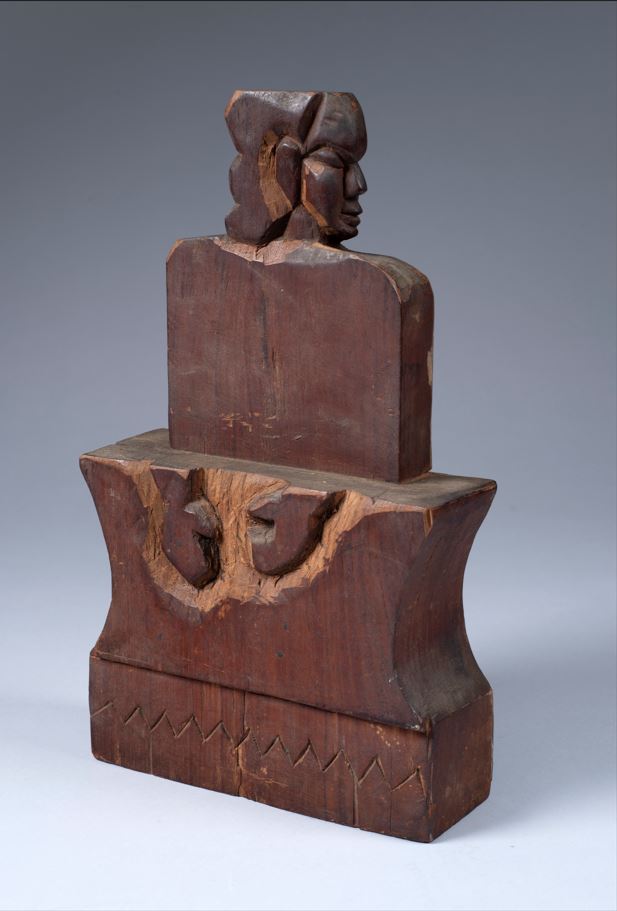
Here’s the work the press office makes available to represent Mukherjee’s mother, Leela Mukherjee. I don’t want to harp on about this too much but here again, I struggled to discern the distinctly Indian quality because the shape of the faces and the generally primitive working of the wood reminded me very much of African tribal art, such as you see in the British Museum.

Schematic Seated Figure by Leela Mukherjee (1950s-80s) Taimur Hassan Collection. Photo by Justin Piperger. Courtesy of Mrinalini Mukherjee Foundation

Gulammohammed Sheikh (b.1937)

Similarly, here are two works from 60 years later by Mukherjee’s friend Gulammohammed Sheikh, depicting (on the left) birds which might be cranes and (on the right) a kind of dragony-peacock bird, depicted in tall, narrow images which instantly reminded me of classical Chinese art. I can’t see anything Indian about them at all, they radiate Chinese shape, composition and styling.

Two paintings by Gulammohammed Sheikh 2018 to 2024 (photo by the author)

K. G. Subramanyan

K.G. Subramanyan (1924-2016) studied under under Mukherjee’s father and, according to the curators, developed into a ‘prolific artist-educator’. He rallied fellow artists to mine folk and craft traditions in unconventional ways, forging a postcolonial vision of Indian modernism. Here’s a gouache work demonstrating what this means in practice.

Untitled by K. G. Subramanyan (c.1950s) Taimur Hassan Collection. Photo by Justin Piperger © Uma Padmanabhan

Now this does have the amateurish quality I associate with modern Indian art, the very basic, child-level depiction of the human form which I saw just a few months ago in the extensive display of work by Indian artist Arpita Singh (born in 1937) at the Serpentine.

The exhibition’s long timeframe

Another challenge presented by the exhibition is the long timeframe it covers. The earliest work is from the very early 1970s whereas the most recent is from the 2020s. That’s a very long period of time. During that half century the international art world has changed out of all recognition. It has outgrown its European and American origins to become truly international. It has, for some time, promoted and valued artists from an enormous range of cultures, including many indigenous traditions such as Aboriginal art, which is now highly prized.

The patriotic, post-independence drive to create an authentic Indian art which the curators attribute as a central motivation to Mukherjee, her friends and colleagues, has long since become history. An ethnocentric perspective is now seen as reactionary and dangerous, witness liberal repugnance at the rise of right-wing nationalisms in countries around the world, including Hindu Nationalist sentiment in Mukherjee’s own India.

The modern art world floats above individual countries, in a kind of multicultural, cosmopolitan, liberal, enlightened, post-gender world of its own. So Mukherjee and her friends’ insistence on an Indian nationalist art, as well as her particular interest in the old-fashioned gender binary between phallic and vulvic forms, all seem rather quaint now.

To look specifically at Mukherjee’s work, when she began ‘sculpting’ in fabrics in the 1970s this was a radical and innovative technique, quite obviously rejecting the whole ‘carving in stone or marble’ tradition of the West. But by the time she began exhibiting in Europe, in the 1990s, it was a lot less unique. Numerous other artists were working in the same vein.

Jagdish Swaminathan (1928 to 1994)

Back to the art, here’s the example of Jagdish Swaminathan which we are given. This painting of a thin sliver of a bird singing above a mildly phallic lily plant against a big abstract yellow background is from Swaminathan’s ‘Bird, Tree and Mountain’ series. We find him in the late ’60s and early ’70s rejecting any type of naturalism, along with Western modernism, and instead returning to tribal and folk visual traditions. This probably is a good example of a non-western, Indian visual style although I’m not sure I like it. Do I not like it because it is not Western? No, because I love lots of non-Western art starting with Aboriginal art and lots of African art. It’s more that it’s like Western art but without enough real kick and originality.

Untitled (Lily by my Window) by Jagdish Swaminathan (early 1970s) Photo courtesy of Sotheby’s Inc © 2025 © J. Swaminathan Foundation

Gallery

A selection of photos I took to indicate the (sometimes bewildering and confusing) range of works on show.

Untitled by K.G. Subramanyan 1955-9

I liked this because it reminds me of something almost exactly the same I’ve seen by Paul Klee, in other words a European model or origin.

Untitled by K.G. Subramanyan 1955-9 (photo by the author)

Intertwined by Leela Mukherjee

Relatively small, crudely carved and unfinished wooden sculptures.

From left to right, Figure with Raised Hand, Intertwined Figures and Intertwined Figures II, by Leela Mukherjee, 1950s to ’80s (photo by the author)

Landscape 1968

My partner liked this because of the simplicity of the black silhouette but also the ambiguity of whether it’s some hills and a tree, as it appears at first glance, or whether the two lines dangling down in the middle indicate that it’s a human being.

Landscape by Gulammohammed Sheikh (1968) (photo by the author)

Untitled by Jagdish Swaminathan (1980)

According to the curators:

By the 1980s, Jagdish Swaminathan’s art reflected his deepening engagement with India’s tribal and Indigenous traditions. Moving away from the pristine colour planes of his earlier works, he adopted earthy palettes, textured surfaces, and symbolic forms. Shapes such as triangles and serpentine lines evoked mountains and snakes, resonant with Hindu mythologies of the god Shiva. These later canvases fuse abstraction with spiritual metaphor, recalling Swaminathan’s lifelong insistence that art should reveal nature and myth in their primal, symbolic essence.

Not knowing very much about ‘India’s tribal and Indigenous traditions’, I liked it because it reminded me of the brown abstract works my parents picked up at Heals or Habitat in the 1970s. And then of Paul Klee’s beautiful abstract shapes and patterns, which also often include gold or striking highlights.

Untitled by Jagdish Swaminathan, 1980 (photo by the author)

Also because of the rough impasto finish, especially of the two mysterious orange glyphs written across the image.

Detail of Untitled by Jagdish Swaminathan, 1980 (photo by the author)

Songspace by Nilima Sheikh (1995)

‘Songspace’ is the name of a series of scroll paintings by Nilima Sheikh, which I prefer to think of as ‘hangings’. Apparently there are ten in the series, of which 5 are hung in this exhibition in such a way as to create a kind of alcove into which you can step and be surrounded on 3 sides. Apparently the use of casein tempera paint on canvas is very distinctive and gives them their light and floating feel. Most of the surface is made up of abstract shapes, some of which may be landscapes in brown or green or red. Scattered in these shapes are wispy human figures which, apparently, reference Indian folktales, especially from Kashmir. They reference the style of classical Indian miniatures only blown up to wall size and refracted through a postmodern sensibility.

Songspace by Nilima Sheikh (1995) (photo by the author)

I liked the size, and the format of the hanging scroll, and the light and uplifting colouring but, as with most of these works, wasn’t impressed by, or was actively put off by, the scrappy amateurishness of the human figures.

Snake Column I by Mrinalini Mukherjee (1995)

According to the curators:

This terracotta sculpture is one of two ‘snake columns’ that reflect Mrinalini Mukherjee’s engagement with fertility and vitality. The cylindrical, phallic form recalls the ‘lingam’ of Shiva, while the serpent motifs and raised hood canopy reference Bankura terracotta vases dedicated to Manasa, a goddess of fertility. Like ‘Adi Pushp II’, nearby, the work channels sexuality as a generative power, fusing sacred imagery with organic, body-like forms that pulse with energy.

Snake Column I by Mrinalini Mukherjee (1995) (photo by the author)

If it as deliberately phallic as they say, then the snakes could as easily be sperm fighting their way to the front of the queue.

Forest Flame IV by Mrinalini Mukherjee (2009)

According to the curators:

In her final years, Mrinalini Mukherjee turned from hemp to bronze, creating sculptures that progressively grew in scale and ambition. Casting leaves, fronds and branches into molten form, she transformed nature into something both corporeal and otherworldly. ‘Forest Flame IV’ recalls the striking ‘Flame of the Forest’ tree of Santiniketan, which bursts into vivid orange blossoms each spring. Here, a trunk-like column erupts into flame-like petals, conflating vegetal growth with bodily emergence. Light animates the textured bronze surface, giving the work a sense of continual unfolding and transformation.

Forest Flame IV by Mrinalini Mukherjee (2009) (photo by the author)

I didn’t particularly like these because, as I said much earlier, by the 2000s, art had become so globalised, with so many artists creating so many kinds of object, that Mukherjee’s don’t really stand out. Downstairs at the Royal Academy are metal sculptures by Anselm Kiefer which are not unlike this. What made her very distinctive in the 1970s and ’80s had become utterly diluted 30 years later.

Adi Pushp II Mrinalini Mukherjee (2009)

To finish, back to what she did best, hemp sculptures. This one supposedly derives from her interest in botany and flowers and ‘adi pushp’ means ‘first flower’. But the curators go on to tell us that:

The sculpture’s central bulges and folds evoke human sexual organs, transforming the flower into a potent emblem of generative energy, and affirming nature as a vital, erotic life force.

None of which – the use of sublimated sexual imagery, the idea of sex as a central force in human nature – is at all distinctively ‘Indian’ but the common currency of humankind and any number of artworks, traditional or contemporary.

Adi Pushp II Mrinalini Mukherjee (2009) (photo by the author)

At the end of this small but sometimes confusing, sometimes enjoyable, sometimes boring, sometimes lovely exhibition, it looked less to me like a tumble of sexual organs than a comfortable-looking chair to have a nice sit-down in.


Related links

Related reviews

Ancient India: living traditions @ the British Museum

‘God – or his avatars, manifestations – is believed to dwell in the sacred images. The clothing and adornments are devotional offerings, expressions of a loving relationship with God.’

Hinduism, Buddhism and Jainism – some 2 billion people follow these three major world religions. This fabulous, beautifully staged and atmospheric exhibition at the British Museum brings together 180 objects – imposing statues and friezes, vibrant paintings, glittering coins and bracelets, drawings and manuscripts, as well as half a dozen videos – to explain the origins of the imagery and iconography of these three religions and (in the videos) how they live on into contemporary religious practice.

The exhibition focuses on the period between 200 BC and AD 600. It was during this period that artistic depictions of the gods and enlightened teachers of these three religions dramatically changed from purely symbolic or abstract images to showing them as human figures. It was during this period that much of the iconic imagery and attributes that today’s followers are familiar with, first emerged.

A highlight of the show is the evolution of depictions of the Buddha, tracing the transformation from symbolic representations to the human form we recognise today. In contrast, images of the Hindu goddess Lakshmi, associated with wealth and good fortune, have remained largely unchanged for over two millennia.

Installation view of Ancient India: living traditions at the British Museum showing the opening three statues (photo by the author)

Right at the start the visitor is confronted by these three statues, one each from the Buddhist, Hindu and Jain traditions, and invites us to ‘meet’ (from left to right) the Buddha, Ganesha and a tirthankara.

And straightaway we are also faced with the exhibition’s strengths and challenges. Its strengths are that:

  • it is stylishly designed, with hanging curtains dividing different sections, with soft lighting and ambient sounds (featuring the sound of rivers, monsoon rains, thunder and wind blowing through grass, animals, people worshipping in temples, monasteries and shrines, bells, gongs, cymbals, horns and drums)
  • you are subtly aware of the gentle scent of sandalwood in the background
  • it is extremely informative
  • it contains many really beautiful objects, particularly the many striking statues

Installation view of Ancient India: living traditions at the British Museum (photo by the author)

Its challenge is that describing the iconography of not one but three religions entails a dazzling amount of information. To be more precise, I was a little overwhelmed by the number of numbers involved in each of these religious traditions.

As I went from one wall panel to the next I reflected on how relatively simple the Christian tradition I was raised in is: the Catholic tradition has a vast number of saints, but in essence Christianity boils down to: there is one God, he created earth, heaven and hell; humans disobeyed him and their disobedience is recreated in each generation and augmented by all our individual sins; so he sent his son Jesus to die as an act of atonement, as expiation for our sins; and everyone who truly believes in him will be saved from hell and go to spend eternity in heaven.

Similarly, the pantheon of the ancient Greeks contains numerous demigods and spirits of woods and rivers and so on, but the core is relatively straightforward: gods of heaven, sea and underworld, each with a wife; gods of war, beauty and wisdom; a messenger, a blacksmith – ten or so gods you need to remember – and these were copied or mapped onto the traditional Roman gods and then disseminated across Europe and round the Mediterranean.

It’s even simpler for Judaism which, beneath its plethora of rules and customs, depends on one creator god, Yahweh; let alone Islam, again festooned with customs, saints and so on, but which can be boiled down to the Shahada, ‘There is no god but God and Muhammad is his prophet’.

But here, right at the start of the exhibition, you learn that these three Indian religions – Buddhism, Hinduism and Jainism – contained a sometimes bewildering multiplicity of entities. If you’re brought up in the tradition no doubt you know them from the cradle, or at least know which ones are important to your community. But as an outsider, trying to process the sheer number of beings, across so many interlinked but separate traditions, and stretching far beyond the borders of India (the exhibition includes a section about the spread of these religions to South East Asia and beyond), is quite a challenge.

Numbers

Jainism

Jains follow the teachings of twenty-four tirthankaras – enlightened beings – who are human rather than divine, and are attended by male and female nature spirits. They also worship some gods.

To help them, they have sixteen goddesses of knowledge called Vidyadevisvidya means knowledge in Sanskrit and devi means goddess. They are usually depicted holding a manuscript and sometimes a pen.

All 24 Jain enlightened teachers have identical bodies because they are depicted as they are about to enter the heavens – the realm of liberated souls at the top of the universe. So that devotees can tell them apart, symbols from stories connected with their lives are used.

Jains follow the Three Jewels – right faith, right knowledge, right conduct – to enable their immortal souls to live in a state of bliss. Ahimsa (non-violence) is central to their faith, as is the belief that humans, animals and plants have living souls.

Parshvanatha is the 23rd tirthankara, depicted in the exhibition in a sandstone sculpture.

The Jain universe is divided into three worlds – the hells, the middle world and the heavens. As beings advance spiritually, their souls are eventually liberated from the cycle of rebirth and reach the heavens. The three worlds are depicted in a vivid painted cotton map showing the two-and-a-half continents of the middle world, where humans reside.

Map of the Jain universe. Gujarat or Rajasthan, India (1700 to 1900) © The Trustees of the British Museum

Buddhism

Buddhism is based on the teachings and philosophy of Siddhartha Gautama, a prince who became known as the Buddha after gaining enlightenment. He taught the Four Noble Truths, helping others to also achieve enlightenment.

Hinduism

Many Hindu teachings emphasise the four aims of lifedharma (righteous duty), artha (prosperity), kama (desires) and moksha (liberation from the cycle of rebirth).

Vishnu is said to have ten principal avatars, known as the Dashavatara, who appear to restore cosmic order and protect righteousness. While these ten are the most celebrated, texts like the Bhagavata Purana suggest his incarnations are innumerable.

Hindus believe Vishnu uses the different incarnations to preserve order on earth and to save the world and humankind from disaster. His first form is Matsya the fish, who rescued the first man from a great flood. Here, Vishnu emerges from Matsya’s mouth. Rama, Vishnu’s seventh avatar, is a central character in India’s epic poem the Ramayana.

Images of Hindu goddesses have many features in common with those of female nature spirits, including floral headdresses, plentiful jewellery and full figures. During the first century AD, an important moment of artistic innovation occurred when deities began to be shown with multiple arms. Each hand was held in a particular gesture or carried something which enabled the devotee to identify the god.

Overlap

Maybe the biggest single learning from the whole exhibition is the surprising extent to which these three major religious traditions had common origins, often in local nature gods and spirits and how, even when they’d become distinct belief systems, they still strongly influenced and interpenetrated each other.

There is a surprising amount of overlap among the gods and spirits and guardians and scared figures of Buddhism, Hinduism and Jainism and the exhibition includes objects demonstrating how nature spirits or gods or guardians from one tradition morphed into another, or highlighting the common origins of many traditions, figures and stories.

Some learnings

It is an information-rich exhibition which, as I said, I struggled to fully absorb and process. Here are some choice learnings:

Nagas and naginis are male and female serpent spirits who control life-giving waters. These nature spirits grant wealth, fertility and protection but they can also kill with a single bite. Among the most ancient deities to be venerated in India, they are usually depicted as many-headed cobras. Such was their enduring power and popularity that they were incorporated into Jain, Buddhist and Hindu art.

A nagini is a female sacred serpent. She has a woman’s torso, but still has her snake tail and her canopy rising above her head. Such figures are erected at temples or by trees and bodies of water, where they are venerated for their life-giving powers.

A nagaraja or snake king. Divine snakes are usually represented as many-headed cobras and snake kings tend to have five or seven hoods. Images of sacred snakes are often placed at entrances to sacred buildings – whether Hindu, Jain or Buddhist – to protect them.

Ancient sculptures show Hindu gods taming the powerful and ancient snake kings Kaliya, Vasuki and Ananta Sesha.

Manasa is a snake goddess venerated by Buddhists and Hindus alike for her ability to provide prosperity, children and protection from snakes. She can also cause harm with a deadly snakebite. Depicted as a beautiful woman surrounded by snakes, she usually holds a serpent or a child.

Yakshas are male nature spirits associated with trees, mountains, bodies of water and wealth. Widespread across India, yakshas were gradually adopted by Jains, Buddhists and Hindus, who used their imagery and attributes when they began to depict their gods and enlightened teachers in human form.

The famous elephant god Ganesha has yaksha origins as indicated by his elephant head and potbelly. Ganesha symbolises wisdom and new beginnings.

Installation view of Ancient India: living traditions at the British Museum showing a 2nd century AD statue of Ganesha (photo by the author)

Kubera is the king of yakshas and also the god of wealth, emphasised by his potbelly and plentiful jewellery.

Yakshis are powerful female nature spirits able to bestow abundance and fertility, as well as death and disease. Originally independent goddesses, many yakshis were given male consorts when adopted into Jainism, Buddhism and Hinduism.

Yakshis are always depicted as full-figured, extravagantly bejewelled women standing and looking directly at the viewer.

A stupa is a dome-shaped memorial shrine built over sacred relics, built by both Buddhists and Jainists.

Mathura was a major ancient centre of production for Jain, Buddhist and Hindu devotional sculpture in northern India. The earliest known and definite images of Jain tirthankaras (enlightened teachers) depicted in human form are from here, perhaps dating to about 100 BC. The earliest dated figurative sculptures of the Buddha that survive today were produced in Mathura.

Incidentally, the earliest images of the Buddha in human form were created independently in Mathura (India), the Swat Valley (Pakistan) and Gandhara (Pakistan and Afghanistan).

Ayagapatas, square or rectangular tablets of homage depicting tirthankaras, shrines and deities, are a uniquely Jain innovation. They often have inscriptions from donors, many of whom were women, who gained spiritual merit through their donations.

Bodhisattvas are beings who seek enlightenment, whereas great bodhisattvas have gained additional powers over many lifetimes, enabling them to perform miracles and help others on the path to enlightenment. There are generally accepted to be eight great bodhisattvas, although other traditions speak of four (Chinese Buddhism) or as many as 16.

A distinctive feature of Buddha images from both Sri Lanka and southern India is the flame-shaped ushnisha on top of his head, representing his enlightenment.

Individual gods

According to Buddhist tradition, Hariti was associated with smallpox, and the stealing and killing of children to feed her large family. To show Hariti how much these parents were suffering, the Buddha briefly hid one of Hariti’s children beneath his rice bowl. She was so distraught that from that moment on she vowed to protect all children and women in childbirth.

Isakki and Pecci are worshipped in Tamil Nadu, India’s southernmost state, and among Tamil communities living elsewhere. Devotees believe that such goddesses were women who perhaps died during pregnancy or childbirth and were later deified.

Mount Mandara rests on the back of Kurma, a tortoise and one of the god Vishnu’s bodily forms on earth.

The great bodhisattvas include figures such as Tara and Avalokiteshvara.

Statistics

I like numbers. The show prompted me to do some research. Here’s the number of followers of each religion worldwide:

  • Hindus – 1.2 billion, 15% of global population
  • Buddhists – 535 million, 7% of global population
  • Jainists – 12 million (but tricky to pin down because many Jainists identify as Hindu), about 0.15% of global population

And in the UK:

  • Hindus – 1 million, 1.7% of UK population (cf Muslims 4 million, 6%)
  • Buddhists – 275,000, 0.4% of population (around the same as Jews, 313,000, 0.6%)
  • Jainists – 25,000

South East Asia

Buddhist and Hindu devotional art spread along sea and land-based trading networks to Southeast, Central and East Asia. Sacred imagery and religious ideas from India were adopted and adapted to merge with local beliefs and styles, producing unique depictions of Buddhist and Hindu deities and enlightened teachers. Enough core features were retained, such as the ushnisha on the Buddha’s head symbolising his wisdom, to enable devotees from different regions and cultures to still recognise the gods and teachers depicted.

New and distinct architecture also emerged to house these sacred images. Fascinatingly, the largest surviving ancient temple complexes for both Buddhism and Hinduism are found, not in India, but in Southeast Asia, such as Angkor Wat in Cambodia.

Gallery

Shiva

In some of the earliest representations of the Hindu god Shiva, he is depicted as Ardhanarishvara which represents the divine couple Shiva and Parvati. In this painting, Shiva is shown on the left with the river Ganges flowing from his matted hair while he carries a trident and drum. His consort Parvati wears a crown and holds prayer beads.

Ardhanarishvara, ‘lord who is half woman’, Shiva and Parvati combined in one deity, about 1790 to 1810 © The Trustees of the British Museum

Buddha

The Buddha was first represented symbolically, through footprints or a tree, for example, and was only later depicted in human form. This gold reliquary might represent the earliest dateable image of the Buddha shown as a man, as coins found with it could date to the late 1st century AD. The Buddha stands with his right hand raised in the gesture of reassurance and is flanked by the gods Indra (right) and Brahma (left).

Bimaran casket, about 1st century © The Trustees of the British Museum

Gaja-Lakshmi

Gaja-Lakshmi (‘Elephant Lakshmi’) has yakshi (female nature spirit) origins. She bestows good fortune and is one of the most popular Hindu, Buddhist and Jain goddesses. The dark bodies of the elephants symbolise monsoon clouds filled with much-anticipated rain ready to bring the earth to life. This image so successfully conveys the message of abundance and fertility that it has remained largely unchanged for the last 2,000 years.

Gaja-Lakshmi (‘Elephant Lakshmi’) goddess of good fortune, about 1780 © The Trustees of the British Museum

Ganesha

Hindu ideas and imagery flowed in both directions between India and Southeast Asia. The elephant-headed god Ganesha is part of Southeast Asia’s diverse religious landscapes. This sculpture shows Ganesha’s traditional attributes, such as his broken tusk, axe and prayer beads, along with some differences. Javanese artists often portrayed him with skulls, his feet together and carrying an empty bowl rather than one filled with sweets, indicating that varying communities understood and worshipped him differently.

Ganesha made in Java from volcanic stone, about AD 1000 to 1200 © The Trustees of the British Museum

A yaksha

This mottled pink sandstone figure represents a yaksha (male nature spirit). Yakshas can grant prosperity but also make life difficult if not properly placated. This is represented by the fierce or scowling expressions on these yakshas. Leaves sprout above this yaksha’s ears which possibly connects him with trees.

Head of a grimacing yaksha, about 2nd or 3rd century © Ashmolean Museum, University of Oxford

Naga

Stone plaque with the rearing figure of a five-headed cobra. Plaques like these can be difficult to date as some have been placed by sacred tree shrines for over a thousand years. Snake veneration belongs to the most ancient and potent substrate of Indian religion. Today, across India, popular veneration of divine snakes by followers of different religions still centres on devotional images such as this one.

Naga, about 17th century © The Trustees of the British Museum

Silk Buddha

From about the third century BC, following trading networks, Buddhist missionaries took their faith and its devotional art beyond India. In different regions, Buddhist art merged with local ideas and art to form new artistic styles. This is one of the oldest and best-preserved paintings from Cave 17 – the famous ‘Library Cave’ at Dunhuang. It shows the Buddha, seated between bodhisattvas, with his hands in the gesture of preaching This composition originates from earlier devotional images from India which became popular across East Asia.

Silk watercolour painting of the Buddha, China, about AD 701 to 750 © The Trustees of the British Museum

Seated Jain

This marble figure depicts a Jain tirthankara (enlightened teacher). Tirthankaras are human, not divine, and the earliest certain representations of them in human form were shaped in Mathura, possibly in about the first century BC. Seated in meditation, the tirthankara has the sacred symbol of an endless knot in the middle of his chest.

Seated Jain enlightened teacher meditating, about 1150 to 1200 © The Trustees of the British Museum


Related links

Related reviews

Arpita Singh: Remembering @ Serpentine North

There are two Serpentine galleries, one north of the bridge over the lake, one south of it.

Currently on show at Serpentine North is the first solo exhibition ever to be held outside India by the Indian woman artist Arpita Singh (born 1937). Here’s her Wikipedia entry:

From the show’s posters and publicity material I didn’t think I’d like it and initially I didn’t – but slowly, slowly I changed my mind and eventually came round to finding it an interesting, memorable and even haunting show.

A show of two halves

For me there was one big fact about the exhibition: the Serpentine North Gallery is a converted armoury with a perimeter corridor running round three sides of a square with big white walls suitable for hanging big works. In the middle, two distinct passages or long narrow rooms run between the two opposite sides of the square. These darker spaces retain the original dark brickwork and are suitable for hanging smaller works. I learned from a gallery assistant that the staff refer to the white outer corridor, as The Perimeter, and the two cut-through passages as The Powders.

Entrances to the two powder rooms from the main perimeter corridor. Compare the large oil painting in the perimeter with the set of much smaller works just visible on the wall in the first powder room. At ‘Arpita Singh, Remembering’ at Serpentine North © Photo: Jo Underhill. Courtesy Arpita Singh and Serpentine

The Perimeter: big oil paintings

So, as with other shows, the Perimeter hosts a series of big works, unglazed oil paintings which span Singh’s long career, from the 1960s to the present day, evolving from the big, through extra large, to the final handful of works which are Enormous.

I can confidently say that I didn’t like any of these. I reacted badly to what I took to be the badness of the draughtsmanship, the busy-ness of the compositions which overflow with loads of inconsequential details without any focus, teeming with cartoon-simple human figures and cars or airplanes or buildings or other objects which a 7-year-old might be ashamed of painting – all depicted amid the choppy seas effect of the impasto i.e. unattractive ridges and whirls of thick oil paint.

One of the very big, very cluttered oil paintings at ‘Arpita Singh, Remembering’ at Serpentine North © Photo: Jo Underhill. Courtesy Arpita Singh and Serpentine

And they felt very alien. They felt like they come from a completely alien tradition, one which cares nothing for all the Western achievements of perspective and depth and pictorial realism – in preference for a highly stylised notion of what a painting is, which comes closer to a depthless, perspectiveless, shapeless clutter of human figures, maps, roads, buildings, all out of perspective and filling every available inch of the space as a child would do.

My Lollipop City: Gemini Rising by Arpita Singh (2005) Vadehra Art Gallery © Arpita Singh

The Powders: smaller acrylics

BUT… Big but… when I went into the ‘powders’, the two smaller, more intimate spaces, something happened. I began to like the works here and, given time and sympathy, ended up really liking many of them. Why?

Smaller

Well, they’re all a lot smaller than the monsters in the Perimeter. I can’t quite put into words why this felt important but somehow they were easier to relate to.

Sets

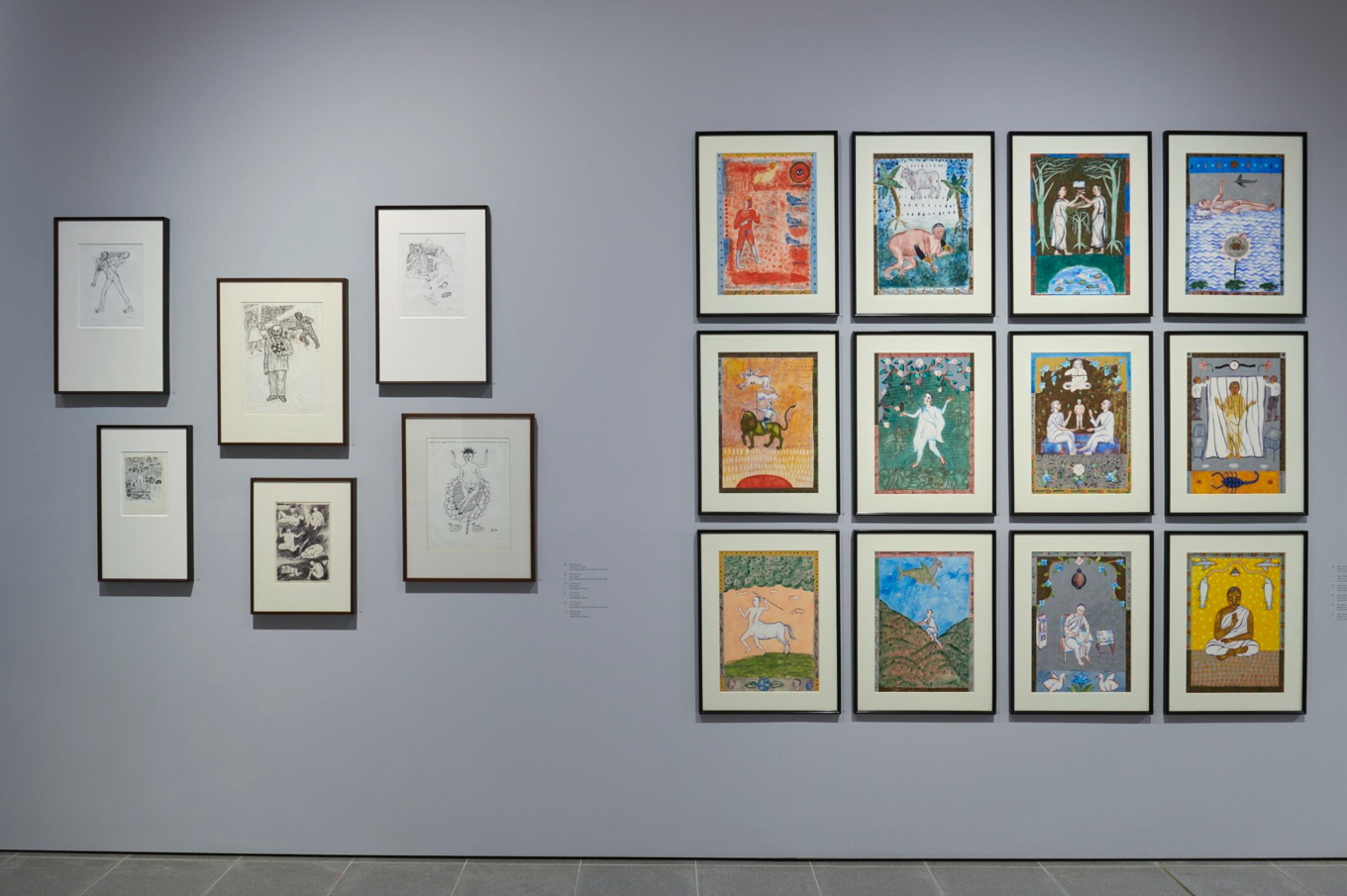
They often come in sets or series, like the series of her reworking of the 12 signs of the Zodiac, and when seen like this her apparently random, childlike imagery becomes more accessible and more likeable, when seen in recurring settings.

Installation view of ‘Arpita Singh: Remembering’ at Serpentine North showing a set of pen and ink drawings on the left, and the 12 acrylic versions of the Zodiac on the right © Photo by Jo Underhill. Courtesy Arpita Singh and Serpentine

Acrylic

A really important reason was the significant difference in psychovisual impact between the big heavily layered oil paintings and the far more muted acrylic and watercolour works. The latter are not only smaller but the lack of surface agitation found in the oil paintings somehow made them seem a lot more calm and civilised. Less hysterical maybe, more serene.

Fewer human figures

And this lack of surface busy-ness, greater calmness, allows you to savour and enjoy the figures more. Some of the larger ones still have lots of figures in but many don’t. In many of them the figures are fewer, bigger and so more impactful, more interesting.

Mysterious

And a lot more beguiling. In the huge oil paintings so much is going on that it’s hard to care. In these smaller, more intimate acrylics and watercolours there’s more time to ponder the compositions and wonder what’s going on.

Influences

The curators tell us that Singh’s art draws on Bengali folk art and Indian stories, interwoven with experiences of social upheaval and global conflict, and that her style is a mashup of Surrealism, figuration, abstraction and Indian Court paintings. And it’s true, at various points all these can be seen: the first few big oil paintings are flat smooth Surreal depictions of random symbols that might have been by the Surrealist Leonora Carrington, while in one of the Powders there are early pen and black ink drawings which might have been by Paul Klee. And the flatness and decorativeness of the images, with a lack of concern for perspective reminded me of the Mughal-era courtly Indian paintings you can see at the Victoria and Albert Museum.

Urban settings

Except that these aren’t in any sense courtly figures. The opposite, they feel like men and women from very modern urban environments, people trapped within or struggling against their environments. In many of them the city seems to be represented by a kind of simple version of an A to Z or city map, showing various roads, all forking and branching out behind the human figures. Some of these lines are blue and so might represent a river (?).

One of the best of these urban alienation images shows what seems to be the same figure of a woman dressed in a black burqa, bent over in various postures of struggling to battle her way through a city represented by what looks like images of a skyscraper (rows of rectangular windows) which has been torn into pieces and scattered around the surface.

Reviewing all this made me think there’s something of Franz Kafka in Singh’s depiction of the city as a challenge, puzzle and maze.

Technology

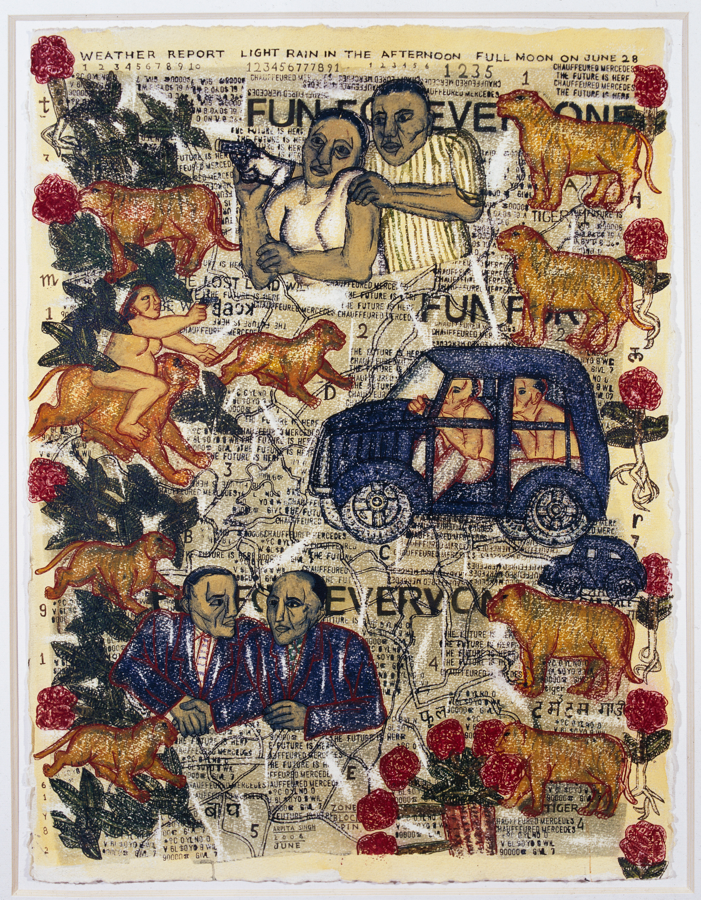
Onto these child’s-style views of cities are often pasted images of modern technology. Two which recur are cars or taxis stuffed with her primitive figures, or airplanes flying in her childlike sky.

Lesser Myth by Arpita Singh (2006) Courtesy of Vadehra Family Collection © Arpita Singh

Naked women

Arpita Singh is, of course, a feminist, and the two feminist curators of the exhibition (Tamsin Hong and Liz Stumpf) point out that:

Since the 1990s, Singh has increasingly explored themes of motherhood, the aging female form, feminine sensuality, vulnerability, and violence, demonstrating the impact of relationships and external events on the emotional and psychological landscape of the artist. Her works are intimate portrayals of domestic and inner life but are equally concerned with the experiences of women navigating the outside world.

This, I think, is true but what I came to actively like was the way she portrays women; was the way her drastically unwestern eye or style extends to the way she portrays women. It turns out that the rather childlike, gawky style, which doesn’t give a damn about western realism, means that her images of women capture something completely other, different. Western iconography of women is so dominated by the Christian church for 1,000 years and then by the male gaze for the last 500 years, that it’s all but impossible for any depiction of women to escape its clutches. But Singh’s women do. Escape, I mean.

They are obviously ‘adult’ in the sense that they are often naked or wearing diaphanous outfits and she goes to some lengths to depict the women’s vulva, labia etc. In western hands this might be unavoidably graphic and problematic. But somehow, in Singh’s childlike, non-western iconography, it begins to say something else. Something about women’s privacy, integrity, distinctiveness. It’s not salacious. It doesn’t sexualise women in any way. It just emphasises that women are.

A Feminine Tale by Arpita Singh (1995) Courtesy of Taimur Hassan Collection © Arpita Singh, Photo by Justin Piperger

There’s a linked set of images of women pulling transparent saris or fabrics round their bodies which are nothing like the stately dressed aristocratic ladies of Bengali court painting but… but somehow, they bespeak an entirely modern, late 20th century reality of women’s lives and independence. It’s hard to put into words but the more I saw of these, the more I felt like I was entering a really, genuinely, alien and alternative artistic world.

Threatening men

One of the woman wrapping herself in a sari has half a dozen much smaller male figures pulling it down or pinning it down around her and you can feel her resistance to this male… what? Something. Power. Oppression. And you can feel this atmosphere of resistance throughout.

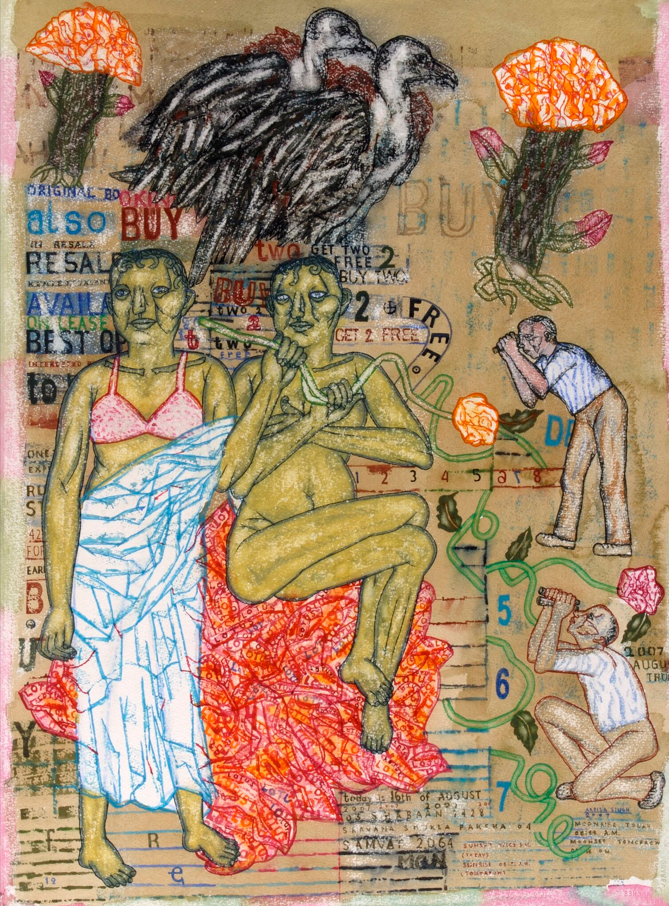
Or take this dense painting. Note the familiar recurring motifs. There’s lots of text all over the work. The women figures are by no stretch of the imagination in any way created for the male gaze but instead express something important but inscrutable about women’s independence. The green line, is it the tendril of some plant? The orange cloth behind the women, is it a curtain or spread of some kind or a sort of map, a sort of tangled A to Z.

Buy Two, Get Two Free by Arpita Singh (2007) Private Collection © Arpita Singh

So the men with the binoculars, are they peeping Toms, are they looking through windows to get a glimpse of scantily clad women? In which case the birds at the top, are they vultures? In which case do the vultures ‘symbolise’ the men, picking over the scraps of women’s bodies chopped up by binocular vision, picking over scraps, exploiters and parasites? Or is the iconography more complex than that? And what do the two trees or bushes with orange heads have to with anything?

Resisting interpretation

This brings us to one of Singh’s strongest points which is that she is not programmatic. Lots of the works have words in, lots of words, mostly in English (why? why not in Bengali or any other Indian language?) as the three images above indicate. ‘Fun Fun Everyone’ are the biggest words visible in ‘Lesser Myth’ amid what seem to be newspaper fragments cut out and collaged together. But what does it really mean? And why are there nine lionesses in the picture? And why is a naked woman riding one of them? And what are the two men in suits at the bottom talking about? And why are there two half-dressed men crammed into one of her characteristically dinky cars? And why is the man in the couple at the top holding a pistol over the woman’s shoulders and why is her arm bent up to support it? And why are there lots of red rose bushes everywhere (or are they hibiscus or some other bright bush native to India which I’m completely ignorant of)?

The pleasure of mystery

It is actively enjoyable not to know the answers to these questions. The more of her acrylic and watercolour work I looked at, the more beguiled I became. All that writing feels as if she has something very important to say and yet all the texts tempt and tease and then veer away, turning out to be more elliptical and obscure than they first appear. And this is very enjoyable.

And there are lots of them. The exhibition features a rather staggering 165 works. I hope I’ve conveyed my journey to you, from initial dislike and scepticism, through slow understanding, and letting the works teach me how to see them, until I felt I had, to some extent, entered her world, a world really very far removed from my own culture and experiences. And that’s what art can do, so well.


Related links

Related reviews

The Imaginary Institution of India: Art 1975 to 1998 @ the Barbican

Anyone wanting to skip my comments can go straight to the gallery of images, a third of the way through this review.

Barbican art is big

The great blessing and curse of the Barbican Art Gallery is that it’s so huge. It has four large open-plan spaces on the ground floor (which always house very large works or installations), three alcoves running off the side corridor, while the first floor gallery contains 8 more room-sized alcoves – so about 15 distinct spaces in total.

This sheer size explains why the Barbican’s art exhibitions are routinely epic in scope and scale, and this new one, ‘Imaginary Institution of India: Art 1975 to 1998’, is no exception. It features nearly 150 works by 30 artists across the full range of media including painting, drawing. sculpture, photography, installation and film.

The dates

The exhibition takes its start and end points from two pivotal moments in India’s post-independence history – the declaration of the State of Emergency by Indira Gandhi in 1975 and the Pokhran Nuclear Tests in 1998. As the curators point out, these 23 years were marked by social upheaval, economic instability and rapid urbanisation. But they’re also a kind of introduction into the way other parts of the world don’t follow our timelines. Neither 1975 nor 1998 are particularly significant years in British political cultural life. These key political moments, like much else in the exhibition, come from a different culture and history.

Woke

A couple more general points. Art exhibitions in general represent a kind of advance guard of wokeness and political correctness, and the Barbican is at the forefront of these up-to-the-minute discourses. Reading their wall labels and captions can feel like reading an omnibus of Guardian editorials. Thus I predicted before I went that there would be displays about feminist, LGBTQ+ and indigenous art, and I wasn’t disappointed. Here’s an example, a paintings by the overtly gay painter Bhupen Khakhar.

‘Grey Blanket’ by Bhupen Khakhar (1998) © Estate of Bhupen Khakhar

The free booklet

Talking of wall labels, this exhibition is a bit unusual in not having any. Most exhibitions feature a big wall label introducing each room and then captions for each particular work. Here’s there’s none of that. The curators have chosen to put all the text into a very nicely produced and surprisingly ample free booklet, complete with a Timeline of Social and Political Events in India 1975 to 1998, and a Glossary of Indian terms. All that indicates which work is which is a simple number printed on the wall or dais beside them. This makes the whole exhibition feel unusually clean and uncluttered, and the booklet feels like a very generous gift and memento.

Too dark to read

However there is a catch with the booklet concept, which is that the curators have decided to use very low light levels throughout the exhibition, apart from spots shining directly onto the works. Unfortunately, this makes it quite difficult, often impossible, for an old guy like me to read the handout, even with my glasses on, even leaning towards the artworks to try and get better light, and I can’t believe I’m the only one. Maybe they’ll adjust the lighting levels as the show progresses…

Installation view of ‘The Imaginary Institution of India: Art 1975 to 1998’ at the Barbican showing terracotta heads by Himmat Shah in the foreground and abstract paintings by Jagdish Swaminathan on the wall in the background (photo by the author)

Extraordinary variety

As to the works, the curators have gone to great trouble to ensure that there’s something for everyone.

Large At the large end of the scale there’s a shed-sized installation titled ‘House’ by Vivan Sundaram. This is close to a life-sized wooden figure standing at the centre of a rosette of agricultural tools (‘The Tools’ by N. N. Rimzon). There’s a hexagonal shelter formed from painted screens (‘Shamiana’ by Nilima Sheikh), a strange skeletal mannekin covered in purple velvet (‘Desert Queen’ by Anita Dube), a set of coloured ropes hanging from the wall (‘Untitled’ by Sheela Gowda) and a big colourful canvas suspended across the ceiling (also part of Nilima Sheikh’s ‘Shamiana’ installation).

Installation view of ‘The Imaginary Institution of India: Art 1975 to 1998’ at the Barbican showing the big painted canopy suspended from the ceiling by Nilima Sheikh (photo by the author)

Small At the small end of the scale there’s a series of lovely drawings of holy animals done in a kind of naive decorative style by Jangarh Singh Shyam; and a set of brilliant metal sculptures packed with strange humanoid figures cast in bronze by Meera Mukherjee.

For feminists there’s a room featuring a series of 19 black-and-white photos by Sheba Chhachhi featuring seven women activists from the 1990s (‘Seven Lives and a Dream,’); and an upsetting set of 12 A4-sized paintings by Nilima Sheikh following the life of Champa, a carefree teenage girl who was married off while still a child, abused in her new home, and then murdered for her dowry by her husband and in-laws.

Indigenous art There’s a lovely series of black-and-white photos by Jyoti Bhatt capturing indigenous artists at work on wall and floor paintings. This is next to a series of upsetting colour photos documenting the 1984 Union Carbide disaster by Pablo Bartholomew.

Gay 1 The first gay room features eight colour photos of gay men staged among famous Delhi landmarks by Sunil Gupta. Gupta’s was the only name I recognised since he at one point moved to New York and I’ve seen his photos of the New York gay community in numerous other exhibitions. The photos are given droll and sarcastic text captions. I especially liked the one which reads:

People operate here harassing people and intimidating them with beatings and extortion. Sometimes they just want a blowjob.

Yes, sometimes men just want a blowjob – if a gay man says that, it’s a bold declaration, challenging societal expectations and interrogating heteronormativity; if a straight man says it, not so much. One of the many reasons to enjoy queer art is the queer artist’s ability to be completely candid about sex in a way that a heterosexual male artist would be wise not to attempt…

Gay 2 The second gay room features paintings by Bhupen Khakhar. I admired the candid way these depicted that taboo part of human anatomy, the erect penis. Considering how much trouble they’ve caused to untold billions through all history, it’s remarkable how few erect penises you get in art of any kind. I didn’t really like Khakhar’s naive home-made style but I admired his willies.

Struggling to understand Indian art

This is a challenge. I have only a shaky grasp of British art, a reasonable understanding of selected spots of European art, and a loose hold on American art (despite it being everywhere) because even in art you think you know well, there are always hidden depths and meanings. There are always traditions and currents and precedents the artists were inspired by, or are reacting against, are reinterpreting, reviving, critiquing and so on. Nonetheless, as an inhabitant of the Euro-American world, I feel I have a reasonable grasp of its visual (dramatic, filmic and musical) languages.

But Indian art? Despite having been to 2 or 3 exhibitions of it, I’m all too aware that it comes from a world almost completely closed to me, a world of visual iconography, traditions, religions and political movements, local cultures and languages which are way beyond my experience or understanding.

Therefore it’s challenging, this exhibition, because so many of the works seem to be coming out of traditions or mixtures and updatings and reinterpretations of contexts and traditions which I have no feel for.

What’s more, a lot of the art is obviously very political, kicking off with responses to the state of emergency instituted by Indira Gandhi in 1975 and taking in war with Pakistan, the rise of communalism and incipient Hindu nationalism, the spectacular growth of India’s cities and comcomitant loss of many rural traditions, the rise of Indian feminism with campaigns against suttee, honour killing, femicide and so on. I can read long explanations about these things but found it very hard to really relate to them. Hard to become as involved as, presumably, an Indian visitor would be.

The exhibition is a big bold window onto an art world most of us are not very familiar with at all. There was plenty to enjoy but quite a lot which I felt was only so-so – clumsily naive paintings, abstract designs I felt had been done earlier and better elsewhere, installations I felt I’d seen before somewhere else … but then it crossed my mind that maybe I was wrong, maybe I was misreading it, maybe I’m a victim of my own ignorance. Hard to tell whether my taste is valid or just trapped in the parochial world of the Anglosphere… So I tried my best to give everything the benefit of the doubt and to let the art teach and educate me in how to see it, rather than viewing it through blinkered Anglophone spectacles…

Press gallery

The following are the official press images, accompanied by the curators’ original captions i.e. none of it is written by me. Why? To give you as much of the original source information as possible, to let you make up your own minds.

Speechless City by Gulammohammed Sheik (1975)

A forbidding glow pervades ‘Speechless City’. Foraging cattle and wild dogs huddle around abandoned dwellings in a town empty of inhabitants. Evoking the repressiveness of the Emergency era (1975 to 1977) and referencing the eruption of Hindu-Muslim riots in Gujarat from 1969 onwards, Gulammohammed Sheikh made this painting while teaching at his alma mater, Maharaja Sayajirao University, Baroda (Vadodara). The desolate urban landscape suggests the aftermath of an unknown, terrible event. The work originally featured a fleeing figure, which Sheikh later painted out to create a scene devoid of people.

‘Speechless City’ by Gulammohammed Sheik (1975) © 2024 Gulammohammed Sheikh.
Courtesy of The Artist and Vadehra Art Gallery

Village Opera-2 by Madhvi Parekh (1975)

Madhvi Parekh’s oil paintings depict remembered landscapes from both her childhood village of Sanjaya, Gujarat, and her subsequent travels. She painted ‘Village Opera-2’ after attending an artist’s camp organised by artist G. R. Santosh in Kashmir in 1975. The copper pots she saw there inspired the black anthropomorphic figures at the centre of this work. Working first with oil paint, Parekh then used oil pastels to add small, vibrant creatures which resemble birds, fish, snakes and amphibians. The scene floats in a colourful net of dots and lines, patterns drawn from the folk crafts of Rangoli and embroidery that she had practised as a child. Initiated into art by her artist husband Manu Parekh, Madhvi Parekh began to paint only after leaving Sanjaya, and with memory as their subject, her paintings provide a way back to the idyll of village life. “I have never forgotten the sights and sounds of my village,” she says. “I carry them with me everywhere and, although they are often combined with elements I have imbibed in the city, they still endure.”

‘Village Opera-2’ by Madhvi Parekh (1975) © Madhvi Parekh. Courtesy DAG

This was, I think, my favourite piece in the show, possibly because it reminds me of Paul Klee. It was one of the very few pieces which seemed happy.

Dhakka by Sudhir Patwardhan (1977)

Sudhir Patwardhan’s large-scale paintings visualise the effects of urbanisation on the body of the individual city dweller and the landscape of the city. A practising radiologist till 2005, Patwardhan uses his art to articulate stories of social struggle. His emphasis on figuration is a result of his belief in the accessibility of art for all. In the late 1970s, Patwardhan painted solidly built individuals against a minimal background. ‘Dhakka’ shows a labourer straining to pick up his shirt, the title (which translates as ‘push’ in Hindi) emphasising the effort of this activity. Dignified but worn out, this subject embodies the difficult lives of the working class.

‘Dhakka’ by Sudhir Patwardhan (1977) © 2024 Sudhir Patwardhan. Courtesy of The Artist and Vadehra Art Gallery

Two Men with Handcart by Gieve Patel (1979)

Under a vibrant pink sky, time is suspended as two men pause in their labour for a relaxed chat. Behind them, lightly shaded windows and bricks hint at a dense metropolis under construction. In the 1960s, Gieve Patel, a self-taught artist as well as a celebrated poet, playwright and doctor, began painting urban landscapes inspired by his native Bombay (Mumbai). While he documented the rapidly changing nature of the city around him, his focus remained on its working-class inhabitants. Placing the labourers at the centre of this work, Patel interrogated the impact of India’s social and economic transformations on its people. The artist had believed his use of colour in this work was non-naturalistic, but then was surprised to observe a sunset bathing the entire city in a pink glow. “The problem of how to relate to the given colours of life is full of thrilling ambiguities and possibilities,” he commented in 1985.

‘Two Men with Handcart’ by Gieve Patel (1979) © Gieve Patel. Courtesy of the Peabody Essex. Museum Photography by Barbara Kennedy

Two Men in Benares by Bhupen Khakhar (1982)

Bhupen Khakhar, an accountant by training, was a self-taught artist who took to painting in the 1960s. His early works comprised portraits of tradesmen. In 1980, he began to address his homosexuality, which he had struggled with until then. In this dramatic painting, the intertwined nude lovers are set against a blue background with numerous vignettes unfolding around them. Such narrative representation reveals Khakhar’s interest in fourteenth-century Sienese painting, especially the work of Ambrogio Lorenzetti. Khakhar integrates the lovers into the quotidian reality of the hallowed city of Benares (Varanasi), with its holy men, small shrines and kneeling devotees. By staging this sexual tryst within a religious context, he knowingly props up the erotic against the sacred, and provocatively collapses the boundaries between private and public. First exhibited at Gallery Chemould, Bombay (Mumbai), in 1987, the painting had to be stored away just two days later for fear of protests from the Central Cottage Industries Emporium, in whose premises the gallery was located.

‘Two Men in Benares’ by Bhupen Khakhar (1982) © Estate of Bhupen Khakhar. Note the willies

India Gate by Sunil Gupta (1987)

Staged amongst famous New Delhi landmarks and some cruising sites, these constructed images present the complexities faced by gay men when homosexuality was still a punishable offence in India. Section 377, a colonial law enacted in 1861, criminalised homosexuality and was only repealed by India’s principal court in 2018. The series was realised in 1986 to 1987 through a commission awarded by The Photographer’s Gallery, London, and was for Sunil Gupta “about locating Indian cis men in an international gay landscape”. Born in New Delhi, the artist moved to Canada in 1969 at the age of fifteen. He relocated to the United States prior to settling in London. Accompanied by excerpts of conversations with his subjects, all voluntarily offered, the colour photographs reveal the sentiments of gay Indian men and their vulnerable, clandestine lives. Gupta ensured he had the consent of his subjects to print the photographs, with the understanding that the images would not be shown at the time in India. Finally, in 2004, Gupta exhibited ‘Exiles’ at the India Habitat Centre in New Delhi as a belated, affirmative homecoming.

‘India Gate’ by Sunil Gupta (1987) from the series ‘Exiles’ 1987 © Sunil Gupta. Courtesy the artist and Hales London and New York

Construction Woman Washing Her Face by Sudhir Patwardhan (1998)

Sudhir Patwardhan’s graceful female construction worker as she raises her hands to wash her downcast face. Very economically, Khakhar and Patwardhan imbue simple gestures with tremendous power and emotion, demanding recognition for their subjects.

‘Construction Woman Washing Her Face’ by Sudhir Patwardhan (1998) © 2024 Sudhir Patwardhan. Courtesy of The Artist and Vadehra Art Gallery

House by Vivan Sundaram (1994)

Vivan Sundaram transitioned from painting and drawing in the early 1990s to embrace a broader, spatially oriented approach. ‘House’ portrays his reflections on the changing political landscape and communal tensions in India at the time. Held by a metal armature, the installation elaborates on the concept of refuge. A walled sanctuary cast in kalamkhush (paper handmade from khadi, the hand- spun, natural-fibre fabric promoted by Mahatma Gandhi during India’s anti-colonial struggle), ‘House’’s surface carries embossed emblems of the tools of labour and speaks to collective struggles against power. Alongside a mineral hue reminiscent of coagulated blood, the outer walls exhibit marks of brutality: scattered limbs, jagged outlines of weapons, and closed windows. Within, a pedestal bears a wide-brimmed vessel filled with water, and flickering through the transparent base of the bowl, a fiery video projection conveys an allegory of simmering injustice.

‘House’ by Vivan Sundaram (1994) from the series ‘Shelter’ 1994 to 1999. Photo by Gireesh G.V. Photo courtesy The Estate of Vivan Sundaram

Untitled by Sheela Gowda (1997/2007)

Alongside her explorations with cow dung, Sheela Gowda employed a range of everyday materials in her installations through the 1990s. ‘Untitled’ (1997/2007), made for the show ‘Telling Tales – of Self, of Nation, of Art’ at Victoria Art Gallery, Bath, is her first fully realised installation in which needle and thread are used. For this work, Gowda strung individual needles with threads varying in length from 40 to 133 centimetres. This labour-intensive process was very important for Gowda, who would reject a ball of thread if she encountered a single knot because “the process of threading empowers every inch” of the thread. She then anointed the threads with kumkum paste, and bound them together to form ropes, with a menacing head of needles at the end of each length. ‘Untitled’ comprises of eight such lengths of rope, which allow Gowda to configure and arrange them site-specifically. They travel viscerally along the wall and snake across the floor, intimating a transmuting body, an umbilical cord, intestines, trails of blood. Gowda has described the work as possessing “a very insidious sort of violence … the needles hang at the end almost passively but they have the potential for hurting.”

‘Untitled’ by Sheela Gowda (1997/2007) © Sheela Gowda. Courtesy Museum Gouda

Mild Terrors-II by C. K. Rajan (1991 to 1996)

Using only scissors and glue, C. K. Rajan composed the ‘Mild Terrors II’ series by pasting imagery from discarded popular magazines and dailies onto blank sheets of A4 paper. An erstwhile member of the Indian Radical Painters’ and Sculptors’ Association, Rajan began work on these collages in 1991, the year India liberalised its economy to allow foreign investment. Made quickly and intuitively, the perspective of these small-scale collages is purposefully disorienting. They are replete with rescaled objects and discordant visual mash-ups. Rajan cannily juxtaposed outsized human torsos and limbs (often female) with consumer goods, and inserted them into urban or rural settings to create surreal scenes. They convey the ‘mild terrors’ that lurked behind India’s rapid entry into a global free-market system – the unreported uneven economic development, the social disparities, the displacements. It was a strangely transforming landscape, somewhere between pre-modern, modern and post-modern, captured strikingly in these unsettling collages.

‘Mild Terrors-II’ by C. K. Rajan (1991 to 1996) Courtesy the artist and Kiran Nadar Museum of Art, New Delhi

Installation gallery

The following are my own photos of the exhibition accompanied, where relevant, by the curators’ comments. (I forgot to mention that many of the pictures are displayed on stands made of raw bricks which give the whole thing a…what vibe? Building site? Or are these holey bricks intended to be a characteristic symbol of Indian street scenes?)

Installation view of ‘The Imaginary Institution of India: Art 1975 to 1998’ at the Barbican showing ‘Two Men with Handcart’ by Gieve Patel on a stand made of raw bricks (photo by the author)

The Tools by N. N. Rimzon (1993)

N. N. Rimzon, whose practice was already sculptural, began turning towards a more installation-based approach, as many other artists did in the 1990s. In ‘The Tools’, a figure stands in a state of meditation. Rimzon derived the pose from sculptures of devotees in temple architecture, symbolising non-violence and inner peace. The figure is encircled by iron tools, the broken parts of agricultural equipment. Tension forms between the figure and these mundane objects: strikingly incongruous, the implements threaten violence. ‘The Tools’ exposes the lurking hostilities of the early 1990s with the rise in communalism and the advent of globalisation. In ‘House of heavens’ (1996), on display nearby, similar themes recur. While the human figure is absent, the effects of human action are palpable. A house and an egg rest against each other, intimating the home as a space for solace, refuge and the continuity of life. However, this ideal is destabilised by the iron sword upon which the house precariously rests, signifying the disruptions caused by rising social tensions and their intrusion into people’s lives.

Installation view of ‘The Tools’ by N. N. Rimzon (1993) (photo by the author)

Shamiana by Nilima Sheikh (1996)

The double-sided painted scroll or ‘kanats’ (side screens) of this work centre on the journeys taken by women for devotion, love and celebration in the face of hardship. This nomadic theme is echoed in the installation’s form as a ‘shamiana’, a temporary shelter or gathering place often used as a marriage tent. Nilima Sheikh began designing sets for the feminist theatre troupe Vivadi in 1989. This influenced her painting, and she experimented with ideas of scale and new ways of engaging with viewers. ‘Shamiana’ allows its audience to move around and within the installation. From tender domesticity in ‘Before Nightfall’ to the tragedy of ‘When Champa Grew Up’, and then to a more hopeful paradigm in ‘Shamiana’, Sheikh invokes mythology and other vernacular literary traditions of the Indian subcontinent to explore human conditions of celebrating, mourning, protesting and offering shelter.

Installation view of ‘Shamiana’ by Nilima Sheikh (1996) (photo by the author)

Bronzes by Meera Mukherjee

Meera Mukherjee sought a modernism that would articulate an Indian national identity in the aftermath of British colonisation. Educated at the Delhi Polytechnic College and the Academy of Fine Arts, Munich, she rejected their curriculums which adhered to the western canon of modern art. A grant from the Anthropological Survey of India provided the opportunity to work with Gharua craftsmen in Bastar in central India. She travelled widely, studying the metal-casting techniques of Dhokra artisans in West Bengal, Khoruras and Ghantrars in Odisha, and Sakya craftsmen in Bhaktapur, Nepal. This composite tradition informed Mukherjee’s own use of lost-wax casting, in which a wax model is used as a mould for molten metal. When cooled, the sculpture is finished by hand. Inspired by the devotion with which craftsmen attended sacred subjects, Mukherjee approached the ordinary with similar spiritualism. Small-scale and intricately detailed, Mukherjee’s sculptures elevate figures from everyday village life: labouring artisans in ‘Untitled (Smiths Working under a Tree)’, students in mass protest in ‘Untitled (Andolan)’, and religious devotees in ‘Pilgrims to Haridwar’. Configured in compositions at once rhythmic and organic, these figures from the contemporary world appear subject to larger, celestial forces.

Installation view of one of Meera Mukherjee’s bronzes (photo by the author)

Seven Lives and a Dream’ (1980 to 1991) by Sheba Chhachhi

Sheba Chhachhi’s series of nineteen black-and-white photographs follows seven women activists. Chhachhi became involved with the women’s movement when she returned to her hometown of Delhi in 1980 after completing degrees at the Chitrabani Centre for Social Communication, Calcutta (Kolkata), and the National Institute of Design, Ahmedabad. Amidst a wave of protests against dowry-related violence, Chhachhi photographed her fellow campaigners, the tightly focused images emphasising their emotional intensity. While these images were initially intended for circulation within the movement, Chhachhi felt the need to move beyond documentary photography – a form in which ‘the power of representation’ always remains with the photographer. She also felt that the single image could not adequately capture the complexity of the women, whom she knew personally. Almost a decade later, Chhachhi invited the same women to collaborate on a series of portraits, in settings and with props of their choosing. Satyarani chose to be depicted on the steps of India’s Supreme Court, the location of her decades-long battle for justice for her murdered daughter. Many of the women were photographed within their homes, the private, domestic realm sitting alongside the public forum of street protests. The props – books, family photographs, typewriters, grain – allude to facets of the sitters’ identities, from which emerges an image of the movement that united women across class lines.

Installation view of ‘Seven Lives and a Dream’ (1980 to 1991) by Sheba Chhachhi (photo by the author)

‘When Champa Grew Up’ by Nilima Sheikh (1984 to 1985)

This series of twelve narrative paintings on handmade paper immerses the viewer in the life of Champa, a teenager. At first, she appears as an idealistic girl, her bicycle a symbol of independence. In the following images, however, she is married off while still a child and subjected to abuse in her new home. The series culminates in her dowry-related murder by her husband and parents-in-law. Nilima Sheikh knew the young girl in real life and deliberated upon how to represent her tragedy. The artist explains that she moved away from wall painting because she “didn’t want to trivialise Champa’s fragile story”. The vivid realism of Indian miniature painting, particularly in traditions from the Punjab hills, as well as in East Asian scrolls, informed her method of creating a narrative that unfolds laterally in the unbound series of images.

Installation view of ‘When Champa Grew Up’ by Nilima Sheikh (1984 to 1985) (photo by the author)

Jangarh Singh Shyam and Himmat Shah

Jangarh Singh Shyam did the lovely sequence of ink-on-paper drawings on the wall, featuring serpents, birds, crocodiles and stags, in stylised way which reminded me of illustrations of the nature poems of Ted Hughes. In the foreground is a set of sculpted heads in terracotta by Himmat Shah.

Installation view of ‘The Imaginary Institution of India: Art 1975 to 1998’ at the Barbican showing sculptures by Himmat Shah in the foreground and drawings by Jangarh Singh Shyam on the wall (photo by the author)

Participating artists


Related links

Related reviews

Edward Said’s introduction to Kim

Kipling was one of the first novelists to portray the logical alliance between Western science and political power at work in the colonies.
(Norton Critical Edition, p.340)

Literary critic, author of the landmark study, Orientalism, and godfather of the modern disciplines of post-colonial and subaltern studies, Edward Said wrote an introduction for the 1987 Penguin paperback edition of Rudyard Kipling’s classic novel, Kim. Parts of it (pages 30 to 46, to be precise) are excerpted in the 2002 Norton Critical Edition of Kim, edited by Zohreh T. Sullivan.

Kipling’s vulgarity

Surprisingly, maybe, Said begins by repeating George Orwell’s criticism of Kipling’s work as being characterised by ‘vulgarity’. I wonder if he’s getting mixed up with Oscar Wilde, who wrote of Kipling, in his long essay The Critic as Artist, that:

As one turns over the pages of his Plain Tales from the Hills, one feels as if one were seated under a palm-tree reading life by superb flashes of vulgarity.

It’s not just a snappy one-liner. Wilde goes on to consider the rolee of vulgarity in literature at some length.

Orientalism

Anyway, as you would expect, within a few sentences Said climbs onto his hobby horse, his central theme, which is that:

  1. all of Kipling’s work relied on the accumulated storehouse of ‘Orientalist’ stereotypes (the ‘Oriental’ is backward, unreliable, poor, badly educated etc etc)
  2. which itself rested on the basic premise that Orientals are inferior to white men, and
  3. the East has fixed, unchanging essence

Orientalism is an essentialist point of view, denying the reality of historical change and complexity, and if there’s one thing Said hates it’s essentialism.

Said then mentions his central work, Orientalism, and summarises its core findings, namely that 1) every single Western thinker and writer of note in the nineteenth century took for granted the fixed, unalterable inequality of the races and 2) this universally held ‘truth’ underpinned and justified European imperialism around the world.

Said shows how these partial, biased and made-up Orientalist opinions underpinned and permeated so-called ‘scholarly’ and ‘objective’ academic disciplines such as economics, anthropology, history, sociology, linguistics, philology, geography and many more.

In Said’s view, pretty much all European society, society and culture,throughout the nineteenth century and well into the twentieth, were flooded at every level with the basic presumption that the European white male was the pinnacle of human evolution and had the right and duty to take every other nation, race and creed (and gender) in hand in order to bring them up to his own high standards of ‘civilisation’. If this meant invading and conquering these ‘barbarous’ countries, killing lots of their citizens along with warriors, destroying native cultures, religions and practices, imposing utterly alien sets of laws, exploiting those countries and their inhabitants economically, well, you can’t make an omelette without breaking a few eggs.

Colonel Creighton as white alpha male

Said points out that the representative of The Ruling White Man in Kim is Colonel Creighton, head of the secretive ‘Department’ i.e. the British Secret Service in India. He points out (just as I did in my review) that Creighton doesn’t appear very often, and is not drawn in anything like the detail of actual Indians like Mahbub Ali or the Babu – but then, he doesn’t have to be.

The capableness of Creighton, the sense that he is a source of utterly correct decisions and judgements, in a sense underpins the entire narrative because we know that, whatever happens, at some level Creighton a) knows about it, b) has ordered it and c) will make it right. He is a God figure who makes all problems disappear and grants our wishes (i.e. Kim’s wish to become a spy). So he’s pretty easily taken as a symbol of the rightness of British rule over India.

(Western) knowledge is power

But Said is particularly interested in the notion of knowledge. The whole point of his epochal book of cultural criticism, Orientalism, is that he is above all interested in the way certain structures (tropes, stereotypes, clichés, assumptions) became embedded in academic disciplines and then reproduced themselves in each successive generation. For Said the very notions of ‘knowledge’ and ‘science’ and ‘reason’ and ‘competence’ are deeply Orientalist in that they were constructed and defined in opposition to the opposite series of attributes – lack of knowledge, lack of scientific detachment, the fact that Islam hadn’t had a Reformation to separate science from religion, incompetence, irrationality and so on – which generations of scholars attributed to ‘the Orient’, ‘the Arab mind, ‘Islam’ and so on.

Imperial knowledgeableness and Sherlock Holmes

Said, maybe a bit predictably, links Kipling’s obsession with a proper deep understanding of ‘India’ and the Indian mind, with the super omni-competence of a figure like Sherlock Holmes, creation of Arthur Conan Doyle. Doyle had himself travelled widely in the British Empire (Australia and New Zealand, West Africa, South Africa).

The way so many of the Holmes stories turn out to derive from events which took place in faraway lands demonstrates the global reach of Holmes’s mind and this, for Said, is intimately linked with the explosion of so many academic specialisms in the last few decades of the nineteenth century.

Many of these new ‘sciences’, the ones Holmes is so often shown brushing up on and deploying in  his detective work, such as ballistics, forensics, fingerprinting, knowledge of exotic poisons, theories of the criminal mind or of racial ‘types’ and so on, had their origins in the colonies, where they were developed in response to the problems of managing huge populations of natives.

Ethnology and studying the natives

Thus, for Said, it is more than a handy coincidence that Creighton uses as a cover for his espionage activities in India the official title of head of the British Ethnological Survey. ‘Ethnology’ means the study of different races and peoples, their languages, religions, customs and so on, so Creighton’s position perfectly epitomises the fundamental premise of Said’s book, which is that ‘knowledge’ is never pure and disinterested, but is created by human agents to further the deployment of power. Knowledge of a country and its people derives from, and in turn reinforces, power over that country and its people, especially if you are using advanced techniques which the peoples in question don’t even have access to. Then you can end up in the position of knowing more about a people and their country than they do. Which leads Said to summarise, that:

Kipling was one of the first novelists to portray the logical alliance between Western science and political power at work in the colonies. (p.340)

Hurree Chunder as a comic antitype of Creighton

Said then points out how, looked at in this perspective, the Indian Babu, Hurree Chunder, is consistently portrayed as a Creighton manqué. He is educated, he name-drops Western thinkers (especially Herbert Spencer), he has written some papers and he dreams of being taken seriously by the Royal Society. And yet he is played for laughs and the comedy is based on the Orientalist premise that a native can never rise to the level of a white man. the Babu’s aspirations are portrayed as comedic because he himself hasn’t grasped the principle, which Kipling makes the reader complicit in every time he laughs, which is that a coloured man can never reach the height of education and civilisation as a white man. There is an unalterable racial divide between them, almost as if they are two species. This is the core of what Said calls Orientalism, the European belief in the hopeless, unalterable inferiority of brown and black and yellow to that pinnacle of evolution, The White Man.

Annan and sociology

Said cites Noel Annan’s famous (apparently) 1959 essay which associated Kipling with the new (in late-Victorian times) schools of sociology (Durkheim, Weber, Pareto). This new interpretation of society moved away from considering society using dusty old notions like class or national traditions and instead used the notion of groups of people with common interests. The point is that knowledge of these groups gives the knower the ability to move and manipulate them. Said’s core premise that knowledge is power.

This sheds deeper light on Colonel Creighton’s character. He is the model of a modern imperial administrator in that he deals equally with Muslims, Bengalis, Pathans and so on, with perfect frankness, never once pulling rank or belittling their views, never tampering with ‘the hierarchies, the priorities and privileges of caste, religion, ethnicity and race’ (p.342). He is not a vulgar jingoist or rapacious exploiter like earlier administrators; he is more like a social scientist.

From this perspective, the text of Kim can be seen as precisely the kind of jostling of different, self- contained, self-defined socials groups theorised by the new sociology – and the way they’re each treated by Creighton and his creator with fascinated, sympathetic detachment, as embodying the new sociological approach.

Late Victorian miserabilism

Said then carries out a detailed comparison between the character Kim and Jude Fawley, the protagonist of Thomas Hardy’s novel Jude the Obscure (1896). The point of the comparison is to show how Jude, along with the protagonists of other serous fiction of the day, in Flaubert or James or Meredith or Gissing, was a miserable failure. Life, in so many of these late-Victorian novels, is presented as one disillusionment after another, as small, and petty, and disappointing,  either in the tragic mode of these realist novels, or sometimes played for laughs as in the drab suburbia of The Diary of a Nobody (1889).

The novel as a disenchanted genre

In fact Said cites the opinion of the Hungarian Marxist critic György Lukács that the novel itself as a genre is condemned to incompleteness because its commitment to realism cuts it off from the heroic fullness of life expressed in the epic. The first European novel, Don Quixote, is about a pathetic old man who in his deluded way tries to live up to the high tone and heroic achievements of chivalric epic, condemned to continual failure.

For some reason this atmosphere of defeat, the collapse of our deepest dreams, was commonplace in serious late-Victorian literature (Henry James, George Meredith, George Gissing, George Moore, Samuel Butler). Worst of all are the depressive protagonists of Joseph Conrad’s stories, many of whose lives have led to such utter failure and disillusion that they commit suicide.

Kim’s optimism

Anyway, the obvious point is that Kim is the opposite. He is Puck, he is the spirit of energy and enthusiasm, and goes from success to success to success. He succeeds in stymying the foreign spies, he helps the lama fulfil his life’s dream, above all he grows into the image of his boyhood ambitions.

Why? At least in part because he has what you could call imperial freedom. He is an image of fulfilment and success because he enjoys an imperial privilege which all the Indians he meets never can. They are fixed in their roles (as merchant, bureaucrat etc) in a way Kim isn’t.

In fact Kim enjoys a level of freedom not only vis-a-vis the subjects of the Raj but also compared to the white officials of the Raj. Creighton has to play up to the role of senior British official but Kim can put on native clothes and disappear into the teeming alleys of Lahore or Lucknow. It’s as if he puts on a cloak of invisibility, disappears off the radar, goes ‘off grid’ as modern thrillers put it.

So he is free of both sets of constraints: those which bind the native people of India (who he can rise above due to his white privilege and imperial role as spy) and those which bind the white rulers who have to ‘keep up appearances’ because Kim slip off those white responsibilities whenever he likes.

Kim is twice free, free twice times over, enjoys a double measure of freedom. Hence the exuberance of the text and the wonderful sense of freedom and escape it gives its readers.

Identity

This sheds light on the modern academic’s favourite subject of identity. It’s true that on a handful of occasions Kipling describes Kim’s momentary confusion about his multiple identities (white boy, Indian street urchin, disciple of a wandering lama) but these don’t hold back Kim for long because, far from having an identity crisis, from experiencing his multiple identities as an oppression undermining his sense of self, he experiences them as freedom.

Indeed the novel is all about showing him growing into his multiple identities. The protagonists of the late-Victorian realistic novels Said mentions generally lose their sense of personal identity, certainly the Conrad ones do, or, like Jude, their identity becomes identical with failure and so, in the end, unbearable.

Whereas Kim becomes the master of his multiple identities. Like Creighton, he observes himself, studies his different roles and voices, traditions and languages – observes them in order to master and control them.

Kim the character has often been taken as a kind of epitome of India’s jostling identities – but he also embodies within himself White imperial rule over those many identities. Kim rules over the Raj of himself.

Optimism central to boys adventure stories

Said says the optimistic tone and can-do attitude of his hero comes from an earlier phase in the history of the novel, and compares him to protagonists of the French novelist, Stendhal. But surely he’s missing a more obvious point which is that…this is an adventure story for boys; and a pretty basic attribute of this kind of story is precisely the depiction of a resourceful, resilient young lad triumphing in a world of morally ambivalent adults. See boy heroes from Jim Hawkins in Treasure Island to Tintin. They win. They triumph.

Freedom of movement

Said goes on to observe that Kim’s exuberant joie de vivre is closely connected with his freedom of movement around (mostly north) India. Kim is constantly on the move, from Lahore, to Lucknow, Benares and Simla, from Bombay to Karachi to Umballa, with keynote descriptions of the Grand Trunk Road which traversed northern India thrown in.

Said makes the point that this wonderful freedom of movement is like a holiday. Reading the book gives the reader the same sense of the ability to move freely around a fantastically interesting colourful country, at will. Little or money required, no passport, no border police or paperwork, the book breathes freedom, in both time and space and the reader responds very positively.

You won’t be surprised to learn that Said thinks this freedom is the freedom granted to the imperial class. Although there’s enjoyable ambivalence about Kim’s identity, there’s no doubting that all of these colourful travels are paid for by Creighton, the embodiment of the White imperial ruling class. Kim’s wonderfully invigorating freedom is paid for by the existence of the British Empire and white dominion.

P.S.

1) Most of this is an attempt to accurately summarise the points Said makes in his introduction, but quite often I use these as starting ideas of my own. For example, it is Said who makes the point about Jude the Obscure, but it is my development of it to come to the conclusion that Kim ends up ruling the Raj of himself. I added in the (minor) point about there being a comedic side to late-Victorian miserabilism, as embodied inworks like Diary of a Nobody. I added the fairly obvious point that Kim is an adventure story for boys and that, therefore, of course the hero is brave and resourceful, possibly the fundamental premise of the entire genre. I expanded the idea of Sherlock Holmes’s knowledgeableness to be more explicit about the imperial basis for that knowledge.

2) Some of my points overlap, expand or possibly contradict points I’ve made in my other reviews of a) Kim and b) Orientalism. I’m relaxed about that. This isn’t philosophy or physics. There is no right answer. And the whole point of literature, for me, is that a ‘good’ literary work is complex and rich enough for the reader to take something different from it every time they read it – or even think about it.

I tell anybody who’ll listen, that the correct approach to literature (as to art in the broadest sense) is to be able to hold multiple opinions about it, some of which might even be polar opposites, with equal conviction. In this sense I’m about openness and multiplicity and diversity. As Walt Whitman says:

Do I contradict myself?
Very well then I contradict myself,
(I am large, I contain multitudes.)

I don’t think I contain multitudes. That would be preposterously grandiose. I think good literature contains multitudes, multitudinous complexities of language, theme, plot, imagery and character that make repeated readings worthwhile and new.

The only method is to enjoy.


Credit

Kim was serialised in Cassell’s Magazine from January to November 1901, and first published in book form by Macmillan & Co. Ltd in October 1901. All references are to the 2002 Norton Critical Edition edited by Zohreh T. Sullivan.

Related links

Related reviews

Kim and Orientalism

Edward Said’s 1978 book ‘Orientalism’ mounted a sustained attack on the way eighteenth and nineteenth century Western scholars paved the way for the imperial conquest of the Middle East and India by creating and then maintaining a false concept of ‘the Orient’ and then attributing to its inhabits, so-called ‘Orientals’, a range of negative qualities such as laziness, incompetence, corruption, sensuality, luxury, squalor and so on. They did this in order to bolster and reinforce Western imperialists’ notions of themselves as, by contrast, hard working, chaste administrators of fair play and justice etc.

Said’s huge study aimed to show how all-pervasive these stereotypes and received ideas about ‘the Orient’ had become by the start of the twentieth century, and had endured, in one form or another, right up to the time of writing. His critique was a powerful insight and continues to be influential to this day.

Said’s sophisticated critical perspective moves his reader well beyond a straightforward enjoyment of Kipling’s 1901 novel, Kim, as ‘simply’ a realistic portrait of the India that Kipling grew up in, knew and loved so well, and digs deeper, to critique it as a complex web of ‘Orientalist’ stereotypes designed to bolster and justify British rule.

I’ve just been rereading both Kim and Orientalism and so am well aware of the debate, but I’d like to see it from a slightly different perspective. I’d make four points about the use of ‘stereotypes’ in language and literature.

(Before we begin, the dictionary definition of a stereotype is: ‘a widely held but fixed and oversimplified image or idea of a particular type of person or thing.’)

1. All language is stereotyped

I suggest that language is always based on stereotypes. Language is general, it is based on very general categories. When I say ‘go’ or ‘red’ or ‘tree’ these are alarmingly imprecise terms. We each have a stereotyped (‘widely held and simplified’) impression of what ‘go’ or ‘red’ or ‘tree’ mean. Specific enough to make communication possible, but vague enough to contain a wide variety of personal connotations, memories and meanings. Language is always, in this sense, a compromise with reality.

When anyone speaks or writes or reads, they bring to their language a wealth of experiences which include not only what they have personally seen and experienced, but what they’ve read, and for the last few generations, what they’ve seen on TV and in the movies and, nowadays, all over the internet and social media.

In other words, if you were test of how accurate most people’s ideas are about any subject you care to choose, when tested against ‘reality’, I bet you’d find that all of us are adrift, askew, influenced by family, friends, early experiences, what we’ve read or watched etc, so as to harbour personal opinions which are, more often than not, generalised and inaccurate.

To recap: in order for language to work, it requires a high level of generalisation, which comes close to the notion of stereotype, of a simplification of the multifarious, continually changing reality which our senses present to us.

2. All fictions are stereotyped

Building on the notion that stereotypes are required for language to even function, I’d then suggest that stereotypes (‘widely held and simplified’ opinions about people or things) are necessary for all fictions to work. In a sense most fictional characters are types. Especially in genre fiction, in the adventure stories of the 1890s I’ve been writing about, it’s widely accepted that the characters are often cardboard thin; the interest isn’t in their interior life but in what happens to them; in external events and adventures.

The most basic form of fictional stereotyping is dividing characters into good guys and bad guys. Throughout written literature good guys and bad guys proliferate, starting with the heroes celebrated by Homer and the pious kings and prophets celebrated by the writers of the Bible, at about the same time (let’s say 500 BC).

For most of its history literature has been tied up with a strong sense of morality, meaning readers or viewers of plays are supposed to assess and judge the characters depicted. Often narrators or characters explicitly ask us to do just that.

What we consider ‘literature’ can be defined as works that give a bit more complex depictions of human psychology, which show people as neither black or white but complex characters, often caught in difficult situations. That’s why we all look back to the Greek tragedies as the beginning of this kind of ‘serious’ literature, because even 2,400 years ago writers and audiences were stimulated by the depiction of complex moral dilemmas. But most classical and pretty much all Christian literature, from the Dark Ages to the 18th century, embodied and promoted relatively straightforward, schematic concepts of morality which relied – I’m arguing – on essentially stereotypical characters.

In Chaucer holiness and virtue, piety and devoutness are praised, as in his beautiful if conventional dream visions. Chaucer’s works become more ‘literary’ when they dramatise conflicting moral schemas, such as setting the Wife of Bath’s attractive vigour and sassiness against traditional Christian notions of chastity and restraint.

Similarly, Shakespeare is universally considered great literature, partly because of his extraordinary use of language, but centrally because of the unparalleled psychological complexity of the characters he creates. There’s a pretty simple scale from cardboard characters = pulp at one end, through to complex characters = literature, at the other.

In the mid-nineteenth century, some writers started to try and wriggle loose from the constraints of the oppressive moralising of Victorian society. Grown-ups like Flaubert and Maupassant in France or the rather more childish Oscar Wilde in Britain, were among the many writers claiming that good literature has nothing to do with ‘morality’, and should be judged purely on style and technical achievement. But they were struggling against their own instincts. Flaubert’s masterpiece, Madame Bovary, is a highly moralistic story of a woman who brings about her own ruin, and Wilde’s The Picture of Dorian Gray is a fairy tale with a childlike moral (an innocent young man, led astray, ultimately gets his come-uppance).

Although by 1900, when Kim was written, there was already an enormous, an incomprehensibly huge variety of fictions, ranging from pulp Westerns, horror, fantasy and sensation stories, countless types of plays, operettas and music hall skits, all the way through to the subtlety and sophistication of a Henry James novel – but deep down, almost all these fictions operated within this framework of moral meaning.

It’s very hard to escape the prison-house of morality. It’s almost impossible for us to stop judging on a strongly moral basis, the characters and storylines in all the cultural products we’re faced with, whether plays and TV shows, films and books.

Back to Said’s book and I would suggest that his entire critique of ‘Orientalism’ is itself based on an pretty traditional moral claim, that the Orientalists were (and are) being unfair in negatively stereotyping ‘Orientals’ in order to justify conquering and ruling them and that, in order to be more fair, in order to create a fairer, more just world, we need to overturn these prejudices and biases. Despite Said’s awesome display of erudition and sustained attempts to write like a Parisian intellectual it is, in the end, an almost playground level of moral thinking.

3. Adventure fiction depends on stereotypes

Thirdly, Kim is an adventure story for boys. To treat it as an academic study of Indian society and find fault with it, to accuse it of promoting racist stereotypes, is surely as inappropriate as accusing Star Wars of promoting scientific errors or pointing out that the Sherlock Holmes stories rely on pretty improbable coincidences.

They are adventure stories, they are entertainments, and these genres, by definition, simplify things – they rely on simple plots, simple motivations, simple psychology and simple characters.

I agree with Said’s broad point, that Kim could be seen as just one cog in a vast interlocking cultural machine, a huge, patronising and basically racist worldview which defined ‘Orientals’ without any agreement or participation by them, which wrote their scripts for them, invented their characters for them, gave them opinions and actions and generally portrayed them in ways which, either blatantly or subtly, helped to underpin Western hegemony over ‘the Orient’. I agree with his basic point.

I’m just adding my own perspective on Said’s massive critique, which is to that it’s difficult to say anything about anything which doesn’t, at some level, rely on the generalising (what I’ve called ‘stereotyping’) qualities 1) of language itself, 2) of almost any fiction, and 3) of adventure fiction in particular.

The boy hero (Kim), the remote but authoritative father figure (Creighton), the tough assistant (Ali), the bookish colleague (Babu), the man who’s good with gadgets (Lurgan), just writing the list makes me realise how these stereotypical roles anticipate James Bond (boy hero), his father figure (M), his tough assistant (Felix Leiter), the gadget guy (Q) and so on. Lots of difference in surface detail, same underlying archetypes.

4. Kim is surprisingly unstereotypical

Mentioning the three types of simplification or stereotypicality generally found in this kind of adventure yarn helps to highlight a surprising result, which is the extent to which Kim is very much not a work of stereotypes and clichés. On the contrary, Kim tends towards the ‘literature’ end of the spectrum (as I’ve sketchily defined it above) precisely because it is unexpectedly complex, full of variegated detail, full of contradictions which surprise the reader.

Indian profusion i.e. not a simple binary

The whole purpose of Kim the novel is that it revels in the sheer profusion of Indian life, in its countless ethnic groups and religions and languages. It is littered with characters from different provinces and racial groups and religions, careers and professions.

The book contains a profusion of places – Kim is constantly on the move himself, so we directly get to see Lahore, Lucknow, Benares and Simla, Bombay, Karachi and Umballa, with smaller towns in between – but other characters refer to incidents elsewhere such as picking up the secret message left at Chotra or incidents right up on the North-West frontier, so that it (deliberately) gives the reader a sense of geographic breadth and variety.

And the text itself is absolutely packed with what feels like as many Indian phrases Kipling could cram into it, from multiple Indian languages, sometimes embedded in the narrative passages but absolutely infesting the dialogue and direct speech, almost every speech by any character including at least one native term.

My point being that Said’s repeated accusation against the Orientalist mindset is that it erected an entirely factitious binary opposition between ‘East’ and ‘West’ and ignored the complexity of actual peoples on the ground. On that axis, Kim is anti-Orientalist in the way that that hoary old binary is swamped and erased by the overwhelming complexity and confusion of races, religions, languages and characters which flood the text. At some points some characters do voice sentiments about how the white man will never understand ‘the Oriental’ etc but the characters who say that are implied to be in error, lesser characters, obtuse white characters, who are outside the marvellous world Kim inhabits.

Anti-white passages

Kipling very obviously plays with stereotypes, sometimes giving us what we expect, sometimes playing against expectation. Thus if he was directly and simply the imperial propagandist that critics make him out to be, then all the British characters would be good and a representative of Britain’s state religion, the Church of England, would be expected to be a shining beacon of morality. Instead Kipling goes out of his way to portray the Anglican chaplain as both physically and morally thin and pinched, unimaginative and bigoted.

Elsewhere British officials are routinely criticised by Indian characters for being ignorant, bad administrators, quick to show off their knowledge of horses (when they don’t know what they’re talking about), or easily hoodwinked (like the officer in charge of police searching the train for agent E23 in chapter 12) precisely because they rely on racial stereotypes, predictable narrow expectations, and so can be played.

Babu Hurree Chunder Mookerjee unexpectedly complex

Admittedly, the head of ‘the Department’, Colonel Creighton, is depicted as a ramrod-backed beacon of intelligence and discretion. It’s not difficult to see that he is a kind of moral foundation to the narrative whose efficiency and integrity justifies British imperial rule as just and wise and fair – but that’s precisely why he’s kept in the background, playing a surprisingly peripheral role.

More typical of a Kipling character playing against type is the Babu Hurree Chunder Mookerjee. Babu is a form of address for a Brahmin but by 1900 it had become a term of abuse by the English, suggesting an Indian who’s had some Western education, and aspires to Western cultural values, but falls hopelessly and embarrassingly short.

And indeed, to begin with, this is how Mookerjee is presented, with Kipling playing his half-educated speech, his references to European thinkers he only part understands and so on, for laughs. And, in our body-image-conscious times it may be worth pointing out the Babu is presented as fat with big fat wobbly legs, a back like jelly, and that this also is, initially, part of the barrage of mockery he’s subjected to. But, as the story progresses, Kim, and the reader, slowly come to respect his abilities more and more, until he plays a hero’s part in accompanying the Russian and French spies through the mountains to Simla, despite them abusing and beating him, putting up with all that and the threat of worse, to ensure that they are chaperoned into the heart of the Raj’s security setup where they can be safely monitored. Kim explicitly says that, completely contrary to the stereotypical figure of the fat cowardly Bengali Babu, Mookerjee is fat, and continues to make comically half-educated remarks, but is in fact deeply brave and, what matters most to Kipling, dutiful.

Indian piety easily trumps Western religion

To go back to the chaplain, it’s not just Bennett who is held up to scrutiny and found wanting, it is his entire religion, the religion of Westerners, Christianity itself, which is fairly regularly mentioned and 100% of the time seen as inferior to Indian religions.

Take the fight with the foreign spies in the mountains, where the Russian’s supposed Christianity is shown to be a poor, thin, hypocritical thing which allows a bully to beat up an old man, compared to a) the superstitious but infinitely more ‘moral’ response of the mountain coolies or shikarri for whom hitting a holy man is inconceivable blasphemy, and b) the genuine depth of the lama’s Buddhist faith. The way the lama has a moment of weakness before insisting on ordering the coolies not to go back down and take revenge on the two foreigners (i.e. shoot them) has genuine psychological veracity and shows a moral depth and principle absent in almost all the white characters.

In praise of Buddhism

And, to stay on religion, there is, of course, the end of the novel which, in a startling move, appears to authenticate and validate Buddhist belief. Kipling in all seriousness describes the lama’s moment of nirvana when he feels his soul leaving his body, leaving the constraints of time and place, and touching the Great Soul of the Universe. Christianity is nowhere to be seen. The lama’s religious epiphany is profoundly moving and believable.

A review of these four or five elements explains why I don’t see how a fiction which mocks the British authorities, mocks British religion and throws itself wholeheartedly behind the wisdom and restraint and morality and religious superiority of India’s native peoples, can, on the face of it, be described as simply upholding British hegemony. It may well, eventually, deep down, be premised on British rule in India, but in a rather more subtle and interesting way, by means of its fundamental assumptions.

The cure

The cure for generalisations from all sides i.e. stereotyping, whether racial, sexist and so on, is to be as specific as you can be, about individuals, about situations, and about texts.

That’s why I pay such close attention to the exact wording of texts and quote so extensively from works I’m reviewing. The more precise you are to the actual words of the text, the more enjoyable, strange, often unexpected and pleasurable the experience. The further you move away from the text, the more likely you are to start generalising, the more likely you are to give in to moralising generalisations. In Wilde’s day the authorities criticised his books for being ‘decadent’ and ‘corrupting’ (which, in fact, in one sense, they were). In 2023 woke academics criticise books for being ‘sexist’ and ‘racist’ (which, in fact, they often are). Different terminology, but the same impulse to judge.

Doesn’t mean that all of these books, old and new, beneath whatever elements we disapprove of, don’t also contain interesting and enjoyable uses of language and the entire point of literature, in my view, is to entertain the widest possible range of human thoughts, feelings, characters, situations, thoughts and so on. It’s about being open. Which is why I’m against people who say ban this or rewrite that. Whether authoritarian regimes or revisionist academics or anxious publishers, they are against openness. They are on the side of closing down.

At the highest level of generalisation, when you are furthest removed from the strangeness and unpredictability of the text, you get lazy journalists or literary critics simply dismissing Kipling as ‘racist’ or ‘orientalist’, without knowing or caring for the complex interplay of linguistic elements in his actual texts. But it’s precisely the interplay and unexpectednesses which those kind of people ignore in order to make their political points, which make literature worthwhile.

In fictions, characters stereotype each other

The modern author has to be careful not to offend against modern concerns about gender or racial stereotyping. But their characters can. Fictional characters are allowed to think and talk like actual people actually do. And so part of the enjoyable complexity of Kim is that much of the ‘stereotyping’ where it goes on, isn’t done by the author but by the characters, and on the whole by the Indians themselves. They come from a huge and diverse country where, as in many nineteenth century countries, people were far more attached to their family, their clan, their religion and their region than they were to any notion of the ‘nation state’. And so part of the fun of the story is listening to characters taking each other down and knowingly, comically, satirically making generalisations about this or that regional or religious or business or gender type.

I think it’s still alright for us in England, in 2023, to take the mickey out of Scotsmen for liking a wee dram, or Yorkshiremen for being boomingly convinced of their county’s superiority, or Welshmen for being peevish, or bankers for being braying Hoorays, Germans for being Teutonically efficient, the French for shrugging their shoulders and saying ‘Bouf!’, and so on. Same here, a hundred years ago, in India, where certain ethnic or regional groups were associated with certain characteristics, and part of the enjoyment of the book is reading about their views about each other, done with a pleasurable absence of modern self consciousness, done, on the whole, for comedic ends.

I’ve no idea whether any of it is ‘true’, I’ve only a shaky grasp who any of these people are or what part of India they come from, but the use of stereotypes by the characters themselves, between themselves, is one more way the text works to make the reader feel part of that world. Bergson famously said there’s something robotic about comedy, about the predictability of character types and behaviour, and so the deployment of so many types, is not a negative thing: it’s comic and welcoming.

Pathans

‘Trust a snake before an harlot, and an harlot before a Pathan.’

Mahbub Ali is a Pathan and depicted as being quick to anger but quick also to forgive. His Pathan-ness is frequently referred to as making him a certain type.

Jats

He picked up his lathi – a five-foot male-bamboo ringed with bands of polished iron – and flourished it in the air. ‘The Jats are called quarrelsome, but that is not true. Except when we are crossed, we are like our own buffaloes.’

Sikhs

One advantage of the Secret Service is that it has no worrying audit. That Service is ludicrously starved, of course, but the funds are administered by a few men who do not call for vouchers or present itemised accounts. Mahbub’s eyes lighted with almost a Sikh’s love of money. (p.148)

Just a few examples of the many generalisations the author, or his characters, make about the many, many races which lived in Victorian India.

The Irish

And don’t forget that the single ‘race’ which Kipling makes most generalisations about isn’t Indian at all, but much closer to home, the Irish, or ‘the Rishti’, as Kim puts it.

It is a central fact of the entire narrative that Kim is not of English descent, but of the much more interesting and colourful Irish descent. ‘Colourful’ because there was a widespread view at the time (and still is to this day, among many Irish people I know or see in the media) that the Irish are more passionate, uninhibited, more in touch with their feelings (as we’ve said since the 1960s) than the uptight, emotionally constipated English, all vicars and maiden aunts.

This binary comes over very starkly in the contrast between the quick-to-judgement, unsympathetic English chaplain, Bennett, and the much more sympathetic and kindly Irish Catholic priest, Father Victor, a difference Bennett himself is uneasily aware of:

It was noticeable that whenever the Church of England dealt with a human problem she was very likely to call in the Church of Rome. Bennett’s official abhorrence of ‘the Scarlet Woman’ [derogatory Protestant term for the Catholic Church] and all her ways was only equalled by his private respect for Father Victor.

The word ‘Irish’ occurs nine times in the text:

Kim followed [the lama] like a shadow. What he had overheard excited him wildly. This man was entirely new to all his experience, and he meant to investigate further, precisely as he would have investigated a new building or a strange festival in Lahore city. The lama was his trove, and he purposed to take possession. Kim’s mother had been Irish, too.

Which means he was Irish on his father and mother’s side as well, the implication being that he is curious, excitable, imaginative, and prepared to cross boundaries and break rules as a purely English boy probably wouldn’t. Of his secret meeting with Creighton:

Kim flipped the wad of folded paper into the air, and it fell in the path beside the man [Creighton], who put his foot on it as a gardener came round the corner. When the servant passed he picked it up, dropped a rupee – Kim could hear the clink – and strode into the house, never turning round. Swiftly Kim took up the money; but for all his training, he was Irish enough by birth to reckon silver the least part of any game. What he desired was the visible effect of action.

He is up for what Irish people still, I believe, call the craic, the fun, the action, the excitement. Viewed from one perspective, Kim can be seen as a kind of embodiment of the craic, always up for naughtiness, scampishness, kicking against restraints and sensibleness but, in his own way, deeply reliable and dutiful. Oh and hot-headed, as in the climactic scene where the Russian spy hits Kim’s beloved lama.

Before Kim could ward him off, the Russian struck the old man full on the face. Next instant he was rolling over and over downhill with Kim at his throat. The blow had waked every unknown Irish devil in the boy’s blood, and the sudden fall of his enemy did the rest.

As it happens the last mention of ‘Irish’ in the text, presumably deliberately, collates both the Irish and the Oriental in Kim’s make-up. After the fight they all hide in the forest.

They [the coolies] arranged and re-arranged their artless little plans for another hour, while Kim shivered with cold and pride. The humour of the situation tickled the Irish and the Oriental in his soul.

Asiatic, Oriental and the East

Lastly, a detailed look at the most ‘stereotyping’ or words, the key words Said highlights in his study. I collected mentions of these key words – ‘Asiatic’ occurs 15 times, ‘Oriental’ 15 times, ‘the East’ 9 times – to see what Kipling’s use of them shows, if anything.

Asiatic

Asiatics do not wink when they have outmanoeuvred an enemy, but as Mahbub Ali cleared his throat, tightened his belt, and staggered forth under the early morning stars, he came very near to it.

Kim dived into the happy Asiatic disorder which, if you only allow time, will bring you everything that a simple man needs.

He threw the blanket off his face, and raised himself suddenly with the terrible, bubbling, meaningless yell of the Asiatic roused by nightmare. ‘Urr-urr-urr-urr! Ya-la-la-la-la! Narain! The churel! The churel!’

A very few white people, but many Asiatics, can throw themselves into a mazement as it were by repeating their own names over and over again to themselves, letting the mind go free upon speculation as to what is called personal identity.

E23, with relaxed mouth, gave himself up to the opium that is meat, tobacco, and medicine to the spent Asiatic.

The Englishman is not, as a rule, familiar with the Asiatic

Kissing is practically unknown among Asiatics, which may have been the reason that she leaned back with wide-open eyes and a face of panic.

She brewed drinks, in some mysterious Asiatic equivalent to the still-room—drenches that smelt pestilently and tasted worse.

I’m not really qualified to say whether any of these passages are ‘racist’ or not. Some of them seem pretty factual: when I went down into the streets of Bombay I was overwhelmed by what seemed to me to be wild disorder; as to the meditation, my impression is that this is something Indians, Tibetans et al brought up in the tradition do better than Westerners who learn it late. It seems pretty reasonable to suggest that Englishmen are not, on the whole, familiar with Asians (though these days, I appreciate, many millions of Englishmen are Asians.)

What immediately struck me about them is how much Kipling wants to be regarded as an expert. They seem less about asserting the West’s ‘hegemony’ over Indian subjects, than asserting Kipling’s hegemony over this subject matter. It sounds more to me like an expert flourishing his credentials and bolstering his brand. To go a bit further in this direction, it’s almost like his flaunting of his expertise amounts to a sales pitch.

Oriental

Those Kings’ Prime Ministers were seriously annoyed and took steps, after the Oriental fashion. They suspected, among many others, the bullying, red-bearded horse-dealer whose caravans ploughed through their fastnesses belly-deep in snow. At least, his caravan that season had been ambushed and shot at twice on the way down.

That would have been a fatal blot on Kim’s character if Mahbub had not known that to others, for his own ends or Mahbub’s business, Kim could lie like an Oriental.

Now and again a night train roared along the metals within twenty feet of him; but he had all the Oriental’s indifference to mere noise, and it did not even weave a dream through his slumber.

The gentlemen were delighted. One was visibly French, the other Russian, but they spoke English not much inferior to the Babu’s. They begged his kind offices. Their native servants had gone sick at Leh. They had hurried on because they were anxious to bring the spoils of the chase to Simla ere the skins grew moth-eaten. They bore a general letter of introduction (the Babu salaamed to it orientally) to all Government officials.

These are a bit more pejorative, aren’t they? Kipling generalises that ‘Orientals’:

  • take revenge in a violent and underhand manner
  • are proficient liars

No fewer than four of them focus on ‘the Oriental’s’ poor sense of time or lack of sense of urgency, the frantic time obsession which hag-rides so many Westerners to this day:

Dynamite was milky and innocuous beside that report of C25; and even an Oriental, with an Oriental’s views of the value of time, could see that the sooner it was in the proper hands the better.

He [the lama] stood in a gigantic stone hall [of Lahore railway station] paved, it seemed, with the sheeted dead third-class passengers who had taken their tickets overnight and were sleeping in the waiting-rooms. All hours of the twenty-four are alike to Orientals, and their passenger traffic is regulated accordingly.

[When Kim tries to run away from the college] Trousers and jacket crippled body and mind alike so he abandoned the project and fell back, Oriental-fashion, on time and chance.

Swiftly – as Orientals understand speed – with long explanations, with abuse and windy talk, carelessly, amid a hundred checks for little things forgotten, the untidy camp broke up and led the half-dozen stiff and fretful horses along the Kalka road in the fresh of the rain-swept dawn.

On the other hand it’s important that this sentiment:

‘My experience is that one can never fathom the Oriental mind. Now, Kimball, I wish you to tell this man what I say word for word.’

Is put into the mouth of the Anglican vicar, Bennett, who is portrayed as narrow-minded and bigoted. Similarly, another generalisation about ‘Orientals’ is put into the mouth of the Russian spy, talking about Mookerjee’s half-educated character:

‘He represents in petto India in transition – the monstrous hybridism of East and West,’ the Russian replied. ‘It is we who can deal with Orientals.’

This is the wrong kind of generalising; or generalising by someone who has not acquired the experience and authority for such a statement. Which is made evident when the Russian makes the scandalous blasphemy of grabbing for the lama’s diagram and then punching him in the face when he resists, resulting in Kim jumping on him, rolling him downhill, smashing his head against a rock and kicking him in the nuts. Plus the spies’ loss of their entire eight months’ worth of reconnaissance work. Quite clearly, the narrative is telling us, only some people are allowed to make these kinds of sweeping generalisations. People in the know. Throughout his life Kipling bridled at the kind of people who made sweeping generalisations about British India or imperialism without ever having stepped outside Britain. Nothing spurred him to anger quicker than ignorant generalisations.

Finally this, the last instance of the word in the book is, surely, admiring.

He [Mukkerjee] stowed the entire trove [the spies’ paperwork] about his body, as only Orientals can.

How cool is that, the ability to stash stuff in the capacious folds of your Indian outfit. How much more interesting than a jacket with pockets.

The East

The most frequent use of ‘the East’ comes attached to the idea, already mentioned, that life is slower, people less time-harried, in the East than the alienated West. Two instances here combine with the three cited above, to make it Kipling’s most frequent generalisation (out of these three keywords, anyway):

Ticket-collecting is a slow business in the East, where people secrete their tickets in all sorts of curious places.

The Oswal, at peace with mankind, carried the message into the darkness behind him, and the easy, uncounted Eastern minutes slid by; for the lama was asleep in his cell, and no priest would wake him.

As to Kipling’s attribution of distinctive behaviours to the East, I’ve no idea whether this is true:

The old man was off his pony in an instant, and they embraced as do father and son in the East.

The old lady had retreated behind her curtains, but mixed most freely in the talk, her servants arguing with and contradicting her as servants do throughout the East.

I personally have come across a love of bartering in India and Pakistan which you don’t find at all in England

‘I sell and – I buy.’ Mahbub took a four-anna piece out of his belt and held it up. ‘Eight!’ said Kim, mechanically following the huckster instinct of the East.

And it seems reasonable to describe the many scents and perfumes found in shops and temples:

Kim was conscious that beyond the circle of light the room was full of things that smelt like all the temples of all the East. A whiff of musk, a puff of sandal-wood, and a breath of sickly jessamine-oil caught his opened nostrils.

Last word. Kim and the lama arrive at a new village, where:

There they told their tale – a new one each evening so far as Kim was concerned – and there were they made welcome, either by priest or headman, after the custom of the kindly East.

Some readers could take this as patronising and racist. But I read it as admiring and complimentary. It is redolent of kindness and the spirit of love – love of people and wonders and life and adventures –which, in my opinion, above everything else, suffuses this marvellous, life-affirming novel.


Credit

Kim was serialised in Cassell’s Magazine from January to November 1901, and first published in book form by Macmillan & Co. Ltd in October 1901. All references are to the 2002 Norton Critical Edition edited by Zohreh T. Sullivan.

Related links

Related reviews

Kim by Rudyard Kipling (1901) part 2

‘Alas! It is a great and terrible world.’
(The lama’s catchphrase)

In part one of this review I summarised Rudyard Kipling’s 1901 novel, Kim, chapters 1 to 9, picking out interesting quotes, and commenting. This part picks up the summary half way through the novel i.e at chapter 10. It’s not just half way through, though. Chapter ten introduces four elements which change our view of the narrative.

1. For the first time the narrator refers to all the events of the story as not being in the exciting present, following the day-by-day, hour-by-hour exploits of our daring young hero, but in the historic past. Talking about a report Kim writes for his mentor Mahbub Ali, the narrator says:

The report in its unmistakable St Xavier’s running script, and the brown, yellow, and lake-daubed map, was on hand a few years ago (a careless clerk filed it with the rough notes of E’s second Seistan survey), but by now the pencil characters must be almost illegible. (p.144)

This completely changed my attitude to the story, converting it from a tale of the present to one of the past (regarded from Kipling’s time), and so doubly past: from our time back to the time of writing and publishing (1901) and then, further back, by a distance that allows secret reports to be openly published and its writing to fade i.e. an appreciable period.

2. The second thing is related to the first, which is that the narrative (not quite for the first time but for in the first really sustained way) steps back from describing the breathless present, to take a more lofty overview of events. Previously the narrator had reported virtually every scrap of dialogue between Kim and his interlocutors; now the narrator steps back and uses just a few paragraphs to convey the passage of no fewer than three years of Kim’s life, covering his school career at St Xavier’s College. In term time he learns white boy subjects like reading, writing and ‘rithmetic, along with Latin and cricket. In holiday time he accompanies Agent C25, otherwise known as Mahbub Ali, well-known Pathan horse trader, on his ‘business’ trips to various parts of India, all the time learning spycraft on the job. Or he goes to stay with the supposed jeweller Lurgan Sahib up in Simla, where he is instructed in the arts of disguise and blending in.

In other words, after this brief overview of the passage of time, events from chapter ten onwards occur three years later than the events of the first half. We are told that Kim is now 16 years old (p.149).

3. Part of this change involves a switch from direct speech – the overwhelming majority of the text to date has been direct speech i.e. dialogue – to narrative description. It’s like stepping off a fast-moving tram onto the pavement. Suddenly the text has a completely different feel.

4. Lastly, it’s also at the start of chapter 10 that Mahbub gives Kim a gun. A gun.

A mother-of-pearl, nickel-plated, self-extracting .450 revolver.

Suddenly, at a stroke, a story which had been about a 10 or 11 year old boy having innocent adventures turns into a spy story with guns. Guns and knives had, albeit obliquely, occurred earlier, specifically in the scene where Kim warns Ali that two enemy agents are lying in wait to shoot him outside he and his employees’ campment at Lucknow railway station (chapter 8). But with Ali’s ceremonial presentation to Kim of his own gun, suddenly the story seems to have more in common with Raymond Chandler than the innocent schoolboy adventures of Stevenson or Rider Haggard.

Plot summary from chapter 10

Chapter 10

Head of ‘the Department’ Colonel Creighton and two of his best native operatives, Ali and Lurgan, have a summit conference about Kim’s future. The latter pair think Creighton should have been using Kim on missions years ago. For the first (and only) time the phrase ‘Secret Service’ is used. The phrase ‘Great Game’ had cropped up only twice before in the text (‘the Great Game that never ceases day and night, throughout India’); from now on it occurs 15 times.

In Lucknow, Ali takes Kim to visit Huneefa the blind hoori who uses her stain to colour the now-pale Kim back to a native brown. Turns out she is also a witch or enchantress and, as Kim passes out due to heavy soporifics, she casts spells to keep traditional devils away from him. Also turns out that the obese Babu is out on the balcony observing proceedings (with repugnance). He and Ali are both a bit freaked out by the genuine witch intensity Huneefa.

So Colonel Creighton has agreed that Kim can finally definitively leave St Xavier’s. Ali supervises him being painted brown and then clothed in native dress. The plan is to let him wander the roads with his lama for another 6 months as a probationary period.

Chapter 11

So Kim is told he may travel to Tirthankars’ Temple, Benares for a happy reunion with his master, so he catches a train, with the usual casual encounters with other travellers which make the book feel so rich and full.

When he arrives at the Jain temple, the lama is predictably unemotional, shows Kim his cell, explains his devotions, explaining that he has wandered here and yon but many dreams have told him that he would never find the River of Life until he was reunited with his chela. And so he has patiently waited three years for their reunion.

He treats the fevered child of a desperate father, a Jat from Jullundur, with quinine and beef essence, curing him, but with delicacy and grace awards the credit to the god of the Jains, the lama’s hosts, who are flattered. Kipling repeatedly describes the delicacy and respect of the various native traditions, and generally contrasts them with white people’s blundering clumsiness e.g. Bennett the chaplain.

When Kim rises to ‘bless’ the child we discover that he is now, aged 16, ‘tall and slim’, like all male heroes should be (p.164)

The lama decides they will head north, so Kim arranges a train ticket. The Bankoh with the sick son accompanies them. On the train they meet ‘a mean, lean little person – a Mahratta’, who uses the special rhythm of speech and displays his amulet, to let Kim know he is one of the Secret Service, agent E23. He tells a real espionage story of travelling South with a colleague to collect vital information, they are set upon and his colleague killed, he just has time to bury the vital document ‘under the Queen’s Stone, at Chitor’, then he is chased all over central India by enemy agents, one of whom finally attacks and cuts him, before he makes his getaway onto the current train, cut and bleeding and shaking in terror.

Kim puts all his skills of disguise and uses the paintbox Lurgan gave him, to utterly transform E23.

In place of the tremulous, shrinking trader there lolled against the corner an all but naked, ash-smeared, ochre-barred, dusty-haired Saddhu, his swollen eyes –opium takes quick effect on an empty stomach –luminous with insolence and bestial lust, his legs crossed under him, Kim’s brown rosary round his neck, and a scant yard of worn, flowered chintz on his shoulders. (p.171)

Chapter 12

They arrive at Delhi station where a young British officer is leading a group of native policemen in a search for E23. The thing is, the opposition agents have framed him for a murder down South and his picture and description have been widely circulated, to police and officialdom outside ‘the Department’. That’s why Kim performed his makeup magic on the train.

Now the English officer, searching through the train, comes to their compartment, sees a half-naked Saddhu (E23 in disguise), a lama meditating, his chela yakking, and a big hairy peasant (the man with the sick infant) and – with what this book has to taught us to be characteristic English ignorance – dismisses them:

‘Nothing here but a parcel of holy-bolies,’ said the Englishman aloud, and passed on.’

In the immense crowd of Delhi station, E23 sees a tall British officer and contrives to blunder into him, let fly a stream of abuse at which the officer arrests him. E23 just has time to explain that this is Strickland, ‘one of us’, an authority figure who appears in other Kipling stories.

The narrator intervenes to indicate the web of connections which makes up the Great Game. Soon a telegram is going from Strickland’s office in Delhi to agents in Chitor who dig up the letter, and the information, he tells us, has consequences which ripple as far afield as the Ottoman Sultan.

Meanwhile, Kim and the lama set off on foot heading north from Delhi with the foothills of the Himalayas in the background, in scenes of village life beautifully illustrated by Kipling. They are in the neighbourhood of the matron of Hulu who sends servants to invite them to her house. Here there are comic scenes as this domineering woman bosses her household and the lama, while Kim giggles at his discomfort. I realised she’s a bit like Tintin’s Madame Castafiore, imperious, bossy but loveable.

One evening she introduces them to a worker of charms who has healed her sick grandson, before departing grandly in a servant-held palanquin to tour her villagers. At which point the medicine man reveals he is none other than the obese Hurree Babu.

Three things. Babu first of all reveals that it was he who was sent down to Chitor to retrieve the buried document. He tells Kim how impressed everyone in ‘the Department’ was by his quick thinking on the train, in disguising and thus saving E23.

Then he tells him a new situation. Three years earlier the British Army, including the Mavericks, had marched off to fight, in what I take to have been the Second Afghan War (1878 to 1880). At the peace some of the northern princedoms had undertaken to have roads built. Hurree supervised the building but slowly learned that the princes, and the local coolies, all thought of the roads as being prepared for invading Russians. Now, Hurree tells him, two spies have been sent by Russia, one a Russian and one a Frenchman, under cover of a hunting expedition, to spy out the lie of the land, to make maps of the area, to prepare the way, maybe, for an invading army.

Babu says he would simply poison them and be done but the British government with its ludicrous sense of fair play is allowing them to visit and keep up the front of mere hunters. But:

‘They are Russians, and highly unscrupulous people.’

Nothing changes, then. So Hurree asks Kim to head north with him to deal with these Russkies, but not travelling together. Hurree will go ahead and asks Kim to persuade the lama to head northwards, but at a day’s march behind them, so nobody thinks they’re connected. Which is what they do.

Chapter 13

Lovely descriptions of walking up into the foothills of the Himalayas, the villages, the wildlife, the clean air, the bracingly steep slopes. The lama grows stronger as he scents the mountain air of his Tibetan homeland.

Hurree Babu overtakes them and they discuss plans. He tells them to follow his umbrella, which he will keep open at all times, then hurries past them. A few days later he catches up with the two foreign spies up in the mountains. They had bullied the 11 coolies lent them by an independent Rajah one time too many, after a particularly scary thunderstorm, and the servants had melted into the forest. At this propitious moment the Babu appeared and posed as the ‘agent for His Royal Highness, the Rajah of Rampur.’ The Russian and Frenchman are delighted.

He lets them get him drunk and complains more and more about the perfidious British i.e. lulling them into thinking he can be suborned to their cause.

For the first time we see and hear the two foreign spies. Why is one Russian, one French? Because, according to the notes, the Paranoid party in the British administration saw a threat not only from Russia via the North-West Frontier, but (far more remotely) from France, which was annexing parts of China and, it was feared, might attempt an attack on India through Tibet.

The choice of nationalities is made, then, for Kipling’s propaganda purposes. Their characters and conversation are equally propagandistic. They are made to systematically under-estimate the British, taking their (the British) apparent openness to strange travellers as weakness; and to over-estimate their (the Russian and French) understanding of ‘the Oriental mind’. Says the Russian:

‘It is we who can deal with Orientals.’

This kind of hubris, of unjustified vaunting, doesn’t go unpunished in Kipling. wo days later, they come across the lama sitting with the diagram explaining his religion, expounding it to Kim. The foreigners ask who they are. Babu explains this is a famous local holy man, and he will expound the mysteries of Buddhism. The lama is delighted to do so, while Babu takes Kim aside and tells him the foreigners have all their reports – books and reports and maps – stored in a large kilta with the reddish top.

Suddenly – violence! The Russian wants the lama’s diagram, offers money, the lama inevitably refuses, the Russian seizes it and it tears. The lama goes for his metal pencase, the Russian punches him full in the face. All the coolies recoil in superstitious horror. While the lama reels back from the blow, Kim throws himself at the Russian’s throat, rolling down the hill a little, till he can bash the Russian’s head against a boulder. The Frenchman ran towards the lama, fumbling with his revolver as if to take him hostage, but is driven off by a barrage of stones from the coolies, who scoop up the wounded lama and all disappear into the forest, as dusk falls suddenly.

The Babu runs down to Kim, tells him to lay off the Russian, tells him to run and join the coolies in the forest, where they have taken the foreigners’ bags, get possession of the bag of maps. Kim stops bashing, turns and runs. The Frenchman fires and just misses him. For the first time Kim takes out his gun and fires it in anger, missing the Frenchman, then running on into the trees.

Now the Babu takes charge, begging the Frenchman to stop shooting, assisting the injured Russian to his feet.

Cut to the coolies in the fir trees. They are outraged by the act of sacrilege they’ve just seen; one of them points out they have the foreigners’ four rifles and could simply go down and shoot them dead. But the lama, after a moment’s hesitation, rises above the situation and his own injuries and preaches true Buddhist forbearance. No. NO, he commands the coolies who quickly back down. The foreigners’ anger and impiety will bring its own reward. They will be reincarnated as worms. Kim cheerfully chips in that he kicked the Russian in the groin as they tumbled down the hillside together.

No, the coolies will take the lama and Kim back to their village, Shamlegh-under-the-Snow. Kim realises that, despite his brave front, the lama is more badly shaken than he admits. His heart is racing. He feels dizzy. The coolies then discuss how they are going to divide the spoils because they have carried off the foreigners’ entire baggage. Here Kim is canny and doesn’t so much claim the big kilta, the basket containing eight month’s work by the foreigner’s, maps and notes etc, as plants the idea that it is full of bad juju and only he knows how to defuse and turn it away.

Cut to Hurree, a mile away, on the main track with the furious foreigners, alternately shouting at each other or berating him. So he play-acts the stupid native, submits to abuse and blows, the better to stick with them. And hugs himself with glee for he knows how he will guide the losers through scores of mountain villages where they will become a byword for humiliation and ineptitude.

Chapter 14

Arriving at their village the coolies divide their loot. The lama regrets giving way to anger and meditates all night. Next morning Kim meets the Woman of Shamlegh, bold and commanding. The men have gone and left her with the kilta. In her hut Kim spills it on the floor and discovers all the foreign spies’ equipment:

Survey-instruments, books, diaries, letters, maps, and queerly scented native correspondence. At the very bottom was an embroidered bag covering a sealed, gilded, and illuminated document such as one King sends to another.

The woman of Shamlegh flirts with Kim. He is now a tall handsome young man (of 16). She appears to offer Kim her ‘hand’ and headship of the village. Kim has to tactfully decline (p.214) and again on page 218. She is really smitten by his handsomeness. Love interest very unusual in Kipling.

He asks her to take a message to the Babu. Village children are monitoring their process along the forest road. Later she returns with a reply from the Babu that all is well, that Kim and the lama should retrace their steps, and he will overtake them, once he has escorted the foreigners as far as Simla.

The lama comes to sit with the other villagers, dangling their feet over the vertiginous edges of the mountain village, laughing and smoking. He confesses to Kim that he is very sad. It was a mistake to abandon his quest for the River of the Arrow and return to the hills. He comes of the hills and loves the hills but that is precisely why it was giving in to his desires and affections to return up here. And the blow he received was a sign from the Wheel that he was slipping back into the world of emotions. No, they must return down to the plains.

The woman of Shamlegh now reveals that she had an affair with a Sahib who fell sick, who took her to the nearest mission station, taught her the piano, taught her Christianity, left promising to come back but never did. Bitter, she returned to lord it over this shabby little village and its poor menfolk. She was beguiled by Kim because he reminded her of her Sahib, but Kim persists in saying he must return to the plains with his lama till she becomes angry and bitter. She mocks the lama’s weakness, he can barely support himself against the doorpost, and so whistles up some of her men who bring out a dooli, ‘the rude native litter of the Hills’, and carefully lift the ailing lama into it.

She and Kim squabble up to the departure but then he surprises her by dropping his disguise of assistant priest to a lama, taking her round the waist and kissing her, Sahib style, while saying ‘Good-bye, my dear.’ As the litter is carried down the hill by the grunting village men, Kim looks back and sees her, a small figure waving from the door of her hut.

Chapter 15

The final chapter, tying up loose ends. We are told how Hurree Babu continued his pose of obseqious guide till he had led the foreigners all the way to Simla, where he grovellingly begged a testimonial then disappeared. Reappeared in Shamlegh where the Woman told him about Kim and the lama’s departure in the litter, and he sets off to overtake them, having lost quite a lot of weight in all these peregrinations.

Now the lama is becoming ill. When the littermen leave them at the plain Kim becomes his staff, leaned on, carrying the foodbag, the bag with the foreigners’ secrets, begging in the morning, setting up the lama’s blanket, caring for the old man who is visibly dying.

The lama is full of gratitude. Kim says he loves him and has failed him and hasn’t done enough and bursts into tears. The lama raises him up and says he is the best of disciples.

Kim had sent message ahead to the widow of Kulu, the chatterbox who hosted them before. Now she sends a litter to collect the holy man and falls into long middle-aged flirtation which the lama takes in good part. Kim is so tired he’s ill. The widow vows to nurse him back to health.

She gives him a lockable strongbox for the treasures, brews him reviving potions and force them down him, then she and another old woman give him a truly Indian massage, after which Kim sleeps for 36 hours.

When he wakes, refreshed, it’s to discover the Babu has caught up with them and the lady of Kulu, the Sahiba, has been feeding him up, too. He has appeared in his long-running disguise as a ‘humble Dacca quack.’. Now Kim formally hands over the foreigners’ treasure trove to the Babu and it is a great weight off his mind. The responsibility has been stressing him.

We learn that it is clear proof of the treason of some of the northern princes, sucking up to the Tsar, so the British will replace them. And the Babu tells how he delivered them to Simla where they tried to establish their identity at the nearest bank, having made Russia a laughing stock among peasants along the entire route.

(It’s a slight puzzle in the plot that nothing further seems to happen to the two foreign spies. They are allowed to continue on their way.)

The Babu, in his comic way, announces that Mahbub Ali has come to the house too. He has to go now, to make report, but soon they will all rendezvous up at Lurgan Sahib’s in Simla, tell all their stories and have a party. This is all very convivial and happy.

Very interestingly, Kim is portrayed as being so shattered that he feels quite alienated from the world, almost as if he’s had a nervous breakdown. Nothing will focus, nothing makes sense. Then. Click. It all slots into place.

He looked upon the trees and the broad fields, with the thatched huts hidden among crops – looked with strange eyes unable to take up the size and proportion and use of things – stared for a still half-hour. All that while he felt, though he could not put it into words, that his soul was out of gear with its surroundings – a cog-wheel unconnected with any machinery, just like the idle cog-wheel of a cheap Beheea sugar-crusher laid by in a corner. The breezes fanned over him, the parrots shrieked at him, the noises of the populated house behind – squabbles, orders, and reproofs – hit on dead ears.

‘I am Kim. I am Kim. And what is Kim?’ His soul repeated it again and again.

He did not want to cry – had never felt less like crying in his life – but of a sudden easy, stupid tears trickled down his nose, and with an almost audible click he felt the wheels of his being lock up anew on the world without. Things that rode meaningless on the eyeball an instant before slid into proper proportion. Roads were meant to be walked upon, houses to be lived in, cattle to be driven, fields to be tilled, and men and women to be talked to. They were all real and true.

It’s a rare bit of psychology, for Kipling. Kim goes outside for the first time in days and lies on the good earth and feels it healing him.

Cut to Mahbub and the lama returning from a walk. Turns out the lama stumbled into a nearby book a few days earlier, and Mahbub leapt in and stopped him from drowning. But the lama insists that this little brook was the River of the Arrow and that he has finally achieved enlightenment. Mahbub mocks, and makes sarcastic asides in his own language, but is impressed by the lama’s utter certainty. He even sees the funny side when the lama asks him to take up Buddhism and follow The Way.

Mahbub the Muslim Pathan stomps off about his business. The lama calmly sits down beside sleeping Kim and wakes him. He sits:

cross-legged figure, outlined jet-black against the lemon-coloured drift of light. So does the stone Bodhisat sit who looks down upon the patent self-registering turnstiles of the Lahore Museum. (p.239)

Neatly tying the scene back to the very opening outside the Lahore Museum. The lama proceeds to tell Kim in all seriousness how, while he (Kim) was recovering, he (the lama) went and sat under a tree, taking no food or water for two days and two nights. And then:

‘Upon the second night – so great was my reward – the wise Soul loosed itself from the silly Body and went free. This I have never before attained, though I have stood on the threshold of it. Consider, for it is a marvel!’

Freedom from the silly body and its illusions and devilries. Enlightenment. Kipling indulges in a powerfully persuasive vision of the lama’s soul flying completely free of his body, free of the constraints of time and place, and uniting with the Great Soul where everything is always now.

But he felt compelled to return to the body of this poor mortal, Teshoo Lama, in order to show his disciple the way. And the last spoken words of the story are his imprecation to Kim to follow him on the road to salvation:

‘Son of my Soul, I have wrenched my Soul back from the Threshold of Freedom to free thee from all sin – as I am free, and sinless! Just is the Wheel! Certain is our deliverance! Come!’

This is a very moving and persuasive end to this long rambling tale. It deliberately leaves completely up in the air the question whether Kim will follow the way and become a seeker for wisdom, or will at some point be reunited with Babu, Mahbub and Lurgan and graduate into a fully-fledged operative in the Great Game.

My money would be the mystical route, for right at the end he is hugely relieved to be shot of the box of foreigners’ correspondence and says the Great Game can go hang. Whereas his reverence for the lama is deep and unashamed.

But the point is Kipling leaves it as a sort of cliff-hanger. A Rorschach test. What you think happens next says more about you than about the story.

Scenes and descriptions

Odd and clotted though Kipling’s prose often is, he strews the book with beautiful word paintings.

In the Jain temple

Kim watched the last dusty sunshine fade out of the court, and played with his ghost-dagger and rosary. The clamour of Benares, oldest of all earth’s cities awake before the Gods, day and night, beat round the walls as the sea’s roar round a breakwater. Now and again, a Jain priest crossed the court, with some small offering to the images, and swept the path about him lest by chance he should take the life of a living thing. A lamp twinkled, and there followed the sound of a prayer. Kim watched the stars as they rose one after another in the still, sticky dark, till he fell asleep at the foot of the altar.

Climbing the foothills

They crossed a snowy pass in cold moonlight, when the lama, mildly chaffing Kim, went through up to his knees, like a Bactrian camel – the snow-bred, shag-haired sort that came into the Kashmir Serai. They dipped across beds of light snow and snow-powdered shale, where they took refuge from a gale in a camp of Tibetans hurrying down tiny sheep, each laden with a bag of borax. They came out upon grassy shoulders still snow-speckled, and through forest, to grass anew.

The shikarris who save Kim and the lama

They sat down a little apart from the lama, and, after listening awhile, passed round a water-pipe whose receiver was an old Day and Martin blacking-bottle. The glow of the red charcoal as it went from hand to hand lit up the narrow, blinking eyes, the high Chinese cheek-bones, and the bull-throats that melted away into the dark duffle folds round the shoulders. They looked like kobolds from some magic mine – gnomes of the hills in conclave. And while they talked, the voices of the snow-waters round them diminished one by one as the night-frost choked and clogged the runnels.

There’s story, there’s a plot of sorts, there’s characters. But you could argue that Kim is worth reading, and treasuring, for these descriptions alone.

Secondary characters

Quite apart from the main, recurring characters, Kim has a large cast of walk-on parts, especially when Kim is on the road or on a train with his lama.

  • Huneefa, the blind witch or mistress of dawat
  • A long-haired Hindu bairagi (holy man), who had just bought a ticket, halted before him at that moment and stared intently (p.156)
  • a chance-met Punjabi farmer—a Kafmboh from Jullundur-way who had appealed in vain to every God of his homestead to cure his small son (p.157)
  • A white-clad Oswal banker from Ajmir, his sins of usury new wiped out (p.158)
  • a mean, lean little person—a Mahratta, so far as Kim could judge by the cock of the tight turban (p.167)
  • A hot and perspiring young Englishman (p.173)
  • A tallish, sallowish District Superintendent of Police – belt, helmet, polished spurs and all – strutting and twirling his dark moustache (p.174); this turns out to be Inspector Strickland, an authority figure who appears in other Kipling stories
  • the Russian spy
  • the French spy
  • the man from Ao-chung who emerges as the leader of the rebellious coolies
  • the Woman of Shamlegh

Kim’s identity crises

Modern literary and art criticism is obsessed the idea of identity and the umpteen different crises it is prey to – gender identity, sexual identity, national identity, ethnic identity, religious identity. Kipling was there 120 years earlier with this story of a boy with an excess of identities: is he the orphan of a British soldier? Or a canny street kid from Lahore? Or a budding young spy for the Raj?

[Ali] ‘Therefore, in one situate as thou art, it particularly behoves thee to remember this with both kinds of faces. Among Sahibs, never forgetting thou art a Sahib; among the folk of Hind, always remembering thou art – He paused, with a puzzled smile.
[Kim] ‘What am I? Mussalman, Hindu, Jain, or Buddhist? That is a hard knot.’

And:

[Kim] ‘Hai mai! I go from one place to another as it might be a kickball. It is my Kismet. No man can escape his Kismet. But I am to pray to Bibi Miriam, and I am a Sahib.’ He looked at his boots ruefully. ‘No; I am Kim. This is the great world, and I am only Kim. Who is Kim?’ He considered his own identity, a thing he had never done before, till his head swam. He was one insignificant person in all this roaring whirl of India, going southward to he knew not what fate. (p.101)

Who is Kim, indeed?

A very few white people, but many Asiatics, can throw themselves into a mazement as it were by repeating their own names over and over again to themselves, letting the mind go free upon speculation as to what is called personal identity. When one grows older, the power, usually, departs, but while it lasts it may descend upon a man at any moment.

‘Who is Kim – Kim –Kim?’

He squatted in a corner of the clanging waiting-room, rapt from all other thoughts; hands folded in lap, and pupils contracted to pin-points. In a minute – in another half-second – he felt he would arrive at the solution of the tremendous puzzle; but here, as always happens, his mind dropped away from those heights with a rush of a wounded bird, and passing his hand before his eyes, he shook his head.

When the Russian punches the lama, Kim retaliates like a hot-blooded Irishman (his father was Irish and his Irish ‘blood’ is made much of throughout the text). Then he kneels over the lama, cradling his head and speaking like a native.

Then he remembered that he was a white man, with a white man’s camp-fittings at his service.

Lachrymose literary critics, keen to make everything a crisis, lament Kim’s ‘split’ identity and are all-too-quick to make it a symbol of India itself, with some tragic divide between coloniser and colonised. But there are two other, less hysterical ways to think about the issue.

One is the obvious one that is front and centre of the story itself, which is that the depth of the white boy’s knowledge of Indian street life makes him wonderful choice of operative for Creighton and the Department: an entirely positive, good thing.

The other is even simpler, which is that it’s fun and it’s cool. It’s cool being Kim, king of the streets in Lahore, skilled manipulator of railway carriages, of resting places on the Great Trunk Road, teller of tales to big households. Street urchin, loyal disciple, schoolboy, trainee spy. Dressing up and having adventures is what Sherlock Holmes and loads of other protagonists of 1890s adventure stories love to do, and which boys of all ages who read them, wish they could do.

Kipling’s crabbed prose and plotless stories

As discussed in the first of these two Kim reviews, Kipling’s prose is crabbed, abbreviated, littered with Biblical or official or archaic vocabulary, allusive, telegraphic. He uses almost any device in order to prevent it being smooth and flowing and easily comprehensible. It’s the textual embodiment of his barely fierceness, his energy, his sarcasm, his facetiousness. Some sentences just require a double take.

Lurgan Sahib did not use as direct speech, but his advice tallied with Mahbub’s

Meaning that Lurgan didn’t say it so directly as Mahbub did. Odd locution, though, isn’t it? Examples abound. Here’s the start of chapter 11. After being handed his disguise, a small gun, and news from Ali that he’s allowed to go see his lama, Ali then leaves him alone at Lucknow train station, and:

Followed a sudden natural reaction.

Think of all the ways you’d rewrite that to make it smoother, more readable, more enjoyable. No, Kipling prefers the clipped, telegraphese.

The man who couldn’t write plots

I’d like to link this tendency with another major tendency of Kipling’s fiction, which is his struggle to come up with plots, with actual storylines. Many of his short stories do, indeed, have plots, but it’s also quite common to come across ones which are more like anecdotes which have been stretched, or sometimes just like clever ideas which have been padded out. I’m thinking of the ‘story’ of a new-built ship where he gives all the parts voices and shows how they learn to work together. Or the one about the animal inhabitants of an old mill who react to it being hooked up to electric power by its owner. These are good ideas but they don’t quite build up to be actual stories. Ditto, for example, the Just So stories. It’s a brilliant idea, but quite a few of the actual stories don’t quite live up to the original conception.

The Norton edition contains excerpts from letters and relevant writers. In particular it has several short excerpts from the autobiography Kipling wrote right at the end of his life, ‘Something of Myself’. And in these it’s interesting to read not once but twice, he himself conceding that thinking out plots was his chief shortcoming as a writer. He describes the way he chewed over a revised version of Kim with his father, chatting over their time in India over many a pipe of tobacco. It was in this process that many of the very specific details with bejewel the final narrative, its ‘opulence of detail’, were remembered and added. At which point he goes on to write:

As to its form there was but one possibility to the author, who said that what was good enough for Cervantes was good enough for him. To whom the Mother: ‘Don’t you stand in your wool-boots hiding behind Cervantes with me! You know you couldn’t make a plot to save your soul.’ (p.275)

Several things. One, it displays Kipling’s enduring bond with his parents. He was clearly very attached to his mother and father till the end of his life, and this is sweet. Two, this is a typically contorted way of making his point, hiding it behind dialogue with his mother. Three, and this may be because he’s embarrassed to admit such a cardinal failing in a writer, that he had great ideas, brilliant ideas, but struggled to work them up into plots and narratives.

You turn the page and there’s another excerpt from Something of Myself which really rams it home.

Kim, of course, was nakedly picaresque and plotless – a thing imposed from without. (p.277)

Not just this, he then goes on to write a colourful paragraph describing how he ‘dreamed for many years’ of turning the story into a good, solid, three-volume Victorian novel, with a compelling storyline,  psychologically rich characters, carefully worked out symbolism etc etc. But he couldn’t. He just couldn’t.

Not being able to do this, I dismissed the ambition as ‘beneath the thinking mind’. So does a half-blind man dismiss shooting and golf.

I think he’s being hard on himself. Tens of thousands of novels are coming-of-age stories which hang a sequence of sometimes pretty random incidents on the notion that they all occurred to the central protagonist and marked his or her ‘development’ and growth from childhood, through adolescence into adulthood. Kim is no more random than many of these. In fact I think he does a good job of establishing the main characters – the lama at the start, Mahbub Ali growing in importance, Lurgan Sahib appearing half way through to add colour and variety, then Hurree Babu adding strangeness.

But clearly Kipling himself saw the novel as deficient in plot, and plot-planning as a major weakness in his abilities as a writer.

Is Kipling’s crabbed style a compensation for lack of plot?

My suggestion is that, after reading lots of Kipling, I began to wonder whether his odd, crabbed, cryptic, archaicising, Biblicising prose style was what he twisted up and contorted and worked on instead of plots. He knew he couldn’t make an impact with dramatic stories – so he developed, or jazzed up his already eccentric way of writing, instead.

I imagined him getting more and more frustrated with himself and, in his stress and anxiety, strangulating the English language into ever weirder shapes and locutions, as if  the baroque overwroughtness of his prose would somehow compensate for what he himself was very conscious was an embarrassing absence of fully worked-out story.


Credit

Kim was serialised in Cassell’s Magazine from January to November 1901, and first published in book form by Macmillan & Co. Ltd in October 1901. All references are to the 2002 Norton Critical Edition edited by Zohreh T. Sullivan.

Related links

Related reviews

Kim by Rudyard Kipling (1901) part 1

He borrowed right- and left-handedly from all the customs of the country he knew and loved.
(Kim, Chapter 4)

Proper name: Kimball O’Hara

Nickname on the streets of Lahore: Little Friend of All The World

Kipling was dazzlingly prolific in prose and poetry but he only wrote three novels: ‘The Light That Failed’ (1891), ‘Captains Courageous’ (1897) and ‘Kim’ (1901). The first two are dubious works, problematic for a variety of reasons. By contrast ‘Kim’ is generally thought to be his masterpiece, the one significant, long-form work of prose which merits comparison with other novelists of his day, Hardy, Conrad, Wells, Foster, Bennett.

The basic idea is simple. From the start of his career Kipling enjoyed depicting working class characters, underdogs and low caste people, particularly soldiers in the British Empire’s imperial armies. These could be specific characters such as the soldiers three who appear in a dozen or more tales – Learoyd, Mulvaney and Ortheris – or the rough Portuguese seamen who crew the fishing schooner in Captains Courageous. Or when he captured the tone and voice of working class squaddies in the two sets of Barrack Room Ballads.

Kim pushes this tendency to a kind of extreme by focusing on a central character who is the orphan son of pretty much the poorest, lowest class in British India, his father (Kimball O’Hara) a former colour sergeant and later an employee of an Indian railway company, and Annie Shott (p.75), his mother, poor Irish, a former nanny in a colonel’s household.

When they both die young, Kim is orphaned, becoming ‘a poor white of the poorest’. But Kim wriggles free of caring relatives and interfering missionaries, of ‘societies and chaplains’, to become a street urchin, living on his wits, carrying out favours for countless merchants and shopkeepers, becoming so deeply tanned that strangers mistake him for a native Indian. His nickname among ordinary natives, shopkeepers, the local policemen and all who know him is ‘Little Friend of All The World’. He is ‘thoughtful, wise, and courteous; but something of a small imp’ (Chapter 4).

The whole novel is, then, a street-level depiction of Kipling’s beloved India of the 1890s. It starts in the Indian city of Lahore (now part of Pakistan), which is where Kipling himself was born and raised. Kipling’s father, John Lockwood Kipling, was the curator of the Lahore Museum. In numerous letters and journal entries, Kipling describes roaming the streets of the teeming, mysterious, often stinking muddy city from an early age, driven by incurable curiosity to seek out new experiences, sights, sounds and smells – as is his boy hero:

[Kim] meant to investigate further, precisely as he would have investigated a new building or a strange festival in Lahore city. (p.14)

A boy who can dodge over the roofs of Lahore city on a moonlight night, using every little patch and corner of darkness to discomfit his pursuer, is not likely to be checked by a line of well-trained soldiers. (p.73)

This is one reason for Kim’s lasting appeal. It is a vividly sensory description of life in 1890s India.

A second reason is Kipling’s extraordinary ability to depict the complex, multicultural strands of Indian life which, then as now, contained people of many faiths (Hindu, Muslim, Buddhist, Sikh, Jain) speaking many languages (Hindi, Hindustani, Urdu, Punjabi, Tibetan, Persian and so on). Kipling’s text revels in religious, historical and linguistic complexity.

A third reason is the story’s appeal to children of all ages who want to roam free, who want to escape the trammels of parents, guardians, social services, school or (for adults) jobs, careers, family responsibilities, and roam wild and free through a never-ending phantasmagoria of exotic sights, sounds and adventures. It is an epitome of escapist fantasy.

Clipped language

A fourth and major element of the book is its style. I tried to analyse this in my essay on Kipling’s style. I tried to bring out the way Kipling doesn’t write like most other writers but has a very distinctive and idiosyncratic approach to the language. Above all it is very compressed and very allusive.

Compressed

By compressed I mean that he doesn’t spell things out in an ordinary accessible way. In his autobiography Kipling describes writing out a story in full, then going back later and deleting half the words. Then going back, again, and cutting even more words. At its worst this means that reading a Kipling text feels more like doing a cryptic crossword than reading clear, coherent prose.

Allusive

By allusive I mean his clipped prose continually alludes to or refers to specialist knowledge as if his readers should already know it, knowledge about native customs, beliefs, regional traditions, religious practices, types of clothing and so on, very often described in native Indian terminology which he explains once then expects you to remember for the rest of the book.

Mosaic style

I suppose there’s a third element which derives from the allusiveness, which is that Kipling lards his texts with quotations. But these emphatically aren’t the placid, civilised tags from French or Latin which other well-behaved late-Victorian writers use. Instead he creates a crazy mosaic text made up of Biblical quotes, schoolboy or military or technical slang, but above all, lots and lots and lots of native Indian words.

Understatement

Finally, there is his trademark understatement, which is another kind of allusiveness. Sometimes Kipling describes events or actions in such a radically understated way that you struggle to understand what he’s intending to say. All these elements sometimes make his prose quite a challenge to read.

Opening paragraph

Take the opening paragraph from Kim:

He sat, in defiance of municipal orders, astride the gun Zam Zammah on her brick platform opposite the old Ajaib-Gher – the Wonder House, as the natives call the Lahore Museum. Who hold Zam-Zammah, that ‘fire-breathing dragon’, hold the Punjab, for the great green-bronze piece is always first of the conqueror’s loot.

A lot is going on here. Let’s try to analyse out the different types of verbal activity. First there are the names in a foreign language. Zam Zammah is mentioned in the first sentence with typical allusiveness, almost as if we’re expected to know what it means. Fortunately, Kipling translates it for us in the second sentence as meaning ‘fire-breathing dragon’ but, with typical understatement, he doesn’t really make it clear that he’s referring to a large, old-fashioned cannon. Similarly, he refers to the museum first off by its native name, ‘Ajaib-Gher’, which, admittedly, he then explains means the Wonder House, itself a local name for the Lahore Museum.

But the use of these non-English terms first, as the standard phrase, with the English translation coming second, immediately throws us into a foreign context, a foreignness which is then confirmed by mention of Lahore Museum, Kipling assuming his readers will know where Lahore is (north-west British India, now inside modern Pakistan).

There’s a similar expectation in the second sentence, that his readers will know where the Punjab is, but the real point of this sentence is to repeat the proverb about the Punjab. This is classic Kipling in five ways.

1. Mosaic text It is, in the broadest sense, one of the quotes or references I mentioned above, which make up so much of his text.

2. Cultural feel It ties into what I mentioned about the book’s skill at depicting the traditions, languages and mindsets of the many different cultures which inhabit his teeming multicultural India.

3. History Alongside the synchronic view of multiple cultures in the present, these two sentences also indicate a diachronic view of history. Kim’s world is the result of history, and not in a vague sense, but in a blunt Realpolitick kind of way: ‘The conqueror’s loot’ gives not only historical context but indicates the narrator’s cynical realistic attitude. The world Kim inhabits is one where winner takes all, as is made plain in the very next sentence:

There was some justification for Kim—he had kicked Lala Dinanath’s boy off the trunnions—since the English held the Punjab and Kim was English.

The imperialist suprematism of this is obvious. But just as typical is Kipling’s aggressively knowing reference to ‘trunnions’. Do you know what trunnions are without looking it up? (‘A pin or pivot on which something can be rotated or tilted. especially : either of two opposite gudgeons on which a cannon is swivelled’ – Mirriam-Webster dictionary)

4. Rebel Kim isn’t named in this opening paragraph, but his attitude is: ‘ in defiance of municipal orders’. He’s a rebel, a defier or ignorer of the law. (A notion not very subtle reinforced by the way his now-dead father is said to have served with ‘the Mavericks’, nickname for a regiment in the British Army which is entirely fictitious. A ‘maverick’ is ‘an unorthodox or independent-minded person.’)

5. Clipped prose Above all it demonstrates what I mean by compression, by Kipling’s inveterate habit of cutting, and then cutting again, his prose until it starts to read almost like a foreign language. ‘Who hold Zam-Zammah…hold the Punjab’ is clearly not standard English prose. There are two ways of fixing it: you could write :

‘Whoever holds Zam-Zammah…holds the Punjab’

Or, a bit more archaically:

They who hold Zam-Zammah…hold the Punjab’

Both would be acceptable grammatically correct English – but Kipling rejects both and has invented a new kind of prose. By deleting either ‘-ever’ (version 1) or ‘They’ (version 2) he makes the sentence significantly harder to parse (meaning ‘to resolve a sentence into its component parts and understand their syntactic roles’), harder to process.

This defining aspect of Kipling’s style makes many of his stories hard to read but here, in Kim, his allusive, clipped style meets an appropriate subject matter and the two weld. His dense, clipped, allusive, jargon-ridden, foreign word-strewn style finds a fitting match in a protagonist who is a young street urchin at home in half a dozen different cultures and languages, always in a hurry, always leaping onto the next thing, with a restless juvenile energy.

The never-still, restless bounding of the protagonist from one excitement to the next, like a hyper-active toddler, is perfectly dressed in Kipling’s restless, jumpy, allusive, densely compressed style.

It occurs to me that Kipling’s style has attention deficit hyperactivity disorder (ADHD). This made it profoundly unsuitable for the telling of long sustained narratives with an interest in subtle psychological changes, such as we find in the novels of Thomas Hardy, Henry James, or Joseph Conrad. It explains why he wrote so many jumpy, nervy short stories and so few novels. But in this one, ADHD style met ADHD hero.

At one point, as Kim comes to recognise Colonel Creighton’s qualities, he thinks:

Here was a man after his own heart – a tortuous and indirect person playing a hidden game.

And the reader wonders whether this is a self-portrait of Kipling himself, his rather tortuous approach to English prose, his crabwise manner of conceiving and conveying his plots.

Archaic speech

Another element which adds to the sense of a foreign place and time, exotic setting and so on, is Kipling’s decision to render speech, often translated from one of the many Indian languages, in the style of the King James Bible. So, in the opening chapter, here is the Tibetan lama talking to the curator of the Lahore Museum:

‘We are both bound, thou and I, my brother. But I’ – [the lama] rose with a sweep of the soft thick drapery – ‘I go to cut myself free. Come also!’
‘I am bound,’ said the Curator. ‘But whither goest thou?’

It ought to feel arch and contrived, and maybe to some modern readers it does. But 1) Kipling uses it so consistently throughout the book that you soon get used to it and 2) if you buy into it, it is quite an effective way of conveying that they are talking a foreign language.

Indian speech

More obvious than the quirks of Kipling’s narrative voice is the fact that the overwhelming majority of the text is direct speech, and that is it packed to overflowing with native Indian words; rarely entire phrases, just individual words, which Kipling often includes a translation for within brackets. But lots and lots and lots of them.

‘And he is a stranger and a būt-parast (idolater),’ said Abdullah.

‘There was with me when I left the hills a chela (disciple) who begged for me as the Rule demands.’

‘Thy man is rather yagi (bad-tempered) than yogi (a holy man).’

Pardesi (a foreigner),’ Kim explained.

At first Kim had been minded to give the alarm – the long-drawn cho-or—choor! (thief! thief!) that sets the serai ablaze of nights.

‘My sister’s brother’s son is naik (corporal) in that regiment,’ said the Sikh craftsman quietly.

‘Three kos (six miles) to the westward runs the great road to Calcutta.’

And so on, many hundreds of times. The reader isn’t going to learn Hindi or Pashtun or Urdu from the book. On the other hand, you do begin to pick up a feel for the kinds of sounds these words make, a feel for the sound world of Indian languages.

The plot, chapters 1 to 9

Kim is the poor street urchin orphan of a Irish sergeant and a poor serving woman. With them dead, he makes a living as a scamp and jack of all trades on the teeming streets of Lahore.

The story opens with Kim playing with two other boys on a disused cannon outside the Lahore Museum when a strange figure walks into view. He turns out to be a lama, a holy man from Tibet who is searching for the River of Life aka the River of the Arrow (p.11), where, he has been promised, he will be able to free himself from the Wheel of Things.

The lama is shown round the museum by its curator (modelled on Kipling’s own father who was the first curator of the Lahore museum) who very kindly gives him his own good quality spectacles to replace the lama’s which are worn and scratched. (At the very end of the book the lama remembers the curator’s courtesy and kindness. I am touched by Kipling’s filial affection, p.225.)

The lama emerges into the heat and falls asleep in the shade of the big cannon. When he awakes, the boy Kim appears to him to be a vision, a presentiment, one sent to guide him. In a slight daze, the lama adopts Kim as his chela or disciple, telling him they must find the river in which he will be cleansed. For his part, Kim has a dim memory of his drunken father telling him his life will change when he meets a red bull on a green background. So he decides to fall in with the lama’s delusion, and act as his chela.

Out of general conversation emerges the idea that the river might by the mighty Ganges far away to the East. So step one is to catch a train East, to the town of Umballa. Near the train station is the Kashmir Serai. Here are shop and stables of the Pashtun horse trader Mahbub Ali, one of the many businessmen Kim survives by doing favours for. Kim takes the lama to go and see him, mainly because he wants to chivvy dinner out of him, and in this succeeds, Ali’s Balti servants feeding lama and boy. But learning of his journey, Ali gives Kim a message to deliver to a British officer in Umballa, a certain Colonel Creighton. Ali says it is about a white stallion he’s sold the officer and gives him a folded up piece of paper.

Kim knows there’s more to this than meets the eye but doesn’t know the full story. Because the narrator tells us that Ali is a British spy, codename C25 1B and the piece of greasy folded paper he gives Kim is a report from another operative, R17, and that it:

most scandalously betrayed the five confederated Kings, the sympathetic Northern Power, a Hindu banker in Peshawur, a firm of gun-makers in Belgium, and an important, semi-independent Mohammedan ruler to the south.

I.e. five independent Indian princes in the north of the country are friendly to the Russian Empire (the ‘sympathetic Northern Power’) and are in league with the others mentioned for some nefarious purpose, never clearly defined.

This is what moviemakers would later call the McGuffin, defined as ‘an object, event, or character in a film or story that serves to set and keep the plot in motion despite usually lacking intrinsic importance.’ Thus Kim has, without knowing it, been recruited into the so-called ‘Great Game’, the name given to the cold war which developed between the British Empire and the Russian Empire as the latter expanded its territory through Central Asia and tried to extend its influence into Persia and Afghanistan (and first mentioned in chapter 7, p.110).

I dealt with this in my review of Andrew Roberts’s biography of Lord Salisbury. From Salisbury’s view, as Prime Minister back in London, the British authorities in India were in a permanent state of hysterical over-reaction about Russia. It was paranoia about Russian interference in Afghanistan which had led to the Second Afghan War of 1878 to 1880, a wholly unnecessary and futile conflict. Salisbury was exasperated by Indian Viceroys who kept sending panic-stricken messages about the threat from Russia and demanding London to be more pro-active. Salisbury, wisely, thought Russian imperial expansion was more interested in annexing the central Asian republics than starting a war with Britain.

So the most important fact about the Great Game is that, despite the sweaty paranoia of Brits on the ground in India, a conflict between Russia and Britain over India never broke out. A huge amount of influence buying and espionage went on by both sides with, in the end, very little result.

Kipling was, of course, on the side of the Indian authorities and so the entire novel is set within the worldview of threatening Russian influence. In this respect it’s like a Cold War thriller or like Indiana Jones and the ever-present threat of the Nazis. A thriller needs baddies, ideally a network of baddies, Reds under the beds, Islamic terrorists everywhere etc, in order to create that enjoyably spooky sense of threat.

There’s a bit more spy stuff in that Ali knows he is being watched and all his messages are being opened and read. For him it is a stroke of luck that this street urchin who he uses to run errands has now decided on some cock and bull mission to help some lama head East, it suits him down to the ground to give him the secret message to deliver to Colonel Creighton in Umballa. And so, in a nice little scene, Ali, having divested himself of the folded up letter, goes along to one of his favourite prostitutes, ‘the Flower of Delight’, in a bordello, where he allows himself to be completely stoned on opium, knowing that the prostitute is a spy, knowing she is in league with foreign agents, knowing that, once he has passed out, these mystery men – ‘a smooth-faced Kashmiri pundit’ and ‘a sleek young gentleman from Delhi’ – will appear and thoroughly search his clothes and belongings, which is what they do. Not only that but they lift his keys and go to his stall/shop and search that very thoroughly – but are puzzled and frustrated to find nothing. Kim is pretending to be asleep, alongside the lama and the Balti servants, but sees all this taking place, and realises Ali is involved in something and that the message and piece of paper he’s to deliver to Creighton in Umballa are probably much more important than an innocuous message about a horse Ali has sold. (Later, in chapter 8 he tells Ali about this episode and how it was his first inkling that more was going on, pages 113 to 115.)

Next morning Kim helps the lama navigate a modern train station and get on a steam train and off they set, amid much local colour and much conversation on the train from the other travellers. One of the women takes to the lama and offers to put them up in the courtyard of the house in Umballa she’s heading to.

So they alight at Umballa and this woman very kindly sees them settled in her courtyard. But Kim explains he has to do an errand and makes his way to the luxury compound of this Creighton, clearly a man of influence. He comes out onto the veranda for a smoke, clearly a big social do is planned for that evening. His wife calls through the French windows so we learn his name is William Creighton.

a) Kim hiding in the shrubbery whispers that he’s there and he’s got a message from Ali. He throws the piece of folded paper onto the veranda where Creighton steps on it just as a servant enters. b) Kim then witnesses a carriage pulling up and another white man talking to Creighton, from the tone of his conversation his deputy. Then, apparently, the Commander in Chief of the Indian Army arrives and Kim watches them in conference, discussing this report, how it confirms their suspicions about the Russians etc. Kim doesn’t understand all the references but the reader realises they’re preparing for war, mention of two regiments being prepared, 8,000 men.

Characteristically, Creighton is made to say it isn’t a war, it’s a punishment (p.35). This is characteristically self serving, as if the British Empire alone has the right to adjudicate any other country’s behaviour and to allot punishment like a schoolmaster. It is also characteristically mendacious because, if this refers to the Second Afghan War of 1878 to 1880, then the Lord Salisbury book makes it clear that London regarded the whole thing as the fault of the aggressive policy of the British authorities on the ground, of the Viceroy overstepping his authority.

Thirdly, it is also very characteristic of Kipling’s sadistic streak which makes many of his stories unpleasant to read. This is a good example. There is a strong element of gloating in the narrator (Kipling)’s voice, as he looks forward to giving ‘the sympathetic Northern Power’ a damn good thrashing.

Kim returns to the compound of the friendly wife who gave shelter to the lama, and the next couple of chapters describe their onwards travels and the wide variety of Indian types they meet as they journey through India’s huge hot flatlands, then arrive at the legendary Grand Trunk Road.

‘Look! Brahmins and chumars, bankers and tinkers, barbers and bunnias, pilgrims and potters – all the world going and coming. It is to me as a river from which I am withdrawn like a log after a flood.’ And truly the Grand Trunk Road is a wonderful spectacle. It runs straight, bearing without crowding India’s traffic for fifteen hundred miles—such a river of life as nowhere else exists in the world. (p.51 cf p.56)

Lovely descriptions including their overnight stay at a parao or resting place where all types of Indians stop, make camp, light little fires. Here the lama is requested by a grand lady riding in a covered bullock wagon. She asks if the lama will bless her and accompany her on her mission to visit her son. the lama, in his simple way, agrees.

The next plot development is a few days later they are sheltering in a grove when they see advancing towards them a few men who peg out the flat land, followed by a horde who turn out to be a regiment of the British army. And their regimental flag is the image of a red bull on a green background. Kim is transfixed. It’s his father’s prophecy come true!

Once the compound is staked out and hundreds of tents erected, Kim sneaks past the guard and closer to spy what’s going on. But he is caught, after a scuffle, by the Anglican chaplain, Bennett (p.73). Having secured his prisoner, Bennett calls for the Catholic chaplain, Father Victor. In their different ways they interrogate Kim (Father Victor is by far the more sympathetic and forgiving). During the scuffle the necklace Kim has worn all his life with a little pouch of documents comes free and when the two priests examine them they are flabbergasted to discover that Kim is the orphan son of a former sergeant in their very regiment! (p.74) Well, what a coincidence – or kismet, as the Roman Catholic chaplain insists.

There’s a very long scene where the two priests detach Kim from the case of his lama, both of them very upset, until the lama concludes he was a fool to let himself become attached to things of this world, stands and disappears into the night.

Kim is given to the care of the drummer boys with a sergeant to guard and ensure he doesn’t try to escape. When Kim asks where the regiment is headed they say back to barracks but he contradicts them, telling them they will soon be heading off to ‘thee war’ as he pronounces it. Everyone laughs. But the next day the regiment does receive orders to move to the front (presumably up to the North-West Frontier with Afghanistan) and Bennett and Victor, in particular, are flabbergasted.

So they march back to the regimental barracks at Umballa. Here most of the fighting men entrain for the frontier and disappear, leaving the barracks half empty and echoing. Kim hates it. He hates the scratchy uniform they force him to wear, hates the ‘education’, the ‘discipline’ which consists of beatings, hates being humiliated by the teachers, and hates the other drummer boys he’s in class with. They are ignorant and vulgar, their stupidity indicated by the casual racism with which they insult the locals, in a way which is a kind of blasphemy to native-born Kim.

He manages to get a local letter writer to write a letter to Mahbub Ali and a few days later is strolling at the edge of the barracks when he is scooped up by a dark clothed native on a horse and whisked away. This is Ali. But in another far-fetched coincidence, when Ali has come to a halt and is discussing with Kim what to do with him, an English horseman rides alongside and who should it be, but Creighton!

He and Ali maintain a facade that he is simply a customer for Ali’s horses but Kim knows better, if not what’s really going on. Creighton accompanies Ali as he rides Kim back to the barracks. As they arrive at the main office, Father Victor comes out and recognised Creighton as Head of the British Ethnological Survey (p.94).

Creighton sits on the veranda and rather patronisingly listens to Father Victor spell out everything he knows about the boy, while watching Ali and Kim yarning under a nearby tree. The more Creighton hears, the more special he realises Kim is, and the more he begins to realise how he can be useful in his (Creighton’s) schemes. So he ‘charitably’ volunteers to the Father to personally supervise the passage of young Kim to St Xavier’s College in Lucknow (which Kim and Ali mock by mispronouncing ‘Nucklao’). The deal is done, the Colonel tells Kim to stay put and wait just three days, then he’ll come for him.

(Later on we discover that, surprisingly, the lama will pay the fees for the top notch private college, 300 rupees a year. This is because, again surprisingly, he is revealed to be the abbot of his lamasery back in Tibet (in Such-zen), and so has access to funds. It’s just that he chooses not to spend them on himself. But ‘Education is greatest blessing if of best sorts’, as he later writes in a letter to Kim.)

The way Ali and the Colonel speak loudly in the code of buying and selling horses, but really referring to information or about how to handle Kim, is amusing in its rather naive spyishness.

Three days later they travel south by train to Lucknow, the Colonel in First Class, Kim ill at ease in second. He preferred the sociability of third class when he travelled with the lama. He notices how white people have a special kind of detachment and loneliness.

Creighton gives him a cab to take to the Xavier College, but while cruising round this big city, Kim is astonished to see his lama sitting on a kerb. They are joyfully reunited. But Kim sticks to his promise and eventually arrives at the College.

Here, for the first time, the narrative ceases to be a moment-by-moment description and goes up a level to describe the passage of an entire term. Kim thrives. He is quick and canny. He learns to read and write in the company of three hundred other precocious youths. Kipling gives an extraordinarily knowledgeable overview of their classes and backgrounds:

They were sons of subordinate officials in the Railway, Telegraph, and Canal Services; of warrant-officers, sometimes retired and sometimes acting as commanders-in-chief to a feudatory Rajah’s army; of captains of the Indian Marine Government pensioners, planters, Presidency shopkeepers, and missionaries. A few were cadets of the old Eurasian houses that have taken strong root in Dhurrumtollah—Pereiras, De Souzas, and D’Silvas. Their parents could well have educated them in England, but they loved the school that had served their own youth, and generation followed sallow-hued generation at St Xavier’s. Their homes ranged from Howrah of the railway people to abandoned cantonments like Monghyr and Chunar; lost tea-gardens Shillong-way; villages where their fathers were large landholders in Oudh or the Deccan; Mission-stations a week from the nearest railway line; seaports a thousand miles south, facing the brazen Indian surf; and cinchona-plantations south of all. The mere story of their adventures, which to them were no adventures, on their road to and from school would have crisped a Western boy’s hair. They were used to jogging off alone through a hundred miles of jungle, where there was always the delightful chance of being delayed by tigers; but they would no more have bathed in the English Channel in an English August than their brothers across the world would have lain still while a leopard snuffed at their palanquin. There were boys of fifteen who had spent a day and a half on an islet in the middle of a flooded river, taking charge, as by right, of a camp of frantic pilgrims returning from a shrine. There were seniors who had requisitioned a chance-met Rajah’s elephant, in the name of St Francis Xavier, when the Rains once blotted out the cart-track that led to their father’s estate, and had all but lost the huge beast in a quicksand. There was a boy who, he said, and none doubted, had helped his father to beat off with rifles from the veranda a rush of Akas in the days when those head-hunters were bold against lonely plantations.

This is also by way of being in praise of the native-born, boys of white ancestry who are, nonetheless, born and bred in India and so a) lacking the nervous racism and racial supremacy of whites born and imported from England; and b) understanding the country, have a natural gift of command.

When the holidays come Kim goes walkabout, goes travelling round India, using the railway pass Creighton had given him. Creighton meets with Ali and bemoans this but Ali contradicts, saying it is good for one training to be a spy to keep up his talent for blending in; he’ll come back. Sure enough, a month later, Ali actually bumps into Kim on the Kalki road, they talk, Kim assures him he’s going back to Xavier’s for the new term.

There are a lot of chance, coincidental meetings in this narrative.

Ali invites him to join his team, giving him a thumb-stamped piece of paper which makes his servants accept him, where they’re gathered round the horse boxes to sleep for the night. The incident where Kim overhears the two agents who searched opium-zonked Ali back in chapter 3, now conspiring to assassinate him. Kim slips away and intercepts Ali as he’s riding back to his camp. Ali then cannily persuades the British station authorities that thieves are lying in wait in the sidings, so a British officer and policeman go in search and find them leading to a fight with guns and knives. Meanwhile Kim is back in his sleeping blanket, well pleased with his service to Ali. ‘Thy fate and mine seem as on one string’.

Ali takes Kim with him by train and road up to Simla, the Raj’s summer resort in the mountains. Here he is interviewed by Lurgan. Lurgan turns out to be an eccentric whose profession is jeweller – specifically, repairing worn out old gems and pearls – but he also keeps an old curiosity shop full of masks and bric-a-brac. He tests Kim’s nerve on the first night by revealing all the devil masks by lamplight then making him go sleep among them. Lurgan’s boy assistant of jealous of the new arrival and he and Kim fight, while Lurgan watches on, amused.

Kim stays with Lurgan for ten days, watching the variety of his customers, and playing games of memory in the evenings. We and Kim realise that it’s all part of his training to become a field agent.

At the end of the day, Kim and the Hindu boy…were expected to give a detailed account of all that they had seen and heard – their view of each man’s character, as shown in his face, talk, and manner, and their notions of his real errand.

They spend much time using make-up to adopt various disguises and Lurgan gives long lectures about the specific attributes of different tribes and castes and religious or ethnic groups.

The Hindu child played this game clumsily. That little mind, keen as an icicle where tally of jewels was concerned, could not temper itself to enter another’s soul; but a demon in Kim woke up and sang with joy as he put on the changing dresses, and changed speech and gesture therewith. (p.135)

‘Therewith’? Typical of Kipling’s crabbed, archaic prose style. Anyway, Kim comes to realise that Lurgan, too, is part of the network of operatives, part of the ‘Great Game’. When it’s time for Kim to finally go back to school, Lurgan tells him he’s welcome to return at the next holidays.

One of the visitors to the shop had been a Babu (a term of address for an educated man which, in English hands, became a sort of insult), a morbidly obese man who, Lurgan tells Kim, is one of the top 10 secret operatives in the country. His name is Hurree Chunder Mookerjee and (the narrator tells us) his agent number is R.17. If you’ve got a good memory (or can check an online text) you find that this is the same R.17 who produced the report that Mahbub Ali passed onto Kim to pass onto Creighton i.e. he really is a key operative.

Lurgan tells him there is a price on the Babu’s head as there is on the head of Mahbub Ali. Kim is boyishly excited, looking forward to the day when there is a price on his head!

This fat man is one of the members of the convoy which sets off four days later from Simla, heading back down into the plains. Before they split up Hurree gives Kim a betel box as reward for his achievements so far.

The narrative again moves up a level in order to skate through Kim’s school career. He is proficient in maths and practical knowledge, learns to play cricket, wins prizes. He is 14 years and ten months old, then fifteen years and eight months i.e. we are zipping forwards. Altogether Kim is 3 years at St Xavier’s College (p.139).

Remember the Tibetan lama? During this whole period he is offered hospitality at the Temple of Tirtankars in Benares, going on pilgrimages and travels, but always returning there, from where he and Kim exchange letters. (In fact we are told that the Curator of the Wonder House i.e. Lahore Museum, currently possesses a written account of all his journeyings.)

In holiday times he goes many journeys with Ali, who gets him to start doing small espionage tasks. Then he stays with Lurgan where he learns to recite the Koran, various spells and cures etc. Spycraft. The Colonel tests his ability with surveillance equipment and skill at making maps.

The past

There’s a very important paragraph on page 144. This says that a particular report Kim wrote (a survey of a town he visited with Ali):

was on hand a few years ago…but by now the pencil characters must be almost illegible.

This is important because it’s the first indication that all this happened some time ago, long enough ago for the pencil characters to have faded and become illegible. There’s been a few hints earlier but this really rams home the sense that all this happened in the historic past. Until this moment the reader had the sense it was happening right now, in the present.

Continued in Part Two.

Scenes and descriptions

Odd and clotted though Kipling’s prose often is, he strews the book with beautiful word paintings.

The teeming city

The hot and crowded bazaars blazed with light as they made their way through the press of all the races in Upper India, and the lama mooned through it like a man in a dream. It was his first experience of a large manufacturing city, and the crowded tram-car with its continually squealing brakes frightened him. Half pushed, half towed, he arrived at the high gate of the Kashmir Serai: that huge open square over against the railway station, surrounded with arched cloisters, where the camel and horse caravans put up on their return from Central Asia. Here were all manner of Northern folk, tending tethered ponies and kneeling camels; loading and unloading bales and bundles; drawing water for the evening meal at the creaking well-windlasses; piling grass before the shrieking, wild-eyed stallions; cuffing the surly caravan dogs; paying off camel-drivers; taking on new grooms; swearing, shouting, arguing, and chaffering in the packed square.

Lahore train station

The sleepers sprang to life, and the station filled with clamour and shoutings, cries of water and sweetmeat vendors, shouts of native policemen, and shrill yells of women gathering up their baskets, their families, and their husbands.

Portraits

The horse-trader, his deep, embroidered Bokhariot belt unloosed, was lying on a pair of silk carpet saddle-bags, pulling lazily at an immense silver hookah.

A black-bearded man, with a green shade over his eyes, sat at a table, and, one by one, with short, white hands, picked up globules of light from a tray before him, threaded them on a glancing silken string, and hummed to himself the while.

The room, with its dirty cushions and half-smoked hookahs, smelt abominably of stale tobacco. In one corner lay a huge and shapeless woman clad in greenish gauzes, and decked, brow, nose, ear, neck, wrist, arm, waist, and ankle with heavy native jewellery. When she turned it was like the clashing of copper pots. A lean cat in the balcony outside the window mewed hungrily.

India

All India is full of holy men stammering gospels in strange tongues; shaken and consumed in the fires of their own zeal; dreamers, babblers, and visionaries: as it has been from the beginning and will continue to the end.

The countryside

They followed the rutted and worn country road that wound across the flat between the great dark-green mango-groves, the line of the snowcapped Himalayas faint to the eastward. All India was at work in the fields, to the creaking of well-wheels, the shouting of ploughmen behind their cattle, and the clamour of the crows.

In the shade

The lama squatted under the shade of a mango, whose shadow played checkerwise over his face; the soldier sat stiffly on the pony; and Kim, making sure that there were no snakes, lay down in the crotch of the twisted roots. There was a drowsy buzz of small life in hot sunshine, a cooing of doves, and a sleepy drone of well-wheels across the fields.

Dusk in the countryside

By this time the sun was driving broad golden spokes through the lower branches of the mango-trees; the parakeets and doves were coming home in their hundreds; the chattering, grey-backed Seven Sisters, talking over the day’s adventures, walked back and forth in twos and threes almost under the feet of the travellers; and shufflings and scufflings in the branches showed that the bats were ready to go out on the night-picket. Swiftly the light gathered itself together, painted for an instant the faces and the cartwheels and the bullocks’ horns as red as blood. Then the night fell, changing the touch of the air, drawing a low, even haze, like a gossamer veil of blue, across the face of the country, and bringing out, keen and distinct, the smell of wood-smoke and cattle and the good scent of wheaten cakes cooked on ashes.

Simla by night

Together they set off through the mysterious dusk, full of the noises of a city below the hillside, and the breath of a cool wind in deodar-crowned Jakko, shouldering the stars. The house-lights, scattered on every level, made, as it were, a double firmament. Some were fixed, others belonged to the rickshaws of the careless, open-spoken English folk, going out to dinner.

Dawn

The diamond-bright dawn woke men and crows and bullocks together. Kim sat up and yawned, shook himself, and thrilled with delight. This was seeing the world in real truth; this was life as he would have it—bustling and shouting, the buckling of belts, and beating of bullocks and creaking of wheels, lighting of fires and cooking of food, and new sights at every turn of the approving eye. The morning mist swept off in a whorl of silver, the parrots shot away to some distant river in shrieking green hosts: all the well-wheels within ear-shot went to work. India was awake, and Kim was in the middle of it, more awake and more excited than anyone…

Educated to command the empire

One must never forget that one is a Sahib, and that some day, when examinations are passed, one will command natives. (p.107)

Background characters

I like counting and the book’s availability online makes it easy to make a list of secondary or background characters, who pop up as context and colour:

  • Lala Dinanath’s boy
  • half-caste woman who looks after Kim
  • little Chota Lal
  • Abdullah the sweetmeat-seller’s son
  • Mahbub Ali, the horse-trader
  • his Baltis (servants from Baltistan)
  • the Flower of Delight, a prostitute
  • a smooth-faced Kashmiri pundit, a spy
  • a sleek young gentleman from Delhi, another spy
  • a sleepy railway clerk
  • a burly Sikh artisan
  • the blueturbaned, well-to-do cultivator – a Hindu Jat from the rich Jullundur district
  • his shrill wife
  • a fat Hindu money-lender
  • an Amritzar courtesan laden with head drapery
  • a young Dogra soldier ‘of the Ludhiana Sikhs’, going south on leave
  • a market-gardener, Arain by caste, growing vegetables and flowers for Umballa city
  • the village headman, white-bearded and affable elder, used to entertaining strangers
  • the ‘old withered’ retired soldier who stayed true during the Mutiny, ‘Rissaldar Sahib’
  • the village priest
  • a Punjabi constable on the Great Trunk Road
  • ‘thin-legged, grey-bearded Ooryas from down country’
  • ‘duffle-clad, felt-hatted hillmen of the North’
  • the virtuous and high-born widow of Kulu or Saharunpore, travelling in the ruth or bullock cart attended by servants
  • a dark, sallowish District Superintendent of Police, faultlessly uniformed (who jokes with the rich widow)
  • the Reverend Arthur Bennett, Church of England chaplain of the Mavericks
  • Father Victor, Catholic chaplain of the Mavericks
  • at the barracks, the drummer-boy who had been hanging round him all the forenoon—a fat and freckled person of about fourteen

How Kim plays people

  • Kim changed his tone promptly to match that altered voice.
  • Kim knew what the faquirs of the Taksali Gate were like when they talked among themselves, and copied the very inflection of their lewd disciples.
  • ‘Nay, what is it?’ Kim said, dropping into his most caressing and confidential tone—the one, he well knew, that few could resist.
  • ‘True. That is true.’ Kim used the thoughtful, conciliatory tone of those who wish to draw confidences.
  • ‘It is permitted,’ said Kim, and threw back the very tone.
  • ‘God knows!’ said Kim cheerily. The tone might almost have deceived Mahbub Ali, but it failed entirely with the healer of sick pearls.

Kim’s character

  • ‘No white man knows the land and the customs of the land as thou knowest.’ (The lama to Kim, p.79)
  • ‘He was born in the land. He has friends. He goes where he chooses. He is a chabuk sawai (a sharp chap). It needs only to change his clothing, and in a twinkling he would be a low-caste Hindu boy.’ (p.93)
  • ‘Thou wast born to be a breaker of hearts!’ [a houri painting Kim with walnut juice so he appears native]
  • often in the past few months had caught himself thinking of the queer, silent, self-possessed boy. His evasion, of course, was the height of insolence, but it argued some resource and nerve. [Creighton thinking about Kim, p.109]
  • ‘Colonel Sahib, only once in a thousand years is a horse born so well fitted for the game as this our colt. And we need men.’ (Mahbub Ali to Colonel Creighton describing Kim’s aptitude, p.142)

On the nature of a spy

In Simla the pearl jeweller Lurgan explains to Kim that:

‘From time to time, God causes men to be born – and thou art one of them – who have a lust to go abroad at the risk of their lives and discover news – today it may be of far-off things, tomorrow of some hidden mountain, and the next day of some near-by men who have done a foolishness against the State. These souls are very few; and of these few, not more than ten are of the best.’ (p.136)

Eighteen proverbs

The Norton edition includes a letter from Kipling to his favourite cousin, Margaret Burne-Jones, dated Lahore 28 November 1885, in which he answers her questions about life in India and, in doing so, summarises his own attitudes. He says the Indians are:

Touchy as children; obstinate as men; patient as the High Gods themselves; vicious as Devils but always loveable if you know how to take ’em. And so far as I know, the proper way to handle ’em is not by looking on ’em as ‘an excitable mass of barbarism’ (I speak for the Punjab only) or the ‘down trodden millions of Ind groaning under the heel of an alien and unsympathetic despotism,’ but as men with a language of their own which it is your business to understand; and proverbs which it is your business to quote (this is a land of proverbs) and byewords and allusions which it is your business to master; and feelings which it is your business to enter into and sympathise with. (Norton edition, page 269)

Well that explains his liberal use of proverbs throughout the text. They are just one of Kipling’s many strategies to create a sense of authenticity, a sense that we are inside Indian culture, listening to Indian people speaking in their own languages, using their own references, phrases, ideas and…proverbs.

  1. ‘Who hold Zam-Zammah, hold the Punjab’
  2. ‘Those who beg in silence starve in silence’
  3. ‘Let thy hair grow long and talk Punjabi’ (a Northern proverb)
  4. ‘Two arrows in the quiver are better than one; and three are better still’
  5. ‘For the sick cow a crow; for the sick man a Brahmin’
  6. ‘The husbands of the talkative have a great reward hereafter’
  7. ‘Never make friends with the Devil, a Monkey, or a Boy. No man knows what they will do next.’
  8. ‘Never speak to a white man till he is fed’
  9. ‘Trust a Brahmin before a snake, and a snake before an harlot, and an harlot before a Pathan’
  10. ‘I will change my faith and my bedding, but thou must pay for it’
  11. ‘Who looks for a rat in a frog pond’ (p.117)
  12. ‘When one can get blind-sides of a woman, a stallion, or a devil, why go round to invite a kick?’ (Ali, p.152)
  13. ‘Where there is no eye there is no caste,’ the Kamboh (p.165)
  14. ‘One priest always goes about to make another priest,’ the Kamboh (p.167)
  15. ‘Who goes to the hills goes to his mother.’ (p.192)
  16. ‘There are more ways of getting to a sweetheart than butting down a wall.’ (Hurree Babu, p.201)
  17. ‘So I should lose Delhi for the sake of a fish’
  18. ‘God made the Hare and the Bengali. What shame?’

Whiteness

The word ‘Sahib’ occurs 336 times, ‘white’ 121 times, ‘English’ 115 times.

The novel is very far from promoting white triumphalism. For sure, Colonel Creighton is depicted as a moral and administrative anchor, representing all that is stern and dutiful and wise in the Raj, but all the other white people come in for quite a lot of scrutiny or criticism.

Two types of whiteness are dramatised in the two chaplains, Bennett and Father Victor. Bennett, the only representative in the novel of the state religion, the Church of England, comes in for sustained criticism. He is thin, bony, aggressive, rude, completely unsympathetic to Kim, refuses to believe anything he says, would have offended the lama by giving him money to go away, until the Irishman Father Victor, far more sympathetically portrayed, intervenes to stop him. Kim and the lama remain the centre of the narrative and the reader’s sympathies. When Kim tells the lama that Bennett and Victor want to make him a Sahib like them, the lama strongly disapproves:

‘That is not well. These men follow desire and come to emptiness. Thou must not be of their sort.’

Later the lama described his loyalty to his monastery and his devotions and rather waspishly declares:

‘The Sahibs have not all this world’s wisdom.’

Kipling has the high-born widow, the woman from Kulu who adopts the lama, deliver trenchant criticism of different types of British administrator. After encountering an older, relaxed English official, she remarks:

‘These be the sort’ – she took a fine judicial tone, and stuffed her mouth with pan – ‘These be the sort to oversee justice. They know the land and the customs of the land. The others, all new from Europe, suckled by white women and learning our tongues from books, are worse than the pestilence. They do harm to Kings.’

Sahibs are often portrayed as stupid, racist, ignorant casually insulting. At St Xavier’s College Kim is warned not to treat the natives as lazy and stupid, the implication being that all too many of the colonial English do just that, damaging the reputation of the regime (p.121).

What makes the arrogant rudeness of so many of the whites harder for the natives to take, is that they are often so stupid themselves.

No man could be a fool who knew the language so intimately, who moved so gently and silently, and whose eyes were so different from the dull fat eyes of other Sahibs.

Mahbub Ali is a horse trader and has observed that, although most white men know next to nothing about horses, that doesn’t stop them from making all kinds of ignorant and sometimes insulting remarks:

That was the reason that Sahib after Sahib, rolling along in a stage-carriage, would stop and open talk. Some would even descend from their vehicles and feel the horses’ legs; asking inane questions, or, through sheer ignorance of the vernacular, grossly insulting the imperturbable trader.

Later, during Kim’s school years at the college, Ali remarks:

‘Son, I am wearied of that madrissah, where they take the best years of a man to teach him what he can only learn upon the Road. The folly of the Sahibs has neither top nor bottom.’ (p.145)

Ali is a reputable character, who grows in sympathy and status throughout the novel, so this is a credible view.

In other words, the creation of Kim as a character, and his easy way of mingling with numerous native Indian types – travellers, widows, soldiers, families, Muslims, Sikhs, Hindus, traders, spies – enables Kipling to depict the entire range of white British presence in India from the outside, from the native point of view – and find it very wanting indeed. I wonder whether, when he started writing the book, Kipling realised just how much the creation of the boy outsider would enable him to mount quite such a sustained critique of Englishness, whiteness and Sahibdom.

White boys

White boys abound in the book but not at all as heroes, almost entirely as bad comparators with plucky Kim. The worst are the ‘drummer boys’ of Kim’s father’s regiment, depicted as fat, stupid, monosyllabic, lonely, bullying. They will never have Kim’s immersive knowledge of Indian cultures and street life. Again and again Kipling depicts them as ignorant, given to casual insults and racist abuse of the natives, while they themselves wouldn’t survive five minutes if thrown out into the real India. Compare and contrast with out plucky hero.

Now a bed among brickbats and ballast-refuse on a damp night, between overcrowded horses and unwashed Baltis, would not appeal to many white boys; but Kim was utterly happy. Change of scene, service, and surroundings were the breath of his little nostrils.

It’s true that in some of his summaries of Kim’s peers at Xavier’s, Kipling is sympathetic to the specific professions and jobs of their fathers. They are seen as doing good and worthy, unglamorous but necessary jobs for the regime. Nonetheless, they are all utterly eclipsed by the glamorous protagonist.

Stalky and Co.

I suppose it’s obvious, but these middle passages describing Kim’s schoolboy years at St Xavier’s College also bear direct comparison with the schoolboy stories collected in Stalky and Co which Kipling published a few years previously. There are reminiscences of the same snideness, the same facetious depiction of schoolmaster, the same sense of unpleasant schoolboy rivalries.

Talking of echoes, Kim also recalls one his two other novels, Captains Courageous from 1897, which is also about a schoolboy, in fact another fifteen-year-old – in this case Harvey Cheyne Jr, the spoiled son of a railroad tycoon.

Most of Kipling’s stories are about adults, obviously. But it tells you something about his not-quite-serious engagement with the world that four of Kipling’s five sustained narratives (the novels The Light That Failed, Captains Courageous and Kim, and the sequences of linked stories, The Jungle Book and Stalky and Co) are about boys.

The movie

Here’s the trailer for the 1950 movie version of the novel, starring the 14-year-old Dean Stockwell and Errol Flynn as Red Beard, Kim’s protector and British spy in the Great Game, a figure largely invented to make the film more dramatic.


Credit

Kim was serialised in Cassell’s Magazine from January to November 1901, and first published in book form by Macmillan & Co. Ltd in October 1901. All references are to the 2002 Norton Critical Edition edited by Zohreh T. Sullivan.

Related links

Related reviews