
There are two Serpentine galleries, one north of the bridge over the lake, one south of it.
Currently on show at Serpentine North is the first solo exhibition ever to be held outside India by the Indian woman artist Arpita Singh (born 1937). Here’s her Wikipedia entry:
From the show’s posters and publicity material I didn’t think I’d like it and initially I didn’t – but slowly, slowly I changed my mind and eventually came round to finding it an interesting, memorable and even haunting show.
A show of two halves
For me there was one big fact about the exhibition: the Serpentine North Gallery is a converted armoury with a perimeter corridor running round three sides of a square with big white walls suitable for hanging big works. In the middle, two distinct passages or long narrow rooms run between the two opposite sides of the square. These darker spaces retain the original dark brickwork and are suitable for hanging smaller works. I learned from a gallery assistant that the staff refer to the white outer corridor, as The Perimeter, and the two cut-through passages as The Powders.

Entrances to the two powder rooms from the main perimeter corridor. Compare the large oil painting in the perimeter with the set of much smaller works just visible on the wall in the first powder room. At ‘Arpita Singh, Remembering’ at Serpentine North © Photo: Jo Underhill. Courtesy Arpita Singh and Serpentine
The Perimeter: big oil paintings
So, as with other shows, the Perimeter hosts a series of big works, unglazed oil paintings which span Singh’s long career, from the 1960s to the present day, evolving from the big, through extra large, to the final handful of works which are Enormous.
I can confidently say that I didn’t like any of these. I reacted badly to what I took to be the badness of the draughtsmanship, the busy-ness of the compositions which overflow with loads of inconsequential details without any focus, teeming with cartoon-simple human figures and cars or airplanes or buildings or other objects which a 7-year-old might be ashamed of painting – all depicted amid the choppy seas effect of the impasto i.e. unattractive ridges and whirls of thick oil paint.

One of the very big, very cluttered oil paintings at ‘Arpita Singh, Remembering’ at Serpentine North © Photo: Jo Underhill. Courtesy Arpita Singh and Serpentine
And they felt very alien. They felt like they come from a completely alien tradition, one which cares nothing for all the Western achievements of perspective and depth and pictorial realism – in preference for a highly stylised notion of what a painting is, which comes closer to a depthless, perspectiveless, shapeless clutter of human figures, maps, roads, buildings, all out of perspective and filling every available inch of the space as a child would do.

My Lollipop City: Gemini Rising by Arpita Singh (2005) Vadehra Art Gallery © Arpita Singh
The Powders: smaller acrylics
BUT… Big but… when I went into the ‘powders’, the two smaller, more intimate spaces, something happened. I began to like the works here and, given time and sympathy, ended up really liking many of them. Why?
Smaller
Well, they’re all a lot smaller than the monsters in the Perimeter. I can’t quite put into words why this felt important but somehow they were easier to relate to.
Sets
They often come in sets or series, like the series of her reworking of the 12 signs of the Zodiac, and when seen like this her apparently random, childlike imagery becomes more accessible and more likeable, when seen in recurring settings.
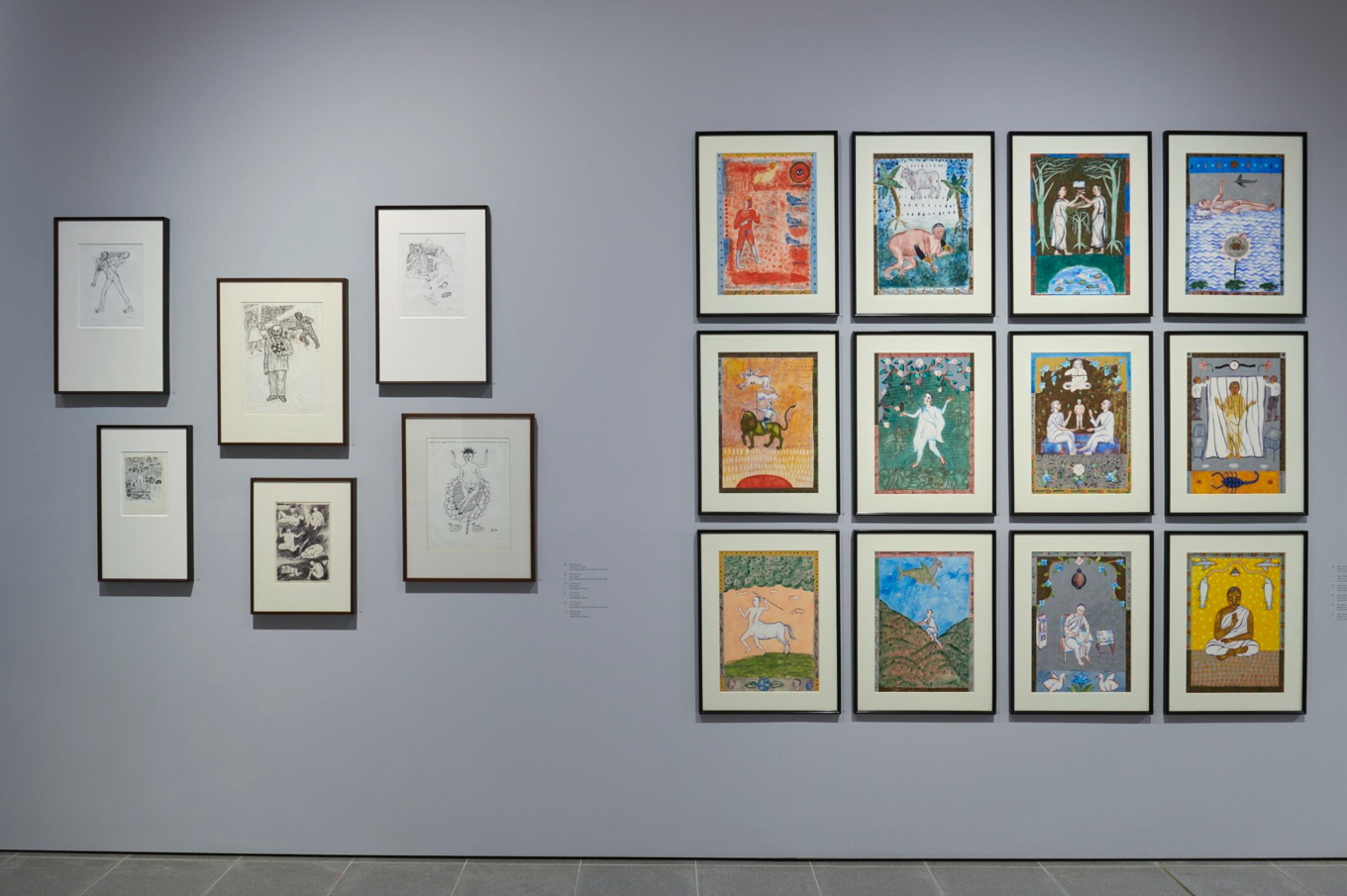
Installation view of ‘Arpita Singh: Remembering’ at Serpentine North showing a set of pen and ink drawings on the left, and the 12 acrylic versions of the Zodiac on the right © Photo by Jo Underhill. Courtesy Arpita Singh and Serpentine
Acrylic
A really important reason was the significant difference in psychovisual impact between the big heavily layered oil paintings and the far more muted acrylic and watercolour works. The latter are not only smaller but the lack of surface agitation found in the oil paintings somehow made them seem a lot more calm and civilised. Less hysterical maybe, more serene.
Fewer human figures
And this lack of surface busy-ness, greater calmness, allows you to savour and enjoy the figures more. Some of the larger ones still have lots of figures in but many don’t. In many of them the figures are fewer, bigger and so more impactful, more interesting.
Mysterious
And a lot more beguiling. In the huge oil paintings so much is going on that it’s hard to care. In these smaller, more intimate acrylics and watercolours there’s more time to ponder the compositions and wonder what’s going on.
Influences
The curators tell us that Singh’s art draws on Bengali folk art and Indian stories, interwoven with experiences of social upheaval and global conflict, and that her style is a mashup of Surrealism, figuration, abstraction and Indian Court paintings. And it’s true, at various points all these can be seen: the first few big oil paintings are flat smooth Surreal depictions of random symbols that might have been by the Surrealist Leonora Carrington, while in one of the Powders there are early pen and black ink drawings which might have been by Paul Klee. And the flatness and decorativeness of the images, with a lack of concern for perspective reminded me of the Mughal-era courtly Indian paintings you can see at the Victoria and Albert Museum.
Urban settings
Except that these aren’t in any sense courtly figures. The opposite, they feel like men and women from very modern urban environments, people trapped within or struggling against their environments. In many of them the city seems to be represented by a kind of simple version of an A to Z or city map, showing various roads, all forking and branching out behind the human figures. Some of these lines are blue and so might represent a river (?).
One of the best of these urban alienation images shows what seems to be the same figure of a woman dressed in a black burqa, bent over in various postures of struggling to battle her way through a city represented by what looks like images of a skyscraper (rows of rectangular windows) which has been torn into pieces and scattered around the surface.
Reviewing all this made me think there’s something of Franz Kafka in Singh’s depiction of the city as a challenge, puzzle and maze.
Technology
Onto these child’s-style views of cities are often pasted images of modern technology. Two which recur are cars or taxis stuffed with her primitive figures, or airplanes flying in her childlike sky.
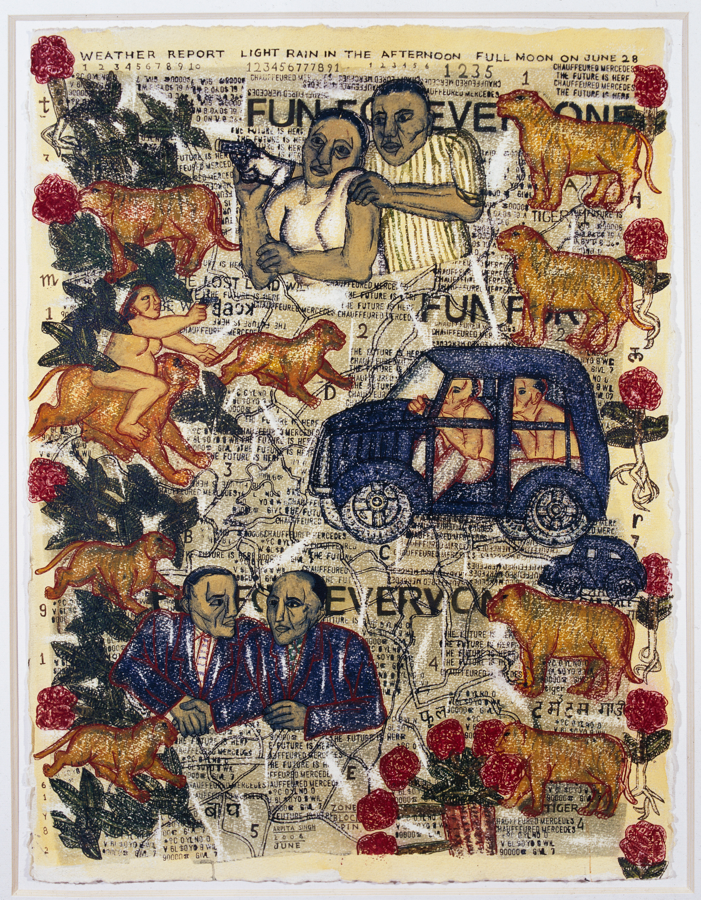
Lesser Myth by Arpita Singh (2006) Courtesy of Vadehra Family Collection © Arpita Singh
Naked women
Arpita Singh is, of course, a feminist, and the two feminist curators of the exhibition (Tamsin Hong and Liz Stumpf) point out that:
Since the 1990s, Singh has increasingly explored themes of motherhood, the aging female form, feminine sensuality, vulnerability, and violence, demonstrating the impact of relationships and external events on the emotional and psychological landscape of the artist. Her works are intimate portrayals of domestic and inner life but are equally concerned with the experiences of women navigating the outside world.
This, I think, is true but what I came to actively like was the way she portrays women; was the way her drastically unwestern eye or style extends to the way she portrays women. It turns out that the rather childlike, gawky style, which doesn’t give a damn about western realism, means that her images of women capture something completely other, different. Western iconography of women is so dominated by the Christian church for 1,000 years and then by the male gaze for the last 500 years, that it’s all but impossible for any depiction of women to escape its clutches. But Singh’s women do. Escape, I mean.
They are obviously ‘adult’ in the sense that they are often naked or wearing diaphanous outfits and she goes to some lengths to depict the women’s vulva, labia etc. In western hands this might be unavoidably graphic and problematic. But somehow, in Singh’s childlike, non-western iconography, it begins to say something else. Something about women’s privacy, integrity, distinctiveness. It’s not salacious. It doesn’t sexualise women in any way. It just emphasises that women are.

A Feminine Tale by Arpita Singh (1995) Courtesy of Taimur Hassan Collection © Arpita Singh, Photo by Justin Piperger
There’s a linked set of images of women pulling transparent saris or fabrics round their bodies which are nothing like the stately dressed aristocratic ladies of Bengali court painting but… but somehow, they bespeak an entirely modern, late 20th century reality of women’s lives and independence. It’s hard to put into words but the more I saw of these, the more I felt like I was entering a really, genuinely, alien and alternative artistic world.
Threatening men
One of the woman wrapping herself in a sari has half a dozen much smaller male figures pulling it down or pinning it down around her and you can feel her resistance to this male… what? Something. Power. Oppression. And you can feel this atmosphere of resistance throughout.
Or take this dense painting. Note the familiar recurring motifs. There’s lots of text all over the work. The women figures are by no stretch of the imagination in any way created for the male gaze but instead express something important but inscrutable about women’s independence. The green line, is it the tendril of some plant? The orange cloth behind the women, is it a curtain or spread of some kind or a sort of map, a sort of tangled A to Z.
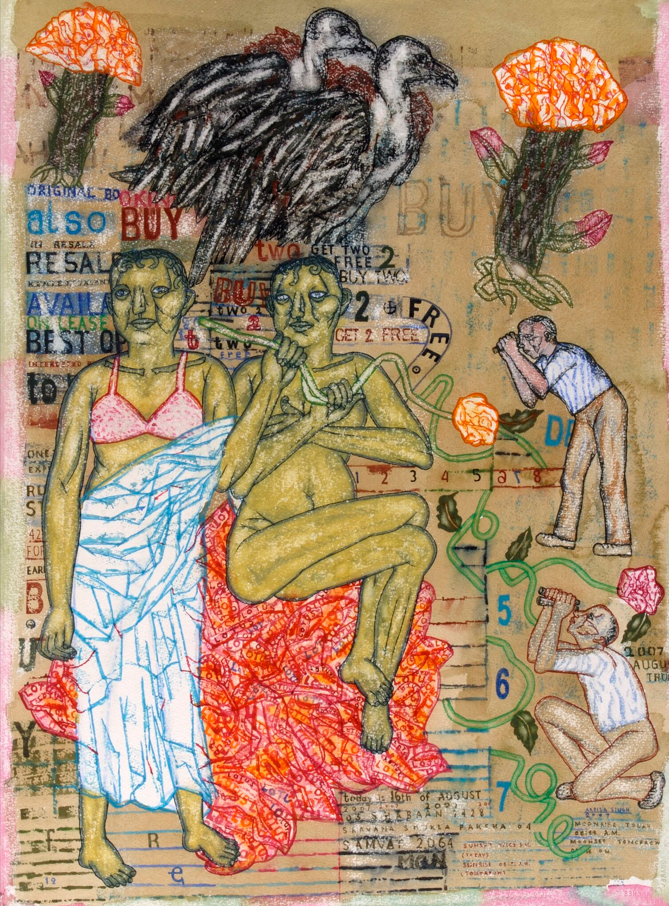
Buy Two, Get Two Free by Arpita Singh (2007) Private Collection © Arpita Singh
So the men with the binoculars, are they peeping Toms, are they looking through windows to get a glimpse of scantily clad women? In which case the birds at the top, are they vultures? In which case do the vultures ‘symbolise’ the men, picking over the scraps of women’s bodies chopped up by binocular vision, picking over scraps, exploiters and parasites? Or is the iconography more complex than that? And what do the two trees or bushes with orange heads have to with anything?
Resisting interpretation
This brings us to one of Singh’s strongest points which is that she is not programmatic. Lots of the works have words in, lots of words, mostly in English (why? why not in Bengali or any other Indian language?) as the three images above indicate. ‘Fun Fun Everyone’ are the biggest words visible in ‘Lesser Myth’ amid what seem to be newspaper fragments cut out and collaged together. But what does it really mean? And why are there nine lionesses in the picture? And why is a naked woman riding one of them? And what are the two men in suits at the bottom talking about? And why are there two half-dressed men crammed into one of her characteristically dinky cars? And why is the man in the couple at the top holding a pistol over the woman’s shoulders and why is her arm bent up to support it? And why are there lots of red rose bushes everywhere (or are they hibiscus or some other bright bush native to India which I’m completely ignorant of)?
The pleasure of mystery
It is actively enjoyable not to know the answers to these questions. The more of her acrylic and watercolour work I looked at, the more beguiled I became. All that writing feels as if she has something very important to say and yet all the texts tempt and tease and then veer away, turning out to be more elliptical and obscure than they first appear. And this is very enjoyable.
And there are lots of them. The exhibition features a rather staggering 165 works. I hope I’ve conveyed my journey to you, from initial dislike and scepticism, through slow understanding, and letting the works teach me how to see them, until I felt I had, to some extent, entered her world, a world really very far removed from my own culture and experiences. And that’s what art can do, so well.
Related links
- Arpita Singh: Remembering continues at Serpentine North until 7 September 2025
 Books & Boots