Our Bodies, Their Battlefield: What War Does to Women by Christina Lamb (2025)

Warning: This review contains details of really disgusting and evil sexual violence perpetrated against women and girls that goes far beyond rape. If you’re of a sensitive disposition or prone to nightmares, don’t read it.

The more places I went to, the more prevalent I found rape was.

‘It is an everlasting nightmare.’
(Lola Narcisa Claveria, Filipino survivor of Japanese sex slavery, page 351)

This is a deeply upsetting but profoundly important book, often devastatingly depressing but sometimes genuinely inspiring. Christina Lamb is an award-winning journalist who has covered a variety of warzones in her career as well as writing 10 factual books. From early in her career she realised just how prevalent rape was as a weapon of war, not just as random outrages, but used systematically to demoralise enemy forces and terrorise entire populations. What she learned about the vicious sexual abuse of women in conflict after conflict was sickening and disgusting. But she also came to realise that the scale of the violence and abuse against women was often overlooked in journalism and history books overwhelmingly written by men (p.459); and by international bodies and courts more often than not run by men.

Everything has to start with the evidence and this means the first-hand testimony of the survivors. Telling their stories not only offers some form of closure for the victims, and the psychological validation of knowing someone believes them. It is also the start of gathering evidence, for use not only in possible court proceedings but to begin to be used in larger historical narratives, to begin to redress the gaping silence about one of the most overlooked and neglected parts of war and conflict – the unspeakable crimes, violence and abuse directed against women and girls, often on an industrial scale.

‘When I saw them laughing and humiliating us, I decided we needed to break the silence. If we didn’t talk about what we went through, and if they were not punished, what could we expect from their children but the same or greater evil?’ (Bakira Hasecic, founder of Association of Women Victims of War in Bosnia, p.167)

And so this substantial book (474 pages) records Lamb’s odyssey, over a seven year period, to track down, interview and record the testimonies of women who have suffered unbelievable horrors in conflict after conflict around the world.

Destinations

Lamb goes to:

2016 August: Leros, Greece The Greek island of Leros was used to house refugees from war in the Middle East including Yazidis who had been enslaved and trafficked by Islamic State.

2016: Baden-Wurtenberg The German province which took in 1,100 Yazidi women and children who had been treated as sex slaves by ISIS.

2016: Northeastern Nigeria: On 15 April 2014 the brutal Islamic terror group Boko Haram kidnapped 276 mostly Christian schoolgirls from the town of Chibok and carried them off into sexual slavery. #BringBackOurGirls or #BBOG went viral. Hardly any of the girls have been recovered.

2017 December: Bangladesh: Kutupalong To interview survivors of the 2017 massacres and mass rapes of Rohynga women by Burmese soldiers. In three months more than 650,000 were driven out of the west Burmese state of Rakhine, two-thirds of the Rohynga population.

Every single shack had terrible stories and I had never come across such widespread violation of women and girls. (p.75)

Bangladesh: Liberation War Museum, Dhaka and Sirajganj Up to 400,000 were women raped by Pakistani soldiers in Bangladesh’s war of independence as official Pakistan military policy. Lamb learns that the survivors were called birangonas from the Bengali word bir meaning war heroine (p.92).

‘Often when the women were raped the soldiers had grabbed their babies and stomped on them to death or thrown them so hard their brains had come out.’ (Safina; p.110)

Rwanda Aftermath of the 1994 Hutu genocide of Tutsis, itself the sequel to the 1959 Hutu Revolution, and pogroms of 1963 and 1973.

‘Of course they raped me… Wherever you were hiding under a tree a man would find you and rape you and sometimes kill you. There were lots of different men doing this and they used sticks and bottles into the private parts of many women right up to their stomach…’ (Serafina Mukakinani, p.132)

2018, March: Yugoslavia: Sarajevo The appalling atrocities of the Serbs in Bosnia, and the heroic efforts of Bakira Hasecic and her Association of Women Victims of War, founded in 2003, to bring the Serb torturers, murderers and rapists to justice.

Yugoslavia: Srebrenica Dragana Vucetic, senior forensic anthropologist at the International Commission of Missing Persons. On 11 July 1995 Serb militias took away about 8,300 Muslim men and boys, drove them out into fields or football grounds, then massacred them, shooting or bludgeoning them to death. Dr Branca Antic-Stauber who runs a charity for rape survivors and uses horticulture therapy.

2018, October: Berlin Stories of the vast mass rapes of German women and girls during the Red Army’s conquest of eastern Germany and Berlin at the end of the Second World War. In towns and villages every woman from eight to eighty was raped multiple times. ‘It was an army of rapists’ (Natalya Gesse, Soviet war correspondent, p.194) It is estimated that up to 2 million women and girls were rapes and scores of thousands of Germans committed suicide, and killed their children, rather than fall into the hands of the Russians.

2018, November: Buenos Aires In 1976 a military junta seized control of Argentina and rules for 7 years during which up to 30,000 leftists, trade unions and activists were kidnapped off the streets and ‘disappeared’. Estela Barnes de Carlotta, president of the Grandmothers or Las Abuelas (p.214).

2018, March: Mosul Lamb attends the hurried trials of a handful of the 30,000 or so people charged with being members of ISIS. Justice is a farce. The court doesn’t consider rape as a separate offence, all offences are grouped together as terrorism.

2018, April: Iraq: Dohuk The prevalence of suicide among Yazidi survivors of ISIS sex slavery.

2019, February: Democratic Republic of Congo: Bukavu In 2010 Congo was called the rape capital of the world. Lamb interviews Dr Denis Mukwege, founder of the Panzi Foundation, who has treated more rape victims than any other doctor in the world.

In the Second Congo War stories of women who were not only gang raped but then shot in the vagina, or had bayonets shoved in their vagina, or sticks soaked in fuel which was then set alight. Lamb discovers that Dr Mukwege’s clinic is seeing more and more raped babies. Some men believe that raping babies will give them magical powers; they are told this by witchdoctors (p.337).

In a gruelling book this chapter (chapter 13, pages 300 to 334) contains probably the worst atrocities (the 86-year-old who was raped, women’s vaginas set alight or hacked off, the mother who was forced at gunpoint to eat her own baby); but also the most inspiring moments. Lamb meets the inspiring Christine Schuler Deschryver, founder of City of Joy, a safe haven for survivors in Congo.

‘It’s about giving a woman value… I hug them and then they are healed and people say I have magic hands but it’s just love… I’m convinced you can change the world only by love’ (p.330)

It also contains the most telling evidence of the way rape used as a weapon of mass terrorisation is tied into broader economic and political structures. Because Deschryver points out that 1) Congo contains more of the rare metals needed to create mobile phones and batteries (cobalt, coltan) than any other country on earth; 2) if you drew a map of the rapes you’d see they cluster around mining areas, and so 3) rape is used as a strategy of terror by the militias and groups who control the mines and the regions around them. Which leads her onto her fourth point, 4) if the international community really wanted to end conflict in the Congo it could but, in Deschryver’s view, it suits multinational corporations to preserve Congo as an unstable mess the better to plunder the country of its cobalt, coltan and gold (p.331).

Democratic Republic of Congo: Kavumu Village where scores of babies and very small girls have been abducted, raped and their genitals destroyed, allegedly by the ‘Army of Jesus’, a militia controlled by a local warlord whose members have been told by a witchdoctor that the blood from raped and mutilated babies will make them invulnerable in battle (p.339). Although the warlord was eventually taken to court and convicted, the case went to appeal and none of the villagers knows whether he and his henchmen are in prison or not. Meanwhile, having lost all faith in the justice system, they have started to take the law into their own hands with lynchings and beheadings of suspect young men (p.348). Thus, chaos.

Manila Lamb meets surviving ‘comfort women’, enslaved by the occupying Japanese Army during the Second World War. They prefer to the term lolas which means grandmother in the local Tagalog language and which they use as an honorific, hence Lola Narcisa and Lola Estelita.

Concluding chapter 2020

Sexual violence against men

  • in eastern Congo a quarter of men in conflict zones have experienced sexual violence
  • in Afghanistan bacha bazi or the abuse of boys is common
  • in Syrian prisons under Bashar al-Assad, men and boys were submitted to horrifying sexual violence

The challenge of achieving justice Lamb jumps between a number of cases, showing the dedicated work of investigators, researchers, lawyers, prosecutors and judges, but how gruellingly slow it is and how pitifully few convictions are achieved. The Yazidis wait, the Rohingya wait for justice.

Guatemala During the 36-year-long civil war over 100,000 women were raped, mostly Mayans in an attempt to exterminate their ethnicity (p.387). In 2016 11 Mayan women secured the conviction of a retired army officer for sexually enslaving them.

Peru Over 5,000 women raped during the 11-year-long civil war with Shining Path guerrillas.

Colombia Sexual crimes have been included in crimes heard by the tribunal set up at the end of the 52-year-long civil war with the Revolutionary Armed Forces of Colombia (FARC).

Chad Successful conviction of Chad’s despicable sadist president, Hissène Habré, who ruled through a reign of terror till his overthrow in 1990. In 2000 he was arrested and put on trial in neighbouring Senegal. In 2016 he was convicted of crimes against humanity, torture and rape and sentenced to life imprisonment.

Women in charge Lamb makes the telling point that most of these convictions were only secured when women were judges or prosecutors in the case.

2025 update

2022, May, Ukraine: Berestianka The Russians are back and they’re raping again. And looting everything they can to take back to their pitiful slum of a country. Gang rapes, torture, rape in front of the rest of the family etc (p,409). Rewarded by Putin on their return home. According to Lamb domestic violence is not criminalised in Russia and widely accepted. Figures. Whenever I read about Tolstoy or Dostoyevsky despising the decadent West, this is what I think of. Russia, home of domestic violence, epidemic alcoholism and rapists.

For the first time Ukraine established a court and started prosecuting Russian war criminals while the war was still ongoing (as it is today).

2023, autumn, Tel Aviv On 7 October 2023 Hamas fighters broke through the wall dividing Gaza from Israel and went on a rampage at multiple sites, massacring 1,200 civilians and taking 251 others back to Gaza as hostages. Lamb meets survivors, and speaks to the many first responders, therapists and women’s activists regarding the widespread evidence of sexual violence against the women victims: gang rapes and sexual mutilation i.e. shooting women in the vagina. In her interviewees’ opinion the intention was the most primitive one imaginable of attacking your enemies’ procreative ability, plus the more modern one of spreading not just terror but horror. The barbaric cruelty was exemplary in the sense that it was intended to traumatise an entire nation (which, arguably, it did).

Hebron in the West Bank. Lamb meets Palestinians who live under extraordinarily tight Israeli supervision, and then survivors of sexual violence inflicted by the Israeli Defence Force, and lawyers and NGOs who have reported on it. Interestingly, the main targets have been men and boys, designed to cause maximum humiliation in revenge for 7 October. The accusations of sexual humiliation in captivity sound identical to the Americans at Abu Ghraib.

‘It was me and two other prisoners and three border police. They filmed us naked then began to touch our bodies and make jokes and insulted us. One of them had a metal detector which he tried to put in our anuses.’ (Palestinian Thaer Fakhoury, p.448)

Avignon, December 2024 Lamb is introduced to Gisèle Pelicot, the woman drugged by her  husband who then invited men from a website group to come to their home and rape her. The police found thousands of videos on her husband’s laptop clearly identifying the men which allowed a trial to go forward with 50 accused. The key thing is she waived her right to anonymity in order to speak out and so became a heroine to anti-rape activists, feminists and ordinary people around the world.

Summary When she completed the first edition in 2020 Lamb couldn’t imagine that sexual violence in conflict would return to Europe, in the form of Russian soldiers raping Ukrainian women, or the horrors of the Hamas attack on Israel, or the eruption of brutal civil war in Sudan. Every year the UN presents a report on conflict-related sexual violence. The 2024 report concluded that conflict-related sexual violence is increasing.

Historical retrospective

Spain The really systematic mass rape of large populations of women probably first occurred in the Spanish Civil War 1936 to 1939. It was carried out by General Franco’s Falangist forces. ‘Not just rape but appalling evisceration of peasant women of Andalucia and Estremadura’, including the branding of their breasts with fascist symbols (historian Antony Beevor, quoted p.203).

Nanking The rape of Nanking, December 1937 to January 1938, where the Japanese accompanied mass murder of Chinese civilians with mass rape of women and girls.

Comfort women Euphemism for the hundreds of thousands of women and girls, predominantly from Japanese-occupied Asian countries, who were forced into sexual slavery by the Imperial Japanese Armed Forces before and during World War II.

Vietnam War 1961 to 1973: My Lai massacre and Tet Offensive.

Khmer Rouge 1975 to 1979. Cambodians murdered 2 million other Cambodians accompanied by mass rape.

Turkish invasion of Cyprus 1974, triggered widespread Turkish soldier rape of Greek women.

Timeline

1863 Abraham Lincoln issues general order 100 making rape carried out by soldiers of the Union Army punishable by death.

1919 Commission of Responsibilities established with rape near the top of the list of 32 war crimes.

1946 but at the war crimes tribunals at Nuremberg and Tokyo not a single prosecution for sexual violence.

1949 Geneva Convention, Article 27:

Women shall be especially protected against any attack on their honour, in particular against rape, enforced prostitution, or any form of indecent assault.

1973 Bangladesh declares rape a crime against humanity.

1993 International Criminal Tribunal for the former Yugoslavia (ICTY):

Men and women came forward to recount evils beyond imagining – women and girls locked up in schools and suffering repeated anal, oral and vaginal rape, people having their tongues cut off, or being burned alive as human torches as they ‘screamed like cats’ (p.160)

1994 International Criminal Tribunal for Rwanda (ICTR) established in Arusha in Tanzania: Lamb interviews raped Tutsi women who testified in the first rape-as-war-crime trial. It was the first time rape was recognised as an instrument of genocide and prosecuted as a war crime.

‘I was raped countless times. The last group that raped me were so many people and one man shouted, “I can’t use my penis in that dirty place so I’ll use a stick.” I know many women who died like that. They sharpened the sticks and forced them right through their vaginas.’
(Cecile Mukurugwiza, p.141)

1998 first conviction for rape as a war crime.

1998 Rome Statute which established the International Criminal Court defined rape as a war crime.

2000 UN Security Council Resolution 1325 was the first formal and legal document from the Security Council that required parties in a conflict to prevent violations of women’s rights, to support women’s participation in peace negotiations and in post-conflict reconstruction, and to protect women and girls from wartime sexual violence; for ‘the greater inclusion of women in peace and security’.

2008 UN Security Council passed Resolution 1820 stating that ‘rape and other forms of sexual violence can constitute war crimes, crimes against humanity or a constitutive act with respect to genocide’.

2009 established the office of the Special Representative of the UN Secretary General on Sexual Violence in Conflict.

2010 Bangladesh sets up an International Crimes Tribunal. As of 2019 88 collaborators and party leaders had been tried for torture, murder and rape.

2011 In a video sent to a Nobel Women’s Initiative conference about sexual violence, Nobel Peace Prize laureate, Aung San Suu Kyi said:

‘Rape is used in my country as a weapon against those who only want to live in peace, who only want to assert their basic human rights. Especially in the areas of ethnic nationalities, rape is rife. It is used as a weapon by armed forces to intimidate the ethnic nationalities and to divide our country.’

2014 then UK Foreign Secretary William Hague organised a four-day conference calling for the end of sexual violence in conflict.

2016 International Criminal Court convicts Pierre Bemba of murder, rape and pillage carried out by his men during the 2002-3 war in the Central Africa Republic.

2018 Nobel Peace Prize awarded jointly to Denis Mukwege and Nadia Murad “for their efforts to end the use of sexual violence as a weapon of war and armed conflict”

2019 first conviction by the International Criminal Court for rape in wartime.

2019 report of the UN Special Representative listed 19 countries where women are being raped in war, by 12 armies and police forces and 41 non-state actors.

2019 Gambia took Myanmar to court over the Rohingya genocide, the first time one state had taken another to court over war crimes it had committed. Tried at the International Court of Justice in the Hague, resulting in orders against Myanmar carrying out any further genocide.

2020 first criminal trial of a member of Islamic State for crimes against the Yazidi, held in Germany, resulting in conviction and life imprisonment.

Learnings

Systematic mass rape, sexual violence, sexual torture and sexual mutilation are far more widespread than the bleakest pessimist could ever have expected.

Rape in conflict is rarely ad hoc, random and incidental. More often it is the result of encouragement or orders from the highest levels of military and political leadership, as in: mass rapes in Germany; mass rapes in Rwanda; mass rapes in Bosnia; mass rapes in Syria, and so on.

These kinds of mass rapes are now recognised, not as accidental by-products of the chaos of war, but as conscious war strategies, and as such, defined as war crimes. They are also associated with genocide, the conscious attempt to wipe out a people or group.

The genocidal intent is demonstrated in cases like the mass rape of Bangladeshi women and girls by the army of Pakistan, or the mass rapes of Bosnian Muslims by Bosnian Serbs, or the mass rape of Rohingya women by Burmese soldiers. In each instance the intent wasn’t sexual per se, the intent was to wipe out the victims’ ethnic group by breeding a new generation with the blood of the conquerors in them. In Bangladesh:

‘They had orders of a kind from Tikka Khan [Pakistan’s military governor in the East]… What they had to do was impregnate as many Bengali women as they could… so there would be a whole generation of children in East Pakistan that would be born with blood from the West.’ (p.97)

In Bosnia:

The victims ranged from between six to seventy years old and were raped repeatedly and often kept captive for several years. Many women were forcibly impregnated and held until termination of the pregnancy was impossible. The women were treated as property and rape was used with the intent to intimidate, humiliate and degrade. (p.156)

This same motive – ethnic triumphalism – explains why foetuses were cut out of pregnant women, babies were bludgeoned to death, and children were shot or had their throats cut.

Speaking about it helps. Sharing their stories in safe, supportive environments helps the survivors.

‘It’s all about giving them respect and them owning their stories. After a month, when they begin to tell their stories, sometimes OMG… and the transformation after six is huge. We turn pain into power and give victims strength to be leaders in their communities.’ (Christine Schuler Deschryver, founder of City of Joy, Congo, p.327)

But it never goes away. These women are profoundly damaged forever, as are their families, all their relationships, and their wider communities. And that was the intention.

‘That’s why rape really was a calculated weapon. The fellows who raped them and planned to rape them: they knew you either die now or die later but you’ll never be human again after this ordeal.’ (Rwanda Justice Minister Johnston Busingye, p.153)

As much or more healing comes from having the state formally recognise their plight, a formal recognition that it happened and that it was a crime.

‘It’s not possible to heal from this forever but it helps to speak about it as soon as possible and to share the story with someone compassionate. What I have seen definitely helps their healing is when perpetrators get punished because that gives the victim confirmation by authority she was not the one at fault for what happened to her and that she’s innocent.’ (Dr Branca Antic-Stauber, p.190)

‘Talking to the judges was the beginning of my rehabilitation. For so many years society did not want to listen… But now we could tell our side of the story… Seeing the life sentences at long last, after all they did to us, truly, it gives you your life back.’ (Graciela Garcia Romero, p.238)

In conservative societies state recognition can support recognition at local, village and family level. A striking example is the way the first president of Bangladesh, Sheikh Mujibur Rahman, who recognised the horrific scale of the mass rapes carried out by the Pakistan army and coined a term of praise for the victims, calling them Birangona, or ‘war heroines’.

Better still, though, is the healing effect of watching their perpetrators brought to justice, tried and convicted of their crimes. This validates the victims’ experiences and assures them that the world around them understands and values their suffering.

‘Their actions changed the law and criminal justice for every woman. The women showed you can take the worst trauma and turn it into a story of strength and victory.’ (Erica Barks-Ruggles, US ambassador to Kigali, on the rape survivors who travelled to the Rwanda genocide tribunal to testify against the perpetrators, p.149)

The only problem is it happens pitifully rarely.

Meanwhile, many of the women interviewed wanted their perpetrators to be killed (p.119).

‘I want the worst things to happen to the men that did this to me. I want them to die not in a quick or humane way but slowly, slowly, so they know what it’s like to do bad things to people.’ (Naima, a Yazidi enslaved by ISIS, p.264)

‘I feel so angry at what those Japanese did to me and my family, that if I saw them today I would kill them.’ (Lola Narcisa Claveria, Filipino woman enslaved by the Japanese p.357)

‘I hate them so much and wish death to all of them and Putin.’ (Vika, Ukrainian woman raped by Russian soldiers, p.403)

Charities have discovered that a good way to draw survivors out of their often disastrous mental suffering is to give them tasks, jobs, skills training and agency. Like the farm bought by Christine Schuler Deschryver, to be run by rape survivors in Congo (p.329) or Dr Branca Antic-Stauber’s idea of setting up a rose-growing business to employ survivors in Bosnia (p.185)

No index

There’s no index. Why?

Similarly no list of the organisations mentioned in each country, or organisations addressing sexual violence generally. I supply my own list below.

Human history

Well, I’ve explained my view of human history in a separate blog post:

History is an abattoir. What was written down is a tiny fraction of what happened, and it was written by the educated and privileged, mostly sucking up to kings and khans. The reality of human existence for most humans for most of human history has been unspeakably brutal.

Last thought

In his brilliant series of books about conflict and international order in the 1990s, Michael Ignatieff divides the world into zones of conflict and zones of safety. Every day I thank my lucky stars that I was born and lived all my life in what he calls a ‘zone of safety’. Way before you get to my white privilege or my male privilege, I give thanks for my safety privilege.


Credit

‘Our Bodies, Their Battlefield: What War Does to Women’ by Christina Lamb was first published by William Collins in 2020. I read the updated 2025 paperback edition.

Organisations mentioned in the text

Support organisations

At the end of the Unsilenced exhibition at the Imperial War Museum, the curators give a list of support organisations, which I repeat here:

Related reviews

Unsilenced: Sexual Violence in Conflict @ the Imperial War Museum

This exhibition includes cases of rape, sexual humiliation, torture and child abuse in conflict. Imperial War Museum advises that this exhibition is only suitable for those aged 16 or over.

This is a really important exhibition on a very important subject. Most exhibitions stimulate or entertain me but this one significantly changed my understanding and attitude towards a horrific and ongoing crisis.

‘Unsilenced: Sexual Violence in Conflict’ is the UK’s first major exhibition dedicated to describing, analysing and understanding sexual violence in conflict. It includes 162 objects which illustrate all aspects of the issue, from wartime propaganda posters to testimonies from women victims from the First and Second World wars, as well as more recent conflicts such as Yugoslavia, Darfur and Congo, Gaza and Ukraine.

Expert views

The first and last galleries house no objects, just video screens which feature interviews with experts in the field. In the first room they introduce key facts and concepts around sexual violence in conflict, including the term itself and its definition, what it means, who perpetrates it, and who the victims are. In the final room, the same experts suggest ways to bring about change. These experts are:

  • Charu Lata Hogg – founder and Executive Director of All Survivors Project
  • Dr Zeynep Kaya – Lecturer in International Relations, University of Sheffield
  • Dr Paul Kirby – Queen Mary University
  • Christina Lamb – Sunday Times journalist and author of ‘Our Bodies, Their Battlefield: What War Does to Women’
  • Sarah Sands – journalist and former Chair of the G7 Gender Equality Advisory Council

Why sexual violence in conflict has gone unreported

According to the experts, sexual violence has accompanied conflict and war for as long as we have records.

Wherever conflict erupts, sexual violence is present.
(Sara Bowcutt, Women for Women International)

For most of history it has been repressed and unrecorded, for numerous reasons.

  • Until the advent of photography and, nowadays, smartphones and social media, it’s been difficult to document and record.
  • This has led to sexual violence being under-reported at the time and so all but ignored in official records and historical accounts.
  • Perpetrators and the bodies they serve in (armies, militias, informal groups), wanting to preserve their ‘honour’ and prestige, suppress information.
  • But victims, families of victims, their communities and wider societies sometimes cover it up because of the ‘shame’ and social stigma attached.

But there are other occasions when sexual violence is the opposite of hushed up, when it is used to terrorise and demoralise civilian populations, with a view to depriving fighting forces of support or bringing pressure on them to surrender and end the abuse of their civilian communities. This was practiced in Darfur and more recently by Russian forces in occupied areas of Ukraine. In these situations incidents of sexual violence are widely advertised – but the challenge remains the same: of identifying the exact perpetrators, and trying to establish who in the chain of command gave authorisation for it. This can be frustratingly difficult to achieve.

Why it’s important to discuss sexual violence in conflict

The stance of this exhibition is that the subject must be directly addressed, discussed and aired, for a number of reasons:

  • Allowing victims to speak allows the crimes to be documented and so evidence gathered for legal proceedings.
  • But it also allows for something equally important, which is for the victims’ voices to be heard, their ordeals to be recognised, and so some kind of closure to be achieved.
  • Legitimating speech on the subject also helps to overcome social taboos around shame and keeping silent, which obtain in many if not most societies.
  • So: speaking out both helps victims recover and contributes documentary evidence to investigations and trials.

As a survivor explains:

‘To leave a little bit of what I had behind, that affected me, you don’t forget it but you learn to live with it, and by talking you take off a weight, a stigma, so I leave relaxed, free and happy.’

Four charities

With these aims in mind in mind, the penultimate room focuses on the ongoing work of four NGOs working in the field of sexual violence in conflict, namely:

  • Women for Women International
  • All Survivors Project
  • Free Yezidi Foundation
  • Waging Peace

There’s a panel on each of these organisations, alongside photos of the work they do, and moving testimonials from victims who have benefited hugely from being listened to and validated. As one of them wrote:

‘We all want to mean something to someone, that we matter. That we’re important.’

These testimonies are accompanied by objects:

  • a traditional cloth toub titled ‘Peace by Piece’, created by Sudanese women affected by the war in collaboration with Waging Peace
  • a handmade animal toy created by women through Free Yezidi Foundation’s programme to empower women through training, job opportunities and income generation
  • policy and testimony from All Survivors Project, the only international NGO dedicated to addressing acts of sexual violence in conflict against men and boys

Installation view of Unsilenced: Sexual Violence in Conflict @ the Imperial War Museum showing panels explaining the work of three of the four featured NGOs, including written and spoken testimony (via the headphones) © Imperial War Museum

Why an exhibition like this is part of the solution

Having explained all these processes you can see why an exhibition like this fits into the process of solution, by 1) documenting and recording abuses 2) allowing victims’ voices to be heard 3) increasing public awareness and understanding 4) making it easier to discuss abuses and, potentially, identify and target the patterns of behaviour which underpin or lead to sexual violence: the underlying attitudes which have made it ‘acceptable’ or ignorable in the past.

I would say that two major threads or themes run through the exhibition, one about gender, the other about justice.

Gender norms

Charu Lata Hogg is the most feminist or deploys the most academic feminist point of view. All I mean by this is that in her interviews she talks liberally about toxic masculinity and the patriarchy, two phrases which don’t appear in any of the other interviewees.

Hogg claims that sexual violence in conflict does not take place in a vacuum. It follows logically from the gender stereotyping widespread in peacetime society and then promoted in much wartime propaganda. She sees sexual violence in conflict as arising directly from ‘toxic gender norms’ i.e. the widespread perception in so many societies which associates masculinity with strength, power, dominance and violence, and women with passivity, domesticity, secondariness and victimhood.

This is why the first room of the exhibition, immediately after the introductory videos, is devoted to an impressively large number of images, posters and propaganda leaflets etc, from the First and Second World wars but also other conflicts, which play up to these gender stereotypes. They shows women as sexy spies, seducers, security risks, with a whole fleet of striking leaflets designed to be dropped over enemy troops depicting their beloveds back home having sex with non-combatants while they’re living in misery and fear at the front.

Installation view of Unsilenced: Sexual Violence in Conflict @ the Imperial War Museum showing posters promoting gender stereotyping in wartime © Imperial War Museum

In other words, the exhibition argues that the widespread deployment of sexual and gender stereotyping in peacetime society feeds into the propaganda accompanying a conflict, and both lay the foundation for the sexual violence which then occurs in the conflict itself.

In the final room of videos which addresses possible solutions, Hogg returns to this theme and says the only way forward is to target the patriarchy, to target ‘toxic gender norms’ and target ‘the patriarchal seeds’ that establish these gender stereotypes at such an early age, and so ubiquitously, that when conflict arises, men act accordingly, i.e. abuse the exaggerated positions of power which conflict gives them in order to rape, enslave, terrorise, mutilate and murder the vulnerable i.e. mostly (but not only) women.

You can see that this approach has a number of weaknesses. 1) It’s problematic knowing exactly what you mean by ‘patriarchy’ and ‘patriarchal seeds’; in a general way probably everyone could agree with the idea that, despite half a century of feminism, it’s still ‘a man’s world’, but can you be more specific? 2) ‘Targeting the patriarchy’ sounds fine as a slogan but, like ‘levelling up’ or ‘Make America Great Again’, the challenge is in formulating concrete proposals to make this happen.

3) But surely the biggest problem is that if you tie sexual violence in conflict to every type of gender stereotyping across all of society, and claim that you won’t be able to end the violence until you’ve ended all gender stereotyping, this means you’re going to be waiting a very long time. It is, in other words, a utopian wish rather than a practical solution.

Justice

This is why I was more attracted by Christina Lamb’s contribution in the final video room which discusses the way forward. Lamb says the solution is simple: hold the perpetrators to account. Encourage and support victims to speak out (as per the work of the NGOs listed above). Document the crimes. Empower international bodies such as the United Nations’ International Court of Justice to set up courts of enquiry into specific conflicts. Gather evidence, name names, and bring individuals to justice.

Although this has proven dismayingly difficult in practice, it is at least a practical agenda, and it harmonises with work already going on i.e. it can be based on the speaking out supported by the NGOs and also helps to validate the accounts of victims, make them feel that they’re not being ignored.

In this practical area of justice progress has been made over the last 30 years or so, which the exhibition describes.

Timeline

1919 Commission of Responsibilities established with rape near the top of the list of 32 war crimes.

1946 but at the war crimes tribunals at Nuremberg and Tokyo not a single prosecution for sexual violence.

1949 Geneva Convention, Article 27:

Women shall be especially protected against any attack on their honour, in particular against rape, enforced prostitution, or any form of indecent assault.

1993 International Criminal Tribunal for the former Yugoslavia (ICTY):

Men and women came forward to recount evils beyond imagining – women and girls locked up in schools and suffering repeated anal, oral and vaginal rape, people having their tongues cut off, or being burned alive as human torches as they ‘screamed like cats’ (p.160)

1994 International Criminal Tribunal for Rwanda (ICTR) established in Arusha in Tanzania and for the first time recognises rape as an instrument of genocide to be prosecuted as a war crime.

1998 First conviction for rape as a war crime.

1998 The Rome Statute, which established the International Criminal Court, defined rape as a war crime.

2000 UN Security Council Resolution 1325 is the first formal and legal document from the Security Council that required parties in a conflict to prevent violations of women’s rights, to support women’s participation in peace negotiations and in post-conflict reconstruction, and to protect women and girls from wartime sexual violence.

2008 UN Security Council passed Resolution 2008 stating that ‘rape and other forms of sexual violence can constitute war crimes, crimes against humanity or a constitutive act with respect to genocide’.

2009 Establishment of the office of the Special Representative of the UN Secretary General on Sexual Violence in Conflict.

2019 First conviction by the International Criminal Court for rape in wartime.

2019 Report of the UN Special Representative listed 19 countries where women are being raped in war, by 12 armies and police forces and 41 non-state actors.

Reconciliation

The comfort women

But it’s not only justice in the sense of arresting and charging individuals. Only by acknowledging the existence of sexual violence can any progress be made towards broader reconciliation.

The most striking example, and also an example of how difficult this is in practice, is probably the case of the ‘comfort women’ of south-east Asia. Before and during the Second World War the Japanese Army forced hundreds of thousands of women and girls into sexual slavery. They came from many different nationalities but the large majority were from Korea.

The exhibition describes the Wednesday demonstration, more fully the ‘Wednesday Demonstration demanding that Japan redress the Comfort Women problems’, which began to assemble outside the Japanese embassy in Seoul at noon on Wednesdays in 1992. Japan claims to have made a formal apology for the scandal and to have offered reparations but the wrangle goes on about precise details.

Meanwhile, the Koreans have erected several statues in memory of the comfort women, one outside the Japanese embassy in Seoul, another in front of the Japanese consulate in the southern port city of Busan. Here’s a newspaper article about it. The exhibition includes a miniature reproduction of this statue with an explanation of its symbolism.

Installation view of Unsilenced: Sexual Violence in Conflict @ the Imperial War Museum showing a tiny replica of the Korean Sonyeosang or statue of peace, and the panel explaining its symbolism © Imperial War Museum

My overview

I asked at the museum Information desk but there is, regrettably, no catalogue for the exhibition, so I intend to provide a public service and give a fairly thorough breakdown of its content. It is in six rooms. The headings are the titles of each room, the bullet points are sub-sections within each room.

1. Prologue

Video clips of the experts addressing the following questions:

  • What is sexual violence in conflict?
  • Who is affected by sexual violence in conflict? Mostly women but some men and boys, particularly homosexuals
  • Who are the perpetrators? Armies, militias, military police, armed bands
  • Does sexual violence in conflict still happen today? Yes, widespread in current conflicts including Ukraine, Sudan
  • Why are we talking about this now? It is bad now but with the stresses and displacements of climate change is only likely to get worse

2. Structures and representations

  • Wartime presentations: sexist imagery and propaganda (see photo, above) including a couple of unintentionally hilarious films from the 1940s informing soldiers about the risks of sexually transmitted infections
  • Power and accountability:

3. Acts and manifestations

  • Mass incidents:
    • Red Army: the mass rapes carried out by the Red Army as it fought its way across Germany at the end of the Second World War; Stalin notoriously commenting that he could understand why battle-scarred soldiers would want to have some ‘fun’ with enemy women; over 2 million German women were abused, leading to death and serious injury, infections and suicide
    • ISIS: in 2014 Islamic State authorities organised the enslavement and mass sexual abuse of Yazidi women and girls: the exhibition includes the guidelines ISIS published for its soldiers on how to capture and treat sex slaves
  • Power imbalance: the little-known stories of sexual abuse of evacuees, particularly children, including in Britain during the Second World War
  • Sexual humiliation and torture:
    • Abu Ghraib: the show includes the New Yorker magazine article by Seymour Hersh detailing the shocking abuse of inmates at Abu Ghraib prison in Iraq in 2003
    • les tondues: French women who, at the liberation of villages, towns and cities, were seized, displayed and had their hair shaven off as a form of punishment and social condemnation for alleged collaboration with the German occupiers – the show includes documentary photos of tondues taken by Lee Miller

Installation view of Unsilenced: Sexual Violence in Conflict @ the Imperial War Museum showing, on the wall on the right, the section about comfort women; on the wall in the middle evidence of the ISIS mass enslavement of Yazidi women; and in the glass cases letters and memoirs from child evacuees who were sexually abused © Imperial War Museum

4. Justice and reconciliation

  • Legal justice: history of attempts to set up courts and tribunals starting with the first arrest warrants for rape issued by the Yugoslavia tribunal in 1993; in 1998 the International Criminal Court recognised sexual violence in conflict as a crime against humanity
  • Children born of sexual violence in conflict: the work of TRIAL International and The Forgotten Children of War Association and how it took until 2022 for Bosnia and Herzegovina to acknowledge children born as a result of sexual violence during the Bosnian War 1992–1995 as civilian victims of war

5. Rebuilding

As described, a panel apiece on the four charities:

  • Women for Women International
  • All Survivors Project
  • Free Yezidi Foundation
  • Waging Peace

6. Final thoughts

Video room with the five experts listed above giving their thoughts on the following topics:

  • How are attitudes towards sexual violence in conflict changing?
  • Why is it important to listen to victims and survivors?
  • What does justice look like for victims and survivors?
  • How can we create change?

Installation view of Unsilenced: Sexual Violence in Conflict @ the Imperial War Museum showing the videos of expert opinion (photo by the author)

Niggles

On 2 November the exhibition ends and will be dismantled. Why? Surely an exhibition on such an important and universal subject as this should become a permanent display. Not least if it’s true, as the curators claim, that sexual conflict has always been a part of war and continues to be, right up to the present day. Well then, shouldn’t a key element of conflict be addressed in a permanent display in Britain’s leading museum of war and conflict?

In the same spirit, why is there no catalogue of the exhibition? I’ve been to hundreds of exhibitions, and even the most trashy or superficial have usually been accompanied by catalogues or brochures. Surely an important exhibition on such an important subject warrants a permanent documentary record.

Poster created by the Mansudae Art Studio, Pyongyang. The text, in Korean, can be translated as: ‘No! Rid the twenty-first century of sexual violence!’


Related links

Support

At the end of the exhibition, there’s a list of support groups. For public information, I include it here:

Related reviews

Myth and Reality: Military Art in the Age of Queen Victoria @ the National Army Museum

The National Army Museum, at the west end of Royal Hospital Road, between the Royal Chelsea Hospital (home of the famous Chelsea Pensioners) and the Chelsea Physic Garden (and just round the corner from Oscar Wilde’s main London home in Tite Street) is a lovely place to visit on a Saturday morning.

It’s clean and light and airy and you just waltz right in with only a minimal bag search, there’s a lovely clean café with free drinking water, lovely clean toilets, and it’s never very busy so it’s easy to stroll around the exhibitions without having to fight your way through crowds of tourists unlike, say, the pressure cooker experience of visiting British Museum or National Gallery.

There are 3 or 4 permanent galleries accompanied by one or two rotating exhibitions, and it’s all completely FREE.

In the exhibition space on the second floor the Museum is currently hosting quite a large display of oil paintings, watercolours, sketches and memorabilia on the theme of the Victorian Army – some 140 works and objects in total.

I enjoyed it very much: there are lots of talking points, not only about the specific history/battles/wars behind many of the paintings, but about individual artists, about the evolution of artistic styles across the period, about the relative merits of big oil paintings, watercolours or sketches to capture the reality of soldiering, the spirit of battle, and so on.

Installation view of Myth and Reality: Military Art in the Age of Queen Victoria at the National Army Museum showing, on the left, a print of the Charge of the Light Brigade by Lady Elizabeth Butler and, on the right, the huge painting of ‘Reveille at Waterloo’ by the same artist (photo by the author)

First I’ll list the rooms or sections which the curators have divided their material up into, as a kind of evidence base, and then I’ll go on to my own topics or headings.

The official themes

  1. Myth and Reality
  2. Lady Butler
  3. Women and Military Art
  4. Patriotism and Portraiture
  5. The Victoria Cross
  6. Realism and Reportage
  7. The End of an Era

The general premise is that it was during Queen Victoria’s long reign (1837 to 1901) that not only did artists come to depict war and soldiers more realistically than ever before, but developments in publishing and print technology made these images more accessible and popular than ever before. This meant that major exhibitions were attended by huge crowds, while affordable prints and publications and even cheap postcards could be mass produced at increasingly affordable prices, and so found in homes across the country.

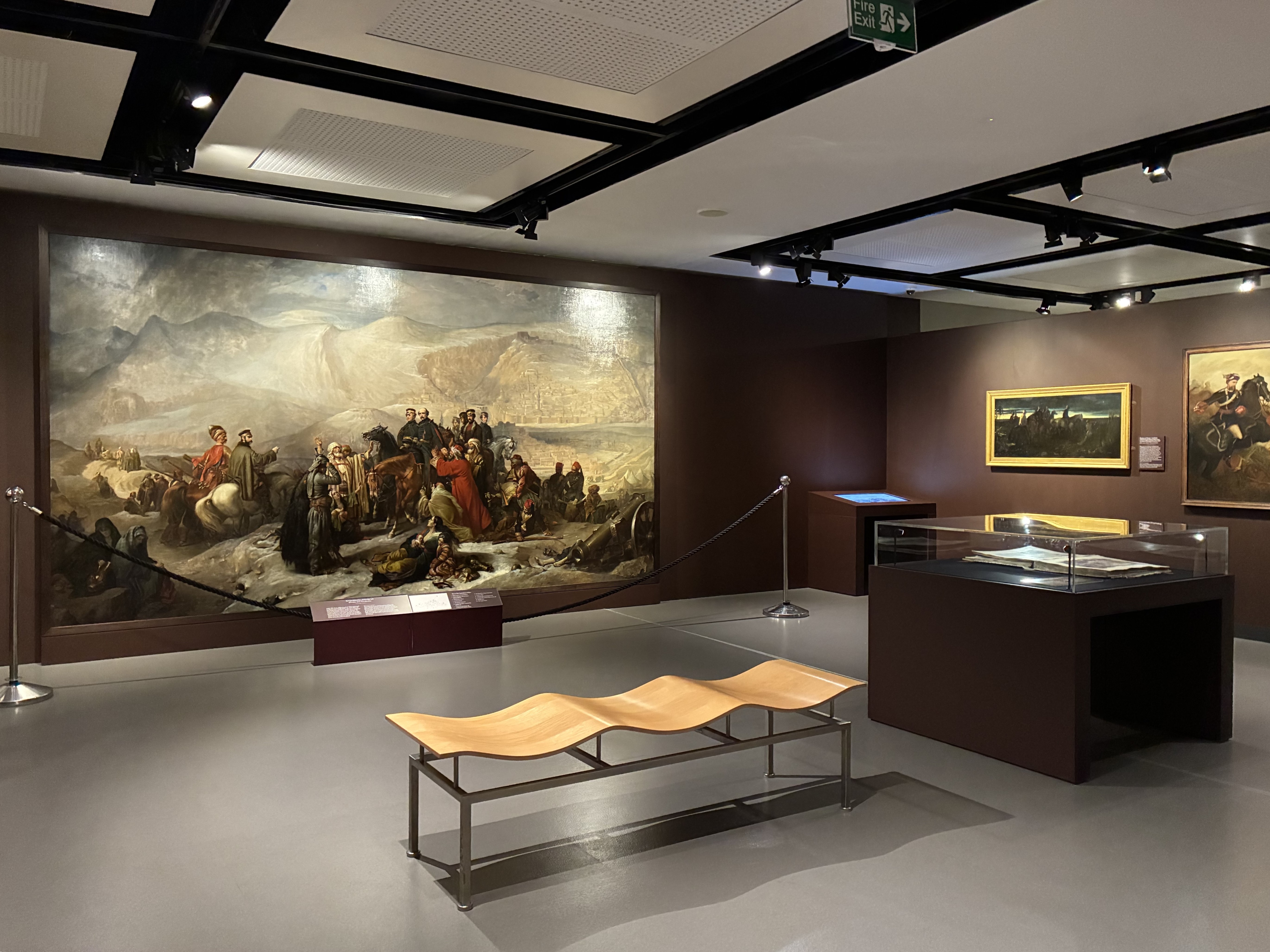
Installation view of Myth and Reality: Military Art in the Age of Queen Victoria at the National Army Museum showing the five-yard-wide oil painting ‘The Capitulation of Kars, Crimean War’ by Thomas Jones Barker (1855) with its static explanatory panel in front and an interactive screen off to the right (photo by the author)

Victoria’s Wars timeline

The exhibition includes a timeline of wars fought during Victoria’s reign. The point is that the British Army campaigned almost constantly throughout the period. There were a few big wars (the Crimean War, the Indian Mutiny and, right at the very end, the Boer War) but most of the conflicts we were involved in were small and localised, what modern historians call Victoria’s ‘small wars’.

  • 1837 – Queen Victoria ascends the throne
  • 1839 – the first photographs by Louis Daguerre in France and William Fox Talbot in England
  • 1842 – the world’s first illustrated weekly news magazine launched, the Illustrated London News
  • 1845 to 1846 – First Sikh War
  • 1852 to  1853 – The Second Anglo-Burmese War
  • 1853 to 1856 – the Crimean War
  • 1854 – Florence Nightingale travels to Crimea with 38 nurses. William Howard Russell’s reporting for The Times transforms people’s understanding of the squalid reality of war. 25 October – Battle of Balaklava and Charge of the Light Brigade.
  • 1854 – the Victoria Cross (VC) was introduced by Royal Warrant on 29 January 1856 to acknowledge the bravery displayed by soldiers and sailors during the Crimean War and soon after the Queen awards it to 62 Crimean war veterans

Queen Victoria and Prince Albert inspecting the wounded Grenadier Guards in Buckingham Palace. Coloured lithograph by George Thomas after himself (1855) Wellcome Collection

  • 1857 to 1858 – the Indian Rebellion
  • 1873 to 1874 – Third Anglo-Ashanti War
  • 1878 to 1880 Second Anglo-Afghan War
  • 1879 Anglo-Zulu War, featuring the Battle of Rorke’s Drift, 23 January 1879
  • 1880 to 1881 First South African War
  • 1882 Anglo-Egyptian War
  • 1884 to 1885 – Siege of Gordon at Khartoum, leading to its fall on 26 January 1885
  • 1885 Third Anglo-Burmese War
  • 1895 to 1896 Fourth Anglo-Ashanti War
  • 1898 – British reconquest of Sudan, featuring the Battle of Omdurman, 2 September 1898
  • 1899 to 1902 – Second South African War, featuring the sieges, the concentration camps etc
  • 1900 Fifth Anglo-Ashanti War

My take

There are about 40 artists, amateur and professional, soldiers and civilians, represented across the exhibition but the exhibition begins in a very decided way which raises a number of questions, because it starts with a strong emphasis on women war artists.

A feminist emphasis on women’s military art

The curators – all women – have decided that the first dozen or so works you see are all by women artists and devote several sections to them.

Victorian women artists, they tell us, helped to shape public perceptions of Army life. Many women were connected to soldiers through marriage or family, sometimes travelling with them abroad and depicting the people and places they saw.

Women were also important supporters and collectors of art, none more so than Queen Victoria herself. The Queen was also one of the most prominent subjects of military art, along with another celebrated figure of the time, Florence Nightingale – which explains why there’s a wall of works depicting the Queen meeting war veterans, awarding medals etc, and a little section about Florence Nightingale (who was famously averse to having her image captured, as she believed it detracted from her work).

However, as the exhibition proceeds you realise that most of the artists on display are not women, and, of course, none of the soldier artists are female – so why start this way unless you’re making a polemical feminist point? The implication seems to be that, after centuries or millennia of The Patriarchy, of tellings of history and art which downplay or completely ignore the role of women in the creation and consumption of art, this exhibition is doing its bit to redress the balance.

Fine. I understand. Why not? But there’s a second element to this approach which is notable and, maybe, problematic: this that one of the greatest, if not the greatest war artist of the Victorian era was Lady Elizabeth Butler, and so, hand-in-hand with the ‘women and military art’ section goes the ‘Lady Elizabeth Butler’ section. On one level there’s no quibbling with this: Butler was an outstanding artist and produced some of the standout works of the entire century. She was an absolute mistress of her craft, the half a dozen big paintings of hers brought together here are alone worth travelling to visit the show for, especially as several of them are usually buried in the Royal Collection.

So on the plus side, ignoring all its other features for a moment, you could say this is an outstanding selection of paintings, sketches and anecdotes by one of the nineteenth century’s great artists, and this is all to the good.

So why am I kvetching? Because the curators state, in these opening sections, in these early wall labels, that Lady Butler transformed military painting, depicting the life of soldiers with a new realism, taking a new, humane approach and setting a new standard for the subject. And this is all well and good, too, except that… In order to understand why Lady Butler is so important, and what she transformed, and what she changed it would have been good to have been fully introduced to the tradition of Victorian military painting which preceded her.

Instead, the result of placing Lady Butler right at the start of the show is to jump quite a long way into the later Victorian period without any preliminary explanation.

The work which really brought her to general attention was her ‘Roll Call’ which was displayed in 1874, 37 years into Victoria’s reign – and the first big work of hers which the curators feature, on the first wall of the exhibition, is ‘Dawn of Waterloo’ which was first displayed in 1895! 58 years into Victoria’s reign and only 6 years before her death. It’s a great painting but it comes at the very fag end of the period being covered and so is pretty misleading about the military art of Victoria’s era.

‘The Dawn of Waterloo: The Reveille in the Bivouac of the Scots Greys on the morning of the battle’ by Lady Butler (1895) the first full-scale painting by Lady Butler which the visitor encounters in ‘Myth and Reality: Military Art in the Age of Queen Victoria’ at the National Army Museum

Recap

So the decision to emphasise women’s role in military art may be laudable, and bringing a number of women’s works all together in the first few rooms ensures that the subject gets the prominence it deserves, rather than interspersing women’s works chronologically among the men’s pictures where they might be overlooked and unnoticed (as very probably happened in so many previous exhibitions on the subject).

Fine. And if you’re going to mention women artists of the time, then it would be silly not to mention and indeed have a section about the greatest of them, Lady Butler, also here right at the start. OK. Fine.

But the (maybe unintended) consequence of all this is that the visitor is deprived of a chronological understanding of the subject – of what military art looked like before Victoria, then at the start of her reign, how it developed through the decades leading up to the two seismic conflicts of the Crimean War and the Indian Mutiny in the 1850s, how it reflected trends in the broader art world, and so on.

You see how a chronological survey like this would have been interesting in itself and might also have better prepared the way for Lady Butler’s dramatic innovations: by the time you got to Lady B you’d have had a much better understanding of The Tradition she was transforming… but instead you have to work it out for yourself.

Five styles

This unchronological approach characterises the rest of the exhibition, too. Particularly in the sections about ‘Patriotism and Portraiture’ and ‘Realism and Reportage’, works from the 1840s or ’50s are placed next to works from the 1880s, ’90s or even early 1900s – it’s up to the visitor to make chronological, historical and aesthetic sense of the many different styles on display.

Having gone round the exhibition three or four times, dwelling on favourite works (and being drawn back again and again to the brilliant Butler paintings) I think I came up with about five different, roughly chronological styles of painting. They are:

  1. Romantic-sublime
  2. Patriotic-sentimental
  3. Mid-Victorian anecdotal
  4. Lady Butler
  5. Stiff official portraits

(This isn’t taking into account the pencil or charcoal sketches, and the many watercolours, which are specialist areas unto themselves.)

1. Romantic-sublime

Although painted in 1853 this picture strikes me as epitomising high Romanticism with its fondness for dramatic mountainous scenery and The Sublime. Look at the big baby eyes of Wellington (and his horse), the ethnic outfits of the local guides – it all has the rosy, soft-focus approach of Sir Water Scott’s novels.

Wellington at Sorauren, 27 July 1813 by Thomas Jones Barker 1853 © National Army Museum

2. Patriotic-sentimental

Kars is a city in north-eastern Turkey. In June 1855, as part of the during the Crimean War (1854 to 1856) it was besieged by a Russian army of 25,000. Demoralised by their defeats at the hands of the Russians, the Turks left the defence of Kars to Brevet Colonel (later General Sir) William Fenwick Williams, the British commissioner. The garrison was able to repulse three major Russian attacks but eventually cold, famine and an outbreak of cholera forced it to surrender on 26 November 1885. In recognition of their heroism, the Russians allowed the British garrison to march out of the city with the honours of war and into captivity.

‘The Capitulation of Kars, Crimean War’ by Thomas Jones Barker (1855) (National Army Museum)

This is a huge painting, over five yards wide (!), and it’s accompanied by not one but two diagrams identifying all the figures in it, one a static diagram, one an interactive display of the same. But it was only chatting to one of the (very well-informed) visitor assistants that I really understood what is going on.

You see the local in the red cloak clutching the hand of the bald British officer on his horse (Major General Fenwick Williams) and the cascade of similar locals off to his right, and the pitiful woman lying on the ground with her helpless children in the foreground, and similar locals on his left?

These are the local Turks who the British are abandoning to the kindness of the conquering Russians. So they are pleading with the British not to leave and abandon them but the British, defeated, have to. (Maybe a modern analogy would by NATO forces pulling out of Afghanistan and letting the Taliban take over.) It is this acute sense of regret and shame which explains the expression on the face of the British officer.

(You could write a book about the peoples the British Army promised to protect, only to abandon them – I’m currently reading a book about the Dutch Revolt which mentions that Queen Elizabeth I made all kinds of promises to the Dutch patriots in the 1580s which she then completely broke… It’s a long tradition.)

Back to the painting: ‘The Capitulation’, then, is a psychological study in the pain and embarrassment of duty, of a fine upstanding officer mortified to be abandoning the people he promised to protect. As such it is full of all kinds of melodramatic details, the thrown-up hands of the man in white on the left, the tearful eyes of the woman on the ground. It’s like a tableau from a mid-Victorian melodrama, at the centre of which is the British officer maintaining a stiff upper lip despite being deeply moved.

In fact it tells you a lot about mid-Victorian art and audiences that the work was commissioned, not by an aristocratic patron, but by the art dealers and print makers Agnew and Sons, precisely to be turned into prints and widely sold. So it is very deliberately catering to popular taste and demand.

3. Mid-Victorian anecdotal

The Victorians loved detail and clutter. Dickens’s novels overflow with wonderfully telling details and so do classic mid-Victorian paintings like William Powell Frith’s Derby Day (1858) or The Railway Station (1862), packed with little stories and anecdotal details. The exhibition includes an absolute classic of this style, ‘Home Again’ by Henry Nelson O’Neil.

‘Home Again’ by Henry Nelson O’Neil (1860)

‘Home Again’ depicts soldiers disembarking from a troopship at Gravesend on their return from the Indian Mutiny (1857 to 1859). For military history buffs the curators tell us that about 40,000 British troops were sent to India (more than had been mobilized for the Crimean conflict) to suppress the mutiny among the Indian troops of the East India Company’s Bengal Army.

But in purely visual terms we are invited to relish the details! At the very top a young woman peers over the shoulder of a bearded infantry corporal, who holds their baby for the first time. In the middle-right a young soldier of the 60th (The King’s Royal Rifle Corps) dressed all in black leans down to offer his Victoria Cross to a Chelsea Pensioner. The central action depicts sailors assisting a wounded sergeant to disembark. We are told that he wears a Kilmarnock ‘pork-pie’ cap under the white cotton ‘Havelock’ cover distinctive to the campaign, with the neck flap for protection from sunstroke.

There is patriotic pride here, and sentimentality of a sort, but it is very clearly all about the common people, ordinary soldiers (and sailors) and their reunions with wives and sweethearts. As such, it a little bit anticipates Lady Butler’s humanism but still with that mid-Victorian obsession with anecdote and detail.

4. Lady Butler

‘The Roll Call’ is one of the most celebrated British paintings of the 19th century. On its public appearance in 1874 it cemented Butler’s reputation as one of the leading painters of the age. It depicts a roll call of soldiers from the Grenadier Guards following the Battle of Inkerman in 1854 but can stand for thousands of similar occasions.

The Roll Call by Lady Elizabeth Butler (1874) © Royal Collection Enterprises Limited 2025 | Royal Collection Trust

The composition expresses Butler’s profound feel for the plight and experiences of the ordinary soldier, for the pity of war and the walls of the show feature not one but two quotations by her, emphasising how she eschewed patriotic guff in her concern for the actual lived experiences of the men who fought and suffered.

‘I never painted for the glory of war, but to portray its pathos and heroism’.

‘The Roll Call’ was fantastically successful. When it went on display at the Royal Academy it attracted over 300,000 visitors in a 3-month period and the more you look, the more brilliant it becomes.

The curators explain that historical or military painting for a long time worked with the basic design of a triangle which places the most important person – generally the commanding officer – at the apex (as in the pictures of Wellington and Major General Fenwick Williams, above). As soon as that’s pointed out to you, you realise really drastic difference her, the polemical message sent by the composition which is the equality of the men, all placed on the same level.

There’s still an anecdotal aspect to the thing, if you go up close and work slowly from left to right, starting with the two soldiers on the left lighting a sneaky fag or cigar, and working along through the bandages and blood of the wounded to the striking element of the man who’s collapsed into the snow. It really conveys the wretched pity of war, 44 years before Wilfred Owen coined the phrase for his volume of First World War poetry.

There is, of course, a figure on horseback, but he isn’t treated with the Romantic sentimentalism of the Wellington, above. Instead we can feel the gruff sympathy of the sergeant in charge as he reviews his wounded troops. And he also acts as the viewer’s entrance point into the work. If it was just the row of soldiers it would be slightly impenetrable: the officer on horseback not only relieves what might have been monotonous, but his movement carries the eye into the composition.

But there’s more because, after you’ve finished admiring the overall shape and canny dynamism of the composition, if you step back you notice the colours. You notice how Butler has depicted the uniforms of the men with great accuracy but used them as a springboard to create a composition of shades of grey. The grey coats and badges are reflected under the line of men by the different shades of snow and above them by the extremely nuanced and varied shading of the clouds.

On a literal level the coldness of the winter is evoked by the dominant tones of black, grey, white and brown, contrasting with small splashes of red from coatees and flags. But on a more aesthetic level, the awareness of shades of grey makes you think of James McNeil Whistler’s compositions, symphonies of certain palettes and timbres.

And then you notice the crows, the brilliant broken flight of crows coming from the middle of the composition and looping up over the head of the reviewing officer.

In its: 1) absence of sentimentality; 2) its immediately felt humanistic concern for the plight of the average soldier; and 3) its stunning painterliness, its brilliance of composition and colouring, ‘Roll Call’ really is a masterpiece. It’s worth visiting the exhibition just to see this one work in the flesh.

5. Stiff official portraits

Something the curators of the Army Museum must struggle with is that so much military art is decidedly average, if not actively poor. One or two of the battle paintings here struck me as ludicrously bad, but there’s a more subtle problem and that’s to do with military portraits.

I bet there are tens of thousands of these up and down the land, professional portraits of Britain’s countless officers, generals, admirals and so on which are good enough, decent enough, professional likenesses, but are never going to make it into anyone’s history of art because they are, by their nature, a very conservative wing of the medium.

Their number, their prevalence and popularity in Victorian times explain why there is a section titled ‘Patriotism and Portraiture’ here. Not only did ‘the people’ want to see portraits of heroes like Wellington or Gordon or Roberts, but countless military families wanted professional portraits of their eminent male members to hang alongside all their forebears, and hundreds of officers messes and regimental headquarters, ditto.

Hence a half dozen masterpieces of stultifying conventionality and woodenness.

Lieutenant The Honourable Frederick Hugh Sherston Roberts VC, Kings Royal Rifle Corps by Julian Russell Story (1899)

There’s a story behind this portrait, which is that Roberts not only won the Victoria Cross, but the same medal was awarded to his father, Field Marshal Frederick Sleigh Roberts, 1st Earl Roberts, making them one of only three father-and-son pairs to be awarded the VC in its 169-year history.

Watercolours

As mentioned, the exhibition includes 20 or so watercolours, much smaller and more intimate than the bombastic oil paintings. In a sense, watercolours under-promise and so are often able to over-deliver.

Installation view of Myth and Reality: Military Art in the Age of Queen Victoria at the National Army Museum showing a set of six watercolours of the Crimean War by William Simpson (photo by the author)

General Cannon’s landing, July 7 1854

My wife and I play a simple game when visiting exhibitions. Having crawled through the exhibits and rooms, reading and processing every wall label, we reach the end, turn round and go back through it, this time lightly, airily choosing one work per room which we like and having to explain why. A variation is to choose a work we would buy and take home to hang in the landing or hall or wherever. As I’ve stated, the Lady Butler paintings are all brilliant, but in terms of something I’d actually buy and live with, something a bit more modest, I kept returning to one of the 20 or so watercolours on display, ‘General Cannon’s landing, July 7 1854’, a pencil and watercolour by Joseph Archer Crowe (who has seven works in the exhibition).

‘General Cannon’s landing, July 7 1854’ Pencil and watercolour by Joseph Archer Crowe

Crowe worked at the Crimean War as a special artist for The Illustrated London News. This watercolour depicts how, on 7 July 1854, Turkish forces launched an amphibious assault across the River Danube on Russian positions at Giurgiu (in modern day Romania). The Russians were driven back and Giurgiu was occupied by the Turks.

It’s not going to rock anyone’s world, I just liked the composition, the line of ships going in from roughly right to left, and the light impressionistic touches of colour.

Women artists

I may have missed some but, for the record, here are the women military artists featured in the exhibition:

  • Lady Elizabeth Butler
  • Jane Drummond (portrait of Mrs Anne Steele)
  • Gertrude Ellen Burrard (portrait of Nussiban, our ayah)
  • Elizabeth Anne Leslie Melville (portrait of Major General Sir Owen Tudor Burne)
  • Emily Henrietta Ormsby (portrait of Colonel Henry Francis Strange; portrait of Major General John William Ormsby)

Lady Butler’s works

  • Tenth Bengal Lancers tent pegging (1873)
  • The Roll Call (1874)
  • Study of a Wounded Guardsman (1874)
  • Quatre Bras (engraving of oil painting, 1879)
  • Patient Heroes: A Royal Artillery Gun Team in Action (1882)
  • Scotland Forever! (engraving after oil painting, 1882)
  • After the Battle of Tel-el-Kebir (engraving of original painting, 1888)
  • After the Battle of Tel-el-Kebir (fragment of original painting, 1888)
  • The Defence of Rorke’s Drift (1882)
  • The Ballad of the Royal Irish at Sebastapol (6 x pencil illustrations of a poem, 1890)
  • Military sketches (pen, watercolour and pencil, 1893)

Summary

I don’t know whether my point about the lack of chronology and build-up to Lady B is even worth mentioning. My wife went round the displays two or three times with me and didn’t even notice or care, just enjoyed various works on their own merit.

So: if you’re interested in military history the exhibition contains lots of titbits about key wars and engagements of Victoria’s reign, about medals and uniforms, some lovely watercolours and a dozen or so really impressive oil paintings, along with a number of average or also-ran works which, however, illustrate interesting topics, such as the section about the creation of the Victoria Cross, and so on.

And the National Army Museum is always a lovely place to visit because – ironically, given its subject matter – it’s such a calm, clean and peaceful place to be. Go see.


Related links

Related reviews

Murder in the Mews by Agatha Christie (1937)

‘Charles wouldn’t kill anybody. He’s a very careful man.’
‘All the same, Mademoiselle, it is the careful men who commit the cleverest murders.’
(Murder in the Mews, chapter 6)

‘You are hopeful of success, M. Poirot?’ Lord Mayfield sounded a trifle incredulous.
The little man shrugged his shoulders. ‘Why not? One has only to reason – to reflect.’
(Poirot emphasising the importance of thinking, reflecting and pondering, The Incredible Theft, chapter 4)

‘This affair,’ he said, ‘is more complicated than it appears.’
(The classic statement which someone makes about the murder mystery in every Christie story, The Incredible Theft, chapter 4)

‘Leave it to Hercule Poirot. The lies I invent are always most delicate and most convincing.’
(Poirot’s immense self confidence, The Incredible Theft, chapter 4)

‘Good-morning, mademoiselle. Yes, it is as you say. You now behold a detective – a great detective, I may say – in the act of detecting!’
(Poirot gently mocking himself in Dead Man’s Mirror, Chapter 11)

‘Oh la la!’ cried Poirot. ‘I have been a fool, but a fool!’ The other stared at him.
‘I beg your pardon, M. Poirot?’
‘It is that a portion of the puzzle has become clear to me. Something I did not see before. But it all fits in. Yes, it fits in with beautiful precision.’
(The Eureka moment that occurs in every Poirot story, The Incredible Theft, chapter 5)

‘After breakfast,’ he said, ‘I will explain. I should like everyone to assemble in Sir Gervase’s study at ten o’clock.’
(The classic ‘you’re probably all wondering why I called you all together here this evening…’ moment, Dead Man’s Mirror, Chapter 12)

‘Murder in the Mews’ is a volume of four long short stories, some of them worked up from short stories previously published in magazines into 80-page novellas, long enough to require chapters.

  1. Murder in the Mews
  2. The Incredible Theft
  3. Dead Man’s Mirror
  4. Triangle at Rhodes

Murder in the Mews

It is Fireworks Night as Poirot and Inspector Japp are walking back to Poirot’s house. They take a short cut through a mews (Bardsley Garden Mews) and Japp jokes that it’s a good night for a murder because nobody would hear a shot.

Not to the reader’s complete surprise, next morning Poirot receives a phone call telling him that, guess what, there was a shot in that very same mews the night before, only it appears to have been a suicide.

So Poirot meets Japp at the murder scene and they start their investigation. 14 Bardsley Garden mews was shared by two young women, a Miss Jane Plenderleith and a youngish widow, Mrs Allen. Miss Plenderleith got home after being out of town for a few days (weekend with the Bentincks in Essex), knocked at her housemate’s door, discovered it was locked, called the police who came round, broke down the door and discovered Mrs Allen’s body on the floor, with a fatal gunshot wound to the head and the gun in her hand.

Except that the gun wasn’t really gripped, it had more the appearance of being placed in her hand. And, more tellingly, the shot is to her left temple whereas the gun was placed in her right hand. I.e. it’s an anatomically impossibility.

So Poirot and Japp set out to work in tandem but with their different approaches, interviewing the flatmate, Mrs Allen’s MP fiancé, various neighbours in other houses along the mews etc. The story is by way of being a nice comparison of the styles of the two men (something we have, of course, seen in quite a few of the novels) and so contains a number of familiar tropes e.g. Japp thinking Poirot is going soft / too old, when he dwells on apparent trivia.

‘Eh bien,’ said Poirot. ‘I shall complete my search for the unimportant. There is still the dustbin.’ He skipped nimbly out of the room. Japp looked after him with an air of disgust.
‘Potty,’ he said. ‘Absolutely potty.’
Inspector Jameson preserved a respectful silence. His face said with British superiority: ‘Foreigners!’
Aloud he said: ‘So that’s Mr Hercule Poirot! I’ve heard of him.’
‘Old friend of mine,’ explained Japp. ‘Not half as balmy as he looks, mind you. All the same, he’s getting on now.’
‘Gone a bit gaga as they say, sir,’ suggested Inspector Jameson. ‘Ah well, age will tell…’ (Chapter 4)

Poirot’s foreignness

Note how Japp’s slur on Poirot’s age is combined with Jameson’s smug contempt for Poirot’s foreignness, his outsiderness. But this ‘foreignness’ is very flexible; it has multiple purposes.

Poirot mocks the British A foreignness which comes into play a bit later when Christie has Poirot gently mock the English class system, as he does in quite a few of the novels, especially round ideas of being pukka or playing cricket, the right sort etc. Here’s Poirot interviewing Miss Plenderleith, who tells him that:

‘Charles has got a very good nose for anybody who isn’t well, quite – quite – ‘
‘And Major Eustace was not what you call quite – quite – ?’ asked Poirot.
The girl said dryly: ‘No, he wasn’t. Bit hairy at the heel. Definitely not out of the top drawer.’
‘Alas, I do not know those two expressions. You mean to say he was not the pukka sahib?’
A fleeting smile passed across Jane Plenderleith’s face, but she replied gravely, ‘No.’ (Chapter 6)

Poirot deploys his foreignness strategically, playing it up when he sees that it might be a way of getting round an interviewee, buttering them up or making them lower their defences. Here is Japp introducing Poirot to the MP:

‘By the way, let me introduce M. Hercule Poirot. You may have heard of him.’
Mr Laverton-West fastened himself interestedly on the little Belgian.
‘Yes-yes-I have heard the name.’
‘Monsieur,’ said Poirot, his manner suddenly very foreign. ‘Believe me, my heart bleeds for you. Such a loss ! Such agony as you must be enduring! Ah, but I will say no more. How magnificently the English hide their emotions.’ He whipped out his cigarette case. ‘Permit me – Ah, it is empty, Japp?’ (Chapter 7)

The point of this little bit of play-acting is to lull Laverton-West into tendering one of his cigarettes because the brand of cigarette stubs found in the murdered woman’s bedroom turn out to be an important clue.

Xenophobes hate Poirot’s foreignness And in moments of anger, Brits can use his foreignness against Poirot, as when their interviewing makes Major Eustace lose his temper.

‘Who are you, I’d like to know?’ Eustace turned and spat the words at him. ‘Some kind of damned dago! What are you butting in for?’ (Chapter 8)

Plot

It’s a sort of chamber piece because all the clues are at the scene, in the bedroom where the body was found, and the solution is relatively straightfoward, concerning a troublesome man, Major Eustace, who had been calling to see Mrs Allen over the past year or so…

Cast

  • Hercule Poirot
  • George – Poirot’s immaculate man-servant
  • Inspector Japp
  • Inspector Jameson – assisting Japp
  • Dr Brett – police doctor, time of death etc
  • Miss Jane Plenderleith – a dark, efficient-looking young woman of twenty-seven or eight’; drives an Austin Seven; plays golf
  • Mrs Barbara Allen – the dead woman, married young (17) in India; husband, then baby daughter both died; came to England; years later was engaged to be married to…
  • Charles Laverton-West MP – ‘a man of medium height with a very definite personality. He was clean-shaven, with the mobile mouth of an actor, and the slightly prominent eyes that so often go with the gift of oratory. He was good-looking in a quiet, well-bred way’
  • Mrs Hogg – ‘I’m not one to gossip’ style working class neighbour
  • Fred Hogg – small boy and eye witness to a late-night visitor to the house
  • Major Eustace – someone Mrs Allen met in India, ‘ a man of forty-five, military bearing, toothbrush moustache, smartly dressed and driving a Standard Swallow saloon car’; ‘ a tall man, good-looking in a somewhat coarse fashion. There was a puffiness round the eyes small, crafty eyes that belied the good-humoured geniality of his manner’

Poirot’s obsessive compulsive disorder (OCD)

Poirot explains why he makes such efforts to solve the mystery of the missing attaché case:

‘My friend, an affair must be rounded off properly. Everything must be explained.’

The police just need enough evidence to secure a conviction; Poirot, driven by his OCD / personal predilections, needs to understand every ramification of a case, and tie off every lose end, as Japp mocks:

‘Though what this attaché-case business has to do with the crime I can’t imagine. I can’t see that it’s got anything at all to do with it.’
‘Precisely, my friend, I agree with you – it has nothing to do with it.’
‘Then why… No, don’t tell me! Order and method and everything nicely rounded off! Oh, well, it’s a fine day.’ (Chapter 9)

Bookish references

‘How long has she been dead?’
‘She was killed at eleven thirty-three yesterday evening,’ said Brett promptly. Then he grinned as he saw Japp’s surprised face.
‘Sorry, old boy,’ he said. ‘Had to do the super doctor of fiction!’ (Chapter 2)

Sherlock Holmes reference

As I’ve pointed out in my reviews of all the novels, Christie felt compelled to make at least one jokey reference to Sherlock Holmes in every one of her stories. Here there are two:

‘Damnation!’ Japp said. ‘I knew there was something. But what the devil is it? I searched that case pretty thoroughly.’
‘My poor Japp – but it is – how do you say, obvious, my dear Watson‘?’ (Chapter 9)

At the climax:

‘It was odd, very odd, that the room should smell – as it did, perfectly fresh.’
‘So that’s what you were getting at!’ Japp sighed. ‘Always have to get at things in such a tortuous way.’
‘Your Sherlock Holmes did the same. He drew attention, remember, to the curious incident of the dog in the night-time – and the answer to that was there was no curious incident. The dog did nothing in the night-time.’ (Chapter 10)

Cars

Major Eustace drives a Standard Swallow saloon car, Miss Plenderleith drives a Baby Austin Seven.

Baba and sirrop and chocolate

Poirot’s favourite dessert is a Baba au Rhum i.e. rum baba.

His favourite drink is the non-alcoholic sirop de cassis, ‘syrup of the blackcurrants’ or blackcurrant cordial, not unlike the English cordial, ‘Ribena’.

Poirot always drank chocolate for breakfast – a revolting habit.
(Captain Hastings telling us in ‘Dumb Witness’)

Payoff

‘Not murder disguised as suicide, but suicide made to look like murder!’
‘Yes, and very cleverly done, too. Nothing over-emphasised.’

2. The Incredible Theft

We are among the posh, the ‘top drawer’ of society, at a dinner party given by Lord Mayfield with half a dozen posh guests. The dinner has two purposes. In attendance is Air Marshal Sir George Carrington and he has come to discuss with Lord M ‘a discovery that will probably revolutionise the whole problem of air defence’ which was, of course, of burning importance in the troubled mid-1930s as the shades of war deepened. That’s how it’s described initially, but then this morphs into repeated references to ‘the new bomber’, its design and specification.

The second aspect of the evening is the presence of Mrs Vanderlyn. She is a very attractive mature lady who has had no fewer than three husbands, rather comically one each from each of Britain’s possible enemies, Italy, Germany and Russia, is reputed to have ‘contacts’ in each of those countries, and lives a luxury life far beyond her apparent income. In other words, as Lord Mayfield explains to Sir George, she is probably a spy. The thing is no-one’s been able to pin anything on her. And so this dinner is not only the pretext for a chat about the new bomber between the two chaps, but by way of being bait to persuade Mrs V to take a risk, to come out into the open, and to be caught. At which point she can be arrested, interrogated and neutralised.

But all this is hidden behind the gentle manners of a posh dinner party and so, after dinner, the ladies retire, the chaps drink port and smoke cigars, then reconvene in the drawing room to play some hands of bridge. By then it’s late and most of the party retire to bed, while Sir George and Lord M go for a stroll on the terrace outside his office (which has french windows opening onto it).

It’s while during this stroll that they see a shadowy figure nip out of his study and into the night. Moments later they re-enter the study where Lord M’s secretary, Mr Carlile has gathered the technical specifications of the new bomber for the men to discuss.

Except it isn’t there! When Lord M leafs through the papers, he asks where the spec has gone, Carlile insists he just put it there but then himself can’t find it. When quizzed, he says 5 minutes earlier he heard a woman’s scream, and ran into the hall to find Mrs Vanderlyn’s maid standing on the stairs claiming she’d seen a ghost. It took a few minutes to calm here down and send her backstairs to bed, at which point Carlile returned to the study and Lord M and Sir George entered it.

It must have been during those few minutes of his absence that someone darted into the study, stole the specifications, and this was the figure the old chaps saw nipping off into the darkness. Someone has stolen the ‘discovery that will probably revolutionise the whole problem of air defence’!!

So guess who Sir George advises Lord Mayfield to call in to solve the mystery and get the plans back? Clue: his name begins with P and ends in oirot.

Cast

  • Lord Mayfield – ‘a big man, square-shouldered, with thick silvery hair, a big straight nose and a slightly prominent chin. It was a face that lent itself easily to caricature’
  • Lady Julia Carrington – ‘a woman of forty, tall, dark and vivacious. She was very thin, but still beautiful. Her hands and feet in particular were exquisite. Her manner was abrupt and restless, that of a woman who lived on her nerves’
  • Air Marshal Sir George Carrington – Lady Julia’s husband, ‘still retained the bluff breeziness of the ex-Naval man’
  • Mrs Vanderlyn – ‘an extremely good-looking blonde. Her voice held a soupçon of American accent, just enough to be pleasant without undue exaggeration’
  • Mrs Macatta MP – ‘a great authority on Housing and Infant Welfare. She barked out short sentences rather than spoke them, and was generally of somewhat alarming aspect’; a feminist
  • Reggie Carrington – 21 and completely uninterested in Housing, Infant Welfare and indeed any political subject – ‘ the weak mouth camouflaged by the rather charming smile, the indecisive chin, the eyes set far apart, the rather narrow head’
  • Mr Carlile – Lord Mayfield’s private secretary, ‘a pale young man with pince-nez and an air of intelligent reserve’, been with his lordship for nine years
  • Mademoiselle Leonie – Mrs Vanderlyn’s attractive young French maid

Foreignness

Once again Poirot’s foreignness is brought up:

Lord Mayfield said slowly: ‘Why drag in a wretched foreigner we know nothing about?’
But I happen to know a lot about him. The man’s a marvel.’

And:

‘By the Lord, George, I thought you were too much of an old John Bull to put your trust in a Frenchman, however clever.’
‘He’s not even a Frenchman, he’s a Belgian,’ said Sir George in a rather shamefaced manner. (Chapter 3)

And:

‘To send for a queer foreigner like this seems very odd to me,’ said Reggie. ‘What has been taken, Father?’

Christie’s comic feminists

The book before this, ‘Cards on the Table’, is notable for the advent of a kind of avatar of Christie, an alter ego, the fictional female author of detective stories Mrs Ariadne Oliver who also happens to be a passionate and outspoken feminist. Well, there’s an echo of her here in the character Mrs Macatta, who is an MP, an ardent advocate of social reform, and a feminist. At least she’s quick to criticise men:

‘Lord Mayfield has brains,’ allowed Mrs Macatta. ‘And he has carved his career out entirely for himself. He owes nothing to hereditary influence. He has a certain lack of vision, perhaps. In that I find all men sadly alike. They lack the breadth of a woman’s imagination. Woman, M. Poirot, is going to be the great force in government in ten years’ time.’ (Chapter 6)

Nearly as critical of men as she is of women who don’t agree with her:

Poirot invited Mrs Macatta’s opinion of Mrs Vanderlyn – and got it.
‘One of those absolutely useless women, M. Poirot. Women that make one despair of one’s own sex! A parasite, first and last a parasite.’
‘Men admired her?’
‘Men!’ Mrs Macatta spoke the word with contempt. ‘Men are always taken in by those very obvious good looks.’

So she despises all men, and all women who don’t share her beliefs, and it all leads up to a call for the entire nation to be subjected to sweeping moral reform:

‘The evils of gambling, M. Poirot, are only slightly less than the evils caused by drink. If I had my way this country should be purified.’
Poirot was forced to listen to a somewhat lengthy discussion on the purification of England’s morals.

Tempting to say that feminists haven’t changed that much in the past 90 years, still the same unquestioning self-confidence, the dismissal of anyone who disagrees as morally deficient, still the same ambition to bring about a sweeping moral transformation, ban porn, overthrow the patriarchy, abolish the male gaze, end domestic abuse – no doubt all eminently worthy aims, and just as achievable as Mrs Macatta’s goals of ending drunkenness and immorality.

That’s my contentious view. What isn’t contentious is that Christie deliberately made her feminist characters figures of fun. She found full-on feminist views good material for humour.

Interviews

For sure there are physical clues to be found and assessed but the core of the stories is Poirot’s lengthy interviews with the other characters / suspects. There’s a deep connection between the way he interrogates the characters and the art of the author herself. In a non-genre novel we get to understand the characters via their interactions in different settings. Whereas the Christie-style detective story, the characters are lined up as in a queue, sometimes literally in a queue, waiting to go one by one into the room where they will be interviewed by the moderator figure. This happens in Murder on the Orient Express, Death in the Clouds and again, here, where, the day after the robbery, Poirot makes his base in the study and then interviews each of the other characters one by one. This, not their interactions with each other, is how we find out about them.

It is very schematic, isn’t it? It’s almost like a diagram of a novel rather than a full, proper novel. In works like this and ‘Orient’ you see the narrative process reduced to its bare bones:

  • mysterious event (murder or theft) occurs
  • all the suspects are interviewed one by one at length
  • the solution and explanation are revealed

Maybe it’s because the essence of the narrative is so samey that Christie was able to knock out such an impressive number of stories. Obviously the settings, characters and details change in every one. And yet, on the deepest level, they’re all the same.

Poirot’s symmetry OCD

Poirot went back to the fireplace and carefully rearranged the ornaments on the mantelpiece. (Chapter 7)

3. Dead Man’s Mirror

This is the longest of the three stories at 108 pages. On the face of it another murder mystery, it is also an extended satire on the foibles and eccentricities of the poshest of the English aristocracy.

Eccentric old Gervase Chevenix-Gore, last male descendant of a family which dates back to the Norman Conquest. The setup is simple. At his flat in London Poirot receives a letter from Gervase asking him to come and see him at the grand family home, as he suspects he is the victim of a fraud but must manage the matter with discretion. But when Poirot (having taken the train from London) arrives at the house, arriving just as the gong for dinner has been sounded to the dozen or so members of family and house guests all assembled there – Gervase doesn’t show up and when they break down the locked door of his study, they find him slumped at his desk, gun in hand, shot through the head, an obvious case of suicide. His desk faced a mirror and the bullet had gone through his skull and shattered this mirror.

However, only Poirot (and the reader) know that Gervase sent the letter inviting him down and so had no reason to commit suicide; the opposite, we would have expected him to be waiting to engage Poirot and explain what he wanted him to do.

So, in the time-honoured style, Poirot and Major Riddle set about interviewing all the family and guests, an entertaining assemblage of florid characters. Who had a motive? Who had the opportunity etc? As you would expect, the more the pair dig, the more cross-currents and motivations they discover, not least in the terms of the dead man’s will, often the first place to start in the murder of a rich old man. As Poirot puts it:

‘Do you not agree, my friend, that the more we learn, the less and less motive we find for suicide? But for murder, we begin to have a surprising collection of motives.’ (Chapter 8)

Surprising to Poirot maybe. Not to anyone who’s read an Agatha Christie story.

The mirror as metaphor

There’s generally very little symbolism in a Christie story. So I was struck when the mirror is used as a metaphor for the complexity of the situation which Poirot and Riddle (inevitably) uncover:

‘What the devil –’ began Major Riddle, and ended rather hopelessly: ‘It gets more and more difficult to keep track of this business.’
Poirot nodded. He had picked up the little piece of earth that had fallen from Ruth’s shoe and was holding it thoughtfully in his hand.
‘It is like the mirror smashed on the wall,’ he said. ‘The dead man’s mirror. Every new fact we come across shows us some different angle of the dead man. He is reflected from every conceivable point of view. We shall have soon a complete picture…’ (Chapter 10)

Cast

Preliminary

  • Hercule Poirot
  • Mr Satterthwaite – expert on the aristocracy, who we’ve met in ‘Three Act Tragedy’

At the house

  • Gervase Chevenix-Gore
  • Vanda Chevenix Gore – his wife, ‘an Arbuthnot, very handsome girl. She’s still quite a handsome
    woman. Frightfully vague, though. Devoted to Gervase. She’s got a leaning towards the occult, I believe. Wears amulets and scarabs and gives out that she’s the reincarnation of an Egyptian Queen’ – thinks she’s a reincarnation of Hatshepsut and before that, was a priestess in Atlantis’
  • Ruth Chevenix-Gore – adopted daughter: ‘they’ve no children of their own. Very attractive girl in the modern style’ – ‘a well-chiselled nose, slightly aquiline, and a clear, sharp line of jaw. Her black hair swept back from her face into a mass of little tight curls. Her colouring was of carnation clearness and brilliance, and owed little to make-up. She was, so Hercule Poirot thought, one of the loveliest girls he had seen’ – ‘a devilishly attractive girl. Has played havoc with most of the young fellows round here’
  • Hugo Trent – Gervase’s nephew – ‘Pamela Chevenix-Gore married Reggie Trent and Hugo was their only child’ – in ‘the Blues’ i.e. The Royal Regiment of Horse Guards – ‘ a moustache and an air of modest arrogance’
  • Susan Cardwell – house guest, ‘rather a good-looking girl with red hair’
  • Colonel Bury – an old friend of the family’, ‘almost a tame cat about the house. Kind of A.D.C. to Lady Chevenix-Gore’, ‘follows her about like a dog’
  • Mr Forbes – an old friend and the family lawyer, both devoted to Vanda back in the day – very proper and formal, ‘I never guess’ – wears a pince-nez
  • Godfrey Burrows – Gervase’s secretary, ‘ good-looking, and knows it. Not quite out of the top drawer’ – turns out he thinks Gervase’s attitude was feudal and ridiculous
  • Miss Lingard – ‘little, middle-aged prim woman’, research assistant for the history of his family which Gervase has been writing for the last six months
  • Captain Lake – Sir Gervase’s agent for the estate, ‘a tall, fair-haired man in a lounge suit’
  • Snell – the butler

The investigation

  • Major Riddle – Chief Constable of the fictional county of Westshire, ‘a tall, spruce-looking man’
  • the police surgeon – ‘a lank elderly man with grizzled hair’
  • police inspector – ‘a tall impassive-faced man in plain clothes’
  • Mr Forbes – family lawyer

Bookish references

‘It’s all very well, Poirot. But the evidence is clear enough. Door locked, key in his own pocket. Window closed and fastened. I know these things happen in books – but I’ve never come across them in real life.’ (Chief Constable Riddle, Chapter 5)

Or the movies:

‘You’re getting a bit too sensational, I think, Poirot.’
‘You think what I suggest is too like the pictures? But life, Major Riddle, is often amazingly like the pictures.’ (Chapter 8)

The tribulations of being rich

Christie’s stories testify, now and then, to the impact of the 1930s Depression, pointing out that all wealthy people have taken a hit. The Chevenix-Gore family lawyer in this story, says the family fortune has been impacted. More impactful, though, was some bad investment advice given him by his friend Colonel Bury. When they interview him, Bury justifies himself against his friend’s reproaches:

‘Didn’t seem to realise that the whole world was going through a period of crisis. All stocks and shares bound to be affected.’ (Chapter 8)

While the lawyer draws a general, and amusing, conclusion:

Mr Forbes sighed. ‘Retired soldiers are the worst sufferers when they engage in financial operations. I have found that their credulity far exceeds that of widows and that is saying a good deal.’ (Chapter 6)

Poirot is old

We (well I) are hoodwinked into thinking Poirot is a reasonably agile, late-middle-aged man by the image of sprightly dapper David Suchet in the extensive ITV adaptations. And yet the texts themselves often tell a different story, emphasising that Poirot is, quite simply, ‘a small, elderly man’.

The revelation

You can’t help smiling when, at the conclusion of his investigations, Poirot asks the household to convene in the study for his big explanation which he kicks off with the classic phrase:

‘I have asked you all to come here so that you may hear the true facts of Sir Gervase’s suicide.’ (Chapter 12)

It’s as enjoyably, reassuringly formulaic as panto.

4. Triangle at Rhodes

‘Human nature is simply fascinating. Don’t you think so, M. Poirot?’
(posh Miss Lyall accidentally puts her finger on Poirot’s central axiom, Chapter 1)

Improbably, Poirot is on holiday on the Greek island. He is of the old school which believes in completely covering your body in the sun. Beside him sits:

Miss Pamela Lyall, who sat beside him and talked ceaselessly, represented the modern school of thought in that she was wearing the barest minimum of clothing on her sun-browned person.

There’s another nugget of social history, when one of the characters laments that Rhodes is such a long way to travel from England. Yes but just imagine, says, Miss Sarah Blake, if it was easier to get to:

‘Yes, but then it would be awful. Rows and rows of people laid out like fish on a slab. Bodies everywhere!’ (Chapter 1)

Which is exactly what started to happen in the 1970s with the advent of package holidays and has been happening ever since. Fifty years of over-tourism.

Anyway, this Miss Lyall thinks that people watching is the most fascinating hobby. Surprisingly, maybe, Poirot observes that people in the end fall into very obvious types or categories and rarely act out of character. In a downbeat way, he says it becomes, in the end, quite boring. The sea is more varied and interesting.

So Poirot was advised to come to Rhodes in October, out of season, when the hotels would be empty. Instead he is distressed to discover seven or eight English guests and among them two squabbling couples.

Valentine Chantry has been a world famous model for 16 years or so, with a succession of flashy husbands and now proceeds to drive the latest one, a brutish naval commander, Tony, wild with jealousy, by flirting outrageously with gullible young Douglas Gold, much to the disgust of Gold’s wife, Marjorie.

So the two men fancy the same honeypot woman (Valentine) making up one of the oldest relationship stereotypes in the world, the Eternal triangle.

Poirot unhappily observes all this happening but it delights another hotel guest, the catty, humorous Miss Pamela Lyell, the one with no attachments who loves watching people. In conversation with Poirot, she even humorously teases out of him that he fears there might be a murder!

So then the murder actually takes place. The male characters are sitting round. Gold has bought the first round of drinks, including a pink gin for the commander. In come the women who have been off on an outing. Tony Chantry chivalrously offers to buy drinks. When his wife asks for a pink gin, he pushes the one in front of him over to her and goes up to the bar. She drains the glass to the dregs then comes over funny, turns blue and dies. As she cries out the commander comes running back and shouts at Douglas that that drink was intended for him, Tony. When the police are called they indeed find the rest of the poison (‘A form of stropanthin. A heart poison’) in Gold’s jacket pocket.

So it looks like an open and shut case. Gold, twisted any way she wanted him by Valentine, wanted to poison Tony Chantry to get him out of the way so he could marry Valentine, but his plan went disastrously wrong when Tony unexpectedly handed over his (poisoned) drink to Valentine.

Except that that’s not what happened at all. And in the short seven-page final chapter, Poirot explains to an amazed Miss Lyall a completely different and true explanation of what really happened and why.

Cast

  • Hercule Poirot
  • Miss Pamela Lyall – ‘whose principal interests in life were the observation of people round her and the sound of her own voice’
  • Miss Sarah Blake – her friend
  • Valentine Chantry – now 39, famous model since she was 16, staggeringly beautiful, had 5 husbands etc
  • Commander Tony Chantry – ‘a commander in the navy… silent, dark, with a pugnacious jaw and a sullen manner. A touch of the primeval ape about him’
  • Mr Douglas Gold – 31, ‘extremely good-looking, in an almost theatrical manner. Very fair, crisply curling hair, blue eyes, broad shoulders, narrow hips. He looked more like a young man on the stage than a young man in real life, but the moment he opened his mouth that impression faded. He was quite natural and unaffected, even, perhaps, a little stupid’
  • Mrs Marjorie Gold – 35, ‘ a small woman-rather like a mouse. She was not bad-looking, indeed her features were regular and her complexion good, but she had a certain air of diffidence and dowdiness that made her liable to be overlooked’
  • old General Barnes – ‘a veteran who was usually in the company of the young’

Bookishness

The General chuckled. ‘She’s finding him a little bit difficult! One of the strong, silent men you hear about in books.’ (Chapter 2)

Poirot’s egotism and modesty

And though Hercule Poirot was a conceited little man where his profession was concerned, he was quite modest in his estimate of his personal attractions. (Chapter 2)

‘Every woman adores a fascist’

[Mr Gold] said to Poirot, ‘That man’s a brute!’ And he nodded his head in the direction of the retreating figure of Commander Chantry.
‘It is possible,’ said Poirot. ‘Yes, it is quite possible. But les femmes, they like brutes, remember that!’
Douglas muttered: ‘I shouldn’t be surprised if he ill-treats her!’
‘She probably likes that too.’ (Chapter 2)

5. Language

Poirotisms

I’ve mentioned how Poirot’s foreignness is raised a number of times. It can also be used for pure comic purposes, as when Christie has Poirot mangle an English proverb or common phrase, as he does at least once in every story:

‘For the same reason, when she sets out the following day to get rid of the golf clubs, she continues to use the attaché-case as a – what is it – kippered herring?’
‘Red herring,’ Japp said.
(Murder in the Mews, Chapter 10)

Poirot held up a hand. ‘I do what you call explore all the avenues.’
(The Incredible Theft, Chapter 4)

‘Ah, yes, it is what you call the old gasp – no, pardon, the old wheeze, that – to come back for a book. It is often useful!’
(The Incredible Theft, Chapter 4)

‘One has, sometimes, a feeling. Faintly, I seem to smell the fish.’
(Dead Man’s Mirror, Chapter 1)

1930s slang

  • bad hat – bad man
  • gasper – basic cheap make of cigarette
  • old cock! – Japp’s Cockney / vulgar term of affection, cruder version of ‘old chap’
  • pukka sahib – literally ‘genuine master’, metaphorically ‘good chap’, approved by the British upper middle-class value system
  • legal wallah – wallah is a Hindi term meaning ‘in charge’ so in British India came to be used in association with a profession or action e.g. ‘rickshaw-wallah’; Major Riddle is asserting his membership of the ruling class of the Empire by consciously using imperial slang, in this case referring to the family lawyer, Mr Forbes

Posh diction

According to Christie, posh people like Lord Maybury use contemporary slang but emphasise their superiority to it by using quotation marks:

  • ‘She’s an American subject. I know that she’s had three husbands, one Italian, one German and one Russian, and that in consequence she has made useful what I think are called “contacts”.’
  • ‘I know,’ Lord Mayfield continued, ‘that in addition to having a seductive type of beauty, Mrs Vanderlyn is also a very good listener, and that she can display a fascinating interest in what we call “shop”.’
  • ‘You see, George, to use the language of the movies, we’ve nothing actually “on” the woman. And we want something!’

Related is:

‘Do you yourself approve of Mr Burrows?’ The colonel delivered himself of the opinion that Godfrey Burrows was slightly hairy at the heel, a pronouncement which baffled Poirot completely, but made Major Riddle smile into his moustache.
(Dead Man’s Mirror, Chapter 8)

The same phrase as was used in ‘Murder in the Mews’. Maybe Christie had heard it somewhere and it amused her enough to slip it into the speech of several posh chaps.

Changing definitions of age

In ‘Cards on the Table’ Mrs Lorrimer is considered an old woman at 63.

‘But I am 56, my boy. In another four years I shall probably be a nasty old man continually haunting the society of unwilling debutantes.’
(Lord Mayfield in The Incredible Theft)

Charity

There are lots of reasons for Christie’s runaway bestselling status:

  • the narratives are written with beautiful clarity and zip along at speed
  • the large casts of posh characters appeal to the same audiences who love Downton Abbey and other early 20th century costume dramas i.e. a kind of vicarious snobbery
  • the books (much more than the often clumsy TV and movie adaptations) are always beamingly good humoured, and sometimes very funny
  • although one or two people are ‘murdered’, these alleged murders are totally unlike the sickening, disgusting murders of real life – they are accepted by one and all as ‘tokens’ in an entertainment, conventionalised events designed to deliver all the other psychological / reading pleasures I’ve listed – only very rarely does a murder really upset the story’s characters and cut through to the reader, the most obvious example being the teagirl, Betty Barnard, killed in The ABC  Murders which devastates her poor family

Lastly, there is an air of charity and forgiveness about them. There are lots of other things about it but, in the end, the most notable thing about ‘Murder on the Orient Express’ is that Poirot, understanding their motives, lets all the murderers off, lying to the police so that they can get away.

Same in ‘Dead Man’s Mirror’. When the murderer is revealed, so is her sad story and the nobility of her motivation. When she piteously begs Poirot not to reveal the truth of her identity, he charitably agrees.

Despite the ostensible subject matter of murder, the tone of the narratives, and the attitude of most of the characters and, above all, of the master character, Poirot, is one of understanding, compassion and forgiveness. I think it’s this quality which makes them somehow such comforting and reassuring reads.


Credit

‘Murder in the Mews’ by Agatha Christie was published in 1937 by the Collins Crime Club.

Related links

Related reviews

  • 1930s reviews

Cards on the Table by Agatha Christie (1936)

‘Murder can be an art! A murderer can be an artist.’
(The deliberately provocative – and in the end fatally glib – view of the cosmopolitan exquisite, Mr Shaitana, Chapter 1)

‘He was alive – and now he is dead and, as I told him once, I have a bourgeois attitude to murder. I disapprove of it.’
(Poirot, Chapter 8)

‘Here we are,’ continued Mrs Oliver, ‘three private individuals – all women. Let us see what we can do by putting our heads together.’
(Mrs Oliver the feminist, Chapter 12)

‘Life is a difficult business,’ continued Mrs Lorrimer. ‘You’ll know that when you come to my age. It needs infinite courage and a lot of endurance. And in the end one wonders, “Was it worth while?”‘
(Chapter 18)

Mrs Oliver said, ‘I don’t suppose for a moment you’ll tell us anything you don’t want to.’
Battle shook his head. ‘No,’ he said decidedly. ‘Cards on the table. That’s the motto for this business. I mean to play fair.’
(One meaning of the title, Chapter 19)

‘Cards on the Table’ is the 15th Hercule Poirot book and, since one of them is a collection of short stories and another was the novelisation of a play by someone else, it is the 13th Poirot novel. In the last few novels before this (‘ABC Murders’ and ‘Murder in Mesopotamia’) Christie cannily held Poirot back until we had a good sense of the setting and characters. He only appears half-way through ‘Mesopotamia’. By sharp contrast Poirot is front and centre of this novel from page 1.

Quick plot summary

Mr Shaitani, a louche, camp, upper-class sophisticate of uncertain nationality, hosts fabulous parties at his flat on Park Lane. At one of these he is introduced to Poirot and boasts that he not only has terrific collections of objets d’art and so on, he even has a collection from Poirot’s own field, of crime. In fact (he gushes on) not just cheesy objects like knives and jemmies, but of the best part of a murder, the murderers themselves.

‘I collect only the best!’
‘The best being?’ asked Poirot.
‘My dear fellow – the ones who have got away with it! The successes! The criminals who lead an agreeable life which no breath of suspicion has ever touched. Admit that is an amusing hobby!’ (Chapter 1)

Poirot sagely opines that this sounds like a dangerous kind of collection, but Mr Shaitani sails on oblivious and asks whether he’d like to come to dinner.

So chapter 2 finds Poirot arriving for dinner at Shaitani’s apartment and discovering seven other guests. Poirot realises that four of them are law and order types of one kind or another – himself, Superintendent Battle from CID, the crime fiction writer Mrs Ariadne Oliver, and a pukka traveller chappie, Colonel Race, who everyone says is something to do with the Secret Service.

‘The four murderers and the four sleuths – Scotland Yard. Secret Service. Private. Fiction. A clever idea.’ (Mrs Oliver, Chapter 8)

Which means – if Shaitani is keeping his promise to show off his collection of murderers – that one or more of the other four guests must be murderers. They are: Doctor Geoffrey Roberts, Mrs Lorrimer, Major John Despard and Miss Anne Meredith.

After they’ve all been introduced the eight guests have a nice dinner, then Shaitani suggests they split into two fours to play bridge, each in a different room. Poirot plays with the other officials until someone from the other room makes the dramatic announcement that Shaitani is dead. He doesn’t play bridge and so had been sitting over by the fire and is discovered in his armchair with a stiletto to the heart.

So they call the cops etc, then Superintendent Battle sums up the problem as he discusses it with Poirot. This is that not only did one of the four people in the bridge party murder Shaitani, but, if Shaitani has kept his boast, then some or all of them had previously murdered someone i.e. they’re dealing with not one but four murderers.

So the task is not just to investigate the puzzling murder of Shaitani, but to delve back into the past histories of the four suspects and try and find the mysterious deaths connected with them.

‘And the devil of it is we’ve got to check up on four possible murders in the past, not one.’ (Chapter 8)

So this is what Battle and Poirot proceed to do, each approaching the challenge in completely different ways which are at various points directly compared and contrasted.

Apart from this clever structure, the novel is notable for introducing the colourful character of Ariadne Oliver, an overweight middle-aged woman always fussing about her hair who happens to be a bestselling author of detective novels, as well as being a dogmatic feminist, with an entertainingly down-to-earth if not positively debunking and mocking attitude to her own works. Some commentators call her a self-portrait by Christie but that’s obviously too simplistic. She’s more like a comic caricature of the type of the popular lady novelist, and very enjoyable with it.

Cast

  • Mr Shaitana – host of numerous high society parties, ‘fond of posing as a modern Mephistopheles’, so much so that Miss Meredith tells Superintendent Battle that he won a prize at the hotel in Switzerland where she first met him, in a fancy dress competition dressed as Mephistopheles (Chapter 14)

Guests at the fatal bridge night

  1. Hercule Poirot
  2. Mrs Ariadne Oliver – one of the foremost writers of detective and other sensational stories, creator of a famous fictional detective from Finland, Sven Hjerson.’ She wrote chatty, if not particularly grammatical, articles on ‘The Tendency of the Criminal’, ‘Famous Crimes Passionnels’, ‘Murder for Love v. Murder for Gain’. She was also a vociferous feminist and when any murder of importance was occupying space in the press there was sure to be an interview with Mrs Oliver, and it was mentioned that Mrs Oliver had said, ‘Now if a woman were the head of Scotland Yard!’ She was an earnest believer in woman’s intuition’
  3. Superintendent Battle of the Criminal Investigation Department (CID) – who we’ve met in the non-Poirot novels The Secret of Chimneys and The Seven Dials Murder, so this is by way of him crossing over from those novels into this one – ‘an exceedingly English, big burly gentleman.’ – ‘A big square wooden‐faced man moved forward. Not only did an onlooker feel that Superintendent Battle was carved out of wood ‐ he also managed to convey the impression that the wood in question was the timber out of a battleship’
  4. Colonel Race – ‘A dark, handsome, deeply bronzed man of fifty, he was usually to be found in some outpost of Empire ‐ especially if there were trouble brewing. Secret Service is a melodramatic term, but it described pretty accurately to the lay mind the nature and scope of Colonel Race’s activities’
  5. Doctor Geoffrey Roberts – ‘a cheerful, highly coloured individual of middle age. Small twinkling eyes, a touch of baldness, a tendency of embonpoint and a general air of a well‐scrubbed and disinfected medical practitioner. His manner was cheerful and confident. You felt that his diagnosis would be correct and his treatments agreeable and practical: “a little champagne in convalescence perhaps.” A man of the world!’
  6. Mrs Lorrimer – referred to as an old woman, she is 63 years old – ‘She had lovely cut features, beautifully arranged grey hair, and a clear, incisive voice’ – ‘She’s a widow. Moderately well off. Intelligent, well‐bred woman ‐ first class bridge player’
  7. Major John Despard – ‘a tall, lean, handsome man, his face slightly marred by a scar on the
    temple’
  8. Miss Anne Meredith – treated as hopelessly shy and ineffectual, Anne is 25; ‘She was of medium height and pretty. Brown curls clustered in her neck, her grey eyes were large and wide apart. Her face was powdered but not made up. Her voice was slow and rather shy’
  • Miss Burgess – Dr Roberts’ secretary, been with him 7 years
  • Rhoda Dawes – Miss Meredith’s friend, lives with her in a country cottage (Wendon Cottage) outside Wallingford
  • Mrs Astwell – the cleaner who does for them
  • Sergeant O’Connor – a copper
  • Miss Elsie Batt – late parlour‐maid to old Miss Craddock, who O’Connor takes out in order to question about Miss Meredith’s
  • Mrs Luxmore – ‘a tall, rather handsome woman’, widow of a Professor Luxmore who died in the Amazon on an expedition which included Major Despard
  • Inspector Harper – of the Devonshire police in Combeacre
  • Combeacre doctor
  • Combeacre vicar
  • Mrs Benson of Combeacre – died of drinking mislabelled poison while Anne Meredith worked for her – ‘A self‐righteous grenadier of a woman, working her companions hard and changing her servants often’
  • Doctor Davidson – the divisional surgeon attending Mrs Lorrimer
  • Stephens – ‘a big, awkward‐looking man with red hair entered’, member of the Chelsea Window Cleaners Association and key witness to the murderer
  • Sir Charles Imphrey – the Home Office analyst
  • Mr Gerald Hemmingway – a very promising young actor, hired by Poirot to trick the murderer into confessing

Is Shaitani gay?

The opening pages show him being very camp and bitchy in a way that sounded more like Noel Coward than Christie. A lot later Major Despard is called on to describe his rooms.

‘I don’t know that I’m much of a hand at that sort of thing,’ said Despard slowly. ‘It was a rotten sort of room, to my mind. Not a man’s room at all.’ (Chapter 15)

But it’s doubtful if Christie intended her character to be literally gay; more a ‘type’ of debased, cosmopolitan (he seems to have relatives in Syria) sensualist.

Detective methods

Poirot’s technique is very deliberately contrasted with Battle’s. Battle is all police procedural, gathering facts, sifting documents. Poirot is interested almost entirely in the suspects’ characters, in their psychology.

The importance of psychology

Early on Poirot explains:

Superintendent Battle said, ‘And I’d also like to know what you think of the psychology of these four people. You’re rather hot on that.’
Still smoothing his bridge scores, Poirot said, “You are right, psychology is very important. We know the kind of murder that has been committed, the way it was committed. If we have a person who from the psychological point of view could not have committed that particular type of murder, then we can dismiss that person from our calculations…’ (Chapter 8)

A lot later on the two detectives’ approaches are contrasted: Battle is all legwork and interviewing witnesses and suspects:

‘Well, every man to his taste. I don’t deal much in these fancy approaches. They don’t suit my style.’
‘What is your style, Superintendent?’
The superintendent met the twinkle in Poirot’s eyes with an answering twinkle in his own. ‘A straightforward, honest, zealous officer doing his duty in the most laborious manner ‐ that’s my style. No frills. No fancy work. Just honest perspiration. Stolid and a bit stupid – that’s my ticket.’
Poirot raised his glass. ‘To our respective methods – and may success crown our joint efforts. ‘(Chapter 10)

Whereas Poirot has mostly been thinking about the suspects’ characters:

‘So those are what you call facts, eh?’ said Battle curiously… ‘It’s an odd method of approach,’ said Battle thoughtfully. “Purely psychological.

And this is because of one of his deepest convictions, expressed in novel after novel:

‘No one can do a thing that is not dans son caractère!’ (Chapter 28)

Poirot’s egotism

‘The question is,’ he said, ‘can Hercule Poirot possibly be wrong?’
‘No one can always be right,’ said Mrs Lorrimer coldly.
‘I am,’ said Poirot. ‘Always I am right. It is so invariable that it startles me.’ (Chapter 26)

Age

Mrs Lorrimer is referred to as an ‘old woman’ when she is ‘only’ she is 63 years old.

‘Do you think this man Poirot is clever?’
‘He doesn’t look a Sherlock,’ said Rhoda. ‘I expect he has been quite good in his day. He’s gaga now, of course. He must be at least sixty.’ (Chapter 23)

‘Speech is the deadliest of revealers’

‘Gave himself away, did he? That sounds unlike him.’
Oh, my dear friend, it is impossible not to give oneself away ‐ unless one never opens one’s mouth! Speech is the deadliest of revealers.’
‘Even if people tell lies?’ asked Mrs Oliver.
‘Yes, Madame, because it can be seen at once that you tell a certain kind of lie.’ (Chapter 19)

Bookishness

Like all Christie’s books, this one draws attention to the genre of detective stories and has characters exclaim that it’s all so preposterous it could come from a book! This is  way of pre-empting readerly criticism, and also lulling you into the artificial realm of Murder Mystery World.

Superintendent Battle sighed. ‘This isn’t a detective story, Mrs Oliver,’ he said. Race said, ‘Naturally all information must be handed over to the police.’ (Chapter 8)

‘Not at all,’ said Mrs Oliver. ‘Least likely person. It seems to work out in real life just the same as in books.’ (Chapter 30)

Every Christie novel has to make an arch reference to Sherlock Holmes, it’s an iron law. Here is Dr Roberts, followed by Poirot himself

‘That seems to remind me of something.’
‘It reminds you of Sherlock Holmes does it not? The curious incident of the dog in the night. The dog did not howl in the night. That is the curious thing! Ah, well, I am not above stealing the tricks of others.’ (Chapter 9)

Mrs Oliver

Given how much she talks about bookishness, it’s surprising that when she introduces actual writers into her stories, they often play a relatively small part. This is an exception. For the first time the fictional author character does play quite a large role. That said her function is mostly comic.

Hair A good deal of comic business is had about her ever-changing hairstyles:

She was an agreeable woman of middle age, handsome in a rather untidy fashion, with fine eyes, substantial shoulders, and a large quantity of rebellious grey hair with which she was continually experimenting. One day her appearance would be highly intellectual – a brow with the hair scraped back from it and coiled in a large bun in the neck; on another, Mrs Oliver would suddenly appear with Madonna loops, or large masses of slightly untidy curls. On this particular evening Mrs Oliver was trying out a fringe. (Chapter 2)

This hair thing then becomes a running gag:

Mrs Oliver gave a sigh and ran her hands freely through her fringe until it stood upright and gave her a wholly drunken appearance. ‘Do you know,’ she said, ‘I rather believe now that she did it! It’s lucky it’s not in a book. They don’t really like the young and beautiful girl to have done it. All the same, I rather think she did.’ (Chapter 6)

Later:

‘My dear, how nice to see you, said Mrs Oliver, holding out a carbon‐stained hand and trying with her other hand to smooth her hair, a quite impossible proceeding. (Chapter 17)

Fiction better than life First there are jokes about how she would manage everything better in a book:

‘I should have kept him to the end,’ said Mrs Oliver. ‘In a book I mean,’ she added apologetically.
‘Real life’s a bit different,’ said Battle.
‘I know,’ said Mrs Oliver. ‘Badly constructed.’ (Chapter 4)

And:

Mrs Oliver said bitterly as the door closed behind him, ‘Copy! Copy indeed! People are so unintelligent. I could invent a better murder any day than anything real. I’m never at a loss for a plot. And the people who read my books like untraceable poisons!’ (Chapter 4)

Writing is a job Christie gives several extended descriptions of how writing is a job like any other, and lets the awestruck fan, Rhoda, into some of the crushingly practical considerations involved.

‘I always think I’ve finished and then when I count up I find I’ve only written thirty thousand words instead of sixty thousand and so then I have to throw in another murder and get the heroine kidnapped again. It’s all very boring.’ (Chapter 17)

Compounding it with wonderfully irreverent descriptions of her own work:

‘I mean would it bother you awfully if I sent one of your books to you; would you sign it for me?’
Mrs Oliver laughed.
‘Oh, I can do better than that for you.’
She opened a cupboard at the far end of the room.
‘Which would you like? I rather fancy The Affair of the Second Goldfish myself. It’s not quite such frightful tripe as the rest.’ (Chapter 18)

‘Frightful tripe’, that’s a phrase worth remembering when reading Christie.

Feminist Then there are Christie’s gentle mocking of Mrs Oliver’s feminist over-reach, how she sees it as her job to continually claim that women are much superior to men in every department – claims which often sound more like the more egotistical boasting about her own superiority than the broader cause. Thus when Battle says:

‘It’s odd, but a criminal gives himself away every time by that.’
‘Man is an unoriginal animal,’ said Hercule Poirot.
‘Women,’ said Mrs Oliver, ‘are capable of infinite variation. I should never commit the same type of murder twice running.’ (Chapter 8)

Allied with the usual criticisms of men:

‘And Major Despard?’ asked Anne.
‘Pah!’ said Mrs Oliver. ‘He’s a man! I never worry about men. Men can look after themselves. Do it remarkably well if you ask me.’ (Chapter 12)

At one point, very amusingly:

Mrs Oliver put on her ‘how like a man’ expression. (Chapter 13)

Middle-aged At other moments she is used to describe a middle-aged, fairly weighty woman’s point of view:

Mrs Oliver extricated herself from the driving seat of her little two‐seater with some difficulty. To begin with, the makers of modern motor cars assume that only a pair of sylphlike knees will ever be under the steering wheel. It is also the fashion to sit low. That being so, for a middle‐aged woman of generous proportions it requires a good deal of superhuman wriggling to get out from under the steering wheel. (Chapter 10)

More comically:

Anne led the way to a little group of deck and basket chairs, all rather dilapidated. Mrs Oliver chose the strongest looking with some care, having had various unfortunate experiences with flimsy summer furniture. (Chapter 12)

So mostly she’s a broadly comic character, as in another debunking rhodomontade against her own profession.

‘What really matters is plenty of bodies! If the thing’s getting a little dull, some more blood cheers it up. Somebody is going to tell something ‐ and then they’re killed first! That always goes down well. It comes in all my books ‐ camouflaged different ways of course. And people like untraceable poisons, and idiotic police inspectors and girls tied up in cellars with sewer gas or water pouring in, such a troublesome way of killing anyone really, and a hero who can dispose of anything from three to seven villains single‐handed. I’ve written thirty‐two books by now ‐ and of course they’re all exactly the same really, as Monsieur Poirot seems to have noticed ‐ but nobody else has; and I only regret one thing, making my detective a Finn. I don’t really know anything about Finns and I’m always getting letters from Finland pointing out something impossible that he’s said or done. They seem to read detective stories a good deal in Finland. I suppose it’s the long winters with no daylight. In Bulgaria and Rumania they don’t seem to read at all. I’d have done better to have made him a Bulgarian.’ (Chapter 8)

Black and white

Referring to someone as a ‘white man’ during the heyday of the British Empire in the 1920s and ’30s indicated that they had been to public school and were thus a gentleman, played with a straight bat (cricketing term), played the game (public school term) and were a ‘pukka sahib’, a Hindi expression used in British India which literally means ‘genuine master’. Thus Colonel Race does some background checking on Major Despard and concludes, from all accounts of him serving out East:

‘I’d lay long odds against its being Despard who did the dirty work the other evening. He’s a white man, Battle.’
‘Incapable of murder, you mean?’ (Chapter 17)

And:

‘Shaitana may have heard some garbled rumour of Professor Luxmore’s death, but I don’t believe there’s more to it than that. Despard’s a white man, and I don’t believe he’s ever been a murderer. That’s my opinion. And I know something of men.’

As an outsider, Poirot is allowed to mock this entire attitude:

‘Yes, a woman knows. But I never showed him that I knew. We were Major Despard and Mrs Luxmore to each other right up to the end. We were both determined to play the game.’ She was silent, lost in admiration of that noble attitude.
‘True,’ murmured Poirot. ‘One must play the cricket. As one of your poets so finely says, “I could not love thee, dear, so much, Loved I not cricket more.”‘
‘Honour,’ corrected Mrs Luxmore with a slight frown.
‘Of course ‐ of course ‐ honour. “Loved I not honour more.”‘ (Chapter 20)

And compared to whiteness, are a few comments about Black people which, for these characters at this period, included Arabs. Says Major Despard, who’s travelled to far-flung countries:

‘I never forget a face – even a black face, and that’s a lot more than most people can say.’ (Chapter 15)

While later on, Miss Elsie Batt the parlour-maid, laments that Mrs Craddock died of typhoid in Egypt seeing as she bought a load of lovely dresses specially for the trip but:

She added with a sigh, ‘I wonder what they did with all that lovely lot of clothes? They’re blacks out there, so they couldn’t wear them.’ (Chapter 16)

Tall

  • [Mr Shaitani] was tall and thin; his face was long and melancholy; his eyebrows were heavily accented and jet black…
  • Major Despard was a tall, lean, handsome man, his face slightly marred by a scar on the temple.
  • [Miss Dawes] was tall, dark, and vigorous looking.
  • Sergeant O’Connor… was an extremely handsome man. Tall, erect, broad‐shouldered, it was less the regularity of his features than the roguish and daredevil spark in his eye which made him so irresistible to the fair sex.
  • Mrs Luxmore… ‘a tall, rather handsome woman, was standing by the mantelpiece’
  • Doctor Davidson the divisional surgeon shook hands. He was a tall melancholy man.

Woman hater

I don’t think I’ve come across the expression ‘woman hater’ so many times as I have in Christie’s fiction. Why was she so fond of using it?

‘Your friend is a woman hater? He wants to make us suffer? But you must not allow that…’ (Mrs Luxmore, Chapter 20)


Credit

‘Cards on the Table’ by Agatha Christie was published in 1936 by the Collins Crime Club.

Related links

Related reviews

Life as We Have Known It: The Voices of Working-Class Women edited by Margaret Llewelyn Davies (1931)

It is impossible to say how much I owe the Guild.
(Mrs Lizzie Layton, page 54)

‘Life as We Have Known It’ is a collection of first-hand accounts of the lives of working class women from the later nineteenth century through the early decades of the twentieth. Many of them escaped poverty or were inspired to write, by membership of the Women’s Co-Operative Guild, and the accounts were collated and edited into a collection by the Guild’s secretary, Margaret Llewelyn Davies. Despite the Victorian provenance of many of the accounts the book wasn’t published until as late as 1931. It made a big splash at a time when the study of social history was just starting to be a thing, typified by the foundation of the Mass Observation movement in 1937.

The Women’s Co-Operative Guild

The co-operative movement

In the first half of the nineteenth century workers formed co-operative groups in many countries across Europe in response to the Industrial Revolution. Wherever it occurred, the Revolution created a large industrial proletariat which the factory and business-owning classes brutally exploited.

A central activity of these various co-operative movements was to band together to open their own stores selling good quality groceries. In 1844 10 weavers and 20 other workers in Rochdale set up the Rochdale Society of Equitable Pioneers and opened a store which became well-known for selling good quality food and groceries at prices their working class customers could afford. In the process they developed the so-called Rochdale Principles which went on to become widely copied and famous. Over the following decades in Britain, larger co-operatives were formed from the merger of many independent retail societies. In 1863 the North of England Co-operative Society was launched by 300 individual co-ops across Yorkshire and Lancashire. By 1872, it had become known as the Co-operative Wholesale Society (CWS) and so on.

Women and the co-operative movement

Meanwhile, something had been missing from all this well-intentioned activity, namely women. Women worked side by side men in factories and, of course, ran most households, did most of the shopping, cooking, cleaning and child-rearing, and yet they not only had no representation in society at large, could not vote or take part in civic life – they didn’t even have a role within the Co-operative Movement.

So in 1883 a handful of women activists set up the Women’s Co-Operative Guild to fill the gap. There was no shortage of Victorian charities run by high-minded middle-class women who wanted to do something to the working class – but right from the start, the Guild was about working class women doing it for themselves.

The role of Margaret Llewellyn Davies

In 1889, the young Margaret Llewellyn Davies (born in 1861 and so 28 years old) took over as President of the Guild. She began implementing an ambitious agenda to broaden and expand the organisation. She encouraged working women around the country to form local groups, to organise and attend regional and national congresses, to educate themselves about broader political issues such as higher wages, shorter working hours, better working conditions, health and safety and, of course, the campaign to give women the vote. Davies was to serve as the Guild’s general secretary for over 30 years, until 1921. Her personal views, a combination of socialism and feminism, shaped the Guild’s direction.

In 1915, 16 years into the job, Davies edited a book titled Maternity: Letters from Working Women. it was based on letters from Guild members describing their experiences of pregnancy, childbirth and child rearing and was an eye-opening example of social history.

And now we finally come to the book under review because 16 years later, in 1931, Davies published a sister book, Life as We Have Known It: The Voices of Working-Class Women. By this point the Guild had 1,400 branches and 67,000 members for whom it had opened doors and given them undreamed of opportunities.

Life as We Have Known It

It’s a lot shorter than its reputation suggests, at just 170 pages of big type, and that’s with various bits of editorial matter added onto the original text, such as the introduction by Virginia Woolf, a note on the Women’s Co-operative Guild by Margaret Davies, and an afterword by the publishers of the 1977 Virago edition.

From everything I’d read about it I was expecting it to be mammoth and encyclopedic along the lines of Henry Mayhew’s epic ‘London Labour and the London Poor’. Instead it contains only six substantial accounts:

  1. Memories of Seventy Years by Mrs Layton (60 pages)
  2. A Plate-Layer’s Wife by Mrs Wrigley (12 pages)
  3. In A Mining Village by Mrs F.H. Smith (7 pages)
  4. A Guild Office Clerk contributed by the Editor (8 pages)
  5. A Felt Hat Worker by Mrs Scott J.P. (24 pages)
  6. A Public-Spirited Rebel by Mrs Yearn (8 pages)

These together make up 120 just pages.

There follow several slightly eccentric appendices. The most powerful is a brutal account of working as child slave labour in East Anglia by a Mrs Burrows. This is followed, a little oddly, about 20 extracts from letters from Guildswomen all round Britain which address the topic of what books they like reading and have read recently, with the result that many of them are just glorified lists of popular books of the first decades of the twentieth century, mildly interesting but not a patch on the searing accounts from the first part of the book.

1. Memories of Seventy Years by Mrs Layton (60 pages)

This is by far the longest memoir and is so long it has to be divided into chapters.

1. Childhood in Bethnal Green

Elizabeth ‘Lizzie’ was born in Bethnal Green 1855, one of 14 children, so that her mother was permanently pregnant or suckling or both. In those days Bethnal Green was a village and they had a big garden in which they kept pigs and ducks and chickens. When she was 6 they moved to a bigger house but in a more cramped neighbourhood with little outside space. A neighbouring dairyman kept cows whose manure stank out the house. There was no sanitation or running water, with human waste piled close to water butts with the result that there were recurring outbreaks of cholera. At the age of 12 her older sister went into service. One day a week all the babies were washed with the girls kept back from school to help. They used to hire a pram for a penny to take the babies to Victoria Park for a treat. One day she and her sister were naughty and went on an outing, walking, with one of the babies, to Epping Forest. Her parents were worried sick and relieved when they reappeared.

Her father was an educated man with a job in government service, who dressed smartly and was musical. He played at the coronation of Queen Victoria (1837). He taught himself tailoring to supplement his income, and grew all their own vegetables. Lizzie is never among the poorest of the poor.

As the family grew her mother had to take on extra work and became continually exhausted. A doctor prescribed spirits and so little Lizzie saved up pennies earned minding babies and running errands and bought treats of gin for her mother. This probably didn’t help and her mum went downhill and died when she was still a girl.

A development of bigger grander houses is built nearby. Some of the girls become ‘step girls’ who can earn up to 9d a Saturday for cleaning all the steps. The Sisters of Mercy are attached to a nearby church and have a spooky reputation but they give Lizzie and her sister food when they go knocking on their door.

The Sisters visit a house they’ve heard is poorly and discover a mother and two sisters with smallpox. In that neighbourhood people made matchboxes at home and the matchboxes were being made in the same room as the smallpox patients then taken out onto the streets to be sold and distributed.

As London expands fine old houses get converted into tenements or even into factories. Women and girls have to beg for their pennies pay while in the grand house the family of the owners live off roast joints.

Little Lizzie is ill, the doctor recommends a change of air and so she goes and stays with her aunt in the countryside. She loves the countryside and her first stay lasts five weeks. Her uncle is a farm bailiff. He lets her ride on the cows or on the cart piled with fresh fodder for the cows. She is scared of the bees but loves the sunsets she sees from the windows of the cottage.

2. Ten years in domestic service

When she’s 10 she starts earning a living as a baby minder, interspersed with attending one of Lord Shaftesbury’s Ragged Schools. The baby belongs to a couple who keep a small shop and pawn shop, so Lizzie sees the misery of families so poor they have to pawn their children’s clothes to pay for food.

Age 13, goes to Hampstead in service for a year. She is kept inside the house all week except for Sunday morning excursions to church. She has confirmation classes and is confirmed by the Bishop of London.

Age 15 went to be a maternity nurse in Kentish Town, where a young mother of 3 children and a baby died or puerperal fever. She gets 3 shillings a week which she ekes out by repairing her own clothes. One evening a gentleman offered her ten shillings to have sex with him and she was tempted but refused. the two oldest children are taught to read and write at home and Lizzie picks up some of this by watching. She develops an appetite for instalments of sensational stories in magazines lent her by the servant next door, but had to read these in secret.

Age 17 she quits the job when the family try to make her take the children on the only spare hours she gets to herself, on Sunday afternoons. She gets a new post with a lady and her daughter. This is a good gig as they happily let her read and the grown-up daughter even corrects her reading and writing. She has days off to go walking with her father, which she loved, and develops a cult of poring over maps and railway timetables and dreaming of travelling to farflung places such as Manchester!

She gets time off to assist at the lying-in of her sister and is horrified by the realities of childbirth and the harsh treatment of new mothers (not allowed to wash afterwards and fed on water gruel and toast).

Age 18, she can afford to dress well and starts having male friends. Men start proposing marriage to her. She happens to attend a wedding and is horrified at the vows a woman has to make and give up her freedom. Nonetheless she becomes engaged and the engagement lasts two years.

She accompanies her kind family for an extended stay at Hastings. The mother invites her fiancé to stay but he makes an improper suggestion to Lizzie and follows it up by trying to force her. She fights him off but from that point despises him. When they move back to London, this man keeps trying to see her until eventually she gives up her post and moves to Balham in south London to try and escape him.

3. Married life, Midwifery, Co-operation

She meets a man at a Mission Hall, Mr Layton. By now she is interested in social issues. They are engaged for three years and then, in 1882 Lizzie marries, aged 26. On the eve of the wedding the piano-making firm her fiancé works for goes bankrupt and he is thrown out of work.

After slogging round for work her husband gets a regular job as a carriage cleaner for a railway, working 12 hours a night, 6 days a week for 19 shillings i.e. 95p.

September 1883 first child. It is a forceps delivery with no anaesthetic. Imagine! She is all alone to look after the child. Three months later husband lost his job. A friend lodging in the same house tells him about a job working at St Pancras loading and unloading for 17 shillings a week. What with the rent and the cost of commuting to work, there isn’t much left over and Lizzie often goes hungry. The long hours make husband sick and he is routinely off sick for months at a time.

She takes in washing which she can only do when the baby is asleep and often only gets two hours sleep herself. Three years later a second child but it dies after three months from lack of nourishment and she says she might have died, too.

Her husband joins the Railwaymen’s trade union. She comes to understand the importance of trade unions for protecting working people A co-operative store opens 2 miles away and Mrs L becomes a member. An Education committee is set up and through them a branch of the Women’s Co-operative Guild. She loves that it’s not a question of middle class women coming and lecturing but working class women presenting and explaining and being open to questions.

She saw Margaret Llewelyn Davies speak. She was only a member for ten months before she was elected president. She nervously attends meetings of the general Co-Op Management Committee. She is invited to give lectures on domestic economy to guilds around London. She begins to speak in the meetings about political issues.

Her husband gets a promotion, they move to Cricklewood, Lizzie takes up nursing instead of taking in washing and ironing. She is encouraged by doctors but can’t possibly afford the fees for a midwifery course which start at £30. So she remains a maternity nurse but one who reads and studies and is show techniques by supportive doctors.

She handles so many cases that the friendliest doctor says he’d be confident her handling deliveries by herself, only contacting him if there are problems. Eventually she saves up the £30 and takes the exam, which she found intimidating, especially the five-minute interview, but fails. In the event the landmark Midwives Act of 1902 allowed her to trade on her extensive practical experience to become fully qualified.

Her local Guild fails but she joins a new one in Willesden where she is soon elected President. it’s quite clear by now that Lizzie Layton is an extremely competent, conscientious and hard-working woman. It’s an inspiring story. She is the first woman sent by the (male) management committee of the Willesden Co-Op to represent them at the national Co-Operative Union Congress. Then she attends the next Congress in Swansea.

For ten years she scrimped and saved enough to buy a house or, more precisely, to have a house of two apartments built to her specifications. She surprised the builder with her knowledge of drainage and ventilation. She insists the deeds of the house should be in her name, not her husband’s, despite the latter’s protests.

The last few pages of her account turn to how much she owes the Guild. Without them she would have had no focus to her life. The family they shared a house with worked all day and went to the pub every night. Without the Guild, its lectures and disciple, she might easily have taken to drink like her mother.

From a shy, nervous woman the Guild made me a fighter. (p.54)

She becomes a political lobbyist, meeting Sir Rufus Isaac to get maternity pay included in the Liberal Party’s forthcoming National Insurance Act (1911). When war came and so many men disappeared, she lobbied for the creation of home helps to support hard-pressed mothers left alone. She memorably describes lobbying the Prince of Wales’s Fund to change its decision not to support unmarried mothers (because of Anglican clerics, obviously) arguing that they needed support more than the married.

In 1921 she retires as Vice-President of the Guild and initially feels bereft. but her local branch was in trouble and so she sets up and runs a clothing club to help working people save for affordable clothes. She has been to three international Congresses but still patches her own boots, repairs her own clothes, and has an allotment. And the last two pages given an idyllic account of her allotment with its little shed, its seats and paraffin stove for cooking supper and the view over the railway embankment to the tower of Hampstead Old Church. Here she lives on her pension and a little money she has saved, and cooks and cares for a friend who is not very well.

What an inspiring narrative!

2. A Plate-Layer’s Wife by Mrs Wrigley

Much shorter and less epic but describing a childhood of extraordinary hard work. She was born in Cefn Mawr in Wales in 1858. Her father was a shoemaker earning 12 shillings a week, her mother went out sewing all day long for 1 shilling. As a small child her chores included:

  • looking after the 4 younger children
  • walking 2 miles to a pit bank to collect coals and carry them home in a basket on her head
  • walk 2 miles to a local farm to buy and bring home buttermilk
  • fetch water from a well in a jar she carried on her head
  • cleaning other people’s backyards for a penny
  • carrying men workers’ dinners to the iron forge for twopence a week

Some of her happiest memories are of going with other children to wash the family clothes in the River Dee. All this by the age of 8.

When she’s about 9 she goes to be a nurse for a child to a family in Stockport. But they make her work long hours as a lackey till a friendly old lady writes her parents to come and fetch her back.

Then she goes to work on a dairy farm near Oswestry. She’s paid 2 shillings and sixpence a month and stays there till she’s 12 years old. Then to work at another dairy farm, at Marple.

1872: aged 14 she moves to a job at a Temperance Hotel in Oldham. The master and mistress teach her to read and write and send her to school. She’s there to the age of 19. Here her wages rise to a pound a month.

1877: moves to a job as servant in a big house in Saddleworth. Hard work for two years. Here she first meets her future husband on the few hours a week she’s allowed out.

Aged 21 she moves to a gentleman’s house to be a cook. It is an excellent house kept by real Christians who were fair to the staff and allowed them balls and entertainments. Five years, until her husband persuades her to marry and leave.

Her husband was a platelayer on the railway earning 18 shillings a week, not enough to support a household so she had to do sewing. She soon joined one of the Oldham Co-operative stores and never looked back for the next 46 years. She’s 72 now and can’t imagine how she’d have survived without the Co-Op.

When she discovered she was pregnant she took in more sewing and washing to make up money but the extra work made her ill and she had to go home to her mother to look after her.

She tells the story of the mother she knew who was much worse off, she couldn’t sew, she often went without food, the children had rags. She got a job minding a house while two fine women went on holiday. There was a marble timepiece and she pawned it to get money to feed her family but the two ladies returned before the could redeem it and she was committed to gaol overnight, while her husband found the sum. A few days later she had her baby and was all alone, so Mrs Wrigley took pity, sent for a nurse, brought round clean bed clothes, and looked after her till she was well. Christ was in that woman.

1894 moved to Stockport. She had the fourth of their children. When they were small the table was often bare or she went without eating anything. One by one the children grew old enough to run errands and small jobs, a newspaper round, delivering milk, it made all the difference to the total family income.

She ensured the children all got an education and, as the boys turned 14, were put into apprenticeships. All five of them were given music lessons so that they made quite the little orchestra. During the Great War one was killed and two got married and moved away. The son died when she was 30 and just 11 months later he husband passed away.

Since then another son died, aged 30. She’s been a widow these 14 years. She couldn’t have stood her life if not for the Guild. It educated her, she became a member of her local branch, then a worker on committees, then was president for two years.

She joined the Suffrage to prevent the next generation having the hard life she endured. She doesn’t think there’d have been a war if women had had the vote beforehand. That’s what they all say. Women had the vote by the 1930s and look what happened next. But it was 1931 and she said she was working for peace. History suggests no-one can keep the peace if enemies (Hitler, Putin) are determined for war. But that shouldn’t stop anyone working to make their little part of the world a better place.

3. In A Mining Village by Mrs F.H. Smith (7 pages)

Born in Cardiff in 1884, Mrs Smith was 19 when she left the job in service she had to marry a miner in 1903. She discovered that miners had baths but no running water. Water had to be brought in from outside and boiled over a coal fire and emptied into the bath a bucket at a time. The miners’ houses weren’t built for convenience, just the bare minimum for the corporation to screw rent out of. There were just two rooms, bedroom and living room. The weekly wash had to be done in the same room as the miner stripped off in, so it was impossible. There was a continual layer of coal dust over everything.

The open fires and freedom of boiling water in numerous containers explains the high rates of child scaldings and burns in Wales. A 5-year old she knows died after falling in a bath of boiling water.

1904: baby daughter born. 1905: rented a house from the colliery company her husband worked for. 1906: a terrible pit explosion which killed 122, including the husband, two sons and adopted son of the woman opposite.

She describes the long hours of pit shifts and only 20 minutes food break. Sometimes so cold they shiver, sometimes so hot they emerge drenched in sweat.

Eventually she had nine children. Since 1925 her husband’s been ill, latterly with neuritis for 9 months. He tried to get light work at the pit but there wasn’t any so he went on the unemployment list.

All the facilities in her town are a cinema, the British Legion and some unfinished playing fields. There are two lovely parks and they can send the children for walks in the beautiful hills.

These days it is heart-breaking to see the unemployed men and lads down at the Labour Exchange. Being a member of the Guild and the local Co-Op has been one of the things that’s kept her going through all the hard times.

4. A Guild Office Clerk contributed by the Editor (7 pages)

This is Davies’s tribute to Harriet A. Kidd, chief secretary at the Guild head office from 1906 to 1917. Davies tells us she was a prickly but fiercely opinionated woman.

She started at a steel mill at Leek when she was ten years old. Whole families were employed by the paternalistic owners, who looked after morals and ensured they went to church.

She became a member of the local Co-Op and then of the Guild in 1897. She became secretary of her branch and of the Macclesfield region. She stayed up late doing Guild work then went to the mill next day. She got involved in trade unionism.

In 1906 she was invited to become a clerk at the Guild’s head office in Westmorland at which point she wrote back a letter confessing that when she was 18 she was seduced, or raped, by her employer and made pregnant. He refused to acknowledge the child and she had to bring up her son in secret, with the help of ‘her people’.

Nonetheless she was taken on at Guild headquarters among women who were supportive. In 1908 she followed the move of the headquarters to Hampstead in London. She became a proficient typist and insisted on hogging the office machine. She lacked much education but enjoyed reading. She became the Guild cashier, and also the cook and caterer whenever Guild Schools were held at the office.

She was the first woman to be elected to a position in the Amalgamated Union of Co-Operative Employees. She was a great advocate of the right of women to run their own lives, to vote, and receive equal pay for their work.

She was a wholehearted socialist, her hero Keir Hardie, her favourite song The Red Flag.

In 1916 she was diagnosed with a fatal illness but bore it with fortitude. Margaret often visited her after she became bed-ridden.

5. A Felt Hat Worker by Mrs Scott J.P.

Nellie. When she was seven her family moved into a draper’s shop. She was given the task of going round the customers every Saturday asking the poor to pay their bills and debts. Her extended family were very opinionated, with relatives who were Conservative, Liberal, an uncle who was a follower of Darwin, a regular visitor to the shop who was a Bradlaughite i.e. atheist. As a child she sat under the counter and listened to the grown-ups arguing back and forth.

When she was 12 she was sent to work in a hat shop, a nice clean job. When she was 14 she was sent to a hat manufactory, one big smelly room. Work started at 6.20am every morning and she had to walk a mile to get there. She only later realised a lot of the girls there were also prostitutes.

She was now living with her uncle, who had returned from Canada and America, and subscribed to American magazines, which she read from cover to cover.

She is badly ill for three months. When she recovers she goes to work in Christie’s Hat Mills. She is bolshie. She tells a conservative woman that the charwoman who brought up her family was as good a soul as Queen Victoria. The hat-making was hard, difficult to push the needles through tough fabric, and the senior women judged their work and sent back anything with uneven stitching to be redone. They had to take work home to work on it till 8 or 9 at night.

It’s too hard so she goes and works at Lees and Hatconks. There a fierce debates between the Conservatives and the Radicals. She joins Clarion Hall and there’s a Ruskin Hall Settlement in Stockport.

She gets married but, on her return, joins the Felt Hatters Trade Union and becomes an activist, getting all the other girls to sign up. When her mother dies she takes over the family ‘ticket’ for membership of the Co-Op. She becomes treasure of the Women’s Labour League, is on the Labour representation Committee and so on. She’s involved in the long campaign to stop girls having to take work home at night.

The text then turns to tell us about her favourite books by authors such as J.M. Barrie, Charles Kingsley, George Eliot, George Egerton, and half a page about H.G. Wells. She says the thing about all Wells’s novels is you seem to know the characters.

[I’m reading this book because the Penguin Selected Essays of Virginia Woolf includes the long introduction to it. Elsewhere in her essays, Woolf launches a sustained attack on novelists from the generation before hers – Arnold Bennett, John Galsworthy and H.G. Wells – and one of her central criticisms is that they describe characters who are ‘not like us’. It is, therefore, extremely enlightening to read the praise for Wells coming from ordinary working class women on precisely this point, that they identify with Wells’s characters. What this does is highlight the class-based nature of Woolf’s opposition to Wells et al. Woolf finds Wells’s characters common and vulgar. Inextricably mixed up in her radical innovations in the novel was a huge amount of unattractive snobbery.]

In 1908 she was asked to set up a Women’s Co-operative Guild in Stockport. There are now 300 members. It’s been a battle for women to take their place alongside the men.

I think sometimes, when I hear the women speaking of the influence of the Guild, what a wonderful organisation it is, and what it has meant to so many women. (p.106)

She stops working in hat factories to become superintendent at a place for feeding school children, was there during the start of the War when there was great want. Then she becomes a sickness visitor for an Approved Society in a part of Derbyshire, for seven years, the last 3 of the war, then 4 afterwards. She describes the bleak snow-packed countryside, the emptiness and beauty, and the kindness and hospitality of the people.

Then a doctor tells her she’s strained her heart and needs to quit the arduous work, sometimes walking over 20 miles a day etc. Now she works as a justice of the peace, or magistrate. The Guild lost members during the war because of its pacifism but it has since restored its numbers. She is proud when she hears testimonies of women who it has helped through deep trouble.

She describes a Guild member who lives out in India with her husband who manages a cotton mill and how she supervises creches and support for the native women.

She says how gratifying it is to think that her work for the Guild, the Co-Op and other progressive movements have paved the way for the women who come afterwards; how the Guild opened doors and minds, how it helped working women become articulate and express their demands.

6. A Public-Spirited Rebel by Mrs Yearn (8 pages)

‘We’ve had enough of posh men lording it over us, we’re not going to accept their posh wives!’

One of 14 children, eight of whom died in childhood. Dad was a brick-setter and couldn’t work for half the year, so mum went to the mill, leaving childcare to the older sisters. The family became slowly better off and mum joined the Stores. She died of cancer.

She married but her husband was out of work during the Engineers strike so she went to the mill. She was a trade unionist and got all the women to join, for which she was given the sack.

Then she joined the Guild and was soon elected to the committee. She attended her first Congress in 1915. She pioneered women in public roles in Oldham and stood for the town council, incurring much mockery from the men. She gives a CV of her activities, roles and positions through the 1920s, often the first woman to hold particular posts.

Class conscious, she objected to Lady Beaverbrook standing as a candidate in a local election. We’ve had enough of posh men lording it over us, we’re not going to accept their posh wives!

She tells us the International Co-Operative Women’s Guild will ensure there is peace.

Appendix

The appendix is made up of excerpts from lots of letters sent to Davies. It opens with the longest one, at 6 pages long, then settles down to 1- or 2-page snippets.

A childhood in the Fens about 1850 by Mrs Burrows

An account of an incredibly hard childhood. On her 8th birthday she was taken out of school and set to work in the fields. She worked alongside 50 or so other children and was among the oldest. The working day was 14 hours long. It was at Croyland near Peterborough and some of the children were as young as 5. The ganger used a long whip to make them work. They left town on the stroke of 6 and had to walk at least 2 miles, sometimes 5.

In the four years she worked there they never had a single meal under cover or in shelter except on one occasion, on a particularly bitter cold day, when a local shepherd’s wife told the ganger to let the children come into her house to eat their lunch.

As a child at Croyland she saw many opium addicts and knew a child whose daily task it was to go to a pharmacy to collect a shilling’s worth of opium.

After 4 years slavery she was sent to work in a factory in Leeds. Her father was a kindly man but sick with a brain tumour. Her mother worked like a dog. When the children grew up they paid her back and tried to make her last years comfortable.

Extract from letters

There follow 16 short extracts from letters. They all appear to have been commissioned to answer a question along the lines of ‘What books have you been reading?’ or ‘What are your favourite books?’ because they all address this question, briefly or at length. None of them have interesting views per se but it’s interesting to see the different levels of literacy and articulacy on display, as well as getting a sense of which authors’ names recur, notably H.G. Wells, but also Shaw and Hardy. And among the classics, everyone loves Dickens.

  1. Mrs Hood: never a day without attending a committee, reads the progressive newspapers; likes Scott, Dickens and Thackeray, would love to read Tess, wants to read a good history of the French Revolution
  2. Mrs Ferguson: reads the daily papers and the Co-operative press but also interested in books on international affairs; and dips into Tennyson for rest
  3. Mrs Foister: lists books she’s read in the past 2 and a half years, an interesting insight into what was available to the serious reader
  4. Mrs Axten: some of the books she’s read in the past 4 years
  5. Mrs Corrie: reads pamphlets to keep up with the Labour and Co-op movement; including Kipps, Bennett and about to start Tess
  6. Mrs Preston:  Dickens, especially the Pickwick Papers and Nicholas Nickleby
  7. Mrs Burman: the Happy Traveller by Frank Tatchell
  8. Mrs Woodward: reads newspaper and journals for research for her position in the Guild; then gives a list of 27 novels
  9. Mrs Rix: Little Women and Ella Wheeler Wilcox
  10. Mrs Garrett: reads to inform her work for the Guild; reads the classics but singles out H.G. Wells; her son lent her ‘The Green Hat’ which she strongly disapproved of
  11. Mrs White: a Guild officer, she and her husband have long attended the Working Men’s College in Camden Town; her list of 20 or so books includes ones by Wells and George Bernard Shaw
  12. Mrs Bedhall: gets books from the students library at the Warwickshire Education Committee; she gives an interesting list of books on serious topics such as co-operation, socialism, education and so on
  13. Mrs Bampton: likes books about the supernatural or history
  14. Mrs Smith: likes books about London and so likes Martin Chuzzlewit (by Dickens)
  15. Mrs Marshall: Hardy and Lorna Doone
  16. Mrs Russell: busy with Co-op and Guild work but scrapes together a list of books she’s liked in the past, Hardy, Eliot, Bronte and Ella Wheeler Wilcox

The last ten pages contain five excerpts on very specific subjects.

Pioneer Poor Law Guardians

From a Lincolnshire Guildswoman

In 1895 the unnamed author overcomes male opposition to get elected to the Board of Guardians. How she and two women colleagues win round the Chairman of the Board. Becomes the first woman Vice-Chair of the House Committee. She has a jokey relationship with the chairman. He warns the ladies not to take the seats of ‘the old fossils’ on the committee. After serving for nine years she wonders if she herself has become one of ‘the old fossils’. When it was proposed to send a woman to the national Poor Law Conference the men cried out that women should stay at home and mind their families, but she overcame this opposition and went anyway.

From a Lancashire Guildswoman

When a young girl the mill she worked in burned down and she was unemployed and often went hungry. When she got another job she saved her pennies and invested in the local Co-op shop. Only later did she hear about the women’s Guild.

I attended the Guild Annual Meeting, which was a revelation. Each day my vision seemed to be widening and my spirit felt that here was the very opportunity I had always been seeking but never put into words. I had longings and aspirations and a vague idea of power within myself which had never had an opportunity of realisation. (p.147)

She comes to understand why the campaign to give women the vote was so important. The Guild was about widening its members’ sense of what their duties, rights and responsibilities could be. All girls and women were brought up to believe their job was to look after their man, their home and their children. The notion that they could break out of this prison and take on broader social, administrative positions came as a revelation to tens of thousands of women, as these letters testify again and again.

She quotes men who resisted women taking roles in Poor Law administration but learned that they were the most reliable and clear headed. And she describes her weekly schedule to show how routine and organisation allowed her to do all the housework, and then all her administrative and Guild jobs on top.

Pit-head baths

From a mid-Lancashire Guildswoman

This woman quotes the account of her husband describing the arrangement of baths at the colliery where he works, and comments on the enormous benefit for miners’ wives of having the men strip, bathe, and put on clean clothes at the pit, rather than bring the dirty clothes home to take off and shake coaldust all round the house.

From a Durham Guildswoman

Her husband’s pit have had showers since 1926 and she describes the advantages for him and her: no dirty clothes bringing soot and dust back to dirty the house; no smell of pit which used to fill the house; no need to boil water for the miner’s bath and for his dinner on the same fire at the same time. Vast improvement.

A member’s view of the Guild

From a London Guildswoman

An inspiring page and a half in which the unnamed author describes how membership of the Guild not only liberated her but gave her a profound understanding of the power of unity and united action. She praises the Guild for its democratic spirit whereby all the members feel absolute equals. She cites members who the Guild has given the confidence to think about bigger issues, outside the home, realise that their voice and opinions have value, given them to confidence to speak up, even in situations previously reserved exclusively for men.

Paratexts

According to Wikipedia:

Paratext is material that surrounds a published main text supplied by the authors, editors, printers, and publishers. These added elements form a frame for the main text, and can change the reception of a text or its interpretation by the public.

The main body of ‘Life as We Have Known It’ is not only fragmentary in itself, but strewn with additional paratexts which enrich or complicate its reception, depending on your point of view. There are three:

1. Introductory letter to Margaret Llewelyn Davies by Virginia Woolf (28 pages)

The original text was published by the Hogarth Press, the small publishing house set up by Virginia Woolf and her husband, Leonard. Virginia knew Davies so it’s no coincidence that the text has a long  and characteristically digressive introductory essay by Virginia, which describes her own involvement with the Guild, specifically her impressions of visiting a 1913 Congress and then the Guild’s London headquarters.

Woolf’s factual writing, her essays, and reviews, are generally very chewy, meaning they are often highly digressive, approaching their subject in a roundabout way, and this long essay is no exception. In sheer length, Woolf’s introduction is longer than all but one of the Guildswomen’s contributions i.e. in depth and complexity it threatens to overwhelm the stories that follow. It also spends a long time going into detail about the distance which she, as a privileged upper-middle-class lady, felt from the earthy working class women of the movement. For these reasons I’d definitely leave reading it till after you’ve read the main body of the text.

Woolf’s introduction is included in David Bradshaw’s edition of Woolf’s collected essays, and I’ve summarised it at length in a separate blog post.

You could give students an exercise to place Woolf’s introduction side by side with one or two of the working women’s texts, and ask the students to identify what the Woolf has that the others don’t, in a bid to extract and define literariness. Distance, detachment, acute observation of details, self consciousness, class consciousness, anxiety, non-linearity, obscurity, digression and indirection, these would all be elements you would note in the Woolf which are completely absent from the Guildswomen’s accounts. Are they aspects of what makes Woolf literature while the Guildswomen’s accounts remain social history?

Conversely, what do the women’s accounts have that Woolf’s introduction doesn’t? Some kind of authenticity?

2. Notes on the Women’s Co-Operative Guild by Margaret Llewelyn Davies (1930)

Davies was a radical in the old sense of the word, a genuine socialist. She emphasises that the Guild she ran took its place among many other working class movements, especially trade unionism. They make up the fabric of working people’s lives: trade unions stretch the warp of a decent living wage, while the cooperative movement threads the woof of intelligent spending. The aim? Gaining control of industry by the people for the people, consciously echoing Marx.

She sees the co-operative movement as ‘the beginning of a great revolution!’

The Movement shows in practice that there is nothing visionary or impossible in the aspirations of those who desire to see the Community in control, instead of Capitalists.

The co-operative system is designed to prevent people making fortunes and instead distributing wealth fairly among all.

Capital becomes the tool of labour and not its master. (p.165)

When she wrote there were over 1,000 co-operative societies across England and Scotland with some 6 million members, forming one of the largest trading and manufacturing concerns in Great Britain. The union is allied with the Labour Party and with an international co-operative alliance with members in 34 countries.

So she sees all this as part of a peaceful revolution ‘from autocratic Capitalism to democratic Co-operation’ and sees the Women’s Co-Operative Guild – with its 67,000 members in 1,400 branches – as playing a key role and the central mechanism of reform is shopping. In her day it was women who ran all households and did all the shopping for everything. Therefore, if they chose not to shop at normal commercial businesses designed to maximise profit, let alone at shops tied to factories and pits, but instead spent money at co-operative stores which they part-owned and ran, they changed at a stroke from being exploited consumers to empowered decision makers.

She explains the administrative structure of the Guild, staffed and run entirely by working women so that as soon as they joined, opportunities arose to volunteer for this or that committee or role. With responsibility came education in how to run and manage things, alongside political education into the big issues of the day, a kind of ratchet effect leading women who joined inevitably forward into greater enlightenment and empowerment.

And roles in the local Women’s Guilds acted as springboards for roles in the local and regional Co-operative movement. Despite opposition from men at all levels, at the time of writing many Guildswomen had taken up roles at all levels of the regional and national Co-Operative Movement.

In addition, newly liberated, informed and confident women have been active in national campaigns for:

  • the establishment of school clinics
  • a national maternity scheme
  • the inclusion of maternity benefit in the National Insurance Act of 1911
  • ensuring this maternity benefit was legally awarded to the mother not the father

Not only have women been educated to take on administrative roles within the Guild, the wider Co-Operative Movement, but in local and regional government. And this momentum has become international with the creation of an International Co-Operative Women’s Guild including 27 countries (including the Soviet Union). At the most recent Congress, in 1930, delegates discussed whether the position of women would be improved by state family allowances, which sounds like the perennial proposal of state pay for housework.

She ends with bracing optimism that the International movement is committed to peace and lobbies the League of Nations for universal disarmament. We know all the fine words for peace during the 1930s completely failed, and its abject failure casts a sad shadow over what had, up until this last paragraph, been a bracing list of outstanding achievements.

3. Afterword by Anna Davin and Gloden Dallas (1977)

Most historical documents are written by educated men, so most accounts of working class lives, especially the lives of working class women, have been written by outsiders. The rarity of accounts written by genuinely working class women makes the testimony of this book priceless, with its first-hand testimony to lives and sufferings, of their childhood, marriages and children, above all of the unremitting burden of hard labour, long hours, poverty and endless worry.

And not just that, but the second part in many of these accounts – describing how these downtrodden women discovered the Co-op movement and then the Guild and its huge impact in liberating them, opening their minds, educating them and encouraging their abilities to think more widely, to take up positions of influence and power – are just as rare and valuable.

So the book is not just a document of working class immiseration but at the same time uplifting and inspirational, giving example after example of how uneducated working women were empowered to escape the prison of their homes and domestic responsibilities and engage with the wider world.

4. Virago

There’s a fourth context not contained in the text as such, which is that 46 years after it was first published, the book was chosen by the founders of the new feminist publishing house, Virago Books, as their first publication. So it has a signal importance from two quite distinct moments in feminist publishing, 1931 and 1977. So that reading it now is not only to engage with a classic of women’s social history but to also see it through the lens of the optimistic feminist editors of the 1970s. There are, as it were, at least two eras or types of feminist aspiration radiating from the text.

Thoughts

Horror The primary thought is, of course, horror at the appalling conditions and experiences described by the six core accounts and especially the childhood in the Fens. The authors thought readers in 1931 might not credit the miseries they lived through, how much harder is it for us a hundred years later.

Triumph Next you respond to the ‘triumph over adversity’ theme of the accounts, awed by how these women supported their menfolk and families through decades of grinding poverty, by sheer, unremitting hard work and commitment. None of them ran away from their responsibilities through years and decades of grinding poverty, not enough money, not enough to eat, no clothes for the children, depriving themselves of food to make sure their children ate and so on. Mind-bogglingly exemplary commitment and what used to be called moral fibre.

The Guild And then all the accounts take the same turn, which is to describe their discovery of the Co-Op movement, then of the Women’s Guild within it, often running alongside a commitment to trade unions and other movements for the improvement of working people. In this respect, it’s a self-selected group – if they praise the role the Guild played in opening their minds, supporting their education, boosting their confidence, allowing them to take on administrative roles of a sort previously unavailable to women, it’s precisely because these are letters written to Davies from Guild members in praise of the Guild’s role.

Which doesn’t stop them being eye opening about not just the misery of childhood and work in the Victorian working classes, but about the role the Co-Op movement and the Guild in particular played in liberating so many working women’s minds and abilities.

Oddity Then there’s puzzlement. It’s hard, at this distance of time, to understand why there are the 16 short letters or snippets from Guildswomen listing their favourite books. Why was this considered important? Was it to address some concern at the time about working class literacy or women’s literacy? Was general reading considered a marker of cultural achievement and so was valued as much as the financial support the movement offered? On the face of it you’d have thought these 20 odd pages would have been better filled with a few more detailed autobiographical accounts on the pattern of Mrs Layton or Mrs Burrows. But maybe it was important to Davies and the Guild to make a point about the cultural uplift the Guild supported?

Paratexts It’s already a text made up of multiple sub-texts and fragments, which set up complex echoes and cross-references, raising lots of issues of social history and politics which it doesn’t quite complete or fulfil. But then there are the paratexts which add a whole new layer of complexity. Davies’s afterword gives a factual account of the Guild which provides context for the letters but it is itself haunted by the fact that – when you look it up – you discover that the Women’s Co-Operative Guild closed in 2016. So not only are the women whose accounts the book contains long dead, but the organisation which Davies describes in such loving detail, is itself now defunct, a ghost.

Virginia Woolf‘s introductory essay is important but is so characteristically self-involved and tortuous, so long and impactful in its literary and psychological complexity, that it threatens to overawe the much simpler, starker texts from the working women. Above all, it enters a big note of doubt and scepticism about the Guild’s work, which you should definitely only read once you’ve first fully read all the original accounts.

Anna Davin and Gloden Dallas’s afterword radiates the kind of radical socialist feminism of the 1970s which, as far as I can tell, has completely disappeared. 1977 was still close to the radical politics of the late 1960s, it was a world of squats and huge trade union membership leading to regular national strikes and mass protest marches which gave a real sense that some kind of radical restructuring of society was possible, was maybe just round the corner. All that has disappeared like morning dew.

Gone When I try to describe to my kids what it felt like to be young and left wing in the 1970s going into the embattled 1980s they look at me like I’ve just landed from Mars. Their world is mediated through TikTok, Instagram and WhatsApp. Rather than changing the capitalist basis of the economic system my daughter, the queer 4th wave feminist, is concerned about gender fluidity, MeToo in the American film industry and Black Lives Matter on the streets of American cities.

TikTok The world of coal miners, of unionised heavy industries, the world of local communities dotted around Britain loyally supporting their local Co-op, in fact the whole concept of people living all their lives in small close-knit communities, has disappeared utterly, to be replaced by cosmopolitan networks of globetrotting buddies keeping in touch via social media. And they all love it, young people love the gadgets and opportunities provided by billion-dollar American corporations and don’t want to change a thing.

Lost So, for me, the book is (obviously enough) testimony to the lost world of Victorian and early 20th century working class poverty and the fightback against it – but it is also witness to the lost world of 1970s radicalism, to the optimistic feminist editors who chose it to be Virago’s first ever publication. As I read it I had the complicated sensation of engaging with not one but two lost worlds.


Credit

‘Life as We Have Known It: The Voices of Working-Class Women’ edited by Margaret Llewelyn Davies was first published by The Hogarth Press in 1931. It was republished by Virago Press in 1977. I read the 2012 Virago paperback edition.

Related link

Related reviews

Selected Essays by Virginia Woolf – 3. Women and Fiction

The novel is the least concentrated form of art. (p.134)

Virginia Woolf’s writings about women, women and writing, women and fiction, are deeply felt and often inspiring, even if you’re not a woman or a writer of fiction. The one caveat is that, after you’ve read a certain number of her essays on the same subject, you find the same examples, anecdotes and arguments recurring. Bit samey. But then this is true of many other essayists. And if they’re good arguments and examples, why not?

Women and fiction

David Bradshaw’s selection of essays by Virginia Woolf for the Oxford World Classics is divided into four thematic areas.

  1. Reading and Writing
  2. Life-Writing
  3. Women and Fiction
  4. Looking On

This blog post summarises and comments on five of the six essays in the third section, ‘Women and Fiction’. The exception is ‘Memories of a Working Women’s Guild’ (1931), which I summarise in a separate post.

  1. The Feminine Note in Fiction (1905) [book review]
  2. Women Novelists (1918) [book review]
  3. Women and Fiction (1929)
  4. Professions for Women (1931) [a talk]
  5. Memories of a Working Women’s Guild (1931) [introduction to a collection of letters]
  6. Why? (1934) [article for a student magazine]

Obviously there is a strong feminist tone to Woolf’s essays about women and women writers and women and fiction but in my opinion none of the six are as powerful as Woolf’s book-length essay Three Guineas. Guineas is so seismic because it brings together such a wealth of scandalous evidence demonstrating the deep-rooted sexism and misogyny operating at every level of British society, not only in the dark Victorian days, but right up to its date of publication in the late 1930s. Reading it permanently changed my view of the plight of so many women in the Victorian century and on into Woolf’s time.

1. The Feminine Note in Fiction (1905: 2 pages)

W. L. (William Leonard) Courtney (1850 to 1928) was a philosopher, journalist and sometime fellow of New College, Oxford. He wrote a book called ‘The Feminine Note in Fiction’. You can read it online. This is very short review of the book which Woolf published the Guardian, 25 January 1905 i.e. right at the very start of her career, when she was just turning 23.

On page one of his book Courtney says there is a feminine note in fiction and studies eight women writers of the day to show it, but Woolf quickly points out that he doesn’t, in fact, succeed. (The women writers in question are Mrs Humphrey Ward, Gertrude Atherton, Mrs Woods, Mrs Voynich, Miss Robins, Miss Mary Wilson, along with the diaries of six other women from history.) And anyway:

Is it not too soon after all to criticise the ‘feminine note’ in anything? And will not the adequate critic of women be a woman?

She summarises some of Courtney’s propositions, that women:

  • are seldom artists, because they have a passion for detail which conflicts with the proper artistic proportion of their work – disproved by Sappho and Jane Austen
  • excel in ‘close analytic miniature work
  • are more happy when they reproduce than when they create
  • ‘s genius is for psychological analysis

Woolf says this is all very nice but there have been too few successful women novelists to tell; we’ll need to come back in 100 years to see if any of it is true.

Courtney is surprised to find the women novelists in his study to be so varied, which is laughable.

He makes the characteristically stupid intellectual argument that his age is one of special and particular decline, the same thing idiot writers have claimed in every year of recorded history. Thus he says that more and more novels are written by women for women and that, as a result, the novel as a work of art is disappearing. What an arse, one of the legion of clever misogynist idiots Woolf cites to such powerful effect in Three Guineas.

To all of which Woolf (still a very young woman) sensibly replies:

The first part of his statement may well be true; it means that women having found their voices have something to say which is naturally of supreme interest and meaning to women, but the value of which we cannot yet determine.

The assertion that the woman novelist is extinguishing the novel as a work of art seems to us, however, more doubtful.

It is, at any rate, possible that the widening of her intelligence by means of education and study of the Greek and Latin classics may give her that sterner view of literature which will make an artist of her, so that, having blurted out her message somewhat formlessly, she will in due time fashion it into permanent artistic shape.

So this short review is really notable for this last bit, for her already feeling the need for art and artistry and ‘permanent artistic shape’ in the novel, things she was, of course, to go on and try to give it.

2. Women Novelists (1918: 3 pages)

Reginald Brimley Johnson (1867 to 1932) was a literary critic, editor, author and publisher. In 1918 he published a book titled ‘The Women Novelists’. This is Woolf’s review of it, published in the Times Literary Supplement.

She praises it. She says Johnson has read more novels by women than anyone had heard of. Also he doesn’t make sweeping generalisations, but is very cautious in his conclusions. She calls Fanny Burney the mother of English fiction. She laments the way the burden of proof remained with women authors to justify herself, and the practical difficulties they laboured under: Jane Austen slipping her papers under a book whenever anyone came into the drawing room; Charlotte Bronte leaving off work to pare the potatoes.

When she notes the criticisms of immorality George Eliot laboured under and how they continue to constrict women writers in the preset (1918) you realise it wasn’t that long since Eliot died. George Eliot died in 1880, just two years before Woolf was born. This essay is from over a hundred years ago. Many women, like Woolf, were alive who had been born in the reign of Victoria and still remembered the terrible stifled life women led.

She makes the point that Charlotte Bronte and George Eliot didn’t just adopt men’s names so as to get published; but also to free their own minds from the matrix of restrictions placed not just on women’s social, legal and financial freedom, but on their imaginative freedom.

She repeats a point made in A Room of Ones Own and Three Guineas which is that, above and beyond the suppression of women, it’s making women authors self conscious of themselves as women which so often undermines their efforts to produce art. The truly independent artist is sexless; the issue of their sex doesn’t enter into it. They just create art.

She agrees with Johnson that all women’s writing must be marked as feminine but wonders what ‘feminine’ actually means. She thinks Johnson is wise in not reaching a conclusion about this but accepting that women writers radically differ. She quotes several of Johnson’s generalisations which all feel like sexist rubbish:

  • Women are born preachers and always work to an ideal.
  • Women is the moral realist, and her realism is not inspired by any ideal of art, but of sympathy with life.
  • George Eliot’s outlook remains thoroughly emotional and feminine.
  • Women are humorous and satirical rather than imaginative.
  • Women have a great sense of emotional purity than men but a less alert sense of honour.

This is why I think no-one should every generalise about the sexes: it’s impossible not to sound like an idiot.

She thinks you can immediately tell the difference between a male and a female author and, after all, this might have been true in the 1920s. She thinks as soon as they start to describe a character you can instantly tell whether it’s a male or female author.

The motive of criticising men may have motivated many women writers to take up authorship.

There are sides of each sex which are only really seen and know by the opposite sex.

3. Women and Fiction (1929: 8 pages)

Why did women suddenly start writing fiction in the mid-18th century? Why did they start producing classic after classic of English literature?

A difficulty answering this is that history is about men so that ‘very little is known about women’.

But we do know that it requires special circumstances to be able to write, time, freedom from practical worries, a space or room of one’s own, and all these for most of human history most women have lacked or, to be clearer, have been deprived of.

And then motherhood: of the four great nineteenth century women writers – Jane Austen, Emily Bronte, Charlotte Bronte, George Eliot – none had children and two were unmarried.

Why did they all write fiction, not epic poems or plays? Easy: ‘The novel is the least concentrated form of art’ (p.134). Readers are free to pick up and put down novels in a way you can’t do to poems or plays and the same is true of their authors, and she repeats the anecdote of Austen slipping her writings under a book or blotting pad when anyone came into the room or Charlotte Bronte breaking off writing to peel the potatoes.

Banned from undertaking any profession or work, middle class women were trapped in the home where they had precious little to do except observe the minutiae of each other’s behaviour. In other words, women were trained to become novelists.

She compares the maturity of George Eliot, disapproved of by society and locking herself away in St John’s Wood, with the wild life of Leo Tolstoy, soldier, playboy, traveller, thoroughly prepared by his society to be a novelist of astonishing breadth. (The Austen, Bronte and Eliot points are all made in A Room of One’s Own; they were obviously stock examples for Woolf.)

Being women writers led, in Woolf’s view, to impurity. What she means is that reading good women’s novels you’re always aware of an element of special pleasing; they protest against restrictions and lobby for the independence of their sex. However politically valid, this compromises their artistry, the work’s integrity. It needed a very strong mind to resist ‘the temptations to anger’ at women’s wholesale oppression, a feat only achieved by Jane Austen, whose work is pure and unsullied by resentment and grievance.

And so Woolf thinks the great change that has come over women’s writing in her days is the women are no longer angry and indignant. But many challenges remain.

One is the structure of language itself, which is male, made by men for men. The male sentence is ‘too lose, too heavy, too pompous’ for a woman’s use.

Then, men and women have different values, so that the very subject of the book, all its related smaller topics, descriptions and so on, are liable to clash with the values promoted by a male society. So that male critics are likely to find what women writers write about ‘weak or trivial or sentimental’ (p.136).

Nineteenth century women’s writing was likely to be skewed and impurified by special pleading for their sex and, in the same way, tended to by autobiographical, driven by the author’s need to share her suffering. Now, Woolf reckons, having passed through this phase, women are writing more about other women.

And in so doing she discovers that so much of women’s lives has been ephemeral, the meals cooked, the clothes washed, the children raised. Looking back there are no records or monuments. Thus women’s experience is like a dark continent, unexplored.

At the same time as this is being begun, legal impediments to women in the professions were being lifted and so current women novelists have this whole new subject to record: women coming in out of the shadows and entering the male world.

Thus she sums up contemporary women’s writing as brave, sincere. It is not bitter as the writing of the nineteenth century could be, and does not insist upon its femininity.

Again the essay ends with a description of her own practice. She says now women have won the vote and are allowed to enter the professions and earn a living, some women writers will become more socially conscious and critical and political. But there will be an equal and opposite reaction by which other women writers will reject the outside world altogether and cultivate their poetic facility. Be butterflies rather than gadflies.

Then she lets herself down a bit, and indicates the weakness of her position by saying this poetic turn will lead them to ‘examine the wider questions which the poet tries to solve – of our destiny and the meaning of life’ (p.138).

It’s odd that she’s so progressive in her analysis of the sociological situation of women and yet, when questioned on her artistic goals, steps right back into the nineteenth century, venerating a notion of The Poetic, The True and The Beautiful which hasn’t changed since the death of Keats in 1821.

She ends by saying more and more women have the leisure time and little money to write and out of this will hopefully come, fiction writing that is more poetic, but also women having the time to train for slightly more demanding genres such as essays, criticism, history and biography.

4. Professions for Women (1931: 5 pages)

In 1931 Woolf was invited to address the London branch of the National Society for Women’s Service. This is her talk.

She was invited to talk about her experiences in her profession. But her profession is an odd one, literature. So many women have been successful writers because there is such a low bar to entry: all you need to make a start is a pen and some paper.

She spends a couple of pages describing how the one thing she’s really proud of is killing the Angel of The House. This was the name of a hugely popular poem by the Victorian poet Coventry Patmore which, as the name suggests, depicted the stereotypical Victorian wife: selfless, kind, self-denying, retiring, modest, meek and pure. Woolf’s point is that when she began reviewing books she heard the voice of the Angel whispering over her shoulder, telling her to be modest, to respect the male author, not to say anything unbecoming an angel.

And so, in order to become herself, to become intellectually and imaginatively independent, she had to murder the Angel inside her.

Next she describes the demanding state a novelist has to cultivate:

I hope I am not giving away professional secrets if I say that a novelist’s chief desire is to be as unconscious as possible. She has to induce in himself a state of perpetual lethargy. She wants life to proceed with the utmost quiet and regularity. She wants to see the same faces, to read the same books, to do the same things day after day, month after month, while she is writing, so that nothing may break the illusion in which she is living–so that nothing may disturb or disquiet the mysterious nosings about, feelings round, darts, dashes and sudden discoveries of that very shy and illusive spirit, the imagination. (p.143)

The second big challenge she faced was writing truthfully about women’s physical experiences, ‘the truth about my own experiences as a body’, and she stumbled here. The problem is the severity of men’s criticism of such honesty. With the result that whenever she goes near the subject she can feel her censor kicking in. She still hasn’t solved the problem of honestly describing women’s physical experiences.

And she brings the talk back to her audience of young professional women by saying the obstacles she faced, which she’s just described, were psychological, the internalisation of society’s male values which she had to combat in her head. How much must her audience of young women, the first generation moving into the male-dominated professions, also be confronting their inner obstacles. That is why it is so important for them to share their stories and experiences.

6. Why? (1934)

In 1934 women undergraduates at Somerville College, Oxford, one of the two relatively new women-only colleges, launched a new magazine titled Lysistrata. (The name refers to the play of the same name by the ancient Greek playwright Aristophanes in which the women of the Greek city states, sick of the endless Peloponnesian War, go on a sex strike i.e. deny their men sex till they agree to make peace. Which makes me think of the contemporary 4B movement, originating in Korea which has spread to the US.)

Anyway, the editor of Lysistrata asked her to contribute a piece and here it is. What is it going to be about? Well here Woolf indulges one of those flights of fancy which you either find charming and beautiful, or irritating and obtuse, depending on taste.

The whole little essay turns out to be premised on the idea that, like most people these days (1934), Woolf is constantly assailed by questions, but couldn’t find any place to ask them until she received this invitation from Lysistrata for an article. At which point, she says, a fleet of questions thronged her head all clamouring for expression. From this throng she chose one relevant to the start of a new term at a university, namely: why lecture and why be lectured?

Unlike the other essays, it almost feels as if she’s being paid by the word in this one. It feels like she’s writing any old rubbish to fill the space (2,000 words). Anyway, she spends the middle of this little text sharing a memory of attending a lecture on the French Revolution in some non-descript public building. The account is chiefly notable for the way she describes being bored and wandering off, losing the thread of the lecture and becoming distracted by details, the look of the room, the appearance of other students and then a fly buzzing around. (As she so often does; exactly as she describes losing interest in the speeches of the women at the English Women’s Co-operative Guild in the preceding essay.)

And this is exactly the kind of easily distracted, wandering attention she attributes to the female protagonists of Mrs DallowayTo The Lighthouse (Mrs Ramsay) and The Years (Eleanor Pargiter) and Between the Acts (Lucy Swithin). It seems fairly obvious – from the way it occurs in all those characters and that you meet it in so many of the essays – that she was describing herself in those characters.

And her description of it made me think of the over-diagnosed modern condition, attention deficit hyperactivity disorder (ADHD). The central attribute of this is ‘having a short attention span and being easily distracted’. QED.

Anyway, back in the argument about lectures, Woolf’s description of how bored she becomes in lectures turns into a plea that universities should drop lecturing altogether. She tells us that at the start of every term writers like her, and experts in every field, are bombarded with requests to come a deliver a lecture to this or that college. But she hates it. Doing so sets you up as an expert, a personage on a stage, and lures you into writing a long discourse with all the formal trimmings, guaranteeing it will be staggeringly dull.

So: why not abandon lectures. Why not invite speakers down from the stage and onto the floor among the audience and talk like ordinary men and women?

Good. Sorted. But she has more space to fill so she reverts to contrived metaphor that she is assailed by flocks of questions and has to choose just a few of them to include in this lecture, and chooses another one. This one is: Why learn English literature at universities when you can read it for yourself in books?

Instead of answering this in a logical way, Woolf takes a characteristically oblique and anecdotal approach by recalling a visit to a friend who is a publishers’ reader and who assailed her with a diatribe against students learning English. Does anyone write better for it, no. In fact, in her friend’s opinion, the big increase in teaching of English literature and writing books about English literature means all the manuscripts she’s sent end up sounding the same. In the long term it will end up by killing English literature off altogether.

Did that happen? No. More books, more novels and all other types of creating writing are published now, in 2025, than 90 years ago, despite the explosion in the teaching and studying of English literature, let alone the explosion of creative writing classes over the last half century. So it’s a snapshot of a grumpy woman from 90 years ago, grumpy and opinionated as any red-faced colonel at the bar of his club blustering about “young people these days”. Sort of interesting as social history; worthless as contribution to any debate.

This was by far the worst of the essays in this section because Woolf phoned it in. She was just going through the motions. It feels like she just cobbled together some fatuous ‘questions’ and made no serious effort to answer them. The conceit of being bombarded by questions and having to select a few is sort of interesting and maybe had the potential to be genuinely interesting, but felt squandered.

This little squib was only written for a student magazine but still, it feels weak.


Credit

‘Selected Essays of Virginia Woolf’ was published by Oxford World Classics in 2008. Most though not all of the essays can be found online. David Bradshaw’s introduction can be read on Amazon.

Related links

Related reviews

Three Guineas by Virginia Woolf (1938)

Almost the same daughters ask almost the same brothers for almost the same privileges. Almost the same gentlemen intone the same refusals for almost the same reasons.
(The eternal patriarchy, skewered by Woolf in Three Guineas, page 147)

I think this long essay is Virginia Woolf’s most important book 1) for the subject matter itself 2) because it is a key which explains the attitudes and experiences of so many of the female characters in her novels.

First the basic fact that this long essay or pamphlet was originally conceived as an integral part of an experimental fiction. Wikipedia tells us that:

Although ‘Three Guineas’ is a work of non-fiction, it was initially conceived as a ‘novel–essay’ which would tie up the loose ends left in her earlier work, ‘A Room of One’s Own’ (1928). The book was to alternate between fictive narrative chapters and non-fiction essay chapters, demonstrating Woolf’s views on war and women in both types of writing at once. This unfinished manuscript was published in 1977 as ‘The Pargiters’. When Woolf realised the idea of a ‘novel–essay’ wasn’t working, she separated the two parts. The non-fiction portion became ‘Three Guineas’. The fiction portion became Woolf’s most popular novel during her lifetime, ‘The Years’, which charts social change from 1880 to the year of publication through the lives of the Pargiter family. It was so popular, in fact, that pocket-sized editions of the novel were published for soldiers as leisure reading during World War II.

‘Three Guineas’ is 127 pages long in the 2015 Oxford University Press version, compared to ‘A Room of One’s Own’s 83 pages i.e. half as long again. It is a far more serious, structured and well-argued book than its predecessor. It is also far more mocking and scornful of the many forms of sexism, chauvinism and misogyny current in 1920s and ’30s British society. It is far more angry and, in the final, third, section, far more radical.

Woolf did a lot of reading and research for it. Whereas ‘A Room of One’s Own’ has only a dozen or so footnotes, ‘Three Guineas’ has an entire section at the end devoted to extensive notes, references and quotations which make up 36 tightly printed pages in the OUP edition, some 124 notes in total, some as much as a page long.

These notes are well worth reading, in fact in one way they are more rewarding than the text itself. This is because they are extremely focused and to-the-point, whereas the text tends to demonstrate Woolf’s weaknesses: these include her own deliberate foregrounding of her own amateurishness and haphazard research; her temptation to wander off into lyrical passages, to paint a picture and populate her essays with fictional characters.

Most importantly, the overall premise of the essay (which is that she’s answering a series of letters from people who’ve written asking donations to their causes) and its structure – the way answering a pacifist’s request for her support leads into an extended and impassioned defence of women’s rights – these are sometimes hard to follow and can feel a little cranky. By contrast, her extended footnotes present the range, extent and impact of the anti-women animus of the patriarchy of her day with shocking clarity.

The essay is in three parts. Each part purports to answer a correspondent who’s written to Woolf asking for a donation to a good cause. After very extended, discursive and sometimes baffling arguments, Woolf ends each section by agreeing to give a guinea to their cause, but only on the basis of the conditions which she’s spent the section exploring. There are three parts, three causes and so three guineas. Neat.

Part 1. Women’s education

The master letter which gets the whole thing rolling and to which she returns throughout all three sections is a letter she’s received from a gentleman of her own class, a barrister, writing to ask Woolf ‘how can war be prevented?’

What the unnamed correspondent can’t have expected was that this apparently straightforward question would trigger this vast screed about the historic oppression of women throughout English history, described in such boggling details, and Woolf’s outraged calls for sweeping reform.

To kick off, Woolf explains that you can’t even begin to think about answering this question (‘how can war be prevented?’) until she has considered her place as one of a class and gender in a society which still restricts the education and life opportunities of millions of women like her.

First of all Woolf establishes the completely different ways of approaching and thinking about the issue  taken by men and women, which is caused by the enormous discrepancies in their life experiences. She points out that all the men of their (her and the letter-writer’s) class have enjoyed expensive private educations topped off at the universities of Oxford or Cambridge, whereas both these (private school, Oxbridge) have been denied all through history to all women of her class.

While the men of her class enjoyed what she jokingly refers to as Arthur’s Education Fund (AEF), the daughters were given little if any formal education. Their plight is symbolised by the ethnographer, writer and explorer Mary Kingsley (1862 to 1900) who complained that she received no education whatsoever except a little bit of instruction in German. Woolf quotes a letter:

‘I don’t know if I ever revealed to you the fact that being allowed to learn German was all the paid-for education I ever had. Two thousand pounds was spent on my brother’s…’

(As in ‘A Room of One’s Own’, these initial ideas or quotes, fairly innocuous or random the first time you read them – in this instance the contrast between the fortunes English middle class families lavished on ‘Arthur’s Education Fund’ and the pitiful amount grudgingly spent on Mary Kingsley – will be repeated again and again, until they acquire a kind of mythic status, coming to symbolise the grotesque gender inequalities of English society.)

So – Woolf explains to her correspondent – it’s because of this and countless other differences in upbringing, education and opportunity between the sexes that her response will be different from an educated man’s. She thinks this massive difference in educational opportunities and women’s exclusion from all-male institutions explain why an educated woman’s response to calls for patriotism, and to the patriotic cliché of calling England ‘the home of freedom’, will be very different from a man’s. It’s for the simple reason that most women, through most of English history, have been radically, drastically unfree.

Her correspondent’s suggested ways of opposing war

Woolf tells us that the (unnamed) writer of the letter to her has suggested three ways of opposing war:

  1. sign a letter to the newspapers
  2. join a pacifist society
  3. donate to the society’s funds

These seem laughably ineffectual to us, but Woolf takes them seriously and they in fact provide a structure for the whole essay.

Woolf’s blistering descriptions of the patriarchy

Possibly the main strength of the essay derives not from its sometimes confused, circular and even contradictory arguments (I try to give a critique of these shortcomings at the end of this review), but from Woolf’s vivid depictions of the plight of women, the numerous concrete examples she gives of women’s exclusion from so many elements of a patriarchal society, in the Victorian era through to her own day.

She starts by giving her innocent letter writer a basic explanation of women’s condition in 1930s England.

You [her male interlocutor], of course, could once more take up arms – in Spain, as before in France – in defence of peace. But that presumably is a method that having tried you have rejected. At any rate that method is not open to us; both the Army and the Navy are closed to our sex. We are not allowed to fight. Nor again are we allowed to be members of the Stock Exchange. Thus we can use neither the pressure of force nor the pressure of money. The less direct but still effective weapons which our brothers, as educated men, possess in the diplomatic service, in the Church, are also denied to us. We cannot preach sermons or negotiate treaties. Then again although it is true that we can write articles or send letters to the Press, the control of the Press – the decision what to print, what not to print – is entirely in the hands of your sex. It is true that for the past twenty years we have been admitted to the Civil Service and to the Bar; but our position there is still very precarious and our authority of the slightest. Thus all the weapons with which an educated man can enforce his opinion are either beyond our grasp or so nearly beyond it that even if we used them we could scarcely inflict one scratch. If the men in your profession were to unite in any demand and were to say: ‘If it is not granted we will stop work’, the laws of England would cease to be administered. If the women in your profession said the same thing it would make no difference to the laws of England whatever. Not only are we incomparably weaker than the men of our own class; we are weaker than the women of the working class. If the working women of the country were to say: ‘If you go to war, we will refuse to make munitions or to help in the production of goods,’ the difficulty of war-making would be seriously increased. But if all the daughters of educated men were to down tools tomorrow, nothing essential either to the life or to the war-making of the community would be embarrassed. Our class is the weakest of all the classes in the state. We have no weapon with which to enforce our will.

And:

Your class possesses in its own right and not through marriage practically all the capital, all the land, all the valuables, and all the patronage in England. Our class possesses in its own right and not through marriage practically none of the capital, none of the land, none of the valuables, and none of the patronage in England… Though we see the same world, we see it through different eyes.

Vivid and repeated descriptions of the extent, depth and power of the patriarchy in England.

Within quite a small space are crowded together St Paul’s, the Bank of England, the Mansion House, the massive if funereal battlements of the Law Courts; and on the other side, Westminster Abbey and the Houses of Parliament. There, we say to ourselves, pausing, in this moment of transition on the bridge [where she imagines herself standing], our fathers and brothers have spent their lives. All these hundreds of years they have been mounting those steps, passing in and out of those doors, ascending those pulpits, preaching, money-making, administering justice. It is from this world that the private house (somewhere, roughly speaking, in the West End) has derived its creeds, its laws, its clothes and carpets, its beef and mutton.

And from all of which, all women, through all of English history, have been excluded.

Shortcoming 1. Lack of analysis of the causes of war

However, quite early on you become aware of various shortcomings in her approach. One is that the entire essay is triggered by that question, ‘how can war be prevented?’, but Woolf gives no analysis of the causes for the momentum towards war in the 1930s. No attempt to describe the triumph of fascism in Italy and, especially, Nazism in Germany. She gives no sense of the economic and social causes of the war i.e. the crushing of the German economy after the Great War and the confiscation of so much German territory by the Allies, which undermined the viability of the Weimar Republic and led so many Germans to vote for extreme populist parties offering magical solutions to their impoverishment and humiliation.

War is seen as some great looming threat (which it obviously was in 1938) but her analysis almost entirely omits the fact that the threat comes from abroad, in order to focus on the role of the patriarchy in England. That’s what I meant by saying that her blistering account of women’s suppression sometimes sits oddly with the essay’s nominal subject.

Men, status and silly costumes

Nothing that intellectual. Instead Woolf digresses into a long and amusing passage about the ludicrous ceremonial outfits which many men wear on formal occasions or as part of their ceremonial roles (judges, Chelsea pensioners, officials in Parliament) and the medals and titles men give each other. In her opinion these are all designed to flaunt their superiority over others. The book includes four contemporary photos of contemporary men dressed in regalia at formal ceremonies and very silly they look, too.

A university procession, from ‘Three Guineas’

She makes a simple point: men down the ages have ridiculed women for being so concerned about their clothes and dress; well, just look at these preposterous old buffers in their wigs and gowns and cloaks and gaiters.

But there’s also a serious point which is germane to her war theme: for she suggests that it is this flaunting of hierarchy and status, this cursed male wish to be superior, which is one of the roots of war. And so she thinks a good way to prevent war would be to attack this cause at the root and refuse to accept honours (as she did) or take part in silly ceremonies (a point developed at length in section 3).

Shortcoming 2. Over-reliance on biography as her primary evidence

The limitations of her education partly explain Woolf’s over-reliance on biography as evidence. She shows little sign of having read much history, economics, science or engineering, philosophy, psychology or sociology – some, but not much, and when she cites history books it’s rarely for the economic or social data.

Instead, what she does rely on to an overwhelming extent is biographies: all the damning evidence she assembles to demonstrate British society’s engrained misogyny and the power of the patriarchy is rarely drawn from history or sociology but relies exclusively on biographies and autobiographies and letters. The phrase you get in so many book titles, ‘Lives and Letters’, sums it up exactly. As an indication of her reliance on biography, here are quotes from just on one page:

  • ‘The witness of biography — that witness which any one who can read English can consult on the shelves of any public library…’
  • ‘Biography proves this in two ways…’
  • ‘Of this, too, there is ample proof in biography…’
  • ‘The study of biography… proves…’
  • ‘Perhaps the greatest testimony to the value of education with which biography provides us is…’
  • ‘You will find, if you consult biography…’

No need to consult facts and figures, assess data, decipher manuscripts, spend years in the archives. Again and again she takes the biography of an eighteenth century bluestocking or a nineteenth century hack writer like Mrs Oliphant off the shelf, and finds and pastes into her narrative their complaints about their limited lives and the dire condition of women in their time, which suit her argument.

(She does mention some histories but, when you look closely you see that she picks out of her historical sources the lives and opinions of her women witnesses: in other words, she selects the biographical elements of history and ignores the statistics, data, political history and so on.)

Late in the essay, rather as she does with her claims to be an amateur, untrained in academic enquiry, she turns an apparent weakness on its head. She tells us that she relies so much on (a very limited view of) history, on biography and newspapers, because they are the only sources of information open to a woman who has been denied a better, higher education, because of her sex; for:

history, biography, and… the daily paper [are] the only evidence that is available to the ‘daughters of educated men’.

Her very lack of scholarly rigour is itself an indictment of the patriarchal oppression which kept her excluded from the higher education her brothers and millions of men had benefited from.

And newspapers

She regards newspapers as ‘history and biography in the raw’. The excellent introduction by Anna Snaith tells us that Woolf kept three scrapbooks in which she gathered evidence for this book. It is striking how many of these snippets and excerpts are taken from newspaper articles or magazines, not the most in-depth kind of research. Newspapers are, by their nature, selective and biased and superficial. They sensationalise in order to sell copies. They are, in other words, the opposite of academic research into history, sociology and so on. This is a weakness in her evidence base.

On the other hand, newspapers are topical and up to date and give her useful snapshot of contemporary opinion – which makes them very interesting for the causal reader, 90 years later. Here’s a sample of the sources, taken from the numbered list of references at the back, which shows the combination of biography and newspaper cuttings which she overwhelmingly relies on as evidence.

  1. ‘Personal Reminiscences of a Great Crusade’ / a cutting from The Herald
  2. a cutting from The Listener / ‘Reflections and Memories’ by Sir John Squire
  3. ‘The Life of Sophia Jex-Blake’ by Margaret Todd
  4. Letter to The Times
  5. Debretts
  6. ‘Life of Sir Ernest Wild, K.C.’ by R.J. Rackham
  7. Lord Baldwin, speech reported in The Times
  8. ‘Life of Charles Gore’ by G.L. Prestige
  9. ‘Life of Sir William Broadbent’ edited by his daughter
  10. ‘The Lost Historian, a Memoir of Sir Sidney Low’ by Desmond Chapman-Huston
  11. ‘Thoughts and Adventures’ by Winston Churchill
  12. Speech at Belfast by Lord Londonderry, reported in The Times

You get the picture: her main sources are lives, letters and newspapers.

The second letter: funding a women’s college

Since the essay is in three parts and the introduction says it addresses three letters, I thought it would be a part per letter, so I was surprised when the second letter pops up at the end of part one. It is from a women-only college writing to ask Woolf to contribute to their fund raising. Anna Snaith’s excellent notes tell us it was a real letter Woolf received from Joan Strachey, Principal of the women-only Newnham College in Cambridge, asking for a donation to renovate the college buildings.

Woolf shows with some doleful quotations and examples, how petty-minded, snobbish and fierce for their stupid rules and regulations the existing (men-only) universities are. She harks back to the notorious incident of being kicked off the grass by the beadle early in ‘A Room of One’s Own’, which clearly still rankles.

Therefore, she replies to this letter that she will consider contributing to a women-only college but only if it is drawn up on a completely different basis from the male colleges. She proceeds to lay out the principles for an experimental college, one which will eschew all competition and exams, be open to the poor, and teach the humanities in a spirit of openness and collaboration:

A place where society was free; not parcelled out into the miserable distinctions of rich and poor, of clever and stupid; but where all the different degrees and kinds of mind, body and soul merit cooperated. Let us then found this new college; this poor college; in which learning is sought for itself; where advertisement is abolished; and there are no degrees; and lectures are not given, and sermons are not preached…

She warns that if the women-only colleges model themselves along male lines, with all the snobbery and competition and status-seeking and petty rankings that entails… those are precisely the kinds of habits of thought, the endless seeking superiority, which create the war mentality and she will not contribute to it.

And no chapels. She is as vehemently against the all-women colleges having chapels as she is violently against the engrained misogyny of the Church of England.

No to teaching English literature

She has a fierce passage execrating the teaching of English literature and its packaging into classes and exams, which she describes as ‘vain and vicious’. This is why Woolf herself refused to accept honorary degrees or prizes, despite being offered many in the later part of her life, and turned down offers to lecture (the exception which proves the rule being the lectures which formed the basis of ‘A Room of One’s Own’).

Woolf explains women’s war patriotism as an escape from domestic oppression

In a wonderfully irrational peroration she thinks that it can only have been delirious joy at being released from the narrow, cramped, uneducated lives forced upon Victorian daughters and spinsters which explained the huge outburst of patriotic enthusiasm among women at the outbreak of the Great War in 1914.

So profound was her unconscious loathing for the education of the private house with its cruelty, its poverty, its hypocrisy, its immorality, its inanity, that she would undertake any task however menial, exercise any fascination however fatal that enabled her to escape. Thus consciously she desired ‘our splendid Empire’; unconsciously she desired our splendid war.

This is splendid rhetoric but it’s a symptomatic of her failure to understand the causes of war, her failure to understand the psychology of crowds and societies embarking on war, her failure to understand genuine feelings of patriotism or national pride which are such big motivators for large numbers of people in any country – in a nutshell, her failure to understand anyone outside her own narrow upper-middle-class milieu.

Shortcoming 3. Ignorance of the wider world

I think her failure to understand the patriotic zeal which accompanied the start of World War One is indicative of her broader failure to understand the range and complexities of human nature, of all human nature across all of society.

Of the narrow little world of upper-middle-class women whose lives are supported by fleets of nameless servants which allow them to pursue their tedious obsession with art and poetry, of this tiny privileged world, she was a brilliant painter.

Of the big wide world, of the thousands of occupations, jobs and livelihoods, in finance, business, economics, trade, law, science, technology and engineering, of the lives of the working classes with their labour in coal mines and iron works, building ships, sailing the oceans, building trains and cars, laying down telegraph cables – in other words, in almost all the wide world and its billions of inhabitants, she has little or no interest and makes no effort to understand.

As an artist, as a writer, it doesn’t matter. Her novels focus on her chosen terrain and are masterpieces. As an essayist, claiming to gather evidence in order to analyse large social issues, it is, to say the least, problematic.

Giving a guinea

Out of this rather convoluted flow of arguments, Woolf concludes that she ought to give a guinea to the building of the women’s college, because it was entrapment in the family home that led so many women to explode with patriotism upon the outbreak of war. Building a college for the public education of the same class will prevent that and so materially contribute to the prevention of war which, if you recall, was the aim proposed right at the start of the essay.

Part 2. The professions

How can we enter the professions and yet remain civilized human beings, human beings who discourage war?

Woolf says a woman like her has only one weapon at her command to use against war, ‘the weapon of independent opinion based upon independent income.’ Now she will try to use this to sway the men in the professions.

The pretext is another letter she has received, from a society supporting women in the professions, asking for another donation, this time to the support of hard-up professional ladies. For Woolf it begs the question why, 20 years after women were admitted to the professions (1919) so few have risen to the top rank and so many are hovering round the bottom.

Woolf’s answers are convoluted and involve replies to other letters and lengthy addresses to her fictional interlocutor, they but boil down to:

  • women have much shorter traditions of thriving in the professions and so lack the centuries-old networks of male patronage and preferral
  • there are no limits to educated men churned out by the public schools and major universities, whereas there are far fewer schools for girls, only four or five colleges for women, and even the numbers admitted to these are severely restricted (only 500 women students were permitted at Cambridge in her day)
  • exams in the professions advantage those who have spent their lives taking exams, i.e. privileged, privately-educated men, and bar women who have (as she shows) vastly less access to private education
  • the nearly universal sexism and misogyny found at all levels of English society

Sexism and misogyny

As mentioned above, the flow of Woolf’s arguments is sometimes hard to follow, especially when it feels like she’s twisting the flow in order to fit her broader feminist critique to fit the essay’s ostensible subject of how to prevent war – but what the essay indisputably does do is powerfully convey the deeply entrenched tentacles of the patriarchy in contemporary 1930s England. She presents a wealth of facts and figures about the systematic prevention of women being educated, getting jobs, entering the professions and so on.

In this second part, the essay builds up into a devastating demonstration of English society’s hair-raising sexism and misogyny. In the main text but especially in the extensive notes which illustrate it, Woolf gives extended quotes from a wide range of men in powerful positions expressing the most hair-raising prejudices and slurs. I can’t give brief quotations, you have to read the notes, and the extended stories she gives, of awful politicians, judges, professionals, writers and commentators taking every opportunity to demean and limit women.

Fascists and Nazis

Woolf cranks up the temperature a lot by comparing several terrible British chauvinists who pontificate that a woman’s place is in the home, with a quote from none other than Adolf Hitler saying the exact same kind of thing.

Herr Hitler and Signor Mussolini have both often in very similar words expressed the opinion that ‘There are two worlds in the life of the nation, the world of men and the world of women’; and proceeded to much the same definition of the duties.

The juxtaposition of the two explains in a flash why Woolf is so resistant to all male talk about patriotism and ‘our country’. In what possible sense is it ‘her country’ when the Archbishop of Canterbury and the editor of the Daily Telegraph hold identical views about women’s place in society as Adolf Hitler? The same point is made in one of the long notes:

‘My husband insists that I call him “Sir”,’ said a woman at the Bristol Police Court yesterday, when she applied for a maintenance order. ‘To keep the peace I have complied with his request,’ she added. ‘I also have to clean his boots, fetch his razor when he shaves, and speak up promptly when he asks me questions.’ In the same issue of the same paper Sir E. F. Fletcher is reported to have ‘urged the House of Commons to stand up to dictators.’ (Daily Herald, 1 August 1926.)

Why, Woolf asks, all this fuss about opposing dictators abroad when every level of British society supports domestic tyrants at home?

Pay for housework

Men work in the public realm and get paid, sometimes a small fortune, often for jobs of dubious worth. Women labour in the home to raise families and manage households and care for the elderly, all unpaid. So: women’s domestic work should be paid.

The work of an archbishop is worth £15,000 a year to the State; the work of a judge is worth £5,000 a year; the work of a permanent secretary is worth £3,000 a year; the work of an army captain, of a sea captain, of a sergeant of dragoons, of a policeman, of a postman – all these works are worth paying out of the taxes, but wives and mothers and daughters who work all day and every day, without whose work the State would collapse and fall to pieces, without whose work your sons, sir, would cease to exist, are paid nothing whatever.

I wonder who first originated this call? Mary Wollstonecraft in ‘A Vindication of the Rights of Woman’ (1792)? Certainly Friedrich Engels mentions it in his 1884 book ‘The Origin of the Family, Private Property and the State’. Anyway, Woolf makes a sustained case for it over many pages, 30 years before the issue was revived by second-wave feminists in the 1970s:

Note: I was a househusband for eight years. I did all the childcare, running children round to nurseries, playgroups, parties, doing all the shopping, cooking and cleaning, changing thousands of nappies, giving bedtime baths and so on, while my wife earned the family income. So I have lived experience of issues like this. It’s this lived experience which feeds into my scepticism about feminism, not as a theory (fine and dandy) but in practice (complicated and compromised). I met plenty of women who were extremely happy to pack in office work and become full-time mums and housewives, who loved looking after their young children, dressing them up, holding parties, dropping them at nurseries or infant school and going to meet girlfriends for lunch or coffee.

Then again, some didn’t. Some felt trapped and needed support, would have welcomed free or cheap childcare, or just wanted to go back to work which they found more fulfilling than hanging round playgrounds or hosting rooms full of screaming kids.

I had many conversations with scores of mums about how the state should provide cheap childcare, or if only companies would allow more flexible work based around school hours, if only housework was recognised and paid for like other forms of work, and so on and so on. Hundreds of conversations on these and related subjects, over years and years.

So my scepticism about feminism is not ideological or temperamental. It’s based on the lived experience of being a housekeeper and child-rearer myself, and talking to hundreds of women in the same situation. The problem is not the top-level slogans and demands, anyone can come up with catchy slogans and carry banners – “Wages for Housework” – it’s figuring out the practical policies and application: where would the money come from? How would it be paid out? Who defines ‘housework’? Like child benefit would it go to anyone caring for a child or be subject to conditions? How would you prove that you do the housework and don’t sub-contract this or that part to cleaners or nannies? etc etc.

The procession

Back to the Woolf on the professions. She gives a vivid description of the processions of all the professions through London’s streets to the centres of law, finance and so on and asks her women readers: do we, in fact, want to be part of this procession? Do we want to do the same jobs but for less pay and more condescension? Or do we want to strike out on our own and lead our lives differently?

The facts… seem to prove that the professions have a certain undeniable effect upon the professors. They make the people who practise them possessive, jealous of any infringement of their rights, and highly combative if anyone dares dispute them. Are we not right then in thinking that if we enter the same professions we shall acquire the same qualities? And do not such qualities lead to war? In another century or so if we practise the professions in the same way, shall we not be just as possessive, just as jealous, just as pugnacious, just as positive as to the verdict of God, Nature, Law and Property as these gentlemen are now?

She gives a number of quotes from lawyers, clerics and politicians complaining they lead a dog’s life, and have sacrificed all their pleasures and family time to their work. Do modern women want to rush into exactly the same kind of wage slavery?

Woolf wonders if we can turn to the lives of nineteenth century women in the professions to help us find a more humane way to have one of these high-powered jobs and live properly? No, because there weren’t any women in the nineteenth century professions. They weren’t allowed. Instead:

We find, between the lines of their husbands’ biographies, so many women practising – but what are we to call the profession that consists in bringing nine or ten children into the world, the profession which consists in running a house, nursing an invalid, visiting the poor and the sick, tending here an old father, there an old mother? – there is no name and there is no pay for that profession; but we find so many mothers, sisters and daughters of educated men practising it in the nineteenth century that we must lump them and their lives together behind their husbands’ and brothers’.

The validity of housework and child-rearing, again, and the long buried, unrecorded of the scores of millions of women who spent their entire lives doing it.

Giving the second guinea

All these arguments have been contained, rather confusingly, in a very long letter replying to the letter she received asking for financial aid for impoverished women professionals. Woolf sums up her position by saying she will send the letter-writer one guinea ‘on condition that you help all properly qualified people, of whatever sex, class or colour, to enter your profession’, and in addition ensure that women:

  • must earn enough to be independent
  • must not prostitute their brain to their profession
  • must refuse all prizes, medals and awards, and be content with obscurity
  • must rid themselves of religious pride, college pride, school pride, family pride, sex pride and those unreal loyalties that spring from them

These are obviously very strict, probably utopian conditions, as with her demand for a completely different type of college which ended section 1. But:

If you agree to these terms then you can join the professions and yet remain uncontaminated by them; you can rid them of their possessiveness, their jealousy, their pugnacity, their greed. You can use them to have a mind of your own and a will of your own. And you can use that mind and will to abolish the inhumanity, the beastliness, the horror, the folly of war.

Antigone saying No to male tyranny

Part two rises to a very powerful invocation of Sophocles’ play, Antigone. Woolf studied this when young and it stayed with her all her life as a powerful story of female resistance to male tyranny. In the era of Hitler and Mussolini it was more than ever relevant. She comes back to it later.

No risk because of exclusion

Woolf ends part 2 with a grand fanfare of irony, saying there is no immediate risk of women professionals losing their souls and working themselves to shreds so long as the laws of England hold their nationality so lightly, prevent them from working in many professions, limit the numbers who can attend university, and ensure that so many women continue to live in the tradition of neglect and contempt, living gruelling lives of unpaid work in dark patriarchal homes.

Part 3. The Outsider Society

The sarcasm and irony which have been present throughout the essay rise to a real anger and bitterness in this, the longest of the three parts.

Woolf reverts back to the original letter she was sent, the one from the unnamed male correspondent asking her how they can prevent a war, and she repeats his three suggestions, namely that we should:

  1. sign a manifesto pledging ourselves ‘to protect culture and intellectual liberty’
  2. join a certain society, devoted to certain measures whose aim is to preserve peace
  3. should subscribe to that society which like the others is in need of funds

Failure of the universities

She addresses these points one by one. First she is satirical about this idea of ‘protecting culture and intellectual liberty’. Isn’t this what the Great Universities have said they were devoting themselves to for centuries, the ones which have been teaching men these values and brutally excluding their sisters and daughters? Is the fact that these values now need such support from society an admission that all those centuries of learning have failed? And if they’ve failed, why should the impoverished, life-opportunity-deprived daughters and sisters suddenly rush to the help of their oppressors?

What is ‘culture and liberty’?

Anyway, what is this ‘culture and liberty’ the letter writer refers to? She knows what it isn’t. Characteristically, she turns to biography and uses the life of an author like Mrs Margaret Oliphant (1828 to 1897) who, after her husband died, churned out meretricious romances to support her children. Was this intellectual liberty? No, this was intellectual prostitution and Woolf angrily takes it as typical of the intellectual prostitution forced on so many women writers and artists who had to sell their souls and prostitute their art because of the patriarchy’s refusal to let them earn a living any other way.

So she mocks the letter writer’s suggestion that women, victims of centuries of repression, should suddenly rush to help the poor privileged men in their time of need. He wants her to join his pacifist society, does he? Well, no. The very word ‘society’ denotes the systematic exclusion of women from education and influence and power and money, so screw society.

The very word ‘society’ sets tolling in memory the dismal bells of a harsh music: shall not, shall not, shall not. You shall not learn; you shall not earn; you shall not own; you shall not – such was the society relationship of brother to sister for many centuries.

The Outsiders Society

She’s not going to join any boys’ club. Instead she proposes setting up a separate organisation, for women of her class and (lack of) education. It would be called The Outsiders Society. It would consist of educated men’s daughters working through their own class and by their own methods for liberty, equality and peace. Members would:

  • not fight
  • not work in munitions factories or nurse the injured
  • not encourage men to go and fight but maintain an attitude of neutrality, as fighting is a ‘sex characteristic which she cannot share’

She rises to real bitterness:

She will find that she has no good reason to ask her brother to fight on her behalf to protect ‘our’ country. ‘”Our country,”‘ she will say, ‘throughout the greater part of its history has treated me as a slave; it has denied me education or any share in its possessions. “Our” country still ceases to be mine if I marry a foreigner. “Our” country denies me the means of protecting myself, forces me to pay others a very large sum annually to protect me, and is so little able, even so, to protect me that Air Raid precautions are written on the wall [i.e. women are defenceless against modern warfare]. Therefore if you insist upon fighting to protect me, or “our” country, let it be understood, soberly and rationally between us, that you are fighting to gratify a sex instinct which I cannot share; to procure benefits which I have not shared and probably will not share; but not to gratify my instincts, or to protect either myself or my country. For,’ the outsider will say, ‘in fact, as a woman, I have no country. As a woman I want no country. As a woman my country is the whole world.’

Wow. Very powerful. Furthermore, The Outsider will cultivate complete indifference to male nonsense about patriotism, war and fighting. On the contrary, she will:

  • take no part in patriotic demonstrations
  • not take part in patriotic praise
  • absent herself from military displays, tournaments, tattoos, prize-givings and all such ceremonies as encourage the desire to impose ‘our’ civilization or ‘our’ dominion upon other people

The idea is that this ‘indifference’ will damp down patriotic fervour in those around her and thus, in a tiny way, help to avoid war.

All this makes a sort of sense. But it feels like twisting logic when Woolf goes on to assert a link between these anti-war steps and the positive demands of her feminist programme. The connection feels tenuous and forced. Because she now switches to say that in order for their opinion or actions to matter, the outsiders must push for a raft of feminist requirements, being:

  • they must earn their own livings
  • they must press for a living wage in their professions
  • they must create new professions in which they can earn a living wage
  • they must press for press for a money wage for the unpaid worker in her own class – the daughters and sisters of educated men
  • they must press for a wage to be paid by the State to the mothers of educated men

Make the state pay for housework

This last is vital because until she has complete financial independence, a wife is dependent on her husband for money and will follow his opinions and men are for war. Therefore, in order to create an influential bloc of educated women who are against war, this class must be given financial, and so intellectual, independence. Women must be paid by the State for their work as mothers.

And she tells her male interlocutor that this step – paying women for their housework – would also liberate husbands, because by sharing the burden of earning an income they would no longer be wage slaves, slaves to the rat race. It would have an enlightening and life-enhancing effect all round.

I gave my thoughts on this proposal earlier. It sounds great, and you can see her logic – that women can only be truly independent and free if they have their own income, separate from their father’s or husband’s – but how would it be implemented in practice?

I’ll just make the additional point that its recurrence here is characteristic of how key themes and suggestions recur throughout the essay, building up power through repetition and echoes, not unlike her technique in her novels.

Outsider demands

But she hasn’t finished with her demands. The Outsiders would:

  • not only earn their own livings but become so expert that their threat to down tools would have power and influence
  • when they have earned enough to live on they would earn no more i.e. not pile up obscene wealth
  • they would reject any profession hostile to freedom such as the arms trade
  • they would refuse to take office in any institution which pretends to respect liberty but actually restricts it, such as Oxford and Cambridge

Outsiders will eschew all the stupid costumes and ceremonies so beloved by men (see the section about silly ceremonials in part 1).

Outsiders will eschew ‘the coarse glare of advertisement and publicity’ and prefer to work in honest obscurity.

The secret society already exists

Wandering into thriller territory, Woolf suggests that this Outsider Society already exists but is secret and underground in its activities. Her very dubious evidence for this far-fetched claim is a clutch of newspaper reports of various women officials making comments against war, opposing arms manufacture and the like. From random quotes and newspaper clippings she based the existence of a secret society operating across English society. Is this an example of her sometimes utopian or far-fetched argumentation – or an example of her dry sense of humour? Difficult to tell.

Against the Church of England

Outsiders will:

  • fearlessly investigate and criticise public institutions they are forced to contribute to, such as the universities, but especially the Church of England
  • by criticizing religion they would attempt to free the religious spirit from its present servitude and would help, if need be, to create a new religion based it might well be upon the New Testament, but, it might well be, very different from the religion now erected upon that basis

Woolf’s attitude to the Church of England had already been indicated in the passage about cited above about Antigone where she writes that ‘Antigone’s five words are worth all the sermons of all the archbishops’, those five Greek words (they total 11 in the English translation) being:

‘Tis not my nature to join in hating, but in loving.’

Pages 196 to 202 give a scathing account of how Jesus Christ’s own admonition that his followers are equal which promised equality between men and women was denied by St Paul, who invented the idea that women must be veiled in church and not speak. This bigotry hardened over the centuries into a church which forbids any positions of power or influence in the most powerful and prestigious organisation in the land, to women.

With the result that the salary of an archbishop is £15,000, the salary of a bishop is £10,000 and the salary of a dean is £3,000. But the salary of a deaconess is £150; and as for the ‘parish worker’, who ‘is called upon to assist in almost every department of parish life’, whose ‘work is exacting and often solitary…’ and who is most likely to be a woman, she is paid from £120 to £150 a year.

It’s a pattern mirrored in all the other professions and walks of life: women excluded from all the prestigious, well-paid higher positions, and forced to undertake the most menial and poorly-paid jobs.

Psychoanalysis, anger and fear

One of Anna Snaith’s excellent notes tells us that ‘Woolf’s brother Adrian [Stephen] and his wife Karin were trained psychoanalysts and were crucial in disseminating Freud’s work in England.’ This is relevant because Woolf quotes at length from the Archbishops’ Commission on the Ministry of Women (1936) and in particular from the appendix written by Professor Grensted, the Nolloth Professor of the Philosophy of the Christian Religion in the University of Oxford.

This professor concluded that there is no reason in theology (Christ’s teachings) why there should not be women priests, but there were strong objections to women priests among the clergy. Digging deeper he uses Freudian terminology to suggest the deep conviction held by many men of men’s superiority and women’s inferiority.

The causes are obscure but the outcome is obvious: that whenever a conversation lights on the topic of equality for women and women holding roles up till now reserved for men, many man become angry and many women become fearful. This imbalance leads women not to raise, mention or discuss the issue which, as a result, goes underground.

The infantile fixation

Woolf takes from Grensted the notion of the ‘infantile fixation’. I didn’t quite understand this and I didn’t see her defining it anywhere. Instead she gives three examples of what she means (taken, inevitably, from biographies), namely the wildly irrational anger and jealousy triggered in three classic Victorian fathers when their daughters asked permission to get married or (worse than that) to get a job. The fathers being:

  • Mr Barrett (father of Elizabeth who wanted to marry the poet Robert Browning)
  • the Reverend Patrick Brontë (father of Charlotte who wanted to marry)
  • Mr Jex-Blake (father of Sophia who was offered a small sum for tutoring mathematics to a friend)

By contrast, to show the impact of a father’s liberality, she gives the story of Mr Leigh Smith. It’s worth quoting at length because the impact is in all the details. Smith had a daughter, Barbara, who he loved.

When Barbara came of age in 1848 he gave her an allowance of £300 a year. The results of that immunity from the infantile fixation were remarkable. For ‘treating her money as a power to do good, one of the first uses to which Barbara put it was educational.’ She founded a school; a school that was open not only to different sexes and different classes, but to different creeds; Roman Catholics, Jews and ‘pupils from families of advanced free thought’ were received in it. ‘It was a most unusual school,’ an outsiders’ school. But that was not all that she attempted upon three hundred a year. One thing led to another. A friend, with her help, started a cooperative evening class for ladies ‘for drawing from an undraped model’. In 1858 only one life class in London was open to ladies. And then a petition was got up to the Royal Academy; its schools were actually, though as so often happens only nominally, opened to women in 1861; next Barbara went into the question of the laws concerning women; so that actually in 1871 married women were allowed to own their property; and finally she helped Miss Davies to found Girton. When we reflect what one father who was immune from infantile fixation could do by allowing one daughter £300 a year we need not wonder that most fathers firmly refused to allow their daughters more than £40 a year with bed and board thrown in.

The difference just one liberal father made. What if all Victorian fathers had been like that.

Sexist science

There follows a passage giving some examples of how even contemporary science is twisted to prove the inferiority of women. To be honest this section is neither very compendious nor persuasive. She doesn’t really go into the most basic accusation against women, that their bodies are designed for childbirth and child-rearing and this explains why their minds are limited to domestic subjects and childish logic. (I’m not saying this, I’m repeating the sexist, misogynist accusation.)

This is a failing but I think reflects the limitations of Woolf’s knowledge and education. Of science she knows next to nothing and so is simply incapable of unpacking all the biological and psychological aspects of woman-hating. She is much more at home in her comfort zone of education and literature, the lives of women writers.

She cites Bertrand Russell pointing out the sheer sadism of much medical science towards women (the medical profession’s reluctance to provide painkillers to women in childbirth) or the twisting of scientific knowledge to justify male superiority – but not as amply as this huge subject demands.

Cleons

Instead she reverts to literature again, and her obsession with Antigone. In the play the oppressive father is Cleon, the archetype for the Victorian paterfamilias and the modern fascist. Here is Cleon speaking dictator-talk:

‘Whomsoever the city may appoint, that man must be obeyed, in little things and great, in just things and unjust… disobedience is the worst of evils… We must support the cause of order, and in no wise suffer a woman to worst us… They must be women, and not range at large. Servants, take them within.’

Order and the oppression of women, Mr Barrett and Mussolini.

The personal and the private

In the essay’s last pages she brings things together by (rightly) saying that she has shown how male tyranny in the personal, domestic realm and in the public realm, are intimately linked:

that the public and the private worlds are inseparably connected; that the tyrannies and servilities of the one are the tyrannies and servilities of the other.

Despite the strangeness of the letter-answering structure and the oddly digressive, rambling flow of the argument, by the end she has presented a devastating barrage of evidence, as well as making a host of demands and suggestions.

The third guinea

So she refuses to sign the form her correspondent had sent her. She refuses to sign up to his society because of her opposition to all such male bodies, but she will send him a guinea to support it.

Their aims are the same, to oppose the tyrants in the name of Justice and Equality and Liberty. But, as this amazing book has explained, as a woman, as the patchily educated ‘daughter of educated men’, as someone with completely different life experiences and, consequently, utterly different perspectives from the male sender of the letter, she shares the same aim but insists that she will try to bring it about using, not the old male forms and words, but new words and new ideas appropriate for women.

Magnificent

For all its faults, ‘Three Guineas’ is a magnificent, powerful and very persuasive piece of work. Her assembly of a very wide range of evidence, facts and figures really bring home the historical endurance, depth and wide range of the legal, financial and cultural oppression of women throughout English history and the stupid, patronising and misogynist attitudes and opinions deployed to maintain that oppression.

The notion of the Outsiders Society is the crystallisation of the massive theme which emerges repeatedly throughout the text, the idea that women – not because of any biological or psychological differences – but purely because of the legal, financial, professional and cultural apartheid they have suffered for centuries, bring to the table a different perspective from men across a whole range of issues.

I think it’s a magnificent example of a polemical essay, of an impassioned political pamphlet.

Criticisms

There are a number of problems or issues with Woolf’s way of arguing. Initially I included them in my review where they occurred but they cluttered up the flow of my review, and gave an unduly negative opinion too early on. I mentioned three earlier on. Here are a few more.

Shortcoming 4. Woolf’s intellectual confusions

Periodically throughout the text Woolf freely admits to own intellectual shortcomings: for example, right at the start she admits being bewildered that there seems to be a wide range of opinions about whether war is good or inevitable. She herself tells us that the more she reads, the more opinions she discovers, the more confused she becomes. But… is that not the point of being an intellectual: to read all the opinions, weigh the evidence, and develop your own line of argument, based on the evidence you uncover and reacting to other people’s arguments?

This activity, intellectual activity, always puzzles and confuses Woolf. In ‘A Room of One’s Own’ there’s the section where she orders up some books in the British Museum and opens them up, expecting to discover The Truth staring her in the face.

Sometimes this is part of her general mocking irony, mocking the pretensions of pretty much all male activity, including the grand Pursuit of Truth. But at other times it can give you the worrying sense that she doesn’t really understand what intellectual enquiry is.

Her intellectual confusion as evidence of her case

In the opening and then at various transition moments, Woolf explicitly tells us that she struggles to marshal the evidence, is embarking on something too big for her abilities, and wonders if she’d be better off abandoning it. After a while I realised that maybe these passages are designed to dramatise the issue of women’s exclusion from formal education by using herself as an example.

Woolf’s brothers went to top private schools and Oxbridge whereas she more or less had to educate herself at home and mostly taught herself by browsing through her father’s extensive library. In other words, every time she shares how confused by the evidence or daunted by the challenge of answering big question she is, she is demonstrating the effect of the grotesquely unequal education of the genders, how women have been the victims of ‘tradition, poverty and ridicule’, and showing the reader how she (and we) are suffering for it.

Maybe that’s why she flaunts her own intellectual limitations so much: the intellectual inability she frequently laments is the result of her exclusion from higher education. It makes her case for her.

Shortcoming 5. Her analysis is restricted to a (relatively) small class

Her lack of real confidence in her own research, and her need to make her feminist points as categorical and powerful as possible, explain why Woolf makes the strategic decision of restricting her analysis to a relatively small class, to women like herself, to ‘the daughters of educated men’, as she describes them. As she puts it:

Our ideology is still so inveterately anthropocentric that it has been necessary to coin this clumsy term – ‘educated man’s daughter’ – to describe the class whose fathers have been educated at public schools and universities. Obviously, if the term ‘bourgeois’ fits her brother, it is grossly incorrect to use it of one who differs so profoundly in the two prime characteristics of the bourgeoisie – capital and environment.

She makes it quite clear on page one that she is only discussing upper-middle-class women, women like herself, women with immaculate manners who are used to managing servants and know which of the many forks and spoons to use at a formal dinner.

In order to avoid the confusions, contradictions and conflicting evidence I mentioned above, in order for her analysis to work, she has to reject the vast majority of the population (the working class and lower classes, of both sexes) and identify her cause with just this numerically small and limited class of posh ladies.

It isn’t just me pointing this out. The Wikipedia article about Three Guineas tells us that the noted academic Q.D. Leavis wrote a scathing review of ‘Three Guineas’ soon after it was published:

She denounces the essay because it is only concerned with ‘the daughters of educated men’, seeing Woolf’s criticisms as irrelevant to most women because her wealth and aristocratic ancestry means she is ‘insulated by class’.

And Anna Snaith’s notes in the Oxford University Press edition tell us that Woolf received letters from working class women readers who complained about being left out of her analysis, notably a long semi-autobiographical one from a working class woman named Agnes Smith.

This is closely related to what I called shortcoming 3, ignorance of the wider world. But it’s also a decision. She found it hard enough gathering the evidence for the sexist discrimination against her own type and class of woman. If she opened it up to the broader middle and working classes she’d never have finished it.

2025: the perils of intersectionality

Many of these criticisms are mentioned in Anna Snaith’s introduction to the Oxford University Press edition. Here she indicates the larger cultural and political problems the essay falls foul of. This is that there are, nowadays, so many grievances, so many groups claiming to be victims, so many communities and identities who feel that they, too, have been subjected to centuries of oppression, that it is hard to focus on just one, and it is especially hard to focus on the group Woolf defines as the ‘daughters of educated men’.

As you read Snaith’s account of Woolf’s life and social circle, with so many friends among England’s political and cultural elite, the idea of her as a persecuted outsider feels more and more ludicrous. She wasn’t a Jew in Hitler’s Germany, a Black in the American South, a kulak in Stalin’s Russia, an Aborigine in Australia, she grew up in a house full of books which she was actively encouraged to read and went on to become a centre of London’s literary and artistic elite.

This doesn’t invalidate any of the points she makes in the book or detract from the essay’s tremendous power. It’s just to say that the struggle for women’s equality takes its place among quite a few other struggles. I’ve a book about the Irish Civil War on my desk and Irish nationalists have quite a story to tell about 1,000 years of British oppression. Her husband was a Jew who had his own story about the legal and financial persecution of Jews. Something similar could be said of England’s Roman Catholics, prevented by law from holding official positions. Or – a group close to my heart – England’s non-conformists, banned by law from holding any positions of authority for 300 years after the civil war. Citizens from India or any of the colonies we ruled for centuries might have a thing or two to say about Britain’s oppression of their peoples and cultures.

Being a modern academic, Snaith is contractually obliged to drag in slavery – the progressive topic par excellence – to her discussion of ‘Three Guineas’, on the rather tenuous basis that guineas were, apparently, first used as currency in the British slave trade. Don’t know what Virginia would have made of that scholarly leap of imagination.

To repeat – this little digression about the modern over-abundance of historical grievances is not entirely my view but simply expanding points made by the book’s editor, Anna Snaith, in her introduction.

All these other issues don’t invalidate any of the points Woolf makes in the book but they place it in a much larger, real world context. If you’re a feminist, you can insist that your cause and your history of oppression is the real one, the big one, the important one and, convinced of your righteousness, overlook or downplay the grievances of all the other groups I’ve mentioned. In a sense, to get anything done, you have to focus on your issues and grievances; nobody can represent the issues of the whole world. You have to pick your battles. And this explains why Woolf realised that, in order to get her book written, she had to concentrate just on relatively privileged upper-middle-class women like herself, on ‘the daughters of educated men’.

Conclusion

It’s a very powerful book. Very. To repeat what I said at the start, from one point of view it may be her most important work. It’s a bit of a struggle, a bit meandering, a bit puzzling in places, her proposals such as for the Outsider Society are a bit eccentric – and yet so many of her main points drive right home, and the evidence gathered in the notes at the end is searing, blistering, eye-opening. It shook this old cynic. It materially changed my views about feminism. I strongly recommend it.


Credit

‘Three Guineas’ by Virginia Woolf was first published by the Hogarth Press in 1938. Page references are to the 2015 Oxford University Press paperback edition, edited and annotated by Anna Snaith, although the text is easily available online.

Related links

Related reviews

A Room of One’s Own by Virginia Woolf (1929)

Literature is impoverished beyond our counting by the doors that have been shut upon women.

A pioneering work of feminism, Virginia Woolf’s long essay, ‘A Room of One’s Own’, was based on two lectures she was invited to deliver at Cambridge University in October 1928 on the subject of ‘Women and Fiction’. In fact the text as we have it was extensively worked over, and is divided into six, not two, sections. In the 1977 Granada paperback edition I own, it is 107 pages long, not quite book length but long for an essay.

Be warned: it gets off to a very, very slow start. Several times I put it down, bored and dismayed by the deliberately whimsical inconsequentiality of the opening section. It only really gets interesting with the start of section 3, about page 40, and from then on contains a steady flow of interesting, sometimes important, insights and ideas.

Section 1. A library, lunch and dinner in Cambridge (20 pages)

Summaries (Wikipedia, the blurb on the back) always quote ‘A Room of One’s Own’s eighth sentence as its most significant message:

A woman must have money and a room of her own if she is to write fiction.

She states this right at the very beginning of the text and then explains that she will try and convey the thought processes which led her to this conclusion. The trouble is that these processes are long-winded, deliberately whimsical and digressive, and slow to get started.

The odd or funny thing about this is that one of the oldest sexist libels against women is that they are incapable of logical, rational thought – and here is what is supposed to be one of the great feminist texts of the century apparently justifying that very libel, going out of its way to demonstrate Woolf’s reluctance to write clearly and logically, and her preference for apparently aimless, subjective rambling. Think I’m exaggerating? Here’s a slab from the second paragraph:

Here then was I (call me Mary Beton, Mary Seton, Mary Carmichael or by any name you please – it is not a matter of any importance) sitting on the banks of a river a week or two ago in fine October weather, lost in thought. That collar I have spoken of [the commission to deliver lectures about] women and fiction, the need of coming to some conclusion on a subject that raises all sorts of prejudices and passions, bowed my head to the ground.

To the right and left bushes of some sort, golden and crimson, glowed with the colour, even it seemed burnt with the heat, of fire. On the further bank the willows wept in perpetual lamentation, their hair about their shoulders. The river reflected whatever it chose of sky and bridge and burning tree, and when the undergraduate had oared his boat through the reflections they closed again, completely, as if he had never been. There one might have sat the clock round lost in thought.

Thought – to call it by a prouder name than it deserved – had let its line down into the stream. It swayed, minute after minute, hither and thither among the reflections and the weeds, letting the water lift it and sink it until – you know the little tug – the sudden conglomeration of an idea at the end of one’s line: and then the cautious hauling of it in, and the careful laying of it out?

Alas, laid on the grass how small, how insignificant this thought of mine looked; the sort of fish that a good fisherman puts back into the water so that it may grow fatter and be one day worth cooking and eating. I will not trouble you with that thought now, though if you look carefully you may find it for yourselves in the course of what I am going to say…

‘I will not trouble you with that thought now…’ Instead she rambles on to describe getting up and setting off walking across the grass. Here she is collared and her train of thought interrupted by an officious college beadle who tells her to keep off the grass and walk on the path. ‘What idea it had been that had sent me so audaciously trespassing I could not now remember’ and she doesn’t tell us.

Something makes her think about the essays of Charles Lamb, and she remembers the one where he comments on seeing a manuscript of the poem Lycidas by John Milton and marvelling that the great work was ever different from how it’s come down to us (from Lamb’s essay ‘Oxford in the Vacation’). Then she remembers that the manuscript of Lycidas is kept in Cambridge, so she sets off to the library where it’s kept (the library of Trinity College, Cambridge). Here she is outraged when a flunky tells here that ‘ladies are only admitted to the library if accompanied by a Fellow of the College or furnished with a letter of introduction.’ She turns away, angry and disgusted.

She hears the organ playing in a chapel, calling people – well, men, old men dressed in fur-trimmed cloaks and college gowns – to a service, which in turn triggers a sort of historical fantasy.

The outside of the chapel remained. As you know, its high domes and pinnacles can be seen, like a sailing-ship always voyaging never arriving, lit up at night and visible for miles, far away across the hills. Once, presumably, this quadrangle with its smooth lawns, its massive buildings and the chapel itself was marsh too, where the grasses waved and the swine rootled. Teams of horses and oxen, I thought, must have hauled the stone in wagons from far countries, and then with infinite labour the grey blocks in whose shade I was now standing were poised in order one on top of another, and then the painters brought their glass for the windows, and the masons were busy for centuries up on that roof with putty and cement, spade and trowel. Every Saturday somebody must have poured gold and silver out of a leathern purse into their ancient fists, for they had their beer and skittles presumably of an evening. An unending stream of gold and silver, I thought, must have flowed into this court perpetually to keep the stones coming and the masons working; to level, to ditch, to dig and to drain. But it was then the age of faith, and money was poured liberally to set these stones on a deep foundation, and when the stones were raised, still more money was poured in from the coffers of kings and queens and great nobles to ensure that hymns should be sung here and scholars taught. Lands were granted; tithes were paid. And when the age of faith was over and the age of reason had come, still the same flow of gold and silver went on; fellowships were founded; lectureships endowed; only the gold and silver flowed now, not from the coffers of the king. but from the chests of merchants and manufacturers, from the purses of men who had made, say, a fortune from industry, and returned, in their wills, a bounteous share of it to endow more chairs, more lectureships, more fellowships in the university where they had learnt their craft. Hence the libraries and laboratories; the observatories; the splendid equipment of costly and delicate instruments which now stands on glass shelves, where centuries ago the grasses waved and the swine rootled. Certainly, as I strolled round the court, the foundation of gold and silver seemed deep enough; the pavement laid solidly over the wild grasses…

You can see how it’s not really discussing the subject of ‘women and fiction’ nor explaining the thinking behind her ‘money and a room of her own’ conclusion.

Then, in the story of her day in Cambridge, it’s time for lunch. She thinks it a shame that traditional fiction rarely describes actual dishes people consume and so she goes out of her way to describe what she had for lunch.

I shall take the liberty to defy that convention and to tell you that the lunch on this occasion began with soles, sunk in a deep dish, over which the college cook had spread a counterpane of the whitest cream, save that it was branded here and there with brown spots like the spots on the flanks of a doe. After that came the partridges, but if this suggests a couple of bald, brown birds on a plate you are mistaken. The partridges, many and various, came with all their retinue of sauces and salads, the sharp and the sweet, each in its order; their potatoes, thin as coins but not so hard; their sprouts, foliated as rosebuds but more succulent. And no sooner had the roast and its retinue been done with than the silent servingman, the Beadle himself perhaps in a milder manifestation, set before us, wreathed in napkins, a confection which rose all sugar from the waves. To call it pudding and so relate it to rice and tapioca would be an insult.

She listens to the civilised talk at the table and feels like something has changed since the war. What is it? Well, poetry.

Before the war at a luncheon party like this people would have said precisely the same things but they would have sounded different, because in those days they were accompanied by a sort of humming noise, not articulate, but musical, exciting, which changed the value of the words themselves. Could one set that humming noise to words? Perhaps with the help of the poets one could. A book lay beside me and, opening it, I turned casually enough to Tennyson.

And she quotes a stanza from Tennyson and then one from Christina Rossetti, the idea being that the rhythms of these poets dictated how people spoke before the war but now, since the war, that rhythm has been lost. The thought makes her laugh out loud but when someone enquires why she’s laughing, rather than confess this rather frivolous idea, she instead points to a Manx cat, a cat without a tail, which she’s seen through a window walking across the college quadrangle. Left alone again, she continues about Tennyson and Rossetti:

What poets, I cried aloud, as one does in the dusk, what poets they were!

The old poets expressed feelings one was familiar with and so one hummed and declaimed them with confidence and happiness. Modern poetry is very different:

But the living poets express a feeling that is actually being made and torn out of us at the moment. One does not recognize it in the first place; often for some reason one fears it; one watches it with keenness and compares it jealously and suspiciously with the old feeling that one knew. Hence the difficulty of modern poetry; and it is because of this difficulty that one cannot remember more than two consecutive lines of any good modern poet.

For ‘the illusion which inspired Tennyson and Christina Rossetti to sing so passionately about the coming of their loves is far rarer now than then.’ Did the old poets sing under the influence of a beautiful illusion? Did the war strip away that illusion and show us the truth of human nature? Ah, what is truth, what is illusion? (the kind of rhetorical question which packs ‘The Waves’). The question sets her thinking, musing and daydreaming as she walks the road towards Headingley and is so distracted that she misses the turning she wanted to take to Fernham [Fernham is a fictional college, an amalgamation of the Cambridge colleges, Newnham and Girton].

Yes indeed, which was truth and which was illusion? I asked myself. What was the truth about these houses, for example, dim and festive now with their red windows in the dusk, but raw and red and squalid, with their sweets and their bootlaces, at nine o’clock in the morning? And the willows and the river and the gardens that run down to the river, vague now with the mist stealing over them, but gold and red in the sunlight – which was the truth, which was the illusion about them? I spare you the twists and turns of my cogitations, for no conclusion was found on the road to Headingley, and I ask you to suppose that I soon found out my mistake about the turning and retraced my steps to Fernham.

‘I spare you the twists and turns of my cogitations…’ she writes, but that, of course, is exactly what she is not doing. Surely any keen young undergraduate who turned up for her lecture (or bought this book) expecting some insight into the subject of women and fiction was expecting more than this. A long self-indulgent account of the author’s rambling day, complete with the full menu of the nice lunch she ate, and her strolling around the city? You might expect the lecture to eventually return to the nominal subject, but the most impressive thing about it is the way it refuses to address the subject at all. Instead she now tells us that her autumn rambling triggered a kind of vision of an autumn garden:

A fancy – that the lilac was shaking its flowers over the garden walls, and the brimstone butterflies were scudding hither and thither, and the dust of the pollen was in the air. A wind blew, from what quarter I know not, but it lifted the half-grown leaves so that there was a flash of silver grey in the air. It was the time between the lights when colours undergo their intensification and purples and golds burn in window-panes like the beat of an excitable heart; when for some reason the beauty of the world revealed and yet soon to perish (here I pushed into the garden, for, unwisely, the door was left open and no beadles seemed about), the beauty of the world which is so soon to perish, has two edges, one of laughter, one of anguish, cutting the heart asunder. The gardens of Fernham lay before me in the spring twilight, wild and open, and in the long grass, sprinkled and carelessly flung, were daffodils and bluebells, not orderly perhaps at the best of times, and now wind-blown and waving as they tugged at their roots. The windows of the building, curved like ships’ windows among generous waves of red brick, changed from lemon to silver under the flight of the quick spring clouds. Somebody was in a hammock, somebody, but in this light they were phantoms only, half guessed, half seen, raced across the grass—would no one stop her?—and then on the terrace, as if popping out to breathe the air, to glance at the garden, came a bent figure, formidable yet humble, with her great forehead and her shabby dress—could it be the famous scholar, could it be J—— H—— herself? [according to the notes, this is Jane Harrison, classical scholar and anthropologist] All was dim, yet intense too, as if the scarf which the dusk had flung over the garden were torn asunder by star or sword – the gash of some terrible reality leaping, as its way is, out of the heart of the spring.

But just when you thought she might be trembling on the brink of saying something clear, logical, rational and useful, she cuts away to… dinner! Yes she is in another college hall stuffing herself with a posh dinner.

Here was my soup. Dinner was being served in the great dining-hall. Far from being spring it was in fact an evening in October. Everybody was assembled in the big dining-room. Dinner was ready. Here was the soup. It was a plain gravy soup. There was nothing to stir the fancy in that. One could have seen through the transparent liquid any pattern that there might have been on the plate itself. But there was no pattern. The plate was plain. Next came beef with its attendant greens and potatoes—a homely trinity, suggesting the rumps of cattle in a muddy market, and sprouts curled and yellowed at the edge, and bargaining and cheapening and women with string bags on Monday morning. There was no reason to complain of human nature’s daily food, seeing that the supply was sufficient and coal-miners doubtless were sitting down to less. Prunes and custard followed. And if anyone complains that prunes, even when mitigated by custard, are an uncharitable vegetable (fruit they are not), stringy as a miser’s heart and exuding a fluid such as might run in misers’ veins who have denied themselves wine and warmth for eighty years and yet not given to the poor, he should reflect that there are people whose charity embraces even the prune. Biscuits and cheese came next, and here the water-jug was liberally passed round, for it is the nature of biscuits to be dry, and these were biscuits to the core. That was all. The meal was over.

To recap, it is one of the oldest sexist libels that women are incapable of abstract, logical thought and instead are limited to either a narcissistic obsession with the minutiae of their own lives, or, at best, with humble domestic topics such as cooking and gardening. In the opening sections of this book it seems as if Woolf is going out of her way to justify the grossest sexist libelling of the female mind? I was genuinely shocked by the self-centred, rambling set of inconsequential impressions and memories with which it opens.

And continues in the same vein. The college guests go back to the room of a friend of hers, a science tutor, where they open wine and gossip (first topic of conversation being someone who’s recently got married, as if she’s deliberately playing to the grossest stereotype of the female mind being continually obsessed with who’s going out with who, getting married to who, getting divorced from who). But this gossip doesn’t hold her and again she drifts off into her own personal fantasy.

A scene of masons on a high roof some five centuries ago. Kings and nobles brought treasure in huge sacks and poured it under the earth. This scene was for ever coming alive in my mind and placing itself by another of lean cows and a muddy market and withered greens and the stringy hearts of old men – these two pictures, disjointed and disconnected and nonsensical as they were, were for ever coming together and combating each other and had me entirely at their mercy. The best course, unless the whole talk was to be distorted, was to expose what was in my mind to the air, when with good luck it would fade and crumble like the head of the dead king when they opened the coffin at Windsor. Briefly, then, I told Miss Seton about the masons who had been all those years on the roof of the chapel, and about the kings and queens and nobles bearing sacks of gold and silver on their shoulders, which they shovelled into the earth; and then how the great financial magnates of our own time came and laid cheques and bonds, I suppose, where the others had laid ingots and rough lumps of gold. All that lies beneath the colleges down there, I said; but this college, where we are now sitting, what lies beneath its gallant red brick and the wild unkempt grasses of the garden? What force is behind that plain china off which we dined, and (here it popped out of my mouth before I could stop it) the beef, the custard and the prunes?

I thought it would go on forever like this but at the very end of the first section the tone does, at last, change and some sort of facts enter. She makes some kind of point. She abruptly describes the immense struggle it took the education pioneers Emily Davis and Barbara Bodichon to raise the money to found the first women’s college in Cambridge, Girton College, which was opened in 1869 (and where the lecture is being given).

And for the first time the essay comes to life and actually addresses the struggle for women’s rights. Woolf quickly lays down the reasons why it was so difficult to raise the money to establish this college for women’s higher education, namely:

1. In the mid-Victorian era women were considered baby factories. Woolf invents a fictional Victorian woman who had no fewer than 13 children, and this was physically exhausting and immensely time consuming. No wonder so many of their foremothers had no time or inclination for business or moneymaking activities of any kind.

2. The law forbade women from owning money or property. Any money they made, by law belonged to their husbands. What motivation was there, then, to set up in business, to found business dynasties and so on when, the moment you married, the entire thing was handed over to your husband? No motivation at all. Demotivation.

After throwing this bombshell of hard fact into her talk, Woolf returns to her earlier musing, meditative mode and describes walking back to the inn she was staying at, pondering the experiences of her day – being chastised by the beadle, being turned away from the library, watching all the crusty old men lining up to enter their church service – and reconsiders it in the light of the point she’s just made about women’s lack of legal and financial rights, ‘thinking of the safety and prosperity of the one sex and of the poverty and insecurity of the other.’

It’s only now that the rather dim reader (i.e. me) can see that there was a pattern to these ramblings after all: that all these ‘trivial’ personal experiences are designed to build up a portrait of a world where women are subject to an infinite number of regulations and restrictions, from the petty to the serious, life-limiting. And so, she wonders, what is the cumulative effect of so many restrictions on women’s minds and on the tradition of women’s writing?

What is the effect of tradition and of the lack of tradition upon the mind of a writer? She doesn’t quite say this but the implication is clear: that male writers benefited from every privilege possible in a patriarchal society, whereas women writers had to fight against a huge battalion of legal, financial, cultural, traditional enemies facing them at every turn.

She isn’t quite that vehement, but the thought is there, implied in everything she’s said. To be honest it was only reading the introduction to the Oxford University Press edition that helped me see that what comes over as a meandering stream of memories and impressions can be stripped down and turned into bullet points which are a list of exclusions which women have been subject to:

  • being told by a man to keep off the grass destroys her train of thought
  • being excluded from the library of the male-only college speaks for itself, a grotesque form of intellectual censorship
  • being excluded from the all-male congregation going into a church service stands for women’s exclusion from organised religion since time immemorial
  • and then something I hadn’t realised at all, the point of giving the menus, of describing what she had for lunch and what for dinner, was to contrast the fancy haute cuisine menu of lunch at the all-male college with the very plain meat and two veg, prunes and custard menu at Girton, the all-women college which struggled so hard to raise the money to be founded and which still lacks the massive endowments of the all-male colleges which, of course, stretch back to the Middle Ages

When rearranged and presented like this it makes for an impressive list and a handy if highly subjective introduction to the theme of how women in England have for centuries been excluded from business, finance, education and learning and culture. And some of these incidents (the officious beadle, the blocking from the library) return throughout the text, becoming leitmotifs and symbols standing for the greater wrongs of the patriarchy, exactly as she made fairly trivial childhood incidents become repeated leitmotifs which gained layers of meaning and emotion, in her experimental novel ‘The Waves’

But this wasn’t at all obvious from actually reading the text: I had to have it explained to me by the introduction to the Oxford University Press edition (by Morag Shiach).

Section 2. The British Museum, the patriarchy, her legacy (14 pages)

Section 2 starts off a little more as you might expect a lecture to, with a little fleet of rhetorical questions:

That visit to Oxbridge and the luncheon and the dinner had started a swarm of questions: Why did men drink wine and women water? Why was one sex so prosperous and the other so poor? What effect has poverty on fiction? What conditions are necessary for the creation of works of art?

Alas, it quickly falls back into Woolf’s facetious style. There is something about her continual irony, sometimes sarcasm, which continually makes you think she isn’t serious. Hedging everything with irony makes everything a playful game which, I suggest, undermines her own cause.

A thousand questions at once suggested themselves. But one needed answers, not questions; and an answer was only to be had by consulting the learned and the unprejudiced, who have removed themselves above the strife of tongue and the confusion of body and issued the result of their reasoning and research in books which are to be found in the British Museum. If truth is not to be found on the shelves of the British Museum, where, I asked myself, picking up a notebook and a pencil, is truth?

I’ve complained of a similarly irritatingly facetious tone in H.G. Wells and E.M. Forster. Maybe it was entertaining in its day, maybe it was the standard and expected style for fiction and essays. But now it comes over as irritating and stupid. Who cares about this silly little aside about ‘truth’? ‘What is truth’ is quite a big question. Writing such silly ironies makes her sound like precisely the stereotype of the superficial woman which she is meant to be at such pains to explode.

Thus provided, thus confident and enquiring, I set out in the pursuit of truth.

What this silly ironising about ‘truth’ really highlights is that Woolf had very little formal education and never studied for a degree. In other words, she doesn’t understand what academic study is. It is silly to think she can sit down for a morning at the British Museum, skim through half a dozen books and come up with The Truth about anything. But she hides her intellectual embarrassment behind these silly petticoat jokes and is very aware of her shortcomings. When the books she orders (almost at random) arrive:

The student who has been trained in research at Oxbridge has no doubt some method of shepherding his question past all distractions till it runs into his answer as a sheep runs into its pen. The student by my side, for instance, who was copying assiduously from a scientific manual, was, I felt sure, extracting pure nuggets of the essential ore every ten minutes or so. His little grunts of satisfaction indicated so much. But if, unfortunately, one has had no training in a university, the question far from being shepherded to its pen flies like a frightened flock hither and thither, helter-skelter, pursued by a whole pack of hounds.

She discovers there’s a huge number of books written by men about women, but hardly any by women about men. Characteristically, she makes a ‘perfectly arbitrary choice of a dozen volumes or so’ and orders them up from the library stacks. (Why does she take every opportunity to emphasise how arbitrary, flighty and superficial she is? It’s like she’s playing into the enemy’s hands at every opportunity. [Or, more subtly, is she demonstrating and embodying an alternative, non-male, non-rational, non-aggrandising way of thinking, letting thoughts wander and digress and reveal their own ‘female’ truths? Discuss])

Similarly, not knowing how to study a subject and not realising it might take more than a morning to research a subject like ‘the oppression of women’ or ‘women in British history’, instead she reads a random selection of books, randomly, and makes random notes in her notebook, which she then proceeds to read out to her audience. She might as well say ‘Look how stupid and badly educated I am.’

Instead of taking careful notes and marshalling them into some semblance of an argument, Woolf admits that she spent half the time doodling the face and figure of a big, hairy bombastic man, an angry professor, the type who writes weighty tomes about the inferiority of women. Then she starts wondering what made this (made-up) figure so angry – was it because his wife had run off with a dashing cavalry officer (‘slim and elegant and dressed in astrakhan’)? Is this frivolous or subtly effective, her turning serious social questions into deliberately frivolous fictions?

In my review of ‘The Waves’, I pointed out how the six characters are never shown interacting with each other, rarely if ever have any dialogue, but instead stand stiffly like actors on a stage, facing the audience and declaiming their solipsistic monologues. This stiff absence of any interaction made me look up the symptoms of Asperger’s Syndrome and discover that they displayed every single one.

Here, the inability to focus, concentrate or develop any train of thought without wandering off into daydreaming or doodling, which Woolf attributes to herself, made me look up the symptoms of attention deficit hyperactivity disorder (ADHD). They are:

  • difficulty paying attention or staying focused
  • being restless or overactive
  • interrupting others or having trouble waiting
  • poor time management
  • being forgetful
  • procrastinating
  • disorganization

It’s hard not to relate at least some of these symptoms to the self-portrait of the forgetful, easily distracted woman incapable of sustained research or thought which emerges from the opening sections of this book.

The patriarchy

Eventually she finds something to say. The one thing all the books she’s skimmed through written by men about women possess is the common tone of anger. Why are so many men angry at women and so quick to put them down? This is an absolutely vast question which invokes psychology, psychoanalysis, sociology and any number of other disciples.

but having briefly mentioned it, Woolf strolls off to find a restaurant to have lunch in. Here a previous diner had left the daily newspaper. She peruses it and finds more than she found in all the books, for she realises just how profoundly England is in the grip of a patriarchy.

The most transient visitor to this planet, I thought, who picked up this paper could not fail to be aware, even from this scattered testimony, that England is under the rule of a patriarchy. Nobody in their senses could fail to detect the dominance of ‘the professor’ [the angry caricature she doodled in the museum]. His was the power and the money and the influence. He was the proprietor of the paper and its editor and sub-editor. He was the Foreign Secretary and the judge. He was the cricketer; he owned the racehorses and the yachts. He was the director of the company that pays two hundred per cent to its shareholders. He left millions to charities and colleges that were ruled by himself…He it is who will acquit or convict the murderer, and hang him, or let him go free. With the exception of the fog he seemed to control everything.

The human (male) need to feel superior

And at last, a third of the way through the book, Woolf starts to say interesting things. She starts from the premise that life is a struggle for most people, that most people need to maintain illusions to make it bearable to carry on. One of the most widespread of these illusions is finding comfort in the idea that, whatever your situation, you are at least superior to some other group of people. A feeling of superiority allows you to maintain the illusion of purpose and achievement in your life.

Woolf speculates that maybe men need to feel superior to women in order to achieve all their great achievements. This explains many things. It explains why, when a woman makes a perfectly valid criticism of some man’s writing or painting or speech or whatever, men tend to over-react, becoming furious. It is because even a small criticism is an attack on the entire psychological system whereby men maintain what they like to think of as their superiority.

This, maybe, is one explanation for the otherwise incomprehensible anger of so many men against women.

Her aunt’s legacy

Then Woolf shares something profound and central to the book and its famous central thesis (‘A woman must have money and a room of her own if she is to write fiction.’)

Around the time (some) women were given the vote (the Representation of the People Act, February 1918) Woolf inherited a legacy from an aunt. It paid £500 a year in perpetuity. Woolf is interesting when she describes how this changed her whole view of the world. Until then she’d had to scrabble for an income via all kinds of menial reviewing jobs, almost all controlled and doled out by men. Now she no longer had to flatter or fear men. She slowly realised that she was completely liberated. Slowly this caused her to reconsider lots of things in society, starting with war itself, all the statues and guff about glory and so on. So much of it seemed like men justifying male behaviour.

The protected sex

The section ends with a new thought, that women have for centuries been ‘the protected sex’. What will happen when the social transformations of the 1920s work their way through, when women are allowed or encouraged to do any job, when women cease to be ‘the protected sex’? Who knows, maybe the fact that women, on average, live longer than men will itself change.

All assumptions founded on the facts observed when women were the protected sex will have disappeared – as, for example (here a squad of soldiers marched down the street), that women and clergymen and gardeners live longer than other people. Remove that protection, expose them to the same exertions and activities, make them soldiers and sailors and engine-drivers and dock labourers, and will not women die off so much younger, so much quicker, than men?

In the event, no. Women have for some decades being doing more and more of the jobs previously restricted to men, but it hasn’t dented the fundamental gender gap in life expectancy.

Life expectancy at birth in the UK in 2020 to 2022 was 78.6 years for males and 82.6 years for females. (Office for National Statistics)

Section 3. Women in history and literature (14 pages)

So she has gotten round to opening up some pretty massive issues (the patriarchy, male control, male anger, male jobs, social and economic changes of the 1920s).

The next section presents, on the face of it, another disappointment. Rather than dig deeper into these sociological issues, it feels like Woolf retreats to her comfort zone to talk about literature. To be precise, her focus suddenly shifts to the question of why there were no women writers during the Golden Age of Queen Elizabeth I?

Powerless in society, powerful in literature

To do so she makes a quick review of women in the literature of the ages and points out the paradox that, although throughout most of history women have been slaves and drudges, pawns in family marriages, entirely at the beck and call of fathers and husbands… yet the classic literature of the ages, all written by men, is thronged with women of dazzling power and agency, from the heroines of the Greek epics and tragedies, through Cleopatra and the strong women of Rome, through the leading figures in Shakespeare, Lady Macbeth, Viola, Portia. Why did societies which fiercely policed and repressed women (for example, ancient Greece) produce toweringly powerful figures of women in literature, poetry and plays?

Woolf relies heavily on the experts of her day and quotes the historian G.M. Trevelyan (1876 to 1962) and the classicist F.L. Lucas (1894 to 1967). It is instructive reading their prose next to hers i.e. theirs is full of intellectual meat and interesting views, whereas hers are much weaker, relying much more on poetic impressions of, for example, characters like Cleopatra, Lady Macbeth and Rosalind. The paradox of Greek women which I just summarised, in fact derives entirely from a man, Lucas.

Lack of knowledge of women in history

Still, she makes one Massive Point: this is that there is a pitiful absence of information about women’s lives before the eighteenth century. She directly addresses her audience of bright young women undergraduates at Girton and asks if none of them can devote their lives to the historical study of women’s lives. It would be fascinating to know if anyone in her audience (or who later read the book) was inspired to do just that.

A joke

Woolf’s works are conspicuous for their almost total lack of humour. There are few if any laughs in ‘Jacob’s Room’, ‘Mrs Dalloway’, ‘To The Lighthouse’, a humorous tone but no actual jokes in ‘Orlando’, and none in ‘The Waves’. She certainly never tells jokes with a witty punchline or outcome, just as she never tells ‘stories’. I’m not saying it’s easy. That’s why really successful comic writers are few and far between. So when something funny crops up it’s worth recording. This made me laugh out loud.

I thought of that old gentleman, who is dead now, but was a bishop, I think, who declared that it was impossible for any woman, past, present, or to come, to have the genius of Shakespeare. He wrote to the papers about it. He also told a lady who applied to him for information that cats do not as a matter of fact go to heaven, though they have, he added, souls of a sort. How much thinking those old gentlemen used to save one! How the borders of ignorance shrank back at their approach! Cats do not go to heaven. Women cannot write the plays of Shakespeare.

Shakespeare’s sister

Anyway, back to the central theme of this section which is the question why there are no women writers from the Golden Age of Elizabethan Literature.

To sketch an answer Woolf rather brilliantly invents a sister for Shakespeare, named Judith, and wonders what her life would have been like. In a nutshell, repressed and stifled at every turn, not sent to school, mocked by her parents, fleeing a loveless engagement by running away to London, where nobody would hire her as an actor let alone a playwright, she ended up becoming mistress to the theatre owner and, driven mad by frustration, killing herself.

How many thousands of other women, born with sparkling gifts and epic potential, Woolf asks, found themselves similarly stifled?

Whenever one reads of a witch being ducked, of a woman possessed by devils, of a wise woman selling herbs, or even of a very remarkable man who had a mother, then I think we are on the track of a lost novelist, a suppressed poet, of some mute and inglorious Jane Austen, some Emily Brontë who dashed her brains out on the moor or mopped and mowed about the highways crazed with the torture that her gift had put her to.

She suggests that many of the poems which have come down to us attributed to ‘Anon’ might well have been written by women given no admittance into the male domain of writing.

Having to use a man’s name

Even into the 19th century it lasted, with authors as big as Currer Bell (Charlotte Brontë), George Eliot (Mary Ann Evans), George Sand (Amantine-Lucile-Aurore Dudevant) being forced to pretend to be men.

Hard for men, impossible for women

Woolf goes on to describe the way that, since the time of Rousseau and his famous Confessions (1782) we have had more and more autobiographies and biographies and editions of the letters of great writers, and if one thing comes over it is how very hard it is to write a masterpiece.

But if hard for men, then impossible for women, who faced a barrage of opposition from everyone they knew, plus from their own personal doubts and hesitations. Any woman foolish enough to try and write was likely to be ‘snubbed, slapped, lectured and exhorted’ and she cites some mind-bogglingly sexist put-downs of women from the likes of Dr Johnson to Oscar Browning to even Desmond McCarthy, a friend of hers.

The history of men’s opposition to women’s emancipation is more interesting perhaps than the story of that emancipation itself.

Shakespeare had no psychological blockers

The thrust of this section is that Shakespeare was so complete a poet in part because he seems to have had no obstacles to encumber his self expression, obviously a debatable theory. She applies it to the many men we know who did struggle to find a room of their own, financial independence, acknowledgement and encouragement, to explain why even their work was often botched and compromised. And then applies the same theory to the majority of women writers, many of whom (she speculates) never got to write a thing, due to the lack of opportunities, the lack of education, and their asphyxiation by a life of endless childbirth, child-rearing, housework and husband tending.

Section 4. Historical women writers (19 pages)

Section 4 continues on where the last section left off, to give half a dozen quotes from the poet Ann Finch, Lady Winchelsea (1661 to 1720) which demonstrate how angry she was at the way women were mocked and held back in her day. Woolf’s point being that this is precisely the kind of psychological snag, the bitterness and resentment, which prevented many women’s self-expression being pure and complete, as in the hypothetical model of Shakespeare’s mind, pure and unblemished by doubt or resentment (in her theory/model).

Woolf goes on to lament that the voluminous writings of Margaret of Newcastle (1623 to 1673), who was never given the education, discipline or support, deteriorated into long rants and screeds. Then she moves on to praise the letters of Dorothy Osborne (1627 to 1695).

Aphra Behn

Next she moves on to (very briefly) discuss the career of Aphra Behn (1640 to 1689), by which point I’d realised that all this is by way of being a pocket review of the earliest English woman authors (it would be nice of this had been explained but rational structuring, ordering and introducing of her material is not, as we’ve seen, Woolf’s strong point).

Behn changed the rules of the game by making a successful living as a woman writer. She could be used as an example by the aspiring women writers of subsequent generations.

All women together ought to let flowers fall upon the tomb of Aphra Behn, which is, most scandalously but rather appropriately, in Westminster Abbey, for it was she who earned them the right to speak their mind.

And so, skipping ahead a bit, by the middle of the eighteenth century there were lots of women authors, churning out bad novels, unreadable poetry and thousands of essays about Shakespeare.

The advent of middle-class women authors

Woolf then alights on another key turning point: at the turn of the nineteenth century, middle class women began to write and she swiftly moves on to consider the Big Four, being: Jane Austen, Charlotte and Emily Bronte, and George Eliot.

Why did they all write novels, when the original motivator for literature was poetry? Because they all lived in the early nineteenth century drawing room, which was a kind of laboratory of character and conversation. Often they had no room of their own (aha) and so actually wrote in the communal living space, in the company of siblings and family and even visitors and guests.

Jane Austen’s perfection

Then she comes back to her theory of the lack of internal, mental, psychological blockage, especially regarding Austen. The anger and bitterness she finds in the 17th century women poets was entirely absent in Jane Austen.

Here was a woman about the year 1800 writing without hate, without bitterness, without fear, without protest, without preaching. That was how Shakespeare wrote, I thought, looking at ‘Antony and Cleopatra’; and when people compare Shakespeare and Jane Austen, they may mean that the minds of both had consumed all impediments; and for that reason we do not know Jane Austen and we do not know Shakespeare, and for that reason Jane Austen pervades every word that she wrote, and so does Shakespeare… Her gift and her circumstances matched each other completely.

Woolf compares Austen with Charlotte Bronte’s character, the governess Jane Eyre, who feels restless and confined and frustrated at wanting to live a larger life, and uses quotes from ‘Jane Eyre’ to indicate the pitiful limitations of these women’s lives.

All those good novels, Villette, Emma, Wuthering Heights, Middlemarch, were written by women without more experience of life than could enter the house of a respectable clergyman; written too in the common sitting-room of that respectable house and by women so poor that they could not afford to buy more than a few quires of paper at a time.

When put like that, it’s an amazing achievement. Woolf contrasts the pitifully restricted domestic experience of George Eliot with the florid adventures in life and love of the young Leo Tolstoy who, as a man, was free to travel widely, join the army, take up any profession. No wonder her (wonderful) novels are so constrained while his encompass the whole world.

Deferring to male values

Woolf makes an interesting point when she says that in so many of these women writers you can feel the subtle or not-so-subtle deferral to male values. Women writers feel they have to justify their subject matter because they are writing about ‘women’s matters’ in a world ruled by patriarchal values and judgements.

It is obvious that the values of women differ very often from the values which have been made by the other sex… yet it is the masculine values that prevail. Speaking crudely, football and sport are ‘important’; the worship of fashion, the buying of clothes ‘trivial’. And these values are inevitably transferred from life to fiction. This is an important book, the critic assumes, because it deals with war. This is an insignificant book because it deals with the feelings of women in a drawing-room. A scene in a battle-field is more important than a scene in a shop — everywhere and much more subtly the difference of value persists.

The whole structure, therefore, of the early nineteenth-century novel was raised, if one was a woman, by a mind which was slightly pulled from the straight, and made to alter its clear vision in deference to external authority. One has only to skim those old forgotten novels and listen to the tone of voice in which they are written to divine that the writer was meeting criticism; she was saying this by way of aggression, or that by way of conciliation. She was admitting that she was ‘only a woman’, or protesting that she was ‘as good as a man’. She met that criticism as her temperament dictated, with docility and diffidence, or with anger and emphasis. It does not matter which it was; she was thinking of something other than the thing itself… She had altered her values in deference to the opinion of others.

Fascinating. A really important insight. All the more impressive the achievement of Jane Austen and Emily Brontë to write as women write, without fear or favour or excusing themselves to men and their male values.

Male and female traditions

Then she devotes a few pages to the idea that male writers have a long tradition of male writers to fall back upon. Not just subjects and treatment but the flow of individual sentences. She quotes a sentence from the early nineteenth century and declares it a man’s sentence, with the weighty rhythms of male concerns. Then says this kind of heavy style was wholly inappropriate for women and what they wanted to say.

Lamb, Browne, Thackeray, Newman, Sterne, Dickens, De Quincey – whoever it may be – never helped a woman yet, though she may have learnt a few tricks of them and adapted them to her use. The weight, the pace, the stride of a man’s mind are too unlike her own for her to lift anything substantial from him successfully

In this respect, Jane Austen perfected sentences for women, ‘devised a perfectly natural, shapely sentence proper for her own use and never departed from it’ which explains why, though she had less genius for writing than Charlotte Brontë, she got infinitely more said.

Shorter books for women?

In the last paragraph of this section she speculates about women’s fiction of the future (much as she speculated about the death gender gap, earlier), and wonders whether women don’t require shorter books than men.

The book has somehow to be adapted to the body, and at a venture one would say that women’s books should be shorter, more concentrated, than those of men, and framed so that they do not need long hours of steady and uninterrupted work. For interruptions there will always be.

Section 5. Mary Carmichael (14 pages)

Mary Carmichael

The most striking feature of Woolf’s day is that women now write as much as men (or nearly) and upon an equally wide range of subject matter. She takes down from her shelf (ostensibly at random, which is her wont) a bang up-to-date novel, Life’s Adventure, or some such title, by Mary Carmichael. (The notes tell me that Mary Carmichael was a pen-name used by the family planning i.e. contraception campaigner, Marie Stopes (1880 to 1958).

At first she considers her style, which is thorny, unlike the flowing Jane Austen. Then the subject matter which she finds interrupted. But then she comes across a sentence which hits her like a hammer, ‘Chloe liked Olivia…’ and this triggers the thoughts which fill the rest of the section. For Woolf reflects how often women, in fiction by both men and women, are defined primarily by contrast with men. The notion that this novel will consider the secret and special tone of friendship between women strikes Woolf as opening a major new epoch in fiction. How much men’s fictions concern deep friendships between men, close bonding going back to classical times (Achilles and Patroclus). How very few are the works which have tackled the subject of friendship between women.

Women’s creativity

Woolf asserts that women have a special type of creativity. Literature has been greatly impoverished for rejecting and ignoring it. As testimony witness the many Great Men who have freely admitted the need of women’s company, the company of wives or close women friends, in order to shed a different perspective on their thoughts and endeavours, to refresh and renew them (she singles out Dr Johnson’s friendship with Hester Thrale).

Women have been trapped indoors by so many societies that interiors, rooms, have a special feminine power undetectable by men.

Departing a little from conventional feminism, maybe, she says it would be a great pity if modern women just started writing like men. It is vital that women maintain their difference.

It would be a thousand pities if women wrote like men, or lived like men, or looked like men, for if two sexes are quite inadequate, considering the vastness and variety of the world, how should we manage with one only? Ought not education to bring out and fortify the differences rather than the similarities? For we have too much likeness as it is…

Women writers like Mary Carmichael should not only record the obscure lives of lower middle class and working women, they also have large scope on reporting on the deficiencies of men. God knows men have been writing libels about women’s imperfections for millennia. Now, with more women writers than ever before, freed to write more candidly than ever before, about the strangeness and peculiarity of men.

The result is bound to be amazingly interesting. Comedy is bound to be enriched. New facts are bound to be discovered.

Woolf concludes, rather patronisingly, that given a room of her own and £500 a year, Mary Carmichael might, in another hundred years, be a decent writer.

Section 6. (17 pages)

Out the window

The pressure drops off. Woolf reverts to her fiction manner. She looks out of the window at busy London and marvels that none of the passersby gave any indication of caring for the plays of Shakespeare or the future of women’s novels. Moments like this make you think very badly of Woolf. She comes across as a simpleton. In the manner of her novels she observes different people doing things and invests them with tremendous significance as if that, just doing that, is the same as writing a story or narrative. When she writes:

The mind is certainly a very mysterious organ, I reflected, drawing my head in from the window, about which nothing whatever is known, though we depend upon it so completely

I felt pity for her shallowness, for her uneducated, unintellectual falling-back on the lamest clichés.

Male and female parts of the mind

She watches a couple meet on the corner of her street and get into a taxi. This leads to a sequence of doodling and pondering in which she wonders whether all of us have a male part and a female part of our minds and that we are at our best when they are integrated and in balance. This echoes Freud’s theory of the fundamental bisexuality of the psyche and Jung’s theories of the ‘anima’ or feminine aspects within a man and the ‘animus’ or masculine aspects within a woman, meaning that every individual contains both masculine and feminine qualities within their unconscious mind, regardless of their gender. Except that both of them were professional psychologists and Woolf is a writer looking out a window and having some random thoughts.

Characteristically, her mind goes to Shakespeare, her go-to author in every situation, who she praises for being genuinely androgynous, containing what she calls the man-womanly and the woman-manly equally.

She makes the rather startling claims that ‘No age can ever have been as stridently sex-conscious as our own’ and blames it on the suffragettes whose sustained campaign against the patriarchy forced millions of men to reflect on their masculinity and rush to defend it.

Masculine writing

She takes down a book written by a contemporary male author and finds it a relief after living with women writers for the past few weeks:

It was delightful to read a man’s writing again. It was so direct, so straightforward after the writing of women. It indicated such freedom of mind, such liberty of person, such confidence in himself. One had a sense of physical well-being in the presence of this well-nourished, well-educated, free mind, which had never been thwarted or opposed, but had had full liberty from birth to stretch itself in whatever way it liked.

But then she slowly realises she doesn’t like something about it. It is the tone of strident self-assertion. He uses ‘I’ at absurd length. The women’s movement has triggered a counter-reaction.

The limitations of modern masculine writing

And she develops this further by considering the writing of Rudyard Kipling and John Galsworthy. The sex awareness she mentioned a moment ago, this means that these modern writers write with just the male part of their minds.

Virility has now become self-conscious—men, that is to say, are now writing only with the male side of their brains. It is a mistake for a woman to read them, for she will inevitably look for something that she will not find.

Shakespeare, Coleridge, they wrote out of a type of mental androgyny: their writings feed both sexes. Modern male writers have become sex-aware and polemically masculine and so their writings leave the female reader cold.

It is not only that they celebrate male virtues, enforce male values and describe the world of men; it is that the emotion with which these books are permeated is to a woman incomprehensible… all their qualities seem to a woman, if one may generalize, crude and immature.

Fascism

In a surprising move – because her works give so little sense of being aware of the wider world, the world outside her privileged flow of sensations and impressions – she suddenly mentions Fascist Italy. In her place and time, October 1928, Fascist Italy is an absurd over-exaggeration of the masculine. It seems like a mad over-reaction to the (relative) modern liberation of women: ‘For one can hardly fail to be impressed in Rome by the sense of unmitigated masculinity.’

A balance

The best writers balance the gender elements in the mind, are man-womanly or woman-manly, approach a state of androgyny.

One must turn back to Shakespeare then, for Shakespeare was androgynous; and so were Keats and Sterne and Cowper and Lamb and Coleridge. Shelley perhaps was sexless. Milton and Ben Jonson had a dash too much of the male in them. So had Wordsworth and Tolstoi. In our time Proust was wholly androgynous, if not perhaps a little too much of a woman.

As you can see, this suffers, like so much older writing about gender, from the kind of essentialism which later feminists like Simone de Beauvoir criticised. Gender essentialism is:

‘the belief that gender is a biological, innate, and unchangeable quality that determines how men and women behave. It’s based on the idea that there are distinct qualities that make men and women different, that women are naturally caring and maternal while men are naturally aggressive and competitive.’

By basing so much of her critique on a very basic belief in masculine and feminine parts of the mind Woolf is, by definition, employing gender stereotypes which more contemporary feminists would (I think) reject.

Coda: addressing criticisms

That’s it. Her presentation is over. She hopes she’s achieved her aim of demonstrating why, in order to write freely, a woman needs an income of £500 a year and a room of her own, preferably one with a lock. She anticipates criticisms:

1. Is she going to appraise the relative merits of male writers and female writers? No. Nothing could be more puerile or pointless.

So long as you write what you wish to write, that is all that matters; and whether it matters for ages or only for hours, nobody can say.

2. Isn’t she being too materialistic with this emphasis on £500 a day? Isn’t the great artist or poet happy to be penniless? No. This also is a puerile delusion. Intellectual achievement depends on financial independence, always has, always ill. Which is also why there have been so few women writers. Because so few women have had the material independence which permitted intellectual achievement.

3. Why this focus on fiction, it sounds hard to write and profoundly unrewarding? This is correct. She advises her audience of young women to write about anything.

I am by no means confining you to fiction. If you would please me—and there are thousands like me—you would write books of travel and adventure, and research and scholarship, and history and biography, and criticism and philosophy and science. By so doing you will certainly profit the art of fiction. For books have a way of influencing each other. Fiction will be much the better for standing cheek by jowl with poetry and philosophy. Moreover, if you consider any great figure of the past, like Sappho, like the Lady Murasaki, like Emily Brontë, you will find that she is an inheritor as well as an originator, and has come into existence because women have come to have the habit of writing naturally; so that even as a prelude to poetry such activity on your part would be invaluable.

All women’s writing, on any topic, supports and enables all other women’s writing. As to the future, be yourselves.

It is much more important to be oneself than anything else.


Thoughts

My main impression from reading Woolf’s long-winded and cumbersome historical entertainment, ‘Orlando’, was the way Woolf completely avoided discussion or even mention of all the political, cultural, economic, social, religious, scientific and technological controversies, discoveries and developments which took place during the 340 or so years which the narrative covers. Instead she fills page after page with her protagonist’s vapourings about love, love and poetry, poetry and truth, poetry and love, truth and love, until you want to bang your head against a brick wall.

On the handful of occasions when she tried to address even subjects close to her own heart, like the literary achievements of the Elizabethan poets (Shakespeare, Marlowe) or the Augustans (Dryden, Pope, Swift) Woolf demonstrated beyond a shadow of a doubt that she had absolutely nothing of any interest to say about any of them. I was, frankly, astonished that this long book, which I’d read so many proud claims about for decades, turned out to be such an intellectual desert. Surely she can do better than this, I thought.

‘A Room of One’s Own’ proves that she could, up to a point. Summaries of the book’s main points don’t really convey the reading experience, which is of being subjected to Woolf’s deliberate whimsy, digression and lack of direction. On one level this book is a long admission of her own intellectual incapacity, epitomise by the ‘scene’ in the British Museum, which reads more like a scene from a novel than any attempt at intellectual research.

It was impossible to make head or tail of it all, I decided, glancing with envy at the reader next door who was making the neatest abstracts, headed often with an A or a B or a C, while my own notebook rioted with the wildest scribble of contradictory jottings. It was distressing, it was bewildering, it was humiliating. Truth had run through my fingers. Every drop had escaped.

So far so strange and clumsy. But once she starts considering the role of the woman writer in history, Woolf suddenly starts making a steady stream of interesting and useful insights. ‘Orlando’ suggested she couldn’t think her way out of a paper bag but this long essay shows that she can… just not in the traditional logical, and maybe ‘male’, style which you might expect.

Then again maybe, just maybe, that is one of her points. She describes Jane Austen as finding the right style for what she wanted to say by simply ignoring the style and weight and rhythms of the male writers who’d come before her. When she says things like that, it’s tempting to think that Woolf was (as usual in her essays) also describing herself – suffering from a lack of education which wasn’t her fault, wounded by the countless rejections and denigrations she had received in her own writing career, battling through to a position where she felt confident sharing her own ideas and perceptions, memories and impressions in her own way, unintimidated by the demands of an aggressively rational, logical patriarchy.

So maybe my negative response to the whimsical indirection of the opening section simply proves that I’m on the opposite team and not sufficiently feminine enough to really grasp the alternative, woman’s way of thinking and perceiving, which Woolf was deliberately and consciously creating. Maybe. As so often with Woolf, you’re left with a kind of teasing ambivalence.

London

As in so many of Woolf’s writings, descriptions of London punctuate the text. As a Londoner, I find descriptions of London endlessly fascinating, for the light they shed on what has changed and what remains the same.

The day, though not actually wet, was dismal, and the streets in the neighbourhood of the Museum were full of open coal-holes, down which sacks were showering; four-wheeled cabs were drawing up and depositing on the pavement corded boxes containing, presumably, the entire wardrobe of some Swiss or Italian family seeking fortune or refuge or some other desirable commodity which is to be found in the boarding-houses of Bloomsbury in the winter. The usual hoarse-voiced men paraded the streets with plants on barrows. Some shouted; others sang. London was like a workshop. London was like a machine.

Windows

Maybe it’s whimsical and inconsequential of me but I can’t help noticing, as I have in the last few Woolf books I’ve read, that her characteristic gesture is to have her characters get up and look out the window. In a book like ‘Jacob’s Room’ this is to escape the sensory overload which comes from engaging with other people. In a more relaxed book like this one, it symbolises dreaminess, pondering, relaxing the mind and letting it drift.

Thus after lunch she sits in the window seat of the college looking into the quad; after dinner she stands at the window and looks out over the domes and towers of Cambridge; the day after visiting the British Museum she looks out the window at the busy streets of London; and then looks out her window on 26 October 1928 and sees the couple get into a taxi.

Daydreaming, pondering, drifting, observing, a woman looking out a window is the stock, standard, emblematic image of Woolf’s work. In fact it becomes such an obvious recurring image that I’ve written a separate blog post about it.

A personal view on the subject

I think it’s unwise to generalise about men or women (or gays or Blacks or any other demographic group). Nowadays, if you blithely stated that ‘All Chinese people are x’, ‘All Black people are y’ or ‘All Muslims are z’, you would get into trouble and might be prosecuted. Anybody writing ‘All women are this’ or ‘All women like that’ or ‘All women do the other’ is likely to get into similar trouble.

My experience, after reading thousands of books, many of them stuffed with misogynist attitudes and sexist tropes, and taking part in endless conversations on the subject, is to back off and leave the whole subject well alone. There is no victory in these kinds of conversations, you can only make yourself look stupid or bigoted. Rarely is the subject discussed dispassionately, with the use of reliable evidence and data; more often people just vent their opinions, prejudices and bigotries on whatever side of the argument they stand. Rarely does the argument end well; more usually all sides dismiss the others as bores, bigots or worse.

Therefore I think we should treat people, and think about people, as individuals, regardless of their ethnicity or gender. I try to take people as they come, assess them as I find them, without prejudging anyone. Some generalisations about groups or concepts is unavoidable in studying and discussing societies and history. But the optimum approach is to restrict yourself to specific, well-defined groups and use only clear and well-defined data. The alternative is the poisonous hatreds into which so much gender-based discourse has now descended, and which I’m trying my best to avoid.


Credit

‘A Room of One’s Own by Virginia Woolf was first published by the Hogarth Press in 1929. Page references are to the 1977 Granada paperback edition, although the text is easily available online.

Related links

Related reviews

Linder: Danger Came Smiling @ the Hayward Gallery

Rewiring ideas of glamour and gender roles, Linder’s artworks engage in vibrant and powerful take-downs of male-oriented consumer culture.
(The official view)

Principle of Totality (Version I) by Linder (2012) detail © Linder

Linder and Mickalene

A word of explanation. The Hayward Gallery is currently hosting two exhibitions, one of the radical British feminist artist Linder, one of the radical Black queer American feminist artist, Mickalene Thomas. When I got there I mistakenly thought they shared the same main gallery space, with Mickalene downstairs and Linder upstairs. This was my mistake. Although you buy a joint ticket to both of them, the two exhibitions are completely distinct and you enter them by different doors. The Mickalene is situated in the Hayward’s main gallery with its huge rooms, while you enter the Linder by a different entrance into a series of smaller, more intimate rooms along the ground floor. This is a review of the Linder show. I’ve written a separate review of the Mickalene Thomas show.

Linder: Danger Came Smiling

It was 1976 and Linda Sterling, born in Liverpool in 1954, was coming to the end of her graphic design course at Manchester Polytechnic (now Manchester Metropolitan University) just as the pop culture storm of punk rock exploded like a bomb. It started in London with the Sex Pistols who were invited by founder members of the Buzzcocks, Howard Devoto and Pete Shelly, to come and play the Manchester Lesser Free Trade Hall. This they did, on a famous occasion, on June 4, 1976.

This gig is considered one of the most influential concerts of all time. Everybody who went on to become a name in the northern branch of punk claimed to have been there and had their ideas about not only music, but style and art, blown wide open. These included not only Buzzcock founders Devoto and Shelley but Morrissey (the Smiths) and the founding members of Joy Division.

Sterling was an instant adopter of the new, home-made, razor blade, torn t-shirts and aggressive attitude of the new movement, which chimed perfectly with her own style of satirical photomontage which she’d been developing on her course. Moving in the inner circles of the Manchester art-punk scene she was invited to create posters and flyers for Buzzcocks gigs and then the cover art of the band’s first single, Orgasm Addict. Here’s the song, with cobbled-together live footage.

And here’s Sterling’s iconic cover for the single.

Cover of Orgasm Addict by Linda Sterling

Notice anything? Yes, it’s a naked woman, one of the ‘depictions of nudity and images of a sexual nature’ which the Hayward thoughtfully warned us against. But it’s a naked woman who has had smiles from some glamour magazine tactfully pasted over her nipples and her head replaced by an iron.

You immediately realise that 1) this is what the professionals call photomontage and 2) it is a bitingly satirical feminist comment.

And this one image captures the artist’s entire style and worldview. By combining the sexy body with an everyday household appliance, Sterling is satirising contemporary stereotypes of women, whether the objectifying soft porn which was dominant in the 1970s or anodyne pictures of housewives in floral pinnies smiling at their husbands which filled a thousand Good Housekeeping-type magazines. And all using just a pile of glamour magazines, a ‘medical grade scalpel’ and some glue.

Here she is explaining her thinking.

‘At this point, men’s magazines were either DIY, cars or porn. Women’s magazines were fashion or domestic stuff. So, guess the common denominator – the female body. I took the female form from both sets of magazines and made these peculiar jigsaws highlighting these various cultural monstrosities that I felt there were at the time.’

It’s the same ‘Fuck off, sexist pigs’ attitude which drove Jill Posener to write her brilliant graffiti on the era’s sexist adverts, which were featured at Tate Britain’s Women in Revolt! exhibition.

Saw his head off by Jill Posener (1981)

Early on Sterling asked to be known by an art name or moniker, Linder, a slight adjustment to her given name. That’s how she’s referred to throughout the exhibition and how I’ll refer to her from now on.

Ludus

And inspired by all the boys getting up on stage, she set up her own punk band, Ludus, which ended up lasting for six years (1978 to 1984), playing numerous gigs, releasing half a dozen singles and two albums. They were produced by Linder’s boyfriend of the time, Howard Devoto who left The Buzzcocks to set up the much more art school band Magazine and, apparently, they influenced singer Morrissey, later of The Smiths, who remains one of the group’s most vocal fans.

Their most notorious moment came on 5 November 1982 when the band played the Haçienda club in Manchester and Linder came onstage wearing in a dress made from raw meat. Here’s their first album.

Notice the spare, black-and-white artwork? Linder did that. And can you spot the glossy lips and teeth cut out from a fashion magazine, same kind of lipstick smile as in the Buzzcocks’ cover, and in the Principle of Totality montage at the top of this review. Recurring motifs.

Feminist rebellion

Anyway, that, in a nutshell, is Linder’s brand. Take howlingly clichéd (and dated) images of women– either housewives or ‘glamour’ models – and subject them to photomontage transformation in the name of radical thingummy in order to subvert the blah blah. All very feminist rebellion, but also very funny, consistently signalling what curators call her ‘outrageous sense of humour’. And, in quite a few of them, surreally beautiful.

For nearly 50 years she’s been ploughing more or less the same furrow. There are forays into other forms. Three of the rooms have large installations. There’s a series of documentary photos of gay nightclubs from the early years. There’s some massive colour photos she did of herself and a friend covered in multi-coloured gloop from more recently. There are display cases (or ‘vitrines’) showing her early work on punk record covers. So there’s some variety, yes. But the core of this exhibition is four moderate-sized rooms containing about 80 A4-sized works in anonymous frames, almost all of them black and white photomontages.

Installation view of Linder: Danger Came Smiling @ the Hayward Gallery. Photo by the author

Room 1. Grammar (35 works)

As you walk into Room 1 you are struck by a couple of big pieces before you get to the much smaller works on the walls. These are the massive blow-up of the artist (above) and hiding behind it, an installation of five mannequin heads adorned with BDSM masks hanging from the ceiling against a backdrop of gauze curtains. One of the visitor assistants told me the mannequin heads were part of her final year show at Manchester Poly though the wall labels didn’t confirm this. No doubt it’s meant to subvert something or other but this kind of thing is available at any branch of Victoria’s Secret or Lovehoney, crops up in kinky movies or is even mentioned and joked about in TV shows these days. Any sexy-shocking impact long ago vanished. Now the sensory vibe they give off is calm and peaceful.

On the walls are several series of satirical photomontages. Unfortunately for the purposes of identification, most of them are labelled ‘Untitled’. One series that is named is ‘Pretty Girls’ from 1977.

Pretty Girl 1 by Linder (1977)

As the curators explain:

Cyborg-like, with consumer products for heads, the ‘pretty girls’ in this series are the same woman, who has been photographed performing classic ‘pin-up’ poses in a simple domestic scene. The eroticised coffee pot, electric fire, record player and other items masking the model’s face remind us of how sexual desire is manipulated by advertising and redirected towards consumption. Masking the model’s facial expressions, these montaged elements remove any semblance of individuality and expose how the pornographic figure is likewise presented as a passive consumer object.

And:

Inspired by recent feminist writings, Linder’s work from the [late 1970s and ’80s] undermined traditional gendered associations of domesticity, romance and desire. Using a surgical scalpel, Linder cut out images of female bodies found in women’s magazines, romantic novels and soft pornography, and recombined them in photomontages that derail the usually dominant role of the male gaze in consumer culture, subverting it with satirical effect.

‘Derailing the male gaze.’ ‘Subverting consumer culture.’ Where have we heard these phrases before? In scores and scores of other feminist exhibitions, in fact in pretty much every exhibition by a woman artist I’ve ever been to, which is why my brain glazes over when I read them. They have become as meaningless as Boris Johnson promising to level up the country or Rachel Reeves promising to kick start economic growth or Donald Trump promising to make America great again. Yeah, right.

Feminism, especially dated white feminism like this, is one more jargon, one more discourse among so many competing for our attention in the endless mediascape, in the vast public Imaginary, in the sea of discourses which long ago reached saturation point, and now reproduce themselves endlessly in a place beyond satire or meaning.

If it’s never occurred to you before that women’s bodies in our consumer capitalist culture are used to sell things, that glamour magazines and pornography exploit women’s bodies, that a vast amount of the public imagery of women objectifies, sexualises and submits women to the dictates of the male gaze, then this show will come as a terrible shock to you.

If, on the other hand, you grew up with, or have been exposed to, the feminist critique of society for decades, then your main reaction will be exasperated boredom with the wall captions and their repetitive claims that this arts subverts, derails and interrogates anything at all.

Instead, in my view, Linder’s works are primarily justified by their style and humour. Lots of them made me smile. In a world hurtling towards destruction that is an important achievement. Far more important than repeating tired old political slogans, no matter how relevant they remain today (because they will be relevant forever, and so eventually become threadbare and completely ineffective). Whereas waspish humour and stylish design endures and pleases. This one made me laugh out loud.

Untitled by Linder (1977). Collection of Paul Stolper, London

To be fair this is probably the crudest, most explicit image in the show. The reversioning of gay porn photos are fairly naughty, but most of the other images are much more low-key and inoffensive than this.

White feminism

Incidentally, in case you think I made up the phrase ‘white feminism’, I didn’t, I’m citing a well-known concept in feminist theory.

Small

After the vast scale of the Mickalene Thomas work next door, you can’t help being struck by the relatively small scale of almost all the pieces (bar the three installations and a couple of images blown up to wall size). Why so small? Linder herself addresses the issue.

‘I often ponder the most minimal interruption that I can create to totally change the meaning of the original image. It’s non-monumental, intimate work made deliberately to draw the viewer in closer.’

So it’s a conscious decision to exercise her disconcerting cutting and pasting on an ‘intimate’ scale. It forces you to lean in and notice the details. It’s not quite the art of the miniature but some of the finer detailing is getting there.

Vitrine

Here’s one of the glass cases displaying her design work during the Ludus period along with photos of the band performing.

Vitrine showing art work for, and photos of, Ludus. Photo by the author

Room 2. Glamour (34 works)

Each of the rooms is assigned a one-word title, which is then explained in the wall label. Thus Glamour:

In the 18th century, to ‘cast a glamour’ meant to cast a spell of enchantment. Growing up in the northwest of England in the 1950s and 1960s, Linder was drawn to the ‘incredibly glamorous Liverpool women’ around her. Although their dress code of ‘lipstick and a bullet bra’ didn’t align with the aesthetics of feminist empowerment, their glamorous transformation of gender and social class had a subversive power.

You know the office cliché, ‘When everything’s a priority, then nothing’s a priority’. Well, when everything is subversive, nothing is subversive. The fact that all contemporary art is routinely described as ‘subversive’ goes a long way to explaining why it has no effect whatsoever.

This room contains her photographs of working class drag clubs in 1970s Manchester, small, black and white. And portraits capturing her own physical transformation through bodybuilding in the early 1980s. There’s a screen hanging from the ceiling on which is projected a film of her working out at the gym, rather dark and grainy. Maybe a woman working out at the gym is subverting something.

More interestingly, ‘glamour’ is also the euphemistic term coined by British pornographer Harrison Marks in the late 1950s to describe a certain kind of relatively restrained soft porn magazine. So there are sets of humorous photomontages where Linder’s taken classic ‘glamour’ shots and pasted on household appliances etc. The curators claim that these reveal ‘the misogynistic portrayal of women as passive objects of male pleasure’, as if anyone seeing a soft porn magazine wasn’t capable of working that out for themselves.

In Linder’s hands, these photographs are transformed with an empowered glamour of their own.

The ‘Magnitudes of Performance’ series applies the same technique to gay pornographic photographs from the 1970s, pasting over rude photos of men with advertising images of expensive watches, taps and furniture. these are predominantly funny but I can see that there is an interest in playing with the ‘erotic charge’ of these photos i.e. by stopping them being straightforward gay porn, seeing just how much deformation the images can stand and still have an erotic aura.

Across time, queer identities and their meanings shift, and so too does the reading of these erotically charged works.

This feels like the kind of thing the Surrealists were doing in the 1930s, most famously Salvador Dali, taking very sexy images and deforming and weirding them to invent a new type of erotic charge, maybe.

There’s a wall of selfies of the artist, in striking early ’80s styling interspersed with meaningful texts.

Installation view of Linder: Danger Came Smiling @ the Hayward Gallery. Photo by the author

There’s a series titled ‘Sordide Sentimentale’ which involve her holding, embracing, standing next to etc what looks like a styrofoam mannequin or part of one. Note the classic styling and framing which have a strong 1930s vibe, and which along with the slightly sepia colouring of the print, remind me of Man Ray.

Installation view of Linder: Danger Came Smiling @ the Hayward Gallery. Photo by the author

This is emphasised by the Art and Industry series which pastes onto athletic bodies taken from a folio published in Germany in 1939 images of industrial objects taken from art historian Herbert Read’s book, ‘Art and Industry: The Principles of Industrial Design’ from 1934. The juxtaposition of idealised bodies with sleek industrial products evokes (and undermines?) imagery associated with the fascist aesthetics of 1930s Germany.

Room 3. Seduction (26)

The next room has more small photomontages but is dominated by huge colour photos of herself and a friend covered in multicoloured gloop, and a big multi-fabric sculpture in the middle of the room.

Installation view of Linder: Danger Came Smiling @ the Hayward Gallery showing ‘Ritual Action of the Ancestors’ (2011). Photo by the author

Apparently:

Inspired by her discovery of a fetish magazine dedicated to the practice of ‘sploshing’, in which people are covered in food and everyday household substances, this series of photographs documents Linder and a friend as they smear their bodies with food and liquids. With mouths open in ambivalent expressions of pleasure or disgust, their sticky embrace blurs the boundaries between the self and other.

It often feels like art curators have to shoehorn gender and queerness into every aspect of every exhibition. They are beyond buzzwords, they are the sine qua non of contemporary art, they are as ubiquitous as gravity. It often feels like no contemporary art at all can be without its queer aspect or interpretation. Thus these swirling paint works:

In a series of photographs, which call to mind the messy, fetish practice of ‘sploshing,’ Linder and a friend are covered in the kind of liquid food that can be spoonfed. Brightly coloured, it transforms them into living paintings, queering the legacy of machismo Abstract Expressionism via the kitchen.

Do those gloop paintings ‘queer the legacy of machismo Abstract Expressionism’ for you?

Back on a small scale there’s a series of montages where she’s taken her standard glamour model base and pasted big flowers onto them. As a keen gardener I liked these a lot, funny and floral. The most vivid example is in the form of a lightbox i.e. on the surface of a box containing a light which illuminate the image, titled ‘The Goddess Who Lives in the Mind’ from as recently as 2020.

Installation view of Linder: Danger Came Smiling @ the Hayward Gallery showing ‘The Goddess Who Lives in the Mind’ (2020). Photo by the author

One of my favourite series is titled ‘Post-mortem’ and takes photographs of women from the book ‘Barron of the Ballet’ (1950) and splices them with b&w images of dissected marine specimens. These really feel like photomontages from the 1930s, the kind of thing Eileen Agar did.

Installation view of Linder: Danger Came Smiling @ the Hayward Gallery showing some of the ‘Post Mortem’ series. Photo by the author

Room 4. Cut (21)

In filmmaking, ‘cut’ marks the end of a shot or a scene. The term is taken from the physical cut made to celluloid film as it is spliced together in the editing room; a process not unlike Linder’s approach to working with printed images. For Linder the cut is a transformational act. By severing images from their original contexts she makes cuts in time, revealing links between the past and present.

In recent years Linder has, apparently, been exploring classic myths and fairy stories, notably the Cinderella story. The works in this room are far more complicated than previous images, with a multiplicity of coloured images elaborately interwoven, for example The Pool of Life.

Installation view of Linder: Danger Came Smiling @ the Hayward Gallery showing ‘The Pool of Life’ (2021). Photo by Mark Blower. Courtesy the artist and the Hayward Gallery

Of this image the curators write:

‘The Pool of Life’ is a repository for the diverse motifs Linder has used across decades of her work, including lips, eyes, flowers and animals. She describes the work as a love letter to her home city, especially the women and the queer communities that shaped her identity and visual language. The work is named after psychoanalyst Carl Jung’s 1927 essay of the same title, including a stirring dream in which it was revealed to him that Liverpool – a city he had never visited, nor ever would – was the centre of the universe, through which all lifeblood flowed.

Unexpectedly there’s a series of photomontages starting with photos of the stone busts of Roman leaders or emperors onto which have been pasted random and bizarre elements. But the room is dominated by another installation. These three figures are titled ‘The Ultimate Form’ from 2013. They are in fact ballet costumes designed by Richard Nicoll.

Installation view of Linder: Danger Came Smiling @ the Hayward Gallery showing ‘The Ultimate Form’ (2013). Photo by the author

The curators:

These three costumes – The Groom, The Bride, The Youth – were worn by characters in Linder’s 2013 ballet, ‘The Ultimate Form’. Linder created the work with choreographer Kenneth Tindall from Northern Ballet and fashion designer Richard Nicoll. Inspired by Barbara Hepworth’s sculpture ‘The Family of Man’ (1970), the work signified a shift in Linder’s role from performer to orchestrator. In these costumes, fabric, texture and pattern are used to create, as Nicoll commented, ‘a surreal sense of visual trickery,’ which Linder saw as an extension of the body and of the collaging of the self in real-time.

Summary

Linder is in her 70s now and this is her first London retrospective, so I suppose it’s about bloody time. Writing this review has made me realise there was in fact more diversity and range in the show than I picked up when I was there.

Although the curators make the usual claims for her subverting the patriarchy and overthrowing societal norms and queering the thingummy, I think this kind of discourse – the wall labels – have the very negative effect of making it seems if she’s just been doing the same old thing for fifty years. They narrow everything down to the same old issues around gender and identity. You can see why my (gay) friend Andrew has given up reading the wall labels at exhibitions. He just concentrates on what you can see.

And when you do that – look without reading – you realise that there’s more variety here than the harping on about gender suggests. Putting the big installations and the wall-sized photos to one side for a moment, you could see all the cut & paste works as an exploration of what’s possible within the genre of photomontage.

Pasting household appliances on the heads of glamour models, taking cheesy 1960s images of happy couples and pasting cookers and hoovers on them, yes that has the polemical humour of many feminist artists of the time, such as Jill Posener who I mentioned at the start.

But pasting lovely colour flowers over the bums and willies of men from gay porn magazines, is obviously taking it somewhere else. That’s not subverting the patriarchy, that’s exploring a different kind of effect. The curators, as always, want to restrict it to gender and queerness, but if you can escape from their narrow interpretation and really look at these works, you can see something else is going on, something strange which will mean different things to different viewers.

And the ones I liked the best, the sea creature ones – taking her standard b&w glamour photos but combining them with marine animals, shells and so on – that has definitely become a Surrealist move, which is more about the borders between the human and animal worlds than gender or sex.

And the bigger, much more colourful and complicated images in the final room, which are named after myths and fairy tales, they have departed altogether from feminist polemic into something much more interesting about history, culture and imagery.

Installation view of Linder: Danger Came Smiling @ the Hayward Gallery showing ‘The Bardo of Dharmata’ (2024). Poor quality photo by the author

‘The Bardo of Dharmata’ is bang up to date, from just last year, inventive and fun but at the same time it feels deeply nostalgic. The colour tones of presumably an old 1960s celebrity magazine, combines with the equally dated-looking photos of porcelain statuettes (?) of parrots to feel deeply dated and nostalgic.

Maybe the entire form of photomontage, the genre itself, is starting to feel old, dating (as I’ve indicated) to the collage mentality of Dada and Surrealism, back to the 1930s or ’20s, with Linder’s most forceful work in the form dating from the ’70s and ’80s.

Even the polemically feminist montages, all those glamour models with irons on their heads, deep down don’t subvert anything but trigger nostalgia for a simpler, more confident era, when you really could subvert public imagery.

Advice

So my advice is ignore the wall labels and respond to each image, picture, painting and installation as openly as possible. You’ll still get the feminist hit the early works clearly aim for but I’m just suggesting that, as she explores her chosen medium (the small and intimate photomontage) she uncovers a load of other aesthetic effects which are harder to name and categorise and should be enjoyed for their own indeterminate and strange impacts.


Related links

Related reviews