Myth and Reality: Military Art in the Age of Queen Victoria @ the National Army Museum

The National Army Museum, at the west end of Royal Hospital Road, between the Royal Chelsea Hospital (home of the famous Chelsea Pensioners) and the Chelsea Physic Garden (and just round the corner from Oscar Wilde’s main London home in Tite Street) is a lovely place to visit on a Saturday morning.

It’s clean and light and airy and you just waltz right in with only a minimal bag search, there’s a lovely clean café with free drinking water, lovely clean toilets, and it’s never very busy so it’s easy to stroll around the exhibitions without having to fight your way through crowds of tourists unlike, say, the pressure cooker experience of visiting British Museum or National Gallery.

There are 3 or 4 permanent galleries accompanied by one or two rotating exhibitions, and it’s all completely FREE.

In the exhibition space on the second floor the Museum is currently hosting quite a large display of oil paintings, watercolours, sketches and memorabilia on the theme of the Victorian Army – some 140 works and objects in total.

I enjoyed it very much: there are lots of talking points, not only about the specific history/battles/wars behind many of the paintings, but about individual artists, about the evolution of artistic styles across the period, about the relative merits of big oil paintings, watercolours or sketches to capture the reality of soldiering, the spirit of battle, and so on.

Installation view of Myth and Reality: Military Art in the Age of Queen Victoria at the National Army Museum showing, on the left, a print of the Charge of the Light Brigade by Lady Elizabeth Butler and, on the right, the huge painting of ‘Reveille at Waterloo’ by the same artist (photo by the author)

First I’ll list the rooms or sections which the curators have divided their material up into, as a kind of evidence base, and then I’ll go on to my own topics or headings.

The official themes

  1. Myth and Reality
  2. Lady Butler
  3. Women and Military Art
  4. Patriotism and Portraiture
  5. The Victoria Cross
  6. Realism and Reportage
  7. The End of an Era

The general premise is that it was during Queen Victoria’s long reign (1837 to 1901) that not only did artists come to depict war and soldiers more realistically than ever before, but developments in publishing and print technology made these images more accessible and popular than ever before. This meant that major exhibitions were attended by huge crowds, while affordable prints and publications and even cheap postcards could be mass produced at increasingly affordable prices, and so found in homes across the country.

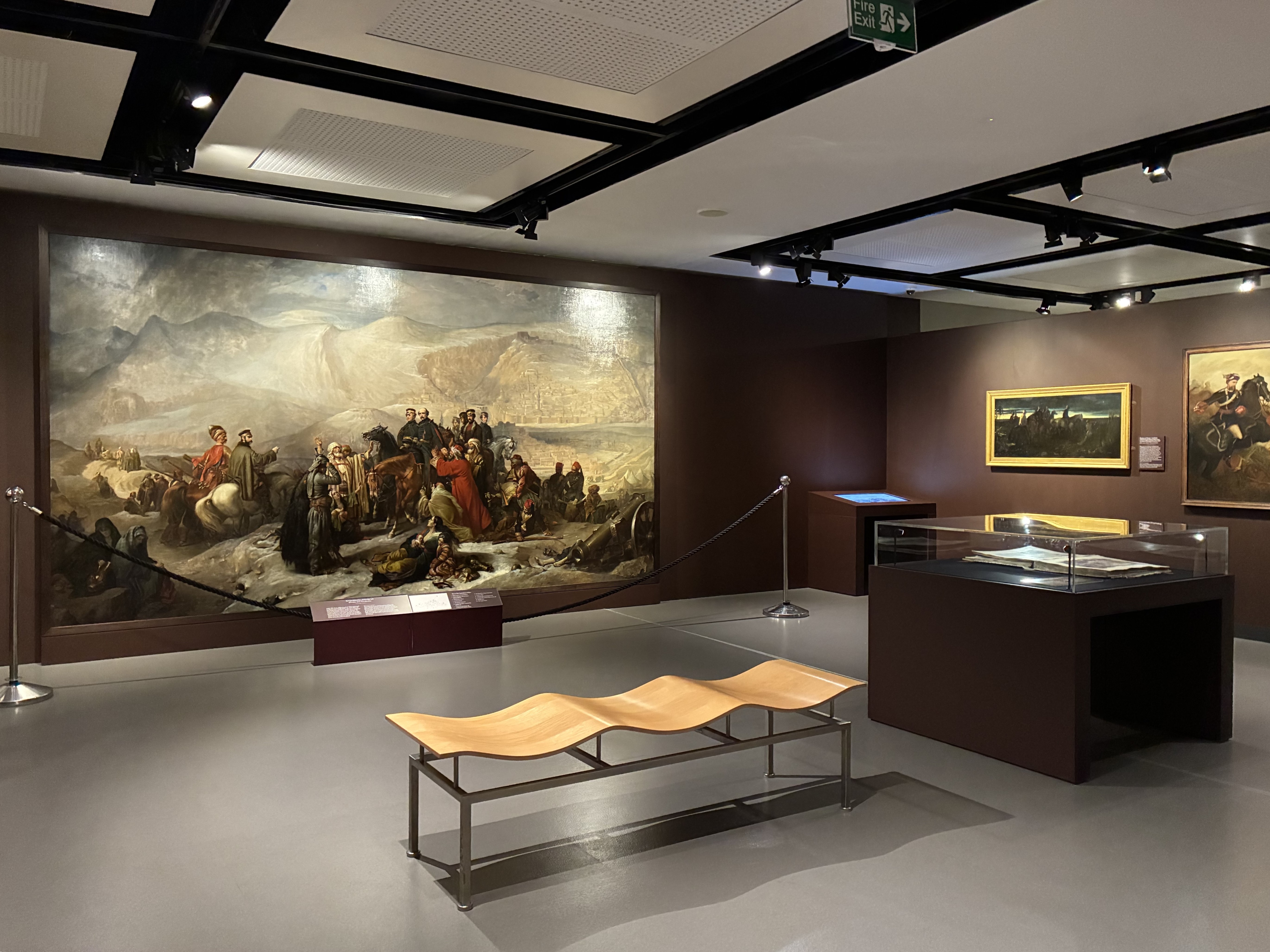
Installation view of Myth and Reality: Military Art in the Age of Queen Victoria at the National Army Museum showing the five-yard-wide oil painting ‘The Capitulation of Kars, Crimean War’ by Thomas Jones Barker (1855) with its static explanatory panel in front and an interactive screen off to the right (photo by the author)

Victoria’s Wars timeline

The exhibition includes a timeline of wars fought during Victoria’s reign. The point is that the British Army campaigned almost constantly throughout the period. There were a few big wars (the Crimean War, the Indian Mutiny and, right at the very end, the Boer War) but most of the conflicts we were involved in were small and localised, what modern historians call Victoria’s ‘small wars’.

  • 1837 – Queen Victoria ascends the throne
  • 1839 – the first photographs by Louis Daguerre in France and William Fox Talbot in England
  • 1842 – the world’s first illustrated weekly news magazine launched, the Illustrated London News
  • 1845 to 1846 – First Sikh War
  • 1852 to  1853 – The Second Anglo-Burmese War
  • 1853 to 1856 – the Crimean War
  • 1854 – Florence Nightingale travels to Crimea with 38 nurses. William Howard Russell’s reporting for The Times transforms people’s understanding of the squalid reality of war. 25 October – Battle of Balaklava and Charge of the Light Brigade.
  • 1854 – the Victoria Cross (VC) was introduced by Royal Warrant on 29 January 1856 to acknowledge the bravery displayed by soldiers and sailors during the Crimean War and soon after the Queen awards it to 62 Crimean war veterans

Queen Victoria and Prince Albert inspecting the wounded Grenadier Guards in Buckingham Palace. Coloured lithograph by George Thomas after himself (1855) Wellcome Collection

  • 1857 to 1858 – the Indian Rebellion
  • 1873 to 1874 – Third Anglo-Ashanti War
  • 1878 to 1880 Second Anglo-Afghan War
  • 1879 Anglo-Zulu War, featuring the Battle of Rorke’s Drift, 23 January 1879
  • 1880 to 1881 First South African War
  • 1882 Anglo-Egyptian War
  • 1884 to 1885 – Siege of Gordon at Khartoum, leading to its fall on 26 January 1885
  • 1885 Third Anglo-Burmese War
  • 1895 to 1896 Fourth Anglo-Ashanti War
  • 1898 – British reconquest of Sudan, featuring the Battle of Omdurman, 2 September 1898
  • 1899 to 1902 – Second South African War, featuring the sieges, the concentration camps etc
  • 1900 Fifth Anglo-Ashanti War

My take

There are about 40 artists, amateur and professional, soldiers and civilians, represented across the exhibition but the exhibition begins in a very decided way which raises a number of questions, because it starts with a strong emphasis on women war artists.

A feminist emphasis on women’s military art

The curators – all women – have decided that the first dozen or so works you see are all by women artists and devote several sections to them.

Victorian women artists, they tell us, helped to shape public perceptions of Army life. Many women were connected to soldiers through marriage or family, sometimes travelling with them abroad and depicting the people and places they saw.

Women were also important supporters and collectors of art, none more so than Queen Victoria herself. The Queen was also one of the most prominent subjects of military art, along with another celebrated figure of the time, Florence Nightingale – which explains why there’s a wall of works depicting the Queen meeting war veterans, awarding medals etc, and a little section about Florence Nightingale (who was famously averse to having her image captured, as she believed it detracted from her work).

However, as the exhibition proceeds you realise that most of the artists on display are not women, and, of course, none of the soldier artists are female – so why start this way unless you’re making a polemical feminist point? The implication seems to be that, after centuries or millennia of The Patriarchy, of tellings of history and art which downplay or completely ignore the role of women in the creation and consumption of art, this exhibition is doing its bit to redress the balance.

Fine. I understand. Why not? But there’s a second element to this approach which is notable and, maybe, problematic: this that one of the greatest, if not the greatest war artist of the Victorian era was Lady Elizabeth Butler, and so, hand-in-hand with the ‘women and military art’ section goes the ‘Lady Elizabeth Butler’ section. On one level there’s no quibbling with this: Butler was an outstanding artist and produced some of the standout works of the entire century. She was an absolute mistress of her craft, the half a dozen big paintings of hers brought together here are alone worth travelling to visit the show for, especially as several of them are usually buried in the Royal Collection.

So on the plus side, ignoring all its other features for a moment, you could say this is an outstanding selection of paintings, sketches and anecdotes by one of the nineteenth century’s great artists, and this is all to the good.

So why am I kvetching? Because the curators state, in these opening sections, in these early wall labels, that Lady Butler transformed military painting, depicting the life of soldiers with a new realism, taking a new, humane approach and setting a new standard for the subject. And this is all well and good, too, except that… In order to understand why Lady Butler is so important, and what she transformed, and what she changed it would have been good to have been fully introduced to the tradition of Victorian military painting which preceded her.

Instead, the result of placing Lady Butler right at the start of the show is to jump quite a long way into the later Victorian period without any preliminary explanation.

The work which really brought her to general attention was her ‘Roll Call’ which was displayed in 1874, 37 years into Victoria’s reign – and the first big work of hers which the curators feature, on the first wall of the exhibition, is ‘Dawn of Waterloo’ which was first displayed in 1895! 58 years into Victoria’s reign and only 6 years before her death. It’s a great painting but it comes at the very fag end of the period being covered and so is pretty misleading about the military art of Victoria’s era.

‘The Dawn of Waterloo: The Reveille in the Bivouac of the Scots Greys on the morning of the battle’ by Lady Butler (1895) the first full-scale painting by Lady Butler which the visitor encounters in ‘Myth and Reality: Military Art in the Age of Queen Victoria’ at the National Army Museum

Recap

So the decision to emphasise women’s role in military art may be laudable, and bringing a number of women’s works all together in the first few rooms ensures that the subject gets the prominence it deserves, rather than interspersing women’s works chronologically among the men’s pictures where they might be overlooked and unnoticed (as very probably happened in so many previous exhibitions on the subject).

Fine. And if you’re going to mention women artists of the time, then it would be silly not to mention and indeed have a section about the greatest of them, Lady Butler, also here right at the start. OK. Fine.

But the (maybe unintended) consequence of all this is that the visitor is deprived of a chronological understanding of the subject – of what military art looked like before Victoria, then at the start of her reign, how it developed through the decades leading up to the two seismic conflicts of the Crimean War and the Indian Mutiny in the 1850s, how it reflected trends in the broader art world, and so on.

You see how a chronological survey like this would have been interesting in itself and might also have better prepared the way for Lady Butler’s dramatic innovations: by the time you got to Lady B you’d have had a much better understanding of The Tradition she was transforming… but instead you have to work it out for yourself.

Five styles

This unchronological approach characterises the rest of the exhibition, too. Particularly in the sections about ‘Patriotism and Portraiture’ and ‘Realism and Reportage’, works from the 1840s or ’50s are placed next to works from the 1880s, ’90s or even early 1900s – it’s up to the visitor to make chronological, historical and aesthetic sense of the many different styles on display.

Having gone round the exhibition three or four times, dwelling on favourite works (and being drawn back again and again to the brilliant Butler paintings) I think I came up with about five different, roughly chronological styles of painting. They are:

  1. Romantic-sublime
  2. Patriotic-sentimental
  3. Mid-Victorian anecdotal
  4. Lady Butler
  5. Stiff official portraits

(This isn’t taking into account the pencil or charcoal sketches, and the many watercolours, which are specialist areas unto themselves.)

1. Romantic-sublime

Although painted in 1853 this picture strikes me as epitomising high Romanticism with its fondness for dramatic mountainous scenery and The Sublime. Look at the big baby eyes of Wellington (and his horse), the ethnic outfits of the local guides – it all has the rosy, soft-focus approach of Sir Water Scott’s novels.

Wellington at Sorauren, 27 July 1813 by Thomas Jones Barker 1853 © National Army Museum

2. Patriotic-sentimental

Kars is a city in north-eastern Turkey. In June 1855, as part of the during the Crimean War (1854 to 1856) it was besieged by a Russian army of 25,000. Demoralised by their defeats at the hands of the Russians, the Turks left the defence of Kars to Brevet Colonel (later General Sir) William Fenwick Williams, the British commissioner. The garrison was able to repulse three major Russian attacks but eventually cold, famine and an outbreak of cholera forced it to surrender on 26 November 1885. In recognition of their heroism, the Russians allowed the British garrison to march out of the city with the honours of war and into captivity.

‘The Capitulation of Kars, Crimean War’ by Thomas Jones Barker (1855) (National Army Museum)

This is a huge painting, over five yards wide (!), and it’s accompanied by not one but two diagrams identifying all the figures in it, one a static diagram, one an interactive display of the same. But it was only chatting to one of the (very well-informed) visitor assistants that I really understood what is going on.

You see the local in the red cloak clutching the hand of the bald British officer on his horse (Major General Fenwick Williams) and the cascade of similar locals off to his right, and the pitiful woman lying on the ground with her helpless children in the foreground, and similar locals on his left?

These are the local Turks who the British are abandoning to the kindness of the conquering Russians. So they are pleading with the British not to leave and abandon them but the British, defeated, have to. (Maybe a modern analogy would by NATO forces pulling out of Afghanistan and letting the Taliban take over.) It is this acute sense of regret and shame which explains the expression on the face of the British officer.

(You could write a book about the peoples the British Army promised to protect, only to abandon them – I’m currently reading a book about the Dutch Revolt which mentions that Queen Elizabeth I made all kinds of promises to the Dutch patriots in the 1580s which she then completely broke… It’s a long tradition.)

Back to the painting: ‘The Capitulation’, then, is a psychological study in the pain and embarrassment of duty, of a fine upstanding officer mortified to be abandoning the people he promised to protect. As such it is full of all kinds of melodramatic details, the thrown-up hands of the man in white on the left, the tearful eyes of the woman on the ground. It’s like a tableau from a mid-Victorian melodrama, at the centre of which is the British officer maintaining a stiff upper lip despite being deeply moved.

In fact it tells you a lot about mid-Victorian art and audiences that the work was commissioned, not by an aristocratic patron, but by the art dealers and print makers Agnew and Sons, precisely to be turned into prints and widely sold. So it is very deliberately catering to popular taste and demand.

3. Mid-Victorian anecdotal

The Victorians loved detail and clutter. Dickens’s novels overflow with wonderfully telling details and so do classic mid-Victorian paintings like William Powell Frith’s Derby Day (1858) or The Railway Station (1862), packed with little stories and anecdotal details. The exhibition includes an absolute classic of this style, ‘Home Again’ by Henry Nelson O’Neil.

‘Home Again’ by Henry Nelson O’Neil (1860)

‘Home Again’ depicts soldiers disembarking from a troopship at Gravesend on their return from the Indian Mutiny (1857 to 1859). For military history buffs the curators tell us that about 40,000 British troops were sent to India (more than had been mobilized for the Crimean conflict) to suppress the mutiny among the Indian troops of the East India Company’s Bengal Army.

But in purely visual terms we are invited to relish the details! At the very top a young woman peers over the shoulder of a bearded infantry corporal, who holds their baby for the first time. In the middle-right a young soldier of the 60th (The King’s Royal Rifle Corps) dressed all in black leans down to offer his Victoria Cross to a Chelsea Pensioner. The central action depicts sailors assisting a wounded sergeant to disembark. We are told that he wears a Kilmarnock ‘pork-pie’ cap under the white cotton ‘Havelock’ cover distinctive to the campaign, with the neck flap for protection from sunstroke.

There is patriotic pride here, and sentimentality of a sort, but it is very clearly all about the common people, ordinary soldiers (and sailors) and their reunions with wives and sweethearts. As such, it a little bit anticipates Lady Butler’s humanism but still with that mid-Victorian obsession with anecdote and detail.

4. Lady Butler

‘The Roll Call’ is one of the most celebrated British paintings of the 19th century. On its public appearance in 1874 it cemented Butler’s reputation as one of the leading painters of the age. It depicts a roll call of soldiers from the Grenadier Guards following the Battle of Inkerman in 1854 but can stand for thousands of similar occasions.

The Roll Call by Lady Elizabeth Butler (1874) © Royal Collection Enterprises Limited 2025 | Royal Collection Trust

The composition expresses Butler’s profound feel for the plight and experiences of the ordinary soldier, for the pity of war and the walls of the show feature not one but two quotations by her, emphasising how she eschewed patriotic guff in her concern for the actual lived experiences of the men who fought and suffered.

‘I never painted for the glory of war, but to portray its pathos and heroism’.

‘The Roll Call’ was fantastically successful. When it went on display at the Royal Academy it attracted over 300,000 visitors in a 3-month period and the more you look, the more brilliant it becomes.

The curators explain that historical or military painting for a long time worked with the basic design of a triangle which places the most important person – generally the commanding officer – at the apex (as in the pictures of Wellington and Major General Fenwick Williams, above). As soon as that’s pointed out to you, you realise really drastic difference her, the polemical message sent by the composition which is the equality of the men, all placed on the same level.

There’s still an anecdotal aspect to the thing, if you go up close and work slowly from left to right, starting with the two soldiers on the left lighting a sneaky fag or cigar, and working along through the bandages and blood of the wounded to the striking element of the man who’s collapsed into the snow. It really conveys the wretched pity of war, 44 years before Wilfred Owen coined the phrase for his volume of First World War poetry.

There is, of course, a figure on horseback, but he isn’t treated with the Romantic sentimentalism of the Wellington, above. Instead we can feel the gruff sympathy of the sergeant in charge as he reviews his wounded troops. And he also acts as the viewer’s entrance point into the work. If it was just the row of soldiers it would be slightly impenetrable: the officer on horseback not only relieves what might have been monotonous, but his movement carries the eye into the composition.

But there’s more because, after you’ve finished admiring the overall shape and canny dynamism of the composition, if you step back you notice the colours. You notice how Butler has depicted the uniforms of the men with great accuracy but used them as a springboard to create a composition of shades of grey. The grey coats and badges are reflected under the line of men by the different shades of snow and above them by the extremely nuanced and varied shading of the clouds.

On a literal level the coldness of the winter is evoked by the dominant tones of black, grey, white and brown, contrasting with small splashes of red from coatees and flags. But on a more aesthetic level, the awareness of shades of grey makes you think of James McNeil Whistler’s compositions, symphonies of certain palettes and timbres.

And then you notice the crows, the brilliant broken flight of crows coming from the middle of the composition and looping up over the head of the reviewing officer.

In its: 1) absence of sentimentality; 2) its immediately felt humanistic concern for the plight of the average soldier; and 3) its stunning painterliness, its brilliance of composition and colouring, ‘Roll Call’ really is a masterpiece. It’s worth visiting the exhibition just to see this one work in the flesh.

5. Stiff official portraits

Something the curators of the Army Museum must struggle with is that so much military art is decidedly average, if not actively poor. One or two of the battle paintings here struck me as ludicrously bad, but there’s a more subtle problem and that’s to do with military portraits.

I bet there are tens of thousands of these up and down the land, professional portraits of Britain’s countless officers, generals, admirals and so on which are good enough, decent enough, professional likenesses, but are never going to make it into anyone’s history of art because they are, by their nature, a very conservative wing of the medium.

Their number, their prevalence and popularity in Victorian times explain why there is a section titled ‘Patriotism and Portraiture’ here. Not only did ‘the people’ want to see portraits of heroes like Wellington or Gordon or Roberts, but countless military families wanted professional portraits of their eminent male members to hang alongside all their forebears, and hundreds of officers messes and regimental headquarters, ditto.

Hence a half dozen masterpieces of stultifying conventionality and woodenness.

Lieutenant The Honourable Frederick Hugh Sherston Roberts VC, Kings Royal Rifle Corps by Julian Russell Story (1899)

There’s a story behind this portrait, which is that Roberts not only won the Victoria Cross, but the same medal was awarded to his father, Field Marshal Frederick Sleigh Roberts, 1st Earl Roberts, making them one of only three father-and-son pairs to be awarded the VC in its 169-year history.

Watercolours

As mentioned, the exhibition includes 20 or so watercolours, much smaller and more intimate than the bombastic oil paintings. In a sense, watercolours under-promise and so are often able to over-deliver.

Installation view of Myth and Reality: Military Art in the Age of Queen Victoria at the National Army Museum showing a set of six watercolours of the Crimean War by William Simpson (photo by the author)

General Cannon’s landing, July 7 1854

My wife and I play a simple game when visiting exhibitions. Having crawled through the exhibits and rooms, reading and processing every wall label, we reach the end, turn round and go back through it, this time lightly, airily choosing one work per room which we like and having to explain why. A variation is to choose a work we would buy and take home to hang in the landing or hall or wherever. As I’ve stated, the Lady Butler paintings are all brilliant, but in terms of something I’d actually buy and live with, something a bit more modest, I kept returning to one of the 20 or so watercolours on display, ‘General Cannon’s landing, July 7 1854’, a pencil and watercolour by Joseph Archer Crowe (who has seven works in the exhibition).

‘General Cannon’s landing, July 7 1854’ Pencil and watercolour by Joseph Archer Crowe

Crowe worked at the Crimean War as a special artist for The Illustrated London News. This watercolour depicts how, on 7 July 1854, Turkish forces launched an amphibious assault across the River Danube on Russian positions at Giurgiu (in modern day Romania). The Russians were driven back and Giurgiu was occupied by the Turks.

It’s not going to rock anyone’s world, I just liked the composition, the line of ships going in from roughly right to left, and the light impressionistic touches of colour.

Women artists

I may have missed some but, for the record, here are the women military artists featured in the exhibition:

  • Lady Elizabeth Butler
  • Jane Drummond (portrait of Mrs Anne Steele)
  • Gertrude Ellen Burrard (portrait of Nussiban, our ayah)
  • Elizabeth Anne Leslie Melville (portrait of Major General Sir Owen Tudor Burne)
  • Emily Henrietta Ormsby (portrait of Colonel Henry Francis Strange; portrait of Major General John William Ormsby)

Lady Butler’s works

  • Tenth Bengal Lancers tent pegging (1873)
  • The Roll Call (1874)
  • Study of a Wounded Guardsman (1874)
  • Quatre Bras (engraving of oil painting, 1879)
  • Patient Heroes: A Royal Artillery Gun Team in Action (1882)
  • Scotland Forever! (engraving after oil painting, 1882)
  • After the Battle of Tel-el-Kebir (engraving of original painting, 1888)
  • After the Battle of Tel-el-Kebir (fragment of original painting, 1888)
  • The Defence of Rorke’s Drift (1882)
  • The Ballad of the Royal Irish at Sebastapol (6 x pencil illustrations of a poem, 1890)
  • Military sketches (pen, watercolour and pencil, 1893)

Summary

I don’t know whether my point about the lack of chronology and build-up to Lady B is even worth mentioning. My wife went round the displays two or three times with me and didn’t even notice or care, just enjoyed various works on their own merit.

So: if you’re interested in military history the exhibition contains lots of titbits about key wars and engagements of Victoria’s reign, about medals and uniforms, some lovely watercolours and a dozen or so really impressive oil paintings, along with a number of average or also-ran works which, however, illustrate interesting topics, such as the section about the creation of the Victoria Cross, and so on.

And the National Army Museum is always a lovely place to visit because – ironically, given its subject matter – it’s such a calm, clean and peaceful place to be. Go see.


Related links

Related reviews

The Years by Virginia Woolf (1937)

‘What could be more ordinary?’ she said. ‘A large family, living in a large house…’
(Rose Pargiter, thinking back on her childhood, page 161)

He looked clean, he looked starched and ironed like his robes. But what did he mean by what he was saying? She gave it up. Either one understood or one did not understand, she thought. Her mind wandered.
(Typical behaviour from one of Woolf’s female protagonists [in this case, Delia], detached from male discourse and dreamily drifting into her own world)

Her mind was a perfect blank for a moment. Where am I? she wondered. What am I doing? Where am I going? Her eyes fixed themselves on the dressing-table; vaguely she remembered some other room, and some other time when she was a girl…
(Kitty Malone expressing the dissociation and bewilderment typical of so many Woolf women)

The Years is Woolf’s longest novel. The strange thing is how this big and traditional novel punctuated her run of much shorter, much more experimental works, coming after the run of Jacob’s Room (1922), Mrs Dalloway (1925), To The Lighthouse (1927) and before her last, normal-length work, Between The Acts (1941).

It’s a sad and mournful book, lyrical and nostalgic. I like the suggestion by Nuala Casey (see below) that it’s a sort of ghost story, the ghosts being Woolf’s own family who the Pargiter family are clearly based on.

‘The Years’ and ‘Three Guineas’

‘The Years’ had a long, complicated and painful gestation. It was intimately tied up with the long feminist essays which became Three Guineas. According to Wikipedia:

Although Three Guineas is a work of non-fiction, it was initially conceived as a ‘novel–essay’ which would tie up the loose ends left in her earlier work, A Room of One’s Own (1929). The book was to alternate between fictive narrative chapters and non-fiction essay chapters, demonstrating Woolf’s views on war and women in both types of writing at once. This unfinished manuscript was published in 1977 as The Pargiters. When Woolf realised the idea of a ‘novel–essay’ wasn’t working, she separated the two parts. The non-fiction portion became Three Guineas. The fiction portion became Woolf’s most popular novel during her lifetime, The Years, which charts social change from 1880 to the time of publication through the lives of the Pargiter family. It was so popular, in fact, that pocket-sized editions of the novel were published for soldiers as leisure reading during World War Two.

The soldiers’ version

Regarding its popularity and the publication of a pocket edition for soldiers, as I read through The Years I came to understand why. It is gentle and beautiful, sad and nostalgic. Each of the book’s 11 sections opens with a description of the English countryside or the busy London streets, in winter and in summer, in rain and shine, and these slowly build up into a composite portrait of the country those soldiers were fighting for.

And you can put The Years down and pick it up at any point, on any page, without worrying about forgetting the plot, because there is no plot. The characters waft around London in the same lyrical, detached, dreamlike state for hundreds of pages.

Similarly, although we know Woolf was incensed by the oppression of women by the patriarchy of her day, and although her fury is hinted at at various points in the narrative, ironically it is the very exclusion of women from education, the professions and public life, from activities of most kinds, which permits the novel’s lazy, hazy, dreamy tone.

The person who emerges as the central protagonist, Eleanor Pargiter, is the one who suffers most from patriarchal exclusion, finding herself obliged to stay at home to look after her widowed father, never benefiting from a proper school let alone university education, excluded from all the professions and any kind of paid employment. No wonder she grows up into the detached, dreamy, forgetful woman she’s depicted as – what alternative was there for women of her era and class?

There is also a pleasing irony that the great pamphlet The Years grew out of, Three Guineas, is furiously against war and against the entire patriarchal, masculinist system of hierarchy, competition and militarism which encourages it, and yet the fiction which evolved alongside it was mass published to help and succour… soldiers, becoming, in its particular way, part of the vast machinery of war which Woolf claimed to hate so much.

‘Three Guineas’ feminism

As explained, The Years was originally conceived to be interspersed with factual chapters detailing the oppression of women in England during the period covered (1880 to 1937). Eventually Woolf realised the two books had to be separated out and from her factual material created the great pamphlet, Three Guineas.

Three Guineas is a powerful feminist polemic. Reading it changed my opinions, shifting me to a markedly more feminist point of view of English social history and in particular the literature of this period, the late Victorian and Edwardian era. It is more difficult to read but, in the end, much more powerful than the shorter, more popular A Room of One’s Own.

Three Guineas is a searing indictment of all aspects of the patriarchal system developed during the Victorian era, which Woolf felt still strangled women’s aspirations in the 1930s. One aspect of this is her compelling portrait of the classic Victorian family home as a prison for daughters. Middle-class daughters were deprived of the private education given to their brothers, prevented from going to university, prevented by law from entering any of the professions, prevented from earning money and having any kind of financial or personal independence. Instead they were trapped in the prison of the Victorian family home ‘like slaves in a harem’, subject to the tyrannical whims of an all-powerful paterfamilias and, more often than not, confined to tending family members, especially if they were sick. Millions of women were forced to squander their talents, living lives blighted by endless legal, financial and cultural restrictions. This boredom crops up throughout the opening chapters.

‘I’ve nothing whatever to do,’ [Delia] said briefly. ‘I’ll go.’

This, then, is why the young women of Woolf’s day obsess about marriage and spend so much time fantasising about the young men they meet at this or that party or reception. Because marriage represents the only means of escape from the stifling family home. Deprived by law and tradition from all other channels of expression and achievement, pursuit of the perfect marriage is the only ‘profession’ allowed them.

She [Eleanor] wished Milly did not always bring the conversation back to marriage. And what do they know about marriage? she asked herself. They stay at home too much, she thought; they never see anyone outside their own set. Here they are cooped up, day after day… (p.31)

My reading of Three Guineas heavily influenced my reading of The Years, the weight of Woolf’s angry critique of Victorian oppression of women hanging very heavily over the text of the novel.

The character of the damaged, angry, unpredictable Colonel Pargiter is straight out of the essay, as is the permanent gloom caused by their mother’s long illness, the heavy curtains, the sense of trapment and stasis. Then, after the mother dies, Eleanor finds herself even more trapped in the role of her father’s carer and household manager, while all the time she watches the boys of the family go off to their private schools, then to Oxbridge colleges, and then on to professions in the army, academia or the law. All forbidden to the daughters of the family.

Presumably the dominance of this factual or even political agenda is one reason why the novel is so unlike her experimental ones, so much more conventional, much closer to the big novels about family dynasties which were so popular in the Edwardian era (for example, the series of novels by John Galsworthy making up The Forsyte Saga published 1906 to 1921).

Structure

How do you ‘chart social change? Well, Woolf picked a series of specific years, like snapshots in a family scrapbook. Hence the structure, the chapter titles and title of the novel as a whole.

  1. 1880 (82 pages)
  2. 1891 (37 pages)
  3. 1907 (15 pages)
  4. 1908 (12 pages)
  5. 1910 (29 pages)
  6. 1911 (20 pages)
  7. 1913 (8 pages)
  8. 1914 (52 pages)
  9. 1917 (20 pages)
  10. 1918 (3 pages)
  11. Present Day (123 pages)

Curious to see if the section lengths indicated any sort of pattern, I turned them into a graph. No particular pattern emerges except the obvious fact that the first and last chapters are the longest, with the final chapter as long as all the short ones put together. The book is heavily weighted towards the ‘Present Day’

The Waves and The Years

Each of the 11 sections starts with a paragraph or so describing the time of the year and the weather, giving lyrical natural descriptions before the text zooms in onto the human characters. This tactic of natural setting followed by human interaction is very similar to the structure of The Waves, in which each of the sections is preceded by a description of the passage of the sun through the sky and the effect of the changing light, wind and weather on the sea beneath it – before moving on to focus on the lives of the characters. Not quite identical but a very similar idea.

And it’s not just using an introductory section about the weather that both novels have in common. The idea of following half a dozen or so characters, from childhood through to adulthood by giving snapshots of particular moments or events scattered over a period of 40 or more years, this is exactly the method of The Waves.

The similarity extends to the tactic of giving the children a couple of childhood events or moments, and then having these same events be remembered in each successive section, so that they slowly build up significance and resonance. Thus it was with the childish incident of Jinny kissing Louis in The Waves which gains significance as the various characters remember it throughout their lives. Here it is incidents like defiant little Rose sneaking out of the house to run along to Lamley’s shop or Maggie’s memory of the cheap necklace Eleanor bought for the Colonel to give her (Maggie) on her birthday.

1880. The Pargiter family at Abercorn Terrace wait for their mother to die (82 pages)

It was an uncertain spring. The weather, perpetually changing, sent clouds of blue and of purple flying over the land…

Colonel Abel Pargiter is in his 50s. He served in India where he lost two fingers during the Mutiny of 1857. He lives in a comfortable family home in Abercorn Terrace, off the Bayswater Road, north of Hyde Park.

An online article by Nuala Casey tells me that:

The Pargiter family home in Abercorn Terrace is a replica of 22 Hyde Park Gate where Woolf grew up with her father, the Victorian biographer Leslie Stephen, her mother Julia, a former Pre-Raphaelite model, her siblings Vanessa, Thoby and Adrian and step-siblings Stella, Gerald and George Duckworth.

The colonel’s wife is dying of some slow wasting illness, so he has taken a mistress, Mira, who lives in a dingy house near Westminster Abbey. Mira herself is no longer young, being about 40 and with a daughter at school.

Back at the family home wait the Colonel’s children – Milly, Delia (‘his favourite daughter’), Rose, Eleanor and Martin. They are all terrified of his bad moods. Eleanor, in her early twenties, is already the household manager and accounts keeper. Martin is 12, Rose is 10.

There are several servants. The main housekeeper is named Crosby, silent and efficient. The butler is named Hiscock, rarely talks, always mumbles.

Morris is another son but is old enough (after his private education) (in his early 20s) to have a job, as a junior in a barristers chambers (‘devilling for Sanders Curry’).

Cut to rooms in an Oxford college. Here we meet Edward Pargeter and his two friends, hulking great Gibbs and more effete Ashley. They’re not really friends, they don’t get along. When he’s got rid of them Edward hears laughter from the Lodge of the college and wonders who’s there with young Kitty who, presumably, he has a thing for.

Cut to the Malone household. Father is a don, Dr Malone. The interest is on young Miss Kitty Malone. She’s spent the day showing Mrs Fripp, the wife of American tourists, round Oxford. At the end of the day she undresses to go to bed. She’s a large girl who’s self conscious about her size.

Next morning she gets up and goes to see her tutor, Miss Craddock who’s tutoring her in history. Miss C is very harsh and says a child of ten could have written Kitty’s latest essay. We don’t even find out that the subject of the essay is, before their hour is up and Kitty goes on to visit the Robson family in Prestwich Terrace.

She despises their bad taste, their rooms cluttered with pretentious junk, and they’re all so small, until the son of the house, Jo, comes in from the back garden where he’s been repairing a hen coop. Kitty fancies him; she’d like him to kiss her. Jo thinks she’s a ‘stunner’.

She returns to the Lodge and sits with her mother as the latter reads The Times. Then a note arrives to say that cousin Rose has died. This is obviously Mrs Pargiter. Mrs Malone remembers sitting with Rose out on the moors in Yorkshire when young Abel Pargiter rode up from his barracks to propose to her (Rose).

Cut to the house in London, in Abercorn Terrace. it is dark and full of wreaths. The coffin containing their mother’s body is carried out. Rose’s funeral is seen through the eyes of Delia who loved and hated her. Delia feels excluded by her father and brothers who manage everything.

1891. Eleanor goes to watch brother Morris in the law courts, Colonel Pargiter visits his brother, Sir Digby Pargiter. Death of Parnell (37 pages)

The autumn wind blew over England. It twitched the leaves off the trees, and down they fluttered, spotted red and yellow, or sent them floating, flaunting in wide curves before they settled…

It is October. Kitty has married Lord Lasswade, has a little boy, lives at his grand house in the North of England. Milly has married Edward’s student friend, big Hugh Gibbs. She is pregnant. Edward is an academic at Oxford, in Classics. Morris is a barrister walking through the Inns of Court.

Eleanor, now in her early 30s, still lives at home with her father, still does the household accounts, as well as running round taking part in various committees and managing the family’s other properties, dingy rented houses called Rigby Cottages, dealing with dishonest traders; plus buying a last-minute present for her father to take to Aunt Eugénie for her little girl, Magdalena (Maggie)’s, birthday.

After a morning of chores and lunch with her father, Eleanor hurries off to the Law Courts to watch Morris prosecute a case. On the way she reads a letter from Martin who is 23 and serving in India. She rendezvous with Morris’s small, cat-faced wife in furs, Celia Chinnery.

I read the scene of Morris in court through the prism of Three Guineas. Woolf’s fierce condemnation of the way the patriarchy excluded women from all the professions brings out the outsiderness of Eleanor, excluded from a good education, prevented from attending university, she views proceedings as an outsider. She notes the palliness of all the barristers, their awe of the judge, but without following any of it, her head full of her own impressions and memories. All this makes a lot more sense if you bear in mind Three Guineas explanation of women’s exclusion from every aspect of public life.

Out in the busy Strand she reads a newspaper announcement that Charles Stewart Parnell, the Irish independence leader, is dead (6 October 1891). Her sister, Delia, was a supporter of Home Rule so she takes a cab out to the squalid square where Delia lives, but she’s not there.

Cut to Colonel Pargiter visiting Aunt Eugénie in her house in Browne Street. She is married to his younger brother, Sir Digby Pargiter, and her two young daughters, (Sara and Magdalena) are playing in the garden round a bonfire of autumn leaves. Sir Digby arrives, 5 years younger than the Colonel, though the Colonel has more money. After some chat and chaffing the children, the brothers have no more to say to each other, so the Colonel leaves.

En route to their house he’d read a letter to him from his old mistress, Mira, who’s now in her 50s and fat. She had gone off with some other chap who has now, predictably, dumped her and she wants money from him. The Colonel had wanted to tell Eugénie about her, Mira, to unburden himself of his secret life but the moment never occurs, and he leaves, frustrated.

1907. Digby and Eugénie attend a party then come home to their daughter, Sara (15 pages)

It was midsummer; and the nights were hot. The moon, falling on water, made it white, inscrutable, whether deep or shallow…

Each chapter opens with a bird’s eye description of London or the countryside. This one opens with a long description of all the carts of agricultural produce lumbering along roads into London towards Covent Garden (compare and contrast Oscar Wilde’s description of the same thing in Lord Arthur Saville’s Crime and D.H. Lawrence’s description in Aaron’s Rod).

Eugénie and Digby and their older daughter, Magdalena (Maggie) are riding in a coach through Hyde Park towards a party. Back in their house in Browne Street their teenage daughter Sara is too young to attend, so has been left behind. She’s trying to sleep but is kept awake by the waltz music from a nearby party. She opens a present from her cousin Edward, the Oxford Classics scholar, his own translation of Sophocles’ Antigone.

We know from Three Guineas that the Antigone was very, very important to Woolf. Of more than personal importance, it had a polemical, political significance, because Antigone stands for all women everywhere who stand up to dictators and tyrants as Antigone stood up to her tyrannical uncle, Creon. This carried not only an immense significance in the 1930s of the fascist dictators but, in Three Guineas, Woolf makes a direct link between the public tyranny of the dictators and the private tyranny of the Victorian paterfamilias. Even Antigone’s eventual fate was highly symbolic, not just being executed but being buried alive just like the daughters of the upper-middle-class like Woolf and her generation, were buried alive in the dark, curtained mausoleum of the patriarchal home. So this isn’t a casual reference.

Identities and selves

Anyway, the parents return and Maggie visits Sara in her room. Their conversation winds round to the central Woolf theme of identity, not in any profound ore worked-through way, just in a kind of girlish throwaway:

‘Would there be trees if we didn’t see them?’ said Maggie.
What’s ‘I’?…’I’…’ She stopped. She did not know what she meant. She was talking nonsense.
‘Yes,’ said Sara. ‘What’s ‘I’?’ She held her sister tight by the skirt, whether she wanted to prevent her from going, or whether she wanted to argue the question.
‘What’s ‘I’?’ she repeated.

As we know from the last chapter of Orlando, Woolf had evolved to a position where the whole idea of identity was problematical, where she imagines the so-called ‘I’ being made up of scores or even hundreds of ‘selves’. (This theme is picked up in the 1910 chapter, see below.)

Their mother comes into the room and there’s a lovely scene of mother-and-daughters warmth as they chat about the party. The girls (both now in their twenties) persuade their mother to show them how she used to dance, holding her Edwardian skirt out like a partner. Until Sir Digby calls her to come down and lock up, angrily, and when Maggie tiptoes downstairs it’s because there have been burglaries in the street, and Digby told Eugénie to get a new lock fitted and she’s forgotten. The sweet Edwardian mother and the angry Edwardian father.

1908. Martin views the Digby house then visits Eleanor looking after their father (12 pages)

It was March and the wind was blowing. But it was not ‘blowing’. It was scraping, scourging…

It’s March the following year and we learn that Eugénie died a year ago (can that be right? if she was going to parties in October the previous year?) and Digby is dead too. The family house in Browne Street has been put up for sale, and has been sold, as Martin (now in his 40s) discovers when he arrives to view it. The Malone children used to come here all the time. Martin is upset at the loss of this setting of his childhood.

So Martin pops round to the family home. Old Crosby opens the door. The Colonel’s had a stroke and is slow. Eleanor, now in her 50s, is still looking after him. Martin finds a newspaper obituary for Sir Digby among the cuttings that the Colonel nowadays has Eleanor cut for him, which leads to a mild disagreement about whether they preferred him or Eugénie.

(And there’s a joke. Woolf started in the 1930s collecting newspaper cuttings into scrapbooks, many of them to be used in Three Guineas. So it’s a sly joke against herself when Woolf has Eleanor think, about her father: ‘That was a sign that he had grown very old, Eleanor thought—wanting newspaper cuttings kept,’ p.143)

Martin goes to play chess with their father and Eleanor reflects that he, Martin, was right to quit the army.

Martin notes that Eleanor is reading a book by the French historian Ernest Renan. Left by herself Eleanor reflects that she knows so little, is so ignorant of so much. This, of course, is an understated reference to the way she (and so many women her age) were denied any formal education.

There’s a knock at the front door and their sister Rose arrives. She is in her 40s, lives in Northumberland, and is a well-established eccentric, giving to muttering quotes from poems and songs. Eleanor was expecting her to arrive on the 18th but Rose says this is the 18th and both she and Martin laugh at Eleanor for thinking it’s the 11th, for getting her dates mixed up, for being so forgetful and ditzy. (A lot later Woolf tells us ‘She could never do sums in her head at the best of times’ and ‘She never could remember names’.)

This is a trope familiar to Woolf readers, who often goes out of her way to describe the ignorance and lack of education and general ditziness of her central woman protagonists (Mrs Dalloway in the book of the same name, Mrs Ramsay in To The Lighthouse). Woolf describes their practical shortcomings in order to emphasise that it doesn’t matter so long as their heart is in the right place, and because they love life.

All this has much more meaning to me after reading Three Guineas in which Woolf is so angry about the exclusion from all forms of education of women of her class. It made me rethink these women characters as not so much feebly dim but as victims of patriarchal laws and traditions designed to exclude them from education and public life – to be blunt, to keep them ditzy and distracted with trivia.

This adds bite to the way that, as Martin goes to leave, he mentions that he’s dining out that night, again, and Eleanor is jealous that he dines out every night and meets all sorts of people, and here she is trapped at home with a dying old man. Again, reading Three Guineas gives a powerful feminist, political bite to all these simple events and thoughts.

We learn that Rose is very politically engaged and has been making speeches ahead of the 1907 general election. It is nowhere mentioned, but the OUP editors assume she is a suffragette.

1910. Rise visits Sara and Maggy, Kitty goes to the opera, death of Edward VII (29 pages)

In the country it was an ordinary day enough; one of the long reel of days that turned as the years passed from green to orange; from grass to harvest. It was neither hot nor cold, an English spring day…

A lyrical portrait of busy London leads into a description of eccentric Rose catching a bus south of the river to visit her cousins Maggie and Sally at a place called Hyams Place, near Waterloo. After both their parents died and the Browne Street house was sold off, Maggie and Sara had to fend for themselves.

Rose is dismayed by how shabby and poor their house is. When they try to make conversation about the old times she feels like she’s two different people (the Multiple selves theme).

They talked as if they were speaking of people who were real, but not real in the way in which she felt herself to be real. It puzzled her; it made her feel that she was two different people at the same time; that she was living at two different times at the same moment. She was a little girl wearing a pink frock; and here she was in this room, now (p.159)

Rosie persuades Sara to go with her to a meeting. Eleanor is already there taking notes and then Kitty Malone, now Lady Lasswade, arrives, inappropriately dressed in opera wear. We don’t learn what the meeting is about, and since half the people arguing are men I assume it’s not a suffragette meeting. Wikipedia says it’s just ‘one of Eleanor’s philanthropic meetings’.

The meeting breaks up and Kitty, Lady Lasswade offers Eleanor a lift in her magnificent chauffeur-driven car. She drops her where she wants to be dropped then continues on to the Opera. There’s a tasty description of the embarrassment of her and all the other posh types who are wearing evening dress, heels, cloaks and furs in the middle of the day because they are attending a matinee performance, dodging between the Covent Garden workers.

The opera is Siegfried by Wagner and Woolf gives a description. Lady Lasswade/Kitty is in a box with Edward and another young man, very in-the-know. She and they observe that the Royal Box is empty.

Cut back to Sara and Maggie back in their dingy home in the squalid street near Waterloo. There’s a pub just on the corner, children shouting in the street, a geezer yelling for any old iron. A drunk is thrown out of the pub and comes battering on the front door of the neighbouring door. Then along comes a man selling the evening paper and yelling that the king is dead. (King Edward VII was declared dead on 6 May 1010.) So that’s how the characters find out, one set at the Royal Opera, the other in their dingy digs.

1911. Eleanor visits Morris and Celia in Wittering (20 pages)

The sun was rising. Very slowly it came up over the horizon shaking out light. But the sky was so vast, so cloudless, that to fill it with light took time…

August, the holiday season. We learn that every year Eleanor comes to stay at Morris’s house on the south coast, at Wittering. There’s a nice description of the little town in the blistering August sun. We learn that old Colonel Pargiter has died and therefore the London house is locked up.

Morris is the barrister we saw in the courtroom scene where Eleanor soon lost interest in proceedings. Eleanor is greeted by Morris’s wife, Celia, who explains they’re all of a tizzy because other guests have only just left and yesterday they held a bazaar with a little play, a scene from Shakespeare, in support of the local church spire. Characteristically for a Woolf woman, Celia can’t remember which Shakespeare play it was. Because they don’t work – are barred from most work – Woolf’s women are notoriously indifferent about details and precision: everything is a drift and blur.

Eleanor washes herself and changes in the room she’s been given (the blue room). She’s been on a big trip abroad, maybe her first freedom after her father’s death, which included Naples, the Acropolis and, lastly, Spain – Granada and Toledo. Her skin is notably brown (though nobody uses the word ‘tanned’; they say burned; the concept of a suntan must have appeared later in the century. According to the internet the first use of ‘suntan’ as a commercial name for a light-brown skin colour was in 1937. The OED’s earliest evidence for the word ‘suntanning’ is from 1946).

Eleanor is 55. This is the first time the age of any of the Pargiters is mentioned. From it we can deduce that she was already 24 when the novel opened in 1880.

She went on this grand tour with her brother, Edward, the Classics scholar. Another guest is staying for the weekend, a man named Dubbin who they’ve known since they were children. He is now a balding old buffer called Sir William Whatney. He’s been out in India, ruling a province the size of Ireland ‘as they always said’.

Having read Three Guineas I detect the bite behind all this. Whatney and Eleanor’s brothers Edward and Morris have had careers, gone places, had responsibilities, competed over their achievements and status. From this, like all women of her class, Eleanor has been excluded by the entire system of patriarchy which condemned her to live at home with her father managing the household accounts.

She isn’t really jealous, just indifferent, so as Sir William tells another story about India in her booming voice Eleanor, like all the Woolf women, loses interest, drifts away, notices inconsequential details of the room around her, wonders about the passage of time etc.

More bite in the fact that, when Morris and Whatney start talking about politics, Celia takes that as a signal to ‘leave the gentlemen to their politics’, and to take Eleanor and the children out onto the terrace for coffee. Here we learn that 1) Rose is in court, again, for throwing a brick, so presumably she is a suffragette and 2) Maggie has got married to a Frenchman, René.

Morris and Celia have two teenaged children, Peggy and North. The daughter of this house, Peggy, is excited because they see an owl every evening at the same time and her excitement spreads to Eleanor. Celia wants Whatney to come and live somewhere close because he’s so good for Morris.

In the top floor of the house lives old Mrs Chinnery, Celia’s mother, a very ancient 90 years old. Her nurse brings her downstairs in her wheeled chair and Eleanor goes through the rigmarole of politely kissing her and trying to make conversation. As you strongly suspect Woolf did in these situations (because so many of her characters do), Eleanor finds herself going through the motions and acting the part of the dutiful guest.

Eleanor goes to bed and can hear old Whatney huffing and puffing round in the room next door. His life is over (he’s retired) while hers – liberated from caring for her father – is only just beginning. Where should she go? What should she do?

1913. The family home is locked up and Crosby moves to Richmond (8 pages)

It was January. Snow was falling; snow had fallen all day. The sky spread like a grey goose’s wing from which feathers were falling all over England…

It’s a snowy January and Eleanor is escorting an estate agent, Mr Grice, round the now-empty family house at Abercorn Terrace. All the furniture’s been removed, leaving empty spaces, stains on the walls. The point is it’s Crosby’s last day. She’s served the family for 40 years. Showing the estate agent round, Eleanor for the first time realises how low and dingy the cellar was where she spent those 40 years, and feels ashamed. Crosby cries as Eleanor sees her into the carriage which will take her and her dog, Rover off to a one-room apartment in Richmond.

So off Crosby goes to her new home in Richmond, sharing the house with Mr Bishop and Mrs Burt, But Rover doesn’t like the change, sickens and dies.

Crosby catches the Tube to Ebury Street and walks to the bachelor pad of Martin, I wasn’t sure from the text why. The Wikipedia article tells me it’s because she’s still doing his laundry.

Martin is now about 45 and still a bachelor. He is uneasy around servants, tries to sympathise when Crosby tells him about Rover. As he clumsily says his goodbyes to her, he reflects on the tradition of telling lies in their wretched family. After the Colonel died they discovered a batch of letters to him from Mira i.e. that he had a mistress. We’ve seen how the Victorian family house was a prison for girls, but Martin has just as negative a view.

It was an abominable system, he thought; family life; Abercorn Terrace. No wonder the house would not let. It had one bathroom, and a basement; and there all those different people had lived, boxed up together, telling lies. (p.212)

1914. Martin goes to the City, Hyde Park, then to a party (52 pages)

It was a brilliant spring; the day was radiant. Even the air seemed to have a burr in it as it touched the tree tops…

‘Martin, standing at his window, looked down on the narrow street’ (see my section on Windows, below). He heads off towards the City and bumps into Sara/Sally, now in her 40s, outside St Paul’s. He invites her for lunch at a chop house and is angry when the waiter tries to steal some of the change from the bill. They walk back along Fleet Street and catch a bus to Hyde Park. Here the beautiful sunshine gives him a transcendent moment, which revives the ‘multiple selves’ theme.

The sun dappling the leaves gave everything a curious look of insubstantiality as if it were broken into separate points of light. He too, himself, seemed dispersed. His mind for a moment was a blank. (p.230)

He’s accompanying Sara to meet her sister, Maggie – who’s gotten married (to René, a Frenchman) and recently had a baby – at the Round Pond in Kensington Gardens. I like reading about London because I myself stroll around these places; only a few months ago I went to an exhibition at the Serpentine Gallery then strolled along to the Round Pond then down to Kensington High Street where I popped into the Japan House. So all these London placenames aren’t vague abstractions but places where I myself have walked and strolled at different seasons, following in the footsteps of so many of Woolf’s characters.

Sara and the baby fall asleep and Martin finally gets to tell Maggie that his father had a mistress. It seems so silly and petty now, that he bothered to hide it. But this leads him on to ask Maggie if she thinks her mother, Eugénie, was in love with his father, the Colonel, her brother-in-law.

I know there are many readers for whom love – who in a novel is in love with whom, and who having affairs with whom, who is being unfaithful etc etc – is a subject of inexhaustible interest. For me it is a subject of ineffable boredom. But at the same time, I have to accept that this narrow, dull subject – the love lives of the bourgeoisie – is what this art form, the novel, is more often than not about.

Sara wakes up and breaks the odd intimacy he and Maggie had enjoyed. He leaves the sisters. A few hours later he’s wearing evening dress and riding in a carriage to a party in Grosvenor Square. It is hosted by Kitty, Lady Lasswade. It is dazzling how utterly indifferent Woolf is to dialogue. Martin is assigned a young women, Ann Hillier, to escort for the evening (to dinner) and their conversation is quite dazzling in its dullness and banality. One page of dialogue by Oscar Wilde outshines all the conversations in every novel Woolf ever wrote. She has a very poor sense of the difference between people. All her characters have the same dreamy inconsequentiality.

Kitty takes a train to her castle in the north

To our surprise Kitty is impatient for her guests to leave because, as soon they do (soon after 11pm) she rushes upstairs, gets changed into the clothes her maid has laid out, runs downstairs and into the car which the chauffeur drives fast to the station (Euston? King’s Cross?) and she just makes it onto her train, is shown to her sleeper compartment, undresses, lies in the narrow bed and sleeps.

Kitty wakes the next morning, looks out the train window, arrives in a northern station, alights with her bags, is collected by another chauffeur (in the new car) and is driven to the family castle, where she changes for breakfast.

This is an unusual bit of energy and excitement for a Woolf novel, but also serves to highlight the complete absence of plot. She is, after all, just travelling from her London home to the family castle in the North. The entire novel is the record of its half a dozen posh characters coming and going. This sequence is notable because it’s a rare passage set outside London, so Woolf shows off with a description of a train journey and the colder, harder landscape of the North.

1917. Eleanor goes to dinner with Renny and Maggie, there’s an air raid (20 pages)

A very cold winter’s night, so silent that the air seemed frozen, and, since there was no moon, congealed to the stillness of glass spread over England…

Eleanor goes to dinner with Renny and Maggie who have fled France to live in a shabby house in one of the obscure little streets under the shadow of the Abbey. Here she is introduced to a dark foreigner, Nicholas, talkative and philosophical.

Then Maggie’s sister, Sara arrives. Sara has always been portrayed as on the edge of madness, and she infects this dinner party with a kind of delirium. The characters talk and mention things but it’s hard to make sense of the conversation, it seems more a series of random observations. They argue but it’s hard to know what about.

This inconsequential conversation is interrupted by a German air raid. They all go down to the damp cellar while the sound of bombs gets slowly, closer, is overhead, then passes on.

Back in the living room, the meandering conversation turns to Nicholas and Eleanor talking vaguely about the future, about whether there will be a better world.

When, she wanted to ask him, when will this new world come? When shall we be free? When shall we live adventurously, wholly, not like cripples in a cave?

But Sara pours cold water on all this by pointing out the way that people always say the same thing: Nicolas always says ‘Oh, my dear friends, let us improve the soul!’, Eleanor agrees with everything, Maggie says nothing just sits and darns a sock, and Renny angrily says ‘What damned rot!’

Sara surprises the reader by saying Nicholas is gay. To be precise, she jokes that he ought to be in prison:

‘Because he loves,’ Sara explained. She paused. ‘—the other sex, the other sex, you see.’

Eleanor feels a moment of repulsion and then realises it doesn’t matter, at all. She likes him. She reacts like so many Woolf characters do, in so many situations, by going to the window and looking soulfully out.

She got up. She went to the window and parted the curtains and looked out. All the houses were still curtained. (p.284)

1918. Crosby and the armistice (3 pages)

A veil of mist covered the November sky; a many folded veil, so fine-meshed that it made one density. It was not raining, but here and there the mist condensed on the surface into dampness and made pavements greasy…

The last four years have aged old Crosby, the Pargiter family servant. She talks to herself, grumbling and complaining about the other occupants of the house near Richmond Green, especially a Belgian refugee from the war who calls himself a count and spits on the side of the bath, which Crosby has to clean up.

She hears guns bombing and a siren wailing. Woolf in her Woolfian way, tells us what Crosby sees, a man up a ladder painting windows, a woman walking by carrying a loaf of bread wrapped in paper. Someone in a shop queue tells her the war is over.

This is a classic example of Woolf’s technique of indirection and disassociation which can be interpreted in several ways.

  1. Modernism: modernism was all about rejecting Victorian pomp and circumstance and addressing a subject in an obvious and relatable way; instead tackling everything obliquely and ironically.
  2. Woolfian dissociation: in all her mature novels, characters tend to be dissociated and detached from events, even ones directly affecting them. How much more detached they are from supposedly big public events. Compare and contrast the oblique way King Edward VII’s death, though Kitty’s visit to the opera.
  3. Woolfian feminism: the complete indifference of a muttering old lady to the Armistice exemplifies my reading of Three Guineas, which is centrally concerned with the question How to avoid war, and drips with mocking sarcasm about men’s obsession with competition, priority, hierarchy and status which she sees as one of the roots of war. Muttering old Crosby doesn’t give a monkeys about your war or peace or politics or diplomacy and maybe she is right to do so.

Present day (123 pages)

It was a summer evening; the sun was setting; the sky was blue still, but tinged with gold, as if a thin veil of gauze hung over it, and here and there in the gold-blue amplitude an island of cloud lay suspended…

As explained, each section opens with a description of the time of year and weather which largely sets the tone for what follows. As you can see this, the longest, section, opens with an image of mellow contentment, high summer gold, a thin veil, an island of cloud etc. So what’s become of our characters? And when is the present day?

Eleanor back from India, North back from Africa

Eleanor has just returned from a trip to India, brown skinned and white haired. She now in her 70s. She’s just had visitors at her little flat, including her nephew North, son of her brother Morris. North is back from years ‘in Africa’. (Characteristically, the narrative doesn’t tell us what he was doing there. We have to deduce from scattered references that he was a farmer and now he’s sold the farm.)

Eleanor shows North her jazzy new shower. He drives off in his nifty little sports car. He’s going for lunch with Sara, his aunt, now in her 50s i.e. 20 years or so older than him. He parks in a dingy street and has the characteristic Woolf experience of forgetting who he is or what he’s doing:

He mounted slowly and stood on the landing, uncertain which door to knock at. He was always finding himself now outside the doors of strange houses. He had a feeling that he was no one and nowhere in particular…

He knocks and enters Sara’s dingy house:

‘And you—’ she said, looking at him. It was as if she were trying to put two different versions of him together; the one on the telephone perhaps and the one on the chair. Or was there some other? This half knowing people, this half being known, this feeling of the eye on the flesh, like a fly crawling—how uncomfortable it was, he thought…

The uncomfortableness of being observed reminds me of Jean-Paul Sartre’s novels.

She’s on the phone to a man he met at Eleanor’s, the philosophical foreigner we first met in the previous chapter, ‘that very talkative man, her friend Nicholas Pomjalovsky, whom they called Brown for short.’ He is meant to be a great intellectual but the grandest thing he’s said, so momentous it’s repeated several times, is: ‘if we don’t know ourselves how can we know other people,’ which feels mundane and limp.

Come down in the world

A serving girl serves them undercooked mutton which bleeds. A theme in the last few chapters is how all the Pargiter siblings have come down in the world compared to the grand family home they lived in as children, paralleled by the warm Digby household at Browne. The children of both houses find themselves, in the modern world, living in dingy houses and pokey flats. Only their cousin Kitty Malone has done well for herself, marrying Lord Lasswell.

North and Sara have a dingy dinner, but the thing about their encounter is its staginess: he seems to be egging her on to perform her lines rather than have a conversation. Only from the notes did I learn that they were actually reading from a play.

Eleanor rings. She’s having dinner with her niece Peggy. Thus, by phone, two pairs of this extended family communicate. In their part of the narrative, Peggy thinks how old and forgetful Eleanor’s become but then we know she’s always been vague and easily distracted.

Eleanor loves hot water and electric lights but is not so keen on motor cars – one nearly ran her over the other day – and hates the wireless.

Eleanor sees a newspaper with the face of one of the dictators on it, Hitler or Mussolini, and swears and tears it in half, to the shock of her niece. The pair catch a cab to her sister, Delia’s house, who’s having a party. Which is an opportunity for Woolf to slip in a description of travelling into central London, Oxford Street by night etc.

Cut back to North and Sara reading this play, him egging her on to read her lines. I didn’t realise they were reading a play because Sara’s always been a bit cracked, much given to randomly (mis)quoting poems and plays.

Cut back to Eleanor and Peggy arriving at Delia’s party.

Cut back to North with Sara. Again they are creating a kind of joint fantasy, describing living on a desert island, when they’re interrupted by the arrival of Sara’s sister, Maggie, and her husband Renny. They’re all going to Delia’s party.

Cue Maggie, Miss Margaret Pargiter, being announced at the party and going to sit with deaf old Uncle Patrick, Delia’s husband.

The big party scene

I’ve seen commentary to the effect that this big long party scene is a sort of reprise of the big party which ends Mrs Dalloway, and to some extent of the big warm family meal at the end of part 1 of To The Lighthouse, with the implication of themes and variations across her career. What I take from it is how very little Woolf has to offer in terms of incident or plot. Characters wander round London, meeting up for lunch or dinner or attending parties, and that’s more or less it.

One way of reading her novels is as records of almost asphyxiating dullness. There was so little to do. In the real world people spend a lot of time at work, go and watch sports or take part in them, or amateur theatricals, have hobbies, tinker with their cars, go on cycling or walking holidays. Absolutely none of those worlds are in Woolf at all. Instead the trip to the opera house and Kitty’s train journey to the north are the only scenes with any life or colour in them, the only scenes outside the endless rounds of lunch and dinner, walks through the park, cab journeys here or there, the crushing mundaneness of life. I suppose the scene of the family taking shelter in the cellar during a German bombing raid in 1917 ought to be another example but somehow Woolf manages to downplay the danger, focus on the characters’ trivial conversations and make it sound very run-of-the-mill

So the climax of this long novel is this party at which various Pargiter relatives meet up and chat. It’s as excruciatingly boring as the kind of family do’s I had to go to as a boy. I wanted to run a mile from the feelings of claustrophobia, embarrassment and boredom, only leavened by the occasional nice conversation or moment of connection with a random relative. So why would I want to read 130 pages of characters expressing pretty much the same negative feelings? Although it’s the longest, it’s by far the worst chapter in the book and the only one which felt like a chore to read.

Facts: Rose is now ‘stout’ and deaf. Peggy is a doctor which is mentioned everso casually but, from the Three Guineas perspective, is a massive thing, a very big deal that women of her generation were allowed to study medicine at university, qualify and practice as doctors. Yet it is slipped very casually into the narrative. In fact Peggy is her Uncle Martin’s physician. He’s petrified of getting cancer.

Peggy is bored or impatient and, in the archetypal Woolf gesture, looks out the window (see below) and sees Maggie, North, Renny and Sara arriving. Up they come. Points of view alternate between the perceptions of Eleanor, North and Peggy who all experience more or less of the classic Woolf feeling of alienation and unreality.

North is bored he is as he interacts with all the members of his family. Milly is there with his big fat husband, Hugh Gibbs. North is appalled by how married couples learn to walk and talk like each other.

Eleanor falls asleep, then wakes up feeling rejuvenated, feeling that ‘life has been a perpetual discovery, my life, a miracle.’ She doesn’t want North to go back to Africa. He tells them he made four or five thousand from the sale of his farm.

Someone puts a record on the gramophone, they move the carpet out of the way and the young people dance. Peggy, finding herself marooned by the bookshelves, plucks a book at random. Eleanor calls her over and asks her, as a doctor, what dreams mean. Maggie and Renny appear and Eleanor candidly says that if she’d been younger she would have fallen in love with him.

Eleanor insists she is happy but Peggy, characteristically hard and pessimistic, wonders how anyone can be happy in such a world of poverty, depression, mass unemployment and the threat of war. Then again, she wishes she could just stop thinking all the time. Oh for a life of dreams. The conversation stumbles awkwardly and without wishing to, she finds herself being quite critical of her brother, North, critical of him writing book after book instead of ‘living’.

The moment is eclipsed when Aunt Milly appears, telling them everyone’s going downstairs to eat. Kitty, Lady Lasswade appears in the doorway looking majestic. North takes an instant dislike to her. She is widowed now. Everyone heads downstairs. North and Peggy recall childhood exploits but it’s to paper over the fact they now feel very antagonistic to each other.

Delia makes a big deal about getting spoons for everyone to eat the soup. We see inside her head and how she’s always loved bringing people together at parties like this. This is exactly the thinking of Mrs Dalloway, supervising her party.

North finds himself bunched up with Lady Lasswade and Uncle Patrick (husband of Delia who’s hosting the party). They all wonder why he came back from Africa and for the umpteenth time he explains that he’d had enough. The conversation drifts onto the threadbare topic of whether the present is better than the old days. Old Patrick thinks everything’s gone to the dogs, specially in Ireland where he’s from. Kitty on the other hand, welcomes women’s liberation; she remembers the old days when women weren’t allowed to do anything.

Delia lets North escape her pontificating husband but where to? He’s been out the country, he knows nobody. Woolf gives him the latest of several passages where she gently despises the young men of today (the 1930s) obsessed with talking politics but really just saying ‘I, I, I’.

He bumps into Edward, the thin, dried-out scholar of Sophocles. North feels like he’s being interviewed by the headmaster, when Eleanor, that ‘impulsive, foolish old woman’, calls them over. North admires the way the old brother and sister are at ease with each other, and Edward’s grace and precision.

Nicholas thumps a fork on the table to make a speech, which brings Rose to his side to support him but Martin mocks her and Eleanor intervenes, telling them to stop arguing. it takes a while for this family welter to die down and Nicholas to have another go at a drunken speech but they interrupt him again.

‘How can one speak when one is always interrupted?’ (p.404)

That’s what I always dislike about big family do’s, everyone interrupts everyone else so that nothing is ever finished. But this, arguably, is what the book is all about, all of Woolf’s books, maybe: about interruptions and things never completed, about absences and things that might have been, wistful dreamy memories and perceptions of people and events which always escape our understanding.

And so it is here, with the other siblings over-riding Nicholas who abandons his attempt, and the others toast Rose for having the courage of her convictions, smashing a window for the suffragettes and going to prison.

The music starts up in the room above and all the young people head upstairs, leaving the ruck of the Pargiter family to carry on remembering, blundering, talking at cross-purposes. According to the notes, one of the working titles for the novel was ‘Here and Now’, and here on the last few pages Eleanor has thoughts which use that phrase and would, in that case, have been the clear statement of its meaning. Here brother Edward says something to her nephew North but the end of his sentence is masked by someone else laughing and she is a little frustrated. Life is always like that.

There must be another life, she thought, sinking back into her chair, exasperated. Not in dreams; but here and now, in this room, with living people. She felt as if she were standing on the edge of a precipice with her hair blown back; she was about to grasp something that just evaded her. There must be another life, here and now, she repeated. This is too short, too broken. We know nothing, even about ourselves. We’re only just beginning, she thought, to understand, here and there. She hollowed her hands in her lap, just as Rose had hollowed hers round her ears. She held her hands hollowed; she felt that she wanted to enclose the present moment; to make it stay; to fill it fuller and fuller, with the past, the present and the future, until it shone, whole, bright, deep with understanding. (p.406)

Then something weird happens. It’s very late, in fact the sky is lightening for dawn, when Delia brings two small shy children into the room. She cuts them slices of cake. they are the caretakers’ children. Martin offers them sixpence to sing and if Woolf were fully sentimental, they’d sing some reassuring children’s song to round off this book of creams. But instead they sing in unison incomprehensible words in a tuneless screech. The dysjunction between their sweet innocent appearance and the horrible screech which comes out of their ears appals the middle-class listeners. Martin gives them their sixpences and off they toddle, leaving the Pargiter family, and the reader, perplexed.

Dawn is coming. In Woolf’s characteristic gesture, Delia steps to the window and opens the curtains. The party is over. Nicholas asks Maggie to wake her sister, Sara, and as Sara wakes, she has a monetary vision, of the Pargiter siblings all gathered in the window like a frieze.

‘How strange,’ she murmured, looking round heir, ‘…how strange…’
There were the smeared plates, and the empty wine-glasses; the petals and the bread crumbs. In the mixture of lights they looked prosaic but unreal; cadaverous but brilliant. And there against the window, gathered in a group, were the old brothers and sisters.
‘Look, Maggie,’ she whispered, turning to her sister, ‘Look!’ She pointed at the Pargiters, standing in the window.
The group in the window, the men in their black-and-white evening dress, the women in their crimsons, golds and silvers, wore a statuesque air for a moment, as if they were carved in stone. Their dresses fell in stiff sculptured folds. Then they moved; they changed their attitudes; they began to talk. (p.411)

For the most part Woolf eschews obvious symbolism so this feels like an unusually overt move, it feels fittingly beautiful, consciously beautiful, a very beautiful, understated and realistic climax to this long lovely novel. The siblings offer each other lifts and remember the last time they parties till dawn and so amid friendly chat and memories, the novel sweetly and beautifully ends.

Now it was summer. The sky was a faint blue; the roofs were tinged purple against the blue; the chimneys were a pure brick red. An air of ethereal calm and simplicity lay over everything.


Family members

Pargiter family

Live in Abercorn Terrace.

Colonel Pargiter is married to Rose, Mrs Pargiter, who has a long-term illness then dies.

  • Eleanor, remains single
  • Morris, becomes a barrister, marries Celia Chinnery, has three children:
    • North
    • Peggy
    • Charles (who we never see, is mentioned once as having died in the war)
  • Milly, marries Edward’s university friend Gibbs
  • Delia, marries Patrick, hosts the party in the final chapter
  • Edward, remains single, turns into a silver-haired, dignified Classics don
  • Martin
  • Rose, the activist suffragette who goes to prison for her views and ages into a stout spinster

Digby family

Live in Browne Street.

Sir Digby Pargiter is the Colonel’s younger brother. He is married to the beautiful Eugénie — which makes them Uncle Digby and Aunt Eugénie to the Colonel’s children.

  • Magdalena (Maggie) marries the Frenchman René
  • Sara (Sally) becomes increasingly eccentric

Malone family

They are related because Kitty is a cousin of Edward’s, though I can’t figure out whether on her mother or father’s side. They live at the Lodge of an Oxford college.

  • Kitty Malone – marries the wealthy Lord Lasswade, becoming mistress of both his swanky London house, where she hosts a party, and his castle in the north

Seeing life through a window

My only contribution to Virginia Woolf scholarship would be to point out how regularly her characters stare out of windows, day-dreaming, or observing people in the street, avoiding dialogue and interaction with other people in the room, retreating to their own little worlds. I’ll be publishing a blog post on the subject.

Disassociation

Forever seeing life through windows is one example of the way the entire narrative, long though it is, feels beautifully detached from real life. Women in Woolf are not only – as she furiously points out in Three Guineas – legally and financially debarred from the wide world of the professions, of the British Empire, trade, finance, industry, and from the whole world of work – they are temperamentally or psychologically detached too.

At all the dinners and set-piece conversations (posh dinner at Lady Lasswade’s, dinner at Digby and Celia’s in Wittering, the cheap meal at Maggie and Renny’s) the female protagonist starts off by paying attention to the conversation but soon loses interest, loses track, drifts away, focusing on irrelevant details of the cutlery or the furnishings or what people are wearing, drifting off into a world of their own.

He [Morris the lawyer] looked clean, he looked starched and ironed like his robes. But what did he mean by what he was saying? She [Delia] gave it up. Either one understood or one did not understand, she thought. Her mind wandered…

Or, in the final chapter, Peggy the doctor, a bit more aggressively:

Why must I think? She did not want to think. She wished that there were blinds like those in railway carriages that came down over the light and hooded the mind. The blue blind that one pulls down on a night journey, she thought. Thinking was torment; why not give up thinking, and drift and dream?… I will not think, she repeated; she would force her mind to become a blank and lie back, and accept quietly, tolerantly, whatever came… She did not want to move, or to speak. She wanted to rest, to lean, to dream.

‘She wanted to dream.’ A Virginia Woolf novel is like a beautiful, lyrical, dreamy painting of the world with almost everything which makes up the real world – all the work and effort, the organisations, the companies, trade and labour, the practicalities and the hard thinking – taken out, excised, surgically removed – to leave a dream world through which her sensitive heroines waft in their long, trailing Victorian dresses.

The effect is very restful. The equanimity of Woolf’s calm, lyrical style, the lack of modernist tricks and tactics, the absence of any events liable to worry or disturb the reader, the absence of any plot and the deep sense of the whole thing being a beautiful dream, makes this by far the most readable and enjoyable of the six Woolf novels I’ve read.


Credit

‘The Years’ by Virginia Woolf was first published by the Hogarth Press in 1937. Page references are to the 2004 Oxford Classics paperback edition, although the text is easily available online.

Related links

Related reviews

The Age of Empire: 1875 to 1914 by Eric Hobsbawm (1987)

Summary

This is a very mixed bag of a book. The first quarter or so is a thrilling global overview of the main trends and developments in industrial capitalism during the period 1875 to 1914, containing a vast array of fascinating and often thrilling facts and figures. But then it mutates into a series of long, turgid, repetitive, portentous, banal and ultimately uninformative chapters about social change, the arts, sciences, social sciences and so on, which are dreadful.

And underlying it all is Hobsbawm’s unconcealed contempt for the nineteenth century ‘bourgeoisie’ and their ‘bourgeois society’, terms he uses so freely and with so little precision that they eventually degenerate into just being terms of abuse.

And in his goal of insulting the 19th century ‘bourgeoisie’ as much as possible, Hobsbawm glosses over a huge range of crucial differences – between nations and regions, between political and cultural and religious traditions, between parties and politicians, between classes and even periods, yoking a fact from 1880 to one from 1900, cherry-picking from a vast range of information in order to make his sweeping Marxist generalisations and support the tendentious argument that ‘bourgeois society’ was fated to collapse because of its numerous ‘contradictions’.

But when you really look hard at the ‘contradictions’ he’s talking about they become a lot less persuasive than he wants them to be, and his insistence that ‘bourgeois society’ was doomed to collapse in a welter of war and revolution comes to seem like the partisan, biased reporting of a man who is selective in his facts and slippery in his interpretations.

Eventually you feel like you are drowning in a sea of spiteful and tendentious generalisations. I would recommend literally any other book on the period as a better guide, for example:

It is symptomatic of Hobsbawm’s ignoring specificity, detail and precision in preference for sweeping generalisations about his hated ‘bourgeois society’, that in this book supposedly ‘about’ imperialism, he mentions the leading imperialist politician in the world’s leading imperialist nation, Joseph Chamberlain, precisely once, and the leading British cultural propagandist of imperialism, Rudyard Kipling, also only once. These feel like glaring omissions.

When I read this book as a student I was thrilled by its huge perspectives and confident generalisations and breezily Marxist approach. It was only decades later, when I read detailed books about the scramble for Africa, or late-imperial China, or really engaged with Kipling’s works, that I realised how little I actually understood about this period and how much I had been seriously misled by Hobsbawm’s fine-sounding but, in the end, inadequate, superficial and tendentiously misleading account.

Introduction

The Age of Empire is the third and final volume in Marxist historian Eric Hobsbawm’s trilogy of books covering what he termed ‘the long nineteenth century’, from the outbreak of the French Revolution in 1798 to the start of the Great War in 1914. This third instalment covers the final 40 years, from 1875 to 1914.

In the previous book, The Age of Capital, Hobsbawm had amply demonstrated that he regards the third quarter of the nineteenth century as marking the triumph of the liberal ‘bourgeoisie’, of the ‘capitalist’ middle classes, in industry and technology and finance and politics and the arts.

Having seen off the attempt to overthrow existing regimes across continental Europe in the failed revolutions of 1848, the continent’s ruling classes experienced from 1850 onwards, a period of spectacular economic, technological, business and trade growth which continued on into the 1860s. This boom period was overseen by laissez-faire liberal governments in most countries and reflected in the widespread, optimistic belief that the steady stream of scientific, technological and industrial innovations would produce an endless progress upwards towards peace and prosperity. It was 25 years of what Hobsbawm insists on calling ‘liberal bourgeois triumph’.

It led to the confident conquest of the globe by the capitalist economy, carried by its characteristic class, the bourgeoisie, and under the banner of its characteristic intellectual expression, the ideology of liberalism. (p.9)

At the end of The Age of Capital he gave a short preview of what was coming up in the next era, and it is a major change in tone and subject. Whereas the pace of scientific and technological innovation accelerated, economically, politically and culturally the period which began around 1875 felt like a very different period, witnessing the collapse of much of the mid-century optimism.

Main features of the period

The Long Depression

The period witnessed a long depression, particularly in agriculture, which lasted from 1873 to 1896. A glut of agricultural produce led to a collapse in prices, rural poverty and loss of revenue for the landowning aristocracies. Cheaper food made life better for all those who lived in cities, so the overall impact was very mixed. Commentators at the time didn’t understand what had led to an apparent stalling in expansion and profits and historians have debated its precise causes ever since.

Protectionism

The Long Depression was the main trigger for many western governments to move rapidly from the mid-century free trade model associated with Liberalism towards protectionism, the imposition of protective tariffs on imports etc, especially by America.

New industries

The textile base of the first industrial revolution continued to be important (witness Britain’s huge exports of cotton to its captive markets in India) but the main industrial economies entered a new era driven by new sources of power (electricity and oil, turbines and the internal combustion engine), exploiting new, science-based materials (steel [which became a general index for industrialisation and modernisation, p.35], alloys, non-ferrous metals), accompanied by numerous discoveries in organic chemistry (for example, new dyes and ways of colouring which affected everything from army uniforms to high art).

Monopoly-capitalism

The depression and the consumer explosion led to small and medium-sized companies being replaced by large industrial corporations, cartels, trusts, monopolies (p.44).

New managerial class

The age of small factories run by their founders and family was eclipsed by the creation of huge industrial complexes themselves gathered into regions linked by communications and transport. Hobsbawm mentions the vast industrial conurbation taking shape in the Ruhr region of Germany or the growth of the steel industry around Pittsburgh in America. The point is that these operations became far too large for one man and his son to run; they required managers experienced at managing industrial operations at scale, and so this gave rise to a new class of high level managers and executives. And to the beginnings of management ‘theory’, epitomised by the work of Frederick Winslow Taylor (born 1865 in Pennsylvania) which introduced concepts like, to quote Wikipedia:

analysis; synthesis; logic; rationality; empiricism; work ethic; efficiency and elimination of waste; standardization of best practices; disdain for tradition preserved merely for its own sake or to protect the social status of particular workers with particular skill sets; the transformation of craft production into mass production; and knowledge transfer between workers and from workers into tools, processes, and documentation.

Population growth

Europe’s population rose from 290 million in 1870 to 435 million in 1910, America’s from 38.5 million to 92 million. (All told, America’s population multiplied over five times from 30 million in 1800 to 160 million by 1900.)

Consumer capitalism

This huge population explosion led to a rapid expansion of domestic consumer markets (p.53). There was still much widespread poverty in the cities, but there was also an ever-growing middle and lower-middle-class keen to assert its status through its possessions. This led to an fast-expanding market for cheap products, often produced by the new techniques of mass production, epitomised by the radical industrial organising of Henry Ford who launched his Model T automobile in 1907.

Department stores and chain stores

Another symbol of this explosion of consumer culture was the arrival of the department store and the chain store in the UK (p.29). For example, Thomas Lipton opened his first small grocery shop in Glasgow in 1871 and by 1899 had over 500 branches, selling the characteristic late-Victorian product, tea, imported from Ceylon (p.53; British tea consumption p.64).

Or take Whiteleys, which began as a fancy goods shop opened in 1863 at 31 Westbourne Grove by William Whiteley, employing two girls to serve and a boy to run errands. By 1867 it had expanded to a row of shops containing 17 separate departments. Whiteley continued to diversify into food and estate agency, building and decorating and by 1890 employed over 6,000 staff. Whiteleys awed contemporaries by its scale and regimentation: most of the staff lived in company-owned male and female dormitories, having to obey 176 rules and working 7 am to 11 pm, six days a week.

Mass advertising

The arrival of a mass consumer market for many goods and services led to an explosion in the new sector of advertising. Many writers and diarists of the time lament the explosion of ads in newspapers, magazines and, most egregious of all, on the new billboards and hoardings which started going up around cities.

The poster

Hoardings required posters. The modern poster was brought to a first pitch of perfection during what critics consider ‘the golden age of the poster’ in the 1890s (p.223) (something I learned a lot about at the current exhibition of the poster art of John Hassell at the Heath Robinson Museum in Pinner).

Hire purchase and modern finance

New ways for the financially squeezed lower middle classes to pay for all this were invented, notably hire-purchase or instalment payments (p.49).

New popular technologies

Entirely new technologies were invented during the 1880s and 1890s, the most notable being the internal combustion engine and the car, the bicycle, cinema, telephone, wireless and light bulb (pages 19 and 28 and 53).

Competition for resources

New discoveries in industrial chemistry and processes required more recherché raw materials – oil, rubber, rare metals such as manganese, tin and nickel (p.63). The booming consumer market also developed a taste for more exotic foodstuffs, specifically fruits, bananas, cocoa. (Apparently it was only during the 1880s that the banana became widely available and popular in the West.) Where was all this stuff found? In the non-European world.

Imperialism

Growing need for all these resources and crops led to increasing competition to seize territories which contained them. Hence the 1880s and 1890s are generally seen as the high point of Western imperialism, leading up to the so-called Scramble for Africa in the 1880s.

(Interestingly, Hobsbawm notes that the word ‘imperialism’, used in its modern sense, occurs nowhere in Karl Marx’s writings, and only became widely used in the 1890s, many commentators remarking [and complaining] about its sudden ubiquity, p.60.)

Globalisation

During the 1860s and 70s the world became for the first time fully ‘globalised’, via the power of trade and commerce, but also the physical ties of the Railway and the Telegraph (p.13).

The major fact about the nineteenth century is the creation of a single global economy, progressively reaching into the most remote corners of the world, an increasingly dense web of economic transactions, communications and movements of goods, money and people linking the developed countries with each other and with the undeveloped world. (p.62)

During the 1880s and 1890s this process was intensified due to the growth of direct competition between the powers for colonies and their raw materials. Until the 1870s Britain ruled the waves. During this decade international competition for territories to exploit for their raw resources and markets became more intense (p.51). Imperialism.

A world divided

The final mapping of the world, its naming and definitions, led inevitably to the division of the world into ‘developed’ and ‘undeveloped’ parts, into ‘the advanced and the backward’.

For contemporaries, the industrialised West had a duty to bring the benefits of civilisation and Christianity to the poor benighted peoples who lived in all the ‘undeveloped’ regions. Hobsbawm, with the benefit of hindsight, says that the representatives of the developed part almost always came as ‘conquerors’ to the undeveloped part whose populations thus became, in Hobsbawm’s phrase, ‘victims’ of international capitalism.

On this Marxist reading, the imperial conquerors always distorted local markets to suit themselves, reducing many populations to plantation labour reorganised to produce the raw materials the West required, and eagerly helped by the tiny minorities in each undeveloped country which were able to exploit the process and rise to the top as, generally, repressive local rulers (pages 31, 56, 59).

In the second half of the twentieth century, many nations which had finally thrown off the shackles of colonialism found themselves still ruled by the descendants of these collaborationist elites, who modelled themselves on their former western rulers and still ran their countries for the benefit of themselves and their foreign sponsors. Further, truly nationalist revolutions were required, of which the most significant, in my lifetime, was probably the overthrow of the American-backed Shah of Iran by Islamic revolutionaries in 1978.

New working class militancy

Working class militancy went into abeyance in the decades 1850 to 1875, politically defeated in 1848 and then made irrelevant by a general raising of living standards in the mid-century boom years, much to Marx and Engels’ disappointment.

But in the 1880s it came back with a vengeance. Across the developed world a new generation of educated workers led a resurgence in working class politics, fomented industrial unrest, and a significant increase in strikes. There was much optimistic theorising about the potential of a complete or ‘general’ strike to bring the entire system to a halt, preliminary to ushering in the joyful socialist paradise.

New socialist political parties, some established in the 1860s or 1870s, now found themselves accumulating mass membership and becoming real powers in the land, most notably the left-wing German Social Democratic Party, which was the biggest party in the Reichstag by 1912 (chapter 5 ‘Workers of the World’).

Incorporation of working class demands and parties into politics

The capitalist class and ‘its’ governments found themselves forced to accede to working class demands, intervening in industries to regulate pay and conditions, and to sketch out welfare state policies such as pensions and unemployment benefit.

Again, Germany led the way, with its Chancellor, Bismarck, implementing a surprisingly liberal series of laws designed to support workers, including a Health Insurance Bill (1883), an Accident Insurance Bill (1884), an Old Age and Disability Insurance Bill (1889) – although, as everyone knew, he did this chiefly to steal the thunder from the German socialist parties.

Whatever the motives, the increasing intervention by governments across Europe into the working hours, unemployment and pension arrangements of their working classes were all a world away from the laissez-faire policies of the 1850s and 60s. Classical liberalism thought the forces of the market should be left entirely to themselves and would ineluctably resolve all social problems. By the 1880s it was clear to everyone that this was not the case and had instead produced widespread immiseration and poverty which states needed to address, if only to ensure social stability, and to neutralise the growing threat from workers’ parties.

Populism and blood and soil nationalism

But the rise of newly class-conscious workers’ parties, often with explicit agendas to overthrow the existing ‘bourgeois’ arrangements of society, and often with an internationalist worldview, triggered an equal and opposite reaction: the birth of demagogic, anti-liberal and anti-socialist, populist parties.

These harnessed the tremendous late-century spread of a new kind of aggressive nationalism which emphasised blood and soil and national language and defined itself by excluding ‘outsiders. (Chapter 6 ‘Waving Flags: Nations and Nationalism’).

Some of these were harmless enough, like Cymru Fydd, founded in Wales in 1886. Some would lead to armed resistance, like the Basque National Party founded 1886. Some became embroiled in wider liberation struggles, such as the Irish Gaelic League founded 1893. When Theodor Herzl founded Zionism with a series of articles about a Jewish homeland in 1896 he can little have dreamed what a seismic affect his movement would have in the second half of the twentieth century.

But the point is that, from the time of the French Revolution through to the 1848 revolutions, nationalism had been associated with the political left, from La Patrie of the Jacobins through the ‘springtime of the peoples’ of the 1848 revolutionaries.

Somehow, during the 1870s and 80s, a new type of patriotism, more nationalistic and more aggressive to outsiders and entirely associated with the political Right, spread all across Europe.

Its most baleful legacy was the crystallisation of centuries-old European antisemitism into a new and more vicious form. Hobsbawm makes the interesting point that the Dreyfus Affair, 1894 to 1906, shocked liberals across Europe precisely because the way it split France down the middle revealed the ongoing presence of a stupid prejudice which bien-pensant liberals thought had been consigned to the Middle Ages, eclipsed during the Enlightenment, long buried.

Instead, here it was, back with a vengeance. Herzl wrote his Zionist articles partly in response to the Dreyfus Affair and to the advent of new right-wing parties such as Action Francaise, set up in 1898 in response to the issues of identity and nationhood thrown up by the affair. (In a way, maybe the Dreyfus Affair was comparable to the election of Donald Trump, which dismayed liberals right around the world by revealing the racist, know-nothing bigotry at the heart of what many people fondly and naively like to think of as a ‘progressive’ nation.)

But it wasn’t just the Jews who were affected. All sorts of minorities in countries and regions all across Europe found themselves victimised, their languages and dialects and cultural traditions under pressure or banned by (often newly founded) states keen to create their own versions of this new, late-century, blood and soil nationalism.

The National Question

In fact this late-nineteenth century, super-charged nationalism was such a powerful force that socialist parties all across Europe had to deal with the uncomfortable fact that it caught the imagination of many more members of the working classes than the socialism which the left-wing parties thought ought to be appealing to them.

Hobsbawm’s heroes Lenin and ‘the young Stalin’ (Stalin – yes, definitely a man to admire and emulate, Eric) were much concerned with the issue. In fact Stalin was asked by Lenin in 1913 to write a pamphlet clarifying the Bolsheviks’ position on the subject, Marxism and the National Question. Lenin’s concern reflected the fact that all across Europe the effort to unify the working class into a revolutionary whole was jeopardised by the way the masses were much more easily rallied in the name of nationalistic ambitions than the comprehensive and radical communist overthrow of society which the socialists dreamed of.

In the few years before Stalin wrote, the Social Democratic Party of Austria had disintegrated into autonomous German, Czech, Polish, Ruthenian, Italian and Slovene groupings, exemplifying the way what ought to be working class, socialist solidarity was increasingly undermined by the new nationalism.

Racism

Related to all these topics was widespread racism or, as Hobsbawm puts it:

  • Racism, whose central role in the nineteenth century cannot be overemphasised. (p.252)

This is the kind of sweeping generalisation which is both useful but questionable, at the same time. Presumably Hobsbawm means that racism was one of the dominant ideologies of the period, but where, exactly? In China? Paraguay? Samoa?

Obviously he means that racist beliefs grew increasingly dominant through all strands of ‘bourgeois’ Western ideology as the century progressed, but even this milder formulation is questionable. In Britain the Liberals consistently opposed imperialism. Many Christian denominations in all nations very powerfully opposed racism. For example, it was the incredibly dedicated work of the Quakers which underpinned Britain’s abolition of the slave trade in 1807.The missionaries who played such a vital role in funding expeditions into Africa did so to abolish the slave trade there and because they thought Africans were children of God, like us.

A key point of the Dreyfus Affair was not that it was a storming victory for antisemites but the reverse: it proved that a very large part of the French political and commenting classes, as well as the wider population, supported Dreyfus and condemned antisemitism.

It is one thing to make sweeping generalisations about the racism which underpinned and long outlasted the slave system in the American South, which Hobsbawm doesn’t hesitate to do. But surely, in the name of accuracy and real historical understanding, you have to point out the equal and opposite force of anti-racism among the well organised, well-funded and widely popular anti-slavery organisations, newspapers and politicians in the North.

I can see what Hobsbawm’s driving at: as the nineteenth century progressed two types of racism emerged ever more powerfully:

1. In Europe, accompanying the growth of late-century nationalism went an increasingly bitter and toxic animosity against, and contempt for, people identified as ‘outsiders’ to the key tenets nationalists included in their ideology (that members of the nation must speak the same language, practice the same religion, look the same etc), most obviously the Jews, but plenty of other ‘minorities’, especially in central and eastern Europe, suffered miserably. And the Armenians in Turkey, right at the end of Hobsbawm’s period.

2. In European colonies, the belief in the intrinsic racial superiority of white Europeans became increasingly widespread and was bolstered in the later period by the spread of various bastardised forms of Darwinism. (I’ve read in numerous accounts that the Indian Revolt of 1857 marked a watershed in British attitudes, with the new men put in charge maintaining a greater distance from their subjects than previously and how, over time, they came to rationalise this into an ideology of racial superiority.)

I don’t for a minute deny any of this. I’m just pointing out that Hobsbawm’s formulation is long on rousing rhetoric and short on any of the specifics about how racist ideology arose, was defined and played out in actual policies of particular western nations, in specific times and places – the kind of details which would be useful, which would aid our understanding.

And I couldn’t help reflecting that if he thinks racism was central to the 19th century, then what about the twentieth century? Surely the twentieth century eclipses the nineteenth on the scale of its racist ideologies and the terrible massacres it prompted, from the Armenian genocide, the Jewish Holocaust, the Nazi Ostplan to wipe out all the Slavs in Europe, the Japanese massacres in China, the anti-black racism which dominated much of American life, the Rwandan genocide, and so on.

Hobsbawm confidently writes about ‘the universal racism of the bourgeois world’ (p.289) but the claim, although containing lots of truth a) like lots of his other sweeping generalisations, tends to break down on closer investigation and b) elides the way that there were a lot of other things going on as well, just as there were in the twentieth century.

The New Woman

In 1894 Irish writer Sarah Grand used the term ‘new woman’ in an influential article, to refer to independent women seeking radical change and, in response, the English writer Ouida (Maria Louisa Rame) used the term as the title of a follow-up article (Wikipedia).

Hobsbawm devotes a chapter to the rise of women during the period 1875 to 1914. He makes a number of points:

Feminism

The number of feminists and suffragettes was always tiny, not least because they stood for issues which only interested middle-class women, then as now. The majority of British women were poor to very poor indeed, and most simply wanted better working and living conditions and pay. It was mostly upper-middle-class women who wanted the right to vote and access to the professions and universities like their fathers and brothers.

The more visible aspects of women’s emancipation were still largely confined to women of the middle class… In countries like Britain, where suffragism became a significant phenomenon, it measured the public strength of organised feminism, but in doing so it also revealed its major limitation, an appeal primarily confined to the middle class. (p.201)

Upper class feminism

It is indicative of the essentially upper-class nature of suffragism and feminism that the first woman to be elected to the UK House of Commons was Constance Georgine Gore-Booth, daughter of Sir Henry Gore-Booth, 5th Baronet, and Georgina, Lady Gore-Booth.

Nancy Astor

In fact, as an Irish Republican, Constance refused to attend Westminster, with the result that the first woman MP to actually sit in the House of Commons, was the American millionairess, Nancy Astor, who took her seat after winning a by-election for the Conservative Party in 1919. Formally titled Viscountess Astor, she lived with her American husband, Waldorf Astor, in a grand London house, No. 4 St. James’s Square, or spent time at the vast Cliveden House in Buckinghamshire which Waldorf’s father bought the couple as a wedding present. Hardly the stuff of social revolutions, is it? The exact opposite, in fact. Reinforcing wealth and privilege.

Rentier feminism

In the same way, a number of the most eminent women of the day lived off inherited money and allowances. They were rentiers, trustafarians aka parasites. When Virginia Woolf wrote that a woman writer needed ‘a room of her own’ what she actually meant was an income of about £500 a year, ideally provided by ‘the family’ i.e. Daddy. The long-running partnership of the founders of the left-wing Fabian Society, Beatrice and Sidney Webb, was based on the £1,000 a year settled on her by her father at her marriage i.e. derived from the labour of others, mostly working class men (p.185).

New secretarial jobs for women

Alongside the rise of a new managerial class, mentioned above, the 1880s and 1890s saw the rise of new secretarial and administrative roles, what Hobsbawm neatly calls ‘a tribute to the typewriter’ (p.201). In 1881 central and local government in Britain employed 7,000 women; by 1911 that number was 76,000. Many women went into these kinds of secretarial jobs, and also filled the jobs created by the spread of the new department and chain stores. So these years saw a broad social change as many middle-class and lower middle-class single women and wives were able to secure reasonable white collar jobs in ever-increasing numbers (p.200).

Women and education

Education began to be offered to the masses across Europe during the 1870s and 80s, with Britain’s patchy 1870 Education Act followed by an act making junior school education compulsory in 1890. Obviously this created a huge new demand for schoolteachers and this, also, was to become a profession which women dominated, a situation which continues to this day. (In the UK in 2019, 98% of all early years teachers are women, 86% of nursery and primary teachers are women, 65% of secondary teachers are women. Overall, 75.8% of all grades of school teacher in the UK are female).

Secretarial and admin, shop staff, and schoolteachers – the pattern of women dominating in these areas was set in the 1880s and 1890s and continues to this day (p.201).

Women and religion

Hobsbawm makes one last point about women during this period which is that many, many more women were actively involved in the Christian church than in feminist or left-wing politics: women were nuns, officiants in churches, and supporters of Christian parties.

Statistically the women who opted for the defence of their sex through piety enormously outnumbered those who opted for liberation. (p.210)

I was surprised to learn that many women in France were actively against the vote being given to women, because they already had a great deal of ‘soft’ social and cultural power under the existing system, and actively didn’t want to get drawn into the worlds of squabbling men, politics and the professions.

Even within the bourgeois liberal society, middle class and petty-bourgeois French women, far from foolish and not often given to gentle passivity, did not bother to support the cause of women’s suffrage in large numbers. (p.209)

Feminism, then as now, claimed to speak for all women, a claim which is very misleading. Many women were not feminists, and many women were actively anti-feminist in the sense that they devoutly believed in Christian, and specifically Catholic, values, which allotted women clear duties and responsibilities as wives and mothers in the home, but also gave them cultural capital, privileges and social power.

These anti-feminists were far from stupid. They realised that a shift to more secular or socialist models would actually deprive them of much of this soft power. Or they just opposed secular, socialist values. Just as more than 50% of white American women voted for Donald Trump in 2016 and did so again in 2020.

Sport

Hobsbawm mentions sport throughout the book. I knew that a lot of sports were given formal rules and their governing bodies founded during this era – the Football League founded in 1888, Rugby Football Union founded 1871, Lawn Tennis Association founded 1888. I knew that tennis and golf in particular quickly became associated with the comfortably off middle classes, as they still are to this day.

But I hadn’t realised that these sports were so very liberating for women. Hobsbawm includes posters of women playing golf and tennis and explains that clubs for these sports became acceptable meeting places for young women whose families could be confident they would be meeting ‘the right sort’ of middle class ‘people like them’. As to this day. The spread of these middle class sports significantly opened up the number of spaces where women had freedom and autonomy.

The bicycle

Another new device which was an important vehicle for women’s freedom was the bicycle, which spread very quickly after its initial development in the 1880s, creating bicycle clubs and competitions and magazines and shops across the industrialised world, particularly liberating for many middle class women whom it allowed to travel independently for the first time.

Victorian Women's Cyclewear: The Ingenious Fight Against Conventions - We Love Cycling magazine

The arts and sciences

I haven’t summarised Hobsbawm’s lengthy sections about the arts and literature because, as a literature graduate, I found them boring and obvious and clichéd (Wagner was a great composer but a bad man; the impressionists revolutionised art by painting out of doors etc).

Ditto the chapters about the hard and social sciences, which I found long-winded, boring and dated. In both Age of Capital and this volume, the first hundred pages describing the main technological and industrial developments of the period are by far the most interesting and exciting bits, and the texts go steadily downhill after that.


Credit

The Age of Empire: 1875 to 1914 by Eric Hobsbawm was published in 1975 by Weidenfeld and Nicholson. All references are to the 1985 Abacus paperback edition.

Hobsbawm reviews

Related reviews about imperialism

Reviews about Marx and communism

Karl Marx

Communism in Russia

Communism in China

Communism in Vietnam

Communism in Germany

Communism in Poland

  • Warsaw 1920 by Adam Zamoyski (2008) How the Polish army stopped the Red Army’s advance into Poland in 1920 preventing them pushing on to support revolution in Germany.
  • The Captive Mind by Czesław Miłosz (1953) A devastating indictment of the initial appeal and then appalling consequences of communism in Poland: ‘Mass purges in which so many good communists died, the lowering of the living standard of the citizens, the reduction of artists and scholars to the status of yes-men, the extermination of entire national groups…’

Communism in Czechoslovakia

Communism in France

Communism in Spain

  • The Battle for Spain by Antony Beevor (2006) Comprehensive account of the Spanish civil war with much detail on how the Stalin-backed Spanish communist party put more energy into eliminating its opponents on the Left than fighting the fascists, with the result that Franco won the civil war.
  • Homage to Catalonia by George Orwell (1938) Orwell’s eye-witness account of how the Stalin-backed communist party turned on its left-wing allies, specifically the Workers’ Party of Marxist Unification which Orwell was fighting with, and how he only just managed to escape arrest, interrogation and probable execution during the communist purges.

Communism in England

Illuminating India @ the Science Museum

‘Illuminating India’ is a season of exhibitions and events being held at London’s Science Museum to celebrate India’s contribution to science, technology and mathematics.

At its heart are two FREE major exhibitions: 5,000 Years of Science and Innovation and Photography 1857–2017. The first consists of one large room presenting a history of scientific breakthroughs in India; the second consists of three exhibition spaces presenting a selection of photography from its arrival in India in the 1830s through to the present day.

In addition to the exhibitions there’s a season of India-themed events, including film screenings, music and dance performances, conversations with experts and more.

Wedding Portrait of an Indian Couple (c.1920-40) Unknown photographer and artist © Alkazi Foundation for the Arts

Wedding Portrait of an Indian Couple (c.1920 to 1940) Unknown photographer and artist © Alkazi Foundation for the Arts

Photography in India: 1857 to 2017

The exhibition is divided into three sections:

  1. Power and Performance
  2. Art and Independence
  3. Modern and Contemporary

(I am often struck by how exhibitions and books about the arts must have alliterative titles cf. the Passion, Power and Politics exhibition just across the road at the Victoria and Albert Museum).

1. Power and Performance

Shortly after its invention in Britain in 1839, photography arrived in India. It was used to document the people and places of the vast sub-continent and as a record of colonial conflicts, particularly of the great Mutiny of 1857. It’s this the show opens with, presenting photographs of the ruined garrisons at some of the key battlefields of the Uprising, such as Cawnpore and Delhi. There’s a map and history briefly explaining the background and course of the Uprising.

Photos were taken by British officers like John Murray, but I was struck to learn that some were taken by Felice Beato, who I came across for his photos of the First Opium War. He was one of the first war photographers and generally staged his photos to conform to artistic conventions.

Bara Imambara after the Indian Mutiny, Lucknow, India (1858) Felice Beato © Victoria and Albert Museum, London

Bara Imambara after the Indian Mutiny, Lucknow, India (1858) Felice Beato © Victoria and Albert Museum, London

There are photos of Bahadur Shah Zafar who was rather forced into becoming a figurehead for the rebels which meant that, when the Uprising was finally quelled, members of his family were executed and he  the last descendant of the Mughal emperors – was deposed.

The heyday of imperial control of India was from about 1860 to 1900 and this is reflected in the work of British photographers like Samuel Bourne and Maurice Vidal Portman. Bourne accompanied expeditions up into the Himalayas where he took breath-taking panoramas of the spectacular views, some of which were made up into books and sold to armchair explorers. Photos and bound books of them are on display here.

Portman was a fascinating character, a naval officer who was put in charge of the Andaman Islands and their inhabitants at the age of 19! He was tasked with managing the islands and their inhabitants at a time when several prison camps were established for those imprisoned by the Raj in India. Over the next twenty years he took numerous photos of the native Andamanese, for the British Government and the British Museum.

Portman got to know the natives well and wrote two books on their languages as well as building up a significant collection of ethnographic objects during his time on the Andaman Islands which are now in the British Museum. The selection of his work here emphasises the sinister application of photography, used to photograph islanders from the front and side on, alongside measuring their facial features, skull shape and size and so on, all part of the late 19th century obsession with race.

Ilech, girl of the Ta-Yeri tribe by Maurice Vidal Portman

Ilech, girl of the Ta-Yeri tribe by Maurice Vidal Portman

Meanwhile, a completely different genre grew up which adapted the colour palette of traditional Indian painting to the new technology: basically, photographs of Indians which were then extensively touched up or painted over to create a distinctive hybrid form.

Maharana Fateh Singh of Udaipur (1849-1930) by Bourne & Shepherd © Alkazi Foundation for the Arts

Maharana Fateh Singh of Udaipur (1849 to 1930) by Bourne & Shepherd © Alkazi Foundation for the Arts

There are lots of examples of this kind of thing, depicting many of India’s 700 or so ‘princes’, images which were made for them as portraits but also reversioned in books, used in family ‘cabinets’ or made into postcards for their subjects to buy. The style carried on well into the 20th century as the example at the top of this review demonstrates.

2. Art and Independence

As cameras got smaller and cheaper more Indians were able to set up as commercial and even art photographers. This second section is sub-divided into two: examples of native photographers (Art) and a roomful of photos devoted to portraying Gandhi and Indian Independence (Independence).

The photographer Shapoor N. Bhedwar is represented by a suite of photographs depicting middle-class Indian life at the turn of the century. His studied compositions clearly borrow from the conventions of late Victorian painting.

'The Mystic Sign' from the 'Art Studies' album (c.1890) by Shapoor N Bhedwar © Alkazi Foundation for the Arts

‘The Mystic Sign’ from the ‘Art Studies’ album (c.1890) by Shapoor N Bhedwar © Alkazi Foundation for the Arts

A wall is devoted to works by a photographer called Maharaja Sawai Man Singh II who developed an approach based on self-portraits taken over many years, in a variety of guises and Indian costumes.

Self-portrait as a Shiva bhakt (c.1870) by Maharaja Sawai Man Singh II © Trustees, Maharaja Sawai Man Singh II Museum, City Palace, Jaipur

Self-portrait as a Shiva bhakt (c.1870) by Maharaja Sawai Man Singh II © Trustees, Maharaja Sawai Man Singh II Museum, City Palace, Jaipur

The second part of this section is devoted to photographs depicting the very end of the career of Mahatma Gandhi, including his funeral, along with photos of the independence on India in 1947 and of the ruinous partition of the sub-continent.

Gandhi was well aware of the importance of imagery in the ‘modern’ world (of the 1930s and 40s). As the curators point out, it’s no mistake that at the end of his life he was being accompanied by not one but two of the pre-eminent photojournalists of the day, Margaret Bourke-White and Henri Cartier-Bresson, whose works are liberally represented.

The curators take the opportunity to juxtapose these two super well-known westerners with works by India’s first female photojournalist Homai Vyarawalla.

Lord Mountbatten among jubilant crowds outside the Parliament House, Delhi, 15 August 1947 by Homai Vyarawalla © Alkazi Foundation for the Arts

Lord Mountbatten among jubilant crowds outside the Parliament House, Delhi, 15 August 1947 by Homai Vyarawalla © Alkazi Foundation for the Arts

3. Modern and Contemporary

The next space is also sub-divided. The first room contains lots of images from the 1950s and 60s. Gandhi had campaigned on a platform of returning India to its spiritual roots and to an economy based on self-sufficiency and village crafts. But the first prime Minister of India, Jawaharlal Nehru (PM from 1947 to 1964) took diametrically the opposite view and set about transforming India into a modern industrialised economy, along with nuclear power and its own space programme.

Hence a wall of wonderful black-and-white photos taken by Werner Bischof and Madan Mahatta of industrial landscapes, building sites, railroad sidings, power plants. A kind of sub-set of these was a couple of b&w photos taken Lucien Hervé. Looking him up on Wikipedia I discover he was French but of Hungarian origin, and I wonder if that accounts for the highly constructivist style of the photos, which remind me of the Bauhaus style of his great compatriot, László Moholy-Nagy.

High Court, Chandigarh, 1955 by Lucien Hervé © J. Paul Getty Trust

High Court, Chandigarh, 1955 by Lucien Hervé © J. Paul Getty Trust

In the next room we come to big colour photos from the 1980s onwards. Two names stand out, Rajhibir Singh and an American called Mitch Epstein. Epstein worked in films and took a cinematic approach to staging and lighting his large, bold compositions. He was, apparently, part of a movement called American New Colour.

Shravanabelagola, Karnataka, India 1981 by Mitch Epstein. Courtesy of Galerie Thomas Zander, Köln

Shravanabelagola, Karnataka, India 1981 by Mitch Epstein. Courtesy of Galerie Thomas Zander, Köln

New Indian Photography

In the final room was a generous selection from the work of three contemporary Indian photographers. As with most art nowadays, it’s not enough to just paint a painting or take a photo, you have to devise a project.

Sohrab Hura (Indian b.1981)

Hura worked on a ‘two-chapter’ personal project called Sweet Life from 2005 to 2014. Chapter 1, Life Is Elsewhere (2005 to 2011), focuses on his relationship with his mother who was diagnosed with paranoid schizophrenia. A second chapter, Look, It’s Getting Sunny Outside!!! (2008 to 2014) chronicles the improvement of her mental health. An extensive selection from both works is shown on a video screen, along with accompanying commentary.

Image 5 from Sweet Life © Sohrab Hura

Image 5 from Sweet Life © Sohrab Hura

Olivia Arthur (British, born 1980)

Represented by a wall of photos which represent, or hint at, the suppressed LGBT+ sexualities of India, specifically in the port city of Mumbai. At one time India’s ‘city of dreams’, according to the wall label an increasingly reactionary political movement in Mumbai has led to the recriminalisation of homosexuality. Hence Arthur’s photos try to capture marginal places and private moments where this now-subterranean sub-culture can be seen, or at least inferred.

Ishan photographed at his parents home in Bombay (2016) by Olivia Arthur © Magnum Photos

Ishan photographed at his parents home in Bombay (2016) by Olivia Arthur © Magnum Photos

Vasantha Yogananthan (b.1985)

Had the bright idea of retelling the ancient Hindu epic poem the Ramayana through contemporary photos, and titling the (ongoing) series, A Myth of Two Souls. Thus two walls of large colour photos by him show images which are completely contemporary in feel, but which have captions quoting from key moments in the ancient story.

Cricket Match, Chitrakoot, Uttar Pradesh, India (2013) from the series A Myth of Two Souls by Vasantha Yogananth

Cricket Match, Chitrakoot, Uttar Pradesh, India (2013) from the series A Myth of Two Souls by Vasantha Yogananthan

As a set, these were probably the most consistently interesting and stimulating photographs in the exhibition. Yogananthan’s photos are simultaneously modest, homely, undramatic but wonderfully composed and atmospheric. Which is why I’ve included two.

Rama Combing His Hair, Ayodhya, Uttar Pradesh, India, 2015, from the series A Myth of Two Souls by Vasantha Yogananthan

Rama Combing His Hair, Ayodhya, Uttar Pradesh, India, 2015 from the series A Myth of Two Souls by Vasantha Yogananthan

If you like India, and you like photography, what are you waiting for? It’s a terrific show and it’s ABSOLUTELY FREE.

More about the photographers

The exhibition video


Related links

More photography reviews

More art reviews

Empire: How Britain Made the Modern World by Niall Ferguson (2004)

Sir Richard Turnbull, the penultimate Governor of Aden, once told Labour politician Denis Healey that, “when the British Empire finally sank beneath the waves of history, it would leave behind it only two monuments: one was the game of Association Football, the other was the expression ‘Fuck off’.” (p.365)

Niall Ferguson is a bit of a rock star among historians – youngish, good looking in a rugged Scottish way, he’s been the presenter of a number of TV history series for Channel 4, writes combative articles for newspapers and magazines here and in the States, has been a contributing editor to Newsweek, the Daily Telegraph and the Financial Times, has actively helped US Presidential campaigns, appears regularly as a pundit on TV shows – all logged and available on his busy website.

Three things make him stand out:

1. He is an economic historian

He has an impressive grasp of the economic and banking and business aspects of history. Most history books rely on government and administrative documents and interpret policy in terms of political parties or the individual psychology of a Disraeli or Churchill, with a smattering of culture (quoting poems) thrown in. For their part, most economic historians are dry specialists, working deep in the bowels of Treasury or corporate archives to produce very technical tracts.

But in the book which brought him to general attention, The Pity of War, Ferguson combined his economic perspective with a popular style and approach, taking a detailed look at defence budgets, steel production, armaments output and so on, to present the Great War from a purely economic point of view, resulting in a number of surprising insights & conclusions.

Ferguson’s unique selling point is his ability to cut through political discourse to show the economic realities – the profit and loss, the problems of issuing bonds, obtaining credit, securing loans, paying back interest, finding new markets, keeping down overheads – the sheer business of the Empire, and the challenges it threw up and the difficult decisions political and business leaders had to take as a result.

2. He is an unashamed capitalist

He’s not a Marxist or a socialist or a liberal, he isn’t into cultural studies or feminism or post-colonial studies, as so many contemporary historians are. He is an unabashed Thatcherite capitalist. He has been employed by New York investment banks and has worked for Republican presidential candidates. Despite its obvious inequalities, he defends free market capitalism as the bringer of prosperity and freedom to all the countries which embrace it. After all, look at the alternatives.

3. He is a populist

Three of his books are based on Channel 4 TV series which he wrote and presented – this history of the British Empire, another on the Rise of America, and the third on reasons why the West beat the Rest to world domination (all handily available to view on YouTube). He is not shy of tackling the Big Subjects.

Having worked for Channel 4 myself, I know that they value controversy above anything else, they like to encourage contrary and unexpected viewpoints, they like to feel they are stimulating debate. Ferguson, with his confidently conservative views, his brash way with economic statistics, and his Celtic good looks (it is a visual medium, after all) was perfectly placed to present the series and write the books on these epic subjects. He will have mapped out the overall approach or message – broken it down into hour-long episodes / chapters, which are built around key (ideally, controversial and ‘against received opinion’) propositions. Then teams of assistants will have been despatched to assemble the material required to fill them out. ‘We want striking locations, powerful stories, strong messages!’

This, the first of the three books-of-the-series, is hugely enjoyable, fluently written, full of deliberate provocations and journalistic summaries, pithy phrase-making and telling stories (I liked his quip that if Britain was a nation of shopkeepers, Australia started out as a nation of shoplifters) – liberally studded with graphs and diagrams displaying impressive-looking arrays of figures for the economically illiterate. It is designed to impress and persuade a broad popular audience, of which I am one.

Empire is a solid-looking Penguin paperback of medium length for such a vast subject (380 pages) and divided into six chapters which summarise the narrative arc of the story – Why Britain?, White Plague, The Mission, Heaven’s Breed, Maxim Force, Empire For Sale.

The British Empire A Good Thing

The biographical background sketched above helps to explain why Ferguson’s history ruggedly and abrasively declares the British Empire was a Good Thing. It had its fair share of atrocities, terrible behaviour, oppression and subjugation. But overall, on balance, from a high-level perspective, Ferguson in his Introduction asserts the British Empire was a civilising, globalising influence, and then spends the rest of the book going into detail to back his assertions.

The Empire was a good thing because it:

  1. Imposed free market capitalism around the globe, encouraging the free movement of goods, capital and labour on a vast scale.
  2. Spread the rule of law, specifically English common law, fairer, quicker, more efficient than other systems.
  3. Spread English forms of land tenure, which encouraged investment and development.
  4. Spread representative democracy: this has survived in e.g. India, to the ex-colonies’ lasting benefit.
  5. Spread the idea of a small, incorrupt state: its critics may have criticised Imperial administrators for arrogance and sometimes criminal neglect; but they weren’t venal and corrupt, and the administration was astonishingly small: at its height, the Indian Empire of 250 million was administered by a civil service of 1,000.
  6. Spread the English language.
  7. Spread Anglican Protestantism.

British ideals

Lastly, he emphasises the way the Empire disseminated English ideas of personal liberty. Critics immediately reply, ‘How could an Empire devoted to freedom have made so much money out of slavery?’ Ferguson doesn’t underplay the cruelty or neglect of the Imperial authorities. There are strong passages about slavery, including his description of visiting the slave cells on the West coast of Africa. But the history of the Empire can be split into two parts, Slavery and post-Slavery. Anybody who condemns the British Empire for its use of slavery needs to be reminded that it was the British who were the first nation anywhere in the world to outlaw the slave trade (1808), to abolish slavery altogether (1833), and then to enforce that ban on other nations. The Americans, famously, fought to defend Slavery into the 1860s.

Ferguson makes the profound point that, no matter how rapacious, violent or unjust its activities abroad, there was always a strong party at home which tried to hold the Imperialists to account against the highest standards. Even if the ideal of liberty was betrayed again and again in practice, it was nonetheless an ideal that a significant number of Britons aspired to, and the anti-slavery movement is proof of its power. (After all, a generation earlier, the American colonists had rebelled against their king in the name of a higher ideal than monarchy, in the name of Freedom, and a lot of 18th century Englishmen sympathised with them.) Thus, throughout the nineteenth century, economic and political Liberals criticised the idea and the implementation of Empire, against a range of higher ideals about freedom and national independence.

It was the very power of this British notion of liberty, holding the Empire’s rulers to account against nobler ideals, which meant the Empire’s days were always numbered. By about 1900, as domestic discourse became divided between shrill Imperialists (Kipling, Rhodes) and even shriller opponents (Gladstone’s heirs like John Hobson, author of the stinging critique, Imperialism) the whole idea of Empire was becoming difficult to defend, when it was dealt a body blow by the stupidity of the Boer War.

The alternative empires

The grossest, the most obvious defence of the British Empire is – Look at the alternatives. Empire critics tend to base arguments on the notion that, if the British hadn’t arrived, the ‘native’ red Indians, or Indians or Africans or Maoris or Aborigenes would have continued living their environmentally-friendly, spiritual lives. But no they wouldn’t have. They would have been colonised by the Spanish, Portuguese, Dutch, French, or God forbid, the Belgians or Germans. And, after the Great War, in the 1930s, the new empires were the totalitarian ones of the Japanese, the Russians and the Nazis. Without a shadow of a doubt, much much worse.

The Soviet Union, the Nazis, the fascist Japanese did not emphasise the rule of law, did not have powerful parties at home holding the Imperialists to account. Critics of their totalitarian policies were shot. Opponents in colonised countries were shot. Anyone complaining about British rule in the 1930s should spend a few minutes reading about the Japanese Rape of Nanking, or the way Germany behaved in its new East European colonies after 1939.

The economic end of empire

Ferguson is perhaps deliberately controversial, when he asserts that what ended the British Empire wasn’t the various rag-tag nationalist movements which agitated in their countries (Sinn Fein, the Indian Congress, Mau Mau) it was that in a few short years Britain comprehensively bankrupted itself fighting off other empires which were significantly worse, undoubtedly evil.

He gives pages of figures showing the collapse of Britain’s economy in the 20th century, begun in the Great War and ruined in the second. We were only able to continue fighting after 1940 because of huge American loans. Whatever the military or diplomatic facade, the baton for policing the world and combating evil empires had been handed on to America, an America reluctant to take on the role.

How the British made the modern world

Despite listing the things the British Empire gave to the 25% of the world it governed, I thought the book didn’t really address its subtitle, ‘How the British made the modern world’. In the introduction and again in the conclusion, Ferguson repeats the roll call listed above, but I don’t think that’s quite the same as showing how Britain made the modern world. All kinds of other things made the modern world as well. Oil. Coffee. Cars. Airplanes. Computers. Some Brits might have had a hand in some of them, but so did Germans, French, Americans.

Instead, the lion’s share of the text is taken up with a fairly traditional narrative of the key events in the Empire’s history, with a kind of running economic commentary. Insofar as it is a chronological narrative, it covers an awful lot of familiar ground, albeit littered with entertaining stories and stunning stats. So we get:

  • The early years, the Elizabethan settlements in Ireland and America.
  • A history of the East India Company as it takes over pieces of India piecemeal, fights off the French, in the 1700s, develops its own army.
  • The Slave Trade: the triangle of trade taking slaves to Africa, sugar from the Caribbean to Britain, then gewgaws to buy more slaves back in West Africa, from the 1600s until  the rise of the Evangelical anti-Slavery movement in the 1790s.
  • As we move into the Victorian era, the narrative thickens, becomes slower and more detailed, as:
    • Britain invents loads of stuff, better maps, theodolites, the steamship, the steam engine, iron, coking coal, factories, the telegraph – and sends explorers deeper into Africa.
    • The Indian Mutiny (1856) transforms Imperial power in India from its old relaxed amateurish basis, onto a more formal, hierarchical affair.
  • And thickens further in the era of High Imperialism from the 1880s onwards, as we fought small wars all across Africa and northern India – the era of the Great Game, Kipling, Pomp and Circumstance etc etc.
  • Then the twin catastrophes of the Boer War which sowed the seeds of doubt about the morality of the whole thing, and then the catastrophe of the Great War.
  • The odd twilight between the wars when we still had an Empire, in fact it reached its widest geographical extent, but somehow nobody took it seriously any more, except pompous administrators collecting gongs.
  • And then the hurried decolonisation between 1947 and the 1960s, marred by last-minute crackdowns in Cyprus, Malaysia, Kenya.

An over-familiar story?

A lot if not all of this is familiar from other books I’ve read, like Robert Hughes’ harrowing history of Australia, The Fatal Shore (1986), Robin Blackburn’s The Making of New World Slavery (1997), Thomas Pakenham’s The Scramble For Africa (1991), Lawrence James’s The Rise and Fall of the British Empire (1994), The Crisis of Imperialism by Richard Shannon (1974), Jan Morris’s Pax Britannica trilogy (1968 to 1978), Eric Hobsbawm’s The Age of Empire 1875 to 1914 (1987).

Like these predecessors Ferguson takes this well-worn story and tries to make it new by studding it with telling anecdotes or accounts of significant figures, garnished by sections on the economics of imperial trade or slavery or the East India Company etc. These economic sections, frequent though they are, somehow don’t have the same impact. A graph about, say, English net migration 1601 to 1801, while mildly interesting, has little or no impact compared to the 40 or more pages he devotes to a long biographical sketch of David Livingstone, from his impoverished childhood, through his training as a doctor and missionary, and then a thorough account of his adult explorations. Or the long account of Indian Viceroy Lord Curzon, seen as epitomising the cultural moment of high Imperial pomp in India.

Imperial legacy?

In this book and in the Tate Britain exhibition about Artist and Empire I went to recently, I read that the legacy of Empire is ‘all around us’. Hmm. I don’t really agree. My daily commute to Clapham Common, travelling by Tube to Old Street, walking through dirty streets to a 1970s concrete tower block where I work for part of the NHS – not much of that strikes me as a legacy of the British Empire. It all happens to take place in the capital city of the same country, but none of those things were created by or for the British Empire. (Indeed, Ferguson points out that the cost of the NHS and the new welfare state, created after the Second World War, was one of the reasons running an empire became unaffordable.)

To me the most obvious and by far the most important legacy of the British Empire is America. America is the world’s superpower. We founded it, gave it its language, religion and political ideals, and then it grew up and went its own way.

The next most important thing we gave the world was the Industrial Revolution: coal and iron and steam power, railways, electricity, the telegraph and telephone, preparing the way for the oil economy – cars, airplanes and computers. These are the real and immediate physical and technological presences in the life of me and most Londoners. The fact that Indians have parliamentary democracy or Ghana’s judges wear British wigs or Australians play cricket are nice aspects of the world, but as irrelevant to me as the statues of all the generals and viceroys who line Whitehall.

Grace notes

In such a densely researched account, packed with stories, quotes, biographical accounts, facts and figures about such a vast undertaking over such a long period, a number of thoughts stood out, things I never knew or had forgotten, twists or turns in the familiar story:

  • The composer of the hymn Amazing Grace, John Newton, became a slaving captain after his born-again religious conversion.
  • Obviously, I knew about David Livingstone: I didn’t know (or had forgotten) that Livingstone’s explorations were based on an economic theory i.e. mid-Victorian laissez-faire capitalism. Livingstone was a life-long opponent of slavery but he completely failed to make Christian converts among the Africans he visited or to persuade the African and Arab slavers to cease trading. Therefore, he switched his activities to a messianic mission to ‘open up’ Africa, to carve trade routes into deepest Africa, in the belief that, once British traders and businesses could be persuaded to set up trading posts, to start to grow coffee or cotton or whatever in the areas he opened up, free trade would kill off the slave trade. It would simply become more profitable to let Africans do honest labour in their own regions and rake in a profit, than to capture them and drag them down to Zanzibar in chains.
  • By the 1830s and 1840s 40% of the total value of Indian exports took the form of opium. The fact of the Opium Wars against China in which we stole Shanghai and Hong Kong never ceases to amaze me.
  • The very Evangelical Christians who powered the anti-slavery cause and successfully abolished the slave trade, then set their sights on converting the heathen in India, but the rapid growth of missionary societies and missionaries in the field trying to convert Hindus and Muslims was to have a disastrous result. Ferguson says that one of the main contributory factors of the Indian Mutiny was that the soldiers of the Indian Army felt their religion was under threat from the floods of missionaries.
  • The Indian Army was a vital support of the Empire. By the 1880s 62% of all the soldiers of the Queen were Indian. In autumn 1914 about a third of British forces in Flanders were from India. By the war’s end a million Indians had served, as much as the four white Dominions put together.

Related links

Ferguson bibliography

1995 Paper and Iron: Hamburg Business and German Politics in the Era of Inflation, 1897–1927
1998 The Pity of War
1998 The World’s Banker: The History of the House of Rothschild
1999 Virtual History: Alternatives and Counterfactuals
2001 The Cash Nexus: Money and Power in the Modern World, 1700–2000
2003 Empire: How Britain Made the Modern World
2004 Colossus: The Rise and Fall of the American Empire
2005 1914
2006 The War of the World: History’s Age of Hatred
2008 The Ascent of Money: A Financial History of the World
2010 High Financier: The Lives and Times of Siegmund Warburg
2011 Civilization: The West and the Rest
2013 The Great Degeneration
2015 Kissinger: 1923 to 1968: The Idealist