Myth and Reality: Military Art in the Age of Queen Victoria @ the National Army Museum

The National Army Museum, at the west end of Royal Hospital Road, between the Royal Chelsea Hospital (home of the famous Chelsea Pensioners) and the Chelsea Physic Garden (and just round the corner from Oscar Wilde’s main London home in Tite Street) is a lovely place to visit on a Saturday morning.

It’s clean and light and airy and you just waltz right in with only a minimal bag search, there’s a lovely clean café with free drinking water, lovely clean toilets, and it’s never very busy so it’s easy to stroll around the exhibitions without having to fight your way through crowds of tourists unlike, say, the pressure cooker experience of visiting British Museum or National Gallery.

There are 3 or 4 permanent galleries accompanied by one or two rotating exhibitions, and it’s all completely FREE.

In the exhibition space on the second floor the Museum is currently hosting quite a large display of oil paintings, watercolours, sketches and memorabilia on the theme of the Victorian Army – some 140 works and objects in total.

I enjoyed it very much: there are lots of talking points, not only about the specific history/battles/wars behind many of the paintings, but about individual artists, about the evolution of artistic styles across the period, about the relative merits of big oil paintings, watercolours or sketches to capture the reality of soldiering, the spirit of battle, and so on.

Installation view of Myth and Reality: Military Art in the Age of Queen Victoria at the National Army Museum showing, on the left, a print of the Charge of the Light Brigade by Lady Elizabeth Butler and, on the right, the huge painting of ‘Reveille at Waterloo’ by the same artist (photo by the author)

First I’ll list the rooms or sections which the curators have divided their material up into, as a kind of evidence base, and then I’ll go on to my own topics or headings.

The official themes

  1. Myth and Reality
  2. Lady Butler
  3. Women and Military Art
  4. Patriotism and Portraiture
  5. The Victoria Cross
  6. Realism and Reportage
  7. The End of an Era

The general premise is that it was during Queen Victoria’s long reign (1837 to 1901) that not only did artists come to depict war and soldiers more realistically than ever before, but developments in publishing and print technology made these images more accessible and popular than ever before. This meant that major exhibitions were attended by huge crowds, while affordable prints and publications and even cheap postcards could be mass produced at increasingly affordable prices, and so found in homes across the country.
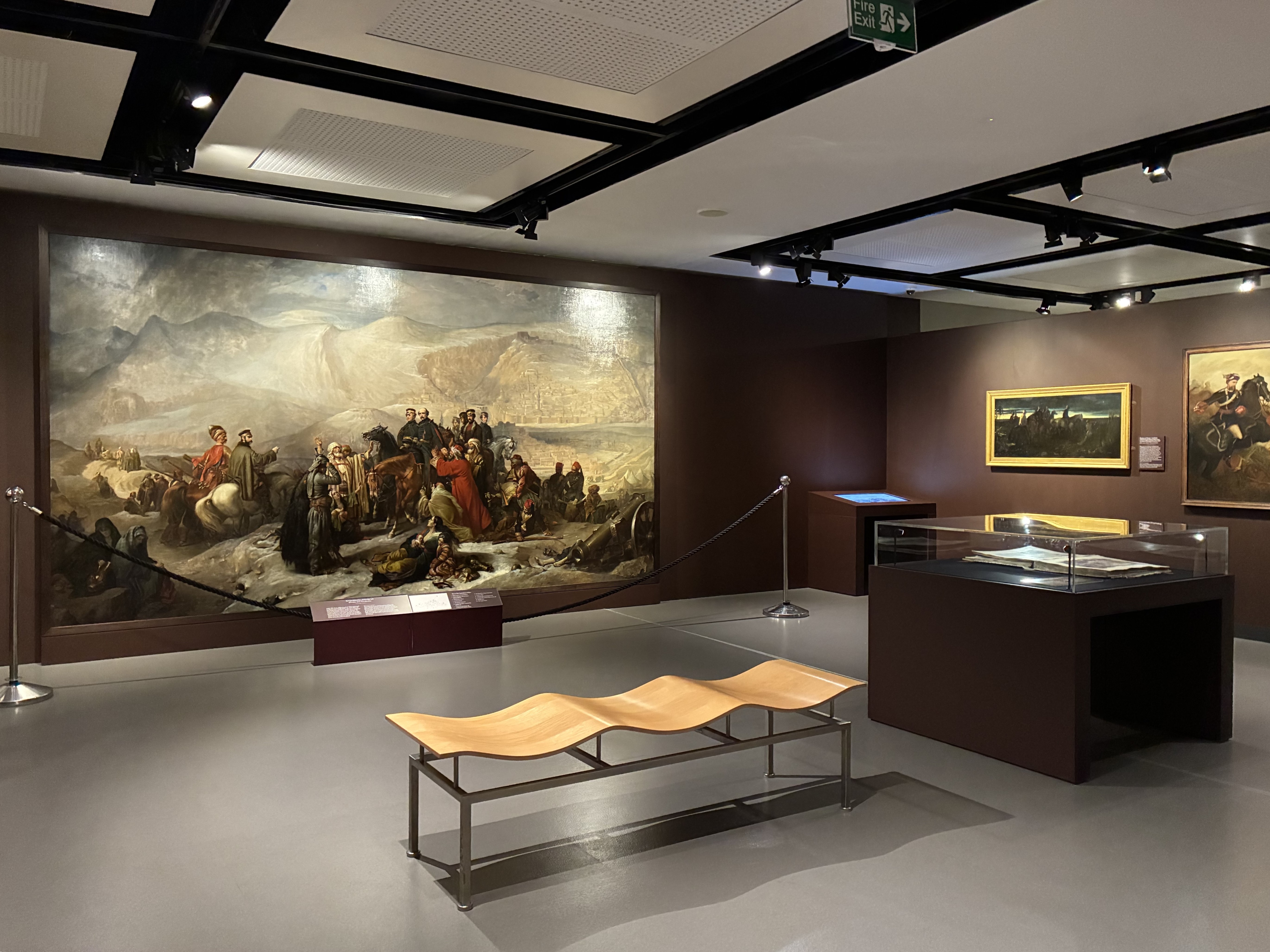
Installation view of Myth and Reality: Military Art in the Age of Queen Victoria at the National Army Museum showing the five-yard-wide oil painting ‘The Capitulation of Kars, Crimean War’ by Thomas Jones Barker (1855) with its static explanatory panel in front and an interactive screen off to the right (photo by the author)

Victoria’s Wars timeline

The exhibition includes a timeline of wars fought during Victoria’s reign. The point is that the British Army campaigned almost constantly throughout the period. There were a few big wars (the Crimean War, the Indian Mutiny and, right at the very end, the Boer War) but most of the conflicts we were involved in were small and localised, what modern historians call Victoria’s ‘small wars’.

  • 1837 – Queen Victoria ascends the throne
  • 1839 – the first photographs by Louis Daguerre in France and William Fox Talbot in England
  • 1842 – the world’s first illustrated weekly news magazine launched, the Illustrated London News
  • 1845 to 1846 – First Sikh War
  • 1852 to  1853 – The Second Anglo-Burmese War
  • 1853 to 1856 – the Crimean War
  • 1854 – Florence Nightingale travels to Crimea with 38 nurses. William Howard Russell’s reporting for The Times transforms people’s understanding of the squalid reality of war. 25 October – Battle of Balaklava and Charge of the Light Brigade.
  • 1854 – the Victoria Cross (VC) was introduced by Royal Warrant on 29 January 1856 to acknowledge the bravery displayed by soldiers and sailors during the Crimean War and soon after the Queen awards it to 62 Crimean war veterans

Queen Victoria and Prince Albert inspecting the wounded Grenadier Guards in Buckingham Palace. Coloured lithograph by George Thomas after himself (1855) Wellcome Collection

  • 1857 to 1858 – the Indian Rebellion
  • 1873 to 1874 – Third Anglo-Ashanti War
  • 1878 to 1880 Second Anglo-Afghan War
  • 1879 Anglo-Zulu War, featuring the Battle of Rorke’s Drift, 23 January 1879
  • 1880 to 1881 First South African War
  • 1882 Anglo-Egyptian War
  • 1884 to 1885 – Siege of Gordon at Khartoum, leading to its fall on 26 January 1885
  • 1885 Third Anglo-Burmese War
  • 1895 to 1896 Fourth Anglo-Ashanti War
  • 1898 – British reconquest of Sudan, featuring the Battle of Omdurman, 2 September 1898
  • 1899 to 1902 – Second South African War, featuring the sieges, the concentration camps etc
  • 1900 Fifth Anglo-Ashanti War

My take

There are about 40 artists, amateur and professional, soldiers and civilians, represented across the exhibition but the exhibition begins in a very decided way which raises a number of questions, because it starts with a strong emphasis on women war artists.

A feminist emphasis on women’s military art

The curators – all women – have decided that the first dozen or so works you see are all by women artists and devote several sections to them.

Victorian women artists, they tell us, helped to shape public perceptions of Army life. Many women were connected to soldiers through marriage or family, sometimes travelling with them abroad and depicting the people and places they saw.

Women were also important supporters and collectors of art, none more so than Queen Victoria herself. The Queen was also one of the most prominent subjects of military art, along with another celebrated figure of the time, Florence Nightingale – which explains why there’s a wall of works depicting the Queen meeting war veterans, awarding medals etc, and a little section about Florence Nightingale (who was famously averse to having her image captured, as she believed it detracted from her work).

However, as the exhibition proceeds you realise that most of the artists on display are not women, and, of course, none of the soldier artists are female – so why start this way unless you’re making a polemical feminist point? The implication seems to be that, after centuries or millennia of The Patriarchy, of tellings of history and art which downplay or completely ignore the role of women in the creation and consumption of art, this exhibition is doing its bit to redress the balance.

Fine. I understand. Why not? But there’s a second element to this approach which is notable and, maybe, problematic: this that one of the greatest, if not the greatest war artist of the Victorian era was Lady Elizabeth Butler, and so, hand-in-hand with the ‘women and military art’ section goes the ‘Lady Elizabeth Butler’ section. On one level there’s no quibbling with this: Butler was an outstanding artist and produced some of the standout works of the entire century. She was an absolute mistress of her craft, the half a dozen big paintings of hers brought together here are alone worth travelling to visit the show for, especially as several of them are usually buried in the Royal Collection.

So on the plus side, ignoring all its other features for a moment, you could say this is an outstanding selection of paintings, sketches and anecdotes by one of the nineteenth century’s great artists, and this is all to the good.

So why am I kvetching? Because the curators state, in these opening sections, in these early wall labels, that Lady Butler transformed military painting, depicting the life of soldiers with a new realism, taking a new, humane approach and setting a new standard for the subject. And this is all well and good, too, except that… In order to understand why Lady Butler is so important, and what she transformed, and what she changed it would have been good to have been fully introduced to the tradition of Victorian military painting which preceded her.

Instead, the result of placing Lady Butler right at the start of the show is to jump quite a long way into the later Victorian period without any preliminary explanation.

The work which really brought her to general attention was her ‘Roll Call’ which was displayed in 1874, 37 years into Victoria’s reign – and the first big work of hers which the curators feature, on the first wall of the exhibition, is ‘Dawn of Waterloo’ which was first displayed in 1895! 58 years into Victoria’s reign and only 6 years before her death. It’s a great painting but it comes at the very fag end of the period being covered and so is pretty misleading about the military art of Victoria’s era.

‘The Dawn of Waterloo: The Reveille in the Bivouac of the Scots Greys on the morning of the battle’ by Lady Butler (1895) the first full-scale painting by Lady Butler which the visitor encounters in ‘Myth and Reality: Military Art in the Age of Queen Victoria’ at the National Army Museum

Recap

So the decision to emphasise women’s role in military art may be laudable, and bringing a number of women’s works all together in the first few rooms ensures that the subject gets the prominence it deserves, rather than interspersing women’s works chronologically among the men’s pictures where they might be overlooked and unnoticed (as very probably happened in so many previous exhibitions on the subject).

Fine. And if you’re going to mention women artists of the time, then it would be silly not to mention and indeed have a section about the greatest of them, Lady Butler, also here right at the start. OK. Fine.

But the (maybe unintended) consequence of all this is that the visitor is deprived of a chronological understanding of the subject – of what military art looked like before Victoria, then at the start of her reign, how it developed through the decades leading up to the two seismic conflicts of the Crimean War and the Indian Mutiny in the 1850s, how it reflected trends in the broader art world, and so on.

You see how a chronological survey like this would have been interesting in itself and might also have better prepared the way for Lady Butler’s dramatic innovations: by the time you got to Lady B you’d have had a much better understanding of The Tradition she was transforming… but instead you have to work it out for yourself.

Five styles

This unchronological approach characterises the rest of the exhibition, too. Particularly in the sections about ‘Patriotism and Portraiture’ and ‘Realism and Reportage’, works from the 1840s or ’50s are placed next to works from the 1880s, ’90s or even early 1900s – it’s up to the visitor to make chronological, historical and aesthetic sense of the many different styles on display.

Having gone round the exhibition three or four times, dwelling on favourite works (and being drawn back again and again to the brilliant Butler paintings) I think I came up with about five different, roughly chronological styles of painting. They are:

  1. Romantic-sublime
  2. Patriotic-sentimental
  3. Mid-Victorian anecdotal
  4. Lady Butler
  5. Stiff official portraits

(This isn’t taking into account the pencil or charcoal sketches, and the many watercolours, which are specialist areas unto themselves.)

1. Romantic-sublime

Although painted in 1853 this picture strikes me as epitomising high Romanticism with its fondness for dramatic mountainous scenery and The Sublime. Look at the big baby eyes of Wellington (and his horse), the ethnic outfits of the local guides – it all has the rosy, soft-focus approach of Sir Water Scott’s novels.

Wellington at Sorauren, 27 July 1813 by Thomas Jones Barker 1853 © National Army Museum

2. Patriotic-sentimental

Kars is a city in north-eastern Turkey. In June 1855, as part of the during the Crimean War (1854 to 1856) it was besieged by a Russian army of 25,000. Demoralised by their defeats at the hands of the Russians, the Turks left the defence of Kars to Brevet Colonel (later General Sir) William Fenwick Williams, the British commissioner. The garrison was able to repulse three major Russian attacks but eventually cold, famine and an outbreak of cholera forced it to surrender on 26 November 1885. In recognition of their heroism, the Russians allowed the British garrison to march out of the city with the honours of war and into captivity.

‘The Capitulation of Kars, Crimean War’ by Thomas Jones Barker (1855) (National Army Museum)

This is a huge painting, over five yards wide (!), and it’s accompanied by not one but two diagrams identifying all the figures in it, one a static diagram, one an interactive display of the same. But it was only chatting to one of the (very well-informed) visitor assistants that I really understood what is going on.

You see the local in the red cloak clutching the hand of the bald British officer on his horse (Major General Fenwick Williams) and the cascade of similar locals off to his right, and the pitiful woman lying on the ground with her helpless children in the foreground, and similar locals on his left?

These are the local Turks who the British are abandoning to the kindness of the conquering Russians. So they are pleading with the British not to leave and abandon them but the British, defeated, have to. (Maybe a modern analogy would by NATO forces pulling out of Afghanistan and letting the Taliban take over.) It is this acute sense of regret and shame which explains the expression on the face of the British officer.

(You could write a book about the peoples the British Army promised to protect, only to abandon them – I’m currently reading a book about the Dutch Revolt which mentions that Queen Elizabeth I made all kinds of promises to the Dutch patriots in the 1580s which she then completely broke… It’s a long tradition.)

Back to the painting: ‘The Capitulation’, then, is a psychological study in the pain and embarrassment of duty, of a fine upstanding officer mortified to be abandoning the people he promised to protect. As such it is full of all kinds of melodramatic details, the thrown-up hands of the man in white on the left, the tearful eyes of the woman on the ground. It’s like a tableau from a mid-Victorian melodrama, at the centre of which is the British officer maintaining a stiff upper lip despite being deeply moved.

In fact it tells you a lot about mid-Victorian art and audiences that the work was commissioned, not by an aristocratic patron, but by the art dealers and print makers Agnew and Sons, precisely to be turned into prints and widely sold. So it is very deliberately catering to popular taste and demand.

3. Mid-Victorian anecdotal

The Victorians loved detail and clutter. Dickens’s novels overflow with wonderfully telling details and so do classic mid-Victorian paintings like William Powell Frith’s Derby Day (1858) or The Railway Station (1862), packed with little stories and anecdotal details. The exhibition includes an absolute classic of this style, ‘Home Again’ by Henry Nelson O’Neil.

‘Home Again’ by Henry Nelson O’Neil (1860)

‘Home Again’ depicts soldiers disembarking from a troopship at Gravesend on their return from the Indian Mutiny (1857 to 1859). For military history buffs the curators tell us that about 40,000 British troops were sent to India (more than had been mobilized for the Crimean conflict) to suppress the mutiny among the Indian troops of the East India Company’s Bengal Army.

But in purely visual terms we are invited to relish the details! At the very top a young woman peers over the shoulder of a bearded infantry corporal, who holds their baby for the first time. In the middle-right a young soldier of the 60th (The King’s Royal Rifle Corps) dressed all in black leans down to offer his Victoria Cross to a Chelsea Pensioner. The central action depicts sailors assisting a wounded sergeant to disembark. We are told that he wears a Kilmarnock ‘pork-pie’ cap under the white cotton ‘Havelock’ cover distinctive to the campaign, with the neck flap for protection from sunstroke.

There is patriotic pride here, and sentimentality of a sort, but it is very clearly all about the common people, ordinary soldiers (and sailors) and their reunions with wives and sweethearts. As such, it a little bit anticipates Lady Butler’s humanism but still with that mid-Victorian obsession with anecdote and detail.

4. Lady Butler

‘The Roll Call’ is one of the most celebrated British paintings of the 19th century. On its public appearance in 1874 it cemented Butler’s reputation as one of the leading painters of the age. It depicts a roll call of soldiers from the Grenadier Guards following the Battle of Inkerman in 1854 but can stand for thousands of similar occasions.

The Roll Call by Lady Elizabeth Butler (1874) © Royal Collection Enterprises Limited 2025 | Royal Collection Trust

The composition expresses Butler’s profound feel for the plight and experiences of the ordinary soldier, for the pity of war and the walls of the show feature not one but two quotations by her, emphasising how she eschewed patriotic guff in her concern for the actual lived experiences of the men who fought and suffered.

‘I never painted for the glory of war, but to portray its pathos and heroism’.

‘The Roll Call’ was fantastically successful. When it went on display at the Royal Academy it attracted over 300,000 visitors in a 3-month period and the more you look, the more brilliant it becomes.

The curators explain that historical or military painting for a long time worked with the basic design of a triangle which places the most important person – generally the commanding officer – at the apex (as in the pictures of Wellington and Major General Fenwick Williams, above). As soon as that’s pointed out to you, you realise really drastic difference her, the polemical message sent by the composition which is the equality of the men, all placed on the same level.

There’s still an anecdotal aspect to the thing, if you go up close and work slowly from left to right, starting with the two soldiers on the left lighting a sneaky fag or cigar, and working along through the bandages and blood of the wounded to the striking element of the man who’s collapsed into the snow. It really conveys the wretched pity of war, 44 years before Wilfred Owen coined the phrase for his volume of First World War poetry.

There is, of course, a figure on horseback, but he isn’t treated with the Romantic sentimentalism of the Wellington, above. Instead we can feel the gruff sympathy of the sergeant in charge as he reviews his wounded troops. And he also acts as the viewer’s entrance point into the work. If it was just the row of soldiers it would be slightly impenetrable: the officer on horseback not only relieves what might have been monotonous, but his movement carries the eye into the composition.

But there’s more because, after you’ve finished admiring the overall shape and canny dynamism of the composition, if you step back you notice the colours. You notice how Butler has depicted the uniforms of the men with great accuracy but used them as a springboard to create a composition of shades of grey. The grey coats and badges are reflected under the line of men by the different shades of snow and above them by the extremely nuanced and varied shading of the clouds.

On a literal level the coldness of the winter is evoked by the dominant tones of black, grey, white and brown, contrasting with small splashes of red from coatees and flags. But on a more aesthetic level, the awareness of shades of grey makes you think of James McNeil Whistler’s compositions, symphonies of certain palettes and timbres.

And then you notice the crows, the brilliant broken flight of crows coming from the middle of the composition and looping up over the head of the reviewing officer.

In its: 1) absence of sentimentality; 2) its immediately felt humanistic concern for the plight of the average soldier; and 3) its stunning painterliness, its brilliance of composition and colouring, ‘Roll Call’ really is a masterpiece. It’s worth visiting the exhibition just to see this one work in the flesh.

5. Stiff official portraits

Something the curators of the Army Museum must struggle with is that so much military art is decidedly average, if not actively poor. One or two of the battle paintings here struck me as ludicrously bad, but there’s a more subtle problem and that’s to do with military portraits.

I bet there are tens of thousands of these up and down the land, professional portraits of Britain’s countless officers, generals, admirals and so on which are good enough, decent enough, professional likenesses, but are never going to make it into anyone’s history of art because they are, by their nature, a very conservative wing of the medium.

Their number, their prevalence and popularity in Victorian times explain why there is a section titled ‘Patriotism and Portraiture’ here. Not only did ‘the people’ want to see portraits of heroes like Wellington or Gordon or Roberts, but countless military families wanted professional portraits of their eminent male members to hang alongside all their forebears, and hundreds of officers messes and regimental headquarters, ditto.

Hence a half dozen masterpieces of stultifying conventionality and woodenness.

Lieutenant The Honourable Frederick Hugh Sherston Roberts VC, Kings Royal Rifle Corps by Julian Russell Story (1899)

There’s a story behind this portrait, which is that Roberts not only won the Victoria Cross, but the same medal was awarded to his father, Field Marshal Frederick Sleigh Roberts, 1st Earl Roberts, making them one of only three father-and-son pairs to be awarded the VC in its 169-year history.

Watercolours

As mentioned, the exhibition includes 20 or so watercolours, much smaller and more intimate than the bombastic oil paintings. In a sense, watercolours under-promise and so are often able to over-deliver.

Installation view of Myth and Reality: Military Art in the Age of Queen Victoria at the National Army Museum showing a set of six watercolours of the Crimean War by William Simpson (photo by the author)

General Cannon’s landing, July 7 1854

My wife and I play a simple game when visiting exhibitions. Having crawled through the exhibits and rooms, reading and processing every wall label, we reach the end, turn round and go back through it, this time lightly, airily choosing one work per room which we like and having to explain why. A variation is to choose a work we would buy and take home to hang in the landing or hall or wherever. As I’ve stated, the Lady Butler paintings are all brilliant, but in terms of something I’d actually buy and live with, something a bit more modest, I kept returning to one of the 20 or so watercolours on display, ‘General Cannon’s landing, July 7 1854’, a pencil and watercolour by Joseph Archer Crowe (who has seven works in the exhibition).

‘General Cannon’s landing, July 7 1854’ Pencil and watercolour by Joseph Archer Crowe

Crowe worked at the Crimean War as a special artist for The Illustrated London News. This watercolour depicts how, on 7 July 1854, Turkish forces launched an amphibious assault across the River Danube on Russian positions at Giurgiu (in modern day Romania). The Russians were driven back and Giurgiu was occupied by the Turks.

It’s not going to rock anyone’s world, I just liked the composition, the line of ships going in from roughly right to left, and the light impressionistic touches of colour.

Women artists

I may have missed some but, for the record, here are the women military artists featured in the exhibition:

  • Lady Elizabeth Butler
  • Jane Drummond (portrait of Mrs Anne Steele)
  • Gertrude Ellen Burrard (portrait of Nussiban, our ayah)
  • Elizabeth Anne Leslie Melville (portrait of Major General Sir Owen Tudor Burne)
  • Emily Henrietta Ormsby (portrait of Colonel Henry Francis Strange; portrait of Major General John William Ormsby)

Lady Butler’s works

  • Tenth Bengal Lancers tent pegging (1873)
  • The Roll Call (1874)
  • Study of a Wounded Guardsman (1874)
  • Quatre Bras (engraving of oil painting, 1879)
  • Patient Heroes: A Royal Artillery Gun Team in Action (1882)
  • Scotland Forever! (engraving after oil painting, 1882)
  • After the Battle of Tel-el-Kebir (engraving of original painting, 1888)
  • After the Battle of Tel-el-Kebir (fragment of original painting, 1888)
  • The Defence of Rorke’s Drift (1882)
  • The Ballad of the Royal Irish at Sebastapol (6 x pencil illustrations of a poem, 1890)
  • Military sketches (pen, watercolour and pencil, 1893)

Summary

I don’t know whether my point about the lack of chronology and build-up to Lady B is even worth mentioning. My wife went round the displays two or three times with me and didn’t even notice or care, just enjoyed various works on their own merit.

So: if you’re interested in military history the exhibition contains lots of titbits about key wars and engagements of Victoria’s reign, about medals and uniforms, some lovely watercolours and a dozen or so really impressive oil paintings, along with a number of average or also-ran works which, however, illustrate interesting topics, such as the section about the creation of the Victoria Cross, and so on.

And the National Army Museum is always a lovely place to visit because – ironically, given its subject matter – it’s such a calm, clean and peaceful place to be. Go see.


Related links

Related reviews

Shakespeare and War @ the National Army Museum

A tale of two Henries

In 1944 Laurence Olivier produced, directed and starred in a movie version of Shakespeare’s play ‘Henry V’. Shot in bright primary colours it dealt in bright primary patriotic emotions and 30 years later my Dad and his best friend could remember seeing it in the cinema as 12-year-old kids and being stirred by its patriotic fervour, its stirring invocation of England’s valour and fortitude, at a time when German V rockets were falling on London and the south-east. (A V2 rocket fell on the house next door to my Dad’s, killing the occupants. The one time he mentioned it was the only time I ever saw him cry. Britain needed all the patriotism and determination it could muster.)

Installation view of ‘Shakespeare and War’ at the National Army Museum showing posters, cartoons, photos and programmes from the Second World War including a poster for Olivier’s Henry V

Those ardent schoolboys will have noticed that the film was ‘dedicated to the ‘Commandos and Airborne Troops of Great Britain the spirit of whose ancestors it has been humbly attempted to recapture’ because this appears as a caption at the start of the film, but won’t have known that the production was partly funded by the British government as a form of soft propaganda.

Forty five years later, in 1989, the actor widely seen as inheriting Olivier’s mantle, Kenneth Branagh, directed and starred in a new movie version of ‘Henry V’. Much was made of the fact that, instead of stylised sunny sets, the play went for a darker, grittier look, most notably in the battle of Agincourt scenes, filmed on a lovely sunny day in the Olivier version, but in a downpour of rain in the Branagh, which turns the battlefield into a quagmire, spattering all the characters with mud and also gore from the countless bodies which have been hacked and stabbed. Critics weren’t slow to point out that it was made in the aftermath of the Falklands War and so carried a strong message against war and warmongering.

Poster for the original 1984 Royal Shakespeare Company production of Henry V directed by Adrian Noble and starring Kenneth Branagh, as featured in ‘Shakespeare and War’ at the National Army Museum

The same play, the same author, the same plot, the same characters, the same stage directions and the same words – and yet supporting two very different productions, reflecting very different societies, mindsets and values.

These are just two examples of the way Shakespeare’s plays about war – the causes of war, the preparations for war, the experience of war, wartime emotions from terror to exhilaration – and the greatly varying opinions of his many different characters about war and warfare, have been quoted, adapted, distorted, illustrated and recycled, used both to support and attack Britain’s wars, in the 400 years since his death.

Shakespeare and War

The National Army Museum in Chelsea is currently holding a FREE exhibition titled ‘Shakespeare and War’ which sets out to review the huge history of the national playwright’s role in Britain’s many wars and conflicts and how his words, stories, characters and scenes have been used in widely different times and situations.

The exhibition sets out to document how the plays, characters and speeches have been excerpted and exploited propagandists, governments, commentators, satirists and anti-war activists, soldiers and civilians – during the turbulent 400 years since Shakespeare’s death, in 1616. As the curators put it:

The plays have been used to rally the nation at times of crisis and to reflect on the human cost of conflict. But they have also been used to critique war and to consider the more challenging aspects of the military experience. They have inspired soldiers and civilians alike, helping people face adversity on the battlefield and at home.

After Shakespeare

Thus the exhibition starts after Shakespeare’s death. There’s none of the usual fol-de-rol about his biography or the Globe Theatre or the parabola of his career, just the blunt facts that he was a very successful actor-dramatist-manager, who died in 1616, before the British Army even existed.

Instead we are thrown straight into the first major conflict which occurred after his lifetime, the civil war or wars of three kingdoms which broke out 23 years after his death, in 1639, and lasted until Cromwell’s pacification of Scotland in 1653.

The exhibition is divided into six broad historical sections, each of which is introduced by a wall label and then features all sorts of bric-a-brac from the period in question – broadsheets, posters, cartoons, pamphlets which cite or reference, quote or parody scenes, characters or speeches from the plays to suit the purpose of polemicists and propagandists of the moment, paintings or photos of Shakespearian actors or patrons, posters for productions through the ages, and then – in the modern era – recordings of radio and TV productions and so on. At the most basic level, it’s a curiosity shop of historical Shakespeariana.

1. Royal Shakespeare: The Civil War and Beyond

During the English Civil War Shakespeare was often associated with the monarchy. While in prison awaiting trial, King Charles I read Shakespeare’s (Second) Folio (the First and Second Folios were the first attempts to publish all Shakespeare’s works in one volume). The King made notes on its pages and the exhibition has his copy on show. This did not go unnoticed by the great poet and Puritan propagandist, John Milton, who is represented here by a first edition of his pamphlet, Eikonoklastes.

Installation view of the civil war part of ‘Shakespeare and War’, showing, on the left, engravings of Charles I (above) and Cromwell (below) along with Charles’s copy of the Second Folio beneath an English mortuary sword (photo by the author)

This little collocation of objects overflows with meanings. Eikonoklastes was written and published late in 1649 to justify the execution of King Charles which took place on 30 January 1649. It was a point-by-point rebuttal of a pamphlet titled Eikon Basilike, a Royalist propaganda work, which purported to be a spiritual autobiography of the saintly king. The Basilike set Charles up as the type of a perfect enlightened monarch who ruled by the Divine Right of Kings and through the ancient constitution. Milton refuted all these points and more, claiming that Charles’s rule had degenerated to a tyranny over a people who could only be free by executing him and abolishing the monarchy altogether.

Where does Shakespeare come in all this? Well, he was part of the culture wars between the two sides. Theatre was encouraged and sponsored by the King, the Court and aristocrats. Shakespeare’s younger contemporary, Ben Jonson, ended up writing masques – elaborate ritualistic performances, accompanied by music – for the King and Court, which reinforced the ideology of royalty and monarchical rule and in some of which the king himself took part.

In the eyes of radical Puritans all this was blasphemy. Representing people on stage came close to breaking the commandment about not worshipping images. Plays diverted people’s minds away from the only thing they should be contemplating, the glory of God. Playhouses were notorious sites of crime and prostitution. Shakespeare’s plays, even the sternest tragedies, are littered with outrageously rude puns and euphemisms, the kind of thing Parliamentary Puritans had in mind when they accused the theatre of staging ‘spectacles of pleasure, too commonly expressing lascivious mirth and levity.’

For all these reasons and more the Puritans protested against the theatre in the years leading up to the war, and this explains why, when Parliament took control of the capital in September 1642, they promptly shut down all the playhouses. Which explains why there’s an engraving of Cromwell in this exhibition showing him wearing a suit of armour above a pile of discarded theatrical bric-a-brac, such as masks and disguises. For 18 long years the theatres were dark. Shakespeare’s Globe was torn down in 1644 and turned into ‘tenements’.

The Restoration

In 1660 the monarchy was restored and Charles II assumed the Crown. His 25-year reign was troubled by political and religious issues along the old civil war schism, at its most fundamental the clash between devotees of the Protestant cause and Charles’s Court which became tainted with accusations of Catholic sympathy, especially after he married the Catholic princess Catherine of Braganza in 1662.

Like his father Charles was a great patron of the arts, including theatre, and his rule saw the flourishing of the movement referred to as Restoration Comedy. The theatre once again became associated with all the vices of Londoners at play, and this, like the theatre of his father, became the target of religious criticism. The ongoing schism between Catholic-leaning court and Protestant nobles came to a head during the three-year reign of Charles’s brother, James II, who with typical Stuart arrogance, not only took a Catholic wife but made it clear that the new infant son she bore him would be raised a Catholic. The Protestant aristocracy rebelled and overthrew him in what their propagandists named The Glorious Revolution, inviting the Protestant Prince of Orange (in modern Holland) to come and be our king.

The curators skimp a bit on this period, displaying just one work, a copy of a book by the playwright John Crowne adapting Henry VI parts 2 and 3 and titled ‘Misery of Civil War’.

Shakespeare’s history plays

The thing is, Shakespeare’s history plays amount to a sustained investigation of the nature of authority and ‘good’ rule. All of them are named after the English king they focus on and ask questions like, What makes a good king? What makes a bad king? Are nobles, or ‘the people’, ever justified in overthrowing a king? If two noble houses fight for the crown, what are ordinary people to do? Follow their conscience, try to avoid the conflict, or fight for their local lord and master? Is there such a thing as a ‘just’ war in which case, how do you define one?

Questions like these echo throughout the obvious plays i.e. the ones about English history, but are also central to the Roman plays and three of the four great tragedies.

The history plays are usually divided into three groups:

  • the series depicting the Wars of the Roses, being: Henry VI parts 1, 2 and 3, and Richard III (4 plays)
  • the second tetralogy – including Richard II, Henry IV parts 1 and 2, and Henry V
  • the standalone plays King John, Edward III and Henry VIII

The Roman plays which discuss the nature of authority and leadership focus on Julius Caesar and its sequel, Antony and Cleopatra. Both cover wars and include battle scenes.

The tragedies all feature war, in different ways. Macbeth is about a successful soldier and includes actual battle scenes. King Lear and Hamlet feature the invasion of their respective countries (England by the French and Denmark by the Swedes) but no actual fighting. And Othello is all about a highly successful mercenary general, which features no battles but is drenched in reminiscences of fighting and the rhetoric of battle.

What I’m trying to convey is that these 17 or so plays are rarely about war as such, but but are far more about the nature of power and authority and what happens when authority collapses.

The eight classic history plays are about the collapse of authority in one country and civil war among the English. The two Roman plays are the same: in both the Romans aren’t fighting any external enemy, but among themselves. Similarly, the three tragedies (excluding Othello) are about the collapse of royal authority in one country – the French only invade England in Lear and the Swedes invade Denmark in Hamlet once the native rulers have made a complete horlicks of trying to rule themselves.

And again, although the English come to the aid of the rightful heir to the throne at the end of Macbeth, they only have to do so because, yet again, the ruling class of the country in question (this time Scotland) have made a total mess of ruling themselves, as a result of all the murders Macbeth finds himself voodooed into committing.

Thus, the seventeen or so plays about history are almost entirely about the collapse of political authority in one country leading to civil war. The fifty years from the collapse of Charles I’s power in the 1630s through to the Glorious Revolution in 1688 are, therefore, the most relevant or applicable to Shakespeare’s concerns. It is, therefore, strange and intriguing that contemporaries, apparently, according to this exhibition, made so little application of the huge amount Shakespeare wrote on this subject to the one era in the past 400 years which most suited it.

This little survey of Shakespeare’s history plays also explains something else. Henry V is the only one in which is not about a civil war. Henry V is the only one in which we are not fighting among ourselves, but go abroad and fight somebody else. This explains why Henry V crops up in this exhibition as the spearhead for patriotic fervour more times than the ten other history plays put together – because once we’d sorted out our own political problems via the civil wars and rebellions of the seventeenth century, we turned our warlike energies against foreigners.

2. Revolutionary Shakespeare: Change and Political Debate

The late eighteenth century saw a major global war (against France) and two revolutions (in America and France) which changed the world. In each of these conflicts Shakespeare’s plays, characters and the Shakespeare brand were used to define, critique and support both a patriotic war and new political movements.

The Seven Years War

By the start of the eighteenth century Shakespeare had become established by numerous writers, critics and commentators as a national icon. The exhibition skips over the wars of the early 18th century, in Europe and India:

  • War of the Spanish Succession 1701 to 1714
  • Great Northern War 1717 to 1720
  • War of the Austrian Succession 1740
  • Carnatic Wars 1744 to 1763

Instead it jumps to the Seven Years’ War (1756 to 1763), the war against France which saw British victories on the Continent, in India, in the Caribbean and North America. The exhibition includes a number of interesting mementoes from the war.

David Garrick, the leading figure in London theatre by the mid-century, wrote a Dialogue to preface a 1756 production of The Tempest, in which two characters debate the rights and wrongs of the new war. It reminds us that for hundreds of years actors, managers and playwrights felt perfectly free to preface Shakespeare productions with prologues like this, tailoring the play to the issues of the day, or even cutting and rewriting bits of the plays to reflect current concerns.

In 1768 Edward Capell produced an edition of the plays in which he states what had, by then, become orthodoxy, that the 38 or so plays amount to ‘a part of the kingdom’s riches’. Not only this, but Britain’s standing ‘in the world’ depended on ‘the esteem within which these are held.’

The fact that Shakespeare’s one play which takes a foreign enemy is directed against the French did not escape numerous writers and commentators as Britain embarked on a global struggle against…the French. There’s a playbill for a production of Henry V staged in Covent Garden in 1761 which has two significant aspects. 1) For this occasion, the play was unsubtly subtitled ‘the Conquest of France’ and 2) each of the 23 productions were followed by a lavish recreation of the coronation of King George III which had just taken place (22 September 1761).

If Shakespeare’s association with kingship had been deeply problematic for Milton in the 1640s, long before a century had passed the name of Shakespeare, the Shakespeare brand, had become indissolubly linked to celebration of the solidly Protestant and anti-French monarchy.

The American War of Independence (1775 to 1783)

Following on from, and partly a result of, the Seven Years War, came the American War of Independence. Unsurprisingly, American patriots seeking to break from Britain drew on Shakespeare’s classical histories. Plays like ‘Julius Caesar’ and ‘Coriolanus’ helped support the idea of republican government and liberation from imperial rule.

The two sides (British and American) both staged plays and the curators display playbills from both sides, which use Shakespeare texts to propagandise for their cause. So there’s a playbill for an American production of Julius Caesar which applauds the ‘noble struggles for Liberty by that renowned patriot Marcus Brutus.’

There are rather more relics from the British side and the curators display pictures focusing on New York. This is because early on in the war, the British Army under the command of Lieutenant-Colonel Henry Clinton occupied New York City and turned it into a garrison town. Members of the Army staged regular productions of Shakespeare at the newly-renamed Theatre Royal, confirming the by-now well-established link between drama and royalty. the performances were staged ‘with permission’ of Clinton, who was also a patron of the performances. Plays were staged to raise funds for wounded soldiers. The British tended to favour Shakespeare’s monarchical plays, whilst American Patriots used plays with a republican ethos (such as Julius Caesar and Coriolanus) in their satirical prints and posters.

Lieutenant-Colonel Henry Clinton, 1st Regiment of Foot Guards, 1758 (National Army Museum)

The French Revolutionary and Napoleonic wars (1789 to 1802, 1805 to 1815)

As explained above, Shakespeare’s plays can be used to provide examples of resistance to oppression and corrupt politics and so justify insurrection against corrupt rulers. The French Revolution amounted to a massive ideological upheaval in the thinking of all Europe. In the three years after the initial overthrow of the monarchy in 1789, politicians and intellectuals all across Europe took the sides of either the revolutionary liberators or the rule of monarchy, hierarchy and order. But in 1792 revolutionary France declared war on Austria and Prussia and the conflict became military in nature. Many former sympathisers retracted their support, especially after the situation in Paris descended into The Terror of 1793 to 1794.

The French Revolutionary War lasted from 1792 to 1802, when it was terminated by the Treaty of Amiens. Fighting broke out a year later in what came to be called the Napoleonic Wars which were to last from 1803 to 1815.

During this long period of ideological and military conflict, Shakespeare plays, characters and lines were mobilised to justify both sides of the ideological and military divide. In Britain, politicians, public figures, actors, and the Army drew on the playwright’s characters and speeches to justify their reasons for going to war, and to criticize rebellions against royalty.

This 25-year period also happened to be a golden age of political satire, featuring two of the greatest British caricaturists and cartoonists, James Gillray (1756 to 1815) and Isaac Cruikshank (1764 to 1811). Amid the many visual jokes and references they and many cartoonists and commentators like them used to pillory the politics of the day, Shakespearian references loomed large.

So the exhibition has some excellent cartoons by both men, which invoke Shakespearian references for the purposes of mockery and exaggeration. This print by Cruikshank uses The Tempest to praise the patriotic Tory Prime Minister William Pitt and ridicule his chief political opponent, Charles James Fox, an opponent of the British monarchy who was an initial supporter of the French Revolution.

Prospero and Caliban in the Enchanted Island by Isaac Cruikshank (1798)

Smoothly dressed Pitt is depicted as the wonder-working magician Prospero, telling his creature:

Hence! – fetch us fewel and be quick
Thou wert best – shrugst thou malice?
If thou dost unwillingly what I command
I’ll rack thee with old cramps –

While Fox, portrayed as big ugly Caliban, and wearing a tricolour scarf (symbol of the revolution) shrugs with savage disgust, saying:

I must obey! his art is of such power
It would control a Setebos,
And make a vassal of him.

There’s a brilliantly vivid print by Gillray titled ‘A phantasmagoria – conjuring up an armed skeleton’ which depicts contemporary politicians as the three witches from Macbeth. The print criticises the Treaty of Amiens which was widely seen as a capitulation to France. In the picture the witches are replaced by three leading supporters of the treaty, Henry Addington, Lord Hawkesbury and William Wilberforce and their magic spells for peace have, it is implied, reduced Britannia to a skeleton. Note the sack of gold at bottom left implying that these ‘traitors’ were bribed to betray their country and the French cockerel at bottom right, mockingly standing astride a skinned British lion.

‘A Phantasmagoria; — Scene – Conjuring-Up an Armed-Skeleton’ by James Gillray (1803)

The exhibition includes probably Gillray’s most famous image, ‘The Plumb-pudding in danger; – or – State Epicures taking un Petit Souper’. The image depicts British Prime Minister William Pitt and French Emperor Napoleon carving up the world between them. I’ve seen it many times but didn’t realise that the epigraph directly under the title, at top right, is an adapted quote from The Tempest, namely ‘”The great globe itself and all that it inherits” is too small to satisfy such insatiable appetites’.

The Plumb-pudding in danger; – or – State Epicures taking un Petit Souper by James Gillray (1805)

In these cartoons you see something interesting happening. Many of the previous objects (from the Seven Years or American Revolutionary Wars) indicated that Shakespeare was best promulgated via productions of entire plays. Here, in these cartoons, you can see the way that Shakespearian tags and clichés now lend themselves to much more pithy and succinct visual media.

Satirical prints had been around all through the 18th century, in fact they go back to Shakespeare’s day and even earlier. But somehow the Gillray and Cruikshank feel new. They demonstrate how Shakespeare, as well as representing the ‘the kingdom’s riches, according to high-minded editors such as Edward Capell, could also be the source of popular jokes and gags.

From now on, alongside all the stirring patriotic stuff, the exhibition features a strand of often very funny works using Shakespeare for comic purposes.

3. Imperial Shakespeare: The Victorian Army

After Napoleon’s defeat at Waterloo in 1815, the British Army’s role began to change. Rather than fighting major campaigns on the Continent, it was regularly used to protect and expand Britain’s imperial possessions, to fight Queen Victoria’s ‘small wars‘. But further to what I just mentioned about comedy, my favourite bits from what amounts to the Victorian section of the exhibition, were comic.

It must be said that some of the exhibits in the show seem to bear a pretty slender relationship with its supposed subject, Shakespeare and War. For example, the eighteenth century section has a set of images around the death of General James Wolfe at the 1759 Battle of Quebec which have no direct relation to Shakespeare, don’t quote or cite Shakespeare, seem to have no relationship except that Wolfe’s death was made the subject of ‘patriotic plays’.

Less utterly irrelevant is this entertaining print. In 1823 British aristocrats still carried out duels and this print mocks the practice by having the duellers and their seconds portrayed as monkeys. Apparently the title derives from a quote from ‘The Merchant of Venice’ but it’s a pretty flimsy pretext for including it in an exhibition about Shakespeare and War.

Awful Moments or Monkeys of Honour, colour print by John Lewis Marks after an unknown artist (1823)

More directly relevant if irreverent are the excellent prints taken from a later book, the Military Misreadings of Shakespere by Major Thomas Seccombe. It contains 31 beautifully delineated cartoons of military cockups, clumsiness and pratfalls, each offset by an ironically serious Shakespeare quotation. In this one a beautifully dressed member of the Life Guards has just been thrown by his horse to the accompaniment of a grand quote from Titus Andronicus: ‘That what you cannot, as you would, achieve, you must perforce accomplish as you may’ which thus acquires a completely comic meaning.

‘That what you cannot, as you would, achieve, you must perforce accomplish as you may’ from Military Misreadings of Shakespere (1880)

The Crimean War (1853 to 1856)

It wasn’t all lolz. The great exception to the century of generally small colonial wars which the British Army fought was the Crimean War, the one major conflict we were involved in in the century between the end of the Napoleonic Wars (1815) and the start of the Great War (1914). This famously highlighted significant problems with the Army’s organization, notably in the famous and futile Charge of the Light Brigade. Newspapers reported on the poor conditions in which soldiers found themselves, leading to demands for improvements and reforms to the Army’s culture and structure.

Only one exhibit relates to this badly managed and bitter war, a watercolour done by the Swedish artist Egron Sellif Lungren which depicts a kind of cinematic reimagining of a production of Henry V (what else?) staged by Charles Kean at the Princess’s Theatre in 1859 i.e. a few years after the war ended. Queen Victoria attended the play and commissioned Lundgren to do a watercolour version of it for her Theatre Album. Of all the scenes in the play Lundgren chose to depict the siege of Honfleur which is not only the setting for Henry’s famous speech ‘Once more unto the breach dear friends’, but will have reminded many people of the long and gruelling British siege of Sebastapol.

Installation view of ‘Shakespeare and War’ at the National Army Museum showing Egron Sellif Lungren’s watercolour plastered across one wall, with Gillray and Cruikshank cartoons on the left

Imperial Shakespeare

Obviously the nineteenth century was the one in which Britain cemented its grasp over the largest land empire the world has ever known, as well as almost total control of the world’s oceans. This is a very big subject indeed and it is not really properly explored. Take just India. Were there no British theatres in India, Shakespeare productions in India? Did the growing Indian middle class every stage Shakespeare productions with Indian casts? Was Shakespeare’s name, plays or quotes never invoked to justify British rule in India? Were there comic or satirical pamphlets or prints using Shakespeare quotes to mock British rule in India? Not in this exhibition, nor anything about the British Army’s involvement in Africa, the Caribbean, the Middle East or Far East.

Instead, as I’ve already pointed out, some of the exhibits have only a tenuous or oblique connection to the exhibition topic. For example, a picture caption tells us that amateur theatricals were often staged by regiments and soldiers as peacetime entertainments, which we might well have guessed. And that’s the fairly flimsy pretext for sharing a photo of members of the East Yorkshire regiment staging a production of Hamlet at their barracks in Cheltenham in 1895.

The Cast of Hamlet, Winter Gardens, Cheltenham, 1895 (National Army Museum)

Meanwhile, there’s nothing about the second war of the period which shook British confidence, the Boer War of 1899 to 1902. Were there no Shakespeare productions mounted here in England to raise funds or stir patriotic fervour? Did the besieged populations of Ladysmith, Mafeking or Kimberley put on productions to keep their spirits up? Didn’t domestic commentators or cartoonists use Shakespeare quotes or characters as material? If so, none of it is displayed here.

4. Patriotic Shakespeare: The First World War (1914 to 1918)

During the First World War great service and sacrifice were required of both the Army and the civilian population. As in the last great campaign in Europe a century before, Shakespeare was used in Britain to rally the troops and the country behind a sense of national duty.

As mentioned above, some exhibits are included on pretty flimsy grounds: for example, there’s no real reason to include some of Lord Kitchener’s recruitment posters (Your country needs You) except for the fact that, after Kitchener drowned when the ship he was sailing in hit a German mine (HMS Hampshire, 5 June 1916) the League of the Empire started publishing and presenting special editions of the ‘Complete Works of Shakespeare’ to wounded and disabled soldiers in his name, an edition which quickly became known as ‘the Kitchener Shakespeare’ – but there’s nothing at all about Shakespeare in the famous posters.

‘Lord Kitchener’s Appeal’, recruiting poster, 1914 (National Army Museum)

More tenuous examples include: a sketchbook by a John Henry Jenkins, a front line soldier, which depicted not only trench life but the watercolours of amateur theatricals which the soldiers put on, although Shakespeare is nowhere mentioned; or a 1915 recruitment poster which includes the image of St George and the dragon and so, the curators suggest, might have reminded some viewers of Henry V’s famous call, ‘God for Harry, England, and Saint George!’ Pretty tenuous.

Much more relevant is a book of Shakespeare quotations arranged under themes or headings relevant to the war and distributed to soldiers, ‘Shakespeare in Time of War: Excerpts from the Plays arranged with Topical Allusions’, edited by the artist Francis Colmer and published in 1916.

Another apparently random object is this photo of Women’s Army Auxiliary Corps personnel packing boxes in a factory in 1918. Spot the Shakespeare connection? No, because there isn’t one…

Women’s Army Auxiliary Corps personnel packing boxes in factory, 1918

…until you look at the photo beneath it, which is a photo of Maggie Smale’s all-women production of Henry V, staged in a munitions factory in Leeds which had been operated by the ‘Barnbow Lasses’ during the Great War. Is this to do with feminism? Or pacifism? Or a celebrating of provincial grit? I wasn’t sure.

Still from Maggie Smale’s all-female production of Henry V as featured in ‘Shakespeare and War’ at the National Army Museum. Photo by Mike Oakes

Amateur productions of Shakespeare were mounted across the country, sometimes to raise morale, to entertain wounded soldiers, for the benefit of the public. Three hundred years after his death Shakespeare was not only a well-known brand but possibly the only literary writer a lot of working class people had heard of. As in his own time, he catered for an audience of elite intellectuals, the educated middle classes, and illiterate workers. You can see why Shakespeare productions abounded because he was 1) possibly the only playwright everyone had heard of and 2) safe –unlike more recent troubling playwrights of the previous generation (Shaw, Ibsen etc).

There’s a clip from an official film showing wounded soldiers watching open air production of A Midsummer Night’s Dream. Scenes like this 1) the British heritage which the soldiers were fighting for 2) to a wider audience demonstrated the care the government was taking of its fighting men. This clip appeared alongside footage of scenes of artillery and war preparation, thus dovetailing Britain’s cultural heritage into the war effort.

in my own life I’ve met plenty of people who don’t give a toss about official culture, art or theatre. You’ve got to wonder how many of the sock and maimed soldiers forced to watch this kind of thing actually enjoyed it or even understood it. Because that’s a thing about Shakespeare – unless you’re pretty familiar with the play beforehand, it’s impossible to get the most out of a theatrical production, in fact it’s often impossible to understand what’s going on and especially difficult to get any of the comedy in his plays.

It’s fascinating to learn about the Shakespeare Hut. In February 1916, to commemorate 300 years since his death, this mock-Tudor retreat was opened on a plot of land in Bloomsbury. The hut was built on a site cleared for a planned Shakespeare Memorial Theatre, which was abandoned because of the war.

The aim was to provide shelter for wounded Australian or New Zealand troops. Over the next two years it would welcome in more than 100,000 soldiers far from their New Zealand homes. Queen Mary visited in 1917, took up her post behind the tea counter, and poured cups for all the men.

The troops were subjected to regular Shakespeare productions, including an all-female Henry V starring Ellen Terry, one of the most famous actors of her day. Hah! So the Maggie Smale production was following in venerable footsteps.

The exhibition features photographs and playlists from the Hut and you can read more and see photos in an interesting Guardian article about it. Interesting to learn that it the site is now occupied by the London School of Hygiene and Tropical Medicine.

One of the most interesting learnings from the exhibition is about the role of theatricals among British prisoners of war held in Germany. The exhibition focuses on the Ruhleben Camp in Germany which housed some 5,000 POWs. Prisoners were allowed to construct a theatre and, for the same tercentenary which prompted the Shakespeare Hut, staged a series of productions, including Twelfth Night and Othello. The exhibition features photos and a programme from a 1915 production of As You Like It.

In a similar spirit, the British Red Cross mounted a Shakespeare Exhibition at the Grafton Galleries in 1917. Quite clearly, if you go looking for Shakespeariana during the First World War, you’ll find it.

Installation view of ‘Shakespeare and War’ at the National Army Museum, showing a poster for the Red Cross Shakespeare Exhibition of 1917 (photo by the author)

5. Democratizing Shakespeare: The Second World War

Same goes for the Second war. Once again Shakespeare was trotted out as the exemplar of the culture and values that were under attack from Nazi Germany, that we were fighting to preserve. The motives and means were very similar to the first war – am dram productions across the country to entertain wounded troops or raise money, leading actors of the day giving patriotic productions in London to stir patriotic fervour, footage of productions shot to be show in cinemas and raise morale.

With the new angle of radio. For the first time productions could be broadcast, to a large radio audience which steadily grew throughout the six war years. As part of the government’s attempt to mobilize society to support the war effort, British theatre was sponsored by the state for the first time in its history.

The Council for the Encouragement of Music and the Arts (CEMA) was created to promote and maintain the fine arts and British cultural life. It later became the Arts Council of Great Britain. The Entertainment National Services Association (ENSA) provided for the forces, organising shows and performances by well-known actors, singers, and comedians.

Photo of an ENSA production staged in a London underground station in 1942 (National Army Museum)

Despite the challenges of wartime, both theatre and Shakespeare thrived. Once again, his words helped to frame the experience of conflict both in Britain and across the world. The exhibition features a recording of a radio programme originally broadcast by the BBC Overseas Services on Shakespeare’s birthday on 23 April 1942. It included extracts from ‘As You Like it’, Henry IV part 1 and, of course, Henry V. It was introduced and performed by leading Shakespearean actors Peggy Ashcroft, Robert Donat, Edith Evans and Ralph Richardson. You can listen to it on headphones and marvel at their phenomenally posh plummy English voices.

There’s a section devoted to the Laurence Olivier production of Henry V described at the start of this review.

And once again there’s a section devoted to British prisoners of war staging Shakespeare productions in camps in Germany. The exhibition includes a list of plays staged at Stalag 383 in Hohenfels, which included ‘The Merchant of Venice’.

6. Just Shakespeare: Adapting After 1945

After the Second World War the patriotic tone of Laurence Olivier’s Henry V lingered throughout the 1950s. But the second half of the 1960s saw radical changes in all aspects of art and culture, with a variety of new approaches to all the arts including theatre. This included the anti-war movements triggered by Vietnam, as well as new attitudes to sex and nudity, which now began to appear in Shakespeare productions.

For 200 years the name and plays of Shakespeare had acted as a kind of recruiting sergeant for the British Army and rallying point for the nation in times of real threat (particularly during the Napoleonic, First and Second World Wars). From the late 60s onwards, Shakespeare’s relationship with the state, the Establishment and the Army came under increasing critical scrutiny. Not in every production, but in an increasing number.

Hence Kenneth Branagh’s 1984 RSC production. Unlike earlier productions it shows the execution of French prisoners onstage and then left the bodies and corpses from the Battle of Agincourt at the back of the stage, behind a gauze curtain, for the later, supposedly reconciling scenes between the English king and his French bride-to-be.

The last section of the exhibition, in the central booth of the (fairly small) exhibition space, takes the Branagh production as setting the tone for productions which followed the Falklands War (1982), the Gulf War (1990 to 1991), and the Iraq War (2003 to 2011).

It includes video clips of stage productions including:

  • a 2013 production of ‘Othello’ which depicts the characters in the modern-day Army uniform used during the Iraq War
  • a 2015 production of ‘Othello’ which features graphic scenes of waterboarding Iraqi suspects
  • ‘Days of Significance’, a play by Roy Williams based on ‘Much Ado About Nothing’ which looks at the impact of British troops who fought in the Iraq War

The strong anti-war flavour of these productions and the pretty intense criticism of the British Army and its techniques, could hardly be more unlike the innocent patriotism of the Shakespeare Hut or the brightly colours optimism of Olivier’s Henry V. If we go to war with Russia I wonder if Shakespeare will be trotted out to inspire patriotic spirit as it was 100 and 70 years ago. I doubt it. Shakespeare hasn’t changed, that’s to say the texts remain pretty much what they were 400 years ago. But our understanding of war, gained in the brutal conflicts in Iraq and Afghanistan, has made any thoughts about the glamour or heroism of war impossible to modern Brits.

Availability bias

This is a fascinating premise for an exhibition and I thoroughly enjoyed working my way through the wealth of objects and their captions. It proves that Shakespeare is like the Bible, so compendious and diverse that you can find words to justify more or less any opinion on any subject (as demonstrated by the opposing sides in the American War of Independence using Shakespeare to bolster their arguments).

However, it throws up an obvious issue which is to do with the availability of objects to display. The exhibition was curated by – and is based on the scholarly books by – two Shakespeare scholars, Amy Lidster and Sonia Massai, namely Wartime Shakespeare: Performing Narratives of Conflict. Just from the synopsis on Amazon you can see how a book-length work like this is free to range over all and any productions it likes because words are easy. On the other hand, an exhibition in a museum is severely limited by the objects it can get its hands on.

In fact, like every exhibition at every gallery or museum, this one is an exercise in the art of the possible. Objects which denote important productions or topics may not be available (or may not even exist) while other topics throw up a glut of barely relevant artefacts.

In addition, it’s difficult and expensive to get objects on loan from other collections whereas it’s cheap and easy to get them from your own storeroom, so all exhibitions in all galleries are biased towards the host institution and its collection.

Plus there’s the common problem with any historical overview which is that objects from three or four hundred years ago are rare whereas, as you get closer to the present day, the number of objects rapidly increases, until you are drowning in a surfeit of stuff.

These imbalances in the real world threaten to unbalance or distort the picture painted by any exhibition, an imbalance which is easily managed in books and articles where issues and ideas can be easily conveyed by text alone.

So, at various points, I couldn’t help feeling that the curators had included some objects more because they were just related to one of the conflicts during the period in question than for their Shakespearian relevance. As mentioned above I couldn’t see any Shakespeare connection to the three or four pictures of General Wolfe and the capture of Quebec except that the event was turned into patriotic plays and prints. To put it another way, some of the links between specific conflicts and Shakespeare were pretty tenuous. I still don’t understand why there was an English mortuary sword in the Civil War section except that maybe the curators felt they just needed a physical object, any object, to go alongside the half dozen books and pamphlets.

All the objects (photos, pamphlets, diaries and whatnot) are interesting, it’s just that I was left scratching my head why some of them were included.

Shakespeare and conflict

There’s another, more scholarly, issue. This, as I touched on earlier, is that taken together, Shakespeare’s dozen or so history plays, plus the relevant Roman plays and the tragedies, build up into a subtle, sophisticated, multifaceted meditation on the themes of power, authority, legitimacy, insurrection, rebellion, revolt and overthrow.

Arguably, to really address the topic which this exhibition sets out to explore, you would need a really sound grasp of how all these issues are dramatised and explored in the 20 or so relevant plays, before you even started your review of how they’ve been applied to Britain’s wars and Britain’s Army.

But this, of course, is a massive task – after a lifetime reading Shakespeare I still haven’t read all the history plays and have nothing like a complete grasp of the issues of legitimacy and political power which they raise.

And an exhibition like this has to be practical, finite and manageable. This one achieves what it sets out to do, in a relatively small space, as well as it probably could do. But, in my opinion, the ghost of the larger political, social and cultural issues raised by the plays hover over it, unmentioned and undiscussed.

To take just one aspect of what I’m driving at, many of the characters in the history plays (the ones I’m familiar with) describe and discuss the horror of war, the fear experienced by soldiers, the terror of innocent civilians, the horrific injuries, killing and massacres involved, the fields strewn with bodies, the devastated landscapes and ruined economies. Descriptions of these kinds of things are commonplace in the plays and yet, somehow, hardly occur anywhere in this exhibition.

At some point I realised that this is not an exhibition about Shakespeare and War as about Shakespeare and the British Army. This explains why it’s divided into chronological periods based entirely around conflicts the British Army engaged in right up to the present day, rather than the themes of war encountered in the plays which I have just listed. And this is why, although it’s a very enjoyable trot through British military history, with an emphasis on how Shakespeare’s name, characters and words have been exploited in times of war – it feels, ultimately, despite being packed with shiny objects, intellectually thin.

You can see how an exhibition about Shakespeare and war would actually be something quite different: instead of taking a chronological approach it would take the topics I’ve mentioned several times now – the collapse of authority, civil war, rebellion, interstate war – and then the aspects of war – recruitment, training, fighting, sieges, inspirational rhetoric, the exhilaration of fighting, the horror of wounding, the devastation of the countryside, the mourning of widows – and explore how all of these are described and critiqued in Shakespeare’s multifaceted dramas. It would be something completely different from this exhibition. But then again, maybe what I’ve got in mind would be so wordy and text-heavy that it couldn’t be staged as an exhibition at all.

What this exhibition does, it does very well. It is small but beautifully staged and is FREE.


Related link

Related books

Shakespeare reviews

National Army Museum reviews

Suspended States by Yinka Shonibare @ Serpentine South

Introducing Yinka Shonibare CBE

Yinka Shonibare CBE is a British artist of Nigerian extraction. He works in both London and Lagos. He was born in London in 1962. In 2013 he was elected to the Royal Academy. In 2019 he was made a Commander of the Order of the British Empire (CBE). One of the most interesting things in the exhibition is the fact that Shonibare has made ‘CBE’ part of his name. To quote the curators:

The artist includes CBE as part of his professional name as a gesture towards his complex relationship to British honours and the systems they represent.

In 2021 Shonibare co-curated the Royal Academy Summer Exhibition. In 2004, he was nominated for the Turner Prize. In 2008 and in 2010, his first public art commission, Nelson’s Ship in a Bottle, was displayed on the Fourth Plinth in Trafalgar Square. The Tetley commissioned Shonibare’s ‘Hibiscus Rising’, a major public memorial in Leeds for David Oluwale, which opened in November 2023.

His work has been bought by collections around the world including Tate and V&A in London, the National Museum of African Art, Smithsonian Institute, Washington and the Museum of Modern Art, New York.

Some Shonibare pieces were until recently on display in the Royal Academy’s Entangled Pasts exhibition.

Installation view of ‘Woman Moving Up’ by Yinka Shonibare at the Royal Academy’s ‘Entangled Pasts’ exhibition (2023). Note 1) the human figure 2) the West African patterned fabric. Courtesy the artist and James Cohan Gallery, New York. Photo © Royal Academy of Arts, London / David Parry © Yinka Shonibare CBE RA

The Shonibare work that I’m familiar with is characterised by 1) life-size human figures, sometimes looking like mannequins, sometimes like statues and 2) bright and vibrant colours used in decorative styles.

Suspended States

This is is Shonibare’s first solo exhibition in London for over 20 years and features two new large-scale installations: Sanctuary City and War Library. The Serpentine South Gallery has been divided into four distinct rooms or spaces for the show.

1) In the foyer or first room is ‘Wind Sculpture in Bronze IV’. Then come 2) ‘The War Library’ 3) ‘Sanctuary City’ and 4) ‘Decolonised Structures’. Off to one side is a room detailing Shonibare’s extraordinarily prolific work with art charities and groups he’s set up or hosts, either in London or Nigeria, but this is more part of his biography and career than art as such. It contains a packed timeline and an interesting video but no art works. Also gathered in the first few spaces are half a dozen works from his quilt series about African birds and cowboys angels. So to take them in order:

Wind Sculpture in Bronze IV

Straightaway the visitor is introduced to Shonibare’s swirling forms and colourful designs. Wind Sculpture in Bronze IV captures a giant billowing cloth, hand-painted in turquoise, yellow and orange Dutch wax pattern.

Installation view of showing ‘Wind Sculpture in Bronze IV’ in ‘Suspended States’ 2024 by Yinka Shonibare CBE at Serpentine South (photo by the author)

The wall label gives us some interesting cultural history which is that, back in imperial times, Dutch traders copied colours and designs from batik work in their colonies in the Dutch East Indies (what is now Indonesia). They adapted the patterns for mass production and sold them in West Africa. Here they became very popular and copied by local craftsmen and manufacturers who produced their own versions for sale within the British economic sphere. Slowly these colours and patterns became associated in the Anglosphere with West Africa, as they are today. But their true history reveals the complex cultural and economic entanglements of a globalised world.

(PS: A similar work, Material (SG) IV, has just been installed in the gardens of Dulwich Picture Gallery in South London.)

Three sets of quilts

1. The African Bird Magic quilt series

Large quilts of bold design and bright colours featuring realistic portrayals of endangered birds such as the Sokoke Scops Owl, Mauritius Fody and Comoro Blue Vanga into which are inserted traditional African tribal masks.

Installation view of ‘Suspended States’ 2024 by Yinka Shonibare CBE at Serpentine South showing two of the ‘The African Bird Magic’ quilt series © Yinka Shonibare CBE 2024. Photo © Jo Underhill. Courtesy Yinka Shonibare CBE and Serpentine

I liked these because I like, and value, birds. I have birdfeeders in my garden and plant insect-friendly flowers to encourage the insects the birds eat. And anyone who knows 20th century western art has been groomed to like African masks from their inclusion in so much Modernist art.

Apparently these pieces are intended to:

explore the degradation of the African environment through colonial industrialisation and its disastrous effects on ecology

But I didn’t get that one little bit from the actual works, which are pretty and decorative.

2. Creatures of the mappa mundi

Same kind of treatment, different subject. Large framed quilts depicting mythical creatures sourced from illustrations found in the largest surviving medieval map, Hereford Cathedral’s Mappa Mundi (late 13th and early 14th century). This one depicts the Bonnacon, a bull-like creature known for defending itself with caustic excrement.

The Bonnacon from ‘Creatures of the Mappa Mundi’ (2018) by Yinka Shonibare CBE. Commissioned by Meadow Arts. Courtesy Yinka Shonibare CBE and Goodman Gallery, Cape Town, Johannesburg, London and New York; James Cohan Gallery, New York; and Stephen Friedman Gallery, London and New York. Photo © Stephen White & Co.

I like medieval art and am a big fan of Northern renaissance art, but I wasn’t particularly taken with these. They seemed clumsy next to the delicacy and care of the originals.

Again, these pieces suffer from what you could call ‘over explanation’, as Shonibare claims that they reference ‘the history of xenophobia in European history and the resulting extinction of species’.

‘The map reflects our contemporary concerns of fear of the stranger or “other” which often leads to xenophobia. The depictions of extinct creatures of legend are a reminder that we may yet become extinct if we do not take care of our environment.’

If you say so, but none of that is visible in the actual work. This heavy freight of meaning has been projected onto it.

3. The Cowboy Angels woodcut series

The Cowboy Angels woodcut series depicts cowboy tropes from the American West with the text ‘Angel’ hovering above. Each cowboy is portrayed with angel wings and an African mask superimposed over their face. The subject matter is obviously messing with the idea of ‘the cowboy’ but are also interesting technical experiments with the woodcut print medium. Shonibare creates cuts in the printed paper to reveal Dutch wax printed cotton and collages each work with Financial Times newspaper as a commentary on economic dynamics connecting countries and ‘to signify power relations.’

He made the series in 2017 partly in response to the election of Donald Trump. I wonder what he’ll do if Trump gets re-elected this year.

Installation view of ‘Suspended States’ 2024 by Yinka Shonibare CBE at Serpentine South showing one of the Cowboy Angel woodprints © Yinka Shonibare CBE 2024. Courtesy Yinka Shonibare CBE and Serpentine

This sounds like a great idea but I didn’t actually like the works which lacked something, some kind of inspirational zing.

These quilts and prints are all in alcoves or side rooms. The three main exhibition rooms are devoted to three large installations. These are (in order):

1. The War Library

Two walls of a big white gallery are entirely given over to floor-to-ceiling bookshelves, which are packed, unsurprisingly, with books. The immediately noticeable aspect of these is that a) they are all different sizes b) from what you can see of the spines, they are all decorated with Shonibare’s trademark colourful patterns and c) the title of each one is given in gleaming gold lettering.

Installation view of ‘Suspended States 2024’ by Yinka Shonibare CBE at Serpentine South, showing ‘The War Library’ © Yinka Shonibare CBE 2024 (photo by the author)

The exhibition guide booklet which you pick up at the start of the show gives more detail, telling us there are 5,270 books bound in Dutch wax print cotton and that along the spines of 2,700 books is gold lettering naming conflicts and peace treaties. Some of the books are left without lettering, indicating events that are yet to take place.

On the white table are a couple of computer monitors and keyboards where visitors are meant to access further information created by the extensive research conducted by a team of 10 specialists which informed The War Library. When I visited both monitors were being used by toddlers who, given full access to the internet, were playing video games.

All galleries have security people in every room. In big old institutions like the National Gallery these are little more than security guards to protect the pictures. In somewhere like the Serpentine these ‘gallery hosts’ are often young, well educated, sometimes art students or budding artists themselves. I always ask them what they think, since they have inside knowledge of exhibitions and their views are younger and more au courant than mine.

In this way I discovered, to my surprise, that the young women gallery hosts at the Judy Chicago exhibition up the road at Serpentine North thought that Chicago was now a corporate brand, an international business whose second-wave feminism had little or no relevance to women today. And at the Shonibare, I ended up having quite long conversations with no fewer than three of the hosts who shared their views and also the kind of things visitors asked them.

Turns out that quite a few visitors to this room asked the host whether this was an actual library and kept wanting to take the books off the shelves and read them. They had to have it explained to them that it was an art installation and, in some cases, what an art installation is. Wouldn’t do them any good as the objects are real books but bought second hand for their shape and size and the actual contents bear no relation to the covers and titles.

Also the titles are not in alphabetical order but completely random, with no sequence or meaning, which offended the obsessive-compulsive librarian in me.

As to the idea that a library of books about war is some kind of radical idea, I was genuinely puzzled. Some 26 universities in the UK offer War Studies courses, each of which will, of course, have libraries packed with books on the subject.

And as to the idea that researching these (fairly recent) wars required ten assistants, I was very puzzled since we nowadays have a thing called the internet which, at the click of a switch, will show you things like:

Hard to see how it can have taken ten assistants to go through these easy-to-find lists and extracting the ones he wanted. Would have taken me an hour or less. And which ones did Shonibare select? Well:

The War Library does not aim to provide a comprehensive list of every conflict and peace process, instead it provides an insight into the global and historic reach of colonisation and the role it has in shaping society today.

Ah. So wars where non-white peoples massacre each other are downplayed while anything involving white imperialists is foregrounded. In other words, this is a partial, biased and propagandist view of history. I wonder if such recent conflicts as the Syrian civil war, the Libyan civil war, the Yemen civil war or the Sudan civil war feature, or if they are excluded because they don’t fit the blame-imperialism-for-everything narrative.

The guide goes on to quote Shonibare:

‘We’ve had so many of these conflicts, and we’ve had so many peace treaties… Do we learn anything from them, or do we just ignore them, or do we just carry on the catastrophe?’

I was amused when the gallery host who I was chatting to herself volunteered the view that this is such a trite question it doesn’t even merit an answer. The logical problem in that statement is who is the ‘we’ he’s talking about? I think all of us progressive gallery-goers can probably agree that war is hell and that we’ve thought as much since we were at school. The trouble is that our fabulously peaceful opinions don’t stop people like the Sudanese Armed Forces (SAF) under Abdel Fattah al-Burhan and the paramilitary Rapid Support Forces under Janjaweed leader, Hemedti, from tearing their country apart for personal gain. What they know is that military force does win victories, allowing you to seize land, goods and plunder, and so is worth waging. What people who start wars know is that people do win wars and that the gains for the winner are worth the cost (for the leaders, at any rate). So it’s got nothing whatever to do with whether we have learned anything, and everything about whether Third World paramilitary leaders have learned from the past: and what they’ve learned is that war pays. Does that help explain the world a bit, Yinka?

One last point: in the same quote he says that the work ‘raises questions about human memory and amnesia’. Really? You think that our current discourse and media and conversations have forgotten about imperial wars and have been erased by some kind of amnesia? Really? I wonder whether he’s heard of the three Imperial War Museums and the National Army Museum, which fall over themselves to document and apologise for imperial wars, of the History Channel or history documentaries on the BBC, Channel 4 and Channel 5, or of the hundreds and hundreds of books, documentaries and exhibitions which pour off the presses and fill the media with accounts of British imperialism, the injustices of colonialism, the horror of slavery, and so on and so on.

Far from there being some kind of social amnesia about these issues, it seems to me that we are so oversaturated with them that, as in other European nations, the dominance of the progressive woke narrative has triggered a sizeable backlash among ordinary citizens who are fed up of being told that they or their parents are racist, imperialist exploiters and that their countries only owe their wealth to the slave trade / imperial exploitation etc.

I’m not taking sides. Just pointing out that the claim that these are forgotten issues strikes me as ludicrous.

2. Sanctuary City

The second installation is in the Serpentine’s biggest gallery which has been blacked out for the purpose. It consists of small-scale replicas of a dozen or so buildings from around the world which have acted as sanctuaries to refugees, in the historic past and the present.

Installation view of ‘Suspended States 2024’ by Yinka Shonibare CBE at Serpentine South, showing the ‘Sanctuary City’ installation © Yinka Shonibare CBE 2024. Photo © Jo Underhill. Courtesy Yinka Shonibare CBE and Serpentine

These are:

  • Arima Boys Government School, Arima, Trinidad And Tobago
  • Amnesty International, London, England
  • Basmah Shelter, Cox’s Bazar, Bangladesh
  • Beaulieu Abbey, Hampshire, England
  • Bibby Stockholm, Dorset, England
  • Cathedral Of Saint Elijah, Aleppo, Syria
  • Chinese Methodist Church, Hong Kong, China
  • Chiswick Women’s Refuge, London, England
  • Covenant House, Mexico City, Mexico
  • Hôtel Des Mille Collines, Kigali, Rwanda
  • Notre-Dame, Paris, France
  • Peter Mott House, Lawnside, New Jersey, USA
  • Pu’uhonua O Hōnaunau, Hawaii
  • St Patrick’s Cathedral, Dublin, Ireland
  • Temple Of Hephaestus, Athens, Greece
  • Tokeiji Temple, Kanagawa, Japan
  • United Nations HQ, New York City, New York, USA

They can be grouped into categories such as ‘recent buildings’ (Hotel des Mille Collines, Rwanda, and Refuge’s headquarters in London), ‘sites of worship’ (Notre Dame Cathedral, Paris and the Chinese Methodist Church, Hong Kong) and ‘ancient sites’ (Temple of Theseus, Greece and the Tokeiji Temple, Japan).

As you can see, this is an interesting and thought-provoking list but the names aren’t actually visible anywhere (the exhibition wall labels give only the installation titles with no explanations). They’re only available if you’ve picked up the 15-page exhibition booklet.

Deprived of this knowledge, what you actually see is a collection of model buildings, all painted matt black on the outside with one or two lights to illuminate the interiors which are brightly decorated in Shonibare’s characteristic colourful patterns.

Installation view of ‘Sanctuary City’ at ‘Suspended States 2024’ by Yinka Shonibare CBE at Serpentine South, showing models of Notre Dame in Paris (left) and the UN building in New York (right) © Yinka Shonibare CBE 2024 (photo by the author)

According to the earnest guidebook:

The installation highlights the basic human need for safety and shelter in a time of increasing regional conflict and socio-economic disparities. Shonibare describes shelter as ‘one of the most pressing political concerns right now.’

According to the gallery host I chatted to about it, several of the toddlers who’ve visited with their parents have asked if they are dolls’ houses. This made me chuckle and immediately wish the models had been populated with little human figures, refugees in blankets cowering inside while supporters and opponents of hosting refugees held protest marches outside, waving banners and shouting through megaphones.

Shonibare thinks he’s ‘addressing’ contemporary issues but that’s really another way of saying ‘reacting to the news’. In this respect this installation is a bit like reading newspaper headlines in the Daily Mail or the Guardian about refugees. Yes, I see the problem and I had sort of heard about it since it has indeed been one of the central subjects of British politics for the last ten years or so. Well done for spotting this. And your solution is?

3. Decolonised Structures series

Shonibare has selected seven or eight of the statues of British historical figures which can be found all around London and Shonibared them, decorating them with his trademark Dutch wax colours and patterns.

‘Decolonised Structures’ (2022 to 2023) by Yinka Shonibare CBE. Commissioned by Sharjah Art Foundation. Courtesy Yinka Shonibare CBE and Goodman Gallery, Cape Town, Johannesburg, London and New York; James Cohan Gallery, New York; and Stephen Friedman Gallery, London and New York. Photo © Stephen White & Co.

These are immediately more visually pleasing, striking and memorable than a library of books or a collection of architects models, which explains why they are used in all the promotional materials, press releases and posters for the exhibition. Also, despite the efforts of Shonibare and the curators to insist that they raise vital questions about colonialism and the legacy of empire blah blah blah, they are, essentially, comic.

They reminded me of the anti-capitalist protests of 2000 in Parliament Square (how did that go? have they overthrown capitalism yet?) whose sole outcome was that some wag cut a slice of turf and placed it on a statue of Winston Churchill so as to give him a punk Mohican. And how this image was itself taken up by street artist Banksy who made a copy of it, which he turned into prints, which can be bought for (unsigned) £10,500 to £16,000 or (signed) £70,000-100,000. There’s your artists overturning capitalism for you.

Back to the Shonibare works, the pamphlet devotes quite a lot of space to potted biographies of all these old imperial figures, including a lengthy explanation of who Queen Victoria was, for anybody who’s never heard of her before. I couldn’t help laughing when the guide carefully explained that the period of Victoria’s reign ‘is often referred to as the “Victorian Era”‘. When I read that I realised maybe the guide is for schoolchildren, a sentence like that is certainly pitched at school age. At which point it dawned on me that maybe the entire exhibition is pitched at schoolchildren: certainly the ‘messages’ are GCSE level –war is bad; we must help refugees; imperialism was dreadful. Reinforced when I read the potted biography of Winston Churchill who, it explains with the same level of condescension, was Prime Minister during the Second World War, ‘when he delivered powerful speeches’. This isn’t really BBC Bitesize level.

Installation view of ‘Decolonised Structures’ in ‘Suspended States 2024’ by Yinka Shonibare CBE at Serpentine South, showing statues of, from left to right: Clive of India, Kitchener of Khartoum and, remind me who the grumpy-looking bald guy on the right is? © Yinka Shonibare CBE 2024 (photo by the author)

I liked very much the luminous colours and patterns the statues have been covered with. Nowhere in the guide does it mention that they’re very trippy. I remember the hippy era, and then the 90s period of raves and E, when this world of swirling multicoloured patterns overlaying old statues would have gone down nicely to the accompaniment of the right medication.

I also noticed the careful way this patterning omitted a) the hilts of the swords some figures wear, which have been very carefully gilded, and b) the scrolls some figures hold, which have been carefully left a statue-sand colour. I guessed this was to draw attention to the use of Force (swords) and bogus Legality (the scrolls) by imperialists to impose imperial control over huge areas of the globe.

Detail of the statue of Sir Henry Bartle Frere showing how the scroll in his hand has been deliberately excluded from Shinobare’s flower power treatment in ‘Suspended States 2024’ by Yinka Shonibare CBE at Serpentine South (photo by the author)

Pondering this display and reflecting on all the other exhibitions and works you see these days mocking and criticising the British Empire and colonialism, I couldn’t help thinking it’s an easy subject, an open goal, like shooting turkeys in a barrel. Who’s going to object? All these figures are long dead and gone. Criticising the current rulers of Nigeria or any other African country, dwelling on the horrors of African civil wars or genocides, addressing the role of Islamic fundamentalism in Nigeria and across North Africa, the interventions of the Wagner Group, the neo-colonialism of the Chinese in Africa – all the interesting, difficult current issues in Africa, these are never the subject of contemporary art works. A lot more complicated, lot more risky. Keep it simple, keep it safe. Blame whitey.

What to do with old statues?

I got talking to the gallery host in the statue room and we had an interesting discussion about various aspects of them, for example the swords and scrolls thing I mentioned above. But she said in her opinion the most interesting question the display raises is, What should we do with these old statues of imperialist criminals / historical heroes (depending on point of view)?

She told me the work was party triggered as a response to the famous chucking into Bristol harbour of the controversial statue of Bristol slave trader Edward Colston on 7 June 2020. The Colston statue was recovered and triggered an extended debate about what to do with it. This has concluded with the damaged statue, in its graffitied state, being put on permanent display in the M Shed museum since 2021.

So what should we do with the hundreds of statues of British imperial figures which litter London, which were erected when they were heroes of British history and the British Empire, and who the public discourse, like a vast oil tanker, is slowly turning against in light of the unstoppable flood of revisionist, anti-colonial historical interpretations?

Pull them down? Hide them away? Put them in a specially-commissioned museum of imperial criminals?

The gallery host told me that Shonibare’s own opinion is that they should be left in place but given information panels which explain their true roles (i.e. Shonibare and woke progressives’ interpretation of their true roles). To take them down and store them, or even put them on display in a museum, would be to remove them from public spaces and so contribute to the general historical ‘amnesia’ which we’ve seen him deploring elsewhere.

Rorschach tests

The gallery host I chatted to about the dolls houses made the point that all three installations are like blank canvases onto which people project their own concerns, something she’s picked up from their questions and comments. Wars, refugees, imperialism are the Big Subjects of the three installations and people bring their own preconceptions and then project them onto the works. The works trigger people’s pre-existing opinions. Oh isn’t war awful. We must do something about these poor refugees. Wasn’t the British Empire dreadful.

Picking up on her point I suggested they’re like Rorschach tests, like the abstract shapes the Swiss psychologist Hermann Rorschach developed in the 1920s i.e. a hundred years ago, to detect psychological problems in patients who (he discovered) projected onto these abstract shapes the personal issues and obsessions they were suffering from. One way of thinking about them…

Venice Biennale

Shonibare will feature in the official Nigerian Pavilion at the 60th International Art Exhibition, La Biennale di Venezia, from 20 April to 24 November 2024, one of eight intergenerational artists exhibiting in the ‘Nigerian Imaginary’. This, apparently, contemplates the current moment and presents a ‘defiant future’ for Nigeria. As I read this I couldn’t help thinking that, out in the real world, while artists and art critics spin their progressive fantasies, the ‘defiant future’ is happening now.


Related links

Nigeria reviews

Fiction

Politics

Art

Africa reviews

Serpentine reviews

Foe to Friend: The British Army in Germany since 1945 @ the National Army Museum

The main exhibition space at the National Army Museum in Chelsea is currently hosting an exhibition titled ‘Foe to Friend: The British Army in Germany since 1945’. It is premised on one core fact: Germany has been at the heart of the British Army’s story since 1945.

Installation view of ‘Foe to Friend’ at the National Army Museum

Overview

The exhibition does what it says on the tin, giving a straightforward chronological account of the British Army’s time in Germany, from the closing battles of the Second World War (Germany unconditionally surrendered on 8 May 1945( through to the present day. It covers:

  • the British Army’s role in helping to rebuild a completely shattered and broken Germany
  • how this quickly evolved into providing protection and defence against possible attack by Russia during the long period of the Cold War (1945 to 1990)
  • how the well-trained battle-ready forces in Germany then became a base from which to deploy troops across the world, specifically during the first Gulf War (1990), the civil wars in Yugoslavia (1991 to 2001), then the wars in Iraq (2003 to 2011) and Afghanistan (2001 to 2021)
  • finally, the drawdown in British forces in Germany, whose presence officially ended in 2019

Movement Forwarding Office boxes

Dotted through the exhibition are replica Movement Forwarding Office boxes. These were the wooden boxes personnel’s belongings were sent to Germany in. Here they are stamped with information panels but are also the site of recordings of ordinary people’s voices from each of the five sections of the exhibition (see below). In other words, the exhibition isn’t silent but, as you move through it, you hear a whole range of voices describing their experiences, from the occupying soldiers of 1945 onwards.

Two aspects

The British Army had a significant presence in Germany from the country’s defeat in 1945 to its final departure in 2019, near enough 75 years. During that time more than two million British service personnel and their families called Germany home. Many were posted for significant periods of time, got married and lived with spouses and children

The exhibition has two aspects: one is to give a detailed account of the changing military situation, describing all aspects of what was at first a military operation and then changed into a defence function as part of NATO. The second aspect looks at the social history of these people and this period, at what it was like to serve and live in Germany, at the impact it had on those two million service personnel and their families, and at the many traditions and institutions which rose between Brits and locals.

The exhibition is divided into five themes:

1. Winning the Peace

On 8 May German forces surrendered unconditionally to the Allies. These nations – Britain, France, the USA, the USSR – divided the defeated nation into Zones of Occupation which they administered. The British forces were christened the British Army of the Rhine (BAOR).

German map of the occupation zones (1945)

The BAOR was confronted with enormous problems. They had to feed the impoverished population. They had to deal with the revelations of the Holocaust. They had to manage the millions of refugees and homeless people. They literally had to set about rebuilding roads, houses, factories, the entire infrastructure of a modern nation. The display includes:

  • maps of the zones of influence
  • a hand-written statistical record compiled by a British soldier detailing the state of inmates, numbers of deaths, burials and evacuations at the Belsen concentration camp
  • the BAOR supervised the rebuilding of the Volkswagen factory at Wolfsburg

In 1946 families were allowed to join the soldiers of the BOAR. Barracks were created. The British remained entirely segregated from the local population, using their own schools, their own currency, forbidden to fraternise with the enemy. The scale of the devastation and the task ahead were detailed in this 1946 documentary film.

Field Marshall Montgomery and Churchill took a victory parade of 10,000 British troops through the ruins of berlin on 21 July 1945. A series of letters from Montgomery give instructions on the strict non-fraternisation policy between Brits and Germans.

The athletics medals of Bevis Shergold, a veteran of the war in Europe who lived in Germany with her husband in the 1950s, indicate the thriving sporting and cultural scene that was established to cater to service personnel and their families. Many service personnel lived better in Germany, enjoyed better facilities, than back in Britain, much of which was also in ruins and subject to strict rationing.

‘Who was a Nazi?’ A major goal of the occupying forces was the denazification of Germany. Leaflets and pamphlets were written to help ordinary soldiers question German citizens and identify Nazis. Two million cases were investigated in the British Zone alone.

The Berlin airlift 1948 to 1949

Tensions with the Russians climaxed on 24 June 1948 when the Soviet authorities blockaded Berlin, in theory a city occupied by all four Allies but which was embedded deep in the Soviet Zone. The three Western Allies promptly set up airlifts to fly in food and other necessities. At its height a British or American plane was landing in one of Berlin’s three airports every 60 seconds. Eventually, after nearly a year, the Soviets abandoned their blockade on 12 May 1949.

Now it was clear for all to see who the enemy was, and the prolonged commitment of the Allies to Berlin changed the relationship between Germans and their occupiers. If it wasn’t obvious before, it was now, that the Germans were allies against the mightier threat, Russia.

2. Walls and Wire

Churchill had warned of an iron curtain dividing Europe as soon after the war as March 1946. The Berlin Airlift crystallised tension between the former Allies. But it wasn’t until 1961 that things took a further turn for the worse, when, on the night of 12 August, Soviet soldiers erected 100 miles of barbed wire around West Berlin, cutting it off from the outside world. In the weeks that followed the wire was followed by a concrete wall.

But the Berlin Wall was just a small forerunner of the bigger divided between east and West Germany. Eventually a wall, accompanied by barbed wire and guard towers, ran 866 miles from the Baltic Sea to Czechoslovakia. It eventually became, along with the border between North and South Korea, one of the most heavily militarised zones in the world.

The Berlin Airlift clarified the British commitment to Germany. The manpower of the British Army on the Rhine was set at 53 to 55,000. The sense of embattled threat from the East set the tone of British soldiers’ lives for the next 40 years. In Berlin itself, service life was dictated by a host of rituals, rules and regulations surrounding the Wall and the exhibition highlights many little known aspects.

For example, I didn’t know that the Queen visited British forces in Berlin on three separate occasions, in 1965, 1978 and 1987.

Westerners were only allowed to travel from the West to Berlin via one heavily monitored road and one heavily monitored railway line. The exhibition includes movement orders and information leaflets relating to both.

We learn about BRIXMIS, which was the British Commanders in Chief Mission to the Soviets in Germany. Officers from BRIXMIS held parties and receptions, but were also allowed to go on three-man fact-finding missions anywhere inside the Soviet sector. It was a small organisation, numbering just 31 people, yet had wide-ranging freedoms to travel in the Soviet sector. Despite their official status, members of the little BRIXMIS parties could still be subject to harassment and even violence from Soviet or East German troops.

Installation view of ‘Foe to Friend’ at the National Army Museum showing uniform and equipment used by the BRIXMIS unit.

The British Army presence in Berlin numbered 3,100, deployed in three infantry battalions, with a number of supporting units. They were rotated every two years.

In 1947 the BAOR instituted the Berlin Tattoo, two days of displays and pageantry. This was open to German citizens and became  part of the city’s social calendar. It continued until 1990.

3. Active Edge

‘Active Edge’ was the term used by the Army for exercises that brought about fast mobilisation under the Soviet threat. This section documents the changing face of the BOAR during the Cold War years of the later 60s, 70s and 80s. During this period there was a growing threat from biological and nuclear weapons, with far-reaching consequences for training and equipment. It saw the inauguration of so-called ‘Survive to Fight’ training. Suits designed to protect against nuclear, chemical or biological weapons are on display.

The army’s readiness peaked with 1984’s Exercise Lionheart, the biggest British military exercise held since the Second World War, which involved 131,000 UK troops.

National Service ended in 1960 although the last national servicemen were only discharged in 1963. By the 1970s the BAOR had long ceased to be an army of occupation and was a smaller, more professional army which focused entirely on the possibility of having to fight a war of defence on the North German plain. Money was invested in better uniform, weapons and equipment, some of which are on display here.

Installation view of ‘Foe to Friend’ at the National Army Museum showing weapons used by the British Army on the Rhine during the 1970s and 80s

A magazine was set up for service personnel and titled ‘Threat’ which kept its readers up to date with intelligence about Soviet weapons, and their weaknesses, and likely battlefield tactics.

A video shows the Queen’s visit to the BAOR in 1977 to mark the jubilee of her reign, alongside photos and a commemorative mug. There’s an old-style push-button display which contains a dinky diorama of rolling landscape with half a dozen toy tanks scattered among it. When you press a button spotlights illuminate the different tanks and you have to press another button to identify the vehicle as friendly or enemy, using the list of profiles next to the buttons.

A surprisingly dominant display is of a mocked-up catering van, testament to an enterprising German, Wolfgang Meier, who spotted a commercial opening for someone to offer grub to hungry thirsty troops on the well-known Soltau-Lüneberg training range. For 25 years his bright blue catering vans offered hungry squaddies a menu including bratwurst, currywurst, fish and chips, chicken and chips, and Coke, Fanta or Sprite.

Installation view of ‘Foe to Friend’ at the National Army Museum showing a mock-up of one of Wolfgang Meier’s distinctive refreshment vans

4. Deployments

The fall of the Berlin Wall in 1989 was quickly followed by the collapse of the Soviet Union and the end of the Warsaw pact, which had glowered at NATO forces for 45 years. What now for the British Army? What was it for? What should it do?

In brief, the Army in Germany was cut in size by half. But as the 1990s progressed new types of threat or emergency emerged, notably:

  • Saddam Hussein’s invasion of Kuwait which triggered the Gulf War (2 August 1990 to 28 February 1991)
  • the wars in former Yugoslavia, consisting of:
    • the Slovenian War of Independence (1991)
    • the Croatian War of Independence (1991 to 1995)
    • the Bosnian War (1992 to 1995)
    • the Insurgency in Kosovo (1995 to 1998)
    • the Kosovo War (1998 to 1999)

In Operation Granby an entire division of BAOR was deployed out of Germany as part of a multinational coalition that drove Saddam Hussein’s forces out of Kuwait. British forces based in Germany also made major contributions to operations in Bosnia and the wider Balkans. They were then involved in operations in Iraq and Afghanistan. The BAOR came to be seen as a highly trained, highly motivated force which could be drawn on for operations in these other theatres.

This section examines the complete rethink about what the British Army in Europe was for, and contains mementos of the army’s involvement in some of these conflicts.

There’s a Seventh Armoured Brigade pennant from Kosovo. A copy of ‘Threat’ magazine, now focusing on Saddam Hussein and the Iraqi army rather than the Warsaw Pact. A road sign from Basra. A mannekin sporting a uniform worn by a Major in the Queen’s Royal Irish Hussars in Kuwait.

Installation view of ‘Foe to Friend’ at the National Army Museum showing the uniform worn by a Major in the Queen’s Royal Irish Hussars in Kuwait with the flag of 1(BR) Corps in the background

At the same time, this final section dwells more than previously on the social aspects of British military life in Germany. A  case displays the wedding outfits of local girl Sigrid Krueger and British soldier Anthony Young whose marriage in 1990 symbolises the ever-closer ties between service personnel and locals. They met singing in an Anglo-German Choir in Rinteln and still live in Germany today. The harsh non-fraternisation policies outlined in Montgomery’s letters right at the start of the exhibition seem to come from another age.

There’s mention of the British Forces Broadcasting Service which began broadcasting in 1945 and kept going till the end. Generations of young Germans grew up listening to it, not least because it had lots of fashionable pop hits in the 60s and 70s.

There’s more about army schools, including a school uniform for a British forces-only school. Notes on the British Army  Summer Show which developed in the town of Bad Lippspringe and became a regular part of the British Forces Germany calendar, with its live music, equestrian events, trade stands, car show and beer tents. A description of the NAAFI (Navy, Army and Air Force Institutes) which ran pubs, clubs and supermarkets for the British. The biggest NAAFI in the world opened in Rheindahlen in 1972 and wives in particular would travel a hundred miles to stock up on British food and drink.

Grateful German municipalities sometimes awarded their local British forces a Fahnenband, the highest award that can be bestowed on a British unit by the German military, and several examples are on display here.

But the 1990s brought change on the social front, too. The first British Military Tattoo was held in Berlin in 1947. The last one was held in October 1992.

5. Legacy

In 2010 the Liberal-Conservative British government decided to reduce the size of the army from 112,000 to 82,000 with a reserve of 35,000. And plans were announced to withdraw the entire remaining 20,000 forces from Germany by 2020.

At the culmination of this 10-year drawdown, the British Army’s permanent deployment to Germany came to an end in September 2019. No British combat units now remain in Germany. It was the end of an era.

However, in November 2021 the Ministry of Defence announced that Germany would become one of three ‘Land Hubs’, along with Kenya and Oman, where the British Army can train abroad with NATO allies and partner nations. Significant numbers of British tanks, armoured cars and other vehicles remain in storage at a training area in Sennelager. A garrison support unit remains in Germany to to provide health service support, welfare and the British Forces Broadcasting Service. From the peak of 780,000 British troops in Germany in 1945, there are now just 135 Army personnel remaining in Germany, none of them combat forces.

In-depth walk through the exhibition (40 minutes)


Related links

More National Army Museum reviews

Road to Recovery @ the National Army Museum

‘Rehabilitation starts the moment a life is saved. From that moment we start to consider life beyond survival.’
Major Peter Le Feuvre MBE (Physiotherapist, Royal Army Medical Corps)

‘Road to Recovery’ is a fairly small but well laid-out and very powerful exhibition at the National Army Museum. It describes the modern treatment of soldiers who have experienced life-changing battlefield injuries, both physical and mental, and paints a vivid picture of the journeys of rehabilitation and recovery which each injured soldier has to take.

Installation view of ‘Road to Recovery’ at the National Army Museum

The exhibition is staged in one medium-sized room. In the centre is a starburst-shaped set of panels which present the stories of five particular soldiers who suffered life-changing injuries. They are:

  • Captain Harry Parker – double lower-limb amputation
  • Simon Brown – traumatic facial injury and severe visual impairment
  • Dave Henson – double lower-limb amputation
  • Gemma Morgan – complex post-traumatic stress disorder
  • Johnson Beharry – severe head and brain injury

Each panel gives the facts of their injury and their battlefield treatment, details of subsequent operations, and the physical and mental legacy. Then they describe the rehabilitation process. All of this is stated in a kind of bureaucratic summary, a standardised list of fields and very clipped text descriptions, their brevity making them all the more powerful. Here’s an example:

Harry Parker

Rank and regiment: Captain, The Rifles

Dates of service: 2006 to 2013

Operational tours: Iraq 2007, Afghanistan 2009

Present occupation: Writer and artist

Injury: Double lower-limb amputation (right leg above knee, left leg below knee); lost a finger of left hand

Cause of injury: Stepped on an IED (improvised explosive device) while leading a patrol

Impact: 18 minutes from point of injury to Camp Bastion hospital; resuscitated three times; right leg amputated after 10 days due to fungal infection; 10 days in intensive care unity; 6 weeks and 11 operations in Selly Oak Hospital; 10 weeks after injury standing on prosthetics; in and out of Headley Court Defence Medical Rehabilitation Centre (Epsom) for six years

Treated: Camp Bastion Hospital, Afghanistan; Selly Oak Hospital Birmingham; Headley Court Defence Medical Rehabilitation Centre

The details of each injury are harrowing enough, but each of the five case studies also has an interactive panel accompanied by headphones, where you press a tab and can watch and listen to the person in question being interviewed. The three short videos address the same topics, namely 1) the incident, 2) rehab, 3) the legacy.

Placed around the central panels describing the five specific stories, are more general panels describing different aspects of modern rehabilitation and how it’s changed and improved in recent decades. There’s a case showing a selection of prosthetic limbs, there are several artworks – three paintings and a bust associated with other survivors – and there’s a video in which occupational therapists, nurses and specialists explain the details and thinking behind modern rehabilitation treatment.

Unexpected survivors

In the last 20 years, particularly during the long conflicts in Iraq (2003 to 2011) and Afghanistan (2001 to 2021), huge improvements in battlefield medical care have led to many soldiers surviving physical injuries that only a decade or so earlier would have been fatal. In the jargon of the trade these soldiers are referred to as ‘unexpected survivors’. The wall panels indicate the extraordinarily skilled and sophisticated medical procedures which saved their lives on the battlefield and then at the rear area medical facilities in the first minutes and hours after the injury.

Respect to all the medical staff involved, but what really impresses is the resilience, bravery and determination of the patients themselves. The medics saved the soldiers’ lives but then, as the soldiers and physiotherapists and counsellors all make abundantly clear – that’s when the real journey to recovery begins, marking the start of the psychological journey to recovery.

The determination and bravery of the five selected soldiers is awe-inspiring. Would I be that brave and determined if my legs were blown off, if half my brain were permanently damaged, if I was blinded by a shell exploding a few feet from my face?

Here’s a painting done by Harry Parker, whose story I outlined above. He had studied art before joining the army. This is the first painting he did after his injury and, according to the wall label, painting it made him realise that he had more options in life than just being a soldier.

‘Legs’ by Captain Harry Parker (2013)

Harry realised there was more to him than obeying orders in the Army, that he had a lot more to contribute and live for. In its way this painting epitomises the fat that the key to recovery for most injured veterans is regaining their independence and finding a fulfilling alternative career.

PTSD

The exhibition is at pains to point out that soldiers suffer not only physical injuries but can suffer from severe mental trauma, too. The best known condition is post-traumatic stress disorder (PTSD). The symptoms of this include nightmares and flashbacks, trouble sleeping, being hypervigilant and angry, or, at the other extreme, becoming completely emotionally detached from your surroundings. As well as hurting the sufferers, PTSD can obviously also have a devastating impact on family and loved ones, struggling to cope with a loved one who, in extreme cases, becomes a complete stranger.

In the past the Ministry of Defence was guilty of failing to screen soldiers back from active service adequately, failing in its ‘duty of care’ as the jargon has it. Nowadays everyone is much more aware of the seriousness of the condition and soldiers can be referred to the NHS or to charities which offer help and support. Treatment usually takes the form of a combination of therapy and medication.

Four of the five detailed profiles laid out on the wall panels are of soldiers who suffered horrific physical injuries, but one of the five is devoted solely to psychological damage, the case of Gemma Morgan.

Gemma Morgan

Rank and regiment: Royal Logistics Corp

Dates of service: 1996 to 2002

Operational tour: Kosovo 1998 to 1999

Present occupation: Speaker and Leadership Consultant; ambassador at Help for Heroes

Injury: Complex post-traumatic stress disorder (PTSD)

Cause of injury: Observing and verifying instances of ethnic cleansing in Kosovo (a further wall label explains that Gemma witnessed acts of ethnic cleansing but, due to the nature of the mission was unable to intervene; it was this inability to help the innocent which caused her mental anguish)

Impact: Nightmares and flashbacks; alcohol abuse and emotional withdrawal; suicidal tendencies; wrongly diagnosed with moderately affective disorder, not attributable to her military service; three years after leaving the Army diagnosed with severe PTSD attributed to her service in Kosovo; seven weeks as an in-patient and over a year as an out-patient at a private clinic

Treated: Department of Community Mental Health, Aldershot; NHS; the Priory

As Gemma’s story indicates, the mental wounds are often harder to diagnose, harder to identify, and so harder to treat than physical ones. There’s an interactive panel which lets you listen to Gemma herself explaining her journey through the three steps of: incident, rehabilitation, and legacy. God, the poor woman.

Another wall label tells us that local villagers in Kosovo called Gemma ‘Djamelia’. At first she thought this was a local pronunciation of her name but then learned that it was a local word meaning ‘bringer of hope’, and this meant a lot to her later on, during her recovery. You can imagine how something like that must answer the need for purpose and meaning to events which otherwise just seem too horrific to process.

‘Rehabilitation for me has been about learning to find new meaning, learning to find new purpose to my life and finding a tribe that I belong to.’ (Gemma Morgan)

Jaco

The exhibition tells three or four more inspiring stories. Jaco van Gass lost his arm and suffered other life-changing injuries when he was hit by a rocket-propelled grenade in Afghanistan in 2011. After years of rehabilitation he became a para-cyclist and won two gold medals at the 2020 Paralympic Games.

Jaco van Gass by Caroline de Peyrecave (2017)

Snippets

At the peak of the war in Afghanistan, 2009 to 2010, Headley Court Defence Medical Rehabilitation Centre in Epsom was the largest centre for prosthetics in the UK with 11 full-time prosthetists.

There are over 2,000 Armed Forces charities in the UK, from well known ones like Help for Heroes and the Royal British Legion to more specialised ones like Blesma, Combat Stress, KartForce or Waterloo Uncovered.

The Invictus Games were set up in 2014 under the patronage of the Duke of Sussex, to give injured veterans a platform to compete at sports against their peers. Many have gone on to compete in the Paralympic Games.

Kings College London leads research into military mental health. As a result of its work, early screening and treatment for PTSD are being implemented.

Although there is more institutional help than ever before, more understanding, more therapeutic approaches and more charities working in the area of soldiers’ mental health, some still slip through the net. Surprisingly, maybe, the suicide rate among veterans is lower than the general population, but in 2018 75 veterans took their lives.

Best wishes

This is a very moving and often upsetting exhibition. Best wishes to all the veterans injured, either physically or psychologically, in all the stupid wars our politicians have sent them to fight. And huge respect to all the professionals – the medics and physiotherapists and psychotherapists and counsellors – who help put them back together again.


Related links

Charities mentioned in the exhibition

Related reviews

More National Army Museum reviews

The Art of Persuasion: Wartime Posters by Abram Games @ the National Army Museum

‘Maximum meaning, minimum means.’
(Abram Games)

This is a cracking exhibition, beautifully designed and laid out, packed with information about not only the artist (wartime poster designer Abram Games), and including a hundred or so dazzling examples of his ground-breaking graphic designs, but also providing a fascinating insight into the social history of the wartime years and after.

Abram Games

Abraham Gamse (later anglicised to Abram Games) was born in the East End of London to Russian Jewish immigrants in 1914. His dad ran a photographic studio and introduced the young artist to the airbrush which he used to retouch photos, and which was to play a major role in Games’s mature style.

Games left school at 16 and attended Saint Martin’s School of Art in London but left after just two terms, disillusioned by the teaching and worried about the expense. Nonetheless, he was determined to establish himself as a poster artist and so got a job as a ‘studio boy’ for the commercial design firm Askew-Young, from 1932 to 1936, while also attending night classes in life drawing. From 1936 to 1940, he worked on his own as a freelance poster artist.

Games was always a man of the Left and the exhibition opens with some posters he made to support the Republican cause during the Spanish Civil war (1936 to 1939) for free, on his own time. He was well aware that he was most inspired when trying to convey a message than sell a product.

Soon after the Second World War broke out, Games  was conscripted into the army, joining the Royal Warwickshire Regiment.

The exhibition includes several big display cases showing all sorts of personal belongings and documentation, photos and sketchbooks, easels and paintbrushes and pencils and crayons which once belonged to Games, and these include early photos of him with his dad, a school report, and then photos of the budding young artist in military uniform. Games contributed to regimental and army magazines and was quickly head-hunted into the War Office Public Relations Directorate.

He was classified as an ‘Official War Poster Artist’, given a desk in the Public Relations Department of the War Office, and went on to create some 100 posters for the Army. Probably his most famous work is the iconic recruitment poster for the Auxiliary Territorial Service – ‘Join the ATS’ – made 1941, which was subsequently nicknamed, for obvious reasons, the ‘blonde bombshell’.

‘Join the ATS’ (1941) by Abram Games

This poster immediately conveys the characteristic Games look, with its simple central image of a heroically stylised human head, its strikingly stark and simple use of colour, the crisp clarity of its graphic ideas, and the beautifully integrated typography (in the three colours of the Union Jack).

The airbrushing of the shadow across the face is obvious enough and was a characteristic touch. Less obvious is the way he has sketched in the background quite roughly, creating areas of light and shade, giving a sense of texture without perspective reminiscent of many of the neo-Georgian illustrators of the era.

The exhibition is divided into seven ‘rooms’ or areas titled thus:

  1. A good name is better than good oil
  2. Curiosity, ignorance, bravado
  3. Take a pride in being fighting fit
  4. I am not an artist I am a graphic thinker
  5. Save more, lend more
  6. Your Britain Fight for it now
  7. The way ahead

But after I’d worked my way carefully around the exhibition, I felt it fell into the following easy-to-remember categories:

Join the army

Games made numerous posters encouraging civilians to join the army or navy or ATS. They tend to be done in his classic style, featuring the big, stylised, Art Deco head of a man or woman in uniform, given his characteristic Deco burnish with stylish use of the airbrush.

‘Army, the worthwhile job’ (1946) by Abram Games

Training inside the army

A whole section is devoted to the training of soldiers once they were inside the army. These include a suite of posters on the topic of keeping fit and looking after yourself, including some slightly bizarre ones on the importance of cleaning your teeth regularly.

According to his daughter, Naomi Games, the author of a book about her father’s wartime art, among Games’s favourite works was this poster warning against careless talk. The way the sound waves emanating from the loose talker’s mouth morph into a red hot blade which transfixes three soldiers is startling and shocking. The six words of the text are secondary in size and positioning to the shocking imagery.

‘Your talk may kill your comrades’ (1942)

This section features another series, warning against slackness and indiscipline around live weapons and ammunition. Apparently one of them, showing a little girl in a coffin because she had touched a hand grenade which had been left carelessly lying around by thoughtless soldiers, was so disturbing that it was regularly taken down in army barracks by upset fathers.

This series about live ammunition highlights a major feature of the exhibition which is Games’s variety. If he had a classic style (burnished heroic heads), as described above, he was also capable of making something like this, which is wildly different.

It is a form of montage with photos of shells and mortars arranged on a graphically drawn coffin lid, one of them being tampered with by a pair of skeleton hands, and the whole thing floating at an angle in a black and white cloudy sky.

This style clearly owes a massive debt to 1930s Surrealism and, well aware of how they broke away from his normal style, Games apparently labelled the series his ‘Symphony Macabre’.

‘He wanted to see inside’ (1943)

By now we can generalise a bit about Games’s palette which he uses across all his styles the way he restricted himself to a limited range of earth-based colours, often reserving bright red to make the strongest visual points.

The exhibition walls are covered with pithy quotes and apothegms from Games, which mostly boil down to the same thing: less is more. The message must be immediate. He said a good idea can be conveyed in any size. If poster designs ‘don’t work an inch high, they will never work.’ The image must unlock one central thought in the viewer’s mind.

He disliked the lettering part of the process, and so came up with designs which conveyed the entire idea visually, and needed only the minimal amount of text to ram home the message. As he put it:

I am not an artist, I am a graphic thinker

(Although the exhibition includes sketchbooks and quite a few drawings he made of soldiers which, although not perfect, are still impressive and atmospheric.)

The simplification (and occasional bizarreness) of Games’s imagery can be contrasted with the studied railway realism of a poster-maker like Frank Newbould, below.

‘Save for defence’ by Frank Newbould

You can see how the Newbould is much more realistic in conception style. It depicts an actual scene. The contrast brings out how much more abstract Games’s designs are, how he felt completely liberated from ‘realism’ to bring together all kinds of disparate elements (in the Surreal designs) or focus on highly stylised figures (in his Art Deco style). Just compare and contrast the Newbould with the skeleton hands on a floating coffin lid to see the world of difference between Games and his peers.

Support the army / advice for civilians

Another section is devoted to posters with advice for civilians, including quite a few on the familiar subject of being careful what you say about any aspect of the war effort in public.

There is also a series of posters warning against waste, with the idea that every piece of food or clothing or equipment or oil that is wasted, requires replacing by ship from abroad, and puts more pressure on the wartime Atlantic convoys leading, ultimately, to more deaths at sea.

‘Wasted Petrol is Another Ship Lost’ (1944)

Note, again, the totally schematic or diagrammatic conception. This is nowhere near a realistic scene, but uses real photographs as in a photomontage within a larger abstract design.

Support displaced person and refugees, especially Jewish refugees

The exhibition wall labels (and his daughter, Naomi Games, in one of the short videos you can watch on a screen at the end of the exhibition) emphasise that Games was proud of his Jewish heritage.

Games had been among the first in Britain to see evidence of the atrocities committed at the Bergen-Belsen concentration camp, when photographs taken there by British troops arrived at the War Office in 1945. The same year he produced a poster, Give Clothing for Liberated Jewry, and often worked to support Jewish and Israeli organisations.

‘Give Clothing For Liberated Jewry’ (1946)

Looking ahead to post-war Britain

Set up in 1941 the Army Bureau of Current Affairs (ABCA) aimed to raise the morale of British soldiers through education. It was soon considered an integral part of Army training. From 1942 ABCA published fortnightly wall maps showing progress in the various theatres of war, designed to be stuck up in Army barracks, canteens and classrooms, and Games was involved in designing many of these.

They show another side of his work, since they tended to be heavy with text, which required headings and then explanatory text, not his natural medium.

In the same section is a display case showing the covers of books and pamphlets which he designed, especially for a series called ‘Target For Tomorrow’. Each of these pamphlets discussed political issues which everyone knew would have to be addressed once the war was won, such as ‘The Nation’s Health’, ‘Remobilisation for Peace’, and ‘the Future of the Colonies’.

(It must be said that most of these book covers don’t look like book covers at all they have the extreme visual simplicity of the posters and his habit of trying to avoid all unnecessary text is a drawback in format where the reader needs to know, straightaway, both the title of the book and its author, facts which sometimes take a bit of puzzling out in Games’s book covers.)

I was fascinated by a series with the title ‘Your Britain Fight For It NOW’. This series was commissioned by ABCA to show soldiers what they were fighting for. In the three examples on display here Games contrasts the bombed-out ruins and slums of the present with the shiny, modernist architecture which he, like so many other progressives, thought held the key to the future. The three posters here contrast the bleak grey and white ruins of the present with a shiny example of a school, a health clinic, and a sparkling new block of flats which we will build in the New Jerusalem.

‘Your Britain Fight for it NOW’ (1944)

Political motivation aside, these also draw very heavily on the Surrealist painters of the 1930s if you look at the way the damaged walls are painted, the combination of a kind of hyper-realism with perfect oil paint finish is very reminiscent of Salvador Dali.

As throughout the exhibition, the wall labels for these posters are first-rate, giving you fascinating insight into the images, the process of their commissioning and creating, and the social history behind them. The Your Britain series is a kind of poster equivalent of the famous Beveridge Report, published in 1942 and laying out the basis for a welfare state for all.

Post-war work

The war ended and Games was demobbed in 1946, resuming his freelance practice designing film posters, book covers, postage stamps and posters. Clients included London Transport, the Financial Times, Guinness and British European Airways.

In 1951 he won the public competition to design the emblem for the Festival of Britain. The brief asked for a design reflecting ‘a summer of gaiety’. Games’s winning design used the colours of the Union Jack, and the head (yet another stylised, Art Deco style head) of Britannia in her helmet, astride a compass bringing together people from north, south, east and west and linked by a gay string of bunting. Note the monochrome but subtly shaded background, just like in the ATS poster of exactly ten years earlier.

The emblem went on to decorate all the posters, commemorative memorabilia and merchandising surrounding the festival.

Festival of Britain emblem – the Festival Star (1951)

The exhibition concludes that, with his simple but highly impactful use of colour, shape and typography, Games revolutionised poster design, so much so that his effects can still be seen in some modern posters today.

Summary

If you’re at all interested in Games the poster designer, this is a must-see show, displaying not only 100 key works, each carefully and thoroughly explained, but also the display cases showing all sorts of ephemera such as the smock he worked in, his easel and brushes and pencils and crayons and much more. They’ve even got his pipe and ashtray!

If you’re interested in the history of 20th century graphic design, then this is a fascinating account of the contribution of one of its leading practitioners.

If you’re interested in the Second World War, Games’s posters shed fascinating light on not only the recruitment but the training of the Army, and many of the little details of Army life (how to keep your teeth clean, how to avoid VD, how not to shoot your mates by accident).

And if you’re interested in the post-war period, the heroic era of the Labour government which founded the welfare state and the National Health Service, then the exhibition also tells you a great deal about the hopes and expectations of the ordinary fighting men, and the work of the ABCA in preparing them for a better future.

(And, for younger readers, there’s a bit of snazzy interactivity with some touch screens where you can select Games-style background, colours and move around images and lettering to create your very own Games poster.)

This is really a beautifully presented, painstakingly explained and deeply rewarding exhibition.

The promotional video


Related links

Reviews of other NAM exhibitions