Myth and Reality: Military Art in the Age of Queen Victoria @ the National Army Museum

The National Army Museum, at the west end of Royal Hospital Road, between the Royal Chelsea Hospital (home of the famous Chelsea Pensioners) and the Chelsea Physic Garden (and just round the corner from Oscar Wilde’s main London home in Tite Street) is a lovely place to visit on a Saturday morning.

It’s clean and light and airy and you just waltz right in with only a minimal bag search, there’s a lovely clean café with free drinking water, lovely clean toilets, and it’s never very busy so it’s easy to stroll around the exhibitions without having to fight your way through crowds of tourists unlike, say, the pressure cooker experience of visiting British Museum or National Gallery.

There are 3 or 4 permanent galleries accompanied by one or two rotating exhibitions, and it’s all completely FREE.

In the exhibition space on the second floor the Museum is currently hosting quite a large display of oil paintings, watercolours, sketches and memorabilia on the theme of the Victorian Army – some 140 works and objects in total.

I enjoyed it very much: there are lots of talking points, not only about the specific history/battles/wars behind many of the paintings, but about individual artists, about the evolution of artistic styles across the period, about the relative merits of big oil paintings, watercolours or sketches to capture the reality of soldiering, the spirit of battle, and so on.

Installation view of Myth and Reality: Military Art in the Age of Queen Victoria at the National Army Museum showing, on the left, a print of the Charge of the Light Brigade by Lady Elizabeth Butler and, on the right, the huge painting of ‘Reveille at Waterloo’ by the same artist (photo by the author)

First I’ll list the rooms or sections which the curators have divided their material up into, as a kind of evidence base, and then I’ll go on to my own topics or headings.

The official themes

  1. Myth and Reality
  2. Lady Butler
  3. Women and Military Art
  4. Patriotism and Portraiture
  5. The Victoria Cross
  6. Realism and Reportage
  7. The End of an Era

The general premise is that it was during Queen Victoria’s long reign (1837 to 1901) that not only did artists come to depict war and soldiers more realistically than ever before, but developments in publishing and print technology made these images more accessible and popular than ever before. This meant that major exhibitions were attended by huge crowds, while affordable prints and publications and even cheap postcards could be mass produced at increasingly affordable prices, and so found in homes across the country.
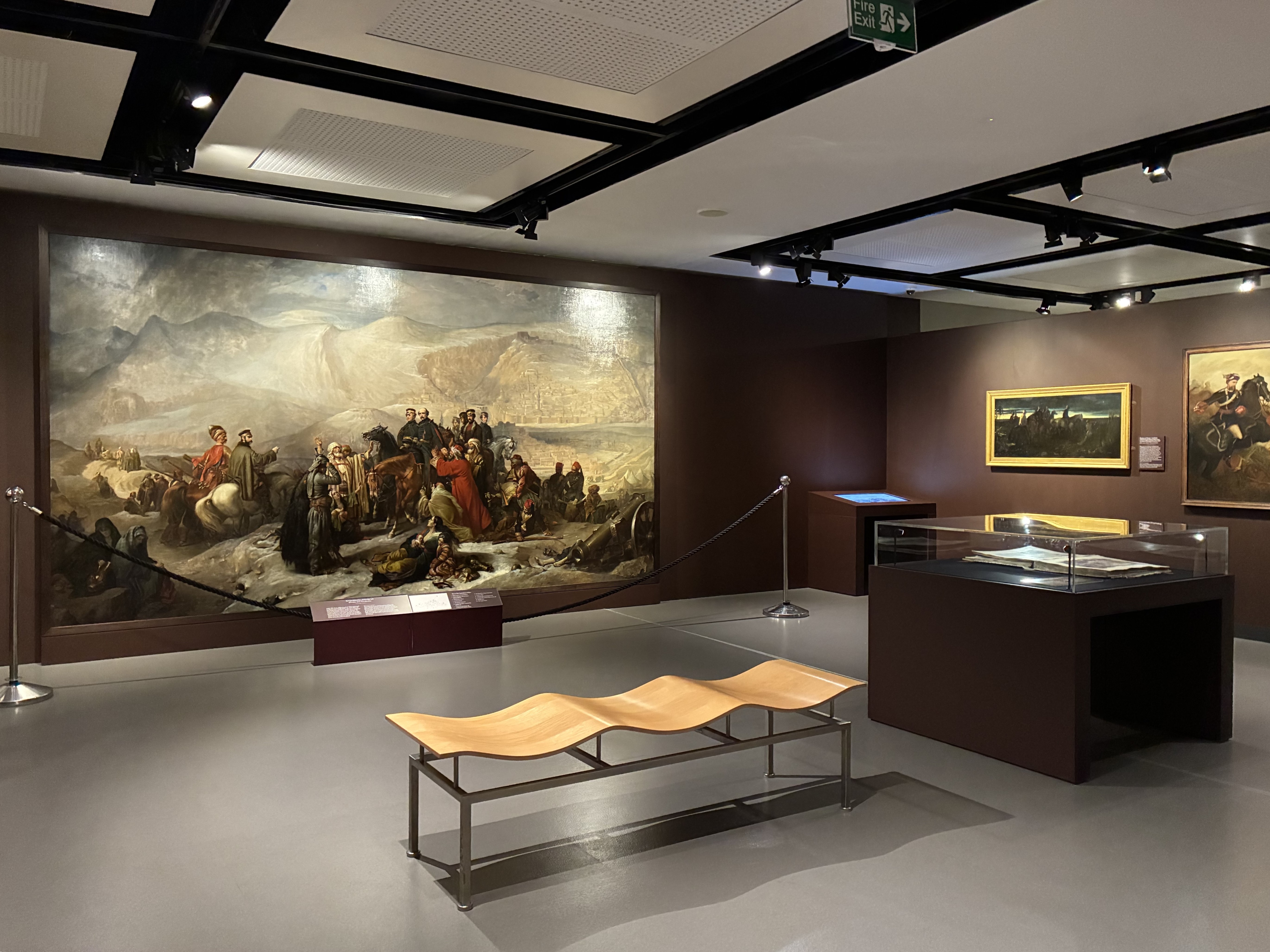
Installation view of Myth and Reality: Military Art in the Age of Queen Victoria at the National Army Museum showing the five-yard-wide oil painting ‘The Capitulation of Kars, Crimean War’ by Thomas Jones Barker (1855) with its static explanatory panel in front and an interactive screen off to the right (photo by the author)

Victoria’s Wars timeline

The exhibition includes a timeline of wars fought during Victoria’s reign. The point is that the British Army campaigned almost constantly throughout the period. There were a few big wars (the Crimean War, the Indian Mutiny and, right at the very end, the Boer War) but most of the conflicts we were involved in were small and localised, what modern historians call Victoria’s ‘small wars’.

  • 1837 – Queen Victoria ascends the throne
  • 1839 – the first photographs by Louis Daguerre in France and William Fox Talbot in England
  • 1842 – the world’s first illustrated weekly news magazine launched, the Illustrated London News
  • 1845 to 1846 – First Sikh War
  • 1852 to  1853 – The Second Anglo-Burmese War
  • 1853 to 1856 – the Crimean War
  • 1854 – Florence Nightingale travels to Crimea with 38 nurses. William Howard Russell’s reporting for The Times transforms people’s understanding of the squalid reality of war. 25 October – Battle of Balaklava and Charge of the Light Brigade.
  • 1854 – the Victoria Cross (VC) was introduced by Royal Warrant on 29 January 1856 to acknowledge the bravery displayed by soldiers and sailors during the Crimean War and soon after the Queen awards it to 62 Crimean war veterans

Queen Victoria and Prince Albert inspecting the wounded Grenadier Guards in Buckingham Palace. Coloured lithograph by George Thomas after himself (1855) Wellcome Collection

  • 1857 to 1858 – the Indian Rebellion
  • 1873 to 1874 – Third Anglo-Ashanti War
  • 1878 to 1880 Second Anglo-Afghan War
  • 1879 Anglo-Zulu War, featuring the Battle of Rorke’s Drift, 23 January 1879
  • 1880 to 1881 First South African War
  • 1882 Anglo-Egyptian War
  • 1884 to 1885 – Siege of Gordon at Khartoum, leading to its fall on 26 January 1885
  • 1885 Third Anglo-Burmese War
  • 1895 to 1896 Fourth Anglo-Ashanti War
  • 1898 – British reconquest of Sudan, featuring the Battle of Omdurman, 2 September 1898
  • 1899 to 1902 – Second South African War, featuring the sieges, the concentration camps etc
  • 1900 Fifth Anglo-Ashanti War

My take

There are about 40 artists, amateur and professional, soldiers and civilians, represented across the exhibition but the exhibition begins in a very decided way which raises a number of questions, because it starts with a strong emphasis on women war artists.

A feminist emphasis on women’s military art

The curators – all women – have decided that the first dozen or so works you see are all by women artists and devote several sections to them.

Victorian women artists, they tell us, helped to shape public perceptions of Army life. Many women were connected to soldiers through marriage or family, sometimes travelling with them abroad and depicting the people and places they saw.

Women were also important supporters and collectors of art, none more so than Queen Victoria herself. The Queen was also one of the most prominent subjects of military art, along with another celebrated figure of the time, Florence Nightingale – which explains why there’s a wall of works depicting the Queen meeting war veterans, awarding medals etc, and a little section about Florence Nightingale (who was famously averse to having her image captured, as she believed it detracted from her work).

However, as the exhibition proceeds you realise that most of the artists on display are not women, and, of course, none of the soldier artists are female – so why start this way unless you’re making a polemical feminist point? The implication seems to be that, after centuries or millennia of The Patriarchy, of tellings of history and art which downplay or completely ignore the role of women in the creation and consumption of art, this exhibition is doing its bit to redress the balance.

Fine. I understand. Why not? But there’s a second element to this approach which is notable and, maybe, problematic: this that one of the greatest, if not the greatest war artist of the Victorian era was Lady Elizabeth Butler, and so, hand-in-hand with the ‘women and military art’ section goes the ‘Lady Elizabeth Butler’ section. On one level there’s no quibbling with this: Butler was an outstanding artist and produced some of the standout works of the entire century. She was an absolute mistress of her craft, the half a dozen big paintings of hers brought together here are alone worth travelling to visit the show for, especially as several of them are usually buried in the Royal Collection.

So on the plus side, ignoring all its other features for a moment, you could say this is an outstanding selection of paintings, sketches and anecdotes by one of the nineteenth century’s great artists, and this is all to the good.

So why am I kvetching? Because the curators state, in these opening sections, in these early wall labels, that Lady Butler transformed military painting, depicting the life of soldiers with a new realism, taking a new, humane approach and setting a new standard for the subject. And this is all well and good, too, except that… In order to understand why Lady Butler is so important, and what she transformed, and what she changed it would have been good to have been fully introduced to the tradition of Victorian military painting which preceded her.

Instead, the result of placing Lady Butler right at the start of the show is to jump quite a long way into the later Victorian period without any preliminary explanation.

The work which really brought her to general attention was her ‘Roll Call’ which was displayed in 1874, 37 years into Victoria’s reign – and the first big work of hers which the curators feature, on the first wall of the exhibition, is ‘Dawn of Waterloo’ which was first displayed in 1895! 58 years into Victoria’s reign and only 6 years before her death. It’s a great painting but it comes at the very fag end of the period being covered and so is pretty misleading about the military art of Victoria’s era.

‘The Dawn of Waterloo: The Reveille in the Bivouac of the Scots Greys on the morning of the battle’ by Lady Butler (1895) the first full-scale painting by Lady Butler which the visitor encounters in ‘Myth and Reality: Military Art in the Age of Queen Victoria’ at the National Army Museum

Recap

So the decision to emphasise women’s role in military art may be laudable, and bringing a number of women’s works all together in the first few rooms ensures that the subject gets the prominence it deserves, rather than interspersing women’s works chronologically among the men’s pictures where they might be overlooked and unnoticed (as very probably happened in so many previous exhibitions on the subject).

Fine. And if you’re going to mention women artists of the time, then it would be silly not to mention and indeed have a section about the greatest of them, Lady Butler, also here right at the start. OK. Fine.

But the (maybe unintended) consequence of all this is that the visitor is deprived of a chronological understanding of the subject – of what military art looked like before Victoria, then at the start of her reign, how it developed through the decades leading up to the two seismic conflicts of the Crimean War and the Indian Mutiny in the 1850s, how it reflected trends in the broader art world, and so on.

You see how a chronological survey like this would have been interesting in itself and might also have better prepared the way for Lady Butler’s dramatic innovations: by the time you got to Lady B you’d have had a much better understanding of The Tradition she was transforming… but instead you have to work it out for yourself.

Five styles

This unchronological approach characterises the rest of the exhibition, too. Particularly in the sections about ‘Patriotism and Portraiture’ and ‘Realism and Reportage’, works from the 1840s or ’50s are placed next to works from the 1880s, ’90s or even early 1900s – it’s up to the visitor to make chronological, historical and aesthetic sense of the many different styles on display.

Having gone round the exhibition three or four times, dwelling on favourite works (and being drawn back again and again to the brilliant Butler paintings) I think I came up with about five different, roughly chronological styles of painting. They are:

  1. Romantic-sublime
  2. Patriotic-sentimental
  3. Mid-Victorian anecdotal
  4. Lady Butler
  5. Stiff official portraits

(This isn’t taking into account the pencil or charcoal sketches, and the many watercolours, which are specialist areas unto themselves.)

1. Romantic-sublime

Although painted in 1853 this picture strikes me as epitomising high Romanticism with its fondness for dramatic mountainous scenery and The Sublime. Look at the big baby eyes of Wellington (and his horse), the ethnic outfits of the local guides – it all has the rosy, soft-focus approach of Sir Water Scott’s novels.

Wellington at Sorauren, 27 July 1813 by Thomas Jones Barker 1853 © National Army Museum

2. Patriotic-sentimental

Kars is a city in north-eastern Turkey. In June 1855, as part of the during the Crimean War (1854 to 1856) it was besieged by a Russian army of 25,000. Demoralised by their defeats at the hands of the Russians, the Turks left the defence of Kars to Brevet Colonel (later General Sir) William Fenwick Williams, the British commissioner. The garrison was able to repulse three major Russian attacks but eventually cold, famine and an outbreak of cholera forced it to surrender on 26 November 1885. In recognition of their heroism, the Russians allowed the British garrison to march out of the city with the honours of war and into captivity.

‘The Capitulation of Kars, Crimean War’ by Thomas Jones Barker (1855) (National Army Museum)

This is a huge painting, over five yards wide (!), and it’s accompanied by not one but two diagrams identifying all the figures in it, one a static diagram, one an interactive display of the same. But it was only chatting to one of the (very well-informed) visitor assistants that I really understood what is going on.

You see the local in the red cloak clutching the hand of the bald British officer on his horse (Major General Fenwick Williams) and the cascade of similar locals off to his right, and the pitiful woman lying on the ground with her helpless children in the foreground, and similar locals on his left?

These are the local Turks who the British are abandoning to the kindness of the conquering Russians. So they are pleading with the British not to leave and abandon them but the British, defeated, have to. (Maybe a modern analogy would by NATO forces pulling out of Afghanistan and letting the Taliban take over.) It is this acute sense of regret and shame which explains the expression on the face of the British officer.

(You could write a book about the peoples the British Army promised to protect, only to abandon them – I’m currently reading a book about the Dutch Revolt which mentions that Queen Elizabeth I made all kinds of promises to the Dutch patriots in the 1580s which she then completely broke… It’s a long tradition.)

Back to the painting: ‘The Capitulation’, then, is a psychological study in the pain and embarrassment of duty, of a fine upstanding officer mortified to be abandoning the people he promised to protect. As such it is full of all kinds of melodramatic details, the thrown-up hands of the man in white on the left, the tearful eyes of the woman on the ground. It’s like a tableau from a mid-Victorian melodrama, at the centre of which is the British officer maintaining a stiff upper lip despite being deeply moved.

In fact it tells you a lot about mid-Victorian art and audiences that the work was commissioned, not by an aristocratic patron, but by the art dealers and print makers Agnew and Sons, precisely to be turned into prints and widely sold. So it is very deliberately catering to popular taste and demand.

3. Mid-Victorian anecdotal

The Victorians loved detail and clutter. Dickens’s novels overflow with wonderfully telling details and so do classic mid-Victorian paintings like William Powell Frith’s Derby Day (1858) or The Railway Station (1862), packed with little stories and anecdotal details. The exhibition includes an absolute classic of this style, ‘Home Again’ by Henry Nelson O’Neil.

‘Home Again’ by Henry Nelson O’Neil (1860)

‘Home Again’ depicts soldiers disembarking from a troopship at Gravesend on their return from the Indian Mutiny (1857 to 1859). For military history buffs the curators tell us that about 40,000 British troops were sent to India (more than had been mobilized for the Crimean conflict) to suppress the mutiny among the Indian troops of the East India Company’s Bengal Army.

But in purely visual terms we are invited to relish the details! At the very top a young woman peers over the shoulder of a bearded infantry corporal, who holds their baby for the first time. In the middle-right a young soldier of the 60th (The King’s Royal Rifle Corps) dressed all in black leans down to offer his Victoria Cross to a Chelsea Pensioner. The central action depicts sailors assisting a wounded sergeant to disembark. We are told that he wears a Kilmarnock ‘pork-pie’ cap under the white cotton ‘Havelock’ cover distinctive to the campaign, with the neck flap for protection from sunstroke.

There is patriotic pride here, and sentimentality of a sort, but it is very clearly all about the common people, ordinary soldiers (and sailors) and their reunions with wives and sweethearts. As such, it a little bit anticipates Lady Butler’s humanism but still with that mid-Victorian obsession with anecdote and detail.

4. Lady Butler

‘The Roll Call’ is one of the most celebrated British paintings of the 19th century. On its public appearance in 1874 it cemented Butler’s reputation as one of the leading painters of the age. It depicts a roll call of soldiers from the Grenadier Guards following the Battle of Inkerman in 1854 but can stand for thousands of similar occasions.

The Roll Call by Lady Elizabeth Butler (1874) © Royal Collection Enterprises Limited 2025 | Royal Collection Trust

The composition expresses Butler’s profound feel for the plight and experiences of the ordinary soldier, for the pity of war and the walls of the show feature not one but two quotations by her, emphasising how she eschewed patriotic guff in her concern for the actual lived experiences of the men who fought and suffered.

‘I never painted for the glory of war, but to portray its pathos and heroism’.

‘The Roll Call’ was fantastically successful. When it went on display at the Royal Academy it attracted over 300,000 visitors in a 3-month period and the more you look, the more brilliant it becomes.

The curators explain that historical or military painting for a long time worked with the basic design of a triangle which places the most important person – generally the commanding officer – at the apex (as in the pictures of Wellington and Major General Fenwick Williams, above). As soon as that’s pointed out to you, you realise really drastic difference her, the polemical message sent by the composition which is the equality of the men, all placed on the same level.

There’s still an anecdotal aspect to the thing, if you go up close and work slowly from left to right, starting with the two soldiers on the left lighting a sneaky fag or cigar, and working along through the bandages and blood of the wounded to the striking element of the man who’s collapsed into the snow. It really conveys the wretched pity of war, 44 years before Wilfred Owen coined the phrase for his volume of First World War poetry.

There is, of course, a figure on horseback, but he isn’t treated with the Romantic sentimentalism of the Wellington, above. Instead we can feel the gruff sympathy of the sergeant in charge as he reviews his wounded troops. And he also acts as the viewer’s entrance point into the work. If it was just the row of soldiers it would be slightly impenetrable: the officer on horseback not only relieves what might have been monotonous, but his movement carries the eye into the composition.

But there’s more because, after you’ve finished admiring the overall shape and canny dynamism of the composition, if you step back you notice the colours. You notice how Butler has depicted the uniforms of the men with great accuracy but used them as a springboard to create a composition of shades of grey. The grey coats and badges are reflected under the line of men by the different shades of snow and above them by the extremely nuanced and varied shading of the clouds.

On a literal level the coldness of the winter is evoked by the dominant tones of black, grey, white and brown, contrasting with small splashes of red from coatees and flags. But on a more aesthetic level, the awareness of shades of grey makes you think of James McNeil Whistler’s compositions, symphonies of certain palettes and timbres.

And then you notice the crows, the brilliant broken flight of crows coming from the middle of the composition and looping up over the head of the reviewing officer.

In its: 1) absence of sentimentality; 2) its immediately felt humanistic concern for the plight of the average soldier; and 3) its stunning painterliness, its brilliance of composition and colouring, ‘Roll Call’ really is a masterpiece. It’s worth visiting the exhibition just to see this one work in the flesh.

5. Stiff official portraits

Something the curators of the Army Museum must struggle with is that so much military art is decidedly average, if not actively poor. One or two of the battle paintings here struck me as ludicrously bad, but there’s a more subtle problem and that’s to do with military portraits.

I bet there are tens of thousands of these up and down the land, professional portraits of Britain’s countless officers, generals, admirals and so on which are good enough, decent enough, professional likenesses, but are never going to make it into anyone’s history of art because they are, by their nature, a very conservative wing of the medium.

Their number, their prevalence and popularity in Victorian times explain why there is a section titled ‘Patriotism and Portraiture’ here. Not only did ‘the people’ want to see portraits of heroes like Wellington or Gordon or Roberts, but countless military families wanted professional portraits of their eminent male members to hang alongside all their forebears, and hundreds of officers messes and regimental headquarters, ditto.

Hence a half dozen masterpieces of stultifying conventionality and woodenness.

Lieutenant The Honourable Frederick Hugh Sherston Roberts VC, Kings Royal Rifle Corps by Julian Russell Story (1899)

There’s a story behind this portrait, which is that Roberts not only won the Victoria Cross, but the same medal was awarded to his father, Field Marshal Frederick Sleigh Roberts, 1st Earl Roberts, making them one of only three father-and-son pairs to be awarded the VC in its 169-year history.

Watercolours

As mentioned, the exhibition includes 20 or so watercolours, much smaller and more intimate than the bombastic oil paintings. In a sense, watercolours under-promise and so are often able to over-deliver.

Installation view of Myth and Reality: Military Art in the Age of Queen Victoria at the National Army Museum showing a set of six watercolours of the Crimean War by William Simpson (photo by the author)

General Cannon’s landing, July 7 1854

My wife and I play a simple game when visiting exhibitions. Having crawled through the exhibits and rooms, reading and processing every wall label, we reach the end, turn round and go back through it, this time lightly, airily choosing one work per room which we like and having to explain why. A variation is to choose a work we would buy and take home to hang in the landing or hall or wherever. As I’ve stated, the Lady Butler paintings are all brilliant, but in terms of something I’d actually buy and live with, something a bit more modest, I kept returning to one of the 20 or so watercolours on display, ‘General Cannon’s landing, July 7 1854’, a pencil and watercolour by Joseph Archer Crowe (who has seven works in the exhibition).

‘General Cannon’s landing, July 7 1854’ Pencil and watercolour by Joseph Archer Crowe

Crowe worked at the Crimean War as a special artist for The Illustrated London News. This watercolour depicts how, on 7 July 1854, Turkish forces launched an amphibious assault across the River Danube on Russian positions at Giurgiu (in modern day Romania). The Russians were driven back and Giurgiu was occupied by the Turks.

It’s not going to rock anyone’s world, I just liked the composition, the line of ships going in from roughly right to left, and the light impressionistic touches of colour.

Women artists

I may have missed some but, for the record, here are the women military artists featured in the exhibition:

  • Lady Elizabeth Butler
  • Jane Drummond (portrait of Mrs Anne Steele)
  • Gertrude Ellen Burrard (portrait of Nussiban, our ayah)
  • Elizabeth Anne Leslie Melville (portrait of Major General Sir Owen Tudor Burne)
  • Emily Henrietta Ormsby (portrait of Colonel Henry Francis Strange; portrait of Major General John William Ormsby)

Lady Butler’s works

  • Tenth Bengal Lancers tent pegging (1873)
  • The Roll Call (1874)
  • Study of a Wounded Guardsman (1874)
  • Quatre Bras (engraving of oil painting, 1879)
  • Patient Heroes: A Royal Artillery Gun Team in Action (1882)
  • Scotland Forever! (engraving after oil painting, 1882)
  • After the Battle of Tel-el-Kebir (engraving of original painting, 1888)
  • After the Battle of Tel-el-Kebir (fragment of original painting, 1888)
  • The Defence of Rorke’s Drift (1882)
  • The Ballad of the Royal Irish at Sebastapol (6 x pencil illustrations of a poem, 1890)
  • Military sketches (pen, watercolour and pencil, 1893)

Summary

I don’t know whether my point about the lack of chronology and build-up to Lady B is even worth mentioning. My wife went round the displays two or three times with me and didn’t even notice or care, just enjoyed various works on their own merit.

So: if you’re interested in military history the exhibition contains lots of titbits about key wars and engagements of Victoria’s reign, about medals and uniforms, some lovely watercolours and a dozen or so really impressive oil paintings, along with a number of average or also-ran works which, however, illustrate interesting topics, such as the section about the creation of the Victoria Cross, and so on.

And the National Army Museum is always a lovely place to visit because – ironically, given its subject matter – it’s such a calm, clean and peaceful place to be. Go see.


Related links

Related reviews

Relating to animals @ the British Museum

Room 24

Room 24 at the British Museum is a large open gallery at the junction between the huge covered courtyard and the back of the museum. It’s a kind of portmanteau room titled ‘Living and Dying’, bringing together displays from around the world to consider how these fundamental aspects of human existence vary from place to place, and people to people. So, for example, this room has a big display of Australian Aboriginal art (which I’ve described in another blog post) and another display about Inuit peoples.

Relatively new is the display about ‘Relating to animals’ which looks at some aspects of life among people in Amazonia. I’m going to more or less quote the wall labels along with my own photos of the artefacts.

Amazonian apron from Peru, 1920s, made from feathers and beetle tissue. © The Trustees of the British Museum. Photo by the author

Amazonia

Amazonia spans nine countries in South America and is made up of tropical rainforests and savannas. This display shows contemporary and traditional artworks from across the region.

For many Amazonian communities, animals and people are fundamentally interconnected with their environment. This relationship is reflected in microcosms such as the veins in leaves, and in macrocosms, such as the constellations of the stars.

The artefacts on display reveal different ideas about the world and ways of living with the environment that have endured colonisation. These concepts today are communicated through a wide range of art forms.

Indigenous art has traditionally been associated with local craft and folklore, but many Amazonian artists also participate in global circles. In this way the indigenous knowledge expressed in their art works reaches beyond local communities to an international audience.

The display arises from work by the British Museum’s Santo Domingo Centre which builds relationships with heritage-related projects in Latin America.

Cubeo barkcloth

Costumes like these were worn by Cubeo people from the Tukano region for the onye or ‘weeping’ dance. After the death of a community member these masks were worn to disguise the dancer as animals and insects or eggs and larvae. The ceremony marks the transition between the worlds of the living and the dead as well as the importance of rebirth and regeneration. These dances are no longer practiced anywhere in Amazonia.

Cubeo barkcloth costumes (1960s, 1970s) © The Trustees of the British Museum. Photo by the author

The power of feathers

Feathers can be used to enable people with special ritual and intellectual knowledge to transform into birds. These clothes might have been worn for ceremonies celebrating this transformation.

According to traditional knowledge there are many ways in which people can acquire the ability to move through space and time and so heal and shape their community’s experience of the world. One way of doing this is to transform into a bird and transition between spatial dimensions. This usually involves dream states and powerful plants.

Apron

An apron from Jivaro, Ecuador, made in the 1960s from feathers, bark and bird tissue.

Apron from Jivaro, Ecuador, 1960s © The Trustees of the British Museum. Photo by the author

Head dress

Head dress from Brazil, made in the 1860s from feathers and plant fibres.

Head dress from Brazil, 1860s © The Trustees of the British Museum. Photo by the author

Back ornament

A back ornament from Jivaro, Ecuador, made in the 1960s from feathers, seeds, bird and beetle tissue.

Back ornament from Jivaro, Ecuador, 1960s © The Trustees of the British Museum. Photo by the author

Feather hammock

Europeans settled in many parts of Amazonia from the 1670s onwards. An increase in demand for feather-work led Amazonian people to invent new techniques and styles of production to cater for foreign tastes. For example, the natural colour of the feathers was modified and the design began to incorporate European-style floral motifs and coats of arms. This hammock was made specifically for a foreign collector.

Feather hammock (1910s) Unknown artist, Iquitos, Peru © The Trustees of the British Museum. Photo by the author

Contemporary Amazonian art: A story of the fish people

According to the oral histories of the Tukano people from northern Amazonia, humans originated from a journey on the serpent canoe of transformation. These narratives describe worlds in which people and animals can transform into each other and where time can alter dramatically.

This set of 12 watercolours are by Tukano Desano artist Feliciano Lana and they depict just such an origin story. Unlike most stories Lana’s narrative does not take place at on particular time – the events happen in both the present and the past. This temporal disorder is echoed in the story where time is experienced in radically different ways in the two worlds which Lana describes.

Installation view of ‘A story of the fish people’ by Feliciano Lana (2019) © The Trustees of the British Museum. Photo by the author

Here are two episodes in close-up, numbers 5 and 8. In number 5, at the top, shows the protagonist of the story, a fisherman, locked in a dark room and ordered to climb on top of a giant fish before many tucuxis or dwarves come in and tell him to escape.

Installation view of ‘A story of the fish people’ by Feliciano Lana (2019) showing numbers 5 and 8 © The Trustees of the British Museum. Photo by the author

In number 8, at the bottom, a woman has told the fisherman to collect water from the river, at a specific place marked by a big stick. But when he gets there he discovers the stick is actually a big snake but he is the only one who can see it. When he returned empty handed the woman sent him back. This time he was able to climb on the back of the snake and so collect the water.

Summary

Room 24 is big, busy and confusing. In the centre are crowds walking from the main courtyard towards the back of the building, as well as all those taking the steps down to, or back up from, the Africa rooms downstairs. So it’s easy to blink and miss relatively small and niche displays like this. So, here it is for your enjoyment.


Related links

Related reviews

The genius of nature botanical drawings by Jacques Le Moyne de Morgues @ the British Museum

As well as its entrance fee-charging blockbuster exhibitions, the British Museum always has 3 or 4 or 5 much smaller, free displays on the go. There are always two or three at the back of the Museum, up on the third floor, in the print rooms. Currently there are no fewer than four separate little exhibitions on display here. This is the first of four reviews of each of them.

The genius of nature botanical drawings by Jacques Le Moyne de Morgues

Le Moyne was one of the most gifted botanical artists of his age. He created remarkable watercolours of plants, flowers, fruit and vegetables.

Milk thistle and dragonfly, probably a mosaic darner by Jacques Le Moyne (1585) Le Moyne often used insects to dramatise portraits of flowers and plants

Biography

Jacques Le Moyne de Morgues lived from about 1533 to 1588. He was raised a Protestant in mostly Catholic France. The Protestant community, during the course of the 16th century, came to be known as ‘Huguenots‘.

As a young man of 30 or so, Le Moyne was chosen to accompany a French expedition to North America in 1564 to 1565, which planned to settle new Protestant colonies in Florida. The mission itself was unsuccessful but Le Moyne’s work as cartographer and artist is thought to have included some of the earliest Western images of the peoples and customs of Florida.

On his return to France he found it engulfed by the Wars of Religion and Protestant Le Moyne fled to London around 1580. He settled in Blackfriars, among a large community of fellow Huguenots.

It was here that he attracted the attention of a fellow explorer of North America, the poet and courtier Sir Walter Raleigh. It was probably Raleigh who introduced Le Moyne to other figures at the Elizabethan court, including Lady Mary Sidney, mother of the poet Sir Philip Sidney.

Apart from their striking verisimilitude, maybe the most striking thing about Le Moyne’s botanical drawings is the lack of fuss. The Renaissance in Britain and France was a period when art overflowed with symbolism, meaning and allegory. Le Moyne seems so fresh and contemporary because he had a much more modern, almost scientific approach. According to the curators this reflected the growing interest in Western Europe in scientific classification and identification.

Studies of insects and shells by Jacques Le Moyne (1585)

Although the album’s emphasis is on botanical study, Le Moyne also included numerous studies of insects among his plants. This sheet is the only page from the album devoted to insects and shows, clockwise from top left: a tiger moth, a small tortoiseshell butterfly, a female great green bush-cricket, a caterpillar of the leopard moth, a brown-lipped snail shell, an unidentified snail shell, a sawfly larva, a small grey snail shell, a caterpillar of the swallowtail butterfly, and a caterpillar of the tiger moth.

The images

The British Museum possesses 50 botanical drawings by Le Moyne. They derive from an album of illustrations the Museum bought in 1962. This small display presents a selection of 12 bright and detailed watercolours which look like they were painted yesterday. Isolated against blank backgrounds, surrounded by rectilinear painted frames, these images of plants, flowers and insects have, as the curators point out, the individuality of portraits.

Medlars (Mespilus germanica) by Jacques Le Moyne (1585) Medlars were a popular medieval and Renaissance fruit. Closely related to the apple they were often eaten with cheese or made into jelly. This apparently simple composition in fact allows the fruit to be seen from three different angles.

Le Moyne at the Victoria and Albert Museum

This British Museum display comes just two years after a much more comprehensive exhibition of Le Moyne watercolours which ran at the Victoria and Albert Museum from December 2020 to August 2021.

The V&A owns a different album of Le Moyne’s work. It acquired its album as long ago as 1856, mainly because of the exquisite quality of the 16th century book binding. On the web page below you can view every illustration in the V&A’s album.


Related link

More British Museum reviews

Impressionists on Paper: Degas to Toulouse-Lautrec @ the Royal Academy

This exhibition in is in the smaller set of three rooms at the back of the Royal Academy building i.e. it’s more of an amiable stroll through three rooms of relatively small drawings, rather than, say, the full-on assault course of the 11 big rooms of the extraordinary Marina Abramović show.

It does what it says on the tin, brings together 80 or so works by all the famous Impressionist and post-Impressionist artists plus quite a few I’d never heard of before, experimenting with different media on paper.

Exhibitions need an aim or project and this one aims to explore how Impressionist and Post-Impressionist artists in late 19th-century France didn’t just use paper works as studies but radically transformed the status of works on paper. Previously, drawings were mostly conceived as preparations for paintings; in the hands of the Impressionists drawings, pastels, watercolours, temperas and gouaches were increasingly perceived as more than just preparatory techniques, and became autonomous works of art, claiming a shared aesthetic with painting.

Dancer Seen from Behind by Edgar Degas (c. 1873). Essence (diluted oil paint) on prepared pink paper. Collection of David Lachenmann

Who are we talking about? The eye-catching famous artists are: Mary Cassatt, Paul Cézanne, Edgar Degas, Paul Gauguin, Eva Gonzalès, Claude Monet, Berthe Morisot, Camille Pissarro, Odilon Redon, Pierre-Auguste Renoir, Georges Seurat, Henri de Toulouse-Lautrec and Vincent van Gogh.

Less well known are the likes of Albert Lebourg, Jacques Emile-Blanche, Armand Guillaumin, Frederico Zandemeneghi.

Impressionists recap

As the curators explain:

The avant-garde artists known as the Impressionists came to prominence during the late 1860s and early 1870s, first exhibiting in Paris as a group in 1874. They shared a concern to depict scenes from everyday life and to address contemporary issues, which encouraged them to challenge traditional attitudes to drawing and seek innovation. Vivid colour, a quick, loose touch, and daring viewpoints, together with a deliberate lack of finish, were their means of capturing the fugitive effects of nature as well as vignettes of modern life.

The portability of drawing materials greatly facilitated direct observation and the recording of scenes on the spot. The eight Impressionist exhibitions, held in Paris between 1874 and 1886, included a large number of works on paper and reflected their shift in status. This was also encouraged by dealers who recognised the economic advantage of exhibiting and selling works on paper.

Cliffs at Etretat: The Needle Rock and Porte d’Aval by Claude Monet (c. 1885). Pastel on wove paper. National Galleries of Scotland

What it’s like

The most striking thing, for me, was how the drawings faithfully echo the style of each artist’s paintings i.e. the way each of the artists have strong signature styles or vision no matter what medium they’re working in.

So you see a hazy landscape of cliffs by the sea and instantly know it’s Monet; charcoal images of ballet dancers posed at striking angles and know its Degas; a round-faced woman’s face smiling at some outdoors dance and know it’s Renoir; a grotesque, angular woman in an urban setting and you know it’s Toulouse-Lautrec; a light and airy landscape made out of cubes and rectangles of colour and you know it’s Cezanne.

So you can play an entertaining game of standing far away from the wall to try and identify the artist by their style, then stroll over to the wall label to find out if you were correct. For example, who would you think this is by?

Portrait de Marie-Thérèse Gaillard by Mary Cassatt (1894) Pastel on paper. Private collection. Photo © 2007 Christie’s Images Limited

In this case it’s a trick question. You might have thought Renoir, from the treatment of the face, but it is in fact by Mary Cassatt. Note the striking difference in finish between the face – expertly and completely rendered – and the clothes, rendered in a completely different, hurried, unfinished style, with the background wall hovering somewhere between the two.

What I liked

The most striking work in room 1 is the Portrait of Madame Henri Wallet by Jacques Emile-Blanche simply because of its size. It’s a John Singer Sargent-style and sized portrait of an elegant society woman, and so stands out in a room full of much smaller, much more hazy and impressionistic images.

Degas sketched and drew things around him so compulsively that his colleagues nicknamed him Monsieur Pencil and, appropriately, there are more works by him in this exhibition than any other  artists, 12 in total, all of which I liked.

I love sketches and drawings, I love art which is half-finished, ghostly, hinting at a half-grasped reality, which is why I’ve always loved Degas’ strange and mysterious Woman at a Window (1871), which used to be tucked away in a side room at the Courtauld Gallery. Here it is presented in all its pregnant mystery and an epitome, for me, of the power of paintings or drawings which are better left unfinished, full of hints and implication.

But I’d forgotten, if I ever knew, about Degas’s friend Frederico Zandemeneghi (1841 to 1917). Zandemeneghi was invited by the Impressionists to exhibit at four of their 8 exhibitions. He was particularly close to Degas. They shared an interest in depicting scenes of modern life featuring women subjects, seen from unconventional viewpoints, often cropping the image unexpectedly, and using vibrant colourful pastels.

This example has several of those characteristics in spades, namely the dramatic cropping which makes the subject feel really close-up and in your face. And the very bright colours, blue, yellow, orange, red, making the most of the range of human sight.

Study of a Woman from Behind by Federico Zandomeneghi (1890 to 1897) Pastel on cardboard. Galleria D’Arte Moderna, Milan. Photo © Comune di Milano

The show is in chronological order, starting with works from the 1870s. Room 2 contains works from the 1880s. The highlight for me was van Gogh’s ‘The Fortifications of Paris with Houses’ from 1887, made from a combination of graphite, chalk, watercolour and gouache. This reproduction in no way conveys the glowing brightness of the original. Then I liked the contrast between the architecturally accurate apartment block on the left and the vague ‘impressionistic’ grass in the foreground. Then I noticed the way the big fortification wall is not made of bricks but of hundreds of vertical dabs of orange and grey. And then I noticed the ghostly couple walking past in the foreground, ghosts of the millions of people who lived and died in the great cities of Europe, leaving barely a trace of chalk on paper. At which point I realised that there’s a kind of spectrum of solidity, from the super-solid apartment blocks on the right, to the more dabbed and impressioned fortifications themselves, and then to the human beings, the least permanent or impactful things in the picture or in history, hundreds of millions of us leaving less trace than walls or buildings.

The Fortifications of Paris with Houses by Vincent van Gogh (1887) Graphite, black chalk, watercolour and gouache on paper. The Whitworth, The University of Manchester. Photo by Michael Pollard

The exhibition concludes in room 3 with works from the 1890s and 1900s, which saw an ever-growing appreciation of works on paper and a proliferation of exhibitions of the medium. There’s a lot more Degas who emerges as probably the strongest and most consistent artist on paper. Off in one corner is a set of quiet, thoughtful, washed-out watercolours by Cézanne from late in his career. At the opposite corner of the room, both literally but also in terms of subject matter is a small set of three vivid, scratchy, angular images of the louche underworld of Montmartre by Toulouse-Lautrec.

But floating above this world of human troubles is the work I liked the best, a classic of what, during the 1890s came to be known as Symbolist art, the wonderful, visionary ‘Ophelia among the flowers’ by Odilon Redon.

Ophelia Among the Flowers by Odilon Redon (1905 to 1908) Pastel. The National Gallery, London

The Impressionists were trying to capture the truths of the modern world, applying light quick touches to capture the fleeting moment. Redon, by complete contrast, sought out ‘the light that never was on land or sea’, depicting images from the inner world of fantasy and dream. So I thought he was pretty out of place in an exhibition of impressionists. But his inclusion makes sense if we forget the exhibition’s main title for a moment and think of it more as a study of the evolution of drawing and painting on paper in France from the 1870s to the 1900s. From that perspective the inclusion of Redon makes sense for his technical prowess. The flowers are obviously the dominant element in the work, but after a while you realise that it’s the peculiar quality of the light in the top middle and right of the image which give it its haunting, apocalyptic quality.

Consequences

According to the curators:

The French avant-garde artists’ interest in drawing and the remarkable range of their production had far-reaching consequences. The hierarchical distinction made between painting and drawing ceased to exist. Freedom of execution and a laissez-faire attitude to materials provided an impetus that allowed the world to be depicted in more imaginative ways, leading to developments in 20th-century art such as Abstract Expressionism.

So as we progress through the works in chronological order, we are not just witnessing the development of visual styles, generally away from figurativism and towards greater abstraction, but the evolution of the medium of drawing itself, as it prepares for the great lift-off of modern art at the start of the twentieth century.

It’s not all masterpieces. Some are not-great early works (for example, by van Gogh or Gauguin) which are of largely scholarly interest, others are wishy-washy landscapes which are a bit meh (Armand Guillaumin). But overall it’s a lovely civilised way to spend an hour, enlivened by a regular stream of masterpieces. It’s worth visiting just to see the 12 Degas works and the 3 or 4 pieces by Frederico Zandemeneghi and the van Gogh. But other visitors will find other works to marvel at and cherish.

Dancers on a Bench by Edgar Degas (around 1898) Pastel on tracing paper © CSG CIC Glasgow Museums Collection


Related links

Related reviews

The Bauhaus and Britain @ Tate Britain

This one-room FREE display at Tate Britain celebrated the centenary of the opening of the Bauhaus School of Art and Design in Germany in 1919 with a display showing the interaction between Bauhaus ideas and exponents, and their followers and collaborators in Britain.

The Bauhaus aimed to promote modern art for a modern world and to demonstrate the practical use of all the arts to improve society. As part of this goal it set out to integrate disciplines including the fine arts, architecture, craft, graphic design and photography.

During its 14 year existence an astonishing array of some of the most creative 20th century artists, sculptors, designers, architects and photographers lived and taught and made wonderful things at the school’s Weimar campus.

K VII (1922) by László Moholy-Nagy. Tate

As soon as they came to power in 1933 the Nazis, who not incorrectly saw the Bauhaus as a hotbed of radicalism, shut it down. Many artists associated with the school came to Britain in search of safety and work and British artists with similar interests to those of the Bauhaus welcomed their émigré colleagues. Many key Bauhaus figures went on to the United States, opening the New Bauhaus in Chicago in 1937, but some remained in Britain, and this exhibition focuses on a) those who stayed b) the British periods of those who stayed for a year or two before moving on.

Ball, Plane and Hole (1936) by Dame Barbara Hepworth

So it is that the exhibition interleaved works produced by both Bauhaus and British artists and designers across a characteristically wide range of media. I counted:

Paintings by Ben Nicholson, László Moholy-Nagy, John Stephenson, Alastair Morton artistic director of Edinburgh Weavers who commissioned work from Nicholson.

Watercolours by Grete Marks.

Sculptures by Ben Nicholson and Barbara Hepworth and Naum Gabo, who settled permanently in London and became a leading figure in the development of abstract art in Britain.

Atea service by Grete Marks and a teapot by Naum Slutzky.

Ceramics such as the vase by Grete Marks.

Carpets by Ben Nicholson.

Fabrics by Ben Nicholson.

Furniture i.e. streamlined modern chairs by Marcel Breuer.

A bakelite radio set designed by Wells Coates.

Photos of modernist blocks of flats (Kensal House, Kensal Rise) by Edith Tudor-Hart, and portraits by Lucia Moholy-Nagy.

Architecture Kensal House designed by Elizabeth Denby with architect Maxwell Fry, who had been English partner to Bauhaus director Walter Gropius during his sojourn in England 1934 to 1937.

A selection of jewellery, namely brooches, necklaces and rings – by goldsmith, industrial designer and master craftsman Naum Slutzky.

Dove brooch by Naum Slutzky

And books. There are several display cases showing old magazines from the 1930s by such earnest advocates of modernism as Sir Herbert Read, the dustjacket of whose 1934 book Art and Industry was designed by Bauhaus-trained Herbert Bayer. Read went on to try and create an inter-disciplinary art & design college in Edinburgh.

There’s a rare copy of The New Architecture and The Bauhaus by the Bauhaus’s founding director, Walter Gropius, published in 1937, one of the first books about the school in English. And of the 1939 Pelican Special A Hundred Years of Photography by Lucia Moholy-Nagy, László’s photographer wife.

Another display case shows magazine articles written by some of these artists, alongside personal photos of, for example, the Nicholsons at home, and postcards from Moholy-Nagy to the Nicholsons.

Ben Nicholson always features prominently in these exhibitions as one of the 1930s British artists who experimented most extensively with abstract and geometric shapes, in both painting and small sculptures and (as here) a carpet and fabrics.

I don’t quite know why, but he’s never lit my candle at all – I’ve always thought of him as a poor British cousin of the far more exciting and innovative Europeans. Here’s a typical piece of Nicholsonia. Its heart’s in the right place but… for some reason it leaves me cold…

Sculpture (c.1936) by Ben Nicholson. Tate

Nicholson lived in North London with his partner Barbara Hepworth (whose work I’ve always found much more interesting). They befriended their art historian neighbour Read among other arty types, and a number of the Bauhaus exiles settled in North London near them, forming quite an artistic colony, including exiles like Bauhaus-trained Marcel Breuer who designed book covers, tables and chairs, some of which are in the exhibition.

B9 table by Marcel Breuer (1927)

The exhibition even includes an entertaining film – Lobsters! It was co-directed by Bauhaus artist László Moholy-Nagy, who was commissioned to work on the film with English director John Mathias. While in Britain Moholy-Nagy took on short-term roles in photography, film and commercial design. He designed ads for London Transport and collaborated on this short film depicting fishermen on the Sussex coast. The surprising angles and close-ups are attributed to Moholy-Nagy’s Bauhaus sensibility but I personally was more struck by the plummy tones of the commentary and the jolly score by Arthur Benjamin.

After a while I noticed that almost all the objects on display are owned by Tate, and it occurred to the cynic in me that the Bauhaus centenary was probably an opportunity for the gallery to dust off some of these rather dowdy antiques and given them an airing.

I’m not criticising. The insight just helped to explain why most of the exhibits were only so-so, or included sort-of interesting postcards and magazines, but lacked any real killer exhibits.

That said, not choosing to go to town on the centenary but limiting the celebration to a modest and FREE display made it in some ways feel much more relaxed and casual and accessible than it might have been.


Related links

Other Weimar Germany-related reviews

Art and culture

History

More Tate Britain reviews

Laura Knight: A Working Life @ the Royal Academy

Laura Knight was the first woman to be elected to full membership of the Royal Academy of Arts (in 1936) and the first woman to receive a large retrospective exhibition at the Academy, in 1965. She was awarded a Damehood in 1929.

Born in 1877, Knight had a long life (passing away in 1970) and a long and successful career, working in oils, watercolours, etching, engraving and drypoint until well into the 1960s.

She never departed from the figurative, realist tradition of her youth and was, for this reason, in her heyday, one of the most popular painters in Britain.

Portrait of Joan Rhodes by Laura Knight (1955) © The estate of Dame Laura Knight. Photo credit: Royal Academy of Arts

Given Knight’s mid-century fame, and her role as a pioneering woman artist, it is a little surprising that this FREE display of some of her work is a) so small and b) tucked away in a dingy room through a doorway off the main first floor landing. There was no signage, I had to ask an RA staffer where it was hidden.

If you google Knight or look at her Wikipedia article, you immediately see a series of highly realistic and vivid oil paintings, starting with the cracking Self Portrait with Nude of 1913, and including the evocative paintings she did during the Second World War (she became an official war artist at the outbreak of war, and her portrait of Ruby Loftus operating industrial machinery was picture of the year at the Academy’s 1943 summer exhibition).

As you explore further online you come across lots and lots of oil paintings of chocolate box scenes of the countryside, especially of the Cornish coast, featuring soulful looking ladies with parasols (before the First World War) or in flapper style dresses and chapeaux (after the First World War).

In this little display there are only three oil paintings on display, although they include the very striking portrait of Joan Rhodes (above) and an equally realistic and sensual double nude, Dawn. (It is hard not to be struck by the firm pink bosoms in this painting, and then by the firm musculature of the blonde’s stomach muscles, though maybe I am meant to be paying attention to the women’s soulful gazes…)

Dawn by Dame Laura Knight (1932 to 1933) © The Artist’s Estate. Photo by John Hammond

No, the bulk of this little exhibition is made up of display cases of Knight’s drawings and sketchbooks of which the Academy holds a substantial collection – small, monochrome, often unfinished sketches, which are – to be frank – of variable quality and finish, some were very appealing, some seemed, well, a bit scrappy.

The works are grouped into three distinct themes from Knight’s long working life – the countryside, the nude, and scenes from the theatre, ballet and circus.

Countryside

Knight had several spells of living in the countryside – in the 1890s she moved to the Yorkshire fishing village of Staithes and painted scenes of the coast and life among the fishermen and their wives. In 1907 Knight and her husband moved to Cornwall and became central figures in the artists’ colony known as the Newlyn School. In the 1930s she and her husband settled in the Malvern Hills, where she remained for the rest of her life.

Thus the exhibition includes sketches she did of Mousehole in Cornwall, alongside sketches of a ploughed field, trees beside a river, Richmond Park, Bodmin Moor, two land girls in a field, seeding potatoes, and so on.

Mousehole Harbour, Cornwall, with Figures in Foreground by Laura Knight (mid-1920s or early 1930s) © The Estate of Dame Laura Knight

It was only later, when I googled her many finished paintings of Mousehole and other Cornish scenes that I realised where these sketches were heading, and what I was missing. I wish the exhibition had included at least one finished painting of this kind of scene alongside the sketches, to help you understand the process better, and the purpose of the sketches.

Nudes

We’ve already met the two dramatic nude women in Dawn. There are a small number of other nude sketches and studies on display, which I thought were a bit so-so. Like the countryside sketches, they strongly suggest that the ‘magic’ of Knight’s paintings was precisely in the painting, in her skill at creating an airy, light and luminous finish with oil paints.

Standing Nude with Her Arms Behind her Head by Laura Knight (mid-1950s) © The Estate of Dame Laura Knight

Theatre, ballet and circus

This broad subject area contains the largest number of sketches and drawings. Knight sketched ballet dancers and circus performers; there are drawings of boxing matches held among soldiers training during World War One; and ice skaters and trapeze artists and many other performers. The wall labels tell us that she even spent some months travelling with famous circuses of the Edwardian era, drawing and sketching every day.

Trapeze Artists by Laura Knight (1925) © The Estate of Dame Laura Knight

They’re all good. Some of them piqued my interest. But none of them seemed to me as vivid as the drawings of, say Edward Ardizzone, who had a comparable sketching style, using multitudes of loosely drawn lines to build up form and composition.

The Lion Tamer by Edward Ardizzone (1948)

Maybe I’m mixing up fine art (Knight) with book illustration (Ardizzone) and maybe I’m giving away my failings of taste in saying so, but I much prefer the Ardizzones. They’re more vivid, more evocative, more physically pleasing (more tactile), more fun.

Also, as with the nudes and landscapes, a quick search online reveals that Knight converted her sketches into scores and scores of paintings of the circus, and I immediately found the paintings much more pleasurable than the sketches – a little cheesy and old-fashioned, like vintage Christmas cards, but much more finished and complete than the sketches.

Grievance

The introductory panel and all the wall labels exude what you could call the standard feminist spirit of grievance and offence. There’s a long list of offences for the visitor to absorb.

The curators point out that 1) Knight, despite her success with the public, was only granted membership of the Royal Academy in 1936! That 2) she was the first woman to achieve this accolade (why so late Royal Academy)! But that 3) even then, she wasn’t invited to Academicians’ Annual Dinner until 1967!

We are told that, as a woman art student before the Great War, she was forbidden to paint or sketch from real naked models but had to work from sculptures and statues! It was only in the 1930s, in Newlyn, that she was able to persuade local people to pose nude for her! And so a work like Dawn can be seen as an act of defiance against a male-dominated art world!

I’m sure all of this, and much more along the same lines, is true and scandalous and we should all be outraged by it. But, seen from another perspective, all this righteous indignation amounts to a skilful evasion of the rather obvious question, which is whether Knight’s art is any good – or is of anything other than antiquarian interest, dusted off and used as a pretext for the righteous anger of modern curators?

This tricky question is not addressed anywhere in the (very informative) wall labels, but, when you think about it, is amply answered by:

  1. The Academy’s choice of location for this little ‘exhibition’ – tucked away in a dark and dingy side-room.
  2. The fact that it is more of a ‘display’ of half a dozen notebooks, three paintings and a poster, than a full-blooded exhibition. It feels very much like an after-thought.

If Laura Knight is so eminent and so worthy of consideration, why didn’t the Academy give her a larger exhibition in a more prominent space?

Ironically, the curators who complain that Knight was overlooked and patronised in her own time, have done quite a good job of repeating the gesture – of displaying only a small and not very persuasive part of her output, in a hidden-away side room which nobody in a hurry to see the blockbuster shows on Anthony Gormley or Helena Schjerfbeck or Félix Vallotton is in too much danger of stumbling across.

Suggestion

In all seriousness, why not give Laura Knight a much bigger exhibition? If you look at the paintings embedded in the Wikipedia article or all across Google, it’s clear that she painted absolutely brilliantly, but in a straightforward naturalistic style which was already outdated by the 1930s, let alone the ’40s or ’50s – in a style which carried on its Edwardian naturalism into the atomic age as if the rest of modern art had never existed.

But despite that – or more likely, because of it – Knight was very popular and successful with the public. Her paintings of Edwardian children playing on the beach or soulful ladies standing on clifftops sold by the dozen and – from a Google search of them – look immensely pleasing and reassuring in a lovely, airy, chocolate-box kind of way. And her wartime paintings perfectly capture the earnest heroism of the conflict, and of the social realism, the committedness, of the wartime artists.

To me this all suggests a whole area of investigation, an enquiry into why British artistic taste remained so isolated and uncosmopolitan for so long. Such an investigation would have to reference:

  • the way the director of Tate in the 1930s could proudly say that Tate would only buy work by the young whippersnapper Henry Moore ‘over his dead body’
  • or Sir Alfred Munnings, the horse-painting president of the Royal Academy, addressing the academy’s 1949 annual banquet, delivered a drunken rant against all modern art, and invoked the support of Winston Churchill (sitting next to him) who he claimed, had once asked him: ‘Alfred, if you met Picasso coming down the street would you join me in kicking his … something, something?’ ‘And I said ‘Yes, sir! Yes I would!’

A big exhibition of Knight’s work would:

  1. put to the test the curators’ claims about her importance and relevance
  2. be very popular among the sizeable audience, who still like their art extremely traditional (think of the sales of prints and other merchandise!)
  3. allow the curators to explore and analyse the long-lasting appeal and influence of the anti-continental, anti-modernist, anti-avant-garde tradition in 20th century English art of which, for all her skill and ability, Laura Knight appears to have been a leading example

This – the philistinism of English art, the determined rejection of all 20th century, contemporary and modern trends in art and literature in preference for the tried and tested and traditional – is something you rarely hear discussed or explained, maybe because it’s too big a subject, or too vague a subject, or too shameful a subject. But it’s something I’d love someone better educated and more knowledgeable in art history to explain to me. And I’d really enjoy seeing more of Laura Knight’s lovely airy innocent paintings in the flesh. Why not combine the two?

For once mount an exhibition which is not about a pioneer or explorer or breaker of new ground, but about a highly capable painter of extremely traditional and patriotic and reassuring paintings, and explain how and why the taste which informed her and her audience remained so institutionally and economically and culturally powerful in Britain for so long.


Related links

More Royal Academy reviews

George Grosz: The Berlin Years by Ralph Jentsch (1997)

This big heavy paperback is the glossy catalogue to a comprehensive exhibition of Grosz’s work which was held in the Peggy Guggenheim Collection back in 1997. The long and detailed text was written by Ralph Jentsch, who is ‘managing director of the Grosz Estate, author of a number of catalogues and books on George Grosz, and a well-known expert in German Expressionism.’

It is a massive compendium of works by Grosz in all media – cartoons, caricatures, book illustrations, oil paintings, watercolours, sketches, drawings, collages and so on, not just from his mature years but starting with his earliest surviving sketches of cowboys and Indians and the heroes of boys’ own adventure stories which he loved as a lad.

There’s also plenty of evocative black-and-white photos of Grosz during the first 40 years of his life (1893 to 1933), featuring lots of semi-private shots of him messing about in his studio or playing the banjo – and also photos which give context to the story, from a typical German pub interior of the 1890s of the sort his father ran, to street scenes in Berlin, where he made the first half of his career.

In total there are 410 numbered works and photos in the main text, plus an additional 67 b&w photos in the 16-page potted biography at the end. It’s a visual feast, as they say, giving you a real sense of the visual universe he inhabited and the one he created.

(This book is the first volume of a two-volume and two-exhibition project – this one covers the Berlin years, the second one covers his time in exile in America, 1933-1959. Later, they were combined into one portmanteau book, link below.)

I’ve summarised Grosz’s life story in my review of his autobiography, A Small Yes and a Big No, no need to do it again. Instead, I’ll just mention half a dozen or so themes, issues or ideas which arise from a careful reading of this big book.

Transition from soft to hard lines

The first thirty or so pages include still life sketches Grosz did in conventional pencil or charcoal using multiple lines and hatching to create light and shade. These go alongside a consciously different style he developed for commercial caricatures, still very formal and multi-lined with an Art Nouveau feel. He had a different style again for the pictures he was hoping to use to start a career as a book designer.

Among the multitude of early sketches there are pub scenes, brawls in the street, and some gruesome (imaginary) murders. The point is – they’re all done in a much scribbled over, blurry, multi-line style.

What’s fascinating is to see how, during the war, he quickly and decisively changed his style to one of spare, scratchy single lines. Stylistically, it’s the decisive move: before – smudgy, obscure, feverishly drawn and overdrawn figures; after – scratchy, one-line figures, buildings, objects.

Evening in Motzstraße (1918)

Evening in Motzstraße (1918)

It’s fascinating to read his own account of how and why the change came about.

In order to attain a style that reproduced the hardness and insensitivity of my subjects, I studied the most direct expressions of art: I copied the folkloristic drawings in the urinals; they seemed to me the expression and most immediate rendering of strong emotions. I was also stimulated by the unequivocalness of children’s drawings. So I gradually reached my knife-hard style that I needed to draw what I saw. (Art in Danger, 1925)

I wonder if any other major artists, anywhere, ever, has credited their style as being derived from the drawings in public lavatories?

This is just one revealing quote from the many which Jentsch gives us from Grosz’s own autobiography, from the prefaces to the books, to the justificatory notes he prepared for each of his court cases, and to the countless letters he wrote to all his friends. We learn that Grosz wrote a vast correspondence to all his friends and acquaintances, kept copies of it all (which survive) and expected long and detailed replies in return – or else the friends were liable to get a none-too-polite reminder.

Grosz is a really fluent and enjoyable prose writer – his descriptions of holidays on the Baltic or the threatening atmosphere of Depression Berlin are a joy to read in their own right.

America

Jentsch’s quotes very liberally from Grosz’s autobiography (it is, after all, extremely jocular and readable) in bringing out Grosz’s obsession with America and its pop culture. As a boy he devoured James Fenimore Cooper’s Leatherstocking novels, as well as the pulp westerns of Karl May, the detective hero Nick Carter, and loved everything American.

Having just read John Willett’s two books about Weimar art and culture, I can see that Grosz’s enthusiasm was part of a much broader cultural trend: the Germans loved American culture. Not only was there jazz which took everyone by storm, but the radio and gramophone were American inventions and everyone round the world fell in love with Charlie Chaplin’s silent comedies.

Later, for the avant-garde designers and architects which Willett’s book describes, America remained the beacon of all things modern, particularly the staggering efficiency of its industry and design. Henry Ford’s many books were bestsellers in Germany, as were the innovations of Frederick Winslow Taylor’s time and motion and efficiency studies.

I always think the most incongruous fan of America in this milieu was the Marxist playwright Brecht, who wrote loads of poems about a fantasy America, devoted a play to Chicago gangsters, as well as setting a number of plays and oratorios there, such as his oratorio about Lindbergh’s famous solo flight across the Atlantic. American jazz, cars, fashions and technology all stood for the exciting and new, liberated from the dead hand of Old Europe and its defunct empires.

Towards the end of his Weimar career (and in the depths of the Great Depression) Grosz’s attitude towards America (like Brecht’s) had become a good deal more satirical and critical. Now he sees all mankind as blindly greedily chasing after the consumer capitalism which America has perfected and exported to the world. But although the attitude has hardened – it’s still America which is at the centre of his thoughts.

Dreams, romantically dispensed and advertised a thousand times over: comfortable living, bath-tub, sports, utility car, and at best a weekend with cocktails and beauty queen. America has shown the way, we’re following after – due to war somewhat behind – in our naturally slow way. Even in Marxist Russia, America is the model and ardently desired goal. The goal is: rational exploitation of all raw material sources so as to procure comfort for the little man on the basis of mass machine production. (quoted page 135)

Just one year later – 1933 – Grosz was himself in America, beginning the long struggle to make a new career, which is described in his autobiography and in the second of these two volumes.

Alas, several of Grosz’s biggest most colourful fantasias on American themes (from the end of the Great War and featuring cowboys with six-shooters, wizened old trappers, gold miners and saloon whores) were confiscated by the Nazis and have never been found, so we only know them from old photos.

Misanthropy

Boy, Grosz hated people, he always hated people, he really hated people. Jentsch’s book clarifies that Grosz never saw action during the Great War, he had a nervous breakdown before he reached the front and ended up back in Berlin making sketches, caricatures and paintings which expressed his virulent hatred for people, for men, and for Germany in particular, for the state which had committed its young men to this suicidal folly and which had wanted to force him into the meat grinder.

It was a combination of loathing Germany and obsessing about America which made him change his name from the original Georg Groβ to the Anglicised George Grosz (just as his close friend and collaborator Helmut Herzfeld changed his name to the Anglicised John Heartfield).

Grosz’s misanthropy makes a mockery of his so-called communist beliefs. He joined the German communist party the day it was set up in November 1918 and played a role in the 1918 Berlin revolution, signing a revolutionary declaration published by a collective of revolutionary artists. But after his trip to the USSR in 1922 (where he actually met Lenin), Grosz quickly lost any political faith and lapsed into a universal contempt for mankind.

Hatred for humanity drips from the hundreds and hundreds of drawings from this era, and from the watercolours in particular, which show a relentless parade of corrupt and ugly old men, apparently surrounded by grim, half-naked prostitutes.

Before sunrise (1922)

Before sunrise (1922)

As Grosz wrote to his friend J. B. Neuman:

My drawings will naturally stay true – they are fireproof. They will later be seen as Goya’s work [is]. They are not documents of the class struggle, but eternally living documents of human stupidity and brutality.

Red

In 1916 to 1918 Grosz went through a red phase, lots of paintings done almost entirely in shades of blazing red. The house is on fire, the city is going up in flames. It didn’t last too long, but while it did it was very, very red.

Metropolis (1917)

Metropolis (1917)

A painting like this displays a raft of his characteristics. The knife-hard outline styling of all the figures is well established. Humans are caricatures with hardly any attempt at naturalistic shading or modelling. Perspective has been thrown away in preference for a crazy vortex of planes which gives the sense of a crashing chaos of urban architecture. Women are more often than not half or completely naked, with a little pubic bush in sight just to ram home the point. Corruption, sex, seediness. Everywhere.

Nudes

Grosz did a surprising number of nude studies, almost all of them unflattering or verging on the grotesque.

More surprisingly, he did a large amount of pornographic sketches and drawings, pornographic in the sense that they show men and women very explicitly and enthusiastically engaging in sexual practices, his misanthropy coming over loud and clear in the fat ugliness of everyone involved.

But there’s also something haunted about portraying men and women again and again at the feverish, pleasure-filled but somehow empty, tragic and futile copulations which obsess humanity, and to what end.

The obsessive reworking of the same theme (he liked women bending over and displaying their big wobbly buttocks) give the sense of a man questing, searching, trying to find the answer to the reason – why? Why are we animals? Why do we behave like farmyard beasts? What is behind this absurd farce?

The sex drawings cross over with a set of disturbing sketches and paintings of a cartoon character called ‘John the slayer of women’, who was much in his thoughts in 1917 and 1918. He claimed the set was inspired by a notorious murder of the time – or was it just a misogynist way to let off steam and vent the huge amount of anger he had permanently burning inside?

John, The Lady Killer (1918)

John, The Lady Killer (1918)

Dada and collage

Grosz was a central figure in the Berlin branch of Dada which got going about 1918. He formed a close working partnership with the Herzfeld brothers who set up a publishing house for avant-garde work – the Malik-Verlag – where Grosz was able to publish a series of ‘albums’ of lithographs throughout the 1920s (nearly all of which were confiscated and banned by the authorities).

He collaborated with Helmut Herzfeld aka John Heartfield in the invention and development of photo-montage i.e. cutting out objective pictorial elements like photos or text or headlines from newspapers or magazines and pasting them into grotesque and satirical combinations.

Grosz considered the painting below as one of his most important, and it had pride of place at the Dada exhibition in June 1920.

You can see the way any idea of perspective has been completely abandoned in the name of a potentially endless collage of objects, images and planes. The collage element of newspaper cuttings and magazine images is made particularly obvious on the table. There is the characteristically bitter satire of the so-called ‘pillars’ of the establishment at the bottom. And there is a naked woman with boobs and the characteristic hint of pubic hair to the left of the main figure.

Apart from anything else, there’s a ‘Where’s Wally’ pleasure to be had in deciphering all the visual elements in these, the most cluttered works of his career.

Germany: A Winter's Tale (1918)

Germany: A Winter’s Tale (1918)

Watercolours

Grosz had a number of styles – or a number of ways of deploying his basic vision. Thus the book juxtaposes the intense oil paintings (above) with the just as savage watercolours, but the latter have a very different feel. Watercolour makes the images lighter and Grosz has a very stylish way of letting the colour leach and bleed around the central subjects, something not possible in oils.

Waltz dream (1918)

Waltz dream (1918)

The nipples and bush of a scantily-clad woman/prostitute are probably the most prominent visual element, but what I like is the variety and inventiveness of the colours and the way they are arranged in patches or facets. Surprisingly decorative, isn’t it?

De Chirico vistas and mannequins

In 1919 and 1920 Grosz experimented with a series of works which combined receding vistas of perfect multi-story buildings, as developed by the Italian painter Giorgio de Chirico, with the photo-montage technique he’d been developing with Heartfield.

The result is uncanny, weird and grotesque objects made out of material cut from newspapers and magazines. The final, unsettling element is the omission of faces from the human figures, their heads instead the blank ovals of the shop-window mannequins of the day.

Republican Automatons (1920)

Republican Automatons (1920)

In a completely different style from the raging, red fractured cityscapes, here Grosz presents man as a faceless robot, a characterless shop-window dummy in a soulless landscape of factories and houses, a heartless automaton made up of interchangeable parts (as Jentsch puts it, on page 122).

To ram the message home Grosz stopped signing these automaton paintings and had a stamp made which said GEORGE GROSZ CONSTRUIERT, emphasising their machine-like quality.

Portfolios and collections

Drawing can be an effective weapon against the brutal Middle Ages and stupidity of man of our time, provided that the hand is trained and the will is clear.

As early as 1916 Grosz had a plan for a vast three-volume collection of drawings to be titled The Ugliness of the Germans. In the event he managed to get published the First George Grosz Portfolio and The Little George Grosz Portfolio in small editions. As you can imagine, original copies of these are worth a fortune today.

One of the great virtues of Jentsch’s book is that it includes nearly all the drawings from all his major collections, including the later ones which caused such a scandal – Gott mit uns (1920), In the shade (1921), The Brigands (1922), Ecce Homo (1923), The Mirror of the Bourgeoisie (1925) The New Face of the Ruling Class (1930).

This allows you to see what all the fuss was about and judge for yourself. It also lets you see each of the series in the context of the others, building up a cumulative effect.

Jentsch goes into detail about each of the trials, giving dates and places where Grosz and his publishers were arraigned and their punishments on each occasion (fines and confiscations). He devotes quite a few pages to a chronology of one of the longest court cases in the history of the Weimar Republic, the prosecution of Grosz and his publisher Herzfeld for some of the illustrations created for a stage adaptation of the classic novel, The Good Soldier Svejk, which started in 1928 and went through four separate trials on into 1932.

Grosz really was a thorn in the side of respectable society and it’s worth buying the book for the portfolios alone, which in their spare directness brutally convey seething his seething anger at man’s inhumanity to man.

Lions and leopards feed their young from The Brigands (1922)

‘Lions and leopards feed their young’ from The Brigands (1922)

Grosz was lucky, very lucky to happen to be offered a job in New York in 1932, and to persuade his wife and children to join him early in 1933, just two weeks before Hitler came to power.

He’d been taking the mickey out of Hitler for over ten years. On the day of Hitler’s accession SA troops broke into both Grosz’s flat and Berlin studio. If he’d been there he would have been taken off for interrogation, torture, prison and probable death. Lucky man.

Siegfried Hitler by George Grosz (1922)

Siegfried Hitler by George Grosz (1922)

And he was right when he compared himself to Goya. To later ages, to our age, his drawings and paintings are comparable with Goya’s, as ‘eternally living documents of human stupidity and brutality’.


Related link

Related reviews